NewzIntel.com

    • Checkout Page
    • Contact Us
    • Default Redirect Page
    • Frontpage
    • Home-2
    • Home-3
    • Lost Password
    • Member Login
    • Member LogOut
    • Member TOS Page
    • My Account
    • NewzIntel Alert Control-Panel
    • NewzIntel Latest Reports
    • Post Views Counter
    • Privacy Policy
    • Public Individual Page
    • Register
    • Subscription Plan
    • Thank You Page

Category: Environment

  • MIL-OSI USA: Padilla, Schiff, Booker, Vargas, Peters Announce Bicameral Bill to Clean Up Tijuana River

    US Senate News:

    Source: United States Senator Alex Padilla (D-Calif.)

    Padilla, Schiff, Booker, Vargas, Peters Announce Bicameral Bill to Clean Up Tijuana River

    WASHINGTON, D.C. — Today, U.S. Senators Alex Padilla (D-Calif.), Adam Schiff (D-Calif.), and Cory Booker (D-N.J.), along with Representatives Juan Vargas (D-Calif.-52) and Scott Peters (D-Calif.-50), introduced bicameral legislation to help combat the ongoing Tijuana River sewage pollution crisis across the U.S.-Mexico border.

    The Border Water Quality Restoration and Protection Act of 2025 would designate the Environmental Protection Agency (EPA) as the lead agency to coordinate all federal, state, Tribal, and local agencies to build and maintain critical infrastructure projects to address long-standing, systemic water infrastructure and pollution issues in the Tijuana River and New River watersheds. The bill would create a new Geographic Program within EPA to manage each watershed through a comprehensive water quality management plan. These provisions and other key components of the bill follow the findings and recommendations of the Government Accountability Office’s February 2020 Report, “International Boundary and Water Commission: Opportunities Exist to Address Water Quality Problems.” The bill also directs EPA to consider projects based on new research examining how wastewater pollutants get into the air, harming air quality and public health.

    “Raw sewage and toxic waste from the Tijuana River are still shutting down public beaches, threatening the health of our families, and jeopardizing the readiness of our military and border personnel,” said Senator Padilla. “By assigning the Environmental Protection Agency with the clear role of coordinating with federal, state, local, and tribal leaders to maintain the health of the watershed, we’re bringing the full weight and commitment of the federal government to address the Tijuana River pollution crisis.”

    “The Tijuana River pollution crisis is one of the worst ongoing ecological crises in this country, posing serious environmental and public health risks to Californians living and working near the U.S.-Mexico border and nearby beaches. We must work quickly on a resolution, and this bill would provide clear direction and authority to EPA to work with state and local partners on a plan to give this crisis the focused attention it demands,” said Senator Schiff.

    “For too long, communities along both sides of the U.S.-Mexico border have suffered the consequences of untreated sewage and toxic waste flowing into the Tijuana River,” said Senator Booker. “What I observed during my visit to Imperial Beach in May was unacceptable. This public health crisis, with growing economic and environmental impacts, would never be tolerated in Malibu or Mar-a-Lago and it shouldn’t be tolerated here. This bicameral legislation will ensure the EPA leads a comprehensive effort in coordination with local, state, and federal officials to clean up the Tijuana River and New River watersheds, and finally deliver clean air and water to the San Diego community.”

    “This horrible pollution has harmed the health of our communities, our local businesses, and our environment,” said Representative Vargas. “It’s absolutely critical that we have a streamlined response from the federal government. But right now, there is no one agency in charge of addressing the pollution. There are too many cooks in the kitchen. Our legislation would finally change that and charge the EPA with coordinating the whole-of-government effort needed to combat this pollution.”

    “This is an environmental crisis, a public health crisis, and an economic crisis for San Diegans. The federal government should treat it as such,” said Representative Peters. “Our legislation institutes a whole-of-government approach for resolving this disaster. This is the same type of program you see in the San Francisco Bay, Chesapeake Bay, and Great Lakes; San Diego is no less deserving.”

    Since 2018, more than 200 billion gallons of toxic sewage, trash, and unmanaged stormwater have flowed across the United States-Mexico border into the Tijuana River Valley and neighboring communities, forcing long-lasting beach closures and causing harmful impacts on public health, the environment, and water quality. U.S. military personnel, border patrol agents, and the local economy have also suffered harmful impacts from airborne and waterborne transboundary sewage flows. In 2023, sewage flowed across the border at the highest volume in a quarter century, exceeding 44 billion gallons.

    The Tijuana River pollution crisis has disproportionately harmed underserved communities along San Diego’s southern border for decades. U.S. military personnel, border patrol agents, and the local environment and economy have also suffered harmful impacts from waterborne and airborne transboundary sewage flows.

    To address these long-standing issues, the Border Water Quality Restoration and Protection Act of 2025 would:

    • Direct EPA, in coordination with relevant federal, state, Tribal, and local governments, to implement a comprehensive water quality management program for the Tijuana River and New River watersheds within 180 days;
    • Require EPA and its partners to identify a consensus list of priority projects, including incorporating a comprehensive suite of water quality projects identified by EPA and IBWC in the 2022 United States-Mexico-Canada Agreement implementation plan, as well as the construction and operations and maintenance costs associated with them;
    • Provide transfer authority to EPA to accept and distribute funds to federal, state, Tribal, and local partners to construct, operate, and maintain the identified priority projects;
    • Provide technical assistance for restoration and protection activities to federal, state, Tribal, and local stakeholders;
    • Codify the U.S.-Mexico Border Water Infrastructure Program (BWIP) to fund water infrastructure projects that benefit U.S. communities;
    • Require the IBWC Commissioner to participate in the construction of projects identified in the Tijuana and New River comprehensive plans; and
    • Authorize the IBWC to address stormwater quality and accept funding made available by the bill.

    EPA currently administers 12 Geographic Programs that help protect local ecosystems through water quality improvement, ecosystem and habitat restoration, environmental education, and local capacity building. Establishing such a program for the Tijuana River and New River is important for the long-term improvement and monitoring of the watersheds during and after the expansion of the South Bay International Wastewater Treatment Plant (SBIWTP).

    Representatives Sara Jacobs (D-Calif.-51), Mike Levin (D-Calif.-49), and Raul Ruiz (D-Calif.-25) are cosponsoring the bill in the House of Representatives.

    The legislation is endorsed by the City of San Diego, City of Coronado, County of Imperial, Imperial Beach Mayor Paloma Aguirre, Rural Community Assistance Corporation, SANDAG, San Diego Regional Chamber of Commerce, Scripps Institution of Oceanography, and Surfrider.

    Senator Padilla has prioritized addressing the Tijuana River pollution crisis since he first came to the Senate, working with the San Diego Congressional delegation to secure $250 million in the federal disaster relief package last year to clean up the Tijuana River. This marked the final tranche of funding required to complete the SBIWTP upgrade project. The SBIWTP project broke ground in October 2024, and over the coming years, the SBIWTP will double in capacity, reducing transboundary flows by 90 percent. Crucially, Mexico’s rehabilitated San Antonio de los Buenos wastewater treatment plant is now operational, which will help further reduce flows to California communities.

    In response to a request from Padilla and the San Diego Congressional delegation, the Centers for Disease Control and Prevention (CDC) recently opened an investigation into the public health impacts of air pollution caused by the ongoing Tijuana River transboundary pollution crisis. Senator Padilla and the delegation also secured a $200 million authorization for the Tijuana River Valley Watershed and San Diego County through the Water Resources Development Act of 2024 to help address the ongoing transboundary sewage crisis through stormwater conveyance, environmental and ecosystem restoration, and water quality protection projects. They also delivered over $103 million in additional funding for the International Boundary and Water Commission (IBWC) in the bipartisan FY 2024 appropriations package. Padilla previously successfully secured language in the FY 2023 appropriations package to allow the EPA to unlock $300 million previously secured in the U.S.-Mexico-Canada Agreement to the IBWC for water infrastructure projects.

    A one-pager on the bill is available here.

    Full text of the bill is available here.

    MIL OSI USA News –

    July 11, 2025
  • MIL-OSI USA: Padilla, Whitehouse Introduce Bills to Slash Emissions From Ocean Shipping

    US Senate News:

    Source: United States Senator Alex Padilla (D-Calif.)

    WASHINGTON, D.C. — Today, U.S. Senators Alex Padilla (D-Calif.) and Sheldon Whitehouse (D-R.I.), Ranking Member of the Senate Environment and Public Works Committee, introduced a pair of bills to reduce dangerous air pollution within the shipping industry.

    Padilla’s Clean Shipping Act of 2025, led by Representative Robert Garcia (D-Calif.-42) in the House, aims to reduce greenhouse gas emissions from the shipping industry to protect the health of port communities and address the environmental injustice impacts of the climate crisis. Padilla also co-leads the International Maritime Pollution Accountability Act, led by Whitehouse in the Senate and Representatives Doris Matsui (D-Calif.-07) and Kevin Mullin (D-Calif.-15) in the House. The bill aims to reduce emissions by imposing a pollution fee on large marine vessels offloading cargo at U.S. ports to fund decarbonization efforts in the U.S. maritime economy.

    “California’s ports are the powerhouse of our country’s economy, moving critical freight and providing good-paying jobs, all while leading the nation’s decarbonizing efforts. But neighboring communities have been forced to shoulder the brunt of global shipping pollution for too long,” said Senator Padilla. “Our legislation would strengthen the sustainability of our shipping industry by reducing emissions in maritime transportation while simultaneously protecting coastal communities. The health of our communities and our planet requires us to be forward-looking and ambitious — we owe future generations nothing less than bold, transformative action.”

    “As climate change destroys lives and drives up costs for families, we need an all-hands-on-deck approach to avoid the worst consequences for communities, businesses, and the environment,” said Ranking Member Whitehouse. “Encouragingly, the International Maritime Organization (IMO) has put forward a global carbon price on shipping emissions. This legislation reinforces that work, further cutting harmful emissions while supporting the maritime innovators that are pioneering clean technologies to protect public health and can help put us on course to climate safety.”

    Globally, maritime shipping is a major source of climate-warming pollution, including climate-warming GHG emissions (carbon dioxide, methane, and nitrous oxide) and harmful air pollutant emissions (oxides of nitrogen, sulfur dioxide, and fine particulate matter). According to the International Maritime Organization 2020 GHG Study, the global shipping industry emits approximately one billion tons of GHG emissions per year, roughly 3 percent of total anthropogenic global-warming carbon-dioxide emissions. The study projects in future scenarios that shipping’s GHG emissions could more than double between 2018 and 2050. These emissions are not only harmful for the environment, but jeopardize the air quality and public health of the nearly 40 percent of Americans who live within three miles of a port.

    Clean Shipping Act

    The Clean Shipping Act of 2025 would set a path to eliminate greenhouse gas emissions from all ocean shipping companies that do business with the United States. It would direct the Environmental Protection Agency (EPA) to set progressively tighter carbon intensity standards for fuels used by ships in order to reduce greenhouse gas emissions by 2050, consistent with the goals of the Paris Agreement to limit warming to 1.5 degrees Celsius.

    Specifically, the bill would direct the EPA to:

    • Set carbon intensity standards for fuels used by ships. The bill sets progressively tighter carbon intensity standards for fuels used by ships consistent with a 1.5°C decarbonization pathway. These standards would require lifecycle carbon dioxide-equivalent reductions of 30 percent from January 1, 2030, 58 percent from January 1, 2034, 83 percent from January 1, 2040, 92 percent from January 1, 2045, and 100 percent from January 1, 2050 (based on a 2027 baseline).
    • Set requirements to eliminate in-port ship emissions by 2035. By January 1, 2035, all ships at-berth or at-anchor in U.S. ports would emit zero GHG emissions and zero air pollutant emissions.

    “Our nation’s ports, particularly the Port of Long Beach, are crucial parts of the economy that drive our supply chain at home. However, they’re also among the largest sources of pollution in our coastal communities,” said Representative Garcia. “Ship pollution is harmful for the health of people living near ports, and disproportionately affects low-income, working-class neighborhoods and communities of color. That’s why I’m proud to introduce a bill that addresses greenhouse gas pollution and creates a path to fully eliminate emissions. We must protect people’s health and stop our climate crisis, while ensuring good-paying jobs for the future.”

    “In order to protect our ocean and stay competitive with the rest of the world, we need federal leadership to help modernize and clean up U.S. shipping. By driving the shipping sector to develop, scale and deploy zero-emission technologies, we can spur job creation, help tackle the climate crisis and help create cleaner air for the millions of Americans living near ports. We commend Representative Garcia and Senator Padilla for their leadership on this issue and look forward to working with members of Congress to make this bill a reality,” said Caroline Bonfield, Ocean Conservancy’s Shipping Emissions U.S. Policy Manager.

    “The shipping industry has been polluting communities for decades, but we have the power to make shipping cleaner. Port expansions across the country have been especially devastating for communities living closest to the harbors where large ships spew toxic diesel exhaust that worsens air quality and contributes to the climate crisis. People living near ports deserve to breathe clean air, and the Clean Shipping Act will help make that a reality,” said Katherine García, Director of the Clean Transportation for All Campaign, Sierra Club.

    “GreenLatinos endorses the urgently needed Clean Shipping Act, which protects Latino/e and other vulnerable communities from further exposure to port pollution and takes important steps to reduce harm from toxic ship fuels. 1 in 3 Latines live in the top 20% of most pollution-impacted communities. Pollution burdened communities are facing even more exposure as idling ships wait days to enter port and offload their cargo. We urge Congress to act swiftly in passing this vital legislation and protect our coastal communities from the harms of port emissions,” said Andrea Marpillero-Colomina, Policy Advisor, GreenLatinos.

    “The Clean Shipping Act of 2025 will help us work toward a future where healthy port communities thrive and everyone benefits from leveraging the tremendous potential of the ocean and ocean industries as powerful sources of climate solutions. We are grateful for the leadership of Congressman Garcia and Senator Padilla for advancing this legislation for our ocean, climate, and communities,” said Sarah Guy, Executive Director, Ocean Defense Initiative.

    “The Clean Shipping Act of 2025 will send a clear signal to the shipping industry that they must reduce their emissions by phasing out the use of fossil fuels and transition to a cleaner future. Technology-forcing policies like this legislation will enable large-scale investment in sustainable maritime fuels and technologies and establish a level playing field, minimizing the risk for manufacturers and suppliers. For far too long, dirty ships have brought significant levels of air pollution into U.S. port communities. We commend Representative Garcia and Senator Padilla for reintroducing this important bill and leading the effort to help protect communities disproportionately impacted by these harmful emissions,” said Antonio Santos, Federal Climate Policy Director, Pacific Environment.

    The bill is supported by industry leaders including ABB, Evolve Hydrogen Inc., Maritime Battery Forum, and Zero Emissions Ship Technology Association, as well as NGOs including Breathe Southern California, CleanEarth4Kids.org, Don’t Waste Arizona, Environmental, Investigation Agency, Friends of the Earth, GreenLatinos, Intheshadowofthewolf, Long Beach Alliance for Clean Energy, Milwaukee Riverkeeper, Ocean Conservancy, Ocean Defense Initiative, Pacific Environment, Restoring Earth Connection, San Pedro & Peninsula Homeowners Coalition, Seattle Cruise Control, Sierra Club, Sunflower Alliance, 350 Bay Area Action, 350 Sacramento, Turtle Island Restoration Network, and Washington Physicians for Social Responsibility.

    Full text of the bill is available here.

    International Maritime Pollution Accountability Act

    The International Maritime Pollution Accountability Act would:

    • Impose a pollution fee on the largest marine vessels offloading cargo at U.S. ports, driving industry-wide decarbonization efforts and incentivizing the use and development of cleaner maritime fuels. 
    • Levy a $150 per ton fee on the carbon emissions of fuel burned on an inbound trip, as well as fees for the nitrogen oxides ($6.30/lb.), sulfur dioxide ($18/lb.), and particle pollution (PM2.5) ($38.90/lb.) that ships emit.  The fees would apply only to those ships with 5,000 gross tonnage or more, excluding most of the domestic industry, and the fee on carbon emissions would sunset if the IMO implemented and enforced a fee on the greenhouse gas emissions of marine shipping that was equal to or greater than the $150 per ton fee levied in the bill.
    • Provide critical funding to modernize the Jones Act fleet with low-carbon vessels, revitalizing and electrifying U.S. shipbuilding, and addressing and reducing pollutants in America’s port communities, along our coasts, and in our oceans.

    The International Maritime Pollution Accountability Act has been endorsed by EV Maritime, Friends of the Earth, GreenLatinos, Ocean Conservancy, Pacific Environment, San Pedro & Peninsula Homeowners Coalition, Sierra Club, 350 Bay Area Action, and 350 Brooklyn.

    Senators Martin Heinrich (D-N.M.) and Peter Welch (D-Vt.) are cosponsoring the legislation. 

    Full text of the International Maritime Pollution Accountability Act is available here, and a one-pager is available here. 

    Senator Padilla believes decarbonizing our ports is vital for powering economic growth and protecting public health. Last year, he announced over $1 billion in EPA funding across seven California ports to build zero-emission port infrastructure and implement climate and air quality management plans. The funding comes through the Clean Ports Program, which is funded by the Inflation Reduction Act and aims to reduce harmful greenhouse gas emissions and improve air quality at ports across the nation. California ports will receive three of the largest seven grants nationwide, including over $411 million for the Port of Los Angeles, the biggest award in the country. In 2023, he announced $74.5 million from the Department of Transportation Maritime Administration to decarbonize, upgrade, and rehabilitate key ports along California’s coast.

    MIL OSI USA News –

    July 11, 2025
  • MIL-Evening Report: Dawn service held 40 years on from Rainbow Warrior bombing

    TVNZ 1News

    The Greenpeace flagship Rainbow Warrior has sailed into Auckland to mark the 40th anniversary of the bombing of the original Rainbow Warrior in 1985.

    Greenpeace’s vessel, which had been protesting nuclear testing in the Pacific, sank after French government agents planted explosives on its hull, killing Portuguese-Dutch photographer Fernando Pereira.

    Today, 40 years on from the events on July 10 1985, a dawn ceremony was held in Auckland.

    Author Margaret Mills was a cook on board the ship at the time, and has written about her experience in a book entitled Anecdotage.

    Author Margaret Mills tells TVNZ Breakfast about the night of the Rainbow Warrior bombing 40 years ago. Image: TVNZ

    The 95-year-old told TVNZ Breakfast the experience on board “changed her life”.

    “I was sound asleep, and I heard this sort of bang and turned the light on, but it wouldn’t go on.

    She said when she left her cabin, a crew member told her “we’ve been bombed”.

    ‘I laughed at him’
    “I laughed at him, I said ‘we don’t get bombs in New Zealand, that’s ridiculous’.”

    She said they were taken to the police station after a “big boom when the second bomb came through”.

    “I realised immediately, I was part of a historical event,” she said.

    TVNZ reporter Corazon Miller talks to Greenpeace Aotearoa executive director Russel Norman (centre) and journalist David Robie after the Rainbow Warrior memorial dawn service today. Image: TVNZ

    Journalist David Robie. who travelled on the Rainbow Warrior and wrote the book Eyes of Fire: The Last Voyage and Legacy of the Rainbow Warrior published today, told Breakfast it was a “really shocking, shocking night”.

    “We were so overwhelmed by the grief and absolute shock of what had happened. But for me, there was no doubt it was France behind this.”

    “But we were absolutely flabbergasted that a country could do this.”

    He said it was a “very emotional moment” and was hard to believe it had been 40 years since that time.

    ‘Momentous occasion’
    “It stands out in my life as being the most momentous occasion as a journalist covering that whole event.”

    Executive director of Greenpeace Aotearoa Russel Norman said the legacy of the ship was about “people who really stood up for something important”.

    “I mean, ending nuclear testing in the Pacific, imagine if they were still exploding bombs in the Pacific. We would have to live with that.

    “And those people back then they stood up and beat the French government to end nuclear testing.

    “It’s pretty inspirational.”

    He said the group were still campaigning on some key environmental issues today.

    MIL OSI Analysis – EveningReport.nz –

    July 11, 2025
  • MIL-OSI New Zealand: Three feral cats in one photo – monitoring shows predators aplenty on Rakiura

    Source: NZ Department of Conservation

    Striking remote camera images show introduced predators are abundant on Rakiura/Stewart Island, and they need to be urgently controlled this winter to protect pukunui/southern New Zealand dotterel and other native species.  

    The feral cats in this neck of the forest are big and healthy and there’s lots of them. This trail camera captured three in one frame (bottom right corner has the ear of the third)!
    The third cat comes into frame more fully. Feral cats pose the greatest threat to the critically endangered pukunui/southern New Zealand dotterel. See more photos below.

    The most extensive study of predators on Rakiura

    Nearly 300 trail cameras have been set up across approximately 3,000 hectares to monitor the abundance of feral cats, rats and possums before, during and after an upcoming aerial predator control operation. This action is part of the Department of Conservation’s Pukunui Recovery Project.

    With only 105 pukunui left, the operation aims to save the native bird from extinction by controlling predators, especially feral cats, across approximately 43,000 hectares. It’s the largest predator control operation ever on Rakiura. It will also be the most extensive study of predators on the island.

    Zero Invasive Predators (ZIP) has also established a network of trail cameras to gather data about rats and deer to inform future Predator Free Rakiura operations.

    Thousands of images were taken in the first round of monitoring over a two-week period in May this year within the pukunui operational area. As expected, they show high numbers of introduced predators, as well as tokoeka kiwi and white-tailed deer which are also being monitored as species of interest.

    Tītī/sooty shearwater were also observed and in one instance you can see a feral cat chasing one of the native sea birds and another shows a dangerously close interaction. See the striking photos below.

    The first phase of the pukunui operation is complete, and the second phase is scheduled to run from late July / early August, prior to the pukunui breeding season when the birds head up into the mountains to nest.

    How do the cameras work and where are they?

    The trail cameras are programmed to take bursts of photos when they sense movement, and a lure is set up in front of each camera to attract animals. The lure usually consists of fresh rabbit meat wrapped in a wire cage along with two terracotta tubes with a rabbit scent inside them. The photos are processed and sorted, with the help of AI, to identify and group photos of individual species and their locations.

    The cameras are set up from sea level at Doughboy Bay up and over the tops of the Tin Range where one of the last pukunui breeding grounds is located. There are also trail camera grids outside of the operational area at East Ruggedy and towards Mason Bay beach at Kilbride to serve as comparison sites.

    The camera grids will stay in place throughout the year, and images will be processed every three months or so to assess changes in the abundance of target predators and help measure the results of the operation.

    Learn more about the Pukukui Recovery Project. Preparing for a new generation of ‘underbirds’ on Rakiura | Conservation blog

    Trail camera photo gallery

    Take a look at some of the photos from the first round of camera monitoring. DOC will continue to share more images and data as it becomes available.

    Rakiura tokoeka kiwi marching home after a long night’s work. They are doing well on Rakiura because there aren’t any stoats. They will be even safer once we get feral cat numbers down and their habitat will improve with less rats and possums around eating forest food and plants.
    Possums are abundant and not only do they eat the eggs and young of native birds, but they eat and kill trees like the iconic Southern Rātā. The health of the forest depends on us getting rid of them. 
    We were surprised but excited to see a tītī here. There could be a lot more of them on mainland Rakiura if predators are removed.
    20 minutes later, a feral cat turns up at the same spot. Like pukunui, juvenile tītī are no match for feral cats. See an example of a cat hunting tītī further down.
    An older trail camera photo on Rakiura that shows a feral cat with a pukunui in its mouth taken from a nest.
    These are big Norway rats! They are the biggest species of rats, and they eat the eggs of native birds, lizards and invertebrates, as well as seeds which puts them in direct competition with native wildlife. The cameras also picked up ship rats and likely kiore.
    Kiwi and white-tailed deer are being monitored as species of interest. Deer are not a target species for the operation.
    A tītī from earlier this year observed by one of ZIP’s trail cameras. You can see the tip of a feral cat’s ear at the bottom of the frame.
    This next frame reveals that the tītī is being chased by a feral cat. Feral cats are known to prey upon tītī eggs, chicks and adult birds, especially when they are nesting or vulnerable on the ground. 

    Share this:

    MIL OSI New Zealand News –

    July 11, 2025
  • MIL-OSI USA: Sen. Markey and Rep. Barragán Introduce Resolution to Confront Rising Public Health Threats from Climate Change

    US Senate News:

    Source: United States Senator for Massachusetts Ed Markey

    Resolution Text (PDF)

    Washington (July 10, 2025) – Senator Edward J. Markey (D-Mass.), member of the Environment and Public Works Committee, and Representative Nanette Barragán (CA-44) today introduced a resolution recognizing climate change as a growing threat to public health and calling for a coordinated federal strategy to protect communities from worsening climate-fueled harms. The resolution urges the Department of Health and Human Services (HHS) and other federal agencies to lead a whole-of-government effort to protect public health and improve resiliency against climate-related threats throughout the health sector. Representatives Salud Carbajal (CA-24), Doris Matsui (CA-07), and Brad Schneider (IL-10) co-led the resolution in the House.

    The climate crisis is here. In 2024, the United States experienced 27 climate disasters that caused more than a billion dollars each in damage. Increasingly frequent and extreme events—like wildfires, floods, and heat waves—are driving spikes in illness, displacement, and death. More than 150 million Americans live in areas with unhealthy air, and people with disabilities are 2 to 4 times more likely to die or be injured in climate-related disasters. Frontline workers in agriculture, construction, delivery, and manufacturing face growing health risks from extreme heat and poor air quality on the job.

    “With deadly extreme weather disasters, devastating heat waves, and pollution that triggers asthma and other health crises all on the rise, climate change is a full-blown public health emergency—and we need to treat it that way,” said Senator Markey. “This resolution calls on our government to protect the people most at risk from climate-related threats—those on the frontlines of the climate crisis, including Black and Indigenous communities, low-income families, and workers, especially those in construction, delivery, manufacturing, and warehouses. While Republicans pass bills that kick people off their health care, we are fighting for a resilient health system that helps everyone survive a warming and increasingly chaotic world.”

    “The climate crisis affects us all, but especially economically disadvantaged communities, communities of color, and other marginalized communities,” said Representative Barragán. “Now more than ever, we see families across the country facing significant health risks as a result of climate disasters such as extreme heat, excessive flooding, and unpredictable storms. Yet the Trump Administration has dangerously chosen to ignore the threat of climate change to our public health – firing staff and canceling programs that were focused on improving our resilience to harmful environmental exposures, such as the HHS Office of Climate Change and Health Equity. That is why I am proud to lead this bicameral resolution with Senator Markey and Representatives Carbajal, Matsui, and Schneider to acknowledge the federal government’s responsibility to mitigate the impacts of climate change and protect the health and well-being of all Americans.”

    Specifically, the resolution:

    • Demands the release of funding appropriated by Congress that would help to address climate-related health threats that has been held up by Federal agencies;
    • Details the public health dimensions of the climate crisis, including increased risks of respiratory illness, cardiovascular disease, mental health stressors, pregnancy complications, infectious disease outbreaks, and disaster-related displacement;
    • Highlights the disproportionate health burdens on children, people with disabilities, low-income households, communities of color, Tribal nations, and workers in high-risk occupations;
    • Calls on the Department of Health and Human Services to lead cross-agency coordination to strengthen health system climate resilience, support frontline providers, close gaps in climate-health data, and help the health sector lower its own environmental impact;
    • Affirms the importance of engaging environmental justice and community-based organizations in local climate-health preparedness and response efforts;
    • Urges the Occupational Safety and Health Administration to adopt a national worker heat protection standard; and,
    • Calls for annual public reporting on federal climate-health resilience investments and progress.

    The resolution is cosponsored by Senators Lisa Blunt Rochester (D-Del.), Cory Booker (D-N.J.), Jeff Merkley (D-Ore.), and Chris Van Hollen (D-Md.), and Representatives Hank Johnson (GA-04), Sydney Kamlager-Dove (CA-37), Eleanor Holmes Norton (D-D.C.), Alexandria Ocasio-Cortez (NY-14), Melanie Stansbury (NM-01), Shri Thanedar (MI-13), Rashida Tlaib (MI-12), and Ritchie Torres (NY-15).

    The resolution is endorsed by Health Care Without Harm, Center for American Progress, Climate Justice Alliance, International Transformational Resilience Coalition, Climate and Community Institute, Earthjustice Action, Public Citizen, Deep South Center for Environmental Justice, Center for Oil and Gas Organizing, Physicians for Social Responsibility, and the American College of Physicians.

    “Health Care Without Harm applauds Senator Markey for introducing this important resolution and is pleased to endorse it,” said Jenny Keroack, Director of Program Strategy & Management in the U.S. Climate Program. “Climate change is causing more severe and frequent storms, wildfires, and extreme heat events, creating safety and public health crises across our country. Our government must have a science-based, coordinated approach to prepare for and respond to these growing threats, and the Department of Health and Human Services has an indispensable role to play as the guardian of our nation’s health and well-being. Vital programs have been attacked, including a grant program that assists families with energy costs so they can afford to cool and heat their homes, funding that helps hospitals stay open and operational when the grid goes down, and research on how best to protect farmworkers from increasing heat waves. Such programs and the expert civil servants who help protect our communities from environmental health threats like climate change must be immediately reinstated and supported. Now is not the time to retreat.”

    “With climate change and extreme weather events driving illness, injury, and death across the United States, the Department of Health and Human Services must harness its resources, leverage its authorities, and coordinate its expertise and action to prepare for and respond to the health and financial impact,” said Jill Rosenthal, Director of Public Health at the Center for American Progress.

    “This resolution is crucial because climate change isn’t just an environmental problem; it’s a public health crisis hurting families right now,” said KD Chavez, Executive Director of the Climate Justice Alliance. “Low-income communities bear the brunt – suffering more asthma attacks, heatstroke, and toxic exposure. But these communities also have the answers! They’ve developed practical, replicable solutions. We need bold action: stronger environmental safeguards, smart investments in resilient infrastructure, and policies that prioritize everyone’s health and safety, no matter where they live. Let’s protect our families and build a healthier future for all.”

    “The International Transformational Resilience Coalition (ITRC) strongly endorses this resolution,” said ITRC Founder and Coordinator Bob Doppelt. “We do so because the climate crisis is a public health crisis that requires significant leadership, support, and investments by the federal government to prevent and heal the accelerating climate-generated mental health, psychosocial, and physical health issues experienced by newborns, young children, adolescents, working age, and older adults nationwide.”

    “Our hospitals and clinics are already seeing the devastating health effects of climate change every day – from children struggling to breathe polluted air to seniors collapsing in extreme heat,” said Ranjani Prabhakar, Legislative Director of Healthy Communities, Earthjustice Action. “Over 200 medical journals have called climate change the greatest threat to human health this century, and Senator Markey’s resolution affirms this data by putting health at the center of environmental solutions. Recognizing this crisis for the public health emergency that it is, is essential to protect our families and communities.”

    “As the planet enters a period of increasing climate chaos, our collective response will either deepen disparities or address the drivers of climate breakdown and health inequity together,” said Batul Hassan, Labor Director at the Climate and Community Institute. “This resolution from Senator Markey establishes the urgent need for coordinated action across health and public health systems to ensure all people and generations to come can thrive in a warming world.”

    MIL OSI USA News –

    July 11, 2025
  • MIL-OSI USA: Senator Marshall: We Have Secured Huge Wins for Kansas Farmers and Ranchers

    US Senate News:

    Source: United States Senator for Kansas Roger Marshall
    Senator Marshall Joins RFD-TV to Talk About the Plan to Ban U.S. Farmland Purchases by China and Key Wins in the Reconciliation Bill
    Washington – On Thursday, U.S. Senator Roger Marshall, M.D. (R-Kansas), joined Tammi Arender on RFD-TV’s Market Day Report to discuss the importance of protecting American farmland from hostile foreign nations like China and the major wins for farmers and ranchers in the recently signed One Big Beautiful Bill.
    Click HERE or on the image above to watch Senator Marshall’s full remarks.
    On the necessity of preventing China from buying American farmland:
    “Tammi, it’s great to be with you, and for the last several years, we’ve been trying to scream as loud as we could that China’s buying more and more farmland in America. And it’s not just the quantity, it’s where they’re purchasing it. If you could imagine, Whiteman Air Force Base is where those B2 bombers took off and took out the Iranian nuclear facilities. The Chinese have purchased land next to that base. Same way at Fort Riley – at many of the military bases, the Chinese have purchased property.
    “And beyond that, it’s the Chinese owning a significant part of Smithfield and Brazilian JBS, the meatpacking industry as well. So what we announced yesterday, the Secretary of Agriculture, Brooke Rollins, who by the way is doing an incredible job, is that she’s now going to be on CFIUS. This is the committee on foreign land purchases by foreign entities. So she’ll be at that level, and then trying to decide if someone that China or their proxies are here, trying to buy land in America, that she’ll get to decide that is a national security issue. The bottom line: food security is national security.”
    On whether there will be any retaliatory measures taken by China:
    “Think about this – you and I, your listeners, we cannot go to China and purchase land. We cannot go to China and make a pork processing plant. So I think it’s fair. You know, President Trump talks about fair and reciprocal trade agreements. And by the way, there’s a lot that states can do. State Governors in their legislatures can do this. Already in Arkansas, Governor Huckabee Sanders is actually buying back this land that the Chinese have purchased. And not only has she banned future purchases, but she’s actually forcing them to sell land as well – sometimes the states can move a little bit quicker than the federal government can.”
    On what the One Big Beautiful Bill will do for farmers and ranchers:
    “Tammi, I’m so proud we did almost a whole farm bill within this reconciliation bill. We allocate $50 billion more for crop insurance as well as the Title I funding. We increased the reference prices, so we funded that for the next five years, and we’ll take that off the table as we go forward with the rest of the Farm Bill. The crop insurance is the backbone of every Farm Bill.
    “But beyond that, even more, I think about beyond the reference prices… we also got the 199A pass-through for all those folks, farmers that are part of co-ops, we got that taken care of. Bonus depreciation, writing off interest, all those things are so important to go buy this million-dollar combine in today’s world, to be able to write that off with bonus depreciation is a big game changer.
    “We doubled the death tax exemption to over $30 million, so we doubled the tax exemptions so you don’t have to sell a fourth of your farm to pass it on to future generations as well. And don’t forget, we got 45Z done in this as well. I think the 45Z market for taking commodities turning into jet fuel, I think that could be bigger, maybe four or five times bigger than the entire ethanol industry right now. So huge, huge wins for farmers. So proud of the work we got done.”
    On what can be added to the next Farm Bill:
    “There’s a lot of division up here right now. My friends across the aisle are upset that we went forward with that. And I’m sorry, but we give them every chance a year or two to get it finished. I wish we could, but I hope so. I think even next week, we’re going to be working with Secretary Kennedy and Rollins and talking about soil health. And love to come back and talk about that. And part of improving soil health is going to cost money. If you want to go into regenerative agriculture in your first year or two, your crop, maybe your production, goes down. So we’re trying to work on a farm bill, especially the Conservation component. There’s great opportunity there, and we’ll hopefully sort it out this fall.”

    MIL OSI USA News –

    July 11, 2025
  • MIL-OSI United Nations: 11 July 2025 Departmental update WHO establishes communities of practice for pathogen genomics surveillance

    Source: World Health Organisation

    The International Pathogen Surveillance Network (ISPN), set up by the WHO Hub for Pandemic and Epidemic Intelligence, has set up three communities of practice (CoPs), each designed to drive  progress in pathogen genomics surveillance.

    The first CoP focuses on addressing the barriers to effectively leverage genomics data for public health decision-making, the second emphasizes strengthening emergency response capabilities using genomics data, and the third is dedicated to developing best-practices for wastewater and environmental surveillance. These targeted communities provide a structured framework for collaboration, ensuring that expertise is shared and applied effectively across critical domains to address challenges.

    CoP on Pathogen Genomics Data

    The implementation of genomic sequencing into public health laboratories has demanded a parallel increase in bioinformatics capacity to store, process, share and integrate genomics data to effectively leverage its public health utility. The CoP on genomics data brings together 60 experts from across the IPSN network representing all WHO regions to envision a scalable, interconnected, and sustainable bioinformatics ecosystem that supports equitable access to pathogen genomic surveillance.

    Since its inception in 2024, ‘CoP Data’ has provided a forum to identify gaps in the pathogen genomics data architecture and has prioritized discussions that will help address them. These discussions have included examining the benefits of and barriers to pathogen data sharing in emergency response, exploring the pathogen data infrastructure landscape, and considering efforts to support equitable access to computational resources for genomic surveillance. The expert group has also guided the development of an upcoming document on defining the principles and attributes pathogen genomic data sharing platforms should aspire to in order to deliver their public health function. 

    From these discussions, it is clear that an optimized data architecture is essential to support both local and global surveillance and to help the community to reimagine how genomic data is most effectively exchanged and utilized to drive public health decision-making. Addressing this data challenge should lead ultimately to a more effective response to current and future infectious disease threats.   

    CoP on Specialised Surveillance for Emergency Response

    Genomic surveillance data is increasingly integral to public health decision-making in emergency response, providing insights into disease transmission and  strain evolution and facilitating analysis of differential strain virulence that contributes to the evidence base for risk assessment. In August 2024, WHO Director-General, Dr Tedros Adhanom Ghebreyesus, determined that the upsurge of mpox in the Democratic Republic of the Congo and adjacent African countries constituted a public health emergency of international concern under the International Health Regulations (2005). To support this response, IPSN established the CoP on Specialized Surveillance for Emergency Response (SSER) to facilitate the coordination of pathogen genomics actors.

    This CoP supports knowledge exchange among members, enabling them to address challenges and identify opportunities for leveraging pathogen genomics and wastewater surveillance in emergency responses. Within the pathogen genomics workstream, the group has focused on supporting harmonization and in-country deployment of the bioinformatics analysis of MPXV genome data to strengthen quality of the analysis. Additionally, the group is developing a guidance document outlining analytical considerations for MPXV genomic surveillance.

    In parallel, the wastewater surveillance workstream convened experts over 5 sessions across 30 countries, to explore the feasibility of detecting MPXV from sewered and unsewered settings; to review the current uptake of wastewater and environmental surveillance (WES) for mpox response,  and to discuss enabling factors for its use, and ongoing technical, regulatory and data utilization constraints. These efforts underscore the need for a more cohesive and consistent wastewater surveillance community for emergency response.

    CoP on Wastewater and Environmental Surveillance

    In June 2025, IPSN launched its newest CoP dedicated to the advancement of genomics in wastewater and environmental surveillance (CoP WES).  The CoP WES aims to enhance global awareness and confidence in the WES capabilities and limitations for genomics, ultimately supporting policy-makers in making evidence-based decisions on how to tailor the use of genomic WES as part of their public health surveillance systems.

    The use of genomics in wastewater and environmental surveillance has significant potential to enhance collaborative surveillance through pathogen detection and tracking, providing situational awareness and supporting early warning capabilities. Scientific developments have also resulted in an enhanced characterization of population pathogen diversity and faster detection of new variants. Yet genomics WES remains a nascent field hindered by barriers to progress, including a fragmented knowledge landscape, limited standardization and consensus on best practices, and uncertainty as to how the data can be leveraged by public health systems.

    The CoP WES offers a structured platform for continuous collaboration and knowledge sharing and capture that tackles many ongoing obstacles faced by the field today. Drawing on existing momentum and activities of other leading experts and organizations in the genomics WES ecosystem, the COP WES will serve as a hub for evidence generation and curation, reducing duplication of efforts, amplifying successful models and creating new products to fill unmet needs.

    Collaboration for effective global public health surveillance

    Communities of Practice are powerful mechanisms for fostering collaboration, driving innovation, and addressing complex challenges in pathogen genomics surveillance. By uniting experts, facilitating knowledge exchange, and developing actionable guidance, these CoPs are laying the groundwork for a more interconnected and effective global public health surveillance system. Moving forward, the IPSN will continue to convene and strengthen these platforms to develop scalable, sustainable solutions that strengthen preparedness and response to infectious disease threats worldwide.

    MIL OSI United Nations News –

    July 11, 2025
  • MIL-OSI USA: Returning Home Safely After the Rowena Fire

    Source: US State of Oregon

    s residents return to areas impacted by the Rowena Fire, safety remains a top priority. The Oregon Department of Emergency Management (OEM), Oregon Department of Environmental Quality (DEQ), and Wasco County strongly recommend property owners not perform cleanup themselves, because of the serious toxic hazard threats posed by burned homes and outbuildings.

    Doing your own cleanup without proper protection puts your health at risk. Burned materials are hazardous and require more than gloves and a mask to protect your health. Buildings constructed before 2004 are likely to contain asbestos, which is carcinogenic.

    If residents do decide to do their own clean-up rather than hiring a qualified contractor, they should wear appropriate personal protective equipment.

    Before entering your property:

    • Wear sturdy shoes, eye goggles, heavy-duty work gloves and an N95 mask when inspecting damage.
    • Watch for hazards such as unstable structures, ash pits, smoldering debris and electrical hazards including downed power lines.
    • Take photos of damage for insurance and recovery documentation.

    Avoid bringing ash from outside to the inside:

    • Don’t let children play on or near any ash. Wash off toys before children play with them.
    • Wash fruits and vegetables from your garden thoroughly before you eat them. Read the OHA Healthy Gardening fact sheet for more tips.
    • Remove shoes before you enter your home or use “sticky mats” in entries and doorways to remove dust and ash from your shoes.
    • Keep pets out of areas where there is any ash. Bathe them when exposed to ash.
    • Wash off any ash right away if it gets on your body or clothing.

    Keep indoor spaces clean from ash. Minimize other pollutants:

    • Protect your home from outside air, this includes proper seals for windows and doors. Home weatherization assistance may be available for people with low income.
    • Use a high-efficiency particulate air (HEPA) or non-ozone producing electrostatic precipitator (ESP) filter in your central air system to filter air throughout your home. There are also DYI air filter tutorials.
    • Make sure any air purifier you buy has an airflow rate of at least two to three times the size of the room.

    See Oregon Health Authority’s Long-Term Wildfire Recovery Healthy Home Advice Fact Sheet for more detailed information.

    Smoke may linger even after flames are out. To protect yourself and your family:

    • Limit time outdoors and keep windows and doors closed.
    • Use air purifiers indoors if available.
    • If you have heart or lung conditions, consult your doctor about potential impacts and monitor symptoms closely.
    • Visit Oregon Smoke Blog for local air quality conditions and tips.

    Additional Cleanup Resources:

    The Oregon Department of Environmental Quality (DEQ) is providing technical assistance and coordinating with subject matter experts to support safe debris management. Guidance on proper cleanup procedures and disposal of fire debris can be found at: https://www.oregon.gov/deq
    Local recovery and safety resources are also available through Wasco County Emergency Management Long-term Recovery page
    Residents are encouraged to sign up for Wasco County Citizen Alert for the latest updates on recovery, road access, and support services.

    For more information on state-led wildfire recovery and preparedness efforts, visit:
    wildfire.oregon.gov

    MIL OSI USA News –

    July 11, 2025
  • MIL-OSI Analysis: Why Texas Hill Country, where a devastating flood killed more than 120 people, is one of the deadliest places in the US for flash flooding

    Source: The Conversation – USA (2) – By Hatim Sharif, Professor of Civil and Environmental Engineering, The University of Texas at San Antonio

    A Kerrville, Texas, resident watches the flooded Guadalupe River on July 4, 2025. Eric Vryn/Getty Images

    Texas Hill Country is known for its landscapes, where shallow rivers wind among hills and through rugged valleys. That geography also makes it one of the deadliest places in the U.S. for flash flooding.

    In the early hours of July 4, 2025, a flash flood swept through an area of Hill Country dotted with summer camps and small towns about 70 miles northwest of San Antonio. More than 120 people died in the flooding. The majority of them were in Kerr County, including more than two dozen girls and counselors at one summer camp, Camp Mystic. Dozens of people were still unaccounted for a week later.

    The flooding began with a heavy downpour, with more than 10 inches of rain in some areas, that sent water sheeting off the hillsides and into creeks. The creeks poured into the Guadalupe River.

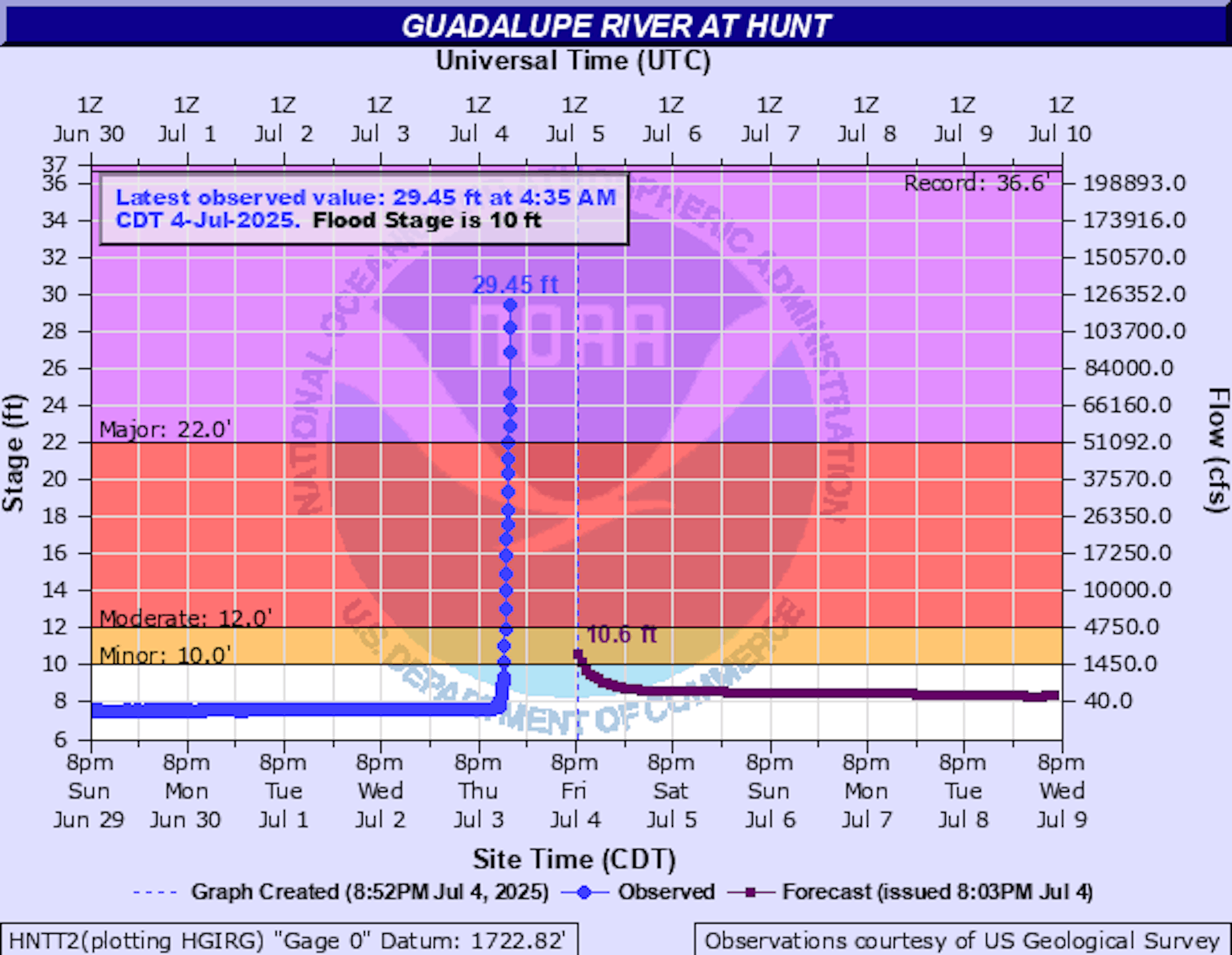
    A river gauge at Hunt, Texas, near Camp Mystic, showed how quickly the river flooded: Around 3 a.m. on July 4, the Guadalupe River was rising about 1 foot every 5 minutes at the gauge, National Weather Service data shows. By 4:30 a.m., it had risen more than 20 feet. As the water moved downstream, it reached Kerrville, where the river rose even faster.

    Flood expert Hatim Sharif, a hydrologist and civil engineer at the University of Texas at San Antonio, explains what makes this part of the country, known as Flash Flood Alley, so dangerous.

    What makes Hill Country so prone to flooding?

    Texas as a whole leads the nation in flood deaths, and by a wide margin. A colleague and I analyzed data from 1959 to 2019 and found 1,069 people had died in flooding in Texas over those six decades. The next highest total was in Louisiana, with 693.

    Many of those flood deaths have been in Hill County. It’s part of an area known as Flash Flood Alley, a crescent of land that curves from near Dallas down to San Antonio and then westward.

    The hills are steep, and the water moves quickly when it floods. This is a semi-arid area with soils that don’t soak up much water, so the water sheets off quickly and the shallow creeks can rise fast.

    When those creeks converge on a river, they can create a surge of water that wipes out homes and washes away cars and, unfortunately, anyone in its path.

    Hill Country has seen some devastating flash floods. In 1987, heavy rain in western Kerr County quickly flooded the Guadalupe River, triggering a flash flood similar to the one in 2025. Ten teenagers being evacuated from a camp died in the rushing water.

    San Antonio, at the eastern edge of Hill Country, was hit with a flash flood on June 12, 2025, that killed 13 people whose cars were swept away by high water from a fast-flooding creek near an interstate ramp in the early morning.

    Why does the region get such strong downpours?

    One reason Hill Country gets powerful downpours is the Balcones Escarpment.

    The escarpment is a line of cliffs and steep hills created by a geologic fault. When warm air from the Gulf rushes up the escarpment, it condenses and can dump a lot of moisture. That water flows down the hills quickly, from many different directions, filling streams and rivers below.

    As temperature rise, the warmer atmosphere can hold more moisture, increasing the downpour and flood risk.

    A tour of the Guadalupe River and its flood risk.

    The same effect can contribute to flash flooding in San Antonio, where the large amount of paved land and lack of updated drainage to control runoff adds to the risk.

    What can be done to improve flash flood safety?

    First, it’s important for people to understand why flash flooding happens and just how fast the water can rise and flow. In many arid areas, dry or shallow creeks can quickly fill up with fast-moving water and become deadly. So people should be aware of the risks and pay attention to the weather.

    Improving flood forecasting, with more detailed models of the physics and water velocity at different locations, can also help.

    Probabilistic forecasting, for example, can provide a range of rainfall scenarios, enabling authorities to prepare for worst-case scenarios. A scientific framework linking rainfall forecasts to the local impacts, such as streamflow, flood depth and water velocity, could also help decision-makers implement timely evacuations or road closures.

    Education is particularly essential for drivers. One to two feet of moving water can wash away a car. People may think their trucks and SUVs can go through anything, but fast-moving water can flip a truck and carry it away.

    Officials can also do more to barricade roads when the flood risk is high to prevent people from driving into harm’s way. We found that 58% of the flood deaths in Texas over the past six decades involved vehicles. The storm on June 12 in San Antonio was an example. It was early morning, and drivers had poor visibility. The cars were hit by fast-rising floodwater from an adjacent creek.

    This article, originally published July 5, 2025, has been updated with the death toll rising.

    Hatim Sharif does not work for, consult, own shares in or receive funding from any company or organization that would benefit from this article, and has disclosed no relevant affiliations beyond their academic appointment.

    – ref. Why Texas Hill Country, where a devastating flood killed more than 120 people, is one of the deadliest places in the US for flash flooding – https://theconversation.com/why-texas-hill-country-where-a-devastating-flood-killed-more-than-120-people-is-one-of-the-deadliest-places-in-the-us-for-flash-flooding-260555

    MIL OSI Analysis –

    July 11, 2025
  • MIL-OSI USA: Legislation considered under suspension of the Rules of the House of Representatives during the week of July 14, 2025

    Source: US Congressional Budget Office

    The Majority Leader of the House of Representatives announces bills that will be considered under suspension of the rules in that chamber. Under suspension, floor debate is limited, all floor amendments are prohibited, points of order against the bill are waived, and final passage requires a two-thirds majority vote.

    At the request of the Majority Leader and the House Committee on the Budget, CBO estimates the effects of those bills on direct spending and revenues. CBO has limited time to review the legislation before consideration. Although it is possible in most cases to determine whether the legislation would affect direct spending or revenues, time may be insufficient to estimate the magnitude of those effects. If CBO has prepared estimates for similar or identical legislation, a more detailed assessment of budgetary effects, including effects on spending subject to appropriation, may be included.

    CBO’s estimates of the bills that have been posted for possible consideration under suspension of the rules during the week of July 14, 2025, include:

    • H.R. 131, Finish the Arkansas Valley Conduit Act, as amended
    • H.R. 410, Alaska Native Vietnam Era Veterans Land Allotment Extension Act of 2025
    • H.R. 504, Miccosukee Reserved Area Amendments Act
    • H.R. 900, Sinkhole Mapping Act of 2025, as amended
    • H.R. 1043, La Paz County Solar Energy and Job Creation Act
    • H.R. 1044, To amend Public Law 99-338 with respect to Kaweah Project permits
    • H.R. 1455, ITS Codification Act
    • H.R. 1618, Precision Agriculture Satellite Connectivity Act, as amended
    • H.R. 1709, Understanding Cybersecurity of Mobile Networks Act
    • H.R. 1717, Communications Security Act
    • H.R. 1729, Bolts Ditch Act
    • H.R. 1765, Promoting United States Wireless Leadership Act of 2025, as amended
    • H.R. 1766, NTIA Policy and Cybersecurity Coordination Act
    • H.R. 1770, Consumer Safety Technology Act
    • H.R. 2037, Open RAN Outreach Act, as amended
    • H.R. 2316, Wetlands Conservation and Access Improvement Act of 2025
    • H.R. 3657, Hydropower Relicensing Transparency Act, as amended
    • S. 1596, Jocelyn Nungaray National Wildlife Refuge Act

    MIL OSI USA News –

    July 11, 2025
  • MIL-OSI USA: SPC Tornado Watch 501 Status Reports

    Source: US National Oceanic and Atmospheric Administration

    Search by city or zip code. Press enter or select the go button to submit request
    Local forecast by”City, St” or “ZIP” 

    SPC on Facebook

    @NWSSPC

    NCEP Quarterly Newsletter

    Home (Classic)SPC Products   All SPC Forecasts   Current Watches   Meso. Discussions   Conv. Outlooks   Tstm. Outlooks   Fire Wx Outlooks     RSS Feeds   E-Mail AlertsWeather Information   Storm Reports   Storm Reports Dev.   NWS Hazards Map   National RADAR   Product Archive   NOAA Weather RadioResearch   Non-op. Products   Forecast Tools   Svr. Tstm. Events   SPC Publications   SPC-NSSL HWTEducation & Outreach   About the SPC   SPC FAQ   About Tornadoes   About Derechos   Video Lecture Series   WCM Page   Enh. Fujita Page   Our History   Public ToursMisc.   StaffContact Us   SPC Feedback

    Watch 501 Status Reports

    Watch 501 Status Message has not been issued yet.

    Top/Watch Issuance Text for Watch 501/All Current Watches/Forecast Products/Home

    Weather Topics:Watches, Mesoscale Discussions, Outlooks, Fire Weather, All Products, Contact Us

    NOAA / National Weather ServiceNational Centers for Environmental PredictionStorm Prediction Center120 David L. Boren Blvd.Norman, OK 73072 U.S.A.spc.feedback@noaa.govPage last modified: July 10, 2025
    DisclaimerInformation QualityHelpGlossary
    Privacy PolicyFreedom of Information Act (FOIA)About UsCareer Opportunities

    MIL OSI USA News –

    July 11, 2025
  • MIL-OSI USA: SPC Tornado Watch 501

    Source: US National Oceanic and Atmospheric Administration

    Note:  The expiration time in the watch graphic is amended if the watch is replaced, cancelled or extended.Note: Click for Watch Status Reports.
    SEL1

    URGENT – IMMEDIATE BROADCAST REQUESTED
    Tornado Watch Number 501
    NWS Storm Prediction Center Norman OK
    310 PM CDT Thu Jul 10 2025

    The NWS Storm Prediction Center has issued a

    * Tornado Watch for portions of
    Far Western Iowa
    Northeast Nebraska
    Extreme Southeast South Dakota

    * Effective this Thursday afternoon and evening from 310 PM until
    1000 PM CDT.

    * Primary threats include…
    A couple tornadoes possible
    Scattered damaging winds and isolated significant gusts to 80
    mph likely
    Scattered large hail and isolated very large hail events to 2
    inches in diameter likely

    SUMMARY…Thunderstorm development is anticipated within the very
    unstable airmass across central/northeast NE this afternoon.
    Environmental conditions support initial supercells capable of all
    severe hazards, including large to very large hail and tornadoes.
    Upscale growth is anticipated after the initial cellular mode, with
    the resultant convective line progressing quickly eastward. Strong
    wind gusts are possible within this line, including gusts over 75
    mph.

    The tornado watch area is approximately along and 75 statute miles
    north and south of a line from 5 miles north northwest of Broken Bow
    NE to 10 miles east of Denison IA. For a complete depiction of the
    watch see the associated watch outline update (WOUS64 KWNS WOU1).

    PRECAUTIONARY/PREPAREDNESS ACTIONS…

    REMEMBER…A Tornado Watch means conditions are favorable for
    tornadoes and severe thunderstorms in and close to the watch
    area. Persons in these areas should be on the lookout for
    threatening weather conditions and listen for later statements
    and possible warnings.

    &&

    AVIATION…Tornadoes and a few severe thunderstorms with hail
    surface and aloft to 2 inches. Extreme turbulence and surface wind
    gusts to 70 knots. A few cumulonimbi with maximum tops to 500. Mean
    storm motion vector 27035.

    …Mosier

    SEL1

    URGENT – IMMEDIATE BROADCAST REQUESTED
    Tornado Watch Number 501
    NWS Storm Prediction Center Norman OK
    310 PM CDT Thu Jul 10 2025

    The NWS Storm Prediction Center has issued a

    * Tornado Watch for portions of
    Far Western Iowa
    Northeast Nebraska
    Extreme Southeast South Dakota

    * Effective this Thursday afternoon and evening from 310 PM until
    1000 PM CDT.

    * Primary threats include…
    A couple tornadoes possible
    Scattered damaging winds and isolated significant gusts to 80
    mph likely
    Scattered large hail and isolated very large hail events to 2
    inches in diameter likely

    SUMMARY…Thunderstorm development is anticipated within the very
    unstable airmass across central/northeast NE this afternoon.
    Environmental conditions support initial supercells capable of all
    severe hazards, including large to very large hail and tornadoes.
    Upscale growth is anticipated after the initial cellular mode, with
    the resultant convective line progressing quickly eastward. Strong
    wind gusts are possible within this line, including gusts over 75
    mph.

    The tornado watch area is approximately along and 75 statute miles
    north and south of a line from 5 miles north northwest of Broken Bow
    NE to 10 miles east of Denison IA. For a complete depiction of the
    watch see the associated watch outline update (WOUS64 KWNS WOU1).

    PRECAUTIONARY/PREPAREDNESS ACTIONS…

    REMEMBER…A Tornado Watch means conditions are favorable for
    tornadoes and severe thunderstorms in and close to the watch
    area. Persons in these areas should be on the lookout for
    threatening weather conditions and listen for later statements
    and possible warnings.

    &&

    AVIATION…Tornadoes and a few severe thunderstorms with hail
    surface and aloft to 2 inches. Extreme turbulence and surface wind
    gusts to 70 knots. A few cumulonimbi with maximum tops to 500. Mean
    storm motion vector 27035.

    …Mosier

    Note: The Aviation Watch (SAW) product is an approximation to the watch area. The actual watch is depicted by the shaded areas.
    SAW1
    WW 501 TORNADO IA NE SD 102010Z – 110300Z
    AXIS..75 STATUTE MILES NORTH AND SOUTH OF LINE..
    5NNW BBW/BROKEN BOW NE/ – 10E DNS/DENISON IA/
    ..AVIATION COORDS.. 65NM N/S /52ENE LBF – 55NNE OVR/
    HAIL SURFACE AND ALOFT..2 INCHES. WIND GUSTS..70 KNOTS.
    MAX TOPS TO 500. MEAN STORM MOTION VECTOR 27035.

    LAT…LON 42589967 43079519 40899519 40419967

    THIS IS AN APPROXIMATION TO THE WATCH AREA. FOR A
    COMPLETE DEPICTION OF THE WATCH SEE WOUS64 KWNS
    FOR WOU1.

    Watch 501 Status Report Message has not been issued yet.

    Note:  Click for Complete Product Text.Tornadoes

    Probability of 2 or more tornadoes

    Mod (40%)

    Probability of 1 or more strong (EF2-EF5) tornadoes

    Low (20%)

    Wind

    Probability of 10 or more severe wind events

    Mod (60%)

    Probability of 1 or more wind events > 65 knots

    Mod (60%)

    Hail

    Probability of 10 or more severe hail events

    Mod (60%)

    Probability of 1 or more hailstones > 2 inches

    Mod (60%)

    Combined Severe Hail/Wind

    Probability of 6 or more combined severe hail/wind events

    High (>95%)

    For each watch, probabilities for particular events inside the watch (listed above in each table) are determined by the issuing forecaster. The “Low” category contains probability values ranging from less than 2% to 20% (EF2-EF5 tornadoes), less than 5% to 20% (all other probabilities), “Moderate” from 30% to 60%, and “High” from 70% to greater than 95%. High values are bolded and lighter in color to provide awareness of an increased threat for a particular event.

    MIL OSI USA News –

    July 11, 2025
  • MIL-OSI Video: Sustainable Development Goals Report 2025, Francesca Albanese & other topics – Daily Press Briefing

    Source: United Nations (video statements)

    Noon Briefing by Stéphane Dujarric, Spokesperson for the Secretary-General.

    Highlights:
    Sustainable Development Goals Report 2025
    Francesca Albanese
    Occupied Palestinian Territory
    Lebanon
    Ukraine
    Sudan
    Somalia
    Democratic Republic of the Congo
    Libya
    UN Environment Programme/Report
    Briefings

    SUSTAINABLE DEVELOPMENT GOALS REPORT 2025
    On Monday, in a press conference, the Secretary-General will launch the Sustainable Development Goals Report 2025. He will be joined by the Deputy-Secretary-General Amina Mohammed and our Under-Secretary-General for Economic and Social Affairs, Li Junhua.

    The press conference will take place at 12:45 p.m., just after the noon briefing.

    FRANCESCA ALBANESE
    In response to questions on the sanctions imposed by the United States on Francesca Albanese, the Spokesman said that the imposition of sanctions on special rapporteurs is a dangerous precedent.

    Francesca Albanese, like all other Special UN Human Rights Rapporteurs, is an independent human rights expert appointed by the UN Human Rights Council and reporting to the Human Rights Council. Special Rapporteurs do not report to the Secretary-General, and he has no authority over them or their work.

    That being said, Member States are perfectly entitled to their views and to disagree with the reports by the Special Rapporteurs, but we encourage them to engage with the UN human rights architecture.
    The use of unilateral sanctions against special rapporteurs, or any other UN expert or official is unacceptable.

    OCCUPIED PALESTINIAN TERRITORY
    The Office for the Coordination of Humanitarian Affairs (OCHA) said that a UN team managed to bring about 75,000 litres of fuel from Israel into the Gaza Strip. That is the first such provision in 130 days. As mentioned yesterday during the noon briefing, the UN and its humanitarian partners need hundreds of thousands of litres of fuel each day to keep essential life-saving and life-sustaining operations going, meaning the amount entered yesterday isn’t sufficient to cover even one day of energy requirements. Fuel is still running out and services will shut down if greater volumes do not enter Gaza Strip immediately.

    One partner, for instance, reported that this week that in a matter of days, fuel shortages could cut off supplies of clean drinking water to about 44,000 children that depend on that water source. The lack of fresh water would further increase the risk of waterborne illnesses such as cholera, diarrhea and dysentery. 

    Meanwhile, the Israeli military continues its operations across the Gaza Strip, including shelling and ground incursions. This morning, people waiting to get nutritional supplements were reportedly struck in Deir al Balah. According to Al-Aqsa Hospital, the attack resulted in dozens of casualties, the majority of whom were women and children. 

    In a statement issued today, Catherine Russell, the Executive Director of the UN Children’s Fund (UNICEF), said she was appalled by the reported killing of 15 Palestinians, including nine children and four women, who were just waiting in line for nutritional supplies their children. And I can tell you that the UN, yet again, condemns the killing of civilians in Gaza.

    OCHA stresses that parties are bound by international humanitarian law to prevent such excessive death and injury of civilians in the midst of war.
    All parties must take all feasible precautions to avoid and minimize civilian harm, and indiscriminate attacks are strictly prohibited.

    Another strike today reportedly hit the office of a humanitarian partner in Gaza city; three staff were killed.

    Yesterday, UN partners providing education services said that between October 2023 and June of this year, 626 temporary learning spaces have been established in Gaza, with 240,000 students enrolled, about half of those students are girls. However, UN partners say that only 299 spaces are currently operational due to the ongoing displacement orders, funding shortfalls and other challenges.

    UN humanitarian partners, including first responders, health workers, and aid workers, continue to deliver food and other assistance under intolerable conditions, and they themselves are facing hunger. A number of our own colleagues are also facing hunger. They also face water scarcity and threats to their personal safety, just like everyone else in Gaza.
    As we said, time and again: This catastrophic situation must end. A ceasefire is not only urgent, it is long overdue, and all of the hostages need to be released unconditionally and immediately.

    Full highlights: https://www.un.org/sg/en/content/noon-briefing-highlight?date%5Bvalue%5D%5Bdate%5D=10%20July%202025

    https://www.youtube.com/watch?v=oCq6GB-B6Sk

    MIL OSI Video –

    July 11, 2025
  • MIL-OSI USA: Congressman Robert Garcia and Senator Alex Padilla Reintroduce the ‘Clean Shipping Act’ to Reduce Port Pollution and Protect the Health of Port Communities

    Source: United States House of Representatives – Congressman Robert Garcia California (42nd District)

    Washington, D.C. – Today, Congressman Robert Garcia (CA-42) and Senator Alex Padilla (D-CA) reintroduced the Clean Shipping Act. This bill establishes a path to eliminate greenhouse gas emissions from large ships that come to U.S. ports, protecting the health of port communities and addressing the environmental and climate impacts of shipping pollution. Specifically, the bill would mandate that by 2050, ships must cut all greenhouse gas pollution, and by 2035, they must emit zero emissions while parked at ports. The bill is co-led by Congresswoman Nanette Barragán (CA-44). The bill text can be found here. 

    “Our nation’s ports, particularly the Port of Long Beach, are crucial parts of the economy that drive our supply chain at home. However, they’re also among the largest sources of pollution in our coastal communities,” said Congressman Robert Garcia. “Ship pollution is harmful for the health of people living near ports, and disproportionately affects low-income, working-class neighborhoods and communities of color. That’s why I’m proud to introduce a bill that addresses greenhouse gas pollution and creates a path to fully eliminate emissions. We must protect people’s health and stop our climate crisis, while ensuring good-paying jobs for the future.”

    “California’s ports are the powerhouse of our country’s economy, moving critical freight and providing good-paying jobs, all while leading the nation’s decarbonizing efforts. But neighboring communities have been forced to shoulder the brunt of global shipping pollution for too long,” said Senator Alex Padilla. “Our legislation would strengthen the sustainability of our shipping industry by reducing emissions in maritime transportation while simultaneously protecting coastal communities. The health of our communities and our planet requires us to be forward-looking and ambitious — we owe future generations nothing less than bold, transformative action.”

    “I’m proud to reintroduce the Clean Shipping Act because people deserve to breathe clean air, and this bill will help make that a reality. Communities near the Ports of Los Angeles and Long Beach—many of them communities of color—continue to suffer from toxic air pollution caused by ships. This bill sets a clear path to zero-emission shipping. It’s a critical step to clean up our air, protect public health, and take on the climate crisis. Port communities have waited long enough, we must act now,” said Congresswoman Nanette Barragán.

    “In order to protect our ocean and stay competitive with the rest of the world, we need federal leadership to help modernize and clean up U.S. shipping. By driving the shipping sector to develop, scale and deploy zero-emission technologies, we can spur job creation, help tackle the climate crisis and help create cleaner air for the millions of Americans living near ports. We commend Representative Garcia and Senator Padilla for their leadership on this issue and look forward to working with members of Congress to make this bill a reality,” said Caroline Bonfield, Ocean Conservancy’s Shipping Emissions U.S. Policy Manager

    “The Clean Shipping Act of 2025 will send a clear signal to the shipping industry that they must reduce their emissions by phasing out the use of fossil fuels and transition to a cleaner future. Technology-forcing policies like this legislation will enable large-scale investment in sustainable maritime fuels and technologies and establish a level playing field, minimizing the risk for manufacturers and suppliers. For far too long, dirty ships have brought significant levels of air pollution into U.S. port communities. We commend Representative Garcia and Senator Padilla for reintroducing this important bill and leading the effort to help protect communities disproportionately impacted by these harmful emissions,” said Antonio Santos, Federal Climate Policy Director, Pacific Environment.

    “The shipping industry has been polluting communities for decades, but we have the power to make shipping cleaner. Port expansions across the country have been especially devastating for communities living closest to the harbors where large ships spew toxic diesel exhaust that worsens air quality and contributes to the climate crisis. People living near ports deserve to breathe clean air, and the Clean Shipping Act will help make that a reality,” said Katherine García, Director of the Clean Transportation for All Campaign, Sierra Club. 

    “GreenLatinos endorses the urgently needed Clean Shipping Act, which protects Latino/e and other vulnerable communities from further exposure to port pollution and takes important steps to reduce harm from toxic ship fuels. 1 in 3 Latines live in the top 20% of most pollution-impacted communities. Pollution burdened communities are facing even more exposure as idling ships wait days to enter port and offload their cargo. We urge Congress to act swiftly in passing this vital legislation and protect our coastal communities from the harms of port emissions,” said Andrea Marpillero-Colomina, Policy Advisor, GreenLatinos.

    “The Clean Shipping Act of 2025 will help us work toward a future where healthy port communities thrive and everyone benefits from leveraging the tremendous potential of the ocean and ocean industries as powerful sources of climate solutions. We are grateful for the leadership of Congressman Garcia and Senator Padilla for advancing this legislation for our ocean, climate, and communities,” said Sarah Guy, Executive Director, Ocean Defense Initiative. 

    The global shipping industry accounts for nearly 3% of all global greenhouse gas emissions, and that number is expected to rise if no action is taken. Additionally, almost 40% of Americans live near ports, where people’s health is harmed by air pollution. This especially impacts working-class neighborhoods and communities of color. 

    The Clean Shipping Act is endorsed by Breathe Southern California, CleanEarth4Kids.org, Don’t Waste Arizona, Environmental Investigation Agency, Friends of the Earth, GreenLatinos, Intheshadowofthewolf, Long Beach Alliance for Clean Energy, Milwaukee Riverkeeper, Ocean Conservancy, Ocean Defense Initiative, Pacific Environment, Restoring Earth Connection, San Pedro & Peninsula Homeowners Coalition, Seattle Cruise Control, Sierra Club, Sunflower Alliance, 350 Bay Area Action, 350 Sacramento, Turtle Island Restoration Network, Washington Physicians for Social Responsibility, ABB, Evolve Hydrogen Inc., Maritime Battery Forum, and Zero Emissions Ship Technology Association

    Congressman Garcia, a co-chair of the Congressional PORTS Caucus, is committed to advocating for bold climate action and environmental justice, which includes improving port infrastructure. Congressman Garcia first introduced the Clean Shipping Act alongside Senator Padilla in 2023. During his time in Congress, Congressman Garcia has helped secure over $283 million in federal grant money for the completion of the Port of Long Beach Pier B Port Project, which will significantly reduce truck traffic and harmful emissions while improving safety, local congestion, and yielding nationwide economic benefits. Congressman Garcia also helped secure two federal grants through the Bipartisan Infrastructure Law totaling nearly $44 million to reduce truck emissions at port facilities located in the Port of Long Beach. As Mayor of Long Beach, Congressman Garcia worked with the Port of Long Beach to navigate the historic surge in volume in freight in the aftermath of the COVID-19 pandemic.

    ###

    MIL OSI USA News –

    July 11, 2025
  • MIL-OSI Banking: Comments on Endangered Species Act (ESA) Section 10(a) Program Implementation

    Source: Independent Petroleum Association of America

    Headline: Comments on Endangered Species Act (ESA) Section 10(a) Program Implementation

    Jul 9, 2025 Comments on Endangered Species Act (ESA) Section 10(a) Program Implementation

    The American Petroleum Institute (“API”), the American Exploration and Production Council (“AXPC”), the Independent Petroleum Association of America (“IPAA”), GPA Midstream Association, Marcellus Shale Coalition, the North Dakota Petroleum Council (“NDPC”), the Petroleum Alliance of Oklahoma, the Texas Oil and Gas Association (“TXOGA”), and Utah Petroleum Alliance (“UPA”) (collectively, the “Associations”) appreciates the opportunity to provide comments in response to the Fish and Wildlife Service’s (“FWS” or “the Service”) request for information (“RFI”) issued on June 9, 2025. This RFI sought feedback on improvements to the development and implementation of survival permits associated with Conservation Benefit Agreements (CBAs) and Incidental Take Permits (ITPs) associated with Habitat Conservation Plans (HCPs) under Section 10(a) of the Endangered Species Act (ESA). We appreciate the Trump Administration’s desire to achieve a meaningful reduction in regulatory burdens while continuing to meet statutory obligations, advance American energy independence, and ensure the responsible stewardship of the nation’s public lands and resources. …

    Voluntary conservation agreements such as HCPs and CBAs are helpful mechanisms to minimize impacts to species and habitat and contribute to overall species conservation goals, while avoiding unwarranted access restrictions that could obstruct national energy security objectives. A significant value of these plans lies in their ability to streamline or even proactively preempt the often-lengthy Incidental Take Permit process, a benefit that works both in favor of industry and the Service. Though not applicable in all situations and for all species, the Associations’ members already successfully leverage various CBAs and HCPs for species such as the Dunes Sagebrush Lizard, the Lesser Prairie Chicken, the Texas Hornshell Mussel, and the Monarch Butterfly. Critical learnings from these initiatives can be applied to future conservation plans, as per the suggestions delivered below. …

    Continue Reading

    MIL OSI Global Banks –

    July 11, 2025
  • MIL-OSI Europe: Italy: EIB, SACE and Intesa Sanpaolo provide €1.5 billion for Terna’s Adriatic Link

    Source: European Investment Bank

    EIB

    • The Adriatic Link, a strategic project for Italy’s energy system included in the National Integrated Plan for Energy and Climate, is Terna’s submarine power line that will connect the Marche and Abruzzo regions.
    • The financing for Terna is structured as follows: a €750 million loan from the EIB, a €500 million loan from Intesa Sanpaolo, and an additional €250 million credit line from Intesa Sanpaolo with indirect EIB funding. All transactions are backed by SACE’s Archimede Guarantee for an amount exceeding 1 billion.

    The European Investment Bank (EIB), Terna, Intesa Sanpaolo (IMI Corporate and Investment Banking Division) and SACE have signed agreements totalling €1.5 billion to back the development and construction of the Adriatic Link, the submarine power cable linking the Italian regions of Marche and Abruzzo. The main objectives of the project are to strengthen energy exchange in central Italy and promote the integration of renewable energy sources.

    The signature ceremony took place in Rome today with the participation of EIB Group President Nadia Calviño, EIB Vice-President Gelsomina Vigliotti, Terna CEO and General Manager Giuseppina Di Foggia, SACE CEO and General Manager Alessandra Ricci, and Head of Industry Infrastructure in Intesa Sanpaolo’s IMI Corporate and Investment Banking Division Riccardo Dutto.

    The operation is financially structured into three tranches, all of which are covered by SACE’s Archimede guarantee for an amount exceeding 1 billion euros:

    • A €750 million loan granted by the EIB to Terna, with a duration of 22 years;
    • A €500 million credit line provided by Intesa Sanpaolo to Terna, with a duration of 7 years;
    • An additional €250 million loan from Intesa Sanpaolo, with funding made available by the EIB and a duration of 7 years, in support of the project.

    The Adriatic Link is strategically important for Italy’s power grid and is part of the country’s national energy and climate plan. It will strengthen energy exchange in central Italy, meeting the security and flexibility needs of the national power grid and development and renewable energy integration targets

    The high-voltage direct current (HVDC) line will be 251 km long, 210 km of which will be submarine cable at a maximum depth of around 100 metres. It will have a nominal active transmission capacity of 1 000 MW and will link the Fano (Province of Pesaro and Urbino) and Cepagatti (Province of Pescara) electrical substations. The cable will be underground or under the seabed for the entire route, minimising the impact on the region. Work (authorised by the Ministry of the Environment and Energy Security in January 2024) on land began late last year.

    The project will also have a positive economic impact in cohesion regions, contributing to local development.

    EIB Group President Nadia Calviño said: “This investment will be key to boost a more stable and safer energy market in the country, improving the national power grid and speeding up the integration of renewable energy sources.” EIB Vice-President Gelsomina Vigliotti added: “This agreement confirms the EIB’s central role in mobilising public and private sector resources to promote strategic autonomy and the energy transition in Europe.”

    “The energy transition has given new impetus to investment to modernise and strengthen power grids across Europe, as shown in Terna’s updated business plan for 2024-2028 presented at the beginning of this year,” said Terna CEO and General Manager Giuseppina Di Foggia. “The financing signed today with the EIB (with which Terna has a strong, longstanding relationship) and Intesa Sanpaolo (which has a key role in backing the group’s financial strategy) recognises the strategic value of our network infrastructure, which is vital to promoting the integration of renewable energy sources and increasing Italy’s energy autonomy and security. At the same time, SACE’s role in the agreement shows Terna’s work creates economic and social value for the country.”

    “In the IMI Corporate and Investment Banking division, we have always believed in the value of public-private cooperation, a key element in accelerating the construction of sustainable infrastructure and helping to modernise the country,” added Chief of Intesa Sanpaolo’s IMI Corporate and Investment Banking Division Mauro Micillo. “A concrete example of this is our participation in the Adriatic Link project, which is of strategic importance for energy security. This operation confirms Intesa Sanpaolo’s role in backing the energy transition and supporting public institutions and businesses with high-impact investments for the future of local communities and the national economy.”

    “The signature of this agreement is a very important moment for the Italian energy system, showing SACE’s crucial role in supporting innovation and the transition to a more sustainable future. A key pilar of this operation, the Archimede guarantee embodies our commitment to creating value for communities and the whole country,” said SACE CEO and General Manager Alessandra Ricci. “We are moving towards more resilient and integrated energy infrastructure capable of responding to global challenges. SACE will continue to be a strategic partner for projects shaping the future of Italy.”

    Background information

    The European Investment Bank (ElB) is the long-term lending institution of the European Union, owned by its Member States. Built around eight key priorities, we finance investments that contribute to EU policy objectives by bolstering climate action and the environment, digitalisation and technological innovation, security and defence, cohesion, agriculture and bioeconomy, social infrastructure, the capital markets union, and a stronger Europe in a more peaceful and prosperous world.  The EIB Group, which also includes the European Investment Fund (EIF), signed over 900 projects worth nearly €89 billion in 2024, boosting Europe’s competitiveness and security. The EIB Group signed 99 operations totalling €10.98 billion in Italy in 2024, helping to unlock almost €37 billion of investment in the real economy. All projects financed by the EIB Group are in line with the Paris Climate Agreement, as pledged in our Climate Bank Roadmap. Almost 60% of the EIB Group’s annual financing supports projects directly contributing to climate change mitigation, adaptation, and a healthier environment. Fostering market integration and mobilising investment, the funds made available by the Group unlocked over €100 billion in new investment for Europe’s energy security in 2024 and mobilised a further €110 billion for startups and scale-ups. Around half of the EIB’s financing within the European Union is directed towards cohesion regions, where per capita income is lower than the EU average.

    The Terna Group is a leading electricity transmission operator in Europe and around the world. It manages Italy’s national high-voltage transmission grid, with around 75 000 km of power lines over 900 electrical substations across the country. Its mission is to guarantee the secure operation, quality and efficiency of the Italian electricity system 24 hours a day, 365 days a year, and to ensure equal access conditions for all market operators. A centre of excellence comprising over 6 100 professionals, Terna plays a guiding role in the energy transition process towards complete decarbonisation and the full integration of energy from renewable sources into the grid. For more information, visit www.terna.it.

    SACE is an insurance and finance company owned by the Italian Ministry for the Economy and Finance. It specialises in helping Italian companies to grow through a wide range of tools and solutions backing exports and innovation, including financial guarantees, factoring, risk management and protection, advisory services and business matching. With a network of 11 offices in Italy and 13 more in Made in Italy target countries around the world, SACE currently supports 60 000 companies, enabling them to reach their national and international potential with a portfolio of insurance operations and guaranteed investments worth approximately €270 billion in 200 global markets.

    Intesa Sanpaolo, with €417 billion in loans and €1.4 trillion in customer financial assets at the end of March 2025, is the largest banking group in Italy, with a significant international presence. It is a European leader in wealth management, with a strong focus on digital and fintech. The Group will provide €115 billion of Impact lending by 2025 to support communities and the green transition, together with a €1.5 billion program (2023-2027) to help people in need. The Bank’s network of museums, the Gallerie d’Italia, hosts its owned artistic heritage and cultural projects of recognized value.  

    News: group.intesasanpaolo.com/en/newsroom

    X: @intesasanpaolo

    LinkedIn: linkedin.com/company/intesa-sanpaolo

    TERNA ADRIATIC LINK

    ©EIB
    Download original

    TERNA ADRIATIC LINK

    ©EIB
    Download original

    MIL OSI Europe News –

    July 11, 2025
  • MIL-OSI United Kingdom: expert reaction to study of projections of heat deaths in England and Wales under difference climate scenarios

    Source: United Kingdom – Executive Government & Departments

    July 10, 2025

    A study in PLOS Climate looks at projections of future heat deaths in England and Wales given different climate scenarios. 

    Dr Raquel Nunes, Assistant Professor in Health and Environment at the University of Warwick, said:

    “The study highlights the importance of mitigation and adaptation for future heat-health outcomes. While it presents valuable future projections, it relies on pre-defined assumptions and scenarios, largely omitting the urgent need to transition from reactive to anticipatory strategies.

    “The forecast of a third consecutive UK heatwave so far this summer – and the increasing frequency, intensity and duration of such events – underscores the urgent need to shift from reactive to anticipatory strategies. Heat-related deaths and illnesses are both preventable and avoidable, yet they expose systemic failures and highlight the need for socially inclusive and institutionally embedded adaptation across governance, infrastructure, and health and care services to prevent increasing vulnerabilities and inequalities.”

    Dr Akshay Deoras, Research Scientist at the University of Reading, said:

    “If floods and storms are the loud alarms of climate change, extreme heat is its silent killer. It is disproportionately lethal, often going unnoticed until it’s too late. With another heatwave bearing down on the UK, this warning feels more urgent than ever.

    “This new comprehensive study makes the threat clear. It analyses heat-related mortality across fifteen plausible combinations of climate and socioeconomic scenarios, capturing a wide range of possible futures for England and Wales. It simultaneously accounts for climate change, population growth and ageing, and adaptive capacity. This multi-driver approach avoids the underestimation of future health burdens that can occur when only one driver is considered.

    “The results show that heat is not only claiming more lives, but that power outages and an aging population could make things far worse if adaptation doesn’t keep pace. Even under the most optimistic scenarios, heat-related deaths are set to rise sharply by mid-century. One of the limitations of the study is that temperature exposure is assigned at the regional level using population-weighted averages, which may not fully reflect local microclimates, potentially masking local hotspots of risk.

    “To save lives, we must cut greenhouse gas emissions and strengthen adaptation strategies at the same time. Crucially, the study highlights the power of natural, passive cooling techniques, such as shutters, shading, and cool roofs, which work even when the electricity fails. These solutions not only protect people but also avoid the trap of relying on air conditioning, which drives further global warming. As the UK experiences fewer cold extremes and more frequent and deadly heatwaves, protecting older adults must be at the heart of climate and public health planning—before this silent threat becomes an undeniable crisis.”

    Prof Richard Allan, Professor of Climate Science at the University of Reading, said:

    “Warming of the climate is making heatwaves more severe and dangerous. The new study paints a concerning picture of the future in which a greater intensity of summer heat compounds with an ageing, more vulnerable population to increase the risk of death. 

    “The research finds danger to people from persistent heat diminishes in scenarios involving deeper cuts in climate warming greenhouse gases but remain concerningly large, meaning that adaptation of our infrastructure and culture is also needed as well as rapidly transitioning to a low carbon society. 

    “The study also notes a concurrent reduction in mortality from cold extremes and may underestimate the adaptive measures that could be adopted in response to hot conditions but underscores the importance of avoiding the worst case storylines by reducing greenhouse gas emissions and improving our resilience to worsening weather extremes.”

    ‘Projections of heat related mortality under combined climate and socioeconomic adaptation scenarios for England and Wales’ by Rebecca Cole et al. was published in PLOS Climate at 7pm UK time on Thursday 10 July 2025.

    DOI: https://doi.org/10.1371/journal.pclm.0000553

    Declared interests

    Richard Allan: “No conflicting interests”

    Dr Akshay Deoras: “I receive funding from UKRI and DSIT/Met Office.”

    Raquel Nunes: “No conflicts of interest”

    MIL OSI United Kingdom –

    July 11, 2025
  • MIL-OSI USA: Cammack, Gonzales Lead Letter Urging HHS to Fast-Track Livestock Treatment Approvals

    Source: United States House of Representatives – Congresswoman Kat Cammack (R-FL-03)

    Washington, D.C. — Today, Congresswoman Kat Cammack (FL-03) and Congressman Tony Gonzales (TX-23) led a group of Republican lawmakers in sending a letter to Health and Human Services (HHS) Secretary Robert F. Kennedy Jr. urging coordination between HHS, the U.S. Department of Agriculture (USDA), the Environmental Protection Agency (EPA), and pharmaceutical manufacturers to fast-track approvals and labeling of anti-parasitic treatments for livestock in response to the outbreak and growing threat of a New World Screwworm (NWS) infestation in Mexico.

    The letter highlights the serious health and economic risks posed by NWS, which is moving north through Mexico and approaching the U.S. border. Lawmakers are urging HHS to expedite approvals for antiparasitic treatments—such as ivermectin, doramectin, permethrin, and coumaphos—that are proven effective abroad but lack proper U.S. labeling. They cite the successful 2016 emergency approval of doramectin as a model and call for coordinated action with USDA and EPA to match USDA’s new five-prong strategy, including the sterile fly facility planned in South Texas.

    “Time is of the essence, as there are safe, effective treatments already in use around the world that U.S. producers cannot legally deploy because of outdated or incomplete labeling. By working hand-in-hand with USDA and EPA, HHS can cut through bureaucratic red tape to ensure that veterinarians, ranchers, and wildlife managers have the tools they need before an outbreak hits,” said Congresswoman Cammack. “For months, Congressman Gonzales and I have been actively engaged in combatting this threat. Over a month ago, we hosted a roundtable with fellow members of Congress, major stakeholders, and partners to determine the best path forward. We’ve developed an action plan and are working with our partners to execute executive and legislative action. It is now time for action at the federal level to match that urgency.”

    “Fast-tracking approvals for anti-parasitic treatments for livestock is another important step we must take to protect our livestock industry from the New World screwworm. From introducing the STOP Screwworms Act and leading funding efforts through my seat on the House Appropriations Committee to working alongside USDA Secretary Brooke Rollins to launch a facility focused on screwworm eradication efforts—I am determined to do everything possible to eliminate this deadly parasite,” said Congressman Tony Gonzales. “Thank you, Rep. Kat Cammack, for your partnership in moving forward critical treatments to protect America’s livestock.”

    A copy of the full letter can be found here.

    MIL OSI USA News –

    July 11, 2025
  • MIL-OSI United Kingdom: Popular play area set for revamp

    Source: City of Sunderland

    Sunderland’s much loved Mowbray Park play area is set to undergo a makeover.

    The redevelopment will see the repair and revamp of some of the park’s favourite pieces of play equipment alongside the installation of a number of new pieces, including inclusive play equipment.

    New play equipment due to be installed over the next few weeks includes a toddler multiplay, see-saw, clambering boulders, balance beams, a nest rocker and a spider swing. The improvements will also see the installation of an inclusive roundabout, swing and a springie.

    Work on the play area, which is due to start next week, will see it being closed for 12 weeks from the week beginning 14 July. While the City Council generally tries to carry out work on play parks outside of the school holidays, due to the condition of some of the existing play equipment which is mainly down to wear and tear, the decision has been made to bring the planned work forward to next week.

    Councillor Lyndsey Leonard, Cabinet Member for Environment, Transport and Net Zero at Sunderland City Council, said: “Mowbray Park is one of our most popular parks and we’re delighted to be to be installing a range of new play equipment as part of the redevelopment of the much-loved play park.

    “The play area is a real favourite with children and the new play equipment will be a great addition for the many families for regularly visit it. We’re also aiming to repair and retain as many favourite pieces of the park’s existing play equipment as we can. 

    “We always do our very best to minimise any disruption to play by scheduling works around the school holidays. But unfortunately, in this case we have no option but to close the site to carry out the works as soon as possible, due to the condition of some pieces of play equipment including the slide which has been closed for a number of weeks, which are in need of more immediate attention.”

    The redevelopment of the the play area is being funded by the City Council’s Parks and Open Spaces budget and is part of the council’s ongoing work to upgrade its play areas across the city.

    To find out about other parks and play areas in the city, visit: www.sunderland.gov.uk/parks and for other outdoor things to do in the city: www.mysunderland.co.uk/Great-Outdoors 

    MIL OSI United Kingdom –

    July 11, 2025
  • MIL-OSI Submissions: Gene-edited pigs may soon enter the Canadian market, but questions about their impact remain

    Source: The Conversation – Canada – By Gwendolyn Blue, Professor, University of Calgary

    The Canadian government is currently considering approving the entry of gene-edited pigs into the food system.

    Using CRISPR gene-editing technology, genetic changes can be created precisely and efficiently without introducing foreign genetic material. If approved, these pigs would be the first gene-edited food animals available for sale in Canadian markets. My research examines how including the public in decision-making around emerging applications of genomics can help mitigate potential harms.

    These pigs are resistant to porcine reproductive and respiratory syndrome (PRRS), a horrible and sometimes fatal disease that affects pigs worldwide. PRRS has significant economic, food security and animal welfare implications.


    Read more:
    What is gene editing and how could it shape our future?


    The United States Food and Drug Administration recently greenlit the commercial production of gene-edited pigs. Will the Canadian government follow suit?

    AquAdvantage and EnviroPig

    In 2016, Canada approved the first transgenic animal for human consumption — an Atlantic salmon called AquAdvantage salmon that contains DNA from other species of fish.

    This approval came more than 25 years after the genetically modified fish was created by scientists at Memorial University in Newfoundland. The approval and commercialization of AquAdvantage salmon faced strong public opposition on both sides of the border, including protests, supermarket boycotts and court battles. In 2024, the company that produced AquAdvantage salmon announced that it was shutting down its operations.


    Read more:
    The science and politics of genetically engineered salmon: 5 questions answered


    In 2012, the Canadian government approved the manufacture of a transgenic pig known by its trade name, EnviroPig. Created by scientists at the University of Guelph, EnviroPigs released less phosphorus than conventionally bred pigs.

    EnviroPig did not make it to market; the same year, the University of Guelph ended the EnviroPig project. Funding for the project had been suspended, in part because of consumer concerns.

    Government regulation

    Some researchers argue that government regulation of gene-edited animals should be less restrictive than for transgenic techniques. Gene editing introduces genetic changes that can occur with conventional animal breeding that is not subject to regulation. Gene-edited crops in Canada are treated the same as conventionally bred crops.

    Others insist that stringent government regulation is necessary for gene editing to identify potential problems and ensure that laws keep up with industry and scientific ambition. Regulation plays a vital role in minimizing risk, encouraging public involvement and building trust.

    Social science research has, for decades, demonstrated that resistance to biotechnology is not because of the public’s lack of knowledge, as is often argued by biotechnology proponents. Public resistance to biotechnology is better understood as a rejection of potential harms imposed by governments and industry without public input and consent.

    Ethical, moral, cultural and political concerns

    At present, little opportunity exists for public engagement in Canadian assessments of gene-edited animals.

    Similar to the U.S., Canada does not have specific gene technology regulation. Rather, the federal government relies on pre-existing environmental and food safety legislation. Canadian regulatory agencies use a risk, novelty and product-based approach to assess animal biotechnology. From a regulatory standpoint, distinctions between technical processes — like transgenic modification versus gene editing — are less important than the safety of the final product.

    The Canadian government has recently updated its federal environmental and health regulations. This includes introducing mandatory public consultations for animals (vertebrates, specifically) created using biotechnology.

    Even with these changes, there’s still room for improvement. Public engagement is limited to consultations conducted within a short time frame. Interested parties are invited to provide scientific information about potential risks of animal biotechnology to human health or the environment, but comments that address ethical, moral, cultural or political concerns are not taken into consideration.

    More broadly, regulatory and academic debates about the gene editing of animals are largely informed by scientists and industry proponents with considerably less input from the public, Indigenous communities and social sciences and humanities researchers.

    Consulting the public

    From a social standpoint, the process by which gene editing is assessed matters as much as the safety of the final product. Inclusive public engagement is essential to ensure that the production of gene-edited food animals aligns with societal needs and values.

    Reactions to gene technologies are based on underlying values and beliefs, and sustained opportunities for public reflection and deliberation are vital for responsible innovation.

    Important questions should be addressed: Who will reap the benefits of gene-editing techniques? Who will bear the costs and harms? What are the potential implications, including hard-to-anticipate social and political changes? How should decision-making proceed to ensure that Canadians have sufficient opportunities for input?

    Currently, for the gene-edited pigs, members of the public can submit comments to the government until July 20, 2025.

    Public reactions to previous biotech food animals in Canada — including AquAdvantage salmon and the EnviroPig — show that lack of inclusive engagement can contribute to the rejection of animal biotechnology.

    Gwendolyn Blue receives funding from the Social Sciences and Humanities Research Council. She is a member of Gene Editing for Food Security and Environmental Sustainability, a multi-university consortium based at McGill University, and funded by the Natural Sciences and Engineering Research Council of Canada.

    – ref. Gene-edited pigs may soon enter the Canadian market, but questions about their impact remain – https://theconversation.com/gene-edited-pigs-may-soon-enter-the-canadian-market-but-questions-about-their-impact-remain-260627

    MIL OSI –

    July 11, 2025
  • MIL-OSI USA: Reps. Titus, Cohen, Ciscomani Introduce Bipartisan Wild Horse and Burro Protection Act of 2025

    Source: United States House of Representatives – Congresswoman Dina Titus (1st District of Nevada)

    WASHINGTON – Today Representative Dina Titus, a Co-Chair of the Congressional Wild Horse Caucus, reintroduced the bipartisan Wild Horse and Burro Protection Act of 2025, along with Reps. Steve Cohen (D-TN) and Juan Ciscomani (R-AZ).

    In efforts to control equine populations, the federal Bureau of Land Management (BLM) is currently directed to “humanely capture” wild free-roaming horses and burros and set them up for adoption. To assist in the roundup, or “gathering”, of wild horses and burros, the BLM contracts directly with private enterprises, including helicopter companies, to pursue equines over long distances, creating situations that can be frightening and even deadly to the animals.

    These roundup practices also come at a steep cost to taxpayers. In the past five years (2020-2024), at least $36.7 million has been spent on roundups, including over $6 million paid to helicopter roundup contractors in fiscal year 2022 alone. Scientific research has shown that more humane and cost-effective alternatives, like fertility control, are equally effective in controlling equine populations. The BLM’s Wild Horse and Burro Program, however, currently spends less than four percent of its budget on these methods. Rep. Titus’s Wild Horse and Burro Protection Act of 2025 would more effectively advance the BLM’s directive to humanely capture horses while providing significant savings for taxpayers.

    “Nevada is home to more wild horses than any other state in our country. Tragically, these animals are subjected to taxpayer-funded helicopter roundups and removals that are all too often costly, ineffective, and inhumane,” said Rep. Titus, a Co-Chair of the Congressional Wild Horse Caucus. “My legislation would eliminate the use of helicopters in BLM wild horse gathers and require a report to explore the benefits of alternative methods for humanely gathering horses and the workforce opportunities for traditional cowboys. I am proud to introduce this bipartisan proposal that would protect these icons of the American West which remain a source of pride for Nevada residents.”

    “As one of the founding co-Chairs of the Wild Horse and Burro Caucus, I’m pleased to co-lead the Wild Horse and Burro Protection Act to improve accountability and transparency of how these icons of the West are managed by the Bureau of Land Management,” said Rep. Cohen.

    “For too long, wild horses and burros have been subjected to dangerous, cruel, and costly roundups that often result in the death of the animal,” said Rep. Ciscomani. “As Co-Chair of the Congressional Wild Horse Caucus, I’m proud to support this common sense, bipartisan legislation that would eliminate the use of helicopters during Bureau of Land Management roundups and encourage more humane and cost-effective alternatives to manage these iconic animals.”

    “The Bureau of Land Management is charged with humanely managing our nation’s federally protected wild horses, yet every year we see horrific fatalities during helicopter roundups — from wild mustangs running for their lives on broken legs to foals dying from exhaustion,” said Joanna Grossman, Ph.D., equine program director for the Animal Welfare Institute. “Taxpayer dollars should not be funding this abject cruelty. We are grateful to Reps. Titus, Cohen, and Ciscomani for their leadership on this critical bill that would end the use of helicopter roundups and prioritize a more sustainable, humane path forward.” 

    “We commend Representative Dina Titus for her leadership in introducing the Wild Horse and Burro Protection Act of 2025. This bill is a critical step toward ending the cruel and unnecessary use of helicopters in wild horse roundups and bringing long-overdue transparency to the Bureau of Land Management’s operations through immediate implementation of onboard cameras,” said Suzanne Roy, executive director of American Wild Horse Conservation. “The American public overwhelmingly supports humane, accountable management of our iconic wild herds, and this legislation delivers just that.” 

    The Wild Horse and Burro Protection Act of 2025 has been endorsed by the Animal Welfare Institute and the American Wild Horse Conservation.

    MIL OSI USA News –

    July 11, 2025
  • MIL-OSI USA: Reps. Titus, Cohen, Ciscomani Introduce Bipartisan Wild Horse and Burro Protection Act of 2025

    Source: United States House of Representatives – Congresswoman Dina Titus (1st District of Nevada)

    WASHINGTON – Today Representative Dina Titus, a Co-Chair of the Congressional Wild Horse Caucus, reintroduced the bipartisan Wild Horse and Burro Protection Act of 2025, along with Reps. Steve Cohen (D-TN) and Juan Ciscomani (R-AZ).

    In efforts to control equine populations, the federal Bureau of Land Management (BLM) is currently directed to “humanely capture” wild free-roaming horses and burros and set them up for adoption. To assist in the roundup, or “gathering”, of wild horses and burros, the BLM contracts directly with private enterprises, including helicopter companies, to pursue equines over long distances, creating situations that can be frightening and even deadly to the animals.

    These roundup practices also come at a steep cost to taxpayers. In the past five years (2020-2024), at least $36.7 million has been spent on roundups, including over $6 million paid to helicopter roundup contractors in fiscal year 2022 alone. Scientific research has shown that more humane and cost-effective alternatives, like fertility control, are equally effective in controlling equine populations. The BLM’s Wild Horse and Burro Program, however, currently spends less than four percent of its budget on these methods. Rep. Titus’s Wild Horse and Burro Protection Act of 2025 would more effectively advance the BLM’s directive to humanely capture horses while providing significant savings for taxpayers.

    “Nevada is home to more wild horses than any other state in our country. Tragically, these animals are subjected to taxpayer-funded helicopter roundups and removals that are all too often costly, ineffective, and inhumane,” said Rep. Titus, a Co-Chair of the Congressional Wild Horse Caucus. “My legislation would eliminate the use of helicopters in BLM wild horse gathers and require a report to explore the benefits of alternative methods for humanely gathering horses and the workforce opportunities for traditional cowboys. I am proud to introduce this bipartisan proposal that would protect these icons of the American West which remain a source of pride for Nevada residents.”

    “As one of the founding co-Chairs of the Wild Horse and Burro Caucus, I’m pleased to co-lead the Wild Horse and Burro Protection Act to improve accountability and transparency of how these icons of the West are managed by the Bureau of Land Management,” said Rep. Cohen.

    “For too long, wild horses and burros have been subjected to dangerous, cruel, and costly roundups that often result in the death of the animal,” said Rep. Ciscomani. “As Co-Chair of the Congressional Wild Horse Caucus, I’m proud to support this common sense, bipartisan legislation that would eliminate the use of helicopters during Bureau of Land Management roundups and encourage more humane and cost-effective alternatives to manage these iconic animals.”

    “The Bureau of Land Management is charged with humanely managing our nation’s federally protected wild horses, yet every year we see horrific fatalities during helicopter roundups — from wild mustangs running for their lives on broken legs to foals dying from exhaustion,” said Joanna Grossman, Ph.D., equine program director for the Animal Welfare Institute. “Taxpayer dollars should not be funding this abject cruelty. We are grateful to Reps. Titus, Cohen, and Ciscomani for their leadership on this critical bill that would end the use of helicopter roundups and prioritize a more sustainable, humane path forward.” 

    “We commend Representative Dina Titus for her leadership in introducing the Wild Horse and Burro Protection Act of 2025. This bill is a critical step toward ending the cruel and unnecessary use of helicopters in wild horse roundups and bringing long-overdue transparency to the Bureau of Land Management’s operations through immediate implementation of onboard cameras,” said Suzanne Roy, executive director of American Wild Horse Conservation. “The American public overwhelmingly supports humane, accountable management of our iconic wild herds, and this legislation delivers just that.” 

    The Wild Horse and Burro Protection Act of 2025 has been endorsed by the Animal Welfare Institute and the American Wild Horse Conservation.

    MIL OSI USA News –

    July 11, 2025
  • MIL-OSI USA: NREL Modeling Shows Geothermal and Borehole Thermal Energy Storage Can Reliably Heat Buildings in Extreme Cold

    Source: US National Renewable Energy Laboratory

    New Study Demonstrates Efficient Performance—Even on Frozen Alaska Soils


    Anaktuvuk Pass, Alaska, in winter. Photo by Molly Rettig, NREL

    New energy storage research from NREL, a U.S. Department of Energy national laboratory, has demonstrated a way to store and reuse heat underground to meet the heating demands of cold regions like Alaska.

    Published on June 17 in the journal Energy & Buildings, the feasibility study examined a 20-year period in which borehole thermal energy storage (BTES)—a system that stores heating or cooling energy underground—could reliably supply heating to two U.S. Department of Defense buildings in Fairbanks, Alaska.

    Through building energy usage and system performance modeling, researchers show how waste heat from a nearby coal plant could be captured during summer months, stored underground, and then drawn on in the winter to warm the buildings via geothermal heat pumps (GHPs).

    The analysis was led by Hyunjun Oh, a geothermal research engineer in NREL’s thermal energy science and technologies research group, in collaboration with researchers Conor Dennehy, Saqib Javed, and Robbin Garber-Slaght at NREL’s Alaska Campus. NREL’s Applied Research for Communities in Extreme Environments program is a nonprofit, industry-based initiative dedicated to advancing extreme energy efficiency, building science, and socioeconomic research for communities in Alaska and the broader Circumpolar North. The project was also in partnership with the U.S. Army Corps of Engineers’ Cold Regions Research and Engineering Laboratory.

    BTES relies on a network of narrow holes drilled vertically underground, known as boreholes, which act as a rechargeable battery for heat. During warmer months, waste heat can be pumped into the boreholes, where it is insulated by surrounding soil and rock until it is needed. In the winter, circulating pumps move a water-antifreeze solution through the boreholes to pick up stored heat and deliver it to the building’s geothermal heat pump. Rather than extracting heat from cold outdoor air, the heat pump uses this warmer fluid to efficiently transfer heat into the building’s heating, ventilation, and air conditioning system.

    NREL researchers modeled the heating and cooling demands of the cold-climate buildings using EnergyPlus software and found that the annual heating demand was 5.6 times higher than the cooling demand—an imbalance typical of climates like Alaska’s, where winters are long and cold and summers are short and mild.

    To meet this heating load, the team predesigned a system of 40 boreholes at a depth of 91 meters located about 100 meters away from the buildings, in alignment with regulatory guidelines and nearby land availability. They then modeled the 20-year performance of the BTES system, running simulations for two scenarios: one in which the ground subsurface was preheated for five years using a hot water injection before supplying heat to the buildings and one without preheating.

    In both scenarios, wells at the center of the borehole field produced about one-third more thermal energy than those on the outer edges, likely because the outer wells lost heat to the surrounding ground. This finding offers insight into how borehole fields can be better designed and insulated for more balanced energy distribution.

    Additionally, systems that underwent preheating before regular use showed even better performance, with higher underground temperatures and greater thermal energy production during the first eight years of operation compared to systems without preheating.

    Altogether, the results point toward BTES as a reliable heating solution in cold climates, helping communities capture waste heat and use energy more efficiently.

    Oh said that, while there have been extensive case studies validating GHP performance in cold regions of Europe, this is one of the first to show the potential of GHPs connected to BTES in the United States.

    “This paper demonstrates that even cold subsurface conditions—like those in Alaska, where 50% to 90% of the ground has permafrost—can be used for heating,” Oh said. “A geothermal heat pump system can supply higher efficiency if we consider seasonal or storage-system-integrated operations.”

    The study also showed that the local subsurface in Fairbanks is well suited for other kinds of geothermal systems, too. The research team used thermal response tests and previous literature to estimate the geothermal gradient—the rate at which temperature increases with depth—at about 27.9 degrees Celsius per kilometer.

    This gradient allows usable heat to be accessed at relatively shallow depths underground, making it a candidate for direct use or a future distributed energy system, Oh said.

    As this study was intended to assess the practicality of BTES and GHP at a specific location in Fairbanks, the team recommends comprehensive future analyses that go beyond the scenarios described here to better tailor energy systems to local conditions and available waste heat sources.

    The study, “Techno-Economic Feasibility of Borehole Thermal Energy Storage System connected to Geothermal Heat Pumps for Seasonal Heating Load of Two Buildings in Fairbanks, Alaska,” was funded by the U.S. Department of Energy Geothermal Technologies Office and the U.S Department of Defense Environmental Security Technology Certification Program.

    MIL OSI USA News –

    July 11, 2025
  • MIL-OSI USA: NREL Modeling Shows Geothermal and Borehole Thermal Energy Storage Can Reliably Heat Buildings in Extreme Cold

    Source: US National Renewable Energy Laboratory

    New Study Demonstrates Efficient Performance—Even on Frozen Alaska Soils


    Anaktuvuk Pass, Alaska, in winter. Photo by Molly Rettig, NREL

    New energy storage research from NREL, a U.S. Department of Energy national laboratory, has demonstrated a way to store and reuse heat underground to meet the heating demands of cold regions like Alaska.

    Published on June 17 in the journal Energy & Buildings, the feasibility study examined a 20-year period in which borehole thermal energy storage (BTES)—a system that stores heating or cooling energy underground—could reliably supply heating to two U.S. Department of Defense buildings in Fairbanks, Alaska.

    Through building energy usage and system performance modeling, researchers show how waste heat from a nearby coal plant could be captured during summer months, stored underground, and then drawn on in the winter to warm the buildings via geothermal heat pumps (GHPs).

    The analysis was led by Hyunjun Oh, a geothermal research engineer in NREL’s thermal energy science and technologies research group, in collaboration with researchers Conor Dennehy, Saqib Javed, and Robbin Garber-Slaght at NREL’s Alaska Campus. NREL’s Applied Research for Communities in Extreme Environments program is a nonprofit, industry-based initiative dedicated to advancing extreme energy efficiency, building science, and socioeconomic research for communities in Alaska and the broader Circumpolar North. The project was also in partnership with the U.S. Army Corps of Engineers’ Cold Regions Research and Engineering Laboratory.

    BTES relies on a network of narrow holes drilled vertically underground, known as boreholes, which act as a rechargeable battery for heat. During warmer months, waste heat can be pumped into the boreholes, where it is insulated by surrounding soil and rock until it is needed. In the winter, circulating pumps move a water-antifreeze solution through the boreholes to pick up stored heat and deliver it to the building’s geothermal heat pump. Rather than extracting heat from cold outdoor air, the heat pump uses this warmer fluid to efficiently transfer heat into the building’s heating, ventilation, and air conditioning system.

    NREL researchers modeled the heating and cooling demands of the cold-climate buildings using EnergyPlus software and found that the annual heating demand was 5.6 times higher than the cooling demand—an imbalance typical of climates like Alaska’s, where winters are long and cold and summers are short and mild.

    To meet this heating load, the team predesigned a system of 40 boreholes at a depth of 91 meters located about 100 meters away from the buildings, in alignment with regulatory guidelines and nearby land availability. They then modeled the 20-year performance of the BTES system, running simulations for two scenarios: one in which the ground subsurface was preheated for five years using a hot water injection before supplying heat to the buildings and one without preheating.

    In both scenarios, wells at the center of the borehole field produced about one-third more thermal energy than those on the outer edges, likely because the outer wells lost heat to the surrounding ground. This finding offers insight into how borehole fields can be better designed and insulated for more balanced energy distribution.

    Additionally, systems that underwent preheating before regular use showed even better performance, with higher underground temperatures and greater thermal energy production during the first eight years of operation compared to systems without preheating.

    Altogether, the results point toward BTES as a reliable heating solution in cold climates, helping communities capture waste heat and use energy more efficiently.

    Oh said that, while there have been extensive case studies validating GHP performance in cold regions of Europe, this is one of the first to show the potential of GHPs connected to BTES in the United States.

    “This paper demonstrates that even cold subsurface conditions—like those in Alaska, where 50% to 90% of the ground has permafrost—can be used for heating,” Oh said. “A geothermal heat pump system can supply higher efficiency if we consider seasonal or storage-system-integrated operations.”

    The study also showed that the local subsurface in Fairbanks is well suited for other kinds of geothermal systems, too. The research team used thermal response tests and previous literature to estimate the geothermal gradient—the rate at which temperature increases with depth—at about 27.9 degrees Celsius per kilometer.

    This gradient allows usable heat to be accessed at relatively shallow depths underground, making it a candidate for direct use or a future distributed energy system, Oh said.

    As this study was intended to assess the practicality of BTES and GHP at a specific location in Fairbanks, the team recommends comprehensive future analyses that go beyond the scenarios described here to better tailor energy systems to local conditions and available waste heat sources.

    The study, “Techno-Economic Feasibility of Borehole Thermal Energy Storage System connected to Geothermal Heat Pumps for Seasonal Heating Load of Two Buildings in Fairbanks, Alaska,” was funded by the U.S. Department of Energy Geothermal Technologies Office and the U.S Department of Defense Environmental Security Technology Certification Program.

    MIL OSI USA News –

    July 11, 2025
  • MIL-OSI Analysis: The Bangladesh delta is under a dangerous level of strain, analysis reveals

    Source: The Conversation – UK – By Md Sarwar Hossain, Senior Lecturer in Environmental Science & Sustainability, University of Glasgow

    The Ganges delta in Bangladesh. Emre Akkoyun/Shutterstock

    Bangladesh is known as the land of rivers and flooding, despite almost all of its water originating outside the territory. The fact that 80% of rivers that flow through Bangladesh have their sources in a neighbouring country, can make access to freshwater in Bangladesh fraught. And the country’s fast-growing cities and farms – and the warming global climate – are turning up the pressure.

    In a recent analysis, my colleagues and I found that four out of the ten rivers that flow through Bangladesh have failed to meet a set of conditions known as their “safe operating space”, meaning that the flow of water in these rivers is below the minimum necessary to sustain the social-ecological systems that rely on them. These rivers included the Ganges and Old Brahmaputra, as well as Gorai and Halda.

    This puts a safe and reliable food and water supply not to mention the livelihoods of millions of fishers, farmers and other people in the region, at risk.

    Water flow on the remaining six rivers may be close to a dangerous state too, due to the construction of hydropower dams and reservoirs, as well as booming irrigated agriculture.


    Get your news from actual experts, straight to your inbox. Sign up to our daily newsletter to receive all The Conversation UK’s latest coverage of news and research, from politics and business to the arts and sciences.


    The concept of a safe operating space was devised by Stockholm University researchers in 2009 and typically assesses the Earth’s health as a whole by defining boundaries such as climate warming, water use and biodiversity loss which become dangerous to humanity once exceeded. A 2023 update to this research found that six of the nine defined planetary boundaries have been transgressed.

    Since the Bangladesh delta is one of the world’s largest and most densely populated (home to around 170 million people), we thought it prudent to apply this thinking to the rivers here. We found that food, fisheries and the world’s largest intertidal mangrove forest, a haven for rich biodiversity, are all under strain from water demand in growing cities such as Dhaka.

    The knock-on effects

    During all seasons but winter, river flows in the Bangladesh delta have fallen over the past three decades.

    No river in the Bangladesh delta is within its safe operating space.
    Kabir et al. (2024)

    Our analysis highlights the limits of existing political solutions. The ability of the Ganges river to support life and society is severely strained, despite the Ganges water sharing treaty between India and Bangladesh, which was signed in 1996.

    Rivers in Bangladesh have shaped the economy, environment and culture of South Asia since the dawn of human civilisation here. And humans are not the only species suffering. Hilsha (Tenualosa ilisha), related to the herring, is a fish popular for its flavour and delicate texture. It contributes 12% to national fish production in Bangladesh but has become extinct in the upper reaches of the Ganges due to the reduction of water flow.

    Excessive water extraction upstream, primarily through the Farakka barrage, a dam just over the border in the Indian state of West Bengal, has also raised the salinity of the Gorai river. A healthy river flow maintains a liveable balance of salt and freshwater. As river flows have been restricted, salinity has crept up, particularly in coastal regions that are also beset by sea level rise. This damages freshwater fisheries, farm yields and threatens a population of freshwater dolphins in the Ganges.

    Low river flows and increasing salinisation now threaten the destruction of the world’s largest mangrove forest, the loss of which would disrupt the regional climate of Bangladesh, India and Nepal. It would also release a lot of stored carbon to the atmosphere, accelerating climate change and the melting of snow and ice in the Himalayan mountain chain.

    Resilience to climate change

    Solving this problem is no simple task. It will require cooperation across national boundaries and international support to ensure fair treaties capable of managing the rivers sustainably, restoring their associated ecosystems and maintaining river flows within their safe operating spaces.

    The mighty Ganges is running dry in some parts of Bangladesh during the hotter months.
    Md Sarwar Hossain

    This is particularly challenging in the Bangladesh delta, which contains rivers that drain many countries, including China, India, Nepal and Pakistan. The political regimes in each country might oppose transboundary negotiations, which could nevertheless resolve conflict over water which is needed to sustain nearly 700 million people.

    There have been success stories, however. The Mekong river commission between Cambodia, Laos, Thailand and Vietnam is a useful template for bilateral and multilateral treaties with India and Nepal for the Ganges, and China and Bhutan for the Jamuna river.

    Tax-based water sharing can help resolve conflicts and decide water allocation between countries in the river basin. The countries using more water would pay more tax and the revenue would be redistributed among the other countries who share rivers in the treaty. Additionally, water sharing should be based on the historical river flow disregarding existing infrastructure and projections of future changes.

    Reducing deforestation, alternating land use and restoring wetlands could enhance resilience to flooding and drought and ensure water security in the Bangladesh delta. Ultimately, to secure a safe operating space for the rivers here is to secure a safe future for society too.


    Don’t have time to read about climate change as much as you’d like?

    Get a weekly roundup in your inbox instead. Every Wednesday, The Conversation’s environment editor writes Imagine, a short email that goes a little deeper into just one climate issue. Join the 45,000+ readers who’ve subscribed so far.


    Md Sarwar Hossain does not work for, consult, own shares in or receive funding from any company or organisation that would benefit from this article, and has disclosed no relevant affiliations beyond their academic appointment.

    – ref. The Bangladesh delta is under a dangerous level of strain, analysis reveals – https://theconversation.com/the-bangladesh-delta-is-under-a-dangerous-level-of-strain-analysis-reveals-241097

    MIL OSI Analysis –

    July 11, 2025
  • MIL-OSI United Kingdom: Update on Bradford-on-Avon flood alleviation scheme

    Source: United Kingdom – Executive Government & Departments

    Press release

    Update on Bradford-on-Avon flood alleviation scheme

    The Environment Agency, Wiltshire Council and Bradford-on-Avon Town Council will focus on strengthening community-level flood resilience.

    The Environment Agency, in partnership with Wiltshire Council, Bradford-on-Avon Town Council and Wessex Water, has concluded that a permanent flood scheme for Bradford-on-Avon is currently unviable. 

    A review of a proposed flood scheme from 2017, which involved low walls and pumping stations, found that costs have risen significantly, increasing from £4.5 million to over £11 million. This is not possible with the current central government funding available. 

    Efforts to find more cost-effective alternatives—such as replacing permanent surface water pumping with temporary pumps—would still require around £1.7 million in additional partnership funding.

    After discussions with partners, no funding opportunities have been identified to bridge this gap. 

    Bradford-on-Avon’s historic character is vital to its tourism and local economy, adding further complexity to designing a flood scheme that balances protection with preservation.

    While the proposed 2017 scheme was designed to be more in keeping with the town’s character, it would still have been overtopped by flooding during Storm Bert in November 2024. 

    Weighing up these considerations, partners have agreed that a permanent flood scheme is financially unviable at this time.

    Even if a scheme were possible, the flood risk benefits would not outweigh the potential harm to the town’s historic and economic importance. 

    A range of alternative flood management options—including dredging, upstream and underground flood storage, automated barriers, a bypass channel, natural flood management and temporary barriers—have been explored, but each was found to be either ineffective, impractical or also financially unviable. 

    Moving forward, the Environment Agency, Wiltshire Council, and the Town Council will focus resources on strengthening community-level flood resilience. Residential properties may be eligible for Property Flood Resilience (PFR) measures. 

    Committed to supporting community

    Ron Curtis, Operations Manager from the Environment Agency, said: 

    We understand this will be disappointing news for those affected by recent flooding, and we recognise the ongoing challenges faced by the community.  

    We remain committed to supporting Bradford-on-Avon in adapting to flood risks through community resilience measures.  

    This does not mean that a permanent scheme will never be possible, as changes in government policy, funding availability or advancements in technology could create future opportunities. 

    We continue to ask residents and businesses to check their flood risk.

    The Environment Agency, Wiltshire Council, Bradford-on-Avon Town Council and Wessex Water are hosting a flood drop-in session on Monday 21 July at Holy Trinity Church, Bradford on Avon, BA15 1LW from 2 – 6:30pm.  

    With national expert “Flood Mary” Mary Long-Dhonau OBE in attendance with the Flood Pod, this event will allow the community to ask questions, discuss concerns, and learn more about flood resilience measures and ongoing efforts to manage flood risk in the area. 

    Councillor Jack Vittles, Mayor of Bradford on Avon, said: 

    We’re pleased to be able to facilitate this valuable opportunity for the Environment Agency, Wiltshire Council and Wessex Water to come and update residents on their work regarding flooding in the town.

    These agencies will explain their plans, share their flood resilience support and highlight the opportunities to enable the town to prepare for future flooding events.  This is the perfect chance for residents and businesses to drop in, ask questions, discuss concerns directly with them and pick up advice on making your property as resilient as possible. 

    I’d like to thank all the agencies involved for engaging so positively with our community and look forward to hearing what they can do for Bradford on Avon and our residents. 

    Background

    More information on the Bradford on Avon drop-in session on July 21 is available on the Bradford on Avon Council site here.

    Share this page

    The following links open in a new tab

    • Share on Facebook (opens in new tab)
    • Share on Twitter (opens in new tab)

    Updates to this page

    Published 10 July 2025

    MIL OSI United Kingdom –

    July 11, 2025
  • MIL-OSI USA: $21M for Flood Protection in the Southern Tier 

    Source: US State of New York

    overnor Kathy Hochul today announced $21 million to support flood protection projects in the Southern Tier. The projects address vital stormwater management and resilient infrastructure projects in communities including Binghamton, Elmira, Olean, and Whitney Point to help advance New York’s comprehensive clean water and resiliency efforts that will safeguard New Yorkers from extreme weather and the costly expenses of rebuilding after a flood.

    “As we face more and more devastating extreme storms, we must do everything we can to ensure our communities are resilient, sustainable and ready,” Governor Hochul said. “We saw the flooding in Binghamton almost 15 years ago, and we don’t want to see it again. These projects help us get ahead of the storm damage, save taxpayers millions of dollars in the long run, and prevent post-flood recovery costs for homeowners and businesses alike.”

    The $21 million provided through the ‘Restoration and Flood Risk’ category of the historic $4.2 billion Clean Air, Clean Water and Green Jobs Environmental Bond Act of 2022 will support projects implemented by the State Department of Environmental Conservation (DEC). The initial four projects announced today will help make necessary updates and bolster the resilience of existing flood infrastructure like levees and flood walls, to help ensure these structures’ long-term effectiveness in protecting communities from flooding. These flood control structures were originally constructed under the federal 1936 Flood Control Act to specifically address flooding along the Southern Tier of New York State and built in the 1940s and early 1950s.

    Department of Environmental Conservation Commissioner Amanda Lefton said, “Thanks to Governor Hochul’s leadership and historic investments, New York State is making important progress to protect communities and infrastructure from the devastating impacts of flooding. By supporting DEC’s repairs and upgrades in Binghamton, Elmira, Olean, and Whitney Point with the record funding from the Clean Water, Clean Air and Green Jobs Environmental Bond Act, the Governor is advancing key projects in communities that are susceptible to flooding, helping provide residents the support they need to avoid potential costly repairs if flooding occurs.”

    Assemblymember Deborah Glick said, “As climate change continues to intensify storms and flooding across New York, proactive investments like these are critical to protecting communities, infrastructure, and ecosystems. The $21 million in Environmental Bond Act funding announced today will strengthen flood control systems in the Southern Tier, projects that are not only long overdue, but essential for public safety and long-term resiliency. I applaud Governor Hochul and Commissioner Lefton for advancing these vital efforts to build a safer, more climate-resilient New York.” 

    City of Binghamton Flood Control Project

    DEC is making improvements to the Binghamton Flood Control Project located along the Susquehanna and Chenango Rivers in the City of Binghamton. Rehabilitation of the floodwalls is necessary to ensure Binghamton has a resilient working flood protection system. The construction includes replacement of two floodwall panels, replacing deteriorated concrete, and application of a protective coating on the floodwalls to extend the useful life of the concrete walls.    

    City of Elmira Flood Control Project

    DEC is making improvements to the Elmira Flood Control Project along the Chemung River, which provides flood protection for the city of Elmira. The project consists of levees, and flood walls with appurtenant drainage structures. The project will install 65 relief wells along with collector pipes to provide pressure relief caused by floodwaters and will ensure the structure meets U.S. Army Corps of Engineers requirements.    

    City of Olean Flood Control Project

    DEC is making improvements to the Olean Flood Control Project located on the Allegheny River and Olean Creek in the city of Olean. The project will stabilize a section of existing levee system, mitigate erosion, and improve access to the levee for regular DEC maintenance.   

    Village of Whitney Point Flood Control Project

    DEC is making improvements to the Whitney Point Flood Control Project located on the Tioughnioga River in the village of Whitney Point. The project will upgrade the manual gate system and install a new swing gate closure structure to more efficiently and effectively close the existing stoplog railroad closure.   

    On Nov. 8, 2022, New Yorkers overwhelmingly approved the Clean Water, Clean Air and Green Jobs Environmental Bond Act ballot proposition to make $4.2 billion available for environmental and community projects. The Environmental Bond Act supports new and expanded projects across the state to safeguard drinking water sources, reduce pollution, and protect communities and natural resources from climate change. State agencies, local governments, and partners can access this historic funding to protect water quality, help communities adapt to climate change, improve resiliency, and create green jobs.

    The projects announced today complement other state investments and opportunities to protect communities from flood damage. In May, Governor Hochul announced more than $78 million in funding available through the Water Quality Improvement Project Program and $22 million in Climate Smart Community grants, which both support projects that include flood risk reduction. Applications for these latest rounds of funding are due by July 31, 2025. In April, the Governor also announced $60 million in Environmental Bond Act funding for the next round of Green Resiliency Grants. The program supports vital stormwater management and resilient infrastructure projects in flood-prone communities across New York State. Applications for this program are due by Aug. 15, 2025. To learn more about resources available for resilient Bond Act-supported projects, visit environmentalbondact.ny.gov.

    New York’s Commitment to Water Quality

    New York State continues to increase its nation-leading investments in water infrastructure. With an additional $500 million for clean water infrastructure in the 2025-2026 enacted State Budget announced by Governor Hochul, New York will have invested a total of $6 billion in water infrastructure since 2017. The budget also maintains a strong commitment to environmental conservation with a $425 million Environmental Protection Fund (EPF). This funding bolsters a wide array of vital programs, including land acquisition for habitat and open space preservation, climate change mitigation and adaptation initiatives, and water quality improvement projects.

    MIL OSI USA News –

    July 11, 2025
  • MIL-OSI Analysis: How China’s green transition is reshaping ethnic minority communities

    Source: The Conversation – Canada – By Reza Hasmath, Professor in Political Science, University of Alberta

    China has emerged as a global front-runner in the fight against climate change, with sweeping policies aimed at curbing environmental degradation and building a more sustainable future.

    Yet behind these green ambitions lies a more complicated human story. Ethnic minority communities — who make up roughly nine per cent of China’s total population and often inhabit ecologically sensitive regions like Tibet, Xinjiang, Yunnan and Inner Mongolia — are experiencing the transition in ways that involve significant trade-offs.

    Where they live, how they work and the cultural practices they depend on have all been shaped by state environmental policies, often without meaningful input or representation.

    My ongoing research examines the lesser seen consequences of China’s environmental agenda, focusing on how it affects the lives of ethnic minority communities across four critical dimensions: traditional livelihoods, internal migration, economic well-being and cultural identity.

    Disruptions to traditional livelihoods

    For centuries, many ethnic minorities in China have built their livelihoods around the land. Tibetan nomadic herders, Uyghur and Kazakh farmers and communities like the Yi, Qiang or Tu have long depended on agriculture, grazing and forest products not just for economic survival, but as a way of life deeply tied to ancestral customs and ecological knowledge.

    That fabric is now fraying. Climate change, rising temperatures and desertification have degraded pasturelands in Tibet and farmland in Xinjiang, undermining herding and agriculture.

    At the same time, state policies like the Grain for Green program, which converts farmland into forest to reduce erosion, have displaced upland farmers and restricted access to traditional lands.

    These disruptions are compounded by restrictions on small-scale logging and non-timber forest product collection. These practices have long sustained communities such as the Hani, Dai and Yi.

    Although these initiatives aim for environmental conservation, they often lack provisions for alternative livelihood options, rendering affected ethnic minority communities vulnerable to economic hardship.

    Internal migration

    As China’s environmental and development policies reshape rural regions, ethnic minority communities are increasingly affected by internal migration. Some ethnic minority families move voluntarily for work, while others are displaced by large-scale infrastructure or conservation projects.

    In Tibet, expanded rail and road networks have boosted trade, but contributed to the migration of herding communities. In Yunnan, dam construction has displaced villages inhabited by ethnic groups such as the Nu, Lisu, Hani and Bai, often with minimal consultation.

    Relocation into urban areas introduces new pressures: overcrowded infrastructure, limited services and increased competition for employment. These conditions can exacerbate the marginalization of ethnic minorities and heighten social tensions.

    The effects are especially stark in Xinjiang. Uyghur communities have been relocated to new urban zones where efforts framed as economic development often fracture social structures and push assimilation.

    Coupled with securitization measures, such transitions risk eroding cultural identity and deepening socio-economic disparities, particularly among ethnic minority women.

    Ultimately, internal migration fragments extended family networks, an essential characteristic for many ethnic minority cultures. Without inclusive planning, these relocations can entrench the very inequities that sustainability efforts seek to address.

    A double-edged economy

    Green transition policies promise new livelihoods through eco-tourism, conservation work and renewable energy sectors. For some communities, these transitions have created new pathways.

    Pilot programs in ecologically sensitive zones such as Qinghai have involved Tibetan herders as conservation workers, combining ecological protection with livelihood maintenance.

    These examples remain exceptions. Most affected communities lack training and access to green jobs. The Grain for Green program offers short-term land conversion subsidies, but little in the way of long-term retraining. As a result, some households plunge deeper into poverty after losing access to their farmland or pasture.

    Ironically, relocated families sometimes end up in low-paid construction jobs tied to the very projects that displaced them. This circular dependency — displaced by green projects, then employed in their construction — offers no route to upward mobility and deepens socio-economic marginalization.

    Cultural displacement

    Perhaps the most intangible impact of China’s green transition is cultural. In many ethnic minority communities, livelihoods are intertwined with the environment; rituals follow the seasons and sacred sites mark the land.

    Conservation bans and resettlement disrupt ancestral customs and erase mobility patterns, as seen with the sedentarization of Tibetan nomads.

    Eco-tourism campaigns and “heritage villages” try to preserve culture. However, they often turn it into a spectacle. Traditions become performances curated for tourists, while the deeper practices — language, inter-generational teaching and land-based rituals — fade.

    Well-meaning efforts to promote ethnic minority festivals in the name of boosting tourism have also sometimes led to the standardization of diverse traditions into single narratives, minimizing internal variation in customs and flattening community voices.

    A more inclusive green transition?

    There is no doubt that China’s climate ambition is transforming its economy and the daily lives of millions. From the Tibetan Plateau to the Tarim Basin in Xinjiang and across the vast grasslands of Inner Mongolia, environmental protection is impacting the people whose lives are rooted in these fragile ecosystems.

    Making this transition equitable means ensuring ethnic minorities shape, not merely receive, state policy. That includes integrating local ecological knowledge into conservation planning, providing long-term training for displaced populations and ensuring that relocation compensation reflects economic losses, as well as social and cultural costs.

    China frames its environmental vision through the concept of “ecological civilization,” a philosophy rooted in Confucian ideals and socialist principles that seeks to harmonize human development with nature. At its best, this model aspires to align economic growth with ecological balance.

    For ecological civilization to fulfil its promise, it must be inclusive and prioritize cultural rights alongside environmental goals. Environmental policymakers must recognize that sustainability is about both reducing emissions and preserving the dignity, heritage and agency of all communities.

    China’s green transition has the potential to be a global model. To lead by example, however, it must confront not only the climate crisis, but also the deeper challenge of inclusion.

    Reza Hasmath does not work for, consult, own shares in or receive funding from any company or organisation that would benefit from this article, and has disclosed no relevant affiliations beyond their academic appointment.

    – ref. How China’s green transition is reshaping ethnic minority communities – https://theconversation.com/how-chinas-green-transition-is-reshaping-ethnic-minority-communities-259793

    MIL OSI Analysis –

    July 11, 2025
  • MIL-OSI Analysis: Trump’s budget cuts are adding to risk in life-threatening floods and emergencies

    Source: The Conversation – UK – By Clodagh Harrington, Lecturer in American Politics, University College Cork

    Acclaimed author Michael Lewis wrote a book about the first Trump administration entitled The Fifth Risk, outlining the consequences when people who don’t understand how the government of a vast, complex and multifaceted nation works are put in charge of said government.

    The bestseller was more gripping and fascinating than any work of fiction. It outlined the realities that followed Donald Trump’s 2016 campaign promises to shrink the federal bureaucracy. In it, Lewis quotes lawyer Max Stier, who he describes as the American with the greatest understanding of how his nation’s government worked. Stier offers the truism that “the basic role of governments is to keep us safe.”

    You might deduce that this means those in charge during, and ahead of, emergencies should know what to do and how to do it. And, they have to want to do it. In the case of Trump term one, there was often evidence that some or all of these three elements were lacking. Evidently, planning for distant risk was not something that Trump and his team were interested in prioritising.

    Fast forward to July 2025, and US headlines are filled with images of devastating flash floods in which more than 100 Texans, many of them children, lost their lives. In Kerr County, outside of San Antonio, water levels of the Guadalupe River rose to what was considered a once in a “100-year catastrophe”. Nobody saw it coming, or at least not to the extent that it did. Despite official warnings, the result was one of the worst natural disasters ever faced by the state.


    Get your news from actual experts, straight to your inbox. Sign up to our daily newsletter to receive all The Conversation UK’s latest coverage of news and research, from politics and business to the arts and sciences.


    Days earlier, Trump’s “big beautiful bill” was passed in the Senate with a tight 51:50 majority. Republican Texas senator Ted Cruz was among the supporters of a bill which will cut funding for the National Weather Service (NWS) by 6.7% in 2026. These come on the back of earlier resource reductions to the NWS and the National Oceanic and Atmospheric Association (NOAA).

    Within days of the Texas floods, Democrats were calling for an investigation into whether previous budget cuts might have affected capacity for flood preparedness in Kerr County.


    Read more:
    How Donald Trump’s economic policies, including uncertainty around tariffs, are damaging the US economy


    For the bereaved, talk of culpability will hardly bring solace. And any immediate political blame game presents as unseemly in the middle of so much personal tragedy. But a New York Times article reported that “some experts say that staff shortages might have complicated forecasters’ ability to coordinate response”. Such speculative language does not offer clarity or reassurance, and even the often brash president has thus far refrained from finger pointing.

    Nonetheless, uncomfortable conversations are necessary, as it is clear that slashing federal funding does not serve the nation well. Trump already had budget cutting form, as his first-term efforts to slash NOAA and related programme funding demonstrated.

    In 2017, the Environmental Protection Agency (EPA) was also targeted for staff and funding reductions. This came along with the appointment of EPA chiefs who appeared uninterested in prioritising the climate crisis. More recently, the controversial spending cuts agency the Department of Government Efficiency (Doge), headed by Elon Musk, included NOAA in its sights.


    Read more:
    Why Texas Hill Country, where a devastating flood killed dozens, is one of the deadliest places in the US for flash flooding


    Yale University’s Center for Environmental Communication said that while there was no clear evidence that budget cuts had affected weather forecasting in the Texas case, Trump’s planned additional cuts would affect some of NOAA’s key flash flood forecast tools. This includes the Flash project, which improves accuracy, timing and specificity of warnings, such as those that occurred in Texas on July 4. It also said that the weather service had lost many of its most senior staff, which would increase the risks associated with weather-related tragedies.

    Flood water in Texas rose spectacularly fast causing dozens of deaths.

    Cuts and the climate

    Across the board, Doge has targeted other agencies that the public rely on in a crisis, including the Federal Emergency Management Agency (Fema), where plans to reduce staffing by about 20% are currently coming into effect. With responsibility for managing natural and climate-fuelled disasters from hurricanes to floods, the agency has become busier in recent years as disasters have evolved from seasonal to perennial.

    Rob Moore, the director of flooding solutions at the Natural Resources Defense Council, an influential environmental body, argued that “America’s disaster safety net is unraveling.”

    There are likely to be more floods, and other nature-based catastrophes with multiple probable causes and features. While outright prevention may not always be possible, governmental risk and disaster management can help to preclude the devastation seen on July 4 in Texas.

    The problem with responding to long-term risk with short-term or inadequate solutions is that one day, an existential threat could arrive for which the US will not be ready. The danger may not even be as overwhelming as a global pandemic or nuclear threat. It could be as mundane as a local river overflowing. For those who lost their loved ones in Texas, there is nothing distant about their anguish.

    A country with the world’s largest economy does not have to cut federal bureaucracy corners. Wasting tax dollars is never a vote winner, but funding vital emergency services like Fema and the National Weather Service is a fundamental feature of an advanced democracy. As is investing in the technology and personnel to do all possible to predict flash floods. Trump would do well to remember this as he meets the bereaved in Kerr County.

    Clodagh Harrington does not work for, consult, own shares in or receive funding from any company or organisation that would benefit from this article, and has disclosed no relevant affiliations beyond their academic appointment.

    – ref. Trump’s budget cuts are adding to risk in life-threatening floods and emergencies – https://theconversation.com/trumps-budget-cuts-are-adding-to-risk-in-life-threatening-floods-and-emergencies-260710

    MIL OSI Analysis –

    July 11, 2025
  • MIL-OSI USA: Newhouse Commends Latest Administrative Action Protecting Lower Snake River Dams

    Source: United States House of Representatives – Congressman Dan Newhouse (4th District of Washington)

    Headline: Newhouse Commends Latest Administrative Action Protecting Lower Snake River Dams

    WASHINGTON, D.C. – Today, Rep. Dan Newhouse (WA-04) released the following statement after the Army Corps of Engineers and Bureau of Reclamation announced the withdrawal of the Notice of Intent to prepare a Supplemental Environmental Impact Statement (SEIS) for the Columbia River Systems Operations.

    “This decision is in line with what we have known for years; we can benefit from the Lower Snake River dams while working to improve salmon populations,” said Rep. Newhouse. 

    Newhouse continues, “The 2020 EIS reflects the scientific evidence, community input, and stakeholder engagement that should be at the center of these discussions. Unfortunately, the Biden administration disregarded these key parts of the process. I am glad to see this administration’s Army Corps of Engineers and the Bureau of Reclamation reverse course and rescind the plan for a supplemental EIS targeting our dams.”  

    Background: 

    In September 2020, the “Columbia River System Operations Environmental Impact Statement Record of Decision” for the Columbia River System Operation Environmental Impact Statement (CRSO EIS) published by the co-lead agencies, found that the Lower Snake River Dams should not be breached. Instead, it found that efforts should be focused on improving and maintaining hydropower assets while working to improve salmon passage and conditions.

    Subsequently, in December of 2023, the Biden Administration announced a 10-year stay in the CRSO mediation, alongside the new Resilient Columbia Basin Initiative (RCBI), an agreement that provides taxpayer dollars for wild fish restoration in the Columbia Basin. The RCBI includes U.S. government commitments that are detrimental to the operations of the CRSO and include a number of initiatives designed to weaken the operation of the Lower Snake River Dams and lead to their eventual breach. One of these commitments included a review of existing environmental compliance documents and initiating any supplemental compliance documents, which the previous administration deemed necessary when it issued a notice of intent (NOI) to supplement the 2020 EIS. This all occurred without the input of key regional stakeholders and was justified through unscientific studies.

    On June 12, 2025, President Trump signed a Memorandum revoking the Biden Administration’s “Restoring Healthy and Abundant Salmon, Steelhead, and Other Native Fish Populations in the Columbia River Basin” Memorandum. 

    The Memorandum directs the Secretary of Energy, the Secretary of the Interior, the Secretary of Commerce, and the Assistant Secretary of the Army for Civil Works to withdraw from agreements stemming from Biden’s misguided executive action, including the December 14, 2023, Memorandum of Understanding (MOU) filed in connection with related litigation. 

    Rescinding the NOI for a Supplemental EIS is the latest step in reversing the Biden administration’s executive actions targeting the Lower Snake River dams.  

    ### 

    MIL OSI USA News –

    July 11, 2025
←Previous Page
1 … 25 26 27 28 29 … 277
Next Page→
NewzIntel.com

NewzIntel.com

MIL Open Source Intelligence

  • Blog
  • About
  • FAQs
  • Authors
  • Events
  • Shop
  • Patterns
  • Themes

Twenty Twenty-Five

Designed with WordPress