Category: Environment

  • MIL-OSI USA: Pingree Applauds Biden-Harris Administration’s Final Rule to Replace Lead Pipes, Ensure Clean Drinking Water for Maine Schools and Homes

    Source: United States House of Representatives – Congresswoman Chellie Pingree (1st District of Maine)

    Maine First District Congresswoman Chellie Pingree today praised the Biden-Harris Administration and the Environmental Protection Agency (EPA) for their final rule requiring states to identify and replace lead pipes within 10 years—a provision Pingree has long pushed for. The Lead and Copper Rule Improvements (LCRI) also require more rigorous testing of drinking water and a lower threshold requiring communities to take action to protect people from lead exposure in water. In addition, the final rule improves communication within communities so that families are better informed about the risk of lead in drinking water, the location of lead pipes, and plans for replacing them. 

    Alongside the Lead and Copper Rule Improvements, EPA is announcing $2.6 billion in newly available funding to improve drinking-water infrastructure, including $24.9 million in Maine. Made possible through the landmark Bipartisan Infrastructure Law, the federal funding will flow through the Drinking Water State Revolving Funds (DWSRFs) and will support lead-pipe replacement and other inventory projects in Maine. Communities may also apply directly for an additional $35 million in competitive grant funding for reducing lead in drinking water.

    “I’m thrilled that the Biden Administration is delivering on its promise to improve our country’s drinking water and safeguard the American people from dangerous exposure to lead and other harmful contaminants,” Pingree said. “All Americans deserve access to clean, safe, reliable drinking water. Nearly 40 years after lead pipes were banned in the U.S., we’re finally taking the necessary steps to ensure that all outdated systems and pipes are replaced—including right here in Maine. This $24.9 million in funding will help communities across our state make much-needed needed investments to modernize their drinking-water infrastructure. Once again, the transformative Bipartisan Infrastructure Law is delivering real, tangible benefits to the people of Maine—and citizens across the country.” 

    “We’ve known for decades that lead exposure has serious long-term impacts for children’s health. And yet, millions of lead service lines are still delivering drinking water to homes,” said EPA Administrator Michael S. Regan. “President Biden is putting an end to this generational public health problem. With the Lead and Copper Rule Improvements and historic investments in lead pipe replacement, the Biden-Harris Administration is fulfilling its commitment that no community, regardless of race, geography, or wealth, should have to worry about lead-contaminated water in their homes.” 

    The Bipartisan Infrastructure Law provides $50 billion to support upgrades to the nation’s drinking water and wastewater infrastructure. This includes $15 billion over five years dedicated to lead service line replacement and $11.7 billion of general Drinking Water State Revolving Funds that can also be used for lead service line replacement. 

    Pingree, who serves as Ranking Member of the House Appropriations Interior and Environment Subcommittee, which oversees the EPA, has long pushed for a strong final rule requiring drinking water systems across the country to identify and replace lead pipes. In September, she and her Congressional colleagues called on the White House Office of Management and Budget to expedite its review of the Biden Administration’s proposed Lead and Copper Rule Improvements rule, which would lower the lead action level to better protect human health and require water systems to replace old and deteriorating lead pipes within a decade. 

    Across Maine and the U.S., communities face threats to their drinking water from a number of contaminants, including lead, arsenic, nitrates, volatile organic compounds, PFAS, and others. EPA estimates that up to 9 million homes are served through legacy lead pipes across the country, many of which are in lower-income communities and communities of color, creating disproportionate lead exposure burden for these families.

    This Congress, Pingree reintroduced her bipartisan, bicameral Healthy Drinking Water Affordability Act, or the Healthy H2O Act, to provide grants for water testing and treatment technology directly to individuals and nonprofits in rural communities. 

    ###

    MIL OSI USA News

  • MIL-OSI Global: Flooded industrial sites and toxic chemical releases are a silent, growing threat in hurricanes like Milton and Helene

    Source: The Conversation – USA – By James R. Elliott, Professor of Sociology, Rice University

    An industrial storage tank overturned by Hurricane Helene in Asheville, N.C., shows the power of fast-moving floodwater. Sean Rayford/Getty Images

    Hundreds of industrial facilities with toxic pollutants are in Hurricane Milton’s path as it heads toward Florida, less than two weeks after Hurricane Helene flooded communities across the Southeast.

    Milton, expected to make landfall as a major hurricane late on Oct. 9, is bearing down on boat and spa factories along Florida’s west-central coast, along with the rubber, plastics and fiberglass manufacturers that supply them. Many of these facilities use tens of thousands of registered contaminants each year, including toluene, styrene and other chemicals known to have adverse effects on the central nervous system with prolonged exposure.

    Farther inland, hundreds more manufacturers that use and house hazardous chemicals onsite lie along the Interstate 4 and Interstate 75 corridors and their feeder roads. And many are in the path of the storm’s intense winds and heavy rainfall.

    Black dots indicate facilities in EPA’s 2022 Toxic Release Inventory within Hurricane Milton’s projected impact zone.
    Rice University Center for Coastal Futures and Adaptive Resilience, CC BY-ND

    Helene’s heavy rainfall in late September 2024 flooded industrial sites across the Southeast. A retired nuclear power plant just south of Cedar Key, Florida, was flooded by Helene’s storm surge.

    In disasters like these, the industrial damage can unfold over days, and residents may not hear about releases of toxic chemicals into water or the air until days or weeks later, if they find out at all.

    Yet pollution releases are common.

    After Hurricane Ian broadsided Florida’s western coast in 2022, runoff that included hazardous materials from damaged storage tanks and local fertilizer mining facilities, in addition to millions of gallons of wastewater, was visible from space, spilling across the coastal wetlands into the Gulf of Mexico. A year earlier, Hurricane Ida triggered more than 2,000 reported chemical spills.

    During Hurricane Harvey in 2017, floodwater surrounded chemical facilities near Houston. Some caught fire as cooling systems failed, releasing huge volumes or pollutants into the air. Emergency responders and residents, who didn’t know what risks they might face, blamed the chemicals for causing respiratory illnesses.

    Many types of toxic material can spread, settle and change the long-term health and environmental safety of surrounding communities – often with little notice to residents. Our team of environmental sociologists and anthropologists has mapped hazardous industrial sites across the country and paired them with hurricanes’ projected impact maps to help communities hold nearby facilities accountable.

    Major polluters on Gulf Coast at high risk”

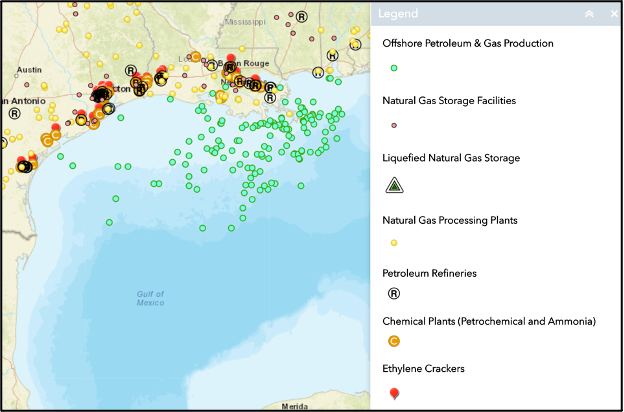
    The risks from industrial facilities are most obvious along the U.S. Gulf Coast, where many major petrochemical complexes are clustered in harm’s way. These refineries, factories and storage facilities are often built along rivers or bays for easy shipping access.

    But those rivers can also bring storm surge flooding that can raise the ocean by several feet during hurricanes. The storm surge from Helene was over 10 feet above ground level in Florida’s Big Bend and over 6 feet in Tampa Bay. With Milton, forecasters warning of a 10- to 15-foot storm surge at Tampa Bay.

    A boom surrounds flooded railcars to try to contain leaks at a chemical plant in Braithwaite, La., after Hurricane Isaac in 2012.
    AP Photo/David J. Phillip

    A recent study found evidence of two to three times more pollution releases during hurricanes in the Gulf of Mexico than during normal weather from 2005 to 2020.

    The effects of these pollution releases fall disproportionately on low-income communities and people of color, further exacerbating environmental health risks.

    Why residents may not hear about toxic releases

    The statistics are disconcerting, yet they get little attention. That is because hazardous releases remain largely invisible due to limited disclosure requirements and scant public information. Even emergency responders often don’t know exactly which hazardous chemicals they are facing in emergency situations.

    The U.S. Environmental Protection Agency requires major polluters to file only very general information about chemicals and on-site risks in their risk management plans. Some large-scale fuel storage facilities, such as those holding liquefied natural gas, are not even required to do that.

    These risk management plans outline “worst-case” scenarios and are supposed to be publicly accessible. But, in reality, we and others have found them difficult to access, heavily redacted and housed in federal reading rooms with limited access. The reason local officials and national scientific review panels often give for the secrecy is to protect the facilities from terrorist attack.

    Oil storage tanks and industrial facilities line the Houston Ship Channel, which is vulnerable to storm surge from Gulf of Mexico hurricanes.
    AP Photo/David J. Phillip

    Adding to this opacity is the fact that many states – including those along the Gulf – suspend restrictions on pollution releases during emergency declarations. Meanwhile, real-time incident notifications from the National Response Center – the federal government’s repository for all chemical discharges into the environment – typically lag by a week or more,

    We believe this limited public information on rising chemical threats from our changing climate should be front-page news every hurricane season. Communities should be aware of the risks of hosting vulnerable industrial infrastructure, particularly as rising global temperatures increase the risk of extreme downpours and powerful hurricanes.

    Mapping the risks nationwide to raise awareness

    To help communities understand their risks, our team at Rice University’s new Center for Coastal Futures and Adaptive Resilience investigates how industrial communities in flood-prone areas nationwide can better adapt to such threats, socially as well as technologically.

    Our interactive map shows where elevated future flood risks threaten to inundate major polluters that we identify using the EPA’s Toxic Release Inventory.

    The U.S. has several hot spots with clusters of flood-prone polluters. Houston’s Ship Channel, Chicago’s waterfront steel industries and the harbors at Los Angeles and New York/New Jersey are among the biggest.

    Three of the biggest hot spots, where large numbers of industrial facilities with toxic materials face elevated future flood risks, are in the Northeast, the northwestern Gulf Coast and the southern end of the Great Lakes.
    Rice University Center for Coastal Futures and Adaptive Resilience, CC BY-ND

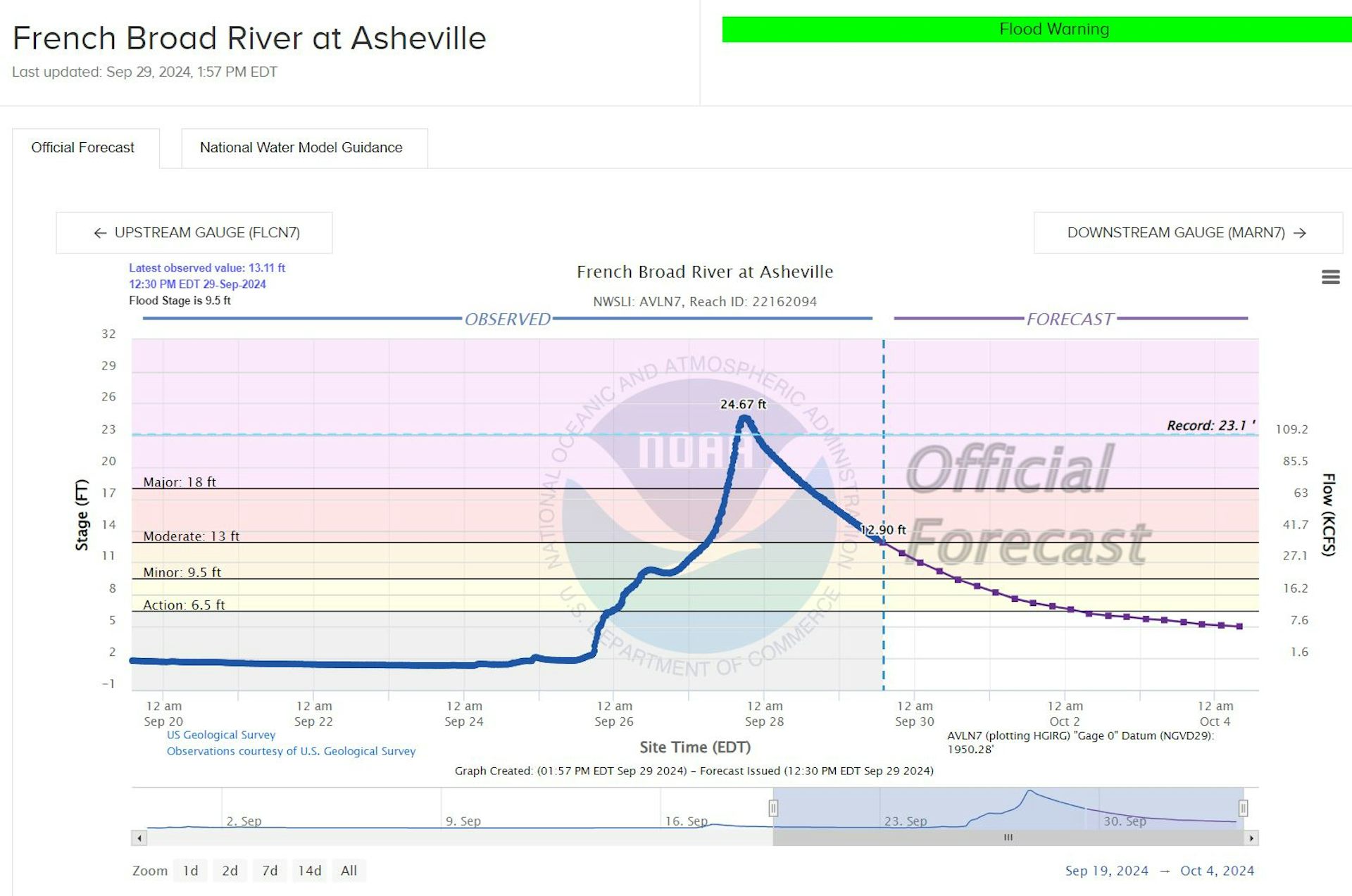
    But, as Helene revealed, there can also be great concern in less obvious spots. Inland, particularly in the mountains, runoff can quickly turn normally tame rivers into fast-rising torrents. The French Broad River at Asheville, North Carolina, rose about 12 feet in 12 hours during Helene and set a new flood stage record.

    When hurricanes and tropical storms are headed for the U.S., our interactive maps show where major polluters are located in the storm’s projected cone of impact. The maps identify hazardous flood-prone facilities down to the address, anywhere in the country.

    Knowledge is the first step

    Knowing where these sites are located is only the first step. Often, it’s up to communities themselves, many of them already overexposed and historically underserved, to raise concerns and demand strategies for mitigating the health, economic and environmental risks that industrial sites at risk of flooding and other damage can pose.

    These discussions can’t wait until a disaster is on the way. By knowing where these risks may be, communities can take steps now to build a safer future.

    This article, originally published Sept. 30, has been updated with Hurricane Milton.

    James R. Elliott receives funding from the National Science Foundation and the National Renewable Energy Lab.

    Dominic Boyer receives funding from the National Science Foundation, NOAA and Texas Sea Grant.

    Phylicia Lee Brown has nothing to disclose.

    ref. Flooded industrial sites and toxic chemical releases are a silent, growing threat in hurricanes like Milton and Helene – https://theconversation.com/flooded-industrial-sites-and-toxic-chemical-releases-are-a-silent-growing-threat-in-hurricanes-like-milton-and-helene-239977

    MIL OSI – Global Reports

  • MIL-OSI USA: Rep. Lee & Congressional Lead Safety Leaders Applaud Finalization of New Lead and Copper Rule Improvements, Announcement of $2.6 Billion in New Funding to Help Remove Lead Pipes Across America

    Source: United States House of Representatives – Congresswoman Barbara Lee 13th District of California

    October 08, 2024

    WASHINGTON, D.C. –  Congresswoman Barbara Lee (D-CA-12) along with co-chairs of the U.S. House Get the Lead Out Caucus Lisa Blunt Rochester (D-DE-AL), Rashida Tlaib (D-MI-12) and Debbie Dingell (D-MI-06), and Co-founders of the U.S. Senate Lead Task Force Tammy Duckworth (D-IL) and Cory Booker (D-NJ)  today lauded the Environmental Protection Agency’s (EPA) decision to finalize the Biden Administration’s proposed Lead and Copper Rule Improvements (LCRI), which would lower the lead action level to better protect human health and require water systems to replace old and deteriorating lead pipes within a decade. In addition to the LCRI, the EPA also announced $2.6 billion in newly available drinking water infrastructure funding through the Bipartisan Infrastructure Law (BIL) to support lead-related activities, including lead pipe replacement projects. The finalized rule comes ahead of the October 16th finalization deadline to not only help ensure these important improvements are implemented as quickly as possible, but also prevent water systems from being forced to temporarily comply with the prior rule proposed by the Trump Administration—also known as the Lead and Copper Rule Revisions (LCRR)—which would put public health at risk.

    “Today, EPA estimates that nearly 9 million homes are served through lead pipes across the country – and disproportionally, many of these homes are located in low-income communities and communities of color,” said Rep. Barbara Lee. “Clean and safe drinking water is a human right, and we must treat it that way. I am proud of the work of my colleagues and I in Congress to achieve our goal of removing every lead pipe in the United States over the next ten years and thank the Biden-Harris Administration for their work in fighting to ensure that communities across our country have access to lead-free water.”

    “Today’s announcement from the Biden-Harris Administration is a win-win for our communities because it delivers on our shared commitment to replace all lead pipes across the country within 10 years and protect public health,” said Rep. Lisa Blunt Rochester, co-lead of the congressional Get the Lead Out Caucus. “I am proud to have helped push for the swift finalization of the Lead and Copper Rule Improvements with my colleagues in Congress. Thanks to our advocacy, and with the leadership of President Biden and Vice President Harris, we are closer than ever to actualizing a 100% lead-free future.”

    “As the founder of the Get the Lead Out Caucus, I know that clean drinking water is a human right,” said  Rep. Tlaib. “We must move urgently to replace all lead pipes in our country within the next 10 years, and I’m glad to see the EPA announce the final Lead and Copper Rule Improvements to continue the critical work toward this objective. Congress must continue to work to appropriate the funding necessary to help all of our communities identify, remove, and replace every lead pipe over this next decade.”

    “Clean and safe drinking water is a basic human right, and the science is clear – no amount of lead is safe. There are millions of people across the country who don’t even know if they are drinking lead, and I’ve had parents come up to me with tears in their eyes, worried for the wellbeing of their children because of lead in the water at school,” Rep. Dingell said. “I thank the Biden-Harris Administration for their continued commitment to replacing every lead service line in our country to guarantee access to safe water for every community and finally give peace of mind to families.”

    ” Every American, no matter their zip-code, deserves access to safe drinking water,” said Senator Duckworth, “We’ve been working hard in Congressto achieve our goal of removing every elad pip in America over the next decade, and this historic rule from the Biden Administration and billions in new funding will help us make it a reality whilve preventing Trump-era policies that would harm human health from going into effect, This is a win-win for all Americans.”

    “The EPA’s bold leadership in finalizing this critical rule will help us eliminate lead pipes within a decade and put a stop to lead exposure that continues to threaten the health of far too many families and children in our nation today,” said Senator Booker. “Every American deserves access to clean and safe drinking water, and by modernizing our aging water infrastructure we are investing in a future where every family can turn on the tap and know their water is clean. I am proud to have helped lead the call in Congress for a strong final rule, and I thank the Biden-Harris administration for their commitment to environmental justice and public health.”

    The finalized rule also improves communication within communities so that families are better informed about the risk of lead in drinking water, the location of lead pipes and plans for replacing them. Exposure to lead is harmful to health, especially for young children. In children, low levels of exposure have been linked to damage to the nervous system, learning disabilities, shorter stature, impaired hearing and impaired formation and function of blood cells. 

    MIL OSI USA News

  • MIL-OSI USA: FEMA, Federal Response Positioned to Fully Support Florida Ahead of Milton Landfall

    Source: US Federal Emergency Management Agency

    Headline: FEMA, Federal Response Positioned to Fully Support Florida Ahead of Milton Landfall

    FEMA, Federal Response Positioned to Fully Support Florida Ahead of Milton Landfall

    Mandatory evacuation orders have been issued and others are underway. If local authorities issue evacuations, please listen and evacuate immediately. Your life could be at risk.

    WASHINGTON — FEMA and its federal partners are leaning forward and have pre-positioned resources to support local and state response efforts ahead of Hurricane Milton’s landfall. President Joseph R. Biden approved an Emergency Declaration for Florida on Monday, authorizing FEMA to coordinate Federal disaster relief efforts to save lives and protect the health and safety of those in the storm’s path. FEMA Administrator Deanne Criswell is on the ground, meeting with officials across the impacted states to marshal the full capabilities of the federal government. 

    This includes pre-staging a full slate of response capabilities in Florida and the region, including: seven FEMA Incident Management Assistance Teams, eight FEMA Urban Search & Rescue and swift water rescue teams, three U.S. Coast Guard Swift Water Rescue teams, four Health Care System Assessment Teams, five Disaster Medical Assistance Teams and an Incident Management Team from the U.S. Department of Health and Human Services, U.S Army Corps of Engineers (USACE) temporary power teams, debris experts and a roofing team, U.S. Environmental Protection Agency (EPA) debris removal and wastewater experts, 300 ambulances and 30 High Water Vehicles with ladders from the U.S. Department of Defense. Additionally, FEMA has five incident staging bases with commodities including food and water. Right now, FEMA currently has 20 million meals and 40 million liters of water in the pipeline to deploy as needed to address ongoing Helene and Milton response efforts and can expand as needed.

    The National Hurricane Center forecasts Hurricane Milton will be a large and extremely dangerous hurricane when it approaches the west coast of Florida tomorrow, bringing devastating hurricane-force winds and life-threatening life surge. In addition to storm surge and extreme winds, Milton will bring heavy rain and the risk of life-threatening flooding, especially in areas with coastal and inland flooding. 

    Hurricane Milton is an extremely dangerous, potentially deadly storm. Those in its path are urged to rush to complete preparations today, know how they are going to get information and listen to local officials.  

    FEMA senior leaders across different regions are on the ground in Florida supporting response efforts. FEMA Region 10 Regional Administrator Willie Nunn will remain in Florida throughout the duration of Hurricane Milton. John Brogan, the Federal Coordinating Officer for Milton and Helene, will also remain in Florida. Nearly 900 staff are already supporting recovery efforts at the Joint Field Office in Tallahassee and operating across the designated counties for hurricanes Helene, Debby and Idalia. This includes more than 460 supporting Hurricane Helene recovery, more than 300 supporting Hurricane Debby recovery and more than 100 supporting Hurricane Idalia recovery.

    FEMA officials are still actively supporting North Carolina, Georgia, South Carolina, Florida, Tennessee and Virginia as they respond to and recover from Hurricane Helene including more than 7,400 federal workers of which 1,500 are FEMA staff. FEMA will not divert personnel or resources from these ongoing responses. 

    FEMA understands that people in the path of this storm may still be recovering from hurricanes Helene, Debby and Idalia and urges everyone to protect themselves and take care of others because time is running out to prepare for the hurricane’s potentially deadly impacts.

    Counties in Hurricane Milton’s path have issued evacuation orders. If you need to evacuate, please “evacuate out, not up.” People should visit FloridaDisaster.org/Know to determine if they live in an evacuation zone. 

    • If you are told to evacuate, do so immediately.  
    • Your gas tank and electric vehicle only need to be halfway full or halfway charged to ensure you can evacuate further inland to a safe location and away from storm surge. You may only need to travel tens of miles, not hundreds.
    • If you live in a county with an evacuation order in place and need evacuation assistance, please call 1-800-729-3413 from 7 a.m. to 7 p.m. for the hurricane evacuation charter bus schedule. Again, this is for residents that are in areas with evacuation orders. Florida also partnered with Uber to provide free rides to a shelter using the code MILTONRELIEF.
    • The state of Florida has activated the State Assistance Information Line. Residents needing information and resources can call 1-800-342-3557. There are English, Spanish & Creole speakers available to answer questions.
    • A list of emergency shelters, including those that can accommodate people who need assistance and those who have pets can be found at Shelter Status | Florida Disaster.
    • Additional resources and state updates on Hurricane Milton can be found by visiting FloridaDisaster.org/Updates.
    • For live updates, follow FLSERT on X and Instagram and FDEM on Facebook.

    Download the free FEMA App available in English and Spanish to receive real-time weather alerts and find local emergency shelters in your area.

    mashana.davis

    MIL OSI USA News

  • MIL-OSI USA: Governor Shapiro to Encourage Travelers to Experience Pennsylvania’s Peak Foliage, Unveil New Color-Correcting Viewfinders at State Parks

    Source: US State of Pennsylvania

    October 09, 2024Philipsburg, PA

    ADVISORY – Governor Shapiro to Encourage Travelers to Experience Pennsylvania’s Peak Foliage, Unveil New Color-Correcting Viewfinders at State Parks

    Governor Josh Shapiro will visit Black Moshannon State Park in Centre County to encourage travelers to visit Pennsylvania State Parks this fall as the leaves reach peak color, and unveil new color-correcting viewfinders installed at state parks throughout the Pennsylvania Wilds that help colorblind visitors see the vibrant colors of the season.

    The Commonwealth has some of the world’s most beautiful and diverse fall foliage. People with colorblindness only see a fraction of the millions of hues and shades of colors seen by those with normal color vision. In Pennsylvania, an estimated one million residents are colorblind.

    The viewfinders are one way the Department of Conservation and Natural Resources (DCNR) is working to make its 124 state parks and 2.2-million acres of state forests safe and welcoming to all.

    This visit continues to build momentum behind Pennsylvania’s new state tourism brand, The Great American Getaway, which Governor Shapiro launched this summer to showcase all the Commonwealth has to offer as a premier weekend getaway destination.

    WHO:
    Governor Josh Shapiro
    DCNR Secretary Cindy Adams Dunn
    Mathias Weinzen, Black Moshannon State Park Manager
    Scott Kolesar, park visitor living with colorblindness
    Ta Enos, President and CEO PA Wilds Center for Entrepreneurship
    Representative Paul Takac

    WHEN:
    Wednesday, October 9, 10:30 AM

    WHERE:
    Black Moshannon State Park Fishing Pier, (Google Maps Location)
    Philipsburg, PA 16866

    LIVE STREAM:
    pacast.com/live/gov
    governor.pa.gov/live/

    RSVP:
    Press who are interested in attending must RSVP with the names and phone numbers for each member of their team to ra-gvgovpress@pa.gov.

    MIL OSI USA News

  • MIL-Evening Report: Unprecedented peril: disaster lies ahead as we track towards 2.7°C of warming this century

    Source: The Conversation (Au and NZ) – By Thomas Newsome, Associate Professor in Global Ecology, University of Sydney

    You don’t have to look far to see what climate change is doing to the planet. The word “unprecedented” is everywhere this year.

    We are seeing unprecedented rapidly intensifying tropical storms such as Hurricane Helene in the eastern United States and Super Typhoon Yagi in Vietnam. Unprecedented fires in Canada have destroyed towns. Unprecedented drought in Brazil has dried out enormous rivers and left swathes of empty river beds. At least 1,300 pilgrims died during this year’s Hajj in Mecca as temperatures passed 50°C.

    Unfortunately, we are headed for far worse. The new 2024 State of the Climate report, produced by our team of international scientists, is yet another stark warning about the intensifying climate crisis. Even if governments meet their emissions goals, the world may hit 2.7°C of warming – nearly double the Paris Agreement goal of holding climate change to 1.5°C. Each year, we track 35 of the Earth’s vital signs, from sea ice extent to forests. This year, 25 are now at record levels, all trending in the wrong directions.

    Humans are not used to these conditions. Human civilisation emerged over the last 10,000 years under benign conditions – not too hot, not too cold. But this liveable climate is now at risk. In your grandchild’s lifetime, climatic conditions will be more threatening than anything our prehistoric relatives would have faced.

    Our report shows a continued rise in fossil fuel emissions, which remain at an all-time high. Despite years of warnings from scientists, fossil fuel consumption has actually increased, pushing the planet toward dangerous levels of warming. While wind and solar have grown rapidly, fossil fuel use is 14 times greater.

    This year is also tracking for the hottest year on record, with global daily mean temperatures at record levels for nearly half of 2023 and much of 2024.

    Next month, world leaders and diplomats will gather in Azerbaijan for the annual United Nations climate talks, COP 29. Leaders will have to redouble their efforts. Without much stronger policies, climate change will keep worsening, bringing with it more frequent and more extreme weather.


    Bad news after bad news

    We have still not solved the central problem: the routine burning of fossil fuels. Atmospheric concentrations of greenhouse gases – particularly methane and carbon dioxide – are still rising. Last September, carbon dioxide levels in the atmosphere hit 418 parts per million (ppm). This September, they crossed 422 ppm. Methane, a highly potent greenhouse gas, has been increasing at an alarming rate despite global pledges to tackle it.

    Compounding the problem is the recent decline in atmospheric aerosols from efforts to cut pollution. These small particles suspended in the air come from both natural and human processes, and have helped cool the planet. Without this cooling effect, the pace of global warming may accelerate. We don’t know for sure because aerosol properties are not yet measured well enough.

    Other environmental issues are now feeding into climate change. Deforestation in critical areas such as the Amazon is reducing the planet’s capacity to absorb carbon naturally, driving additional warming. This creates a feedback loop, where warming causes trees to die which in turn amplifies global temperatures.

    Loss of sea ice is another. As sea ice melts or fails to form, dark seawater is exposed. Ice reflects sunlight but seawater absorbs it. Scaled up, this changes the Earth’s albedo (how reflective the surface is) and accelerates warming further.

    In coming decades, sea level rise will pose a growing threat to coastal communities, putting millions of people at risk of displacement.

    Accelerate the solutions

    Our report stresses the need for an immediate and comprehensive end to the routine use of fossil fuels.

    It calls for a global carbon price, set high enough to drive down emissions, particularly from high-emitting wealthy countries.

    Introducing effective policies to slash methane emissions is crucial, given methane’s high potency but short atmospheric lifetime. Rapidly cutting methane could slow the rate of warming in the short term.

    Natural climate solutions such as reforestation and soil restoration should be rolled out to increase how much carbon is stored in wood and soil. These efforts must be accompanied by protective measures in wildfire and drought prone areas. There’s no point planting forests if they will burn.

    Governments should introduce stricter land-use policies to slow down rates of land clearing and increase investment in forest management to cut the risk of large, devastating fires and encourage sustainable land use.

    We cannot overlook climate justice. Less wealthy nations contribute least to global emissions but are often the worst affected by climate disasters.

    Wealthier nations must provide financial and technical support to help these countries adapt to climate change while cutting emissions. This could include investing in renewable energy, improving infrastructure and funding disaster preparedness programs.

    Internationally, our report urges stronger commitments from world leaders. Current global policies are insufficient to limit warming to 1.5°C above pre-industrial levels.

    Without drastic changes, the world is on track for approximately 2.7°C of warming this century. To avoid catastrophic tipping points, nations must strengthen their climate pledges, reduce dependence on fossil fuels, and accelerate the transition to renewable energy.

    Immediate, transformative policy changes are now necessary if we are to avoid the worst effects of climate change.

    Climate change is already here. But it could get much, much worse. By slashing emissions, boosting natural climate solutions and working towards climate justice, the global community can still fend off the worst version of our future.

    Thomas Newsome receives funding from the Australian Research Council. He is immediate past-president of the Australasian Wildlife Management Society and President of the Royal Zoological Society of New South Wales.

    William Ripple receives funding from the CO2 Foundation and University of Oregon donor Roger Worthington.

    ref. Unprecedented peril: disaster lies ahead as we track towards 2.7°C of warming this century – https://theconversation.com/unprecedented-peril-disaster-lies-ahead-as-we-track-towards-2-7-c-of-warming-this-century-240549

    MIL OSI AnalysisEveningReport.nz

  • MIL-OSI USA: Cramer Leads Bicameral Amicus Brief to Overturn FHWA’s Unlawful Emissions Rule

    US Senate News:

    Source: United States Senator Kevin Cramer (R-ND)
    BISMARCK, N.D. – In November 2023, the Federal Highway Administration (FHWA) adopted a final rule requiring state departments of transportation and metropolitan planning organizations to measure greenhouse gas (GHG) emissions on the highway system and set declining targets. U.S. Senator Kevin Cramer (R-ND), Ranking Member of the Senate Environment and Public Works (EPW) Subcommittee on Transportation and Infrastructure, led a bipartisan Congressional Review Act joint resolution of disapproval to overturn the rule. The resolution passed the Senate in April 53 to 47, reiterating Congress’ opposition to FHWA’s overreach. In a speech on the Senate floor, Cramercommitted to leading an amicus brief in support of overturning the rule in court.
    Shortly after the rule was finalized, 21 state attorneys general, including North Dakota, filed litigation challenging the regulation. The U.S. District Court found the Biden administration rule to be illegal, but FHWA appealed the decision to the Sixth Circuit Court of Appeals and it remains under further consideration. 
    Cramer and U.S. Senator Shelley Moore Capito (R-WV), Ranking Member of the EPW Committee, led their colleagues in filing a bicameral amicus brief requesting the Appeals Court uphold the District Court decision from April, vacating the rule. 
    The brief argues Congress debated and rejected granting FHWA the authority to issue GHG performance measure rules and the FHWA then intentionally misconstrued Congressional intent to justify its improper exercise of authority. It also argues the rulemaking is not consistent with recent Supreme Court decisions paring back Executive Branch overreach, and FHWA is bypassing principles of federalism to further its own policy agenda.
    “Congress considered, and ultimately rejected, providing [FHWA] with the authority to issue a GHG performance measure regulation, but [FHWA] contorted ancillary existing authorities to impose one anyway,” the members argued. “In doing so, [FHWA] impermissibly usurped the Legislative Branch’s authority and promulgated the GHG performance measure without statutory authority delegated by Congress.
    “Put simply, when [FHWA] established a GHG performance measure regulation, it exceeded the powers Congress authorized. And it did so both at the expense of separation of powers and in violation of the Administrative Procedure Act,” continued the members. 
    Additional cosigners of the amicus brief include U.S. Senators John Barrasso (R-WY), John Boozman (R-AR), Mike Braun (R-IN), Katie Britt (R-AL), Ted Cruz (R-TX), Mike Crapo (R-ID), Steve Daines (R-MT), Joni Ernst (R-IA), Deb Fischer (R-NE), Lindsey Graham (R-SC), John Hoeven (R-ND), Cindy Hyde-Smith (R-MS), Cynthia Lummis (R-WY), Roger Marshall (R-KS), Mitch McConnell (R-KY), Markwayne Mullin (R-OK), Pete Ricketts (R-NE), Jim Risch (R-ID), Mike Rounds (R-SD), Marco Rubio (R-FL), Rick Scott (R-FL), Tim Scott (R-SC), Dan Sullivan (R-AK), John Thune (R-SD), Tommy Tuberville (R-AL), Roger Wicker (R-MS), and U.S. Representatives Sam Graves (R-MO-6), Chairman of the Transportation and Infrastructure Committee, and Rick Crawford (R-AR-1), Chairman of the Highways and Transit Subcommittee.
    Click here for the amicus brief.
    Cramer also penned an op-ed in the Wall Street Journal highlighting FHWA’s lack of statutory authority to issue the rule, and stressed its unworkable nature for rural states. In November 2023, Cramer introduced a bipartisan amendment (#1241) to the bipartisan Transportation Appropriations bill, which would have defunded the proposed rule. While the amendment was germane and bipartisan, Democrats in the Senate demanded a 60-vote threshold to ensure its defeat. Cramer also questioned FHWA Administrator Shailen Bhatt during EPW hearings in June 2023 and September 2022. In October 2022, he sent a letter to FHWA Deputy Administrator Stephanie Pollack voicing strong opposition to the agency’s proposal to implement a GHG emissions performance measure.

    MIL OSI USA News

  • MIL-OSI USA: NSF Growing Convergence Research awards advance innovation across disciplines

    Source: US Government research organizations

    The U.S. National Science Foundation Growing Convergence Research (NSF GCR) awards are fostering deep integration across disciplines and pushing the boundaries of current research paradigms. The awards bring together experts from multiple science, technology, engineering and mathematics fields to tackle complex challenges across various topics, including national security, energy and STEM education.  

    “These awards require that researchers work across traditional disciplinary boundaries and leverage the expertise of different fields to drive innovation and discovery,” said Alicia J. Knoedler, head of the NSF Office of Integrative Activities. “Learning and practicing collaboration between and among disciplines are critical skills that investigators and teams need to develop. NSF’s investments through these awards reinforce the importance of capacity building to perform convergence in research and training.”  

    The NSF GCR program supports high-risk, cutting-edge research and helps to cultivate a new generation of interdisciplinary scientists. Projects are inspired by a societal grand challenge or a fundamental research question at the forefront of STEM. By growing novel collaborations and cross-disciplinary training, these awards will empower researchers to think outside the box and develop innovative approaches to scientific inquiry. This advances the frontiers of knowledge and paves the way for breakthroughs that can benefit society. 

    The awardees and short descriptions are listed below:  

    • Rooted in Nature: Bioinspired Design of Sustainable Seeding Methods to Improve Forest Regeneration University of California, Berkeley, Cornell University, Syracuse University and The Pennsylvania State University 

      Forest regeneration is essential for combating climate change. Challenges like limited seed availability and time-consuming seedling cultivation hinder forest restoration efforts. This project will integrate expertise in material science, engineering, ecology and other areas to create biodegradable, self-burying seed carriers for efficient, lower-cost aerial seeding. The researchers will investigate seed carrier designs applicable to different ecosystems. The team will also develop new ways of evaluating and improving the effectiveness of the seeding techniques. This research will boost forest restoration, providing economic advantages and enhancing ecological resilience. 
       

    • Non-Equilibrium Electrochemical Plasma Catalysis for Distributed Electrified Ammonia Synthesis Princeton University, Duke University and Rutgers University–Newark 

      Ammonia is a fuel for green power generation and a medium for energy storage and transport. It is also vital to food production as a key agricultural fertilizer. Traditional ammonia synthesis is energy-intensive and produces carbon dioxide. It also relies on fossil fuels and high-pressure catalysis. This project aims to advance the development of new electrified reactors that produce green ammonia with renewable electricity from atmospheric nitrogen and water. These reactors can help decarbonize chemical plants and address challenges in renewable energy storage. The project team will use novel integration across disciplines to create a nonequilibrium electrochemical plasma catalysis system for ammonia synthesis from water, nitrogen and electricity. Its success will be an innovation in nonequilibrium green chemical manufacturing. 
       

    • Engineering, SocioEconomic and Environmental Convergence of Ocean Wave Energy Research for Remote Coastal Communities University of Michigan – Ann Arbor, Virginia Tech, East Carolina University and University of North Carolina at Chapel Hill 

      In some rural coastal and island areas, electricity must be transported over long distances, and the supply is less robust, creating a challenge that hinders socioeconomic growth. Ocean waves along U.S. coastlines offer abundant energy resources, and over 200 concepts have been proposed for generating electricity from wave energy. Researchers from this project will examine which of the proposed concepts are most practical for island and coastal communities from engineering and socioeconomic perspectives. They will validate the most promising concepts through community engagement and ocean tests. The project integrates engineering, environmental and social sciences experts and an external advisory board with community end users and commercial developers to implement a convergent, community-engaged approach to this research challenge. 
       

    • Mineral Detection of Dark Matter Virginia Tech, University of Michigan – Ann Arbor and University of North Florida 

      Dark matter plays an important role in the formation of galaxies and the universe’s evolution, but it has proven very difficult to detect directly. This project will integrate engineering, physics, geoscience and materials science to establish whether evidence of interactions between dark matter and ordinary matter can be found through “mineral detection.” Researchers will explore whether crystals in rocks can be used to look for evidence of interactions with dark matter over geological timescales. The team aims to develop a new path for advancing understanding of what dark matter is. 
       

    • Towards a Physics-Inspired Approach to Computation on Encrypted Data Boston University, University of Central Florida and Cornell University 

      Harnessing the wealth of electronically stored data for applications with societal value raises security and privacy concerns that are likely to hinder progress and return on investment in an artificial intelligence-powered economy. This project will combine ideas and tools from physics, mathematics and computer science to explore a new paradigm for circuit obfuscation in cryptography and establish the security and efficiency of encrypted operator computing. The research team aims to accelerate the development of trusted, low-overhead tools that enable computation directly on encrypted data so that, for example, confidential data can be shared with an untrusted party who can extract insights from the data without having access to the unencrypted data. 
       

    • The Other Plastic Problem: Quantifying and Predicting Impacts of Plastic Additives Across Levels of Biological and Social Organization Duke University and The Pennsylvania State University 

      Plastic pollution is widespread and harms various species. One major gap in knowledge is the combined biological impact of the many chemicals added to plastics to tailor their properties. Plastic additives are chemicals that are included within plastic polymers to enhance function. These additives include over ~10,000 chemicals and include known endocrine disruptors, pro-inflammatory agents and mutagens. Addressing this research challenge requires integrating expertise across molecular and cell biology, environmental chemistry and toxicology, materials science, policy and other fields. This project will allow an integrated research team to develop and employ novel approaches for analyzing the effects of plastic additives on cells, organisms and ecological communities; ground-truth product use and additive exposures; and evaluate mitigation strategies. The project also aims to engage stakeholders to reduce plastic pollution and empower underrepresented students in STEM to take action. 
       

    • GCR: Towards a Convergent Understanding of the Dynamics of Uncertainty in Individuals and Groups with a Focus on STEM Education Tufts University 

      Developing a systematic understanding of how people manage ambiguity, uncertainty and confusion (AU&C) is a complex challenge. This project integrates social sciences, data sciences and engineering to build new capabilities for studying AU&C management in the context of STEM learning. This will allow researchers to understand how to enable students to productively engage with AU&C in STEM. The research team will develop novel methods for collecting and analyzing student data using a multimodal approach, including behavioral, linguistic and physiological sensing. Using these methods, researchers will investigate the individual and group dynamics of AC&U within STEM learning environments, with the long-term goal of producing new educational practices that embrace complexity and uncertainty. In this, the project aims to bridge the disconnect between how science is taught and the practice of STEM professionals. 

    MIL OSI USA News

  • MIL-OSI Canada: Manitoba Government Advises Changes to the Executive Government Organization Act

    Source: Government of Canada regional news

    Manitoba Government Advises Changes to the Executive Government Organization Act


    Environment and Climate Change Minister Tracy Schmidt has been named acting minister of education and early childhood learning in addition to her current role, Premier Wab Kinew announced today. 

    “Minister Schmidt is a high performer who I know will do great work for Manitoba students,” said Kinew. “I look forward to Minister Altomare’s return and in the meantime, Manitoba parents can trust our government to continue investing in schools and kids’ futures.”  

    Schmidt will perform ministerial duties on behalf of Education and Early Childhood Learning Minister Nello Altomare, who will temporarily be away from work for medical reasons, noted the premier. 

    Additionally, Mike Moyes, the member of the legislative assembly for Riel, was appointed as the legislative assistant for both environment and climate change, and education and early childhood learning. 

    – 30 –

    MIL OSI Canada News

  • MIL-OSI USA: Duckworth, Durbin Applaud Finalization of New Lead and Copper Rule Improvements, Announcement of Over $75 Million in New Funding to Help Remove Lead Pipes in Illinois

    US Senate News:

    Source: United States Senator for Illinois Tammy Duckworth

    October 08, 2024

    [WASHINGTON, D.C.] – U.S. Senator Tammy Duckworth (D-IL)—co-founder of the U.S. Senate Lead Task Force and the U.S. Senate Environmental Justice Caucus—and U.S. Senate Majority Whip Dick Durbin (D-IL) today lauded the Environmental Protection Agency’s (EPA) decision to finalize the Biden Administration’s proposed Lead and Copper Rule Improvements (LCRI), which would lower the lead action level to better protect human health and require water systems to replace old and deteriorating lead pipes within a decade. In addition to the LCRI, EPA also announced that Illinois will receive $75,558,000 in newly available drinking water infrastructure funding through the Bipartisan Infrastructure Law (BIL) to support lead-related activities, including lead pipe replacement projects. The finalized rule comes ahead of the October 16th finalization deadline to not only help ensure these important improvements are implemented as quickly as possible, but also prevent water systems from being forced to temporarily comply with the prior rule proposed by the Trump Administration—also known as the Lead and Copper Rule Revisions (LCRR)—which would put public health at risk.

    “Every American, no matter their zip-code, deserves access to safe drinking water,” said Senator Duckworth. “We’ve been working hard in Congress to achieve our goal of removing every lead pipe in America over the next decade, and this historic rule from the Biden Administration and $75 million in new funding for Illinois to replace lead pipes will help us make it a reality while preventing Trump-era policies that would harm human health from going into effect. This is a win-win for all Americans.”

    “The newly finalized Lead and Copper Rule Improvements is nothing short of historic.  For decades, we have understood the severe risks of lead exposure, which have disproportionally harmed low-income families and communities of color.  Today, EPA has made a commitment to Americans to replace all lead pipes over the next ten years because everyone deserves to have safe, clean drinking water,” said Durbin.  “We have a monumental task ahead of us in replacing lead service pipes in Illinois, particularly in Chicago, but I’m encouraged by this significant step by the Biden-Harris Administration to support states in lead pipe remediation and look forward to supporting this plan in Congress.”

    The finalized rule also improves communication within communities so that families are better informed about the risk of lead in drinking water, the location of lead pipes and plans for replacing them. Illinois has reported more than 667,000 lead service lines (LSLs) and another almost 820,000 service lines of unknown material, which the newly announced funding will help remove. Exposure to lead is harmful to health, especially for young children. In children, low levels of exposure have been linked to damage to the nervous system, learning disabilities, shorter stature, impaired hearing and impaired formation and function of blood cells. 

    Duckworth has led the charge in the U.S. Senate to remove lead drinking water pipes across the country. Her Drinking Water and Wastewater Infrastructure Act (DWWIA), which was included in the BIL, is the most significant federal investment in water infrastructure in history, including $15 billion for national lead pipe replacement. DWWIA, which focuses on disadvantaged communities, is helping rebuild our nation’s crumbling and dangerous water infrastructure and enable communities to repair and modernize their failing wastewater systems.

    Last month, Duckworth called on the White House Office of Management and Budget (OMB) to expedite its review of LCRI. In May, Duckworth announced over $240 million in Drinking Water State Revolving Fund investment to help Illinois identify and replace lead service lines and prevent lead poisoning among our state’s children and families—funding that comes directly from Duckworth’s DWWIA—and in August she and Durbin announced more than $1 million to address lead in drinking water at schools and childcare facilities in Illinois.

    Following the 2016 report of lead in Chicago’s drinking water, Durbin and then-Rep. Duckworth urged EPA to use its full authority and resources to address the issue, including reviewing the Lead and Copper Rule (LCR) and immediate notification of lead contamination. In March 2021, Durbin and Duckworth sent a letter to EPA urging it to update the LCR.

    Duckworth, Durbin and Sen. Booker, members of the Senate Lead Taskforce, led 87 of their colleagues supporting EPA’s proposed Lead and Copper Rule Improvements (LCRI) and urging for more community protections and expedited removal of all lead pipes. Last March, Durbin and Duckworth sent letters to five Medicaid managed care companies (MCOs) in Illinois, urging them to address lead poisoning risks to children in Chicago by preemptively sending drinking water test kits, water filters, home visitors, and educational materials to all enrolled children in the city.

    -30-

    MIL OSI USA News

  • MIL-OSI USA: GUBERNATORIAL PROCLAMATION: Litter-Free Rhode Island’s Take the Pledge Week

    Source: US State of Rhode Island

    Published on Tuesday, October 08, 2024

    WHEREAS, Rhode Island is known for its natural beauty, which extends across its pristine beaches, green parks, rich forests, vibrant cities, and rural towns, all offering unique contributions to the state’s diverse landscape; and 

    WHEREAS, to protect that beauty, the Governor and First Lady launched the Litter-Free Rhode Island program in 2022 and have since made it a top priority year after year to support cleaner cities and towns and to help beautify Rhode Island so that residents and visitors take pride in their surroundings; and 

    WHEREAS, the Litter-Free Rhode Island program has committed tens of thousands of dollars in microgrant opportunities for environmental projects, clean-ups, and educational materials so that Rhode Islanders and students understand the importance of responsible trash disposal and its connection to improving our state’s overall health; and 

    WHEREAS, the Litter-Free Rhode Island program has worked closely with the state’s Department of Environmental Management (DEM), the Department of Transportation (DOT), the Division of Motor Vehicles (DMV), Enterprise Technology Strategy and Services (ETSS), and the Rhode Island Infrastructure Bank (RIIB) to advance these goals; and 

    WHEREAS, the DOT has hired additional highway crews to address litter build-up on state roads and highways and has collected more than 800,000 gallons of trash and more than 460 tons of large debris to support a better-looking and healthier community; and  

    WHEREAS, the DMV has purchased bags to give to drivers to have in their cars so that they can dispose of litter and displays videos at different DMV locations about the Litter-Free Rhode Island program; and 

    WHEREAS, in partnership with the DOT, Litter-Free Rhode Island has created a “Trashboard” to monitor those clean-ups by DOT highway crews, groundskeepers, microgrant recipients, and volunteers; and  

    WHEREAS, ETSS designed and developed the Litter-Free Rhode Island website, https://litterfree.ri.gov, leveraging the award-winning State of Rhode Island Enterprise Content Management System (eCMS); and 

    WHEREAS, DEM and RIIB have partnered together to administer a microgrant program to help fund clean-ups and clean-up supplies for nearly 100 non-profits, schools, environmental organizations, and community groups so those parties can enhance the quality of life for residents and local ecosystems; and 

    WHEREAS, empowering more Rhode Islanders to get involved and to take pride in their state starts by encouraging good habits that promote cleaner and greener Ocean State communities; and 

    WHEREAS, taking the Litter-Free Rhode Island pledge is a simple, easy way to engage and educate residents so they are actively involved in ways bettering their local parks, playgrounds, beaches, rivers, sidewalks, roads, and more. 

    NOW, THEREFORE, I, Daniel J. McKee, Governor of the State of Rhode Island, do hereby proclaim the week of October 7-11, 2024, as Litter-Free Rhode Island’s Take the Pledge Week and encourage all residents, businesses, schools, organizations, agencies, and families to take the pledge to end litter in our state and leave it better for the next generation of Rhode Islanders. 

    MIL OSI USA News

  • MIL-OSI USA: President Signs Bipartisan, Bicameral Bill Co-Led by Allred to Streamline Federal Permitting for Microchip Projects

    Source: United States House of Representatives – Congressman Colin Allred (TX-32)

    Building Chips in America Act will support billions in domestic manufacturing investments by streamlining federal reviews 

    Washington, D.C. – Last week, President Biden signed into law the Building Chips in America Act co-led by Congressman Colin Allred (D-TX-32) to help bring microchip manufacturing back to America by streamlining project approvals while maintaining environmental protections for clean air and water. Congressman Michael McCaul (R-TX-10) helped lead the House bill along with a bipartisan coalition of members who introduced the legislation together, which passed the House last month. 

    “In order for Texas to continue leading in semiconductor chip research and manufacturing,  we must ensure these projects can get approved in a timely manner,” said Allred. “The Building Chips in America will do just that, all while creating good paying jobs. I thank Congressman McCaul for working with me on this legislation and I am so proud our bipartisan bill was signed into law by the President.”

    Following the passage of the CHIPS and Science Act, companies throughout the semiconductor supply chain have announced plans to invest hundreds of billions in new domestic manufacturing projects. Under current law, these CHIPS Act investments require extra environmental reviews under the National Environmental Policy Act (NEPA), even for projects that already have permits and are underway. The Building Chips in America Act will ensure these reviews are completed in a timely manner by streamlining approvals for ongoing projects and providing the Secretary of Commerce with better tools for efficient oversight.

    The bill was also led in the House by Congresswoman Jen Kiggans (R-VA-02), Congressman Scott Peters (D-CA-50) and Congressman Brandon Williams (R-NY-22). The Building Chips in America Act was led in the Senate by U.S. Senators Mark Kelly (D-AZ), Todd Young (R-IN), Bill Hagerty (R-TN) and Sherrod Brown (D-OH). 

    Allred championed the passage of the CHIPS and Science Act, and now, following the passage of the landmark bill, the Department of Commerce has announced billions in federal investments to support domestic manufacturing projects in Texas. Including  $6.4 billion for Samsung in Taylor, $1.6 billion for Texas Instruments in North Texas and $400 million for GlobalWafers in Sherman, TX and Missouri. 


    ###

    MIL OSI USA News

  • MIL-OSI United Kingdom: Game-changing tech to reach the public faster as dedicated new unit launched to curb red tape

    Source: United Kingdom – Executive Government & Departments

    Science Secretary launches new Regulatory Innovation Office today to speed up public access to new technologies.

    New Regulatory Innovation Office Bringing new technologies to the public, faster.

    • Regulatory Innovation Office to reduce the burden of red tape and speed up access to new technologies that improve our daily lives – from AI in healthcare to emergency delivery drones
    • Search begins for a Chair to lead the office, driving economic growth through regulatory reform that enables innovation
    • New Office delivers on a key manifesto commitment and is among steps to back business in buildup to UK hosting International Investment Summit

    New technologies, like AI for better treatments in our NHS and drones delivering emergency supplies to all corners of the UK, could reach the public faster through a dedicated new office that will reduce the burden of red tape on innovation and help kickstart economic growth.

    The new Regulatory Innovation Office (RIO) will reduce the burden for businesses hoping to bring new products and services to the market in some of the UK’s fastest-growing sectors through innovations like –AI training software for surgeons to deliver more accurate surgical treatments for patients and drones which can improve business efficiency and quickly send critical deliveries to remote parts of the country.

    To do so, it will support regulators to update regulation, speeding up approvals, and ensuring different regulatory bodies work together smoothly. It will work to continuously inform the government of regulatory barriers to innovation, set priorities for regulators which align with the government’s broader ambitions and support regulators to develop the capability they need to meet them and grow the economy.

    The announcement comes ahead of further plans to reduce the burden of red tape and support the government’s key mission of kickstarting growth across the country. The new Office will also help set the scene for when the UK hosts the International Investment Summit on Monday 14 October, where the Chancellor will make clear that the UK is “open for business” as the government resets relations with trading partners around the globe.

    The launch of the RIO comes hot on the heels of a raft of public and private investments announced on Sunday (6 October) aimed at transforming cancer treatments for patients while bringing a wave of cutting-edge UK-made MedTech products to the global market.

    The RIO’s mission will initially support the growth of four fast-growing areas of technology making a difference to people’s lives before backing further technologies and sectors as the Office evolves. These are: 

    • Engineering biology – this is the use of synthetic biology and biotechnology to create new products and services derived from organic sources. These technologies can improve health with new treatments like innovative vaccines, help create cleaner fuels and make food production more efficient and sustainable such as through pest resistant crops and cultivated meat. The new RIO will help regulators to bring those products to market safely and more quickly – realising the environmental and health benefits they can bring to our lives.
    • Space – the UK’s space industry is growing fast, supporting everything from GPS on phones to vital communication systems, as new innovations improve our weather forecasting to disaster response systems. To sustain this growth, regulatory reform is needed for greater agility and clarity help foster competition, encourage investment, and open up market access. 
    • Artificial Intelligence and digital in healthcare – with increasing pressures on the NHS, AI is set to revolutionise healthcare delivery so doctors can diagnose illnesses faster and improve patient care. It will help run hospitals more efficiently with medical staff able to spend less time on administration, cutting waiting times and it could enable more personalised medicines, tailoring treatment to individuals. RIO will support the healthcare sector to deploy AI innovations safely, improving NHS efficiency and patients’ health outcomes.
    • Connected and autonomous technology – autonomous vehicles like drones can deliver emergency supplies to remote areas quickly and efficiently and work to approve this technology could play a key part in supporting emergency services to keep people safe. Greater support could also enable more drones to be used by businesses across the UK, building on projects like the drone service used by Royal Mail to deliver to Orkney and improving efficiency.

    The cross-cutting nature of these emerging technologies, which do not fit neatly into existing regulatory frameworks can mean a slower process in getting them onto the market. The new Office will work closely with government departments including the Department for Transport, the Department for Health and Social Care, and the Department for Environment Food and Rural Affairs to address regulatory barriers in these initial growth areas.

    The new office will also bring regulators together and working to remove obstacles and outdated regulations to the benefit of businesses and the public, unlocking the power of innovation from these sectors to generate tens of billions of pounds for the UK economy in the coming years. 

    Science and Technology Secretary, Peter Kyle, said:

    The launch of the Regulatory Innovation Office, a key manifesto commitment, is a big step forward in bringing the UK’s most promising new technologies to the public faster and safely while kickstarting economic growth. 

    By speeding up approvals, providing regulatory certainty and reducing unnecessary delays, we’re curbing the burden of red tape so businesses and our public services can innovate and grow, which means more jobs, a stronger economy, and a better quality of life for people across the UK.  

    From breakthroughs that could help doctors diagnose illnesses earlier to satellite navigation for more accurate weather forecasting and getting emergency supplies to where they are needed, quickly and effectively, RIO will make sure UK companies are at the forefront of the next generation of technologies.

    The Science and Technology Secretary is also looking to appoint the RIO’s first Chair to lead the charge in backing business and safe innovation, and work with regulators and partners to shape a regulatory environment that is fit for the future. Applications are now being welcomed for an ambitious, visionary leader committed to driving that change.

    The organisation has been established within DSIT, where it will incorporate the existing functions of the Regulatory Horizons Council and the Regulators’ Pioneer Fund.

    Alongside the launch of the RIO, the government is already making progress in developing regulatory frameworks for emerging technologies, becoming the first country to outline how it will approach quantum regulation, offering certainty to the sector and encouraging the responsible development of the technology.  

    This is set out in our response to the Regulatory Horizon Council’s report on quantum technologies, also published today. It marks a crucial first step in regulating innovation in a technology that will increasingly underpin powerful computers, secure communications and advanced sensors, in sectors from healthcare to national security.   

    Alongside this package of announcements, today we are announcing:

    • A £1.6 million award to the Food Standards Agency (FSA) as part of round one of the Engineering Biology Sandbox Fund, which aims to test innovative regulatory approaches for products like cultivated meat. Cell-cultivated products are foods created through the isolation of cells from meat, seafood, fat, offal or eggs which are grown in a controlled environment. It could result in food production which is more environmentally friendly and sustainable, using just 1% of the land used for animal equivalents, while increasing food security. Programmes like this will help bring innovative food products to shop shelves safely but without unnecessary delay and at lower costs, giving consumers more choice.
    • The publication of new voluntary screening guidance for synthetic nucleic acid. These technologies allow companies to ‘print’ DNA and RNA, enabling academics and businesses to study and engineer biological systems that help sectors like healthcare and accelerate our path to net-zero. The guidance emphasises the government’s intent for a pro-innovation culture in the engineering biology ecosystem through providing well-defined guardrails for customers and producers of synthetic nucleic acid.

    DSIT media enquiries

    Email press@dsit.gov.uk

    Monday to Friday, 8:30am to 6pm 020 7215 300

    Updates to this page

    Published 8 October 2024

    MIL OSI United Kingdom

  • MIL-OSI USA: Rep. Watson Coleman Gathers Community Partners to Celebrate $715,000 in Funding for Delaware River Basin Commission

    Source: United States House of Representatives – Congresswoman Bonnie Watson Coleman

    October 07, 2024

    Today, Congresswoman Bonnie Watson Coleman (NJ-12) visited the Delaware River Basin Commission’s (DRBC) West Trenton offices, joined by New Jersey Deputy Commissioner of Environmental Protection Jane Rosenblatt Birkhofer, DRBC Executive Director Steve Tambini, DRBC Deputy Executive Director Kristen Bowman Kavanagh, Trenton Mayor Reed Gusciora, Ewing Mayor Bert Steinmann and invited guests and partners in Greater Trenton.

    The Congresswoman announced $715,000 in funding, which she secured for the second year in a row, to support DRBC’s water resources work in the region. This funding came as a part of the omnibus government funding legislation that Congress passed March 23rd. Together with prior funding, the DRBC has committed to set aside a total of $1 million to advance climate resilience.

    “Clean water is not a luxury, it’s a basic human right,” said Rep. Bonnie Watson Coleman (NJ-12). “This $715,000 federal investment will help ensure the over 14 million Americans who rely on the Delaware River Basin for drinking, agriculture, and industrial usage continue to have access to a clean source of water. It will support the 600,000 jobs and $20 billion in industrial activity that the river facilitates. And it will make our communities more resilient to the growing impacts of climate change. I am so grateful to the Delaware River Basin Commission for the crucial work they do to support our communities. And to the Biden-Harris Administration for making this investment possible.”

    “The DEP is proud to partner with the Delaware River Basin Commission to protect this critical waterway serving millions of residents and multiple communities across four states,” said New Jersey Department of Environmental Protection Deputy Commissioner Jane Rosenblatt Birkhofer. “By working together and through the Commission, we are securing a more resilient New Jersey. DEP thanks Congresswoman Watson Coleman not only for her leadership, but her unwavering commitment to protecting the vital resources of the Delaware River Basin.”

    “Congresswoman Watson Coleman is a true champion for the Greater Trenton community and the water resources of the Delaware River Basin,” said DRBC Executive Director Steve Tambini. “With support from our federal and state partners, DRBC is embarking on agency-wide work to enhance the resilience of the Basin’s water resources into the future, and we are thrilled to accept this funding for the benefit of over 14 million people in four states.”

    “Today’s announcement by Congresswoman Bonnie Watson Coleman highlights the critical importance of investing in our water resources and climate resilience,” said Mayor W. Reed Gusciora. “Securing $715,000 in funding for the Delaware River Basin Commission for the second consecutive year is a testament to her unwavering dedication and leadership. This investment not only strengthens our state’s environmental initiatives but also serves as an example of how we can unite and collaborate across jurisdictions to enhance climate resilience, ensuring a legacy of clean and safe water for future generations.”

    “Getting this funding is a huge win for our community,” said Mayor Bert H. Steinmann. “Thanks to Congresswoman Watson Coleman, we’re making sure our water stays clean and safe, which is vital for everyone. It takes a lot of teamwork to tackle these big issues, and the Delaware River Basin Commission has been a great partner in this. We’re all about rolling up our sleeves and working together—whether it’s building new infrastructure or keeping our waterways healthy for the long haul. This money is going to help us do just that.”

    Following the funding announcement, the Commission and Congresswoman Waston Coleman’s staff hosted Trenton community partners to hear about recent projects and funding opportunities.

    “Partnership is core to our work, and only through partnership can we face the challenges posed by a changing climate to our shared waters. This committed funding fuels our goals for collaborative and meaningful progress,” said DRBC Deputy Executive Director Kristen Bowman Kavanagh. “We were pleased to welcome so many partners working in the Greater Trenton community to highlight their work and connect with our staff to learn about funding opportunities.”

    “From supporting local events and initiatives to engaging in critical environmental projects, Princeton Hydro is proud to play a role in shaping a more sustainable, inclusive, and vibrant Trenton,” said Geoffrey M. Goll, PE, President, Princeton Hydro. “Trenton has welcomed our business with open arms, and we are grateful to be part of this community. We hope to inspire other businesses to join us here in Trenton.”

    “It is such a pleasure to work alongside so many incredible partners to ensure a sustainable future for the Greater Trenton community, where residents are experiencing disproportionate impacts of climate change,” said Jay Watson, Co-Executive Director, New Jersey Conservation Foundation. “New Jersey Conservation Foundation is proud to play a role in the protection of critical natural resources in our capital city and across the state.”

    “The African American Cultural Collaborative of Mercer County is proud to participate in honoring Congresswoman Bonnie Watson Coleman and recognizing the impactful contributions of DRBC,” said Latarsha Burke, CEO/Executive Director of The African American Cultural Collaborative of Mercer County. “Since 2020, in partnership with NJ Legislative District 15, Mercer County Administration, and the City of Trenton, we have successfully produced the annual Juneteenth Celebration. Thanks to the investment and support of DRBC and many others, the Juneteenth Celebration has become a cherished event that unites people of all races and ethnicities. It is now our most anticipated event of the year!”

    About the Delaware River Basin

    The Delaware River Basin spans 13,539 square miles, includes parts of four states, all or portions of 42 counties, 868 municipalities, multiple government entities and jurisdictions, and twenty-two congressional districts. The Basin serves 14.2 million users including 2 million in New Jersey. 

    About the Delaware River Basin Commission

    The DRBC is a federal/interstate government agency created in 1961 by concurrent compact legislation, marking the first time that the federal government and a group of states joined together as equal partners in a river basin planning, development and regulatory agency. The five Commission members are the governors of the Basin states (Delaware, New Jersey, New York and Pennsylvania) and the commander of the U.S. Army Corps of Engineers’ North Atlantic Division, who represents the federal government.

    Commission Signatory funding supports DRBC engineering, science, research, monitoring and regulatory programs providing: clean and healthy water for people and wildlife; water resiliency to address climate change and extreme conditions such as floods and droughts; water availability and economic growth by having enough water to meet all of our current and future needs; and water equity to ensure that everyone in our communities share equally in the benefits and stewardship of our shared water resources.

    To learn more about the Commission, please visit http://www.drbc.gov or follow DRBC on X at @DRBC1961.

    MIL OSI USA News

  • MIL-Evening Report: Manawanui sinking: an expert explains why a speedy cleanup will be crucial – and the main challenges ahead

    Source: The Conversation (Au and NZ) – By Christopher Battershill, Professor in Coastal Science, University of Waikato

    HMNZS Manawanui arrives at Devonport Naval Base in 2019 still bearing its original Norwegian name,
    Edda Fonn.
    Getty Images

    Speed will be of the essence as salvage crews attempt to stop fuel leaking from the sunken New Zealand naval ship off the coast of Samoa.

    The HMNZS Manawanui ran aground last weekend on a reef about one nautical mile off the south coast of Upolu, Samoa’s most populated island. The specialist dive and hydrographic vessel was on its third deployment, conducting a reef survey, when it caught fire and sank.

    Manawanui listing on the reef, October 6.
    Samoa Fire and Emergency Services Authority via Facebook

    The ship has come to rest at a depth of up to 150 metres, which means it may be relatively undisturbed even during storms. Any hull cracks from the impact should not be exacerbated.

    But depth makes the salvage operation challenging. Crew may need decompression chambers, and there’s only a narrow window of time to seal any fuel leaks – and, ideally, pipe out more than 900 tonnes of marine diesel the ship carries.

    Fuel leaks the first priority

    The Manawanui’s sinking is a marine disaster. But it arguably poses a lesser risk than the oil spill caused by the container ship MV Rena, which ran aground near the Astrolabe Reef off Tauranga in 2011.

    The Rena was loaded with 1,368 containers, some of which contained hazardous materials, as well as 1,700 tonnes of heavy fuel oil. It also carried thousands of tonnes of dairy products, which effectively fertilised the ocean and caused massive algal blooms, visible from space.

    The fuel oil on board the Manawanui is lighter. Its most toxic short-chain hydrocarbons will likely evaporate with wave action. But if the remaining slick washes up on beaches, it will be harder to remove. During low tides, it will be running onto the reef, likely killing off corals and fish in a swath moving inshore or driven by wind and currents.

    The salvage crew’s first focus will probably be on mitigating fuel leaks. But they will also need to clean up any crushed coral and contaminated sediment around the reef and wreck as quickly as possible, as it may have been exposed to the ship’s anti-fouling paint. In calm weather this would be possible as it’s shallow on the reef crest.

    Ships in the past have been painted with the anti-fouling paint Tributylin. It has now been banned because of its toxicity, but many ships simply painted over it with modern paints. Any damage to the hull could expose old layers. Without a thorough cleanup, this could preclude coral recovery.

    My experience, and that of colleague’s both in New Zealand and in tropical Australia, shows a speedy cleanup can make all the difference for the environmental recovery after ships ground on reefs and sometimes sink.

    When the Malaysian-flagged container ship Bunga Teratai Satu ran into the Sudbury Reef in the Great Barrier Reef in 2001, the vessel was refloated without losing any cargo or fuel. But it had scraped against the reef, spreading tributyltin-coated fragments. The salvage operation cleaned up the toxic material and the coral was on a recovery trajectory within four years.

    In contrast, the sinking of the Shen Neng 1 in 2010 flattened 8,000 square metres of reef east of Great Keppel Island on Queensland’s Capricorn coast. While the ship was also refloated and removed, there was no cleanup and no signs of coral recovery a decade after the disaster.

    Should oil dispersants be used?

    All 75 crew and passengers have been taken off the Manawanui by life rafts and other boats that came to the rescue. A Court of Inquiry is under way to establish exactly what caused the sinking.

    Rescued crew and passengers from Manawanui on Upolu’s southern coast.
    Samoa Fire and Emergency Services Authority via Facebook

    The focus is now on mitigating environmental impacts.

    At this point, there are no signs of oil on the beaches where the vessel sank, but locals are reporting an oil-like substance in the water around the wreck.

    Should fuel oil spill ashore, locals will have to find ways of harnessing the public for the beach cleanup. When the oil slick from the Rena contaminated local beaches, thousands of volunteers helped with the recovery operation.

    Locals will likely also face decisions about using oil dispersants, which break up oil into smaller droplets into the water column.

    At the time of the Rena operation, there was a public outcry against the use of dispersants because they spread the pollution further into the marine environment, and the chemical combination of oil and dispersant can be more toxic than either alone.

    The use of dispersants makes sense however, if an oil spill threatens turtle nesting areas for example, as it did when the cargo ship Pacific Adventurer was caught in a cyclone off Queensland in 2009 and 270 tonnes of oil created a 5.5 kilometre long slick.

    The reef where the Manawanui struck is well known for its large population of sea turtles, which come to feed in the area. They are likely to sense the pollution and eventually stay away, as will pelagic fish.

    Given the area is the local villagers’ food basket and a tourist destination, any deleterious effects on the coastal environment and coral reefs will be keenly felt. As in Aotearoa, the intimate bond between people and the sea is profound. Drawing on past experiences will empower speedy action and hasten ecological restoration.

    Christopher Battershill received funding from the Ministry for the Environment to examine the environmental effects of the MV Rena ship wreck. He is affiliated with the Oil Pollution Advisory Committee and has previously worked with the Australian Institute of Marine Science.

    ref. Manawanui sinking: an expert explains why a speedy cleanup will be crucial – and the main challenges ahead – https://theconversation.com/manawanui-sinking-an-expert-explains-why-a-speedy-cleanup-will-be-crucial-and-the-main-challenges-ahead-240775

    MIL OSI AnalysisEveningReport.nz

  • MIL-OSI New Zealand: Puketāpapa pest control pays dividends for indigenous ornate skink population

    Source: Auckland Council

    A promising discovery has been made in a forested area of Auckland’s Puketāpapa – in the form of a “significant” population of ornate skinks. 

    As ornate skinks are highly vulnerable to rat and hedgehog predation, their survival in Puketāpapa is in part thanks to years of pest control work from Auckland Council and volunteers. 

    Throughout 2023 and 2024 an Auckland Council contractor carried out a survey of the skink and gecko populations across the Manukau coastal reserves network in the Puketāpapa Local Board area, for Auckland Council. 

    The survey found that the reserves have a “significant” population of ornate skinks (Oligosoma ornatum). The survey also found the reserves potentially hold a “locally, if not regionally, significant population” of the rare species of indigenous skink. 

    The Puketāpapa Local Board have played an important role in this success story – fully funding the survey and pest control work. 

    Local Board Chair Ella Kumar says she’s thrilled with the discovery of the ornate skink population. 

    “It’s extremely heartening to know that a significant population of ornate skink has been found in Puketāpapa, especially as the species is classified as At Risk – Regionally Declining. 

    “It’s great to see the conservation efforts paying off for a forested area much loved by the local community. 

    “This area is one of the largest pockets of bush in the Auckland isthmus, so it’s important that we look after it and try and preserve and enhance its biodiversity.” 

    The coastal reserves provide a connected forested corridor along the Manukau foreshore from the Waitākere Ranges to State Highway 20 and are likely to form an important corridor for fauna species, such as the ornate skink. 

    The significance of the ornate skink population was based on comparisons with other known populations in Auckland. 

    Taryn Crewe, General Manager Parks and Community Facilities, praised the conservation efforts of those involved. 

    “Protecting and helping boost endangered species is essential for healthy biodiversity across Auckland Council’s parks and reserves. 

    “Pest management initiatives across the region, such as this, play a critical role in conservation efforts in Tāmaki Makaurau. 

    “The discovery of a significant population of ornate skinks is testament to the mahi put into pest control by volunteers from the community and council staff.” 

    Reptiles are declining in New Zealand. They play an important part in the natural ecosystem in terms of pollination, seed dispersal and to fulfil their roles as prey and predator in the food web. 

    Keeping your cat well fed and indoors at night can help limit their impact on local skink and bird populations. Selecting breeds of companion cats that are happier indoors, such as rag doll breeds, can also help protect native species.  

    Ornate skinks can be identified by a white or yellowish teardrop shaped markings edged with black, below each eye. 

    If you see a lizard, you can report it to the Department of Conservation’s Amphibian and Reptile Distribution Scheme (ARDS).   

    There will be more survey work across the same reserves network that will improve knowledge of the area’s lizard populations and inform ongoing conservation work. 

    MIL OSI New Zealand News

  • MIL-OSI New Zealand: Contract awarded to protect popular Ōrewa Beach from erosion

    Source: Auckland Council

    Protection of a vulnerable stretch of popular Ōrewa Beach is underway with construction due to start soon on an erosion-preventing seawall and walkway. 

    Auckland Council is pleased to announce that the contract has been awarded for the construction of the Ōrewa walkway and seawall to JFC Limited as our construction contractors.

    The Ōrewa walkway and seawall is a 600m-long seawall and shared path in Ōrewa, between Marine View and Kohu Street as well as a shared space at Kinloch Reserve.

    Through value engineering (a thorough process that ensures value for money without compromising on function) and robust negotiation, the tender has been awarded for approximately $12.5M – which is under the estimated cost to construct and within the council’s allocated budget.

    Ward Councillor John Watson emphasises the importance of Ōrewa beach not only to the local community but also to the wider region.

    “Ōrewa Beach is one of the most popular beaches in the entire Auckland region. Its year-round attraction means it’s always in high use by the community. It’s one of the jewels in the crown of the Hibiscus Coast.

    “The Ōrewa walkway and seawall is a multi-million-dollar investment into managing the impacts of coastal erosion to a much-loved area. I’m pleased that we’re in a position to move forward with this next phase and the steps that were taken to deliver the project under budget without compromising on essential aspects.”

    Along with the seawall and shared pathway, the project includes planting along the walkway and in Kinloch and Kohu Street Reserves, inground lighting, three ramps and five sets of stairs to improve access to the beach. The design has also sought to minimise impact to trees and protect the pōhutukawa trees near the marine reserve.

    Hibiscus and Bays Local Board Chairperson Alexis Poppelbaum says that the local board is pleased that construction of the seawall is about to begin.

    “We have supported the seawall project for a very long time, and it’s been through quite a process, going all the way up to Environment Court. Ōrewa Beach faces several challenging erosion issues with this narrow section of the beach which is at the highest risk of progressive erosion.

    “Our community and visitors need access to the beach and the shared walkway will improve access for a range of people wanting to enjoy the beach,” says Chairperson Poppelbaum.

    About the Ōrewa walkway and seawall

    Ōrewa Beach has several challenging erosion issues. It is one of Auckland’s highest priority at-risk coastal areas. The aim of the Ōrewa seawall is to manage the impacts of erosion, while maintaining access along and onto the beachfront.

    The Environment Court granted resource consent for the seawall in August 2020. This was achieved with funding from Hibiscus and Bays Local Board’s One Local Initiative. Construction was delayed due to COVID-19 and funding challenges.

    “It’s great to be at this point and awarding the contract for what will be a monumental project for Ōrewa,” says Taryn Crewe, Auckland Council General Manager Parks and Community Facilities.

    “Over the last few months, we have been discussing aspects of the design with JFC Limited (JFC), negotiating the tender price, agreeing the programme and staging of work. Our thanks to the community for their patience as we’ve gone through this necessary process.

    “Thanks to value engineering and negotiations, procurement will be within the budget approved through the Long-term Plan as demonstrated by the final tender amount. Despite delays, we are still planning to complete the project before the end of 2025 as originally planned.”

    “We acknowledge and appreciate the involvement of Ngāti Manuhiri in the project. We’re excited to be finalising the design of mahi toi elements including stencils etched into the concrete walkway.”

    Our contractors, consultants and council staff will also attend a cultural induction led by Ngāti Manuhiri, prior to construction starting.

    Next steps

    Construction will begin in October 2024 on the stage between Kohu Street and Kinloch Reserve. Work will stop prior to Christmas and recommence in March 2025 to avoid construction activity on the beach and in front of properties over the Christmas and summer holiday period.

    Extent of the works – courtesy Tonkin & Taylor

    In the next couple of months, you can expect to see our contractors establishing their site compound on Kinloch Reserve and installing fencing.

    While part of Kohu Street will also be fenced during the construction period, there’ll still be access to residential properties and the beach.

    Keep in touch

    Quarterly project updates are planned as the walkway and seawall project progresses. If you would like to receive the project newsletter, please email: orewaseawall@aucklandcouncil.govt.nz

    For further information about the project and to view previous editions of the newsletter, please visit our website.

    MIL OSI New Zealand News

  • MIL-OSI Asia-Pac: Pollution down 80% in key districts

    Source: Hong Kong Information Services

    In the 2022 Policy Address, the Government set a target of reducing by half the pollution loading at stormwater outfalls with serious pollution problems on both sides of Victoria Harbour, in particular at Tsuen Wan, Sham Shui Po, and Kowloon City, by the end of this year.

    Thanks to the combined efforts of the Buildings Department, Drainage Services Department (DSD) and Environmental Protection Department (EPD), as of the second quarter of 2024, the pollution levels not only met but exceeded the target, dropping by about 80%.

    A recent survey by the EPD at the Tsuen Wan waterfront showed that 75% of respondents noted an improvement in odour levels, with nearly half of them reporting a significant improvement.

    Moreover, the concentration of hydrogen sulphide, a key indicator of odour intensity, has dropped significantly by about 80% from April 2022 to this August in the area.

    “Unlike past years, in the morning, it was very smelly. The wind is so fresh today. I don’t smell anything,” said a Tsuen Wan resident, who has been living in the area for two years. 

    Misconnections of sewage pipes to the stormwater drainage system in old districts can cause major odour problems because the sewage is then discharged through stormwater drains to the three main underground box culverts in Tsuen Wan District, and eventually flows out to the waterfront.

    The EPD plays a crucial role in locating the pollution sources.

    “We first collect and analyse water samples to identify areas with potential pollution sources. We then, based on the drainage map of the DSD, trace the exact location of misconnection from downstream to upstream through dye tracing, pipeline closed-circuit television robots and other smart tools,” Environmental Protection Department Senior Environmental Protection Officer Fanny Wong explained.

    The Buildings Department then steps in to follow up with misconnections.

    “Once we confirm there is misconnection in private buildings, we will issue an order to the liable party or the owners of the building, requiring them to rectify the situation,” said Buildings Department Senior Structural Engineer Sonny Kan.

    Similar misconnections exist in public sewers, which are followed up by the DSD, which also expands infrastructure to accommodate population growth and sustainable development in Tsuen Wan.

    “The DSD is constructing approximately 7km of sewers through public works projects. The project started in July 2020 and the progress is satisfactory. The project is anticipated for completion in phases by mid-2026,” Drainage Services Department Senior Engineer John Leung added.

    Between 2022 and the third quarter of 2024, 36 cases in Tsuen Wan have been rectified, addressing 89% of its total pollution. Sham Shui Po resolved 16 cases, tackling 66% of its total pollution, while Kowloon City rectified 32 cases, eliminating 99% of its total pollution.

    MIL OSI Asia Pacific News

  • MIL-OSI United Nations: Paraguay achieves inter-institutional commitment to risk management in the Jesuit Guarani Missions

    Source: UNESCO World Heritage Centre

    Presentation events were held to present the results of the project with technical assistance from UNESCO and financed by the Netherlands Funds-in-Trust.

    Asunción hosted on 6 August the presentation of the initial results of the project ‘Design and implementation of the Risk Management Plan for the Jesuit Missions of Santísima Trinidad de Paraná and Jesús de Tavarangüe, World Heritage site in Paraguay’, financed by the Netherlands Funds-in-Trust and implemented by the National Secretariat of Tourism-SENATUR and UNESCO Montevideo, in coordination with the Latin America and Caribbean Unit of the UNESCO World Heritage Centre. 

    The participation of the National Secretariat of Culture and other national and local stakeholders in this process was fundamental in the framework of the technical assistance project for the elaboration of a risk management plan for the Jesuit Missions of Santísima Trinidad de Paraná and Jesús de Tavarangüe, a site included in the World Heritage List since 1993. 

    ‘This document is intended to be a National Risk Plan due to the responsibility that all Paraguayans have towards World Heritage and the different risks that have been identified and those that will continue to be added,’ said Paraguay’s Minister of Tourism, Angie Duarte

    The work carried out for the preparation of the risk management plan document through various workshops and training sessions lays the foundations for a long-term inter-institutional commitment between SENATUR and the National Secretariat of Culture-SNC, as well as coordination with local and departmental governments and other key institutions of the central administration, such as the Ministry of Environment and Sustainable Development, Ministry of Foreign Affairs, National Emergency Secretariat, National Institute of Indigenous People, Armed Forces, National Police, INTERPOL Paraguay, among others. 

    This cooperation will continue in the future to further develop risk prevention and risk management protocols that will prevent or reduce the negative effects of potential disasters on the World Heritage property and thus protect its outstanding universal value. 

    In this sense, the Minister of Culture, Adriana Ortiz underlined the relevance of the project implemented in view of the need to ‘continuously promote and coordinate this type of action to preserve this world heritage that distinguishes us as unique’.

    Subsequently, on 8 August, two presentations of the results of the project were held in the Mission of Jesus and the Mission of Trinidad, respectively, in the presence of national authorities from SENATUR, local authorities and officials from the Missions, as well as members of local communities, civil society, universities and the Church. 

    During the event, a message was delivered by Elma Stoffelen, Head of Policy, Press and Culture of the Netherlands Representation in Buenos Aires, who stressed: ‘The identification and mitigation of risks is key to the management of world heritage and for this reason we are grateful for the cooperation we have with the State of Paraguay for the implementation of this project and for the participation of other state agencies’. 

    Alcira Sandoval Ruiz, Culture Specialist at UNESCO’s Regional Office in Montevideo, said that ‘with this project, Paraguay is fulfilling one more of the requirements established for the proper conservation of the site’ and thanked the national consultants and the international consultant in charge of the implementation of the plan in coordination with the counterparts. 

    The project has also enabled the preparation of a carrying capacity study at the World Heritage site, as well as a climate change impact study, relevant documents that complement the risk management plan and align with the provisions of the 2014-2024 Action Plan for World Heritage in the Latin America and Caribbean Region and the Policy Document on Climate Action for World Heritage

    A second stage is planned, in which working groups will be held to elaborate protocols for action and responsibilities with the partners who have participated in the process. 

    The project’s consulting team was made up of Francisco Vidargas, Bettina Bray and Edgar García.

    MIL OSI United Nations News

  • MIL-OSI United Kingdom: Marine Pollution Incident Resilience workshop begins in Honiara

    Source: United Kingdom – Executive Government & Departments

    It brings together key stakeholders to enhance local and regional collaboration, communication and strengthen environmental response capabilities.

    Group photo with the Supervising Minister of Environment for Solomon Islands, Hon. Rexon Ramofafia and British High Commissioner to Solomon Islands H.E Thomas Coward.

    A four-day workshop on “Strengthening Marine Pollution Incident Resilience in the Pacific begins in Honiara, Solomon Islands today.

    It is funded by the Ocean Country Partnership Programme (OCPP) an Official Development Assistance (ODA) programme under the UK’s Blue Planet Fund, in collaboration with the Secretariat of the Pacific Regional Environment Programme (SPREP).

    The objective is to bring together key stakeholders to enhance local and regional collaboration, communication and strengthen environmental response capabilities for marine pollution emergency incidents in the Pacific.

    It hopes to increase awareness and education around the risks and threats of pollution from marine activities in the Pacific (including Potentially Polluting Wrecks) by sharing global best practice, guidance, and knowledge.

    Other workshop outcomes include enhancing knowledge and bridge gaps in contingency planning to respond to a marine incident and increase the capacity for local stakeholders to engage, assess and monitor potentially polluting wrecks.

    Exploring actions to empower communities to further value and protect the marine environment and ensure participation in future actions on wrecks and marine pollution emergency response also forms part of the workshop outcomes.

    It is also expected to enhance communication and collaboration between key stakeholders in the Pacific.

    Delivered by OCPP, SPREP and Major Projects Foundation with support from the British High Commission in Honiara, a range of topics will be discussed.

    They include from national contingency planning, roles and responsibilities, oil 7 chemical fate and transport modelling, vessel traffic analysis, risks and impacts from spills and potentially polluting wrecks and a table top exercise are among the various topics that will be covered.

    PacPlan Project Officer, Paul Irving said:

    SPREP is very proud to partner and work with the OCPP to assist Solomon Islands and other Pacific Island nations build marine pollution response preparedness and capability. The Pacific Marine Oil Pollution Contingency Plan (PacPlan) strongly encourages multilateral practical support like this workshop. Participants will leave better informed, and more capable to lead preparedness, response and recovery, should a marine emergency occur.

    Held from 8 to 11 October at the Nahona conference, Heritage Park Hotel, the workshop will feature comprehensive discussions, knowledge sharing sessions, presentations and exercises.

    Participants will be invited to exchange knowledge and ideas during the workshop exercises to encourage effective collaboration between stakeholders, the sharing of data, expertise and tools to bring together experiences, knowledge and expertise to learn together on how to better prepare for marine pollution incidents in the region.

    Government, non-government, industry and academia are expected to attend including those who are involved in marine pollution emergency response or have an interest in the subject.

    Delegates from Solomon Islands, Vanuatu, Fiji, Kiribati, Australia, Samoa and the United States are expected to attend the four days’ workshop in the capital.

    Updates to this page

    Published 8 October 2024

    MIL OSI United Kingdom

  • MIL-Evening Report: 700 million plastic bottles: we worked out how much microplastic is in Queensland’s Moreton Bay

    Source: The Conversation (Au and NZ) – By Elvis Okoffo, PhD candidate in Environmental Science, The University of Queensland

    M-Productions/Shutterstock

    When it rains heavily, plastic waste is washed off our streets into rivers, flowing out to the ocean. Most plastic is trapped in estuaries and coastal ecosystems, with a small fraction ending up offshore in the high seas.

    In the coastal ocean, waves and tides break down plastic waste into smaller and smaller bits. These micro and nanoplastics linger in the environment indefinitely, impacting the health of marine creatures from microorganisms all the way up to seabirds and whales, which mistake them for food.

    When we look at the scale of the problem of microplastics (smaller than 5mm) and nanoplastics (defined as 1 micrometer or less), we find something alarming. Our new research shows the shallow embayment of Moreton Bay, off Brisbane in Southeast Queensland now has roughly 7,000 tonnes of accumulated microplastics, the same as 700 million half-litre plastic bottles.

    This bay accumulates plastics fast, as the Brisbane River funnels the city’s waste into it, along with several other urban rivers. The research hasn’t yet been done, but we would expect similar rates of microplastics in Melbourne’s Port Phillip Bay and Sydney Harbour.

    Our research shows how much plastic waste from a big city makes it into its oceans.

    Brisbane’s Moreton Bay has mangroves and seagrass meadows as well as a port and many urban rivers.
    Ecopix/Shutterstock

    Plastic buildup in Moreton Bay

    What volume of microplastics does a large city accumulate offshore? It’s hard to measure this for cities built on open coastlines. That’s because sediments and microplastics are rapidly washed away from the original source by waves and currents.

    But Moreton Bay is different. The large sand islands, Moreton (Mugulpin) and North Stradbroke (Minjerribah) Islands largely protect the bay from the open ocean. This is why the bay is better described as an enclosed embayment. These restricted bays act as a trap for sediments and pollutants, as waves and currents have limited ability to wash them out. These bays make it possible to accurately measure a city’s microplastic build-up.

    The bay supports a range of marine habitats from mangroves, seagrass and coral reefs, as well as an internationally recognised wetland for migrating seabirds. Dugong and turtles have long grazed the seagrass in Moreton Bay’s shallow protected waters, while dolphins and whales are also present. But microplastic buildup may threaten their existence.

    Most types of plastic are denser than water, which means most microplastics in coastal seas will eventually sink to the seafloor and accumulate in sediment. Mangroves and seagrass ecosystems are particularly good at trapping sediment, which means they trap more microplastics.

    We wanted to determine whether Moreton Bay’s varying ecosystems had accumulated different amounts of plastics in the sediment.

    We measured the plastic stored in 50 samples of surface sediment (the top 10cm) from a range of different ecosystems across Moreton Bay, including mangroves, seagrass meadows and mud from the main tidal channels.

    The result? Microplastics were present in all our samples, but their concentrations varied hugely. We found no clear pattern in how plastics had built up. This suggests plastics were entering the bay from many sources.

    We tested for seven common plastics: polycarbonate (PC), polyethylene (PE), polyethylene terephthalate (PET), poly (methyl methacrylate) (PMMA), polypropylene (PP), polystyrene (PS), and polyvinyl chloride (PVC).

    Of these, the most abundant microplastic was polyethylene (PE). This plastic is widely used for single-use plastic items such as chip packets, plastic bags and plastic bottles. It’s the most commonly produced and used plastic in Australia and globally.

    In total, we estimate the bay now holds about 7,000 tonnes of microplastic in its surface sediments.

    In our follow-up paper we explored how rapidly these plastics had built up over time. We took two sediment cores from the central part of the bay, where sediment is accumulating. Cores like this act as an archive of sediment and environmental changes over time.

    The trend was clear. Before the 1970s, there were no microplastics in Moreton Bay. They began appearing over the next three decades. But from the early 2000s onwards, the rate rose exponentially. This is in line with the soaring rate of plastic production and use globally. Our analysis shows a direct link between microplastic concentration and population growth in Southeast Queensland.

    The challenge of measuring microplastics

    To date, we have had limited knowledge of how much plastic is piling up on shallow ocean floors. This is because measuring microplastics is challenging. Traditionally, we’ve used observation by microscope and a technique called absorption spectroscopy, in which we shine infrared light on samples to determine what it’s made up of. But these methods are time-consuming and can only spot plastic particles larger than 20 micrometres, meaning nanoplastics weren’t being measured.

    Our research team has been working to get better estimates of microplastic and nanoplastic using a different technique: pyrolysis-gas chromatography mass spectrometry. Here, a sample is dissolved in a solvent and then heated until it vaporises. Once in vapour form, we can determine the concentration of plastic and what types of plastics are present.

    This method can be used to estimate how much plastic pollution is present in everything from water to seafood to biosolids and wastewater.

    What’s next?

    It’s very likely microplastics are building up rapidly in other restricted bays and harbours near large cities, both in Australia and globally.

    While we might think microplastics are safe once buried in sediment, they can be consumed by organisms that live in the sediments. Currents, tides and storms can also wash them out again, where marine creatures can eat them.

    This is not a problem that will solve itself. We’ll need clear management strategies and policies to cut plastic consumption and improve waste disposal. Doing nothing means microplastics will keep building up, and up, and up.

    Elvis Okoffo receives funding from the Goodman Foundation, The Australian Academy of Science and The Australian Research Council (ARC) Training Centre for Hyphenated Analytical Separation Technologies (HyTECH).

    Alistair Grinham has received funding from state and federal government, industry and NGOs. He has an honorary role at the University and works for environmental monitoring company Fluvio.

    Ben Tscharke receives funding from the Australian Criminal Intelligence Commission and the Australian Research Council.

    Helen Bostock receives funding from the Australian Research Council.

    Kevin Thomas receives funding from the Australian Criminal Intelligence Commission, Australian Research Council, Goodman Foundation, Minderoo Foundation, National Health and Medical, Research Council, Queensland Corrective Services, Queensland Health and Research Council of Norway.

    ref. 700 million plastic bottles: we worked out how much microplastic is in Queensland’s Moreton Bay – https://theconversation.com/700-million-plastic-bottles-we-worked-out-how-much-microplastic-is-in-queenslands-moreton-bay-238892

    MIL OSI AnalysisEveningReport.nz

  • MIL-Evening Report: Australia will protect a vast swathe of the Southern Ocean, but squanders the chance to show global leadership

    Source: The Conversation (Au and NZ) – By Andrew J Constable, Adviser, Antarctica and Marine Systems, Science & Policy, University of Tasmania

    The Albanese government has today declared stronger protections for the waters around Heard Island and McDonald Islands, one of Australia’s wildest, most remote areas. The marine park surrounding the islands will be extended by 310,000 square kilometres, quadrupling its size.

    Announcing the decision, Environment Minister Tanya Plibersek said Heard Island and McDonald Islands – about 4,000 kilometres southwest of Perth – are a “unique and extraordinary part of our planet. We are doing everything we can to protect it.”

    But the announcement, while welcome, is a missed opportunity on several fronts.

    Important areas around the islands remain unprotected, despite a wealth of scientific evidence pointing to the need for safeguards. On this measure, the government could have done far more to protect this unique wildlife haven.

    A special place

    Heard Island and McDonald Islands are a crucial sanctuary for marine life in the Southern Ocean. The land and surrounding waters support a food chain ranging from tiny plankton to fish, invertebrates, seabirds and marine mammals such as elephant seals and sperm whales.

    Both the marine and land environments of the islands are globally recognised for their ecological significance, and include species not found elsewhere in Australia.

    In 2002, a marine reserve was declared over the islands and parts of the surrounding waters. The reserve was extended in 2014.

    The expansion announced today means most waters around the islands have protection. The new safeguards primarily extend to foraging areas for seals, penguins and flying birds such as albatrosses.

    The expansion covers some deep water areas but excludes important deeper water locations including underwater canyons and seamounts, and a feature known as Williams Ridge.

    This is an important oversight that compromises the strength of the expanded protections.

    The protections do not extend to an important undersea feature known as William’s Ridge.

    The science is clear

    In March this year, my colleagues and I released a report showing existing protections for Heard Island and McDonald Islands were no longer adequate and should urgently be expanded.

    The report drew on more than two decades’ of research and new scientific understanding. In particular, we found climate change was warming the waters around the islands, posing risks to marine life such as the mackerel icefish.

    The icefish lives in shallow water and is an important food source for other animals. To maintain the islands’ biodiversity as the climate warms, we recommended extending the existing marine reserve to cover more shallow waters in the east, and protecting currently unprotected deeper waters.

    Today’s announcement does not protect these deeper waters. This is a major shortcoming. Our report showed deeper water areas to the east of Heard Island are significant to the region’s biodiversity, and to its ability to cope with warmer seas under climate change.

    The government says its decision came after extensive consultation with a range of parties – including the fishing industry and conservation groups.

    Heard Island and McDonald Islands host valuable fisheries for Patagonian toothfish and mackerel icefish. The footprint of fishing operations has expanded over the past 30 years.

    The fishery for mackerel icefish uses a range of methods including bottom trawling. This is the only fishery in the Southern Ocean to use bottom trawling methods. This is a damaging fishing technique that uses towed nets to catch fish and other marine species on or near the seabed.


    Read more:
    These extraordinary Australian islands are teeming with life – and we must protect them before it’s too late


    Deeper water areas to the east of Heard Island are significant to the region’s biodiversity.
    Wikimedia/Tristannew, CC BY

    A range of non-target fish species, especially skates, are accidentally caught by the fisheries around Heard Island and McDonald Islands. Skates are a vulnerable species because they are slow to grow and mature. Indicators suggest skate bycatch is too high.

    The new measures should have prevented fishing in some deeper waters to reduce pressure on this and other vulnerable species. In particular, bottom trawling should have been prohibited.

    As climate change worsens and fishing activity continues, the area must be managed to take account of these dual pressures. The management should also maximise the resilience of species imperilled by climate change, such as mackerel icefish – a cold-adapted species not found anywhere else in Australia’s marine zone.

    My colleagues and I proposed deep-sea protections over about 30% of the existing fishing grounds around Heard Island and McDonald Islands. Catch limits would not have been adjusted, and the fisheries were not likely to have been substantially affected.

    The decision to allow fishing, including bottom-trawling, in some areas of high conservation value means other measures will be needed to protect marine life in deep areas under pressure from climate change.

    An opportunity missed

    Today’s announcement follows a decision by the government last year to triple the size of Macquarie Island Marine Park. The move was largely in keeping with the science, and both protected important biodiversity regions and provided for fisheries.

    The protection awarded to Heard Island and McDonald Islands falls short of this standard. It fails to protect vulnerable marine species from climate change and fishing, and squanders a chance for Australia to show international leadership.

    Andrew J Constable received part funding from Pew Charitable Trusts and Australian Marine Conservation Society to produce the independent report on “Understanding the marine ecosystems surrounding Heard Island and McDonald Islands (HIMI) and their conservation status”.

    ref. Australia will protect a vast swathe of the Southern Ocean, but squanders the chance to show global leadership – https://theconversation.com/australia-will-protect-a-vast-swathe-of-the-southern-ocean-but-squanders-the-chance-to-show-global-leadership-240789

    MIL OSI AnalysisEveningReport.nz

  • MIL-OSI Asia-Pac: Import of poultry meat and products from Trzebnica District of DolnoÅ›lÄ…skie Region in Poland suspended

    Source: Hong Kong Government special administrative region

         The Centre for Food Safety (CFS) of the Food and Environmental Hygiene Department announced today (October 8) that in view of a notification from the World Organisation for Animal Health (WOAH) about an outbreak of highly pathogenic H5N1 avian influenza in the Trzebnica District of DolnoÅ›lÄ…skie Region in Poland, the CFS has instructed the trade to suspend the import of poultry meat and products (including poultry eggs) from the area with immediate effect to protect public health in Hong Kong.

         A CFS spokesman said that according to the Census and Statistics Department, Hong Kong imported about 1 620 tonnes of frozen poultry meat from Poland in the first six months of this year.

         “The CFS has contacted the Polish authority over the issue and will closely monitor information issued by the WOAH and the relevant authorities on the avian influenza outbreak. Appropriate action will be taken in response to the development of the situation,” the spokesman said.

    MIL OSI Asia Pacific News

  • MIL-OSI Russia: “Challenges of digitalization and new university solutions”: the first forum of additional professional education will be held at the National Research University Higher School of Economics

    MILES AXLE Translation. Region: Russian Federation –

    Source: State University Higher School of Economics – State University Higher School of Economics –

    1st Moscow Forum of Continuing Education “Challenges of Digitalization and New University Solutions” will take place on November 14–16, 2024, at the HSE Cultural Center on Pokrovsky Boulevard. This event will be the largest in Russia in the field of continuing professional education (CPE). Representatives of universities, the government, and businesses will discuss current trends, advanced teaching methods, and technological solutions offered in this area.

    The program includes more than 50 events on 10 thematic tracks. The forum will also include an exhibition of digital solutions in EdTech. The participants will focus on current issues of additional education for adults. Various aspects of the digitalization of additional professional education will be discussed here: current developments and educational solutions, cases of universities and EdTech companies, research results, modern development directions and approaches to organizing additional professional education, features of business education and the development of continuous education in creative industries, IT, medicine, agriculture, etc.

    Events are organized in a variety of formats: panel discussions, TED, round tables, sections of reports, case sessions, master classes, world cafe, open mic.

    HSE experts will present the digital ecosystem of HSE’s continuing professional education and various innovative educational solutions for continuing education of adults.

    There will also be plenary sessions and thematic tracks relevant to the field of additional professional education:

    “State policy and new solutions in additional professional education”;

    “Digital transformation of DPO”;

    “Quality of DPO”;

    “Product approach and marketing in additional professional education”;

    “AI and data analysis in continuous education”;

    “Modern business education: market needs and the role of business schools”;

    “Continued Professional Education for Healthcare: Traditions and Innovations”;

    “Continued Professional Education as a Digital Educational and Industrial Environment for Design Projects and Creative Startups”;

    “DPO for agrotech”;

    “Design and organization of additional professional education programs.”

    Workshops will be organized under the advanced training program “DPO: digitalization and new educational solutions” with a choice of one of the profiles – artificial intelligence, digital transformation, marketing and pedagogical design of additional professional education programs.

    An important part of the forum will be an exhibition of digital solutions for DPO from EdTech companies, universities and corporate universities. The exhibitors are leading companies and experts in the EdTech industry, who will demonstrate digital products and services for the sphere of DPO and continuous education: modern systems for managing the educational process and developing educational content, interactive services, neural networks, CRM and BI systems, marketplaces, etc.

    Participants will have an excellent opportunity to get acquainted with in-demand EdTech projects and establish business contacts.

    In addition to the business part, the forum offers a cultural program with excursions around the HSE and networking.

    Andrey Lavrov, senior director of the National Research University Higher School of Economics:

    — Today, the development of university DPO is becoming a strategically important task given the current state of the labor market and the demographic structure of our society. The shortage of qualified personnel, the speed of technological change, the widespread use of artificial intelligence technologies — all this poses enormous challenges for universities. The Higher School of Economics, as one of the national leaders in DPO, began to look for answers to these challenges, and one of them was the digitalization of our adult education system. In a short time, we were able to create a digital ecosystem for managing all processes in DPO and we are not stopping there, we continue to develop this system. This experience, combined with serious expertise in the field of organizing the educational process, allows us to create a platform for exchanging experiences, searching for technological and optimal solutions for organizing and implementing additional education programs in universities. This is the first such large-scale event for Russian DPO, and we are confident in its relevance and practical benefits.

    Please note: This information is raw content directly from the source of the information. It is exactly what the source states and does not reflect the position of MIL-OSI or its clients.

    Please note; This information is raw content directly from the information source. It is accurate to what the source is stating and does not reflect the position of MIL-OSI or its clients.

    http://vvv.hse.ru/nevs/edu/970922927.html

    EDITOR’S NOTE: This article is a translation. Apologies should the grammar and or sentence structure not be perfect.

    MIL OSI Russia News

  • MIL-OSI USA: FACT SHEET: Biden-⁠ Harris Administration Holds Workforce Hub Convening in Milwaukee, Announces Commitments to Expand Pathways into Good-Paying  Jobs

    US Senate News:

    Source: The White House
    Today, President Biden announced new actions from his Investing in America agenda to connect Milwaukee, Wisconsin residents to good-paying jobs, including replacing lead pipes and upgrading infrastructure through the Milwaukee Workforce Hub. The city’s Hub is one of nine Investing in America Workforce Hubs launched by the Biden-Harris Administration to ensure all Americans —including women, people of color, veterans, and other that have been historically left behind–have access to job opportunities, and the training needed to fill them. This announcement comes during President Biden’s visit to Milwaukee, where he announced EPA’s final rule to replace lead pipes within a decade and announced $2.6 billion in new funding to deliver clean drinking water nationwide. Thanks to funding from President Biden’s Bipartisan Infrastructure Law, infrastructure projects totaling nearly $100 million are in the works across the City of Milwaukee. As part of these investments, the city has begun replacing 100 percent of its lead service lines, reducing the timeline for replacement from 60 years to 10 years in alignment with the President’s goal. The Biden-Harris Administration will create thousands of jobs for Milwaukee residents through these investments, and will continue to collaborate with local organizations, ensuring the city is training the skilled workers needed to accomplish these projects. The City of Milwaukee and the Milwaukee Metropolitan Sewerage District are leading the charge in creating workforce opportunities for the community. Today, collaborators in the Milwaukee Workforce Hub are announcing commitments that will expand pathways into these good-paying jobs to meet the President’s goal. Scaling Up and Expanding Apprenticeships Registered apprenticeships are the gold-standard model for training a new generation of workers in the skilled trades and provide pathways to high-quality jobs for women and other historically underrepresented groups. Since taking office, the Biden-Harris Administration has invested more than $730 million to expand Registered Apprenticeships and pre-apprenticeships nationwide, leading to the hiring of more than 1 million apprentices. In Milwaukee, local organizations are taking steps to use more apprentices on public projects and prioritize graduates of local pre-apprenticeship programs which serve underrepresented populations. These steps build on the city’s existing program, which puts residents on a path to a journey-level position in a skilled trade.    In total, these actions will create opportunities for hundreds of new apprentices and help to grow certified pre-apprenticeship programs serving underrepresented populations, including high school students from Milwaukee Public Schools. These opportunities include:
    The City of Milwaukee’s Department of Public Works and Milwaukee Water Works will run a pilot from 2025 to 2027 and require that 10 percent of all labor hours within each craft go to apprentices—half of whom must come from certified pre-apprenticeship programs that serve residents of Milwaukee who are currently underrepresented in apprenticeships. The new requirement would apply to multiple major road construction bids totaling $102 million, including a $36 million Reconnecting Communities project to reconnect communities divided by a road that prioritizes vehicle traffic over bikers and pedestrians, and a $24.3 million RAISE project to make complete streets improvements along one and a half miles of Villard Ave, including raised bike lanes, signal improvements, and curb extensions. The pilot will apply to all contracts replacing at least 300 lead service lines, creating 175 apprentice jobs and covering an estimated $82 million of lead service line replacement funding from President Biden’s Bipartisan Infrastructure Law.
    Milwaukee Metropolitan Sewerage District (MMSD) will also change their procurement policies to require apprenticeships for all crafts working on all their projects, helping to bring new workers into specialized crafts like pipefitting and operating engineers. For 2025, this policy would apply to construction bids totaling approximately $90 million for the reclamation facilities, the conveyance system, and flood management projects. This policy is estimated to create at least 80 apprentice jobs, 40 percent of whom will be required to come from certified pre-apprentice programs serving traditionally-underrepresented residents of Milwaukee.  
    The Wisconsin Department of Transportation (WisDOT) continues its efforts to develop a local workforce to build state highways. Currently, WisDOT has implemented a Federal Highway Administration pilot on a $65 million freeway project which sets incentives for local residency workforce and apprentice requirements as part of federally funded highway projects. The department will consider the use of the special provisions in future projects to grow this effort in the Milwaukee area.
    Milwaukee area unions and postsecondary providers have committed to increase their apprenticeship classes as demand for apprentices on public contracts increases—projecting to increase classes by at least 200 apprentices. Specific union level increases include 50 new apprentices from the Laborers’ International Union of North America, 70 from the International Association of Bridge, Structural, Ornamental and Reinforcing Iron Workers, 75 from the United Brotherhood of Carpenters and Joiners of America, and 20 from International Brotherhood of Electrical Workers.
    The City of Milwaukee’s Environmental Collaboration Office will also implement a Community Benefits Agreement as it builds a new public Electric Vehicle (EV) charging network in the city through a nearly $15 million federal grant from US Department of Transportation. This Community Benefits Agreement will require electrician apprentices on each EV charging installation and include local hire requirements consistent with the City of Milwaukee’s Resident Preference Program.  At least 40 percent of the chargers will be put in historically disadvantaged communities.
    Expanding Pipelines into Apprenticeship
    These expanded registered apprenticeship slots will create new opportunities for hundreds of workers in the Milwaukee area. The Milwaukee Workforce Hub will work to ensure every resident has access to these opportunities, by investing in pre-apprenticeship programs that offer disadvantaged communities a chance to develop the skills and work experience needed to succeed in these apprenticeships. As a result of the Milwaukee Workforce Hub, dedicated funding for pre-apprenticeships in the area will grow by at least $650,000.
    The Wisconsin Regional Training Partnership/Building Industry Group & Skilled Trades Employment Program (WRTP | BIG STEP) currently serves 1,000 individuals every year and has been a leader in the Milwaukee construction sector for decades. In the coming months and years, WRTP | BIG STEP will lead the workforce hub’s construction sector coordination and job training, convening industry partners to develop workforce programs that provide Milwaukee residents access to good-paying and union job in the skilled trades. New investments include:
    MMSD will invest $350,000 in WRTP | BIG STEP for certified pre-apprenticeship programs, including transportation assistance, stipends while participants are in training, and on-going placement and retention for first-year apprentices.
    Employ Milwaukee and philanthropic organizations will invest up to $400,000 in additional funding for WRTP | BIG STEP, including capacity building to increase participation in apprenticeship-readiness initiatives. Employ Milwaukee, the workforce board for Milwaukee, will use formula funds from the U.S. Department of Labor to support innovative customized training cohorts in to meet the needs of the local construction industry with a goal of training 60-80 workers.
    Unions in the Milwaukee region will expand their investment in WRTP | BIG STEP. Unions have been investing about $625,000 per year in this pre-apprenticeship program, which trained over 1,000 people in 2023. Over the next two years, regional trades are striving to increase their investments in WRTP | BIG STEP to at least 3 cents per hour of member work on regional mega projects, including a $3.3 billion data center being built by Microsoft in Southeast Wisconsin. Unions will also partner with Milwaukee Public Schools to prepare students for pre-apprenticeship programs.
    Providing Supportive Services
    The Milwaukee Workforce Hub will also support residents as they begin working in these growing fields, by helping residents with supportive services, including career navigation services and stipends. These investments will help ensure that workers have the resources and skills they need for continued success in the industry.
    The Wisconsin Department of Transportation will invest $507,000 in workforce development through the Highway Construction Skills Training (HCST) program. WRTP | BIG STEP receives $143,800 in funding from WisDOT to run HCST. This year, WisDOT used grant funding from US DOT to lead a pilot to expand stipends and supportive services for job training participants in HCST. Lessons learned from the pilot, will be used to look at where stipends and higher supportive services help increase graduates in the program. 
    MMSD is partnering with Employ Milwaukee and Milwaukee Community Services Corps to provide career navigation services and paid work experience for 64 participants in water sector careers with $1 million from the U.S. Department of Labor. The funding also supports the development of water industry career pathways and competency maps in partnership with the Council for Adult & Experiential Learning.
    Additional Federal Support for Workforce Development
    In addition to commitments from partners, the Biden-Harris Administration is making millions in direct investments in Milwaukee to support job training and upskilling to meet the need for these historic investments.
    EPA’s Great Lakes Restoration Initiative will incorporate key workforce development and labor best practices into the estimated $320 million in Bipartisan Infrastructure Law and other funding to clean up the Milwaukee Estuary Area of Concern. EPA will, for the first time, incorporate Project Labor Agreements into contract task orders with an estimated $275 million in Bipartisan Infrastructure Law funding. This initiative will support local and regional jobs cleaning up contaminated sediments in the Milwaukee Estuary Area of Concern. In addition, EPA is collaborating with local organizations to support local workforce development as part of the estimated $45 million in activities to restore important habitats across Milwaukee.
    The City of Milwaukee Water Works is partnering with Employ Milwaukee to upskill at least 60 city of Milwaukee workers in occupations to support the replacement of lead service lines. Employ Milwaukee is using $500,000 from the U.S. Department of Labor Community Project Funding to fund this partnership.
    Employ Milwaukee also received a $5 million Building Pathways to Infrastructure Grant from the U.S. Department of Labor that will prepare more than 480 unemployed and underemployed individuals for high-demand infrastructure jobs, including advanced manufacturing, information technology, and professional, scientific, and technical service occupations that support the growing sectors of renewable energy, transportation, and broadband infrastructure. Over $900,000 from this grant is going to the Milwaukee Area Technical College to assist underrepresented populations in accessing academic and non-academic support to enter civil engineering and drafting occupations that will support transportation and water investments from the Biden-Harris Administration. Other partners in the grant include Waukesha Area Technical College, Wisconsin Department of Workforce Development Bureau of Apprenticeship Standards, WOW Workforce Board, MKE Tech Hub, City of Milwaukee, and a variety of employers.
    The City of Milwaukee is investing more than $25 million in American Rescue Plan (ARP) funding to remediate lead paint. To help meet that demand, the City provided $3 million for Employ Milwaukee’s Healthy Homes Construction Careers Program, which is designed to connect trained workers with lead abatement certifications to contractors who are paid by the City of Milwaukee Health Department to remediate high lead risk homes. The training is free to the student, including the cost of training, certification, exam fees, stipends, incentives, and wages during work experience. To date, 344 workers had been enrolled in training so far.
    The Wisconsin Biohealth Tech Hub received nearly $50 million through President Biden’s CHIPS and Science Act to establish the region as a leader in personalized medicine. Biden-Harris Administration funding for the Wisconsin Tech Hub will create inclusive talent pipelines that can help develop and deploy cutting edge medical technologies; addressing workforce challenges that often face new industries.

    MIL OSI USA News

  • MIL-OSI USA: FACT SHEET: Biden-⁠ Harris Administration Issues Final Rule to Replace Lead Pipes Within a Decade, Announces New Funding to Deliver Clean Drinking  Water

    US Senate News:

    Source: The White House
    Since President Biden Took Office, Over 367,000 Lead Pipes Have Been Replaced Nationwide, Benefitting 918,000 People
    President Biden and Vice President Harris are fighting to ensure a future where every community has access to clean, safe water. Since Day One, the Biden-Harris Administration has worked to ensure that every American can turn on their tap and drink clean water without fear of lead and other toxic chemicals. As part of this historic commitment to clean water and environmental justice, President Biden committed to replace every lead pipe in the country within 10 years, issuing a comprehensive Lead Pipe and Paint Action Plan to achieve that goal.
    Today, to deliver on this promise, President Biden is traveling to Milwaukee, Wisconsin, to announce that the Environmental Protection Agency is issuing a final rule that will require drinking water systems nationwide to replace lead service lines within 10 years. EPA is also investing an additional $2.6 billion for drinking water upgrades and lead pipe replacements, funded by President Biden’s landmark Bipartisan Infrastructure Law.  This announcement comes as part of the President’s commitment to spend his remaining months in office “sprinting to the finish” and delivering on his historic Investing in America agenda, which is improving the lives of Americans and planting the seeds for a better, more prosperous future for decades to come.
    In its first year, the Biden-Harris Administration announced that it would develop this new rule, known as the Lead and Copper Rule Improvements, to establish the first-ever national requirement to replace all lead service lines. Since then, President Biden secured a historic $15 billion in dedicated funding for lead pipe replacement, and hundreds of thousands of Americans have already had their lead pipes replaced. Because of the President’s actions today, millions more will benefit from lead-free infrastructure in the years to come.
    Lead poisoning can cause serious health effects, especially in children. It can cause irreversible damage to cognitive development, damage the kidneys, slow learning, and cause cardiovascular disease. Lead exposure can also impact pregnancies, increasing the risk of low birthweights or even miscarriage. No level of lead exposure is safe. Yet, due to decades of inequitable infrastructure development and underinvestment, lead poisoning disproportionately affects low-income communities and communities of color.
    Today’s announcement will help protect Americans in communities across the country from these harms – the EPA estimates that every year, this final rule will prevent up to 900,000 infants from being born with low birthweight, stop up to 200,000 IQ points lost in children, and reduce up to 1,500 cases of premature death from heart disease.
    To build on these commitments, today, the Department of Housing and Urban Development is investing over $416 million in new grants, prioritizing lead hazard reduction to protect children, alongside efforts to improve home health, energy efficiency, and community safety. HUD will provide funding to address lead-based paints in homes, develop training and partnerships to identify and control lead-based paint hazards, coordinate home inspections and more.
    Replacing Lead Pipes in Milwaukee
    Lead pipe replacement is actively underway in Milwaukee through a $30 million investment provided by President Biden’s Bipartisan Infrastructure Law. Bipartisan Infrastructure Law funding has accelerated Milwaukee’s lead replacement timeline from 60 years down to 10 years. Milwaukee is replacing lead pipes using union labor and prioritizing replacements in disadvantaged communities with the most need. The city is now a leader in the region, partnering with cities like Detroit in the Great Lakes Lead Pipes Partnership to accelerate lead pipe replacement across the Midwest.
    Progress Replacing Lead Pipes Across America
    Beyond Milwaukee, the Biden-Harris Administration is taking action to accelerate lead pipe replacement nationwide. President Biden secured a historic $15 billion in dedicated funding through the Bipartisan Infrastructure Law for lead pipe replacement, and an additional $11.7 billion that can be used for both drinking water projects and lead pipe replacement. Nearly half of this funding is required to flow to disadvantaged communities, including in neighborhoods and communities that shoulder most of the burden of lead poisoning. In addition to providing clean drinking water for millions, this effort is also creating good-paying jobs, many of them union jobs, in replacing lead pipes and delivering clean water to households. This effort also advances the President’s Justice40 Initiative, which sets the goal that 40% of the overall benefits of certain federal investments flow to disadvantaged communities that are marginalized by underinvestment and overburdened by pollution.
    These actions from the Administration have already put cities across the country on track to meet the President’s goal of replacing every lead pipe within a decade:
    Detroit, Michigan, has received $90 million from this Administration for lead pipe replacement, which has allowed the city to accelerate from replacing 700 lead pipes per year to replacing over 8,000 this year. Detroit is now on track to replace all 80,000 lead pipes within 10 years.
    Pittsburgh, Pennsylvania, has received $98 million from the Bipartisan Infrastructure Law and American Rescue Plan to replace lead pipes, and is on track to replace every lead pipe by 2026. The city is already over halfway done with this work.
    St. Paul, Minnesota, received $16 million from the American Rescue Plan to enable the city’s Lead-Free St. Paul program to target the replacement of all lead pipes by 2032.
    Denver, Colorado has accelerated its efforts through $76 million from the Bipartisan Infrastructure Law, allowing the city to be on track to replace all lead pipes within a decade.
    Akron, Ohio is now on track to replace all lead service lines by 2027 thanks to $9 million in funding through the American Rescue Plan.
    And some communities have already finished replacing lead pipes. Following a lead-in-water crisis, Benton Harbor, Michigan, successfully replaced all its lead pipes within just two years, fueled by $18 million in funding from the President’s American Rescue Plan. And Edgerton, WI has replaced 100% of its known lead pipes after receiving funding from the Bipartisan Infrastructure Law.
    Delivering Clean Water
    The Bipartisan Infrastructure Law includes more than $50 billion to help ensure every community has access to clean water – the largest investment in clean water in American history. Combined with new protections against toxic chemicals and over 42 million acres of lands and waters protected under President Biden, the Biden-Harris Administration has embarked on the most ambitious conservation and clean water agenda in the nation’s history, making historic progress to secure clean water for all. Highlights of this ambitious agenda include:
    Combatting toxic “forever chemicals” in drinking water and wastewater. The Bipartisan Infrastructure Law invests $10 billion to address harmful PFAS pollution in drinking water and wastewater. The EPA has also finalized the first-ever national standard to address these “forever chemicals” in drinking water, which will protect 100 million Americans from PFAS exposure, safeguarding public health and advancing environmental justice.
    Protecting freshwater at the source. Our rivers, lakes, streams, and wetlands are the sources of clean drinking water that flows into our homes and economic drivers for many communities. Through the America the Beautiful Freshwater Challenge, the Administration has launched a nationwide initiative to protect, restore, and reconnect 8 million acres of wetlands and 100,000 miles of our nation’s rivers and streams by 2030. Over 200 states, Tribes, local governments, and businesses have joined the effort to meet these goals.
    Investing in clean water for Tribes. The Biden-Harris Administration has announced historic Tribal water infrastructure investments totaling over $5 billion through the Bipartisan Infrastructure Law. This funding will help bring clean water to Tribal Nations, where half of Tribal households lack access to basic clean drinking water or adequate sanitation. The Administration has launched 900 Tribal clean water infrastructure projects to date through these investments.
    Investing in Wisconsin
    Today’s announcement builds on a record of investment in the state of Wisconsin over the course of the President’s term in office. In addition to the President delivering on lead pipe replacement, the President’s Investing in America agenda has deployed $7.2 billion in public sector clean energy, manufacturing, and infrastructure investments, which have catalyzed an additional $8 billion from the private sector.
    These investments include:
    $1.7 billion in funding to provide affordable, reliable high-speed internet to everyone in Wisconsin, with 72,000 homes and small businesses already connected.
    $4.1 billion for transportation – to rebuild our roads and bridges, expand our transit and rail, modernize our ports and airports, and more. This includes $1 billion in funding that the Biden-Harris Administration announced earlier this year to replace the Blatnik Bridge, an important route for people and freight in the Twin Ports area.
    1.3 million seniors and Medicare beneficiaries who can receive free vaccines, $35 insulin, and, starting in January, a $2,000 cap on out-of-pocket costs.
    $3.3 billion from Microsoft to bring a new data center that will create over 4,000 jobs to Racine, Wisconsin on the site of a proposed investment from Foxconn in the prior Administration that never materialized.

    MIL OSI USA News

  • MIL-OSI United Nations: Consolidating North Macedonia’s institutional framework for circular economy transition

    Source: United Nations Economic Commission for Europe

    8:30 – 9:00

    Registration

    9:00 – 9:20

    Opening

    • H.E. Mr. Kire Ilioski, Ambassador, Director for Multilateral Relations, Ministry of Foreign Affairs and Foreign Trade, North Macedonia
    • Mr. Blerim Zllatku, State Advisor, Ministry of Economy and Work, North Macedonia
    • Ms. Rita Columbia, Resident Coordinator, United Nations Resident Coordination Office, North Macedonia

    9:20 – 10:25

    North Macedonia’s development landscape: National reforms and future challenges

    • Trade Facilitation

    Mr. Marjan Tasevski, Director of Sector for Customs System, Customs Administration, North Macedonia

    • Environmental sustainability

    Ms. Ana Karanfilova Maznevska, Head of Waste Department, Ministry of Environment, North Macedonia

    • Energy sustainability

    Ms. Valentina Stardelova, Ministry of Energy, Mining and Mineral Resources, North Macedonia

    • Quality Infrastructure

    Ms. Neriman Xheladini, Head of Department Single Market, Ministry of Economy and Work, North Macedonia

    • Construction

    Mr. Toni Arangelovski, Professor, Civil Engineering Faculty, Ss. Cyril and Methodius University in Skopje, North Macedonia (UKIM)

    10:25 – 10:40

    Unpacking the concept of the circular economy: Principles and business models

    • Ms. Hana Daoudi, Economic Affairs Officer, Economic Cooperation and Trade Division, UNECE

    10:40 – 11:00

    Upscaling the textile industry’s circular practices: the role of traceability

    • Ms. Claudia Di Bernardino, Lawyer and UN/CEFACT (United Nations Centre for Trade Facilitation and Electronic Business) project expert, UNECE Team of Specialists on Environmental, Social and Governance (ESG) Traceability of Supply Value Chains

    11:00 – 11:15

    Coffee Break

    11:15 – 11:50

    Circular stories from North Macedonia’s textiles industry

    • Ms. Natasha Sivevska, Executive Director, Textile Trade Association, North Macedonia
    • Ms. Evgenija Najdska, Manager, Waste Management, Comfy Angel, North Macedonia
    • Ms. Sirma Zheleva, Head of Sustainable Solutions Textile Recovery Solutions, TexCycle, Republic of Bulgaria 

    11:50 – 12:10

    From farm to fork: Circular innovations in the food industry

    • Mr. Shane Ward, Professor Emeritus of Biosystems Engineering, School of Biosystems and Food Engineering, University College Dublin

    12:10 – 13:00

    Circular stories from North Macedonia’s food industry

    • Mr. Petar Georgievski, President, Rural Development Network of the North Macedonia
    • Mr. Abdulezel Dogani, Chief Executive Officer, Vezë Sharri, North Macedonia
    • Mr. Jana Klopcevska, Associate Professor, Department of Food and Biotechnology, Ss. Cyril and Methodius University in Skopje, North Macedonia (UKIM)
    • Mr. Ismail Ferati, Assistant Professor, Faculty of Food Technology and Nutrition, University of Tetova, North Macedonia
    • Ms. Irena Djimrevska, Advisor and Project Coordinator, Deutsche Gesellschaft fürInternationale Zusammenarbeit (GIZ) GmbH

    13.00 – 13.20

    Questions and answers

    13:20 – 14:20

    Lunch Break

    14:20 – 14:40

    Closing the loop: Best practices in waste management for circularity

    • Mr. Gergely Hankó, Managing Director, Hungarian Association of Environmental Enterprises (HAEE)

    14:40 – 15:40

    Circular stories from North Macedonia’s waste treatment industry

    • Mr. Filip Ivanov, Deputy President, Macedonian Solid Waste Association
    • Mr. Filip Ivanovski, Managing Director, Pakomak, North Macedonia
    • Mr. Ljubomir Pejovski, Environment Manager, Makstil AD, North Macedonia
    • Mr. Vlado Momirovski, Manager, Ekocentar 97, North Macedonia 
    • Ms. Angelina Taneva-Veshoska, Institute for Research in Environment, Civil Engineering and Energy (IEGE)
    • Ms. Tamara Todorovska, Deputy Chief of Party/ Public-Private Dialogue Lead, USAID Partnerships for Economic Growth, North Macedonia

    15:40 – 15:55

    Questions and answers

    15:55 – 16:25

    Researching circularity: academic perspectives on the transition

    • Mr. Dejan Mirakovski, Rector, Goce Delcev University of Štip, North Macedonia
    • Ms. Emilija Fidanchevski, Full Professor, Faculty of Technology and Metallurgy, Ss. Cyril and Methodius University in Skopje, North Macedonia (UKIM)
    • Ms. Aleksandra Martinovska Stojcheska, Full Professor, Faculty of Agricultural Sciences and Food at the Ss. Cyril and Methodius University in Skopje (UKIM)

    16:25 – 16:40

    Coffee Break

    16:40 – 17:30

    Supporting circular economy practices among enterprises: the experience of North Macedonia’s Chamber of Commerce and Industry

    • Ms. Daniela Mihajlovska, Manager, Centre for Circular Economy, Economic Chamber of North Macedonia
    • Mr. Edvard Sofevski, President, Small Business Chamber of Commerce, North Macedonia
    • Ms. Elena Miloshevska Jovanovska, Country Representative, Swiss Import Promotion Program (SIPPO), North Macedonia
    • Mr. Goran Damovski, Team Leader, Swiss Agency for Development and Cooperation (SDC) Increasing Market Employability (IME) Program, North Macedonia
    • Ms. Irina Janevska, President, Organization for Social Innovation (ARNO), North Macedonia

    17:30 – 17:45

    Financing the circular transition

    • Delegation of the European Union to North Macedonia

    17:45 – 18.00

    Questions and answers

    18:00 – 18:15

    Closing remarks: Mapping future cooperation with UNECE

    • Mr. Blerim Zllatku, State Advisor, Ministry of Economy and Work, North Macedonia
    • Mr. Ariel Ivanier, Chief, Market Access Section, Economic Cooperation and Trade Division, UNECE

    MIL OSI United Nations News

  • MIL-OSI Europe: Answer to a written question – Antidepressants are polluting Europe’s aquatic ecosystems posing a risk to aquatic life – E-001564/2024(ASW)

    Source: European Parliament

    There is ample evidence that certain pharmaceuticals are posing problems in rivers and thus to human and animal health[1]. Starting with the Strategic Approach to Pharmaceuticals in the Environment[2] in 2019 and the subsequent European Green Deal[3] including notably the Zero Pollution Action Plan[4], there is a high-level of attention at EU level to the toxicity of pharmaceuticals in the environment and action is being taken to better monitor and reduce the presence of pharmaceutical residues in water bodies, including through funding research and innovation[5].

    The proposal to revise the list of Surface and Groundwater Pollutants[6] includes for the first time certain pharmaceuticals compounds and proposes maximum concentrations to be respected. The Commission counts on the co-legislators to support the high level of ambition of this proposal in the forthcoming trilogues.

    The recast Urban Wastewater Treatment Directive[7] includes new obligations to remove micropollutants such as pharmaceuticals from all large urban wastewater treatment plants (above 150 000 inhabitants) but also for smaller plants when there is a risk for the environment or for human health.

    In line with the ‘polluter pays’ principle, industry will be required to contribute to the financing of the additional infrastructures needed to remove micropollutants. This will also incentivise research and innovation into toxic-free products.

    The proposal for the revision of pharmaceutical legislation[8] repr esents a significant step forward in mitigating the impacts of pharmaceuticals on the environment i.e. it requires the Environmental Risk Assessment for antimicrobial to cover the whole life cycle including manufacturing.

    Last updated: 8 October 2024

    MIL OSI Europe News

  • MIL-OSI Russia: Dmitry Patrushev: The state of the waste management sphere is an indicator of careful attention to the environment and a significant component of the comfort of life of citizens

    MILES AXLE Translation. Region: Russian Federation –

    Source: Government of the Russian Federation – An important disclaimer is at the bottom of this article.

    Previous news Next news

    Dmitry Patrushev at the fourth Russian Ecological Forum. With the CEO of the Russian Ecological Operator company Denis Butsaev

    Deputy Prime Minister Dmitry Patrushev announced this at the fourth Russian Environmental Forum. The event was attended by representatives of federal authorities and regulatory agencies, industry and public organizations, and the business community.

    As noted, a corresponding reform has been implemented in Russia since 2019 to create rational approaches to waste management. With its start, the Russian Environmental Operator (REO) was created for the comprehensive coordination of processes. Over the past five years, it has become the main tool for the development of the industry. Today, the entire waste management cycle is the responsibility of 184 regional operators. About 50 million tons of MSW pass through them annually.

    “Over the past period, more than 250 facilities for waste processing, recycling and storage have been built. A significant step was ensuring waste sorting. Since 2019, its volumes have increased almost fivefold. A lot of work was simultaneously carried out in the field of regulatory control. Thus, the concepts of secondary resources and recyclable materials were legislatively established, and requirements for their handling appeared. A new procedure for determining the standards for the accumulation of solid municipal waste was also approved, on which the creation of infrastructure and the calculation of tariffs depend,” the Deputy Prime Minister said.

    As noted, since January of this year, changes to the extended producer responsibility mechanism have come into force, which provide for the obligation of packaging manufacturers to dispose of it in full. Also in 2024, a law was adopted to solve the problem of medical waste. The least hazardous categories will be sent for processing and disposal along with other types of MSW, which will reduce the volume of landfill disposal.

    At the same time, the Deputy Prime Minister also drew attention to the difficulties that still need to be addressed. “There are still questions about the quality of regional operators’ work. There are problems with financial stability, payment collection, and a shortage of equipment and containers. All of this ultimately leads to the fact that people can still see uncollected garbage in their yards. And no reporting indicators can cover this. There are regions where the reform is clearly stalling. In order to solve this problem, in a command mode at the level of the entire country, we are working together to sort out the situation in the regions,” said Dmitry Patrushev.

    The Deputy Prime Minister also recalled that the tasks for further development of the waste management sphere are outlined in the Presidential Decree on National Development Goals. By 2030, it is necessary to ensure complete sorting of MSW, reduce its landfill disposal by half, and involve at least a quarter of the volume in secondary circulation. Taking into account the existing capacities, in order to achieve the designated targets, it is necessary to double waste processing and reduce its disposal to landfills by 30% in six years.

    According to the Deputy Prime Minister, the creation of the relevant infrastructure will continue within the framework of the new national project “Environmental Well-Being”. “The events, as you know, are included in the federal project “Closed Cycle Economy”. And I want to emphasize that the initiative should come first and foremost from the regions and businesses. The government, for its part, will help in the implementation of the projects,” said Dmitry Patrushev.

    Speaking about government support measures in this area, the Deputy Prime Minister reported that over three years, 15 projects worth almost 40 billion rubles have been financed through the REO alone. In addition, the entities have concluded 65 concession agreements to create solid municipal waste management facilities with an investment volume of over 170 billion rubles.

    According to Dmitry Patrushev, the implementation of these support mechanisms will continue. At the same time, it is important that entities, especially those with insufficient reform implementation rates, actively engage in the work and find reliable investors.

    Please note: This information is raw content directly from the source of the information. It is exactly what the source states and does not reflect the position of MIL-OSI or its clients.

    Please note; This information is raw content directly from the information source. It is accurate to what the source is stating and does not reflect the position of MIL-OSI or its clients.

    http://government.ru/nevs/52935/

    EDITOR’S NOTE: This article is a translation. Apologies should the grammar and or sentence structure not be perfect.

    MIL OSI Russia News

  • MIL-OSI United Kingdom: Over 900 applications approved so far in the Electric Vehicle Purchase Incentive08 October 2024 Following the quick and successful uptake of the Electric Vehicle Purchase Incentive (EVPI), it is expected that the scheme will close before the end of this year. Over 900 applications have been received… Read more

    Source: Channel Islands – Jersey

    08 October 2024

    Following the quick and successful uptake of the Electric Vehicle Purchase Incentive (EVPI), it is expected that the scheme will close before the end of this year. 

    Over 900 applications have been received and approved, since the incentive scheme launched in August 2023. The remaining funds will be administered on a first come, first served basis. There are currently no plans to re-run the scheme once it has closed. 

    The Government of Jersey has worked closely with vehicle retailers to encourage Islanders to make the switch away from petrol and diesel modes of transport.  Vehicle retailers wishing to join the scheme can no longer apply at this stage. 

    Funding for the scheme was allocated through the Carbon Neutral Roadmap, with an aim to reduce Jersey’s road transport emissions. 

    The Electric Vehicle Charger Incentive, which awards £350 towards the cost of an electric vehicle smart charger, will still be available for Islanders, and will not close at the same time as the EVPI.  A separate scheme, supporting businesses with the purchase of second-hand electric vans will also continue to run until all 25 incentives have been allocated.   

    Minister for the Environment, Deputy Steve Luce, said: “I am pleased that demand for electric vehicles has been so positive. Since the scheme launched last summer, we have received more than 900 applications, meaning many Islanders have received a grant up to the value of £3,500 towards the purchase of a new or used electric vehicle. My thanks must go to all our approved vehicle retailers for supporting the incentive from inception through to delivery.

    “Incentive applications are still being accepted, but due to the high level of demand, the funding available has almost all been allocated, so we expect the scheme will close before the end of this year. Islanders who are thinking about switching to electric and would like financial support from this scheme are encouraged to apply now before it’s too late.” 

    For more information about the EVPI, visit: http://www.gov.je/goelectric.

    See the press release for the incentive launch (2023) here,

    MIL OSI United Kingdom