NewzIntel.com

    • Checkout Page
    • Contact Us
    • Default Redirect Page
    • Frontpage
    • Home-2
    • Home-3
    • Lost Password
    • Member Login
    • Member LogOut
    • Member TOS Page
    • My Account
    • NewzIntel Alert Control-Panel
    • NewzIntel Latest Reports
    • Post Views Counter
    • Privacy Policy
    • Public Individual Page
    • Register
    • Subscription Plan
    • Thank You Page

Category: Environment

  • MIL-OSI Europe: Intercontinental knowledge transfer: South Africa improves e-waste management with support from Empa

    Source: Switzerland – Department of Foreign Affairs in English

    Federal Laboratory for Materials Testing and Research

    Dübendorf, St. Gallen und Thun, 08.10.2024 – In summer 2024, the South African government published a strategy paper on the management of e-waste, which was developed in collaboration with Empa. This is the first time the country has issued standardized guidelines for the proper and safe handling of e-waste. The collaboration is part of a program funded by the State Secretariat for Economic Affairs (SECO).

    Electronic waste can pose a considerable risk to people and the environment, as it often contains toxic substances such as the heavy metals mercury and cadmium. At the same time, discarded electrical and electronic devices are an important source of valuable materials, for instance copper and gold. Proper disposal and recycling of e-waste is therefore crucial – also for developing and newly industrialized countries, who can use it to safeguard their populations and strengthen their economies.

    With support from Empa, South Africa has now come a good deal closer to this goal. In June 2024, the South African Department of Forestry, Fisheries and Environment published, for the first time, a comprehensive e-waste management strategy. An important basis for this strategy was provided by the Sustainable Recycling Industries program (SRI, see text box), financed by the Swiss State Secretariat for Economic Affairs (SECO).

    Sustainable change

    As part of the SRI program, Empa and the World Resources Forum (WRF) are working with teams from several developing and newly industrialized countries, including South Africa, to improve the recycling of e-waste in these countries. The aim is both to create the necessary legal framework and to impart technical know-how. “Thanks to the collaboration with Empa and the WRF, our partner countries benefit from proven expert knowledge,” says Philipp Ischer, program manager at SECO. According to the expert, this has a very positive effect on the development of the legal foundations for recycling and the formulation of the relevant norms and standards.

    “One of our activities as part of the SRI program, for example, is the training of auditors who check the quality of e-waste handling processes at recycling companies,” says Manuele Capelli, a researcher in Empa’s Technology and Society laboratory, which manages the program together with the WRF. Members of the Critical Materials and Resource Efficiency (CARE) research group, which has a longs-standing experience in development cooperation, also carried out audits for the Swiss e-waste recycling industry until 2023.

    The expertise from small, prosperous Switzerland cannot, however, be transferred one-to-one to a large newly industrialized country like South Africa. “One of SRI’s goals is to promote sustainable change so that the activities continue even after the program ends,” emphasizes Capelli. Special attention is therefore paid to cooperation with local teams. “Our partners are in contact with the authorities and the industry in South Africa and are very familiar with the country-specific challenges in the area of electronic waste recycling.”

    Creating suitable conditions

    The recycling of batteries is one example of the e-waste management challenges particular to South Africa. The power grid in the country is unstable; hour-long power cuts have been a daily occurrence for years. “As the largest electricity producer in the region, South Africa has no easy way of importing electricity,” explains Capelli. For this reason, many wealthy households rely on their own solar system with battery storage, resulting in large quantities of used batteries over time. “Batteries are a particularly dangerous form of e-waste. They can cause fires if stored incorrectly and not properly monitored,” says Capelli. Thanks to their experience with the recycling and reuse of batteries, the Empa researchers were able to pass on useful know-how to their local partners.

    Otherwise, South Africa faces similar challenges in e-waste recycling as other newly industrialized countries, says Capelli: “The quantities of e-waste are increasing, but disposal and recycling are often inadequate or unsafe. With the new strategy paper, the country now has comprehensive and uniform guidelines for the first time in order to better overcome these challenges. “This is a major milestone and we are delighted to have been able to support South Africa in this,” he says.

    Sustainable Recycling Industries
    Sustainable Recycling Industries (SRI) is a program funded by the Swiss State Secretariat for Economic Affairs (SECO) and run by Empa and the World Resources Forum (WRF), an international non-profit organization that emerged from Empa. The aim of the program is to create favorable framework conditions for a sustainable recycling industry for e-waste and related waste streams in selected developing and emerging countries. The countries involved are Colombia, Egypt, Ghana, Peru and South Africa. SRI is currently in its second phase, which will run until 2025. Colombia and Peru have already successfully completed the program.

    http://www.sustainable-recycling.org


    Address for enquiries

    Manuele Capelli
    Technology and Society
    Phone +41 58 765 69 01
    manuele.capelli@empa.ch

    Mathias Schluep
    Managing Director, World Resources Forum
    Phone +41 71 554 09 06
    mathias.schluep@wrforum.org


    Publisher

    Federal Laboratory for Materials Testing and Research
    http://www.empa.ch

    MIL OSI Europe News –

    January 23, 2025
  • MIL-OSI Russia: SPbGASU took part in the International Construction Week

    MILES AXLE Translation. Region: Russian Federation –

    Source: Saint Petersburg State University of Architecture and Civil Engineering – Saint Petersburg State University of Architecture and Civil Engineering – From left to right: Andrey Nikulin, Sergey Mikhailov, Svetlana Golovina, Inna Sukhanova, Dmitry Ulrikh and Denis Nizhegorodtsev

    From October 1 to 4, the International Construction Week was held in Yekaterinburg. It was attended by a delegation from SPbGASU, consisting of First Vice-Rector Svetlana Golovina, Vice-Rector for Educational Activities Sergey Mikhailov, Director of the Educational Center for Digital Competencies Inna Sukhanova, Deputy Director of the Educational Center for Digital Competencies Denis Nizhegorodtsev, Dean of the Faculty of Civil Engineering Andrey Nikulin, Dean of the Faculty of Environmental Engineering and Urban Management Dmitry Ulrikh, Head of the Department of Construction Organization Roman Motylev and fourth-year bachelor’s student of the Faculty of Civil Engineering Angelina Koroleva.

    Representatives of our university took part in the IV International Construction Championship, as well as the XI International Construction Forum and Exhibition 100 TechnoBuild, within the framework of which a meeting of the board of the Association of Construction Universities and the presidium of the Federal Educational and Methodological Association was held.

    Andrey Nikulin shared his impressions. According to him, the key event of the forum and exhibition was the plenary session “Construction of the Future”, at which representatives of developers and authorities discussed the transformation of residential spaces, the development of small towns, and trends in industrial and infrastructure construction.

    – The speakers disagreed on the prospects of the “15-minute city” concept and even noted that this innovative format, actively promoted by Western countries, resembles the Khrushchev period of Soviet development, where all everyday human needs were provided within walking distance within the microdistrict. This is economically beneficial for government bodies and developers, but, of course, it harms the moral and ethical development of a person, artificially confined to the sphere of consumption. At the same time, the speakers noted the need to develop transport infrastructure, which would allow people to leave the microdistricts and reach key cultural and historical centers in 15 minutes. However, this requires significant infrastructure costs, which is beyond the capabilities of regional budgets. As the speakers noted, the city of the future will be managed by artificial intelligence, and for its residents it will become commonplace to accept the delivery of goods, carried out by drones, at floor-by-floor reception points (new residential complexes are designed for this possibility).

    Andrey Nikolaevich noted a wide range of modern software products of domestic production that use TIM models of buildings and structures to control construction production, optimize costs for the purchase of building materials and equipment. Particularly memorable were BIM scanners and solutions based on artificial intelligence, which allow improving the quality of design solutions and minimizing the “human factor” in construction.

    According to Andrey Nikulin, the main result of participation in events of this level is the professional calibration of knowledge, ideas and vision of the future. In addition, this is, of course, the expansion of business contacts, “building professional bridges” with representatives of the real sector of the economy, which is very important for the development of scientific and educational areas of activity.

    Representatives of the companies Ascon, BRIO, PlanRadar, Jetstyle, Gectaro, TehnoPar and others received invitations to international conferences that will be held at SPbGASU in the near future.

    Inna Sukhanova and Denis Nizhegorodtsev joined the expert committee of the School League of the International Construction Championship. Roman Motylev acted as an expert of the Professional League. Angelina Koroleva, who participated in the Student League competition in the nomination “Labor Protection”, was awarded third place.

    Denis Nizhegorodtsev spoke about his work:

    – We were able to listen to and evaluate the works of the participants in the nomination “TIM-specialist”, in which schoolchildren of grades 8–11 from different regions of Russia competed. Their task was to model architectural solutions in the classrooms of a new school in Yekaterinburg. I would like to note the high level of the participants’ works. I am very glad that modern educational projects on construction topics are already available to schoolchildren and allow them to get acquainted with the profession in advance.

    Please note: This information is raw content directly from the source of the information. It is exactly what the source states and does not reflect the position of MIL-OSI or its clients.

    Please note; This information is raw content directly from the information source. It is accurate to what the source is stating and does not reflect the position of MIL-OSI or its clients.

    http://www.spbgasu.ru/nevs-and-events/nevs/spbgasu-took-participation-in-international-construction-week/

    EDITOR’S NOTE: This article is a translation. Apologies should the grammar and or sentence structure not be perfect.

    MIL OSI Russia News –

    January 23, 2025
  • MIL-OSI Global: Trump and Harris are sharply divided on science, but share common ground on US technology policy

    Source: The Conversation – USA – By Kenneth Evans, Scholar in Science and Technology Policy, Baker Institute for Public Policy, Rice University

    Science topics don’t always come up during presidential debates – but they did on Sept. 10, 2024. Mario Tama via Getty Images

    For the first time in American history, quantum computing was mentioned by a candidate during a presidential debate, on Sept. 10, 2024. After Vice President Kamala Harris brought up quantum technology, she and former President Donald Trump went on to have a heated back-and-forth about American chipmaking and China’s rise in semiconductor manufacturing. Science and technology policy usually takes a back seat to issues such as immigration, the economy and health care during election season.

    What’s changed for 2024?

    From COVID-19 to climate change, ChatGPT to, yes, quantum computers, science-related issues are on the minds of American policymakers and voters alike. The federal government spends nearly US$200 billion each year on scientific research and development to address these challenges and many others. Presidents and Congress, however, rarely agree on how – and how much – money should be spent on science.

    With the increasing public focus on global competitiveness, the climate crisis and artificial intelligence, a closer look at Trump’s and Harris’ records on science and technology policy could provide a hint about how they’d approach these topics if elected this fall.

    Two distinct visions for science funding

    If politics can be described as “who gets what and when,” U.S. science and technology policy can be assessed through the annual budget process for R&D. By this measure, the differences between the Trump and Biden-Harris administrations couldn’t be starker.

    In his first budget request to Congress, in 2017, Trump spurned decades of precedent, proposing historic cuts across nearly every federal science agency. In particular, Trump targeted climate-related programs at the Department of Energy, the National Oceanic and Atmospheric Administration and the Environmental Protection Agency.

    Trump’s fiscal policy took a page from Reagan-era conservative orthodoxy, prioritizing military spending over social programs, including R&D. Unlike Reagan, however, Trump also took aim at basic research funding, an area with long-standing bipartisan support in Congress. His three subsequent budget proposals were no different: across-the-board reductions to federal research programs, while pushing for increases to defense technology development and demonstration projects.

    Congress rebuked nearly all of Trump’s requests. Instead, it passed some of the largest increases to federal R&D programs in U.S. history, even before accounting for emergency spending packages funded as part of the government’s pandemic response.

    In contrast, the Biden-Harris administration made science and innovation a centerpiece of its early policy agenda – with budgets to match. Leveraging the slim Democratic majority during the 117th Congress, Biden and Harris shepherded three landmark bills into law: the Infrastructure Investment and Jobs Act, the Inflation Reduction Act and the CHIPS and Science Act. These laws contain significant R&D provisions focused on environmental projects (IIJA), clean energy (IRA) and American semiconductor manufacturing (CHIPS).

    CHIPS set up programs within the National Science Foundation and the Department of Commerce to create regional technology hubs in support of American manufacturing. The act also set ambitious funding targets for federal science agencies, especially at NSF, calling for its budget to be doubled from $9 billion to over $18 billion over the course of five years.

    Despite its initial push for R&D, the Biden-Harris administration’s final two budget proposals offered far less to science. Years of deficit spending and a new Republican majority in the House cast a cloud of budget austerity over Congress. Instead of moving toward doubling NSF’s budget, the agency suffered an 8% decrease in fiscal year 2024 – its biggest cut in over three decades. For FY2025, which runs from Oct. 1, 2024, through Sept. 30, 2025, Biden and Harris requested a meager 3% increase for NSF, billions of dollars short of CHIPS-enacted spending levels.

    An emerging consensus on China

    On technology policy, Biden and Harris share more with Trump than they let on.

    Their approach to competing with China on tech follows Trump’s lead: They’ve expanded tariffs on Chinese goods and severely limited China’s access to American-made computer chips and semiconductor manufacturing equipment.

    Biden and Harris have also ramped up research security efforts intended to protect U.S. ideas and innovation from China. Trump launched the China Initiative as an attempt to stop the Chinese government from stealing American research. The Biden-Harris administration ended the program in 2022, but pieces of it remain in place. Scientific collaborations between the United States and China continue to decline, to the detriment of American scientific leadership.

    Semiconductor manufacturing is a key to many technologies; by extension, where it happens can be a security issue.
    Costfoto/NurPhoto via Getty Images

    The Biden-Harris administration has also drawn from Trump-era policy to strengthen America’s leadership in “industries of the future.” The term, coined by Trump’s then-chief science adviser Kelvin Droegemeier, refers to five emerging technology areas: AI, quantum science, advanced manufacturing, advanced communications and biotechnology. This language has been parroted by the Biden-Harris administration as part of its focus on American manufacturing and throughout Harris’ campaign, including during the debate.

    In short, both candidates align with the emerging Washington bipartisan consensus on China: innovation policy at home, strategic decoupling abroad.

    Science advice not always a welcome resource

    Trump’s dismissal of and at times outright contempt for scientific consensus is well documented. From “Sharpiegate,” when he mapped his own projected path for Hurricane Dorian, to pulling out of the Paris climate agreement, World Health Organization and the Iran nuclear deal, Trump has demonstrated an unwillingness to accept any advice, let alone from scientists.

    Indeed, Trump took over two years to hire Droegemeier as director of the White House Office of Science and Technology Policy, or OSTP, doubling the previous record for the length of time a president has gone without a scientific adviser. This absence was no doubt reflected in Trump’s short-on-science budget requests to Congress, especially during the beginning of his administration.

    On the other hand, the Biden-Harris administration has promoted science and innovation as a core part of its broader economic policy agenda. It elevated the role of OSTP: Biden is the first president to name his science adviser – a position currently held by Arati Prabhakar – as a member of his Cabinet.

    By law, the president is required to appoint an OSTP director. But it is up to the president to decide how and when to use their advice. If the new White House wants the U.S. to remain a global leader in R&D, the science adviser will need to continue to fight for it.

    Kenneth Evans receives funding from the National Science Foundation, the American Institute of Physics, and the Clinton Foundation. He is affiliated with Rice University and Rice University’s Baker Institute for Public Policy.

    – ref. Trump and Harris are sharply divided on science, but share common ground on US technology policy – https://theconversation.com/trump-and-harris-are-sharply-divided-on-science-but-share-common-ground-on-us-technology-policy-239053

    MIL OSI – Global Reports –

    January 23, 2025
  • MIL-OSI Russia: Yuri Trutnev summed up the first results of the master plan implementation in Kamchatka

    MILES AXLE Translation. Region: Russian Federation –

    Source: Government of the Russian Federation – An important disclaimer is at the bottom of this article.

    Yuri Trutnev heard reports on the implementation of the long-term plan for the comprehensive socio-economic development of the Petropavlovsk-Kamchatsky urban district

    October 8, 2024

    Yuri Trutnev, Governor of Kamchatka Krai Vladimir Solodov and Deputy Minister for the Development of the Far East and the Arctic Elvira Nurgalieva

    October 8, 2024

    Yuri Trutnev held a meeting with the management and instructors of the Kamchatka branch of the Voin center

    October 8, 2024

    Previous news Next news

    Yuri Trutnev heard reports on the implementation of the long-term plan for the comprehensive socio-economic development of the Petropavlovsk-Kamchatsky urban district

    As part of a working visit to Kamchatka Krai, Deputy Prime Minister and Presidential Plenipotentiary Representative in the Far Eastern Federal District Yuri Trutnev heard reports on the implementation of the long-term plan for the comprehensive socio-economic development of the Petropavlovsk-Kamchatsky urban district, and also held a meeting with investors and assessed the work of the Kamchatka branch of the Voin center.

    The long-term plan for the socio-economic development of the Petropavlovsk-Kamchatsky urban district provides for the implementation of 17 events containing 52 objects for the period up to 2030. The key events of the master plan include the construction of a number of roads, including a bypass road from Petropavlovsk Highway to the residential area of Severo-Vostok and a public road to the Pacific Ocean coast. A campus for students of the city’s universities and colleges will appear in the capital of Kamchatka. It is planned to place educational institutions, clubs, public spaces, recreation and leisure areas for students on the campus territory. The construction of the children’s and youth scientific and educational center “Voskhod” has begun. Among the key events of the master plan is the improvement of the city center with the construction of a public center.

    The master plan includes an environmental component. Within its framework, Kultuchnoye Lake in the city center will be cleaned. City landfills will also be reclaimed and an eco-technopark will be built. At the same time, integrated development projects will also be implemented in other areas: in the Severny microdistrict, the Zarechny microdistrict (near the airport), on Pogranichnaya Street, on Komsomolskaya Square, and also on the site of the existing regional hospital after its relocation to a new location. The construction of the bypass road TPP-1 – TPP-2 also plays a major role in the development of the regional capital.

    This year, the design of the interactive planetarium and creativity center on Nikolskaya Hill, the improvement of the Historical Quarter, the walking area along 50 Let Oktyabrya Street, Leninskaya, Sovetskaya, Partizanskaya Streets and the Kultuchnoye Ozero ecopark, three sewage pumping stations were completed. The implementation of 26 events continues.

    By the end of the year, work is planned to be completed at 15 sites. Work on the improvement of the central embankment and the park along Voytsesheka Street will be completed. The cultural heritage site (at 13 Krasintsev Street) will be restored as part of the art cluster, and equipment will be purchased for the creative industries school being created. The construction of sewage treatment facilities for the planned building of the regional children’s hospital will be completed. The design of a cable car, a building of the regional children’s hospital, a community center, an eco-technopark, two sewage treatment facilities (“Chavycha”, “29 km”) and five sewage pumping stations (“Rybny Port”, “Torgovy Port”, “Drama Theater”, “1/1E”, “Zarechnaya”) will be completed.

    Work is actively underway on the following projects, the commissioning of which is planned for 2025. A road to Khalaktyrsky Beach is being built. Construction of a gas boiler house has begun in the Severny microdistrict as part of the Far Eastern Quarter project. The Yu.A. Gagarin Children’s Health Camp is being renovated. It is planned to begin major repairs of the road along Leninskaya Street in the city center. This year, a large and extremely important project for the region will also begin on the construction of an LNG regasification complex in Rakova Bay, with a completion date of 2025.

    According to Deputy Minister for the Development of the Russian Far East and Arctic Elvira Nurgalieva, 12 billion rubles of a single presidential subsidy from the Ministry for the Development of the Russian Far East and 1.5 billion rubles of special treasury loans will be allocated for the implementation of the master plan for Petropavlovsk-Kamchatsky. The region has already received some of the funds for the design, major repairs and construction of facilities. The region will receive 0.6 billion rubles as part of a landscaping competition from the Russian Ministry of Construction. These funds were used to create an observation deck on Petrovskaya Sopka, and to improve the embankment in the city center along Ozernovskaya Kosa Street, a park along Voytsesheka Street, and Nikolskaya Sopka. This year, the Russian Ministry of Culture allocated funds for the purchase of equipment for the creation of a school of creative industries as part of the art cluster. The Russian Ministry of Energy will provide funding for the construction of an LNG regasification complex in Rakova Bay.

    Thanks to the implementation of the master plan activities, positive dynamics have been observed in a number of indicators this year: the volume of construction work is growing (an increase of 5.5% in the first half of 2024), the number of people employed in the construction industry is increasing, and indicators in related industries have increased many times over: the cargo turnover of sea transport has increased by more than a quarter, and automobile transport has more than doubled.

    Plans for 2025–2027 were discussed. In particular, it is planned to improve Nikolskaya Sopka by 2026 using funds from the federal project “Formation of a Comfortable Urban Environment”. It is planned to build five sewage pumping stations (“Zarechnaya”, “1/1E”, “Rybny Port”, “Torgovy Port”, “Drama Theater”). The deadlines for completing the construction of a public center on Lenin Square, a hotel and business center with improvement of the park on the territory of “Petropavlovskaya Gavan”, a fish market on the territory of “Prichal Mekhzavod” and a cable car have been set by the end of 2027.

    “There are initial results. An observation deck has been built, the embankment is being improved. We only started implementing the master plan this year. And there is still a lot of work to be done,” Yuri Trutnev summed up the discussion.

    During a meeting with investors, the Deputy Prime Minister noted that more than 250 investors with projects worth almost 300 billion rubles have taken advantage of state support in Kamchatka, with 106 billion rubles already invested. 79 projects have been commissioned, and more than 11,000 new jobs have been created.

    According to Vladimir Solodov, Governor of Kamchatka Krai, 128.2 billion rubles were attracted to Kamchatka Krai in 2023. Investment growth was 60% compared to the previous year. Tourism is a priority industry. Last year, investment growth in this area was 53%. At the same time, 17 new hotels were built in 2023 alone, and the number of accommodations increased by 1,031 places.

    Projects for the construction of hotels in the Kamchatka priority development area were discussed. The Cosmos Hotel Kamchatka company plans to build a five-star tourist and recreational complex. The Berloga company will create a five-star hotel complex with a thermal spa complex in the Elizovsky district of the Kamchatka priority development area. The implementation of a major investment project by a Kamchatka priority development area resident to create an international standard resort, the Three Volcanoes Park, was discussed.

    The progress of completing the construction of the new passenger terminal of the Petropavlovsk-Kamchatsky International Airport (Yelizovo) was also considered. Several contractors are involved in the construction of the new airport complex of the Yelizovo airport. A total of 1,200 people and 50 units of special equipment are working on the construction of the facility. The overall construction readiness is 82%.

    On the same day, Yuri Trutnev held a meeting with the management and instructors of the Kamchatka branch of the Voin center. “I always take the opportunity when I am in a territory where there is a branch of the center, to visit it, to see how things are going. Reviving patriotic education is our initiative with Sergei Vladilenovich [Kiriyenko]. It was supported by the President of Russia. And of course, we must monitor how things are going. The most important thing, in my opinion, the most positive thing, is that the feedback from the cadets is good everywhere. This shows that we started our work on time and that the desire for patriotism, the desire to be able to defend your homeland, to love it are in demand,” Yuri Trutnev opened the meeting.

    Addressing the branch management and instructors of the Voin center, the Deputy Prime Minister emphasized the importance of work on patriotic education: “You are shaping the future by educating a new generation of Russians. There are currently 21 branches of the Voin center operating in the Russian Federation, including branches created in all liberated territories. Since the start of the Voin center, 35 thousand young men and women have been trained. And this year, the Voin center will train 30 thousand young people across the country.”

    It was noted that the Voin center had developed a draft textbook, Basics of Initial Military Training. It is currently in the final stages of revision. This academic year, it is planned to test the publication by cadets of the Voin center and students of some educational organizations.

    Director of the Voin Center branch in Kamchatka Alexander Burkhavetsky and Chairman of the regional branch of DOSAAF of Russia Dmitry Pavlov reported on the work of the Kamchatka branch. About 800 teenagers will undergo training in Kamchatka by the end of the year. Currently, construction of classrooms and arrangement of the territory of the Military Sports Training Center in the Yelizovsky District is underway. By the end of November 2024, it is planned to complete the construction of classrooms with a parade ground, a GTO site, a combined arms obstacle course, a parking lot and an entry group. In 2025, it is planned to complete the construction of a 500-meter gallery for sniping, arrangement of a tactical field, construction of several shooting galleries, installation of a facade for storming the building (for assault mountaineering), construction of a canteen, barracks for 120 people, preparation of a place for placing a tent camp for 160 people.

    Please note: This information is raw content directly from the source of the information. It is exactly what the source states and does not reflect the position of MIL-OSI or its clients.

    Please note; This information is raw content directly from the information source. It is accurate to what the source is stating and does not reflect the position of MIL-OSI or its clients.

    http://government.ru/nevs/52936/

    EDITOR’S NOTE: This article is a translation. Apologies should the grammar and or sentence structure not be perfect.
    MIL OSI Russia News –

    January 23, 2025
  • MIL-OSI USA: Sen. Billy Hickman Leads Senate Study Committee on Farmland Preservation Meeting at Sunbelt Agriculture Expo Center

    Source: US State of Georgia

    ATLANTA (October 7, 2024) — On September 25, Sen. Billy Hickman (R–Statesboro), Chairman of the Senate Study Committee on the Preservation of Georgia’s Farmlands, led the committee’s third meeting at the Sunbelt Agriculture Expo Center in Moultrie, Georgia.

    Committee members heard updates on Georgia’s farming sectors from representatives of the Georgia Milk Producers and the Georgia Cattlemen’s Association. The committee also examined alternatives to solar siting, with insights from the Georgia Department of Natural Resources’ Environmental Protection Division. Additionally, a community discussion on Conservation Use Valuation Assessment (CUVA) issues included presentations from local stakeholders, highlighting concerns about farmland preservation and rural development. The meeting concluded with a public comment session, allowing community members to share their perspectives and suggestions on preserving Georgia’s farmlands.

    Sen. Hickman expressed his gratitude to Sen. Sam Watson (R–Moultrie) for hosting the committee in his hometown, stating, “I want to personally thank Sen. Watson for welcoming us to Moultrie and allowing us to hear directly from those who know our farmlands best. As a farmer himself, his insights are invaluable, and his commitment to Georgia’s agricultural heritage is evident. This meeting has given us a clearer understanding of the challenges facing Georgia’s farming communities, reaffirming our dedication to preserving the agricultural lands vital to our state’s economy and way of life.”

    The Senate Study Committee on the Preservation of Georgia’s Farmlands will meet again on Monday, October 28, at Cedartown High School College and Career Academy. Further details will be shared in the coming weeks. More information about the committee can be found here.

    # # # #

    Sen. Billy Hickman serves as Chairman of the Senate Committee on Higher Education. He represents the 4th Senate District which includes Bulloch, Candler, Effingham, Evans, and a small portion of Chatham County. He may be reached at 404.463.1371 or via email at billy.hickman@senate.ga.gov

    For all media inquiries, please reach out to SenatePressInquiries@senate.ga.gov.

    MIL OSI USA News –

    January 23, 2025
  • MIL-OSI Global: We’ve worked out a way of understanding how microbial communities shape life on Earth

    Source: The Conversation – UK – By Miguel Lurgi, Associate Professor in Computational Ecology, Swansea University

    Microbial communities – vast ecosystems teeming with millions of different cells from different species – play a fundamental role in life on Earth, from producing oxygen to aiding digestion. Despite their importance, it has been a challenge for scientists to fully understand how these intricate communities form and function.

    But in a new study, my colleagues and I have developed a new mathematical framework aimed at explaining how microbial relationships emerge. By better understanding these communities, we could better protect and manage them, which could have profound implications for the health of our planet.

    Most of our understanding of microbiomes – the collections of thousands of microbes that inhabit different environments and organisms – has come from studies on the differences between them. Researchers often investigate the ecological and evolutionary factors that appear to shape these microbial communities.

    But it has been hard to determine whether these factors are actually causing the differences or are merely coincidental. This is why understanding the true drivers behind microbiome formation is so important. It helps us see why these communities exist and how they function.

    If, like me, you’ve ever marvelled at the plants and animals thriving in nature, you’ve seen ecological and evolutionary forces in action, just as Charles Darwin did during the 19th century. The same principles that govern these larger ecosystems also apply to the microbial world.

    So, for our research, my colleagues and I took a leaf out of Darwin’s book. We examined the ecological and evolutionary factors that could lead to the formation of such diverse microbiomes across many multicellular organisms. These included marine sponges, insects, humans and squid. What we found was striking. Despite the vast differences between species, the same basic rules apply to their microbiomes.

    For example, the ability of microbes to move between environments and their rapid rate of evolution are important factors in determining where they live, whether in a plant’s roots or an animal’s gut. There are, of course, exceptions. In giant and red pandas, for instance, diet plays a vital role in shaping gut microbes, while certain plants, like the small brassica Arabidopsis, control their root microbiomes through chemical defences.

    Once we had identified these mechanisms, the challenge was to organise our insights into a coherent framework. This is similar to what Darwin did with his theory of evolution by natural selection. And this is where maths came into play.

    Maths is essential to our understanding of the world around us, whether we’re talking about quantum mechanics or the complexities of life itself. By applying mathematical models, we could make sense of the complex factors that shape microbiomes.

    A new model for microbial ecosystems

    Our framework helps explain puzzling observations, such as why some marine sponges are teeming with microbes while others harbour just a few. Our study is unique because it allows us, for the first time, to think about these intricate symbiotic relationships holistically. It integrates both ecological and evolutionary ways of thinking. We hope our framework will form the basis of future studies investigating other microbial ecosystems.

    We’re currently expanding our research into marine sponges by exploring how the exchange of metabolic products (like vitamins and amino acids) between microbes, affects their community structure. The flexibility of our framework means it can be adapted to study different systems. It could help provide a deeper understanding of the interactions between microbes and their hosts.

    This type of quantitative approach is crucial as humans continue to affect our natural ecosystems. It could help us come up with solutions to those problems.

    Better understanding microbial communities could help us better protect the natural world.
    Damsea/Shutterstock

    For example, we recently demonstrated how microbiome studies can improve coral reef conservation efforts by examining the microbial networks that support coral settlement. By manipulating these networks, we could help to restore coral populations more effectively.

    Of course, challenges remain. For example, we still don’t understand microbial dormancy, which is a strategy some microbes adopt when under stress. They reduce their activity while at the same time increasing resistance to harsh external conditions. It’s a bit like bears hibernating to avoid the winter.

    In spite of issues like those, we’re optimistic that mathematical frameworks like ours will pave the way for future discoveries. It could advance our understanding of ecosystems both large and small – from microbiomes to large ecosystems involving plants and animals. This in turn could help to unlock the secrets of the natural world. That knowledge could be used to preserve biodiversity for future generations.

    Miguel Lurgi receives funding from the Leverhulme Trust under Research Project Grant # RPG-2022-114

    – ref. We’ve worked out a way of understanding how microbial communities shape life on Earth – https://theconversation.com/weve-worked-out-a-way-of-understanding-how-microbial-communities-shape-life-on-earth-238716

    MIL OSI – Global Reports –

    January 23, 2025
  • MIL-OSI USA: Governor Ron DeSantis Issues Updates on State Preparedness Efforts for Hurricane Milton

    Source: US State of Florida

    TALLAHASSEE, Fla.—Today, Governor Ron DeSantis was joined by Major General John D. Haas Adjutant General of Florida, Florida Division of Emergency Management (FDEM) Executive Director Kevin Guthrie and Florida Department of Transportation Secretary Jared Perdue at the State Emergency Operations Center to provide updates on preparedness efforts for Hurricane Milton.

    As of 11 a.m. ET, Hurricane Milton is located about 720 miles southwest of Tampa, Florida, with maximum sustained winds of 155 mph. Milton is forecast to move near or just north of the Yucatan Peninsula today and Tuesday, then cross the eastern Gulf of Mexico and approach the west coast of Florida by Wednesday.

    Governor DeSantis issued Executive Order 24-215, amending EO 24-214 and declaring a state of emergency for 51 counties.

    To learn more about navigating hurricane season, residents can visit FloridaDisaster.org/Guide. For updates on county resources available visit FloridaDisaster.org/Counties for a list of all 67 county emergency management contacts.

    State Preparedness Efforts

    • The Florida Division of Emergency Management (FDEM) has activated the State Emergency Operations Center to Level 1 since Tuesday, September 24, for Hurricane Helene, and is at a Level 1 for Hurricane Milton as of October 6, leading coordination efforts for the State Emergency Response Team.
    • The State Emergency Response Team is engaged in over 600 missions to assist counties in their preparedness efforts. These missions accomplish vital tasks like staging resources to deploy for immediate response as soon as it is safe to do so, protecting critical infrastructure facilities like hospitals and utility stations, and coordinating personnel statewide.
    • FDEM is establishing a 10,000-person base camp at Tropicana Field to support ongoing debris operations and post-landfall responders.
    • FDEM is coordinating the deployment of fuel and EV chargers to pre-stage along evacuation routes to support evacuations.
    • The Florida Department of Veteran’s Affairs (FDVA) storm preparations are underway at all State Veterans’ Nursing Homes in anticipation of Hurricane Milton’s landfall.
    • All outpatient appointments on Monday will be converted to virtual or rescheduled for the C. W. “Bill” Young VA Medical Center in Bay Pines. The VA Regional Office in St. Petersburg is also closed Monday.
    • The VISN 8 Clinical Contact Center is operational 24/7/365 for virtual care and tele-emergency care to support Florida Veterans enrolled for VA Health Care. Call 1-877-741-3400.
    • The Florida Department of Law Enforcement (FDLE) Regional Law Enforcement Coordination Teams (RLECT) are operational in Tampa, Orlando and Fort Myers.
    • FDLE aviation assets are prepositioned ahead of the storm.
    • The FDLE Sworn Training Unit cut team is on stand-by and ready to deploy. The team helps make temporary, emergency repairs to the homes of first responders so they can quickly get back to work after a storm.
    • Maintenance is complete on all equipment used during Hurricane Helene and Operation Blue Ridge. The equipment, including command buses, sleeping quarters and generators, is ready for deployment.
    • The Florida Fish and Wildlife Conservation Commission (FWC) has readied high-water vehicles and all other storm response resources statewide so they may be rapidly deployed to assist Floridians in need in the event of damage or flooding. Contingency plans based on forecasted landfall locations have been developed and remain flexible based on the storm’s projected path.
    • In addition to local officers, approximately 75, FWC officers are ready to deploy and respond with a variety of specialized equipment as necessary, such as:
      • Airboats
      • Shallow draft boats
      • ATVs/Side-by-sides
      • Larger platform vessels
      • Four-wheel vehicles
      • Specialized high water vehicles
    • FWC Special Operations Group (SOG) teams will serve as reconnaissance units for the state and report on damage after the storm has made landfall.
    • FWC Aviation Section has been placed on standby and has readied all appropriate aircraft for potential deployment for aerial assistance, reconnaissance, and post-storm damage assessments when needed.

    Health and Human Services

    • The Florida Department of Health (DOH) deployed nearly 600 emergency response vehicles on the I-4 Corridor in preparation for the storm.
    • The Agency for Health Care Administration (AHCA) has initiated an event in the Health Facility Reporting System (HFRS). Health care providers in the have been requested to provide information on census, available beds, evacuation status, accepting evacuees and generator needs from counties declared under EO-24-114. This information allows AHCA to assist health care providers in transferring patients if needed and ensure that health care providers in impacted areas have the necessary resources and adequate power.
      • 64 health care facilities have reported evacuations. This includes:
      • 21 assisted living facilities
      • 4 Hospitals
      • 33 nursing home
      • 1 residential treatment centers for Children and Adolescents
      • 4 residential treatment centers
      • 1 Hospice
    • AHCA is conducting daily calls with the Florida Hospital Association and Florida Healthcare Association to ensure nursing homes, assisted living facilities, and hospitals are prepared and have their needs met ahead of Hurricane Milton.
    • The Florida Department of Agriculture and Consumer Services (FDACS) is working with Florida’s ports and fuel industry partners to ensure adequate fuel supplies are available, and with Florida’s agricultural partners so producers have adequate resources.
    • The Florida Forest Service is staging equipment, like high-water vehicles, dump trucks, bulldozers, and front-end loaders to assist with road clearing.
    • The Florida Forest Service and the Office of Agricultural Law Enforcement are supporting efforts to expedite debris removal in the Tampa Bay region.
    • Commissioner of Agriculture Wilton Simpson has approved an emergency order temporarily suspending the intrastate movement requirements for the transportation of animals and livestock fleeing Hurricane Milton. In addition, the following states have waived their interstate import requirements for Florida pets, horses and livestock leaving the state: Alabama, Georgia (does not include livestock), Mississippi, and North Carolina.
    • The Department is working to connect evacuating horse owners with open public and private facilities across the state.
    • The Florida State Fairgrounds has opened the Bob Thomas Equestrian Center on a first come first serve basis for horse owners that are in the direct path of Hurricane Milton. To learn more and reserve a spot, visit floridastatefair.com/equestrian.
    • The Department of Elder Affairs (DOEA) is contacting all our Area Agencies on Aging partners to receive updates on their ongoing preparation efforts and gather the status of any unmet needs.
    • The Agency for Persons with Disabilities (APD) continues response and pre-landfall protocols and communication with APD-operated facilities, regions, and providers to provide updates on Hurricane Milton and check the status of clients and residents, while simultaneously anticipating unmet needs in potentially affected areas.
    • The Department of Children and Families (DCF) is preparing for Hurricane Milton and ensuring providers in potentially impacted areas have the resources they need for the storm.
    • The Department has secured supplies to ensure readiness in the event the Hope Bus is needed for deployment after landfall.
    • The State Mental Health Treatment Facilities have activated their disaster preparation plans and are assessing facility readiness.
    • DCF has begun contacting foster families, adult protective services clients, and licensed providers in the storm’s path to ensure preparedness.
    • DCF is making preliminary preparations for staffing shelters, delivering emergency supplies, and directing generators to critical human services infrastructure.
    • DCF has instructed all contracted vendors to deploy their Disaster Preparedness Plan.
    • DCF is providing information about Hope Florida to storm shelters, domestic violence shelters, and Continuums of Care ahead of the storm.

    Infrastructure, Roads and State Closures

    • The Florida Department of Transportation’s (FDOT) Hurricane Milton statewide preparedness efforts include clearing shoulders in preparation for potential Emergency Should Use (ESU):
      • Currently analyzing flooding vulnerabilities for major roadways and bridges.
      • Inspecting and clearing drainage systems, monitoring flood-prone and currently saturated areas, and pre-positioning pumps as appropriate.
      • Monitoring interstate traffic speeds and levels for the potential implementation of Emergency Should Use (ESU) to assist with evacuations if necessary.
      • Securing high mast lighting, maintenance yards, active construction projects, rest areas/welcome centers, service plazas, and weigh stations that had returned to normal since Hurricane Helene.
      • Barges at the Howard Frankland Bridge project is being secured.
      • FDOT has suspended construction projects with lane closures within all counties statewide located on all interstates and Florida Turnpike facilities.
      • Replenishing fuel reserves, checking generator readiness, and pre-positioning assets as appropriate.
      • Completing repairs on malfunctioning vehicles and equipment in preparation for deployment.
      • Initiated communication with modal partners – seaports, airports, railroads, transit, and spaceports. All partners are currently in monitoring posture.
      • Staging ITS trailers, as well as drone teams and equipment are being prepped and ready to deploy as needed.
      • Expanded Road Ranger Service across the impact zones.
    • Resources prepped and staged strategically (close to the projected path for quick implementation)
      • Cut & Toss Ops = 328 team members on standby
      • Over 1,015 generators
      • Over 350 pieces of heavy equipment and trucks
      • 67 pumps pre-positioned
      • Satellite internet equipment= 58 Starlink devices
      • Over 1,900 team members on standby for various emergency response efforts, including, damage assessment, flooding, traffic signals outages, etc.
      • FDOT has 20 drone pilots on standby
      • 8 ITS trailers staged
      • Over 150 bridge inspectors on standby
    • FDOT has removed 139,718 cubic yards of debris statewide (66,278 from state roads and 73,440 from local roads).
    • FDOT is supporting our local communities with supplemental sand and debris removal from local roads on the barrier islands in Pinellas and Manatee counties.
    • At the direction of Gov. DeSantis, FDOT is coordinating debris removal assignments for the Florida National Guard, Florida State Guard, Florida Highway Patrol, Florida Department of Agriculture, amongst others, who have activated available state personnel and resources to clear and haul remaining debris.
    • Approximately 450 truckloads and 8,100 cubic yards of debris have been removed from Pinellas barrier islands.
    • FDOT encourages drivers to download the FL511 app or visit FL511.com for road/bridge closures and potential detours that may be activated. Remember to always follow the direction of local law enforcement and emergency personnel.
    • Transportation Modes:
      • Seaports, Airports, Rail, and Transit partners are monitoring storm conditions.
      • Please check with your airline or transportation service provider directly about potential service impacts.
      • Transit agencies in the impacted area are offering evacuation transportation to shelters. Please check with your local transit provider for schedules.
      • SunRail operations will be suspended starting Tuesday, October 8
    • Following the issuance of the Governor’s Executive Order, the Florida Department of Environmental Protection (DEP) issued an Emergency Final Order allowing for the activation of disaster debris management sites to store and process storm generated solid waste and debris.
    • DEP’s Emergency Final Order also removes barriers for expediting necessary repair, replacement and restoration of structures, including coastal structures, equipment, surface water management systems, works and other systems that may be damaged by the storm.
    • DEP is coordinating with Landfill Strike Teams to assess Disaster Debris Management Sites (DDMS) operating as a result of Hurricane Helene.
    • For counties and local governments in need of additional debris disposal locations, especially ahead of Hurricane Milton, DEP has approved all pending DDMS site activation requests and stands ready to approve the activation of any additional pre-authorized or new DDMSs that may be needed.
      • Currently, 193 DDMS have been authorized to operate.
    • Hurricane Helene kicked up significant amounts of sediment and sand along the coastlines in and along its path. DEP is working with local governments to manage the excess sand and continue removal efforts.
      • For sand that has accumulated on private properties, residents should return it to the beach if it appears clean, smells fresh and is free of debris. If the sand contains debris, residents should contact their local government to find the nearest disposal site. DEP has worked with counties to establish temporary staging areas to properly screen the sand before it is returned to the beach.
    • DEP is working with Florida’s Water/Wastewater Agency Response Network (FlaWARN), the Florida Rural Water Association and other response agencies to ensure preparations are underway to support drinking and wastewater facilities ahead of Hurricane Milton.
    • Florida’s water management districts are engaging local governments and drainage operators throughout the state and are available to provide technical and other support, including deploying temporary pumps to alleviate localized flooding. As part of standard operations, DEP and Florida’s water management districts continue to monitor water systems and river levels as the storm develops.
    • DEP published a storm updates webpage to keep state park visitors updated of closures: FloridaStateParks.org/StormUpdates. Visitors with existing camping and cabin reservations at closed parks have been notified of their reservation status.
    • The Florida Highway Patrol (FHP) has staged high-water rescue vehicles in preparation for landfall of Hurricane Milton.
    • FHP is mobilizing 74 Quick Response Force (QRF) Troopers to stage in preparation for the incoming storm.
    • FHP is providing security at the Pinellas County Landfill and assisting with traffic entering and exiting.
    • All FHP Troops statewide will be going to Alpha/Bravo shifts effective Tuesday., October 8 (Troop C-Tampa area will begin this on 10/7/24 at 6 a.m.). All days off will be canceled.
    • FHP will be assisting with debris cleanup in the Tampa area.
    • FHP is working with its partners at FDOT to prepare and implement the Emergency Shoulder Use (ESU) plan for evacuations in the Tampa area.
    • FHP is assisting with traffic control in Taylor County and outside Tropicana Field for debris cleanup crews.
    • FHP is providing security at multiple fuel sites across the state.
    • FHP is assisting with community patrols in Taylor County.
    • FHP air support and drone assets are staged and prepared to deploy when needed.
    • The Florida Department of Corrections (FDC) is actively preparing mitigation measures by deploying evacuation assets and identifying areas of evacuation. Updates will be made available to the public at http://www.fdc.myflorida.com/weather-updates.
    • The Florida Department of Education (DOE) is actively monitoring Hurricane Milton and is working with school districts as they begin preparation efforts. The Department is also in close contact with districts that have been impacted by Hurricane Helene and will assist them with addressing critical needs ahead of the storm. Updates on school closures can be found at FLDOE.org/storminfo.

    Resources for Employees, Businesses and Consumers

    • The Florida Department of Business and Professional Regulation (DBPR) is staging assets and personnel across 13 offices statewide and is prepared to surge resources to areas impacted by Hurricane Helene that receive a second impact from Hurricane Milton.
    • Updates on business closures and business resources are consistently being updated at FloridaDisaster.biz.
    • FloridaCommerce activated the private sector hotline at (850) 815-4925, open daily 8:00 a.m. to 5:00 p.m. Inquiries may also be emailed to ESF18@em.myflorida.com.
    • FloridaCommerce is hosting daily private sector coordination calls. Briefings will be provided by Emergency Support Functions and private sector partners. For call information email ESF18@em.myflorida.com.
    • VISIT FLORIDA Emergency Accommodation Modules on Expedia, Priceline and Booking.com will remain available to provide real-time hotel availability and lodging resources for impacted Floridians and visitors.
    • The Florida Small Business Development Center Network (SBDC) has pulled their Helene Mobile Assistance Centers from the field and will redeploy once storm conditions have passed.
    • The Office of Financial Regulation (OFR) issued a proclamation to financial institutions and securities professionals. In addition, the OFR offers online resources to Floridians who may need help finding information about their financial services provider(s), including state-chartered banks and credit unions, mortgage servicers, and other financial businesses and professionals.
    • OIR, in coordination with the Florida Department of Health (DOH), sent information regarding early prescription refills permitted under Executive Order 24-215. This information was sent to the public, health insurers, managed care organizations, pharmacy benefit managers, pharmacy chains, and health care providers. Information can be found here.

      For previous updates see below:
      10/6/2024 (1)
      10/6/2024 (2)

      Follow FDEM on X, Instagram, and Facebook for updates and visit FloridaDisaster.org/Updates for information relating to Hurricane Milton.

    ###

    MIL OSI USA News –

    January 23, 2025
  • MIL-OSI United Kingdom: Reoffending Oxford Street candy shop has illegal sweets, cereal, and crisps incinerated after Environmental Health raid | Westminster City Council

    Source: City of Westminster

    More than 600 items on sale at an Oxford Street candy shop, including American cereal, crisps, and fizzy drinks have been sent to the incinerator after being seized by Westminster City Council’s Environmental Health team.

    With Halloween creeping up on us, unsuspecting Trick or Treaters could have been in for an early fright if officers from the council had not seized the illegal products, which contained additives, colourings and e-numbers banned in the UK.

    Several of the chocolate bars were not labelled in English, meaning consumers were unable to check the products for ingredients, sell by dates, or allergens. Trading Standards teams also uncovered illicit Lucky Charms Cereal, KitKats, Lion Bars and a variety of bottled drinks including Mirinda and Fanta all containing dangerous and harmful ingredients.

    676 items, valued at £2852.75, were confiscated in a raid from 6th September and will now be incinerated.

    It is the latest raid on the same premises which was previously found to be selling Swedish Fish and Hot Tamales sweets, which are banned in the UK due to the impact their additive ingredients can have on children. In the last three months alone, 2,374 non-compliant products were destroyed from this premises.

    Following the seizure, council staff attended Westminster Magistrates Court on Monday 1st October where it the destruction of good was ordered and £3110.25 was awarded.  The business is also required to pay for the destruction.

    Leader of Westminster City Council, Cllr Adam Hug, said:

    We are continuing to make the lives of unscrupulous traders a nightmare through regular enforcement action and putting pressure on landlords. This collection of illegal sweets was enough to send a shiver down anyone’s spine.

    There are more raids coming in the next few weeks, so I hope traders who seem happy to sell illegal goods to children are ready for a fright.”

    MIL OSI United Kingdom –

    January 23, 2025
  • MIL-OSI USA: Wyden, Merkley Announce Federal Investment to Mitigate Water Loss

    US Senate News:

    Source: United States Senator Ron Wyden (D-Ore)

    October 07, 2024

    Funding will improve the Confederated Tribes of the Umatilla Indian Reservation’s irrigation systems on the Walla Walla River

    Washington D.C. – U.S. Senators Ron Wyden and Jeff Merkley today announced a federal investment of $350,000 for the Confederated Tribes of the Umatilla Indian Reservation to make improvements that will reduce water losses in the Little Walla Walla Canal System. 

    “As we face an ever-deepening climate crisis, it’s vital to find efficient ways to conserve resources like water to help communities throughout Oregon thrive,” Wyden said. “I’m gratified that this investment from the Inflation Reduction Act will help the Confederated Tribes of the Umatilla continue their long tradition of environmentally sound, sustainable farming.”  

    “Indigenous peoples in the Pacific Northwest have been caretakers of our waterways since time immemorial,” said Merkley. “As climate chaos fuels longer and more intense droughts in Oregon and across the American West, we must find ways to improve water efficiency while protecting our waterways and the ecosystems they support. It is great news to see these funds supporting the Confederated Tribes of the Umatilla as they work with partners to improve the efficiency of the Little Walla Walla Canal System.” 

    This funding, from the Bureau of Reclamation’s Native American Affairs Technical Assistance Program, was provided through the Inflation Reduction Act to support Tribal efforts to develop, manage and protect water and related resources, and mitigate drought impacts and the loss of Tribal trust resources.  

    “Thanks to legislation recently passed in Oregon and Washington as part of the Walla Walla Water 2050 Plan, this water will be protected through Oregon, across the state line to the mouth of the Walla Walla River in Washington, and throughout the ceded lands of the Confederated Tribes of the Umatilla Indian Reservation, improving stream flows all the way to the Columbia River,” said  CTUIR Chairman Gary I. Burke. 

    “The Confederated Tribes of the Umatilla Indian Reservation are pleased to work collaboratively on this project with their partners at the Walla Walla River Irrigation District. By investing in aging infrastructure, this project will improve operations for the district, save water, and restore flows in the Walla Walla River for salmon and steelhead,” said Anton Chiono, CTUIR Department of Natural Resources Habitat Conservation Project Leader.

    MIL OSI USA News –

    January 23, 2025
  • MIL-OSI Global: Whale sharks on collision course as warming seas may force them into shipping lanes – new study

    Source: The Conversation – UK – By Freya Womersley, Postdoctoral Research Scientist, Marine Biological Association

    Global warming has the potential to reshuffle the spaces used by life on Earth, across all ecosystems. And our new research shows whale sharks – the world’s largest fish – could be at risk, as warming oceans may force them into busy human shipping lanes.

    More than 12,000 marine species are expected to redistribute in future as seas warm up. Those animals that are unable to move to remain within suitable environments risk being wiped out entirely.

    But things are different for larger and highly mobile animals that can move freely to find conditions that suit their needs. For them, changing ocean conditions may not be such a huge threat in isolation, as they can migrate to cooler seas. Rather, shifting conditions may force species into new and more dangerous areas where they come into contact with ship propellers and other direct human threats.

    We fear this will happen with whale sharks. These huge sharks can reach up to 18 metres – about four cars end to end – but despite their size and robust appearance, their numbers have already declined by over 50% in the last 75 years.

    Whale sharks are big and slow (and are sharks not whales).
    Sean Steininger / shutterstock

    In previous research we discovered this decline may be partly due to collisions with large ships. Whale sharks are particularly vulnerable as they cruise around feeding on plankton and other tiny organisms, rarely needing to swim faster than human walking pace. While spending long periods moving slowly near the surface, they’re often struck by ships and killed.

    Our new research builds on this previous work. We find that climate change will put these docile giants in even greater danger as their preferred habitats move in into new areas with heavy ship traffic.

    An uncertain future

    The research was carried out by an international team of over 50 scientists from 18 countries involved in the Global Shark Movement Project, using 15 years’ worth of satellite tracking data from almost 350 individually tagged whale sharks.

    Movement tracks were matched to temperature, salinity and other environmental conditions at the time to determine what sort of habitat the sharks preferred. These relationships were then projected forward in time based on climate models (powerful computer programmes that simulate the climate) to reveal which parts of the ocean may in future have similar conditions to those used by the species today.

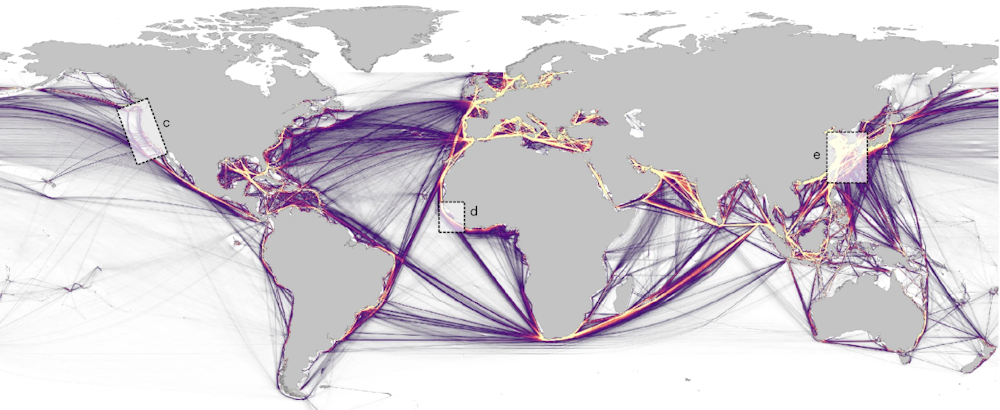
    Our state-of-the-art approach uncovered totally new areas that may be able to support whale sharks in future, such as US waters in the Pacific in the region of the California bight, Japanese waters in the eastern China Sea and the Atlantic waters of many west African countries. We quickly realised that these regions are home to some of the world’s busiest sea ports and shipping highways, so we overlaid our maps of habitat preference with those of global shipping to determine sharks are expected to run into ships.

    The world’s main shipping lanes, with the busiest lanes coloured yellow. Areas C (US west coast), D (west Africa) and E (east Asia) are expected to become more suitable for whale sharks as the oceans warm.
    Womersley et al / Nature Climate Change, CC BY-SA

    Through this we project that co-occurrence between sharks and ships will be be 15,000 times greater by the end of this century if we continue to rely heavily on fossil fuels, compared to only 20 times greater if we follow a sustainable development scenario.

    This does not mean that collisions will increase by 15,000 times, or even by 20 times, as we can only predict where whale sharks will be in future and the precise number of ships will vary. However, if the sharks do move into these new areas and their busy shipping lanes, increased mortality is a very real possibility.

    We’ve already recorded shark-attached satellite tags abruptly stopping transmissions in shipping lanes, with depth-recording tags showing the sharks slowly sinking – likely dead – to the seafloor.

    Changing tack

    Our results are alarming but highlight that we do have the capacity to change the population trajectory for whale sharks. In this case, through mitigating climate change, we can also indirectly ensure that the ocean is a safer place for some of its largest residents.

    We already know which strategies to trial for limiting collisions between ships and sharks. In February 2024 a meeting of signatories to the UN’s convention on the conservation of migratory species put forward a series of recommendations with specific focus on whale sharks. These include slowing speeds and re-routing around key sites, and setting up a collision-reporting network. It is now up to individual governments to take action.

    It’s possible that other species will experience similar pressures as a result of climate change. For example, heat waves in the oceans may force other sharks into cooler surface waters which are being exploited by longline fisheries, or into deeper depths where there is less oxygen.

    It’s time to shift our focus on to these interacting stressors in future, so that we can start to quantify the mosaic of threats that marine animals must endure in the oceans of tomorrow and protect those most at risk.

    Freya Womersley receives funding from the Natural Environment Research Council (NERC) through a University of Southampton INSPIRE DTP PhD Studentship. She is affiliated with the Marine Biological Association (MBA) in Plymouth, UK and the Global Shark Movement Project, which is based at the MBA.

    David Sims receives funding from the Natural Environment Research Council (NERC), the European Research Council (ERC), and the Gordon and Betty Moore Foundation. He is affiliated with the Marine Biological Association (MBA) in Plymouth, UK, and the Global Shark Movement Project, which is based at the MBA.

    – ref. Whale sharks on collision course as warming seas may force them into shipping lanes – new study – https://theconversation.com/whale-sharks-on-collision-course-as-warming-seas-may-force-them-into-shipping-lanes-new-study-240727

    MIL OSI – Global Reports –

    January 23, 2025
  • MIL-OSI Security: Defense News: SECNAV Del Toro As-Written Remarks at the Farragut Seawall Ribbon Cutting

    Source: United States Navy

    Introduction

    Good morning, everyone!

    It is wonderful to be here with you today for this special occasion, at Farragut Seawall, named after our Nation’s first Admiral and our Navy’s first prominent Hispanic leader.

    Assistant Secretary Berger, thank you for your leadership as Assistant Secretary of the Navy for Energy, Installations, and the Environment. The work you do every day is crucially important for the readiness of our Sailors, Marines, and Midshipmen.

    Vice Admiral Davids, thank you for your leadership of the Naval Academy and of the future leaders of our Navy and Marine Corps.

    To all of our distinguished guests, Navy and Marine Corps leaders, Naval Academy faculty, and those who laid the groundwork to get us to where we are today: welcome and thank you for joining us to celebrate the ribbon-cutting for the newly fortified Farragut Seawall.

    Enduring Priorities

    When I entered office as Secretary of the Navy, I laid out Three Enduring Priorities zhich are the foundation for all we do in the Department of the Navy.

    My priority of Strengthening Maritime Dominance centers on ensuring our Sailors and Marines have the best ships, aircraft, and technology available, so that if we are called, we may fight and decisively win our Nation’s wars.

    And my priority of Building a Culture of Warfighting Excellence concerns taking care of people.

    Our people—our Midshipmen—are our greatest strength, and force readiness begins and ends with them.

    And just as our people all around the world deserve robust infrastructure to work, sleep, and study, they also deserve protection from external threats caused by one of the most destabilizing forces of our time.

    To remain the world’s dominant maritime force, the Department of the Navy must rapidly adapt to existential threats such as climate change.

    Building a Climate-Ready Force

    In September 2003, Hurricane Isabel battered the Atlantic Coast.

    And the category five hurricane did not spare the Naval Academy or our future warfighters here.

    The rising water flooded classrooms and damaged buildings—the devastation is evident in photos depicting classroom doors barely peeking above the floodwaters and buildings around the Yard partially submerged.

    The damage resulted in disruptions to classes and normal operations for our Brigade of Midshipmen, along with over one hundred million dollars’ worth of repairs.

    And since Hurricane Isabel made landfall twenty years ago, our world today has continued to face increasingly unpredictable and devasting weather phenomenon.

    Yet, the Department of the Navy is actively adapting and innovating for the changing landscape of the world and indeed of warfare.

    We have set out ambitious goals which we accomplish through installation resilience—by ensuring that our people, systems, and facilities can continue to operate effectively and accomplish our mission in the face of worsening climate impacts.

    Less than two years ago, we held a ceremony here to break ground on the first project to safeguard the Naval Academy from rising sea levels.

    Our efforts today will significantly enhance the development of our future Navy and Marine Corps leaders, enabling them to learn, grow, and thrive with minimal disruption.

    For the sake of force resilience and our people, we must continue looking over the horizon towards future challenges, finding new ways to innovate and modernize our Force.

    May the success of the Farragut Seawall project illuminate the path for future climate resilience initiatives.

    Closing

    I thank all of you for being here today, to celebrate this momentous occasion and the Department of the Navy’s commitment to our future Navy and Marine Corps Officers.

    I look forward to the enduring success of my alma mater as the difficult task of shaping warfighters to face an uncertain future continues—from tomorrow to 2100 and beyond.

    May God bless our Midshipmen, Sailors, Marines, and all who support them. Thank you.

    MIL Security OSI –

    January 23, 2025
  • MIL-OSI Security: Defense News: SECNAV Del Toro As-Written Remarks at the Bancroft Hall Renovation Groundbreaking

    Source: United States Navy

    Good morning, everyone!

    It is an honor to be with you here today at the Naval Academy for the groundbreaking ceremony of the long overdue renovations to Bancroft Hall, named in honor of this school’s founder and the 17th Secretary of the Navy, George Bancroft.

    Assistant Secretary Berger, thank you for being here today, and for your leadership as Assistant Secretary of the Navy for Energy, Installations, and the Environment. The work you accomplish every day is critical to supporting our Sailors, Marines, and future warfighters here at the Naval Academy.

    Vice Admiral Davids, thank you for your leadership of the future officers of our Navy and Marine Corps, and for your commitment to prioritizing the infrastructure which supports our education enterprise.

    Mayor Buckley, thank you for being here today, for your service and leadership of the City of Annapolis, and for your unwavering support of our Midshipmen at the United States Naval Academy.

    County Executive Pittman, we share the values of a more sustainable and secure energy future, and I thank you for your continued partnership and service to Anne Arundel County.

    And I know we could not be here today without the detailed planning and heavy lift of so many of our outside partners, those who have realized this plan from its inception two years ago.

    Captain Schwarz, the interdependence between the Naval Support Activity and the Naval Academy is on full display today. Thank you for your leadership and guidance of NSA Annapolis.

    To all of our flag and general officers, distinguished guests, Navy and Marine Corps leaders, and Naval Academy faculty: welcome and thank you for joining us to celebrate the groundbreaking and beginning of our Bancroft Hall renovations.

    Enduring Priorities

    When I entered office as Secretary of the Navy, I laid out Three Enduring Priorities which serve as the foundation of all we do in the Department of the Navy.

    My priority of Strengthening Maritime Dominance centers on ensuring our people have the best infrastructure, equipment, and technology available, so that, if called, we may fight and decisively win our Nation’s wars.

    Strengthening maritime dominance also crucially encompasses adapting to our current and future threats—including climate change, a national security threat which jeopardizes the operational readiness of our Navy and Marine Corps.

    My priority of Building a Culture of Warfighting Excellence is focused on taking care of people.

    Because our people—Sailors, Marines, civilians, and Midshipmen alike—provide the foundational strength for this Department.

    In order to accomplish their mission, our Midshipmen require adequate facilities to train, learn, and grow.

    And the Department of the Navy is forward-looking and focused on the challenges which lie ahead.

    Building a Climate-Ready Force

    We have created the foundation and guidelines by which we are building a climate-ready, warfighting force through Climate Action 2030 and the Naval Academy’s Installation Resilience Plan.

    Here at the Naval Academy, we are developing solutions to climate issues through the Center for Energy Security and Infrastructure Resilience, or “CESIR” [SEE-zuhr].

    Established earlier this year, CESIR will equip Midshipmen with the knowledge and skills to address complex climate challenges throughout their naval careers.

    What’s more, we are investing in the climate resiliency of our facilities, to include this renovation of Bancroft Hall.

    As the center of Midshipman life—the building in which our over four thousand future Navy and Marine Corps Officers sleep and study, Bancroft Hall is a symbol of the Naval Academy as a whole.

    The bonds of camaraderie among our Midshipmen are forged here at Bancroft Hall, creating lifelong friendships and shaping our young Americans into the warfighting leaders our Navy and Marine Corps Team needs.

    However, severe weather events have impacted the longevity of our buildings both inside and out.

    Given the criticality of Bancroft Hall to the mission of the United States Naval Academy in developing the future warfighters of our Fleet and our Force, we must continue to invest in its maintenance and improvement.

    As I have said before, our people are our greatest strength, and force readiness and resilience begin and end with them.

    This critical investment in our infrastructure is inextricably connected to our mission readiness here at the Naval Academy.

    Despite the tremendous scale and consequences of climate change, we possess both the means and opportunity to address them, and I am proud to stand here today as we embark on the beginning of this necessary infrastructure investment for our Midshipmen.

    Closing

    I thank all of you once more for joining us today, to celebrate the groundbreaking of our Bancroft Hall renovation efforts, the first step in reducing the threat posed by the world’s changing climate to our personnel, platforms, systems, and installations.

    It is my sincere hope that our actions today spur collective action throughout the Department of Defense, the Nation, and indeed the world.

    May God bless our Midshipmen, Sailors, Marines, civilians, and all who support them.

    Thank you.

    MIL Security OSI –

    January 23, 2025
  • MIL-OSI USA: Congressman Hank Johnson Announces Energy Efficiency Grant Funding for Covington, Other Georgia Communities

    Source: United States House of Representatives – Representative Hank Johnson (GA-04)

    COVINGTON, GA – Congressman Hank Johnson (GA-04) announced today that Covington, located in Georgia’s 4th Congressional District, has been awarded $150,000 in grant funding through the Bipartisan Infrastructure Law’s (BIL) Energy Efficiency and Conservation Block Grant (EECBG) Program. Covington is one of 17 Georgia communities to benefit from this $2.6 million investment aimed at reducing energy consumption, lowering emissions, and improving energy efficiency.

    “Covington is leading the way in transitioning to clean energy with the addition of eight new electric vehicle charging stations,” said Congressman Johnson. “This funding will help make clean transportation more accessible and support our community’s efforts to reduce its carbon footprint while creating more economic opportunities in Georgia’s Fourth District.”

    The Georgia Environmental Finance Authority (GEFA), which administers the program, selected Covington’s project as part of a broader initiative to enhance energy efficiency across the state. Covington will use the funds to install charging stations in high-traffic areas is designed to support the growth of electric vehicles and make clean transportation more accessible to residents and visitors alike.

    “This is just the beginning,” Congressman Johnson continued. “Investments like these are crucial for reducing our dependence on fossil fuels, improving air quality, and positioning our district and the state of Georgia as leaders in clean energy.”

    Other projects across the state receiving funding include energy audits, building upgrades, and workforce development initiatives, with approximately 60% of the funding directed toward disadvantaged communities.

    For more information about the EECBG Program and the energy efficiency projects being implemented, visit gefa.georgia.gov/EECBG.

    About the Georgia Environmental Finance Authority (GEFA):
    GEFA provides financing for energy, land, and water projects across Georgia. Since its establishment in 1986, GEFA has committed nearly $6 billion to local governments, businesses, and nonprofit organizations to improve environmental infrastructure throughout the state.

    About Congressman Hank Johnson:
    Hank Johnson represents Georgia’s 4th Congressional District, where he is a staunch advocate for civil rights, public safety, and economic justice. Learn more at https://hankjohnson.house.gov/

    MIL OSI USA News –

    January 23, 2025
  • MIL-OSI USA: NASA, Smithsonian Open New Exhibit to Showcase Our Dynamic Earth

    Source: NASA

    NASA Administrator Bill Nelson joined the director of the Smithsonian’s National Museum of Natural History in Washington and agency leadership to unveil the new Earth Information Center exhibit during an early preview on Monday.
    “NASA has studied Earth and our changing climate for more than 60 years. The Earth Information Center at the Smithsonian Museum of Natural History will expand access to NASA’s data and our decades of Earth observation to even more people,” said Nelson. “Together with the Smithsonian, we are providing detailed, usable, and scalable information to enable the public to better understand the climate crisis and take action in their community.”
    The exhibit includes a 32-foot-long, 12-foot-high video wall displaying Earth science data visualizations and videos, interpretive panels showing Earth’s connected systems, information on our changing world, and an overview of how NASA and the Smithsonian study our home planet. It opens to the public Tuesday, Oct. 8. 
    “The new Earth Information Center at the National Museum of Natural History will bring Smithsonian and NASA data on the Earth’s environment and climate to thousands of museum visitors every year,” said Kirk Johnson, the museum’s Sant director. “It is an honor to partner with NASA to bring this dynamic view of Earth to museumgoers and connect people more deeply with their home planet.”
    Visitors also can explore Earth observing missions, changes in Earth’s landscape over time, and how climate is expected to change regionally through multiple interactive experiences. The exhibit will remain on display through 2028.
    “The Earth Information Center allows people to see our planet as we at NASA see it – an awe-inspiring and complex system of oceans, land, ice, atmosphere, and the life they support,” said Karen St. Germain, division director, Earth Sciences Division at NASA Headquarters in Washington. “We are thrilled that this collaboration puts NASA’s Earth science at the fingertips of Smithsonian visitors for the benefit of all.”
    With more than two dozen missions in orbit, NASA observes our planet’s oceans, land, ice, and atmosphere, and measure how a change in one drives change in others. NASA develops new ways to build long-term data records of how our planet evolves. The agency freely shares this unique knowledge and works with institutions around the world.
    As part of NASA’s ongoing mission to better understand our home planet, NASA created the Earth Information Center which draws insights from across all NASA centers and its federal partners – the National Oceanic and Atmospheric Administration, U.S. Geological Survey, U.S. Department of Agriculture, U.S. Agency for International Development, Environmental Protection Agency, and Federal Emergency Management Administration. It allows viewers to see how our home planet is changing and gives decision makers information to develop the tools they need to mitigate, adapt, and respond to those changes.
    NASA’s Earth Information Center is a virtual and physical space designed to aid people to make informed decisions on Earth’s environment and climate. It provides easily accessible Earth information, enabling global understanding of our changing planet.
    The expansion of the physical Earth Information Center at the Smithsonian National Museum of Natural History makes it the second location in the Washington area. The first is located at NASA Headquarters in Washington at 300 E St., SW.
    To learn more about the Earth Information Center, visit:
    https://earth.gov
    -end-
    Meira Bernstein / Elizabeth VlockHeadquarters, Washington202-358-1600meira.b.bernstein@nasa.gov / elizabeth.a.vlock@nasa.gov

    MIL OSI USA News –

    January 23, 2025
  • MIL-OSI USA: GLOBE Eclipse and Civil Air Patrol: An Astronomical Collaboration

    Source: NASA

    3 min read

    The Civil Air Patrol (CAP) is a volunteer organization that serves as the official civilian auxiliary of the United States Air Force. The organization has an award-winning aerospace education program that promotes Science, Technology Engineering, & Mathematics (STEM)-related careers and activities. The total solar eclipse on 8 April 2024 was a unique opportunity to design a mission for cadets, senior members, and educators to collect atmospheric data in contribution the Global Learning and Observations to Benefit the Environment (GLOBE) Program’s GLOBE Eclipse protocol, for which a temporary tool in the GLOBE Observer app made it possible for volunteer observers to document and submit air temperature and cloud data during the eclipse.

    For the first time ever, the CAP had cadets and senior members participating in a mission from every wing (US state), in addition to two US territories and 2 Canadian provinces. Over 400 teams with over 3,000 cadets and over 1,000 senior members collected air temperature, clouds, wind, and precipitation for a total of 4 hours before, during, and after the eclipse. This work was led by Capt. Shannon Babb who organized the mission with the aerospace education team led from the Rocky Mountain Region.

    The collaboration between GLOBE Eclipse and CAP gave cadets the opportunity to do real, hands-on Earth science and be part of a mission alongside senior members. It also brought in over 40,000 students and more than 600 educators through the Civil Air Patrol’s education sites involving K-12 formal and informal educators at schools, youth organizations, museums and libraries. This unique collaboration was so successful, the CAP wants to continue doing missions alongside citizen science programs at NASA and the GLOBE Program. A 2025 mission is being formulated, focused on contrail formation using the strengths of the CAP in aeronautics and unique cloud observations made using the GLOBE Observer app. Results and announcements of 2025 mission plans were presented at the Civil Air Patrol National Conference on 16-17 August 2024 in San Antonio, Texas, USA.

    GLOBE Observer is part of the NASA Earth Science Education Collaborative (NESEC), which is led by the Institute for Global Environmental Strategies (IGES) and supported by NASA under cooperative agreement award number NNX16AE28A. NESEC is part of NASA’s Science Activation Portfolio. Learn more about how Science Activation connects NASA science experts, real content, and experiences with community leaders to do science in ways that activate minds and promote deeper understanding of our world and beyond: https://science.nasa.gov/learn

    https://www.gocivilairpatrol.com/programs/aerospace-education/curriculum/2024-solar-eclipse

    Civil Air Patrol Cadet observing the 8 April 2024 total solar eclipse.
    Civil Air Patrol

    Civil Air Patrol Cadets making atmospheric measurements during the 8 April 2024 total solar eclipse.
    Civil Air Patrol

    Civil Air Patrol Cadets making atmospheric measurements during the 8 April 2024 total solar eclipse.
    Civil Air Patrol

    Civil Air Patrol Cadet observing the 8 April 2024 total solar eclipse.
    Civil Air Patrol

    Civil Air Patrol Cadet observing the 8 April 2024 total solar eclipse.
    Civil Air Patrol

    MIL OSI USA News –

    January 23, 2025
  • MIL-OSI: Abraxas Power Announces the Submission of the Environmental Assessment Registration for its Exploits Valley Renewable Energy Corporation Green Hydrogen Project in Central Newfoundland

    Source: GlobeNewswire (MIL-OSI)

    TORONTO, Oct. 07, 2024 (GLOBE NEWSWIRE) — Abraxas Power Corp. (“Abraxas”), a leading energy transition developer, and its subsidiary Exploits Valley Renewable Energy Corporation (“EVREC”), are pleased to announce that EVREC has submitted the Environmental Assessment Registration (“EAR”) with the Department of Environment and Climate Change of the Government of Newfoundland & Labrador for its Green Energy Hub project in the Botwood area.

    EVREC is a P2X project that was awarded access to over 300 square kilometres of crown lands by the province of Newfoundland and Labrador in 2023 for EVREC’s use in the development of its project in Central Newfoundland. EVREC will include a 3.5 GW onshore wind project with its associated energy and molecular storage powering behind-the-meter hydrogen (H2) and ammonia (NH3) production. The project expects to generate up to 200,000 tons of green H2 and up to 1,000,000 tons of green NH3 annually that will be exported to global markets.

    Since the above-mentioned land access award, EVREC has significantly advanced the project through pre-construction activities which include environmental data collection, resource measurement, and public consultations. The final project design is subject to these ongoing assessments and activities.

    “Today marks a pivotal milestone for EVREC as we register the Project with the Government of Newfoundland and Labrador,” said Colter Eadie, CEO of Abraxas Power. “This project is not just about harnessing the power of natural resources; it’s about developing a strong partnership with our local communities as we transform the future of energy. This initiative will boost Newfoundland’s economy by creating substantial high-skilled job opportunities and fostering economic stability and vibrant, thriving communities.”

    EVREC’s total capital investment is expected to be CAD$12 billion. According to an Economic Impact Assessment published by Jupia Consulting, when combining both CAPEX and OPEX economic activity, the project is expected to:

    • Boost provincial GDP by $7.8 billion over the 34-year life of the project (in $2024), excluding the GDP impacts arising from spending the tax/royalty revenue
    • Contribute $3.1 billion employment income in Newfoundland and Labrador
    • Support 10,900 person years of employment during the four years of construction and over 21,600 over the 34-year operating period
    • Boost annual household spending in NL by over $2.2 billion
    • Contribute $220 million in tax revenue to municipal governments over the 38-year period (CAPEX and OPEX phases). The provincial government will receive an estimated $8 billion and the federal government another $1.6 billion just from the in-province activity.

    EVREC’S EAR Document can be found at:

    Botwood and Area EVREC Green Energy Project – Environment and Climate Change (gov.nl.ca)

    About Abraxas Power:

    Abraxas Power is a pioneering energy transition developer focused on decarbonizing hard-to-abate sectors and creating value by solving the current and future challenges of the energy transition. Abraxas Power’s broad mandate allows it to see opportunities across technologies and geographies to transform the global energy industry. Our team has extensive experience in leading, financing, and solving the challenges associated with energy transition, and a proven track record of delivering complex, large-scale development projects across various disciplines, including renewable power and storage, hydrogen and ammonia production, industrial and precious metals, large-scale project construction, and operations at scale. The team possesses strong project finance and capital markets experience and has a history of creating value for shareholders, stakeholders, and the communities they live in. Abraxas has signed strategic partnerships with various global strategics and technology providers.

    Abraxas has secured over US$9 billion in capital projects through competitive government awards over the past year in furtherance of the energy transition, including our marquis Exploits Valley Renewable Energy Corporation (“EVREC”) project.
    To learn more, visit http://www.abraxaspower.com

    The MIL Network –

    January 23, 2025
  • MIL-OSI Russia: Alexander Novak: Russia is preparing to present its climate strategy at the international conference COP29 in Baku

    MILES AXLE Translation. Region: Russian Federation –

    Source: Government of the Russian Federation – An important disclaimer is at the bottom of this article.

    Alexander Novak, Alexey Overchuk and Maxim Reshetnikov took part in a meeting on the use of the results of the first stage of the most important innovative project of national importance “Russian Climate Monitoring System” in the formation of state climate policy measures

    October 7, 2024

    Alexander Novak took part in a meeting on the use of the results of the first stage of the most important innovative project of national importance “Russian Climate Monitoring System” in the formation of state climate policy measures

    October 7, 2024

    Alexander Novak, Alexey Overchuk and Maxim Reshetnikov took part in a meeting on the use of the results of the first stage of the most important innovative project of national importance “Russian Climate Monitoring System” in the formation of state climate policy measures

    October 7, 2024

    Alexander Novak, Alexey Overchuk and Maxim Reshetnikov took part in a meeting on the use of the results of the first stage of the most important innovative project of national importance “Russian Climate Monitoring System” in the formation of state climate policy measures

    October 7, 2024

    Alexander Novak, Alexey Overchuk took part in a meeting on the issue of using the results of the first stage of the most important innovative project of national importance “Russian Climate Monitoring System” in the formation of state climate policy measures

    October 7, 2024

    Previous news Next news

    Alexander Novak, Alexey Overchuk and Maxim Reshetnikov took part in a meeting on the use of the results of the first stage of the most important innovative project of national importance “Russian Climate Monitoring System” in the formation of state climate policy measures

    Deputy Prime Minister Alexander Novak took part in a meeting on the use of the results of the first stage of the most important innovative project of national importance (IIP GN) “Russian Climate Monitoring System” in the formation of state climate policy measures. The event took place at the Government Coordination Center.

    The meeting was also attended by Deputy Prime Minister Alexey Overchuk, Minister of Economic Development Maxim Reshetnikov, Presidential Aide on Climate Issues Ruslan Edelgeriev, representatives of the Government, the Ministry of Education and Science, the Ministry of Natural Resources, the Ministry of Energy, the Ministry of Construction, the Ministry of Industry and Trade, the Ministry of Agriculture, the Ministry of Transport, the Ministry of Foreign Affairs, Roshydromet, Roscosmos, business, the scientific community, fuel and energy companies, etc.

    The parties discussed the results of the work of the Federal State Budgetary Institution “Yu. A. Izrael Institute of Global Climate and Ecology” on adjusting the coefficients for greenhouse gas emissions in various industrial sectors – from agriculture to energy, petrochemistry and municipal solid waste management as part of the preparation of the draft National Inventory of Anthropogenic Emissions from Sources and Absorption by Sinks of Greenhouse Gases for 1990-2022. Data from Rosleskhoz, Earth remote sensing systems, etc. were used to adjust the coefficients. The second stage of the VIP GZ was instructed to be finalized.

    The monitoring system will ensure the formation of reliable and internationally recognized scientific data for assessing anthropogenic and natural flows of climate-active substances on the territory of the Russian Federation, and will also allow for the implementation of further measures to achieve the national goals set by the President, including in the field of ecology and climate.

    The Director of the Institute of Public Forecasting of the Russian Academy of Sciences reported on forecasts of greenhouse gas emissions and absorption for the implementation of the goals of the Strategy for Socioeconomic Development with Low Greenhouse Gas Emissions until 2050.

    Alexander Novak thanked the scientists for their work and instructed them to coordinate the new data with industry plans for investment in emission reduction projects and environmental programs. The Ministry of Economic Development will have to finalize and coordinate with federal executive authorities the draft presidential decree on establishing a target indicator for greenhouse gas emissions for 2035 and the draft operational plan.

    Please note: This information is raw content directly from the source of the information. It is exactly what the source states and does not reflect the position of MIL-OSI or its clients.

    Please note; This information is raw content directly from the information source. It is accurate to what the source is stating and does not reflect the position of MIL-OSI or its clients.

    http://government.ru/nevs/52927/

    EDITOR’S NOTE: This article is a translation. Apologies should the grammar and or sentence structure not be perfect.

    MIL OSI Russia News –

    January 23, 2025
  • MIL-OSI Europe: EU finance ministers welcome proposals for new EIB Group initiatives to deepen Europe’s capital markets, channel savings into productive investments and boost competitiveness

    Source: European Investment Bank

    • Plans discussed with European Finance ministers in Luxembourg will broaden financing options and tools available to scale up European innovative companies and unicorns.
    • The instruments to be deployed by the EIB Group include expanding the successful European Tech Champions Initiative Fund-of-Funds, equity and venture capital investments for scale-ups, and a new Exit platform to facilitate purchases and listing of tech start-ups.

    European Union Finance ministers have welcomed an Action Plan to be deployed by the European Investment Bank (EIB) Group, to support the development of the Capital Markets Union. The Plan includes measures to untap private savings and channel them into productive investment, to boost innovation, competitiveness, strategic autonomy, and productivity growth in Europe.

    The Action Plan was discussed at the meeting of EIB Group President Nadia Calviño with finance ministers at the Eurogroup in Luxembourg today. It was developed after months of intensive engagement with member states and financial markets partners, and received broad support by the Boards of Directors of the EIB and of the European Investment Fund (EIF) last week.

    EIB Group President Nadia Calviño, said “The EIB Group is itself already a Capital Markets Union instrument. The Action Plan discussed with ministers will help European innovators scale up their business and contribute to channel savings into productive investments, boost innovation, create jobs and lead Europe toward a more robust growth model, ensuring that European companies born in Europe, stay in Europe”.

    The Action Plan covers three main areas:

    • Improving market integration for green and digital bonds: The EIB Group will continue to play a leading role in the European green bond market, through issuance and also scaling up bond acquisition.
    • Closing the funding gap throughout the company and innovation cycle: The EIB Group plans to scale up support for the EU venture capital and private equity markets to help close the financing gap and to retain the most innovative scale-ups in Europe.
    • Mobilizing large-scale investments for EU policy priorities: For instance, working with the Commission on a financing platform for housing.

    Today’s meeting has focused on the second area, with proposals to finance the scale-up of European unicorns, including through an extension of the successful European Tech Champions Initiative, scaling up equity and venture debt investments and  a new dedicated fund, an “exit platform”, for financing acquisitions and listing of tech start-ups by European companies.

    These proposals will be further discussed and finalised by the EIB’s Board of Directors, in partnership with the Commission. Today’s discussion follows up on the Eurogroup’s mandate in March for the EIB Group to support the integration of European capital markets with new instruments that will further facilitate access to financing for small and medium-sized businesses and innovators.

    EU leaders committed, in April 2024, to advancing work without delay toward integrating the Union’s capital markets, while a Savings and Investment Union, including banking and capital markets, is among the flagship goals included in the political guidelines of European Commission president Ursula von der Leyen for the new institutional cycle. Helping develop well-functioning cross border capital markets is among the EIB Group’s core priorities, included in the Strategic Roadmap for 2024-2027, which was unanimously endorsed by EU finance ministers in June.

    Capital markets fragmentation has been singled out as a key impediment to European competitiveness by both Enrico Letta and Mario Draghi in their flagship reports. The European Central Bank has repeatedly emphasized that deep and integrated single market for capital is essential for financial stability and for achieving some of the EU’s flagship policy goals, from financing the green and digital transitions to enabling savers to earn higher returns.

    The EIB Group is uniquely positioned to support the development of a European Savings and Investments Union, as it is the only truly pan-European financial institution, with operations in every member state and every region of the EU. It has an unparalleled record and expertise in introducing and shaping innovative financing instruments and tools.

    The EIB Group has just reached the €100bn milestone of green bond issuance, since pioneering this market back in 2007, and is the largest provider of venture debt in Europe. It offers a full range of products and services, from debt and equity to advisory, to clients ranging from public sector and large corporates to SMEs and innovative startups. The EIB Group has a stellar AAA credit rating, and outstanding Environmental, Social and Governance credentials.

    Background information

    The European Investment Bank (EIB) is the long-term lending institution of the European Union owned by its Member States. It makes long-term finance available for sound investment contributing toward EU policy goals. The EIB Group is the largest provider of venture debt in Europe and the largest public investor in European venture capital funds. It is also a major financier of climate investment, with over €100 in cumulative green bond issuances, and is well on track to support €1 trillion in green investment in the critical decade to 2030.

    The EIB Group, which also includes the European Investment Fund (EIF), signed a total of €88 billion in new financing for over 900 projects last year. These commitments are expected to mobilise around €320 billion in investment, supporting 400 000 companies and 5.4 million jobs. Over half of the EIB Group’s annual financing supports projects directly contributing to climate change mitigation, adaptation, and a healthier environment. Approximately half of the EIB’s financing within the European Union is directed towards cohesion regions, where per capita income is lower. This underscores the Bank’s commitment to fostering inclusive growth and the convergence of living standards.

    MIL OSI Europe News –

    January 23, 2025
  • MIL-OSI USA: Bennet, Hickenlooper, Neguse, Crow, Pettersen, DeGette Announce Support for Colorado River District’s Application for Funding to Complete Shoshone Water Rights Purchase

    US Senate News:

    Source: United States Senator for Colorado Michael Bennet
    Denver — Colorado U.S. Senators Michael Bennet and John Hickenlooper, and U.S. Representatives Joe Neguse, Jason Crow, Brittany Pettersen, and Diana DeGette, wrote to the Bureau of Reclamation (BOR) in support of the Colorado River Water Conservation District’s (CRWCD) application for federal funding to purchase two of the oldest water rights on the Colorado River mainstem in Colorado, known as the Shoshone Permanency Project. The lawmakers offered their support as part of an ongoing BOR funding opportunity to provide environmental benefits in response to drought, which remains open for additional projects in Colorado and the rest of the Upper Colorado River Basin.
    “The Colorado River District’s mission is to promote the protection, conservation, use, and development of the water resources of the Colorado River water basin for the welfare of the state of Colorado,” wrote the lawmakers. “Preserving the Colorado River’s historical flow regime as intended by the Shoshone Permanency Project will benefit the Colorado River ecosystem every year, and especially in dry years.”
    The 1902 Senior and the 1929 Junior Shoshone Water Rights currently held by Xcel Energy are used to generate power at the Shoshone Power Plant and then return it to the river. Communities across Western Colorado have already committed over $55 million, and are applying to BOR for funding from the Upper Colorado River Basin Environmental Drought Mitigation program to help complete the purchase and create stability for communities, water and recreational users, and the environment. The Upper Colorado River Basin Environmental Drought Mitigation program funding opportunity is open for application through November 22, 2024, and the lawmakers welcome other applicants to contact their offices on the opportunity to provide support. 
    “This strong show of funding reflects the local recognition of the Shoshone Water Rights’ importance to the health of western Colorado’s environment and local economies,”continue the lawmakers. “We recognize the Shoshone Permanency Project’s complex nature and ongoing technical review, but believe the opportunity to protect historical Colorado River flows deserves your attention.”
    As part of the Shoshone Permanency Project, CRWCD will seek a change in these rights to include an alternate beneficial use and preserve the historical flow regime. The state process for changing these decreed water rights is distinct from any federal funding review or outcome, and will proceed separately. As acknowledged in the letter, data collection and analysis related to the Shoshone water rights’ historic use is ongoing and important to the state of Colorado’s formal review. 
    As the Chair of the Senate Agriculture Committee’s Subcommittee on Conservation, Climate, Forestry and Natural Resources, Bennet has consistently worked with his colleagues to help communities in Colorado and across the American West as they face the effects of climate change. In June 2022, as Subcommittee Chair, Bennet held the Senate’s very first hearing on Western drought. In June 2024, Bennet and Subcommittee Ranking Member U.S. Senator Roger Marshall (R-Kan.) held a field hearing in Burlington, Colorado, to hear from Western producers and agricultural leaders facing historic drought. 
    Bennet and Hickenlooper fought to include $8 billion for Western water infrastructure, $10 billion for forests, $19 billion for agricultural conservation, and $4 billion for drought in the Inflation Reduction Act (IRA) and Bipartisan Infrastructure Law. In September 2022, Bennet, Neguse, and Crow urged BOR to prioritize funding for long-term, permanent solutions to the Colorado River drought crisis as it worked to allocate the $4 billion for Western drought from the IRA. After calling on the Biden administration to make further investments to address long-term drought caused by climate change in April 2024, Bennet welcomed $400 million from the U.S. Department of Agriculture for investments at the irrigation district scale to address drought in August. The lawmakers will continue to work with communities and water users across the state to ensure as much of this funding as possible comes to the state of Colorado.
    The text of the letter is available HERE and below.
    Dear Commissioner Touton:
    We write in support of the Colorado River Water Conservation District’s (the River District) application to the U.S. Bureau of Reclamation’s (USBR) Upper Colorado River Basin Environmental Drought Mitigation funding opportunity, referred to as Bucket 2E. As you know, the Inflation Reduction Act provided a historic $4 billion to address issues caused by drought, including activities to support environmental benefits, and ecosystem and habitat restoration. If selected, the River District will leverage Bucket 2E funding alongside significant state and local investment to purchase two of the oldest water rights on the Colorado River mainstem in the State of Colorado – the Shoshone Water Rights – to preserve their historical flow regime in perpetuity. 
    The River District was established in 1937 as a local governing entity to represent water users across 15 counties in Western Colorado – including the headwaters of the Yampa, White, Gunnison, and Colorado Rivers. The Colorado River District’s mission is to promote the protection, conservation, use, and development of the water resources of the Colorado River water basin for the welfare of the State of Colorado.
    Now, the River District is pursuing the Shoshone Permanency Project, which aims to preserve the historical Colorado River flow regime created by the 1902 Senior Shoshone Water Right and the 1929 Junior Shoshone Water Right (the “Shoshone Water Rights”). The River District has signed an agreement to purchase the Shoshone Water Rights from Xcel Energy, which currently holds the rights for its Shoshone hydropower plant. Today, the Shoshone Water Rights are decreed as non-consumptive water rights: the water is used to generate hydropower at the Shoshone Power Plant and is returned to the stream. The Shoshone Water Rights’ senior status “pulls” water to Glenwood Canyon, which ensures that water continues to flow and benefits the downstream environment. Preserving the Colorado River’s historical flow regime as intended by the Shoshone Permanency Project will benefit the Colorado River ecosystem every year, and especially in dry years.
    Data collection and analysis of Shoshone Water Rights’ historic use is not yet completed, and ongoing–a key step for understanding the historic flow regime on the Colorado River. The Shoshone Permanency Project seeks to change the water rights to include an alternate beneficial use for instream flow purposes, a legally recognized beneficial use in Colorado, to preserve the historical Shoshone flow regime. The proposed decree associated with these flows is still under technical review by the State of Colorado. The River District is actively discussing the proposal with other water users across the state. The Colorado Water Conservation Board and the State of Colorado Water Court will conduct a formal review in the coming months. Ongoing modeling will also help quantify the environmental benefits of the Shoshone Water Rights flows. One potential benefit is to the critical habitat of four fish in the Colorado River listed under the Endangered Species Act (ESA), known as the 15-Mile Reach, located near Palisade, Colorado.
    The State of Colorado and our water users are making their own significant investments to ensure that the historical Shoshone flows can continue in perpetuity. The Colorado River District has allocated $20 million, the State of Colorado has appropriated another $20 million for the acquisition, provided the State’s instream flow requirements are met, and a coalition of Western Slope water users and local governments have formally committed over $15 million. This strong show of funding reflects the local recognition of the Shoshone Water Rights’ importance to the health of western Colorado’s environment and local economies.
    We recognize the Shoshone Permanency Project’s complex nature and ongoing technical review, but believe the opportunity to protect historical Colorado River flows deserves your attention. We encourage you to give the River District’s proposal your full and fair consideration consistent with all applicable rules and regulations. Thank you for your review, and please notify our offices of any funds awarded.

    MIL OSI USA News –

    January 23, 2025
  • MIL-OSI USA: MoDNR opens second application window for Energy Efficiency and Conservation Grants

    Source: US State of Missouri

    JEFFERSON CITY, MO, OCT.7, 2024 – The Missouri Department of Natural Resources’ Division of Energy is now accepting applications for subgrants under the Energy Efficiency and Conservation Block Grant (EECBG). Applications are being accepted through Dec. 12.

    Missouri’s EECBG program is offering $2.36 million for projects that promote energy savings, energy conservation or emissions reductions in communities that were not eligible for direct formula funding from the U.S. Department of Energy. Applicants may request between $100,000 and $500,000 for eligible projects. No cost match is required.

    “We are excited to help more Missouri communities make investments that increase their energy efficiency and reduce consumption,” said Dru Buntin, director of the Department of Natural Resources.

    To assist EECBG applicants, the department is currently offering direct technical assistance by email at energy@dnr.mo.gov.

    To learn more about EECBG and to download the required application forms, please visit dnr.mo.gov/energy/grants-loans. Questions about the application process can be directed to the Missouri Department of Natural Resources’ Division of Energy at energy@dnr.mo.gov, 573-751-2254 or toll-free at 855-522-2796.

    MIL OSI USA News –

    January 23, 2025
  • MIL-OSI USA News: FACT SHEET: Biden-⁠ Harris Administration’s Pre-Landfall Preparations for Hurricane  Milton

    Source: The White House

    Hurricane Milton is forecasted to impact the Western coast of the Florida peninsula this week. As communities across the Southeast – including in Florida – continue their road to recovery and rebuilding after Hurricane Helene, the Biden-Harris Administration is mobilizing additional resources and personnel to prepare for the impacts of this new major storm.

    The Federal government is preparing to support affected communities wherever and whenever needed. Preparedness efforts are underway in conjunction with state and local partners. Together we stand ready to respond to any potential impacts on communities.

    FEMA has sufficient funding to both support the response to Hurricane Milton and continue to support the response to Hurricane Helene– including funding to support first responders and provide immediate assistance to disaster survivors.

    Today, President Biden quickly approved the Governor of Florida’s request for an emergency declaration. Under an emergency declaration, FEMA provides direct Federal support to states for life-saving activities and other emergency protective measures, such as evacuation, sheltering, and search and rescue.

    President Biden was first briefed yesterday on Hurricane Milton’s potential impacts to the Florida Gulf Coast and the work FEMA is doing to preposition life-saving resources in advance of the storm. He is also receiving another briefing today from Homeland Security Advisor Liz Sherwood-Randall.

    The Administration has been in touch with officials from the State of Florida, as well as more than 15 local officials in cities and counties along the likely path of impact, to ensure needs are met in advance of the storm. FEMA has been coordinating closely with Tampa Mayor Jane Castor’s team ahead of FEMA Administrator Deanne Criswell’s visit to Tampa today. The Administration has also reached out to state officials in South Carolina and Georgia and will continue outreach efforts based on Hurricane Milton’s latest trajectory.

    Florida residents are urged to stay alert, listen to local officials, and make additional preparations as needed.

    Pre-landfall actions taken thus far include:

    Pre-Positioning Resources and Personnel

    The National Oceanic and Atmospheric Administration is flying Hurricane Hunters into the current storm to gather data to models and help hone prediction of the storm’s track and timing.

    FEMA has pre-staged personnel and resources in Florida and the region, including six FEMA Incident Management Assistance Teams, five FEMA Urban Search & Rescue teams, three U.S. Coast Guard Swift Water Rescue teams, four HealthCare System Assessment Teams, two U.S Army Corps of Engineers (USACE) temporary power teams, USACE debris experts, Environmental Protection Agency (EPA) and wastewater experts, 300 ambulances and 30 High Water Vehicles with ladders from the Department of Defense.

    Additionally, FEMA has two incident staging bases with commodities including food and water. Right now, FEMA currently has 20 million meals and 40 million liters of water in the pipeline to deploy as needed used to address ongoing Helene and Milton response efforts with capacity to expand as needed.

    Currently, a total of nearly 900 staff are already supporting recovery efforts based out of the Joint Field Office in Tallahassee and operating across the designated counties for hurricanes Helene, Debby and Idalia. This includes over 440 supporting Hurricane Helene recovery, over 300 supporting Hurricane Debby recovery, and over 100 supporting Hurricane Idalia recovery.

    Expediting Debris Removal in Florida

    Debris remaining from the impacts of Hurricane Helene poses additional threats to lives and livelihoods if another storm occurs. FEMA is supporting the State of Florida to expedite the removal of debris from Hurricane Helene in the Tampa region in advance of Hurricane Milton’s landfall.

    FEMA is providing all flexibility available for reimbursement for debris removal activities, to help the State take whatever action is required to speed debris removal before Milton’s landfall. To that end, FEMA is supporting Florida in surging additional resources to the Tampa area to get as much debris picked up as possible. State-run debris management sites are open 24 hours a day, and contracted trucks can deliver debris to those sites around the clock.   
    The Governor of Florida has additionally activated 4,000 State active-duty National Guard, many of whom will help with debris removal.

    Pre-Landfall Preparations Supplement Ongoing Helene Response

    The Administration continues to mobilize a whole-of-government response to the impacts of Hurricane Helene. Yesterday, President Biden ordered another 500 active-duty troops with advanced technological assets to move into Western North Carolina and assist with the response and recovery efforts. With a total of 1,500 troops now supplementing a robust on-the-ground effort – including more than 6,100 National Guards and more than 7,000 Federal personnel – the Administration is sparing no resource to support families as they begin their road to rebuilding.

    The Administration has already helped thousands of Hurricane Helene survivors jumpstart their recoveries with more than $210 million in Federal assistance – and there is more to come. Over the last several days, the Administration has contacted nearly 450 state, city, and county officials in impacted States to ensure they have the support and resources they need. To date, FEMA has shipped over 15.6 million meals, more than 13.9 million liters of water, more than 505,000 tarps to the region, and installed 157 generators at critical facilities such as hospitals and water treatment plants.

    ###

    MIL OSI USA News –

    January 23, 2025
  • MIL-OSI Asia-Pac: Union Minister of Coal and Mines Shri G. Kishan Reddy Visits Western Coalfields Limited to Review WCL Performance.

    Source: Government of India (2)

    Union Minister of Coal and Mines Shri G. Kishan Reddy Visits Western Coalfields Limited to Review WCL Performance.

    Minister Emphasizes on all CIL Subsidiaries to Achieve their Annual Targets to Meet the Nation’s Energy Security

    Minister Urges for Swift Action on Land Acquisition, Environmental and Forest Clearances, and Adoption of New Technology

    Posted On: 07 OCT 2024 4:53PM by PIB Delhi

    Union Minister of Coal and Mines, Shri G. Kishan Reddy, today visited the headquarters of Western Coalfields Limited (WCL) in Nagpur to review the company’s performance. He was accompanied by Union Minister of Road Transport and Highways, Shri Nitin Gadkari. The review meeting was also attended by Additional Secretary, Ministry of Coal, Smt. Rupinder Brar, Chairman of Coal India Limited, Shri P.M. Prasad and senior officials from WCL and the local administration.

    During the meeting, Shri G. Kishan Reddy reviewed WCL’s coal production, productivity, dispatch efficiency, and addressed issues concerning Project Affected People (PAPs). A detailed presentation was made, covering key metrics of coal production, dispatch, and Overburden Removal (OBR) for the first and second quarters of current financial year. Further, it was assured that WCL will meet its annual production targets by the end of the financial year.

    In his address, Shri G. Kishan Reddy emphasized the need for all CIL subsidiaries to achieve their annual targets to meet the nation’s coal requirements. Minister said that both enhancing existing mining operations and launching new projects are vital to making India self-reliant (Atmanirbhar) in the coal sector. Furthermore, he assured full support from the Ministry of Coal in driving these efforts forward, including assistance with land acquisition, environmental and forest clearances, and the adoption of modern technologies.

    After the review meeting, Shri G. Kishan Reddy honoured sanitation workers for their exceptional contribution to the ‘Swachhata Hi Seva Campaign 2024.’ Minister also extended financial assistance to daughter of late Shri Nunhare, a former sanitation worker, to support her education and family needs.

    Prior to the review meeting, Union Minister Shri G. Kishan Reddy planted a sapling as part of the Ministry of Coal’s ‘Ek Ped Maa Ke Naam’ initiative. Minister visited the Integrated Control and Command Centre (ICCC) at the WCL headquarters, an innovative AI-enabled facility for mine surveillance. During this visit, he also launched WCL’s Coal SHAcTE Dal, a specialized team of armed security personnel equipped with modern tools and technology to respond swiftly to emergencies, including intrusion and unauthorized access in coal mines.

    Minister also inaugurated the NaCCER (National Center For Coal And Energy Research) and launched WCL’s CSR flagship project, ‘Tarash 2.0’. This initiative will provide coaching to 40 students for IIT-JEE and NEET exams, along with accommodation, meals, books, and a monthly stipend of ₹1,000. Shri G. Kishan Reddy also honored four students from the Tarash 2.0 program who achieved over 90% in their 10th-grade exams.

    This visit underscores the government’s focus on energy security, technological advancement, and community welfare. The launch of NaCCER and ‘Tarash 2.0’ marks a new era in innovation, education, and progress for a self-reliant coal sector & strengthen R&D in coal and enhance operational efficiency, contributing to a sustainable energy future.

    Received a Guard of Honour upon my arrival at the HQ of Western Coalfields Limited earlier today in Nagpur.

    Later, paid floral tributes to the Mine Martyrs who laid down their lives in line of duty, at the Mines Martyrs Memorial.@TeamWCL pic.twitter.com/qUCjKLHLtq

    — G Kishan Reddy (@kishanreddybjp) October 7, 2024

    Celebrating the incredible efforts of our Safai Mitras!

    Distributed gift hampers as a token of appreciation for their outstanding service during the #SwachhataHiSeva2024 campaign at WCL.@TeamWCL pic.twitter.com/MZ9ksNRPDZ

    — G Kishan Reddy (@kishanreddybjp) October 7, 2024

    Hon’ble Minister of Coal & Mines, Shri G. Kishan Reddy launched WCL CSR’s flagship project ‘Tarash 2.0,’ providing coaching for 40 students for IIT-JEE & NEET. The project covers accommodation, meals, books, & ₹1000/month stipend.

    Hon’ble Minister also honored four Tarash 2.0… pic.twitter.com/1mDGWcOQUx

    — Ministry of Coal (@CoalMinistry) October 7, 2024

    Shri G. Kishan Reddy, Hon’ble Union Minister of Coal and Mines Chaired a Performance Review meeting of WCL and appreciated Western Coalfields Limited for their relentless dedication in supporting the Nation’s growing energy demands. pic.twitter.com/RSpW7Q31To

    — Western Coalfields Ltd. (@TeamWCL) October 7, 2024

    Hon’ble Minister of Coal & Mines, Shri G. Kishan Reddy inaugurated Phase-1 of the National Centre for Coal and Energy Research (NaCCER). Smt.

    Rupinder Brar, Additional Secretary, Ministry of Coal, and senior officials were also present at the event.

    This initiative will… pic.twitter.com/9adM0kNwAP

    — Ministry of Coal (@CoalMinistry) October 7, 2024

    ****

    ST

    (Release ID: 2062846) Visitor Counter : 62

    MIL OSI Asia Pacific News –

    January 23, 2025
  • MIL-OSI Asia-Pac: Darjeeling’s Padmaja Naidu Himalayan Zoo’s Red Panda Program Selected as Finalist for 2024 WAZA Conservation Award

    Source: Government of India

    Darjeeling’s Padmaja Naidu Himalayan Zoo’s Red Panda Program Selected as Finalist for 2024 WAZA Conservation Award

    Padmaja Naidu Himalayan Zoo Strengthens Conservation with Biobanking Facility to Preserve Red Panda Genetic Resources for Future

    Posted On: 07 OCT 2024 8:50PM by PIB Delhi

    Red Panda Conservation Breeding and Augmentation Programme of Padmaja Naidu Himalayan Zoological Park, Darjeeling has been shortlisted as one of the top three finalists by World Association of Zoos and Aquariums for the 2024 WAZA Conservation & Environmental Sustainability Awards. Winner will be announced at 79th WAZA Annual Conference at Tarongo Zoo, Sydney, Australia on 7th Nov 2024. Between 2022 and 2024, nine captive-bred red pandas (seven females and two males) were released into Singalila National Park (SNP) in West Bengal. Of the seven released females, three gave birth to five cubs in wild.

    PNHZP, in collaboration with the Wildlife Wing of the Government of West Bengal, has undertaken several habitat restoration initiatives in Singalila National Park and Darjeeling division. PNHZP is taking several in-house and collaborative research works related to Red Panda with institutions like CCMB, IISER and WII.

    PNHZP’s conservation efforts are further strengthened by its Biobanking and Genetic Resource Facility, wherein gametes, tissues, and DNA of Red Pandas and other endangered species will be preserved for future use.

    These initiatives will be further continued in future for long term augmentation and conservation of Red Pandas in their natural habitat.

    *****

    VM/GS

    (Release ID: 2062982) Visitor Counter : 18

    MIL OSI Asia Pacific News –

    January 23, 2025
  • MIL-Evening Report: Ocean protection accounts for 10% of fish in the world’s coral reefs – but we could save so much more

    Source: The Conversation (Au and NZ) – By Joshua Cinner, Professor & ARC Laureate Fellow, Thriving Oceans Research Hub, School of Geosciences, University of Sydney

    Ocean fish populations have fallen dramatically in the past half-century, and climate change is expected to make the problem worse. Governments have designated “marine protected areas”, where where human activity is constrained to protect ocean life. But have these efforts worked?

    About 8% of Earth’s oceans are protected, including about 3% where fishing is banned altogether. Our new study of nearly 2,600 tropical coral reefs around the world is the first to examine whether these areas have helped fish populations.

    We found about one in ten kilograms of fish on coral reefs is the result of efforts such as marine protected areas and other restrictions on fishing. This is promising news. But our study also reveals great room for improvement.

    A video discussing how Earth’s fish stocks are declining.

    Getting to grips with marine protection

    Maintaining healthy fish populations is important. Many communities depend on fishing for their food and livelihoods. And fish play a vital role in ocean ecosystems.

    Marine protected areas are a key policy tool used to increase fish populations. They cover a range of ocean areas including lagoons, coastal waters, deep seabed waters and coral reefs.

    The areas go by several names, including marine parks and conservation zones. Some, where fishing is prohibited, are known as no-take zones.

    Governments often quote figures on the area of ocean protected when seeking to tout their conservation policies. For example in Australia, we are told the federal, state and territory governments have established marine parks covering 4.3 million square kilometres or 48% of our oceans.

    But the extent to which marine protected areas actually conserve marine life varies enormously from place to place. So simply counting up the protected ocean area doesn’t tell you much about what has actually been achieved.


    Measuring success

    We and our colleagues wanted to assess the extent to which marine protection efforts have increased the amount of fish on coral reefs.

    We developed a computer model based on about 2,600 reefs across the global tropics, which includes reefs in the Pacific, Indian, and Atlantic oceans. From that, we estimated the amount of fish currently on each reef – measured in the kilograms of fish per hectare, or “biomass”.

    The estimations were based on information such as:

    • environmental conditions such as ocean temperature and the type of habitat where the reef is located

    • the intensity of fishing activity, known as “fishing pressure”

    • how strong the protection is – for example whether it bans fishing, or just restricts it

    • the level of compliance with no-take zones.

    We then simulated what would happen if we changed the type of protection strategy in each location while keeping everything else the same.

    We ran a few scenarios:

    • no coral reef conservation existed anywhere and all reefs could be fished without constraint

    • sites currently fished without constraint (which amounted to over half of our sites) had restrictions in place

    • fishing was prohibited on 30% of all reefs.

    And the results?

    We found both marine protected areas and other fishing restrictions account for about 10% of the fish “biomass” on reefs. In other words, about one in ten kilograms of fish on coral reefs is due to protection efforts.

    No-take zones punch above their weight. Of the fish biomass attributable to protection efforts, about 20% comes from just 3% of sites in no-take zones. This proportion would be even higher if illegal fishing in no-take zones was stamped out.

    But we found any type of fishing restriction was useful. If everywhere currently fished without constraint was subject to some level of protection – such as banning nets or spear guns – the biomass of fish globally would be another 10.5% higher, our study found. This essentially matches all conservation efforts to date.

    Our modelling also showed fish on coral reefs could be increased by up to 28% globally if the area of no-take zones rose to 30%.

    But these reefs must be chosen strategically. That’s because protection strategies can lead to wildly different results, depending on local conditions. For example, sites with lower fishing pressure in the surrounding seascape got a bigger boost from protection than places surrounded by intensive fishing effort.

    This may be because at heavily fished locations, algae often overtakes coral as the dominant feature. Algae is less fish-friendly than coral, so fish populations may not bounce back quickly even when fishing pressure is reduced.

    Grounds for optimism

    Our study tested the mettle of global coral reef conservation. On one hand, we found conservation efforts have made a contribution to the amount of fish on global coral reefs, which provides grounds for cautious optimism.

    But on the other hand, this contribution is quite modest. Our study shows much greater gains could be made not only by expanding protected marine areas, but also by improving compliance in existing ones.

    Most nations have signed a global agreement to protect 30% of Earth’s land and waters by 2030. That means the amount of ocean in marine protected areas globally will increase nearly fourfold in just six years.

    As governments continue this task, we hope our results help identify ocean sites that will benefit most from protection.

    Joshua Cinner receives funding from the Australian Research Council and National Geographic Society. He is a Fellow of the Academy of Social Sciences in Australia and the International Coral Reef Society.

    Iain R. Caldwell is affiliated with the Wildlife Conservation Society

    – ref. Ocean protection accounts for 10% of fish in the world’s coral reefs – but we could save so much more – https://theconversation.com/ocean-protection-accounts-for-10-of-fish-in-the-worlds-coral-reefs-but-we-could-save-so-much-more-239188

    MIL OSI Analysis – EveningReport.nz –

    January 23, 2025
  • MIL-OSI New Zealand: East Coast students get a taste of the future at successful careers day | EIT Hawke’s Bay and Tairāwhiti

    Source: Eastern Institute of Technology – Tairāwhiti

    3 mins ago

    School students from the East Coast were given a taste of the future at a successful discovery day organised by EIT’s Education 2 Employment team.

    School students from the East Coast were given a taste of the future at a successful discovery day held at Ngata College in Ruatoria recently.

    The event, organised by EIT’s Education 2 Employment team, saw hundreds of students from the region get a chance to engage with tertiary institutes, pathway providers and employers.

    Education 2 Employment (e2e) encourages the coordination and support of employers and the local business community to be involved in vocational education, employment and development opportunities for young people. The primary goal of the e2e programme is to help connect industry with schools so that students can identify possible career pathways.

    Twenty-seven organisations were represented at the event in Ruatoria last month. While the event was aimed at senior school students, year seven and eight and even younger students also attended.

    Among the companies and organisations attending to connect with the students were local and regional businesses, Government agencies like IRD, and educational institutes including EIT and others from outside the region.

    Adrianna Wilson, Education 2 Employment Advisor for EIT Tairāwhiti, says that the aim of the event was to expose students to what opportunities were out there.

    “We wanted them to see that there are local employers and ones further afield who can offer them a pathway to a career of their choice.”

    “For an example, we had Mātai Medical Research Institute there, so if a student was interested in going into that career, what’s the pathway for them?”

    School students from the East Coast were given a taste of the future at a successful discovery day organised by EIT’s Education 2 Employment team.

    Adrianna says the event was staged in a way that engaged the students and got them interested in potential careers.

    “Every employer or business had an interactive activity. Some had honey pots representing apiculture, civil infrastructure had roading games, the police services had drug goggles and were in their police cars. We also had a Media House there which did portraits of the students, STEM were there doing science activities, and we had the Department of Conservation discussing survival, trapping and other outdoor skills.”

    “We also had a game where they were given a bingo card with symbols that represented each employer or industry. And they had to go and either ask questions or do the interactive activity and get it ticked off by the employer. At the end, they all got a prize if they filled their bingo card. They had to ask questions and engage.”

    Adrianna says the aim is to make the event an annual occurrence.

    “It is a rewarding time for both students and participating organisations as the students get to see what career opportunities there are and employers are exposed to the talent coming through.”

    MIL OSI New Zealand News –

    January 23, 2025
  • MIL-OSI USA: Study Finds Forever Chemicals Are More Toxic As Mixtures

    Source: US Department of Health and Human Services – 3

    research news

    UB PhD student Karla Ríos-Bonilla (left) and Diana Aga, director of the UB RENEW Institute, are authors on a study that assessed the mixture toxicity of per- and polyfluoroalkyl substances (PFAS), also known as forever chemicals. Photo: Meredith Forrest Kulwicki

    By TOM DINKI

    Published October 4, 2024

    A first-of-its-kind study has measured the toxicity of several types of per- and polyfluoroalkyl substances (PFAS), better known as “forever chemicals,” when mixed together in the environment and in the human body.

    The good news: Most of the tested chemicals’ individual cytotoxicity and neurotoxicity levels were relatively low. 

    The bad news: The chemicals acted together to make the entire mixture toxic.

    “Though they are structurally similar, not all forever chemicals are made equal — some are more potent, others less. When mixed, all components contributed to the mixture’s cytotoxicity and neurotoxicity,” says the study’s first-author, Karla Ríos-Bonilla, a UB chemistry PhD student.

    “In the laboratory assays we used in this study, most of the types of PFAS that we tested did not appear to be very toxic when measured individually. However, when you measure an entire sample with multiple PFAS, you see the toxicity,” adds study co-author Diana Aga, SUNY Distinguished Professor, director of the RENEW Institute and Henry M. Woodburn Chair in the Department of Chemistry.

    This research was conducted in collaboration with Beate Escher of the Helmholtz Centre for Environmental Research (UFZ), Leipzig, Germany, where Ríos-Bonilla did the in vitro toxicity experiments in the high-throughput screening facility CITEPro. It was published Sept. 11 in Environmental Science and Technology, a journal of the American Chemical Society.

    The study is novel in that it assesses mixture toxicity of PFAS. These synthetic compounds have been widely used in consumer products — from nonstick pans to makeup — for decades, and they can take hundreds to thousands of years to break down, if ever. They are estimated to be in at least 45% of the nation’s drinking water and in the blood of practically every American, and they have been linked to cancer and neurodevelopmental disorders.

    Earlier this year, U.S. Environmental Protection Agency (EPA) issued the first-ever drinking water standards for six kinds of PFAS. However, it is estimated that there are over 15,000 varieties present in the environment. Only a handful of these chemicals have standards and are regulated. 

    “There are six PFAS that can be regulated because we know a lot about them and their toxicity. Unfortunately, we cannot regulate other forms of PFAS until their toxicities are known,” says Aga, who is principal investigator of the EPA STAR grant that funded the research. “We need to set maximum contamination levels for each PFAS that is proportional to their toxicity. To regulate contaminants, it is crucial to know their relative potencies when they occur as mixtures in the environment, along with their predicted environmental concentrations.” 

    Other co-authors from UB are G. Ekin Atilla-Gokcumen, Dr. Marjorie E. Winkler Distinguished Professor and associate chair of the Department of Chemistry, and Judith Cristobal, senior research scientist.

    Ríos-Bonilla is also supported by a graduate fellowship from the National Institute of Environmental Health Sciences (NIEHS) of the National Institutes of Health (NIH). 

    PFOA, PFOS major contributors to mixture toxicity

    To conduct the study, researchers created their own PFAS mixtures, one that is representative of an average American’s blood serum, and the other of surface water samples found in the U.S. Ríos-Bonilla used data from the U.S. Centers for Disease Control and Prevention and from the U.S. Geological Survey to determine the average concentration ratios of PFAS in human blood and in surface water, respectively. 

    They then tested these mixtures’ effects on two cell lines: one that tests for mitochondrial toxicity and oxidative stress, and the other for neurotoxicity.

    Of the 12 PFAS spiked in the water mixture, perfluorooctanoic acid (PFOA) — commonly used in nonstick pans and firefighting foam — was the most cytotoxic, making up to 42% of the mixture’s cytotoxicity.

    On the other hand, both PFOA and perfluorooctane sulfonic acid (PFOS) contributed roughly the same cytotoxicity (25%) to the neurotoxicity assay, despite both contributing only 10 and 15% to the mixture in terms of concentration, respectively. 

    The blood mixture had four PFAS present, but PFOA again was the most cytotoxic to both cell lines. Despite its molar contribution being only 29%, PFOA triggered 68% of the cytotoxicity in the cytotoxicity assay, and 38% in the neurotoxicity assay.

    Interestingly, when researchers analyzed the toxicity of the extracts from real biosolid samples collected from a municipal wastewater treatment plant, very high toxicities were observed, despite the measured low concentrations of PFOA and other PFAS in the sample. 

    “This means that there are many more PFAS and other chemicals in the biosolids, which have not been identified, that contribute to the toxicity of the extracts observed,” Aga says.

    Synergistically versus additive

    One of researchers’ goals was to determine if PFAS acts synergistically. This is when two or more chemicals’ combined effect is greater than the sum effect of the individual chemicals. However, their findings indicate that the effect of PFAS is concentration-additive: meaning that an established mixture toxicity prediction model can be used to predict the combined effect of mixtures. 

    “As up to 12 PFAS in the mixtures acted concentration-additive for cytotoxicity and specific neurotoxicity, it is likely that the thousands of other PFAS that are in commerce and use are also acting in the same manner,” Escher says. “Mixtures pose more of a risk than individual PFAS. As they act and occur in mixtures, they ought to be regulated as mixtures.”

    Researchers say the results of this study will also be very useful in assessing effectiveness of remediation efforts. Breaking down PFAS can sometimes create harmful byproducts that cannot be detected by chemical analysis, so measuring the toxicity of a sample after treatment may be the only way to judge whether a remediation technology is effective.

    “Toxicity assays can be a complimentary tool when analytical chemistry doesn’t give you all the answers, especially when the identities of contaminants in the mixture are unknown, which is the case in many polluted sites,” Aga says.

    MIL OSI USA News –

    January 23, 2025
  • MIL-OSI USA: FEMA Administrator to Travel to Florida to Direct FEMA Response and Federal Staging Efforts, Meet with State and Local Officials Ahead of Milton Landfall

    Source: US Federal Emergency Management Agency

    Headline: FEMA Administrator to Travel to Florida to Direct FEMA Response and Federal Staging Efforts, Meet with State and Local Officials Ahead of Milton Landfall

    FEMA Administrator to Travel to Florida to Direct FEMA Response and Federal Staging Efforts, Meet with State and Local Officials Ahead of Milton Landfall

    Evacuation Orders Have Been Issued and Others Are Underway, If Locals Issue Evacuations, Please Listen and Evacuate Now

    FEMA Senior Leadership Remain in States Impacted by Helene and Being Sent to Florida to Support Operations 

    WASHINGTON — Administrator Deanne Criswell continues to lead the federal Helene response and recovery efforts and joined North Carolina Governor Roy Cooper, Department of Defense Assistant Secretary Rebecca Zimmerman, Dual Status Commander Wes Morrison, and NORTHCOM Commanding General Gregory Guillot for a press conference to provide updates on the storm damage assessments and response efforts in North Carolina. Following the event, Administrator Criswell will travel to Florida where she will meet with state and local officials today and direct federal response efforts, before traveling back to North Carolina. FEMA senior leader and Regional Administrator Willie Nunn, who led Hurricane Sandy response efforts will also travel Florida and remain there throughout the duration of Hurricane Milton. John Brogan, the Federal Coordinating Officer for Milton, and Helene, will remain in Florida.

    Today, President Joseph R. Biden approved an Emergency Declaration for Florida, authorizing FEMA to save lives, protect the health and safety of those in the storm’s path. FEMA and its federal partners are leaning forward, pre-positioning resources to support local and state response efforts ahead of Hurricane Milton. This includes pre-staging in Florida and the region including six FEMA Incident Management Assistance Teams, five FEMA Urban Search & Rescue teams, three U.S. Coast Guard Swift Water Rescue teams, four HealthCare System Assessment Teams, two U.S Army Corps of Engineers (USACE) temporary power teams, USACE debris experts, Environmental Protection Agency (EPA) and wastewater experts, 300 ambulances and 30 High Water Vehicles with ladders from the Department of Defense. Additionally, FEMA has two incident staging bases with commodities including food and water. Right now, FEMA currently has 20 million meals and 40 million liters of water in the pipeline to deploy as needed used to address ongoing Helene and Milton response efforts with capacity to expand as needed. 

    Currently, a total of nearly 900 staff are already supporting recovery efforts based out of the Joint Field Office in Tallahassee and operating across the designated counties for hurricanes Helene, Debby and Idalia. This includes over 440 supporting Hurricane Helene recovery, over 300 supporting Hurricane Debby recovery, and over 100 supporting Hurricane Idalia recovery.

    FEMA officials are still actively supporting North Carolina, Georgia, South Carolina, Florida and Virginia as they respond to and recover from Hurricane Helene and will not divert personnel or resources from these ongoing responses. 

    The National Hurricane Center warns there is a risk of life-threating storm surge and damaging winds for portions of the west coast of the Florida Peninsula beginning early Wednesday. Areas of heavy rainfall will affect portions of Florida through today well ahead of Milton. There is also increasing concern for coastal flooding for the southeast South Carolina and Georgia coasts on Thursday.

    FEMA understands that people in the path of this storm may still be recovering from hurricanes Helene and Debby and urges everyone to protect themselves and take care of others because time is running out to prepare for the hurricane’s potentially deadly impacts. 

    Counties issue evacuation orders. If you need to evacuate, please “evacuate out, not up.” People should visit FloridaDisaster.org/Know to determine if they live in an evacuation zone. 

    • Your gas tank and electric vehicle only need to be halfway full or halfway charged to ensure you can evacuate further inland to a safe location and away from storm surge.
    • If you are in an evacuation zone and need evacuation assistance, please call 1-800-729-3413. Again, this is for residents that are in evacuation zones.
    • The state of Florida has activated the State Assistance Information Line. Residents needing information and resources can call 1-800-342-3557. There are English, Spanish & Creole speakers available to answer questions.
    • Additional preparedness resources and state updates on Hurricane Milton can be found by visiting FloridaDisaster.org/Updates.
    • For live updates, follow on X and Instagram at FLSERT and Facebook at FDEM.

    Administrator Criswell also directed FEMA’s Deputy Director Erik Hooks to travel to North Carolina today to support response and recovery efforts while she travels to Florida. The Deputy Administrator will travel to South Carolina on Wednesday following his North Carolina visit and meet with tribal nations alongside FEMA’s Tribal Affairs Advocate. At the direction of Administrator Criswell, Deputy Administrator Hooks will also go to Tennessee to help with recovery operations.

    People in Milton’s path should take the forecast seriously and finalize preparation and know how they are going to get information and listen to local officials. Download the free FEMA App available in English and Spanish to receive real-time weather alerts and find local emergency shelters in your area. You can find more hurricane preparedness information on Ready.gov and Listo.gov in Spanish language. 

    Be in the know about your evacuation route. Act now by learning your evacuation routes and identify where you will stay. If you are told to evacuate, do so immediately because your life may be at risk. Make sure everyone in your household knows what to do in case you need to evacuate and that they are familiar with your family’s emergency plan. Learn more about how to evacuate safely on Ready.gov/evacuation and Evacuación | Listo.gov in Spanish language. 

    alex.fonseca
    Mon, 10/07/2024 – 19:44

    MIL OSI USA News –

    January 23, 2025
  • MIL-OSI United Kingdom: UK delegation visits Guatemala to reinforce environmental cooperation

    Source: United Kingdom – Executive Government & Departments

    • English
    • Español de América Latina

    A delegation from the Department of Environment, Food and Rural Affairs (Defra) is in Guatemala 7-14 October to assess progress of the UK’s Biodiverse Landscapes Fund (BLF).

    Roger Heath, Senior Responsible Owner of the BLF and 30×30 and Samuel Leigh, Regional Advisor for Mesoamerica and Andes Amazon for the BLF, will meet with government representatives, implementing partners, civil society and join field visits to Peten and Chiquimula. Rachel Wilson, the Team Leader of the BLF’s Fund Management team at Price Waterhouse Coopers (PwC) will join the delegation.

    On October 7, the delegation will meet in Guatemala City with the leader of the BLF consortium, the Wildlife Conservation Society (WCS) to discuss the progress of the project and upcoming activities. In Guatemala, the BLF is working in Peten (Mayan Jungle) and Chiquimula (Trifino) to protect biodiversity, reduce poverty and tackle the impacts of climate change with projects in line with Guatemalan environmental priorities until 2029.

    The UK delegation will also meet that day with representatives from the Ministry of Environment, the National Council of Protected Areas (CONAP) and the Ministry of Foreign Affairs, to welcome Guatemala’s support  of the BLF and share plans for upcoming interventions in the field that will address ongoing environmental pressures, including the loss of flora and fauna in the Mayan Jungle and the prevention of forest fires in the Trifinio region.

    From 8-12 October, delegates Heath and Leigh will visit Peten to engage with communities that are benefiting from sustainable livelihoods while protecting the environment. These include projects of xate classification, tree planting, bee keeping, and sustainable forestry. They will also engage with local delivery partners that are helping communities to achieve their development and poverty reduction goals in coordination with the Guatemalan authorities.

    On 13 October, the UK delegation will travel to Chiquimula to the area of Trifinio to learn about sustainable agricultural practices to be supported through the BLF and to discuss with local authorities how the Fund could support environmentally sensitive areas to be managed sustainably.

    The BLF is funding activities in six of the world’s most important biodiversity hotspots to help a create a world free from poverty on a liveable planet, including Mesoamerica. Approximately 40% of the funds destined to the Mesoamerica landscape will be allocated in Guatemala (US$7 million) as a commitment to our shared priorities on environment and social development.

    Share this page

    The following links open in a new tab

    • Share on Facebook (opens in new tab)
    • Share on Twitter (opens in new tab)

    Updates to this page

    Published 7 October 2024

    MIL OSI United Kingdom –

    January 23, 2025
  • MIL-OSI USA: Rep. Stansbury Hosts Democratic Leader Hakeem Jeffries for Community Conversation

    Source: United States House of Representatives – Representative Melanie Stansbury (N.M.-01)

    ALBUQUERQUE — Congresswoman Melanie Stansbury (NM-01) was proud to welcome Democratic Leader Hakeem Jeffries for a community conversation at the New Hope Full Gospel Baptist Church in Albuquerque.

    The conversation brought together community members, local leaders, and advocates to discuss pressing issues impacting New Mexicans. Leader Jeffries and Rep. Stansbury touched on a broad range of topics including how Democrats are delivering for Americans in tangible ways like lowering costs for Americans, expanding access to healthcare, protecting the environment, and ensuring our democracy stays secure.

    “I am so proud to welcome Leader Jeffries to our beautiful state and share the stage with him and to showcase all the work Democrats are doing for New Mexicans,” said Stansbury. “We have brought millions of dollars back to New Mexico through federal programs, legislation, and Community Project Funding that support education, housing, healthcare, infrastructure, and economic development. We will continue this momentum – including tackling pressing issues such as climate change, economic inequality, and access to quality education as we continue to work for New Mexico and our communities.”

    “House Democrats will continue to lean into lowering housing costs and growing the middle class with a particular emphasis on access to affordable homeownership,” said Leader Jeffries. “Being able to purchase a home, keeping that home and being able to pass it onto the next generation is central to the great American dream. And we will fight to maintain the principles of free and fair elections and ensure the right to vote, which John Lewis would always say to us, is sacred, is sacrosanct and is essential to the integrity of our democracy. We have to push back against the extreme right-wing efforts to take it away, so one of our top priorities in Congress will be to pass the John Robert Lewis Voting Rights Advancement Act.”

    Find photos from the event here. 

    Since taking office, Rep. Stansbury has secured more than a billion dollars in funding for New Mexico’s First Congressional District, including more than $44.5 million for 37 community projects for public safety, economic development, and other needs. 

    Some of what Congresswoman Stansbury has delivered to New Mexico’s First Congressional District include: 

    Crime Prevention and Public Safety: 

    • Last month, the Congresswoman introduced the Stop the Opioid Pill Presser and Fentanyl Act (STOPP Fentanyl Act) to disrupt global criminal networks and suppliers of illicit drugs like fentanyl. 

    Behavioral Health Resources: 

    • In Congress, Rep. Stansbury has secured millions for NM-01 to improve community well-being through behavioral health-focused solutions. This includes leading efforts to secure funding for mental health and addiction recovery programs, such as workforce development, school-based support, crisis intervention, and veterans’ suicide prevention. 

    Gun Violence and Safety: 

    • Congresswoman Stansbury has cosponsored key bills aimed at addressing gun safety, including the Keep Americans Safe Act, the SAFES Act, the Identify Gun Stores Act, the Gun Violence Prevention Research Act of 2023, the Break the Cycle of Violence Act), and the AMMO Act. 
    • These bills focus on universal background checks, bans on military-style rifles and untraceable weapons, and enhancing research and oversight related to gun violence and ammunition. 

    Reproductive Rights: 

    • Congresswoman Stansbury voted to defend reproductive rights against the House GOP’s systematic efforts to criminalize abortion and abortion providers. 
    • Rep. Stansbury joined other House Democrats to sponsor legislation to restore Roe vs. Wade, condemn violence and attacks on healthcare facilities, personnel, and patients, and to pass the Women’s Health Protection Act. 
    • Rep. Stansbury co-sponsored a resolution by House Democrats to condemn attacks on abortion clinics that threaten the safety of patients and health care workers. 
    • Rep. Stansbury also voted to pass the Ensuring Access to Abortion Act and the Right to Contraception Act to safeguard access to contraception and the right of pregnant individuals across the nation to travel to seek safe, legal care. 

    Economy and Jobs: 

    • Rep. Stansbury helped pass the Bipartisan Infrastructure Law, Inflation Reduction Act, and the CHIPS and Science Act and her bill the Partnerships for Energy Security and Innovation Act, to invest in our infrastructure, tackle climate change, and build a clean energy economy. 
    • The Congresswoman led the Rail Worker and Community Safety Act to improve federal rail safety regulations, including mandates for a two-person crew, changing the ways hazardous materials can be transported, increasing funding for rail safety inspectors, and codifies mandatory sick leave for all rail workers. 
    • Rep. Stansbury co-sponsored the Protecting the Right to Organize Act (PRO ACT) which is a comprehensive bill aimed at strengthening labor rights by amending key labor laws to enhance protections for workers, particularly in union organizations and collective bargaining efforts. 

    Water Access and Water Rights:

    • Since her time in the New Mexico Statehouse, the Congresswoman has been a leader in fighting for access to clean water and securing water rights for communities across New Mexico. 
    • She introduced the Water Data Act to establish a framework for standardizing water data across federal agencies, so data is interoperable and easily accessible to water managers and communities.   
    • She also introduced the Rio Grande Water Security Act providing necessary operational flexibility for water managers in the Rio Grande Basin.  The bill also reauthorizes a vital lifeline to address the irrigation infrastructure needs of the Pueblo nations who have used these waters for countless generations.   

    Environmental Justice and Protection:

    • Along with her work in other areas, the Congresswoman has been a champion for climate protections and ensuring a just transition occurs during the efforts to address the climate crisis in communities in New Mexico and across the country. 
    • She co-sponsored several pieces of legislation, including House Resolution 37 – Acknowledging a Climate Emergency, the Civilian Climate Corps for Jobs and Justice Act, the Environmental Justice For All Act, the Promoting Youth Mental Health and Well-Being in a Changing Climate, the Climate and Health Protection Act, and the Excess Urban Heat Mitigation Act. 

    Housing: 

    • Congresswoman Stansbury has been focused on bringing more affordable housing to New Mexicans and has championed several bills including the Affordable Housing Credit Improvement Act of 2023, the Expansion of Attainable Homeownership Through Manufactured Housing Act of 2023, the Eviction Protection Act of 2023, the Housing for All Act of 2023, the Ending Homelessness Act of 2023, the Affordable Housing Stability During Shutdowns Act of 2023. 
    • Some of her legislative actions include working closely with local tribal leaders to address concerns regarding a lack of funding to meet tribal housing needs in New Mexico and across the country. 

    Healthcare: 

    • The Congresswoman is focused on lowering the costs of healthcare for all New Mexicans and ensuring people who need care can find it when needed. Some of her work includes introducing the Stopping Addiction and Falls for the Elderly (SAFE) Act, the Small Practice, Underserved, and Tural Support Program Extension Act, the Public Health Nursing Act, the Keep Physicians Serving Patients Act, and co-sponsoring the Telehealth Access for Tribal Communities Act of 2024 and the Protecting Access to Ground Ambulance Medical Services Act. 

    ### 

    MIL OSI USA News –

    January 23, 2025
  • MIL-OSI USA: Congressman Langworthy Secures $1 Million to Upgrade Elma’s Wastewater Treatment System

    Source: United States House of Representatives – Congressman Nick Langworthy (NY-23)

    ELMA, NY – Today, Congressman Nick Langworthy (NY-23) secured $1 million in federal funding to consolidate and upgrade the Town of Elma’s wastewater treatment facilities. This funding, part of H.R. 8998, the Department of the Interior, Environment, and Related Agencies Appropriations Act for Fiscal Year 2025, which passed the House in July, will allow for the construction of a modern wastewater treatment plant that will serve both the Town of Elma and the Iroquois Central School District.

    “The wastewater treatment plants serving the Town of Elma and the Iroquois Central School District have reached the end of their useful life, and these outdated facilities pose a serious threat to the quality of our water for families in this community,” said Congressman Langworthy. “This significant funding will allow us to build the new infrastructure we need to keep our water safe and support the growth of our community for years to come. Thank you to Supervisor Wayne Clark and other town officials who have been important partners in getting this project off the ground and ensuring our local infrastructure is built to last.” 

    The project will bring together the existing treatment plants serving the Town of Elma and the Iroquois Central School District, both of which have reached the end of their operational lifespans and pose risks to water quality throughout the Buffalo Creek watershed and surrounding areas. By consolidating these two plants into one facility, the town will benefit from improved water quality management, enhanced environmental protection, and a cost-effective solution for taxpayers.

    Watch the full press conference here

    MIL OSI USA News –

    January 23, 2025
←Previous Page
1 … 257 258 259 260 261 … 277
Next Page→
NewzIntel.com

NewzIntel.com

MIL Open Source Intelligence

  • Blog
  • About
  • FAQs
  • Authors
  • Events
  • Shop
  • Patterns
  • Themes

Twenty Twenty-Five

Designed with WordPress