NewzIntel.com

    • Checkout Page
    • Contact Us
    • Default Redirect Page
    • Frontpage
    • Home-2
    • Home-3
    • Lost Password
    • Member Login
    • Member LogOut
    • Member TOS Page
    • My Account
    • NewzIntel Alert Control-Panel
    • NewzIntel Latest Reports
    • Post Views Counter
    • Privacy Policy
    • Public Individual Page
    • Register
    • Subscription Plan
    • Thank You Page

Category: Environment

  • MIL-OSI USA: Island Community Explores Pathways To Strengthen Energy Reliability

    Source: US National Renewable Energy Laboratory

    U.S. Department of Energy’s Energy to Communities Program Helped Edgartown, Massachusetts, Plan for a Microgrid To Support Municipal Buildings in Emergencies


    There is no bridge to the island of Martha’s Vineyard from mainland Massachusetts: If you want to get there, you have to take a ferry or plane. The island’s remote nature does not discourage tourists from visiting the small town of Edgartown—its population balloons from 5,000 to 25,000 during the warm summer months. But it does present problems for addressing power outages year-round.

    When the tourists pack up their beach umbrellas and head back home, hurricanes and nor’easters are soon to follow. Without easy access to mainland resources, residents need independent, resilient energy sources to weather such storms.

    “Our long-term plan is to make our municipal facilities sufficiently resilient so that we won’t have to worry about power during emergencies,” said Edgartown Energy Committee Associate Alan Strahler. Strahler has been working with the committee since 2017 to identify projects to enhance energy efficiency and resilience. “Our goal is to provide up to seven days of local independent operation of emergency facilities during power outages in both winter and summer.”

    To reach this goal, Edgartown plans to develop microgrids at town buildings. In a microgrid, the buildings can be powered by solar photovoltaics (PV), battery energy storage, grid power, or a backup generator. The microgrid normally selects the cheapest energy source, but when grid power goes out, it operates independently using the remaining energy sources.

    In pursuing this plan for its community, Edgartown sought expertise from researchers through the U.S. Department of Energy’s (DOE’s) Energy to Communities (E2C) program. E2C’s Expert Match offers a three- to four-month technical assistance program that pairs communities with researchers at the National Renewable Energy Laboratory (NREL) and other national laboratories to help them address near-term energy goals.

    “Edgartown wants to create its first microgrid designed to support town buildings in power outages,” said Amanda Krelling, a researcher with Lawrence Berkeley National Laboratory and lead for Edgartown’s Expert Match support. “Microgrids would create more security and safety for their residents while they potentially have to wait for someone off of the island to come fix the outage.”

    Generating Options Tailored to Community Needs

    The community applied to E2C Expert Match with a microgrid location in mind: the Edgartown Highway Department and its adjacent campus.

    “We wanted to understand how we could describe a project that would be worth the investment and have the proper benefits in terms of energy generation, resilience, and savings from a quantitative perspective,” Strahler said.

    The campus consists of five buildings, ranging from 300 square feet to 10,000 square feet. Krelling began the analysis process with collection and review of available building data, including utility bills, building materials, satellite imagery, and even roof color.

    “Roof color can affect energy consumption. Light-colored roofs reflect more solar radiation and dark-colored roofs absorb more,” Krelling said. “So, it is an important detail to consider when you are modeling electric loads for buildings.”

    The highway garage building is one of several buildings that can accommodate solar panels on the Edgartown Highway Department campus. Photos from Edgartown Highway Department

    The building data that Krelling collected helped her calibrate models for the Distributed Energy Resources Customer Adoption Model (DER-CAM). DER-CAM describes changes in building energy loads through different generation options and allows users to optimize the portfolio, size, and placement of distributed energy resources based on specific goals.

    Using DER-CAM, Krelling created generation options based on four strategies, moving from lowest generation potential to the highest. The first strategy, with a PV capacity of 27 kilowatts and no battery storage, focused solely on meeting electrical loads during power outages and reducing energy cost during normal conditions. Strategy two, with 84 kilowatts of PV capacity and 62 kilowatt-hours of battery capacity, and strategy three, with 270 kilowatts of PV capacity and 40 kilowatt-hours of battery capacity, could each support independent building operation during both power outages and normal conditions. Strategy four maximized the total solar PV installation area available with a PV capacity of 429 kilowatts and battery capacity of 39 kilowatt-hours and generated excess energy to be sold to provide town income.

    “Developing solar on an island isn’t always easy because of the limited space. You have to look at the use case of the location and how you can align it with the solar project,” said Edgartown Energy Committee Associate Erich Mettler, who has a professional background in development and operation of utility-scale solar projects. “The Expert Match team did a good job of looking at those different use cases and actually finding ways to make the facility work better.”

    Providing Crucial Insight for Decision-Making

    DER-CAM modeling provided projections for energy generation, cost, and revenue for all four generation strategies, laying out how each could potentially work for the community. This data ultimately gave Edgartown the information they needed to pursue next steps for the microgrid, including studies to further explore and outline the technical feasibility and design. While Expert Match does not directly assist communities with the process of applying for grants, the analysis provided can contribute to a successful application—as it did for Edgartown.

    “We used this information in a grant application for an engineering study of the possible microgrid, and we wound up getting it,” Strahler said, referring to a $30,500 grant received through DOE’s Energy Efficiency and Conservation Block Grant Program. “I really think one of the reasons we got it is because Expert Match had done all the homework for us. It was a wonderful education and joy for me working with the team, getting the results, and seeing how the modeling worked.”

    The energy generation projected in these strategies also provides an avenue for the community to continue building up the site with additional capabilities, such as an electric vehicle charging station. Further analysis through Expert Match showed that the microgrid’s energy resources could even accommodate a heat pump for space heating of the main building without significantly diminishing the microgrid’s renewable energy output or altering the electric load.

    “It is a very enriching experience to work with these communities,” Krelling said. “Even though this was only an initial analysis, you can see how excited they are about this idea. Our work gave them insight into how they can move forward.”

    The Edgartown energy committee hopes that the lessons learned from this project will go on to benefit the five other towns of Martha’s Vineyard.

    “The island has several energy committees, and if this is successful, I hope that they would look at doing projects similar to this,” Mettler said. “I think this effort can elevate thinking about ways to be more efficient in our energy usage in our community.”

    Expert Match applications are accepted and reviewed on a rolling basis. Learn more about all of E2C’s program opportunities and apply on the E2C Expert Match webpage.

    E2C connects community-based groups, local governments, utilities, and other organizations with national laboratory experts to close the gaps between communities’ energy ambitions and real-world deployment. The technical assistance offered through E2C can offer meaningful insights around energy decision-making to help communities achieve resilient, abundant, reliable, secure, and affordable energy systems that embody local and regional priorities. For example, E2C analysis can provide insights on the costs and benefits of electric vehicles, geothermal systems, or capturing and storing solar energy. Such analysis provides community-specific information on the funding and support needed to bring energy projects to fruition.

    MIL OSI USA News –

    June 26, 2025
  • MIL-OSI USA: Improving Resiliency in Westchester County

    Source: US State of New York

    overnor Kathy Hochul today announced $21 million to support flood protection and vital resilient infrastructure projects in Westchester County that will help prevent flooding in communities along Blind Brook. The projects will fix inadequately sized stream crossings by replacing two undersized bridges and restore portions of the stream to a more natural, stable condition to help better prepare for future extreme weather events in flood prone areas.

    “Communities in Westchester are all too familiar with the devastating and deadly effects of storm surges and flash flooding. That’s why New York is investing in projects that improve resiliency, advance sustainability and protect our residents from severe weather driven by climate change,” Governor Hochul said. “Providing funding and resources to help local governments get shovels in the ground for these projects is a top priority, and we’ll continue working together to modernize our infrastructure and provide common sense solutions that best position our communities for the future.”

    The $21 million provided through the ‘Restoration and Flood Risk’ category of the historic $4.2 billion Clean Air, Clean Water and Green Jobs Environmental Bond Act of 2022 will support the replacement of two Westchester County-owned bridges that cross Blind Brook in Rye. Westchester County will design the Playland Parkway and Oakland Avenue bridges with significantly larger spans to address current and future hydrologic flows anticipated from climate change. The bridges will be designed to allow better flow during heavy rainfall, alleviating flooding upstream.

    In addition, Westchester County will ‘daylight,’ or uncover, a channeled portion of the East Blind Brook in Rye Brook using natural stream design techniques and expand floodplain areas with nature-based solutions, including the creation of a properly sized, multistage channel and floodplain, installation of grade control structures and scour protection measures along the restored channel to prevent channel incision and protect upstream infrastructure, and installation of native plantings.

    In Westchester, DEC is undertaking comprehensive stream studies in flood prone areas at no cost to municipalities. The studies will help protect public health and safety, habitat, and natural resources by improving community resilience to extreme weather events driven by climate change. In addition to Blind Brook, studies of the Bronx and Hutchinson Rivers, Mamaroneck and Sheldrake Rivers, and Beaver Swamp and Grassy Sprain Rivers have all been completed.

    Through Resilient New York, flood studies are also being conducted across the state, resulting in the development of flood and ice jam hazard mitigation alternatives to help guide implementation of mitigation projects.

    In addition, DEC is working with the U.S. Army Corps of Engineers in Mamaroneck and other partners in neighboring municipalities along the Long Island Sound to implement similar projects that improve resilience, protect New Yorkers, and safeguard vital community infrastructure from future flooding.

    New York State Department of Environmental Conservation Commissioner Amanda Lefton said, “Communities across New York State are facing the increasingly devastating impacts of extreme weather and flooding driven by climate change, with low-lying Westchester County towns along waterways like Blind Brook particularly vulnerable to tidal surge flooding. Through Governor Hochul’s leadership and historic investments from the Environmental Bond Act and State resources, New York is leveraging our state and local partnerships to help build more resilient communities, reduce flood risk, and restore natural resources.”

    Representative George Latimer said, “This is great news for Westchester County as we all work to plan for future extreme weather events driven by climate change. It is critical that we invest in aging infrastructure to meet the current challenges due to rain events and flooding, and plan for future risks. This is an important investment in my backyard, and I thank Governor Hochul and her team for recognizing th

    State Senator Shelley B. Mayer said, “I am so pleased that Westchester County will receive $21 million from the Clean Air, Clean Water, and Green Jobs Environmental Bond Act of 2022 for flood mitigation investments identified by the Department of Environmental Conservation’s Blind Brook Watershed Study. This study was conducted shortly after the devastating impact of Hurricane Ida on the communities of Harrison, Rye Brook, Port Chester and Rye, as well as other communities in Westchester, and identified infrastructure investments to mitigate and reduce the likelihood of damage from future floods and additional resiliency efforts to meet the challenges of climate change. This funding will enable essential updates to key bridges and other portions of the Blind Brook watershed, reducing likely water flow during storms and ensuring safe travel for New Yorkers. DEC has been an extraordinary partner in our efforts to actively address flooding in Westchester, and I would personally like to thank them for their determination to anticipate that future storms will threaten serious damage to our region. Thank you to Governor Kathy Hochul for allocating this funding for Westchester. In addition, I express my gratitude to every New Yorker who voted in favor of this ballot proposition in 2022, which made this funding possible.”

    Assemblymember Steve Otis said, “Governor Hochul and DEC have focused on the flooding challenges we face here in Westchester County and the resiliency needs throughout the state. The Environmental Bond Act included a major focus on storm mitigation and these Blind Brook projects are the types of infrastructure work we need to better protect lives and property. We are pleased to welcome DEC Commissioner Lefton to the Sound Shore for this announcement and to thank DEC for their ongoing commitment to Westchester flooding issues. DEC’s Resilient NY Streams Study Program has provided analysis of six stream areas in our county that is a valuable tool for local governments and state agencies in prioritizing projects such as those announced today. This work is assisting the planning for projects in the communities across the Sound Shore.”

    Westchester County Executive Ken Jenkins said, “Westchester County is deeply grateful to Governor Hochul and the Department of Environmental Conservation for this transformative investment in our infrastructure and our future. These projects will not only help protect families and neighborhoods along Blind Brook from devastating flooding, but also advance our shared commitment to building a more resilient, climate-ready Westchester. This is exactly the kind of forward-thinking investment the Environmental Bond Act was designed to support.”

    On Nov. 8, 2022, New Yorkers overwhelmingly approved the Environmental Bond Act ballot proposition to make $4.2 billion available for environmental and community projects. The Bond Act supports new and expanded projects across the state to safeguard drinking water sources, reduce pollution, and protect communities and natural resources from climate change. State agencies, local governments, and partners can access this historic funding to protect water quality, help communities adapt to climate change, improve resiliency, and create green jobs.

    The projects announced today complement other State investments and opportunities to protect communities from flood damage. In May, Governor Hochul announced more than $78 million in funding available through the Water Quality Improvement Project Program and $22 million in Climate Smart Community grants, which both support projects that include flood risk reduction.

    Applications for these latest rounds of funding are due by July 31, 2025. In April, the Governor also announced $60 million in Environmental Bond Act funding for the next round of Green Resiliency Grants. The program supports vital stormwater management and resilient infrastructure projects in flood-prone communities across New York State. Applications for this program are due by Aug. 15, 2025. To learn more about resources available for resilient Bond Act-supported projects, visit

    environmentalbondact.ny.gov.

    New York’s Commitment to Water Quality
    New York State continues to increase its nation-leading investments in water infrastructure. With an additional $500 million for clean water infrastructure in the 2025-2026 enacted State Budget announced by Governor Hochul, New York will have invested a total of $6 billion in water infrastructure since 2017. The budget also maintains a strong commitment to environmental conservation with a $425 million Environmental Protection Fund (EPF). This funding bolsters a wide array of vital programs, including land acquisition for habitat and open space preservation, climate change mitigation and adaptation initiatives, and water quality improvement projects.

    MIL OSI USA News –

    June 26, 2025
  • MIL-OSI USA: Conservation Champion Steve Rinella Calls Zinke’s Actions Heroic

    Source: US Congressman Ryan Zinke (Western Montana)

    Washington, D.C. – Today, Steve Rinella published an article in The Free Press defending public lands and opposing any public land sales in the “Big Beautiful Bill.” Included in the article is direct praise for Western Montana Congressman Ryan Zinke and his fight to keep public lands in public hands.

    “Last month, a provision was inserted into the House’s version of Trump’s Big Beautiful Bill mandating that the Bureau of Land Management and the Forest Service sell a half-million acres of public land in Nevada and Utah. That proposal was eventually removed (heroically, in my view) thanks to Ryan Zinke, a second-term Republican congressman from Montana, who campaigned on a promise to keep ‘public lands in public hands.’”

    Read Rinella’s full article here.

    Steve Rinella is a popular podcaster, conservationist, outdoorsman, and business owner. He is the founder of MeatEater, Inc., and outdoor lifestyle brand located in Bozeman, MT. Alongside Zinke, Rinella also recently received the James D. Range Conservation Award, the top honor for conservation given by the Theodore Roosevelt Conservation Partnership.

    Congressman Zinke has been the loudest voice protecting public lands in Congress and has been solid in his staunch opposition to any large-scale public land sales being included in the “One Big Beautiful Bill.” He is also the author and sponsor of the “Public Lands in Public Hands Act,” originally introduced in the 118th Congress and reintroduced in the 119th Congress, which would ban the sale of most public lands and require congressional approval for disposal of publicly accessible federal land tracts over 300 acres and for public land tracts over 5 acres if accessible via a public waterway. Congressman Zinke is the co-chair and co-founder of the Public Lands Caucus. 

    Read more about Congressman Zinke’s success stripping public land sales out of the House reconciliation bill here.

    Read more about Congressman Zinke’s Public Lands in Public Hands Acthere.

    Read more about the Public Lands Caucus here.

    ###

    MIL OSI USA News –

    June 26, 2025
  • MIL-OSI United Kingdom: UK government gathers business and environment leaders in support of UN nature agreement

    Source: United Kingdom – Government Statements

    Press release

    UK government gathers business and environment leaders in support of UN nature agreement

    UK Government hosts a major international nature finance event attended by His Majesty the King at Lancaster House.

    Secretary of State Steve Reed speaking at Nature Action

    ·        Key commitments made by the private sector to deploy millions of dollars of investment for nature.

    ·        Comes after government announces modern Industrial Strategy to make the UK the sustainable finance capital of the world.

    The UK has brought together foreign governments, Indigenous leaders, as well as leaders from business and finance representing trillions of pounds, to increase the flows of private finance to nature at an event today (25 June) at Lancaster House, London. 

    The event, called ‘Nature Action: Mobilising Frameworks and Finance’, included roundtable discussions of how to drive private-sector investment in nature, along with cross-sector announcements and commitments, and a reception attended by His Majesty the King. 

    Held during London Climate Action Week, and ahead of COP30 in Brazil in November, the event is designed to drive delivery of the deal agreed by almost 200 countries at the UN Nature summit in Montreal two years ago to halt and reverse biodiversity loss by 2030, as well as the Paris Agreement. 

    The global nature deal saw countries agree to a major increase in the amount of money invested in tackling nature loss and restoring threatened habitats. The agreement set out a target to mobilise $200 billion per year globally by 2030, including $20 billion in flows to developing countries by 2025, rising to $30 billion by 2030. 

    Private finance will play a crucial role in meeting these ambitious targets and funding the protection and restoration of nature. The event will showcase new and innovative ways to invest in nature, which is crucial to ensuring the health of our oceans and forests for the future. Raising finance for nature recovery will mean that these precious habitats continue to play vital roles in our ecosystems for future generations.

    Environment Secretary Steve Reed, speaking at Lancaster House, said: 

    “Nature underpins everything. Without it there is no economy, no food, no health and ultimately no society.  

    “With this Government, Britain stands ready to lead on climate and nature. 

    “The UK is playing our part to protect nature at home and abroad. We will work with other nations around the world who commit to do the same.” 

    Ruth Davis, Special Representative for Nature, said: 

    “Nature is the bedrock of the world’s financial systems and economies. It is the air we breathe, the water we drink and the food we eat – but it is in crisis. 

    “We can no longer rely on public finance alone to tackle the scale of the challenge before us. We must harness the potential of the private sector to drive nature restoration, super-charging opportunities for businesses to see a return on investments in a nature-positive economy – the ambition shown today is a step along that journey.” 

    Tony Juniper, Chair of Natural England, said:

    “We must embrace high ambition in mobilising the finance needed to achieve nature’s recovery, ending the short termism which is leading to the destruction of the natural systems on which we depend. The web of life is in decline, and urgent action is needed to halt and reverse the process of running down nature’s capital assets.

    “Growing nature is an integral part of growing the economy; if we look after nature, it will look after us. Helpful progress has been made today and now we need to harness that for practical action”

    This builds upon actions that the Government has already taken to direct private finance towards nature. In March, The British Standards Institution launched the Government-backed Nature Investment Standards, which will help nature-friendly investments across the UK to grow by building confidence among investors. The Government is also gathering views from industry on how to support economic growth while powering nature recovery, with a Call for Evidence currently underway seeking ideas from business and investors – delivering a key recommendation of the Corry Review and the commitments made in the Land Use Framework consultation. 

    This came alongside the announcement that the UK will join a new global coalition, the Friends of Cali Fund, which brings together governments and businesses to champion the fair and equitable sharing of benefits they derive from nature. 

    Business attendees used the summit to make announcements including: 

    • Basecamp Research is expanding its biodiscovery network – adding Malawi, Hungary, and the Scripps Institution of Oceanography – extending its benefit sharing to 27 countries.
    • A future contribution to the Cali Fund by Ginkgo Bioworks, a leading biotech company
    • A new collaboration between Conservation International and Silvania to deploy millions of dollars of private capital into nature-based solutions. The collaboration will unlock further funding for the protection and restoration of critical ecosystems
    • Financial Sector Deepening Africa, a specialist African development agency, will launch a Nature Finance Innovation Lab with support from the UK Government to address the urgent need to unlock private investment in locally developed nature first projects
    • Environment Bank is launching an innovative Nature Shares product in the UK as a voluntary opportunity for business to invest in. These will help restore vital habitats such as woodlands and wetlands, improve water quality, build flood resilience, and enhance community access to nature.

    London Climate Action Week brings together climate expertise and leaders from London and beyond to focus on local, national and international action to restore cut carbon emissions and keep global temperature increases below 1.5c. 

    Clean growth presents a huge opportunity for our economy and these measures come as part of a Government effort to make UK the sustainable finance capital of the world as part of our modern Industrial Strategy.

    Growth opportunities will be seen all through London Climate Action Week. The Lancaster House event follows a recent launch of a Call for Evidence on expanding the role of the private sector in nature recovery – delivering a key recommendation of the Corry Review. 

    NOTES TO EDITORS

    Tanya Steele, Chief Executive at WWF-UK said:

    “Nature underpins our lives – from our food to the economy and even our mental health. Reversing the dramatic consequences of climate change and nature loss demands urgent action to safeguard the world we love. Investing now so people and the natural world don’t pay the price later is not just the right thing for the planet – it’s smart economics. It creates jobs, builds resilience, and reduces risks for governments, people, and businesses alike. But finance alone isn’t enough – without strong policies and regulations, we risk funding solutions with one hand while driving destruction with the other. As critical climate talks in Brazil approach, WWF urges leaders in government to put the policies in place and business to unlock the finance needed to end deforestation and reverse nature loss this decade.”

    Share this page

    The following links open in a new tab

    • Share on Facebook (opens in new tab)
    • Share on Twitter (opens in new tab)

    Updates to this page

    Published 25 June 2025

    MIL OSI United Kingdom –

    June 26, 2025
  • MIL-OSI USA: Public Release of Micron Draft Environmental Impact Statement

    Source: US State of New York

    overnor Kathy Hochul today marked a major step forward for the Micron project in Central New York with the public release of the Draft Environmental Impact Statement (DEIS), a required component of both the State Environmental Quality Review Act (SEQR) and the federal National Environmental Policy Act (NEPA). The approximately 20,000-page document, jointly prepared by the Onondaga County Industrial Development Agency, the US Commerce Department and Micron, reflects one of the most thorough analyses ever conducted for a project in New York State, befitting the historic nature and transformative impact of Micron’s plan to invest up to $100 billion and support the creation of nearly 50,000 jobs over the next 20-plus years and will include the nation’s largest clean room space at approximately 2.4 million square feet.

    “We’re transforming Upstate New York’s economy one microchip at a time,” Governor Hochul said. “This marks a major milestone in Micron’s commitment to New York, showing how economic growth and environmental protection go hand-in-hand. This project is set to transform Central New York — and we’re moving full speed ahead.”

    Micron Executive Vice President of Global Operations Manish Bhatia said, “We appreciate the local, state, and federal agencies whose assistance and review have been instrumental in helping us reach this important milestone. Micron remains focused on bringing leading-edge memory manufacturing to New York. We’ve taken great care to prepare comprehensive draft environmental impact statement materials for review by the public and by local, state, and federal government agencies. As we move toward ground preparation later this year, we look forward to working closely with the lead agencies to ensure the process meets all regulatory requirements and provides meaningful opportunities for community input.”

    The public release of the DEIS is the latest milestone marking the ongoing partnership between Micron and New York State that was forged in October 2022 when Micron chose Central New York for its megafab. Governor Hochul has worked closely with local, state and federal partners to prepare for Micron’s arrival and make continued investments in the community and the region. As part of the Governor’s Green CHIPS incentive program, Micron will work to reduce greenhouse gas emissions, expand water restoration, reuse, and recycling efforts and target carbon-free energy, aligning with New York’s goal of achieving a clean energy economy. Over the next 45 days, the public will be able to comment on the findings in the DEIS. Within the comment period, an in-person public hearing will be held on July 24 at Liverpool High School. The comment period closes on August 11. Instructions on how to comment are available on the Onondaga County Office of Economic Development website.

    This $100 billion investment by Micron is the largest private investment in New York’s history and will contain the largest cleanroom in the United States. And by the end of the decade, one in four U.S. made chips will be produced within 350 miles of Upstate New York — no other region in the country will manufacture a greater share.

    Micron’s presence in Central New York, represents transformative growth in Upstate New York. This includes:

    • 9,000 new, good paying jobs at all levels of education on site
    • Up to 50,000 new permanent jobs in the region over next 30 years and tens of thousands of construction jobs over the next 20 years to build the campus
    • An additional $9.5 billion in regional economic output annually starting in 2027, ramping up to over $16 billion annually by 2041
    • An additional $3.3 billion in annual disposable income for Central New Yorkers by 2035, averaging to $5.4 billion annually in 30 years
    • Nearly $20 billion in revenue for state and local governments to improve schools and other public services

    After decades of stagnation, the Central NY population is expected to increase. Micron’s project is expected to attract upwards of 84,000 people to New York — the vast majority of them (76,000+) to the Central New York Region. To handle this growth, planned investments include:

    • Long-term infrastructure investments to support regional growth, including expanded water, wastewater, gas, electric and transportation systems
    • The $500 million Community Investment Fund developed to ensure inclusive economic growth, workforce development & quality of life enhancements for Central New York
    • The flagship location of the state’s new $200 million ON-RAMP workforce development program on the South Side of Syracuse
    • Governor Hochul’s historic housing policies include multiple initiatives and funding programs at the state level, and local policies are being developed to stimulate the regional market to increase the supply of affordable, high quality housing choices to meet high demand

    Senator Charles Schumer said, “This is a major step forward in getting shovels in the ground and bringing to life Micron’s transformational investment in Central NY. Thanks to my bipartisan CHIPS & Science Law, tens of thousands of good-paying jobs are on the horizon for our community and we are bringing semiconductor manufacturing back to America, with Upstate NY leading the way. I’m grateful for Governor Hochul’s partnership in bringing manufacturing investments and jobs back to Upstate New York.”

    Representative John W. Mannion said, “Micron’s historic investment continues to move forward with the transparency, environmental responsibility, and community engagement that Central New Yorkers expect and deserve. As the co-prime sponsor of New York’s Green CHIPS legislation, I worked with Governor Hochul and partners across all levels of government to help lay the groundwork for this transformational project. I remain committed to building on the record investments I’ve secured for workforce training — including MACNY apprenticeships, ON-RAMP, K-12 education, and career pathways — that are preparing NY-22 residents for a high-tech future full of opportunity and promise in every corner of our community.”

    Syracuse Mayor Ben Walsh said, “The Micron project will have a transformational impact on the City of Syracuse and our entire region. We welcome the release of the DEIS as a major step forward for the project and as an essential action to ensure our region’s natural resources and environment are safeguarded. I thank Governor Hochul, County Executive McMahon, Micron and all our partners for continuing their efforts to make Syracuse and Central New York a global leader in the semi conductor industry.”

    New York State Department of Environmental Conservation Commissioner Amanda Lefton said, “Responsible economic development starts with rigorous environmental review to fully evaluate and mitigate potential impacts to natural resources. Thanks to Governor Hochul’s leadership, this critical step in the review process will provide for robust public review of this once-in-a-generation project. DEC is proud to work with our federal, state, and local partners to help safeguard Central New York’s air, water, and lands as the Micron project advances.”

    Empire State Development President, CEO and Commissioner Hope Knight said, “Today’s milestone represents the latest step in Micron’s historic commitment to Central New York. The DEIS is an important piece in any economic development project – especially for one of this size and scope – and demonstrates that this project is advancing through the critical approval process. New York State and Micron continue to work together to ensure that this unprecedented megafab, which will produce generational changes that benefit the region and the state, advances, and succeeds.”

    New York State Department of Transportation Commissioner Marie Therese Dominguez said, “This is truly an exciting time for Central New York, and the State Department of Transportation is playing a major role in the transformation of this entire region. As we continue to transform the transportation network on a scope and scale not seen in upstate New York while also righting the wrongs of the past and connecting communities across Syracuse through our historic I-81 Viaduct Project, we are helping prepare Central New York for the influx of jobs and growth that Micron will generate across the region. With Governor Hochul’s targeted investments and support, the state transportation system will be ready to accommodate Micron and the generational impact it will have on all facets of life in Central New York. We look forward to continuing to work with the Central New York community and Micron and as we begin to consider the next round of infrastructure investments in the near future.”

    New York State Energy Research and Development Authority (NYSERDA) President and CEO Doreen M. Harris said, “Micron’s historic investment in the Empire State is poised to bring thousands of new opportunities to New Yorkers across all skill levels. In releasing their Draft Environmental Impact Statement, Micron is showing what it means to lead by example — powering the technology of the future with zero-emission electricity while driving real economic growth for future generations.”

    New York Power Authority President and CEO Justin E. Driscoll said, “Micron’s arrival in New York will reshape the local economy, bringing thousands of good-paying construction, manufacturing and tech jobs to Central New York. NYPA is proud to support Micron’s historic investment in the state with significant allocations of low-cost power that will spur lasting economic growth in the region.”

    New York State Office of Parks, Recreation and Historic Preservation Commissioner Pro Tem Randy Simons said, “The release of Micron’s Draft Environmental Impact Statement marks a significant achievement in this major initiative to create thousands of new jobs in Central New York. Our agency looks forward to working with our state and federal partners to preserve important resources while advancing economic development and quality of life in the region.”

    New York State Secretary of State Walter T. Mosley said, “Micron’s remarkable commitment to social and environmental sustainability is on full display with this impressive document, which can serve as a blueprint for corporate responsibility. Right from the start, Micron has proven itself to be a good corporate neighbor and is fast becoming a foundational part of the fabric of Upstate economic development and quality of life.”

    New York State Homes and Community Renewal Commissioner RuthAnne Visnauskas said, “The release of Micron’s Draft Environmental Impact Statement illustrates the company’s strong environmental values and marks a pivotal step forward in our shared vision for a prosperous, inclusive Central New York. As we prepare for the unprecedented benefits of Micron’s $100 billion investment in the region, we look forward to putting Governor Hochul’s historic housing policies to work creating homes for a growing workforce and helping to ensure the long-term success of Micron, and of Central New York and its residents.”

    New York State Department of Labor Commissioner Roberta Reardon said, “While the partnership between New York State and Micron has been an integral step toward bringing good-paying advanced manufacturing careers to Upstate New York, workforce development cannot come at the cost of our crucial natural resources. The DEIS will help to ensure our environment and communities are being safeguarded as we work to extend greater economic opportunities to New Yorkers and make our state a safe, affordable place to live and work.”

    State Senator Rachel May said, “This report has been a long time in the making and I hope many others in CNY will join me in reading it carefully and engaging in the public comment process. We have heard a lot about the benefits this project will bring. Now we need to consider the impact it will have on our natural systems and how best to join economic growth to careful preservation of the precious resources that support us and define our region.”

    State Senator Chris Ryan said, “The release of the DEIS is greeted with anticipation and excitement because this is a moment of great importance. The findings of this historical report, and the planned investments in Central New York, will help ensure the region can take the needed steps to prepare for this generationally transformative project, and the thousands of jobs it will bring. I encourage residents to participate in the public comment and public hearing process. All of us, working together as a region, will benefit from this monumental opportunity.”

    Senator Kirsten Gillibrand said, “Governor Hochul’s success thus far in securing Micron’s investment in New York is impressive, and I am thrilled to see further progress with the DEIS release. Not only will Micron’s investment create up to 50,000 new permanent jobs in the region over the next 30 years, it will also benefit our economy by increasing regional economic output by $9.5 billion starting in 2027 and contribute to efforts toward clean energy by using 100% carbon-free electrical power. I will keep supporting efforts to bring chip manufacturing to New York so our state can continue to lead the nation on innovation.”

    Assemblymember William Magnarelli said, “Micron has the potential to transform not only the local community, but the regions’ employment forecast. The release of the DEIS is the most recent development that emphasizes the continual progress and investment required to prepare for its arrival.”

    Assemblymember Al Stirpe said, “The promise of Micron is one step closer with the public release of the Draft Environmental impact Statement. One step closer to the economic prosperity that comes along with tens of thousands of tech jobs, 20 years of non-stop construction work, as well as improved water, wastewater and transportation infrastructure. All done with a commitment to high environmental standards. Our region has waited for two generations for an opportunity like this, and now it’s right on our doorstep.”

    Assemblymember Pamela Hunter said, “The release of the Draft Environmental Impact Statement marks real progress in bringing transformational change to Central New York. Micron’s investment is not only creating jobs—it’s building opportunity for veterans, MWBEs, and communities that have historically been left behind. I’m proud to support this bold and inclusive vision for our region’s future.”

    CenterState CEO President and CEO Rob Simpson said, “The release of Micron’s Draft Environmental Impact Statement marks an important step forward for the company’s plans to expand and create thousands of good paying jobs in Central New York. We welcome the release of this report as a clear sign that the work is moving ahead for this critically important project. This DEIS reflects years of collaboration and diligence. Every step has been — and continues to be — shaped by public agencies working with Micron to protect our community’s vital natural resources. Transparency, accountability, and public input remain central to every stage, and this is no different. At the same time, we want to underscore the need for timeliness and momentum. Our region and our country need this project to come online as soon as possible to ensure our national security and economic competitiveness. We encourage the business community to get involved by reviewing the DEIS and advocating for this generational investment in our community.”

    Evergreen Action VP for States Justin Balik said, “Governor Hochul’s leadership has paved the way for Micron’s groundbreaking investment in New York, a project set to redefine sustainable economic development thanks to the state’s Green CHIPS incentive program and the federal CHIPS and Science law. Clean energy deployment is an integral component of economic development, creating new good paying jobs for New Yorkers, while simultaneously developing the technology of tomorrow with zero-emission electricity, ensuring sustainable economic growth for generations.”

    Central New York Community Engagement Committee Co-Chair Tim Penix said, “The release of this draft Environmental Impact Statement marks a significant milestone in bringing Micron’s historic investment to fruition. As Co-Chair of the Community Engagement Committee, I’ve witnessed firsthand the excitement and commitment of Central New Yorkers who see this as more than just economic development — it’s a once-in-a-generation opportunity to build a more equitable and prosperous future for our entire region. The comprehensive community engagement process we completed ensured that as this project moves forward, the voices and priorities of all Central New Yorkers will continue to guide how we maximize the benefits of this transformative moment.”

    MACNY President Randy Wolken said, “With today’s release, we are one step closer to breaking ground on Micron’s manufacturing facilities in Central New York. This project will create thousands of manufacturing jobs and will further elevate New York’s profile as a global hub for high-tech manufacturing and innovation. As we celebrate this critical milestone, the MACNY Team is excited, ready, and committed to collaborating with our members and community partners to help realize the full potential of this opportunity.”

    Governor Hochul has prioritized the semiconductor industry as a major part of her Executive Budgets since taking office. The Governor secured an additional $500 million capital investment for NY CREATES’ Albany Nanotech Complex with total State investment of $1 billion to jumpstart a $10 billion partnership that will bring a cutting-edge High NA EUV Lithography Center to the Complex. The Governor also announced the partnership with IBM, Micron, Applied Materials, Tokyo Electron and other leaders from the semiconductor industry last year as part of her commitment to establishing a global hub for semiconductor manufacturing in New York. Once completed, this new center will build on other semiconductor-related investments to make New York home to the first publicly owned High NA EUV Lithography Center in North America, support the long-term growth of New York’s tech economy and create and retain thousands of direct, indirect and union construction jobs.

    Governor Hochul has secured $100 million in additional funding for the Focused Attraction of Shovel-Ready Tracts New York (FAST NY) program. Launched in December 2022, FAST NY has awarded more than $175 million to prepare more than 2,500 acres across 20 sites in every Upstate region for shovel-readiness, a key feature businesses seek when looking to locate. Awards to improve sites have attracted companies such as Edwards Vacuum, Siemens Mobility, Chobani and fairlife.

    Additionally, in October 2023, Governor Hochul unveiled plans for the $15 million, 5,000 square-foot Micron Cleanroom Simulation Lab at Onondaga Community College, which will help to train students in Central New York for jobs at Micron.

    Most recently, Governor Hochul introduced a new, enhanced benefit tier for semiconductor supply chain companies; a new program to provide tax credits for large-scale semiconductor R&D investments of $100 million or more in qualified expenditures; a new semiconductor manufacturing workforce training incentive; and an overall 5-year extension of the Excelsior program.

    Semiconductors are vital to the nation’s economic strength, serving as the brains of modern electronics, and enabling technologies critical to U.S. economic growth, national security and global competitiveness. The industry directly employs over 300,000 people in the U.S. and supports more than 1.8 million additional domestic jobs. Semiconductors are a top five U.S. export, and the industry is the number one contributor to labor productivity, supporting improvements to the effectiveness and efficiency of virtually every economic sector — from farming to manufacturing.

    New York is home to a robust semiconductor industry of 156 semiconductor and supply chain companies that employ over 34,000 New Yorkers. Under Governor Hochul’s leadership, the industry is continuing to expand with major investments from semiconductor businesses and supply chain companies like Micron, GlobalFoundries, AMD, Edwards Vacuum, Menlo Micro and TTM Technologies to expand their presence in New York.

    MIL OSI USA News –
    June 26, 2025
  • MIL-OSI: VelocityEHS Named a G2 Summer 2025 Leader Across Four Key EHS Software Categories

    Source: GlobeNewswire (MIL-OSI)

    CHICAGO, June 25, 2025 (GLOBE NEWSWIRE) — VelocityEHS®, the global leader in EHS & ESG software solutions, today announced its recognition as a Leader across four major categories in the G2 Summer 2025 Grid Reports, including:

    • Environmental Health & Safety (EHS)
    • Occupational Health & Safety (OHS)
    • Governance, Risk & Compliance (GRC)
    • Environmental, Quality & Safety Management (EQSM)

    “These recognitions—rooted in user satisfaction and market presence—further cement the VelocityEHS Accelerate® Platform as the top choice for organizations seeking scalable, trusted, and future-forward EHS solutions,” said Matt Airhart, Chief Executive Officer, VelocityEHS.

    VelocityEHS Received Leader Designations In:

    Environmental Health & Safety (EHS)

    99% of users rated the platform 4 or 5 stars

    Recognized in multiple categories:

    • Grid® Leader
    • Leader – Mid-Market
    • Leader – Enterprise
    • Best Estimated ROI – Mid-Market
    • Best Relationship
    • Momentum Leader

    Occupational Health & Safety (OHS)

    100% customer satisfaction rating

    Recognized for excellence in:

    • Grid® Leader
    • Leader – Mid-Market
    • Fastest Implementation – Mid-Market
    • Best Estimated ROI – Overall
    • Best Estimated ROI – Mid-Market

    Environmental, Quality & Safety Management (EQSM)

    96% of users rated the platform 4 or 5 stars

    • Recognized in the Grid® Report

    Government, Risk & Compliance (GRC)

    96% of users rated the platform 4 or 5 stars

    • Recognized in the Grid® Report for leadership and satisfaction

    VelocityEHS Also Named a High Performer Designation In Contractor Management

    Recognized in:

    • Grid® Report
    • Americas Region
    • Canada Region

    “These recognitions reflect the real-world impact VelocityEHS solutions deliver to safety and compliance leaders across industries and are confirmed by the people who use them,” says Scott Epstein, Chief Product Officer, Velocity EHS.

    “I love the idea that systems we have used for many years such as MSDS Online (now Chemical Management) and Humantech (Industrial Ergonomics) are now embedded in the same platform. It simplifies everything with one single sign-on and one organizational structure,” said Brent B., EH&S Manager.

    Every quarter, G2 ranks the best products across thousands of reports by category, company size, geography, and report type. “These reports serve as tailored guides for software buyers researching solutions that meet their specific business needs. Congratulations to VelocityEHS for appearing in our G2 Reports this season, thanks to the positive experiences shared by their customers,” says Sydney Sloan, CMO of G2.

    To learn more about their recognition, visit the VelocityEHS G2 Leader page on their website.

    About G2

    G2 is the world’s largest and most trusted software marketplace. More than a million people annually—including employees at all Fortune 500 companies—use G2 to make smarter software decisions based on authentic peer reviews. Thousands of software and services companies of all sizes partner with G2 to build their reputation and grow their business, including Salesforce, HubSpot, Zoom, and Adobe. To learn more, visit www.g2.com and follow G2 on LinkedIn.

    About VelocityEHS

    Relied on by over 10 million users worldwide, VelocityEHS is the global leader in true SaaS enterprise EHS & ESG technology. The VelocityEHS Accelerate® Platform delivers best-in-class software solutions for Safety, Ergonomics, Chemical Management, and Operational Risk, along with advanced applications for Contractor Safety, Permit to Work, Environmental Compliance, and ESG Reporting.

    The VelocityEHS team includes more certified professionals in health, safety, industrial hygiene, ergonomics, sustainability, and AI than any other EHS software provider. Recognized as a Leader in the Verdantix 2025 Green Quadrant, VelocityEHS is committed to driving innovation and industry leadership. The company maintains SOC 2 Type II attestation for top-tier data security and privacy.

    Headquartered in Chicago, Illinois, VelocityEHS operates offices in Ann Arbor, MI; Tampa, FL; Oakville, ON; London, UK; Perth, AUS; and Cork, IRL. For more information, visit www.EHS.com.

    Media Contact
    Jennifer Sinkwitts
    jsinkwitts@ehs.com

    The MIL Network –

    June 26, 2025
  • MIL-OSI: VelocityEHS Named a G2 Summer 2025 Leader Across Four Key EHS Software Categories

    Source: GlobeNewswire (MIL-OSI)

    CHICAGO, June 25, 2025 (GLOBE NEWSWIRE) — VelocityEHS®, the global leader in EHS & ESG software solutions, today announced its recognition as a Leader across four major categories in the G2 Summer 2025 Grid Reports, including:

    • Environmental Health & Safety (EHS)
    • Occupational Health & Safety (OHS)
    • Governance, Risk & Compliance (GRC)
    • Environmental, Quality & Safety Management (EQSM)

    “These recognitions—rooted in user satisfaction and market presence—further cement the VelocityEHS Accelerate® Platform as the top choice for organizations seeking scalable, trusted, and future-forward EHS solutions,” said Matt Airhart, Chief Executive Officer, VelocityEHS.

    VelocityEHS Received Leader Designations In:

    Environmental Health & Safety (EHS)

    99% of users rated the platform 4 or 5 stars

    Recognized in multiple categories:

    • Grid® Leader
    • Leader – Mid-Market
    • Leader – Enterprise
    • Best Estimated ROI – Mid-Market
    • Best Relationship
    • Momentum Leader

    Occupational Health & Safety (OHS)

    100% customer satisfaction rating

    Recognized for excellence in:

    • Grid® Leader
    • Leader – Mid-Market
    • Fastest Implementation – Mid-Market
    • Best Estimated ROI – Overall
    • Best Estimated ROI – Mid-Market

    Environmental, Quality & Safety Management (EQSM)

    96% of users rated the platform 4 or 5 stars

    • Recognized in the Grid® Report

    Government, Risk & Compliance (GRC)

    96% of users rated the platform 4 or 5 stars

    • Recognized in the Grid® Report for leadership and satisfaction

    VelocityEHS Also Named a High Performer Designation In Contractor Management

    Recognized in:

    • Grid® Report
    • Americas Region
    • Canada Region

    “These recognitions reflect the real-world impact VelocityEHS solutions deliver to safety and compliance leaders across industries and are confirmed by the people who use them,” says Scott Epstein, Chief Product Officer, Velocity EHS.

    “I love the idea that systems we have used for many years such as MSDS Online (now Chemical Management) and Humantech (Industrial Ergonomics) are now embedded in the same platform. It simplifies everything with one single sign-on and one organizational structure,” said Brent B., EH&S Manager.

    Every quarter, G2 ranks the best products across thousands of reports by category, company size, geography, and report type. “These reports serve as tailored guides for software buyers researching solutions that meet their specific business needs. Congratulations to VelocityEHS for appearing in our G2 Reports this season, thanks to the positive experiences shared by their customers,” says Sydney Sloan, CMO of G2.

    To learn more about their recognition, visit the VelocityEHS G2 Leader page on their website.

    About G2

    G2 is the world’s largest and most trusted software marketplace. More than a million people annually—including employees at all Fortune 500 companies—use G2 to make smarter software decisions based on authentic peer reviews. Thousands of software and services companies of all sizes partner with G2 to build their reputation and grow their business, including Salesforce, HubSpot, Zoom, and Adobe. To learn more, visit www.g2.com and follow G2 on LinkedIn.

    About VelocityEHS

    Relied on by over 10 million users worldwide, VelocityEHS is the global leader in true SaaS enterprise EHS & ESG technology. The VelocityEHS Accelerate® Platform delivers best-in-class software solutions for Safety, Ergonomics, Chemical Management, and Operational Risk, along with advanced applications for Contractor Safety, Permit to Work, Environmental Compliance, and ESG Reporting.

    The VelocityEHS team includes more certified professionals in health, safety, industrial hygiene, ergonomics, sustainability, and AI than any other EHS software provider. Recognized as a Leader in the Verdantix 2025 Green Quadrant, VelocityEHS is committed to driving innovation and industry leadership. The company maintains SOC 2 Type II attestation for top-tier data security and privacy.

    Headquartered in Chicago, Illinois, VelocityEHS operates offices in Ann Arbor, MI; Tampa, FL; Oakville, ON; London, UK; Perth, AUS; and Cork, IRL. For more information, visit www.EHS.com.

    Media Contact
    Jennifer Sinkwitts
    jsinkwitts@ehs.com

    The MIL Network –

    June 26, 2025
  • MIL-OSI Analysis: Checking in on New England fisheries 25 Years after ‘The Perfect Storm’ movie

    Source: The Conversation – USA – By Stephanie Otts, Director of National Sea Grant Law Center, University of Mississippi

    Filming ‘The Perfect Storm’ in Gloucester Harbor, Mass.
    The Salem News Historic Photograph Collection, Salem State University Archives and Special Collections, CC BY

    Twenty-five years ago, “The Perfect Storm” roared into movie theaters. The disaster flick, starring George Clooney and Mark Wahlberg, was a riveting, fictionalized account of commercial swordfishing in New England and a crew who went down in a violent storm.

    The anniversary of the film’s release, on June 30, 2000, provides an opportunity to reflect on the real-life changes to New England’s commercial fishing industry.

    Fishing was once more open to all

    In the true story behind the movie, six men lost their lives in late October 1991 when the commercial swordfishing vessel Andrea Gail disappeared in a fierce storm in the North Atlantic as it was headed home to Gloucester, Massachusetts.

    At the time, and until very recently, almost all commercial fisheries were open access, meaning there were no restrictions on who could fish.

    There were permit requirements and regulations about where, when and how you could fish, but anyone with the means to purchase a boat and associated permits, gear, bait and fuel could enter the fishery. Eight regional councils established under a 1976 federal law to manage fisheries around the U.S. determined how many fish could be harvested prior to the start of each fishing season.

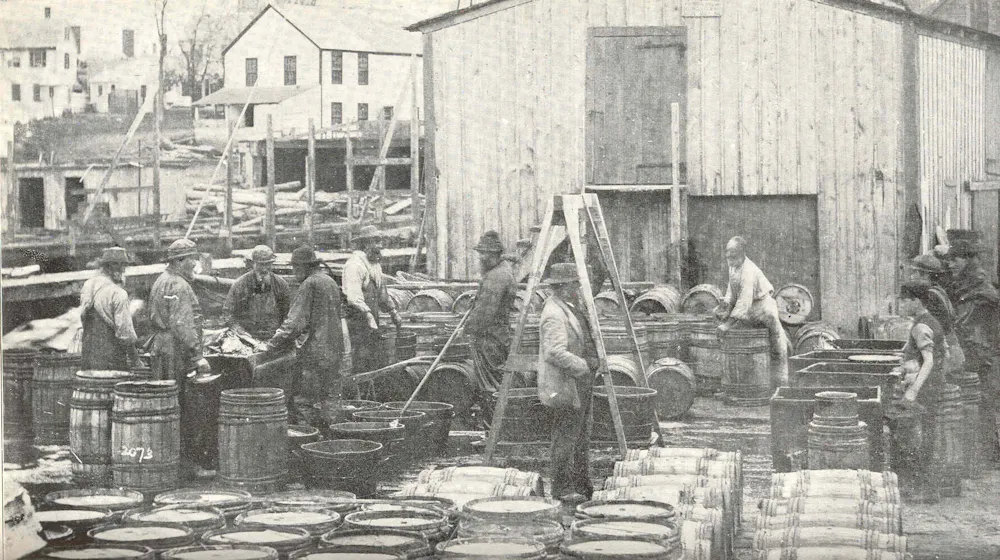
    Fishing has been an integral part of coastal New England culture since its towns were established. In this 1899 photo, a New England community weighs and packs mackerel.
    Charles Stevenson/Freshwater and Marine Image Bank

    Fishing started when the season opened and continued until the catch limit was reached. In some fisheries, this resulted in a “race to the fish” or a “derby,” where vessels competed aggressively to harvest the available catch in short amounts of time. The limit could be reached in a single day, as happened in the Pacific halibut fishery in the late 1980s.

    By the 1990s, however, open access systems were coming under increased criticism from economists as concerns about overfishing rose.

    The fish catch peaked in New England in 1987 and would remain far above what the fish population could sustain for two more decades. Years of overfishing led to the collapse of fish stocks, including North Atlantic cod in 1992 and Pacific sardine in 2015.

    As populations declined, managers responded by cutting catch limits to allow more fish to survive and reproduce. Fishing seasons were shortened, as it took less time for the fleets to harvest the allowed catch. It became increasingly hard for fishermen to catch enough fish to earn a living.

    Saving fisheries changed the industry

    In the early 2000s, as these economic and environmental challenges grew, fisheries managers started limiting access. Instead of allowing anyone to fish, only vessels or individuals meeting certain eligibility requirements would have the right to fish.

    The most common method of limiting access in the U.S. is through limited entry permits, initially awarded to individuals or vessels based on previous participation or success in the fishery. Another approach is to assign individual harvest quotas or “catch shares” to permit holders, limiting how much each boat can bring in.

    In 2007, Congress amended the 1976 Magnuson-Stevens Fishery Conservation and Management Act to promote the use of limited access programs in U.S. fisheries.

    Ships in the fleet out of New Bedford, Mass.
    Henry Zbyszynski/Flickr, CC BY

    Today, limited access is common, and there are positive signs that the management change is helping achieve the law’s environmental goal of preventing overfishing. Since 2000, the populations of 50 major fishing stocks have been rebuilt, meaning they have recovered to a level that can once again support fishing.

    I’ve been following the changes as a lawyer focused on ocean and coastal issues, and I see much work still to be done.

    Forty fish stocks are currently being managed under rebuilding plans that limit catch to allow the stock to grow, including Atlantic cod, which has struggled to recover due to a complex combination of factors, including climatic changes.

    The lingering effect on communities today

    While many fish stocks have recovered, the effort came at an economic cost to many individual fishermen. The limited-access Northeast groundfish fishery, which includes Atlantic cod, haddock and flounder, shed nearly 800 crew positions between 2007 and 2015.

    The loss of jobs and revenue from fishing impacts individual family income and relationships, strains other businesses in fishing communities, and affects those communities’ overall identity and resilience, as illustrated by a recent economic snapshot of the Alaska seafood industry.

    When original limited-access permit holders leave the business – for economic, personal or other reasons – their permits are either terminated or sold to other eligible permit holders, leading to fewer active vessels in the fleet. As a result, the number of vessels fishing for groundfish has declined from 719 in 2007 to 194 in 2023, meaning fewer jobs.

    A fisherman unloads a portion of his catch for the day of 300 pounds of groundfish, including flounder, in January 2006 in Gloucester, Mass.
    AP Photo/Lisa Poole

    Because of their scarcity, limited-access permits can cost upward of US$500,000, which is often beyond the financial means of a small businesses or a young person seeking to enter the industry. The high prices may also lead retiring fishermen to sell their permits, as opposed to passing them along with the vessels to the next generation.

    These economic forces have significantly altered the fishing industry, leading to more corporate and investor ownership, rather than the family-owned operations that were more common in the Andrea Gail’s time.

    Similar to the experience of small family farms, fishing captains and crews are being pushed into corporate arrangements that reduce their autonomy and revenues.

    Consolidation can threaten the future of entire fleets, as New Bedford, Massachusetts, saw when Blue Harvest Fisheries, backed by a private equity firm, bought up vessels and other assets and then declared bankruptcy a few years later, leaving a smaller fleet and some local business and fishermen unpaid for their work. A company with local connections bought eight vessels from Blue Harvest along with 48 state and federal permits the company held.

    New challenges and unchanging risks

    While there are signs of recovery for New England’s fisheries, challenges continue.

    Warming water temperatures have shifted the distribution of some species, affecting where and when fish are harvested. For example, lobsters have moved north toward Canada. When vessels need to travel farther to find fish, that increases fuel and supply costs and time away from home.

    Fisheries managers will need to continue to adapt to keep New England’s fisheries healthy and productive.

    One thing that, unfortunately, hasn’t changed is the dangerous nature of the occupation. Between 2000 and 2019, 414 fishermen died in 245 disasters.

    Stephanie Otts receives funding from the NOAA National Sea Grant College Program through the U.S. Department of Commerce. Previous support for fisheries management legal research provided by The Nature Conservancy.

    – ref. Checking in on New England fisheries 25 Years after ‘The Perfect Storm’ movie – https://theconversation.com/checking-in-on-new-england-fisheries-25-years-after-the-perfect-storm-movie-255076

    MIL OSI Analysis –

    June 26, 2025
  • MIL-OSI Analysis: Checking in on New England fisheries 25 Years after ‘The Perfect Storm’ movie

    Source: The Conversation – USA – By Stephanie Otts, Director of National Sea Grant Law Center, University of Mississippi

    Filming ‘The Perfect Storm’ in Gloucester Harbor, Mass.
    The Salem News Historic Photograph Collection, Salem State University Archives and Special Collections, CC BY

    Twenty-five years ago, “The Perfect Storm” roared into movie theaters. The disaster flick, starring George Clooney and Mark Wahlberg, was a riveting, fictionalized account of commercial swordfishing in New England and a crew who went down in a violent storm.

    The anniversary of the film’s release, on June 30, 2000, provides an opportunity to reflect on the real-life changes to New England’s commercial fishing industry.

    Fishing was once more open to all

    In the true story behind the movie, six men lost their lives in late October 1991 when the commercial swordfishing vessel Andrea Gail disappeared in a fierce storm in the North Atlantic as it was headed home to Gloucester, Massachusetts.

    At the time, and until very recently, almost all commercial fisheries were open access, meaning there were no restrictions on who could fish.

    There were permit requirements and regulations about where, when and how you could fish, but anyone with the means to purchase a boat and associated permits, gear, bait and fuel could enter the fishery. Eight regional councils established under a 1976 federal law to manage fisheries around the U.S. determined how many fish could be harvested prior to the start of each fishing season.

    Fishing has been an integral part of coastal New England culture since its towns were established. In this 1899 photo, a New England community weighs and packs mackerel.
    Charles Stevenson/Freshwater and Marine Image Bank

    Fishing started when the season opened and continued until the catch limit was reached. In some fisheries, this resulted in a “race to the fish” or a “derby,” where vessels competed aggressively to harvest the available catch in short amounts of time. The limit could be reached in a single day, as happened in the Pacific halibut fishery in the late 1980s.

    By the 1990s, however, open access systems were coming under increased criticism from economists as concerns about overfishing rose.

    The fish catch peaked in New England in 1987 and would remain far above what the fish population could sustain for two more decades. Years of overfishing led to the collapse of fish stocks, including North Atlantic cod in 1992 and Pacific sardine in 2015.

    As populations declined, managers responded by cutting catch limits to allow more fish to survive and reproduce. Fishing seasons were shortened, as it took less time for the fleets to harvest the allowed catch. It became increasingly hard for fishermen to catch enough fish to earn a living.

    Saving fisheries changed the industry

    In the early 2000s, as these economic and environmental challenges grew, fisheries managers started limiting access. Instead of allowing anyone to fish, only vessels or individuals meeting certain eligibility requirements would have the right to fish.

    The most common method of limiting access in the U.S. is through limited entry permits, initially awarded to individuals or vessels based on previous participation or success in the fishery. Another approach is to assign individual harvest quotas or “catch shares” to permit holders, limiting how much each boat can bring in.

    In 2007, Congress amended the 1976 Magnuson-Stevens Fishery Conservation and Management Act to promote the use of limited access programs in U.S. fisheries.

    Ships in the fleet out of New Bedford, Mass.
    Henry Zbyszynski/Flickr, CC BY

    Today, limited access is common, and there are positive signs that the management change is helping achieve the law’s environmental goal of preventing overfishing. Since 2000, the populations of 50 major fishing stocks have been rebuilt, meaning they have recovered to a level that can once again support fishing.

    I’ve been following the changes as a lawyer focused on ocean and coastal issues, and I see much work still to be done.

    Forty fish stocks are currently being managed under rebuilding plans that limit catch to allow the stock to grow, including Atlantic cod, which has struggled to recover due to a complex combination of factors, including climatic changes.

    The lingering effect on communities today

    While many fish stocks have recovered, the effort came at an economic cost to many individual fishermen. The limited-access Northeast groundfish fishery, which includes Atlantic cod, haddock and flounder, shed nearly 800 crew positions between 2007 and 2015.

    The loss of jobs and revenue from fishing impacts individual family income and relationships, strains other businesses in fishing communities, and affects those communities’ overall identity and resilience, as illustrated by a recent economic snapshot of the Alaska seafood industry.

    When original limited-access permit holders leave the business – for economic, personal or other reasons – their permits are either terminated or sold to other eligible permit holders, leading to fewer active vessels in the fleet. As a result, the number of vessels fishing for groundfish has declined from 719 in 2007 to 194 in 2023, meaning fewer jobs.

    A fisherman unloads a portion of his catch for the day of 300 pounds of groundfish, including flounder, in January 2006 in Gloucester, Mass.
    AP Photo/Lisa Poole

    Because of their scarcity, limited-access permits can cost upward of US$500,000, which is often beyond the financial means of a small businesses or a young person seeking to enter the industry. The high prices may also lead retiring fishermen to sell their permits, as opposed to passing them along with the vessels to the next generation.

    These economic forces have significantly altered the fishing industry, leading to more corporate and investor ownership, rather than the family-owned operations that were more common in the Andrea Gail’s time.

    Similar to the experience of small family farms, fishing captains and crews are being pushed into corporate arrangements that reduce their autonomy and revenues.

    Consolidation can threaten the future of entire fleets, as New Bedford, Massachusetts, saw when Blue Harvest Fisheries, backed by a private equity firm, bought up vessels and other assets and then declared bankruptcy a few years later, leaving a smaller fleet and some local business and fishermen unpaid for their work. A company with local connections bought eight vessels from Blue Harvest along with 48 state and federal permits the company held.

    New challenges and unchanging risks

    While there are signs of recovery for New England’s fisheries, challenges continue.

    Warming water temperatures have shifted the distribution of some species, affecting where and when fish are harvested. For example, lobsters have moved north toward Canada. When vessels need to travel farther to find fish, that increases fuel and supply costs and time away from home.

    Fisheries managers will need to continue to adapt to keep New England’s fisheries healthy and productive.

    One thing that, unfortunately, hasn’t changed is the dangerous nature of the occupation. Between 2000 and 2019, 414 fishermen died in 245 disasters.

    Stephanie Otts receives funding from the NOAA National Sea Grant College Program through the U.S. Department of Commerce. Previous support for fisheries management legal research provided by The Nature Conservancy.

    – ref. Checking in on New England fisheries 25 Years after ‘The Perfect Storm’ movie – https://theconversation.com/checking-in-on-new-england-fisheries-25-years-after-the-perfect-storm-movie-255076

    MIL OSI Analysis –

    June 26, 2025
  • MIL-OSI USA: Chairman Capito Releases Updated EPW Budget Reconciliation Text

    US Senate News:

    Source: United States Senator for West Virginia Shelley Moore Capito

    WASHINGTON, D.C. – Today, U.S. Senator Shelley Moore Capito (R-W.Va.), Chairman of the Senate Environment and Public Works (EPW) Committee, released updated legislative text within the EPW Committee’s jurisdiction to be considered as part of Senate Republicans’ budget reconciliation bill.

    “Our budget reconciliation title through the EPW Committee accomplishes what we pledged to do – stop Democrats’ natural gas tax and rescind unobligated dollars from the so-called Inflation Reduction Act, as well as a full repeal of the wasteful Greenhouse Gas Reduction Fund. Senate Republicans continue to move towards passage of this package that will help enact President Trump’s agenda,” Chairman Capito said.

    • Click HERE to view text.
    • Click HERE to view a section-by-section.
    • Click HERE to view a one-pager.

    MIL OSI USA News –

    June 26, 2025
  • MIL-OSI USA: New Jersey CPA Pleads Guilty to Conspiring with Others to Defraud the United States

    Source: US State of California

    Defendant Promoted Fraudulent Syndicated Conservation Easement Tax Shelters to Clients

    A New Jersey Certified Public Accountant (CPA) pleaded guilty yesterday to conspiring to defraud the United States by promoting fraudulent tax shelters to his high-income clients.

    According to court documents and statements made in court, between 2018 and 2019, Ofer Gabbay, a CPA, of Paramus, New Jersey, conspired with others, including Jack Fisher, James Sinnott, and their assistant Kate Joy to promote fraudulent syndicated conservation easement tax shelters to their clients. These tax shelters facilitated high-income taxpayers in claiming unwarranted and inflated charitable contribution tax deductions in connection with the donation of a conservation easement over land. To carry out the scheme, Gabbay and others instructed clients to provide backdated checks, agreements and other documents to support the unwarranted tax deductions. Gabbay then prepared false tax returns for his participating clients.

    Fisher and Sinnott were sentenced to 25 year and 23 years in prison, respectively, for their roles in the scheme. Joy remains a fugitive.

    Gabbay faces a maximum penalty of five years in prison. He also faces a period of supervised release, restitution and monetary penalties. A federal district court judge will determine any sentence after considering the U.S. Sentencing Guidelines and other statutory factors.

    Acting Deputy Assistant Attorney General Karen E. Kelly of the Justice Department’s Tax Division made the announcement.

    IRS Criminal Investigation is investigating the case.

    Senior Litigation Counsel Richard Rolwing and Trial Attorney Parker Tobin of the Tax Division are prosecuting the case.

    MIL OSI USA News –

    June 26, 2025
  • MIL-OSI Security: New Jersey CPA Pleads Guilty to Conspiring with Others to Defraud the United States

    Source: United States Attorneys General

    Defendant Promoted Fraudulent Syndicated Conservation Easement Tax Shelters to Clients

    A New Jersey Certified Public Accountant (CPA) pleaded guilty yesterday to conspiring to defraud the United States by promoting fraudulent tax shelters to his high-income clients.

    According to court documents and statements made in court, between 2018 and 2019, Ofer Gabbay, a CPA, of Paramus, New Jersey, conspired with others, including Jack Fisher, James Sinnott, and their assistant Kate Joy to promote fraudulent syndicated conservation easement tax shelters to their clients. These tax shelters facilitated high-income taxpayers in claiming unwarranted and inflated charitable contribution tax deductions in connection with the donation of a conservation easement over land. To carry out the scheme, Gabbay and others instructed clients to provide backdated checks, agreements and other documents to support the unwarranted tax deductions. Gabbay then prepared false tax returns for his participating clients.

    Fisher and Sinnott were sentenced to 25 year and 23 years in prison, respectively, for their roles in the scheme. Joy remains a fugitive.

    Gabbay faces a maximum penalty of five years in prison. He also faces a period of supervised release, restitution and monetary penalties. A federal district court judge will determine any sentence after considering the U.S. Sentencing Guidelines and other statutory factors.

    Acting Deputy Assistant Attorney General Karen E. Kelly of the Justice Department’s Tax Division made the announcement.

    IRS Criminal Investigation is investigating the case.

    Senior Litigation Counsel Richard Rolwing and Trial Attorney Parker Tobin of the Tax Division are prosecuting the case.

    MIL Security OSI –

    June 26, 2025
  • MIL-OSI Security: New Jersey CPA Pleads Guilty to Conspiring with Others to Defraud the United States

    Source: United States Attorneys General

    Defendant Promoted Fraudulent Syndicated Conservation Easement Tax Shelters to Clients

    A New Jersey Certified Public Accountant (CPA) pleaded guilty yesterday to conspiring to defraud the United States by promoting fraudulent tax shelters to his high-income clients.

    According to court documents and statements made in court, between 2018 and 2019, Ofer Gabbay, a CPA, of Paramus, New Jersey, conspired with others, including Jack Fisher, James Sinnott, and their assistant Kate Joy to promote fraudulent syndicated conservation easement tax shelters to their clients. These tax shelters facilitated high-income taxpayers in claiming unwarranted and inflated charitable contribution tax deductions in connection with the donation of a conservation easement over land. To carry out the scheme, Gabbay and others instructed clients to provide backdated checks, agreements and other documents to support the unwarranted tax deductions. Gabbay then prepared false tax returns for his participating clients.

    Fisher and Sinnott were sentenced to 25 year and 23 years in prison, respectively, for their roles in the scheme. Joy remains a fugitive.

    Gabbay faces a maximum penalty of five years in prison. He also faces a period of supervised release, restitution and monetary penalties. A federal district court judge will determine any sentence after considering the U.S. Sentencing Guidelines and other statutory factors.

    Acting Deputy Assistant Attorney General Karen E. Kelly of the Justice Department’s Tax Division made the announcement.

    IRS Criminal Investigation is investigating the case.

    Senior Litigation Counsel Richard Rolwing and Trial Attorney Parker Tobin of the Tax Division are prosecuting the case.

    MIL Security OSI –

    June 26, 2025
  • MIL-OSI: Alectra Inc. recognized by Corporate Knights as one of Canada’s Best 50 Corporate Citizens for 2025

    Source: GlobeNewswire (MIL-OSI)

    MISSISSAUGA, Ontario, June 25, 2025 (GLOBE NEWSWIRE) — Alectra Inc. is ranked among Canada’s Best 50 Corporate Citizens for 2025 by Corporate Knights, marking its seventh consecutive year on the list. Alectra placed second among transmission and distribution utilities and 11th overall in the annual ranking.

    The Best 50 Corporate Citizens list evaluates companies across up to 25 ESG indicators—ranging from carbon emissions and clean revenue to diversity and governance.

    “Being named one of Canada’s Best 50 Corporate Citizens for the seventh year in a row is an incredible honour,” said Brian Bentz, President and Chief Executive Officer, Alectra Inc. “This recognition affirms Alectra’s ongoing commitment to making a measurable, positive contribution to the environment, our customers, and the communities we serve.”

    On June 13, Alectra released its Environmental, Social, and Governance report titled “Discovering the Possibilities”, showcasing significant progress toward its long-term sustainability goals while continuing to deliver reliable, affordable energy services to more than one million homes and businesses across Ontario.

    Key achievements include:

    • GHG Emissions Reduction: achieved a 21.1 per cent reduction in greenhouse gas emissions compared to 2023.
    • Grid Modernization: Invested $460 million in grid renewal and replacement projects to modernize the electricity grid.
    • Community Investments: Allocated $1.39 million through the AlectraCARES Community Support Program, supporting over 150 local health, housing and food security initiatives.

    For more information on the full methodology behind the Best 50 Corporate Citizens ranking, please visit https://www.corporateknights.com/issues/2025-06-best-50-issue/these-50-canadian-corporations-are-carving-out-a-more-sustainable-future/.

    For information on Alectra’s commitment to sustainability visit Alectra’s 2024 Sustainability Report here: alectra.com/annual-sustainability-report.

    About Alectra’s Family of Companies

    Serving more than one million homes and businesses in Ontario’s Greater Golden Horseshoe area, Alectra Utilities is now the largest municipally-owned electric utility in Canada, based on the total number of customers served. We contribute to the economic growth and vibrancy of the 17 communities we serve by investing in essential energy infrastructure, delivering a safe and reliable supply of electricity, and providing innovative energy solutions.

    Our mission is to be an energy ally, helping our customers and the communities we serve to discover the possibilities of tomorrow’s energy future.

    X: https://twitter.com/alectranews

    Facebook: https://www.facebook.com/alectranews/

    Instagram: https://www.instagram.com/alectranews/?hl=en

    LinkedIn: https://www.linkedin.com/company/16178435/admin/

    Bluesky: https://bsky.app/profile/alectranews.bsky.social

    YouTube: https://www.youtube.com/alectranews

    Media Contact

    Ashley Trgachef, Media Spokesperson ashley.trgachef@alectrautilities.com |
    Telephone: 416.402.5469 | 24/7 Media Line: 1-833-MEDIA-LN

    A photo accompanying this announcement is available at https://www.globenewswire.com/NewsRoom/AttachmentNg/d05ed8e2-7d95-47b5-8b5b-afc27918e4d3

    The MIL Network –

    June 26, 2025
  • MIL-OSI USA: PRESS RELEASE: Barragán, Jayapal, and Booker Reintroduce Legislation to Eliminate Barriers to Health Care for Immigrants

    Source: United States House of Representatives – Representative Nanette Diaz Barragán (CA-44)

    FOR IMMEDIATE RELEASE
    June 24, 2025

    Contact: Jin.Choi@mail.house.gov

    Barragán, Jayapal, and Booker Reintroduce Legislation to Eliminate Barriers to Health Care for Immigrants

    WASHINGTON, DC — U.S. Representative Nanette Barragán (CA-44), along with Representative Pramila Jayapal (WA-07), Ranking Member of the Immigration Integrity, Security, and Enforcement Subcommittee and Senator Cory Booker (D-NJ) today introduced the Health Equity and Access under Law (HEAL) for Immigrant Families Act. This bicameral bill, co-sponsored by 55 members of Congress and endorsed by more than 100 organizations, removes unnecessary and cruel barriers to health care for millions of immigrants of all statuses.

    Immigrants in the United States are far more likely to be uninsured than U.S. citizens. In 2023, half of all undocumented immigrant adults and one in five lawfully present immigrant adults were uninsured. Just 6 percent of naturalized citizen adults and 8 percent of U.S.-born citizens are uninsured.

    “Access to healthcare shouldn’t depend on your immigration status,” said Representative Barragán. “Healthcare is a basic human right, and it’s time we break down the needless barriers that keep immigrant families from the care they need to survive and thrive. The HEAL Act is a step toward addressing racial health disparities and expanding quality healthcare to everyone in our communities.”

    “Health care is a human right that must be accessible to everyone — regardless of immigration status,” said Representative Jayapal. “As a proud immigrant myself, I know that the HEAL Act is a necessary first step to allow more people across America to access the health care they need to live, making all of our communities healthier. As Republicans in Congress work to strip health coverage away from millions of Americans and further decimate our already broken immigration system, we’re working to ensure everyone in this country is able to see a doctor when they need it.”

    “Everyone deserves access to comprehensive, affordable, quality care, and the HEAL Act lifts unnecessary barriers to medical care for immigrants,” said Senator Booker. “A more equitable health care system will help create healthier communities and ensure that all families, regardless of immigration status, have access to the care they need.” 

    “Withholding health care from immigrants is cruel and doesn’t make our communities safer or healthier,” said Senator Warren. “While the Trump administration continues playing political games with immigrant families, Democrats are fighting to make sure a person’s immigration status doesn’t prevent them from getting life-saving care.”

    “As the Trump Administration guts access to health care and basic services for immigrant communities, breaking down barriers to health care for immigrants isn’t just the right thing to do — it’s critical for protecting our public health and economy,” said Senator Padilla. “California is the fourth-largest economy in the world not despite immigrants, but because of their contributions to our workforce. Everyone deserves access to affordable, quality health care no matter their immigration status, and I will keep fighting to continue expanding coverage for these hardworking members of our communities.”

    The HEAL for Immigrant Families Act will:

    • Restore Medicaid and Children’s Health Insurance Program (CHIP) eligibility to lawfully present immigrants;
    • Remove discriminatory Medicare restrictions based on length of U.S. residency for green card holders;
    • End the exclusion of undocumented immigrants from Affordable Care Act (ACA) marketplaces
    • Ensure access to public and affordable coverage for Deferred Action Childhood Arrivals (DACA) recipients;
    • Create a state option to expand Medicaid and CHIP to immigrants regardless of immigration status.

    “Rep. Jayapal and Sen. Booker continue to be courageous and powerful champions for immigrant communities by reintroducing the HEAL for Immigrant Families Act,” said Lupe M. Rodríguez, executive director, National Latina Institute for Reproductive Justice. “While immigrant families are currently being attacked and torn apart, this bill promotes a vision for what we want for our collective future. A future that supports immigrant communities by removing long standing systemic barriers to health coverage to help our communities access affordable health care. We are especially grateful that Sen. Booker and Rep. Jayapal are introducing this critical legislation today as we mark three years since the Dobbs v. Jackson Women’s Health Organization decision that overturned the constitutional right to abortion. That decision has disproportionately harmed immigrant communities, for whom abortion bans, misinformation, and the threat of being detained and separated from our families has increased the barriers that keep us from getting the health care we need,” said Lupe M. Rodríguez, Executive Director, National Latina Institute for Reproductive Justice. “We urge Congress to protect immigrant communities and pass this bill.”

    “The reproductive justice movement teaches us that true justice means being able to have children, not have children, and raise our families in safe, supportive communities,” said Sung Yeon Choimorrow, executive director, National Asian Pacific American Women’s Forum (NAPAWF). “None of that is possible without health care. In a country that has always been shaped by immigrants, we cannot keep allowing people and families, including the Asian American immigrants who make up more than a quarter of immigrants in the U.S., to be shut out from basic health care because of harmful, outdated policies. These are our mothers, our sisters, and our neighbors. The HEAL Act tears down the barriers facing our communities and reaffirms that everyone deserves the right to care, regardless of background, income, or immigration status.”

    “Everyone deserves access to health care, no matter who they are or where they come from,” said Alexis McGill Johnson, president and CEO, Planned Parenthood Action Fund. “It is unacceptable and cruel that many are denied affordable, high-quality, and comprehensive health care because of their immigration status. Amid the ongoing attacks on our immigrant communities and our health care, I thank Reps. Jayapal and Barragán and Senator Booker for reintroducing this critical bill that would break down unjust barriers to care for our immigrant families.”

    “As a physician, I’ve witnessed the barriers immigrant families face when trying to access health care. Insurance coverage is a cornerstone of meaningful access; without it, care remains out of reach for too many,” said Dr. Jamila Perritt, MD, MPH, FACOG, President and CEO, Physicians for Reproductive Health. “At a time when attacks on immigrant communities are escalating, we must act now to ensure that everyone—regardless of status—has the right to timely, compassionate, and comprehensive health care. That’s why I join physicians across the country in calling for a swift passage of the HEAL Act. Expanding health coverage to immigrant communities ensures they receive the care they deserve, regardless of their immigration status. Health is a human right and no one should be excluded from receiving healthcare. Congress must pass HEAL – our patients are counting on it.”

    “With immigrant families under constant attack, it’s more important than ever to work toward a better, more inclusive future when everyone can get the care we all need,” said Adriana Cadena, campaign director, Protecting Immigrant Families Coalition. “We are proud to champion the HEAL Act – a critical step toward that better future.” 

    “Now more than ever, it is critical to affirm that everyone—including immigrants—should have access to health care coverage,” said Wendy Cervantes, Director, Immigration and Immigrant Families, CLASP. “Immigrants already face many restrictions to such care and an onslaught of attacks on them and their families’ health and well-being, ranging from the fear created by the Administration’s mass deportation efforts to the deeply harmful budget reconciliation bill currently under consideration. The HEAL for Immigrant Families Act is a critical step in moving us back in the right direction by giving children and families access to the health care they need to thrive. CLASP is grateful to Representative Jayapal and Senator Booker for their leadership in promoting a vision that supports health care for all.”

    The legislation is also co-sponsored by U.S. Representatives Becca Balint (VT-AL), Donald S. Beyer, Jr. (VA-08), Suzanne Bonamici (OR-01), Salud Carbajal (CA-24), André Carson (IN-07), Troy Carter (LA-02), Greg Casar (TX-35), Kathy Castor (FL-14), Joaquin Castro (TX-20), Sheila Cherfilus-McCormick (FL-20), Judy Chu (CA-28), Jasmine Crockett (TX-30), Suzan DelBene (WA-01), Maxine Dexter (OR-03), Lloyd Doggett (TX-37), Adriano Espaillat (NY-13), Maxwell Frost (FL-10), Jesús “Chuy” García (IL-04), Robert Garcia (CA-42), Sylvia Garcia (TX-29), Jimmy Gomez (CA-34), Jared Huffman (CA-02), Jonathan L. Jackson (IL-01), Sara Jacobs (CA-51), Henry C. “Hank” Johnson, Jr. (GA-04), Ro Khanna (CA-17), Raja Krishnamoorthi (IL-08), Teresa Leger Fernández (NM-03), Ted Lieu (CA-36), Jennifer McClellan (VA-04), James P. McGovern (MA-02), Gwen Moore (WI-04), Jerry Nadler (NY-12), Eleanor Holmes Norton (DC), Ilhan Omar (MN-05), Jimmy Panetta (CA-19), Mark Pocan (WI-02), Ayanna Pressley (MA-07), Delia Ramirez (IL-03), Andrea Salinas (OR-06), Jan Schakowsky (IL-09), Terri Sewell (AL-07), Lateefah Simon (CA-12), Melanie Stansbury (NM-01), Marilyn Strickland (WA-10), Shri Thanedar (MI-13), Rashida Tlaib (MI-12), Juan Vargas (CA-52), Nydia M. Velázquez (NY-07), Debbie Wasserman Schultz (FL-25), Bonnie Watson Coleman (NJ-12), Nikema Williams (GA-05), and Frederica S. Wilson (FL-24), and U.S. Senators Martin Heinrich (D-NM), Elizabeth Warren (D-MA), Alex Padilla (D-CA), Patty Murray (D-WA), Mazie Hirono (D-HI), Bernie Sanders (I-VT), Edward Markey (D-MA), and Richard Blumenthal (D-CT).

    The legislation is endorsed by AAPI Equity Alliance; AAPI NJ; Advocates for Youth; AFL-CIO; Alianza Nacional de Campesinas; All* Above All; Alliance of Filipinos for Immigrant Rights and Empowerment; American Civil Liberties Union (ACLU); American College of Obstetricians and Gynecologists; American Muslim Health Professionals (AMHP); Amica Center for Immigrant Rights; Arkansas Black Gay Men’s Forum; Asian & Pacific Islander American Health Forum (APIAHF); Asian American Federation of Florida; Asian Americans United (AAU); Asian Caribbean Exchange; Asian Pacific Institute on Gender-Based Violence; Asian Pacific Islanders Civic Action Network, Massachusetts; Asian Texans for Justice Action Fund; ASISTA; Association of Asian Pacific Community Health Organizations; Autistic Women & Nonbinary Network; Ayuda; CA LGBTQ Health and Human Services Network; California Partnership to End Domestic Violence; CASA; Catholics for Choice; Center for Gender & Refugee Studies; Center for Human Rights and Constitutional Law; Center for Law and Social Policy (CLASP); Center for Reproductive Rights; Center for Victims of Torture; Children’s HealthWatch; Cleveland Jobs with Justice; Coalition for Humane Immigrant Rights (CHIRLA); Coalition on Human Needs; Coalition to Abolish Slavery and Trafficking; Community Catalyst; Doctors for America ; End SIJS Backlog Coalition; Equality California; Esperanza United; First Focus Campaign for Children; Florida Asian Services ; Freedom Network USA; Georgia Conservation Voters; Global Refugee Awareness Healing Center; Global Urban Cultural Community; Guttmacher Institute; Haven Services Inc. dba Haven Neighborhood Servic; Health Action New Mexico; Healthy Teen Network; Her Justice ; Hispanic Federation; Ibis Reproductive Health; ICAH (Illinois Caucus for Adolescent Health); Immigrant Legal Resource Center; Immigrant Welcome Network Johnson County; Immigration Institute of the Bay Area; In Our Own Voice: National Black Women’s Reproductive Justice Agenda ; Inclusive Counseling; Indivisible; Institute for Women’s Policy Research; Ipas US; Jacobs Institute of Women’s Health; Justice for Migrant Women; Justice in Aging; KAN-WIN; Kids in Need of Defense (KIND); Labor Council for Latin American Advancement (LCLAA); Laotian American National Alliance (LANA); Latino; Legal Voice; Maine Equal Justice; MANA, A National Latina Organization; Midwest Access Coalition; Moonbow; National Abortion Federation; National Asian American Pacific Islander Mental Health Association (NAAPIMHA); National Asian Pacific American Women’s Forum (NAPAWF); National Association of Nurse Practitioners in Women’s Health; National Council of Jewish Women; National Employment Law Project; National Family Planning & Reproductive Health Association; National Health Care for the Homeless Council; National Health Law Program; National Immigration Law Center; National Korean American Service and Education Consortium; National Latina Institute for Reproductive Justice; National Network of Abortion Funds; National Network To End Domestic Violence ; National Organization for Women ; National Partnership for New Americans; National Partnership for Women & Families; National Queer Asian Pacific Islander Alliance; National Women’s Law Center Action Fund; NIRH Action Fund; NIWAP, Inc.; Northwest Health Law Advocates (NoHLA); Oasis Legal Services; OCA South Florida Chapter; Our Justice; Oxfam America; People Power United; Physicians for Reproductive Health; Planned Parenthood Federation of America; Plascencia Consulting; Population Connection Action Fund; Positive Women’s Network-USA; Power to Decide; PowHerNY; Prevention Institute; Protecting Immigrant Families; QASPIRA Association; Religious Community for Reproductive Choice; Reproductive Freedom For All; Reproductive Health Access Project; Reproductive Justice Action Collective (ReJAC); Sadhana: Coalition of Progressive Hindus; Sarin Gal; Shriver Center on Poverty Law; SIECUS: Sex Ed for Social Change; Sikh American Legal Defense and Education Fund (SALDEF); SiX Action; South Asian Public Health Association (SAPHA); South Asian SOAR; State Voices Florida; Survivor Justice Center; The Children’s Partnership; The National Association of Nurse Practitioners in Women’s Health (NPWH); The TransLatin@ Coalition; UCSF Bixby Center for Global Reproductive Health; UnidosUS; Union for Reform Judaism; United Parent Leaders Action Network; URGE: Unite for Reproductive & Gender Equity; Voices for Utah Children; Women of Reform Judaism; Women’s Law Project; Women’s Refugee Commission.

    ###

    MIL OSI USA News –

    June 26, 2025
  • MIL-OSI Global: Checking in on New England fisheries 25 Years after ‘The Perfect Storm’ hit movie theaters

    Source: The Conversation – USA – By Stephanie Otts, Director of National Sea Grant Law Center, University of Mississippi

    Filming ‘The Perfect Storm’ in Gloucester Harbor, Mass.
    The Salem News Historic Photograph Collection, Salem State University Archives and Special Collections, CC BY

    Twenty-five years ago, “The Perfect Storm” roared into movie theaters. The disaster flick, starring George Clooney and Mark Wahlberg, was a riveting, fictionalized account of commercial swordfishing in New England and a crew who went down in a violent storm.

    The anniversary of the film’s release, on June 30, 2000, provides an opportunity to reflect on the real-life changes to New England’s commercial fishing industry.

    Fishing was once more open to all

    In the true story behind the movie, six men lost their lives in late October 1991 when the commercial swordfishing vessel Andrea Gail disappeared in a fierce storm in the North Atlantic as it was headed home to Gloucester, Massachusetts.

    At the time, and until very recently, almost all commercial fisheries were open access, meaning there were no restrictions on who could fish.

    There were permit requirements and regulations about where, when and how you could fish, but anyone with the means to purchase a boat and associated permits, gear, bait and fuel could enter the fishery. Eight regional councils established under a 1976 federal law to manage fisheries around the U.S. determined how many fish could be harvested prior to the start of each fishing season.

    Fishing has been an integral part of coastal New England culture since its towns were established. In this 1899 photo, a New England community weighs and packs mackerel.
    Charles Stevenson/Freshwater and Marine Image Bank

    Fishing started when the season opened and continued until the catch limit was reached. In some fisheries, this resulted in a “race to the fish” or a “derby,” where vessels competed aggressively to harvest the available catch in short amounts of time. The limit could be reached in a single day, as happened in the Pacific halibut fishery in the late 1980s.

    By the 1990s, however, open access systems were coming under increased criticism from economists as concerns about overfishing rose.

    The fish catch peaked in New England in 1987 and would remain far above what the fish population could sustain for two more decades. Years of overfishing led to the collapse of fish stocks, including North Atlantic cod in 1992 and Pacific sardine in 2015.

    As populations declined, managers responded by cutting catch limits to allow more fish to survive and reproduce. Fishing seasons were shortened, as it took less time for the fleets to harvest the allowed catch. It became increasingly hard for fishermen to catch enough fish to earn a living.

    Saving fisheries changed the industry

    In the early 2000s, as these economic and environmental challenges grew, fisheries managers started limiting access. Instead of allowing anyone to fish, only vessels or individuals meeting certain eligibility requirements would have the right to fish.

    The most common method of limiting access in the U.S. is through limited entry permits, initially awarded to individuals or vessels based on previous participation or success in the fishery. Another approach is to assign individual harvest quotas or “catch shares” to permit holders, limiting how much each boat can bring in.

    In 2007, Congress amended the 1976 Magnuson-Stevens Fishery Conservation and Management Act to promote the use of limited access programs in U.S. fisheries.

    Ships in the fleet out of New Bedford, Mass.
    Henry Zbyszynski/Flickr, CC BY

    Today, limited access is common, and there are positive signs that the management change is helping achieve the law’s environmental goal of preventing overfishing. Since 2000, the populations of 50 major fishing stocks have been rebuilt, meaning they have recovered to a level that can once again support fishing.

    I’ve been following the changes as a lawyer focused on ocean and coastal issues, and I see much work still to be done.

    Forty fish stocks are currently being managed under rebuilding plans that limit catch to allow the stock to grow, including Atlantic cod, which has struggled to recover due to a complex combination of factors, including climatic changes.

    The lingering effect on communities today

    While many fish stocks have recovered, the effort came at an economic cost to many individual fishermen. The limited-access Northeast groundfish fishery, which includes Atlantic cod, haddock and flounder, shed nearly 800 crew positions between 2007 and 2015.

    The loss of jobs and revenue from fishing impacts individual family income and relationships, strains other businesses in fishing communities, and affects those communities’ overall identity and resilience, as illustrated by a recent economic snapshot of the Alaska seafood industry.

    When original limited-access permit holders leave the business – for economic, personal or other reasons – their permits are either terminated or sold to other eligible permit holders, leading to fewer active vessels in the fleet. As a result, the number of vessels fishing for groundfish has declined from 719 in 2007 to 194 in 2023, meaning fewer jobs.

    A fisherman unloads a portion of his catch for the day of 300 pounds of groundfish, including flounder, in January 2006 in Gloucester, Mass.
    AP Photo/Lisa Poole

    Because of their scarcity, limited-access permits can cost upward of US$500,000, which is often beyond the financial means of a small businesses or a young person seeking to enter the industry. The high prices may also lead retiring fishermen to sell their permits, as opposed to passing them along with the vessels to the next generation.

    These economic forces have significantly altered the fishing industry, leading to more corporate and investor ownership, rather than the family-owned operations that were more common in the Andrea Gail’s time.

    Similar to the experience of small family farms, fishing captains and crews are being pushed into corporate arrangements that reduce their autonomy and revenues.

    Consolidation can threaten the future of entire fleets, as New Bedford, Massachusetts, saw when Blue Harvest Fisheries, backed by a private equity firm, bought up vessels and other assets and then declared bankruptcy a few years later, leaving a smaller fleet and some local business and fishermen unpaid for their work. A company with local connections bought eight vessels from Blue Harvest along with 48 state and federal permits the company held.

    New challenges and unchanging risks

    While there are signs of recovery for New England’s fisheries, challenges continue.

    Warming water temperatures have shifted the distribution of some species, affecting where and when fish are harvested. For example, lobsters have moved north toward Canada. When vessels need to travel farther to find fish, that increases fuel and supply costs and time away from home.

    Fisheries managers will need to continue to adapt to keep New England’s fisheries healthy and productive.

    One thing that, unfortunately, hasn’t changed is the dangerous nature of the occupation. Between 2000 and 2019, 414 fishermen died in 245 disasters.

    Stephanie Otts receives funding from the NOAA National Sea Grant College Program through the U.S. Department of Commerce. Previous support for fisheries management legal research provided by The Nature Conservancy.

    – ref. Checking in on New England fisheries 25 Years after ‘The Perfect Storm’ hit movie theaters – https://theconversation.com/checking-in-on-new-england-fisheries-25-years-after-the-perfect-storm-hit-movie-theaters-255076

    MIL OSI – Global Reports –

    June 26, 2025
  • MIL-OSI United Kingdom: Crucial health and wellbeing role of access to green and open spaces recognised

    Source: Scotland – City of Aberdeen

    A new report published today (25 June) highlights the positive impacts of open green and blue spaces on the health and wellbeing  of Aberdonians and visitors.  

    The 2024 Open Space Audit is used to assist in protecting and enhancing green spaces through the planning process and by supporting blue and green infrastructure policies.

    Aberdeen City Councillor Miranda Radley, Communities, Housing and Public Protection committee said: “Aberdeen’s open spaces are essential for our health and wellbeing. 

    “Aberdeen’s Open Space Audit provides key information on the types, quality and accessibility of open and green spaces in the city that are critical to directing greenspace policies, management of spaces, and the interventions of partners, the community and other organisations.”

    The audit covers various types of open spaces, including parks, gardens, playing fields, woodlands, play areas, allotments, and civic spaces. These spaces are managed by various stakeholders, including Aberdeen City Council, community groups, volunteers, businesses and partners.

    By providing information on information on the types, quality and accessibility of  publicly accessible open green spaces, the audit plays a key role in directing the policies and management and the interventions of communities and other Council partners in shaping those spaces for the benefit of users.

    Together, these help to deliver the outcomes set out in the Net Zero Aberdeen Natural Environment Strategy, Aberdeen Adapts, Council Climate Change Plan, Aberdeen Local Outcome Improvement Plan 2016-2026, and the Scottish Biodiversity Strategy.

    Open spaces improve quality of life by giving citizens opportunities to connect with nature and people, tackle the global climate-nature crisis, promote nature recovery, and make positive environmental changes.  

    Key findings include: 
    •    82% of respondents said they would like to see more greenspaces managed in a more natural way for the benefit of wildlife and nature  
    •    79% of respondents were satisfied with the overall quality of open spaces, with parks and woodlands receiving the highest satisfaction 
    •    Survey respondents highlighted the critical role that green spaces play in promoting overall health and well-being, with physical exercise or health reasons, to be in nature and to socialise given as the top three reasons why people use open spaces 
    •    Open space quality indicators showed that accessibility and attractive and appealing place categories scored the highest 

    The audit also provides insights into access to open space, with approximately 63% of households within 1,500m of a major open space, 45% within 400m of a natural greenspace over 2 hectares and 75% within 710m of a public park or garden. 
    Additionally, the report assesses the quality of open spaces, through accessibility, attractive and appealing place, health, community value and biodiversity quality indicators.

    The findings, Audit Mapping, and Audit Data Dashboard are publicly available for use by everyone with an interest in helping to drive positive environmental changes, identify projects and secure funding for environmental improvements at site, community, and city-wide levels.

    The Audit is a snapshot in time and how spaces are used and their quality can change over time. However periodic updates to the Audit mapping will be made. 
    The Audit findings, mapping and Data Dashboard can be viewed on the Open Space webpage Aberdeen Open Space Audit 2024
     

    MIL OSI United Kingdom –

    June 26, 2025
  • MIL-OSI Global: How high-latitude peat and forest fires could shape the future of Earth’s climate

    Source: The Conversation – France – By Apostolos Voulgarakis, AXA Chair in Wildfires and Climate Director, Laboratory of Atmospheric Environment & Climate Change, Technical University of Crete

    Understanding how wildfires influence our planet’s climate is a daunting challenge. Although fire occurs nearly everywhere on Earth and has always been present, it is still one of the least understood components of the Earth system. Recently, unprecedented fire activity has been observed in boreal (northern) and Arctic regions, which has drawn the scientific community’s attention to areas whose role in the future of our planet remains a mystery. Climate change likely has a major role in this alarming trend. However, high-latitude wildfires are not just a symptom of climate change; they are an accelerating force that could shape the future of our climate in ways that we are currently incapable of predicting.


    A weekly e-mail in English featuring expertise from scholars and researchers. It provides an introduction to the diversity of research coming out of the continent and considers some of the key issues facing European countries. Get the newsletter!


    The rising threat of northern fires

    As global temperatures rise, wildfires are advancing further north and reaching into the Arctic. Canada, Alaska, Siberia, Scandinavia and even Greenland, all in northern high-latitude regions, have recently experienced some of the most intense and prolonged wildfire seasons on record. With climate change occurring more rapidly in these areas, the future of northern fires appears even grimmer.

    Apart from typical forest fires that consume surface vegetation, many high-latitude fires burn through peat, the dense, carbon-rich layers of partially decayed organic material. Despite covering only 3% of the terrestrial surface, peatlands are one of the world’s most important carbon storage environments, containing around 25% of the carbon existing in the Earth’s soils.

    Climate warming, which is even faster at high northern latitudes due to polar amplification – the phenomenon of greater climate change near the poles compared to the rest of the hemisphere or globe – is increasing the vulnerability of these ecosystems to fire, with potentially severe implications for the global climate. When peatlands ignite, they release massive amounts of “fossil carbon” that have been locked away for centuries or even millennia. The largest and most persistent fires on Earth, peat fires can smoulder for extended periods, are difficult to extinguish and can continue burning underground throughout the winter, only to reignite on the surface in spring. They have recently been described as “zombie” fires.

    Warmer and drier conditions driven by climate change, apart from making boreal forests more flammable, are expected to intensify and increase the frequency of peat fires, potentially transforming peatlands from carbon sinks into net sources of greenhouse gas emissions. Such a shift could trigger a feedback loop, meaning that a warming climate will cause more carbon emissions, which in turn will accelerate climate change.

    Air pollution and weather patterns

    Wildfires release large quantities of smoke particles (aerosols) into the atmosphere, contributing significantly to both local and widespread air quality degradation. These particles are harmful to human health and can cause serious respiratory and cardiovascular problems, while prolonged exposure may lead to smoke-induced stress, hospitalizations and increased mortality. Wildfires can also cause mental health strains associated with evacuations, loss of homes, livelihoods and lives.


    À lire aussi :
    Wildfire smoke can harm your brain, not just your lungs


    Beyond their long-term effects on climate, wildfire emissions can also influence weather patterns in more short-term ways via their impacts on atmospheric pollution levels. Smoke particles interact with sunlight and cloud formation processes, subsequently affecting temperatures, wind patterns and rainfall.

    For example, our recent study on the large-scale atmospheric impacts of the 2023 Canadian wildfires, which we presented at the European Geosciences Union general assembly this spring, demonstrated that wildfire aerosols led to a surface air temperature decrease that expanded to the entire northern hemisphere. The cooling was particularly pronounced over Canada (up to -5.5°C in August), where the emissions were located, but was also significant over remote areas such as Eastern Europe and even Siberia (up to around -2.5°C in July). The average hemispheric temperature anomaly we calculated (close to -1°C) highlights the potential for large regional emissions from wildfires to perturb weather conditions for weeks across a whole hemisphere, with profound implications for forecasting. Unreliable weather forecasts can disrupt daily activities and pose risks to public safety, especially during extreme events such as heatwaves or storms. They also have serious consequences for industries such as farming, fishing and transport, where planning depends heavily on accurate, timely predictions.

    Peat fires and the climate puzzle

    While incorporating peatland fire feedbacks into Earth System Models (ESMs) is essential for accurate climate projections, most existing models lack a representation of peat fires. Understanding the smouldering behaviour of organic soils when they burn, their ignition probability, and how these processes can be represented at a global scale is of utmost importance. Recent research efforts are focusing on bridging this knowledge gap. For example, at the Technical University of Crete, we are collaborating with the Hazelab research group at Imperial College London and the Leverhulme Centre for Wildfires, Environment and Society to perform field research and cutting-edge experiments) on peat smouldering, with the aim of shedding light on the complex mechanisms of peat fires.

    Integrating these lab results into ESMs will enable game-changing fire emission modelling, which holds potential for groundbreaking outcomes when it comes to our skill level for predicting the future of the Earth’s climate. By quantifying how the present-day atmosphere is influenced by fire emissions from boreal forests and peatlands, we can enhance the quality of projections of global temperature rise. This integration will also sharpen forecasts of regional climate impacts driven by fire-related aerosols, such as changes in rainfall patterns or accelerated Arctic ice melt.

    Tackling the challenge of northern fires

    Undoubtedly, we have entered an era of more frequent megafires – wildfires of extreme size, intensity, duration or impacts – with catastrophic consequences. Recent megafire events at boreal and Arctic regions unveil the dramatic change in wildfire patterns in northern high latitudes, which is a matter that demands urgent attention and action.

    As the planet continues to warm, high-latitude fires are expected to help shape the future of our planet. Massive wildfire events, such as those in Canada in 2023, not only burned millions of hectares but also forced hundreds of thousands of people to evacuate their homes. Unprecedented amounts of smoke blanketed parts of North America in hazardous air, prompting school closures and health warnings, and obliging citizens to remain indoors for days. Events like this reflect a growing trend. They underscore why advancing research to better understand and predict the dynamics of northern peat and forest fires, and to mitigate their climate impacts, is not only a scientific imperative but also a moral responsibility.


    Created in 2007 to help accelerate and share scientific knowledge on key societal issues, the Axa Research Fund has supported nearly 700 projects around the world conducted by researchers in 38 countries. To learn more, visit the website of the Axa Research Fund or follow @AXAResearchFund on X.

    Dimitra Tarasi has received funding from the AXA Chair in Wildfires and Climate, the Leverhulme Centre for Wildfires, Environment and Society and the A.G. Leventis Foundation Educational Grants.

    Apostolos Voulgarakis ne travaille pas, ne conseille pas, ne possède pas de parts, ne reçoit pas de fonds d’une organisation qui pourrait tirer profit de cet article, et n’a déclaré aucune autre affiliation que son organisme de recherche.

    – ref. How high-latitude peat and forest fires could shape the future of Earth’s climate – https://theconversation.com/how-high-latitude-peat-and-forest-fires-could-shape-the-future-of-earths-climate-258721

    MIL OSI – Global Reports –

    June 26, 2025
  • MIL-OSI Global: How high-latitude peat and forest fires could shape the future of Earth’s climate

    Source: The Conversation – France – By Apostolos Voulgarakis, AXA Chair in Wildfires and Climate Director, Laboratory of Atmospheric Environment & Climate Change, Technical University of Crete

    Understanding how wildfires influence our planet’s climate is a daunting challenge. Although fire occurs nearly everywhere on Earth and has always been present, it is still one of the least understood components of the Earth system. Recently, unprecedented fire activity has been observed in boreal (northern) and Arctic regions, which has drawn the scientific community’s attention to areas whose role in the future of our planet remains a mystery. Climate change likely has a major role in this alarming trend. However, high-latitude wildfires are not just a symptom of climate change; they are an accelerating force that could shape the future of our climate in ways that we are currently incapable of predicting.


    A weekly e-mail in English featuring expertise from scholars and researchers. It provides an introduction to the diversity of research coming out of the continent and considers some of the key issues facing European countries. Get the newsletter!


    The rising threat of northern fires

    As global temperatures rise, wildfires are advancing further north and reaching into the Arctic. Canada, Alaska, Siberia, Scandinavia and even Greenland, all in northern high-latitude regions, have recently experienced some of the most intense and prolonged wildfire seasons on record. With climate change occurring more rapidly in these areas, the future of northern fires appears even grimmer.

    Apart from typical forest fires that consume surface vegetation, many high-latitude fires burn through peat, the dense, carbon-rich layers of partially decayed organic material. Despite covering only 3% of the terrestrial surface, peatlands are one of the world’s most important carbon storage environments, containing around 25% of the carbon existing in the Earth’s soils.

    Climate warming, which is even faster at high northern latitudes due to polar amplification – the phenomenon of greater climate change near the poles compared to the rest of the hemisphere or globe – is increasing the vulnerability of these ecosystems to fire, with potentially severe implications for the global climate. When peatlands ignite, they release massive amounts of “fossil carbon” that have been locked away for centuries or even millennia. The largest and most persistent fires on Earth, peat fires can smoulder for extended periods, are difficult to extinguish and can continue burning underground throughout the winter, only to reignite on the surface in spring. They have recently been described as “zombie” fires.

    Warmer and drier conditions driven by climate change, apart from making boreal forests more flammable, are expected to intensify and increase the frequency of peat fires, potentially transforming peatlands from carbon sinks into net sources of greenhouse gas emissions. Such a shift could trigger a feedback loop, meaning that a warming climate will cause more carbon emissions, which in turn will accelerate climate change.

    Air pollution and weather patterns

    Wildfires release large quantities of smoke particles (aerosols) into the atmosphere, contributing significantly to both local and widespread air quality degradation. These particles are harmful to human health and can cause serious respiratory and cardiovascular problems, while prolonged exposure may lead to smoke-induced stress, hospitalizations and increased mortality. Wildfires can also cause mental health strains associated with evacuations, loss of homes, livelihoods and lives.


    À lire aussi :
    Wildfire smoke can harm your brain, not just your lungs


    Beyond their long-term effects on climate, wildfire emissions can also influence weather patterns in more short-term ways via their impacts on atmospheric pollution levels. Smoke particles interact with sunlight and cloud formation processes, subsequently affecting temperatures, wind patterns and rainfall.

    For example, our recent study on the large-scale atmospheric impacts of the 2023 Canadian wildfires, which we presented at the European Geosciences Union general assembly this spring, demonstrated that wildfire aerosols led to a surface air temperature decrease that expanded to the entire northern hemisphere. The cooling was particularly pronounced over Canada (up to -5.5°C in August), where the emissions were located, but was also significant over remote areas such as Eastern Europe and even Siberia (up to around -2.5°C in July). The average hemispheric temperature anomaly we calculated (close to -1°C) highlights the potential for large regional emissions from wildfires to perturb weather conditions for weeks across a whole hemisphere, with profound implications for forecasting. Unreliable weather forecasts can disrupt daily activities and pose risks to public safety, especially during extreme events such as heatwaves or storms. They also have serious consequences for industries such as farming, fishing and transport, where planning depends heavily on accurate, timely predictions.

    Peat fires and the climate puzzle

    While incorporating peatland fire feedbacks into Earth System Models (ESMs) is essential for accurate climate projections, most existing models lack a representation of peat fires. Understanding the smouldering behaviour of organic soils when they burn, their ignition probability, and how these processes can be represented at a global scale is of utmost importance. Recent research efforts are focusing on bridging this knowledge gap. For example, at the Technical University of Crete, we are collaborating with the Hazelab research group at Imperial College London and the Leverhulme Centre for Wildfires, Environment and Society to perform field research and cutting-edge experiments) on peat smouldering, with the aim of shedding light on the complex mechanisms of peat fires.

    Integrating these lab results into ESMs will enable game-changing fire emission modelling, which holds potential for groundbreaking outcomes when it comes to our skill level for predicting the future of the Earth’s climate. By quantifying how the present-day atmosphere is influenced by fire emissions from boreal forests and peatlands, we can enhance the quality of projections of global temperature rise. This integration will also sharpen forecasts of regional climate impacts driven by fire-related aerosols, such as changes in rainfall patterns or accelerated Arctic ice melt.

    Tackling the challenge of northern fires

    Undoubtedly, we have entered an era of more frequent megafires – wildfires of extreme size, intensity, duration or impacts – with catastrophic consequences. Recent megafire events at boreal and Arctic regions unveil the dramatic change in wildfire patterns in northern high latitudes, which is a matter that demands urgent attention and action.

    As the planet continues to warm, high-latitude fires are expected to help shape the future of our planet. Massive wildfire events, such as those in Canada in 2023, not only burned millions of hectares but also forced hundreds of thousands of people to evacuate their homes. Unprecedented amounts of smoke blanketed parts of North America in hazardous air, prompting school closures and health warnings, and obliging citizens to remain indoors for days. Events like this reflect a growing trend. They underscore why advancing research to better understand and predict the dynamics of northern peat and forest fires, and to mitigate their climate impacts, is not only a scientific imperative but also a moral responsibility.


    Created in 2007 to help accelerate and share scientific knowledge on key societal issues, the Axa Research Fund has supported nearly 700 projects around the world conducted by researchers in 38 countries. To learn more, visit the website of the Axa Research Fund or follow @AXAResearchFund on X.

    Dimitra Tarasi has received funding from the AXA Chair in Wildfires and Climate, the Leverhulme Centre for Wildfires, Environment and Society and the A.G. Leventis Foundation Educational Grants.

    Apostolos Voulgarakis ne travaille pas, ne conseille pas, ne possède pas de parts, ne reçoit pas de fonds d’une organisation qui pourrait tirer profit de cet article, et n’a déclaré aucune autre affiliation que son organisme de recherche.

    – ref. How high-latitude peat and forest fires could shape the future of Earth’s climate – https://theconversation.com/how-high-latitude-peat-and-forest-fires-could-shape-the-future-of-earths-climate-258721

    MIL OSI – Global Reports –

    June 26, 2025
  • MIL-OSI Russia: China’s Giant Panda Conservation and Research Center has welcomed its first baby in 2025

    Translation. Region: Russian Federal

    Source: People’s Republic of China in Russian – People’s Republic of China in Russian –

    Source: People’s Republic of China – State Council News

    CHENGDU, June 25 (Xinhua) — The first giant panda cub in 2025 was born at the Shenshuping base of the China Conservation and Research Center for the Giant Panda in southwest China’s Sichuan Province.

    The cub was born on June 21 at 11:50 p.m. by a female panda named “Linlan” as a result of a successful natural mating with a male named “Yasin” that took place in early March.

    “Despite the fact that 7-year-old Linglan is a first-time mother, she copes with her role perfectly: skillfully carrying the bear cub in her teeth, protecting it and licking it,” said deputy head of the base Wu Honglin.

    Base staff continue to closely monitor the health of “Linlan” and the baby.

    Since the 1980s, the China Giant Panda Protection and Research Center has made the most active efforts to solve the problems that most hinder the captive breeding of this rare animal. As a result, the number of giant pandas kept at the center has increased from 6 in 1983 to more than 380 today. -0-

    MIL OSI Russia News –

    June 26, 2025
  • MIL-OSI Global: Why there’s a growing backlash against plant-based diets

    Source: The Conversation – UK – By Jonathan Beacham, Research Fellow, University of Bristol Business School, University of Bristol

    Geinz Angelina/Shutterstock

    People in the UK are eating too much meat – especially processed meat – according to a recent report from the Food Foundation, a UK charity.

    The report recommends revisiting school food standards, which advises schools to serve meat three times a week. The consequence? Children often eat a higher proportion of processed meat than adults.

    The effects of meat-heavy diets are well documented. Some analyses estimate that overconsumption of meat, especially processed red meat, costs the global economy around £219 billion annually, in terms of harms to human health and the environment. At the same time, a growing body of evidence shows that a transition toward more plant-based diets is not just beneficial, but essential.

    And yet efforts to reduce meat consumption haven’t always been well received. In Paris, for instance, the mayor’s initiative to remove meat from municipal canteen menus twice a week triggered an angry backlash from unions and workers who called for the return of steak frites.

    A few years ago, meat consumption in the UK was falling, and interest in initiatives like Veganuary was surging. Venture capital flooded into plant-based startups, from cricket burgers to hemp milk.

    But enthusiasm, and investment, has since declined. Meanwhile, populism and “culture war” narratives have fuelled social media misinformation about food, diet and sustainability, hampering progress. So what has changed? And why is meat once again a flashpoint in the food debate?

    Working with the H3 Consortium, which explores pathways to food system transformation in the UK, our research has focused on why the backlash against plant-based diets is growing and what it means for people, animals and the planet.

    Part of the answer lies in coordinated messaging campaigns that frame meat and dairy not just as “normal” but as “natural” and essential to a balanced diet. One example is the Let’s Eat Balanced campaign, run by the Agriculture and Horticulture Development Board since 2021. It promotes meat and dairy as key sources of micronutrients such as Vitamin B12 and implicitly positions plant-based diets as nutritionally inadequate.

    But here’s the irony: many intensively farmed animals don’t get B12 from their diet naturally. Their feed is supplemented with vitamins and minerals, just as vegan diets are supplemented. So is meat really a more “natural” source of B12 than a pill?

    That raises a broader question: what could a fair and sustainable transition to plant-based protein look like – not just for consumers, but for farmers and rural communities? Some analyses warn that rapid shifts in land use toward arable farming could have serious unintended consequences, such as disrupting rural economies and threatening livelihoods.

    There are also legitimate questions about the healthiness of meat and dairy alternatives. Despite the early hype around alternative proteins, many products fall under the category of ultra-processed foods (UPFs) – a red flag for consumers wary of additives and artificial ingredients.

    The popularity of books like Chris van Tulleken’s Ultra-Processed People has stoked concerns about emulsifiers, ingredients used to bind veggie burgers or prevent vegan milk from curdling, and some headlines have asked whether they “destroy” our gut health.

    Still, it’s a leap to suggest that conventional red meat is the healthier alternative. The health risks of processed meat are well established, especially the carcinogenic effects of nitrites used to keep meat looking fresh in packaging.

    Some people suggest eating chicken instead of read meat because it produces less greenhouse gas. But raising chickens also causes problems, like pollution from chicken manure that harms rivers, and it depends a lot on soy feed, which can be affected by political and trade issues.

    There’s a strong case for reducing meat consumption, and the scientific evidence to support it is robust. But understanding the backlash against plant-based eating is essential if we want to make meaningful progress. For now, meat is not disappearing from our diets. In fact, the food fight may be just getting started.

    Jonathan Beacham receives funding from the UKRI Strategic Priorities Fund (grant ref: BB/V004719/1).

    David M. Evans receives funding from the UKRI Strategic Priorities Fund (grant ref: BB/V004719/1). He is affiliated with Defra (the Department of Environment, Food and Rural Affairs) as a member of their Social Science Expert Group.

    – ref. Why there’s a growing backlash against plant-based diets – https://theconversation.com/why-theres-a-growing-backlash-against-plant-based-diets-259455

    MIL OSI – Global Reports –

    June 26, 2025
  • MIL-OSI China: Bangladesh reaffirms commitment to reducing plastic pollution

    Source: People’s Republic of China – State Council News

    The World Environment Day was observed on Wednesday in Bangladesh with a fresh vow to reducing plastic pollution, protecting nature, promoting biodiversity and safeguarding the environment.

    Various public, private organizations and political parties hosted conferences, seminars, marches and walks to mark the day in Dhaka and elsewhere in the country.

    National newspapers in Bangladesh published special supplements marking the day.

    This year, the theme of the day is “Ending Plastic Pollution,” which emphasizes the urgent need to address the pervasive problem of plastic pollution.

    The main program of the day was held at the Bangladesh-China Friendship Conference Center in Dhaka, with the Bangladeshi interim government’s Chief Adviser Muhammad Yunus inaugurating the event.

    Yunus also inaugurated the Environment Fair 2025 and the National Tree Plantation Campaign and Tree Fair 2025 at the function.

    Speaking at the day’s main event, Yunus urged all to avoid the use of plastic items to protect the environment and planet.

    “If we do not change our lifestyle, our defeat to plastic is obvious,” he said, adding that humans are destroying nature, but they could not realize that nature also has a destructive mode.

    Highlighting the adverse impacts of plastic on the planet, he said the plastic is accelerating climate crises, natural disasters and biodiversity destruction.

    Issuing an appeal to the countrymen to stop one-time plastic use, he said they should make the decision to gradually prevent plastic use.

    Terming the plastic a poison to the world and all living things, the chief adviser said the use of this poison is increasing gradually with the rise of population.

    In addition to carrying out the tree plantation campaign, the chief adviser suggested launching a Stop Tree Felling Campaign aiming to protect the environment and nature in the country. 

    MIL OSI China News –

    June 26, 2025
  • MIL-OSI Russia: China launches special campaign to combat illegal dumping of solid waste

    Translation. Region: Russian Federal

    Source: People’s Republic of China in Russian – People’s Republic of China in Russian –

    Source: People’s Republic of China – State Council News

    BEIJING, June 25 (Xinhua) — China has launched a three-year special campaign against illegal dumping and disposal of solid waste, Ministry of Ecology and Environment spokesperson Pei Xiaofei said at a press conference on Wednesday.

    It will include thorough checks and enforcement actions against illegal activities of this kind, he added.

    The series of activities will focus on combating the illegal dumping of hazardous waste, solid industrial waste and construction waste. The campaign will also target the illegal dismantling and processing of scrapped motor vehicles, unusable electrical and electronic equipment, waste new energy equipment and batteries that have reached the end of their service life.

    The ministry representative stressed that those persons whose guilt in illegal dumping, burial and disposal of solid waste that will cause serious environmental pollution or economic losses to state property is proven and subject to criminal liability in accordance with the law will be brought to trial as soon as possible.

    Pei Xiaofei also called on the public to participate in the campaign, asking people to report cases of illegal dumping and disposal of waste on official websites, by phone numbers or by email. -0-

    MIL OSI Russia News –

    June 26, 2025
  • MIL-OSI United Kingdom: Legal routes for climate justice in Africa

    Source: Anglia Ruskin University

    By Oluwabusayo Wuraola, Anglia Ruskin University

    Climate change lawsuits have become a new way for countries to assert their rights against actions that degrade the environment. But African countries have yet to fully exploit this route.

    In the Netherlands, the court found that greenhouse gas emissions breached the rights to life and private and family life that are protected by the European Convention on Human Rights.

    In Germany, the court found that the government had breached the Climate Protection Act by not setting out a plan to reduce greenhouse gas emissions after 2030. This meant that future generations would unfairly bear the burden of trying to limit climate change.

    Africa is the continent that’s most vulnerable to the impact of climate change. At the same time, it has contributed least in the world to greenhouse gas emissions.

    However, African countries have not taken up many climate court cases, mainly because they lack resources. They are also hampered by weak climate laws, limited expertise to gather and present evidence in court, and their economic reliance on extractive industries which they may not want to sue in court.

    One of the few African climate lawsuits was brought by the South African environmental justice group EarthLife Africa Johannesburg. It took the country’s environment ministry to court to cancel the government’s approval of new coal-fired power plants. The Pretoria high court held that the approval was unlawful because it had failed to consider how new coal-fired power stations would make climate change worse.

    Another case was filed in 2020 by civil society groups that sued the governments of Uganda and Tanzania over the East African Crude Oil Pipeline for breaching human rights and damaging the environment. The East African Court of Justice dismissed the case after the activists missed the deadline to file documents. The groups have appealed against the dismissal, but this highlights some of the difficulties in bringing international climate litigation.

    In May 2025, the Pan African Lawyers’ Union asked the African Court on Human and Peoples’ Rights for an advisory opinion (still to be issued) on the obligations of African states to protect human rights in a time of climate crisis. This case was brought in collaboration with the Africa Climate Platform, the Environmental Lawyers Collective for Africa, Natural Justice, resilient40, and other environmental justice organisations.

    I am an environmental justice researcher who examines how ecocentrism (valuing the entire interests of ecosystems over human interests or individual companies interests) can be taken forward in African legal systems.

    I argue that Africa should use three key international legal routes to amplify its voice in litigating against climate change.

    1. The International Court of Justice

    In December 2024, the International Court of Justice agreed for the first time to provide an advisory opinion on what states are obliged to do to fight climate change and set out the legal consequences for states that do not meet these obligations.

    In late 2024, the court accepted inputs from countries that had already been affected by climate change. These included members of the Organisation of Africa, Caribbean and Pacific States and the African Union, and South Africa, Sierra Leone, Ghana, Kenya, Malawi, Namibia and Senegal. The court will hand down the opinion in late 2025.

    Even though International Court of Justice advisory opinions are not legally binding, these proceedings were a milestone. They provided African countries with a good platform to raise their demands about the obligations of countries to protect the climate system in this time of global warming.

    2. International Tribunal for the Law of the Sea

    In June 2023, the African Union submitted a written statement in support of the request made by the Commission of Small Island States on Climate Change and International Law. The island states had asked the tribunal to set out how governments were obliged by the international marine treaty to prevent, reduce and control marine pollution caused by greenhouse gas emissions.

    This was the first time the tribunal had formally considered the impacts of climate change on the marine environment. The African Union relied on important international environmental legal principles in its statement. These include the duty to avoid polluting the atmosphere and to prevent harm that takes place across borders.

    These principles have been used by different countries in lawsuits previously. These cases form the legal basis for many climate lawsuits today.

    The tribunal’s advisory opinions are not legally binding, but they also contribute to the development of international law, and again, could be useful for Africa to assert a strong, unified legal voice in the global fight for climate justice.

    3. The United Nations Framework Convention on Climate Change

    This 1992 convention has been ratified by many African states. It is a central international legal framework that guides global action on climate change. It has been the foundation for many international agreements on how governments will prevent climate change.

    African countries will need to include international climate change agreements into their laws and policies. Not all African countries have climate change laws. Countries with climate change laws include Nigeria, Uganda and South Africa. More must follow.

    Africa lacks the resources to prevent the worst effects of climate change and recover from the damage caused by global warming.

    African countries must now take climate lawsuits forward to demand accountability, shape climate policies and safeguard the future.

    By embracing regional mechanisms like the African court, using international legal instruments, and developing national climate laws, Africa can assert a strong, unified legal voice in the global fight for climate justice.

    Oluwabusayo Wuraola, Lecturer in Law, Anglia Ruskin University

    This article is republished from The Conversation under a Creative Commons license. Read the original article.

    The opinions expressed in VIEWPOINT articles are those of the author(s) and do not necessarily reflect the views of ARU.

    If you wish to republish this article, please follow these guidelines: https://theconversation.com/uk/republishing-guidelines

    MIL OSI United Kingdom –

    June 25, 2025
  • MIL-OSI Asia-Pac: LCQ17: Tackling very hot weather

    Source: Hong Kong Government special administrative region

    Following is a question by the Hon Lee Chun-keung and a written reply by the Secretary for Environment and Ecology, Mr Tse Chin-wan, in the Legislative Council today (June 25): Question: It has been reported that the Hong Kong Observatory (HKO) recorded a high temperature of 35.6 degrees Celsius early this month, and according to HKO data, the average annual total number of very hot days observed since 2021 has exceeded 50, the highest figure since records began. Moreover, a study has predicted that extreme heat will occur more frequently in Hong Kong. In this connection, will the Government inform this Council: (1) of the number of days on which various temporary night heat shelters (heat shelters) under the Home Affairs Department were open and the average number of occupants per night in the past year; whether the authorities have plans to open more heat shelters to meet public demand for sheltering from heat under very hot weather conditions; if so, of the details; if not, the reasons for that; (2) as there are calls in the community urging the authorities to introduce additional heat relief measures for those living in various forms of inadequate housing, including subdivided units, cage homes and rooftop structures, whether the authorities have considered providing airconditioning subsidies and free cooling facilities (e.g. mist fans) to such households; if so, of the details; if not, 25/06/2025, 11:02 LCQ17: Tackling very hot weather https://www.info.gov.hk/gia/general/202506/25/P2025062500358p.htm 1/4 the reasons for that; (3) whether it will study the use of brand new cooling technologies and renewable energy, drawing on foreign cities’ research experience and practices in cooling, so as to tackle the problem of very hot urban weather; if so, of the details; if not, the reasons for that; and (4) given that in the reply to a question from a Member of this Council on June 6, 2018, the Government indicated that it would introduce green design in government buildings, of the details of the introduction of green design in government buildings in the past three years (including whether it has used building materials that enable green cooling and how such designs have mitigated the urban heat island effect)? Reply: President, In consultation with the Development Bureau and the Home Affairs Department, the reply to the question raised by the Hon Lee Chun-keung is as follows: (1) From June to October 2024, the 19 temporary heat shelters under the Home Affairs Department were opened for 70 days, of which overnight service was provided on 66 nights. The average number of registered users per night across all shelters was 9. Based on the current usage, the existing arrangement of temporary heat shelters is sufficient to meet the demand. The Home Affairs Department will continue to monitor the service provision. (2) According to the Scheme of Control Agreements, CLP Power Hong Kong Limited (CLP) and the Hongkong Electric Company 25/06/2025, 11:02 LCQ17: Tackling very hot weather https://www.info.gov.hk/gia/general/202506/25/P2025062500358p.htm 2/4 Limited (HEC) (collectively referred to as the power companies) have offered discounts in the electricity bills to low consumption customers and customers in need under their energy saving rebate and concession tariff schemes to encourage energy saving and reduce the tariff expense of the relevant customers. In addition, the two companies have, through programmes under the respective Community Energy Saving Fund and Smart Power Care Fund, been assisting the disadvantaged, including the provision of cash subsidies to eligible grassroots families and household of sub-divided units. For instance, CLP allocated $50 million in 2025 to provide subsidies for the electricity bills of 70 000 grassroots families, while HEC allocated $1.2 million to provide subsidies for 1 200 household of sub-divided units over the same period. CLP also launched the Inverter Air Conditioner Replacement Subsidy Scheme, which involve the allocation of $5 million subsidies for elderly persons, low-income families and persons with disabilities to replace their window-type air conditioners with inverter air conditioner with Grade 1 energy label. It is estimated that around 1 200 families will benefit from the scheme. The Government will continue to encourage the power companies to provide assistance for customers in need having regard to the companies’ operating situations. (3) To promote the application of new cooling technology the Government collaborated with local universities for the trial application of Passive Radiative Cooling Paint (PRCP) to reduce solar heat gain and control temperature increase. PRCP uses nanomaterial technology to reflect incoming solar radiation and emit thermal radiation simultaneously, achieving effective cooling even under direct sunlight. The Government leads by example and 25/06/2025, 11:02 LCQ17: Tackling very hot weather https://www.info.gov.hk/gia/general/202506/25/P2025062500358p.htm 3/4 encourages the private sector to jointly participate in promoting renewable energy. Some of the renewable energy systems could supply electricity required to buildings and, at the same time, provide a shading layer on the rooftop to help reduce the amount of heat absorbed by and released from the rooftop and hence the energy consumption of buildings. The Electrical and Mechanical Services Department is implementing the Pilot Scheme on Building-Integrated Photovoltaics (BIPV) (the Pilot Scheme) at its headquarters. The objective is to assess the effectiveness and feasibility of BIPV from various aspects based on relevant data collected under the Pilot Scheme, such as the actual power generation efficiency and reduction in indoor energy consumption, etc. (4) The Government has been leading by example and has implemented a target-based green performance framework for the new and existing government buildings since 2009. We aim to attain a “Gold” rating or above under “BEAM Plus” for new government buildings with a construction floor area of more than 5 000 square metres in order to enhance the environmental objectives and requirements. Over 600 government buildings have already attained BEAM Plus Gold or above rating to date. The Government has also commenced the application of green cooling building materials, for example, the above-mentioned PRCP has been applied to the roof of Hong Kong Coliseum to lower the surface temperature of the roof. The Government will continue to explore new green building materials and innovations to combat extreme heat. Ends/Wednesday, June 25, 2025 Issued at HKT 14:15 NNNN

    MIL OSI Asia Pacific News –

    June 25, 2025
  • MIL-OSI Asia-Pac: LCQ14: Public toilet projects in Hong Kong

    Source: Hong Kong Government special administrative region

    LCQ14: Public toilet projects in Hong Kong 
    Question:
     
         It has been learnt that, in recent years, the Government has been actively promoting construction of public toilets (including refurbishment or facelifting) projects in Hong Kong, with the aim of improving the quality of public sanitary facilities. According to the information provided by the Government in reply to a question raised by a Member of this Council on the Estimates of Expenditure for the financial year 2025-2026, the Enhanced Public Toilet Refurbishment Programme for that financial year covers 110 public toilets and involves a total project estimate of about $460 million. According to the Government’s paper submitted to the Panel on Development of this Council regarding funding for the Capital Works Reserve Fund for 2025-2026, the total budget for the four public toilet projects in Lei Yue Mun (Ling Nam Sun Tsuen) in Kwun Tong, Ha Ma Tseuk Leng in North District, Ha Tsuen Shi Vegetable Market Office in Yuen Long, and Fraser Village in Yuen Long, is as high as about $87 million. In particular, the reprovisioning of Lei Yue Mun (Ling Nam San Tsuen) public toilet in Kwun Tong has been budgeted at about $38 million. In this connection, will the Government inform this Council:
     
    (1) of the reasons why the project estimates of the above four public toilets are higher than those of public toilets in general;
     
    (2) of the overall planning for public toilet projects in Hong Kong; the factors considered by the authorities when deciding to commence the public toilet projects (including the requirements for male-to-female toilet compartment ratio, site selection criteria, pedestrian flow density and district distribution ratios);
     
    (3) it has been learnt that at the end of 2023, the proportion of female population in Hong Kong is about 54.5 per cent, which is nine per cent higher than the male population, but the existing supply of female toilets often falls short of demand, resulting in females often having to wait for a long time for their turn to use them, whether the authorities will consider adjusting the male-to-female toilet compartment ratio and increasing the number of female toilet compartments in planning for public toilet projects; if so, of the details; if not, the reasons for that;
     
    (4) whether the authorities have compiled statistics and assessed the demand for the use of public toilets, the actual utilisation rates and the public satisfaction levels, etc, at various tourist attractions and border control points; if it has compiled such statistics, of the details;
     
    (5) of the distribution of the proportions of the various expenditures (e.g. design, salaries of works personnel and construction costs) in the project estimates for all public toilet projects in Hong Kong at present; and
     
    (6) whether the authorities have a dedicated department responsible for monitoring and managing the progress of public toilet projects, as well as providing temporary public toilet services while the works are in progress; if so, whether they will announce the details of the progress of the relevant works in a timely manner?
     
    Reply:
     
    President,
     
         Government departments including the Food and Environmental Hygiene Department (FEHD), the Leisure and Cultural Services Department (LCSD), the Agriculture, Fisheries and Conservation Department (AFCD) and the Home Affairs Department, respectively plan and manage toilets facilities provided for public use (public toilet) under their purview. The Architectural Services Department (ArchSD) carries out the design, construction and refurbishment of public toilets in accordance with the public service standards for public toilets as specified by the client departments.
     
         Having consulted the Development Bureau (DEVB), the Culture, Sports and Tourism Bureau, the Home and Youth Affairs Bureau and the Security Bureau, our reply to the question raised by the Hon Maggie Chan is as follows:
     
    (1) When the ArchSD designs and constructs new public toilets, as well as reprovisions and refurbishes existing public toilets, it will devise project details by taking into account factors including relevant departments’ requirements, design standards of existing public toilets, conditions of facilities, utilisation rates, legal requirements, sewage facilities and provision of barrier-free facilities; and ensures the project complies with the “no-frills” principle. In compiling the project estimates, the ArchSD will make reference to the costs of projects of similar scale in the past and the prevailing returned tender prices; with provisions for consultants’ fees and contingencies.
     
         Regarding the four public toilet works project mentioned in the question, the ArchSD stated that the construction floor area of the Reprovisioning of Lei Yue Mun (Ling Nam Sun Tsuen) Public Toilet is the largest among projects on public toilets in recent years. Besides, given that public toilet is highly utilised and locates at a tourist spot, the design of the reprovisioning works focused on enhancing the quality of the facilities and the user experience of the tourists, including the provision of additional universal toilets, the adoption of a people-oriented design with the provision of more spacious interior than other common public toilets, and the implementation of smart toilet system to enhance hygiene and management. In addition, the congested underground pipelines and high groundwater level in the vicinity have made the construction much more complex and hence increased the costs. The ArchSD has adopted a number of design enhancement and works solutions to minimise construction costs and risks as far as practicable, such as relocating the underground equipment to above ground to reduce the extent of excavation.
     
         As for the proposed Improvement to Ha Ma Tseuk Leng Public Toilet in North District, Improvement to Ha Tsuen Shi Vegetable Market Office Public Toilet in Yuen Long and Improvement to Fraser Village Public Toilet in Yuen Long, given they are located in rural areas with no public drainage system in the proximity and lack of proper roads for delivery of construction materials, the project costs are expected to be higher. The ArchSD is still reviewing the estimates of these three proposed projects, and will evaluate their cost effectiveness, endeavours to seek feasible options to lower construction cost.
     
    (2) When planning for the provision of public toilets, the Government will consider various factors, including the number of existing nearby public toilets (including public toilets managed by government departments and public toilet facilities in private premises like shopping arcades), utilisation rates, land requirements, feasibility (for example water and electricity supply, and sewage treatment, etc), as well as the opinions and requests of nearby residents, local community and District Councils.
     
    (3) Building (Standards of Sanitary Fitments, Plumbing, Drainage Works and Latrines) Regulations (Cap. 123I) provides for the statutory standard for ratio of male to female (1:1.5) in the provision of sanitary fitments in newly introduced public places (for example sports stadia, shopping arcades and department stores) in private buildings.
     
         As for public toilets managed by government departments, relevant departments will consider actual conditions of individual public toilets, including the location and size of the public toilet, as well as users’ needs and stakeholders’ views, and increases the female ratio of sanitary fitments when needed.
     
    (4) Public toilets at tourists attractions and boundary control points (BCPs) are individually or jointly managed by different government departments (including the FEHD, the LCSD, the AFCD, the Government Property Agency, and departments relevant to the BCPs), or delegated third parties (for example the MTR Corporation Limited). Government departments respectively monitors the usage of public toilets under their management, and will suitably follow up as necessary, including adjusting the inspection and cleaning frequencies. Departments have not maintained relevant statistics.
     
    (5) The DEVB stated that the scope of works, site location, site constraints and construction methods vary for each public toilet improvement, refurbishment, enhancement or reprovisioning project. The design and construction of each project will be appropriately adjusted to suit its unique characteristics. As such, construction cost and proportion of expenses such as labour, machinery, materials and consultancy fees, vary. The ArchSD generally will reserve approximately 10 per cent of the cost in the budget of each project as contingency, so to address needs for unforeseen adjustments.
     
    (6) When the ArchSD constructs, refurbishes or enhances public toilets for government departments, it carries out regular inspections, manages the progress of projects, and also provides temporary toilet facilities for public toilets affected by the construction works having considered relevant departments’ requirements.
    Issued at HKT 12:45

    NNNN

    CategoriesMIL-OSI

    MIL OSI Asia Pacific News –

    June 25, 2025
  • MIL-OSI Asia-Pac: LCQ19: Preventing dog excreta from fouling public places and streets

    Source: Hong Kong Government special administrative region – 4

    Following is a question by the Hon Judy Chan and a written reply by the Secretary for Environment and Ecology, Mr Tse Chin-wan, in the Legislative Council today (June 25):

    Question:

    At present, the Food and Environmental Hygiene Department and the Agriculture, Fisheries and Conservation Department have both drawn up guidelines for people walking dogs on cleaning up dog excreta in public places and on streets. However, there are views that the cleaning methods set out in such guidelines are inadequate. For example, people walking dogs are advised to use paper to wrap up dog faeces and deposit it in rubbish bins or dog excreta collection bins, and rinse the floor with water only, which are all ineffective in cleaning up dog excreta and removing its lingering odour, thereby affecting the cityscape. In this connection, will the Government inform this Council:
     
    (1) of the number of cases and total amount of fines imposed in each of the past three years for allowing dogs to foul (i) the streets or public places with faeces, and (ii) the common parts of buildings with excreta;
     
    (2) of the number of surprise inspections conducted by the authorities in each of the past three years to address the issue of dogs excreting indiscriminately (broken down by the 18 districts across the territory);
     
    (3) given that the existing legislation does not impose penalties on people walking dogs who allow their dogs to urinate and foul the streets, whether the Government has plans to amend the legislation to impose regulation; and
     
    (4) whether the authorities have plans to update the guidelines on cleaning up dog excreta (e.g. instructing people walking dogs to use cleaning agents with deodorising and stain-removing properties to rinse the areas where their dogs excrete); if so, of the details; if not, the reasons for that?
     
    Reply:
     
    President,

    Under the Public Cleansing and Prevention of Nuisances Regulation (Cap. 132BK), a person who allows his dog to cause fouling by depositing faeces in the common parts of a building or in any street or public place is liable on a first conviction to a maximum fine of $10,000 and on each subsequent conviction to a maximum fine of $25,000; and a person who allows his dog to cause fouling by depositing urine in the common parts of a building is liable on a first conviction to a maximum fine of $5,000 and on each subsequent conviction to a maximum fine of $10,000. Moreover, under the Fixed Penalty (Public Cleanliness and Obstruction) Ordinance (Cap. 570), any person allowing dogs to foul the streets or public places with faeces is liable to a fixed penalty of $3,000.

    The Food and Environmental Hygiene Department (FEHD) and the Agriculture, Fisheries and Conservation Department (AFCD) have provided the public with guidelines on prevention of fouling of places by dog excreta, advising dog walkers to take enough paper to wrap up the faeces and place it into the dog excreta collection bin, and bring sufficient clean water to rinse the spot where the dog has urinated in order to maintain environmental hygiene.

    My reply to the question raised by the Hon Judy Chan is as follows:

    (1) The number of cases in which the FEHD took enforcement actions against fouling of streets or public places by dog faeces, as well as the total amount of fines imposed between 2022 and 2024 are as follows:
     

      2022 2023 2024
    Number of cases 16 19 24
    Total amount of fines imposed on cases handled ($) 22,500 33,000 70,000*

    *The significant increase in fines was mainly due to the increase in the amount of fixed penalty for fouling of street by dog faeces from $1,500 to $3,000 with effect from October 22, 2023.

    Having considered its enforcement priorities and resource deployment, the FEHD focuses its enforcement efforts against cleanliness offences in streets and public places, while the management and hygiene problems of the common parts of buildings are generally followed up by owners or management companies. The FEHD does not maintain records of enforcement against dogs fouling the common parts of buildings with excreta between 2022 and 2024.

    (2) The numbers of blitz operations conducted by the FEHD in the 18 districts across the territory in response to dog fouling between 2022 and 2024 are as follows:
     

    District 2022 2023 2024
    Central and Western 10 12 14
    Wan Chai 17 15 23
    Eastern 12 10 17
    Southern 10 11 9
    Islands 4 15 8
    Yau Tsim Mong 22 30 28
    Sham Shui Po 11 13 18
    Kowloon City 14 16 16
    Wong Tai Sin 30 24 28
    Kwun Tong 24 24 26
    Kwai Tsing 12 10 10
    Tsuen Wan 15 12 18
    Tuen Mun 20 19 20
    Yuen Long 15 12 16
    North 8 8 10
    Tai Po 12 12 12
    Sha Tin 8 10 12
    Sai Kung 12 12 12
    Total 256 265 297

    The AFCD and the Leisure and Cultural Services Department (LCSD) also conduct enforcement operations at their respective sites from time to time, addressing various irregularities such as dogs fouling. The AFCD and the LCSD do not maintain specific figures on enforcement actions solely targeting dog fouling issues.

    (3) In general, rinsing the spot where the dog has urinated with sufficient clean water is enough to clean the spot properly and avoid causing environmental hygiene problems. Considering the habits of dogs marking their territory with urine and urinating outdoors, as well as the fact that using sufficient clean water is enough for cleaning, the Government currently has no plans to amend the legislation to regulate dog urination in streets or public places.

    The Government will continue to promote the message of “be a responsible pet owner” to the public and educate dog walkers to properly clean up after their dogs through various channels, including posters, pamphlets, thematic websites and roving exhibitions, so as to maintain environmental hygiene.

    (4) The guidelines issued by the FEHD and the AFCD have clearly required dog walkers to clean up after their dogs by properly wrapping up the faeces with sufficient paper or cleaning urine with sufficient clean water. As regards the requirement for dog walkers to use cleaning agents, we have to consider the impact on the public and the environment, such as whether the cleaning agents may cause pedestrians to slip and whether the discharge of cleaning agents into stormwater drains may cause pollution. The Government will continue its promotional and educational efforts so that dog walkers will follow the guidelines and properly dispose of the droppings of their dogs.

    MIL OSI Asia Pacific News –

    June 25, 2025
  • MIL-OSI China: China launches campaign to curb illegal dumping of solid waste

    Source: People’s Republic of China – State Council News

    BEIJING, June 25 — China has initiated a three-year special campaign targeting illegal dumping and disposal of solid waste, the Ministry of Ecology and Environment said Wednesday.

    The campaign will involve rigorous inspections and enforcement actions against illegal dumping and disposal of solid waste, Pei Xiaofei, spokesperson for the ministry, told a press conference.

    The campaign will focus on combating the illegal dumping and landfilling of hazardous waste, industrial solid waste, and construction debris. It will also target unlawful practices in the disposal of scrapped motor vehicles, waste electronic products, retired new energy equipment, and used power batteries.

    Pei said that cases involving the illegal discharge, dumping, or disposal of solid waste, which cause severe environmental pollution or result in economic losses to public property and should be prosecuted according to law for criminal liabilities, will be subject to expedited legal investigations and stringent actions.

    The spokesperson also encouraged public participation in the campaign, inviting people to report illegal dumping and disposal activities via official websites, phone calls, and email.

    MIL OSI China News –

    June 25, 2025
  • MIL-OSI Europe: 20% of Europeans exposed to harmful noise pollution levels

    Source: European Union 2

    Press releasePublished 24 Jun 2025

    ImageErika Zolli, My City /EEA

    Just over 110 million people, or more than 20% of Europeans, are exposed to high levels of transport noise that exceed thresholds set under EU reporting rules and which harm our health, the environment and the economy, according to a European Environment Agency (EEA) report on noise pollution published today. The report calls for stronger action at EU and national levels to address the problem.

    Progress in decreasing exposure to harmful levels of noise has been slow according to the EEA report ‘Environmental noise in Europe 2025’, adding that the EU zero-pollution objective to reduce the number of people chronically disturbed by transport noise by 30% by 2030 is unlikely to be met without additional measures.

    Long-term exposure to transport noise in Europe is linked to a wide range of negative impacts on our health including cardiovascular diseases, mental illness, diabetes and even premature death. The report says children and adolescents are particularly vulnerable to the effects of noise. Based on new research, noise exposure in children contributes to reading impairment, behavioural problems and obesity.

    The economic and social costs are also high, as associated illness and poor health have negative impacts on the economy. The report says noise pollution from transport sources results in annual economic costs of at least EUR 95.6 billion in Europe or 0.6% of the total gross domestic product (GDP) each year, applying established methods to estimate costs of environmental noise.

    The EEA report is the most comprehensive analysis of environmental noise pollution in Europe, based on reporting by EEA Member States under the EU’s Environmental Noise Directive. It looks at both the impact on human health but also the impacts of noise on biodiversity and protected natural areas.

    EEA Executive Director

    Noise pollution is often overlooked, considered just an annoyance of everyday life. The long-term impacts of noise on our health and environment are widespread and significant contributing to premature deaths, cardiovascular diseases, diabetes and mental health issues. Children are also particularly vulnerable to the effects of noise and it’s a problem all EU Member States need to urgently address if we are to make progress on our EU 2030 zero pollution target to reduce noise pollution,

    Transport noise

    Road traffic is identified as the dominant source of noise pollution, especially in densely populated urban areas, where the highest numbers of people are affected.

    Based on thresholds set under the EU’s Environmental Noise Directive, road transport accounts for around 92 million people exposed to harmful day-evening-night noise levels. The EU noise thresholds under the Directive are set at 55 decibels (dB) for the day-evening-night period and 50dB for the night period.

    In comparison, railway noise affects 18 million people during the day-evening-night period while aircraft noise impacts around 2.6 million (day-evening-night). While rail and aircraft noise affect fewer people overall, they remain significant sources of local noise pollution, particularly near major rail transport corridors and airports.

    World Health Organization environmental noise guidelines recommend substantially stricter noise levels, meaning that many more individuals are exposed to transport-related noise. When considering these lower recommended levels, it is estimated that approximately 150 million people — more than 30% of the population — are exposed to long-term unhealthy noise levels from transport sources.  

    Health impacts

    Noise pollution is not only an annoyance, it can cause extensive health impacts. It has typically been associated with impacts such as annoyance and sleep disturbance, but its effects are much broader. Exposure to noise affects health through interconnected pathways, primarily stress and sleep disturbance. These factors can contribute to a wide range of negative health outcomes, including cardiovascular and metabolic diseases, mental health disorders, and even premature deaths.

    Prolonged exposure to transport noise in Europe was linked to an estimated 66,000 premature deaths, 50,000 new cases of cardiovascular diseases and 22,000 new cases of type 2 diabetes. Additionally, according to new research, noise could also potentially contribute to thousands of cases of depression and dementia.

    For children and adolescents, noise exposure contributed to over 560,000 cases of reading comprehension impairment, 63,000 behavioural problems and 272,000 cases of children being overweight according to latest data from 2021.

    When compared to other environmental health threats in Europe, transport noise ranks among the top three — just behind air pollution and temperature-related (climatic) factors. Furthermore, it has a greater health impact than better-known risks such as second-hand smoke or lead exposure.

    Noise harms nature

    Noise pollution also impacts wildlife on land and in the sea. The report finds that at least 29% of Natura 2000 protected areas in Europe experience noise levels that could impact terrestrial wildlife behaviours.

    Underwater noise pollution from shipping, offshore construction and marine exploration also disrupts marine life particularly in species in Europe’s waters that rely on sound for survival such as whales and dolphins. Areas with the highest underwater noise exposure in Europe include parts of the English Channel, the Strait of Gibraltar, parts of the Adriatic Sea, the Dardanelles Strait and some regions in the Baltic Sea. 

    Solutions towards a quieter Europe

    Based on EEA estimates, the number of people highly annoyed by transport noise in the EU declined by only 3% between 2017 and 2022. This reduction falls short of the pace needed to meet the zero pollution action plan noise reduction objective. Based on current projections to 2030, it is unlikely the EU will meet the target without additional action.

    The report identifies examples of effective solutions already available to help mitigate noise. They include improving access to quiet and green spaces in cities, actions like reduced speed limits for vehicles in urban areas, better maintenance of railway infrastructure, boosting use of low-noise tyres, and optimising aircraft landing/takeoff patterns at airports and promoting the use of quieter aircraft.

    Further, long-term strategies for urban areas that prioritise preventative measures like creating buffer zones between transport corridors and residential areas or promoting sustainable mobility like public transport, walking and cycling can also help.

    Our latest press releases

    Loading

    MIL OSI Europe News –

    June 25, 2025
  • MIL-OSI United Kingdom: Feeding technique gives capercaillies ‘breeding’ room A study focused on protecting Scotland’s capercaillie population by managing predators through non-lethal means has seen brood numbers double in target areas.

    Source: University of Aberdeen

    The study confirmed that the boost in chicks per hen was directly linked to a higher chance that a hen had a brood at all, indicating that diversionary feeding reduces catastrophic brood failure often caused, by nest predation.

    A study focused on protecting Scotland’s capercaillie population by managing predators through non-lethal means has seen brood numbers double in target areas.
    The capercaillie is a ground-nesting bird that, with just over 500 left in the wild, is in danger of extinction in the UK. One contributor to its decline is the eating of eggs and chicks by predators, including another protected species, the pine marten.
    Diversionary feeding is a conservation technique designed to reduce predator impacts on vulnerable species without harming the predators themselves. By providing an alternative, easy meal – deer carrion in this study – it gives predators a readily accessible food source so they don’t need to search for rarer food like capercaillie nests in the same area.
    Conducted over three years in the Cairngorms, the research is the result of a partnership between the University of Aberdeen, the University of St Andrews, Forestry and Land Scotland, RSPB Scotland, NatureScot and Wildland Ltd working under the umbrella of the Cairngorms Connect Predator Project.
    It used camera traps to monitor capercaillie broods in locations where diversionary feeding was in place. Researchers found that in areas where alternative food was available, 85% of capercaillie hens detected had chicks, compared to just 37% in unfed sites.
    This resulted in an increase in the number of predicted chicks per hen, more than doubling, rising from 0.82 chicks per hen without feeding to 1.90 with feeding – an increase in capercaillie productivity by 130%.
    The study confirmed that the boost in chicks per hen was directly linked to a higher chance that a hen had a brood at all, indicating that diversionary feeding reduces catastrophic brood failure often caused, by nest predation.
    These findings build on earlier results from an artificial-nest study published in 2024 that found a nearly 83% increase in artificial nest survival from a 50% reduction in pine marten predation, with diversionary feeding.
    The latest research shows the results translate to real-life breeding outcomes.
    “This study provides compelling, robust, landscape-scale evidence that diversionary feeding can reduce the impact of recovering predators, without killing them, aligning with shifting ethical and ecological goals for conservation management in the UK,” said Dr Jack Bamber, lecturer in Ecology and Conservation at the University of Aberdeen’s School of Biological Sciences, who led the research project.
    “The combination of rigorous experimentation and innovative monitoring indicates that this method is worth exploration for other species vulnerable to predation, with land managers concerned with other rare prey, and land managers aiming to help capercaillie elsewhere in Europe already considering this tool as an option for them to trial and apply in future.”

    This exemplary research has yielded a management technique that changes the foraging behaviour of pine martens and doubles the breeding success of the rapidly declining capercaillie – it has the potential to reverse the fortunes of this amazing bird.” Kenny Kortland, lead for the Cairngorms Connect Predator Project

    The new research, which has been published in the journal Proceedings of the Royal Society B, also outlines how deer carrion was offered only during a focussed eight week window when capercaillie were nesting and chicks hatching, ensuring it reduced nest predation at the most critical time.
    “This short-term feeding period is carefully selected to reduce the chance of increasing predator populations. Using waste products from ongoing deer culling makes it a sustainable and ethical approach for protecting endangered species,” added Jack.
    Diversionary feeding is now a key element of the Capercaillie Emergency Plan with 15 sites already deploying the tool as part of the plan. This is set to increase with the aim for diversionary feeding to be delivered on all sites with recent hen records in the Cairngorms National Park by 2026.
    Dr Chris Sutherland from the Centre for Research into Ecology and Environmental Modelling at the University of St Andrews said: “This project is an excellent example of how the impact of research can be maximised when it is co-designed in close collaboration with the wildlife managers and policy makers. Doing so enabled us to deliver timely decision-ready evidence underpinned by scientific and statistical rigour.”
    Colin Leslie, Forestry Land Scotland Environment Advisor, said: “Over the past 20 years, we have implemented a range of conservation measures to try to boost capercaillie numbers, including fence removal, habitat improvements and, more recently, diversionary feeding to reduce predator impacts on breeding capercaillie. Diversionary feeding enables FLS to continue to avoid using legal forms of predator control, which have not proven to be effective in the past.
    “This combination of techniques has seen an increase in capercaillie breeding success even as the number and diversity of predators was increasing and balancing itself out to the levels that the habitat can naturally sustain. This research will very helpfully inform and shape conservation action for years to come and we are pleased to see it being adopted widely by managers of other capercaillie forests.”
    Kenny Kortland, lead for the Cairngorms Connect Predator Project, said: “This exemplary research has yielded a management technique that changes the foraging behaviour of pine martens and doubles the breeding success of the rapidly declining capercaillie – it has the potential to reverse the fortunes of this amazing bird.”
    Carolyn Robertson, Cairngorms Nature Manager at the Cairngorms National Park Authority, said: “These findings are very encouraging for the Capercaillie Emergency Plan, which aims to improve capercaillie survival across the Cairngorms National Park, the last stronghold for the species in the UK. We look forward to supporting more land managers in capercaillie areas to deploy this technique to reduce the impact of predation during the breeding season.”
    Richard Mason, site manager at RSPB Scotland Abernethy, said: “Capercaillie are still struggling in Scotland, but there is renewed hope thanks to innovative research and delivery projects like diversionary feeding.
    “At RSPB Scotland Abernethy we have embedded diversionary feeding in our annual work programme and alongside other large-scale projects such as cattle grazing, heather cutting, bog woodland restoration and reducing human disturbance, we have seen the Capercaillie population at Abernethy slowly increase for the last five years. It is exciting that many land holdings are deploying diversionary feeding, and we hope that together we can save this special species in Scotland.”
    This project was funded through a NERC Scottish Universities Partnership for Environmental Research Doctoral Training Partnership (SUPER DTP) studentship (grant reference number NE/S007342/1). Additional funding was provided by the University of Aberdeen and Forestry and Land Scotland.

    MIL OSI United Kingdom –

    June 25, 2025
←Previous Page
1 … 48 49 50 51 52 … 277
Next Page→
NewzIntel.com

NewzIntel.com

MIL Open Source Intelligence

  • Blog
  • About
  • FAQs
  • Authors
  • Events
  • Shop
  • Patterns
  • Themes

Twenty Twenty-Five

Designed with WordPress