Category: Environment

  • MIL-OSI Asia-Pac: LegCo Panel on Environmental Affairs visits innovative technology projects of CLP (with photos)

    Source: Hong Kong Government special administrative region

    LegCo Panel on Environmental Affairs visits innovative technology projects of CLP  
         Upon arriving at the CLP’s Shatin Centre, Members received a briefing from the management of the CLP on its progress in accelerating transport electrification. Members noted that the CLP had been offering technical support to charging service operators to expedite the development and installation of charging facilities to promote the use and popularization of electric vehicles. Moreover, Members noted that the CLP had signed memorandums pleading its participation in the development of the Northern Metropolis. The power company had reserved power system capacity to meet the area’s current and future developments, including innovation and technology, industry and commerce, housing, etc.
     
         Members then watched a demonstration of a “beyond visual line of sight” (BVLOS) drone for inspecting power facilities. The BVLOS drone project was one of the first batch of pilot projects under the Government’s Low-altitude Economy Regulatory Sandbox. The CLP had been conducting trials with BVLOS drones on designated flight routes to evaluate their feasibility, safety and effectiveness in checking critical power supply facilities to increase inspection efficiency.
     
         Afterwards, Members learnt about the CLP’s Grid-Visualization (Grid-V), an advanced management system introduced for monitoring the operation of the power company’s critical power facilities to further enhance the reliability of power supply. Utilizing AI, the Grid-V management system integrates and monitors real-time signals from about 3 000 sensors and cameras across the power company’s electricity networks in Hong Kong, alerting engineering personnel to respond to incidents immediately when potential risks are detected.
      
         A total of 10 members and non-members of the Panel on Environmental Affairs participated in the visit.
    Issued at HKT 18:00

    NNNN

    MIL OSI Asia Pacific News

  • MIL-OSI Economics: Host-based logs, container-based threats: How to tell where an attack began

    Source: Securelist – Kaspersky

    Headline: Host-based logs, container-based threats: How to tell where an attack began

    The risks associated with containerized environments

    Although containers provide an isolated runtime environment for applications, this isolation is often overestimated. While containers encapsulate dependencies and ensure consistency, the fact that they share the host system’s kernel introduces security risks.

    Based on our experience providing Compromise Assessment, SOC Consulting, and Incident Response services to our customers, we have repeatedly seen issues related to a lack of container visibility. Many organizations focus on monitoring containerized environments for operational health rather than security threats. Some lack the expertise to properly configure logging, while others rely on technology stacks that don’t support effective visibility of running containers.

    Environments that suffer from such visibility issues are often challenging for threat hunters and incident responders because it can be difficult to clearly distinguish between processes running inside a container and those executed on the host itself. This ambiguity makes it difficult to determine the true origin of an attack and whether it started in a compromised container or directly on the host.

    The aim of this blog post is to explain how to restore the execution chain inside a running container using only host-based execution logs, helping threat hunters and incident responders determine the root cause of a compromise.

    How containers are created and operate

    To effectively investigate security incidents and hunt for threats in containerized environments, it’s essential to understand how containers are created and how they operate. Unlike virtual machines, which run as separate operating systems, containers are isolated user-space environments that share the host OS kernel. They rely on namespaces, control groups (cgroups), union filesystems, Linux capabilities, and other Linux features for resource management and isolation.

    Because of this architecture, every process inside a container technically runs on the host, but within a separate namespace. Threat hunters and incident responders typically rely on host-based execution logs to gain a retrospective view of executed processes and command-line arguments. This allows them to analyze networks that lack dedicated containerization environment monitoring solutions. However, some logging configurations may lack critical attributes such as namespaces, cgroups, or specific syscalls. In such cases, rather than relying solely on missing log attributes, we can bridge this visibility gap by understanding the process execution chain of a running container from a host perspective.

    Overview of the container creation workflow

    End users interact with command-line utilities, such as Docker CLI, kubectl and others, to create and manage their containers. On the backend, these utilities communicate with an engine that facilitates communication with a high-level container runtime, most commonly containerd or CRI-O. These high-level container runtimes leverage low-level container runtimes like runc (the most common) to do the heavy lifting of interacting with the Linux OS kernel. This interaction allocates cgroups, namespaces, and other Linux capabilities for creating and killing containers based on a bundle provided by the high-level runtime. The high-level runtime is, in its turn, based on user-provided arguments. The bundle is a self-contained directory that defines the configuration of a container according to the Open Container Initiative (OCI) Runtime Specification. It mainly consists of:

    1. A rootfs directory that serves as the root filesystem for the container. It is created by extracting and combining the layers from a container image, typically using a union filesystem like OverlayFS.
    2. A config.json file describing an OCI runtime configuration that specifies the necessary process, mounts, and other configurations necessary for creating the container.

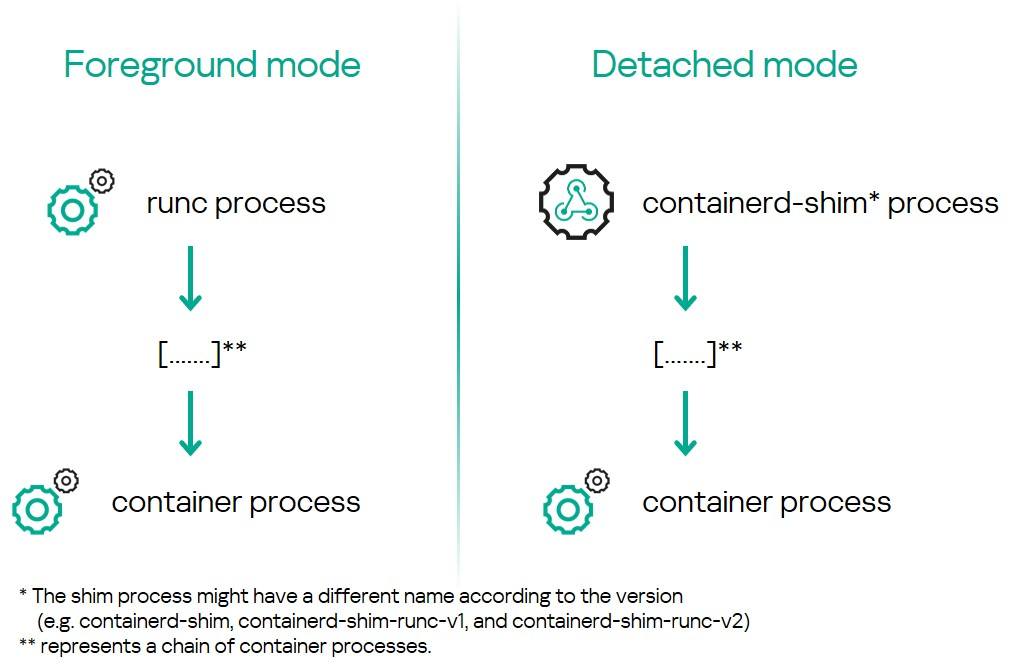
    It’s important to note which mode runc has been executed in, since it supports two modes: foreground mode and detached mode. The resulting process tree may vary depending on the chosen mode. In foreground mode, a long-running runc process remains in the foreground as a parent process for the container process, primarily to handle the stdio so the end user can interact with the running container.

    Process tree of a container created in foreground mode using runc

    In detached mode, however, there will be no long-running runc process. After creating the container, runc exits, leaving the caller process to take care of the stdio. In most cases, this is containerd or CRI-O. As we can see in the screenshot below, when we execute a detached container using runc, the runc process will create it and immediately exit. Hence, the parent process of the container is the host’s PID 1 (systemd process).

    Process tree of a container created in detached mode using runc

    However, if we create a detached container using Docker CLI, for example, we’ll notice that the parent of the container process is a shim process, not PID 1!

    Process tree of a container created in detached mode using Docker CLI

    In modern architectures, communication between high- and low-level container runtimes is proxied through a shim process. This allows containers to run independently of the high-level container runtime, ensuring the sustainability of the running container even if the high-level container runtime crashes or restarts. The shim process also manages the stdio of the container process so users can later attach to running containers via commands like docker exec -it , for example. The shim process can also redirect stdout and stderr to log files that users can later inspect either directly from the filesystem or via commands like kubectl logs -c .

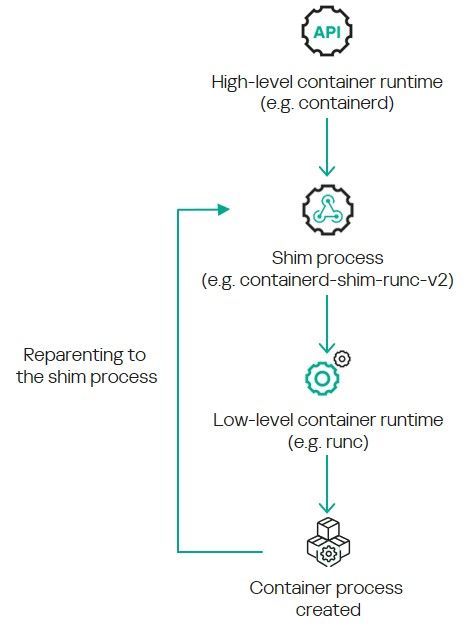
    When a detached container is created using Docker CLI, the high-level container runtime, for example, containerd, executes a shim process that calls runc as a low-level container runtime for the sole purpose of creating the container in detached mode. After that, runc immediately exits. To avoid orphan processes or reparenting to the PID 1, as in the case when we executed runc ourselves, the shim process explicitly sets itself as a subreaper to adopt the container processes after runc exits. A Linux subreaper process is a designated parent that takes care of orphaned child processes in its chain (instead of init), allowing it to manage and clean up its entire process tree.

    Detached containers will be reparented to the shim process after creation

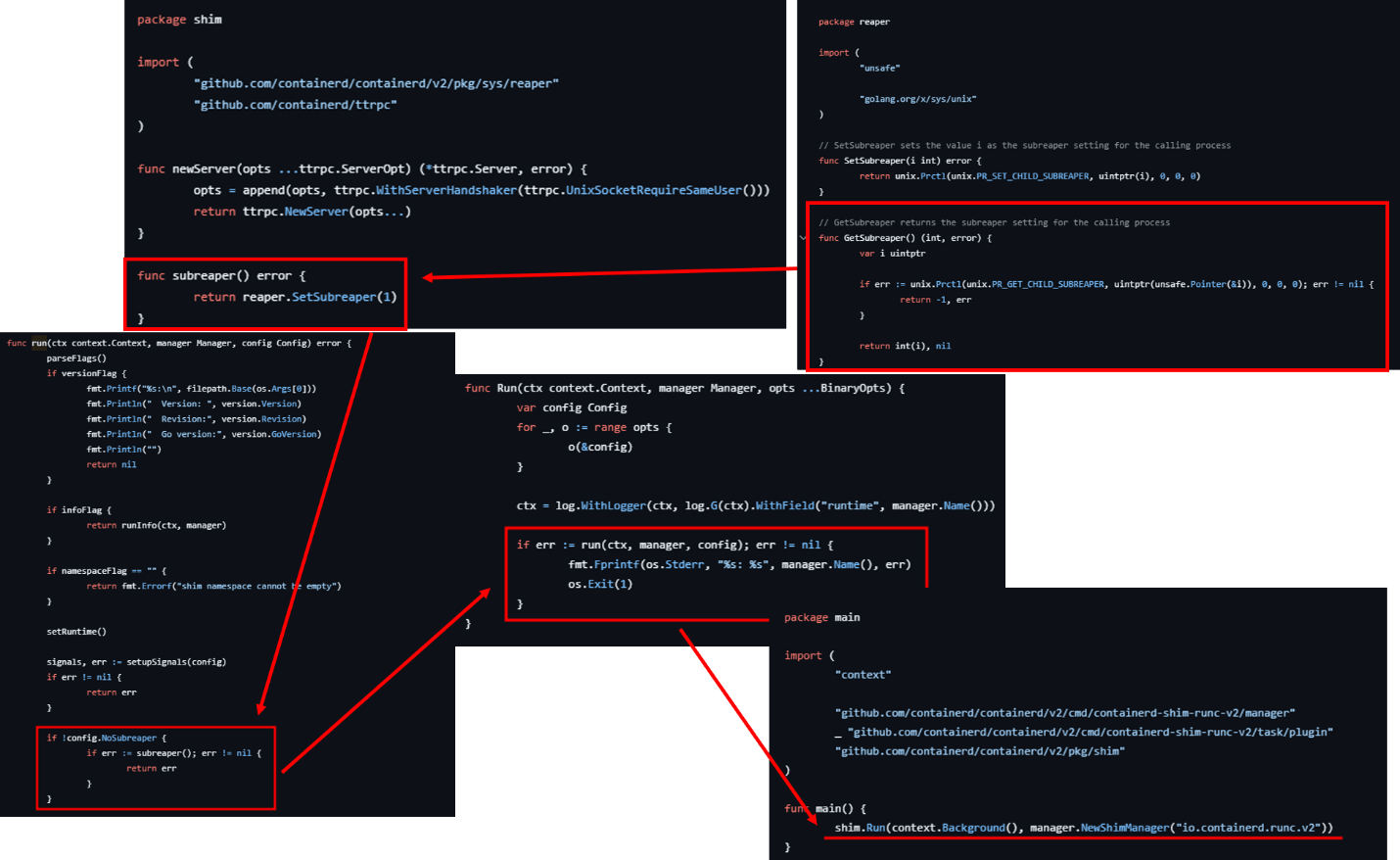
    This is implemented in the latest V2 shim and is the default in the modern containerd implementations.

    The shim process sets itself as a subreaper process during creation

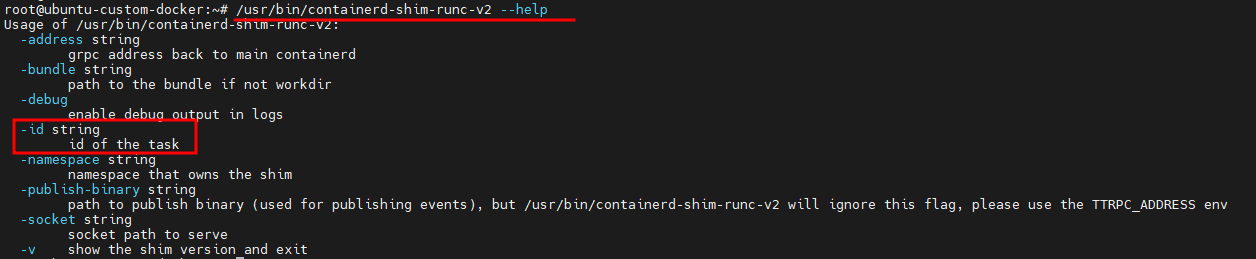
    When we check the help message of the containerd-shim-runc-v2 process, for example, we notice that it accepts the container ID as a command-line argument, and calls it the id of the task.

    Help message of the shim process

    We can confirm this by checking the command-line arguments of the running containerd-shim-runc-v2 processes and comparing them with the running containers.

    The shim process accepts the ID of the relevant container as a command-line argument

    So far, we’ve successfully identified container processes from the host’s perspective. In modern architectures, one of the following processes will typically be seen as a predecessor process for the containerized processes:

    • A shim process, in the case of detached mode; or
    • A runc process, in the case of foreground (interactive) mode.

    We can also use the command-line arguments of the shim process to determine which container the process belongs to.

    Process tree of the containers from the host perspective

    Although tracking the child processes of the shim process can sometimes lead to easy wins, it is often not as easy as it sounds, especially when there are a lot of subprocesses between the shim process and the malicious process. In this case, we can take a bottom-to-top approach, pivoting from the malicious process, tracking its parents all the way up to the shim process to confirm that it was executed inside a running container. It then becomes a matter of choosing the process whose behavior we may need to check for malicious or suspicious activities.

    Since containers typically run with minimal dependencies, attackers often rely on shell access to either execute commands directly, or install missing dependencies for their malware. This makes container shells a critical focus for detection. But how exactly do these shells behave? Let’s take a closer look at one of the key shell processes in containerized environments.

    How do BusyBox and Alpine execute commands?

    In this post, we focus on the behavior of BusyBox-based containers. We also included Alpine-based containers as an example of an image base that relies on BusyBox to implement many core Linux utilities, helping to keep the image lightweight. For the sake of demonstration, Alpine images that depend on other utilities are outside the scope of this post.

    BusyBox provides minimalist replacements for many commonly used UNIX utilities, combining them into one small executable. This allows for the creation of lightweight containers with significantly reduced image sizes. But how does the BusyBox executable actually work?

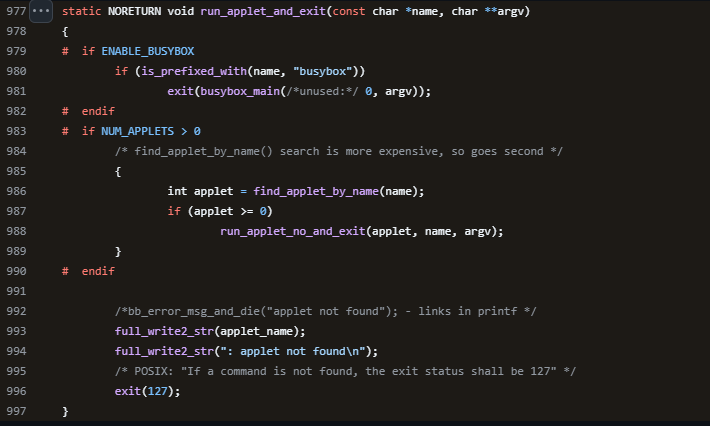
    BusyBox has its own implementation of system utilities, known as applets. Each applet is written in C and stored in the busybox/coreutils/ directory as part of the source code. For example, the UNIX cat utility has a custom implementation named cat.c. At runtime, BusyBox creates an applet table that maps applet names to their corresponding functions. This table is used to determine which applet to execute based on the command-line argument provided. This mechanism is defined in the appletlib.c file.

    Snippet of the appletlib.c file

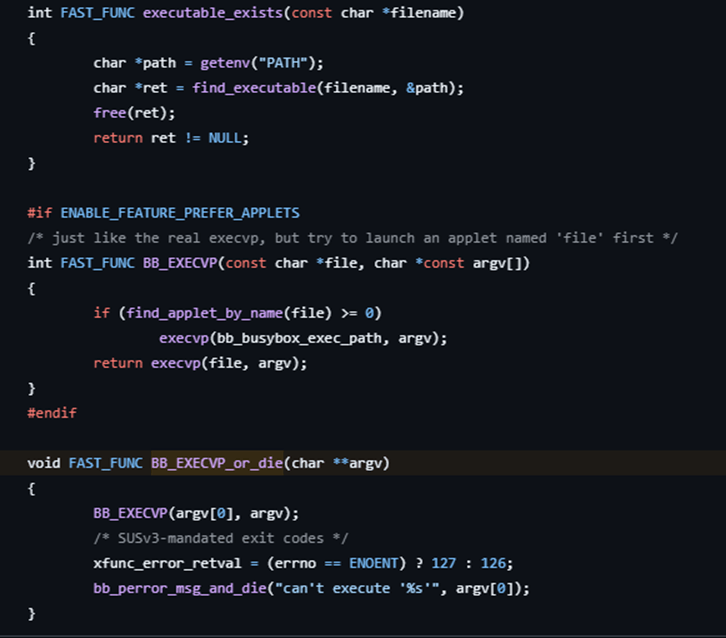
    When an executed command calls an installed utility that is not a default applet, BusyBox relies on the PATH environment variable to determine the utility’s location. Once the path is identified, BusyBox spawns the utility as a child process of the BusyBox process itself. This dynamic execution mechanism is critical to understanding how command execution works within a BusyBox-based container.

    Applet/program execution logic

    Now that we have a clear understanding of how the BusyBox binary operates, let’s explore how it functions when running inside a container. What happens, for example, when you execute the sh command inside such containers?

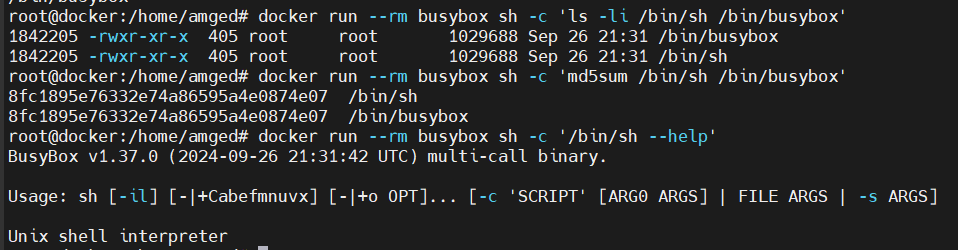
    In both BusyBox and Alpine containers, executing the sh command to access the shell doesn’t actually invoke a standalone binary called sh. Instead, the BusyBox binary itself is executed. In BusyBox containers we can verify that /bin/sh is replaced by BusyBox by comparing the inodes of /bin/sh and /bin/busybox using ls -li and confirm that both have the same inode number. We can also print their MD5 hash to see that they are the same, and by executing /bin/sh --help, we’ll see that the banner of BusyBox is the one that’s printed.

    /bin/sh is replaced by the /bin/busybox on the BusyBox based containers

    On the other hand, in the Alpine containers, /bin/sh is a symbolic link to /bin/busybox. This means that when you run the sh command, it actually executes the BusyBox executable referred to by the symbolic link. This can be confirmed by executing readlink -f /bin/sh and observing the output.

    /bin/sh is a symbolic link to /bin/busybox in the Alpine-based containers

    Hence, inside BusyBox- or Alpine-based containers, all shell commands are either executed directly by the BusyBox process or are launched as child processes under the BusyBox process. These processes run within isolated namespaces on the host operating system, providing the necessary containerization while still utilizing the shared kernel of the host.

    From a threat hunting perspective, having a non-standard shell process for the host OS, like BusyBox in this case, should prompt further investigation. Why would a BusyBox shell process be running on a Debian or a RedHat OS? Combining this conclusion with the previous one allows us to confirm that the shell was executed inside a container when runc or shim is observed as the predecessor process to the BusyBox process. This knowledge can be applied not only to the BusyBox process but also to any other process executed inside a running container. This knowledge is crucial for effectively determining the origin of suspicious behavior while hunting for threats using the host execution logs.

    Some security tools, such as Kaspersky Container Security, are designed to monitor container activity and detect suspicious behavior. Others, such as Auditd, provide enriched logging at the kernel level based on preconfigured rules that capture system calls, file access, and user activity. However, these rules are often not optimized for containerized environments, further complicating the distinction between host and container activity.

    Investigation value

    While investigating execution logs, threat hunters and incident responders might overlook some activities on Linux machines, thinking they are part of normal operations. However, the same activities performed inside a running container should raise suspicion. For example, installing utilities such as Docker CLI may be normal on the host, but not inside a container. Recently, in a Compromise Assessment project, we discovered a crypto mining campaign in which the threat actor installed Docker CLI inside a running container in order to easily communicate with dockerd APIs.

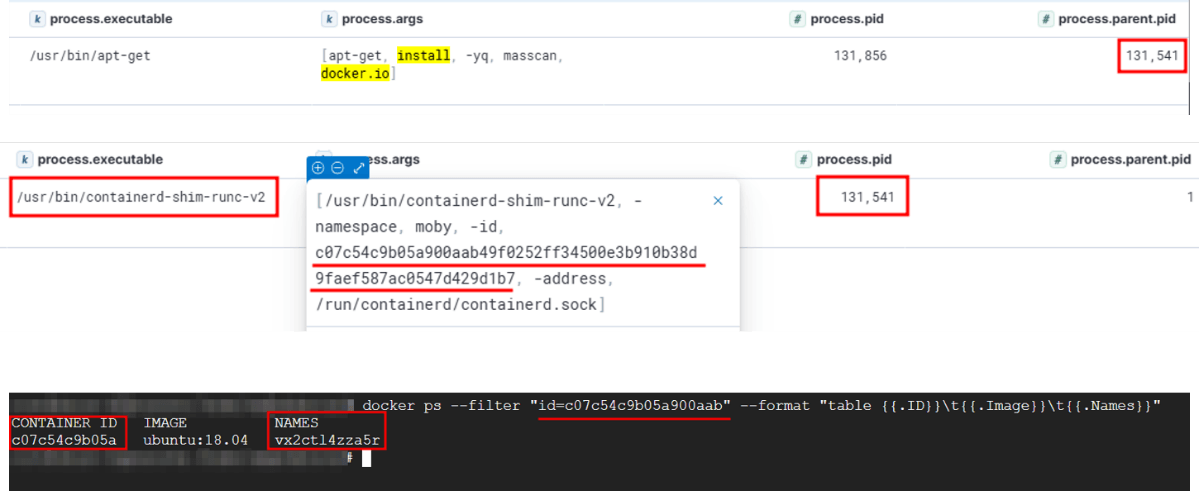
    Confirming that the docker.io installation occurred inside a running container

    In this example, we detected the installation of Docker CLI inside a container by tracing the process chain. We then determined the origin of the executed command and confirmed the container in which the command was executed by checking the command-line argument of the shim process.

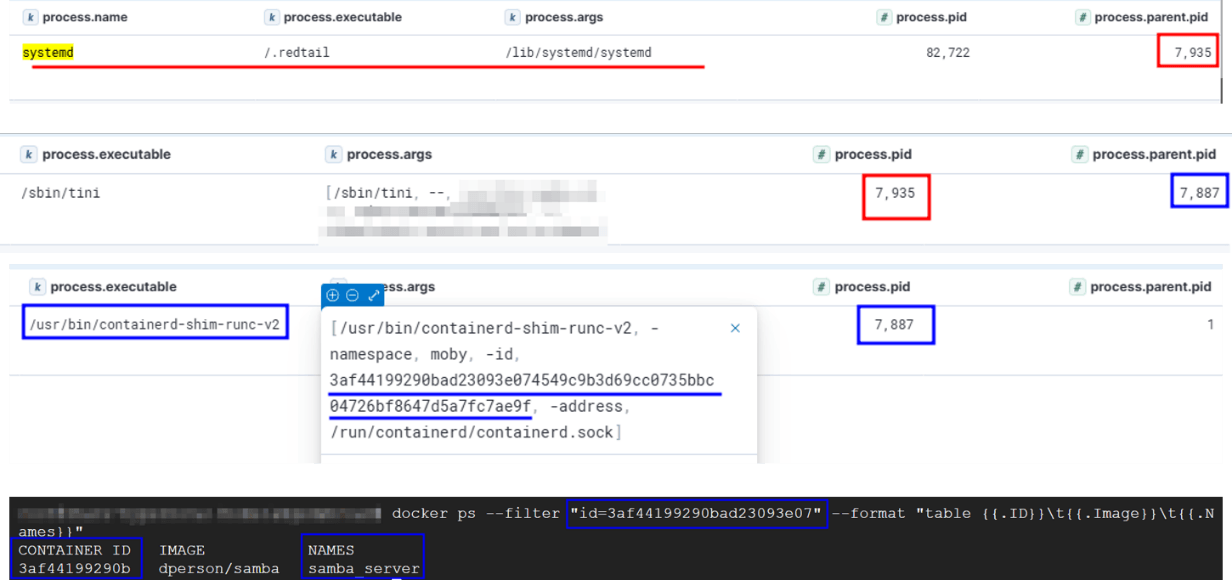
    During another investigation, we detected an interesting event where the process name was systemd while the process executable path was /.redtail. To identify the origin of this process, we followed the same procedure of tracking the parent processes.

    Determining the container in which the suspicious event occurred

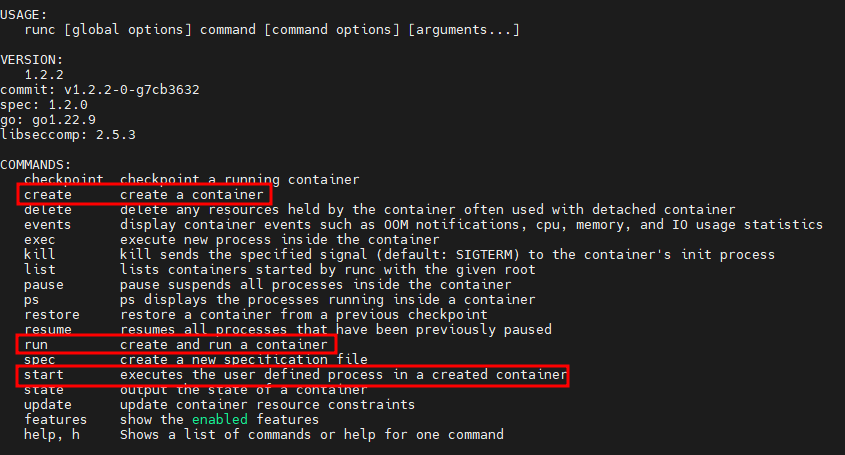
    Another interesting fact we can leverage is that a Docker container is always created by a runc process as the low-level container runtime. The runc help message reveals the command-line arguments used to create, run or start a container.

    runc help messate

    Monitoring these events helps threat hunters and incident responders identify the ID of the subject container and detect any abnormal entrypoints. A container’s entrypoint is its main process and it will be the process spawned by runc. The screenshot below shows an example of the creation of a malicious container detected by hunting for entrypoints with suspicious command-line arguments. In this case, the command line contains a malicious base64-encoded command.

    Hunting for suspicious container entrypoints

    Conclusion

    Containerized environments are now part of most organizations’ networks because of the deployment and dependency encapsulation feasibility they provide. However, they are usually overlooked by security teams and decision makers because of a common misunderstanding about container isolation. This results in undesirable situations when these containers are compromised, and the security team is not fully equipped with the knowledge or tools to help during response activities, or even to monitor or detect in the first place.

    The approach discussed in this post is one of the procedures that we typically follow in our Compromise Assessment and Incident Response services when we need to hunt for threats in historical host execution logs with container visibility issues. However, in order to detect container-based threats in time, it is crucial to protect your systems with a solid containerization monitoring solution, such as Kaspersky Container Security.

    MIL OSI Economics

  • MIL-OSI United Kingdom: Media release: New bike hub makes getting a bargain as easy as riding a bike

    Source: Scotland – City of Aberdeen

    A new “Bike Hub” has opened at the Reuse Shop at Hazlehead Recycling Centre to sell refurbished bikes, diverted from our recycling centres.

    A second hub is set to follow as part of the new Recycling Centre on Claymore Drive, Bridge of Don, opening this autumn.

    Aberdeen City Council Co-Leader Councillor Ian Yuill said: “The Reuse Shop at Hazlehead Recycling Centre has gone from strength to strength, breathing new life into unwanted household items.

    “Reuse helps divert materials away from recycling and incineration. This helps to reduce carbon emissions and contributes to a circular economy, helping us meet our net zero goals, and supporting “green” jobs in the repair and retail sectors.”

    Net Zero, Environment, and Transport Vice-convenor Miranda Radley added: “We would like to thank our partners for their work to bring the Bike Hub to life.

    “As well as supporting reuse, the project increases opportunities for active travel for our residents, by offering access to pre-loved bikes that are fully safety checked.”

    Nine-year-old Phoebe, who was visiting the Reuse Shop, said: “I got my bike two years ago from someone who outgrew it. I’m always riding it and it’s so much fun. I’m happy now that more kids in Aberdeen can get good, reused bikes.”

    Colin Forshaw, Production Operations Manager at SUEZ Recycling and Recovery UK, said: “SUEZ has always been a champion of reuse and we’re very proud of The Reuse Shop which not only offers everyday items at a low cost for residents of Aberdeen, saving items from going to waste, but also supports local community projects through a fund generated from the proceeds.

    “This new partnership means that we can now add another spindle to our wheel, and we look forward to seeing people out on their bikes this summer.”

    The new scheme is a collaboration with Stella’s Voice, CycleHub.Org, and SUEZ Recycling and Recovery UK. The scheme sees unwanted bikes delivered to a local workshop where qualified mechanics repair and safety test bikes to ensure they are roadworthy. A selection of refurbished adult and kids bikes are now available to Aberdeen residents at the Reuse Shop, just in time for the summer holidays.

    Aberdeen’s residents are encouraged to clear out unwanted bikes from garages and garden sheds and drop these off at Hazlehead recycling centre where they will be given a new lease of life. 

    MIL OSI United Kingdom

  • India urges deeper BRICS cooperation for building future-ready digital ecosystem

    Source: Government of India

    Source: Government of India (4)

    India reaffirmed its commitment to inclusive, sustainable, and future-ready digital development at the 11th BRICS Communications Ministers’ Meeting held in Brasília, Brazil.
     
    Delivering India’s national statement, Minister of State for Communications and Rural Development, Dr. Pemmasani Chandra Sekhar, highlighted the country’s progress in digital governance under the theme set by Brazil’s BRICS presidency—Universal and Meaningful Connectivity, Space Sustainability, Environmental Sustainability, and the Digital Ecosystem.
     
    Dr. Chandra Sekhar showcased India’s Digital Public Infrastructure (DPI) as a global model for inclusive and transformative digital governance. He underlined the impact of flagship platforms such as Aadhaar and Unified Payments Interface (UPI), stating that Aadhaar has empowered over 950 million Indians with secure digital identity and seamless access to services, while UPI has revolutionised real-time digital payments, contributing to 46 percent of the world’s digital transactions.
     
    He called upon BRICS nations to deepen collaboration and leverage digital public infrastructure for inclusive growth. “India’s DPI model, based on open and interoperable platforms, is a catalyst for good governance, financial inclusion and digital innovation while acting as a safeguard against monopolistic practices,” he added.
     
    Dr. Sekhar also spoke about India’s vibrant startup ecosystem, the growing digital skills network, and progressive legislations such as the Telecommunications Act and the Data Protection Act. Stressing the need for digital trust and user safety, he highlighted India’s Sanchar Saathi initiative to combat telecom-related fraud.
     
    The Minister emphasised the importance of international cooperation in areas such as cybersecurity, data protection and digital integrity, noting that the safety and trustworthiness of interconnected digital societies are crucial for the future.
     
    Reflecting on India’s digital progress, Dr. Sekhar said the country has transitioned from digital divide to digital leadership. He presented the Digital Bharat Nidhi programme as a flagship initiative that has supported projects like BharatNet, which now connects over 2.18 lakh gram panchayats through optical fibre. 
     
    He said that India’s indigenous development and mass deployment of 4G and 5G technologies have brought high-speed connectivity to over 95 percent of the population with 4G and more than 80 percent with 5G. India, he noted, also leads the world in affordable data access, with internet data prices as low as 12 cents per gigabyte.
     
    Speaking on the issue of space sustainability, the Minister said, “Space is no longer a distant frontier—it is now a vital part of our digital infrastructure.” He outlined India’s reforms in satellite communication, including streamlined SATCOM regulations and expanded licensing for mobile and IoT satellite services. He urged BRICS nations to work jointly on global issues such as orbital equity, spectrum management and space traffic regulation through cooperation rather than competition.
     
    Addressing environmental sustainability, Dr. Sekhar acknowledged the dual challenges of climate change and rising e-waste. Citing projections from the Global E-Waste Monitor, he warned that global e-waste could reach 82 billion kilograms by 2030. He informed the forum about India’s initiatives like the Green Development Pact from the G20 Summit in Delhi and the Panchamrit goals announced at COP-26. He urged BRICS members to adopt circular economy practices, integrate green energy into ICT infrastructure and support global frameworks like the ITU’s Green Digital Action.
     
  • MIL-Evening Report: ER Report: A Roundup of Significant Articles on EveningReport.nz for June 3, 2025

    ER Report: Here is a summary of significant articles published on EveningReport.nz on June 3, 2025.

    In her memoir, Jacinda Ardern shows a ‘different kind of power’ is possible – but also has its limits
    Source: The Conversation (Au and NZ) – By Grant Duncan, Teaching Fellow in Politics and International Relations, University of Auckland, Waipapa Taumata Rau Getty Images Imagine getting a positive pregnancy test and then – just a few days later – learning you’ll be prime minister. In hindsight, being willing and able to deal with the

    Google’s SynthID is the latest tool for catching AI-made content. What is AI ‘watermarking’ and does it work?
    Source: The Conversation (Au and NZ) – By T.J. Thomson, Senior Lecturer in Visual Communication & Digital Media, RMIT University HomeArt/Shutterstock Last month, Google announced SynthID Detector, a new tool to detect AI-generated content. Google claims it can identify AI-generated content in text, image, video or audio. But there are some caveats. One of them

    What parents and youth athletes can do to protect against abuse in sport
    Source: The Conversation (Au and NZ) – By Fanny Kuhlin, PhD candidate in Sport Management (Sport Science), Örebro University Ron Alvey/Shutterstock From the horrific Larry Nassar abuse scandal in United States gymnastics to the “environment of fear” some volleyball athletes endured at the Australian Institute of Sport, abuse in sport has been well documented in

    Astronomers thought the Milky Way was doomed to crash into Andromeda. Now they’re not so sure
    Source: The Conversation (Au and NZ) – By Ruby Wright, Forrest Fellow in Astrophysics, The University of Western Australia Luc Viatour / Wikimedia, CC BY-SA For years, astronomers have predicted a dramatic fate for our galaxy: a head-on collision with Andromeda, our nearest large galactic neighbour. This merger – expected in about 5 billion years

    Is the private hospital system collapsing? Here’s what the sector’s financial instability means for you
    Source: The Conversation (Au and NZ) – By Yuting Zhang, Professor of Health Economics, The University of Melbourne lightpoet/Shutterstock Toowong Private Hospital in Brisbane is the latest hospital to succumb to financial pressures and will close its doors next week. The industry association attributes the psychiatric hospital’s closure to insufficient payments from and delayed funding

    Trump’s steel tariffs are unlikely to have a big impact on Australia. But we could be hurt by what happens globally
    Source: The Conversation (Au and NZ) – By Scott French, Senior Lecturer in Economics, UNSW Sydney Shestakov Dymytro/Shutterstock Just one day after the US Court of Appeals temporarily reinstated the Trump Administration’s Liberation Day tariffs of between 10% and 50% on nearly every country in the world, Trump announced tariffs on all US imports of

    Tax concessions on super need a rethink. These proposals would bring much needed reform
    Source: The Conversation (Au and NZ) – By Chris Murphy, Visiting Fellow, Economics (modelling), Australian National University fizkes/Shutterstock The federal government has proposed an additional tax of 15% on the earnings made on super balances of over A$3 million, the so-called Division 296 tax. This has set off a highly politicised debate that has often

    The surprising power of photography in ageing well
    Source: The Conversation (Au and NZ) – By Tricia King, Senior Lecturer in Photography, University of the Sunshine Coast Marcia Grimm Older adults are often faced with lifestyle changes that can disrupt their sense of place and purpose. It may be the loss of a partner, downsizing their home, or moving to residential aged care.

    What birds can teach us about repurposing waste
    Source: The Conversation (Au and NZ) – By David Farrier, Professor of Literature and the Environment, University of Edinburgh Some birds use deterrent spikes to make their nests. Chemari/Shutterstock Modern cities are evolution engines. Urban snails in the Netherlands and lizards in Los Angeles have developed lighter shells and larger scales to cope with the

    Human Rights Watch warns renewed fighting threatens West Papua civilians
    Asia Pacific Report An escalation in fighting between Indonesian security forces and Papuan pro-independence fighters in West Papua has seriously threatened the security of the largely indigenous population, says Human Rights Watch in a new report. The human rights watchdog warned that all parties to the conflict are obligated to abide by international humanitarian law,

    Will surging sea levels kill the Great Barrier Reef? Ancient coral fossils may hold the answer
    Source: The Conversation (Au and NZ) – By Jody Webster, Professor of Marine Geoscience, University of Sydney marcobriviophoto.com In the 20th century, global sea level rose faster than at any other time in the past 3,000 years. It’s expected to rise even further by 2100, as human-induced climate change intensifies. In fact, some studies predict

    Pro-Trump candidate wins Poland’s presidential election – a bad omen for the EU, Ukraine and women
    Source: The Conversation (Au and NZ) – By Adam Simpson, Senior Lecturer, International Studies, University of South Australia Poland’s presidential election runoff will be a bitter pill for pro-European Union democrats to swallow. The nationalist, Trumpian, historian Karol Nawrocki has narrowly defeated the liberal, pro-EU mayor of Warsaw, Rafał Trzaskowski, 50.89 to 49.11%. The Polish

    Australia’s latest emissions data reveal we still have a giant fossil fuel problem
    Source: The Conversation (Au and NZ) – By Emma Lovell, Senior Lecturer in Chemical Engineering, UNSW Sydney According to Australia’s Climate Change and Energy Minister Chris Bowen, the latest emissions data show “we are on track to reach our 2030 targets” under the Paris Agreement. In 2024, Australia’s greenhouse gas emissions were “27% below 2005

    What is retinol? And will it make my acne flare? 3 experts unpack this trendy skincare ingredient
    Source: The Conversation (Au and NZ) – By Laurence Orlando, Senior Lecturer, Product Formulation and Development, Analytical Methods, Monash University Irina Kvyatkovskaya/Shutterstock Retinol skincare products suddenly seem to be everywhere, promising clear, radiant and “youthful” skin. But what’s the science behind these claims? And are there any risks? You may have also heard retinol can

    Pasifika recipients say King’s Birthday honours not just theirs alone
    By Teuila Fuatai, RNZ Pacific senior journalist, Iliesa Tora, and Christina Persico A New Zealand-born Niuean educator says being recognised in the King’s Birthday honours list reflects the importance of connecting young tagata Niue in Aotearoa to their roots. Mele Ikiua, who hails from the village of Hakupu Atua in Niue, has been named a

    Eugene Doyle: Writing in the time of the Gaza genocide
    COMMENTARY: By Eugene Doyle I want to share a writer’s journey — of living and writing through the Genocide.  Where I live and how I live could not be further from the horror playing out in Gaza and, increasingly, on the West Bank. Yet, because my country provides military, intelligence and diplomatic support to Israel

    Decades of searching and a chance discovery: why finding Leadbeater’s possum in NSW is such big news
    Source: The Conversation (Au and NZ) – By David Lindenmayer, Distinguished Professor of Ecology, Fenner School of Environment and Society, Australian National University Until now, Victorians believed their state was the sole home for Leadbeater’s possum, their critically endangered state faunal emblem. This tiny marsupial is clinging to life in a few pockets of mountain

    In Bradfield, the election is not yet over. What happens when a seat count is ultra close?
    Source: The Conversation (Au and NZ) – By Graeme Orr, Professor of Law, The University of Queensland Election day was over four weeks ago. Yet the outcome in one House of Representatives remains unclear. That is the formerly Liberal Sydney electorate of Bradfield. In real time, you can watch the lead tilt between Liberal hopeful,

    Is there a right way to talk to your baby? A baby brain expert explains ‘parentese’
    Source: The Conversation (Au and NZ) – By Jane Herbert, Associate Professor in Developmental Psychology, University of Wollongong 2p2play/Shutterstock You might have seen those heartwarming and often funny viral videos where parents or carers engage in long “talks” with young babies about this and that – usually just fun chit chat of no great consequence.

    MIL OSI AnalysisEveningReport.nz

  • MIL-OSI USA: NEW REPORT: Trump’s Mass Firings at NIOSH Spokane Research Lab Put Americans at Risk, Jeopardize Progress to Keep Workers Safe on the Job

    US Senate News:

    Source: United States Senator for Washington State Patty Murray

    ICYMI: Senator Murray Presses Secretary Kennedy on Decimation of NIOSH and Mass Firings at NIOSH Spokane Research Laboratory

    ***NEW REPORT with testimonials from Spokane employees HERE***

    Washington, D.C. — Today, U.S. Senator Patty Murray (D-WA), Vice Chair of the Senate Appropriations Committee, released a new report on how President Trump and Elon Musk’s decimation of the National Institute for Occupational Safety and Health (NIOSH) of the Centers for Disease Control and Prevention (CDC), including their effective shuttering of the NIOSH Spokane Research Laboratory, will jeopardize on-the-job safety for firefighters, miners, agricultural workers, commercial fishermen, in Washington state and across the country. The report details the work that was done at the NIOSH Spokane Research laboratory, the Spokane Mining Research Division in particular, and outlines how the Trump administration’s mass firings across NIOSH will jeopardize the pipeline to train the next generation of workplace safety and health professionals, including those studying at Gonzaga University in Spokane and University of Washington in Seattle. Senator Murray’s report features testimonials from Washington state residents, including employees at NIOSH who were recently fired through no fault of their own.

    The release of the report comes as the Trump administration’s large-scale reduction in force (RIF) for the U.S. Department of Health and Human Services (HHS), which includes NIOSH, has been put on hold by a U.S. District Court judge in San Francisco, who ruled that the administration violated separation of powers principles with its agency restructuring.

    “The Trump administration’s unfathomable decision to gut NIOSH and fire nearly every person at the Spokane Research Lab is a devastating and shortsighted move that puts workers everywhere at risk,” Senator Murray said upon releasing the report. “In Spokane alone, President Trump abruptly fired nearly a hundred people working to protect those in high-risk professions including mining, firefighting, health care and emergency medicine, and the maritime industry—bringing their research to a screeching halt and creating a ticking time bomb for disasters in the workplace.”

    “These thoughtless firings don’t just risk Americans’ health and safety in the workplace today, but threaten decades of progress toward preventing workplace hazards,” Senator Murray continued. Researchers in Spokane who have dedicated their careers to protecting workers across the country are being kicked to the curb because Donald Trump and his conspiracy theorist Health Secretary don’t have a clue what NIOSH does and don’t care to learn—no one should be treated like this. We need answers and accountability. I’m going to keep fighting to hold the Trump administration to account and shine a bright spotlight on how this administration is hurting people and communities like Spokane and forcing critical, lifesaving research to go to waste.”

    Senator Murray has been a leading voice in Congress against RFK Jr.’s destruction of HHS and America’s health infrastructure, raising the alarm over HHS’ unilateral reorganization plan and slamming the closure of the HHS Region 10 office in Seattle and the NIOSH Spokane Research Laboratory. Senator Murray has sent oversight letters and hosted numerous press conferences and events to lay out how the administration’s reckless gutting of HHS is risking Americans health and safety and will set our country back decades, and lifting up the voices of HHS employees who were fired for no reason and through no fault of their own.

    The full report is available HERE and below:

    Report: Mass Firings in Spokane and Beyond: How Gutting the National Institute for Occupational Safety and Health (NIOSH) Harms Workers

    This report is part of a series detailing the harm President Trump and Elon Musk’s reckless and devastating attacks on the federal workforce are causing on the ground in Washington state. The Trump administration’s mass firings and harmful actions have real consequences for Washington’s residents, their communities, and for the entire United States.

    This report focuses on the mass firings of employees at the National Institute for Occupational Safety and Health (NIOSH) of the Centers for Disease Control and Prevention (CDC), effectively shuttering the NIOSH Spokane Research Laboratory. These Reductions in Force (RIFs) will lead to increased health and safety risks for firefighters, miners, agricultural workers, commercial fishermen, and so many others. No one should have to worry about whether they will come home safe from their job or not come home at all – NIOSH is vital to keeping workers safe. 

    The National Institute for Occupational Safety and Health (NIOSH) is Dedicated to Keeping Workers Safe Across America

    NIOSH is the only government agency statutorily authorized to conduct workplace health and safety research. In April 2025, the U.S. Department of Health and Human Services (HHS) Secretary Robert F. Kennedy Jr. terminated about 900 of NIOSH’s approximately 1,100 employees, effectively shuttering the agency. Among these firings, the Trump administration eliminated 90 scientific positions at the Spokane Research Laboratory. In addition to NIOSH’s Spokane location, the agency also conducts research at campuses in Cincinnati, Ohio; Morgantown, West Virginia; and Pittsburgh, Pennsylvania. Due to recent outcry over these firings, the Trump administration has recently agreed to bring back around 300 NIOSH workers, but primarily in West Virginia and Ohio, leaving the Spokane Research Laboratory’s programming and research work shuttered.

    By firing and then only bringing back a small portion of NIOSH workers, and almost none from Spokane, the Trump administration is jeopardizing decades of progress in improving worker health and safety. Over the course of NIOSH’s history, worker deaths, injuries, and illnesses in America have gone down—on average, from about 38 worker deaths a day in 1970 to 15 a day in 2023, and from 10.9 incidents of worker injury and illness per 100 workers in 1972 to 2.4 per 100 in 2023. However, workplace hazards still kill and disable approximately 125,000 workers each year—5,190 from traumatic injuries and an estimated 120,000 from occupational diseases. Workplace injuries and illnesses cost businesses between $174 billion and $348 billion a year, which is still likely an underestimate given underreporting of workplace injuries.

    Kyle Zimmer, recently retired from International Union of Operating Engineers Local 478 and current Chair of the Mine Safety Health Research Advisory Committee stated, “Losing these researchers will result in the loss of safety for every worker in the United States. This research turns into standards that become guidelines that every safety professional uses throughout the country in every industry, from health care, to auto body shops, to mining and firefighting. Once your workforce really understands what you are doing, that is when you get results and changes in workplace safety culture.”

    NIOSH’s $362.8 million budget represents only 0.2% of the discretionary portion of the HHS budget. NIOSH’s lifesaving research has also saved more than $1 billion annually. For example, NIOSH research supporting improved protective equipment for firefighters is associated with an estimated $71 million in annual savings in medical and productivity losses.NIOSH work produces a tremendous return on investment, and the Trump administration’s firings have huge costs both for worker safety and the nation.

    Tristan Victoroff, a union steward and epidemiologist in the NIOSH Western States Divisions, pointed out: “The 900 people fired from NIOSH are scientists, mainly. We are industrial safety scientists, epidemiologists, engineers…. The goal is to work with industry to protect workers’ health and safety and find solutions to the problems. We do research and development. It’s not duplicative. [The Occupational Safety and Health Administration] doesn’t do this. They don’t have the capacity or the mandate. All of these cuts are supposedly to save costs. What costs are we going to tolerate? What are the costs of increased workers’ compensation claims? What are the costs of disabling injuries and chronic diseases from workplace exposures? What is the cost to a family of losing a parent to a workplace accident?”

    The NIOSH Spokane Research Laboratory is Critical to Keeping Workers Safe

    NIOSH was created by Congress to address and prevent work-related injury and illness and was created in the same statute that authorized the Occupational Safety and Health Administration (OSHA) in the Department of Labor. While OSHA sets and enforces safety standards, NIOSH is required to conduct or fund research, experiments, and demonstrations on occupational safety and health; produce criteria identifying toxic substances including setting exposure levels that are safe for various periods of employment, and publish annually a list of all known toxic substances and the concentrations at which such toxicity is known to occur; disseminate information about occupational safety to employers and employees; conduct education programs about occupational safety; and contract with state personnel to provide compliance assistance for employers.

    In Washington state, NIOSH conducts research to understand and promote safe job conditions and develop science-based products and interventions that support worker health, safety, and well-being, prevent future occupational injuries and deaths, and train new generations of health and safety professionals. This work is done through the Spokane Research Laboratory (which houses the Spokane Mining Research Division and the Western States Division) and the Region 10 Northwest Center for Occupational Health and Safety Education and Research Center.

    Tristan Victoroff, a union steward and epidemiologist in the NIOSH Western States Divisions, explained: “The NIOSH Spokane Research Laboratory in Washington State is the only NIOSH facility west of the Mississippi. Its two divisions— the Western States Division and the Spokane Mining Research Division — conduct safety research for natural resource industries across the western U.S. and Alaska, including commercial fishing, wildland firefighting, oil and gas extraction, and mining. They’re working directly with naval shipyards to assess exposures from new technology for corrosion control. They track commercial fishing deaths nationwide. They have major research efforts in high wall safety, rockfall and slope stability, and seismic monitoring using advanced fiber optic technology, to name just a few examples. This work is not duplicative, and it’s not wasteful. If we’re expanding domestic energy, mineral, and seafood production, we need to protect the people doing that work. These workers deserve to come home safe and be healthy enough to work again tomorrow. Cutting this research does not keep us competitive — it puts workers in danger.”

    The Spokane Mining Research Division Keeps Washington Miners Safe on the Job

    The Spokane Mining Research Division (SMRD) is part of the NIOSH Mining Program, which aims to eliminate mining fatalities and injuries. Since 1990, total injuries in mining have significantly decreased, reflecting safer practices industry-wide, strongly linked to NIOSH’s research and prevention programs. SMRD partners with labor, mining associations, equipment manufacturers, and mine operators to study worker health and safety problems in the field. Washington’s mining industry is vital to the state’s economy, supporting 18,845 jobs, directly and indirectly, and providing $4.07 billion in economic benefits to the state.

    SMRD also conducts laboratory research at the Spokane, WA facility, where highly specialized scientists in unique laboratories develop products and interventions that offer solutions to mining challenges.Scientists in Spokane have been doing innovative laboratory work to:

    • Simulate ground stresses to test rock samples to determine the strength of the environment and whether bolts, steel, mesh or shotcrete are needed to support the mining efforts and keep workers safe on the job.
    • Simulate mining conditions and tasks to study health effects, such as heat and stress;
    • Examine field samples to understand miners’ exposure to respiratory and other health hazards; and more.

    Dr. Art Miller, a research engineer who retired from SMRD after 34 years, explains: “No one else in the world is doing this time-sensitive, cutting-edge research that will make workers safer. We conduct research in a lot of different ways. Our lab is a unique environment of cutting-edge technology and brain power aimed at improving worker health and safety. Discontinuing our work would be a huge loss to the future health and safety of workers. Workplace safety is dynamic, and our work is never going to be done. NIOSH is small relative to the federal government but it’s a well-run entity. Why would we want to get rid of something like that?”

    Spokane Research Laboratory’s SMRD also runs the Miner Health Program, created in 2016 to collaborate with the mining community to improve workers’ physical and mental health.Prevention of opioid misuse is just one of many examples of the collaborative work being produced by the Miner Health Program. The mining industry has been hit particularly hard by drug overdoses. Work-related pain and injury increase workers’ chances of being prescribed an opioid and subsequent risks of worker prescription opioid misuse, long-term opioid use, and opioid use disorder (OUD). These overdoses and especially deaths related to opioid use have had a significant impact on mine workers, their families, and communities. This program is now archived on the CDC website, indicating that this program is no longer operating.

    In Fall 2024, Spokane’s SMRD experts launched a new guide, Implementing Effective Workplace Solutions to Prevent Opioid Use Disorder: A Resource Guide for the Mining Industry. This guide provides a model for planning and implementing prevention efforts to normalize conversations about OUD, reduce stigma, and break down barriers to treatment and recovery. Losing this Miner Health Program focused on preventing OUD will lead to increased overdoses and preventable deaths in the mining community.

    The impact of the Trump administration’s cuts to NIOSH are already being felt in the mining industry. NIOSH is the only federal agency that can test and supply approved and certified respirators and personal dust monitors to keep miners safe on the job. The Mine Safety and Health Administration (MSHA) at the U.S. Department of Labor announced a temporary enforcement pause of mine operators’ respiratory protection programs. Given that NIOSH’s National Personal Protective Technology Laboratory has been effectively eliminated, the “Lowering Miners’ Exposure to Respirable Crystalline Silica and Improving Respiratory Protection,” (“Silica Rule”), is now paused until at least August 2025.Without NIOSH, the Silica Rule cannot go into effect and workers will continue to be exposed to extremely harmful silica dust that results in the debilitating and often fatal condition of silicosis.

    These respirators are not just used in mining; they are used across industries. As explained by Tristan Victoroff, union steward and epidemiologist in the NIOSH Western States Divisions: “There will be no NIOSH-certified respirators, if there’s no NIOSH. NIOSH certifies all the respiratory protection equipment used in healthcare — and not just the N95 masks we’ve all become familiar with in recent years. That includes reusable respirators that filter oils and vapors… even supplied air systems. NIOSH is the only organization in the country equipped to perform all the required testing — more than 150 test procedures — to certify respirators that protect firefighters, miners, shipyard workers — anyone who needs respiratory protection on the job. In fact, any employer in general industry — from construction to manufacturing — if they have an OSHA-approved respiratory protection program, they must use NIOSH-certified equipment. Only NIOSH can certify that equipment to meet those standards. Rebuilding these labs somewhere else would take years, and there’s no guarantee we could replicate the expertise and facilities we currently have at NIOSH. NIOSH also monitors products on the market to spot counterfeits. Without that oversight, fake and substandard products will increasingly flood the market. That’s not theoretical. NIOSH recently found that every counterfeit product it purchased off the open market failed to meet established standards. These products were not fully protective. Workers using those products on the job could be exposed to dangerous particulates or chemicals. If these labs shut down, it will put workers at risk and stifle innovation in protective technology. Workers won’t know which products they can trust. The NIOSH certification is essential.”

    The Western States Division of NIOSH Conducts Critical Research Focusing on Hazards in the Western States

    Workers in the Western U.S. face hazards and issues unique to their industries and environment, including commercial fishing, agriculture, and firefighting. Many of these occupations include climate extremes, working at altitude, long distance commutes, remote locations, and wildland forest fires. NIOSH’s Western States Division (WSD)employs a diverse group of public health and safety scientists with expertise in industrial hygiene, epidemiology, engineering, occupational medicine and health communication, working together to reduce and eliminate workplace injuries, illnesses, and fatalities. WSD is headquartered at the Spokane Research Laboratory, but also has staff at offices in Denver, Colorado, and Anchorage, Alaska. WSD in Spokane focused on health and safety research for several industries, including commercial fishing, firefighting and wildfires, maritime, and emergency medical services.

    Commercial Fishing. NIOSH’s work has decreased the number of fatalities in the commercial fishing industry in Washington, which is recognized as one of the most hazardous work settings. Many operations are characterized by strenuous labor, long work hours, harsh weather, and moving decks with hazardous machinery and equipment. This industry generates nearly $46 billion and more than 170,000 jobs. The annual number of fatalities has declined over the past two decades because of the prevention work carried out by NIOSH.For 30 years, WSD has operated the Commercial Fishing Safety Program, working in Washington, Oregon, Alaska, and the Gulf Coast in Southeastern states to keep fishermen safe from vessel disasters, falls overboard, onboard hazards, and more. WSD operates maintains the Commercial Fishing Incident Database, which tracks commercial fishing fatalities and provides statistics by region, fishery, type of vessel, and type of incident.This is the only national source for details of commercial fishing fatalities; neither the Bureau of Labor Statistics nor the U.S. Coast Guard report this type of information. Collecting this data is crucial for reducing the number of injuries and fatalities among the nation’s fishermen. Through NIOSH-funded research, WSD has developed solutions to prevent winch entanglements on commercial fishing boats, reducing loss of limb accidents. This critical research has come to a standstill with the Administration putting these scientists on administrative leave and scheduling them to be fired as of June 2, 2025.

    Outdoor Workers and Wildfires. Washington is one of the five states with the highest average annual burned acreage in the U.S., and the state is home to over 8,500 firefighters. Washington’s firefightersput themselves at enormous risk to keep Washington residents safe. Wildfire smoke is also dangerous to outdoor workers like the state’s 8,280 farmworkers whose jobs have been made safer through the work of NIOSH. For example, NIOSH scientists were instrumental in developing Washington’s Wildfire Smoke Rule, put in place January 15, 2024, which protects the health of workers who are exposed to the small particles contained in wildfire smoke. NIOSH recently developed a comprehensive hazard assessment on exposure to wildland fire smoke among outdoor workers. If NIOSH is eliminated, this document might never be finalized, and necessary revisions to the Washington Wildfire Smoke Rule may not happen, threatening firefighters, farmworkers, and other outdoor workers.

    NIOSH Provides Valuable Resources to Employers to Help Them Keep Workers Safe

    NIOSH’s Health Hazard Evaluation (HHE) Program has provided 11 technical assistance evaluations to businesses and industry in Washington over the last 20 years. The HHE program was established with the passage of the 1970 Occupational Safety and Health Act. The HHE program includes evaluations of occupational exposure to illicit drugs in toxicology laboratories, health effects in commercial airline employees associated with new, mandatory uniforms, transmission of tuberculosis to zoo employees working with Asian elephants, and respiratory effects following acute exposure to chlorine gas at a metal recycling facility. These evaluations and publications are at no cost to industry or the public, and recommendations from these reports are used to establish health and safety protocols throughout the state.

    WSD conducts research to evaluate toxic exposures associated with removal and application of marine coatings on vessels at the U.S. Navy’s Trident Retrofit Facility near Bangor, WA, and at the Puget Sound Naval Shipyard, as part of the Center for Maritime Safety and Health Studies. Moreover, WSD evaluates exposures from rehabilitation of hydroelectric turbines, such as the Little Goose Dam on the Snake River in Southeast Washington.A timely WSD project involves assessing mental and physical health issues in emergency medical service (EMS) responders in Tribal communities in the Puget Sound area. The Trump administration RIFs have effectively shut down each of these programs.

    NIOSH Trains the Next Generation of Occupational and Safety Health Professionals

    Congress passed the Occupational Safety and Health Act of 1970 to require funding for research, information, education, and training in the field of occupational safety and health. NIOSH funds 18 Education and Research Centers (ERCs), which provide high-quality interdisciplinary graduate and post-graduate training in occupational safety and health disciplines.The Northwest Center for Occupational Health and Safety Education and Research (NWCOHS) at the University of Washington is an ERC, housed in the Department of Environmental and Occupational Health Sciences, bringing together faculty from the UW Schools of Public Health, Nursing and Medicine. The program, funded continuously since 1977, has an annual budget of $1.8 million and serves four states (Washington, Alaska, Idaho, and Oregon), preparing students for careers in occupational medicine, nursing, health services research, industrial hygiene and more. Funding supports an average of 20 graduate students per year, and continuing education for an average of 1,000 occupational health and safety professionals per year.

    As Lawrence Sloan, Chief Executive Officer of the American Industrial Hygiene Association (AIHA), a membership organization for occupational and environmental health and safety professionals says, “NIOSH’s work is foundational in protecting American workers. Without adequate support for these programs, achieving the goal of a healthier American workforce will be challenging. Specifically, for AIHA, our members will be disadvantaged by the inability to leverage research on various worker populations to advance our understanding of the profession. Additionally, the absence of funding for Education & Research Centers (ERCs) will significantly impact our pipeline of future talent and hinder the funding of academic research studies that benefit the American worker.”

    NIOSH engineers have worked with Gonzaga University’s Mechanical Engineering Department to guide student senior design projects for the past 15 years. Many of these projects were entered into national American Society of Mechanical Engineers (ASME) competitions, with several teams winning awards and presenting at national ASME conventions. This collaboration has led to increased scientists seeking positions supporting mining safety and health, both in Spokane and around the country, creating a pipeline of the next generation of professionals ensuring workplace safety and health.

    NIOSH Protects Firefighters in Washington State and Nationwide

    As a nationally-based program, the NIOSH Center for Firefighter Safety, Health, and Well-Being supports all 50 states to protect firefighters and to identify and prevent new and emerging hazards in the fire service earlier and faster. NIOSH-funded research has:

    1. Increased our understanding of the 200-plus carcinogenic chemicals involved in byproducts of combustion, leading to better respiratory protection standards;
    2. Identified the presence of PFAS, or per- and polyfluoroalkyl substances, known as “forever chemicals,” in firefighter foam and turnout gear and how these impact cancer risk levels;
    3. Created and provided for continuous enrollment in the National Firefighter Registry for Cancer, the largest effort ever undertaken to understand and reduce the risk of cancer among U.S. firefighters; and
    4. Provided for the development of the Firefighter Fatality Investigation and Prevention Program, which conducts independent investigations of firefighter line-of-duty deaths and recommends prevention methods.

    After being shutdown in April 2025, the registration portal of the National Firefighter Registry for Cancer is now operational, following the questioning of HHS Secretary Kennedy by members of the Senate Health, Education, Labor and Pension Committee on May 14, 2025.

    Spokane Firefighters Union Local 29 is very worried about the cuts to NIOSH and has called for the continuation of NIOSH-funded research, specifically the study on how high heat affects firefighters’ cognitive abilities, using the highly technical and sophisticated labs in the SMRD. Much of this research is conducted in partnership with Washington State University, where researchers have expertise in the impacts of sleep, fatigue, circadian rhythm, and heat on the ability to be safe at work. These grants to WSU were some of the first to be terminated by HHS.

    Conclusion: The Time is Now to Return NIOSH Spokane Scientists to their Jobs

    NIOSH Spokane Research Laboratory scientists were set to be fired on June 2, 2025, but on May 22, 2025, a U.S. District Court judge ordered a preliminary injunction prohibiting the Trump administration from carrying out its RIFs. However, if the RIFs legally continue, President Trump and HHS Secretary Kennedy will eliminate the NIOSH Spokane office. Without the Congressionally-mandated occupational health and safety research conducted by NIOSH scientists, Washington workers, as well as workers across the country, in commercial fishing, mining, firefighting, manufacturing, and other industries will experience preventable and potentially fatal injuries. Through NIOSH-funded research, Spokane Research Laboratory scientists promote evidence-based safety protocols that are implemented through strong industry collaborations that create productive workplaces that contribute to Washington’s and America’s economic prosperity. President Trump and HHS Secretary Kennedy need to bring back the Spokane Research Laboratory scientists now and fully fund NIOSH research to maintain the promise of healthier and safer workplaces, communities, and families.


    MIL OSI USA News

  • MIL-OSI USA: Gov. Pillen Address to Lawmakers: Positive, Lasting Impact Serves Nebraskans Well

    Source: US State of Nebraska

    . Pillen Address to Lawmakers:  

    Positive, Lasting Impact Serves Nebraskans Well

    LINCOLN, NE – Today, Governor Jim Pillen shared with members of the 109th Nebraska Legislature the headline he felt best summarized this session: Positive, lasting impact serves Nebraskans well. During his sine die, or end-of-session address, the Governor hit on multiple areas of achievement, including passage of the overwhelming majority of his own priority bills.

    On two occasions during his speech, Gov. Pillen gave recognition to special guests in attendance. Members of the Nebraska State Patrol, friends of Trooper Kyle McAcy, were applauded for their service to the state. They were on scene the day Trooper McAcy died while assisting motorists in a snowstorm.

    The second recognition was of WWII veteran Wayne Davy of Columbus. The former Marine was there to represent the many veterans who have been honored with special medallions as part of a program involving the Nebraska Department of Veterans Affairs (NDVA). Gov. Pillen has worked with the agency to present the medals to veterans, signifying the 80th anniversary since the end of the war.

    Below are some of the legislative highlights from the 2025 session including those that align with his four priority areas – kids, taxes, agriculture and values:

    Passage of one of the most historically conservative and fiscally responsible state budgets, accomplished by cutting wasteful spending and putting idle pillowcase money to work while also maintaining investments in education, property tax relief, and the safety of the state.

    Gov. Pillen signed the following bills into law that protect our kids from online distractions and harm and to give parents more control over kids’ use of social media.

    • LB140 – Requires public school boards to adopt policies for restricting cell phone use bell to bell

    • LB383 – Creates the Parental Rights in Social Media Act, requiring parental consent for creation of social media accounts for minors and establishes criminal penalties for AI-generated child pornography

    • LB504 – As part of the Age-Appropriate Online Design Code Act, online services are required to protect user data, implement design features that reduce harm resulting from compulsive use and it gives parents access to their child’s privacy and account settings 

    Gov. Pillen signed the following bill into law to review and recommend changes to Nebraska’s TEEOSA school funding formula to help keep property taxes under control.

    • LB303 – Creates the 18-member School Finance Review Commission, which will evaluate the current TEEOSA formula governing Nebraska school funding

    • LB261 – Increases property tax relief by $105 million in 2026 and $170 million in 2027

     Gov. Pillen signed the following bills into law designed to grow agriculture and the economy.

    • LB246 – Bans lab-grown meat from being manufactured, distributed, or sold in Nebraska
    • LB317 – Merges the Nebraska Department of Natural Resources with the Nebraska Department of Environment & Energy to create the Nebraska Department of Water, Energy and Environment
    • LB650 – Eliminates or adjusts sales tax exemptions and provides and changes sunset dates for a variety of tax incentives

    • LB526 – Preserves needed electrical service to homes, businesses and other Nebraska customers by establishing requirements for cryptocurrency mining operations 

    Gov. Pillen signed the following bills into law that defend conservative Nebraska values.

    • LB89 – The Stand With Women Act protects girls and women by prohibiting biological males from joining female sports teams
    • LB645 – Puts an additional $1,000 in teachers’ pockets annually, stabilizes contribution rates to the School Employees Retirement System and increases survivor benefits through the Nebraska State Patrol Retirement System
    • LB346 – “Cleans out the closets” by ending or reassigning the duties of over 40 different boards, commission, committees or councils

    • LB 644 – Creates the Foreign Adversary & Terrorist Agent Registration Act and the Crush Transnational Repression in Nebraska Act to establish registration and reporting requirements for certain foreign entities 

    In addition to the legislative achievements outlined above, Gov. Pillen made several new appointments to key state agencies including Department of Labor Commissioner Katie Thurber, Nebraska State Patrol Superintendent Bryan Waugh, and Department of Water, Energy and Environment Director Jesse Bradley.

    MIL OSI USA News

  • MIL-OSI Global: Can ASEAN build a sustainable data centre future? Malaysian legal lessons may offer a wake-up call

    Source: The Conversation – Indonesia – By Professor Dr. Nuarrual Hilal Md Dahlan, School of Law, Universiti Utara Malaysia

    Southeast Asia is embracing a digital revolution. With the meteoric rise of artificial intelligence, e-commerce, and cloud computing, the region is now home to some of the most ambitious data centre developments in the world.

    But while digital technology is transforming Southeast Asia’s economy, ASEAN’s legal and regulatory systems remain stuck in the pre-digital era.

    This raises a critical question: Can ASEAN truly build a sustainable, resilient data centre industry without modernising its laws?

    Malaysia: Digital ambition vs outdated laws

    Malaysia offers a vivid case in point. In 2024, Malaysia attracted more than US$23.3 billion in data centre investments from Microsoft, Google, and Amazon Web Services.

    These investments are seen as driving Malaysia’s modern digital economy. This new development is set to place Malaysia firmly in place as Southeast Asia’s tech hub.
    However, while the infrastructure may be cutting-edge, the laws behind it are far from ready.

    Here where the problems lie:

    1. Malaysia’s National Land Code (Revised 2020)–which governs zoning, land use planning, land administration and registration, was drafted in a time when the concept of data centres didn’t even exist – The law gives state and land authorities greater power than the planning authority over conditions and restrictions.

    2. The Town and Country Planning Act 1976 (Act 172) gives local planning authorities wide control, even over the technical professional agencies such as the Department of Environment, Department of Public Works, Department of Irrigation and Drainage and Department of Mineral and Geoscience creating approval bottlenecks and confusion for developers. Bypassing the process can result in fines or demolition.

    This law needs a revision to better reflect today’s planning priorities and public needs. Today, investors may encounter regulatory challenges in Johor, as evidenced by the state’s recent rejection of nearly 30% of data centre applications to conserve water and electricity.

    3. Environmental Impact Assessments (EIA), as required under the Environmental Quality Act 1974 (Act 127), are critical for large-scale developments, including data centres which have potential environmental impact. While enforcement is generally consistent, challenges can arise in ensuring compliance across all projects due to weak oversight and different standards or interpretations from one state to another in Malaysia.

    4. Data centres must also meet 1974 and 1984 rules on street, drainage, building and fire safety to be sustainable and operationally safe. Ongoing commitments to modernise these regulations cater to the evolving needs of contemporary infrastructure, public needs and national aspirations.

    5. The Planning Guidelines for Data Centres introduced in 2024 to address the environmental shortcomings, provide clearer direction on land use, energy, and water requirements– but they remain advisory and are not legally binding.

    Worse still, it cannot overcome the country’s dual governance structure, where federal and state authorities often work in silos—especially on administrative matters—due to how powers are divided under the Federal Constitution. The conflicting legal environment has caused uncertainty for investors, bottlenecks for regulators and developers, and extra economic costs.

    For the public, this can mean slower progress in building digital infrastructure, which affects internet speed, access to services, and job opportunities in the tech industry.

    Similar issues across ASEAN

    Other ASEAN countries face similar problems. Indonesia, Thailand, and the Philippines struggle with fragmented regulations, outdated zoning laws, and weak environmental oversight.

    This concern is highlighted in the ASEAN Digital Masterplan 2025, which warns that without legal and regulatory reform, ASEAN could fall behind in the global digital race. Similarly, the ASEAN Economic Community Blueprint 2025 calls for predictable, transparent, and harmonised regulations to attract infrastructure investments. Yet progress has been glacial.

    The ASEAN Smart Cities Framework also calls for more sustainable digital infrastructure. It urges member states to break down bureaucratic silos by adopting cross-sector governance models.

    The ASEAN Environmental Rights Framework is starting to promote environmental fairness in infrastructure planning—including data centres.

    But these regional policies will only work if member states are fully committed to enforcing them. Without this, they remain aspirational rather than actionable.

    Singapore has enforced sustainability through its Code for Environmental Sustainability of Buildings, adapting cooling systems to tropical climates.

    Meanwhile, Abu Dhabi uses the Estidama Pearl Rating System, ensuring high energy and water efficiency in all large-scale developments.

    These examples show that sustainable data centres are possible—but only with clear rules, strong enforcement, and cooperation across all levels of government.

    A strategic move for ASEAN

    So, what can ASEAN do?

    First, ASEAN should align its laws on land administration, planning, environment, and construction to make it easier for data systems to connect across borders and attract international investment. This would help ASEAN move closer to the goals set in the ASEAN Digital Masterplan 2025 and the ASEAN Economic Community Blueprint.

    Second, countries like Malaysia and Indonesia need better coordination between federal/central, state and local governments to accelerate land approvals and give investors more clarity.

    Third, ASEAN could create shared sustainability standards for data centres, linking them to its land use planning and environmental rights goals and aligning them with global ESG benchmarks.

    Data centres are fast becoming the beating heart of ASEAN’s digital economy. But this heart cannot be supported by legal frameworks that belong to a bygone era. If ASEAN wants a truly sustainable digital future, it needs laws that balance growth, environmental concerns, and public interests.

    If ASEAN learns from Malaysia’s experience, it could become a global model for smart, sustainable digital infrastructure. But ignoring these lessons could lead to long-term costs—for its people, investors, and the environment.

    Professor Dr. Nuarrual Hilal Md Dahlan tidak bekerja, menjadi konsultan, memiliki saham, atau menerima dana dari perusahaan atau organisasi mana pun yang akan mengambil untung dari artikel ini, dan telah mengungkapkan bahwa ia tidak memiliki afiliasi selain yang telah disebut di atas.

    ref. Can ASEAN build a sustainable data centre future? Malaysian legal lessons may offer a wake-up call – https://theconversation.com/can-asean-build-a-sustainable-data-centre-future-malaysian-legal-lessons-may-offer-a-wake-up-call-256263

    MIL OSI – Global Reports

  • MIL-OSI Africa: Public Works to study final George building collapse report 

    Source: South Africa News Agency

    The Department of Public Works and Infrastructure (DPWI) is set to study the final report into the deadly George building collapse that claimed the lives of 34 people.

    This as Minister Dean Macpherson has received the final report on the tragic building collapse in George on 6 May 2024 which claimed the lives of 34 people and injured 28 others.

    In a statement on Monday, the DPWI  said the Minister received the final report from the Council for the Built Environment (CBE), through its body Engineering Council of South Africa (ECSA).

    The department said the report marks a critical step in its commitment to uncover the truth behind the disaster and to ensure that those responsible are held accountable. 

    “As the department, we will now carefully study the report to develop a pathway forward to ensure that a tragedy such as the George Building collapse never happens again. As I have previously committed, after studying the report, I will personally return to George to present the findings of this report to the families affected by this tragedy. They deserve to hear directly from us, not through the media, about what went wrong and how we intend to rectify it,” said the Minister.

    He also emphasised that the collapse was the result of systemic failures across various regulatory bodies and a lack of cooperation among key stakeholders. He reiterated that accountability cannot be optional when human lives are lost due to human error. 
    The department will continue to work with the South African Police Service (SAPS), the National Prosecuting Authority (NPA), and other relevant regulatory bodies to ensure accountability.

    “As I have said before, the collapse of the George building was entirely preventable, and we will therefore work towards accountability and address any errors which may have been identified. By working together, we are ensuring a safe and secure construction sector for all stakeholders,” said the Minister.

    Last month marked the one-year anniversary of the building collapse which saw the Minister address the community at the George Town Hall.

    READ | Report on George building collapse expected by month-end

    In April, an independent forensic investigation into the collapse in the Western Cape revealed systemic failures at multiple levels.
    The findings, presented by Human Settlements Minister, Thembi Simelane, revealed a series of procedural and structural failures, including irregular project enrolment, inspection lapses, poor material quality, and violations of occupational health and safety (OHS) protocols. –SAnews.gov.za

    MIL OSI Africa

  • MIL-OSI New Zealand: Community-led projects get a boost from Ngā Hapori Momoho grant allocations

    Source: Auckland Council

    A range of projects led by community groups have been allocated a share of $303,119 from Auckland Council in the latest round of Ngā Hapori Momoho | Thriving Communities grants for 2024/2025, approved by the Community Committee on 27 May.

    ​The grants support regional goals in the council’s Ngā Hapori Momoho | Thriving Communities Strategy 2022-2032, with the vision for a fairer, more sustainable Tāmaki Makaurau where every Aucklander belongs. The goals aim to improve financial security, improve health outcomes, and grow community and intercultural connection. 

    Committee chair, Councillor Angela Dalton says the funding recognises the organisations behind these projects as experts at what they do, changing lives for the better in line with council objectives.

    “Initiatives funded in this round include a transitional housing service for women, a programme teaching traditional Māori parenting skills, and a support service for young people experiencing sexual harm,” Cr Dalton says.

    Deputy chair, Councillor Julie Fairey agrees that this year’s successful applicants will provide a broad spectrum of community benefits, from strengthening wellbeing for rainbow youth to supporting food rescue.

    “The council is proud to be able to support a wide range of community activities through these grants, acknowledging the skills of local groups and supporting them in their important mahi.  This is the stuff that helps our communities to thrive,” says Cr Fairey.

    Ngā Hapori Momoho | Thriving Communities grants are allocated to regionally significant groups, services, events and activities to benefit residents across Tāmaki Makaurau Auckland.

    General Manager Community Wellbeing Kenneth Aiolupotea says demand for council funding continues to grow with the highest number of applications ever received for the current round of Ngā Hapori Momoho grants, up 25 per cent from last year, with a total of 119 applications submitted.

    “It is really great news that each of the 11 successful applicants have been approved for close to maximum funding, with grants ranging from $26,000 to $28,500 allocated,” Kenneth says. 

    Organisations delivering strong Māori outcomes were among 11 community groups that each receive a welcome boost this year for their work to improve welfare, health and belonging for Aucklanders in need.  

    “In addition, four of the successful applicants are Māori organisations and another two are delivering projects with strong Māori outcomes. Together, these six applicants account for 56 per cent of the total recommended funding, which is an important measure for the council.”

    In the last funding round for 2023/2024, six of the 13 applicants funded were from Māori organisations or delivered strong Māori outcomes, and together they received 50 per cent of the allocated funding.

    All applications were assessed by a panel to determine eligibility, capability, and how well they meet the grants funding criteria, which is available online. Unsuccessful applicants will be supported to reapply for future funding.

    The Community Committee has reviewed whether change is needed for future funding rounds to keep meeting the best outcomes. Members have resolved to continue investing in projects that increase whānau and community financial security, improve health outcomes and grow community and intercultural connection for allocations from 2026 through to 2028.

    Find out more

    The full eligibility criteria and funding priorities are explained in the Ngā Hapori Momoho / Thriving Communities Grants Guidelines, available on the Auckland Council website.

    Key dates

    Applications for the next round of the 2022-2032 Ngā Hapori Momoho / Thriving Communities Grants are expected to open in November 2025.

    The Ngā Hapori Momoho / Thriving Communities Strategy 2023-2024 document is available on the Auckland Council website.

    Ngā Hapori Momoho | Thriving Communities grants for 2024/2025:

    Applicant

    Project

    Amount Recommended

    Auckland City Mission – Te Tāpui Atawhai

    Te Whare Hīnātore – a transitional housing service to reconnect wāhine with their whānau and provide the skills to live independently

    $28,500

    Auckland Pride Incorporated

    Strengthening connections and wellbeing for Rainbow Youth

    $28,500

    Breathing Space Charitable Trust

    Creative wellbeing professional development program for community organisations working alongside at-risk youth and young women

    $28,500

    EcoMatters Environment Trust

    Improving health outcomes through teaching Aucklanders how to keep their house warm and dry and how to save money by reducing water and energy usage

    $26,629

    ECPAT Child Alert Trust (ECPAT NZ)

    Youth engagement programme – supporting youth who are at risk of or have survived sexual exploitation

    $28,500

    KiwiHarvest

    Food rescue and distribution to recipient charities

    $28,500

    Momentum Charitable Trust

    Life and financial skills at Auckland Region Probation Centres

    $27,374

    Mya Steele-Fonokalafi

    Ngākau Aroha parenting – inspiring and empowering whānau to apply tūpuna parenting skills

    $26,104

    TAIORA

    Hauora training for Ngāti Whātua Iwi – training iwi and marae leaders with skills to support young people

    $28,500

    Te Whare Hukahuka Ltd

    Ka Eke Poutama – rangatahi governance skills and pathways into governance roles programme

    $28,263

    OKE Charity

    Working with schools – building outdoor classrooms, hands-on workshops, and community events

    $23,750

    Total recommended

    $303,119

    MIL OSI New Zealand News

  • MIL-OSI Russia: Dmitry Patrushev and Andrey Travnikov discussed issues of socio-economic development of the Novosibirsk region

    Translation. Region: Russian Federal

    Source: Government of the Russian Federation – An important disclaimer is at the bottom of this article.

    Deputy Prime Minister Dmitry Patrushev held a working meeting with Novosibirsk Region Governor Andrey Travnikov. The main topics were socio-economic development, the agro-industrial complex and environmental issues in the region.

    The economy of Novosibirsk Oblast is developing dynamically, production is growing in various industries, including metallurgy, pharmaceuticals, agriculture and other areas. Both budget revenues and social expenditures have grown. The volume of individual housing construction is growing significantly in the region.

    Andrey Travnikov noted positive dynamics in the livestock industry, in particular in meat production, following the results of 2024. Growth continued this year.

    In the Novosibirsk Region, five investment projects in various economic sectors are being implemented within the framework of the curatorship institute. The total investment volume is estimated at 73 billion rubles.

    Dmitry Patrushev noted that the region should pay special attention to increasing the population’s income, creating highly productive jobs, and reducing unemployment.

    The meeting also discussed the results of the implementation of the national project “Ecology” in the region. In the Novosibirsk Region, projects have been implemented to eliminate unauthorized landfills, create solid municipal waste disposal facilities, clean water bodies and reforestation. More than 1.4 billion rubles were allocated from the federal budget for these purposes. Within the framework of the new national project “Ecological Well-Being”, which started this year, work in these areas will be continued. During the meeting, special attention was paid to the reform of the solid municipal waste management system, in particular the sustainable work of regional operators.

    Please note: This information is raw content directly from the source of the information. It is exactly what the source states and does not reflect the position of MIL-OSI or its clients.

    MIL OSI Russia News

  • MIL-OSI New Zealand: Rural leader on a mission to help farmers minimise waste

    Source: Environment Canterbury Regional Council

    The focus of the workshops will be about getting farmers to think about their purchasing decisions. Instead of opting for products that could be wasted after a single use, she is encouraging farmers to choose sustainable products with Agrecovery stickers signalling they’re part of a recycling scheme.

    Trish said her biggest hope is that after finishing a workshop, people would leave with the confidence to make one decision a month towards minimising and managing waste.

    “This month it might be Fun Day Friday, where you take a load to the recycling depot and have a fish and chip lunch with your workers. That’s one change, and then next month you might look at doing something with your silage or baleage wrap or composting.”

    From monthly skip bins to recycling pro

    In 2017, Trish and Glen were sharemilking in Taranaki when they started noticing they had a skip bin of waste collected every month.

    “I started to think — ‘how do we have this much rubbish on the farm, and it’s all going to landfill, there must be another option’.”

    In 2019, through the Kellogg Leadership Programme, Trish began researching waste minimisation on farms and how a circular economy model could be developed in New Zealand.

    She found growing requirements for manufacturers of on-farm products to be a part of a recovery scheme.

    The missing link was that many farmers still didn’t know what they could recycle and how, because it hadn’t been well communicated, she said.

    “The great thing about the workshops is people can share solutions. It’s not me telling people what to do—someone might have a solution for tractor batteries and someone else might know more about recycling bale wrap. That way we can learn from each other.”  

    Trish said many farmers were unaware they were already paying a product recovery levy.

    “Let’s just say I buy a $1000 drum of alkaline. $75 of that might be a levy to get that collected, but you don’t know you’ve paid that and instead you’re paying more money to get it collected in your skip bin,” she said.

    Farmers are trying to do better

    There were many changes people could make to better our environment and sometimes that could feel overwhelming, which was why Trish suggested focusing on one goal at a time.

    “The ‘should be’ list can be very long in farming. You ‘should be’ doing better for your animals, for your people, for your climate. Sharing knowledge and experiences farmer-to-farmer, and breaking it down, is empowering,” Trish said.

    More information

    View rural waste workshop event details and learn how to safely dispose of chemicals and reduce and recycle plastic and other on-farm waste on our rural waste prevention and management webpage.

    RSVP: To attend the Christchurch CBD event, hosted by us at our Turam St office, register via our

    online form or email us at events@ecan.govt.nz by Monday 16 June.

    Workshops outside of Christchurch are being organised by catchment groups in the region. You can contact them directly for more details:

    MIL OSI New Zealand News

  • MIL-OSI USA: Padilla, ENR Colleagues Urge Interior Inspector General to Investigate Threats Posed by Workforce Reductions at Bureau of Reclamation

    US Senate News:

    Source: United States Senator Alex Padilla (D-Calif.)

    Padilla, ENR Colleagues Urge Interior Inspector General to Investigate Threats Posed by Workforce Reductions at Bureau of Reclamation

    Senators to DOI Acting Inspector General: “We are concerned that the Administration’s actions to gut the agency of qualified public servants could leave critical water infrastructure and communities vulnerable to operational disruptions”
    WASHINGTON, D.C. — U.S. Senator Alex Padilla (D-Calif.), a member of the Senate Energy and Natural Resources (ENR) Committee, joined his ENR colleagues in urging U.S. Department of the Interior Acting Inspector General (IG) Caryl Brzymialkiewicz to evaluate the consequences of the Trump Administration’s workforce reductions at the Bureau of Reclamation (BOR). The Senators warned that these cuts are preventing the agency from fulfilling its statutory mission and implementing relevant programs and activities authorized by Congress, including supporting essential water infrastructure projects in California and across the West.
    According to reports, BOR has lost 1,400 public servants — approximately 25 percent of the agency’s entire workforce — since the Trump Administration began its assault on the federal workforce in January. Additionally, President Trump’s Fiscal Year 2026 budget request proposes a $600 million (34 percent) cut to BOR funding, jeopardizing important water infrastructure projects.
    “Recent reductions in workforce significantly threaten BOR’s ability to safely and reliably deliver water to communities and farmers, keep waterways flowing for fish and wildlife across the western United States, and produce reliable electricity,” wrote the Senators.
    BOR is the largest wholesale water supplier in the United States — operating many critical California water management projects and delivering trillions of gallons of water to more than 31 million people and 10 million acres of farmland. The farmland managed by BOR produces over 60 percent of the nation’s vegetables and more than 25 percent of its fruits and nuts.
    BOR is also the second-largest producer of hydroelectric power in the country. The facilities BOR operates generate 40 million megawatt-hours of electricity each year.
    The Senators expressed concern over the lack of strategy and harm to public safety that these workforce reductions pose.
    “Rapid reductions to BOR’s workforce raise significant concerns about the Bureau’s ability to meet its core responsibilities, particularly inspecting dams and identifying threats to public safety,” continued the Senators.
    “BOR needs experienced personnel with the necessary expertise to manage critical infrastructure. We are concerned that the Administration’s actions to gut the agency of qualified public servants could leave critical water infrastructure and communities vulnerable to operational disruptions,” added the Senators.
    The Senators concluded by pushing the IG to investigate whether recent workforce reductions at BOR prevent the Bureau from carrying out its obligations. The letter was led by ENR Ranking Member Martin Heinrich (D-N.M.) and signed by fellow ENR Democratic members U.S. Senators Maria Cantwell (D-Wash.), Catherine Cortez Masto (D-Nev.), Ruben Gallego (D-Ariz.), John Hickenlooper (D-Colo.), Mazie Hirono (D-Hawaii), and Ron Wyden (D-Ore.).
    Earlier this year, Senators Padilla and Adam Schiff (D-Calif.) pushed the Department of the Interior to prevent further federal workforce cuts to BOR, warning of the devastating effects of these reductions on water supply systems in California and across the nation. In that letter, Padilla and Schiff highlighted three vital water projects that depend on the expertise of Reclamation staff for managing water in the West: the Klamath Project, the Central Valley Project (CVP), and the Lower Colorado Regional Office. In the face of public pressure from the Senators and 14 California water officials, BOR paused a planned additional round of workforce cuts. Padilla and Schiff previously urged the Department of the Interior to immediately stop its freeze of Inflation Reduction Act funding for the Lower Colorado River System Conservation and Efficiency Program, which is managed by BOR.
    Full text of the letter is available here and below:
    Dear Acting Inspector General Brzymialkiewicz:
    We write to request that your office evaluate the extent to which workforce reductions at the Bureau of Reclamation (“Bureau” or “BOR”) prevent the agency from fulfilling its statutory mission and implementing relevant programs and activities authorized by Congress. The Bureau is the largest wholesaler of water in the United States—delivering trillions of gallons of water to more than 31 million people. The Bureau is also the second largest producer of hydroelectric power in the country. The facilities BOR operate generate 40 million megawatt-hours of electricity each year. However, recent reductions in workforce significantly threaten BOR’s ability to safely and reliably deliver water to communities and farmers, keep waterways flowing for fish and wildlife across the western United States, and produce reliable electricity.
    According to reports, BOR has lost 1,400 public servants since the administration began its assault on the federal workforce. The positions reportedly eliminated include mechanics, engineers, and fish biology specialists—personnel with considerable expertise. Through firings of probational workers, buyouts, early retirements, and other related actions, BOR has shrunk by 25 percent. This workforce reduction has lacked a coherent, mission- and safety- driven strategy and instead led to the departure of experienced personnel—some with over 20 years of experience—leaving the Bureau susceptible to operational disruptions.
    Rapid reductions to BOR’s workforce raise significant concerns about the Bureau’s ability to meet its core responsibilities, particularly inspecting dams and identifying threats to public safety. BOR manages over 450 dams throughout 17 western states. Previously, BOR’s dam safety program identified over 300 high and significant hazard dams at more than 200 facilities. The age and complex nature of dam systems necessitates having experienced staff trained in the operation of such systems. In fact, as your office identified in a September 2023 report, approximately 90 percent of BOR’s dams are more than 50 years old and “[a]ging dams increase the risk of dam failures.” BOR needs experienced personnel with the necessary expertise to manage critical infrastructure. We are concerned that the administration’s actions to gut the agency of qualified public servants could leave critical water infrastructure and communities vulnerable to operational disruptions.
    Your office is responsible for promoting “accountability, integrity, economy, efficiency, and effectiveness within” the DOI and identifying “ways to improve the DOI’s programs and operations by offering specific, actionable recommendations that lead to positive change.” We therefore urge you to evaluate whether recent workforce reductions at BOR inhibit the Bureau from carrying out its obligations.
    Thank you for your attention to this important matter.
    Sincerely,

    MIL OSI USA News

  • MIL-OSI USA: Tillis, Colleagues Introduce Bipartisan Legislation to Modernize Investor Disclosure

    US Senate News:

    Source: United States Senator for North Carolina Thom Tillis

    WASHINGTON, D.C. – Senators Thom Tillis (R-NC), John Hickenlooper (D-CO), Mike Rounds (R-SD), Jeanne Shaheen (D-NH), Ted Budd (R-NC), Gary Peters (D-MI) and Katie Britt (R-AL) recently introduced the Improving Disclosure for Investors Act of 2025, bipartisan legislation requiring the Securities and Exchange Commission (SEC) to propose rules allowing for the default electronic delivery of regulatory documents to investors. 

    “U.S capital markets have embraced the digital age and rely on far less paper now than they did 25 years ago, and it is past time that we bring disclosure requirements into the 21st century,” said Senator Tillis. “Nearly 80% of surveyed Americans already utilize electronic delivery and this commonsense legislation will heighten efficiency and cut down on unwanted paper while still preserving investors’ ability to receive printed hard copies if they wish.”  

    “Today’s economy runs in the digital age, and we need to catch up,” said Senator Hickenlooper. “Cutting red tape is as simple as going paperless.” 

    “As business and industry modernize, the SEC must allow financial firms to do the same,” said Senator Budd. “Making E-Delivery the default for firms and their clients will enhance security and cut unnecessary red tape. I am proud to work alongside Senator Tillis and my colleagues to ensure investors can efficiently access to their information without experiencing delays caused by outdated paper systems.”

    “As our capital markets have evolved and digitized, investor communications must adapt,” said Senator Britt. “This commonsense legislation would allow for more efficient and convenient access to financial information for investors who already overwhelmingly choose electronic delivery to receive these disclosure documents. This legislation saves time and resources and reduces unnecessary costs for both financial firms and consumers.”

    “The time is overdue to make electronic delivery the default means for delivering investor communications, while giving investors the power to choose paper delivery if preferred. Survey results show that a large majority of retail investors, regardless of income or age, want e-delivery for its environmental benefits, speed, and convenience. SIFMA commends Senators John Hickenlooper (D-CO), Thom Tillis (R-NC), Mike Rounds (R-SD), Jeanne Shaheen (D-NH), Ted Budd (R-NC), Gary Peters (D-MI), and Katie Britt (R-AL) for introducing The Improving Disclosure for Investors Act. This important bipartisan legislation is the natural next step in modernizing the SEC’s framework in light of changing investor preferences and technology.”- Securities Industry and Financial Markets Association (SIFMA)

    “The bipartisan Improving Disclosure for Investors Act will allow millions of investors to receive information electronically, the overwhelming preference for most Americans,” said ICI CEO and President Eric J. Pan. “This is a big step forward in modernizing information delivery, while allowing those that prefer to receive paper statements to continue to do so. ICI applauds Senators Hickenlooper, Tillis, Shaheen, Rounds, Peters, Budd, and Britt for furthering this important legislation in the interest of investors. Their leadership in enhancing the retail investment experience will make US capital markets even stronger. We urge the swift passage of this legislation.”

    “Fidelity Investments applauds Senators Thom Tillis and John Hickenlooper for the bipartisan re-introduction of the Improving Disclosure for Investors Act, which directs the SEC to make electronic delivery (eDelivery) the primary way to receive disclosures, with significant investor protections in the transition. eDelivery has been shown to be a more secure, effective, and timely way to receive critical investment information. We look forward to continuing to work with Congress and the SEC to advance this commonsense reform.” – Fidelity Investments 

    “Charles Schwab commends Senators Tillis and Hickenlooper for their efforts in crafting this legislation, which would require the SEC to promulgate rules to default to the e-delivery of regulatory documents required under the securities laws, while still allowing those who prefer to receive documents in paper form. Default e-delivery is long-overdue, as a large majority of investors prefer the speed and convenience of receiving documents electronically. E-delivery allows Schwab to deliver our products at lower cost, avoids waste, and is environmentally friendly. Schwab looks forward to working with these Senators and their colleagues to move this important legislation forward.” – Charles Schwab 

    “LPL Financial supports the Improving Disclosure for Investors Act of 2025, introduced by Senators Tillis, Hickenlooper, Rounds, Shaheen, Budd, Peters, Britt. The benefits of e-delivery have been well documented. Disclosures can be available on demand, interactive, and easier to navigate. Reducing paper helps the environment. The visually impaired and savers whose first language is not English can benefit from features of digital communications, including translation options. And for those who want paper delivery, the ability to receive one at any point assures continued access. We applaud the Senators for introducing this bill and look forward to working with lawmakers to enact this bipartisan legislation.” – LPL Financial

    “Environmental Paper Network commends this bipartisan effort to reduce waste and improve efficiency while preserving consumer choice. Mandated paper delivery of investor documents results in over 830 million printed pages each year, consuming 101,000 trees and producing emissions equal to nearly 7,000 cars. The Improving Disclosure for Investors Act updates outdated rules by making electronic delivery the default. Most investors prefer faster, more convenient digital access. This common-sense shift will cut costs and environmental harm while still allowing anyone to opt for paper.” – Environmental Paper Network 

    Background: 

    The SEC currently permits electronic delivery of certain documents, subject to requirements that a registrant provides notice that the information is available electronically, the investor has adequate access to such information, and the registrant either obtains evidence to show actual delivery or obtains informed consent from the investor (“opt-in” requirement). The SEC has not comprehensively updated this framework in over 20 years. This legislation requires the SEC establish a means for investment disclosure documents to be delivered electronically by default, while still providing a clear pathway for investors to opt out of electronic delivery and revert to paper documents at any time.  

    Full text of the bill is available HERE.


    MIL OSI USA News

  • MIL-OSI USA: Newhouse Demands Accountability in Regional EPA Office

    Source: United States House of Representatives – Congressman Dan Newhouse (4th District of Washington)

    Headline: Newhouse Demands Accountability in Regional EPA Office

    WASHINGTON, D.C. – Today, Rep. Dan Newhouse (WA-04) sent a letter to Environmental Protection Agency (EPA) Administrator Lee Zeldin requesting an investigation into communications between anti-agriculture activist organizations and federal civil service employees. 

    “I am writing today to request you investigate collaboration between environmental activist groups and career staff that has appeared to permeate throughout the Region 10 Environmental Protection Agency (EPA) office in Seattle, Washington,” Rep. Newhouse wrote. 

    “The purpose of the federal government is to provide Americans with essential services, including navigating the complex regulatory burden placed on farmers. This coordination is appalling and should be investigated; if career staff did in fact coordinate with activists to target farmers, then those staff are not worthy of a taxpayer-funded salary.” 

    Earlier this year, the Cow Palace dairy in Yakima County, Washington, closed its doors after years of litigation from the EPA. This follows the closure of Liberty Dairy, also in Yakima County, in the fall of 2024. 

    Dan Wood, Executive Director, Washington State Dairy Federation, said “We appreciate efforts by Rep. Newhouse to bring appropriate review of years-long suspect behavior by certain EPA staff. Activists, their attorneys, EPA staff, and DOJ staff have been coordinating together to drive animal agriculture out of business.  They have changed science reports, coordinated legal strategies, and hidden public documents. This sort of waste, fraud, and abuse needs to be brought to light and ended. Government at all levels must act with integrity, work within the bounds of laws for accountability, and refrain from carrying activist agendas.” 

    Ben Tindall, Executive Director, Save Family Farming, said “Washington state’s farmers have waited far too long for accountability from the EPA. While rogue officials in Region 10 have run unchecked, family farms and rural communities—especially in Central Washington—have suffered real and lasting harm. We are grateful to Congressman Newhouse for raising this issue directly to the top leadership in Washington DC. His efforts are an important step toward exposing and ending the abuse of power that has gone on for years behind closed doors.” 

    Read the full letter here. 

    ### 

    MIL OSI USA News

  • MIL-OSI USA: Alford Requests Report Reviewing Biden Administration’s Use of Race-Based Criteria in Relief for Farmers

    Source: United States House of Representatives – Representative Mark Alford (Missouri 4th District)

    Following groundbreaking investigative reporting from NewsNation, Congressman Mark Alford (MO-04) sent a letter to the U.S. Department of Agriculture (USDA), the USDA’s Inspector General (IG), and the Government Accountability Office (GAO), requesting a report within 90 days on the Biden Administration’s continued use of race-based, DEI criteria in loan relief programs for farmers, even after a federal court ruled it unconstitutional.

    Read the full letter here or below:

    “Dear Secretary Rollins, Comptroller General Dodaro, and Inspector General Sorensen,

    “I am writing to urgently request a review of Diversity, Equity, and Inclusion (DEI) policies in United States Department of Agriculture (USDA) programs authorized by the Biden Administration. As first reported by NewsNation, socially disadvantaged farmers were provided additional loan relief in Section 1005 of the American Rescue Act. Picking winners and losers within American Agriculture is a disservice to both consumers and producers and deserves immediate attention. Simply put, this is racial discrimination.

    “Specifically, Section 1005 provides funding for the USDA to pay off outstanding farm loan debts of up to 120 percent for socially disadvantaged farmers and ranchers. As defined in Section 2501(a) of the Food, Agriculture Conservation and Trade Act of 1990, ‘socially disadvantaged farmer or rancher’ means a farmer or rancher who is a member of a socially disadvantaged group, essentially ensuring white farmers could not receive loan forgiveness.

    “As a result, several Caucasian farmers sued in federal court alleging that this provision was race-based and unconstitutional. Even though the federal court judge agreed that constitutional harm was found, the Biden Administration’s USDA did not cease their wrongful and racial distribution of assistance. In fact, the administration turned toward the Inflation Reduction Act (IRA) to continue offering assistance specifically for farmers with socially disadvantaged status. This is outrageous and any program based on race is inherently unconstitutional, racist, and wrong. Our nation’s farmers work sunup to sundown to feed, fuel and clothe the world, regardless of the color of their skin, and none of them deserve this type of discrimination.

    “I am proud of the steps President Trump and his administration have taken and continue to take to eliminate DEI from our government. Which is why it is of the upmost importance we investigate these programs and their implications on American farmers. I implore you to complete a report outlining the scope of socially disadvantaged farmer programs under the Biden administration, their geographical reach, and their financial impact within 90 days.

    It is essential that this egregious overreach never occurs again. Our farmers and ranchers should be empowered as the backbone of America.”

    ###

    MIL OSI USA News

  • MIL-OSI USA: Ensuring New Yorkers Keep Cool during Extreme Heat

    Source: US State of New York

    n Global Heat Action Day, Governor Kathy Hochul highlighted new and enhanced resources available to protect New York communities from extreme heat this summer. Measures will help New Yorkers access affordable cooling at home and at cooling centers, provide additional support for cool and resilient buildings, help keep kids cool at schools, and offer new tools and expanded funding for communities to prepare for and adapt to extreme heat and mitigate urban heat islands. The New York State Department of Health also launched its interactive New York State Heat Risk and Illness Dashboard that will allow the public and county health care officials to determine the forecasted level of heat-related health risks in their areas and raise awareness about the dangers of heat exposure.

    “Scorching summer temperatures and increasing extreme weather events threaten the lives and well-being of New Yorkers across the state,” Governor Hochul said. “That’s why I’m directing State agencies to take action and ensure all New Yorkers can afford and access relief from the full spectrum of heat risks.”

    Heat waves and other extreme heat events are likely to happen again this summer and New York State agencies are working to implement initiatives recommended by the State’s Extreme Heat Action Plan to help New Yorkers prepare for heat’s negative health and environmental impacts. A range of new and enhanced resources are available for individuals, local governments, and community-based organizations, including:

    • New support for cooling at home: With the new Essential Plan Cooling program, NY State of Health will provide eligible Essential Plan members a free air conditioner to help keep their homes cool. This will complement assistance available in 2025 through the HEAP Cooling program which served more than 23,000 households in 2024.
    • Better access to cooling centers: New resources are available to help connect New Yorkers with safe spaces for cooling. The New York State Department of Health (DOH) and Division of Homeland Security and Emergency Services (DHSES) will continue to coordinate with local health departments and emergency managers to update the Cooling Center Finder throughout summer 2025. DOH offers new resources to provide information about best practices for setting up cooling centers and how these locations could serve as clean air centers. Round 8 of the Climate Smart Communities grant program is now open, making $22 million available to fund GHG mitigation and climate adaptation projects, including establishing cooling centers.
    • Additional support for cool buildings: Funding available through the New York State Energy Research and Development Authority (NYSERDA) supports weatherization and clean and efficient heating and cooling that can improve extreme heat resilience at homes, community anchor institutions, schools, and more. The Office of General Services’ new “Decarbonization and Climate Resiliency Design Guide” was released for new and majorly renovated State building projects to assess and reduce climate risk (including extreme heat and Urban Heat Islands) through proactive design.
    • New investments in cool schools: The Education Law newly requires public school districts and BOCES to develop an extreme heat policy, which establishes certain temperature thresholds. NYSERDA offers additional funding to install clean cooling and heating at schools, for example through funding as part of the Clean Water, Clean Air and Green Jobs Environmental Bond Act.
    • Enhanced tools and funding for cool communities: Preliminary extreme heat exposure maps and DOH’s Heat Vulnerability Index help communities understand exposure and vulnerabilities. Programs such as Climate Smart Communities fund communities in planning, designing, and implementation solutions. New and expanded funding supports nature-based solutions such as urban forests, urban farms, and community gardens to cool neighborhoods and mitigate heat islands. Governor Hochul’s New York Statewide Investment in More Swimming (NY SWIMS) initiative expanded outdoor swimming through the Connect Kids to Swimming Instruction Transportation grant program and advanced capital projects for swimming facilities in underserved communities through the NY SWIMS Round One competitive grant program.

    Implementation of the Extreme Heat Action Plan

    New York State also marks significant progress on the first year of implementation of the Extreme Heat Action Plan (EHAP) with the first readiness update now available. In June 2024, Governor Hochul, the State Department of Environmental Conservation (DEC), New York State Energy Research and Development Authority (NYSERDA), and the EHAP Work Group released the plan with nearly 50 actions by State agencies to address extreme heat impacts across four tracks (local planning and capacity building, community preparedness and workers’ safety, resilient buildings and access to cooling, and advancing ecosystem-based adaptations). DEC is coordinating the implementation of the plan in partnership with NYSERDA and the members of the Work Group, including the Division of Homeland Security and Emergency Services (DHSES) and the State Department of Health (DOH).

    During the first year implementing the plan, State agencies made significant progress in developing new resources that help communities address impacts of extreme heat. The full update on implementation progress is available here.

    Department of Environmental Conservation Commissioner Amanda Lefton said, “Extreme heat driven by our changing climate is contributing to serious public health consequences and threats to New Yorkers, particularly New Yorkers in communities of color and communities historically overburdened by pollution. DEC and our agency partners released the Extreme Heat Action Plan last year under Governor Hochul’s directive and applaud the significant programs and efforts underway to protect lives and advance efforts to ensure our communities are better prepared to respond to severe weather.”

    New York State Energy Research and Development Authority President and CEO Doreen M. Harris said, “On Global Heat Action Day, New York State is strengthening its commitment to providing access to reliable, efficient, and affordable cooling solutions in communities across the state. The resources announced today show tremendous progress in implementing the Extreme Heat Action Plan, assuring all New Yorkers – including the most vulnerable – that relief will be available during the hottest months of the year.”

    Staying Safe During Extreme Heat

    The dangers of extreme heat can affect everyone, regardless of age, physical shape, or existing health conditions. The body works extra hard to maintain a normal temperature during extreme heat and, without taking proper measures, this can lead to heat-related illness or even death.

    Division of Homeland Security and Emergency Services Commissioner Jackie Bray said, “Extreme heat can be deadly, so it’s important that New Yorkers take it seriously. Governor Hochul has made addressing extreme heat a priority as multiple days of high temperatures are becoming more common here in New York. Our state agencies have worked together to make resources available for communities and residents, including free air conditioners to help those eligible keep their homes cool and a comprehensive online tool to assist individuals looking for cooling centers. I urge everyone to prepare now for the extreme temperatures coming our way this summer.”

    State Health Commissioner Dr. James McDonald said, “As extreme heat becomes more frequent and severe due to climate change, it’s critical that we equip New Yorkers with the tools and resources they need to stay safe and healthy. These new initiatives will not only expand access to cooling centers and protect vulnerable populations, but also help build healthier, more resilient communities. We’re proud to work alongside Governor Hochul and our state partners to ensure that every New Yorker, especially those most at risk, can find relief from extreme heat.”

    Information about what the public can do during hot weather and how to locate cooling centers can be found on DOH’s Extreme Heat website.

    The Home Energy Assistance Program (HEAP) can also provide an air conditioning unit to income-eligible households that include someone with a documented medical condition exacerbated by extreme heat, or households with young children or older adults. Applications will continue to be accepted until funding runs out. For more information, visit the Office of Temporary and Disability Assistance website or contact your local office for the aging at 1-800-342-9871.

    Groups most at risk are:

    • People who work outdoors or indoors without air conditioning
    • Adults aged 60 years and older
    • Infants, children, and those who are pregnant
    • People with chronic health conditions
    • Those with physical and cognitive disabilities
    • Those with no access to air conditioning
    • Individuals who live alone or are unhoused
    • Athletes
    • Pets and service animals
    • People living in cities because asphalt and concrete store heat longer and release heat more slowly at night. This produces higher nighttime temperatures and is known as the “urban heat island effect.”

    Another important heat safety tip is to never leave children or pets unsupervised in hot cars. There is a real and severe danger when leaving children or pets unsupervised in a car even when temperatures don’t “feel” hot. At 60 degrees outside, after just one hour a closed car can get as hot as 105 degrees.

    Supporting Local Extreme Heat Action

    New York State continues to make investments in programs to help mitigate extreme heat and other climate impacts. Currently, $22 million is available through the Climate Smart Communities grant program to fund climate change mitigation and adaptation projects, including for projects that help communities plan for and adapt to extreme heat. The deadline for applications is July 31, 2025. More information is available on DEC’s website.

    New York State’s Climate Agenda

    New York State’s climate agenda calls for an affordable and just transition to a clean energy economy that creates family-sustaining jobs, promotes economic growth through green investments, and directs a minimum of 35 percent of the benefits to disadvantaged communities. New York is advancing a suite of efforts to achieve an emissions-free economy by 2050, including in the energy, buildings, transportation, and waste sectors.

    MIL OSI USA News

  • MIL-OSI Asia-Pac: Import of poultry meat and products from Maricopa County of State of Arizona in US suspended

    Source: Hong Kong Government special administrative region

    Import of poultry meat and products from Maricopa County of State of Arizona in US suspendedIssued at HKT 19:10

    The Centre for Food Safety (CFS) of the Food and Environmental Hygiene Department announced today (June 2) that in view of a notification from the World Organisation for Animal Health (WOAH) about an outbreak of highly pathogenic H5N1 avian influenza in Maricopa County of the State of Arizona in the United States (US), the CFS has instructed the trade to suspend the import of poultry meat and products (including poultry eggs) from the area with immediate effect to protect public health in Hong Kong.

    A CFS spokesman said that according to the Census and Statistics Department, Hong Kong imported about 12 290 tonnes of chilled and frozen poultry meat, and about 1.19 million poultry eggs from the US in the first three months of this year.

    “The CFS has contacted the American authority over the issue and will closely monitor information issued by the WOAH and the relevant authorities on the avian influenza outbreak. Appropriate action will be taken in response to the development of the situation,” the spokesman said.

    Ends/Monday, June 2, 2025
    Issued at HKT 19:10

    MIL OSI Asia Pacific News

  • MIL-OSI USA: $21.6M Awarded to Support NY Dairy Farms

    Source: US State of New York

    overnor Kathy Hochul today announced nearly $21.6 million has been awarded to 103 farms across the state through the Dairy Modernization Grant Program to support New York’s dairy industry. The funding, first announced in the Governor’s 2024 State of the State address, will help New York’s dairy farmers and dairy cooperatives invest in new equipment, expand storage capacity, and strengthen their operations, particularly as they face extreme weather events, providing a critical boost to New York’s dairy industry. The announcement comes as the State officially kicks off the celebration of Dairy Month this June.

    “New York’s dairy industry is the backbone of our agricultural economy, supporting thousands of jobs across our rural communities,” Governor Hochul said. “With this $26 million investment through the Dairy Modernization Grant Program, we’re giving hardworking dairy farmers and cooperatives the tools they need to grow, innovate and lead in a changing market. This is how we honor our agricultural legacy — by making sure it has a strong and sustainable future.”

    The awards were announced this morning at a special event at Glory Days Farm, a 120-cow dairy farm in Lowville, Lewis County. New York State Agriculture Commissioner Richard A. Ball was joined by partners from the Farm and Food Growth Fund (FFGF), who administer this grant program on behalf of the Department, in addition to other North Country dairy farm awardees, Lowville Producers Dairy Cooperative Inc., New York Farm Bureau, Cornell Cooperative Extension, the Lewis County Soil and Water Conservation District, and elected officials to celebrate these awardees.

    As part of the program, Glory Days Farm, a New York State Grown & Certified participant, will now be able to install new equipment needed on the farm, including a 3,000-gallon bulk tank, washer, two new compressors, and a permanent generator to maintain power supply in the event of extreme weather. The project will improve storage capacity, which will prevent dumped milk and provide a cost savings to Glory Days Farm by allowing them to move to every-other-day milk pickup and reducing stop and hauling costs. New cooling technology will help the farm save energy and ensure milk quality, while the on-demand generator will allow for milk transfer in the event of disruptions.

    A regional breakdown of the awards made across the State is listed below. A complete list of projects awarded for a total of $21.57 million can be found here.

    • Capital Region: nine farms were awarded a total of nearly $1.8 million.
    • Central New York: 18 farms were awarded a total of more than $3.9 million.
    • Finger Lakes: 20 farms were awarded a total of more than $4.3 million.
    • Mid-Hudson: One farm was awarded more than $147,000.
    • Mohawk Valley: 11 farms were awarded a total of more than $2.1 million.
    • North Country: 15 farms were awarded a total of more than $3.3 million.
    • Southern Tier: 13 farms were awarded a total of nearly $2.6 million.
    • Western New York: 13 farms were awarded a total of more than $2.7 million.

    The Dairy Modernization Grant program awarded eligible applicants for projects to expand on-farm milk storage capacity, improve the transportation and storage of milk, and strengthen the dairy industry. The program supports the needs of dairy farmers by facilitating the installation of critical technological and infrastructural improvements that will improve dairy supply chain efficiency and avoid the need for raw milk dumping during emergency events.

    Funding for the Dairy Modernization Grant Program is a part of Governor Hochul’s 2024 State of the State and her overarching commitment to the dairy industry, including additional funds dedicated in the FY26 Enacted Budget to support a $10 million second round of the program, and further funding dedicated to research and to implement climate-resilient practices on dairy farms.

    This investment builds on the commitment that Governor Hochul has made to support sustainability in the agricultural industry, including for dairy farms. Under the Governor’s leadership, the FY26 Enacted Budget provides an additional $5.25 million from the Environmental Protection Fund over the previous year for agricultural programs and initiatives that also benefit New York dairy farms, such as the Climate Resilient Farming grant program and the Agricultural Non-Point Source Abatement and Control program, that are helping farms to implement environmentally sustainable practices and combat climate change. Additional allocations for the Farmland Protection Program and the State’s Soil and Water Conservation Districts will also support the New York dairy community.

    Since taking office, Governor Hochul has made significant strides in expanding the dairy manufacturing sector in New York. In the last few years, New York has celebrated investments across the state, including a $650 million fairlife production plant in Webster, the $518 million Great Lakes Cheese packaging and manufacturing facilities in Franklinville, and a $30 million expansion to the Agri-Mark cheese manufacturing facility in Chateaugay, helping New York continue to be the leading producer of milk in the Northeast. Most recently, the Governor announced Chobani, which opened its first U.S. plant in 2005 in New York, will build a 1.4 million square foot, $1.2 billion facility in Rome, Oneida County, capable of producing over one-billion pounds of high-quality dairy products per year. There are currently nearly 300 world-recognized dairy processing plants across New York.

    New York State Agriculture Commissioner Richard A. Ball said, “I thank Governor Hochul for her continued support of New York agriculture and our state’s dairy industry, which is so critical to our agricultural economy. Our dairy farmers and processors are second to none when it comes to the care they give to the land and their animals and the quality of their milk products. I am so pleased to see this funding being awarded to these deserving farms, who will now have the additional resources they need to ensure that they can continue to provide the very best milk and dairy products, and keep operations and the supply chain going, even in the event of severe weather or emergency events.”

    Farm and Food Growth Fund President and CEO Todd Erling said, “New York State is the country’s fifth largest dairy producing state, with almost 3,000 farms. The majority are family-run and generational operations which this grant program largely benefits. Ensuring efficient and updated infrastructures will not only strengthen and safeguard the supply chain, but will also help to build forward-looking opportunities for the next generation of dairy farmers. Thanks to our hard working farm families, and with the support of Governor Hochul, New York continues to be a leader in our regional food system.”

    Glory Days Farm Owners The Beyer Family said, “Our aspiration is for our farm and farms like ours to remain viable for future generations. The Dairy Modernization Grant Program gives farms like ours the opportunity to progress and innovate, and continue being the lifeblood of our communities. This program encourages the adoption of efficient technology that improves food safety with more consideration to environmental impacts, securing the future of dairy in New York.”

    State Senator Michelle Hinchey said, “New York is in the top five of dairy states producing some of the best products in the country. Dairy is our largest agricultural sector and a powerful contributor to our state and local economies, which is why supporting this leading industry is a major state priority. The Dairy Modernization Grant Program helps our dairy farmers and processors future-proof their operations, ensuring that New York dairy maintains its high standards while advancing efficiency and resiliency. I’m proud to have helped champion this grant program in our state agriculture budget and want to congratulate all of the local dairies and processors, including Uplands Farm in Millbrook, that received funding awards!”

    Assemblymember Donna Lupardo said, “In order for New York to maintain its prominence as a leading dairy state, we have to make important infrastructure investments. The Dairy Modernization Grant Program provides needed technology and upgrades for our dairy farms and cooperative dairies. I am thankful that all of our partners in state government recognize and support the hardworking men and women who make up New York’s largest agricultural sector.”

    Northeast Dairy Producers Association Executive Vice President Tonya Van Slyke said, “For generations, New York’s family dairy farms have been leaders in progressive, science-based management practices that improve efficiencies in the barns, the fields, and the milking parlors, along with storing and transporting milk. The Dairy Modernization Grant Program helps address challenges family dairy farms face and will make a significant impact by providing solutions for increased on-farm milk storage capacity, new technology, and improved efficiencies in transportation for the farms that were awarded grant opportunities. We appreciate the Governor’s continued investment in our family dairy farms, as we work together to protect New York’s food security and cement the state’s position as a leader in dairy.”

    New York State Farm Bureau President David Fisher said, “New York’s dairy industry is critical to the agricultural and economic health of our state. The Dairy Modernization Grant Program is not only a significant step in improving operations for farmers across New York, but also in making a commitment to agricultural sustainability. With Dairy Month upon us, we celebrate dairy farms of all sizes and the farmers who bring fresh, nutritious products to the table every day.”

    About the Dairy Industry in New York State

    New York State has roughly 3,000 dairy farms that produce over 16 billion pounds of milk annually, making New York the nation’s fifth-largest dairy state. The dairy industry is the state’s largest agricultural sector, contributing significantly to the state’s economy by generating nearly half of the state’s total agricultural receipts and providing some of the highest economic multipliers. New York’s unique and talented dairy producers and processors contribute significantly to the state’s agriculture industry, economy and the health of our communities.

    MIL OSI USA News

  • MIL-OSI Global: England’s water crisis needs more than just new reservoirs – here’s what will help

    Source: The Conversation – UK – By Hannah Cloke, Professor of Hydrology, University of Reading

    The UK government wants to build more reservoirs like this one (Ladybower reservoir) in the Peak District Jon_Clark/Shutterstock

    England is facing a water crisis. The UK government has just announced plans to fast-track two massive reservoir projects in Cambridgeshire and Lincolnshire, warning that without them, we could run out of drinking water by the mid-2030s. But as a hydrologist who studies Britain’s often erratic weather patterns, I believe these reservoirs alone won’t solve our water problems.

    No major reservoirs have been completed in England since 1992. But the rising population, housing developments and the construction of data centres which use large amounts of water as a coolant are putting intense pressure on our water supplies.

    Meanwhile, climate change is bringing hotter, drier summers that increase the risk of drought, as a warmer atmosphere soaks up more water and moves it around in increasingly extreme patterns. This year’s arid spring has already pushed north-west England into official drought status.

    The government’s solution is to build nine new reservoirs by 2050, potentially providing 670 million litres of extra water daily. The two fast-tracked projects in Cambridgeshire and Lincolnshire are pencilled for completion in 2036 and 2040 respectively. On paper, this sounds like a sensible response to a growing crisis.


    Get your news from actual experts, straight to your inbox. Sign up to our daily newsletter to receive all The Conversation UK’s latest coverage of news and research, from politics and business to the arts and sciences.


    But here’s the problem: we’re thinking about water all wrong. We need a complete overhaul of the way we use water. We need to plug leaks, cut down on waste and use water more than once in our homes and buildings before sloshing it down the drain. We need to catch more water wherever it falls – not just in the river basins that are linked to big reservoirs.

    Water companies lose billions of litres daily through leaky pipes. Some estimates suggest that around 20% of treated water never reaches taps because it seeps out of ageing infrastructure. Meanwhile, we’re planning to pump water across huge distances from new reservoirs to supply areas that could be managing their local water resources far more efficiently.

    It would be better to make more difficult decisions around the regulation of new buildings, as well as retrofitting older homes and businesses, to cut waste and recycle water where it is used. This isn’t just about taking shorter showers or turning off taps as you brush your teeth – although these things do help.

    We need systematic changes: building standards that require water recycling systems, tighter management of water-hungry developments in already dry areas and serious investment in our crumbling water infrastructure.


    Read more:
    Recycling sewage is a sensible way to improve water security – but would you swallow it?


    The reservoirs planned for Cambridgeshire and Lincolnshire will take more than a decade to complete and will cost billions of pounds. In the UK, little research has been done to compare the costs of major infrastructure against a mass roll out of household-level water saving techniques.

    Such schemes are rare in Europe. But evidence from historically water-scarce regions, such as parts of Australia, have shown that widely-adopted community and domestic water storage and recycling is cost effective. In the past, the approach in the UK and most European countries has followed a traditional model that often dates to Victorian times, or before.

    These civic water supply and drainage systems were built to address public health crises and cut water-borne diseases across urban areas.

    But an unprecedented climate calls for unprecedented solutions. These could include the widespread roll out of sustainable drainage solutions that mimic nature and capture rainwater where it falls, on roofs or ditches filled with plants, rather than letting it rush straight down the drains into the rivers.

    Green roofs need to be part of the solution.
    Virrage Images/Shutterstock

    Britain’s weather has always been variable, but it’s now extremely variable. We’ve experienced this seesaw pattern of drought followed by flooding, as seen in the contrast between dry and wet months seen over the past year.

    This all-or-nothing rainfall pattern makes it even more important to capture and store water locally when we have it, rather than relying on large, centralised infrastructure that may be in the wrong place when extreme weather strikes.

    The government’s decision to override local planning objections for these reservoir projects highlights another issue. Communities may be asked to sacrifice their land and landscapes for water infrastructure that primarily serves distant urban areas. This approach feels increasingly outdated when we could manage water more sustainably at the local level.

    None of this means we don’t need new reservoirs. More water storage needs to be part of the solution. But while big reservoir projects may be politically attractive as they are visible examples of government action, they shouldn’t be our only solution, or even our primary one.

    The climate crisis demands that we think differently about water. A warmer world shifts water from region to region more easily, causing problems by its presence or its absence. In the UK, we will increasingly have to treat water as a precious resource, to be more carefully managed wherever we find it.

    Hannah Cloke advises the Environment Agency, the European Centre for Medium-range Weather Forecasts, the Copernicus Emergency Management Service, local and national governments and humanitarian agencies on the forecasting and warning of natural hazards. She is a member of the UKRI Natural Environment Research Council and a fellow of the European Centre for Medium-range Weather Forecasts. Her research is funded by the UKRI Engineering & Physical Sciences Research Council, the UKRI Natural Environment Research Council and the Foreign, Commonwealth & Development Office.

    ref. England’s water crisis needs more than just new reservoirs – here’s what will help – https://theconversation.com/englands-water-crisis-needs-more-than-just-new-reservoirs-heres-what-will-help-257922

    MIL OSI – Global Reports

  • MIL-OSI Global: How medieval lessons for managing floods could help those facing them in northern Italy today

    Source: The Conversation – UK – By Marco Panato, Leverhulme Early Career Fellow, Department of History, University of Nottingham

    Saint Fredianus diverts the Serchio River by Filippo Lippi, 1438
    Wikiart

    Northern Italy has been hit by a series of devastating floods in recent years. In March 2025 and the previous autumn, heavy rainfall hammered the region, swamping fields, farms and towns. More than 3,000 had to leave their homes in Emilia-Romagna, between Bologna and Ravenna.

    The downpours caused widespread floods, landslides, and infrastructure damage. This has been a repeated event since 2023 when the area saw what has been called the worst flood in a century.

    While climate change is a major factor behind the likelihood of these disasters, human neglect has worsened the risk. Decades of poor maintenance of drainage canals and ageing riverbanks – some of which are medieval, like those in Bologna – have made the Po valley particularly vulnerable.

    As the meteorologist James Parrish has explained, when dried-out soil suddenly receives half a year’s rainfall in two days, even modern flood defences cannot cope, especially in a landscape prone to waterlogging.

    According to the Italian Institute for Environmental Protection and Research and the data collected in 2021 by the National Institute of Statistics, in Emilia-Romagna alone, over 2.5 million live in areas of high or medium flood-risk.

    Yet if today’s floods feel apocalyptic, history tells us that living with floods is nothing new in these territories. Medieval communities faced similar challenges and how they lived with water may offer lessons for today.


    Get your news from actual experts, straight to your inbox. Sign up to our daily newsletter to receive all The Conversation UK’s latest coverage of news and research, from politics and business to the arts and sciences.


    Since the earliest times, people in the Po valley developed what the historian Petra van Dam calls an amphibious culture: a way of life that continuously adjusted to the threats and benefits posed by rivers. From the Terramare and Etruscan cultures in the second and first millennium BC (but even earlier) to the middle ages and in some cases even now, communities did not just fight floods; they integrated them into their daily lives and economies.

    After the fall of the Roman state, Italy entered a period of intense political, socio-economic, climatic and environmental change. As archaeological and historical research shows, settlements from this period often clustered near waterways despite their risks.

    Every year, rivers overflowed destroying crops or buildings. Evidence of these events comes from contemporary narratives, such as the life of Saint Fredianus, and in the flood layers buried in the soil. Traces are even found in cave minerals in the Apuan Alps.

    Why live so close to something so destructive? Because rivers also brought huge benefits like fertile land, irrigation, mills, fish, woodlands and trade.

    Communities adapted in practical ways. They grew crops suited to wet soils, grazed animals in seasonal marshes, and even breached riverbanks on purpose to let in muddy water that deposited rich sediment for farming. To stay dry, they also built houses on natural or artificial high grounds above floodwaters.

    These strategies show a deep resilience in medieval societies, something to keep in mind also in the current situation.

    A shared responsibility

    In early medieval Italy, people dug canals and drained wetlands not just to farm new land, but also to manage flooding and redirect rivers. These projects were often led by monasteries, landowners, and farmers, who worked together out of necessity.

    Research research from the Maremma wetlands in Tuscany shows how communities and rulers cooperated to maintain dikes, drainage channels, and salt pans (where seawater was left to dry and leave behind salt). Local know-how and labour mattered as much as political coordination and investment.

    Today, people often expect the state to manage floods. But public response is not always quick or fair. For instance, in Traversara, a village severely hit by floods, locals were furious towards proposed mandatory insurance policies, feeling abandoned by authorities.

    Modern flood defence relies heavily on centralised systems, satellite monitoring and major infrastructure projects. These tools are crucial, but not enough.

    Historical lessons suggest that effective flood resilience must also incorporate local (historical) knowledge and community participation. Some solutions include restoring spaces for rivers to overflow safely and continuous targeted maintenance of canals and levees.

    Strengthening and adapting Italy’s consorzi di donifica – local organisations responsible for drainage and water management – could revive a model of shared governance that proved successful for centuries.

    As recently suggested in the response strategies to the 2023 floods, responsive resilience takes teamwork. National, regional, and local actors must coordinate. In this case, adopting an “amphibious” mentality – one that views rivers not just as threats but as central, living elements of the landscape – could help reshape flood policy.

    Combining historical understanding with modern science and community empowerment can guide better ways to live with water. Medieval societies, through trial and adaptation, managed to coexist with their rivers. Relearning from them today could help build more sustainable futures in flood-prone regions – not only in Italy, but across the globe.


    Looking for something good? Cut through the noise with a carefully curated selection of the latest releases, live events and exhibitions, straight to your inbox every fortnight, on Fridays. Sign up here.


    Marco Panato does not work for, consult, own shares in or receive funding from any company or organisation that would benefit from this article, and has disclosed no relevant affiliations beyond their academic appointment.

    ref. How medieval lessons for managing floods could help those facing them in northern Italy today – https://theconversation.com/how-medieval-lessons-for-managing-floods-could-help-those-facing-them-in-northern-italy-today-257062

    MIL OSI – Global Reports

  • MIL-OSI Global: What birds can teach us about repurposing waste

    Source: The Conversation – UK – By David Farrier, Professor of Literature and the Environment, University of Edinburgh

    Some birds use deterrent spikes to make their nests. Chemari/Shutterstock

    Modern cities are evolution engines. Urban snails in the Netherlands and lizards in Los Angeles have developed lighter shells and larger scales to cope with the heat island effect, where temperatures can be several degrees above the surrounding area.

    Artificial light makes an artificial dawn, shifting the time when birds sing, and has prompted urban bridge-dwelling spiders to develop an attraction to light, whereas ermine moths are losing theirs altogether. A mutation in the so-called “daredevil gene”, also found in downhill skiers and snowboarders, is making urban swans bolder and more tolerant of humans.

    Our urban environments are pushing many species to reimagine their bodies and behaviours to suit municipal living; but some are also reimagining our cities. There’s lots to learn from how nature adapts to city life.


    Get your news from actual experts, straight to your inbox. Sign up to our daily newsletter to receive all The Conversation UK’s latest coverage of news and research, from politics and business to the arts and sciences.


    Anti-bird spikes are a hostile architecture for wildlife, designed to keep messy nature away from buildings. Yet, crows and magpies in Rotterdam, Antwerp and Glasgow strip the spikes away and use them to make their nests.

    It’s difficult to imagine finding ease in a nest that has all the comfort of a tangled ball of wire, but the birds occupy them contentedly, improvising shelter from materials intended to exclude.

    Evolutionary biologists call this process “exaptation”. For example, feathers originally evolved to keep bird-like dinosaurs like Archaeopteryx warm. These feathers were adaptations to colder temperatures and only later repurposed, or exapted, to allow flight.

    Exaptation places repurposing at the heart of evolution; what if we were to design our homes on the same basis?

    Repurposing waste

    The Waste House is a two-storey model home in Brighton, made almost entirely from household and construction waste. When I visited the Waste House while researching my book, Nature’s Genius: Evolution’s Lessons for a Changing Planet, I loved the sense of possibility found in a staircase made of compressed paper or carpet tiles lapped like slates round its outside walls.

    But what lingered most vividly were the little windows built into the inside walls, showing what materials they’d used as insulation: old duvets and bicycle inner tubes, and in one window a library of DVDs. One of these was a copy of Groundhog Day – a film where the same day repeats on an endless loop.

    Built in 2013–14 behind the University of Brighton’s faculty of arts building, Waste House is made from construciton and household waste.
    Hassocks5489/Wikimedia, CC BY-NC-ND

    We’re similarly stuck in a rigid pattern of extraction, consumption and waste that plays again and again, day after day. But rather than a loop, this pattern is stubbornly linear, with hundreds of millions of tonnes of usable materials flowing into the dead end of landfill every year.

    The problem is that so much of what we make is designed with a single use or purpose in mind. We tend not to think about what a material or an object could become at the end of its life. But exaptation teaches us to stop seeing things as they are, and instead imagine their potential to be something new.

    In Edinburgh, Pianodrome is a performance space that’s assembled entirely from old pianos. Audiences climb staircases made of soundboards, clutching bannisters that were piano lids and rest their heads against seatbacks conjured from reclaimed keyboards. Destined for landfill, these instruments have instead found a new life as space for people to gather and perform.

    But like all exapted features, their new life hasn’t erased the old. Pianodrome’s makers left the strings of the old piano harps in place, buried in the heart of the structure. Just as feathers still keep flighted birds warm, and spikes that kept birds from buildings help crows and magpies to protect their nests from predators, whenever a performance takes place inside it, pianodrome resonates like one giant instrument.

    An exaptive approach could help birth a circular economy, taking us out of this damaging loop of extraction and consumption, and finding value in what we currently discard. Leaving materials to waste imposes a barrier, a limit on what could be. But the birds who build their nests from anti-bird spikes teach us that what was once a barrier can become a shelter.


    Don’t have time to read about climate change as much as you’d like?

    Get a weekly roundup in your inbox instead. Every Wednesday, The Conversation’s environment editor writes Imagine, a short email that goes a little deeper into just one climate issue. Join the 45,000+ readers who’ve subscribed so far.


    David Farrier does not work for, consult, own shares in or receive funding from any company or organisation that would benefit from this article, and has disclosed no relevant affiliations beyond their academic appointment.

    ref. What birds can teach us about repurposing waste – https://theconversation.com/what-birds-can-teach-us-about-repurposing-waste-256519

    MIL OSI – Global Reports

  • MIL-OSI USA: Schatz, Senators Call On Trump Administration To Protect ENERGY STAR Program That Lowers Energy Costs

    US Senate News:

    Source: United States Senator for Hawaii Brian Schatz

    HONOLULU — U.S. Senator Brian Schatz (D-Hawai‘i) joined a group of his colleagues in urging the Trump Administration to immediately reverse course on its plan to illegally and unilaterally terminate the ENERGY STAR program. In their letter, the Senators highlight the cost-saving benefits of the program, which is projected to save the average American household $450 on utility bills each year simply by choosing ENERGY STAR certified products. 

    “The Trump administration’s plan to get rid of ENERGY STAR will make it harder for Hawai‘i families and small businesses to lower their energy costs,” said Senator Schatz. “This makes no economic or environmental sense, and the administration should reverse course immediately.”

    Hawai‘i households face the highest electricity rates in the nation. The proposed dismantling of the ENERGY STAR program would be a serious setback to the state’s efforts to cut energy costs because it helps consumers determine which products are eligible for the state energy rebate program. In the last fiscal year alone, Hawai‘i Energy issued more than 16,000 residential rebates for ENERGY STAR products—reducing electricity bills by an estimated $72 million. And in 2024, 230 small businesses and nonprofits that received ENERGY STAR products through Hawai‘i Energy’s EmPOWER grant are expected to save over $1 million.

    Administered by the EPA and Department of Energy, ENERGY STAR is a voluntary, market-based program that has saved consumers billions of dollars annually. The ENERGY STAR program has cumulatively reduced four billion metric tons of harmful emissions and currently supports more than 790,000 American jobs manufacturing and installing ENERGY STAR products. 

    The full letter can be found below and is available here.

    Dear Administrator Zeldin and Secretary Wright,

    For over three decades, the ENERGY STAR program has lowered Americans’ energy bills by informing consumers about energy efficient products. The program has enjoyed bipartisan support since its creation under authority of Section 103 of the Clean Air Act, most recently receiving $35.7 million in fiscal year 2025 appropriations. Reporting has indicated, however, that the Environmental Protection Agency (EPA) plans to eliminate ENERGY STAR without Congressional approval. Not only is the program protected under federal statute and thus illegal for the Administration to terminate unilaterally, but this decision also lacks basic economic sense. We write to urge you to immediately reverse course.

    ENERGY STAR is a voluntary, market-based program that has saved consumers billions of dollars annually. The average American household is projected to save $450 on utility bills each year simply by choosing ENERGY STAR certified products. Since 1992, the program has reduced energy costs for American families and businesses by $500 billion, including $42 billion worth of savings in 2020 alone. All told, for every federal dollar spent on ENERGY STAR, Americans have enjoyed $350 in savings. This does not account for the broader economic and environmental benefits of the program, which has cumulatively reduced 4 billion metric tons of harmful emissions and currently supports more than 790,000 American jobs manufacturing and installing ENERGY STAR products. Additionally, housing developers and homebuilders appreciate ENERGY STAR because it communicates better performance to prospective homebuyers. Housing certified by the ENERGY STAR standard represents homes built to the highest standards, with lower energy bills that help make housing more affordable.

    ENERGY STAR is the epitome of an effective public-private partnership. As the program’s administrators, EPA and the Department of Energy set qualifying energy efficiency standards for products. EPA also protects the integrity of the ENERGY STAR brand, ensuring it remains well-known, trusted, and indicative of a quality product. Appliance manufacturers then voluntarily display the ENERGY STAR label, notifying consumers that a product will reduce their energy consumption and lower utility bills. The program strengthens consumer choice by sharing critical product information.

    Eliminating the ENERGY STAR program will not only raise energy costs for American families and businesses, but also inflict far-reaching economic harms, threatening industry jobs and the reliability of the grid at a time of growing demand. We again urge you to immediately reconsider eliminating this popular and effective Congressionally authorized program.

    MIL OSI USA News

  • MIL-Evening Report: What birds can teach us about repurposing waste

    Source: The Conversation (Au and NZ) – By David Farrier, Professor of Literature and the Environment, University of Edinburgh

    Some birds use deterrent spikes to make their nests. Chemari/Shutterstock

    Modern cities are evolution engines. Urban snails in the Netherlands and lizards in Los Angeles have developed lighter shells and larger scales to cope with the heat island effect, where temperatures can be several degrees above the surrounding area.

    Artificial light makes an artificial dawn, shifting the time when birds sing, and has prompted urban bridge-dwelling spiders to develop an attraction to light, whereas ermine moths are losing theirs altogether. A mutation in the so-called “daredevil gene”, also found in downhill skiers and snowboarders, is making urban swans bolder and more tolerant of humans.

    Our urban environments are pushing many species to reimagine their bodies and behaviours to suit municipal living; but some are also reimagining our cities. There’s lots to learn from how nature adapts to city life.


    Get your news from actual experts, straight to your inbox. Sign up to our daily newsletter to receive all The Conversation UK’s latest coverage of news and research, from politics and business to the arts and sciences.


    Anti-bird spikes are a hostile architecture for wildlife, designed to keep messy nature away from buildings. Yet, crows and magpies in Rotterdam, Antwerp and Glasgow strip the spikes away and use them to make their nests.

    It’s difficult to imagine finding ease in a nest that has all the comfort of a tangled ball of wire, but the birds occupy them contentedly, improvising shelter from materials intended to exclude.

    Evolutionary biologists call this process “exaptation”. For example, feathers originally evolved to keep bird-like dinosaurs like Archaeopteryx warm. These feathers were adaptations to colder temperatures and only later repurposed, or exapted, to allow flight.

    Exaptation places repurposing at the heart of evolution; what if we were to design our homes on the same basis?

    Repurposing waste

    The Waste House is a two-storey model home in Brighton, made almost entirely from household and construction waste. When I visited the Waste House while researching my book, Nature’s Genius: Evolution’s Lessons for a Changing Planet, I loved the sense of possibility found in a staircase made of compressed paper or carpet tiles lapped like slates round its outside walls.

    But what lingered most vividly were the little windows built into the inside walls, showing what materials they’d used as insulation: old duvets and bicycle inner tubes, and in one window a library of DVDs. One of these was a copy of Groundhog Day – a film where the same day repeats on an endless loop.

    Built in 2013–14 behind the University of Brighton’s faculty of arts building, Waste House is made from construciton and household waste.
    Hassocks5489/Wikimedia, CC BY-NC-ND

    We’re similarly stuck in a rigid pattern of extraction, consumption and waste that plays again and again, day after day. But rather than a loop, this pattern is stubbornly linear, with hundreds of millions of tonnes of usable materials flowing into the dead end of landfill every year.

    The problem is that so much of what we make is designed with a single use or purpose in mind. We tend not to think about what a material or an object could become at the end of its life. But exaptation teaches us to stop seeing things as they are, and instead imagine their potential to be something new.

    In Edinburgh, Pianodrome is a performance space that’s assembled entirely from old pianos. Audiences climb staircases made of soundboards, clutching bannisters that were piano lids and rest their heads against seatbacks conjured from reclaimed keyboards. Destined for landfill, these instruments have instead found a new life as space for people to gather and perform.

    But like all exapted features, their new life hasn’t erased the old. Pianodrome’s makers left the strings of the old piano harps in place, buried in the heart of the structure. Just as feathers still keep flighted birds warm, and spikes that kept birds from buildings help crows and magpies to protect their nests from predators, whenever a performance takes place inside it, pianodrome resonates like one giant instrument.

    An exaptive approach could help birth a circular economy, taking us out of this damaging loop of extraction and consumption, and finding value in what we currently discard. Leaving materials to waste imposes a barrier, a limit on what could be. But the birds who build their nests from anti-bird spikes teach us that what was once a barrier can become a shelter.


    Don’t have time to read about climate change as much as you’d like?

    Get a weekly roundup in your inbox instead. Every Wednesday, The Conversation’s environment editor writes Imagine, a short email that goes a little deeper into just one climate issue. Join the 45,000+ readers who’ve subscribed so far.


    David Farrier does not work for, consult, own shares in or receive funding from any company or organisation that would benefit from this article, and has disclosed no relevant affiliations beyond their academic appointment.

    ref. What birds can teach us about repurposing waste – https://theconversation.com/what-birds-can-teach-us-about-repurposing-waste-256519

    MIL OSI AnalysisEveningReport.nz

  • MIL-OSI USA: Congressman Nick Langworthy Announces EPA Grant to Monitor Water Quality at Lake Erie Beaches

    Source: US Congressman Nick Langworthy (NY-23)

    WASHINGTON, D.C. – Today, Congressman Nick Langworthy (NY-23) announced that New York State has been awarded $328,000 by the U.S. Environmental Protection Agency (EPA) for monitoring water quality at Great Lake beaches and to notify the public if elevated levels of illness-causing bacteria make swimming unsafe. 


    This funding is authorized by the Beaches Environmental Assessment and Coastal Health (BEACHES) Act and it ensures that every American has access to clean and safe water. Each goal of the BEACHES Act supports the EPA’s “Powering the Great American Comeback” initiative. 


    “It is crucial that our beach communities along Lake Erie received this funding to ensure the beaches are safe and open for business,” said Congressman Langworthy. “I will always be an advocate of the public receiving the information they need to enjoy all Lake Erie has to offer – including water sports, beachgoing, and recreation.”

    MIL OSI USA News

  • MIL-OSI United Kingdom: York meets air pollution targets citywide for first time

    Source: City of York

    As we approach Clean Air Day on 19 June, City of York Council has released figures showing that all of York is meeting national air pollution targets for the first time.

    Latest air quality monitoring figures from the council for 2024, reported to the Combined Executive Member Decision Session on 3 June 2025, show that the health-based air quality objectives were met at all locations in York for the first time, except during the Covid lockdowns, when traffic emissions reduced due to home working and closure of non-essential retail.  

    Air quality monitoring in some areas of the city, such as around Gillygate and Bootham, has shown that maximum annual levels of nitrogen dioxide pollution improved by 27 per cent in 2024 compared with 2023.

    The significant improvement in air quality is due to actions taken by the council, its partners and by residents. This includes further electrification of buses and council fleet vehicles, policies that incentivise the uptake of more low-emission taxis, anti-idling campaigns encouraging people to turn off their engines when stationary or waiting in traffic and improved electric vehicle (EV) charging infrastructure – all of which have all helped improve air quality further throughout 2024.

    The council encourages people to walk, cycle or use public transport wherever possible to reduce their exposure and contribution to air pollution, and make the switch to electric vehicles if budgets allow.

    Air pollution is linked to a range of health problems at every stage of life – from premature birth and effects on organ development in childhood,  to causing heart and lung disease, diabetes and strokes in adulthood.

    Every year, air pollution causes up to 43,000 deaths in the UK.

    Find out more through the Clean Air Hub about how air pollution impacts our mental and physical health and the planet’s wellbeing.

    Residents can also sign up for the council’s free pollution forecasting and alert service which sends air pollution alerts and health advice to those most likely to be affected by air pollution to help them minimise their exposure when future pollution episodes are forecast, and to encourage all of us to leave the car at home if possible on those days, to avoid worsening pollution for everyone.

    Cllr Jenny Kent, the Council’s Executive Member for the Environment and Climate Emergency, said:

    “This is brilliant news – what a fantastic achievement to help us celebrate Clean Air Day. By being proactive on improving the air we all breathe, the council has helped to meet air pollution targets for the first time ever in York.

    “Having walked the stretch along Holgate for over a decade with prams and children, along with hundreds of young people travelling to and from 9 schools in the area, I know first hand what a difference this makes. We made a commitment to improve air quality when we published our fourth Air Quality Action Plan last summer and it is rewarding to see that the measures are working. Cleaner air is helping improve the health and wellbeing of everyone in York.

    “This is a really big achievement which we should celebrate, but we are not complacent; we need to see these results and the longer-term downward trend continue”.

    Peter Roderick, director of Public Health at City of York Council, said:

    Even though we can’t see it, air pollution impacts our health whatever age we are. Improving air quality not only benefits our physical health and the environment but can also protect our mental and brain health. For the whole of York to meet air pollution targets for first time since Covid is a great achievement.

    “We hope Clean Air Day will help raise awareness of air pollution across the city and encourage people to consider their air quality impact in helping to protect everyone’s health. We can all make improvements; share a lift to work, work from home or walk, catch the bus or cycle, if possible.

    “The latest results for the city demonstrate how far we have come in recent years to improve local air quality for everyone, however we recognise that more can be done. Through the council’s Air Quality Action Plan and other complementary strategies, we aim to go beyond National Air Quality Objectives and work towards meeting stricter World Health Organisation (WHO) guidelines in the longer term to further improve public health; this will allow us all to benefit from lasting health improvements”.

    Mick Forbes, Engineering Director of First Bus North & West Yorkshire, said:

    “The results are very positive and provide real evidence of the environmental benefits we are achieving with our fully zero-emission fleet on the streets of York, which started on routes through Gillygate in September 2023.

    “We are delighted this is recognised in the air quality assessment by City of York Council and will continue to support its efforts to create cleaner air in the city.

    “By working together with the council we have been able to invest millions of pounds with government funding support to transform our James Street depot, which is one of the first in the country to be declared net zero.”

    Find how to protect your health and cut emissions at the Clean Air Hub 

    Free Clean Air Day resources for use by individuals, schools, businesses, health organisations and community groups are available on the Clean Air Day website 

    The council’s iTravel York website provides a host of sustainable travel resources, including walking resources and cycling resources

    This year’s Clean Air Day campaign on 19 June aims to highlight that air pollution affects your health from before your first breath until your last.

    MIL OSI United Kingdom

  • MIL-OSI United Kingdom: York celebrates meeting air pollution targets citywide for first time

    Source: City of York

    As we approach Clean Air Day later this month [19 June], City of York Council has released figures showing that all of York is meeting national air pollution targets for the first time*.

    Latest air quality monitoring figures from the council for 2024, reported to the Combined Executive Member Decision Session on 3 June 2025, show that the health-based air quality objectives were met at all locations in York for the first time, except during the Covid lockdowns, when traffic emissions reduced due to home working and closure of non-essential retail.  

    Air quality monitoring in some areas of the city, such as around Gillygate and Bootham, has shown that maximum annual levels of nitrogen dioxide pollution improved by 27 per cent in 2024 compared with 2023.

    The significant improvement in air quality is due to actions taken by the council, its partners and by residents. This includes further electrification of buses and council fleet vehicles, policies that incentivise the uptake of more low-emission taxis, anti-idling campaigns encouraging people to turn off their engines when stationary or waiting in traffic and improved electric vehicle (EV) charging infrastructure – all of which have all helped improve air quality further throughout 2024.

    The council encourages people to walk, cycle or use public transport wherever possible to reduce their exposure and contribution to air pollution, and make the switch to electric vehicles if budgets allow.

    Air pollution is linked to a range of health problems at every stage of life – from premature birth and effects on organ development in childhood,  to causing heart and lung disease, diabetes and strokes in adulthood.

    Every year, air pollution causes up to 43,000 deaths in the UK.

    Find out more through the Clean Air Hub about how air pollution impacts our mental and physical health and the planet’s wellbeing.

    Residents can also sign up for the council’s free pollution forecasting and alert service which sends air pollution alerts and health advice to those most likely to be affected by air pollution to help them minimise their exposure when future pollution episodes are forecast, and to encourage all of us to leave the car at home if possible on those days, to avoid worsening pollution for everyone.

    Cllr Jenny Kent, the Council’s Executive Member for the Environment and Climate Emergency, said: “This is brilliant news – what a fantastic achievement to help us celebrate Clean Air Day. By being proactive on improving the air we all breathe, the council has helped to meet air pollution targets for the *first time ever in York.

    “Having walked the stretch along Holgate for over a decade with prams and children, along with hundreds of young people travelling to and from 9 schools in the area, I know first hand what a difference this makes. We made a commitment to improve air quality when we published our fourth Air Quality Action Plan last summer and it is rewarding to see that the measures are working. Cleaner air is helping improve the health and wellbeing of everyone in York.

    “This is a really big achievement which we should celebrate, but we are not complacent; we need to see these results and the longer-term downward trend continue”.

    Peter Roderick, director of Public Health at City of York Council, said: “Even though we can’t see it, air pollution impacts our health whatever age we are. Improving air quality not only benefits our physical health and the environment but can also protect our mental and brain health. For the whole of York to meet air pollution targets for first time since Covid is a great achievement.

    “We hope Clean Air Day will help raise awareness of air pollution across the city and encourage people to consider their air quality impact in helping to protect everyone’s health. We can all make improvements; share a lift to work, work from home or walk, catch the bus or cycle, if possible.”

    “The latest results for the city demonstrate how far we have come in recent years to improve local air quality for everyone, however we recognise that more can be done. Through the council’s Air Quality Action Plan and other complementary strategies, we aim to go beyond National Air Quality Objectives and work towards meeting stricter World Health Organisation (WHO) guidelines in the longer term to further improve public health; this will allow us all to benefit from lasting health improvements”.

    Mick Forbes, Engineering Director of First Bus North & West Yorkshire, said: “The results are very positive and provide real evidence of the environmental benefits we are achieving with our fully zero-emission fleet on the streets of York, which started on routes through Gillygate in September 2023.

    “We are delighted this is recognised in the air quality assessment by City of York Council and will continue to support its efforts to create cleaner air in the city.

    “By working together with the council we have been able to invest millions of pounds with government funding support to transform our James Street depot, which is one of the first in the country to be declared net zero.”

    Find how to protect your health and cut emissions at the Clean Air Hub 

    Free Clean Air Day resources for use by individuals, schools, businesses, health organisations and community groups are available on the Clean Air Day website 

    The council’s iTravel York website provides a host of sustainable travel resources, including walking resources and cycling resources

    This year’s Clean Air Day campaign on 19 June aims to highlight that air pollution affects your health from before your first breath until your last.

    MIL OSI United Kingdom

  • MIL-OSI Economics: Samsung Solve for Tomorrow 2025: Learn all about Application, Eligibility, Program Structure & More with these FAQs

    Source: Samsung

    The fourth edition of Samsung’s flagship CSR program, Solve For Tomorrow (SFT) 2025, a nationwide education and innovation competition for GenZ, is inviting ambitious innovators to solve real-world issues.
     
    If you too want to apply, then check out these quick FAQs that will help you with your program application.

    What is Samsung Solve for Tomorrow?
    Samsung Solve for Tomorrow is a global CSR initiative present in more than 65 countries. In India, this innovation competition empowers young minds to develop solutions for real-world challenges. Samsung Solve for Tomorrow 2025 is now accepting applications from participants who are keen to solve for challenges in any of the four themes:

    AI for safer, smarter & inclusive Bharat
    Future of health, hygiene & wellbeing in India

    Social Change through Sport & Tech: For Education & Better
    Environmental Sustainability via Technology

     
    Who can participate in the competition?
     
    The competition is open to Indian residents only between 14-22 years of age as on the last day of the competition.
    Individuals or teams of up to three people can apply with an original concept in terms of science and technology or a wholly new product with a social consequence. Without any innovation, new business models may not make it to consideration.
    The team/individual should not have previously obtained funds/awards for the identical proposal from any agency or through other competitions for more than INR five lakhs.
     
    Is there any participation fee?
     
    No, the competition is completely free to enter.
     
    Can I apply for more than one theme?
     
    No, each individual or team is allowed to apply for only one theme. Submitting applications for multiple themes may result in disqualification. Please ensure you carefully select the theme that best aligns with your ides before applying.
     
    What are the key stages of the competition?
     
    The competition consists of multiple stages, and each stage is an elimination stage:

    Application & Idea Submission – Submit your ideas in one of the four themes. Experts from Foundation of Innovation & Technology Transfer (FITT) – IIT Delhi, will review all the applications and 100 teams will be selected to qualify for the next stage. These 100 teams represent 25 teams from each of the theme.
    Top 100 teams – Selected teams receive training from Foundation of Innovation & Technology Transfer (FITT) – IIT Delhi experts and need to submit their video pitches. A panel of experts from Foundation of Innovation & Technology Transfer (FITT) – IIT Delhi, will evaluate the video pitches and 40 shortlisted teams will qualify to the next stage. These 40 teams represent 10 teams from each of the theme.
    Innovation Bootcamp & National Pitch Event for Top 40 teams (semi-finalists) – The Top 40 teams will be invited to an Innovation Bootcamp and will visit Samsung offices in BLR & NCR followed by hands-on training & access to prototyping labs at IIT Delhi. All the Top 40 teams will pitch to a jury panel consisting of experts from Samsung at the National Pitch Event at IIT Delhi. Only 20 teams will be selected to qualify for the last stage. These 20 teams represent 5 teams from each of the theme.
    Grand Finale for Top 20 teams (Finalists) – The Top 20 teams will get 1 on 1 mentoring from Industry experts, IIT Delhi and Samsung to help them prepare for the Grand Finale. At the Grand Finale, the Top 20 teams will get access to prototyping labs at IIT Delhi. The teams will pitch their ideas & prototypes one last time to a grand jury over a period of two days in Delhi NCR. The 4 Winning teams, each representing one theme, will be announced at the end of the Grand Finale in the Awards Ceremony.

     
    Can one participant participate in two different teams?
    No. Please note that any such applications with same participants in each team may lead to disqualification.
     
    Can a school or college apply on the behalf of students?
    No, students must apply individually or as a team with their own registered accounts. In case of minors, parental consent is mandatory to participate in Samsung Solve for Tomorrow 2025.
     
    Can overseas students participate in the competition?
    This competition is open to Indian nationals only.
     
    How do I choose the right theme for my idea?

    AI for safer, smarter & inclusive Bharat – AI-driven solutions improving safety, accessibility and inclusion in India.
    Future of health, hygiene & wellbeing in India – Ideas focused on improving healthcare, nutrition and mental well-being.
    Social Change through Sport & Tech: For Education & Better Futures – to improve education & the way of making a living through Sports and Tech.

    Environmental Sustainability via Technology – Sustainable management approaches to minimize waste and pollution while maximizing reuse, recycling and material regeneration.

     
    Does my idea have to be a working prototype?
     
    No, you can submit a concept or an early-stage idea. All the shortlisted teams will be guided to develop prototypes.
     
    What are the different stages the project can be at?
     

    Idea/Concept – The initial stage where participants identify a problem and propose innovative solutions under the four themes.
    Early Development – The phase where the idea is researched, refined, and a basic plan or model is created.
    Advanced Stage – The solution takes shape with detailed designs, feasibility studies and initial testing.
    Prototype Ready – A functional prototype is developed, demonstrating the solution’s practicality and effectiveness.

     
    Will my idea be made public?
    If your proposal gets selected for further consideration, the issue description and other components will be published on our website, utilized as publicity materials by media partners, and presented at various phases of the program, including the final pitch event. Technical details will be confidential while IP filing is in progress.
     
    How are ideas evaluated, and by whom?
    In the first round, applications will be screened basis their relevance to a social problem, technical feasibility, market potential, and team competence by subject matter experts from the “Foundation of Innovation & Technology Transfer (FITT) – IIT Delhi.” Your idea will fall under examination using the following criteria:

    Innovation and creativity: Uniqueness and originality of the idea
    Impact and Feasibility: Potential to solve real-world challenges.
    Scalability: Ability to expand and benefit a larger audience.
    Technical and Execution capability: Clarity in implementation and development.

    Jury comprising of industry veterans from Samsung and Foundation of Innovation & Technology Transfer (FITT) – IIT Delhi, will screen your ideas in the second, third and fourth rounds.
     
    How will I know if I am successful?
    Samsung will communicate the results to participants through the following channels:

    Official Website: Shortlisted individuals/teams will be announced on the Samsung’s Solve for Tomorrow website for each stage.
    Email Notification: Successful participants will receive direct communications regarding the selection and next steps to the team leads email id.
    Social Media Announcement: Key Competition milestones and winners will be highlighted on the Samsung’s official social media channels.

    Participants are advised to regularly check their emails and the official website for updates.
     
    If I am shortlisted, are there specific dates I need to be available?
    As a part of the competition, shortlisted participants will receive online training covering design thinking, advanced digital masterclasses, and business skills to help them refine their ideas.
    If you progress to Stage 2, you will be required to attend online training sessions on design thinking methodology, digital technologies and mentorship, starting in July 2025.
    For those advancing to Stage 3(Top 40 teams), attendance will be mandatory for Samsung site visits and a residential bootcamp at IIT Delhi in September 2025.
    Finalists (Top 20 teams) moving to Grand Finale will need to be available for additional training sessions on innovation, entrepreneurship, prototyping, intellectual property rights (IPR), and other relevant topics, beginning September 2025.
    Additionally, all finalists must be available to attend the awards ceremony in October 2025.
    Samsung and Foundation of Innovation & Technology Transfer (FITT) – IIT Delhi will provide the exact dates at a later stage.
     
    What activities will be there during the Innovation Bootcamp and National Pitch event?
    The 11-day bootcamp and national pitch event will provide the Top 40 teams with an opportunity to explore Samsung offices and receive specialized training.

    Day 0: Top 40 teams arrive at Bangalore.
    Day 1: Top 40 teams visit Samsung Research Institute Bangalore
    Day 2: Top 40 teams visit Samsung Research Institute Delhi and Noida
    Day 3: Top 40 teams visit Samsung Soutwest Asia Office, Gurugram
    Day 4 to Day 6: Top 40 teams will undergo three days of on-site training at IIT Delhi focused on refining the ideas and identifying effective problem-solving approaches.
    Day 7: Rest day
    Day 8 and Day 9: Top 40 teams get two days of lab access to further develop and enhance their prototypes.
    Day 10 and Day 11: Top 40 teams pitch their ideas to the Jury members from Samsung and Foundation of Innovation & Technology Transfer (FITT) – IIT Delhi.
    Day 12: Participants return to their respective home locations.

     
    Who will bear the travel and accommodation cost for the boot camp?
    Samsung will take care of your accommodation and travel requirements (Selected teams will receive all the details and guidelines). For participants below 18, Samsung will provide accommodation & travel for a parent/guardian.
     
    What to expect at Grand Finale?
     
    Prototyping Day at IIT Delhi (1 day):
     

    Finalists will have a dedicated day to refine and enhance their prototypes before the finale at IIT-Delhi.
    Access to the prototyping labs will be provided to all the Top 20 teams.

    Grand Finale in Delhi-NCR (2 days):

    Final presentations and pitches to a panel of industry leaders and experts.
    Evaluation based on innovation, feasibility, and impact.
    Networking opportunities with Samsung and Foundation of Innovation & Technology Transfer (FITT) – IIT Delhi, investors and other dignitaries.
    Investor Meet-up on day 1 of Grand finale.
    Announcement of winners and award ceremony on day 2 of the Grand Finale.

    Will Samsung or Foundation of Innovation & Technology Transfer (FITT) – IIT Delhi own my idea?
    No, you will be the sole owner of the concept and the intellectual property. The role of Samsung and Foundation of Innovation & Technology Transfer (FITT) – IIT Delhi will be to assist you only in developing it.
    Will the competition provide incubation support for the selected teams?
    Yes, the 4 winning teams will be provided incubation at IIT Delhi and funding of INR 1 Crore to further develop and scale their ideas. This includes mentorship from industry experts, guidance on business strategies, and access to resources that can assist in turning innovative concepts into viable solutions.
    Participants will receive mentorship from experienced professionals in fields such as technology, business strategy, design thinking and entrepreneurship. The support will help refine their solutions and prepare them for real-world implementation.
    Are there any grants or financial awards for winners?
    Yes, the competition offers financial support at different stages to help teams enhance their projects:
    Funding for Shortlisted Teams:

    Top 40 Teams: Each team will receive INR 20,000 to further develop their project.
    Top 20 Teams: Each team will receive INR 100,000 enhance their prototype and project.

    Grant Prize for Winners:
     

    Winning 4 teams: A total grant of INR 1 Crore will be awarded across the winners.
    The winning teams will also receive incubation support at FITT, IIT Delhi to refine their project and make it market-ready.

     
    Special awards:
    In addition to the main grants, four special awards will be given:
     

    Social Media Champion Award – INR 50,000
    Awarded to one team from the Top 20 for the highest number of posts and engagement across social media platforms (e.g. Facebook, LinekdIn, and Instagram)
    Goodwill Award / Audience Choice ward – INR 100,000 each

    Two teams from the top 20 will receive INR 100,000 each, based on maximum audience votes during the Grand Finale.

    Young Innovators Award / Women in Innovation Award – INR 100,000 each

    The jury for their outstanding innovation and contribution will select two teams from the Top 20. Each team will receive INR 100,000.
     
    Where can I read the competition Terms & Conditions?
    You can read the full terms and conditions and privacy notice for Solve for Tomorrow 2025 here.
     
    My question is not answered here
    Contact us at solvefortomorrow@samsung.com if you have any further queries or require assistance.


    MIL OSI Economics

  • MIL-OSI United Kingdom: Campaign to find recycling champions opens

    Source: Scotland – City of Aberdeen

    A campaign to find people who go above and beyond when it comes to reuse and recycling opened today for residents living in several local communities.

    People living in Altens, Cove, Kincorth, Nigg, Torry, and Tullos are being asked to nominate themselves as a “recycling champion”, with five successful nominees to be rewarded with an Aberdeen gift voucher, worth £25, and the Council will spread their message on its new “Go Green Aberdeen” Facebook page.

    Aberdeen City Council Co-Leader Councillor Ian Yuill said: “Communities are at the heart of how we reuse and recycle what we no longer need.

    “This campaign aims to harness local voices to spread the message of how to improve habits for the benefit of everyone.

    “The Council is looking for committed groups or individuals who go above and beyond with creative and effective ways to manage waste and recycling in their community. Examples of positive action could include repairing old items, sorting waste, arranging litter picks, and helping others.”

    Net Zero, Environment, and Transport vice-convenor Councillor Miranda Radley added: “Reducing what we waste, and reusing or recycling what we can, forms an increasingly important part of our lives.

    “We’re urging anyone who thinks they could be a champion to put themselves forward. And for everyone across the eligible communities to help spread the word about the campaign to help us find our champions.”

    The nomination form, along with terms and conditions for entry, can be found online. The deadline for entries is 5pm on 18 June. Entry is open to everyone living in the eligible communities, as long as they are 12 years old or older.

    The campaign will act as a test to assess how using local voices can encourage others to improve their reuse and recycling habits. If successful, other communities will be invited to take part in future campaigns.

    MIL OSI United Kingdom

  • MIL-OSI Video: World Environment Day 2025 – UN Chief Message | United Nations

    Source: United Nations (Video News)

    Video Message by António Guterres, Secretary-General of the United Nations, on the World Environment Day (5 June).

    “This World Environment Day focuses on solutions to beat plastic pollution.
    And rightly so.
    Plastic pollution is choking our planet – harming ecosystems, well-being, and the climate.
    Plastic waste clogs rivers, pollutes the ocean, and endangers wildlife.
    And as it breaks-down into smaller and smaller parts, it infiltrates every corner of Earth: from the top of Mount Everest, to the depths of the ocean; from human brains; to human breastmilk.
    Yet there is a movement for urgent change.
    We are seeing mounting public engagement…
    Steps towards reusability and greater accountability…
    And policies to reduce single-use plastics and improve waste management.
    But we must go further, faster.
    In two months, countries will come together to hammer-out a new global treaty to end plastic pollution.
    We need an ambitious, credible and just agreement this year.
    One that covers the life-cycle of plastic, through the perspective of circular
    economies…

    That responds to the needs of communities…
    That aligns with broader environmental goals, the sustainable development goals, and beyond…
    And that is implemented fast and in full.
    I urge negotiators to return to talks in August determined to build a common path through their differences and deliver the treaty our world needs.
    Together, let’s end the scourge of plastic pollution and build a better future for us all.
    Thank you.”

    ———————————

    Summary
    World Environment Day joins the UNEP-led #BeatPlasticPollution this year to mobilize communities worldwide to implement and advocate for solutions. World Environment Day will spotlight the growing scientific evidence on the impacts of plastic pollution and drive momentum to refuse, reduce, reuse, recycle, and rethink plastics use to build a cleaner and more sustainable future.

    ———————————

    Related links:
    World Environment Day – Website:
    https://www.un.org/en/observances/environment-day

    https://www.youtube.com/watch?v=Rz7_rATiblw

    MIL OSI Video