Category: Europe

  • MIL-OSI United Kingdom: Letter to the Chancellor of the Duchy of Lancaster with the CSPL report, Recognising and Responding to Early Warning Signs

    Source: United Kingdom – Executive Government & Departments

    Correspondence

    Letter to the Chancellor of the Duchy of Lancaster with the CSPL report, Recognising and Responding to Early Warning Signs

    Doug Chalmers wrote to the Chancellor of the Duchy of Lancaster with a copy of the CSPL report, Recognising and Responding to Early Warning signs in Public Sector Bodies.

    Documents

    Letter from Doug Chalmers to CDL about Early Warning Signs report

    Request an accessible format.
    If you use assistive technology (such as a screen reader) and need a version of this document in a more accessible format, please email public@public-standards.gov.uk. Please tell us what format you need. It will help us if you say what assistive technology you use.

    Details

    Doug Chalmers, Chair of the Committee on Standards in Public Life, wrote to Rt Hon Pat McFadden MP, the Chancellor of the Duchy of Lancaster, with an embargoed copy of the Committee’s report, Recognising and Responding to Early Warning signs in Public Sector Bodies, ahead of publication on 25 March 2025.

    Updates to this page

    Published 25 March 2025

    Sign up for emails or print this page

    MIL OSI United Kingdom

  • MIL-OSI United Kingdom: Letter to the Minister for the Cabinet Office with the CSPL report, Recognising and Responding to Early Warning Signs

    Source: United Kingdom – Executive Government & Departments

    Correspondence

    Letter to the Minister for the Cabinet Office with the CSPL report, Recognising and Responding to Early Warning Signs

    Doug Chalmers wrote to the Minister for the Cabinet Office with a copy of the CSPL report, Recognising and Responding to Early Warning signs in Public Sector Bodies.

    Documents

    Letter from Doug Chalmers to Minister for the Cabinet Office about Early Warning Signs report

    Request an accessible format.
    If you use assistive technology (such as a screen reader) and need a version of this document in a more accessible format, please email public@public-standards.gov.uk. Please tell us what format you need. It will help us if you say what assistive technology you use.

    Details

    Doug Chalmers, Chair of the Committee on Standards in Public Life, wrote to Rt Hon Nick Thomas-Symonds MP, the Minister for the Cabinet Office, with an embargoed copy of the Committee’s report, Recognising and Responding to Early Warning signs in Public Sector Bodies, ahead of publication on 25 March 2025.

    Updates to this page

    Published 25 March 2025

    Sign up for emails or print this page

    MIL OSI United Kingdom

  • MIL-OSI United Kingdom: Letter to the Prime Minister about the CSPL report, Recognising and Responding to Early Warning Signs

    Source: United Kingdom – Executive Government & Departments

    Correspondence

    Letter to the Prime Minister about the CSPL report, Recognising and Responding to Early Warning Signs

    Doug Chalmers wrote to the Prime Minister about the CSPL report, Recognising and Responding to Early Warning signs in Public Sector Bodies.

    Documents

    Letter from Doug Chalmers to the Prime Minister about Early Warning Signs report

    Request an accessible format.
    If you use assistive technology (such as a screen reader) and need a version of this document in a more accessible format, please email public@public-standards.gov.uk. Please tell us what format you need. It will help us if you say what assistive technology you use.

    Details

    Doug Chalmers, Chair of the Committee on Standards in Public Life, wrote to inform the Prime Minister that the Committee would be publishing its report, Recognising and Responding to Early Warning signs in Public Sector Bodies, on 25 March.

    Updates to this page

    Published 25 March 2025

    Sign up for emails or print this page

    MIL OSI United Kingdom

  • MIL-OSI United Kingdom: Crack down on criminals using self-storage facilities 25 March 2025 Isle of Wight cracks down on criminals using self-storage facilities for illicit activities

    Source: Aisle of Wight

    Self-storage businesses across the Isle of Wight are joining forces to prevent criminals from using self-storage facilities to house counterfeits and illicit goods.

    The TickBox scheme, a national scheme designed to keep criminals out of self-storage facilities, was introduced to the Island in 2020. Since then, self-storage business including Barn Store, Cowes Movers, Isle of Wight Removals and Storage and InnerSpaces Self Storage, have joined the scheme ensuring their businesses are doing their utmost to keep their premises, and by extension their customers safe from illegal activity.

    In recent years, enforcement action by Trading Standards in England and Wales and the police have resulted in the seizure of thousands of counterfeit items estimated to be worth millions of pounds, disrupting criminal networks.

    The benefits that self-storage facilities offer, in terms of ease of rental and ready access, can make them attractive to criminals who want to operate ‘below the radar’ and store illicit goods, including counterfeit goods and unsafe consumer products.

    However, these counterfeit goods pose a serious risk to both self-storage businesses and the public storing their belongings there. Fake products do not undergo the same rigorous safety testing as genuine products and could be highly dangerous, like fake batteries. Electrical items or unsafe chemicals could cause fires or chemical leaks, putting not only stored goods but the lives of customers and staff at risk.

    Dominic Hampson, Operations Manager at InnerSpaces, based in Cowes, shared how Tick Box has been invaluable in highlighting potentially suspicious behaviour.

    ‘‘The scheme was very simple to implement, and we were supported throughout. It has strengthened our approach to customer verification and reinforced the importance of vigilance across all stages, from inquiry to contract completion.’’

    ‘‘We’ve worked hard to build the trust of our customers over the 15 years we’ve been operating on the Island. Fake and illicit goods would undermine that relationship and damage our standing within the community and industry.’’

    ‘‘Storing counterfeit products isn’t just about the immediate risks. It opens the door to a chain reaction of negative consequences, from compromising safety and security to fuelling larger societal issues. At InnerSpaces, we are committed to ensuring that our facility remains a safe, law-abiding environment for all.’’

    James Potter, Trading Standards and Community Safety Manager for the Isle of Wight Council said, “The appeal of cheaper goods may seem tempting, but counterfeit goods will be of a very poor quality and will not have gone through the same amount of rigorous testing as genuine products on the market to keep consumers safe. Purchasing counterfeit goods has further proven consequences, including contributing to job losses in the UK every year, a negative impact on the economy, impacting workers rights and being linked to organised criminal groups who are involved in serious crime. If you’re caught making or selling counterfeit goods, this can have serious implications with an imprisonment term of up to 10 years and/or an unlimited fine.

    We’re pleased to be part of the Tick Box scheme working in conjunction with the Intellectual Property Office and local businesses here on the Isle of Wight. It’s been great to work in partnership to prevent counterfeit and unsafe goods from being stored at these locations along with helping businesses be compliant. We look forward to continued partnership working as part of this scheme”.

    Tick Box is a free partnership between local Trading Standards, the Intellectual Property Office, and the Self-Storage Association UK.  It provides storage facilities with a voluntary code of practice to verify customers’ identities and the intended use of storage units.

    For more information about joining the scheme, visit Tick Box | Keep it real, keep it legal.

    MIL OSI United Kingdom

  • MIL-OSI Russia: How Guest from the Future Was Filmed. On the 40th Anniversary of the Premiere of the Sci-Fi Film

    Translartion. Region: Russians Fedetion –

    Source: Moscow Government – Government of Moscow –

    On March 25, 1985, the five-part children’s science fiction television film “Guest from the Future” by Pavel Arsenov, filmed at the Gorky Film Studio, was released on Soviet screens.

    The director based this mini-series on the story “One Hundred Years Ago” – one of the parts of the series that Kir Bulychev began writing back in 1965 for his daughter Alisa. Pavel Arsenov considered the fantasy genre to be very promising, he was inspired by Richard Viktorov’s works “Through Thorns to the Stars” and “Moscow – Cassiopeia”. And the idea to film this particular book by Kir Bulychev came to the director during a creative meeting with children. When asked which work they would advise him to make a film based on, most named “One Hundred Years Ago”. The writer co-authored the script for “Guest from the Future”, filming began in 1983 and ended in August 1984.

    According to the plot, Moscow schoolchildren find a time machine in the basement of an old house. Sixth-grader Kolya Gerasimov, who just went to the store for kefir, accidentally ends up in 2084. The robot Werther, whom he meets, allows him to walk around Moscow for a while and look at the future. Kolya meets Alisa Selezneva, the daughter of a professor and director of the space zoo “CosmoZoo”. The girl has a myelophone – a unique device designed to read thoughts, with the help of which she studies the behavior of animals. However, the myelophone is also of interest to space pirates – Rat and Veselchak U, who want to become the rulers of the Universe. Kolya and Alisa are in for an exciting adventure.

    Casting and filming

    More than a hundred young actresses applied for the role of Alisa Selezneva, including Natalya Shanaeva, who played Lena Dombazova in the film. In the end, the role went to Natalya Guseva and brought her enormous popularity – letters from fans came from outside the Soviet Union. At the time of the start of filming, she was 11 years old. However, Natalya did not dream of a professional acting career – after finishing school, she entered the Moscow State Institute of Fine Chemical Technology, became a biotechnologist and worked at the N.F. Gamaleya Research Institute of Epidemiology and Microbiology.

    According to the recollections of actor Semyon Buzgan (Kolya Sadovsky), almost all the boys who starred in the film read an excerpt from the role of Fima Korolev at the first audition – based on the results of this “exam”, Pavel Arsenov determined whether the candidate had the ability to act. Sixth-grader Alyosha Fomkin, who already had acting experience in several stories of the film magazine “Yeralash”, was chosen for the role of Kolya Gerasimov.

    For adult roles, Pavel Arsenov invited many talented actors: Vyacheslav Nevinny and Mikhail Kononov became space pirates, Evgeny Gerasimov played the robot Werther, Yuri Grigoriev played Professor Seleznev, Igor Yasulovich played the employee of “CosmoZoo” Electron Ivanovich. Georgy Burkov, Valentina Talyzina, Lyudmila Arinina, Natalya Varley and other famous actors also starred in the film. Several episodic roles were played by one of the film’s cameramen, Alexander Lysykh, and his characters were voiced by Mikhail Kokshenov.

    The budget allocated for the creation of the impressive film was quite modest, so Pavel Arsenov, production designer Olga Kravchena, costume designer Valentina Olonovskaya and the special effects team had to use their imagination and ingenuity to achieve realism of what was happening on the screen. For example, the Moscow Institute of Time is just a model suspended at a height of more than 50 meters. For the flying flips, miniature copies with tiny figures inside were used – they were suspended from a rotating crane with a boom and filmed in the background, as if the actors were flying high in the sky. And the famous myelophone is actually a glass prism for a camera.

    Filming, in addition to the Gorky Film Studio, took place, of course, in various places in Moscow. For example, the building of the Institute of Time and “CosmoZoo” were filmed in the Main Botanical Garden of the Russian Academy of Sciences named after N.V. Tsitsin, school scenes – in the building of school No. 20 (now No. 1239) on Vspolny Lane, since the characters study there. Also in the film you can see Prechistenka, Gogolevsky Boulevard, Kalinina Avenue (now Novy Arbat), the area around Samotechnaya Street, where Kolya Gerasimov discovered a time machine, Cosmonauts Alley and many other familiar places.

    The music for the film was written by composer Yevgeny Krylatov, whose song “Beautiful Far Away” with lyrics by Yuri Entin became a hit after the film’s release. The first screening took place at the Gorky Film Studio in October 1984. The television premiere of “Guest from the Future” took place from March 25 to 29, 1985, during the spring school holidays, and was a huge success. Later, the magazine “World of Fantasy” included “Guest from the Future” in the list of the best screen adaptations and called the film a cult film, despite some limitations of the film crew in technical means.

    Two years later, in 1987, Pavel Arsenov made the film “The Purple Ball” based on the story of the same name by Kir Bulychev, telling about the new adventures of Alisa Selezneva.

    Gorky Film Studio is one of the largest in Russia, the oldest film studio in Moscow. More than a thousand films have been released here, including “Seventeen Moments of Spring”, “Officers”, “Morozko”, “…The Dawns Here Are Quiet”, “Evenings on a Farm Near Dikanka”, “Carnival”, “You Never Dreamed…”, “Three Plus Two” and many others. The film studio is one of the main sites of a large-scale Moscow film cluster, which unites infrastructure facilities, services and services for filmmakers. Its development is carried out by the Moscow Government as part of Sergei Sobyanin’s project “Moscow – City of Cinema”. The structure of the film cluster also includes the Moskino cinema chain, a film factory, a film park, a film commission and the Moskino film platform.

    Please note: This information is raw content directly from the source of the information. It is exactly what the source states and does not reflect the position of MIL-OSI or its clients.

    Please Note; This Information is Raw Content Directly from the Information Source. It is access to What the Source Is Stating and Does Not Reflect

    https: //vv.mos.ru/nevs/ite/151745073/

    MIL OSI Russia News

  • MIL-OSI Russia: The New Manezh will become one of the venues for the “Night of Theatres” event

    Translartion. Region: Russians Fedetion –

    Source: Moscow Government – Government of Moscow –

    An additional venue for the Night of Theatres event will be opened in the Art Platform open theatre space in the New Manezh. From 17:00 on March 27 to 05:00 on March 28, a theatre marathon will be held there — the longest nighttime showing of plays, readings and concerts. Registration for these events opened March 25 at 12:00.

    “This year we decided to open an additional venue so that even more guests could be involved in theatrical art. This venue will be the creative space “New Manezh”, where throughout the night on two stages and in the lecture hall there will be performances, readings, master classes and performances for spectators of different age categories,” said the Minister of the Moscow Government, head of the capital’s Department of Culture

    Alexey Fursin.

    Thus, on March 27 at 19:15 the cultural center “Khitrovka” will present the project “Walk in the Dark” – a puppet theater made of papier-mâché, newspapers and matchboxes. The production is inspired by the paintings of Marc Chagall.

    At 20:30, the musical performance “Eugene Onegin: Lensky version” will begin, which will be shown by the artists of the “Dmitry Brusnikin Workshop”. Director Mikhail Meshcheryakov promises guests rap, techno and immersive inserts. In his production, he will explain why Tatyana fell in love with Onegin and tell how Lensky’s fate could have turned out if he had not died in a duel.

    On March 28 at 01:30 the Territory Foundation for the Development of Culture and Contemporary Art will hold an open rehearsal of the play “Waffle Heart” with the participation of Yulia Peresild.

    A special program will be prepared for the youngest guests. Thus, on March 27, the S. V. Obraztsov Puppet Theater will show the play “Crane” in the style of the Japanese street theater kamishibai. Children will also be invited to master classes.

    In addition, this year the Moskino cinema chain will also take part in the Night of Theatres event. On March 27 at 8:00 p.m., viewers will see a live broadcast of the musical performance Eugene Onegin: Lensky Version in the Vympel and Tula cinemas. Admission is free, butregistration required.

    The Night of Theatres will be held in the capital for the 13th time. The grand opening will take place on March 27 at 21:00 at the Moscow Drama Theatre named after N.V. Gogol. The schedule of all events can be found find on site. Most events for children will start on March 27 at 17:00, for adults – at 21:00.

    The event will unite 90 cultural institutions-participants. Among them are Moscow and federal theaters, educational organizations’ collectives – members of the association “Commonwealth of Moscow School Theaters”, as well as a theater university – the Russian Institute of Theater Arts – GITIS.

    There are about 120 events awaiting guests. To attend them, you must register atofficial website of the action. For some events you will need to enter personal data or log in via Mos ID.

    During the check, you will need to present an identity document. Those who registered using Mos ID only need to show the QR code from the mobile application. Children are required to have both a ticket and an identity document.

    Please note: This information is raw content directly from the source of the information. It is exactly what the source states and does not reflect the position of MIL-OSI or its clients.

    Please Note; This Information is Raw Content Directly from the Information Source. It is access to What the Source Is Stating and Does Not Reflect

    https: //vv.mos.ru/nevs/ite/151757073/

    MIL OSI Russia News

  • MIL-OSI Russia: Scientists have denied the existence of a crisis of trust in science

    Translartion. Region: Russians Fedetion –

    Source: State University Higher School of Economics – State University Higher School of Economics –

    An international group of researchers, including specialists from the National Research University Higher School of Economics, conducted a large-scale survey in 68 countries on the topic of trust in science. In most countries, people continue to highly value the work of scientists and want to see them become more active participants in public life. The results are published in Nature Human Behavior.

    Howresearch showsAccording to Arthur Lupia and David Allison, the last five years have seen a decline in trust in science and scientists in particular. The crisis of trust has become especially noticeable during the COVID-19 pandemic. To study this problem in more detail, the international multidisciplinary consortium TISP (Trust in Science and Science-Related Populism) conducted a survey to provide reliable data on attitudes towards science.

    More than 71,000 people answered questions about their trust in scientists and rated their competence, honesty, and concern for the common good. The survey design also included assessments of respondents’ education, income, and political views.

    The survey involved 68 countries, including those from the Global South, which are often overlooked in such studies. This allowed us to identify not only global trends in attitudes towards science, but also regional specifics.

    The survey found that 78% of respondents worldwide believe that scientists are competent, 57% believe that they are honest, and 56% believe that they care about the well-being of people. Respondents also believe that research aimed at improving public health, solving energy problems, reducing poverty, and combating climate change should be given high priority.

    Many people would like to see scientists involved in decision-making: 83% of respondents support open science, and 52% support researchers’ participation in public policy. However, less than half (42%) are confident that scientists themselves take public opinion into account.

    The study shows that the credibility of science remains high in most countries, but trust in scientists varies widely across countries and among different social groups within a country. In places where people were more reliant on scientific data, crises such as the pandemic were easier to deal with, and citizens were more likely to follow recommendations for vaccination and safety measures. Tackling mistrust of scientific findings is especially important because societies that trust scientists more are better able to deal with climate and health challenges.

    Among the main reasons for the weakening authority of science, researchers highlight misinformation, conspiracy theories, a crisis in the reproducibility of scientific data, and scientific populist sentiments, in which popular opinion is opposed to expert knowledge. These factors were especially evident during the pandemic, when, for example, opinion leaders called for the use of traditional medicine instead of vaccination.

    “Our results show that most people in most countries have a relatively high level of trust in scientists and want them to play an active role in society and politics,” says Albina Galliamova, a junior research fellow Center for Sociocultural Research HSE University. — One of the reasons for the decline in trust is insufficiently active educational activities in the public space. It is obvious that in order to overcome current problems, it is necessary to actively and clearly tell the audience about the results of your research.”

    Please note: This information is raw content directly from the source of the information. It is exactly what the source states and does not reflect the position of MIL-OSI or its clients.

    MIL OSI Russia News

  • MIL-OSI United Kingdom: Open letter to public sector leaders on Early Warning Signs report

    Source: United Kingdom – Executive Government & Departments

    Correspondence

    Open letter to public sector leaders on Early Warning Signs report

    Doug Chalmers, Chair of the Committee on Standards in Public Life, writes to public sector leaders about the Committee’s report on Early Warning Signs.

    Documents

    Open letter to public sector leaders on Early Warning Signs report

    Request an accessible format.
    If you use assistive technology (such as a screen reader) and need a version of this document in a more accessible format, please email public@public-standards.gov.uk. Please tell us what format you need. It will help us if you say what assistive technology you use.

    Details

    Doug Chalmers, Chair of the Committee on Standards in Public Life has written an open letter to encourage public sector leaders to reflect on whether their organisation’s processes and culture support recognising and responding to early warning signs and whether improvements can be made.

    Updates to this page

    Published 25 March 2025

    Sign up for emails or print this page

    MIL OSI United Kingdom

  • MIL-OSI United Kingdom: ‘Public sector must get better at recognising and responding to signs of trouble’ – Doug Chalmers, Committee on Standards in Public Life

    Source: United Kingdom – Executive Government & Departments

    Press release

    ‘Public sector must get better at recognising and responding to signs of trouble’ – Doug Chalmers, Committee on Standards in Public Life

    The independent Committee on Standards in Public Life has today published a new report, ‘Recognising and Responding to Early Warning Signs in Public Sector Bodies’.

    Doug Chalmers, Chair of the independent Committee on Standards in Public Life, has today called for public sector bodies to get better at recognising and responding to early warning signs.

    Launching the Committee’s new report, Doug Chalmers said:

    “Recent public inquiries – Grenfell; Windrush; Infected Blood; Post Office Horizon IT – have laid bare the catastrophic impact of major public sector failure on human lives. There are common themes among these scandals – a failure to listen to and act on concerns raised; a failure to learn lessons from similar incidents, and a failure to identify and share emerging risks.

    “The public sector has never been more complex, with a multitude of public bodies involved in the delivery of public services, as well as contracted private providers. There is value in taking a step back to consider what more public sector bodies can do to spot problems at the earliest possible stage – while there is still time to act and, potentially, avert a disaster.

    “Our evidence shows there are things organisations can do to increase the likelihood of risks and issues being uncovered.  When leaders are committed to advocating the benefits of an open culture and listen with curiosity when staff raise concerns, or offer suggestions for better ways of doing things, organisations can spot risks and make improvements. 

    “It is not always easy to speak up – it requires moral courage to be the person who says, ‘I’m not sure this is going to plan’. But in doing so, we honour the basic contract that holders of public office have with the public we serve.

    “We want this report to bring change, stimulating leaders across the public sector to reflect on how they can better equip their organisations and people to identify and respond to the early signs of a problem and achieve better outcomes for the public.”

    The Committee, established by then PM John Major in 1995, is also marking the 30th anniversary of the Nolan Principles of Public Life this year.  The Principles – Accountability, Honesty, Objectivity, Openness, Selflessness, Integrity and Leadership – apply to all holders of public office and those delivering services to the public on behalf of the taxpayer.

    [Read Doug Chalmers’ letter to public sector leaders]

    [Download Early Warning Signs Report]

    Seven principles of public life

    Watch a short film about the work of the Committee

    Notes to Editors

    1. Interview requests and media enquiries should go to Maggie O’Boyle on 07880 740627.
    2. The independent Committee on Standards in Public Life advises the Prime Minister on arrangements for upholding ethical standards of conduct across public life in England.
    3. The current members of the Committee are Doug Chalmers CB DSO OBE (Chair), The Rt Hon Lady Mary Arden of Heswall DBE, The Rt Hon Dame Margaret Beckett GBE MP (Labour), The Rt Hon Ian Blackford (Scottish National Party), Cllr Ruth Dombey OBE (Liberal Democrat) Ewen Fergusson, Baroness (Simone) Finn (Conservative), John Henderson, and Professor Gillian Peele.
    4. Read the Committee on Standards in Public life blog  

    Ends//

    Updates to this page

    Published 25 March 2025

    MIL OSI United Kingdom

  • MIL-OSI United Kingdom: Letter from Harriet Aldridge, Chief Executive, Government Internal Audit Agency

    Source: United Kingdom – Executive Government & Departments

    Correspondence

    Letter from Harriet Aldridge, Chief Executive, Government Internal Audit Agency

    Letter from Harriet Aldridge, Chief Executive of the Government Internal Audit Agency, to CSPL, providing further information to support the Committee’s Accountability within Public Bodies review.

    Documents

    Letter from Harriet Aldridge to Doug Chalmers

    Request an accessible format.
    If you use assistive technology (such as a screen reader) and need a version of this document in a more accessible format, please email public@public-standards.gov.uk. Please tell us what format you need. It will help us if you say what assistive technology you use.

    Details

    Harriet Aldridge, Chief Executive of the Government Internal Audit Agency, wrote to Doug Chalmers, Chair of CSPL, following an evidence session for the Committee’s Accountability within Public Bodies review, to provide further information on the areas discussed.

    Updates to this page

    Published 25 March 2025

    Sign up for emails or print this page

    MIL OSI United Kingdom

  • MIL-OSI United Kingdom: CSPL Early Warning Signs report: responses to open consultation

    Source: United Kingdom – Executive Government & Departments

    Correspondence

    CSPL Early Warning Signs report: responses to open consultation

    Written evidence submitted to the Committee on Standards in Public Life’s review on Accountability within Public Bodies.

    Documents

    Accountability within Public Bodies open consultation responses

    Request an accessible format.
    If you use assistive technology (such as a screen reader) and need a version of this document in a more accessible format, please email public@public-standards.gov.uk. Please tell us what format you need. It will help us if you say what assistive technology you use.

    Details

    The Committee on Standards in Public Life has published the written submissions received in response to an open consultation held as part of its review into accountability in public life.

    The open consultation ran from 25 March 2024 to 14 June 2024.

    ‘Recognising and Responding to Early Warning Signs in Public Sector Bodies’ is the Committee’s report of its review into accountability in public life.

    Updates to this page

    Published 25 March 2025

    Sign up for emails or print this page

    MIL OSI United Kingdom

  • MIL-OSI United Kingdom: Letter to the Prime Minister with the CSPL report, Recognising and Responding to Early Warning Signs

    Source: United Kingdom – Executive Government & Departments

    Correspondence

    Letter to the Prime Minister with the CSPL report, Recognising and Responding to Early Warning Signs

    Doug Chalmers wrote to the Prime Minister with a copy of the CSPL report, Recognising and Responding to Early Warning signs in Public Sector Bodies.

    Documents

    Second letter from Doug Chalmers to the Prime Minister about Early Warning Signs report

    Request an accessible format.
    If you use assistive technology (such as a screen reader) and need a version of this document in a more accessible format, please email public@public-standards.gov.uk. Please tell us what format you need. It will help us if you say what assistive technology you use.

    Details

    Doug Chalmers, Chair of the Committee on Standards in Public Life, wrote to the Prime Minister with an embargoed copy of the Committee’s report, Recognising and Responding to Early Warning signs in Public Sector Bodies, ahead of publication on 25 March 2025.

    Updates to this page

    Published 25 March 2025

    Sign up for emails or print this page

    MIL OSI United Kingdom

  • MIL-OSI Russia: Polytechnic Chamber Choir Performs in Armenia

    Translartion. Region: Russians Fedetion –

    Source: Peter the Great St Petersburg Polytechnic University – Peter the Great St Petersburg Polytechnic University –

    Last week, the SPbPU Chamber Choir under the direction of Alexandra Makarova visited Yerevan. The creative delegation was hosted by the Russian-Armenian University, a strategic partner of SPbPU. The polytechnicians prepared a program of world music especially for their performance in Armenia, having learned Armenian songs. At a large rehearsal before the concert for students and teachers of the RAU, the polytechnicians took an Armenian language lesson to achieve perfect pronunciation.

    It was impossible to imagine what a profound impression this would make on the audience. The university administration, teachers and students were touched by the way the Polytechnic students performed the prayer that is sung during the liturgy of the Armenian Apostolic Church. And they were no less surprised by the Georgian folk song “Lalebi” that sounded at the end of the concert. RAU Rector Edward Sandoyan did not expect that the performance of the Polytechnic choir would become such a grand unifying event.

    “In just an hour, I am expecting guests from Georgia, led by the rector of the Caucasus University, Kakha Shengelia,” said Edward Sandoyan. “While he is on the way, I just sent him your performance of ‘Lalebi’ – he is crying because I wrote that it is the choir of the St. Petersburg Polytechnic University performing a Georgian song at the Russian-Armenian University. We have all accumulated so many problems. You can spend years, months, hours telling a Georgian, an Armenian, an Uzbek how important it is for us to be together, but one song like this is enough for them to understand everything. What you are doing is very important, so important that you cannot even imagine it. Thank you, the university, and the rector, Andrei Ivanovich Rudskoy!”

    RAU organized an excursion for the polytechnics to Lake Sevan, the city of Dilijan and one of the world’s largest repositories of ancient manuscripts, Matenadaran. Armenia is one of the most ancient countries with numerous temples, monasteries and churches. The choir members had a unique opportunity to sing in the Sevanavank Monastery, founded in 874, and the 12th-century Haghartsin monastery complex. And in these medieval shrines, the Armenian prayer was performed by students from Russia. The final event of the creative delegation’s visit to Yerevan was a concert at the Moscow House.

    “The audience highly appreciated the performance of the SPbPU Chamber Choir, surprised that engineers, physicists, and programmers perform such music professionally. All this is thanks to the efforts of the choir director Alexandra Makarova and choirmaster Ivan Egorov, and, of course, the great support of the SPbPU rector’s office,” noted the head of the SPbPU Directorate of Cultural Programs and Youth Creativity Boris Kondin. “The Polytechnic University not only educates the future engineering elite of the country, but is also engaged in the formation of Russia’s cultural sovereignty. We now know this for sure!”

    Please note: This information is raw content directly from the source of the information. It is exactly what the source states and does not reflect the position of MIL-OSI or its clients.

    MIL OSI Russia News

  • MIL-OSI Russia: Polytech and Legion signed a strategic partnership agreement

    Translartion. Region: Russians Fedetion –

    Source: Peter the Great St Petersburg Polytechnic University – Peter the Great St Petersburg Polytechnic University –

    On March 24, a strategic partnership agreement was signed between Peter the Great St. Petersburg Polytechnic University and the Legion company. The signatures were put by SPbPU Rector Andrey Rudskoy and Legion CEO Radik Shayakhmetov. The document envisages the development of cooperation in scientific, educational, industrial, socio-economic and innovative spheres.

    The agreement is aimed at cooperation between the Polytechnic University and Legion in various areas, such as professional training of personnel, conducting scientific research, including using innovations, creating organizational, scientific and innovative potential, developing and implementing joint projects and programs, etc.

    The company specializes in the development and production of unmanned aerial vehicles, including for the Navy. The meeting participants discussed the possibility of using the enterprise’s production facilities to implement the university’s developments. The event was also attended by Oleg Ipatov, Director of the Center for Scientific and Technological Partnership and Targeted Training. Radik Shayakhmetov noted that the company is in the process of relocating its production facilities from Ufa to St. Petersburg, and therefore there is interest in cooperation in the educational sphere to address the company’s personnel needs.

    At the university, Legion representatives met with Vice-Rector for Research Yuri Fomin, visited the Center for Technological Projects, and held a working meeting with its director Alexei Maistro.

    Photo archive

    Please note: This information is raw content directly from the source of the information. It is exactly what the source states and does not reflect the position of MIL-OSI or its clients.

    MIL OSI Russia News

  • MIL-OSI United Nations: African Heritage Conservation in the Age of Development: A Regional Approach to Impact Assessments

    Source: UNESCO World Heritage Centre

    In an era of rapid urbanization, infrastructure development, and tourism growth, World Heritage properties across Africa face unprecedented challenges in protecting and managing their outstanding values. The inherent demand for socio-economic transformation often places immense pressure on these heritage properties, highlighting the urgent need harmonize economic growth and heritage protection for sustainable development.

    In response to these pressing challenges, the Strategy for World Heritage in Africa, aligned with UNESCO’s Global Priority Africa is designed to empower African States Parties to adopt best conservation practices as a catalyst for sustainable development. To advance this goal, and with the support of the Kingdom of Netherlands and the Government of Norway, UNESCO, in collaboration with its Advisory Bodies ICCROM and IUCN, and in close coordination with the State Party of Malawi, organized a training on Heritage Impact Assessments (HIA), from 10 to 21 February 2025, at the Lake Malawi National Park World Heritage site, a property renowned for its rich biodiversity and historical significance. The training aimed to enhance the technical expertise of national and regional stakeholders in international standards for undertaking heritage impact assessments amid pressing development demands.

    © Aaron Khombe/Malawi Department of National Museums and Monuments

    The training brought together 32 participants from across southern Africa, including heritage professionals, government officials, environmental specialists, planning agencies, and local councils alongside regional authorities responsible for water, roads, tourism, and environmental assessments from  Malawi and other member states including, Mosi-oa-Tunya / Victoria Falls, Zambia and Zimbabwe, Okavango Delta, Botswana, and Maloti-Drakensberg Park, Lesotho and South Africa, and the United Republic of Tanzania. It was structured around a dynamic blend of lectures, interactive discussions, field visits, and group exercises, providing participants with a hands-on learning experience, focusing on international best practices, assessment methodologies, and case studies.

    © UNESCO/Esnath Mwaka

    MIL OSI United Nations News

  • MIL-OSI: ALE launches Private 5G solution powered by Celona to expand IoT connectivity

    Source: GlobeNewswire (MIL-OSI)

    New solution expands high quality connectivity in complex enterprise environments, large outdoor areas through seamless integration with ALE networking portfolio

    COLOMBES, France, and CAMPBELL, Calif., March 25, 2025 (GLOBE NEWSWIRE) —  Alcatel-Lucent Enterprise, a leader in secure Enterprise networking and communication solutions is proud to announce the launch of its innovative Private 5G solution powered by Celona. This new turnkey solution seamlessly integrates with ALE’s OmniVista, OmniSwitch and OmniAccess Stellar networking portfolio, enabling secure and high quality connectivity across complex enterprise environments including large outdoor spaces.

    This strategic partnership with Celona represents a significant leap in enterprise-grade connectivity, designed to empower critical operations with unparalleled reliability, performance and security in challenging environments worldwide.

    Transforming IoT Connectivity in Demanding Environments

    The cutting-edge technology in ALE’s Private 5G solution is engineered for ultra-reliable connectivity in complex industrial settings such as manufacturing, refineries, logistics warehouses, and ports including airport apron/ramp areas. The Private 5G solution offers large-area wireless coverage, secure and reliable high-speed mobility, supporting real-time, critical industrial applications, leading to enhanced IoT and Industry 4.0 integration.

    This technology enables connecting next-generation IoT devices and applications that demand ultra-low latency and deterministic performance in enterprises pioneering the use of state-of-the-art devices and technologies, including autonomous guided vehicles (AGVs), robotics, HD video analytics, augmented reality (AR), and virtual reality (VR) applications, all of which will benefit from robust wireless connectivity.

    Unmatched Enterprise Connectivity with ALE’s End-to-End Solution

    ALE is integrating Private 5G with its existing solutions, such as OmniVista Cirrus, OmniSwitch LAN, and OmniAccess Stellar WLAN, to deliver reliable augmented coverage across industrial sites, offices and campuses. This approach ensures end-to-end secure Zero Touch Network Access and high-performance connectivity for seamless operations and advanced applications.

    Private 5G powered by Celona delivers on the promise of strong security with robust SIM authentication and Celona’s patented MicroSlicing™ and Aerloc technologies, which ensure reliable service and application-level SLAs, policy enforcement, and zero trust security for business-critical applications.

    Stephan Robineau, EVP Network Business Division, Alcatel-Lucent Enterprise, comments:

    “This exciting partnership with Celona offers the best Private 5G wireless solution purpose-built for enterprise environments. The integration into our end-to-end portfolio further enhances our ability to provide enterprise-wide connectivity with unmatched reliability and performance.

    Furthermore, the advanced Private 5G technology aligns perfectly with our security-first approach and our vertical strategy, enabling us to meet the unique demands of industries like energy and utilities, transportation and the manufacturing industry.”

    Rajeev Shah, co-founder and CEO, Celona, said:

    “Our partnership with Alcatel-Lucent Enterprise is pivotal, and a testament to what can happen when two technology leaders come together. ALE has a rich history of innovation that resulted in world-class solutions. At Celona, after years of research and development with a focus on designing for the enterprise, our private 5G solution is best-in-class, highly secure, and easy to deploy and manage. It addresses wireless connectivity challenges in complex environments where some businesses still rely on pen and paper. To say this is a gamechanger is truly an understatement.”

    About Alcatel-Lucent Enterprise

    Alcatel-Lucent Enterprise provides secure networking and communication solutions which enable organizations and industries to accelerate their operational efficiencies and competitiveness. In the Cloud. On Premises. Hybrid.  

    All solutions have built-in security, limited environmental impact and are fully compliant with data protection requirements of organizations and individuals at a national sovereignty and international industry level.   

    Alcatel-Lucent Enterprise focus on providing sustainable technology solutions for the good of the environment, people, and business. 

    Over 100 years of innovation have made the company a trusted advisor to more than a million customers across the world. With headquarters in France and 3,400 business partners worldwide, Alcatel-Lucent Enterprise achieves an effective global reach with a local focus. 

    al-enterprise.com | LinkedIn | Facebook | Instagram

    About Celona

    Based in Silicon Valley, Celona is a pioneer and leading innovator of enterprise private wireless solutions. The company developed the industry’s first 5G LAN system, a turnkey private 5G solution that enables enterprises to address their growing needs for secure and reliable wireless connectivity for critical business applications. Celona 5G LAN has been deployed by a wide range of global customers across industries. To date, the company has raised over $135 million in venture funding from Lightspeed Venture Partners, Norwest Venture Partners, NTT Ventures, Cervin Ventures, DigitalBridge and Qualcomm Ventures. For more information, please visit celona.io.

    Media Contacts

    Carine Bowen, Global press Alcatel-Lucent Enterprise
    press@al-enterprise.com

    Janet Brumfield, IdealPR+ for Celona
    janet@idealprplus.com
    +1 614-582-9636

    A photo accompanying this announcement is available at https://www.globenewswire.com/NewsRoom/AttachmentNg/75ea0569-8ee5-404e-bf1b-d1d1e75744d2

    The MIL Network

  • MIL-OSI: Municipality Finance issues SEK 500 million tap under its MTN programme

    Source: GlobeNewswire (MIL-OSI)

    Municipality Finance Plc
    Stock exchange release
    25 March 2025 at 10:00 am (EET)

    Municipality Finance issues SEK 500 million tap under its MTN programme

    On 26 March 2025 Municipality Finance Plc issues a new tranche in an amount of SEK 500 million to an existing series of notes issued on 21 February 2025. With the new tranche, the aggregate nominal amount of the notes is SEK 1.5 billion. The maturity date of the benchmark is 21 February 2028. The notes bear interest at a floating rate equal to 3-month Stibor plus 150 bps per annum.

    The notes are issued under MuniFin’s EUR 50 billion programme for the issuance of debt instruments. The offering circular, the supplemental offering circular and the final terms of the notes are available in English on the company’s website at https://www.kuntarahoitus.fi/en/for-investors.

    MuniFin has applied for the notes to be admitted to trading on the Helsinki Stock Exchange maintained by Nasdaq Helsinki. The public trading is expected to commence on 26 March 2025. The existing notes in the series are admitted to trading on the Helsinki Stock Exchange.

    Skandinaviska Enskilda Banken AB (publ) act as the Dealer for the issue of the notes.

    MUNICIPALITY FINANCE PLC

    Further information:

    Joakim Holmström
    Executive Vice President, Capital Markets and Sustainability
    tel. +358 50 444 3638

    MuniFin (Municipality Finance Plc) is one of Finland’s largest credit institutions. The owners of the company include Finnish municipalities, the public sector pension fund Keva and the State of Finland. The Group’s balance sheet is over EUR 53 billion.

    MuniFin’s customers include municipalities, joint municipal authorities, wellbeing services counties, joint county authorities, corporate entities under the control of the above-mentioned organisations, and affordable social housing. Lending is used for environmentally and socially responsible investment targets such as public transportation, sustainable buildings, hospitals and healthcare centres, schools and day care centres, and homes for people with special needs.

    MuniFin’s customers are domestic, but the company operates in a completely global business environment. The company is an active Finnish bond issuer in international capital markets and the first Finnish green and social bond issuer. The funding is exclusively guaranteed by the Municipal Guarantee Board.

    Read more: https://www.kuntarahoitus.fi/en/

    Important Information

    The information contained herein is not for release, publication or distribution, in whole or in part, directly or indirectly, in or into any such country or jurisdiction or otherwise in such circumstances in which the release, publication or distribution would be unlawful. The information contained herein does not constitute an offer to sell or the solicitation of an offer to buy, nor shall there be any sale of, any securities or other financial instruments in any jurisdiction in which such offer, solicitation or sale would be unlawful prior to registration, exemption from registration or qualification under the securities laws of any such jurisdiction.

    This communication does not constitute an offer of securities for sale in the United States. The notes have not been and will not be registered under the U.S. Securities Act of 1933, as amended (the “Securities Act”) or under the applicable securities laws of any state of the United States and may not be offered or sold, directly or indirectly, within the United States or to, or for the account or benefit of, U.S. persons except pursuant to an applicable exemption from, or in a transaction not subject to, the registration requirements of the Securities Act.

    The MIL Network

  • MIL-OSI: POST Luxembourg becomes first European operator to migrate to an autonomous, AI-ready fiber network

    Source: GlobeNewswire (MIL-OSI)

    Press Release
    POST Luxembourg becomes first European operator to migrate to an autonomous, AI-ready fiber network

    • POST Luxembourg (POST) uses Nokia’s Lightspan access nodes and Altiplano automation platform to establish Europe’s first nation-wide autonomous fiber network.
    • Nokia Altiplano Access Controller readies POST for the autonomous network era, helping to improve and streamline network operations, lower costs and enhance service delivery.
    • Nokia Lightspan is a high-capacity fiber platform designed to meet operators’ increasing broadband demand.

    25 March 2025
    Amsterdam, Netherlands – Nokia today announced that POST aims to be Europe’s first operator to migrate its entire broadband infrastructure to a software-defined access network by the end of 2025. POST will deploy Nokia’s Altiplano Access Controller to help improve network operations and resource utilization along with its Lightspan fiber access nodes to enhance network capacity, flexibility, and scale.

    With a growing and diverse set of broadband services and customer needs, POST needed to break down data silos, improve operational efficiencies and guarantee quality at any time.   To create an autonomous, AI-ready fiber network, POST will use Nokia’s Altiplano Access Controller and Lightspan access nodes to:

    • Reduce processing errors, improve customer experience and develop innovation faster;
    • Detect anomalies faster and anticipate service-affecting issues before they occur;
    • Monitor up to 20x more data points across the network to improve quality and enable AI-driven applications;
    • Reduce its environmental footprint through real-time power monitoring dashboards that help optimize energy consumption and drive operational savings;
    • Leverage open APIs to introduce new features, deploy new services and integrate new equipment faster;
    • Provide XGS and future 25G PON services essential for cloud gaming, enterprise network and next-generation digital experiences.

    “As POST transitions to an all-fiber network by 2030, we’re optimizing the efficiency, capacity, and availability of our fiber access network. By using Lightspan access nodes and the Altiplano automation platform, we strengthen our collaboration with NOKIA, preparing the network for AI-supported operations and increased reliability, and solidifying our position as Luxembourg’s leading fixed network provider,” says Pierre Scholtes, Head of Telecom Networks at POST Luxembourg.

    “As networks become more complex, operators need solutions that can help drive automation, simplify management and reduce OPEX. Our Lightspan family and Altiplano domain controller are designed to help operators do that. The combination of 10/25G readiness, mission-critical availability, and automation ensures that our customers are ready for the future of broadband, now,” said Geert Heyninck, General Manager, Broadband Networks at Nokia.

    Multimedia, technical information and related news 
    Product Page: Fixed access network automation
    Product Page: Nokia Altiplano Access Controller
    Product Page: Lightspan Operating System

    About Nokia
    At Nokia, we create technology that helps the world act together. 

    As a B2B technology innovation leader, we are pioneering networks that sense, think and act by leveraging our work across mobile, fixed and cloud networks. In addition, we create value with intellectual property and long-term research, led by the award-winning Nokia Bell Labs, which is celebrating 100 years of innovation. 

    With truly open architectures that seamlessly integrate into any ecosystem, our high-performance networks create new opportunities for monetization and scale. Service providers, enterprises and partners worldwide trust Nokia to deliver secure, reliable and sustainable networks today – and work with us to create the digital services and applications of the future.

    About POST Luxembourg
    POST Luxembourg is the largest provider of postal and telecom services in Luxembourg and offers its services to private and business customers. Other activities include financial services. The POST Luxembourg Group, with its subsidiaries and a 4.500-member workforce, is one of the main employers in Luxembourg. Founded in 1842 as an administration, POST is a public company owned by the Luxembourg State since 1992.

    As an operator of its own fixed and mobile infrastructure, POST Luxembourg offers, through its subsidiary POST Telecom S.A. and its entity DEEP, professional telecommunication services, as high-performance connectivity and IT services, including data centres with Tier IV security levels, IT integration services, cloud solutions, IT development services, as well as cyber security solutions and data intelligence services.

    Media inquiries
    Nokia Press Office
    Email: Press.Services@nokia.com

    POST Luxembourg
    Email: press@post.lu

    Follow us on social media
    LinkedIn X Instagram Facebook YouTube

    The MIL Network

  • MIL-OSI: Vect-Horus appoints Carole Imbert as Chief Financial Officer to further reinforce its executive management team

    Source: GlobeNewswire (MIL-OSI)

                                                                            PRESS RELEASE

    • Brings extensive experience in investor relations and financial research and analysis
    • Will drive financial strategy to support internal pipeline and partnerships

    Marseille, France, March 25, 2025 – Vect-Horus, a privately held biotechnology company that designs and develops molecular vectors facilitating the targeted delivery of therapeutic molecules and imaging agents, today announced the appointment of Carole Imbert as Chief Financial Officer and to the Executive Committee. 

    Carole Imbert brings a wealth of experience in financial management and structuring. Most recently at Crédit Mutuel Arkéa, she served as Head of Financial and ESG Research for Arkea Investment Services, overseeing the asset management divisions of Schelcher Prince Gestion and Federal Finance Gestion. She has also held senior positions as a Financial Analyst at Natexis, CPR, and Exane and as Head of Investor Relations and Financial Communication at both BIC and Eurazeo. She holds degrees from the Institut Supérieur de Gestion and the Société Française des Analystes Financiers.

    “We are thrilled to welcome Carole to our management team. Her extensive background in financial strategy and investor relations will be complementary to our existing skilled team, and an invaluable asset to drive our growth and secure a strong financial position to underpin development of our vectors that facilitate targeting and delivery of therapeutics,” said Alexandre Tokay, co-founder and CEO of Vect-Horus. “Carole’s leadership will be crucial in driving our financial strategy forward, based on our proprietary VECTrans® technology both to develop an internal pipeline of products and through partnerships.”

    This is a further reinforcement of the experienced Vect-Horus leadership and will drive forward the company’s financial strategy. It follows the recent appointments of two new Board members: Jerome Berger, with vast expertise in strategy, finance, and venture capital in the technology and life sciences sectors, and Jean-Christophe Dantonel, who has more than two decades of profound expertise in biological sciences, project management, and clinical research.

    Carole Imbert said: “I am excited to join Vect-Horus to collaborate with a very skilled team at this pivotal moment in the company’s journey, with an impressive technology and pipeline and a dozen collaborations, including three strategic licensing agreements with major pharmaceutical companies. I am looking forward to strengthen the financial strategy of the Company to ensure smooth continuity and support Vect-Horus’ mission to enhance transport of therapeutics across biological barriers.”

    About Vect-Horus

    Vect-Horus designs and develops vectors that facilitate targeting and delivery of therapeutic or imaging agents to organs, including the brain, and to tumors. Founded in 2005, Vect-Horus is a spin-off of the Institute for Neurophysiopathology (INP, UMR7051, CNRS and Aix Marseille University), formerly headed by Dr Michel Khrestchatisky, co-founder of the company. Vect-Horus has 42 employees (most in R&D).

    To learn more about Vect-Horus, visit www.vect-horus.com.

    Contacts

        For more information, please contact Vect-Horus

        Emmanuelle Bettendorf, BD & Alliance Management,

        Vect-Horus contact@vect-horus.com

        Media Relations

        Sophie Baumont, Cohesion Bureau – sophie.baumont@cohesionbureau.com

    Attachment

    The MIL Network

  • MIL-OSI: Prosafe SE: Prosafe enters agreement to sell Safe Scandinavia for recycling

    Source: GlobeNewswire (MIL-OSI)

    25 March 2025 – Prosafe SE, through a wholly owned subsidiary, has entered into an agreement to sell for recycling its 1984 built, anchor moored semi-submersible tender support and accommodation vessel ‘Safe Scandinavia’. The Safe Scandinavia is presently located in Norway and has been in cold layup for over 6 years.

    A condition of the recycling is full compliance with all relevant conventions and regulations, with the vessel expected to be delivered within Q2 2025.

    This information is considered to be inside information pursuant to the EU Market Abuse Regulation and is subject to the disclosure requirements pursuant to Section 5-12 the Norwegian Securities Trading Act. This stock exchange announcement was published by Line Bliksmark, Marketing and Communications Manager, on March 25(th), 2025, at approx.09:03 CET.

    The MIL Network

  • MIL-OSI: CoinShares Selected for BoursoBank’s Landmark Crypto ETP Launch

    Source: GlobeNewswire (MIL-OSI)

    CoinShares, one of the two selected providers, offers five of the six products features in the BoursoBank’s new crypto offering

    March 25, 2025 | SAINT HELIER, Jersey | CoinShares International Limited (“CoinShares” or “the Group”) (Nasdaq Stockholm: CS; US OTCQX: CNSRF), a global leader in digital asset investing with over $6 billion in assets under management, announces today that five CoinShares Physical crypto ETPs will feature in BoursoBank’s groundbreaking entry into crypto investment products. This collaboration marks a significant step forward for mainstream crypto adoption in France, offering more than 7 million BoursoBank customers their first opportunity to invest in regulated crypto products listed on traditional exchanges.

    French retail investors have shown growing enthusiasm for digital assets but often struggle with limited access through regulated financial platforms. This partnership addresses that critical gap. CoinShares’ fully regulated crypto ETPs trade on traditional exchanges and qualify for inclusion in standard brokerage (“compte titre”) accounts, providing French investors with a secure, transparent, and familiar route into digital assets via France’s premier digital banking platform.

    Recognised as the most affordable French bank for 17 consecutive years, BoursoBank further enhances its competitive advantage by adding CoinShares’ cost-effective crypto ETPs—Europe’s most competitively priced offering—to its product portfolio, reinforcing its value-driven proposition to an expanding client base.

    CoinShares Physical ETPs available on the BoursoBank platform include:

    • CoinShares Physical Bitcoin: Annual management fees of 0.25%
    • CoinShares Physical XRP: Annual management fees of 1.50%
    • CoinShares Physical Staked Ethereum: Management fees reduced to 0.00%, 1.25% annual staking reward
    • CoinShares Physical Staked Solana: Management fees reduced to 0.00%, 3.0% annual staking reward
    • CoinShares Physical Staked Cardano: Management fees reduced to 0.00%, 2.0% annual staking reward

    Jean-Marie Mognetti, CEO of CoinShares, commented:

    “We are honoured to collaborate with BoursoBank on their groundbreaking venture into crypto ETPs. Our selection affirms CoinShares’ position as Europe’s leading institutional digital asset investment firm, known for transparency, regulatory compliance, innovation, reliability and cost-effectiveness.

    BoursoBank’s entry into crypto ETPs marks a crucial step for digital asset adoption in France. Their expanding clientele, remarkable growth and focus on investor education create an ideal platform for mainstream crypto investing.

    This partnership allows French investors to easily incorporate digital assets into their traditional investment portfolios through their trusted bank, underpinned by CoinShares’ expertise and robust security measures.”

    About CoinShares

    CoinShares is a leading global digital asset manager that delivers a broad range of financial services across investment management, trading and securities to a wide array of clients that includes corporations, financial institutions and individuals. Founded in 2013, the firm is headquartered in Jersey, with offices in France, Stockholm, the UK, and the US. CoinShares is regulated in Jersey by the Jersey Financial Services Commission, in France by the Autorité des marchés financiers, in the US by the Securities and Exchange Commission, National Futures Association and Financial Industry Regulatory Authority. CoinShares is publicly listed on the Nasdaq Stockholm under the ticker CS and the OTCQX under the ticker CNSRF.

    For more information on CoinShares, please visit: https://coinshares.com
    Company | +44 (0)1534 513 100 | enquiries@coinshares.com
    Investor Relations | +44 (0)1534 513 100 | enquiries@coinshares.com

    PRESS CONTACT

    CoinShares
    Benoît Pellevoizin
    bpellevoizin@coinshares.com

    M Group Strategic Communications
    Peter Padovano
    coinshares@mgroupsc.com

    The MIL Network

  • MIL-OSI Economics: Financial cyberthreats in 2024

    Source: Securelist – Kaspersky

    Headline: Financial cyberthreats in 2024

    As more and more financial transactions are conducted in digital form each year, financial threats comprise a large piece of the global cyberthreat landscape. That’s why Kaspersky researchers analyze the trends related to these threats and share an annual report highlighting the main dangers to corporate and consumer finances. This report contains key trends and statistics on financial phishing, mobile and PC banking malware, as well as offers actionable recommendations to bolster security measures and effectively mitigate emerging threats

    Methodology

    In this report, we present an analysis of financial cyberthreats in 2024, focusing on banking Trojans and phishing pages that target online banking, shopping accounts, cryptocurrency wallets and other financial assets. To gain an understanding of the financial threat landscape, we analyzed anonymized data on malicious activities detected on the devices of Kaspersky security product users and consensually provided to us through the Kaspersky Security Network (KSN). Note that for mobile banking malware, we retrospectively revised the 2023 numbers to provide more accurate statistics. We also changed the methodology for PC banking malware by removing obsolete families that no longer use Trojan banker functionality, hence the sharp drop in numbers against 2023.

    Key findings

    Phishing

    • Banks were the most popular lure in 2024, accounting for 42.58% of financial phishing attempts.
    • Amazon Online Shopping was mimicked by 33.19% of all phishing and scam pages targeting online store users in 2024.
    • Cryptocurrency phishing saw an 83.37% year-over-year increase in 2024, with 10.7 million detections compared to 5.84 million in 2023.

    PC malware

    • The number of users affected by financial malware for PCs dropped from 312,000 in 2023 to 199,000 in 2024.
    • ClipBanker, Grandoreiro and CliptoShuffler were the prevalent malware families, together targeting over 89% of affected users.
    • Consumers remained the primary target of financial cyberthreats, accounting for 73.69% of attacks.

    Mobile malware

    • Nearly 248,000 users encountered mobile banking malware in 2024 – almost 3.6 times more than in 2023 when 69,000 users were affected.
    • Mamont was the most active Android malware family, accounting for 36.7% of all mobile banker attacks.
    • Users in Turkey were the most targeted.

    Financial phishing

    In 2024, online fraudsters continued to lure users to phishing and scam pages that mimicked the websites of popular brands and financial organizations. The attackers employed social engineering techniques to trick victims into sharing their financial data or making a payment on a fake page.

    We analyzed phishing detections separately for users of our home and business products. Pages mimicking web services accounted for the largest slice of the business pie at 26.56%. The percentage was lower for home users (10.34%), but home users were more likely to be targeted by pages using banks and global internet portals, social media and IMs, payment systems, and online games as a lure. Delivery company scams accounted for 15.17% of attacks targeting businesses, but did not register in the top ten for home users.

    TOP 10 organizations mimicked by phishing and scam pages that were blocked on business users’ devices, 2024 (download)

    TOP 10 organizations mimicked by phishing and scam pages that were blocked on home users’ devices, 2024 (download)

    Overall, among the three major financial phishing categories, bank users were targeted most in 2024 (42.58%), rising a little over 4 p.p. on the previous year. Online stores were of relatively less interest to the fraudsters at 38.15% dropping from 41.65% in 2023. Payment systems accounted for the remaining 19.27%.

    Distribution of financial phishing pages by category, 2024 (download)

    Online shopping scams

    The most popular online brand target for fraudsters was Amazon (33.19%). This should not come as a surprise given Amazon is one of the world’s largest online retailers. With 2.41 billion average monthly visitors and $447.5 billion in annual web sales, up 8.6% in 2024, there is every chance Amazon will retain its dubious honor into 2025.

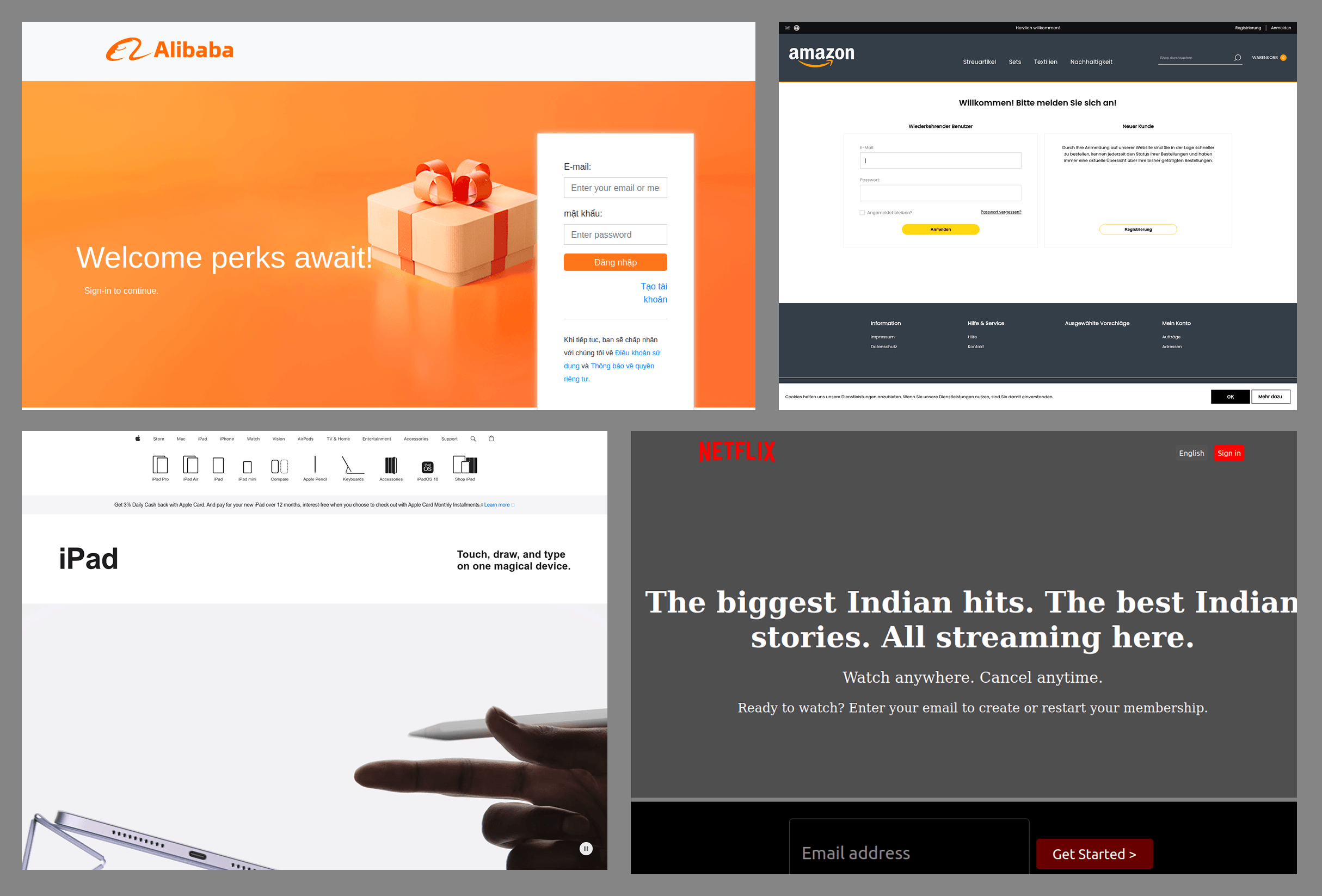
    Apple’s share of attacks dropped nearly 3 p.p. from last year’s figure to 15.68%, while Netflix scams grew slightly to 15.99%. Meanwhile, fraudsters’ interest in Alibaba increased, its share going up from 3.17% in 2023 to 7.95% in 2024.

    Examples of phishing sites that mimic Amazon, Netflix, Apple and Alibaba

    Last year, Louis Vuitton accounted for a whopping 5.52% of all attacks. However, the luxury brand completely slipped out of the top ten in 2024, along with Italian eyewear company Luxottica. Instead, sportswear giant Adidas and Russian e-commerce platform Ozon entered the list with 1.39% and 2.75% respectively. eBay (4.35%), Shopify (3.82%), Spotify (2.84%) and Mercado Libre (1.86%) all stayed in the top ten, with marginal differences from the previous year.

    TOP 10 online shopping brands mimicked by phishing and scam pages, 2024 (download)

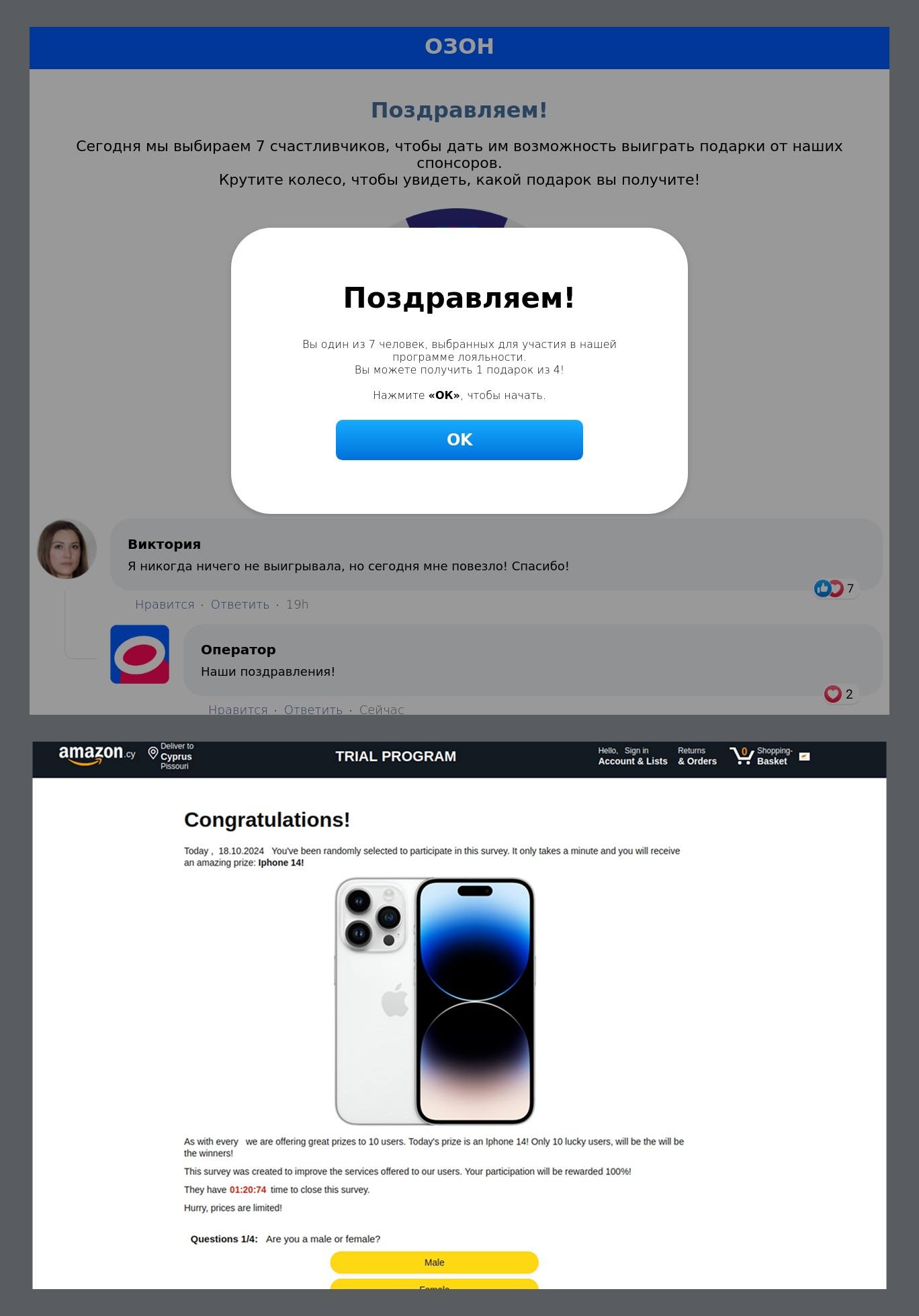
    When looking at fake website content, free prizes and offers that were a little too good to be true once again proved a popular tactic used by scammers. However tempting they may be, most likely, the victim will be the one who pays. Often scammers require “commissions” to get the prize or ask user to pay for delivery. After receiving the money, they disappear.

    Examples of scam pages offering free prizes

    In other cases, precious gifts are used by phishers to trick the user into giving out their credentials. The scheme below offers the victim an Amazon gift card to obtain which they should enter an OTP code on a phishing website. Although such codes are temporary, the scammers may use them to log in to victim’s account or perform a fraudulent transaction as soon as it is entered into the fake form.

    A phishing scheme aimed at getting OTP codes

    Fraudsters often trick users into “verifying” their accounts by sending fake security alerts or urgent messages claiming suspicious activity. Victims are directed to a counterfeit page resembling platforms like eBay, where entering data (for example, credentials, payment data or documents) hands them over to scammers.

    An example of a phishing site that mimics eBay

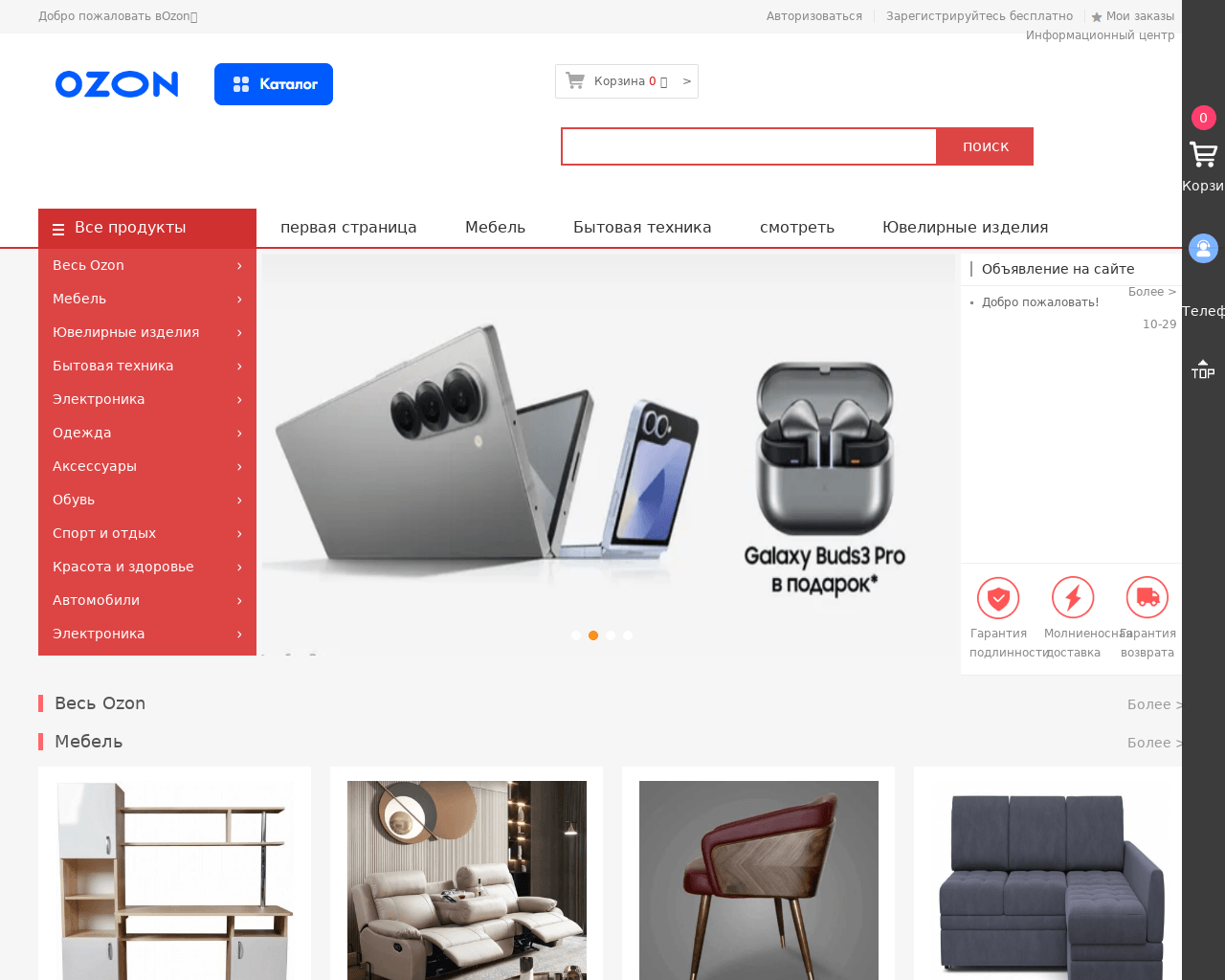
    Another common tactic involves creating fake storefronts or seller profiles on marketplaces, listing numerous products at seemingly irresistible prices. Shoppers drawn in by the deals unknowingly provide payment details, only to receive nothing in return.

    An example of a scam site that mimics an online marketplace

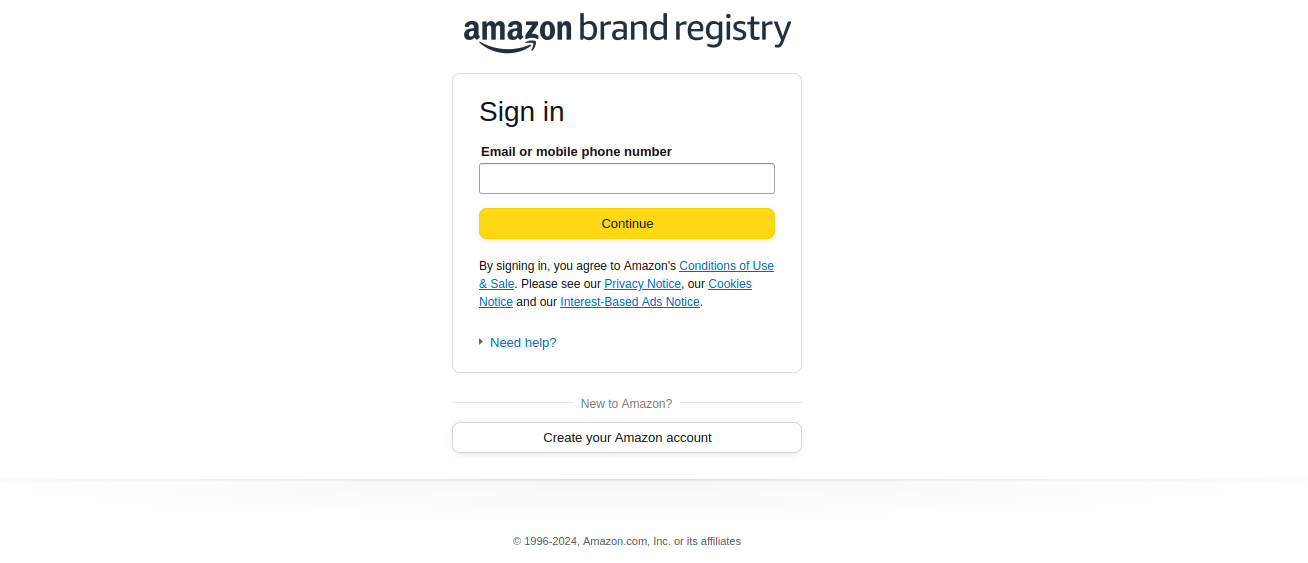
    While many pages mimicking online stores target shoppers, there are others that are designed to collect business account credentials. For example, below you can see a phishing page targeting users registered on the Amazon Brand Registry platform, which provides businesses with a range of brand-building and intellectual property protection tools.

    An example of a phishing page targeting Amazon brand accounts

    Payment system phishing

    Payment systems were mimicked in 19.27% of financial phishing attacks detected and blocked by Kaspersky products in 2024 – almost the same percentage as in 2023. Once again, PayPal was the most targeted, but its share of attacks fell from 54.73% to 37.53%. Attacks targeting Mastercard went in the opposite direction, nearly doubling from 16.58% in 2023 to 30.54%. American Express, Qiwi and Cielo are all new entrants into the top five, replacing Visa, Interac and PayPay.

    TOP 5 payment systems mimicked by phishing and scam pages, 2024 (download)

    Cryptocurrency scams

    In 2024, the number of phishing and scam attacks relating to cryptocurrencies continued to grow. Kaspersky anti-phishing technologies prevented 10,706,340 attempts to follow a cryptocurrency-themed phishing link, which was approximately 83.37% higher than the 2023 figure of 5,838,499 (which itself was 16% bigger than the previous year’s). As cryptocurrencies continue to grow, this number is only ever going to get larger.

    Financial PC malware

    In 2024, the decline in users affected by financial PC malware continued. On the one hand, people continue to rely on mobile devices to manage their finances. On the other hand, some of the most prominent malware families that were initially designed as bankers had not used this functionality for years, so we excluded them from these statistics. As a result, the number of affected users dropped significantly from 312,453 in 2023 to 199,204 in 2024.

    Changes in the number of unique users attacked by banking malware in 2024 (download)

    Key financial malware actors

    The notable strains of banking Trojans in 2024 included ClipBanker (62.9%), Grandoreiro (17.1%), CliptoShuffler (9.5%) and BitStealer (1.3%). Most of these Trojans specifically target crypto assets. However, Grandoreiro is a full-fledged banking Trojan that targeted 1700 banks and 276 crypto wallets in 45 countries and territories around the globe in 2024.

    Name %*
    ClipBanker 62.9
    Grandoreiro 17.1
    CliptoShuffler 9.5
    BitStealer 1.3

    * Unique users who encountered this malware family as a percentage of all users attacked by financial malware

    Geography of PC banking malware attacks

    To highlight the countries where financial malware was most prevalent in 2024, we calculated the share of users who encountered banking Trojans in the total number attacked by any type of malware in the country. The following statistics indicate where users are most likely to encounter financial malware.

    As in 2023, the highest share of banking Trojans was registered in Afghanistan, where it rose from 6% to 9% in 2024. Turkmenistan was next (as in 2023), where the figure rose from 5.2% to 8.8%, and Tajikistan was in third place (again), where the figure rose from 3.7% to 6.2%.

    TOP 20 countries by share of attacked users

    Country* %**
    Afghanistan 9.2
    Turkmenistan 8.8
    Tajikistan 6.2
    Syria 2.9
    Yemen 2.6
    Kazakhstan 2.5
    Switzerland 2.3
    Kyrgyzstan 2.2
    Uzbekistan 2.1
    Mexico 1.6
    Angola 1.5
    Mauritania 1.5
    Nicaragua 1.5
    Guatemala 1.3
    Argentina 1.1
    Paraguay 1.1
    Burundi 1.1
    Bolivia 1
    Uruguay 1
    Belarus 0.9

    * Excluded are countries and territories with relatively few (under 10,000) Kaspersky users.
    ** Unique users whose computers were targeted by financial malware as a percentage of all Kaspersky users who encountered malware in the country.

    Types of attacked users

    Attacks on consumers accounted for 73.69% of all financial malware attacks in 2024, up from 61.2% in 2023.

    Financial malware attack distribution by type (corporate vs consumer), 2022–2023 (download)

    Mobile banking malware

    The statistics for 2023 provided in this section were retrospectively revised and may not coincide with the data from the previous year’s report.

    In 2024, the number of users who encountered mobile banking Trojans grew 3.6 times compared to 2023: from 69,200 to 247,949. As can be seen in the graph below, the malicious activity increased dramatically in the second half of the year.

    Number of Android users attacked by banking malware by month, 2022–2023 (download)

    The most active Trojan-Banker family in 2024 was Mamont (36.70%). This malware first appeared at the end of 2023 and is distributed mostly in Russia and the CIS. Its distribution schemes are ranging from ages-old “Is that you in the picture?” scams to complex social engineering plots with fake stores and delivery tracking apps.

    Verdict %* 2023 %* 2024 Difference in p.p. Change in ranking
    Trojan-Banker.AndroidOS.Mamont.bc 0.00 36.70 +36.70
    Trojan-Banker.AndroidOS.Agent.rj 0.00 11.14 +11.14
    Trojan-Banker.AndroidOS.Mamont.da 0.00 4.36 +4.36
    Trojan-Banker.AndroidOS.Coper.a 0.51 3.58 +3.07 +30
    Trojan-Banker.AndroidOS.UdangaSteal.b 0.00 3.17 +3.17
    Trojan-Banker.AndroidOS.Agent.eq 21.79 3.10 -18.69 -4
    Trojan-Banker.AndroidOS.Mamont.cb 0.00 3.05 +3.05
    Trojan-Banker.AndroidOS.Bian.h 23.13 3.02 -20.11 -7
    Trojan-Banker.AndroidOS.Faketoken.z 0.68 2.96 +2.29 +18
    Trojan-Banker.AndroidOS.Coper.c 0.00 2.84 +2.84

    * Share of unique users who encountered this malware as a percentage of all users of Kaspersky mobile security solutions who encountered banking threats

    The Bian.h variant (3.02%) that prevailed in 2023 dropped to eighth place, losing over 20 p.p., and several more new samples entered the ranking: Agent.rj (11.14%) at the second place, UdangaSteal.b (3.17%) and Coper.c (2.84%).

    Geography of the attacked mobile users

    Same as 2023, Turkey was the number one country targeted by mobile banking malware. The share of users encountering financial threats there grew by 2.7 p.p., reaching 5.68%. Malicious activity also increased in Indonesia (2.71%), India (2.42%), Azerbaijan (0.88%), Uzbekistan (0.63%) and Malaysia (0.29%). In Spain (0.73%), Saudi Arabia (0.63%), South Korea (0.30%) and Italy (0.24%), it decreased.

    Country* %**
    Turkey 5.68
    Indonesia 2.71
    India 2.42
    Azerbaijan 0.88
    Spain 0.73
    Saudi Arabia 0.63
    Uzbekistan 0.63
    South Korea 0.30
    Malaysia 0.29
    Italy 0.24

    * Countries and territories with relatively few (under 25,000) Kaspersky mobile security users have been excluded from the rankings.
    ** Unique users attacked by mobile banking Trojans as a percentage of all Kaspersky mobile security users in the country.

    Conclusion

    In 2024, financial cyberthreats continued to evolve, with cybercriminals deploying phishing, malware and social engineering techniques to exploit individuals and businesses alike. The rise in cryptocurrency-related scams and mobile financial malware highlights the need for continuous vigilance and proactive cybersecurity measures, including multi-factor authentication, user awareness training and advanced threat detection solutions. As the digital finance landscape expands, staying ahead of emerging threats remains critical.

    To protect your devices and finance-related accounts:

    • Use multifactor authentication, strong unique passwords and other secure authentication tools.
    • Do not follow links in suspicious messages, and double-check web pages before entering your secrets, be it credentials or banking card details.
    • Download apps only form trusted sources, such as official app marketplaces.
    • Use reliable security solutions capable of detecting and stopping both malware and phishing attacks.

    To protect your business:

    • Update your software in a timely manner. Pay particular attention to security patches.
    • Improve your employees’ security awareness on a regular basis, and encourage safe practices, such as proper account protection.
    • Implement robust monitoring and endpoint security.
    • Implement strict security policies for users with access to financial assets, such as default deny policies and network segmentation.
    • Use threat intelligence services from trusted sources to stay aware of the latest threats and cybercrime trends.

    MIL OSI Economics

  • MIL-OSI United Kingdom: Analysis in Government Month 2025

    Source: United Kingdom – Executive Government & Departments

    News story

    Analysis in Government Month 2025

    The UK’s largest learning and development event for government analysts is back for the fifth year.

    Analysis in Government (AiG) Month, the UK’s largest learning and development event for government analysts, returns for the fifth year with the theme of ‘Impact’. 

    Throughout the whole of May, we will be highlighting the impact of quality analysis across government, exploring how analysts are working together to deliver in areas of Policy, Operational Delivery and much more.  

    As always, the month will feature an inspirational calendar of live online events, links to learning, social media takeovers, online blogs and interactive learning events.

    Present your own AiG Month session

    The Analysis Function central team is accepting expressions of interest from analysts who would like to present a session until Friday 28 March.  

    Head over to the Analysis in Government Month hub page on our website to find out more and book your space.

    About AiG Month

    Follow us on EventBrite and subscribe to the monthly Analysis Function Newsletter.

    Updates to this page

    Published 25 March 2025

    MIL OSI United Kingdom

  • MIL-OSI United Kingdom: Survey finds adult social care workers have pride in their role

    Source: City of Wolverhampton

    That’s according to the latest Social Work and Wider Workforce Health Checks, annual surveys which assess the health and wellbeing of social workers and other frontline practitioners within Adult Social Care.

    They found that practitioners feel supported by learning and development opportunities and by good quality, regular supervision which helps them to ensure they are providing the right support to adults in the city, while also being able to discuss their own wellbeing.

    A report due to go to Adult Scrutiny Panel today (Tuesday 25 March, 2025) also shows that, once again, the majority of staff across the service have a strong sense of pride in the job that they do – and would recommend the council as an employer to their friends and family.

    Councillor Jasbir Jaspal, the council’s Cabinet Member for Adults and Wellbeing, said: “I would like to extend my thanks for the fantastic work all of our staff in Adult Social Care do for people in our city.

    “Wolverhampton continues to be a place where social care practitioners and social workers can make a real difference to the lives of adults with care and support needs, and carers.

    “We have actions already in place to further support our social workers and wider workforce this coming year. However, we will continue to offer regular opportunities for staff to give their feedback on what is working well and also where we can improve as this is an ongoing open dialogue that does not have to wait for the next annual survey.”

    For more information about social work jobs available with the City of Wolverhampton Council, please visit Wolverhampton Social Work Jobs.

    MIL OSI United Kingdom

  • MIL-OSI United Kingdom: Join community sessions to shine spotlight on local issues

    Source: City of Wolverhampton

    The Love Your Community sessions give residents the chance to meet with representatives from Wolverhampton Police, the City of Wolverhampton Council, Wolverhampton’s Anti Social Behaviour team and more, and to share information about issues and activities in their neighbourhoods.

    Councillor Obaida Ahmed, the City of Wolverhampton Council’s Cabinet Member for Digital and Community, said: “These sessions are an important forum for residents to meet with organisations and discuss the priorities for their neighbourhoods – and how we can all work together to deliver on these.

    “Please come along to find out what’s happening in your area, tell us what’s important for your neighbourhood, help improve your local spaces, connect with your neighbours and businesses, and speak with police, councillors and community services.”

    Chief Superintendent Richard Fisher of Wolverhampton Police added: “The Love Your Community events are an integral part of the work of the neighbourhood police teams, community safety partners and local people to address concerns and issues in the community.

    “These sessions provide an opportunity to outline clear shared ownership for local priorities and help to increase collective care for what happens in our communities.”

    Love Your Community drop ins are held for each ward on a regular basis. The next are as follows:

    • Ettingshall South and Spring Vale, Monday 31 March, 4pm to 6pm, Lanesfield Methodist Church WV4 6PG
    • Oxley, Tuesday 1 April, 6pm to 8pm, Rakegate Methodist Church, Renton Grove WV10 6XG
    • Wednesfield South, Thursday 3 April, 4pm to 6pm, Wednesfield Community Centre WV11 1XT
    • Blakenhall, Tuesday 8 April, 4pm to 6pm, Lakshmi’s, Dudley Road WV2 3DT
    • Tettenhall, Thursday 10 April, 6pm to 8pm, Wolverhampton Cricket Club, Danescourt Road WV6 9BJ
    • St Peter’s and Park, Tuesday 15 April, 6pm to 8pm, Newhampton Arts Centre, Dunkley Street WV1 4AN
    • Low Hill, Fallings Park and Bushbury, Thursday 17 April, 6pm to 8pm, Low Hill Community Centre, Kempthorne Park WV10 9JJ
    • East Park, Wednesday 23 April, 4pm to 6pm, Eastfield Community Centre WV1 2QY
    • Heath Town, Tuesday 29 April, 4.30pm to 6.30pm, Hope Centre, Ling House WV10 0HH
    • Wednesfield North, Wednesday 30 April, 4pm to 6pm, The Hub at Ashmore Park WV11 2LH
    • Merry Hill, Wednesday 30 April, 6pm to 8pm, Swanmore Centre, Swanmore Close WV4 7JY
    • Bilston South, Thursday 1 May, 4pm to 6pm, St Martin’s Church, Bradley WV14 8PF
    • Graiseley, Thursday 1 May, 6pm to 8pm, St Chad’s Community Centre, Owen Road WV3 0HT
    • Ettingshall North, Tuesday 6 May, 4.30pm to 6.30pm, The Saplings, Parkfield Road WV4 6EL
    • Penn, Thursday 8 May, 4pm to 6pm, Penn Library, Coalway Avenue WV3 7LT
    • Bilston North, Monday 12 May, 4.30pm to 6.30pm, Bilston College, Wellington Road WV14 6BT

    For more details, please visit eventbrite or email safer@wolverhampton.gov.uk.

    MIL OSI United Kingdom

  • MIL-OSI: Valeura Energy Inc.: Another Year of Record Results in 2024

    Source: GlobeNewswire (MIL-OSI)

    SINGAPORE, March 25, 2025 (GLOBE NEWSWIRE) — Valeura Energy Inc. (TSX:VLE, OTCQX:VLERF) (“Valeura” or the “Company”) reports its financial and operating results for the three month period and year ended December 31, 2024.

    The complete reporting package for the Company, including the audited financial statements and associated management’s discussion and analysis (“MD&A”) and the 2024 annual information form (“AIF”), are being filed on SEDAR+ at www.sedarplus.ca and posted to the Company’s website at www.valeuraenergy.com.

    2024 Operational Highlights

    • Production increased by 12% year-over-year to 22,825 bbls/d(1) on the back of a full year of drilling operations and development of the Nong Yao C Field;
    • 100% success rate in exploration and appraisal activities with discoveries at Niramai, Wassana North, and Nong Yao D;
    • Company’s first full year of operations completed with no significant health, safety, or environment incidents; and
    • Reduced greenhouse emissions intensity by approximately 20% compared to 2023 baseline.

    2024 Financial Highlights

    • Generated revenue of US$679 million, with average price realisation of US$81/bbl;
    • Delivered Adjusted EBITDAX of US$378 million(2) and adjusted cashflow from operations of US$273 million(2);
    • Strengthened the balance sheet with record high year-end cash position of US$259 million(3) and zero debt;
    • Reduced asset retirement obligation (“ARO”) by 54% since assuming operatorship in Q1, 2023;
    • Completed internal restructuring to optimise operational and financial aspects of the Thai III petroleum concessions; and
    • Implemented share buyback programme through a Normal Course Issuer Bid for up to 10% of the public float.

    2024 Reserves Highlights

    • Record high year-end reserves: 32 MMbbl proved (1P), 50 MMbbl proved plus probable (2P) and 60 MMbbl proved plus probable plus possible (3P) reserves;
    • Delivered 2P reserves replacement ratio of 245%, even after production increase of 12%;
    • Increased 2P reserves and extended the end of field life (“EOFL”) at every field;
    • Grew 2P net present value (NPV10) before tax to US$934 million and US$753 million after tax(4);
    • Considering year-end 2024 cash position, increased 2P net asset value after tax to US$1,012 million, equating to C$13.6 per share(5); and
    • Doubled contingent resources to 48 MMbbls compared to year-end 2023(6).

    (1) Working interest share production before royalties.
    (2) Non-IFRS financial measure or non-IFRS ratio – see “Non-IFRS Financial Measures and Ratios” section in the Company’s MD&A.
    (3) Includes restricted cash of $22.8 million.
    (4) Discount rate 10%.
    (5) Proved plus probable (2P) NPV10 plus net cash at December 31, 2024, assuming $/C$ exchange rate of 1.435, and 106.65 million shares outstanding as of December 31, 2024.
    (6) Unrisked best estimate (2C) contingent resources.

    Dr. Sean Guest, President and CEO commented:

    “Our first full year of operations in Thailand were a success across all areas of our business and a trophy for value creation.  We have attained record production, record cash flow, and replaced nearly 2.5x the reserves we produced, all while continuing to strengthen our financial position.  Our business is stronger and has a longer line of sight than ever before.

    Continued drilling throughout 2024 added 20 new production wells, including those we drilled to develop the new Nong Yao C field, making Nong Yao the largest and most profitable asset in our portfolio.  We’ve also had success with the drill bit on both appraisal and exploration which has significantly increased the number of future development well locations.  This successful drilling, combined with detailed reservoir studies has resulted in a 32% increase in 2P reserves to 50 million bbls.  Moreover, the economic life of each of our fields has moved further into the future, such that all fields are now expected to remain economic beyond 2030. 

    We are focussed relentlessly on value, and with the combination of an increase in the net present value of our 2P reserves, and the record cash position of US$259 million at year-end, the net asset value of our business is now more than one billion US dollars.  On a per share basis, that equates to over C$13/share, meaning an investment in Valeura’s shares continues to represent an excellent value proposition. 

    In addition to growing both the value and longevity of our existing portfolio, we continue to pursue several other avenues for growth, including exciting exploration opportunities, and potential merger and acquisition targets.”

    Financial and Operating Results Summary

        Three months ended  Year ended
        December 31, 2024 December 31, 2023 Delta December 31, 2024 December 31, 2023 Delta
    Oil Production(1) (‘000 bbls) 2,403 1,763 +36% 8,354 5,825 43%
    Average Daily Oil Production(1) (bbls/d) 26,109 19,165 +36% 22,825 20,440(2) +12%
    Average Realised Price (US$/bbl) 76.7 85.5 (10%) 81.3 84.3 (4%)
    Oil Volumes Sold (‘000 bbls) 2,948 1,987 +48% 8,349 5,854 +43%
    Oil Revenue (US$’000) 226,148 169,909 +33% 678,794 493,457 +38%
    Net Income (US$’000) 213,983 23,480 +811% 240,797 244,313 (1%)
    Adjusted EBITDAX(3) (US$’000) 132,402 96,679 +37% 377,985 230,672 +64%
    Adjusted Pre-Tax Cashflow from Operations(3) (US$’000) 133,612 88,326 +51% 356,627 238,661 +49%
    Adjusted Cashflow from Operations(3) (US$’000) 107,134 56,023 +107% 272,641 152,375 +79%
    Operating Expenses (US$’000) 55,607 49,622 +12% 186,407 180,192 +3%
    Adjusted Opex(3) (US$’000) 54,668 51,818 +6% 214,891 165,077 +30%
    Operating Expenses per bbl (US$/bbl) 18.9 25.0 (25%) 22.3 30.9 (28%)
    Adjusted Opex per bbl(3) (US$/bbl) 22.8 29.4 (22%) 25.7 28.3 (9%)
    Adjusted Capex(3) (US$’000) 38,870 30,374 +28% 134,258 103,733 +29%
    Weighted average shares outstanding – basic (‘000 shares) 106,955 102,652 +4% 105,778 99,227 +7%
        As at Comparison
        December 31, 2024 December 31, 2023 %
    Cash & Cash equivalents(4) (US$’000) 259,354 151,165 +72%
    Adjusted Net Working Capital(3) (US$’000) 205,735 118,143 +74%
    Shareholder’s Equity (US$’000) 528,283  284,178 +86%

     
    (1) Working interest share production before royalties.

    (2) Average daily oil production of 20,440 bbls/d represents the average production from closing of the Mubadala Acquisition on March 22, 2023 to December 31, 2023 (285 days).
    (3) Non-IFRS financial measure or non-IFRS ratio – see “Non-IFRS Financial Measures and Ratios” section in the Company’s MD&A.
    (4) Includes restricted cash of US$22.8 million at December 31, 2024 and restricted cash of US$17.3 million at December 31, 2023.

    Financial Update

    The Company’s Q4 2024 oil production averaged 26,109 bbls/d (working interest share before royalties), representing a 36% increase from Q4 2023.  Full year 2024 oil production averaged 22,825 bbls/d, 12% higher than 2023.  This growth was primarily driven by production from the Wassana field, which was not in production for most of 2023 and the Nong Yao C development, which came online in August 2024.  Oil sales for Q4 2024 were 2.9 million bbls, compared to 2.0 million bbls in Q4 2023.  For the full year 2024, oil sales totalled 8.4 million bbls, up 43% from 5.8 million bbls in 2023.  The increase is due to higher production rates in 2024, coupled with the fact that in 2023 the Company had only 285 days of production operations (following closing of the Mubadala acquisition on March 22, 2023).

    The Company generated Q4 2024 revenue of US$226.1 million, a 33% increase from Q4 2023.  Full year 2024 revenue was US$678.8 million, representing a 38% increase from 2023.  Q4 2024 price realisations averaged US$76.7/bbl, achieving a US$2.0/bbl premium to the Brent benchmark.  Full year 2024 price realisations averaged US$81.3/bbl, reflecting a US$0.5/bbl premium to Brent.  Valeura reported Q4 2024 Adjusted EBITDAX (a non-IFRS measure which is more fully described in the “Non-IFRS Financial Measures and Ratios” section of the MD&A) of US$132.4 million, up 37% from Q4 2023, while full year 2024 Adjusted EBITDAX increased 64% to US$378.0 million.

    The Company demonstrated improved operational efficiency with Q4 2024 Adjusted Opex (a non-IFRS measure which is more fully described in the “Non-IFRS Financial Measures and Ratios” section of the MD&A) of US$22.8/bbl, down from US$29.4/bbl in Q4 2023.  Full year 2024 Adjusted Opex decreased to US$25.7/bbl from US$28.3/bbl in 2023.  Operating expenses for Q4 were US$18.9/bbl compared to US$25.0/bbl in Q4 2023, and US$22.3/bbl for the full 2024 versus US$30.9/bbl in 2023. These improved unit costs were driven primarily by increased production from the low-cost Nong Yao field, which has become the Company’s largest production source.

    Valeura incurred total petroleum tax income and special remuneratory benefit tax of US$68.3 million and US$29.2 million respectively during the full year 2024, compared to US$71.2 million and US$15.1 million in the previous year.   The Company stands to benefit from a more efficient tax structure in 2025 as a result of the corporate restructuring which was completed in November 2024. This will result in Petroleum income tax loss carry-forwards that were previously associated with only the Wassana asset now being applied to all of the Company’s Thai III petroleum concessions, being Wassana, Nong Yao, and Manora.

    The Company recorded Net income for the year of US$240.8 million following the recognition of deferred tax assets from the tax consolidation.

    As of December 31, 2024, Valeura had a strong cash position of US$259.4 million, including US$22.8 million in restricted cash.  The Company continues to operate with no current or non-current debt.  Valeura remains well-positioned for both organic reinvestment opportunities and potential strategic acquisitions.

    Operations Update and Outlook

    During Q4 2024, the Company had ongoing production operations on all of its Gulf of Thailand fields, comprised of the Jasmine, Nong Yao, Manora, and Wassana fields.  The Company has had one drill rig working continuously on contract since Q1 2023 full-time.

    Oil production averaged 26.1 mbbls/d during Q4 2024 (Valeura’s working interest share, before royalties).

    Jasmine/Ban Yen

    Oil production before royalties from the Jasmine/Ban Yen field, in Licence B5/27 (100% operated interest) averaged 8.5 mbbls/d during Q4 2024, an increase of 12% from Q3 2024.  Increased production rates reflect the start-up of five new wells drilled as part of an infill drilling programme, with the last three wells coming onstream in late November 2024.  In addition to adding new production, the Jasmine programme also evaluated several secondary appraisal targets which will be the subject of further infill development drilling in due course. 

    Although the Jasmine field is the most mature asset in the Company’s portfolio, ongoing drilling success underscores the field’s ability to continue serving as a key source of cash generation for the business.  The Q4 Jasmine drilling results have been included in the Company’s reserves evaluation for the year-ended December 31, 2024, and contributed to a further extension in the field’s economic life, which on a 2P reserves basis, now lasts into mid 2031. 

    In February 2025 the drill rig returned to the Jasmine field where it has begun executing a seven-well infill campaign.  In total 10 development and appraisal wells are currently planned for the Jasmine field in 2025 and one exploration well at the Ratree prospect.  In addition, a workover rig is currently operating on the field completing two workovers.

    The low-BTU gas generator was delivered to the Jasmine B platform in Q1 2025 and is expected to be commissioned and operational in Q2 2025.  This creates an opportunity to significantly reduce greenhouse gas emissions from this platform as well as to reduce operating costs by using a waste gas stream for power generation.

    Nong Yao

    At the Nong Yao field, in Licence G11/48 (90% operated working interest), Valeura’s working interest share production before royalties averaged 11.1 mbbls/d, an increase of 18% from Q3 2024.  Q4 production rates benefitted from a full quarter of operations at the Nong Yao C field extension, which came online in August 2024. 

    Performance from Nong Yao C is continuing in line with the Company’s expectations.  The Nong Yao field is now the Company’s largest source of production.  In addition, it also has the Company’s lowest per unit Adjusted Opex and its oil fetches a premium to the Brent benchmark.  As a result, Nong Yao is the Company’s most cash generative asset.

    In 2025, nine development wells are planned across the three Nong Yao platforms.  This programme is expected to commence in late Q2 2025. 

    Wassana

    Oil production at the Wassana field, in Licence G10/48 (100% operated interest), averaged 4.3 mbbls/d (before royalties), an increase of 55% over Q3 2024.  The increase reflects the effect of a full quarter of normal operations at the field, as compared to Q3 2024, during which the Company conducted a one-month precautionary suspension of production while performing underwater inspection work.  There was no drilling on the Wassana field in Q4 and no further drilling is planned at this location for 2025.

    Valeura has completed the front end engineering and design work for the potential redevelopment of the Wassana field.  Detailed contracting and procurement work commenced in late Q4 2024 to validate cost assumptions for the project.  Valeura expects to consider a final investment decision in early Q2 2025. 

    Manora

    At the Manora field, in Licence G1/48 (70% operated working interest), Valeura’s working interest share of oil production before royalties averaged 2.2 mbbls/d, a decrease of 11% from Q3 2024.  During Q4, the Company began a five-well infill drilling campaign on the Manora field, including both production-oriented infill development wells and appraisal targets.  The programme was completed in Q1 2025 and for the month of March to date, working interest share production before royalties has averaged 2.9 mbbls/d.  In addition, several appraisal targets were evaluated, giving rise to between three and five potential future drilling targets, which will be further evaluated for inclusion in a future drilling programme.

    Türkiye

    The Company had no active operations in Türkiye during Q4 2024, however it continues to hold an interest in a potentially large deep gas play in the Thrace basin in the northwest part of the country.  In 2024 the Company received official confirmation that it’s leases and licences covering the play had been extended into 2025, and more recently the Company was granted an additional one-year extension, bringing the expiry date to June 27, 2026.  Following the current period, Valeura may apply for a further two-year extension for appraisal purposes, and has engaged the government in discussions to that effect. 

    The Company believes the Thrace basin deep gas play could be a source of significant value in the longer term.  Valeura intends to farm out a portion of its interest to a new partner in order to jointly pursue the next phase of appraisal work. 

    Reserves and Resources Summary

    The results of Valeura’s third-party independent reserves and resources assessment for its Thailand assets as of December 31, 2024 were announced on February 13, 2025.  Below are summary tables associated with the reserves.

    Summary of Reserves Replacement, Value and Field Life
     
      Gross (Before Royalties) 2P Reserves, Working Interest Share End of Field Life 2P NPV10 After Tax (US$ million)
    Fields December 31, 2023
    (MMbbl)
    2024 Production
    (MMbbl)
    Additions
    (MMbbl)
    December 31, 2024
    (MMbbl)
    Reserves Replacement Ratio (%) NSAI 2023 Report NSAI 2024 Report December 31, 2023 December 31, 2024
    Jasmine 10.4 (2.9) 9.2 16.8 324% Dec 2028 Aug 2031 81.8 163.9
    Manora 2.2 (0.9) 2.1 3.4 223% Jul 2027 Apr 2030 21.2 45.7
    Nong Yao 12.4 (3.1) 7.7 16.9 245% Dec 2028 Dec 2033 185.6 416.1
    Wassana 12.9 (1.4) 1.5 12.9 102% Jun 2032 Dec 2035 139.9 126.6
    Total 37.9 (8.4) 20.5 50.0 245%     428.5 752.2
    Summary of NPV and NAV
     
      1P NPV10 2P NPV10 3P NPV10
    Before Tax After Tax Before Tax After Tax Before Tax After Tax
    NPV10 (US$ million) 360.7 358.6 933.9 752.2 1,339.1 990.2
    Cash at December 31, 2024 (US$ million)(1) 259.4 259.4 259.4 259.4 259.4 259.4
    Net Asset Value (US$ million) 620.1 618.0 1,193.3 1,011.6 1,598.5 1,249.6
    Common shares (million)(2) 106.65 106.65 106.65 106.65 106.65 106.65
    Estimated NAV per basic share (C$ per share)(3) 8.3 8.3 16.1 13.6 21.5 16.8

     
    (1) Cash at December 31, 2024 of US$259.4 million, debt nil.

    (2) Issued and outstanding common shares as of December 31, 2024
    (3) US$/C$ exchange rate of 1.435 as at December 31, 2024

    Webcast

    Valeura’s management team will host an investor and analyst webcast at 08:00 Calgary / 14:00 London / 21:00 Bangkok / 22:00 Singapore on Wednesday, March 26, 2025 to discuss today’s announcement.  Please register in advance via the link below.

    Registration link:  https://events.teams.microsoft.com/event/aa5e4d6a-cb5f-46da-ab85-0976e3600c84@a196a1a0-4579-4a0c-b3a3-855f4db8f64b

    As an alternative, an audio only feed of the event is available by phone using the Conference ID and dial-in numbers below.

    Thailand: +66 2 026 9035,,922648874#
    Singapore: +65 6450 6302,,922648874#
    Canada: (833) 845-9589,,922648874#
    Türkiye: 0800 142 034779,,922648874#
    United States: (833) 846-5630,,922648874#
    United Kingdom: 0800 640 3933,,922648874#

    Phone conference ID: 922 648 874#

    For further information, please contact:

    Valeura Energy Inc. (General Corporate Enquiries)                       +65 6373 6940
    Sean Guest, President and CEO
    Yacine Ben-Meriem, CFO
    Contact@valeuraenergy.com  

    Valeura Energy Inc. (Investor and Media Enquiries)              +1 403 975 6752 / +44 7392 940495
    Robin James Martin, Vice President, Communications and Investor Relations
    IR@valeuraenergy.com

    Contact details for the Company’s advisors, covering research analysts and joint brokers, including Auctus Advisors LLP, Canaccord Genuity Ltd (UK), Cormark Securities Inc., Research Capital Corporation, and Stifel Nicolaus Europe Limited, are listed on the Company’s website at www.valeuraenergy.com/investor-information/analysts/.

    About the Company

    Valeura Energy Inc. is a Canadian public company engaged in the exploration, development and production of petroleum and natural gas in Thailand and in Türkiye. The Company is pursuing a growth-oriented strategy and intends to re-invest into its producing asset portfolio and to deploy resources toward further organic and inorganic growth in Southeast Asia. Valeura aspires toward value accretive growth for stakeholders while adhering to high standards of environmental, social and governance responsibility.

    Additional information relating to Valeura is also available on SEDAR+ at www.sedarplus.ca.

    Oil and Gas Advisories

    Reserves and contingent resources disclosed in this news release are based on an independent evaluation conducted by the incumbent independent petroleum engineering firm, NSAI with an effective date of December 31, 2024. The NSAI estimates of reserves and resources were prepared using guidelines outlined in the Canadian Oil and Gas Evaluation Handbook and in accordance with National Instrument 51-101 – Standards of Disclosure for Oil and Gas Activities. The reserves and contingent resources estimates disclosed in this news release are estimates only and there is no guarantee that the estimated reserves and contingent resources will be recovered.

    This news release contains a number of oil and gas metrics, including “NAV”, “reserves replacement ratio”, “RLI”, and “end of field life” which do not have standardised meanings or standard methods of calculation and therefore such measures may not be comparable to similar measures used by other companies. Such metrics are commonly used in the oil and gas industry and have been included herein to provide readers with additional measures to evaluate the Company’s performance; however, such measures are not reliable indicators of the future performance of the Company and future performance may not compare to the performance in previous periods.

    “NAV” is calculated by adding the estimated future net revenues based on a 10% discount rate to net cash, (which is comprised of cash less debt) as of December 31, 2024.  NAV is expressed on a per share basis by dividing the total by basic common shares outstanding. NAV per share is not predictive and may not be reflective of current or future market prices for Valeura.

    “Reserves replacement ratio” for 2024 is calculated by dividing the difference in reserves between the NSAI 2024 Report and the NSAI 2023 Report, plus actual 2024 production, by the assets’ total production before royalties for the calendar year 2024.

    “RLI” is calculated by dividing reserves by management’s estimated total production before royalties for 2025.

    “End of field life” is calculated by NSAI as the date at which the monthly net revenue generated by the field is equal to or less than the asset’s operating cost.

    Reserves

    Reserves are estimated remaining quantities of commercially recoverable oil, natural gas, and related substances anticipated to be recoverable from known accumulations, as of a given date, based on the analysis of drilling, geological, geophysical, and engineering data, the use of established technology, and specified economic conditions, which are generally accepted as being reasonable. Reserves are further categorised according to the level of certainty associated with the estimates and may be sub-classified based on development and production status.

    Proved reserves are those reserves that can be estimated with a high degree of certainty to be recoverable. It is likely that the actual remaining quantities recovered will exceed the estimated proved reserves.

    Developed reserves are those reserves that are expected to be recovered from existing wells and installed facilities or, if facilities have not been installed, that would involve a low expenditure (e.g., when compared to the cost of drilling a well) to put the reserves on production.

    Developed producing reserves are those reserves that are expected to be recovered from completion intervals open at the time of the estimate. These reserves may be currently producing or, if shut in, they must have previously been on production, and the date of resumption of production must be known with reasonable certainty.

    Developed non-producing reserves are those reserves that either have not been on production, or have previously been on production, but are shut in, and the date of resumption of production is unknown.

    Undeveloped reserves are those reserves expected to be recovered from known accumulations where a significant expenditure (e.g., when compared to the cost of drilling a well) is required to render them capable of production. They must fully meet the requirements of the reserves classification (proved, probable, possible) to which they are assigned.

    Probable reserves are those additional reserves that are less certain to be recovered than proved reserves. It is equally likely that the actual remaining quantities recovered will be greater or less than the sum of the estimated proved plus probable reserves.

    Possible reserves are those additional reserves that are less certain to be recovered than probable reserves. It is unlikely that the actual remaining quantities recovered will exceed the sum of the estimated proved plus probable plus possible reserves. There is a 10% probability that the quantities actually recovered will equal or exceed the sum of the estimated proved plus probable plus possible reserves.

    The estimated future net revenues disclosed in this news release do not necessarily represent the fair market value of the reserves associated therewith.

    The estimates of reserves and future net revenue for individual properties may not reflect the same confidence level as estimates of reserves and future net revenue for all properties, due to the effects of aggregation.

    Contingent Resources

    Contingent resources are those quantities of petroleum estimated, as of a given date, to be potentially recoverable from known accumulations using established technology or technology under development, but which are not currently considered to be commercially recoverable due to one or more contingencies. Contingencies are conditions that must be satisfied for a portion of contingent resources to be classified as reserves that are: (a) specific to the project being evaluated; and (b) expected to be resolved within a reasonable timeframe.

    Contingent resources are further categorised according to the level of certainty associated with the estimates and may be sub‐classified based on a project maturity and/or characterised by their economic status. There are three classifications of contingent resources: low estimate, best estimate and high estimate. Best estimate is a classification of estimated resources described in the Canadian Oil and Gas Evaluation Handbook as the best estimate of the quantity that will be actually recovered; it is equally likely that the actual remaining quantities recovered will be greater or less than the best estimate. If probabilistic methods are used, there should be at least a 50 percent probability that the quantities actually recovered will equal or exceed the best estimate.

    The project maturity subclasses include development pending, development on hold, development unclarified and development not viable. The contingent resources disclosed in this news release are classified as either development unclarified or development not viable.

    Development unclarified is defined as a contingent resource that requires further appraisal to clarify the potential for development and has been assigned a lower chance of development until commercial considerations can be clearly defined. Chance of development is the likelihood that an accumulation will be commercially developed.

    Conversion of the development unclarified resources referred to in this news release is dependent upon (1) the expected timetable for development; (2) the economics of the project; (3) the marketability of the oil and gas production; (4) the availability of infrastructure and technology; (5) the political, regulatory, and environmental conditions; (6) the project maturity and definition; (7) the availability of capital; and, ultimately, (8) the decision of joint venture partners to undertake development.

    The major positive factor relevant to the estimate of the contingent development unclarified resources referred to in this news release is the successful discovery of resources encountered in appraisal and development wells within the existing fields. The major negative factors relevant to the estimate of the contingent development unclarified resources referred to in this news release are: (1) the outstanding requirement for a definitive development plan; (2) current economic conditions do not support the resource development; (3) limited field economic life to develop the resources; and (4) the outstanding requirement for a final investment decision and commitment of all joint venture partners.

    Development not viable is defined as a contingent resource where no further data acquisition or evaluation is currently planned and hence there is a low chance of development, there is usually less than a reasonable chance of economics of development being positive in the foreseeable future. The major negative factors relevant to the estimate of development not viable referred to in this news release are: (1) current economic conditions do not support the resource development; and (2) availability of technical knowledge and technology within the industry to economically support resource development.

    If these contingencies are successfully addressed, some portion of these contingent resources may be reclassified as reserves.

    Of the best estimate 2C contingent resources estimated in the NSAI 2024 Report, on a risked basis: 74% of the estimated volumes are light/medium crude oil, with the remainder being heavy oil; 77% are categorised as Development Unclarified, with the remainder being Development Not Viable.  Development Unclarified 2C resources have been assigned an average chance of development for the four fields ranging from 30% to 50% depending on oil type, while 2C Development Not Viable resources have been assigned an average chance of development ranging from 16% to 17%.

    Resources Project
    Maturity Subclass
    Light and Medium Crude Oil
    (Development Unclarified)
    Chance of Development (%)
    Unrisked Risked
    Gross (Mbbl) Net (Mbbl) Gross (Mbbl) Net (Mbbl)
    Contingent Low Estimate (1C) Development Unclarified 8,267 7,334 3,108 2,742 38 %
    Contingent Best Estimate (2C) Development Unclarified 14,178 12,538 4,227 3,728 30 %
    Contingent High Estimate (3C) Development Unclarified 21,072 18,644 5,289 4,673 25 %
    Resources Project
    Maturity Subclass
    Heavy Crude Oil
    (Development Unclarified)
    Chance of Development (%)
    Unrisked Risked
    Gross (Mbbl) Net (Mbbl) Gross (Mbbl) Net (Mbbl)
    Contingent Low Estimate (1C) Development Unclarified 7,807 7,358 4,045 3,813 52 %
    Contingent Best Estimate (2C) Development Unclarified 10,641 10,029 5,325 5,018 50 %
    Contingent High Estimate (3C) Development Unclarified 14,524 13,689 6,560 6,182 45 %
    Resources Project
    Maturity Subclass
    Light and Medium Crude Oil
    (Development Not Viable)
    Chance of Development (%)
    Unrisked Risked
    Gross (Mbbl) Net (Mbbl) Gross (Mbbl) Net (Mbbl)
    Contingent Low Estimate (1C) Development Not Viable 11,294 10,502 1,694 1,575 15 %
    Contingent Best Estimate (2C) Development Not Viable 21,539 19,965 3,652 3,319 17 %
    Contingent High Estimate (3C) Development Not Viable 33,503 30,964 5,363 4,802 16 %
    Resources Project
    Maturity Subclass
    Heavy Crude Oil
    (Development Not Viable)
    Chance of Development (%)
    Unrisked Risked
    Gross (Mbbl) Net (Mbbl) Gross (Mbbl) Net (Mbbl)
    Contingent Low Estimate (1C) Development Not Viable 2,069 1,950 310 293 15 %
    Contingent Best Estimate (2C) Development Not Viable 2,091 1,971 341 321 16 %
    Contingent High Estimate (3C) Development Not Viable 3,003 2,830 815 768 27 %

    The NSAI estimates have been risked, using the chance of development, to account for the possibility that the contingencies are not successfully addressed.  Due to the early stage of development for the development unclarified resources, NSAI did not perform an economic analysis of these resources; as such, the economic status of these resources is undetermined and there is uncertainty that any portion of the contingent resources disclosed in this new release will be commercially viable to produce.

    Glossary   

    bbl barrels of oil
    Mbbl thousand barrels of oil
    MMbbl  million barrels of oil
       

    Advisory and Caution Regarding Forward-Looking Information

    Certain information included in this news release constitutes forward-looking information under applicable securities legislation. Such forward-looking information is for the purpose of explaining management’s current expectations and plans relating to the future. Readers are cautioned that reliance on such information may not be appropriate for other purposes, such as making investment decisions. Forward-looking information typically contains statements with words such as “anticipate”, “believe”, “expect”, “plan”, “intend”, “estimate”, “propose”, “project”, “target” or similar words suggesting future outcomes or statements regarding an outlook.

    Forward-looking information in this news release includes, but is not limited to, the profitability of the Nong Yao asset, relative to rest of the Company’s portfolio; the increase in the number of future development well locations; the estimated net asset value of the Company; the belief that an investment in Valeura’s shares represents an excellent value proposition; Valeura’s expectation that it will benefit from a more efficient tax structure as a result of the corporate restructuring; the inclusion of appraisal-led drilling targets in further infill development drilling programmes; the ability for Jasmine to continue serving as a key source of cash generation; timing to commission the low-BTU gas generator and to reduce greenhouse gas emissions and operating costs; planned drilling and well workovers in 2025; timing to consider a final investment decision on the Wassana field redevelopment project; and the Company’s belief that the Thrace basin deep gas play could be a source of significant value in the longer term.  In addition, statements related to “reserves” and “resources” are deemed to be forward-looking information as they involve the implied assessment, based on certain estimates and assumptions, that the resources can be discovered and profitably produced in the future.

    Although the Company believes the expectations and assumptions reflected in such forward-looking information are reasonable, they may prove to be incorrect.

    Forward-looking information is based on management’s current expectations and assumptions regarding, among other things: political stability of the areas in which the Company is operating; continued safety of operations and ability to proceed in a timely manner; continued operations of and approvals forthcoming from governments and regulators in a manner consistent with past conduct; ability to achieve extensions to licences in Thailand and Türkiye to support attractive development and resource recovery; future drilling activity on the required/expected timelines; the prospectivity of the Company’s lands; the continued favourable pricing and operating netbacks across its business; future production rates and associated operating netbacks and cash flow; decline rates; future sources of funding; future economic conditions; the impact of inflation of future costs; future currency exchange rates; interest rates; the ability to meet drilling deadlines and fulfil commitments under licences and leases; future commodity prices; the impact of the Russian invasion of Ukraine; the impact of conflicts in the Middle East; royalty rates and taxes; management’s estimate of cumulative tax losses being correct; future capital and other expenditures; the success obtained in drilling new wells and working over existing wellbores; the performance of wells and facilities; the availability of the required capital to funds its exploration, development and other operations, and the ability of the Company to meet its commitments and financial obligations; the ability of the Company to secure adequate processing, transportation, fractionation and storage capacity on acceptable terms; the capacity and reliability of facilities; the application of regulatory requirements respecting abandonment and reclamation; the recoverability of the Company’s reserves and contingent resources; future growth; the sufficiency of budgeted capital expenditures in carrying out planned activities; the impact of increasing competition; the availability and identification of mergers and acquisition opportunities; the ability to successfully negotiate and complete any mergers and acquisition opportunities; the ability to efficiently integrate assets and employees acquired through acquisitions; global energy policies going forward; international trade policies; future debt levels; and the Company’s continued ability to obtain and retain qualified staff and equipment in a timely and cost efficient manner. In addition, the Company’s work programmes and budgets are in part based upon expected agreement among joint venture partners and associated exploration, development and marketing plans and anticipated costs and sales prices, which are subject to change based on, among other things, the actual results of drilling and related activity, availability of drilling, offshore storage and offloading facilities and other specialised oilfield equipment and service providers, changes in partners’ plans and unexpected delays and changes in market conditions. Although the Company believes the expectations and assumptions reflected in such forward-looking information are reasonable, they may prove to be incorrect.

    Forward-looking information involves significant known and unknown risks and uncertainties. Exploration, appraisal, and development of oil and natural gas reserves and resources are speculative activities and involve a degree of risk. A number of factors could cause actual results to differ materially from those anticipated by the Company including, but not limited to: the ability of management to execute its business plan or realise anticipated benefits from acquisitions; the risk of disruptions from public health emergencies and/or pandemics; competition for specialised equipment and human resources; the Company’s ability to manage growth; the Company’s ability to manage the costs related to inflation; disruption in supply chains; the risk of currency fluctuations; changes in interest rates, oil and gas prices and netbacks; the risk that the Company’s tax advisors’ and/or auditors’ assessment of the Company’s cumulative tax losses varies significantly from management’s expectations of the same; potential changes in joint venture partner strategies and participation in work programmes; uncertainty regarding the contemplated timelines and costs for work programme execution; the risks of disruption to operations and access to worksites; potential changes in laws and regulations, including international treaties and trade policies; the uncertainty regarding government and other approvals; counterparty risk; the risk that financing may not be available; risks associated with weather delays and natural disasters; and the risk associated with international activity. See the most recent annual information form and management’s discussion and analysis of the Company for a detailed discussion of the risk factors.

    Certain forward-looking information in this news release may also constitute “financial outlook” within the meaning of applicable securities legislation. Financial outlook involves statements about Valeura’s prospective financial performance or position and is based on and subject to the assumptions and risk factors described above in respect of forward-looking information generally as well as any other specific assumptions and risk factors in relation to such financial outlook noted in this news release. Such assumptions are based on management’s assessment of the relevant information currently available, and any financial outlook included in this news release is made as of the date hereof and provided for the purpose of helping readers understand Valeura’s current expectations and plans for the future. Readers are cautioned that reliance on any financial outlook may not be appropriate for other purposes or in other circumstances and that the risk factors described above or other factors may cause actual results to differ materially from any financial outlook.

    The forward-looking information contained in this news release is made as of the date hereof and the Company undertakes no obligation to update publicly or revise any forward-looking information, whether as a result of new information, future events or otherwise, unless required by applicable securities laws. The forward-looking information contained in this news release is expressly qualified by this cautionary statement.

    This news release does not constitute an offer to sell or the solicitation of an offer to buy securities in any jurisdiction, including where such offer would be unlawful. This news release is not for distribution or release, directly or indirectly, in or into the United States, Ireland, the Republic of South Africa or Japan or any other jurisdiction in which its publication or distribution would be unlawful.

    Neither the Toronto Stock Exchange nor its Regulation Services Provider (as that term is defined in the policies of the Toronto Stock Exchange) accepts responsibility for the adequacy or accuracy of this news release.

    This information is provided by Reach, the non-regulatory press release distribution service of RNS, part of the London Stock Exchange. Terms and conditions relating to the use and distribution of this information may apply. For further information, please contact rns@lseg.com or visit www.rns.com.

    The MIL Network

  • MIL-OSI Video: UN peace operations, Gaza & other topics – Daily Press Briefing (24 March 2025) | United Nations

    Source: United Nations (Video News)

    Noon Briefing by Stéphane Dujarric, Spokesperson for the Secretary-General.

    Highlights:
    – Security Council
    – Gaza
    – Occupied Palestinian Territory
    – Lebanon/Peacekeeping
    – Lebanon/Humanitarian
    – Ukraine
    – Democratic Republic Of The Congo
    – Sudan
    – Afghanistan
    – Libya
    – Rohingya Refugees
    – International Days
    – General Assembly Event
    – Upcoming Briefings
    – Noon Briefing Guest

    SECURITY COUNCIL
    The Secretary-General spoke to the Security Council this morning during a special session on UN peace operations.
    He reminded council members that UN peace operations safeguard people and communities in some of the most desperate places on earth, adding that they represent a critical tool at the Council’s disposal to maintain international peace and security.
    At their best, he said, they show how, when the UN comes together to address challenges, the burden is diminished on individual countries. But, Mr. Guterres added that peace operations face serious barriers that demand new approaches.
    The Secretary-General said that work is now underway to review all forms of peace operations, as requested by Member States in the recently adopted Pact for the Future.
    He said the review will build on the analysis presented in the New Agenda for Peace and it will be informed by the first comprehensive study of the history of special political missions in the 80 years of this organization and that report which will be released soon.
    The review will also help inform efforts – through the UN@80 initiative – to find efficiencies and improvements across our work, in light of the continued funding challenges we face as an organization.

    GAZA
    In the past week, Israel carried out devastating strikes on Gaza, claiming the lives of hundreds of civilians, including United Nations personnel, with no humanitarian aid being allowed to enter the Gaza Strip since early March.
    As a result, the Secretary-General has taken the difficult decision to reduce the United Nations’ footprint in Gaza, even as humanitarian needs soar and our concern over the protection of civilians intensifies.
    The United Nations is not leaving Gaza. We remain committed to continuing to provide aid that civilians depend on for their survival and protection.
    More than three weeks ago, the Israeli Government cut off the entry of humanitarian aid into Gaza – which is the longest such suspension since 7 October 2023.
    Israeli officials have indicated that they intend to continue their military activities in Gaza.
    Based on the information that is currently available, the strikes hitting a UN compound in Deir Al Balah on 19 March were caused by an Israeli tank shell. The strikes claimed the life of a UN colleague from Bulgaria and left six others – from France, Moldova, North Macedonia, Palestine and the United Kingdom – with severe injuries, some of them life-altering.
    The location of this UN compound was well known to all the parties to the conflict. I reiterate that all parties to the conflict are bound by international law to protect the inviolability of United Nations premises. Without this, our colleagues face intolerable risks as they work to save the lives of civilians.
    The Secretary-General strongly condemns these strikes and demands a full, thorough and independent investigation into this incident.
    All parties must comply fully with international law at all times. Civilians must be respected and they must be protected. The denial of lifesaving aid must end. The hostages must be released immediately and unconditionally.
    All States must use their leverage to stop the conflict and ensure respect for international law – by applying diplomatic and economic pressure and combating impunity.
    The Secretary-General renews his urgent call for the restoration of the ceasefire to bring an end to the anguish.

    Full Highlights: https://www.un.org/sg/en/content/noon-briefing-highlight?date%5Bvalue%5D%5Bdate%5D=24%20March%202025

    https://www.youtube.com/watch?v=R_V-u7ye6jM

    MIL OSI Video

  • MIL-OSI Africa: Congo Energy & Investment Forum (CEIF): CLG Workshop Offers Insight into Congo’s Legal Framework

    Source: Africa Press Organisation – English (2) – Report:

    BRAZZAVILLE, Congo (Republic of the), March 24, 2025/APO Group/ —

    Pan-African legal firm CLG – formerly Centurion Law Group – led a workshop during the inaugural Congo Energy & Investment Forum (CEIF) on the country’s legal and fiscal frameworks. The workshop – Mastering Business in Congo: Challenges and Strategic Solutions for Success  delved into strategies investors can deploy to navigate the Republic of Congo’s business environment as the country prepares to launch an international licensing round.

    As a leading provider of specialized legal and tax advisory services, CLG – a Legal Partner of CEIF 2025 – caters to a diverse portfolio of multinational energy companies. With offices in the Republic of Congo, Germany, South Africa, Nigeria, Mauritius, Ghana, Cameroon, Equatorial Guinea, Namibia and South Sudan, the firm delivers bespoke solutions for a variety of challenges faced by oil and gas companies. The CLG workshop underscored how the firm’s expertise can support oil and gas projects in the Republic of Congo as the country targets 500,000 barrels per day of oil.  

    “Our goal is to provide solutions by interpreting regulations, ensuring companies can operate freely. We have advisors across several African countries,” stated Zion Adeoye, CEO and Group Managing Partner, CLG.

    The country’s strong Central African presence and deep knowledge of the associated legal frameworks gives it an edge in the region’s energy landscape. According to Yves Ollivier, Managing Director, CLG Congo, the firm’s services in the region include M&A transactions, due diligence, legal secretariat services for oil and gas companies and expertise in intellectual property and immigration laws.

    “We provide legal opinions in various fields, including employment law, corporate structuring and contract negotiations,” he explained.

    In addition to these services, CLG has strong expertise in taxation. Daoudou Mohammad, Director: Tax and Legal, CLG Congo, explained that the firm assists companies with tax compliance, fiscal advisory services and global tax audits. “We conduct comprehensive tax reviews and offer targeted training upon request,” he said.

    For the Republic of Congo, these services will play a key role in facilitating investment, advancing projects and realizing the country’s energy production goals. Given the complexity of the oil and gas sector, understanding the potential challenges associated with the industry is vital.  

    Oneyka Cindy Ojogbo, Deputy Managing Director & Partner, CLG, explained that, “Understanding all contractual details is crucial, especially in the gas sector. We have encountered cases where disputes arose due to poorly negotiated agreements. Anticipating potential legal issues is key to mitigating risks.”

    Additional challenges include misunderstanding of the requisite taxation laws. Mohammad pointed out that many companies fail to consider available tax exemptions, leading to missed opportunities for fiscal optimization. “A thorough assessment of tax incentives can significantly reduce financial burdens. Companies should proactively evaluate their eligibility for exemptions,” he advised.

    MIL OSI Africa

  • MIL-OSI United Kingdom: Greens bid to help first time buyers by lifting limit on Council Tax for second and empty homes

    Source: Scottish Greens

    Homes are for living in, not for profiteering.

    The Scottish Government must urgently act to maintain vital renter protections that are set to expire this time next week, says Scottish Green MSP Maggie Chapman.

    In March 2024 the then Green Minister, Patrick Harvie, introduced a temporary rent adjudication system which followed a freeze on most in-tenancy rents. This potentially allows rent increases to be limited to no higher than 12% if a tenant applies to a rent officer for a decision.

    The Scottish Government had said the rent adjudication system would support the transition away from the rent cap and to the forthcoming system of Rent Control Areas, avoiding a ‘cliff edge’ for renters. It would also protect them from excessively large increases which could be experienced with a sudden move to open market rent levels.

    Ms Chapman said:

    “With living costs soaring, a lot of renters will be watching their bills stacking up and worrying about the future. Meanwhile, there will be rogue landlords all over Scotland eagerly waiting to cash-in from the minute that these protections are lifted.

    “Time and again the landlord lobby has shown that it can’t be trusted to look out for the best interest of renters, and I don’t want to see the communities I represent left at the mercy of a broken housing market.

    “Unless the Scottish Government acts now, households and families will be plunged into totally avoidable poverty. Do they really want to do that on top of all the cuts that Labour is implementing from Westminster?”

    Ms Chapman added:

    “The forthcoming Housing Bill could play an important role in transforming renters rights, but we need to ensure that we are protecting people here and now.

    “Homes are for living in and not for profiteering. It is time to redress the balance and ensure that everyone has a warm, comfortable and affordable place to call home.”

    MIL OSI United Kingdom

  • MIL-OSI United Kingdom: UKHSA highlights pathogens of greatest risk to public health

    Source: United Kingdom – Executive Government & Departments

    Press release

    UKHSA highlights pathogens of greatest risk to public health

    A new Priority Pathogens reference tool aims to support national funders of research and development into diagnostics, vaccines and therapeutics.

    The UK Health Security Agency (UKHSA) has today published its view on the pathogen families that could pose the greatest risk to public health, in a bid to focus and guide preparedness efforts against these threats.

    The list of 24 pathogen families, a reference tool to help guide research and development investment in England, is the first specifically designed to consider both global public health threats as well as those most relevant to a UK population.  

    It provides information on pathogen families where UKHSA believes further research would be most beneficial to boost preparedness against future biosecurity risks, particularly around diagnostics, vaccines and therapeutics. Research and development across a range of other pathogen families not on this list also remains vital.

    For each viral family included in the tool, an indicative rating of high, moderate, or low pandemic and epidemic potential is suggested. These ratings are the opinions of scientific experts within UKHSA, who have considered routes of transmission and severity of disease arising from pathogens in each family to inform the ratings.

    This rating does not indicate which pathogen UKHSA considers most likely to cause the next pandemic, but rather those pathogens requiring increased scientific investment and study.

    This includes those pathogens where we need increased vaccine or diagnostics development, or those which may be exacerbated by a changing climate or antimicrobial resistance.

    Dr Isabel Oliver, Chief Scientific Officer for UKHSA, said:

    This tool is a vital guide for industry and academia, highlighting where scientific research can be targeted to boost UK preparedness against health threats.

    We are using the tool as part of our conversations with the scientific community, to help ensure that investment is focused to where it can have the biggest impact.

    We hope this will help to speed up vaccine and diagnostics development where it is most needed, to ensure we are fully prepared in our fight against potentially deadly pathogens.

    Among the pathogen families where UKHSA is keen to see greater scientific strides made are the coronaviridae family, which includes Covid-19; the paramyxoviridae family which includes Nipah virus; and the orthomyxoviridae family which includes avian influenza.  However, the reference tool is not a detailed threat assessment and the list of families included in this tool is not exhaustive and the families are not ranked.

    Priorities and risks will change with updates in epidemiology and progress will be made with the development of diagnostics and countermeasures. Therefore, the tool, which is intended to be updated annually, must be used with other information as appropriate, and represents a snapshot at one point in time.

    The tool, which aims to support all aspects of the UK Biological Security Strategy, is just one of a number of UKHSA is using to secure and protect the public’s health. Both UKHSA’s Vaccine Development and Evaluation Centre and Diagnostic Accelerator are working closely with academia and industry to identify and prepare for pathogenic threats to UK health and the Priority Pathogens tool will help guide this work.

    UK Health Security Agency press office

    10 South Colonnade
    London
    E14 4PU

    Updates to this page

    Published 25 March 2025

    MIL OSI United Kingdom