Over 500 young artists from across the Highlands have used their creativity to make powerful works of art that highlight the climate issues that matter most to them.
The public exhibition at the Inverness Botanic Gardens was enjoyed by hundreds of people, including Highland Councillors, MPs, MSPs and business leaders who experienced first-hand the climate challenges expressed by young people through art.
Education Committee Chair, Cllr John Finlayson said: “The Art for Action exhibition at Inverness Botanic Gardens offered many young people from across Highland the opportunity to express powerful and inspiring art that reflected their own personal feelings about the climate emergency and its far-reaching effects on climate change. Using art to express the impacts and change that they want to see happen for a more sustainable future.
“It was a really positive event, and my appreciation goes to all the talented pupils who captured thought-provoking art that really helped focus on real climate issues, and I extend my thanks to the team behind the scenes who brought it all together to exhibit in the beautiful surroundings of the Botanic Gardens.”
The exhibition was part of Highland One World’s ‘Art for Action’ Global Citizenship project, funded by the Pebble Trust. The event is part of a larger international project that spans Highland, Nigeria, and Kenya, in partnership with the Open University.
Coordinator at Highland One World, Catriona Willis said: “Children and young people are understandably concerned about the climate emergency and its impact on their future. At Highland One World, we want to support children to believe that a fairer, more sustainable world is possible, while developing key Global Citizenship skills and values to create positive change.
“Through working with Highland schools on Art for Action we were able to provide a creative and engaging platform for children and young people to have a say on climate issues that matter to them and ensure that their voices are heard.”
If you peruse the philosophy section of your local bookshop, you’ll probably find a number of books on Stoicism – an ancient philosophy enjoying a renaissance today. But where are the Epicureans?
Both philosophical schools were popular in the ancient world. However, while stoic works such as Meditations by Marcus Aurelius and Seneca’s letters still fill the shelves, alongside contemporary takes such as The Daily Stoic (2016), Epicureanism largely remains a historical curiosity.
Today, the Greek thinker Epicurus (341–270 BCE) is mostly remembered as the originator of the term “epicurean”, which describes someone devoted to sensual enjoyment, particularly of fine food and drink.
And while it’s true Epicurus argued pleasure is the highest human good, there’s a lot more to Epicureanism than merely savouring a glass of Shiraz with haute cuisine.
Philosophers in the garden
Epicurus was born on the island of Samos to Athenian parents. He studied philosophy in Athens before travelling to the island of Lesbos to establish a philosophical academy.
Epicurus was born on the island Samos, a birthplace he shares with the famous polymath Pythagoras. Wikimedia
Upon returning to Athens in 306 BCE, he bought a tract of land and began a philosophical community known as the Garden.
The Garden was radically different from other philosophical communities at the time. While Plato’s Academy generally trained the children of the Athenian elite, and Aristotle tutored nobles such as Alexander the Great, Epicurus’ Garden was far more inclusive. Women and slaves were welcome to join the dialogue.
The community led a frugal life and practised total equality between men and women, which was uncommon at the time. In this atmosphere, noblewomen and courtesans, senators and slaves, all engaged in philosophical debate.
While many early Epicureans have disappeared from the annals of history, we know of some women, such as Leontion and Nikidion, who were early proponents of Epicurean thought.
Away from the main city of Athens, Epicurus’ Garden became a space for his followers to seek relief. gka photo/Shutterstock
Philosophy as a way of life
It isn’t just the Garden’s inclusivity that gives it contemporary appeal, but its entirely unique notion of what constitutes a philosophical life.
According to Epicurus, a philosopher wasn’t someone who taught or wrote philosophical tracts. A philosopher was someone who practised what the French philosopher Pierre Hadot describes, in his work on Epicureanism, as “a certain style of life”.
Epicureanism was a daily practice, rather than an academic discipline. Anyone who strove to live a philosophical life was part of the Epicurean community and was considered a philosopher.
The concept of philosophy Epicurus promoted was more egalitarian and all-encompassing than the narrow definition we often see used today.
The pursuit of pleasure
But what did it mean to be a practising Epicurean? Epicurus conceived of philosophy as a therapeutic practice. “We must concern ourselves with the healing of our own lives,” he wrote.
This process of healing involves developing an inner attitude of relaxation and tranquillity known as anesis in Ancient Greek. To do this, Epicureans sought to turn their minds away from the worries of life and focus instead on the simple joy of existence.
Epicurus distinguished between different types of pleasure and advocated for a life of moderate pleasure, rather than excessive indulgence. Wikimedia
According to Epicurus, unhappiness comes because we are afraid of things which should not be feared, and desire things which are not necessary and are beyond our control.
Most notably, he rejected the idea of an afterlife, arguing the soul did not continue to exist after death. He also argued it was wrong to fear death as it
gives no trouble when it comes [and] is but an empty pain in anticipation.
Instead of fearing punishment in the beyond, he said we should focus on the possibilities for pleasure in the here and now. But that doesn’t mean chasing every pleasure which comes our way; the task of the Epicurean is to understand which pleasures are worth pursuing.
The highest pleasures are not those which yield the highest intensity or last the longest, but those which are the least mixed with worry and the most likely to ensure peace of mind. In this vein, Epicurus sought to cultivate feelings of gratitude and appreciation for even the simplest everyday experiences.
While his critics cast him and his followers as unrestrained hedonists, he wrote in one letter that a single piece of cheese was as pleasurable as an entire feast.
For Epicureans, it is precisely the brevity of life that gives us such an exquisite capacity for pleasure. As one Epicurean Philodemus wrote:
Receive each additional moment of time in a manner appropriate to its value; as if one were having an incredible stroke of luck.
A philosophy for outsiders
Epicurus’ perennial appeal resides in how his philosophy gave strength and inspiration to outsiders. In the late 19th century, aesthetes such as critic Walter Pater and playwright Oscar Wilde praised Epicureanism as a way of life.
In Wilde’s letter De Profundis (From the depths) – written in 1897 while imprisoned in Reading Gaol on charges of indecency – he wrote that Pater’s novel Marius the Epicurean (1885) had given him both intellectual and spiritual solace during his trial.
Pater, too, had faced discrimination at Oxford for having homosexual relationships. His novel is an evocative celebration of the possibilities of a life lived in the pursuit of sensual and spiritual beauty.
In one of his earlier texts, The Renaissance (1873), Pater paraphrases Victor Hugo, writing
we are all under a sentence of death but with a sort of indefinite reprieve […] we have an interval, and then our place knows us no more. […] Our one chance lies in expanding that interval, in getting as many pulsations as possible into the given time.
This profoundly Epicurean sentiment, of a life lived in the interval, remains appealing to those who seek to turn their lives into a work of art.
Thomas Moran does not work for, consult, own shares in or receive funding from any company or organisation that would benefit from this article, and has disclosed no relevant affiliations beyond their academic appointment.
“Today, President Donald J. Trump and Ukraine’s President Volodymyr Zelenskyy had a fantastic phone conversation. President Zelenskyy thanked President Trump for a productive start for the work of the Ukrainian and American teams in Jeddah on March 11th. The meeting of the senior officials from both nations significantly helped in moving toward ending the war.
President Zelenskyy thanked President Trump for the support of the United States, especially the Javelin missiles that President Trump was first to provide, and his efforts towards peace. The leaders agreed Ukraine and America will continue working together to bring about a real end to the war, and that lasting peace under President Trump’s leadership can be achieved.
President Trump fully briefed President Zelenskyy on his conversation with Russian President Vladimir Putin and the key issues discussed. They reviewed the situation in Kursk and agreed to share information closely between their defense staffs as the battlefield situation evolved. President Zelenskyy asked for additional air defense systems to protect his civilians, particularly Patriot missile systems, President Trump agreed to work with him to find what was available particularly in Europe.
The two leaders also agreed on a partial ceasefire against energy. Technical teams will meet in Saudi Arabia in the coming days to discuss broadening the ceasefire to the Black Sea on the way to a full ceasefire. They agreed this could be the first step toward the full end of the war and ensuring security. President Zelenskyy was grateful for the President’s leadership in this effort and reiterated his willingness to adopt a full ceasefire.
President Trump also discussed Ukraine’s electrical supply and nuclear power plants. He said that the United States could be very helpful in running those plants with its electricity and utility expertise. American ownership of those plants would be the best protection for that infrastructure and support for Ukrainian energy infrastructure.
President Zelenskyy also thanked President Trump for continuing to push humanitarian concerns, including the exchange of POWs. He noted they had just had a successful exchange and thanked the President for his leadership. President Trump also asked President Zelenskyy about the children who had gone missing from Ukraine during the war, including the ones that had been abducted. President Trump promised to work closely with both parties to help make sure those children were returned home.
They agreed all parties must continue the effort to make a ceasefire work. The Presidents noted the positive work of their advisors and representatives, especially Secretary Rubio, National Security Advisor Waltz, Special Envoy Kellogg, and others. The Presidents instructed their teams to move ahead with the technical issues related to implementing and broadening the partial ceasefire. The Presidents instructed their advisors and representatives to carry out this work as quickly as possible. The Presidents emphasized that in further meetings, the teams can agree on all necessary aspects of advancing toward lasting peace and security.”
Source: France-Diplomatie – Ministry of Foreign Affairs and International Development
Statement by M. Emmanuel Macron, President of the Republic, ahead of the working lunch with Mr Mark Carney, Prime Minister of Canada (excerpts) (Paris, March 17, 2025)
= Check against delivery =
Prime Minister, thank you for being in Paris today; I’d like to welcome you and say how pleased we are to have you here. Firstly, because it’s your first visit and you chose France for this first visit abroad. It’s a huge honour and it also shows the importance of all the challenges we share. On a more personal note, allow me to wish you a very happy birthday, albeit a day late.
As you powerfully said on Friday when you took office, France – through its culture, way of life and language – is an irreducible part of Canada’s identity, just like the First Peoples and the British legacy. And we’re proud of this. We’re proud of this shared history, we’re proud of having with us an ally in every battle, a nation determined to champion a fairer world, and a people driven by a humanist ideal. During the 80th anniversary of the Normandy Landings, we paid tribute to the courage and exceptional self-sacrifice of a generation of Canadians who came to fight right here in France, like their ancestors at the Battle of Vimy Ridge, for a certain idea of freedom. That generation continues to inspire us, and Canada is a unique friend to us.
This has been the case since the war of aggression waged by Russia against Ukraine; your country has unfailingly stood by Europe and France and the Ukrainian people. And on Saturday morning we were together at a video conference with our friend the British Prime Minister and all the other allies and partners, to talk about this. The aim of this shared commitment to standing with the Ukrainians has always been to bring about solid, lasting peace, i.e. peace with robust guarantees that will protect Ukraine against any further Russian aggression and ensure the security of the whole of Europe.
Canada and France are peaceful powers and reliable allies who will take part in this effort together. It is in this spirit that we’ll carry on our support for Ukraine and continue to demand clear commitments from Russia, and take all necessary initiatives to make progress together with our American, European and [other] international partners. And it’s obviously one of the issues the Prime Minister and I will discuss in a moment.
In the current international context, we also want to be able to develop our most strategic projects with our closest, most loyal partners, because we’re convinced – I believe this goes for both of us – that we are stronger together, better able to ensure that our interests are respected and to exercise our sovereignty to the full. We must be ambitious in the defence and security sectors, but also beyond, in organizing the ecological transition, developing new technology and tightening our links as much as is needed.
We’ve already had initial successes, as proven by the recent announcement that a consortium including French businesses had been chosen for the first stage of the planned high-speed train between Quebec and Toronto, which is symbolic in every sense. Further proof is the very strong turnout by your investors and businesses at the artificial intelligence summit, which shows Canada’s strong presence and the partnership we have together in this area. Our businesses are also talking about mutual investments in the critical-metals sector – essential building-blocks for any energy transition.
I know how much you’re also promoting fresh ambition on nuclear energy, which is the focus of long-standing cooperation between our two countries, and on quantum, where our research centres and businesses have knowledge unique in the world, which is going to be developed as part of a bilateral agreement. And after the recent artificial intelligence summit I mentioned, we’re going to continue making active efforts together, because we’re holding successive G7 presidencies, with challenges which await you in a few weeks’ time and which we’ll continue addressing, as we did from Charlevoix to Biarritz a few years ago.
We’ll also make sure that our friendship is useful in promoting our values and our shared commitments to defending democracies, international solidarity, development, fair trade and protecting the planet. Indeed, I think we both believe that fair trade which respects international rules is a good thing for everyone’s prosperity, and it’s certainly more effective than tariffs, which create inflation and damage production chains and the integration of our economies. We too believe that the freedom of expression so precious to our countries is not the same as an outpouring of hatred, violence, online harassment and opaque algorithms. That’s why your G7 presidency in 2025 should be an opportunity for us to make progress on each of these points and basically uphold together a fair international order, in other words something that is neither the law of the strongest nor isolationism, and that’s why we’re fighting.
The most important part of all this is still our people-to-people ties, which are both close and warm. Prime Minister, French people love Canada. The French language unites us. (…)
In any case, Prime Minister, cher Mark, as you’ve understood, we’re welcoming a friend here, we’re welcoming him very joyfully, creating a lot of ambitions and plans together. And having known you for many years, I also know we’re welcoming here a man who loves his country, is committed to serving its interests, and thinks you can serve your country’s interests by being a good comrade on the international stage and forging effective, respectful partnerships.
Edinburgh’s Lord Provost Robert Aldridge and Culture and Communities Convener Val Walker welcome announcement.
Lord Provost Robert Aldridge, said:
We are thrilled to welcome the Tour de France Grand Départ to Edinburgh. With our winding cobbled streets and iconic backdrop, the city provides a dramatic, challenging, and undeniably picturesque start to this legendary race. It’s sure to be a sight to remember.
This will be an exhilarating event for the city and a major highlight of 2027. Edinburgh’s residents are renowned for offering a warm and unforgettable welcome to millions of visitors each year, and we look forward to extending that same hospitality to the Tour de France.
Culture and Communities Convener, Val Walker, said:
As the world’s largest annual sporting event, the Tour de France will bring elite cyclists from across the globe to Edinburgh, showcasing exactly why our city is celebrated worldwide as a premier events destination. Edinburgh is no stranger to cycling events, and has proudly hosted stages of the Tour of Britian and the UCI Championships in 2023. Beyond the significant benefits to the local economy, the global media coverage will place Edinburgh at the heart of the world’s stage, strengthening our city’s international reputation.
These events not only allow Edinburgh’s residents to see some of the world’s leading cyclists in action but also showcase the very best of the city to travelling tourists and athletes. Cycling in the Capital continues to grow in popularity, so hosting another major event is fantastic news. I’m confident the people of Edinburgh will come out in full support of the riders, and a successful Grand Départ will surely ignite even more passion for the sport.
Source: United Kingdom – Executive Government & Departments
A study published in PLOS One looks at ADHD TikTok content and its association with ADHD perception.
(From our colleagues at SMC Germany) Prof Kathrin Karsay, Assistant Professor for Entertainment Research, Department of Communication, University of Vienna, Austria, said:
Evaluation of the study methodology
“Pre-registration is to be positively mentioned in the sense of Open Science, as it makes the planning and execution of the study transparent in advance. The selection of the videos, on the other hand, is not representative, as it was not drawn from the population of available Tiktok videos. The chosen method of selecting the 100 most popular videos at a specific point in time with a newly created account is therefore not ideal. Under the circumstances, it is a pragmatic, but nevertheless legitimate, approach. Overall, the number of videos analyzed remains relatively low, especially considering that Tiktok users often consume many videos. Another critical point is that no information is available on coder training (training of the evaluators; editor’s note) and that an evaluation of inter-coder reliability is missing for all selected variables. This does not meet the typical standard for communication science studies, but it is not uncommon in studies outside the field.”
Contextualization of the results
“It is particularly noteworthy that the majority of the videos (93.9 percent) only address symptoms, while only a small minority of the videos discuss treatment options. Especially when it comes to health topics, social media is a central source of information and a place for exchange. At the same time, the algorithms favor those posts that generate a lot of interaction because they are particularly entertaining or emotional. It is therefore not surprising that the symptoms are not presented correctly or are exaggerated – similar findings already exist for other conditions, such as Tourette’s syndrome, epicondylitis (tendonitis at the elbow; editor’s note) or prostate cancer. On Tiktok, people with ADHD are often portrayed as lively, lovable and almost entertaining – a ‘cute disorder’ that is staged in short, humorous clips. Much of the content shows everyday situations and relies on self-irony and entertaining narratives. This creates a positive, sometimes trivializing, romanticized image of the disorder. It is also particularly interesting that the experts classified around two-thirds of the ADHD-related statements as normal human experiences. In other words, everyday situations are shown with which many people can identify, which can encourage self-diagnosis.”
“This presentation can be explained, among other things, by the fact that content creators usually pursue monetary interests, as the study also shows. Half of all content creators advertise products on their profiles or ask for financial donations. This does not include sponsorships or marketing collaborations. Of course, influencers have an interest in their videos being seen by many and being considered personally relevant.”
When asked how the results on the correlation between self-diagnosed ADHD, the extent of ADHD video consumption and the perception of the prevalence of ADHD can be explained: “Frequently consuming ADHD-related content attracts increased attention and draws focus to corresponding symptoms. Priming (improved processing of a stimulus due to it or a similar one having been presented previously; editor’s note) activates cognitive schemata that can lead people to identify more readily with these symptoms. In the long term, repeated exposure reinforces the impression that ADHD is particularly widespread, even if the actual prevalence is lower. Since the videos often stage common experiences as pathological symptoms, those affected are more likely to identify with the clinical picture. This results in a so-called ‘confirmation bias’: people tend to interpret, seek out, and remember information in a way that confirms their existing beliefs or hypotheses. This also fits with the study’s finding that participants with self-diagnosis significantly overestimate the prevalence of ADHD in the general population – far more than those with a formal ADHD diagnosis and those without ADHD. They also tend to rate videos with the lowest psychological ratings as more recommendable.”
Practical implications
“Those who already suspect they have ADHD perceive more matching symptoms in the videos and interpret them as confirmation. This can reinforce the belief in one’s own diagnosis without professional clarification. Constant consumption of such content can lead to overidentification: everyday difficulties are then possibly interpreted too quickly as symptoms. I would therefore recommend taking a critical look at the source of the information and considering professional diagnosis.”
Dr Blandine French, Senior Research Fellow, School of Psychology and Institute of Mental Health, University of Nottingham, said:
“Due to the recent nature of social media engagement on platforms such as TikTok, very few studies have been able to evaluate the impact it has. As mentioned by the authors, the huge rise of TikTok ADHD content has only been observed in the last 5 years and little has been published on this. In fact, ADHD fell within the 10 most -viewed health related hashtags on TikTok so we really need to understand more about its impact on those viewing this content.
“It is therefore great to see a study starting to address this. This study is very well conducted, with a thorough analysis and robust findings. The rational for the way the study was conducted is sound, well designed and well explained.
“One limitation of the study is that the majority of participants in the second study were females (669/843) which does not represent the ADHD general population (ratios of male to female vary from 1:4 male to 1:2) so we must be cautious in generalising the findings.
“It would also have been useful to see more detail on what they defined as misinformation. The experts rated according to DSM-V diagnosis (attention, hyperactivity, impulsivity) which is a robust and scientific way of approaching content. However, we know that many things are linked with ADHD but not part of diagnostic symptoms (emotion dysregulation, sleep, social difficulties etc). Therefore, content that would have been rated as misinformation can be relevant (and authors acknowledge this) but would not be scored as such as they are not technically linked with ADHD in terms of strict diagnosis criteria. This nuance would have been good to include and reflect a more holistic approach and understanding of ADHD that is not solely based on criteria but still has significant evidence-based studies behind.
“Overall, this paper has some important implications and offers a balanced view of the impact on social media. On one hand it supports how much young people rely on social media, the breadth of reach of this kind of content (over 500 million views) and that there are positives from viewing such videos (sense of community, greater understanding etc). But it also raises concern about viewers relying on this content as educational and support sources. The lack of nuance, evidence-base and reliability of these video is very high. Now this doesn’t mean that it is always bad, but it is to be taken with extreme caution.
“The findings also show that the group more prone to highly rate or engage with these videos is the group that is self-diagnosed which is interesting but potentially worrying. The diagnosed group seemed better able to tell the difference between quality of information, while self-diagnosed were not as able to do so.
“Therefore, if any person has seen this type of content on TikTok and thinks they may have ADHD, I would say that I am glad they might have found an answer to ongoing difficulties. But I would advise to do some further research from more reliable sources and evidence-based criteria. Social media can be a great source of support but shouldn’t be a place for diagnosis as it is not made for this. It should be used alongside other more reliable methods, sources, and information.”
Prof Philip Asherson,Emeritus Professor of Neurodevelopmental Psychiatry, Institute of Psychiatry, Psychology and Neuroscience, King’s College London, said:
“The methodology is fair as an initial investigation of the association of Tik Tok use and content related to ADHD; and is well conducted. The first study investigates the content of the top 100 Tik Tok watched videos related to #ADHD. This is a reasonable approach to understand how specific the content is to ADHD, rather than mental health more broadly. The second study is limited primarily by the sole participation of psychology students, which suggests that the findings cannot be generalised to a general (unselected) population. Further research is therefore needed. The sample sizes are reasonable for an initial investigation. It is to be commended that the study design was lodged within the Open Science Framework, increasing the robustness of the study findings. Agreement between psychologist ratings was good.
“The findings on symptoms in the video are not entirely ‘incorrect’; but fit with my expectations. First it is important to recognise that the TikTok videos reflect personal experience and not that of professional trained mental health specialists. Also, that not all the symptoms commonly experienced by adults with ADHD are specified as specific criteria in DSM-5. Given that, around 49% of the videos were a good reflection of specific (DSM-5) symptoms. However, non-specific symptoms are also commonly seen in people with ADHD and are an independent source of impairment. The prime example of this is emotional dysregulation which is cited as an example of 42% reflecting transdiagnostic symptoms. The paper does not list all of the other transdiagnostic symptoms but other common symptoms include sleep problems (delayed sleep onset), and low self-esteem related to the impairments of ADHD are common as part of ADHD. Without a more detailed evaluation it is not clear that these ‘non-ADHD’ symptoms may also reflect other common aspects of ADHD which are not among the 18 specific DSM symptoms of ADHD. Note that emotional dysregulation is not specific to ADHD, but it is cited in DSM-5 as a common symptom that supports the diagnosis; and is a common part of the lived experience of most adults with ADHD.
“So, the other symptoms may not all be ‘incorrect’ but just not specific to ADHD. However, it is possible that this could lead some people to think they might have ADHD unless they also consider the full diagnostic criteria for ADHD (which is not included as an aim in these studies).
“It is of interest that those with a formal diagnosis access Tik Tok most, followed by those with self-diagnosis. This suggests that the main driver of looking at Tik Tok videos of ADHD is to learn more about ADHD, rather than the videos leading to excess self-diagnosis.
“A more subtle but essential point is that many ADHD symptoms are a continuous trait/dimension in the general population. So there is no clear boundary between those with clinically significant levels of ADHD symptoms and impairments, and those with higher than average levels of ADHD symptoms. Many people who do not meet full ADHD criteria may nevertheless struggle with some ADHD symptoms at times and seek information on better to manage this aspect of their lives. The videos are therefore of more general relevance than only adults meeting full ADHD criteria. Many self-diagnosed people may fall in this category.
“It is also true that some people with other mental health problems may conclude they have ADHD, as the videos do not detail the full diagnostic criteria. This indicates the importance of an assessment that considers ADHD alongside other mental health disorders for those that seek help. Similarly, people with ADHD might consider they have an anxiety or mood disorder or personality disorder, when ADHD is the main problem. In general the non-expert Tik Tok videos are not generally specific to ADHD. However, they usually reflect common symptoms experienced by adults with ADHD.
“The relationship between ADHD self-diagnosis, video consumption and perception of prevalence only indicates an association but there is no information on the causal relationship. It seems likely that having ADHD or symptoms of ADHD leads to increased TikTok use as one form of information, since those without ADHD consume the less (as expected). While a causal role of watching TikTok on self-diagnosis could be implied or play a role in some cases, this publication provides no information on the causal direction – so should not be interpreted in that way without further research.
“Watching these videos may be helpful to people with ADHD to understand the experiences of ADHD they are having. However, it would be important to discuss this with other people with ADHD (ADHD user/support groups could be helpful here) and to seek professional advice.
“The conflict of interests and Tik Tok algorithms are a concern and might lead to over diagnosis in some cases – but overall the greater awareness of ADHD is a benefit.”
‘A double-edged hashtag: Evaluation of #ADHD-related TikTok content and its associations with perceptions of ADHD’ byVasileia Karasavvaet al.was published in PLOS One at 18:00 UK time on Wednesday 19th March.
Prof Kathrin Karsay: “There are no conflicts of interest.”
Dr Blandine French: Dr. BF reports personal fees and nonfinancial support from Takeda and Medice.
Prof Philip Asherson: In the last 4 years, Asherson received payments for consultancy and/or educational talks from Takeda, Jannsen, Flynn Pharma, Medice and AGB Pharma, and royalties from PATOSS and Cambridge University. He is Honorary President of the UK Adult ADHD Network (UKAAN).
For all other experts, no reply to our request for DOIs was received.
Press release: publication of Compagnie de Financement Foncier’s 2024 Universal Registration Document including the annual financial report
Compagnie de Financement Foncier announces the publication of its 2024 Universal Registration Document (Document d’enregistrement universel) including the annual financial report.
It was filed with the French Financial Markets Authority (Autorité des Marchés Financiers – AMF) on March 19, 2025 under the number D.25-0114
This report is available on the company’s website at https://foncier.fr/ under: “Financial Communication / Regulated information”.
Copies of this document are also available at the following address:
COMPAGNIE DE FINANCEMENT FONCIER 182, Avenue de France 75 013 PARIS
Contact : Financial Communication – bal-comfi@creditfoncier.fr
Canadian Parliament has been unanimous in its response: “Canada is not for sale.” But Canada’s head of state, King Charles, has remained largely silent on the matter — until recently.
Over the last several weeks, observers have started to pick up on subtle signs of support for Canadians from the King. But many people have no doubt been wondering why there’s not been a direct statement of support from King Charles.
The answer to that question isn’t as simple as many people might think.
King of Canada
Since 1689, Britain has been a constitutional monarchy. The sovereign is the head of state, but the prime minister leads the government. As such, the King can’t interfere with politics. He is supposed to remain neutral and be the embodiment of the nation.
This crucial separation between palace and Parliament was solidified in Canada and throughout the Commonwealth in 1931 with the Statute of Westminster. In 1954, the Royal Styles and Titles Act separated the British Crown from the other Commonwealth realms. Queen Elizabeth became the first sovereign to ever be called Queen of Canada.
As a constitutional monarch, King Charles is bound by parliamentary limitations on his authority. He cannot act without taking advice from the prime ministers in his various realms.
This means King Charles can’t make a political statement about the ongoing tensions between Canada and the U.S. without the green light from Ottawa. When asked about the situation in January, a palace official said simply that this is “not something we would comment on.”
“For Canadians disappointed that King Charles has not commented on President Trump’s threats to annex Canada: in his capacity as King of Canada, he can only act on the advice of his Canadian first minister, i.e. Justin Trudeau.”
Or, at this moment, Mark Carney.
Signs of support
The King met with Trudeau at Sandringham, the royal family’s private estate in Norfolk, England, on March 3. This meeting seems to have prompted a series of symbolic gestures demonstrating the monarchy’s solidarity with Canadians.
The next day, the King conducted an inspection of the British aircraft carrier HMS Prince of Wales in his capacity as head of the Armed Forces. Canadian medals and honours adorned his naval dress uniform during the inspection.
A week later, the King planted a red maple tree at Buckingham Palace to honour Queen Elizabeth’s commitment to the preservation of forests and the bonds among Commonwealth nations.
On March 12, the King met with representatives from the Canadian Senate.
He presented a ceremonial sword to Gregory Peters, the Usher of the Black Rod (one of the Senate’s chief protocol officers). Raymonde Gagné, the speaker of the Senate, was also present for that meeting.
And on March 17, the King met with Carney as part of new prime minister’s whirlwind diplomatic tour of western Europe.
Some observers even pointed to the Princess of Wales’s red dress at the Commonwealth Day Service of Celebration on March 10 as yet another nod of recognition for Canada.
Soft power and the Royal Family
These sorts of gestures are examples of what is known as “soft power.” Unlike the hard power of military and economic force used by governments, soft power describes any number of ways that people or groups can influence others through culture, personal diplomacy and even fashion.
One of the best known forms of the monarchy wielding soft power is through the use of state visits. At the British prime minister’s request, world leaders are invited to London by the sovereign. The red carpet is rolled out for them, they’re wined and dined in lavish dinners at Buckingham Palace and they often make a speech to Parliament.
These state visits are a way for the Royal Family to use their soft power to positively influence diplomatic relations.
In February, British Prime Minister Keir Starmer presented Trump with an invitation from the King for a second state visit to the U.K.. So far, no date for the trip has been announced, but the King’s meetings with Trudeau and Ukraine’s Volodymyr Zelenskyy reportedly irritated Trump.
It remains to be seen how King Charles navigates his constitutional role as both king of the United Kingdom and of Canada. Will Trump’s state visit only be about British interests? Or will Charles use it as a chance to address the concerns of his Canadian subjects?
Justin Vovk received funding from the Social Sciences and Humanities Research Council of Canada. Justin Vovk is an advisory board member for the Institute of the Study of the Crown in Canada.
Source: The Conversation – USA – By Sarah Stroup, Professor of Political Science; Director, Conflict Transformation Collaborative, Middlebury
The U.S. and U.K. used to be major funders of global immunization programs for children. AP Photo/Sunday Alamba, File
The Trump administration’s dismantling of the United States Agency for International Development is unconstitutional, a federal judge ruled on March 18, 2025. The court order to pause the agency’s shuttering came days after Secretary of State Marco Rubio said that 83% of its programs had been cut.
USAID was created in 1961 as the lead agency for U.S. international development. Until recently, it funded health and humanitarian aid programs in more than 130 countries. Despite the administration’s claim of cost-cutting, USAID was a relatively small and economical operation. Its US$40 billion budget accounted for just 0.7% of annual federal spending. Congress also required regular reporting and evaluations on USAID, helping to ensure substantial oversight of how it spent its taxpayer dollars.
Both the U.S. and British foreign aid programs have long prompted heated debates over the proper relationship between development, diplomacy and national security. The U.S. and Britain have long been among the top five providers of development assistance worldwide, and both USAID and DFID have played leading roles in the development community.
Countries give foreign aid for both altruistic and self-interested reasons. Treating global diseases and addressing civil conflicts is a way for wealthy Western governments to limit threats that could destabilize their countries, as well as the rest of the world. It also burnishes their reputation and encourages cooperation with other governments.
Scholars from across the political spectrum and around the world have questioned the general efficacy of foreign assistance, arguing that these programs are designed to serve the interests of donors, not the needs or recipients. Other development experts contend that foreign aid programs, while imperfect, have still made meaningful progress in improving health, education and freedoms.
Britain’s DFID was created in 1997 as an independent, Cabinet-level department deliberately independent of partisan politics. It quickly developed a reputation as a model donor, even among skeptics of international aid.
For example, a staffer at the international medical charity Doctors without Borders told me in a 2006 interview that he had scoffed at the idea of a politics-free aid agency.
Yet, he said, he had found DFID “relatively easier to work with” than other donors.
“I have never heard of someone being told, as a result of accepting DFID funds, what to do, either explicitly or behind closed doors,” he told me.
But its good reputation could not protect DFID. At the height of the COVID-19 pandemic, Johnson announced that DFID would merge with the Foreign Office, Britain’s equivalent of the State Department, to create a new government agency. By uniting aid and diplomacy, Johnson said, the new Foreign, Commonwealth and Development Office would get “maximum value for the British taxpayer,” and he cited the economic impact of COVID to justify his decision.
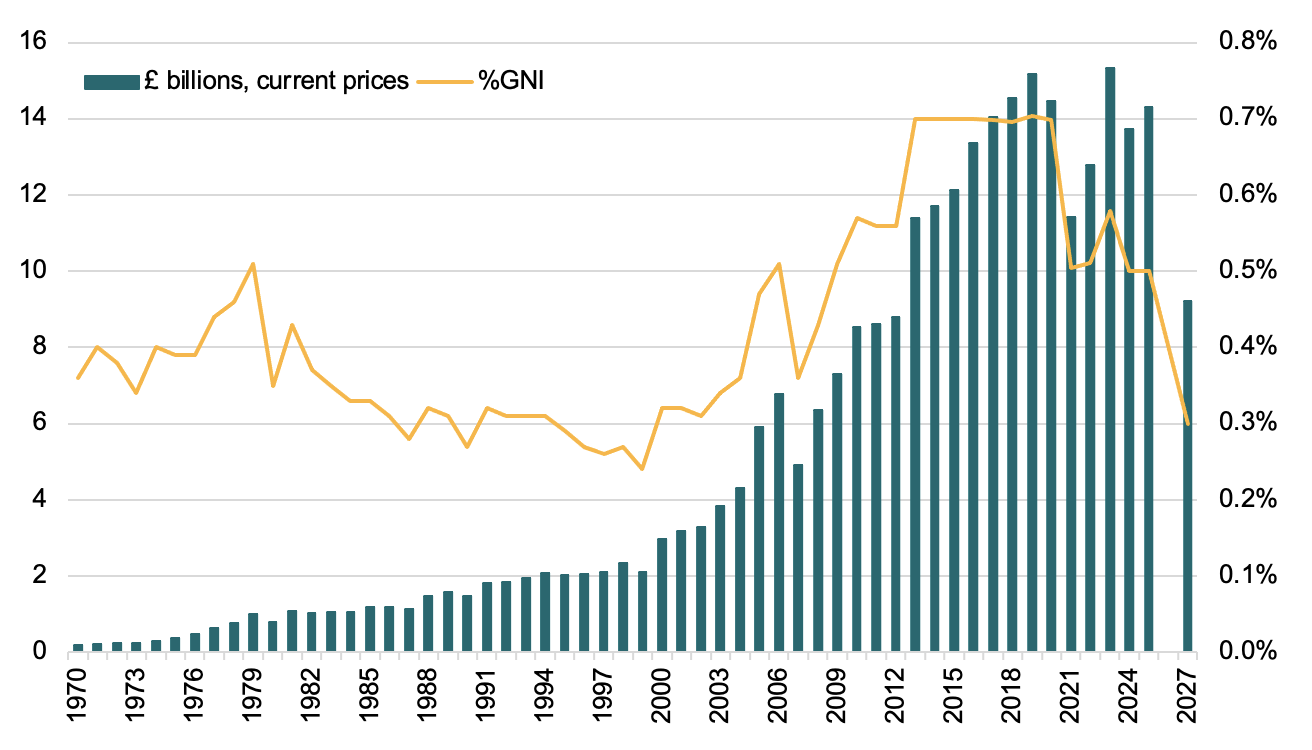
Foreign aid dropped sharply after the merger, from 0.7% of Britain’s gross national income to 0.5% – a cut of about US$6 billion.
Development professionals decried Johnson’s merger, arguing it could not have happened at a worse time, with the pandemic heightening the need for global health funding. And coming shortly after Brexit, Britain’s withdrawal from the European Union, DFID’s demise further called into question Britain’s commitment to global cooperation.
Less money, less impact
Five years later, it’s not clear that dismantling DFID has made British foreign aid more efficient or effective, as Johnson pledged.
“We have seen evidence of where a more integrated approach has improved the organisation’s ability to respond to international crises and events, which has led to a better result,” reads one 2025 report by the U.K.’s National Audit Office.
Yet, the auditors add, the British government has spent at least £24.7 million – US$32 million – to merge its aid and diplomacy offices, and it failed to track these costs. Nor did the leaders of the merger set out a clear vision for its new purpose.
From the outset, DFID had invested substantially in building expertise in global development, particularly in conflict-ridden states. In 2001, for example, it spent almost 5% of its budget – an unusually high amount – on research and policy analysis to design and assess its programs.
Given the “development expertise that was lost with the merger,” the U.K. government can no longer conduct “the kind of rigorous, long-term focus necessary to make a real impact,” said the Center for Global Development in a recent report.
A 2022 study suggests that DFID’s dismantling was a fundamentally political move, “divorced from substantive analysis of policy or inter-institution relationships.”
Britain’s new Prime Minister Keir Starmer, of the leftist Labour Party, initially promised to boost British foreign aid. But in early March 2025, he backtracked, announcing instead a further cut to foreign aid.
By 2027, the U.K. government will spend just 0.3% of its budget on overseas aid. That’s roughly $11 billion less than before the merger in 2019.
‘Clear and easy target’
USAID’s budget was much larger than DFID’s, and the administration apparently wants not to streamline U.S. foreign aid but halt it almost entirely. If this effort succeeds, it will have even more severe effects worldwide, at least in the immediate term.
Development professionals tend to see independent government agencies such as USAID and DFID as better able to prioritize the needs of the poor because their programming is run separately from partisan policies.
Yet standalone agencies are also more visible – and so more vulnerable to political targeting.
DFID was a clear and easy target when Johnson began his pandemic-era budget-slashing. USAID is now suffering a similar fate.
Sarah Stroup does not work for, consult, own shares in or receive funding from any company or organization that would benefit from this article, and has disclosed no relevant affiliations beyond their academic appointment.
Source: United Kingdom – Executive Government & Departments
Press release
British start-up wins £1 million AI prize for breakthrough slashing materials development from years to days
A British AI-driven innovation that dramatically speeds up the development of materials used in wind turbines and electric vehicle batteries has won the UK government’s £1 million Manchester Prize.
Manchester Prize winner announced.
Polaron awarded £1 million for revolutionary AI technology transforming materials innovation.
Breakthrough expected to fast-track new materials for energy, infrastructure, and electric vehicles.
Manchester Prize helping to unlock AI innovation to drive growth as part of government’s Plan for Change.
A British AI-driven innovation that dramatically speeds up the development of materials used in wind turbines and electric vehicle batteries has won the UK government’s £1 million Manchester Prize.
Advanced materials are essential to modern life, from metal alloys reinforcing bridges and skyscrapers to batteries powering electric vehicles. Yet, developing them has traditionally been slow, costly and unpredictable.
Polaron, a spin out from Imperial College London, speeds up the development of these materials from years to days – which could be game-changing for the government’s Plan for Change to get Britain building, deliver economic growth and accelerate net zero through British innovation.
It will receive £1 million in UK government funding to further develop its groundbreaking AI solution which uses microstructural images – the microscopic features of a material visible under a microscope – to rapidly analyse and predict how materials will perform. This new approach helps manufacturers create stronger, lighter and more efficient materials for clean energy, transport and infrastructure.
Secretary of State Peter Kyle said:
Polaron exemplifies the promise of AI and shows how, through our Plan for Change, we are putting AI innovation at the forefront.
AI could generate £400 billion to our economy over the next five years, supporting trailblazing companies like Polaron is essential to achieving that vision.
Technologies like these will help us meet our net zero targets while creating new jobs and opportunities for working people. Our commitment is clear – we are fully embracing AI to drive growth, improve public services and position the UK as a global leader in AI innovation. 1
The Manchester Prize rewards innovative AI solutions addressing major societal challenges, with the first round focused on energy, environment, and infrastructure. Nearly 300 teams from across the UK competed in its first year, with ten finalists each receiving £100,000 and support to further develop their innovations.
Polaron’s win comes on the back of the UK government’s new blueprint for AI, which will unleash the technology to help deliver a decade of national renewal. Harnessing innovative AI solutions like this is key to realising the government’s Plan for Change and demonstrates the transformative potential of AI, not only to drive breakthroughs in industry but also to transform public services and improve the lives of citizens across the country.
Business Secretary Jonathan Reynolds said:
Our Plan for Change will deliver economic growth, and for that to succeed we need to support companies such as Polaron across the UK in delivering the cutting-edge materials of the future, supported by our Industrial Strategy.
This government is determined to embrace each and every opportunity of new technologies like AI, which will not only help British companies develop products we can use at home but also open up access for them to export them overseas.
The government has already taken steps to accelerate how game changing technologies and innovations can be put into the hands of the British public – announcing the new Regulatory Innovation Office which will reduce burdens for businesses hoping to bring new products and services to market. This will involve supporting regulators to update regulation, speeding up approvals, and ensuring regulators can work seamlessly together – bulldozing barriers to innovation to help grow the economy.
The Manchester Prize was launched in December 2023 by the Department for Science, Innovation, and Technology (DSIT) and is delivered in partnership with Challenge Works. It supports UK AI innovations which will help to tackle some of society’s biggest shared challenges.
The second round of the Manchester Prize was launched in November 2024, focussed on ‘AI for Clean Energy Systems’. The 10 finalists selected to receive £100,000 will be confirmed in Spring, before a panel of judges selects the winner who will secure a £1 million grand prize to further support their innovation.
Source: United Kingdom – Executive Government & Departments
News story
Revision to March 2024 Neighbourhood Policing Numbers
Neighbourhood policing statistics have been corrected today due to inaccuracies in the previous government’s police workforce data.
The government has today published corrected neighbourhood policing numbers due to inaccuracies in the previous government’s police workforce statistics.
The issues were uncovered as part of a data validation exercise commissioned by the Home Secretary and carried out by the NPCC to establish an accurate picture of the number of officers serving in neighbourhood roles. It follows long-standing concerns from both the Home Office and police forces about the accuracy of previously published workforce figures for neighbourhood policing.
Whilst this does not mean that the overall police numbers were incorrect, it demonstrates that the real number of neighbourhood police officers working in our communities has been artificially inflated in recent years. The government is clear that the public – who have seen and felt the reduction in neighbourhood officers and PCSOs on their streets in recent years – deserve far better than this.
It comes as the government is introducing the Neighbourhood Policing Guarantee, to ensure that everyone has a named contactable police officer.
As part of the data validation exercise, all police forces were asked to verify the previously published workforce data published under the “neighbourhood policing” category for March 2024. The work revealed substantial discrepancies between the previously published data and the updated figures being provided by forces which more accurately reflect the reality on the ground. Of the 43 forces in England and Wales, 29 advised that their published combined neighbourhood officer and PCSO numbers should be revised down, whilst four forces revised their figures upwards. This resulted in an overall downwards revision of 2,611 compared to the figures published last year.
Forces have cited several reasons for revisions to their March 2024 data which have now been thoroughly tested by the Home Office with individual forces. Some forces say they made human resources (HR) errors after restructuring their neighbourhood policing model or relied on outdated HR systems. Others incorrectly categorised student officers in neighbourhood policing as default, despite them still being in the classroom and not out on our streets, fully trained. Errors also occurred through the incorrect categorisation of officers who perform roles that span multiple functions as in some cases, officers were recorded as working in neighbourhood policing roles when in reality they covered multiple duties, such as incident response. This blurring of the lines between officer duties did not accurately reflect the real number of dedicated neighbourhood officers patrolling our streets.
It is vital for both the government and police forces that they have a clear and accurate understanding of the state of neighbourhood policing in our communities.
The Home Office has now issued new instructions and guidance directly to forces on the categorisation of neighbourhood policing to ensure that we are recording them correctly, particularly on the distinction between response officers and neighbourhood police officers, and how to categorise classroom-based student officers. This means that systems are now in place to prevent these errors from happening in the future and to ensure that the data can be relied on going forward. The department will now require robust neighbourhood policing data returns from individual forces on a monthly basis to track the neighbourhood policing workforce more closely. This will be aligned with a strong performance framework harnessing national data to monitor performance and direct improvements in order to raise standards across the service.
The government’s flagship Neighbourhood Policing Guarantee will put police back on the beat with 13,000 additional police officers and PCSOs in neighbourhood roles in communities across the country. Each neighbourhood will have a named, contactable officer to tackle the issues facing their communities, and there will be guaranteed, intelligence-led patrols in town centres and high streets, with new powers to tackle the criminality and anti-social behaviour plaguing our streets.
Due to the quick work by forces to rectify the statistical errors, the numbers published today are provisional and will be confirmed in an official statistical release in the usual way.
The Home Secretary has today written to the Home Affairs Select Committee to set out this information in more detail.
Further information
Table 1: March 2024 published data and NPCC revised data (as at 18 March 2025)
March 2024 published data
March 2024 data submitted by NPCC
Difference
% Difference
Officers (FTE)
13,424
10,664
-2,760
-21%
PCSOs (FTE)
6,210
6,359
+149
+2%
TOTAL (FTE)
19,634
17,023
-2,611
-13%
Forces making large reductions (either in terms of numbers, FTE, or as a proportion of neighbourhood policing workforce):
West Midlands Police
A revision in previous statistics downwards of 649 officers from 1,045
Reason: Following being placed into ‘Engaged’ status by His Majesty’s Inspectorate of Constabulary and Fire Rescue Services (HMICFRS) in December 2023 (following serious concerns over its investigations and victim outcomes), the force had redeployed a number of neighbourhood resources into ‘Responding to calls for service’ and ‘Investigations’. However, system identifiers on HR systems had not been updated which generated the significant administrative inaccuracy. West Midlands have since been removed from ‘Engaged’ status by HMICFRS.
Gloucestershire Constabulary
A revision in previous statistics downwards by 66% and a slight decrease for PCSOs
Reason: Specialist functions, investigative resources, and patrol had previously been included in the neighbourhood policing category in error. The inaccuracy of the original data appears to be primarily related to the unique post identifiers in a recently implemented HR System, which Gloucestershire are looking to update.
Suffolk Constabulary
A revision in previous statistics downwards for a large number of officers and some PCSOs that will result in data fall by 52%
Reason: The force has identified a series of errors in the categorisation of roles, such as the inclusion of student officers in the neighbourhood policing category when they should have been included as category 1b (Incident (Response) Management). additionally, several of Suffolk’s specialist reassurance teams were included in neighbourhood policing when they should have been recorded as category 1c (Specialist Community Liaison) and several senior manager posts were included in neighbourhood policing rather than 1d (‘Local Policing Command Team’).
Thames Valley Police
A revision in previous statistics downwards by 33% for neighbourhood officers and 20% downwards for neighbourhood workforce overall
Reason: Identified discrepancies in how neighbourhood policing roles were recorded, following a recent internal review. The issues stemmed from technical limitations and differences between job titles and the detail of roles performed by officers.
Merseyside Police
A revision in previous statistics downwards by 209 neighbourhood officers, although offset by a 182 increase in PCSOs
Reason: Student officers were mistakenly included as neighbourhood policing officers. All PCSOs were incorrectly categorised under 1c “Specialist Community Liaison”. In addition, they had included local public order / neighbourhood tactical teams under 1a, when they should have been classified under 5f “Advanced Public Order.
Dorset Police
A revision in previous statistics downwards by 38% in overall neighbourhood policing numbers
Reason: The force revised the figures to ensure that only those officers and PCSOs dedicated to neighbourhood policing functions were included. They excluded those in functions that do not contribute to neighbourhood policing including specialist functions, investigative resources, and patrol, which had previously been included in the neighbourhood policing category in error.
WASHINGTON – The Department of the Army has announced the seven winners of the 2024 Army Community Partnership Awards.
“The installations honored this year highlight the excellent commitment to partnering with communities and strengthening those relationships that allow us to provide the best possible resources for Soldiers and their families,” said Lt. Gen. David Wilson, Deputy Chief of Staff, G-9.
The Army Community Partnership Awards Program seeks to highlight examples of exceptional cooperation and diligence that will encourage continued collaboration to achieve the full potential of community partnerships. The awardees represent partnerships that have improved quality of life for Soldiers and their families, enhanced readiness, driven modernization and contributed to reform initiatives throughout the Army.
“These partnerships exemplify the collaboration required to enhance our resilience, improve quality of life for our Soldiers and their families, and bolster our operational readiness to meet the needs of our Army today and tomorrow,” said Daniel M. Klippstein, senior official performing the duties of the Assistant Secretary of the Army for Installations, Energy and Environment.
The Army selected seven winners and their neighboring communities that formed innovative partnerships that improve quality of life for Soldiers and families, enhance readiness, modernize services, provide efficiencies, expand capabilities and strengthen community relations.
Fort Leonard Wood and the cities of Saint Robert and Waynesville: Fort Leonard Wood’s new airfield lease project supports the construction of a new non-Army funded terminal critical to the long-term viability of commercial jet service to and from the installation. The new 25-year lease, new terminal, and past investments in planning, improvements, and repairs reiterates long-term commitments from the cities, the FAA and the state of Missouri to maintain accessibility to Fort Leonard Wood. The new terminal will modernize and increase the efficiency of all terminal operational and security services, systems and processes as compared to existing legacy facilities.
U.S. Army Garrison Hawaii, Pōhakuloa Training Area and the Hawaii County Fire & Emergency Services: The Mutual Aid Agreement between USAG-HI (PTA) and the Hawaii County Fire & Emergency Services seamlessly integrates resources and joint training exercises. This collaboration is a robust mutual support system enhancing the regional emergency response capabilities. Collaboration between PTA and Hawaii County Fire & Emergency Services maximizes shared resource utilization and operational efficiency.
Picatinny Arsenal and the Morris County Municipalities & Fire Districts: The MAA between Picatinny Arsenal and the Morris County Municipalities & Fire Districts provides 24-hour emergency dispatching service at no cost to the Army. The partnership enhances Picatinny’s emergency response capabilities and fills a gap in service availability. By partnering with Morris County, Picatinny Arsenal improved their firefighting capabilities through real-world responses and joint training exercises. The MAA enabled Picatinny to access 24/7 emergency response while also realizing significant cost savings.
Fort Carson and the Colorado Springs Utilities: The intergovernmental support agreement between Fort Carson and the Colorado Springs Utilities provides Fort Carson with superior operations and maintenance of electric and gas systems beyond pre-IGSA capabilities. Partnering with CSU enhances Fort Carson’s energy resilience by creating the capability to operate independently in the event of an off-post electrical grid failure. The IGSA created the on-post generation and microgrid capabilities necessary to operate during an off-post blackouts.
Fort Bliss and the El Paso Water Utilities Public Service Board: This IGSA between USAG-Fort Bliss and the El Paso Water Utilities Public Service Board provides engineering, technical, project design, consultant services, minor construction, repair, maintenance, geotechnical services, land surveying, soil borings, water quality testing, and water resource planning services associated with and incidental to stormwater management, water quality, water conservation, and those types of capital improvement projects.
U.S. Army Garrison Poland and the Republic of Poland: The Polish Provided Logistics Support provides in-kind logistical support to the U.S. Army. The PPLS provides infrastructure, logistical support and munitions storage to facilitate joint military exercises as part of the Enhanced Defense Cooperation Agreement. The availability of pre-positioned equipment and supplies improves the readiness of U.S. forces in the region, enabling a stronger alliance and faster response times.
U.S. Army War College and the Cumberland County Department of Public Safety: The MAA between U.S. Army War College and the Cumberland County Department of Public Safety expands operational and mission capabilities by sharing capacity, resources and capabilities. Cooperating with CCDPS has enhanced the War College’s emergency response capabilities. The partnership utilizes joint training and planning, shared emergency response resources, and shared expertise to enhance shared public safety and emergency response capabilities.
Awardees included partnerships signed in fiscal years 2021-2024 by garrisons, reserve centers and armories. Submissions were evaluated using the following criteria:
Improves Soldier/family quality of life
Improves or enhances readiness
Modernizes a service, system or process
Provides cost or other efficiencies
Expands capability
Improves community relations
The awards ceremony will be held in the Pentagon Hall of Heroes on April 10, 2025, from 10:00 to 11:00 AM.
For additional information, please contact the Office of the Deputy Chief of Staff, G-9, usarmy.pentagon.hqda-dcs-g-9.list.sig@mail.mil.
Defendants Arrested During the Laken Riley Murder Investigation in Athens, Georgia
ATHENS, Ga. – A Venezuelan man who entered the United States illegally and who admitted to possessing a fraudulent Green Ccard during the murder investigation of a 22-year-old nursing student was sentenced to serve 48 months in prison—above the federal sentencing guidelines—and to be deported along with his brother and a former roommate.
Diego Jose Ibarra, aka “Gocho,” 29, was sentenced to serve a total of 48 months in prison after he pleaded guilty to two counts of possession of a fraudulent document on July 15, 2024. Argenis Ibarra, aka “Meny,” 25, of Venezuela, was sentenced to time served after he pleaded guilty to one count of possession of a fraudulent document on Dec. 10, 2024. Rosbeli Flores-Bello, aka “La Gorda,” 29, of Venezuela, was sentenced to time served after she pleaded guilty to one count of possession of a fraudulent document on Dec. 11, 2024.
All three defendants are to be delivered to U.S. Immigration and Customs Enforcement (ICE) for deportation. Diego Ibarra will be placed in ICE custody at the conclusion of his federal prison sentence; Argenis Ibarra and Flores-Bello will be placed in ICE custody immediately. U.S. District Judge Tilman E. Self, III handed down the sentences on March 19 in Athens. There is no parole in the federal system.
According to court documents and statements referenced in court, Homeland Security Investigations (HSI) was made aware of Deigo Ibarra’s undocumented presence in the United States on Feb. 23, 2024, during the murder investigation of Laken Hope Riley, who was kidnapped and brutally murdered on Feb. 22, 2024, during a morning run at the University of Georgia, where she previously attended as an undergraduate prior to transferring to the Augusta University College of Nursing. At the time, an Athens-Clarke County Police Department (ACCPD) officer approached Diego Ibarra because he matched the description of the primary suspect in the murder investigation, which was his brother, Jose Antonio Ibarra. Diego Ibarra gave the ACCPD officer a counterfeit U.S. Permanent Resident Card (also called a Green Card) as identification and was taken into custody. Jose Ibarra was convicted of Laken Riley’s murder on Nov. 20, 2024, in Athens-Clarke County Superior Court and is serving a life sentence.
On April 30, 2023, Diego Ibarra illegally entered the United States, along with four other Venezuelan men, by crossing the border near the Ysleta station in El Paso, Texas. The men fled when approached by the United States Border Patrol (USBP) agents. Diego Ibarra resisted an agent’s efforts to detain him and grabbed the agent’s service radio, threw it into a nearby yard, and then attempted to bite the agent. Agents scuffled with him and another Venezuelan man for several minutes before the National Guard arrived and assisted in subduing both men. Diego Ibarra was taken to a local hospital after complaining of chest pains and pain in his back and leg, which he indicated to FBI agents he sustained from scaling and falling from the border fence during his illegal crossing. He admitted to illegally crossing the border, resisting arrest and attempting to avoid apprehension at any cost. He said his injuries were not from the fight with agents.
According to information uncovered during the investigation and provided in multiple court documents, Diego Ibarra is likely affiliated with the Venezuelan gang Tren de Aragua (TdA), based on evidence including his multiple TdA tattoos and photos of him on social media making the TdA gang signs and wearing TdA clothing. Further investigation concluded that Diego Ibarra was previously removed from the United States to Mexico on April 3, 2023, after agents apprehended him illegally entering the United States near Eagle Pass, Texas. After the above incident on April 30, 2023, Diego Ibarra claimed asylum and fear of return to Venezuela. On May 11, 2023, ICE Enforcement and Removal Operations (ERO) placed him in the Alternatives to Detention (ATD) program, and he was released from immigration custody the following day. The ATD program required Diego Ibarra to wear a global positioning system (GPS) ankle monitoring device, and he was directed to report to New York, New York, pending asylum proceedings. He failed to report in New York as directed.
On May 25, 2023, Diego Ibarra’s ankle monitor last “pinged” near Littleton, Colorado, and he cut it off at some point prior to his final arrest in Athens, Georgia. Diego Ibarra settled in Athens and was subsequently arrested three times by law enforcement: on Sept. 24, 2023, he was arrested by ACCPD for driving under the influence of alcohol and driving without a license; on Oct. 27, 2023, he was arrested by ACCPD for theft by shoplifting; and on Dec. 8, 2023, he was arrested by ACCPD for shoplifting and for an outstanding arrest warrant that was issued when he failed to appear in court for his DUI charge. In addition, ACCPD responded to a domestic incident involving Diego Ibarra and his girlfriend on Sept. 26, 2023. And, while in the custody of the U.S. Marshals Service and housed in the Butts County Detention Center, Ibarra caused “severe water damage” inside the jail when he damaged the fire sprinkler system in a jail cell block. On June 25, 2024, jail officers found Ibarra in possession of two improvised weapons: a sharpened sprinkler head with a make-shift grip and a pen wrapped in saran wrap.
Co-defendants Argenis Ibarra (Diego and Jose Ibarra’s younger brother) and Flores-Bello (Deigo and Jose Ibarra’s roommate) admitted to possessing a fraudulent U.S. Permanent Resident Card in the names of Argenis Jose Ibarra Ibarra and Rodrianny Brito Brito respectively on Feb. 23, 2024. In addition, agents found counterfeit Social Security cards for Argenis Ibarra and Flores-Bello in the apartment they shared with Diego and Jose Ibarra.
Investigators determined that Argenis Ibarra entered the United States illegally on April 3, 2023, near Eagle Pass, Texas, and the USBP returned him to Mexico. On April 30, 2023, the USBP encountered and arrested him near El Paso, Texas, and transported him to an ICE processing center in El Paso. Because the processing center lacked space, Ibarra was released on his own recognizance on May 4, 2023. Argenis submitted Form I-765 for Employment Authorization on Oct. 20, 2023, and Nov. 2, 2023, both of which were rejected.
Flores-Bello illegally entered the United States on May 3, 2023, and was arrested by the USBP. She was transported to an ICE processing center in El Paso. On May 5, 2023, Flores-Bello was released on her own recognizance because the processing center lacked space. She provided a residential address in New York and was scheduled for immigration court there on Oct. 18, 2023. In Dec. 2023, she and Jose Ibarra, whom she met in New York, took a humanitarian flight from New York to Atlanta, Georgia. She settled in Athens and lived with the Ibarra brothers until Laken Riley was murdered.
This case is part of Operation Take Back America, a nationwide initiative that marshals the full resources of the Department of Justice to repel the invasion of illegal immigration, achieve the total elimination of cartels and transnational criminal organizations (TCOs) and protect our communities from the perpetrators of violent crime. Operation Take Back America streamlines efforts and resources from the Department’s Organized Crime Drug Enforcement Task Forces (OCDETFs) and Project Safe Neighborhood (PSN).
The case was investigated by Homeland Security Investigations (HSI) with critical assistance from FBI, GBI, Athens-Clarke County Police Department, University of Georgia Police Department and Clarke County Sheriff’s Office.
Assistant U.S. Attorney Mike Morrison prosecuted the case for the Government
HYBRID SOFTWARE GROUP PLC REPORTS 2024 RESULTS WITH €51.50 MILLION REVENUE AND €12 MILLION EBITDA
Cambridge (UK), 19 March 2025 (19:00 CET): Hybrid Software Group PLC (Euronext: HYSG) announces that it has published its annual report and financial statements for the financial year ended 31 December 2024.
CEO Mike Rottenborn comments, “2024 was a successful year for Hybrid Software Group, with healthy growth in all business units despite difficult market conditions. We expect similar conditions in 2025, yet we are still very positive about the outlook for Hybrid Software and our customers.
“Synergies in the business plan aren’t always realised in the market, so it’s very encouraging to see the tandem growth in both our OEM and end-user businesses, with an overall revenue growth of 7% over the previous year. In last year’s letter, I promised to focus on improving the profitability of Hybrid Software, so it’s gratifying to report that we delivered a 286% improvement in our adjusted operating result over 2023, as well as a 64% increase in our EBITDA, despite heavy marketing spending on the Drupa trade fair. We expect to deliver further improvements in the coming year.
“2024 also saw the launch of a new business unit, Hybrid Software BrandZ, to serve brands and manufacturers of consumer packaged goods with software solutions for artwork management which facilitate downstream print production, opening a market that is potentially much larger than the print providers themselves.”
Executive Chairman Guido Van der Schueren adds, “We enter 2025 in similar business conditions to 2024 but as a much stronger company, with revenue growth across all our business segments and an even more significant improvement in profitability. We achieved this through careful cost management while continuing to fully fund our engineering teams and software development programs.
“In late 2024 we instituted a share buyback program, committing €1 million to buy back and cancel shares as a sort of tax-free dividend to all shareholders. There are strict limits to the number of shares we can buy and the price we can pay for shares, but the impact on our share price has been significant already and we plan to continue this initiative throughout 2025.”
Financial highlights
For the year ended 31 December
In thousands of euros
2024
2023
Continuing operations
Revenue
51,501
48,043
Operating loss
(3,090)
(1,161)
Loss before tax
(3,361)
(1,667)
Tax credit
653
2,986
(Loss)/Profit from continuing operations
(2,708)
1,319
Loss on sale of discontinued operation, net of tax
(120)
–
(Loss)/Profit for the period
(2,828)
1,319
EBITDA – continuing operations
11,989
7,306
Adjusted operating profit – continuing operations
7,204
2,517
Adjusted net profit – continuing operations
6,952
1,676
Basic earnings per share (euro) – continuing operations
(0.09)
0.04
Adjusted net basic earnings per share (euro) – continuing operations
0.21
0.05
Cash and cash equivalents
9,513
7,079
Loans & borrowings
(6,500)
(7,800)
Net cash/(debt)
3,013
(721)
The consolidated pre-tax result for continuing operations was a loss of €3.36 million compared with a loss of €1.67 million in 2023. The increase in the loss of €1.69 million is due to:
an increase in revenue of €3.46 million;
a decrease in cost of sales of €0.59 million;
a decrease in selling, general and administrative expenses of €0.58 million
an increase of €6.28 million impairment charge on goodwill;
an increase in research and development expenses of €0.17 million;
an increase in other operating expenses of €0.06 million;
a decrease in other income of €0.05 million;
an increase in net finance expenses of €0.02 million; and
a decrease in foreign exchange losses of €0.26 million.
Revenue for the Printing Software Segment was €16.67 million for the year (2023: €14.94 million). During 2024 new contracts were agreed with two existing customers which resulted in €4.3 million of revenue being recognised. In 2023 a new contract was agreed with an existing customer which resulted in €2.6 million of revenue being recognised in that year.
Revenue for the Printhead Solutions segment was €11.59 million for the year (2023: €11.30 million). In 2022 revenue in this segment had been severely impacted by the shortage of its most commonly used chip. In 2023 it recovered significantly throughout the year which continued into 2024 although at a slower pace.
Revenue for the Enterprise Software segment was €23.24 million for the year (2023: €21.81 million). In 2023 the segment experienced unfavourable business conditions in its two most important markets, the United States and Germany, which improved in 2024. For the segment year-over-year license royalty income increased by €0.8 million, maintenance and after-sale support services income €0.4 million and services income by €0.2 million.
Gross profit for the period decreased to 84% of revenue (2023: 82%), primarily due to the lower mix of printing electronics related sales during the year, which have a lower level of gross margin than software because of their manufacturing costs.
Included in selling, general and administrative expenses is amortisation of €0.90 million (2023: €0.97 million) related to intangible assets recognised as a result of acquisitions.
In 2024 the Group recorded a goodwill impairment charge of €6.28 million (2023: €nil) in aggregate.
Research and development expenses includes the capitalisation and amortisation of internally generated intangible assets and the amortisation of certain intangible assets recognised as a result of acquisitions. During the period there was a net capitalisation of development expenditure of €0.53 million (2023: €1.39 million) and amortisation of acquired intangible assets of €4.57 million (2023: €4.76 million).
The net capitalisation of development expenditure was comprised of €3.45 million (2023: €3.82 million) of capitalised expenditure less €2.92 million (2023: €2.43 million) of amortisation.
Total operating expenses increased by €5.93 million, or 14.56% compared to the same period in the prior year. Making abstraction of the goodwill impairment of €6.28 million, total operating expenses decreased by €0.35 million, or 0.86% compared to the same period in the prior year.
Foreign exchange gains and losses are primarily due to the revaluation of currency balances held at the balance sheet date and the change in exchange rates during the year.
The Company presents EBITDA (earnings before interest, tax, depreciation and amortisation) and adjusted profit when reporting its financial results to provide investors with an additional tool to evaluate the Group’s results in a manner that focuses on what the Group believes to be its underlying business operations. The Group’s management believes that the inclusion of adjusted financial results provides consistency and comparability with past reports.
Additional commentary and analysis of the Company’s consolidated results for the year ending 31 December 2024 can be found in the annual report and financial statements.
Should you wish to receive a printed copy of the annual report, please send an e-mail to investor-relations@hybridsoftware.group or make your request in writing, for the attention of the Company’s Chief Financial Officer, to 2030 Cambourne Business Park, Cambourne, Cambridge, CB23 6DW, UK.
About Hybrid Software Group Through its operating subsidiaries. Hybrid Software Group PLC (Euronext: HYSG) is a leading developer of enterprise software for industrial print manufacturing. Customers include press manufacturers such as HP, Canon, Durst, Roland, Hymmen, and hundreds of packaging printers, trade shops, and converters worldwide.
Hybrid Software Group PLC is headquartered in Cambridge UK. Its subsidiary companies are colour technology experts ColorLogic, printing software developers Global Graphics Software, enterprise software developer HYBRID Software, 3D design and modelling software developers iC3D, the industrial printhead driver solutions specialists Meteor Inkjet, and pre-press workflow developer Xitron.
Source: United States Senator for Delaware Christopher Coons
WASHINGTON – U.S. Senators Chris Coons (D-Del.), Thom Tillis (R-N.C.), John Cornyn (R-Texas), and Michael Bennet (D-Colo.) introduced the Medical Supply Chain Resiliency Act, bipartisan legislation to jump start trade negotiations to ensure that hospitals, doctors, and patients have access to critical medical goods. U.S. Representatives Brad Schneider (D-Ill.) and Nicole Malliotakis (R-N.Y.) introduced companion legislation in the House.
“Life-threatening shortages of testing kits, drugs, and masks during the COVID-19 pandemic showed us just how fragile our medical supply chains are. If we are caught off-guard like we were during COVID once again, more Americans will die,” said Senator Coons. “Working with our most trusted trading partners to make our supply chains more resilient will strengthen our response to future public health emergencies while ensuring that health care providers have access to essential medical products and patients have access to life-saving care.”
“The Medical Supply Chain Resiliency Act is a critical step toward ensuring that America’s healthcare providers have reliable access to the essential supplies they need,” said Senator Tillis. “By strengthening trade partnerships with our allies and expanding domestic manufacturing, we can enhance our nation’s preparedness for future health challenges. I’m proud to support this bipartisan effort to reinforce our medical supply chains and protect public health.”
“America’s medical supply chains rely heavily on China, posing risks to U.S. national security and public health,” said Senator Bennet. “Our bipartisan bill will address this vulnerability by authorizing the president to deepen relationships with our trading partners.”
“During the pandemic, the U.S. faced severe shortages of medical supplies due to overreliance on foreign adversaries like China,” said Senator Cornyn. “This legislation would allow the U.S. to engage in trade negotiations with trusted allies for medical goods and services, helping ensure we’re better prepared to respond to future global health crises.”
“The Medical Supply Chain Resiliency Act is the type of positive approach to trade America must embrace to deepen its economic partnerships with key allies,” said Brad Wood, Senior Director for Trade and Innovation Policy, National Foreign Trade Council.“By empowering the United States Trade Representative to negotiate new agreements with trusted trade partners, the United States has the opportunity to strengthen supply chain security, support U.S. innovation and jobs, and, ultimately, improve health outcomes. It is critically important that the United States collaborate with its allies to support the public health demands of our populations and prepare to meet the challenges of the next global health emergency. NFTC applauds Senators Tillis, Coons, Cornyn, and Bennet for championing this legislation, and urges Congress to support its swift passage.”
“Premier commends Senators Thom Tillis, Chris Coons, John Cornyn and Michael Bennet and Representatives Brad Schneider and Nicole Malliotakis for their bipartisan leadership in reinforcing the resilience of our nation’s healthcare supply chain,” said Soumi Saha, Senior Vice President of Government Affairs, Premier Inc. “Building a stronger, more sustainable, and secure supply chain demands a balanced approach – expanding domestic manufacturing while fostering strategic trade partnerships. The Medical Supply Chain Resiliency Act is a critical step toward this goal by enabling the designation of trusted trade partners to diversify sourcing for medical devices and pharmaceuticals. Ensuring providers have reliable access to the essential supplies needed to deliver quality patient care is a paramount priority for our nation.”
“The Chamber strongly supports the Medical Supply Chain Resilience Act, which will strengthen supply chains for medical goods and services while bolstering manufacturing in the U.S. and among our close allies and partners,” said John Murphy, Senior Vice President for International Policy, U.S. Chamber of Commerce. “Enhancing the resilience of medical supply chains is important to both our public health and our national security. The bill would direct the U.S. Trade Representative to negotiate trade agreements with trusted allies to eliminate tariffs and other trade barriers that weaken the U.S. medical goods manufacturing base and that of our allies. These agreements would also support intellectual property protection, regulatory cooperation, and collaboration on public and private R&D efforts. Only close allies and partners would qualify for such agreements. Close consultation with the legislative branch would be essential, and Congress would retain a right to disapprove any agreements. This is practical legislation that, if enacted, will apply lessons learned in the COVID-19 pandemic to strengthen America’s health preparedness. The Chamber urges Congress to pass it into law.”
“Authorizing the administration to negotiate meaningful trade agreements with trusted partners, including the European Union, Japan, Switzerland, and the United Kingdom, would reduce trade barriers and strengthen medical supply chains. The biopharmaceutical industry, whose exports exceeded $101 billion in 2023, welcomes the Medical Supply Chain Resiliency Act and encourages the administration to embrace this pathway to expand trade with allies,” said PhRMA.
The COVID-19 pandemic presented significant challenges for supply chains around the world, disproportionately hampering health care providers’ access to medical devices, treatments, and equipment at a time when these products were desperately needed. By expanding U.S. engagement with our allies across the globe, this legislation would combat shortages of medical products and supplies by strengthening supply chain resiliency and safeguarding against future health crises.
You can read the full text of the bill here.
CHILDREN and young people with special educational needs and disabilities have been recognised for their achievements at a celebration event.
The awards ceremony – which was generously sponsored by local businesses – was held as part of a recent drop-in event called Local Offer Live. It saw children commended for their resilience, bravery and educational achievements.
Among those getting an award was 16-year-old Ruby Tebbutt, a pupil at Tudor Grange Samworth Academy. Ruby received a Positive Contribution to Society award in the 12-25 age group category, for her courage in sharing her personal story of autism with her school.
Jemma Cox from the academy, who nominated Ruby, said: “Ruby completed an exceptional speaking and listening exam in English, where she bravely shared her own experience of being autistic. She highlighted the importance of teachers recognising and respecting the unique challenges faced by autistic students.”
Jemma also nominated 16-year-old Samworth student Cohen Smith for a Shining Star award. As well as overcoming significant barriers to improve his own attendance and behaviour, Cohen has been supporting his friends, meeting one friend in reception every day and walking him to class to ensure he felt welcomed and supported. “This consistent act of kindness has not only helped the student to improve his attendance, it has also boosted his confidence and sense of belonging,” Jemma said.
Hayden Rosario, aged 17, from Nether Hall School, won the Art, Music & Media award in the 12-25 category. Nominator Michael Norton from the school said: “Hayden started to learn the glockenspiel last year and has developed his skills and confidence so much in a short space of time. He played ‘Can You Feel The Love Tonight?’ by Elton John to a crowd of hundreds of people. Who knows where Hayden’s talent and hard work will take him, but all at Nether Hall School are so proud of him.”
Ten-year-old Samuel Davies from St John the Baptist Primary School won the 0-10 Sports Award. Samuel is an all-round sportsperson who was nominated for his wonderful listening skills, teamwork and great resilience, as well as for his achievements in cross-country running. As a child with ADHD and autism, these sporting opportunities provide Samuel with vital opportunities to communicate and connect socially with others.
Hayden Rosario (centre)
Ruby Tebbutt (left)
Samuel Davies (centre)
Assistant city mayor for children and young people, Cllr Elaine Pantling, said: “It was wonderful to see these awards handed out at Local Offer Live. These are young people who have worked so hard and given back so much to their school communities, and it’s great to see them recognised for that.
“Our specialist staff in our disabled children’s service, along with our dedicated education professionals, work in partnership with schools to support children with additional needs. We’re always really proud when the children do amazing things and achieve to their full potential.”
More information about city council and partners’ services for children and young people with special educational needs and disabilities, and their families, can be found at: https://families.leicester.gov.uk/send-local-offer/
ENDS
Top picture shows Cllr Elaine Pantling (centre) with award winner Cohen Smith and nominator Jemma Cox
Source: United Kingdom – Executive Government & Departments
News story
Sir John Oldham appointed to help make NHS fit for the future
Sir John Oldham is a GP by background and has very significant experience in the sphere of primary care, change management, and leading improvement programmes
Sir John Oldham brings extensive experience of working in the health sector and will work on emerging policy to support the government on its ambition to deliver more care in the community.
Sir John Oldham has accepted a direct ministerial appointment to the Department of Health and Social Care.
Sir John will work closely with Secretary of State for Health and Social Care, Wes Streeting, to transform the health and care system and move to a Neighbourhood Health Service.
Lord Darzi’s 2024 independent investigation of the NHS highlighted the urgent need to transform the health and care system and move to a Neighbourhood Health Service that delivers co-ordinated care closer to home, to create healthier communities, spot problems earlier, and support people to stay healthier and maintain their independence for longer.
Sir John is a GP by background and has very significant experience in the sphere of primary care, change management, and leading improvement programmes. He was National Clinical Lead for Quality and Productivity at the Department of Health from 2010-2013. This role has had responsibility for large scale change in the delivery of services to patients with long term conditions and redesigning the urgent care system. He has been a member of the Care Quality Commission and Chair of the Commission on Whole Person Care amongst other roles.
The appointment is a paid role, which began on 2 December 2024 for a 12-month period. It is not a Civil Service appointment.
A graph I saw in high school appeared to show the Earth breathing.
It was a graph that plotted carbon dioxide in the atmosphere over the course of the 20th century and into the 21st. CO₂ had risen steadily, and then more rapidly, but it hadn’t gone up in a straight line. Each year it had fallen sharply before rising to a new peak, increasing over time in an upwards zig-zag.
What explained this annual, temporary fall in CO₂, the gas that is overwhelmingly responsible for climate change? The answer was photosynthesis, my physics teacher explained – the miracle by which plants turn light and CO₂ into food.
This is how our planet has regulated atmospheric carbon for longer than our species has existed. Fossil fuels are disrupting this equilibrium in several ways.
Spring is dawning in the northern hemisphere, where most of the planet’s green land is situated. Trees are unfurling leaves that will soak up carbon in the air and turn it into new bark, roots and branches. On a global scale, it’s like a gigantic inhalation of carbon. In autumn, when trees shed their leaves, Earth will exhale again.
The air we all breathe is increasingly polluted by fossil fuels. That includes products of fossil fuels, like plastic, which is now so ubiquitous that research suggests simply breathing can introduce microscopic fragments into your brain.
Something similar is happening in plants – and it could have global consequences.
Plants are losing their appetite
“Microplastics are hindering photosynthesis, the process by which plants convert energy from the sun into the fruit and vegetables we eat,” says Denis J. Murphy, an emeritus professor of biotechnology at the University of South Wales.
These are the conclusions of a recent study by researchers in China, Germany and the US. Murphy wasn’t involved, but his own research with plant cells – which the tiniest microplastics can infiltrate, and damage the organs involved in photosynthesis – has him worried.
“Given the potential (albeit speculative) risk to global food production, more priority should be given to rigorous scientific research of microplastics and their effects on both crops and the marine life that supports fish and seafood stocks,” he says.
Not so long ago, people wondered if our fossil fuel habit might actually benefit plant photosynthesis. After all, plants eat CO₂. Flooding the atmosphere with more of it each year could only whet their appetites, right?
“The amount of CO₂ used by photosynthesis and stored in vegetation and soils has grown over the past 50 years, and now absorbs at least a quarter of human emissions in an average year,” say ecologists Amanda Cavanagh (University of Essex) and Caitlin Moore (University of Western Australia).
Most of this extra carbon absorption has come from crops and young trees, the pair say, less from mature forests where a lot of the world’s carbon is stored. Cavanagh and Moore say this carbon pump is slowing down, as the other necessary ingredients for photosynthesis – soil nutrients and water – have fallen or stayed the same.
Microplastics could slow the rate at which plants remove carbon further. And then there are the effects of climate change, like drought, fires and floods, which will intensify as long as we continue burning fossil fuels.
After monitoring forests and shrublands in Australia for 20 years, Moore and a team of six colleagues concluded that these ecosystems are at risk of losing their ability to bounce back, and continue absorbing carbon, after successive climate disasters.
We may have done plenty to reduce global photosynthesis, but a team of scientists at the University of Oxford and the Fraunhofer Society in Germany is trying to turn things around. How? By hacking plants to help them get more out of the process.
“You would be forgiven for thinking nature has perfected the art of turning sunlight into sugar,” say Jonathan Menary, Sebastian Fuller and Stefan Schillberg.
“But that isn’t exactly true. If you struggle with life goals, it might reassure you to know even plants haven’t yet reached their full potential.”
The team say that plants tend to convert less than 5% of sunlight into new tissue – often as little as 1%. That’s because of a mistake plants regularly make, in which an enzyme involved in photosynthesis latches on to oxygen instead of CO₂.
Cyanobacteria are Earth’s most ancient photosynthesisers. Menary, Fuller and Schillberg say these microscopic organisms could possess useful genes for better sunlight management that might benefit crops like rice and potato plants. Another technique involves helping plants recover from high light exposure quicker.
More efficient photosynthesis, with the help of gene editing and other tools, is not “a silver bullet”, the team stress. Certainly not while fossil fuels continue to drown our green planet in carbon it cannot metabolise.
However, this work is likely to prove useful as farmers seek to grow more in an increasingly volatile environment, while sparing enough land for nature.
“This research is about making sure we can grow enough food to feed ourselves,” the team say.
Source: United Kingdom – Executive Government & Departments
News story
Grave of lost Scottish soldier of World War One identified in France
The previously unmarked grave of an Edinburgh man of the 1st (Royal) Dragoons has now been identified and marked more than a century after his death.
Musician Benjamin Kinch of the Household Cavalry (Crown Copyright)
A rededication service for Lance Corporal (L/Cpl) George Rankeillor was organised by the MOD’s Joint Casualty and Compassionate Centre (JCCC), also known as the ‘War Detectives’. The service was held at the Commonwealth War Graves Commission’s (CWGC) Feuchy Chapel British Cemetery, France, this morning (19 March 2025).
JCCC Caseworker, Alexia Clark, said:
I am grateful to the researcher who submitted this case. Their work has led us to recognise the final resting place of L/Cpl Rankeillor, to restore his name to him and to allow his family to honour his sacrifice. It has been a privilege for me to have contributed to this case and to have organised the service for the rededication of this grave today.
L/Cpl George Rankeillor 17 January 1897 – 11 April 1917
George Rankeillor was born in Edinburgh in 1897 to George senior, a rubber worker, and his wife Julia McDonald. He was the second eldest of 10 children. Unfortunately, very little survives to tell us about his young life, or his army service, but we know that he arrived in France as a Private serving with the Royal Dragoons on 5 October 1915.
By 1917 George had been promoted to Lance Corporal, and at the beginning of April he was with his unit on the outskirts of Arras. It was bitterly cold, snowing and the war diary records blizzard conditions. During this time, the area came under very heavy shell fire, the Royal Dragoons were relatively lightly affected losing 68 horses and just two men. George was one of the two men killed.
In October 1919 two casualties of the 1st (Royal) Dragoons were recovered from unmarked field graves just north of Feuchy Chapel. One was identified as Private (Pte) J. Jordan who had died on 11 April 1917 whilst the other could only be identified as a member of the Royal Dragoons.
Recently, following a submission to the Commonwealth War Graves Commission, all the records were drawn together for the first time and interrogated as one. This showed that Pte Jordan and the unknown soldier were buried in the same field grave, and therefore most likely died together. With only one man of the Royal Dragoons still missing from this area on this day, it has finally been possible to prove that the unknown soldier is L/Cpl George Rankeillor of the 1st (Royal) Dragoons.
The service was supported by the British Embassy and serving soldiers from the Household Cavalry.
The military party, including a representative of the British Embassy, stand in the cemetery (Crown Copyright)
Reverend Thomas Sander, Chaplain to the Household Cavalry, who led the service said:
It is an honour to officiate at these services of rededication for fallen servicemen who gave their lives in the service of our country. In these services we unite their final resting place with their earthly name and, what was once known only to God, is now known in the sign of all. May their names be held in everlasting remembrance, and may they rest in peace and rise in glory.
The headstone was replaced by CWGC. Director for the France Area at the CWGC, Jeremy Prince, said:
We are honoured to mark the final resting place of Lance Corporal George Rankeillor at our Feuchy Chapel British Cemetery. We are grateful to all those involved in helping to confirm the final resting place of this brave soldier. This rededication ensures his sacrifice is duly recognised, and we will care for his grave, in perpetuity.
As 2025 marks 80 years since the end of the Second World War, The D-Day Story in Portsmouth is launching a new project to record the memories of those who lived and worked in the city during this pivotal time in history.
With the 80th anniversaries of Victory in Europe (VE) Day on Thursday 8 May and Victory over Japan (VJ) Day on Friday 15 August, The D-Day Story is seeking to gather personal accounts from individuals who experienced life in wartime Portsmouth. These recollections will contribute to a valuable archive ensuring that future generations understand and appreciate the impact of the war on the city and its people.
Councillor Steve Pitt, Leader of Portsmouth City Council with responsibility for culture, said:
“The anniversary of the end of that conflict is an opportunity to reflect on the many impacts of the wartime years, which forever changed the city and the lives of its residents. This project is a chance for people to have their memories and experiences recorded for posterity, so these stories are not lost.”
The D-Day Story, in collaboration with the University of Portsmouth and Portsmouth Libraries & Archive, will be filming interviews to preserve these narratives for future generations. The interviews will take place on selected dates in May at The D-Day Story at Clarence Esplanade, Southsea, and at Cosham Library.
Do you have memories or stories of Portsmouth during the Second World War? Do you have any photographs you would be willing to share?
For an initial discussion, please call the museum on 023 9288 2555 and ask about the “Memories Project.” For more information on The D-Day Story, visit theddaystory.com.
Home » Latest News » More than 20 people housed as council seeks to end encampment
A total of 21 people have been found somewhere to live away from the streets after people started sleeping and spending their days on the side of a busy main road in Canterbury.
That is on top of the tailored help and support given to those who have been living in tents at an encampment in Pin Hill.
Support has included working with a range of organisations, including homelessness charities Catching Lives and Porchlight and the NHS, to provide access to healthcare, dental care and support to help people overcome addiction to alcohol and drugs.
Cllr Pip Hazelton, Cabinet Member for Housing, said: “It has broken everyone’s hearts to see people living in this way in such a dangerous place throughout the winter and officers in teams from across the council have done all they can to rehome people and offer other forms of support.
“Only last week we managed to find emergency bedspace with Porchlight and persuaded someone to take advantage of that opportunity.
“There is no magic wand and we cannot force people to accept our help.
“The challenge all along has been that as soon as we find one person a home, they are replaced by someone equally desperate for help.”
Today (Wednesday 19 March), letters have been posted at the site asking people to move their belongings within seven days.
Cllr Hazelton added: “While we prefer to help people to move on, this situation simply cannot go on and now we need to take legal action to bring this sad situation to an end.
“We have overcome challenges with knowing who owns the land and working our way through the complexities of what legislation and powers we can rely on.
“We are now asking people to remove their tents and belongings within seven days before we the kickstart the legal process that results in enforcement action a little further down the line.”
Source: The Conversation – UK – By Natalya Chernyshova, Senior Lecturer in Modern European History, Queen Mary University of London
Germany’s ex chancellor, Angela Merkel, and France’s former president, François Hollande, were key to brokering the Minsk agreements.Sodel Vladyslav / Shutterstock
The Russian president, Vladimir Putin, has agreed to pause attacks on Ukrainian energy infrastructure for 30 days following a phone call with his American counterpart, Donald Trump. On social media, Trump said the call was “very good and productive” and came “with an understanding that we will be working quickly to have a complete ceasefire”.
This optimism is misplaced. The White House did not mention that Putin issued additional conditions for a ceasefire. The Kremlin demands that Ukraine be effectively disarmed, leaving it defenceless against a Russian takeover. Such terms would be unacceptable to Ukraine and its European partners.
At this juncture, Trump and his negotiators would do well to ponder why previous attempts to restrain Russia and secure a lasting peace for Ukraine did not succeed.
This war did not start when shells began to rain on Kyiv in February 2022. Russia had already been waging an undeclared war on its neighbour for nearly eight years in eastern Ukraine’s Donbas, where pro-Russian proxy forces have been stoking up trouble in the border regions of Luhansk and Donetsk.
Attempts to end the fighting there were made in September 2014 and February 2015, when Russia and Ukraine signed ceasefire agreements during negotiations in Minsk, Belarus.
Both sets of Minsk agreements proved to be non-starters. The fighting in the region rumbled on until it culminated in Moscow’s full-scale invasion of Ukraine in 2022. The accords stored problems for the future.
Russia-backed separatists have controlled the south-eastern Ukrainian regions of Donetsk and Luhansk since 2015. Viacheslav Lopatin / Shutterstock
Minsk-1 and Minsk-2
The first Minsk protocols were signed in 2014 by Russia, Ukraine, separatists from Donbas and representatives from the Organization for Security and Co-operation in Europe (OSCE). The agreement provided for an immediate ceasefire monitored by the OSCE, the withdrawal of “foreign mercenaries” from Ukraine and the establishment of a demilitarised buffer zone.
But Moscow also insisted that Kyiv grant temporary “special status” to the Donetsk and Luhansk People’s Republics, the two separatist regions in Donbas. Instead of helping Ukraine regain control over its eastern territories, the agreement allowed the Russia-backed rebels to hold local elections and legalised them as a party to the conflict.
The ceasefire collapsed within days of signing. The provisions that sought to demarcate the lines of the conflict and give Ukraine back control over its eastern border were not observed by the rebels, and fighting intensified during the winter.
With the death toll rising, the leaders of France and Germany rushed to broker a fresh round of negotiations in February 2015. The resulting accords, which were known as Minsk-2, also failed to bring peace.
Russia and its proxy militants in Donbas immediately and repeatedly violated its terms. Astonishingly, Minsk-2 did not even mention Russia, despite it signing the protocols. Moscow continued to deny its involvement in eastern Ukraine, while stepping up armed assistance to the rebels.
Kyiv was saddled with peace terms that were impossible to implement unless Ukraine was prepared to throw away its sovereignty. Minsk-2 stipulated that the “special status” of the eastern separatist regions was to become permanent, and that the Ukrainian constitution was to be amended to allow for “decentralisation” of power from Kyiv to the rebel regions.
These regions were to be granted autonomy in financial matters, responsibility for their stretch of the border with Russia, and the right to conclude foreign agreements and hold referenda. To undercut Ukrainian independence further, a neutrality clause inserted into its constitution would effectively bar the country’s entry into Nato.
Understandably, no one in Kyiv rushed to implement these self-destructive terms. In an interview with German magazine Der Spiegel in 2023, Volodymyr Zelensky said that when he became Ukraine’s president in 2019 and examined Minsk-2, he “did not recognise any desire in the agreements to allow Ukraine its independence”.
Russia-backed separatists in Sloviansk, a city in Donetsk Oblast, in 2014. Fotokon / Shutterstock
Zelensky’s comment points to the fundamental flaw of the Minsk-2 agreement. Its western brokers failed to recognise that Russian war aims were irreconcilable with Ukrainian sovereignty. Moscow’s objective from the start was to use Donbas to destabilise the government in Kyiv and gain control over Ukraine.
Western peacemakers searched for a compromise, but the Kremlin used Minsk-2 to advance its goals. As Duncan Allan of the Chatham House research institute noted in 2020: “Russia sees the Minsk agreements as tools with which to break Ukraine’s sovereignty.” The war in Donbas raged on and, by 2020, had claimed 14,000 lives, with 1.5 million people becoming refugees.
Germany’s ex-chancellor, Angela Merkel, a key broker, subsequently defended the Minsk agreements. She said they bought Kyiv time to arm itself against Russia. It was a costly purchase. Minsk-2 froze the conflict in one locality rather than ended it. And it encouraged Russia, paving the way for a full-scale invasion.
Emphasising Ukrainian sovereignty
The existential differences between Ukraine and Russia that plagued the Minsk agreements remain today. Ukraine has demonstrated its resolve to defend its sovereignty, while Russia’s invasion in 2022 testifies to its determination to squash Ukrainian resolve. The timing of the attack so close to the seventh anniversary of Minsk-2 adds grim emphasis to that point.
This clash of objectives must be addressed head-on in any peace negotiations. The only way to secure lasting peace in Europe is to avoid rewarding the aggressor and punishing its victim.
The Kremlin has already openly declared that it sees Trump-led brokerage as the west’s acknowledgement of Russian strategic superiority. It needs to be disabused of this notion. As argued by Nataliya Bugayova, a fellow at the Institute for the Study of War, the war is not lost yet. Russia is far from invulnerable, and it can be made to accept defeat.
But for any agreement to be effective, there can be no ambiguity or middle ground on the subject of Ukrainian sovereignty. It must be protected and backed by security guarantees.
So far, the Trump administration has shown little understanding of this. But ten years down the line from Minsk-2, Europeans have finally grasped it.
Finland’s president, Aleksander Stubbs, told reporters on March 19 that Ukraine must “absolutely” not lose sovereignty and territory. And, on the day Trump and Putin had their discussion, Germany’s parliament voted for a massive boost in defence spending – another indicator that Europeans are no longer taking Putin on trust.
Natalya Chernyshova received funding from the British Academy during 2020-2022.
If you are trying to stop smoking, you may have heard of nicotine patches or gum to help reduce cravings. But how about nicotine pouches? Small, tobacco-free sachets containing a powder made up of nicotine, flavourings and other additives, nicotine patches are placed between the upper lip and gum to release a nicotine buzz without the damage to lungs.
Nicotine pouches were first introduced to the UK market in 2019. Common brands in the UK include ZYN, Velo and Nordic Spirit. Nicotine pouches are similar to snus – loose tobacco in a pouch that is used in the same way as nicotine pouches. Although snus has been used for many years in Scandinavia, it was banned in the UK in 1992. Today’s generation of nicotine pouches are marketed as a way to get the benefits of nicotine without the harmful effects of cigarettes or vapes.
So, are they a helpful tool for those trying to kick the habit?
Nicotine replacement therapy
Nicotine replacement therapy (NRT) is available to buy over-the-counter in the UK. Common brands include Nicorette and Niquitin. NRT comes in different forms such as patches, lozenges and chewing gum. Nicotine pouches haven’t been approved for use as NRT – so why are they becoming a popular alternative to smoking and vaping?
Pouches are heavily marketed on social media and, unlike NRTs, they’re readily available from supermarkets and shops from as little as £5 per box. Social media influencers are sponsored to promote nicotine pouches as “clean”, discreet and convenient. They come in a wide range of flavours, from cinnamon to citrus, which attracts younger consumers.
Recent research found that approximately 1% of adults and 1.2% of youths aged 11-18 years-old reported currently using nicotine pouches. However, over 5% of adults and more than 3% of youths said they had used these pouches at some point. Although these are relatively low figures, data shows nicotine pouches are becoming increasingly popular in the UK and US.
Instead, nicotine pouches are governed by the General Product Safety Regulations, which means they are not regulated as stringently as NRT. Companies producing NRTs must apply for a marketing license because medicinal products have to undergo extensive testing to show they are safe and effective. This is not the case for nicotine pouches.
‘Healthy’ nicotine?
Nicotine acts on receptors in the brain, releasing chemical messengers including the “happy hormone” dopamine. These chemical messengers are responsible for the pleasurable feelings and addictive behaviour that people often experience when using tobacco or nicotine products. The faster a drug is absorbed and activates brain receptors, the higher the addiction potential.
Research shows that nicotine is released more slowly from pouches compared to cigarettes, so it may be less addictive than cigarettes. However, pouches can also vary in the amount of nicotine they contain – evidence shows some have very high levels, higher than cigarettes and NRT.
Pouches can be marketed as a “clean” form of nicotine consumption – but, although they are smoke-free, they can contain other chemical ingredients such as pH adjusters like sodium carbonate, which allow nicotine to be absorbed in the mouth more easily. Pouches do not contain tobacco, which contains many chemicals and cancer-causing agents. However, nicotine on its own can still be harmful.
Common side effects of nicotine pouch use include nausea, vomiting, headaches and heart palpitations. Nicotine causes the body to release of chemicals such as adrenaline and noradrenaline. Studies show increased levels of these can raise heart rate and blood pressure and the heart’s need for oxygen.
Animal studies suggest that nicotine use during teenage years can cause long-term changes in the brain and behaviour as well as an increased likelihood of using other drugs, lower attention levels and mood problems.
Young people have more nicotine receptors in the areas of the brain related to reward. This makes nicotine’s effects stronger in teenagers than in adults.
Currently there is not enough evidence to confirm nicotine pouches are harmful to oral health but dentists are concerned about their potential effects. Last year, a review found that oral side effects include dry mouth, sore mouth, blisters on the gums and sometimes changes in the gum area – such as receding gumline – where the pouches were placed. This is similar to side effects of oral NRT. Unlike NRT, which is normally used for a three-month course, pouches may be used for longer – potentially raising the risk of side effects.
Belgium and the Netherlands have banned nicotine pouches because of the potential risks. In the UK, the new Tobacco and Vapes bill will allow the government to regulate the use of nicotine pouches so that they can only be sold to people aged 18 and older. Advertising will be banned and the content and branding regulated.
This could be a welcome move for those concerned that nicotine pouch brands are targeting young people who’ve never smoked. But, for current smokers looking for a product to help them quit, it might be wise to opt for the regulated NRTs – even if the flavours aren’t as appealing.
Dipa Kamdar does not work for, consult, own shares in or receive funding from any company or organisation that would benefit from this article, and has disclosed no relevant affiliations beyond their academic appointment.
Source: The Conversation – UK – By Francesco Grillo, Academic Fellow, Department of Social and Political Sciences, Bocconi University
How much would it really cost the European Union to defend itself against aggression? In the immediate term, that question, of course makes us think of Russia, but we can no longer exclude multiple other possibilities, including the potential need to defend territory – say, Greenland – from a former ally.
How much would it cost to defend Europe if we added in the need to defend the UK, Norway, Turkey or even Canada – and any other Nato country willing to pool resources to fill the void left by US disengagement? Is there an intelligent way to avoid painful trade-offs between this and, say, spending on healthcare or education?
It looks like EU institutions are finally “doing something” (as former Italian prime minister Mario Draghi recently asked them to do). They may even break the taboo of raising common debt in order to increase spending on joint defence procurements.
Yet, it also seems they are about to launch a plan that could change the very nature of the European Union without even tackling the question of its financial feasibility. The answer to how joint defence can be paid for certainly doesn’t come from the plan that the European Commission has unveiled on “rearming Europe”. At the very last line of that statement, a figure of €800 billion is posited, but it is not clear how the sum was calculated and quite a few critical qualifications are missing.
The debate over how much it costs to prevent a war (which is a very different notion from fighting one), has been dominated by what I would call “the fallacy of the percentage of GDP”.
In 2014 (at the time of Russia’s annexation of Crimea), the leaders of Nato countries agreed to spend at least 2% of their GDP on defence (specifying that retirement benefits to veterans should be included). Yet by 2022, the overall ratio for Nato defence spending had, in fact, shrunk from 2.58% of GDP to 2.51% (thanks to the sharp reduction in the percentage of GDP contributed by the US). And, according to the European Defence Agency, the EU is spending around €279 billion, which is 1.6% of its GDP. Most likely, the €800 billion figure that European Commission president Ursula von der Leyen was citing in her communique is simply an estimate of how much it would yield to increase that spending up to 2% of GDP for each of the next ten years.
Politicians sometimes need to make back-of-the-envelope calculations, but I would argue that here it points to a much broader problem. Europe hasn’t yet bothered to try to develop a strategy for how this additional money would be spent. A proper strategy should, in fact, start from three key technical considerations. To which I would add a no-less important political one.
1. Spending smart is better than spending big
Technologies (including AI) are radically changing the equation. The conflicts in Ukraine and Gaza demonstrate that cheap drones are now the key to modern warfare – not super expensive F35 strike fighters. Why spend billions designing, building and maintaining 2,500 F35s when a drone the size of a mobile phone can cross enemy lines unnoticed?
In a world in which data is a weapon, and a large-scale attack can be mounted by taking remote control of pagers, what generals call “supremacy” doesn’t necessarily belong to the biggest spender.
Israel’s military budget is one-third that of Saudi Arabia, yet it dominates the Middle East because its perpetual state of conflict forces innovation. Russia spends less than half of the 27 EU member states, but it has much more experience in hacking other countries’ infrastructures. The EU spends as much as China, but China invests more than twice in research and development and is the world’s largest exporter of drones as a result.
2. Spending together is better value
The European parliament estimates that merging the 27 member states’ defence budgets would free up €56 billion (which is a third of what the defence bonds proposed by the Commission would raise).
Yet the trend is to spend more alone than together. According to the European Defence Agency, the bloc has more than doubled its expenditure on new digital technologies; yet the percentage of that going into joint projects between member states fell from 11% before Ukraine’s invasion to 6.5% in 2023.
Any common defence would also have to rely on “buying European” as much as possible. The F35 fighter jet is another good example here. Denmark agreed to buy 27 of them (to the tune of around €3 billion) with an idea to station four of them in Greenland. The problem is that, according to the former president of the Munich security conference Wolfgang Ischinger, they cannot even take off if remotely disabled by the US. Again, Europe is not walking the walk. The share of equipment that European nations import from the US has massively increased in the last five years.
A new era for the union
Defence is probably the most important issue when talking about the Europe of the future. It provides a concrete opportunity to fill a technological gap out of the necessity to do so. Spending on defence in the interests of self-protection may have longer-term benefits beyond the military arena. It has been often the case that military research leads to major breakthroughs that can applied in public services. Who knows. Military innovations with drone or AI technology on today’s battlefields could lead to beneficial uses in peace time.
The historic opportunity to transform the way we protect ourselves may even force a radical rethinking of not just the EU treaties but of the nature of the EU. The idea of the “coalition of the willing” may, indeed, push Europe towards an alliance which does not include some of its members (such as Hungary) but does include non-members like the UK, Norway and even Turkey. New arrangements will need to be pragmatically flexible.
Europeans need much more strategy, whereas we now largely have rhetorical announcements with little substance. And we need much more democracy. After all, defence is one of the defining dimensions of the state. Having a common defence policy in Europe could make people feel more like European citizens. But that cannot happen without engaging citizens in an intelligent debate.
Francesco Grillo is affiliated with the think tank Vision.
Police are continuing to investigate a fatal collision in Aldwych on Tuesday, 18 March.
Emergency services were called to a location close to The Strand, near King’s College London’s campus at 11:41hrs following a collision involving a van and pedestrians.
Sadly, a woman in her 20s was pronounced dead at the scene. Her family have been made aware and continue to be supported by specialist officers.
A 27-year-old woman was taken to hospital where she remains in a serious condition. Her injuries are not believed to be life-threatening. A 23-year-old man was taken to hospital and has since been discharged.
Police arrested the driver of the van, a 26-year-old man at the scene on suspicion of causing death by careless driving. He was further arrested whilst in custody on suspicion of drug driving offences. He has since been bailed with conditions while enquiries continue.
Detective Chief Superintendent Christina Jessah, in charge of policing for the area said:
“This was a tragic incident which has deeply affected the community.
“I commend the actions of the emergency services and members of the public, who provided aid to those involved who tried to save this young woman’s life and help the others who were injured.
“This area of London is extremely busy and those who have been in the area over the last 24 hours would have noticed an increased police presence as our enquiries continue.
“Cordons have since been lifted, however we continue to work with those in the area, including King’s College London.
“We are aware of inaccurate speculation online about this incident being terrorism related. We ask the public to refrain from this speculation to protect the integrity of the ongoing investigation and avoid causing further suffering to the family of the young woman.
“Our thoughts remain with the family of the young woman who has died.”
Chief Superintendent Thomas Naughton of the Met’s Roads and Transport Policing Command said:
“Our team is continuing to establish the facts around this extremely upsetting incident.
“The investigation remains in the early stages and officers continue to gather CCTV and obtain witness statements from those at the scene.
“The 26-year-old man who was arrested has since been bailed whilst our enquiries continue. This is a complex investigation which remains a priority to ensure justice for those affected.”
Anyone with information is asked to call police on 101 or post @MetCC ref CAD 2771/18MARCH.
To remain 100% anonymous contact the independent charity Crimestoppers on 0800 555 111.
Two women have been charged with intending or likely to stir up racial hatred contrary to Sec 18(1) of the Public Order Act following an incident during a protest March in central London.
Hadjer Boumazouna 27 (27.08.1997) and Fatiha Boumazouna 53 (15.07.1971), both of Croydon, are both due to appear at Westminster Magistrates’ Court on 21 March. They were both charged via postal charge requisition in February.
The charges relate to an incident near Trafalgar Square during a march organised by the Palestinian Solidarity Campaign on Saturday, 28 October 2023.
The two women attended a police station and were arrested on 29 October 2023 after an appeal was issued on the Met’s X account
Source: The Conversation – UK – By Natalya Chernyshova, Senior Lecturer in Modern European History, Queen Mary University of London
Germany’s ex chancellor, Angela Merkel, and France’s former president, François Hollande, were key to brokering the Minsk agreements.Sodel Vladyslav / Shutterstock
The Russian president, Vladimir Putin, has agreed to pause attacks on Ukrainian energy infrastructure for 30 days following a phone call with his American counterpart, Donald Trump. On social media, Trump said the call was “very good and productive” and came “with an understanding that we will be working quickly to have a complete ceasefire”.
This optimism is misplaced. The White House did not mention that Putin issued additional conditions for a ceasefire. The Kremlin demands that Ukraine be effectively disarmed, leaving it defenceless against a Russian takeover. Such terms would be unacceptable to Ukraine and its European partners.
At this juncture, Trump and his negotiators would do well to ponder why previous attempts to restrain Russia and secure a lasting peace for Ukraine did not succeed.
This war did not start when shells began to rain on Kyiv in February 2022. Russia had already been waging an undeclared war on its neighbour for nearly eight years in eastern Ukraine’s Donbas, where pro-Russian proxy forces have been stoking up trouble in the border regions of Luhansk and Donetsk.
Attempts to end the fighting there were made in September 2014 and February 2015, when Russia and Ukraine signed ceasefire agreements during negotiations in Minsk, Belarus.
Both sets of Minsk agreements proved to be non-starters. The fighting in the region rumbled on until it culminated in Moscow’s full-scale invasion of Ukraine in 2022. The accords stored problems for the future.
Russia-backed separatists have controlled the south-eastern Ukrainian regions of Donetsk and Luhansk since 2015. Viacheslav Lopatin / Shutterstock
Minsk-1 and Minsk-2
The first Minsk protocols were signed in 2014 by Russia, Ukraine, separatists from Donbas and representatives from the Organization for Security and Co-operation in Europe (OSCE). The agreement provided for an immediate ceasefire monitored by the OSCE, the withdrawal of “foreign mercenaries” from Ukraine and the establishment of a demilitarised buffer zone.
But Moscow also insisted that Kyiv grant temporary “special status” to the Donetsk and Luhansk People’s Republics, the two separatist regions in Donbas. Instead of helping Ukraine regain control over its eastern territories, the agreement allowed the Russia-backed rebels to hold local elections and legalised them as a party to the conflict.
The ceasefire collapsed within days of signing. The provisions that sought to demarcate the lines of the conflict and give Ukraine back control over its eastern border were not observed by the rebels, and fighting intensified during the winter.
With the death toll rising, the leaders of France and Germany rushed to broker a fresh round of negotiations in February 2015. The resulting accords, which were known as Minsk-2, also failed to bring peace.
Russia and its proxy militants in Donbas immediately and repeatedly violated its terms. Astonishingly, Minsk-2 did not even mention Russia, despite it signing the protocols. Moscow continued to deny its involvement in eastern Ukraine, while stepping up armed assistance to the rebels.
Kyiv was saddled with peace terms that were impossible to implement unless Ukraine was prepared to throw away its sovereignty. Minsk-2 stipulated that the “special status” of the eastern separatist regions was to become permanent, and that the Ukrainian constitution was to be amended to allow for “decentralisation” of power from Kyiv to the rebel regions.
These regions were to be granted autonomy in financial matters, responsibility for their stretch of the border with Russia, and the right to conclude foreign agreements and hold referenda. To undercut Ukrainian independence further, a neutrality clause inserted into its constitution would effectively bar the country’s entry into Nato.
Understandably, no one in Kyiv rushed to implement these self-destructive terms. In an interview with German magazine Der Spiegel in 2023, Volodymyr Zelensky said that when he became Ukraine’s president in 2019 and examined Minsk-2, he “did not recognise any desire in the agreements to allow Ukraine its independence”.
Russia-backed separatists in Sloviansk, a city in Donetsk Oblast, in 2014. Fotokon / Shutterstock
Zelensky’s comment points to the fundamental flaw of the Minsk-2 agreement. Its western brokers failed to recognise that Russian war aims were irreconcilable with Ukrainian sovereignty. Moscow’s objective from the start was to use Donbas to destabilise the government in Kyiv and gain control over Ukraine.
Western peacemakers searched for a compromise, but the Kremlin used Minsk-2 to advance its goals. As Duncan Allan of the Chatham House research institute noted in 2020: “Russia sees the Minsk agreements as tools with which to break Ukraine’s sovereignty.” The war in Donbas raged on and, by 2020, had claimed 14,000 lives, with 1.5 million people becoming refugees.
Germany’s ex-chancellor, Angela Merkel, a key broker, subsequently defended the Minsk agreements. She said they bought Kyiv time to arm itself against Russia. It was a costly purchase. Minsk-2 froze the conflict in one locality rather than ended it. And it encouraged Russia, paving the way for a full-scale invasion.
Emphasising Ukrainian sovereignty
The existential differences between Ukraine and Russia that plagued the Minsk agreements remain today. Ukraine has demonstrated its resolve to defend its sovereignty, while Russia’s invasion in 2022 testifies to its determination to squash Ukrainian resolve. The timing of the attack so close to the seventh anniversary of Minsk-2 adds grim emphasis to that point.
This clash of objectives must be addressed head-on in any peace negotiations. The only way to secure lasting peace in Europe is to avoid rewarding the aggressor and punishing its victim.
The Kremlin has already openly declared that it sees Trump-led brokerage as the west’s acknowledgement of Russian strategic superiority. It needs to be disabused of this notion. As argued by Nataliya Bugayova, a fellow at the Institute for the Study of War, the war is not lost yet. Russia is far from invulnerable, and it can be made to accept defeat.
But for any agreement to be effective, there can be no ambiguity or middle ground on the subject of Ukrainian sovereignty. It must be protected and backed by security guarantees.
So far, the Trump administration has shown little understanding of this. But ten years down the line from Minsk-2, Europeans have finally grasped it.
Finland’s president, Aleksander Stubbs, told reporters on March 19 that Ukraine must “absolutely” not lose sovereignty and territory. And, on the day Trump and Putin had their discussion, Germany’s parliament voted for a massive boost in defence spending – another indicator that Europeans are no longer taking Putin on trust.
Natalya Chernyshova received funding from the British Academy during 2020-2022.
Source: United Kingdom – Executive Government & Departments
News story
Changes to passport application fees
The government will introduce new fees for passport applications on 10 April 2025.
Image: Getty Images
The proposals, which are subject to approval by Parliament, will include the following:
the fee for a standard online application made from within the UK will rise from £88.50 to £94.50 for adults and £57.50 to £61.50 for children
postal applications will increase from £100 to £107 for adults and £69 to £74 for children
the fee for a Premium Service (1 day) application made from within in the UK will rise from £207.50 to £222 for adults and £176.50 to £189 for children
the fee for a standard online application when applying from overseas for a UK passport will rise from £101 to £108 for adults and £65.50 to £70 for children
overseas standard paper applications will increase from £112.50 to £120.50 for adults and £77 to £82.50 for children
The new fees will help the Home Office to continue to move towards a system that meets its costs through those who use it, reducing reliance on funding from general taxation. The government does not make any profit from the cost of passport applications.
The fees contribute to the cost of processing passport applications, consular support overseas, including for lost or stolen passports, and the cost of processing British citizens at UK borders.
Source: United Kingdom – Executive Government & Departments
Speech
UN Human Rights Council 58: UK Statement for the Special Rapporteur on the DPRK
UK Statement for the Interactive Dialogue with Special Rapporteur on the Democratic People’s Republic of Korea. Delivered by the UK’s Human Rights Ambassador, Eleanor Sanders.
Thank you, Mr Vice President.
And thank you Special Rapporteur for your report and continued efforts to maintain international focus on the ongoing, systematic human rights violations in the DPRK.
We are pleased that the DPRK engaged with the Universal Periodic Review in November and encourage them to implement recommendations and make lasting changes for the people of the DPRK.
We share your serious concerns at the implementation of laws that further restrict the freedom of movement, work and expression in the DPRK.
All governments have a responsibility to uphold their obligations in line with UN Conventions and international law.
We also urge all Member States to respect the principle of non-refoulement and to not forcibly return those who have escaped the DPRK, where they face severe threats to their safety and human rights.
The UK supports the Special Rapporteur’s recommendation that the DPRK incorporate all sustainable development goals, particularly those aimed at supporting individuals from vulnerable groups.
Special Rapporteur,
How do you propose to work with the DPRK to increase access to disaggregated data to better identify the needs of the most marginalised individuals?
A new sustainable travel hub at the University of Derby’s Kedleston Road site is now open, giving students and staff greater choice when deciding how to travel.
Home to the new hub, Kedleston Road is the University’s largest site, two miles from the city centre.
Now, thanks to a partnership between Derby City Council and the University of Derby, students and staff can take full advantage of the city’s growing sustainable transport offer. The first-of-its-kind in the city, the hub has been designed with the capacity to grow as Derby’s sustainable travel offer continues to expand.
To begin with, the hub offers:
11 Electric Vehicle (EV) charge points
Real Time Information (RTI) screens with live travel updates
Secure undercover cycle parking for up to 58 bicycles, plus a further 12 uncovered spaces
Councillor Carmel Swan, Cabinet Member Climate Change, Transport and Sustainability said:
I’m so pleased that we’ve been able to partner with the University of Derby to bring this new travel hub to life. A big thanks to everyone from the council and University, as well as our partners, for all their hard work to bring this project to fruition.
We’ve made great progress over the past few years to expand and diversify the sustainable transport choices available across the city and it’s vital that we make sure that these schemes are also accessible to students who choose to study in Derby.
Providing students and University staff with accessible and affordable alternative transport options will further support our climate ambitions and enhance Derby’s attractiveness as a leading university city.
Stephen Dudderidge, Chief Operating Officer at the University of Derby, officially opened the hub with members from Derby City Council. He said:
We are delighted to launch the new sustainable travel hub at our Kedleston Road Campus, providing greater access to sustainable travel options for our students, staff, partners, and visitors.
We understand the importance of reducing our carbon footprint and supporting the sustainability of our environment. From our estate to our teaching, learning and research, we are making a concerted effort to reduce our emissions, set green targets and put sustainability at the heart of our growth and development plans, and this new travel hub reinforces this commitment.
Work began on site in late 2024 and the hub was officially opened on Friday 14 March ahead of the University’s Go Green Week; an annual event to encourage staff, students and visitors to consider making greener choices.
The hub, funded by £800,000 from the Government’s Future Transport Zones Fund, complements the city’s growing active travel offer which gives citizens a range of sustainable transport options.