Source: Moscow Government – Government of Moscow –
Moscow companies that have completed the pilot part of the federal project “Labor Productivity” have begun to implement digital technologies to improve the efficiency of business processes. Comprehensive support in this regard is provided to enterprises by the regional Moscow Competence Center and the federal ANO “Digital Technologies of Productivity”, created in 2021 as part of the implementation of the national project “Labor Productivity”. This was reported by Maria Bagreeva, Deputy Mayor of Moscow, head of the capital’s Department of Economic Policy and Development.
“Companies that participated in pilot projects have already achieved significant results due to lean technologies. The next step is the implementation of digital solutions to improve efficiency. We offer participants in the federal project comprehensive support – from diagnosing bottlenecks to selecting and implementing advanced automation and digitalization solutions. This allows businesses not only to optimize the use of manual labor, but also to abandon it where there are digital services that significantly increase productivity and competitiveness,” emphasized Maria Bagreeva.
The project offers Moscow companies various services and programs for digitalization and automation. This allows for the optimization of operations and the improvement of business process efficiency. Over 600 digital solutions covering key areas of activity are available to enterprises. For example, they are helped to debug supply chains, improve customer service, implement a video analytics system with artificial intelligence and technological process monitoring programs. In addition, the services facilitate the automation of warehouse logistics and the introduction of biometric identification of employees using a facial recognition algorithm.
Three participants in the federal project have already begun implementing digital technologies to improve productivity. All enterprises that have completed the first phase of the federal project are expected to join the project.
For example, the company “GS Cosmetics” is going to increase the efficiency of the brewing shop by introducing digital technologies into the processes of accounting, control and planning. For this purpose, additional functions will be introduced into the 1C system and a special mobile application for operators will be developed. Thanks to the innovations, the speed of operations will increase, the volume of production will increase, the number of defects will be minimized and production losses will be reduced.
Logistics company LogLab intends to implement neural network video analytics to improve the efficiency of warehouse employees. Artificial intelligence will analyze video from cameras in the warehouse, which will speed up the processing of goods, reduce the time for acceptance and shipment, and reduce the likelihood of errors in counting and identifying products. All this can significantly increase the throughput of the warehouse and improve safety and management efficiency.
The SV Teips company plans to use the WMS warehouse business process automation system to improve the efficiency of logistics operations and reduce costs. The service will help improve inventory accuracy, reduce product processing time, reduce the likelihood of errors and prevent the risks of shortages and surpluses. In addition, warehouse analytics will improve, personnel and storage costs will decrease, and the quality of customer service will increase.
The national project “Labor Productivity” was implemented in Moscow in 2022-2024 at the expense of the city budget. Earlier, Sergei Sobyanin reported, that all 419 capital participants of the national project have completed the pilot stage and are now independently implementing a culture of continuous improvement.
As part of the federal project “Labor Productivity”, which is part of the national project “Efficient and competitive economy”, Moscow companies continue to increase labor productivity at enterprises. Applications for participation are accepted on the website of the regional Moscow Competence Center.
Please note: This information is raw content directly from the source of the information. It is exactly what the source states and does not reflect the position of MIL-OSI or its clients.
Please Note; This Information is Raw Content Directly from the Information Source. It is access to What the Source Is Stating and Does Not Reflect
Source: Moscow Government – Government of Moscow –
Two gas pipeline lines under the Moscow River have been built in the northwest of the capital as part of the reconstruction of the Shchukinsky siphon, said the Deputy Mayor of Moscow for Housing and Public Utilities and Improvement Petr Biryukov.
“Since 2018, the city has been implementing a comprehensive reconstruction program for 12 high- and medium-pressure siphons. Work on 10 structures has already been completed, and the Kropotkinsky and Shchukinsky siphons are currently being upgraded. A set of microtunneling activities has been completed at the second facility, within the framework of which two gas pipeline lines have been built under the Moscow River,” noted Pyotr Biryukov.
The Shchukinsky gas pipeline-duker appeared in the early 1960s and runs along the bottom at a depth of more than five meters. Its length is 3.5 kilometers, it is located along the territory of the natural and historical park “Moskvoretsky”.
This siphon is the only underwater high-pressure gas pipeline supplying gas to residential, public utility and industrial facilities in the Western and Central Administrative Districts.
During the work, specialists used a tunneling shield, which allowed them to lay a reinforced concrete casing with minimal impact on the environment. According to Petr Biryukov, microtunneling of each section was divided into two intervals: the length of the first tunnel was 231 meters, the second – 197 meters. At the final stage of reconstruction, work will be carried out on the installation of vertical sections of the gas pipeline, its connection to the existing gas supply system, as well as landscaping of the territory.
Specialists from JSC Mosgaz will equip the siphon with automatic shut-off devices, which will allow, if necessary, to remotely shut off the gas supply within two minutes. All materials and pipelines used during the reconstruction are made in Russia and comply with modern safety standards.
The projects implemented in the capital to modernize and improve the reliability of public utilities infrastructure correspond to the goals and objectives of the national project “Infrastructure for life”.
Please note: This information is raw content directly from the source of the information. It is exactly what the source states and does not reflect the position of MIL-OSI or its clients.
Please Note; This Information is Raw Content Directly from the Information Source. It is access to What the Source Is Stating and Does Not Reflect
At the end of 2024, we discovered a new stealer distributed via YouTube videos promoting game cheats. What’s intriguing about this malware is how much it collects. It grabs account information from VPN and gaming clients, and all kinds of network utilities like ngrok, Playit, Cyberduck, FileZilla and DynDNS. The stealer was named Arcane, not to be confused with the well-known Arcane Stealer V. The malicious actor behind Arcane went on to release a similarly named loader, which supposedly downloads cheats and cracks, but in reality delivers malware to the victim’s device.
Distribution
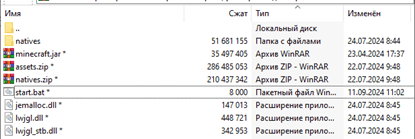
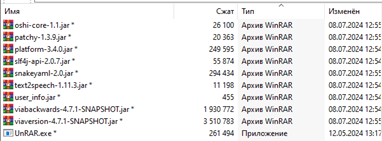
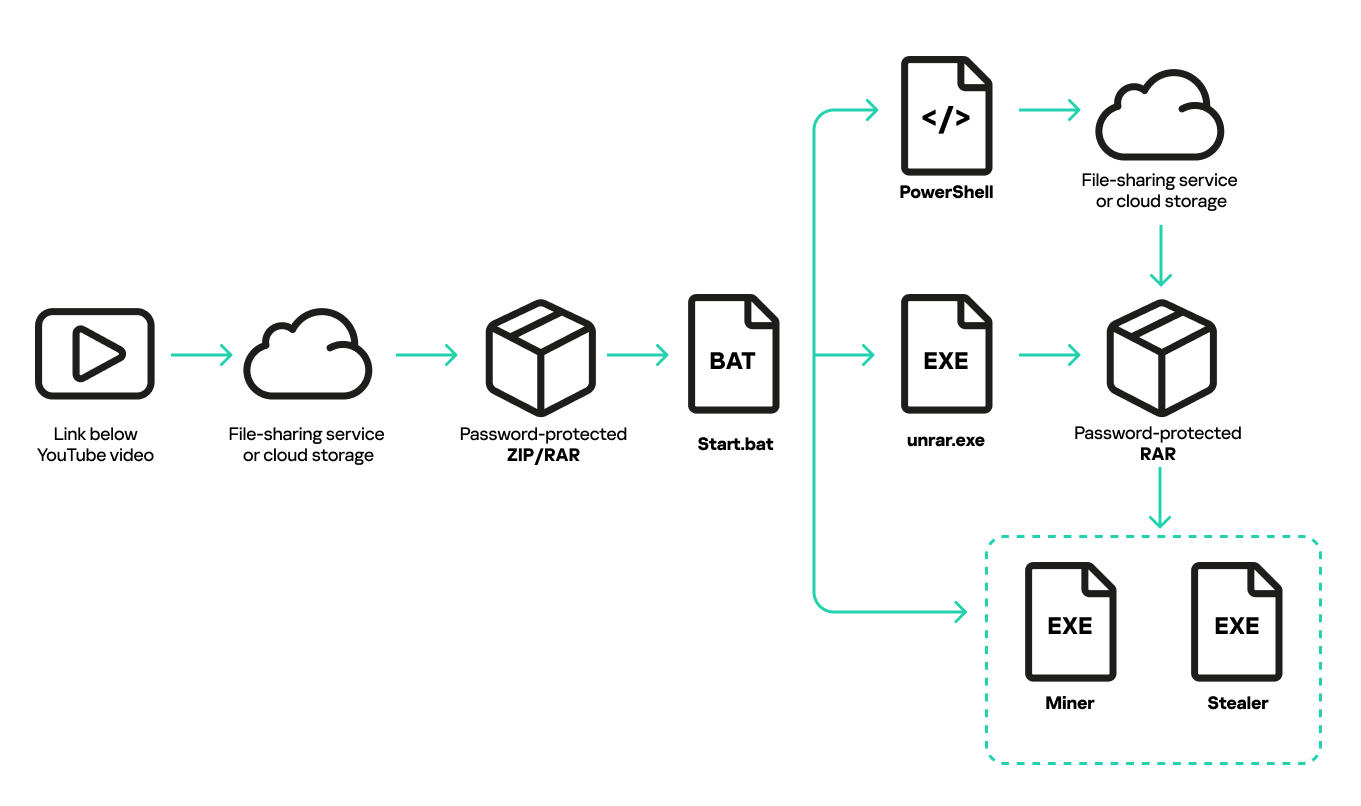
The campaign in which we discovered the new stealer was already active before Arcane appeared. The original distribution method started with YouTube videos promoting game cheats. The videos were frequently accompanied by a link to an archive and a password to unlock it. Upon unpacking the archive, the user would invariably discover a start.bat batch file in the root folder and the UnRAR.exe utility in one of the subfolders.
Archive root
Contents of the “natives” subfolder
The contents of the batch file were obfuscated. Its only purpose was to download another password-protected archive via PowerShell, and unpack that with UnRAR.exe with the password embedded in the BATCH file as an argument.
Contents of the obfuscated start.bat file
Following that, start.bat would use PowerShell to launch the executable files from the archive. While doing so, it added every drive root folder to SmartScreen filter exceptions. It then reset the EnableWebContentEvaluation and SmartScreenEnabled registry keys via the system console utility reg.exe to disable SmartScreen altogether.
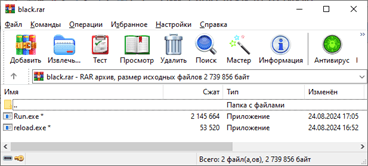
The archive would always contain two executables: a miner and a stealer.
Contents of the downloaded archive
The stealer was a Phemedrone Trojan variant, rebranded by the attackers as “VGS”. They used this name in the logo, which, when generating stealer activity reports, is written to the beginning of the file along with the date and time of the report’s creation.
Phemedrone and VGS logos
Original distribution scheme
Arcane replaces VGS
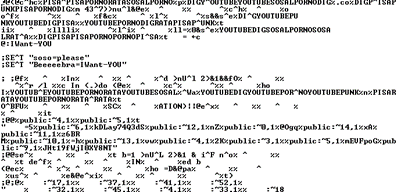
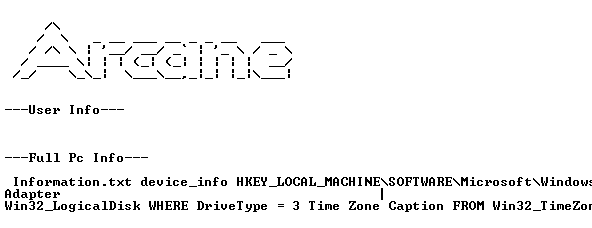
At the end of 2024, we discovered a new Arcane stealer distributed as part of the same campaign. It is worth noting that a stealer with a similar name has been encountered before: a Trojan named “Arcane Stealer V” was offered on the dark web in 2019, but it shares little with our find. The new stealer takes its name from the ASCII art in the code.
Arcane logo
Arcane succeeded VGS in November. Although much of it was borrowed from other stealers, we could not attribute it to any of the known families.
Arcane gets regular updates, so its code and capabilities change from version to version. We will describe the common functionality present in various modifications and builds. In addition to logins, passwords, credit card data, tokens and other credentials from various Chromium and Gecko-based browsers, Arcane steals configuration files, settings and account information from the following applications:
In addition, the stealer collects all kinds of system information, such as the OS version and installation date, digital key for system activation and license verification, username and computer name, location, information about the CPU, memory, graphics card, drives, network and USB devices, and installed antimalware and browsers. Arcane also takes screenshots of the infected device, obtains lists of running processes and Wi-Fi networks saved in the OS, and retrieves the passwords for those networks.
Arcane’s functionality for stealing data from browsers warrants special attention. Most browsers generate unique keys for encrypting sensitive data they store, such as logins, passwords, cookies, etc. Arcane uses the Data Protection API (DPAPI) to obtain these keys, which is typical of stealers. But Arcane also contains an executable file of the Xaitax utility, which it uses to crack browser keys. To do this, the utility is dropped to disk and launched covertly, and the stealer obtains all the keys it needs from its console output.
The stealer implements an additional method for extracting cookies from Chromium-based browsers through a debug port. The Trojan secretly launches a copy of the browser with the “remote-debugging-port” argument, then connects to the debug port, issues commands to visit several sites, and requests their cookies. The list of resources it visits is provided below.
https://gmail.com,
https://drive.google.com,
https://photos.google.com,
https://mail.ru,
https://rambler.ru,
https://steamcommunity.com,
https://youtube.com,
https://avito.ru,
https://ozon.ru,
https://twitter.com,
https://roblox.com,
https://passport.yandex.ru
ArcanaLoader
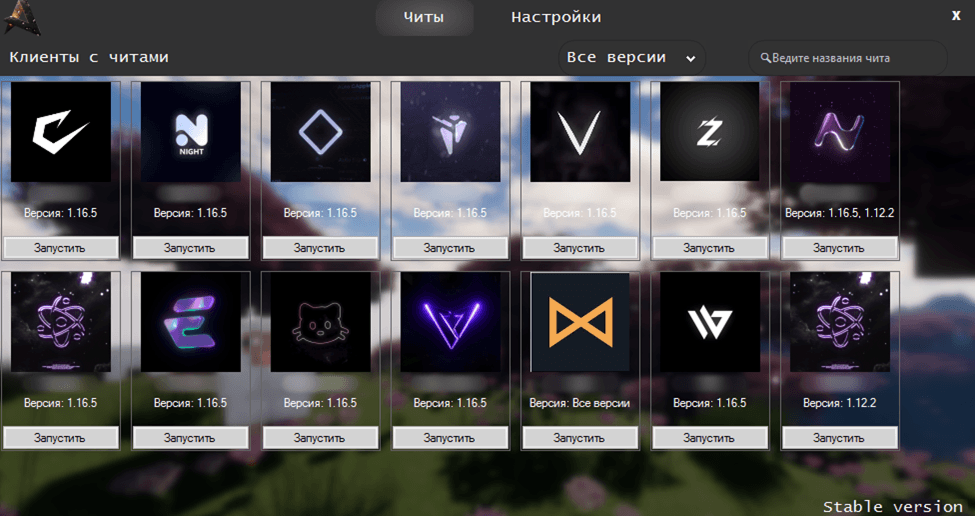
Within a few months of discovering the stealer, we noticed a new distribution pattern. Rather than promoting cheats, the threat actors shifted to advertising ArcanaLoader on their YouTube channels. This is a loader with a graphical user interface for downloading and running the most popular cracks, cheats and other similar software. More often than not, the links in the videos led to an executable file that downloaded an archive with ArcanaLoader.
ArcanaLoader
See translation
Читы
Cheats
Настройки
Settings
Клиенты с читами
Clients with cheats
Все версии
All versions
Введите название чита
Enter cheat name
Версия: 1.16.5
Version: 1.16.5
Запустить
Start
Версия: Все Версии
Version: All versions
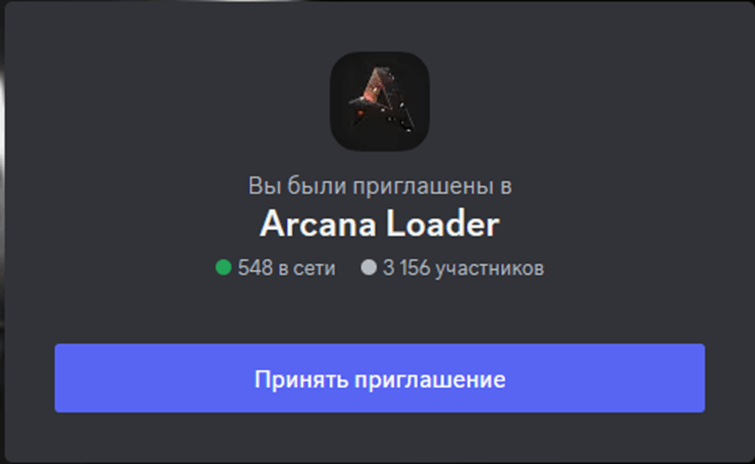
The loader itself included a link to the developers’ Discord server, which featured channels for news, support and links to download new versions.
Discord server invitation
See translation
You have been invited to Arcana Loader 548 online 3,156 users Accept invitation
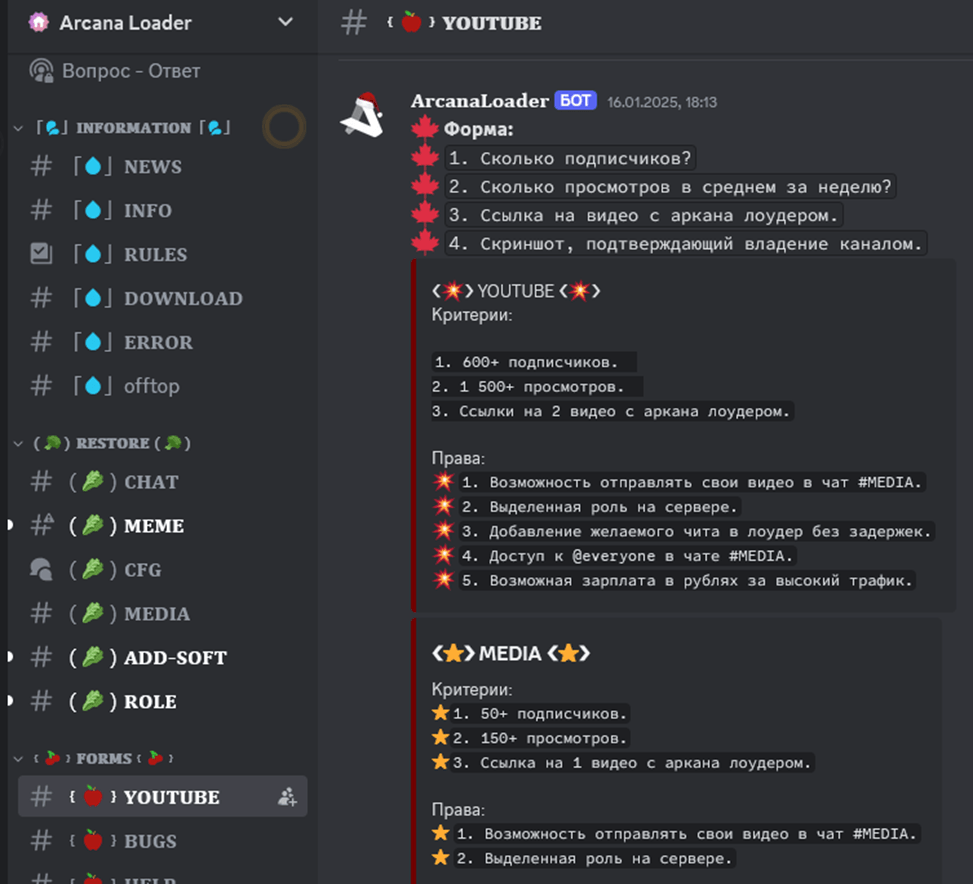
At the same time, one of the Discord channels posted an ad, looking for bloggers to promote ArcanaLoader.
Looking for bloggers to spread the loader
See translation
ArcanaLoader BOT Form: 1. Total subscribers 2. Average views per week 3. Link to ArcanaLoader video 4. Screenshot proof of channel ownership YOUTUBE Criteria: 1. 600* subscribers 2. 1,500+ views 3. Links to 2 Arcana Loader videos Permissions: 1. Send your videos to the #MEDIA chat 2. Personal server role 3. Add cheat to loader without delay 4. Access to @everyone in the #MEDIA chat 5. Possible compensation in rubles for high traffic MEDIA Criteria: 1. 50+ subscribers 2. 150+ views 3. Link to 1 ArcanaLoader video Permissions: 1. Send your videos to the #MEDIA chat 2. Personal server role
Sadly, the main ArcanaLoader executable contained the aforementioned Arcane stealer.
Victims
All conversations on the Discord server are in Russian, the language used in the news channels and YouTube videos. Apparently, the attackers target a Russian-speaking audience. Our telemetry confirms this assumption: most of the attacked users were in Russia, Belarus and Kazakhstan.
Takeaways
Attackers have been using cheats and cracks as a popular trick to spread all sorts of malware for years, and they’ll probably keep doing so. What’s interesting about this particular campaign is that it illustrates how flexible cybercriminals are, always updating their tools and the methods of distributing them. Besides, the Arcane stealer itself is fascinating because of all the different data it collects and the tricks it uses to extract the information the attackers want. To stay safe from these threats, we suggest being wary of ads for shady software like cheats and cracks, avoiding links from unfamiliar bloggers, and using strong security software to detect and disarm rapidly evolving malware.
In the early hours of March 18, Israeli forces attacked multiple areas in the Gaza Strip, killing hundreds of people, according to Gaza’s Ministry of Health. These attacks come nearly two months after the ceasefire was announced on January 19.
Following the attacks, Doctors Without Borders/Médecins Sans Frontières (MSF) teams received mass casualties at Nasser and Al-Aqsa hospitals, the MSF field hospital, and MSF’s Attar clinic.
“We received many bodies and body parts, most of them children and women,” said Dr. Mohammed Qishta of Nasser Hospital. “The bodies were everywhere in the emergency room, with complete confusion.”
Claire Magone, general director of MSF France, gave the following statement today:
“We are horrified by the attacks launched by Israel today on the people of Gaza, shattering the nearly two-month-old ceasefire. Out of the hundreds killed, according to the Ministry of Health, MSF received 75 dead on arrival and scores of wounded in just three of the facilities we support.
“Our staff were completely taken by surprise and found themselves once again having to deal with influxes of mass casualties, many of whom were children.
Palestinians in Gaza will simply not be able to withstand this, neither physically nor mentally. Their hopes of recovering at least part of their previous lives are being shattered.
Claire Magone, general director of MSF France
“In line with the tactics that the Israeli authorities have applied since October 2023, they have once again chosen to collectively punish the people of Gaza—with the explicit approval of their closest ally, the United States—striking with an intensity not seen since the early stages of the war. For over 15 months before the ceasefire, people in Gaza were indiscriminately killed, mutilated, wounded, and displaced.
“Israeli forces undertaking these latest ruthless attacks and evacuation orders make us fear that a new phase of military operations in Gaza is about to begin. Palestinians in Gaza will simply not be able to withstand this, neither physically nor mentally. Their hopes of recovering at least part of their previous lives are being shattered.
Voice notes from Gaza: “We received many bodies and body parts”
“Since the ceasefire came into effect on January 19, people have been struggling to restore the basics of their day-to-day lives after a drawn out, devastating military campaign, which has annihilated the very fabric of society in Gaza. Israel has once again cut access to humanitarian aid and basic goods.
“MSF calls for the ceasefire to be immediately restored and for Israel to not restart its campaign of destruction and the nightmarish, massive bombing on the people of Gaza. MSF also calls for the blockade to be lifted, and for people to regain unrestricted access to basic supplies and aid. Injured people and patients requiring urgent medical care should be allowed to seek care outside of Gaza, provided their right to a safe and dignified return is granted.”
At the end of 2024, we discovered a new stealer distributed via YouTube videos promoting game cheats. What’s intriguing about this malware is how much it collects. It grabs account information from VPN and gaming clients, and all kinds of network utilities like ngrok, Playit, Cyberduck, FileZilla and DynDNS. The stealer was named Arcane, not to be confused with the well-known Arcane Stealer V. The malicious actor behind Arcane went on to release a similarly named loader, which supposedly downloads cheats and cracks, but in reality delivers malware to the victim’s device.
Distribution
The campaign in which we discovered the new stealer was already active before Arcane appeared. The original distribution method started with YouTube videos promoting game cheats. The videos were frequently accompanied by a link to an archive and a password to unlock it. Upon unpacking the archive, the user would invariably discover a start.bat batch file in the root folder and the UnRAR.exe utility in one of the subfolders.
Archive root
Contents of the “natives” subfolder
The contents of the batch file were obfuscated. Its only purpose was to download another password-protected archive via PowerShell, and unpack that with UnRAR.exe with the password embedded in the BATCH file as an argument.
Contents of the obfuscated start.bat file
Following that, start.bat would use PowerShell to launch the executable files from the archive. While doing so, it added every drive root folder to SmartScreen filter exceptions. It then reset the EnableWebContentEvaluation and SmartScreenEnabled registry keys via the system console utility reg.exe to disable SmartScreen altogether.
The archive would always contain two executables: a miner and a stealer.
Contents of the downloaded archive
The stealer was a Phemedrone Trojan variant, rebranded by the attackers as “VGS”. They used this name in the logo, which, when generating stealer activity reports, is written to the beginning of the file along with the date and time of the report’s creation.
Phemedrone and VGS logos
Original distribution scheme
Arcane replaces VGS
At the end of 2024, we discovered a new Arcane stealer distributed as part of the same campaign. It is worth noting that a stealer with a similar name has been encountered before: a Trojan named “Arcane Stealer V” was offered on the dark web in 2019, but it shares little with our find. The new stealer takes its name from the ASCII art in the code.
Arcane logo
Arcane succeeded VGS in November. Although much of it was borrowed from other stealers, we could not attribute it to any of the known families.
Arcane gets regular updates, so its code and capabilities change from version to version. We will describe the common functionality present in various modifications and builds. In addition to logins, passwords, credit card data, tokens and other credentials from various Chromium and Gecko-based browsers, Arcane steals configuration files, settings and account information from the following applications:
In addition, the stealer collects all kinds of system information, such as the OS version and installation date, digital key for system activation and license verification, username and computer name, location, information about the CPU, memory, graphics card, drives, network and USB devices, and installed antimalware and browsers. Arcane also takes screenshots of the infected device, obtains lists of running processes and Wi-Fi networks saved in the OS, and retrieves the passwords for those networks.
Arcane’s functionality for stealing data from browsers warrants special attention. Most browsers generate unique keys for encrypting sensitive data they store, such as logins, passwords, cookies, etc. Arcane uses the Data Protection API (DPAPI) to obtain these keys, which is typical of stealers. But Arcane also contains an executable file of the Xaitax utility, which it uses to crack browser keys. To do this, the utility is dropped to disk and launched covertly, and the stealer obtains all the keys it needs from its console output.
The stealer implements an additional method for extracting cookies from Chromium-based browsers through a debug port. The Trojan secretly launches a copy of the browser with the “remote-debugging-port” argument, then connects to the debug port, issues commands to visit several sites, and requests their cookies. The list of resources it visits is provided below.
https://gmail.com,
https://drive.google.com,
https://photos.google.com,
https://mail.ru,
https://rambler.ru,
https://steamcommunity.com,
https://youtube.com,
https://avito.ru,
https://ozon.ru,
https://twitter.com,
https://roblox.com,
https://passport.yandex.ru
ArcanaLoader
Within a few months of discovering the stealer, we noticed a new distribution pattern. Rather than promoting cheats, the threat actors shifted to advertising ArcanaLoader on their YouTube channels. This is a loader with a graphical user interface for downloading and running the most popular cracks, cheats and other similar software. More often than not, the links in the videos led to an executable file that downloaded an archive with ArcanaLoader.
ArcanaLoader
See translation
Читы
Cheats
Настройки
Settings
Клиенты с читами
Clients with cheats
Все версии
All versions
Введите название чита
Enter cheat name
Версия: 1.16.5
Version: 1.16.5
Запустить
Start
Версия: Все Версии
Version: All versions
The loader itself included a link to the developers’ Discord server, which featured channels for news, support and links to download new versions.
Discord server invitation
See translation
You have been invited to Arcana Loader 548 online 3,156 users Accept invitation
At the same time, one of the Discord channels posted an ad, looking for bloggers to promote ArcanaLoader.
Looking for bloggers to spread the loader
See translation
ArcanaLoader BOT Form: 1. Total subscribers 2. Average views per week 3. Link to ArcanaLoader video 4. Screenshot proof of channel ownership YOUTUBE Criteria: 1. 600* subscribers 2. 1,500+ views 3. Links to 2 Arcana Loader videos Permissions: 1. Send your videos to the #MEDIA chat 2. Personal server role 3. Add cheat to loader without delay 4. Access to @everyone in the #MEDIA chat 5. Possible compensation in rubles for high traffic MEDIA Criteria: 1. 50+ subscribers 2. 150+ views 3. Link to 1 ArcanaLoader video Permissions: 1. Send your videos to the #MEDIA chat 2. Personal server role
Sadly, the main ArcanaLoader executable contained the aforementioned Arcane stealer.
Victims
All conversations on the Discord server are in Russian, the language used in the news channels and YouTube videos. Apparently, the attackers target a Russian-speaking audience. Our telemetry confirms this assumption: most of the attacked users were in Russia, Belarus and Kazakhstan.
Takeaways
Attackers have been using cheats and cracks as a popular trick to spread all sorts of malware for years, and they’ll probably keep doing so. What’s interesting about this particular campaign is that it illustrates how flexible cybercriminals are, always updating their tools and the methods of distributing them. Besides, the Arcane stealer itself is fascinating because of all the different data it collects and the tricks it uses to extract the information the attackers want. To stay safe from these threats, we suggest being wary of ads for shady software like cheats and cracks, avoiding links from unfamiliar bloggers, and using strong security software to detect and disarm rapidly evolving malware.
Source: United Kingdom – Executive Government & Departments
Press release
UK science uncovers mysteries of dark universe with Euclid data
Cutting-edge UK research is benefiting the European Space Agency’s Euclid mission, with new data released today (19 March) set to uncover the secrets of dark energy and matter.
Euclid visual: ESA/Euclid/Euclid Consortium/NASA. Background galaxies: NASA, ESA, and S. Beckwith (STScI) and the HUDF Team Euclid observations: ESA/Euclid/Euclid Consortium/NASA, image processing by J.-C. Cuillandre, E. Bertin, G. Anselmi
The wealth of new data from the mission – described as the ultimate discovery machine – includes details of 500 galaxies that seem to experience a phenomenon known as strong lensing.
This is where light from more distant galaxies is bent around closer galaxies due to gravity, like how light is focused through a glass lens on Earth.
The way the light bends indicates the total mass, which includes both visible matter and, potentially, dark matter – so scientists can analyse this, begin to identify where dark matter is located, and understand its properties.
Euclid’s data is revolutionising the study of strong lensing. New techniques using machine learning and AI have been developed to find these rare objects. Citizen science has also contributed significantly, with over 1000 volunteers participating in visual inspections.
This image shows examples of gravitational lenses that Euclid captured in its first observations of the Deep Field areas. Credit: ESA/Euclid/Euclid Consortium/NASA, image processing by M. Walmsley, M. Huertas-Company, J.-C. Cuillandre
UK Science Minister, Lord Vallance said:
The UK space sector is playing a leading role in the Euclid mission which, as this new data shows, is revealing more about the role of gravity in our Universe, and the nature of dark energy and matter. The British-made visible imager and data processing tools are central to these observations.
The technological advances achieved in missions like this will not only benefit our understanding of the universe, but may help us to better process data here on Earth, helping us to grow our economy and support our Plan for Change.
The Euclid mission, launched in July 2023, carries a visible imager (VIS) from the UK, funded by £37 million from the UK Space Agency. The VIS, designed and built by a UCL-led team, is a super high-resolution camera (609 million pixels), with a focal plane about the size of a large pizza box, that can take incredibly detailed pictures of the sky. It is currently observing billions of galaxies up to 10 billion light years away.
The new data release includes observations of distant regions of space, displaying hundreds of thousands of galaxies and many transient phenomena—astronomical events that are temporary or short-lived relative to cosmic history. These include supernovae (explosions of stars at the end of their life cycles), gamma-ray bursts (extremely energetic explosions observed in distant galaxies), and fast radio bursts (brief but intense bursts of radio waves from unknown sources in space).
All of this allows scientists to gain insights into the dynamic processes occurring in the universe. The release classifies over 380,000 galaxies and 500 gravitational lens candidates.
This is a zoom-in of Euclid’s Deep Field North, showing the Cat’s Eye Nebula in the centre of the image, around 3000 light-years away. Also known as NGC 6543, this nebula is a visual ‘fossil record’ of the dynamics and late evolution of a dying star. This dying star is shedding its outer colourful shells. Credit: ESA/Euclid/Euclid Consortium/NASA, image processing by J.-C. Cuillandre, E. Bertin, G. Anselmi
ESA’s Director of Science, Prof. Carole Mundell, said:
Euclid shows itself once again to be the ultimate discovery machine. It is surveying galaxies on the grandest scale, enabling us to explore our cosmic history and the invisible forces shaping our Universe.
The ‘quick’ data release
Euclid ‘quick’ releases, such as this one, are of selected areas, intended to demonstrate the data products to be expected in the major data releases that follow, and to allow scientists to sharpen their data analysis tools in preparation. The mission’s first cosmology data will be released to the community in October 2026.
Aprajita Verma, a Senior Researcher at the University of Oxford, said:
This early data release showcases the amazing images that we will receive from the Euclid telescope. Even in this tiny area (less than 0.5% of the Euclid survey), Euclid has revealed millions of galaxies in exquisite detail.
Nestled among these galaxies are strong gravitational lenses. This rare phenomenon is seen around massive galaxies that can distort or warp space-time so much that light from objects behind them can be brought into view as rings, arcs or multiple images.
Verma said:
This is exactly what has been revealed in this early Euclid data, and at a higher frequency than we’ve seen from surveys with ground-based telescopes.
The team used a combination of machine learning with visual inspection from citizen scientists and the team to develop an efficient discovery engine.
Phil Holloway, PhD student at the University of Oxford said:
Incredibly, over 1000 citizen scientists volunteered to hunt for the strong lenses through the Space Warps project on the Zooniverse platform. We are amazed by the interest, dedication and skill of the citizen scientists, we wouldn’t have been able to find 500 of these rare gems without them! This was a huge collaborative effort and this early data signposts that there will be many discoveries to be made with the Euclid Wide Survey – there are exciting times ahead!
Space Warps is a dedicated project to discover strong gravitational lenses co-founded by Phil Marshall, Anupreeta More, and Aprajita Verma on the Zooniverse citizen science platform.
Professor Thomas Collett, from the University of Portsmouth’s Institute of Cosmology and Gravitation, said:
Euclid has provided spectacular image quality across a huge area of the sky, which is critical to discovering small, rare objects. We’ve found 500 new strong gravitational lenses in the Euclid dataset.
These are galaxies distorted into rings of light by the mass of another foreground galaxy. We have combined the strengths of machine learning and citizen scientists to sift out these rare objects from the millions of other galaxies in Euclid. These new lenses will allow us to make new measurements of the mysterious dark matter and dark energy that make up 95% of our Universe but which are poorly understood.
Euclid’s transformative capabilities
Before Euclid, astronomers had to choose between wide-field images from lower resolution telescopes like the Dark Energy Survey in Chile, or detailed zoomed-in images from telescopes like Hubble, but only on small regions. Euclid, with its 609 megapixel camera led by the UK, combines both panoramic mode and detailed imaging. The area mapped in this release is already a significant fraction of all the sky covered by Hubble since 1990.
This innovation is transformative for strong lensing studies, which require large panoramic images to locate rare objects and detailed views to analyse them.
Professor Adam Amara, Chief Scientist at the UK Space Agency, who first proposed the idea for Euclid, said:
Previously, astronomers like me used wide low-resolution surveys to find strong lenses and then requested Hubble for follow-up observations. Now, Euclid accomplishes both tasks in one shot.
This data release is the first clear evidence that Euclid will be a unique rare object finder (as well as an exquisite dark energy measuring machine). In terms of rare objects in the universe, I’m excited to see what ‘unknown-unknowns’ it will discover – it’s been a long wait.
Professor Mark Cropper (Mullard Space Science Laboratory at UCL), who led on designing and developing Euclid’s VIS optical camera over 16 years, working with teams at UCL, Open University and across Europe, said:
Euclid is allowing us to understand the universe on another level entirely. It gives us fine detail over a vast scale. To pick one example, Euclid found 70,000 globular clusters – very old, tightly packed groups of stars – in the Perseus Cluster of galaxies. And it has found 500 strong gravitational lenses, where light from distant galaxies has been bent by intervening matter – that doubles the number we knew about previously. All this and much more in just two days of data.
Dr James Nightingale , Research Fellow, Newcastle University School of Mathematics, Statistics and Physics said:
For the past decade, my research has been defined by painstakingly analysing the same 50 strong gravitational lenses, but with the Q1 data release, I was handed 500 new strong lenses in under a week. It’s a seismic shift — transforming how I do science practically overnight.
UK involvement and contributions
The UK has played a pivotal role in the Euclid mission, contributing significantly to the development of both the mission’s instruments and data processing capabilities.
Marie-Claire Perkinson, Chair of UKSpace Space Science and Exploration Committee said:
The UKSpace Space Science and Exploration committee is delighted to see this data release and the knowledge generated by this exciting mission. We are pleased to see a strong UK contribution – including UKspace member Teledyne who are providing the instrument detectors.
Mullard Space Science Laboratory and XCAM Ltd. have also made significant contributions to the development of the mission, providing leadership of the VIS instrument, and the Charge-Coupled Device test bench (CCD) test bench for the Euclid visible channel.
Daniel Waller, General Manager and Vice-President of Teledyne Space Imaging in Chelmsford Essex said:
Teledyne Space Imaging delivered the detectors for both the VIS and NISP instruments for Euclid. We are humbled by the astonishing detailed results that has been returned so far. The teams here in Chelmsford and in California feel privileged to have made their contribution to this scientific endeavour of understanding our Universe.
In addition to the VIS instrument UK scientists and institutions around the country have developed bespoke data processing tools for Euclid and are analysing the wealth of data being returned by the mission. Five key papers led by UK researchers are shared as part of this data release.
Professor Mike Lockwood, President of the Royal Astronomical Society, said:
To see UK astronomers, space scientists and engineers playing key roles in this extraordinary scientific endeavour is truly inspiring – and what’s even better is that this is just the beginning.
We can look forward to Euclid giving us the most detailed ever 3D map of the cosmos, helping to solve the biggest cosmic mysteries – what the universe is made of, how it evolved, and what its future holds.
The wider benefits of space science
The ripple effects of technological advances in space science extend far beyond the realm of space exploration, driving advances and growth across multiple sectors in the UK. The need for compact and efficient technology in space missions has led to advancements in miniaturisation, which benefit consumer electronics such as smartphones and laptops.
In healthcare, machine learning techniques developed for imaging technologies used in space exploration are being adapted to create more precise medical imaging techniques, potentially improving diagnosis and patient outcomes. The vast amounts of data collected by missions like Euclid are processed using advanced algorithms, which are now being used in healthcare to analyse patient data and predict disease outbreaks.
Source: Peter the Great St Petersburg Polytechnic University – Peter the Great St Petersburg Polytechnic University –
The Polytechnic University held Open Day for international applicants online. The event was dedicated to the start of the admissions campaign. Representatives of SPbPU international services spoke about the admissions process, educational opportunities and answered questions from future students.
For more than a century of history, Polytechnic University has established itself as one of the leading engineering universities in Russia and the world. We are proud of our graduates — talented engineers, scientists, entrepreneurs and government officials who contribute to the development of technology, economy and society. We invite you to become part of our energetic and multifaceted community. Polytechnic University is a place where you can unleash your potential, find friends from all over the world and take the first step towards a successful career. We are looking forward to seeing you at Polytechnic University. Let’s create the future together, — Vice-Rector for International Affairs Dmitry Arsenyev greeted future students.
Students from the Institute of Computer Science and Cybersecurity, the Civil Engineering Institute, the Institute of Mechanical Engineering, Materials and Transport, and the Institute of Industrial Management, Economics and Trade shared their impressions of studying at the university.
Learning the language and adapting were difficult at first, but over time they opened up new opportunities. I would like to acknowledge the efforts of the teachers who create additional materials to help students in their studies. The atmosphere at the university is inspiring: the polytechnics are incredibly responsive and always ready to support, – said Marvin Bethel, a student from Botswana.
ISI student Mustafa Ibrahim is from Ethiopia. He chose Polytechnic University because of its high international rankings, its status as one of the best universities in Russia, and its campus with modern infrastructure.
The academic environment at the university is conducive to development. The teachers are always ready to help and share knowledge in their field. Here I met students from Russia, India, Egypt, China and other countries, which significantly expanded my cultural and educational experience. The training at the Polytechnic is intensive, with an emphasis on practical skills and research, – shared Mustafa Ibrahim.
Activists from PolyUnion, the Council of Fellowships and Tutor Forces spoke about communities and extracurricular activities for international students at the Polytechnic University.
Please note: This information is raw content directly from the source of the information. It is exactly what the source states and does not reflect the position of MIL-OSI or its clients.
Source: Peter the Great St Petersburg Polytechnic University – Peter the Great St Petersburg Polytechnic University –
From March 10 to 14, Peter the Great St. Petersburg Polytechnic University hosted a case championship in oil and gas engineering. Participants solved technologically complex problems that required knowledge in design and modern digital tools.
The event was opened by Mikhail Radzhabov, Head of the Program for Work with the Scientific and Innovative Community of the Gazprom Neft Scientific Division, and Daniil Rublev, Chief Specialist of the Company’s Integrated Solutions Unit, who also gave a series of lectures on design.
The work on the case included several stages: studying the well design methodology, analyzing the requirements for automated systems, and developing a digital solution. The participants solved engineering problems, mastered the principles of algorithmization, programming, and digital transformation of the industry. As a result, the guys developed a program for automated calculation of the well design.
One of the main tasks was to create a case that was as close as possible to real production conditions. It was important to find a balance between the complexity of the task and the possibility of solving it within the framework of the championship. As a result, the students not only coped with the tasks, but also developed a digital product that, with further development, can be implemented into production processes, – noted Daniil Rublev.
The championship was won by the team of the Saint Petersburg Mining University consisting of Sofia Reshetnikova, Georgy Makiya and Nikita Tureev. Their solution was distinguished by high calculation accuracy and well-thought-out automation, which allowed them to create a prototype of a digital tool with real potential for industrial use.
While we were familiar with the engineering part, automation required us to go beyond the usual competencies. It was a serious challenge, but it allowed us to understand how IT solutions can be integrated into the oil and gas sector, shared Georgy Makii.
The Case Championship at the Polytechnic University is not just an intellectual competition, but also an important educational initiative, thanks to which students can apply theoretical knowledge to solving real problems, master advanced tools and adapt to market demands.
Please note: This information is raw content directly from the source of the information. It is exactly what the source states and does not reflect the position of MIL-OSI or its clients.
Source: Saint Petersburg State University of Architecture and Civil Engineering – Saint Petersburg State University of Architecture and Civil Engineering – SSO “Wheel of Fortune”
On March 13, the winter season of Russian student teams at the international construction site run by JSC CONCERN TITAN-2 – the construction of the El Dabaa NPP in Egypt – ended. The participants of the combined student construction team “Wheel of Fortune” also included five students from SPbGASU. One of them, Ekaterina Bushueva, a sixth-year student of the construction faculty of our university, was the team leader.
The team worked within the project for two months. For some, it was not the first such experience, and some were on an international project for the first time.
Andrey Repin, commander of the SSO “Friday”, a third-year student of the construction faculty of SPbGASU, shared his impressions: “This was my second trip to Egypt, but it was just as unusual as the first: this time the winter stage acquired a larger scale – more people, detachment events and emotions. Moreover, on this trip we were part of the St. Petersburg delegation and had to show a high level at creative events, thereby presenting our regional branch in the best light. I think we coped with this.”
Elena Ozerova, a second-year student at the Faculty of Civil Engineering, was on an international project for the first time: “My two-month work experience at the construction site of the El Dabaa NPP in Egypt as part of the Wheel of Fortune team was not just professional development, but also a unique opportunity to get acquainted with the culture and history of Egypt, as well as to become part of a large-scale international project. The work in cooperation with the TITAN-2 company was organized at the highest level. The tasks that were set for us were interesting and required the application of knowledge acquired at the university. This experience will certainly be useful in my future career.”
Darya Lopukhina, a third-year student at the construction faculty, said: “I will remember the trip to Egypt to work at the nuclear power plant for a long time. It was the first time I was abroad at a conscious age, and it was very interesting to observe how people live. During these two months, we managed not only to work, but also to go on excursions to Alexandria, Cairo, Giza. I was very pleased with this work and thought about further cooperation on foreign projects of “CONCERN TITAN-2”.
To get into international work projects, it is necessary to pass a thorough selection among students of construction specialties who have worked for at least two seasons in the ranks of Russian student brigades.
Please note: This information is raw content directly from the source of the information. It is exactly what the source states and does not reflect the position of MIL-OSI or its clients.
Source: State University Higher School of Economics – State University Higher School of Economics –
– The program receives many applications. Unfortunately, sometimes people come who have neither the calling nor the necessary basic competencies. The qualification of a business trainer from the HSE is very attractive to “bloggers”, yogis, personal growth trainers, pseudo-psychologists, for people who consider the profession as a means of deception and profit. We cut them off at the entrance, since sometimes one person can destroy the working climate in the entire group. There are such programs where, first of all, reputation is important, and only then the number. This is our case. In principle, for the training of business trainers, groups cannot be more than 20-25 people. Otherwise, we will lose the quality of training. If more people pass the interview successfully, then we will open two or more streams.
Please note: This information is raw content directly from the source of the information. It is exactly what the source states and does not reflect the position of MIL-OSI or its clients.
Source: Peter the Great St Petersburg Polytechnic University – Peter the Great St Petersburg Polytechnic University –
From March 10 to 14, the Institute of Atomic Energy of the National Research Nuclear University MEPhI hosted a case championship with the support of the State Research Center of the Russian Federation IPPE. The strongest teams from SPbPU, ISPU, KSPEU, ITAE and other leading universities of the country gathered in Obninsk. The participants solved computational problems related to current issues of nuclear energy.
The case included ten tasks related to the closed nuclear fuel cycle (CNFC). The guys compiled fuel balances, explained the nuclide compositions of the loads, determined the activity of the components of spent nuclear fuel (SNF). Many factors had to be taken into account: issues of fuel burnup, production of plutonium isotopes and minor actinides, SNF handling, as well as economic aspects of closing the fuel cycle.
The honor of the Polytechnic University was defended by the “Spectrum” team. It included 4th-year students of the Higher School of Nuclear and Thermal Energy of the Institute of Power Engineering Ilya Antonov, Ruslan Gorelenkov, Denis Yurin, Andrey Lemeshev and Sofia Shmachko. The Polytechnic students successfully mastered and applied the SERPENT code, which allowed them to perform calculations with a high degree of accuracy and validity. The guys not only coped with the tasks, but also proposed solutions that went beyond the requirements of the case. Based on the results of the defense, the SPbPU team took first place.
Each of us gained a lot of new knowledge: from determining the specific activity of fresh spent nuclear fuel to comparing the savings in the consumption of natural uranium by different types of regenerated fuel. We would like to thank the organizers of the case championship for the high level of preparation of the event, for the opportunity to demonstrate our skills in the field of a closed nuclear fuel cycle, – shared Denis Yurin.
Please note: This information is raw content directly from the source of the information. It is exactly what the source states and does not reflect the position of MIL-OSI or its clients.
Source: Rosneft – Rosneft – An important disclaimer is at the bottom of this article.
The Rosneft Scientific Institute in Ufa will hold a scientific and technical conference “Innovative Technologies in Hydrocarbon Production” from May 20 to 23, 2025. The co-organizer is the Academy of Sciences of the Republic of Bashkortostan. More than 700 leading representatives of the oil industry and scientists from different cities of Russia are expected to participate.
The large-scale event will combine the Company’s traditional conferences “Digital Technologies in Hydrocarbon Production” and “Practical Aspects of Oilfield Chemistry”. The program will cover key issues of oil and gas production: from prospecting and exploration to field development design. Participation in the conference will allow you not only to get acquainted with theoretical aspects, but also to discuss real production situations.
The conference sections will be devoted to the following topical issues:
oil and gas field development: digital projects and technologies, practical aspects of oilfield chemistry, artificial intelligence in the oil and gas industry, training and advanced training of personnel, modern IT solutions in the field of capital construction, mathematical modeling technologies.
The event will also include a competition for the best information models* of capital construction projects among Rosneft employees. Scientists from corporate institutes will present their developments in this area. Specialists from production enterprises will show the most effective examples of implementing information models in production.
*A building information model (BIM model) is a detailed model, a data storage of the object’s geometry, materials and equipment. It is used throughout the entire life cycle of the object: during construction, reconstruction, operation and dismantling.
Department of Information and Advertising of PJSC NK Rosneft March 19, 2025
Please note: This information is raw content directly from the source of the information. It is exactly what the source states and does not reflect the position of MIL-OSI or its clients.
Source: Rosneft – Rosneft – An important disclaimer is at the bottom of this article.
Specialists from RN-Purneftegaz, one of Rosneft’s main oil and gas production centers in Yamal, have implemented a contactless magnetometric method for diagnosing field pipelines. The new domestic technology allows for magnetic field changes to be recorded from a distance of up to 10 meters, which helps to identify various pipeline defects.
With the help of remote diagnostics, up to 20 km of pipelines are examined per day without stopping them or changing the operating mode. The magnetometric complex visualizes the data and makes GPS coordinates. At the same time, the speed of the flaw detector along the pipeline does not affect the quality of the data obtained. After processing and interpreting the data, the hardware complex independently draws a conclusion on the technical condition of the pipeline with an electronic map of the detected anomalies.
Previously used methods of technical diagnostics: opening a section of a pipeline and in-pipe flaw detection required significantly more time.
The contactless magnetometric method has been successfully tested at the Komsomolskoye field. The new technology makes it possible to effectively inspect pipelines where in-line diagnostics is impossible. As part of the production efficiency improvement program, the contactless magnetometric method for diagnostics of field pipelines will be offered this year for replication at Rosneft production facilities.
Accident-free operation of industrial facilities is one of the priorities of the Rosneft-2030 strategy and a key task for the Company in all areas of activity.
Department of Information and Advertising of PJSC NK Rosneft March 19, 2025
Please note: This information is raw content directly from the source of the information. It is exactly what the source states and does not reflect the position of MIL-OSI or its clients.
The European Banking Authority (EBA) today launched a call for papers in view of its 14th Policy Research Workshop taking place on 18-19 November 2025 and titled “Bridging capital and growth – the role of financial structures and intermediaries”. The deadline for submitting papers is 6 June 2025.
The workshop aims to bring together economists and researchers from supervisory authorities and central banks, as well as leading academics, to discuss and explore policies that can ensure innovation in a context of competition and risk arbitrage, while ensuring financial stability.
In preparation for the workshop, the EBA invites the submission of policy-oriented, preferably empirical, research papers on the following topics:
the impact of global capital flows on market efficiency and the role of financial intermediation;
access to finance by entrepreneurs ensuring that capital is used in the most productive ways;
provision of mechanisms for managing risk and how regulatory frameworks can contribute to the functioning and stability of financial intermediaries;
incorporation of environmental, social, and governance (ESG) to support sustainable development and growth;
progress in digital finance initiatives and better alignment with regulation and policies.
Interested parties can download here the detailed call for papers, which includes additional information on the proposed topics for the papers, composition of the programme committee and contact details for the submission of papers. The submission deadline is 6 June 2025.
Contributors will be notified by mid-September 2025.
Minister Dirk Beljaarts of Economic Affairs of the Netherlands will host the D9+ Ministerial Meeting in Amsterdam on Wednesday 26 and Thursday 27 March 2025. Ministers from the thirteen most digitalized EU Member States and EU Commissioner Henna Virkkunen (Executive Vice-President of the European Commission) will meet at this summit. The D9+ Group of countries have joint ambitions to strengthen their digital economy, infrastructure and technologies and to better protect consumers on digital markets all based on a common EU digital technology strategy.
The Ministerial Meeting in Amsterdam includes meetings to ensure more EU private investments in digital technologies and to improve access to financing for startups and scale-ups. The ministers will also discuss challenges regarding connectivity. Such as increasing the supercomputing capacity within the EU to be able to develop innovations in the field of both digital infrastructure and technology. During the D9+ the participating Ministers will also have meetings on artificial intelligence. Discussions will be held on topics like developing innovative AI technology and AI infrastructure within the EU and the use of AI in public services. During these meetings various guest speakers will also provide insight into how business investments can be stimulated.
The following Ministers from the D9+ Group will be in Amsterdam for the summit: Caroline Stage (Minister for Digital Affairs; Denmark), Liisa-Ly Pakosta (Minister of Justice and Digital Affairs; Estonia), Niamh Smyth (Minister of State for Trade, Promotion, AI and Digital Transformation; Ireland), Elisabeth Margue (Minister Delegate to the Prime Minister for Media and Connectivity; Luxembourg), Dariusz Standerski, Secretary of State for Digital Affairs; Poland); Margarida Balseiro Lopes (Minister for Youth and Modernization; Portugal), Ksenija Klampfer (Minister of Digital Transformation; Slovenia), Oscar Lopez Águada (Minister for Digital Transformation and Civil Service; Spain), Marian Jurečka, Minister of Labour and Social Affairs; Czech Republic), Erik Slottner (Minister for Public Administration; Sweden). The representatives from Belgium and Finland have to be confirmed yet.
The participating ministers have the ambition to deliver a final declaration which Minister Beljaarts will hand over to EU Commissioner Virkkunen. At the same time as the D9+ Ministerial Meeting both business federations (B9+) and start-up and scale-up organizations (S9+) from the thirteen countries involved will meet in Amsterdam.
Origin of D9+
In 2016, Sweden launched an initiative called ‘Digital Frontrunners’ following a report in which nine EU member states were designated as frontrunners. Four additional countries have since become members of the D9+. The Ministers meet informally twice a year to work together on their ambitions in the field of digital economy and technology. There is a rotating presidency. After the Netherlands, Portugal will organize the next D9+ in the second half of 2025.
The European Investment Bank (EIB Global) has availed over €1.2 million (over Ksh 166 million) in technical assistance support to cities in East Africa for preparation of climate resilient urban development projects.
The cities set to benefit from this technical assistance are Kericho, Nyamira, Kisumu, Embu, Eldoret and Malindi in Kenya as well as Zanzibar in Tanzania and Makindye in Uganda.
EIB Global’s support to cities is financed through the City Climate Finance Gap Fund – a multi-donor trust fund supported by Germany and Luxembourg and implemented jointly with the World Bank and in close partnership with German Development Cooperation (GIZ). The technical assistance program focuses on early-stage project preparation with an aim of facilitating access to finance for urban projects that would otherwise potentially remain at idea stage.
Most of the support for the cities in the region will revolve around assessing options for managing solid waste and faecal sludge, waste to energy solutions through production of biogas and wastewater treatment. Preliminary proposed solutions have recommended integrated solid waste management plans that encompass segregation of waste at source, separation of waste collections, waste recovery and proper disposal.
Further technical assistance promotes active mobility through evaluating non-motorised transport options, implementing urban flood proofing measures to mitigate flood risks and enhancing environmental sustainability by establishment of green public parks as well as expansion of urban forestry and biodiversity.
In Kenya, EIB Global’s support is geared towards helping the cities access further financing support from an ongoing infrastructure investment programme known as the Kenya Urban Support Programme II, upon completion of the Gap Fund technical assistance.
EIB Vice President Thomas Ostros said, “Cities and local governments play a key role in fighting climate change because they experience its effects the most. However, they often struggle to develop climate-resilient infrastructure, mainly due to a lack of resources and expertise to create strong, investment-ready projects. Through its support for the Gap Fund, the EIB helps cities bridge these gaps and prepare effective climate projects.”
Technical assistance for project preparation plays a vital role in facilitating the implementation and financing of climate action projects by availing bankable opportunities. This is particularly true at urban or sub-national level where local authorities sometimes do not have enough in-house capacity to prepare robust projects that can attract public and private finance providers at an international level.
The European Investment Bank is very active in urban climate finance especially through the City Climate Finance Gap Fund. The Bank works with other partners to advise on projects that will place cities on a path to net zero.
Background information
About EIB Global
The European Investment Bank (ElB) is the long-term lending institution of the European Union, owned by its Member States. It finances investments that contribute to EU policy objectives.
EIB Global is the EIB Group’s specialised arm devoted to increasing the impact of international partnerships and development finance, and a key partner of Global Gateway. We aim to support €100 billion of investment by the end of 2027 — around one-third of the overall target of this EU initiative. Within Team Europe, EIB Global fosters strong, focused partnerships alongside fellow development finance institutions and civil society. EIB Global brings the EIB Group closer to people, companies and institutions through our offices across the world. High-quality, up-to-date photos of our headquarters for media use are available here.
About City Climate Finance Gap Fund:
Cities are key to creating a climate-smart future. Over half the global population lives in cities, generating 80% of total economic output and accounting for 70% of global CO2 emissions. While urbanization is a key driver of growth, unplanned, rapid urbanization and urban sprawl threaten to increase greenhouse gas emissions and vulnerability to climate change and other shocks. As many cities and local governments take steps to become low-carbon and climate-resilient, they face barriers in accessing finance as well as difficulties in planning and project preparation, due to insufficient capacity or resources — particularly in the early stages of the project cycle. The Gap Fund supports cities in addressing this specific challenges.
On 20th September 2023, the governments of Germany and Luxembourg announced new funding of €50 million for the City Climate Finance Gap Fund (Gap Fund), a multi-donor fund, implemented by the World Bank and the European Investment Bank with partners. These resources will support the development of low-carbon and climate-resilient urban investments and will nearly than double the fund’s capitalization, bringing it to €105 million, one of the largest early-stage technical assistance funds for cities and climate.
It provides much-needed funding for early-stage technical assistance and capacity building so that cities from low- and middle-income countries can operationalize their climate action plans, develop robust project concepts, and access climate finance resources. Since its establishment in 2020, EIB has supported 137 cities in developing and emerging economies through the Gap Fund.
In this paper, we propose and analyse four scenarios of a second Trump administration’s economic policy and its impact on Europe, ranging all the way from moderate tariffs to full trade war, a full multilateral breakdown with the US leaving the IMF down to a more cooperative exchange rate realignment agreement. We assess two trade scenarios quantitatively and outline broader policy shocks and their economic consequences. Our findings highlight significant challenges for the ECB, requiring responses to trade disruptions, financial instability, and potential global economic reordering. We offer specific policy recommendations for the ECB to navigate these uncertainties. This document was provided by the Economic Governance and EMU Scrutiny Unit at the request of the Committee on Economic and Monetary Affairs (ECON) ahead of the Monetary Dialogue with the ECB President on 20 March 2025.
Once considered an issue of the past, conscription has increasingly made its way back onto European, EU and global policy agendas in recent years, mainly since Russia’s invasion of Ukraine in 2022. As EU defence policy has steadily progressed, with new procurement initiatives and defence industry reinforcement, a parallel discussion on the EU’s armed forces is evolving in the context of the EU’s common security and defence policy (CSDP). Europe’s civilian and military preparedness and readiness has also come under the spotlight recently, as highlighted by the report presented in October 2024 by former Finnish President Sauli Niinistö. Opinion polls in some Member States also show growing support for the reintroduction of national service or conscription. Mounting threats to European security, fears of transatlantic disengagement, as well as the position of the new United States administration and potential peace plans for Ukraine involving the presence of European troops, has raised awareness of the need to ready Member States’ armed forces for the most extreme military contingencies. The conscription landscape across the EU is diverse. National defence is primarily carried out by professional armed forces, but conscription is becoming increasingly relevant. Some EU countries retained conscription practices beyond the end of the Cold War, while others reintroduced conscription modalities following Russia’s 2022 invasion. Peacetime conscription policies differ among Member States in, among other things, the number of conscripts, the length of service, the level of compensation provided, and the size of the reserve forces. The Niinistö report underscored the potential importance of conscription in developing a holistic ‘total defence’ concept that connects military and civil defence, while promoting a ‘whole-of-society’ approach to crisis response and preparedness. It also proposes increasing structured exchanges between Member States to identify national service and conscription model best practices, potentially facilitated by the EU. Some experts have highlighted the benefits of implementing conscription, while others are sceptical of poorly trained and ill-equipped conscript armies. The European Parliament has repeatedly underlined the limited number of personnel devoted to CSDP missions and operations, highlighting issues related to force generation.
The EIB is providing €320 million in loans for the construction of the Ebensee pumped storage power plant.
Energie AG plans to invest more than €600 million to expand hydropower in Upper Austria, with a €400 million financing package for this objective approved by the EIB.
The European Investment Bank (EIB) has granted Energie AG Oberösterreich in Upper Austria a financing package of up to €400 million to expand hydropower. Energie AG plans to invest a total of over €600 million in a new pumped storage power plant in Ebensee and a planned run-of-river hydropower plant in Roitham/Traunfall.
The Ebensee pumped storage power plant will act as a green battery, compensating for fluctuations in the power generation from wind and solar plants and ensuring security of supply. Financing agreements for the Ebensee project encompassing €320 million were signed at EIB headquarters in Luxembourg.
The Ebensee project is the single largest investment by Energie AG Oberösterreich to date, and is a milestone in the transformation of the energy supply in Upper Austria. An additional €80 million in financing for the Traunfall run-of-river power plant, intended to replace three hydropower plants at the end of their useful life, has also been given advance EIB approval. The relevant financing contracts are set to be signed in 2025, subject to the pending approval of the project by the Supervisory Board of Energie AG Oberösterreich.
“Rapidly expanding renewable energy is crucial for decarbonising the economy. The hydropower plants by Energie AG Oberösterreich are another important step on the road to a climate-neutral energy supply, and will help reduce Europe’s dependence on oil and gas imports,” said EIB Vice-PresidentThomas Östros.
“Our strategy at Energie AG Oberösterreich has set a course for maximum carbon reduction throughout the entire company. All told, we will be investing €4 billion by 2035 to expand renewable energy and grids. We are also making major investments in green hydrogen production,” said Leonhard Schitter, Chair and CEO of Energie AG Oberösterreich.
“In the coming decades, the energy sector – including Energie AG Oberösterreich – will be influenced by high investment requirements for the process of transformation needed to develop a sustainable energy system. A key success factor in this process will be providing for future financing requirements early, with optimal borrowing and framework conditions. With the EIB, we are delighted to have a strong partner on board for this challenge,” said Andreas Kolar, CFO of Energie AG Oberösterreich.
This project is part of REPowerEU, the EU plan to rapidly reduce Europe’s dependence on fossil fuels. Thanks to REPowerEU, the EIB is able to finance a higher share of the total project costs than the usual 30-50%.
The investment also furthers the objectives of Austria’s National Energy and Climate Plan, which plans to convert all electricity generation to renewables by 2030.
Background information
EIB
The European Investment Bank (ElB) is the long-term lending institution of the European Union, owned by its Member States. Built around eight core priorities, we finance investments that contribute to EU policy objectives by bolstering climate action and the environment, digitalisation and technological innovation, security and defence, cohesion, agriculture and bioeconomy, social infrastructure, high-impact investments outside the European Union, and the capital markets union. The EIB Group, which also includes the European Investment Fund (EIF), signed nearly €89 billion in new financing for over 900 high-impact projects in 2024, boosting Europe’s competitiveness and security. All projects financed by the EIB Group are in line with the Paris Climate Agreement, as pledged in our Climate Bank Roadmap. Almost 60% of the EIB Group’s annual financing supports projects directly contributing to climate change mitigation, adaptation, and a healthier environment. Fostering market integration and mobilising investment, the Group supported a record of over €100 billion in new investment for Europe’s energy security in 2024 and mobilised €110 billion in growth capital for startups, scale-ups and European pioneers. Approximately half of the EIB’s financing within the European Union is directed towards cohesion regions, where per capita income is lower than the EU average.
In 2024, the EIB Group signed financing of €1.7 billion in Austria. This primarily promoted countercyclical investments in energy-intensive sectors like steel and renewable energy.
High-quality, up-to-date photos of our headquarters for media use are available here.
Energie AG Oberösterreich is a leader in the sustainable future of energy. As the largest energy provider in Austria’s main industrial region, it is doing everything it can to cut emissions throughout the cycle of generation, distribution and recycling – sustainably reducing the CO2 produced by the entire organisation. The goal: to be climate neutral and energy independent by 2035, ensuring security of supply and safe disposal. By 2035, renewable energy sources like water, wind and solar should generate a total of 1.2 TWh per year. That’s the average electricity consumption of around 330 000 households – meaning more than 700 000 people. With the construction of the Ebensee pumped storage power plant, Energie AG Oberösterreich is taking yet another important step towards a sustainable energy future.
Detectives investigating the murder of Junior George Nelson, whose remains were found nine years ago in Northolt, are appealing for witnesses and information to identify whoever is responsible.
The independent charity Crimestoppers is offering a reward of up to £20,000 for information that leads to the identification and prosecution of those responsible for Junior’s murder.
A murder investigation was launched after Junior’s remains were found in undergrowth near railway lines at the back of Rabournmead Drive in Northolt on 14 March 2016.
Junior had been reported missing after last being seen on 15 August 2015 in Kilburn.
Detective Constable Iain McDonald from the Met’s Specialist Crime Command said:
“It’s been ten years since Junior disappeared – years in which his family and friends have been left without the answers they deserve.
“We remain committed to finding those responsible for Juniors’s death but need the public’s help. There are people amongst the community, in particularly the Kilburn area, who know what happened to Junior.
“A lot can happen in ten years. Allegiances can change and maybe you felt unable to talk to us at the time, for whatever reason, but you are now in a position to do so. Now is the time to come forward.
“We understand that those with information may be concerned, but I would urge anyone who can help to come forward and help give Junior’s family the justice they deserve.
“A substantial reward is available from Crimestoppers, who are a charity, independent of to the police. – They will not ask for your personal details when you contact them, just for any information that could help identify who is responsible for Junior’s murder. To qualify for this reward, you must provide information directly to them.
“You can also speak to our investigation team. Any information you have, no matter how small, could be significant and will be treated with the strictest confidence.”
Alexa Loukas, Crimestoppers’ London Regional Manager, said:
“We know that coming forward and speaking up can be incredibly daunting. Crimestoppers provides a safe and anonymous way for anyone with information to help, without ever having to involve the police. Even though ten years have passed since Junior’s tragic murder, what you know could be the key to bringing justice for Junior and providing his family with the answers they so desperately need. We cannot identify telephone numbers or IP addresses, and we never record calls. Since our charity was founded in 1988, we have always upheld our promise of anonymity.”
Anyone with information is asked submit this online to police via the Major Incident Public Portal (MIPP) at this link.
You can also provide information anonymously to the independent charity Crimestoppers on 0800 555 111 or via crimestoppers-uk.org. The reward will only be payable for information passed directly to Crimestoppers and not to the police. A reward code must be asked for when calling the charity on 0800 555 111. If you contact Crimestoppers via the online form anonymously, the ‘keeping in contact’ facility must be used and a reward code must be requested on your initial contact with the charity.
An investigation was initially launched after Junior Nelson was reported missing on 21 August 2015 – he had last been seen at his home address in Aldershot Road, NW6 at around midday on Saturday 15 August. Police believe he remained in the vicinity of his home until that evening before he travelled from Kilburn towards Wembley. This was not a usual journey he would take.
Mobile phone analysis subsequently confirmed his phone was in use in the Stonebridge Park area of Wembley at around 22:00hrs that evening – however, his phone has never been recovered.
Junior was well known in the Kilburn area. Police believe that prior to his disappearance he was being taken advantage of by those involved in dealing illegal drugs in the area.
Police initially investigated Junior as a missing person but this was changed to a murder investigation following the discovery of his remains.
Four people were arrested following an initial investigation but all were released without charge.
Source: Government of the Russian Federation – An important disclaimer is at the bottom of this article.
1. On the draft federal law “On Amending Articles 14 and 15 of the Federal Law “On Amending Certain Legislative Acts of the Russian Federation, Suspending Certain Provisions of Legislative Acts of the Russian Federation, Recognizing Certain Provisions of Legislative Acts of the Russian Federation as Invalid and Establishing Specifics for the Execution of Budgets of the Budget System of the Russian Federation in 2025”
The implementation of the bill will allow for the prompt allocation of budgetary allocations to financial support for the implementation of priority activities, including those aimed at achieving the national development goals of the Russian Federation, and will also increase the efficiency of providing subsidies for the development of economic sectors.
2. On amendments to certain acts of the Government of the Russian Federation (in terms of amendments to the Regulation on the Ministry of the Russian Federation for the Development of the Far East and the Arctic)
The draft resolution was developed in order to update the regulatory framework in the area of preferential regimes for carrying out economic activities.
3. On the allocation by the Ministry for the Development of the Russian Far East of budgetary allocations reserved in the federal budget for the provision of subsidies to the budgets of the constituent entities of the Russian Federation for the implementation of measures of the social development plans of the economic growth centers of the constituent entities of the Russian Federation that are part of the Far Eastern Federal District
The draft order is aimed at ensuring the implementation in 2025–2027 of the activities of the social development plans for the economic growth centers of the constituent entities of the Russian Federation that are part of the Far Eastern Federal District.
4. On the draft federal law “On Amendments to Article 65 of the Water Code of the Russian Federation”
The bill is aimed at ensuring the possibility of using motor vehicles in water protection zones without building permanent roads during the period of creation of recreational facilities in order to ensure construction and installation work, delivery of necessary equipment and inventory.
5. On the draft federal law “On Amendments to the Federal Law “On the Safety of Hydraulic Structures””
The bill is aimed at clarifying the powers of federal executive bodies that exercise functions in developing and implementing state policy and legal regulation in the field of safety of hydraulic structures, established by Federal Law No. 117-FZ of July 21, 1997 “On the Safety of Hydraulic Structures”.
6. On the allocation to the Ministry of Construction of Russia in 2025 from the reserve fund of the Government of the Russian Federation of budgetary appropriations for the provision of one-time financial assistance in the form of a subsidy from the federal budget to the budget of the Republic of Crimea for the purpose of co-financing the expenditure obligations of the said subject of the Russian Federation arising from the implementation of measures to restore coastal protection structures
The development of the draft order was dictated by the need to carry out urgent repair work on coastal protection structures.
7. On amendments to the order of the Government of the Russian Federation of January 17, 2025 No. 31-r (in terms of increasing the volume of budgetary allocations to the Ministry of Construction of Russia in 2025 due to the redistribution of funds reserved as part of the approved budgetary allocations of the federal budget for the provision of subsidies to support measures to ensure the balance of the budgets of the Donetsk People’s Republic, the Lugansk People’s Republic and the Zaporizhia region
The draft order is aimed at financial support for expenses related to pension provision for citizens living in the territories of the Donetsk People’s Republic, the Lugansk People’s Republic and the Zaporizhia region.
Moscow, March 18, 2025
The content of the press releases of the Department of Press Service and References is a presentation of materials submitted by federal executive bodies for discussion at a meeting of the Government of the Russian Federation.
Please note: This information is raw content directly from the source of the information. It is exactly what the source states and does not reflect the position of MIL-OSI or its clients.
Source: Moscow Government – Government of Moscow –
Moscow volunteers delivered more than five tons of humanitarian aid to Kursk. Several hundred boxes with essential items and gifts were handed over by residents of the capital for participants in the special military operation (SVO), families, including children. Some of the items sent were collected in the winter in the “Houses of Good” of the project “Moscow helps”.
Volunteers brought aid to a temporary accommodation point for residents who were forced to leave the border areas of the Kursk region and to military personnel, and met with a family of displaced persons and the mother of a SVO participant.
“Delivering humanitarian aid and gifts, handing them over personally with words of support is a responsible and important mission for volunteers. The guys have already traveled to the Belgorod Region and readily responded to the opportunity to go to Kursk. Since August 2024, 29 deliveries of humanitarian aid have already been organized from Moscow to this destination. Over the entire period, more than 172 tons of aid have been delivered to the region,” she said.
Ekaterina Dragunova, Chairman of the Committee for Public Relations and Youth Policy of the City of Moscow.
Since 2022, a total of 119 humanitarian aid shipments have been made to new and border territories.
“Moscow helps”
Volunteers prepared boxes with humanitarian aid for shipment at the flagship headquarters of “Moscow Helps”. All items were carefully distributed into boxes before loading, so as not to damage the integrity of the packaging during transportation. The cargo was labeled depending on the category of goods. Volunteers placed “Moscow Helps” stickers on the boxes.
Upon arrival in Kursk, the capital’s volunteers went to the temporary accommodation point. They delivered boxes with clothes, food, personal hygiene products, gifts for children, confectionery, stationery, toys and books.
Participants in the special military operation were given some of the gifts collected in the “Houses of Good” of the “Moscow Helps” project, and postcards with words of support. The fighters were given wet wipes, personal hygiene products, and confectionery. An important part of the cargo for the fighters were socks, insoles, thermal underwear, and other items.
The family of migrants and the mother of the SVO participant were given boxes with a set of necessary products and personal hygiene products. The list of collected items includes buckwheat, pasta, rice, sugar, candy, tea, shampoos, soap, toothbrushes, toothpaste and liquid soap.
Among the volunteers from the capital was a student of the Russian New University Georgy Didenko. At the university, he headed the volunteer corps, participated in social events, organized donor campaigns and participated in collecting aid for a military hospital. The student often travels with humanitarian aid to the Kursk region and frontline zones. He delivers goods to temporary accommodation points and passes on patronage aid to SVO participants.
“I readily responded to the opportunity to go to Kursk again and deliver humanitarian aid to border residents,” Georgy shared.
How humanitarian aid is collected and distributed
Shipments to Kursk Oblast are made up to four times a week. The cargo arrives in the region upon requests from charitable foundations, social and public organizations. The goods are then distributed to residents, displaced persons, and temporary accommodation centers.
Muscovites and capital organizations collected aid in large batches. Before distribution, it was transferred to the regional branch of the Russian Red Cross, the headquarters
At the Moscow Help headquarters, parcels for needy residents of the Kursk region are collected every day. Today, 15 collection points are open in the capital. City residents can choose the headquarters closest to their home or work, bring food for children and adults, personal hygiene products, new clothes and shoes, children’s goods and much more. A special volunteer corps has been created to collect and pack humanitarian aid. More than 16.5 thousand people have joined it.
From December 1 to February 28, gifts for participants in the special military operation, children and animals were collected at the sites of the Winter in Moscow project. Residents and guests of the capital donated more than 35 thousand gifts to the Domiki Dobra.
Organizing volunteer activities and engaging in city events are in line with the objectives of the national project “Youth and Children”and the federal project “We are together”.
Please note: This information is raw content directly from the source of the information. It is exactly what the source states and does not reflect the position of MIL-OSI or its clients.
Please Note; This Information is Raw Content Directly from the Information Source. It is access to What the Source Is Stating and Does Not Reflect
Children with disabilities face significant challenges in South Africa. Firstly there are delayed diagnoses which can lead to complications. The high cost of healthcare and little financial support for their families can limit their access to healthcare services altogether.
There is also little access to rehabilitation services. Inadequate facilities and a shortage of trained personnel are just some of the obstacles.
I started thinking about ways to get over these obstacles when I noticed that people with disabilities weren’t well represented in my sport.
As a competitive surfer and instructor, I had always celebrated the ocean’s ability to inspire confidence and resilience.
Every day, the beach was alive with activity – surfers, families and ocean lovers. Yet among them, I rarely saw people with disabilities in the water.
I began to notice that the beachfront itself, the infrastructure, the culture, and even my own surf school, weren’t actively creating space for inclusivity.
This would eventually become the cornerstone of the Roxy Davis Foundation, established in 2019, and later my doctoral research focusing on ocean-based therapy for children with disabilities.
I found surf therapy enhanced the mental, emotional, and physical well-being of these children.
New therapy
Surf therapy teaches people with disabilities to surf to promote psychological, physical and psychosocial well-being.
The first peer reviewed publication on surf therapy appeared in 2010 and focused on Aboriginal children in Australia. It was about mitigating the inter-generational trauma suffered as a result of the government-sanctioned removal of Aboriginal children from their families, a policy that only ended in the 1970s.
In 2020 a review of a 10-year period included 29 studies into war veterans and young adult cancer survivors, among others.
One such study focused on children with autism spectrum disorder. The study took place in the north-west of Ireland. Children said they felt happier and free, while their parents said they were more relaxed and confident.
A South African study with children with autism spectrum disorder explored the feasibility and unique benefits of an existing surf therapy programme and reported largely positive results.
My own research involved an adapted surf therapy programme for children with a range of disabilities.
Five children aged between 12 and 16 were enrolled. Altogether there were 35 participants including parents, counsellors, volunteers, physiotherapists and surf instructors.
Four of the five children were from under-resourced communities in South Africa’s Western Cape province and all had either a physical, sensory, intellectual or cognitive impairment.
None of the children had taken part in ocean sports before.
Getting into the water
For six weeks the children took part in a three-hour surf therapy session on a Friday afternoon.
The first goal was to get the kids in the water. We used mobility mats, surfboards with handles and amphibious beach wheelchairs to help.
Each child was taught now to surf according to their pace of learning and ability.
There was also a “surfers’ circle” with a discussion topic for each session.
After six weeks we conducted follow-up interviews to see what changes the children had experienced, and if these had any influence on their lives outside surfing.
We also asked parents and counsellors to identify the most significant changes in the children.
‘I felt free and confident’
Final interviews were completed one year later.
Charlie, aged 12, with cerebral palsy: “If my brothers want to go surfing I don’t have to stay behind and just watch them, I can go surf with them. It is so cool to surf with my dad and my brothers.”
Charlie’s teacher: “His self-awareness level and how he sees himself in the world has really improved.”
Tala, aged 15, with cerebal palsy: “Once I started surfing, I felt free and confident. Even in other spaces, when I’m not surfing, like, ‘Yeah I can surf, I can do something like surfing that I didn’t know that I could do before.’ ”
Tala’s school psychologist: “She went into this feeling very insecure, nervous and anxious. She said she will always remember who she was and how she felt before she went to the programme and how she came out of it … to be able to use that feeling and apply it to a different situation, that’s huge for her.”
Princess, aged 15, with spina bifida: was determined to “wean” herself off using nappies after gaining confidence through surf therapy.
Princess’s guardian described her experience as similar to “winning a gold medal … She was more confident in herself than ever. She is off that nappy completely now.”
Thabo, aged 14, a leg amputee: “Before session one, I was feeling nervous and excited, but as soon as I got in the sea, the nerves disappeared. You look and realise you can actually do that. I feel like I belong in the ocean.”
After the final session he said: “I can relax, I can be in control of my urges and my temper. I’m now not always thinking about what people think about me. I can be myself in many ways.”
Rowan, aged 15, a quadruple amputee: “Before I started surfing, I was thinking I can’t do it until I tried it and just being there was like beyond being able to speak in my wildest dreams. I couldn’t believe I could surf in the ocean riding some waves.
“On my first session, I was like ‘If I can do it, I can do it for the rest of my life’.”
In his second interview he said: “My goal is to become a national champion and to become a Paralympic champion.”
One year after the surf therapy programme he entered a provincial parasurfing competition, which he won. He was then selected to participate in the South African Para Surfing Championships in 2022, where he came second. Later that year he was selected to represent South Africa at the World Para Surfing Championships in California. Nineteen months after starting surfing, in December, on his 16th birthday, he competed in the World Championships and was placed 17th.
Surf therapy demonstrates what’s possible when we focus on ability rather than limitation.
– Surf therapy for children with disabilities: how it’s changing lives in South Africa – https://theconversation.com/surf-therapy-for-children-with-disabilities-how-its-changing-lives-in-south-africa-245290
The Monetary Policy Committee (MPC) of the Central Bank of Iceland has decided to lower the Bank’s interest rates by 0.25 percentage points. The Bank’s key interest rate – the rate on seven-day term deposits – will therefore be 7.75%. All Committee mem0bers voted in favour of the decision.
The Danish economy is fundamentally balanced and there are prospects for good growth, continued high employment and low, stable inflation in the coming years.
Growth in the Danish economy is expected to be fuelled by developments in the domestic economy to a greater extent than in recent years. Further progress in the activities abroad of large, global Danish companies, which are recognised in Danish value added, will also contribute to growth.
“The relatively high growth in the projection of 3.6 per cent this year includes the development of Danish production abroad and the reopening of the Tyra field. Without these two factors, we estimate that the Danish economy will grow more moderately at 1.4 per cent this year,” says Christian Kettel Thomsen, Governor of Danmarks Nationalbank.
“Behind the positive picture of the Danish economy, there are factors that can paint a less attractive picture. The Danish economy has adapted to new challenges in the past, most recently during the pandemic, and this will be needed again if trade conflicts and increased defence spending become commonplace,” says Thomsen.
If global trade conflicts or the implementation of tariff barriers escalate, it could have a major impact on world trade.
“Our analyses indicate that increased fragmentation of the global economy or a sharp decline in world trade could mean lower growth and higher prices domestically and globally,” says Thomsen.
Denmark and Europe are also facing a significant increase in defence spending, which could increase capacity pressure in the economy.
“If capacity pressure in Denmark increases significantly, it should be offset by fiscal measures that reduce it accordingly. This should be seen in light of the fact that Denmark is currently considered to be in a neutral economic situation,” says Thomsen.
Danmarks Nationalbank’s expectations in a new projection:
In our new projection, we expect HICP inflation in Denmark to be 2.0 per cent this year, 1.7 per cent in 2026 and 2027. We expect GDP growth to be 3.6 per cent this year, 2.3 per cent in 2026 and 2.0 per cent in 2027.
Danmarks Nationalbank’s new analyses of the Danish economy and the new annual report for 2024 can be found on the bank’s website, nationalbanken.dk.
Enquiries and registrations for the press conference can be directed to press advisor Peter Levring on 2620 1809 and pnbl@nationalbanken.dk.
MANILA, PHILIPPINES (19 March 2025) — The Asian Development Bank (ADB) will hold its 58th Annual Meeting in Milan, Italy, on 4-7 May 2025 under the theme “Sharing Experience, Building Tomorrow”.
Media are invited to cover the Annual Meeting and should email [email protected] to apply for an invitation. Media representatives include journalists, photographers, camera persons, and media technical crews.
The Annual Meeting is a unique gathering of Governors from ADB’s 69 members to consider development issues and challenges facing Asia and the Pacific. Several thousand participants, including finance ministers, central bank governors, senior government officials, members of the private sector, representatives of international organizations, civil society, and the media regularly join the meeting.
A program of seminars is open to the media featuring finance ministers, central bankers, development and industry experts, and ADB Management.
For more information, visit the Annual Meeting website and the seminars page.
Follow #ADBAnnualMeeting and #ADBMilan on Instagram, Facebook, LinkedIn, and X for regular updates.
ADB is a leading multilateral development bank supporting sustainable, inclusive, and resilient growth across Asia and the Pacific. Working with its members and partners to solve complex challenges together, ADB harnesses innovative financial tools and strategic partnerships to transform lives, build quality infrastructure, and safeguard our planet. Founded in 1966, ADB is owned by 69 members—49 from the region.
Anas Sarwar and his Scottish Labour colleagues have been urged to stand against the cruel welfare cuts being made by their Westminster counterparts.
Scottish Green Co-Leader Lorna Slater has urged Mr Sarwar to live up to his promise to end austerity and reject Keir Starmer’s decision to plunge vulnerable people into poverty.
Ms Slater said:
“Anas Sarwar promised an end to austerity, but the cuts being made by his Labour colleagues are the very definition of austerity.
“Social security in the UK is among the lowest in Europe. These cuts will cause great harm to disabled people in particular who rely on this financial support as a lifeline.
“There will be a severe humanitarian cost. It will mean people going hungry or being cut-off, trapped in their homes.
“Every Scottish Labour MSP represents constituents and communities who will suffer as a direct result.
“From cutting vital Winter Fuel Payments and plunging pensioners into fuel poverty to betraying WASPI women and from keeping the cruel two child cap to punishing disabled people, this is a Labour government that has shown it cannot be trusted to stand up for the communities they represent.
“There is a choice. By taxing the super wealthy we can raise billions of pounds for the services that people rely on.
“People in Scotland waited 14 long years to get rid of the Tories only to get a Labour government that is doubling down on their most punishing policies. I urge Anas Sarwar to live up to the promises he made during the election and to oppose these devastating cuts.”
Source: Traditional Unionist Voice – Northern Ireland
Analogical Research recently commissioned LucidTalk to conduct a short survey consisting
of three questions to establish whether there was a “chill factor” among Unionists and Protestants when Irish signage is erected.
The figures shown in this article are based on a representative sample of 1050 people in Northern Ireland selected by LucidTalk from 3001 who completed the survey.
The first question asked about people’s reaction if the local council put up Irish language street signs in the road where they lived. Respondents were asked if that would make them more likely to move, less likely to move or whether it would make no difference. Some 71% of those who voted for a Unionist party and 63% of those who identified as Protestant said that it would make them more likely to move. There were variations between the Unionist parties. For the TUV voters the figure was 84%, DUP 71%, and UUP 57%. It is noteworthy that a clear majority of UUP voters, who would normally be regarded as more moderate, thought that they would be more likely to move if Irish street signs went up.
The second question asked respondents to imagine that they were house hunting. If a road had Irish language street signs would that make them more likely to move there, less likely to move there, or would it make no difference? This time 88% of Unionist voters and 82% of Protestants said they were less likely to move there. The responses from different Unionist party supporters were very similar: DUP 89%, TUV 86%; UUP 84%. Middle class voters (socio-economic groups ABC1) had a very similar negative reaction to working class voters (C2DE).
This question identified 26% of Alliance voters who were less likely to move to such a street. Irish street signs therefore brought a negative response from a proportion of those considered very moderate. At the same time, although the majority of Nationalists-Republicans said the presence of Irish street signs would make no difference to them, there were 38% who said they were more likely to move to a road if it had Irish street signs.
It has often been considered acceptable to erect Irish street signs if a majority of people in a road support such a move. However it is likely, in the light of these results, to have a significant negative effect if there is a Unionist and/or Protestant minority in that street.
The results for the first question suggest that Unionists and Protestants become more likely to move when Irish street signs go up. Of course, they could be replaced by people of the same political and religious persuasion. However, the results for the second question suggest this is more and more unlikely. The strong negative reaction indicates Unionists and Protestants will avoid roads with Irish street signs when house hunting.
At the same time, there are those of a Nationalist-Republican persuasion who are positively attracted to roads with Irish street signs. The probable effect of these preferences is to cause the Unionist and Protestant population to fall and the Nationalist-Republican presence to increase in those streets. The likely outcome, if not the intent, indicates that the erection of Irish street signs will become a non-violent form of ethnic cleansing. Local people will certainly be able to identify areas of North and South Belfast where this is likely to be an issue.
The third question in the survey related to council-run leisure centres. Survey participants were asked, if their leisure centre had Irish signage, would it make them more or less likely to use the facility, or would it make no difference.
Some 75% of Unionists and 69% of Protestants said the Irish signage would make them less likely to use the leisure centre. The party figures were TUV 83%; DUP 79%; and UUP 59%. At the same time 39% of Nationalists and Republicans stated that they would be more likely to use such a facility.
This strongly suggests that the introduction of Irish signage in places like Olympia Leisure Centre would reduce Unionist and Protestant attendance. The chill factor, which was speculated about in some Equality Impact Assessments (EQIAs), is now confirmed by empirical evidence.
I suggest there are a number of lessons to be learned. 1. The chill factor introduced by Irish street signs is likely to lead to the non-violent ethnic cleansing of Unionists and Protestants in certain areas. 2. Councils of all persuasions should make sure that the findings of this opinion poll are taken into account during EQIAs and call-ins. 3. Pressure should be brought to bear on the Equality Commission to stop saying that the use of Irish is a “neutral act”. There are many situations, such as the use of Irish on street signs and in leisure centres where it is not neutral at all.
Ordinary Unionists and Protestants clearly have an understanding of the symbolic significance of Irish as a political weapon which has quite escaped many in the equality and human rights industries.
Source: United Kingdom – Executive Government & Departments
World news story
Call for in-kind sponsorship in relation to co-hosted events with the British Embassy in Tokyo
The British Embassy Tokyo welcomes proposals for in-kind sponsorship in relation to co-hosted events with partner organisations.
The British Embassy in Tokyo occupies a prestigious location in central Tokyo, and includes the historic Ambassador’s Residence. The Embassy seeks to maximise the return to the UK taxpayer of this valuable asset by making full use of the Embassy, and the Residence in particular, as a professional events space through which we can engage with our stakeholders in Japan to promote and advance UK interests and HM Government priorities. Such activity includes providing the opportunity for British businesses and organisations to apply to use the Residence for their own events, on commercial terms, if we consider that such an event would contribute to advancing the UK’s wider interests in Japan.
In some cases, where partners are able to make a unique in-kind contribution (for example, through a cultural performance or attendance of a keynote speaker), we will provide use of the Residence and associated services (such as catering and security) on discounted terms, where they would normally be subject to commercial terms. We are particularly interested in proposals for sponsorship arrangements from British cultural institutions, not-for-profit organisations, and UK-Japan cultural organisations. The specific terms of any such arrangement will be subject to discussion on a case-by-case basis.
The British Embassy Tokyo would welcome proposals for in-kind sponsorship in relation to co-hosted events for April 2025 to March 2026.
Any organisation wishing to register an expression of interest to provide sponsorship should contact the Embassy at public-enquiries.tokyo@fcdo.gov.uk, marked for the attention of the Ambassador’s Chief of Staff.
Source: United Kingdom – Executive Government & Departments
Press release
Plans for future of Grangemouth
Feasibility study published today sets out nine options for Grangemouth’s long term industrial future
Next steps to secure Grangemouth’s long-term future
Nine low carbon and renewable options for the site identified in an independent report published today
Plans to secure private investment and a long-term partnership with business backed by £200 million from the UK Government, and £25 million from the Scottish Government
Plans to secure a long-term industrial future for Grangemouth have been stepped up as a feasibility study sets out nine options for its future.
The plan – which is backed by £200 million from the UK Government and £25 million from the Scottish Government – will support jobs, unlock investment and drive growth.
The £1.5 million feasibility study – published today by EY – follows the recent decision by Petroineos to decommission the oil refinery.
It has identified credible long-term industrial options for the Grangemouth site and explored how it can build on its skilled workforce, local expertise and long heritage as a fuel leader in Scotland to forge a new path in low carbon energy production.
The report provides nine proposals likely to attract private investment, including plastics recycling, hydrogen production and other projects that could create up to 800 jobs by 2040, grow the economy, and deliver on both Governments’ shared ambition to secure a long term future for Grangemouth.
To kickstart the process, Energy Minister Michael Shanks and Acting Cabinet Secretary for Net Zero and Energy Gillian Martin are co-chairing a meeting this morning (Wednesday 19 March) of the Grangemouth Future Industry Board with local industry leaders, Falkirk Council, trade bodies and unions. Scottish Enterprise and the UK Government’s Office for Investment will work with Petroineos to market the proposals set out in Project Willow and seek investor interest.
It follows the Prime Minister’s announcement last month of £200 million to help unlock Grangemouth’s full potential. First Minister John Swinney also announced £25 million to establish a Grangemouth Just Transition Fund, which will support businesses and stakeholders to bring forward investible propositions over the next 12 months for the site.
Energy Minister Michael Shanks said:
We committed to leaving no stone unturned in supporting an industrial future for Grangemouth delivering jobs and economic growth.
This report and the £200 million investment by the UK Government demonstrates that commitment.
We will build on Grangemouth’s expertise and industrial heritage to attract investors, secure a long-term clean energy future, and deliver on our Plan for Change.
Scottish Secretary, Ian Murray, said:
The publication of the Project Willow report and the options it sets out marks a significant milestone in our commitment to deliver a long-term, sustainable future for the Grangemouth site which benefits the local community and the Scottish economy.
Working alongside the Scottish Government and local partners, we remain committed to supporting the skilled workforce at Grangemouth, and are already working to attract investors for the projects outlined in this report.
The Prime Minister recently announced a £200 million investment in Grangemouth through the National Wealth Fund which followed the £100 million Falkirk and Grangemouth Growth Deal, delivered jointly with the Scottish Government. Scotland is at the centre of our Plan for Change as we become a clean energy superpower over the next few years.
First Minister John Swinney said:
We will leave no stone unturned in order to secure the future of the Grangemouth refinery site, and the Scottish Government has already committed or invested a total of £87 million to help do so.
Grangemouth is home to over a century of industrial expertise and employs thousands of highly skilled workers, placing the site at a massive competitive advantage and creating a unique opportunity for investors.
Everyone working at Grangemouth’s refinery – and in the wider industrial cluster – is a valued employee with skills that are key to Scotland’s economic and net zero future.
This report sets out a wide range of viable alternatives for the refinery site, demonstrating that a long term, new industrial future at Grangemouth is achievable. We will continue to work closely with the UK Government to realise these opportunities and Scottish Enterprise stands ready to support inward investors looking to progress any of these technologies.
Alongside launching a search for investors, both governments have also committed to review the Project Willow policy recommendations and understand how government funding can be deployed to mature proposals from the private sector.
The £25 million Grangemouth Just Transition Fund and £200 million from the National Wealth Fund for co-investment are on top of existing investments to ensure the long-term economic future of the Grangemouth area and support the workforce. These include:
The £100 million Falkirk and Grangemouth Growth Deal package, delivered jointly by the Scottish Government and UK Government, to support the community and its workers by investing in local energy projects to create new opportunities for growth in the region.
Joined up support from the Scottish Government and DESNZ to provide tailored skills support for refinery workers, this includes a training guarantee for all Grangemouth refinery staff to ensure that any worker who would like skills training at the local college is supported, with funding provided by the UK Government – this will help workers into new, good jobs with local employers.
Background information
The nine projects include:
Waste: hydrothermal upgrading (breaking down hard to recycle plastics), chemical plastics recycling, ABE biorefining (breaking down waste material)
Bio-feedstock: breaking down Scottish timber into bioethanol, anaerobic digestion of bioresources and digestate pyrolysis, HEFA (conversion of Scottish cover crops into sustainable aviation fuel and renewable diesel using low carbon hydrogen).
Offshore wind conduit: Replacing natural gas with hydrogen, using low carbon hydrogen to produce methanol and convert it to SAF, producing low carbon ammonia from hydrogen for shipping and chemicals.
Any National Wealth Fund investment will be subject to investible propositions and the Fund’s criteria – the proposition must deliver a positive return, drive regional and economic growth or support activity to tackle climate change, invest in key sectors, and crowd in private finance.