Source: Rosneft – Rosneft – An important disclaimer is at the bottom of this article.
With the support of RN-Uvatneftegaz (part of the Rosneft oil production complex), a festival of the culture of the indigenous peoples of the North, “The Wealth of the Uvat Taiga,” was held in the regional center of Uvat.
The festival was held for the third time. Every year it attracts more and more participants and this year it was the most numerous – about 1,500 guests from all taiga settlements of the Uvatsky district visited it. The winter festival originated as a fair of folk crafts, but with the support of oil workers it acquired the format of a cultural festival.
The cultural program of the festival included national vocal and dance performances. Guests of the festival took part in master classes on making national Khanty amulets and dolls, painting plates with traditional northern ornaments with images of animal symbols of the Uvatsky district. The building of the district House of Culture housed an exhibition of paintings “Beliefs of the Khanty People”.
During the sports program, the participants competed in national sports – throwing a tynzyan on a khorey (a lasso on a pole used to drive deer), archery, jumping over sleds, pulling a stick, etc. The sports and hunting tournament, a competition for agility in overcoming an obstacle course, was especially spectacular. An entertainment and development program was organized for the young guests.
The fair stalls offered traditional crafts to the guests of the festival: fresh-frozen and smoked fish, meat, berries, pine nuts, fur and bead products. In addition, visitors could try national cuisine: northern fish soup and tea made from taiga herbs and berries.
Preservation of the national culture of the indigenous peoples of the North and their traditional way of life is one of the significant areas of Rosneft’s social policy. The Company’s enterprises implement many social projects in the regions of their operations, develop the infrastructure of northern villages, help reindeer herder families, improve the material and technical base of educational institutions, social and medical facilities in the areas of original residence of indigenous peoples.
RN-Uvatneftegaz supports representatives of the Khanty, Mansi and Evenki of the Tyumen Region. Oil workers together with the administration of the Uvatsky municipal district presented the indigenous people with equipment for traditional trades – snowmobiles, boat motors, gasoline generators of electricity, as well as motor oil from Rosneft for engines. In total, in recent years, the company has handed over more than 160 units of equipment to Khanty families.
The company also provides access to winter roads and ice crossings, which it builds for production needs, and organizes fuel supplies at the deposits closest to the camps.
In addition, with the participation of RN-Uvatneftegaz, the ethnographic cultural center “Uvas Mir Khot” has been created and is developing in the vicinity of Tyumen, which in translation from Khanty means “House of Northern People”. National ritual holidays, cultural events, concerts, interactive excursions, lessons in local history and native language, and master classes are held on the territory of the center all year round.
Reference:
RN-Uvatneftegaz, a subsidiary of Rosneft, is exploring and developing a group of fields located in the Uvatsky District of the Tyumen Region. The Uvatsky project includes 19 licensed areas with a total area of over 25 thousand km2.
Department of Information and Advertising of PJSC NK Rosneft February 17, 2025
Please note: This information is raw content directly from the source of the information. It is exactly what the source states and does not reflect the position of MIL-OSI or its clients.
Source: Rosneft – Rosneft – An important disclaimer is at the bottom of this article.
In 2024, the Samaraneftegaz company (part of the Rosneft oil and gas production complex) received an economic effect of more than 2.7 billion rubles thanks to the implementation of a program to improve production efficiency.
Over the past year, the company’s specialists have implemented about 100 innovative solutions. For the first time in Russia, Samara oil workers tested a domestic technology for simultaneous and separate oil production using small-sized deep-well pumping equipment. Due to the reduction in bottomhole pressure during the simultaneous operation of two layers in a sidetrack, additional production at three wells of the company amounted to more than 16 thousand tons of oil, and the economic effect was over 100 million rubles.
In addition, a new Russian automated drilling control system was tested at three wells under construction, which accurately executes the set commands and controls the parameters within the permissible range. This system helps to increase the mechanical drilling speed, reduces beating, vibration and wear of the drill string elements, allowing to reduce the construction time of wells due to the increase in the trip speed. Based on the results of the pilot tests, specialists noted an increase in the mechanical drilling speed by 10% of the planned one.
Samaraneftegaz is constantly looking for innovative solutions that allow maximizing efficiency at all stages of hydrocarbon production and transportation. Since 2018, when the production efficiency improvement system was introduced, the company has saved more than 8.5 billion rubles. During this time, specialists have developed and approved more than a hundred relevant passports, 32 of which were issued in the past year alone.
Systematic work to improve production efficiency is one of the key elements of Rosneft’s development strategy. The company is carrying out large-scale work aimed at reducing operating costs, including through the introduction of advanced technological solutions.
Reference:
JSC Samaraneftegaz, a subsidiary of NK Rosneft, carries out production activities in the Samara and Orenburg regions. Cumulative oil production since the beginning of field development exceeds 1.3 billion tons of oil.
Department of Information and Advertising of PJSC NK Rosneft February 17, 2025
Please note: This information is raw content directly from the source of the information. It is exactly what the source states and does not reflect the position of MIL-OSI or its clients.
This file may not be suitable for users of assistive technology.
Request an accessible format.
If you use assistive technology (such as a screen reader) and need a version of this document in a more accessible format, please email enquiries@raib.gov.uk. Please tell us what format you need. It will help us if you say what assistive technology you use.
Summary
At around 05:40 on Monday 4 March 2024, a passenger train struck a section of redundant rail that had been left foul of the track on the approach to Walton-on- Thames station. At the time of the collision with this rail, the train was travelling at around 85 mph (137 km/h). The front coach derailed, and the train came to a stand around 500 metres beyond the point of derailment.
The redundant rail had inadvertently been left there by a team that had completed work in the area over the previous weekend. Checks undertaken after the work was completed did not identify that a section of redundant rail was in a potentially hazardous position before the railway was handed back for normal operation. This was because no person in charge had supervised the work and because a track handback engineer had not been effectively briefed as to what work had been undertaken before they inspected the track.
RAIB found that the arrangements in place for planning and delivering the work did not effectively manage the risk of a section of rail being left foul of the running line and that the process for inspecting the railway after the work was completed did not provide staff with clear guidance on which areas should be checked. Additionally, the relevant railway rules and standards do not clearly define the roles and responsibilities required to safely deliver work on complex work sites like the one involved in the accident.
Recommendations
As a result of its investigation, RAIB has made two recommendations. The first is addressed to Colas Rail (in consultation with Network Rail), to review its processes related to collecting redundant material when working on or near the line. The second is addressed to Network Rail (in consultation with the Rail Safety and Standards Board) to review the rules and standards relating to how tasks delivered in complex work sites should be co‑ordinated and supervised and to create a coherent process for confirming that the line is safe for the passage of trains after the work is complete.
Additionally, two learning points have been identified. The first reinforces the importance of infrastructure maintainers arranging adequate site lighting. The second concerns the importance of railway organisations ensuring that guidance material relating to superseded standards is removed from resource libraries when new standards are issued.
Andrew Hall, Chief Inspector of Rail Accidents said:
Following a passenger train striking redundant rail on the track in 2018, RAIB issued Urgent Safety Advice to Network Rail regarding safety of the line after engineering work. Since this advice was issued, RAIB has examined a number of further accidents caused by objects, including temporary road-rail access points and a trolley, being left on the track after the completion of maintenance work. These accidents caused damage to the railway infrastructure, the trains involved and resulted in temporary closures to the affected lines. This most recent accident at Walton-on-Thames resulted in a passenger train derailing at speed. Although no one was hurt on this occasion, the train could easily have deviated from the line of the track and struck other trains or objects.
Maintenance work is often carried out at night which makes ensuring the line is subsequently safe for the passage of trains particularly challenging. The risk is very clear. Unfortunately, this accident happened because that risk was not effectively managed. This, following other similar recent incidents, should serve as a stark reminder of the importance of effectively managing the risk of objects being left on the track after overnight maintenance.
Notes to editors
The sole purpose of RAIB investigations is to prevent future accidents and incidents and improve railway safety. RAIB does not establish blame, liability or carry out prosecutions.
RAIB operates, as far as possible, in an open and transparent manner. While our investigations are completely independent of the railway industry, we do maintain close liaison with railway companies and if we discover matters that may affect the safety of the railway, we make sure that information about them is circulated to the right people as soon as possible, and certainly long before publication of our final report.
The City of Wolverhampton Council’s annual I Awards, held at Grand Station, saw children and young people receive awards in recognition of their achievements in 3 categories – individual, intellectual and independence. There were also special awards for an inspirational child in care and inspirational care leaver who really showcase children and young people’s talents and potential.
Councillor Jacqui Coogan, Cabinet Member for Children, Young People and Education, said: “The I Awards is one of the most important events of the year, allowing the council as their corporate parent to recognise and celebrate the achievements of our children and young people in care, and care leavers.
“We are extremely proud of each and every one of them. Many have not had the easiest start in life, and the I Awards are a great way of encouraging our children and young people to aim high, and reward them for their hard work.
“We heard some very uplifting stories of achievement which, coupled with the invaluable support from their foster parents, has enabled our children and young people to achieve in many different ways.
“We are very lucky to have so many dedicated individuals and families who have opened their homes to our children and young people as foster parents, and the I Awards was our chance to say thank you to them, too.”
The event, attended by over 300 people including Director of Children’s Services Alison Hinds and the Mayor of Wolverhampton Councillor Linda Leach, also featured a djembe drum performance by young people from Wolverhampton Music Service and the Virtual School, a range of attractions including a chocolate fountain, sweet cart, face paints, photo booth and a balloon stall, and culminated with a disco.
Anyone who is interested in becoming a foster parent is invited to visit Fostering for Wolverhampton or call the Fostering for Wolverhampton team on 01902 551133 to find out more.
Details 2025-02-11 President Lai meets Deputy Prime Minister Thulisile Dladla of the Kingdom of Eswatini On the afternoon of February 11, President Lai Ching-te met with a delegation led by Deputy Prime Minister Thulisile Dladla of the Kingdom of Eswatini. In remarks, President Lai thanked Eswatini for continuing to support Taiwan’s international participation at international venues. The president stated that Taiwan and Eswatini work closely in such areas as agriculture, the economy and trade, education, and healthcare, and expressed hope that the two countries will continue to support each other on the international stage and strive together for the well-being of both peoples. A translation of President Lai’s remarks follows: I warmly welcome our distinguished guests to the Presidential Office. Deputy Prime Minister Dladla previously visited Taiwan while serving as minister of foreign affairs. This is her first time leading a delegation here as deputy prime minister. I want to extend my sincerest welcome. Deputy Prime Minister Dladla has earned a high degree of recognition and trust from His Majesty King Mswati III. She was not only Eswatini’s first woman foreign minister, but is also the second woman to have held her current key position. She shows an active interest in people’s welfare, and has a reputation for being deeply devoted to her compatriots. I have great admiration for this. I am truly delighted to meet with Deputy Prime Minister Dladla today. I would like to take this opportunity to once again express my gratitude to His Majesty the King for leading a delegation to attend the inauguration ceremony for myself and Vice President Bi-khim Hsiao last year. This demonstrated the close diplomatic ties between our countries. I also want to thank Eswatini for continuing to support Taiwan’s international participation at international venues. I would ask that when Deputy Prime Minister Dladla returns to Eswatini, she conveys Taiwan’s greetings and gratitude to His Majesty the King and Her Majesty the Queen Mother Ntombi Tfwala. Diplomatic ties between Taiwan and Eswatini have endured for over half a century. Our two nations have continued to work closely in such areas as agriculture, the economy and trade, education, and healthcare. Our largest collaboration to date has been assisting Eswatini in the construction of a strategic oil reserve facility. We will continue to push forward with this project, and look forward to achieving even greater results in all areas. I understand that Deputy Prime Minister Dladla is very concerned about issues regarding gender equality and women’s empowerment. During her term as foreign minister, she facilitated bilateral cooperation in those areas. Now, as deputy prime minister, she is actively attending to the disadvantaged and advancing social welfare. These policies are very much in line with the priorities of my administration. I look forward to strengthening cooperation with Deputy Prime Minister Dladla for the benefit of both our societies. Taiwan and Eswatini are peace-loving nations. Faced with a constantly changing international landscape and the growing threat posed by authoritarianism, we hope that our two countries will continue to support each other on the international stage and strive together for the well-being of both our peoples. In closing, I wish Deputy Prime Minister Dladla and our distinguished guests a pleasant and successful visit. Deputy Prime Minister Dladla then delivered remarks, first greeting President Lai on behalf of the King, the Queen Mother, and the people of Eswatini, and extending gratitude for the warm reception afforded to her and her delegation, which underscores the strong bonds of friendship between our two nations. The deputy prime minister stated that, in reflecting on the fruits of our partnership, the evidence of Taiwan’s commitment to Eswatini is all around us. The strategic oil reserve project launching in April, she indicated, will redefine Eswatini’s energy security, and the Central Bank complex and electrification project stand as monuments of Taiwan’s vision for Eswatini’s progress and indicate that our partnerships are very strong. Deputy Prime Minister Dladla pointed out that education is the foundation of any nation’s progress, and that Taiwan’s contribution to Eswatini’s education sector cannot be overstated. Through Ministry of Foreign Affairs scholarship programs, she said, Eswatini has sent numerous students to Taiwan, where they’ve received world-class education in various disciplines, including engineering, business, and medicine. In turn, she said, these graduates are now contributing to the development of Eswatini. The deputy prime minister stated that Taiwan has also strengthened Eswatini’s industrial and technological sectors, with collaborations and partnerships that create new opportunities for employment and innovation, and that Taiwan’s technical and medical assistance has strengthened Eswatini’s healthcare systems and uplifted the expertise of its professionals. Deputy Prime Minister Dladla also congratulated President Lai once again on his presidency, which she stated will lead Taiwan to new heights, adding that His Majesty coming to Taiwan personally for the inauguration was a resounding declaration of Eswatini’s enduring support for Taiwan’s sovereignty, stability, and rightful place on the world stage. She emphasized that Eswatini stands with Taiwan always and unwaveringly. In conclusion, the deputy prime minister stated that Eswatini fully agrees with Taiwan that we must all safeguard our national sovereignty and protect the lives and property of our people. She said that our common enemy will always be poverty and natural disasters, but against all odds, we will stand united, and we shall remain united and be one. The delegation was accompanied to the Presidential Office by Eswatini Ambassador Promise Sithembiso Msibi.
Details 2025-02-11 Presidential Office thanks US and Japan for joint leaders’ statement On February 7 (US EST), President Donald Trump of the United States and Prime Minister Ishiba Shigeru of Japan issued a joint leaders’ statement reiterating “the importance of maintaining peace and stability across the Taiwan Strait as an indispensable element of security and prosperity for the international community.” In the statement, the two leaders also “encouraged the peaceful resolution of cross-strait issues, and opposed any attempts to unilaterally change the status quo by force or coercion” and “expressed support for Taiwan’s meaningful participation in international organizations.” Presidential Office Spokesperson Karen Kuo (郭雅慧) on February 8 expressed sincere gratitude on behalf of the Presidential Office to the leaders of both countries for taking concrete action to demonstrate their firm support for peace and stability across the Taiwan Strait and for Taiwan’s international participation. Spokesperson Kuo pointed out that there is already a strong international consensus on the importance of peace and stability in the Indo-Pacific region. The spokesperson emphasized that Taiwan, as a responsible member of the international community, is capable and willing to work together with the international community and will continue strengthening its self-defense capabilities as it deepens its trilateral security partnership with the US and Japan and works alongside like-minded countries to uphold the rules-based international order. The spokesperson said that Taiwan will work toward ensuring a free and open Taiwan Strait and Indo-Pacific region, as well as global peace, stability, and prosperity, as it continues to act as a force for good in the world.
Details 2025-02-11 President Lai’s response to Pope Francis’s 2025 World Day of Peace message President Lai Ching-te recently sent a letter to Pope Francis of the Catholic Church in response to his message marking the 58th World Day of Peace. The following is the full text of the president’s letter to the pope: Your Holiness, In your message for the 2025 World Day of Peace entitled Forgive us our trespasses: grant us your peace, you called for a cultural change that would bring an end to the governance of interpersonal and international relations by a logic of exploitation and oppression and herald true and lasting peace. I wholeheartedly admire and identify with your point of view. Since transitioning from a medical career to politics, I have remained true to my original intentions in the sense that, while a doctor can help only one person at a time, a public servant can simultaneously assist many people in resolving the difficulties affecting their lives. In my inaugural address in May 2024, I pledged that every day of my term, I would strive to act justly, show mercy, and be humble, which accord with the teachings of the Bible. I promised to treat the Taiwanese people as family and prove myself worthy of their trust and expectations. With an unwavering heart, I have accepted the people’s trust and taken on the solemn responsibility of leading the nation forward and building a democratic, peaceful, and prosperous new Taiwan. In this new year, the changing international landscape continues to present many grave challenges to democratic nations around the world. As the Russia-Ukraine war persists, the steady convergence of authoritarian regimes, including China, Russia, North Korea, and Iran, threatens the rules-based international order and severely impacts peace and stability in the Indo-Pacific and the world at large. Your Holiness has stated that war is a defeat for everyone. I, too, firmly believe that peace is priceless and that war has no winners. A high level of consensus has formed in the international community on upholding peace and stability across the Taiwan Strait. The Taiwanese people also maintain an unyielding commitment to safeguarding a way of life that encompasses freedom, equality, democracy, and human rights. Taiwan will continue to spare no effort in preserving regional peace and stability and serving as a pilot for global peace. In your World Day of Peace message, you urged prosperous countries to assist poorer ones. This compassion is truly touching. Taiwan is proactively implementing values-based diplomacy and, under the Diplomatic Allies Prosperity Project, enhancing allies’ development through a range of initiatives. Over many years, Taiwan has accumulated abundant and unique experience of providing foreign assistance. Seeking to foster self-reliance among disadvantaged countries, we have extended genuine support to help alleviate poverty through such avenues as strengthening basic infrastructure, transferring technology, and cultivating talent. In your message, you reminded countries worldwide that assistance should not be merely an isolated act of charity and pointed to the need to devise a new global financial framework so that food crises, climate change, and other challenges could be jointly addressed. I hold this view in high regard. I therefore earnestly hope that international organizations will stop excluding Taiwan for political reasons. Taiwan is willing to shoulder its international responsibilities so that it can contribute and share its valuable experience through many global platforms. On behalf of the government and people of the Republic of China (Taiwan), I again express our interest in collaborating with the Holy See to advance world peace through concrete action. We also aspire to demonstrate Taiwanese values and the Taiwanese spirit and work together with the Holy See to uphold the core values of justice, democracy, freedom, and peace. Please accept, Your Holiness, the renewed assurances of my highest consideration, as well as my best wishes for your good health and the continued growth of the Catholic Church.
Details 2025-02-11 President Lai meets former US Vice President Mike Pence On the afternoon of January 17, President Lai Ching-te met with former Vice President of the United States Mike Pence. In remarks, President Lai thanked former Vice President Pence for his contributions to the deepening of Taiwan-US relations, noting that he actively helped to strengthen Taiwan-US cooperation and facilitate the normalization of military sales to Taiwan, and did his utmost to deepen the Taiwan-US economic partnership. The president indicated that former Vice President Pence also spoke up for Taiwan on numerous occasions at international venues, backing Taiwan’s international participation. President Lai expressed hope for a stronger Taiwan-US partnership to maintain peace and stability throughout the world, and that the two sides can advance bilateral exchanges in such areas as the economy, trade, and industry. A translation of President Lai’s remarks follows: I am delighted to welcome former Vice President Pence and Mrs. Karen Pence to the Presidential Office. Former Vice President Pence is not only an outstanding political leader in the US, but also a staunch supporter of Taiwan on the international stage. On behalf of the people of Taiwan, I would like to take this opportunity to extend our deepest gratitude to former Vice President Pence for his contributions to the deepening of Taiwan-US relations. Thanks to former Vice President Pence’s strong backing, ties between Taiwan and the US rose to unprecedented heights during President Donald Trump’s first administration. Former Vice President Pence actively helped to strengthen Taiwan-US security cooperation and facilitate the normalization of military sales to Taiwan, helping Taiwan reinforce its self-defense capabilities. He also did his utmost to deepen the Taiwan-US economic partnership. Former Vice President Pence also paid close attention to the military threats and diplomatic isolation faced by Taiwan. He spoke up for Taiwan on numerous occasions at international venues, taking concrete action to back Taiwan’s international participation. We were truly grateful for this. As we speak, China’s political and military intimidation against Taiwan persist. China and other authoritarian regimes, such as Russia, North Korea, and Iran, are continuing to converge and present serious challenges to democracies around the globe. At this moment, free and democratic nations must come together to bolster cooperation. I believe that a stronger Taiwan-US partnership can be an even more powerful force in maintaining peace and stability throughout the world. Former Vice President Pence has previously supported the signing of a trade agreement between Taiwan and the US. Taiwan looks forward to continuing to work with the new US administration and Congress to advance bilateral exchanges in such areas as the economy, trade, and industry. This is the first time that former Vice President Pence and Mrs. Pence are visiting Taiwan, and their visit is significantly meaningful for Taiwan-US exchanges. On behalf of the people of Taiwan, I want to extend a warm welcome. Moving forward, I hope we will jointly realize even more fruitful achievements through Taiwan-US cooperation. Former Vice President Pence then delivered remarks, thanking President Lai for his hospitality on his and his wife’s first visit to Taiwan, saying that it is an honor to be here to reaffirm the bonds of friendship between the people of America and the people of Taiwan, which are strong and longstanding. The former vice president indicated that the American people admire the people of Taiwan and all that has been accomplished in a few short decades for Taiwan to rise to one of the world’s preeminent economic powers and free societies. He said that he is grateful for President Lai’s courageous and bold leadership of Taiwan, and grateful to be able to express the support of the overwhelming majority of the American people for this alliance. Former Vice President Pence indicated that the values shared by Taiwan and the US, including freedom, the rule of law, and respect for human rights, bind us together in a partnership that transcends geographic boundaries and cultures. He then assured President Lai that China’s increasingly aggressive posture in the Taiwan Strait and across the Indo-Pacific, for the values and interests that both sides share, is deeply concerning to the American people. Former Vice President Pence stated that America is a Pacific nation, and is committed to the status quo, adding that they recognize it is China that wants to change the status quo that America, Taiwan, and other allies in the region want to preserve, which has created an environment of extraordinary growth and prosperity. The former vice president concluded by once again thanking President Lai and his team for their gracious hospitality and conveying best wishes to him and the people of Taiwan. Former Vice President Pence then assured President Lai that just as Taiwan will never surrender its freedom, he will continue to be a voice for a strong US-Taiwan relationship in the defense and the benefit of Taiwan, the US, and the free world. Later that day, Vice President Bi-khim Hsiao hosted a banquet for former Vice President Pence and his delegation at Taipei Guest House to thank him for his longstanding friendship and staunch support for Taiwan-US ties.
Details 2025-02-11 President Lai meets delegation to 60th Inaugural Ceremonies of US president and vice president On the morning of January 16, President Lai Ching-te met with Taiwan’s delegation to the 60th Inaugural Ceremonies of the President and Vice President of the United States. In remarks, President Lai stated that democratic Taiwan stands united, working hard to deepen Taiwan-US ties together. He then entrusted the delegation with three missions: to convey best wishes from the people of Taiwan, convey our firm commitment to democracy, and help Taiwan-US relations reach a new milestone. A translation of President Lai’s remarks follows: The 60th Inaugural Ceremonies of the President and Vice President of the US will be held on January 20. I want to thank Speaker Han Kuo-yu (韓國瑜), president of the Legislative Yuan, for accepting my invitation to lead our nation’s representative delegation to the event. I also thank Legislative Yuan Members Ko Chih-en (柯志恩), Wang Ting-yu (王定宇), Ko Ju-chun (葛如鈞), Lee Yen-hsiu (李彥秀), Chen Kuan-ting (陳冠廷), Kuo Yu-ching (郭昱晴), and Chen Gau-tzu (陳昭姿) for joining this visit to the US to attend the inauguration of President Donald Trump and Vice President J.D. Vance. We have gathered together today despite differences in party affiliation because in democratic Taiwan, while parties may compete domestically, when it comes to engagement externally, they stand united and share responsibility, working hard to deepen Taiwan-US ties and strive for the best interests of the nation. We share the value of defending freedom and democracy, and we share the goal of advancing peace and prosperity. Today, we engage with the world together as those from the same country – the Republic of China (Taiwan). In this complex and volatile new international landscape, and as the nation faces difficulties and challenges, I want to stress that in Formosa, there is no hostility that cannot be let go, and no hardship that cannot be overcome. Unity is the most important, and I hope that Taiwan can stand united, because there is true strength in unity. Democratic Taiwan must stand united in engaging with the world and initiate exchanges with confidence. On that ground, I am entrusting this delegation with three key missions. First, convey best wishes from the people of Taiwan. Just last year, Taiwan and the US celebrated the 45th anniversary of the passage of the Taiwan Relations Act. And on May 20, the US sent a senior bipartisan delegation to congratulate me and Vice President Bi-khim Hsiao on our inauguration. As the leader of this cross-party delegation, Speaker Han must clearly convey the well-wishes of the people of Taiwan, congratulate President Trump and Vice President Vance on their inauguration, and wish success to the new administration and prosperity to the US. Second, clearly convey the firm commitment of the people of Taiwan to democracy. The theme of these inaugural ceremonies is “Our Enduring Democracy: A Constitutional Promise.” Taiwan and the US share the universal value of democracy and are staunch allies. I hope that the delegation can faithfully convey the firm commitment to democracy that the people of Taiwan have, which will not change even in the face of authoritarian threats. Taiwan is willing to stand side by side with the US and other members of the democratic community to defend the sustainable development of global democracy and prevent the expansion of authoritarianism. Third, help Taiwan-US relations reach a new milestone. In recent years, Taiwan-US relations have continued to grow, with the first agreement under the Taiwan-US Initiative on 21st Century Trade having formally taken effect last month. This morning, the House of Representatives also passed the US-Taiwan Expedited Double-Tax Relief Act. I hope that the delegation can help Taiwan-US relations reach a new milestone through these exchanges so that our relations continue to grow, our cooperation expands even more, and so that we can achieve even greater success after the new administration takes office. Four years ago, Taiwan’s representative to the US inaugural ceremonies was Vice President Hsiao, who was then our representative to the US. Everyone has a lot to learn from her. I have specially invited everyone here to converse so that you can draw from Vice President Hsiao’s experience and ensure an even smoother visit. Washington, DC was also hit by a rare blizzard recently, and the weather has been very cold, so make sure to stay warm. I am sending everyone off with hand warmers and thermoses so that you can bring some warmth from Taiwan with you on your journey. And I ask that Speaker Han exercise his wisdom to help generate some warmth between the ruling and opposition parties through cooperation, which they can then bring back to Taiwan. Let us unite to give our all for diplomacy so that we can unite to give our all for Taiwan. I wish the delegation a smooth and safe trip, and hope your missions can be carried out successfully. Speaker Han then delivered remarks, stating that it was an honor to be invited by President Lai to organize a delegation to represent our nation at the 60th Inaugural Ceremonies of the President and Vice President of the US in Washington, DC, and express the Republic of China’s sincere and cordial best wishes. The Legislative Yuan’s president has assumed this important task numerous times in the past, he said, not only to represent the government of the Republic of China, but also to take on the mission of conveying the voices of 23 million people. He went on to say that he is honored to take up the baton, lead eight legislators to the US to attend this celebration that will attract global attention, and express sincere best wishes to newly elected President Trump, Vice President Vance, and the new administration’s team. As enjoined by President Lai, he hopes the delegation’s trip will help open a new chapter in Taiwan-US exchanges. Speaker Han stated that the US is the most free and democratic country in the world. He noted that in 1776 in the US Declaration of Independence, founding father Thomas Jefferson propounded the concept of “unalienable rights,” and emphasized that the people have a right to freedom and the pursuit of happiness, democratic ideas that have long been rooted in the people’s hearts. Today, he said, democracy is also embedded in the DNA of Taiwan’s 23 million people, and this hard-won democratic achievement is a result of the concerted efforts of our pioneering predecessors, thinkers, and activists over the past 100 years. Speaker Han stated that during this visit, the Legislative Yuan delegation hopes to convey the voice of Taiwan as a democratic country. Taiwan’s security, he said, is like the four legs of a table: The first leg is defending the Republic of China, the second is defending freedom and democracy, the third is maintaining Taiwan-US relations, and the fourth is maintaining cross-strait peace. The delegation will travel to the US amidst severe cold weather to show that we value our relationship with the US, and our citizens have great hopes and expectations. Speaker Han stated that this will be a cross-party delegation of eight legislators, all of whom have a strong sense of mission. He hopes that all democratic nations will acknowledge Taiwan’s importance, and pay attention to Taiwan’s 23 million people. The delegation, he said, will do its utmost to convey the goodwill and warmth that the people of Taiwan give to each and every one of our good friends.
Details 2025-02-14 President Lai holds press conference following high-level national security meeting On the morning of February 14, President Lai Ching-te convened the first high-level national security meeting of the year, following which he held a press conference. In remarks, President Lai announced that in this new year, the government will prioritize special budget allocations to ensure that Taiwan’s defense budget exceeds 3 percent of GDP. He stated that the government will also continue to reform national defense, reform our legal framework for national security, and advance our economic and trade strategy of being rooted in Taiwan while expanding globally. The president also proposed clear-cut national strategies for Taiwan-US relations, semiconductor industry development, and cross-strait relations. President Lai indicated that he instructed the national security and administrative teams to take swift action and deliver results, working within a stable strategic framework and according to the various policies and approaches outlined. He also instructed them to keep a close watch on changes in the international situation, seize opportunities whenever they arise, and address the concerns and hope of the citizens with concrete actions. He expressed hope that as long as citizens remain steadfast in their convictions, are willing to work hand in hand, stand firm amidst uncertainty, and look for ways to win within changing circumstances, Taiwan is certain to prevail in the test of time yet again. A translation of President Lai’s remarks follows: First, I would like to convey my condolences for the tragic incident which occurred at the Shin Kong Mitsukoshi department store in Taichung, which resulted in numerous casualties. I have instructed Premier Cho Jung-tai (卓榮泰) to lead the relevant central government agencies in assisting Taichung’s municipal government with actively resolving various issues regarding the incident. It is my hope that these issues can be resolved efficiently. Earlier today, I convened this year’s first high-level national security meeting. I will now report on the discussions from the meeting to all citizens. 2025 is a year full of challenges, but also a year full of hope. In today’s global landscape, the democratic world faces common threats posed by the convergence of authoritarian regimes, while dumping and unfair competition from China undermine the global economic order. A new United States administration was formed at the beginning of the year, adopting all-new strategies and policies to address challenges both domestic and from overseas. Every nation worldwide, including ours, is facing a new phase of changes and challenges. In face of such changes, ensuring national security, ensuring Taiwan’s indispensability in global supply chains, and ensuring that our nation continues to make progress amidst challenges are our top priorities this year. They are also why we convened a high-level national security meeting today. At the meeting, the national security team, the administrative team led by Premier Cho, and I held an in-depth discussion based on the overall state of affairs at home and abroad and the strategies the teams had prepared in response. We summed up the following points as an overall strategy for the next stage of advancing national security and development. First, for overall national security, so that we can ensure the freedom, democracy, and human rights of the Taiwanese people, as well as the progress and development of the nation as we face various threats from authoritarian regimes, Taiwan must resolutely safeguard national sovereignty, strengthen self-sufficiency in national defense, and consolidate national defense. Taiwan must enhance economic resilience, maintain economic autonomy, and stand firm with other democracies as we deepen our strategic partnerships with like-minded countries. As I have said, “As authoritarianism consolidates, democratic nations must come closer in solidarity!” And so, in this new year, we will focus on the following three priorities: First, to demonstrate our resolve for national defense, we will continue to reform national defense, implement whole-of-society defense resilience, and prioritize special budget allocations to ensure that our defense budget exceeds 3 percent of GDP. Second, to counter the threats to our national security from China’s united front tactics, attempts at infiltration, and cognitive warfare, we will continue with the reform of our legal framework for national security and expand the national security framework to boost societal resilience and foster unity within. Third, to seize opportunities in the restructuring of global supply chains and realignment of the economic order, we will continue advancing our economic and trade strategy of being rooted in Taiwan while expanding globally, strengthening protections for high-tech, and collaborating with our friends and allies to build supply chains for global democracies. Everyone shares concern regarding Taiwan-US relations, semiconductor industry development, and cross-strait relations. For these issues, I am proposing clear-cut national strategies. First, I will touch on Taiwan-US relations. Taiwan and the US have shared ideals and values, and are staunch partners within the democratic, free community. We are very grateful to President Donald Trump’s administration for their continued support for Taiwan after taking office. We are especially grateful for the US and Japan’s joint leaders’ statement reiterating “the importance of maintaining peace and stability across the Taiwan Strait as an indispensable element of security and prosperity for the international community,” as well as their high level of concern regarding China’s threat to regional security. In fact, the Democratic Progressive Party government has worked very closely with President Trump ever since his first term in office, and has remained an international partner. The procurement of numerous key advanced arms, freedom of navigation critical for security and stability in the Taiwan Strait, and many assisted breakthroughs in international diplomacy were made possible during this time. Positioned in the first island chain and on the democratic world’s frontline countering authoritarianism, Taiwan is willing and will continue to work with the US at all levels as we pursue regional stability and prosperity, helping realize our vision of a free and open Indo-Pacific. Although changes in policy may occur these next few years, the mutual trust and close cooperation between Taiwan and Washington will steadfastly endure. On that, our citizens can rest assured. In accordance with the Taiwan Relations Act and the Six Assurances, the US announced a total of 48 military sales to Taiwan over the past eight years amounting to US$26.265 billion. During President Trump’s first term, 22 sales were announced totaling US$18.763 billion. This greatly supported Taiwan’s defensive capabilities. On the foundation of our close cooperation with the past eight years’ two US administrations, Taiwan will continue to demonstrate our determination for self-defense, accelerate the bolstering of our national defense, and keep enhancing the depth and breadth of Taiwan-US security cooperation, along with all manner of institutional cooperation. In terms of bilateral economic cooperation, Taiwan has always been one of the US’s most reliable trade partners, as well as one of the most important cooperative partners of US companies in the global semiconductor industry. In the past few years, Taiwan has greatly increased both direct and indirect investment in the US. By 2024, investment surpassed US$100 billion, creating nearly 400,000 job opportunities. In 2023 and 2024, investment in the US accounted for over 40 percent of Taiwan’s overall foreign investment, far surpassing our investment in China. In fact, in 2023 and 2024, Taiwanese investment in China fell to 11 percent and 8 percent, respectively. The US is now Taiwan’s biggest investment target. Our government is now launching relevant plans in accordance with national development needs and the need to establish secure supply systems, and the Executive Yuan is taking comprehensive inventory of opportunities for Taiwan-US economic and trade cooperation. Moving forward, close bilateral cooperation will allow us to expand US investment and procurement, facilitating balanced trade. Our government will also strengthen guidance and support for Taiwanese enterprises on increasing US investment, and promote the global expansion and growth of Taiwan’s industries. We will also boost Taiwan-US cooperation in tech development and manufacturing for AI and advanced semiconductors, and work together to maintain order in the semiconductor market, shaping a new era for our strategic economic partnership. Second, the development of our semiconductor industry. I want to emphasize that Taiwan, as one of the world’s most capable semiconductor manufacturing nations, is both willing and able to address new situations. With respect to President Trump’s concerns about our semiconductor industry, the government will act prudently, strengthen communications between Taiwan and the US, and promote greater mutual understanding. We will pay attention to the challenges arising from the situation and assist businesses in navigating them. In addition, we will introduce an initiative on semiconductor supply chain partnerships for global democracies. We are willing to collaborate with the US and our other democratic partners to develop more resilient and diversified semiconductor supply chains. Leveraging our strengths in cutting-edge semiconductors, we will form a global alliance for the AI chip industry and establish democratic supply chains for industries connected to high-end chips. Through international cooperation, we will open up an entirely new era of growth in the semiconductor industry. As we face the various new policies of the Trump administration, we will continue to uphold a spirit of mutual benefit, and we will continue to communicate and negotiate closely with the US government. This will help the new administration’s team to better understand how Taiwan is an indispensable partner in the process of rebuilding American manufacturing and consolidating its leadership in high-tech, and that Taiwan-US cooperation will benefit us both. Third, cross-strait relations. Regarding the regional and cross-strait situation, Taiwan-US relations, US-China relations, and interactions among Taiwan, the US, and China are a focus of global attention. As a member of the international democratic community and a responsible member of the region, Taiwan hopes to see Taiwan-US relations continue to strengthen and, alongside US-China relations, form a virtuous cycle rather than a zero-sum game where one side’s gain is another side’s loss. In facing China, Taiwan will always be a responsible actor. We will neither yield nor provoke. We will remain resilient and composed, maintaining our consistent position on cross-strait relations: Our determination to safeguard our national sovereignty and protect our free and democratic way of life remains unchanged. Our efforts to maintain peace and stability in the Taiwan Strait, as well as our willingness to work alongside China in the pursuit of peace and mutual prosperity across the strait, remain unchanged. Our commitment to promoting healthy and orderly exchanges across the strait, choosing dialogue over confrontation, and advancing well-being for the peoples on both sides of the strait, under the principles of parity and dignity, remains unchanged. Regarding the matters I reported to the public today, I have instructed our national security and administrative teams to take swift action and deliver results, working within a stable strategic framework and according to the various policies and approaches I just outlined. I have also instructed them to keep a close watch on changes in the international situation, seize opportunities whenever they arise, and address the concerns and hope of the citizens with concrete actions. My fellow citizens, over the past several years, Taiwan has weathered a global pandemic and faced global challenges, both political and economic, arising from the US-China trade war and Russia’s invasion of Ukraine. Through it all, Taiwan has persevered; we have continued to develop our economy, bolster our national strength, and raise our international profile while garnering more support – all unprecedented achievements. This is all because Taiwan’s fate has never been decided by the external environment, but by the unity of the Taiwanese people and the resolve to never give up. A one-of-a-kind global situation is creating new strategic opportunities for our one-of-a-kind Taiwanese people, bringing new hope. Taiwan’s foundation is solid; its strength is great. So as long as everyone remains steadfast in their convictions, is willing to work hand in hand, stands firm amidst uncertainty, and looks for ways to win within changing circumstances, Taiwan is certain to prevail in the test of our time yet again, for I am confident that there are no difficulties that Taiwan cannot overcome. Thank you.
An EP survey of EU citizens aged 16-30 shows social media is their main information source, and that the majority are also aware of the risks of online disinformation.
Rising prices and the cost of living are a concern for 40% of the 16-30 year-olds who took part in the latest Eurobarometer Youth Survey published on Monday. One third of respondents said they believed the EU should focus its attention on the environment and climate change over the next five years, while 31% believe the economic situation and job creation should be a priority.
Almost three in ten (29%) want the EU to prioritise social protection, welfare and access to healthcare. More than one in five respondents highlighted education and training (27%), housing (23%) and the EU’s defence and security (21%) as important priorities for the EU. European defence is of particular concern for young people in Czechia (36%), Poland (33%), and Estonia (32%).
Roberta Metsola said: “Listening to young Europeans and their concerns is vital for politicians, policy-makers and European democracy. Young people today are worried about rising prices, climate change, security and their chances of finding a good job. These are concerns that we must address in every decision we take and every law that we pass. Otherwise, we risk losing a generation to disillusionment.”
Social media outrun TV as main source of information
Social media is the top source of information on political and social issues for 42% of respondents aged 16-30, with television being the second most-popular source (39%). The preference for TV is particularly noticeable among those aged 25-30. This age bracket is also more likely to use online news platforms and radio than 16-18 year-olds. Younger participants (16-18) rely more on social media (45%) than 25-30 year-olds (39%), and trust friends, family or colleagues for information (29% compared to 23%).
“The information landscape is rapidly changing. With most young people predominantly getting their news from social media, politicians and social media platforms have a particular responsibility to fight increasing disinformation,” President Metsola added.
TV also remains the leading source of information for young people in Portugal (53%), Italy (52%), Slovenia (45%), and France (43%). Online press and/or news platforms and radio are sources of information for 26% of the younger participants and 16% of their older counterparts. In the 2021 edition of the survey, the main sources of news were social media and news websites (each of which was mentioned by 41% of respondents).
Instagram and TikTok are the most used social media for news
Instagram is the top platform for obtaining political and social news among young people (47%), followed by TikTok (39%). X (formerly Twitter) is only used by 21% of young people, the survey shows.
Young people are aware of their exposure to disinformation
A significant majority (76%) of young people believed they had previously been exposed to disinformation and fake news.
In nine EU countries, more than half of respondents report having been exposed to disinformation ‘often’ or ‘very often’, with the highest proportions from Malta (59%), Hungary (58%), Greece (57%), Luxembourg (55%), and Belgium (54%). By contrast, the share of those who believe they have never been exposed to disinformation and fake news is the highest in Romania (19%) followed by Bulgaria (11%).
70% of the participants in the survey were confident they could recognise disinformation. Respondents from Malta and Croatia were the most confident in their ability to recognise disinformation, while those from Austria, Germany and Slovenia felt the least confident.
Background
The Eurobarometer Youth Survey was carried out by Ipsos between 25 September and 3 October 2024 in all 27 EU member states. A total of 25,863 young people aged 16-30 were surveyed via Computer-Assisted Web Interviewing (CAWI) using online panels. The results were weighted according to the proportion of this age group within each EU country.
Insights from the Eurobarometer Youth Survey provide a detailed understanding of the political participation of young Europeans and their needs and concerns. These findings will help ensure that Parliament’s flagship youth event,EYE2025, addresses topics that matter most to the EU’s young generation.
Registration for EYE2025 is open until 21 February. From 13-14 June 2025, the EYE will bring together thousands of young people from across the EU and beyond to debate, exchange views, and contribute to shaping Europe’s future in Parliament’s Strasbourg premises.
Source: United Kingdom – Executive Government & Departments
The funding is the latest step in the Plan for Change to deliver economic growth across the country
£15 million confirmed for Wales cultural projects in the latest step to deliver economic growth across the country.
Growth in jobs, tourism and regional regeneration to be ushered in by funding for major cultural projects in Wales
Welsh projects part of several across UK set to receive millions in funding to help kickstart decade of national renewal
Funding is the latest step in the Plan for Change to deliver economic growth across the country
Regional growth regeneration will get a much-needed boost as two major culture projects across Wales will receive £15 million funding to help boost growth and spark regional regeneration, the government confirmed today (17 February).
Funding will be ‘critical’ in showcasing the UK as a world-leader in culture and bring in visitors from across the globe.
Just as importantly this will help drive growth in all parts of the country – a key element of the government’s Plan for Change – by creating jobs and in some cases building new homes.
Projects in Wales receiving funding include:
£10 million for Venue Cymru in Conwy, Wales, will upgrade the largest Welsh arts centre outside Cardiff and deliver a step-change in the use of the building, including the relocation of the existing library and Tourist Information Centre to create a modern and innovative cultural hub.
£5 million for Newport Transporter Bridge, Wales, that will fund vital repair and maintenance works to Newport Transporter Bridge, which plays a crucial role in the tourism economy as a visitor attraction in South Wales.
Deputy Prime Minister Angela Rayner said:
Every corner of the UK has something unique to offer, and our rich creative capital must not be underestimated.
Our Plan for Change promises growth for every region and I’ve seen first-hand how these projects are igniting growth in their communities.
Through investing in these critical cultural projects we can empower both local leaders and people to really tap into their potential and celebrate everything their home town has to offer. This means more tourism, more growth and more money in people’s pockets.”
Alex Norris, Minster for Local Growth said:
The benefits of these fantastic projects go far beyond community and county borders, they are key to unlocking a regional and nationwide celebration of UK culture and creativity as well as driving growth and regeneration.
This investment marks a huge step forward in our decade of national renewal as committed to in our Plan for Change – creating jobs and boosting tourism and regeneration in our regions is the type of long-term, sustainable growth the government is prioritising to ultimately put more money in people’s pockets.”
Secretary of State for Wales Jo Stevens said:
Venue Cymru and the Newport Transporter Bridge are iconic landmarks in their local communities, and I am delighted that this UK Government funding will be used to boost Wales’ already world-leading tourism and culture sectors.
Our investment in these two fantastic projects is an example of how our Plan for Change will lead to a decade of national renewal for people the length and breadth of Wales. This is a UK Government that is delivering regeneration and economic growth for every community.”
These projects will celebrate and raise awareness of the unique social value and cultural history of Wales while also supporting crucial economic growth through creating local jobs and attracting tourism on a national scale.
Projects that are most advanced and will see benefits spread beyond regional borders and attract investment have been prioritised to maximise public spending and deliver long-term growth.
Once complete, the 2 storey building at Moseley Park School will have a fully equipped gym, tennis courts, sports hall and 5 new classrooms.
Work began last July and is progressing well with handover to the school, part of the Central Learning Partnership Trust, scheduled for May. Pupils are set to enjoy their new facilities from July.
Meanwhile stage 2 of the building works will include the demolition of the old sports hall to make way for a much needed staff car park.
Georgetta Holloway OBE, Chief Executive of the Central Learning Partnership Trust, said: “The existing sports facilities at Moseley Park School were very old and dated and in need of extensive repair, and so Central Learning Partnership Trust was delighted to commission building works for a brand new sports facility.
“We are delighted with progress and cannot wait for our students to make use of their new sports complex for the first time this summer, and we are pleased to finally offer the students at Moseley Park facilities that reflect their sporting talents.”
Councillor Stephen Simkins, Leader of the City of Wolverhampton Council, went to inspect the building work for himself on Wednesday and said: “This is a fantastic investment for Moseley Park School, for Bilston and indeed for the city as a whole, and I was pleased to be invited to see first hand how well the work is coming along.”
A report on Coventry City Council’s budget plans for April 2025 to March 2026 will recommend that fewer savings are needed than first feared.
Councillors will hear that the Local Authority has received a better than expected funding package from the government and that, coupled with the Council’s rigorous and careful approach to its financial planning, means not all of the cutbacks consulted on will be needed.
There will also be £2.2m of one-off investment to boost services covering highways, street cleansing, community safety and community events.
However, financial challenges are still there as the Council tries to deal with the impact of chronic historical underfunding.
Cllr Richard Brown, Cabinet Member for Finance and Resources, said: “I have always said that we should hope for the best but prepare for the worst and the settlement from the government is better than expected.
“We have always been very careful with our financial management, and ongoing work has put us in a better financial position than many other local councils. It means that many of the savings identified won’t be needed, which I’m really pleased about.
“We’ve listened to the consultation feedback from the public and stakeholders and have identified areas that we are recommending should not now be included in the budget setting process.
“At the same time, looking at the years ahead, the same challenges are still here. A combination of higher demand on services, inflation, and historical underfunding leaves us still well below the national average of government funding compared to other councils.”
Savings proposals that are no longer needed include:
Voluntary Sector Review in adult social care
Reductions in funding of street cleaning
Plans to increase War Memorial Car Park charges
Changes to The Council Tax Support Scheme
Reductions in funding to parks and open spaces
Despite the improved financial position, the Council will still be forced to announce an increase in Council Tax.
Cllr Brown added: “We still have to increase Council Tax to achieve a balanced budget, and this is an expectation that the government places on all local authorities. In future years I hope that reforms to the Council Tax system can be introduced that reduce the burden on local residents.
“The additional money we are receiving is welcome and it is good to know that the new government is listening to what we have been saying and the lobbying we have been doing on a fairer funding deal for local authorities for the last two years is being heard.
“That work will continue because if the city received the national average, then we’d have an additional £17m for our services for the residents in the city and we would be talking about investment in services rather than savings.
“We are not asking for special treatment but just that funding more accurately reflects the levels of need, demand and deprivation the city has overall.”
The Council is already investing £10m in new, LED streetlights that more efficient than the lights they will replace. It means that eventually lights will be kept on overnight through the savings made.
The Council is also proposing setting aside more than £2m in additional one-off funding to improve services. It includes £700,000 extra for road and pavement defects and £500,000 for tackling fly-tipping – two of the issues highlighted by residents during the recent consultation.
The Council report will be considered at its full Council meeting by all Council members on Tuesday 25 February before a final decision is made.
Financial pressures facing the Council include:
Approximately 83 per cent of the Council’s net budget is spent on three areas – homelessness, adult social care and children’s social care – up from just over 50 per cent in 2010. It leaves less than 17 per cent to pay for hundreds of other services the Council delivers every year.
This year the Council is already having to make £30m savings, on top of savings in previous years.
In the past 14 years there have been significant reductions in staff employed by the Council from 10,000 to 5,000, yet the city’s population has grown by 18 per cent in that time.
Over the past 14 years, Coventry’s core spending power has fallen in real terms by £1.6bn. That’s more than £100m (one average) every year.
In real terms, Coventry’s core spending power has fallen on average by over £100m every year or, in other words, we have £653 less to spend on every Coventry household.
Coventry’s spending power is also one of the lowest funding per head at £46 less per head compared to other councils nationally. The equivalent of £17m of a year.
G7 foreign ministers and the EU gave a joint statement on the margins of the Munich Security Conference on 15 February 2025.
Foreign Secretary David Lammy with G7 foreign ministers and Vice-President of the European Commission Kaja Kallas at the Munich Security Conference.
Joint statement:
The G7 Foreign Ministers of Canada, France, Germany, Italy, Japan, the United Kingdom and the United States of America and the High Representative of the European Union, met on the margins of the Munich Security Conference for the first time under Canada’s 2025 Presidency.
The G7 members discussed Russia’s devastating war in Ukraine. They underscored their commitment to work together to help to achieve a durable peace and a strong and prosperous Ukraine and reaffirmed the need to develop robust security guarantees to ensure the war will not begin again.
The G7 members welcomed their discussion today with Andrii Sybiha, Minister of Foreign Affairs of Ukraine. They recalled the G7’s important contribution towards ending the war in Ukraine, including through measures pursuant to the G7 Joint Declaration of Support for Ukraine, by supporting Ukraine financially through the use of extraordinary revenues stemming from Russian Sovereign Assets, by imposing further cost on Russia, if they do not negotiate in good faith, through caps on oil and gas prices, and by making sanctions against Russia more effective. Any new, additional sanctions after February should be linked to whether the Russian Federation enters into real, good-faith efforts to bring an enduring end to the war against Ukraine that provides Ukraine with long-term security and stability as a sovereign, independent country. The G7 members reaffirmed their unwavering support for Ukraine in defending its freedom, sovereignty, independence and territorial integrity.
The G7 members discussed the provision to Russia of dual-use assistance by China and of military assistance by DPRK and Iran. They condemned all such support.
The G7 members discussed political, security and humanitarian issues in the Middle East, including in Israel, Gaza, Lebanon, Syria and Iran, and their commitment to advancing regional peace and stability. They underscored the importance of a durable, Israeli-Palestinian peace. They reaffirmed their support for the full implementation of the ceasefire reached between Israel and Hamas, including for the release of all hostages and the expansion of humanitarian aid in Gaza. The G7 members stand behind the ongoing efforts of Egypt, Qatar and the United States in continuing to work towards a permanent ceasefire. They reiterated their unequivocal condemnation of Hamas and the need to ensure that Hamas neither reconstitutes militarily nor participates in governance. They recognized Israel’s inherent right to self-defence, consistent with international law.
The G7 members welcomed the outcomes of the International Conference on Syria, hosted by France on February 13, 2025. They reiterated their shared commitment to the people of Syria and their support for an inclusive political transition process, in the spirit of UN Security Council Resolution 2254. They welcomed, as well, positive developments in Lebanon, including the recent election of President Joseph Aoun, the designation of Nawaf Salam as Prime Minister, and the formation of a new government. The G7 members reaffirmed their commitment to both countries’ stability, sovereignty, and territorial integrity.
The G7 members unequivocally condemned Iran’s destabilizing actions, including its rapid advancement of uranium enrichment without credible civil justification, its facilitation of terrorism organizations and armed groups across the Middle East and Red Sea, its proliferation of ballistic missiles and drones, and its transnational repression and violation of fundamental human rights.
The G7 members reiterated their commitment to a free, open and secure Indo-Pacific region, grounded in respect for the rule of law and sovereignty. They strongly opposed any attempts to change unilaterally the status quo using force and underscored the importance of resolving disputes peacefully. They strongly opposed China’s attempts to restrict freedom of navigation through militarization and coercive activities in the East and South China Sea.
The G7 members expressed serious concern over the DPRK’s nuclear and ballistic missile programs and reaffirmed their commitment to the complete denuclearization of the Korean Peninsula. They demanded that the DPRK abandon all its nuclear weapons, existing nuclear programs, and any other weapons of mass destruction (WMD) and ballistic missile programs in a complete, verifiable, and irreversible manner in accordance with all relevant United Nations Security Council resolutions (UNSCRs). They underscored that direct DPRK support for Russia’s war of aggression against Ukraine marks a dangerous expansion of the conflict, with serious consequences for European and Indo-Pacific security. They urged the DPRK to cease immediately all assistance for Russia’s war of aggression against Ukraine, including by withdrawing its troops. The called upon DPRK to resolve the abductions issue immediately.
The G7 members also discussed urgent situations of conflict and instability elsewhere in the world, including in the Democratic Republic of the Congo and Sudan, and in Haiti and Venezuela.
The G7 Foreign Ministers looked forward to their meeting in Canada in Charlevoix, Quebec on March 12-14.
Source: State University of Management – Official website of the State –
We continue our series of historical materials dedicated to the 80th anniversary of Victory in the Great Patriotic War.
On February 17, 1944, the Korsun-Shevchenkovsk operation, also known as the Korsun or Cherkasy pocket, ended with a crushing defeat for the German Army Group South.
In late December 1943 – early January 1944, the 1st Ukrainian Front under General of the Army Nikolai Vatutin and the 2nd Ukrainian Front led by General of the Army Ivan Konev carried out the Zhitomir-Berdichev and Kirovograd offensive operations, during which they surrounded the German group in the area of the city of Korsun-Shevchenkovsky. Thus, a deep salient was formed on the front, which the Germans held in the hope of restoring the front line along the Dnieper and preventing the further advance of the Russians to the southeast.
The general plan of the Red Army operation was to launch a counterattack at the base of the salient by the adjacent flanks of the 1st and 2nd Ukrainian Fronts. On January 24, 1944, the armies of the right wing of the 2nd Ukrainian Front went on the offensive. Two days later, units and formations of the left flank of the 1st Ukrainian Front joined the operation. Two days later, Konev’s and Vatutin’s troops met in the Zvenigorodka area – the ring around the Germans was closed.
In early February, the Wehrmacht made several attempts to break out of the encirclement, which had almost 60,000 soldiers. The commander of Army Group South, Erich von Manstein, who had at his disposal such famous divisions as Reich, Grossdeutschland, and Totenkopf, equipped with new Tigers and Panthers, planned not only to pull his own out of the cauldron, but also to encircle and destroy the 5th Guards and 6th Tank Armies of the Soviet troops. Despite certain successes, the Germans were unable to unblock the encircled group in two weeks of fierce fighting.
On February 16, Manstein gave the encircled troops the order to break through to meet his group with all their might. Having destroyed the faulty equipment, on the night of February 17, under fire from Soviet artillery, the Germans moved to make a mass breakthrough across the Gniloy Tikich River, the marshy banks and cold water of which became a grave for many German soldiers. About half of the encircled units managed to escape from the cauldron, and about 18,000 people were captured. The commander of the encircled group, General Wilhelm Stemmermann, was killed. All equipment and heavy weapons were abandoned. And the use of large tank formations by the relieving group in the conditions of a thaw and muddy roads led to their mass incapacitation. In subsequent battles, this equipment became trophies of the Red Army.
Despite the fact that the Soviet troops failed to completely destroy the enemy group, the operation was considered successful by the Supreme Command. Ivan Konev was awarded the title of Marshal of the Soviet Union, and Pavel Rotmistrov and Yakov Fedorenko became the first marshals of armored forces – this military rank was introduced the day before. The shortening of the front line made it possible to free up forces for further advance to the east.
Subscribe to the TG channel “Our GUU” Date of publication: 02/17/2025
Please note: This information is raw content directly from the source of the information. It is exactly what the source states and does not reflect the position of MIL-OSI or its clients.
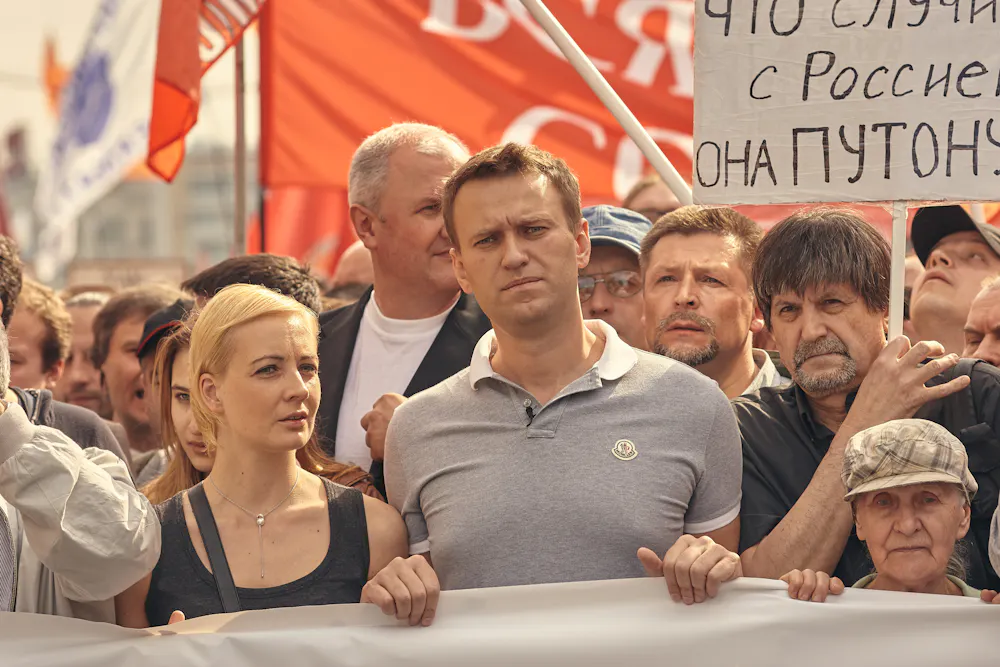
A spontaneous memorial of flowers in St Petersburg, Russia, on the day of Alexei Navalny’s death, February 16 2024.Aleksey Dushutin/Shutterstock
This is the best day of the past five months for me … This is my home … I am not afraid of anything and I urge you not to be afraid of anything either.
These were Alexei Navalny’s words after landing at Moscow’s Sheremetyevo Airport on January 17 2021. Russia’s leading opposition figure had spent the past months recovering in Germany from an attempt on his life by the Russian Federal Security Service (FSB). Minutes after making his comments, Navalny was detained at border control. And he would remain behind bars until his death on February 16 2024, in the remote “Polar Wolf” penal colony within the Arctic Circle.
“Why did he return to Russia?” That’s the question I’m asked about Navalny most frequently. Wasn’t it a mistake to return to certain imprisonment, when he could have maintained his opposition to Russia’s president, Vladimir Putin, from abroad?
But Navalny’s decision to return didn’t surprise me. I’ve researched and written about him extensively, including co-authoring Navalny: Putin’s Nemesis, Russia’s Future?, the first English-language, book-length account of his life and political activities. Defying the Kremlin by returning was a signature move, reflecting both his obstinacy and bravery. He wanted to make sure his supporters and activists in Russia did not feel abandoned, risking their lives while he lived a cushy life in exile.
The Insights section is committed to high-quality longform journalism. Our editors work with academics from many different backgrounds who are tackling a wide range of societal and scientific challenges.
Besides, Navalny wasn’t returning to certain imprisonment. A close ally of his, Vladimir Ashurkov, told me in May 2022 that his “incarceration in Russia was not a certainty. It was a probability, a scenario – but it wasn’t like he was walking into a certain long-term prison term.”
Also, Navalny hadn’t chosen to leave Russia in the first place. He was unconscious when taken by plane from Omsk to Berlin for treatment following his poisoning with the nerve agent Novichok in August 2020. Navalny had been consistent in saying he was a Russian politician who needed to remain in Russia to be effective.
In a subsequent interview, conducted in a forest on the outskirts of the German capital as he slowly recovered, Navalny said: “In people’s minds, if you leave the country, that means you’ve surrendered.”
Video: ACF.
Outrage, detention and death
Two days after Navalny’s final return to Russia, the Anti-Corruption Foundation (ACF) – the organisation he established in 2011 – published its biggest ever investigation. The YouTube video exploring “Putin’s palace” on the Black Sea coast achieved an extraordinary 100 million views within ten days. By the start of February 2021, polling suggested it had been watched by more than a quarter of all adults in Russia.
Outrage at Navalny’s detention, combined with this Putin investigation, got people on to the streets. On January 23 2021, 160,000 people turned out across Russia in events that did not have prior approval from the authorities. More than 40% of the participants said they were taking part in a protest for the first time.
But the Russian authorities were determined to also make it their last time. Law enforcement mounted an awesome display of strength, detaining protesters and sometimes beating them. The number of participants at protests on January 31 and February 2 declined sharply as a result.
Between Navalny’s return to Russia in January 2021 and his death in February 2024, aged 47, he faced criminal case after criminal case, adding years and years to his time in prison and increasing the severity of his detention. By the time of his death, he was in the harshest type of prison in the Russian penitentiary system – a “special regime” colony – and was frequently sent to a punishment cell.
The obvious intent was to demoralise Navalny, his team and supporters – making an example of him to spread fear among anyone else who might consider mounting a challenge to the Kremlin. But Navalny fought back, as described in his posthumously published memoir, Patriot. He made legal challenges against his jailers. He went on hunger strike. And he formed a union for his fellow prisoners.
He also used his court appearances to make clear his political views, including following Russia’s full-scale invasion of Ukraine in February 2022, declaring: “I am against this war. I consider it immoral, fratricidal, and criminal.”
Navalny’s final public appearance was via video link. He was in good spirits, with his trademark optimism and humour still on display. Tongue firmly in cheek, he asked the judge for financial help:
Your Honour, I will send you my personal account number so that you can use your huge salary as a federal judge to ‘warm up’ my personal account, because I am running out of money.
Navalny died the following day. According to the prison authorities, he collapsed after a short walk and lost consciousness. Although the Russian authorities claimed he had died of natural causes, documents published in September 2024 by The Insider – a Russia-focused, Latvia-based independent investigative website – suggest Navalny may have been poisoned.
A mourner adds her tribute to Alexei Navalny’s grave in Moscow after his burial on March 1 2024. Aleksey Dushutin/Shutterstock
Whether or not Putin directly ordered his death, Russia’s president bears responsibility – for leading a system that tried to assassinate Navalny in August 2020, and for allowing his imprisonment following Navalny’s return to Russia in conditions designed to crush him.
Commenting in March 2024, Putin stated that, just days before Navalny’s death, he had agreed for his most vocal opponent to be included in a prisoner swap – on condition the opposition figure never returned to Russia. “But, unfortunately,” Putin added, “what happened, happened.”
‘No one will forget’
Putin is afraid of Alexei, even after he killed him.
Yulia Navalnaya, Navalny’s wife, wrote these words on January 10 2025 after reading a curious letter. His mother, Lyudmila Navalnaya, had written to Rosfinmonitoring – a Russian state body – with a request for her son’s name to be removed from their list of “extremists and terrorists” now he was no longer alive.
The official response was straight from Kafka. Navalny’s name could not be removed as it had been added following the initiation of a criminal case against him. Even though he was dead, Rosfinmonitoring had not been informed about a termination of the case “in accordance with the procedure established by law”, so his name would have to remain.
This appears to be yet another instance of the Russian state exercising cruelty behind the veil of bureaucratic legality – such as when the prison authorities initially refused to release Navalny’s body to his mother after his death.
“Putin is doing this to scare you,” Yulia continued. “He wants you to be afraid to even mention Alexei, and gradually to forget his name. But no one will forget.”
Alexei Navalny and his wife, Yulia Navalnaya, at a protest rally in Moscow, May 2012. Dmitry Laudin/Shutterstock
Today, Navalny’s family and team continue his work outside of Russia – and are fighting to keep his name alive back home. But the odds are against them. Polling suggests the share of Russians who say they know nothing about Navalny or his activities roughly doubled to 30% between his return in January 2021 and his death three years later.
Navalny fought against an autocratic system – and paid the price with his life. Given the very real fears Russians may have of voicing support for a man still labelled an extremist by the Putin regime, it’s not easy to assess what people there really think of him and his legacy. But we will also never know how popular Navalny would have been in the “normal” political system he fought for.
What made Navalny the force he was?
Navalny didn’t mean for the humble yellow rubber duck to become such a potent symbol of resistance.
In March 2017, the ACF published its latest investigation into elite corruption, this time focusing on then-prime minister (and former president), Dmitry Medvedev. Navalny’s team members had become masters of producing slick videos that enabled their message to reach a broad audience. A week after posting, the film had racked up over 7 million views on YouTube – an extraordinary number at that time.
The film included shocking details of Medvedev’s alleged avarice, including yachts and luxury properties. In the centre of a large pond in one of these properties was a duck house, footage of which was captured by the ACF using a drone.
Video: ACF.
Such luxuries jarred with many people’s view of Medvedev as being a bit different to Putin and his cronies. As Navalny wrote in his memoir, Medvedev had previously seemed “harmless and incongruous”. (At the time, Medvedev’s spokeswoman said it was “pointless” to comment on the ACF investigation, suggesting the report was a “propaganda attack from an opposition figure and a convict”.)
But people were angry, and the report triggered mass street protests across Russia. They carried yellow ducks and trainers, a second unintended symbol from the film given Medvedev’s penchant for them.
Another reason why so many people came out to protest on March 26 2017 was the organising work carried out by Navalny’s movement.
The previous December, Navalny had announced his intention to run in the 2018 presidential election. As part of the campaign, he and his team created a network of regional headquarters to bring together supporters and train activists across Russia. Although the authorities had rejected Navalny’s efforts to register an official political party, this regional network functioned in much the same way, gathering like-minded people in support of an electoral candidate. And this infrastructure helped get people out on the streets.
The Kremlin saw this as a clear threat. According to a December 2020 investigation by Bellingcat, CNN, Der Spiegel and The Insider, the FSB assassination squad implicated in the Novichok poisoning of Navalny had started trailing him in January 2017 – one month after he announced his run for the presidency.
At the protests against Medvedev, the authorities’ growing intolerance of Navalny was also on display – he was detained, fined and sentenced to 15 days’ imprisonment.
The Medvedev investigation was far from the beginning of Navalny’s story as a thorn in the Kremlin’s side. But this episode brings together all of the elements that made Navalny the force he was: anti-corruption activism, protest mobilisation, attempts to run as a “normal” politician in a system rigged against him, and savvy use of social media to raise his profile in all of these domains.
Courting controversy
In Patriot, Navalny writes that he always “felt sure a broad coalition was needed to fight Putin”. Yet over the years, his attempts to form that coalition led to some of the most controversial points of his political career.
In a 2007 video, Navalny referred to himself as a “certified nationalist”, advocating for the deportation of illegal immigrants, albeit without using violence and distancing himself from neo-Nazism. In the video, he says: “We have the right to be Russians in Russia, and we’ll defend that right.”
Although alienating some, Navalny was attempting to present a more acceptable face of nationalism, and he hoped to build a bridge between nationalists and liberals in taking on the Kremlin’s burgeoning authoritarianism.
But the prominence of nationalism in Navalny’s political identity varied markedly over time, probably reflecting his shifting estimations of which platform could attract the largest support within Russia. By the time of his thwarted run in the 2018 presidential election, nationalist talking points were all but absent from his rhetoric.
However, some of these former comments and positions continue to influence how people view him. For example, following Russia’s annexation of Crimea in 2014, Navalny tried to take a pragmatic stance. While acknowledging Russia’s flouting of international law, he said that Crimea was “now part of the Russian Federation” and would “never become part of Ukraine in the foreseeable future”.
Many Ukrainians take this as clear evidence that Navalny was a Russian imperialist. Though he later revised his position, saying Crimea should be returned to Ukraine, some saw this as too little, too late. But others were willing to look past the more controversial parts of his biography, recognising that Navalny represented the most effective domestic challenge to Putin.
Another key attempt to build a broad political coalition was Navalny’s Smart Voting initiative. This was a tactical voting project in which Navalny’s team encouraged voters to back the individual thought best-placed to defeat the ruling United Russia candidate, regardless of the challenger’s ideological position.
The project wasn’t met with universal approval. Some opposition figures and voters baulked at, or flatly refused to consider, the idea of voting for people whose ideological positions they found repugnant – or whom they viewed as being “fake” opposition figures, entirely in bed with the authorities. (This makes clear that Navalny was never the leader of the political opposition in Russia; he was, rather, the leading figure of a fractious constellation of individuals and groups.)
But others relished the opportunity to make rigged elections work in their favour. And there is evidence that Smart Voting did sometimes work, including in the September 2020 regional and local elections, for which Navalny had been campaigning when he was poisoned with Novichok.
In an astonishing moment captured on film during his recovery in Germany, Navalny speaks to an alleged member of the FSB squad sent to kill him. Pretending to be the aide to a senior FSB official, Navalny finds out that the nerve agent had been placed in his underpants.
How do Russians feel about Navalny now?
It’s like a member of the family has died.
This is what one Russian friend told me after hearing of Navalny’s death a year ago. Soon afterwards, the Levada Center – an independent Russian polling organisation – conducted a nationally representative survey to gauge the public’s reaction to the news.
The poll found that Navalny’s death was the second-most mentioned event by Russian people that month, after the capture of the Ukrainian city of Avdiivka by Russian troops. But when asked how they felt about his death, 69% of respondents said they had “no particular feelings” either way – while only 17% said they felt “sympathy” or “pity”.
And that broadly fits with Navalny’s approval ratings in Russia. After his poisoning in 2020, 20% of Russians said they approved of his activities – but this was down to 11% by February 2024.
Video: BBC.
Of course, these numbers must be taken for what they are: polling in an authoritarian state regarding a figure vilified and imprisoned by the regime, during a time of war and amid draconian restrictions on free speech. To what extent the drop in support for Navalny was real, rather than reflecting the increased fear people had in voicing their approval for an anti-regime figure, is hard to say with certainty.
When asked why they liked Navalny, 31% of those who approved of his activities said he spoke “the truth”, “honestly” or “directly”. For those who did not approve of his activities, 22% said he was “paid by the west”, “represented” the west’s interests, that he was a “foreign agent”, a “traitor” or a “puppet”.
The Kremlin had long tried to discredit Navalny as a western-backed traitor. After Navalny’s 2020 poisoning, Putin’s spokesman, Dmitry Peskov, said that “experts from the United States’ Central Intelligence Agency are working with him”. The Russian state claimed that, rather than a patriot exposing official malfeasance with a view to strengthening his country, Navalny was a CIA stooge intent on destroying Russia.
Peskov provided no evidence to back up this claim – and the official propaganda wasn’t believed by all. Thousands of Russians defied the authorities by coming out to pay their respects at Navalny’s funeral on March 1 2024. Many, if not all, knew this was a significant risk. Police employed video footage to track down members of the funeral crowd, including by using facial recognition technology.
The first person to be detained was a Muscovite the police claimed they heard shouting “Glory to the heroes!” – a traditional Ukrainian response to the declaration “Glory to Ukraine!”, but this time referencing Navalny. She spent a night in a police station before being fined for “displaying a banned symbol”.
Putin always avoided mentioning Navalny’s name in public while he was alive – instead referring to him as “this gentleman”, “the character you mentioned”, or the “Berlin patient”. (The only recorded instance of Putin using Navalny’s name in public when he was alive was in 2013.)
However, having been re-elected president in 2024 and with Navalny dead, Putin finally broke his long-held practice, saying: “As for Navalny, yes he passed away – this is always a sad event.” It was as if the death of his nemesis diminished the potency of his name – and the challenge that Navalny had long presented to Putin.
Nobody can become another Navalny
Someone else will rise up and take my place. I haven’t done anything unique or difficult. Anyone could do what I’ve done.
So wrote Navalny in the memoir published after his death. But that hasn’t happened: no Navalny 2.0 has yet emerged. And it’s no real surprise. The Kremlin has taken clear steps to ensure nobody can become another Navalny within Russia.
In 2021, the authorities made a clear decision to destroy Navalny’s organisations within Russia, including the ACF and his regional network. Without the organisational infrastructure and legal ability to function in Russia, no figure has been able to take his place directly.
More broadly, the fate of Navalny and his movement has had a chilling effect on the opposition landscape. So too have other steps taken by the authorities.
Russia has become markedly more repressive since the start of its war on Ukraine. The human rights NGO First Department looked into the number of cases relating to “treason”, “espionage” and “confidential cooperation with a foreign state” since Russia introduced the current version of its criminal code in 1997. Of the more than 1,000 cases, 792 – the vast majority – were initiated following Russia’s full-scale invasion of Ukraine in 2022.
Russian law enforcement has also used nebulous anti-extremism and anti-terrorism legislation to crack down on dissenting voices. Three of Navalny’s lawyers were sentenced in January 2025 for participating in an “extremist organisation”, as the ACF was designated by a Moscow court in June 2021. The Russian legislature has also passed a barrage of legislation relating to so-called “foreign agents”, to tarnish the work of those the regime regards as foreign-backed “fifth columnists”.
Mass street protests are largely a thing of the past in Russia. Restrictions were placed on public gatherings during the COVID pandemic – but these rules were applied selectively, with opposition individuals and groups being targeted. And opportunities for collective action were further reduced following the full-scale invasion of Ukraine.
Freedom of speech has also come under assault. Article 29, point five of the Russian constitution states: “Censorship shall be prohibited.” But in September 2024, Kremlin spokesperson Peskov said: “In the state of war that we are in, restrictions are justified, and censorship is justified.”
Legislation passed very soon after the 2022 invasion of Ukraine made it illegal to comment on the Russian military’s activities truthfully – and even to call the war a war.
YouTube – the platform so central to Navalny’s ability to spread his message – has been targeted. Without banning it outright – perhaps afraid of the public backlash this might cause – the Russian state media regulator, Roskomnadzor, has slowed down internet traffic to the site within Russia. The result has been a move of users to other websites supporting video content, including VKontakte – a Russian social media platform.
In short, conditions in Russia are very different now compared to when Navalny first emerged. The relative freedom of the 2000s and 2010s gave him the space to challenge the corruption and authoritarianism of an evolving system headed by Putin. But this space has shrunk over time, to the point where no room remains for a figure like him within Russia.
In 2019, Navalny told Ivan Zhdanov, who is now director of the ACF: “We changed the regime, but not in the way we wanted.” So, did Navalny and his team push the Kremlin to become more authoritarian – making it not only intolerant of him but also any possible successor?
There may be some truth in this. And yet, the drastic steps taken by the regime following the start of the war on Ukraine suggest there were other, even more significant factors that have laid bare the violent nature of Putin’s personal autocracy – and the president’s disdain for dissenters.
Plenty for Russians to be angry about
How can we win the war when dedushka [grandpa] is a moron?
In June 2023, Evgeny Prigozhin – a long-time associate of Putin and head of the private military Wagner Group – staged an armed rebellion, marching his forces on the Russian capital. This was not a full-blown political movement against Putin. But the target of Prigozhin’s invective against Russia’s military leadership had become increasingly blurry, testing the taboo of direct criticism of the president – who is sometimes referred to, disparagingly, as “grandpa” in Russia.
And Prigozhin paid the price. In August 2023, he was killed when the private jet he was flying in crashed after an explosion on board. Afterwards, Putin referred to Prigozhin as a “talented person” who “made serious mistakes in life”.
In the west, opposition to the Kremlin is often associated with more liberal figures like Navalny. Yet the most consequential domestic challenge to Putin’s rule came from a very different part of the ideological spectrum – a figure in Prigozhin leading a segment of Russian society that wanted the Kremlin to prosecute its war on Ukraine even more aggressively.
Video: BBC.
Today, there is plenty for Russians to be angry about, and Putin knows it. He recently acknowledged an “overheating of the economy”. This has resulted in high inflation, in part due to all the resources being channelled into supporting the war effort. Such cost-of-living concerns weigh more heavily than the war on the minds of most Russians.
A favourite talking point of the Kremlin is how Putin imposed order in Russia following the “wild 1990s” – characterised by economic turbulence and symbolised by then-president Boris Yeltsin’s public drunkenness. Many Russians attribute the stability and rise in living standards they experienced in the 2000s with Putin’s rule – and thank him for it by providing support for his continued leadership.
The current economic problems are an acute worry for the Kremlin because they jeopardise this basic social contract struck with the Russian people. In fact, one way the Kremlin tried to discredit Navalny was by comparing him with Yeltsin, suggesting he posed the same threats as a failed reformer. In his memoir, Navalny concedes that “few things get under my skin more”.
Although originally a fan of Yeltsin, Navalny became an ardent critic. His argument was that Yeltsin and those around him squandered the opportunity to make Russia a “normal” European country.
Navalny also wanted Russians to feel entitled to more. Rather than be content with their relative living standards compared with the early post-Soviet period, he encouraged them to imagine the level of wealth citizens could enjoy based on Russia’s extraordinary resources – but with the rule of law, less corruption, and real democratic processes.
‘Think of other possible Russias’
When looking at forms of criticism and dissent in Russia today, we need to distinguish between anti-war, anti-government, and anti-Putin activities.
Despite the risk of harsh consequences, there are daily forms of anti-war resistance, including arson attacks on military enlistment offices. Some are orchestrated from Ukraine, with Russians blackmailed into acting. But other cases are likely to be forms of domestic resistance.
Criticism of the government is still sometimes possible, largely because Russia has a “dual executive” system, consisting of a prime minister and presidency. This allows the much more powerful presidency to deflect blame to the government when things go wrong.
There are nominal opposition parties in Russia – sometimes referred to as the “systemic opposition”, because they are loyal to the Kremlin and therefore tolerated by the system. Within the State Duma, these parties often criticise particular government ministries for apparent failings. But they rarely, if ever, now dare criticise Putin directly.
Nothing anywhere close to the challenge presented by Navalny appears on the horizon in Russia – at either end of the political spectrum. But the presence of clear popular grievances, and the existence of organisations (albeit not Navalny’s) that could channel this anger should the Kremlin’s grip loosen, mean we cannot write off all opposition in Russia.
Navalny’s wife, Yulia, has vowed to continue her husband’s work. And his team in exile maintain focus on elite corruption in Russia, now from their base in Vilnius, Lithuania. The ACF’s most recent investigation is on Igor Sechin, CEO of the oil company Rosneft.
But some have argued this work is no longer as relevant as it was. Sam Greene, professor in Russian politics at King’s College London, captured this doubt in a recent Substack post:
[T]here is a palpable sense that these sorts of investigations may not be relevant to as many people as they used to be, given everything that has transpired since the mid-2010s, when they were the bread and butter of the Anti-Corruption Foundation. Some … have gone as far as to suggest that they have become effectively meaningless … and thus that Team Navalny should move on.
Navalny’s team are understandably irritated by suggestions they’re no longer as effective as they once were. But it’s important to note that this criticism has often been sharpest within Russia’s liberal opposition. The ACF has been rocked, for example, by recent accusations from Maxim Katz, one such liberal opposition figure, that the organisation helped “launder the reputations” of two former bank owners. In their response, posted on YouTube, the ACF referred to Katz’s accusations as “lies” – but this continued squabbling has left some Russians feeling “disillusioned and unrepresented”.
So, what will Navalny’s long-term legacy be? Patriot includes a revealing section on Mikhail Gorbachev – the last leader of the Soviet Union, whom Navalny describes as “unpopular in Russia, and also in our family”. He continues:
Usually, when you tell foreigners this, they are very surprised, because Gorbachev is thought of as the person who gave Eastern Europe back its freedom and thanks to whom Germany was reunited. Of course, that is true … but within Russia and the USSR he was not particularly liked.
At the moment, there is a similar split in perceptions of Navalny. Internationally, he was nominated for the Nobel Peace Prize, awarded the Sakharov Prize by the European Parliament, and a documentary about him won an Oscar.
But there are also those outside of Russia who remain critical: “Navalny’s life has brought no benefit to the Ukrainian victory; instead, he has caused considerable harm,” wrote one Ukrainian academic. “He fuelled the illusion in the west that democracy in Russia is possible.”
Trailer for the Oscar-winning documentary Navalny.
Inside Russia, according to Levada Center polling shortly after his death, 53% of Russians thought Navalny played “no special role” in the history of the country, while 19% said he played a “rather negative” role. Revealingly, when commenting on Navalny’s death, one man in Moscow told RFE/RL’s Russian Service: “I think that everyone who is against Russia is guilty, even if they are right.”
But, for a small minority in Russia, Navalny will go down as a messiah-like figure who miraculously cheated death in 2020, then made the ultimate sacrifice in his battle of good and evil with the Kremlin. This view may have been reinforced by Navalny’s increasing openness about his Christian faith.
Ultimately, Navalny’s long-term status in Russia will depend on the nature of the political system after Putin has gone. Since it seems likely that authoritarianism will outlast Putin, a more favourable official story about Navalny is unlikely to emerge any time soon. However, how any post-Putin regime tries to make sense of Navalny’s legacy will tell us a lot about that regime.
While he was alive, Navalny stood for the freer Russia in which he had emerged as a leading opposition figure – and also what he called the “Beautiful Russia of the Future”. Perhaps, after his death, his lasting legacy in Russia remains the ability for some to think – if only in private – of other possible Russias.
To hear about new Insights articles, join the hundreds of thousands of people who value The Conversation’s evidence-based news. Subscribe to our newsletter.
Ben Noble has previously received funding from the British Academy and the Leverhulme Trust. He is an Associate Fellow of Chatham House.
#iubilaeum2025 – Holy Mass on the occasion of the Jubilee of Artists and the World of Culture, 16.02.2025
At 10.00 this morning, Fourth Sunday of Ordinary Time, on the occasion of the Jubilee of Artists and the World of Culture, His Eminence Cardinal José Tolentino de Mendonça, prefect of the Dicastery for Culture and Education, presided over Holy Mass in the Vatican Basilica.
The following is the text of the homily prepared by the Holy Father, read by Cardinal Tolentino de Mendonça:
In the Gospel we have just heard, Jesus proclaims the Beatitudes to his disciples and to a large crowd of people. We have heard them so many times, and yet they never cease to amaze us: “Blessed are you who are poor, for yours is the kingdom of God. Blessed are you who are hungry now, for you will be filled. Blessed are you who weep now, for you will laugh” (Lk 6:20–21). These words overturn our worldly mentality and invite us to look at reality with new eyes, with God’s gaze, so we can see beyond appearances and recognize beauty even amidst frailty and suffering.
The second part of the Gospel passage contains harsh and admonishing words: “But woe to you who are rich, for you have received your consolation. Woe to you who are full now, for you will be hungry. Woe to you who are laughing now, for you will mourn and weep” (Lk 6:24–25). The contrast between “blessed are you” and “woe to you” reminds us of the importance of discerning where we find our security.
As artists and representatives of the world of culture, you are called to be witnesses to the revolutionary vision of the Beatitudes. Your mission is not only to create beauty, but to reveal the truth, goodness and beauty hidden within the folds of history, to give voice to the voiceless, to transform pain into hope.
We live in a time of complex financial and social crises, but ours is above all a spiritual crisis, a crisis of meaning. Let us ask ourselves questions about time and about purpose. Are we pilgrims or wanderers? Does our journey have a destination, or are we directionless? Artists have the task of helping humanity not to lose its way and to keep a hopeful outlook.
Be aware, however, that hope is not easy, superficial or abstract. No! True hope is interwoven within the drama of human existence. Hope is not a convenient refuge, but a fire that burns and irradiates light, like the word of God. That is why authentic art always expresses an encounter with mystery, with the beauty that surpasses us, with the pain that challenges us, with the truth that calls us. Otherwise, “woe to us!” The Lord’s warning is stern.
As the poet Gerard Manley Hopkins wrote, “The world is charged with the grandeur of God. It will flame out, like shining from shook foil”. The mission of the artist is to discover this hidden greatness and reveal it, making it perceptible to our eyes and hearts. The same poet also perceived “the leaden echo” and “the golden echo” in the world. Artists are sensitive to these resonances, and through their work, they engage in discernment about the various echoes of the events of this world and help others to do the same. Men and women who represent the world of culture are called upon to evaluate these echoes, to explain them to us and to show us which path they lead us down: either they are seductive songs of sirens or the authentic appeals to humanity. You are asked to provide insight in order to help distinguish between what is like “chaff scattered by the wind” and what is solid, “like trees planted by streams of water”, capable of bearing fruit (cf. Ps 1:3-4).
Dear artists, I see in you guardians of beauty who are willing to attend to the brokenness of our world, listen to the cry of those who are poor, suffering, wounded, imprisoned persecuted or refugees. I see in you guardians of the Beatitudes! We live in a time when new walls are being erected, when differences become a pretext for division rather than an opportunity for mutual enrichment. But you, men and women of the world of culture, are called to build bridges, to create spaces for encounter and dialogue, to enlighten minds and warm hearts.
Some might say: “But what is the use of art in our wounded world? Are there not more urgent, more practical, more pressing things to do?”. And yet, art is not a luxury, but something that the spirit needs. It is not a flight from reality, but a charge, a call to action, an appeal and a cry. Educating about true beauty is educating about hope. And hope is never separated from the drama of existence; it runs through our daily struggles, the hardships of life and the challenges of our time.
In the Gospel we have heard today, Jesus proclaims as blessed those who are poor, afflicted, meek and persecuted. It is a change of mentality, a revolution of perspective. Artists are called to take part in this revolution. The world needs prophetic artists, courageous intellectuals and creators of culture.
Let the Gospel of the Beatitudes guide you, and may your art be a herald of a new world. Let us see your poetry! Never cease searching, questioning and taking risks. True art is never easy; it offers the peace of restlessness. And do not forget that hope is not an illusion; beauty is not a utopia. Yours is not a random gift but a calling. Respond, then, with generosity, passion and love.
A report will go before Cabinet on Wednesday (19 February) with councillors recommended to approve the proposed increase to help sustain the adult social care market.
The hourly rate paid to home care providers, for reablement and home based respite, nursing and residential care providers supporting under 65s, older people and older people with dementia, supported living services, Shared Lives and providers of day care services will rise by 6.6% if the proposals are agreed.
Meanwhile, the agency rate for Direct Payments for adults, carers and children will increase by 6.6%, while the rate for employed personal assistants will rise by 9.91% and self employed personal assistants by 9.33%.
If the proposals are approved, the new fee structure will be introduced on 7 April, 2025.
Councillor Jasbir Jaspal, Cabinet Member for Adults and Wellbeing, said: “Our city’s adult social care providers have a vital role to play in supporting our most vulnerable residents, and we are determined to do all we can to support the sector.
“We know that, like other employers, adult care and support providers are continuing to face a perfect storm of rising costs – compounded by inflation and changes to the National Living Wage and National Insurance – along with recruitment issues and so we are pleased to be able to propose these above inflation increases, despite the well documented pressures the council is also facing at this time.
“These proposed increases of between 6.6% and 9.91% for the next financial year follow on from the significant increase in rates we announced for 2023 to 2024 of between 7.45% and 9.79% and 11.85% and 20.36% the year before, demonstrating our ongoing commitment to local adult social care providers.”
She added: “Quality of provision across all adult social care sectors has been factored when considering the proposed care fee increases, and this will be monitored through our improved quality assurance processes to ensure we are delivering high quality services across the city, while delivering value for money for taxpayers.”
Leeds City Council has today welcomed confirmation of £15m in central government funding for two major cultural projects.
The Ministry of Housing, Communities and Local Government (MHCLG) has committed £10m to help breathe fresh life into Holbeck’s historic Temple Works building, paving the way for it to become the home of a new British Library North.
A further £5m in funding has been confirmed in support of plans to create a National Poetry Centre at the landmark Trinity St David’s Church on Woodhouse Lane.
Councillor James Lewis, leader of Leeds City Council, said:
“The British Library North project aims to create a world-class space for learning, research, exhibitions and events that would unlock the huge potential of Temple Works and boost the ongoing regeneration of the wider Holbeck and South Bank areas.
“It is therefore really welcome news that the Ministry of Housing, Communities and Local Government has confirmed that, following a consultation, this £10m of funding is now in place to support the process of bringing the Temple Works building into public ownership and back into use.
“We have worked hard in recent months with partners, including the West Yorkshire Combined Authority, Homes England and the British Library itself, to make the case for this funding.
“Together we were able to emphasise the importance of the scheme and the economic and social benefits it would bring to Leeds, West Yorkshire and the North, not least through engagement and connections with local communities.
“We were very pleased to welcome the Deputy Prime Minister to Temple Works last week so she could see first-hand what this remarkable heritage asset is all about.
“We will now continue to work alongside partners on detailed plans for the full funding, design and development of a project that remains a complex and challenging undertaking, but one that offers a major regeneration opportunity for both Temple Works and the surrounding area.
“The council also welcomes today’s confirmation that £5m in funding for Leeds’s proposed National Poetry Centre is now in place.
“We were pleased to have the opportunity, during the MHCLG consultation, to add our voice to the widespread support for this project, which is being led by the National Poetry Centre Charitable Trust with the University of Leeds and poet laureate Simon Armitage.”
Al Ula, Saudi Arabia, – February 16, 2025: On the sidelines of the inaugural annual global Conference on Emerging Market Economies in Al Ula, Saudi Arabia (February 16-17), the Saudi Finance Ministry and the International Monetary Fund (IMF) co-hosted a high-level roundtable on “Working Together to Support Recovery in the Middle East’s Conflict-Affected Economies”, bringing together finance ministers of countries in the region, the Foreign Affairs Minister of Syria, representatives from the World Bank, and heads of other International Financial Institutions and the Arab Coordination Group.
Following the meeting, Kristalina Georgieva, Managing Director of the IMF, and Mohammed Aljadaan, Finance Minister of Saudi Arabia, made the following statement:
“This important meeting brought together representatives from the Middle East and key economic and development partners to discuss how we can work together to support recovery in the Middle East’s conflict-affected economies.”
“We thank all participants for recognizing the urgency and importance of this task, as well as for their commitment to work together to ensure that the conflict-affected countries can start addressing their humanitarian needs. This would help them start rebuilding their economies in an efficient, swift, and durable way for the benefit of their people.”
“Participants welcomed the meeting as an opportunity to discuss recent developments and build a common understanding of the challenges facing conflict-affected countries. They emphasized the importance of strengthening coordination to support the recovery of these countries as the spillovers would impact all. Particular attention was paid to the situation in Syria.”
Participants agreed on the following priorities to support conflict-affected countries:
A Continuous Diagnosticof the challenges and economic and social context facing each conflict-affected country, including an assessment of humanitarian and reconstruction needs. Such a diagnostic should identify institution-building priorities, gaps in policies, and financing needs.
Enhanced Capacity Development (CD) aimed at rapidly scaling up IMF and World Bank CD initiatives to help strengthen and, as needed, build new institutions. Support would need to be tailored to strengthen essential functions of fiscal, monetary and banking institutions.
Mobilization of financial assistance from the international community . Financial support—coordinated with international and regional development partners—will be needed to fund comprehensive reform programs, including reconstruction and humanitarian aid.
“Participants underscored their readiness to work together and complement each other’s efforts while focusing on their institutional mandates. They will continue to work closely and with other partners to further support the international response to the recovery of conflict-affected economies in the Middle East region.”
They agreed to establish an informal coordination group to support these efforts. Discussions will be continued at the upcoming IMF/World Bank Spring Meetings on April 21-26 in Washington, D.C.”
The Presidency of the Council of Ministers joined today’s ‘M’illumino di Meno’ initiative for the 21st edition of National Energy Saving and Sustainable Lifestyles Day, promoted by Radio 2 Rai Caterpillar. The lights on Palazzo Chigi’s main façade overlooking Piazza Colonna were symbolically switched off between 19:00 and 20:00 to mark the occasion.
Source: Peter the Great St Petersburg Polytechnic University – Peter the Great St Petersburg Polytechnic University –
The innovative development “Navigation system for surgery based on augmented reality technologies” by a research team led by Professor Vladimir Ivanov of the Higher School of Theoretical Mechanics and Mathematical Physics of the Physics and Mechanical Institute was presented in medical centers in India.
Members of the scientific team Ildar Mamaev and Vladimir Chernyavsky visited eight major Indian medical centers, including: Kalalgner Super Specialty Hospital Chennai, MIOT Hospital Chennai Technical specialist, CMC Rainpet, Kauvery Kovilambakkam Chennai and others. The St. Petersburg scientists demonstrated to leading Indian neurosurgeons in Chennai and Hyderabad the possibilities of working with a hologram and video recordings of real operations.
A head phantom demonstrated rapid construction of a volumetric reconstruction and registration with a patient pointer at four points; then superimposition of the volumetric reconstruction and segmented 3D model; construction of sections at different angles, measurement of the distance to a given element of the 3D model and output of orthogonal sections to virtual screens.
The augmented reality technology we developed, which optimizes surgical processes, attracted the interest of Indian surgeons, who expressed a desire to conduct the first operations using this unique navigation system, said project manager Vladimir Ivanov.
According to Vladimir Mikhailovich, the development of international relations is proceeding very actively, including with the support of the Skolkovo Foundation. The first full-scale surgical operations in India are planned for this spring.
Please note: This information is raw content directly from the source of the information. It is exactly what the source states and does not reflect the position of MIL-OSI or its clients.
Source: People’s Republic of China – State Council News
More foreign language editions of ‘Understanding Xi Jinping’s Educational Philosophy’ published
BEIJING, Feb. 17 — The French, Russian, Spanish, and Arabic editions of “Understanding Xi Jinping’s Educational Philosophy” have been jointly published by the Foreign Language Teaching and Research Press and the Higher Education Press.
Originally published in Chinese in 2020, the book offers a comprehensive and in-depth analysis of the important educational discourses of Xi Jinping, general secretary of the Communist Party of China Central Committee.
The newly released French, Russian, Spanish, and Arabic editions, alongside the previously published English version, are valuable resources for international readers to understand the historical context and rich content of China’s educational reform and development in the new era.
The translations were carried out under the guidance of the Ministry of Education.
Source: Peter the Great St Petersburg Polytechnic University – Peter the Great St Petersburg Polytechnic University –
The Polytechnic University is hosting another collection of humanitarian aid for military personnel and children from social institutions of the DPR and LPR, residents of the Kursk and Belgorod regions as part of the regional Headquarters campaign
Every polytechnician can join this campaign. Fleece blankets, thermal socks, balaclavas, thermoses, thermal underwear, tools, electric power extension cord on a reel from 25 m, batteries, tonometers, tactical first aid kits, T-shirts, long sleeves, tactical backpacks, sleeping bags, hunting matches, reinforced tape, three-in-one coffee, portioned sugar, tea bags, canned meat, fish factory-made, condensed milk, towels, wide water-repellent plasters, large sterile wipes, large hemostatic sponges, wide and sterile bandages, Esmarch tourniquets or tourniquets, absorbent diapers for adults, tactical medical pouches, etc. are accepted.
Humanitarian aid can be delivered on weekdays from 10:00 to 18:00 to the following addresses:
Room 206 of the Main Cultural Institution of SPbPU (Volunteer Projects Center “Harmony” (Dobro.Center SPbPU); Polytechnic Tower; Building 6, room 1 (Humanities Institute Directorate); Building 9, room 324; Student Club (on the territory of the Lepota coworking space).
Activists of the SPbPU Dobro.Center “Harmony” conduct master classes on weaving tactical bracelets and making talismans of goodness, organize art exhibitions and perform in hospitals, help in warehouses of humanitarian aid. The guys meet children from evacuated territories, accompany wounded servicemen during examinations in hospitals, bring things, fruits and sweets to hospital wards. Excursions to the Polytechnic University of military personnel are planned in the near future.
For more information, please contact the group VKontakte or bymail.
Please note: This information is raw content directly from the source of the information. It is exactly what the source states and does not reflect the position of MIL-OSI or its clients.
Source: Novosibirsk State University – Novosibirsk State University –
Last week, innovative companies Papillon and SafeVision signed a cooperation agreement with Novosibirsk State University. Plans for 2025-2026 include opening a laboratory based Institute of Medicine and Medical Technologies NSU (IMMT NSU) to combine efforts in the development of new treatment methods and the use of an innovative medical bed, as well as a Medical Decision Support System.
This agreement is the first step towards interaction between the organizations, allowing for the creation of a long-term scientific and educational partnership. As a result, it is planned to create a Laboratory integrated into the educational process in the specialty “Medical Cybernetics” – this is a new direction, the first recruitment for which will take place in September 2025.
Students will be involved in the company’s production activities as part of their diploma projects. This will allow for the unification of efforts in developing new treatment methods using the potential of medical equipment and new approaches to AI, computer vision and machine learning for monitoring patients. The main goal is to create a scientific base where students and teachers will conduct their scientific research, publishing the results in international journals.
— One of the tasks of medical cybernetics is to create smart devices for interaction with patients. It is very important that during the training process, students could see live how such devices are created, and most importantly — take part in their creation. In cooperation with dynamically developing companies, I see huge potential in both the educational and scientific spheres for students of the new training program — the specialty “Medical Cybernetics”, opened at the Faculty of Pharmacy and Medical Cybernetics of the IMMT NSU.
Igor Mendzebrovsky, Development Director of Papillon LLC and SafeVision LLC, noted:
— We provide our products as a platform for students. They can form new solutions and even new business concepts. We help them make their idea as viable as possible, for example, if students want to turn their solution into a product, get a registration certificate and bring it to market.
Several working groups of 2nd and 3rd year students of the NSU Institute of Intelligent Robotics have already been created. Computer science students are working on creating algorithms for the SafeVision software and hardware complex, designed for contactless monitoring of the patient’s condition and risk factor analysis. For example, active work is underway to identify APNEA syndrome in patients (sleep apnea for more than 10 seconds): the device will be able to identify such a disorder in a patient and signal the doctor about it.
Anton Meleshkin, scientific programs manager at SafeVision LLC, senior researcher at the SB RAS IT, PhD in engineering, senior lecturer at NSU, added:
— We develop technological startups, which means we work at the cutting edge of science and technology. We see NSU as a great partner with whom we can build long-term cooperation not only in joint research, but also in the educational process. Our developments can be useful for students to conduct laboratory work, and as topics for course and diploma theses.
For reference:
Papillon LLC — a domestic developer and manufacturer of functional medical beds equipped with automated functions to increase comfort, reduce patient trauma and minimize the burden on medical personnel.
SafeVision LLC — a domestic developer and manufacturer of AI-based medical decision support systems (MDSS) for contactless monitoring of the condition of patients in a medical facility.
Please note: This information is raw content directly from the source of the information. It is exactly what the source states and does not reflect the position of MIL-OSI or its clients.
Source: Peter the Great St Petersburg Polytechnic University – Peter the Great St Petersburg Polytechnic University –
The delegation of the Polytechnic University visited the production facilities of the Engineering Center “Kronstadt”. The participants of the meeting signed a strategically important agreement on the network form of implementation of the professional retraining program “Design and technological support for machine-building production”.
As business representatives, we understand the importance of investing in training specialists in the field of engineering. Therefore, the development of professional competencies of both students of technical universities and already working engineers is one of our key tasks. The professional retraining program was developed taking into account current trends in engineering education, advanced scientific and technical achievements and the needs of the industry. It combines the best educational methods with practice-oriented training, which meets the requirements of modern industry, – said Oleg Egorov, General Director of the Kronstadt Engineering Center.
The program includes three specializations: centrifugal compressor design, piston compressor design and materials science. This approach provides graduates with a wide range of opportunities for professional growth and successful employment in high-tech sectors of mechanical engineering.
One of the important elements of training is a mandatory industrial internship at the Kronstadt Engineering Center. This stage allows students to apply the theoretical knowledge they have acquired in real conditions, get acquainted with advanced production processes, and integrate more deeply into the professional environment. The final stage of the program is the defense of the final project with elements of a demonstration exam, which ensures a high level of training for graduates and their readiness to solve complex engineering problems.
On February 3, more than a hundred young specialists, final-year students and master’s students who study full-time in the evening began their studies. Such high interest confirms the demand for the program and the need to train engineering personnel in this field.
We developed the program and are implementing it together. The online form of training allowed us to build the educational process in such a way that students not only receive knowledge, but also master all technological operations in practice. Participants are immediately involved in solving current production problems, which increases the effectiveness of their training. The program is focused specifically on the practical aspects of mechanical engineering, materials science and engineering, – noted the head of the Directorate of Continuing Education and Industry Partnership Ivan Kurta.
Leading teachers and specialists with a high level of theoretical training and significant practical experience in the industry are involved in the implementation. These are representatives of the Institute of Power Engineering, the Institute of Mechanical Engineering, Materials and Transport, PhysMech, Gazpromneft-Polytech Scientific and Educational Center, including directors and teachers of the Higher School of Power Engineering, the Higher School of Physics and Materials Technology, the Higher School of Theoretical Mechanics and Mathematical Physics, the Higher School of Automation and Robotics, the Higher School of Industrial Management and others. Their participation ensures a high level of teaching and guarantees the relevance of the knowledge transferred.
Before the launch of the program, Polytechnic University representatives once again visited the production facilities of the Kronstadt Engineering Center and discussed with colleagues the organization of the practical part of the training, outlining further steps to improve the educational process.
Our interaction with the engineering center goes far beyond this program: we are actively developing partnerships in the field of scientific research, educational initiatives and other promising areas. By joining forces, we create a unique example of productive interaction based on the exchange of knowledge, mutual support and the desire to achieve significant results, – noted the Vice-Rector for Additional and Pre-University Education of SPbPU Dmitry Tikhonov.
The implementation of the network program of professional retraining contributes to the development of domestic mechanical engineering, allows the formation of a new generation of highly qualified engineers capable of solving the most complex production problems. This project is a striking example of how the integration of science, education and industry contributes to the creation of advanced engineering solutions and strengthening the technological potential of the country.
Please note: This information is raw content directly from the source of the information. It is exactly what the source states and does not reflect the position of MIL-OSI or its clients.
Source: Peter the Great St Petersburg Polytechnic University – Peter the Great St Petersburg Polytechnic University –
105 years separate two events in the history of the Polytechnic University: the first demonstration of Lev Termen’s invention to the teachers of the Polytechnic University and a big concert by his great-grandson, Pyotr Termen. On the stage of the White Hall, one of the world’s leading theremin performers, Pyotr Termen, played two instruments at once.
“Two theremins were not planned for the concert,” the musician said. “But at the sound check it turned out that there was a difficult radiomagnetic situation around, and my theremin was reacting a little nervously, there was some interference in the sound. And behind the scenes of the White Hall there was our own model of theremin, and today it sounded for the first time in a long time.”
The great-grandfather of the performer Lev Termen dreamed since childhood that when playing a musical instrument there would be no need to touch anything, there would be no resistance from the strings, calluses on the hands, and a person and sound would become one, as happens when a person sings. At the age of 12, Lev Termen made a prototype of the theremin based on Tesla coils. And when in 1918, while working in the laboratory of the Polytechnic Institute, which was then located in the choir of the White Hall, he discovered the principle that became the basis of the theremin, he realized that he had invented a new musical instrument. In November 2020, the theremin – “the voice of Theremin” – was demonstrated to teachers of the Polytechnic Institute in the White Hall.
The closer the right hand is to the vertical antenna, the higher the sound, the further the left hand is from the horizontal antenna, the quieter. Any movement turns into sound, even if I take a deep breath now, it will be heard, – explained Peter Theremin and supported his words with hand movements.
No strings, no keys, and a range of eight octaves! Bach, Handel, Rachmaninov — popular and recognizable works sounded unusual. In the White Hall, theremin in a duet with a Bechstein grand piano, Pyotr Termen and Anastasia Mazankina presented the very repertoire with which Lev Termen performed in the Great Hall of the St. Petersburg Philharmonic, London’s Albert Hall, and the Paris Grand Opera in the 20s and 30s of the last century.
This concert, which has become a symbol of the unity of science and music, took place on the eve of the birthday of Peter the Great St. Petersburg Polytechnic University, celebrated on February 19. A great gift will also be the film that the Kultura TV channel filmed on this day for the Nevsky Kovcheg. The Theory of the Impossible program series about extraordinary people who dreamed of the impossible and made it reality, such as Lev Theremin.
Please note: This information is raw content directly from the source of the information. It is exactly what the source states and does not reflect the position of MIL-OSI or its clients.
Source: United Kingdom – Executive Government & Departments
The CMA has found that Topps Tiles’ acquisition of CTD Tiles could reduce competitive deals and product choice for customers and businesses in parts of England and Scotland.
iStock
The Competition and Markets Authority (CMA) has found that Topps Tiles’ £9 million purchase of 30 CTD Tiles stores raises competition concerns in 4 areas of the United Kingdom.
Topps Tiles is the biggest specialist tile retailer in the UK. Before entering administration in August 2024, CTD was the second largest specialist tile retailer in the UK. As part of the deal Topps Tiles acquired 30 stores, as well as supporting infrastructure such as stock and all related intellectual property for CTD Tiles, CTD Architectural, and CTD Housebuilders .
Following completion of the deal the CMA received several complaints, which included concerns relating to how the deal impacted businesses and retail customers in specific areas of the country. Following a Phase 1 investigation, the CMA found that a small number of sites in Dorking, Edinburgh, Inverness and Aberdeen created competition concerns in the supply of tiles to retail customers and business customers.
The investigation found both companies compete closely for retail and business customers. After reviewing the deal, including internal documents and evidence from customers and competitors, the CMA concluded that in most areas there are sufficient remaining competitors but that in a small number of areas, the deal could lead to worse deals and service for customers.
Joel Bamford, Executive Director for Mergers at the CMA, said:
Having looked at the evidence, we’re concerned Topps Tiles’ purchase of CTD Tiles may >reduce competition in Dorking, Edinburgh, Inverness and Aberdeen.
This loss of competition could lead to worse deals and service in those areas. Whether you’re retiling your own home or a business that provides renovation services, the merger could make such projects more expensive.
Topps Tiles now has the opportunity to offer solutions to our concerns, otherwise this case will proceed to a more in-depth investigation.
Topps Tiles has until Monday 24 February to submit proposals which resolve the CMA’s concerns.
Topps Tiles Plc (Topps) is a UK-wide tile retailer for both businesses and consumers based in Enderby, Leicestershire. It is the largest tile specialist in the UK with over 300 stores (and serves customers through direct sales teams and websites). The business is listed on the London Stock Exchange.
Topps acquired certain assets of Tildist Realisations Limited (formerly CTD Tiles Limited), including 30 of its stores, intellectual property such as branding and customer lists, and business divisions that supply tiles to architectural and housebuilder customers as part of a pre-pack administration deal.
For media enquiries, contact the CMA press office on 020 3738 6460 or press@cma.gov.uk
Invalda INVL Group today announces that it has successfully completed a first closing of its second-generation private equity fund (“INVL Private Equity Fund II”), reaching EUR 305 million and exceeding its target of EUR 250 million.
The INVL Private Equity Fund II has received strong backing from both existing and new investors, forming an exceptional investor base. This includes some of the most successful entrepreneurs from across the Baltics, family offices and institutional investors such as the European Investment Fund, pensions funds managed by Luminor asset management companies, SB Asset Management and IPAS INVL Asset Management in Latvia, as well as life insurance company UAB SB Draudimas. Fundraising will continue to reach a hard cap of EUR 400 million.
The minimum investment in the INVL Private Equity Fund II was EUR 10 million. However, investors could invest in the fund via INVL Private Equity Capital Fund II with a ticket as low as EUR 125,000 which subsequently reached a total size of EUR 116 million.
To fully align interests with the INVL Private Equity Fund II investors, Invalda INVL and the fund’s management team have also invested EUR 32.7 million, currently representing 11% of the total fund size.
Darius Šulnis, CEO at Invalda INVL, commented:“This highly successful fundraising reflects investors’ trust in our work, as well as a pragmatic view on the region’s perspectives and potential. It also signals opportunities for companies and countries in the region seeking investment.
INVL Private Equity Fund II will invest in businesses across Lithuania, Latvia, Estonia, Poland, Romania and the broader EU – backing those with the potential to become leaders in their competitive fields and drive value creation, along with the talented and determined people behind their success. In a rapidly changing environment, we see an increasing number of attractive investment opportunities. Having successfully built and developed multiple businesses, we understand the dedication, ambition and challenges that come with seizing new opportunities and driving growth. We take an active role in companies’ development, believing that this is the key to delivering strong returns for our investors – whose support, capital and high standards empower us to act.”
Deimantė Korsakaitė, Managing Partner at INVL Private Equity Fund II and INVL Baltic Sea Growth Fund, added: ”This is a historic milestone for the Baltics, as we have announced the largest private equity fund ever raised in the region. We are extremely grateful to our investors for their trust. It is both an honour and a great responsibility to uphold this confidence in us. We will continue the successful strategy of our predecessor, the INVL Baltic Sea Growth Fund and remain fully committed to work hand-in-hand with management teams to drive transformative growth and create long-term value for companies, our investors as well as contributing to the growth of the economy. We strongly believe that our experience and network bolster our capabilities as a value-add partner to companies.”
Asta Jovaišienė, Head of INVL Family Office, said: “We are delighted to be part of this record alongside our clients. At the same time, it demonstrates that our family office offers exceptional solutions that meet investors’ needs for sustainable and long-term results.“
The new fund will build on the strategy of the INVL Baltic Sea Growth Fund, seizing attractive opportunities across the Baltics, Poland, Romania and the broader EU. The INVL Private Equity Fund II is sector-agnostic and will invest in companies with the potential to become regional leaders in their respective industries, focusing on acquiring majority or significant minority stakes. Through active investment management, the fund aims to drive long-term value creation.
The strategy includes forming a diversified portfolio of 10–12 investments, providing late-stage growth capital to target companies and executing both buyout and buy-and-build strategies. Investment size will typically be in the region of EUR 10 million to EUR 40 million, with a preferred equity ticket of around EUR 25-30 million. However, the fund will also pursue larger deals together with co-investors.
Deimantė Korsakaitėcontinued: “The predecessor INVL Baltic Sea Growth Fund which raised EUR 165 million closed the year in 2024 with a 25% net internal rate of return (NetIRR), total value to paid-in capital (TVPI) exceeding 2x and having announced the first agreed exit from its portfolio company InMedica that is to become one of the largest investments in healthcare services in the Baltics to date.”
About INVL Private Equity Fund II
The EUR 305 million INVL Private Equity Fund II is the largest private equity fund in the Baltics. It aims to build a diversified portfolio by acquiring majority or significant minority stakes in high-growth companies, with investment sizes ranging from EUR 10 million to EUR 40 million. The fund focuses on businesses with strong potential to grow and compete amid intensifying global competition, targeting opportunities in the Baltic countries, Poland, Romania and the broader Europe Union.
The fund is managed by INVL Asset Management, the leading Baltic alternative asset manager, which is a part of the Invalda INVL Group with over 30 years of experience. The group’s companies manage or have under supervision more than EUR 1.6 billion in assets across various investment strategies, including private equity, forests and agricultural land, renewable energy, real estate, and private debt. Additionally, the group provides family office services in Lithuania, Latvia and Estonia, manages pension funds in Latvia and invests in global third-party funds.
Additional information: Darius Šulnis CEO of Invalda INVL darius.sulnis@invl.com
Moody’s Investors Service has assigned a provisional (P)Aa2 long-term rating to the mortgage covered bonds issued by Coop Pank AS (Coop Pank).
The international credit ratings agency Moody’s has analysed the planned issue of covered bonds by Coop Pank and considered, inter alia, the high credit quality of the assets backing the covered bonds, the support provided by the Estonian legal framework, which provides for the issuer’s regulation and supervision, but also exposure to market risks and the increased uncertainty of the current economic environment. The long-term rating (P)Aa2 indicates high quality obligations that are subject to low credit risk.
According to Paavo Truu, CFO of Coop Pank, obtaining a credit rating is an important step to continue the preparations for the bond issue as planned and although the final date is subject to the market situation, we plan to issue the covered bonds in the first half of 2025. According to Paavo Truu the covered bonds offer an opportunity to further diversify funding and reduce costs.
Coop Pank is planning to offer covered bonds to European institutional investors. Covered bonds are expected to provide a new resilient source of funding for Coop Pank.
Coop Pank, based on Estonian capital, is one of the five universal banks operating in Estonia. The number of clients using Coop Pank for their daily banking reached 209,500. Coop Pank aims to put the synergy generated by the interaction of retail business and banking to good use and to bring everyday banking services closer to people’s homes. The strategic shareholder of the bank is the domestic retail chain Coop Eesti, comprising of 320 stores.
Source: Novosibirsk State University – Novosibirsk State University –
Mathematical center in Akademgorodok (MCA) is accepting proposals for the 2025 Great Mathematical Workshop. The Workshop consists of three parts: a week of intensive face-to-face work, then more relaxed activities in the “inter-module,” and finally another week of intensive face-to-face work. In 2025, the first module of the Workshop will take place from 6 to 12 July, and the second from 14 to 19 July.
The Big Mathematical Workshop (BMM) is an event where teams of students, schoolchildren and teachers work on the implementation of various projects. Each project is based on an open task with a mathematical component. Workshop participants work together with curators and experts who are assigned to each project group.
Work at the Big Mathematical Workshop will be conducted in person at several sites: in Novosibirsk at Novosibirsk State University, in St. Petersburg at ITMO University, in Tomsk at Tomsk State University, in Maikop at Adyghe State University, and in Omsk at the Omsk branch of the Sobolev Institute of Mathematics and Omsk State University.
The opportunity to submit a project for implementation at the 2025 Workshop is currently open. The project is a mathematical or mathematically related problem formulated by the customer.
A scientist who needs to solve a problem aimed at solving open scientific questions as part of his research can act as a customer. Representatives of any industry have the opportunity to propose problems related to their own production process for solution. Potential customers can be not only scientists and entrepreneurs, but also farmers, architects, students, deputies, and so on. The main thing is that the problem is open, that is, not yet solved by anyone.
The customer gets a team of students who are working on a problem or making significant progress in solving it and delivering results. Of course, the customer may need time and expertise, but as a result, they will receive fundamental results, development or software, and establish connections with students and scientists who may be useful in the future.
— Year after year, we see in practice that the Big Mathematical Workshop is an interesting, exciting and promising event. Students learn to work in a team, find ways to solve new problems and formulate results. In addition, they establish contacts with potential scientific supervisors and employers, and create a base that can serve as a basis for grants, custom research and development, contracts or launching their own startup, — said Timur Nasybullov, Deputy Dean for Development of the Mechanics and Mathematics Faculty of Novosibirsk State University, Doctor of Physical and Mathematical Sciences.
To submit your project for consideration, you must register on on the website of the Great Mathematical Workshop and fill out the project submission form, which is available in your personal account. Projects are accepted until April 1, 2025.
Customers who are unable to formulate their project in mathematical language can present its content in free form, and specialists from the Mathematical Center will help them to formalize the project properly. For consultation on any questions about the Big Mathematical Workshop, please contact the MCA by email MSA@nsu.ru.
The projects will appear on the Workshop website by mid-May. At that time, students will have the opportunity to choose a project and apply for participation in BMM-2025.
Please note: This information is raw content directly from the source of the information. It is exactly what the source states and does not reflect the position of MIL-OSI or its clients.
Source: United Kingdom – Executive Government & Departments
The visit was part of Westminster Foundation for Democracy’s partnership with the National Parliament of Solomon Islands which began in 2022.
The MPs also met the Speaker of the House of Commons, Rt. Hon. Sir Lindsay Hoyle MP.
It has been a learning experience for three National Members of Parliament from Solomon Islands who toured Westminster and Tynwald (Isle of Man) Parliament in the UK last month.
The MPs included Member of Parliament for Maringe Kokota Constituency Hon. Cathy Launa Nori; Member of Parliament for Ngella Constituency Hon. Choylin Yim Douglas and Member of Parliament for Central Kwara’ae Constituency Hon. Ricky Fuo’o.
The Member of Parliament for Central Kwara’ae, Ricky Fuo’o shared his experience in London saying:
Democracy is not just about elections but about a system of governance that respects human rights, allows for genuine political competition and holds leaders accountable. It is up to all of us leaders, institutions, and citizens to safeguard democracy and prevent it from sliding into authoritarian rule disguised as ‘democratic governance.
While I was there, I had to opportunity to be invited to the parliament to witness the questioning of the Prime Minister. What really surprised me is that it was not just the opposition doing the questioning, but the Ministers and Backbenchers of the ruling government were also questioning the prime minister.
The MPs also had meetings with Rt. Hon the Lord Bruce of Bennachie and Dr. Victoria Hasson, who work closely with the Westminster Foundation for Democracy and have visited Solomon Islands for the programme on several occasions.
Clerk to the National Parliament of Solomon Islands, Jefferson Hallu, accompanied the MPs who also observed a Westminster Hall Debate. They had the opportunity to observe the Prime Minister’s Question Time at the House of Commons Chamber at the Palace of Westminster.
The MPs also met with the Speaker of the House of Commons, Rt. Hon. Sir Lindsay Hoyle MP; Liam Laurence Smyth, Clerk of Legislation, House of Commons, Bob Blackman MP, Backbench Business Committee Chair amongst others at Westminster and held a meeting with the Commonwealth Parliamentary Association.
Westminster Foundation for Democracy is the UK public body dedicated to strengthening democracy around the world.
Source: The Conversation (Au and NZ) – By Louise Pryke, Honorary Research Associate, Department of Classics and Ancient History, University of Sydney
Lisa Tomasetti/Opera Australia
“It’s an old song”, Hermes (Christine Anu) sings at the opening of Hadestown, but “we’re gonna sing it again and again”.
Based on a myth first told in Greece over 2,500 years ago, Hadestown is a modern retelling of the story of lovers Orpheus and Eurydice.
In ancient Greece, Orpheus was considered the greatest of all musicians, due to his divine heritage. His musical ability makes Orpheus uniquely well suited as the lead for a musical.
In the myth and the musical, Orpheus descends into the Underworld to retrieve his wife, Eurydice, after her untimely death. Moved by his powerful song, the king and queen of the Underworld, Hades and Persephone, allow Orpheus to leave their realm with Eurydice.
One condition: Orpheus must not look back at his wife until they have fully emerged from the underworld.
It’s a tale of a love from long ago
The story of Orpheus and Eurydice is one of the most retold myths from antiquity, likely due to its narrative focus on love, loss, and the human condition.
The ancient story of Orpheus and Eurydice is best known from Ovid’s Metamorphoses and Virgil’s Georgics. While Ovid places Orpheus in a world governed by unpredictable gods, Virgil’s focus on natural order means that the tragic events feel predetermined.
There are numerous other ancient versions, including a mention in Plato’s Symposium, where the philosopher (somewhat unfairly) suggests the musician lacked commitment to his lover.
During the Middle Ages, Eurydice was paralleled with biblical Eve. Eurydice and Eve were both figures known to have unfortunate encounters with snakes, and both were viewed as vulnerable to sin (in Eurydice’s case, being carried away by Hades).
Orpheus was sometimes seen as a Christ-like figure, with his descent to hell compared to Christ’s journey to save souls. Indeed, Orpheus is referenced by his fellow traveller to Hell, Dante, in his Inferno.
Jean Raoux, Orpheus and Eurydice, about 1709. Getty Museum
The love story of Orpheus and Eurydice recently featured in the Netflix series Kaos (2024). The story is referenced in video games Don’t Look Back (2009) and Hades (2020).
Orpheus’ desperate journey to reconnect with his lost love holds continued relevance, thousands of years after its first telling.
Our lady of the underground
In the musical, the story of Orpheus and Eurydice is paralleled with the story of Hades and Persephone.
In ancient myth, the union of Hades and Persephone in the Underworld was said to cause the changing of the seasons.
Evelyn De Morgan, Demeter Mourning for Persephone,1906. Wikimedia Commons
Zeus offered the solution: Persephone would spend half the year below ground and half above.
When Persephone was with Hades, the world would enter winter. The new life connected with the coming of spring signalled Demeter’s joy at the return of her beloved daughter.
Way down Hadestown
The musical, written by Anaïs Mitchell, is largely faithful to the broad arc of the ancient story of Orpheus and Eurydice. A notable exception is seen in the death of Eurydice. In the ancient myth, this is often attributed to snakebite; in the musical she chooses to descend to the Underworld due to economic desperation.
Having Eurydice choose to sign her life over to Hades arguably lends her a limited amount of agency, although she almost immediately regrets her decision.
While in the ancient myth, Eurydice’s speech is limited to her whispered farewell, these poets all give us an insight into Eurydice’s thoughts and feelings. The musical continues this tradition of giving agency, hopes and opinions.
The story of Orpheus and Eurydice is paralleled in the musical with the story of Hades and Persephone. Lisa Tomasetti/Opera Australia
The dangers posed by unpredictable seasons, seen in the ancient myth of Hades and Persephone, is used in the musical to reflect modern concerns over climate change and environmental decline.
Rising seas and poor harvests threaten the lives of those inhabiting the industrialised world of Hadestown.
Orpheus attempts to bring a dystopian world “back in tune” through restoring environmental harmony, bringing a hopeful note to the tragic story.
Anu is a reassuring presence as the narrator and Orpheus’ confidant, the god Hermes. Lisa Tomasetti/Opera Australia
Nothing changes
In this Australian restaging of the hit Broadway production, Noah Mullins rises to the significant challenge of portraying Orpheus, the greatest of all musicians. Abigail Adriano’s raw portrayal of Eurydice’s confinement in the underworld is genuinely moving.
Anu is a reassuring presence as the narrator and Orpheus’ confidant, the god Hermes. Adrian Tamburini’s powerful bass-baritone adds to the authority of Hades, and Elenoa Rokobaro gives a dazzling performance as Persephone. The chorus and mostly on-stage band are excellent.
The story of Orpheus and Eurydice has been told for thousands of years. Lisa Tomasetti/Opera Australia
At its heart, the myth of Orpheus and Eurydice confronts one of the defining challenges of mortality: the reality that death can separate us from those we love and value most.
In retelling the myth, Hadestown offers timely meditations on the power of creativity and human connection, bringing this ancient love story alive again for modern audiences.
Hadestown is in Sydney until April 26, then touring to Melbourne.
Louise Pryke does not work for, consult, own shares in or receive funding from any company or organisation that would benefit from this article, and has disclosed no relevant affiliations beyond their academic appointment.