PITTSBURGH, Pa. – A resident of Pittsburgh, Pennsylvania, pleaded guilty in federal court on February 6, 2025, to a charge of child exploitation, Acting United States Attorney Troy Rivetti announced today.
Michael J. Close Jr., 53, of the Beechview neighborhood of Pittsburgh pleaded guilty to one count before United States District Judge Cathy Bissoon.
In connection with the guilty plea, the Court was advised that, on at least four occasions from May 16, 2022, through July 6, 2022, Close purchased and received from an online Russian vendor compressed and encrypted video and still image collections depicting the sexual exploitation of minors, some of whom were prepubescent. Close created a cryptocurrency account and, using a cryptocurrency exchange platform, transferred payment to the vendor in bitcoin. Once payment was received, the vendor provided Close with a password to access and view the encrypted videos and still images.
Judge Bissoon scheduled sentencing for May 28, 2025. The law provides for a maximum total sentence of not less than five years and up to 20 years in prison, a fine of up to $250,000, or both. Under the federal Sentencing Guidelines, the actual sentence imposed is based upon the seriousness of the offense and the prior criminal history, if any, of the defendant. Pending sentencing, the Court remanded Close to the custody of the United States Marshals Service.
Assistant United States Attorney Carolyn J. Bloch is prosecuting this case on behalf of the government.
Homeland Security Investigations in Pittsburgh and Portland, Maine, conducted the investigation that led to the prosecution of Close.
This case was brought as part of Project Safe Childhood, a nationwide initiative launched in May 2006 by the Department of Justice to combat the growing epidemic of child sexual exploitation and abuse. Led by the United States Attorneys’ Offices and the Criminal Division’s Child Exploitation and Obscenity Section, Project Safe Childhood marshals federal, state, and local resources to locate, apprehend, and prosecute individuals who sexually exploit children, and to identify and rescue victims. For more information about Project Safe Childhood, please visit www.justice.gov/psc.
The Lucy Letby case is the latest in a number of UK criminal medical cases that, beyond the rights and wrongs of each verdict, raise serious questions around how such cases are tried – especially when the evidence is limited, complex, and circumstantial. These cases often rely heavily on expert witnesses, whose testimony is crucial yet can be open to interpretation.
As an expert in the intersection of criminal and medical law, I am particularly concerned with how prosecution teams gather expert evidence in such cases – and how it is then communicated to juries through expert witnesses.
Generally speaking, in complex medical cases, police and prosecutors may risk becoming overly reliant on a small pool of experts when dealing with highly technical issues beyond their expertise. This dependence can inadvertently lead to “cherry-picking” – selectively presenting evidence that supports a particular narrative, while overlooking alternative perspectives that could provide a more comprehensive or balanced view.
In the Letby case, the prosecution’s selection and interpretation of evidence has now been challenged by an independent panel of 14 neonatal and paediatric experts. Letby is serving 15 whole-life prison terms after being convicted of murdering seven babies and attempting to kill another seven at the Countess of Chester hospital in north-west England. The chair of the panel, retired Canadian neonatologist Dr Shoo Lee, was co-author of a 1989 academic paper on air embolism in babies that was used in the prosecution’s case, but now says this evidence was misinterpreted by the prosecution.
In complex medical cases, I’m concerned that prosecutors – who may lack the medical expertise needed to fully grasp these complexities – may gravitate toward experts whose opinions align with a prosecutorial narrative, whether consciously or not. This can result in a narrowing of expert perspectives which might tend to focus only on those that bolster the case for conviction, while alternative views that could provide a more balanced assessment are excluded or marginalised.
In trials where juries hear only a limited number of expert voices, there’s a risk they may not receive a sufficiently balanced understanding of the case. In addition, rare diagnoses may lack the robust scientific literature typically needed to validate medical opinions in court.
Medical experts, like professionals in any field, can have differing opinions, especially in cases involving judgment calls or grey areas in medical practice. Without exposure to a range of viewpoints, jurors may miss alternative interpretations of the same evidence, which could be crucial for fair deliberation.
Of course, the defence also has the opportunity to call its own experts, potentially offering counter-arguments to prosecution evidence. But decisions by a defence team not to call certain experts may be based on legal strategy, resource constraints, or concerns about how the testimony will withstand cross-examination. When this happens, it can amplify the weight of the prosecution’s selected experts, potentially skewing the jury’s understanding.
Jurors naturally place a high level of trust in experts, assuming their testimony is both accurate and confined to their area of expertise. So, when experts venture beyond their remit, jurors may accept these statements uncritically, unaware that such testimony may lack the depth required in such complex medical cases. This issue is particularly concerning in circumstantial prosecutions where the case often hinges more on expert interpretation than on direct evidence, increasing the risk of misunderstanding or misjudgment.
Expert overreach
Testimony from experts unfamiliar with the practical pressures of certain clinical settings may lead to distorted interpretations of what a “reasonable” course of action would have been under the circumstances. This can result in unfair judgments, particularly when the nuances of clinical decision-making aren’t fully explored.
Experts also sometimes “overreach” their duties in court, offering opinions that extend beyond their remit. In the case of surgeon David Sellu, who was jailed for gross negligence manslaughter in November 2013 before being freed three years later, having spent 15 months in prison, the court of appeal noted that expert witnesses had repeatedly expressed opinions on whether Sellu’s conduct amounted to gross negligence – an assessment the court said should have been left to the jury.
In that case, the experts directly addressed the “ultimate issue” of whether Sellu’s actions were grossly negligent. But that was for the jury to decide, not the experts, and I believe the trial judge should have intervened. A key change needed by the UK legal system, in my view, is to establish clearer guidelines to ensure experts do not exceed their role – whether in a complex financial fraud or criminal medical trial.
Incidentally, while the judge in the Sellu trial didn’t give the jury correct direction (this was a key finding by the court of appeal that made the conviction unsafe), I don’t think it was entirely the judge’s fault. The law surrounding gross negligence manslaughter, particularly when applied to doctors unintentionally causing a patient’s death, is fraught with ambiguity. The lack of clear guidelines on what constitutes “gross” negligence, coupled with inconsistent application of the law, has sparked widespread concerns about its fairness and appropriateness in the medical context..
Make-up of a jury
Letby’s trial also highlights the limitations of the current jury system in such complex medical cases. The original trial was one of the longest in UK legal history, lasting ten months. The idea of jury trials is you’re tried by your peers, but if you’re a healthcare professional, you’re arguably not really being tried by your peers.
In England, jury service is compulsory and jurors are chosen randomly from the electoral register, but there are some exemptions and deferrals available in specific circumstances, such as serious illness, disability, or full-time caregiving. Additionally, people can apply for deferral if serving would cause significant hardship due to work commitments, including shift work or conflicts with important public duties. This is particularly relevant for professionals who cannot easily take extended time away from their roles.
This adds to the question of whether a jury, composed of 12 lay people with no specialised medical knowledge, can effectively assess intricate, often conflicting medical evidence. As Rebecca Helm highlights in her book How Juries Work (2024), while expert testimony aims to enhance jury understanding of complex evidence, jurors often lack the necessary background knowledge to fully grasp or critically assess it. This can lead to challenges in properly weighing competing expert opinions, especially in adversarial systems where experts present differing views.
In the Letby case, the vast amount of medical evidence presented for each baby likely made it challenging for a lay jury to fully comprehend. Additionally, they may have felt intimidated or hesitant to ask the judge questions, further complicating their ability to critically engage with the evidence.
Of course, it’s important to understand the backdrop for cases like this. I’m very aware of how overstretched, understaffed and under-resourced our hospitals are. And in the Letby case, we know that severely premature babies who are born on the cusp of viability often have a lot of comorbidities. It’s vital that jurors have a clear understanding of such specific context – which is outside the normal experience of most of us – when they come to make their decisions.
The jury’s role is to assess expert evidence independently, yet this can be difficult without clear guidance. In the Sellu trial, the absence of a “route to verdict” document was another significant issue. While not always mandatory, such a document is often used in complex cases to help jurors separate medical facts from legal conclusions.
Without it, the jury was left without clear guidance, increasing the risk of confusion and misapplication of the law. While the court of appeal did not say a route to verdict was strictly required, it strongly indicated that its omission contributed to an unfair trial process.
Expert advisors for juries
In complex criminal cases, like fraud or medical trials, where a large amount of expert evidence is presented, it can be challenging for lay jurors to fully understand and assess the evidence. Elsewhere in Europe – including in Italy, Spain and France – expert judges or advisers are often involved in complex cases to help guide the jury and clarify professional standards relevant to the case.
Given the complexity of cases like Sellu and Letby, it’s worth considering whether jury reform is needed in the UK to ensure fair trials. A potential solution is the inclusion of an expert, such as a medico-legal advisor, who can assist juries in understanding and weighing medical evidence. This would provide clarity on complex issues and help jurors navigate the case more effectively. It would be a practical, cost-effective step that maintains the integrity of jury trials, while addressing challenges specific to complex medical manslaughter and murder cases.
This medico-legal expert would serve solely to assist the jury in understanding complex issues presented during the trial, and would have no role in the deliberation or decision-making process. They are separate to the judge who oversees the trial, and their precise expertise would be dependent on the particular nature of the case.
Of course, everything would have to be confidential in accordance with jury rules – their introduction would simply be to facilitate decision-making and explain complex matters to the jury.
I believe it’s in the interests of both parties, the defendant and the prosecution, that the jury fully understands the evidence presented in court. An impartial medico-legal expert could help ensure this understanding, without influencing the case’s outcome. Their role would be beneficial for clarity, helping both parties ensure the jury comprehends the complex evidence before them.
Further, it may also be worth considering specialist medical juries for certain complex criminal cases, such as the Letby trial, where the evidence is highly technical. The sheer volume of complex medical information presented for each baby in this case suggests that a jury without specialised medical knowledge could struggle to fully grasp the evidence.
Appeals process
One of the Letby appeal grounds involved an application to admit fresh evidence from Lee, challenging the conclusions reached from the 1989 study he co-authored. The court of appeal denied this, noting it did not meet the standards for fresh evidence. Refusals such as this highlights an essential aspect of public debate: the need for transparency about how the court of appeal evaluates new evidence, especially in cases that receive significant media attention.
While it remains to be seen whether the court grants a new appeal for Letby, after the criminal cases review commission reviews the latest evidence provided by Lee’s panel, the Thirlwall inquiry has been sitting since September 2023, looking at events at the Countess of Chester Hospital on the basis that Letby is guilty. It will ultimately make recommendations about different aspects of this wider medical ecosystem, but it’s got no legal authority. Inquiries can make valuable recommendations, but they are advisory in nature and cannot enforce legal changes or compel action.
There are numerous other examples where criminal trials have not led to the systemic-level changes that they highlight are urgently needed, beyond the individual verdict. During the trial of Hadiza Bawa-Garba – a junior doctor found guilty of manslaughter in November 2015 on the grounds of gross negligence manslaughter following the death of a six-year-old boy in her care – it was revealed that the Leicester NHS trust’s serious incident report had identified 93 failures, only six of which were attributable to the doctor herself.
Ultimately, while holding individuals accountable is essential, we must also shift our focus towards long-term, systemic reform. Only by addressing the root causes and strengthening oversight within healthcare institutions can we ensure that tragedies are never repeated. The criminal justice system, though necessary in cases of clear criminal conduct, should be complemented by proactive, preventative measures that foster a culture of safety, accountability and transparency in healthcare.
To hear about new Insights articles, join the hundreds of thousands of people who value The Conversation’s evidence-based news. Subscribe to our newsletter.
Amel Alghrani does not work for, consult, own shares in or receive funding from any company or organisation that would benefit from this article, and has disclosed no relevant affiliations beyond their academic appointment.
US Drug Enforcement Administration images accompanying a warning about the emergence of nitazenes in Washington DC, June 2022USDEA
In the early hours of September 14 2021, three men parked in a quiet car park in the southern English market town of Abingdon-on-Thames. The men, returning from a night out, had pulled over to smoke heroin.
Unknown to them, the drug had been fortified with a nitazene compound called isotonitazene, a highly potent new synthetic opioid. Two of the men, Peter Haslam and Adrian Davies, overdosed and went into cardiac arrest. The third, Michael Parsons, tried to save them and himself by injecting naloxone, an opioid overdose antidote. Despite paramedics also trying to resuscitate Haslam and Davies, both died at the scene.
Their deaths were among at least 27 fatalities linked to nitazenes that year in the UK. Since then, nitazenes – otherwise known as 2-benzylbenzimidazole opioids – have become more prevalent in the UK’s illegal drug supply, leading some experts to warn that they are a major new threat because of their extreme potency.
In June 2023, the UK’s most recent outbreak of deaths linked to synthetic opioids emerged in the West Midlands when drug dealers used nitazenes to fortify low-purity heroin. By August, there were 21 nitazene-related fatalities in Birmingham alone. In some cases, dealers also added xylazine (colloquially known as “tranq”), a non-opioid sedative used by vets.
The increasing availability of these and other synthetic drugs led the UK’s National Crime Agency (NCA) to warn in August 2024 that “there has never been a more dangerous time to take drugs”. Like Haslam and Davies, many heroin users are unaware they might also be consuming nitazenes, which significantly increase the risk of overdose.
Given their potency, only a small amount of nitazene is required to produce a fatal dose. While some studies have concluded that nitazenes are even more potent than the synthetic opioid fentanyl, which causes many thousands of deaths in the US, the NCA judges it a “realistic possibility” that the potency of both substances are “broadly equivalent” – making them roughly 50 times more potent than heroin.
Illicit drug use is damaging large parts of the world socially, politically and environmentally. Patterns of supply and demand are changing rapidly. In our new longform series Addicted, leading drug experts bring you the latest insights on drug use and production as we ask: is it time to declare a planetary emergency?
Officially, more than 400 deaths plus many non-fatal overdoses were linked to nitazenes in the UK between June 2023 and January 2025. But this is likely to be an underestimate because of gaps within forensic and toxicology reporting. These figures come amid record levels of drug-related deaths in England and Wales. In 2023, there were 5,448 deaths related to drug poisoning, an 11% increase on the previous year and the highest total since records began in 1993.
This is of particular concern given that the UK has the largest heroin market in Europe, comprising around 300,000 users in England alone. While nitazene-related deaths are still relatively low (although by no means insignificant) compared with those from heroin and other opioids, these new synthetic opioids are cheap and easy to buy, and offer dealers multiple advantages over traditional plant-based drugs.
Unlike opium, nitazenes and other synthetic opioids can be produced anywhere in the world using precursor chemicals that are often uncontrolled and widely available. Producer countries including China and India have not yet banned all nitazene compounds, meaning they are sold legally – mostly online. Chemical manufacturing companies in these countries can synthesise nitazenes at scale using a comparatively easy three or four-step process.
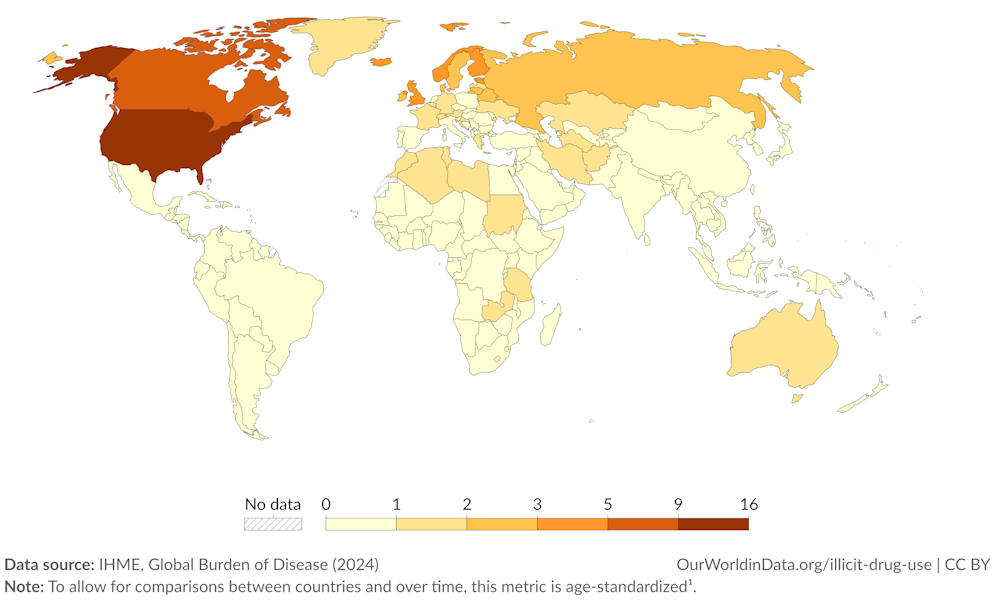
Opioid use death rates around the world:
Estimated deaths from opioid use disorders per 100,000 people in 2021. Our World In Data, CC BY
For the past 15 years, I have researched and advised on the international narcotics industry, especially the Afghan drug trade, as an academic, UK Home Office official and consultant. I’ve observed many shifts within global drug markets, and I believe the increasing availability of synthetic drugs in the UK and Europe may represent a new chapter in illicit drug use here – with the emergence of nitazenes only adding to these concerns.
A brief history of synthetic opioids
New synthetic opioids (NSOs) are one of the fastest-growing groups of new psychoactive substances around the world. The EU Drugs Agency (EUDA) currently monitors 81 NSOs – the fourth-largest group of drugs under observation.
NSOs largely fall into two broad groups: fentanyl and its analogues, and non-fentanyl-structured compounds – these include nitazenes, among many other substances.
Many of these “new” synthetic opioids have, in fact, existed for decades. Nitazenes were first synthesised in the 1950s by the Swiss pharmaceutical company, Ciba Aktiengesellschaft, as pain-relieving analgesics, although they were never approved for medical use.
Prior to 2019, there had only been limited reports of nitazenes in the illegal drug supply – including a “brownish looking powder” found in Italy in 1966; the discovery of a lab in Germany in 1987; several nitazene-related deaths in Moscow in 1998; and a US chemist illegally producing the drug for personal use in 2003. But since nitazenes re-emerged at the end of the last decade, over 20 variants have been discovered.
Paul Janssen, the Belgian chemist who first made fentanyl. Johnson & Johnson
The most common NSO in the illegal drug market, fentanyl, was first synthesised by Belgian chemist Paul Janssen in 1960. Fentanyl, which is roughly 100 times more potent than morphine, was approved in the US in 1968 for pharmaceutical use as an analgesic.
Over the next four decades, however, illegally produced fentanyl resulted in three relatively small outbreaks of deaths in the US. A fourth, larger fentanyl outbreak in Chicago, Detroit and Philadelphia resulted in about 1,000 deaths between 2005 and 2007.
The current US fentanyl crisis started in 2013, expanding to affect much of the country. Between 2014 and 2019, Chinese companies were the main manufacturers of finished fentanyl substances in the US – to combat this, both the Obama and Trump administrations lobbied Beijing to curtail the fentanyl industry.
The Chinese government responded by controlling specific fentanyl analogues. However, every time an analogue was banned, chemists there would slightly adjust the formula to produce a new compound that mirrored the banned substance.
China finally banned all fentanyl-related substances in May 2019, prompting two significant changes in the drug’s supply: a slowdown in the development of new fentanyl analogues, and a reduction in their direct sale to the US from China. Instead, Chinese companies increasingly sent fentanyl precursors to Mexican drug cartels who would synthesise fentanyl (or counterfeit medication) in clandestine labs, before smuggling it across the US border. Consequently, Mexico is now the primary source of fentanyl in the US.
But these supply changes led to another shift in the global drugs arena, as China’s chemical and pharmaceutical businesses – keen to develop new markets – adjusted their focus to producing uncontrolled synthetic substances, including nitazenes. At the same time, they expanded their geographical focus from North America to include Europe and the UK.
The nitazene supply chain
Producing nitazenes is a relatively low-cost exercise. They are largely manufactured in laboratories – both legal and illegal – in China, before being smuggled to the UK and Europe via fast parcel and post networks.
Nitazenes’ high potency means only small quantities are required, making them easier to transport and harder for border officials to detect. Some Chinese vendors have reportedly been offering to hide nitazenes in legitimate goods such as dog food and catering supplies, to circumvent custom controls. All of this decreases the risk to sellers, and lessens the price of doing business.
In March 2024, two China-based sellers operating on the dark web were selling a kilo of nitazene for between €10,000 and €17,000 (£12,000-£20,000). During roughly the same period, a kilo of heroin at the wholesale level in the UK was selling for between £23,000 and £26,000. Once bought, nitazenes are largely used to fortify low-purity heroin, although the drug can also be made into pills.
Video by The Guardian.
Nitazenes are not limited to the dark web. They are widely and openly advertised on the internet, social media and music streaming platforms. In February 2024, one China-based e-commerce site displayed 85 advertisements for nitazenes. Such sites also sell a range of other synthetic drugs, including fentanyl analogues and precursors, xylazines, cannabinoids and methamphetamine.
This means drug dealers in the UK and across the world no longer need to have established connections to underworld figures to source illegal drugs. With a click of a mouse, they can have them delivered to their home address. In this sense, the internet has democratised the drug trade by widening access beyond “traditional” criminals.
In the UK, while the supply of nitazenes is currently assessed as “low”, a number of smaller-scale organised crime groups are importing them to fortify low-purity heroin, before largely dealing it at the “county lines” level. This involves organised crime groups moving drugs – primarily heroin and crack cocaine – across towns, cities and county borders within the UK, using mobile phones or another form of “deal line” to sell to customers.
In November 2023, Leon Brown from West Bromwich was imprisoned for seven years for dealing drugs containing nitazenes – a verdict described as “a great result in our ongoing efforts to tackle county lines drug dealing” by detective sergeant Luke Papps of the South Worcestershire county lines team.
A few larger UK criminal networks have also been involved in nitazene distribution. In October 2023, the police and Border Force conducted raids across north London, arresting 11 people. They dismantled a drug processing site and seized 150,000 tablets containing nitazene – the UK’s largest ever seizure of synthetic opioids – as well as a pill-pressing machine, a firearm, more than £60,000 in cash and £8,000 in cryptocurrency. The police suspected the group had been selling the tablets on the dark web.
Anecdotal reports suggest there have been mixed reactions to the introduction of nitazenes into the illegal drug supply. Richard, a recovering heroin user from Bristol, told Vice magazine that, given their potency, some “people are scared of [nitazenes]” while others are “actively seeking” them.
As has been the case with fentanyl in the US, users build up tolerance and therefore seek stronger doses. Manny, a heroin user from Bristol, told Vice: “I smoked [heroin cut with nitazenes] and it felt like the first time I’d ever taken drugs.”
Video by Vice.
UK-based criminals also use the dark web to export nitazenes abroad. In October 2023, the Australian Border Force identified 22 nitazene discoveries in packages shipped to the country via mail cargo from the UK. British criminals have also trafficked counterfeit medicines containing nitazenes to Ireland and Norway.
Use of nitazenes is now being detected all over the world. Within Europe, Ireland experienced several nitazene outbreaks in 2023-24 while in Estonia, nitazenes now account for a large share of overdose deaths – a trend also seen (to a lesser extent) in Latvia. Preliminary data suggests at least 150 deaths were linked to nitazenes in Europe in 2023.
Nitazenes have also been discovered in fake pain medication such as benzodiazepines, oxycodone and diazepam, which widens the number of people at risk to include those with no opioid tolerance. The death in July 2023 of Alex Harpum, a 23-year-old British student who was preparing for a career as an opera singer, was a stark reminder of the danger of buying fake medicine online that may have been contaminated with nitazenes.
The nitazene ‘boom’ and the global heroin trade
For decades, Afghanistan was the world’s largest opium producer and the source of most of Europe’s heroin. Then in April 2022, the ruling Taliban announced a comprehensive prohibition on the use, trade, transport, production, import and export of all drugs. As a result, poppy cultivation has fallen to historically low levels for a second consecutive year.
While this has not, as yet, translated into a shortage of heroin on European streets, including in the UK and Germany, some indicators suggest a slowdown in heroin supplies to the UK. In the year March 2023-24, the quantity of heroin seized in the UK fell by 54%, from 950kg to 441kg. This is the lowest quantity of heroin seized since 1989, when about 350kg was intercepted.
The NCA assesses that the Taliban ban has created market “uncertainty”. The wholesale price of heroin has increased from roughly £16,000 per kilo prior to the COVID-19 pandemic to about £26,000, while anecdotal reports suggest average heroin purity for users dropped to under 30% (often to 10-20%) in 2024, compared with around 35% in 2023 and 45% in 2022.
Video by UN Story.
Even without the Taliban’s ban, heroin is not easy to produce and supply. Cultivating opium poppy is labour-intensive, taking five or six months. The static nature of opium fields means they are visible and susceptible to eradication; poppy crops can also be negatively affected by blight or drought.
Converting opium into heroin base is also a labour-intensive process that can involve (depending on the production method) at least 17 steps. Acetic anhydride, the main chemical used to convert morphine into heroin, is relatively expensive compared with synthetic precursors. Moreover, heroin is a bulky product, which means it is harder to move in large volumes.
While the relationship between events in opiate-producer countries and the introduction of synthetic opioids to consumer markets should not be overstated, this new type of drug offers economic advantages to criminals whose “sole motivation is greed”.
For decades, Turkish, Kurdish and Pakistani criminal networks have been responsible for importing heroin into the UK. Once in the UK, both Turkish and British groups largely control its wholesale supply, with some participation of Albanian gangs.
To date, there is little evidence to suggest these groups have transitioned to supplying NSOs, including nitazenes. The shifting dynamics in the global drug supply chain, however, could upend traditional markets and the gangs who profit from them.
America’s synthetic drug crisis
The synthetic opioid fentanyl has devastated the US, having been linked to about 75,000 deaths in 2023 alone. It is the primary cause of death for Americans aged 18-49. Canada, too, has experienced a wave of deaths: between January 2016 and June 2024, there were 49,105 apparent opioid deaths there, with fentanyl implicated in a large proportion.
More than 4,300 reports of nitazenes have reached the US National Forensic Laboratory Information System since 2019. They are typically used to fortify fentanyl and other opioids, which can produce a fatal concoction.
Efforts to stem the flow of NSOs, including nitazenes, from China to the US and elsewhere will prove challenging. And even if China does implement stricter controls, other countries could step in to fill the void. According to the Commission on Combating Synthetic Opioid Trafficking:
The overall sizes of these industries, limited oversight efforts and political incentives contribute to an atmosphere of impunity among firms and individuals associated with those industries.
While US and Chinese counter-narcotics cooperation ended in 2022 amid increasing geopolitical tensions, the following November’s summit in Woodside, California, between presidents Joe Biden and Xi Jinping saw them agree to recommence collaboration.
As a result, China recently closed several chemical companies that were shipping fentanyl precursors and nitazenes to the US. These vendors used encrypted platforms and cryptocurrency to conduct the deals, and mislabelled the consignments to try to ensure the substances evaded border controls. China has also outlawed more chemicals and substances, including several nitazene variants.
But President Trump’s imposition of tariffs on imports from China – which sit alongside proposed taxes on imports from Canada and Mexico, in part for supposedly not doing enough to curb the trafficking of fentanyl and its precursors to the US – threatens this counter-narcotics cooperation.
While nitazenes are not yet widely available in the US, their presence within some fentanyl batches is complicating the US opioid crisis – and according to some experts, has the potential to further increase the already shocking number of synthetic opioid-related deaths.
The UK response to nitazenes
Successive UK governments have made tackling NSOs a high priority. Shortly after the most recent nitazene-related deaths were discovered in the UK in summer 2023, the NCA launched Project Housebuilder to lead and coordinate the law enforcement and public health response.
This was soon followed by the establishment of a government-wide Synthetic Opioids Taskforce “to improve…understanding, preparedness and mitigation against this evolving threat”. Chris Philp, then the UK’s combatting drugs minister, stated that “synthetic opioids are at the top of [this government’s] list because of the harm they cause”.
The taskforce has taken a range of measures, such as controlling more NSOs as class A drugs, conducting more intelligence operations at UK borders, widening access to naloxone, and enhancing the UK’s real-time, multi-source drug surveillance system. The government also worked with the US and Canada to learn from their experiences.
Recently, the current UK government banned a further six synthetic opioids and introduced a generic definition of nitazenes as class A drugs. And the UK’s current government, unlike its Conservative predecessor, has also indicated its willingness to consider evidence from the UK’s first drug consumption facility, which recently opened in Glasgow.
Other policy measures worthy of consideration include expanding drug checking services whereby drug users submit drugs to a lab to test what is in them, then are provided with information about the sample. These services offer vital information to the public and authorities about current drug trends.
While there is high uncertainty about what is going to happen next in the UK regarding illicit drug trends, the evolution of the US drug landscape over generations provides some important lessons.
Lessons from the US
The US fentanyl crisis shows drug markets can change quickly with long-lasting consequences. Most heroin on US streets contains – or has been replaced by – fentanyl. According to DEA seizure data, US heroin seizures declined by nearly 70% between 2019 and 2023, whereas fentanyl seizures have increased by 451%.
However, illegal drug markets evolve in different ways and at different paces. In May 1989, Douglas Hogg, a UK Home Office minister, travelled to the US and the Bahamas on a fact-finding mission about crack cocaine, a drug that was predicted to spread from the US to the UK. Upon his return, Hogg noted:
The ethnic, social and economic characters of many of our big cities are very similar to those in the US. If they have a crack problem, why should not we? … The use of crack in Great Britain is likely to develop very substantially over the next few years.
But this “crack invasion”, as some called it, did not materialise in the UK to the extent it had in the US – and the same was true about a predicted wave of methamphetamine use in the UK, which remains low compared with the US.
It is also unlikely the UK and Europe will experience a synthetic opioid crisis on the same scale as the US. The first wave of the US crisis was driven by extensive overprescription of opioids for pain relief. This increased the number of people addicted to opioids, some of whom later turned to heroin, before transitioning to fentanyl. In contrast, large-scale opioid prescriptions have not been a major issue in the UK or Europe, although there is some diversion of legal fentanyl into the illegal drug market in Europe.
Video by The Brookings Institution.
According to Alex Stevens, professor of criminology at the University of Sheffield, another factor differentiating the US and Europe is the provision of drug treatment and harm reduction programmes. Opioid users in Europe, and to a lesser extent in the UK, are much more likely to be in medication-assisted treatment than their US counterparts, thus reducing the number of people at risk. These interventions are reinforced by different socioeconomic factors in much of Europe, such as lower economic inequality, stronger social protections, and better healthcare systems.
None of this, though, means the nitazene threat in the UK and Europe should be underestimated, nor that use and supply of these drugs (and other NSOs) will not increase from its current relatively low base. As the NCA recently warned:
While a zero-tolerance approach from law enforcement, plus advice to users on the heightened dangers, may contain or slow the current uptake, we must prepare for these substances to become widely available, both unadvertised in fortified mixes and in response to user demand as a more potent high.
The future of new synthetic opioids
Predicting the future of NSO use and trafficking is a challenging task. Projections for Europe range from existing opiate stockpiles ensuring that heroin consumer markets remain serviced (assuming the Taliban ban is short-lived), to a heroin shortage which results in more drug dealers turning to NSOs to plug the shortfall, which in turn could lead to lasting changes in European drug markets (as happened in a few countries following the Taliban’s first opium ban in 2000-01).
In such a scenario, it is possible that Turkish criminal networks may exploit their links with Mexico’s Sinaloa cartel to source NSOs. Mexican criminal gangs also operate in Europe, which may increase the likelihood of them trying to open a new NSO market on the continent.
There is also evidence that some Italian criminal organisations have entered the NSO marketplace. In November 2023, Italian authorities announced the seizure of 100,000 doses of synthetic drugs, including fentanyl, as part of operation Painkiller, a joint Italian-American initiative.
Given the many advantages for criminal groups of NSOs, it seems likely they are here to stay. A key question is whether nitazenes (or other NSOs) will supplant traditional heroin as the opioid of choice, as they have done in the US, or remain at relatively low levels in Europe, co-existing with or mixed into the heroin supply.
In December 2023, Paul Griffiths, the EUDA’s scientific director, told Vice: “We’re not seeing much new initiation of heroin use in Europe. So in five to ten years … as heroin users get older and more vulnerable, we’re not going to have much of an opiate problem left.”
But he warned that if heroin use does dry up: “You might then see opioids appearing in other forms and preparations, such as pills, that could potentially become popular among younger age groups who currently do not appear attracted to injecting heroin.”
While previous NSO outbreaks in the UK were relatively short-lived and limited in scale, the most recent nitazene outbreak, which started in summer of 2023, has been more sustained, covered more parts of the UK, and involved more fatalities. The broader trend in Europe also suggests the prevalence and variations of NSOs are increasing at a faster pace than in previous years.
Notwithstanding, nitazene use and supply in the UK currently remains relatively low. In fact, the rate of nitazene-linked deaths – at least those officially reported – decreased between spring 2024 and the end of the year.
In the short term, then, it seems unlikely there will be a nitazene “explosion”. Rather, criminal groups will probably try to increasingly embed nitazenes into the UK drug market at a similar pace to the last 18 months.
However, this situation could change rapidly in future, especially if larger criminal networks involved in heroin importation switch to smuggling NSOs, and there is a genuine shortage of Afghan heroin. This problem would be compounded if drug users start seeking nitazenes, thus creating demand for them.
Either way, the UK government, along with its European partners, should continue to reinforce the whole drug system, to prepare for the worst-case scenario.
To hear about new Insights articles, join the hundreds of thousands of people who value The Conversation’s evidence-based news. Subscribe to our newsletter.
Philip A. Berry does not work for, consult, own shares in or receive funding from any company or organisation that would benefit from this article, and has disclosed no relevant affiliations beyond their academic appointment.
Source: United Kingdom – Executive Government & Departments
Scientists comment on the Public Accounts Committee (PAC) report on Carbon Capture, Usage and Storage (CCUS) technologies.
Prof Hannah Chalmers, Personal Chair of Sustainable Energy Systems, Institute for Energy Systems, School of Engineering, University of Edinburgh, said:
“CCUS technologies can play a unique role in tackling carbon dioxide emissions. They can be used at large industrial sites to ensure that most of the carbon dioxide produced by activities like iron and steel production is not emitted to the atmosphere. Instead, the carbon dioxide is permanently stored in geological formations (rocks). In the UK, CCUS projects are developing plans to store carbon dioxide in layers of rock that are deep underneath the sea.
“There is also ongoing work to develop and deploy cost-effective approaches to remove carbon dioxide directly from the air. This provides an important option to respond to the widely reported increases in carbon dioxide levels in the atmosphere that are causing significant concern.
“There is significant evidence that including CCUS in a mix of technologies to reduce carbon dioxide emissions will be the most cost-effective way to address climate change. Several large-scale projects have been operating in other countries for many years. Experience from these projects is being used to ensure that the CCUS projects that are being developed in the UK are designed to be reliable and cost-effective.”
Dr Stuart Gilfillan, Reader in Geochemistry, University of Edinburgh, said:
What is CCUS technology, how does it work, does it have limitations?
“CCUS stands for Carbon Capture, Utilisation, and Storage, which is a developing technology which reduces the amount of carbon dioxide (CO2) released into the atmosphere. It works by capturing CO2 at the point source, transporting it and then burying it for safe storage in rocks over a kilometre below the ground surface. Like any technology, it has pros and cons, and costs more than simply releasing the CO2 directly to the atmosphere, which is currently free. CCUS is the only currently available technology that can directly reduce CO2 emissions from sources like power plants and industrial processes. Given that global temperature records are now being broken on an almost daily basis and yesterday’s announcement of the hottest January on record, it is essential tool in the urgent fight against runaway climate change.
What is the existing evidence around the efficacy of CCUS?
“CO2 capture technology has proven successful in capturing up to 90-95% of CO2 emissions from point of sources from power stations and industrial facilities. Successful examples include the Boundary Dam power station in Saskatchewan, Canada, where a large-scale CCUS unit has been operational since 2014, capturing about 1 million tonnes of CO2 per year.
“The long-term storage of CO2 is proven by natural CO2 reservoirs around the world and engineered projects like Sleipner in the North Sea, which have been injecting CO2 beneath the seabed since 1996 without significant issues. Research over the past two decades has developed monitoring technologies that can detect and mitigate potential leakage and to ensure that CO2 remains securely buried in rocks deep underground.
What more evidence may be needed to be confident in its applications?
“No more evidence is required, as exemplified by the UK’s Climate Change Committee (CCC), which is an independent body established under the Climate Change Act who advise the government on emissions targets and report to Parliament on progress made in reducing greenhouse gas emissions. The CCC is clear that CCUS is a critical technology for the decarbonisation of the UK economy, particularly in sectors that are hard to decarbonize directly, such as heavy industry (steel, cement, chemicals) and power generation.
“CCUS is not only as a standalone technology but is an essential part of a broader strategy to reach net-zero emissions by 2050. It compliments energy efficiency, renewable energy deployment, and electrification. CCUS is a clear driver for regional economic development, particularly in regions with suitable geological storage sites and industrial bases, such as the East Coast of Scotland, the Humber region, and North East England, areas that have been ‘left behind’ in recent times.”
Dr Tim Dixon, IEA Greenhouse Gas, Director and General Manager, said:
“Carbon Capture and Storage (CCS) is a necessary technology for the UK and other countries to achieve net-zero, and we need all low-carbon energy technologies. The science case for the role of CCS is provided by the UK’s Climate Change Committee, the Intergovernmental Panel on Climate Change (IPCC) and the International Energy Agency (IEA) and cannot be disputed if climate change is to be taken seriously. The key aspect of CCS is the secure long-term retention of CO2 in deep geological formations, and we have decades of experience in this from around the world. With over 40 large scale projects in operation injecting millions of tonnes every year and many pilot-scale projects, this has allowed us to test the science, the monitoring and the practicalities of geological storage of CO2. Hence CO2 geological storage is a proven technology and the regulations to enable and to ensure that it is safe and secure are based upon this sound science and experience. ”
Professor Paul Fennell FIchemE, Professor of Clean Energy, Imperial College London, said:
“The idea that Carbon Capture and Storage is an unproven technology is simply untrue. There are projects ongoing around the world, and millions of tonnes of CO2 have been safely stored over the last couple of decades. This has not happened in the U.K. because of our sclerotic inability to develop public infrastructure, not because the technology is unproven.”
Dr Greg Mutch, Researcher in Carbon Capture and Storage, Newcastle University, said:
“Carbon capture and storage is a technology that prevents carbon dioxide from entering the atmosphere, by capturing it and storing it underground in ‘empty’ oil & gas reservoirs or saline aquifers. According to the world’s foremost experts on the subject, gathered to contribute the International Panel on Climate Change, carbon capture and storage processes are necessary to achieve climate change mitigation goals at lowest cost. Without scalable CCS technologies by the end of the century, climate change mitigation will cost between 29 and 297% (mean value 138%) more.[1] Moreover, CCS is predicted to provide tens of thousands of jobs in the UK, add several billion pounds in terms of gross value added per year by 2050,[2] and enable other important technologies (hydrogen production etc) that will come with further jobs and economic value.”
[1] IPCC, 2018: Global Warming of 1.5 °C. An IPCC Special Report on the impacts of global warming of 1.5 °C above pre-industrial levels and related global greenhouse gas emission pathways, in the context of strengthening the global response to the threat of climate change, sustainable development, and efforts to eradicate poverty, ed. V. Masson-Delmotte, P. Zhai, H.-O. Portner, D. Roberts, J. Skea, P. R. Shukla, A. Pirani, W. Moufouma-Okia, C. Pean, R. Pidcock, S. Connors, J. B. R. Matthews, Y. Chen, X. Zhou, M. I. Gomis, E. Lonnoy, T. Maycock, M. Tignor and T. Waterfield, Cambridge University Press, 2018.
[2] Energy Innovation Needs Assessment Sub-theme report: Carbon capture, utilisation, and storage, Vivid Economics, Carbon Trust, E4tech, Imperial College London, Frazer-Nash Consultancy, Energy Systems Catapult. Commissioned by the Department for Business, Energy & Industrial Strategy, 2019.
Professor Peter Styring, Director of the UK Centre for Carbon Dioxide Utilization, Professor of Chemical Engineering & Chemistry, University of Sheffield, said:
What is CCUS technology, how does it work, does it have limitations?
“CCUS is carbon capture and storage. This has been primarily focused on CCS as the main driver. It aims to capture carbon dioxide from emitters such as power stations and industries. The current technology temperature swing absorption (TSA) using a chemical reaction with an aqueous amine solvent to capture the CO2 from the mixed waste gas and then to release it in a purified form by increased temperature chemical desorption and then further drying and purification to get a gas that can be in theory transported to a site where the gas can be stored underground. It works but at a high energy cost and the production of amine decomposition products that need to be removed and more amine added. It costs a lot!
“Limitations are the energy and financial costs, permitting regulations on solvent disclosure and the large physical footprint. Full system lifecycle analysis is required but this is not always reported.”
What is the existing evidence around the efficacy of CCUS?
“This is not proven using current technologies. The problem is that the current government funded projects use old technologies to achieve CCS and what is actually needed is a step change to new, lower cost more efficient processes such as solid based pressure swing adsorption (PSA). The whole system tends to be simpler and the energy costs and land use is significantly reduced.”
What more evidence may be needed to be confident in its applications?
“Full evaluation of new technologies and rapid acceleration from proof of concept to capture at scale. The Innovate UK funded Flue2Chem project is a good example of how this is being addressed using mid-TRL technologies. The UK also needs to move away from a single minded storage approach to adding value through the use of CO2 in the production of chemicals that would otherwise be sourced from virgin fossil carbon. SUSTAIN project is making synthetic fuels from captured CO2 and Flue2Chem is making FMCG components, including surfactants and precursors from the CO2.”
Dr Stuart Jenkins, Net Zero Fossil Fuel Fellow, University of Oxford, said:
“The Public Accounts Committee are wrong to have labelled CCUS as ‘unproven’, there are many commercial scale projects around the world, but they are right to question the current model for funding it. We need to make sure the CCUS industry becomes self-sustaining, without the need for major taxpayer funding. One option — asking fossil fuel suppliers to contribute to these costs via a carbon storage mandate — is a fair and responsible approach going forward.
In a recent report we published working with researchers at the University of Oxford and Carbon Balance Initiative [1] we looked at the use of Carbon Storage Mandates, which place an obligation on fossil fuel producers to capture and store a rising fraction of the CO2 they produce, to support the UK’s CCUS industry.
Carbon storage mandates, in tandem with carbon pricing and other mechanisms, could deliver subsidy-free CCUS to the UK and provide investment certainty for companies.”
Dr Stuart Jenkins Our report was funded by the Carbon Capture and Storage Association, and consulted regulators, fossil fuel companies, capture and storage entities, UK Government, and academics on models for CCUS sector support packages.
Professor Paul Fennell: No conflicts other than being involved in CCs research.
Dr Tim Dixon: “Tim is a Director of IEA Environmental Projects Ltd (UK), a Non-Executive Director on the Board for The International CCS Knowledge Centre (Canada). He is also proud to be an Honorary Senior Research Fellow at the Bureau of Economic Geology, University of Texas in Austin, and an Honorary Lecturer at the School of Geosciences at University of Edinburgh. He was an original Board Member of the UK CCS Research Centre. Previously he worked in CCS, emissions trading, clean energy technologies and related areas for AEA Technology (ETSU), for the UK Government‘s Department of Trade and Industry (DTI) and for the Global CCS Institute. He was the EU’s Lead Negotiator for getting CCS in the CDM in UNFCCC in 2011, and a UK negotiator for getting CCS in the London Convention 2004-7, in OSPAR 2006-7, in the EU Emission Trading Scheme 2004-8, and inputting to the EU CCS Directive 2007-8. He gives talks on climate and CCS to schools and public organisations and supported the start of Oxford Climate Society at the University of Oxford. He is a Fellow of the UK Energy Institute, and member of the UK Institute of Physics and the UK Environmental Law Association.”
Dr Stuart Gilfillan “I have received funding from TotalEnergies in the past, for research related to CO2 origins in the subsurface and reservoir connectivity and Equinor on CO2 dissolution in natural CO2 reservoirs. I currently receive funding from the Natural Environment Research Council and Carbfix on CO2 mineralisation.”
Prof Hannah Chalmers “I work collaboratively with industrial partners who are developing CCUS projects in the UK (e.g. as a member of the Advisory Board for the Industrial Decarbonisation Research and Innovation Centre). I currently receive no funding from industry, but have received funding from industrial partners who are actively developing CCUS projects in the UK in the past (e.g. SSE plc).”
Professor Peter Styring: Peter is Professor of Chemical Engineering and Chemistry at the University of Sheffield (an investigator on Flue2Chem and SUSTAIN) and a Co-founder and Director of CCU International.
For all other experts, no response to our request for DOIs was received.
Source: United Kingdom – Executive Government & Departments
Minister Dodds gave opening remarks at a reception to reaffirm the importance of gender equality and comprehensive sexual and reproductive health and rights to individuals, families and society.
Welcome, everyone and thank you, Plan International UK, for helping to bring us together.
I am grateful for this opportunity to share some reflections, because, as the UK’s Minister for Development, Women and Equalities, sexual and reproductive health and rights are a priority for me.
We must keep working together to make sure everyone has power over their own bodies. That includes the choice of whether to have sex – if at all. That includes whether to continue with a pregnancy – and when to have children. And that includes the LGBTQ+ community.
This is fundamentally the right thing to do, and the smart thing to do. Over the last 6 months, from South Sudan to Indonesia to Malawi, my conversations with those affected have underlined this powerfully.
We know that when women, girls, and other marginalised groups are empowered, they lift up whole families, communities and economies.
Yet, there is a great deal of work ahead of us, to close the gap between where we are and where we need to be.
As hard-won rights are being rolled back, with more than a quarter of a million people lacking access to information and services and complications from pregnancy and childbirth remain the leading cause of death for around 12 million girls in lower-income countries.
Not to mention the fact that women and girls are bearing the brunt of conflicts and humanitarian disasters around the world. Sadly, on every continent, including here in Europe, groups that are hell-bent on rolling back rights and denying women and girls choice, are sowing the seeds of division.
In the face of such challenges, it is only by standing strong and working together that we can hope to turn things around.
For our part, the UK reaches many millions of people every year, making sure that the poorest and most marginalised have access to life saving services, are heard, and have greater choice and control.
This government is keeping that work at the top of the global political agenda – where it belongs. Be that the Prime Minister’s commitment to supporting local, national and global efforts on World Aids Day.
Or the Foreign Secretary’s recent visit to Chad where he announced further support for women and girls – including refugees from Sudan – to access sexual and reproductive health services.
Next month, I look forward to leading the UK’s delegation to the Commission on the Status of Women at the United Nations, in New York, where once again, we will push to keep this vital work firmly in the international spotlight.
In April, today’s panellist, Neisha will join the UK delegation at the Commission on Population and Development in New York, to make sure we hear from the next generation very directly.
And today, I am proud to announce my role as a She Decides champion – part of a global movement advocating for every woman and girl’s right to choose what to do with her own body. I am very glad to add my voice to these efforts.
Let me end by repeating that each and every one of us here has our own powerful part to play, and together, we can make a difference by listening to those affected, amplifying their voices, and taking action by challenging harmful practices and discrimination, calling out attempts to erode rights and breaking down barriers and sharing our knowledge, experience and expertise.
That is why I am so glad we are here today to discuss all this – and galvanise our efforts. So, thank you, once again, for joining us and for your dedication to this important work. I look forward to all that we can achieve together.
A massive programme of investment in fighting anti-social behaviour and providing more Council owned temporary accommodation during the cost of living crisis is at the heart of Westminster City Council’s proposed budget published today.
The theme of safety on the streets and the security of a home are supported by one of the largest investments ever – doubling the number of CCTV cameras on the streets to 200 (including up to 40 new cameras in the West End as part of the Council’s upcoming Westminster After Dark initiative), action on targeting ASB hot spots and tackling the housing crisis with a £140 million investment. At the same time, the Council is proposing to invest a massive £2.6m into cushioning the cost of adult social care – meaning hundreds of adult social care users will now not pay for care while hard working care assistants will earn more.
Despite the scale of new investment, the Council Tax rise equals just 48p a week for a Band D* property, which means Westminster still has one of the lowest Council Tax rates in the country. The Westminster City Council part of the Council Tax rises by 4.99 per cent overall – 2.99 per cent for council services and 2 per cent for the portion set aside for adult social care.
Headline announcements in the proposed budget include:
£2m for anti-social and city management measures – including doubling the number of CCTV cameras to 200, creating a new team to combat ASB and recruiting extra officers to fight noise nuisance. The installation of up to 40 new cameras in the West End – focusing on Soho and Leicester square – is the most significant council security investment in the area in nearly a decade.
A new investment of £140m in Council owned temporary accommodation properties to curb the reliance on expensive hotels and provide a more secure home for those waiting for permanent social housing.
An extra £1.2m to tackle rough sleeping and help people off the pavements and into safety
An additional £1.4m to increase the pay of the personal care assistants (over 400 staff) who provide care for Westminster residents through direct payments. This will help more people who use adult social care to employ the carer they want as they will now be able to pay a competitive salary.
An additional £1.2m to level up the threshold at which people start to pay for their social care costs so that it is the same for everyone regardless of age. This will help over 460 residents aged under 65 to keep more of their income before paying care bills.
An extra £1m on cost of living support – for example free school meals during school holidays, supermarket food vouchers, a hardship fund and supporting specialist advice centres.
Investing in new Community hubs such as Ernest Harris House opening this Spring and the Pimlico Community hub at site of the Old Pimlico Library opening in 2026
The Council will also deliver new savings of nearly £30m by 2028 through measures including greater efficiencies in contracts and the switch to an electric cleaning and waste fleet.
The proposed budget will go to the City Council’s cabinet before being voted on at full Council on March 5th.
Cllr Adam Hug, leader of Westminster City Council, said:
“Safety and assurance for our residents – whether on the streets, keeping a roof over their heads or with help for the less well-off – is at the very heart of this Budget.
“Like all London councils, we are facing unprecedented demands on our services with spiralling costs for housing and care. I am proud that we have been able through careful management and savings to target money to those who need it most while keeping a rise in Council tax to the bare minimum.
“We all know everything is more expensive these days – food, rent, and looking after elderly family members. We are keeping bills down for those who can least afford it, but I am also pleased we can increase the hourly pay of those care assistants who do such a vital job but are often on the lower end of the pay scale.
“Wherever you live in Westminster, you should be able to enjoy your surroundings without fear of groups hanging around on corners, dealing drugs or other anti-social behaviour and making a noise. Our mobile cameras are already helping in court prosecutions and we will deploy them wherever residents need them most.”
The Wolves legend said he was “honoured and a little overwhelmed” after being presented with a scroll, badge and casket when he met the Mayor of Wolverhampton, Councillor Linda Leach, at a special lunch today (Friday 7 February, 2025).
Freedom of the City is the highest honour the council can bestow and recognises those that represent the city with distinction.
The former striker was given the honour in recognition of his services to Wolves FC, the Former Wolves Players Association, and his community work.
John said: “I am very honoured and a little overwhelmed but it is a real privilege. I am aware of some of the people who have received this in the past so I am in esteemed company.
“I am a Lancastrian by birth but an adopted Wulfrunian. I’ve been connected with the city for a long time – more than half a century, having come here as an 18 year old almost 56 years ago.
“I’m so proud to be part of this community in Wolverhampton and representing the city and all of the positive things that are happening here right now.”
Mayor of Wolverhampton Councillor Leach said: “The word legend is banded about all too easily these days, but ‘King’ John Richards certainly fits the bill.
“He won 2 League Cups, scored an amazing 194 goals for Wolves in a career played entirely in the top flight of English football and remains the club’s second highest goalscorer of all time.
“Off the pitch he is a superb ambassador for our city, supports former players and their families, raises money for charity and continues to live locally.
“He is truly deserving of this distinguished honour and on behalf of the people of Wolverhampton, I wish to thank him for all that he has done and continues to do for our city.”
John, who dedicated almost his entire career to Wolverhampton Wanderers, joined the club in 1969 moving to the Midlands from Warrington and has never left.
Beloved by Wolves fans, he gained the nickname ‘King John’ and will forever be remembered for scoring the winning goal in the 1974 League Cup Final against Manchester City.
He has been on the board at Molineux and served a spell as Managing Director. He is now a Vice President.
As a passionate advocate for Wolves Foundation, the club’s charitable arm, John has actively participated in events such as Molineux Memories, the Molineux Sleepout and Walking Football. Last year he even abseiled down the Billy Wright Stand at Molineux to raise funds for the foundation, despite being in his 70s. His dedication to the Foundation has directly benefitted the residents of Wolverhampton.
John has joined the ranks of such luminaries as Sir Jack Hayward, Baroness Rachel Heyhoe Flint, Dame Denise Lewis, Beverley Knight MBE, Steve Bull MBE and Hugh Porter MBE in being granted Freedom of the City of Wolverhampton.
Armagh City, Banbridge and Craigavon Borough Council has launched a public consultation process aimed at gathering views on its proposed Performance Improvement Objectives for 2025-26.
From Thursday 06 February to Thursday 03 April 2025, members of the public are invited to complete a short online survey to share their thoughts and opinions on the following proposed objectives:
We will reduce the average number of days’ sickness absence lost per employee.
We will reduce council’s environmental impact through the development and implementation of a Climate and Sustainability Action Plan.
We will improve our waste management services through the implementation of technological solutions and continued communication.
We will improve communications with our customers on council services and responsibilities.
Commenting on the public consultation, Lord Mayor of Armagh City, Banbridge and Craigavon, Councillor Sarah Duffy, said:
“Each year our council is required to set objectives for improving how it carries out its functions and to put in place arrangements to helppromote sustainable and continuous improvements in its service delivery.To help us achieve this, we are welcoming comments on our proposed Performance Improvement Objectives for 2025-26.
“For our council to be effective, it is important that as many members of the local community offer feedback on these proposed objectives to ensure they reflect those views and address the needs of customers, residents and communities across the entire borough.”
UK Government Scotland Office Minister Kirsty McNeill in conversation at the The Scottish Council for Voluntary Organisations (SCVO), the Gathering event.
I can’t tell you how happy I am to be here, back among friends devoting their lives to a social purpose.
As some of you might know, I spent much of my life in the voluntary and community sector, both on staff and as a volunteer.
And I’m still a proud member and supporter of a lot of organisations I was involved with before I became an MP.
As a minister too I’ve had the chance to visit organisations like Greener Kirkcaldy, Bairn’s Hoose in Dundee, Macaulay College in the Western Isles, Barnardos Nurture Service Inverclyde and Bravehound to name but a few.
And I want to reassure people who do the mail outs to MPs that yes, there really is someone who reads every single bit of bumpf they are sent or handed and that’s me! That’s how I know stuff like the people in the War Memorial Trust diligently cleaning and protecting these sacred places, or about the 850 people involved in Scottish Mountain Rescue who go out in all weathers to save the lives of perfect strangers.
So I will always want to hear from and spend time with you.
Because we are pals. But because we are pals I want us to have a really honest conversation today. You are busy people – nobody here has time to beat around the bush.
So I wanted to come here today to say I think we are both punching below our weight right now – both civil society and government – because we haven’t yet found the right way to work together.
When we do, we are going to be unstoppable. But right now, we are still finding our way.
Let me give you some examples. The UK Government’s budget delivered nearly £5 billion extra for Scotland’s public services – money which, if well spent, could take pressure off of everyone here who works in health, education, transport, poverty or community development. We should be talking to each other and the Scottish Government about how to make that money have the maximum impact for Scots.
Instead almost all of our conversation has been about the changes to employer national insurance contributions. I get that this decision is unpopular in this room and we need to get into it in the Q and A. I’m not trying to shy away from the fact that we had to make tough choices and that has in turn created tough choices in your board rooms and senior management meetings. Let’s talk about it.
But I hope you can also see that we are missing out on a major chance to transform Scotland together if we aren’t collaborating on how this truly game-changing amount of money should be spent.
Or here is another example – the New Deal for Working People. Now I am a proud trade unionist and the UK Ggovernment is indebted to the trade union movement for all of their support on the development of this package. But why are the only people lobbying for it in the trade union movement itself? Because if people are better paid and better protected at work then the missions of every organisation in this room becomes easier to achieve.
The Child Poverty Taskforce on which I am proud to sit has received a lot of input and evidence on welfare questions and rightly so, but we are at risk of having lots of narrow, disjointed conversations about individual policy areas when nobody lives their lives in policy silos. No policy tweak is a substitute for creating an economy that works for working people and that’s the biggest prize on offer. Let’s all keep our eyes on it.
So I do think there are some areas where we could have worked together better in these first few months of a new government. There are national conversations you should be not just a part of but leading.
And I know what some of you will be thinking. That you don’t want to be co-opted or politicised and I understand that risk.
So I want to be really clear about this: the UK Government will never compromise your independence.
Not just because it would be improper, but because it would make you less effective, because one of your most important roles is to challenge us.
And I want to stress how much I really mean this. Not in a mealy-mouthed way to say of course there is a ‘right’ to protest and to speak out in this country.
No, I’m saying something bigger than that – that you have not just the right but the duty to challenge us when you think we’re getting it wrong.
It’s not an accident that the members of charity boards are called ‘trustees’, because they are indeed entrusted with something very important. It is their job to steward an institution on behalf of all society at large but in particular on behalf of the beneficiaries the organisation exists to support. Those beneficiaries need you to bring their perspective right to the heart of the national debate – even if, especially if, they are marginalised or traditionally shut out of power.
In my old life I often used to say to the teams I worked with that ‘campaigners make things possible, politicians make things happen’.
Civil society’s job is to inform conversations, challenge assumptions, pioneer new practice and give support that the state is unable, unwilling or not best placed to give.
Government’s job is to pass laws, devise budgets, enact policies and, above all, to reconcile competing interests for the common good. In the end, we make decisions about how best to get things done and it’s our jobs on the line if we get things wrong.
These roles in our democracy are distinct, but mutually reinforcing. Both sides need each other.
But if we are to each play our parts well then we need to have a proper dialogue. Yes you should tell us when you think we’re getting it wrong. But you should also let us know when you think we’re getting it right and, crucially, when we are not focusing on something that really matters.
Because there are some things that civil society is simply best placed to know.
One of the great privileges of my job as a minister is getting to spend so much time with civil society. From a farm supporting children with disabilities to an arts project helping people to walk the long hard road to recovery after addiction, from an organisation helping women get smart clothes for job interviews after seeking asylum or fleeing domestic abuse to community allotments that give people in mental health crisis a safe place to go, I have seen Scottish civil society at its very best when the times people face are at their very worst.
And because of this special role you have, deep in the heart of communities, you see things we in government just can’t see from where we are sitting. As you know, 36% of Scottish voluntary organisations are based in remote or rural locations. You know every nook and cranny of Scotland and wrestle with questions about how to change lives every day.
What is the best way to provide food for hungry folk, without compromising their dignity? How can we best fight loneliness so everyone feels that they matter and that they belong? Just what kind of Christmas support might make the biggest difference for the care experienced kid, not sure whether they’ll be in the same placement this time next year?
This is your expertise and we need to hear it.
Now I said earlier that we’ve both been punching below our weight. On your side I think that’s because you’ve shied away from the biggest debates about how to rewire our economy, on our side I think it’s because we’ve not yet been able to rewire government to become more open to outside expertise like yours.
You’ll have heard the Prime Minister talk about mission based government.
I am such a nerd for this, because it’s a completely different way of thinking about how this change can happen – one where the job of government is to coordinate and collaborate, not direct and dictate – and one where you have the power to make the difference for the people and places you love.
That’s why the UK Government is creating a new Civil Society Covenant, based on four principles: recognition for your contribution, partnership rooted in respect, participation so you can be heard and transparency, so that both civil society and government have the information we need to come to shared diagnosis and prescriptions.
We are doing that to unleash your extraordinary potential. There are more than 46 thousand organisations in the Scottish sector, employing 5% of Scotland’s workers and mobilising 300 million hours of volunteering every year.
Those are enormous figures.
Just imagine if those efforts could be aligned with investment from the private sector, policy ambition from UK Government and proper support from the Scottish Government.
Implementing the Covenant is where we will start, but it won’t be where we will end.
I want to see a new deal for the third sector in Scotland. That should start with multi-year funding for the sector.
Too many of you face the annual anguish of issuing redundancy notices to your own staff because there are question marks over whether your funding will be renewed and the money delivered on time.
I know many of you face significant bureaucracy and feel like you are jumping through hoops and getting tangled in red tape to access funding.
That places unfair stress on you and your staff when you want to be laser focused on helping others.
I know you’ll have a lot of questions about how the UK Government can make your lives easier and I know we will get into them in the discussion. So just let me underline that today is just the next stage in our discussions – with SCVO and its members.
As long as I am there, you will always have an open door to the Scotland Office. And when you walk through it we will sit around the table as equals and have a proper debate about how we all can play a part in creating the better Scotland we both – civil society and politicians alike – come to work every day to build.
In collaboration with Government of Ukraine, UNICEF and the World Bank, £25m of UK funding will support an inclusive and sustainable social recovery in Ukraine.
The SPIRIT programme (Social Protection for Inclusion, Resilience, Innovation and Transformation) will support Ukraine to strengthen more inclusive and efficient social protection systems and revitalise community and family-based services.
SPIRIT will support the Foreign Secretary’s priority to ensure a safe and loving family for every child, improving social care services for 10,000 families across 10 regions
The programme will help Ukraine lay foundations for a recovery that meets the needs of citizens in all their diversity including people with disabilities, veterans and other war-impacted groups.
The UK will invest £25 million to strengthen Ukraine’s social protection system and services to support an inclusive and barrier-free recovery. The funding announced during the visit of the Foreign Secretary, David Lammy to Kyiv will catalyse Ukraine’s ambition for reform of the social sphere. This support will help Ukraine to meet the varied needs of the population and accelerate Ukraine’s Euro-Atlantic pathway. The UK will partner with UNICEF Ukraine and the World Bank to deliver SPIRIT, working closely with the Ministry of Social Policy of Ukraine, the European Union and key partners in the social sector.
The SPIRIT programme recognises that investing in people – and the support and services they need – will be critical for Ukraine’s long-term recovery and socio-economic future.
Russia’s full-scale invasion has had an immense and devastating human impact in Ukraine. This has been disproportionately felt by the most vulnerable and war-impacted groups, including women, children and families, people with disabilities, older people, veterans, and those in frontline areas.
The programme will support Government of Ukraine in their social reform agenda, bringing together Ministries and local government, international financial organisations, donors, civil society, academia, and private sector.
Following the signing of the ‘Social Recovery and Inclusion Partnership for Ukraine’ by the UK, the Ministry of Social Policy of Ukraine, the European Union, UNICEF and the World Bank at the Berlin Ukraine Recovery Conference 2024, SPIRIT demonstrates commitment of the UK government and partners to support Ukraine’s socio-economic future and further our collaboration.
The SPIRIT programme has three main priorities:
Improving access to high-quality community and family-based social services for at least 10,000 families with children across 10 regions. In cooperation with the Ministry of Social Policy, we will deliver small grants and capacity-building to 100 civil society and local community actors to enable them to provide social services, while building a local marketplace of accessible service providers and empowering local actors to meet the growing demand for social protection support.
Establishing a Social Recovery Office with the Ministry of Social Policy to drive reforms, improve coordination in the sector, and enhance collaboration with international financial institutions and development partners. The Social Recovery Office will help Ukraine respond to pressing demographic challenges, meet the needs of the most vulnerable, and support development of a more robust and inclusive social protection framework.
Launching a range of cross-sectoral initiatives that support social recovery and inclusion priorities in Ukraine. Projects will work across health, economic and social sectors, piloting new models of support and services to cater for the most vulnerable and war-impacted groups. This includes women, families with children, people with disabilities, older people, and veterans. These initiatives will foster human capital, enable inclusive reforms and build the institutional capacity needed for Ukraine to address the demographic, economic, and societal changes driven by the war.
The SPIRIT programme will support the Foreign Secretary’s campaign to realize family-based care for every child. Ukraine is a key partner in the Foreign Secretary’s new global alliance to progress sustainable, lasting reform of children’s social care around the world. Working with the Government of Ukraine and UNICEF, SPIRIT includes a specific focus on accelerating ‘Better Care Reform’ to strengthen families, prevent separation, and ensure a safe and loving family environment for all Ukrainian children.
The British Ambassador to Ukraine, Martin Harris said:
I am proud that the UK is announcing critical funding for Ukraine’s social recovery. The £25m contribution will strengthen Ukraine’s social systems and services that are under overwhelming pressure from Russia’s brutal invasion. Investing in Ukraine’s social systems is an investment in Ukraine’s people – and we know that Ukraine’s people are its greatest resource.
SPIRIT is a testament to 100 Year Partnership and shared values between our two countries, including our commitment to meet the needs of women, children, people with disabilities, older people, veterans, and marginalised groups.
In the very worst of circumstances, Ukraine is pursuing an ambitious reform agenda to build a brighter, fairer and ‘barrier-free’ society. In partnership with the Government of Ukraine, UNICEF and the World Bank, the SPIRIT programme will drive forward this vision and lay the foundations for a future where the well-being, dignity and potential of every Ukrainian is ensured.
Oksana Zholnovych, Minister of Social Policy of Ukraine outlined:
Human capital development is at the centre of Ukraine’s recovery. The SPIRIT programme represents a crucial step in building institutional capacity, strengthening the social protection system and supporting critical reforms to improve efficiency, effectiveness, and inclusion. We are grateful to our partners, the FCDO, World Bank, and UNICEF, for their support and shared commitment to fostering social cohesion, leaving no one behind.
Munir Mammadzade, UNICEF Representative to Ukraine indicates:
The SPIRIT programme is a critical investment in protecting and improving the lives of the most vulnerable, especially children and families in need across Ukraine. This initiative will further strengthen national systems and community-based services to nurture and maximize the country’s most important resource, its human capital, to drive inclusive and prosperous growth.
Bob Saum, World Bank Regional Country Director for Eastern Europe added:
Addressing social cohesion and inclusion, including meeting the needs of vulnerable populations will contribute to maximizing benefits of Ukraine’s post-war recovery economic growth. The SPIRIT program will help build institutional capacity to support veterans, people with disabilities, and other at-risk groups while advancing Ukraine’s EU integration goals.
A teenager has been found guilty of manslaughter after stabbing his school friend to death in an east London park.
A 16-year-old boy, who cannot be named for legal reasons, was found guilty of the manslaughter of 15-year-old Pharell Garica following a trial at the Old Bailey that concluded on Friday, 7 February.
He was found not guilty of murder.
The jury reached the verdict after deliberating for 15 hours and 39 minutes.
The court heard that the defendant, who was aged 15 at the time, stabbed Pharell in the heart, chased him until he collapsed then fled without helping him and disposed of the weapon.
The defendant admitted stabbing Pharell, but claimed it was in self-defence. However, the jury disagreed with this account.
Detective Chief Inspector Kelly Allen from the Met’s Specialist Crime Command, who led the investigation, said: “Our thoughts very much remain with Pharell’s family and friends, who had to re-live the last traumatic moments of his young life during the trial after the defendant failed to take responsibility for his actions.
“Somehow the defendant came to be in possession of a multi-tool, which he claimed in court was carried to the scene by the victim. The evidence we gathered disputed the defendant’s account that he grabbed the multi-tool and delivered a fatal blow to save his life. When the defendant became in possession of that weapon he had a choice. He could have walked away, he could’ve thrown the multi-tool to the floor. Instead, he chose to stab Pharell in the heart and then chased him, still armed with the knife, until he saw the victim collapse from his fatal injuries. Instead of rushing over to help his former friend, he fled the scene and tried to dispose of the evidence.
“Our investigation revealed that the defendant had a fascination with knives after we found 43 images and videos from 16 and 17 July alone of him playing with knives.”
Detective Chief Superintendent James Conway, who leads policing in Hackney and Tower Hamlets, said: “Pharell’s death was first and foremost a devastating tragedy for his family and friends, but it also had considerable impact across our local communities.
“While overall violence has been reducing in Hackney, tragic events such as this serve as a reminder that too many of our children and young people have to contend with the callous reality of knife crime. We continue to work night and day, with the council, local charities and wider partners to address both the root causes of knife crime and to deter people from carrying knives through police action.
“If any young person feels they need to carry a knife please speak to a parent, carer, teacher, youth leader or adult you trust and we can get you the support to step back from that decision safely.”
Police were called at around 16.05hrs on Tuesday, 23 July to Stellman Close, E5 to reports of a stabbing.
Officers and the London Ambulance Service attended, but sadly Pharell was pronounced dead at the scene.
The court heard that Pharell and the defendant, who used to be friends before a falling out, met in the park shortly before the attack. The defendant had told a mutual friend that he was going to fight Pharell as he was talking about him.
Following Pharell’s death, the police received some information, which led them to make an arrest enquiry at the defendant’s address. He was not home.
Detectives soon tracked him down to a family friend’s house, where he stayed following the manslaughter, and he was arrested at 05:07hrs on Wednesday, 24 July.
Detectives then began their lengthy investigation of gathering evidence to prove the defendant was responsible for killing Pharell. They reviewed hours CCTV that captured the defendant entering the park, before putting his hood-up, walking to the area where the attacked happened with Pharell, chasing Pharell out of the park while still holding the knife and then finally disposing of the weapon.
The weapon was recovered close to where the defendant was seen discarding it on CCTV. The multi-tool was forensically linked to both the defendant and Pharell.
Officers also analysed the defendant’s mobile phone which showed communication of Snapchat between the pair in the days leading up to the manslaughter, as well as 43 videos and photos of the defendant playing with knives only a week before the killing on Tuesday, 16 and Wednesday, 17 July. The defendant also messaged his mother following the attack saying he could not come home, to remove certain items from their home and asking to go to Portugal.
The defendant gave a prepared statement to officers admitting to stabbing Pharell but saying he did it in self-defence after getting the knife off him – something detectives and the jury disputed.
He was charged on Thursday, 25 July and was convicted as above.
He will be sentenced at the same court on Thursday, 17 April.
LEEDI, Estonia, Feb. 07, 2025 (GLOBE NEWSWIRE) — The legend of SHIBA INU continues to evolve, and this time, it’s faster, stronger, and more decentralized than ever before. Introducing $SHIB on Solana, a groundbreaking project that honors the legacy of the original SHIBA INU while leveraging the unparalleled speed, efficiency, and scalability of the Solana blockchain.
The SHIBA community has long been a symbol of loyalty, innovation, and meme magic. Now, $SHIB on Solana takes this legacy to new heights, combining the spirit of the OG SHIBA with the cutting-edge technology of Solana. This is not just another token—it’s a movement, a tribute, and a revolution in the world of memecoins.
WHY $SHIB ON SOLANA IS THE NEXT BIG MEME TOKEN?**
A Tribute to the OG SHIBA $SHIB on Solana is a heartfelt homage to the original SHIBA INU, celebrating its journey and the values that made it a global phenomenon. By migrating to Solana, the project embraces faster transactions, lower fees, and a more accessible ecosystem, ensuring that the SHIBA spirit reaches even more people worldwide.
Supply Burn & Scarcity In a bold move to ensure scarcity and long-term value, 50% of the total $SHIB supply has already been burned. This strategic burn mirrors the original SHIBA INU’s approach, creating a deflationary model that benefits holders. Additionally, liquidity pool (LP) fees are used to burn both OG SHIB and $SHIB on Solana, further reducing supply and increasing value over time.
Strategic Airdrops & Liquidity Growth: To reward early adopters and true believers, $SHIB on Solana has launched a series of strategic airdrops. These airdrops are designed to incentivize long-term holding rather than short-term speculation. Combined with LP injections, the project ensures market stability and sustainable growth, making it a reliable choice for investors.
Solana-Powered Growth Built on Solana, $SHIB benefits from the blockchain’s blazing-fast transaction speeds and minimal fees. This makes it easier for users to trade, stake, and participate in the ecosystem without the high costs associated with other networks. Solana’s robust infrastructure and dedicated community provide the perfect foundation for $SHIB to thrive as the next unstoppable force in memecoins.
THE SHIBA LEGACY CONTINUES – DON’T MISS HISTORY IN THE MAKING!
$SHIB on Solana is more than just a token—it’s a bridge between the past and the future. By combining the SHIBA spirit with Solana’s technological prowess, this project is poised to redefine what a memecoin can achieve.
The question is: Will you be part of it?
TOKENOMICS AT A GLANCE
Total Supply: 1,000,000,000
Burned Supply: 500,000,000 (50%)
Tax: 0%
Liquidity Pool (LP): Burned
JOIN THE PACK. BE PART OF THE TRIBUTE.
$SHIB on Solana is here to honor the past, embrace the present, and build the future. Whether you’re a longtime SHIBA enthusiast or a newcomer to the world of memecoins, this is your chance to be part of something truly special.
About Shib on Solana Shib on Solana is a decentralized token built on the Solana blockchain, created as a tribute to the legendary SHIBA INU. By combining the SHIBA spirit with Solana’s speed and efficiency, the project aims to make memecoins more accessible, sustainable, and impactful than ever before.
Disclaimer: This press release is provided by Shib on Solana. The statements, views, and opinions expressed in this content are solely those of the sponsor and do not necessarily reflect the views of this media platform. We do not endorse, verify, or guarantee the accuracy, completeness, or reliability of any information presented. This content is for informational purposes only and should not be considered as financial, investment, or trading advice. Investing in cloud mining and related opportunities involves significant risks, including the potential loss of capital. Readers are strongly encouraged to conduct their own research and consult with a qualified financial advisor before making any investment decisions.
Source: Government of the Russian Federation – An important disclaimer is at the bottom of this article.
Dmitry Grigorenko’s meeting with heads of digital transformation of federal executive bodies
February 7, 2025
Dmitry Grigorenko’s meeting with heads of digital transformation of federal executive bodies
February 7, 2025
Dmitry Grigorenko at a meeting with heads of digital transformation of federal executive bodies
February 7, 2025
Previous news Next news
Dmitry Grigorenko’s meeting with heads of digital transformation of federal executive bodies
Digital transformation programs for 2025 and the planning period 2026–2027 have been adopted for 11 federal ministries and departments. They were reviewed at a meeting of Deputy Prime Minister – Chief of the Government Staff Dmitry Grigorenko with heads of digital transformation of federal executive bodies.
The meeting approved development programs for the Ministry of Emergency Situations, the Ministry of Industry and Trade, the Ministry of Digital Development, the Ministry of Energy, the Russian National Guard, the Federal Service for Supervision in Education and Science, the Federal Archives Agency, the Federal Reserve Agency, the Federal Fisheries Agency, the Federal Bailiff Service, and the Federal Mandatory Medical Insurance Fund. Their projects provide for all the main planning parameters with established target indicators: funding volumes; key results (e.g., harmonizing departmental information resources, increasing the speed of processing interdepartmental requests); infrastructure development (e.g., transferring systems to Russian software and Russian information security tools).
“In total, we have to approve 60 departmental digital transformation programs. Their implementation is aimed at increasing the efficiency of the departments themselves and public administration as a whole. This includes the quality of decisions made based on data received online, and the transparent implementation of key functions, and the speed of providing public services,” commented Dmitry Grigorenko.
For example, the Compulsory Medical Insurance Fund plans to introduce a system of personalized accounting of information on medical care provided in 2025. This will allow receiving information about insured citizens online, reducing errors in medical organizations’ bills, generating information about everyone who is subject to dispensary observation, creating individual medical examination routes for them, etc. Based on this information, personal risks of insured persons will be calculated, and forecasts of medical care consumption will be built.
Taking into account the implementation of the tasks set within the framework of departmental digital transformation programs, a number of additional priorities were also identified at the meeting. Thus, among the tasks for 2025 is to introduce artificial intelligence technologies into the feedback platform. This will allow for the fastest possible classification of citizens’ requests by issue and assessment of the quality of responses to them. Also, special attention will be paid to ensuring information security in 2025.
Please note: This information is raw content directly from the source of the information. It is exactly what the source states and does not reflect the position of MIL-OSI or its clients.
Source: The Conversation – UK – By Magdalena Frennhoff Larsén, Associate Professor in Politics and International Relations, University of Westminster
It is not unusual for international leaders to be invited to meet with EU heads of state or government at the fringes of the European Council meetings. Ukraine’s president, Volodymyr Zelensky, has regularly been invited to address the EU leaders. And while Donald Trump was never invited during his first term as US president, his successor Joe Biden was.
But Keir Starmer’s February 3 visit was significant, because it was the first time since Brexit that a British prime minister was invited to join the EU leaders for their traditional post-summit dinner.
Even before the UK formally left the EU, while the two parties were negotiating the terms for Brexit, British prime ministers were excluded. Not only were they left out of the formal meetings where the other 27 leaders discussed Brexit, but they were also excluded from the post-summit dinner. This caused frustration in Downing Street, and led to complaints about the UK being sidelined.
Want more politics coverage from academic experts? Every week, we bring you informed analysis of developments in government and fact check the claims being made.
There were rumours that Boris Johnson would be invited to a European Council meeting in 2022, but these remained rumours. And even if UK-EU relations improved under the premiership of Rishi Sunak, it was not until the Labour government’s step-change in the signalling of the need for a Brexit “reset” that a dinner invitation was extended.
Symbolically, it was important. After eight rather tumultuous years, the UK and EU were having dinner together again. And against the backdrop of the war in Ukraine and the changing geopolitical landscape, both parties recognised the need for closer cooperation on security and defence.
Starmer wants an ambitious security partnership with the EU. European Council president António Costa recognised that there is a great deal that the EU and the UK can do together in terms of defence and addressing global challenges.
Partners in security
The idea of a security partnership is not new. Already in the political declaration of 2019, which accompanied the withdrawal agreement, the UK and the EU agreed to negotiate such a partnership, including cooperation on foreign, security, and defence policies.
However, in his hurry to “get Brexit done”, Boris Johnson decided not to proceed on this track. As a result, the trade and cooperation agreement, which governs the EU-UK relationship, largely omits security cooperation.
Even without a formal security and defence structure in place, the EU and the UK have worked alongside each other in supporting Ukraine. But the Labour government has repeatedly stressed the need for more formal cooperation arrangements as part of its “reset”. To this end, the foreign secretary, David Lammy, has called for an ambitious and broad-ranging UK-EU security pact.
For the UK it is a relatively easy way to improve relations and rebuild trust with the EU. The EU and the UK face similar geopolitical challenges and are largely aligned in terms of values and interests on security and defence matters. A more coordinated EU-UK response would have greater impact, whether it is about supporting Ukraine, tackling cross-border crime or increasing energy security.
It is also an area where the UK can forge closer links with the EU without crossing its red lines on free movement of people, or membership of the customs union or single market. And the UK – as the only major European military power other than France – is an attractive security partner for the EU.
EU leaders do see potential in such an initiative. Already in the 2022 “strategic compass”, a document which sets out the EU’s security and defence agenda, the EU stressed that it remains open to closer cooperation with the UK.
This has become even more urgent in light of the uncertainty surrounding Trump’s future engagement with Nato and European security. If Trump makes good on his threat to downsize America’s security role in Europe, the EU needs to strengthen its own defence, and it cannot do so effectively without the UK.
However, the EU wants to see concrete proposals for what a security pact would look like. It questioned the genuine commitment to the “reset” after the UK rejected the EU’s proposal around a time-limited and visa-based youth mobility scheme – a move that disappointed the EU, for whom the issue was a top priority. The UK government worried that it could be misinterpreted as a return to free movement of people and rejected the proposal.
While the leaders left the dinner without concrete proposals, they agreed to talk further. There will be an institutional EU-UK summit in the UK in May, where the two parties will discuss what form the deeper security and defence cooperation could take.
European Council president Costa recognised that there is a new positive energy in the EU-UK relationship. It remains to be seen whether this energy, and the signalling about the UK’s commitment to a reset, will eventually translate into an actual EU-UK rapprochement – something both parties would benefit from. Rebuilding trust takes time – and a dinner invitation should be seen as positive sign in itself.
Magdalena Frennhoff Larsén does not work for, consult, own shares in or receive funding from any company or organisation that would benefit from this article, and has disclosed no relevant affiliations beyond their academic appointment.
Every scientific discovery, breakthrough, and innovation we celebrate has been shaped by brilliant minds. However, the minds with more opportunities to shine have predominantly been male. While women constitute 48% of doctoral graduates in the EU, they represent only one third of the total number of researchers in Europe. According to the UN, female researchers also tend to have shorter, less well-paid careers.
Though progress has been made, women remain underrepresented in many fields, in senior academic and decision-making positions. These disparities are driven by challenges such as unconscious bias, a lack of mentorship, and limited access to resources – barriers that continue to hinder the full participation of women in research and innovation.
The International Day of Women and Girls in Science on 11 February is both a celebration and a call to action to inspire young girls and women around the world, to ignite their curiosity and creativity – and to reflect on how best to support their scientific aspirations.
The European Commission is committed to upholding gender equality – one of the core values of the EU. Read how the Commission is supporting equality with some key actions in research and innovation.
Gender equality plans
Gender equality is a priority of the European Research Area (ERA), with actions focused on driving institutional change in research careers at all levels. In 2022, this commitment was strengthened further, with all higher education establishments, research organisations, and public bodies from Member States and Associated Countries applying for Horizon Europe funding now required to implement a Gender Equality Plan (GEP).
These plans must address several areas, including work-life balance, gender balance in leadership and decision-making, gender equality in recruitment and career progression, integration of an inclusive gender dimension into research that acknowledges intersectionality, and measures against gender-based violence.
The EU Award for Gender Equality Champions celebrates and recognises the outstanding results achieved by some change-driving academic and research organisations in the implementation of GEPs. The prize is shaping a community of changemakers who inspire others to adopt gender equality policies and drive meaningful, transformative institutional change.
To date, two award ceremonies have been held, honouring seven champions from Ireland, Spain, Sweden, and France. This year’s ceremony will take place in March 2025.
One of the previous winners is Universitat Rovira I Virgili in Spain where now the majority of research groups in the university are led by women as principal investigators. The university has also run a campaign to prevent sexual harassment and gender-based discrimination among their teaching staff.
Another notable champion is South East Technological University in Ireland. This institution has made impressive strides in achieving gender balance, particularly within its executive management team and across its teaching staff. From assistant lecturers to senior lecturers, the university has worked diligently to ensure that both women and men are equally represented.
Discover how you can apply to become one of the next EU gender equality champions.
EU-funded projects strengthen the gender equality balance in STEM
Strengthening women’s participation in Science, Technology, Engineering and Mathematics (STEM) is not only a matter of equal opportunities and social justice, but also crucial to meet pressing societal challenges, such as the green and digital transitions. According to the “She figures 2021” report, women remain underrepresented among doctoral graduates in most narrow STEM fields.
To tackle this imbalance, the EU is funding research and innovation projects aimed at increasing young girls’ participation in STEM activities, improving the recruitment, retention and promotion of women in science across the EU and beyond.
The Horizon Europe project STREAM IT tackles barriers for underrepresented groups in STEM, focusing on young girls, creating inclusive educational tools. The project aims to provide widely applicable solutions for various stakeholders, including workshop series for supporting girls to orient towards STEM, hands-on activities at science centres and museums, mentoring programme, and establishing collaborative networks on national and international level.
To further boost interest and female participation in STE(A)M (where “A” stands for creative thinking and applied arts), while deconstructing gender stereotypes, three EU-funded projects – Road-STEAMer, The SEER and SENSE – are collaborating to develop and deliver a roadmap for science education in Horizon Europe, in synergy with the EU’s Erasmus programme.
Meet some of the inspiring women behind European R&I
EU actions to eliminate gender inequalities in research and innovation have already yielded significant results, as seen in the stories of several remarkable women in science.
One such example is Dr. Anne L’Huillier, the 2023 Nobel Prize Laureate in Physics, who works on the interaction between short and intense laser fields and atoms. She credits the MSCA programme’s early support for kickstarting her career.
Prof Rana Sanyal, the winner of the 2024 European Prize for Women Innovators and a leading expert in biotechnology, is another prime illustration of the vital role EU funding plays in supporting women researchers.
Alba García-Fernández and Erika Pineda Ramirez are other two EU-funded women researchers dedicated to developing more effective treatments for cancer patients. In honour of the International Day of Women and Girls in Science, they offer inspiring advice for the next generation of female researchers.
“The contribution of women in science is invaluable. We have so much talent and ideas to offer. As Marie Skłodowska-Curie once said: ‘I was taught that the way of progress was neither swift nor easy.’ So, my advice is: believe in yourself and go after what truly excites you. Stay curious, keep learning!” – Alba García-Fernández, MSCA fellow.
Erika Pineda Ramirez emphasises that while the work environment can sometimes make things harder, women researchers should keep trying and never give up because science needs more of their contributions.
The European Anti-Fraud Office (OLAF) and the Customs Administration of Honduras have signed an Administrative Cooperation Arrangement to enhance collaboration in the fight against customs fraud and illicit trade. This marks the first agreement between OLAF and a customs authority in Latin America, reflecting a significant step in international efforts to safeguard trade integrity.
The Arrangement establishes a framework for cooperation. It aims to strengthen efforts to combat illicit trade in dangerous goods, cigarettes, counterfeit goods, and other customs fraud.
“I am delighted that we are taking this important step with our partners in Honduras. This agreement is a reflection of the great understanding between our Offices, and I have no doubt that it will help us tackle fraud more effectively,” said Ville Itälä, OLAF Director-General.
Under this new cooperation framework, OLAF and the Customs Administration of Honduras will support each other in key areas such as the exchange of information, assistance in investigative activities, and strategic risk analysis. The partnership will enhance intelligence-sharing and enforcement actions, helping to detect and prevent fraudulent practices more effectively.
The signing of this arrangement underscores the commitment of both OLAF and the Customs Administration of Honduras to strengthening international partnerships in the fight against customs fraud and illicit trade. Through this enhanced cooperation, both parties aim to improve enforcement efficiency, contributing to fair and secure trade across borders.
For more information, read the publication from the Honduras Customs Administration.
Source: State University of Management – Official website of the State –
Head of the Department for Coordination of Scientific Research at the State University of Management, Maxim Pletnev, joined the Public Council of the Ministry for Territory Maintenance and State Housing Supervision of the Moscow Region.
On February 5, 2024, the first meeting of the Public Council of the Ministry for Territory Maintenance and State Housing Supervision of the Moscow Region was held in the Government of the Moscow Region. It included 14 people – representatives of various spheres and industries. Among them was the head of the UKNI GUU Maxim Pletnev, who joined the working group of the Public Council for the Maintenance of Territories of Apartment Buildings in the Moscow Region.
During the first meeting, the participants voted to elect the Chairman of the Public Council — Hero of the Russian Federation, member of the cosmonaut corps Andrey Borisenko. The members of the Public Council defined the key goal of the joint work — to identify problem areas and find effective solutions for current issues in the field of housing supervision, improvement and maintenance of adjacent territories, taking into account the interests of civil society.
Subscribe to the TG channel “Our GUU” Date of publication: 02/07/2025
Please note: This information is raw content directly from the source of the information. It is exactly what the source states and does not reflect the position of MIL-OSI or its clients.
Green MP and party co-leader Adrian Ramsay has urged the government to divert planned new subsidies for the privately owned wood-burning Drax power station to a national home insulation scheme.
Adrian Ramsay said:
“Drax is a green energy scam, burning trees – some imported from ancient forests from as far away as Canada – subsidised by the taxpayer.
“The billions of pounds worth of subsidies run out in 2027, but the government is expected to try to renew them next week, turning taxpayer money into profits for a private company, instead of using the money to fuel a green energy revolution.
“Drax has benefitted from over £6 billion in subsidies since 2012 and neither taxpayers nor the environment can afford a penny more.
“The money should be used to help fund a national scheme of home insulation that would cut people’s energy bills and help to reduce energy use.
“Green MPs and Peers will be pressing the government to end this subsidy scandal and invest people’s money where it will make a real difference to them.”
We are pleased to advise that the section of road on the A926 from Rattray to Alyth at Pictfield which was closed for emergency gas repairs has now reopened to traffic.
Temporary traffic signals will be in operation while SGN repair works are ongoing, so some delays should be expected.
Stagecoach East Scotland have confirmed that with the road reopening, they will resume normal operation of their bus services from 2pm today. School transport contracts will also revert to their normal arrangements.
Thank you for your patience while the repairs continue.
SINGAPORE, Feb. 07, 2025 (GLOBE NEWSWIRE) — With the price of bitcoin once again trading below $100,000, many analysts believe it will enter a long period of high volatility. Holding spot positions may not continue to generate profits in the short term. BexBack Exchange is stepping up its efforts to provide traders with irresistible preferential packages. The platform now offers a 100% deposit bonus, a $50 welcome bonus for new users, and a 100x leverage on cryptocurrency trading, creating unparalleled opportunities for investors.
What Is 100x Leverage and How Does It Work?
Simply put, 100x leverage allows you to open larger trading positions with less capital. For example:
Suppose the Bitcoin price is $100,000 that day, and you open a long contract with 1 BTC. After using 100x leverage, the transaction amount is equivalent to 100 BTC.
One day later, if the price rises to $105,000, your profit will be (105,000 – 100,000) * 100 BTC / 100,000 = 5 BTC, a yield of up to 500%.
With BexBack’s deposit bonus
BexBack offers a 100% deposit bonus. If the initial investment is 2 BTC, the profit will increase to 10 BTC, and the return on investment will double to 1000%.
Note: Although leveraged trading can magnify profits, you also need to be wary of liquidation risks.
How Does the 100% Deposit Bonus Work? The deposit bonus from BexBack cannot be directly withdrawn but can be used to open larger positions and increase potential profits. Additionally, during significant market fluctuations, the bonus can serve as extra margin, effectively reducing the risk of liquidation.
About BexBack?
BexBack is a leading cryptocurrency derivatives platform that offers 100x leverage on BTC, ETH, ADA, SOL, and XRP futures contracts. It is headquartered in Singapore with offices in Hong Kong, Japan, the United States, the United Kingdom, and Argentina. It holds a US MSB (Money Services Business) license and is trusted by more than 200,000 traders worldwide. Accepts users from the United States, Canada, and Europe. There are no deposit fees, and traders can get the most thoughtful service, including 24/7 customer support.
Why recommend BexBack?
No KYC Required: Start trading immediately without complex identity verification.
High-Leverage Trading: Offers up to 100x leverage, maximizing investors’ capital efficiency.
Demo Account: Comes with 10 BTC in virtual funds, ideal for beginners to practice risk-free trading.
Comprehensive Trading Options: Feature-rich trading available via Web and mobile applications.
Convenient Operation: No slippage, no spread, and fast, precise trade execution.
Global User Support: Enjoy 24/7 customer service, no matter where you are.
Lucrative Affiliate Rewards: Earn up to 50% commission, perfect for promoters.
Take Action Now—Don’t Miss Another Opportunity!
If you missed the previous crypto bull run, this could be your chance. With BexBack’s 100x leverage and 100% deposit bonus and $50 bonus for new users (complete one trade within one week of registration), you can be a winner in the new bull run.
Sign up on BexBack now, claim your exclusive bonus and start accumulating more BTC today!
Disclaimer: This content is provided by BexBack. The statements, views and opinions expressed in this column are solely those of the content provider. The information provided in this press release is not a solicitation for investment, nor is it intended as investment advice, financial advice, or trading advice. It is strongly recommended you practice due diligence, including consultation with a professional financial advisor, before investing in or trading cryptocurrency and securities. Please conduct your own research and invest at your own risk.
During the meeting, experts will address issues such as:
support for independent living for people with disabilities,
social inclusion,
inclusiveness of social policies and
prevention of discrimination.
The conference entitled ‘Social inclusion and independent living for people with disabilities in the European Union’ is dedicated to the concerns of people with disabilities. The conference will be attended by counterparts of the Secretary of State and Government Plenipotentiary for Disabled Persons, Łukasz Krason – Secretaries of State from EU countries and representatives of the European Commission.
Thematic discussion blocks will focus on two main issues: raising public awareness of the lives of people with disabilities and the challenges faced by this group. Topics covered will include labour market and employment issues, image building, accessibility and independent living.
A new welfare facility has been opened at the Army Training Centre (ATC) Pirbright to support recruits undertaking their initial military training.
One of the communal areas in the new Soldiers’ Centre. (Crown Copyright)
Significant investment in Alexander Barracks, Pirbright, has provided a modern, sustainable facility that supports the welfare of recruits.
The new Soldiers’ Centre offers centralised welfare support for recruits who are completing the 13-week basic training course. Spread over 2 storeys, the £11 million purpose-built facility comprises retail and food outlets, a cinema and social areas. It also functions as a gathering space for families attending passing out parades.
The investment was joint-funded by the British Army and the Army Central Fund (ACF) which provided a £7 million grant – the single biggest donation ever made by the ACF. The project was delivered by the Defence Infrastructure Organisation (DIO) contracting to Henry Brothers and WSP.
At the official opening of The Soldiers’ Centre on 31 January, Major General Richard Clements CBE, Director of Basing and Infrastructure, said:
The Soldiers’ Centre is an outstanding facility that will promote wellbeing and foster a sense of community among recruits at ATC Pirbright as they start their life journey with the army. This project also demonstrates our extensive investment in modernising our estate, supporting future capability, and enhancing the environments where our soldiers live, work and train.
The ACF Chair, Major General Sam Humphris MBE, said:
The Army Central Fund provides grant funding to improve the physical, mental and social wellbeing of serving British Army personnel and their immediate families. We are extremely proud of the leadership gift we made to enable delivery of this modern, high-quality welfare facility, which will support the morale of recruits and provide enduring benefit to them and their families.
In addition to supporting the recruits, The Soldiers’ Centre will contribute to local efforts to reduce the army’s carbon footprint. Modern methods of construction were used for the Glulam structural frame, while photovoltaic panels have been installed to enable generation of on-site renewable energy.
I am delighted to see this hugely impressive welfare facility being used by army recruits. We’ve focused on providing a building that has been designed with sustainability at its heart to meet the needs of soldiers and their families. We look forward to many cohorts of recruits passing through on the way to the rest of their army careers.
Exterior of the new Soldiers’ Centre in Pirbright. (Copyright Henry Brothers)
David Henry, Managing Director of Henry Brothers, said:
We are delighted to have completed The Soldiers’ Centre – a facility that reflects our commitment to delivering exceptional builds for our clients and which will make a positive contribution to the experience of recruits as they embark on their army careers.
Ray Lovegrove, Public Sector Portfolio Lead, WSP, said:
It has been a privilege for WSP to be engaged on this project from the earliest concept through to completion of this fantastic facility. It is great to see the vision, input and expertise of many people from different organisations come together this way, and I hope that The Soldiers’ Centre will be at the heart of the Pirbright community for many years to come.
Following completion of The Soldiers’ Centre, the army is making further significant investment to support consolidation of basic training at Pirbright under the Defence Estate Optimisation (Army) Programme. The Alexander Barracks Project will provide enhanced living, working and training accommodation, including modern recruit accommodation, a swimming pool and gymnasium. Construction is due to start in 2026 with completion scheduled for 2032.
Lt Col Bysshe COLDM GDS, Commanding Officer, ATC (Pirbright), said:
The Soldiers’ Centre provides a 21st century welfare facility for ATC (Pirbright). Serving recruits, permanent staff and families, it significantly enhances the lived experience for all. As the first new building within wider plans to overhaul a sizeable proportion of the Pirbright estate, it provides a tangible example of high-quality modernised infrastructure and sets the standard moving forward.
Ashdod/Rome – Fifteen IVECO trucks donated by the Italian Government as part of the Food for Gaza initiative were handed over to the UN World Food Programme (WFP) today during a ceremony in the Israeli port of Ashdod.
The ceremony, in the port where the trucks arrived on February 2, was attended by the Deputy Prime Minister and Minister of Foreign Affairs and International Cooperation Antonio Tajani, and WFP Deputy Executive Director Carl Skau.
The 15 trucks will serve to strengthen the logistics capacity of the WFP in the Gaza Strip, which, after the ceasefire came into force, has seen a significant increase in food assistance. Since the 19 January ceasefire, WFP has transported over 13,500 tonnes of food into the Strip and is ready to send around 30,000 tons of food each month to reach 1.4 million people.
”These trucks are a much-needed addition to our fleet in Gaza,” said Carl Skau, WFP Deputy Executive Director. “They will boost our capacity to deliver at a crucial time as we scale up humanitarian assistance in the Gaza Strip. We thank the Government of Italy for its partnership and unwavering support.”
With greater logistics capacity, large volumes of supplies, such as food, medicine and shelter materials can be transported so that essential goods reach those who need them most. Needs can also be met quickly as they arise, ensuring greater optimization of aid.
The Italian Food For Gaza initiative was launched in March 2024, an idea of the Deputy Prime Minister and Minister of Foreign Affairs and International Cooperation Antonio Tajani, with the aim of facilitating access to food aid, alleviating the suffering of the population of the Strip and ensuring food security as much as possible thanks to the participation and commitment of various actors, such as the WFP.
The United Nations Humanitarian Response Depot (UNHRD) in Brindisi, managed by WFP and funded annually by the Ministry of Foreign Affairs and Italian Cooperation since its foundation in 2000, plays a crucial operational role in the implementation of the initiative. At the request of the Ministry, the base organized the shipment of 15 tons of relief goods, including blankets and emergency shelter materials, stored in its warehouses and arrived in Ashdod together with the trucks. In recent months, the base organized two air shipments to Amman, Jordan, for a total of 100 tons of aid, including hygiene and health kits, for the population of Gaza.
# # #
The United Nations World Food Programme is the world’s largest humanitarian organization, saving lives in emergencies and using food assistance to build a pathway to peace, stability and prosperity for people recovering from conflict, disasters and the impact of climate change.
NEW YORK, Feb. 07, 2025 (GLOBE NEWSWIRE) — Freedom Holding Corp. (NASDAQ: FRHC), a U.S.-based financial services company, has announced its financial results for the quarter ended December 31, 2024. The holding company reported a 57% increase in total revenue, with revenues reaching $655.2 million compared to $418.6 million in the same quarter of 2023. Total assets increased to $9.1 billion from $8.3 billion as of March 31, 2024.
The company’s revenue has surged due to the increase of net gain on trading securities, which has risen from a $5.1 million loss to a $89.6 million gain. Additionally, company’s performance was significantly bolstered by its insurance underwriting income, which surged by 125% to $177.5 million, reflecting the expansion of pension annuities and accident insurance operations. The banking segment also demonstrated robust growth, with a 47% increase in revenue compared to the same period last year.
“In the era of globalization, we are building the Freedom ecosystem as a unified platform where diverse business segments — ranging from banking and insurance to lifestyle services — seamlessly interact to serve over 7 million clients. Recently, the holding’s revenue has become significantly more diversified; while brokerage was once the primary income driver, revenue is now evenly distributed across the insurance and banking segments, creating a more stable and balanced ecosystem,” Timur Turlov, the founder of Freedom Holding, said.
Segment Performance
Brokerage: Revenue increased by 29% to $213.3 million, driven by an increase in net gains on trading securities and fee and commission income.
Banking: Revenue rose by 47% to $206.4 million, supported by net gains on trading securities and derivatives.
Insurance: Revenue doubled to $197.8 million, reflecting strategic growth in insurance underwriting income.
Other Segments: Revenue grew by 120% to $37.7 million, largely due to net gains on foreign exchange operations.
Despite strong revenue growth, the company’s net income declined by 19% to $78.1 million, compared to $96.1 million in the previous year’s quarter. This was due to increased fees and commission expenses, general and administrative expenses, payroll and bonuses, advertising costs and stock-based compensation expenses. Total expenses for the quarter amounted to $556.9 million, up from $307.0 million in Q3 2024 fiscal year.
During the same period, fee and commission income increased from $120.2 million to $143.4 million.
Freedom Holding Corp. remains committed to expanding its product portfolio, improving operational efficiencies, capitalizing on emerging market opportunities, and considering selective acquisitions. In October 2024, the company acquired EliteCom, a telecommunications services company, for $3 million. The acquired licenses and assets will be used to develop Freedom Holding’s own telecommunications business.
About Freedom Holding Corp.
Freedom Holding Corp. is an international financial and investment services group specializing in capital markets, asset management, and brokerage services.
Freedom Holding Corp.’s common shares are registered with the United States Securities and Exchange Commission and trade on the Nasdaq Capital Market under the symbol FRHC. The Company has its principal market of operation in Kazakhstan and operates through its subsidiaries in 22 countries. With a strong presence in Central Asia, Europe, and the U.S., the company is committed to delivering innovative financial products to individual and institutional investors.
Source: The Conversation – USA – By Mark S. Chandler, Professor of Practice and Director, Government Relations – Intelligence and Security Studies Department, Coastal Carolina University
U.S. intelligence workers gather information from around the world to help guide leaders’ decisions.da-kuk/E+ via Getty Images
The United States’ security depends on leaders who make well-informed decisions, including matters ranging from diplomatic relations around the world to economic relations, threats to the U.S., up to the deployment of military force. The nation’s intelligence community – 18 federal agencies, some military and others civilian – has the responsibility of gathering information from all over the world and delivering it to the country’s leaders for their use.
As a nearly 40-year veteran of the intelligence community, both in and out of uniform, I know that regardless of what leaders do with the information, the American people need them to have as thorough, unbiased, fact-based and nonpoliticized intelligence assessments as possible.
That’s because reality matters. Those tasked with gathering, analyzing and assembling intelligence material work hard to assemble facts and information to give leaders an advantage over other nations in international relations, trade agreements and even warfare. Reality is so important that a key policy document for the intelligence community tells analysts that their top two priorities are to be “objective” and “independent of political consideration.”
But an investigation into the intelligence community found that during the first Trump administration, intelligence workers at many levels made political value judgments about the information they assembled, and did not report the truest picture possible to the nation’s leaders.
Tulsi Gabbard is President Donald Trump’s choice to be director of national intelligence. AP Photo/John McDonnell
Analysts are a key defense against politicization
In general, each administration develops a national security strategy based on global events and issues, including threats to U.S. interests that are detailed and monitored by the intelligence community. Based on the administration’s priorities and interests, intelligence agencies collect and analyze data. Regular, often daily, briefings keep the president abreast of developments and warn of potential new challenges.
In a perfect world, the president and the national security team use that information to determine which policies and actions are in the nation’s best interests.
With the recent arrival of a new presidential administration, recent reports indicate that at least some workers in the intelligence community are feeling pressure to shift their priorities away from delivering facts and toward manipulating intelligence to achieve specific outcomes.
Current and former intelligence officials have publicly worried that President Donald Trump might be biased against the intelligence community and seek to overhaul it if analyses did not fit his policy objectives.
It happened in Trump’s first term. After Trump left office in 2021, Congress turned to the Office of the Director of National Intelligence – which oversees the entire intelligence community – to investigate whether intelligence reports were politicized under Trump’s leadership.
The investigation determined that they were, up and down the intelligence system. The report found that some people who didn’t agree with the president’s policy views and objectives decided among themselves not to provide a full intelligence picture, while others tried to tailor what they showed the president to match his existing plans.
At times, individual analysts withheld information. And managers, even up to the most senior level, also edited analyses and assessments, seeking to make them more appealing to leaders.
For instance, the report found that top intelligence community officials, members of the National Intelligence Council, “consistently watered down conclusions during a drawn-out review process, boosting the threat from China and making the threat from Russia ‘not too controversial.’”
The ombudsman’s report pointed out that this type of event has happened before – specifically, in 2003 around questions of whether Iraq had weapons of mass destruction – which it was ultimately found not to. As the report describes, “politicians and political appointees had … made up their mind about an issue and spent considerable time pressuring analysts and managers to prove their thesis to the American public.” That biased, politically motivated intelligence led to a war that killed nearly 4,500 U.S. service members, wounded more than 30,000 more, and cost the lives of about 200,000 Iraqi civilians, as well as more than $700 billion in U.S. taxpayer funds.
Intelligence community leaders brief not only the president and others in the executive branch, but also members and committees in Congress. Anna Moneymaker/Getty Images
Leaders don’t have to listen
At some point or other, almost every president makes decisions that run contrary to intelligence assessments. For instance, George H.W. Bush did not prioritize a crumbling Yugoslavia, and the challenges that presented, choosing to focus on Iraq’s 1990 invasion of Kuwait and the resulting U.S. military Operations Desert Shield and Desert Storm.
President Bill Clinton inherited the Yugoslavia situation, in which a failing country was at risk of political implosion, and chose to ignore intelligence warnings until the ethnic cleansing in that country became too public to ignore, at which point he began a U.S.-led NATO air campaign to stop the fighting. Clinton also ignored several intelligence warnings about al-Qaida, even after its deadly attacks on two U.S. embassies in 1998, and in 2000 on the USS Cole, a U.S. Navy destroyer. He chose more limited responses than aides suggested, including passing up an opportunity to kill al-Qaida leader Osama bin Laden.
Elected officials are accountable to the American people, and to history, but I believe accountability is key to ensuring the intelligence community follows its own standards from top to bottom, from senior leaders to the most junior analysts. Failure to abide by those standards harms American national security, and the standards themselves say violations are meant to bring professional, and potentially personal, consequences.
A U.S. military helicopter flies above Kabul during the evacuation of U.S. troops from Afghanistan in 2021. Wakil Kohsar/AFP via Getty Images
Perfection is elusive
It’s impossible for intelligence collection and analysis staff to get everything right – they don’t have a crystal ball. Leaders aren’t under any obligation to follow the intelligence community’s recommendations. But if intelligence officials and political leaders are to have effective relationships that safeguard the nation’s security, each must understand their role and trust that each is doing that work as best as possible.
Providing unvarnished truthful assessments is the job of the intelligence community. That means assessing what’s happening and what might happen as a result of a range of decisions the policymakers might choose. In my experience, putting aside my own views of leaders and their past decisions built trust with them and improved the likelihood that they would take my assessments seriously and make decisions based on the best available information.
It’s not that intelligence professionals can’t have opinions, political ideologies or particular perspectives on policy decisions. All Americans can, and should.
But as a second Trump administration begins, I think of what I told my colleagues and staff over the decades: National security requires us to keep those personal views out of intelligence analysis.
Mark S. Chandler does not work for, consult, own shares in or receive funding from any company or organization that would benefit from this article, and has disclosed no relevant affiliations beyond their academic appointment.
Maps are ubiquitous – on phones, in-flight and car displays, and in textbooks the world over. While some maps delineate and name territories and boundaries, others show different voting blocs in elections, and GPS devices help drivers navigate to their destination.
But no matter the purpose, all maps have something in common: They are political. Making maps is about making decisions about what to omit and what to include. They are subject to selection, classification, abstractions and simplifications. And studying the choices that go into maps, as I do, can reveal different stories about land and the people who claim it as theirs.
Nowhere is this more true than in the contested regions that today include modern-day Israel and the Palestinian territories. Since the establishment of the state of Israel in 1948, different governmental and nongovernmental organizations and political interest groups have engaged in what can best be described as “map wars.”
Maps of the region use the naming of places, the position of borders and the inclusion or omission of certain territories to present contrasting geopolitical visions. To this day, Israel or the Palestinian territories may fall off some maps, depending on the politics of their makers.
This is not exclusive to the Middle East – “map wars” are underway across the globe. Some of the more well-known examples include disputes between Ukraine and Russia, Taiwan and China, and India and China. All are engaged in controversies over the territorial integrity of nation-states.
Israeli Prime Minister Benjamin Netanyahu displays a map of Israel indicating the Golan Heights are inside the state’s borders. Thomas Coex/AFP via Getty Images
A short history of maps
Traditionally, maps have been used to represent cosmologies, cultures and belief systems. By the 17th century, maps that represented spatial relations within a given territory beaome important to the making of nation-states. Such official maps helped annex territories and determine property rights. Indeed, to map a territory meant to know and control it.
More recently, the tools for making maps have become more broadly accessible. Anyone with a computer and internet access can now make and share “alternative maps” that present different visions of a territory and make varied geopolitical claims.
And maps produced in a conflict region, such as Israel and the Palestinian territories, tell a rich story about the relationship between mapmaking and politics.
Mapping the Middle East
During the British Mandate of Palestine from 1917 to 1947, British surveyors mapped the territories to exercise their control over the land and its people. It was an attempt to supersede the more informal Ottoman land claims of the time.
A map shows the shaded areas of the Arab state recommended by the U.N. Special Committee on Palestine in 1947. The unshaded areas are parts of the proposed Jewish state. Underwood Archives/Getty Images
Maps also helped build the Israeli state. Surveyors and planners mapped the land to allocate land rights, and they helped build the state’s infrastructure, including roads and railroads.
But maps also helped create a sense of nationhood. Maps representing a nation’s shape by delineating its national borders are known as “logo” maps. They can enhance feelings of national unity and a sense of national belonging.
Once established, the Israeli state remade the maps of the region. An Israeli Governmental Names Commission came up with Hebrew names to replace formerly Arab and Christian names for different towns and villages on the official map of Israel. At the same time, formerly Palestinian topographies and places were omitted from the map.
Some Palestinian mapmakers, however, continue to make maps that include Palestinian named sites and depict pre-1948 historic Palestine – an area that stretches from River Jordan in the east to the Mediterranean Sea in the west. Such maps are used to advocate for Palestinians’ right to land and foster a sense of national belonging.
A Palestinian woman holds up a map of the British Mandate of Palestine during a protest in Gaza City on Feb. 27, 2020. Mohammed Abed/AFP via Getty Images
At the same time, Palestinian cartographers who work with the Palestinian Authority – the government body that administers partial civil control over Palestinian enclaves in the West Bank – make official maps of the West Bank and Gaza in the hope of establishing a future state of Palestine. They align their maps with United Nations efforts to map the territories according to international law by demarking the West Bank and Gaza as separate from and as occupied by Israel.
After the 1967 war between Israel and its Arab neighbors, Israel occupied the West Bank and Gaza. As a result, map wars intensified, especially between different fractions within Israel. The left-wing “peace camp,” which was dedicated to territorial compromises with the Palestinians, was pitted against an Israeli right wing committed to reclaiming the “Promised Land” for ensuring Israeli security.
Such incompatible geopolitical visions continue to be reflected in the maps produced. “Peace camp” maps adhere to the delineation of the territories according to international law. For example, they include the Green Line – the internationally recognized armistice line between the West Bank and Israel. Official maps produced by the Israeli government, by contrast, stopped delineating the Green Line after 1967.
Broader and border disputes
Not only have different interest groups and political actors used maps of the region to put forth competing geopolitical claims, but maps have also played a central role in sporadic efforts to establish peace in the region.
The 1993 Oslo Accords, for example, relied on maps to provide the framework for Palestinian self-rule in return for security for Israel. The aim was that after a five-year interim period, a permanent peace settlement would be negotiated based on the borders laid out in these maps.
A map of the West Bank with proposed Palestinian-controlled areas in yellow, as per the Oslo II Accords. Wikimedia Commons
Consequently, Palestinian planners and surveyors mapped the territory allocated to a future state of Palestine. With the Oslo Accords promising only a future state – but with its borders and level of sovereignty still uncertain – Palestinian experts nevertheless continue to prepare for governing the territories by mapping them.
The Oslo maps are used to this day to delineate geopolitical visions of Israel and a future state of Palestine that are based on international law. But for many Israelis, the Oslo vision of a two-state solution has died – the attack by Hamas, the Palestinian nationalist political organization that governs Gaza, on Israel on Oct. 7, 2023, was its last blow.
The subsequent war between Israel and Hamas, currently subject to a cease-fire, has from the outset involved maps.
In December 2023, the Israeli military posted an online “evacuation map” that divided the Gaza Strip into 623 zones. Palestinians could go online – provided they have access to electricity and internet in a territory plagued by blackouts – to find out whether their neighborhood was called upon to evacuate. Israeli military commanders used this map to decide where to launch airstrikes and conduct ground maneuvers.
Maps aren’t just for making sense of the past and present – they help people imagine the future, too. And different maps can reveal conflicting geopolitical visions.
In January 2024, for example, various Israeli right-wing and settler organizations organized the Conference for the Victory of Israel. The aim was to plan for resettling Gaza and increase Jewish settlements in the West Bank. Speakers advocated for transferring Palestinians from the Strip to the Sinai through “voluntary emigration.” With Jewish settlers planning for the return to Gaza, and speakers citing both the Bible and Israeli security for justifications, an oversized map showed the location of proposed Jewish settlements.
A man takes a photo with a map showing the Gaza Strip with Jewish settlements during a convention calling to resettle the Gaza Strip on Jan. 28, 2024, in Jerusalem, Israel. Amir Levy/Getty Images
Such maps reveal the desire by some in Israel for a “Greater Israel” – an area described in 1904 by Theodor Herzl, considered the father of modern-day Zionism, as spanning from the brook of Egypt to the Euphrates.
Unsurprisingly, Palestinians make different maps for envisioning the future. Palestine Emerging – a Palestinian and international initiative that brings together various experts, organizations, and funders – uses maps that connect Gaza to the West Bank and the wider region.
A map shows the proposed Gaza-West Bank corridor transport link. Palestine Emerging
Their aim is to transform Gaza into a commercial hub for trade, tourism and innovation and to integrate it into the global economy. Accordingly, maps of urban projects, airports and seaports overlay the cartographic contours of Gaza; and a Gaza-West Bank corridor, which would be sealed for Israeli security, could connect the two geographically separate Palestinian territories.
Such maps reflect the efforts by Palestinian stakeholders to continue surveying the territories that, since the Oslo Accords, were to make up the future state of Palestine.
In a novel twist, U.S. President Donald Trump on Feb. 4, 2025, floated a plan for the U.S. to “take over” Gaza, moving its current inhabitants out and turning the enclave into “”the Riviera of the Middle East.”
Such a move would amount to another attempt to remake borders across the Middle East. It would not, however, end the “map wars” in Israel/Palestine.
This work was supported by the National Science Foundation through the Science and Technology Studies (STS) Program, award #1152322. Any opinions, findings, and conclusions or recommendations expressed in this material are those of the author and do not necessarily reflect the views of the National Science Foundation or any other entity.
Long-lost Iron Age artefacts discovered by Military personnel and veterans have been declared as treasure.
Parts of a Celtic chariot, thought to be around 2000 years old, were discovered underneath the airfield at RAF Valley in Anglesey during an excavation by military personnel and veterans.
The Senior Coroner for North Wales (West) has now declared these discoveries as treasure. They will be gifted to Amgueddfa Cymru – Museum Wales.
The archaeological excavations took place in April 2024 and were led by the Defence Infrastructure Organisation (DIO). The investigation also included personnel and veterans from Operation Nightingale, a DIO initiative which supports the health and wellbeing of military personnel and veterans.
“Operation Nightingale is an innovative and award-winning programme that consistently shows the benefits that archaeology can offer to military personnel and veterans.
Congratulations to those who carried out the excavation and made this exciting discovery. Through their hard work, we are uncovering and preserving our history for future generations.”
Alistair Carns DSO OBE MC MP Minister for Veterans and People
The award-winning scheme sees wounded, injured, and sick personnel and veterans taking part in archaeological investigations across the Defence estate, providing unique experiences within the field.
The finds are believed to form part of the famed Llyn Cerrig Bach hoard, originally uncovered in the 1940s during work to extend the airfield at RAF Valley for American bombers during the Allied war effort. The hoard is one of the most important collections of Iron Age artefacts discovered in the UK, comprising over 150 bronze and iron objects deposited between 300BC and 100AD.
Among the new finds was a terret ring which would have been used to guide the reins of a Celtic chariot, featuring a red decorative inlay. The ring, found by retired RAF Squadron Leader David Ulke, is one of just three found with this particular decoration in Wales.
A second discovery, a horse bridle-bit thought to date to c. 60AD, was found by serving RAF Flight Sergeant Moore. Similar to those from the Polden Hill hoard found in Somerset, the bridle-bit would have been worn by horses pulling Iron Age chariots.
“These finds at RAF Valley are extremely exciting for all involved; the Llyn Cerrig Bach hoard is of national importance for Wales, and the United Kingdom as a whole. These new discoveries have confirmed the suspicions of earlier archaeologists that there was more to be found from this particular hoard.”
Richard Osgood DIO’s Senior Archaeologist
Richard Osgood continued: “It’s great that the personnel and veterans who take part in Operation Nightingale continue to be rewarded with finds of such historical importance. I am proud that the initiative plays a part in supporting personnel and veterans in their recovery and it’s fantastic to see the wonderful impact of this project.”
The Operation Nightingale team was given special permissions to carry out the excavation by RAF Valley, ahead of refurbishment works on the site’s airfield. Construction for these improvements began in September 2024.
“We’d been briefed on the sort of things we could expect to find, so when I uncovered the piece, I was pretty sure it was an Iron Age terret ring. To say I was the over the moon is probably an understatement! I’ve been involved in archaeology for many years and this was by far the most significant recovery I have ever made.
The fact that Operation Nightingale can bring together service personnel through archaeological digs shows how healing and helpful archaeology can be. It’s by no means a silver bullet, but many have benefitted, and I for one am one of those grateful beneficiaries.”
Squadron Leader (Retired) David Ulke Finder of the terret ring
“The search for the lost hoard was hard work and we had a huge area to cover. It wasn’t until the final day – with just 10 minutes to go – that I discovered the horse bridle-bit. At first the team thought I was joking, but quickly realised I’d found something special. Words could not explain how I felt in that moment, but it was a wonderful experience.
I’ve been involved in lots of Operation Nightingale digs now, and the experience truly is priceless for the veterans and service personnel taking part.”
Group Captain Gez Currie OBE, said: “It is incredible that we are again reminded of the significance of the site on the doorstep of RAF Valley and the importance it has in Welsh history. It was the preparation of RAF Valley in the 1940s to help prevent invasion, that brought to light the significance of this location and its links to an earlier invasion by the Romans.”
“The importance of RAF Valley to UK Defence today is beyond question, but this is a reminder that we are part of a continuum spanning over 2,000 years and we must be responsible stewards of this land. We are immensely proud to be part of efforts to discover and conserve these important artefacts from Welsh history and equally delighted that our own service personnel have been so intimately involved in these efforts.”
Group Captain Gez Currie OBE Station Commander at RAF Valley
The finds will now be gifted to the National Museum of Wales, which is home to several items from the initial Llyn Cerrig Bach hoard.
Senior Curator of Prehistory at Amgueddfa Cymru – Museum Wales, Adam Gwilt, said: “It is amazing to think that these 2,000 year old artefacts have remained so complete and well-preserved within a shallow peat deposit, previously moved and dragged onto the airfield over 80 years ago from a nearby ancient lake!
The bridle-bit and terret are both of styles which are not represented amongst the original collection. They add important new information on the religious gifting of prized objects into the lake at the end of the Iron Age, a little before, or at around the time when the Roman Army invaded Anglesey.”
“It is great that these artefacts will be made accessible for display and public benefit at Oriel Môn. I look forward to working collaboratively in coming years with the museum, the heritage centre at RAF Valley and the Operation Nightingale team, so this great story can be celebrated and shared by all.”
Individual parts from retired fighter jets have been ground down and 3D printed into new components suitable for the UK’s next generation of military aircraft – a first of its kind initiative for the Royal Air Force.
The innovative recycling project has seen parts from old Tornado aircraft turned into powered metal and used to 3D print new components suitable for Tempest jets. This is a great example of UK-developed technology of the future, and demonstrates UK defence industry as an engine for growth and a key part of the Government’s Plan for Change.
The development could save taxpayer money, reduce the UK’s reliance on global supply chains of critical and high value metals and produce components that are lighter, stronger, and longer lasting than those made through traditional forging techniques.
Many of the Ministry of Defence’s surplus assets contain strategic metals, including high quality steel, aluminium, and titanium, and the Tornado 2 Tempest project team have been identifying whether some of these components could be atomised into powders – known as “feedstock” – for additive manufacturing to make new parts.
Tornado parts containing titanium, including jet engine compressor blades from a low-pressure air compressor, were selected. They were cleaned, successfully atomised and recycled into a 3D printed nose cone and compressor blades by Additive Manufacturing Solutions Limited (AMS) for Orpheus – Rolls-Royce’s small engine concept that is part of the MOD’s Future Combat Air System (FCAS) programme delivering Tempest.
The nose cone was fitted onto an Orpheus test engine and passed suitability and safety checks – demonstrating the technique has potential use in the sixth-generation jet.
“The Tornado 2 Tempest project highlights the creativity, ingenuity and innovation defence employs in our approach to national security.
By working with key industry partners, we can deliver savings, reduce reliance on global supply chains and ensure our Armed Forces have the very best kit to keep our country safe.
Not only does this initiative have a positive impact on the environment and national security, it supports the domestic defence industry acting as an engine for growth, which is at the heart of Plan for Change.”
Maria Eagle Minister for Defence Procurement and Industry
The project was led by Defence Equipment and Support’s (DE&S) Defence Recycling & Disposals Team (DRDT) in partnership with the MOD FCAS team, Rolls-Royce and AMS based in Burscough, Lancashire.
The initiative also led to the creation of three jobs and sustained two at Small Medium-Sized Enterprise (SME), AMS. The business now expects to create 25 new jobs by offering the innovation to other suppliers.
A team of more than 80 people participated in the project, including DRDT’s commercial graduates and Rolls-Royce graduate apprentices, combining current skills and innovative technologies to deliver and maintain future capabilities.
Funded by UK Strategic Command’s Defence Support Organisation in relation to its Circular Economics for Defence Concept Note, the feat shows that turning old parts into new is viable and could bring huge benefits to the MOD and wider Defence, especially through increasing the accessibility of strategic metals to the UK Defence industry and suppliers.
The MOD’s Chief of Defence Logistics and Support (CDLS) recently awarded the Tornado 2 Tempest Rolls-Royce Team a CDLS Commendation in recognition of their commitment and dedication to the delivery and improvement of support to the front line.
The team also demonstrated a Digital Product Passport (DPP) by capturing and recording material provenance and lifecycle data. This can potentially enable more informed decisions around material allocation and protect against the use of counterfeit materials.
“The Tornado 2 Tempest project exemplifies the forward-thinking sustainability principles embedded in the FCAS Sustainability Strategy and MoD Defence Support Strategy.
This project is bold, exciting and innovative, and a demonstration of exemplary collaboration between the MoD, industry and SME, furthering the drive for circular economy practices and innovative digital enablers in Defence.”
Andrew Eady Rolls-Royce
“At AMS our tagline is ‘Innovative Solutions for a Sustainable Future’ and we were confident our innovations and ideas would have a great bearing on the future of a resilient supply.
This project turned our proposed solutions into a reality, and we have been very humbled and grateful to the MOD and Rolls Royce, for allowing us to showcase our capability to deliver game-changing circular economy processes and parts in Defence.”
Royal Air Force aviators have joined counterparts from the United States, Canada and Australia on Exercise Red Flag Nellis 25-1, considered one of the world’s toughest air combat training environments, to hone their war-fighting skills.
RAF personnel, including Rivet Joint aircrew from 51 Squadron, Air Operations Controllers from 19 Squadron and 20 Squadron, along with eight Typhoons and a Voyager aircraft are participating in the exercise, running 27th January to 14th February at Nellis Air Force Base in Nevada, United States.
Exercise Red Flag was established by United States Air Force in 1975, after the Vietnam War revealed the first 10 combat missions to be the most dangerous for aircrews. The first 10 missions of a modern air campaign are recreated in Red Flag to provide an invaluable experience for all participants.
Generations of RAF aviators have attended this exercise, and it continues to evolve and reflect the threats and challenges faced on modern operations. Missions are conducted to the nearby Nevada Test and Training Range, and further to the southwest of the United States where there is integration with maritime units.
This year’s exercise involves approximately 3,000 personnel and up to 150 aircraft over 15 different locations, conducting large force employment missions in a range of scenarios.
The exercise is renowned for its use of ‘aggressor’ forces including simulated enemy fighter aircraft, ground-based radars and simulated surface-to-air missiles – and even cyber and space-based elements that simulate threats for each mission.
The Tactical Command and Control team’s role is to manage and control all of those aircraft, alongside other elements and units working in the ground, maritime, cyber and space-based domains, to accomplish the mission. The scale and complexity of Exercise Red Flag Nellis cannot be replicated elsewhere, which makes it an outstanding place to build experience and reinforce a close working relationship with the United States, Australia and Canada.
Acquiring new platforms, upgrading current platforms so they remain relevant, and ensuring the support solutions, supplies and spares are in place. This is the unsung role of Defence Equipment and Support.
Squadron Leader Lisney talks with DE&S’s Director Fixed Wing and Director Rotary Wing, UAS and Air Enablers, to find out how they deliver warfighting capability to the RAF, and hears what to look out for in the coming years.
InsideAIR is produced for the Royal Air Force by RAF Media Reserves. Theme music by RAF Music Services.