Category: Europe

  • MIL-OSI United Kingdom: £100bn potential of ‘transformational’ projects in the Highlands and Islands

    Source: Scotland – Highland Council

    Issued by Highlands and Islands Enterprise

    The scale of transformational opportunity facing the Highlands and Islands economy has been quantified for the first time in a new report.

    The study reports 251 planned development projects in the economic pipeline of what it refers to as regional transformational opportunities (RTOs).

    Together they represent a potential total investment value of up to £100.35bn, and could bring around 16,000 jobs at the peak of construction and development, and 18,000 operational jobs by 2040.

    The study was commissioned by Highlands and Islands Enterprise (HIE) in partnership with the Highlands and Islands Regional Economic Partnership (HIREP) and carried out by research specialists ekosgen.

    It will be discussed at the Convention of the Highlands and Islands meeting taking place in Strathpeffer today (Monday 12th May).

    The scale of opportunity is described in the report as ‘unprecedented’ for the Highlands and Islands and possibly even Scotland and much of the UK.

    It has the potential to far exceed previous transformational periods, including even the post-war development of the Highlands’ hydro potential and the main period of the oil and gas exploration era.

    The dual purpose of the study is to better understand the breadth of economic opportunities with the greatest potential to bring transformational change to the region’s economy and society, and to inform planning and decision-making by HIREP partners to maximise benefits.

    Renewable energy projects, including offshore and onshore wind, pumped storage hydro green hydrogen and marine energy account for around three quarters of the total RTO investment value.

    Others relate to space, marine biotech, life sciences, natural capital and critical infrastructure developments such as electricity grid upgrades improvements to ports and harbours and research and creation of innovation facilities.

    Projects are generally well dispersed across the region’s local authority areas. They include clusters of initiatives in Shetland and Orkney, Caithness and Sutherland, Lewis, Argyll and Kintyre, as well as Moray, the Inner Moray Firth and down the Great Glen.

    The RTOs are largely private sector-driven with some public sector co-investment and some investment through Growth Deals.

    The report did not look at growth projects in other industries, such as tourism, food and drink and creative industries, many of which will have significant impact at a more local level. Neither did it feature other public sector investment in the likes of roads, schools and hospitals, all of which is in addition to the RTOs.

    The authors are clear when it comes to highlighting barriers to growth that will need to be overcome, and the study explored what needs to be in place to support delivery of the RTO projects.

    The findings will be used to inform policies and planning around topics such as population attraction and retention, skills, housing provision and transport.

    A collaborative, holistic, and place-based approach is described in the report as ‘critical’ in realising the benefits of the opportunities, and something that ‘must happen at pace’.

    Stuart Black, HIE chief executive, said:

    “It would be difficult to overstate the importance of this research and its implications for the role that this region has in Scotland’s economic future.

    “We’ve certainly been aware for some time of projects at various stages of development across the region that could transform our economy and communities and significantly enhance Scotland’s economy. This report quantifies the impacts of those projects in a way we’ve not been able to do so far. The Highlands and Islands will be the engine room for growth for the Scottish economy in the years ahead.

    “We know there’s a lot to get right. Bringing these projects to fruition means addressing some serious challenges facing the region and a strong commitment to partnership. But the sheer scale of the potential prize from these efforts makes all that very worthwhile and that’s where our focus should be. The report will be crucial in informing decisions around things like planning and investment in order to realise as much of the potential benefits as possible.

    “We must support businesses and communities to ensure these investments leave a long-term legacy. We also need to work together and with businesses, social enterprises and community groups to ensure the benefits are spread across the whole region.”

    Cllr Raymond Bremner, chair of HIREP, said:

    “On behalf of the Highlands and Islands Regional Economic Partnership (HIREP), I welcome this report, which highlights the size and scale of opportunity for our region and the crucial role of local authorities and public sector bodies in fostering sustainable economies. We stand on the brink of a once-in-a-generation opportunity for economic transformation.

    “For the first time, this report quantifies 251 planned development projects, representing up to £100.35 billion in investment. These projects could create around 16,000 jobs during construction and 18,000 operational jobs by 2040. This scale of opportunity is unprecedented for the Highlands and Islands, and possibly for Scotland and the UK.

    “Investing in our workforce is essential, prioritising upskilling and reskilling to meet the demands of a green and inclusive economy, while also focusing on significant sectors such as space, marine biotech, life sciences, and critical infrastructure developments.

    “Addressing the challenges ahead demands an unwavering commitment to collaboration. HIREP will play a pivotal role in uniting partners, aligning efforts, and creating the conditions necessary for inclusive and sustainable growth. By strengthening our existing partnerships and actively engaging with our communities, we can drive meaningful progress, build long-term resilience across the region, increase job opportunities for working people, and enhance the quality of life for our communities .”

    Deputy First Minister Kate Forbes said:

    “The Scottish Government’s Programme for Government 2025 puts a clear focus on attracting investment as a key driver to creating jobs and growing our regional and national economies.

    “The skills, talent and natural resources running across the Highlands and Islands are well known but this report sets out the true scale of the opportunities that lie ahead.

    “The challenge now is to capitalise on this promise. I look forward to working alongside our public and private sector partners to deliver on this enormous potential, creating thousands of top-quality jobs for future generations.”

    Membership of the HIREP includes local authorities, Highlands and Islands Enterprise, Skills Development Scotland, Scottish Funding Council, UHI, NatureScot, VisitScotland, Bòrd na Gàidhlig, HITRANS, Cairngorms National Park Authority, the Crofting Commission, business representatives and third sector organisations.
    MIL OSI United Kingdom

  • MIL-OSI Canada: Minister’s, parliamentary secretary’s statement on National Nursing Week, International Nurses Day

    Source: Government of Canada regional news

    Josie Osborne, Minister of Health, and Susie Chant, parliamentary secretary for seniors’ services and long-term care, have issued the following statement in recognition of National Nursing Week and International Nurses Day:

    “This National Nursing Week and International Nurses Day, we celebrate the hard work and dedication of nurses throughout B.C., Canada and around the world. Nurses provide compassionate care, advocate for patients, ensure safety and are vital to bridging communication between families and physicians. Whether in the community, in the hospital or at a care home, nurses are essential to the strength and resilience of our health-care system.

    “The theme of National Nursing Week this year is the power of nurses to transform health. This theme highlights the incredible impact nurses have in shaping health care, driving innovation and advocating for patient-centred care. The nursing family, which includes licensed practical nurses, registered nurses, registered psychiatric nurses and nurse practitioners, provides an invaluable contribution to not only the acute and specialized health-care system, but also to primary and community care.

    “Our goal is to make B.C. the best place in Canada for nurses to work. We are collaborating with nursing leaders and organizations like the BC Nurses’ Union to establish minimum nurse-to-patient ratios. These help create better working conditions for nurses and enhance the quality of patient care. The Nurses and Nurse Practitioners of British Columbia is connecting more patients to the primary care they need through the Health Connect Registry.

    “As part of our plan to make our health system better for people in B.C., we are actively recruiting registered nurses from countries with comparable credentials. We are also recruiting nurse practitioners to help fill positions in areas such as primary care, community and acute care, as well as in specialized settings. Our current focus is on attracting nurses and nurse practitioners from the U.S. to work in B.C.

    “In collaboration with health authorities, regulatory colleges and other partners, we are launching a marketing campaign in Washington, Oregon and California highlighting job opportunities in areas where nurses are needed most.

    “This marketing campaign builds on recent efforts in the U.K. and Ireland to attract health-care professionals to B.C. and complements our ongoing work to fast-track credential recognition for health professionals from other countries and provinces.

    “Nurses are an integral part of patient care, engaging with patients from the moment they enter the health-care system and throughout their recovery and health-maintenance journeys. Thank you to all the registered nurses, licensed practical nurses, registered psychiatric nurses and nurse practitioners who do so much to support patients by providing accessible, comprehensive and compassionate care throughout B.C.”

    Learn More:

    For information about National Nursing Week, visit: https://www.cna-aiic.ca/en/news-events/national-nursing-week/about-national-nursing-week

    For information about International Nurses Day, visit: https://www.icn.ch/how-we-do-it/campaigns/international-nurses-day

    For information about action to attract doctors and nurses from U.S., visit: https://news.gov.bc.ca/releases/2025HLTH0013-000194

    MIL OSI Canada News

  • MIL-OSI Russia: Ukrainian President signs law on ratification of minerals agreement with US

    Translation. Region: Russian Federal

    Source: People’s Republic of China in Russian – People’s Republic of China in Russian –

    Source: People’s Republic of China – State Council News

    KYIV, May 12 (Xinhua) — Ukrainian President Volodymyr Zelensky has signed a bill on ratification of the minerals agreement with the United States, according to the bill’s card, updated on Monday by the Verkhovna Rada press service.

    The agreement was signed on April 30 in Washington. It provides for the creation of an investment fund for the restoration of Ukraine. Official Kyiv will contribute 50 percent of the state budget revenues from new licenses for the right to use subsoil resources to the fund. Washington must also make contributions in cash or new military aid to Ukraine.

    On May 8, the agreement was approved by the Verkhovna Rada. The document is expected to enter into force after an exchange of notes between Kiev and Washington that each side has completed its internal procedures. –0–

    MIL OSI Russia News

  • MIL-OSI Russia: Review: Leaders of Belarus and Vietnam Establish Level of Strategic Partnership

    Translation. Region: Russian Federal

    Source: People’s Republic of China in Russian – People’s Republic of China in Russian –

    Source: People’s Republic of China – State Council News

    MINSK, May 12 (Xinhua) — Belarusian President Alexander Lukashenko and General Secretary of the Central Committee of the Communist Party of Vietnam To Lam adopted a joint statement on establishing a strategic partnership between the two countries following talks in Minsk on Monday. The corresponding information was published by the press service of the Belarusian head of state on the same day.

    A. Lukashenko called the adoption of this statement a new milestone in the relations between the two countries. “The decision is quite logical, natural, and long overdue for us. Vietnam is one of Belarus’s key partners in Southeast Asia, and our cooperation is based on sincere friendship, mutual respect, and support. Strictly adhering to these principles, we confidently continue to move forward, aiming for high-quality and long-term cooperation,” the President of Belarus said.

    During the meeting, the Belarusian leader noted that economic revitalization is the main task in cooperation between the two countries. This concerns the resumption of regular supplies of Belarusian agricultural, cargo and quarry equipment to Vietnam. He also expressed confidence in the prospects of joint production of Belarusian tractors and automobile equipment. A. Lukashenko also noted that the issue of the earliest possible opening of direct air traffic between the countries has become urgent.

    In turn, To Lam emphasized the focus on bringing the two countries’ relations to a new level through joint efforts. “In this spirit, the President of Belarus and I held very successful negotiations, reviewed current relations, agreed on measures to expand and deepen traditional areas of cooperation, and identified new areas of interaction. We discussed regional and international issues of mutual interest,” he said, adding that the parties also agreed to intensify ties in defense and security.

    In addition, Belarus and Vietnam signed a package of documents following the talks between the two leaders. Among the documents, the military departments of Belarus and Vietnam signed a protocol of intent to strengthen cooperation in the field of training military personnel and specialists. A memorandum of understanding on cooperation in the field of digital transformation and digital economy was signed between the Ministry of Communications and Informatization of Belarus and the Ministry of Science and Technology of Vietnam. A memorandum of understanding on cooperation in the field of science, technology and innovation with the Vietnamese side was also signed by the State Committee for Science and Technology. –0–

    MIL OSI Russia News

  • MIL-OSI Russia: Uzbek Foreign Minister Meets New EU Special Representative for Central Asia

    Translation. Region: Russian Federal

    Source: People’s Republic of China in Russian – People’s Republic of China in Russian –

    Source: People’s Republic of China – State Council News

    Tashkent, May 12 /Xinhua/ — Uzbek Foreign Minister Bakhtiyor Saidov today met with visiting EU Special Representative for Central Asia Eduard Stiprais, a Dunyo news agency correspondent reported, citing a post on the Uzbek Foreign Minister’s Telegram channel.

    “The recent Central Asia-European Union summit in Samarkand once again highlighted the enormous potential of partnership that we can harness for the benefit of people in both regions,” the statement said.

    During the meeting, the parties touched upon all aspects of dynamically developing relations – from education to green energy, as well as current regional and global topics. The mutual desire to further expand the horizons of cooperation was emphasized. –0–

    MIL OSI Russia News

  • MIL-OSI Russia: Armenian Foreign Minister and Chinese Ambassador Discuss Prospects for Expanding Partnership Between the Two Countries

    Translation. Region: Russian Federal

    Source: People’s Republic of China in Russian – People’s Republic of China in Russian –

    Source: People’s Republic of China – State Council News

    Yerevan, May 12 /Xinhua/ — Armenia and China are currently at a stage of significant development of relations, Armenian Foreign Minister Ararat Mirzoyan said at a meeting with newly appointed Chinese Ambassador Li Xinwei on Monday, the press service of the country’s Foreign Ministry quotes.

    The interlocutors discussed steps and upcoming programs aimed at expanding bilateral partnership.

    “Armenia and China are currently at a stage of significant development of relations both in terms of high-level political dialogue and cooperation in the economic and other spheres. I attach great importance to the maximum implementation of existing opportunities,” the head of the Armenian Foreign Ministry emphasized.

    The issues of cooperation at various international venues were discussed. An exchange of views on international and regional events also took place. The parties emphasized the importance of developing mutually beneficial partnerships. –0–

    MIL OSI Russia News

  • MIL-OSI Russia: Kazakhstan’s GDP grew by 6 percent in January-April 2025

    Translation. Region: Russian Federal

    Source: People’s Republic of China in Russian – People’s Republic of China in Russian –

    Source: People’s Republic of China – State Council News

    ALMATY, May 12 (Xinhua) — Kazakhstan’s GDP growth was 6 percent in January-April 2025, according to forecast data from the National Statistics Bureau of Kazakhstan, the press service of the Ministry of National Economy of Kazakhstan reported on Monday.

    Acceleration of the pace of development is noted in key sectors of the economy: transport /22.4 percent/, trade /7 percent/. Growth was also recorded in agriculture /3.9 percent/ and communications /2.6 percent/.

    Growth in the transport sector was achieved due to an increase in the volume of services for the transportation of goods by rail and pipeline transport, the shares of which in the total volume of the industry amounted to 20.5 percent and 19.6 percent, respectively.

    In the construction industry, the index of physical volume of work amounted to 16.2%.

    The trade sector demonstrated steady growth – 7% against 6.3% in the first quarter. The wholesale trade indicator increased to 7.4%, retail – to 6.1%.

    In industry, the production index reached 6.4%. Growth was noted in the mining sector – 7.1%, in particular due to an increase in coal production /11.2%/. In the manufacturing industry, the indicator is 7.2%, including the production of food products /12%/, tobacco products /26.3%/, chemical products /11.2%/ and mechanical engineering /11.2%/.

    Agriculture is also showing positive dynamics. The gross output index for January-April was 3.9 percent. –0–

    MIL OSI Russia News

  • Russia Revokes Accreditation of 6 British Diplomats

    Source: Government of India

    Source: Government of India (2)

    Russia has revoked the accreditation of six British diplomats in Moscow, accusing them of spying and sabotage. Federal Security Service (FSB) of Russia has accused British diplomats of working to ensure Moscow’s defeat in the conflict with Ukraine.

    The FSB claimed to have documents showing a British foreign office department in London was coordinating what it called, the escalation of the political and military situation and was tasked with ensuring Russia’s strategic defeat against Ukraine.

    Russian Foreign Ministry spokesperson Maria Zakharova said, the activities of the British embassy in Moscow have gone well beyond diplomatic convention and accused it of carrying out deliberate activity designed to harm the Russian people.

  • MIL-OSI United Kingdom: Avian Influenza Prevention Zone housing measures lifted

    Source: United Kingdom – Executive Government & Departments 2

    Press release

    Avian Influenza Prevention Zone housing measures lifted

    Mandatory housing measures for poultry and captive birds, which were introduced across various counties to prevent the spread of bird flu, will be lifted from Thursday 15 May, the Chief Veterinary Officer has confirmed today.

    Mandatory housing measures for poultry and captive birds, which were introduced across various counties to prevent the spread of bird flu, will be lifted from Thursday 15 May, the Chief Veterinary Officer has confirmed today.

    The latest risk assessment supported by the best scientific evidence shows that the risk of avian influenza levels in wild birds and poultry has reduced. This means poultry and other captive birds will no longer need to be housed and can now be kept outside.

    The lifting of housing measures applies to all areas unless keepers are in a Protection Zone or Captive Bird Monitoring (Controlled) Zone – these are areas where there has been a recent outbreak.

    Scrupulous biosecurity is the best deterrent to stopping the spread of avian influenza. Birdkeepers are legally required to adhere to the highest biosecurity standards with an Avian Influenza Prevention Zone (AIPZ) mandating strict biosecurity remaining in place in England, Scotland and Wales. This includes measures such as disinfecting footwear, clothing and vehicles and equipment before and after entering premises.

    Bird gatherings, such as fairs and markets, remain banned.

    UK Chief Veterinary Officer, Dr Christine Middlemiss, said:

    Following a sustained period of reduced risk from avian influenza, we are now able to lift the mandatory housing measures in effect in various counties, which is testament to the hard work and vigilance of bird keepers across the country who have all played their part in managing the spread of this disease.

    While the lifting of mandatory housing measures will be welcomed by bird keepers, it is imperative that keepers continue to practice stringent biosecurity and that any suspicions of disease are reported to the Animal and Plant Health agency immediately.

    Those who intend to allow their birds outside are advised to use the upcoming days to prepare their outside areas for the safe release of their birds, as ranges and outdoor areas may still be contaminated with avian influenzas virus. This will include cleansing and disinfection of hard surfaces, fencing off ponds or standing water and reintroduction of wild bird deterrents.

    As birds have been housed for several months, it may be necessary for birds to be acclimatised and gradually released over a period of days to minimise welfare issues.

    Keepers are encouraged to take action to prevent bird flu and stop it spreading. Be vigilant for signs of disease and report it to keep your birds safe.

    Check if you’re in a bird flu disease zone on the map and check details of the restrictions for further advice and information.  

    You must register within one month of keeping poultry or other captive birds at any premises in England or Wales, further information is available.

    Updates to this page

    Published 12 May 2025

    MIL OSI United Kingdom

  • MIL-OSI United Kingdom: PM meeting with Prime Minister Kristersson of Sweden: 12 May 2025

    Source: United Kingdom – Executive Government & Departments

    Press release

    PM meeting with Prime Minister Kristersson of Sweden: 12 May 2025

    The Prime Minister welcomed the Prime Minister of Sweden Ulf Kristersson to Downing Street this afternoon. 

    The Prime Minister welcomed the Prime Minister of Sweden Ulf Kristersson to Downing Street this afternoon.

    Following the successful Joint Expeditionary Force meeting in Oslo last week and the Coalition of the Willing call in Kyiv on Saturday, the leaders underlined that now more than ever it is vital to be united on defence and security.

    They agreed to continue support for Ukraine and put the pressure on Putin to accept the ceasefire deal on the table – without conditions. The Prime Minister thanked Prime Minister Kristersson for Sweden’s contribution to Operation Interflex – the training programme for Ukrainians in the UK.

    On trade, defence and civil nuclear, the leaders agreed to closer working.

    They both looked forward to discussing migration, security and defence at the European Political Community meeting later this week.

    Updates to this page

    Published 12 May 2025

    MIL OSI United Kingdom

  • MIL-OSI United Kingdom: PM call with Prime Minister Carney of Canada: 12 May 2025

    Source: United Kingdom – Executive Government & Departments

    News story

    PM call with Prime Minister Carney of Canada: 12 May 2025

    The Prime Minister spoke to the Prime Minister of Canada, Mark Carney, this evening.

    The Prime Minister spoke to the Prime Minister of Canada, Mark Carney, this evening.

    The Prime Minister began by congratulating Prime Minister Carney on his fantastic election win.  

    The leaders reflected on the opportunities to deepen the friendship between the two countries, including through economic cooperation and technology ties to deliver for working people in both the UK and Canada.

    Discussing the Coalition of the Willing call in Kyiv on Saturday, the Prime Minister thanked Prime Minister Carney for joining, and leaders underlined the need to increase pressure on President Putin to agree to an unconditional ceasefire.

    Looking ahead, the Prime Minister said he was looking forward to travelling to Canada for the G7 Summit next month, which would be another important moment to stand in solidarity with Ukraine.

    The leaders agreed to stay in close touch.

    Updates to this page

    Published 12 May 2025

    MIL OSI United Kingdom

  • MIL-OSI Asia-Pac: HKETO, Brussels supports the Hong Kong architecture exhibition at Venice Biennale (with photo)

    Source: Hong Kong Government special administrative region

    The Hong Kong Economic and Trade Office in Brussels (HKETO, Brussels) supports the architecture exhibition “Projecting Future Heritage: A Hong Kong Archive”, staged at the 19th International Architecture Exhibition – Biennale Architectettura 2025 – at La Biennale di Venezia (Venice Biennale) in Venice, Italy, from May 10 until November 3, 2025. 
     
    Addressing at the grand opening of the Hong Kong Exhibition on 9 May (Venice time), the Special Representative for Hong Kong Economic and Trade Affairs to the European Union in Brussels, Miss Shirley Yung, highlighted Hong Kong’s unique urban identity: “From cooperative housing and multifunctional public complexes to modernist industrial buildings, the exhibition showcases how creativity, community, and sustainability underpin Hong Kong’s architectural energy”. Miss Yung added: “As a city where East meets West; Hong Kong’s architecture embodies a vibrant balance of tradition and innovation, local character and international vision, sustainability and forward-thinking design.”
     
    “Projecting Future Heritage: A Hong Kong Archive” is a Collateral Event of the Venice Biennale. It is organised by the Hong Kong Institute of Architects Biennale Foundation, Hong Kong Institute of Architects and the Hong Kong Arts Development Council, and sponsored by the Culture, Sports and Tourism Bureau, the Cultural and Creative Industries Development Agency, HKETO, Brussels and other partners.

    MIL OSI Asia Pacific News

  • MIL-OSI Global: How the weather got ‘stuck’ over the UK – and produced an unusually dry and warm spring

    Source: The Conversation – UK – By Simon H. Lee, Lecturer in Atmospheric Science, University of St Andrews

    Wildfires have ignited in forests and on moorland across the UK in recent months. LSP EM/Shutterstock

    A “blocking” weather system lingering high above the UK has produced one of the driest, warmest and brightest starts to spring on record.

    April 2025 was the sunniest since records began in 1910. This followed the third-sunniest March, and both months saw temperatures well above average nationwide. On May 1, the temperature reached 29.3°C in Kew Gardens in London – a new record for the date.

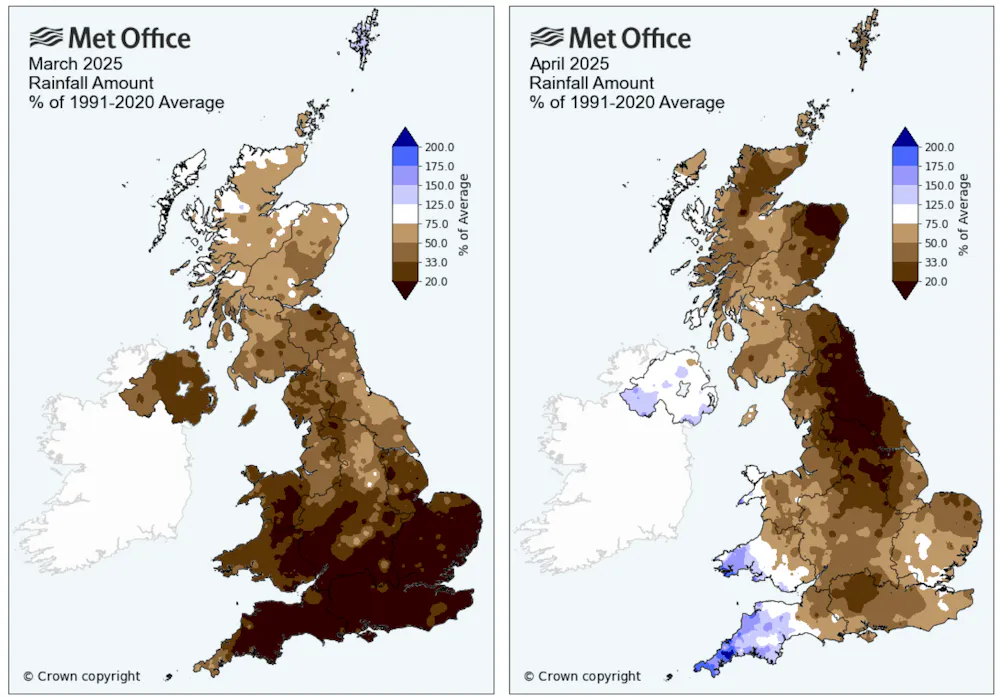
    Meteorologists are warning of the potential for a summer drought, as the UK has seen roughly half its usual amount of rainfall for March and April. While farmers fret about this year’s harvest, some water companies are urging customers to help reservoir levels recover by limiting water use.

    Meanwhile, wildfires have engulfed forest and moorland in areas of Scotland, Wales and England.

    Most of the UK has experienced a record-dry spring so far.
    Met Office

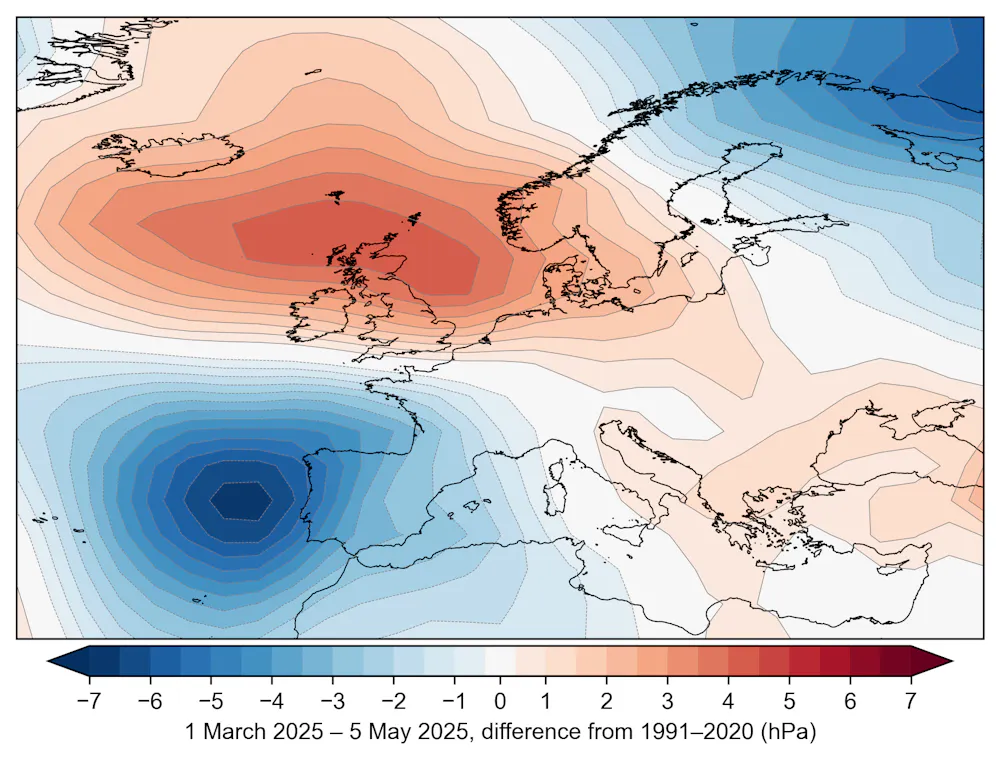
    For several weeks, a stubborn area of high pressure over the UK has diverted the usual flow of mild, moist air from the North Atlantic like a boulder in a river. This is known as a blocking weather system.

    Within it, air descends, warms and dries, which is why this weather pattern tends to be linked to heatwaves and drought. Blocking is usually persistent, making it seem like the weather is stuck.

    Here’s how climate change may have played a role in setting up this unusual spring.


    Get your news from actual experts, straight to your inbox. Sign up to our daily newsletter to receive all The Conversation UK’s latest coverage of news and research, from politics and business to the arts and sciences. Join The Conversation for free today.


    The human fingerprint

    The warming climate means that unusually warm weather is occurring more often and becoming more intense. At the same time, we can expect more periods of both severe drought and extreme rainfall. Sudden changes from drought to deluge, termed “weather whiplash”, are due to the intensification of the water cycle in a warmer atmosphere that can hold more water vapour.

    However, certain weather patterns are necessary to produce extreme weather. More blocking events in future could increase the chance of heatwaves or drought. But are blocking weather patterns becoming more common?

    It’s difficult to determine how weather patterns will change as a result of the rising concentration of greenhouse gases in the atmosphere, which is predominantly caused by the burning of fossil fuels.

    Part of the difficulty arises from the fact that weather patterns vary year to year. Several years in a row with more blocking events than usual could make it seem like blocking is increasing due to climate change, but it could simply be down to chance.

    As a result, it is difficult to detect the fingerprint of human activity from weather observations alone. For example, blocking weather patterns over Greenland during summer have happened more often in recent decades, which can enhance the melting of the ice sheet. But it isn’t clear that this trend is the result of human-induced climate change.

    Climate models do suggest future changes in the occurrence of blocking, however. These computer simulations, consisting of equations that describe the fundamental physics of the atmosphere, are the main tool scientists use to perform experiments that parse how the climate will behave in future.

    The blocking system is visible in the area of high pressure over Britain and Ireland.
    National Centers for Environmental Prediction/National Center for Atmospheric Research/NOAA Physical Sciences Laboratory, CC BY

    When scientists run climate model simulations with increased greenhouse gas concentrations the results consistently show a decrease in blocking events. But blocking generally happens more often in real life than model simulations, which reduces the confidence scientists have in future projections.

    Keeping track of the jet stream

    The movement of weather systems in Earth’s mid-latitudes – including over the UK – is linked to the jet stream, which is a fast-flowing river of air driven by the contrast in temperature between the poles and mid-latitudes.

    Some researchers have suggested that, because the Arctic is warming faster than the tropics, the jet stream may weaken and become more “wavy”, increasing the occurrence of blocking events, contrary to what most climate models show.

    Outside of the scientific community, this idea has become popular. However, the hypothesis remains controversial among scientists, and observational evidence has weakened in recent years.

    In fact, tens of kilometres above the Earth’s surface, near commercial aircraft cruising altitudes, the opposite trends are occurring: the temperature difference between the Arctic and mid-latitudes is increasing, acting to increase the strength of the jet stream.

    There are considerable challenges with understanding how climate change is affecting the large-scale atmospheric patterns which drive the weather we experience. These include large natural variability and imperfect climate models. Models mostly suggest a decline in blocking events with climate change, though this remains relatively uncertain compared with other aspects of the science.

    Overall, we can be confident that climate change is bringing warmer conditions in all seasons. Scientists also have strong evidence to suggest that drought conditions will become more common. These changes are already affecting food production, energy generation and water availability and these impacts will continue to worsen with climate change.


    Don’t have time to read about climate change as much as you’d like?

    Get a weekly roundup in your inbox instead. Every Wednesday, The Conversation’s environment editor writes Imagine, a short email that goes a little deeper into just one climate issue. Join the 45,000+ readers who’ve subscribed so far.


    Simon H. Lee has received funding from the Natural Environment Research Council and the National Science Foundation.

    Matthew Patterson receives funding from the Natural Environment Research Council in the UK via the the National Centre for Atmospheric Science.

    ref. How the weather got ‘stuck’ over the UK – and produced an unusually dry and warm spring – https://theconversation.com/how-the-weather-got-stuck-over-the-uk-and-produced-an-unusually-dry-and-warm-spring-255987

    MIL OSI – Global Reports

  • MIL-OSI Russia: Brazilian President’s visit to China is of great importance – Chinese Foreign Ministry

    Translation. Region: Russian Federal

    Source: People’s Republic of China in Russian – People’s Republic of China in Russian –

    Source: People’s Republic of China – State Council News

    BEIJING, May 12 (Xinhua) — Brazilian President Luiz Inacio Lula da Silva’s visit to China is of great significance amid the current chaotic transformation of the international situation, Chinese Foreign Ministry spokesperson Lin Jian said Monday.

    Noting that China and Brazil are both large developing countries, key emerging markets and important members of the BRICS group and the Global South, the diplomat pointed out that China-Brazil ties have always been at the forefront of China’s development relations with developing countries.

    At the invitation of Chinese President Xi Jinping, Lula da Silva is on a state visit to China from May 10 to 14.

    As Lin Jian also recalled, last year China and Brazil celebrated the 50th anniversary of the establishment of diplomatic relations.

    During President Xi Jinping’s successful state visit to Brazil in 2024, the two heads of state jointly announced the elevation of bilateral relations to a China-Brazil community of shared future for a fairer world and a more sustainable planet, and the alignment of the Belt and Road Initiative with Brazil’s development strategies, Lin Jian said, stressing that bilateral ties have entered a new historical period.

    “President L.I. Lula da Silva is the leader of a major Latin American country and an experienced international political figure with significant influence,” the official representative emphasized, adding that this is the Brazilian leader’s sixth visit to China and the second since 2023.

    Lin Jian said that this visit will further enrich the strategic content of the China-Brazil community with a shared future and demonstrate the firm will and responsibility of China and Brazil to lead countries in the Global South in strengthening solidarity and cooperation, and promote stability and prosperity in the region and the world.

    In addition, the representative of the Chinese Ministry of Foreign Affairs reported that during the visit, President L.I. Lula da Silva will also attend the opening ceremony of the 4th ministerial meeting of the China-CELAC Forum (Community of Latin American and Caribbean States).

    China attaches great importance to Brazil’s important role in LAC affairs and is willing to work with the Brazilian side to promote new progress in building a China-LAC community with a shared future, Lin Jian concluded. –0–

    MIL OSI Russia News

  • MIL-OSI Russia: Former Philippine President R. Duterte Wins Davao Mayoral Race in Midterm Elections: Preliminary Results

    Translation. Region: Russian Federal

    Source: People’s Republic of China in Russian – People’s Republic of China in Russian –

    Source: People’s Republic of China – State Council News

    MANILA, May 12 (Xinhua) — Former Philippine President Rodrigo Duterte has won again the Davao City mayoral race in the 2025 midterm elections, preliminary results showed late Monday.

    According to the Philippine Elections Commission, which was reported by local media, after more than 60 percent of the ballots were counted, Duterte won a comfortable lead, garnering 405,000 votes compared to his closest rival’s 49,000.

    The former president was arrested in March at Manila International Airport and then taken to the International Criminal Court in The Hague, the Netherlands, where he remains in custody.

    Under Philippine electoral law, a candidate can only be disqualified from running for office on the basis of a criminal conviction in a local court. –0–

    MIL OSI Russia News

  • MIL-OSI Russia: Power outages disrupt London Underground service

    Translation. Region: Russian Federal

    Source: People’s Republic of China in Russian – People’s Republic of China in Russian –

    Source: People’s Republic of China – State Council News

    LONDON, May 12 (Xinhua) — A power outage hit the London Underground on Monday afternoon, causing widespread disruption to public transport across the British capital, Transport for London (TfL) confirmed.

    TfL confirmed that disruption was affecting several parts of the Underground network, with services suspended on major lines including Bakerloo, Waterloo and City, and others experiencing major delays and partial suspensions.

    A TfL spokesman said the outage occurred in south-west London and “everything went down” due to “an issue with the National Grid”.

    “Some passengers may have had to spend some time in the tunnels,” a TfL spokesman said.

    TfL said work was currently underway to restore services and get the Tube back online. –0–

    MIL OSI Russia News

  • MIL-OSI United Kingdom: Joint statement on India-Pakistan conflict

    Source: City of Leeds

    Comment issued by civic and faith leaders in Leeds

    “As civic and faith leaders in Leeds, we welcome news of the ceasefire in hostilities between India and Pakistan following the recent terrorist attack in Pahalgam, Kashmir.

    “Terrorism in any form goes against the values of humanity. We condemn all forms of terrorism affecting any communities and countries across the world.

    “We affirm our commitment to stand together at this time of increased tension between India and Pakistan.

    “We are deeply saddened and troubled by the loss of lives, property and livelihoods. Our hearts go out to all those who have been injured, those who are grieving and those who are living in fear of further attacks. We recognise that many in Leeds will also be worried for family and friends in the affected areas. We pray for everyone caught up in the conflict.

    “We have a strong and enduring history in Leeds of caring for one another and of acting responsibly in the face of international events that shake us. We will not let these tensions disrupt the peace we cherish in our neighbourhoods and communities.

    “The faith leaders of Leeds stand firmly against any form of extremism affecting any community in our city. We urge our communities to reject division and to avoid provocation. We would ask all those in our communities to seek to de-escalate tension, recognising our love for our neighbours, reaching out to one another in mutual respect and care. Together, we reaffirm our commitment to peace and concord and to standing against hatred and division.

    “We call on international leaders to continue taking steps to de-escalate the situation through dialogue. Escalation will only lead to the suffering of more innocent people, and everything must be done to prevent further harm.

    “We are a proud city where people of many backgrounds, faiths, and cultures live side by side. Hate has no place on our streets and together we issue this collective call for peace. We have not much control over what is happening internationally, but we can continue to live as neighbours who care for one another and our shared neighbourhoods.

    “In this great city which we all call home, we stand shoulder to shoulder – as part of Team Leeds. One community, one voice, one people. We call on all parties to pray and to work tirelessly for a just peace.”

    Signatories:

    Councillor Abigail Marshall Katung – Lord Mayor of Leeds

    Councillor James Lewis – Leader Leeds City Council

    Ed Whiting – Chief executive Leeds City Council

    Councillor Oliver Edwards – Faith, Religion and Belief Champion

    The Rt. Revd. Arun Arora – Chair Leeds Faith Forum

    Qari Assim MBE – Leeds Faith Forum

    Rasool Bhamani – Leeds Faith Forum

    Dharmesh Mistry – Leeds Faith Forum

    Simon Phillips – Vice Chair Leeds Faith Forum

    Girish Sonigra – Leeds Faith Forum

    Chiragi Solanki – Leeds Faith Forum

    Nirav Thakker – Leeds Faith Forum

    ENDS 

    For media enquiries please contact:

    Leeds City Council communications and marketing,

    Email: communicationsteam@leeds.gov.uk

    Tel: 0113 378 6007

    MIL OSI United Kingdom

  • MIL-OSI Global: The Moomins drift through time like a myth – that’s why they resist meaning and endure

    Source: The Conversation – UK – By Steve Nash, Lecturer in Literature, Media, and Creative Writing, Leeds Beckett University

    The Moomins may look like hippos in aprons and top hats, but they’re more than just adorable characters from children’s books. Over the decades, these gentle creatures have become part of a living mythology – one that drifts across time, borders and generations.

    Created by Finnish-Swedish author Tove Jansson in the 1940s, the Moomins live in stories that blur the lines between fairy tale, folk wisdom and quiet philosophy. And perhaps that’s the secret to their enduring appeal: they resist being pinned down.

    Unlike traditional children’s characters tied to a tidy moral or neat storyline, the Moomins meander literally and metaphorically. Their world is one of seasonal migrations, long silences, floods, comets and unexpected departures.


    This is part of a series of articles celebrating the 80th anniversary of the Moomins. Want to celebrate their birthday with us? Join The Conversation and a group of experts on May 23 in Bradford for a screening of Moomins on the Riviera and a discussion of the refugee experience in Tove Jansson’s work. Click here for more information and tickets.


    Moominvalley isn’t a safe haven – it’s a landscape shaped by change. In that sense, Jansson’s stories echo something far older than modern literature: the mythic rhythms of Nordic storytelling, where time loops, endings blur and characters return in altered forms.

    A myth that moves

    The Viking sagas, for instance, were not written down at first but passed from voice to voice, reshaped with each telling. They weren’t concerned with tidy endings or moral clarity. Characters disappeared and reappeared. Time looped and fragmented.

    Similarly, Jansson’s stories don’t build to a climax. They wander. One book might end with a mystery, a quiet mood or a long silence. It’s a narrative style that feels strangely modern – and yet deeply ancient.

    Jansson herself resisted giving her stories a single message. In letters and interviews, she said she disliked moralising and preferred ambiguity. “A good story,” she wrote, “has no need to be explained; its truth lies in its telling, not in its conclusion.” That idea – of a truth that doesn’t depend on being pinned down – is at the heart of what makes the Moomins mythic.

    Of course, myths evolve. And the Moomins have evolved spectacularly. After the books found international success, the characters were adapted into Japanese anime, Nordic theatre, British radio and global branding campaigns.

    Each version tells a slightly different story. In Japan, the Moomins became symbols of warmth and nostalgia – gentle mascots of a simpler life. In the UK and US, early translations softened the melancholy and existential tones. More recently, new editions and critical reappraisals have returned to Jansson’s deeper themes of loss, solitude and transformation.

    The many lives of the Moomins

    This global journey has parallels with the evolution of Viking mythology. Once oral stories shared around fires, Norse myths have been repackaged for everything from national pride to Hollywood action. Like the Moomins, they’ve become flexible cultural symbols – used and re-used in ways that often have little to do with their original context.

    But unlike the fierce warriors of Norse myth, the Moomins are gentle, uncertain creatures. They worry. They drift. They don’t fight monsters – they reflect, explore, adapt. In Moominland Midwinter, Moomintroll wakes from hibernation to find the world cold and unfamiliar.

    His journey isn’t about conquering the landscape, it’s about learning how to live in it. That emotional honesty resonates with readers of all ages. It also reflects something uniquely Nordic: an existential awareness of solitude, change and survival.

    Folklore, loneliness and the Groke

    One character, the Groke, captures this beautifully. She’s a shadowy figure who creates frost wherever she walks. She’s not a villain, she’s just lonely. Children often fear her, but readers grow to understand her.

    She recalls Nordic spirits like the huldra or tomte – ghostly beings that live in the forests, blurring the line between human and otherworldly. In Jansson’s hands, this folklore becomes a way to explore anxiety, estrangement and the human need for warmth.

    The Moomins’ refusal to settle – geographically or philosophically – also speaks to today’s world of cultural fluidity. Jansson was from Finland’s Swedish-speaking minority and grew up between languages, cultures and post-war upheaval.

    Her books reflect that liminal identity, and they’ve found a home among readers who don’t always fit neatly into one place. That might be why the Moomins are particularly popular in countries dealing with identity shifts or cultural nostalgia.

    A myth for a shifting world

    As with all mythologies, there’s also a commercial side. The Moomins are now a global brand, with theme parks, merchandise, museums and a thriving fanbase. Some of this has softened their original complexity.

    But even through plush toys and animation, something essential remains: the feeling that these characters, like the stories they inhabit, can’t be reduced to one message. They are always slightly mysterious, slightly out of reach.

    In a world that often demands quick answers and strong opinions, the Moomins offer something gentler: ambiguity, openness and quiet reflection. They remind us that not all stories are meant to be solved with a neat conclusion. Some are meant to be returned to – revisited like familiar places in the mind, reshaped each time we arrive.

    That’s what makes the Moomins mythic. Not just their age or popularity, but their ability to change – and to change us – with every retelling. They invite us to wander, like Snufkin, and to sit still, like Moominmamma.

    They show us that myth isn’t just about gods and monsters – it’s about living with uncertainty, embracing return, and finding meaning in the stories that help us feel at home in the world.

    Steve Nash works for Leeds Beckett University.

    ref. The Moomins drift through time like a myth – that’s why they resist meaning and endure – https://theconversation.com/the-moomins-drift-through-time-like-a-myth-thats-why-they-resist-meaning-and-endure-254742

    MIL OSI – Global Reports

  • MIL-OSI Global: Nineteen Eighty-Four and Brave New World should be read in tandem to understand today’s troubled times

    Source: The Conversation – UK – By Emrah Atasoy, Associate Fellow of English and Comparative Literary Studies & Honorary Research Fellow of IAS, University of Warwick

    Is there any past work of fiction that can help us make sense of today’s troubling trends? Taking into account the proliferation of references to obfuscating “Newspeak”, Big Brother-style leaders and impossible-to-circumvent surveillance systems in newspaper articles, this question cries out for a simple answer: “Yes – and that work is George Orwell’s Nineteen Eighty-Four.”

    People on both the political left and right see Orwell’s 1949 novel as the book from the last century that speaks to the present most powerfully. But there are others who regard consumer culture and social media obsession as the primary concerns of today. They have a different answer: “Yes – and that work is Aldous Huxley’s Brave New World.”

    We, however, think the answer is “both”.


    Looking for something good? Cut through the noise with a carefully curated selection of the latest releases, live events and exhibitions, straight to your inbox every fortnight, on Fridays. Sign up here.


    In the long-running debate over who was the most prophetic writer of their era, Orwell, who was a pupil of Huxley’s at Eton, is generally the favourite.

    One reason for this is that international alliances that long seemed stable are now in flux. In Nineteen Eighty-Four, his final novel, Orwell envisioned a future tri-polar world divided into competing blocks with shifting allegiances.

    In the short time since the US president, Donald Trump, began his second term, his policies and statements have triggered surprising realignments. The US and Canada, close partners for more than a century, have faced off against each other. And in April, an official from Beijing joined with his counterparts from South Korea and Japan to push back as an unlikely trio against Trump’s new tariffs.

    That is perhaps why there is a booming field of “Orwell studies”, with its own academic journal, but not “Huxley studies”. It also probably explains why Nineteen Eighty-Four, but not Brave New World, keeps making its way on to bestseller lists – sometimes in tandem with Margaret Atwood’s The Handmaid’s Tale (1985). “Orwellian” (unlike the rarely heard “Huxleyan”) has few competitors other than “Kafkaesque” as an immediately recognisable adjective linked to a 20th-century author.

    Trailer for the film 1984, an adaptation of Orwell’s novel.

    As wonderful as Atwood and Kafka are, we are convinced that combining Orwell’s vision with Huxley’s offers scope for deeper analysis. This is true in part because of, not despite, how common it has been to contrast the modes of autocracy Orwell and Huxley describe.

    Orwellian and Huxleyan visions as one world

    We live in an era when all sorts of systems of control limit our freedoms of expression, identity and religion. Many do not quite fit the template that either Orwell or Huxley imagined, but instead combine elements.

    There are certainly places, such as Myanmar, where those in power rely on techniques that immediately bring Orwell to mind, with his focus on fear and surveillance. There are others, such as Dubai, that more readily evoke Huxley, with his focus on pleasure and distraction. In many cases, though, we find a mixture.

    This is especially clear if you take a global view. That’s something we specialise in as international and interdisciplinary researchers – a literary scholar from Turkey based in the UK, and a Californian cultural historian of China who has also published on southeast Asia.

    Like Orwell, Huxley wrote many books that were not dystopian fiction, but his foray into that genre became his most influential. Brave New World was well known throughout the cold war. In courses and commentaries, it was commonly paired with Nineteen Eighty-Four as a narrative illustrating a shallow society based on indulgence and consumerism, as opposed to the bleaker Orwellian world of suppression of desire and strict control.

    While it is common to approach the two books via their contrasts, they can be treated as interconnected and entangled works as well.

    Trailer for an adaptation of Brave New World, released in 2020.

    During the cold war, some commentators felt that Brave New World showed where capitalist consumerism in the age of television could lead. The west, according to this interpretation, could become a world in which autocrats like those in the novel stayed on top. They would do this by keeping people busy and divided among themselves, happily distracted by entertainment and the drug “soma”.

    Orwell, by contrast, seemed to provide a key to unlock the harder mode of control in non-capitalist, Communist Party-run lands, especially those of the Soviet bloc.

    Huxley himself in Brave New World Revisited, a non-fiction book he published in the 1950s, thought it was important to think about ways the techniques of power and societal engineering in the two novels could be combined, approached and analysed. And there is even more value in combining the approaches now, when capitalism has gone so global and the autocratic wave keeps reaching new shores in the so-called post-truth era.

    Orwellian hard-edged and Huxleyan soft-edged approaches to control and social engineering can be and often are combined. We see this within countries such as China, where the crude repressive methods of a Big Brother state are used against the Uyghur population, while cities such as Shenzhen evoke Brave New World.

    We see this mixing of dystopian elements in many countries – variations on the way that science fiction writer William Gibson, author of novels such as Neuromancer (1984), wrote about Singapore with a phrase that had a soft-edged first half and a hard-edged second: “Disneyland with the death penalty.”

    This can be a useful first step toward better understanding, and perhaps beginning to try to find a way of improving the troubling world of the mid-2020s. A world in which the smartphone in your pocket both keeps track of your actions and provides an endless set of enticing distractions.

    The authors do not work for, consult, own shares in or receive funding from any company or organisation that would benefit from this article, and have disclosed no relevant affiliations beyond their academic appointment.

    ref. Nineteen Eighty-Four and Brave New World should be read in tandem to understand today’s troubled times – https://theconversation.com/nineteen-eighty-four-and-brave-new-world-should-be-read-in-tandem-to-understand-todays-troubled-times-253872

    MIL OSI – Global Reports

  • MIL-OSI Global: UK’s India trade deal offers wider access to a surging economy – and could make food imports cheaper

    Source: The Conversation – UK – By Sangeeta Khorana, Professor of International Trade Policy, Aston University

    India’s economy is growing rapidly. Radiokafka/Shutterstock

    After more than three years and 14 rounds of negotiations, the UK and India have finally announced a free trade agreement (FTA). UK Prime Minister Keir Starmer will formally sign the deal on a visit to India later this year. This is the biggest and most economically significant bilateral trade deal the UK has struck since leaving the EU. It will have implications for both businesses and workers.

    In 2024, the UK’s trade with India was worth £43 billion – £17.1 billion of exports and £25.5 billion of imports. Government modelling estimates that trade between the nations will increase by as much as 39% and the UK’s GDP will expand by £4.8 billion or 0.1 percentage points per year as a result.

    India’s economy is growing fast. It is expected to expand by 6% annually, becoming the world’s third largest economy by 2028 after the US and China. This certainly makes the deal with the UK very timely.

    With a population of more than 1.4 billion and a growing middle class, the country offers huge market potential. Its import demand is predicted to grow by 144% between 2021 and 2035. This combination of strong economic growth and increasing numbers of citizens with disposable cash makes a compelling case for the deal.


    Get your news from actual experts, straight to your inbox. Sign up to our daily newsletter to receive all The Conversation UK’s latest coverage of news and research, from politics and business to the arts and sciences. Join The Conversation for free today.


    Both the UK and India have agreed to reduce tariffs under the deal. India will immediately lower its 150% tariffs on Scotch whisky and gin to 75%, and then to 40% within ten years. Tariffs on foodstuffs such as lamb, salmon and cheeses will fall from around 30% to zero.

    Simplified trade rules, including faster customs processing, reduced barriers such as complex labelling requirements, and enhanced support for small businesses should bring gains for companies. Timely customs clearance will support exports of perishable items like Scottish salmon, where delays reduce the product’s shelf life. Similarly, exporters of things like biscuits and cheese will benefit from streamlined paperwork and be able to compete in India’s growing market.

    There will no longer be limits on the number of UK businesses allowed to provide telecommunications, environmental and construction services. And UK businesses will not need to set up a company in India or be a resident in India to supply their services in these sectors.

    Once the FTA comes into force, which could take up to a year, the UK will allow 99% of Indian imports duty-free access into the UK. The sectors set to benefit most are footwear, textiles and clothing, as well as processed prawns, basmati rice and ready meals. These reductions will mean lower prices for UK consumers, given tariffs on clothing and footwear are 12% and 16% respectively.

    Clothing and textile imports to the UK will have tariff-free access.
    Yevhen Prozhyrko/Shutterstock

    Tariffs on luxury cars will also be reduced from more than 100% to 10% under quotas on both sides. The FTA locks in zero tariffs on industrial machinery, advanced materials for use in hi-tech industries, and components for electric vehicles. This will position British suppliers inside a manufacturing market ranked the world’s second-most attractive after China.

    In terms of workers, there were well publicised fears that the agreement might lead to UK workers being undercut by Indian counterparts. Plans for a so-called “double contribution convention” grants a three-year exemption from national insurance contributions for Indian employees temporarily working in the UK. But this is a reciprocal deal and is likely to apply only to workers who are seconded from one country to the other, so should not result in UK workers being more expensive to hire.

    And although no changes to immigration policy are planned, the FTA will offer easier movement for skilled workers. UK providers of services like construction and telecoms will have access to India’s growing market.

    Both countries have committed to encouraging the recognition of professional qualifications. A professional services working group for UK and Indian government officials will provide a forum to monitor and support this initiative.

    Timing is everything

    Against a backdrop of rising protectionism and geopolitical tensions, the UK-India FTA stands out as a strategic deal. It is also a significant milestone in Britain’s Indo-Pacific “tilt”. This approach gives UK firms a hedge against over-reliance on any single region or country-centric supply chains, to keep trade flowing in the event of more US tariff shocks, for example.

    With the US fixation on tariffs, and global supply chains facing continued disruption, securing preferential access to the world’s fastest-growing major economy is a strategic win for the UK. From India’s perspective, the trade deal is aligned with its rise as a “China-plus-one” manufacturing hub (where businesses diversify to ensure they do not invest only in China).

    The UK and India share historical ties that are underpinned by cultural, educational and people-to-people links. The UK-India FTA marks a new phase in this relationship, where shared economic interests define a forward-looking partnership between the two countries.

    And in terms of its ongoing talks with the EU, India could use the agreement to showcase its willingness to negotiate ambitious trade deals. For the UK, given its own upcoming trade and cooperation talks with the EU, the FTA with India demonstrates that new partnerships can be built while maintaining vital European ties.

    Sangeeta Khorana has received funding from UK-ESRC, EU and other international organisations. She is affiliated with Chartered Institute of Export and International Trade as a Trustee Director.

    ref. UK’s India trade deal offers wider access to a surging economy – and could make food imports cheaper – https://theconversation.com/uks-india-trade-deal-offers-wider-access-to-a-surging-economy-and-could-make-food-imports-cheaper-256387

    MIL OSI – Global Reports

  • MIL-OSI Global: From Zoo Quest to Ocean: The evolution of David Attenborough’s voice for the planet

    Source: The Conversation – UK – By Neil J. Gostling, Associate Professor in Evolution and Palaeobiology, University of Southampton

    Over the course of seven decades, Sir David Attenborough’s documentaries have reshaped how we see the natural world, shifting from colonial-era collecting trips to urgent calls for environmental action.

    His storytelling has inspired generations, but has only recently begun to confront the scale of the ecological crisis. To understand how far nature broadcasting has come, it helps to return to where it started.

    When Attenborough’s broadcasting career began in the 1950s, Austrian filmmakers Hans and Lotte Hass were already pushing the boundaries of what was possible by taking cameras below the sea and touring the world aboard their schooner, the Xafira.

    In one of their 1953 Galapagos films, a crewman handled a sealion pup, having crawled across the volcanic rock of Fernandina honking at sealions to attract them. A penguin and giant tortoise were brought on board Xafira. And as Lotte Hass took photographs, she’d beseech some poor creature to “not be frightened” and “look pleasant”.

    This is a world away from today’s expectations, where both research scientists and amateur naturalists are taught to observe without touching or disturbing wildlife. When the Hasses visited the Galápagos, it was still five years before the creation of the national park and the founding of the island’s conservation organisation Charles Darwin Foundation. Now, visitors must stay at least two metres from all animals – and never approach them.


    Get your news from actual experts, straight to your inbox. Sign up to our daily newsletter to receive all The Conversation UK’s latest coverage of news and research, from politics and business to the arts and sciences. Join The Conversation for free today.


    At the same time, television was beginning to shape public perceptions of the natural world. In 1954, Attenborough was working as a young producer on Zoo Quest. By chance, he became its presenter when zoologist Jack Lester became ill.

    The programme followed zoologists collecting animals from around the world for London Zoo. Zoo Quest was filmed in exotic locations around the world and then in the studio where the animals found on the expedition were shown “up close”.

    Attenborough has since acknowledged that Zoo Quest reflected attitudes that would not be acceptable today. The series showed animals being captured from the wild and transported to London Zoo – practices which mirrored extractive, colonial-era approaches to science.

    David Attenborough’s Zoo Quest for a Dragon aired in 1956.

    Yet, Zoo Quest was also groundbreaking. The series brought viewers face-to-face with animals they might never have seen before and pioneered a visual style that made natural history television both entertaining and educational. It helped establish Attenborough’s reputation as a compelling communicator and laid the foundations for a new genre of science broadcasting – one that has evolved, like its presenter, over time.

    After a decade in production, Attenborough returned to presenting with Life on Earth (1979), a landmark series that traced the evolution of life from single-celled organisms to birds and apes. Drawing on his long-standing interest in fossils, the series combined zoology, palaeobiology and natural history to create an ambitious new template for science broadcasting.

    Life on Earth helped cement Attenborough’s reputation as a trusted communicator and became the foundation of the BBC’s “blue-chip” natural history format – big-budget, internationally produced films that put high-quality cinematic wildlife footage at the forefront of the story. The series did not simply document the natural world. It reframed it, using presenter-led storytelling and global spectacle to shape how audiences understood evolutionary processes.

    For much of his career, Attenborough has been celebrated for showcasing the beauty of the natural world. Yet, he has also faced criticism for sidestepping the environmental crises threatening it. Commentators such as the environmental journalist George Monbiot argued that his earlier documentaries, while visually stunning, often avoided addressing the human role in climate change, presenting nature as untouched and avoiding difficult truths about ecological decline.

    Building on the legacy of Life on Earth, Attenborough’s later series began to respond to these critiques. Blue Planet (2001) expanded the scope of nature storytelling, revealing the mysteries of the ocean’s most remote and uncharted ecosystems. Its 2017 sequel, Blue Planet II, introduced a more urgent tone, highlighting the scale of plastic pollution and the need for marine conservation.

    Although Blue Planet II significantly increased viewers’ environmental knowledge, it did not lead to measurable changes in plastic consumption behaviour – a reminder that awareness alone does not guarantee action. The subsequent Wild Isles (2023) continued the shift towards conservation messaging. While the main series aired in five parts, a sixth episode – Saving Our Wild Isles – was released separately and drew controversy amid claims the BBC had sidelined it for being too political. In reality, the episode delivered a clear call to action.

    Attenborough’s latest film, Ocean, continues in this more urgent register, pairing breathtaking imagery with an unflinching assessment of ocean health. After decades of gentle narration, he now speaks with sharpened clarity about the scale of the crisis and the need to act.

    A voice for action

    In recent years, Attenborough has taken on a new role – not just as a broadcaster, but as a powerful voice in environmental diplomacy. He has addressed world leaders at major summits such as the UN climate conference Cop24 and the World Economic Forum, calling for urgent action on climate change. He was also appointed ambassador for the UK government’s review on the economics of biodiversity.

    On the subject of environmemtal diplomacy, Monbiot recently wrote: “A few years ago, I was sharply critical of Sir David for downplaying the environmental crisis on his TV programmes. Most people would have reacted badly but remarkably, at 92, he took this and similar critiques on board and radically changed his approach.”

    Attenborough not only speaks. He listens. This is part of his charm and popularity. He is learning and evolving as much as his audience.

    What makes Attenborough stand out is the way he speaks. While official climate treaties often rely on technical or legal language, he communicates in emotional, accessible terms – speaking plainly about responsibility, urgency and the moral imperative to protect life on Earth. His calm authority and familiar voice make complex issues easier to grasp and harder to dismiss.

    Frequently named Britain’s most trusted public figure, Attenborough has become something of an unofficial diplomat for the planet – apolitical, measured, and often seen as a voice of reason amid populist noise. Despite his criticisms, Attenborough’s documentaries walk a careful line between fragility and resilience, using emotionally ambivalent imagery to prompt reflection. He shares his wonder with the natural world and brings people along with him

    Ocean shows our blue planet in more spectacular fashion than Lotte and Hans Hass could ever have imagined. But it is also Attenborough’s most direct reckoning with environmental collapse. With clarity and urgency, it confronts the damage wrought by industrial trawling and habitat destruction.

    After 70 years of gently guiding viewers through the natural world, Attenborough’s voice has sharpened. If he once opened our eyes to nature’s wonders, he now challenges us not to look away. As he puts it: “If we save the sea, we save our world. After a lifetime filming our planet, I’m sure that nothing is more important.”


    Don’t have time to read about climate change as much as you’d like?

    Get a weekly roundup in your inbox instead. Every Wednesday, The Conversation’s environment editor writes Imagine, a short email that goes a little deeper into just one climate issue. Join the 45,000+ readers who’ve subscribed so far.


    The authors do not work for, consult, own shares in or receive funding from any company or organisation that would benefit from this article, and have disclosed no relevant affiliations beyond their academic appointment.

    ref. From Zoo Quest to Ocean: The evolution of David Attenborough’s voice for the planet – https://theconversation.com/from-zoo-quest-to-ocean-the-evolution-of-david-attenboroughs-voice-for-the-planet-251727

    MIL OSI – Global Reports

  • MIL-OSI United Kingdom: Immigration White Paper oral statement

    Source: United Kingdom – Executive Government & Departments

    Oral statement to Parliament

    Immigration White Paper oral statement

    The Home Secretary giving an oral statement to the House of Commons on 12th May to introduce the ‘Restoring Control over the Immigration System’ White Paper.

    Madam Deputy Speaker, with your permission, I will make a statement on the government’s White Paper on Restoring Control over the Immigration System.

    Five months ago, the figures were published that showed net migration had reached a record high of more than 900,000 under the last Conservative government – a figure that had quadrupled in the space of just four years.

    It was the consequence of specific government choices made from 2020 onwards, including introducing what was effectively a free market experiment on immigration – encouraging employers to recruit from abroad, loosening controls in different areas but without any requirement to tackle skills and labour shortages here at home. Choices which undermined the immigration system and the economy too.

    This government is making very different choices. We made clear at that time, just as we had set out in our manifesto, this government would restore order and control to the immigration system, bringing net migration substantially down but also boosting skills and training here at home.

    The White Paper we are publishing today does exactly that and it is built on five core principles.

    First, that net migration must come down so the system is properly managed and controlled.

    Second, that the immigration system must be linked to skills and training here in the UK, so that no industry is allowed to rely solely on immigration to fill its skills shortages. 

    Third, that the system must be fair and effective, with clearer rules in areas like respect for family life, to prevent perverse outcomes that undermine public confidence.

    Fourth, that the rules must be respected and enforced – including tackling illegal and irregular migration and deporting foreign criminals.

    And finally, that the system must support integration and community cohesion, including new rules on the ability to speak English and the contribution that people can bring to the UK.

    The United Kingdom is an interconnected and outward-looking nation. Our history and our geography mean that, for generations, British people have travelled overseas to live and work, and people have come to the UK to study, work, invest or seek refuge. And British citizens draw on heritage from all over the world and that has made us the country we are today.

    Through many years our country has been strengthened by those who have come here to contribute – from the doctors in our NHS to the entrepreneurs founding some of our biggest businesses to those who came through generations to work in jobs from coal mining to caring for our loved ones to serving in our armed forces. People often coming to do some of the most difficult jobs of all.

    Our trading nation, global leading universities and strong historic international connections mean that migration will always be part of our country’s future as well as our past.

    But that is exactly why immigration needs to be properly controlled and managed. It hasn’t been.

    Overseas recruitment shot up while training in the UK was cut.

    Lower skilled migration soared while the proportion of UK residents in work plummeted.

    In 2019 10% of skilled work visas went to non-graduate jobs; by 2024 that had risen to 60%.

    Employers were even given a 20% wage discount if they recruited for shortage jobs from abroad – actively discouraging them from paying the going rate or training here at home.

    Education institutions were allowed to substantially expand the number of overseas students without proper compliance checks.

    Social care providers were encouraged to recruit from abroad with no proper regulation.

    So we saw a serious increase in exploitation – deeply damaging for those who came to work here in good faith, and also for other workers and responsible companies who were being undercut.

    The rules and laws that are supposed to the immigration system were too often ignored.

    By 2024, returns of people with no right to be in the UK were down over a third compared to 2010.  

    And, of course, criminal gangs were allowed to build an entire smuggling industry along our borders, undermining security and creating a crisis in the asylum system.

    Madam Deputy Speaker, later this year we will set out further reforms on asylum and border security, and on tackling illegal and irregular migration, building on the new counter-terrorism powers in the Border Security, Asylum and Immigration Bill before the House this evening, because no one should be making these dangerous crossings on small boats.

    But this White Paper sets out how we restore that control to the legal migration system so it is sustainable, fair and works for the UK.

    First, we are overhauling the approach to labour market policy so for the first time we properly link the immigration system to skills and training here in the UK.

    So that where there are skills or labour shortages in the UK, immigration should not always be the answer to which employers turn. Because that long-term failure to tackle skills shortages, to bring in proper workforce planning, to get UK residents back into work, or to improve pay, terms and conditions here at home is bad for our economy as well as for the immigration system because it undermines our productivity and growth.

    So we will lift the threshold for skilled worker visas back to graduate level and above, removing up to 180 different jobs from the list, increasing salary thresholds.

    Access to the Points-Based System for lower skilled jobs will be limited to areas on a new Temporary Shortage List, including jobs which are critical to the Industrial Strategy, but access will be time limited. There must be a domestic workforce strategy in place, and employers must be acting to increase domestic recruitment.

    We will expect workforce strategies to be drawn up more widely in other higher skilled areas too where there is overreliance on recruitment from abroad.

    To support that work we will establish the new Labour Market Evidence Group, bringing together skills bodies from England, Scotland, Wales and Northern Ireland, the Department for Work and Pensions, the Industrial Strategy Council and the Migration Advisory Committee to gather and share evidence on shortage occupations in different parts of the country and also to highlight the role that skills, training, pay and conditions and other policies can play in improving domestic recruitment, so that increased migration is never again the only answer to the shortages the economy faces.

    This new approach means we also need to act on social care.

    The introduction of the Social Care Visa led not only to a huge increase in migration but also to a shameful and deeply damaging increase in abuse and exploitation.

    When proper checks were finally brought in, 470 care providers had their licence to sponsor international staff suspended. 39,000 care workers were displaced.

    Overseas recruitment for care jobs has since dropped but it must not surge like that again. And it’s time we addressed domestic issues, including a proper Fair Pay Agreement to show respect to people who do some of the most important jobs in the country.

    We are therefore ending overseas recruitment of care workers. It will continue to be possible to extend existing visas and to recruit displaced care workers and people already in the UK with working rights on other visas.

    Alongside the new visa controls and workforce strategies, we will also increase the Immigration Skills Charge paid by employers who recruit from abroad by 32%. That money will be invested through the Spending Review in supporting skills and training here in the UK.

    We will ensure that Britain continues to attract the brightest and best global talent, by enhancing visa routes for very high skilled individuals, top scientific and design talent, and people with the right experience to support growth in key strategic industries.

    Madam Deputy Speaker, international students bring huge benefits to the UK – supporting our world-leading universities, bringing in top talent and investment.

    But we will strengthen compliance requirements and checks to prevent visa misuse.

    Currently, too many people on the Graduate Visa are not doing graduate jobs. So we will reduce the unrestricted period from two years to 18 months. Those who want to stay will need to get a graduate job on a skilled worker visa so that we can ensure they are contributing to the economy.

    Just as our rules on work visas are based on the contribution we expect people to make when they come to our country, we will consult later this year on new earned settlement and citizenship rules that apply the same approach, extending the principles of the Points-Based System, doubling the standard qualifying period for settlement to ten years with provisions to qualify more swiftly that take account of the contribution people have made.

    Because the ability to speak English is integral to the ability for everyone to contribute and integrate, we will introduce new, higher language requirements across a range of visa routes, for both main applicants and their dependants. So family, too, can work, integrate and contribute.

    The system for family migration has become overly complex with policies increasingly developed around case law from court decisions rather than a coordinated framework set out by Parliament. So we will set out a new clearer framework, to be endorsed by Parliament, including clarifying how Article 8 rules should be interpreted and applied to prevent confusion or perverse conclusions.

    We will review current community sponsorship schemes that support recognised refugees and will continue to take action against trafficking and modern slavery. And we will shortly appoint a new Windrush Commissioner to ensure that Windrush lessons continue to be learnt and the Home Office also makes sure its standards are upheld.

    But the rules must be respected and enforced across the board. So we will also bring in stronger controls where there is evidence of visa misuse. We are also rolling out e-visas and digital ID, including better use of technology to monitor when people are overstaying on their visa, or to support the increase in illegal working raids. Since the election we have increased returns and we will go further.

    Those who come to our country must abide by our laws.

    So we will develop new procedures to ensure the Home Office is informed of all foreign nationals convicted of offences – not just those who go to prison – so we can also revoke visas and remove other offenders in a wide range of crimes who are abusing our system.

    Madam Deputy Speaker, already we are reducing the number of visas being granted this year, and updated figures will be published before the end of the month.

    Already we are increasing returns with over 24,000 people in the first 9 months, the highest 9-month period for eight years.

    The impact of the changes to skilled worker visas, care worker visas, settlement, students and English language is expected to reduce visas by around 100,000 a year. In addition, the new workforce strategies, Immigration Skills Charge, family and asylum reforms will further bring numbers down on top of that. And as the Prime Minister has said, where we need to go further to restore a sustainable system, we will.

    Conclusion

    In conclusion, Madam Deputy Speaker, throughout our history, Britain has been strengthened by people coming to start new businesses, study at our universities, contribute to our cultural and sporting excellence, and do some of the toughest, most essential jobs in our country.

    But to be successful, effective and fair, our immigration must be properly controlled and managed. This White Paper sets out how we will restore control, fairness and order to the system, how we will continue to bring net migration down, and how we will turn the page on the chaos and failure of the past. I commend this statement to the House.

    Updates to this page

    Published 12 May 2025

    MIL OSI United Kingdom

  • MIL-OSI United Kingdom: MHRA approves first UK treatment for congenital thrombotic thrombocytopenic purpura (cTTP) 

    Source: United Kingdom – Executive Government & Departments

    News story

    MHRA approves first UK treatment for congenital thrombotic thrombocytopenic purpura (cTTP) 

    As with all products, the MHRA will keep its safety under close review.

    The Medicines and Healthcare products Regulatory Agency (MHRA) has today (12 May 2025) approved rADAMTS13 (ADZYNMA), the first UK treatment to treat congenital thrombotic thrombocytopenic purpura (CTTP) in patients of all ages.  

    CTTP is a very rare inherited blood disorder in which blood clots form in small blood vessels throughout the body. These clots can block the flow of blood and oxygen to the body’s organs, which leads to a lower-than-normal number of platelets (components that help the blood to clot) in the blood. 

    This medicine has been approved through the International Recognition Procedure (IRP). The IRP allows the MHRA to take into account the expertise and decision-making of trusted regulatory partners for the benefit of UK patients.   

    The MHRA conducts a targeted assessment of IRP applications and retains the authority to reject applications if the evidence provided is not considered sufficiently robust.  

    As with any medicine, the MHRA will keep the safety and effectiveness of this medicine under close review. Anyone who suspects they are having a side effect from this medicine are encouraged to talk to their doctor, pharmacist or nurse and report it directly to the MHRA Yellow Card scheme, either through the website (https://yellowcard.mhra.gov.uk/) or by searching the Google Play or Apple App stores for MHRA Yellow Card.  

    Notes to editors    

    1. The marketing authorisation was granted on 12 May 2025 to Takeda UK Ltd. 

    2. More information can be found in the Summary of Product Characteristics and Patient Information leaflets which will be published on the MHRA Products website within 7 days of approval.    

    3. The Medicines and Healthcare products Regulatory Agency (MHRA) is responsible for regulating all medicines and medical devices in the UK by ensuring they work and are acceptably safe.  All our work is underpinned by robust and fact-based judgments to ensure that the benefits justify any risks.    

    4. The MHRA is an executive agency of the Department of Health and Social Care.    

    5. For media enquiries, please contact the newscentre@mhra.gov.uk, or call on 020 3080 7651.

    Updates to this page

    Published 12 May 2025

    MIL OSI United Kingdom

  • MIL-OSI: ASM announces the voting results of the 2025 Annual General Meeting

    Source: GlobeNewswire (MIL-OSI)

    Almere, The Netherlands
    May 12, 2025

    ASM International N.V. (Euronext Amsterdam: ASM) today announces the voting results of its Annual General meeting held on May 12, 2025, in the Van der Valk Hotel Almere, in Almere, the Netherlands.

    The shareholders approved all resolutions as proposed to the Annual General Meeting.

    The main resolutions include the following:

    • The annual accounts 2024 were approved and adopted.
    • A positive advisory vote was cast on the 2024 remuneration report.
    • A regular dividend of €3.00 per common share was approved.
    • Mr. Verhagen was reappointed as member of the Management Board for a two-year term.
    • Ms. Van der Meer Mohr and Mr. Sanchez were reappointed as members of the Supervisory Board for a second four-year term and Ms. Kahle-Galonske was reappointed as member of the Supervisory Board for a third term of one year.
    • EY Accountants B.V. was reappointed as auditor to audit the annual accounts for the financial year 2026 and appointed as assurance provider of sustainability information for the financial years 2025 and 2026.

    About ASM International

    ASM International N.V., headquartered in Almere, the Netherlands, and its subsidiaries design and manufacture equipment and process solutions to produce semiconductor devices for wafer processing, and have facilities in the United States, Europe, and Asia. ASM International’s common stock trades on the Euronext Amsterdam Stock Exchange (symbol: ASM). For more information, visit ASM’s website at www.asm.com.

    Contact

    Investor and media relations

    Victor Bareño
    T: +31 88 100 8500
    E: investor.relations@asm.com

    Investor relations

    Valentina Fantigrossi
    T: +31 88 100 8502
    E: investor.relations@asm.com

    The MIL Network

  • MIL-OSI USA: Kemp: April Net Tax Revenues Down 5.8%; Adjusted YTD Down 0.6%

    Source: US State of Georgia

    ATLANTA – The State of Georgia’s net tax collections in April approached $3.73 billion, for a decrease of $230.4 million, or 5.8%, compared to FY 2024, when net tax collections totaled $3.96 billion for the month. April 2025 individual and corporate income tax collections were impacted by the hurricane-related extension of filing and payment deadlines to May 1, 2025. Early May individual and corporate return payments have significantly exceeded those received during the same period in May 2024, indicating a large number of filers took advantage of the extended filing deadline. Year-to-date, net tax revenue totaled $27.77 billion for an increase of $312.2 million that was driven largely by the collection of the state’s motor fuel excise tax, which was suspended by Executive Order for a period of two and a half months during FY 2024. Adjusting for the year-over-year motor fuel tax changes, year-to-date net tax revenue collections for the period ending April 30 were down $154.2 million, or 0.6%.

    The changes within the following tax categories help to further explain April’s overall net tax revenue decrease:
     
    Individual Income Tax:  Individual Income Tax collections totaled $1.91 billion, for a decrease of $55.9 million, or 2.8%, compared to last year when Individual Tax collections totaled nearly $1.97 billion.

    The following notable components within Individual Income Tax combined for the net decrease:

    • Individual Income Tax refunds issued (net of voided checks) were down $115.1 million or 14.1%.
    • Individual Withholding payments were down $35.9 million, or 2.7%, from the previous fiscal year.
    • Individual Income Tax Return payments declined by $102.3 million, or 9.4%, from FY 2024.
    • All other Individual Tax categories, including Estimated payments, were down a combined $32.8 million.

    Sales and Use Tax:  Gross Sales and Use Tax collections totaled almost $1.65 billion in April, for an increase of $70.4 million, or 4.5%, compared to April 2024.  Net Sales and Use Tax increased by $40.5 million, or 5.1%, compared to last year, when net sales tax totaled $798.8 million.  The adjusted Sales Tax distribution to local governments totaled $798.8 million, for an increase of $33.8 million, or 4.4%, while Sales Tax refunds decreased by $3.9 million, or 25.7%, compared to FY 2024.

    Corporate Income Tax:  Corporate Income Tax collections for the month totaled $540.2 million, which was a decrease of roughly $207.9 million, or 27.8%, compared to FY 2024.

    The following notable components within Corporate Income Tax make up the net decrease:

    • Corporate Income Tax refunds issued (net of voids) were down $5.2 million, or 13.9%, from FY 2024.
    • Corporate Income Tax Return payments decreased by $84.5 million, or 29.2%, from last fiscal year.
    • Corporate Income Tax Estimated payments decreased by $112.1 million, or 30.8%, from April 2024.
    • All other Corporate Tax types, including S-Corporate payments, were down a combined $16.5 million.

    Motor Fuel Taxes:  Motor Fuel Tax collections increased by $6.6 million, or 3.4%, compared to FY 2024.

    Motor Vehicle – Tag & Title Fees:  Motor Vehicle Tag & Title Fees increased by $2.8 million, or 7.4%, for the month, while Title Ad Valorem Tax (TAVT) collections increased by $3.4 million, or 4.7%, over last year.

    MIL OSI USA News

  • MIL-OSI Russia: China Issues Regulations on Environmental Inspection Work

    Translation. Region: Russian Federal

    Source: People’s Republic of China in Russian – People’s Republic of China in Russian –

    Source: People’s Republic of China – State Council News

    BEIJING, May 12 (Xinhua) — The Communist Party of China Central Committee and the State Council recently issued the Regulations on Inspection Work in Ecological and Environmental Protection, replacing the previous version issued in 2019.

    As noted in the document, China seeks to fully utilize environmental inspection as a key tool for identifying and solving problems.

    The inspection work will focus on areas such as pollution prevention, green transformation of development models, environmental protection and restoration, as well as initiatives that contribute to achieving carbon peak and carbon neutrality.

    China has been steadily promoting its “Beautiful China” initiative, emphasizing environmental protection as a top priority in socio-economic development. –0–

    MIL OSI Russia News

  • MIL-OSI Russia: Breaking: Power outages disrupt London Underground service

    Translation. Region: Russian Federal

    Source: People’s Republic of China in Russian –

    Source: People’s Republic of China – State Council News

    LONDON, May 12 (Xinhua) — A power cut has hit the London Underground, causing widespread disruption to public transport across the British capital, Transport for London (TfL) confirmed on Monday.

    A TfL spokesman confirmed the disruption affected several sections of the Underground and admitted some passengers may have been temporarily stranded in tunnels. –0–

    MIL OSI Russia News

  • MIL-OSI: ZA Miner Responds to Market Growth With Enhanced Crypto Mining Infrastructure

    Source: GlobeNewswire (MIL-OSI)

    Image by ZA Miner

    MIDDLESEX, United Kingdom, May 12, 2025 (GLOBE NEWSWIRE) — Following recent gains in the cryptocurrency market, including Bitcoin’s climb above $78,000, mining activity is undergoing a marked resurgence. This renewed momentum has prompted various platforms to improve operational models, aiming to meet increased demand for accessible, secure, and efficient mining processes.

    One such platform, ZA Miner, has introduced a streamlined technical infrastructure designed to support users engaging in Bitcoin mining and other high-yield digital assets. Operating under FCA regulation, the platform adheres to key compliance protocols to provide transparency and data protection throughout its mining services.

    Recent analysis shows Bitcoin appreciating over 5% in a matter of days, contributing to wider market enthusiasm. This bullish phase has resulted in heightened user interest in mining pools that support the extraction of mainstream cryptocurrencies, including Ethereum. In response, ZA Miner has adjusted its operational model by optimizing mining rig performance and improving backend algorithms to accommodate increased activity levels.

    Instead of focusing on promotional offers, ZA Miner’s process prioritizes efficiency and structure. Users—ranging from entry-level participants to experienced miners—are presented with various mining contracts that differ in duration, hardware configuration, and daily income potential. All calculations, payouts, and settlements are automated and occur on a 24-hour cycle.

    For example, recent mining plans demonstrate a variety of contract lengths and projected returns. A short-term $500 contract spread over two days may yield approximately $60 in total income. More substantial investments, such as a $5,100 contract over three days, forecast daily income exceeding $190. These figures are derived from predefined computational outputs rather than speculative projections.

    Each transaction is encrypted and stored securely, reflecting the platform’s compliance with the Financial Conduct Authority’s guidelines. The integration of real-time analytics and risk management tools also enables users to make informed decisions based on current market conditions and expected volatility.

    The emphasis on platform integrity, performance optimization, and regulatory compliance underscores a broader trend in the cryptocurrency mining industry—where stability and transparency are becoming as critical as profitability.

    As market volatility continues to shape investment behavior, platforms like ZA Miner are focusing on system reliability and scalable solutions rather than incentives or promotions. This development reflects a more mature stage of mining operations, where user trust and regulatory oversight serve as cornerstones of growth.

    Media Contact:
    SHEIKH, Anisah Fatema
    ZA FUNDINGS LTD
    info@zaminer.com
    https://www.zaminer.com/

    A photo accompanying this announcement is available at https://www.globenewswire.com/NewsRoom/AttachmentNg/bc9c6ec3-7e54-4d74-a168-4fc770e02803

    The MIL Network

  • MIL-OSI: Solutions30 becomes majority shareholder of SO-TEC and strengthens its position in the photovoltaic market in France

    Source: GlobeNewswire (MIL-OSI)

    Solutions30, the European leader in multi-technical field services for the telecommunications, energy, and digital sectors, announces that it has increased its stake in SO-TEC, a French company specializing in the design and construction of structures for photovoltaic power plants. Following the initial 10% investment announced in May 2024, Solutions30 now holds 60% of SO-TEC’s capital and plans to increase this stake to 100% within the coming years, in line with the existing agreements with the company’s historical shareholders.

    This transaction marks a strategic milestone for Solutions30 as it strengthens its foothold in the energy services market, driven by strong underlying trends, particularly in renewable energy sector. The Group plans to triple its energy-related revenue in France between 2023 and 2026.

    Based near Montpellier, SO-TEC employs nearly 100 people and generates annual revenue of over €20 million, which will be fully consolidated into the Group’s accounts starting in the second quarter of 2025. SO-TEC’s core business lies in designing and installing infrastructure for ground-mounted and rooftop solar power plants, as well as building solar canopies – expertise that complements Solutions30’s multi-disciplinary know-how.

    This increased investment in SO-TEC demonstrates Solutions30’s intention to support the sector’s growing structuring, where clients are increasingly seeking partners capable of managing all phases of a project – from design to maintenance. Thanks to synergies between the two companies, several dozen MWp have already been contracted and partially completed over the past twelve months, representing several millions of euros in revenue. Solutions30 thus positions itself as one of the few French EPC providers capable of covering the entire solar power plant value chain with its own resources.

    SO-TEC will retain its identity and continue to operate under its own name, while benefiting from Solutions30’s industrial, commercial, and organizational support to accelerate its development and meet the growing market demand.

    “This increased investment fits perfectly within our targeted growth strategy, based on strong, complementary partnerships. By strengthening our collaboration with SO-TEC, we are expanding our scope of action and enhancing our ability to support major clients in complex and high-impact projects – whether it’s the installation of large-scale solar power plants, essential for energy diversification, or the development of photovoltaic canopies, which will be significantly boosted by the application of the French renewable energy law (ENR),” said Amaury BOILOT, Secretary General of Solutions30.

    “The increase of Solutions30’s stake in SO-TEC marks a real turning point for our company. This strengthened alliance will allow us to take a major step forward in terms of organization, structure, and business development,” said Martial MESNIER, founder of SO-TEC.

    About Solutions30 SE

    Solutions30’s mission is to make the technological developments that are transforming our daily lives accessible to everyone, individuals and businesses alike, especially with regard to the digital transformation and the energy transition. With its network of more than 16,000 technicians, Solutions30 has completed over 65 million call-outs since its inception and led over 500 renewable energy projects with a combined maximum output surpassing 1800 MWp. Every day, Solutions30 is doing its part to build a more connected and sustainable world. Solutions30 has become an industry leader in Europe with operations in 10 countries: France, Italy, Germany, the Netherlands, Belgium, Luxembourg, Spain, Portugal, the United Kingdom, and Poland. The capital of Solutions30 SE consists of 107,127,984 shares, equal to the number of theoretical votes that can be exercised. Solutions30 SE is listed on the Euronext Paris exchange (ISIN FR0013379484- code S30). Indices : CAC Mid & Small | CAC Small | CAC Technology | Euro Stoxx Total Market Technology | Euronext Tech Croissance.

    Visit our website to learn more: www.solutions30.com

    About SO-TEC

    SO-TEC is a company specialized in the design and construction of structures for ground-mounted and rooftop photovoltaic power plants. With nearly 100 employees and recognized expertise, it operates throughout the country in support of the energy transition stakeholders.

    Contact

    Individual Shareholders:
    actionnaires@solutions30.com – Tel: +33 1 86 86 00 63

    Analysts/Investors:
    investor.relations@solutions30.com

    Press – Image 7:
    Charlotte Le Barbier – Tel: +33 6 78 37 27 60 – clebarbier@image7.fr

    Attachment

    The MIL Network

  • MIL-OSI: Equasens: Q1 revenue at 31 March 2025

    Source: GlobeNewswire (MIL-OSI)

    Villers-lès-Nancy, 12 May 2025 – 6:00 PM (CET)

    PRESS RELEASE

    Q1 revenue at 31 March 2025: €57.0m
    + 6.9% growth on a reported basis and + 5.9% like-for-like

    Q1 2025 REVENUE (€m) 2024
    Reported basis
    2025
    Reported basis
    Change /
    Reported basis
    Of which external growth Like-for-like change
    (organic growth)
    Equasens Group 53.3 57.0 3.7 6.9% 0.5 3.2 5.9%
    Q1 2025 revenue / Division (€m) 2024
    Reported basis
    2025
    Reported basis
    Change /
    Reported basis
    Of which external growth Like-for-like change
    (organic growth)
    Pharmagest 39.8 42.0 2.2 5.5%   2.2 5.5%
    Axigate Link 7.8 8.3 0.4 5.5%   0.4 5.5%
    e-Connect 2.9 3.5 0.6 21.2%   0.6 21.2%
    Medical Solutions 2.1 2.7 0.5 25.1% 0.5 0.0 0.0%
    Fintech 0.6 0.6 -0.1 -8.3%   -0.1 -8.3%
    Total 53.3 57.0 3.7 6.9% 0.5 3.2 5.9%

    As of March 31, 2025, Equasens Group, (Euronext Paris™ – Compartment B – FR 0012882389 -EQS), a leading provider of digital solutions for healthcare professionals, reported revenue of €57.0m, up 6.9% on Q1 2024 reported basis and 5.9% like-for-like.

    Revenue from CALIMED SAS, acquired by the Medical Solutions Division in December 2024, was restated to reflect changes in the scope of consolidation (€0.5m).

    Q1 2025 revenue by type of business (€m) 2024
    Reported basis
    2025
    Reported basis
    Change / Reported basis
    Sale of configurations and hardware 21.5 23.2 1.7 7.7%
    Scalable maintenance and professional training services 19.7 20.3 0.7 3.5%
    Software solutions and subscriptions 11.6 12.9 1.3 11.3%
    Other services (including intermediation) 0.5 0.6 0.0 7.7%
    Total 53.3 57.0 3.7 6.9%

    Q1 2025 highlights by type of business

    • Sales of configurations and hardware (+7.7%) were back on track, after one year, with a trajectory of sustained growth for Pharmagest (+5.7%) and e-Connect (+68.4%), confirming the rebound announced in Q4 2024.
    • Scalable maintenance and training services (+3.5%) display steady growth, maintaining the momentum of 2024, highlighting the loyalty of the customer base and the success of its value-added services.
    • Software solutions and subscriptions (+11.3%) continue to perform well, boosted both by the contribution of acquisitions (+4.4%) and strong organic growth (+6.9%), illustrating the relevance of the strategy of progressively transforming new solutions to a SaaS model.
    • The PHARMAGEST Division had Q1 revenue of €42.0m (+5.5%) on a reported basis (100% organic growth).
      • Investments in recruitment, R&D and continuing improvements in customer service are paying off, in a French market environment marked by positive signals from the public authorities that have contributed to renewed confidence among pharmacists.
        • In France, all business lines reported growth (+ 3.5%), driven by :
          • Mainly equipment sales, with a clear upturn. However, even if the trend is positive, certain segments remain cautious in terms of growth (e.g. electronic labels);
          • The success of innovative new offerings such as id.genius (540 sales in Q1), id.vocal+ (55 sales) and id.care+ ;
          • Digipharmacie (+41%), which is continuing to add new customers at a sustained pace and whose recently deployed new functionalities are driving the acceleration in growth that the Group has foreseen;
          • Atoopharm (+23%), which has benefited from the end of three-year training scheme for healthcare professionals and the anticipated substitution of biosimilars.
        • In Italy (revenue up 13.3%), the Division benefited from buoyant sales momentum (with almost 50 new customers in Q1), with a reinforced sales team that is now covering the entire country.
        • In Belgium, growth in revenue is back on track (+4.8%).
        • In Germany, revenue rose by 12.5%, driven by successful upgrades to existing software and the roll-out of innovative solutions, notably the id. express payment terminal.

    This Division accounts for 73.7% of total revenue.

    • The AXIGATE LINK Division recorded revenue of €8.3m in Q1 2025 (up 5.5% on a reported and like-for-like basis).
      • The Nursing Home sector (+11.9%) is still continuing this year to benefit from “ESMS Numérique” public funding in France, while the migration to TitanLink remains on course in both France and Belgium.
      • The Homecare sector (+6.5%) is maintaining a promising level of new business, buoyed by the signature of new contracts.
      • The Hospitals sector experienced a temporary downturn (-9.2%) reflecting the postponement of contracting cycles to Q2 2025 for a number of major agreements concluded in Q1 2025.

    This Division accounts for 14.5% of total revenue.

    • The E-CONNECT Division recorded revenue of €3.5m in Q1 2025 (up 21.2% on a reported and like-for-like basis).
      • The Division is benefiting from a significant rebound in sales of its Mobility solutions which are integrated by the market’s leading publishers.
      • The announcement in March 2025 that the French health insurance card app (Apps Vitale) will be rolled out nationwide, together with the adoption of the third-party payment system for dental check-ups at dentists, are a major catalyst for accelerating sales of electronic health insurance card readers.

            This Division accounts for 6.1% of total revenue.

    • The MEDICAL SOLUTIONS Division reported revenue of €2.7m in Q1 2025 (up 25.1% on a reported basis and nil like-for-like).
      • The driving force of this performance was the integration of CALIMED and its two SaaS software solutions for surgeons and physicians (with €0.5m in recurring revenues in Q1).
      • Sales of the traditional solutions for physicians, nurses and physiotherapists have remained stable, and are benefiting from the favourable reception given to new offerings such as the LOQUii voice AI consultation companion or online back-up solutions.

    The Division accounts for 4.7% of total revenue.

    • The FINTECH Division had revenue of €0.6m (down 8.3% on a reported and like-for-like basis) in Q1 2025.
      • This decline is the result of a decision to restructure the customer base in order to reduce the risk exposure and enhance the quality of the portfolio.
      • Sales activity remains dynamic, generating a stream of qualified prospects meeting the Group’s demanding criteria.

    The Division accounts for 1.0% of total revenue.

    H1 2025 outlook

    The investment and organisational efforts made are producing results, with the successful roll-out of SaaS solutions to all our healthcare professional customers. These efforts will be maintained throughout 2025.

    The level of orders received, particularly in the Pharmacy sector, reflects the renewed confidence of pharmacists, and enables the Group to be confident about growth in Q2, and is in line with the momentum of Q1.

    Backed by a solid financial structure, the Group remains attentive to opportunities for external growth, both in France and in Europe, that will strengthen its position as a leader in digital healthcare solutions.

    Financial calendar:

    • Annual General Meeting: 25 June 2025
    • Q2 2025 Revenue: 31 July 2025
    • H1 2025 results: 26 September 2025
    • Presentation of H1 2025 results to analysts (SFAF): 29 September 2025
    • Q3 2025 revenue: 5 November 2025
    • FY 2025 revenue: 5 February 2026

    About Equasens Group

    Founded over 35 years ago, Equasens Group, a leader in digital healthcare solutions, today employs over 1.300 people across Europe.
    Equasens Group’s specialised business applications facilitate the day-to-day work of healthcare professionals and their teams, working in private practice, collaborative medical structures or healthcare establishments. The Group also provides comprehensive support to healthcare professionals in the transformation of their profession by developing electronic equipment, digital solutions and healthcare robotics, as well as data hosting, financing and training adapted to their specific needs.
    And reflecting the spirit of its tagline “Technology for a More Human Experience”, the Group is a leading provider of interoperability solutions that improve coordination between healthcare professionals, their communications and data exchange resulting in better patient care and a more efficient and secure healthcare system.

    Listed on Euronext Paris™ – Compartment B
    Indexes: MSCI GLOBAL SMALL CAP – GAÏA Index 2020 – CAC®SMALL and CAC®All-Tradable
    Included in the Euronext Tech Leaders segment and the European Rising Tech label

    Eligible for the Deferred Settlement Service (“Service à Réglement Différé” – SRD) and equity savings accounts invested in small and mid-caps (PEA-PME).
    ISIN: FR 0012882389 – Ticker Code: EQS

    Get all the news about Equasens Group www.equasens.com and on LinkedIn

    CONTACTS

    EQUASENS Group
    Analyst and Investor Relations:
    Chief Administrative and Financial Officer: Frédérique Schmidt
    Tel: +33 (0)3 83 15 90 67 – frederique.schmidt@equasens.com

    Financial communications agency:
    FIN’EXTENSO – Isabelle Aprile

    Tel.: +33 (0)6 17 38 61 78 – i.aprile@finextenso.fr

    Forward-looking statements
    This press release contains forward-looking statements that are not guarantees of future performance and are based on current opinions, forecasts and assumptions, including, but not limited to, assumptions about Equasens’ current and future strategy and the environment in which Equasens operates. These involve known and unknown risks, uncertainties and other factors, which may cause actual results, performance or achievements, or industry results or other events, to materially differ from those expressed in or implied by such forward-looking statements. These risks and uncertainties include those detailed in Chapter 3 “Risk factors” of the Universal Registration Document filed with the French financial market authority (Autorité des Marchés Financiers or AMF) on April 29, 2025 under number D.25-0334. These forward-looking statements are valid only as of the date of this press release.

    Attachment

    The MIL Network