NewzIntel.com

    • Checkout Page
    • Contact Us
    • Default Redirect Page
    • Frontpage
    • Home-2
    • Home-3
    • Lost Password
    • Member Login
    • Member LogOut
    • Member TOS Page
    • My Account
    • NewzIntel Alert Control-Panel
    • NewzIntel Latest Reports
    • Post Views Counter
    • Privacy Policy
    • Public Individual Page
    • Register
    • Subscription Plan
    • Thank You Page

Category: Europe

  • MIL-OSI United Kingdom: The UK firmly rejects all acts designed to destabilise Haiti: UK statement at the UN Security Council

    Source: United Kingdom – Government Statements

    Speech

    The UK firmly rejects all acts designed to destabilise Haiti: UK statement at the UN Security Council

    Statement by Fergus Eckersley, UK Minister Counsellor, at the UN Security Council meeting on Haiti.

    The UK is extremely concerned by the significant escalation of violence in Haiti. 

    Over 2,600 Haitians have been murdered over the past three months, including nearly 400 women and children. 

    We continue to hear horrifying accounts of sexual and gender-based violence targeting women, girls and boys. 

    One third of cases of sexual violence against children in Haiti in 2024 were gang rapes.

    Through coordinated attacks on civilian communities, including the deliberate destruction of schools, churches and businesses, gangs continue to target the innocent and inflict horror on the people of Haiti.

    Mr President, there are troubling reports of coordination between criminal gangs in order to destabilise Haiti’s Transitional Presidential Council as they try to ensure security across the country.

    We firmly reject all acts designed to destabilise Haiti.

    The UK is committed to maintaining pressure via the implementation of sanctions on those who seek to destabilise Haiti, and we call for the full implementation of the UN sanctions regime and the arms embargo in Haiti.

    The UK supports the efforts of Haiti’s Transitional Presidential Council, Prime Minister Fils-Aimé and all stakeholders to work towards a secure and stable Haiti.

    But now is the time for even greater action to restore security and to allow for elections to enable a transfer of power to an elected successor in February 2026. 

    This includes an urgent need for the Haitian National Police, supported by the Multinational Security Support (MSS) mission, to re-establish control over all areas of Port-au-Prince.

    The UK thanks Kenya for its continued leadership of the MSS mission and pays tribute to those, both Kenyan and Haitian, who have lost their lives in the pursuit of restoring security for the Haitian people.

    In light of the deteriorating security situation, it is clear that the MSS mission and the Haitian security forces need to be adequately supported to fulfil their mission.  

    This Council needs urgently to consider the recommendations of the Secretary General and agree how we can support the enhanced UN security support to Haiti.  

    Collectively, we must find a way to deliver stability and lasting peace for the people of Haiti.

    Updates to this page

    Published 21 April 2025

    MIL OSI United Kingdom –

    April 22, 2025
  • MIL-OSI Global: Pope Francis promoted women to unprecedented heights of power in the church

    Source: The Conversation – UK – By Bronagh Ann McShane, Research Fellow, VOICES, School of Histories and Humanities, Trinity College Dublin

    Pope Francis appointed more women to leadership roles in the Vatican than any pope before him. He challenged entrenched traditions within the Roman Catholic church to bring women into positions once deemed categorically off limits by an institution historically dominated by men.

    A prime example is Sister Raffaella Petrini, who became the first woman to serve as secretary general of the Governorate of Vatican City State – the executive of Vatican City State. This is the highest ranking role ever held by a woman in the Catholic church.

    Christianity’s early years tell a more complex story about women’s roles than one might expect. Women within early Christian communities held leadership positions. They were deacons, prophets and patrons of religious communities. However, as the church became more institutionalised, male leadership solidified its authority, marginalising women. By the medieval period, women wielded spiritual influence as mystics, abbesses, and theologians, but their power was largely confined to religious devotion rather than governance. This division reinforced the patriarchal structures of the church. Women could influence faith but not church administration or doctrine.

    By the early modern period, the exclusion of women from church leadership became even more pronounced. The counter-reformation reinforced clerical patriarchy, centralising power in male clergy. Once powerful abbesses saw their authority curtailed as the Vatican tightened control. During the 18th, 19th and 20th centuries, women were active in education, missionary work, and social justice efforts but were systematically excluded from shaping church policies or theological debates.

    The second Vatican council (1962–1965) acknowledged the importance of women in the church and expanded their roles in lay ministries. Yet, despite recognising their contributions, the council stopped short of granting women real authority. They remained on the margins of power in the church despite the broader social changes of the time. While secular institutions responded to calls for reform in response to second-wave feminism, the Catholic church remained largely resistant.

    Pope Francis’s reforms

    Against this historical backdrop, Francis’s reforms were both a step forward and a reminder of the church’s persistent structural barriers. His first major initiative to explore greater female inclusion came in 2016, when he established a commission to study the historical role of female deacons and the possibility of reinstating the role of deacon for women. However, the commission faced internal divisions and, in 2019, Francis acknowledged it had been unable to reach a consensus.

    A new commission was established in 2020 with a broader international and theological representation. Although the issue remains under consideration, and the Vatican announced in 2024 that the commission would resume its work, Francis repeatedly reaffirmed that priestly ordination is “reserved for men”.

    Francis did, however, expand opportunities for women’s participation in church governance in other ways. In 2021, he issued Spiritus Domini, formally changing canon law to allow women to serve as lectors and acolytes (liturgical roles traditionally reserved for men). While this did not grant them clerical status, it acknowledged women’s long-standing contributions in these roles.

    Francis also increased women’s visibility in Vatican leadership. In an unprecedented move, he appointed Sister Nathalie Becquart as an under-secretary of the Synod of Bishops, making her the first woman to hold voting rights in the Synod. Similarly, in 2022, he named several women to the Dicastery for Bishops, granting them a role in selecting new bishops. This is traditionally an exclusively male domain.

    Before his death, Francis made further appointments demonstrating his commitment to integrating women into Church governance. In January 2025, he appointed Sister Simona Brambilla as the prefect of the Dicastery for Institutes of Consecrated Life and Societies of Apostolic Life. She is the first woman to lead a major Vatican department.

    This was followed by Sister Raffaella Petrini’s appointment as the highest-ranking woman in Vatican administration. As governor, she oversees the city’s infrastructure, institutions, and daily operations, a role traditionally held by male clergy. These appointments, once unthinkable, signal a cautious but notable shift in the church’s approach to female leadership.

    Progress or symbolism?

    While these reforms represent progress, the church’s core patriarchal structure is still intact and the issue of women’s ordination remains off the table. No matter how influential individual women become, they are still excluded from the highest echelons of clerical authority. The papacy, the College of Cardinals, and the priesthood remain exclusively male domains.

    Pope Francis’s reforms followed a well-established pattern of slow, incremental change in the church’s approach to women’s leadership. The struggle over power, patriarchy, and women’s place in the Catholic church is far from over.

    Francis led a period of reform, gradually opening doors once believed to be firmly shut. But following his death, the lasting impact of these changes is uncertain. It’s possible that his work marked the beginning of a transformative era. However, it’s also possible that his death concludes a chapter in church history that supported women’s leadership. It is up to Francis’s predecessor to decide which is true.

    Bronagh Ann McShane does not work for, consult, own shares in or receive funding from any company or organisation that would benefit from this article, and has disclosed no relevant affiliations beyond their academic appointment.

    – ref. Pope Francis promoted women to unprecedented heights of power in the church – https://theconversation.com/pope-francis-promoted-women-to-unprecedented-heights-of-power-in-the-church-251808

    MIL OSI – Global Reports –

    April 22, 2025
  • MIL-OSI United Kingdom: expert reaction to study assessing temperature-related deaths in urban heat islands

    Source: United Kingdom – Executive Government & Departments

    April 21, 2025

    A study published in Nature Climate Change assesses temperature-related deaths in urban heat islands.

    Dr Chloe Brimicombe, Climate Scientist and Extreme Heat Impact Researcher, University of London, The London School of Hygiene and Tropical Medicine, said:

    “The paper shows how urban greening (maintaining parks and planting trees) and cool roofs, painting roofs white are intervention which reduces the rise in heat in cities and are associated with reduced heat related mortality.

    “In the paper all the results are related to a general U-shaped relationship this is where we see more deaths when it’s cold and hot in comparison to when it’s just warm. This is a global trend but there are actually local differences so sometimes we see a J shape where there’s a point at which heat related mortality rises faster than cold related mortality. It’s also different for age, cause of death and for socio-economic factors like wealth, type of housing and ethnicity.

    “Also, there is what we call a lagged effect, someone could take up to a month to die from cold, whereas it is 3 days to a week with heat – when we consider our body, they affect us differently – you shiver when cold and sweat when hot.

    “In addition, this paper does not take into account humid heat which is more deadly than dry heat. And we have seen in other recent studies that urban greening may be affecting this and therefore heat during the night-time and mortality.

    “This is a problem in UK towns and cities, there has been local research showing that green roofs are associated with reduced heat-mortality in London. We see a rise in cold and heat related mortality in UK cities, we all remember how unbearable UK urban areas were in the July 2022 heatwave. This paper gives evidence that more funding should be set aside so that local towns and cities can increase adaptation strategies including maintaining parks, planting trees and vegetation, increasing coverage of cool roofs and reflective roofing which may reduce the burden of heat related mortality.

    “With all this in mind the paper demonstrates really how we need to take into account local contexts and there is a lot that local cities are doing, and we should celebrate these efforts, but adaptation alone is not enough we need to urgently prioritise transitions to net zero and beyond.”

    Dr Clare Heaviside, Associate Professor (Cities, Climate and Health), University College London (UCL), said:

    “Urban adaptations influence local temperatures year-round, impacting human health. These complex effects vary across populations, cities and geographic and climatic zones. Therefore, maximising benefits and minimising negative impacts in specific settings requires location-specific modelling and data (health and meteorology), rather than relying on generalised results that extrapolate sparse data to different settings.

    “That is why our (and many other) modelling studies use locally derived temperature-mortality relationships, daily mortality data and detailed regional urban climate modelling to best assess the impacts of adaptations like greening and cool roofs. For example, we modelled the health impacts of the UHI in summer and winter in the West Midlands, and found a protective effect of the UHI on winter mortality as well as a (larger) negative impact of the UHI in summer.

    “Cool roofs reduced summer mortality and had a negligible effect in winter, so even with cool roofs present all year round, the reduced solar radiation in winter meant that the cool roofs did not diminish the beneficial impact of the UHI during cold weather. Therefore we found an annual net positive health impact of cool roofs, due to the larger benefits in summer. Of course this is highly context specific and will not necessarily be the case everywhere, so we would need similar data and modelling in other locations to test similar impacts of adaptations.”

    Dr Madeleine Thomson, Head of Climate Impacts and Adaptation at Wellcome, said:

    “While the study’s modelling provides valuable insights into global trends, it assumes adaptation strategies have the same impact across seasons around the world.

    “Local context matters. Effective climate adaptation must be tailored to the place — and the people — it’s meant to protect. Many cities are already doing this with evidence-based approaches that consider the impact year-round.

    “Copenhagen, for example, planted deciduous trees that offer shade in summer to reduce urban heat, while shedding their leaves in winter to let sunlight in—helping to cool the city in summer without intensifying winter cold. This seasonal adaptability makes them an effective tool against the urban heat island effect.”

    “Extreme heat is a rising global threat due to climate change, putting vulnerable groups — including older adults, children, and pregnant women — at serious health risks. Cities must act with urgency, using local evidence to protect lives now and into the future.”

    ‘Dual impact of global urban overheating on mortality’ by Shasha Wang et al. was published in Nature Climate Change at 16:00 UK time Monday 21 April 2025, which is when the embargo will lift.

    DOI: 10.1038/s41558-025-02303-3

    Declared interests

    Dr Chloe Brimicombe: No COIs

    Dr Madeleine Thomson: No interests to declare.

    MIL OSI United Kingdom –

    April 22, 2025
  • MIL-OSI United Kingdom: expert reaction to cluster-randomised trial of blood pressure reductions for all-cause dementia

    Source: United Kingdom – Executive Government & Departments

    April 21, 2025

    A study published in Nature Medicine looks at blood pressure control for dementia.

    Dr Julia Dudley, Head of Research at Alzheimer’s Research UK, said:

    “This large trial of over 33,000 people in rural China provides further evidence that addressing high blood pressure could be one way to reduce dementia risk. This is consistent with a landmark report published in The Lancet last year, which highlighted untreated high blood pressure as one of 14 risk factors that account for almost half of global dementia cases. Existing medicines and lifestyle changes to reduce blood pressure could present a more accessible way to lower dementia risk for those with high blood pressure.

    “While the results from this trial are reassuring, further studies are needed to understand how other risk factors like genetics interact with factors like high blood pressure to influence dementia risk. It will also be interesting to see whether interventions trialed in this study can work in other populations across the world. 

    “Looking after our heart and blood vessel health is something we can all do to improve our overall wellbeing and reduce our risk of dementia. With no current treatments available on the NHS to slow or stop the diseases that cause dementia, there has never been a more pressing need to promote good brain health and to gain a deeper understanding of how we can reduce our risk of developing dementia.

    “The government also has a vital role to play in tackling the health and lifestyle factors that influence dementia risk – including cardiovascular health. This could mean introducing policies to reduce salt, sugar, and calories in processed foods, and lowering the NHS Health Check eligibility age in England from 40 to 30, so more people can start managing their blood pressure earlier in life.

    “If you’re worried about your blood pressure, or haven’t had it checked for a while, speak to your GP or your local pharmacy may offer this service. If you’re over 40, you should ideally have your blood pressure checked at least every five years.”

    Prof James Leiper, Director of Research, British Heart Foundation, said:

    “There has been evidence for a long time that people who have high blood pressure have a higher risk of developing dementia, especially vascular dementia. The findings of this large trial, involving high blood pressure treatments that are already widespread, offer strong evidence that enhanced treatment of high blood pressure could in turn reduce the heightened dementia risk that comes with it.

    “It will be important to see whether this reduced risk continues for longer than the four-year follow up period in the study, and whether similar effects are seen in other populations that receive the same treatment. If so, wider use of high blood pressure treatment in people with the condition could be recommended to fight the growing impact of dementia.”


    Dr Richard Oakley, Associate Director of Research and Innovation at Alzheimer’s Society, said:  

    “Dementia is the UK’s biggest killer. The condition is progressive and although no single behaviour is guaranteed to prevent dementia, we know that what’s good for your heart is often also good for your head.

    “This study is one of the first big trials to test whether treating high blood pressure, supported by health coaching can reduce dementia risk, and the results appear to be promising.

    “It is encouraging that the intervention worked in real-world, rural settings using non-physician healthcare workers, which may have implications for delivering care in areas with limited resources in the future. However, this four-year study cannot tell us whether the benefits will last in the long-term so we will continue to follow this trial. 

    “Research will one day beat dementia. This study takes another step forwards and we will be keen to see further studies provide more information about the impact of blood pressure control over the longer term and in other populations.”


    Prof Sir Mark Caulfield, Vice Principal for Health for Queen Mary’s Faculty of Medicine and Dentistry, Queen Mary, said:

    “the findings reported in Nature Medicine show that optimizing blood pressure control convincingly reduces risk of dementia. There have been prior studies suggesting correlation of blood pressure level and dementia risk -especially vascular dementia – but this is a very emphatic outcome of a trial. The trial is in a Chinese population so some people might say it isn’t generalisable, but we know from other research that the correlation of blood pressure level with adverse outcomes is consistent across populations. This is a really major advance in dementia prevention and will transform global blood pressure guidance and prevention strategies.”

    Prof Ian Maidment, Professor of Clinical Pharmacy, Aston University, said:

    “There is already good evidence that we should control hypertension to reduce the potential risk of dementia.

    “The study here showed that the intervention reduced the risk of dementia (as expected). However, the intervention would require significant modification. It was delivered by “village doctors” in rural villages in China. It would require significant changes for the UK and other similar healthcare systems; although potentially community pharmacists could deliver a similar programme.

    “There are also a number of further limitations to consider before we should consider changing UK practice. The cohort were relatively young at baseline (62/ 63 years old) and only followed up for 48 months. In part due to these two factors, very few dementia cases actually arose during the trial: 4.59% (n=668) intervention vs 5.40% (n=734) in control. This represents 66 excess cases (734 minus 668; although the denominator is different. There were 17,407 people in the intervention group vs 16,588 in the control group). There was also no health economic data for the intervention delivered across 163 villages for 48 months.”

    Prof Masud Husain, Professor of Neurology, University of Oxford, said:

    “This is a landmark study with a very large sample size and a robust effect. It’s a wake-up call to treat high blood pressure intensively, not just to protect the heart but also the brain.”

    “Remarkably, within just four years, there was a significant reduction in the incidence of dementia by aggressively treating raised blood pressure. Although many patients and their GPs understand how important it is to treat blood pressure, they might not appreciate what a risk it poses for developing dementia. In my clinic, I recommend keeping BP consistently below 140/80.”


    Prof Tara Spires-Jones, Director of the Centre for Discovery Brain Sciences at the University of Edinburgh, Group Leader in the UK Dementia Research Institute, and President of the British Neuroscience Association said:

    “This paper by He and team based at the University of Texas Southwestern Medical Center tested whether treatment for high blood pressure was associated with a reduction in risk of developing dementia.  The team randomly assigned 163 villages in rural China to treat people with high blood pressure with medication and coaching to help them manage blood pressure and in 163 similar villages, people received standard care. The team observed that the people in the group receiving treatment for two years had a 15% reduced risk of developing dementia to the control group . This randomized, controlled trial provides further strong evidence supporting the importance of managing blood pressure and other cardiovascular risks to protect the brain during ageing. It is important to note that treating high blood pressure was not a fool-proof guarantee as some people receiving treatment still developed dementia.  Although lifestyle modification is not a guarantee of avoiding dementia, strong evidence suggests there are things we can all do to keep our brains healthy and reduce dementia risk as we age including keeping mentally, physically, and socially active, treating conditions like hearing loss and high blood pressure, and avoiding things like head injury, too much alcohol, and smoking.”

    Prof Atticus Hainsworth, Professor of Cerebrovascular Disease, St George’s, University of London (SGUL), said:

    “It is encouraging to see further support for the concept that intensive blood pressure control reduces dementia risk. Jiang He and colleagues report a large clinical study, sampling older people from over 300 Chinese villages (almost 34,000 participants). Blood pressure was treated with cheap, readily-available drugs, managed by community healthcare workers who were not specialist doctors. They found a significant reduction in dementia risk among those villages where blood pressure was treated intensively. The implication is clear. We have an intervention that moves the needle on dementia risk, that can be delivered to large numbers of people in their communities, at modest cost.

    “There are parallels with a previous large clinical trial of intensive blood pressure lowering in older North Americans (the SPRINT-MIND study). The reduction in risk was similar – about 15%. In both studies, the beneficial effect did not depend on using specific drug type to lower blood pressure. And in both, an effect of treatment was apparent after 12-18 months (though both studies continued for a longer duration).

    “Replicating experimental findings doesn’t always happen. Here we are looking at similar findings from two big trials in different settings – rural China and (largely urban, primarily white) North America. These concordant findings may prompt changes in healthcare policy guidelines.”

    Prof Toby Richards, Department of Allied and Public Health, School Of Health, Sport And Bioscience at the University of East London, said:

    “Dementia is a rising problem in society today.

    “In this large community based clinical trial in 34,000 people, the authors have shown two important findings. Firstly, that non-medical staff can provide medical information and deliver primary care protocols effectively in a community setting. And secondly that effectively lowering blood pressure to

    “The data reinforce recent European Society of Cardiology 2024 guidelines aiming for a lower blood pressure and a structured algorithm of treatment.

    “This has important ramifications for individuals.  Blood Pressure can be relatively easy to measure at home enabling individuals to take control and autonomy for their health and these data show benefit in reducing the risk for developing dementia.

    “In a resource strapped NHS these data also show that an algorithm of Treatment based on the European Society guidelines can be implemented by non-health care professionals,  potentially at pharmacy level.

    “In summary these data support treating blood pressure to

    ‘Blood pressure reduction and all-cause dementia in people with uncontrolled hypertension: an open-label, blinded-endpoint, cluster-randomized trial’ by Jiang He et al. was published in Nature Medicine at 16:00 UK time on Monday 21st Monday. 

    DOI: https://doi.org/10.1038/s41591-025-03616-8

    Declared interests

    Prof James Leiper: No conflicts of interest to declare.

    Prof Sir Mark Caulfield: Mark Caulfield was President of the British and Irish Hypertension Society between 2009-11 and served on the European Society of Hypertension Council.

    Between 2013-21 he was Chief Scientist for Genomics England, a Department of Health and Social Care Company

    Prof Ian Maidment: No declarations of interest.

    Prof Masud Husain: I don’t have any conflicts of interest.

    Prof Tara Spires-Jones: I have no conflicts with this study but have received payments for consulting, scientific talks, or collaborative research over the past 10 years from AbbVie, Sanofi, Merck, Scottish Brain Sciences, Jay Therapeutics, Cognition Therapeutics, Ono, and Eisai. I am also Charity trustee for the British Neuroscience Association and the Guarantors of Brain and serve as scientific advisor to several other charities and non-profit institutions.

    Prof Atticus Hainsworth: I have co-authored a publication with one of the authors, Dr Jeff Williamson, on a related topic. I lead the Vascular Experimental Medicine group in DementiasPlatformUK. I serve on a scientific panel for AriBio Ltd.

    Prof Toby Richards: Professor Richards has declared no conflicts of interest.

    For all other experts, no reply to our request for DOIs was received.

    MIL OSI United Kingdom –

    April 22, 2025
  • MIL-OSI Russia: Guarding moral values: GUU took part in organizing a thematic forum

    Translartion. Region: Russians Fedetion –

    Source: State University of Management – Official website of the State –

    The team of the Department of Youth Policy and Educational Work of the State University of Management took part in organizing the forum “School of Information and Spiritual Security”.

    The goal of the forum is to develop a methodology for creating popular media content in the area of preserving traditional spiritual and moral values, fostering religious culture, patriotism and all-Russian civic identity, taking into account the experience of young people.

    Speakers at the Forum included the Chairman of the All-Russian Interethnic Union of Youth, Director of the Scientific, Methodological and Project Center for Strengthening Interethnic Friendship and Citizenship of the State University of Management Kantemir Khurtayev, expert of the Council for Interethnic Relations under the President of the Russian Federation Alexey Vaits, expert of the State Duma Committee on Nationalities Anna Bakaeva, head of the Department of Educational and Cultural Work of the Department of Youth Policy and Educational Work of the State University of Management Alexandra Kobylyanskaya and others.

    The event was attended by 50 people: opinion leaders, activists of youth national communities and regional associations, as well as interethnic student associations of Moscow universities, representatives of the Central Asian republics and the republics of the North Caucasus Federal District, bloggers and residents of the Center for New Media.

    Participants had the opportunity to analyze effective methods and tools for preserving traditional Russian spiritual and moral values, get acquainted with the key principles of forming religious culture, and improve their skills in creating popular content based on modern methods of conveying values. The leisure part included a screening and discussion of the film “Paradise Under the Feet of Mothers” and a house concert.

    The organizers were the All-Russian public movement for promoting friendship and harmony among young people “All-Russian Interethnic Union of Youth”, the Centralized religious organization “International Islamic Mission” and the Scientific, Methodological and Project Center for Strengthening Interethnic Friendship and Citizenship of the State University of Management under the Coordination Council of the Ministry of Education and Science of Russia with the assistance of the Fund for the Support of Islamic Culture, Science and Education.

    Subscribe to the TG channel “Our GUU” Date of publication: 21.04.2025

    Please note: This information is raw content directly from the source of the information. It is exactly what the source states and does not reflect the position of MIL-OSI or its clients.

    MIL OSI Russia News –

    April 22, 2025
  • MIL-OSI: ZA Miner Introduces Free Cloud Mining Service, Making Bitcoin and Dogecoin Mining Accessible to Everyone

    Source: GlobeNewswire (MIL-OSI)

    ZA Miner enables users to generate passive income by mining Bitcoin, Dogecoin, and Litecoin online.

    MIDDLESEX, United Kingdom, April 21, 2025 (GLOBE NEWSWIRE) — ZA Miner, a UK-based cloud mining company, announces the launch of its zero-cost cloud mining service, giving users the ability to mine popular cryptocurrencies like Bitcoin and Dogecoin without investing in expensive hardware or electricity costs.

    The new platform introduces a streamlined way for crypto enthusiasts and newcomers to earn passive income through mining—entirely online. By offering a $100 free mining contract upon registration, ZA Miner is making mining more accessible than ever.

    No Equipment. No Experience. Just Crypto Rewards.

    ZA Miner’s platform removes the traditional complexities of crypto mining. Users no longer need to purchase mining rigs or maintain servers. With just an email address, individuals can sign up and start earning daily payouts through a simple, user-friendly interface. The platform supports mining for Bitcoin (BTC), Dogecoin (DOGE), and Litecoin (LTC).

    “We created ZA Miner with the belief that anyone should be able to participate in cryptocurrency mining without high costs or technical challenges,” said a company representative. “Our model is built for transparency, ease of use, and financial inclusion.”

    Global Operations with Eco-Conscious Infrastructure

    ZA Miner operates its mining farms in strategic, energy-efficient regions such as Kazakhstan and Iceland. These locations are selected for their low electricity rates and sustainable energy sources, allowing the company to pass cost savings and reliability on to its users.

    Mining contracts from ZA Miner are designed to support users with varying levels of expertise.

    Platform Highlights:

    • Free $100 Mining Bonus – Get started immediately without any payment.
    • No Hardware Required – All mining is cloud-based.
    • Daily Earnings – Receive payouts directly to your wallet.
    • Environmentally Friendly – Operates in energy-efficient regions.
    • Safe & Secure – SSL encryption and anti-DDoS protection ensure account safety.
    • Referral Rewards – Earn up to 7% commission for inviting others to the platform.

    How to Begin:

    1. Create an account on www.zaminer.com
    2. Claim your $100 bonus mining contract
    3. Start earning and track your rewards daily

    ZA Miner’s free cloud mining model reflects a growing demand for accessible crypto tools. With reliable performance, global infrastructure, and a clear path for users to get started, the company is offering an opportunity for anyone to join the digital economy—no technical knowledge required.

    About ZA Miner:

    ZA Miner is a leading cloud mining provider based in Middlesex, United Kingdom, specializing in Bitcoin, Dogecoin, and Litecoin mining services. Focused on making cryptocurrency mining accessible, affordable, and eco-conscious, ZA Miner combines cutting-edge technology, sustainable operations, and user-friendly solutions to empower individuals around the world to participate in the digital asset economy. For more information, visit www.zaminer.com.

    Media Contact:
    SHEIKH, Anisah Fatema
    ZA FUNDINGS LTD
    info@zaminer.com
    https://www.zaminer.com/

    Photos accompanying this announcement are available at

    https://www.globenewswire.com/NewsRoom/AttachmentNg/16b2baaf-18de-4e33-95e3-16fc66f6af82

    https://www.globenewswire.com/NewsRoom/AttachmentNg/953d2c2d-b1d0-492e-9c22-2b7fcac43aae

    The MIL Network –

    April 22, 2025
  • MIL-OSI Russia: The focus is on language training for future professionals

    Translartion. Region: Russians Fedetion –

    Source: Saint Petersburg State University of Architecture and Civil Engineering – Saint Petersburg State University of Architecture and Civil Engineering – Speech by Irina Chechik

    As part of the III National (All-Russian) scientific and practical conference with international participation “Current issues of economics and management in construction”, the Department of Intercultural Communication of SPbGASU organized and held a section “Language training of future professionals” on April 17.

    In her welcoming speech, the head of the Department of Intercultural Communication Elena Selezneva emphasized the importance of including the section in the work of the university conference, since knowledge of foreign languages, understanding of cultural characteristics, and the ability to effectively interact with representatives of other cultures are becoming key competencies for specialists in any field. A separate greeting was addressed to young scientists participating in the section: students, postgraduates.

    Professor of the Department of Intercultural Communication Elena Chirkova shared her thoughts on the importance of live communication: “In a world where digital technologies are rapidly changing the usual forms of communication, it is live communication that remains the foundation on which true understanding and deep mutual perception are built.” The professor is confident that live communication is not just an exchange of information. It is an exchange of emotions, cultural characteristics and unique experience that cannot be fully conveyed through screens and virtual platforms. This is especially true for learning foreign languages – a process that requires not only knowledge, but also live interaction, immersion in the cultural context and direct dialogue with teachers or native speakers. With the availability of online courses and programs for additional practice, it is live language learning, including dialogues, discussions, exchange of experience and cultural characteristics, that forms real language competence.

    Participants from St. Petersburg, Nizhny Novgorod, Omsk, Tyumen, Bishkek (Kyrgyzstan) and others discussed the improvement of language training strategies, improving the quality of teaching foreign languages, including Russian as a foreign language. Particular attention was paid to the introduction of new technologies, primarily artificial intelligence, to solve current problems of language education.

    Associate Professor of the Department of Intercultural Communication Irina Chechik and Senior Lecturer of the Department Natalia Savelyeva prepared a report “Study of the language of the specialty by foreign students-architects based on local history texts (initial stage of training)”. In her speech Irina Chechik noted the enthusiasm with which students-architects perceive local history texts containing information about the architectural monuments of St. Petersburg. Irina Vladimirovna gave examples of such texts from a new teaching aid developed by teachers of Russian as a foreign language of the Department of Intercultural Communication.

    In this textbook, the authors chose popular science texts. Grammar is given through constructions (models), which are practiced in exercises. Each text contains information about the history of the object, archival photographs. Students are asked to compare different architectural monuments, which gives additional opportunities to include speech activity.

    Senior Lecturer of the Department of Intercultural Communication Valeria Ryabkova presented a report on “The Role of Generative Artificial Intelligence in Language Training of University Students”. Valeria Valeryevna noted the explosive growth of interest in this topic. Artificial intelligence in education opens up many new opportunities: it allows developing and implementing teaching methods for specific disciplines, simulating speech and thinking activity, implementing automated control and providing feedback. Valeria Ryabkova reviewed specialized and universal generative chatbots and gave an example of a task from her textbook on English for forensic experts using artificial intelligence. According to the speaker, specific pedagogical technologies for the use of generative artificial intelligence are not yet available, and we are at the stage of analyzing the accumulated experience.

    “Artificial intelligence has a certain didactic potential, but requires careful control from teachers. First of all, we ourselves must learn to use it and teach our students to use it,” Valeria Ryabkova summed up.

    We thank all section participants for their fruitful work and exchange of valuable experience!

    Please note: This information is raw content directly from the source of the information. It is exactly what the source states and does not reflect the position of MIL-OSI or its clients.

    MIL OSI Russia News –

    April 22, 2025
  • MIL-OSI Security: Man arrested on suspicion of murder following death of woman in Enfield

    Source: United Kingdom London Metropolitan Police

    Officers investigating the death of a woman in Enfield have arrested a man on suspicion of murder.

    An investigation was launched on Saturday, 19 April following a fatal stabbing at Ayley Croft, Enfield.

    Officers were called to the address at around 19:00hrs alongside the London Ambulance Service where a woman was found with a stab wound.

    Despite the best efforts of emergency services, she was pronounced dead at the scene.

    We can now name her as 45-year-old Pamela Munro from Enfield. Pamela’s family continue to be supported by specialist officers.

    On Monday, 21 April, investigating officers arrested a 29-year-old man on suspicion of murder. He remains in custody.

    Detective Chief Inspector Neil John, of the Met’s Specialist Crime Command, said:

    “Investigating officers have worked relentlessly across the weekend to investigate the circumstances around Pamela’s death.

    “We continue to support her family who are understandably devastated.

    “This morning, we arrested a 29-year-old man in connection with Pamela’s death and he remains in custody.

    “We continue to ask anyone who may have information or particularly anyone who was driving through Ayley Croft between 18:30hrs and 19:30hrs on Saturday, 19 April and could have any dashcam footage to contact us.”

    Detective Chief Superintendent Caroline Haines, who oversees policing for Enfield, said:

    “Our thoughts are with Pamela’s family and local residents who will have been significantly impacted following the news of her death.

    “I am grateful to local officers and officers from the Specialist Crime Command who have worked tirelessly since Saturday to investigate the circumstances surrounding Pamela’s death as well as support the local community.

    “Neighbourhood officers will remain at Ayley Croft throughout the coming days to support the community and help investigators continue enquiries. Please contact officers if you have any information.”

    Anyone with information is urged to contact police by calling 101 quoting the reference 5741/19APRIL.

    Alternatively, to remain anonymous you can call Crimestoppers on 0800 555 111.

    MIL Security OSI –

    April 22, 2025
  • MIL-OSI Global: Francis, a pope of many firsts: 5 essential reads

    Source: The Conversation – USA – By Molly Jackson, Religion and Ethics Editor

    A mourner holds a portrait of Pope Francis at the Basílica de San José de Flores in Buenos Aires, a church where the pope worshipped in his youth. AP Photo/Gustavo Garello

    Pope Francis, whose papacy blended tradition with pushes for inclusion and reform, died on April, 21, 2025 – Easter Monday – at the age of 88.

    Here we spotlight five stories from The Conversation’s archive about his roots, faith, leadership and legacy.

    1. A Jesuit pope

    Jorge Mario Bergoglio became a pope of many firsts: the first modern pope from outside Europe, the first whose papal name honors St. Francis of Assisi, and the first Jesuit – a Catholic religious order founded in the 16th century.

    Those Jesuit roots shed light on Pope Francis’ approach to some of the world’s most pressing problems, argues Timothy Gabrielli, a theologian at the University of Dayton.

    Gabrielli highlights the Jesuits’ “Spiritual Exercises,” which prompt Catholics to deepen their relationship with God and carefully discern how to respond to problems. He argues that this spiritual pattern of looking beyond “presenting problems” to the deeper roots comes through in Francis’ writings, shaping the pope’s response to everything from climate change and inequality to clerical sex abuse.


    Read more:
    Francis is the first Jesuit pope – here’s how that has shaped his 10-year papacy


    2. LGBTQ+ issues

    Early on in his papacy, Francis famously told an interviewer, “If someone is gay and he searches for the Lord and has good will, who am I to judge?” Over the years, he has repeatedly called on Catholics to love LGBTQ+ people and spoken against laws that target them.

    An LGBTQ couple embrace after a pastoral worker blesses them at a Catholic church in Germany, in defiance of practices approved by Rome.
    Andreas Rentz/Getty Images

    But “Francis’ inclusiveness is not actually radical,” explains Steven Millies, a scholar at the Catholic Theological Union. “His remarks generally correspond to what the church teaches and calls on Catholics to do,” without changing doctrine – such as that marriage is only between a man and a woman.

    Rather, Francis’ comments “express what the Catholic Church says about human dignity,” Millies writes. “Francis is calling on Catholics to take note that they should be concerned about justice for all people.”


    Read more:
    It shouldn’t seem so surprising when the pope says being gay ‘isn’t a crime’ – a Catholic theologian explains


    3. Asking forgiveness

    At times, Francis did something that was once unthinkable for a pope: He apologized.

    He was not the first pontiff to do so, however. Pope John Paul II declared a sweeping “Day of Pardon” in 2000, asking forgiveness for the church’s sins, and Pope Benedict XVI apologized to victims of sexual abuse. During Francis’ papacy, he acknowledged the church’s historic role in Canada’s residential school system for Indigenous children and apologized for abuses in the system.

    But what does it mean for a pope to say, “I’m sorry”?

    Members of the Assembly of First Nations perform in St. Peter’s Square at the Vatican on March 31, 2022, ahead of an Indigenous delegation’s meeting with Pope Francis.
    AP Photo/Alessandra Tarantino

    Annie Selak, a theologian at Georgetown University, unpacks the history and significance of papal apologies, which can speak for the entire church, past and present. Often, she notes, statements skirt an actual admission of wrongdoing.

    Still, apologies “do say something important,” Selak writes. A pope “apologizes both to the church and on behalf of the church to the world. These apologies are necessary starting points on the path to forgiveness and healing.”


    Read more:
    Pope Francis apologized for the harm done to First Nations peoples, but what does a pope’s apology mean?


    4. A church that listens

    Many popes convene meetings of the Synod of Bishops to advise the Vatican on church governance. But under Francis, these gatherings took on special meaning.

    The Synod on Synodality was a multiyear, worldwide conversation where Catholics could share concerns and challenges with local church leaders, informing the topics synod participants would eventually discuss in Rome. What’s more, the synod’s voting members included not only bishops but lay Catholics – a first for the church.

    Participants arrive for a vigil prayer led by Pope Francis and other religious leaders before the 2023 Synod of Bishops assembly.
    Isabella Bonotto/Anadolu Agency via Getty Images

    The process “pictures the Catholic Church not as a top-down hierarchy but rather as an open conversation,” writes University of Dayton religious studies scholar Daniel Speed Thompson – one in which everyone in the church has a voice and listens to others’ voices.


    Read more:
    The worldwide consultations for the global synod reflect Pope Francis’ efforts toward building a more inclusive Catholic Church


    5. Global dance

    In 2024, University of Notre Dame professor David Lantigua had a cup of maté tea with some “porteños,” as people from Buenos Aires are known. They shared a surprising take on the Argentine pope: “a theologian of the tango.”

    Pope Francis drinks maté, the national beverage of Argentina, in St. Peter’s Square on his birthday on Dec. 17, 2014.
    Alberto Pizzoli/AFP via Getty Images

    Francis does love the dance – in 2014, thousands of Catholics tangoed in St. Peter’s Square to honor his birthday. But there’s more to it, Lantigua explains. Francis’ vision for the church was “based on relationships of trust and solidarity,” like a pair of dance partners. And part of his task as pope was to “tango” with all the world’s Catholics, carefully navigating culture wars and an increasingly diverse church.

    Francis was “less interested in ivory tower theology than the faith of people on the streets,” where Argentina’s beloved dance was born.


    Read more:
    At 88, Pope Francis dances the tango with the global Catholic Church amid its culture wars


    This story is a roundup of articles from The Conversation’s archives.

    – ref. Francis, a pope of many firsts: 5 essential reads – https://theconversation.com/francis-a-pope-of-many-firsts-5-essential-reads-250500

    MIL OSI – Global Reports –

    April 22, 2025
  • MIL-OSI Video: The Week at State: Week of April 16, 2025

    Source: United States of America – Department of State (video statements)

    In The Week at State with Spokesperson Tammy Bruce: Secretary Rubio joined President Trump’s meeting with Salvadoran President Bukele and went to Paris for talks on ending the Russia-Ukraine war. The Secretary met with Jordanian and Indonesian officials and also directed the cancellation of $214 million in misguided programs.

    https://www.youtube.com/watch?v=fa6r0JMa0CY

    MIL OSI Video –

    April 22, 2025
  • MIL-OSI Europe: President Meloni in contact with Head of Civil Protection Department following the passing of the Holy Father

    Source: Government of Italy (English)

    Vai al Contenuto Raggiungi il piè di pagina

    21 Aprile 2025

    The President of the Council of Ministers, Giorgia Meloni, is in contact with the Head of the Civil Protection Department, Fabio Ciciliano, whom she has asked to activate the necessary measures to ensure an orderly influx and support for the faithful who will be travelling to Rome following the passing of the Holy Father and for his funeral and the subsequent inauguration ceremony for the new Pontiff. A Council of Ministers meeting has been called for tomorrow at 11am, which will task the Head of the Civil Protection Department with coordinating activities and all the entities involved, as was the case in 2005 for the funeral of Pope John Paul II.

    MIL OSI Europe News –

    April 22, 2025
  • MIL-OSI Europe: Presidency of the Council of Ministers orders flags to be flown at half mast following the passing of the Holy Father

    Source: Government of Italy (English)

    Vai al Contenuto Raggiungi il piè di pagina

    21 Aprile 2025

    As a sign of mourning for the passing of the Holy Father, the Presidency of the Council of Ministers has ordered the flags on its buildings to be flown at half mast.

    At the same time, notification of this provision has been sent to constitutional bodies, prefectures, diplomatic and consular missions abroad and the Armed Forces and Police Forces.

    MIL OSI Europe News –

    April 22, 2025
  • MIL-OSI Russia: The final of the All-Russian TIM Championship of SPbGASU has started. SPO League 2025

    Translartion. Region: Russians Fedetion –

    Source: Saint Petersburg State University of Architecture and Civil Engineering – Saint Petersburg State University of Architecture and Civil Engineering – Victoria Vinogradova opens the championship

    This year, the final of the All-Russian TIM Championship is held at SPbGASU. The SPO League 2025 is being held as part of the VIII International Conference “Information Modeling in Construction and Architecture” (BIMAC-2025). This emphasizes its importance, provides participants with the opportunity to meet representatives of many specialized companies and generally learn about the situation on the industry market.

    Vice-Rector for Continuing Education at SPbGASU Victoria Vinogradova emphasized that this TIM Championship is being held jointly with industrial partners – the Association of SRO “Osnova Proekt” with the support of the National Association of Surveyors and Designers (NOPRIZ) and the industry Consortium of Secondary Vocational Education in the Sphere of Construction.

    “Today, the construction market is digitalizing and is in dire need of relevant specialists. Therefore, together with industrial partners, we are implementing and supporting innovative educational initiatives, which include the TIM Championship. It allows participants not only to gain primary experience in information modeling, develop existing competencies, but also to pump up soft skills, for example, teamwork. All this contributes to a successful start in professional activity,” noted Victoria Vinogradova.

    Having successfully completed the tasks of the correspondence stage, the teams from the Novosibirsk College of Architecture and Construction, Novgorod College of Construction, St. Petersburg College of Architecture and Construction, Belgorod College of Construction, Perm College of Construction, Rostov-on-Don College of Construction, Khabarovsk Technical College, Bryansk College of Construction named after Professor N. E. Zhukovsky reached the final of the TIM Championship. Within three working days, they will design an apartment building.

    The head of the basic resource center “Novstroy” and the team of the Novgorod Construction College Tatyana Veselova said that the college tries to take part in many competitions.

    “Participation in competitions helps students develop their abilities and motivates them. When they get a profession, the kids strive to achieve their goals, outline a path that will lead to career growth in the future, and understand that a certified specialist needs experience to be successful. The TIM Championship is aimed at acquiring practical skills, which is what makes it interesting. Our team prepared for it and is motivated to win,” noted Tatyana Veselova.

    Third-year student of Novgorod Construction College Viktor Golubev recalled that representatives of his college participated in TIM Championship last year. This year, he decided to fill his gap. “We have been studying 3D modeling throughout the entire educational process, thanks to which we consider ourselves well prepared for TIM Championship. Information modeling is a relatively new and promising direction in the market, so specialists are in demand here. We need to have time to enter this niche and become the best. I am only determined to win!” Viktor noted.

    Fourth-year student of the Perm Construction College Ksenia Yarusova is a future architect, but since this position was already occupied in the team, she is performing in a different area of activity. To do this, she studied the requirements stated in the conditions of the TIM Championship and prepared for it.

    “Immersion in the specifics of related specialists’ activities has its advantages: it is much easier to work as an architect if you know, for example, the nuances of water supply design. This will allow us to minimize all inconsistencies in the project and misunderstandings with related companies. Information modeling is no longer the future, but the present of our industry, therefore, in order to be a sought-after and successful specialist, you need to have the relevant knowledge and skills. The TIM Championship gives you the opportunity to acquire them. Our team has prepared a lot for it and will do everything in our power to win,” shared Ksenia Yarusova.

    Please note: This information is raw content directly from the source of the information. It is exactly what the source states and does not reflect the position of MIL-OSI or its clients.

    MIL OSI Russia News –

    April 22, 2025
  • MIL-Evening Report: Election Diary: Albanese government stays mum over whatever Russia may have said to Indonesia

    Source: The Conversation (Au and NZ) – By Michelle Grattan, Professorial Fellow, University of Canberra

    The imbroglio over the reported Russian request to Indonesia to base planes in Papua initially tripped Peter Dutton, and now is dogging Anthony Albanese.

    After the respected military site Janes said a request had been made, the Australian government quickly obtained an assurance from the Indonesians there would be no Russian planes based there.

    Moreover, the government was able to score a hit on Dutton, who had wrongly named Indonesian president Prabowo Subianto as having said there’d been a Russian approach. Later, Dutton admitted he’d stuffed up.

    One might have thought the story would have died as the election caravan moved on. But it continued when it became obvious the government would not say, despite repeated questions, whether it knew a request had in fact been made to the Indonesians.

    Then Russia’s ambassador to Indonesia, Sergei Tolchenov, leapt into the fray. Tolchenov wrote a letter to The Jakarta Post, responding to an article by Australian academic Matthew Sussex on The Conversation, which was republished in the Post.

    His letter dripping with sarcasm, the ambassador wrote:

    It is hard to imagine that any ordinary Australians should be concerned about what is happening 1,300 kilometers from their territory, about matters that concern relations between other sovereign states and have nothing to do with Australia. Perhaps it would be better for them to pay attention to the United States’ Typhon medium-range missile system in the Philippines, which will definitely reach the territory of the continent?

    It is clear that the leaders of the two main political parties, replacing each other in power and calling it democracy, are now trying to outdo each other, heating up the situation. They stop at nothing, and the time has come to play the so-called ‘Russian card’. This means to show to overseas mentors who is more anti-Russian and Russophobe. In this regard, I would like to remind them of the words of US President Donald Trump, which he pronounced in the White House on Feb. 28, 2025, to the Ukrainian citizen ‘Z’: ‘You have no cards’.“


    Read more:
    Russia has long had interest in Indonesia. Australia must realise its partners may have friends we don’t like


    Meanwhile, Employment Minister Murray Watt strayed off the government’s script of diplomatic silence when he told Sky on Sunday, “There is no proposal from Russia to have a base anywhere in Indonesia in the way that Peter Dutton and his colleagues have been claiming”.

    The questioning intensified.

    Late Monday, Deputy Prime Minister Richard Marles was back on Sky to impose the official blackout over what the government knew of the alleged discussions between Russia and Indonesia.

    “What we know about that, and when we knew about it, is obviously not something I’m going to ventilate in the public domain.

    “What matters here is that the Indonesians have made it completely clear to us that they have absolutely no intent of having Russian aircraft operating from their nation,” Marles said.

    Another instalment of “What the Russians Asked” may come in Tuesday night’s third leaders debate on Nine.

    A possible chance for real reform

    We keep getting lectured in this campaign about various significant issues (such as tax reform) that are being pushed under the carpet. But there’s something else that’s being overlooked: whether our institutions are in need of a big overhaul.

    With public trust low, accountability vital but often wanting, and our democracy sometimes resembling a car urgently needing a service, there are plenty of reforms that could be considered.

    John Daley (formerly of the Grattan Institute and now an independent consultant) and Rachel Krust, in a report released Monday and titled Institutional reform stocktake, propose a rich agenda for change. The stocktake was sponsored by the Susan McKinnon Foundation, a non-partisan body committed to promoting all aspects of better government.

    The report identifies short-term priority reforms as well as ones that would take longer to achieve.

    Parliamentarians often claim we’d be better governed with four-year terms. But given that would require a referendum, it is effectively out of reach. So the stocktake advocates a next-best option: fixed three year terms, which could be legislated. Four year terms would be a more distant aim.

    The advantage of fixed terms is they’d stop the disruption of months of speculation about the timing (that we saw before the current election). The disadvantage to the party in power is the prime minister can’t choose the day best suiting them.

    The Albanese government recently brought in caps for political donations and spending, to take effect in the coming term. Daley and Krust advocate these be revisited. The donation and disclosure caps should be lowered, they argue, and an expert commission should consider the caps on spending (which were criticised by some as limiting small and new players).

    Other priority recommendations are to beef up civics education, enhance parliamentary committees, put more structure around the appointment and termination of departmental secretaries, and better resource independent members of parliament, particularly if they hold the balance of power.

    One reason institutional reform is important is to achieve better policy outcomes, the report says. “Australian governments are getting worse at delivering policy changes that make a big difference to long-term problems.”

    While identifying a prospective advantage for policy, the report puts its finger on why such reform faces resistance.

    Institutional reforms have often not progressed in Australia because they would not serve the interests of incumbent parties. Many of the suggested changes would leave members of the government more exposed to questioning, challenge or censure, reduce the advantages of established political parties relative to new entrants, reduce the power of party officials relative to rank-and-file members, or reduce employment opportunities after a political career.

    The report says if the election produces a hung parliament this “may widen the window for reform”.

    “Crossbenchers usually have strong electoral incentives to prosecute institutional reforms, because they are usually both popular and not supported by incumbent parties.”

    But the crossbenchers need to be quick. “This window of opportunity may narrow again. The power of independents to push for institutional change is greatest during negotiations immediately following an election.”

    Michelle Grattan does not work for, consult, own shares in or receive funding from any company or organisation that would benefit from this article, and has disclosed no relevant affiliations beyond their academic appointment.

    – ref. Election Diary: Albanese government stays mum over whatever Russia may have said to Indonesia – https://theconversation.com/election-diary-albanese-government-stays-mum-over-whatever-russia-may-have-said-to-indonesia-254201

    MIL OSI Analysis – EveningReport.nz –

    April 22, 2025
  • MIL-OSI Global: Why don’t humans have hair all over their bodies? A biologist explains our lack of fur

    Source: The Conversation – USA – By Maria Chikina, Assistant Professor of Computational and Systems Biology, University of Pittsburgh

    Some mammals are super hairy, some are not. Ed Jones/AFP via Getty Images

    Curious Kids is a series for children of all ages. If you have a question you’d like an expert to answer, send it to CuriousKidsUS@theconversation.com.


    Why don’t humans have hair all over their bodies like other animals? – Murilo, age 5, Brazil


    Have you ever wondered why you don’t have thick hair covering your whole body like a dog, cat or gorilla does?

    Humans aren’t the only mammals with sparse hair. Elephants, rhinos and naked mole rats also have very little hair. It’s true for some marine mammals, such as whales and dolphins, too.

    Scientists think the earliest mammals, which lived at the time of the dinosaurs, were quite hairy. But over hundreds of millions of years, a small handful of mammals, including humans, evolved to have less hair. What’s the advantage of not growing your own fur coat?

    I’m a biologist who studies the genes that control hairiness in mammals. Why humans and a small number of other mammals are relatively hairless is an interesting question. It all comes down to whether certain genes are turned on or off.

    Hair benefits

    Hair and fur have many important jobs. They keep animals warm, protect their skin from the sun and injuries and help them blend into their surroundings.

    They even assist animals in sensing their environment. Ever felt a tickle when something almost touches you? That’s your hair helping you detect things nearby.

    Humans do have hair all over their bodies, but it is generally sparser and finer than that of our hairier relatives. A notable exception is the hair on our heads, which likely serves to protect the scalp from the sun. In human adults, the thicker hair that develops under the arms and between the legs likely reduces skin friction and aids in cooling by dispersing sweat.

    So hair can be pretty beneficial. There must have been a strong evolutionary reason for people to lose so much of it.

    Why humans lost their hair

    The story begins about 7 million years ago, when humans and chimpanzees took different evolutionary paths. Although scientists can’t be sure why humans became less hairy, we have some strong theories that involve sweat.

    Humans have far more sweat glands than chimps and other mammals do. Sweating keeps you cool. As sweat evaporates from your skin, heat energy is carried away from your body. This cooling system was likely crucial for early human ancestors, who lived in the hot African savanna.

    Of course, there are plenty of mammals living in hot climates right now that are covered with fur. Early humans were able to hunt those kinds of animals by tiring them out over long chases in the heat – a strategy known as persistence hunting.

    Humans didn’t need to be faster than the animals they hunted. They just needed to keep going until their prey got too hot and tired to flee. Being able to sweat a lot, without a thick coat of hair, made this endurance possible.

    Genes that control hairiness

    To better understand hairiness in mammals, my research team compared the genetic information of 62 different mammals, from humans to armadillos to dogs and squirrels. By lining up the DNA of all these different species, we were able to zero in on the genes linked to keeping or losing body hair.

    Among the many discoveries we made, we learned humans still carry all the genes needed for a full coat of hair – they are just muted or switched off.

    In the story of “Beauty and the Beast,” the Beast is covered in thick fur, which might seem like pure fantasy. But in real life some rare conditions can cause people to grow a lot of hair all over their bodies. This condition, called hypertrichosis, is very unusual and has been called “werewolf syndrome” because of how people who have it look.

    Petrus Gonsalvus and his wife, Catherine, painted by Joris Hoefnagel, circa 1575.
    National Gallery of Art

    In the 1500s, a Spanish man named Petrus Gonsalvus was born with hypertrichosis. As a child he was sent in an iron cage like an animal to Henry II of France as a gift. It wasn’t long before the king realized Petrus was like any other person and could be educated. In time, he married a lady, forming the inspiration for the “Beauty and the Beast” story.

    While you will probably never meet someone with this rare trait, it shows how genes can lead to unique and surprising changes in hair growth.


    Hello, curious kids! Do you have a question you’d like an expert to answer? Ask an adult to send your question to CuriousKidsUS@theconversation.com. Please tell us your name, age and the city where you live.

    And since curiosity has no age limit – adults, let us know what you’re wondering, too. We won’t be able to answer every question, but we will do our best.

    Maria Chikina receives funding from NIH and NSF.

    – ref. Why don’t humans have hair all over their bodies? A biologist explains our lack of fur – https://theconversation.com/why-dont-humans-have-hair-all-over-their-bodies-a-biologist-explains-our-lack-of-fur-233314

    MIL OSI – Global Reports –

    April 22, 2025
  • MIL-OSI USA News: Week 13 Wins: President Trump’s Relentless Pursuit of Prosperity, Opportunity

    Source: The White House

    Another week of successes for the American people is in the books as President Donald J. Trump continues to deliver on his promises.

    Here is a non-comprehensive list of wins in week 13:

    • Americans continued to see early results of President Trump’s commitment to American manufacturing and job growth.
      • Abbott Laboratories announced it will spend $500 million on its Illinois and Texas facilities.
      • NVIDIA announced it will manufacture its AI supercomputers entirely in the U.S. as part of its pledge to produce $500 billion of AI infrastructure in the U.S. over the next four years.
      • Honda Motor Co. announced plans to shift production of the Civic from Japan to the U.S. amid plans to boost its U.S. production by up to 30% in the next several years.
      • Ellwood Group – a small manufacturer of forged steel, nickel and aluminum products – announced a sales increase of 35% quarter-over-quarter following President Trump’s steel tariffs.
    • President Trump continued to secure our border and rid our communities of illegal immigrant criminals.
      • U.S. Border Patrol recorded the fewest illegal crossings at the southwest border on record in March – down 94% lower over last March.Violent terrorist gang members and criminal illegal immigrants continued to be deported to El Salvador.
      • In just the past several days, ICE arrested a host of depraved criminal illegal immigrants, including a convicted rapist in Brooklyn, a convicted murder in Los Angeles, and a convicted arsonist in Virginia.
    • President Trump continued to pursue peace through strength around the world.
      • The Trump administration secured the release of an America missionary held in Tunisia for 13 months.
      • The Trump Administration directed additional successful airstrikes against Houthi terrorists.
    • President Trump signed an order aimed at stopping illegal immigrants and other ineligible individuals from obtaining benefits under the Social Security Act and enhancing investigations into fraud.
    • President Trump took executive action to expand on the historic efforts of his first term to lower prescription drug prices — delivering lower prices for Medicare, providing massive discounts on lifesaving medications, like insulin, for low-income and uninsured Americans, and helping states save millions on prescription drug costs.
    • President Trump opened the Pacific Remote Islands Marine National Monument to commercial fishing, undoing a nonsensical Biden-era ban and boosting the economy of American Samoa and other Pacific islands.
    • President Trump signed an executive order to restore American seafood competitiveness by reducing regulatory burdens, combating unfair foreign trade practices, and enhancing domestic seafood production and exports.
    • President Trump took additional action to ensure government remains accountable to the taxpayers who fund it.
      • President Trump signed a memorandum to ensure government is leveraging modern technology to effectively and efficiently conduct environmental reviews and evaluate permits.
      • President Trump signed an executive order to enforce existing law requiring the federal government to utilize the competitive marketplace and the innovations of private enterprise to provide better, more-cost-effective services to taxpayers.
      • President Trump rescinded two longstanding presidential actions that unnecessarily restricted where federal agencies could site their facilities.
      • President Trump signed an executive order to dramatically simplify and streamline the federal procurement process.
    • President Trump signed an executive order launching an investigation into the national security risks posed by U.S. reliance on imported processed critical minerals and their derivative products.
    • The Department of Justice announced a civil lawsuit against the Maine Department of Education over their consistent and willful refusal to protect women and girls in sports and other private spaces.
    • The Department of the Treasury continued its crackdown on Chinese facilitation of Iranian oil exports, sanctioning various Chinese companies purchasing from, and providing vessels for, Iran’s shadow fleet.
    • The Department of the Interior announced the emergency withdrawal and transfer of jurisdiction of nearly 110,000 acres of federal land along the southern border to support operations in border security.
    • The Trump Administration’s joint task force on Title IX launched an investigation into the University of Maryland over allowing a male athlete to compete in women’s fencing and use women’s-only intimate facilities, and launched an investigation into the University of Maryland and Wagner college for penalizing a female athlete for refusing to compete against a male.
    • Director of National Intelligence Tulsi Gabbard released records on the government’s investigation into the assassination of Senator Robert F. Kennedy.
    • The Department of State canceled 139 grants worth $214 million, including wasteful programs like “Building the Migrant Domestic Worker-Led Movement” in Lebanon or “Get the Trolls Out!” in the United Kingdom.
    • The Department of State scrapped its Global Engagement Center, which was at the center of U.S. government-sponsored censorship and media manipulation.
    • The Department of Health and Human Services launched new studies on the link between environmental toxins and autism.
    • Institutions across the country continued to dissolve their divisive “diversity, equity, and inclusion” programming in response to President Trump’s executive order.
      • James Madison University ended its DEI programming.
      • Ball State University announced it will end its DEI programming.
      • Rochester Community School District in Michigan eliminated its DEI director position.

    MIL OSI USA News –

    April 22, 2025
  • MIL-OSI Russia: Dobro.Center SPbPU: New Horizons of Volunteering and Social Responsibility

    Translartion. Region: Russians Fedetion –

    Source: Peter the Great St Petersburg Polytechnic University – Peter the Great St Petersburg Polytechnic University –

    Dobro.Center SPbPU

    The event’s guest of honor was Deputy Chairman of the Committee for Youth Policy and Interaction with Public Organizations of St. Petersburg, SVO veteran Ivan Esipov.

    In honor of the 80th anniversary of the Victory in the Great Patriotic War, a VR session “Leningrad through the eyes of Tanya Savicheva” was held, organized by “Victory Volunteers” and the Dobro.Center “Harmony”. With the help of modern technologies, students were able to immerse themselves in the events of the Leningrad blockade.

    At the meeting of the scientific section “Youth and Society: Current Socially Significant Practices”, representatives of different regions of Russia and the CIS countries presented scientific reports in the field of youth policy. They shared data on social trends: ecology, consumer behavior, trust in content on social networks, youth marriages and cultural identity.

    “The Humanitarian Forum was memorable for its high level of organization, relevant topics and lively discussions. Valuable experience, warm atmosphere and professionalism inspire further research,” shared the winner of the first degree diploma for the best report, a student of the Russian-Armenian University Donara Afrikyan.

    The key event was the round table “

    “Today, when society is facing new challenges, it is important to unite young people around common meanings, values and goals.

    A student of the Humanitarian Institute of SPbPU Maria Guner read her poem dedicated to the veterans of the SVO. The event ended with an open microphone, where everyone could ask a question, make a suggestion, share their story.

    “The volunteer movement in St. Petersburg is the flagship of assistance and unity in the country. The round table on humanitarian development at the Polytechnic University reflected the key areas of public organizations, including assistance to the front,” emphasized Deputy Chairman of the Youth Parliament of St. Petersburg, participant of the SVO, student of ITMO University Zakhar Kornev.

    As part of the forum, Polytechnic University graduate and member of the Union of Artists of Russia Alexander Dudorov held a charity master class on painting. Participants created their own paintings using acrylic paints. During Alexander Alfeevich’s exhibition, SPbPU Ambassador, Head of the Process Automation Department of the IT Department of BorisHof Group of Companies Ruslan Talipov purchased two works by the St. Petersburg artist. All proceeds from the sale of the paintings are donated to the AdVita Foundation to help children, as well as to support needy children in Donbass.

    In addition, activists of the SPbPU Dobro.Center joined forces with business partners – Gazprom Pererabotka, the Sputnik Hotel and the Izmailovo Hotel – to help the Nevsky Front – Children charity fund raise funds for a charity football tournament for children from orphanages in the Northwestern Federal District.

    Please note: This information is raw content directly from the source of the information. It is exactly what the source states and does not reflect the position of MIL-OSI or its clients.

    MIL OSI Russia News –

    April 22, 2025
  • MIL-OSI Economics: Lumma Stealer – Tracking distribution channels

    Source: Securelist – Kaspersky

    Headline: Lumma Stealer – Tracking distribution channels

    Introduction

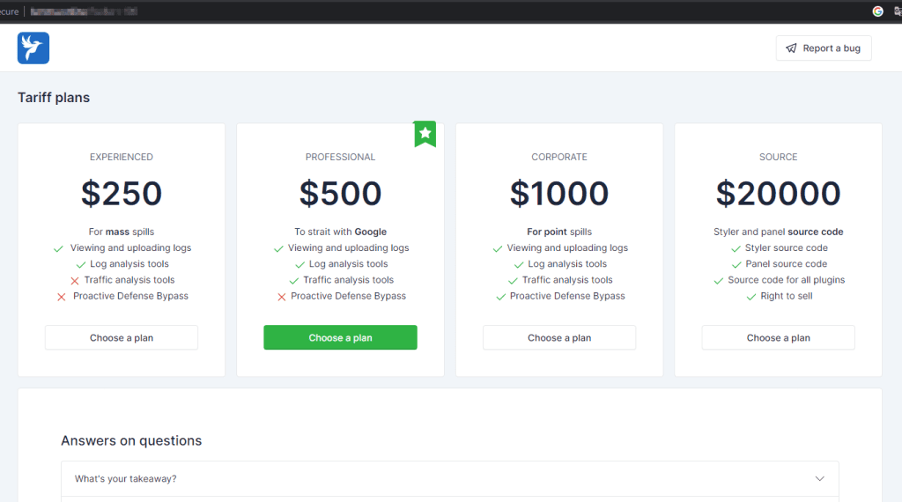
    The evolution of Malware-as-a-Service (MaaS) has significantly lowered the barriers to entry for cybercriminals, with information stealers becoming one of the most commercially successful categories in this underground economy. Among these threats, Lumma Stealer has emerged as a particularly sophisticated player since its introduction in 2022 by the threat actor known as Lumma. Initially marketed as LummaC2, this information stealer quickly gained traction in underground forums, with prices starting at $250. As of March 2025, its presence on dark web marketplaces and Telegram channels continues to grow, with over a thousand active subscribers.

    LummaC2 seller’s official website

    Lumma delivery usually involves human interaction, such as clicking a link, running malicious commands, etc. Recently, while investigating an incident as part of our incident response services, our Global Emergency Response Team (GERT) encountered Lumma on a customer’s system. The analysis revealed that the incident was triggered by human interaction, namely the user was tricked into executing a malicious command by a fake CAPTCHA page. In this article, we will review in detail how the fake CAPTCHA campaign works and share a list of IoCs that we discovered during our analysis and investigation of the campaign. Although we already described this distribution method in an earlier article, more details about this campaign have been discovered since then.

    Lumma Stealer’s distribution vectors

    Lumma Stealer’s distribution methods are diverse, using common techniques typically seen in information-stealing malware campaigns. Primary infection vectors include phishing emails with malicious attachments or links, as well as trojanized legitimate applications. These deceptive tactics trick users into executing the malware, which runs silently in the background harvesting valuable data. Lumma has also been observed using exploit kits, social engineering, and compromised websites to extend its reach and evade detection by security solutions. In this article, we’ll focus mainly on the fake CAPTCHA distribution vector.

    This vector involves fake verification pages that resemble legitimate services, often hosted on platforms that use Content Delivery Networks (CDNs). These pages typically masquerade as frequently used CAPTCHAs, such as Google reCAPTCHA or Cloudflare CAPTCHA, to trick users into believing they are interacting with a trusted service.

    Fake CAPTCHA distribution vectors

    Fake CAPTCHA distribution scheme

    There are two types of resources used to promote fake CAPTCHA pages:

    • Pirated media, adult content, and cracked software sites. The attackers clone these websites and inject malicious advertisements into the cloned page that redirect users to a malicious CAPTCHA.
    • Fake Telegram channels for pirated content and cryptocurrencies. The attackers create Telegram channels with names containing keywords related to cryptocurrencies or pirated content, such as software, movies, etc. When a user searches for such content, the fraudulent channels appear at the top of the search. The attackers also use social media posts to lure victims to these channels. When a user joins such a channel, they are prompted to complete an identity verification via a fraudulent “Safeguard Captcha” bot.

      Safeguard Captcha bot

      Once the user clicks the Verify button, the bot opens a pop-up page with a fake CAPTCHA.

    Fake CAPTCHA page

    Users are presented with a pop-up page that looks like a standard CAPTCHA verification, prompting them to click I’m not a robot/Verify/Copy or some similar button. However, this is where the deception begins.

    Fake CAPTCHA page examples

    Fake page malicious content

    When the I’m not a robot/Verify/Copy button is clicked, the user is instructed to perform an unusual sequence:

    • Open the Run dialog(Win+R)
    • Press Ctrl+V
    • Hit Enter

    Without the user’s knowledge, clicking the button automatically copies a PowerShell command to the clipboard. Once the user pastes the command into the Run dialog and presses Enter, the system executes the command.

    Examples of scripts copied to the clipboard and executed via the Run dialog

    The command may vary slightly from site to site and changes every few days, but it is typically used to download Lumma Stealer from a remote server, which is usually a known CDN with a free trial period or a legitimate code hosting and collaboration platform such as GitHub, and begin the malware installation process. Let’s take a closer look at this infection chain using the following command that was executed in our customer’s incident as an example:

    Command triggering Lumma’s infection chain

    The command is rather simple. It decodes and runs the contents from the remote win15.txt file hosted at https[:]//win15.b-cdn[.]net/win15.txt. The win15.txt file contains a Base64-encoded PowerShell script that then downloads and runs the Lumma Stealer. When decoded, the malicious PowerShell script looks like this:

    Contents of win15.txt

    The script performs the following actions:

    1. Downloads the malware. It downloads the win15.zip file from https[:]//win15.b-cdn[.]net/win15.zip to [User Profile]AppDataRoamingbFylC6zX.zip.
    2. Extracts the malware. The downloaded ZIP file is extracted to C:Users[User]AppDataRoaming7oCDTWYu, a hidden folder under the user’s AppData directory.
    3. Executes the malware. The script runs the Set-up.exe file from the unpacked archive, which is now located at C:Users[User]AppDataRoaming7oCDTWYuSet-up.exe.
    4. Establishes persistence mechanism. The script creates an entry in the Windows Registry for persistency, ensuring that the malware runs every time the system starts. The registry key is added under HKCU:SOFTWAREMicrosoftWindowsCurrentVersionRun. The key name is 5TQjtTuo, with the value pointing to Set-up.exe.

    However, in some cases, the malware delivery mechanism can be more complex. In the following example, the delivery script is a JavaScript code hidden in what looks like an .mp3 file (other file formats such as .mp4 and .png have also been used). In fact, in addition to the JavaScript, the file may contain a corrupt .mp3/.mp4 file, legitimate software code, or just random data.

    The script is executed using the Microsoft HTML Application engine mshta.exe by prompting the user to paste the following command into the Run dialog box:

    Command triggering JS-based infection chain

    The mshta command parses the file as an HTA file (Microsoft HTML Application) and executes any JavaScript code within the  tag, triggering the following infection chain:

    Layer (1)

    The JS script inside the .mp3 file is executed by mshta.

    JS script within the never.mp3 file

    Layer (2)

    After calculating the Kwb value, the following script is obtained, which is then executed by the eval function.

    Layer (2) JS script

    Layer (3)

    After calculating the values for kXN and zzI, the final ActiveX command is built and executed. It contains an encoded PowerShell script in the $PBwR variable.

    Deobfuscated Layer (2) JS script

    Layer (4)

    After decoding the PowerShell script, we found that its main purpose is to download and execute another PowerShell file from the C2 path hXXps://connect[.]klipfuzj[.]shop/firefire[.]png.

    Decrypted Layer (3) PowerShell script

    Analysis for firefire.png

    The file firefire.png is a huge PowerShell file (~31MB) with several layers of obfuscation and anti-debugging. After deobfuscating and removing unnecessary code, we could see that the main purpose of the file is to generate and execute an encrypted PowerShell script as follows:

    firefire.png

    The decryption key is the output of the Invoke-Metasploit command, which is blocked if the AMSI is enabled. As a result, an error message is generated by the AMSI: AMSI_RESULT_NOT_DETECTED, which is used as the key. If the AMSI is disabled, the malware will fail to decrypt the script.

    The decrypted PowerShell script is approximately 1.5MB in size and its main purpose is to create and run a malicious executable file.

    Decrypted PowerShell script

    Infection methods and techniques

    Lumma Stealer has been observed in the wild using a variety of infection methods, with two primary techniques standing out in its distribution campaigns: DLL sideloading and injection of a malicious payload into the overlay section of legitimate free software. These techniques are particularly effective at evading detection because they exploit the trust that users place in widely used applications and system processes.

    • DLL sideloading

      DLL sideloading is a well-known technique where malicious dynamic link libraries (DLLs) are loaded by a legitimate application. This technique exploits vulnerabilities or misconfigurations in software that inadvertently load DLL files from untrusted directories. Attackers can drop the Lumma Stealer DLL in the same directory as a trusted application, causing it to load when the application is executed. Because the malicious DLL is loaded in the context of a trusted process, it is much harder for traditional security measures to detect the intrusion.

    • Injection of malicious payload into the overlay section of software

      Another method commonly used by Lumma Stealer is to inject a malicious payload into the overlay section of free software. The overlay section is typically used for legitimate software functionality, such as displaying graphical interfaces or handling certain input events. By modifying this section of the software, the adversary can inject the malicious payload without disrupting the normal operation of the application. This method is particularly insidious because the software continues to appear legitimate while the malicious code silently executes in the background. It also helps the malware evade detection by security tools that focus on system-level monitoring.

    Both of these methods rely on exploiting trusted applications, which significantly increases the chances of successful infection. These techniques can be used in combination with others, such as phishing or trojanized software bundles, to maximize the spread of Lumma Stealer to multiple targets.

    Sample analysis

    To demonstrate how the Lumma Stealer installers work and the impact on systems and data security, we’ll analyze the stealer sample we found in the incident at our customer. This sample utilizes the overlay injection technique. Below is a detailed breakdown of the infection chain and the various techniques used to deploy and execute Lumma Stealer.

    Initial execution and self-extracting RAR (SFX)

    The initial payload in this sample is delivered as ProjectorNebraska.exe, which consists of a corrupt legitimate file and the malware in the overlay section. It is executed by the victim. Upon execution, the file extracts and runs a self-extracting RAR (SFX) archive. This archive contains the next stage of the infection: a Nullsoft Scriptable Install System (NSIS) installer. NSIS is a widely used tool for creating Windows installers.

    NSIS installer components

    The NSIS installer drops several components that are critical to the malware’s execution:

    NSIS installer components

    These include AutoIt components and an obfuscated batch script loader named Hose.cmd. The following AutoIt components are dropped:

    • Fragments of a legitimate AutoIt executable: These are pieces of a genuine AutoIt executable that are dropped to the victim’s system, and then reassembled during the infection process.
    • Compiled AutoIt script: The compiled script carries the core functionality of Lumma Stealer, including operations such as credential theft and data exfiltration.

    These components are later reassembled into the final executable payload using the batch script loader that concatenates and executes the various fragments.

    Hose.cmd orchestrates the final steps of the malware’s execution. Below is a breakdown of its key components (after deobfuscation):

    Deobfuscated batch script code

    Process tree after executing the batch script

    The batch script performs the following actions:

    • Security product evasion
      • The script scans for the presence of security software (SecureAnywhere and Quick Heal AntiVirus) using the tasklist If either of them is detected, it delays execution via the ping -n 198 command, which pings localhost 198 times. This trick is used to avoid sandbox detection, as the sandbox typically exits before the script completes the ping task.
      • The script checks for the presence of any of the following: Avast, AVG, McAfee, Bitdefender, Sophos, using the tasklist If one of them is detected, it keeps the executable name for AutoIt as AutoIt3.exe; otherwise, it renames it to Suggests.pif.
    • Environment setup and payload preparation. It sets environment variables for the AutoIt executable and the final payload. It also creates a working directory named 195402 in the Temp directory to store malicious components.
    • Obfuscation and extraction. The script filters and cleans a file named Sitting from the NSIS installer by removing the string OptimumSlipProfessionalsPerspective, and storing the result as Suggests.pif. It then uses the copy /b command to merge Suggests.pif with an additional component from the NSIS installer named Oclc into the AutoIt executable, saving it again as Suggests.pif.
    • Payload assembly. It concatenates multiple files from the NSIS installer: Italy, Holmes, True, etc. to generate the final executable with the name h.a3x, which is an AutoIt script.
    • Execution of Lumma Stealer. Finally, the script runs Suggests.pif, which in turn executes h.a3x, triggering the AutoIt-based execution of Lumma Stealer.

    AutoIt script analysis

    During the analysis, the AutoIt Extractor utility was used to decompile and extract the script from the h.a3x file. The script was heavily obfuscated and required additional deobfuscation to get a clean and analyzable .au3 script. Below is the analysis of the AutoIt loader’s behavior.

    AutoIt script extraction

    Anti-analysis checks

    The script begins by validating the environment to detect analysis tools or sandbox environments. It checks for specific computer names and usernames often associated with testing environments.

    Environment validation

    It then checks for processes from popular antivirus tools such as Avast (avastui.exe), Bitdefender (bdagent.exe), and Kaspersky (avp.exe).

    Anti-AV checks

    If any of these conditions are met, the script halts execution to evade detection.

    Executing loader shellcode

    If the anti-analysis checks are passed, the script dynamically selects 32-bit or 64-bit shellcode based on the system architecture, which is located in the $vinylcigaretteau variable inside the script. To do this, it allocates executable memory and injects the shellcode into it. The shellcode then initializes the execution environment and prepares for the second-stage payload.

    Part of the AutoIt loader responsible for the shellcode execution

    Processing the $dayjoy payload

    After executing the loader shellcode, the script processes the second-stage payload located in the $dayjoy variable. The payload is decrypted using RC4 with a hardcoded key 1246403907690944.

    The encrypted payload

    To decrypt the payload independently, we wrote a custom Python script that you can see in the screenshot below.

    Python script for payload decryption

    The decrypted payload is decompressed using the LZNT1 algorithm.

    Payload decompression

    Final payload execution

    After decryption and decompression, the $dayjoy payload is executed in memory. The script uses DllCallAddress to invoke the payload directly in the allocated memory. This ensures the payload is executed stealthily without being written to disk.

    Final payload execution

    This final payload is the stealer itself. The malware’s comprehensive data theft capabilities target a wide range of sensitive information, including:

    • Cryptocurrency wallet credentials (e.g., Binance, Ethereum) and associated browser extensions (e.g., MetaMask)
    • Two-factor authentication (2FA) data and authenticator extensions
    • Browser-stored credentials and cookies
    • Stored credentials from remote access tools such as AnyDesk
    • Stored credentials from password managers such as KeePass
    • System and application data
    • Financial information such as credit card numbers

    C2 communication

    Once Lumma Stealer is executed, it establishes communication with its command and control (C2) servers to exfiltrate the stolen data. The malware sends the collected information back to the attacker’s infrastructure for further exploitation. This communication is typically performed over HTTP or HTTPS, often disguised as legitimate traffic to avoid detection by network security monitoring tools.

    C2 servers identified

    The following C2 domains used by Lumma Stealer to communicate with the attackers were identified in the analyzed sample:

    These domains are used to receive stolen data from infected systems. Communication with these servers is typically via encrypted HTTP POST requests.

    Conclusions

    As a mass-distributed malicious program, Lumma Stealer employs a complex infection chain that includes a number of anti-analysis and detection evasion techniques, to stealthily infiltrate the victim’s device. Although the initial infection via dubious pirated software and cryptocurrency-related websites and Telegram channels suggests that individuals are the primary targets of these attacks, we saw Lumma in an incident at one of our customers, which illustrates that organizations can also fall victim to this threat. The information stolen by such malware may end up in the hands of more prominent cybercriminals, such as ransomware operators. That’s why it’s important to prevent stealer infections at the early stages. By understanding the infection techniques, security professionals can better defend against this growing threat and develop more effective detection and prevention strategies.

    IoCs

    The following list contains the URLs detected during our research. Note that the attackers change the malicious URLs and Telegram channels almost daily, and the IoCs provided in this section were already inactive at the time of writing. However, they may be useful for retrospective threat detection.

    Malicious fake CAPTCHA pages

    Telegram channels distributing Lumma

    MIL OSI Economics –

    April 22, 2025
  • MIL-OSI Economics: MSCI and Moody’s to Launch Independent Risk Assessments for Private Credit Investments

    Source: Moody’s

    Headline: MSCI and Moody’s to Launch Independent Risk Assessments for Private Credit Investments

    Solution to Promote Transparency and Strengthen Investors’ Private Credit Asset Allocation Strategies

    NEW YORK–(BUSINESS WIRE)– MSCI Inc. (NYSE:MSCI) and Moody’s Corporation (NYSE:MCO) will jointly create a first-of-its-kind solution to provide independent risk assessments for private credit investments at scale.

    As the private credit market continues to evolve and grow, the need for consistent standards and better tools has become essential for investors to assess, compare and communicate the risk of their investments.

    MSCI offers a unique and comprehensive universe of high-quality private capital data, sourced from original documents provided by managers, including data on more than 2,800 private credit funds and 14,000+ individual underlying companies. As part of this joint offering, Moody’s will extend its flagship EDF-X models into MSCI’s private credit solutions. EDF-X delivers risk insights using best-in-class credit models and early warning signals to help investors assess the financial strength of public and private companies globally.

    The combination of Moody’s flagship EDF-X credit risk modeling solutions with MSCI’s universe of private credit investment data will produce proprietary third-party risk assessments for private credit investments available at the underlying company and facility level using transparent metrics.

    “As the private credit market evolves, investors are looking for trusted independent assessments to help benchmark credit risk and inform investments and monitor portfolios,” said Rob Fauber, President and CEO of Moody’s. “Our partnership with MSCI will play a critical role in providing these insights, helping market participants make informed decisions.”

    “The rapid growth of private credit continues to transform the global investment landscape while highlighting the need for increased transparency, consistent standards and independent risk assessment,” said Henry A. Fernandez, Chairman and CEO of MSCI. “We are proud to partner with Moody’s to deliver innovative solutions that can help drive greater clarity and confidence.”

    The solution will be distinct from the services provided by Moody’s Ratings, the credit rating agency, to the issuers in the private credit market.

    About Moody’s Corporation

    In a world shaped by increasingly interconnected risks, Moody’s (NYSE: MCO) data, insights, and innovative technologies help customers develop a holistic view of their world and unlock opportunities. With a rich history of experience in global markets and a diverse workforce of approximately 16,000 across more than 40 countries, Moody’s gives customers the comprehensive perspective needed to act with confidence and thrive. Learn more at moodys.com.

    About MSCI

    MSCI is a leading provider of critical decision support tools and services for the global investment community. With over 50 years of expertise in research, data, and technology, we power better investment decisions by enabling clients to understand and analyze key drivers of risk and return and confidently build more effective portfolios. We create industry-leading research-enhanced solutions that clients use to gain insight into and improve transparency across the investment process. To learn more, please visit www.msci.com.

    “Safe Harbor” statement under the Private Securities Litigation Reform Act of 1995

    Certain statements contained in this document are forward-looking statements and are based on future expectations, plans and prospects for Moody’s business and operations that involve a number of risks and uncertainties. Such statements involve estimates, projections, goals, forecasts, assumptions and uncertainties that could cause actual results or outcomes to differ materially from those contemplated, expressed, projected, anticipated or implied in the forward-looking statements. Stockholders and investors are cautioned not to place undue reliance on these forward-looking statements. The forward-looking statements and other information in this document are made as of the date hereof, and Moody’s undertakes no obligation (nor does it intend) to publicly supplement, update or revise such statements on a going-forward basis, whether as a result of subsequent developments, changed expectations or otherwise, except as required by applicable law or regulation. In connection with the “safe harbor” provisions of the Private Securities Litigation Reform Act of 1995, Moody’s is identifying certain factors that could cause actual results to differ, perhaps materially, from those indicated by these forward-looking statements. These factors, risks and uncertainties include, but are not limited to: the impact of general economic conditions (including significant government debt and deficit levels, and inflation and related monetary policy actions by governments in response to inflation) on worldwide credit markets and on economic activity, including on the volume of mergers and acquisitions, and their effects on the volume of debt and other securities issued in domestic and/or global capital markets; the uncertain effectiveness and possible collateral consequences of U.S. and foreign government initiatives and monetary policy to respond to the current economic climate, including instability of financial institutions, credit quality concerns, and other potential impacts of volatility in financial and credit markets; the global impacts of the Russia – Ukraine military conflict and the military conflict in Israel and the surrounding areas on volatility in world financial markets, on general economic conditions and GDP in the U.S. and worldwide, on global relations and on the Company’s own operations and personnel; other matters that could affect the volume of debt and other securities issued in domestic and/or global capital markets, including regulation, increased utilization of technologies that have the potential to intensify competition and accelerate disruption and disintermediation in the financial services industry, as well as the number of issuances of securities without ratings or securities which are rated or evaluated by non-traditional parties; the level of merger and acquisition activity in the U.S. and abroad; the uncertain effectiveness and possible collateral consequences of U.S. and foreign government actions affecting credit markets, international trade and economic policy, including those related to tariffs, tax agreements and trade barriers; the impact of MIS’s withdrawal of its credit ratings on countries or entities within countries and of Moody’s no longer conducting commercial operations in countries where political instability warrants such actions; concerns in the marketplace affecting our credibility or otherwise affecting market perceptions of the integrity or utility of independent credit agency ratings; the introduction or development of competing and/or emerging technologies and products; pricing pressure from competitors and/or customers; the level of success of new product development and global expansion; the impact of regulation as an NRSRO, the potential for new U.S., state and local legislation and regulations; the potential for increased competition and regulation in the jurisdictions in which we operate, including the EU; exposure to litigation related to our rating opinions, as well as any other litigation, government and regulatory proceedings, investigations and inquiries to which Moody’s may be subject from time to time; provisions in U.S. legislation modifying the pleading standards and EU regulations modifying the liability standards applicable to credit rating agencies in a manner adverse to credit rating agencies; provisions of EU regulations imposing additional procedural and substantive requirements on the pricing of services and the expansion of supervisory remit to include non-EU ratings used for regulatory purposes; uncertainty regarding the future relationship between the U.S. and China; the possible loss of key employees and the impact of the global labor environment; failures or malfunctions of our operations and infrastructure; any vulnerabilities to cyber threats or other cybersecurity concerns; the timing and effectiveness of our restructuring programs, such as the 2022 – 2023 Geolocation Restructuring Program; currency and foreign exchange volatility; the outcome of any review by tax authorities of Moody’s global tax planning initiatives; exposure to potential criminal sanctions or civil remedies if Moody’s fails to comply with foreign and U.S. laws and regulations that are applicable in the jurisdictions in which Moody’s operates, including data protection and privacy laws, sanctions laws, anti-corruption laws, and local laws prohibiting corrupt payments to government officials; the impact of mergers, acquisitions, such as our acquisition of RMS, or other business combinations and the ability of Moody’s to successfully integrate acquired businesses; the level of future cash flows; the levels of capital investments; and a decline in the demand for credit risk management tools by financial institutions. These factors, risks and uncertainties as well as other risks and uncertainties that could cause Moody’s actual results to differ materially from those contemplated, expressed, projected, anticipated or implied in the forward-looking statements are described in greater detail under “Risk Factors” in Part I, Item 1A of Moody’s annual report on Form 10-K for the year ended December 31, 2024, and in other filings made by the Company from time to time with the SEC or in materials incorporated herein or therein. Stockholders and investors are cautioned that the occurrence of any of these factors, risks and uncertainties may cause the Company’s actual results to differ materially from those contemplated, expressed, projected, anticipated or implied in the forward-looking statements, which could have a material and adverse effect on the Company’s business, results of operations and financial condition. New factors may emerge from time to time, and it is not possible for the Company to predict new factors, nor can the Company assess the potential effect of any new factors on it. Forward-looking and other statements in this document may also address our corporate responsibility progress, plans, and goals (including sustainability and environmental matters), and the inclusion of such statements is not an indication that these contents are necessarily material to investors or required to be disclosed in the Company’s filings with the Securities and Exchange Commission. In addition, historical, current, and forward-looking sustainability-related statements may be based on standards for measuring progress that are still developing, internal controls and processes that continue to evolve, and assumptions that are subject to change in the future.

    This press release contains forward-looking statements within the meaning of the Private Securities Litigation Reform Act of 1995. These forward-looking statements relate to future events or to future financial performance and involve known and unknown risks, uncertainties and other factors that may cause MSCI’s actual results, levels of activity, performance or achievements to be materially different from any future results, levels of activity, performance or achievements expressed or implied by these statements. In some cases, you can identify forward-looking statements by the use of words such as “may,” “could,” “expect,” “intend,” “plan,” “seek,” “anticipate,” “believe,” “estimate,” “predict,” “potential” or “continue,” or the negative of these terms or other comparable terminology. You should not place undue reliance on forward-looking statements because they involve known and unknown risks, uncertainties and other factors that are, in some cases, beyond MSCI’s control and that could materially affect actual results, levels of activity, performance or achievements.

    Other factors that could materially affect MSCI’s actual results, levels of activity, performance or achievements can be found in MSCI’s Annual Report on Form 10-K for the fiscal year ended December 31, 2024 filed with the Securities and Exchange Commission (“SEC”) on February 9, 2025 and in quarterly reports on Form 10-Q and current reports on Form 8-K filed or furnished with the SEC. If any of these risks or uncertainties materialize, or if MSCI’s underlying assumptions prove to be incorrect, actual results may vary significantly from what MSCI projected. Any forward-looking statement in this press release reflects MSCI’s current views with respect to future events and is subject to these and other risks, uncertainties and assumptions relating to MSCI’s operations, results of operations, growth strategy and liquidity. MSCI assumes no obligation to publicly update or revise these forward-looking statements for any reason, whether as a result of new information, future events, or otherwise, except as required by law.

    View source version on businesswire.com: https://www.businesswire.com/news/home/20250421530056/en/

    For Moody’s Investor Relations:
    Shivani Kak
    Moody’s Corporation
    +1 212-553-0298
    Shivani.Kak@moodys.com

    For Moody’s Communications:
    Joe Mielenhausen
    Moody’s Corporation
    +1 212-553-1461
    Joe.Mielenhausen@moodys.com

    For MSCI Investor Relations:
    Jeremy Ulan
    MSCI
    +1 646 778 4184
    jeremy.ulan@msci.com

    Jisoo Suh
    MSCI
    +1 212 804 1598
    jisoo.suh@msci.com

    For MSCI Communications:
    pr@msci.com
    Melanie Blanco
    MSCI
    +1 646-220-4157
    melanie.blanco@msci.com

    Source: MSCI Inc.

    MIL OSI Economics –

    April 22, 2025
  • MIL-OSI Russia: GUU student at VFM birthday: Russia sets the trend in global youth policy

    Translartion. Region: Russians Fedetion –

    Source: State University of Management – Official website of the State –

    Nguyen Thi Hai Anh, a second-year master’s student at the Institute of Marketing of the National University of Management, took part in the celebration of the World Youth Festival (WYF) birthday.

    The event featured a presentation of the VFM Meeting, which will be held in September in Nizhny Novgorod on the instructions of Russian President Vladimir Putin, and also saw the official start of registration for participation.

    Let us recall that Nguyen Thi Hai Anh met with Vladimir Putin in March last year.

    “The World Youth Festival has become an important impetus for the development of international youth cooperation. By 2030, international events in our country will unite more than 38 thousand young people from all over the world within the framework of the federal project “Russia in the World” of the national project “Youth and Children”, launched on the initiative of Russian President Vladimir Putin. We have planned WFY rallies and forums, as well as regular holding of the Festival itself. Today, the Russian experience of youth policy is of interest abroad, and we are ready to share this experience, strengthening Russia’s position as a leader in this important area,” said the head of Rosmolodezh, associate professor of the Department of Public and Municipal Administration of the State University of Management Grigory Gurov.

    More than 100 representatives from 35 countries of the world, who participated in the festival itself, which took place a year ago in Sirius, were invited to celebrate the first anniversary of the VFM. Together with a representative of the Embassy of Vietnam, a student of the State University of Management Nguyen Thi Hai Anh presented a gift to the VFM museum and gave an interview to the TV channel Moscow 24.

    According to the instructions of the President of the Russian Federation, the WFM will be held in Russia regularly – once every six years. In between festivals, international thematic gatherings for two thousand participants from Russia and abroad will be held under the auspices of the WFM. The first gathering will be held in September 2025 in Nizhny Novgorod. Festival events of various formats will be held in Russia annually.

    The World Youth Festival will take place from September 17 to 21 and will bring together 2,000 young people – a thousand from Russia and the same number from foreign countries, including 200 children. 200 volunteers from all over the country will help organize this event.

    You can already apply to participate in the VFM Rally and become part of the international youth community today. Registration for participants will last until July 20, 2025. Those wishing to join the volunteer corps can apply until June 16, 2025 on the Dobro.rf platform.

    Please note: This information is raw content directly from the source of the information. It is exactly what the source states and does not reflect the position of MIL-OSI or its clients.

    MIL OSI Russia News –

    April 22, 2025
  • MIL-OSI Russia: Professor Rashid Mangushev awarded the title of “Honored Scientist”

    Translartion. Region: Russians Fedetion –

    Source: Saint Petersburg State University of Architecture and Civil Engineering – Saint Petersburg State University of Architecture and Civil Engineering – Rashid Mangushev

    Doctor of Technical Sciences, Professor of the Department of Geotechnics at St. Petersburg State University of Architecture and Civil Engineering Rashid Abdullovich Mangushev was awarded a high state award.

    On April 16, by the decree of the President of Russia “On awarding state awards of the Russian Federation”, Rashid Abdullovich was awarded the honorary title “Honored Scientist of the Russian Federation”.

    Rashid Mangushev is a recognized specialist in the field of geotechnics, author and co-author of more than 280 scientific papers, 11 original inventions and patents.

    Congratulations on your well-deserved award and we wish you further success!

    Please note: This information is raw content directly from the source of the information. It is exactly what the source states and does not reflect the position of MIL-OSI or its clients.

    MIL OSI Russia News –

    April 22, 2025
  • MIL-OSI Russia: With the support of Rosneft, the Asian and Oceanian Sambo Championship was held in Uzbekistan

    Translartion. Region: Russians Fedetion –

    Source: Rosneft – Rosneft – An important disclaimer is at the bottom of this article.

    With the support of Rosneft, the continental championships of Asia and Oceania in sambo were held in Tashkent (Uzbekistan) from April 14 to 20. The competitions included the Asian and Oceania Championship in sambo, the Youth Championship in sambo, and the Championship in sambo among masters.

    Athletes from 21 national federations took part in the Asian and Oceanian Sambo Championship. Competitions among men, women, blind and visually impaired athletes were held in 38 weight categories. According to the results of the tournament, the winner of the medal count was the team of Uzbekistan, second place went to the team of Kazakhstan, and third to the Philippines.

    Rosneft pays great attention to the development and support of mass and professional sports. The company builds multifunctional sports complexes and sites, ice arenas, holds mass sports events in various disciplines for children and adults. Since 2013, Rosneft has been the general sponsor of the International Sambo Federation. During this time, dozens of outstanding tournaments have been held with the support of the Company.

    Department of Information and Advertising of PJSC NK Rosneft April 21, 2025

    Please note: This information is raw content directly from the source of the information. It is exactly what the source states and does not reflect the position of MIL-OSI or its clients.

    MIL OSI Russia News –

    April 22, 2025
  • MIL-Evening Report: How the next pope will be elected – what goes on at the conclave

    Source: The Conversation (Au and NZ) – By Mathew Schmalz, Professor of Religious Studies, College of the Holy Cross

    Cardinals attend Mass at St. Peter’s Basilica, before they enter the conclave to decide who the next pope will be, on March 12, 2013, in Vatican City. Photo by Franco Origlia/Getty Image

    With the death of Pope Francis, attention now turns to the selection of his successor. The next pope will be chosen in what is called a “conclave,” a Latin word meaning “a room that can be locked up,” or, more simply, “a closed room.”

    Members of the College of Cardinals will cast their votes behind the closed and locked doors of the Vatican’s Sistine Chapel, famous for its ceiling frescoes painted by Michelangelo. Distinguished by their scarlet robes, cardinals are chosen by each pope to elect future popes. A cardinal must be under the age of 80 to be eligible to vote in the conclave. Of the 252 members of the College of Cardinals, 138 are currently eligible to elect the new pope.

    As a scholar of global Catholicism, I am especially interested in how this will be the most diverse conclave in the history of the Catholic Church.

    For many centuries, the College of Cardinals was dominated by Europeans – Italians, in particular. In fact, the first time a non-European cardinal actually cast a ballot in a conclave was only in the 20th century, when Baltimore’s archbishop, James Gibbons, voted in the 1903 papal election. Now, the College of Cardinals has members from over 90 countries, with Francis having appointed nearly 80% of them.

    Holding a conclave to elect a pope is a tradition that goes back centuries. The practice was established in 1274 under Pope Gregory X in reaction to the chaos surrounding his own election, which lasted nearly three years. The tradition is old, but the results can be surprising, as when Francis himself was elected in 2013 as the first non-European pope in almost 1,300 years and the first Jesuit pope ever.

    The conclave begins

    Before the conclave, the College of Cardinals will meet in what are called “general congregations” to discuss issues facing the church. These general congregations will also be an opportunity for new cardinals and those from distant geographical locations to get to know their fellow cardinals.

    This can be a time for politicking. In times past, the politicking was rumored to include bribes for votes, as was alleged in the election of Alexander VI, a Borgia pope, in 1492. Nowadays, it is considered to be bad form – and bad luck – for a cardinal to lobby for himself as a candidate. Buying votes by giving money or favors to cardinals is called “simony” and is against church law.

    Two to three weeks after the papal funeral, the conclave will begin. The cardinals will first make a procession to the Sistine Chapel, where electronic jamming devices will have been set up to prevent eavesdropping and Wi-Fi and cellphone use. As they file into the chapel, the cardinals will sing, in Latin, the hymn “Come Holy Spirit.” They will then vow on a book of the Gospels to keep the conclave proceedings secret.

    After these rituals, the Master of Papal Liturgical Celebrations will say out loud, in Latin, “Extra Omnes,” which means “Everyone Out.” The doors of the Sistine Chapter will then be locked, and the conclave will begin.

    Francis pledging to uphold the vow of secrecy.

    The voting process

    The cardinals electing the pope will be seated in order of rank.

    Usually, the dean of the College of Cardinals is seated in the first position. But the current dean – Cardinal Giovanni Battista Re – is over the eligible voting age and will not participate in the conclave. Instead, this papal election will be led by the Vatican’s secretary of state, Cardinal Pietro Parolin.

    When the cardinals have assembled, nine will be chosen at random to run the election, with three of them being “scrutinizers” who will examine the ballots and read them aloud.

    A ballot card used at the 2013 papal conclave.
    Tktru via Wikimedia Commons, CC BY-NC-SA

    After writing down the name of their chosen candidate, the cardinals will bring their ballots to the front of the chapel and place them on a plate that is set on top of an urn in front of the scrutinizers. Using the plate to drop their ballot into the urn, they will say, “I call as my witness Christ the Lord who will be my judge, that my vote is given to the one who before God I think should be elected.”

    A new pope is elected by a two-thirds majority. If this majority is not reached during the first ballot, the ballots will be burned in a stove. Black smoke rising through the Sistine Chapel’s chimney will signal to the outside world that the election is still ongoing, a tradition that began with the election of Benedict XV in 1914. Chemical additives are used to make sure the smoke is black because during the election of John Paul II, there was confusion over the smoke’s color.

    Following the first day – and on the days thereafter – there will be up to four ballots a day if a two-thirds majority is not reached. Both Benedict XVI and Francis were elected after relatively few ballots: four in the case of Benedict; five with Francis. According to rules set by Benedict, if a new pope is not chosen after 13 days, there will be a day of prayer and reflection. Then the election will be between the top two candidates, one of whom must receive a two-thirds majority.

    This new rule, some commentators have suggested, could lead to a longer, or even deadlocked, conclave because a compromise candidate is less likely to emerge.

    The Room of Tears

    Conclaves are usually short, such as the three-ballot election that chose Pope Pius XII in 1939. On a few occasions, deliberations have been quite long – the longest being the 1740 papal conclave, which elected Benedict XIV and lasted 181 days.

    But regardless of the time frame, a new pope will be chosen. Once a candidate receives enough votes, he is asked, “Do you accept your canonical election as Supreme Pontiff?” By saying “Accepto,” or “I accept,” he becomes the new leader of the Catholic Church. This time, the ballots will be burned to create white smoke that will tell the world that the conclave has ended and that a new pope has been chosen.

    Immediately after being elected, the new pope decides on his name, as Jorge Maria Bergoglio did when he was the first pope to choose the name Francis. The choice of a name – especially one of an immediate predecessor – often indicates the direction of the new pope’s pontificate. In Francis’ case, his name honored St. Francis of Assisi, a 13th century mystic known for his simplicity and love for nature.

    The so-called Room of Tears.

    The new pope is then led to the “Room of Tears.” In this chamber, off the Sistine Chapel, he will have moments to reflect on the burdens of his position, which have often brought new popes to tears. He will put on a white cassock and other signs of his office. His election will be announced from the balcony of St. Peter’s Basilica.

    When Francis was announced as pope.

    From the balcony, the new pope will greet the crowd below and deliver his first blessing to the world. A new pontificate will have begun.

    Mathew Schmalz is Roman Catholic and a political independent.

    – ref. How the next pope will be elected – what goes on at the conclave – https://theconversation.com/how-the-next-pope-will-be-elected-what-goes-on-at-the-conclave-164363

    MIL OSI Analysis – EveningReport.nz –

    April 21, 2025
  • MIL-OSI: Capital City Bank Group, Inc. Reports First Quarter 2025 Results

    Source: GlobeNewswire (MIL-OSI)

    TALLAHASSEE, Fla., April 21, 2025 (GLOBE NEWSWIRE) — Capital City Bank Group, Inc. (NASDAQ: CCBG) today reported net income attributable to common shareowners of $16.9 million, or $0.99 per diluted share, for the first quarter of 2025 compared to $13.1 million, or $0.77 per diluted share, for the fourth quarter of 2024, and $12.6 million, or $0.74 per diluted share, for the first quarter of 2024.

    QUARTER HIGHLIGHTS (1stQuarter 2025 versus 4thQuarter 2024)

    Income Statement

    • Tax-equivalent net interest income totaled $41.6 million compared to $41.2 million for the prior quarter
      • Net interest margin increased five basis points to 4.22% (earning asset yield up one basis point and total deposit cost down four basis points to 82 basis points)
    • Improved credit quality metrics – net loan charge-offs were nine basis points (annualized) of average loans – allowance coverage ratio increased to 1.12% at March 31, 2025
    • Noninterest income increased $1.1 million, or 6.1%, and reflected a $0.7 million increase in mortgage banking revenues and a $0.5 million increase in wealth management fees
    • Noninterest expense decreased $3.1 million, or 7.4%, primarily due to a $3.1 million decrease in other expense which included a higher level of gains from the sale of banking facilities, namely the sale of our operations center building in the first quarter

    Balance Sheet

    • Loan balances decreased $11.5 million, or 0.4% (average), and increased $9.2 million, or 0.4% (end of period)
    • Deposit balances increased by $65.1 million, or 1.8% (average), and increased $111.9 million, or 3.0% (end of period), largely due to the seasonal increase in our public fund balances
    • Tangible book value per diluted share (non-GAAP financial measure) increased $0.94, or 4.0%

    “I am pleased with our first quarter performance, which reflects strong core fundamentals and strategic execution driven by a 2.6% increase in revenues, solid growth in deposit balances, and improvement in credit quality metrics,” said William G. Smith, Jr., Capital City Bank Group Chairman, President, and CEO. “First quarter earnings also included a $0.17 per diluted share gain from the sale of our operations center building. Our strong balance sheet and revenue diversification provides us with the flexibility to navigate ongoing uncertainty in market and economic conditions.”

    Discussion of Operating Results

    Net Interest Income/Net Interest Margin

    Tax-equivalent net interest income for the first quarter of 2025 totaled $41.6 million, compared to $41.2 million for the fourth quarter of 2024, and $38.4 million for the first quarter of 2024. Compared to both prior periods, the increase was driven by higher investment securities interest due to new investment purchases at higher yields, in addition to lower deposit interest expense, partially offset by lower loan interest due to lower average loan balances and interest rates. Two less calendar days also contributed to the decline in loan interest compared to the fourth quarter of 2024. Higher overnight funds interest also contributed to the increase over the first quarter of 2024 reflective of a higher level of average earning assets.

    Our net interest margin for the first quarter of 2025 was 4.22%, an increase of five basis points over the fourth quarter of 2024 and an increase of 21 basis points over the first quarter of 2024. For the month of March 2025, our net interest margin was 4.22%. The increase in net interest margin over the fourth quarter of 2024 reflected a higher yield in the investment portfolio driven by new purchases during the quarter and a lower cost of deposits, partially offset by a lower overnight funds rate. The increase over the first quarter of 2024 reflected favorable investment repricing, a lower cost of deposits, and a higher overnight funds rate, partially offset by lower average loan balances for both prior periods.   For the first quarter of 2025, our cost of funds was 84 basis points, a decrease of four basis points from the fourth quarter of 2024 and the first quarter of 2024. Our cost of deposits (including noninterest bearing accounts) was 82 basis points, 86 basis points, and 85 basis points, respectively, for the same periods.

    Provision for Credit Losses

    We recorded a provision expense for credit losses of $0.8 million for the first quarter of 2025 compared to $0.7 million for the fourth quarter of 2024 and $0.9 million for the first quarter of 2024. For the first quarter of 2025, we recorded a provision expense of $1.1 million for loans held for investment (“HFI”) and a provision benefit of $0.3 million for unfunded loan commitments, which was comparable to the fourth quarter of 2024. We discuss the various factors that impacted our provision expense in detail below under the heading Allowance for Credit Losses.  

    Noninterest Income and Noninterest Expense

    Noninterest income for the first quarter of 2025 totaled $19.9 million compared to $18.8 million for the fourth quarter of 2024 and $18.1 million for the first quarter of 2024. The $1.1 million, or 6.1%, increase over the fourth quarter of 2024 was primarily due to a $0.7 million increase in mortgage banking revenues and a $0.5 million increase in wealth management fees, partially offset by a $0.1 million decrease in deposits fees.   The increase in mortgage revenues was driven by an increase in rate locks and a higher gain on sale margin. The increase in wealth management fees was attributable to a $0.5 million increase in insurance commission revenue.   Compared to the first quarter of 2024, the $1.8 million, or 10.0%, increase was driven by a $1.1 million increase in wealth management fees and a $0.9 million increase in mortgage banking revenues, partially offset by a $0.2 million decrease in deposit fees.   The increase in wealth management fees reflected higher retail brokerage fees of $0.6 million, insurance commission revenue of $0.3 million, and trust fees of $0.2 million. The increase in mortgage revenues was driven by an increase in loan fundings and a higher gain on sale margin.     

    Noninterest expense for the first quarter of 2025 totaled $38.7 million compared to $41.8 million for the fourth quarter of 2024 and $40.2 million for the first quarter of 2024.   The $3.1 million, or 7.4%, decrease from the fourth quarter of 2024, reflected a $3.1 million decrease in other expense, a $0.1 million decrease in occupancy expense, and a $0.1 million increase in compensation expense. The decrease in other expense was driven by a $3.5 million decrease in other real estate expense which reflected higher gains from the sale of banking facilities, primarily the sale of our operations center building in the first quarter of 2025, partially offset by a $0.5 million increase in charitable contribution expense. The slight decrease in occupancy expense was due to lower maintenance/repairs for buildings and furniture/fixtures. The slight net decrease in compensation expense reflected a $0.2 million increase in salary expense offset by a $0.1 million decrease in associate benefit expense.

    Income Taxes

    We realized income tax expense of $5.1 million (effective rate of 23.3%) for the first quarter of 2025 compared to $4.2 million (effective rate of 24.3%) for the fourth quarter of 2024 and $3.5 million (effective rate of 23.0%) for the first quarter of 2024. Compared to the fourth quarter of 2024, the decrease in our effective tax rate was primarily due to a discrete item in the first quarter of 2025 related to an excess tax benefit for stock compensation.   Absent discrete items, we expect our annual effective tax rate to approximate 24% for 2025.

    Discussion of Financial Condition

    Earning Assets

    Average earning assets totaled $3.994 billion for the first quarter of 2025, an increase of $72.0 million, or 1.8%, over the fourth quarter of 2024, and an increase of $144.3 million, or 3.7%, over the first quarter of 2024. The increase over both prior periods was driven by higher deposit balances (see below – Deposits).   Compared to the fourth quarter of 2024, the change in the earning asset mix reflected a $67.1 million increase in investment securities and a $22.7 million increase in overnight funds sold partially offset by a $11.5 million decrease in loans HFI and a $6.3 million decrease in loans held for sale (“HFS”).   Compared to the first quarter of 2024, the change in the earning asset mix reflected a $180.5 million increase in overnight funds and a $29.1 million increase in investment securities that was partially offset by a $62.7 million decrease in loans HFI and a $2.6 million decrease in HFS.

    Average loans HFI decreased $11.5 million, or 0.4%, from the fourth quarter of 2024 and decreased $62.7 million, or 2.3%, from the first quarter of 2024. Compared to the fourth quarter of 2024, the decrease was primarily attributable to declines in construction loans of $8.6 million, commercial loans of $5.7 million, and consumer loans of $2.1 million, partially offset by a $6.6 million increase in home equity loans.   Compared to the first quarter of 2024, the decline was driven by decreases in consumer loans (primarily indirect auto) of $58.8 million, commercial loans of $32.9 million, and commercial real estate mortgage loans of $23.1 million, partially offset by increases in residential real estate loans of $28.9 million, construction loans of $11.5 million, and home equity loans of $10.4 million.

    Loans HFI at March 31, 2025 increased $9.2 million, or 0.3%, over December 31, 2024 and decreased $70.4 million, or 2.6%, from March 31, 2024. Compared to December 31, 2024, the increase was primarily attributable to increases in commercial real estate mortgage loans of $27.8 million and residential real estate loans of $12.1 million, consumer loans (primarily indirect auto) of $6.7 million, and home equity loans of $5.9 million, partially offset by decreases in construction loans of $27.7 million, commercial loans of $4.8 million, and other loans of $10.8 million.   Compared to the first quarter of 2024, the decline was driven by decreases in consumer loans (primarily indirect auto) of $48.0 million, commercial loans of $33.9 million, commercial real estate mortgage loans of $16.7 million, and construction loans of $10.4 million, partially offset by increases in residential real estate loans of $27.8 million and home equity loans of $11.4 million.

    Allowance for Credit Losses

    At March 31, 2025, the allowance for credit losses for loans HFI totaled $29.7 million compared to $29.3 million at December 31, 2024 and $29.3 million at March 31, 2024. Activity within the allowance is provided on Page 9. The increase in the allowance over December 31, 2024 reflected higher loan balances and higher loan loss rates, partially offset by a lower level of net loan charge-offs.   The increase in the allowance over March 31, 2024 was primarily due to higher loss rates. Net loan charge-offs were nine basis points of average loans for the first quarter of 2025 versus 25 basis points for the fourth quarter of 2024 and 22 basis points for the first quarter of 2024. At March 31, 2025, the allowance represented 1.12% of loans HFI compared to 1.10% at December 31, 2024, and 1.07% at March 31, 2024.

    Credit Quality

    Nonperforming assets (nonaccrual loans and other real estate) totaled $4.4 million at March 31, 2025 compared to $6.7 million at December 31, 2024 and $6.8 million at March 31, 2024. At March 31, 2025, nonperforming assets as a percent of total assets was 0.10%, compared to 0.15% at December 31, 2024 and 0.16% at March 31, 2024. Nonaccrual loans totaled $4.3 million at March 31, 2025, a $2.0 million decrease from December 31, 2024 and a $2.5 million decrease from March 31, 2024. Further, classified loans totaled $19.2 million at March 31, 2025, a $0.7 million decrease from December 31, 2024 and a $3.1 million decrease from March 31, 2024.

    Deposits

    Average total deposits were $3.665 billion for the first quarter of 2025, an increase of $65.1 million, or 1.8%, over the fourth quarter of 2024 and an increase of $89.0 million, or 2.5%, over the first quarter of 2024.   Compared to the fourth quarter of 2024, the increase was primarily attributable to higher NOW account balances largely due to the seasonal increase in our public fund balances.   The increase over the first quarter of 2024 reflected growth in NOW, money market and certificate of deposit account balances which was mainly due to a combination of balances migrating from savings and noninterest bearing accounts, in addition to receiving new deposits from existing and new clients via various deposit strategies.     

    At March 31, 2025, total deposits were $3.784 billion, an increase of $111.9 million, or 3.0%, over December 31, 2024, and an increase of $129.1 million, or 3.5%, over March 31, 2024.   The increase over December 31, 2024 was due to higher balances in all deposit categories. The increase over March 31, 2024 was primarily due to higher NOW account balances, largely due to the seasonal increase in public funds and increases in money market and certificates of deposit, partially offset by lower savings account balances. Total public funds balances were $648.0 million at March 31, 2025, $660.9 million at December 31, 2024, and $615.0 million at March 31, 2024.

    Liquidity

    The Bank maintained an average net overnight funds (i.e., deposits with banks plus FED funds sold less FED funds purchased) sold position of $320.9 million in the first quarter of 2025 compared to $298.3 million in the fourth quarter of 2024 and $140.5 million in the first quarter of 2024. Compared to both prior periods, the increase reflected higher average deposits (primarily seasonal public funds) and lower average loans.
        
    At March 31, 2025, we had the ability to generate approximately $1.540 billion (excludes overnight funds position of $446 million) in additional liquidity through various sources including various federal funds purchased lines, Federal Home Loan Bank borrowings, the Federal Reserve Discount Window, and brokered deposits.  

    We also view our investment portfolio as a liquidity source as we have the option to pledge securities in our portfolio as collateral for borrowings or deposits, and/or to sell selected securities in our portfolio.  Our portfolio consists of debt issued by the U.S. Treasury, U.S. governmental agencies, municipal governments, and corporate entities.  At March 31, 2025, the weighted-average maturity and duration of our portfolio were 2.64 years and 2.10 years, respectively, and the available-for-sale portfolio had a net unrealized after-tax loss of $15.4 million.    

    Capital

    Shareowners’ equity was $512.6 million at March 31, 2025 compared to $495.3 million at December 31, 2024 and $448.3 million at March 31, 2024. For the first three months of 2025, shareowners’ equity was positively impacted by net income attributable to shareowners of $16.9 million, a net $3.6 million decrease in the accumulated other comprehensive loss, the issuance of stock of $2.4 million, and stock compensation accretion of $0.4 million. The net favorable change in accumulated other comprehensive loss reflected a $4.1 million decrease in the investment securities loss that was partially offset by a $0.5 million decrease in the fair value of the interest rate swap related to subordinated debt. Shareowners’ equity was reduced by a common stock dividend of $4.1 million ($0.24 per share) and net adjustments totaling $1.9 million related to transactions under our stock compensation plans.

    At March 31, 2025, our total risk-based capital ratio was 19.20% compared to 18.64% at December 31, 2024 and 16.84% at March 31, 2024. Our common equity tier 1 capital ratio was 16.08%, 15.54%, and 13.82%, respectively, on these dates. Our leverage ratio was 11.17%, 11.05%, and 10.45%, respectively, on these dates. At March 31, 2025, all our regulatory capital ratios exceeded the thresholds to be designated as “well-capitalized” under the Basel III capital standards. Further, our tangible common equity ratio (non-GAAP financial measure) was 9.61% at March 31, 2025 compared to 9.51% and 8.53% at December 31, 2024 and March 31, 2024, respectively. If our unrealized held-to-maturity securities losses of $12.1 million (after-tax) were recognized in accumulated other comprehensive loss, our adjusted tangible capital ratio would be 9.33%.

    About Capital City Bank Group, Inc.

    Capital City Bank Group, Inc. (NASDAQ: CCBG) is one of the largest publicly traded financial holding companies headquartered in Florida and has approximately $4.5 billion in assets. We provide a full range of banking services, including traditional deposit and credit services, mortgage banking, asset management, trust, merchant services, bankcards, securities brokerage services and financial advisory services, including the sale of life insurance, risk management and asset protection services. Our bank subsidiary, Capital City Bank, was founded in 1895 and now has 62 banking offices and 105 ATMs/ITMs in Florida, Georgia and Alabama. For more information about Capital City Bank Group, Inc., visit www.ccbg.com.

    FORWARD-LOOKING STATEMENTS

    Forward-looking statements in this Press Release are based on current plans and expectations that are subject to uncertainties and risks, which could cause our future results to differ materially. The words “may,” “could,” “should,” “would,” “believe,” “anticipate,” “estimate,” “expect,” “intend,” “plan,” “target,” “vision,” “goal,” and similar expressions are intended to identify forward-looking statements. The following factors, among others, could cause our actual results to differ: the effects of and changes in trade and monetary and fiscal policies and laws, including the interest rate policies of the Federal Reserve Board; inflation, interest rate, market and monetary fluctuations; local, regional, national, and international economic conditions and the impact they may have on us and our clients and our assessment of that impact; the costs and effects of legal and regulatory developments, the outcomes of legal proceedings or regulatory or other governmental inquiries, the results of regulatory examinations or reviews and the ability to obtain required regulatory approvals; the effect of changes in laws and regulations (including laws and regulations concerning taxes, banking, securities, and insurance) and their application with which we and our subsidiaries must comply; the effect of changes in accounting policies and practices, as may be adopted by the regulatory agencies, as well as other accounting standard setters; the accuracy of our financial statement estimates and assumptions; changes in the financial performance and/or condition of our borrowers; changes in the mix of loan geographies, sectors and types or the level of non-performing assets and charge-offs; changes in estimates of future credit loss reserve requirements based upon the periodic review thereof under relevant regulatory and accounting requirements; changes in our liquidity position; the timely development and acceptance of new products and services and perceived overall value of these products and services by users; changes in consumer spending, borrowing, and saving habits; greater than expected costs or difficulties related to the integration of new products and lines of business; technological changes; the cost and effects of cyber incidents or other failures, interruptions, or security breaches of our systems or those of our customers or third-party providers; acquisitions and integration of acquired businesses; impairment of our goodwill or other intangible assets; changes in the reliability of our vendors, internal control systems, or information systems; our ability to increase market share and control expenses; our ability to attract and retain qualified employees; changes in our organization, compensation, and benefit plans; the soundness of other financial institutions; volatility and disruption in national and international financial and commodity markets; changes in the competitive environment in our markets and among banking organizations and other financial service providers; government intervention in the U.S. financial system; the effects of natural disasters (including hurricanes), widespread health emergencies (including pandemics), military conflict, terrorism, civil unrest, climate change or other geopolitical events; our ability to declare and pay dividends; structural changes in the markets for origination, sale and servicing of residential mortgages; any inability to implement and maintain effective internal control over financial reporting and/or disclosure control; negative publicity and the impact on our reputation; and the limited trading activity and concentration of ownership of our common stock. Additional factors can be found in our Annual Report on Form 10-K for the fiscal year ended December 31, 2024 and our other filings with the SEC, which are available at the SEC’s internet site (http://www.sec.gov). Forward-looking statements in this Press Release speak only as of the date of the Press Release, and we assume no obligation to update forward-looking statements or the reasons why actual results could differ, except as may be required by law.

    For Information Contact:

    Jep Larkin
    Executive Vice President and Chief Financial Officer
    850.402. 8450

    USE OF NON-GAAP FINANCIAL MEASURES
    Unaudited

    We present a tangible common equity ratio and a tangible book value per diluted share that removes the effect of goodwill and other intangibles resulting from merger and acquisition activity. We believe these measures are useful to investors because it allows investors to more easily compare our capital adequacy to other companies in the industry.

    The GAAP to non-GAAP reconciliations are provided below.

    (Dollars in Thousands, except per share data) Mar 31, 2025 Dec 31, 2024 Sep 30, 2024 Jun 30, 2024 Mar 31, 2024
    Shareowners’ Equity (GAAP)   $ 512,575   $ 495,317   $ 476,499   $ 460,999   $ 448,314  
    Less: Goodwill and Other Intangibles (GAAP)     92,733     92,773     92,813     92,853     92,893  
    Tangible Shareowners’ Equity (non-GAAP) A   419,842     402,544     383,686     368,146     355,421  
    Total Assets (GAAP)     4,461,233     4,324,932     4,225,316     4,225,695     4,259,922  
    Less: Goodwill and Other Intangibles (GAAP)     92,733     92,773     92,813     92,853     92,893  
    Tangible Assets (non-GAAP) B $ 4,368,500   $ 4,232,159   $ 4,132,503   $ 4,132,842   $ 4,167,029  
    Tangible Common Equity Ratio (non-GAAP) A/B   9.61%     9.51%     9.28%     8.91%     8.53%  
    Actual Diluted Shares Outstanding (GAAP) C   17,072,330     17,018,122     16,980,686     16,970,228     16,947,204  
    Tangible Book Value per Diluted Share (non-GAAP) A/C $ 24.59   $ 23.65   $ 22.60   $ 21.69   $ 20.97  
     
    CAPITAL CITY BANK GROUP, INC.
    EARNINGS HIGHLIGHTS
    Unaudited
                   
        Three Months Ended  
    (Dollars in thousands, except per share data)   Mar 31, 2025   Dec 31, 2024   Mar 31, 2024  
    EARNINGS              
    Net Income Attributable to Common Shareowners $ 16,858 $ 13,090 $ 12,557 $
    Diluted Net Income Per Share $ 0.99 $ 0.77 $ 0.74 $
    PERFORMANCE              
    Return on Average Assets (annualized)   1.58 % 1.22 % 1.21 %
    Return on Average Equity (annualized)   13.32   10.60   11.07  
    Net Interest Margin   4.22   4.17   4.01  
    Noninterest Income as % of Operating Revenue   32.39   31.34   32.06  
    Efficiency Ratio   62.93 % 69.74 % 71.06 %
    CAPITAL ADEQUACY              
    Tier 1 Capital   18.01 % 17.46 % 15.67 %
    Total Capital   19.20   18.64   16.84  
    Leverage   11.17   11.05   10.45  
    Common Equity Tier 1   16.08   15.54   13.82  
    Tangible Common Equity (1)   9.61   9.51   8.53  
    Equity to Assets   11.49 % 11.45 % 10.52 %
    ASSET QUALITY              
    Allowance as % of Non-Performing Loans   692.10 % 464.14 % 431.46 %
    Allowance as a % of Loans HFI   1.12   1.10   1.07  
    Net Charge-Offs as % of Average Loans HFI   0.09   0.25   0.22  
    Nonperforming Assets as % of Loans HFI and OREO   0.17   0.25   0.25  
    Nonperforming Assets as % of Total Assets   0.10 % 0.15 % 0.16 %
    STOCK PERFORMANCE              
    High $ 38.27 $ 40.86 $ 31.34 $
    Low   33.00   33.00   26.59  
    Close $ 35.96 $ 36.65 $ 27.70 $
    Average Daily Trading Volume   24,486   27,484   31,023  
                   
    (1) Tangible common equity ratio is a non-GAAP financial measure. For additional information, including a reconciliation to GAAP, refer to Page 5.
                   
    CAPITAL CITY BANK GROUP, INC.
    CONSOLIDATED STATEMENT OF FINANCIAL CONDITION
    Unaudited
                         
      2025     2024  
    (Dollars in thousands) First Quarter   Fourth Quarter   Third Quarter   Second Quarter   First Quarter
    ASSETS                    
    Cash and Due From Banks $ 78,521   $ 70,543   $ 83,431   $ 75,304   $ 73,642  
    Funds Sold and Interest Bearing Deposits   446,042     321,311     261,779     272,675     231,047  
    Total Cash and Cash Equivalents   524,563     391,854     345,210     347,979     304,689  
                         
    Investment Securities Available for Sale   461,224     403,345     336,187     310,941     327,338  
    Investment Securities Held to Maturity   517,176     567,155     561,480     582,984     603,386  
    Other Equity Securities   2,315     2,399     6,976     2,537     3,445  
    Total Investment Securities   980,715     972,899     904,643     896,462     934,169  
                         
    Loans Held for Sale (“HFS”):   21,441     28,672     31,251     24,022     24,705  
                         
    Loans Held for Investment (“HFI”):                    
    Commercial, Financial, & Agricultural   184,393     189,208     194,625     204,990     218,298  
    Real Estate – Construction   192,282     219,994     218,899     200,754     202,692  
    Real Estate – Commercial   806,942     779,095     819,955     823,122     823,690  
    Real Estate – Residential   1,040,594     1,028,498     1,023,485     1,012,541     1,012,791  
    Real Estate – Home Equity   225,987     220,064     210,988     211,126     214,617  
    Consumer   206,191     199,479     213,305     234,212     254,168  
    Other Loans   3,227     14,006     461     2,286     3,789  
    Overdrafts   1,154     1,206     1,378     1,192     1,127  
    Total Loans Held for Investment   2,660,770     2,651,550     2,683,096     2,690,223     2,731,172  
    Allowance for Credit Losses   (29,734 )   (29,251 )   (29,836 )   (29,219 )   (29,329 )
    Loans Held for Investment, Net   2,631,036     2,622,299     2,653,260     2,661,004     2,701,843  
                         
    Premises and Equipment, Net   80,043     81,952     81,876     81,414     81,452  
    Goodwill and Other Intangibles   92,733     92,773     92,813     92,853     92,893  
    Other Real Estate Owned   132     367     650     650     1  
    Other Assets   130,570     134,116     115,613     121,311     120,170  
    Total Other Assets   303,478     309,208     290,952     296,228     294,516  
    Total Assets $ 4,461,233   $ 4,324,932   $ 4,225,316   $ 4,225,695   $ 4,259,922  
    LIABILITIES                    
    Deposits:                    
    Noninterest Bearing Deposits $ 1,363,739   $ 1,306,254   $ 1,330,715   $ 1,343,606   $ 1,361,939  
    NOW Accounts   1,292,654     1,285,281     1,174,585     1,177,180     1,212,452  
    Money Market Accounts   445,999     404,396     401,272     413,594     398,308  
    Savings Accounts   511,265     506,766     507,604     514,560     530,782  
    Certificates of Deposit   170,233     169,280     164,901     159,624     151,320  
    Total Deposits   3,783,890     3,671,977     3,579,077     3,608,564     3,654,801  
                         
    Repurchase Agreements   22,799     26,240     29,339     22,463     23,477  
    Other Short-Term Borrowings   14,401     2,064     7,929     3,307     8,409  
    Subordinated Notes Payable   52,887     52,887     52,887     52,887     52,887  
    Other Long-Term Borrowings   794     794     794     1,009     265  
    Other Liabilities   73,887     75,653     71,974     69,987     65,181  
    Total Liabilities   3,948,658     3,829,615     3,742,000     3,758,217     3,805,020  
                         
    Temporary Equity   –     –     6,817     6,479     6,588  
    SHAREOWNERS’ EQUITY                    
    Common Stock   171     170     169     169     169  
    Additional Paid-In Capital   38,576     37,684     36,070     35,547     34,861  
    Retained Earnings   476,715     463,949     454,342     445,959     435,364  
    Accumulated Other Comprehensive Loss, Net of Tax   (2,887 )   (6,486 )   (14,082 )   (20,676 )   (22,080 )
    Total Shareowners’ Equity   512,575     495,317     476,499     460,999     448,314  
    Total Liabilities, Temporary Equity and Shareowners’ Equity $ 4,461,233   $ 4,324,932   $ 4,225,316   $ 4,225,695   $ 4,259,922  
    OTHER BALANCE SHEET DATA                    
    Earning Assets $ 4,108,969   $ 3,974,431   $ 3,880,769   $ 3,883,382   $ 3,921,093  
    Interest Bearing Liabilities   2,511,032     2,447,708     2,339,311     2,344,624     2,377,900  
    Book Value Per Diluted Share $ 30.02   $ 29.11   $ 28.06   $ 27.17   $ 26.45  
    Tangible Book Value Per Diluted Share(1)   24.59     23.65     22.60     21.69     20.97  
    Actual Basic Shares Outstanding   17,055     16,975     16,944     16,942     16,929  
    Actual Diluted Shares Outstanding   17,072     17,018     16,981     16,970     16,947  
     
    (1) Tangible book value per diluted share is a non-GAAP financial measure. For additional information, including a reconciliation to GAAP, refer to Page 5.
     
    CAPITAL CITY BANK GROUP, INC.
    CONSOLIDATED STATEMENT OF OPERATIONS
    Unaudited                    
                         
        2025   2024
    (Dollars in thousands, except per share data)   First Quarter   Fourth Quarter   Third Quarter   Second Quarter   First Quarter
    INTEREST INCOME                    
    Loans, including Fees $ 40,478 $ 41,453   $ 41,659 $ 41,138 $ 40,683
    Investment Securities   5,808   4,694     4,155   4,004   4,244
    Federal Funds Sold and Interest Bearing Deposits   3,496   3,596     3,514   3,624   1,893
    Total Interest Income   49,782   49,743     49,328   48,766   46,820
    INTEREST EXPENSE                    
    Deposits   7,383   7,766     8,223   8,579   7,594
    Repurchase Agreements   164   199     221   217   201
    Other Short-Term Borrowings   117   83     52   68   39
    Subordinated Notes Payable   560   581     610   630   628
    Other Long-Term Borrowings   11   11     11   3   3
    Total Interest Expense   8,235   8,640     9,117   9,497   8,465
    Net Interest Income   41,547   41,103     40,211   39,269   38,355
    Provision for Credit Losses   768   701     1,206   1,204   920
    Net Interest Income after Provision for Credit Losses   40,779   40,402     39,005   38,065   37,435
    NONINTEREST INCOME                    
    Deposit Fees   5,061   5,207     5,512   5,377   5,250
    Bank Card Fees   3,514   3,697     3,624   3,766   3,620
    Wealth Management Fees   5,763   5,222     4,770   4,439   4,682
    Mortgage Banking Revenues   3,820   3,118     3,966   4,381   2,878
    Other   1,749   1,516     1,641   1,643   1,667
    Total Noninterest Income   19,907   18,760     19,513   19,606   18,097
    NONINTEREST EXPENSE                    
    Compensation   26,248   26,108     25,800   24,406   24,407
    Occupancy, Net   6,793   6,893     7,098   6,997   6,994
    Other   5,660   8,781     10,023   9,038   8,770
    Total Noninterest Expense   38,701   41,782     42,921   40,441   40,171
    OPERATING PROFIT   21,985   17,380     15,597   17,230   15,361
    Income Tax Expense   5,127   4,219     2,980   3,189   3,536
    Net Income   16,858   13,161     12,617   14,041   11,825
    Pre-Tax (Income) Loss Attributable to Noncontrolling Interest   –   (71 )   501   109   732
    NET INCOME ATTRIBUTABLE TO
    COMMON SHAREOWNERS
    $ 16,858 $ 13,090   $ 13,118 $ 14,150 $ 12,557
    PER COMMON SHARE                    
    Basic Net Income $ 0.99 $ 0.77   $ 0.77 $ 0.84 $ 0.74
    Diluted Net Income   0.99   0.77     0.77   0.83   0.74
    Cash Dividend $ 0.24 $ 0.23   $ 0.23 $ 0.21 $ 0.21
    AVERAGE SHARES                    
    Basic   17,027   16,946     16,943   16,931   16,951
    Diluted   17,044   16,990     16,979   16,960   16,969
     
    CAPITAL CITY BANK GROUP, INC.
    ALLOWANCE FOR CREDIT LOSSES (“ACL”)
    AND CREDIT QUALITY
    Unaudited                    
                         
        2025     2024  
    (Dollars in thousands, except per share data)   First Quarter   Fourth Quarter   Third Quarter   Second Quarter   First Quarter
    ACL – HELD FOR INVESTMENT LOANS                    
    Balance at Beginning of Period $ 29,251   $ 29,836   $ 29,219   $ 29,329   $ 29,941  
    Transfer from Other (Assets) Liabilities   –     –     –     –     (50 )
    Provision for Credit Losses   1,083     1,085     1,879     1,129     932  
    Net Charge-Offs (Recoveries)   600     1,670     1,262     1,239     1,494  
    Balance at End of Period $ 29,734   $ 29,251   $ 29,836   $ 29,219   $ 29,329  
    As a % of Loans HFI   1.12 %   1.10 %   1.11 %   1.09 %   1.07 %
    As a % of Nonperforming Loans   692.10 %   464.14 %   452.64 %   529.79 %   431.46 %
    ACL – UNFUNDED COMMITMENTS                    
    Balance at Beginning of Period   2,155   $ 2,522   $ 3,139   $ 3,121   $ 3,191  
    Provision for Credit Losses   (323 )   (367 )   (617 )   18     (70 )
    Balance at End of Period(1)   1,832     2,155     2,522     3,139     3,121  
    ACL – DEBT SECURITIES                    
    Provision for Credit Losses $ 8   $ (17 ) $ (56 ) $ 57   $ 58  
    CHARGE-OFFS                    
    Commercial, Financial and Agricultural $ 168   $ 499   $ 331   $ 400   $ 282  
    Real Estate – Construction   –     47     –     –     –  
    Real Estate – Commercial   –     –     3     –     –  
    Real Estate – Residential   8     44     –     –     17  
    Real Estate – Home Equity   –     33     23     –     76  
    Consumer   865     1,307     1,315     1,061     1,550  
    Overdrafts   570     574     611     571     638  
    Total Charge-Offs $ 1,611   $ 2,504   $ 2,283   $ 2,032   $ 2,563  
    RECOVERIES                    
    Commercial, Financial and Agricultural $ 75   $ 103   $ 176   $ 59   $ 41  
    Real Estate – Construction   –     3     –     –     –  
    Real Estate – Commercial   3     33     5     19     204  
    Real Estate – Residential   119     28     88     23     37  
    Real Estate – Home Equity   9     17     59     37     24  
    Consumer   481     352     405     313     410  
    Overdrafts   324     298     288     342     353  
    Total Recoveries $ 1,011   $ 834   $ 1,021   $ 793   $ 1,069  
    NET CHARGE-OFFS (RECOVERIES) $ 600   $ 1,670   $ 1,262   $ 1,239   $ 1,494  
    Net Charge-Offs as a % of Average Loans HFI(2)   0.09 %   0.25 %   0.19 %   0.18 %   0.22 %
    CREDIT QUALITY                    
    Nonaccruing Loans $ 4,296   $ 6,302   $ 6,592   $ 5,515   $ 6,798  
    Other Real Estate Owned   132     367     650     650     1  
    Total Nonperforming Assets (“NPAs”) $ 4,428   $ 6,669   $ 7,242   $ 6,165   $ 6,799  
                         
    Past Due Loans 30-89 Days $ 3,735   $ 4,311   $ 9,388   $ 5,672   $ 5,392  
    Classified Loans   19,194     19,896     25,501     25,566     22,305  
                         
    Nonperforming Loans as a % of Loans HFI   0.16 %   0.24 %   0.25 %   0.21 %   0.25 %
    NPAs as a % of Loans HFI and Other Real Estate   0.17 %   0.25 %   0.27 %   0.23 %   0.25 %
    NPAs as a % of Total Assets   0.10 %   0.15 %   0.17 %   0.15 %   0.16 %
                         
    (1)Recorded in other liabilities
    (2)Annualized
                         
    CAPITAL CITY BANK GROUP, INC.
    AVERAGE BALANCE AND INTEREST RATES
    Unaudited
                                                                           
        First Quarter 2025     Fourth Quarter 2024     Third Quarter 2024     Second Quarter 2024     First Quarter 2024  
    (Dollars in thousands)   Average
    Balance
      Interest   Average
    Rate
        Average
    Balance
      Interest   Average
    Rate
        Average
    Balance
      Interest   Average
    Rate
        Average
    Balance
      Interest   Average
    Rate
        Average
    Balance
      Interest   Average
    Rate
     
    ASSETS:                                                                      
    Loans Held for Sale $ 24,726   $ 490   8.04 % $ 31,047   $ 976   7.89 % $ 24,570   $ 720   7.49 % $ 26,281     517   5.26 % $ 27,314   $ 563   5.99 %
    Loans Held for Investment(1)   2,665,910     40,029   6.09     2,677,396     40,521   6.07     2,693,533     40,985   6.09     2,726,748     40,683   6.03     2,728,629     40,196   5.95  
                                                                           
    Investment Securities                                                                      
    Taxable Investment Securities   981,485     5,802   2.38     914,353     4,688   2.04     907,610     4,148   1.82     918,989     3,998   1.74     952,328     4,238   1.78  
    Tax-Exempt Investment Securities(1)   845     9   4.32     849     9   4.31     846     10   4.33     843     9   4.36     856     10   4.34  
                                                                           
    Total Investment Securities   982,330     5,811   2.38     915,202     4,697   2.04     908,456     4,158   1.82     919,832     4,007   1.74     953,184     4,248   1.78  
                                                                           
    Federal Funds Sold and Interest Bearing Deposits   320,948     3,496   4.42     298,255     3,596   4.80     256,855     3,514   5.44     262,419     3,624   5.56     140,488     1,893   5.42  
                                                                           
    Total Earning Assets   3,993,914   $ 49,826   5.06 %   3,921,900   $ 49,790   5.05 %   3,883,414   $ 49,377   5.06 %   3,935,280   $ 48,831   4.99 %   3,849,615   $ 46,900   4.90 %
                                                                           
    Cash and Due From Banks   73,467               73,992               70,994               74,803               75,763            
    Allowance for Credit Losses   (30,008 )             (30,107 )             (29,905 )             (29,564 )             (30,030 )          
    Other Assets   297,660               293,884               291,359               291,669               295,275            
                                                                           
    Total Assets $ 4,335,033             $ 4,259,669             $ 4,215,862             $ 4,272,188             $ 4,190,623            
                                                                           
    LIABILITIES:                                                                      
    Noninterest Bearing Deposits $ 1,317,425             $ 1,323,556             $ 1,332,305             $ 1,346,546             $ 1,344,188            
    NOW Accounts   1,249,955   $ 3,854   1.25 %   1,182,073   $ 3,826   1.29 %   1,145,544   $ 4,087   1.42 %   1,207,643   $ 4,425   1.47 %   1,201,032   $ 4,497   1.51 %
    Money Market Accounts   420,059     2,187   2.11     422,615     2,526   2.38     418,625     2,694   2.56     407,387     2,752   2.72     353,591     1,985   2.26  
    Savings Accounts   507,676     176   0.14     504,859     179   0.14     512,098     180   0.14     519,374     176   0.14     539,374     188   0.14  
    Time Deposits   170,367     1,166   2.78     167,321     1,235   2.94     163,462     1,262   3.07     160,078     1,226   3.08     138,328     924   2.69  
    Total Interest Bearing Deposits   2,348,057     7,383   1.28     2,276,868     7,766   1.36     2,239,729     8,223   1.46     2,294,482     8,579   1.50     2,232,325     7,594   1.37  
    Total Deposits   3,665,482     7,383   0.82     3,600,424     7,766   0.86     3,572,034     8,223   0.92     3,641,028     8,579   0.95     3,576,513     7,594   0.85  
    Repurchase Agreements   29,821     164   2.23     28,018     199   2.82     27,126     221   3.24     26,999     217   3.24     25,725     201   3.14  
    Other Short-Term Borrowings   7,437     117   6.39     6,510     83   5.06     2,673     52   7.63     6,592     68   4.16     3,758     39   4.16  
    Subordinated Notes Payable   52,887     560   4.23     52,887     581   4.30     52,887     610   4.52     52,887     630   4.71     52,887     628   4.70  
    Other Long-Term Borrowings   794     11   5.68     794     11   5.57     795     11   5.55     258     3   4.31     281     3   4.80  
    Total Interest Bearing Liabilities   2,438,996   $ 8,235   1.37 %   2,365,077   $ 8,640   1.45 %   2,323,210   $ 9,117   1.56 %   2,381,218   $ 9,497   1.60 %   2,314,976   $ 8,465   1.47 %
                                                                           
    Other Liabilities   65,211               73,130               73,767               72,634               68,295            
                                                                           
    Total Liabilities   3,821,632               3,761,763               3,729,282               3,800,398               3,727,459            
    Temporary Equity   –               6,763               6,443               6,493               7,150            
                                                                           
    SHAREOWNERS’ EQUITY:   513,401               491,143               480,137               465,297               456,014            
                                                                           
    Total Liabilities, Temporary Equity and Shareowners’ Equity $ 4,335,033             $ 4,259,669             $ 4,215,862             $ 4,272,188             $ 4,190,623            
                                                                           
    Interest Rate Spread     $ 41,591   3.69 %     $ 41,150   3.59 %     $ 40,260   3.49 %     $ 39,334   3.38 %     $ 38,435   3.43 %
                                                                           
    Interest Income and Rate Earned(1)       49,826   5.06         49,790   5.05         49,377   5.06         48,831   4.99         46,900   4.90  
    Interest Expense and Rate Paid(2)       8,235   0.84         8,640   0.88         9,117   0.93         9,497   0.97         8,465   0.88  
                                                                           
    Net Interest Margin     $ 41,591   4.22 %     $ 41,150   4.17 %     $ 40,260   4.12 %     $ 39,334   4.02 %     $ 38,435   4.01 %
                                                                           
    (1)Interest and average rates are calculated on a tax-equivalent basis using a 21% Federal tax rate.
    (2)Rate calculated based on average earning assets.

    The MIL Network –

    April 21, 2025
  • MIL-OSI: HBT Financial, Inc. Announces First Quarter 2025 Financial Results

    Source: GlobeNewswire (MIL-OSI)

    First Quarter Highlights

    • Net income of $19.1 million, or $0.60 per diluted share; return on average assets (“ROAA”) of 1.54%; return on average stockholders’ equity (“ROAE”) of 13.95%; and return on average tangible common equity (“ROATCE”)(1) of 16.20%
    • Adjusted net income(1) of $19.3 million; or $0.61 per diluted share; adjusted ROAA(1) of 1.55%; adjusted ROAE(1) of 14.08%; and adjusted ROATCE(1) of 16.36%
    • Asset quality remained exceptional with nonperforming assets to total assets of 0.11% and net charge-offs to average loans of 0.05%, on an annualized basis
    • Net interest margin increased 16 basis points to 4.12% and net interest margin (tax-equivalent basis)(1)increased 15 basis point to 4.16%

    BLOOMINGTON, Ill., April 21, 2025 (GLOBE NEWSWIRE) — HBT Financial, Inc. (NASDAQ: HBT) (the “Company” or “HBT Financial” or “HBT”), the holding company for Heartland Bank and Trust Company, today reported net income of $19.1 million, or $0.60 diluted earnings per share, for the first quarter of 2025. This compares to net income of $20.3 million, or $0.64 diluted earnings per share, for the fourth quarter of 2024, and net income of $15.3 million, or $0.48 diluted earnings per share, for the first quarter of 2024.

    J. Lance Carter, President and Chief Executive Officer of HBT Financial, said, “We are off to a great start in 2025 with strong first quarter results. Despite the economic outlook recently becoming more uncertain, leading to interest rate volatility and stock market declines, we still believe that 2025 will be a solid year for HBT. Our credit discipline, strong profitability and solid balance sheet give us confidence that we are prepared for a variety of economic environments.

    We continued to report solid profitability with adjusted net income(1) of $19.3 million, or $0.61 per diluted share, an adjusted ROAA(1) of 1.55% and an adjusted ROATCE(1) of 16.36%. Our net interest margin on a tax-equivalent basis(1) increased by 15 basis points, with 5 basis points of that increase related to higher nonaccrual interest recoveries and loan fees, as average loan balances were higher, loans and securities continued to reprice higher, and deposits repriced lower. Our strong profitability coupled with an improvement in our accumulated other comprehensive income due to lower interest rates, resulted in a $0.63 increase in our tangible book value per share(1) to $15.43. Tangible book value per share increased by 4.3% for the quarter and 17.0% over the last year.

    Our balance sheet remains strong with all capital ratios increasing during the quarter and asset quality improving with nonperforming assets to total assets declining to only 0.11%. Loans at quarter-end were down only slightly while average loans for the quarter were up 2.2%. Deposits were up 1.5% at quarter-end and average deposits for the quarter were up 1.1%. Deposit growth was aided by moving most of our repurchase agreements into interest-bearing demand deposits. Our capital levels and operational structure support attractive acquisition opportunities should the right opportunity arise and markets stabilize.”
    ____________________________________
    (1)   See “Reconciliation of Non-GAAP Financial Measures” below for reconciliation of non-GAAP financial measures to their most closely comparable GAAP financial measures.

    Adjusted Net Income

    In addition to reporting GAAP results, the Company believes non-GAAP measures such as adjusted net income and adjusted earnings per share, which adjust for acquisition expenses, branch closure expenses, gains (losses) on closed branch premises, realized gains (losses) on sales of securities, mortgage servicing rights fair value adjustments, and the tax effect of these pre-tax adjustments, provide investors with additional insight into its operational performance. The Company reported adjusted net income of $19.3 million, or $0.61 adjusted diluted earnings per share, for the first quarter of 2025. This compares to adjusted net income of $19.5 million, or $0.62 adjusted diluted earnings per share, for the fourth quarter of 2024, and adjusted net income of $18.1 million, or $0.57 adjusted diluted earnings per share, for the first quarter of 2024 (see “Reconciliation of Non-GAAP Financial Measures” tables below for reconciliation of non-GAAP financial measures to their most closely comparable GAAP financial measures).

    Net Interest Income and Net Interest Margin

    Net interest income for the first quarter of 2025 was $48.7 million, an increase of 2.8% from $47.4 million for the fourth quarter of 2024. The increase was primarily attributable to higher average loan balances, a decrease in deposit costs, and higher yields on loans and debt securities. Additionally, a $0.6 million increase in nonaccrual interest recoveries and loan fees contributed to the increase in net interest income.

    Relative to the first quarter of 2024, net interest income increased 4.3% from $46.7 million. The increase was primarily attributable to higher average loan balances, a decrease in deposit costs, and higher yields on debt securities. Also contributing was a $0.7 million increase in nonaccrual interest recoveries and loan fees.

    Net interest margin for the first quarter of 2025 was 4.12%, compared to 3.96% for the fourth quarter of 2024, and net interest margin (tax-equivalent basis)(1) for the first quarter of 2025 was 4.16%, compared to 4.01% for the fourth quarter of 2024. The increase was primarily attributable to higher yields on interest-earning assets, which increased 9 basis points to 5.34%, and lower funding costs, which decreased 7 basis points to 1.32%. Additionally, an increase in the contribution of nonaccrual interest recoveries and loan fees accounted for 5 basis points of the increase in net interest margin.

    Relative to the first quarter of 2024, net interest margin increased 18 basis points from 3.94% and net interest margin (tax-equivalent basis)(1) increased 17 basis points from 3.99%. These increases were primarily attributable to higher yields on interest-earning assets, a decrease in funding costs, and an increase in nonaccrual interest recoveries and loan fees. Additionally, an increase in the contribution of nonaccrual interest recoveries and loan fees accounted for 6 basis points of the increase in net interest margin.
    ____________________________________
    (1)   See “Reconciliation of Non-GAAP Financial Measures” below for reconciliation of non-GAAP financial measures to their most closely comparable GAAP financial measures.

    Noninterest Income

    Noninterest income for the first quarter of 2025 was $9.3 million, a 20.0% decrease from $11.6 million for the fourth quarter of 2024. The decrease was primarily attributable to changes in the mortgage servicing rights (“MSR”) fair value adjustment, with a $0.3 million negative MSR fair value adjustment included in the first quarter 2025 results compared to a $1.3 million positive MSR fair value adjustment included in the fourth quarter 2024 results. Further contributing to the decrease was a $0.3 million decrease in wealth management fees, primarily driven by a seasonal decrease in farm management income, a $0.3 million decrease in income on bank owned life insurance, primarily due to the absence of a $0.2 million gain on life insurance proceeds included in the fourth quarter 2024 results, and a $0.2 million decrease in card income. Partially offsetting these decreases was the absence of a $0.3 million realized loss on sale of debt securities included in the fourth quarter 2024 results.

    Relative to the first quarter of 2024, noninterest income increased 65.4% from $5.6 million. The increase was primarily attributable to the absence of $3.4 million in realized losses on the sale of debt securities included in the first quarter 2024 results.

    Noninterest Expense

    Noninterest expense for the first quarter of 2025 was $31.9 million, a 3.3% increase from $30.9 million for the fourth quarter of 2024. The increase was primarily attributable to a $1.3 million increase in salaries expense, primarily driven by seasonal variations in vacation accruals and annual merit increases which took effect in early March, and a $0.6 million increase in employee benefits expense, primarily attributable to higher medical benefit costs. Partially offsetting these increases were a $0.3 million decrease in other noninterest expense and a $0.3 million decrease in data processing expense.

    Relative to the first quarter of 2024, noninterest expense increased 2.1% from $31.3 million. The increase was primarily attributable to a $0.5 million increase in employee benefits expense, primarily driven by increased medical benefit costs, and a $0.4 million increase in salaries expense. Partially offsetting these increases was a $0.2 million decrease in data processing expense.

    Income Taxes

    During the first quarter of 2025 our effective tax rate decreased to 25.2% when compared to 26.0% during the fourth quarter of 2024. This decrease was primarily related to a $0.2 million tax benefit from stock-based compensation that vested during the quarter. Additionally, during the second quarter of 2025, we expect to recognize an additional $0.3 million of tax expense related to the reversal of a stranded tax effect included in accumulated other comprehensive income in connection with the maturity of a derivative designated as a cash flow hedge.

    Loan Portfolio

    Total loans outstanding, before allowance for credit losses, were $3.46 billion at March 31, 2025, compared with $3.47 billion at December 31, 2024, and $3.35 billion at March 31, 2024. Total loans as of March 31, 2025 were nearly unchanged when compared to December 31, 2024 with a $23.2 million increase in grain elevator lines of credit in the commercial and industrial segment, due to seasonally higher line utilization, partially offset by a $12.0 million reduction on two lines of credit that funded shortly before and paid off after December 31, 2024, as noted in the previous quarter’s earnings release. Larger payoffs in the one-to-four family residential, multi-family, and commercial real estate – non-owner occupied segments were partially offset by draws on existing loans in the construction and development segment and new originations in the municipal, consumer, and other segment. Additionally, average loan balances increased $73.4 million, or 2.2%, from the fourth quarter of 2024 to the first quarter of 2025.

    Deposits

    Total deposits were $4.38 billion at March 31, 2025, compared with $4.32 billion at December 31, 2024, and $4.36 billion at March 31, 2024. The $66.3 million increase from December 31, 2024 was primarily attributable to higher balances maintained in existing retail accounts. Additionally, the vast majority of repurchase agreement account balances at December 31, 2024 were transitioned to reciprocal interest-bearing demand deposit accounts during the first quarter of 2025.

    Asset Quality

    Nonperforming assets totaled $5.6 million, or 0.11% of total assets, at March 31, 2025, compared with $8.0 million, or 0.16% of total assets, at December 31, 2024, and $9.9 million, or 0.20% of total assets, at March 31, 2024. Additionally, of the $5.1 million of nonperforming loans held as of March 31, 2025, $1.4 million is either wholly or partially guaranteed by the U.S. government. The $2.5 million decrease in nonperforming assets from December 31, 2024 was primarily attributable to the pay-off of a $1.6 million nonaccrual commercial real estate – non-owner occupied credit.

    The Company recorded a provision for credit losses of $0.6 million for the first quarter of 2025. The provision for credit losses primarily reflects a $0.8 million increase in required reserves resulting from changes in qualitative factors; a $0.1 million increase in required reserves driven by changes within the portfolio; and a $0.3 million decrease in specific reserves.

    The Company had net charge-offs of $0.4 million, or 0.05% of average loans on an annualized basis, for the first quarter of 2025, compared to net charge-offs of $0.7 million, or 0.08% of average loans on an annualized basis, for the fourth quarter of 2024, and net recoveries of $0.2 million, or 0.02% of average loans on an annualized basis, for the first quarter of 2024.

    The Company’s allowance for credit losses was 1.22% of total loans and 825% of nonperforming loans at March 31, 2025, compared with 1.21% of total loans and 549% of nonperforming loans at December 31, 2024. In addition, the allowance for credit losses on unfunded lending-related commitments totaled $3.2 million as of March 31, 2025, compared with $3.1 million as of December 31, 2024.

    Capital

    As of March 31, 2025, the Company exceeded all regulatory capital requirements under Basel III as summarized in the following table:

        March 31, 2025   For Capital
    Adequacy Purposes
    With Capital
    Conservation Buffer
             
    Total capital to risk-weighted assets   16.85 %   10.50 %
    Tier 1 capital to risk-weighted assets   14.77     8.50  
    Common equity tier 1 capital ratio   13.48     7.00  
    Tier 1 leverage ratio   11.64     4.00  
                 

    The ratio of tangible common equity to tangible assets(1) increased to 9.73% as of March 31, 2025, from 9.42% as of December 31, 2024, and tangible book value per share(1) increased by $0.63 to $15.43 as of March 31, 2025, when compared to December 31, 2024.

    During the first quarter of 2025, the Company did not repurchase shares of its common stock under its stock repurchase program. The Company’s Board of Directors has authorized the repurchase of up to $15.0 million of HBT Financial common stock under its stock repurchase program, which is in effect until January 1, 2026. As of March 31, 2025, the Company had $15.0 million remaining under the stock repurchase program.
    ____________________________________
    (1)   See “Reconciliation of Non-GAAP Financial Measures” below for reconciliation of non-GAAP financial measures to their most closely comparable GAAP financial measures.

    About HBT Financial, Inc.

    HBT Financial, Inc., headquartered in Bloomington, Illinois, is the holding company for Heartland Bank and Trust Company, and has banking roots that can be traced back to 1920. HBT Financial provides a comprehensive suite of financial products and services to consumers, businesses, and municipal entities throughout Illinois and eastern Iowa through 66 full-service branches. As of March 31, 2025, HBT Financial had total assets of $5.1 billion, total loans of $3.5 billion, and total deposits of $4.4 billion.

    Non-GAAP Financial Measures

    Some of the financial measures included in this press release are not measures of financial performance recognized in accordance with GAAP. These non-GAAP financial measures include adjusted net income, adjusted earnings per share, adjusted ROAA, pre-provision net revenue, pre-provision net revenue less charge-offs (recoveries), adjusted pre-provision net revenue, adjusted pre-provision net revenue less charge-offs (recoveries), net interest income (tax-equivalent basis), net interest margin (tax-equivalent basis), efficiency ratio (tax-equivalent basis), adjusted efficiency ratio (tax-equivalent basis), the ratio of tangible common equity to tangible assets, tangible book value per share, adjusted ROAE, ROATCE, and adjusted ROATCE. Our management uses these non-GAAP financial measures, together with the related GAAP financial measures, in its analysis of our performance and in making business decisions. Management believes that it is a standard practice in the banking industry to present these non-GAAP financial measures, and accordingly believes that providing these measures may be useful for peer comparison purposes. These disclosures should not be viewed as substitutes for the results determined to be in accordance with GAAP; nor are they necessarily comparable to non-GAAP financial measures that may be presented by other companies. See our reconciliation of non-GAAP financial measures to their most directly comparable GAAP financial measures in the “Reconciliation of Non-GAAP Financial Measures” tables.

    Forward-Looking Statements

    Readers should note that in addition to the historical information contained herein, this press release contains, and future oral and written statements of the Company and its management may contain, “forward-looking statements” within the meanings of the Private Securities Litigation Reform Act of 1995, Section 27A of the Securities Act of 1933, as amended, and Section 21E of the Securities Exchange Act of 1934, as amended. Forward-looking statements generally can be identified by the use of forward-looking terminology such as “will,” “propose,” “may,” “plan,” “seek,” “expect,” “intend,” “estimate,” “anticipate,” “believe,” “continue,” or “should,” or similar terminology. Any forward-looking statements presented herein are made only as of the date of this press release, and the Company does not undertake any obligation to update or revise any forward-looking statements to reflect changes in assumptions, the occurrence of unanticipated events, or otherwise.

    Factors that could cause actual results to differ materially from these forward-looking statements include, but are not limited to: (i) the strength of the local, state, national and international economies and financial markets (including effects of inflationary pressures and supply chain constraints); (ii) effects on the U.S. economy resulting from the threat or implementation of, or changes to, existing policies and executive orders including tariffs, immigration policy, regulatory or other governmental agencies, foreign policy and tax regulations; (iii) the economic impact of any future terrorist threats and attacks, widespread disease or pandemics, acts of war or other threats thereof (including the Russian invasion of Ukraine and ongoing conflicts in the Middle East), or other adverse events that could cause economic deterioration or instability in credit markets, and the response of the local, state and national governments to any such adverse external events; (iv) new and revised accounting policies and practices, as may be adopted by state and federal regulatory banking agencies, the Financial Accounting Standards Board or the Public Company Accounting Oversight Board; (v) changes in local, state and federal laws, regulations and governmental policies concerning the Company’s general business and any changes in response to the bank failures in 2023; (vi) the imposition of tariffs or other governmental policies impacting the value of products produced by the Company’s commercial borrowers; (vii) changes in interest rates and prepayment rates of the Company’s assets; (viii) increased competition in the financial services sector, including from non-bank competitors such as credit unions and fintech companies, and the inability to attract new customers; (ix) changes in technology and the ability to develop and maintain secure and reliable electronic systems; (x) unexpected results of acquisitions, which may include failure to realize the anticipated benefits of acquisitions and the possibility that transaction costs may be greater than anticipated; (xi) the loss of key executives and employees, talent shortages and employee turnover; (xii) changes in consumer spending; (xiii) unexpected outcomes or costs of existing or new litigation or other legal proceedings and regulatory actions involving the Company; (xiv) the economic impact on the Company and its customers of climate change, natural disasters and of exceptional weather occurrences such as tornadoes, floods and blizzards; (xv) fluctuations in the value of securities held in our securities portfolio, including as a result of changes in interest rates; (xvi) credit risks and risks from concentrations (by type of borrower, geographic area, collateral and industry) within our loan portfolio (including commercial real estate loans) and large loans to certain borrowers; (xvii) the overall health of the local and national real estate market; (xviii) the ability to maintain an adequate level of allowance for credit losses on loans; (xix) the concentration of large deposits from certain clients who have balances above current FDIC insurance limits and who may withdraw deposits to diversify their exposure; (xx) the ability to successfully manage liquidity risk, which may increase dependence on non-core funding sources such as brokered deposits, and may negatively impact the Company’s cost of funds; (xxi) the level of nonperforming assets on our balance sheet; (xxii) interruptions involving our information technology and communications systems or third-party servicers; (xxiii) the occurrence of fraudulent activity, breaches or failures of our third-party vendors’ information security controls or cybersecurity-related incidents, including as a result of sophisticated attacks using artificial intelligence and similar tools or as a result of insider fraud; (xxiv) the effectiveness of the Company’s risk management framework, and (xxv) the ability of the Company to manage the risks associated with the foregoing as well as anticipated. Readers should note that the forward-looking statements included in this press release are not a guarantee of future events, and that actual events may differ materially from those made in or suggested by the forward-looking statements. Additional information concerning the Company and its business, including additional factors that could materially affect the Company’s financial results, is included in the Company’s filings with the Securities and Exchange Commission.

    CONTACT:
    Peter Chapman
    HBTIR@hbtbank.com
    (309) 664-4556

         
    HBT Financial, Inc.
    Unaudited Consolidated Financial Summary
         
        As of or for the Three Months Ended
    (dollars in thousands, except per share data)   March 31,
    2025
      December 31,
    2024
      March 31,
    2024
    Interest and dividend income   $ 63,138     $ 62,798     $ 61,961  
    Interest expense     14,430       15,397       15,273  
    Net interest income     48,708       47,401       46,688  
    Provision for credit losses     576       725       527  
    Net interest income after provision for credit losses     48,132       46,676       46,161  
    Noninterest income     9,306       11,630       5,626  
    Noninterest expense     31,935       30,908       31,268  
    Income before income tax expense     25,503       27,398       20,519  
    Income tax expense     6,428       7,126       5,261  
    Net income   $ 19,075     $ 20,272     $ 15,258  
                 
    Earnings per share – diluted   $ 0.60     $ 0.64     $ 0.48  
                 
    Adjusted net income (1)   $ 19,253     $ 19,546     $ 18,073  
    Adjusted earnings per share – diluted (1)     0.61       0.62       0.57  
                 
    Book value per share   $ 17.86     $ 17.26     $ 15.71  
    Tangible book value per share (1)     15.43       14.80       13.19  
                 
    Shares of common stock outstanding     31,631,431       31,559,366       31,612,888  
    Weighted average shares of common stock outstanding, including all dilutive potential shares     31,711,671       31,702,864       31,803,187  
                 
    SUMMARY RATIOS            
    Net interest margin *     4.12 %     3.96 %     3.94 %
    Net interest margin (tax-equivalent basis) * (1)(2)     4.16       4.01       3.99  
                 
    Efficiency ratio     53.85 %     51.16 %     58.41 %
    Efficiency ratio (tax-equivalent basis) (1)(2)     53.35       50.68       57.78  
                 
    Loan to deposit ratio     78.95 %     80.27 %     76.73 %
                 
    Return on average assets *     1.54 %     1.61 %     1.23 %
    Return on average stockholders’ equity *     13.95       14.89       12.42  
    Return on average tangible common equity * (1)     16.20       17.40       14.83  
                 
    Adjusted return on average assets * (1)     1.55 %     1.56 %     1.45 %
    Adjusted return on average stockholders’ equity * (1)     14.08       14.36       14.72  
    Adjusted return on average tangible common equity * (1)     16.36       16.77       17.57  
                 
    CAPITAL            
    Total capital to risk-weighted assets     16.85 %     16.51 %     15.79 %
    Tier 1 capital to risk-weighted assets     14.77       14.50       13.77  
    Common equity tier 1 capital ratio     13.48       13.21       12.44  
    Tier 1 leverage ratio     11.64       11.51       10.65  
    Total stockholders’ equity to total assets     11.10       10.82       9.85  
    Tangible common equity to tangible assets (1)     9.73       9.42       8.40  
                 
    ASSET QUALITY            
    Net charge-offs (recoveries) to average loans *     0.05 %     0.08 %     (0.02) %
    Allowance for credit losses to loans, before allowance for credit losses     1.22       1.21       1.22  
    Nonperforming loans to loans, before allowance for credit losses     0.15       0.22       0.29  
    Nonperforming assets to total assets     0.11       0.16       0.20  

    ____________________________________

    *   Annualized measure.

    (1)   See “Reconciliation of Non-GAAP Financial Measures” below for reconciliation of non-GAAP financial measures to their most closely comparable GAAP financial measures.
    (2)   On a tax-equivalent basis assuming a federal income tax rate of 21% and a state tax rate of 9.5%.  

       
    HBT Financial, Inc.
    Unaudited Consolidated Financial Summary
    Consolidated Statements of Income
       
      Three Months Ended
    (dollars in thousands, except per share data) March 31,
    2025
      December 31,
    2024
      March 31,
    2024
    INTEREST AND DIVIDEND INCOME          
    Loans, including fees:          
    Taxable $ 53,369     $ 52,587     $ 51,926  
    Federally tax exempt   1,168       1,199       1,094  
    Debt securities:          
    Taxable   6,936       6,829       6,204  
    Federally tax exempt   469       482       597  
    Interest-bearing deposits in bank   1,065       1,520       1,952  
    Other interest and dividend income   131       181       188  
    Total interest and dividend income   63,138       62,798       61,961  
    INTEREST EXPENSE          
    Deposits   12,939       13,672       13,593  
    Securities sold under agreements to repurchase   22       179       152  
    Borrowings   109       115       125  
    Subordinated notes   470       470       470  
    Junior subordinated debentures issued to capital trusts   890       961       933  
    Total interest expense   14,430       15,397       15,273  
    Net interest income   48,708       47,401       46,688  
    PROVISION FOR CREDIT LOSSES   576       725       527  
    Net interest income after provision for credit losses   48,132       46,676       46,161  
    NONINTEREST INCOME          
    Card income   2,548       2,797       2,616  
    Wealth management fees   2,841       3,138       2,547  
    Service charges on deposit accounts   1,944       2,080       1,869  
    Mortgage servicing   990       1,158       1,055  
    Mortgage servicing rights fair value adjustment   (308 )     1,331       80  
    Gains on sale of mortgage loans   252       409       298  
    Realized gains (losses) on sales of securities   —       (315 )     (3,382 )
    Unrealized gains (losses) on equity securities   8       (83 )     (16 )
    Gains (losses) on foreclosed assets   13       7       87  
    Gains (losses) on other assets   54       2       (635 )
    Income on bank owned life insurance   164       415       164  
    Other noninterest income   800       691       943  
    Total noninterest income   9,306       11,630       5,626  
    NONINTEREST EXPENSE          
    Salaries   17,053       15,784       16,657  
    Employee benefits   3,285       2,649       2,805  
    Occupancy of bank premises   2,625       2,773       2,582  
    Furniture and equipment   445       460       550  
    Data processing   2,717       2,998       2,925  
    Marketing and customer relations   1,144       948       996  
    Amortization of intangible assets   695       709       710  
    FDIC insurance   562       557       560  
    Loan collection and servicing   383       653       452  
    Foreclosed assets   5       31       49  
    Other noninterest expense   3,021       3,346       2,982  
    Total noninterest expense   31,935       30,908       31,268  
    INCOME BEFORE INCOME TAX EXPENSE   25,503       27,398       20,519  
    INCOME TAX EXPENSE   6,428       7,126       5,261  
    NET INCOME $ 19,075     $ 20,272     $ 15,258  
               
    EARNINGS PER SHARE – BASIC $ 0.60     $ 0.64     $ 0.48  
    EARNINGS PER SHARE – DILUTED $ 0.60     $ 0.64     $ 0.48  
    WEIGHTED AVERAGE SHARES OF COMMON STOCK OUTSTANDING   31,584,989       31,559,366       31,662,954  
                           
               
    HBT Financial, Inc.
    Unaudited Consolidated Financial Summary
    Consolidated Balance Sheets
               
    (dollars in thousands) March 31,
    2025
      December 31,
    2024
      March 31,
    2024
    ASSETS          
    Cash and due from banks $ 25,005     $ 29,552     $ 19,989  
    Interest-bearing deposits with banks   186,586       108,140       240,223  
    Cash and cash equivalents   211,591       137,692       260,212  
               
    Interest-bearing time deposits with banks   —       —       515  
    Debt securities available-for-sale, at fair value   706,135       698,049       669,020  
    Debt securities held-to-maturity   490,398       499,858       517,472  
    Equity securities with readily determinable fair value   3,323       3,315       3,324  
    Equity securities with no readily determinable fair value   2,629       2,629       2,622  
    Restricted stock, at cost   5,086       5,086       5,155  
    Loans held for sale   2,721       1,586       3,479  
               
    Loans, before allowance for credit losses   3,461,778       3,466,146       3,345,962  
    Allowance for credit losses   (42,111 )     (42,044 )     (40,815 )
    Loans, net of allowance for credit losses   3,419,667       3,424,102       3,305,147  
               
    Bank owned life insurance   24,153       23,989       24,069  
    Bank premises and equipment, net   67,272       66,758       64,755  
    Bank premises held for sale   190       317       317  
    Foreclosed assets   460       367       277  
    Goodwill   59,820       59,820       59,820  
    Intangible assets, net   17,148       17,843       19,972  
    Mortgage servicing rights, at fair value   18,519       18,827       19,081  
    Investments in unconsolidated subsidiaries   1,614       1,614       1,614  
    Accrued interest receivable   22,735       24,770       23,117  
    Other assets   38,731       46,280       60,542  
    Total assets $ 5,092,192     $ 5,032,902     $ 5,040,510  
               
    LIABILITIES AND STOCKHOLDERS’ EQUITY          
    Liabilities          
    Deposits:          
    Noninterest-bearing $ 1,065,874     $ 1,046,405     $ 1,047,074  
    Interest-bearing   3,318,716       3,271,849       3,313,500  
    Total deposits   4,384,590       4,318,254       4,360,574  
               
    Securities sold under agreements to repurchase   2,698       28,969       31,864  
    Federal Home Loan Bank advances   7,209       13,231       12,725  
    Subordinated notes   39,573       39,553       39,494  
    Junior subordinated debentures issued to capital trusts   52,864       52,849       52,804  
    Other liabilities   40,201       35,441       46,368  
    Total liabilities   4,527,135       4,488,297       4,543,829  
               
    Stockholders’ Equity          
    Common stock   329       328       328  
    Surplus   297,024       297,297       296,054  
    Retained earnings   329,169       316,764       278,353  
    Accumulated other comprehensive income (loss)   (38,446 )     (46,765 )     (56,048 )
    Treasury stock at cost   (23,019 )     (23,019 )     (22,006 )
    Total stockholders’ equity   565,057       544,605       496,681  
    Total liabilities and stockholders’ equity $ 5,092,192     $ 5,032,902     $ 5,040,510  
    SHARES OF COMMON STOCK OUTSTANDING   31,631,431       31,559,366       31,612,888  
                           
               
    HBT Financial, Inc.
    Unaudited Consolidated Financial Summary
               
    (dollars in thousands) March 31,
    2025
      December 31,
    2024
      March 31,
    2024
               
    LOANS          
    Commercial and industrial $ 441,261   $ 428,389   $ 402,206
    Commercial real estate – owner occupied   321,990     322,316     294,967
    Commercial real estate – non-owner occupied   891,022     899,565     890,251
    Construction and land development   376,046     374,657     345,991
    Multi-family   424,096     431,524     421,573
    One-to-four family residential   455,376     463,968     485,948
    Agricultural and farmland   292,240     293,375     287,205
    Municipal, consumer, and other   259,747     252,352     217,821
    Total loans $ 3,461,778   $ 3,466,146   $ 3,345,962
    (dollars in thousands) March 31,
    2025
      December 31,
    2024
      March 31,
    2024
               
    DEPOSITS          
    Noninterest-bearing deposits $ 1,065,874   $ 1,046,405   $ 1,047,074
    Interest-bearing deposits:          
    Interest-bearing demand   1,143,677     1,099,061     1,139,172
    Money market   812,146     820,825     802,685
    Savings   575,558     566,533     602,739
    Time   787,335     785,430     713,142
    Brokered   —     —     55,762
    Total interest-bearing deposits   3,318,716     3,271,849     3,313,500
    Total deposits $ 4,384,590   $ 4,318,254   $ 4,360,574
                     
       
    HBT Financial, Inc.
    Unaudited Consolidated Financial Summary
       
      Three Months Ended
      March 31, 2025   December 31, 2024   March 31, 2024
    (dollars in thousands) Average
    Balance
      Interest   Yield/Cost *   Average
    Balance
      Interest   Yield/Cost *   Average
    Balance
      Interest   Yield/Cost *
                                       
    ASSETS                                  
    Loans $ 3,460,906     $ 54,537   6.39 %   $ 3,387,541     $ 53,786   6.32 %   $ 3,371,219     $ 53,020   6.33 %
    Debt securities   1,204,424       7,405   2.49       1,208,404       7,311   2.41       1,213,947       6,801   2.25  
    Deposits with banks   120,014       1,065   3.60       149,691       1,520   4.04       167,297       1,952   4.69  
    Other   12,677       131   4.19       12,698       181   5.68       12,986       188   5.82  
    Total interest-earning assets   4,798,021     $ 63,138   5.34 %     4,758,334     $ 62,798   5.25 %     4,765,449     $ 61,961   5.23 %
    Allowance for credit losses   (42,061 )             (40,942 )             (40,238 )        
    Noninterest-earning assets   276,853               277,074               278,253          
    Total assets $ 5,032,813             $ 4,994,466             $ 5,003,464          
                                       
    LIABILITIES AND STOCKHOLDERS’ EQUITY                                  
    Liabilities                                  
    Interest-bearing deposits:                                  
    Interest-bearing demand $ 1,120,608     $ 1,453   0.53 %   $ 1,088,082     $ 1,351   0.49 %   $ 1,127,684     $ 1,311   0.47 %
    Money market   807,728       4,397   2.21       787,768       4,444   2.24       812,684       4,797   2.37  
    Savings   569,494       370   0.26       562,833       389   0.27       611,224       443   0.29  
    Time   784,099       6,719   3.48       796,494       7,439   3.72       664,498       5,925   3.59  
    Brokered   —       —   —       3,261       49   5.96       82,150       1,117   5.47  
    Total interest-bearing deposits   3,281,929       12,939   1.60       3,238,438       13,672   1.68       3,298,240       13,593   1.66  
    Securities sold under agreements to repurchase   8,754       22   1.02       31,624       179   2.26       32,456       152   1.89  
    Borrowings   12,890       109   3.41       13,370       115   3.42       13,003       125   3.87  
    Subordinated notes   39,563       470   4.82       39,543       470   4.73       39,484       470   4.78  
    Junior subordinated debentures issued to capital trusts   52,856       890   6.83       52,841       961   7.23       52,796       933   7.11  
    Total interest-bearing liabilities   3,395,992     $ 14,430   1.72 %     3,375,816     $ 15,397   1.81 %     3,435,979     $ 15,273   1.79 %
    Noninterest-bearing deposits   1,045,733               1,041,471               1,036,402          
    Noninterest-bearing liabilities   36,373               35,644               37,107          
    Total liabilities   4,478,098               4,452,931               4,509,488          
    Stockholders’ Equity   554,715               541,535               493,976          
    Total liabilities and stockholders’ equity $ 5,032,813             $ 4,994,466             $ 5,003,464          
                                       
    Net interest income/Net interest margin (1)     $ 48,708   4.12 %       $ 47,401   3.96 %       $ 46,688   3.94 %
    Tax-equivalent adjustment (2)       545   0.04           562   0.05           575   0.05  
    Net interest income (tax-equivalent basis)/
    Net interest margin (tax-equivalent basis) (2) (3)
        $ 49,253   4.16 %       $ 47,963   4.01 %       $ 47,263   3.99 %
    Net interest rate spread (4)         3.62 %           3.44 %           3.44 %
    Net interest-earning assets (5) $ 1,402,029             $ 1,382,518             $ 1,329,470          
    Ratio of interest-earning assets to interest-bearing liabilities   1.41               1.41               1.39          
    Cost of total deposits         1.21 %           1.27 %           1.26 %
    Cost of funds         1.32             1.39             1.37  

    ____________________________________

    *   Annualized measure.

    (1)   Net interest margin represents net interest income divided by average total interest-earning assets.
    (2)   On a tax-equivalent basis assuming a federal income tax rate of 21% and a state income tax rate of 9.5%.
    (3)   See “Reconciliation of Non-GAAP Financial Measures” below for reconciliation of non-GAAP financial measures to their most closely comparable GAAP financial measures.
    (4)   Net interest rate spread represents the difference between the yield on average interest-earning assets and the cost of average interest-bearing liabilities.
    (5)   Net interest-earning assets represents total interest-earning assets less total interest-bearing liabilities.

               
    HBT Financial, Inc.
    Unaudited Consolidated Financial Summary
               
    (dollars in thousands) March 31,
    2025
      December 31,
    2024
      March 31,
    2024
               
    NONPERFORMING ASSETS          
    Nonaccrual $ 5,102     $ 7,652     $ 9,657  
    Past due 90 days or more, still accruing   4       4       —  
    Total nonperforming loans   5,106       7,656       9,657  
    Foreclosed assets   460       367       277  
    Total nonperforming assets $ 5,566     $ 8,023     $ 9,934  
               
    Nonperforming loans that are wholly or partially guaranteed by the U.S. Government $ 1,350     $ 1,573     $ 2,676  
               
    Allowance for credit losses $ 42,111     $ 42,044     $ 40,815  
    Loans, before allowance for credit losses   3,461,778       3,466,146       3,345,962  
               
    CREDIT QUALITY RATIOS          
    Allowance for credit losses to loans, before allowance for credit losses   1.22 %     1.21 %     1.22 %
    Allowance for credit losses to nonaccrual loans   825.38       549.45       422.65  
    Allowance for credit losses to nonperforming loans   824.74       549.16       422.65  
    Nonaccrual loans to loans, before allowance for credit losses   0.15       0.22       0.29  
    Nonperforming loans to loans, before allowance for credit losses   0.15       0.22       0.29  
    Nonperforming assets to total assets   0.11       0.16       0.20  
    Nonperforming assets to loans, before allowance for credit losses, and foreclosed assets   0.16       0.23       0.30  
      Three Months Ended
    (dollars in thousands) March 31,
    2025
      December 31,
    2024
      March 31,
    2024
               
    ALLOWANCE FOR CREDIT LOSSES          
    Beginning balance $ 42,044     $ 40,966     $ 40,048  
    Provision for credit losses   496       1,771       560  
    Charge-offs   (665 )     (1,086 )     (227 )
    Recoveries   236       393       434  
    Ending balance $ 42,111     $ 42,044     $ 40,815  
               
    Net charge-offs (recoveries) $ 429     $ 693     $ (207 )
    Average loans   3,460,906       3,387,541       3,371,219  
               
    Net charge-offs (recoveries) to average loans *   0.05 %     0.08 %     (0.02) %

    ____________________________________

    *   Annualized measure.

      Three Months Ended
    (dollars in thousands) March 31,
    2025
      December 31,
    2024
      March 31,
    2024
               
    PROVISION FOR CREDIT LOSSES          
    Loans $ 496   $ 1,771     $ 560  
    Unfunded lending-related commitments   80     (1,046 )     (33 )
    Total provision for credit losses $ 576   $ 725     $ 527  
                         
    Reconciliation of Non-GAAP Financial Measures –
    Adjusted Net Income and Adjusted Return on Average Assets
      Three Months Ended
    (dollars in thousands) March 31,
    2025
      December 31,
    2024
      March 31,
    2024
               
    Net income $ 19,075     $ 20,272     $ 15,258  
    Less: adjustments          
    Gains (losses) on closed branch premises   59       —       (635 )
    Realized gains (losses) on sales of securities   —       (315 )     (3,382 )
    Mortgage servicing rights fair value adjustment   (308 )     1,331       80  
    Total adjustments   (249 )     1,016       (3,937 )
    Tax effect of adjustments (1)   71       (290 )     1,122  
    Total adjustments after tax effect   (178 )     726       (2,815 )
    Adjusted net income $ 19,253     $ 19,546     $ 18,073  
               
    Average assets $ 5,032,813     $ 4,994,466     $ 5,003,464  
               
    Return on average assets *   1.54 %     1.61 %     1.23 %
    Adjusted return on average assets *   1.55       1.56       1.45  

    ____________________________________

    *   Annualized measure.

    (1)   Assumes a federal income tax rate of 21% and a state tax rate of 9.5%.  

    Reconciliation of Non-GAAP Financial Measures –
    Adjusted Earnings Per Share — Basic and Diluted
      Three Months Ended
    (dollars in thousands, except per share amounts) March 31,
    2025
      December 31,
    2024
      March 31,
    2024
               
    Numerator:          
    Net income $ 19,075   $ 20,272   $ 15,258
               
    Adjusted net income $ 19,253   $ 19,546   $ 18,073
               
    Denominator:          
    Weighted average common shares outstanding   31,584,989     31,559,366     31,662,954
    Dilutive effect of outstanding restricted stock units   126,682     143,498     140,233
    Weighted average common shares outstanding, including all dilutive potential shares   31,711,671     31,702,864     31,803,187
               
    Earnings per share – basic $ 0.60   $ 0.64   $ 0.48
    Earnings per share – diluted $ 0.60   $ 0.64   $ 0.48
               
    Adjusted earnings per share – basic $ 0.61   $ 0.62   $ 0.57
    Adjusted earnings per share – diluted $ 0.61   $ 0.62   $ 0.57
                     
    Reconciliation of Non-GAAP Financial Measures –
    Pre-Provision Net Revenue, Pre-Provision Net Revenue Less Net Charge-offs (Recoveries),
    Adjusted Pre-Provision Net Revenue, and Adjusted Pre-Provision Net Revenue Less Net Charge-offs (Recoveries)
      Three Months Ended
    (dollars in thousands) March 31,
    2025
      December 31,
    2024
      March 31,
    2024
               
    Net interest income $ 48,708     $ 47,401     $ 46,688  
    Noninterest income   9,306       11,630       5,626  
    Noninterest expense   (31,935 )     (30,908 )     (31,268 )
    Pre-provision net revenue   26,079       28,123       21,046  
    Less: adjustments          
    Gains (losses) on closed branch premises   59       —       (635 )
    Realized gains (losses) on sales of securities   —       (315 )     (3,382 )
    Mortgage servicing rights fair value adjustment   (308 )     1,331       80  
    Total adjustments   (249 )     1,016       (3,937 )
    Adjusted pre-provision net revenue $ 26,328     $ 27,107     $ 24,983  
               
    Pre-provision net revenue $ 26,079     $ 28,123     $ 21,046  
    Less: net charge-offs (recoveries)   429       693       (207 )
    Pre-provision net revenue less net charge-offs $ 25,650     $ 27,430     $ 21,253  
               
    Adjusted pre-provision net revenue $ 26,328     $ 27,107     $ 24,983  
    Less: net charge-offs (recoveries)   429       693       (207 )
    Adjusted pre-provision net revenue less net charge-offs $ 25,899     $ 26,414     $ 25,190  
                           
    Reconciliation of Non-GAAP Financial Measures –
    Net Interest Income (Tax-equivalent Basis) and Net Interest Margin (Tax-equivalent Basis)
      Three Months Ended
    (dollars in thousands) March 31,
    2025
      December 31,
    2024
      March 31,
    2024
               
    Net interest income (tax-equivalent basis)          
    Net interest income $ 48,708     $ 47,401     $ 46,688  
    Tax-equivalent adjustment (1)   545       562       575  
    Net interest income (tax-equivalent basis) (1) $ 49,253     $ 47,963     $ 47,263  
               
    Net interest margin (tax-equivalent basis)          
    Net interest margin *   4.12 %     3.96 %     3.94 %
    Tax-equivalent adjustment * (1)   0.04       0.05       0.05  
    Net interest margin (tax-equivalent basis) * (1)   4.16 %     4.01 %     3.99 %
               
    Average interest-earning assets $ 4,798,021     $ 4,758,334     $ 4,765,449  

    ____________________________________

    *   Annualized measure.

    (1)   On a tax-equivalent basis assuming a federal income tax rate of 21% and a state tax rate of 9.5%.

    Reconciliation of Non-GAAP Financial Measures –
    Efficiency Ratio (Tax-equivalent Basis) and Adjusted Efficiency Ratio (Tax-equivalent Basis)
      Three Months Ended
    (dollars in thousands) March 31,
    2025
      December 31,
    2024
      March 31,
    2024
               
    Total noninterest expense $ 31,935     $ 30,908     $ 31,268  
    Less: amortization of intangible assets   695       709       710  
    Noninterest expense excluding amortization of intangible assets $ 31,240     $ 30,199     $ 30,558  
               
    Net interest income $ 48,708     $ 47,401     $ 46,688  
    Total noninterest income   9,306       11,630       5,626  
    Operating revenue   58,014       59,031       52,314  
    Tax-equivalent adjustment (1)   545       562       575  
    Operating revenue (tax-equivalent basis) (1)   58,559       59,593       52,889  
    Less: adjustments to noninterest income          
    Gains (losses) on closed branch premises   59       —       (635 )
    Realized gains (losses) on sales of securities   —       (315 )     (3,382 )
    Mortgage servicing rights fair value adjustment   (308 )     1,331       80  
    Total adjustments to noninterest income   (249 )     1,016       (3,937 )
    Adjusted operating revenue (tax-equivalent basis) (1) $ 58,808     $ 58,577     $ 56,826  
               
    Efficiency ratio   53.85 %     51.16 %     58.41 %
    Efficiency ratio (tax-equivalent basis) (1)   53.35       50.68       57.78  
    Adjusted efficiency ratio (tax-equivalent basis) (1)   53.12       51.55       53.77  

    ____________________________________
    (1)   On a tax-equivalent basis assuming a federal income tax rate of 21% and a state tax rate of 9.5%.

    Reconciliation of Non-GAAP Financial Measures –
    Ratio of Tangible Common Equity to Tangible Assets and Tangible Book Value Per Share
    (dollars in thousands, except per share data) March 31,
    2025
      December 31,
    2024
      March 31,
    2024
               
    Tangible Common Equity          
    Total stockholders’ equity $ 565,057     $ 544,605     $ 496,681  
    Less: Goodwill   59,820       59,820       59,820  
    Less: Intangible assets, net   17,148       17,843       19,972  
    Tangible common equity $ 488,089     $ 466,942     $ 416,889  
               
    Tangible Assets          
    Total assets $ 5,092,192     $ 5,032,902     $ 5,040,510  
    Less: Goodwill   59,820       59,820       59,820  
    Less: Intangible assets, net   17,148       17,843       19,972  
    Tangible assets $ 5,015,224     $ 4,955,239     $ 4,960,718  
               
    Total stockholders’ equity to total assets   11.10 %     10.82 %     9.85 %
    Tangible common equity to tangible assets   9.73       9.42       8.40  
               
    Shares of common stock outstanding   31,631,431       31,559,366       31,612,888  
               
    Book value per share $ 17.86     $ 17.26     $ 15.71  
    Tangible book value per share   15.43       14.80       13.19  
                           
    Reconciliation of Non-GAAP Financial Measures –
    Return on Average Tangible Common Equity,
    Adjusted Return on Average Stockholders’ Equity and Adjusted Return on Average Tangible Common Equity
      Three Months Ended
    (dollars in thousands) March 31,
    2025
      December 31,
    2024
      March 31,
    2024
               
    Average Tangible Common Equity          
    Total stockholders’ equity $ 554,715     $ 541,535     $ 493,976  
    Less: Goodwill   59,820       59,820       59,820  
    Less: Intangible assets, net   17,480       18,170       20,334  
    Average tangible common equity $ 477,415     $ 463,545     $ 413,822  
               
    Net income $ 19,075     $ 20,272     $ 15,258  
    Adjusted net income   19,253       19,546       18,073  
               
    Return on average stockholders’ equity *   13.95 %     14.89 %     12.42 %
    Return on average tangible common equity *   16.20       17.40       14.83  
               
    Adjusted return on average stockholders’ equity *   14.08 %     14.36 %     14.72 %
    Adjusted return on average tangible common equity *   16.36       16.77       17.57  

    ____________________________________

    *   Annualized measure.

    The MIL Network –

    April 21, 2025
  • MIL-OSI Global: What will happen at the funeral of Pope Francis

    Source: The Conversation – Global Perspectives – By Joanne M. Pierce, Professor Emerita of Religious Studies, College of the Holy Cross

    A side altar with reliquary at the St. Mary Major Basilica in Rome. Pope Francis has chosen to be buried in that basilica. Photo by Alberto Pizzoli/AFP via Getty Images

    The 88-year-old pontiff had been well aware of his fragile state and advanced age. As early as 2015, Pope Francis had expressed the desire to be buried in the Basilica of Santa Maria Maggiore, a fifth-century church in Rome dedicated to the Blessed Virgin Mary. He was so devoted to Mary and her basilica that after each of his more than 100 trips abroad, he would visit it after returning to Rome to pray and meditate.

    No pope has been buried in Santa Maria Maggiore since the 17th century, when Pope Clement IX was laid to rest there.

    I’m a specialist in Catholic liturgical history. In earlier centuries, papal funerals have been elaborate affairs, ceremonies befitting a Renaissance prince or other regal figure. But in recent years, the rites have been simplified. As Pope Francis has mandated, here are the steps that the ritual will follow.

    First station: Preparation of the body

    The funeral rites take place in three parts, called stations. The first takes place in the pope’s private chapel, after medical professionals have certified his death. Until recently, this stage had taken place at the pope’s bedside.

    After the body lies in rest in the chapel, the cardinal serving as the pope’s camerlengo – the pope’s chief of staff – will make the arrangements for the funeral. He is also tasked with running the Vatican until a new pope is elected. The current camerlengo is Cardinal Kevin Joseph Farrell, appointed by Francis in 2019.

    As has been done for centuries, the camerlengo will formally call the deceased pope by the full name given to him when he was baptized as an infant – Jorge Mario Bergoglio. There are narratives or legends stating that, at this time, the pope was also tapped three times on the forehead with a small silver hammer. However, there is no documented proof that this was actually done in earlier centuries to verify a pope’s death.

    The pope’s ring is defaced after his death.
    Livio Anticoli/Gamma-Rapho via Getty Images

    Traditionally, another ancient rite will also take place after the declaration of the pope’s death: the defacing of the pope’s ring. Each pope wears a custom-made ring with an engraved image of a man fishing from a boat, hearkening back to the gospel of Matthew, where Jesus calls St. Peter a “fisher of men.” This Fisherman’s Ring, with the name of the current pope engraved over the image, could act as a seal on official documents. The camerlengo will break Francis’ ring and smash the seal with a hammer or other instrument to prevent any other person from using it.

    The pope’s apartments will also be locked, with no one allowed to enter; traditionally, this was done to prevent looting.

    Second station: Viewing the body

    The deceased pope will be dressed in his simple white cassock and red vestments, then placed in a simple wooden coffin. This will be carried in procession to St. Peter’s Basilica, where the public viewing will take place for the next three days.

    The pope’s body will be left in the plain, open casket during this viewing period in order to emphasize the pope’s humble role as a pastor, not a head of state. The earlier practice would have been to place the body on top of a tall raised platform, called a catafalque; this ended with the funeral of Pope Benedict XVI in 2022.

    Pope Benedict was also the last pope to be buried in the traditional three coffins of cypress, lead and elm. Two coffins contained specific documents about his pontificate; the first coffin also held the traditional three bags of coins – gold, silver and copper – representing each year of his pontificate.

    At Francis’ funeral, after the public viewing, a plain white cloth will be placed over the pope’s face as he lies in the oak coffin, a continuing part of papal funerals. But this will be the first time that only a single coffin will be used; it will likely contain a document describing his pontificate and a bag of coins from his pontificate as well.

    The funeral Mass will then be celebrated at St. Peter’s, most likely inside because of the late winter weather, and there will likely be a crowd of believers outside, assembled on the plaza. The homily will reflect on the life and spirituality of the deceased pope; Francis himself preached at the funeral of his retired predecessor, Pope Benedict. And the future Pope Benedict, as Cardinal Joseph Ratzinger, preached at the funeral of Pope St. John Paul II when Ratzinger was the leader, or the dean, of all senior church officials – what’s known as the College of Cardinals.

    The current dean is 91-year-old Cardinal Giovanni Battista Re, and it is unclear whether he will be able to continue this tradition due to his advanced age. Masses will continue to be said in Francis’ memory for nine days after his death – a period called the Novendialis. This ritual was inspired by an ancient Roman tradition prescribing a mourning period ending on the ninth day after a death.

    Third station: Burial

    Why does Pope Francis want to be buried in St. Mary Major and not in the Vatican?

    Popes in the past have been buried in several different places. Until the legalization of Christianity in the Roman Empire in the early fourth century, popes would be interred in the catacombs, the burial grounds on the outskirts of Rome.

    Afterward, popes could be buried in a number of different locations, such as the Basilica of St. John Lateran – the official cathedral of Rome – or other churches in and around Rome. A few were even buried in France during the 14th century, when the papacy moved to the French border for political reasons.

    Most popes are buried in the grottoes underneath St. Peter’s, and since Pope Leo XIII’s burial at St. John Lateran in 1903, every pope has been buried at St. Peter’s. According to Francis’ wishes, however, there will likely be a procession across Rome to Santa Maria Maggiore, including the hearse and cars carrying others who will attend this private ritual.

    Mourners gather as Pope John XXIII lies in state at St. Peter’s Basilica, Vatican City, Rome, on June 5, 1963.
    Reg Lancaster/Daily Express/Hulton Archive/Getty Images

    After a few final prayers and sprinkling of holy water, the coffin will be placed in its final location inside the church. Only later will the area be opened to the public for prayers and veneration.

    After so many journeys from Rome to visit Catholic communities in countries across the globe, and so many visits to this basilica for prayer and meditation, it seems fitting that, at the end of his life’s journey, Francis would make one last trip to the church he loved so much to be laid to rest forever.

    Joanne M. Pierce does not work for, consult, own shares in or receive funding from any company or organization that would benefit from this article, and has disclosed no relevant affiliations beyond their academic appointment.

    – ref. What will happen at the funeral of Pope Francis – https://theconversation.com/what-will-happen-at-the-funeral-of-pope-francis-250364

    MIL OSI – Global Reports –

    April 21, 2025
  • MIL-OSI Global: How the next pope will be elected – what goes on at the conclave

    Source: The Conversation – Global Perspectives – By Mathew Schmalz, Professor of Religious Studies, College of the Holy Cross

    Cardinals attend Mass at St. Peter’s Basilica, before they enter the conclave to decide who the next pope will be, on March 12, 2013, in Vatican City. Photo by Franco Origlia/Getty Image

    With the death of Pope Francis, attention now turns to the selection of his successor. The next pope will be chosen in what is called a “conclave,” a Latin word meaning “a room that can be locked up,” or, more simply, “a closed room.”

    Members of the College of Cardinals will cast their votes behind the closed and locked doors of the Vatican’s Sistine Chapel, famous for its ceiling frescoes painted by Michelangelo. Distinguished by their scarlet robes, cardinals are chosen by each pope to elect future popes. A cardinal must be under the age of 80 to be eligible to vote in the conclave. Of the 252 members of the College of Cardinals, 138 are currently eligible to elect the new pope.

    As a scholar of global Catholicism, I am especially interested in how this will be the most diverse conclave in the history of the Catholic Church.

    For many centuries, the College of Cardinals was dominated by Europeans – Italians, in particular. In fact, the first time a non-European cardinal actually cast a ballot in a conclave was only in the 20th century, when Baltimore’s archbishop, James Gibbons, voted in the 1903 papal election. Now, the College of Cardinals has members from over 90 countries, with Francis having appointed nearly 80% of them.

    Holding a conclave to elect a pope is a tradition that goes back centuries. The practice was established in 1274 under Pope Gregory X in reaction to the chaos surrounding his own election, which lasted nearly three years. The tradition is old, but the results can be surprising, as when Francis himself was elected in 2013 as the first non-European pope in almost 1,300 years and the first Jesuit pope ever.

    The conclave begins

    Before the conclave, the College of Cardinals will meet in what are called “general congregations” to discuss issues facing the church. These general congregations will also be an opportunity for new cardinals and those from distant geographical locations to get to know their fellow cardinals.

    This can be a time for politicking. In times past, the politicking was rumored to include bribes for votes, as was alleged in the election of Alexander VI, a Borgia pope, in 1492. Nowadays, it is considered to be bad form – and bad luck – for a cardinal to lobby for himself as a candidate. Buying votes by giving money or favors to cardinals is called “simony” and is against church law.

    Two to three weeks after the papal funeral, the conclave will begin. The cardinals will first make a procession to the Sistine Chapel, where electronic jamming devices will have been set up to prevent eavesdropping and Wi-Fi and cellphone use. As they file into the chapel, the cardinals will sing, in Latin, the hymn “Come Holy Spirit.” They will then vow on a book of the Gospels to keep the conclave proceedings secret.

    After these rituals, the Master of Papal Liturgical Celebrations will say out loud, in Latin, “Extra Omnes,” which means “Everyone Out.” The doors of the Sistine Chapter will then be locked, and the conclave will begin.

    Francis pledging to uphold the vow of secrecy.

    The voting process

    The cardinals electing the pope will be seated in order of rank.

    Usually, the dean of the College of Cardinals is seated in the first position. But the current dean – Cardinal Giovanni Battista Re – is over the eligible voting age and will not participate in the conclave. Instead, this papal election will be led by the Vatican’s secretary of state, Cardinal Pietro Parolin.

    When the cardinals have assembled, nine will be chosen at random to run the election, with three of them being “scrutinizers” who will examine the ballots and read them aloud.

    A ballot card used at the 2013 papal conclave.
    Tktru via Wikimedia Commons, CC BY-NC-SA

    After writing down the name of their chosen candidate, the cardinals will bring their ballots to the front of the chapel and place them on a plate that is set on top of an urn in front of the scrutinizers. Using the plate to drop their ballot into the urn, they will say, “I call as my witness Christ the Lord who will be my judge, that my vote is given to the one who before God I think should be elected.”

    A new pope is elected by a two-thirds majority. If this majority is not reached during the first ballot, the ballots will be burned in a stove. Black smoke rising through the Sistine Chapel’s chimney will signal to the outside world that the election is still ongoing, a tradition that began with the election of Benedict XV in 1914. Chemical additives are used to make sure the smoke is black because during the election of John Paul II, there was confusion over the smoke’s color.

    Following the first day – and on the days thereafter – there will be up to four ballots a day if a two-thirds majority is not reached. Both Benedict XVI and Francis were elected after relatively few ballots: four in the case of Benedict; five with Francis. According to rules set by Benedict, if a new pope is not chosen after 13 days, there will be a day of prayer and reflection. Then the election will be between the top two candidates, one of whom must receive a two-thirds majority.

    This new rule, some commentators have suggested, could lead to a longer, or even deadlocked, conclave because a compromise candidate is less likely to emerge.

    The Room of Tears

    Conclaves are usually short, such as the three-ballot election that chose Pope Pius XII in 1939. On a few occasions, deliberations have been quite long – the longest being the 1740 papal conclave, which elected Benedict XIV and lasted 181 days.

    But regardless of the time frame, a new pope will be chosen. Once a candidate receives enough votes, he is asked, “Do you accept your canonical election as Supreme Pontiff?” By saying “Accepto,” or “I accept,” he becomes the new leader of the Catholic Church. This time, the ballots will be burned to create white smoke that will tell the world that the conclave has ended and that a new pope has been chosen.

    Immediately after being elected, the new pope decides on his name, as Jorge Maria Bergoglio did when he was the first pope to choose the name Francis. The choice of a name – especially one of an immediate predecessor – often indicates the direction of the new pope’s pontificate. In Francis’ case, his name honored St. Francis of Assisi, a 13th century mystic known for his simplicity and love for nature.

    The so-called Room of Tears.

    The new pope is then led to the “Room of Tears.” In this chamber, off the Sistine Chapel, he will have moments to reflect on the burdens of his position, which have often brought new popes to tears. He will put on a white cassock and other signs of his office. His election will be announced from the balcony of St. Peter’s Basilica.

    When Francis was announced as pope.

    From the balcony, the new pope will greet the crowd below and deliver his first blessing to the world. A new pontificate will have begun.

    Mathew Schmalz is Roman Catholic and a political independent.

    – ref. How the next pope will be elected – what goes on at the conclave – https://theconversation.com/how-the-next-pope-will-be-elected-what-goes-on-at-the-conclave-164363

    MIL OSI – Global Reports –

    April 21, 2025
  • MIL-OSI United Kingdom: Scots must act now to protect our democracy.

    Source: Scottish National Party

    Scots must act now to protect our democracy and shared values from the rise of the far right.

    Since becoming your First Minister I have made it my business to bring people together.

    There is a lot that I want to achieve for Scotland – whether that’s eradicating the scourge of child poverty, improving public services like our NHS, raising living standards, or facing the climate emergency head-on.

    I know we have all the ingredients we need to be a thriving country, and I want us to pull together. Fundamentally I want to build a Scotland that faces the future with confidence, where everyone feels they have a stake, and where we have the powers we need to reach our potential.

    But it’s not hard to see why, for many, the future doesn’t currently feel so bright. We have been living through a global pandemic and are experiencing an unprecedented squeeze on living standards. It feels like society is becoming ever more polarised, and the world around us ever more uncertain.

    There have always been those who seek to exploit such fear and anxiety to sow hatred, to demonise minority groups, to spread disinformation and even undermine democracy itself.

    None of this anxiety is unique to Scotland. The far right is on the rise across the West – we must not sit back and assume it cannot happen here.

    Many organisations across Scotland are on the front line of protecting the rights of individuals, building community cohesion and improving democratic participation – be that our faith groups, trade unions, universities, or charitable organisations.

    I want us to pool their knowledge, so this week I will bring them together at a gathering in Glasgow to chart a way forward.

    Alongside other political leaders, I want to strengthen our democratic society.

    How do we – together – combat inequality and discrimination? How can we tackle disinformation? How do we enhance trust in politics and increase accountability? And how do we improve participation in democracy.

    This gathering is the start of an ongoing discussion and I hope it marks a turning point.

    It is about us collectively making a stand, reminding ourselves of who we are, and reaffirming that there is far more that unites us than divides us.

    If we don’t act now to protect our democracy, and our shared values, then I think we will regret that in the years to come. That’s why I will be bringing people together in Glasgow this week.

    Easter reminds us of the triumph of light over darkness

    I hope you have all had a peaceful holiday weekend and I am so grateful to everyone who worked to keep us all safe and supported during that time.

    The core message of Easter is precious to me – it is about the triumph of light over darkness. In world events in 2025, feeling that light can overcome darkness is perhaps more important than ever.

    But it also matters in our individual lives. We can all face tough times. I do. And the feeling that light will overcome darkness helps me, and I hope helps you, to deal with tough times.

    Over Easter, it was good to be able to spend some more time than I normally can as First Minister with my family.

    During the school holidays, Matthew has added golf to the sports he is keen to play. He already enjoys tennis, cricket and hockey. So – I suppose you could say – golf is just another sport with a club and a ball.

    Elizabeth and I watched with admiration as Matthew picked it all up.

    It was a reminder to me that in all the comings and goings of political life, nothing is more reassuring than seeing your child happy and thriving.

    This article was first published in the Daily Record on the 21st of April 2025.

    MIL OSI United Kingdom –

    April 21, 2025
  • MIL-OSI United Kingdom: £3 Million Pound Boost for Dundee Pensioners

    Source: Scotland – City of Dundee

    Over £3 million has been put into the pockets of Dundee pensioners, thanks to city-wide efforts encouraging people to apply for Pension Credit.

    The council’s Council Advice Services Team has been running a campaign with Dundee Citizens Advice Bureau and Brooksbank to maximize the income of as many citizens of Dundee as possible over the state pension age.

    Since the launch of this campaign, over £3,148,494 has been awarded to the citizens of Dundee through various benefits. With the average Pension Credit award being £68 per week, and an average backdated pension credit award of over £900.

    The council continue to identify and contact households who might be entitled to Pension Credit and to reach as many people as possible.

    Pension Credit is a payment for those whose income is less than the UK Government states someone over Pension age should receive.

    Entitlement to Pension Credit depends on a person’s circumstances and looks at all the income in the household as well as savings over a certain amount. Whilst savings are considered, there is no upper threshold, so having savings does not necessarily mean there would be no entitlement.

    Pension Credit also gives eligibility to free NHS dental treatment, NHS glasses, free TV License for over 75s, amongst other benefits. Anyone looking to get a benefits check should contact us on cas@dundeecity.gov.uk or our Older Peoples Take-up Campaign line on 01382 434474.

    Dundee Council Leader, Mark Flynn said: “Getting over £3 million pounds back into the pockets of pensioners in the city is a fantastic achievement.

    “We are aware of the rising cost of living and implications this has, particularly for pensioners. That’s why campaigns like this are so important and make a real difference to people’s lives.

    “Our teams are here to help. It’s not only Pension Credit we’ve supported people to claim, but we have also helped people across the city get Attendance Allowance awards, Universal Credit and Council Tax Reduction.

    “Every year billions of pounds of benefits go unclaimed. That’s why it’s so important we continue to run campaigns like this, reaching out directly to the community to help people claim the money they are entitled to.

    “I want to thank the team who have carried out this work, it is clearly making a significant and positive difference to the lives of Dundee pensioners.

    “I would encourage anyone who thinks they are eligible to come forward, the council and partners are here to help.”

    MIL OSI United Kingdom –

    April 21, 2025
  • MIL-OSI Europe: President Meloni’s condolences on the passing of Pope Francis

    Source: Government of Italy (English)

    Vai al Contenuto Raggiungi il piè di pagina

    21 Aprile 2025

    Pope Francis has returned to the home of the Father. We are deeply saddened by this news, as a great man and great shepherd has left us. I had the privilege of enjoying his friendship, his advice and his teachings, which never ceased, not even in times of trial and suffering. In his Via Crucis meditations, he reminded us of the power of the gift, which makes everything blossom anew and is capable of reconciling what in the eyes of man is irreconcilable. And, once again, he asked of the world the courage to change course, to follow a path that “does not crush, but cultivates, repairs and protects”. We will walk in this direction, to seek the path of peace, pursue the common good and build a more just and more equitable society. His magisterium and his legacy will not be lost. We bid farewell to the Holy Father with our hearts full of sorrow, but we know he is now in the peace of the Lord.

    [Courtesy translation]

    MIL OSI Europe News –

    April 21, 2025
←Previous Page
1 … 916 917 918 919 920 … 1,780
Next Page→
NewzIntel.com

NewzIntel.com

MIL Open Source Intelligence

  • Blog
  • About
  • FAQs
  • Authors
  • Events
  • Shop
  • Patterns
  • Themes

Twenty Twenty-Five

Designed with WordPress