NewzIntel.com

    • Checkout Page
    • Contact Us
    • Default Redirect Page
    • Frontpage
    • Home-2
    • Home-3
    • Lost Password
    • Member Login
    • Member LogOut
    • Member TOS Page
    • My Account
    • NewzIntel Alert Control-Panel
    • NewzIntel Latest Reports
    • Post Views Counter
    • Privacy Policy
    • Public Individual Page
    • Register
    • Subscription Plan
    • Thank You Page

Category: European Union

  • MIL-OSI Europe: MOTION FOR A RESOLUTION on strengthening Moldova’s resilience against Russian interference ahead of the upcoming presidential elections and a constitutional referendum on EU integration – B10-0080/2024

    Source: European Parliament

    to wind up the debate on the statement by the Vice-President of the Commission / High Representative of the Union for Foreign Affairs and Security Policy

    Siegfried Mureşan, Andrzej Halicki, Michael Gahler, Sebastião Bugalho, David McAllister, Željana Zovko, Nicolás Pascual De La Parte, Isabel Wiseler‑Lima, Antonio López‑Istúriz White, Wouter Beke, Krzysztof Brejza, Daniel Caspary, Rasa Juknevičienė, Sandra Kalniete, Ondřej Kolář, Andrey Kovatchev, Andrius Kubilius, Miriam Lexmann, Vangelis Meimarakis, Ana Miguel Pedro, Davor Ivo Stier, Michał Szczerba, Ingeborg Ter Laak, Matej Tonin, Milan Zver, Ioan‑Rareş Bogdan, Daniel Buda, Gheorghe Falcă, Mircea‑Gheorghe Hava, Dan‑Ştefan Motreanu, Virgil‑Daniel Popescu, Adina Vălean, Loránt Vincze, Iuliu Winkler
    on behalf of the PPE Group

    B10‑0080/2024

    European Parliament resolution on strengthening Moldova’s resilience against Russian interference ahead of the upcoming presidential elections and a constitutional referendum on EU integration

    (2024/2821(RSP))

    The European Parliament,

    – having regard to its recent resolutions on the Republic of Moldova,

    – having regard to the Association Agreement between the European Union and the European Atomic Energy Community and their Member States, of the one part, and the Republic of Moldova, of the other part[1], which includes a Deep and Comprehensive Free Trade Area,

    – having regard to the Republic of Moldova’s application for EU membership of 3 March 2022, and the European Council’s consequent granting of candidate status on 23 June 2022 based on a positive assessment by the Commission and in line with the views expressed by Parliament,

    – having regard to the convening of the first intergovernmental conference on Moldova’s accession to the EU, held in June 2024,

    – having regard to Articles 2 and 49 of the Treaty on European Union,

    – having regard to Rule 136(2) of its Rules of Procedure,

    A. whereas the Republic of Moldova will hold presidential elections and a constitutional referendum on EU integration on 20 October 2024;

    B. whereas the Russian Federation has been using provocation, disinformation, illegal funding of political parties, cyberattacks and other hybrid means to undermine the stability, sovereignty, constitutional order and democratic institutions of the Republic of Moldova; whereas Russia’s subversive activities in Moldova seek to undermine popular support for the European path chosen by the Moldovan people and foster destabilisation;

    C. whereas in 2023, the EU imposed sanctions on key Moldovan oligarchs and pro-Russian sympathisers, such as Ilan Shor, Vladimir Plahotniuc, Igor Ceaika, Gheorghe Cavaliuc and Marina Tauber, on the basis of a recently established sanctions regime targeting persons responsible for actions aimed at destabilising, undermining or threatening the sovereignty and independence of the Republic of Moldova;

    D. whereas in June 2024, the US, together with the UK and Canada, exposed Russia’s efforts to engage in subversive activities and electoral interference targeting the Republic of Moldova;

    E. whereas in September 2024, the US designated three entities and two individuals for their involvement in Russia’s destabilising actions abroad, highlighting the covert capabilities of state-funded RT, formerly Russia Today; whereas the US revealed that RT has moved beyond media operations and is actively engaged in cyber activities, covert influence, military procurement, information warfare across multiple regions and efforts to interfere in Moldova’s electoral processes, as well as directly supporting fugitive Moldovan oligarch Ilan Shor and coordinating with Russian intelligence to influence the outcome of Moldova’s October 2024 presidential elections and constitutional referendum on EU accession;

    F. whereas the Republic of Moldova has taken steps to combat Russian interference, including by banning pro-Russian political parties, sanctioning oligarchs, suspending media outlets that spread disinformation, and increasing customs controls;

    G. whereas, despite all these attempts at destabilisation, the Moldovan people and the Moldovan leadership have remained determined to follow their chosen pro-European path;

    H. whereas on 3 March 2022, the Republic of Moldova applied for EU membership and, on 17 June 2022, the Commission presented its opinions on the applications submitted by Ukraine, Georgia and Moldova; whereas Moldova was granted the status of EU candidate country on 23 June 2022; whereas the Commission outlined nine steps for Moldova to address in its 2023 enlargement package report, which was presented on 8 November 2023, recommending the opening of accession negotiations, provided that remaining reforms in justice, anti-corruption and deoligarchisation were accomplished; whereas the European Council decided to open accession negotiations on 14 December 2023, and the first intergovernmental conference formally launching these negotiations was held on 25 June 2024; whereas EU accession remains a merit-based process that requires fulfilment of the EU membership criteria;

    I. whereas the Moldovan Government has been pursuing an ambitious political, judicial and institutional reform process; whereas despite the dramatic effects of the war on Ukraine, the Republic of Moldova has managed to significantly consolidate its democracy and maintain the reform trajectory; whereas the improvements in the country’s democratic system have been reflected in its progress on various international indexes;

    J. whereas on 24 April 2023, the EU set up the Partnership Mission in Moldova under the common security and defence policy, with the objective of enhancing the security sector’s resilience in the areas of crisis management, hybrid threats and countering foreign information manipulation and interference;

    K. whereas on 21 May 2024, Moldova became the first country to sign a Security and Defence Partnership with the EU, which will help strengthen cooperation on security and defence policy between the EU and Moldova;

    1. Reaffirms its commitment to the Republic of Moldova’s future membership of the EU and acknowledges that its place is in the EU; believes that its membership in the EU would constitute a geostrategic investment in a united and strong Europe;

    2. Calls on the Commission to accelerate the completion of the bilateral screening process, which will allow for the swift organisation of future intergovernmental conferences and for the opening of negotiations under Cluster I on Fundamentals as soon as possible;

    3. Condemns the increasing malicious activities, interference and hybrid warfare deployed by the Russian Federation, its institutions and proxies, with the aim of undermining and subverting the democratic electoral process, stability and sovereignty of the Republic of Moldova ahead of the presidential elections and the constitutional referendum on EU integration;

    4. Reiterates its call on the Russian authorities to respect the Republic of Moldova’s independence, sovereignty and territorial integrity, and to cease its provocations and attempts to destabilise the country and undermine its constitutional order and democratic institutions;

    5. Calls for the EU and its Member States to ensure that all necessary assistance is provided to the Republic of Moldova to strengthen its institutional mechanisms and its ability to respond to hybrid threats and counter disinformation and cyberattacks; underlines the importance of the EU Partnership Mission in the Republic of Moldova in strengthening the resilience of Moldova’s security sector in the areas of crisis management and hybrid threats, including cybersecurity and countering foreign information manipulation and interference, and calls for its mandate to be extended;

    6. Encourages the EU and its Member States to actively support Moldova in countering disinformation, hybrid threats, cyberattacks and multifaceted Russian interference; emphasises the particular importance of countering Russia’s falsification and instrumentalisation of history, which underscores its malign interference in the Republic of Moldova and is used to justify its war of aggression against Ukraine and its threats of further aggression against other states; considers that this should include enhancing the Republic of Moldova’s capacity to combat disinformation, strengthen its cybersecurity infrastructure and improve resilience against foreign malign influence, ensuring a secure and democratic environment; calls for increased support for Moldova’s Center for Strategic Communication and Combating Disinformation;

    7. Calls for the EU and like-minded states to closely monitor Russian interference in the Moldovan electoral process and to stand ready to use existing sanctions regimes against individuals and entities that actively participate in subverting and destabilising the political landscape, spread disinformation and sow chaos;

    8. Underlines the importance of continuing the country’s reform process, not only in order to achieve the political objective of EU membership, but above all to tangibly improve the standard of living for all sections of society in the country; welcomes the widespread support in the Republic of Moldova for its European integration;

    9. Calls for the EU and its Member States to increase financial and technical assistance to the Republic of Moldova to facilitate the process of the country’s swift and effective integration into the EU; recommends the creation of robust and flexible tools tailored to Moldova’s specific needs in order to efficiently address its economic and structural challenges, ensuring the country remains resilient and capable of implementing necessary reforms on its EU accession path, and ensuring that it is adequately funded; calls on the Commission, in this regard, to include the Republic of Moldova in the Instrument for Pre-accession Assistance and to prioritise funding for candidate countries in its proposal for the next multiannual financial framework (2028-2034), ensuring the path towards EU membership;

    10. Calls for the adoption of a new growth plan for the Republic of Moldova so as to adequately finance and support Moldova in achieving economic convergence with the EU; believes that this plan should finance investments in infrastructure, human capital and the digital and green transitions, facilitating sustainable economic growth;

    11. Reiterates its call for an innovative, complementary and flexible interaction between the implementation of the Association Agreement and the accession negotiation process, allowing for the Republic of Moldova’s gradual integration into the EU single market, based on a priority action plan and relevant sectoral programmes and providing access to relevant EU funds, enabling Moldovan citizens to reap the benefits of accession during the process rather than only at its completion;

    12. Advocates increased financial assistance from the European Peace Facility to further enhance Moldova’s defence capabilities, with a particular focus on air defence systems, mobility and transport, command and control, electronic warfare and logistics;

    13. Welcomes the Moldovan authorities’ considerable efforts to advance the reform agenda in order to progress towards EU membership; commends the progress made by the Republic of Moldova on justice-sector reform, especially in the context of the implementation of the Commission recommendations on Moldova’s accession application; encourages the Moldovan Government to continue working with all stakeholders towards a sustainable and comprehensive justice and anti-corruption reform, in line with EU and Venice Commission recommendations; emphasises the absolute priority of strengthening the rule of law, which has substantially gained in importance in the EU accession process and remains one of the most important conditions for EU membership to ensure that EU enlargement strengthens rather than weakens the EU and its single market;

    14. Encourages the Commission to assist the Republic of Moldova in strengthening its energy security by supporting the construction of new electricity interconnections with neighbouring countries; calls on the Commission to stand ready to offer emergency assistance in case of an energy crisis ahead of and during the heating season; calls for the EU to support energy efficiency and renewable energy projects as a clean and sustainable way of diversifying Moldova’s energy supply;

    15. Commends Moldova’s accession to EU programmes such as EU4Health, Customs, Horizon Europe, LIFE, FISCALIS, Connecting Europe Facility, the Single Market Programme, Digital Europe, Creative Europe, the EU Civil Protection Mechanism, Joint Procurement Agreement to procure medical countermeasures, Employment and Social Innovation Programme, Interreg NEXT Black Sea Basin Programme 2021-2027, Interreg Danube Region Programme 2021-2027, Interreg NEXT Romania-Republic of Moldova Programme 2021-2027 and Erasmus+; supports the inclusion of Moldova in the ‘roam like at home’ initiative;

    16. Calls on the Commission and the European External Action Service to improve strategic communication about the EU in the Republic of Moldova; calls on the Commission and the Member States to continue to support media literacy and the independence of the media in the Republic of Moldova, and to support the digital hardening of its critical infrastructure and the replacement of Russian-origin information and communications technology systems;

    17. Instructs its President to forward this resolution to the Council, the Commission, the Vice-President of the Commission / High Representative of the Union for Foreign Affairs and Security Policy, the Government and Parliament of the Republic of Moldova, the Russian Federation, the United Nations, the Organization for Security and Co-operation in Europe and the Council of Europe.


    MIL OSI Europe News –

    January 23, 2025
  • MIL-OSI Global: Many stable atoms have ‘magic numbers’ of protons and neutrons − 75 years ago, 2 physicists discovered their special properties

    Source: The Conversation – USA – By Artemis Spyrou, Professor of Nuclear Physics, Michigan State University

    The linear accelerator at the Facility for Rare Isotope Beams, where researchers study rare isotopes of elements. Facility for Rare Isotope Beams

    The word magic is not often used in the context of science. But in the early 1930s, scientists discovered that some atomic nuclei – the center part of atoms, which make up all matter – were more stable than others. These nuclei had specific numbers of protons or neutrons, or magic numbers, as physicist Eugene Wigner called them.

    Maria Goeppert Mayer won the 1963 Nobel Prize in physics.
    Argonne National Laboratory, CC BY-NC-SA

    The race to figure out what made these nuclei so stable began. Understanding these magic numbers would allow scientists to predict the properties of other nuclei, such as their mass or how long they are expected to live. With that, scientists could also predict which combinations of protons and neutrons can result in a nucleus.

    The solution to the puzzle came in 1949 from two directions simultaneously. In the U.S., physicist Maria Goeppert Mayer published an explanation, at the same time as a group of scientists led by J. Hans D. Jensen in Germany found the same solution.

    Hans Daniel Jensen won the 1963 Nobel Prize in physics.
    The Nobel Foundation

    For their discovery, the two physicists each got a quarter of the 1963 Nobel Prize in physics. We’re two nuclear scientists whose work is built on Goeppert Mayer’s and Jensen’s discoveries 75 years ago. These magic numbers continue to play an important role in our research, only now we can study them in nuclei that live for just a fraction of a second.

    Stability in the atom

    The atom is a complex system of particles. It’s made up of a central nucleus consisting of protons and neutrons, called nucleons, with electrons orbiting around the nucleus.

    Nobel prize-winning physicist Niels Bohr described these electrons in the atom as existing in a shell structure. The electrons circulate around the nucleus in particular energy levels, or orbits. These orbits have specific energies, and each orbit can hold only so many electrons.

    Chemical reactions result from interactions between the electrons in two atoms. In Bohr’s model, if an electron orbit is not already filled, then it’s easier for the atoms to exchange or share those electrons and induce chemical reactions.

    The Bohr model of the atom.
    AG Caesar/Wikimedia Commons, CC BY-SA

    One class of elements, the noble gases, hardly ever react with other elements. In noble gases, the electrons occupy completely filled orbits, and as a result the atoms greedily hold onto their electrons instead of sharing and undergoing a chemical reaction.

    In the 1930s, scientists wondered whether protons and neutrons might also occupy orbits, like electrons. But nobody could show this conclusively. For more than a decade, the scientific community was unable to describe the nucleus in terms of individual protons and neutrons. Scientists used a more simplified picture, one that treated protons and neutrons as one single system, like a drop of water.

    Magic numbers

    In 1949, Goeppert Mayer and Jensen developed the so-called shell model of the nucleus.
    Protons and neutrons occupy particular orbits, analogous to electrons, but they also have a property called spin – similar to a spinning top. Goeppert Mayer and Jensen found that when combining the two properties in their calculations, they were able to reproduce the experimental observations.

    Through some experiments, they found that nuclei with certain magic numbers of neutrons or protons are unusually stable and hold onto their nucleons more than researchers previously expected, just like how noble gases hold onto their electrons.

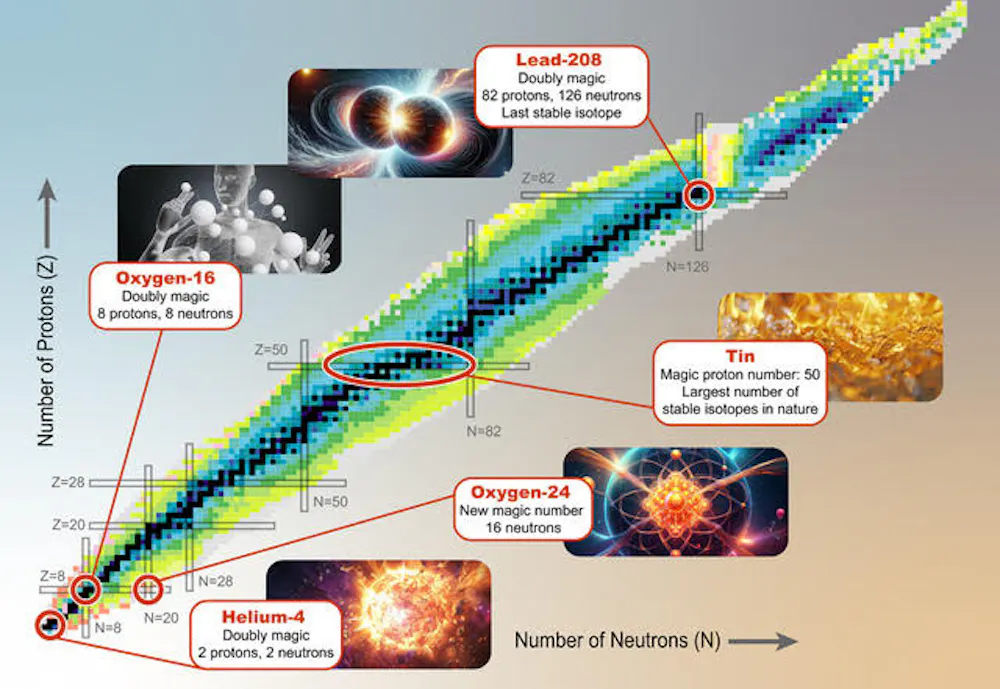
    The magic numbers known to scientists are 2, 8, 20, 28, 50, 82 and 126. They are the same for both protons and neutrons. When a nucleus has a magic number of protons or neutrons, then the particular orbit is filled, and the nucleus is not very reactive, similar to the noble gases.

    For example, the element tin has a magic number of protons. Tin always has 50 protons, and its most common isotope has 70 neutrons. Isotopes are atoms of the same element that have a different number of neutrons.

    There are nine other stable isotopes of tin that can exist – it’s the element with the largest number of stable isotopes. A stable isotope will never spontaneously change into a different element, which is what happens to radioactive isotopes.

    Helium, with two protons and two neutrons, is the lightest “doubly magic” nucleus. Both its neutron count and its proton count are a magic number. The forces that hold the helium-4 nucleus together are so strong that it’s impossible to attach another proton or neutron. If you tried to add another proton or neutron, the resulting atom would fall apart instantaneously.

    On the other hand, the heaviest stable nucleus in existence, lead-208, is also a doubly magic nucleus. It has magic numbers of 82 protons and 126 neutrons.

    Many stable isotopes have magic numbers of protons and neutrons.
    The Facility for Rare Isotope Beams

    Examples of magic numbers and stable nuclei exist everywhere – but scientists couldn’t explain them without the introduction of the shell model.

    Stable nuclei in nature

    The shell structure in nuclei tells researchers about how elements are distributed across the Earth and throughout the universe.

    One of the most abundant elements on our planet and in the human body is oxygen, in particular the isotope oxygen-16.

    With eight protons and eight neutrons, oxygen-16 has an extremely stable nucleus. A nearby star produced the oxygen we find on Earth through nuclear reactions in its core sometime before the solar system was formed.

    Since oxygen nuclei are doubly magic, these nuclei in the star did not interact very much with other nuclei. So more oxygen was left around to eventually act as an essential ingredient for life on Earth.

    In her Nobel lecture, Maria Goeppert Mayer talked about the work she did with physicist Edward Teller. The two had attempted to describe how these elements formed in stars. In the 1930s, it was impossible for them to explain why certain elements and isotopes were more abundant in stars than others. She later found that the increased abundances corresponded to nuclei with something in common: They all had magic numbers of neutrons.

    With the shell model and the explanation of magic numbers, the production of elements in stars was possible and was published in 1957.

    Scientists today continue to use ideas from the nuclear shell model to explain new phenomena in nuclear science. A few accelerator facilities, such as the Facility for Rare Isotope Beams, where we work, aim to create more exotic nuclei to understand how their properties change compared with their stable counterparts.

    At the Facility for Rare Isotope Beams, scientists produce new isotopes by accelerating stable isotopes to about half the speed of light and smashing them at a target. Out of the pieces, we select the rarest ones and study their properties.

    Possibly the most profound modern discovery is the fact that the magic numbers change in exotic nuclei like the type we create here. So, 75 years after the original discovery, the race to discover the next magic number is still on.

    Artemis Spyrou receives funding from the US National Science Foundation.

    Sean Liddick receives funding from the Department of Energy, Office of Science and the Department of Energy, National Nuclear Security Administration.

    – ref. Many stable atoms have ‘magic numbers’ of protons and neutrons − 75 years ago, 2 physicists discovered their special properties – https://theconversation.com/many-stable-atoms-have-magic-numbers-of-protons-and-neutrons-75-years-ago-2-physicists-discovered-their-special-properties-239690

    MIL OSI – Global Reports –

    January 23, 2025
  • MIL-Evening Report: One of science’s greatest achievements: how the rapid development of COVID vaccines prepares us for future pandemics

    Source: The Conversation (Au and NZ) – By Paul Griffin, Professor, Infectious Diseases and Microbiology, The University of Queensland

    Since COVID was first reported in December 2019, there have been more than 775 million recorded infections and more than 7 million deaths from the disease. This makes COVID the seventh-deadliest pandemic in recorded history.

    Factors including climate change, disruption of animal habitats, poverty and global travel mean we’re only likely to see more pandemics in the future.

    It’s impossible to predict exactly when the next pandemic will happen, or what it will be. But experts around the world are working to prepare for this inevitable “disease X”.

    One of the cornerstones of being prepared for the next pandemic is being in the best possible position to design and deploy a suitable vaccine. To this end, scientists and researchers can learn a lot from COVID vaccine development.

    A look back

    After SARS-CoV-2 (the virus that causes COVID) was discovered, vaccine development moved very quickly. In February 2020 the first batch of vaccines was completed (from Moderna) and the first clinical trials began in March.

    An mRNA vaccine from Pfizer/BioNTech was the first to be approved, on December 2 2020 in the United Kingdom. Approvals for this and other vaccines, including shots developed by Moderna (another mRNA vaccine) and Oxford/AstraZeneca (a viral vector vaccine), followed elsewhere soon afterwards.

    Previously the fastest vaccine developed took around four years (for mumps in the 1960s). Had COVID vaccines taken this long it would mean we would only just be rolling them out this year.

    An estimated 13.72 billion COVID vaccine doses have now been administered, with more than 70% of the world’s population having received at least one dose.

    The rapid development and rollout of COVID vaccines is likely to be one of the greatest achievements of medical science ever. It also means we are in a much better position to respond to future emerging pathogens.

    New vaccine technology

    A lot of work over many years prepared us to develop COVID vaccines as quickly as we did. This included developing new platforms such as viral vector and mRNA vaccines that can be adapted quickly to new pathogens.

    While scientists had been working on mRNA vaccines for decades before the COVID pandemic, the COVID shots from Pfizer/BioNTech and Moderna were the first mRNA vaccines to be approved for human use.

    These vaccines work by giving our body instructions (the “m” in mRNA stands for messenger) to make SARS-CoV-2 spike proteins. These are proteins on the surface of the virus which it uses to attach to our cells. This means when we encounter SARS-CoV-2, our immune system is poised to respond.

    This technology will almost certainly be used to protect against other diseases, and could potentially help with a future pandemic.

    In the meantime, scientists are working to improve mRNA technology even further. For example, “self-amplifying RNA” has the potential to enhance immune responses at lower doses compared with conventional mRNA.

    mRNA vaccines teach our bodies to make SARS-CoV-2’s spike protein.
    Kateryna Kon/Shutterstock

    While our current COVID vaccines are safe and very effective at protecting against severe disease, they’re not perfect. We may never be able to achieve a “perfect” vaccine, but some additional properties we’d like to see in future COVID vaccines include being better at reducing transmission, lasting longer, and needing to be updated less often as new variants emerge.

    Even now there are many COVID vaccines in clinical trials. So hopefully, COVID vaccines that improve on the initial shots will be available relatively soon.

    Other desirable attributes include vaccines we can administer by alternate routes to needles. For COVID and other diseases such as influenza, we’re seeing significant developments locally and internationally on vaccines than can be administered via skin patches, through the nose, and even orally.

    Some challenges

    Developing vaccines for COVID was a huge challenge, but one that can mostly be judged a success. Research has estimated COVID vaccines saved 14.4 million lives across 185 countries in just their first year.

    However, the story of COVID vaccination has also had many other challenges, and arguably a number of failures.

    First, the distribution of vaccines was not equitable. Analysis of the initial rollout suggested nearly 80% of eligible people in high-income countries were vaccinated, compared with just over 10% in low-income nations.

    Supply of vaccines was an issue in many parts of the world, so expanding local capacity to enable more rapid production and distribution of vaccines will be important for the next pandemic.

    Further, adverse events linked to COVID vaccines, such as rare blood clots after the AstraZeneca vaccine, affected perceptions of vaccine safety. While every serious adverse event is significant, these incidents were very rare.

    However, these issues exacerbated other challenges that hampered vaccine uptake, including the spread of misinformation.

    Misinformation remains a problem now and will probably still be prevalent whenever we face the next pandemic. Addressing this challenge involves understanding what’s deterring people from getting vaccinated, then informing and educating, addressing misinformation both about vaccination and the risks of the disease itself.

    Restoring and building trust in public health authorities also needs to continue to be a focus. Trust in governments and health authorities declined during the COVID pandemic, and evidence shows lower trust is associated with lower vaccine uptake.

    The COVID vaccine rollout faced a variety of challenges.
    Yuganov Konstantin/Shutterstock

    Ongoing preparation

    There’s no doubt our recent experience with COVID, particularly the rapid development of multiple safe and effective vaccines, has put us in a better position for the next pandemic.

    This didn’t happen by accident. There was a lot of preparation even before COVID was first discovered that facilitated this. Organisations like the Coalition for Epidemic Preparedness Innovations (CEPI) have been supporting research to develop vaccines rapidly to respond to a new threat for some time.

    CEPI has an ongoing program that aims to be able to develop a vaccine against a new threat, or disease X, in just 100 days. While COVID vaccines have been a huge achievement, work continues in the hope we will be able to develop a vaccine even faster next time.

    This article is part of a series on the next pandemic.

    Paul Griffin is a director and scientific advisory board member of the immunisation coalition. He has served on Medical Advisory Boards including for AstraZeneca, GSK, MSD, Moderna, Biocelect/Novavax, Seqirus and Pfizer and has received speaker honoraria including from Seqirus, Novartis, Gilead, Sanofi, MSD and Janssen.

    – ref. One of science’s greatest achievements: how the rapid development of COVID vaccines prepares us for future pandemics – https://theconversation.com/one-of-sciences-greatest-achievements-how-the-rapid-development-of-covid-vaccines-prepares-us-for-future-pandemics-228787

    MIL OSI Analysis – EveningReport.nz –

    January 23, 2025
  • MIL-OSI Translation: 07/10/2024 Minister Radosław Sikorski commemorated the victims of the terrorist attack of October 7, 2023.

    MIL ASI Translation. Region: Polish/Europe –

    Fuente: Gobierno de Polonia en poleco.

    Minister Radosław Sikorski honored the memory of the victims of the terrorist attack of October 7, 2023.07.10.2024The ceremony took place in the gardens of the Embassy of Israel in Warsaw in the presence of the Minister in the Chancellery of the President Wojciech Kolarski, the diplomatic corps, representatives of Jewish organizations. El embajador Yacov Livne expressed gratitude to the president, the government and the Polish nation for unanimously condemning the attack a year ago.

    In the October attack by Hamas and other groups on Israeli territory, approximately 1,200 people were killed, including over 800 civilians. In addition, 251 people were kidnapped to the Gaza Strip – 117 of whom were released, most of whom were released in November last year as a result of a short-term ceasefire. As a result of these events and further actions in the Gaza Strip, at least 19 people of Polish origin were killed, including 9 people with dual Polish and Israeli citizenship. One of the victims – the historian Alex Dancyg, born in Warsaw and distinguished for Polish-Jewish dialogue, was remembered by his son Yuval Dancyg. Minister Sikorski recalled that Poland has always condemned terrorism in any form and hopes that in the future the inhabitants of the Middle East will live in harmony. Those participating in the ceremony expressed solidarity with the group of 101 hostages still held in the Gaza Strip. The fate of most of them remains unknown.

    MILES AXIS

    EDITOR’S NOTE: This article is a translation. Apologies should the grammar and/or sentence structure not be perfect.

    MIL Translation OSI

    January 23, 2025
  • MIL-OSI Translation: 03/10/2024 Armed Forces Innovation Forum 2024

    MIL AXIS Translation. Region: Polish/Europe –

    Fuente: Gobierno de Polonia en poleco.

    Armed Forces Innovation Forum 202403.10.202416 in energy in 2024 The 4th edition of the Armed Forces Innovation Forum of the Republic of Poland will be held in the complex of the Military University of Technology, a flagship undertaking of the Ministry of National Defence, constituting a meeting platform for the army, science and industry.

    FORO DE ASSUMPTIONS:Placing emphasis on the role of innovation in the development of the Polish Armed Forces and the need for the Ministry of National Defence to take decisive action in this direction.Promoting innovation in building and strengthening the capabilities of the Polish Armed Forces.Increasing competitiveness among project contractors – an opportunity for innovative enterprises.Specialization, building and strengthening the potential of domestic research and development entities and industries in the area of new and breakthrough technologies.Promoting new international tools as an opportunity for the development of innovation.Promoting the use of the capabilities of the Polish space industry in meeting the needs of the Polish Armed Forces as part of the implementation of the operational domain of space.FORO GOALS:UNDERTAKING ACTIONS FOR THE DEVELOPMENT OF THE INNOVATION SYSTEM IN THE FORUM is a good platform for starting a debate on the needs of the Polish Armed Forces and the possibilities of meeting them through the use of new solutions, including dual-use technologies. The implementation of this goal requires the creation of an appropriate system that promotes innovation in the RON, which is also to be served by the currently developed departmental innovation strategy. Initiating a debate on the role of tactical level commanders in the process of identifying, developing and using dual-use products for the needs of the Polish Armed Forces. PERFORMING THE FUNCTION OF A MEETING PLATFORM FOR THE ARMY, SCIENCE AND INDUSTRY A platform for meetings of representatives of the army, science and industry. During the sessions (discussion panels), a discussion will be held on the needs of the Polish army and the opportunities and innovation in science and industry in Poland and around the world. During the Forum, experiences will be exchanged and cooperation will be established between representatives of various environments. PRESENTATION OF CONCEPTS AND SOLUTIONS BY RESEARCH CENTRES, UNIVERSITIES AND POLISH INDUSTRY The Innovation Forum enables the presentation of new concepts and ideas that may have an impact on increasing the potential of the Polish Armed Forces, while at the same time being a platform for cooperation, exchange of information and experiences with research centers, universities and representatives of the Polish defense industry. Participation in the Forum of Polish Scientists is an opportunity for them to use their ideas and concepts for the benefit of Poland’s security and defence. STRENGTHENING COOPERATION FOR POLAND’S DEFENCE AND SECURITY The Forum has become one of many mechanisms that support the use of the research potential of Polish centers and the discovery of new opportunities among Polish scientific entities (or among Polish scientists). THEMATIC PANELS Three thematic panels will be held during the Forum: Dual-use technologies – a new trend that will pass, or a way to build the capabilities of the Polish Armed Forces? The prospect of developing the innovation system in the Ministry of National Defense. The area of outer space – the needs of the Polish Armed Forces and the capabilities of Polish industry and science. FORO PARTICIPATION IN THE INNOVATION OF THE ARMED FORCES 2024 The Forum will be held in a stationary form on October 16, 2024. The event will be a closed conference, in which invited participants will participate guests. An online broadcast will be held simultaneously for interested representatives of the world of science, industry, the Polish army and communities dealing with security and defense. Please send your online applications by October 11 to the electrifying director: forum@mon.gov.pl. Participation will be confirmed via the link to the online broadcast of the event. In case of questions or concerns, please contact the electrifying director: forum@mon.gov.pl.

    MILES AXIS

    EDITOR’S NOTE: This article is a translation. Apologies should the grammar and/or sentence structure not be perfect.

    MIL Translation OSI

    January 23, 2025
  • MIL-OSI United Nations: Committee on the Elimination of Discrimination against Women Opens Eighty-Ninth Session

    Source: United Nations – Geneva

    The Committee on the Elimination of Discrimination against Women this morning opened its eighty-ninth session, hearing a statement from the Representative of the Secretary-General, and adopting its agenda for the session, during which it will review the reports of Benin, Canada, Chile, Cuba, Japan, Lao People’s Democratic Republic, New Zealand and Saudi Arabia.

    Opening the session, Mahamane Cissé-Gouro, Director of the Human Rights Council and Treaty Mechanisms Division at the Office of the High Commissioner for Human Rights and Representative of the Secretary-General, extended his congratulations to the Committee members who had been re-elected to serve on the Committee for another term from January 2025. 

    Mr. Cissé-Gouro said that at the Summit of the Future, the Heads of State and Government adopted an action-oriented Pact for the Future, including a Global Digital Compact and a Declaration on Future Generations, which noted that none of the goals could be achieved without the full participation and representation of all women in political and economic life.  These principles were reflected in the Committee’s draft general recommendation no. 40 on the equal and inclusive representation of women in decision-making systems, which would be adopted and made public at the end of the session. Mr. Cissé-Gouro wished the Committee a successful and productive session. 

    Ana Peláez Narváez, Chairperson of the Committee, said that since the last session, the number of States parties that had ratified the Convention had remained at 189. The number of States parties that had accepted the amendment to article 20, paragraph 1 of the Convention concerning the meeting time of the Committee remained at 81.  Kazakhstan, Paraguay, Republic of Moldova and Syria had submitted their periodic reports and San Marino had submitted its combined initial to fifth periodic report to the Committee.

    The Committee adopted the agenda and programme of work of the session, and the Chair and Committee Experts then discussed the inter-sessional activities they had undertaken since the last session.

    Leticia Bonifaz Alfonzo, Committee Rapporteur, introduced the report of the pre-sessional working group for the eighty-ninth session, and Natasha Stott Despoja, Committee Rapporteur on follow-up to concluding observations, briefed the Committee on the status of the follow-up reports received in response to the Committee’s concluding observations.

    The Committee on the Elimination of Discrimination against Women’s eighty-ninth session is being held from 7 October to 25 October.  All documents relating to the Committee’s work, including reports submitted by States parties, can be found on the session’s webpage.  Meeting summary releases can be found here.  The webcast of the Committee’s public meetings can be accessed via the UN Web TV webpage.

    The Committee will next meet at 3 p.m. this afternoon, Monday, 7 October, with representatives of national human rights institutions and non-governmental organizations who will brief about the situation of women in Lao People’s Democratic Republic, Saudi Arabia and New Zealand, whose reports will be reviewed this week.

    Opening Statement by the Representative of the Secretary-General

    MAHAMANE CISSÉ-GOURO, Director, Human Rights Council and Treaty Mechanisms Division, Office of the High Commissioner for Human Rights and Representative of the Secretary-General, said he was encouraged by the fact that all the annual sessions of the treaty bodies could take place despite the current liquidity situation facing the United Nations.  He then extended congratulations to Committee members who had been re-elected to serve on the Committee for another term from January 2025, namely Corinne Dettmeijer-Vermeulen, Nahla Haidar, Bandana Rana and Natasha Stott Despoja.  The multiple challenges of today’s world, in particular conflicts and pushback against women’s rights, highlighted the importance of having a strong, productive and independent Committee. 

    The Summit of the Future, the major event of the year at the United Nations, took place on 22 and 23 September at the United Nations headquarters in New York.  At the Summit, the Heads of State and Government adopted an action-oriented Pact for the Future, including a Global Digital Compact and a Declaration on Future Generations, which noted that none of the goals could be achieved without the full participation and representation of all women in political and economic life.  These principles were reflected in the Committee’s draft general recommendation no. 40 on the equal and inclusive representation of women in decision-making systems, which would be adopted and made public at the end of the session. 

    Mr. Cissé-Gouro congratulated the Committee on this innovative roadmap.  He was encouraged that the Committee took the opportunity to present the future general recommendation no. 40 and promote its synergies with the Pact for the Future at the annual meeting of the United Nations General Assembly’s Women Leaders Platform, in New York. 

    On 25 September, to mark the thirtieth anniversary of the International Year of the Family, the Human Rights Council held a panel discussion on the implementation of States’ obligations under relevant provisions of international human rights law on the role of the family in supporting the protection and promotion of human rights of its members.  This year’s annual discussion on the integration of a gender perspective throughout the work of the Human Rights Council and its mechanisms, held on 30 September, focused on the theme of enhancing gender integration in human rights investigations: a victim-centred perspective.  The outcome of the panel discussion could also inform the important work of the Committee on inquiries.  The Council would also adopt resolutions on the thirtieth anniversary of the Beijing Declaration and Platform of Action, and on domestic violence.

    The Office of the High Commissioner for Human Rights continued to actively support efforts to strengthen the treaty body system, which was the key topic at the thirty-sixth annual meeting of the treaty body Chairpersons in New York in June 2024. The Chairs reiterated the call for resources in their recent statement welcoming the adoption of the Pact for the Future. 

    In that regard, the upcoming General Assembly resolution on the human rights treaty body system would be an important opportunity for Member States to reiterate their commitment to strengthening the treaty bodies by addressing the remaining challenges, including those related to resources.  Mr. Cissé-Gouro said this was the last session for seven Committee members, whose terms would come to an end at the end of the year, namely Nicole Ameline, Marion Bethel, Leticia Bonifaz Alfonzo, Hilary Gbedemah, Dalia Leinarte, Rosario Manalo and Jie Xia.  He thanked them for their dedicated service, and concluded by wishing the Committee a successful and productive session.

    Statements by Committee Experts

    A Committee Expert thanked Mr. Cissé-Gouro for his speech, congratulating the new members and those who were finishing their terms.  Technology, innovation and a gender equality strategy were vital and many organizations were already doing this.  As an international organization, the United Nations needed to adopt an internal general equality strategy. 

    The Committee then adopted its agenda and programme of work for the session.

    ANA PELÁEZ NARVÁEZ, Committee Chairperson, paid homage to three experts who were absent due to health reasons and new responsibilities.  She congratulated the new experts and wished them every success. Since the last session, the number of States parties that had ratified the Convention remained at 189.  The number of States parties that had accepted the amendment to article 20, paragraph 1 of the Convention concerning the meeting time of the Committee, remained at 81.  Since the last session, Kazakhstan, Paraguay, Republic of Moldova and Syria had submitted their periodic reports and San Marino submitted its combined initial to fifth periodic report to the Committee.  Since making the simplified reporting procedure the default procedure for States parties’ reporting to the Committee, the number of States parties that had indicated they wished to opt out and maintain the traditional procedure remained at 13. 

    Ms. Peláez Narváez and Committee Experts then discussed inter-sessional activities they had undertaken since the last session, which included attending the award of the Legion of Honour Medal to Committee Member Nicole Ameline, by President Emmanuel Macron at the Élysée Palace in Paris. 

    LETICIA BONIFAZ ALFONZO, Committee Rapporteur, introduced the report of the pre-sessional working group for the eighty-ninth session, which met from 19 to 23 February 2024 in Geneva.  The working group prepared lists of issues and questions in relation to the reports of Belize, Chad, Republic of Congo, Nepal and Viet Nam, in addition to lists of issues and questions prior to the submission of the reports of Cyprus and Saint Lucia under the simplified reporting procedure. 

    ANA PELÁEZ NARVÁEZ, Committee Chairperson, said that, in light of the backlog of State party reports pending consideration by the Committee accumulated during the COVID-19 pandemic, the Committee had decided to postpone the consideration of the States parties referred to in the report of the pre-sessional working group to future sessions. 

    NATASHA STOTT DESPOJA, Committee Rapporteur on follow-up to concluding observations, briefed the Committee on the status of the follow-up reports received in response to the Committee’s concluding observations.  She said that at the end of the eighty-eighth session, follow-up letters outlining the outcome of assessments of follow-up reports were sent to the Russian Federation and Uzbekistan.  Reminder letters were sent to the Dominican Republic, Gabon, Lebanon, Panama, Peru, Senegal and Uganda.  A shortened version of the follow-up report of Sweden was received in mid-August 2024, with more than an eight-month delay.  The Committee had received follow-up reports from Azerbaijan, Bolivia, Morocco and Türkiye, all received on time; from Peru, with more than five months’ delay; and from South Africa, with an eight-month delay.  Reminders regarding follow-up reports should be sent to Mongolia, Namibia, Portugal and the United Arab Emirates. 


    Produced by the United Nations Information Service in Geneva for use of the media; 
    not an official record. English and French versions of our releases are different as they are the product of two separate coverage teams that work independently.


    CEDAW24.022E

    MIL OSI United Nations News –

    January 23, 2025
  • MIL-OSI USA: Study Finds Forever Chemicals Are More Toxic As Mixtures

    Source: US Department of Health and Human Services – 3

    research news

    UB PhD student Karla Ríos-Bonilla (left) and Diana Aga, director of the UB RENEW Institute, are authors on a study that assessed the mixture toxicity of per- and polyfluoroalkyl substances (PFAS), also known as forever chemicals. Photo: Meredith Forrest Kulwicki

    By TOM DINKI

    Published October 4, 2024

    A first-of-its-kind study has measured the toxicity of several types of per- and polyfluoroalkyl substances (PFAS), better known as “forever chemicals,” when mixed together in the environment and in the human body.

    The good news: Most of the tested chemicals’ individual cytotoxicity and neurotoxicity levels were relatively low. 

    The bad news: The chemicals acted together to make the entire mixture toxic.

    “Though they are structurally similar, not all forever chemicals are made equal — some are more potent, others less. When mixed, all components contributed to the mixture’s cytotoxicity and neurotoxicity,” says the study’s first-author, Karla Ríos-Bonilla, a UB chemistry PhD student.

    “In the laboratory assays we used in this study, most of the types of PFAS that we tested did not appear to be very toxic when measured individually. However, when you measure an entire sample with multiple PFAS, you see the toxicity,” adds study co-author Diana Aga, SUNY Distinguished Professor, director of the RENEW Institute and Henry M. Woodburn Chair in the Department of Chemistry.

    This research was conducted in collaboration with Beate Escher of the Helmholtz Centre for Environmental Research (UFZ), Leipzig, Germany, where Ríos-Bonilla did the in vitro toxicity experiments in the high-throughput screening facility CITEPro. It was published Sept. 11 in Environmental Science and Technology, a journal of the American Chemical Society.

    The study is novel in that it assesses mixture toxicity of PFAS. These synthetic compounds have been widely used in consumer products — from nonstick pans to makeup — for decades, and they can take hundreds to thousands of years to break down, if ever. They are estimated to be in at least 45% of the nation’s drinking water and in the blood of practically every American, and they have been linked to cancer and neurodevelopmental disorders.

    Earlier this year, U.S. Environmental Protection Agency (EPA) issued the first-ever drinking water standards for six kinds of PFAS. However, it is estimated that there are over 15,000 varieties present in the environment. Only a handful of these chemicals have standards and are regulated. 

    “There are six PFAS that can be regulated because we know a lot about them and their toxicity. Unfortunately, we cannot regulate other forms of PFAS until their toxicities are known,” says Aga, who is principal investigator of the EPA STAR grant that funded the research. “We need to set maximum contamination levels for each PFAS that is proportional to their toxicity. To regulate contaminants, it is crucial to know their relative potencies when they occur as mixtures in the environment, along with their predicted environmental concentrations.” 

    Other co-authors from UB are G. Ekin Atilla-Gokcumen, Dr. Marjorie E. Winkler Distinguished Professor and associate chair of the Department of Chemistry, and Judith Cristobal, senior research scientist.

    Ríos-Bonilla is also supported by a graduate fellowship from the National Institute of Environmental Health Sciences (NIEHS) of the National Institutes of Health (NIH). 

    PFOA, PFOS major contributors to mixture toxicity

    To conduct the study, researchers created their own PFAS mixtures, one that is representative of an average American’s blood serum, and the other of surface water samples found in the U.S. Ríos-Bonilla used data from the U.S. Centers for Disease Control and Prevention and from the U.S. Geological Survey to determine the average concentration ratios of PFAS in human blood and in surface water, respectively. 

    They then tested these mixtures’ effects on two cell lines: one that tests for mitochondrial toxicity and oxidative stress, and the other for neurotoxicity.

    Of the 12 PFAS spiked in the water mixture, perfluorooctanoic acid (PFOA) — commonly used in nonstick pans and firefighting foam — was the most cytotoxic, making up to 42% of the mixture’s cytotoxicity.

    On the other hand, both PFOA and perfluorooctane sulfonic acid (PFOS) contributed roughly the same cytotoxicity (25%) to the neurotoxicity assay, despite both contributing only 10 and 15% to the mixture in terms of concentration, respectively. 

    The blood mixture had four PFAS present, but PFOA again was the most cytotoxic to both cell lines. Despite its molar contribution being only 29%, PFOA triggered 68% of the cytotoxicity in the cytotoxicity assay, and 38% in the neurotoxicity assay.

    Interestingly, when researchers analyzed the toxicity of the extracts from real biosolid samples collected from a municipal wastewater treatment plant, very high toxicities were observed, despite the measured low concentrations of PFOA and other PFAS in the sample. 

    “This means that there are many more PFAS and other chemicals in the biosolids, which have not been identified, that contribute to the toxicity of the extracts observed,” Aga says.

    Synergistically versus additive

    One of researchers’ goals was to determine if PFAS acts synergistically. This is when two or more chemicals’ combined effect is greater than the sum effect of the individual chemicals. However, their findings indicate that the effect of PFAS is concentration-additive: meaning that an established mixture toxicity prediction model can be used to predict the combined effect of mixtures. 

    “As up to 12 PFAS in the mixtures acted concentration-additive for cytotoxicity and specific neurotoxicity, it is likely that the thousands of other PFAS that are in commerce and use are also acting in the same manner,” Escher says. “Mixtures pose more of a risk than individual PFAS. As they act and occur in mixtures, they ought to be regulated as mixtures.”

    Researchers say the results of this study will also be very useful in assessing effectiveness of remediation efforts. Breaking down PFAS can sometimes create harmful byproducts that cannot be detected by chemical analysis, so measuring the toxicity of a sample after treatment may be the only way to judge whether a remediation technology is effective.

    “Toxicity assays can be a complimentary tool when analytical chemistry doesn’t give you all the answers, especially when the identities of contaminants in the mixture are unknown, which is the case in many polluted sites,” Aga says.

    MIL OSI USA News –

    January 23, 2025
  • MIL-OSI Canada: Tribunal Initiates Expiry Review—Hot-rolled Carbon Steel Plate and High-strength Low-alloy Steel Plate from Bulgaria, the Czech Republic and Romania

    Source: Government of Canada News

    The Canadian International Trade Tribunal today initiated an expiry review of its order made on October 31, 2019, in expiry review RR-2018-007, to determine if the expiry of the order is likely to lead to continued or resumed dumping of hot-rolled carbon steel plate and high-strength low-alloy steel plate from the Republic of Bulgaria, the Czech Republic and Romania and is likely to result in injury to the domestic industry.

    Ottawa, Ontario, October 7, 2024—The Canadian International Trade Tribunal today initiated an expiry review of its order made on October 31, 2019, in expiry review RR-2018-007, to determine if the expiry of the order is likely to lead to continued or resumed dumping of hot-rolled carbon steel plate and high-strength low-alloy steel plate from the Republic of Bulgaria, the Czech Republic and Romania and is likely to result in injury to the domestic industry.

    No later than March 6, 2025, the Canada Border Services Agency will determine if there is a likelihood of resumed or continued dumping. In the event of a positive determination, the Tribunal will determine, no later than August 13, 2025, whether the continued or resumed dumping is likely to result in injury to the domestic industry.

    The Tribunal is an independent quasi-judicial body that reports to Parliament through the Minister of Finance. It hears cases on dumped and subsidized imports, safeguard complaints, complaints about federal government procurement and appeals of customs and excise tax rulings. When requested by the federal government, the Tribunal also provides advice on other economic, trade and tariff matters.

    Any interested person, association or government that wishes to participate in the Tribunal’s expiry review may do so by filing Form I—Notice of Participation. 

    MIL OSI Canada News –

    January 23, 2025
  • MIL-OSI United Kingdom: UK delegation visits Guatemala to reinforce environmental cooperation

    Source: United Kingdom – Executive Government & Departments

    • English
    • Español de América Latina

    A delegation from the Department of Environment, Food and Rural Affairs (Defra) is in Guatemala 7-14 October to assess progress of the UK’s Biodiverse Landscapes Fund (BLF).

    Roger Heath, Senior Responsible Owner of the BLF and 30×30 and Samuel Leigh, Regional Advisor for Mesoamerica and Andes Amazon for the BLF, will meet with government representatives, implementing partners, civil society and join field visits to Peten and Chiquimula. Rachel Wilson, the Team Leader of the BLF’s Fund Management team at Price Waterhouse Coopers (PwC) will join the delegation.

    On October 7, the delegation will meet in Guatemala City with the leader of the BLF consortium, the Wildlife Conservation Society (WCS) to discuss the progress of the project and upcoming activities. In Guatemala, the BLF is working in Peten (Mayan Jungle) and Chiquimula (Trifino) to protect biodiversity, reduce poverty and tackle the impacts of climate change with projects in line with Guatemalan environmental priorities until 2029.

    The UK delegation will also meet that day with representatives from the Ministry of Environment, the National Council of Protected Areas (CONAP) and the Ministry of Foreign Affairs, to welcome Guatemala’s support  of the BLF and share plans for upcoming interventions in the field that will address ongoing environmental pressures, including the loss of flora and fauna in the Mayan Jungle and the prevention of forest fires in the Trifinio region.

    From 8-12 October, delegates Heath and Leigh will visit Peten to engage with communities that are benefiting from sustainable livelihoods while protecting the environment. These include projects of xate classification, tree planting, bee keeping, and sustainable forestry. They will also engage with local delivery partners that are helping communities to achieve their development and poverty reduction goals in coordination with the Guatemalan authorities.

    On 13 October, the UK delegation will travel to Chiquimula to the area of Trifinio to learn about sustainable agricultural practices to be supported through the BLF and to discuss with local authorities how the Fund could support environmentally sensitive areas to be managed sustainably.

    The BLF is funding activities in six of the world’s most important biodiversity hotspots to help a create a world free from poverty on a liveable planet, including Mesoamerica. Approximately 40% of the funds destined to the Mesoamerica landscape will be allocated in Guatemala (US$7 million) as a commitment to our shared priorities on environment and social development.

    Share this page

    The following links open in a new tab

    • Share on Facebook (opens in new tab)
    • Share on Twitter (opens in new tab)

    Updates to this page

    Published 7 October 2024

    MIL OSI United Kingdom –

    January 23, 2025
  • MIL-OSI Global: Wealthier Canadians live longer and are less likely to be dependent as they age, new research finds

    Source: The Conversation – Canada – By Marie-Louise Leroux, Professeure titulaire en Sciences Economiques, Université du Québec à Montréal (UQAM)

    Population aging is a growing challenge for developed countries like Canada, with significant implications for health care and long-term care systems. In OECD (Organisation for Economic Co-operation and Development) countries, the population of people aged 80 and above is projected to more than double by 2050, reaching 9.8 per cent of the population.

    This demographic shift highlights the increasing demand for high-quality long-term care services. Older individuals frequently experience limitations in daily living activities, such as dressing, washing and household tasks.

    By 2050, half of people aged 65 or older in OECD nations are expected to report some limitation in daily living, and dementia cases are projected to reach 42 million. Canada is not exempt from this trend.


    Read more:
    Enabling better aging: The 4 things seniors need, and the 4 things that need to change


    In Québec, for instance, around 315,000 individuals require help with daily activities — a number expected to nearly double by 2050.

    As the number of elderly people needing care grows, the demand for long-term care services will present significant financial challenges for both individuals and governments. Understanding the economic and demographic factors driving long-term care needs, as well as their implications, is crucial for building a more equitable and robust care system.

    Low-income individuals face double penalty

    Research has shown that while life expectancy has increased, it’s unevenly distributed across socioeconomic groups. Factors such as age, ethnicity, gender, income and education play a significant role in determining longevity.

    In Canada, men in the top five per cent of earners live, on average, 11 per cent longer than those in the bottom five per cent. For women, the longevity gap between those with the highest earnings and the lowest earnings is 3.6 years. These findings are consistent with research from other countries, including the United States.

    However, research on the relationship between income and loss of autonomy is still limited. Some studies suggest that lower socioeconomic status is associated with poorer health outcomes and higher disability rates among older adults.

    In the United Kingdom and the U.S., individuals in the bottom third of wealth distribution live seven to nine fewer years without disability compared to those in the top third. Similarly, in Europe, less wealthy individuals have a higher likelihood of becoming dependent and they remain dependent longer.

    Understanding these socioeconomic disparities is crucial for shaping public policy and identifying which groups are the most vulnerable. Low-income individuals face a double penalty: they are both more likely to need long-term care and they are less financially equipped to bear the associated costs.

    As a result, public long-term care policies might consider prioritizing the support of low-income individuals, since wealthier individuals can more easily afford care.

    High-income Canadians live longer

    Our research explored the relationships between longevity, dependency and income using data from a 2016 survey of 2,000 Canadians aged 50 to 69.

    The data combined both subjective self-reports with objective data about the likelihood of living to age 85, developing limitations in daily living activities or entering a nursing home. Financial resources were measured through reported income and savings.

    Our findings show that Canadians with higher incomes are more likely to live to age 85 and are less likely to become dependent. After controlling for several socioeconomic factors, we found that a one per cent increase in income was associated with the following:

    • nearly a five per cent increase in survival probability;
    • a one per cent decrease in the likelihood of having limitations in daily living activities;
    • and a two per cent decrease in the likelihood of entering a long-term care home.

    The relationship between income and dependency was particularly strong among individuals in the top third of the income distribution. This suggests that financial resources play a significant role in extending life and maintaining independence as people age.

    Interestingly, despite their lower objective likelihood of needing nursing home care, higher-income individuals perceived themselves as more likely to require it. A one per cent increase in income was associated with a four per cent increase in the self-reported probability of entering a nursing home, even though the actual probability of this happening dropped by two per cent.

    This discrepancy may be explained by wealthier individuals considering other factors, such as their financial resources and the possibility of receiving care at home from a professional caregiver.

    Targeted support is needed

    The socio-demographic relationships from our study have important implications for designing equitable long-term care policies. Wealthier individuals tend to live longer and are less often dependent, meaning they are in a better position to pay for long-term care expenses.

    On the other hand, low income individuals are more likely to become dependent and may experience greater financial strain if they need to pay for long-term care costs over an extended period, potentially driving them into poverty.

    Our findings recommend that provincial and territorial governments should adopt redistributive policies for long-term care. These policies could involve providing additional subsidies aimed at low-income older individuals, either as a preventive measure or when they first become dependent.

    This approach aligns with the proposal made by Québec Health Minister Réjean Hébert in 2015, who suggested implementing “autonomy insurance” to help retirees above a certain age manage long-term care costs.

    Redistributive policies are critical not only because low-income individuals have fewer financial resources, but also because they face a higher likelihood of dependency. Without targeted support, these individuals could be left struggling to afford the care they need. Designing policies that recognize these disparities can help ensure a more equitable and sustainable long-term care system in Canada.

    Marie-Louise Leroux receives funding from FRQSC and SSHRC-CRSH. She is affiliated with CIRANO (Montréal) and CESifo (Munich).

    Marie Connolly receives funding from FRQSC and SSHRC-CRSH. She is affiliated with CIRANO (Montréal).

    – ref. Wealthier Canadians live longer and are less likely to be dependent as they age, new research finds – https://theconversation.com/wealthier-canadians-live-longer-and-are-less-likely-to-be-dependent-as-they-age-new-research-finds-240081

    MIL OSI – Global Reports –

    January 23, 2025
  • MIL-OSI: Waldencast plc Announces Board Appointments and Annual General Meeting

    Source: GlobeNewswire (MIL-OSI)

    NEW YORK, Oct. 07, 2024 (GLOBE NEWSWIRE) — Waldencast plc (NASDAQ: WALD) (“Waldencast” or the “Company”), a global multi-brand beauty and wellness platform, announced today that Hind Sebti, Kelly Brookie and Roberto Thompson have been appointed to its board of Directors (the “Board”), effective September 26, 2024. These executives bring extensive professional experience further enhancing the breadth of talent and expertise possessed by the Board. Ms. Brookie will replace Sarah Brown who has informed the Board of her intention to not renew her mandate ahead of the Company’s Annual General Meeting. The Company also announced that its Annual General Meeting is scheduled for October 28, 2024 during which the Company’s shareholders will be asked to vote on the renewal of Class I and Class II directors. Following this announcement, the Board will include 11 members, each of whom possesses significant expertise, particularly in the beauty, financial and consumer products sectors.

    Hind Sebti is the co-founder and Chief Growth Officer of Waldencast. Ms. Sebti has more than 20 years of experience leading and managing beauty brands across multiple categories and stages during her tenures at L’Oréal and Procter & Gamble. Ms. Sebti co-founded Waldencast Ventures alongside Mr. Brousset in 2019. Ms. Sebti brings in-depth knowledge and understanding of the beauty industry as well as consumer insights to identify and invest in the next-generation beauty brands. Importantly, Ms. Sebti plays a key role in helping portfolio brands scale, leveraging her extensive multi-category and brand management experience. Previously, Ms. Sebti also served as Chief Executive Officer of Waldencast Brands, a subsidiary of Waldencast Ventures, to incubate and commercialize new brands, where she led the brand creation process, with a focus on creative and operational optimization, through all stages from conception and product development to go-to-market strategy.

    Kelly Brookie retired from Deloitte in 2020 with over 25 years of experience in financial accounting and reporting, internal controls and governance matters. As an Audit Partner, Ms. Brookie worked with companies on accounting and auditing matters, transactions, transformation and strategic risks. At Deloitte, Ms. Brookie served consumer products, manufacturing, distribution, and retail companies. Throughout her career, she has performed audit services for public and private companies as well as gained experience with audit committees in performing the required communications and procedures. She is active in supporting multiple non-profit organizations, including serving on Boards and committees. Ms. Brookie is a Certified Public Accountant and a member of the American Institute of Certified Public Accountants. She received her Bachelor’s Degree in Political Science from the University of Washington and a Master of Accounting from University of Southern California. Ms. Brookie will be serving as a member of the Audit and Governance Committee.

    Roberto Thompson Motta received a BS in Mechanical Engineering from Pontifícia Universidade Católica do Rio de Janeiro and an MBA from The Wharton School of the University of Pennsylvania. Mr. Thompson was a co-founder and board member of 3G Capital, a global investment firm headquartered in New York. Mr. Thompson is currently a strategic advisor to the Board of Directors of AB InBev and has served as board member since 2004. Mr. Thompson has also served on the Board of Directors of AmBev S.A., Restaurant Brands International, Lojas Americanas S.A., São Carlos Empreendimentos e Participações S.A. and StoneCo Ltd. He was one of the founding partners of GP Investments Ltd. and a member of its Board of Directors until 2010. Mr. Thompson is a member of The Graduate Executive Board of The Wharton School of the University of Pennsylvania, and of The International Council of The Metropolitan Museum of Art in New York. He is also a Patron of the Museum of Modern Art of São Paulo. Mr. Thompson will be serving as a member of the Finance Committee.

    Felipe Dutra, Chairman of the Board stated: “We are pleased to announce that Hind, Kelly and Roberto are joining our Board of Directors. Each bring distinct and diverse skill sets that we believe will be highly valuable to us as we execute our long-term vision. These appointments reflect the Company’s commitment to maintaining a strong and diverse Board and we look forward to their collective contributions as we execute the strategy that maximizes the power, performance and growth of our brands.”

    The Company extends its sincere thanks to Ms. Brown for her dedicated service and valuable contributions during her tenure, including in her role as chair of the Company’s Nominating and Corporate Governance Committee as well as member of the Audit Committee.

    Annual General Meeting

    The Company will hold its 2024 annual meeting of shareholders (the “Annual General Meeting”) on October 28, 2024, at 5:00 p.m. BST, at Michelin House, 81 Fulham Rd., London SW3 6RD, United Kingdom. Only those persons entered on the register of members of the Company as at September 24, 2024 (the “Record Date”) shall be entitled to attend or vote at the Annual General Meeting in respect of the number of shares registered in their name at that time. As of the Record Date, the Company had 122,584,658 ordinary shares outstanding, consisting of 111,518,130 Class A ordinary shares outstanding and 11,066,528 Class B ordinary shares outstanding.

    Materials made available in connection with the Annual General Meeting are available on the Company’s website at https://ir.waldencast.com/financial-information/annual-meeting.

    About Waldencast plc

    Founded by Michel Brousset and Hind Sebti, Waldencast’s ambition is to build a global best-in-class beauty and wellness operating platform by developing, acquiring, accelerating, and scaling conscious, high-growth purpose-driven brands. Waldencast’s vision is fundamentally underpinned by its brand-led business model that ensures proximity to its customers, business agility, and market responsiveness, while maintaining each brand’s distinct DNA. The first step in realizing its vision was the business combination with Obagi Medical and Milk Makeup. As part of the Waldencast platform, its brands will benefit from the operational scale of a multi-brand platform; the expertise in managing global beauty brands at scale; a balanced portfolio to mitigate category fluctuations; asset light efficiency; and the market responsiveness and speed of entrepreneurial indie brands. For more information please visit: https://ir.waldencast.com/.

    Obagi Medical is an industry-leading, advanced skin care line rooted in research and skin biology, refined with a legacy of 35 years’ experience. First known as leaders in the treatment of hyperpigmentation with the Obagi Medical Nu-Derm® System, Obagi Medical products are designed to diminish the appearance of premature aging, photodamage, skin discoloration, acne, and sun damage. More information about Obagi Medical is available on the brand’s website at http://www.obagi.com.

    Founded in 2016, Milk Makeup quickly became a cult-favorite among the beauty community for its values of self-expression and inclusion, captured by its signature Live Your Look, its innovative formulas and clean ingredients. The brand creates vegan, cruelty-free, clean formulas from its Milk Makeup HQ in Downtown NYC. Currently, Milk Makeup offers over 300 products through its US website http://www.MilkMakeup.com, and its retail partners including Sephora in North America, Europe, the Middle East and Australia and Cult Beauty and Selfridges in the UK.

    Contacts:

    Investors
    ICR
    Allison Malkin
    waldencastir@icrinc.com

    Media
    ICR
    Brittney Fraser/Alecia Pulman
    waldencast@icrinc.com

    The MIL Network –

    January 23, 2025
  • MIL-OSI USA: Three Storms Churn in an Active Atlantic

    Source: NASA

    From the stable Lagrange point 1, located one million miles above Earth, NASA’s EPIC (Earth Polychromatic Imaging Camera) imager on the DSCOVR (Deep Space Climate Observatory) satellite observed an unusually active Atlantic Basin.
    In early October, three hurricanes simultaneously spun over the North Atlantic Ocean. This image shows the three storms—Milton, Kirk, and Leslie—at about 12 p.m. Central Time (17:00 Universal Time) on October 6, 2024. It was captured as Milton was developing in the southwestern Gulf of Mexico, about an hour before it became a hurricane.
    According to Phil Klotzbach, a Colorado State University meteorologist, this is the first-known hurricane season to see three hurricanes simultaneously present in the basin after September. Klotzbach cites the National Hurricane Center’s (NHC) database, which dates back to 1851, but he also noted: “…there are likely underestimates and potentially missed hurricanes prior to the satellite era (1966-onwards).”
    Fueled by unusually warm water in the Gulf of Mexico, Hurricane Milton “explosively” intensified from a Category 1 to Category 5 storm in less than 24 hours from October 6-7. The hurricane developed with “light shear and very warm waters in its path,” according to the NHC. As of the afternoon on October 7, Milton had 175 mile (282 kilometer) per hour winds and was forecast by NHC to make landfall on the west coast of the Florida peninsula on the evening of October 9.
    In an October 6 update of tropical Atlantic activity, University of Miami hurricane researcher Brian McNoldy noted that temperatures in the Gulf of Mexico—both at and below the surface—were record warm. “High ocean heat content provides a hurricane with a constant source of fuel and makes it much harder to upwell cooler water from below which could weaken the storm,” McNoldy wrote in the update. “This will help Milton to rapidly intensify and reach a higher peak intensity.”
    To the northeast, Kirk was weakening from a Category 2 to a Category 1 hurricane around the time of this image. Kirk began developing in the eastern tropical Atlantic in late-September and reached peak intensity as a Category 4 hurricane on October 4. The major hurricane veered northeast after development and evolved into an extratropical cyclone. NHC forecasts indicate that the storm could reach the shores of western France on October 9.
    Meanwhile, Leslie churned as a Category 1 storm when this image was acquired. Leslie developed several hundred miles southwest of the Cabo Verde Islands of western Africa and became a hurricane on October 4. The storm is expected to weaken to a tropical storm by October 8, with no interaction with land.
    The hurricane season, which started June 1 and runs through November 30, has been unusually busy so far in 2024, according to Klotzbach. As of October 6, nine hurricanes have developed in the Atlantic compared to the 1991-2020 average of 5.5.
    NASA Earth Observatory image by Michala Garrison, using data from DSCOVR EPIC. Story by Emily Cassidy.

    MIL OSI USA News –

    January 23, 2025
  • MIL-OSI United Nations: Committee on Enforced Disappearances Closes Twenty-Seventh Session after Adopting Concluding Observations on Morocco, Norway and Ukraine

    Source: United Nations – Geneva

    The Committee on Enforced Disappearances this afternoon closed its twenty-seventh session after adopting its concluding observations on the reports of Morocco, Norway and Ukraine.

    Juan Pablo Albán Alencastro, Committee Rapporteur, said the Committee held constructive dialogues with Morocco, Norway and Ukraine, and adopted concluding observations on their reports, which would be published next Tuesday.  In addition, the Committee adopted lists of issues in the absence of a report for Lesotho and Seychelles, as well as lists of themes on additional information for Belgium and Serbia. 

    The Rapporteur recalled that at the opening of the session, the Committee paid tribute to the victims of enforced disappearance, and heard the testimony of Ms. Shui-Meng Ng, wife of Sombath Somphone, disappeared in Lao People’s Democratic Republic.  During the session, the Committee held productive meetings with States parties, civil society organizations and victims.  It also held discussions on its methods of work and adopted several amendments to its Rules of Procedure.  It adopted its report on the urgent action mechanism.

    The Committee also adopted the final draft of the joint statement on short-term enforced disappearances, drafted with the Working Group on Enforced and Involuntary Disappearances; made the decision to initiate the process for the future adoption of a general comment on women and enforced disappearances; and continued planning the World Forum on Enforced Disappearances, to be held on 15 and 16 January 2025.

    Milica Kolakovic-Bojovic, Committee Vice-Chair, presented the illustrated Spanish version of the general comment on enforced disappearances in the context of migration, which was available to be downloaded and would soon be printed and distributed. 

    The Committee also screened a short extract of a documentary on international adoptions which had their roots in enforced disappearance, which would soon be aired on television.

    Olivier de Frouville, Committee Chairperson, in concluding remarks, expressed thanks to all those who had contributed to the twenty-seventh session, which had been very intense.  The Committee had opened the session under the banner of the multiplication of armed conflicts, and unfortunately was closing it in a situation that had become even worse, particularly in the Middle East. 

    During the session, the Committee had held a constructive dialogue with Ukraine. Today, thousands of families in Ukraine were searching for their loved ones. 

    The dialogue with Morocco had made it possible to highlight the weight of the past.  While the work of the Equity and Reconciliation Commission established the State’s responsibility for enforced disappearances committed between 1956 and 1999, and clarified the fate of many disappeared persons, the issue remained a matter of concern in Moroccan society. 

    The question of the past was also present in the dialogue with Norway.  In the contemporary period, many countries like Norway had to face the challenges posed by the disappearances of migrants, but also revelations related to illegal international adoptions, which in some cases could be caused by enforced disappearances. 

    Mr. de Frouville said the Committee had adopted its report on the urgent action procedure, which showed an increase in cases of disappearances with a transnational dimension and involving several States.  The Committee was particularly concerned that several authors had indicated that they no longer wished to follow up on an urgent action initiated by them, for fear of reprisals, or because the State concerned did not provide them with access to the file.  It was crucial that all perpetrators of urgent actions, as well as all persons cooperating with the Committee, were protected from all forms of reprisals and were able to participate fully in the search for the disappeared. 

    The World Congress on Enforced Disappearances would take place on 15 and 16 January 2025. The Committee invited all interested States, civil society actors and organizations of victims of enforced disappearances to attend.  Registration for the Conference was available online as of today. 

    All documents relating to the Committee’s work, including reports submitted by States parties, can be found on the session’s webpage, where the concluding observations on the reports of Morocco, Norway and Ukraine will be available next Tuesday.  Summaries of the public meetings of the Committee can be found here, while webcasts of the public meetings can be found here.

    The Committee’s twenty-eighth session is scheduled to be held from 17 March to 4 April 2025, during which the Committee will examine the reports of the Central African Republic, Malta and Sri Lanka.   It will also review responses provided by Argentina and Peru to its request for additional information and hold the official launch of the joint statement on so-called short-term enforced disappearances. 


    Produced by the United Nations Information Service in Geneva for use of the media; 
    not an official record. English and French versions of our releases are different as they are the product of two separate coverage teams that work independently.


    CED24.011E

    MIL OSI United Nations News –

    January 23, 2025
  • MIL-OSI Canada: Minister Ng promotes Canada’s aerospace expertise while in Brussels, Belgium

    Source: Government of Canada News

    News release

    Canada is a global leader in addressing climate change. Over the past 50 years, Canada’s fleet of more than 160 aerial firefighting aircraft—waterbombers—has been deployed worldwide to protect communities from the impacts of climate change. This demonstrates Canada’s commitment to environmental stewardship. Additionally, Canada’s expertise in the aerospace sector benefits the economy, creates jobs and boosts investments in the country’s aerospace industry.

    October 4, 2024 – Ottawa, Ontario – Global Affairs Canada

    Canada is a global leader in addressing climate change. Over the past 50 years, Canada’s fleet of more than 160 aerial firefighting aircraft—waterbombers—has been deployed worldwide to protect communities from the impacts of climate change. This demonstrates Canada’s commitment to environmental stewardship. Additionally, Canada’s expertise in the aerospace sector benefits the economy, creates jobs and boosts investments in the country’s aerospace industry.

    The Honourable Mary Ng, Minister of Export Promotion, International Trade and Economic Development, concluded her visit to Brussels, Belgium, where, with Janez Lenarčič, European Commissioner for Crisis Management, she took part in an event celebrating European Union members’ purchase of 22 De Havilland Canadair 515 aircraft for the EU’s aerial firefighting fleet. This collaboration will create 650 jobs across Canada.

    Minister Ng met with Bobby Kwon, President and CEO of the Canadian Commercial Corporation (CCC), and Sven List, Senior Vice-President of Canadian Corporate Business at Export Development Canada (EDC), to recognize the successful government-to-government sale of these aerial firefighting aircraft, which reinforce Canada’s ongoing commitment to mitigating the impacts of climate change, including forest fires.

    While in Brussels, Minister Ng took the opportunity to meet with Valdis Dombrovskis, Executive Vice-President and European Commissioner for Trade. Minister Ng and Executive Vice-President Dombrovskis discussed opportunities to advance trade through the Canada-EU Comprehensive Economic and Trade Agreement (CETA) and the growing Canada-EU relationship. They also discussed areas of mutual interest and shared priorities in relation to the World Trade Organization, G7 and G20. 

    Quotes

    “The acquisition of Canadian firefighting aircraft by EU countries is a vital step in tackling wildfires in the EU and reflects our commitment to mitigating the effects of climate change together as trustworthy partners. By enhancing the capabilities of our European allies, we are protecting nature and communities while strengthening international ties as we work together to face this global challenge. The acquisition is expected to create almost 650 new and sustainable jobs at De Havilland Canada, as well as 2,600 additional jobs in the supply chain for the aircraft. This transaction is good for Canadian industry, Canadian jobs and the Canadian economy.”

    – Mary Ng, Minister of Export Promotion, International Trade and Economic Development

    “This collaboration underscores the importance of international relationships for Canadian exporters like De Havilland Canada, which provides essential expertise and services. EDC welcomed the opportunity to be part of this ‘Team Canada’ approach to support the delivery of De Havilland Canada’s firefighting aircraft to several European partners, enhancing their firefighting capabilities amid urgent climate change challenges.”

    – Sven List, Senior Vice-President of Canadian Corporate Business, EDC

    “Over the last 2 years, the CCC has been an effective partner of De Havilland Canada in leveraging our government-to-government contracting approach to enable the largest purchase order in the company’s history and the launch of a new aircraft production line for Canada.”

    – Bobby Kwon, President and CEO, CCC

    Quick facts

    • The EU market, comprising 27 member states, is Canada’s second-largest global trading partner for goods and services and its second-largest partner for 2-way direct investment, after the United States.

    • September 21, 2024, marked the seventh anniversary of the provisional entry into force of CETA.

    • In 2023, Canada-EU bilateral merchandise trade reached a value of $126.5 billion, representing an increase of more than 65% since 2016, before CETA had entered into force.

    Associated links

    Contacts

    Huzaif Qaisar
    Press Secretary
    Office of the Minister of Export Promotion, International Trade and Economic Development
    343-575-8816
    Huzaif.Qaisar@international.gc.ca

    Media Relations Office
    Global Affairs Canada
    media@international.gc.ca
    Follow us on X (Twitter): @CanadaTrade
    Like us on Facebook: Canada’s international trade – Global Affairs Canada

    MIL OSI Canada News –

    January 23, 2025
  • MIL-OSI USA News: Press Briefing by President  Biden, Press Secretary Karine Jean-Pierre, and National Economic Adviser Lael  Brainard

    Source: The White House

    2:06 P.M. EDT

    THE PRESIDENT:  Hey, folks.  My name is Joe Biden.  (Laughter.)

    Q    Welcome to the briefing room.

    Q    Welcome, Mr. President. 

    Q    We’ve been waiting for you. 

    THE PRESIDENT:  Welcome to the swimming pool.

    Q    Finally.  This is — this is great.

    THE PRESIDENT:  Hey, look, folks, good afternoon.  The past two days have gotten some — we’ve gotten very good news about the American economy. 

    Just yesterday, shipping carriers, after some discussion, and the International Longshoreman’s Union came to an agreement to keep their ports in the East Coast and Gulf ports open.  We averted what could have become a major crisis for the country.  And a tentative agreement, which includes record wage increases for dockworkers and shows the importance of collective bargaining and represents, I think, critical progress toward a strong contract. 

    I especially want to thank the carriers, the port operators, and the longshoreman’s union for reaching this agreement at a time when the nation has experienced such terrible devastation from Hurricane Helene.  It was truly a service to the American people for all the parties to come together and to respond to our request to keep the ports open. 

    I was determined to — to avert a crisis at this moment, because it’s a critical moment.  If we didn’t do this now, we’d have a real problem.  

    I also want to thank my White House team for the work — they worked around the clock to bring the parties together. 

    But, today, I — we got more incredible news.  Although the strength of the American economy is a — it’s about the strength of the American economy.  The new jobs report, as you all know and you’ve been reporting, created 250,000 jobs in September.  The expectation was for 150,000 jobs in September, which is — far exceeds that number.  Not only the previous two months — but not only that, the previous two months was revised up 150,000 — 75,000 jobs. 

    And from the very beginning, we were told time and again that the polices we were pursuing — we’d put forward weren’t –weren’t going to work, make things worse, including some of the other team who are still saying they’re going to make things worse.  But we’ve proven them wrong.

    You know, we were told our American — we’ve — we were told our American Rescue Plan was too big and it would crowd out private investment.  We proved them wrong.  It vaccinated a nation and got immediate economic relief to people in need. 

    When I came to office determined to end trickle-down economics and to grow the economy from the middle out and the bottom up — I know you’re tired of hearing me say that over and over again, but that was the policy; it remains the policy — because when you do that, everyone does well.  When the middle class grows, the nation is stronger.  And the nation is stronger when there is a strong union movement as well. 

    We were told it wouldn’t work, but I was also determined to do what was ignored for much too long.  Presidents have been authorized since the ‘30s to be able to spend the money given by Congress — to spend the money on hiring American workers and using American product where they were available.  And that’s what we did.  

    We were told that was going to be a big problem, but all the money we — I was authorized to spend by the Congress has gone to building a mi- — to — gone to hiring American workers and using American products.  We were told it wasn’t going to be — I — we were told that was going to be a big problem, but it’s working. 

    We were also told that our historic laws to invest in America and all Americans would crowd out private-sector investment.  Well, that was proven wrong too.

    We’ve attracted nearly $1 trillion since we’ve come to office in private-sector investment from domestic and foreign companies investing in America — in America.  And not this stuff with sh- — shipping jobs overseas for cheaper labor and bringing back a product to America.  We’re building it here and sending it overseas.  And look at the results across the board.

    Unemployment is back down 4- — to 4.1 percent.  And every month f- — that Vice President Harris and I have been in office, we’ve been — there’s been — we’ve created jobs every single month. 

    The nation has now created 16 million jobs since I’ve come to office, more jobs created in a single presidential term than at any time in American history. 

    Our GDP shows our economy grew at — at 10 percent under my administration.  Unemployment reached the lowest level in 50 years. 

    We were also told inflation couldn’t come down without massive job losses or sending the economy into economic recession. 

    Once again, the outside experts were wrong.  Inflation has come way down.  Wages have gone up, growing faster than prices.  The interest rates are down.  A record 19 million new business applications have been filed for.  The stock market continues to reach new heights. 

    We’ve got more work to do though to keep getting — keep — to keep getting prices down, like more affordable housing, extending what I’ve done for seniors and lowering prescription drug costs by letting Medicare negotiate the prices — make sure that’s available to everyone. 

    And, by the way, what we’ve done so far — just what we’ve brought down the prices for seniors under Medicare, it saved the taxpayers billions of dollars — billions of dollars.  Saved the taxpayers billions of dollars.  That’s important to note because they don’t have to pay the exorbitant and ratio- — irrational prices that these companies are charging.

    The simple fact is we’ve gone from an economy in crisis to literally having the strongest economy in the world.  And — but we got — we — we got more work to do.  We’ve got more work to do to deal the — the things I’ve just mentioned.  And we’re going to have to deal with unforeseen costs of what this — this hu- — this hurricane is going to cost.  It’s going to cost a lot of money, and I’m going to probably have to ask the Congress before we leave for more money to deal with some of those problems, but that remains to be seen. 

    I’ll take a few questions before I turn it over to —

    Q    Mr. President —

    THE PRESIDENT:  You pick out the questions.

    MS. JEAN-PIERRE:  Oh, okay.  Yes, sir.  (Laughter.)  Yes, sir. 

    Go ahead, Josh. 

    Q    Thanks again for doing this, Mr. President.  Two questions.  The first, Florida Senator Marco Rubio described today’s jobs report as having “fake numbers.”  What do you make of that?  And how worried are you that many Americans are hearing that the jobs numbers aren’t real? 

    THE PRESIDENT:  Look, I’m going to be very careful here.  If you notice anything the MAGA Republicans don’t like, they call “fake.”  Anything.  The job numbers are what the job numbers are.  They’re real.  They’re sincere.  They’re — what we are. 

    But — and, by the way, just look at how the EU talks about us, how they’d like to have an economy like ours.  Let’s talk about the rest of the world looks at us and what we’re doing. 

    So, I — well, I don’t want to get going. 

    Q    And — and then, secondly, could you clarify some of your comments yesterday with regard to strikes on Iranian oil facilities?  What did you mean by them, given some of the reactions we’re seeing in the market?

    THE PRESIDENT:  Well, look, the Israelis have not concluded how they’re — what they’re going to do in terms of a strike.  That’s under discussion.  I think there are — if I were in their shoes, I’d be thinking about other alternatives than striking oil fields. 

    MS. JEAN-PIERRE:  Go ahead, Weijia.

    Q    Thank you, Karine.  Thank you so much, Mr. President, for being here. 

    This week, Senator Chris Murphy said, “It’s certainly a possibility that the Israeli government is not going to sign any diplomatic agreement prior to the election,” which is what you have been calling for for so long, “potentially to try to influence the result.” 

    Do you agree?  Do you have any worries that Netanyahu may be trying to influence the election, and that’s why he has not agreed to a diplomatic solution?

    THE PRESIDENT:  No administration has helped Israel more than I have.  None.  None.  None.  And I think Bibi should remember that. 

    And whether he’s trying to influence the election, I don’t know, but I’m not counting on that.

    Q    You’ve said many times recently that you want to speak to him, that you plan to —

    THE PRESIDENT:  No, I didn’t say “plan to.”  I didn’t say “want to.”

    Q    You don’t want to?

    THE PRESIDENT:  No, I didn’t say that.  You’re making it sound like I’m seeking an inv- — speak- — I’m assuming when they make their judgment of how they’re going to respond, we will then have a discussion. 

    MS. JEAN-PIERRE:  Go ahead, Selina.

    Q    Thank you.

    Q    Thank you, Mr. President, for being here.  What are you advising the Israelis to do in terms of their retaliation to Iran?  And at this point, you still haven’t spoken to Netanyahu.  Is it fair to say that you have little personal influence over what he decides to do?

    THE PRESIDENT:  No.  Look, our — our teams are in contact 12 hours a day.  They’re constantly in contact.  I’ve already had my presidential daily brief.  We’ve already had interface between our military, our — the diplomats.  It’s in constant contact. 

    They are trying to figure out — this is High Holidays as well.  They’re not going to make a decision immediately.  And so, we’re going to wait to see what they — when they want to talk. 

    Q    But over the past few months, they’ve consistently defied your administration’s own advice.  So, do you believe that the Israelis are going to listen to the advice you’re giving them?

    THE PRESIDENT:  What I know is the plan that I put together received the support of the U.N. Security Council and the vast majority of our allies around the world as a way to bring this to an end. 

    One of — look, the Israelis have every right to respond to the vicious attacks on them not just from the Iranians but from the — everyone from Hezbollah to the Houthis to — anyway.  And — but the fact is that they have to be very much more careful about dealing with civilian casualties.

    Q    So, how should they respond?  You expressed concerns about attacks on Iranian oil facilities.  How should they respond?

    THE PRESIDENT:  That’s between me and them.

    MS. JEAN-PIERRE:  All right.  We got to move on.  Go ahead, Tam.

    Q    The election is a month away.  One, I’d like to know how you’re feeling about how this election is going.  And then, also, do you have confidence that it will be a free and fair election and that it will be peaceful?

    THE PRESIDENT:  Two separate questions.

    Q    Very much.

    THE PRESIDENT:  I’m confident it’ll be free and fair.  I don’t know whether it will be peaceful. 

    The things that Trump has said and the things that he said last time out when he didn’t like the outcome of the election were very dangerous. 

    If you notice — I — I noticed that the vice-presidential Republican candidate did not say he’d accept the outcome of the election.  And they haven’t even accepted the outcome of the last election.  So, I’m — I’m concerned about what they’re — what they’re going to do.

    Q    Are you making any preparations?  Getting security briefings related to domestic security?

    THE PRESIDENT:  I always get those briefings.

    MS. JEAN-PIERRE:  All right.  We got to move on.  Go ahead, Akayla.  And we have — do a couple more.

    Q    Hi.  Hi, Mr. President.  When are you considering imposing sanctions on Iran?  And would you include oil in those sanctions?

    THE PRESIDENT:  That’s som- — that’s be- — that’s under consideration right now, the whole thing.  I’m not going to discuss that out loud.

    Q    And just on your comments yesterday on the port strike.  You said by “the grace of God,” it’s going to hold.  Is there any reason you think that this —

    THE PRESIDENT:  Well, there’s more to do.

    Q    — this temporary suspension —

    THE PRESIDENT:  It’s a month from now, and there’s more to do in terms of everything from the whole notion of me- — me- — excuse me — mechanization of the ports and the like.  There’s more to more to re- — more to resolve.

    MS. JEAN-PIERRE:  Go ahead, Danny.

    Q    Thanks, Karine.  Thank you, Mr. President.  Last night, you said that there’s still a lot to do to avoid an all-out war in the Middle East.  I mean, firstly, aren’t we pretty close to that definition already?  And — and, secondly, what — what can you really do to stop that happening?

    THE PRESIDNET:  There’s a lot we are doing.  The main thing we can do is try to rally the rest of the world and our allies into participating, like the French are, in — in Lebanon and other places to tamp this down.  And — but when you have proxies as irrational as Hezbollah and the Houthis and — it’s a — it’s a hard thing to determine.

    MS. JEAN-PIERRE:  Go ahead, Toluse.

    THE PRESIDENT:  I’ve got to go, kid.

    MS. JEAN-PIERRE:  I know.  I know.  (Laughter.)  He’s telling me, “I got to go.”

    THE PRESIDENT:  I said I’d take a couple questions.  (Laughter.)

    MS. JEAN-PIERRE:  All right. 

    Q    We’ll take (inaudible) —

    MS. JEAN-PIERRE:  You’re the la- — you’re the last one, Toluse.

    THE PRESIDENT:  I think she’s decreasing her credibility.  (Laughter.)

    Q    First — first time in four years; you have to take some more.

    MS. JEAN-PIERRE:  Toluse, you’re going to be the last one.

    Q    Thank you, Mr. President.  Thank you for — for spending some time here with us.  There have obviously been a number of crises that the country has been facing over the past several days with the hurricane, with port strike, with the situation in the Middle East.  Can you talk about how your vice president, who is running for the presidency, has worked on these crises and what role she has played over the past several

    days?

    THE PRESIDENT:  Well, she’s — I’m in constant contact with her.  She’s aware of where — we all — we’re singing from the same song sheet.  We — she helped pass the l- — all the laws that are being employed now.  She was a major player in everything we’ve done, including passage of legislation, which we were told we could never pass.  And so, she’s been — and her — her staff is interlocked with mine in terms of all the things we’re doing.

    MS. JEAN-PIERRE:  All right, sir.  Thank you, sir.

    (Cross-talk.)

    MS. JEAN-PIERRE:  It’s up to you, sir.  (Laughs.)

    (Cross-talk.)

    MS. JEAN-PIERRE:  Totally up to you, sir.

    (Cross-talk.)

    MS. JEAN-PIERRE:  All right.  All right.  Go ahead.  Go ahead.  Go ahead.  Go ahead.

    (Cross-talk.)

    MS. JEAN-PIERRE:  Yeah, Nandita.  Nandita.

    Sir — sir — no.  No.  Sir — I didn’t call on you, sir.  I didn’t call on you.  Nandita.

    Q    Pope Francis is calling for a day of —

    Q    Thank you.  Thank you, Karine.

    MS. JEAN-PIERRE:  Nandita. 

    Q    — prayer —

    Q    Mr. President —

    MS. JEAN-PIERRE:  Go, Nandita.

    Q    — and fasting.  What’s —

    Q    Mr. President —

    THE PRESIDENT:  On Pope Francis —

    Q    Yeah.

    THE PRESIDENT:  — calling for a day of prayer and fasting —

    Q    A day of prayer and fasting this Monday, October 7th.  You reaction, sir?

    THE PRESIDENT:  I will prayer and fast.

    MS. JEAN-PIERRE:  All right.  That’s —

    (Cross-talk.)

    Q    Mr. President, what is acceptable to you in terms of Israel’s response?  How long are you okay with Israel bombing Lebanon?  What is acceptable to you?

    Q    Mr. President —

    (Cross-talk.)

    MS. JEAN-PIERRE:  All right, guys.  That’s it.  Thank you, everybody. 

    THE PRESIDENT:  Thank you.

    MS. JEAN-PIERRE:  Thank you, Mr. President.  Thank you, sir.

    THE PRESIDENT:  Thank you.

    (Cross-talk.)

    MS. JEAN-PIERRE:  Thank you, every- — thank you, sir.

    Q    Mr. President, on Ukraine.  Have you made a decision on long-range weapons?

    Q    Do you re- — want to reconsider dropping out of the race?

    THE PRESIDENT:  I’m back in.  (Laughter.)

    Q    What made you want to come here today, Mr. President?

    MS. JEAN-PIERRE:  All right, everybody.

    Q    Thank — thank you, Mr. President.

    Q    Thank you. 

    Q    Please come back. 

    Q    Thank you, Karine.

    Q    Karine, can we do that again?

    MS. JEAN-PIERRE:  No.  (Laughter.)

    You hear- — you heard I was already told that.  (Laughs.) 

    Q    So, that’s why we were late? 

    MS. JEAN-PIERRE:  I mean, are we always on — any — always on time?  (Laughter.)  I — I could call myself out for that.

    All right, everybody.  Thank you so much.  Thank you, Mr. President.

    Okay.  So, this week, the United States has faced a — a number of competing challenges, from tensions in the Middle East, to a port strike that threatened our nation’s supply chains, to a historic hurricane that washed away entire communities.

    Moments like these underscore the importance of American leadership and resolve, and they show what is possible when we come together.

    Under the leadership of President Biden and Vice President Harris, we were able to successfully protect our allies, ensure the viability of critical supplies, stand up for good-paying union jobs, and get resources to people impacted by the storm in North Carolina and beyond.

    In the Middle East, the president showed that our ironclad support for Israelis’ security is not just a talking point; it saves lives.  Prior to Iran’s attack on Israel, the president convened his national security team in the Situation Room to monitor developments in real time, ensure we were prepared to assist in Israelis’ defense, and protect U.S. personnel in the region.

    Under the president’s leadership, the United States successfully defended Israel an- — from Iran’s missiles, standing shoulder to shoulder with the people of Israel.

    On the home front, the president and his team brought union workers, ocean carriers, and port operators to the table to — successfully to resolve a strike that threatened U.S. supply chains and the economic progress this president has made to lower prices for the American people.

    And in the Southwest United States — Southeast, pardon me, United States, the administration pre-positioned 1,500 federal personnel, along with critical resources like food, water, and fuel, to ensure that communities in the path of Hurricane Helene were prepared ahead of the storm. 

    Now, we are getting more resources into the hardest-hit communities every day, and we have provided over $45 million directly to individuals and families to help them recover.

    And a wide range of bipartisan officials, including the governors of every affected state, are working together with us and have praised the federal response. 

    These response- — responses underscore why leadership matters.  The president’s leadership in this moment helps to save lives, pra- — protect critical alliances, and ensure that our economy remains strong.  But more importantly, it proves that nothing is beyond America’s capacity when we do it together.

    And really quickly, because I know you all a- — asked for this.  This is the week ahead.  Next week, the president will travel to Milwaukee, Wisconsin, to discuss his administration’s work to replace lead pipes in the state and across the country through the Bipartisan Infrastructure Law.  This law is investing historic resources into our communities and creating good-paying jobs.

    The president will also be traveling to Philadelphia for a campaign engagement. 

    He will also travel to Germany and Angola to underscore the enduring strength and importance of two strategic bilateral relationships in addressing a comprehensive range of global stra- — challenges.  The value of strong alliances and partnerships in the defense of freedom and democracy has never resonated more in Europe, Africa, and beyond.

    President Biden has made revitalizing our international alliances and partnerships a key priority, recognizing that today’s challenges require global perspectives and shared responses.

    Those are the details I am able to share with — for now, but certainly, we will have more in the upcoming days. 

    And finally, n- — finally, we have Lael Bran- — Brai- — Brainard — (laughs) — our national economic adviser to the president.  She’s going to provide more information on how the president helped reopen our ports, as well as the strong job market economy report that we saw today, showing that more than 250,000 jobs this — this September under the president — President Biden.

    MS. BRAINARD:  Well, thanks, Karine.  And it’s good to see everybody today.

    It is a good day for American workers and families.  We saw more than 250,000 new jobs created in the month of September.  We saw unemployment back down to 4.1 percent at a time when inflation is back down to pre-pandemic levels.

    The East Coast and Gulf ports are opening back up, and dockworkers are getting back to work on the basis of a strong tentative agreement on wages and a contract extension between the International Longshoreman’s Association and the United St- — States Maritime Alliance.

    Just a week ago, the negotiation had totally stalled out.  The union and employers had not spoken to each other for months.  The last time a wage offer had been put on the table was in the middle of 2023.

    The president and the vice president directed us to get the parties back to the table to reach a good deal.  We worked around the clock to help them find common ground. 

    And the president was clear throughout that process on three things: We needed to get the union and the employers back to the table on the basis of a strong progress on wages so nothing would get in the way of hurricane recovery; Taft-Hartley was off the table because collective bargaining works; and workers should share in the large profits of the ocean carriers, particularly after those dockworkers sacrificed so much to keep goods moving for the American public during the pandemic.

    And as a result of the hard work that I undertook along with Secretary Buttigieg, [Acting] Secretary Su, a number of people in the White House.  We are seeing dockworkers get a fair share of the industry’s record returns.  We’re seeing ports opening so consumers and businesses can get what they need.  And we don’t expect to see any effects on our economy or for consumers, businesses, and farmers because we have strong supply chains that we built in the wake of the pandemic. 

    The president and the vice president have consistently supported the collective bargaining process.  When employers and workers come to the table, they find a good outcome. 

    That’s a vastly different approach from previous administrations that might have busted unions and rolled back worker protections. 

    And finally, I would simply say that the data that we’re seeing, the data we saw last week confirms that our economy is delivering for workers. 

    MS. JEAN-PIERRE:  All right.  I’m going to take a couple of questions. 

    Go ahead, Selina.

    Q    Thank you so much for being here.  Would you say at this point that the U.S. has achieved a soft landing?  And if not, at what point will we be there?

    MS. BRAINARD:  Yeah, I would say that, look, we have seen unemployment — the lowest average unemployment rate of any administration in 50 years, and we have seen inflation come back down to pre-pandemic levels. 

    That is exactly the kind of growth that you would want to see.  Growth has actually been revised up.  It’s been above 3 percent over the last year, and we’re continuing to see very resilient consumers.  So, yes, that’s exactly the kind of Goldilocks results that you would want to see.

    MS. JEAN-PIERRE:  Go ahead, Josh.

    Q    Thanks again for doing this.  If I could ask about an otherwise strong jobs report.  You still have manufacturing employment dip by 7,000.  What do you think is happening in the manufacturing sector right now?  Is this response to higher rates, or are you seeing something else going on?

    MS. BRAINARD:  Yeah, so I think if you look more broadly across the administration, you have seen manufacturing jobs growing by more than 700,000, in contrast to the previous administration that actually saw manufacturing job losses even before the pandemic. 

    And I think the right way to think about this — because we have so much new investment dollars from the Investing in America agenda, the right way to think about it is to look at construction and manufacturing jobs together.  And there, what we’ve seen is continued growth. 

    That construction workforce is hard at work with factory construction that is multiples of the previous administrations.  That construction of factories is going to turn into the manufacturing jobs of the future. 

    So, we see that investment in today’s economy, whether it be in chip manufacturing or clean energy, that is going to result in tomorrow’s manufacturing jobs.

    MS. JEAN-PIERRE:  Go ahead.

    Q    Thank you, Karine. 

    Just after the last Fed rate cut, do you think the administration has won its fight against inflation?

    MS. BRAINARD:  So, I would say, if you look at the data on inflation, it is now back down to pre-pandemic levels.  Don’t forget, nobody said that could happen with a strong labor market.  I think people just really need to go back and see some of the predictions.  Nobody thought we could have the strongest recovery in our peer economies — strongest on jobs, strongest on growth — and get inflation down as fast as we did. 

    And so, that just shows that the president’s investments and the focus on supply chains has really worked. 

    Q    And then just a follow-up on the consumer confidence

    numbers.  I mean, there was, you know, an upward revision in August, but now it’s down in September.  I’m just sort of wondering if you can comment on that.

    MS. BRAINARD:  Yeah, so I think the most recent Michigan sentiment numbers actually are showing strength.  And, you know, if you look at what consumers are talking about, they’re talking about good jobs, good job opportunities.  And we’ve seen a lot of people moving into new sectors with better wages, and there is now a lot more confidence that interest rates are coming down, inflation is down, and that’s going to enable consumers to feel more confident about investing in some of those bigger-ticket items.

    MS. JEAN-PIERRE:  All right.  Just a couple more. 

    Go ahead.

    Q    Thank you.  On the jobs report, the data also showed that the employment picture in July and August was also brighter than previously thought.  For Americans who are concerned about the rate that they may pay on their mortgage or their car that they might buy, what do you see that doing to the path of interest rates going forward?

    MS. BRAINARD:  You know, I think that we are now in a part of the recovery where inflation is back down, and that’s really what is going to determine whether interest rates continue to fall.  And market interest rates have remained low.  Mortgage rates have come all the way down close to 6 percent.  We anticipate, because inflation is back down, that that will continue to show through to market rates.

    Q    And on the hurricane that ravaged the Southeast, what are your early indications of how that could impact economic growth and the jobs picture in November, with so many in that region out of work?

    MS. BRAINARD:  Yeah, so we do think normally with a hurricane of this size, with the devastation that it has caused in many communities, that it will affect the employment statistics for that month.  But what we know is that, generally, you see the economy overall bouncing back very quickly and the growth numbers really becoming sort of strong pretty rapidly because of all that rebuilding activity that we are committed to. 

    MS. JEAN-PIERRE:  Go ahead, Jacqui.

    Q    That was my —

    MS. JEAN-PIERRE:  Oh, okay.

    Q    — on interest rates.  Yeah.  (Laughter.) 

    MS. JEAN-PIERRE:  Go ahead.

    Q    How concerned are you right now about the instability

    in the Middle East and its impact on oil prices?

    MS. BRAINARD:  Yeah, so, it is something that we track very closely.  Obviously, prices at the pump right now, $3.18 on average — not that I track it closely, but that is today’s number — (laughter) — and below $3 in many states.  We believe that global markets are well supplied, and continue to expect that in the U.S., we’ll continue to see those low gas prices. 

    And of course, we have really effective ways of addressing some of those geostrategic volatility.  We’ve used it in the past.  We have the capacity to use it again. 

    So, right now, markets are very well supplied, and we anticipate them to remain so. 

    MS. JEAN-PIERRE:  All right, last question to — oh — 

    Q    Yeah, I’ll —

    MS. JEAN-PIERRE:  No, I — I can go to Gerren too.  (Laughs.)  Go ahead. 

    Q    Thanks.  A federal judge in Missouri issued an injunction blocking the president’s student loan program hours after a judge in Georgia allowed it to advance.  What is the White House’s message to this dizzying legal battle?  And that was lifted up as an economic policy to, particularly, closing the racial wealth gap.  And what is your message to Black and brown Americans who are really relying on this relief?

    MS. BRAINARD:  Yeah.  So, student loan debt relief is so important for so many young people who are trying to build wealth, particularly for people who are first generation, to be able to invest in small businesses, to invest in starting a family, to invest in a house for the first time.  So, we are going to continue to work to deliver that debt relief to so many students who deserve it. 

    I do want to say that we have 5 million Americans who have already received debt relief.  And, you know, you can go on TikTok and other social media platforms and see their testimonials what a difference it makes in their lives.  And that is why the president, vice president going to continue working so hard to deliver.  

    MS. JEAN-PIERRE:  Awesome.  Thank you so much, Lael.

    MS. BRAINARD:  Thank you.

    Q    More Americans are food insecure.

    MS. BRAINARD:  Thank you. 

    MS. JEAN-PIERRE:  Thank you.  Thank you so much. 

    Q    Could you address food insecurity?

    MS. JEAN-PIERRE:  I appreciate it. 

    Q    The numbers are rising —

    MS. JEAN-PIERRE:  Thank you, thank you.

    Q    — according to the USDA.  Food insecurity numbers? 

    Maybe, Karine, if you could address it?

    MS. JEAN-PIERRE:  No.  Not — not right now.

    Q    Food insecurity?

    MS. JEAN-PIERRE:  I — I’m — I’m not talking to you, sir.

    Q    Okay.

    MS. JEAN-PIERRE:  I’m just not.  It would be nice if you would be less disrespectful in the room.

    Q    I’m just asking questions.

    MS. JEAN-PIERRE:  Inappropriately. 

    Okay.  Go ahead, Josh.  I don’t know if — maybe you guys are done with me.  Maybe I can walk out.  (Laughs.)  You guys got — you guys got all the best.  (Laughs.)  You guys got all the best. 

    Go ahead, Josh.

    Q    So, if we were to, like, zoom out —

    MS. JEAN-PIERRE:  Yeah.

    Q    — President Biden came in here today. 

    MS. JEAN-PIERRE:  Yeah.

    Q    He’s going to be with Pennsylvania Senator Bob Casey this week.  Then he goes to Germany and Angola.  He said he’s singing from the same song sheet as vice president Kamala Harris on the campaign.  How does he see his public role in the next few weeks as we get closer to the election?  What does — what’s he trying to achieve?

    MS. JEAN-PIERRE:  I — look —

    Q    And how’s he thinking about it?

    MS. JEAN-PIERRE:  I think he’s doing his job as president, right?  I think that’s the most important thing.  I mean, I started off at the top, at least of this — this part of the program, where I said that we’ve had three major events happen this week.  And what did the president do?  What did the vice president do?  They worked shoulder and shoulder to deal with these major events. 

    Now we see a deal with the port — a negotiated deal with the ports.  Obviously, it — it — that collective bargaining is extended until January 15th, which is incredibly important, especially in the midst of a hurricane that we saw — this historic hurricane that we just saw — Hurricane Helene. 

    We s- — we see what’s happening in the Middle East.  The president and the vice president continue to have diplomatic conversations, if you will, to deal — to de-escalate, to deal with what we’re seeing in — in that — in the region.

    And the hurricane.  You saw the — the vice president in — in Georgia; the president in North Carolina, South Carolina, Georgia, himself, and also in North — also in Florida, pardon me. 

    And so, I think what you’re going to see is him continuing to do his job, working closely with the vice president. 

    Look, before Hurricane Helene, President Biden was planning to campaign this week, and you heard — you heard me say he’s going to go to Pennsylvania.  He’s going to go to Wisconsin next week.  And so, we have — you know, we — we have — you all have covered how much of a whirlwind week this has been. 

    And so, the president is going to be president.  He’s going to be commander in chief.  And obviously, he’s going to be supporting his vice president. 

    I can’t speak specifically about the campaign because of — we do respect the Hatch Act here — at least for myself, as a federal employee, and many of us here. 

    And so, look, he’s going to continue to — to do the work that he’s doing.  We saw strong jobs numbers.  That’s one of the reasons he came out.  He came out because he wanted to talk about that.  He wanted to talk about what we have seen this week.

    And so — and so, look, we’re going to continue to doing the work, and I think that’s what the American people want to see. 

    Go ahead, Selina.

    Q    Thanks, Karine.  So, former President Donald Trump threatened to revoke the legal status of Haitian migrants.

    What is the president’s reaction to that?  This is something that the former president had tried to do during his own administration. 

    MS. JEAN-PIERRE:  Look, here’s the fact.  The fact is they are here legally, right?  That is the fact.  TPS, that’s what it gives you.  And honestly, I wouldn’t take legal advice from the former president.  I don’t know.  That’s not something I would do. 

    Go ahead.

    Q    And how concerned is the administration about the economic impact of Hurricane Helene?

    MS. JEAN-PIERRE:  Look, as you can see, we have been working around the clock.  The president directed his team very early on to work around the clock to make sure that the states who were — that were affected, the states that he’s visited and the vice president has visited over the past couple of days, got everything that they need.  And we — and we did that by pre-positioning — pre-positioning some of the personnel — about 1,500 federal personnel — to do that. 

    What we are doing: We’re going to make sure — obviously, we’re going to always monitor any of the economic impact.  But we’re going to continue to make sure that we are dealing — we are focused on lifesaving and life-sustaining efforts.  That’s the focus that we’re going to have here. 

    And we’re going to continue to monitor.  But obviously, reacting and providing the needs of the states right now, of the — of citizens who are living in those states is probably the most key and most important.  And continue to call on Congress to move forward with additional funding. 

    As you know, in the CR there was a robust ask for funding — for disaster funding, and that didn’t make it in the bipartisan CR.  And so, we got to get that done.  And we’re going to continue to have conversations with Congress.

    MS. JEAN-PIERRE:  Go ahead, Nandita.

    Q    Karine, I tried asking the president this —

    MS. JEAN-PIERRE:  Nandita, I’ve called on you, like, three times today.  (Laughter.)  I know some folks in the back are just going to be like, “Yeah.” 

    Q    I appreciate it.  I appreciate it.

    MS. JEAN-PIERRE:  So — yeah.

    Q    I tried asking President Biden —

    MS. JEAN-PIERRE:  (Laughs.)

    Q    (Inaudible.)

    MS. JEAN-PIERRE:  I hear you, Kimberly.  I hear you.

    Go ahead.

    Q    What is acceptable to the U.S. in terms of Israel’s response, right?  How long is the U.S. comfortable with Israel bombing Lebanon?

    MS. JEAN-PIERRE:  I — I know you guys are going to ask this question every which way, and I totally understand that.  We are having conversations, discussions.  We’re in contact with the Israelis on — on what’s next. 

    We have been very clear there will be consequences.  You saw the joint statement with the G7.  There’s going to be consequences.  There’s going to be sanctions.  And I’m not going to preview those sanctions from here. 

    But we have always said Israel has the right to defend itself.  And we — and you saw just on Tuesday night — and not just Tuesday night, in April — how — how much we are prepared to defend and protect Israel, because that is our ironclad commitment. 

    I’m not going to get into pu- — into diplomatic conversations in — in the public here.

    Q    And there was a report that quotes U.S. officials saying the White House wants to take advantage of the massive blow to Hezbollah’s leadership and infrastructure to push for a new Lebanese president in the coming days.  Can you comment on that?

    MS. JEAN-PIERRE:  I’m not going to comment on that.  I’m not going to comment on sources or reporting out there.  That is — that is not something I’m going to speak to, sourcing that I can’t even verify from here. 

    Go ahead.

    Q    Thank you.  On the port strike reaching a tentative agreement.  The White House and several officials were involved in — in the 90-day extension of those talks.  I’m wondering what the significance of that timeline is and whether the election being five weeks away played any role in it?

    MS. JEAN-PIERRE:  Look, this is about the right thing to do for workers.  Many of those workers put their lives at risk during the pandemic.  We have always said collective bargaining is — works.  We believe it works.  And we have seen — we have seen parties reach a fair agreement when you put — when you have — when they come in — come to the table and — in good faith and do that collective bargaining.  This is what’s important. 

    It was important to this president to get this done.  This is not about an election.  This is about what is the right thing to do for the American people.  This is the right thing to do for — for workers, again, who — who deserve higher wages, who deserve benefits. 

    And so, the president is proud to have been able to do that.  His team — obviously, with his team, in the dir- — and he directed his team to do this.  And so, now collective bargaining is going to continue, and we’ll see where we are in the next couple of — couple of months. 

    But this is not about politics for this president.  He — and you have seen that in the last three and a half years when we’ve been in these types of situation where there was negotiation, and we have been very, very clear: collective bargaining and supporting workers.

    Q    On congressional funding.  You mentioned some of the items that were lacking in the short-term funding bill that Republicans had put forth.  I’m wondering if the president has spoken with any members of the Big Four in Congress to bring those concerns to them directly. 

    MS. JEAN-PIERRE:  So, I don’t have any conversations to speak to that the president has had with members of Congress. 

    I mean, you saw him on the road.  He was able — you saw him in a bipartisan way on the road in North Carolina, South Carolina, in Georgia, and — and Florida.  And he — you saw him with Republican congressional members and governors and Republican — and Democratic congressional members and also governors.  And you saw that bipartisanship. 

    I’m certainly not going to get into any private conversations that they have had.  But we will continue to speak to congressional leadership and members about getting that extra funding.  It is important.  They need to act.  They need to act. 

    AIDE:  Karine, you (inaudible).

    MS. JEAN-PIERRE:  Go ahead.  Go ahead.

    Q    Hey, thanks, Karine.  Can you talk about how President Biden will be marking Monday’s one-year anniversary of the October 7th attack on Israel?

    MS. JEAN-PIERRE:  So, obviously, it’s going to be a painful — a painful day for — for many, including for — for all of us here.  And so, we will have more to share on how we will be commemorating that devastating day that we saw a year ago.  Don’t have anything to share at this time. 

    Q    And — and, secondly, this was President Biden’s first time — correct? — to the press briefing room —

    MS. JEAN-PIERRE:  Yeah.

    Q    — since he’s —

    MS. JEAN-PIERRE:  Yep.

    Q    What — why not —

    MS. JEAN-PIERRE:  And you’re welcome. 

    Q    Yeah.

    MS. JEAN-PIERRE:  You’re welcome.  I know you’re — I know this —

    Q    I know.  I know.

    MS. JEAN-PIERRE:  I know the way — the way this question is going to go.

    Q    We appreciate it.  I —

    MS. JEAN-PIERRE:  It’s going to be great.  It’s going to be great.  (Laughs.)

    Q    Let’s — let’s do it again.

    Q    I would have preferred a further question, but that’s all — that’s all right.  (Laughter.)  But real quick: Why not — why didn’t he come in the three and a half years before? 

    MS. JEAN-PIERRE:  I —

    Q    Why —

    MS. JEAN-PIERRE:  I mean, he came today.  And you got to see him.

    Q    Yes.  Yeah, but —

    MS. JEAN-PIERRE:  And you were here. 

    Q    — you know, I mean, he had the opportunity —

    MS. JEAN-PIERRE:  Aw, man.  Come on.

    Q    All right.  All right.

    MS. JEAN-PIERRE:  Come on.  He was here.  He took your questions.  And he —

    Q    It seemed like he wanted to stay a little bit longer.

    MS. JEAN-PIERRE:  I — (laughter) —

    Q    Every Friday?

    MS. JEAN-PIERRE:  He is — he is — every Friday?  (Laughter.)  Friday — Friday with the POTUS.  Friday with the POTUS.  We —

    Q    I’ll bring ice cream.  Bring ice cream.

    MS. JEAN-PIERRE:  Well, no, you guys got to bring the ice cream.  You guys got to bring the ice cream. 

    (Cross-talk.)

    Okay.  I’m going to do a couple more.  Go ahead.  I haven’t called on you.  Go ahead.  Go ahead.

    Q    Thank you, Karine.  I want to go back to Haitians and the TPS.  But first, you know, it was — it’s another week of misery in Haiti. 

    MS. JEAN-PIERRE:  Yeah.

    Q    There was this report from the World Food Programme describing acute hunger.  What more can the U.S. do to improve the situation in Haiti?  And conc- — if there’s no improvement, is it conceivable that the TPS for Haitians will never be lifted?

    MS. JEAN-PIERRE:  So, look, on your last question, I’ll do that first — the last part of your question, I’ll do that first.  I — we — I can’t predetermine what TPS status is going to be.  It’s not something that I can do from here.  Obviously, as you know, that is a decision with DHS and the State Department.  They decide TPS and the best way to move forward.  So, I’m not going to get into a hypothetical about that.

    But as it relates to Haiti more broadly and to the question of instability and what’s happening, look, despite that — despite the instability that continues, the recent deployment, as you know, of MSS mission is a unique opportunity to build a foundation of security and bring hope to Haitians that deserve to live their lives free of violence. 

    And so, to that end, the United States has delivered well over $300 million to support the MSS mission, while urging the international to community — community to support that — that mission as well.  The United States will continue to hold those undermining Haiti’s institutions and committing serious human rights abuses accountable.  That is our commitment. 

    We are committed to doing our part both to address immediate security needs and invest in Haiti’s long-term successes.  We stand with the people of Haiti and will continue supporting their aspirations of more security, certainly democratic and prosperous future.  That is our commitment, and we’ll continue to support the mission. 

    Go ahead, Michael.

    Q    Thanks, Karine.  It seems as if the president has spoken with pretty much every governor in the affected —

    MS. JEAN-PIERRE:  He has.  He has.  That was affected in the region.

    Q    But has he spoken with Governor DeSantis of Florida?

    MS. JEAN-PIERRE:  Touché.  Good point.  So — (laughter).  Touché. 

    So — and I think we read out that he spoke to the governor of Tennessee on our way back from — back from our trip to Florida and Georgia yesterday. 

    I don’t have a — a conversation to read out with the Florida — the governor of Florida.  But what I can say is that we have been in touch.  Our team has been in touch with local officials on the ground.  We are committed to providing what is needed in the state, obviously, to those who were affected in the state, and are committed — our commitment is clear.  The president has always said it doesn’t matter if you’re in a red state or a blue state; he’s a president for all Americans.  And that’s — continues to be, certainly, his commitment. 

    Go ahead.

    AIDE:  Last one.

    MS. JEAN-PIERRE:  I know.  I’m getting — I’m getting pulled.  But go ahead.  Then I’ll come back to you.

    Q    Thank you, Karine.  The president seemed to suggest that he is asking — or he seems to be suggesting that Israel should consider other alternatives, rather than attacking Iranian oil facilities.  But should Israel make such an attack, how is the administration preparing for an Iranian retaliation on the Strait of Hormuz that would disrupt oil supply and disrupt oil prices globally?

    MS. JEAN-PIERRE:  So, also as the president said, we continue to have these discussions.  I’m not going to get into hypotheticals Israel — about Israel’s response to Tues- — Tuesday — Tuesday night attacks. 

    What I will say is that we understand that they are still determining what exactly they will do.  That is something that we understand. 

    I’m just not going to prejudge.  I’m not going to get ahead of anything, and the discussions to continue.

    Q    But can we say that the administration is preparing for that possibility?

    MS. JEAN-PIERRE:  I — I’m just not going to get — I’m not going to speculate.  They’re still — I’m — I’m telling you, they’re — still haven’t decided what their next steps are going to be. 

    Q    Okay.

    MS. JEAN-PIERRE:  So that’s what I’m saying to you.  That’s what we understand.  I don’t have anything else beyond that.

    Q    And on Angola — on the President’s trip, Karine.  Amnesty International is criticizing the administration’s, quote, “silence” on human rights violations in Angola ahead of the president’s visit, calling out the administration’s focus on private-sector investment to counter China.  This is obviously in reference to the Lobito Corridor.  Do you have a response?

    MS. JEAN-PIERRE:  Look, I mean, I — we get this question — this type of question about human rights violations any time he meets, he travels and if that’s going to come up.  The president, as you know, has never shied away from direct conversation about human rights and democracy in any conversation, and I could expect that he will do the same in this upcoming trip. 

    And so, I don’t have anything beyond that, but the president has never shied away from that.  Never shied away.

    Go ahead.

    Q    Thank you, Karine.  Does the administration have any concerns about how the — the aftermath of this storm could impact the vote, whether it’s talking to the Postal Service about mail-in ballots that may not be getting to people or impacting the infrastructure in these critical states?

    MS. JEAN-PIERRE:  So, look, we are go- — using every available resources to help this com- — the community respond.  That’s what we’re going to do and recover from this disaster.  That is our commitment.  That’s what you’ve heard from this president. That’s what you heard from the FEMA administrator and so many others in the president’s administration, and certainly that means ensuring that Americans’ have — voices are heard this November.  And so, that is our commitment.  We want to make sure that people’s voices are heard. 

    And so, any specifics on where the infrastructure is and what that looks like, certainly, I would have to refer you to the state election officials on — on those and — and cybersecurity and infrastructure and all of those pieces — on what that looks like for them.  But — but —

    Q    Have any of the states voiced concerns to the administration?

    MS. JEAN-PIERRE:  I — well, I cannot speak to that.  I have not heard of that. 

    But look, our commitment, again, is to make sure that the resources available so that community can respond to recovery and also get back on their feet and deal with this disaster.  We want to make sure — we want to make sure that Americans’ voices are heard this — this November. 

    That is im- — important and so — but certainly that is something that state elected officials can speak to more directly, but we’re going to try and make sure they get back on — back on that.

    And I haven’t called on you yet.  Go ahead.

    Q    Thank you. 

    Q    Former President Trump is accusing the Biden administration of using FEMA funding to support undocumented migrants.  How is the White House responding to that?

    MS. JEAN-PIERRE:   I mean, it’s just categorically fla- — false.  It is not true.  It is a false statement.  And look, the fact of the matter is — I think the Washington Post fact-checker did a piece and the headline recently, just moments ago, not too long ago, and the headline was “No, Biden didn’t take FEMA relief money to use — to use on migrants – but Trump did.”

    I’ll leave it there. 

    Q    And a quick follow-up —

    Q    Karine?  Karine? 

    Q    — on that?  A follow on — 

    MS. JEAN-PIERRE:  Yep.  Yep.  Yep.   

    Q    Secretary Mayorkas had said earlier this week that he was concerned that FEMA didn’t have enough funding until the end — for the rest of the hurricane season.  Now that President Biden has seen the damage firsthand in the Carolinas, Florida, Georgia — we heard him say at the podium he may have to call Congress back from recess — what exactly is he waiting for to be able to make that call?

    MS. JEAN-PIERRE:  I — look, here’s the thing: We put forth a pretty substantial, robust — I mentioned this moments ago — to be part of the CR.  We were disappointed that it was not part of the CR.  And if congressional Republicans were serious — if they were really, truly serious — about doing something for the communities that was impacted by Hurricane Helene, they would join us in calling for additional funding.  This is what we’ve been doing.  And so, if they’re serious, they would get to — to work and get that done. 

    Just like in the — with the border, if they were serious about the border, they wouldn’t vote against their own bipartisan proposal that they worked with us on — they’re against it now; they weren’t — they would move it forward.  It would actually start fixing the broken system that we’re seeing right now. 

    And, you know, they can — if they really want to help us in dealing what we’re seeing, whether it’s at the border or getting more funding for disaster monies that’s going to be needed to get into the communities, they should be serious.  Congressional Republicans need to get serious here, and they’re just not.

    Go ahead, Akayla.

    Q    Thanks, Karine.  Just a quick question on the port strike suspension.  Is the White House going to continue to be in touch with ILA to sort of support those negotiations as they continue?

    MS. JEAN-PIERRE:  I think, look, there’s congressional — congressional — collective bargaining continues.  I think that’s really important.  That’s what we’re seeing, and that’s what we want to continue to see.  And so, we will be in touch as necessary. 

    But I think what’s important is they came up with an agreement.  That’s because of this president’s leadership.  And the way to get this done is getting col- — is continuing that collective bargaining, and we believe that certainly works. 

    Thanks, everybody.  All right.  Have a great weekend. 

    Q    Thank you. 

    2:55 P.M. EDT

    MIL OSI USA News –

    January 23, 2025
  • MIL-OSI Translation: Minister Ng promotes Canada’s aerospace expertise during visit to Brussels, Belgium

    MIL OSI Translation. Canadian French to English –

    Source: Government of Canada – in French

    Press release

    Canada is a world leader in the fight against climate change. Over the past 50 years, Canada’s fleet of more than 160 firefighting aircraft (water bombers) has been deployed around the world to protect communities from the impacts of climate change. This demonstrates Canada’s commitment to protecting the environment. In addition, Canada’s aerospace expertise benefits the economy, creates jobs and drives investment in the country’s aerospace industry.

    October 4, 2024 – Ottawa, Ontario – Global Affairs Canada

    Canada is a world leader in the fight against climate change. Over the past 50 years, Canada’s fleet of more than 160 firefighting aircraft (water bombers) has been deployed around the world to protect communities from the impacts of climate change. This demonstrates Canada’s commitment to protecting the environment. In addition, Canada’s aerospace expertise benefits the economy, creates jobs and drives investment in the country’s aerospace industry.

    The Honourable Mary Ng, Minister of Export Promotion, International Trade and Economic Development, concluded her visit in Brussels, Belgium, where, along with European Commissioner for Crisis Management Janez Lenarčič, she participated in an event celebrating the acquisition by European Union (EU) members of 22 De Havilland Canadair 515 aircraft for the European firefighting fleet.

    Minister Ng spoke with Canadian Commercial Corporation (CCC) President and CEO Bobby Kwon and Export Development Canada (EDC) Senior Vice-President, Large Canadian Companies, Sven List to highlight the successful government-to-government sale of these firefighting aircraft, which reinforces Canada’s ongoing commitment to mitigating the impacts of climate change, including wildfires.

    Minister Ng took advantage of her stay in Brussels to speak with Executive Vice-President and European Commissioner for Trade Valdis Dombrovskis. Minister Ng and Executive Vice-President Dombrovskis discussed opportunities to advance trade through the Canada-EU Comprehensive Economic and Trade Agreement (CETA) and the growing Canada-EU relationship. They also discussed shared priorities and areas of interest with respect to the World Trade Organization, the G7 and the G20.

    Quotes

    “The acquisition of Canadian firefighting aircraft by EU countries is a critical step in combating wildfires in the EU, and reflects our commitment to working together to mitigate the impacts of climate change as trusted partners. By strengthening the capabilities of our European allies, we are protecting nature and communities while strengthening international ties as we work together to address this global challenge. The acquisition is expected to create nearly 650 new sustainable jobs at De Havilland Canada, as well as an additional 2,600 jobs in the aircraft supply chain. This transaction is great for Canadian industry, jobs and the economy.”

    – Mary Ng, Minister of Export Promotion, International Trade and Economic Development

    “This collaboration underscores the importance of international relationships for Canadian exporters like De Havilland Canada, which provides essential expertise and services. EDC welcomes the opportunity to be part of this Team Canada strategy to support the delivery of De Havilland Canada firefighting aircraft to several European partners. This will better equip them to fight wildfires in the context of the urgent challenges of climate change.”

    – Sven List, Senior Vice President, Canadian Large Enterprises, EDC

    “Over the past 2 years, CCC has been an effective partner to De Havilland Canada, leveraging its government-to-government contracting strategy to enable the largest order in the company’s history and the launch of a new aircraft production line for Canada.”

    – Bobby Kwon, President and CEO, CCC

    Quick Facts

    The EU market, made up of 27 Member States, is Canada’s second largest global trading partner for goods and services, and Canada’s second largest global partner for two-way direct investment, after the United States.

    September 21, 2024 marked the seventh anniversary of the provisional entry into force of CETA.

    In 2023, the value of bilateral merchandise trade between Canada and the EU reached $126.5 billion, an increase of more than 65% since 2016, before CETA came into force.

    Related links

    Contact persons

    Huzaif QaisarPress SecretaryOffice of the Minister of Export Promotion, International Trade and Economic Development343-575-8816Huzaif.Qaisar@international.gc.ca

    Media Relations OfficeGlobal Affairs Canadamedia@international.gc.caFollow us on X (Twitter): @CommerceCanadaLike us on Facebook: Canada’s International Trade – Global Affairs Canada

    EDITOR’S NOTE: This article is a translation. Apologies should the grammar and/or sentence structure not be perfect.

    MIL Translation OSI

    January 23, 2025
  • MIL-OSI China: China, Bulgaria celebrate anniversaries together at Confucius Institute

    Source: People’s Republic of China – State Council News

    SOFIA, Oct. 4 — “Bulgaria and China — we celebrate together with a view to the future” event was held at the Confucius Institute here on Friday to mark the 75th anniversary of the establishment of diplomatic relations between China and Bulgaria.

    The event, organized by the Confucius Institute in Sofia, was also held to celebrate the 75th anniversary of the founding of the People’s Republic of China, 20 years of Confucius Institutes, Global Confucius Institute Day, and the Chinese Mid-Autumn Festival.

    Spectators in the institute’s Multifunctional Hall enjoyed Chinese and Bulgarian songs and dances performed by Bulgarian and Chinese students from educational institutions.

    Earlier on Friday, those interested attended lectures dedicated to China, such as “Educational Exchanges Between China and Bulgaria: Development of Bulgarian Studies in China” and “The Cultural Dimension of China’s Foreign Policy.”

    Guan Xin, cultural counselor at the Chinese Embassy in Bulgaria said addressing the festivity that China’s National Day and the establishment of diplomatic relations between Bulgaria and China have become inseparable events that were celebrated together and gave double joy to the two peoples.

    Guan also said that by promoting the Chinese language and culture, Confucius Institutes have helped people around the world get to know China, creating conditions for mutual understanding and rapprochement.

    Chen Ying, Chinese director of the Confucius Institute in Sofia, said the Confucius Institute in Sofia confidently and steadfastly worked for the spread of Chinese culture in Bulgaria, for more and more Bulgarian youth to learn Chinese, to visit China, and to eventually become young ambassadors of friendship between the two peoples.

    Chen said that currently, there are 25 learning centers with Chinese language teaching in the country, among which were universities in Plovdiv, Ruse, Blagoevgrad, Stara Zagora, and Burgas.

    Confucius Institute in Sofia has built eight Confucius Classrooms, which became regional centers for the dissemination of Chinese language and culture, she said.

    A congratulatory address on behalf of Nikolay Marin, rector of the South-West University in Blagoevgrad, said that his university established itself as a bridge of friendship between Bulgaria and China.

    The sustained friendly relations between China and Bulgaria were a prerequisite for the expansion of cooperation between the two countries in various spheres, Marin said.

    “It is our honor and pleasure to share this special moment with you,” said a congratulatory address on behalf of Dobri Yarkov, rector of Trakia University in Stara Zagora, who said he was happy and proud that the relationship and partnership between China and Bulgaria has been deepening in the culture, science, technology, agriculture and education.

    MIL OSI China News –

    January 23, 2025
  • MIL-OSI China: Hong Kong wins global acclaim as one of top places to do business

    Source: People’s Republic of China – State Council News

    HONG KONG, Oct. 4 — Hong Kong has been winning global acclaim for its ever-improving business and investment climate underpinned by its status as a global financial hub and relentless efforts to nurture industries and firms.

    A pilot Business Ready 2024 Report published by the World Bank Group has named Hong Kong one of the best-performing economies in business environment out of the 50 economies it surveyed worldwide, according to a spokesperson for the Hong Kong Special Administrative Region (HKSAR) government.

    The report gauges business and investment climate from 10 topics with three pillars under each topic. Hong Kong ranks fifth in the pillar of “Operational Efficiency” with a score of 78.52 points out of 100 points. Among the 10 topics, Hong Kong scored 90.77 points for “International Trade,” 85.49 points for “Business Entry,” and 77.71 points for “Utility Services.”

    The report also highlighted that Hong Kong has few restrictions on international trade in services and implements good practices in terms of information provision and regulations relating to company registration, the spokesperson said.

    The pilot report is the latest in a string of nods to the ease of doing business in Hong Kong. The World Competitiveness Yearbook 2024 published by the International Institute for Management Development in June put Hong Kong first in terms of “International trade” and “Business legislation.” Hong Kong ranks among the top five globally in “business environment,” “human capital” and “infrastructure” according to the latest Global Financial Centers Index.

    “Apart from London and New York, I think there’s no other international regulatory environment that is more valuable than Hong Kong’s. I’m absolutely confident that I’m in the right place,” said French entrepreneur Julien Martin, dubbing Hong Kong one of the most attractive destination for businesses to grow and thrive.

    Having worked in the financial industry in Hong Kong for more than 10 years, Martin founded a green finance startup, as he has every confidence that Hong Kong’s strong regulatory regime, free flow of capital, as well as abundant sources of technological innovation will help his company thrive.

    Many foreign firms share Martin’s upbeat sentiment for growth. According to a latest business confidence survey conducted by the German Industry and Commerce Ltd. and the German Chamber of Commerce in Hong Kong, 86 percent of respondents stated their company was not considering a relocation in the immediate future, while one in four indicated further investments in Hong Kong in the next two years, suggesting a commitment to maintaining stable operations in Hong Kong.

    Adding to Hong Kong’s long-standing allures including a transparent regulatory environment, a competitive tax regime and top-notch professional services and talents, Hong Kong is nurturing its sci-tech innovation sector as a cradle of startups as well as offices of leading firms.

    “Aside from enjoying a long legacy as one of the most important international business centers and logistics hubs in the world, Hong Kong is also committed to becoming a leader in the innovation and technology industry and is well-placed to achieve such a status,” said Yang Ming, global strategic affairs vice president of WestWell, an autonomous-driving developer founded in Shanghai.

    Hong Kong’s strategic location at the center of Asia enables innovation and technology companies to establish extensive connections with the regional market and achieve deep insights, Yang added.

    Entrepreneurs also say that Hong Kong’s supportive ecosystem for startups can come in handy, with government-backed initiatives, incubators, accelerators, and funding schemes in place to help startups navigate regulatory frameworks, access capital, and connect with potential partners or clients.

    Heartened by Hong Kong’s efforts to make its business environment more appealing, leading firms are pivoting increasingly to Hong Kong. Artificial intelligence (AI) and intelligent speech giant iFLYTEK and its subsidiary iFLYHEALTH announced plans in July to set up their international headquarters in Hong Kong’s flagship incubator Cyberport.

    Hong Kong will maintain its international, open and friendly business environment, said Financial Secretary of the HKSAR government Paul Chan during his visit to Spain in late September. Chan had vowed to deepen cooperation with both developed and emerging markets for fresh impetus into Hong Kong’s capital market.

    MIL OSI China News –

    January 23, 2025
  • MIL-OSI United Kingdom: Transformational plans for Liverpool’s Littlewoods Project given green light

    Source: City of Liverpool

    Last updated:2 October 2024

    Plans by Capital&Centric to transform the iconic former Littlewoods building in Liverpool into a new, world-class film and TV campus have been approved by Liverpool City Council’s Planning Committee.

    The plans for the Council-owned site, which include the restoration and repurposing of the 1930s Edge Lane building, were submitted by the social impact developers last year.

    The company has just completed the enabling works and securing planning is the next major milestone for the project.

    Subject to the next tranche of funding being agreed, the go ahead from the council will kick start the main restoration works, including two new 20,000 sq.ft studios for big budget productions, as well as spaces for offices, workshops, studio support facilities and an education facility.

    The site, which holds many memories for locals, will now be opened up and made accessible to surrounding communities. The former canteen which was housed in a barrel-vaulted hangar is to be transformed into a multi-purpose screening and performance zone, which will be for the use of occupiers on site, and then open up to the public out of hours. It’ll feature five small format cinema screens, an outdoor performance space and permanent foodhall.

    John Moffat, Joint Managing Director at Capital&Centric, said: “This is a huge moment for Littlewoods and for the city as we now have the green light to deliver the Hollywood of the North. Liverpool already has a reputation as a world-class filming destination.

    “The Littlewoods Project will take it to the next level, providing much-needed indoor studio space and support facilities. You can’t underestimate what this means for local people – me among them – not only seeing this iconic building brought back to life, but bolstering the city’s creative credentials and creating jobs and careers for generations. It’s the moment everyone’s been waiting for.”

    Steve Rotheram, Mayor of the Liverpool City Region, said: “The transformation of the Littlewoods building into a world-class, cross-sector film, TV and creative campus is a game-changer for the Liverpool City Region. It’s a testament to our growing reputation as a centre for creativity and innovation.

    “This project not only preserves a cherished part of our heritage but will also drive economic growth, create thousands of jobs, and cement our place on the international stage as a destination for high-end productions.

    “It’s fantastic to see our vision for the ‘Hollywood of the North’ take another step towards becoming a reality, and we’re proud to support this iconic development with a £17m investment.”

    Councillor Nick Small, Liverpool City Council’s Cabinet member for Growth and Economy, said: “It’s fantastic news that the Littlewoods Project has been greenlit by the city’s Planning Committee. It means the stage is set for it to play a lead role in transforming Liverpool’s TV and Film offer.

    “There’s still some plot development to take place and we’ll be working closely with Capital & Centric and the Combined Authority to ensure a truly blockbuster scheme is delivered.”

    The planned new sound stages will take around a year to be built and become operational. The programme for repurposing the existing building is longer due to the complexity of dealing with the existing structures.

    Capital&Centric is working with Liverpool City Council as freeholder of the site and Liverpool City Region Combined Authority as project funders. The Combined Authority, led by Mayor Steve Rotheram, has committed up to £17m to the project.

    It is anticipated that the Littlewoods Project will bring around 4,000 full-time equivalent jobs in the region’s creative sector.

    Famed for their restoration of historic buildings such as Crusader in Manchester, Weir Mill in Stockport and Eyewitness Works in Sheffield, Capital&Centric recently announced its biggest project to date – delivering 2,000 homes for the UK’s largest new town, Northstowe in Cambridgeshire.

    The team behind the Littlewoods Project includes architect shedkm and planners Avison Young.

    MIL OSI United Kingdom –

    January 23, 2025
  • MIL-OSI: Trillion Energy Initiates Velocity String Program

    Source: GlobeNewswire (MIL-OSI)

    Vancouver, B.C., Oct. 04, 2024 (GLOBE NEWSWIRE) — Trillion Energy International Inc. (“Trillion” or the “Company”) (CSE: TCF) (OTCQB: TRLEF) (Frankfurt: Z62) is pleased to announce it is gearing up SASB gas field operations with the installation of Velocity Strings (VS) at this time.

    On September 30th, 2024, after the Company reached an agreement with its partner at SASB on the technical aspects of the program, it was assigned operatorship for the conduct of this program.

    The Company then was able to sign a service agreement with a snubbing provider “Snub Co” to install the velocity strings. Mobilization of the snubbing unit, which is currently in Romania, has begun. The propose of the operation is to increase or stabilize production rates in producing wells, by reducing water loading.

    Currently the Akcakoca-3 and South Akcakoca-2 are averaging 2.55 MMcf/d and 2.3 MMcf/over the past 30 days. The other two long reach directionally drilled wells Guluc-2 and West Akcakoca-1 were only produced intermittently due to water loading. Even still, Guluc-2 averaged 1.7 MMcf/d over the last 2 months.

    Arthur Halleran CEO of Trillion stated:

    “Initially it was assumed that the VS could only be run in using a drilling rig, however, we have now convinced all a snubbing unit can accomplish this activity. This has been a giant step forward. This strategic move underscores our commitment to maximizing shareholder value through operational excellence and innovative solutions in the dynamic European energy market.”

    Oil block update -The Company has continued to work to finalize a farm-in to earn a working and revenue interest in M46 and M47 oil exploration blocks within the Cudi-Gabar petroleum province, Southeastern Turkiye (the “Oil Blocks”). The Company initiated seismic work in 2023 on the Oil Blocks planned four exploration wells for 2024, however, such wells have not been drilled as the Company focused on its workover program at SASB.  As a result, the block license owner secured a third party to drill two wells on the Oil Blocks and gave up a 20% interest. As such, the first two wells will not be drilled by Trillion and Trillion is committed to earning an interest in the Oil Blocks subject to financing and finalizing participation terms.

    About the Company

    Trillion Energy International Inc is focused on oil and natural gas production for Europe and Türkiye with natural gas assets in Türkiye. The Company is 49% owner of the SASB natural gas field, a Black Sea natural gas development and a 19.6% (except three wells with 9.8%) interest in the Cendere oil field. More information may be found on http://www.sedar.com, and our website.

    Contact
    Arthur Halleran, Chief Executive Officer
    Brian Park, Vice President of Finance
    1-778-819-1585
    E-mail: info@trillionenergy.com;
    Website: http://www.trillionenergy.com

    Cautionary Statement Regarding Forward-Looking Statements

    This news release may contain certain forward-looking information and statements, including without limitation, statements pertaining to the Company’s ability to obtain regulatory approval of the executive officer and director appointments. All statements included herein, other than statements of historical fact, are forward-looking information and such information involves various risks and uncertainties. Trillion does not undertake to update any forward-looking information except in accordance with applicable securities laws.

    These statements are no guarantee of future performance and are subject to certain risks, uncertainties, delay, change of strategy, and assumptions that are difficult to predict and which may change over time. Accordingly, actual results and strategies could differ materially and adversely from those expressed in any forward-looking statements as a result of various factors. These factors include unforeseen securities regulatory challenges, COVID, oil and gas price fluctuations, operational and geological risks, changes in capital raising strategies, the ability of the Company to raise necessary funds for development; the outcome of commercial negotiations; changes in technical or operating conditions; the cost of extracting gas and oil may increase and be too costly so that it is uneconomic and not profitable to do so and other factors discussed from time to time in the Company’s filings on http://www.sedar.com, including the most recently filed Annual Report on Form 20-F and subsequent filings. For a full summary of our oil and gas reserves information for Turkey, please refer to our Forms F-1,2,3 51-101 filed on http://www.sedar.com, and or request a copy of our reserves report effective December 31, 2022 and updated January 31 2023.

    The MIL Network –

    January 23, 2025
  • MIL-OSI China: Chinese envoy urges Security Council to keep attention on probe of Nord Stream explosions

    Source: China State Council Information Office

    A Chinese envoy on Friday called on the UN Security Council to keep its attention on the investigation of the Nord Stream pipelines explosions, refrain from allowing it to fade away, and put an end to double standards.

    Two years ago, the Nord Stream pipelines exploded in the Baltic Sea, which “has serious negative impact on global energy supplies, marine ecosystems, and the safety of maritime shipping,” said Geng Shuang, China’s deputy permanent representative to the United Nations, at the Security Council briefing on Nord Stream.

    Over the past two years, the international community has been following with great interests the progress of the investigation into the incident, he said, adding that the council has conducted numerous deliberations with many council members repeatedly calling for “objective, impartial, and professional investigations to establish facts as soon as possible” and bring the perpetrators to justice.

    “Regrettably, we have not yet reached a definitive conclusion,” he said.

    “Two years later, the result is that Sweden and Denmark have announced the termination of their investigations one after another, yet the information they released is scant and lacking details,” said the ambassador, adding that the national investigation of Germany has so far produced no clear conclusion.

    He said the public can only obtain information and speculate based on media reports. “Was there a hidden agenda to the initial opposition to an international investigation? Has evidence been covered up and destroyed over the past two years or so? When will the trust and time we have given be rewarded with the truth about what happened?” Geng asked.

    The ambassador said China supports the draft presidential statement circulated by Russia on the Nord Stream pipeline explosions and welcomes the changes and adjustments Russia made to the draft in light of the comments of council members.

    Terming the draft as presenting facts objectively, reflecting the concerns of all parties, and “generally balanced in its content,” he expressed the hope that all parties will intensify consultations and reach agreement on the draft as soon as possible, so as to send a clear signal to the outside world.

    Geng also expressed the hope that Germany will announce the progress and results of the investigation through official channels as soon as possible, and the countries concerned will actively communicate and cooperate with Russia, the main party to the Nord Stream incident, and avoid politicizing the investigations.

    “We hope that the council will keep its attention on this matter, refrain from allowing it to fade away, and put an end to double standards,” he concluded. 

    MIL OSI China News –

    January 23, 2025
  • MIL-OSI Asia-Pac: President Lai meets German Marshall Fund delegation

    Source: Republic of China Taiwan

    President Lai meets German Marshall Fund delegation
    2024-10-04

    On the afternoon of October 4, President Lai Ching-te met with a transatlantic delegation from the German Marshall Fund (GMF). In remarks, President Lai stated that as China continues to intimidate and threaten Taiwan both politically and militarily, Taiwan has continued to increase its defense budget and that it is aiming to strengthen resilience in national defense, economic livelihoods, disaster prevention, and democracy to safeguard regional stability and ensure the sustainable development of democracy. The president stated that we seek to work with other democracies to uphold the democratic umbrella and that he looks forward to further advancing economic exchanges and cooperation with the United States and European Union as we unite to face the threats of authoritarian expansionism.
    A translation of President Lai’s remarks follows:
    I welcome the delegation led by GMF Senior Advisor Heather A. Conley. As Typhoon Krathon has been affecting Taiwan these few days, the presence of our esteemed guests from the United States and Europe here today demonstrates your staunch support for Taiwan and the solid stance our transatlantic partners have taken with Taiwan. On behalf of the people of Taiwan, I extend a very warm welcome to the delegation.
    GMF has long paid close attention to cross-strait issues. For instance, it released a research report on United Nations General Assembly Resolution 2758. The report pointed out that the resolution does not mention Taiwan and explained to the international community that China has distorted the content of the resolution and improperly linked it with its “one China principle.” I want to take this opportunity to thank Managing Director of the Indo-Pacific Program at the GMF Bonnie Glaser for her efforts and support in this regard.
    In recent years, the US has continued to coordinate with its allies to reiterate the importance of maintaining peace and stability across the Taiwan Strait. And the GMF has contributed greatly to garnering support for Taiwan among the transatlantic alliance. For this, I convey my heartfelt appreciation.
    China continues to intimidate and threaten Taiwan both politically and militarily. It is expanding its military presence in the East and South China Seas and attempting to change the rules-based international order. In response, Taiwan has continued to increase its defense budget, established a new defense innovation unit, and set up the Whole-of-Society Defense Resilience Committee at the Presidential Office. Our aim is to strengthen resilience in national defense, economic livelihoods, disaster prevention, and democracy. By making Taiwan more resilient, we are safeguarding regional stability and ensuring the sustainable development of democracy.
    Indeed, Taiwan is determined to protect democracy. We seek to work with other democracies to uphold the democratic umbrella and avert the threats of expanding authoritarianism. In terms of Taiwan-US military cooperation, I would like to thank former US Assistant Secretary of State for Political-Military Affairs Jessica Lewis for her tremendous assistance in facilitating the US government’s efforts to accelerate the provision of the defense capabilities Taiwan needs through such avenues as the presidential drawdown authority and Foreign Military Financing program.
    Apart from military cooperation, economic cooperation is also crucial. We hope that Taiwan and the US can resolve the issue of double taxation as soon as possible. This would further enhance our bilateral trade and economic ties. We also look forward to signing a bilateral investment agreement with the EU to further advance economic exchanges and cooperation.
    Facing the threats of authoritarian expansionism, democracies must unite. Only then will we be able to respond with our collective wisdom and strength. Taiwan needs the world, just as the world needs Taiwan. Taiwan will continue working together with our partners in the US and Europe. I look forward to our discussion.
    Senior Advisor Conley then delivered remarks, thanking President Lai for giving them his time and mentioning that this three-day visit, which coincided with the typhoon, demonstrated to them in very concrete terms the importance of the whole-of-society resilience. She said that they were also able to take a deep dive into what President Lai’s administration has put forward on the five pillars, the challenges of implementing this ambitious plan, and the importance of local governments and public opinion.
    Noting that the GMF stands for the intersection of democracy, prosperity, and security, and connecting those dots, Senior Advisor Conley remarked how important those connections are in today’s world. She stated that the more complex the international challenges, the more important partners are to helping to solve those problems. That is why the GMF wanted to bring together a transatlantic delegation with colleagues from Europe and the US, she added, who bring together expertise in the technology and economic dimensions of security and civil society. She said that it has been a joy to be with them, to learn together, and to learn from experts in Taiwan as well.
    Senior Advisor Conley said that over the past three days, they have had opportunities to brainstorm, provide new ideas, and take home new ideas, and that they look forward to writing about them and helping and continuing this important dialogue. In closing, on behalf of her colleagues and the GMF, she thanked President Lai for giving them an extraordinary three days of conversation and for making time out of his busy schedule in a week of a natural disaster in Taiwan. 
    The delegation also included former Permanent Representative of Italy to NATO Francesco M. Talò, Chief of the General Staff of the Polish Armed Forces Lieutenant General Rajmund Andrzejczak, GMF Board of Trustees Chair Christopher Schroeder, Special Competitive Studies Project Senior Advisor Joe Wang, and Munich Security Conference Senior Fellow Nico Lange.

    MIL OSI Asia Pacific News –

    January 23, 2025
  • MIL-OSI United Nations: First Regional Meeting of UNESCO World Heritage Marine Site Managers in Latin America and the Caribbean

    Source: United Nations

    From 8 to 13 September 2024, the Península Valdés marine World Heritage property in Argentina hosted the inaugural Regional meeting of UNESCO World Heritage marine site managers from Latin America and the Caribbean. The event brought together managers from the 12 UNESCO World Heritage marine sites in the region, alongside experts from UNESCO and the International Union for Conservation of Nature (IUCN).

    The meeting aimed to foster the exchange of best practices, promote dialogue on shared challenges, and establish collaborative strategies to address critical conservation issues at the regional level. Key topics included the impact of avian influenza on elephant seals, designing sustainable visitor strategies, early detection of invasive species, and the impacts of increasingly warming waters. These discussions were enriched by conservation success stories presented by the site managers, as well as insights provided by invited local and global experts.

    Alongside the working sessions, the managers conducted field visits to Península Valdés, a UNESCO World Heritage site since 1999, to gain firsthand insights into the management of the site’s Outstanding Universal Value. The event also featured community-focused talks aimed at engaging local students, researchers, tourist guides, park rangers, and other stakeholders in discussions about the conservation of Peninsula Valdés. These interactions strengthened collaboration among stakeholders and raised public awareness about the importance of preserving UNESCO World Heritage marine sites in Argentina and the world.

    A key outcome of the meeting was the ‘Declaration of Península Valdés’, in which the gathered managers reaffirmed their commitment to the conservation and sustainable management of UNESCO World Heritage marine sites in Latin America and the Caribbean. The declaration emphasized strengthening governance through participatory, adaptive management plans to address emerging threats like climate change, invasive species, and avian influenza. It highlighted the importance of involving local communities in decision-making, promoting innovative conservation training, and enhancing education to raise awareness about the significance of protecting a UNESCO World Heritage site.

    Organisation of the first Regional meeting followed the 5th UNESCO World Heritage Marine Managers Conference that was held in the Wadden Sea World Heritage site (Denmark, Germany, Netherlands) in October 2023.

    The regional meeting was organized in partnership with the Península Valdés World Heritage site management team (Argentina) and UNESCO’s regional office in Montevideo (Uruguay), with financial support from the Provincial Government of Chubut, the Península Valdés management team, and UNESCO’s Montevideo office.

    The World Heritage Centre also expresses its sincere gratitude to the French Biodiversity Office (OFB) for their ongoing support in strengthening the UNESCO Marine World Heritage Network through initiatives of this nature.

    MIL OSI United Nations News –

    January 23, 2025
  • MIL-OSI China: China’s import expo shows its commitment to opening-up

    Source: People’s Republic of China – State Council News

    SHANGHAI, Oct. 5 — With the seventh China International Import Expo approaching, global exhibitors are gearing up for the expo, which will take place in Shanghai starting Nov. 5.

    According to the CIIE Bureau, more than 70 countries and international organizations have confirmed their participation in the country exhibition section of the CIIE. Norway, Slovakia, Benin, Burundi, Madagascar and UNICEF will participate for the first time, and the total number of exhibitors in the section is expected to exceed that of the sixth CIIE.

    The 7th Hongqiao International Economic Forum, themed “High-Standard Opening up for Universally Beneficial and Inclusive Economic Globalization,” will include a main forum and 19 sub-forums.

    Some new debuts at the business exhibition are sure to catch the eyes of many. For example, French firm Michelin will debut a lunar wheel prototype at the Expo for the first time in Asia. The lunar wheel can adapt to extremely harsh conditions on the moon, including temperature differences from day to night.

    “In my opinion, the CIIE not only reflects China’s economic and trade dynamic, but also the country’s determination to promote high-level opening-up, and pursue high-quality development,” Mohammed Tawil, president and CEO of Boehringer-Ingelheim Greater China said.

    Mohammed Tawil noted the example of Spevigo, a therapy for treating rare skin diseases. After the therapy debuted at the third CIIE in 2020 as a pipeline product for the company, Sepvigo was officially approved in China in 2022 and simultaneously with the United States and European Union. This year, in March, Spevigo’s new indication was also approved in China, ahead of major markets like the United States, EU, and Japan.

    “Boehringer-Ingelheim sees China as a focus market and a source of innovation. We have firmly believed that this market is of high potential, and we firmly believe the resilience of the Chinese market as well. We appreciate the continuous improvement of the business environment that we operate in,” said Mohammed Tawil.

    Nicolas Hieronimus, CEO of French firm L’Oréal, visited the firm’s newly opened intelligent and automatized fulfillment center in Suzhou during his recent trip to China.

    According to Hieronimus, the company wants to continue to invest in China not only because it believes in the market’s potential but also because it sees the conditions for doing so and the support it is getting from the authorities.

    “For us, CIIE is a unique event, and it’s unique in the world. There is no other event in the world of such magnitude first, but also where L’Oréal is so strongly present, and where we introduce brands, new technologies, innovation, sustainability programs,” said Hieronimus.

    As the world’s first national-level import-themed expo, the CIIE attracted representatives from 154 countries, regions, and international organizations last year. More than 3,400 enterprises took part in the business exhibition.

    MIL OSI China News –

    January 23, 2025
  • MIL-OSI Translation: ASIA/THAILAND – Myanmar refugees fleeing war arrested or repatriated

    MIL OSI Translation. Region: Italy –

    Source: The Holy See in Italian

    Bangkok (Agenzia Fides) – Those who, fleeing from Myanmar devastated by civil war, cross the border with Thailand in search of peace, with the desire to start a new life, are migrants, often illegal. The flow of migrants from former Burma to Thailand has been recorded for many years, since there was a dictatorial military regime in power in Yangon, before the democratic season that began in 2016. Now, after the new military coup of 2021 and, with the recent law of compulsory recruitment in the Burmese army, many young people have tried to leave the country, choosing to go to neighboring countries in Southeast Asia, especially Thailand (see Fides 7/6/2024). Some enroll in schools, universities and courses of study, asking for a student visa; for others the only way is to go underground, with the hope of finding work and regularizing their status. The Thai government has always tried to stem the phenomenon and implemented policies of rejection, creating detention camps for migrants or refugee camps guarded by the police, not allowing refugees to integrate into society. In the past four months, the policy of rejection has materialized with the arrest of almost 200,000 citizens of Myanmar. As reported by the Thai Ministry of Labor, the police authorities have inspected 18,000 workplaces and other locations to check the documents of 256,213 migrant workers. According to the department, among the workers arrested because they were considered “illegal migrants” there were over 193,000 citizens of Myanmar, 39,000 Cambodians, 15,000 Laotians, and over 7,000 of other nationalities. About 1,830 illegal migrant workers have been prosecuted, while others have been fined and taken to detention camps pending repatriation. The Burmese military junta announced that about 1,000 Burmese workers were repatriated from Thailand in August. According to the NGO “Myanmar Humanitarian Action Center” it is a roundup of unprecedented scale. The Thai government has said that the controls on illegal migrant workers are necessary “to protect job opportunities for Thai citizens”. Thai law already prohibits migrant workers of any nationality from working in 27 specific occupations reserved for Thai citizens (such as passenger transport, traditional Thai massage, hairdressing, interpretation and money transfer services). Thailand is home to about two million people from Myanmar who work in agriculture, hospitality, fishing, manufacturing and other sectors. Many live without documents after crossing the border as illegal immigrants, hoping to obtain a “Certificate of Identity,” issued by a Thai government office that allows them to remain in the country and work regularly. If they do not have that certificate, migrants are repatriated but, as soon as they return to Myanmar – reports “Myanmar Humanitarian Action Center” – they are imprisoned or enlisted in infantry divisions of the Burmese army and sent to the front lines. In a situation of civil conflict, repatriation represents a serious threat to their lives, the organization notes. Then there are the Burmese refugees (about 100,000) who live permanently in refugee camps set up by the Thai government along the border between Thailand and Myanmar and closed to the outside. According to data from the United Nations High Commissioner for Refugees (UNHCR), since 2021 the number of these refugees has continued to grow, due to the civil conflict in Myanmar. It should be noted that Thailand has not acceded to the 1951 Refugee Convention and does not have a specific national legal framework for the protection of refugees and asylum seekers. Those Burmese refugees are, therefore, stuck in Thailand in a legal and social “limbo”, while the government does not issue them permission to move to third countries, where they would like to go. (PA) (Agenzia Fides 5/10/2024) Share:

    EDITOR’S NOTE: This article is a translation. Apologies should the grammar and/or sentence structure not be perfect.

    MIL Translation OSI

    January 23, 2025
  • MIL-OSI Translation: AFRICA/MADAGASCAR – School as a means of evangelization and a meeting place between religious confessions

    MIL OSI Translation. Region: Italy –

    Source: The Holy See in Italian

    Saturday, October 5, 2024

    Beandrarezona (Agenzia Fides) – Contributing to the formation of young people by offering them quality education that gives them equal opportunities compared to other young people in the cities, this is the goal of the Consolata Missionaries’ school (IMC) recently opened in Beandrarezona. “School is a great tool for evangelization in many ways. Although many young people are not particularly interested in religion, through school they can discover the message of the Gospel and their families can also be reached” says Fr. Jean Tuluba, IMC, from the mission of Beandrarezona. “After contact with the local reality we noticed that in Beandrarezona, which is the center of the mission, and in the other villages, there are private and public schools: nursery, elementary and first cycle of middle school, but there were no schools for the second cycle of middle school and high school – he continues. Hence the need, after having spoken with local leaders and parents, to build a secondary school because the young people of Beandrarezona and other nearby villages are forced to leave their families after primary school to continue their studies in the city with a significant economic impact on families and consequently many young people drop out of school to go and work in the fields.” “Among the first 30 students, a good percentage come from other religious confessions. The school also becomes a way to dialogue with other religions through the education we give to their children, since from the beginning these other confessions have placed their trust in us by sending their children to study – the priest points out. In this way, the school is not only an education center, but also a meeting place between religious confessions. Furthermore, we have chosen to manage the school gradually, opening one class per year until the completion of the three-year cycle. This is because the level of education of the students is very low. Opening a class each year will help us to support the formation of students and also the ongoing formation of teachers.” The Consolata missionaries arrived in Madagascar on March 13, 2019 to work in the diocese of Ambanja, in the northwest of the Big Island. After a period of study of the Malagasy language, on October 20, 2019 they began their pastoral service in the new mission of Beandrarezona, created with the arrival of the first three missionaries, Fathers Jean Tuluba (DR Congo), Jared Makori (Kenya) and Kizito Mukalazi (Uganda). “Our mission is the latest parish created in the diocese of Ambanja, in the northwest of the Big Island and is located almost 1,000 kilometers from Antananarivo, the capital of the country,” explains Father Tuluba. “It extends over three rural municipalities and has more than 80 villages, of which only 12 have Christian communities. The villages are very far from each other and the only possible means of transport to visit them is by motorbike, but in most of them you can almost always get there only on foot. To reach some communities we have to walk up to 14 hours. It takes strength and determination to face the difficulties of the roads. Of the 2,587,014 inhabitants (2022 census) of the diocese, only 7% of the population is Catholic and in our mission Catholics are about 3% of the total of 21,170 inhabitants (2018 census). As you can see, it is truly a mission ad gentes that needs our presence and attention”, the missionary remarks. The main activities of the mission are visits to the communities, sacramental catechesis, the formation of catechists, missionary and vocational animation, the formation of young people and children. The majority of the population of the mission is made up of young people and children. In fact, it is estimated that 75% of Madagascar’s population is made up of young people and children. The school, whose construction began in 2021 after the Covid-19 epidemic, was officially inaugurated and opened on September 2, 2024 with the Eucharistic celebration presided over by the diocesan bishop of Ambanja, Francis Donatien Randriamalala, who blessed the building. Other priests, nuns, local administrative and political authorities, representatives of local religious confessions, Christians of the mission, friends and acquaintances participated in the celebration. The following day, lessons began immediately with 30 students. (AP) (Agenzia Fides 5/10/2024) Share:

    EDITOR’S NOTE: This article is a translation. Apologies should the grammar and/or sentence structure not be perfect.

    MIL Translation OSI

    January 23, 2025
  • MIL-OSI Translation: ASIA/HOLY LAND – October 7, one year later. Patriarch Sabbah: there will be peace only if the Palestinian tragedy ends

    MIL OSI Translation. Region: Italy –

    Source: The Holy See in Italian

    Jerusalem (Agenzia Fide) – The catastrophe that overwhelms the Holy Land and the entire Middle East “did not begin on 7 October 2023”. The cycles of violence that generated the tragic present also experienced in the land of Jesus «were infinite, starting in 1917, reaching their peak in 1948 and 1967, continuing from then until today». Now the angry retaliation of the Israeli military force “can destroy and bring death”, but “it cannot lead to the security that Israelis need”, because peace can return “only when the tragedy of the Palestinian people comes to an end”. These are words irrigated with lucid realism, pain and at the same time hope “against all hope” those collected in the document-appeal released by the Latin Patriarch Emeritus of Jerusalem Michel Sabbah and the members of the “Christian Reflection” group one year after the massacres carried out by Hamas against Israeli Jews on 7 October 2023, a massacre that has opened the new vortex of death and annihilation that sucks in entire populations and drags the entire world towards the abyss of global war. The “Christian Reflection” of Jerusalem is a group of Christians from the Holy Land – priests, religious and lay people – gathered around Patriarch Emeritus Sabbah to share reflections on the role of Christians in the face of conflict and in society. Precisely for brothers and sisters in faith in Christ, the document signed by Patriarch Emeritus Sabbah poses decisive questions: «As Christians» we read in the text, entitled “Keeping hope alive” «we are also faced with other dilemmas: this is a war in which we are merely passive spectators? Where do we stand in this conflict, too often presented as a struggle between Jews and Muslims, between Israel, on the one hand, and Hamas and Hezbollah supported by Iran, on the other? Is this a religious war? Should we hunker down in the precarious safety of our Christian communities, isolating ourselves from what is happening around us? Must we simply watch and pray on the sidelines, hoping that this war will eventually pass?”“We are staring into the darkness”After a year of incessant war, “as the cycle of death continues unabated,” Patriarch Sabbah and think tank members warn the urgency “” of seeking the hope that comes from our faith”, while they admit that they are “exhausted, paralyzed by pain and fear. We are staring into the darkness”, while “our beloved Holy Land and the entire region are reduced to ruin” and “every day we mourn the tens of thousands of men, women and children who have been killed or injured, especially in Gaza, but also in the West Bank, Israel, Lebanon and beyond, in Syria, Yemen, Iraq and Iran.” In Gaza – the tragic description of the facts continues – “houses, schools, hospitals, entire neighborhoods are now piles of rubble. Disease, hunger and desperation reign supreme.” In all of this – the authors of the document ask – “has the Zionist dream of a safe home for the Jews in a Jewish state called Israel brought security to the Jews?”. International inaction “Incredibly” note the Sabbah Patriarch and the members of Christian Reflection «the international community watches almost impassively. Calls for a ceasefire, ending the devastation, are repeated without any meaningful attempt to rein in those wreaking havoc. Weapons of mass destruction and means to commit crimes against humanity converge in the region”. If the international community is absent – the document continues – Christians, despite their defenselessness and small numbers, are called to be confident in the Resurrection of Christ also in the present tragic situation. The one underway – the document insists – «is not a war of religion. And we must actively take sides, on the side of justice and peace, freedom and equality. We must stand alongside all those, Muslims, Jews and Christians, who seek to put an end to death and destruction” Sabbah and his companions in the think tank turn to Christian leaders, “our bishops and our priests for words driving. We need our pastors to help us understand the strength we have when we are together. Alone, each of us is isolated and silenced.” Above all – they add – there is a need to ask for God’s help “so as not to despair, so as not to fall into the trap of hatred. Our faith in the Resurrection teaches us that all human beings are to be loved, equal, created in the image of God, children of God and brothers and sisters of one another.” For this reason “our schools, hospitals, social services are places where we take care of all those in need, without discrimination”. And faith in Christ “makes us spokespersons for a land without walls, without discrimination, spokespersons for a land of equality and freedom for all, for a future in which we can live together”.Putting an end to the Palestinian tragedyWith lucid realism, the authors of document-appeal recognize that peace will be possible “only when the tragedy of the Palestinian people comes to an end”. For this reason there is a need “for a definitive peace agreement between these two partners and not for temporary ceasefires or provisional solutions”. Israel’s massive military force “can destroy and bring death, it can wipe out political and military leaders and anyone who dares to stand up and oppose the occupation and discrimination. However, it cannot bring the security that Israelis need. The international community”, they add, “must help us by recognizing that the main cause of this war is the denial of the right of the Palestinian people to live in their land, free and equal”. “We are one people, Christians and Muslims. Together”, continues the document addressed to the Palestinians, “we must seek the way beyond the cycles of violence. Together with them, we must engage with those Israeli Jews who are also tired of the rhetoric, the lies, the ideologies of death and destruction.” (GV) (Agenzia Fides 5/10/2024)Share:

    EDITOR’S NOTE: This article is a translation. Apologies should the grammar and/or sentence structure not be perfect.

    MIL Translation OSI

    January 23, 2025
  • MIL-OSI Translation: Prime Minister strengthens our ties with French-speaking countries at the Francophonie Summit

    MIL OSI Translation. Canadian French to English –

    Source: Prime Minister of Canada – in French

    Prime Minister Justin Trudeau today concluded his participation in the 19th Summit of La Francophonie in Villers-Cotterêts and Paris, France. This visit was an opportunity for him to promote the French language, strengthen Canada’s relations with other member states and governments of La Francophonie, and advance our shared values, such as peace, democracy, human rights and inclusion.

    At the Summit, Prime Minister Trudeau underscored Canada’s commitment to promoting development, security and inclusion in Francophone Africa. To this end, he announced more than $11 million to support initiatives that include improving access to education, the empowerment of women and girls, youth nutrition and overall health, and community safety and security, while strengthening our relationships with Francophone countries in Africa.

    The Prime Minister reaffirmed Canada’s commitment to supporting the modernization of the governance of the International Organization of La Francophonie (OIF) so that it can fulfill its mandate as effectively as possible and with complete transparency, including the promotion of our shared values and the influence of the French language. He noted the work underway to map and identify workforce needs for teaching French and teaching in French. In addition, Prime Minister Trudeau reiterated Canada’s support for Francophonie operators and institutions by announcing a federal investment of nearly $1.6 million. This funding will support scientific research in French, student mobility and youth employability, as well as enrich the diversity of French-language content broadcast on the TV5MONDEplus platform. It will also promote research to enhance the French language and Francophone identities in Francophone cities and encourage the participation of women in Francophone parliaments.

    In the Villers-Cotterêts Call, Canada and other OIF member states and governments called on digital platforms to strengthen their commitments to a safer and more integrated digital space. They also agreed on the importance of promoting the responsible use and development of artificial intelligence and combating disinformation. In this regard, Prime Minister Trudeau stressed the importance of continuing to build strong ties with our partners in the Francophonie in order to build a safer and more prosperous future for our populations.

    As a founding member and second largest donor of the OIF, Canada is firmly committed to supporting the mandate and initiatives of the OIF, particularly to protect and promote the French language and cultural and linguistic diversity. To this end, Canada signed a Memorandum of Understanding on the Cité internationale de la langue française, which aims to promote the richness and diversity of the French language and its role in the world. Through its support for this project, Canada will contribute to promoting minority Francophone communities in the country, deepening exchanges between Francophones in Canada and elsewhere, and making the diversity of the Canadian Francophonie known to visitors to the Cité.

    Building on the progress made during President Macron’s visit to Canada last month, Prime Minister Trudeau also reiterated his commitment to strengthening bilateral relations between Canada and France.

    During his participation in the Summit, the Prime Minister met with his international counterparts to discuss current geopolitical challenges with wide-ranging repercussions in the world, including within the Francophone space, including the situation in Haiti as well as tensions in the Middle East and along Lebanon’s southern border. He stressed the importance of working together, among OIF partners, to preserve peace and security in the world.

    Quote

    “At the Francophonie Summit, I renewed Canada’s commitment to protecting and promoting the French language. In collaboration with the OIF and other member states and governments, we can create new opportunities for French-speaking populations around the world.”

    Highlights

    This is Prime Minister Trudeau’s fourth participation in the Francophonie Summit. During the Summit, Prime Minister Trudeau met with the Secretary General and President of Vietnam, To Lam, the Prime Minister of Armenia, Nikol Pashinyan, the Prime Minister of Belgium, Alexander De Croo, and the President of Côte d’Ivoire, Alassane Ouattara. In addition to the Villers-Cotterêts Appeal, the OIF member states and governments adopted a Resolution on crisis situations, crisis resolution and peacebuilding in the Francophone world. They also decided to accept applications from countries and governments wishing to obtain observer status with the OIF, including Nova Scotia. Nova Scotia joins Quebec and New Brunswick, full members of the OIF, as well as Ontario, which is already an observer. At the Summit, Canada joined Quebec, the Wallonia-Brussels Federation, France, Monaco and Switzerland in signing the Declaration of TV5Monde Donor Governments. The Government of Canada is proud to be a partner of TV5Monde and to contribute to the influence of the Francophonie. This Declaration reaffirms our support for the French-language channel and expresses our desire to strengthen its ties with other OIF member countries. Canada also signed a bilateral collaboration agreement with France on emergency management. This agreement supports cooperation in planning in response to emergencies and other international crises, as well as mutual assistance in times of crisis, particularly in terms of consular efforts during assisted departures. The Memorandum of Understanding on the Cité internationale de la langue française, signed at the Summit, will also explore possibilities for cooperation with the Collège international de Villers-Cotterêts to train French-speaking teachers and translators. Canada and France maintain close bilateral relations as well as dynamic and diversified trade relations. In 2023, the French diaspora in Canada represented between 140,000 and 150,000 people. Canada also attracted 27,110 French students in 2023.

    Related products

    Related links

    EDITOR’S NOTE: This article is a translation. Apologies should the grammar and/or sentence structure not be perfect.

    MIL Translation OSI

    January 23, 2025
  • MIL-OSI Canada: Prime Minister strengthens our ties with Francophone countries at the Sommet de la Francophonie

    Source: Government of Canada – Prime Minister

    The Prime Minister, Justin Trudeau, today concluded his participation at the 19th Sommet de la Francophonie in Villers-Cotterêts and Paris, France. This visit was an opportunity for him to promote the French language, strengthen Canada’s relations with other member states and governments of La Francophonie, and advance our shared values, including peace, democracy, human rights, and inclusion.

    At the Summit, Prime Minister Trudeau underlined Canada’s commitment to promoting development, security, and inclusion in Francophone Africa. He announced more than $11 million to support initiatives that focus on improved access to education, the empowerment of women and girls, youth nutrition and health, and the safety and security of communities, while strengthening our relations with French-speaking countries in Africa.

    The Prime Minister reaffirmed Canada’s commitment to supporting governance modernization at the Organisation internationale de la Francophonie (OIF) so it can fulfill its mandate transparently and as effectively as possible, especially with respect to promoting our shared values and the French language. He noted the work underway to map and identify workforce needs for the teaching of French and instruction in French. Prime Minister Trudeau also reiterated Canada’s support for La Francophonie’s operators and institutions by announcing a federal investment of nearly $1.6 million. This funding will support scientific research in French as well as student mobility and youth employability, while helping expand the diversity of French-language content on the TV5MONDEplus platform. It will also support research on promoting the French language and Francophone identities in cities across La Francophonie and foster the participation of women in parliaments in the Francophone world.

    In the Villers-Cotterêts Call, Canada and the other OIF member states and governments invited digital platforms to strengthen their commitments to create a safer and fairer digital space. They also agreed on the importance of promoting the responsible use and development of artificial intelligence and countering disinformation. To support this goal, Prime Minister Trudeau underscored the importance of continuing to build strong relationships with our partners in La Francophonie to create a safer and more prosperous future for our peoples.

    As a founding member of the OIF and its second-largest donor, Canada is firmly committed to supporting the OIF’s mandate and initiatives, in particular to protect and promote the French language as well as cultural and linguistic diversity. To that end, Canada signed a Memorandum of Understanding on the Cité internationale de la langue française, which seeks to promote the richness and diversity of the French language and its role in the world. By supporting this project, Canada is highlighting the importance of its Francophone minority communities, deepening exchanges between Francophones in Canada and abroad, and showcasing the diversity of the Canadian Francophonie to Cité visitors.

    Building on the progress made during President Macron’s visit to Canada last month, Prime Minister Trudeau also reiterated his commitment to strengthening bilateral relations between Canada and France.

    At the Summit, the Prime Minister met with international counterparts to discuss current geopolitical challenges with wide-ranging impacts, including in the Francophone world, especially the situation in Haiti, as well as tensions in the Middle East and along Lebanon’s southern border. He emphasized the importance of working together, as OIF partners, to preserve peace and security in the world.

    Quote

    “During the Sommet de la Francophonie, I renewed Canada’s commitment to promoting and protecting the French language. In collaboration with the OIF and the other member states and governments, we can create new opportunities for Francophone people around the world.”

    Quick Facts

    • This is the fourth time Prime Minister Trudeau has participated in the Sommet de la Francophonie.
    • During the Summit, Prime Minister Trudeau met with the General Secretary and President of Vietnam, Tô Lâm, the Prime Minister of Armenia, Nikol Pashinyan, the Prime Minister of Belgium, Alexander De Croo, and the President of Côte d’Ivoire, Alassane Ouattara.
    • In addition to the Villers-Cotterêts Call, OIF member states and governments adopted a resolution on crisis situations, crisis recovery, and peacebuilding in the Francophone world. They also approved the applications from countries and governments seeking observer status in the OIF, including Nova Scotia. Nova Scotia joins Quebec and New Brunswick, which are full members of the OIF, as well as Ontario, which has observer status.
    • At the Summit, Canada joined Quebec, the Wallonia-Brussels Federation, France, Monaco, and Switzerland in signing the Declaration of donor governments for TV5Monde. The Government of Canada is proud to be a partner of TV5Monde and to help promote La Francophonie. This declaration reaffirms our support for the French-language network and reflects our commitment to strengthening the network’s ties with other OIF member countries.
    • Canada and France also signed a bilateral collaborative agreement on emergency management. This agreement supports co-operation in planning responses to emergencies and other international crises, as well as mutual assistance in times of crisis, including consular efforts during assisted departures.
    • The Memorandum of Understanding on the Cité internationale de la langue française, signed during the Summit, will also make it possible to explore opportunities for co-operation with the Collège international de Villers-Cotterêts to train Francophone teachers and translators.
    • Canada and France enjoy deep bilateral relations and a dynamic and diversified trade relationship. In 2023, the French diaspora in Canada represented between 140,000 and 150,000 people. Canada also welcomed 27,110 French students in 2023.

    Related Products

    Associated Links

    MIL OSI Canada News –

    January 23, 2025
  • MIL-OSI Translation: The State of Neuchâtel grants authorization to shoot an isolated wolf following a new predation on cattle at Mont de Boveresse

    MIL OSI Translation. Government of the Republic of France statements from French to English –

    Source: Canton of Neuchatel Switzerland

    05.10.2024

    The State of Neuchâtel has decided today to authorize the shooting of an isolated wolf. The individual attacked and killed, on the night of October 4 to 5, 2024, a heifer in Val-de-Travers, at the place called Mont de Boveresse. The shooting authorization will be implemented by wildlife police officers.

    Wolf attacks on livestock continue in the Jura Arc. The last predation recorded in Neuchâtel occurred during the night of 4 to 5 October 2024. A heifer of approximately 5 months was killed by a wolf in a pasture, at the place called Mont de Boveresse. Warned by the farmer this Saturday morning, the wildlife wardens immediately went to the scene to carry out the usual assessments.

    According to the observations made on site, the predation was carried out by a single individual. It took place a few hundred meters from a previous attack that had taken place ten days before, which was probably the work of the same individual. Observations of an isolated individual have also been made recently in the Brévine Valley.

    Predation on cattle constitutes significant damage within the meaning of federal legislation on hunting and the protection of wild mammals and birds. A decision was therefore taken to shoot the isolated wolf reported in the Mont de Boveresse and Brévine Valley area. In accordance with federal law, the decision of the State of Neuchâtel will be valid for 60 days. It is transmitted to nature protection organisations and published in the Official Gazette.

    The cantons may authorise the shooting of wolves causing significant damage, provided that reasonable protective measures have been taken in advance. For cattle, the measures required by federal law concern the protection of calves under two weeks old. The heifers recently killed in Val-de-Travers are therefore considered protected.

    Finally, it should be noted that the shooting permit issued today does not concern individuals from the cross-border pack of Jougne/Suchet. The latter occupies a territory located mainly in Vaud and in neighbouring France which extends into the territories of Côte-aux-Fées and Verrières. The measures to be implemented concerning this pack, which caused significant damage this autumn in both France and Switzerland, are currently under discussion with the Confederation and the canton of Vaud.

    BodyRight

    EDITOR’S NOTE: This article is a translation. Apologies should the grammar and/or sentence structure not be perfect.

    MIL Translation OSI

    January 23, 2025
←Previous Page
1 … 912 913 914 915 916 … 964
Next Page→
NewzIntel.com

NewzIntel.com

MIL Open Source Intelligence

  • Blog
  • About
  • FAQs
  • Authors
  • Events
  • Shop
  • Patterns
  • Themes

Twenty Twenty-Five

Designed with WordPress