Category: Evening Report

  • MIL-Evening Report: For people with lung cancer, exercise can be gruelling. It’s also among the most important things

    Source: The Conversation (Au and NZ) – By Kellie Toohey, Associate Professor Clinical Exercise Physiology, Southern Cross University

    Ivan Samkov/Pexels

    When you think of lung cancer treatment, what comes to mind – chemotherapy, radiation, surgery? While these can be crucial, there’s another powerful tool that’s often overlooked: exercise.

    Our recent study, published in the Journal of Science and Medicine in Sport, challenges the common belief that people with lung cancer are too sick to be physically active.

    In fact, we found exercise can play a vital role in improving life for those battling this disease.

    What we did and what we found

    Our review involved analysing 26 high quality studies on how best to incorporate exercise into treatment for lung cancer.

    We found the overwhelming weight of evidence shows exercise offers benefits at every stage of the lung cancer journey. This includes:

    • before surgery (being more fit can lead to faster recovery and potentially fewer complications)
    • after surgery (gentle exercise helps regain strength and makes daily tasks easier)
    • during other treatments (physical activity can ease side effects like fatigue and muscle weakness)
    • at advanced stages of disease (even for late-stage patients, evidence shows exercise can improve quality of life and maintain independence)
    • patients experiencing muscle wasting (evidence shows exercise, especially strength training, helps preserve muscle and keeps patients stronger).

    What does exercise look like?

    When we say “exercise,” we’re not talking about running marathons. For someone with lung cancer, it might mean:

    • taking a short walk around the block
    • doing some gentle cycling on a stationary bike
    • swimming or doing some movement in the water
    • lifting light weights or doing banded exercises
    • doing yoga or tai chi for more mobile, flexible joints, as well as stress and pain reduction.

    The key is to start slowly and listen to your body. What works for one person might not work for another.

    Getting started safely

    If you or a loved one has lung cancer and wants to be more active, start by talking with your doctor. They can advise on any precautions you should take and send you to an exercise specialist if needed.

    You might also consider working with an exercise physiologist or physiotherapist who can design a safe, personalised program.

    It’s OK to start small – even five to ten minutes of activity is beneficial, according to the Cancer Council Australia .

    Try to be consistent, if you can. Regular, gentle exercise is better than occasional intense bursts.

    It can help to keep track of your progress and how you feel after each session. You might also try looking for support groups or exercise classes specifically for cancer patients at local hospitals or community centres.

    The Cancer Council Australia website offers inspiration and ideas on exercises to start with, even in the home.

    The real-world benefits

    Research shows regular physical activity can significantly improve quality of life for lung cancer patients. These can include:

    • reduced fatigue, even though that might seem counterintuitive
    • less breathlessness, as exercise can improve lung function
    • less muscle weakness, which makes daily tasks easier
    • better mood, as physical exercise can help fight depression and anxiety
    • better sleep; many patients report sleeping more easily after starting an exercise routine.
    Exercise can improve lung function and may reduce breathlessness.
    Dragana Gordic/Shutterstock

    Ditch the stigma, and get the exercise support you deserve

    Lung cancer is the second most common cancer diagnosed worldwide. It’s a devastating illness that affects not just the body, but also a person’s mental health and quality of life.

    Unfortunately, there’s often a stigma attached to lung cancer. Many patients feel judged, or that they must have done something – such as smoking – to “deserve” their diagnosis.

    This shame can prevent people from seeking help or joining support programs.

    But here’s an important truth: anyone can get lung cancer, even if they’ve never smoked.

    And regardless of how someone developed the disease, they deserve compassion and the best possible care – including support for physical activity.

    Never too late to start

    It’s important to note exercise can be beneficial even for those receiving palliative care.

    In palliative care, the goals shift from fighting the cancer to enhancing comfort and quality of life, and physical activity can play a significant role in this.

    Even palliative care patients may benefit from exercise.
    PeopleImages.com – Yuri A/Shutterstock

    A lung cancer diagnosis is undoubtedly daunting. But we’re learning patients have more tools to improve their wellbeing than we once thought.

    Exercise isn’t a cure, but it can be a powerful complement to traditional treatments and medications.

    If you or someone you know is facing lung cancer, don’t be afraid to discuss incorporating exercise into the treatment plan with your health-care team. Start small, be patient and consistent, and remember that every bit of movement counts.

    By challenging old assumptions and embracing exercise as part of lung cancer care, we can empower patients to take a more active role in their treatment.

    The authors do not work for, consult, own shares in or receive funding from any company or organisation that would benefit from this article, and have disclosed no relevant affiliations beyond their academic appointment.

    ref. For people with lung cancer, exercise can be gruelling. It’s also among the most important things – https://theconversation.com/for-people-with-lung-cancer-exercise-can-be-gruelling-its-also-among-the-most-important-things-240216

    MIL OSI AnalysisEveningReport.nz

  • MIL-Evening Report: How do heat protectants for hair work? A chemistry expert explains

    Source: The Conversation (Au and NZ) – By Daniel Eldridge, Senior Lecturer in Chemistry, Swinburne University of Technology

    Dmitrii Pridannikov/Shutterstock

    Heat can do amazing things to change your hairstyle. Whether you’re using a curling wand to get ringlets, a flat iron to straighten or a hair dryer to style, it’s primarily the heat from these tools that delivers results.

    This comes with casualties. While your hair is surprisingly tolerant to heat compared with many other parts of your body, it can still only withstand so much. Heat treatment hair appliances frequently operate at over 150°C, with some reportedly reaching over 200°C. At these temperatures, your hair can end up fried.

    Many people use heat protectants, often in the form of sprays, to minimise the damage. So how do these protectants work? To answer that, I first have to explain exactly what heat does to your tresses on the molecular level.

    Heating tools can do amazing things – but this often comes at a price.
    Engin Akyurt/Pexels

    What heat does to your hair

    A large proportion of your hair is made up of proteins. There are attractive forces between these proteins, known as hydrogen bonds. These bonds play a big role in dictating the shape of your locks.

    When you heat up your hair, the total attraction of these hydrogen bonds become weaker, allowing you to more easily re-shape your hair. Then, when it cools back down, these attractions between the proteins are re-established, helping your hair hold its new look until the proteins rediscover their normal structure.

    The cuticle – the outermost protective layer of your hair – contains overlapping layers of cells that lose integrity when they’re heated, damaging this outer protective layer.

    Inside that outer layer is the cortex, which is rich in a protein called keratin.

    Many proteins don’t hold up structurally after intense heating. Think of cooking an egg – the change you see is a result of the heat altering the proteins in that egg, unravelling them into different shapes and sizes.

    It’s a similar story when it comes to heating your hair. The proteins in your hair are also susceptible to heat damage, reducing the overall strength and integrity of the hair.

    Heat can also affect substances called melanin and tryptophan in your hair, resulting in a change in pigmentation. Heat-damaged hair is harder to brush.

    The damage is even more devastating if you use heat styling tools such as curling irons or straighteners to heat wet hair, as at the high treatment temperatures, the water soaked up by the fibres can violently evaporate.

    The result of this is succinctly described by science educator and cosmetic chemist Michelle Wong, also known as Lab Muffin. She notes if you heat wet hair this way, “steam will blast through your hair’s structure”.

    This steam bubbling or bursting through the hair can cause substantial damage.

    It’s worth noting hair dryers don’t concentrate heat in the same way as styling tools such as flat irons or curling wands, but you still need to move the hair dryer around constantly to avoid heat building up in one spot and causing damage.

    Once heat damage is done, regardless of whether it is severe or mild, the best remaining options are symptom management or a haircut.

    For all of these reasons, when you’re planning to heat treat your hair, protection is a good idea.

    If you’re heating up hair, protection is a good idea.
    Bucsa Nicolae/Shutterstock

    How hair protectants work

    When you spray on a hair protectant, many possible key ingredients can go to work.

    They can have daunting-looking names like polyvinyl pyrrolidone, methacrylates, polyquaterniums, silicones and more.

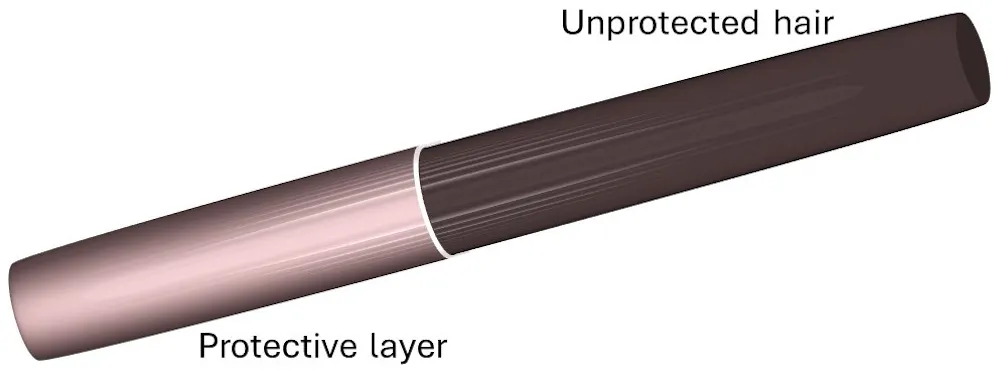
    These materials are chosen because they readily stick onto your hair, creating a coating, a bit like this:

    Hair protectant applies a coating to your hair.
    Author provided

    This coating is a protective layer; it’s like putting an oven mitt on your hands before you handle a hot tray from the oven.

    To demonstrate, I created these by examining hair under a microscope before and after heat protectant was applied:

    These high magnification images of untreated hair, and hair sprayed with a heat treatment spray, show how the product coats your hair strands.
    Author provided

    Just like an oven mitt, a hair protectant delays the heat penetration, results in less heat getting through, and helps spread out the effect of the heat, a bit like in this image:

    Hair protectant can help spread out the effects of the heat.
    Author provided

    This helps prevent moisture loss and damage to both the protective surface cell layer (the cuticle) and the protein structure of the hair cortex.

    For these barriers to work at their best, these heat-protecting layers need to remain bound to your hair. In other words, they stick on really well.

    For this reason, continued use can sometimes cause a buildup which can change the feel and weight of your hair.

    This buildup is not permanent and can be removed with washing.

    One final and important note: just like when you use a mitt for the oven, heat does still get through. The only way to prevent heat damage to your hair altogether is to not use heated styling tools.

    Daniel Eldridge does not work for, consult, own shares in or receive funding from any company or organisation that would benefit from this article, and has disclosed no relevant affiliations beyond their academic appointment.

    ref. How do heat protectants for hair work? A chemistry expert explains – https://theconversation.com/how-do-heat-protectants-for-hair-work-a-chemistry-expert-explains-233206

    MIL OSI AnalysisEveningReport.nz

  • MIL-Evening Report: There’s a plan for free school lunches in Queensland. Is this a good idea?

    Source: The Conversation (Au and NZ) – By Clare Dix, Lecturer In Nutrition & Dietetics, University of the Sunshine Coast

    Queensland Premier Steven Miles has announced free school lunches if Labor is re-elected at the state’s upcoming election on October 26.

    The A$1.4 billion policy would cover primary students in public schools and begin next year. Labor estimates it would save parents about $1,600 per child, per year. On Sunday, Miles said:

    [The program is] universal to avoid stigmatising the kids that need the food the most, but also to ensure that it supports every Queensland family.

    The meals will be delivered in partnership with P&Cs Queensland, Queensland Association of School Tuckshops, school principals, Health and Wellbeing Queensland and non-government food providers.

    The Greens are also campaigning on a pledge to deliver free breakfasts and lunches for every state primary and high school student, costed at $3 billion over the next four years.

    Would a school lunches program help students and families? How would it work in practice?

    An unusual approach for Australia

    Unlike the United Kingdom and United States, Australian does not have a national or state-based free or subsidised school meal program.

    Instead, parents are responsible for providing morning tea and lunch through a “lunchbox system”. Families can also usually pre-order food from a canteen or tuckshop. In some cases, state or territory governments fund charities and non-for-profits to provide breakfast or lunch programs for schools identified as most in need of support.

    Research shows the nutritional quality of food provided to Australian school children often does not meet dietary guidelines. There are mandatory guidelines for state school canteens and tuckshops to follow but these are not always reflected in practice. Research shows many canteen menus contain less-than-desirable options and pricing often does not encourage families to buy healthier options.

    Unfortunately, health survey data shows Australian children’s diets are high in energy dense and nutritionally poor foods. On top of this, the 2023 Foodbank Report shows 36% of Australians are food insecure and about one quarter of these households have children at home who may not have adequate food for school.

    Australia has a ‘lunchbox system’ where families provide the food for school.
    Halfpoint/ Shutterstock

    What are the potential opportunities?

    So the idea of a free school lunch program delivered by organisations familiar with providing food in schools sounds like a positive solution.

    Beyond improving nutrition and health outcomes for more than 326,000 Queensland students, it can also provide other benefits.

    We could see improved school attendance by creating an incentive for students to go to school and improved diets leading to reduced illness. Because well-nourished children are more ready to learn, concentrate and stay on task, school lunches could lead to improved academic performance.

    Importantly, school lunches can reduce inequality and stigma for families who experience food insecurity.

    The school kitchen can also provide a opportunities for students to learn about food preparation and service as well as healthy eating.

    What are the key challenges?

    But we need to make sure the program is properly and sustainably designed. There will be a cost to taxpayers, not just in terms of the set up, but ongoing maintenance.

    The initial implementation will require commercial kitchens and equipment, qualified and trained staff, secure food procurement and supply chains as well as all the policies and procedures to go with this. This raises the question of whether the timeline of starting in Term 1, 2025 is realistic for all schools.

    The roll out needs to be equitable – extra consideration is needed for how this plan will be delivered to rural and remote Queenslanders. We also know access to reliable supplies of food, staff, equipment and support varies greatly across the state.

    The program will also need to cater to children with food allergies and intolerances, food preferences experienced with conditions like autism and attention-deficit hyperactivity disorder (ADHD), and different cultural eating practices.

    This plan has the potential to improve Queensland children’s health and education outcomes, while saving families money, time and stress. But it is complex and success will lie in making sure all Queensland primary students are provided with nutritious and appropriate food at school.

    Clare Dix has received funding from the Australian Department of Health and Aged Care.

    ref. There’s a plan for free school lunches in Queensland. Is this a good idea? – https://theconversation.com/theres-a-plan-for-free-school-lunches-in-queensland-is-this-a-good-idea-241242

    MIL OSI AnalysisEveningReport.nz

  • MIL-Evening Report: Australia has led the way regulating gene technology for over 20 years. Here’s how it should apply that to AI

    Source: The Conversation (Au and NZ) – By Julia Powles, Associate Professor of Law and Technology; Director, UWA Tech & Policy Lab, Law School, The University of Western Australia

    Since 2019, the Australian Department for Industry, Science and Resources has been striving to make the nation a leader in “safe and responsible” artificial intelligence (AI). Key to this is a voluntary framework based on eight AI ethics principles, including “human-centred values”, “fairness” and “transparency and explainability”.

    Every subsequent piece of national guidance on AI has spun off these eight principles, imploring business, government and schools to put them into practice. But these voluntary principles have no real hold on organisations that develop and deploy AI systems.

    Last month, the Australian government started consulting on a proposal that struck a different tone. Acknowledging “voluntary compliance […] is no longer enough”, it spoke of “mandatory guardrails for AI in high-risk settings”.

    But the core idea of self-regulation remains stubbornly baked in. For example, it’s up to AI developers to determine whether their AI system is high risk, by having regard to a set of risks that can only be described as endemic to large-scale AI systems.

    If this high hurdle is met, what mandatory guardrails kick in? For the most part, companies simply need to demonstrate they have internal processes gesturing at the AI ethics principles. The proposal is most notable, then, for what it does not include. There is no oversight, no consequences, no refusal, no redress.

    But there is a different, ready-to-hand model that Australia could adopt for AI. It comes from another critical technology in the national interest: gene technology.

    A different model

    Gene technology is what’s behind genetically modified organisms. Like AI, it raises concerns for more than 60% of the population.

    In Australia, it’s regulated by the Office of the Gene Technology Regulator. The regulator was established in 2001 to meet the biotech boom in agriculture and health. Since then, it’s become the exemplar of an expert-informed, highly transparent regulator focused on a specific technology with far-reaching consequences.

    Three features have ensured the gene technology regulator’s national and international success.

    First, it’s a single-mission body. It regulates dealings with genetically modified organisms:

    to protect the health and safety of people, and to protect the environment, by identifying risks posed by or as a result of gene technology.

    Second, it has a sophisticated decision-making structure. Thanks to it, the risk assessment of every application of gene technology in Australia is informed by sound expertise. It also insulates that assessment from political influence and corporate lobbying.

    The regulator is informed by two integrated expert bodies: a Technical Advisory Committee and an Ethics and Community Consultative Committee. These bodies are complemented by Institutional Biosafety Committees supporting ongoing risk management at more than 200 research and commercial institutions accredited to use gene technology in Australia. This parallels best practice in food safety and drug safety.

    The Gene Technology Regulator has a sophisticated decision-making structure.
    Office of The Gene Technology Regulator, CC BY

    Third, the regulator continuously integrates public input into its risk assessment process. It does so meaningfully and transparently. Every dealing with gene technology must be approved. Before a release into the wild, an exhaustive consultation process maximises review and oversight. This ensures a high threshold of public safety.

    Regulating high-risk technologies

    Together, these factors explain why Australia’s gene technology regulator has been so successful. They also highlight what’s missing in most emerging approaches to AI regulation.

    The mandate of AI regulation typically involves an impossible compromise between protecting the public and supporting industry. As with gene regulation, it seeks to safeguard against risks. In the case of AI, those risks would be to health, the environment and human rights. But it also seeks to “maximise the opportunities that AI presents for our economy and society”.

    Second, currently proposed AI regulation outsources risk assessment and management to commercial AI providers. Instead, it should develop a national evidence base, informed by cross-disciplinary scientific, socio-technical and civil society expertise.

    The argument goes that AI is “out of the bag”, with potential applications too numerous and too mundane to regulate. Yet molecular biology methods are also well out of the bag. The gene tech regulator still maintains oversight of all uses of the technology, while continually working to categorise certain dealings as “exempt” or “low-risk” to facilitate research and development.

    Third, the public has no meaningful opportunity to assent to dealings with AI. This is true regardless of whether it involves plundering the archives of our collective imaginations to build AI systems, or deploying them in ways that undercut dignity, autonomy and justice.

    The lesson of more than two decades of gene regulation is that it doesn’t stop innovation to regulate a promising new technology until it can demonstrate a history of non-damaging use to people and the environment. In fact, it saves it.

    The UWA Tech & Policy Lab receives funding from nationally competitive research grants and philanthropic partners. The present research was supported by GA308883: Effective Ethical Frameworks for the State as an Enabler of Innovation, funded by the Department of Foreign Affairs and Trade.

    Julia Powles is the Director of the Lab and has served as an independent member of the National AI Centre’s Think Tank on Responsible AI, the Australian Government’s National Robotics Strategy Advisory Committee, and the Advisory Panel supporting the Australian Parliamentary Inquiry into the Use of Generative AI in the Australian Education System. Through each of these bodies, she has provided advice on comparative AI regulation.

    Haris Yusoff does not work for, consult, own shares in or receive funding from any company or organisation that would benefit from this article, and has disclosed no relevant affiliations beyond their academic appointment.

    ref. Australia has led the way regulating gene technology for over 20 years. Here’s how it should apply that to AI – https://theconversation.com/australia-has-led-the-way-regulating-gene-technology-for-over-20-years-heres-how-it-should-apply-that-to-ai-240571

    MIL OSI AnalysisEveningReport.nz

  • MIL-Evening Report: This beautiful peacock spider was only found two years ago. Now it could be dancing its last dance

    Source: The Conversation (Au and NZ) – By Lizzy Lowe, Vice Chancellor’s Research Fellow in Ecology and Entomology, Edith Cowan University

    If you notice a tiny, strikingly coloured spider performing an elaborate courtship dance, you may have seen your first peacock spider.

    New species of peacock spider are discovered every year; the tally is now 113. One newly discovered species, Maratus yanchep, is only known to exist in a small area of coastal dunes near Yanchep, north of Perth.

    As Perth’s suburbs sprawl ever further north and south, it means one problem – the housing crisis – is worsening another, the extinction crisis.

    The dunes which are home to Maratus yanchep are just 20 metres from land being cleared for large new estates.

    If the species was formally listed as threatened, it could be protected. But the spider was only described in 2022 and has not been listed on state or federal threatened species lists. That means Maratus yanchep has no protection, according to the state government.

    What’s so special about a spider?

    Peacock spiders are tiny. Many have bodies just 4–5 mm across. The males only put on their mating displays during short periods of the year, typically August to September. Their size and habits also make it hard to learn about their populations and preferred habitats. This is partly why we’re only now realising how many peacock spider species there are.

    Concerted effort by enthusiasts such as Jurgen Otto has greatly expanded our knowledge. Of the 113 described species, each has distinctive colouring and its own dances (males have the colour and the moves). But we know there are more species of peacock spider waiting to be recognised by western science.

    Many species of peacock spider are only known from within a very small area of suitable habitat.

    This puts the species at high risk of extinction because a single threat such as a large bushfire or a suburban development can destroy all their habitat at once.

    Peacock spiders such as this Maratus tasmanicus are tiny but pack a lot of personality.
    Kristian Bell/Shutterstock

    How can this be allowed?

    Before any native bushland is cleared in Australia, developers have to undertake an environmental impact survey to look for threatened species and assess what damage the development would do. If a threatened species is found, the development can be scaled back or denied.

    The problem is, these surveys only look for species known to be in danger. If a species isn’t listed on Australia’s growing list of threatened species, it won’t be looked for.

    But Maratus yanchep has not been assessed to see if it is threatened. This means it has no protection from development.

    This points to a wider problem. Large, well-known Australian vertebrates such as koalas and platypuses tend to get more attention – and conservation efforts – than humble invertebrates. We face an uphill battle to conserve our wealth of invertebrates.

    Worldwide, many invertebrates are in real danger of disappearing. Australia is home to at least 300,000 invertebrate species, dwarfing the 8,000-odd vertebrates – but only 101 are currently listed under the federal government’s laws protecting threatened species, the Environmental Protection and Biodiversity Act. The problem here is we don’t have enough data to assess most invertebrate species for formal conservation listing and protection.

    Data takes money

    Listing a species as threatened requires a large amount of data on where the species is and isn’t found. This takes time and specialist knowledge. But funding is scarce.

    As a result, our efforts to gather data on invertebrates often relies on passionate volunteers and enthusiasts, who may often pick one genus – say peacock spiders – and set out to expand our knowledge.

    When clear and immediate threats do appear – such as clearing coastal dunes in Yanchep – we are again reliant on the unpaid work of volunteers to gather information.

    The problem of sprawl

    Perth is one of the longest cities in the world. Its suburbs sprawl for 150 kilometres, running from Two Rocks in the north to Dawesville in the south.

    Many Perth residents want to live by the coast, driving demand for new housing on the city outskirts. This drives destruction of native bushland and pushes species towards extinction. Some species tolerate the change from bushland to suburbia, but these are a minority – less than 25%. Small, localised species are at highest risk of extinction.

    Perth’s sprawl shows no sign of slowing. Land clearing for housing has contributed to the worsening plight of the Carnaby’s cockatoo. Fifty years ago, the iconic cockatoo flew over the city in flocks as large as 7,000. There’s nothing like that now.

    Perth’s urban sprawl now stretches beyond Yanchep. Pictured: Yanchep’s beach. The bush area in the background is where maratus yanchep lives.
    Kok Kin Meng/Shutterstock

    What can we do?

    Efforts are underway to protect Maratus yanchep. The not-for-profit charity Invertebrates Australia is working to nominate it for the International Union for Conservation of Nature’s Red List of Threatened Species. Greens MP Brad Pettitt raised the issue in Parliament in August.

    The one thing peacock spiders have going for them is their looks. They are spectacularly beautiful. They’re also easily identified by the distinct patterns on the males – for most species you don’t need expert training to tell them apart, just decent eyesight.

    As a result, peacock spiders have drawn attention from dozens of amateur arachnologists and photographers who collect and share information on where they can be found. This citizen science data is often able to be used as evidence in listing a species as threatened – and unlocking vital protection.

    Images of these spiders also boosts their public profile and support for their protection.

    Despite the recent groundswell of interest in saving this tiny spider, it may be too late. To avoid the mass extinction of iconic Australian species, we must find better ways of building without large-scale habitat clearing.


    Read more:
    Photos from the field: zooming in on Australia’s hidden world of exquisite mites, snails and beetles


    Lizzy Lowe is affiliated with Invertebrates Australia

    Jess Marsh is affiliated with Invertebrates Australia.

    Dr Leanda Denise Mason is affiliated with Centre for People, Place, and Planet.

    ref. This beautiful peacock spider was only found two years ago. Now it could be dancing its last dance – https://theconversation.com/this-beautiful-peacock-spider-was-only-found-two-years-ago-now-it-could-be-dancing-its-last-dance-238437

    MIL OSI AnalysisEveningReport.nz

  • MIL-Evening Report: As the conflicts in the Middle East dramatically escalate, could Iran acquire a nuclear bomb?

    Source: The Conversation (Au and NZ) – By Ali Mamouri, Research fellow, Middle East Studies, Deakin University

    As Israel continues its assault on Hezbollah in Lebanon, Iran appears increasingly backed into a corner.

    Israel’s efforts to weaken Iran’s proxy network have focused on a number of objectives: eliminating key Hezbollah leaders, destroying their weapons and other military sites, and targeting large numbers of fighters and sympathisers.

    Hezbollah has undoubtedly been weakened over the past few weeks, which presents a dilemma for Iran. Could this sustained pressure on its main militant proxy group push Iran towards finally acquiring a nuclear weapon?

    Iran’s deterrence strategy

    The use of armed proxy networks as a deterrence strategy is a well-known approach employed by countries worldwide.

    Iran has successfully adopted this strategy for decades, starting with Hezbollah in Lebanon and extending to Palestinian militant groups such as Hamas and Palestinian Islamic Jihad in Gaza, various Iraqi militant factions, and Houthi rebels in Yemen.

    This strategy has allowed Iran to project power in the region and counter pressure from the United States, Israel and their allies, while deterring any direct military confrontation from its adversaries.

    Both Iran and Israel have until recently appeared reluctant to engage in a full-scale war. Instead, they have adhered to certain rules of engagement in which they apply pressure on each other without escalating to all-out conflict. This is something neither side can afford.

    Iran has long avoided direct confrontation with Israel, even when Israel has targeted its groups in Syria and assassinated several Iranian nuclear scientists over the past few decades.

    Recently, however, this strategy has shifted. Feeling the impact of Israel’s prolonged assaults on its proxy network, Iran has responded by launching two direct missile attacks against Israel in the past six months.

    This indicates that as pressure on Iran’s proxies intensifies, Tehran may increasingly resort to alternative strategies to reestablish effective deterrence against Israel and its Western allies.

    Some analysts believe Israel may now be gaining what is called “escalation dominance” over Iran. As one group of experts has explained, this happens when one combatant escalates a conflict

    in ways that will be disadvantageous or costly to the adversary while the adversary cannot do the same in return, either because it has no escalation options or because the available options would not improve the adversary’s situation.

    Israeli Prime Minister Benjamin Netanyahu has vowed a “harsh response” to Iran’s latest missile attack against Israel in early October. This could push Iran further towards changing its deterrence strategy, particularly if Israel strikes Iran’s nuclear facilities.

    Calls for a new nuclear strategy

    With pressure growing on Iran’s leaders, the regime is now openly discussing whether to declare a military nuclear program.

    This would represent a major shift in Iranian policy. Iran has long maintained that its nuclear program is strictly for civilian purposes, with no intention of developing a military component. The US and its allies have contested this assertion.

    On October 8, the Iranian parliament announced it had received draft legislation for the “expansion of Iran’s nuclear industry”, which will be discussed in parliament. The nature of this expansion is not yet known – it’s unclear whether it will include a military program. However, recent statements by Iranian officials suggest such an agenda.

    Kamal Kharrazi, a senior politician and member of the Expediency Discernment Council, a high-ranking administrative assembly appointed by Supreme Leader Ayatollah Ali Khamenei, forewarned of a reconsideration of Iran’s nuclear program. In an interview in May, he said:

    Iran’s level of deterrence will be different if the existence of Iran is threatened. We have no decision to produce a nuclear bomb, but we will have to change our nuclear doctrine if such threat occurs.

    Calls in Iran for a revision of the country’s defence doctrine are growing louder. This week, nearly 40 lawmakers wrote a letter to the Supreme National Security Council, which decides on Iran’s general security policy. They demanded the council reconsider the current nuclear policy, noting that Khamenei’s fatwa forbidding the production of a nuclear bomb could be subject to change due to current developments.

    In the same vein, Ayatollah Hassan Khomeini, the grandson of the founder of the Islamic revolution and former Supreme Leader Ruhollah Khomeini, called last week for “enhancing the level of deterrence” against Israel. Iranian media interpreted this as referring to nuclear weapons.

    There have also been reports speculating that an earthquake in Iran last week could actually have been a nuclear bomb test.

    However, the US has said there is no evidence yet that Iran is moving towards building a nuclear weapon.

    Revived nuclear deal increasingly unlikely

    In 2015, Iran signed the Joint Comprehensive Plan of Action (JCPOA) with the five permanent members of the UN Security Council, plus Germany and the European Union. This deal allowed it to pursue a civilian nuclear program with certain restrictions on its critical nuclear facilities. In exchange, the US and its allies agreed to lift sanctions on Iran.

    However, the US withdrew from the deal under then president Donald Trump in 2018 and reimposed sanctions on Iran. Since then, Iran has barred several international inspectors from monitoring some of its nuclear sites.

    It is now believed to be just weeks away from producing enough weapons-grade material to build a bomb.

    Efforts to revive the nuclear negotiations have not gone far in recent years, though Iran’s new president, Masoud Pezeshkian, has suggested his government would be willing to engage again with the West and resume the talks.

    Yet, if Israel carries out an attack on Iran’s nuclear facilities in retaliation for last week’s missile attack, as has been speculated, Iran may deem it necessary to opt for the weaponisation of its nuclear program instead.

    If Iran declares a military nuclear program, it would do so with the expressed intention of restoring a deterrence balance with Israel that could prevent a full-scale war. Israel is believed to possess nuclear weapons, but has never confirmed it.

    However, such a decision is likely to have dire implications for both Iran and the region.

    It would undoubtedly lead to more international pressure and US sanctions on Iran, making it even more isolated. And it could spark a nuclear arms race in the region, as Saudi Arabia has already pledged to pursue a nuclear arsenal if Iran develops one.

    Shahram Akbarzadeh receives funding from Australian Research Council. He is affiliated with Middle east Council on Global Affairs (Doha).

    Ali Mamouri does not work for, consult, own shares in or receive funding from any company or organisation that would benefit from this article, and has disclosed no relevant affiliations beyond their academic appointment.

    ref. As the conflicts in the Middle East dramatically escalate, could Iran acquire a nuclear bomb? – https://theconversation.com/as-the-conflicts-in-the-middle-east-dramatically-escalate-could-iran-acquire-a-nuclear-bomb-240893

    MIL OSI AnalysisEveningReport.nz

  • MIL-Evening Report: Why hurricanes like Milton in the US and cyclones in Australia are becoming more intense and harder to predict

    Source: The Conversation (Au and NZ) – By Andrew Dowdy, Principal Research Scientist in Extreme Weather, The University of Melbourne

    Tropical cyclones, known as hurricanes and typhoons in other parts of the world, have caused huge damage in many places recently. The United States has just been hit by Hurricane Milton, within two weeks of Hurricane Helene. Climate change likely made their impacts worse.

    In Australia, the tropical cyclone season (November to April) is approaching. The Bureau of Meteorology this week released its long-range forecast for this season.

    It predicts an average number of tropical cyclones, 11, are likely to form in the region. Four are expected to cross the Australian coast. However, the risk of severe cyclones is higher than average.

    So what does an average number actually mean in our rapidly changing climate? And why is there a higher risk of intense cyclones?

    The bureau’s forecast is consistent with scientific evidence suggesting climate change is likely to result in fewer but more severe tropical cyclones. They are now more likely to bring stronger winds and more intense rain and flooding.

    Climate change is making prediction harder

    Our knowledge of tropical cyclones and climate change is based on multiple lines of evidence globally and for the Australian region. This work includes our studies based on observations and modelling.

    The bureau’s seasonal outlook in recent years has assumed an average of 11 tropical cyclones occurring in our region (covering an area of the southern tropics between longitudes 90°E and 160°E). It’s based on the average value for all years back to 1969.

    However, for the past couple of decades the annual average is below nine tropical cyclones. In earlier decades, it was over 12. This long-term downward trend adds to the challenge of seasonal predictions.

    The most recent above-average season (assuming an average of 11) was almost 20 years ago, in the 2005–06 summer with 12 tropical cyclones. Since then, any prediction of above-average tropical cyclone seasons has not eventuated.

    El Niño and La Niña influences may be changing too

    Historical observations suggest more tropical cyclones tend to occur near Australia during La Niña events. This is a result of warm, moist water and air near Australia, compared with El Niño events. The shifting between El Niño and La Niña states in the Pacific region is known as the El Niño-Southern Oscillation (ENSO).

    Such events can be predicted with a useful degree of accuracy several months ahead in some cases. For example, the US National Oceanic and Atmospheric Administration (NOAA) has forecast:

    La Niña is favored to emerge in September–November (71% chance) and is expected to persist through January–March 2025.

    Based on that, one might expect a higher-than-average number of tropical cyclones for the Australian region. However, the ENSO influence on tropical cyclones has weakened in our region. It’s another factor that’s making long-range predictions harder.

    The bureau’s ENSO outlook is somewhat closer to neutral ENSO conditions, based on its modelling, compared to NOAA’s leaning more toward La Niña. The bureau says:

    Should La Niña form in the coming months, it is forecast to be relatively weak and short-lived.

    The bureau’s prediction of an average number of tropical cyclones this season is broadly consistent with its prediction of close-to-average ENSO conditions.

    So what does this all mean for this cyclone season?

    If we end up getting an average Australian season for the current climate, this might actually mean fewer tropical cyclones than the historical average. The number might be closer to eight or nine rather than 11 or 12. (Higher or lower values than this range are still possible.)

    However, those that do occur could have an increased chance of being category 4 or 5 tropical cyclones. These have stronger winds, with gusts typically exceeding 225km per hour, and are more likely to cause severe floods and coastal damage.

    If we end up getting more than the recent average of eight to nine tropical cyclones, which could happen if NOAA predictions of La Niña conditions eventuate, that increases the risk of impacts. However, there is one partially good news story from climate change relating to this, if the influence of La Niña is less than it used to be on increasing tropical cyclone activity.

    Another factor is that the world’s oceans are much warmer than usual. Warm ocean water is one of several factors that provide the energy needed for a tropical cyclone to form.

    Many ocean heat records have been set recently. This means we have been in “uncharted waters” from a temperature perspective. It adds further uncertainty if relying on what occurred in the past when making predictions for the current climate.

    Up-to-date evidence is vital as climate changes

    The science makes it clear we need to plan for tropical cyclone impacts in a different way from what might have worked in the past. This includes being prepared for potentially fewer tropical cyclones overall, but with those that do occur being more likely to cause more damage. This means there are higher risks of damaging winds, flooding and coastal erosion.

    Seasonal prediction guidance can be part of improved planning. There’s also a need for enhanced design standards and other climate change adaptation activities. All can be updated regularly to stay consistent with the best available scientific knowledge.

    Increased preparedness is more important than ever to help reduce the potential for disasters caused by tropical cyclones in the current and future climate.


    The authors acknowledge the contribution of CSIRO researcher Hamish Ramsay during the writing of this article.

    Andrew Dowdy receives funding from University of Melbourne, including through the Centre of Excellence for Climate Extremes and the Melbourne Energy Institute.

    Liz Ritchie-Tyo receives funding from The Australian Research Council and The U.S. Office of Naval Research.

    Savin Chand receives funding from the Australian Government’s National Environmental Science Program (NESP) and the UK-based Gallagher Research Centre (GRC).

    ref. Why hurricanes like Milton in the US and cyclones in Australia are becoming more intense and harder to predict – https://theconversation.com/why-hurricanes-like-milton-in-the-us-and-cyclones-in-australia-are-becoming-more-intense-and-harder-to-predict-241000

    MIL OSI AnalysisEveningReport.nz

  • MIL-Evening Report: Hope returns to Kashmir after elections, but the ultimate power still belongs to Narendra Modi’s government

    Source: The Conversation (Au and NZ) – By Leoni Connah, Lecturer in International Relations, Flinders University

    This year’s local elections in India’s northernmost territory of Jammu and Kashmir were the first since the national government controversially stripped the region of its semi-autonomous status in 2019. It’s also the first local election in Muslim-majority Kashmir since 2014.

    It was a significant moment for the region. The election will restore, at least partially, some degree of self-rule five years after Prime Minister Narendra Modi took it away.

    Modi’s Bharatiya Janata party (BJP) was delivered a resounding defeat when the official results were released this week. The Jammu and Kashmir National Conference (JKNC) and Congress alliance won 48 seats in the 90-seat regional legislature. The BJP won 29, mostly in the Hindu-majority Jammu region.

    The former chief minister, Omar Abdullah, was also reinstated as leader. This was a surprising turn given he lost his race for a seat in the Lok Sabha, the lower house of parliament, in the national elections a few months ago.

    What’s changed?

    Elections in Jammu and Kashmir have been affected in the past by boycotts and low voter turnout, due largely to public mistrust of the government.

    There was also a sense of betrayal after Modi’s government revoked Article 370 of the Indian Constitution. This had granted special privileges to local residents and gave the region its own constitution and ability to make its own laws.

    However, voter turnout in this year’s election reached 64%. And the participation of separatists and independent candidates suggested a change in attitude toward the political process.

    For the BJP, the elections are evidence that normalcy has returned to Kashmir after years of ongoing violence. Modi said in a tweet: “Many people claimed that the Jammu and Kashmir would burn if Article 370 was abrogated. However, it didn’t burn, it blossomed.”

    Modi had promised during the campaign that “statehood” would be restored, though he suggested this would be realised only if the BJP was victorious.

    With Modi’s opposition winning, some believed the election to be a de-facto referendum on the territory’s special status.

    The JKNC has always opposed the revocation of Article 370 and the stripping of Kashmir’s autonomy. The party has promised to work towards restoring that special status, as well as repealing the draconian Public Safety Act, which allows for the detention of people for up to two years without charge, and seeking amnesty for prisoners.

    In reality, however, the result won’t undo the revocation of Article 370. The new local assembly will have the power to make and amend laws, debate local issues and approve decisions for the territory, particularly in education and culture. But Abdullah will still need to seek the federally appointed lieutenant governor’s approval on any major decisions.

    Even if many Kashmiris would like to prevent the BJP from extending its reach into the region, the party still maintains some control from New Delhi.

    The BJP expanded the lieutenant governor’s powers over public order and policing. The lieutenant governor also has control over the regional anti-corruption bureau and the Directorate of Public Prosecutions.

    These powers were heavily criticised by the opposition parties in the region.

    Future of democracy?

    In recent years, Indian security forces have cracked down on the news media, social media and other forms of communication throughout the region, particularly any forms of Kashmiri solidarity with Palestine.

    Human rights advocates say abuses and repression continue in the region, and the climate of fear has had a detrimental impact on Kashmiri life.

    Statehood remains one of the biggest grievances for Kashmiri residents. Abdullah said himself that “restoration of full, undiluted statehood for [Jammu and Kashmir] is a prerequisite for these elections”.

    Only time will tell if these demands can be addressed, but there is hope a new local government might begin to change the bleak situation in Kashmir.

    As I spoke about in a recent podcast, there is optimism the new government will go a long way towards restoring some level of autonomy in Kashmir, as long as it is not obstructed by the lieutenant governor’s new powers.

    Leoni Connah does not work for, consult, own shares in or receive funding from any company or organisation that would benefit from this article, and has disclosed no relevant affiliations beyond their academic appointment.

    ref. Hope returns to Kashmir after elections, but the ultimate power still belongs to Narendra Modi’s government – https://theconversation.com/hope-returns-to-kashmir-after-elections-but-the-ultimate-power-still-belongs-to-narendra-modis-government-240990

    MIL OSI AnalysisEveningReport.nz

  • MIL-Evening Report: What is pelvic organ prolapse and how is it treated?

    Source: The Conversation (Au and NZ) – By Jennifer King, Senior Clinical Lecturer, University of Sydney

    Halfpoint/Shutterstock

    As a urogynaecologist I care exclusively for women with pelvic floor problems. These are the women with leaking bladders and weak supporting tissues allowing the vaginal walls to bulge outside.

    Pelvic organ prolapse can be distressing or embarrassing and interfere with everyday activities. But it’s also common. For many women treatment is simple, effective and doesn’t involve surgery.

    What is it pelvic organ prolapse?

    Pelvic organ prolapse occurs when the supporting muscles and ligaments holding up the vagina are weakened, allowing the vaginal tissues to sag or stretch. The pelvic organs behind the vaginal walls – such as the bladder, bowel and uterus – can then drop out of position.

    One or more organ may be involved. But other than being out of position, there is not necessarily any problem with how these organs function.

    Prolapse is usually described according to which organ has dropped, for example “bladder prolapse” (cystocele). Severity is graded according to extent the vaginal wall has descended from its previous position.

    Prolapse can occur when the pelvic muscles holding organs in place are weakened.
    Pepermpron/Shutterstock

    What does it feel like?

    Most women don’t know an organ or organs have prolapsed until they notice a protrusion from the vaginal opening. They may feel a soft lump bulging in the vagina when they’re washing.

    Many simply feel aware “something is coming down”.

    Other women may notice they can’t trust their bladder not to leak when they’re jumping on a trampoline or running at the gym. Or perhaps they find it harder to keep a tampon in position than it was before children.

    How common is it?

    Prolapse is very common and its likelihood increases with age. Based on routine vaginal examination (for example, for cervical screening), easily 50% of women in developed countries will be classified as having prolapse. Most of these will have no symptoms at all.

    When defined by symptoms such as a vaginal bulge or difficulty passing urine, around 5% will have specific symptoms.

    What causes pelvic organ prolapse?

    Pregnancy and vaginal birth generally cause physical changes, such as relaxation of the vaginal tissues. For most women these are minor, but for some, prolapse can seriously impact quality of life.

    After pregnancy some women may find they need to adjust physical activities – particularly high impact exercise or repetitive heavy lifting – as this can make prolapse symptoms more noticeable.

    Women who give birth via caesarean section are less likely to experience prolapse and incontinence. However as caesareans have their own risk of serious complications, they can’t be recommended purely to avoid pelvic floor issues.

    After vaginal delivery, ageing is the second-most common cause of prolapse. This is because the strength of the pelvic floor deteriorates as we age and especially after menopause.

    Excessive weight lifting and high-impact exercise can also weaken these muscles.

    Chronic lung problems, diabetes, high cholesterol, constipation and obesity further increase the severity of prolapse and incontinence.

    Some women also have genetically poorer quality connective tissues, making them more at risk.

    How is it treated?

    Severe prolapse, which persistently extends through the vagina and causes significant discomfort, is often managed with surgery.

    But it is not always required. In developed countries, only 6-18% of those diagnosed with pelvic prolapse will have surgery.

    For milder cases, a clinician will usually recommend pelvic floor therapy.

    Specific exercises can help strengthen the pelvic floor during pregnancy and after child birth.
    Cerrotalavan/Shutterstock

    Structured pelvic floor muscle exercises (generally working with a therapist over time) are effective as an initial treatment when prolapse has occurred. Pelvic floor training during late pregnancy can also be used to treat and prevent further prolapse or urinary incontinence.


    Read more:
    Men have pelvic floors too – and can benefit when they exercise them regularly


    Interestingly, general body strength and fitness does not translate into strong pelvic floor muscles – only specific exercises do this. But keeping your weight under control and managing other health conditions can help reduce symptoms.

    Intravaginal support devices, called pessaries, can also substantially reduce symptoms. These are usually silicone rings or discs to help support the vaginal walls. They can be fitted by doctors, nurses or physiotherapists and can often be managed by women themselves.

    Pessaries are often made of silicone.
    Pepermpron/Shutterstock

    Prolapse can also cause mental health distress. Some women may find their body image suffers, and they may experience anxiety or depression which needs specific management.

    What does surgery involve?

    In severe cases, a clinician might recommend surgery if conservative management (such as pelvic floor muscle training) has been ineffective.

    Surgery can also be necessary in those uncommon cases where the prolapse is affecting kidney or bowel function. In these situations surgery can restore quality of life.

    Surgery for prolapse can be performed through the abdomen (usually keyhole approach) or vaginally. For most women, mesh is not required and the surgery involves reshaping and reattaching the stretched tissues to strong ligaments.

    Unfortunately this is not always successful, particularly when the tissues are very weak. Approximately 25% of women will need further surgery.

    In 2017, the Australian Therapeutic Goods Administration withdrew their approval for vaginal mesh products for prolapse, after safety concerns. There has since been a marked reduction in surgery for prolapse and urinary incontinence.

    However we have not seen a corresponding increase in non-surgical treatments, so we can only assume many women are simply not seeking treatment at all.

    We do need to continue working towards better and safer products to improve the durability of our pelvic floor repairs. But in the meantime we must also continue to provide individualised care for every affected woman.

    For many, maintaining pelvic floor strength and a healthy lifestyle will be enough to return to and enjoy their normal activities. The first step is to talk to your GP, who can explain what options will work best for you.

    Jennifer King is affiliated with the International Urogynecological Association – secretary

    ref. What is pelvic organ prolapse and how is it treated? – https://theconversation.com/what-is-pelvic-organ-prolapse-and-how-is-it-treated-239199

    MIL OSI AnalysisEveningReport.nz

  • MIL-Evening Report: The government’s social media ban for kids will exempt ‘low-risk’ platforms. What does that mean?

    Source: The Conversation (Au and NZ) – By Lisa M. Given, Professor of Information Sciences & Director, Social Change Enabling Impact Platform, RMIT University

    BAZA Production/Shutterstock

    In a speech to the New South Wales and South Australian government social media summit today, Federal Minister for Communications Michelle Rowland announced more details of how the federal government’s proposed social media ban would actually work.

    The government first announced the ban last month, shortly after SA said it will ban children under 14 from social media. But experts have heavily criticised the idea, and this week more than 120 experts from Australia and overseas wrote an open letter to Prime Minister Anthony Albanese and state and territory premiers urging a rethink.

    Despite this, the government appears to be ploughing ahead with the proposed ban. The details Rowland announced today do not meaningfully address many of the criticisms made over the past few weeks.

    In fact, they actually raise new problems.

    What are the details of the social media ban?

    In her speech, Rowland said the government will amend the Online Safety Act to “place the onus on platforms, not parents or young people” to enforce the proposed social media ban.

    The changes will be implemented over 12 months to give industry and the regulator time to implement key processes.

    The government says it “will set parameters to guide platforms in designing social media that allows connections, but not harms, to flourish”. These parameters could address some of the “addictive” features of these platforms, for instance by limiting potential harms by prioritising content feeds from accounts people follow, or making age-appropriate versions of their apps.

    The government is also considering an:

    exemption framework to accommodate access for social media services that demonstrate a low risk of harm to children.

    The problem with “low risk”

    But allowing young people to access social media platforms that have a demonstrated “low risk of harm” is fraught with issues.

    Risk is difficult to define – especially when it comes to social media.

    As I explained earlier this year around potential harms of artificial intelligence, risk “sits on a spectrum and is not absolute”. Risk cannot be determined simply by considering a social media platform itself, or by knowing the age of the person using it. What’s risky for one person may not be risky for someone else.

    How, then, will the government determine which social media platforms have a “low risk of harm”?

    Simply focusing on technical changes to social media platform design in determining what constitutes “low risk” will not address key areas of potential harm. This may give parents a false sense of security when it comes to the “low-risk” solutions technology companies offer.

    Let’s assume for a moment that Meta’s new “teen-friendly” Instagram accounts qualify as having a “low risk of harm” and young people would still be allowed to use them.

    The teen version of Instagram will be set to private by default and have stronger content restrictions in place than regular accounts. It will also allow parents to see the categories of content children are accessing, and the accounts they follow, but will still require parental oversight.

    But this doesn’t solve the risk problem.

    There will still be harmful content on social media. And young people will still be exposed to it when they are old enough to have an unrestricted account, potentially without the support and guidance they need to safely engage with it. If children don’t gain necessary skills for navigating social media at an early age, potential harms may be deferred, rather than addressed and safely negotiated with parental support.

    A better approach

    The harmful content on social media platforms doesn’t just pose a risk to young people. It poses a risk to everybody – adults included. For this reason, the government’s heavy focus on encouraging platforms to demonstrate a “low risk of harm” only to young people seems a little misguided.

    A better approach would be to strive to ensure social media platforms are safe for all users, regardless of their age. Ensuring platforms have mechanisms for users to report potentially harmful content – and for platforms to remove inappropriate content – is crucial for keeping people safe.

    Platforms should also ensure users can block accounts, such as when a person is being bullied or harassed, with consequences for account holders found to engage in such harmful behaviour.

    It is important that government requirements for “low-risk” accounts include these and other mechanisms to identify and limit harmful content at source. Tough penalties for tech companies that fail to comply with legislation are also needed.

    The federal government could also provide extra resources for parents and children, to help them to navigate social media content safely.

    A report released this week by the New South Wales government showed 91% of parents with children aged 5–17 believe “more should be done to teach young people and their parents about the possible harms of social media”.

    The SA government appears to be heeding this message. Today it also announced a plan for more social media education in schools.

    Providing more proactive support like this, rather than pursuing social media bans, would go a long way to protecting young Australians while also ensuring they have access to helpful and supportive social media content.

    Lisa M. Given receives funding from the Australian Research Council. She is a Fellow of the Academy of the Social Sciences in Australia and a former President of the Association of Information Science and Technology.

    ref. The government’s social media ban for kids will exempt ‘low-risk’ platforms. What does that mean? – https://theconversation.com/the-governments-social-media-ban-for-kids-will-exempt-low-risk-platforms-what-does-that-mean-241120

    MIL OSI AnalysisEveningReport.nz

  • MIL-Evening Report: Bring France into decolonisation talks, French Polynesian president tells UN

    By Stefan Armbruster 0f BenarNews

    French Polynesia’s president and civil society leaders have called on the United Nations to bring France to the negotiating table and set a timetable for the decolonisation of the Pacific territory.

    More than a decade after the archipelago was re-listed for decolonisation by the UN General Assembly, France has refused to acknowledge the world’s peak diplomatic organisation has a legitimate role.

    France’s reputation has taken a battering as an out-of-touch colonial power since deadly violence erupted in Kanaky New Caledonia in May, sparked by a now abandoned French government attempt to dilute the voting power of indigenous Kanak people.

    Pro-independence French Polynesian President Moetai Brotherson told the UN Decolonisation Committee’s annual meeting in New York on Monday that “after a decade of silence” France must be “guided” to participate in “dialogue.”

    “Our government’s full support for a comprehensive, transparent and peaceful decolonisation process with France, under the scrutiny of the United Nations, can pave the way for a decolonisation process that serves as an example to the world,” Brotherson said.

    Brotherson called for France to finally co-operate in creating a roadmap and timeline for the decolonisation process, pointing to unrest in New Caledonia that “reminds us of the delicate balance that peace requires”.

    ‘Problem with decolonisation’
    In August, he warned France “always had a problem with decolonisation” in the Pacific, where it also controls the territories of New Caledonia and Wallis and Futuna.

    The 121 islands of French Polynesia stretch over a vast expanse of the Pacific, with a population of about 280,000, and was first settled more than 2000 years ago.

    Often referred to as Tahiti after the island with the biggest population, France declared the archipelago a protectorate in 1842, followed by full annexation in 1880.

    France last year attended the UN committee for the first time since the territory’s re-inscription in 2013 as awaiting decolonisation, after decades of campaigning by French Polynesian politicians.

    French Permanent Representative to the UN Nicolas De Rivière responds to French Polynesian President Moetai Brotherson at the 79th session of the Decolonisation Committe on Monday. Image: UNTV

    “I would like to clarify once again that this change of method does not imply a change of policy,” French permanent representative to the UN Nicolas De Rivière told the committee on Monday.

    “There is no process between the state and the Polynesian territory that reserves a role for the United Nations,” he said, and pointed out France contributes almost 2 billion euros (US $2.2 billion) each year, or almost 30 percent of the territory’s GDP.

    After the UN session, Brotherson told the media that France’s position is “off the mark”.

    17 speakers back independence
    French Polynesia was initially listed for decolonisation by the UN in 1946 but removed a year later as France fought to hold onto its overseas territories after the Second World War.

    Granted limited autonomy in 1984, with control over local government services, France retained administration over justice, security, defence, foreign policy and the currency.

    Seventeen pro-independence and four pro-autonomy – who support the status quo – speakers gave impassioned testimony to the committee.

    Lawyer and Protestant church spokesman Philippe Neuffer highlighted children in the territory “solely learn French and Western history”.

    “They deserve the right to learn our complete history, not the one centred on the French side of the story,” he said.

    “Talking about the nuclear tests without even mentioning our veterans’ history and how they fought to get a court to condemn France for poisoning people with nuclear radiation.”

    France conducted 193 nuclear tests over three decades until 1996 in French Polynesia.

    ‘We demand justice’
    “Our lands are contaminated, our health compromised and our spirits burned,” president of the Mururoa E Tatou Association Tevaerai Puarai told the UN denouncing it as French “nuclear colonialism”.

    “We demand justice. We demand freedom,” Puarai said.

    He said France needed to take full responsibility for its “nuclear crimes”, referencing a controversial 10-year compensation deal reached in 2009.

    Some Māʼohi indigenous people, many French residents and descendants in the territory fear independence and the resulting loss of subsidies would devastate the local economy and public services.

    Pro-autonomy local Assembly member Tepuaraurii Teriitahi told the committee, “French Polynesia is neither oppressed nor exploited by France.”

    “The idea that we could find 2 billion a year to replace this contribution on our own is an illusion that would lead to the impoverishment and downfall of our hitherto prosperous country,” she said.

    Copyright ©2015-2024, BenarNews. Republished with the permission of BenarNews.

    MIL OSI AnalysisEveningReport.nz

  • MIL-Evening Report: AI affects everyone – including Indigenous people. It’s time we have a say in how it’s built

    Source: The Conversation (Au and NZ) – By Tamika Worrell, Senior Lecturer in the Department of Critical Indigenous Studies, Macquarie University

    Since artificial intelligence (AI) became mainstream over the past two years, many of the risks it poses have been widely documented. As well as fuelling deep fake porn, threatening personal privacy and accelerating the climate crisis, some people believe the emerging technology could even lead to human extinction.

    But some risks of AI are still poorly understood. These include the very particular risks to Indigenous knowledges and communities.

    There’s a simple reason for this: the AI industry and governments have largely ignored Indigenous people in the development and regulation of AI technologies. Put differently, the world of AI is too white.

    AI developers and governments need to urgently fix this if they are serious about ensuring everybody shares the benefits of AI. As Aboriginal and Torres Strait Islander people like to say, “nothing about us, without us”.

    Indigenous concerns

    Indigenous peoples around the world are not ignoring AI. They are having conversations, conducting research and sharing their concerns about the current trajectory of it and related technologies.

    A well-documented problem is the theft of cultural intellectual property. For example, users of AI image generation programs such as DeepAI can artificially generate artworks in mere seconds which mimic Indigenous styles and stories of art.

    This demonstrates how easy it is for someone using AI to misappropriate cultural knowledges. These generations are taken from large data sets of publicly available imagery to create something new. But they miss the storying and cultural knowledge present in our art practices.

    AI technologies also fuel the spread of misinformation about Indigenous people.

    The internet is already riddled with misinformation about Indigenous people. The long-running Creative Spirits website, which is maintained by a non-Indigenous person, is a prominent example.

    Generative AI systems are likely to make this problem worse. They often conflate us with other global Indigenous peoples around the world. They also draw on inappropriate sources, including Creative Spirits.

    During last year’s Voice to Parliament referendum in Australia, “no” campaigners also used AI-generated images depicting Indigenous people. This demonstrates the role of AI in political contexts and the harm it can cause to us.

    Another problem is the lack of understanding of AI among Indigenous people. Some 40% of the Aboriginal and Torres Strait Islander population in Australia don’t know what generative AI is. This reflects an urgent need to provide relevant information and training to Indigenous communities on the use of the technology.

    There is also concern about the use of AI in classroom contexts and its specific impact on Indigenous students.

    Looking to the future

    Hawaiian and Samoan Scholar Jason Lewis says:

    We must think more expansively about AI and all the other computational systems in which we find ourselves increasingly enmeshed. We need to expand the operational definition of intelligence used when building these systems to include the full spectrum of behaviour we humans use to make sense of the world.

    Key to achieving this is the idea of “Indigenous data sovereignty”. This would mean Indigenous people retain sovereignty over their own data, in the sense that they own and control access to it.

    In Australia, a collective known as Maiam nayri Wingara offers important considerations and principles for data sovereignty and governance. They affirm Indigenous rights to govern and control our data ecosystems, from creation to infrastructure.

    The National Agreement on Closing the Gap also affirms the importance of Indigenous data control and access.

    This is reaffirmed at a global level as well. In 2020, a group of Indigenous scholars from around the world published a position paper laying out how Indigenous protocols can inform ethically created AI. This kind of AI would centralise the knowledges of Indigenous peoples.

    In a positive step, the Australian government’s recently proposed set of AI guardrails highlight the importance of Indigenous data sovereignty.

    For example, the guardrails include the need to ensure additional transparency and make extra considerations when it comes to using data about or owned by Aboriginal and Torres Strait Islander people, to “mitigate the perpetuation of existing social inequalities”.

    Indigenous Futurisms

    Grace Dillon, a scholar from a group of North American Indigenous people known as the Anishinaabe, first coined the term “Indigenous Futurisms”.

    Ambelin Kwaymullina, an academic and futurist practitioner from the Palyku nation in Western Australia, defines it as:

    visions of what-could-be that are informed by ancient Aboriginal cultures and by our deep understandings of oppressive systems.

    These visions, Kwaymullina writes, are “as diverse as Indigenous peoples ourselves”. They are also unified by “an understanding of reality as living, interconnected whole in which human beings are but one strand of life amongst many, and a non-linear view of time”.

    So how can AI technologies be informed by Indigenous ways of knowing?

    A first step is for industry to involve Indigenous people in creating, maintaining and evaluating the technologies – rather than asking them retrospectively to approve work already done.

    Governments need to also do more than highlight the importance of Indigenous data sovereignty in policy documents. They need to meaningfully consult with Indigenous peoples to regulate the use of these technologies. This consultation must aim to ensure ethical AI behaviour among organisations and everyday users that honours Indigenous worldviews and realities.

    AI developers and governments like to claim they are serious about ensuring AI technology benefits all of humanity. But unless they start involving Indigenous people more in developing and regulating the technology, their claims ring hollow.

    Tamika Worrell does not work for, consult, own shares in or receive funding from any company or organisation that would benefit from this article, and has disclosed no relevant affiliations beyond their academic appointment.

    ref. AI affects everyone – including Indigenous people. It’s time we have a say in how it’s built – https://theconversation.com/ai-affects-everyone-including-indigenous-people-its-time-we-have-a-say-in-how-its-built-239605

    MIL OSI AnalysisEveningReport.nz

  • MIL-Evening Report: ‘Violence at all levels’: UN report into the abuse of women and girls in sport is a wake-up call for Australia

    Source: The Conversation (Au and NZ) – By Kate Fitz-Gibbon, Professor (Practice), Faculty of Business and Economics, Monash University, Monash University

    PeopleImages.com – Yuri A/Shutterstock

    This week the United Nations (UN) Special Rapporteur on violence against women and girls presented a report detailing the violence experienced by women and girls in sport globally.

    The report provides a global snapshot of the abuse women athletes experience, who is most likely to perpetrate the violence, and makes recommendations on what should been done to promote safety of women and girls.

    Off the back of the Paris Olympic and Paralympic games, where Australia cheered on the record-breaking success of women athletes, the report should be a wake-up call for Australian sports and clubs.

    Abuse of women and girls in sport

    Drawing on more than 100 submissions and consultations with 50 people, the report finds:

    Women and girls in sport face widespread, overlapping and grave forms and manifestations of violence at all levels.

    These abusive behaviours include coercive control, physical violence, corporal punishment, verbal abuse, social exclusion, bullying and identity abuse.

    The impacts of this violence are wide-ranging: physical injuries, insomnia, fear and anxiety, reduced self-confidence, substance misuse, eating disorders, self harm, and decline in athletic performance and participation.

    These impacts can extend well beyond the athlete’s involvement in their sport.

    Women and girls also experience economic violence in sport. For example, when women athletes do not have control over their earnings, or when they are coerced into signing exploitative contracts.

    The report notes women athletes also experience heightened rates of abusive and harassing behaviours in online settings. This includes sexual harassment and threats, racism, ridicule, body shaming, sexualised comments, stalking, doxing and revenge porn.

    Perpetrators are wide-ranging. They include coaches, managers, spectators, teachers, peers, sports lawyers, referees and medical staff.

    The report describes sexual harassment and abuse as “rampant” and acknowledges the high rate of sexual violence, in particular with relationships between coaches and athletes.

    This includes grooming of younger athletes, where power and control dynamics, combined with an abuse of trust between an adult and child athlete, provide the conditions for sexual abuse to proliferate.

    It follows a 2023 report from the UN Educational, Scientific and Cultural Organisation (UNESCO) and UN Women, which estimates 21% of girls worldwide have experienced at least one form of sexual abuse as a child in sport.

    Is this a problem in Australia?

    Australians often pride themselves on how sports bring the nation, communities and families together but we too have a wide-reaching problem in this area.

    In 2021, a review of Swimming Australia found women athletes and coaches had experienced physical and mental abuse while the “Change the Routine” review of Gymnastics Australia revealed child abuse and neglect, misconduct, bullying, abuse, sexual harassment and assault towards gymnasts.

    More recently, a review by Sports Integrity Australia into Australian volleyball, which revealed systemic verbal and physical abuse of athletes, prompted a formal apology to past athletes.

    And a 2024 Deakin University study showed 87% of Australian sportswomen had experienced online harm within the past year.

    A lack of accountability and consequence

    In the traditionally male-dominated culture of sport, abusers have often gone unsanctioned, while those who experience abuse often leave their sport early and with significant consequences to their careers, financial stability, and mental and physical wellbeing.

    There are examples where abuse has been minimised or ignored by those in leadership to protect the reputation of the team or the sporting code, and where coaches have been able to move between teams without consequence.

    Take, for example, the sexual abuse of young female gymnasts by United States coach Larry Nassar.

    The first complaint against Nassar was made in 1997. Despite this, and the numerous other complaints which followed, Nassar remained in his coaching position with USA Gymnastics and Michigan State University until 2015. In December 2017 he was convicted of numerous counts of sexual abuse of minors.

    Outcomes of investigations by sporting bodies often remain confidential. For example, in 2017 the Fremantle Dockers and the AFL were criticised for their use of a “confidentiality agreement” in settling a sexual harassment matter.

    This impunity demonstrates a significant lack of accountability.

    The barriers to reporting abuse in sport

    There are significant barriers to reporting.

    Women elite athletes may fear losing their funding and sponsorship deals if they report abuse.

    In Australia, the Royal Commission into Institutional Responses to Child Sexual Abuse heard child athletes are most at risk of experiencing abuse by a person of authority (such as a coach) when they are about to achieve their best performance.

    As the UN Report states, it is at this time that “there is very little to gain by revealing the abuse and too much to lose”.

    This must change.

    When sporting codes put a desire to win above safeguarding and accountability, the clear message sent to victims is that violence is excusable, and that sporting heroes are immune to the consequences of their abusive actions.

    Raising awareness around early identification of abusive behaviours is key.

    The UN report reveals athletes often feel uncertain and uncomfortable in identifying early forms of abusive behaviours and lack information on what supports are available to them when they do.

    Ensuring a suite of reporting pathways is also critical. There is no one-size-fits-all model.

    Why Australia should take the lead

    Participating in sport has significant benefits. But sport settings must be safe for all.

    Many sporting organisations and clubs have recognised the problem of abuse of women and girls in sport, rolling out respect and responsibility programs, sexual harassment policies, as well as clearer reporting and investigation policies.

    This is a good start but must be built on.

    Indeed, the safety of women and girls must be a key focus of the Australian High Performance “Win Well” strategy for the Brisbane 2032 Olympic and Paralympic Games.

    Recent initiatives and policy changes should be monitored to examine how they work and whether they deliver safer outcomes for women and girls in sport at all levels.

    Responses to proven allegations of abuse must hold perpetrators to account. And critically, investigations must be independent, transparent and timely.

    The UN report reminds us “sports is a microcosm of society”.

    Violence against women and children in Australia has been declared a national emergency – ensuring the safety of women and girls in all sport settings is one critical component of addressing that crisis.

    Kate has received funding for family violence-related research from the Australian Research Council, Australian Institute of Criminology, Australia’s National Research Organisation for Women’s Safety, the Victorian, Queensland and ACT governments, the Commonwealth Department of Social Services and the Victorian Women’s Trust. This piece is written by Kate Fitz-Gibbon in her role at Monash University and is wholly independent of Kate Fitz-Gibbon’s role as Chair of Respect Victoria.

    ref. ‘Violence at all levels’: UN report into the abuse of women and girls in sport is a wake-up call for Australia – https://theconversation.com/violence-at-all-levels-un-report-into-the-abuse-of-women-and-girls-in-sport-is-a-wake-up-call-for-australia-239085

    MIL OSI AnalysisEveningReport.nz

  • MIL-Evening Report: A patchwork of spinifex: how we returned cultural burning to the Great Sandy Desert

    Source: The Conversation (Au and NZ) – By Braedan Taylor, Traditional Owner; Karajarri Lands Trust Association/UWA, Indigenous Knowledge

    How can a desert burn? Australia’s vast deserts aren’t just sand dunes – they’re often dotted with flammable spinifex grass hummocks. When heavy rains fall, grass grows quickly before drying out. That’s how a desert can burn.

    When our Karajarri and Ngurrara ancestors lived nomadic lifestyles in what’s now called the Great Sandy Desert in northwestern Australia, they lit many small fires in spinifex grass as they walked. Fires were used seasonally for ceremonies, signalling to others, flushing out animals, making travel easier (spinifex is painfully sharp), cleaning campsites, and stimulating fresh vegetation growth ready for foraging or luring game when people returned a few months later. The result was a patchwork desert.

    After colonisation, this ended. Without management, the spinifex and grassy deserts began to burn in some of the largest fires in Australia.

    But now the work of caring for desert country (pirra) with fire (jungku, or warlu) has begun again. We are Karajarri and Ngurrara rangers who care for 110,000 square kilometres of the Great Sandy Desert. Our techniques have changed – we now drop incendiaries from helicopters to cover more distance – but our goals are similar. Guided by our elders, we are combining traditional knowledge with modern technologies and science to refine how we manage fire in a changing world.

    In research published today, we and our co-authors paired analysis of historic fire patterns with five years of fauna surveys. Put together, we found mature spinifex was important for creatures of the Great Sandy Desert – and that means we should burn small and often, like our ancestors.

    Fire and sand

    In the 1940s and ‘50s, the Royal Australian Air Force photographed the Great Sandy Desert from the air. These photos were taken before our people moved to settlements and pastoral stations between the 1960s and ’80s.

    That means these aerial photographs capture a time when traditional burns were still happening.

    Our ranger teams are studying these photographs to draw out the fire patterns produced by our ancestors.

    These photographs tell a story. Our ancestors burned many small areas, creating a complicated patchwork of spinifex at different stages of regrowth after fire.

    But they also left a great deal of mature spinifex – large old hummocks that hadn’t burnt for years. This patchwork of burned and unburned areas made it hard for bushfires to spread far and fast. When traditional burning practices stopped, bushfires became common.

    The knowledge contained in these old photos is very valuable. The images give us clear goals for our fire management. We combine this with guidance from elders and information on fuel loads across Country gleaned from remote sensing and weather modelling, to plan our fire management.

    We could see where our ancestors burnt (white patches) in the Karajarri Indigenous Protected Area in this aerial photo from the late 1940s.
    National Library of Australia, CC BY-NC-ND

    What does fire mean for desert creatures?

    Australian deserts are remarkably biodiverse, especially in reptiles. In a single clump of mature spinifex, you might find up to 18 different species of lizard. Then there are snakes and goannas, as well as mammals such as marsupial moles found only in the arid zone.

    Spinifex hummocks are crucial to many of these species, offering shelter, food and prey. What does fire do to spinifex-dwellers?

    On this topic, scientific knowledge is playing catchup with Indigenous traditional knowledge but we see value in using the scientific method – a universal language – to help us manage Country, and tell other people about what we are doing.

    The past few decades have been a time of major change for the Great Sandy Desert. Cultural burns stopped, and feral animals such as camels and cats grew in number. As a result, many native animals are disappearing or already gone.

    We think larger, more frequent fires play a part. Our Karajarri and Ngurrara rangers are using science to make sure our patchwork burns – known as right-way fire – are good for native animals.

    Between 2018 and 2022, we surveyed reptiles and mammals from 32 sites across the Karajarri and Warlu Jilajaa Jumu (Ngurrara) Indigenous Protected Areas in the desert. We caught almost 3,800 mammals and reptiles from 77 species. Reptiles made up the lion’s share, with 66 species. We also recorded when fire had come through, and how big the burnt patches were.


    The data showed reptile species care a lot about where they live. Some prefer recently burned areas, where the spinifex is gone or still very small. Others like old spinifex, huge hummocks going unburned for years. And others still liked mid-sized spinifex.

    We found mammals were rare in recently burned areas and more common in mature spinifex. We also found more mammal diversity in areas with fine-scale patchworks of fires.

    This shows we must keep our fires small, burning different areas at different times, and protect enough mature spinifex.

    This patchwork approach will help spinifex hopping mice, desert mice, planigales, dunnarts, and dozens of small reptile species to survive. But it will also help now-rare game species, the marlu (red kangaroo in Walmajarri language) and pijarta (emu in Karajarri).

    Our research tells us returning to the traditional burning techniques of our ancestors is still the right thing to do – even though the desert has changed.

    Karajarri Rangers talk about the Pirra Junkgu-Warlu project.

    Rare finds

    Scientists have rarely surveyed the Great Sandy Desert. As a result, our surveys have turned up important findings.

    The kaluta (Dasykaluta rosamondae), for instance, is a feisty little carnivorous marsupial. We found it on the Canning Stock Route, 500km further north than the distribution known to scientists.

    Similarly, we found the threatened Dampierland sandslider (Lerista separanda), a vividly coloured skink, in the Karajarri Indigenous Protected Area, expanding its distribution 450km southeast. Karajarri people call sandsliders winkajurta, or “lice eaters”, because in the old days you could use them to hunt lice in your hair.

    Our research gives us confidence that bringing back traditional burns helps desert creatures. We want more people to know that right-way fire is part of healthy Country, including our own mob and tourists who pass through, so we can all look after the desert.

    In our work, we take our old people out onto Country to get advice on burning and their knowledge of animals. As one told us, seeing the old ways return made him “real happy [and] to come alive” – just like the desert.

    We thank Karajarri and Ngurrara Traditional Owners and acknowledge past and present elders. Thanks to the many rangers and coordinators who helped in these surveys, and our partners: Environs Kimberley, Charles Darwin University, Western Australian Department of Biodiversity, Conservation and Attractions, and Indigenous Desert Alliance. Special thanks to Hamsini Bijlani, our project coordinator.

    Braedan Taylor and other rangers in this project were funded by the Australian Government’s Indigenous Protected Area Program, Indigenous Ranger Program, and the National Environmental Science Program via the Threatened Species Recovery Hub; by the Western Australia State Natural Resource Management, Aboriginal Ranger Program, Lotteries West, and via in kind support from the Department of Biodiversity, Conservation and Attractions; by the Indigenous Desert Alliance/10Deserts; and by the Australian Research Council.

    Jacqueline Shovellor receives funding from the same sources as the lead author.

    Frankie McCarthy receives funding from the same sources as the lead author.

    Sarah Legge receives funding from the Australian Research Council. The work reported here was partly funded by the National Environmental Science Program via the Threatened Species Recovery Hub.

    Thomas Narda receives funding from the same sources as the lead author.

    ref. A patchwork of spinifex: how we returned cultural burning to the Great Sandy Desert – https://theconversation.com/a-patchwork-of-spinifex-how-we-returned-cultural-burning-to-the-great-sandy-desert-240447

    MIL OSI AnalysisEveningReport.nz

  • MIL-Evening Report: Are you over 75? Here’s what you need to know about vitamin D

    Source: The Conversation (Au and NZ) – By Elina Hypponen, Professor of Nutritional and Genetic Epidemiology, University of South Australia

    OPPO Find X5 Pro/Unsplash

    Vitamin D is essential for bone health, immune function and overall wellbeing. And it becomes even more crucial as we age.

    New guidelines from the international Endocrine Society recommend people aged 75 and over should consider taking vitamin D supplements.

    But why is vitamin D so important for older adults? And how much should they take?

    Young people get most vitamin D from the sun

    In Australia, it is possible for most people under 75 to get enough vitamin D from the sun throughout the year. For those who live in the top half of Australia – and for all of us during summer – we only need to have skin exposed to the sun for a few minutes on most days.

    The body can only produce a certain amount of vitamin D at a time. So staying in the sun any longer than needed is not going to help increase your vitamin D levels, while it will increase your risk of skin cancer.

    But it’s difficult for people aged over 75 to get enough vitamin D from a few minutes of sunshine, so the Endocrine Society recommends people get 800 IU (international units) of vitamin D a day from food or supplements.

    Why you need more as you age

    This is higher than the recommendation for younger adults, reflecting the increased needs and reduced ability of older bodies to produce and absorb vitamin D.

    Overall, older adults also tend to have less exposure to sunlight, which is the primary source of natural vitamin D production. Older adults may spend more time indoors and wear more clothing when outdoors.

    As we age, our skin also becomes less efficient at synthesising vitamin D from sunlight.

    The kidneys and the liver, which help convert vitamin D into its active form, also lose some of their efficiency with age. This makes it harder for the body to maintain adequate levels of the vitamin.

    All of this combined means older adults need more vitamin D.

    Deficiency is common in older adults

    Despite their higher needs for vitamin D, people over 75 may not get enough of it.

    Studies have shown one in five older adults in Australia have vitamin D deficiency.

    In higher-latitude parts of the world, such as the United Kingdom, almost half don’t reach sufficient levels.

    This increased risk of deficiency is partly due to lifestyle factors, such as spending less time outdoors and insufficient dietary intakes of vitamin D.

    It’s difficult to get enough vitamin D from food alone. Oily fish, eggs and some mushrooms are good sources of vitamin D, but few other foods contain much of the vitamin. While foods can be fortified with the vitamin D (margarine, some milk and cereals), these may not be readily available or be consumed in sufficient amounts to make a difference.

    In some countries such as the United States, most of the dietary vitamin D comes from fortified products. However, in Australia, dietary intakes of vitamin D are typically very low because only a few foods are fortified with it.

    Why vitamin D is so important as we age

    Vitamin D helps the body absorb calcium, which is essential for maintaining bone density and strength. As we age, our bones become more fragile, increasing the risk of fractures and conditions like osteoporosis.

    Keeping bones healthy is crucial. Studies have shown older people hospitalised with hip fractures are 3.5 times more likely to die in the next 12 months compared to people who aren’t injured.

    People over 75 often have less exposure to sunlight.
    Aila Images/Shutterstock

    Vitamin D may also help lower the risk of respiratory infections, which can be more serious in this age group.

    There is also emerging evidence for other potential benefits, including better brain health. However, this requires more research.

    According to the society’s systematic review, which summarises evidence from randomised controlled trials of vitamin D supplementation in humans, there is moderate evidence to suggest vitamin D supplementation can lower the risk of premature death.

    The society estimates supplements can prevent six deaths per 1,000 people. When considering the uncertainty in the available evidence, the actual number could range from as many as 11 fewer deaths to no benefit at all.

    Should we get our vitamin D levels tested?

    The Endocrine Society’s guidelines suggest routine blood tests to measure vitamin D levels are not necessary for most healthy people over 75.

    There is no clear evidence that regular testing provides significant benefits, unless the person has a specific medical condition that affects vitamin D metabolism, such as kidney disease or certain bone disorders.

    Routine testing can also be expensive and inconvenient.

    In most cases, the recommended approach to over-75s is to consider a daily supplement, without the need for testing.

    You can also try to boost your vitamin D by adding fortified foods to your diet, which might lower the dose you need from supplementation.

    Even if you’re getting a few minutes of sunlight a day, a daily vitamin D is still recommended.

    Elina Hypponen receives funding from the National Health and Medical Research Foundation, Medical Research Future Fund, Australian Research Council, and Arthritis Australia.

    Joshua Sutherland’s studentship is funded by the Australian Research Training Program Scholarship, and he volunteers on the board for the Australasian Association and Register of Practicing Nutritionists.

    ref. Are you over 75? Here’s what you need to know about vitamin D – https://theconversation.com/are-you-over-75-heres-what-you-need-to-know-about-vitamin-d-231820

    MIL OSI AnalysisEveningReport.nz

  • MIL-Evening Report: It’s time to talk about how the media talks about sexual harassment

    Source: The Conversation (Au and NZ) – By Rawan Nimri, Lecturer in Tourism and Hospitality, Griffith University

    Sexual harassment is all too common in hospitality and tourism. One Australian survey found almost half of the respondents had been sexually harassed, compared to about one in three in workplaces more generally.

    Hospitality and tourism are marked by intense and close interpersonal interactions and dismissive treatment by some customers, including verbal and physical aggression, bullying and sexual suggestions.

    Workers who are young, female, low-paid and casual are especially vulnerable.

    The scandals at the Merivale Hospitality Group and Sydney’s Swillhouse restaurant are only the most recent.

    The widely held view that “the customer is always right” gives customers power. The power imbalance is magnified where tipping makes up a substantial part of workers’ earnings.

    What newspapers report

    To examine how sexual harassment is reported, we identified about 2,000 newspaper articles across a number of countries published between 2017 and 2022 dealing with the treatment of hotel room attendants, airline cabin crew and massage therapists. We zeroed in on 273 for closer analysis.

    This was a period in which the public awareness of sexual harassment climbed with the rise of the #MeToo movement and media coverage probably peaked.

    Media coverage matters because of its effect on public opinion.

    Computer-assisted thematic analysis showed four different types of coverage, some overlapping, relating to legal matters, celebrities, power dynamics, and calls to action.

    The language used varied according to the countries in which the newspapers were located.

    In the United States and the United Kingdom, the accused were often described by their social or economic status, with cases involving famous people getting a lot of attention. In Asia and Africa, the reports focused on basic details such as the offender’s age and where they lived.

    Women infantilised

    But universally we found the terms used to describe victims were highly gendered and dated in ways that suggested subservience and undermined their professional skills. Cabin crew were called “air hostesses”. Room attendants were called “maids”.

    Framing these professionals as modern-day servants has the potential to foster and perpetuate an expectation that sexual harassment is to be expected.

    Reports involving celebrity harassers highlighted victims’ narratives with emotionally charged quotes using words such as “awful” and “terrible”. These words were perhaps intended to evoke empathy for the victims but also serve to further victimise them.

    Female aggression under-reported

    In all cases, women were heavily featured as victims but never as aggressors. It is a gender bias that does not match the established statistics, which show that almost one-quarter of aggressors are women.

    This misrepresentation creates a skewed understanding of who commits and suffers from sexual harassment. It has the potential to discourage victims of harassment by women from coming forward.

    It’s important for the tourism industry to foster secure and dignified working conditions. But it is also important that the media reflect the actual behaviour of aggressors and victims.

    Done better, reporting could help

    The media could play a crucial role in bringing about better policies and practices in these industries by emphasising the severe consequences of ignoring the problem and the benefits of taking proactive steps.

    More respectful and accurate reporting might be able to help drive lasting change, making a positive difference in the lives of the skilled workers on whom so many of us depend.

    The authors do not work for, consult, own shares in or receive funding from any company or organisation that would benefit from this article, and have disclosed no relevant affiliations beyond their academic appointment.

    ref. It’s time to talk about how the media talks about sexual harassment – https://theconversation.com/its-time-to-talk-about-how-the-media-talks-about-sexual-harassment-238771

    MIL OSI AnalysisEveningReport.nz

  • MIL-Evening Report: Use of AI in property valuation is on the rise – but we need greater transparency and trust

    Source: The Conversation (Au and NZ) – By William Cheung, Senior Lecturer, Business School, University of Auckland, Waipapa Taumata Rau

    New Zealand’s economy has been described as a “housing market with bits tacked on”. Buying and selling property is a national sport fuelled by the rising value of homes across the country.

    But the wider public has little understanding of how those property valuations are created – despite their being a key factor in most banks’ decisions about how much they are willing to lend for a mortgage.

    Automated valuation models (AVM) – systems enabled by artificial intelligence (AI) that crunch vast datasets to produce instant property values – have done little to improve transparency in the process.

    These models started gaining traction in New Zealand in the early 2010s. The early versions used limited data sources like property sales records and council information. Today’s more advanced models include high-quality geo-spatial data from sources such as Land Information New Zealand.

    AI models have improved efficiency. But the proprietary algorithms behind those AVMs can make it difficult for homeowners and industry professionals to understand how specific values are calculated.

    In our ongoing research, we are developing a framework that evaluates these automated valuations. We have looked at how the figures should be interpreted and what factors might be missed by the AI models.

    In a property market as geographically and culturally varied as New Zealand’s, these points are not only relevant — they are critical. The rapid integration of AI into property valuation is no longer just about innovation and speed. It is about trust, transparency and a robust framework for accountability.

    AI valuations are a black box

    In New Zealand, property valuation has traditionally been a labour-intensive process. Valuers would usually inspect properties, make market comparisons and apply their expert judgement to arrive at a final value estimate.

    But this approach is slow, expensive and prone to human error. As demand for more efficient property valuations increased, the use of AI brought in much-needed change.

    But the rise of these valuations models is not without its challenges. While AI offers speed and consistency, it also comes with a critical downside: a lack of transparency.

    AVMs often operate as “black boxes”, providing little insight into the data and methodologies that drive their valuations. This raises serious concerns about the consistency, objectivity and transparency of these systems.

    What exactly the algorithm is doing when an AVM estimates a home’s value is not clear. Such opaqueness has real-world consequences, perpetuating market imbalances and inequities.

    Without a framework to monitor and correct these discrepancies, AI models risk distorting the property market further, especially in a country as diverse as New Zealand, where regional, cultural and historical factors significantly influence property values.

    Transparency and accountability

    A recent discussion forum with real estate industry insiders, law researchers and computer scientists on AI governance and property valuations highlighted the need for greater accountability when it comes to AVMs. Transparency alone is not enough. Trust must be built into the system.

    This can be achieved by requiring AI developers and users to disclose data sources, algorithms and error margins behind their valuations.

    Additionally, valuation models should incorporate a “confidence interval” – a range of prices that shows how much the estimated value might vary. This offers users a clearer understanding of the uncertainty inherent in each valuation.

    But effective AI governance in property valuation cannot be achieved in isolation. It demands collaboration between regulators, AI developers and property professionals.

    Bias correction

    New Zealand urgently needs a comprehensive evaluation framework for AVMs, one that prioritises transparency, accountability and bias correction.

    This is where our research comes in. We repeatedly resample small portions of the data to account for situations where property value data do not follow a normal distribution.

    This process generates a confidence interval showing a range of possible values around each property estimate. Users are then able to understand the variability and reliability of the AI-generated valuations, even when the data are irregular or skewed.

    Our framework goes beyond transparency. It incorporates a bias correction mechanism that detects and adjusts for constantly overvalued or undervalued estimates within AVM outputs. One example of this relates to regional disparities or undervaluation of particular property types.

    By addressing these biases, we ensure valuations that are not only accountable or auditable but also fair. The goal is to avoid the long-term market distortions that unchecked AI models could create.

    The rise of AI auditing

    But transparency alone is not enough. The auditing of AI-generated information is becoming increasingly important.

    New Zealand’s courts now require a qualified person to check information generated by AI and subsequently used in tribunal proceedings.

    In much the same way financial auditors ensure accuracy in accounting, AI auditors will play a pivotal role in maintaining the integrity of valuations.

    Based on earlier research, we are auditing the artificial valuation model estimates by comparing them with the market transacted prices of the same houses in the same period.

    It is not just about trusting the algorithms but trusting the people and systems behind them.

    The authors do not work for, consult, own shares in or receive funding from any company or organisation that would benefit from this article, and have disclosed no relevant affiliations beyond their academic appointment.

    ref. Use of AI in property valuation is on the rise – but we need greater transparency and trust – https://theconversation.com/use-of-ai-in-property-valuation-is-on-the-rise-but-we-need-greater-transparency-and-trust-240880

    MIL OSI AnalysisEveningReport.nz

  • MIL-Evening Report: The Texas Chain Saw Massacre and its harrowing, visceral impact has been rarely matched, 50 years on

    Source: The Conversation (Au and NZ) – By Nicholas Godfrey, Senior Lecturer, College of Humanities, Arts and Social Sciences, Flinders University

    The Texas Chain Saw Massacre is a product of a unique time in American filmmaking, when independent exploitation films were nastier than ever, and equally capable of piercing the mainstream consciousness.

    Tobe Hooper’s 1974 film arrived in a recently transformed exhibition landscape. The 1967 outcry over onscreen violence in Bonnie and Clyde marked the end of Hollywood’s Motion Picture Production Code and the introduction of film ratings.

    Films like Easy Rider (1969) elevated the standing of formerly disreputable exploitation fare within Hollywood. By 1973, The Exorcist was packing out cinemas and producing lines around city blocks with the promise of the most unremitting horror film yet made.

    The Texas Chain Saw Massacre was shot quickly on a shoestring budget, financed in part by the newly-formed Texas Film Commission. The film assembled its cast and crew from Austin’s circles of recent college graduates and dropouts.

    Its plot is straightforward enough: a group of young people are stranded when they run out of gas in rural Texas. They are terrorised and subsequently murdered by an eccentric local family, including the chainsaw wielding Leatherface – a nonverbal, childlike giant who wears masks made from the skin of his flayed victims.

    We learn this family have lost their jobs at the local slaughterhouse with the introduction of bolt gun technologies, leaving them sell roadside meat made from human victims.

    This detail has inspired a range of thematic interpretations for the film, encompassing commentary on class and family, gender and animal rights.

    The film lays bare the horrors of meat production, inflicted on human victims. The family home is the site where these themes come into conflict.

    Porn and violence on screen

    The Texas Chain Saw Massacre was picked up by the Bryanston Distributing Company. In 1972, Bryanston was the distributor for the theatrical release of the hardcore pornographic film Deep Throat. The film’s success shifted popular discourse around pornography, and helped Bryanston widen the theatrical release for The Texas Chain Saw Massacre.

    In subsequent years, media reported on alleged abusive on-set conditions on Deep Throat, along with claims Bryanston was connected with organised crime. Director Hooper, and many of the Chain Saw Massacre cast, alleged they never received their share of box office from the distributor.

    A 1974 poster.
    Ralf Liebhold/Shutterstock

    The Texas Chain Saw Massacre’s proximity to Deep Throat stoked controversy, conflating concern about increasingly extreme depictions of sex and violence onscreen.

    Two years earlier, young filmmaker Wes Craven had transitioned from making pornography to horror film. His low budget rape-revenge exploitation film The Last House on the Left (1972) was originally developed as a hardcore pornographic film. This approach was abandoned when it entered production.

    Unlike Craven’s notorious film, The Texas Chain Saw Massacre is not overtly sexualised. While there may be a sexual undertone to Leatherface’s pursuit of Sally and her companions, it does not escalate to onscreen acts of sexual violence.

    Regardless, the film drew condemnation, particularly in the United Kingdom, where it was banned, and later figured in public debates about the censorship of “video nasties” in the 1980s.

    For my part, I remember encountering The Texas Chain Saw Massacre at the video rental store as a child: its title, cover and R-rating promised horrors beyond comprehension, many years before I actually saw the film itself.

    Horrors implied, rather than shown

    Beyond its controversies, The Texas Chain Saw Massacre played an important role in the developing field of horror film studies. It figures prominently in Robin Wood’s taxonomy of “reactionary” horror movies (which uphold traditional values) and “progressive” horror movies, which take a more ambivalent stance on the figure of the monster, challenging conservative social values. Wood counts The Texas Chain Saw Massacre in the latter category.

    It is also central to Carol J. Clover’s influential codification of the “final girl” narrative trope, in which a sole young woman is able to withstand the monster’s onslaught.

    Alongside Halloween (1978), The Texas Chain Saw Massacre helped steer the trajectory of American horror films in the 1980s.

    Halloween is situated within the manicured surroundings of suburbia, and conveys its menace through the slick technical qualities of its gliding camera, and John Carpenter’s staccato synth score.

    By contrast, The Texas Chain Saw Massacre locates its horror in the backroads and decrepit farmhouses of central Texas. The idea of Texas looms large, connoting a place of lawlessness, violence and danger.

    Hooper punctuates his long shots with extreme close ups via rapid editing. The film’s most grotesque horrors are implied, rather than shown. Its most visceral impact comes from its extended chase sequences, and via its soundtrack: Sally’s piercing screams, and Leatherface’s ever-present chainsaw.

    While the Texas Chain Saw Massacre spawned several sequels and influenced even more imitators over the years, from the Ramones to Wolf Creek (2005) and X (2022), it has rarely been matched in its intensity, and its harrowing, visceral impact.

    Nicholas Godfrey does not work for, consult, own shares in or receive funding from any company or organisation that would benefit from this article, and has disclosed no relevant affiliations beyond their academic appointment.

    ref. The Texas Chain Saw Massacre and its harrowing, visceral impact has been rarely matched, 50 years on – https://theconversation.com/the-texas-chain-saw-massacre-and-its-harrowing-visceral-impact-has-been-rarely-matched-50-years-on-236700

    MIL OSI AnalysisEveningReport.nz

  • MIL-Evening Report: Do recent class actions against ‘flex commission’ car loans mean consumer voices are getting stronger?

    Source: The Conversation (Au and NZ) – By Jeannie Marie Paterson, Professor of Law, The University of Melbourne

    Gatot Adri/Shutterstock

    It’s been more than five years since the banking royal commission, but its findings continue to have an impact on the financial services sector.

    Law firm Maurice Blackburn recently announced it had settled with ANZ in a class action over allegedly unlawful “flex commissions” built into car loans made by Esanda between 2011 and 2016.

    ANZ agreed to settle the proceedings for $85 million on a “no admission of liability” basis. However, two further flex commission class actions – against Westpac & St George and Macquarie Leasing – remain on foot and will be heard this month.

    Class actions are a growing trend in the ways consumers seek to access justice. Many cases are simply too small to be pursued individually.

    On top of this, a recent High Court ruling could see organisations come under greater scrutiny over the systems they put in place. Could all of this mean consumers are getting a stronger voice?

    What are flex commissions?

    Many car dealers offer to provide financing for prospective car buyers as an alternative to getting a loan directly from a bank. But dealers typically don’t have their own huge reserves of funds to lend out.

    This financing usually comes from a finance company or bank lender through what is sometimes called a “white label” product.

    Many car dealers offer financing arrangements directly to customers.
    Tikhomirov Sergey/Shutterstock

    Dealers will usually be paid a commission on the loans they arrange by the lender. Prior to 2018, some lenders offered these car dealers arranging loans what is called a “flex commission”.

    Flex commissions allowed car dealers to set the interest rate on car loans above an agreed base rate.

    Higher interest rates meant a greater commission for the car dealer, but were not always in the interests of the borrower.

    Banned and heavily criticised

    Flex commissions were formally banned by Australia’s corporate watchdog, the Australian Securities and Investments Commission (ASIC), in November 2018.

    ASIC had been concerned that borrowers were paying excessively high interest rates on dealer-arranged car loans, and that the commissions were not fair or transparent.

    The watchdog’s own research found about 15% of customers were being charged an interest rate that was 7% or more above the base rate.

    Their main concern was that many car dealers weren’t increasing rates in line with actual credit risk, but rather opportunistically to target inexperienced or vulnerable consumers.

    Shortly after the ban, the final report of the banking royal commission didn’t mince words. Commissioner Kenneth Hayne noted a lack of transparency and a misplaced trust:

    Many borrowers knew nothing of these arrangements. Lenders did not publicise them; dealers did not reveal them. […] To the borrower, the dealer might have appeared to be acting for the borrower by submitting a loan proposal on behalf of the borrower. The borrower was given no indication that in fact the dealer was looking after its own interests.

    Why were class actions needed?

    Neither ASIC’s ban nor the criticisms of the banking royal commission guaranteed any redress for borrowers subject to loans with flex commissions.

    ASIC suggested flex commissions may have contravened the National Consumer Credit Protection Act by being unfair, or the ASIC Act by being misleading. But it is difficult and expensive for individuals to pursue such claims themselves in court.

    ASIC itself can seek compensation on behalf of borrowers, or require redress to be paid as part of other enforcement action. The watchdog has already gone down this road in some of the especially egregious instances of misconduct identified by the royal commission, such as fees for no service.

    Where individual action is too hard or regulator action lacking, consumers’ best option for redress may lie in a class action – taken on a no-win, no-fee basis. The likelihood of a good result may be increased in instances where the class action “piggybacks” on an adverse report from the regulator.

    Corporations may face increasing scrutiny

    It’s reasonable to ask why upstream lenders are being targeted in “flex commission” class actions when it is the car dealers who allegedly wronged borrowers.

    The ongoing class actions do not allege the lenders themselves misled borrowers or treated them unfairly. However, in this context that may not matter.

    In each of the class actions, Maurice Blackburn has argued the car dealers were acting as the representatives of the lenders, which they say makes the lenders responsible for the car dealers’ alleged misconduct.

    A recent High Court ruling may mean corporations have to take greater responsibility for the systems they oversee.
    Shutterstock

    Moreover, in these and similar cases, a recent High Court ruling that centred on “systemic unconscionable conduct” could make it harder for such upstream entities to argue their distance from alleged wrongdoing in systems they put in place.

    Better access to justice

    There has been a rise in consumer protection class actions in recent years, supported by changes in rules of procedure in several jurisdictions.

    Justice Bernard Murphy of the Federal Court of Australia has argued these changes promote the important value of access to justice:

    The important thing to remember is that class actions are critical in ensuring that people can obtain redress for mass civil wrongs. Laws which are not, in fact, readily capable of enforcement by ordinary Australians are little more than an illusion.

    This trend is important. Dishonest or unfair conduct has long been prohibited in the National Consumer Credit Protection Act, but this hasn’t been used much to date.

    Given the current flex commission actions closely follow the findings of ASIC, we should watch the regulator closely for hints of any future actions in other areas. Many could spark discussions that ultimately lead to stronger protection for consumers.

    But when they are successful, we also need to keep an eye on the actual payout to borrowers and hope it takes place without undue delay.

    Jeannie Marie Paterson has previously received funding from the Australian Research Council, DFAT and the Menzies Foundation.

    ref. Do recent class actions against ‘flex commission’ car loans mean consumer voices are getting stronger? – https://theconversation.com/do-recent-class-actions-against-flex-commission-car-loans-mean-consumer-voices-are-getting-stronger-240795

    MIL OSI AnalysisEveningReport.nz

  • MIL-Evening Report: In Vogue: the 90s was a boom time for Australian fashion and faces. What happened?

    Source: The Conversation (Au and NZ) – By Sasha Sarago, First Nations Cultural Innovation Lead – Beauty and Technology, Charles Sturt University

    The In Vogue: The 90s series transports audiences back to the glamour and grandeur of a transformative decade for fashion. Set against the backdrop of New York, London and Paris, the series explores the rise of supermodels, designer powerhouses and fashion’s global influence. But the fashion scene in Australia – a country that was also enjoying a meteoric rise in international success at the time – does not crack a mention.

    The 1990s marked a golden era for fashion. Supermodels like Linda Evangelista, Naomi Campbell, Cindy Crawford and Christy Turlington became style icons. Designers like Tom Ford, Jean-Paul Gaultier, and John Galliano pushed the boundaries of fashion creating moments that defined the times and influenced everything from pop culture to politics.

    Even though Australia may not have had the runway clout of Paris or New York, the nation was making significant strides in fashion during the same period. Australian designers’ and models’ distinct styles were impressive – giving fashion heavyweights a run for their money.

    So, what went wrong?

    The 90s turned the fashion industry upside down.

    Australian designers, international success

    In the 1990s, Australian designer houses such as Alannah Hill, Collette Dinnigan, Akira Isogawa and Sass & Bide signified Australia’s “coming of age” in fashion, with each designer bringing a unique flair and Australian sensibility to the international market.

    Alannah Hill created a whimsical aesthetic with an edgy twist. Her designs, worn by celebrities Nicole Kidman, Helena Christensen and Courtney Love, earned her a cult following. Business skyrocketed from her Chapel Street boutique in Melbourne to the department stores Selfridges and Browns in London and Bergdorf Goodman and Henri Bendel in Fifth Avenue, New York City.

    In 1996, Collette Dinnigan gained worldwide acclaim as the first Australian designer to showcase her collection at Paris Fashion Week. Dinnigan’s delicate lace dresses and couture craftsmanship found a spotlight at London’s Victoria & Albert Museum’s Fashion in Motion exhibition. Striking while the iron was hot, Dinnigan secured a lingerie collaboration with Marks & Spencer.

    Collette Dinnigan’s designs were celebrated in a 2015 retrospective exhibition.
    4Susie/Shutterstock

    Akira Isogawa, known for his blend of Japanese and Western aesthetics shared his first collection in 1994. He has presented subsequent collections in Paris bi-annually, a legacy sustained since 1998. Innovative from the jump, he turned early constraints to strengths. When the budget for his first big show didn’t stretch to shoes, he sent models down the runway in little red socks. The fashion statement helped him eventually secure more than 50 retail partners.

    Sass & Bide, founded in 1999 by friends Sarah-Jane Clarke and Heidi Middleton, brought a youthful, urban energy from London’s Portobello Road Markets back to Australian shores. Their signature brand quickly gained popularity and was acquired by Myer in a A$42.3 million two-part deal. Australia was no longer a disconnected island but a wild card in the global fashion ecosystem.

    Australian faces and Elaine George’s Vogue cover

    Australian designers weren’t the only superstars gaining fashion fame.

    By the time the supermodel phenomenon etched itself into the fashion zeitgeist, Australian model and businesswoman Elle Macpherson (known then as The Body) was already well known. Australian models Sarah Murdoch, Kristy Hinze, Kate Fisher and Alyssa Sutherland would follow.

    Sarah Murdoch (nee O’Hare, pictured with Anneliese Seubert and Emma Balfour in 1996) graced Australian catwalks in the 90s.
    Patrick Riviere/Getty

    Magazine cover models throughout the 90s showed sun-kissed “girl next door” charm. The exception was Emma Balfour, often touted as Australia’s androgynous counterpart to Kate Moss’s grunge-bohemian look.

    But 1993 produced a turning point in Australia’s beauty paradigm. It was the year Elaine George, Australia’s first Aboriginal fashion model, arrived on the cover of Vogue Australia magazine, making fashion history. Elaine’s presence highlighted the Australian fashion industry’s prioritisation of Eurocentric beauty ideals.

    First Nations beauty and fashion talent urgently needed celebrating. But Vogue’s Australian readers had to wait until October 2000 until Torres Strait Islander singer-songwriter and actress Christine Anu was featured on the cover. The gap showed the stain of underrepresentation and inequity within Australian fashion’s reputation had remained.

    The 2000s, when fashion got much faster

    While the 1990s were a period of optimism and growth for Australian fashion, the momentum failed to continue into the 2000s. Several factors contributed to this decline.

    One of the most significant changes was the rise of fast fashion in the early 2000s. Brands like Zara, H&M and Forever 21 began dominating the global market with affordable, quickly produced garments.

    This shift left many independent designers, including those from Australia, struggling to compete. The slow, meticulous craftsmanship that had defined Australian designers in the 90s could not keep up with the fast-fashion cycle.

    Another challenge was the lack of sustained support for the Australian fashion industry. Unlike New York, London or Paris, which had well-established fashion infrastructures, Australia’s fashion scene was still relatively young. There was no long-term strategy to nurture emerging talent or to promote Australian fashion on a global scale. Many designers either relocated abroad or found it difficult to maintain the same level of success they had achieved in the 90s.

    A new Renaissance?

    The story of Australian fashion in the 1990s is one of promise, yet ultimately missed opportunity. Today, Australia has a chance to enter a new renaissance fuelled by digital innovation and its unique cultures.

    The rise of digital fashion enables Australian designers to break free from the constraints of traditional fashion markets. With virtual clothing (simulated for real wear or digital realms), AI-powered design tools and metaverse runways, Australian creatives can harness technology to showcase their work globally.

    The championing of Indigenous models, designers and multicultural identity is essential. This inclusivity could position Australia as sustainable and ethical fashion innovator and present a compelling alternative to the fast-fashion giants.

    Sasha Sarago does not work for, consult, own shares in or receive funding from any company or organisation that would benefit from this article, and has disclosed no relevant affiliations beyond their academic appointment.

    ref. In Vogue: the 90s was a boom time for Australian fashion and faces. What happened? – https://theconversation.com/in-vogue-the-90s-was-a-boom-time-for-australian-fashion-and-faces-what-happened-240784

    MIL OSI AnalysisEveningReport.nz

  • MIL-Evening Report: Clues left by the Alpine Fault’s last big quake reveal its direction – this will help NZ prepare for the inevitable next rupture

    Source: The Conversation (Au and NZ) – By Jesse Kearse, Postdoctoral Researcher in Seismology, Kyoto University

    Kate Clark, CC BY-SA

    One of the world’s most anticipated earthquakes is the next major surface rupture of the Alpine Fault in the South Island of New Zealand.

    With a 75% chance of it happening within the next 50 years, there is justified interest in the likely magnitude, extent and intensity of ground shaking and impacts on the landscape, infrastructure and buildings.

    A key – and so far unanswered – question is which direction the fault rupture will take.

    Our new research reveals for the first time that the Alpine Fault ruptured from south to north in the great magnitude 8+ earthquake of 1717.

    We developed our technique to determine rupture direction based on the Kekerengu Fault after the 2016 Kaikōura earthquake. But our method is globally applicable for use in realistic earthquake scenarios and thus can contribute to better societal preparedness.

    In an Alpine Fault earthquake, there’s no direction that’s good news for the West Coast of the South Island. But a north-to-south rupture would send excess seismic energy into the relatively unpopulated region of Fiordland and the Tasman Sea.

    A south-to-north rupture on the other hand is forecast to cause higher intensity shaking in the populated regions of Canterbury, Marlborough, Tasman and the northern West Coast.

    A simulation of the shaking of a south-to-north earthquake along the Alpine Fault. Credit: Brendon Bradley, University of Canterbury.

    In the Kaikōura earthquake, Wellingtonians experienced this influence of rupture direction on shaking intensity. The south-to-north rupture meant more seismic energy was focused towards the capital city than, for example, Christchurch.

    So, while rupture direction has been observed to make a big difference in modern earthquakes, it is not something geologists have been able to directly determine for past earthquakes.

    Markings in the rock face

    The Kaikōura earthquake was well documented by seismographs. We know it started near Waiau in the south and travelled northwards to Cook Strait over a period of two minutes.

    We observed markings that were scratched onto the fault plane. Like coarse sandpaper against wood, these scratches, or “slickenlines”, record movement as rock faces slipped past each other during the earthquake. Some of these markings were curved, and our method can tell us the direction the earthquake rupture was travelling.

    Slickenlines from the Kekerengu Fault, taken days after the 2016 Kaikōura earthquake.
    Kate Clark, CC BY-SA

    Using computer models to simulate how the earthquake unfolded moment by moment, we were able to replicate the curved slickenlines observed in the field and relate them to rupture direction. This gave us the framework we needed to investigate rupture direction for past earthquakes on the Alpine Fault.

    The Alpine Fault hasn’t had a major surface rupture since 1717. During field work, we visited three sites along the fault and examined natural outcrops, carefully exposing the fault plane using hand tools. We found 146 slickenlines, 30 of which were curved.

    Geologist Tim Little measuring slickenlines on the Alpine Fault.
    Nic Barth, CC BY-SA

    The curved geometry of slickenlines from the Alpine Fault’s most recent earthquake indicated it had travelled from the south towards the north. We also found evidence for rupturing in the opposite direction, suggesting that earthquakes can start both north and south.

    On one outcrop, we found evidence of slickenlines from multiple earthquakes – a rare and tantalising find suggesting development of a longer history of rupture direction may be possible.

    The technique we’ve applied is a novel, on-fault observational method for determining past rupture directions. Its full potential is yet to be tested, but already it’s applicable to faults worldwide.

    Our research shows that the last Alpine Fault rupture was from the south, and that both directions are possible. New information about past earthquakes like this helps the scientific community produce realistic scenarios for the next major earthquake.

    We now have direct evidence from the fault itself that we need to prepare for the scenario of very strong to severe shaking for the northern West Coast, Tasman, Marlborough and Canterbury regions in the next major Alpine Fault earthquake.

    Jesse Kearse receives funding from the Royal Society Te Apārangi.

    Nicolas Barth receives funding from the Royal Society Te Apārangi.

    ref. Clues left by the Alpine Fault’s last big quake reveal its direction – this will help NZ prepare for the inevitable next rupture – https://theconversation.com/clues-left-by-the-alpine-faults-last-big-quake-reveal-its-direction-this-will-help-nz-prepare-for-the-inevitable-next-rupture-240879

    MIL OSI AnalysisEveningReport.nz

  • MIL-Evening Report: No savings? No plans? No Great Australian Dream. How housing is reshaping young people’s lives

    Source: The Conversation (Au and NZ) – By Wendy Stone, Professor of Housing & Social Policy, Centre for Urban Transitions, Swinburne University of Technology

    Roman Samborskyi/Shutterstock

    Australia’s housing crisis is dramatically reshaping the lives and hopes of young people, highlighted in a new report launched today in Canberra as part of World Homeless Day.

    The research, developed by Swinburne University of Technology and funded by YWCA Australia, provided a platform for young women and gender diverse people from around Australia to share their housing experiences and aspirations.

    Our research found many young people are frustrated about the affordability, quality and security of housing in Australia.

    These housing barriers are changing the traditional life course that many of these young people expected to follow, undermining their sense of what it means to be an “adult”.

    Louise, 26, told us, as part of our research:

    I don’t feel like an adult sometimes because of my living circumstances … I thought I’d be like ‘Sex and the City’, having my own apartment and going out for drinks with my friends. But none of us have time to do that.

    The report highlights how such housing barriers and frustrations are severely impacting young people’s relationships, health and wellbeing, education, employment, and ability to plan for the future.

    Housing dreams are ratcheted down

    Home ownership is still “the great Australian dream” for many. However, numerous young people feel buying a home is out of reach or impossible.

    Erin, a young woman in her late 20s, states:

    It feels like you have to buy a house to be in the game, but to get there it just feels completely out of our grasp. And that’s quite scary.

    For many, buying or even renting is seen as unattainable without a partner. This has gendered implications where young women need to depend financially on a partner, potentially leading to disadvantage in the future.

    Amy, 30, articulates:

    It’s very hard to get a rental as a single female […] the uncertainty of not getting another place keeps me here.

    Participants with hopes of having children express anxiety when their housing circumstances are unpredictable and/or unaffordable.

    Jamie, a non-binary person in their mid-20s, says:

    The biggest negative impact of being stuck on the lowest end of the rental market is that it severely limits my ability to plan to start a family. My partner and I both want a child but are terrified of the idea of not being able to afford rent with a new baby and limited family support.

    Health and wellbeing are undermined

    Young people describe feeling overwhelmed, hopeless, trapped and crushed by their housing situations. For some, this stems from the daily challenge of simply making ends meet.

    Celia, a woman in her late 20s, describes:

    The constant cycle of living in a place for a year, getting a massive rent increase, having to find a new place and move again is exhausting, financially unsustainable and demoralising. It feels pretty hopeless because I’m stuck in this cycle and I’ll never save for a house deposit because I’m losing it all on exorbitant rent.

    For other participants, the health and wellbeing impact stems from their less-than-ideal dynamics at home, with many living with family as adults to save on rent.

    As Zoe, a woman in her late 20s, describes:

    It’s like you don’t pay with money to live with family […] but you pay with your mental health.

    Relationships and safety are affected

    Compromised safety is a concern among young women and gender diverse people we spoke with – whether it be escaping family and domestic violence, living in housing that is physically safe (such as with working locks on doors and windows), or sharing with others comfortably.

    Our research found gender has a material impact on housing experiences, and shaped young women’s and gender diverse people’s perceptions of safety.

    Julia, a woman in her early 20s, highlighted safety concerns:

    My family home was filled with a lot of domestic violence. And so when I left and now I have my own place, I feel very, very safe there in comparison. And also no one in my family knows where I live. So that makes me feel very safe.

    Some of the challenges of living with family were summarised by Ryde, a non-binary person in their early 20s:

    Even now I’m like learning how to like be my own person while still being under my parents’ roof […] like still living at home is a bit emotionally kind of weird.

    So what needs to change?

    Participants involved in the research provide a number of solutions for addressing their housing barriers, including:

    Beth told us:

    I feel like our education totally failed us. I always think there needs to be some kind of unit in Year 11 or 12, like a compulsory unit where it’s like just life skills. So taxes, superannuation, getting your first job, buying your first house, getting into the rental market. If we have the skills or knowledge from that education, we might be able to make more informed choices.

    Finally, young people urgently need a seat at the table when it comes to decisions about housing. They know what is needed and what politicians need to hear.

    In the words of Taylor, a 24-year-old woman:

    I think one thing that the politicians struggle to understand is that we’re not asking for, you know, four bedroom, three bathrooms at $400.00 a week. We’re asking for houses with working locks. No mould. And you know, we’re asking for very basic secure housing at affordable prices, it’s not a matter of us being picky. It’s a matter of health and safety.

    (All participants’ names have been changed).

    Wendy Stone receives funding from the Australian Housing and Urban Research Institute (AHURI), the Australian Research Council (ARC), the Brian M. Davis Charitable Foundation, Housing for the Aged Action Group (HAAG), Kids Under Cover and YWCA Australia, the funder of the research this article reports on. She has previously received funding from the Victorian Government.

    Catherine Hartung received funding from YWCA Australia to undertake this research.

    Sal Clark received funding from YWCA Australia to undertake this research

    Zoe Goodall has received funding from the Australian Housing and Urban Research Institute (AHURI), the Victorian government, the Brian M. Davis Charitable Foundation, Kids Under Cover, and YWCA Australia. YWCA Australia funded the research this article reports on.

    ref. No savings? No plans? No Great Australian Dream. How housing is reshaping young people’s lives – https://theconversation.com/no-savings-no-plans-no-great-australian-dream-how-housing-is-reshaping-young-peoples-lives-240435

    MIL OSI AnalysisEveningReport.nz

  • MIL-Evening Report: Yes, nature is complex. But saving our precious environment means finding ways to measure it

    Source: The Conversation (Au and NZ) – By Brendan Wintle, Professor in Conservation Science, School of Ecosystem and Forest Science, The University of Melbourne

    Shutterstock

    Nature loss directly threatens half the global economy. The rapid destruction of biodiversity should alarm the many Australian businesses dependent on nature, such as those in agriculture, tourism, construction and food manufacturing. Yet nature considerations are often ignored in business decision-making.

    At the Global Nature Positive Summit in Sydney this week, scientists, politicians, conservationists and business leaders have gathered to discuss ways to help nature in Australia – not just by protecting it from damage, but improving it. Getting more businesses interested in – and taking positive action on – nature conservation is key to the talks.

    Reducing the environmental impact of a business first requires measuring that impact. It might seem an impossibly difficult task. After all, nature is a diverse and intricate web of connections. How can we capture that in a number?

    After all, nature is complex – but measuring how a business intersects with it need not be.

    Uncovering impacts on nature

    The fishing industry depends directly on stocks of wild fish. And a housing developer has a direct impact on nature if they clear natural vegetation to build a new suburb.

    Businesses interactions with nature can be indirect, too – for example, a margarine producer who uses canola oil from a grower who depends on bees for pollination. Builders might indirectly harm rainforests in Indonesia by buying timber grown there. A superannuation company investing in that developer is also having an indirect negative impact.

    From next year, Australian companies will be required to measure and report their climate impacts. While businesses are not yet required to disclose their impacts on nature more broadly, many are moving in that direction – both in Australia and globally.

    For example in 2022, more than 400 of the world’s largest corporations called for mandatory disclosure of nature impacts. They included Nestlé, Rio Tinto, L’Oréal, Sony and Volvo. And many early-adopter businesses have begun voluntary disclosures.

    Guidelines are available to help businesses understand and measure their impacts, however progress is slow. This is partly due to a perception from business that the task is too complex.

    Nature assessment is challenging. Unlike identifying a company’s contributions to climate change – by measuring tonnes of greenhouse gas emissions – there is no agreed single measure of impacts on nature.

    What’s more, different people ascribe different values to aspects of nature. Rightly or wrongly, for instance, most people would probably value a koala over a mosquito.

    What do you value more – a koala or a mosquito?
    Shutterstock

    Drawing on the expertise of ecologists

    Despite the difficulties, gauging the extent to which a business affects the environment can be done. Essentially, it involves three steps:

    1. understanding how a business broadly intersects with nature

    2. evaluating how specific business activities intersect with and put pressure on nature

    3. measuring and reporting the degree to which specific activities are impacting on the condition of nature. In other words, is the state of animals, plants and ecosystems improving or worsening?

    Online tools such as ENCORE can get businesses started on the first step – understanding a business’ broad impacts and dependency on nature.

    Many businesses are moving to the second stage – evaluating the specific business activities that put pressure on the environment, and determining the extent to which businesses depend on particular services ecosystems provide.

    The pressure a business places on nature can be measured via specific metrics, such as the amount of water consumed, air pollutants emitted, waste generated or area of land changed. Again, a suite of online tools and metrics can help with this.

    The next step is more complicated, yet essential. It requires businesses directly measuring their impacts on specific animals, plants and ecosystems. For this, we can turn to the expertise of ecologists.

    Individuals of a species can be hard to count, and extinction risk can be hard to measure. So ecologists often describe and monitor a species’ habitat – the environments in which a species can survive and reproduce – as a proxy for the fate of the species itself.

    Ecosystems – such as a rainforest, wetland or desert – can be described as being in good or poor condition. The rating depends on whether all the ecosystem’s plants, animals and other components are present, or whether unwanted components, such as weeds or invasive species, are found there.

    A graphic showing how ecologists measure the state of nature.
    TNFD

    In addition, maps, showing ecosystem condition and extent are available for much of Australia.

    Habitat mapping is also available for most threatened animals and plants, and thousands of other species. And mapping exists for World Heritage areas, important wetlands, national parks, Indigenous Protected Areas and other environment types.

    These resources are not difficult or expensive to access, and people and organisations with the skills to interpret and use such data are becoming more common.

    Some businesses are attempting these measurements. For example, plantation forestry company Forico last year prepared a natural capital report on a range of nature metrics, including the extent of species habitats, and assessment of vegetation condition.

    But many businesses are not yet grappling with this deeper nature analysis.

    This map, from ecosystem research organisation TERN, is one of many freely available to businesses seeking nature data.
    TERN

    Looking ahead

    We have the information and metrics to help businesses measure their impact on nature.

    Collaboration is urgently needed between business and nature experts, so the data available can be tailored to the needs of businesses, and presented in a form they can use.

    Governments can support this – for example by establishing accessible and practical online data platforms, and funding training for more nature experts who understand business.

    A new federal government agency, Environment Information Australia, will also hopefully become an important hub for data and information.

    By measuring what might seem immeasurable, businesses can become part of the solution to the nature crisis. There is cause for optimism – but no time to waste.

    Brendan Wintle has received funding from The Australian Research Council, the Victorian government, the NSW government, the Queensland government, the Commonwealth National Environmental Science Program, the Ian Potter Foundation, the Hermon Slade Foundation and the Australian Conservation Foundation. Wintle is a Board Director of Zoos Victoria and a lead councillor of the Biodiversity Council.

    Sarah Bekessy receives funding from the Australian Research Council, the National Health and Medical Research Council, the Ian Potter Foundation and the European Commission. She is a Lead Councillor with The Biodiversity Council, a board member of Bush Heritage Australia, a member of the WWF Eminent Scientists Group and an advisor to ELM Responsible Investment, the Living Building Challenge and Wood for Good.

    Simon O’Connor is affiliated with the Australian government as a member of the Minister for Environment and Water’s Nature Finance Council, and previously oversaw the national consultation group for the Taskforce on Nature-related Financial Disclosures

    William Geary receives funding from the Victorian government and is associated with the Victorian Department of Energy, Environment and Climate Action.

    ref. Yes, nature is complex. But saving our precious environment means finding ways to measure it – https://theconversation.com/yes-nature-is-complex-but-saving-our-precious-environment-means-finding-ways-to-measure-it-240583

    MIL OSI AnalysisEveningReport.nz

  • MIL-Evening Report: Being on TikTok is a modern political necessity. Look no further than Peter Dutton

    Source: The Conversation (Au and NZ) – By Susan Grantham, Lecturer in Communication, Griffith University

    TikTok

    Opposition Leader Peter Dutton’s recent decision to join TikTok marks a big shift in his approach to political campaigning. He previously criticised the platform over security concerns, but now he is embracing it.

    Dutton’s reversal reflects a broader trend of Australian politicians using the platform. This is especially the case in 2024, a year marked by pivotal elections worldwide.

    TikTok offers a unique form of engagement and allows politicians to reach a wide range of voters in ways traditional platforms don’t.

    Dutton’s conservative first post does contrast with TikTok’s casual and engaging style, but signals a willingness to adapt to modern political communication. While his initial concerns about TikTok’s data privacy remain valid, his shift to actively using the platform emphasises its importance in political campaigns today.

    TikTok’s rise as a political tool

    The political landscape is changing. Politicians worldwide who once criticised TikTok are now joining it.

    This shift not only marks evolving campaign strategies but also raises broader questions about the role of social media in democracy.

    Major political figures, such as US presidential candidates Kamala Harris and Donald Trump, continue to use TikTok despite proposed bans in the United States. These bans are currently being contested in court, but are due to commence in January 2025.

    The continued use of TikTok by both candidates underlines the platform’s undeniable significance in shaping political communication.

    TikTok’s popularity stems from its ability to deliver accessible and engaging content. Voters are drawn to TikTok as a source of political news and information because of its easy-to-consume format.

    TikTok allows politicians to bypass the formalities of traditional political communication and present their messages in a relatable way.

    For instance, Senator Fatima Payman’s viral “skibidi” speech is a clear example of how effectively TikTok can amplify political content. She delivered this speech in the Australian Senate, using only TikTok slang.

    It resonated with a younger demographic, and so far has more than eight million views.

    As a result, her account now has more than 100,000 followers and continues to receive significant views on all posts.

    However, when leaning into slang, trends and other visibility strategies, politician walk a fine line where content could be considered “cringe”. This cringe factor can arise if the trend being used is losing relevance or when the content seems out of place or forced (Dutton himself copped some flack for belatedly jumping on the “demure” trend).

    The role of authenticity

    One of the key factors behind successful political engagement on TikTok is authenticity. The platform thrives on genuine, relatable content. Politicians who can showcase a more human side tend to resonate with voters.

    Payman’s use of TikTok slang in her speech connected her with younger audiences, demonstrating the power of speaking the language of the platform’s primary users. Authenticity plays a significant role in TikTok’s algorithm, making it essential for politicians to come across as sincere.

    Because TikTok’s advertising policy bans political ads, politicians must rely on organic content to engage users. Authenticity is therefore an entry requirement.

    Dutton’s presence on TikTok will be closely scrutinised to see how he balances the platform’s demand for authenticity with his public persona. Voters are more likely to engage with politicians they find relatable, so Dutton’s ability to reveal his “ordinary” side without making people cringe may determine how well he is received on TikTok.

    Electioneering on TikTok

    TikTok’s impact on elections has already been demonstrated in several countries.

    In the 2022 Australian federal election, the Labor Party’s use of the app was linked to its success. UK Labour’s similar strategy in 2024 mirrored this result.

    Elections are won and lost for many reasons. There is also no direct data linking TikTok content to voter decisions. But there is a clear correlation between effective use of the platform and electoral victories.

    As Australia approaches its next federal election, TikTok will play a central role in how parties reach voters. For politicians like Dutton, mastering the balance between authenticity and policy will be key to successfully engaging and informing voters on this rapidly evolving platform.

    Challenges ahead

    TikTok’s short video format poses a challenge for conveying complex policy ideas, often leading to oversimplification. Politicians like Dutton must find ways to deepen engagement outside the platform to ensure voters understand their positions.

    Another challenge is the legal issues TikTok faces, particularly in the US. If the platform is banned or restricted in what is a major market, it could affect its use globally, including in Australia. This could disrupt political outreach and engagement strategies, particularly for those who have cultivated a strong presence.

    Dutton’s engagement with TikTok may also spark debate about balancing the benefits of reaching voters through a platform with concerns about data security and misinformation.

    Susan Grantham does not work for, consult, own shares in or receive funding from any company or organisation that would benefit from this article, and has disclosed no relevant affiliations beyond their academic appointment.

    ref. Being on TikTok is a modern political necessity. Look no further than Peter Dutton – https://theconversation.com/being-on-tiktok-is-a-modern-political-necessity-look-no-further-than-peter-dutton-240009

    MIL OSI AnalysisEveningReport.nz

  • MIL-Evening Report: Israel has banned the UN secretary-general. Is this legal – or right?

    Source: The Conversation (Au and NZ) – By Samuel Berhanu Woldemariam, Lecturer in law, University of Newcastle

    In early October, Israel’s foreign minister, Israel Katz, announced on X he had declared the United Nations secretary-general, António Guterres, persona non grata. In other words, he had banned Guterres from setting foot in Israel.

    Katz said Guterres’ failure to “unequivocally condemn” Iran’s recent attack on Israel was the reason he was no longer welcome. The strongly worded statement further accused the UN chief of failing to “denounce” Hamas’ massacre in southern Israel on October 7 2023. He added:

    A secretary-general who gives backing to terrorists, rapists and murderers from Hamas, Hezbollah, the Houthis and now Iran — the mothership of global terror — will be remembered as a stain on the history of the UN.

    Security Council members expressed their support for Guterres after Katz’s declaration. And Guterres’ spokesperson called it “a political statement” and “just one more attack […] on UN staff” by the Israeli government.

    What is the significance of Israel’s declaration? And what kind of impact could it have?

    What does persona non grata mean?

    The Latin phrase persona non grata means “an unwelcome person”. In international law, it refers to the right of states to exclude a diplomat or consular officer from their territory. This can take the form of expelling a diplomat or denying them entry.

    Under international conventions, nations are not required to provide a reason for such a declaration.

    Diplomats and consular staff enjoy a wide range of immunities and privileges under international law. Among other things, they cannot be subjected to any form of arrest or detention, nor can they face legal action in a criminal or civil court.

    The diplomat’s home nation must waive immunity for this kind of action to be taken.

    The concept of persona non grata was therefore devised as a way to balance against these immunities and privileges. A nation that is aggrieved by the actions of a diplomat or consular officer can simply bar them from their territory, without even providing a reason.

    Can UN officials be declared persona non grata?

    There is a longstanding debate between the UN and its member states about the legality of such declarations.

    The UN maintains its officials cannot be barred from member nations because they are not diplomats accredited to those countries. Rather, they are international civil servants who are accountable to a global organisation.

    The UN also notes that declaring its officials persona non grata seriously interferes with the organisation’s functions, as well as the powers of the UN secretary-general under the UN Charter.

    Many countries, however, do not agree with the UN’s position. In recent years, Ethiopia, Mali, Sudan and Armenia have all declared UN officials to be persona non grata, just to name a few.

    Israel’s declaration is only the second time a nation has specifically banned the UN secretary-general. The first time was in the 1950s when both the Soviet Union and the Republic of China declared the first secretary-general, Trygve Lie, persona non grata.

    In 1961, the Soviet Union also said it would not recognise Secretary-General Dag Hammarskjold as an “official of the United Nations”.

    Power must be handled with restraint

    I am researching this issue, which has not yet been widely explored. My study is looking at two main questions: whether states have the right to bar UN officials and the implications of doing this.

    On the first question, I believe there are strong legal reasons to support the rights of states to kick out – or keep out – UN officials.

    For one, nations have a wide scope of sovereign rights to decide who enters and leaves their territory. This is a cardinal principle of sovereignty.

    If UN officials are suspected of engaging in conduct harmful to a country’s national interests and security, it also has a right to defend and protect itself. One way of doing so is to expel the suspected UN official.

    Lastly, there is no direct rule under international law that prohibits this kind of action.

    Beyond these legal rights, however, is the important issue of what such an action means for the longer-term credibility and efficacy of the UN.

    Because countries are not required to provide a reason for banning a foreign diplomat, this makes it a powerful political weapon if used against a UN official.

    And banning UN officials specifically could also seriously jeopardise the organisation’s work and put innocent lives at risk. This is especially true in the context of armed conflicts where the UN is called upon to provide humanitarian assistance.

    For example, in 2021, Ethiopia expelled five UN humanitarian officials who were providing food, medicine, water and other life-saving items to more than 5 million people in a region that was engaged in armed conflict with the federal government. Given the expelled officials were high-ranking staff, the action disrupted the co‑ordination and provision of assistance.

    And banning the secretary-general, in particular, is perhaps the strongest indicator of the breakdown of the relationship between a state and the UN.

    The secretary-general is the chief international civil servant and the embodiment of the organisation. Their leadership is also critical for providing emergency relief, brokering ceasefires and promoting peace.

    Declaring the secretary-general persona non grata, therefore, seriously damages his or her standing, especially in the context of an armed conflict. It’s also a strong political statement against the UN more broadly, which could significantly complicate its humanitarian work.

    Therefore, while countries do have the sovereign power to declare UN officials persona non grata, they need to exercise restraint in how they use this power. What such restraint should look like is an open question, but one that must be urgently addressed.

    The author’s ongoing research work on the topic has received internal funding support from the College of Humanities and Social Futures at The University of Newcastle, NSW.

    ref. Israel has banned the UN secretary-general. Is this legal – or right? – https://theconversation.com/israel-has-banned-the-un-secretary-general-is-this-legal-or-right-240674

    MIL OSI AnalysisEveningReport.nz

  • MIL-Evening Report: Huge waves in the atmosphere dump extreme rain on northern Australia

    Source: The Conversation (Au and NZ) – By Fadhlil Rizki Muhammad, Graduate Researcher, The University of Melbourne

    Bureau of Meteorology via AAP

    In 2023, almost a year’s worth of rain fell over ten days in parts of northwestern Australia, leading to catastrophic flooding in the town of Fitzroy Crossing and surrounds. The rainfall was linked to a tropical cyclone, but there were also lesser-known forces at work: huge, planet-scale oscillations called atmospheric waves which bring heavy rain to northern Australia.

    While climate drivers such as El Niño and La Niña are becoming more familiar to many Australians, fewer understand the significant role played by atmospheric waves, which are like vast musical notes resonating around the globe. These waves can greatly influence rainfall and extreme weather events in Australia – and we don’t know yet whether they could grow more intense as the world warms.

    In our latest research, we discovered how these waves affect Australia’s rainfall, and how they can help us make better weather forecasts. The research is published in the Journal of Climate.

    What are atmospheric waves?

    You can think of atmospheric waves as huge musical notes that travel through the atmosphere around the equator. Just like a musical note, an atmospheric wave has a frequency (a pitch, or how often it oscillates) and an amplitude (a volume or intensity).

    Atmospheric waves can interact with each other to create complex melodies and harmonies in the atmosphere. They affect many aspects of the atmosphere, such as wind, humidity and pressure.

    In the same way musical harmony can evoke emotions, certain combinations of atmospheric waves can lead to complex clusters of clouds that evoke extreme rain events.

    Equatorial atmospheric waves were first discovered mathematically in 1966 by Japanese researcher Taroh Matsuno. By solving equations that describe the behaviour of the atmosphere near the equator, he found waves that could be categorised by frequency, structure, speed and direction of movement.

    Later research found these waves exist in the real world – and they have been studied ever since.

    Some of the most important waves are called Kelvin waves and equatorial Rossby waves. Kelvin waves are centred around the equator, propagate to the east, and take between 2.5 and 17 days to complete one oscillation.

    On the other hand, equatorial Rossby waves are structured as a pair of swirls, one north of the equator and one to the south, which propagate to the west. They are also slower than Kelvin waves, taking between 9 and 72 days to complete an oscillation.

    There are also two other kinds of equatorial fluctuations, discovered after Matsuno’s original work. These are the Madden–Julian Oscillation, which propagates eastward, and tropical depression-type waves, which propagate to the west. Both of these have their own frequencies and influences on the Australian atmosphere.

    Impacts on Australian weather

    We studied the relationship between these waves and rainfall in northern Australia from 1981 to 2018. We found the waves had a significant impact on rainfall during the southern summer (December–February) and autumn (March–May).

    Equatorial Rossby waves that cross Australia may make heavy rainfall around 1.5 times as likely as normal, while tropical depression-type waves make it 1.3 times more likely.

    When waves combine in certain ways, heavy rain events become even more likely.

    Atmospheric waves travelling around the equator can increase the chances of heavy rain – and combinations of waves can have an even greater impact.
    Fadhlil Rizki Muhammad

    For example, a combination of an equatorial Rossby wave and the Madden–Julian Oscillation can make heavy rain in northern Australia two to three times more likely. Similarly, if a tropical depression-type wave and an equatorial Rossby wave cross Australia at the same time, heavy rainfall could be twice as likely as usual.

    Due to Australia’s vast landmass and local geography, the impacts of these waves are quite different across the continent. Regions such as the Kimberley, Cape York and the Top End experience the largest impact from these waves, increasing the chance of heavy rain by up to 3.3 times.

    Meanwhile, the impacts of these waves on the eastern coast of Queensland and inland Queensland are not as great as in the other regions. However, the change in likelihood is still quite high: the waves can make heavy rain 1.4–2.2 times more likely than it would otherwise be.

    What does the future look like?

    We have shown that the activity of these “atmospheric melodies” is important and potentially provides room for improvement in weather models.

    Currently, a good representation of these waves in weather models can improve forecasts up to two weeks ahead.

    A better representation of these waves may improve future weather prediction in the tropics.

    In addition, the impact of these waves in a warmer world is still a mystery. Recent research suggests some atmospheric waves, such as Kelvin and the Madden-Julian Oscillation, could become more intense, potentially with more organised cloud clusters and significant impacts on heavy rain events.

    Fadhlil Rizki Muhammad receives funding from The University of Melbourne and ARC Centre of Excellence for Climate Extremes.

    Andrew King receives funding from the ARC Centre of Excellence for 21st Century Weather and the National Environmental Science Program.

    Claire Vincent receives funding from the ARC Centre of Excellence for Climate Extremes and the ARC Centre of Excellence for the Weather of the 21st Century

    Sandro W. Lubis receives funding from U.S. Department of Energy Office of Science Biological and Environmental Research as part of Global and Regional Model Analysis program area. The Pacific Northwest National Laboratory (PNNL) is operated by Battelle for the U.S. Department of Energy under Contract DE-AC05-76RLO1830.

    ref. Huge waves in the atmosphere dump extreme rain on northern Australia – https://theconversation.com/huge-waves-in-the-atmosphere-dump-extreme-rain-on-northern-australia-240788

    MIL OSI AnalysisEveningReport.nz

  • MIL-Evening Report: These 5 ‘post-truth’ claims are fuelling the water wars in Australia

    Source: The Conversation (Au and NZ) – By Quentin Grafton, Australian Laureate Professor of Economics, Crawford School of Public Policy, Australian National University

    Mr Privacy/Shutterstock

    The contest between truth and post-truth matters when trying to solve big public policy questions. One of these questions is how to sustainably manage water in Australia for the benefit of all.

    Truths can be confirmed or, at the very least, can be proved false. Post-truths, however, are opinions that masquerade as facts and are not supported by verifiable evidence.

    Post-truths muddy political and policy debates. They leave everyday people simply not knowing what to believe anymore. This prevents good policy being enacted.

    As I outline in a speech to the National Press Club today, several post-truths, espoused by a wide range of people and organisations, are getting in the way of Australian water reforms. These reforms are essential to secure a better water future for the driest inhabitable continent.

    Water policy in Australia is now at a crucial juncture. This year is the 20th anniversary of the National Water Initiative that was meant to lay the foundations for sustainable water management. The completion date of the Murray-Darling Basin Plan, accompanied by billions of dollars in funding, is just two years away.

    Yet the so-called “water wars” are raging again. Here are five post-truth claims to watch out for.

    Australia’s water wars are raging again.
    Shutterstock

    1. Water buybacks to sustain rivers harm communities

    The Australian government buys water rights from willing sellers to return water to the environment. These buybacks have been controversial and blamed, with little evidence, for causing many farmers to become distressed and bankrupt, and to leave farming.

    It’s true some irrigators are opposed to buybacks and prefer subsidies to build more efficient irrigation infrastructure on their properties.

    But converting state water licences to a system of tradeable water rights gifted irrigators rights now worth tens of billions of dollars. In return, the government was supposed to buy back enough water from willing sellers to return rivers to health.

    But insufficient water has been bought back from irrigators, for a couple of reasons.

    First, the federal budget for buybacks was much less than needed to reduce irrigators’ water use to sustainable levels.

    Second, the Abbott government capped buybacks in 2015. Its justification was the post-truth claim, based on “low quality” consultant reports, that buybacks were “destroying” irrigation communities.

    The truth is, buybacks from willing sellers are much more cost-effective than taxpayer-subsidised irrigation infrastructure. Research shows infrastructure subsidies give irrigators an incentive to use even more water.

    And there is robust evidence that, overall, the net social and economic impacts of water buybacks are positive. They give sellers the flexibility to adjust their farming practices in ways that are best for them.

    2. Efficient irrigation ‘saves’ water and increases stream flows

    Australia’s irrigation industry, in general, uses water efficiently. It’s a result of many practices, ranging from drip irrigation to covered water channels to digital monitoring technology, among other things.

    However, spending on irrigation efficiencies has not saved much water.

    Landholders have been paid billions of dollars for efficiency improvements. These same taxpayer dollars, paradoxically, may have reduced stream flows in some of our largest rivers. That’s because more efficient irrigation can decrease the amount of water flowing from farmers’ fields to rivers and aquifers.

    3. Australia has world-best water management

    Australia has one of the world’s largest formal water markets. But that doesn’t mean everyone benefits.

    For a start, the water markets are unjust. First Peoples, who were dispossessed of their land and water from 1788 onwards, still have only a tiny share of Australia’s water rights.

    In key areas, Australian water management is also far from best practice. For example, building weirs and dams has partly or completely disconnected groundwater from surface water and prevented or restricted the water flows to floodplains and wetlands that keep them healthy.

    Fish, bird and invertebrate habitats have been destroyed as a result. This must change if we are to avoid further degradation of river ecosystems.

    There is no more obvious sign of the ongoing destruction of Australia’s waterways than the fish kills along the Baaka (Lower Darling River) at Menindee. This happened in 2018–19, during a drought, and again in early 2023, when there was no drought.

    The New South Wales Office of the Chief Scientist and Engineer investigated the 2023 fish kill. Its report found:

    Mass fish deaths are symptomatic of degradation of the broader river ecosystem over many years […] failure in policy implementation is the root cause of the decline in the river ecosystem and the consequent fish deaths.

    4. All Australians have reliable access to good-quality water

    It’s true that residents of Australia’s biggest cities and towns enjoy reliable, good-quality water supplies 24/7. But it’s also true that hundreds of thousands of Australians in rural and remote areas regularly face multiple drinking water threats.

    These threats result in temporary public advice notices to boil water to remove microbiological pollution and health warnings about contaminants that boiling cannot remove, such as nitrates. A few dozen communities have elevated levels of the “forever chemicals”, PFAS, in their tap water.

    5. Dams can ‘drought-proof’ Australia

    It’s true that dams have helped Australia cope with variable rainfall from year to year. It’s also true, however, that despite building very large water storages in the 20th century, too much water is being diverted in multiple places. They include the Murray–Darling Basin, Australia’s “food bowl”.

    Australia is over-extracting the available water in its dams. It’s happening in the northern Murray-Darling Basin, where there is little control over how much overflow from rivers onto floodplains can be taken.

    Over-extraction is a big problem, especially during long droughts when there may be very little water to spare. It means the livelihoods of downstream irrigators with perennial plantings, such as grapes or fruit trees, are at stake. If their trees die, so do their businesses.

    A sustainable future must be built on facts

    Responding to Australia’s water crises is a huge challenge. It’s made even more difficult if we accept the post-truth claims, rather than verifiable facts about how we manage our waters.

    Real reform is needed to secure a sustainable Australian water future. To achieve this, we must tell the truth, acknowledge what’s wrong and be clear about what works and what doesn’t.

    Quentin Grafton receives funding from the Australian Research Council in relation to his water research. He is a former Member of the Wentworth Group of Concerned Scientists (2010-2011).

    John Williams is affiliated as founding member of the Wentworth Group of Concerned Scientists, a former Chief CSIRO Land and Water and former NSW Comissioner of Natural Resources.

    ref. These 5 ‘post-truth’ claims are fuelling the water wars in Australia – https://theconversation.com/these-5-post-truth-claims-are-fuelling-the-water-wars-in-australia-239941

    MIL OSI AnalysisEveningReport.nz

  • MIL-Evening Report: Peter Weir’s The Cars That Ate Paris – a driving force in Ozploitation filmmaking

    Source: The Conversation (Au and NZ) – By Mark David Ryan, Professor, Film, Screen, Animation, Queensland University of Technology

    IMDB

    It has been 50 years since the cinema release of Peter Weir’s iconic, offbeat, cult classic The Cars That Ate Paris. The film seared the image of a silver Volkswagen Beetle weaponised with deadly spikes into the national imagination. It also helped shape the tropes of Ozploitation filmmaking within the history of Australian cinema.

    Main character Arthur Waldo (Terry Camilleri) and his older brother drive through idyllic countryside, filmed like a tourism commercial. But when a sign diverts them off the highway towards the fictitious town of Paris, it soon becomes clear the place survives on a “crash economy”.

    Older men in the community orchestrate car crashes on the road into Paris and survivors are taken to a hospital where a psychopathic doctor experiments on them. The townsfolk trade luggage from the cars for food and clothing and wrecks are salvaged by youths who terrorise the community.

    The mayor of Paris (John Meillon) pities Arthur and adopts him into his family. Arthur is eventually forced to work as the town’s sole parking inspector, gripped by a phobia of driving, having caused more than one death from behind the wheel.

    A uniquely Australian genre

    Cars was Australia’s first “car crash” film. These were Ozploitation films, which privileged “low” culture and sensationalist sex, violence, nudity or gore to shock viewers after the R rating was introduced in 1971.

    The Mad Max franchise later popularised the car-crash trope to create what has been regarded as a uniquely Australian film genre in the 1970s and 1980s. Movies in this canon included Chain Reaction (1980), Dead End Drive-In (1986) and Road Games (1981).

    Both The Cars That Ate Paris and Weir’s next feature – Picnic at Hanging Rock (1975), which would catapult him onto the global stage – marked a critical turning point for Australian cinema. They generated increased interest from distributors and film buyers in international markets and established the Australian Gothic style.

    Cars is one of our most iconic Australian horror movies, but it is paradoxically a movie most Australians have never seen.

    ‘No one leaves Paris … no one.’

    The slow burn of success

    Cars was Weir’s second feature film and a far more polished effort than his first experimental horror. Homesdale (1971) is about the owners of a guesthouse performing hideous social experiments on characters already suffering trauma.

    Cars was the first Australian movie to screen at France’s prestigious Cannes Film Festival. It marked a significant achievement for a local movie during the rebirth of the local movie industry, after the production of fiction movies had collapsed during the 1950s.

    To market the film, Car’s producers drove the spiked Volkswagen around Cannes’ streets in an ingenious attempt to hype its screening during a packed festival schedule. The film was well received, but as critic David Stratton observed, it proved just too different from anything Australian filmmakers had made before, and indeed to anything being made anywhere.

    The film failed to secure a distributor or reach large audiences at home or abroad – though it was released several years later in North America as The Cars That Eat People.

    A cult following

    A key reason for the movie’s slow reception was also why it became a cult classic: it defies filmic categories. It was originally promoted as a horror movie before being marketed as an art film. This was partly because the movie’s tone shifts jarringly from parody and black comedy to social commentary, before settling on all-out horror.

    The film was later released with a different title.
    IMDB

    The story is mostly a dark comment on authority, normality and car culture, which descends into schlock violence in the final act. After the older patriarchy punishes youths for terrorising the streets, a gang of monstrous cars – including the iconic porcupine VW beetle – idle on a darkened hill to the sound of animal noises. The killer cars attack the town, leading to murder, mayhem and a violent battle.

    Authur, drawn into the fight, kills one of the youths by repeatedly reversing over him. But rather than express shock or regret, he delights at being cured of his phobia. Arthur drives out of town joyously as survivors of the carnage flee the burning town.

    Some things don’t change

    The movie’s longevity comes from how it tackles social issues at the heart of the national character. Onscreen we see a dark critique of our obsession with cars and the “hoon culture” that results in tragic speeding or drink-driving-related deaths every year.

    The movie also examines tensions between generations. The older, conservative generation arranges car crashes before hypocritically attending church services and preaching justice. The younger hoons bristle at being controlled in a town where they see no future.

    One of the movie’s lasting thematic contributions to Ozploitation film is Weir’s depiction of the economic fragility and inopportunity of rural economies that lead to absurdly immoral activities.

    More recently, the 2010 film The Clinic adapted this premise by portraying the small town of Montgomery as reliant on an illegal international adoption ring. Townsfolk steal babies and force their mothers to fight to the death in an abandoned abattoir while affluent foreign couples watch on monitors to determine which baby they will adopt.

    The Clinic is a bleak, absurd example. But it shows how The Cars That Ate Paris continues to influence Australian cinema in profound and surprising ways.

    Mark David Ryan has received funding from the Australian Film Institute Research Collection (AFIRC) fellowship and is a co-founding member of the Streaming Industries and Genres Network (SIGN).

    ref. Peter Weir’s The Cars That Ate Paris – a driving force in Ozploitation filmmaking – https://theconversation.com/peter-weirs-the-cars-that-ate-paris-a-driving-force-in-ozploitation-filmmaking-237233

    MIL OSI AnalysisEveningReport.nz

  • MIL-Evening Report: International student caps are set to pass parliament, ushering in a new era of bureaucratic control

    Source: The Conversation (Au and NZ) – By Andrew Norton, Professor in the Practice of Higher Education Policy, Australian National University

    The federal government’s controversial plan to limit international student numbers is now almost certain to win parliamentary approval. But it looks like there will be some changes to the original bill introduced in May.

    A Senate committee, which has a Labor majority, has recommended the bill be passed with amendments. The government is expected to accept the committee’s suggestions.

    What did the committee find and what does this mean for caps on international student numbers?

    Clashing views in parliament

    In the inquiry report, Coalition senators criticised the government’s handling of international education. But they continued to support the idea of putting a limit on international students.

    The Greens’ dissenting report completely rejected the idea of caps. The Greens don’t have the Senate numbers to block them, but they may find common ground with the Coalition on some amendments to influence the final outcome.

    Changes to caps on courses

    The government’s original legislation would let the minister set international student caps by education provider, location and course.

    Caps by provider and location are meant to reduce pressure on accommodation and other services, especially in Melbourne, Sydney and Brisbane. This is a key goal of the bill and other recent changes to international student policy.

    But course-level enrolment caps are not necessary to achieve this.

    As the inquiry report notes, most international students do not stay in Australia permanently. So they should be allowed to choose courses based on their own interests and job opportunities in their home countries.

    The report also notes significant administrative issues involved with setting and monitoring caps for the more than 25,000 courses on offer to international students.

    But the report does not take these points to the logical conclusion of recommending no caps on courses. Instead, it proposes no course caps for universities or TAFEs. Non-university higher education providers and non-TAFE vocational education providers could still be subject to course-level caps.

    After the report was released, Education Minister Jason Clare cited advice about some vocational providers offering courses that “don’t give [students] a real qualification”.

    Coalition senators may seek the full removal of course caps from the bill – in the Senate report, they criticise what they call the “appalling treatment of many private higher education and [vocational education and training] providers”. With support from the Greens, course caps could be stopped.

    A new power to exempt some categories of students

    The government has flagged it wants to exempt students from the Pacific or Timor-Leste and some students on government scholarships from the new cap regime.

    That would require amendments to the original bill, which the Senate inquiry also recommends. This change is unlikely to face any Senate obstacles.

    An earlier date for announcing caps

    The bill requires caps to be announced by September 1 in the year before the caps apply, except for this year when the deadline is December 31.

    This date was criticised because international students receive offers before September. Education providers need to know their caps before they start making offers.

    The Senate report recommends a July 1 announcement instead.

    Huge powers for the minister

    As drafted, the bill gives the minister extraordinary personal power to set international student caps. It sets no limit on the reasons for setting caps. It requires no consultation prior to setting caps, other than the minister for education consulting the minister for skills.

    The Senate report suggests improvements to this process. The education minister would also need to consult the immigration minister and the regulators for vocational education and higher education.

    The report also says education providers should be consulted on the initial setting of enrolment limits each year. With around 1,500 providers registered to offer courses to international students, this consultation may need to be with their representative groups.

    More scrutiny for the caps?

    The bill has a dual system for setting caps. One of these is via a “legislative instrument”, which the minister makes. This can be disallowed by either house of parliament and is the only limit on the minister’s power.

    But the bill also allows the minister to bypass the parliament with a “notice” to education providers. This has the same practical effect as the legislative instrument.

    The bill’s explanatory memorandum (the document to help readers understand legislation), offers a benign explanation for this. It says the minister will only exercise the power of using a notice in limited circumstances. Its examples include when the education provider has supplied additional student accommodation, or needs to expand to take students from other providers that have gone out of business.

    Nothing in the bill, however, limits the use of capping by notice.

    In a submission to the inquiry, I recommended requiring parliamentary scrutiny of the way caps are set. The legislative instrument would set out rules and formulas for calculating the cap. The notice to education providers would have to apply these rules and formulas to their specific circumstances.

    The Senate committee majority, however, recommended a much weaker form of scrutiny. It suggested replacing the notice with a “notifiable instrument”. This would ensure the provider’s cap was publicly available. The notices, by contrast, only go to to the affected education provider, the Department of Education, and the relevant regulator.

    A notifiable instrument would allow more public scrutiny of the minister’s decisions, for people who keep an eye on the government’s legislation website. But it falls well short of a system in which parliament is always directly notified of caps and given the power to intervene.

    A turning point

    The Senate inquiry partly answers some criticisms or weaknesses of the bill. It’s likely the bill will next be debated when parliament sits in November.

    But whatever views people hold on capping international students – and with the student visa holder population nearing 700,000 there is a case for moderation – we are witnessing a major turning point in higher education.

    This bill, in combination with planned controls on domestic student enrolments, signals the demise of student choice and university autonomy. A new era of bureaucratic control from Canberra is arriving.

    Andrew Norton is employed by the Australian National University, which has announced major job cuts that it partly blames on the capping of international student enrolments.

    ref. International student caps are set to pass parliament, ushering in a new era of bureaucratic control – https://theconversation.com/international-student-caps-are-set-to-pass-parliament-ushering-in-a-new-era-of-bureaucratic-control-240988

    MIL OSI AnalysisEveningReport.nz