Category: Evening Report

  • MIL-Evening Report: Australia’s economy has turned the corner, and consumer spending was a big help

    Source: The Conversation (Au and NZ) – By Stephen Bartos, Professor of Economics, University of Canberra

    Australia’s economy expanded at the fastest pace in two years in the December quarter, boosted by an improvement in household spending and stronger exports.

    The Australian Bureau of Statistics’ national accounts report today said the economy grew by 0.6% in the quarter. It attributed this to “modest growth […] broadly across the economy […] supported by an increase in exports”.

    Annual gross domestic product (GDP) growth for the year to December 2024 was 1.3%. That’s not especially high in historical terms, but as good as we have seen since late 2022. The long-term average growth for the Australian economy is closer to 2.7%.

    It is one of the last pieces of major economic data before the next federal election, and will provide some comfort to the Labor government.

    The per capita recession is over

    A further encouraging sign is that GDP per head of population is no longer shrinking. It is tiny, rising a mere 0.1%, but at least is positive.

    This follows seven consecutive quarters where the per capita measure declined. Today’s report ends what some call a “per capita recession”: when the economy grows slower than population, so in terms of production per person we actually go backwards.

    Households spent more – on furniture, appliances, clothing, hotels, cafes and restaurants, health care and electricity. Consumption grew by 0.4% – which added to economic growth.

    Households also saved more – the saving to income ratio grew from 3.6% to 3.8%, the highest in nine quarters. How were households able to save, even while they spent more? The answer is wages are growing even more strongly.

    Employee compensation increased by 2% across the board, in both the public and private sectors. The compensation figure also reflects a 0.7% increase in hours worked.

    Other contributors to positive economic growth in the quarter were government spending and exports of goods and services. Agriculture was a strong performer (up 7.3%) due to meat exports to the United States and increased grains production following favourable weather conditions.

    What GDP doesn’t measure

    Nevertheless, GDP does not capture important dimensions of wellbeing.

    It omits things we value such as unpaid work, and the natural environment. Spending on recovery from a disaster improves GDP; if disaster never happens the numbers are unaffected.

    Australian statistician David Gruen outlined the limitations of GDP in a speech he gave in 2010, while still at Treasury. Economists and statisticians alike recognise those limitations.

    Still, the alternative to GDP growth is a recession: people lose jobs and income, businesses go broke. So overall, this latest release is a positive set of numbers for Australia.

    Improving outlook

    The trajectory for economic growth is looking good.

    The December quarter was an improvement on the September quarter’s result of 0.3%, and 0.2% in the June quarter. That September quarter result turned out, as predicted,
    to be a turning point.

    We now seem to be on a pathway for continuing growth. The December quarter, remember, came before the Reserve Bank cut interest rates in February. Falling interest rates will benefit not only mortgage holders but also business borrowers.

    Inflation has fallen to a level that gives optimism on possible future interest rate cuts.

    Nevertheless, although the rate of inflation is falling, this does not mean prices are coming down. They are merely rising more slowly than before. The inflation number is also an average. Some goods or services have higher than average price rises, others lower. People tend to pay attention to the prices that rise, not those that stay the same or decline.

    In short, these numbers may not make too much of a difference to the government’s election prospects. People will still be worried about the cost of living.

    International events beyond our control

    If voters pay attention to international politics, they also know our current economic sunshine might not last.

    US President Donald Trump has imposed 25% tariffs on Canadian and Mexican imports, and doubled the tariff on Chinese imports from 10% to 20%. The affected countries are talking about retaliation.

    Even if the US does not impose tariffs on Australian products (which remains a possibility, but Australian diplomats are lobbying hard to head it off), there is an impact from the US tariffs on China.

    We rely on China as our major trading partner. If its economy slows, so will ours. China has responded to the threat of tariffs today with a fresh stimulus package.

    Even more worrying is if the trade wars spread to other countries. Protectionism and insularity harms economies. Spread widely it can lead to a global recession.

    Even though the December quarter national accounts show good signs of economic recovery and bode well for the future, international events beyond Australia’s control might yet derail our positive prospects.

    Stephen Bartos does not work for, consult, own shares in or receive funding from any company or organisation that would benefit from this article, and has disclosed no relevant affiliations beyond their academic appointment.

    ref. Australia’s economy has turned the corner, and consumer spending was a big help – https://theconversation.com/australias-economy-has-turned-the-corner-and-consumer-spending-was-a-big-help-251262
    MIL OSI AnalysisEveningReport.nz

  • MIL-Evening Report: Brisbane on alert: these maps show the suburbs most likely to flood during Cyclone Alfred

    Source: The Conversation (Au and NZ) – By Matt Garrow, Editorial Web Developer

    Tropical Cyclone Alfred is forecast to strike densely populated areas of southeast Queensland and northeast New South Wales. Brisbane, home to more than 2.5 million people, is among the places in the storm’s path.

    Brisbane City Council says almost 20,000 properties in the Queensland capital could be affected by storm surge or flooding. Residents have been urged to consider relocating ahead of the cyclone’s arrival.

    Peak flooding and storm surges are expected from Thursday. The cyclone is expected to cross the coast early on Friday morning.

    The warning is based on new modelling produced by the council, based on the latest Bureau of Meteorology forecasts. Affected properties could experience damage ranging from mild inundation in yards to significant flooding inside homes.

    The council says impacts may extend beyond those areas highlighted in the modelling. Suburbs identified as most at risk include Nudgee Beach, Brighton, Windsor, Ashgrove, Morningside and Rocklea.

    The maps below show the predicted flood extent based on advice issued by the bureau.

    For cyclone preparedness and safety advice, go to Get Ready Queensland. For emergency assistance call the State Emergency Service (SES) in NSW or Queensland on 132 500.

    This new article in The Conversation also outlines how to prepare for the cyclone, including what to pack, how to soothe children and how to protect your home.


    Read more:
    Cyclone Alfred is bearing down. Here’s how it grew so fierce – and where it’s expected to hit


    Read more:
    ‘Don’t panic, do prepare’: why it’s not too late to plan for Cyclone Alfred


    ref. Brisbane on alert: these maps show the suburbs most likely to flood during Cyclone Alfred – https://theconversation.com/brisbane-on-alert-these-maps-show-the-suburbs-most-likely-to-flood-during-cyclone-alfred-251478

    MIL OSI AnalysisEveningReport.nz

  • MIL-Evening Report: Safe for autocracy: the world according to Putin and Trump

    Source: The Conversation (Au and NZ) – By Matthew Sussex, Associate Professor (Adj), Griffith Asia Institute; and Fellow, Strategic and Defence Studies Centre, Australian National University

    What does an ideal world look like for Russian President Vladimir Putin and his US counterpart Donald Trump? In a word: ugly.

    Trump’s embrace of Russia’s dictator, his bullying of a weakened Ukraine, his musings about new US territorial conquests, and his dismantling of US democratic institutions would, in any other age, have resulted in his immediate removal from office.

    And yet he has succeeded in beating his political opponents into submission, while his cultish following applauds every fresh outrage he visits on America’s friends, and every undeserved boon he grants its enemies.

    American interests?

    When discussing foreign policy, we typically use the term “national interests” to frame our understanding of what countries want, and the enablers and constraints that affect their chances of achieving it. Essentially, we to try to identify some parameters about what countries can, can’t, and might do.

    It assumes that factors such as economic heft, military capability, natural resources, alliance networks and geopolitical position all create a kind of baseline unique to each nation. It also assumes a fair amount of continuity in foreign policy, as new governments invariably face the same kinds of challenges and opportunities as past ones.

    And crucially, it assumes leaders will recognise it: that in democracies, for instance, elected public servants will continue acting in the broader public good.

    Not so for Trump. His behaviour is far more reminiscent of Putin’s. Like the Russian autocrat he idolises, Trump’s main domestic and foreign agendas revolve around his personal fortune, cementing his political power, and creating a narrative that existential forces – as well as internal enemies – are to blame for America’s problems.

    By presenting himself as the nation’s only possible saviour, Trump is directly plagiarising the Putin playbook.

    Like Russia’s tsar in all but name, Trump is creating an image of the state in which regime security and national security are innately linked. In that way, America First and Trump First are not just compatible, but actually synonymous.

    Trajectories of power

    Where the two differ, though, is that Putin’s recipe for dominating Russian politics has tended to increase his country’s raw national power, rather than diminishing it.

    Certainly, Putin’s renationalisation of Russia’s energy sector helped turn Russia into a petro-giant. That Putin has remained at the top of Russian politics for so long has been at least partly because he has distributed Russian wealth beyond a clique of oligarchs.

    The result was a larger middle class, apathetic to politics and tolerant of dictatorship, as long as living standards were improving.

    At the same time, Putin’s erosion of freedoms created powerful disincentives to express any opposition to his regime. After all, when criticising Russia’s “special military operation” in Ukraine can lead to beatings, ostracism from society, being sent to the front, or a prison sentence of up to 15 years, where’s the value in speaking out?

    There are plenty of signs that Trump would like to emulate Putin’s progress. From installing loyalists in the military and the ostensibly independent Department of Justice and FBI, coupled with threats against freedom of the press, his subversion of US democracy looks eerily familiar.

    But Trump’s recipe for success looks almost certain to weaken the US, not strengthen it.

    He has surrounded himself with completely unqualified supplicants in key roles, chosen on the basis of loyalty rather than competence.

    Purges at the CIA are weakening America’s vaunted intelligence-gathering capabilities. Orders to stop cyber operations against Russia are an extraordinary own-goal.

    Trump’s punishment of partners via tariffs – along with continued suggestions about annexing Canada, and his belittling of Prime Minister Justin Trudeau by calling him “governor” – are costing America friendships built on decades of trust.

    These schisms are becoming evident across the Atlantic too. In France, for instance, even the far-right nationalist Marine Le Pen has criticised Trump’s standover tactics in suspending military aid to Ukraine. A recent French poll found that fully 73% of respondents believed Trump’s US was no longer an ally.

    A new age of empires

    The recent – and historically breathtaking – statement by Putin’s press secretary, Dmitry Peskov, that Russian and US worldviews now largely align speaks volumes about the kind of world both regimes now agree on.

    It is, put simply, a new Age of Empires. This has long been a central theme of Russian geopolitical propaganda: that all major decisions affecting the world should be taken in only three of its capitals: Moscow, Beijing and Washington.

    In this brutal order, the strong do as they will, and the weak do as they must. It envisages a world cleaved into spheres of influence, with Russia permitted to run rampant over Eastern Europe, the US dominating the Americas and the East Pacific, and China as a hybrid maritime and continental power exerting hegemony in Asia.

    So how worried should we be? When we think of past global dangers, events such as the Cuban Missile Crisis come to mind. This is, of course, not the same: there isn’t the potential imminence of nuclear war.

    But there should nonetheless be not just deep concern but also immediate action to inoculate ourselves, as best we can, from the slow-burn effect of a world made safe for autocracy rather than democracy.

    There is also a legitimate counterargument that Trump’s bark is worse than his bite; that he will be a lame duck after the mid-term elections in 2026; and that all US allies need do is to keep a low profile until then.

    That may have been an appropriately soothing sentiment during Trump’s first term, but in his second one it rings increasingly hollow.

    For one thing, the goalposts have shifted. Trump has shown he will act with near-total impunity. He will doubtless try to manipulate elections, and he has shown before that he is perfectly prepared to reject their outcomes. For another, this time he will have not just a pliant legislature and cabinet, but also a loyal bureaucracy, and key supporters in law enforcement and military posts.

    Given that, it is one thing to hope for the best. But it makes sense also to plan for the worst. If the past few weeks have taught us anything, it is to be prepared for virtually daily episodes of disappointment. Or, to put it bluntly: things will get worse before they get better.

    Matthew Sussex has received funding from the Australian Research Council, the Atlantic Council, the Fulbright Foundation, the Carnegie Foundation, the Lowy Institute and various Australian government departments and agencies.

    ref. Safe for autocracy: the world according to Putin and Trump – https://theconversation.com/safe-for-autocracy-the-world-according-to-putin-and-trump-251246

    MIL OSI AnalysisEveningReport.nz

  • MIL-Evening Report: ‘Don’t panic, do prepare’: why it’s not too late to plan for Cyclone Alfred

    Source: The Conversation (Au and NZ) – By Yetta Gurtner, Adjunct senior lecturer, Centre for Disaster Studies, James Cook University

    For millions of people in southeast Queensland and northern New South Wales, Cyclone Alfred will be their first experience living through a cyclone. Alfred is forecast to make landfall about 2am on Friday morning.

    I am a disaster expert based in northern Queensland, which regularly experiences cyclones. In my other role as an acting SES public information officer, I’m heading south to the Gold Coast to help residents prepare and respond.

    Here’s what I want you to know. First, don’t panic. Second, do prepare.

    Preparation has several steps. It’s important to clearly assess your specific threat. If you live near the sea, storm surges – where the sea spills inland – could be a significant threat, while flooding might pose a large risk if you live near a river – especially in the few days after Alfred passes. The highest rainfall is likely on Alfred’s southern flank from the Gold Coast down to northern New South Wales.

    Having enough food, water and medication is vital. Be ready to evacuate too, in case authorities deem it necessary. Check your local council’s disaster website, disaster apps and stay tuned to the ABC, which will run disaster alerts.

    The Bureau of Meteorology’s latest update on Cyclone Alfred’s path and likely impact, as of the morning of Wed 5th March.

    What should I do right now?

    If you’re in the danger zone, make preparations now, before the full intensity of the cyclone arrives.

    Tie down loose objects. Clean gutters to avoid overflow from torrential rain. And prepare your “go bag” – a bag of essentials you can throw in the car if authorities tell you to leave immediately. Don’t take too much – just the bare necessities.

    Buy an AM/FM radio and tune it to ABC National, as you cannot be sure mobile networks will function. Radio is a reliable way to get good information from the ABC, Australia’s designated emergency channel.

    Make sure the car is fuelled or charged. If you’ve got a generator, make sure you have fuel and the generator is positioned outside in a well-ventilated area. Water is often unreliable after disasters. Fill your bathtub or front-loader washing machine with water. Put containers of water in your freezer, to keep food cold if the power goes out and as another water source. Plan for days of power outages. Protect windows with plywood, heavy blankets or mattresses. Put a mattress between your car and garage roller door to stop it blowing in.

    Turn off gas, electricity and solar power.

    Authorities recommend using sandbags to reduce the chance of water getting in. You can get sacks from hardware stores or council-run emergency centres, if available, who also provide sand. You also need plastic sheeting.

    If there’s a shortage of sand, you can use garden soil or commercial bagged soil. If you can’t get sacks, large plastic shopping bags will do.

    Tape strong plastic sheeting around the door or low window where water might get in. This is the barrier that actually keeps water out – sandbags keep it in place.

    Fill sandbags and lay them like bricks. Lay one row, and lay the next row offset for strength.

    Sandbags are good, but they have limits. There’s little point in piling sandbags higher than about 30 centimetres. If floodwaters edge higher, water will get through.

    Many people have had the unpleasant experience of having effluent come back up through toilets during cyclones and subsequent flooding. To stop this, cover your toilet with plastic sheeting (directly on the porcelain) and put a sandbag on top for weight. Do the same for any drains where water might flow back up.

    To reduce water damage, put valuable or important items up high, atop tables or bunk beds or upstairs if you have a second storey.


    Read more:
    How to prepare for a cyclone, according to an expert


    What will it be like when Alfred hits?

    When the cyclone first hits, it can be overwhelming. The sound is like a roaring jet engine.

    If you haven’t been advised to evacuate by authorities, you will be sheltering in place.

    This means finding the safest room in the house, to avoid damage from flying objects. Choose the smallest room with the fewest windows – a bathroom or a room under the stairs. Basements are very safe, but will be the first affected by water.

    As the cyclone picks up intensity, set up inside this safe room with your pets and children. Do not leave this room until you have been told it’s safe by authorities.

    At the centre of strong cyclones is the eye of the storm, which we experience as a period of sudden calm. People often make the mistake of thinking it’s over. But in fact, it’s just a brief reprieve before the intense winds pick up again. Don’t make the mistake of leaving the house – check with authoritative sources.

    Cyclone Alfred is a slow-moving cyclone, which means you might be stuck inside for a while. Be prepared to be inside your house for up to 24 hours, even after the worst has passed. This is because there may well be downed powerlines with live electricity, broken glass, falling trees and so on.

    For your children (and yourself), being in the cyclone is frightening. Young kids find the sound chilling. You can play music through headphones to help soothe them. Board games, books and puzzles can help pass the time. You will need distraction. Have a bucket in the corner for emergency toilet needs.

    Keep track of the storm and any emerging dangers through your radio and internet-enabled phone (if still functioning).

    What if I have to evacuate?

    Authorities are working to set up evacuation centres for people whose homes may not be safe. Authorities will go door-to-door to tell affected residents to leave, as well as broadcasting the information on radio and online.

    You’re more likely to have to evacuate if your house is on low-lying land near the sea, as a storm surge is likely. How much water is pushed ashore will depend on the tide, but it could be as high as 70cm above the high tide line if we’re unlucky.

    Evacuations can happen after the cyclone too. Alfred is packing a lot of rain – up to a metre in some areas. That’s very likely to cause flooding, both flash floods and rivers breaking their banks.

    If you are asked to evacuate, you can go to the house of a friend or family member if it’s on higher ground and outside the flood risk zones. Or you can go to a local evacuation centre – check your council website to see where your closest one is. Take as little as possible with you.

    Many people who choose not to evacuate do so because they’re worried about their pets. This is risky. Some evacuation centres do take pets, so check now. If they don’t, look for other options with friends and family. Staying put after an evacuation order is dangerous.

    What will happen after the cyclone?

    Cyclone Alfred brings three threats: intense winds, high seas and heavy rain.

    After the intense winds die down, the seas will be dangerous for days after Alfred. There are coastal hazard warnings for about 1,000km of coastline.

    Cyclones also often decay into tropical low weather systems, which dump heavy rain for days. This is likely.

    As you move into recovery phase, don’t relax your guard. In far north Queensland, 16 people have now died after being infected with melioidosis, a bacterium found in mud. The bug is more prevalent after heavy rainfall.

    Wear protective gear such as gloves and face masks when dealing with water-damaged goods and mud, and pay close attention to the latest advice authorities are giving.

    But remember – don’t panic. We will get through this.

    Yetta Gurtner has received funding in the past from the Bureau of Meteorology. She is a community engagement officer with the Queensland State Emergency Services.

    ref. ‘Don’t panic, do prepare’: why it’s not too late to plan for Cyclone Alfred – https://theconversation.com/dont-panic-do-prepare-why-its-not-too-late-to-plan-for-cyclone-alfred-251463

    MIL OSI AnalysisEveningReport.nz

  • MIL-Evening Report: Cyclone Alfred is bearing down. Here’s how it grew so fierce – and where it’s expected to hit

    Source: The Conversation (Au and NZ) – By Steve Turton, Adjunct Professor of Environmental Geography, CQUniversity Australia

    Bureau of Meteorology, Himawari-9 satellite, CC BY-SA

    Tropical Cyclone Alfred is strengthening as it bears down on the coast of southern Queensland and northern New South Wales, prompting fears it may become a destructive category 3 cyclone before it makes landfall.

    As of Wednesday, the cyclone was a category 2 and had begun moving west towards land. It is forecast to maintain intensity on Thursday and cross the coast early on Friday morning, probably between Maroochydore and Coolangatta.

    According to the Bureau of Meteorology, the possibility of the system reaching a low-end category 3 was a low risk but “cannot be ruled out”.

    The bureau has issued warnings from Double Island Point in Queensland to Grafton in NSW. The area includes Brisbane, the Gold Coast, the Sunshine Coast, Byron Bay and Ballina.

    Brisbane Lord Mayor Adrian Schrinner says modelling shows 20,000 properties in Brisbane could be affected by storm surge or flooding.

    The intensifying cyclone is a major concern, and makes Cyclone Alfred an unusual phenomenon. Cyclones typically lose strength as they approach the coast – especially this far south. It means Alfred may cause extensive damage, including to inland areas. We can expect it to last well into Friday before petering out and heading south on Saturday.

    What to expect in the next few days

    From Wednesday afternoon and into Thursday, the bureau forecasts gales, with damaging wind gusts to 120km an hour, along the coast from southeast Queensland to northeast NSW.

    From Thursday afternoon, destructive wind gusts of up to 155km an hour may develop around the coast and islands as Alfred’s “destructive core” approaches and crosses the coast, the bureau says.

    If Alfred crosses the coast on Friday morning during high tide, it may cause a dangerous storm surge along the coast, especially in waterfront suburbs near and south of the cyclone’s centre. This may inundate low-lying areas, such as canal communities of the Gold Coast.

    In Brisbane, peak storm surges are expected from Thursday onwards. Some 20,000 properties have been warned of impacts ranging from minor inundation in yards to significant flooding inside homes. Areas most at risk include Nudgee Beach, Brighton, Windsor, Ashgrove, Morningside and Rocklea.


    Damaging surf may also cause serious erosion at open beaches between Sandy Cape and Grafton, and further south into NSW.

    From Thursday, residents in southeastern Queensland and northeastern NSW have been told to expect heavy to intense rain. It may lead to life-threatening flash flooding – again, near and south of the cyclone centre.

    Northern NSW has already been hit by devastating flooding in recent years, most recently in February 2022. Many of its settlements, including Lismore, are along or close to major river courses. Residents are understandably anxious about what the next few days may bring.

    The bureau released the below map on Wednesday morning. It shows the bureau’s best estimate of the cyclone’s future movement and intensity.

    The grey zone indicates the range of tracks the cyclone centre may follow. The bureau says winds will almost certainly extend to regions outside the rings on this map.

    Cyclone Alfred tracking map released by the Bureau of Meteorology on Wednesday morning shows it circling of the coast of southeast Queensland.
    BoM

    Why is Alfred so fired up?

    Cyclone Alfred has been meandering off Queensland’s coast for almost two weeks. Unusually, it has maintained its cyclonic structure and intensity much further south than is typical.

    Over the past two days, unique atmospheric and oceanic conditions have allowed Cyclone Alfred to intensify.

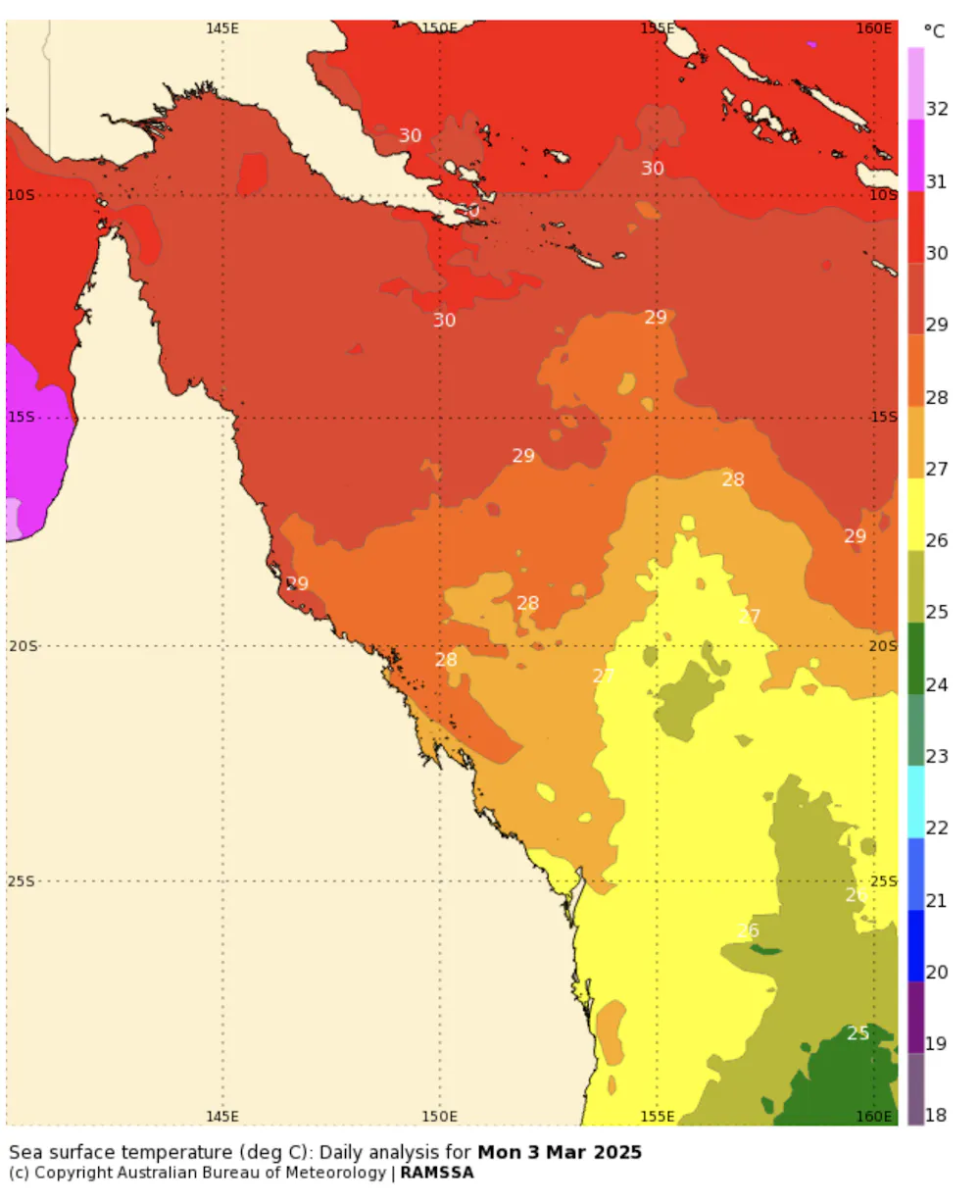
    It moved towards an area of warmer coastal water (around 27°C), which caused it to strengthen. It also moved into an area of reduced “vertical wind shear” – a variation in wind speed running at right angles to prevailing winds, which often acts to weaken a cyclone.

    Image showing high sea surface temperatures which are fuelling the cyclone.
    BoM

    Usually, cyclones in this part of Australian waters may brush the coast, but are soon pulled south or east by an upper trough of cold air and then flicked away into the cooler waters of the Tasman Sea – to an area known as the “cyclone graveyard”.

    The current situation is unusual because that upper trough is absent. At the same time, a high pressure system in the Tasman Sea is steering the cyclone towards the coast.

    The big question now is whether Alfred reaches category 3 – that is, very destructive winds of 165–224km per hour.

    Should the cyclone’s forward motion towards the coast slow, it raises the chances of becoming a category 3 storm. That’s because it would spend more time passing over the warm area of coastal water.

    Category 3 winds are likely to cause significant structural damage to some buildings. Brisbane is, to some extent, sheltered from the winds by offshore islands. Other areas, such as the Gold Coast, do not have such protections.

    How long will the cyclone last?

    As I write, gales are starting to rake the coast – including where I live, on the Sunshine Coast. Conditions will continue to deteriorate this afternoon and into tonight.

    The cyclone will bring gale-force winds to a large area of coastline – from Double Island Point in the north to potentially as far south as Coffs Harbour.

    By Thursday afternoon, conditions on land and just offshore will be pretty rough. If the cyclone keeps travelling at a constant speed, it will cross the coast in the early hours of Friday morning.

    This is less than ideal. It will be dark and people can’t see what’s going on. But there is much affected communities can do to prepare, as outlined here.

    For cyclone preparedness and safety advice, go to Get Ready Queensland. For emergency assistance call the State Emergency Service (SES) in NSW or Queensland on 132 500.

    A Bureau of Meteorology update on Cyclone Alfred dated March 5.

    Steve Turton has previously received funding from the federal government.

    ref. Cyclone Alfred is bearing down. Here’s how it grew so fierce – and where it’s expected to hit – https://theconversation.com/cyclone-alfred-is-bearing-down-heres-how-it-grew-so-fierce-and-where-its-expected-to-hit-251358

    MIL OSI AnalysisEveningReport.nz

  • MIL-Evening Report: RSF slams ‘horrific conditions’ for journalists in Gaza in wake of fragile ceasefire

    Pacific Media Watch

    The Paris-based global watchdog Reporters Without Borders (RSF) has expressed support for Gaza’s media professionals and called on Israel to urgently lift the blockade on the territory.

    It said the humanitarian catastrophe was continuing in Gaza and hampering journalists’ work on a daily basis.

    The Israeli army had killed their colleagues and destroyed their homes and newsrooms, said RSF in a statement.

    Gaza’s remaining journalists, who had survived 15 months of intensive bombardment, continued to face immense challenges despite the ceasefire between Israel and Hamas that came into effect on 19 January 2025 with the first stage expiring last weekend.

    Humanitarian aid, filtered by the Israeli authorities, is merely trickling into the blockaded territory, and Israel continues to deny entry access to foreign journalists, forbidding independent outlets from covering the aftermath of the war and the ongoing humanitarian catastrophe.

    Exiled Palestinian journalists are also prevented from returning to the Gaza Strip.

    “We urgently call for the blockade that is suffocating the press in Gaza to be lifted,” said RSF editorial director Anne Bocandé.

    “Reporters need multimedia and security equipment, internet and electricity.

    “Foreign reporters need access to the territory, and exiled Palestinian journalists need to be able to return.

    “While the ceasefire in Gaza has put an end to an unprecedented massacre of journalists, media infrastructure remains devastated.

    “RSF continues to campaign for justice and provide all necessary support to these journalists, to defend a free, pluralist and independent press in Palestine.”

    Reporters face the shock of a humanitarian catastrophe

    • Working amid the rubble

    “The scale of the destruction is immense, terrifying,” said Islam al-Zaanoun of Palestine TV.

    “Life seems to have disappeared. The streets have become open-air rubbish dumps. With no place to work, no internet or electricity, I was forced to stop working for several days.”

    Journalists must also contend with a severe fuel shortage, making travel within the country difficult and expensive. Like the rest of Gaza’s population, reporters have to spend long hours in queues every day to obtain water and food.

    • Israeli fire despite the ceasefire

    “Entire areas are unreachable,” Al Jazeera correspondent Hani al-Shaer told RSF.

    “The situation remains dangerous. We came under Israeli fire in Rafah.”

    The journalist explained that due to an unrelenting series of crises, he was forced to choose which stories he covered.

    “The destroyed infrastructure? The humanitarian crisis? Abandoned orphans?” he wondered.

    • Witnesses and targets: the double trauma of reporters

    With at least 180 media professionals killed by the Israeli army in the course of 15 months of war, including at least 42 killed on the job, according to RSF figures, surviving journalists must face their trauma while continuing their news mission.

    Gaza media sources put the journalist death toll at more than 200.

    “We covered this tragedy, but we were also part of it. Often, we were the target,” stressed Islam al-Zaanoun.

    “We still can’t rest or sleep. We’re still terrified that the war will start again,” adds Hani al-Shaer.

    • The suspended lives of exiled journalists

    From Egypt to Qatar, journalists who managed to escape the horror continue to live with the consequences, unable to return to their loved ones and homes.

    “My greatest hope is to return home and see my loved ones again. But the border is closed and my house is destroyed, like those of most journalists,” lamented Ola al-Zaanoun, RSF Gaza correspondent, now based in Egypt.

    The Gaza bureau chief of The New ArabDiaa al-Kahlout is one of many who watched the Israeli Army destroy his house.

    “When they arrested me, they bombed and set fire to my house and car. I’ve lost everything I’ve earned in my career as a journalist, and I’m starting all over again,” he told RSF.

    A refugee in Doha, Qatar, he is still haunted by the abuse inflicted by Israeli forces during his month-long detention in December 2023, following his arbitrary arrest at his home in Beit Lahya, a city in the north of the Gaza Strip.

    “No matter how many times I tell myself that I’m safe here, that I’m lucky enough to have my wife and children with me, I have trouble sleeping, working, making decisions,” confided the journalist, whose brother was killed in the war.

    “I’m scared all the time,” he added.

    Asia Pacific Media Network’s Pacific Media Watch project collaborates with Reporters Without Borders.

    MIL OSI AnalysisEveningReport.nz

  • MIL-Evening Report: What’s the difference between wholemeal and wholegrain bread? Not a whole lot

    Source: The Conversation (Au and NZ) – By Margaret Murray, Senior Lecturer, Nutrition, Swinburne University of Technology

    Phish Photography/Shutterstock

    If you head to the shops to buy bread, you’ll face a variety of different options.

    But it can be hard to work out the difference between all the types on sale.

    For instance, you might have a vague idea that wholemeal or wholegrain bread is healthy. But what’s the difference?

    Here’s what we know and what this means for shoppers in Australia and New Zealand.

    Let’s start with wholemeal bread

    According to Australian and New Zealand food standards, wholemeal bread is made from flour containing all parts of the original grain (endosperm, germ and bran) in their original proportions.

    Because it contains all parts of the grain, wholemeal bread is typically darker in colour and slightly more brown than white bread, which is made using only the endosperm.

    Wholemeal flour is made from all parts of the grain.
    Rerikh/Shutterstock

    How about wholegrain bread?

    Australian and New Zealand food standards define wholegrain bread as something that contains either the intact grain (for instance, visible grains) or is made from processed grains (flour) where all the parts of the grain are present in their original proportions.

    That last part may sound familiar. That’s because wholegrain is an umbrella term that encompasses both bread made with intact grains and bread made with wholemeal flour. In other words, wholemeal bread is a type of wholegrain bread, just like an apple is a type of fruit.

    Don’t be confused by labels such as “with added grains”, “grainy” or “multigrain”. Australian and New Zealand food standards don’t define these so manufacturers can legally add a small amount of intact grains to white bread to make the product appear healthier. This doesn’t necessarily make these products wholegrain breads.

    So unless a product is specifically called wholegrain bread, wholemeal bread or indicates it “contains whole grain”, it is likely to be made from more refined ingredients.

    Which one’s healthier?

    So when thinking about which bread to choose, both wholemeal and wholegrain breads are rich in beneficial compounds including nutrients and fibre, more so than breads made from further-refined flour, such as white bread.

    The presence of these compounds is what makes eating wholegrains (including wholemeal bread) beneficial for our overall health. Research has also shown eating wholegrains helps reduce the risk of common chronic diseases, such as heart disease.

    The table below gives us a closer look at the nutritional composition of these breads, and shows some slight differences.

    Wholegrain bread is slightly higher in fibre, protein, niacin (vitamin B3), iron, zinc, phosphorus and magnesium than wholemeal bread. But wholegrain bread is lower in carbohydrates, thiamin (vitamin B1) and folate (vitamin B9).

    However the differences are relatively small when considering how these contribute to your overall dietary intake.


    Which one should I buy?

    Next time you’re shopping, look for a wholegrain bread (one made from wholemeal flour that has intact grains and seeds throughout) as your number one choice for fibre and protein, and to support overall health.

    If you can’t find wholegrain bread, wholemeal bread comes in a very close second.

    Wholegrain and wholemeal bread tend to cost the same, but both tend to be more expensive than white bread.

    Margaret Murray does not work for, consult, own shares in or receive funding from any company or organisation that would benefit from this article, and has disclosed no relevant affiliations beyond their academic appointment.

    ref. What’s the difference between wholemeal and wholegrain bread? Not a whole lot – https://theconversation.com/whats-the-difference-between-wholemeal-and-wholegrain-bread-not-a-whole-lot-249156

    MIL OSI AnalysisEveningReport.nz

  • MIL-Evening Report: AI deepfakes threaten democracy and people’s identities. ‘Personality rights’ could help

    Source: The Conversation (Au and NZ) – By Wellett Potter, Lecturer in Law, University of New England

    Ray Bond/Shutterstock

    How much is your voice worth?

    It could be as little as roughly A$100. That was how much ABC News Verify recently spent to clone federal senator Jacqui Lambie’s voice – with her permission – using an easily accessible online platform.

    This example highlights how artificial intelligence (AI) apps which create a synthetic replica of a person’s image and/or voice in the form of deepfakes or voice cloning are becoming cheaper and easier to use.

    This poses a serious threat not only to the functioning of democracy (especially around elections), but also to a person’s identity.

    Current copyright laws in Australia are inadequate when it comes to protecting people if their image or voice is digitally cloned without their permission. Establishing “personality rights” could help.

    Detecting what’s fake is difficult

    Deepfake technology is able to produce content which seems increasingly real. This makes it harder to detect what is fake and what is not. Indeed, several people for whom the ABC played the voice clone of Senator Lambie did not initially realise it was fake.

    This shows how unauthorised deepfakes and voice cloning can be easily used to generate misinformation. They can also be extremely damaging to individuals.

    This was highlighted back in 2020, when one of Australia’s first political deepfake videos was released. It featured the then Queensland premier Annastacia Palaszczuk claiming the state was “cooked” and in “massive debt”.

    The video received around 1 million views on social media.

    What laws cover this?

    In Australia, defamation, privacy, image-based abuse laws, passing off and consumer protection laws might be applicable to situations involving deepfake video or audio clips. You may also be able to lodge a complaint with the eSafety commissioner.

    In theory copyright law can also protect a person’s image and voice. However, its application is more nuanced.

    First, a person whose likeness has been cloned by an AI platform often does not own the source material. This material could be an image, video or voice recording which has been copied and uploaded. Even if your image and voice is depicted, if you are not the owner of the source material, you cannot sue for infringement.

    Using Senator Lambie as an example, the ABC only needed 90 seconds of original voice recording to create the AI clone. Senator Lambie’s voice itself is not able to be copyright-protected. That’s because copyright can only attach to a tangible expression, say in written or recorded form. It cannot attach to speech or unexpressed ideas.

    As the ABC arranged, recorded and produced the original 90-second recording, the broadcaster could hold copyright in it as a sound recording. It is a fixed, tangible expression of Senator Lambie’s voice. However, unless the senator and the ABC made an agreement, Senator Lambie would have no economic rights, such as the right to reproduction, to the original voice recording. Nor would she have any rights to the clone of her voice.

    In fact, the AI-generated clone itself is unlikely to be protected by copyright, as it is considered authorless under Australian copyright law. Many AI-generated creations are currently unable to be protected under Australian copyright, due to a lack of original, identifiable human authorship.

    Moral rights – including the right of attribution (to be credited as the performer), the right against false attribution and the right of integrity – are also limited in scope. They could apply to the original audio clip, but not to a deepfake.

    What are ‘personality rights’?

    In most jurisdictions in the United States, there exist what are commonly known as “personality rights”. These rights include the right of publicity, which acknowledges that an individual’s name, likeness, voice and other attributes are commercially valuable.

    Celebrities such as Bette Midler and Johnny Carson have successfully exercised this right to prevent companies using elements of their identity for commercial purposes without permission.

    However, personality rights might not always apply to AI voice clones, with some lawyers arguing that only actual recorded voices are protectable, not clones of voices. This has led to states such as Tennessee introducing legislation to specifically address AI-generated content. The Ensuring Likeness, Voice, and Image Security Act, introduced in 2024, addresses the misappropriation of an individual’s voice through generative AI use.

    Urgent steps are needed

    There has been longstanding scholarly debate about whether Australia should introduce statutory publicity rights.

    One of the challenges is overlap with pre-existing laws, such as Australian consumer law and tort law. Policymakers might be hesitant to introduce a new right, as these other areas of the law may provide partial protection. Another challenge is how to enforce these rights if an AI-generated deepfake is created overseas.

    Australia could also consider introducing a similar law to the “No Fakes Bill” currently being debated in the US. If passed, this bill would allow people to protect their image and voice through intellectual property rights. This should be given serious consideration in Australia too.

    Deepfakes are becoming more and more common, and are now widespread during elections. Because of this, it’s important that Australians remain vigilant to them in the lead up to this year’s federal election.

    And let’s hope that whoever wins that election takes urgent steps to better protect everyone’s image and voice.

    Wellett Potter does not work for, consult, own shares in or receive funding from any company or organisation that would benefit from this article, and has disclosed no relevant affiliations beyond their academic appointment.

    ref. AI deepfakes threaten democracy and people’s identities. ‘Personality rights’ could help – https://theconversation.com/ai-deepfakes-threaten-democracy-and-peoples-identities-personality-rights-could-help-251267

    MIL OSI AnalysisEveningReport.nz

  • MIL-Evening Report: Manurewa’s first Pan-Pacific strategy aims to amplify Pasifika voices

    By Mary Afemata, Local Democracy Reporting

    The Manurewa Local Board is developing its first Pan-Pacific strategy in Aotearoa New Zealand to amplify Pasifika voices in local decision-making.

    A recent community workshop brought leaders and residents together to develop a strategy that will help guide how the board engages with Pasifika communities. The plan will then be presented in June.

    Akerei Maresala-Thomson, an Auckland Council partner and facilitator of the workshop at Manurewa Library, described it as a listening session.

    LOCAL DEMOCRACY REPORTING

    “A lot of work has gone into reaching this stage, with investment from both past and present board members. This will be the first Pasifika strategy for the board-a win for our community.”

    The strategy aims to amplify Pacific voices in local decision-making, promote cultural recognition, improve access to services, and encourage Pasifika participation in governance.

    Maresala-Thomson facilitated a similar workshop in 2019, laying the groundwork for this initiative.

    The strategy, expected to be presented in June, will be informed by feedback from the workshop and an online community survey.

    According to the 2023 Census, Pasifika make up nearly 40 percent of Manurewa’s approximately 39,450 residents. The consultation process involved gathering demographic information and identifying key priorities for the community.

    “There was a diverse mix of expertise and perspectives in the room,” said Maresala-Thomson. “Some smaller Pasifika communities weren’t represented, and our youth were largely absent.

    Notes from the workshop will help shape the final draft of the Pan-Pacific strategy, set for presentation in June. Image: LDR/Mary Afemata

    “However, many contributed via the online survey, which helped guide our discussions.”

    The local board wants a Pan-Pacific approach — not just input from the larger island groups but representation from all the diverse Pacific communities, he said.

    “More often than not, and this is no fault of our own, our Samoan, Cook Island, and Tongan communities naturally make up the larger share of our population.

    “But they wanted to make sure we also reached our smaller community groups, like our Niuean, Tuvaluan, Solomon Islands, and even Rotuman communities.”

    The group received great representation from the Tuvaluan, Kiribati, Solomon Islands, and Niuean communities, in addition to the larger, traditional networks from Samoan and Tongan communities, he said.

    ‘Great networking opportunity’
    One attendee, Kate*, who asked not to be identified, said she joined the workshop to understand how local boards align with Pasifika priorities.

    “It was a great networking opportunity, but ultimately, I wanted to know how I can best support the community,” she said. “The issues raised today aren’t new. We’ve been talking about them for years.”

    Kate believes many Pasifika families struggle to engage with local government because they don’t see the impact of their input.

    “There’s access to these spaces, but people don’t know where to go or why it matters. We need better ways to bring the conversation into people’s homes,” she said.

    Engaging Pasifika youth was another key discussion point.

    “There are youth in different spaces, and we need to find the champions — whether through youth councils, community groups, or other networks-who can help share the message among their peers.”

    Community educator Kathleen Guttenbeil-Vatuvei . . . “When you hear ‘strategy,’ you want to be involved in shaping solutions.” Image: Facebook/TP/LDR

    Kathleen Guttenbeil-Vatuvei, a community educator and financial mentor at Vaiola Pacific Island Budgeting Service Trust, said she attended the event to ensure financial capability was part of the discussion.

    “When you hear ‘strategy,’ you want to be involved in shaping solutions,” she said. “What is the local board going to do about these issues? Are they listening? How do we fit into this strategy, and do we have a voice?”

    She stressed the importance of youth involvement.

    “Youth should be equally represented. But sometimes, they feel intimidated around elders or community leaders. It’s important to create spaces where they feel comfortable contributing.”

    Angela Dalton, Councillor for Manurewa-Papakura and former chair of the local board, received a message from Maresala-Thomson thanking her for initiating the strategy years ago.

    “I always felt we weren’t turning words into tangible outcomes for Pasifika,” Dalton said.

    “I was determined to build strong relationships to ensure we deliver projects that meet the needs of our growing Pasifika population.”

    Auckland Council partner and facilitator Akerei Maresala-Thomson . . . facilitating a discussion on strengthening the relationship between the Manurewa Local Board and Pasifika communities. Image: LDR/Mary Afemata

    Feedback will shape final draft
    Feedback will shape the final draft of the strategy. A subcommittee will refine the document before it is presented to the Manurewa Local Board.

    The goal is to align its implementation with the 2025-2026 Local Board Plan, ensuring Pasifika priorities are embedded in decision-making.

    A steering committee will oversee the project, ensuring it reflects the aspirations of Manurewa’s Pasifika communities and fosters meaningful engagement with local government.

    Maresala-Thomson said: “What we get from today, from your feedback, which has been amazing, this will help to draft the strategic plan specifically for Pacific and Manurewa.”

    Local Democracy Reporting (LDR) is local body journalism co-funded by RNZ and NZ On Air. Asia Pacific Report is a community member of the LDR project.

    MIL OSI AnalysisEveningReport.nz

  • MIL-Evening Report: Fires used to terrify city residents. New research suggests climate change could see this fear return

    Source: The Conversation (Au and NZ) – By David Bowman, Professor of Pyrogeography and Fire Science, University of Tasmania

    Fire rages in the Pacific Palisades area of Los Angeles in January 2025 eley archives/Shutterstock

    For centuries, fire was one of the major fears for city-dwellers. Dense cities built largely of wood could – and did – burn. In 1666, a fire in a bakery went on to destroy two-thirds of the city of London, leaving 85% of residents homeless. In 1871, fire burned out huge areas of Chicago. In World War II, bombing raids by Allied forces largely destroyed cities such as Dresden in Germany and Tokyo in Japan.

    The threat of large-scale urban fires drove authorities to spend more on urban firefighting and require buildings to use less flammable material. Fire alarms, fire engines and automatic sprinklers have done much to reduce the chance of uncontrolled spread.

    But will our sense of safety endure in the age of climate change? In January, we saw swathes of Los Angeles burn – even in the northern winter. Driven by low humidity and high winds, numerous large fires encroached on the city, destroying outlying suburbs. Climate change made the fires worse, according to climate scientists.

    Now we have new research on the question of whether climate change will make large city fires more likely. A research team from China, Singapore and Australia have gathered a decade’s worth of data on fires from almost 3,000 cities in 20 nations, home to one-fifth of the world’s population.

    The researchers found for every 1°C increase in air temperature, outdoor fires (rubbish and landfill) increase 4.7% and vehicle fires 2.5%. If the world accelerates its burning of fossil fuels under a high emissions scenario compatible with a 4.3°C temperature rise by century’s end, outdoor fires in cities would soar 22% and vehicle fires 11%. But building fires are projected to actually fall 5%. Thankfully, this emissions scenario is now less likely.

    The Great Fire of London destroyed most of the city in 1666.
    HodagMedia/Shutterstock

    What did this research find?

    To make these findings, the researchers aggregated the fire incident data from 2,847 cities located in 20 countries over the 2011–20 decade and analysed them to see how air temperature influences the frequency of three types of fires: outdoor, structural and vehicle. They found a strong correlation.

    Of the 20 nations, New Zealand looks likely to have the highest increase in fires, soaring 140% over 2020 figures by 2100.

    When we think of fires in a city, we usually think of structural fires – a building going up in flames.

    The research suggests building fires would actually decrease 5% by 2100. This is unexpected, and might suggest uncertainty about this finding.

    Interestingly, this research found the fewest structural fires occurred at air temperatures of 24°C, a temperature which humans find optimal. When it’s hotter or cooler than that, more buildings catch fire.

    Why? It’s likely due to our behaviour. We spend more time indoors when it’s very cold or very hot outside, which the authors suggest could make us more likely to accidentally cause fires by using electrical appliances and fireplaces which have a fire risk.

    By contrast, outdoor and vehicle fires do increase linearly as temperatures rise. Most vehicle fires come from an equipment or heat source failure, which are both likely to increase as temperatures rise. We are also more likely to have a car crash when it’s hotter, and vehicle fires often come after a crash.

    Vehicle fires will become more common as the climate changes, according to this research.
    Rodrigo Teixeira/Pexels, CC BY-NC-ND

    Outdoor fires become more likely because heat dries out fuels and favours fire spread. Rubbish dumps can spontaneously catch fire when temperatures are too high – even underground. This happens because chemical reactions are accelerated in warmer temperatures, causing waste materials to heat up faster. If the extra heat isn’t dissipated, waste can become so hot that it catches fire on its own.

    We should take these estimates with a grain of salt. This is because they project recent statistical patterns into an uncertain future, and draw on a data set not perfectly suited to the task. The data set stops in 2020, before the electric vehicle transition gathered speed. EVs have a different risk profile for accidental fires.

    As the authors note, there are large barriers to getting a coherent understanding of fire risk. “Despite multiple efforts, we have been unsuccessful in obtaining fire data from Africa and South America,” they write.

    Their estimates also relate to a high-emissions future which is hopefully becoming less likely, though the general pattern of the results are similar under less severe climate projections.

    Most importantly, it’s not yet clear why temperature influences urban fires. This uncertainty raises questions over whether simple projections of current patterns into the future are realistic or appropriate.

    Cities aflame?

    Arguably the most important contribution of this new research is to show us that our cities are not inherently protected from fire.

    For city authorities, this research points to the need to manage combustible materials, from piles of mulch to dry urban parks and even home gardens. Storage yards, rubbish dumps and recycling centres will also need to be managed.

    Fire used to be a major concern for cities, and it could be again. Cities and fire are uneasy bedfellows, and climate change will worsen the situation.

    David Bowman is an Australian Research Council Laureate Fellow and also receives funding from the New South Wales Bushfire and Natural Hazards Research Centre, and Natural Hazards Research Australia.

    Calum Cunningham receives funding from the Australian Research Council.

    ref. Fires used to terrify city residents. New research suggests climate change could see this fear return – https://theconversation.com/fires-used-to-terrify-city-residents-new-research-suggests-climate-change-could-see-this-fear-return-251056

    MIL OSI AnalysisEveningReport.nz

  • MIL-Evening Report: America or Europe? Why Trump’s Ukraine U-turn is a fork in the road for New Zealand

    Source: The Conversation (Au and NZ) – By Alexander Gillespie, Professor of Law, University of Waikato

    The aftermath of one of the most undiplomatic – and notorious – White House meetings in recent history reveals a changed world.

    Having berated Ukraine’s President Volodymyr Zelensky for supposedly not wanting peace with Russia and failing to show sufficient gratitude to the United States, President Donald Trump has now paused all military aid to Ukraine.

    This equates to about 40% of the beleaguered nation’s military support. If the gap is not quickly covered by other countries, Ukraine will be severely compromised in its defence against the Russian invasion.

    This has happened while the Russian army is making slow but costly gains along the front in eastern Ukraine. Trump’s goal appears to be to force Zelensky to accept a deal he does not want, and which may be illegal under international law.

    New Zealand is a long way from that front line, but the implications of Trump’s unilateral abandonment of Ukraine still create a serious foreign policy problem.

    Aside from its unequivocal condemnation of Russia’s actions, New Zealand has provided Defence Force personnel for training, intelligence, logistics and liaison to the tune of nearly NZ$35 million. The government has also given an additional $32 million in humanitarian assistance.

    At the same time, New Zealand has supported global legal efforts to hold Russia to account at both the International Court of Justice and the International Criminal Court. With Trump undermining these collective actions, New Zealand faces some stark choices.

    Allies at war

    While a genuine ceasefire and eventual peace in Ukraine are the right aims, Trump’s one-sided proposal has involved direct talks between Russia and the US, excluding all other parties, including the actual victims of Russian aggression.

    With eery parallels to the Munich Agreement of 1938 between Nazi Germany, Britain, France and Italy, peace terms could be dictated to the innocent party. Ukraine may have to sacrifice part of its territory in the hope a wider peace prevails.

    In exchange, Ukraine may be given some type of “security assurance”. But what that arrangement would look like, and what kind of peacekeeping force might be acceptable to Russia, remains unclear.

    If the current UK and European ceasefire proposals fail, Europe could be pulled more directly into the conflict. Since the Trump rebuff, European leaders are embracing Zelenskyy more tightly, wary of an emboldened Russia threatening other states with substantial Russian populations such as in Estonia and Latvia.

    European boots on the ground in Ukraine could escalate the existing war into a much larger and more dangerous conflict. The complexities of this new reality are now spilling over in the United Nations.

    A fork in the road

    While the Security Council finally agreed on a broad statement in favour of a lasting peace, just what that might look like has seen opposing resolutions in the General Assembly.

    On February 18, 53 countries, including New Zealand, voted in favour of a resolution condemning Russian aggression and calling for the return of Ukrainian territory. The resolution passed, but the US, Russia, Belarus and North Korea voted against it.

    The US then put up its own resolution calling for peace, without recognising Russian aggression or the illegal annexation of Ukrainian territory. New Zealand supported this, too.

    Those two votes clearly signal a fork-in-the-road moment for New Zealand.

    As well as the wider consequences and potential precedents of any Ukraine peace settlement for security in Europe and the Pacific region, there is the immediate problem of supporting Ukraine.

    With the US and Europe – both traditional allies of New Zealand – now deeply divided, whatever path the government chooses will directly affect present and future security arrangements – including any possible “pillar two” membership of AUKUS.

    Potentially complicating matters further, Trump’s civilian lieutenant Elon Musk has publicly advocated for the US leaving the UN and NATO. Whether or not that happens, the threat alone underscores the gravity of the current situation.

    No option without risk

    Ultimately, if Trump decides to force Zelensky to the negotiating table against his will, and Europe continues urging and supporting him to fight on, New Zealand will have to take sides. It cannot take both.

    The National-led coalition government will either have to abandon the stance New Zealand has taken on the Russian invasion over the past three years, or wait for Europe’s response and align with efforts to support a rules-based international order.

    The first option would mean stepping back from that traditional foreign policy position, cutting military support for Ukraine (and trusting the Trump process), and probably ending sanctions against Russia and diplomatic efforts for legal accountability.

    The other path would mean spending more on military aid, and possibly deploying more defence personnel to help fill the gap Trump has created.

    No option is without risk. But, on balance, the European approach to international affairs seems closer to New Zealand’s worldview than the one currently articulated by the Trump administration.

    The authors do not work for, consult, own shares in or receive funding from any company or organisation that would benefit from this article, and have disclosed no relevant affiliations beyond their academic appointment.

    ref. America or Europe? Why Trump’s Ukraine U-turn is a fork in the road for New Zealand – https://theconversation.com/america-or-europe-why-trumps-ukraine-u-turn-is-a-fork-in-the-road-for-new-zealand-251459

    MIL OSI AnalysisEveningReport.nz

  • MIL-Evening Report: Police are seizing 3D-printed guns across Australia, but our laws aren’t keeping up

    Source: The Conversation (Au and NZ) – By Andrew Hemming, Associate Professor of Law, School of Law and Justice, University of the Sunshine Coast

    Shutterstock

    After Martin Bryant killed 35 people and wounded 23 others at Port Arthur in 1996, Australia made fundamental changes to its gun laws. The use of automatic and semi-automatic weapons became restricted and a national gun registry was established.

    As a result, unlike the situation in the United States where automatic weapons can be readily obtained, mass shootings are a rarity in Australia.

    However, a new and pressing danger in the form of 3D guns, or “ghost guns”, threatens to undermine Australia’s strict gun control laws.

    The reason is simple: 3D guns can be manufactured in a suburban garage. In a process like making a dress from a pattern, a digital blueprint for the manufacture of a firearm can be downloaded from the internet. Then, instead of a sewing machine, you need a 3D printer or an electronic milling machine.

    The emergence of these types of firearms reveal big loopholes in many of our gun laws. These need urgent attention.

    How are these guns made?

    A 3D gun is manufactured in stages, with each part of the gun printed separately and assembled manually.

    Think of yourself as making a toy LEGO gun, but instead of taking the parts from the LEGO box, you make the parts on your 3D printer based on your digital blueprint and you then assemble your gun. Your raw materials are thermoplastic polymers and metal for the barrel and firing pin.

    High-end, industrial-grade 3D printers are priced between $2,000 and $10,000, and are readily available.

    This technology has been around for more than a decade.

    The first 3D printed handgun was designed by Cody Wilson in 2013, which he christened The Liberator. It was made of 15 parts of plastic and a nail for the ring pin.

    Also in 2013, reporters from the Daily Mail newspaper in London 3D-printed a Liberator pistol and smuggled the disassembled gun onto a Eurostar train. They reassembled the gun in the toilet.

    As the gun was made of plastic, metal detectors were not activated, demonstrating the danger these weapons pose even in high-security locations such as airports and public transport.

    In the recent high-profile murder in New York of Brian Thompson, chief executive of the US health insurance company United Healthcare, the suspect, Luigi Mangione, when arrested was found to be in possession of a similar 3D-printed gun and 3D-printed suppressor to those allegedly used in the shooting.

    Leaps forward in technology

    In the 12 years since the designs for The Liberator were posted on the internet, the quality and range of 3D guns have greatly improved and expanded.

    According to Detective Inspector Brad Phelps from Queensland’s Crime and Intelligence Command Drug Squad, the technology has advanced sufficiently that:

    now you wouldn’t be able to tell the difference between a privately manufactured firearm and a traditional firearm in many instances […] every jurisdiction in Australia has reported an increase, particularly in the last 18 months to two years.

    As 3D guns are untraceable, the actual prevalence of 3D guns is unknown, other than the growing number of 3D guns seized in police raids. According to gun safety groups, 3D guns can now fire up to 40 rounds and use standard gauge ammunition.

    Police predict homemade guns will soon overtake illicit weapon imports.

    In October 2024, Western Australian police seized 21 privately made 3D-printed firearms from a home in Perth.

    Fixing the legal loopholes

    So, with all these alarm bells ringing in the ears of law enforcement agencies, what steps have authorities taken to meet the threat 3D guns pose to community safety?

    Indeed, what effective steps are being taken to prevent further advances in the technology and thwart any efforts to produce these guns en masse?

    The answer would appear to be that little attention has been directed towards the dangers 3D guns represent. Legislation across Australian jurisdictions is inconsistent.

    At present, only New South Wales and Tasmania have legislated to make it an offence to possess a digital blueprint for the manufacture of a firearm on a 3D printer or electronic milling machine. The maximum penalties are imprisonment for 14 years and 21 years, respectively.

    In 2022, WA took a step in the right direction by making unauthorised possession of firearms technology an offence. This included possession of a 3D printer or milling device.

    The slow progress on this issue is well illustrated by South Australia. There have been 23 incidents in which police have seized 3D-printed firearms and firearm parts between 2020 and 2023.

    But the drafting of proposed legal amendments to address these incidents started in 2024 and are still to be introduced into the SA parliament.

    There needs to be a national sense of urgency similar to the federal government’s response to the Port Arthur massacre in 1996. Existing laws are inadequate as there is no uniformity in the legislation covering 3D-printed firearms and their digital blueprints.

    There was a senate inquiry into gun violence in 2014, which found 3D printers “were by no means integral to the illegal manufacture of firearms”. This is no longer accurate.

    Ironically, the senate committee recommended “Australian governments investigate the requirement for uniform regulations in all jurisdictions covering the manufacture of 3D-printed firearms and firearm parts”. A decade on, little progress has been made.

    New laws could distinguish between possessing of a digital blueprint for a 3D gun and actually manufacturing a firearm. This could look like a scale of penalties, such as those imposed for the possession and manufacture of illegal drugs, which are based on the category of drug and the quantity seized.

    Andrew Hemming does not work for, consult, own shares in or receive funding from any company or organisation that would benefit from this article, and has disclosed no relevant affiliations beyond their academic appointment.

    ref. Police are seizing 3D-printed guns across Australia, but our laws aren’t keeping up – https://theconversation.com/police-are-seizing-3d-printed-guns-across-australia-but-our-laws-arent-keeping-up-250255

    MIL OSI AnalysisEveningReport.nz

  • MIL-Evening Report: Beyond the garage: How important are spaces to business creation?

    Source: The Conversation (Au and NZ) – By Etienne Capron, Postdoctoral fellow, HEC Montréal

    Cities, and on a smaller scale, neighbourhoods and meeting places, play a significant role in promoting innovation. (Shutterstock)

    There is an enduring myth that many technological innovations have come out of garages, bedrooms and basements.

    One of the most famous garages is the one at Steve Jobs’ parents’ house where he was rumoured to have designed the Apple I computer, along with Steve Wozniak and some colleagues. The myth was so persistent, that the garage was designated as a site of historical importance in 2013. It was a similar story for the founders of Google, who set up their first offices in an actual garage in Menlo Park in San Jose, Calif.

    Then there was William Hewlett and David Packard, who developed a low-distortion frequency oscillator in their garage in Palo Alto, before going on to found the information technology company HP Inc. One of their first customers was Walt Disney, who used it for the sound in his 1940 film Fantasia.

    The garage is an important site in the founding myths of many entrepreneurial adventures. Before a company becomes successful, where it starts out is as important as the visionaries who invest in it. And in addition to the specific space of the garage, the surrounding urban environment is also important. What a city offers, and the way it is organized, both contribute to innovation.


    This article is part of our series Our cities from yesterday to tomorrow. Urban life is going through many transformations, each with cultural, economic, social – and, in this election year, political – implications. To shed light on these diverse issues, The Conversation Canada is inviting researchers to discuss the current state of our cities.

    Multiplicity of creative spaces

    There are many spaces specifically designed to support entrepreneurship today, including incubators, accelerators and collaborative workspaces. In addition to providing a place to work, these spaces facilitate both networking with potential partners and access to business opportunities.

    It is also interesting to note how these creative spaces have multiplied in most cities, sometimes with a specialization. They can be found in the fields of health, social innovation and digital technologies.

    The Apple garage, located in Steve Jobs’s childhood home, was a meeting place for Apple’s founders.
    (Shutterstock)

    Yet, as important as they may be for some players, these spaces are not the only factors that contribute to entrepreneurial success. Other places, sometimes unexpected, such as the fast food restaurant where Nvidia was born or the Californian saunas that have replaced luxury hotels for business meetings between investors and entrepreneurs, also contribute to the creation and development of new companies. Nor can the success of an entrepreneurial venture be explained by a single place.

    That raises the question: what do we know about how cities, and the variety of places within them, affect the development of entrepreneurial capacity?

    As a postdoctoral researcher at HEC Montréal (MOSAIC) and a professor of innovation management at the IAE Nantes University, respectively, we have explored this question as part of our research in innovation management, particularly in a recent piece of research.

    The city, an ecosystem

    Research has long focused on specific types of places. The aim is both to understand what happens there and to extract lessons that can be replicated elsewhere. Accessing a shared workspace offers entrepreneurs the opportunity to socialize. This was also the great promise of the American company WeWork: to be a member of a community.


    À lire aussi :
    WeWork : chute d’une entreprise ou fin du coworking ?


    Specific technologies or tools for prototyping can be found in a fab lab or a collaborative manufacturing workshop. Presenting your project to investors is easier from an incubator or accelerator. For example, by presenting a project at Y-Combinator in California, an accelerator renowned for supporting promising projects, entrepreneurs know they’ll get noticed by investors.

    Similarly, it is easier to meet potential partners or pick up on the latest trends in a market or technologies by spending the evening in a trendy café or bar. Informal exchanges are easier there and these play a big role in the entrepreneurial dynamics of a territory.

    WeWork shared office space in Two Summerlin, Nevada, USA.
    (Shutterstock)

    And then, quite simply, where does the initial idea come from? As the American columnist and writer Steven Johnson shows through the examples of Gutenberg and Darwin, it is clear this often happens at odd times and in unusual places.

    As a result, whether innovators are entrepreneurs, artists or scientists, it is unlikely that all the resources they require will be available to everyone, all the time, in one place.

    As the American urban planner and sociologist Jane Jacobs so aptly put it, individuals experience the city. They do not got to a single place: they visit or pass by a variety of places, each of which, in its own way, can nurture the creativity and career of an entrepreneur. Our research reveals that it is above all the combination of a city’s places – their diversity of size, function, purpose and location – that produces entrepreneurial capacity.

    Observing artists to better understand entrepreneurship

    Let’s take the example of creators who produce projection mapping works in Montréal. Thanks to a six-month survey of 21 Montréal artists, we were able to show the heterogeneity of places they visited regularly throughout the process of creation and development.


    Thousands of subscribers already receive The Conversation’s Canada Daily newsletter. And you? Subscribe today to our newsletter to better understand today’s major issues.

    _

    Our study led to two main conclusions.

    Firstly, depending on the profile of individuals and their creative approach, the places they visit regularly are different, and sometimes distinctive. This is the case, for example, of an artist who benefits from a residency in a printing workshop to create a projection on fabrics. It is also the case of a designer who goes to a fab lab to experiment with sensors.

    This suggests that there are specific trajectories for each individual, and therefore, no single path that leads to innovation.

    The need for structuring places

    Secondly, this observation suggests that the convergence around certain places does not owe to chance: multiple resources, sometimes crucial for recognition in a field, are mobilized there.

    For example, many of the artists in our study regularly visited Montréal’s Society for Arts and Technology (SAT), a renowned meeting place that has helped the careers of many artists. The artists we met go there to take courses, attend shows, and meet musicians with whom they may eventually collaborate.

    That’s how a venue’s reputation is built. As we have shown, this can become essential at a particular stage of the entrepreneur’s journey.

    But before or after this stage, other places may be more beneficial.

    In fact, depending on the phase of the innovation project, the types of places visited and their number vary greatly. So, since needs are different, the capacity to innovate depends on the places and possibilities that exist in a city. For example, Montréal’s diverse cultural offerings, with its artist-run centres and performance halls, strongly inspire projection mapping artists.

    Workshops are obviously important places for experimentation and creation, but they are only used when a prototype or final work is being produced.

    The territory of innovation

    In a more global context, where there are many technological, societal and environmental challenges, innovations are necessary.

    Ideas and entrepreneurs are essential to make innovation happen. Entrepreneurs need skills and financial resources. They need to be part of collectives and communities. But also, and perhaps even above all, they need to be in territories that offer a wide range of places where they can take advantage of complementary resources to carry out their projects.

    The city as a whole, and on a smaller scale, its neighbourhoods, are the melting pot from which ideas circulate and mix, where projects mature and take shape. The urban morphology, which can be seen as a particular arrangement of places and transport or travel infrastructures, then becomes a new deciding factor in entrepreneurial capacity.

    Les auteurs ne travaillent pas, ne conseillent pas, ne possèdent pas de parts, ne reçoivent pas de fonds d’une organisation qui pourrait tirer profit de cet article, et n’ont déclaré aucune autre affiliation que leur organisme de recherche.

    ref. Beyond the garage: How important are spaces to business creation? – https://theconversation.com/beyond-the-garage-how-important-are-spaces-to-business-creation-250130

    MIL OSI AnalysisEveningReport.nz

  • MIL-Evening Report: Bill Gates’ origin story describes a life of privilege, exposing the DNA of some of the tech industry’s problems

    Source: The Conversation (Au and NZ) – By Dana McKay, Associate Dean, Interaction, Technology and Information, RMIT University

    Bill Gates, cofounder of Microsoft, is one of the world’s richest men. He is also a highly controversial figure.

    On one hand, he contributes to social, medical and environmental causes through his foundation, making grants worth more than US$77 billion ($A123 billion) from its inception to the end of 2023. On the other, he has confirmed associations with Jeffrey Epstein and was the subject of spurious COVID conspiracy theories.

    Even Gates’ Microsoft days were controversial. Under his leadership, Microsoft became the first tech giant, but Gates has been repeatedly described as ruthless, both personally and professionally.


    Review: Source Code, My Beginnings – Bill Gates (Penguin)


    He was accused by his late long-term friend and business partner Paul Allen, of canvassing ways to dilute Allen’s shares in Microsoft when the latter was undergoing treatment for lymphoma. Gates reportedly apologised to Allen, and they repaired their relationship, and were on good terms by the time Allen died.

    Still, as a leader, his style has been characterised by some who worked with him in the 1980s and 1990s as bullying. (Gates’ spokesperson has denied he mistreated employees.)

    Childhood

    In Source Code, Gates sets out to tell his own story, and the story of the birth of the tech industry.

    His parents were the children of hardworking strugglers. His father, Bill Senior, was educated as a lawyer on the GI bill; his mother, Mary, was, according to Gates, an innovative and engaged homemaker, who later shattered glass ceilings.

    Born in 1955 Gates describes himself as the kind of kid his mother had to warn his preschool teachers about. He responded to not knowing how to fit in with other kids by becoming a class clown, and was pushed by his mother to relate to other adults.


    He was introduced to mathematics by his maternal grandmother, a Christian Scientist and a card sharp. She played assiduously with her grandchildren. She did not believe in losing to them deliberately. Through cards, Gates learned two key lessons: that you can learn the mathematics of a problem, and that practising a skill will hone it.

    His relationship with his father was loving and respectful, but his relationship with his mother was more fraught. She encouraged him, but he resented her expectation that he live up to social mores so much that peace had to be brokered by a family therapist.

    The privilege of private school

    Gates was sent to a private school for boys, and his stories about Lakeside School in Seattle are probably the most engaging segment of the book. It was at Lakeside that he learned to apply himself academically, after his class-clown act failed to impress. There, he also met Allen, who would become co-founder of Microsoft, and got his hands on his first computer.

    In the late 1960s and early 1970s, computer time was charged by the minute. Gates used lucky connections and his entreprenurial spirit to get a job coding, so he could do more of what he loved. This was how he clocked up 500 hours coding before he left high school, a mean feat even by today’s standards.

    Gates describes a degree of freedom almost unimaginable in today’s regimented education system. He had access to the computer lab at all hours and was able to take an entire semester off to code.

    He continued his elite education at Harvard. Eventually, he chose to major in applied mathematics, partly because it gave him some of the same freedom he had been accustomed to. He soon realised he was not the best at pure mathematics, as he had anticipated.

    Gates again got early access to computers at Harvard. He used this access to build his first microprocessor software (“Micro-Soft”), with Allen, which he and Allen sold to a company called MITS in 1975.

    He was sanctioned by Harvard for this project. Their computers were not supposed to be for commercial use. He was also bringing non-students into the lab.

    At this point, aged 19, he decided to take a semester off to focus on his business.

    But they stole my software!

    In 1975 Gates went to work with MITS, the company that built the first desktop computer, where he expanded his software.

    The first version of this software was literally stolen at a trade fair, reducing Microsoft’s profits and creating a rift between Gates and many of the hobbyists who were using this software

    Gates believed that software should be paid for; many of the hobbyists believed software should be free and open source.

    Gates describes the head of MITS, Ed Roberts, as loud and somewhat mercurial, an irony that is not lost as we read Gates’ letters to his friends and business partners, in whom he is frequently disappointed.

    Eventually, the relationship with MITS broke down. MITS failed to meet the terms of its contract to promote and license Gates’s software.

    The end of this contract left Gates free to sell his software to a range of companies, including Apple and Texas Instruments. A legal judgement confirmed MITS had not fulfilled its contract to Microsoft, and that Microsoft had full ownership of its software and the right to sell it. This judgement is probably the foundation of the for-profit software industry.

    In early adulthood, Gates already showed little respect for other people and social norms. He describes subscribing to the ideology of the lone genius, being arrested for speeding (where the famous mugshot of him comes from), and even joyriding on parked bulldozers.

    This section of the book is probably the least readable. It presents a limited account of an exciting time in computing. Steven Levy’s Hackers is a great alternative account.

    The DNA of computer programs

    The “source code” is the DNA of the computer programs we use. Gates’ book sets out the source code of Microsoft, as a company, and in many ways, of the tech industry as a business.

    Gates created not just Microsoft, but arguably an entire industry: selling software. His book describes the unique set of personal characteristics that made him the right person for this (single minded focus, which Gates attributes to likely autism, and a willingness to ignore all other considerations to get the job done).

    It also describes a lucky set of circumstances. Gates benefited from a legal education at his father’s knee, a family history of entrepreneurship, and early access to computers.

    The book ends in the late 1970s just as this combination of circumstances is about to bear fruit and a full four years before the launch of Microsoft’s first operating system. It does not cover Microsoft’s heyday, nor Gates’ substantial philanthropic activities later in life.

    It isn’t clear why Gates has written this book now. If it is to rehabilitate his image, he makes a poor job of it. He describes a life of consistent privilege and only acknowledges this privilege at the end of the book, which rings hollow.

    He displays a profound belief that he has been right in his interactions with others, going so far as to describe his relationship with Steve Jobs at Apple as “sometimes rivalrous, sometimes friendly”, even though Apple famously sued Microsoft over the rights to the windows style of user interface we are all used to today.

    There is little acknowledgement in the book even of the regrets he has expressed elsewhere, for example over his treatment of Paul Allen. There is little to dilute the impression that Gates was ruthless, though perhaps a later memoir may document changes later in life.

    A male-dominated industry

    While Gates’ focus and drive were clearly fundamental to the growth of the tech industry, this book also exposes the DNA of some of the tech industry’s problems.

    He describes his father as a feminist, but his mother’s social expectations were a source of irritation to him, and he barely mentions his two sisters. He got his first access to computers at an elite boys’ school – a school where, notably, his best friend protested the integration of the sister school for fear it would reduce academic standards.

    This school, and later Harvard (then another male bastion), were the source of all early Microsoft employees, sowing the seeds of today’s male-dominated industry, with all its attendant problems.

    Gates’ attitude to property underpins Microsoft’s aggressive business practices. He was clearly prepared to borrow what isn’t his (bulldozers, computer lab time), but he is incensed by the theft of his intellectual property. This attitude is evident in the long history of Microsoft litigation.

    The company has been repeatedly prosecuted for antitrust behaviour and sued for copyright infringement. Conversely, it aggressively pursued those it believes to be infringing, including, famously, a 17-year-old entrepreneur, who was probably not unlike Gates himself.

    Gates doesn’t draw these connections. He is largely uncritical of his own path, only occasionally admitting he treated someone poorly.

    Ultimately, his book is a useful insight into the source code of the tech industry, but not always in the ways Gates likely anticipates.

    Dana McKay has previously received funding from Google.

    ref. Bill Gates’ origin story describes a life of privilege, exposing the DNA of some of the tech industry’s problems – https://theconversation.com/bill-gates-origin-story-describes-a-life-of-privilege-exposing-the-dna-of-some-of-the-tech-industrys-problems-247577

    MIL OSI AnalysisEveningReport.nz

  • MIL-Evening Report: ‘I can’t be friends with the machine’: what audio artists working in games think of AI

    Source: The Conversation (Au and NZ) – By Sam Whiting, Vice-Chancellor’s Senior Research Fellow, RMIT University

    Visual Generation/Shutterstock

    The Media, Entertainment and Arts Alliance, the union for voice actors and creatives, recently circulated a video of voice actor Thomas G. Burt describing the impact of generative artificial intelligence (GenAI) on his livelihood.

    Voice actors have been hit hard by GenAI, particularly those working in the video game sector. Many are contract workers without ongoing employment, and for some game companies already feeling the squeeze, supplementing voice-acting work with GenAI is just too tempting.

    Audio work – whether music, sound design or voice acting – already lacks strong protections. Recent research from my colleagues and I on the use of GenAI and automation in producing music for Australian video games reveals a messy picture.

    Facing the crunch

    A need for greater productivity, increased turnarounds, and budget restraints in the Australian games sector is incentivising the accelerated uptake of automation.

    The games sector is already susceptible to “crunch”, or unpaid overtime, to reach a deadline. This crunch demands faster workflows, increasing automation and the adoption of GenAI throughout the sector.

    The Australian games industry is also experiencing a period of significant contraction, with many workers facing layoffs. This has constrained resources and increased the prevalence of crunch, which may increase reliance on automation at the expense of re-skilling the workforce.

    One participant told us:

    the fear that I have going forward for a lot of creative forms is I feel like this is going to be the fast fashion of art and of text.

    Mixed emotions and fair compensation

    Workers in the Australian games industry have mixed feelings about the impact of GenAI, ranging from hopeful to scared.

    Audio workers are generally more pessimistic than non-audio games professionals. Many see GenAI as extractive and potentially exploitative. When asked how they see the future of the sector, one participant responded:

    I would say negative, and the general feeling being probably fear and anxiety, specifically around job security.

    Others noted it will increase productivity and efficiency:

    [when] synthesisers started being made, people were like, ‘oh, it’s going to replace musicians. It’s going to take jobs away’. And maybe it did, but like, it also opened up this whole other world of possibilities for people to be creative.

    There were once fears about what synthesisers would mean for musicians’ livelihoods.
    Peter Albrektsen/Shutterstock

    Regardless, most participants expressed concerns about whether a GenAI model was ethically trained and whether licensing can be properly remunerated, concerns echoed by the union.

    Those we spoke with believed the authors of any material used to train AI data-sets should be fairly compensated and/or credited.

    An “opt-in” licensing model has been proposed by unions as a compromise. This states a creators’ data should only be used for training GenAI under an opt-in basis, and the use of content to train generative AI models should be subject to consent and compensation.

    Taboos, confusion and loss of community

    Some audio professionals interested in working with GenAI do not feel like they can speak openly about the subject, as it is seen as taboo:

    There’s like this feeling of dread and despair, just completely swirling around our entire creative field of people. And it doesn’t need to be like that. We just need to have the right discussions, and we can’t have the right discussions if everyone’s hair is on fire.

    The technology is clearly divisive, despite perceived benefits.

    Several participants expressed concerns the prevalence of GenAI may reduce collaboration across the sector. They feared this could result in an erosion of professional community, as well as potential loss of institutional knowledge and specific creative skills:

    I really like working with people […] And handing that over to a machine, like, I can’t be friends with the machine […] I want to work with someone who’s going to come in and completely shake up the way, you know, our project works.

    The Australian games sector is reliant on a highly networked but often precarious set of workers, who move between projects based on need and demand for certain skills.

    The ability to replace such skills with automation may lead to siloing and a deterioration of greater professional collaboration.

    But there are benefits to be had

    Many workers in the games audio sector see automation as helpful in terms
    of administration, ideation, workshopping, programming and as an educational tool:

    In terms of automation, I see it as, like, utilities. For example, being a developer, I write scripts. So, if I’m doing something and it’s gonna take me a long time, I’ll automate it by writing a script.

    These systems also have helpful applications for neurodivergent professionals and workers who may struggle with time management or other attention-related issues.

    Over half of participants said AI and automation allows more time for creativity, as workers can automate the more tedious elements of their workflow:

    I suffer like anyone else from writer’s block […] If you can give me a piece of software that is trained off me, that I could say, ‘I need something that’s in my house style, make me something’, and a piece of software could spit back at me a piece of music that sounds like me that I could go, ‘oh, that’s exactly it’, I would do it. That would save me an incalculable amount of time.

    Many professionals who would prefer not to use AI said they would consider using it in the face of time or budget constraints. Others stated GenAI allows teams and individuals to deliver more work than they would without it:

    Especially with deadlines always being as short as they are, I think a lot of automation can help to focus on the more creative and decision-based aspects.

    Many workers within the digital audio space are already working hard to create ethical alternatives to AI theft.

    Although GenAI may be here to stay, a balance between the efficiencies provided should not come at the cost of creative professions.

    Sam Whiting receives funding from RMIT University and the Winston Churchill Trust. Dr Whiting received funding from APRA/AMCOS and Creative Australia for the project discussed in this piece.

    ref. ‘I can’t be friends with the machine’: what audio artists working in games think of AI – https://theconversation.com/i-cant-be-friends-with-the-machine-what-audio-artists-working-in-games-think-of-ai-248869

    MIL OSI AnalysisEveningReport.nz

  • MIL-Evening Report: Why can’t I sleep? 4 ways climate change could be keeping you up at night and what you can do about it

    Source: The Conversation (Au and NZ) – By Ty Ferguson, Research Fellow, University of South Australia

    Marcos Mesa Sam Wordley/Shutterstock

    Tossing and turning on sweltering summer nights? You’re not alone.

    As temperatures rise due to climate change, our sleep is becoming shorter and more disrupted.

    But it’s not just the heat keeping us awake – climate change creates multiple challenges to our nightly slumber, which may be affecting our health.

    What happens when we don’t get enough sleep?

    Sleep isn’t just rest – it’s vital for our health.

    Adults need at least seven hours per night to maintain cognitive function, memory and emotional balance. Poor sleep immediately impacts mood and attention, while chronic sleep issues increase risk of diabetes, obesity, depression, heart disease and even premature death.

    So, how is climate change impacting our sleep?

    1. Overnight temperatures are rising

    Our circadian rhythm – that internal biological clock – requires our internal body temperature to drop at night for quality sleep. The ideal room temperature for sleep is 15°C to 19°C.

    Rising outdoor temperatures make this body temperature increasingly difficult to maintain, especially for those without air conditioning. Paradoxically, widespread air conditioning use further contributes to climate change by using fossil-energy, which creates emissions.**

    Research shows the impact on our sleep is already measurable. Our 2023 study of 375 Australian adults found people lost 12 minutes per night on the hottest nights compared with the coldest (31°C vs 0.4°C overnight temperatures across the year).

    Globally, scientists predict we could lose 50–58 hours of sleep annually per person by the end of the century if warming continues unchecked. This is one way climate change will make geographic inequalities worse.

    Rising temperatures make it increasingly difficult to maintain your body’s circadian rhythm, especially for those without air conditioning.
    Antoniodiaz

    2. Climate change is worsening air pollution

    Hot and dry conditions typically tend to make air pollution worse. As climate change increases the number of hot days and frequency of heatwaves, the rate of wildfires will increase. This adds another source of air pollution, increasing emissions of harmful greenhouse gases and airborne particles.

    Air pollution is linked with poorer health, increased risk of chronic illness and early death.

    Air pollution also impacts our sleep through breathing issues, inflammation and potentially disrupting our nervous system’s ability to regulate sleep.

    And in winter, households burn wood for residential heating, adding another source of climate-impacting emissions. Air pollution from wood fires worsens respiratory conditions such as asthma, bronchitis and chronic obstructive pulmonary disease, further compromising sleep.

    3. Extreme weather events are becoming more frequent and severe

    Whether it’s wildfires, heatwaves, flooding or cyclones, extreme weather is becoming more common and more intense.

    With these extreme events comes widespread upheaval in affected communities. From mass population displacement to loss of shelter, security and essential resources, sleep is likely way down the list of priorities when dealing with natural disasters.

    However, sleep disturbances are common after these extreme events. A review of global research on wildfire survivors found two-thirds experienced insomnia and more than a third reported nightmares. These effects persisted up to 10 months after the disaster.

    Two-thirds of wildfire survivors experienced insomnia and over a third reported nightmares.
    Toa55/Shutterstock

    4. Climate anxiety is on the rise

    Even if you haven’t directly experienced an extreme weather event, the constant stream of climate catastrophes in our media can trigger what psychologists call “climate anxiety” – an existential dread that is keeping people awake.

    Research confirms these climate concerns are linked with sleep disturbances including difficulty falling asleep, insomnia and wakefulness. They occur across the age spectrum, affecting both younger and older adults.

    If climate-related concerns or ongoing poor sleep are significantly impacting your life consider consulting a doctor or psychologist.

    Climate concerns are linked with sleep disturbances.
    Thebigland/Shutterstock

    Tips for getting a good night sleep during hot nights

    Fortunately, there are a few simple things you can do to improve your chances of getting a good night’s sleep. They cost nothing or very little and require just a small bit of pre-bedtime planning.

    Here are some tips for getting a good night sleep despite the temperature:

    For your environment:

    · sleep in the coolest room in the house (this may not be the bedroom)

    · keep curtains closed during the day to limit heating from sunlight

    · put on a fan – air flow can lower your perception of the temperature (by helping sweat evaporate faster) without actually cooling your room

    · select light, breathable bedding (natural fibres work best)

    · if outside temperatures drop at night, open the windows to encourage air circulation.

    For your body:

    · take a cool shower before bed to help lower body temperature

    · timing your exercise is important: aim to exercise early in the day

    · wear light natural-fibre clothing

    · keep a damp towel or spray bottle by your bed to dampen your skin

    · stay hydrated but avoid heavy meals before sleeping.

    As we adapt to a changing climate, getting a good night’s sleep should be a top priority for our health.

    With some practical adjustments to our environments and habits, we can adapt to these changes while advocating for the broader climate solutions that will ultimately help us all rest easier.

    Ty Ferguson receives funding from the Medical Research Future Fund and the National Health and Medical Research Council

    Carol Maher receives funding from the Medical Research Future Fund, the National Health and Medical Research Council, the National Heart Foundation, the SA Department for Education, Preventive Health SA, the Channel 7 Children’s Research Foundation, the South Australian Office for Sport, Recreation and Racing, Healthway, Hunter New England Local Health District, and the Central Adelaide Local Health Network.

    ref. Why can’t I sleep? 4 ways climate change could be keeping you up at night and what you can do about it – https://theconversation.com/why-cant-i-sleep-4-ways-climate-change-could-be-keeping-you-up-at-night-and-what-you-can-do-about-it-250253

    MIL OSI AnalysisEveningReport.nz

  • MIL-Evening Report: The strategies and risks European powers must consider when it comes to tackling Trump

    Source: The Conversation (Au and NZ) – By Jessica Genauer, Senior Lecturer in International Relations, Flinders University

    Since commencing his second term as United States president, Donald Trump has distanced the US from Ukraine and warmed relations with Russia.

    This presents a predicament for European nations.

    A changing landscape

    Europe relies on the US for military and technology capability.

    The US is responsible for more than a third of the total funds spent on defence worldwide.

    It is also a critical member of the NATO security alliance and has more than 80,000 troops on the European continent.

    Since January 20, the Trump administration has coupled economic isolationism with a surprisingly interventionist foreign policy agenda.

    This is driven by a realist, interests-based approach to political leadership.

    Trump’s actions align with a worldview that emphasises material advantage over values and ideas – the interests of great and regional powers are considered to be the only ones that matter.

    The heated exchange between Trump, Vice President JD Vance and Ukrainian President Volodymyr Zelensky on February 28 underscored the crumbling architecture and protocols of the international rules-based order in place since the second world war.

    It appears the Trump administration may expect unilateral concessions from Ukraine to Russia for peace. This would likely include ceding significant territory to Russia.


    Read more:
    In siding with Russia over Ukraine, Trump is not putting America first. He is hastening its decline


    A rock and a hard place

    Ukraine borders four EU and NATO-member countries: Hungary, Poland, Romania and Slovakia. This poses a serious security risk.

    Europe’s foremost security challenge is to deter Russia from further offensive action on the continent.

    European countries have a direct interest in stopping the war, because a continuing conflict presents a costly threat, draining resources in military and humanitarian aid.

    According to the Kiel institute for the World Economy, since the full-scale invasion of Ukraine, European countries have collectively committed more than $US138 billion ($A222 billion) in military and non-military aid.

    European countries want to see an end to the war that leaves Ukraine a safe and sovereign nation state. For European countries, it is crucial that any political settlement effectively deters Russia from further incursions into Ukrainian or Eastern European territory.

    Without deterrence measures in place, there is no guaranteed prevention of wider state-to-state conflict on the European continent in future.

    On the one hand, Europe needs the US military and economic might. On the other hand, Europe has pressing security concerns that drive a divergence from the US in its position on Ukraine.

    How far will Trump go with Russia?

    A key question on European leaders’ minds is: will the NATO alliance hold if there is an incursion into NATO-member territory?

    If the borders of Poland or a Baltic state are violated, NATO’s article 5 will be triggered. This article requires the collective defense by all NATO allies of any ally under attack.

    This could mean the US is obliged to join a direct confrontation with Russia.

    Would Trump actually commit US military support to a fight with Russia? Or would the US abandon their NATO treaty obligations?

    Trump’s rhetoric and actions so far suggest European countries should prepare for the latter possibility.


    Read more:
    How Trump’s spat with Zelensky threatens the security of the world – including the US


    Strategic autonomy and deterrence

    Given this dilemma, Europe needs to focus on strategic autonomy and deterrence.

    Strategic autonomy includes not only defence, but also economics, environment, energy and values.

    In terms of defence, strategic autonomy means Europe taking more responsibility for its own security. Former European Defence Agency chief Jorge Domecq notes this includes having the ability to “develop, operate, modify and maintain the full spectrum of defence capabilities”.

    Effective deterrence of further Russian aggression on the continent requires providing substantive security guarantees to Ukraine. This may include a multilateral security structure for European countries (without the US) that could guarantee Ukraine’s security.

    The idea of a European Army has also reemerged. This would go beyond defence cooperation to full military and strategic integration. Such an entity could underpin a European peacekeeping force in Ukraine.

    At a summit in London on March 2, EU countries and the UK proposed a one-month truce that could be followed by European troops on the ground in Ukraine to maintain the peace.

    What does Ukraine want from Europe?

    A Gallup survey in late 2024 suggests the percentage of Ukrainians who want a negotiated end to the war has increased from about 20% in early 2022 to more than 50% in late 2024.

    Over the same period, those who favour fighting for a military solution has declined from more than 70% to just under 40%.

    The same survey revealed most Ukrainians prefer a key role for the EU in negotiations (70%) and the UK (63%), with less than half preferring a significant role from Trump.

    Interestingly, more than 40% supported a central role for Turkey in negotiations.

    China: a country to watch

    China’s approach to Russia and the war could have an impact on Europe’s security and political stability.

    China is mostly concerned with domestic economic growth and regime stability, and it has not directly involved itself in the war in Ukraine.

    However, China is a close friend of Russia and a security ally of North Korea, which is currently fighting in the Kursk province of Russia against Ukrainian forces.

    In 2023, China put forward its own “peace plan” proposal for Ukraine.

    A rapprochement between the US and Russia may be viewed unfavourably by China which could see this as a threat to its own regional geopolitical influence.

    China maintains significant influence over Russian President Vladimir Putin due to economic and security ties.

    If China senses a fundamental shift in the international order, it may become more assertive in attempting to influence Russia and the trajectory of the war in Ukraine.

    For Europe, distancing from the US may mean getting closer to China.

    However, this comes with its own risks.

    Jessica Genauer does not work for, consult, own shares in or receive funding from any company or organisation that would benefit from this article, and has disclosed no relevant affiliations beyond their academic appointment.

    ref. The strategies and risks European powers must consider when it comes to tackling Trump – https://theconversation.com/the-strategies-and-risks-european-powers-must-consider-when-it-comes-to-tackling-trump-251253

    MIL OSI AnalysisEveningReport.nz

  • MIL-Evening Report: ‘High agency’: what the science says about the latest tech buzzword

    Source: The Conversation (Au and NZ) – By Katharine H. Greenaway, Associate Professor, The University of Melbourne

    Caspar David Friedrich / The Conversation, CC BY-SA

    In 218 BC, the Carthaginian general Hannibal crossed the Alps against the advice of his men, who claimed it was impossible. “Aut inveniam viam, aut faciam,” Hannibal is said to have replied: “I shall either find a way, or make one.”

    Though apocryphal, Hannibal’s bold statement captures a trait much sought in the tech industry today: “high agency”. This means being able to positively influence yourself or the world around you.

    Psychologists use a range of other terms to refer to this kind of trait — including perceived control, mastery, and efficacy. All of them boil down to being able to achieve the things you want, when you want.

    Recognising agency

    In the business world, the term high agency is used in much the same way as “disruptor”, “game-changer” and “self-starter” were before it. As you might expect from those comparisons, high agency is a catch-all phrase for people who see and take opportunities where others see roadblocks.

    More than this, high agency describes a person who creates their own opportunities where there appear to be none.

    High agency is beneficial in more than the professional sphere, however.

    Research shows that feeling able to achieve important goals is a building block for motivation in most domains of life, including education, health and political action. This is because people who feel “in control” set higher goals, are more committed those goals, and exert greater effort to achieve those goals than people who feel “out of control”.

    Agency differs by demographic, including factors such as age. Some research suggests people feel more in control of their life circumstances and outcomes in middle age than in old age.

    Socioeconomic factors such as education, income and work history also play a role. Put simply, people who are “better off” feel more agentic.

    Mental health seems to be both an outcome and a predictor of high agency. People who are less depressed feel more in control of their lives, and those who feel more in control are less depressed.

    Rethinking agency

    The concept of “high agency” is an amalgamation of, or an umbrella term for, a range of traits that psychologists have studied for decades. Related concepts include the prized “growth mindset” (the belief that one’s talents are developable rather than innate), “proactivity” (acting in advance of, rather than reacting to, situations), and the somewhat controversial “grit” (perseverance in the pursuit of long-term goals). Note, however, that some argue grit is just a rebranded version of the personality trait “conscientiousness”.

    High agency, as the tech world sees it, appears to borrow from all these concepts, wrapped up in one convenient package. Agentic people are those who see possibility where others see barriers, take action rather than wait to be told what to do, and aren’t afraid to go after what they want.

    These traits are also stereotypically associated with particular people in society: members of advantaged majority groups, such as men, those with high socioeconomic status, and white people.

    In many ways, high-agency behaviour is an act of privilege. It involves trusting that others will react well to your efforts to try a new approach or disrupt the status quo.

    The reality is that the way other people respond will depend at least in part on factors outside our control. This may be particularly true for less privileged people, who tend to see less opportunity to exert choice and influence the world due to the very real structural barriers they face. This means acting “high agency” may be a risk for some people: actions that see one person praised as a “game changer” could easily see another labelled a “troublemaker”.

    Taken to an extreme, high agency could read as “alpha” – the kind of person who takes charge and is a natural leader. Alpha is a gendered term, most commonly applied with a suffix such as male, bro or dude.

    The already male-dominated tech industry should be wary of baking gendered traits into personnel selection procedures. If high agency is understood to mean a certain type of person rather than just a type of personality, it could be a problem for equity, diversity and inclusion initiatives.

    Realising agency

    Given the rising value of high agency in professional settings – not to mention its personal emotional and motivational benefits – you might wonder how people can become more agentic.

    Many proponents of high agency emphasise its value for looking at the world in a different way. So too it might be valuable to look at high agency in a different way: not what makes an individual agentic, but what are the conditions that allow agency to thrive.

    Research shows that certain types of environments set people up for success. Environments that allow people to thrive are those that meet three basic psychological needs.

    The first is the need for autonomy: the ability to freely choose what we do and when we do it. The second is the need for competence: the feeling of being capable of performing desired actions. Finally, there is the need for relatedness: the feeling of being connected to others.

    These needs can be fostered by the work environment. (Google famously adopts similar motivational workplace practices.) People can also adapt themselves by “job crafting” to help create the conditions conducive to success.

    While high agency may seem like an innate personality trait, emerging research suggests the people around us may be a powerful source of personal agency. People who are better able to influence their own outcomes are often those who can turn to, or recruit, others to help them achieve those outcomes.

    Paradoxically, this means that “high agency” might not (just) be a quality of you personally, but a quality of the people around you.

    Katharine H. Greenaway does not work for, consult, own shares in or receive funding from any company or organisation that would benefit from this article, and has disclosed no relevant affiliations beyond their academic appointment.

    ref. ‘High agency’: what the science says about the latest tech buzzword – https://theconversation.com/high-agency-what-the-science-says-about-the-latest-tech-buzzword-250767

    MIL OSI AnalysisEveningReport.nz

  • MIL-Evening Report: NZ governments enjoy an ‘executive paradise’ – a longer parliamentary term won’t change that

    Source: The Conversation (Au and NZ) – By Richard Shaw, Professor of Politics, Te Kunenga ki Pūrehuroa – Massey University

    Getty Images

    Extending the length of the parliamentary term is one of those recurring issues in New Zealand politics, emerging from the constitutional shadows every 30 years or so and quickly retreating from the bright light of scrutiny.

    The pending introduction of the Term of Parliament (Enabling 4-year Term) Legislation Amendment Bill – a coalition initiative of the ACT Party but which enjoys qualified cross-party support – sees the question once again enjoying a moment in the sun.

    Because of the constitutional protection of the parliamentary term, and if the bill becomes law, an extension would require a public referendum with the 2026 general election (or the support of 75% of all MPs, a route the government will not take).

    The standard maximum term of parliament would remain three years. But a prime minister would have the option at the start of a new parliamentary term of advising the governor-general it would be extended to four years.

    This could only happen if the allocation of places on select committees reflected the distribution of non-executive MPs across all parliamentary parties. Theoretically, this would be a check on executive power.

    But while the coming debate will be framed as one about parliament, the real issue is whether voters wish to extend the length of time governments spend in office. This is a crucial distinction.

    Lack of checks and balances

    New Zealand voters do not directly elect the executive branch. Rather, the government is formed by the party or parties able to command a majority of MPs following each election.

    In short, we elect parliaments, which then provide governments. The length of one is connected to that of the other – meaning elections are one of the few ways New Zealanders can hold their governments to account.

    Perhaps for this reason, voters have consistently supported a three-year term, despite historical attempts by earlier governments to extend it. Two previous referendums, in 1967 and 1990, maintained the status quo.

    This does make New Zealand something of an outlier internationally. Of 190 lower houses and unicameral national legislatures around the world, only nine have terms of three years or less. The vast majority have terms of four or five years.

    But New Zealand also lacks the checks and balances found in many of those other countries: a codified constitution, a Supreme Court responsible for policing it, and an upper legislative chamber.

    Consequently, the frequency with which governments are held accountable to the people really does matter.

    An ‘executive paradise’

    This absence of the sorts of constitutional guardrails common elsewhere is what led former prime minister and constitutional lawyer Geoffrey Palmer to call New Zealand an “executive paradise”.

    Former prime minister Geoffrey Palmer.
    Getty Images

    The introduction of a four-year parliamentary term would do little to alter that, despite the argument it would improve the quality of parliamentary law and the standard of public policy-making.

    A three-year cycle, it is often claimed, forces governments to spend their first year in office removing as many traces of the previous administration as possible, the second consolidating its own policy agenda, and the third campaigning for the next election.

    A four-year term, the logic goes, would give ministers more time to learn the intricacies of their portfolios and develop policy expertise. It would allow for longer parliamentary deliberation on complex legislation, and ensure parliament properly scrutinises government policies, budgets and performance.

    All things being equal, a longer parliamentary term could improve governance and create a more stable, durable policy mix. But, of course, all things are rarely equal.

    Missing provisions

    In and of itself, a longer parliamentary term is unlikely to produce the benefits its proponents promise. Improved policy-making requires resources as well as more time, including policy and procedural expertise, judgement and institutional wisdom.

    These things reside in the professional bureaucracy. Without also addressing the systemic crisis in the public service, an extra year won’t improve matters.

    It would be especially important to ensure a longer term went hand in hand with more effective parliamentary scrutiny of government activity, both its forecasts and actual results.

    As a 2019 report from the Institute for Governance and Policy Studies suggested, investment in MPs’ policy expertise, systematic work plans for select committees and changes to parliament’s Standing Orders are also needed to improve the legislative process.

    But these do not feature in the draft legislation. And without them, an extended parliamentary term would simply tip the balance even further towards the executive branch and away from the legislature.

    Democratic accountability

    There are other important issues the draft legislation doesn’t address, including the implications of making a four-year term discretionary, and what might prevent a government from ignoring irksome select committee recommendations (as can and does presently occur).

    Worryingly, too, advice from the Ministry of Justice to the justice minister points out that parts of the proposed legislation are “constitutionally and practically problematic”.

    The inevitable uncertainty at the start of every new parliament would “undermine democratic accountability” and “risks undermining the legitimacy of parliament and its exercise of public decision-making powers”.

    The advice also says the legislation is “out of step with other long-standing legal and constitutional principles, including that it appears to encroach on the House of Representatives’ right to control its own operations”. In our constitutional tradition it is not for the executive to determine how parliament functions. A king’s head once rolled over this issue.

    The proposed legislation starkly illustrates the tensions that can emerge when constitutional arrangements blur the boundaries between the executive and legislative branches, enabling the former to dictate terms to the latter.

    Without other changes – an increase in the size of the House relative to the executive, say, or restrictions on the power of the prime minister to call early elections – the variable parliamentary term promised by the bill will inject more uncertainty into public life, not less.

    And it will not improve the quality of our laws. It will simply extend the length of time government ministers get to spend in paradise.

    Richard Shaw does not work for, consult, own shares in or receive funding from any company or organisation that would benefit from this article, and has disclosed no relevant affiliations beyond their academic appointment.

    ref. NZ governments enjoy an ‘executive paradise’ – a longer parliamentary term won’t change that – https://theconversation.com/nz-governments-enjoy-an-executive-paradise-a-longer-parliamentary-term-wont-change-that-251139

    MIL OSI AnalysisEveningReport.nz

  • MIL-Evening Report: ‘Back off AUKUS’, Greens MP Tuiono warns NZ in wake of Trump row

    Asia Pacific Report

    The Green Party has called on Prime Minister Christopher Luxon to rule out Aotearoa New Zealand joining the AUKUS military technical pact in any capacity following the row over Ukraine in the White House over the weekend.

    President Donald Trump’s “appalling treatment” of his Ukrainian counterpart Volodymyr Zelenskyy was a “clear warning that we must avoid AUKUS at all costs”, said Green Party foreign affairs and Pacific issues spokesperson Teanau Tuiono.

    “Aotearoa must stand on an independent and principled approach to foreign affairs and use that as a platform to promote peace.”

    US President Donald Trump has paused all military aid for Ukraine after the “disastrous” Oval Office meeting with President Zelenskyy in another unpopular foreign affairs move that has been widely condemned by European leaders.

    Oleksandr Merezhko, the chair of Ukraine’s Parliamentary Foreign Affairs Committee, declared that Trump appeared to be trying to push Kyiv to capitulate on Russia’s terms.

    He was quoted as saying that the aid pause was worse than the 1938 Munich Agreement that allowed Nazi Germany to annex part of Czechoslovakia.

    ‘Danger of Trump leadership’
    Tuiono, who is the Green Party’s first tagata moana MP, said: “What we saw in the White House at the weekend laid bare the volatility and danger of the Trump leadership — nothing good can come from deepening our links to this administration.

    “Christopher Luxon should read the room and rule out joining any part of the AUKUS framework.”

    Tuiono said New Zealand should steer clear of AUKUS regardless of who was in the White House “but Trump’s transactional and hyper-aggressive foreign policy makes the case to stay out stronger than ever”.

    “Our country must not join a campaign that is escalating tensions in the Pacific and talking up the prospects of a war which the people of our region firmly oppose.

    “Advocating for, and working towards, peaceful solutions to the world’s conflicts must be an absolute priority for our country,” Tuiono said.

    Five Eyes network ‘out of control’
    Meanwhile, in the 1News weekly television current affairs programme Q&A, former Prime Minister Helen Clark challenged New Zealand’s continued involvement in the Five Eyes intelligence network, describing it as “out of control”.

    Her comments reflected growing concern by traditional allies and partners of the US over President Trump’s handling of long-standing relationships.

    Clark said the Five Eyes had strayed beyond its original brief of being merely a coordinating group for intelligence agencies in the US, Canada, UK, Australia, and New Zealand.

    “There’s been some talk in the media that Trump might want to evict Canada from it . . . Please could we follow?” she said.

    “I mean, really, the problem with Five Eyes now has become a basis for policy positioning on all sorts of things.

    “And to see it now as the basis for joint statements, finance minister meetings, this has got a bit out of control.”

    MIL OSI AnalysisEveningReport.nz

  • MIL-Evening Report: Environment Minister Tanya Plibersek has been taken to court over 11 threatened species. Here’s why

    Source: The Conversation (Au and NZ) – By Euan Ritchie, Professor in Wildlife Ecology and Conservation, School of Life & Environmental Sciences, Deakin University

    Carnaby’s Black Cockatoo Imogen Warren/Shutterstock

    What do the Australian lungfish, ghost bat, sandhill dunnart and southern and central greater gliders have in common? They’re all threatened species that need a formal “recovery plan” – but do not have one.

    Today, environmental group the Wilderness Society launched a case in the Federal Court against Environment Minister Tanya Plibersek, arguing she and successive environment ministers have failed to meet their legal obligations to create threatened species recovery plans.

    Other species forming the basis of the case are Baudin’s cockatoo, the Australian grayling, Carnaby’s black cockatoo, red goshawk, forest red-tailed black cockatoo and the Tasmanian wedge-tailed eagle.

    Many other species and ecological communities also don’t have recovery plans. If successful, the case would set a precedent compelling future environment ministers to meet their legal obligations and improve Australia’s dire conservation record. This is a significant moment for conservation in Australia – testing how accountable environment ministers are in preventing species extinctions.

    Why do recovery plans matter?

    Threatened species recovery plans lay out very clearly why species or ecological communities are in trouble and the actions necessary to save them. Once a plan is in place, it can directly benefit the species by tackling threats and safeguarding habitat.

    Proposals such as a new farm, suburb or mining project can be assessed by the environment minister and rejected if they are inconsistent with recovery plans and place threatened species at increased risk of extinction. Recovery plans have helped dozens of species come back from the brink.

    Under Australia’s national environmental laws, the environment minister must decide whether a recovery plan is required for a species or ecological community listed as threatened.

    If a plan is ordered, it must typically be created within three years. But a 2022 Auditor-General’s report found just 2% of plans met this timeframe.

    Recovery is possible, but plans are vital

    Successive governments have failed to keep up with creating and implementing recovery plans in a timely manner. The perennial and chronic lack of funding for conservation means there’s little capacity to do the vital but time-consuming work of planning and recovery.

    As a result, the federal government has increasingly shifted to offering conservation advices in place of recovery plans. Conservation advices can be produced and updated faster than recovery plans. This is useful if, say, a new threat emerges and needs a rapid response.

    But there’s a key legal difference. When the environment minister is considering a project such as land clearing for new farmland or a mine, they need only consider any conservation advice in place. When a recovery plan is in place, the minister is legally obliged not to approve actions which are contrary to its objectives and would make the plight of a species or ecological community worse.

    A conservation advice can be thought of more like a fact sheet without the same legal weight or accountability that recovery plans have.

    In March 2022, the Morrison government scrapped recovery plans for 176 threatened species and habitats, despite thousands of submissions arguing against this.

    After the Albanese government took power in May 2022, it pledged to end “wilful neglect” of the environment and to introduce stronger environmental laws. Sadly, this commitment has not been honoured.

    The range of northern Australia’s ghost bats has shrunk significantly.
    Ken Griffiths/Shutterstock

    Why do we need recovery plans?

    Australia’s species protection record is unenviable. Since European colonisation, more than 100 species have been driven to extinction and more than 2,000 species and ecological communities are listed at risk of suffering the same fate.

    For a species to be considered threatened, its population has to have shrunk. The severity of the decline and hence its extinction risk will determine how it’s categorised, from vulnerable through to critically endangered. Recovery plans lay out the research required to actually recover these species, meaning helping their populations to grow out of the danger zone.

    A key role for these plans is to coordinate planning and action between relevant interest groups and agencies. This is especially important for species found across state and territory borders, such as the southern greater glider and the migratory swift parrot. The greater glider should have had a recovery plan in place since 2016, but does not.

    Are individual plans still worthwhile?

    Faced with so many species in need of protection and limited funding, prominent figures including former Environment Minister Peter Garrett have argued we should focus our efforts on protecting ecosystems rather than single species to make the best use of scarce funds.

    But there is a deeper issue. Australia is one of the wealthiest nations in the world. It has the capacity to greatly increase conservation spending without impoverishing humans, and should do so for the benefit of the economy, culture and our health and wellbeing.

    That’s not to say ecosystem protection isn’t worthwhile. After all, ecosystems are made up of species and their interactions with each other and their environment. You cannot have healthy species without healthy ecosystems and vice versa.

    But if we focus only on protecting large expanses of wetland, forest and grasslands, we risk overlooking a key issue. Two species in the same ecosystem can be very differently affected by a specific threat (predation by foxes, for instance). Some species can even have conflicting management needs. For some species, invasive species are the biggest threat, while climate change and intensified fire regimes threaten others the most.

    The sandhill dunnart is one of 11 species listed in the court case.
    Kristian Bell/Shutterstock

    Extinction is a choice

    As Australia’s natural world continues to deteriorate, climate change deepens and worsening wildlife woes abound, these issues will no doubt be front of mind for many in the upcoming federal election.

    It can be easy to see these trends as inevitable. But they are not – the collapse of nature is a choice. We have what we need for success, including traditional, ecological and conservation knowledge. What’s sorely needed is political will.

    There were once fewer than 50 northern hairy-nosed wombats alive. Today, that number exceeds 400. When supported, conservation can succeed.

    Almost all Australians want their government to do more to save our species. Let us hope whoever forms the next government takes up that challenge – even if it takes court cases to prompt action.

    Euan Ritchie receives funding from the Australian Research Council and the Department of Energy, Environment, and Climate Action. Euan is a Councillor within the Biodiversity Council, a member of the Ecological Society of Australia and the Australian Mammal Society, and President of the Australian Mammal Society.

    ref. Environment Minister Tanya Plibersek has been taken to court over 11 threatened species. Here’s why – https://theconversation.com/environment-minister-tanya-plibersek-has-been-taken-to-court-over-11-threatened-species-heres-why-219231

    MIL OSI AnalysisEveningReport.nz

  • MIL-Evening Report: ‘Our film won an Oscar. But here in West Bank’s Masafer Yatta we’re still being erased.’

    AMY GOODMAN: And the Oscars were held Sunday evening. History was made in the best documentary category.

    SAMUEL L. JACKSON: And the Oscar goes to ‘No Other Land’.

    AMY GOODMAN: The Palestinian-Israeli film No Other Land won for best documentary. The film follows the struggles of Palestinians in the occupied West Bank community of Masafer Yatta to stay on their land amidst violent attacks by Israeli settlers aimed at expelling them. The film was made by a team of Palestinian-Israeli filmmakers, including the Palestinian journalist Basel Adra, who lives in Masafer Yatta, and the Israeli journalist Yuval Abraham. 

    Both filmmakers — Palestinian activist and journalist Basel Adra, who lives in Masafer Yatta, and Israeli journalist Yuval Abraham — spoke at the ceremony. Adra became the first Palestinian filmmaker to win an Oscar.

    BASEL ADRA: Thank you to the Academy for the award. It’s such a big honor for the four of us and everybody who supported us for this documentary.

    About two months ago, I became a father. And my hope to my daughter, that she will not have to live the same life I am living now, always fearing — always — always fearing settlers’ violence, home demolitions and forceful displacements that my community, Masafer Yatta, is living and facing every day under the Israeli occupation.

    ‘No Other Land’ reflects the harsh reality that we have been enduring for decades and still resist as we call on the world to take serious actions to stop the injustice and to stop the ethnic cleansing of Palestinian people.

    YUVAL ABRAHAM: We made this — we made this film, Palestinians and Israelis, because together our voices are stronger.

    We see each other — the atrocious destruction of Gaza and its people, which must end; the Israeli hostages brutally taken in the crime of October 7th, which must be freed.

    When I look at Basel, I see my brother. But we are unequal. We live in a regime where I am free under civilian law and Basel is under military laws that destroy his life and he cannot control.

    There is a different path: a political solution without ethnic supremacy, with national rights for both of our people. And I have to say, as I am here: The foreign policy in this country is helping to block this path.

    And, you know, why? Can’t you see that we are intertwined, that my people can be truly safe if Basel’s people are truly free and safe? There is another way.

    It’s not too late for life, for the living. There is no other way. Thank you.


    Israeli and Palestinian documentary ‘No Other Land’ wins Oscar. Video: Democracy Now!

    Article by AsiaPacificReport.nz

    MIL OSI AnalysisEveningReport.nz

  • MIL-Evening Report: NZ must protest Israel’s latest ‘weasel out’ war crime cutting humanitarian aid, says PSNA

    Asia Pacific Report

    One of the leading Palestinian solidarity groups in Aotearoa New Zealand has demanded that the government condemn Israel’s cutting off of all humanitarian aid to Gaza.

    Israel announced its latest “humanitarian outrage” against the Palestinian people of Gaza as it tries to renegotiate the three-phased ceasefire agreement it signed with Hamas in January.

    “Israel is trying to weasel its way out of the agreement because it doesn’t want to negotiate stage two which requires it to withdraw its troops from Gaza,” said Palestine Solidarity Network Aotearoa (PSNA) co-national chair John Minto.

    “Israel signed the ceasefire agreement and it must be forced to follow it through,” he said in a statement today.

    “Cutting off humanitarian aid is a blatant war crime and New Zealand must say so without equivocation.

    “Our government has been complicit with Israeli war crimes for the past 16 months and has previously refused to condemn Israel’s use of humanitarian aid as a weapon of war.

    “It’s time we got off our knees and stood up for international law and United Nations resolutions.”

    Violation of Geneva Conventions
    Meanwhile, a Democrat senator, Peter Welch (vermont), yesterday joined the global condemnation of the Israeli “weaponisation” of humanitarian aid.

    In a brief post on X, responding to Israel blocking the entry of all goods and supplies into Gaza, Senator Peter Welch, a Democrat from Vermont, simply said:

    In a brief message on X, Senator Welch said: “This is a violation of the Geneva Conventions.”

    UN Secretary-General Antonio Guterres has hailed the launch of the Berlin Initiative led by former peace negotiators Yossi Beilin and Hiba Husseini.

    In a statement, Guterres said the world must end this terrible war and lay the foundations for lasting peace, “one that ensures security for Israel, dignity and self-determination for the Palestinian people, and stability for the entire region”.

    This required a clear political framework for Gaza’s recovery and reconstruction, he said.

    “It requires immediate and irreversible steps towards a two-State solution — with Gaza and the West Bank, including East Jerusalem, unified under a legitimate Palestinian authority, accepted and supported by the Palestinian people.

    “And it requires putting an end to occupation, settlement expansion and threats of annexation.”

    MIL OSI AnalysisEveningReport.nz

  • MIL-Evening Report: Tech companies’ proposed new safety codes won’t protect all kids online

    Source: The Conversation (Au and NZ) – By Toby Murray, Professor of Cybersecurity, School of Computing and Information Systems, The University of Melbourne

    Ludovic Toinel/Unsplash

    In July last year, Australia’s eSafety Commissioner, Julie Inman Grant, directed tech companies to develop codes of practice to keep children safe from online porn and harmful content. Now, after seven months, the industry has submitted draft codes to eSafety for approval.

    eSafety is currently assessing the draft codes.

    Assuming Grant approves the new codes, what can we expect the future to look like for children and teens online? And how effective will the proposed codes be at protecting children?

    A coordinated approach

    The codes submitted for approval were developed by a group of industry associations.

    They cover social media platforms such as Facebook and Snapchat. But they also cover internet service providers, search engines such as Google, online messaging services such as WhatsApp, online gaming platforms, as well as the manufacturers of the computers, mobile phones and software we use to access online services.

    The codes will also cover online app stores such as those operated by Apple and Google. However, app store codes aren’t expected to be released until late March.

    As well as covering a range of companies, the codes also cover a range of harms. They aim to protect kids not only from online pornography but also content that promotes self-harm, eating disorders, suicide and violence.

    Given the difficulty of protecting kids from this kind of content, this coordinated approach is absolutely essential.

    If the draft codes are approved, companies will have six months to implement the proposed safety measures. They will face fines of up to A$50 million for non-compliance.

    What’s in store?

    The draft codes are broken up across different parts of the tech ecosystem. The requirements they place on individual tech platforms depend on the danger harmful content on each platform poses to children.

    Large social media platforms such as Facebook, Instagram and X (formerly Twitter) are likely to be categorised among the most dangerous. That’s because it’s possible for users to access extremely harmful content such as child sexual abuse or terrorist material on these platforms. Plus, these platforms serve millions of people and also allow users to create public profiles, maintain “friend” lists, and share content widely.

    According to the draft codes, these platforms will need to implement the most stringent safety measures. These include using age-assurance measures to prevent children under the minimum age allowed to access the service from doing so, having an appropriately resourced trust and safety team, and using automated systems to detect and remove child abuse and pro-terror material.

    On the other hand, less risky platforms won’t be subject to any requirements under the draft codes. These include online platforms that allow only limited communication within a specific group of people and without social media features such as friends lists and public profiles. Platforms for communication within a primary school such as Compass would be among the least risky.

    Online search engines such as Google and Bing – which provide access to adult and self-harm content, but are legitimately used by children – will be required to implement appropriate measures to prevent children accessing that content.

    This may include enabling safe-search features and establishing child-user accounts. These accounts would include features that automatically blur harmful content and filter such content from search results and recommendation algorithms

    The codes also cover emerging harmful technology, such as deepfake porn apps powered by generative artificial intelligence. Like traditional porn sites, these will be required to implement age-assurance technology to prevent children using these services.

    What about age assurance?

    The codes specifically define what age-assurance measures are considered “appropriate”.

    Importantly, just because an age-checking system can be bypassed doesn’t disqualify it. Instead, age assurance measures must include “reasonable steps” to ensure someone is of age, while balancing privacy concerns.

    Requiring users to self-declare their age is not appropriate. So expect to see porn sites do away with click-through dialogs asking visitors to declare they are really adults.

    Instead, sites will have a range of options for assuring their users’ ages, including photo ID, estimating age based on facial images or video, having a parent attest to a child’s age, leveraging credit card checks, or AI-based methods for age inference.

    Different measures are likely to be used by different companies and systems.

    For example, Apple has already announced a range of new child safety measures that appear to align with many parts of the draft codes. These include making it easier for parents to set up child safety features on kids’ iPads and iPhones, using a parent’s payment information to ensure they can safely attest to their child’s age, as well as app store integration of child safety features to enable app developers to make their apps safer for children.

    On the other hand, adult sites and apps are likely to adopt age-assurance mechanisms that users perceive to be more private. For paying subscribers, they are likely to leverage the credit information already stored to assure the users’ age.

    Non-subscribers may instead be required to submit to a facial scan or other AI-based methods to estimate their age.

    Publicly available data on state-of-the-art systems for age estimation from facial images suggests the best systems have an average error of 3.7 years.

    Whether eSafety will agree such technology is “appropriate” remains to be seen. However, if it is adopted, there is a real risk many teens will remain able to access online porn and harmful deepfake apps despite these new codes.

    Toby Murray receives funding from Google. He is director of the Defence Science Institute, which receives funding from Victorian and Tasmanian state governments, and from the Commonwealth Department of Defence.

    ref. Tech companies’ proposed new safety codes won’t protect all kids online – https://theconversation.com/tech-companies-proposed-new-safety-codes-wont-protect-all-kids-online-251266

    MIL OSI AnalysisEveningReport.nz

  • MIL-Evening Report: The US and UK have decimated their aid spending. Australia has a unique opportunity to help fill the vacuum

    Source: The Conversation (Au and NZ) – By Melissa Conley Tyler, Honorary Fellow, Asia Institute, The University of Melbourne

    Hard on the heels of Donald Trump’s dismantling of USAID, the United Kingdom has ripped more than A$12 billion (£6 billion) from its foreign assistance budget.

    The double hit from two of the globe’s biggest contributors to international development has been branded a betrayal of poorer countries that will cost lives.

    What does this mean for Australia as we head towards the federal election?

    Australia is different

    Australia’s aid context is strikingly different.

    International development is deeply integrated in the Department of Foreign Affairs and Trade (DFAT) and can’t easily be pulled apart. There is no separate aid agency to target.

    Recent experience also reminds us why it is unwise to cut overseas assistance. When the Abbott government made major cuts to development spending, other actors including China quickly filled the vacuum throughout the Pacific.

    Most importantly, more than 20 of Australia’s regional neighbours are developing countries. This means an adequate overseas aid budget is non-negotiable if we want to exert influence throughout the region.

    At a minimum, both the Labor Party and the Coalition should commit to maintaining current levels of development assistance.

    If you want to see how every dollar of Australia’s overseas aid is being spent, you can visit the transparency portal on the DFAT website. The portal outlines each investment, which includes peace building in Sri Lanka, countering people trafficking in Vietnam, preventing foot and mouth disease in Indonesia, and disaster preparedness across the Pacific.

    This is cost-effective spending: dealing with the aftermath of a crisis is massively more expensive than the relatively small outlays needed to prevent them from happening in the first place. By way of contrast, the budget for defence is $48 billion each year compared to less than $5 billion for preventive spending on development.

    New opportunities

    Initial reaction to the severe foreign aid cuts focused on how China and Russia could benefit from the void left by Washington and London. But it is now being recognised that their shortsightedness may provide a golden geopolitical opportunity for Australia.

    It is an opportunity that could be seized upon by whoever wins the election.

    Think back to the Boxing Day tsunami, when John Howard’s response transformed the relationship with Indonesia and led to the formation of the Quad grouping.

    When the US withdrew from the Trans-Pacific Partnership Agreement in 2017, Japan stepped up and showed the leadership needed to conclude negotiations. With Australia’s support, the deal went ahead and is now one of the largest free-trade agreements in the world. Major achievements can still be made even without the involvement of the US.

    We are now faced with a similar moment. While Australia cannot compete with the scale of US and UK international development, there is much it can do across the region and throughout the broader global system.

    What Australia can do

    If Australia was to think big, it would announce that it will elevate funding for overseas aid from its current level of 0.68% of the federal budget to 1% over the next two to three years.

    This would generate positive worldwide coverage and differentiate Australia for a relatively small investment. John Howard, Kevin Rudd and Julia Gillard were all able to keep the international development budget at more than 1%, so it’s not impossible.

    There is a perception that a much larger slice of the budget pie currently goes to development assistance. The average Australian believes we spend 14% of the budget helping out our neighbours. In reality the outlay is less than 70 cents per $100.

    Even a smaller increase for emergency funding could be very meaningful. The impact of the US 90-day pause on foreign assistance has been immediate, with charities and contractors left with no income and forced to let staff go and shutter offices. There is a real risk some international aid charities won’t survive the freeze. Emergency funding is needed to stave off collapse and stop the loss of specialist skills.

    At the global level, Australia could help to maintain the essential humanitarian work of organisations like the World Food Programme, UNAIDS, UNHCR and the World Health Organisation, which may face existential funding crises.

    Australia’s national interest

    Australia’s security, stability and prosperity depend on both the region and cultivating wider relationships.

    We could use this moment to partner with critical countries in the Pacific and South East Asia to preserve the programs most at risk. Australia could also build deeper relationships with other donors like Japan, South Korea, India, Indonesia, Canada, and EU members and institutions.

    There are many competing priorities in the budget process, so foreign aid is never an easy sell. But there will be international praise for Australian leadership, including from the US and the UK, if Australian aid helps maintain Western presence in key geopolitical arenas. It would be a diplomatic win and very much in Australia’s interest.

    Now is the time for Australia to announce the steps it will take to preserve and even increase development aid as one of the key tools of statecraft to create a world that Australians want to live in.

    Melissa Conley Tyler is Executive Director at the Asia-Pacific Development, Diplomacy & Defence Dialogue (AP4D), an initiative funded by the foreign affairs and defence portfolios and hosted by the Australian Council for International Development..

    ref. The US and UK have decimated their aid spending. Australia has a unique opportunity to help fill the vacuum – https://theconversation.com/the-us-and-uk-have-decimated-their-aid-spending-australia-has-a-unique-opportunity-to-help-fill-the-vacuum-251156

    MIL OSI AnalysisEveningReport.nz

  • MIL-Evening Report: Billionaire entrepreneurs can make for bold businesses but often with fewer checks and balances

    Source: The Conversation (Au and NZ) – By Claire Wright, Lecturer, University of Technology Sydney, University of Technology Sydney

    Richard White, head of WiseTech Global, is the latest of a small number of charismatic business founders to have captured the public and corporate imagination.

    The businessman is synonymous with one of Australia’s most successful technology companies, worth more than A$32 billion. He has a public image of being a prodigy entrepreneur, committed to innovative software for the logistics industry.

    Mixing pleasure with business

    Last October, White stepped down as chief executive amid a series of allegations about his personal and professional life.

    While WiseTech’s board held an independent investigation, White was retained as a full-time consultant. The review later cleared him of wrongdoing.

    But last week, further allegations threw the board into disarray. Trading was halted and four independent directors – including the chair – resigned citing “intractable differences” and “differing views around the ongoing role of … Richard White”.

    Allegations against White included financially supporting two women in return for sexual favours. He was also accused of selling millions of dollars worth of shares during a blackout period. White has strongly denied any wrongdoing.

    Claims like this would normally end a corporate leader’s career. But by Wednesday, White had been promoted. He currently holds 37% of WiseTech stock, and is the executive chair.

    Although the market is divided, most industry experts are relieved the founder will retain control. Many believe White to be the only person who can successfully run the company.

    WiseTech’s challenge now lies with ensuring appropriate governance, given White’s ownership and management of the company and his role on the board.

    Normally, company directors protect shareholders by independently overseeing management. While executive directors like White are common, they are usually in the minority. Close ties between the board and management can present a conflict of interest for shareholders.

    Charismatic business moguls

    Charismatic entrepreneurs like Richard White are unusual. They are often found in family companies, such as those headed by Rupert Murdoch (News Corp), the late Kerry Packer (Consolidated Press) and Gina Rinehart (Hancock Prospecting).

    Although such entrepreneurs help maintain a long-term, intergenerational vision for a company, their unrestricted power has presented some unique challenges.

    There has often been opaque succession planning, with the family head remaining at the helm long after a standard retirement age.

    This has fostered bitter rivalries among descendants. The current Murdoch succession feud is such an example.

    Corporate raiders and the 1980s

    The 1980s corporate environment reminds us of the risks WiseTech faces by integrating its ownership, management and governance functions. The decade was typified by high-profile “corporate raiders”, who created businesses by acquiring minority but controlling interest (more than 15%, less than 50%) in an array of unrelated companies.

    Acquiring companies with dated management, underperforming assets and undervalued stock, raiders argued shareholders would benefit through transferable management skills and unrelated diversification.

    For example, in January 1986, Ron Brierley’s Industrial Equity bid for a minority holding of North Broken Hill. It argued that demerging the income streams of silver, lead and zinc mining would eliminate superfluous costs and deliver a more flexible risk profile.

    Following a takeover, corporate raiders appointed insiders to the board of the target company, potentially removing a level of accountability. They replaced genuinely independent directors with executives from elsewhere in the business. The ownership structure meant existing directors could do little to prevent this.

    Raising the risk levels

    Once they were appointed, raiders reportedly “harangued” remaining independent board members to support risky activities that redirected resources to the dominant company.

    With their critical mass of board votes, most raiders ignored promised operational improvements. Instead, profit was increasingly derived from share trades and cross-dividends.

    For example, after AdSteam, the logistics and industrial conglomerate, took over David Jones Ltd, half the dividend paid by the retailer in a given year went to AdSteam, as investment income. This income then allowed AdSteam to pay a higher dividend to their major shareholder, David Jones.

    Although the market rewarded this in the short term, it increased the companies’ debt load, and diminished their capacity to operate their core businesses.

    Lack of accountability

    The public image of corporate raiders in the 80s encouraged passivity from shareholders, financial media and auditors.

    Journalists actively supported corporate raiding. Business Review Weekly argued the Elders-IXL merger was “a victory for the smart, fast-moving, MBA-style business breed over the entrenched traditionalist”.

    The public mythology of corporate raiders continued, even after the group structures began to falter in the late 80s.

    When Bond Corp was questioned about its expansionary operations following the October 1987 crash, reporters were satisfied with vague statements about the company’s “solid cash flow” to see it through difficult times.

    However, AdSteam was ultimately described as a “humiliation” for the accounting profession, with the untangling of records beyond virtually everyone.

    As late as 1989 the media acknowledged the “complexity” of Adsteam’s intersecting shareholding, yet believed the leadership team’s accounting was sound.

    Conflicts of interest were catastrophic for diversified business groups. The October 1987 global stock market crash prompted foreign banks to withdraw from Australia, local banks to tighten credit and higher interest rates.

    This triggered a collapse in stock prices. Investment income, once the source of extraordinary profits, was soon responsible for the downward spiral of balance sheets. Bond announced a $1 billion loss in October 1989, the largest in Australia’s history. Elders-IXL was restructured as the Foster’s Group in 1990. Bell Group and AdSteam collapsed in 1991.

    What now for WiseTech?

    WiseTech appears to have returned to business as usual. White’s image as the only person capable of running the business remains strong. However, this case highlights the potential risks associated with a person’s position as major shareholder and executive chair.

    Claire Wright does not work for, consult, own shares in or receive funding from any company or organisation that would benefit from this article, and has disclosed no relevant affiliations beyond their academic appointment.

    ref. Billionaire entrepreneurs can make for bold businesses but often with fewer checks and balances – https://theconversation.com/billionaire-entrepreneurs-can-make-for-bold-businesses-but-often-with-fewer-checks-and-balances-250927

    MIL OSI AnalysisEveningReport.nz

  • MIL-Evening Report: NSW has finally struck a school funding deal. What does this mean for schools and students?

    Source: The Conversation (Au and NZ) – By Stewart Riddle, Professor, School of Education, University of Southern Queensland

    The federal government and NSW government have announced a new funding deal for the state’s public schools.

    This will see the Commonwealth contribution jump from 20% to 25% of the schooling resource standard (on which school funding is based) by 2034. The NSW government will contribute the rest.

    This follows more than a year of negotiations between federal Labor and the states and territories to lock in a new agreement, after the previous one expired at the end of 2024. Queensland is now the only state or territory without an agreement.

    Th NSW deal will result in an additional A$4.8 billion in federal funding to NSW public schools over ten years. But the extra funding comes with conditions.

    As Prime Minister Anthony Albanese says,

    This is not a blank cheque; [it] ties funding to reforms that will help students catch up, keep up and finish school.

    Why has this taken so long?

    The first state to sign on was Western Australia in January last year, but many other states have taken longer to agree.

    Some, like NSW pushed for a 5% funding increase, when the Albanese government was initially only offering a 2.5% boost.

    The federal government finally agreed to a 5% increase for South Australia and Victoria in January, in a sign the school “funding wars” were about to see some peace.


    Read more:
    Schools agreement provides NSW $4.8 billion extra for public schools over a decade


    What’s in the new agreement?

    The new funding is part of the Better and and Fairer Schools Agreement. Under this agreement, states and territories must agree to specific education reforms to qualify for the federal funding. These include:

    • Year 1 phonics and early years numeracy checks

    • an emphasis on “explicit teaching” (where teachers show students what to do and how to do it)

    • providing intensive support for students

    • support for student and teacher wellbeing

    • improving teacher recruitment and retention.

    The specific actions required by each state and territory are outlined in their bilateral agreements with the federal government.

    The new money will take time to arrive

    The federal and NSW governments have billed their deal as a means to “fully and fairly fund New South Wales public schools”. Or, as Education Minister Jason Clare noted, “this is big”.

    But while the extra funding is welcome news for NSW public schools, the results of the agreed reforms will not be felt for some time. Underfunded schools will continue to be underfunded for years to come.

    This is because the extra funding will gradually kick in from 2026 to 2034. So many students who currently attend underfunded public schools will not see the benefits of the increased funding during their time at school.

    Keep in mind, talk of “fully funding” schools dates back to David Gonski’s 2011 report, which called for equitable funding for Australia’s education system.


    Read more:
    How a Cold War satellite and Robert Menzies changed the way Australian schools are funded


    What about the reforms?

    The federal government is placing considerable emphasis on its bid to lift wellbeing, teaching and learning standards as part of the new agreement. But the last agreement with states made little difference to schools.

    The National School Reform Agreement (which expired at the end of 2024) aimed to improved academic outcomes, especially for children from disadvantaged backgrounds and improve school attendance. But there were few positive gains around its goals.

    In 2022, a scathing Productivity Commission’s review of the agreement found:

    The [reform agreement’s] initiatives have done little, so far, to improve student outcomes.

    The new bilateral agreements contain more specific targets for each state and territory. However, this does not mean promises will be kept. Our 2024 research has shown how various education ministers make national schooling reform promises, which are then lost as the political cycle moves on.

    once agreements are endorsed and ratified, the ongoing commitment to the enactment of agreed education reforms can be ‘forgotten’.

    Our research has also shown how school reform also becomes stuck in the process of moving between national, state and school levels. That is, the policy intention (or reform agreement) rarely plays out the way it is intended in schools.

    What now?

    Does this mean the new agreement will also fail to produce “better and fairer” outcomes for some of Australia’s most marginalised and disenfranchised students?

    We need to be careful that real schooling reform – of which fair and full funding to every Australian schools is an important element – is not lost to the short-term political games of the election cycle.

    While the Coalition has been critical of the time taken to reach an agreement, it says it will honour the funding commitments if elected.

    So assuming Queensland signs onto the new agreement before the federal election, perhaps the promise of the original Gonski reforms will finally be realised, even if it is two decades later.

    Stewart Riddle receives funding from the Australian Research Council (LP210100098).

    ref. NSW has finally struck a school funding deal. What does this mean for schools and students? – https://theconversation.com/nsw-has-finally-struck-a-school-funding-deal-what-does-this-mean-for-schools-and-students-251271

    MIL OSI AnalysisEveningReport.nz

  • MIL-Evening Report: Who is Sean Baker, the indie filmmaker behind Oscar sweeper Anora?

    Source: The Conversation (Au and NZ) – By Duncan Caillard, Postdoctoral Research Fellow, School of Communication Studies, Auckland University of Technology

    Director Sean Baker has made history by becoming the first person to win four Academy Awards in the same night for the same film – Anora – taking home prizes for original screenplay, film editing, directing and best picture.

    Anora centres on Ani (Mikey Madison), a Brooklyn sex worker entangled with Ivan (Mark Eydelshteyn), the immature son of a Russian oligarch. After Ivan disappears, Ani searches through New York with his handler Toros (Karren Karagulian) to find him.

    Baker’s Oscars sweep capped off a string of wins over the past year, but surprised many pundits who expected three-and-a-half hour epic The Brutalist to take home the top prize.

    He’s made the 97th Academy Awards one for the history books. So who is Sean Baker?

    An indie film lifer

    Baker has been a fixture of the international film festival circuit for more than a decade. His films are carefully researched character studies, often focused on sex workers, immigrants and low-income communities.

    Baker maintains creative control by working with ultra-low budgets, often serving as writer, director and editor simultaneously. He often casts new or non-professional actors and prefers to shoot on location with natural light.

    His breakout film Tangerine (2015) followed two transgender African American sex workers in Los Angeles. Tangerine grapples with the complicated lives of its characters but also celebrates their humour and friendships. The film was a technical milestone: shot entirely on the iPhone 5S by cinematographer Radium Cheung. The total estimated budget was just US$100,000.

    Baker’s next film, The Florida Project (2017), was a portrait of low-income children living in cheap motels near Walt Disney World. The film playfully frames its characters’ difficult childhoods as colourful and ecstatic, drawing an outstanding performance from six-year-old star Brooklynn Prince in her first film appearance.

    Red Rocket (2021) centred on a retired porn star returning to his Texas home town, but struggled at the box office amid the COVID pandemic.

    Baker’s film budgets have increased gradually over time, but have still remained very small by Hollywood standards. The Florida Project was produced on a measly budget of US$2 million, while Anora cost just US$6 million. For context, the production of last year’s best picture winner Oppenheimer (2023) cost Universal Pictures about US$100 million (before marketing costs).

    The high price of creative freedom

    Anora premiered at the Cannes Film Festival in May 2024, where it won the coveted Palme d’Or.

    The Palme d’Or is widely considered the most prestigious award in international art cinema – and has launched previous Oscar winners such as Parasite (2019), The Zone of Interest (2023) and Anatomy of a Fall (2023). These awards play an important role in marketing and financing films outside the studio system.

    The realities of independent filmmaking are harsher than the glittering appearance of awards season. Independent filmmakers are often precariously employed and earn modest incomes from their work.

    In a speech delivered at the Director’s Guild of America Awards earlier this month, Baker laid out the financial difficulties associated with working as an indie director:

    It’s just simply not enough to get by on in today’s world, especially if one is is trying to support a family. I personally do not have children, but I know for a fact that if I did, I would not be able to make the movies that I make.

    Fellow nominee Brady Corbet, who made The Brutalist with about US$10 million, faced similar challenges, saying in an interview with Vanity Fair that he had made nothing from his two previous films.

    Little films on the big screen

    Anora has arrived during a time of great upheaval in Hollywood. Studios and streaming giants are adjusting their business models to maximise profits.

    Meanwhile, the industry is still recovering from strikes in 2023 by the Writers Guild of America and The Screen Actors Guild–American Federation of Television and Radio Artists, which shut down productions for months.

    Hollywood has often turned to independent filmmakers in such moments of crisis. In the 1970s, independent filmmakers such as John Cassavetes, Roger Corman, George Lucas and David Lynch disrupted an industry that was stagnating after its Golden Age.

    Today, distributors such as Neon (which distributed Anora) and A24 specialise in marketing independent films through careful awards campaigns and viral marketing strategies.

    Baker’s win underscores the role of independent films — less constrained by commercial expectations — in shaping the industry’s future. By taking greater creative risks, his style of intimate filmmaking is a breath of fresh air in Hollywood’s stuffy, franchise-driven business model.

    Duncan Caillard does not work for, consult, own shares in or receive funding from any company or organisation that would benefit from this article, and has disclosed no relevant affiliations beyond their academic appointment.

    ref. Who is Sean Baker, the indie filmmaker behind Oscar sweeper Anora? – https://theconversation.com/who-is-sean-baker-the-indie-filmmaker-behind-oscar-sweeper-anora-251272

    MIL OSI AnalysisEveningReport.nz

  • MIL-Evening Report: NZ hopes to store carbon in marine ecosystems – but some are so degraded they’re already a source of emissions

    Source: The Conversation (Au and NZ) – By Simon Francis Thrush, Director of the Institute of Marine Science, University of Auckland, Waipapa Taumata Rau

    Shutterstock/Danita Delimont

    For New Zealand, a country with an underwater territory 14 times its landmass, marine ecosystems present a significant opportunity to investigate carbon storage options.

    Prompted by a 2023 report from the Parliamentary Commissioner for the Environment, the government recognised the need to focus on the oceans in addressing climate change.

    In its emissions reduction plan for 2026-2030, it highlights the potential to harness marine habitats as carbon sinks and to count this towards the country’s efforts to slow climate change.

    Several blue-carbon studies report on stocks of carbon in sediments and mangrove, saltmarshes and kelp forests. This tells us how much carbon is stored in these ecosystems – but very little about how carbon flows through them and the factors that influence whether it is stored or emitted.

    Research shows seagrass meadows, mangroves, saltmarshes and kelp forests are significant carbon stores.
    Shutterstock/Daniel Poloha

    This is important. Marine ecosystems can be both sinks or sources of carbon. If we don’t understand how organic material is transformed or how carbon dioxide (CO₂) is either taken up by plants or emitted into the atmosphere, we will likely make poor decisions about nature-based solutions.

    To address this, we have invited researchers from the Scandinavian research partnership CoastClim – an innovative project linking seafloor biodiversity and climate – to bring their unique set of instrumentation to New Zealand to explore patterns in greenhouse gas emissions from the seafloor.

    The measurements we made this summer are tracking emissions of methane and CO₂ from seafloor sediments in the upper reaches of several harbours (Waitemata, Mahurangi and Whangateau) in the Auckland region.

    We found CO₂ concentrations were up to eight times higher than atmospheric levels in more disturbed and polluted parts of these harbours. Methane concentrations were up to 30 times higher. This shows that degraded habitats are indeed transformed into net emitters of greenhouse gases.

    Paying attention to land-coast connections

    There has been concern about the health of the Firth of Thames, at the back of the Hauraki Gulf, because the area drains a large catchment with intensive agriculture.

    We found this region is a significant source of greenhouse gases.

    Our sampling on the open coast revealed high draw-down of CO₂ in healthy patches of kelp. But this effect was reversed in areas where New Zealand’s endemic sea urchin, kina, has grazed off the kelp. These regions are known as kina barrens and they dominate many non-protected reefs.

    Kina, New Zealand’s endemic sea urchin, grazes on kelp and can turn the seafloor into a source of emissions.
    Wikimedia Commons/Shaun Lee, CC BY

    Our data highlight an important finding relevant to how we manage marine ecosystems and address both the biodiversity and climate crises. As we stress and degrade these ecosystems, they have less capacity to process carbon in ways that store it or move it into food webs. The system fails in its self-regulation and transforms into a net source of greenhouse gases.

    We argue that we have to manage these ecosystems in an integrative fashion, considering the long-term stores of carbon and the time it takes to build them up, along with the many processes that move carbon from one part of the ecosystem to another.

    Considering the dynamics of marine carbon and restoring or protecting coastal ecosystems are good options for addressing multiple challenges. We shouldn’t just be looking for good places to bank carbon but also those where good management can reduce seafloor disturbance and therefore limit the release of greenhouse gases.

    Considering climate and biodiversity

    This project highlights the importance of considering both biodiversity and climate together. If we manage one ignorant of the other, we risk failure because biodiversity matters to how we address climate change.

    This holistic understanding of the stock and flows of carbon (long-term sequestration and carbon in living organisms) is necessary if we are to identify viable long-term carbon stores. It is also crucial to assessing how the stresses we put on the marine environment can turn an ecosystem from a carbon sink to a source.

    Working with our Scandinavian colleagues also confirmed our earlier research. For a number of years, we have been studying how different stressors – including sediment disturbance, nutrient flows from land and microplastic pollution affect the way nitrogen, carbon and oxygen are processed in coastal sediments.

    These processes have implications for the release of greenhouse gases. But until now, we have not been able to test some connections and close the loop on some of our ideas.

    As with most interventions to natural ecosystems, we are better off accepting they are complex, and that any supposed “silver bullet” solutions can have unintended consequences.

    Simon Francis Thrush receives funding from currently from MBIE and the Auckland Foundation.

    ref. NZ hopes to store carbon in marine ecosystems – but some are so degraded they’re already a source of emissions – https://theconversation.com/nz-hopes-to-store-carbon-in-marine-ecosystems-but-some-are-so-degraded-theyre-already-a-source-of-emissions-248875

    MIL OSI AnalysisEveningReport.nz

  • MIL-Evening Report: Another US funding cut threatens human rights in North Korea – and hands more power to a dictator

    Source: The Conversation (Au and NZ) – By Danielle Chubb, Associate Professor of International Relations, Deakin University

    Shutterstock

    This week, the United Nations Special Rapporteur on human rights in North Korea issued an appeal to the international community. She expressed concern about the future of civil society work on North Korean human rights.

    The cause for alarm is a sudden freeze on the funds of the National Endowment for Democracy (NED)- a US nongovernmental organisation.

    One major beneficiary of funds from the NED are groups documenting and helping to stop human rights abuses in North Korea.

    The funding halt threatens to damage further the lives of people living under one of the world’s most egregious authoritarian regimes.

    What is the NED?

    The NED is a US institution with a long history in its foreign policy, described as a “bastion of Republican internationalism”. Established by an act of Congress, it was signed into law by President Ronald Reagan in 1983.

    With bipartisan support, the NED is squarely based on core Republican values of spreading democracy through the world. It supports the work of nongovernmental organisations in more than 100 countries every year.

    While it is unclear why Elon Musk, in his role in the Department of Government Efficiency, has suddenly taken aim at this institution, the consequences of cutting off funding overnight are easy to see.

    One result is the likely end of decades-long work on North Korean human rights.

    How this affects North Korea

    One of the groups hit hard by this funding freeze is the Citizens’ Alliance for North Korean Human Rights. The original single-issue North Korean human rights organisation, it’s now planning to shut its doors.

    Without NED funding, it says it cannot cover its running costs, such as paying the rent or staff salaries.

    It also can’t continue its important work investigating and documenting human rights abuses suffered by North Korean people.

    The Citizens’ Alliance is just one of many groups, most of which are based in South Korea, that rely on the NED for their work.

    The political environment in South Korea is uncertain and precarious for North Korean human rights activists. Despite efforts to diversify funding sources over many decades, there are few other options.

    I have studied this question in-depth and over two decades. It’s a problem that cannot be overcome overnight, or even in the medium term, as it’s so deeply embedded, both politically and socially.

    In the absence of funding opportunities in South Korea, Seoul-based groups must look abroad.

    Yet many of the international support schemes available exist to fund in-country democratisation and human rights efforts.

    The authoritarian regime in North Korea is so complete that no active, open civil society efforts can safely take place. The movement relies entirely on transnational activism and so doesn’t neatly fit into existing funding schemes.

    On top of this, the funding freeze comes at a particularly bad time, with South Korea in a state of political turmoil. In the wake of the President Yoon Suk-yeol’s impeachment following his declaration of martial law, it is unclear what the future of the limited number of existing initiatives will be.

    Putting North Korea in the spotlight

    For a long time, the plight of those suffering human rights abuses inside the secretive country was not well known to the outside world.

    For decades, civil society groups built coalitions, gathered information, wrote reports, compiled databases, held public awareness-raising events, and lobbied politicians at all different levels. They then succeeded in bringing about the 2014 UN Commission of Inquiry into North Korean Human Rights.

    This inquiry, chaired by Australia’s Michael Kirby, has been the definitive document on North Korean human rights for more than ten years.

    Its findings of gross violations of human rights inside the country have formed the evidentiary basis for international action on North Korean human rights. Examples of the report’s findings include:

    • the use of political prison camps, torture, executions and other sorts of arbitrary detention to suppress real or perceived political dissent

    • an almost complete denial of the right to freedom of thought, conscience and religion and association

    • the use of access to food as a means of control over the population.

    Non-profit North Korean human rights groups remain at the centre of this work. Having succeeded in putting the issue squarely on the international agenda, they continue to press for greater attention on the human rights situation from the international community.

    The groups relying on NED funding do a wide range of work. They support North Koreans living in South Korea and elsewhere abroad. Some provide support to formally record human rights abuses, helping build a robust database of testimony from survivors.

    Others back in-country accounts from underground North Korean journalists, and more still do myriad other advocacy, support and accountability work.

    But now this work could all end more suddenly than anyone could have expected.

    More power to a dictator

    The Database Center for North Korean Human Rights has paused all but its most urgent programs and launched an appeal for donations. Executive Director Hannah Song has described the situation as a crisis of “a massive and sudden cut to funding that threatens the crucial work of those on the frontlines”.

    Sokeel Park, the leader of another nongovernmental group working in this space, described it as “by far the biggest crisis facing NGOs working on this issue since the start of the movement in the 1990s”.

    This is no exaggeration. The North Korean human rights movement has had an outsized effect on the international community’s awareness and understanding of how the North Korean government maintains order and represses dissent.

    So who wins out of this? North Korea’s Supreme Leader and dictator, Kim Jong-un.

    Back in 2018, US President Donald Trump’s State of the Union address centred on the human rights violations suffered by the North Korean people at the hands of the authoritarian regime. Trump declared:

    we need only look at the depraved character of the North Korean regime to understand the nature of the nuclear threat it could pose.

    Now, by effectively silencing the government’s most vocal critics, the Trump administration appears to be giving breathing room to one of the world’s most atrocious authoritarian regimes.

    Danielle Chubb does not work for, consult, own shares in or receive funding from any company or organisation that would benefit from this article, and has disclosed no relevant affiliations beyond their academic appointment.

    ref. Another US funding cut threatens human rights in North Korea – and hands more power to a dictator – https://theconversation.com/another-us-funding-cut-threatens-human-rights-in-north-korea-and-hands-more-power-to-a-dictator-251239

    MIL OSI AnalysisEveningReport.nz