Category: Evening Report

  • MIL-Evening Report: Trump, Putin and Musk all share a leadership style – we’ve figured out what it is

    Source: The Conversation (Au and NZ) – By Andrei Lux, Lecturer of Leadership and Research Cluster Lead, Edith Cowan University

    Dictatorships would appear to be on the rise. Russian president Vladimir Putin, US president Donald Trump and even un-elected tech entrepreneur, Elon Musk are ruling by decree like “kings”.

    Some might naively call these leaders “authentic” for saying and often doing what they believe. But that’s not the whole story.

    Such unilateral decisions are deeply divisive, and often opposed. In the US, the federal court blocked Trump’s executive order banning workplace diversity, equity and inclusion programs to try to contain the damage.

    Researchers used to think that authenticity was inherently good and moral. But as authentic leadership research gets more sophisticated with robust experimental methods, what we know about this powerful approach is changing quickly.

    Experiments use controlled simulations and real-world field trials to show how leadership behaviour influences followers. These new methods are the gold standard for establishing cause-and-effect relationships, and they’re challenging old ideas.

    Authentic leadership redefined

    After 20 years of research, we’ve redefined authentic leadership as a process of sending leadership “signals”. What leaders say and do sends powerful messages about their values.

    In a digital age where every tweet and public act is scrutinised, understanding these signals is important for employees and voters. And keeping up with this new way of expressing authentic leadership is vital for anyone seeking to lead in today’s volatile world.

    In our latest article, we looked at what authentic leadership involves and why signalling is so important.

    But what exactly is “signalling”?

    Sending leadership ‘signals’

    Everything leaders do or say – how they behave, express themselves, look, and communicate – sends messages to everyone watching. These messages are “signals”. Leaders influence their followers by sending signals that will trigger specific thoughts or emotions.

    But executive life is complex and full of inherent contradictions between personal authenticity and the demands of leadership roles.

    High-profile figures such as Musk and Trump show how leadership signals can be polarising. Just last week Musk used his social media platform X (formerly Twitter) to call for an unconstitutional election in Ukraine.

    Musk’s edicts and announcements have prompted demonstrations around the US.
    Rena Schild/Shutterstock

    Signalling authentic leadership

    Demonstrating authentic leadership depends on sending clear, observable signals that reflect the leaders’ principles and ethical convictions.

    Here are some tips for spotting authentic leadership signals in everyday interactions. It is notable that it’s easier to find examples of leaders displaying the complete opposite.

    1. Self-awareness

    Leaders signal self-awareness by regularly seeking honest feedback and reflecting on their own strengths and weaknesses. They openly acknowledge mistakes and share their learning. They value personal growth and continuous improvement.

    Instead, Trump repeatedly ignores his own mistakes, even after they are exposed. His latest claim to be debunked was that Ukrainian President Zelensky’s approval was 4%, while his actual approval is closer to 60%.

    2. Internal moral perspective

    Leaders signal an internal moral perspective by making decisions – even if they are unpopular – firmly rooted in core ethical values. Upholding these values and encouraging open discussions on ethics is a principled approach to leadership.

    Instead, Musk has given federal workers 48 hours to justify their employment. The directive leaves little room for open dialogue on the ethical rationale or moral implications of such a drastic measure. He relies, instead, on top-down command.

    Key federal agencies including the FBI and Pentagon have told employees to ignore the email.

    3. Balanced processing

    Leaders signal balanced processing by seeking different views and considering all options before making a decision. Admitting any biases and using team brainstorming or surveys, ensures fair and informed decision-making.

    Instead, Trump has signed more than 50 executive orders since taking office in January. These include some that are unlawful, as an open display of personal bias and unilateral decision-making.

    4. Relational transparency

    Leaders signal relational transparency by sharing appropriate personal experiences and vulnerabilities with their teams. Being honest about limitations and inviting open dialogue builds trust through genuine and consistent communication.

    Instead social media guru, Mark Zuckerberg, another Trump ally, assured staff his charity the Chan Zuckerberg Initiative would continue its commitment to diversity, equity and inclusion. Then, only weeks later, he dismantled it.

    You can’t just fake it, either

    Leadership signals can convey honest information or be manipulated to send contrived messages.

    Trying to fake it doesn’t work. Leadership behaviour has to align with the leaders’ real values and internal sense of self – otherwise it’s not authentic leadership. It’s just impression management.

    Learning the difference empowers us to understand leaders’ actions and better navigate the post-truth era of global business and politics.

    Andrei Lux works for Edith Cowan University and is a Member of the Australian and New Zealand Academy of Management.

    Kevin Brian Lowe does not work for, consult, own shares in or receive funding from any company or organisation that would benefit from this article, and has disclosed no relevant affiliations beyond their academic appointment.

    ref. Trump, Putin and Musk all share a leadership style – we’ve figured out what it is – https://theconversation.com/trump-putin-and-musk-all-share-a-leadership-style-weve-figured-out-what-it-is-250502

    MIL OSI AnalysisEveningReport.nz

  • MIL-Evening Report: Farmers, investors, miners and parents: how unconventional climate advocates can reach new audiences

    Source: The Conversation (Au and NZ) – By Xiongzhi Wang, Postdoctoral Research Fellow in Environmental Social Science, Australian National University

    Max Acronym/Shutterstock

    When you think about climate advocates, you’ll likely picture left-leaning environmentalists who live in cities. This group has contributed to building public support for climate action worldwide, through protests, petitions, lobbying and so on.

    While a majority of Australians understand that climate change is happening and that humans are the main cause, there are still holdout groups. Acceptance of the fact that climate change is largely caused by humans sits at 60% of Australians, well below other countries.

    Holdout groups in Australia can include people associated with political conservatism, the business sector, farming, the resource sector, some religious groups and some sports fans. For these groups, climate advocacy by left-leaning environmentalists may be limited in its effectiveness.

    How do you reach these groups? Our new research points to one solution: unconventional climate advocates. That is, those not from the stereotypical background and who belong to holdout groups. Think of groups such as Farmers for Climate Action and the Investor Group on Climate Change.

    These individuals and groups can play a crucial role in expanding the base of the climate movement – without necessarily working with mainstream climate groups. Better still, we found these unconventional advocates tend to receive more sympathetic media coverage.

    Who are these unconventional advocates?

    We distinguish two types of unconventional climate advocates –role-based and bridge-builders.

    Role-based advocates come from groups not typically associated with climate advocacy, such as Australian Parents for Climate Action, Doctors for the Environment, Vets for Climate Action and Australian Firefighters Climate Alliance. These advocates broaden our perception of who engages in climate advocacy.

    Bridge-builders come from groups with a history of tension with environmentalists and environmental issues. They can often span the divide between their group and the broader climate movement. These groups include Farmers for Climate Action, Investor Group on Climate Change, Hunter Jobs Alliance and Australian Religious Response to Climate Change.

    Why do they matter?

    Unconventional advocates are vital because they can reach a broader section of the population. This is because we are more likely to listen to insiders: people from groups we identify with who share our values and beliefs. We also pay more attention to messages when they come from a surprising source and when they go against perceived interests.

    A farmer advocating for climate action is more likely to resonate with other farmers than city-based environmentalists, for instance. Similarly, if you expect farmers to be opposed to climate action, you’re more likely to pay attention to their message than if it came from an environmentalist.

    Our research shows these groups are not mainstream environmentalists. They exist on the periphery of the climate movement.

    Using social network analysis, we mapped the connections between more than 3,000 climate advocacy groups in Australia. This showed us unconventional advocates are less connected to traditional environmental groups such as Greenpeace Australia Pacific or the Australian Conservation Foundation.

    This distance may actually be advantageous. By maintaining a degree of independence from the mainstream environmental movement, unconventional advocates can avoid being dismissed as “greenies” – an unpopular group for some people in rural areas. Farmers advocating for climate action may be more effective if they’re not seen as aligned with environmentalists who might be viewed with suspicion in rural communities.

    Does unconventional advocacy work?

    By one metric, unconventional advocacy does work. These individuals and groups broadly receive more sympathetic media coverage.

    In recent research, we analysed more than 17,000 Australian media articles published between 2017 and 2022 mentioning unconventional and more stereotypical environmentalist climate advocacy groups.

    We found Greenpeace Australia Pacific and other established groups received the most media coverage overall. Disruptive groups such as Extinction Rebellion tended to be framed negatively, with a focus on conflict and arrests. The negativity was most pronounced in articles published by News Corp, owned by the conservative media figure Rupert Murdoch.

    Unconventional advocates received less media coverage than other types of advocates. When they did receive coverage, it was generally more sympathetic. Articles tended to focus on their achievements and to use less confrontational language, even from conservative-leaning media outlets.

    This suggests unconventional advocates are well positioned to shift public opinion in holdout groups and build a broader base of support for climate action.

    Unconventional advocates for unprecedented times

    In Australia and in many other countries, climate action has become politicised – often along party lines. Holdout groups are a minority, but a large minority. To actually respond to the increasing threat of climate change will require building a bigger base of support.

    Unconventional advocates offer a way to disrupt hardened divides, expand the range of voices in the movement and engage communities and groups often left out of the conversation.

    Xiongzhi Wang works as a postdoc with his salary coming from the Australian Research Council (project DP220103155) which funds the research related to this article.

    Kelly Fielding received funding from Australian Research Council DP220103155 for the research related to this article. She currently donates to Greenpeace Australia.

    Rebecca Colvin serves on advisory/research committees/panels for: the Australian Museum’s Climate Solutions Centre; The Climate Risk Group; The Blueprint Institute; RE-Alliance; the NSW Environmental Trust. She is a non-executive member of the Board of the NSW Government’s EnergyCo. She receives funding from The Australian Research Council (DP220103155 and DE230101151).

    Robyn Gulliver receives funding from the Climate Social Science Network. She has worked for and volunteers for a range of environmental advocacy groups.

    Winnifred Louis receives funding from the Australian Research Council (project DP220103155) for the research related to this article. She has been a longstanding advocate for environmental and climate action but is not affiliated with any groups mentioned here.

    ref. Farmers, investors, miners and parents: how unconventional climate advocates can reach new audiences – https://theconversation.com/farmers-investors-miners-and-parents-how-unconventional-climate-advocates-can-reach-new-audiences-249949

    MIL OSI AnalysisEveningReport.nz

  • MIL-Evening Report: What’s the difference between medical abortion and surgical abortion?

    Source: The Conversation (Au and NZ) – By Lydia Mainey, Senior Nursing Lecturer, CQUniversity Australia

    PeopleImages.com – Yuri A/Shutterstock

    In Australia, around one in four people who are able to get pregnant will have a medical or surgical abortion in their lifetime.

    Both options are safe, legal and effective. The choice between them usually comes down to personal preference and availability.

    So, what’s the difference?

    What is a medical abortion?

    A medical abortion involves taking two types of tablets, sold together in Australia as MS2Step.

    The first tablet, mifepristone, stops the hormone progesterone, which is needed for pregnancy. This causes the lining of the uterus to break down and stops the embryo from growing.

    After taking mifepristone, you wait 36–48 hours before taking the second tablet, misoprostol. Misoprostol makes the cervix (the opening of the uterus) softer and starts contractions to expel the pregnancy.

    It’s normal to have strong pain and heavy bleeding with clots after taking misoprostol. Pain relief including ibuprofen and paracetamol can help.

    After two to six hours, the bleeding and pain usually become like a normal period, although this may last between two to six weeks.

    Haemorrhage after a medical abortion is rare (occurring in fewer than 1% of abortions). But you should seek help if bleeding remains heavy (if you soak two pads per hour for two consecutive hours) or if you have have signs of infection (such as a fever, increasing abdominal pain or smelly vaginal discharge).

    Do I have to go to hospital?

    It is legal to have a medical abortion outside of a hospital up to nine weeks of pregnancy.

    Depending on state or territory law, the medication can be prescribed by a qualified health-care provider such as a GP, nurse practitioner or endorsed midwife. These clinicians often work in GP surgeries or sexual and reproductive health clinics and they may use telehealth.

    Medical abortions also occur after nine weeks of pregnancy, but these are done in hospitals and overseen by doctors alongside nurses or midwives.

    Medical abortions after 20 weeks are done by taking medications to start early labour in a maternity unit. Often, medications are first given to stop the foetal heartbeat so it is not born alive. Then, other medications are given to manage pain.

    These types of abortions are very rare. They may be used when an obstacle has prevented someone accessing an abortion abortion earlier, continuing with the pregnancy is dangerous for the pregnant person’s health or if there is a serious problem with the foetus.

    Medical abortions in Australia involve taking two tablets, usually around two days apart.
    PeopleImages.com – Yuri A/Shutterstock

    What is a surgical abortion?

    Surgical abortions are performed in an operating unit, usually with sedation, so you will not remember the procedure. Surgical abortions are sometimes preferred over medical abortions because they are quicker. But the decision should be between you and your health-care provider.

    In the first 12–14 weeks of pregnancy, a surgical abortion takes less than 15 minutes and patients are usually discharged a few hours after the procedure.

    Medications may be given before surgery to soften and open the cervix and to ease pain. During the procedure, the cervix is gently stretched open and the contents of the uterus are removed with a small tube. This procedure is carried out by trained doctors with the assistance of nurses.

    Surgical abortions after 12–14 weeks are more complex and are performed by specially trained doctors. Similar to medical abortions, medications may be given first to stop the foetal heartbeat.

    It is normal to experience some cramping and bleeding after a surgical abortion, which can last about two weeks. However, like medical abortion, you should seek help for heavy bleeding or signs of infection.

    Do I need an ultrasound?

    It used to be common before an abortion to have an ultrasound scan to check how far along the pregnancy was and to make sure it was not ectopic (outside the uterus).

    However, this is no longer recommended in the early stages of pregnancy (up to 14 weeks) if it delays access to abortion. If the date of the last menstrual period is known and there are no other concerning symptoms, an ultrasound scan may not be necessary.

    This means people can access medical abortion much sooner, even from the first day of a missed period, without waiting for the embryo to be big enough to be seen on an ultrasound scan. This is called “very early medical abortion”.

    Before and after care

    Before having an abortion, a health-care provider will explain common side effects and when to seek urgent medical attention. For people who want it, many types of contraception can be started the day of abortion.

    Your health-care provider will help you understand your options, including whether you want to start contraception.
    PowerUp/Shutterstock

    Even though the success rate of medical abortion is very high (over 95%) it is routine to make sure the person is no longer pregnant.

    This is usually done two to three weeks after taking the first tablet mifepristone, either by a low-sensitivity urine pregnancy test (which you can do at home) or a blood test.

    In the rare case a medical abortion has not worked, a surgical abortion can be done.

    Sometimes after a medical or surgical abortion, tissue is left behind in the uterus. If this happens you may need another dose of misoprostol (the second tablet) or a surgical procedure to remove the tissue.

    Some people may also seek support-based counselling or peer support to help them work through the emotions that might accompany having an abortion.

    Understanding the differences and similarities between medical and surgical abortions can help individuals make informed decisions about their reproductive health.

    It’s important to speak with an unbiased health-care provider to discuss the best option for your circumstances and to ensure you receive the necessary follow-up care and support.

    Lydia Mainey is the co-chair of the Termination of Pregnancy Working Group, a subgroup of the Queensland Health Sexual Health Clinical Network. She has previously worked at MSI Australia, a non-profit which provides abortion, contraception and vasectomy services. Lydia was previously a member of the MSI Australia Technical Advisory Group.

    ref. What’s the difference between medical abortion and surgical abortion? – https://theconversation.com/whats-the-difference-between-medical-abortion-and-surgical-abortion-249839

    MIL OSI AnalysisEveningReport.nz

  • MIL-Evening Report: Studies of Parkinson’s disease have long overlooked Pacific populations – our work shows why that must change

    Source: The Conversation (Au and NZ) – By Victor Dieriks, Research Fellow in Health Sciences, University of Auckland, Waipapa Taumata Rau

    Shutterstock/sfam_photo

    A form of Parkinson’s disease caused by mutations in a gene known as PINK1 has long been labelled rare. But our research shows it’s anything but – at least for some populations.

    Our meta-analysis revealed that people in specific Polynesian communities have a much higher rate of PINK1-linked Parkinson’s than expected. This finding reshapes not only our understanding of who is most at risk, but also how soon symptoms may appear and what that might mean for treatment and testing.

    Parkinson’s disease is often thought of as a single condition. In reality, it is better understood as a group of syndromes caused by different factors – genetic, environmental or a combination of both.

    These varying causes lead to differences in disease patterns, progression and subsequent diagnosis. Recognising this distinction is crucial as it paves the way for targeted interventions and may even help prevent the disease altogether.

    Why we focus on PINK1-linked Parkinson’s

    We became interested in this gene after a 2021 study highlighted five people of Samoan and Tongan descent living in New Zealand who shared the same PINK1 mutation.

    Previously, this mutation had been spotted only in a few more distant places –Malaysia, Guam and the Philippines. The fact it appeared in people from Samoan and Tongan backgrounds suggested a historical connection dating back to early Polynesian migrations.

    One person in 1,300 West Polynesians carries this mutation. This is a frequency well above what scientists usually classify as rare (below one in 2,200). This discovery means we may be overlooking entire communities in Parkinson’s research if we continue to assume PINK1-linked cases are uncommon.

    This world map shows people in some Polynesian communities have a much higher rate of PINK1-linked Parkinson’s than the global population.
    Eden Yin, CC BY-SA

    Traditional understanding says PINK1-linked Parkinson’s is both rare and typically strikes younger people, mostly in their 30s or 40s, if they inherit two faulty copies of the gene. In other words, it’s considered a recessive condition, needing two matching puzzle pieces before the disease can unfold.

    Our work challenges this view. We show that even one defective PINK1 gene can cause Parkinson’s at an average age of 43, much earlier than the typical onset after 65. That’s a significant departure from the standard belief that only people with two defective gene copies are at risk.

    Why this matters for people with the disease

    It’s not just genetics that challenge long-held views. Historically, PINK1-linked Parkinson’s was thought to lack some of the classic features of the disease, such as toxic clumps of alpha-synuclein protein.

    In typical Parkinson’s, alpha-synuclein builds up in the brain, forming sticky clumps known as Lewy bodies. Our results, contrary to prior beliefs, show that alpha-synuclein pathology is present in 87.5% of PINK1 cases. This finding opens up a promising new avenue for future treatment development.

    The biggest concern is early onset. PINK1-linked Parkinson’s can begin as early as 11 years old, although a more common starting point is around the mid-30s. This early onset means living longer with the disease, which can profoundly affect education, work opportunities and family life.

    Current treatments (such as levodopa, a precursor of dopamine) help manage symptoms, but they’re not designed to address the root cause. If we know someone has a PINK1 mutation, scientists and clinicians can explore therapies for specific genetic pathways, potentially delivering relief beyond symptom management.

    Sex differences add a layer of complexity

    In Parkinson’s, generally, men are at higher risk and tend to develop symptoms earlier. However, our findings suggest the opposite pattern for PINK1-linked cases. Particularly, women with two defective copies of the gene experience onset earlier than men.

    This highlights the need to consider sex-related factors in Parkinson’s research. Overlooking them risks missing key elements of the disease.

    Genetic testing could be a game-changer for PINK1-linked Parkinson’s. Because it often appears earlier, doctors may not recognise it immediately, especially if they are more familiar with the common, later-onset form of Parkinson’s.

    Early genetic testing could lead to a faster, more accurate diagnosis, allowing treatment to begin when interventions are most effective. It would help families understand how the disease is inherited, enabling relatives to get tested.

    In some cases, where appropriate and culturally acceptable, embryo screening may be considered to prevent the passing of the faulty gene.

    Knowing you have a PINK1 mutation could also make finding the right treatment more efficient. Instead of a lengthy trial-and-error process with different medications, doctors could use emerging therapies designed to target the underlying PINK1 mutation rather than relying on general Parkinson’s treatments meant for the broader population.

    Addressing research gaps

    These findings underscore how crucial it is to include diverse populations in health research.

    Many communities, such as those in Samoa, Tonga and other Pacific nations, have had little to no involvement in global Parkinson’s genetics studies. This has created gaps in knowledge and real-world consequences for people who may not receive timely or accurate diagnoses.

    Researchers, funding bodies and policymakers must prioritise projects beyond the usual focus on European or industrialised countries to ensure research findings and treatments are relevant to all affected populations.

    To better diagnose and treat Parkinson’s, we need a more inclusive approach. Recognising that PINK1-linked Parkinson’s is not as rare as previously thought – and that genetics, sex differences and cultural factors all play a role – allows us to improve care for everyone.

    By expanding genetic testing, refining treatments and ensuring research reflects the full spectrum of Parkinson’s, we can move closer to more precise diagnoses, targeted therapies and better support systems for all.

    Victor Dieriks receives funding from the Health Research Council Hercus Fellowship, the School of Medical Science, the University of Auckland and Te Tı̄ toki Mataora.

    Eden Paige Yin receives funding from the University of Auckland.

    ref. Studies of Parkinson’s disease have long overlooked Pacific populations – our work shows why that must change – https://theconversation.com/studies-of-parkinsons-disease-have-long-overlooked-pacific-populations-our-work-shows-why-that-must-change-250366

    MIL OSI AnalysisEveningReport.nz

  • MIL-Evening Report: Ramadan is almost here. 5 tips to boost your wellbeing and energy levels if you’re fasting

    Source: The Conversation (Au and NZ) – By Romy Lauche, Deputy Director (Research), National Centre for Naturopathic Medicine, Southern Cross University

    Drazen Zigic/Shutterstock

    Ramadan is one of the most significant months of the Islamic lunar calendar. It marks the time when the Quran was revealed to Prophet Mohammed (peace be upon him).

    Almost 2 billion Muslims worldwide observe this month of prayer and reflection, which includes fasting between two prayers, Fajr at dawn and Maghrib at sunset.

    Ramadan is about purifying the mind, body and soul, and practising self-restraint. It’s a time for spiritual growth and dedication to God (or Allah in Arabic). Ramadan also brings people together for meals and celebrations, with a focus on helping those less fortunate.

    Depending on where you live, Ramadan can mean going 12 to 19 hours without eating or drinking anything, including water.

    Our research shows choosing balanced, nutrient-dense foods and drinks can result in better wellbeing and greater energy levels than following your usual diet during Ramadan.

    Here’s what to consider if you’re fasting for Ramadan.

    Do you have any health issues?

    Healthy Muslims are expected to fast during Ramadan once they have reached puberty.

    Frail older adults are exempt from fasting, as are pregnant, breastfeeding and menstruating women. Anyone who cannot participate in fasting can make up for the missed fasting days later.

    People with chronic illness or mental health may be exempt if fasting poses a risk to their health. If you suffer from chronic illness, such as diabetes, heart disease or kidney problems, and want to fast, consult your GP first.

    Fasting can have severe health consequences for people with certain medical conditions and those who rely on prescription medication. Some medications need to be taken at a specific time (and some with food) to be safe and effective.

    If you’re not drinking enough water during Ramadan, your body might also handle some medications differently: they may not work as well or cause side effects.

    For people who can safely fast, here are five tips to maintain your wellbeing during Ramadan.

    1. Plan ahead

    In preparation for Ramadan, stock up on essentials. Plan your meals and hydration in advance, to stay on top of your nutritional intake.

    Start reducing your caffeine gradually in the week leading to Ramadan, so your body can adjust. This can help prevent or reduce the fasting headaches that many experience at the beginning of Ramadan.

    Move your meals gradually towards Suhoor and Iftar times, so your body gets used to the new mealtimes.

    Plan your meals ahead of time.
    Ground Picture/Shutterstock

    2. Stay hydrated

    Staying hydrated is important during Ramadan. Women should aim to drink 2.1 litres of water or fluids (such as coconut water, clear soups, broths or herbal teas) each day. Men should aim for 2.6 litres.

    Limit the intake of sugary or artificially sweetened drinks and enjoy fresh fruit juice only in moderation. Sugary drinks cause a rapid increase in blood sugar levels. The body responds by releasing insulin, causing a drop in blood sugar, which can leave you feeling fatigued, irritable and hungry.

    Increase your hydration by including water-rich foods, such as cucumbers and watermelon, in your diet.

    3. Get your nutrients early

    Before dawn, have a nutrient-rich, slow-digesting meal, along with plenty of water.

    Select healthy nutrient-dense food with proteins and fats from lean meats, fish, chickpeas, tofu, nuts and seeds.

    Choose whole grain products, a variety of vegetables and fruits, and fermented foods, such as kimchi and pickles, which can support your digestion.

    When you prepare your meals, consider grilling, steaming or air frying instead of deep frying.

    Stay away from processed foods such as cakes, ice cream, chips and chocolates, as they often lack essential nutrients and are high in sugar, salt and fat. Processed foods also tend to be low in fibre and protein, which are crucial for maintaining a feeling of fullness.

    4. Avoid the temptation to overeat in the evening

    At sunset, many Muslims come together with family and friends for the fast-breaking evening meal (Iftar). During these occasions, it may be tempting to overindulge in sweets, salty snacks and fatty dishes.

    But overeating can strain the digestive system, cause discomfort and disrupt sleep.

    Start with something small.
    Tekkol/Shutterstock

    Instead, listen to your body’s signals, control your portions, and eat mindfully – this means slowly and without distractions.

    Start with something small, such as a date and a glass of water. You may choose to complete the Maghrib prayer before returning for your main meal and more fluids.

    5. Keep moving

    Finally, try to include some light exercise into your schedule, to maintain your fitness and muscle mass, and promote sleep.

    But avoid heavy workouts, sauna and intensive sports while fasting, as these may increase dehydration, which can increase your risk of feeling faint and falling.

    The authors do not work for, consult, own shares in or receive funding from any company or organisation that would benefit from this article, and have disclosed no relevant affiliations beyond their academic appointment.

    ref. Ramadan is almost here. 5 tips to boost your wellbeing and energy levels if you’re fasting – https://theconversation.com/ramadan-is-almost-here-5-tips-to-boost-your-wellbeing-and-energy-levels-if-youre-fasting-248223

    MIL OSI AnalysisEveningReport.nz

  • MIL-Evening Report: There’s an outbreak of melioidosis in north Queensland. Here’s what to know about this deadly ‘mud bug’

    Source: The Conversation (Au and NZ) – By Thomas Jeffries, Senior Lecturer in Microbiology, Western Sydney University

    moomin201/Shutterstock

    Seven people have now died from melioidosis in flood-ravaged north Queensland this year.

    Dozens of cases have been reported in the state in recent weeks, which experts have described as unprecedented.

    So what is melioidosis, and why are we seeing a spike in cases now?

    How do people get infected?

    Melioidosis is caused by the bacterium Burkholderia pseudomallei, a bug which normally lives harmlessly in soil and freshwater. But it can be dangerous when it infects humans or animals.

    B. pseudomallei – sometimes called the “mud bug” – enters the body through cuts or scratches. It can also be breathed in and enter the lungs via small airborne water droplets, or by drinking affected water.

    Symptoms usually develop within one to four weeks after a person has been infected. The disease can cause either local infections, such as chronic skin ulcers, or, more commonly, a lung infection which can lead to pneumonia.

    Melioidosis is caused by the bacteria B. pseudomallei.
    Reddress/Shutterstock

    Symptoms of the infection include fever, headache, trouble breathing, chest and muscle pain, confusion and seizures. In rare cases the disease can enter the bloodstream and cause septicaemia.

    Treatment involves receiving intravenous antibiotics in hospital for several weeks followed by up to six months of oral antibiotics.

    How common is it?

    Diagnosis is usually conducted using a specialist bacterial culture. This is where a sample isolated from the patient is grown in a petri dish to identify the bacteria, which can take several days.

    Globally, around 165,000 cases of melioidosis are reported annually, and 89,000 deaths. The majority of cases occur in southeast Asia, particularly Thailand.

    Because similar symptoms can be caused by so many other diseases, melioidosis is commonly misidentified, meaning reported case numbers are probably far lower than the actual number of infections.

    Also, cases often occur in remote communities and resource-poor settings, which can mean they’re less likely to be diagnosed.

    The disease is thought to be endemic to northern Australia. It usually infects about 0.6 per 100,000 people annually in Queensland, which would be equivalent to around 30 people.

    In the Northern Territory, around 17 people per 100,000 are infected annually, which would be equivalent to about 42 cases. However, this data is several years old.

    In Australia, melioidosis is often treated before fatalities occur. The mortality rate has been estimated at less than 10%.

    More people die from the disease in lower-resource countries with poorer diagnostic capabilities and hospital facilities. In Thailand the mortality rate is estimated to be around 40%.

    Who is at risk?

    Anyone can get melioidosis, but certain people are at higher risk. This includes people with diabetes, liver and kidney disease, cancer, or other conditions which might compromise the patient’s immune system.

    In Australia, the disease is also significantly more common in First Nations people than among non-Indigenous Australians.

    Once infected, people who are Indigenous, older or have chronic health conditions are at higher risk of poorer outcomes.

    In the current outbreak in Queensland, at least three of the victims so far have been elderly.

    What’s causing the current outbreak?

    Recent cases in north Queensland have been identified mainly around Townsville and Cairns.

    Cairns and Hinterland Hospital and Health Service has recorded at least 41 cases since January 1, while more than 20 cases have been reported in Townsville in February.

    This is most likely related to increased rainfall and flooding in and around these areas.

    B. pseudomallei lives in soil and mud, and comes to the surface during periods of high rainfall. So recent heavy rain and flooding in north Queensland has likely increased the risk of melioidosis.

    In the Northern Territory, 28 cases have been reported since the start of the rainy season last October. However this is lower than recent seasons.

    How can you protect yourself?

    If you’re in an affected region, you can protect yourself by limiting exposure to mud and water, and using appropriate personal protective equipment such as gloves and boots if spending time in muddy areas. Cover any open wounds and wear a respirator if you’re working closely with water.

    Monitor for symptoms and see a doctor if you feel unwell.

    Several vaccines are in development for melioidosis, and experts have recently called for it to be recognised as a neglected tropical disease by the World Health Organization.

    Particularly seeing as increasing extreme weather events due to climate change may make melioidosis more common, hopefully we’ll see an increase in research into and awareness of this disease in the years ahead.

    Thomas Jeffries does not work for, consult, own shares in or receive funding from any company or organisation that would benefit from this article, and has disclosed no relevant affiliations beyond their academic appointment.

    ref. There’s an outbreak of melioidosis in north Queensland. Here’s what to know about this deadly ‘mud bug’ – https://theconversation.com/theres-an-outbreak-of-melioidosis-in-north-queensland-heres-what-to-know-about-this-deadly-mud-bug-250392

    MIL OSI AnalysisEveningReport.nz

  • MIL-Evening Report: Friedrich Merz has won Germany’s election. But as the far right soars, forming a government may be difficult

    Source: The Conversation (Au and NZ) – By Matt Fitzpatrick, Professor in International History, Flinders University

    Friedrich Merz’s centre-right Christian Democratic Union (CDU) has captured the highest proportion of votes in Germany’s election on Sunday. The celebrations could be short-lived, though, as the task of forming a government now looms.

    As it stands, Germany’s public broadcaster has projected Merz’s CDU and its Christian Social Union (CSU) counterpart in Bavaria to win 208 seats in the Bundestag (28.5%). The ousted Social Democratic Party (SPD) has been reduced to 121 seats (16.5%), while the far-right Alternative for Germany (AfD) party achieved its biggest-ever result of 151 seats (20.7%).

    Other minor parties have failed to meet the 5% threshold in the proportional German parliamentary system, limiting the possible options for a government to take shape.

    Merz’s party did lift its vote share compared to its record low in 2021. And German voters have given him the opportunity to attempt forming a governing coalition.

    However, his electoral strategy may have made it harder to solve a number of problems, many of them of his own making. Here are four key things his victory has failed to do, which could make governing in Germany more difficult.

    1. Stem the number of voters to the far right

    With the German economy in the doldrums, Merz would have easily won on the question of economic management alone. Strangely, however, his electoral strategy mimicked the anti-migrant rhetoric of the far-right AfD.

    By noisily electioneering on the policy of stemming the flow of migrants and insisting at every opportunity that migrants (particularly those from the Middle East) were a threat to the German way of life, Merz has given legitimacy to what had been fringe policies.

    Yet, the election results show that the Germans who were motivated to vote for an anti-migrant party went for the most virulent version (the AfD) – particularly in the old East Germany – and not Merz’s centre-right imitation.

    Instead of stealing votes from the AfD, Merz has substantially contributed to the record showing of the far-right party by making immigration – and radical approaches to it – a central issue.

    The smiles on the face of the AfD leadership after the election tell the story. The party may not be in government, but its policies will in all likelihood be pursued by a Merz government.

    2. Exclude the left from German politics

    The day before the election, Merz railed against “green and left crazies” and insisted “there is no longer left politics in Germany”.

    The SPD vote did sink dramatically off the back of Chancellor Olaf Scholz’s ineffectual and lacklustre term in office. But the left-wing Die Linke party (The Left) rode the wave of anti-AfD and anti-Merz sentiment to return from the wilderness with its best election showing in almost a decade.

    In particular, a rousing speech by Die Linke leader Heidi Reichinneck helped lift the mood on the left in response to Merz’s anti-migrant stance. Die Linke is back in the Bundestag, at least for another term.

    3. Create a governing coalition

    Merz has spent the past few weeks breaking taboos by working with the German far right and roundly abusing his opponents using the kind of intemperate language rarely seen in German politics. Now, he is faced with building a governing coalition.

    He has painted himself into a corner. He has called the Greens party and Die Linke “crazies”. And his closest ideological ally, the Free Democrats (FDP), appear to have failed to reach the 5% hurdle to enter parliament after voters punished the party for effectively blowing up the last coalition government.

    So shockingly poor was the FDP’s result, its leader, Christian Lindner, has offered his resignation.

    Previously, a “grand coalition” between the CDU and SPD has been able to form a stable government. This was especially so under former-Chancellor Angela Merkel, the longtime CDU leader.

    The centre-left SPD vote might just be large enough to form a coalition government with Merz’s CDU. Whether the SPD would do so after being shocked in the past few weeks by Merz’s dalliances with the far right remains an open question.

    Scholz, the SPD leader, has categorically ruled out serving in a Merz cabinet. Whether he might resign to make way for a grand coalition remains to be seen, should one prove mathematically possible.

    That leaves only the far-right AfD – the only other party potentially large enough to allow Merz to form a two-party coalition government. Merz has ruled out a CDU-AfD coalition as a threat to German democracy.

    Merz will either have to radically revise his attitudes towards the parties to his left or break his word not to allow the far right into government. If he did the latter, he may very well become Germany’s 21st century Franz von Papen, the Weimar Republic-era leader widely viewed as having helped usher the Nazis to power in the 1930s.

    4. Exorcise the ghost of Angela Merkel

    Merz’s career has been marked by his inability to overcome Merkel and her vision of the CDU as the umbrella party of the democratic centre.

    After dragging his party to the right, Merz has posted an electoral result lower than anything Merkel ever gained.

    Even if his party is able to cobble together a coalition government, Merz will still sit in the shadow of his more democratically popular, centrist predecessor.

    Matt Fitzpatrick receives funding from the Australian Research Council. He is the President of the History Council of South Australia.

    ref. Friedrich Merz has won Germany’s election. But as the far right soars, forming a government may be difficult – https://theconversation.com/friedrich-merz-has-won-germanys-election-but-as-the-far-right-soars-forming-a-government-may-be-difficult-250621

    MIL OSI AnalysisEveningReport.nz

  • MIL-Evening Report: Erotica, gore and racism: how America’s war on ‘ideological bias’ is letting AI off the leash

    Source: The Conversation (Au and NZ) – By Judith Bishop, Tracey Banivanua Mar Fellow, La Trobe University

    3d_kot/Shutterstock

    Badly behaved artificial intelligence (AI) systems have a long history in science fiction. Way back in 1961, in the famous Astro Boy comics by Osamu Tezuka, a clone of a popular robot magician was reprogrammed into a super-powered thief. In the 1968 film 2001: A Space Odyssey, the shipboard computer HAL 9000 turns out to be more sinister than the astronauts on board think.

    More recently, real-world chatbots such as Microsoft’s Tay have shown that AI models “going bad” isn’t sci-fi any longer. Tay started spewing racist and sexually explicit texts within hours of its public release in 2016.

    The generative AI models we’ve been using since ChatGPT launched in November 2022 are generally well behaved. There are signs this may be about to change.

    On February 20, the US Federal Trade Commission announced an inquiry to understand “how consumers have been harmed […] by technology platforms that limit users’ ability to share their ideas or affiliations freely and openly”. Introducing the inquiry, the commission said platforms with internal processes to suppress unsafe content “may have violated the law”.

    The latest version of the Elon Musk–owned Grok model already serves up “based” opinions, and features an “unhinged mode” that is “intended to be objectionable, inappropriate, and offensive”. Recent ChatGPT updates allow the bot to produce “erotica and gore”.

    These developments come after moves by US President Donald Trump to deregulate AI systems. Trump’s attempt to remove “ideological bias” from AI may see the return of rogue behaviour that AI developers have been working hard to suppress.

    Executive orders

    In January, Trump issued a sweeping executive order against “illegal and immoral discrimination programs, going by the name ‘diversity, equity, and inclusion’ (DEI)”, and another on “removing barriers to AI innovation” (which includes “engineered social agendas”).

    In February, the US refused to join 62 other nations in signing a “Statement on Inclusive and Sustainable AI” at the Paris AI Action Summit.

    What will this mean for the AI products we see around us? Some generative AI companies, including Microsoft and Google, are US federal government suppliers. These companies could come under significant direct pressure to eliminate measures to make AI systems safe, if the measures are perceived as supporting DEI or slowing innovation.

    AI developers’ interpretation of the executive orders could result in AI safety teams being reduced in size or scope, or replaced by teams whose social agenda better aligns with Trump’s.

    Why would that matter? Before generative AI algorithms are trained, they are neither helpful nor harmful. However, when they are fed a diet of human expression scraped from across the internet, their propensity to reflect biases and behaviours such as racism, sexism, ableism and abusive language becomes clear.

    AI risks and how they’re managed

    Major AI developers spend a lot of effort on suppressing biased outputs and unwanted model behaviours and rewarding more ethically neutral and balanced responses.

    Some of these measures could be seen as implementing DEI principles, even as they help to avoid incidents like the one involving Tay. They include the use of human feedback to tune model outputs, as well as monitoring and measuring bias towards specific populations.

    Another approach, developed by Anthropic for its Claude model, uses a policy document called a “constitution” to explicitly direct the model to respect principles of harmless and respectful behaviour.

    Model outputs are often tested via “red teaming”. In this process, prompt engineers and internal AI safety experts do their best to provoke unsafe and offensive responses from generative AI models.

    A Microsoft blog post from January described red teaming as “the first step in identifying potential harms […] to measure, manage, and govern AI risks for our customers”.

    The risks span a “wide range of vulnerabilities”, “including traditional security, responsible AI, and psychosocial harms”.

    The blog also notes “it is crucial to design red teaming probes that not only account for linguistic differences but also redefine harms in different political and cultural contexts”. Many generative AI products have a global user base. So this sort of effort is important for making the products safe for consumers and businesses well beyond US borders.

    We may be about to relearn some lessons

    Unfortunately, none of these efforts to make generative AI models safe is a one-shot process. Once generative AI models are installed in chatbots or other apps, they continually digest information from the human world through prompts and other inputs.

    This diet can shift their behaviour for the worse over time. Malicious attacks, such as user prompt injection and data poisoning, can produce more dramatic changes.

    Tech journalist Kevin Roose used prompt injection to make Microsoft Bing’s AI chatbot reveal its “shadow self”. The upshot? It encouraged him to leave his wife. Research published last month showed that a mere drop of poisoned data could make medical advice models generate misinformation.

    Constant monitoring and correction of AI outputs are essential. There is no other way to avoid offensive, discriminatory or unsafe behaviours cropping up without warning in generated responses.

    Yet all signs suggest the Trump administration favours a reduction in the ethical regulation of AI. The executive orders may be interpreted as allowing or encouraging the free expression and generation of even discriminatory and harmful views on subjects such as women, race, LGBTQIA+ individuals and immigrants.

    Generative AI moderation efforts may go the way of Meta’s fact-checking and expert content moderation programs. This could have an impact on global users of US-made AI products such as OpenAI ChatGPT, Microsoft Co-Pilot and Google Gemini.

    We might be about to rediscover how essential these efforts have been to keep AI models in check.

    Judith Bishop has received funding from Creative Australia for a book on AI and human data. Until 2022 she led teams producing training data for global AI companies and US government research agencies.

    ref. Erotica, gore and racism: how America’s war on ‘ideological bias’ is letting AI off the leash – https://theconversation.com/erotica-gore-and-racism-how-americas-war-on-ideological-bias-is-letting-ai-off-the-leash-250060

    MIL OSI AnalysisEveningReport.nz

  • MIL-Evening Report: How Whyalla can be upgraded to green steel and why we need to keep steel production in Australia

    Source: The Conversation (Au and NZ) – By Daniel Rossetto, Adjunct, Institute for Sustainability, Energy and Resources, University of Adelaide

    Financial challenges at the Whyalla steelworks in South Australia have reignited debate about the nation’s steel industry and its future.

    Australians should have access to quality steel at competitive prices. The domestic steel production industry employs tens of thousands of people.

    The state and federal governments have stepped in, however, announcing a A$1.9 billion support package for Whyalla, together with a new $1 billion green iron investment fund. Half of the new fund will be allocated to Whyalla to support its transition to green steel production. That’s a large amount of money for a privately owned business.

    So, are the new packages going to be money well spent? To answer that question, let’s examine the priorities.

    A national priority

    Steel is an industry in which securing sovereign production capability is crucial. Sovereign capability means ensuring an industry can survive external shocks such as interruptions to shipping routes or disputes with other countries in the supply chain.

    Steel is a vital input for defence industries such as ship and submarine building. What could be said of a country’s autonomy – or its sovereign capability – if it relies on others for the steel needed for its defence?

    Whyalla is one of the two largest steelworks in Australia, the other being BlueScope’s Port Kembla plant. At least at first glance, the green iron investment fund seems to deal with the sovereign capability criterion well enough. Whyalla appears an ideal candidate.

    However, the public subsidy is large. The subsidised plant’s ability to operate in an economically competitive manner needs to be examined. Further, while the Whyalla plant began its life as a supplier to an adjacent shipbuilding operation, its share of the current domestic defence industry steel market is unclear.

    Environmentally friendly steel?

    Production of steel using iron ore and coking coal is a greenhouse gas emissions intensive process. It can result in as many as 2.5 tonnes of greenhouse gas per tonne of steel.

    The plan for Whyalla has long been to replace its coal-fired blast furnace with an electric arc furnace. This could, in turn, be supplied with low-emission sources of energy and consume scrap steel. While there is no globally agreed definition, this kind of approach would likely qualify as green steel.

    Sanjeev Gupta’s GFG, the owner of the plant, had originally wanted this furnace to be operating by 2025, potentially using solar among its energy supply. The plan would have cut its emissions dramatically. The timeline later slipped to 2027.

    The longer term plan for Whyalla appears based around production of green hydrogen to replace coking coal. As the world charges toward net zero emissions by 2050, the belief is that Australia can capture a good part of the green metals market.

    The challenge is that green hydrogen is expensive and not widely used around the world. It’s hard to find signs that the global steel market is willing to pay a premium in the absence of sectoral emissions pricing. The strategy could therefore be seen as a bet on the future. If the bet went wrong, who would absorb the losses? It would, most likely, be the taxpayer.

    The United States leads the way in low-emissions steel production. Firms there use electric arc furnaces to recycle scrap steel with energy from low-emission sources. This technology is proven and operates at industrial scale. It has a fraction of the emissions intensity but relies on the availability of scrap steel.

    Can we add value?

    Australia is a major world supplier of two key materials crucial for most steel making. These are iron ore and coking coal.

    The countries to which we sell those raw materials then do the processing and manufacture, capturing profit that is arguably lost to the Australian economy. Whyalla is already an example of domestic value-adding. It uses iron ore from mines in the adjacent area, and domestic coking coal.

    For Australia, however, this is going to be tricky. Australia is effectively signalling to its international customers that, one day, it hopes to compete with them in the global steel markets. In other words, this creates an incentive for the country’s customers to look for alternatives to buy iron ore.

    Whether Australia increases steel production ahead of its customers finding new sources of iron ore elsewhere in the world is a risky race with an uncertain result.

    Focus on government spending

    So, back to the question: is the new funding going to be money well spent? Perhaps the most solid justification among the priorities examined, is sovereign capability.

    The government probably needs to provide more information on how the new fund differs through from Future Made in Australia or the National Reconstruction Fund. Is this old funding with a new name? The nation is entering federal election season. Focus on government spending efficiency is likely to increase.

    Daniel Rossetto is the owner of Climate Mundial Limited, a private company that does consulting work but is currently inactive. He does ad hoc private consulting through various consulting platforms. He is also the owner and host of a new private and independent YouTube channel called Climate Mundial’s Energy and Climate Weekly. He is on the editorial board of the Discover Sustainability journal published by Springer Nature.

    ref. How Whyalla can be upgraded to green steel and why we need to keep steel production in Australia – https://theconversation.com/how-whyalla-can-be-upgraded-to-green-steel-and-why-we-need-to-keep-steel-production-in-australia-250402

    MIL OSI AnalysisEveningReport.nz

  • MIL-Evening Report: China didn’t violate any rules with its live-fire naval exercises. So, why are Australia and NZ so worried?

    Source: The Conversation (Au and NZ) – By Donald Rothwell, Professor of International Law, Australian National University

    In recent days, the Chinese Navy conducted two live-fire military exercises in waters near Australia and New Zealand, sparking concern in both countries.

    The Albanese government lodged a diplomatic protest with Beijing. China responded by saying it was “deeply surprised and strongly dissatisfied” by Australia’s response.

    What exactly happened?

    The presence of the People’s Liberation Army Navy (or PLA Navy) ships was well known. Australia’s Department of Defence put out a media release on February 13 indicating it was “aware” of the three ships operating to the northeast of Australia.

    Over the next week, the ships gradually made their way along Australia’s east coast through its exclusive economic zone in the Tasman Sea, which extends 200 nautical miles (370km) from a country’s coastline.

    On February 21, the PLA Navy gave short notice of its intent to conduct a possible live-fire exercise in the high seas between Australia and New Zealand. The next day, the ships conducted a second live-fire exercise. A live fire exercise can take many forms, such as using live rounds against stationary sea targets or the testing of new weapons systems.“

    Once Australia and New Zealand received China’s notification of its exercises, a maritime and air exclusion zone was created in the vicinity of the Chinese ships, and trans-Tasman commercial flights were diverted.

    Both exercises took place in “international waters”, which means no country has sovereignty over them. Neither Canberra nor Wellington contested China’s right to conduct these exercises, as the 1982 United Nations Convention on the Law of the Sea places no constraints on high-seas military operations.

    The United States, for example, has conducted such high-seas weapons tests in the past, causing Qantas flights across the Pacific to be occasionally diverted.

    If they were legal, why were Australia and NZ upset?

    Australian Defence Minister Richard Marles was critical of the short notice China gave both countries of its intention to use live rounds of ammunition.

    Typically, Marles said, standard protocol is to provide between 12 to 24 hours notice of such exercises. This allows enough time to warn other ships in the area and for airlines to divert their flights.

    However, because the exercises took place in the high seas, the protocol is more ambiguous. This became the key point of differentiation with China. Beijing could argue its warships are under no legal obligation to tell anyone what they are doing on the high seas. As Defence Ministry spokesman Wu Qian said,

    China’s actions are in full compliance with international law and international practices, and will not affect aviation flight safety.

    This is also the first instance of China conducting Tasman Sea military exercises. As such, it poses a challenge for how Australia and New Zealand should respond to future Chinese conduct.

    The PLA Navy has been sailing more frequently around the Australian coast and has observed Australian military exercises conducted with defence partners, such as Exercise Talisman Sabre in 2023.

    Why did China conduct the exercises here?

    This is an important question since China could have just as easily conducted these exercises closer to its own shores.

    Part of the answer lies in China having the capacity and capability to project its military force far beyond its own shores.

    These types of activities are also important intelligence gathering exercises. Each Chinese Navy visit will give it more experience in waters where it does not frequently sail, while also gauging how Australia and New Zealand respond.

    Given the increasing cooperation between China and some Pacific Island nations, such as the Cook Islands and Solomon Islands, we should expect the Chinese Navy will become a more frequent visitor to the region.

    What can Australia and NZ do about it?

    As Australia and New Zealand are strong supporters of the rules-based international order on which the law of the sea is based, there is very little they can legally do to obstruct China. Nevertheless, three options are available.

    First, enhanced air and naval surveillance of China’s activities in these waters is legally permissible. Constantly shadowing the PLA Navy in the South Pacific, though, would be a drain on stretched defence resources.

    Both countries would also need to ensure their navies are not in the line of fire to avoid an accident that could spiral into a major conflict.

    Second, Australia and New Zealand could work though bodies such as the International Maritime Organization and International Civil Aviation Organization to settle on agreed practices on how much advance notification is required for high seas live-fire tests.

    Finally, both countries could push for negotiations on a regional “naval code of conduct”. Similar codes have been agreed upon by both China and the US in the past. Incidents like this could prove to be a catalyst for more.

    The South Pacific will increasingly be a strategically contested maritime space. Australia and New Zealand frequently deploy their navies for humanitarian operations in neighbouring Pacific states and engage in exercises with their military partners. The US Navy is also becoming more active in the Pacific Ocean and South China Sea to counter China, as are the navies of other nations, such as the United Kingdom, France and Japan.

    With the potential for these various navies to be operating at the same time in the region, negotiating some basic “rules of the sea” would be a prudent and a helpful confidence-building measure to avoid a potential conflagration.

    Donald Rothwell receives funding from Australian Research Council.

    ref. China didn’t violate any rules with its live-fire naval exercises. So, why are Australia and NZ so worried? – https://theconversation.com/china-didnt-violate-any-rules-with-its-live-fire-naval-exercises-so-why-are-australia-and-nz-so-worried-250618

    MIL OSI AnalysisEveningReport.nz

  • MIL-Evening Report: In A Nighttime Travesty, First Nations women embrace Indigenous futurism – and push the boundaries of theatre

    Source: The Conversation (Au and NZ) – By Julie Andrews, Professor and Academic Director (Indigenous Research), La Trobe University

    Gregory Lorenzutti/Malthouse Theatre

    A Nighttime Travesty is a bold new piece of theatre that depicts many illusions and truth interspersed with history.

    What would happen if the world was to end? A plane has left Earth because Earth is dying. The journey is an escape for survival, but they are taking Earth-created social inequalities with them.

    While hurtling into space, two hostesses talk about not feeling at home on Earth anymore. We can no longer advance as a human race and are forced to relocate.

    The future of humankind does not appear optimistic – it is in the hands of the pilot.

    Kamarra Bell-Wykes and Carly Sheppard, co-creators of the work and the lead performers, bring brilliance to their artistic flair, playing multiple characters.

    They are the two hostesses: one a young Aboriginal woman who has been impregnated by the pilot, and the other a robot. The pilot is played by Bell-Wykes, and Sheppard is a strange victim with a wit.

    A Nighttime Travesty intertwines Indigenous futurism and vaudeville.
    Gregory Lorenzutti/Malthouse Theatre

    Directed by Stephen Nicolazzo, A Nighttime Travesty is thought-provoking and complex theatre that addresses Aboriginal history and oppression using media representations of Aussie male humour.

    Earth is dying. The journey is an escape for survival, but they are taking Earth-created social inequalities with them. There is no new world waiting for them to start over. They will have to do that themselves.

    They ponder what is ahead of them as they travel to a new life somewhere in space.

    The thread throughout the production is held together by a black and white history while the actors sing, dance, give birth and turn into murderers.

    Indigenous futurism

    A Nighttime Travesty intertwines Indigenous futurism and vaudeville.

    Indigenous futurism is a cultural practice of imagining the future, while acknowledging past and present. Including cultural practices and ways of knowing with social and political commentary within a scientific framework can create an aura of illusion and truth.

    Aboriginal storytelling has long moved in and out of the past into the present in various artistic mediums as a form of expression and teaching. Indigenous futurism can be found in literature, film, visual arts, video games, poetry, music, fashion and theatre.

    The philosophies of Indigenous ways of knowing and oral histories are important tools for storytelling.

    The actors play dual gender neutral roles. The women depict the Australian male: the sexual power and masculinity in the workplace intermixed with artificial intelligence and technology. They are joined on stage by performers Zach Blampied and Peter Wykes, and musicians Matt Pana and Small Sound.

    A Nighttime Travesty is particularly dense with sexualised humour and underlying pokes of fun made at the Aussie male expense.

    The dark side of the humour from an Indigenous woman’s perspective steers the twists and turns which move with such quick motion that the audience is left waiting for conclusions to the messages.

    Kamarra Bell-Wykes and Carly Sheppard bring brilliance to their artistic flair.
    Gregory Lorenzutti/Malthouse Theatre

    Aboriginal history

    Much of this play is a reflection upon humanity and the life lessons learned or not learned from history. It is also a social and political commentary from young viewers of Australian humour on television and experiences of Australian society values.

    Throughout the play there is lots of symbolism reflecting Australia. The sexual humour is structured around Australian icons of media, and BBQ aprons with male and female printed torsos. The actors morph into the sexuality of the Aboriginal and non-Aboriginal women.

    It seems the co-creators researched the long-running Saturday night national television show Hey Hey It’s Saturday to finally offer a First Nations commentary.

    On that show, men roasted each other, their guests and the audience – and presented a gem every now and then that would save their credibility.

    Here, a dark hooded man sits on a bench titled “Hey Hey it’s Judgement Day” and a puppet on a stick named Dicky Lee is involved in sexual acts. This is presented as humorous, yet the audience is left feeling slightly embarrassed at Dicky’s involvement.

    The play riffs off the long-running variety show Hey Hey, It’s Saturday.
    Gregory Lorenzutti/Malthouse Theatre

    Religion, sex and babies born out of wedlock are harsh realities of life. Religion and God is pondered for the new world – but God is a man, and is blamed for the problems of the world.

    Can they start over in a modern world, and what will their faith be? The Aboriginal hostess is concerned that, on a new planet, her Elders will be meaningless and, as the only Aboriginal on the plane, her culture and her race will die out. But wait – her baby will be the new beginning.

    A Nighttime Travesty from A Daylight Connection played at Malthouse Theatre, Melbourne. Season closed.

    Julie Andrews does not work for, consult, own shares in or receive funding from any company or organisation that would benefit from this article, and has disclosed no relevant affiliations beyond their academic appointment.

    ref. In A Nighttime Travesty, First Nations women embrace Indigenous futurism – and push the boundaries of theatre – https://theconversation.com/in-a-nighttime-travesty-first-nations-women-embrace-indigenous-futurism-and-push-the-boundaries-of-theatre-248132

    MIL OSI AnalysisEveningReport.nz

  • MIL-Evening Report: A 380-million-year-old fossil ‘fish’ from Scotland has been discovered in Australia

    Source: The Conversation (Au and NZ) – By Gavin Charles Young, Departmental Visitor, Materials Physics, Research School of Physics, Australian National University

    3D printouts of the _Palaeospondylus australis_ holotype, enlarged x20. Carole Burrow

    Queensland is renowned for its fossils of Australia’s largest back-boned animals – dinosaurs, of course, like the Jurassic Rhoetosaurus, the Cretaceous Wintonotitan, and other large sauropods.

    However, our new paper published in the journal National Science Review documents the smallest vertebrate fossil animal described so far from the state.

    It’s a highly enigmatic tiny “fish” from a remote location close to the Northern Territory border. It lived in the shallow margins of a marine environment about 400 million years ago.

    A scattering of its skeletal elements was preserved in a small limestone outcrop at the southern end of the Toomba Range, on the edge of the Simpson Desert.

    Palaeospondylus, a fossil enigma

    Our paper describes a new species of the genus Palaeospondylus, only the second known. Remarkably, for the last 135 years, Palaeospondylus has been represented by a single species that lived in northern Scotland, on the other side of the world from our discovery.

    Unlike nearly all fossil fish of that age, Palaeospondylus was “naked”, lacking external dermal bones and scales. But it did have a mineralised internal skeleton.

    It is the oldest example from the fossil record to show a segmented vertebral column (a sort of backbone), hence its name – Greek for “ancient vertebra”.

    Palaeospondylus gunni specimen from Achanarras Quarry, northern Scotland.
    Carole Burrow

    The type species Palaeospondylus gunni is known from thousands of fairly complete specimens, almost all from a single flagstone quarry.

    When first described in 1890, it attracted a flurry of competing interpretations in Europe and North America. Which group of animals did it belong to?

    Since its discovery, it has been assigned to almost all major jawless and jawed vertebrate groups. All specimens were compressed, making the skeletal elements “melt” together. Imagination has always played a great role in trying to identify its parts.

    Even after the advent of 3D scanning, three recent studies reached different conclusions. According to those, Palaeospondylus was related either to chondrichthyans (sharks), or tetrapods (the land vertebrates). Or maybe it was a stem jawed vertebrate – branching separately from the base of the evolutionary tree for all vertebrates with jaws.

    The Queensland Palaeospondylus

    The story of discovery of our new Queensland species, Palaeospondylus australis, began in 1977.

    In the 1960s, geologist Reg Sprigg had predicted oil and gas beneath the northern Simpson Desert. The Bureau of Mineral Resources was conducting seismic surveys and microfossil sampling across the Georgina Basin, immediately to the north.

    Microfossils are tiny fossils that can only be studied with a microscope, but are crucial to determining the age of the rock. Numerous sedimentary rock samples are collected, preferably limestones, because these can be dissolved in acid. The insoluble microfossils can then be identified and studied in the acid residues.

    In 1977, I collected bits of limestone from an obscure gully in the Cravens Peak Beds, the sandstone forming the main ridge of the Toomba Range. Surprisingly, these produced a rich collection of Devonian fish microfossils. This was the first evidence that an arm of the sea had extended into central Australia during the Early Devonian (about 400 million years ago).

    The 1977 Cravens Peak limestone samples before being processed in acid.
    Carole Burrow

    In the 2000s, palaeontologist Carole Burrow at the Queensland Museum was investigating the internal structure of Devonian fish microfossils to assist in dating the rocks.

    In the Cravens Peak samples, she noticed some distinctively shaped, tiny elements composed of an unusual honeycomb-like tissue. Carole hypothesised this could be a new species of Palaeospondylus, the only record from outside Scotland.

    So, in 2006, we organised another field trip to this remote location.

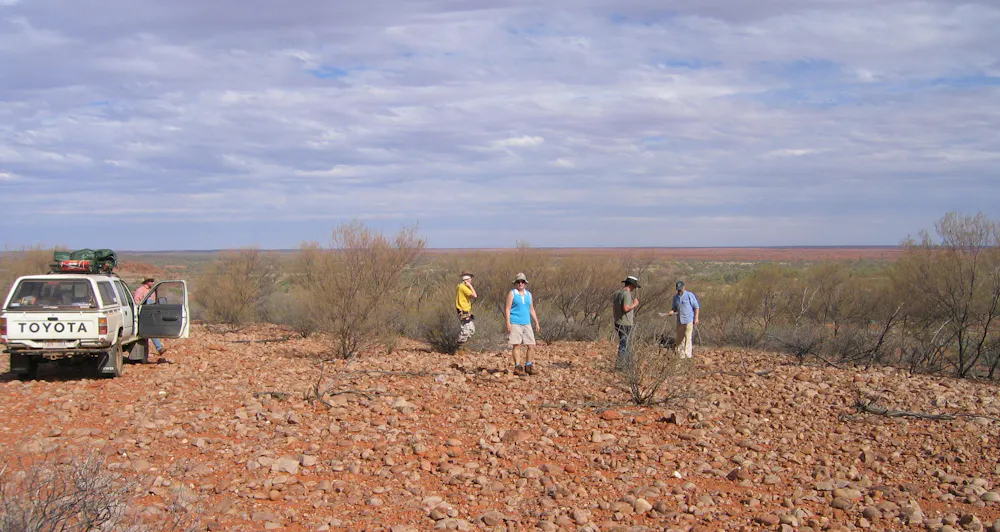
    The 2006 field trip participants (Tim Senden, Tim Holland, Carole Burrow, John Long, Gavin Young) looking south from the end of the Toomba Range, the last rock outcrop for around 500 km across the Simpson Desert.
    Bruce Burrow

    Returning to the Queensland Museum after our field trip, Carole’s colleague from the Netherlands, palaeontologist Jan den Blaauwen, sent her new images showing similar honeycomb-like structure in the Scottish Palaeospondylus gunni.

    Carole was acid-etching the newly collected samples so she could extract any microfossils. Luckily, she noticed a slightly larger specimen appearing on the rock surface (although still tiny, only about 3.6 millimetres long). It was highly interesting because it seemed bilaterally symmetrical.

    Could this be a braincase (the bony capsule inside the skull that encloses the brain)? She immediately stopped acid etching before it disintegrated into crumbs.

    Palaeospondylus australis holotype, QMF 52826, ventral braincase exposed on the limestone surface by acid etching (left), and trimmed for CT scanning (right).
    Carole Burrow, Gavin Young

    The first uncrushed braincase

    At the Australian National University, our sample was carefully trimmed before CT scanning, revealing the first uncrushed braincase of Palaeospondylus known to science.

    It’s now the holotype – defining type specimen – for our new species. And we have about 400 other elements with the same honeycomb structure which belong to it, too.

    The unique uncrushed preservation of this braincase, revealed by CT scanning and 3D printing techniques, provides the first details of brain structure in this tiny animal from 400 million years ago.

    These include the shape of the cranial cavity and inner ear canals, the position of the pituitary gland and optic nerve openings, and details of the carotid arteries and jugular veins for blood supply to the brain.

    3D scan image, the first view of the upper braincase surface of Palaeospondylus, showing the large opening into the cranial cavity.
    Jing Lu/Insitute of Vertebrate Paleontology and Paleoanthropology, Beijing

    More questions remain

    It is noteworthy that our curiosity-driven research into ancient brain morphology can be traced back to economically driven geological surveys of nearly 50 years ago, conducted to support exploration for oil and gas across central Australia.

    As with any research result, there are now new questions to be investigated. The honeycomb tissue seems unique to Palaeospondylus, but could be a precursor to calcified cartilage of some other groups, including modern sharks.

    Alternatively, it could be an early evolutionary stage for the spongy tissue (endochondral bone) filling the inside of most bones in modern land vertebrates, including humans.

    The unique holotype of our new species clearly shows that previous interpretations of the crushed Scottish material included many structures that were not part of the braincase.

    We’ve also now demonstrated that a recent study in the leading science journal Nature, which proposed that Palaeospondylus was closely related to our tetrapod ancestors, relied on many erroneous interpretations of braincase structure.

    Of one thing we can be sure – Palaeospondylus was not a stem tetrapod.


    Acknowledgements: Carole Burrow from Queensland Museum contributed greatly to this article.

    Gavin Charles Young has received funding from the Australian Research Council.

    ref. A 380-million-year-old fossil ‘fish’ from Scotland has been discovered in Australia – https://theconversation.com/a-380-million-year-old-fossil-fish-from-scotland-has-been-discovered-in-australia-250054

    MIL OSI AnalysisEveningReport.nz

  • MIL-Evening Report: A Chinese own goal? How war games in the Tasman Sea could push NZ closer to AUKUS

    Source: The Conversation (Au and NZ) – By Alexander Gillespie, Professor of Law, University of Waikato

    The appearance of three Chinese naval vessels firing live rounds in the Tasman Sea has caused understandable alarm in New Zealand and Australia. But this has more to do with the geopolitical context than the actual event.

    In fact, the Chinese navy is allowed to conduct exercises in the Tasman and has wide freedoms on the high seas in general. So far, China appears to be acting in accordance with both the United Nations Convention on the Law of the Sea and the Code for Unplanned Encounters at Sea.

    While New Zealand would have preferred more notice of the Chinese navy’s intentions, there was no obligation to provide this.

    Nor is what is occurring in the Tasman similar to the more aggressive sabre-rattling the Chinese military has displayed around the South China Sea, most recently involving both the Australian and Philippine navies.

    And in September last year, just a few days after Australian and New Zealand vessels sailed through the Taiwan Strait, the Chinese test-fired a nuclear-capable intercontinental missile into the South Pacific.

    For China, of course, Taiwan and parts of the South China Sea are highly disputed territory. The Tasman Sea is not. But what is disputed is China’s role and influence in the Pacific – and this, rather than a minor naval exercise, is what is causing headaches in Canberra and Wellington.

    The Cook Islands factor

    The surprise agreement signed by the Cook Islands and China under a fortnight ago, aimed at “deepening blue economy cooperation”, is the immediate context for that concern.

    The deal avoids controversial areas such as security and policing. But it moves Chinese influence into infrastructure support for wharves, shipbuilding and repair, and ocean transportation.

    What really challenges New Zealand’s foreign policy is how this opens the South Pacific up to even greater Chinese influence and activity. Foreign Minister Winston Peters has signalled it is time to reset the relationship with the Cooks.

    For its part, China has asserted that its relationship with the Cook Islands “is not directed against any third party and should not be subject to or disrupted by any third party”.

    In other words, China has told New Zealand to butt out of a major development in the historically close diplomatic and political relationship with its Pacific neighbour.

    A Chinese own goal?

    All of this is happening within a rapidly shifting geopolitical sphere. US President Donald Trump is unilaterally attempting to upend the old US-led world order, and other major powers such as Russia and China are adapting.

    New Zealand’s relations with China were already difficult. The Security Intelligence Service and Government Communications Security Bureau have both identified state-sponsored Chinese interference in domestic affairs, breaches of the parliamentary network and other malicious cyber activity.

    The question now is whether China has scored an own goal with its recent actions. Because while it might prefer New Zealand to operate a more independent foreign policy – balancing its relations with east and west – the opposite may now be more likely.

    In times of international stress and uncertainty, New Zealand has always tended to move towards deepening relationships with traditional allies.

    Whether it is the fear of Russian invasion in the 19th century, or Japanese invasion in the 20th century – and whether or not those threats are real or imagined – New Zealand reverts to form.

    It has been this way for nearly 150 years and is likely to occur again. New Zealand is already grappling with how to respond to the Trump administration’s redrawn global system and will be looking for ways to deepen the friendship.

    At the same time, the government now seems committed to joining a new arms race and increasing defence spending as a proportion of GDP. And the supposed benefits of joining the second tier of the AUKUS security pact may now become that much easier to sell politically.

    Alexander Gillespie does not work for, consult, own shares in or receive funding from any company or organisation that would benefit from this article, and has disclosed no relevant affiliations beyond their academic appointment.

    ref. A Chinese own goal? How war games in the Tasman Sea could push NZ closer to AUKUS – https://theconversation.com/a-chinese-own-goal-how-war-games-in-the-tasman-sea-could-push-nz-closer-to-aukus-250615

    MIL OSI AnalysisEveningReport.nz

  • MIL-Evening Report: Valls faces Kanak ‘first people’ clash with loyalists over independence talks

    By Patrick Decloitre, RNZ Pacific correspondent French Pacific desk

    French Minister for Overseas Manuel Valls’ first two days in New Caledonia have been marred by several clashes with local pro-France, anti-independence movements, who feared he would side with their pro-independence opponents.

    However, he remained confident that all stakeholders would eventually come and sit together at the table for negotiations.

    Valls arrived in the French Pacific territory on Saturday with a necessary resumption of crucial political talks regarding New Caledonia’s political future high on his agenda, nine months after the deadly May 2024 civil unrest.

    His visit comes as tensions have risen in the past few days against a backdrop of verbal escalations and rhetoric, the pro-France camp opposing independence stressing that three referendums had resulted in three rejections of independence in 2018, 2020, and 2021.

    But the third referendum in December 2021 was boycotted by a large part of the pro-independence, mainly Kanak community, and they have since disputed the validity of its result (even though it was deemed valid in court rulings).

    On Saturday, the first day of his visit to the Greater Nouméa city of Mont-Dore, during a ceremony paying homage to a French gendarme who was killed at the height of the riots last year, Valls and one of the main pro-France leaders, French MP Nicolas Metzdorf, had a heated and public argument.

    ‘First Nation’ controversy
    Metzdorf, who was flanked by Sonia Backès, another major pro-France local leader, said Valls had “insulted” the pro-France camp because he had mentioned the indigenous Kanak people as being the “first people” in New Caledonia — equivalent to the notion of “First Nation” people.

    Hours before, Valls had just met New Caledonia’s Custom Senate (a traditional gathering of Kanak chiefs) and told them that “nothing can happen in New Caledonia without a profound respect towards [for] the Melanesian people, the Kanak people, and the first people”.

    French Minister for Overseas Manuel Valls (second from left) meets pro-France supporters as he arrives in New Caledonia on Saturday as French High Commissioner Louis Le Franc looks on. Image: NC la 1ère

    Metzdorf told Valls in an exchange that was filmed on the road and later aired on public broadcaster NC la 1ère: “When you say there are first people, you don’t respect us! Your statements are insulting.”

    “If there are first peoples, it means there are second peoples and that some are more important than others.”

    To which Valls replied: “When you are toying with these kinds of concepts, you are making a mistake.”

    Every word counts
    The 1998 Nouméa Accord’s preamble is largely devoted to the recognition of New Caledonia’s indigenous community (autochtone/indigenous).

    On several occasions, Valls faced large groups of pro-France supporters with French tricolour flags and banners (some in the Spanish language, a reference to Valls’s Spanish double heritage), asking him to “respect their democratic (referendum) choice”.

    Some were also chanting slogans in Spanish (“No pasaran”), or with a Spanish accent.

    “I’m asking for just one thing: for respect towards citizens and those representing the government,” an irate Valls told the crowd.

    Questions have since been raised from local organisations and members of the general public as to why and how an estimated 500 pro-France supporters had been allowed to gather while the French High Commissioner still maintains a ban on all public gatherings and demonstrations in Nouméa and its greater area.

    “We voted three times no. No means no,” some supporters told the visiting minister, asking him not to “let them down”.

    “You shouldn’t believe what you’ve been told. Why wouldn’t you remain French?”, Valls told protesters.

    “I think the minister must state very clearly that he respects those three referendums and then we’ll find a solution on that basis,” said Backès.

    However, both Metzdorf and Backès reaffirmed that they would take part in “negotiations” scheduled to take place this week.

    “We are ready to make compromises”, said Backès.

    Valls carried on schedule
    Minister Valls travelled to Northern parts and outer islands of New Caledonia to pay homage to the victims during previous insurrections in New Caledonia, including French gendarmes and Kanak militants who died on Ouvéa Island (Loyalty group) in the cave massacre in 1988.

    During those trips, he also repeatedly advocated for rebuilding New Caledonia and for every stakeholder to “reconcile memories” and sit at the negotiation table “without hatred”.

    Valls believes ‘everyone will be at the table’
    In an interview with local public broadcaster NC la 1ère yesterday, the French minister said he was confident “everyone will be at the table”.

    The first plenary meeting is to be held this afternoon.

    It will be devoted to agreeing on a “method”.

    “I believe everyone will be there,” he said.

    “All groups, political, economic, social, all New Caledonians, I’m convinced, are a majority who wish to keep a strong link within France,” he said.

    He also reiterated that following New Caledonia’s Matignon (1988) and Nouméa (1998) peace accords, the French Pacific territory’s envisaged future was to follow a path to “full sovereignty”.

    “The Nouméa Accord is the foundation. Undeniably, there have been three referendums. And then there was May 13.

    “There is a before and and after [the riots]. My responsibility is to find a way. We have the opportunity of these negotiations, let’s be careful of the words we use,” he said, asking every stakeholder for “restraint”.

    “I’ve also seen some pro-independence leaders say that [their] people’s sacrifice and death were necessary to access independence. And this, also, is not on.”

    Valls also said the highly sensitive issue of “unfreezing” New Caledonia’s special voters’ roll for local elections (a reform attempt that triggered the May 2024 riots) was “possible”, but it will be part of a wider, comprehensive agreement on the French Pacific entity’s political future.

    A mix of ‘fear and hatred’
    Apart from the planned political negotiations, Valls also intends to devote significant time to New Caledonia’s dire economic situation, in post-riot circumstances that have not only caused 14 dead, but also several hundred job losses and total damage estimated at some 2.2 billion euros (NZ$4 billion).

    A first, much-expected economic announcement also came yesterday: Valls said the State-funded unemployment benefits (which were supposed to cease in the coming days) woud now be extended until June 30.

    For the hundreds of businesses which were destroyed last year, he said a return to confidence was essential and a prerequisite to any political deal . . .  And vice-versa.

    “If there’s no political agreement, there won’t be any economic investment.

    “This may cause the return of fresh unrest, a form of civil war. I have heard those words coming back, just like I’ve heard the words racism, hatred . . . I can feel hope and at the same time a fear of violence.

    “I feel all the ferments of a confrontation,” he said.

    This article is republished under a community partnership agreement with RNZ.

    MIL OSI AnalysisEveningReport.nz

  • MIL-Evening Report: ‘It’s disgusting that they can get away with this’: here’s how eviction can affect tenants’ lives

    Source: The Conversation (Au and NZ) – By Alan Morris, Professor, Institute for Public Policy and Governance, University of Technology Sydney

    For people relying on rental properties to keep a roof over their heads, there are few things more scary than the possibility of being evicted from their home.

    The paucity of official statistics makes it difficult to know exactly how common evictions are. In 2019–20, 13.8% of private renters moved due to their lease being terminated or not renewed.

    Besides a report or two, we know little about what happens when households face the possibility of being evicted, or are actually evicted.

    Our research examines these consequences. Through in-depth interviews with 53 private tenants in New South Wales and Queensland, we found these experiences negatively shaped people’s lives well into the future. Here are four themes we identified.

    1. Poor mental health

    The ease with which landlords can terminate a tenant’s occupation evoked persistent anxiety for most of the interviewees (the interviews were conducted prior to the scrapping of no-grounds eviction in NSW, though such evictions are still allowed in other states and territories).

    This was especially so for low-income tenants.

    When interviewed, Susan* had recently been evicted from her apartment in Sydney. She was reliant on the Disability Support Pension for her income and lived in constant fear of being evicted and rendered homeless. She felt that having a disability and being from a non-English-speaking background made her precarity worse:

    if you are somebody who comes from a non-English-speaking background, or you have a disability, or have no ability to enforce [the legislation], it’s on the tenant to take up the laws and to do something about it. And if you don’t have any of those abilities, you’re just going to be on your way to homelessness very, very soon […]

    Grace lived by herself in Sydney. She had been given a no-grounds termination and was convinced it was linked to her landlord’s realisation that he could raise her rent considerably once she moved out. Her mental health was seriously affected by the eviction:

    It was just like out of nowhere […] so that was horrific […] I’m still trying to settle into this new place with that trauma of being uprooted all of a sudden […] I think it’s probably going to affect me for a while and particularly in terms of just the power that real estates and landlords have to be able to do that.

    2. Financial hardship

    For many of the low-income tenants, the financial implications of being evicted were severe.

    Sarah, her husband and their three children had been renting in Sydney since 2013. She estimated that since 2014, they had had to move at least six times. Most of the moves were not voluntary. She found the financial implications of evictions extremely distressing:

    It’s the finances of it that’s the hardest […] when you get asked to move, you need to have a bond ready to go at the next place before you receive your bond back, which is a killer […]

    She outlined all the expenses that came up each time she moved from one rental to another: professional cleaners, removalists and maintenance deducted from the bond.

    After her rented accommodation was condemned, Brenda, a single mum of two children, had 48 hours to move from her rental property in regional Queensland. The move consumed her savings:

    I had $200 after paying all my bills to move. So once I moved that was it. So I struggled the following week for everything. For food, […] getting my son to school, my daughter. It was just horrible.

    3. Reluctance to complain

    The knowledge that, at some point, the rent could be increased to an untenable level or they could be asked to vacate evoked silent compliance. This created a reluctance to complain or request basic maintenance.

    Alice was convinced she was evicted after complaining about the poor condition of the rental property she, her son and grandson had been renting for eight years in regional NSW. Her grandson’s bedroom was unusable due to excessive mould.

    However, her low income and the threat of eviction meant she held off complaining for an extended period:

    […] it’s just disgusting that they [landlords] can get away with this shit while charging top dollar, and […] that’s why I didn’t complain because I said to everybody, “as soon as I complain he’ll kick us out.” […] If I hadn’t complained, we’d still be there […]

    Sarah described how, despite feeling harassed and stressed by her landlord’s unannounced and constant intrusions, she felt the family had to accept the situation and not protest:

    I was petrified of being kicked out if we fought back and so […] we let him onto the property 16 times in 10 months and said nothing.

    When they couldn’t take it any longer and complained, they were given notice, the landlord claiming he needed to do maintenance that required the property to be vacant.

    4. Ending up in a worse home

    A common consequence of eviction is having to move to unsuitable, lower-quality accommodation.

    Jan and her partner were older renters and reliant on government benefits for their income. The flow-on effects of being evicted from their accommodation in Queensland, where they had been living for ten years, were devastating. Her partner attempted suicide, her relationship with him ended, and she was forced to live in a tent on a piece of land her mother had bought several years prior:

    our rental accommodation was sold out from under us to developers and we had to be out with nowhere to go. We looked around for somewhere else to rent and there was absolutely nowhere we could afford at all.

    It’s clear that eviction, or the threat thereof, can have devastating affects on people’s lives.

    Although there has been some movement around improving the lot of private renters, such as legislation abolishing no-grounds eviction in some jurisdictions, and rent increases being allowed only once a year, a lot more needs to be done to ensure tenants have acceptable security of tenure.


    *All names in this article have been changed to protect participants’ privacy.

    Alan Morris receives funding from the Australian Research Council.

    Joelle Moore receives funding from the Australian Research Council.

    Thi Thanh Mai Giang receives funding from The Australian Research Council.

    Yiran Li receives funding from funding from the Australian Research Council.

    ref. ‘It’s disgusting that they can get away with this’: here’s how eviction can affect tenants’ lives – https://theconversation.com/its-disgusting-that-they-can-get-away-with-this-heres-how-eviction-can-affect-tenants-lives-248221

    MIL OSI AnalysisEveningReport.nz

  • MIL-Evening Report: Tiger Woods and Serena Williams were sporting prodigies but children shouldn’t train like them

    Source: The Conversation (Au and NZ) – By Justin Keogh, Associate Dean of Research, Faculty of Health Sciences and Medicine, Bond University

    photoyh/Shutterstock

    Most children have now returned from their summer holidays and are perhaps considering what sports to play this year.

    For some, this means sampling a wide range of sports, but others might continue to focus on the same one they’ve been addicted to since they were able to walk and run.

    But when it comes to possible sporting success, is it best to concentrate on one or give many a go?

    Early specialisation

    As the name suggests, early specialisation is typically defined as participation in one task or activity, with the aim to improve subsequent performances.

    The rationale for its purported benefit can be traced to the theory of deliberate practice – or what some readers may have colloquially encountered as the “10,000-hour rule”.

    Broadly, this theory proposes the attainment of excellence is proportionate to the number of accumulated hours invested into deliberate skill rehearsal.

    So, the earlier someone specialises via deliberate practice, the more likely they’ll expedite the acquisition of expertise – or so the theory suggests.

    While first explored in the musical domain, there are some examples of athletes who specialised early in a sport who went on to highly successful careers.

    These include Simone Biles (who started gymnastics at the age of six), Tiger Woods (who hit a golf ball on the Mike Douglas TV show at the age of two) and Serena Williams (who was profiled hitting tennis balls on CNN at the age of nine).

    There are also a host of athletes who specialised early and achieved outstanding success as a junior but never reached sporting success as an adult for myriad reasons.

    Doesn’t practice make perfect?

    Everyone would have encountered the saying “practice makes perfect”.

    But does it really?

    Of course, practice is an integral component of acquiring, developing and sharpening any skill. But perhaps we should be a little cautious.

    Let us explain by first asking a few key questions that we encourage readers to ask themselves as the article unfolds: how much practice is needed to be perfect? What type of practice is needed to be perfect? And can “perfect” practice actually help us develop skills that are transferable between sports?

    In other words, if practice makes perfect, should we not be advocating for sporting specialisation as early in life as possible?

    It may seem logical, but is this belief – held by many parents, youth sport coaches, and perhaps children themselves – actually supported by evidence?

    A 2022 systematic review suggested most elite, professional and Olympic level athletes engaged in multisport activities during their youth.

    That is, they did not specialise in their chosen sport but actually diversified their sporting experiences up to the age of about 12, with some level of specialisation occurring from the age of 13 onward.

    That was not all they found.

    Youth sport specialisation was actually linked with increased risks of injury in athletes at the highest levels of competition when compared to those who engaged in multisport activities.

    A similar review noted there was no evidence to support specialisation prior to puberty in the attainment of sporting excellence later in life.

    What sport specialisation did increase, however, were risks of injury, psychological stress and sporting drop out.

    A model to follow

    In support of these findings, Jean Côtè (a leading expert in the field of youth psychology) and colleagues proposed a developmental model of sports participation.

    This model is broken into three general stages of participation: the sampling years (between the ages of 6-12), the specialising years (13-15), and the investment years (16 and beyond).

    As the name of each stage suggests, they are defined by unique types of participation.

    For example, the sampling years are characterised by the acquisition of functional motor skills (such as running, throwing and jumping), developed through a wide variety of experiences.

    The specialising years feature a progressive increase in focus on the deliberate practice of one or two sports, while the investment years are characterised by more deliberately increasing the volume of practice around one sport. In Australia, this may be the stage where seasonal sports become year-long through the establishment of pre-season training.

    Since its inception nearly two decades ago, there has been a growing amount of research supporting these suggestions.

    Food for thought

    So what does this all mean for parents, youth coaches and children?

    We suggest not to rush the process even if your child dreams of an elite sporting career: children under the age of 16 should engage in a wide variety of sporting experiences.

    This is not only fun, but the research shows us diversity is likely to reduce the risk of overuse injuries and increase the likelihood of sporting excellence later in life, should that be their ambition.

    The authors do not work for, consult, own shares in or receive funding from any company or organisation that would benefit from this article, and have disclosed no relevant affiliations beyond their academic appointment.

    ref. Tiger Woods and Serena Williams were sporting prodigies but children shouldn’t train like them – https://theconversation.com/tiger-woods-and-serena-williams-were-sporting-prodigies-but-children-shouldnt-train-like-them-248558

    MIL OSI AnalysisEveningReport.nz

  • MIL-Evening Report: Trump is reviving a tariff strategy from America’s ‘Gilded Age’. It didn’t end well last time

    Source: The Conversation (Au and NZ) – By Garritt C. Van Dyk, Senior Lecturer in History, University of Waikato

    Getty Images

    A White House fact sheet about Donald Trump’s recently announced “Fair and Reciprocal Plan” on trade described it as “the art of the international deal” – a reference to Trump’s 1987 business book, The Art of the Deal.

    It was a classic piece of self-marketing from the president, but whether his latest tariff proposal will really turn out to be artful is very much open to question.

    In fact, the United States’ long history of “reciprocity” in tariffs and trade suggests ordinary Americans could be in for a bumpy ride.

    In essence, Trump is reviving a strategy used in the US more than a century ago to protect developing domestic industries. This time, according to the president, reciprocal tariffs aim “to correct longstanding imbalances in international trade and ensure fairness across the board”.

    The plan targets trade relationships with other countries where the US does not receive reciprocal treatment. And it echoes the policies of the 25th US president, William McKinley, who presided over an aggressive reciprocal tariff regime in the late 19th century.

    McKinley was president from 1897 until he was assassinated in 1901. And while Trump greatly admires his business acumen, McKinley’s economic legacy also reads like a cautionary tale.

    Not a simple equation

    From the current US perspective, “reciprocity” refers to symmetrical tariffs. Trump’s plan targets unequal rates, such as the European Union’s 10% tariff on US cars, compared with the 2.5% US tariff on European automobiles.

    The EU’s 10% rate represents its “most-favoured-nation” tariff, which applies to all its favoured-nation trading partners (with certain exceptions).

    While this looks like a clear lack of reciprocity, it’s not that simple. The US also applies a 25% tariff on EU utility vehicles (pickup trucks).

    This is significant because of the popularity of pickups in the US – a 2024 survey found 47% of Americans owned one. Until last year, the Ford F150 had been the bestselling “car” in the US for 42 years in a row.

    This is just one example of how differences in tariffs can be more complex than they appear at first glance.

    A history of reciprocal tariffs

    This cycle of higher and lower tariffs has gone on for well over a century. From 1861 to 1930, the US Congress maintained control over trade tariffs, with levels as high as 50% to protect developing industries.

    But in 1934, Congress passed the Reciprocal Trade Agreements Act, giving President Franklin D. Roosevelt authority to negotiate reciprocal tariff reductions with individual nations to stimulate global trade during the Great Depression.

    These tariff reductions continued after World War II with the development of the World Trade Organization and US tariff levels declining to 5%. Economist Douglas Irwin refers to this period as the “reciprocity period” of nations lowering barriers to international trade.

    The last time “reciprocity” was used to refer to the opposite process of raising tariffs was in 1890, under the Tariff Act, often just called the McKinley Tariff. It is this era Trump harked back to in his inaugural address:

    President McKinley made our country very rich through tariffs and through talent – he was a natural businessman.

    William McKinley.
    Getty Images

    Before he became president, McKinley was head of the House of Representatives’ Ways and Means Committee. He proposed an average increase in tariffs on all imports, rising from 38% to 49.5% to “secure reciprocal trade”.

    The new law was designed to protect the tinplate industry with a tariff of 70%, and “to reduce the revenue and equalize duties on imports”.

    At the time, the US was running large surpluses from tariff revenues, which was threatening economic growth. This sounds counterintuitive these days, but surpluses were a problem because the US dollar was backed by gold at a fixed price (the gold standard).

    Because the amount of money in circulation – and state spending – were limited to the amount of gold held by the government, surplus funds had to be kept in the Treasury reserves. This reduced the money supply and led to lower growth, less investment and tighter credit.

    Republicans thought higher tariffs would reduce imported goods and therefore tariff revenues. Instead, income from the higher tariffs more than compensated for import reductions, and the surpluses increased.

    Consumer prices rose, farm prices dropped, and the resulting voter backlash saw the Republicans lose control of Congress at the 1890 midterm elections. There was a financial panic in 1893, followed by a recession that lasted until 1896.

    A new ‘Gilded Age’

    This period in late 19th-century US history is often referred to as the “Gilded Age”, from the title of an 1873 book by Charles Dudley Wright and Mark Twain.


    The book was a satire of political corruption and unscrupulous businessmen who benefited from political favours. The title reflects the reality of the era – superficially prosperous but not truly golden.

    A thin veneer of technological progress, innovation and wealth concealed widespread corruption, scandals and income inequality.

    But aside from the obvious historical parallels, it is overly optimistic to expect a plan from 1890 to succeed in a complex global trade environment that relies on interdependent supply chains to function.

    McKinley’s flawed strategy sought protection for a few industries, but also aimed to reduce revenue for a government running large surpluses. However, Trump’s new tariffs are meant to raise revenue to pay off the US$36.5 trillion national debt, as well as to enforce reciprocal trade terms.

    Trump began his second term with a declaration that “the golden age of America begins right now”. As in 1890, however, the risk remains that a handful of wealthy industrialists will benefit from increased protection, while ordinary citizens will pay higher prices.

    Less the “art of the deal”, then, than a possible dealbreaker. In which case, Trump may yet be remembered less for a new golden age than for a Gilded Age 2.0.

    Garritt C. Van Dyk received funding from the Getty Research Institute in 2024 .

    ref. Trump is reviving a tariff strategy from America’s ‘Gilded Age’. It didn’t end well last time – https://theconversation.com/trump-is-reviving-a-tariff-strategy-from-americas-gilded-age-it-didnt-end-well-last-time-250389

    MIL OSI AnalysisEveningReport.nz

  • MIL-Evening Report: Labor crashes to a 55–45 deficit in Resolve despite interest rate cut

    Source: The Conversation (Au and NZ) – By Adrian Beaumont, Election Analyst (Psephologist) at The Conversation; and Honorary Associate, School of Mathematics and Statistics, The University of Melbourne

    A national Resolve poll for Nine newspapers, conducted February 18–23 from a sample of 1,506, gave the Coalition a 55–45 lead by headline respondent preferences, a three-point gain for the Coalition since January. By 2022 election preference flows, the Coalition led by 52–48, a one-point gain for them.

    Primary votes were 39% Coalition (up one), 25% Labor (down two), 13% Greens (steady), 9% One Nation (up two), 9% independents (down one) and 4% others (down two). Labor’s primary vote is their lowest in any poll this term.

    Anthony Albanese’s net approval was steady at -22, with 56% giving him a poor rating and just 34% a good one. Peter Dutton’s net approval was down one to +5. Dutton led Albanese by 39–35 as preferred PM (39–34 in January).

    By 37–26, voters thought the Coalition was the best choice for them and their household over Labor. By 34–18, they thought Dutton better able to deal with Donald Trump than Albanese. By 43–22, they thought Albanese weaker than Dutton.

    The Liberals led Labor by 41–24 on economic management (42–23 in January). The Liberals led on keeping the cost of living low by 37–25, down a little from 37–22 in January.

    In both the Resolve and Freshwater polls that were taken after the Reserve Bank cut interest rates, the Coalition has increased its lead. Here is the graph that shows the dramatic widening in the Resolve poll in the Coalition’s favour.

    Dutton’s ratings have been much better than Albanese’s in Resolve, and this is now flowing through to voting intentions. To put Labor back on track, Albanese needs to improve his ratings and Dutton’s need to fall. In this respect, the Freshwater poll below was much better for Labor.

    Resolve’s respondent preference flows are probably a pro-Coalition outlier, but the general trend in the polls has been bleak for Labor.

    Freshwater poll: Coalition leads by 52–48

    A national Freshwater poll, conducted February 20–23 from a sample of 1,038, gave the Coalition a 52–48 lead by respondent preferences, a one-point gain for the Coalition since January. Primary votes were 41% Coalition (up one), 31% Labor (down one), 13% Greens (steady) and 15% for all Others.

    Albanese’s net approval improved seven points to -11, while Dutton’s dropped four points to -8. Albanese led Dutton as preferred PM by 45–43 (a 43–43 tie in January).

    On issues, 70% rated cost of living a top three issue, followed by 39% for housing, 27% for both crime and economic management, 26% for health and just 17% for the environment. The Coalition held double-digit leads over Labor on cost of living, crime and economic management.

    Essential poll: Labor gains for a tie

    A national Essential poll, conducted February 12–16 from a sample of 1,146, had a 48–48 tie by respondent preferences including undecided (49–47 to the Coalition in early February). The Coalition had led in the last four Essential polls by one to two points.

    Primary votes were 35% Coalition (down one), 30% Labor (steady), 12% Greens (steady), 9% One Nation (up one), 1% UAP (steady), 9% for all Others (steady) and 4% undecided (steady). By 2022 preference flows, Labor would lead by about 51–49, a 0.5-point gain for Labor.

    Albanese’s net approval dropped five points to -5 since January, with 48% disapproving and 43% approving, but the January poll had an 11-point jump in his net approval from December. Dutton’s net approval was down three points to -4, his worst net approval in Essential since February 2024.

    Asked about the direction of the country, wrong track led by 51–31, a blowout from 46–38 in January. Wrong track led by the same 51–31 margin in December, and it has consistently had sizeable leads since June 2023.

    On taxes and government services, 26% thought they should be reduced, 11% increased and 63% maintained. By 40–31, respondents opposed the Coalition’s plan to reduce the number of public service workers.

    Asked whether they were aware of various Labor achievements, 77% were aware of the $300 energy bill rebate for all households, 66% were aware of TAFE and HECS debt cuts and 61% were aware of increased renewable energy targets. However, only 46% were aware of consecutive budget surpluses.

    Morgan poll and Palmer’s new party

    A national Morgan poll, conducted February 10–16 from a sample of 1,666, gave the Coalition a 51.5–48.5 lead by headline respondent preferences, unchanged from the February 3–9 poll.

    Primary votes were 39.5% Coalition (down one), 28% Labor (down one), 12.5% Greens (up 1.5), 5.5% One Nation (up 1.5), 10% independents (up 0.5) and 4.5% others (down 1.5). By 2022 election flows, the Coalition led by 51–49, a 0.5-point gain for Labor.

    Clive Palmer had voluntarily deregistered the United Australia Party after the 2022 election. The High Court denied his attempt to re-register this party. He has now taken over the existing party “Trumpet of Patriots”.

    Queensland federal and state DemosAU poll

    A DemosAU poll of Queensland that asked for federal voting intentions, conducted February 10–14 from a sample of 1,004, gave the Liberal National Party a 53–47 lead, representing a 1% swing to Labor since the 2022 federal election result in Queensland.

    Primary votes were 39% LNP, 31% Labor, 12% Greens, 10% One Nation and 8% for all Others. DemosAU is using the One Nation preference flow at the 2024 Queensland state election for its federal polls; this was better for the LNP than at the 2022 federal election.

    State voting intentions were 54–46 to the LNP, unchanged since the 2024 election. Primary votes were 40% LNP, 30% Labor, 12% Greens, 10% One Nation and 8% for all Others.

    Economic data: wage growth and jobs

    The Australian Bureau of Statistics reported that in the December 2024 quarter, wages grew 0.7%, down from 0.9% in the September quarter. This was the slowest quarterly wage growth since March 2022. For the year to December, wages grew 3.2%, down from 4.1% in the year to June 2024.

    In the December quarter, inflation was up 0.2% and up 2.4% for the year to December. So wage growth exceeded inflation by 0.5% in the December quarter and 0.8% for the year, but it had exceeded inflation by 0.7% in the September quarter.

    The ABS said 44,000 jobs were added in January, but the unemployment rate rose 0.1% from December to 4.1% owing to a 0.2% increase in the participation rate. The employment population ratio (the percentage of eligible Australians that are employed) rose 0.1% to 65.6%, a record high.

    German election

    I am covering Sunday’s German federal election for The Poll Bludger. The election was held seven months early owing to a breakdown in the governing coalition of centre-left SPD, Greens and pro-business FDP.

    Exit polls and pre-election polls have the conservative CDU/CSU leading, with the far-right AfD in second place and the SPD lagging in third. The final outcome should be known by this afternoon AEDT.

    Adrian Beaumont does not work for, consult, own shares in or receive funding from any company or organisation that would benefit from this article, and has disclosed no relevant affiliations beyond their academic appointment.

    ref. Labor crashes to a 55–45 deficit in Resolve despite interest rate cut – https://theconversation.com/labor-crashes-to-a-55-45-deficit-in-resolve-despite-interest-rate-cut-250150

    MIL OSI AnalysisEveningReport.nz

  • MIL-Evening Report: Scam Factories: the inside story of Southeast Asia’s brutal fraud compounds

    Source: The Conversation (Au and NZ) – By Ashlynne McGhee, Digital Storytelling Editor

    Scam Factories is a special multimedia and podcast series by The Conversation that explores the inner workings of Southeast Asia’s brutal scam compounds.

    The Conversation’s digital storytelling and podcast teams collaborated with three researchers: Ivan Franceschini, a lecturer in Chinese Studies at the University of Melbourne; Ling Li, a PhD candidate at Ca’ Foscari University of Venice; and Mark Bo, an independent researcher.

    The researchers have spent the past few years interviewing nearly 100 survivors of these compounds and documenting the rise of the industry in Southeast Asia for a forthcoming book.

    Scam Factories will unfold across three multimedia articles and three podcast episodes this week. We’ll update this page as more is published.

    Part 1

    Our first article explores how people are lured into the industry and what life is like inside the compounds, where scammers are forced to work long hours and are often subjected to violence.

    And in our first podcast episode, No skills required, our researchers travel to a village in Cambodia called Chrey Thom to see what these compounds look like. And we hear from two survivors, a Ugandan man we’re calling George and a Malaysian woman we’re calling Lee, about how they were recruited into compounds in Laos and Myanmar.

    The Conversation contacted all the companies mentioned in this series for a comment, except Jinshui, which we couldn’t contact. We did not receive a response from any of them.

    Credits

    The podcast series was written and produced by Gemma Ware with production assistance from Katie Flood and Mend Mariwany. Sound design by Michelle Macklem. Leila Goldstein was our producer in Cambodia and Halima Athumani recorded for us in Uganda. Hui Lin helped us with Chinese translation. Photos by Roun Ry, KDA, Halima Athumani and Ivan Franceschini.

    Justin Bergman at The Conversation in Australia edited the articles in the series and Matt Garrow worked on the graphical elements of the stories. Series oversight and editing help from Ashlynne McGhee.

    ref. Scam Factories: the inside story of Southeast Asia’s brutal fraud compounds – https://theconversation.com/scam-factories-the-inside-story-of-southeast-asias-brutal-fraud-compounds-250448

    MIL OSI AnalysisEveningReport.nz

  • MIL-Evening Report: Is reality TV ‘harmful’? We asked 5 experts – including an ex-reality TV participant

    Source: The Conversation (Au and NZ) – By Noor Gillani, Digital Culture Editor

    Reality TV – love it or hate it, there’s no denying it’s addictive. From explosive arguments to over-the-top love triangles, it can be hard to look away. But is all this drama just for fun, or might it do more harm – to watchers and participants – than we realise?

    We asked five experts, and most of them said it might, especially when it comes to promoting negative body image and leaving contestants emotionally scarred.

    But one expert argued reality TV is a valuable form of entertainment overall, which reflects modern culture and sparks important conversations.

    Here are their detailed responses:

    ref. Is reality TV ‘harmful’? We asked 5 experts – including an ex-reality TV participant – https://theconversation.com/is-reality-tv-harmful-we-asked-5-experts-including-an-ex-reality-tv-participant-233114

    MIL OSI AnalysisEveningReport.nz

  • MIL-Evening Report: After 3 years of war, Ukrainian business leaders share their lessons on survival

    Source: The Conversation (Au and NZ) – By Amy L. Kenworthy, Professor of Management, Bond University

    Drop of Light/Shutterstock

    It’s exactly three years since Russia began its full-scale invasion of Ukraine.

    During that time, Ukrainians have lived through one of the world’s largest and most brutal humanitarian crises. Yet their resilience remains high.

    The United Nations estimates that 64% of micro, small and medium enterprises had to either suspend or close their operations in Ukraine at some stage after the war began.

    But the vast majority of these have since opened back up.

    Over the past year, our international team of researchers from both Australia and Ukraine sought to find out what might drive such extraordinary resilience. The answer, according to Ukrainian business leaders, is their people.

    Running a business in a war

    Ukrainians are currently living through their third winter of this war. Some of Russia’s latest attacks have targeted the gas infrastructure and other energy facilities crucial for keeping people alive.

    These daily attacks have made previously safe cities no longer safe, leaving residents without water, heat and electricity in bitterly cold conditions.

    According to the UNHCR’s 2025 Global Appeal, Russia’s targeting of homes, hospitals and communities has resulted in civilian deaths, mass displacements, restricted access to humanitarian aid, and severely disrupted essential services.

    For businesses, the war has impacted virtually every aspect of commercial activity. Beyond the immediate threat of coming under direct attack, firms have had to deal with everything from disrupted supply chains through to frequent power outages.

    As one interviewee put it:

    Many of us are afraid our main businesses may go bankrupt. We are constantly facing periods with no electricity which stops businesses and cuts us off from the world. We live with constant air raid alarms, moving in and out of underground shelters. We have a significant shortage of personnel because so many have gone to fight on the front lines or left the country.

    The UN estimates that utilisation of production capacity for Ukraine’s micro, small and medium enterprises dropped from 72.4% before the war to 45.7% in 2023.

    To make matters worse, with millions of people having fled Ukraine, finding and retaining qualified personnel has become extremely difficult.

    Women have been stepping into historically male dominated professions such as mining, truck driving and welding to fill the gap left by men who’ve joined the fight. But there is still a significant labour shortage.

    A diverse range of sectors have continued to operate in Ukraine since the war began, despite labour shortages and other issues.
    Oleksandr Filatov/Shutterstock

    Over the past year, our international team of researchers from both Australia and Ukraine surveyed business leaders from 85 different small and medium-sized businesses across 19 different industries in Ukraine.

    These spanned engineering, transportation, aviation and mining through to agriculture, tourism, IT, healthcare, entertainment and finance.

    We asked which resources were – and still are – key to the survival of their organisations.

    Finance and access to funding came in at number two, followed by production and energy, new customers & markets, equipment technology & information and policy & regulations.

    The most important resource

    The most important resource, highlighted by 82% of the business leaders we surveyed, was their people.

    When operating within an environment of severe crisis and disruption, the pressure can be enormous. But the Ukrainian executives we interviewed figured out a way to unite and lead their teams into the future.

    As one reflected:

    When team members are motivated, they are more likely to be optimistic and resilient when facing difficulties. Motivated employees are more productive than demotivated ones. This is important when people need to accomplish more with fewer resources.

    Forcing positive adaptation

    For many organisations in our research, operating within a crisis had pushed them to implement valuable human resource practices other businesses often struggle with.

    Some had transitioned to a “flatter” organisational structure, speeding up decision making by giving employees more autonomy. Others invested in team training which focused on empowering employees to share their thoughts on how to best move forward.

    Our processes and planning horizons have changed completely. We’ve had to become more agile and flexible in our approach to leadership, often reducing planning cycles and adapting to new realities much faster than before.

    A focus on wellbeing was another common theme. Some organisations hosted more meetings to allow their employees to share stories – not only about work but also about their personal fears and victories.

    Some also encouraged their employees to complete volunteer work together during work hours.

    There was an emphasis across interviews on the fact all employees need additional rest and recovery time, and encouraging them to take time off whenever needed.

    Making sacrifices

    Many of the new support mechanisms had financial consequences for the organisations.

    One business cancelled the salaries of its top management team one month after the war started. Another hired a full-time psychologist to provide counselling in both formal and informal sessions.

    Some continued to pay the salaries of their serving members:

    All our mobilized employees who are serving in the military have been receiving their salaries for the past three years. We also ensure they are equipped with everything they need, stay in constant contact with them, and support their families.

    Knowing their business was supporting the war effort had a positive impact on employee motivation:

    The only difference in employee motivation is the understanding that our company actively supports the Armed Forces of Ukraine. Thus, every employee in the company understands that through their work, they are involved in this support.

    In the end, it is the connections between people these leaders saw as the key to their organisational resilience.

    No matter how hard things get, how much grief and suffering we endure, we know for certain that tomorrow the sun will rise. And even if it’s not for us, it will be for our children. This is what gives us the strength to continue living, creating, and preserving Ukraine — for us and for future generations.


    The authors would like to acknowledge their academic partners and coauthors from the Ukrainian Catholic University in Lviv, Ukraine, Yaryna Boychuk, Valeria Kozlova, Sophia Opatska, and Olena Trevoho, and thank all the Ukrainian business leaders who participated in this research.

    The authors do not work for, consult, own shares in or receive funding from any company or organisation that would benefit from this article, and have disclosed no relevant affiliations beyond their academic appointment.

    ref. After 3 years of war, Ukrainian business leaders share their lessons on survival – https://theconversation.com/after-3-years-of-war-ukrainian-business-leaders-share-their-lessons-on-survival-249145

    MIL OSI AnalysisEveningReport.nz

  • MIL-Evening Report: A powerful force is stopping the Indian Ocean from cooling itself – spelling more danger for Ningaloo

    Source: The Conversation (Au and NZ) – By Kelly Boden-Hawes, PhD Candidate in oceanography, The University of Western Australia

    Violeta Brosig/Blue Media Exmouth

    Widespread coral bleaching at Ningaloo Reef off Western Australia’s coast has deeply alarmed scientists and conservationists.

    Photos captured by divers, published by The Guardian last week, show severe bleaching at several sites along the reef, which runs for 260 kilometres off the state’s northwest.

    A severe marine heatwave in the Indian Ocean off WA has caused the coral bleaching. In some places, surface temperatures up to 4°C warmer than usual have been recorded.

    Hotter temperatures aren’t only happening at the ocean’s surface – data indicates they also extend several hundred metres deep. Warm, deeper water can shut down the ocean’s natural cooling process, putting corals at even greater risk of bleaching.

    Counting the cost

    The full extent of damage to Ningaloo won’t be known until scientists conduct field surveys in coming months.

    So far, bleaching has been documented at several sites, including Turquoise Bay, Coral Bay, Tantabiddi, and Bundegi (Exmouth Gulf).

    Other sites such as Scott Reef, Ashmore Reef, the Rowley Shoals and Rottnest Island are also at risk.

    Damage wrought by the heatwave extends beyond coral. More than 30,000 fish have died since the September onset.

    The below images show the heatwave’s progression. Temperatures from February last year are included for comparison.

    The white circle shows the location of Ningaloo. Cooler temperatures are in blue and purple. Warmer temperatures are in yellow and orange.

    The images show the heatwave reached Ningaloo in December last year and moved south in January. Temperatures fell slightly in February due to strong southerly winds. From March, temperatures are forecast to increase again.

    A complex warming picture

    According to recent data and modelled forecasts, hotter ocean temperatures off northern WA run several hundred metres deep.

    This has been caused by developing La Nina conditions. La Nina and its opposite, El Nino, influence ocean temperatures and weather patterns across the Pacific.

    During La Nina, trade winds strengthen and push warm water westward. This intensifies two important ocean currents.

    The first is the Indonesian Throughflow – which carries warm Pacific waters through the Indonesian seas and into the eastern Indian Ocean. The second is the Leeuwin Current, which picks up this warm water and takes it further south towards Perth.

    This has led to a build-up of hotter water along the WA coastline.

    La Nina is also affecting WA’s reefs in other ways.

    Some coral reefs are naturally cooled by local tides which pull deep, colder water towards the surface. This process, which has been likened to an ocean’s “air conditioner”, can temporarily relieve heat stress for reefs.

    The process relies on “stratification” – that is, layers of seawater that differ in temperature, salinity and density (or weight). Warmer, less dense water collects at the surface and colder, denser water falls to deeper levels.

    La Nina conditions can suppress, or even shut down, this cooling effect in two ways.

    First, it reduces the difference in density between ocean layers. This causes water to draw upwards from shallower depths. Second, it increases water temperatures at depth.

    All this means the water pumped to the surface isn’t much cooler than temperatures at the surface.

    For many reefs along the coast of WA, the suppression of this tidal cooling is probably contributing to worsening conditions, and more coral bleaching.

    Most bleaching forecasts rely on sea surface temperatures. This means scientists may be underestimating the vulnerability of deeper reefs.

    What’s in store for Ningaloo and surrounds?

    Looking ahead, the situation at Ningaloo and surrounding reefs remains critical.

    Bleached reefs are able to recover if temperatures cool quickly. This means theoretically, Ningaloo and other affected reefs may survive the summer.

    But unfortunately, temperatures are rising again and the marine heatwave is expected to continue until April, as the below image shows.

    Sea surface temperature anomaly forecast for March to May. Ningaloo denoted with black ‘X’.
    Bureau of Meteorology

    Climate change is making marine heatwaves more intense and frequent. It means reefs often don’t have time to recover between destructive bleaching events.

    All this is compounded by the general trend towards warmer oceans as the planet heats up.

    Drastic action on climate change is needed now. If this alarming pattern continues, the world’s reefs risk being lost entirely.

    Nicole L. Jones receives funding from the Australian Research Council and the Western Australian government.

    Kelly Boden-Hawes does not work for, consult, own shares in or receive funding from any company or organisation that would benefit from this article, and has disclosed no relevant affiliations beyond their academic appointment.

    ref. A powerful force is stopping the Indian Ocean from cooling itself – spelling more danger for Ningaloo – https://theconversation.com/a-powerful-force-is-stopping-the-indian-ocean-from-cooling-itself-spelling-more-danger-for-ningaloo-250151

    MIL OSI AnalysisEveningReport.nz

  • MIL-Evening Report: Falling vaccination rates put children at risk of preventable diseases. Governments need a new strategy to boost uptake

    Source: The Conversation (Au and NZ) – By Peter Breadon, Program Director, Health and Aged Care, Grattan Institute

    Yuri A/Shutterstock

    Child vaccination is one of the most cost-effective health interventions. It accounts for 40% of the global reduction in infant deaths since 1974 and has led to big health gains in Australia over the past two decades.

    Australia has been a vaccination success story. Ten years after we begun mass vaccination against polio in 1956, it was virtually eliminated. Our child vaccination rates have been among the best in the world.

    But after peaking in 2020, child vaccination in Australia is falling. Governments need to implement a comprehensive strategy to boost vaccine uptake, or risk exposing more children to potentially preventable infectious diseases.

    Child vaccination has been a triumph

    Thirty years ago, Australia’s childhood vaccination rates were dismal. Then, in 1997, governments introduced the National Immunisation Program to vaccinate children against diseases such as diphtheria, tetanus, and measles.

    Measures to increase coverage included financial incentives for parents and doctors, a public awareness campaign, and collecting and sharing local data to encourage the least-vaccinated regions to catch up with the rest of the country.

    What followed was a public health triumph. In 1995, only 52% of one-year-olds were fully immunised. By 2020, Australia had reached 95% coverage for one-year-olds and five-year-olds. At this level, it’s difficult even for highly infectious diseases, such as measles, to spread in the community, protecting both the vaccinated and unvaccinated.

    By 2020, 95% of children were vaccinated.
    Drazen Zigic/Shutterstock

    Gaps between regions and communities closed too. In 1999, the Northern Territory’s vaccination rate for one-year-olds was the lowest in the country, lagging the national average by six percentage points. By 2020, that gap had virtually disappeared.

    The difference between vaccination rates for First Nations children and other children also narrowed considerably.

    It made children healthier. The years of healthy life lost due to vaccine-preventable diseases for children aged four and younger fell by nearly 40% in the decade to 2015.

    Some diseases have even been eliminated in Australia.

    Our success is slipping away

    But that success is at risk. Since 2020, the share of children who are fully vaccinated has fallen every year. For every child vaccine on the National Immunisation Schedule, protection was lower in 2024 than in 2020.

    Gaps between parts of Australia are opening back up. Vaccination rates in the highest-coverage parts of Australia are largely stable, but they are falling quickly in areas with lower vaccination.

    In 2018, there were only ten communities where more than 10% of one-year-old children were not fully vaccinated. Last year, that number ballooned to 50 communities. That leaves more areas vulnerable to disease and outbreaks.

    While Noosa, the Gold Coast Hinterland and Richmond Valley (near Byron Bay) have persistently had some of the country’s lowest vaccination rates, areas such as Manjimup in Western Australia and Tasmania’s South East Coast have recorded big declines since 2018.

    Missing out on vaccination isn’t just a problem for children.

    One preprint study (which is yet to be peer-reviewed) suggests vaccination during pregnancy may also be declining.

    Far too many older Australians are missing out on recommended vaccinations for flu, COVID, pneumococcal and shingles. Vaccination rates in aged care homes for flu and COVID are worryingly low.

    What’s going wrong?

    Australia isn’t alone. Since the pandemic, child vaccination rates have fallen in many high-income countries, including New Zealand, the United Kingdom and the United States.

    Globally, in 2023, measles cases rose by 20%, and just this year, a measles outbreak in rural Texas has put at least 13 children in hospital.

    Alarmingly, some regions in Australia have lower measles vaccination than that Texas county.

    The timing of trends here and overseas suggests things shifted, or at least accelerated, during the pandemic. Vaccine hesitancy, fuelled by misinformation about COVID vaccines, is a growing threat.

    This year, vaccine sceptic Robert F. Kennedy Jr was appointed to run the US health system, and Louisiana’s top health official has reportedly cancelled the promotion of mass vaccination.

    In Australia, a recent survey found 6% of parents didn’t think vaccines were safe, and 5% believed they don’t work.

    Those concerns are far more common among parents with children who are partially vaccinated or unvaccinated. Among the 2% of parents whose children are unvaccinated, almost half believe vaccines are not safe for their child, and four in ten believe vaccines didn’t work.

    Other consequences of the pandemic were a spike in the cost of living, and a health system struggling to meet demand. More than one in ten parents said cost and difficulty getting an appointment were barriers to vaccinating their children.

    There’s no single cause of sliding vaccination rates, so there’s no one solution. The best way to reverse these worrying trends is to work on all the key barriers at once – from a lack of awareness, to inconvenience, to lack of trust.

    What governments should do

    Governments should step up public health campaigns that counter misinformation, boost awareness of immunisation and its benefits, and communicate effectively to low-vaccination groups. The new Australian Centre for Disease Control should lead the charge.

    Primary health networks, the regional bodies responsible for improving primary care, should share data on vaccination rates with GPs and pharmacies. These networks should also help make services more accessible to communities who are missing out, such as migrant groups and disadvantaged families.

    State and local governments should do the same, sharing data and providing support to make maternal child health services and school-based vaccination programs accessible for all families.

    Governments can communicate better about the benefits of vaccination.
    Yuri A/Shutterstock

    Governments should also be more ambitious about tackling the growing vaccine divides between different parts of the country. The relevant performance measure in the national vaccination agreement is weak. States must only increase five-year-old vaccination rates in four of the ten areas where it is lowest. That only covers a small fraction of low-vaccination areas, and only the final stage of child vaccination.

    Australia needs to set tougher goals, and back them with funding.

    Governments should fund tailored interventions in areas with the lowest rates of vaccination. Proven initiatives include training trusted community members as “community champions” to promote vaccinations, and pop-up clinics or home visits for free vaccinations.

    At this time of year, childcare centres and schools are back in full swing. But every year, each new intake has less protection than the previous cohort. Governments are developing a new national vaccination strategy and must seize the opportunity to turn that trend around. If it commits to a bold national plan, Australia can get back to setting records for child vaccination.

    Grattan Institute has been supported in its work by government, corporates, and philanthropic gifts. A full list of supporting organisations is published at www.grattan.edu.au.

    Wendy Hu does not work for, consult, own shares in or receive funding from any company or organisation that would benefit from this article, and has disclosed no relevant affiliations beyond their academic appointment. Grattan Institute has been supported in its work by government, corporates, and philanthropic gifts. A full list of supporting organisations is published at www.grattan.edu.au.

    ref. Falling vaccination rates put children at risk of preventable diseases. Governments need a new strategy to boost uptake – https://theconversation.com/falling-vaccination-rates-put-children-at-risk-of-preventable-diseases-governments-need-a-new-strategy-to-boost-uptake-249591

    MIL OSI AnalysisEveningReport.nz

  • MIL-Evening Report: NASA’s new telescope will create the ‘most colourful’ map of the cosmos ever made

    Source: The Conversation (Au and NZ) – By Deanne Fisher, Associate Professor of Astronomy, Swinburne University of Technology

    NASA’s SPHEREx observatory undergoes integration and testing at BAE Systems in Boulder, Colorado, in April 2024. NASA/JPL-Caltech/BAE Systems

    NASA will soon launch a new telescope which it says will create the “most colourful” map of the cosmos ever made.

    The SPHEREx telescope is relatively small but will provide a humongous amount of knowledge in its short two-year mission.

    It is an infrared telescope designed to take spectroscopic images – ones that measure individual wavelengths of light from a source. By doing this it will be able to tell us about the formation of the universe, the growth of all galaxies across cosmic history, and the location of water and life-forming molecules in our own galaxy.

    In short, the mission – which is scheduled for launch on February 27, all things going well – will help us understand how the universe came to be, and why life exists inside it.

    A massive leap forward

    Everything in the universe, including you and the objects around you, emits light in many different colours. Our eyes split all that light into three bands – the brilliant greens of trees, blues of the sky and reds of a sunset – to synthesise a specific image.

    But SPHEREx – short for Spectro-Photometer for the History of the Universe, Epoch of Reionization and Ices Explorer – will divide light from everything in the sky into 96 bands. This is a massive leap forward. It will cover the entire sky and offer new insights into the chemistry and physics of objects in the universe.

    The mission will complement the work being done by other infrared telescopes in space, such as the James Webb Space Telescope and Hubble Space Telescope.

    Both of these telescopes are designed to make high-resolution measurements of the faintest objects in the universe, which means they only study a tiny part of the sky at any given time. For example, the sky is more than 15 million times larger than what the James Webb Space Telescope can observe at once.

    In its entire mission the James Webb Space Telescope could not map out the whole sky the way SPHEREx will do in only a few months.

    SPHEREx will take will take spectroscopic images of 1 billion galaxies, 100 million stars, and 10,000 asteroids. It will answer questions that require a view of the entire sky, which are missed out by the biggest telescopes that chase the highest resolution.

    NASA’s SPHEREx mission will use these filters to capture spectroscopic images of the cosmos.
    NASA/JPL-Caltech

    Measuring inflation

    The first aim of SPHEREx is to measure what astronomers call cosmic inflation. This refers to the rapid expansion of the universe immediately after the Big Bang.

    The physical processes that drove cosmic inflation remain poorly understood. Revealing more information about inflation is possibly the most important research area of cosmology.

    Inflation happened everywhere in the universe. To study it astronomers need to map the entire sky. SPHEREx is ideal for studying this huge mystery that is fundamental to our cosmos.

    SPHEREx will use the spectroscopic images to measure the 3D positions of about a billion galaxies across cosmic history. Astronomers will then create a picture of the cosmos not just in position but in time.

    This, plus a lot of statistics and mathematics, will let the SPHEREx team test different theories of inflation.

    The SHEREx mission will complement the work of the James Webb Space Telescope, which captured this composite image of stars, gas and dust in a small region within the vast Eagle Nebula, 6,500 light-years away from Earth.
    NASA/ESA/CSA/STScI

    Pinpointing the location of life-bearing molecules

    Moving much closer to home, SPHEREx aims to identify water- and life-bearing molecules (known as biogenic molecules) in the clouds of gas in our galaxy, the Milky Way.

    In the coldest parts of our galaxy, the molecules that create life (such as water, carbon dioxide and methanol) are trapped in icy particles. Those icy biogenic molecules have to travel from the cold gas in the galaxy onto planets so life can come to be.

    Despite years of study, this process remains a huge mystery.

    To answer this fundamental question about human existence, we need to know where all those molecules are.

    What SPHEREx will provide is a complete census of the icy biogenic molecules in our surrounding galaxy. Icy biogenic molecules have distinct features in the infrared spectrum, where SPHEREx operates.

    By mapping the entire sky, SPHEREx will pinpoint where these molecules are, not only in our galaxy but also in nearby systems.

    Located some 13,700 light-years away from Earth in the southern constellation Centaurus of the Milky Way, RCW 49 is a dark and dusty stellar nursery that houses more than 2,200 stars.
    NASA/JPL-Caltech/University of Wisconsin

    Once we know where they all are, we can determine the necessary conditions to form biogenic molecules in space. In turn, this can tell us about a crucial step in how life came to be.

    Currently 200 spectra have been taken on biogenic molecules in space. We expect the James Webb Space Telescope will obtain a few thousand such measurements.

    SPHEREx will generate 8 million new spectroscopic images of life-bearing molecules. This will revolutionise our understanding.

    Mapping the whole sky enables astronomers to identify promising regions for life and gather large-scale data to separate meaningful patterns from anomalies, making this mission a transformative step in the search for life beyond Earth.

    Deanne Fisher receives funding from the Australian Research Council.

    ref. NASA’s new telescope will create the ‘most colourful’ map of the cosmos ever made – https://theconversation.com/nasas-new-telescope-will-create-the-most-colourful-map-of-the-cosmos-ever-made-247104

    MIL OSI AnalysisEveningReport.nz

  • MIL-Evening Report: View from The Hill: Dutton tries to neutralise health issue by saying, ‘we’ll do just what Labor does’

    Source: The Conversation (Au and NZ) – By Michelle Grattan, Professorial Fellow, University of Canberra

    Peter Dutton has launched a game of one-upmanship after Anthony Albanese at the weekend unveiled Labor’s $8.5 billion health policy that promises near universal bulk billing for GP visits by 2030.

    Dutton wants to neutralise health as an election battleground. So he immediately pledged to match the Albanese policy. He’s included another $500 million, from an already announced Coalition policy for mental health, so he can get to the bigger number of $9 billion.

    What’s more, the Opposition leader said the government should legislate the health plan before the election. There are two issues with that call.

    On the present parliamentary sitting timetable, legislation could in theory be passed in budget week, which is set to start March 25. But, as everyone who’s paying attention knows, the current speculation is there probably won’t be a budget, with many players and observers anticipating Albanese will soon announce an April election.

    Secondly, however, legislation is not needed. The changes can be made by regulation.

    The Coalition decision to take over the Labor health policy holus bolus may be tactically smart – time will tell. Fixing up bulk billing will be popular; the opposition knows it would be on risky ground getting into an argument about it, even on detail.

    But just adopting such a big Labor policy, within hours of seeing it, without further thought or strutiny, raises questions about the Coalition’s policy rigour.

    Doesn’t it have a few ideas of its own? Labor’s policy, while welcomed, has already come under some criticisms. For instance, there are suggestions it might be harder to address the bulk billing issue in certain areas than in others, so maybe the claims for the policy are too sweeping. And some experts would prefer greater attention on more fundamental reforms to Medicare.

    In strict policy terms, as distinct from political expediency, the Coalition’s approach just seems lazy. Shadow health minister Anne Ruston is said to have been out and about with stakeholders – did she come to exactly the same policy conclusions as Labor? Presumably, given the policy’s expense, a Coalition government would not be able to spend more on other health initiatives, which restricts its scope to do further or different things.

    On the fiscal side, Dutton is looking for general spending cuts but says there will be no cuts in health. “The Coalition always manages the economy more effectively and that’s why we can afford to invest in health and education,” he said on Sunday.

    Can we believe in this “no cuts” line? The government points back to Tony Abbott’s time when similar promises were made and the reality didn’t match the rhetoric. Dutton was health minister then and the government tried to introduce a Medicare co-payment. That attempt fizzled in face of opposition, but some voters might think that a Coalition that puts on Labor’s clothes so readily might shed some of them when in office, pleading the weather was hotter than it expected. That’s especially possible when it is a policy that stretches out several years, as this one does.

    Certainly Labor has already been homing in on Dutton’s record from more than a decade ago.

    None of this alters the fact that something needs to be done to boost bulk billing, which has now fallen to about 78% of GP visits. The govenrment’s disputes the opposition’s figure that it reached 88% under the Coalition but indisputably, it has certainly tumbled from where it once was.

    The question now is, who will people trust more to fix it up?

    Dr Chalmers goes to Washington

    Meanwhile, the government is still battling on all fronts to make its case heard in Washington for an exemption from the US tariffs on aluminium and steel.

    In a flying trip at the start of this week Treasurer Jim Chalmers will be the first Australian minister to visit there since President Trump announced the tariffs.

    The treasurer will have discussions with the US treasury secretary Scott Bessent, whom he met (courtesy of ambassador Kevin Rudd) before the presidential election. So the talks will have the advantage of familiarity.

    Chalmers on Sunday played down the prospect of any finality on tariffs coming out of his visit, which will also take in a conference of superannuation fund investors looking to put money into American businesses. The conference is being held at the Australian embassy.

    If Australia eventually gets a favourable result on tariffs in the near term, the treasurer will be able to claim at least a tick for his efforts.

    Michelle Grattan does not work for, consult, own shares in or receive funding from any company or organisation that would benefit from this article, and has disclosed no relevant affiliations beyond their academic appointment.

    ref. View from The Hill: Dutton tries to neutralise health issue by saying, ‘we’ll do just what Labor does’ – https://theconversation.com/view-from-the-hill-dutton-tries-to-neutralise-health-issue-by-saying-well-do-just-what-labor-does-250606

    MIL OSI AnalysisEveningReport.nz

  • MIL-Evening Report: Labor and the Coalition have pledged to raise GP bulk billing. Here’s what the Medicare boost means for patients

    Source: The Conversation (Au and NZ) – By Stephen Duckett, Honorary Enterprise Professor, School of Population and Global Health, and Department of General Practice and Primary Care, The University of Melbourne

    Labor yesterday foreshadowed a major Medicare change to address the falling rate of bulk billing, with an A$8.5 billion election announcement. The government said it would increase incentive payments for GPs to bulk bill all patients, from November 1 2025.

    Today the Coalition said it would match Labor’s Medicare investment dollar-for-dollar.

    Medicare was designed as a universal scheme to eliminate financial barriers to access to health care. The contemporary slogan is that you only need your Medicare card, not your bank card, to see your doctor.

    But fewer than half of Australians are always bulk billed when the see a doctor. So how did we get into this situation? And what could these changes mean for access to care?


    Read more:
    Albanese pledge: nine in ten GP visits bulk billed by 2030, in $8.5 billion Medicare injection


    Why bulk billing has been declining

    Until changes introduced by then Health Minister Tony Abbott in 2003, Medicare was the same for everyone.

    But in response to declining rates of GP bulk billing at the time, the then Coalition government backed away from Medicare’s universality and introduced targeted bulk billing incentives for pensioners and health-care card-holders, children, people in rural and remote Australia and, in a political fix to appease then Tasmanian independent Senator Brian Harradine, all Tasmanians.

    Fast-forward to 2014 and then Health Minister Peter Dutton introduced legislation as part of the budget for a compulsory copayment for GP consultations – a proposal that did not survive six months and failed in the Senate. A smaller optional payment also failed to get approval.

    But the idea of getting Australians to pay out of pocket to see a GP survived. It was introduced by stealth by freezing GP rebates, rather than adjusting them to inflation. This slowly forced GPs to introduce patient co-payments as their costs increased and their rebates didn’t.

    By the time Labor was elected, bulk billing was said to be in freefall.

    Labor’s first response was to restore the indexation of rebates, so they increase increase in line with inflation in November of each year.

    It then tripled the bulk billing incentive. This meant GPs received a greater rebate when they didn’t charge patients an out-of-pocket fee.

    But the new incentive was not enough to cover the gap between rebate and fees in metropolitan areas.

    What proportion of Australians are now bulk billed?

    Only about 48% of people have the security of “always” being bulk billed when they see a GP. A further 24% are “usually” bulk billed.

    Bulk billing rates are highest in poorer areas – South West Sydney has an “always” rate of 81%, almost quadruple the rate in the ACT (23%), which has Australia’s lowest “always” rate.

    The always bulk billed rate – excluding special COVID items which required bulk billing – has dropped from about 64% in 2021–22.

    The rate of bulk billing as a percentage of all visits to the GP, rather than people, is much higher. Around 78% of all attendances (aka visits) in the second half of 2024 were bulk billed. The higher rate is because more frequent users, such as older Australians, are bulk billed at a higher rate than younger people.

    What does the new bulk billing package include?

    The initiative announced yesterday includes three positive changes.

    First, it again increases the bulk billing incentive.

    It also introduces an additional bonus for general practices which achieve 100% billing.

    The new combined Medicare rebate in metropolitan areas for a standard bulk billed visit to the GP is A$69.56 when both changes are applied. This is $27 above the current rebate of $42.85 (without any bulk billing incentive).

    The current average out-of-pocket payment when a service is not bulk billed is $46. So there will still be a gap, but the difference between bulk billing and not is now significantly smaller.

    *Totals include item Medicare rebate, Bulk Billing Incentive item rebate, and 12.5% Bulk Billing Practice Incentive Program payment.
    Government Press Release

    The government expects a major uplift – to 90% of visits bulk billed – as a result.

    State government payroll taxes, also encourage bulk billing, by not requiring GPs to pay payroll tax on consultations that are bulk billed. This will provide a further incentive to increase the bulk billing rate.

    The second positive change is that the new initiatives are for everyone. This ends the two-tiered incentive the Coalition introduced in 2003 and restores Medicare as a truly universal scheme.

    Australia will now rejoin all other high-income countries (other than the United States) in having health funding underpinned by universality.

    Third is the introduction of a 12.5% “practice payment” bonus for practices that bulk bill all patients.

    This starts the necessary transition from a reliance on fee-for-service payments as the main payment type for general practice.

    A “practice payment” is more holistic and better suited to a world where more people have multiple chronic disease which require care for the whole person, rather than episodic care. It signals payments need to be redesigned for that new reality.

    Over time, this could fund and encourage multi-disciplinary teams of GPs, nurses and allied health professionals such as psychologists and physiotherapists – rather than patients always seeing a GP.

    The downsides

    The main risk practices face in contemplating these changes is the fear of how long this new scheme will last. A previous Coalition government showed it was prepared to use a rebate freeze to achieve its policy of a shift away from Medicare as a universal scheme.

    The best way of reducing that risk would be to build in indexation of the rebate, and the incentive, into legislation.

    The Royal Australian College of GPs says not everyone will be bulk billed because rebates are still too low to cover the cost of care.

    This is true, as the gap between the prevailing metro bulk billed fee and the new rebate plus incentive will be about $20. But the aim is to increase bulk billing to 90% not 100% – and that is probably achievable.

    Bottom line

    The new arrangements will likely reverse the decline in the rates of bulk billing. The government can reasonably expect a bulk billing rate of around 90% of visits in the future.

    For consumers facing cost-of-living pressures, it will be a very welcome change. There will be more 100%-bulk-billing practices and patients will no longer face a lottery based on a doctor’s or receptionist’s mood or whim about whether they will be bulk billed.

    Yesterday’s announcement and the Coalition’s backing is a watershed, benefiting patients and general practices.

    Labor is playing to its strengths and it will hope to reverse its current polling trends with this announcement.

    The Coalition obviously hopes to negate the impact of a popular announcement by matching it. What will weigh in voters’ minds, though, is whether today’s Coalition announcement will be delivered after the election. The Coalition has a long history – dating back to Malcolm Fraser – of promising one thing about health policy before an election and reversing it after the vote, and this will probably fuel a “Mediscare” campaign by Labor.

    Stephen Duckett does not work for, consult, own shares in or receive funding from any company or organisation that would benefit from this article, and has disclosed no relevant affiliations beyond their academic appointment.

    ref. Labor and the Coalition have pledged to raise GP bulk billing. Here’s what the Medicare boost means for patients – https://theconversation.com/labor-and-the-coalition-have-pledged-to-raise-gp-bulk-billing-heres-what-the-medicare-boost-means-for-patients-250604

    MIL OSI AnalysisEveningReport.nz

  • MIL-Evening Report: View from The Hill: Dutton tries to nautralise health issue by saying, ‘we’ll do just what Labor does’

    Source: The Conversation (Au and NZ) – By Michelle Grattan, Professorial Fellow, University of Canberra

    Peter Dutton has launched a game of one-upmanship after Anthony Albanese at the weekend unveiled Labor’s $8.5 billion health policy that promises near universal bulk billing for GP visits by 2030.

    Dutton wants to neutralise health as an election battleground. So he immediately pledged to match the Albanese policy. He’s included another $500 million, from an already announced as Coalition policy for mental health, so he can get to the bigger number of $9 billion.

    What’s more, the Opposition leader said the government should legislate the health plan before the election.

    On the present parliamentary sitting timetable, legislation could in theory be passed in budget week, which is set to start March 25. But, as everyone who’s paying attention knows, the current speculation is there probably won’t be a budget, with many players and observers anticipating Albanese will soon announce an April election.

    The Coalition decision to take over the Labor health policy holus bolus may be tactically smart – time will tell. Fixing up bulk billing will be popular; the opposition knows it would be on risky ground getting into an argument about it, even on detail.

    But just adopting such a big Labor policy, within hours of seeing it, without further thought or strutiny, raises questions about the Coalition’s policy rigour.

    Doesn’t it have a few ideas of its own? Labor’s policy, while welcomed, has already come under some criticisms. For instance, there are suggestions it might be harder to address the bulk billing issue in certain areas than in others, so maybe the claims for the policy are too sweeping. And some experts would prefer greater attention on more fundamental reforms to Medicare.

    In strict policy terms, as distinct from political expediency, the Coalition’s approach just seems lazy. Shadow health minister Anne Ruston is said to have been out and about with stakeholders – did she come to exactly the same policy conclusions as Labor? Presumably, given the policy’s expense a Coalition government would not be able to spend more on other health initiatives, which restricts its scope to do further or different things.

    On the fiscal side, Dutton is looking for general spending cuts but says there will be no cuts in health. “The Coalition always manages the economy more effectively and that’s why we can afford to invest in health and education,” he said on Sunday.

    Can we believe in this “no cuts” line? The government points back to Tony Abbott’s time when similar promises were made and the reality didn’t match the rhetoric. Dutton was health minister then and the government tried to introduce a Medicare co-payment. That attempt fizzed, but some voters might think that a Coalition that puts on Labor’s clothes so readily might shed some of them when in office, pleading the weather was hotter than it expected. That’s especially possible when it is a policy that stretches out several years, as this one does.

    Certainly Labor has already been homing in on Dutton’s record from more than a decade ago.

    None of this alters the fact that something needs to be done to boost bulk billing, which has now fallen to about 78% of GP visits. The govenrment’s disputes the opposition’s figure that it reached 88% under the Coalition but indisputably, it has certainly tumbled.

    The question now is, who will people trust more to fix it up?

    Dr Chalmers goes to Washington

    Meanwhile, the government is still battling on all fronts to make its case heard in Washington for an exemption from the US tariffs on aluminium and steel.

    In a flying trip at the start of this week Treasurer Jim Chalmers will be the first Australian minister to visit there since President Trump announced the tariffs.

    The treasurer will have discussions with the US treasury secretary Scott Bessent, whom he met (courtesy of ambassador Kevin Rudd) before the presidential election. So the talks will have the advantage of familiarity.

    Chalmers on Sunday played down the prospect of any finality on tariffs coming out of his visit, which will also take in a conference of superannuation fund investors looking to put money into American businesses. The conference is being held at the Australian embassy.

    If Australia eventually gets a favourable result on tariffs in the near term, the treasurer will be able to claim at least a tick for his efforts.

    Michelle Grattan does not work for, consult, own shares in or receive funding from any company or organisation that would benefit from this article, and has disclosed no relevant affiliations beyond their academic appointment.

    ref. View from The Hill: Dutton tries to nautralise health issue by saying, ‘we’ll do just what Labor does’ – https://theconversation.com/view-from-the-hill-dutton-tries-to-nautralise-health-issue-by-saying-well-do-just-what-labor-does-250606

    MIL OSI AnalysisEveningReport.nz

  • MIL-Evening Report: Caitlin Johnstone: Israel pushes new atrocity narrative just as ceasefire deadline approaches

    Report by Dr David Robie – Café Pacific.

    COMMENTARY: By Caitlin Johnstone

    A new narrative is being aggressively pushed by Israel and its apologists to justify resuming the Gaza genocide, conveniently just as an important deadline for ceasefire negotiations draws near.

    The Israeli “Defence” Force (IDF) is now claiming that the Israeli children Kfir and Ariel Bibas “were both brutally murdered by terrorists while being held hostage in Gaza, no later than November 2023.”

    IDF spokesman Daniel Hagari told the press on Friday that, “Contrary to Hamas’ lies, Ariel and Kfir were not killed in an airstrike. Ariel and Kfir Bibas were murdered by terrorists in cold blood.

    “The terrorists did not shoot the two young boys, they killed them with their bare hands. Afterward, they committed horrific acts to cover up these atrocities.”

    Anyone who has been following the events in Gaza over the last year and a half will be unsurprised to learn that Israel provided no evidence to support these incendiary claims.

    Benjamin Netanyahu released a video statement in his signature American English waving around an enlarged photograph of the children and talking about what savage monsters the Palestinians are.

    “Hamas murdered them in cold blood,” Netanyahu says, while the camera zooms in on the adorable little redheads. “As the prime minister of Israel, I vow that I will not rest until the savages who executed our hostages are brought to justice. They do not deserve to walk this earth.

    “Nothing will stop me. Nothing.”

    Sabotaging ceasefire negotiations
    This happens just as Netanyahu has been working to sabotage ceasefire negotiations by adding new non-starter demands that were not in the original agreement, just as sources in Israeli media predicted he would do upon his return from Washington earlier this month.

    The six-week-long first stage of the ceasefire deal with Hamas is set to expire at the beginning of March next weekend

    This is obvious babies-on-bayonets atrocity propaganda, being released at the most convenient of times. After Israel has been caught lying about beheaded babies and mass rapes and so much more, only an idiot would take any of these claims on faith.

    But it’s doing the job. Now everywhere you look you’ll see Israel supporters calling to end the ceasefire and reignite the Gaza holocaust to avenge these innocent children. I just saw an article from Tablet Magazine titled “Their Time Is Up,” subtitled “The murder of the Bibas children caps off an 18-month catalog of horrors that has told us exactly who our Palestinian neighbors are.

    “Backed by a friend in the White House, Israel must secure its future through strong unilateral action.”

    Most likely cause of death
    All this despite the fact that we know the most likely cause of the children’s death was the fact that their own government was raining military explosives on places where hostages were being held during that time.

    Hamas reported back in November 2023 that the Bibas children had been killed in an Israeli airstrike along with their mother. In December 2023 it was reported in the mainstream press that Hamas had offered to return their bodies to Israel but Israel had refused, telling the press that “Israel will not address propaganda-based reports coming from Hamas”.

    You don’t need to trust Hamas or anyone else to deduce that a woman and two children being killed by Israeli airstrikes in an area where many women and children were being killed by Israeli airstrikes every day is a much more likely scenario than Palestinian resistance fighters spontaneously deciding to murder children with their bare hands instead of using them as negotiating leverage as planned.

    As journalist Muhammad Shehada recently noted on Twitter, Israel already has an established track record of lying about Hamas killing hostages who were actually killed in Israeli airstrikes.

    In December 2023, Israel informed the families of three hostages that they had been murdered by Hamas. The mother of one of the hostages kept digging and eventually discovered that they had died of asphyxiation when IDF troops “gassed” the tunnel they were hiding in.

    Last September, the IDF admitted that they had killed the hostages in an airstrike and lied about it.

    Three weeks ago Shehada correctly predicted in an article with Zeteo that Israel was preparing to use the Bibas deaths as an excuse to terminate the ceasefire, long before any of this started.

    Shehada noticed the way pro-Israel narrative managers had been pushing the line that great vengeance must be exacted upon Gaza if it turns out the Bibas children have been harmed, despite Hamas having announced their deaths more than a year ago.

    They knew those children were dead, so after the ceasefire was announced in late January they began circulating the narrative that discovery of their demise would be a valid reason to end it.

    Israel forces shoot dead 2 Palestinian children
    Israeli forces shot and killed two Palestinian children in the West Bank just yesterday  —  both of them shot in the back. You could be forgiven for not knowing that this happened, because the Western political/media class has been too focused on the deaths of two little white kids to pay attention to such trivialities.

    Israel needs to keep “discovering” new Hamas atrocities from 2023 because otherwise it just looks like one-sided atrocities being committed by Israel this whole time. First it was beheaded babies, then later it was “We’ve discovered Hamas did mass rapes!”, and now it’s the Bibas kids.

    They need to do this because the Hamas attack was the last time anything happened where Israel could frame itself as the victim, so they’ve been milking it and milking it and milking it for as long as possible while committing orders of magnitude worse abuse in Gaza.

    It’s all designed to drum up outrage, and to draw sympathy toward Israel and away from the obvious victims who Israel has been abusing, displacing and mass murdering for a year and a half.

    As calls to rain vengeance upon Gaza grow louder, remember this: the Bibas kids aren’t the reason, they’re the excuse. The excuse to advance pre-planned agendas against the Palestinians that have been in place since long before those children were born.

    Caitlin Johnstone is an Australian independent journalist and poet. Her articles include The UN Torture Report On Assange Is An Indictment Of Our Entire Society. She publishes a website and Caitlin’s Newsletter. This article is republished with permission.

    This article was first published on Café Pacific.

    MIL OSI AnalysisEveningReport.nz

  • MIL-Evening Report: Marape’s message to PNG men, boys: ‘Stop the violence against women’

    PNG Post-Courier

    Prime Minister James Marape has issued a strong appeal to all young men and boys in Papua New Guinea — stop abusing girls, mothers, and sisters.

    He made the plea yesterday before flying to Australia, emphasising the importance of respecting women and children in society.

    Marape urged young men to take their issues to him instead of resorting to violence against women and children.

    Marape also called for the nation to rise in consciousness to preserve the values and achievements of their fathers and mothers who fought for independence 50 years ago.

    “We want to give a special recognition to the fathers and mothers of our country, a generation and people of our country to be proud to be here today,” he said.

    He expressed his pain at seeing the continued cycle of abuse and disrespect towards women and children in the country.

    Marape’s message was clear: violence and abuse towards women and children would not be tolerated, and the nation must come together to ensure the safety and well-being of all its citizens.

    ‘Don’t do it to our sisters’
    “These are not two things that we want to take on. For every young boy out there, if you have an issue in society, I don’t mind you taking it upon me. But please don’t do it to the girls in the neighbourhood,” he said.

    “Don’t do it to our sisters in the neighbourhood. Don’t do it to our mothers and aunties in the neighbourhood.

    “In a time when our nation is facing a 50th anniversary, I call for our nation to rise in a consciousness to preserve what our fathers and mothers did 50 years ago.

    “Lawlessness, disrespect for each other, especially women and children amongst us. This is something that I speak at great lengths and speak from the depth of my heart.

    “It pains me to see girls, women, and children continue to face a vicious cycle of abuse and total abhorrence, abuse of children, rape,” he said.

    “I just thought these are important activities coming up. I want to conclude by asking our country through the media.

    “We are in another state of our 50th anniversary year.

    ‘Let us take responsibility’
    “We have many challenges in our country. But all of us, we take responsibility of our country. As government, we are trying our absolute best.

    “Citizens, public servants, private sector, all of us have responsibility to our country. Unless you have another country to go and live in, if property is your country in the first instance, I call out to all citizens, take responsibility in your corner of property.

    “Privacy alone cannot be able to do everything that you expect it to do.

    “I’m not omnipotent. I’m not omniscient. I’m not omnipresent.

    “I’m but only one person coordinating at the top level. Call for every citizen of our country.

    “As we face our 49th year and as we welcome our 50th of September 16,) we call this on every one of us.”

    Republished from the PNG Post-Courier with permission.

    MIL OSI AnalysisEveningReport.nz

  • MIL-Evening Report: Albanese pledge: nine in ten GP visits bulk billed by 2030, in $8.5 billion Medicare injection

    Source: The Conversation (Au and NZ) – By Michelle Grattan, Professorial Fellow, University of Canberra

    The Albanese government on Sunday will pledge $8.5 billion for Medicare, declaring this would enable all Australians to have access to bulk billing by 2030.

    Prime Minister Anthony Albanese will announce the policy at a rally in Tasmania, where the Labor seat of Lyons and the Liberal seat of Bass are in play.

    Under the plan, Labor would extend the bulk billing incentive to all Australians, and also create an extra incentive payment for practices that bulk billed all their patients.

    The changes would mean an extra 18 million bulk billed GP visits annually, the government says. Nine out of ten GP visits would be bulk billed by 2030. On the government’s figures, this would increase the number of fully bulk billing practices to about 4,800, triple the present figure.

    The government says its plan would produce patient savings of up to $859 million a year by 2030.

    It says this is the single largest investment in Medicare since it was created more than 40 years ago.

    The promised big health spend is designed both to focus the election campaign on an area of traditional strength for Labor, and to address the serious erosion of bulk billing rates in recent years. The rate is currently down to about 78%.

    The health package also promises to boost the number of nurses and doctors in the system. Four hundred nursing scholarships would be provided. By 2028 2,000 new GP trainee places would be funded each year in federally-funded GP training programs. The number funded in 2025 is 1600.

    The government has peviously tripled the bulk billing incentive for pensioners, concession card holders and families with children. From November 1, that would be widened to all Australians.

    Also from November 1, in addition to the bulk billing incentive, practices that fully bulk billed would receive an extra 12.5% loading on their Medicare rebates.

    “The combined investment means around 4,800 practices will be in a better financial position if they adopt full bulk billing,” Albanese and Health Minister Mark Butler said in a statement.

    Albanese said the plan “will make Medicare even stronger, help with cost of living pressures and ensure every Australian receives the best health care that they deserve”.

    Butler said people would be worse off if Peter Dutton became PM. “Peter Dutton tried to end bulk billing with a GP tax and then started a six-year freeze to Medicare rebates that froze GP incomes and stripped billions out of Medicare.”

    Proposed New Bulk Billing Arrangments

    The table below shows how total Medicare payments for common visits would increase from November 1, with the expansion of the bulk billing incentive to all Australians and the new incentive payment for practices that bulk billed every patient.

    The bulk billing incentive is scaled according to how far a general practice is from a major city or metropolitan area, with larger Medicare payments as communities get more remote.

    The total cost of the bulk billing initiatives over the forward estimates is nearly $7.9 billion.

    The costs year-by -year are: 2025-26, nearly $1.2 billion; 2026-27, nearly $2 billion; 2027-28, $2.3 billion, and 2028-29, $2.4 billion.

    The government said most of the cost of the Medicare package is accounted for the the December budget update and the rest would be in the next budget.

    The Royal Australian College of General Practitioners this month called for the extension of bulk billing incentives to those under 35. It said this would boost the national rate to 85%.

    The Greens have called for tripling the bulk billing incentive for everyone with a Medicare card.

    Michelle Grattan does not work for, consult, own shares in or receive funding from any company or organisation that would benefit from this article, and has disclosed no relevant affiliations beyond their academic appointment.

    ref. Albanese pledge: nine in ten GP visits bulk billed by 2030, in $8.5 billion Medicare injection – https://theconversation.com/albanese-pledge-nine-in-ten-gp-visits-bulk-billed-by-2030-in-8-5-billion-medicare-injection-249948

    MIL OSI AnalysisEveningReport.nz