Category: Evening Report

  • MIL-Evening Report: Why do we fall for wellness scams? Our cultural biases and myths are often to blame

    Source: The Conversation (Au and NZ) – By Jesse Ruse, Clinical Psychologist, PhD Candidate, University of Sydney

    Netflix

    Netflix’s Apple Cider Vinegar has renewed interest in Belle Gibson’s infamous wellness scam, reminding us how vulnerable we can be to deception. While Gibson’s scheme eventually collapsed, her story highlights how fraudsters can exploit our psychological and cultural biases to lure us into wellness traps.

    Part of our culture includes the shared mythologies and symbols that help us make sense of the world. These stories and symbols seem to make our lives more “efficient” by surpassing tedious fact-checking. Over time, these cultural codes become embedded into our psychologies, operating as background biases that shape our decision-making.

    By becoming aware of these biases, we can develop a more critical approach to evaluating information presented to us. In doing so, we can protect ourselves from the Belle Gibsons of the world.

    A desire for inner bodily purity

    One pervasive wellness mythology suggests health can be found in the “pure” state of the body, and that illness occurs when outside contaminants pollute the body.

    As anthropologist Mary Douglas notes, we symbolically equate the “inner” with purity and the “outer” with pollution. This leads to efforts to protect ourselves from outside threats. We are disgusted by the idea of the harmful “outside” getting inside and violating the body’s inner sanctum.

    Gibson’s cookbook and app promoted a diet that claimed inner health problems (such as cancer) are the result of outside contamination, in this case by “bad” foods.

    This symbolism also appears in various diets that advocate for removing certain types of food, such as sugar or gluten, to achieve a state of inner sanctity and, therefore, health.

    Similarly, various “clean eating” diets will specifically link certain foods to cleanliness and others to dirtiness. In their most extreme form, these diets constitute orthorexia, a clinical condition defined by an “obsession” with healthy eating.

    The allure of ‘ancient wisdom’

    Each day we face an overwhelming array of choices, from the products we use to how we construct our identities. As people living in modern, affluent societies we are, as philosopher Jean-Paul Sartre put it, “condemned to be free”.

    In this context of choice overload and decision fatigue, ancient wisdom offers a seductive simplicity: a return to simpler times.

    In 1953, psychoanalyst Jacques Lacan observed that we possess a nostalgia for an idealised golden age (regardless of whether it ever truly existed). We yearn for a mythical era of simplicity, safety and happiness. This psychological bias for the past manifests as a deep reverence for “ancient wisdom”, seemingly passed down through generations and untainted by modern influence.

    This preference can be seen in our instinctive trust in grandparents’ remedies and traditional healing practices, even when scientific evidence doesn’t always support them. Gibson and others co-opt this nostalgia by selling us products that connect us to the past.

    Suspicion of industrial-scale production

    Our minds are often suspicious of large-scale and complex manufacturing processes, and will often devalue industrially produced products.

    This scepticism of scale stems from negative associations with factory work, questionable standards and a history of multinational corporations prioritising profit over people. As a public, we are growing understandably weary of the multinational companies whose influence we can’t seem to escape. Politicians often further this narrative by claiming that globalisation – replacing local cottage industries with industrialised mega-companies – screws the little guys like you and me.

    Gibson capitalised on a growing suspicion of the industrial-scale pharmaceutical industry to promote her bespoke “homegrown” wellness products. Locally-made goods often have increased value simply because they are made on a smaller scale, regardless of their quality or materials.

    Historically, various groups including the Luddites and the hippie movement have rejected the industrial push. More recently, we saw these dynamics play out in COVID-19 vaccine denial, which partially stems from suspicions of the pharmaceutical companies.

    A preference for natural over artificial

    Culturally, the concept of the “natural” holds powerful meaning, positioning things found in nature as inherently superior to those manufactured by humans (deemed “artificial”).

    This natural/artificial dichotomy establishes a symbolic framework in which natural remedies, raw foods and authenticity represent the “proper” order of things – how life should be. The “appeal to nature” bias persists because it resonates with our collective intuition that modern life has somehow disconnected us from important truths or healthier ways of living.

    Research has demonstrated we tend to have a positive association with the concept of the “natural”, which we understand as objects not altered by human intervention. This preference isn’t merely aesthetic. It also reflects our belief in a moral order.

    Gibson famously claimed alternative therapies – most notably apple cider vinegar – helped treat her alleged cancer. Similar patterns appear throughout the wellness industry, where influencers and companies market products by emphasising their natural origins and minimal processing.

    These claims leverage our psychological bias toward natural remedies, even when the scientific evidence for their efficacy is lacking.

    Jesse Ruse does not work for, consult, own shares in or receive funding from any company or organisation that would benefit from this article, and has disclosed no relevant affiliations beyond their academic appointment.

    ref. Why do we fall for wellness scams? Our cultural biases and myths are often to blame – https://theconversation.com/why-do-we-fall-for-wellness-scams-our-cultural-biases-and-myths-are-often-to-blame-250790

    MIL OSI AnalysisEveningReport.nz

  • MIL-Evening Report: Ignore the ‘ivory tower’ clichés – universities are the innovation partners more Kiwi businesses need

    Source: The Conversation (Au and NZ) – By Omid Aliasghar, Senior Lecturer, Management and International Business, University of Auckland, Waipapa Taumata Rau

    NicoElNino/Shutterstock

    When it comes to turning research into real-world success, New Zealand has a problem.

    Despite the country’s NZ$3.7 billion research and development spending in 2023 – a 17% jump from the previous year — too many New Zealand businesses fail to commercialise innovation.

    According to the World Intellectual Property Organization, New Zealand ranks 21st for innovation inputs. This means we’re good at investing in research and development. But we rank 45th in knowledge outputs and 78th in industry diversification. Essentially, we’re spending more but getting less.

    So, what’s holding the country back? In a lot of cases, it can boil down to a lack of collaboration with universities.

    Universities are typically focused on generating novel or new-to-the world knowledge, with researchers, cutting-edge technology and deep industry connections.

    Working with universities can connect businesses to researchers, government agencies, private industry and global networks. Collaboration can also offer businesses credibility. It signals to investors, partners and customers that they are serious about innovation.

    Yet many businesses underestimate their value. They assume collaboration is slow, academic or bureaucratic.

    Our study – based on a digital survey of 541 firms across a wide range of industries and regions in New Zealand – looked at whether collaborating with universities could help businesses to bring ideas to market, sell intellectual property and develop technology.

    We also considered whether there was a difference in working with international universities versus collaborating with local institutions. While identifying details of the individual businesses were kept confidential, here is what we learned.

    The case for foreign university partnerships

    Our research found partnering with foreign universities allowed New Zealand businesses to tap into global expertise and advanced research. It also provided access to diverse knowledge networks, where businesses could learn from various real-world applications of scientific knowledge.

    For example, a New Zealand business specialising in artificial intelligence (AI) can gain game-changing insights by collaborating with top universities in the United States.

    The partnerships can provide access to leading AI models, advanced algorithms, and global industry connections. These partnerships can enable the business to stay ahead in an increasingly competitive market.

    Additionally, many universities had well-established technology transfer offices. These had experience in helping businesses commercialise research.

    In short, foreign university collaborations opened doors to the world’s best knowledge and technology – critical for firms operating in fast-moving industries.

    New Zealand technology businesses have benefited from partnering with universities based in the United States on artificial intelligence projects.
    Gorodenkoff/Shutterstock

    The strength of local university collaborations

    We also found local university collaborations had their own advantages, including
    an understanding of New Zealand’s specific challenges, from climate change impact on agriculture to AI adoption in small businesses.

    This contextual knowledge made their expertise highly relevant for firms aiming to commercialise innovation within New Zealand’s unique market conditions.

    Working with local universities also allowed businesses to build strong, personal relationships with researchers, fostering faster and more effective knowledge exchange.

    Unlike foreign partnerships, where interactions may be limited to emails and virtual meetings, local collaborations allowed for regular in-person brainstorming, experimentation and problem solving.

    Finally, collaborating with New Zealand’s universities gave businesses access to top local talent, helping them recruit skilled graduates familiar with the domestic market and its needs.

    A balanced approach

    Investing in research and development alone won’t drive innovation for businesses. Without strategic collaboration, firms risk wasting resources on ideas that never reach the market.

    Businesses should take a balanced approach. Foreign university collaborations can offer groundbreaking advances, cutting-edge knowledge and global networks. At the same time, local university collaborations offer accessible knowledge, local expertise and stronger working relationships.

    By embracing these partnerships, New Zealand businesses can turn research into commercial success, drive national economic growth, and position themselves as global innovation leaders. The question is no longer if firms should collaborate with universities – it’s how quickly they can start.


    This research was completed with Annique Un (Northeastern University), Kazuhiro Asakawa (Keio University), Jarrod Haar (Massey University) and Sihong Wu (University of Auckland).


    Omid Aliasghar receives funding support for this research provided by Building New Zealand’s Innovation Capacity Spearhead within the Science for Technological Innovation National Science Challenge.

    ref. Ignore the ‘ivory tower’ clichés – universities are the innovation partners more Kiwi businesses need – https://theconversation.com/ignore-the-ivory-tower-cliches-universities-are-the-innovation-partners-more-kiwi-businesses-need-249129

    MIL OSI AnalysisEveningReport.nz

  • MIL-Evening Report: Chinese dating simulator Love and Deepspace now has a period tracker – it signals a shift in mobile gaming

    Source: The Conversation (Au and NZ) – By Stephanie Harkin, Lecturer, Games, School of Design, RMIT University

    Papergames

    24/7 companionship. Spend time with him whenever you want.

    This is the promise made by Love and Deepspace, a mobile romance game by the Chinese company Papergames.

    Some think video games are all guns and cars, but romance games or “dating simulators” are immensely popular, especially among young women.

    Love and Deepspace reached 50 million users across more than 170 countries and regions in January. Despite their popularity, dating sims, as they are known for short, usually fly under the radar in discussions about games.

    Meanwhile, a recent major update for Love and Deepspace has furrowed some brows by introducing an unusual new feature: a period tracker.

    Need help keeping track of tasks?

    Dating sims offer a fantasy of romantic, intimate companionship. Otome games (from the word “maiden” in Japanese) are a sub-genre of dating sims that are catered to women. They offer a suite of boyfriends to choose from – each attentive, caring and, of course, incredibly handsome.

    Ideal in every way except being fictional.

    Love and Deepspace is a science-fiction otome game that stands out with its unusual blend of combat, magic, dating and gacha (meaning random rewards) microtransactions – which are controversial for their parallels to gambling.

    Its latest update introduced a Remind Me feature, where players can ask their virtual boyfriends to remind them of daily tasks and special events, as well as their upcoming period. Players input information about their menstrual cycle and the game then generates its own predictive calendar and notifications.

    The player’s in-game boyfriend will offer to pick up some sanitary products or even reach towards the screen and provide an imaginary abdomen massage.

    The millions of users drawn to a fantasy about considerate men says a lot about the frustrations women have with modern dating and dating apps.

    Women are conscious of the conservative gender roles within otome games, but at the same time find pleasure in their focus on the female gaze and ability to explore their sexual desire privately.

    In China, where otome games are especially popular, censorship of explicit content for women has intensified. These games are able to convey sexually suggestive themes that are subtle enough to elude censorship.

    Otome games are not new

    Otome games have been around for three decades.

    Angelique, a game made by an all-women team in 1994, is considered to be the first. It helped set the stage for other boyfriend fantasy media for women as seen in the rising popularity of “boyfriend ASMR” on audio and video platforms today. These are designed to directly address the listener in both sensual and everyday scenarios.

    Video games have changed a lot since then, especially as mobile devices have evolved to be more intimate, accompanying us everywhere.

    Love and Deepspace is introducing more features including “Quality Time”, which rewards players for working or studying with the game open. The rewards come in the form of an animated man sighing and whispering into the player’s headphones.

    ‘Feel his deepening breath, rising heartbeat, and the trickle of sweat. He’s working out together with you!’
    Love and Deepspace/X

    Periods and privacy

    Love and Deepspace’s period reminders mirror existing period tracker apps, though they do not incorporate the usual fertility date predictions or ability to log symptoms and sexual activity. That’s probably a good thing.

    Period tracker apps have faced scrutiny for mishandling users’ data. Popular period tracker app Flo has faced a lawsuit in the British Columbia Supreme Court in Canada for sharing personal data to third-party tech firms, including Facebook and Google, which use the data for targeted advertising.

    Meanwhile, the overturning of Roe v. Wade in the United States has threatened many people’s bodily autonomy and made them concerned about the legal risks of sharing personal biological information.

    Love and Deepspace’s privacy policy states any menstruation data is only used for the prediction and reminder features, and that it will not be shared with any third parties without the player’s consent.

    The banning of the Chinese-owned platform TikTok in the US was driven by fears of foreign influence and data privacy. Yet our privacy may not be safer with a US company than a Chinese one.

    US-owned companies have been just as liable to sell sensitive information to third parties, such as location data to abortion clinics and gay clubs.

    Australia’s Privacy Act does not just apply to Australian companies. Papergames could be sanctioned if it breaches its privacy policy.

    That said, it is unlikely many users will be familiar with the policy or read future changes made to it. It is best to always practise caution when entering any kind of personal information in platforms, apps or video games.

    A potential shift

    Period tracking is not a core component in the game. But this new feature signals a potential shift towards more mobile games integrating popular app functions, such as health data.

    Instead of a casual time-filler, mobile games like Love and Deepspace are competing for players’ attention over other apps – which is concerning given its controversial gacha random rewards.

    It’s also possible the game’s designers are picking up on a widespread desire for men to care more about their partner’s periods.

    Stephanie Harkin does not work for, consult, own shares in or receive funding from any company or organisation that would benefit from this article, and has disclosed no relevant affiliations beyond their academic appointment.

    ref. Chinese dating simulator Love and Deepspace now has a period tracker – it signals a shift in mobile gaming – https://theconversation.com/chinese-dating-simulator-love-and-deepspace-now-has-a-period-tracker-it-signals-a-shift-in-mobile-gaming-250497

    MIL OSI AnalysisEveningReport.nz

  • MIL-Evening Report: Nose-to-tail mining: how making sand from ore could solve a looming crisis

    Source: The Conversation (Au and NZ) – By Daniel Franks, Professor and Director – Global Centre for Mineral Security, The University of Queensland

    Thanagornsoisep/Shutterstock

    Every year, the world consumes around 50 billion tonnes of sand, gravel and crushed stone. The astonishing scale of this demand is hard to comprehend – 12.5 million Olympic sized swimming pools per year – making it the most-used solid material by humans.

    Most of us don’t see the sand and gravel all around us. It’s hidden in concrete footpaths and buildings, the glass in our windows and in the microchips that drive our technology.

    Demand is set to increase further – even as the extraction of sand and gravel from rivers, lakes, beaches and oceans is triggering an environmental crisis.

    Sand does renew naturally, but in many regions, natural sand supplies are being depleted far faster than they can be replenished. Desert sand often has grains too round for use in construction and deserts are usually far from cities, while sand alternatives made by crushing rock are energy- and emissions-intensive.

    But there’s a major opportunity here, as we outline in our new research. Every year, the mining industry crushes and discards billions of tonnes of the same minerals as waste during the process of mining metals. By volume, mining waste is the single largest source of waste we make.

    There’s nothing magical about sand. It’s made up of particles of weathered rock. Gravel is larger particles. Our research has found companies mining metals can get more out of their ores, by processing the ore to produce sand as well.

    This would solve two problems at once: how to avoid mining waste and how to tackle the sand crisis. We dub this “nose-to-tail” mining, following the trend in gastronomy to use every part of an animal.

    Concrete is everywhere – but it requires a great deal of sand and gravel.
    MVolodymyr/Shutterstock

    The failings of tailings

    The metal sulphides, oxides and carbonates which can be turned into iron, copper and other metals are only a small fraction of the huge volumes of ore which have to be processed. Every year, the world produces about 13 billion tonnes of tailings – the ground-up rock left over after valuable metals are extracted – and another 72 billion tonnes of waste rock, which has been blasted but not ground up.

    For decades, scientists have dreamed of using tailings as a substitute for natural sand. Tailings are often rich in silicates, the principal component of sand.

    But to date, the reality has been disappointing. More than 18,000 research papers have been published on the topic in the last 25 years. But only a handful of mines have found ways to repurpose and sell tailings.

    Why? First, tailings rarely meet the strict specifications required for construction materials, such as the size of the particles, the mineral composition and the durability.

    Second, they come with a stigma. Tailings often contain hazardous substances liberated during mining. This makes governments and consumers understandably cautious about using mining waste in homes and our built environment.

    Neither of these problems is insurmountable. In our research, we propose a new solution: manufacture sand directly from ore.

    Converting rock into metal is a complex, multi-step process which differs by type of metal and by type of ore. After crushing, the minerals in the ore are typically separated using flotation, where the metal-containing sulphide minerals attach to tiny bubbles that float up through the slurry of rock and water.

    At this stage, leftover ore is normally separated out to be disposed of as waste. But if we continue to process the ore, such as by spinning it in a cyclone, impurities can be removed and the right particle size and shape can be achieved to meet the specifications for sand.

    We have dubbed this “ore-sand”, to distinguish it from tailings. It’s not made from waste tailings – it’s a deliberate product of the ore.

    Turning ore into metal requires intensive crushing and grinding. These methods could also make sand.
    Aussie Family Living/Shutterstock

    More from ore

    This isn’t just theory. At the iron ore mine Brucutu in Brazil, the mining company Vale is already producing one million tonnes of ore-sand annually. The sand is used in road construction, brickmaking and concrete.

    The move came from tragedy. In 2015 and 2019, the dams constructed to store tailings at two of Vale’s iron ore mines collapsed, triggering deadly mudflows. Hundreds of people died – many of them company employees – and the environmental consequences are ongoing.

    In response, the company funded researchers (such as our group) to find ways to reduce reliance on tailings dams in favour of better alternatives.

    Following our work with Vale we investigated the possibility of making ore-sand from other types of mineral ores, such as copper and gold. We have run successful trials at Newmont’s Cadia copper-gold mine in Australia. Here, using innovative methods we have produced a coarser ore-sand which doesn’t require as much blending with other sand.

    Ore-sand processing makes the most sense for mines located close to cities. This is for two reasons: to avoid the risk of tailings dams to people living nearby, and to reduce the transport costs of moving sand long distances.

    Our earlier research showed almost half the world’s sand consumption happens within 100 kilometres of a mine which could produce ore-sand as well as metals. Since metal mining already requires intensive crushing and grinding, we found ore-sand can be produced with lower energy consumption and carbon emissions than the extraction of conventional sands.

    The challenge of scale

    For any new idea or industry, the hardest part is to go from early trials to widespread adoption. It won’t be easy to make ore-sand a reality.

    Inertia is one reason. Mining companies have well-established processes. It takes time and work to introduce new methods.

    Industry buy-in and collaboration, supportive government policies and market acceptance will be needed. Major sand buyers such as the construction industry need to be able to test and trust the product.

    The upside is real, though. Ore-sand offers us a rare chance to tackle two hard environmental problems at once, by slashing the staggering volume of mining waste and reducing the need for potentially dangerous tailings dams, and offering a better alternative to destructive sand extraction.

    Daniel Franks would like to acknowledge funding and collaboration support from the Queensland Government, Australian Economic Accelerator, Resources Technology and Critical Minerals Trailblazer, Newcrest Mining, Newmont, Vale, The University of Geneva, The University of Exeter, The Universidade Federal de Minas Gerais, and The University of Queensland. Daniel Franks is the recipient of an Australian Research Council Future Fellowship (FT240100383) funded by the Australian Government.

    ref. Nose-to-tail mining: how making sand from ore could solve a looming crisis – https://theconversation.com/nose-to-tail-mining-how-making-sand-from-ore-could-solve-a-looming-crisis-250284

    MIL OSI AnalysisEveningReport.nz

  • MIL-Evening Report: Tibet is one of the most linguistically diverse places in the world. This is in danger of extinction

    Source: The Conversation (Au and NZ) – By Gerald Roche, Lecturer in Linguistics, La Trobe University

    Three days after he was released from prison in December, a Tibetan village leader named Gonpo Namgyal died. As his body was being prepared for traditional Tibetan funeral rites, marks were found indicating he had been brutally tortured in jail.

    His crime? Gonpo Namgyal had been part of a campaign to protect the Tibetan language in China.

    Gonpo Namgyal is the victim of a slow-moving conflict that has dragged on for nearly 75 years, since China invaded Tibet in the mid-20th century. Language has been central to that conflict.

    Tibetans have worked to protect the Tibetan language and resisted efforts to enforce Mandarin Chinese. Yet, Tibetan children are losing their language through enrolment in state boarding schools where they are being educated nearly exclusively in Mandarin Chinese. Tibetan is typically only taught a few times a week – not enough to sustain the language.

    My research, published in a new book in 2024, provides unique insights into the struggle of other minority languages in Tibet that receive far less attention.

    My research shows that language politics in Tibet are surprisingly complex and driven by subtle violence, perpetuated not only by Chinese authorities but also other Tibetans. I’ve also found that outsiders’ efforts to help are failing the minority languages at the highest risk of extinction.

    Tibetan culture under attack

    I lived in Ziling, the largest city on the Tibetan Plateau, from 2005 to 2013, teaching in a university, studying Tibetan and supporting local non-government organisations.

    Most of my research since then has focused on language politics in the Rebgong valley on the northeast Tibetan Plateau. From 2014 to 2018, I interviewed dozens of people, spoke informally with many others, and conducted hundreds of household surveys about language use.

    I also collected and analysed Tibetan language texts, including government policies, online essays, social media posts and even pop song lyrics.

    When I was in Ziling, Tibetans launched a massive protest movement against Chinese rule just before the Beijing Olympics in 2008. These protests led to harsh government crackdowns, including mass arrests, increased surveillance, and restrictions on freedom of movement and expressions of Tibetan identity. This was largely focused on language and religion.

    Years of unrest ensued, marked by more demonstrations and individual acts of sacrifice. Since 2009, more than 150 Tibetans have set themselves on fire to protest Chinese rule.

    Not just Tibetan under threat

    Tibet is a linguistically diverse place. In addition to Tibetan, about 60 other languages are spoken in the region. About 4% of Tibetans (around 250,000 people) speak a minority language.

    Government policy forces all Tibetans to learn and use Mandarin Chinese. Those who speak only Tibetan have a harder time finding work and are faced with discrimination and even violence from the dominant Han ethnic group.

    Meanwhile, support for Tibetan language education has slowly been whittled away: the government even recently banned students from having private Tibetan lessons or tutors on their school holidays.

    Linguistic minorities in Tibet all need to learn and use Mandarin. But many also need to learn Tibetan to communicate with other Tibetans: classmates, teachers, doctors, bureaucrats or bosses.

    In Rebgong, where I did my research, the locals speak a language they call Manegacha. Increasingly, this language is being replaced by Tibetan: about a third of all families that speak Manegacha are now teaching Tibetan to their children (who also must learn Mandarin).

    The government refuses to provide any opportunities to use and learn minority languages like Manegacha. It also tolerates constant discrimination and violence against Manegacha speakers by other Tibetans.

    These assimilationist state policies are causing linguistic diversity across Tibet to collapse. As these minority languages are lost, people’s mental and physical health suffers and their social connections and communal identities are destroyed.

    How do Manegacha communities resist and navigate language oppression?

    Why does this matter?

    Tibetan resistance to Chinese rule dates back to the People’s Liberation Army invasion in the early 1950s.

    When the Dalai Lama fled to India in 1959, that resistance movement went global. Governments around the world have continued to support Tibetan self-determination and combat Chinese misinformation about Tibet, such as the US Congress passage of the Resolve Tibet Act in 2024.

    Outside efforts to support the Tibetan struggle, however, are failing some of the most vulnerable people: those who speak minority languages.

    Manegacha speakers want to maintain their language. They resist the pressure to assimilate whenever they speak Manegacha to each other, post memes online in Manegacha or push back against the discrimination they face from other Tibetans.

    However, if Tibetans stop speaking Manegacha and other minority languages, this will contribute to the Chinese government’s efforts to erase Tibetan identity and culture.

    Even if the Tibetan language somehow survives in China, the loss of even one of Tibet’s minority languages would be a victory for the Communist Party in the conflict it started 75 years ago.

    Gerald Roche has received funding for this research from the Australian Research Council. He is also affiliated with the Linguistic Justice Foundation.

    ref. Tibet is one of the most linguistically diverse places in the world. This is in danger of extinction – https://theconversation.com/tibet-is-one-of-the-most-linguistically-diverse-places-in-the-world-this-is-in-danger-of-extinction-246316

    MIL OSI AnalysisEveningReport.nz

  • MIL-Evening Report: ‘They’re meant to help and did the complete opposite’: many children feel silenced by family courts

    Source: The Conversation (Au and NZ) – By Georgina Dimopoulos, Associate Professor, Law, Southern Cross University

    Bricolage/AAP

    When parental separation ends up in the family courts, serious risks such as family violence, child abuse, drug, alcohol or substance misuse, and mental health issues are often involved.

    But many children feel shut out of family court processes that decide what is in their “best interests”.

    My new paper, co-authored with Southern Cross University researchers Eliza Hew, Meaghan Vosz and Helen Walsh and published in the journal Child and Family Social Work, looked at how children felt about their experiences in the family courts.

    We interviewed 41 children and young people aged ten to 19 from Queensland, New South Wales, the Australian Capital Territory and Victoria. Four key themes emerged.

    1. Children feel silenced

    Some children we spoke with felt they were heard by family law professionals. Many, however, described feeling silenced. Penny (all names in this article changed to protect identies), aged 14, said:

    [It was like] someone was standing there and putting something over my mouth so I couldn’t speak […] I should have been allowed in the courtroom and been allowed to say what I wanted.

    Chelsea, 15, felt:

    squashed and I just had to do what I was told and be quiet and suck it up, even if it wasn’t what I wanted.

    Family court orders required Paige, 17, and her sister to spend time with their father, contrary to their expressed wishes. Paige blamed herself, saying:

    That was always one of my biggest regrets because I’m like, maybe if I had said something differently, or emphasised it more, they would have understood what I was trying to say and actually listened […] it wouldn’t have made such traumatic memories, which happened afterwards, when we were forced to see him.

    The children in our study wanted to be heard directly. As Troy, 14, put it:

    Talk to us, not about us.

    Children also told us that they wanted their words conveyed accurately by family law professionals to the court. Lisa, 10, said:

    It’s like whispering to another person, and then you keep whispering, whispering, and then eventually, something comes out differently. People get it mixed up.

    Other children felt speaking up was futile. Ari, 11, said:

    I had some ideas that I wanted, that I thought would be fair, but it never really changed […] So I just stopped talking.

    Some children felt speaking up was futile.
    fizkes/Shutterstock

    2. Children feel ‘in the dark’

    Most children we interviewed felt “in the dark” about family court processes. Olive, 11, said she had “no clue what was going on”, while Leo, 13, said:

    I didn’t know anything. I was playing the guessing game.

    Some children got information through their own proactive, even covert efforts. Ava, 13, said:

    I was snooping through Mum’s room and I found some papers.

    Ava then Googled the family court judge who decided her parents’ case, because “she, like, ruined my life. Need to know who.”

    Other children got more information than they wanted.

    Eva, 12, said:

    Mum shared with me lots of the law court stuff and I really wish she didn’t, because I should just be a kid. That was the sort of thing that made me feel […] sort of responsible and it sort of made me look at my mum in a bad way.

    3. Some children will vote with their feet

    Some children said they’d refused to comply with family court parenting orders. As Ava, 13, put it:

    If they can’t listen to me, I’m not going to listen to them.

    Chelsea, 15, explained:

    I wasn’t listened to at all […] in the end, I finally put my foot down, and I was like, “I’m not going to Dad’s”.

    Aaron, 16, and his siblings chose to live with their father, contrary to family court orders. He explained:

    When they said that we had to live with Mum, we just lived with Dad anyway […] They’re meant to help and did the complete opposite.

    4. Children feel less able to trust others

    Children stressed the importance of family law professionals creating space to build trust. But several children felt they were betrayed by law professionals who’d shared what the children had said with their parents.

    Troy, 14, said:

    If I knew what I said was going to get back to Dad, I wouldn’t have said it.

    Jessica, 16, wanted:

    More support on knowing that what I said directly wouldn’t get back to my dad in case I was sent back there, because stuff I said could have really, really, really hurt me if I was sent back.

    Gabrielle, 18, said:

    Adults are meant to be the people that you can trust, particularly when they say that they’re there for your best interest. I lost a lot of trust. I couldn’t trust anyone again.

    Protecting children

    Our study didn’t ask children about details of their family court orders, so it’s possible that, as Aaron, 16, observed, “the people that probably want to do this [research] are probably the people that got messed around”.

    But our findings are important because they expose concerning attitudes about children and their rights in the family courts, and the capacity and skills of professionals to support children to participate meaningfully and safely.

    We’re now working with the children and young people we interviewed to co-create a children’s participation toolkit, which will give children information about their right to participate in family law processes.

    Olive, 11, captures it best:

    You gotta listen to the children, ‘cause it’s their lives. But it’s also like, sometimes they’ve got some pretty great ideas too.

    Georgina Dimopoulos’ research upon which this article is based was partially funded by the Children’s Rights Research Fund (University of Maastricht). She is also a member of the Policy Working Group of the Australian Child Rights Taskforce.

    ref. ‘They’re meant to help and did the complete opposite’: many children feel silenced by family courts – https://theconversation.com/theyre-meant-to-help-and-did-the-complete-opposite-many-children-feel-silenced-by-family-courts-250636

    MIL OSI AnalysisEveningReport.nz

  • MIL-Evening Report: PNG govt’s latest ID plan unlikely to be achieved, says academic

    RNZ Pacific

    The Papua New Guinea government wants to have everyone on their National Identity (NID) card system by the country’s 50th anniversary on 16 September 2025.

    While the government has been struggling to set up the NID programme for more than 10 years, in January the Prime Minister, James Marape, announced they aimed to have 100 percent of Papua New Guineans signed up by September 16.

    However, an academic with the University of PNG, working in conjunction with the Australian National University, Andrew Anton Mako, said there was no chance the government could achieve this goal.

    Anton Mako spoke with RNZ Pacific senior journalist Don Wiseman:

    ANDREW ANTON MAKO: The NID programme was established in November 2014, so it’s 10 years now. I wouldn’t know the mechanics of the delay, why it has taken this long for the project to not deliver on the outcomes, but I can say a lot of money has been invested into the programme.

    By the end of this year, the national government would have spent about 500 million kina (over NZ$211 million). That’s a lot of money to be spent on a particular project, and then it would have only registered about 30 to 40 percent of the total population. So there’s a serious issue there. The project has failed to deliver.

    DON WISEMAN: Come back to that in a moment. But why does the government think that a national ID card is so important?

    AAM: It’s got some usefulness to achieve. If it was well established and well implemented, it would address a number of issues. For example, on doing business and a form of identity that will help people to do business, to apply for jobs in Papua New Guinea or elsewhere, and all that. I believe it has got merit towards it, but I think just that it has not been implemented properly.

    DW: Does the population like the idea?

    AAM: I think generally when it started, people were on board. But when it got delayed, you see a lot of people venting frustration on the NID Facebook page. I think [it’s] popularity has actually fallen over the years.

    DW: It’s money that could go into a whole lot of other, perhaps, more important things?

    AAM: Exactly, there’s pressing issues for the country, in terms of law and order, health and education. Those important sectors have actually fallen over the years. So that 500 million kina would have been better spent.

    DW: So now the government wants the entire country within this system by September 16, and they’re not going to get anywhere near it. They must have realised they wouldn’t get anywhere near it when the Prime Minister made that statement. Surely?

    AAM: It’s not possible. The numbers do not add up. They’ve spent more than 460 million kina over the last 10 years or so, and they’ve only registered 36 percent of the total — 3.3 million people. And then of the 3.3 million people, they’ve only issued an ID card to about 30 to 40 perCent of them . . .

    DW: 30 to 40 percent of those who have already signed up. So it’s what, 10 percent of the country?

    AAM: That’s right, about 1.2 million people have been issued an ID card, including a duplicate card. It is not possible to register the entire country, the rest of the country, in just six, seven or eight months.

    DW: It’s not the first time that the government has come out with what is effectively like a wish list without fully backing it, financially?

    AAM: That’s right. The ambitions that the government and the Prime Minister, their intentions are good, but there is no effective strategy how to get there.

    The resources that are needed to be allocated. It’s just not possible to realise the the end results. For example, the Prime Minister and his government promised that by this year, we would stop importing rice. That was a promise that was made in 2019, so the thing is that the government has not clearly laid out a plan as to how the country will realise that outcome by this year.

    If you are going to promise something, then you have to deliver on it. You have to deliver on the ambitions. Then you have to set up a proper game plan and proper indicators and things like this.

    I think that’s the issue, that you have promised something [and] you must deliver. But you must chart out a proper pathway to deliver that.

    MIL OSI AnalysisEveningReport.nz

  • MIL-Evening Report: Giant glaciers pulverised Earth’s ancient rocks, setting the stage for complex life

    Source: The Conversation (Au and NZ) – By Chris Kirkland, Professor of Geochronology, Curtin University

    Petr Jan Juracka / Shutterstock

    Imagine floating in space, gazing on a frozen white orb. The ball hangs in the void, lonely and gleaming in the light from its star. From pole to equator, the sphere is covered in a thick crust of ice. In orbit around the white planet is a single cratered moon.

    You are gazing on Earth in the Cryogenian period, 700 million years ago. This is about three times as long ago as the earliest dinosaurs roamed – but still not long in the scheme of Earth’s mind-bending 4.5 billion years of history.

    During the Cryogenian, our planet was plunged into a series of deep freezes when enormous glaciers flowed across the globe.

    In new research published in Geology, we show that these crushing rivers of ice, sometimes kilometres deep, pulverised the planet’s rocky surface like enormous bulldozers. When the ice eventually thawed, the ground-up minerals washed into the oceans where they may have provided the nutrients needed for the evolution of complex life.

    Into the fridge

    According to the Snowball Earth hypothesis, Earth underwent at least two extreme global glaciations during the Cryogenian. Traces of these events can be seen across the globe in sedimentary rocks formed under glacial conditions, strongly suggesting that ice spread from the poles to reach the equatorial region.

    Nobody is sure exactly what triggered these deep-freeze events, though scientists have proposed a range of possibilities. One key may have been a significant decline in atmospheric greenhouse gases, particularly carbon dioxide (CO₂).

    During ‘Snowball Earth’ phases, our planet was encrusted with a thick layer of ice.
    Oleg Kuznetsov / Wikimedia, CC BY-SA

    The CO₂ levels in the atmosphere may have fallen because of increased weathering of rocks situated on a large tropical continent that existed at the time. When continents are positioned in tropical regions, warm, moist conditions accelerate chemical weathering, pulling CO₂ out of the atmosphere, locking it away in carbonate minerals.

    Tectonic activity during the breakup of continents that happened during this period may have also played a part. It could have created conditions such as shallow seas, leading to more removal of CO₂ from the air.

    As ice sheets advanced toward the tropics, they reflected more sunlight back into space, leading to further cooling. These processes together caused ice to spread rapidly until the planet was almost entirely frozen.

    How did Snowball Earth end?

    Volcanic activity may have played a crucial role in ending these ice ages. As glaciers covered the planet, interactions between Earth’s crust, oceans and atmosphere slowed dramatically. As a result, when volcanic eruptions injected CO₂ into the atmosphere, it would not have been re-absorbed but rather accumulated over millions of years.

    These high levels of CO₂ created a runaway greenhouse effect, warming the planet and eventually melting the ice. The resulting thaw caused rapid sea level rise and an influx of nutrients into the oceans.

    Distinct rock formations were created during this abrupt climate change, as the chemistry of the oceans responded to the new conditions. The surge of nutrients may have contributed to a cascade of biological changes, possibly setting the stage for the rise of complex life.

    Many scientists have considered the idea that changing atmospheric conditions on the thawing of Snowball Earth led to changes in ocean chemistry. In our new research, we found that material scraped off the continents during the thaw may also have played a role.

    Snowball to slushball, glacial bulldozer to planetary power hose

    We studied sections of rock, from older to younger, through the snowball period to melt down. By doing this, we built up a picture of what the glaciers and the subsequent river systems were doing to the crust of our planet.

    We explored minerals with these sequences of rock and found consistent distinctive changes during periods of time when snowball events started and also when thawing occurred.

    Snowball Earth events were associated with a pronounced increase in older, deeper crust being exposed and ground down under kilometres of ice.

    As the glaciers retreated during thaw periods, massive outflows of melt water transported mineral grains that had been trapped and stabilised under the ice. Once exposed to liquid water, fragile minerals dissolved, releasing chemicals.

    This process – like the changes in the atmosphere – would have changed the chemistry of the oceans. The glacial retreat help shaped the distribution of elements critical to ocean ecosystems.

    Lessons from the past

    The timescales of Earth’s natural processes are important to keep in mind. Over thousands, millions and billions of years, processes such as plate tectonics, erosion, and atmospheric cycles will continue to shape the planet’s future.

    On shorter timescales, however, human activities have become the dominant force driving climate change.

    While Earth itself will endure, the survival of complex human societies depends on our actions today. We are passengers on an extraordinary “spaceship Earth”, a planet that recycles its chemical building blocks through dynamic geochemical cycles, using matter originally forged in ancient stars.

    These processes regulate Earth’s surface and sustain life, even as our planet’s fate is tied to the evolution of the Sun and the cosmos. Humanity, uniquely among Earth’s species, has developed the tools and systems to mitigate existential threats such as climate change, famine, war and even asteroid impacts, yet the effective use of these capabilities remains in our hands.

    The deep past provides a guide on how chemical cycles on our planet operate. Whether we will be wise enough to use this information is yet to be seen.

    Chris Kirkland does not work for, consult, own shares in or receive funding from any company or organisation that would benefit from this article, and has disclosed no relevant affiliations beyond their academic appointment.

    ref. Giant glaciers pulverised Earth’s ancient rocks, setting the stage for complex life – https://theconversation.com/giant-glaciers-pulverised-earths-ancient-rocks-setting-the-stage-for-complex-life-249612

    MIL OSI AnalysisEveningReport.nz

  • MIL-Evening Report: Presumed extinct, this desert rat-kangaroo may still be alive in hiding. New analysis reveals its delicate diet

    Source: The Conversation (Au and NZ) – By Rex Mitchell, Postdoctoral Fellow, Flinders University

    Hedley Herbert Finlayson, The Red Centre, 1935

    When it comes to how hard an animal can bite, size always matters.

    There may be no truer a case of this than the desert rat-kangaroo (Caloprymnus campestris), known as the ngudlukanta to the traditional custodians of its Country of origin, the Wangkangurru Yarluyandi people.

    This small, possibly extinct marsupial from the inhospitable Sturt Stony Desert may have had a solid skull built for hard biting. But not enough to bite through the kinds of foods biologists used to think it ate.

    We discovered the lack of chomping power in the skull of this rat-kangaroo while testing new approaches for analysing skull biomechanics.

    Our results, published today in the Journal of Experimental Biology, may help with ongoing searches for the elusive species.

    Declared extinct 30 years ago, there remains hope the critter might still emerge in some parts of its original home range.

    A difficult desert

    The Sturt Stony Desert in the far north-east of South Australia is one of the world’s most inhospitable places. Few animals can make it their home.

    However, one small marsupial species was known to brave the heat, drought, and scarcity of food: the ngudlukanta.

    The desert rat-kangaroo, known as ngudlukanta to the Wangkangurru Yarluyandi people.
    Hedley Herbert Finlayson, The Red Centre, 1935

    The species was previously thought to be long extinct, until mammal researcher Hedley Herbert Finlayson led the rediscovery of the animal in the 1930s.

    But soon after, it vanished again.

    Sadly, the tiny desert dweller was officially declared extinct in 1994. Weighing just under 1kg, it would have been a perfect snack for introduced predators like foxes and cats. It was further pushed towards extinction by competition with rabbits, overstocking with cattle and sheep, and poor fire management.

    Yet, exciting reports of possible sightings of the ngudlukanta still emerge sporadically. Descriptions of its distinctive compact size, combined with its short face and the hopping gait of a kangaroo, have sparked renewed interest in rediscovering this animal.

    In the quest to find this elusive little battler, information about its diet is key. It can help people to keep a closer eye on areas where its favourite foods would be found.

    From a bite to a diet

    To better understand its diet and feeding behaviour, we turned to the animal’s skull.

    The ngudlukanta had a solidly built skull, with a short and wide face. This led researchers to suggest that it could eat harder desert foods like roots, nuts and seeds.

    But in our latest analysis, we showed that these assessments were probably incorrect. Instead, the animal’s diet was more likely restricted to softer materials, rather than the tougher foods eaten by some of its harder-headed relatives like the burrowing bettong.

    The reason for this? It all comes down to its size.

    Previous interpretations of its biting ability had drawn conclusions from comparisons of skull shape between species, but without considering size differences between them.

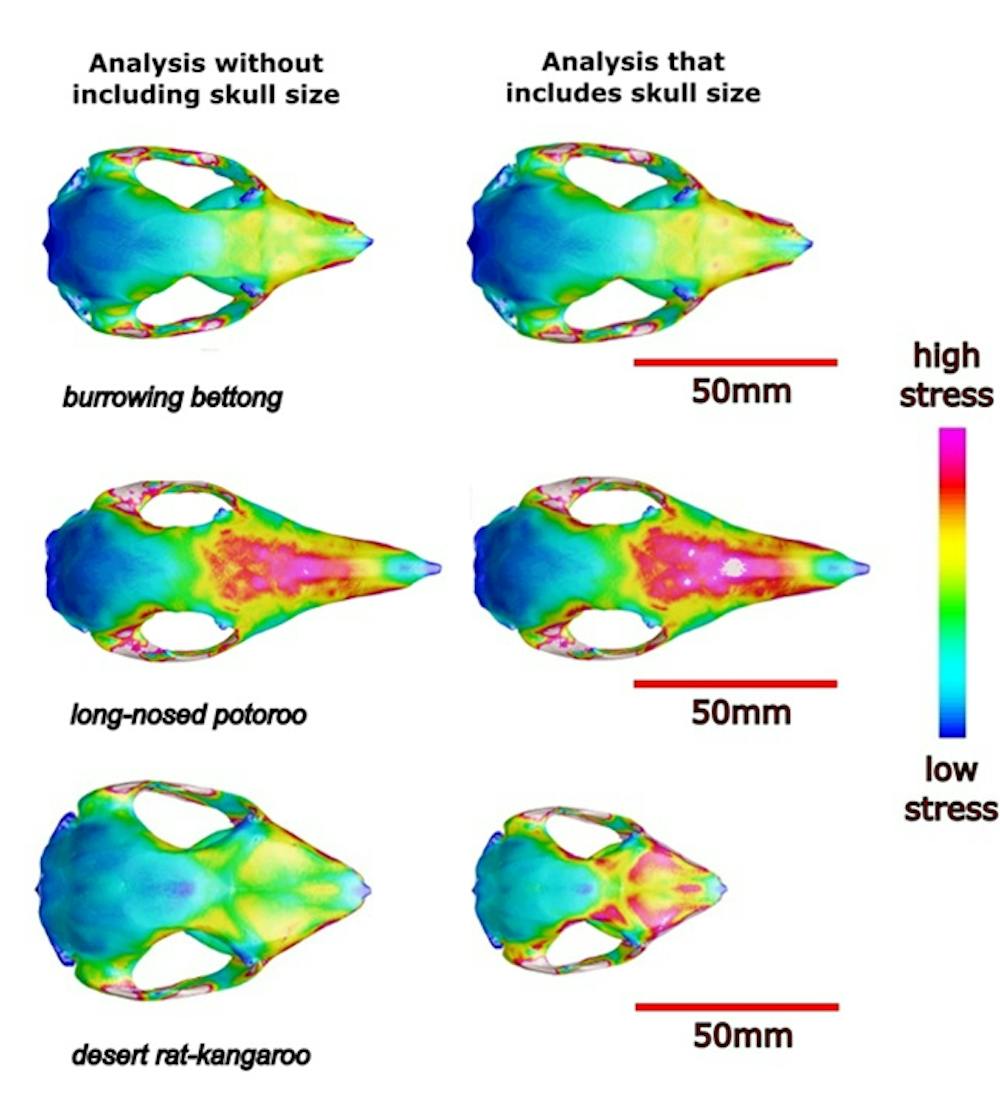
    Our results form part of a paper that addresses this issue in the methods that researchers use. We used a method called finite element analysis, which helps to predict how a structure – in this case, a skull – would handle the forces it experiences in the real world.

    But what we did differently to other researchers was to keep information about size differences between the skulls in the models.

    What did we find?

    The skull of the ngudlukanta is definitely efficient at biting, but it is also about one quarter smaller than the skull of the next smallest species in our sample, the northern bettong.

    When we included its smaller size in the analysis, the results suggested its relatively short face and robust jaw were unlikely to help it eat harder foods.

    Instead, its solid skull features mostly compensated for its small size, but would only allow it to support bites about as hard as those of the long-nosed potoroo – a larger species with a much less efficient skull at biting.

    Finite element models simulating the stress of each skull during biting with the front teeth. The stress in the desert rat-kangaroo is more similar to the hard food-eating burrowing bettong when not including its small size in the models. But its stress levels are more like the long-nosed potoroo when including its small size.
    Authors

    Early investigations of stomach contents from the 1930s tell us the ngudlukanta fed mostly on leaves and small amounts of insects. But little further detail exists. A more restricted range of softer, fresher plant materials, as suggested by our analysis, would narrow its range of preferred foods in the deserts it lived in.

    Our results therefore paint a picture of a species occupying a delicate position within the desert ecosystem.

    An unsolved mystery in a vast desert

    In recent years, one of us (Karl Vernes) has mounted several expeditions into the ngudlukanta‘s habitat, hoping to find evidence of its continued existence.

    However, finding this tiny marsupial in a vast desert is a challenge – not just because it was probably always rare and elusive, but also because we still know precious little about its ecology.

    Eyewitness accounts, remote camera traps, analysis of predator scat (poo) for mammal remains, genetic testing of scats, and the expert ecological knowledge of Traditional Owners have all been used to investigate the possibility of the survival of the ngudlukanta. No definitive evidence has yet emerged.

    Whether the ngudlukanta is extinct or not, therefore, remains an unsolved mystery.

    But history is replete with examples of rediscovered species believed to be extinct, known as “Lazarus species”. The desert’s vast, inhospitable terrain means it is plausible for a small nocturnal species to be evading detection.

    The distinctive short face of the ngudlukanta, alongside its small size and hopping gait, have led eyewitnesses to argue for its persistence.
    Hedley Herbert Finlayson, The Red Centre, 1935

    In fact, the desert rat-kangaroo was already a Lazarus species after its rediscovery in the 1930s. The story of the ngudlukanta therefore serves as a reminder that extinction declarations are not always the end of the story.

    If the species is still roaming the most inhospitable regions of the continent, the new knowledge gained from our analysis could help pinpoint areas where the ngudlukanta might persist.

    Who knows? The next chapter in the story of this desert-dweller may yet surprise us.

    Rex Mitchell has received funding from the Australian Research Council’s Centre of Excellence for Biodiversity and Heritage (CABAH).

    Karl Vernes has received funding from the Australian Research Council, the Mohamed bin Zayed Species Conservation Fund, Experiment.com, the Hermon Slade Foundation and Parks Australia. He is a member of the Australian Mammal Society.

    Vera Weisbecker receives funding from The Australian Research Council. She is affiliated with The Australian Mammal Society and member of the Australian Greens Party.

    ref. Presumed extinct, this desert rat-kangaroo may still be alive in hiding. New analysis reveals its delicate diet – https://theconversation.com/presumed-extinct-this-desert-rat-kangaroo-may-still-be-alive-in-hiding-new-analysis-reveals-its-delicate-diet-250283

    MIL OSI AnalysisEveningReport.nz

  • MIL-Evening Report: England subsidises drugs like Ozempic for weight loss. Could Australia follow?

    Source: The Conversation (Au and NZ) – By Jonathan Karnon, Professor of Health Economics, Flinders University

    Nomad_Soul/Shutterstock

    People with a high body weight living in England can now access subsidised weight-loss drugs to treat their obesity. This includes Wegovy (the weight-loss dose of Ozempic, or semaglutide) and Mounjaro (one of the brand names for tirzepatide).

    These drugs, known as GLP-1 agonists, can improve the health of people who are overweight or obese and are unable to lose weight and keep it off using other approaches.

    In Australia, the government subsidises the cost of semaglutide (Ozempic) for people with diabetes.

    But it is yet to subsidise semaglutide (Wegovy) on the Pharmaceutical Benefits Scheme (PBS) for weight loss.

    This is despite Australia’s regulator approving GLP-1 agonists for people with obesity, and for overweight people with at least one weight-related condition.

    This leaves Australians who use Wegovy for weight loss paying around A$450–500 out of pocket per month.

    But could Australia follow the England’s lead and list drugs such as Wegovy or Mounjaro on the PBS for weight loss? Doing so could bring the price down to $31.60 ($7.70 concession).

    Australia has already knocked back Wegovy for subsidies

    The Pharmaceutical Benefits Advisory Committee (PBAC) reviews the submissions pharmaceutical companies make for their drug therapies to be subsidised through the PBS.

    For every such recommendation, PBAC publishes a public document that summarises the evidence and the reasons for recommending that the drug should be added to the PBS – or not.

    In November 2023, PBAC reviewed Novo Nordisk’s submission. It proposed including semaglutide on the PBS for adults with an initial BMI of 40 or above and a diagnosis of at least two weight-related conditions. At least one of these related conditions needed to be obstructive sleep apnoea, osteoarthritis of the knee, or pre-diabetes.

    Sleep apnoea was one of the weight-related conditions in the original application.
    JPC-PROD/Shutterstock

    However, PBAC concluded semaglutide should not be subsidised through the PBS because it didn’t consider the drug cost-effective at the price proposed.

    PBAC referred to evidence on the long-term benefits from weight loss for people at increased risk of developing heart disease, diabetes or having a stroke. However, it didn’t factor these effects into its calculations when estimating the cost-effectiveness of semaglutide.

    The committee suggested a future submission could focus on patients with either pre-existing cardiovascular (heart) disease, type 2 diabetes, or at least two markers of “high cardiometabolic risk”. This could include hypertension (high blood pressure), high cholesterol, chronic kidney disease, fatty liver disease or pre-diabetes.

    What did England decide?

    The National Institute for Health and Care Excellence (NICE) has a similar role to the PBAC, informing decisions to subsidise medicines in England.

    As a result of NICE’s recommendation, semaglutide is subsidised in England for adults with at least one weight-related condition and BMI of 30 or above. Patients must be treated by a specialist weight-management service and prescriptions are for a maximum of two years.

    More recently, NICE approved another GLP-1 agonist, tirzepatide, for adults with at least one weight-related condition and a BMI of 35 or above.

    This approval didn’t restrict prescriptions to those treated in a specialist weight-management service. However, only 220,000 of the 3.4 million who meet the eligibility criteria will receive tirzepatide in the next three years. It is not clear how the 220,000 patients will be selected.

    The limits on tirzepatide will reduce the impact of GLP-1 agonists on the health budget. It is also intended to inform the broader roll-out to all eligible patients.

    For both semaglutide and tirzepatide, NICE noted that clinicians should consider stopping the treatment if the patient loses less than 5% of their body weight after six months of use.

    Australians who use Wegovy for weight loss or heart disease pay A$450–$500 out of pocket per month.
    antoniodiazShutterstock

    Why did they reach such different decisions?

    NICE assessed the use of GLP-1 agonists for a broader population than PBAC: people with one weight-related condition and a BMI of 30 or above.

    Another difference was that NICE’s cost-effectiveness analysis included estimates of the longer-term benefits of these drugs in reducing the risk of diabetes, cardiovascular (heart) disease, stroke, knee replacement and bariatric surgery.

    The proposed prices of the GLP-1 agonists in England and Australia are not reported. We can only observe the estimated health benefits. These are represented as the additional number of “quality-adjusted life years” (QALYs) associated with using the drugs. One QALY is the equivalent of one additional year of life in best imaginable health.

    Committees estimate the amount of additional health spending required to gain QALYs, to see if it’s worth the public investment. Looking at the committees’ estimates of weight-loss drugs (without a two-year maximum):

    • NICE reported a gain of 0.7 QALYs per patient receiving semaglutide for a target population with a BMI of 30 or more

    • PBAC reported a gain of 0.3 QALYs, but for a population with a BMI of 40 and above.

    Part of the explanation for the difference in estimated QALY gains is that PBAC did not consider the reduced risk of future weight-related conditions, only the impact on existing conditions.

    In contrast, NICE referred to substantial cost offsets due to reduced weight-related conditions, in particular because some patients would avoid developing diabetes.

    England and Australia’s estimates of the benefits of Wegovy differed.
    Matt Fowler KC/Shutterstock

    Time to rethink PBAC’s focus?

    Both NICE and PBAC are clearly concerned about the impact of GLP-1 agonists on the health budget.

    PBAC is trying to restrict access to a limited pool of people at highest risk. It is also being more conservative than NICE in estimating the expected benefits of GLP-1 agonists. This would require manufacturers to reduce their price in order for PBAC to consider these drugs cost-effective.

    Maybe this approach will work and the Australian government will pay less for these drugs the next time it considers publicly funding them.

    However, GLP-1 agonists are not on the agenda for the forthcoming PBAC meetings, so there is no timeline for when GLP-1 agonists might be funded in Australia for weight loss.


    Read more:
    People on Ozempic may have fewer heart attacks, strokes and addictions – but more nausea, vomiting and stomach pain


    Jonathan Karnon receives funding from the National Health and Medical Research Council and the Medical Research Future Fund.

    ref. England subsidises drugs like Ozempic for weight loss. Could Australia follow? – https://theconversation.com/england-subsidises-drugs-like-ozempic-for-weight-loss-could-australia-follow-245367

    MIL OSI AnalysisEveningReport.nz

  • MIL-Evening Report: Outstanding craftsmanship and international voices: the 5 films up for best documentary at the 2025 Oscars

    Source: The Conversation (Au and NZ) – By Phoebe Hart, Associate Professor, Film Screen & Animation, Queensland University of Technology

    Oscar-nominated best documentary film Sugarcane. Disney+

    The Academy Awards represent the screen industry’s biggest annual global recognition for the very best of moviemaking. And in these troubled times, many recognise the power of documentaries to transform the world for the better.

    Like last year, the 2025 nominations for Best Documentary are international in their scope, continuing an Academy trend of placing more emphasis on voices outside of the United States.

    This year’s nominations feature a few milestones: it’s the first time a Japanese filmmaker has been put forward, and the first time an Indigenous North American filmmaker has been nominated in Oscars history.

    All exhibit outstanding craftsmanship while exploring intense themes. The following roundup will hopefully encourage you to check them out at the cinema or online, and see why the experts also think they deserve the top gong.

    Soundtrack to a Coup d’Etat

    Johan Grimonprez’s experimental essay examines the Cold War politics of the 1950s and 60s. At this time, many African nations were gaining independence from their colonial masters.

    In Soundtrack to a Coup d’Etat, the uranium and mineral rich Democratic Republic of the Congo becomes a poignant case study.

    As the first prime minister Patrice Lumumba breaks the country away from Belgian rule, a murderous plot by global superpowers to destroy the country’s newfound sovereignty unfolds.

    And underneath it all: the frenetic beat of jazz as a revolutionary reaction against racism on both sides of the Atlantic.

    A wealth of archival material featuring former world leaders, the Congolese situation, and the musical stylings of Nina Simone, Duke Ellington, Louis Armstrong and others make this documentary effortlessly cool. The edit and sound design has a wonderful syncopated rhythm, revealing fascinating facets of modern history and the scramble for power.

    Sugarcane

    St. Joseph’s Mission was a residential school for Indigenous children in Canada, which closed in 1981.

    When ground penetrating radar begins looking for unmarked graves at the school, Julian Brave NoiseCat – whose father was born on the site – and co-director Emily Kassie embark on a quest of accountability for a myriad of institutional abuses.

    Editors Nathan Punwar and Maya Daisy Hawke interweave archival reels alongside Emily Kassie and Christopher LaMarca’s stark verité cinematography. The film captures members of the Williams Lake First Nation community reckoning with generations of trauma at the hands of Catholic clergy.

    Together, they present some disturbing facts in the film, which won a directing award at the Sundance Film Festival.

    National Geographic has routinely received a documentary Oscar nomination. This film is a challenging topic for Australian and New Zealand audiences. We also have a troubling history with the placement of Aboriginal children in homes, where many faced hardships and mistreatment.

    Sugarcane gives a platform for truth-telling and healing.

    Porcelain War

    Ceramists Slava Leontyev and Anya Stasenko are inspired by the nature of Ukraine and each other. Their friend, and fellow creator, Andrey Stefanov documents their lives on tape after his wife and children flee at the start of the Russian invasion.

    All become involved in active defiance.

    The film combines nonprofessional video, body cams and drone footage alongside wildlife photography and charming animations of Anya’s delicate paintings on clay.

    There are gripping scenes of armed conflict from the viewpoint of Slava’s squad of reservists. These are everyday folks who have become involved in fighting on the ground.

    Porcelain War benefits from a soundtrack composed and performed by folk music quartet DakhaBrakha. This adds an eerie texture to this portrait of hope.

    The film thoughtfully balances light and shade with grace, demonstrating that art remains a potent way to oppose erasure.

    Black Box Diaries

    When her high-profile #MeToo sexual assault case is dropped on the grounds of insufficient evidence, Japanese journalist, director and producer Shiori Itō commences chronicling her journey to justice.

    Deploying abstract imagery over recorded conversations with investigators and witnesses, Itō builds her argument over several years. The passage of time is interspersed with her unfiltered video diary entries.

    There has been controversy about the director including hotel footage of her drugged and being dragged out of a taxi by her attacker, senior reporter Noriyuki Yamaguchi, without permission. Itō had been given the footage for the legal case, but had agreed it would not be used outside of the courtroom.

    The debate has prevented the film from showing on Japanese screens. However, Itō has argued the public good of using this material outweighs commercial interests – especially considering the pressure of Yamaguchi’s influential connections to quell the case, which include then-Prime Minister Shinzo Abe.

    Itō doesn’t shy away from exposing the raw emotional depths of her remarkably brave undertaking against fierce odds, and she serves as an inspiring change-maker we should all heed.

    No Other Land

    No Other Land takes stock of the West Bank situation from the perspective of Basel Adra, who documents evictions of Palestinians in his home village of Masafer Yatta.

    Basel works with journalist Yuval Abraham to bear witness to the army’s gradual destruction of his village to make way for a military training ground.

    No Other Land features some great observational camerawork with many poetic images of resilience. Things kick up a notch when a villager, Harun, is shot by Israeli soldiers while trying to confiscate his building tools. Basel is targeted for filming the ensuing protests – but Adra and Abraham continue undeterred.

    A friendship develops amid the chaos between the Palestinian activist and Israeli reporter, who co-direct and edit with Hamdan Ballal and Rachel Szor. It’s the touching humanity of their relationship that goes to the core of the film; compassion is key to deescalating tensions in the region.


    In Australia and Aotearoa New Zealand, Soundtrack to a Coup d’Etat, Porcelain War, Black Box Diaries and No Other Land are streaming on DocPlay; Sugarcane is streaming on Disney+.

    Phoebe Hart does not work for, consult, own shares in or receive funding from any company or organisation that would benefit from this article, and has disclosed no relevant affiliations beyond their academic appointment.

    ref. Outstanding craftsmanship and international voices: the 5 films up for best documentary at the 2025 Oscars – https://theconversation.com/outstanding-craftsmanship-and-international-voices-the-5-films-up-for-best-documentary-at-the-2025-oscars-249151

    MIL OSI AnalysisEveningReport.nz

  • MIL-Evening Report: Multiple warnings and huge fines are not stopping super funds, insurers and banks overcharging customers

    Source: The Conversation (Au and NZ) – By Jeannie Marie Paterson, Professor of Law, The University of Melbourne

    Last week the Federal Court fined Australia’s biggest superannuation company, AustralianSuper, A$27 million for overcharging customers.

    The company had breached its legal obligations under the Superannuation Industry (Supervision) Act 1993 by failing to identify and merge the duplicate accounts of customers.

    Given the individual errant fees were about $1.50 per duplicate account, the penalty might sound disproportionate to the wrongdoing.

    But over the nine years the duplicate account and other fees were being charged, they collectively cost customers about $69 million.

    As revealed in court, the double charging continued even though AustralianSuper’s employees and officers were aware that duplicate accounts were widespread.

    Not a precedent

    This court case was not the first. It follows a damning series of cases brought by the Australian Securities and Investments Commission (ASIC) against banks, insurers and super funds for overcharging.

    In 2022, ASIC reported six of Australia’s largest financial services institutions had paid almost $4.4 billion in compensation to customers for overcharging or providing no service.

    Financial penalties were also imposed. Westpac and associated entities were fined $40 million for charging $10.9 million to more than 11,800 dead customers.

    ANZ was also hit with a $25 million penalty for failing to provide promised fee benefits to about 689,000 customer accounts over more than 20 years.

    These cases were highlighted in the Royal Commission into Misconduct in the Banking, Superannuation and Financial Services Industry, which ran from December 2017 to February 2019. But even after that, new instances emerged.

    In 2023, a review by ASIC resulted in general insurers repaying more than $815 million to more than 5.6 million customers for pricing failures since 1 January 2018“.

    After this, ASIC imposed penalties on insurers IAG-subsidiaries and QBE. It was alleged they misled customers by promising them loyalty discounts to renew their home insurance policies. But the customers actually had their premiums raised by an amount similar in size to the discounts.

    In 2024, ASIC announced the findings of an inquiry into excessively high fees for superannuation fund advice. The fees were not proportionate to the advice needs of members or the cost of advice.

    More than 300 members across seven of the funds had advice fees of more than $15,000 deducted from their accounts.

    Despite repeated calls by ASIC and the Australian Prudential Regulation Authority for the industry to improve its operations, a 2024 ASIC review found major banks left at least two million low-income customers in high-fee accounts. Those affected were refunded more than $28 million.

    Why has this litany of pricing misconduct cases occurred?

    Put in the best light, the failures represent a combination of poor legacy payment systems and increasingly complex modern payment structures and products.

    Recognising these constraints, the Federal Court has stated that the obligation under the Corporations Act to ensure financial services are provided “efficiently, honestly and fairly” does not demand “absolute perfection”.

    In other words, some mistakes are inevitable. But this does not relieve banks, insurers and superannuation funds from responsibility for payment errors.

    The buck stops with the institutions

    Charging more money than permitted or failing to pass on discounts will usually be a breach of the financial institution’s contract with its customers, and may also amount to misleading conduct.

    It’s unlawful. Even if the individual amounts in question are small compared with the turnover of the financial institution, they are significant to the customers affected.

    This means, as courts have consistently recognised, that financial institutions have a responsibility to put in place “systems and processes” to identify and correct payment errors. And they need to remediate affected customers promptly.

    The ongoing misconduct suggests banks, insurers and superannuation trustees have ignored this.

    Notably, in 2023, a court found NAB waited more than two years to correct overcharging, despite being aware of it.

    And in 2025, the court was critical of AustralianSuper for taking years to address the problem of duplicate customer accounts even after it was identified.

    The judge in the AustralianSuper case said:

    nobody was responsible for ensuring compliance with legislative requirements and [this] resulted in no resources being dedicated to that task.

    When no one takes responsibility

    After the Royal Commission, ASIC was criticised for not being sufficiently rigorous in enforcing the law. It now appears ASIC is working through the fee practices of banks, insurers and super funds armed with considerable penalties.

    ASIC’s clear aim is to ensure payment misconduct doesn’t pay, and enforcement by the regulator cannot be dismissed as a mere cost of doing business.

    But is this enough? Customers may wait years for payment errors to be identified and redressed through enforcement by ASIC.

    We need to rethink how these institutions understand their obligations to customers. Notably, the United Kingdom has introduced a “consumer duty”, which requires banks to promote customers’ interests and demonstrate how they are doing this.

    Australia doesn’t have this obligation. But it may be worth learning from the UK. Banks, insurers and superannuation funds here should be obligated to show they are using processes that produce good ongoing outcomes for their customers.

    Jeannie Marie Paterson receives funding from the Australian Research Council for a project on treating customers fairly commencing July 2025.

    ref. Multiple warnings and huge fines are not stopping super funds, insurers and banks overcharging customers – https://theconversation.com/multiple-warnings-and-huge-fines-are-not-stopping-super-funds-insurers-and-banks-overcharging-customers-250658

    MIL OSI AnalysisEveningReport.nz

  • MIL-Evening Report: Which type of note-taking is better for learning: laptop or pen and paper?

    Source: The Conversation (Au and NZ) – By Penny Van Bergen, Associate Professor in the Psychology of Education, Macquarie University

    VesnaArt/Shutterstock

    Once upon a time, university lectures were accompanied by the sound of pens scribbling on paper. But if you go into a lecture hall today, you will hear students tapping on laptops.

    Devices are now an accepted and important part of modern learning. But this does not necessarily mean students should forget the old-fashioned ways of taking notes.

    Research shows pen and paper can help students learn and remember more from class.

    The benefits of note-taking

    Studies have long shown students who take notes during a lecture, class, or while reading are able to remember more of that content later.

    One reason is note-taking is more active than listening or reading, which helps us maintain attention.

    And students often go beyond just recording the information being said.

    Note-taking means students are trying to understand their teacher by making assessments about what is important in real time. They might also organise the content into themes and sub-themes or highlight things that stand out.

    These activities are examples of active engagement which strengthens the “encoding process”: the way new knowledge moves into long-term memory and forms memory pathways.

    Strong memory pathways enable knowledge to be more easily accessed later, such as when problem solving in class or doing an exam.

    Taking notes during class can help keep your focus and make it easier to retain information.
    Matej Kastelic/Shutterstock


    Read more:
    Avoid cramming and don’t just highlight bits of text: how to help your memory when preparing for exams


    Note-taking on a laptop

    Research shows the kinds of notes students take when typing on a laptop differ from those taken with traditional pen and paper.

    A 2018 study in the United States found college students took longer lecture notes (both in word count and quantity of ideas) when typing on a laptop than when writing by hand. They also recorded longer sections verbatim from the lecture. This might occur because students typically type faster than they handwrite.

    However, while students are faster on a laptop, they are also likely to become distracted.

    A 2021 study of US college students used tracking software and found the average student was distracted for about half their lecture by social media, assignments, shopping and other off-task internet activities.

    Note-taking with a pen

    So how do pen and paper compare?

    A 2024 meta-analysis of 24 international studies showed taking lecture notes by hand resulted in stronger overall test performance and course grades for undergraduate students.

    This is because handwriting engages the brain in a more active way than typing, which is better for learning.

    Students who take notes by hand use more shorthand, visual signals (for example, bolding, underlining, arrows and stars) and images (diagrams, graphs and tables) than those who type.

    Taking notes by hand is particularly helpful if a lecturer or teacher pauses during a lecture or lesson, so students can revise or add to their notes in real time. In one US study, students using longhand added three times as many new ideas to their notes during lecture pauses as laptop users did.

    Notetaking on pen and paper can help students form strong connections between ideas.
    ABO PHOTOGRAPHY/Shutterstock

    Are there times laptops might be better?

    Despite the benefits of handwriting, there are some situations where laptops may be more appropriate for note-taking.

    Students who struggle with slow handwriting or spelling may find pen and paper note-taking interferes with their learning. This is because they need to focus more on the physical act of writing so it becomes harder to process new knowledge.

    Some neurodivergent students may also find handwriting challenging. For instance, autistic students often experience difficulties with fine motor skills like handwriting. Similarly, students with dyslexia or dysgraphia may struggle with handwriting tasks.

    For these students, typing with features like spell-check and auto-correction can allow them to focus on understanding and fully participating in class.

    But for those who find both handwriting and typing equally comfortable, the research shows using a pen and paper are more effective for learning.

    Penny Van Bergen receives funding from the Australian Research Council, Google and the Marsden Fund.

    Emma Burns receives funding from the Australian Research Council, is an associate editor for the Australian Educational Researcher and is on the board of the Australian Educational Research Organisation.

    Hua-Chen Wang receives funding from Google on a research project regarding vocabulary learning.

    ref. Which type of note-taking is better for learning: laptop or pen and paper? – https://theconversation.com/which-type-of-note-taking-is-better-for-learning-laptop-or-pen-and-paper-250404

    MIL OSI AnalysisEveningReport.nz

  • MIL-Evening Report: I spy with my little eye: 3 unusual Australian plant ecosystems to spot on your next roadtrip

    Source: The Conversation (Au and NZ) – By Gregory Moore, Senior Research Associate, School of Agriculture, Food and Ecosystem Sciences, The University of Melbourne

    A boab tree in the Kimberley. Hideaki Edo Photography/Shutterstock

    When the growing gets tough, the tough trees and shrubs get growing.

    Australia’s environment is brutal. Its ancient, low-nutrient soils and generally low rainfall make it a hard place for plants to grow. Despite this, the continent is filled with wonderfully diverse plant ecosystems.

    If you don’t know what you’re looking for, it can be easy to miss these seemingly unremarkable species. So, here are three little-known Australian plant species and ecosystems to look out for during your next roadtrip.

    1. Cycads and eucalypts

    If you are driving a coastal route along southern New South Wales, keep an eye out for the stunning combination of burrawang cycads (Macrozamia communis) and spotted gum (Corymbia maculata). These species live in harmony along the NSW coastline, from Kempsey to Bega, and inland as far as Mudgee.

    Spotted gum trees with burrawang cycad understorey on the Burrawang walking track, NSW South Coast.
    Destinations Journey/Shutterstock

    If you’re on a road trip, now is the perfect time to talk to children about ancient moving continents, volcanoes and dinosaurs.

    Cycads are ancient gymnosperms (cone-bearing plants) which evolved long before the Gondwanan supercontinent separated. These tough, hardy plants saw the dinosaurs come and go, and their relatives are found all around the world.

    These cycads form a striking understorey to the spotted gum. As their scientific name (Macrozamia communis) suggests, they form a dense community.

    Further north in Queensland, pineapple cycads (Lepidozamia peroffskyana), and Western Australia’s zamia palm (Macrozamia riedlei) are also worth spotting.

    Cycad seeds are poisonous, but First Nations Australians worked out a complex process to prepare them for safe eating. This involved dissolving the plant’s toxins in running water, cooking, working and grinding the seeds into a powder.

    Spotted gums evolved long after dinosaurs went extinct. Early eucalypt fossils date from about 34 million years ago, while current species are often only a few million years old.

    Spotted gums are a great example of how plants that survive tough environments often also do well in difficult urban situations.

    Cycads are similarly found growing in poor soils and arid conditions. They have long, glossy leaves up to about 1.5 metres in length with lots of leaflets.

    There are both male and female plants. The female cone is an impressive, wide-domed structure that can be almost half a metre across. Its bright orange-red seeds are eaten by foraging marsupials, large birds and flying foxes.

    Spotted gums are tall, straight eucalyptus trees with dark green, glossy leaves. Old bark creates dark grey spots against their cream coloured trunk, giving them a mottled look.

    It is interesting to see ancient and modern species in such a close community relationship in cycad-spotted gum forests. Both are also well-adapted to the fires that frequent their habitat.

    2. Ancient acacias

    Travelling inland, the environment gets even tougher. Most large trees disappear and are replaced by woodlands dominated by inland acacia (wattle) species.

    These inland acacias are short but mighty, with deep, extensive root systems.

    Two of these species, mulga (Acacia aneura) and brigalow (A. harpophylla) are part of Australian folklore. A Banjo Paterson character says: “You know how the brigalow grows […] saplings about as thick as a man’s arm”.

    Nutrients and water resources are limited, so mulga and brigalow trees are often evenly spaced across the landscape. This eerie symmetry makes it look like they were planted by humans.

    Acacias grow in arid conditions and are what many Australians think of when they envisage the red inland of our continent.
    Ashley Whitworth/Shutterstock

    Many people are unaware that the twisted, stunted specimens they see are more than 250 years old and occupy vast tracts of the Australian landscape.

    Waddy-wood (Acacia peuce) is a rare species of acacia, found in just three locations on the edge of the Simpson Desert. This tree has very strong wood, and was used by Indigenous Australians for making clubs (waddys) and tools for carrying fire.

    Inland acacias were widely used by Indigenous Australians for their wood, resins and medicinal properties. They have also been used as fodder for livestock, especially during drought.

    These crucial species provide important habitat for other plants and animals. But they are under threat.

    As old trees collapse and die, there are no young trees replacing them. This is because of drought and grazing, compounded by climate change.

    Desertification – where fertile land is degraded until it essentially becomes desert – is becoming a huge problem due to the massive area dominated by acacias.

    3. Boabs

    If you’re driving across the Northern Territory and Western Australia, you might come across the mighty boab (Adansonia gregoryii).

    These close relatives of the African and Madagascan baobabs floated to Australia as seeds or seedlings around 12 million years ago.

    Swollen boab tree trunks (called a caudex) can store thousands of litres of water.
    bmphotographer/Shutterstock

    These deciduous trees live in mostly dry environments that also experience strong monsoonal-type rains. Boabs trap and store water in their trunks, allowing them not only to survive but thrive.

    Their African and Madagascan baobab relatives are sometimes called trees of life, as they support many species.

    Australian boabs are similar. They offer habitat, roosting and nesting sites. Their flowers and fruits are food sources to many species of insects and birds.

    They were – and are – important trees in First Nations cultures. Carvings and symbols on their trunks can last for more than a century, much longer than on other trees. These are called dendroglyphs.

    For example, snake carvings dated to more than 200 years old have been found on boab trees in Northern Australia’s Tanami Desert.

    While these special trees are usually found far from the beaten track, they can be spotted growing around Darwin and other remote towns. If you get the chance to see them, count yourself lucky.

    Tough terrain, tough trees

    Plant communities are remarkably resilient. They also display great creativity when evolving ways to survive tough environments.

    Make sure to keep an eye out as you’re exploring Australia and enjoy the fascinating plants our country has to offer.

    Gregory Moore does not work for, consult, own shares in or receive funding from any company or organisation that would benefit from this article, and has disclosed no relevant affiliations beyond their academic appointment.

    ref. I spy with my little eye: 3 unusual Australian plant ecosystems to spot on your next roadtrip – https://theconversation.com/i-spy-with-my-little-eye-3-unusual-australian-plant-ecosystems-to-spot-on-your-next-roadtrip-246129

    MIL OSI AnalysisEveningReport.nz

  • MIL-Evening Report: England subsidises drugs like Ozepmic for weight loss. Could Australia follow?

    Source: The Conversation (Au and NZ) – By Jonathan Karnon, Professor of Health Economics, Flinders University

    Nomad_Soul/Shutterstock

    People with a high body weight living in England can now access subsidised weight-loss drugs to treat their obesity. This includes Wegovy (the weight-loss dose of Ozempic, or semaglutide) and Mounjaro (one of the brand names for tirzepatide).

    These drugs, known as GLP-1 agonists, can improve the health of people who are overweight or obese and are unable to lose weight and keep it off using other approaches.

    In Australia, the government subsidises the cost of semaglutide (Ozempic) for people with diabetes.

    But it is yet to subsidise semaglutide (Wegovy) on the Pharmaceutical Benefits Scheme (PBS) for weight loss.

    This is despite Australia’s regulator approving GLP-1 agonists for people with obesity, and for overweight people with at least one weight-related condition.

    This leaves Australians who use Wegovy for weight loss paying around A$450–500 out of pocket per month.

    But could Australia follow the England’s lead and list drugs such as Wegovy or Mounjaro on the PBS for weight loss? Doing so could bring the price down to $31.60 ($7.70 concession).

    Australia has already knocked back Wegovy for subsidies

    The Pharmaceutical Benefits Advisory Committee (PBAC) reviews the submissions pharmaceutical companies make for their drug therapies to be subsidised through the PBS.

    For every such recommendation, PBAC publishes a public document that summarises the evidence and the reasons for recommending that the drug should be added to the PBS – or not.

    In November 2023, PBAC reviewed Novo Nordisk’s submission. It proposed including semaglutide on the PBS for adults with an initial BMI of 40 or above and a diagnosis of at least two weight-related conditions. At least one of these related conditions needed to be obstructive sleep apnoea, osteoarthritis of the knee, or pre-diabetes.

    Sleep apnoea was one of the weight-related conditions in the original application.
    JPC-PROD/Shutterstock

    However, PBAC concluded semaglutide should not be subsidised through the PBS because it didn’t consider the drug cost-effective at the price proposed.

    PBAC referred to evidence on the long-term benefits from weight loss for people at increased risk of developing heart disease, diabetes or having a stroke. However, it didn’t factor these effects into its calculations when estimating the cost-effectiveness of semaglutide.

    The committee suggested a future submission could focus on patients with either pre-existing cardiovascular (heart) disease, type 2 diabetes, or at least two markers of “high cardiometabolic risk”. This could include hypertension (high blood pressure), high cholesterol, chronic kidney disease, fatty liver disease or pre-diabetes.

    What did England decide?

    The National Institute for Health and Care Excellence (NICE) has a similar role to the PBAC, informing decisions to subsidise medicines in England.

    As a result of NICE’s recommendation, semaglutide is subsidised in England for adults with at least one weight-related condition and BMI of 30 or above. Patients must be treated by a specialist weight-management service and prescriptions are for a maximum of two years.

    More recently, NICE approved another GLP-1 agonist, tirzepatide, for adults with at least one weight-related condition and a BMI of 35 or above.

    This approval didn’t restrict prescriptions to those treated in a specialist weight-management service. However, only 220,000 of the 3.4 million who meet the eligibility criteria will receive tirzepatide in the next three years. It is not clear how the 220,000 patients will be selected.

    The limits on tirzepatide will reduce the impact of GLP-1 agonists on the health budget. It is also intended to inform the broader roll-out to all eligible patients.

    For both semaglutide and tirzepatide, NICE noted that clinicians should consider stopping the treatment if the patient loses less than 5% of their body weight after six months of use.

    Australians who use Wegovy for weight loss or heart disease pay A$450–$500 out of pocket per month.
    antoniodiazShutterstock

    Why did they reach such different decisions?

    NICE assessed the use of GLP-1 agonists for a broader population than PBAC: people with one weight-related condition and a BMI of 30 or above.

    Another difference was that NICE’s cost-effectiveness analysis included estimates of the longer-term benefits of these drugs in reducing the risk of diabetes, cardiovascular (heart) disease, stroke, knee replacement and bariatric surgery.

    The proposed prices of the GLP-1 agonists in England and Australia are not reported. We can only observe the estimated health benefits. These are represented as the additional number of “quality-adjusted life years” (QALYs) associated with using the drugs. One QALY is the equivalent of one additional year of life in best imaginable health.

    Committees estimate the amount of additional health spending required to gain QALYs, to see if it’s worth the public investment. Looking at the committees’ estimates of weight-loss drugs (without a two-year maximum):

    • NICE reported a gain of 0.7 QALYs per patient receiving semaglutide for a target population with a BMI of 30 or more

    • PBAC reported a gain of 0.3 QALYs, but for a population with a BMI of 40 and above.

    Part of the explanation for the difference in estimated QALY gains is that PBAC did not consider the reduced risk of future weight-related conditions, only the impact on existing conditions.

    In contrast, NICE referred to substantial cost offsets due to reduced weight-related conditions, in particular because some patients would avoid developing diabetes.

    England and Australia’s estimates of the benefits of Wegovy differed.
    Matt Fowler KC/Shutterstock

    Time to rethink PBAC’s focus?

    Both NICE and PBAC are clearly concerned about the impact of GLP-1 agonists on the health budget.

    PBAC is trying to restrict access to a limited pool of people at highest risk. It is also being more conservative than NICE in estimating the expected benefits of GLP-1 agonists. This would require manufacturers to reduce their price in order for PBAC to consider these drugs cost-effective.

    Maybe this approach will work and the Australian government will pay less for these drugs the next time it considers publicly funding them.

    However, GLP-1 agonists are not on the agenda for the forthcoming PBAC meetings, so there is no timeline for when GLP-1 agonists might be funded in Australia for weight loss.


    Read more:
    People on Ozempic may have fewer heart attacks, strokes and addictions – but more nausea, vomiting and stomach pain


    Jonathan Karnon receives funding from the National Health and Medical Research Council and the Medical Research Future Fund.

    ref. England subsidises drugs like Ozepmic for weight loss. Could Australia follow? – https://theconversation.com/england-subsidises-drugs-like-ozepmic-for-weight-loss-could-australia-follow-245367

    MIL OSI AnalysisEveningReport.nz

  • MIL-Evening Report: Labor likely to win WA election, but the campaign is exposing faultlines in the state’s politics

    Source: The Conversation (Au and NZ) – By Narelle Miragliotta, Associate Professor in Politics, Murdoch University

    With Western Australia heading to the polls on March 8, the Cook Labor government will likely prove the exception to the rule that incumbency is a liability for contemporary governments.

    Despite incumbent governments around the world losing office, Labor looks headed for a comfortable re-election.

    The WA contest begins from an unusual position. In 2021, Labor won a historic victory, driven by the popularity of the then premier Mark McGowan. It won 53 of 59 seats in the Legislative Assembly, with the Liberals reduced to two elected members in that chamber.

    Since then, however, Labor’s popularity has slipped.

    In September 2024, the Freshwater Strategy poll reported Labor’s primary vote had declined from 60% to 39%, while the Liberals’ primary vote had increased to 32% from 21% since the 2021 state election.

    A January-February 2025 Newspoll had Labor’s primary vote down from 59.9% to 42%, and its two-party preferred primary vote down from 69.7% to 56%.

    Nevertheless, on a two-party preferred basis, Labor is ahead on 56% to the Liberals’ 44%. While Premier Roger Cook is no McGowan, his approval rating is higher than that of the Liberal leader, Libby Mettam.

    The WA Labor government has several factors working in its favour.

    First is the healthy (two-party preferred) margins that Labor holds in many seats, including traditionally safe Liberal seats. After 2021, the WA Electoral Commission (WAEC) reclassified several former Liberal-held seats as “very safe” or “safe” Labor seats. Labor’s margins in Dawesville, South Perth, Riverton and Darling Range make it far from certain these seats will return to the Liberals in 2025.

    Second, Labor is presiding over a strong local economy. While it has faced criticism for weak responses on housing, equitable access to government concessions, and climate action, Labor’s fiscal record is not in contention.

    Third, Cook is not shy about activating WA’s sensitivities about the east coast. He has railed about “laws which damage Western Australia’s economy”, and complained that the nation’s high “standard of living […] is because of West Australian industry and the West Australian economy”.

    The Cook government can back in its “WA-first” position by pointing to policy wins against federal governments. These include securing increases in WA’s GST share and forcing the shelving of proposed federal nature-positive legislation.

    However, WA Labor cannot take all the credit for its strong position. The WA opposition is doing itself remarkably few favours.

    A challenge for the Liberals is the loss of (people) presence due to their spectacular electoral losses in 2021. In addition to losing the status of the official opposition, the remaining party room lacked star power, featuring a National party defector, an upper house member later sacked for lying to the party leader, and divisive figures such as Nick Goiran and Peter Collier, both key players in the destabilisation that contributed to the party’s 2021 defeat.

    Mettam has also been undermined by forces within her own party.

    Her most serious challenger is the media personality, Lord Mayor of Perth, and Liberal candidate for Churchlands, Basil Zempilas.

    In November 2024, an employee of Zempilas admitted to leaking an internal poll to the media that suggested Mettam’s continued leadership would cause a 3% swing against the party. While Zempilas denied knowledge of the poll, Mettam was forced to hold a party room meeting to defend her leadership five months before the election.

    Then there are some questionable decisions taken by Mettam.

    She flipped on the Voice to parliament referendum and later adopted federal Liberal leader Peter Dutton’s position on refusing to stand in front of the First Nations Flag. Such positions will be popular among some voters, but not the inner metropolitan constituencies that the party hopes to win back.

    The final complication is the Liberals’ tetchy relationship with the Nationals, the official opposition since 2021.

    The WA Liberals and Nationals have always had a tense relationship. Not even the shared experience of a depleted parliamentary presence inspired camaraderie. Despite their alliance, the Labor government exploited policy tensions between them.

    In preparation for even more fraught times ahead, the two parties signed an election code of conduct, agreeing to play nice at elections. However, the Nationals face an existential crisis owing to changes to the state upper house electoral rules. Introducing a single statewide upper house electorate ended the malapportionment that had bolstered the Nationals’ representation in the Legislative Council.

    The Nationals responded by fielding additional lower house candidates, although fewer than the party had foreshadowed. Crucially, the Nationals are competing in the seats of South Perth and Bateman, which are key inner metropolitan seats for the Liberals. Labor, however, is doing the Nationals no favours by preferencing the Liberals.

    There is also an assortment of minor parties and independents. Climate 200 is backing several independents, two of whom are contesting the prized former Liberal seats of Churchlands and Nedlands. Now that McGowan fever has abated, the “Teals” might swoop in as the progressive middle path between Labor and Liberals. Green victories will be likely restricted to the Legislative Council.

    The election might be a foregone conclusion in WA but it would be a mistake to think it is a prelude to the federal election. While WA Labor remains broadly popular among the state’s voters, polling suggests there is less love for the federal Labor party.

    Nothing to disclose.

    Nardine Alnemr and Narelle Miragliotta do not work for, consult, own shares in or receive funding from any company or organisation that would benefit from this article, and have disclosed no relevant affiliations beyond their academic appointment.

    ref. Labor likely to win WA election, but the campaign is exposing faultlines in the state’s politics – https://theconversation.com/labor-likely-to-win-wa-election-but-the-campaign-is-exposing-faultlines-in-the-states-politics-249690

    MIL OSI AnalysisEveningReport.nz

  • MIL-Evening Report: 5 years on, COVID remains NZ’s most important infectious disease – it still demands a strong response

    Source: The Conversation (Au and NZ) – By Michael Baker, Professor of Public Health, University of Otago

    Getty Images

    This Friday, February 28, marks five years since COVID-19 was first reported in Aotearoa New Zealand. At a population level, it remains our most harmful infectious disease, with thousands of hospitalisations and 664 deaths last year.

    Understandably perhaps, many people want to move on from the early pandemic years, and there is a temptation to minimise COVID’s threat now the emergency response has passed.

    But it deserves a proportionate response that draws on the rich evidence we now have of how to minimise the harms of respiratory infections and the health and economic benefits that come from managing them well.

    The epidemiology of the SARS-CoV-2 virus continues to change. Hospitalisations provide the most consistent measure of incidence trends. Wastewater testing shows similar successive waves of infection.

    The past five years divide into a successful elimination response from March 2020 to late 2021 and a mitigation period from February 2022 onwards.


    The mitigation phase, which has now lasted three years, has been driven by Omicron variants of SARS-CoV-2, with seven waves of generally decreasing size (see graph above).

    Total hospitalisations have dropped from a peak of more than 22,000 in 2022 to about 9,000 in 2024 (a 60% decline). Deaths attributed to COVID have also decreased from 2,757 in 2022 to 664 in 2024 (a 76% decline). These drops are likely to reflect changes in both the virus and population immunity arising from vaccination and infection.

    The timing and size of COVID waves remain unpredictable. They are not following a seasonal pattern like influenza. Only two of the seven Omicron waves peaked in the flu season (see graph above).

    Although further declines are likely, it is possible a large-scale change in the virus could emerge – as we’ve seen with Delta and Omicron variants – and reverse this pattern. We still need to plan for the possibility of severe future variants as well as for other types of pandemics that might be becoming more likely.

    Health and economic impacts of Long COVID

    Despite a favourable downward trend, deaths and hospitalisations from COVID are still higher than those estimated for influenza, which is probably our next most burdensome infectious disease.

    It is also a major cause of health inequities with significantly worse infection outcomes for Māori and Pacific peoples.

    Continuing high rates of repeat infections are also driving Long COVID, with the risk estimated at 4-14% per infection. Long COVID occurs with infections of all intensities, with both initial infection and reinfections.

    Consequently, the prevalence of Long COVID is likely to increase over time, with substantial health and economic consequences.

    How to respond to the ongoing pandemic

    We know what works to reduce the harms from COVID. Above all, we need an evidence-informed national plan, clear communication, engagement with key partners (including the health sector, public and Māori), resources and implementation. Key elements include:

    1. Continuing and enhancing highly effective COVID surveillance

    Surveillance systems include use of wastewater testing and whole-genome sequencing which guide our response. We need to add a focus on hospital-acquired COVID which is an important source of infections and deaths, estimated to have caused about 14% of COVID deaths in New South Wales in 2023, which would represent about 150 deaths that year in New Zealand.

    2. Promoting regular repeat vaccinations

    The currently available Pfizer JN.1 vaccine provides a reasonable match with the circulating strain of the virus. This vaccine is very safe and effective at reducing many adverse effects of infection, including Long COVID, but requires regular additional doses for all age groups to maintain effectiveness.

    3. Using public health and social measures to reduce infections

    These measures include improving indoor air quality and promoting testing and self-isolation for those with respiratory symptoms. Reintroducing free RAT tests and sick-leave support would help.

    Wearing respirator masks (for example, N95) is highly effective, particularly in confined indoor environments such as public transport. Given the severe effects of hospital-acquired COVID, health settings need particular attention. Evidence supports the effectiveness and value of admission testing of patients and staff wearing N95 masks.

    4. Taking specific measures to reduce and manage Long Covid

    This means active steps to reduce both the incidence of infection (with public health and social measures) and the severity and duration of illness (with vaccination and antivirals). New Zealand needs to offer more than a single additional dose for younger age groups to improve their protection from Long COVID.

    5. Updating and implementing our pandemic preparedness and response plan

    The Royal Commission of Inquiry into COVID delivered a set of recommendations based on the pandemic experience. Now is the time to implement them.

    Our capacity could be supported through a New Zealand Centre for Disease Control and a pandemic cooperation agreement with Australia. Developing these pandemic capabilities would help to minimise COVID and other respiratory infections, including influenza.

    All of these measures would be supported by a strong, systematic response to the corrosive effects of misinformation and disinformation.

    The past five years have taught us a great deal about pandemic diseases and how to manage them. A key lesson from New Zealand’s highly successful early elimination response was the importance of good evidence-informed leadership and a cohesive plan.

    Such leadership is still needed now to mitigate the harm from COVID which remains an ongoing threat to individual and societal wellbeing.

    Michael Baker’s employer, the University of Otago, has received funding from the Health Research Council of New Zealand and the New Zealand Ministry of Health for research he has carried out on COVID-19 epidemiology, prevention and control.

    Matire Harwood is a member of the Hauora Māori Advisory Committee to the Minister of Health.

    Amanda Kvalsvig, John Donne Potter, and Nick Wilson do not work for, consult, own shares in or receive funding from any company or organisation that would benefit from this article, and have disclosed no relevant affiliations beyond their academic appointment.

    ref. 5 years on, COVID remains NZ’s most important infectious disease – it still demands a strong response – https://theconversation.com/5-years-on-covid-remains-nzs-most-important-infectious-disease-it-still-demands-a-strong-response-246873

    MIL OSI AnalysisEveningReport.nz

  • MIL-Evening Report: Barred European Union politician brands Israel as ‘a rogue state’

    Israel has now banned another European Union parliamentarian from entering the country, reports Al Jazeera.

    The government gave no reasons why Lynn Boylan, who chairs the European Parliament EU-Palestine delegation, was denied entry.

    “This utter contempt from Israel is the result of the international community failing to hold them to account,” Boylan, an Irish MP in Brussels, said in a statement.

    “Israel is a rogue state, and this disgraceful move shows the level of utter disregard that they have for international law.

    “Europe must now hold Israel to account.”

    Boylan said she had planned to meet with Palestinian Authority officials, representatives of civil society organisations, and people living under Israeli occupation.

    She is a member of the Sinn Fein party in Ireland, which has been among the most vocal countries in criticising the Israeli government over its treatment of Palestinians.

    France’s Hassan also refused
    Earlier, EU lawmaker Rima Hassan was also refused entry at Ben-Gurion airport and ordered to return to Europe.

    “Hassan, who is expected to land from Brussels in the coming hour, consistently works to promote boycotts against Israel in addition to numerous public statements both on social media and in media interviews,” said Israeli Interior Minister Moshe Arbel’s office.

    Hassan is a French national of Palestinian origin known for her support of the Palestinian cause and for speaking out against Israel’s war on Gaza.

    Kaja Kallas, the EU foreign policy chief, outlined a range of worries about the situation in war-battered Gaza and the occupied West Bank.

    “We have constantly called on all parties, including Israel, to respect international humanitarian law,” she said, adding that Europe “cannot hide our concern when it comes to the West Bank”.

    ICC raps Merz over warrants
    Meanwhile, the International Criminal Court (ICC) has declared that states cannot unilaterally “determine soundness” of its rulings

    Earlier, it was reported that Germany’s election winner Friedrich Merz was saying he planned to invite Israeli Prime Minister Benjamin Netanyahu to visit the country — despite an ICC war crimes warrant issued for his arrest, which Merz claimed did not apply.

    The ICC responded by saying states had a legal obligation to enforce its decisions, and any concerns they may have should be addressed with the court in a timely and efficient manner.

    “It is not for states to unilaterally determine the soundness of the court’s legal decisions,” said the ICC in a statement.

    Israel rejects the jurisdiction of the court and denies war crimes were committed during its devastating war on Gaza.

    Germans feel a special responsibility towards Israel because of the legacy of the Holocaust, and Merz has made clear he is a strong ally. But Germany also has a strong tradition of support for international justice for war crimes.

    Amnesty slams ‘shameful silence’
    Amnesty International and 162 other civil society organisations and trade unions have signed a joint letter calling on the EU to ban trade and business with Israel’s settlements in occupied Palestinian territory.

    “Despite EU consensus about the settlements’ illegality and their link to serious abuses, the EU continues to trade and allow business with them,” the letter said.

    This contributes to “the serious and systemic human rights and other international law abuses underpinning the settlement enterprise”, it added.

    The International Court of Justice (ICJ) in July issued a landmark advisory opinion affirming that states must not recognise, aid or assist the unlawful situation arising from Israel’s occupation of Palestinian territory.

    Article by AsiaPacificReport.nz

    MIL OSI AnalysisEveningReport.nz

  • MIL-Evening Report: Smart is sexy – new study on fish doing puzzles hints intelligence partly evolved via sexual selection

    Source: The Conversation (Au and NZ) – By Ivan Vinogradov, Animal Behaviour Researcher, Australian National University

    Turner Brockman/iNaturalist, CC BY-SA

    We humans often underestimate the intelligence of other animals. You’ve probably seen videos of monkeys, ravens or parrots solving puzzles.

    But fish also possess impressive problem-solving skills, despite the notorious slander that goldfish have a three-second memory.

    The intelligence of animals can be a useful tool when testing various ideas in biology. For example, could intelligence have evolved in part thanks to sexual selection, rather than as a means of survival?

    In a new study published in Nature Ecology & Evolution, we used distinct tests to measure cognitive abilities of male mosquitofish – a thumb-sized fish endemic to central America but now a major pest in many parts of the world, including Australia.

    We then tracked how many offspring each male produced when competing for mates in small ponds. Our study showed that smarter males had more offspring than their less intelligent brethren.

    Our findings imply that the evolution of cognitive abilities may have been driven by sexual selection, with smarter males gaining more mating opportunities.

    To be smart is to survive

    Cognitive abilities, such as learning and problem solving, likely arose because they helped animals gather food, find shelter and avoid predators.

    Individuals that were better at these tasks lived longer and passed on genes to their offspring that improved the offspring’s performance. Natural selection favoured smarter survivors who had more descendants than the average individual.

    As a result, populations became smarter over time.

    But there is another explanation for the evolution of intelligence: smarter is sexy. A better brain might help an animal find more mates, have more sex, and eventually have more babies.

    If this is the case, intelligence partly evolved through sexual selection, where traits that boost mating and fertilisation success become more common over generations.

    We did our study on male fish – sexual selection is usually stronger on males than females, because in most species there are more males seeking mates than females ready to mate and breed.

    A shoal of mosquitofish.
    David Fanner

    Measuring animal IQ

    Even in humans, intelligence can be difficult to pin down: maths skills, creativity, street smarts, and standardised IQ tests all capture different aspects of human braininess.

    For animals, this challenge is tougher still. But biologists broadly agree that cognition is the ability to acquire, store, process, and act on information; and that distinct cognitive abilities are governed by different brain regions.

    We designed four special underwater tests to tap into these distinct cognitive abilities of our male mosquitofish.

    First, we measured their spatial learning by placing fish in a maze with a single correct route that led them to a shoal of their compatriots. Mosquitofish are highly motivated to swim with other fish, so reaching this shoal acts as a reward for solving the maze.

    Second, we measured their self-control (formally called “inhibitory control”) by placing a transparent barrier between the fish and a reward. We then documented how quickly a male learned not to swim into the barrier but to detour around it.

    A variation of the apparatus used to test self-control in mosquitofish. Fish needed to overcome their impulse to swim straight through the transparent barrier and detour it instead.
    Ivan Vinogradov

    Then, we measured associative learning by presenting a fish with two coloured corridors once a day. One colour (for example, green) led to a dead end, while the other (for example, red) to a reward.

    The number of days it took a male to consistently choose the correct corridor – the one with a reward – indicated how quickly they learned the association.

    Lastly, we reversed the colour cues to measure reversal learning. If green, for example, was previously the dead end, it now became the reward corridor, while red became the dead end. This tested how quickly the fish could “overwrite” his previously learned association to learn the new one.

    A winning edge in mating

    After these tests, we moved the males to ponds where they competed for mates. Two months later, the females gave birth, and genetic paternity tests revealed who fathered each offspring.

    Males that scored highly on self-control and spatial learning had significantly more children. But why?

    Something about these males seemingly gave them an edge in securing mating opportunities. Perhaps females recognised and preferred smarter males? Maybe smarter males were better at chasing the females and forcing them to mate (a common, if unpleasant, practice in mosquitofish).

    Future research is needed to observe the males’ mating behaviours more closely and see if smarter and dumber males differ in how they court mates.

    Our research sheds light on the evolution of our most prized possession – the brain. It seems that sophisticated intelligence isn’t only driven by our need to find food or avoid danger to survive, but also by the complex challenges of finding love.

    Ivan Vinogradov does not work for, consult, own shares in or receive funding from any company or organisation that would benefit from this article, and has disclosed no relevant affiliations beyond their academic appointment.

    ref. Smart is sexy – new study on fish doing puzzles hints intelligence partly evolved via sexual selection – https://theconversation.com/smart-is-sexy-new-study-on-fish-doing-puzzles-hints-intelligence-partly-evolved-via-sexual-selection-249862

    MIL OSI AnalysisEveningReport.nz

  • MIL-Evening Report: Some of Australia’s largest companies are failing to ‘know and show’ their respect for human rights

    Source: The Conversation (Au and NZ) – By David Birchall, Senior Lecturer in Law, Macquarie University

    The skyline of Sydney’s central business district. Olga Kashubin/Shutterstock

    In our complex, interconnected world, there are risks of human rights violations throughout global supply chains. Examples include not only modern slavery and child labour, but also gender discrimination and violations of land, food and water rights.

    Many people care deeply about whether the companies they support are monitoring and addressing these issues. So, how do some of the biggest Australian companies measure up?

    To answer this question, we analysed the human rights commitments of 25 of the top companies listed on the Australian Securities Exchange (ASX), including some of our largest banks and mining companies.

    We found Australian companies have a long way to go in “knowing and showing” a commitment to respect human rights, suggesting an urgent need for reform.

    One response could be for Australia to follow the European Union’s lead and create a mandatory human rights due diligence regime.


    Read more:
    Many global corporations will soon have to police up and down their supply chains as EU human rights ‘due diligence’ law nears enactment


    International best practice

    Our analysis used the World Benchmarking Alliance’s Corporate Human Rights Benchmark Core UNGP Indicators.

    This benchmark uses 12 indicators that draw on the United Nations Guiding Principles on Business and Human Rights (UNGP), the authoritative international standard.

    There are human rights risks across many stages of global supply chains.
    JULY_P30/Shutterstock

    The indicators are grouped into three themes:

    1. policy commitments to respect human rights
    2. embedding respect through ongoing human rights due diligence
    3. enabling accessible remedies and grievance mechanisms for workers and external stakeholders.

    Companies score between zero and two points on each indicator, depending on how they satisfy its requirements. The maximum possible score is 24.

    It’s important to understand that the aim of our study was not to assess whether these companies have been violating human rights. Rather, it was to evaluate whether companies have disclosed their policies and processes to respect human rights.

    The UN Guiding Principles expect companies to have suitable due diligence processes in place and make these publicly available in an accessible form.

    Ideally, companies should clearly state that they respect all human rights. This includes rights such as nondiscrimination, the prohibition on forced or child labour, freedom to join trade unions, and the right to a clean environment.

    They should outline in detail the mechanisms in place to identify and address actual or potential abuses. On top of this, detail which officials in the company hold responsibility for managing these issues.

    The better companies would even disclose examples of human rights abuses that they discovered in their operations, such as modern slavery or a gender pay gap.

    Poor performance overall

    Our research covered the 25 largest Australian companies by market capitalisation that had not previously been assessed under this benchmark.

    This included some of the leading Australian companies from a range of sectors – mining, banks, energy, insurance, transportation, telecommunication, media, health care and pharmaceuticals.

    Scores were poor overall. The best-performing company scored eight out of a possible 24 points. The average score was 3.6.

    Many companies were found to be making vague or ambiguous human rights commitments or only focusing on a narrow set of modern slavery risks.

    No company disclosed all of the human rights due diligence processes needed to identify, prevent, mitigate and remediate human rights risks. Nor did any disclose how they consulted with relevant stakeholders such as workers or displaced communities to help them understand and identify relevant human rights risks in company operations.

    Only ten of the 25 companies provided a mechanism for external individuals and communities to raise human rights complaints or concerns.

    Companies scored particularly poorly on the second group of indicators: embedding respect through ongoing human rights due diligence. The average score here was 0.58 out of 12.

    Many companies only focused on identifying and addressing modern slavery in their operations, to the exclusion of other human rights risks such as sexual harassment or environmental pollution.

    It was also concerning that companies we assessed often passed the burden of compliance to suppliers. That is, they established higher expectations for suppliers’ conduct than they set for their own.

    Legal requirements made a difference

    Our research found that companies scored well in making human rights commitments where there was a legal obligation to do so.

    Every company, for example, scored the point available for hosting a grievance mechanism for workers to raise concerns about the company. This is because Australia’s Corporations Act requires companies to create a whistleblower mechanism.

    Similarly, most companies disclosed elements of their modern slavery due diligence process, because this is legally required under the Modern Slavery Act.

    Proactive steps

    It is clear from our research that many large Australian companies are not operating in line with international standards.

    That means they also aren’t ready to comply with the ripple effects of the mandatory human rights due diligence laws recently introduced in Europe.

    These laws will require large Australian companies that do significant business in Europe to conduct comprehensive human rights due diligence.

    The European Union has recently introduced mandatory human rights due diligence laws.
    VanderWolf Images/Shutterstock

    Australian companies must take proactive steps to comply with international standards. This means making a public commitment to respect all human rights, establishing and publicly disclosing their human rights due diligence process.

    It will also mean involving everyone who is affected by or has an interest in the company’s activities throughout the due diligence process. This includes making sure they have a way to raise concerns and seek remedies.

    The Australian government has a vital role in ensuring that companies take their human rights responsibilities seriously. The current reporting regime under the Modern Slavery Act has proven very weak, confirmed under a recent formal review.

    Our findings suggest the government should enact a stronger and broader mandatory human rights due diligence law covering all human rights.

    David Birchall is Deputy Director of the B&HR Access to Justice Lab at Macquarie Law School.

    Ebony Birchall is the Deputy Director of the B&HR Access to Justice Lab at Macquarie University. She has previously received research funding from the Australian Government, Macquarie University and the Freedom Fund.

    Surya Deva is Director of the B&HR Access to Justice Lab at Macquarie University. He is currently UN Special Rapporteur on the Right to Development. He has previously received funding from the GIZ, the UNDP, the Freedom Fund and the International Commission of Jurists. He is part of the World Benchmarking Alliance’s Expert Review Committee. The Lab received funding from Maurice Blackburn Lawyers and the World Benchmarking Alliance to cover the costs of hosting an event to launch this report.

    ref. Some of Australia’s largest companies are failing to ‘know and show’ their respect for human rights – https://theconversation.com/some-of-australias-largest-companies-are-failing-to-know-and-show-their-respect-for-human-rights-250055

    MIL OSI AnalysisEveningReport.nz

  • MIL-Evening Report: The major parties want 9 in 10 GP visits bulk billed by 2030. Here’s why we shouldn’t aim for 100%

    Source: The Conversation (Au and NZ) – By Yuting Zhang, Professor of Health Economics, The University of Melbourne

    Drazen Zigic/Shutterstock

    Unaffordable GP visits has become a pressing issue amid the increasing cost-of-living crisis. About 30% of Australians delayed or didn’t see a GP in 2023–24.

    To solve this problem, Labor has proposed extending bulk billing incentives to all Australians. It hopes to increase bulk billing from 78% to 90% by 2030.

    The Coalition has promised to match Labor’s plan.

    Why not aim for 100%? It might seem a worthy goal to make GP care free for everyone, for every visit. But the evidence suggests there’s benefit to getting those on higher incomes to contribute a small amount to the cost of seeing a GP.

    GP care should be free for these Australians

    We should aim for access to GP care to be affordable and equitable. For some people, this should mean they can access the services for free.

    Appointments for children should be free. Making health checks regular and accessible during childhood is an effective long-term investment which can delay the onset of disease.

    GP visits should also be free for people with low incomes. Free primary care can mean people who would otherwise avoid seeing a GP can have their ongoing conditions managed, undergo preventive health checks, and fill prescriptions.

    When people skip GP visits and can’t afford to fill their prescriptions, their conditions can worsen. This can reduce the person’s quality of life, and require higher-cost emergency department visits and hospital care.

    Appointments in rural and remote areas should also be free. Australians living in rural and remote areas currently pay more to see a GP, have less access to care when they need it, and experience poorer health outcomes and shorter lives than their city counterparts.

    Making GP visits free for rural and remote Australians would help reduce this rural–urban gap.

    Rural Australians find it harder to see a GP when they need one.
    Michael Leslie/Shutterstock

    However, providing free GP care for everyone can cause unnecessary strain on health budgets and make the policy unsustainable in the long run.

    What can happen if you make care free for all?

    In general, when the price is low, or something is free, people use these services more. This includes medical care and medications. Free GP care may encourage more people to see their GP more than is necessary.

    Previous research showed that free care increased the use of health care but does not necessarily improve health outcomes, especially for those who are relatively healthy.

    If people are using GP services when they’re not really needed, this takes limited resources from those who really need them and can increase waiting times.

    Australia is already experiencing a GP shortage. Higher patient volumes could leave existing GPs overwhelmed and overstretched. This can reduce the quality of care.

    Countries that have made primary health care free for all, such as Canada and the United Kingdom, still report issues with access and equity. In Canada, 22% of Canadian adults do not have access to regular primary care. In the United Kingdom, people who live in poor areas struggle to get access to care.

    Make co-payments more affordable

    To balance affordability for patients with the financial viability of primary care, Australians who can afford to contribute to the cost of their GP care should pay a small amount.

    However, the A$60 many of us currently pay to visit a GP is arguably too expensive, as it may prompt some to forego care when they need it.

    A relatively smaller co-payment in the range of around $20 to $30 to visit the GP would help discourage unnecessary visits when resources are limited, but be less likely to turn patients off seeking this care.

    Providing free GP visits for all may not be efficient or sustainable, but making it more affordable and equitable can lead to a more efficient and sustainable care system and doing so is within our reach.


    Read more:
    Should we aim to bulk-bill everyone for GP visits? We asked 5 experts


    Yuting Zhang has received funding from the Australian Research Council (future fellowship project ID FT200100630), Department of Veterans’ Affairs, the Victorian Department of Health, and National Health and Medical Research Council. In the past, Professor Zhang has received funding from several US institutes including the US National Institutes of Health, Commonwealth fund, Agency for Healthcare Research and Quality, and Robert Wood Johnson Foundation. She has not received funding from for-profit industry including the private health insurance industry.

    Karinna Saxby has previously received funding from the Department of Health and Aged Care,

    ref. The major parties want 9 in 10 GP visits bulk billed by 2030. Here’s why we shouldn’t aim for 100% – https://theconversation.com/the-major-parties-want-9-in-10-gp-visits-bulk-billed-by-2030-heres-why-we-shouldnt-aim-for-100-249605

    MIL OSI AnalysisEveningReport.nz

  • MIL-Evening Report: Calling 000 for help in an emergency doesn’t work in parts of Australia – but a new plan could change that

    Source: The Conversation (Au and NZ) – By Mark A Gregory, Associate Professor, School of Engineering, RMIT University

    robert paul van beets/Shutterstock

    People could soon make mobile calls and send SMS text messages from the remotest parts of Australia, under a new election promise from the federal Albanese government to overhaul the country’s mobile phone network.

    The proposal would create a new universal outdoor mobile obligation for Australian mobile carriers such as Telstra, Optus and Vodafone. This obligation would require carriers to work with companies operating low Earth orbit satellites to provide access to mobile voice, SMS and the Triple Zero (000) service almost everywhere across Australia.

    This world-first reform would be a major step forward for public safety – especially in regional and remote areas, where mobile coverage is currently poor to nonexistent. The Albanese government says that if it wins the upcoming election, it would implement the reform by late 2027.

    However, implementing it will come with some technical challenges.

    Satellites boost mobile access

    Low Earth orbit satellites operate at an altitude of between 160km and 2,000km above the Earth’s surface. Examples include the roughly 7,000 Starlink satellites owned and operated by tech billionaire Elon Musk’s company, SpaceX, that are currently in orbit.

    The new generation of these satellites incorporates a technology known as “direct to device”. This means they can directly connect with mobile phones. And it is this feature the Labor government’s new proposal seeks to utilise.

    Specifically, the proposal aims to:

    • expand Triple Zero (000) access for Australians across the nation
    • expand outdoor voice and SMS coverage into existing mobile black spots
    • improve the availability of mobile signals during disasters and power outages.

    The proposal adds to carriers’ existing obligations to provide fixed phone and internet services across Australia.

    In a few years, low Earth orbit satellites should also be able to provide data using an enhanced direct to device technology. The government has said it will consider including data in the obligation when the opportunity arises.

    Staying safer and better connected in the bush

    The telecommunications industry has long worked towards a goal of providing universal outdoor mobile coverage in Australia. Labor’s new proposal provides the impetus for the industry to take this major step forward.

    It would also provide the guidance necessary to ensure a consumer safety focus remains the fundamental rationale for telecommunications.

    This policy would ensure everyone can connect to emergency services, friends and family during emergencies or natural disasters.

    The benefits for people living and working in regional and remote areas would be considerable.

    For example, truck drivers experiencing a breakdown in the outback would be able to call for assistance. And farmers working in the remote wheat belt regions of Western Australia could stay connected with other workers and their families.

    Technical problems to solve

    However, there are some technical problems the telecommunications industry will need to overcome to achieve universal outdoor mobile coverage.

    Across the world, nations are rolling out mobile networks that use different radio frequencies. For the universal outdoor mobile obligation to be successful, the mobile carriers will need to work with satellite providers to ensure the spectrum bands used in Australia for the 4G, and in the future 5G, mobile networks will also work with satellites.

    Mobile devices connect with the network when the user makes a phone call, sends an SMS text message or browses the internet.

    When the mobile is connected to a low Earth orbit satellite, it’s important that it can tell apps to “shut up” and stop trying to connect to the network to transmit data. Otherwise the connected mobiles could cause congestion and limit service reliability and resilience.

    There are mobile handsets that have this capability today. But the vast majority of older mobile handsets do not. A list of compatible mobile handsets would need to be compiled and made available, so that consumers can consider this information when purchasing a mobile.

    To connect to a low Earth orbit satellite, it is anticipated a mobile will need to be used in a location where the sky can be seen directly. And initially at least, using a satellite-connected mobile inside a vehicle will require an external antenna.

    The universal outdoor mobile obligation would enable drivers experiencing a breakdown in the outback to call for help.
    DedovStock/Shutterstock

    A timely step forward

    The government says the introduction of a universal outdoor mobile obligation would provide an opportunity to modernise and expand existing service obligations for mobile carriers. For both to be successful, there is also a need for minimum performance standards.

    Providing mobile voice call and SMS text access across Australia is of little value if the service quality is poor, and fails during an emergency or natural disaster.

    That being said, Labor’s proposal should gain bipartisan support. It is a timely step forward that will bring positive outcomes for all Australians, especially those living and working in regional and remote areas.

    Mark A Gregory has received funding from the Australian Research Council, the Australian Communications Consumer Action Network grants program and the auDA Foundation. Life member of the Telecommunications Association.

    ref. Calling 000 for help in an emergency doesn’t work in parts of Australia – but a new plan could change that – https://theconversation.com/calling-000-for-help-in-an-emergency-doesnt-work-in-parts-of-australia-but-a-new-plan-could-change-that-250762

    MIL OSI AnalysisEveningReport.nz

  • MIL-Evening Report: Remembering Roberta Flack, a spellbinding virtuoso of musical interpretation

    Source: The Conversation (Au and NZ) – By Leigh Carriage, Senior Lecturer in Music, Southern Cross University

    The multi-Grammy award winner Roberta Flack has passed away at 88.

    Her approach and sound were a unique combination of soul, folk, rhythm and blues, jazz, pop and musicianship, and arranging skills so broad she had had a lasting impact on future artists.

    Her sustained career laid a foundation for pop and neo-soul artists Alicia Keys, Erykah Badu, Solange, J Dilla, Flying Lotus, and D’Angelo.

    Over her career, Flack performed some original songs, but she is better known for her myriad of covers and performances of songs written for her. No matter who wrote the songs, she made all of them her own. She was a master of musical interpretation.

    An early life of music

    Flack was born in North Carolina in 1937. Both of her parents played piano; her mother was the church organist.

    Her early interest in gospel tunes was encouraged and supported with her participation in a local Baptist church in Arlington, Virginia, and many relatives who sang.

    Her formal classical musical training continued at Howard University. After a brief period teaching at a junior high school, Flack started landing regular bookings at Mr. Henry’s, a Washington DC bar where Flack performed a range of traditional spirituals, jazz, blues and folk repertoire.

    In 1968, she signed with Atlantic Records.

    Her brilliant debut

    Her debut album, First Take, was recorded over just ten hours in 1969 at Atlantic Recording Studios, New York. First take indeed! Genius!

    Considering Flack’s background, religious inspiration and being surrounded by the social movements of the 1960s, it is not surprising that her first album features songs that address race and religion. The album creates a fusion of music with themes of spiritually and compelling political issues.

    Flack blended genres effortlessly. One of the highlights of the album is Flack’s interpretation of the folk song The First Time Ever I Saw Your Face. Written in 1957 by British political singer-songwriter Ewan MacColl for the vocalist Peggy Seeger, Flack’s interpretation is notably delivered with a deliberately slower tempo, and with legato phrasing – smooth, and connected.

    The lesser-known second track, the Venezuelan/Mexican song Angelitos Negros, offers a soulful statement of black rights.

    Flack’s powerful vocal delivery evokes a haunting sense of loss and refined passion. This, combined with her choice of musical arrangement with repeating lyrics, forms a commanding protest song.

    Always forging her own path

    Labels often described her work as “adult contemporary” or “easy-listening”.

    This barely addresses the diversity within her catalogue, which features Broadway ballads like The Impossible Dream, her definitive interpretation of Leonard Cohen’s Hey, That’s No Way To Say Goodbye, Bee Gees and Beatles songs, and folk classics.

    Blending genres like jazz, latin, rock and folk with nuanced elements of classical into her own arrangements and song interpretations, to the listener Flack’s interpretation becomes authorship.

    In this way, Flack played a role in defining pop music’s processes.

    Flack is best known for her majestic indelible early hits songs like Killing Me Softly with His Song, Where Is the Love and The Closer I Get to You.

    The 1973 live recording of Killing Me Softly With His Song, written by Charles Fox and Norman Gimbel, is breathtaking.

    Flack opens without an introduction: straight in, delicately infusing the lyrics with a vast array of tonal shades. The smooth phrases are delivered with a beautifully aligned dynamic, like the most carefully crafted expression.

    In 1996 Killing Me Softly with His Song, was reinvented by the Fugees with lead vocalist Lauryn Hill.

    Where Is the Love, a duet with Donny Hathaway, brings together their two legendary voices perfectly. Here were two highly skilled pianists with incredible musicality with voices that blended perfectly together.

    I have always enjoyed Flack’s version of Compared to What. Flack’s emotive delivery; the warmth of her tone; the panache; the edgeless smooth phrasing pulls you near in complete comfort.

    For Flack the lyric meaning – telling the story with clarity and honesty – was paramount. Her expression is refined with understated inventiveness. There is such power in her performances. She is spellbinding, reaching a deep soulful place that is both classically and contemporarily informed.

    While Flack wrote some songs, such as You Know What It’s Like, she was not predominantly a songwriter. Instead, she was a virtuosic interpreter of music. Whether penned by Flack or not, each song’s interpretation sounds authored by her. That is the sense you are getting when you listen to her music: it doesn’t matter who it’s written by, her interpretation makes you believe it is by her.

    Leigh Carriage does not work for, consult, own shares in or receive funding from any company or organisation that would benefit from this article, and has disclosed no relevant affiliations beyond their academic appointment.

    ref. Remembering Roberta Flack, a spellbinding virtuoso of musical interpretation – https://theconversation.com/remembering-roberta-flack-a-spellbinding-virtuoso-of-musical-interpretation-250763

    MIL OSI AnalysisEveningReport.nz

  • MIL-Evening Report: The gold price has surged to record highs. What’s behind the move?

    Source: The Conversation (Au and NZ) – By Dirk Baur, Professor of Finance, The University of Western Australia

    The gold price has surged to a new all-time high above US$2,900 (A$4,544) an ounce this month.

    It has risen by 12% since the start of the year and clearly outperformed US and Australian stock markets. The US stock index S&P500 is up 4% and the ASX 200 has gained just 2% in that time.

    That follows an extraordinary run in 2024, when the precious metal surged 27%, the biggest rise in 14 years.

    The drivers behind this surge include heightened uncertainty and fear of inflation that has been stoked by US President Donald Trump’s threats of tariffs, together with increased demand from central banks.


    What explains gold’s recent rally?

    There are many factors at play.

    The supply of gold through gold mine production and recycling is relatively constant over time. But the demand is more variable, and consists of four major components: jewellery, technology, investment and central banks.

    In 2024, jewellery accounted for about 50% of total demand, technology or industrial demand was 5%, investment demand was 25% and central bank demand was 20%.

    Investment demand refers to investors who buy gold as an asset. Central banks generally buy gold to diversify their reserve holdings.

    As all four demand components vary over time (some more than others), gold price movements are sometimes driven by jewellery demand, sometimes by investor demand, and sometimes – as has happened recently – by central bank demand.

    What adds to the difficulty is that both the gold supply and gold demand are global. The supply comes from gold mines across the globe, from emerging countries in Africa and industrial countries such as Australia and Canada.

    The same is true for demand. While China and India dominate jewellery demand, the demand comes from many countries, as does investment demand. Central bank demand stems from large and small central banks around the world.

    Why is there demand for gold?

    One key reason for the popularity of gold is that it is considered to be a store of value. This means gold rises with inflation and maintains its value in the long run.

    In other words, an ounce of gold buys the same basket of goods (or more) today than 20 years ago. This is not the case for money (or fiat currency) such as the US or Australian dollars.

    Due to inflation, the value of money is not constant but depreciates over time. Because gold holds its value, it is also called an inflation hedge.

    While the store of value property holds in the long run, there is another important property that is more short-lived and particularly relevant during crisis periods.

    Gold is seen as a safe haven in troubled times

    The safe haven property of gold means gold prices increase when investors seek shelter in response to a shock or crisis. For example, investors bought gold in reaction to the September 11 2001 terrorist attacks, the start of the global financial crisis in 2008, and the outbreak of COVID in 2020.

    The safe haven effect of gold is generally short-lived, often resulting in falling gold prices after about 15 days.

    Russia’s invasion of Ukraine in February 2022, and the subsequent sanctions on Russia – especially the freeze of Russia’s foreign government bond holdings abroad – has highlighted the risk to governments of losing access to foreign currency holdings.

    It appears some governments or central banks reacted to this with increased gold purchases. This led to a record high of 1,082 tonnes of central bank gold purchases in 2022.

    2023 saw the second-highest annual purchase in history at 1,051 tonnes, followed by 1,041 tonnes in 2024.

    The potential reaction of central banks to the Russian invasion of Ukraine is akin to investors seeking a safe haven, but is a rather new phenomenon for central banks.


    There is an additional, secondary, effect of such central bank purchases and rebalancing from US dollars to gold.

    Selling US dollars for gold implies a weakening US dollar, which increases the price of gold. (If the US dollar weakens, you need more US dollars to buy gold.) The inverse relationship between gold prices and currencies also makes gold a currency hedge. That means gold can protect investors from potential losses due to fluctuating exchange rates. This effect is particularly strong for rather volatile currencies such as the Australian dollar.

    In contrast to the shock caused by the Russian invasion of Ukraine, the more recent increase in gold prices is harder to associate with a single shock.

    Broader economic worries

    The election of Trump has not only increased the risk of higher inflation due to tariffs and a trade war, it has also increased geopolitical risk as the US government reassesses its alliances with other countries.

    The relative unpredictability of Trump compared with his predecessors and with politicians more generally may have increased uncertainty and gold prices.
    The recent gold price trend highlights that “gold loves bad news”.

    Gold prices may anticipate geopolitical shocks or higher inflation. Gold prices rose well before inflation increased after the pandemic and started to fall when inflation had peaked in 2022.

    It is not clear exactly why gold has risen to all-time highs in 2025, but it’s possibly not good news for the world economy.

    Dirk Baur does not work for, consult, own shares in or receive funding from any company or organisation that would benefit from this article, and has disclosed no relevant affiliations beyond their academic appointment.

    ref. The gold price has surged to record highs. What’s behind the move? – https://theconversation.com/the-gold-price-has-surged-to-record-highs-whats-behind-the-move-250391

    MIL OSI AnalysisEveningReport.nz

  • MIL-Evening Report: What do young people want to see in politics? More than 20,000 pieces of their writing hold some answers

    Source: The Conversation (Au and NZ) – By Philippa Collin, Professor, Institute for Culture and Society, Western Sydney University

    Shutterstock

    Ahead of the Australian election, candidates, advisers and political parties might be paying attention to what young people think. And if they’re not, they should be.

    This election will be the first in which Gen Z and Millennial voters (aged 18–40) will outnumber Baby Boomers (aged 60–79). Many of these young people were in high school during the previous two elections.

    While there are concerns about the effectiveness of civics and citizenship education, there is also evidence young people are interested in, and active on, many issues.

    So what do young people care about most? We analysed thousands of pieces of writing by young Australians to find out.

    What matters to young people?

    For the past 20 years, young people have been telling us what matters to them as part of the Whitlam Institute’s What Matters? writing competition. Students in years 5–12 can write about whatever they like. Most are directed by their schools to contribute as a part of their civics curriculum. Some opt to enter the competition out of interest.

    A unique sample, our analysis of 22,500 entries from 2019 to 2024 provides insight into the issues that resonate most with this generation.

    We identified common themes: society and democracy, mental health, environment and climate change, intergenerational justice and (social) media.

    1. Society and democracy

    We found young people were actively grappling with complex and diverse issues in an increasingly fragmented political landscape. They are also concerned about anti-democratic forces.

    They reflect on what makes this moment exceptional – climate change, war and violence, rapid technological change – and consider actions needed from individuals, communities and institutions for them to have a future.

    Our research shows young people prioritise care in local and global futures, valuing peer support, family, intergenerational ties, and connections across communities and borders. The most common topic was family, followed by pollution, racism and poverty.

    An ethics of care shapes their sense of belonging and responsibility –
    and the responsibilities of government. As a senior student wrote in 2022:

    Children are being abused, or watching one of their parents be abused countless times. The Government needs to step up and do their job properly by using more effective ways of helping children and their parents get out of unsafe environments.

    Our sentiment analysis shows that they write with hope – and frequently with anxiety and fear.

    2. Mental health

    Many young people write about “health”, including physical health and the health of communities and natural environments. Most often, though, they write about mental health and the causes of worry, distress and illness.

    Young people want governments and leaders to tackle the causes of the causes of ill-health. In other words, they want action on what creates the drivers of ill-health, including climate change, inequality and loneliness.

    For policymakers and advocates, this means recognising mental health as deeply connected to broader social and political issues – issues young people believe governments must address if they are serious about improving wellbeing.

    3. Environment and climate change

    Environmental issues, particularly climate change, were dominant themes — more so than in previous years. Students write about their relationship to the environment and the benefits of connecting to nature.

    Concerns about climate change were a common theme across the entries.
    Shutterstock

    Some are calling out extractive relationships with the environment, particularly by large corporations. They demand urgent action from individuals and institutions, advocating for policies that prioritise future generations and the planet.

    A senior student wrote in 2019:

    our future is under threat because of climate change […] it is our generation’s future that is on the line, yet we continue to be unheard.

    4. Intergenerational justice

    Young people see intergenerational justice and social justice as interconnected, demanding climate action, economic opportunity and democratic participation. Their concerns reflect a commitment to human rights including refugee rights, gender equality and Indigenous justice.

    Their writing shows awareness of Australia’s role in the world. Many discuss global conflicts and the responsibilities of nations in promoting peace and security. They want to contribute to efforts to address these issues.

    Young people want to trust and have more of a role in Australian democracy. They want those in power, and the institutions and agencies over which they preside, to be more transparent, to communicate regularly and honestly, and to show how they are taking action for a better future for all generations.

    Key areas where young people want greater accountability are in government, the media and business. Twelve-year-old Ivy said in an interview:

    young children should have a direct voice to parliament […] adults would take us more seriously instead of just viewing us as just kids. If issues affect kids right now or this generation, they should have a say about that to parliament.

    Young people want their activism and efforts recognised and supported. They hope for a democracy in which they’re not just heard, but are actively engaged by leaders, with a direct voice in government (at all levels) and institutions.

    5. (Social) media

    Young people highlight social media’s pros and cons, calling for strategies that better engage with them to reduce harm and maximise benefits.

    Young Australians painted a nuanced picture of social media.
    Shutterstock

    They stress the need for digital literacy to navigate online information critically, and they want online environments to be supportive and safe.

    Young people are concerned about how they are represented in the media generally. They argue that inclusive and accurate portrayals are key to having their voices heard and respected – crucial for meaningful civic participation.

    Candidates on notice

    Young people are not just future constituents – they are voting at the next election.

    The young people whose writing we analysed have formed civic and political values during a turbulent time in Australian and world history: catastrophic bushfires and floods, a climate crisis, a pandemic, and digital technologies that are changing our lives.

    They reject the idea they are too young to understand issues, and instead want a participatory democracy in which their voices influence real decisions. Indeed, the public has shown a desire to let young people have more of a say.

    Our analysis tells us many of this year’s 18–24-year-old voters are informed, engaged and ready to hold leaders accountable. They want action on climate, mental health, economic justice and democratic accountability. They’re tired of being ignored and sidelined.


    The authors would like to acknowledge research assistant Ammar Shoukat Randhawa for their work on the research this article reports.

    Philippa Collin receives funding from the Australian Research Council, Telstra Foundation, Google, batyr, Whitlam Institute, Academy Of The Social Sciences In Australia and NSW Health. In recent years she has received funding from the NHMRC, the Federal Department of Education, Centre for Resilient and Inclusive Societies.

    Azadeh Dastyari is the Director, Research and Policy at the Whitlam Institute. She also receives funding from the Australian Communications Consumer Action Network (ACCAN).

    Michael Everitt Hartup has no conflict of interest.

    Sky Hugman receives funding from The Whitlam Institute

    ref. What do young people want to see in politics? More than 20,000 pieces of their writing hold some answers – https://theconversation.com/what-do-young-people-want-to-see-in-politics-more-than-20-000-pieces-of-their-writing-hold-some-answers-250062

    MIL OSI AnalysisEveningReport.nz

  • MIL-Evening Report: Samoan Prime Minister Fiame survives in resounding no-confidence vote

    By Christina Persico, RNZ Pacific bulletin editor

    Samoan Prime Minister Fiame Naomi Mata’afa has survived a vote of no confidence after weeks of political turmoil.

    In a vote today, she defeated the motion by 34 votes in favour and 15 against.

    The motion was prompted by a split in the ruling FAST Party, which saw Fiame leading a minority government.

    But in a shock move today, FAST members voted alongside Fiame’s faction to register a resounding defeat against Opposition Leader Tuilaepa Sailele Malielegaoi’s motion.

    The Speaker of the Legislative Assembly, Papalii Lio Masipua, had granted the opposition’s formal request for a vote of no confidence against Fiame on Friday.

    Tuilaepa, who is also the head of the Human Rights Protection Party (HRPP), confirmed that the Speaker approved the motion in writing and allowed five members from the opposition bench to speak on it.

    According to Samoa’s constitutional requirements, the MP who commands the majority of MPs should be elected as Prime Minister or continue as Prime Minister.

    ‘Another desperate attempt’
    However, the Samoan government stated Tuilaepa’s move was “another desperate attempt to stir political drama” ahead of the no-confidence vote.

    Political upheaval hit Samoa just three days into 2025 when the chair of the ruling FAST party and Samoa’s Minister of Agriculture and Fisheries La’auli Leuatea Schmidt confirmed he was facing criminal charges.

    FAST Party chair Laauli Leuatea Schmidt (left to right), Prime Minister Fiame Naomi Mata’afa, and Opposition Leader Tuilaepa Sa’ilele Malielegaoi. Image: RNZ Pacific/123RF/Samoa Government/FAST Party

    On January 10, Mata’afa removed La’auli’s ministerial portfolio and subsequently removed three of her Cabinet ministers.

    But La’auli remained chair of the FAST Party, and went on to announce the removal of the prime minister and five Cabinet ministers from the ruling party.

    This decision was reportedly challenged by the removed members.

    Fiame then removed 13 of her associate ministers.

    Laauli acknowledged the challenge of holding a vote of no confidence, but refrained from disclosing the party’s position, stating they would wait until Tuesday.

    First female prime minister
    Fiame is Samoa’s first female prime minister. She had heritage — her father, Fiame Mata’afa Faumuina Mulinu’u, was the country’s first prime minister.

    She took office following the April 2021 election, but that devolved into political crisis.

    The caretaker HRPP government locked the doors to Parliament in an attempt to stop the then prime minister-elect from being sworn into office following her FAST Party’s one-seat election win.

    Two governments claimed a mandate to rule, and the United Nations urged the party leaders to find a solution through discussion.

    The Court of Appeal ruled that the country had a new government after it judged the impromptu swearing-in by the newcomer FAST party on May 24 was legitimate under the doctrine of necessity.

    It took until July for the incumbent, Tuilaepa Sailele Malielegaoi, to concede.

    Fiame went to school and university in Wellington, New Zealand, but her studies were interrupted in 1977 when she returned to Samoa to help with court cases around the succession of her father’s titles following his death in 1975.

    In 1985, she was elected as MP for Lotofaga, the same seat held by her father and then her mother after his death.

    This article is republished under a community partnership agreement with RNZ.

    MIL OSI AnalysisEveningReport.nz

  • MIL-Evening Report: Want a side of CO₂ with that? Better food labels help us choose more climate-friendly foods

    Source: The Conversation (Au and NZ) – By Yi Li, Senior Lecturer in Marketing, Macquarie University

    udra11, Shutterstock

    When you’re deciding what to eat for lunch or dinner, do you consider the meal’s greenhouse gas emissions? How do you compare the carbon footprint of a beef sandwich with that of a falafel wrap?

    Most people can’t tell what’s better for the climate. Even those who care deeply about making sustainable food choices can struggle.

    In Australia, meat products are responsible for almost half (49%) the greenhouse gas emissions of products consumed at home. Switching from these high-emission foods to lower-emission foods, such as plant-based meals, can significantly reduce household emissions. But a lack of knowledge may be stopping people doing the right thing.

    The good news is my colleagues and I have a simple solution. Highlighting the source of the food as animal- or plant-based on carbon labels makes a big difference to consumer choices. In our latest research, we show this new carbon label encourages switching from animal-based to plant-based foods.

    Closing the knowledge gap

    Previous research has shown consumers consistently underestimate the vast difference in greenhouse gas emissions between animal- and plant-based foods. For instance, producing one kilogram of beef emits 60kg of greenhouse gases, whereas producing the same quantity of peas emits just 1kg of greenhouse gases. However, most people think the gap between the two is much smaller.

    This matters because collectively, our food choices have a big impact on climate change. Agriculture generates almost a third of global greenhouse gas emissions, with animal products the biggest contributors.

    Making carbon labels more informative

    A “carbon footprint” refers to the greenhouse gas emissions associated with a product.

    Globally, there is increasing interest in carbon food labelling, given its potential to nudge consumers towards more sustainable food choices. In Australia, such labelling is voluntary and not yet widespread.

    Most carbon labels follow a similar approach. They typically display a number representing greenhouse gas emissions, and a traffic-light system indicating the level of environmental impact from green (low) to red (high). But such labels do not indicate whether the food is animal- or plant-based. So a high carbon score does not help people identify the source of the emissions.

    Our label maps the carbon footprint to the source of the food, whether plant or animal, along with information about the greenhouse gas emissions.
    Romain Cadario, Yi Li, Anne-Kathrin Klesse, (2025) Appetite., CC BY

    We designed a new type of label. It clearly displays whether the food is sourced mainly from animals or plants, along with the standard emissions score and traffic-light colour code. This approach is especially useful for the growing segment of pre-prepared and packaged foods such as soups and other ready-to-eat meals, which often contain a mix of meat and plant-based food.

    Our label creates a mental link between a food source and its carbon impact. When a consumer sees high carbon scores and red traffic lights appearing more frequently on meat and other animal products, they begin to make the connection between those products and higher emissions. This is key to addressing a lack of knowledge around food carbon emissions.

    We tested our label against the existing labels in a series of experiments with 1,817 everyday consumers from Australia, the United States and the Netherlands.

    One experiment involved soup. Compared with the group exposed to the standard carbon label, the group exposed to our label learned to associate animal-based soups with higher greenhouse gas emissions more effectively. They were more accurate at estimating the greenhouse gas emissions of a second batch of soups without labels.

    This improved knowledge also translates to more climate-friendly food choices. In another experiment with Australian consumers, we encouraged participants to choose five meals from ten options. Five were animal-based and five were plant-based.

    Half the participants saw the meal options with our carbon labels, and the other half did not see the carbon labels. The group exposed to our carbon labels chose fewer animal-based options in their weekly meal plan. In this case, we don’t know whether a third group exposed to the standard label would also make more climate-friendly choices, but our earlier experiments suggested our label was more effective.

    In the final experiment conducted in the Netherlands, displaying our carbon label made university students more likely to choose the plant-based snack option rather than the animal-based option.

    Providing information about the source of the food, whether plant or animal, influenced choices of meal plans.
    Romain Cadario, Yi Li, Anne-Kathrin Klesse, (2025) Appetite., CC BY

    When knowledge isn’t enough

    While people who care most about sustainable eating may think they know better than others, we found that is not the case. These people were not better able than other participants to tell the difference in greenhouse gas emissions between animal- and plant-based foods without seeing our carbon label.

    But they were better learners. When confronted with the facts about the differences between animal and plant-based foods on our labels, they were more likely to change their choices and switch to plant-based foods.

    What this means for consumers and businesses

    A simple change to food labels could help consumers make more informed environmental choices. For businesses and policymakers, it shows displaying only carbon numbers isn’t enough – the food source is crucial.

    Some forward-thinking restaurants and food companies are already experimenting with adding carbon labels to the menu to encourage diners to choose climate-friendly dishes. Our research suggests this approach could be more effective when combined with the new carbon labels we designed.

    Meat products make a significant contribution to climate change.
    Valmedia, Shutterstock

    Implications for climate action

    As Australia grapples with meeting its climate commitments, helping consumers understand the environmental impact of their food choices will become increasingly important.

    The challenge for businesses, policymakers and researchers isn’t convincing people to care about sustainability – they already do. Almost half of Australian shoppers (46%) say sustainability is important to them and influences their purchases, despite cost-of-living pressures.

    But most sustainable actions in retail involve recyclable packaging, products and materials, and local produce. The carbon emission implications of these actions, sadly, are far less than reducing animal-based food consumption.

    Instead, we need to focus on giving people the tools to make their environmental concerns count. Our carbon labels could be the key to helping consumers turn their sustainable intentions into meaningful climate action.

    Yi Li does not work for, consult, own shares in or receive funding from any company or organisation that would benefit from this article, and has disclosed no relevant affiliations beyond their academic appointment.

    ref. Want a side of CO₂ with that? Better food labels help us choose more climate-friendly foods – https://theconversation.com/want-a-side-of-co-with-that-better-food-labels-help-us-choose-more-climate-friendly-foods-250513

    MIL OSI AnalysisEveningReport.nz

  • MIL-Evening Report: Calculating the economic cost of climate change is tricky, even futile – it’s also a distraction

    Source: The Conversation (Au and NZ) – By Dennis Wesselbaum, Associate Professor, Department of Economics, University of Otago

    Piyaset/Shutterstock

    Climate change is no longer a distant threat. It’s here, it’s real and it increasingly affects us all.

    But predicting climate change and its associated costs, particularly over long periods of time, is inherently uncertain. And based on the best available evidence from organisations such as the United Nations’ Intergovernmental Panel on Climate Change, the economic costs of climate change appear to be small – making this a relatively weak argument for environmental action.

    At its most basic, climate is the long-term average of the weather we experience. Or, as former president of the American Meteorological Society, Marshall Shepherd, famously put it, “weather is your mood, and climate is your personality”.

    It’s widely accepted that climate change refers to a shift in long-term weather patterns, typically driven by human activities.

    But the impact of climate change, ranging from rising temperatures and extreme weather events to health impacts and disruptions to food and water supply, varies greatly. Some areas experience more extreme impacts than others, exacerbating social and economic disparities.

    There also appears to be a false sense about our state of knowledge. For example, many believe climate change already causes more frequent and intense storms, but the evidence for this is inconclusive.

    Trying to predict the unpredictable

    To understand the economic costs of climate change, we must first grasp how climate affects socioeconomic outcomes.

    The relationship between temperature and socioeconomic outcomes can be modelled using a “dose-response” function, which shows how much a given change in temperature (the “dose”) influences the outcome (for example, temperature-related mortality).

    A key challenge is to understand the shape of the dose-response function. Is the relationship between temperature and mortality linear or is it more complex? Does it have thresholds beyond which the effects substantially change? Is there only one function or are there different ones for different populations?

    As climate change shifts the distribution of weather variables, it alters the outcomes as well. Yet, predicting how these distributions will evolve is difficult.

    The further into the future we look, the harder it is to make reliable predictions about both weather and the associated economic costs.

    If you were asked in 1925 to predict the economy in 2000, for example, how accurate would you have been? In 1925 you drove a Ford Model T, used coal-fired steam trains and passenger ships for travel, and a trip from London to Auckland took up to eight weeks by sea. You used a telegraph for long-distance communication and a radio for entertainment.

    Compare that with the globalised, interconnected economy of the year 2000. Given the technological advancements, would your prediction have been even close?

    Rather than focusing on the uncertain future economic costs of climate change, we should be addressing how it is affecting human life now.
    James Andrews1/Shutterstock

    Cost estimates

    There are a wide range of estimates on the economic costs of climate change. But one of the most reliable has come from the UN’s Intergovernmental Panel on Climate Change.

    The panel’s latest assessment report avoids quantifying the economic costs of climate change. So, to understand the economic costs of climate change, we can use the best estimate based on the previous report and the insights from meta studies. These analyses posit a temperature rise of 3.7°C will reduce global gross domestic product (GDP) by about 2.6% (ranging from 0.5 to 8.2%) by 2100.

    For New Zealand, this is equivalent to about NZ$11 billion, or twice the cost of Auckland’s City Rail Link.

    However, this comparison is extremely misleading. The value of 2.6% today will differ substantially from 2.6% in 75 years.

    The New Zealand economy grew at a compound annual rate of 1.4% between 1960 and 2000. Using this same average growth rate, New Zealanders will have a 184% higher standard of living in 2100. If nothing is done to address climate change, and given the best cost estimate, our standard of living would still be 176% higher than it is now.

    Reporting costs

    There are also issues with how some people report costs. For instance, while the total damage caused by floods and hurricanes in the United States has gone up in dollar amounts, it has not actually increased as a percentage of peoples’ incomes.

    In this context, it is crucial to distinguish between the damage caused by climate change and that resulting from human activities – such as the construction of more houses, higher property prices and river management practices.

    The economic costs of climate change based on the best available evidence appear to be small and highly uncertain.

    Shifting the focus

    Even if we accept our best estimates, economic costs are not the issue, but saving the environment is.

    Instead of focusing the debate of climate change around economic costs, we need to refocus the debate on tangible impacts happening right now: retreating glaciers, species extinction, shifting seasons and coastal erosion, to name a few.

    Addressing these issues is costly, but action will be needed to save the environment and ensure a liveable world into the future.

    Dennis Wesselbaum does not work for, consult, own shares in or receive funding from any company or organisation that would benefit from this article, and has disclosed no relevant affiliations beyond their academic appointment.

    ref. Calculating the economic cost of climate change is tricky, even futile – it’s also a distraction – https://theconversation.com/calculating-the-economic-cost-of-climate-change-is-tricky-even-futile-its-also-a-distraction-248862

    MIL OSI AnalysisEveningReport.nz

  • MIL-Evening Report: Scientists have discovered a 3 billion-year-old beach buried on Mars

    Source: The Conversation (Au and NZ) – By Aaron J. Cavosie, Senior lecturer, School of Earth and Planetary Sciences, Curtin University

    A view of the Utopia Planitia region on Mars which is believed to be the site of an ancient ocean. ESA/DLR/FU Berlin, CC BY-SA

    In the 1970s, images from the NASA Mariner 9 orbiter revealed water-sculpted surfaces on Mars. This settled the once-controversial question of whether water ever rippled over the red planet.

    Since then, more and more evidence has emerged that water once played a large role on our planetary neighbour.

    For example, Martian meteorites record evidence for water back to 4.5 billion years ago. On the young side of the timescale, impact craters formed over the past few years show the presence of ice under the surface today.

    Today the hot topics focus on when water appeared, how much was there, and how long it lasted. Perhaps the most burning of all Mars water-related topics nowadays is: were there ever oceans?

    A new study published in PNAS today has made quite a splash. The study involved a team of Chinese and American scientists led by Jianhui Li from Guangzhou University in China, and was based on work done by the China National Space Administration’s Mars rover Zhurong.

    Data from Zhurong provide an unprecedented look into rocks buried near a proposed shoreline billions of years old. The researchers claim to have found beach deposits from an ancient Martian ocean.

    An illustration of Mars 3.6 billion years ago, when an ocean may have covered nearly half the planet. The orange star (right) is the landing site of the Chinese rover Zhurong. The yellow star is the landing site of NASA’s Perseverance rover.
    Robert Citron/Southwest Research Institute/NASA

    Blue water on a red planet

    Rovers exploring Mars study many aspects of the planet, including the geology, soil and atmosphere. They’re often looking for any evidence of water. That’s in part because water is a vital factor for determining if Mars ever supported life.

    Sedimentary rocks are often a particular focus of investigations, because they can contain evidence of water – and therefore life – on Mars.

    For example, the NASA Perseverance rover is currently searching for life in a delta deposit. Deltas are triangular regions often found where rivers flow into larger bodies of water, depositing large amounts of sediment. Examples on Earth include the Mississippi delta in the United States and the Nile delta in Egypt.

    The delta the Perseverance rover is exploring is located within the roughly 45km wide Jezero impact crater, believed to be the site of an ancient lake.

    Zhurong had its sights set on a very different body of water – the vestiges of an ancient ocean located in the northern hemisphere of Mars.

    Topography of Utopia Planitia. Lower parts of the surface are shown in blues and purples, while higher altitude regions show up in whites and reds, as indicated on the scale to the top right.
    ESA/DLR/FU Berlin

    The god of fire

    The Zhurong rover is named after a mythical god of fire.

    It was launched by the Chinese National Space Administration in 2020 and was active on Mars from 2021 to 2022. Zhurong landed within Utopia Planitia, a vast expanse and the largest impact basin on Mars which stretches some 3,300km in diameter.

    Zhurong is investigating an area near a series of ridges – described as paleoshorelines – that extend for thousands of kilometres across Mars. The paleoshorelines have previously been interpreted as the remnants of a global ocean that encircled the northern third of Mars.

    However, there are differing views among scientists about this, and more observations are needed.

    On Earth, the geologic record of oceans is distinctive. Modern oceans are only a few hundreds of millions of years old. Yet the global rock record is riddled with deposits made by many older oceans, some several billions of years old.

    This diagram shows how a series of beach deposits would have formed at the Zhurong landing site in the distant past on Mars.
    Hai Liu/Guangzhou University

    What lies beneath

    To determine if rocks in Utopia Planitia are consistent with having been deposited by an ocean, the rover collected data along a 1.3km measured line known as a transect at the margin of the basin. The transect was oriented perpendicular to the paleoshoreline. The goal was to work out what rock types are there, and what story they tell.

    The Zhurong rover used a technique called ground penetrating radar, which probed down to 100 metres below the surface. The data revealed many characteristics of the buried rocks, including their orientation.

    Rocks imaged along the transect contained many reflective layers that are visible by ground penetrating radar down to at least 30 metres. All the layers also dip shallowly into the basin, away from the paleoshoreline. This geometry exactly reflects how sediments are deposited into oceans on Earth.

    The ground penetrating radar also measured how much the rocks are affected by an electrical field. The results showed the rocks are more likely to be sedimentary and are not volcanic flows, which can also form layers.

    The study compared Zhurong data gathered from Utopia Planitia with ground penetrating radar data for different sedimentary environments on Earth.

    The result of the comparison is clear – the rocks Zhurong imaged are a match for coastal sediments deposited along the margin of an ocean.

    Zhurong found a beach.

    Photograph of frosted terrain on Utopia Planitia, taken by the Viking 2 lander in 1979.
    NASA/JPL

    A wet Mars

    The Noachian period of Martian history, from 4.1 to 3.7 billion years ago, is the poster child for a wet Mars. There is abundant evidence from orbital images of valley networks and mineral maps that the surface of Noachian Mars had surface water.

    However, there is less evidence for surface water during the Hesperian period, from 3.7 to 3 billion years ago. Stunning orbital images of large outflow channels in Hesperian land forms, including an area of canyons known as Kasei Valles, are believed to have formed from catastrophic releases of ground water, rather than standing water.

    From this view, Mars appears to have cooled down and dried up by Hesperian time.

    However, the Zhurong rover findings of coastal deposits formed in an ocean may indicate that surface water was stable on Mars longer than previously recognised. It may have lasted into the Late Hesperian period.

    This may mean that habitable environments, around an ocean, extended to more recent times.

    Aaron J. Cavosie has received funding from Australian Research Council and the Space Science and Technology Centre at Curtin University.

    ref. Scientists have discovered a 3 billion-year-old beach buried on Mars – https://theconversation.com/scientists-have-discovered-a-3-billion-year-old-beach-buried-on-mars-250496

    MIL OSI AnalysisEveningReport.nz

  • MIL-Evening Report: Do you speak other languages at home? This will not hold your child back at school

    Source: The Conversation (Au and NZ) – By Valeria Maria Rigobon, Lecturer in Literacy, Australian Catholic University

    Serwin365/Unsplash, CC BY

    It is common for Australian children to grow up with languages other than English in their family lives.

    More than one-fifth of Australians report speaking a language other than English at home.

    But when it comes time to start school, it’s common for parents to worry about raising a child to be bilingual or multilingual.

    They may wonder, am I harming my child’s English development if I speak another language at home?

    The short answer is no. Research shows speaking more than one language doesn’t hinder a child’s academic progress – in fact, it can even help.

    What does the research say?

    Up until the 1980s, some studies incorrectly suggested early exposure to more than one language could harm a child’s academic achievement. But these findings have since been widely criticised because many of the children in the studies came from economically disadvantaged backgrounds (and so were already disadvantaged in terms of their schooling).

    More recent Australian research has found when socioeconomic status is accounted for, multilingual children are “indistinguishable from their monolingual peers” in literacy and numeracy by the time they are eleven years old. This is provided they have adequate English vocabulary skills by the time they finish Year 2.

    Some studies show multilingual students even surpass monolingual children in different academic areas. This includes English reading, writing, spelling, grammar and punctuation as well as numeracy. Research suggests multilingual students’ enhanced mental flexibility from switching between languages may explain their higher academic performance later in school, but this is not yet confirmed.

    Recent Australian studies show bilingual and multilingual children keep up with their peers at school.
    PNW Promotion/ Pexels, CC BY

    Do you need to learn one language before starting the other?

    Research shows children can learn multiple languages at the same time, starting from infancy.

    This means you don’t have to wait for a child to become fluent in one before you start learning another.

    Similarly, a child does not have to be a highly skilled English speaker to start to learn to read in English. They can develop their spoken and written/reading language skills at the same time.

    It is also important to look at children’s skills across all the languages they know.

    Research on children aged up to 30 months found multilingual children often had smaller vocabularies in English than their monolingual peers. But they had a healthy range when assessed on words they knew in all languages.

    A common misconception is multilingual children may “confuse” words between languages, but this is not the case. They actually learn quite quickly whom they can communicate with in each language, and switch between languages without much effort.

    For example, Valeria’s niece Aurora is four and is already fluent in Hungarian, Spanish and Ukrainian. There are videos of Aurora speaking Spanish with her Venezuelan father and grandmother, turning to respond to her grandfather in Hungarian, and switching to Ukrainian to speak with her mother, all in one conversation.

    Regular calls or visits with family members who speak the home language will help your child develop their languages skills.
    Tima Miroshnichenko/ Unsplash, CC BY

    How can I help my child learn multiple languages?

    Research shows it is important a child receives lots of exposure to each language through meaningful interactions with people who speak those languages.

    There is no clear definition of the amount needed, but it should be regular – for example, everyday talk with parents or visits or phone calls with grandparents who share the home language.

    Also, if you’re worried your child isn’t getting enough English exposure outside school, do not abandon your home language. Instead, create other English opportunities, such as in playgroups, daycare, sports teams or other out-of-school activities.

    Ultimately, the best thing parents can do to support their children’s multilingual learning is build a community filled with native speakers of English and the home language(s).

    Staying consistently connected to this community of people who value each language, especially after children start school, will also support a child’s motivation to keep growing in each language.

    Rauno Parrila receives funding from Australian Research Council and Social Science and Humanities Research Council of Canada.

    Valeria Maria Rigobon does not work for, consult, own shares in or receive funding from any company or organisation that would benefit from this article, and has disclosed no relevant affiliations beyond their academic appointment.

    ref. Do you speak other languages at home? This will not hold your child back at school – https://theconversation.com/do-you-speak-other-languages-at-home-this-will-not-hold-your-child-back-at-school-250405

    MIL OSI AnalysisEveningReport.nz