NewzIntel.com

    • Checkout Page
    • Contact Us
    • Default Redirect Page
    • Frontpage
    • Home-2
    • Home-3
    • Lost Password
    • Member Login
    • Member LogOut
    • Member TOS Page
    • My Account
    • NewzIntel Alert Control-Panel
    • NewzIntel Latest Reports
    • Post Views Counter
    • Privacy Policy
    • Public Individual Page
    • Register
    • Subscription Plan
    • Thank You Page

Category: Farming

  • MIL-OSI USA: Reps. Scholten, Landsman, Tran Launch the Lowering Costs Caucus

    Source: United States House of Representatives – Congresswoman Hillary Scholten – Michigan

    WASHINGTON, D.C. — Today, U.S. Representatives Hillary Scholten (MI-03), Greg Landsman (OH-01), and Derek Tran (CA-45) launched the Lowering Costs Caucus. The caucus is focused on bringing down everyday costs for hard working Americans and calling out policies that make life more expensive for families across the country.

    WATCH: Lowering Costs Caucus Press Conference

    “By nearly every measure, life for American families is becoming more unaffordable each day, and the American people are tired of broken promises and political posturing. Our mission is simple: to make life more affordable for the people we serve–not to protect special interests or the ultra-rich,” said Rep. Scholten. “The Lowering Costs Caucus will be laser-focused on delivering real results that ease the burden on families and highlighting the ways Americans are paying the price of the Trump Administration.”

    “I am proud to join my colleagues, Rep. Scholten and Rep. Landsman, as founding members of the Lowering Costs Caucus to find common-sense solutions that make life more affordable for our constituents,” said Representative Tran. “I hear from families across CA-45 that they struggle to afford daycare, groceries, gas, and so much more. We are starting this caucus to shine a light on these challenges and bring members together to find real solutions to lower costs for working families. ” 

    “Folks deserve to see their hard work finally pay off. The Lowering Costs Caucus will push for real fixes that can actually make life more affordable for Americans. The Trump Administration’s chaos isn’t helping,” said Congressman Landsman. “Our goal is to help lower costs and support workers, families, small businesses, and farmers.”

    The Lowering Costs Caucus will serve as a platform to unite around common-sense solutions that make life more affordable for American families. The caucus will also work to elevate stories directly from constituents to shine a light on the ways the Trump Administration and House Republicans are driving up costs and squeezing household budgets.

    President Trump promised to bring down prices on day one but instead, he has delivered reckless tariffs–hitting families with the largest middle-class tax increase in history. Meanwhile, Republicans in Congress are handing out tax breaks to billionaires while gutting critical programs like Medicaid, food assistance, and other essential services that help working families stay afloat. 

    Republicans’ budget plan not only disproportionately benefits the ultra-wealthy, but it also raises costs for Americans. With this bill, national average electricity costs are expected to increase by $113 and median home loans are predicted to jump by $600-$1240 yearly. Trump’s tariffs, if implemented, would raise prices on food, clothing, and other goods that could cost the average household an additional $4,900 a year. 

    The caucus aims to support legislation that delivers meaningful economic relief for hard-working families, prioritizing kitchen table issues over tax giveaways for the ultra-wealthy. This effort underscores the members ongoing commitment to fighting for policies that help families get ahead, not just get by.

    Reps. Scholten, Landsman, and Tran serve as Co-Chairs of the caucus. Reps. Sarah Elfreth (MD-03), Maggie Goodlander (NH-02), Maxine Dexter (OR-03), and Suhas Subramanyam (VA-10) have also joined the Lowering Costs Caucus.

    ###

    MIL OSI USA News –

    June 28, 2025
  • India’s agriculture and alied sectors show robust growth, reports MoSPI

    Source: Government of India

    Source: Government of India (4)

    The National Statistics Office (NSO) under the Ministry of Statistics and Programme Implementation (MoSPI) on Friday released its annual publication, “Statistical Report on Value of Output from Agriculture and Allied Sectors (2011-12 to 2023-24)”. Available on the ministry’s official website (https://mospi.gov.in), the comprehensive report details the value of output from crop, livestock, forestry, logging, and fishing and aquaculture sectors at both current and constant (2011-12) prices. This follows the release of major aggregates at the national level in the National Accounts Statistics on February 28, 2025.

    The Gross Value Added (GVA) of agriculture and allied sectors at current prices surged by approximately 225%, rising from ₹1,502 thousand crore in 2011-12 to ₹4,878 thousand crore in 2023-24. At constant prices, the Gross Value of Output (GVO) from these sectors grew steadily from ₹1,908 thousand crore in 2011-12 to ₹2,949 thousand crore in 2023-24, reflecting a 54.6% increase over the period.

    The crop sector, contributing ₹1,595 thousand crore, remains the largest component of the total GVO at constant prices, accounting for 54.1% in 2023-24. Within this sector, cereals and fruits & vegetables together made up 52.5% of the crop GVO. Among cereals, paddy and wheat dominated, constituting about 85% of the cereal GVO in 2023-24. Five states—Uttar Pradesh, Madhya Pradesh, Punjab, Telangana, and Haryana—contributed nearly 53% of the cereal GVO, with Uttar Pradesh retaining its top position despite a slight decline in share from 18.6% in 2011-12 to 17.2% in 2023-24.

    In the fruit category, banana overtook mango in 2023-24, recording a GVO of ₹47.0 thousand crore compared to mango’s ₹46.1 thousand crore. Mango had been the leading fruit contributor from 2011-12 to 2021-22. Potato continued to lead the vegetable group, with its GVO rising from ₹21.3 thousand crore in 2011-12 to ₹37.2 thousand crore in 2023-24. Floriculture saw significant growth, nearly doubling from ₹17.4 thousand crore to ₹28.1 thousand crore over the same period, signaling increased commercial interest and diversification in horticulture.

    State-wise contributions to the GVO of fruits, vegetables, and floriculture have shifted noticeably between 2011-12 and 2023-24, reflecting changes in production dynamics and regional agricultural growth. In the condiments and spices category, Madhya Pradesh emerged as the top contributor in 2023-24 with a 19.2% share, followed by Karnataka (16.6%) and Gujarat (15.5%).

    The livestock sector recorded strong growth, with its GVO increasing from ₹488 thousand crore in 2011-12 to ₹919 thousand crore in 2023-24. Milk remained the dominant component, though its share slightly decreased from 67.2% to 65.9% over the period, while the meat group’s share rose from 19.7% to 24.1%.

    The forestry and logging sector showed consistent growth, with its GVO rising from ₹149 thousand crore in 2011-12 to ₹227 thousand crore in 2023-24. The share of industrial wood in this sector surged from 49.9% to 70.2% over the same period. Meanwhile, the fishing and aquaculture sub-sector grew in importance, with its contribution to agricultural GVA increasing from 4.2% in 2011-12 to 7.0% in 2023-24. The share of inland fish decreased from 57.7% to 50.2%, while marine fish increased from 42.3% to 49.8%. West Bengal and Andhra Pradesh remained key contributors to the fisheries GVO, with significant shifts observed between 2011-12 and 2022-23.

    June 28, 2025
  • MIL-OSI Canada: Seafood Companies Receive Climate Change Funding

    Source: Government of Canada regional news

    NOTE: The list of funding recipients and projects follows this release.

    The Province is supporting 22 seafood companies and related organizations throughout Nova Scotia to support efforts in lowering their carbon emissions.

    The Fisheries and Aquaculture Energy Efficiency Innovation Fund is investing $1.73 million in projects that range from electrifying vessels to installing solar systems.

    “Our seafood sector is a key partner in addressing climate change,” said Kent Smith, Minister of Fisheries and Aquaculture. “This funding will help seafood organizations in their efforts to reduce fossil fuel consumption and greenhouse gas emissions, while also helping the industry lower its operational costs.”

    The three-year fund, administered by Efficiency Nova Scotia, will provide a total of $6.5 million to industry climate change projects.

    There will be a third call for project funding applications later this year.

    Quotes:

    “Nova Scotia’s fisheries and aquaculture industry is a cornerstone of our economy, supporting jobs and communities across the province. Energy efficiency is a powerful way for organizations in the sector to reduce costs and boost productivity both in the short and long term – and this fund is helping more businesses adopt innovative, energy-efficient practices that support a more resilient and sustainable future. We’re excited to see the initiatives from these new fund recipients come to life, driving innovation and sustainability across the sector.”
    — Stephen MacDonald, President and CEO, EfficiencyOne

    “Nova Scotia produces the best seafood in the world and the investments announced today will help make our processing sector more efficient and productive. With the many challenges Canada has faced lately, every step in streamlining and modernizing our sector is vital in competing globally and supporting communities and jobs at home. These investments show that the Province understands these challenges and is working to grow the sector.”
    — Ian McIsaac, President, Seafood Producers Association of Nova Scotia

    Quick Facts:

    • 36 projects have received funding to date through the Fisheries and Aquaculture Energy Efficiency Innovation Fund, totalling $3.54 million
    • the fund is a commitment in Our Climate, Our Future: Nova Scotia’s Climate Change Plan for Clean Growth
    • the Department of Energy provided $2 million to the fund
    • the Nova Scotia Fisheries and Aquaculture Loan Board will make available $10 million over three years in dedicated lending to support eligible applicants

    Additional Resources:

    Fisheries and Aquaculture Energy Efficiency Innovation Fund: https://www.efficiencyns.ca/business/business-types/agriculture/fisheries-and-aquaculture-energy-efficiency-innovation-fund/

    Nova Scotia Fisheries and Aquaculture Loan Board lending program: https://nsfishloan.ca/energy-efficiency

    Our Climate, Our Future: Nova Scotia’s Climate Change Plan for Clean Growth: https://climatechange.novascotia.ca/sites/default/files/uploads/ns-climate-change-plan.pdf


    Approved projects:

    • Mersey Seafoods – $28,000 toward wharf electrification infrastructure to eliminate idling of three vessels while tied up at the wharf

    • Waycobah First Nation – $18,953 for data logging on lobster vessel to explore potential for future vessel electrification

    • Membertou Fisheries Ltd. Partnership – $250,000 for charging infrastructure to support electric lobster vessel

    • Asadalia Fisheries – $250,000 for a hybrid diesel-electric lobster vessel

    • Canadian Red Crab Co. Ltd. – $38,500 for a two-degree heat exchanger in their live lobster holding facility, to reduce refrigeration loads

    • Saww Lobster Inc. – $18,000 for a floating head condenser refrigeration for their live lobster holding facility

    • RRPM Lobster Inc. – $97,500 for floating head refrigeration and two-degree heat exchanger for the refurbishment of their lobster pound

    • Twin Seafood Ltd. – $52,500 for floating head refrigeration in their live lobster holding facility

    • Deep Cove Aqua Farms Ltd. – $100,000 for floating head refrigeration and two-degree heat exchanger to expand their live lobster holding capacity

    • Lobster Hub Inc. – $100,000 for floating head refrigeration and two-degree heat exchanger for a new lobster pound

    • Age Lobster Inc. – $25,000 to add floating head refrigeration and two-degree heat exchanger to their currently unrefrigerated tanks

    • Emery Smith Fisheries Ltd. – $100,000 for floating head refrigeration, two-degree heat exchanger and settling tank to assist with water level issues at their live lobster holding facility

    • Fisherman’s Market International Inc. – $35,000 for floating head refrigeration in their live lobster holding facility to help reduce their electrical load

    • Hot Lobster Fisheries Ltd. – $56,984 for a ground-mounted solar photovoltaic system to offset their lobster processing facility

    • Hailmar Investments Ltd. – $100,000 for a roof-mounted solar photovoltaic system to offset their electrical load at their lobster pound

    • South Shore Lobster Ltd. – $87,155 for a roof-mounted solar photovoltaic system to offset their electrical load at their lobster pound

    • Shoal Cove Developments – $24,826 for a roof-mounted solar photovoltaic system at their marine/boat repair shop

    • Shandaph Oysters Co. Inc. – $33,997 for a roof-mounted solar photovoltaic system with storage capability to electrify their off -grid aquaculture operations

    • Ryan’s Fancy Fisheries Ltd. – $67,571 for a roof-mounted solar photovoltaic system on infrastructure supporting their commercial fishing operations at two sites

    • Innovative Fishery Products – $95,165 for a ground-mounted solar photovoltaic system at their operational facility

    • Aqualitas Inc. – $100,000 for a ground-mounted solar photovoltaic system at their finfish aquaculture facility

    • Right Source Group Ltd. – $50,867 for a roof-mounted solar photovoltaic system at their seafood processing facility

    MIL OSI Canada News –

    June 28, 2025
  • MIL-OSI USA: Gross Domestic Product by State and Personal Income by State, 1st quarter 2025

    Source: US Bureau of Economic Analysis

    Real gross domestic product decreased in 39 states in the first quarter of 2025, with the percent change ranging from 1.7 percent at an annual rate in South Carolina to –6.1 percent in Iowa and Nebraska, according to statistics released today by the U.S. Bureau of Economic Analysis (table 1).

    Current-dollar gross domestic product (GDP) increased in 47 states and the District of Columbia, with the percent change ranging from 8.7 percent at an annual rate in North Dakota to –2.7 percent in Iowa.

    Personal income, in current dollars, increased in all 50 states and the District of Columbia in the first quarter of 2025, with the percent change ranging from 12.7 percent at an annual rate in North Dakota to 3.2 percent in Washington state (table 3).

    Real GDP

    In the first quarter of 2025, real GDP for the nation decreased at an annual rate of 0.5 percent. Real GDP decreased in 16 of the 23 industry groups for which BEA prepares quarterly state estimates. Finance and insurance; agriculture, forestry, fishing and hunting; and wholesale trade were the leading contributors to the decrease in real GDP nationally (table 2).

    • Agriculture, forestry, fishing, and hunting, which decreased in 39 states, was the leading contributor to the decreases in 11 states, including Nebraska, Iowa, Montana, and Kansas.
    • Mining, which decreased in 43 states, was the leading contributor to the decreases in eight states, including Wyoming, the state with the fifth-largest decline in real GDP.
    • Finance and insurance, which decreased in all 50 states and the District of Columbia, was the leading contributor to decreases in 18 states.
    • Real estate and rental and leasing, which increased in all 50 states and the District of Columbia, was the leading contributor to growth in South Carolina, the state with the largest increase in real GDP.

    Personal income

    In the first quarter of 2025, current-dollar personal income increased $407.3 billion, or 6.7 percent at an annual rate (table 3). Nationally, increases in earnings, transfer receipts, and property income (dividends, interest, and rent) contributed to the increase in personal income (chart 1).

    Earnings increased in all 50 states and the District of Columbia, while growing 5.0 percent nationally (table 4). The percent change in earnings ranged from 13.5 percent in North Dakota to 0.1 percent in Washington state. Earnings increased in 22 of the 24 industries for which BEA prepares quarterly state estimates and was the largest contributor to growth in personal income in 28 states (table 5).

    • Farm earnings was the leading contributor to increases in North Dakota, South Dakota, and Mississippi, the states with the three largest increases in personal income, due in part to government payments from the Emergency Commodity Assistance Program.
    • In South Carolina, the state with the fourth-largest increase in personal income, construction was the leading contributor to the increase in earnings.
    • In Oklahoma, the state with the fifth-largest increase in personal income, mining was the leading contributor to the increase in earnings.

    Transfer receipts increased in all 50 states and the District of Columbia, while growing 13.6 percent nationally. The percent change in transfer receipts ranged from 21.2 percent in Nevada to 9.1 percent in Florida (table 4). The increase in transfer receipts was due in part to an increase in Affordable Care Act premium tax credits and an annual cost-of-living adjustment for Social Security benefits.

    Property income increased in all 50 states and the District of Columbia, while growing 5.6 percent nationally. The percent change ranged from 7.8 percent in Idaho to 3.8 percent in Alaska (table 4).

    Update of state statistics

    Today, BEA also released revised quarterly estimates of personal income by state for the first through fourth quarters of 2024. This update incorporates new and revised source data that are more complete and more detailed than previously available and aligns the states with the national estimates from the National Income and Product Accounts released on June 26, 2025.

    New combined state news release

    On September 26, 2025, BEA will publish quarterly GDP and personal income by state along with annual personal consumption expenditures by state in a single news release. This combined release will provide a fuller picture of the economies of all states and the District of Columbia and will replace the publication of two separate releases issued on different days. BEA will release revised annual state GDP and personal income estimates for 2020 to 2024, along with revised quarterly estimates for the first quarter of 2020 through the first quarter of 2025 and preliminary estimates for the second quarter of 2025. An upcoming article in the Survey of Current Business will describe the results.

    Upcoming changes in the presentation of tables

    BEA’s ongoing modernization and streamlining of news release packages will include changes in the presentation of tables starting with the September 26, 2025 release of GDP, personal income, and personal consumption expenditures (PCE) by state.

    Data previously published as tables within the quarterly and annual news releases on GDP, personal income, and PCE by state will continue to be updated and available simultaneously with the release in BEA’s online Interactive Data Tables. However, tables will no longer be included in the body of the news release. This will reduce duplication, increase efficiency, and point data users directly to our most complete and flexible data tables, via links in the release. These customizable tables include full time series and can be downloaded as PDFs, in Excel, or in CSV format.

    For definitions, statistical conventions, BEA regions, uses of these statistics, and more, visit “Additional Information.”

    Next release: September 26, 2025, at 10:00 a.m. EDT
    Gross Domestic Product by State and Personal Income by State, 2nd Quarter 2025 and Personal Consumption Expenditures by State, 2024

    MIL OSI USA News –

    June 28, 2025
  • MIL-OSI: XRP News: Nimanode AI Agent Marketplace Nears Launch as Presale Surges Through Major Investors Demand

    Source: GlobeNewswire (MIL-OSI)

    LEEDS, United Kingdom, June 27, 2025 (GLOBE NEWSWIRE) — Something surreal has been rumbling inside the XRP ecosystem and early participants and major investors are currently taking advantage of it. Nimanode, the pioneering no-code AI agent platform built natively on the XRP Ledger, is nearing the launch of its Zero-Code AI Agent Builder and AI Agent Marketplace.

    Quickly becoming one of the hottest opportunities in the DeFi space this year, the in native $NMA token has quickly filled almost 30% of it’s Presale allocation which has given investors confidence in the potential DeFi breakout of the year.

    Why the Hype about Nimanode

    Nimanode agents aren’t just simple bots.Their agents think, analyze, and execute on-chain tasks ranging from:

    Smart Contract Generation: AI that turns plain-English prompts into executable XRPL Hook contracts.

    DeFi Yield Optimization: Self-directed agents that shift capital between pools to maximize APY.

    Risk Monitoring: Agents that scan wallets and contracts to flag malicious activity in real-time.

    Web3 Customer Support: Deployable support agents that run 24/7 across DAO forums, dApps, and more.

    RWA Compliance: Regulatory agents that keep tokenized assets aligned with local frameworks.
    And all of it can be created from a zero-code interface, allowing creators, DAOs, or institutions to launch an entire automated ecosystem in minutes.

    $NMA Token: Offering Real Utility

    At the heart of the Nimanode ecosystem lies $NMA, the platform’s native utility token. $NMA will be used for:

    • Activating and deploying AI agents
    • Accessing customized modules and agent logic
    • Participating in DAO governance for platform upgrades
    • Powering transactions within the agent marketplace
    • Rewarding top-performing and widely-used agents

    Early Participants are already getting positioned in one of the most talked about DeFi opportunities, expected to deliver exceptional returns as a 25% return on DEX Listing is already planned for $NMA.

    $NMA Presale

    What’s Next for Nimanode

    The launch of its Zero-Code AI Agent Builder and AI Agent Marketplace will be coming shortly after the Presale has been concluded. Community members will be granted first perks as platform creators, earn staking bonus, and gain rewards for beta testing their protocol.

    Nimanode’s emergence offers a timely opportunity to capture investor interest who missed out on early rally of FET, RNDR and AGIX. Nimanode is building an ecosystem that thrives on its infrastructure to rival top AI platforms.

    Don’t miss out! Head to the Nimanode Presale Page now and claim your $NMA tokens before this early opportunity slips away! Participation details are easy and can be clearly seen on their page.

    Stay Connected with Nimanode

    Website: https://nimanode.com

    Twitter/X: https://x.com/nimanodeai

    Telegram: https://t.me/nimanodeAI

    Documentation: https://docs.nimanode.com

    Contact:
    Nick Lambert
    contact@nimanode.com

    Disclaimer: This is a paid post and is provided by Nimanode. The statements, views, and opinions expressed in this content are solely those of the content provider and do not necessarily reflect the views of this media platform or its publisher. We do not endorse, verify, or guarantee the accuracy, completeness, or reliability of any information presented. We do not guarantee any claims, statements, or promises made in this article. This content is for informational purposes only and should not be considered financial, investment, or trading advice.Investing in crypto and mining-related opportunities involves significant risks, including the potential loss of capital. It is possible to lose all your capital. These products may not be suitable for everyone, and you should ensure that you understand the risks involved. Seek independent advice if necessary. Speculate only with funds that you can afford to lose. Readers are strongly encouraged to conduct their own research and consult with a qualified financial advisor before making any investment decisions. However, due to the inherently speculative nature of the blockchain sector—including cryptocurrency, NFTs, and mining—complete accuracy cannot always be guaranteed. Neither the media platform nor the publisher shall be held responsible for any fraudulent activities, misrepresentations, or financial losses arising from the content of this press release. In the event of any legal claims or charges against this article, we accept no liability or responsibility. Globenewswire does not endorse any content on this page.

    Legal Disclaimer: This media platform provides the content of this article on an “as-is” basis, without any warranties or representations of any kind, express or implied. We assume no responsibility for any inaccuracies, errors, or omissions. We do not assume any responsibility or liability for the accuracy, content, images, videos, licenses, completeness, legality, or reliability of the information presented herein. Any concerns, complaints, or copyright issues related to this article should be directed to the content provider mentioned above.

    A photo accompanying this announcement is available at https://www.globenewswire.com/NewsRoom/AttachmentNg/081e3ace-c939-4cfa-9321-9a2fe4244ec0

    The MIL Network –

    June 28, 2025
  • MIL-OSI: XRP News: Nimanode AI Agent Marketplace Nears Launch as Presale Surges Through Major Investors Demand

    Source: GlobeNewswire (MIL-OSI)

    LEEDS, United Kingdom, June 27, 2025 (GLOBE NEWSWIRE) — Something surreal has been rumbling inside the XRP ecosystem and early participants and major investors are currently taking advantage of it. Nimanode, the pioneering no-code AI agent platform built natively on the XRP Ledger, is nearing the launch of its Zero-Code AI Agent Builder and AI Agent Marketplace.

    Quickly becoming one of the hottest opportunities in the DeFi space this year, the in native $NMA token has quickly filled almost 30% of it’s Presale allocation which has given investors confidence in the potential DeFi breakout of the year.

    Why the Hype about Nimanode

    Nimanode agents aren’t just simple bots.Their agents think, analyze, and execute on-chain tasks ranging from:

    Smart Contract Generation: AI that turns plain-English prompts into executable XRPL Hook contracts.

    DeFi Yield Optimization: Self-directed agents that shift capital between pools to maximize APY.

    Risk Monitoring: Agents that scan wallets and contracts to flag malicious activity in real-time.

    Web3 Customer Support: Deployable support agents that run 24/7 across DAO forums, dApps, and more.

    RWA Compliance: Regulatory agents that keep tokenized assets aligned with local frameworks.
    And all of it can be created from a zero-code interface, allowing creators, DAOs, or institutions to launch an entire automated ecosystem in minutes.

    $NMA Token: Offering Real Utility

    At the heart of the Nimanode ecosystem lies $NMA, the platform’s native utility token. $NMA will be used for:

    • Activating and deploying AI agents
    • Accessing customized modules and agent logic
    • Participating in DAO governance for platform upgrades
    • Powering transactions within the agent marketplace
    • Rewarding top-performing and widely-used agents

    Early Participants are already getting positioned in one of the most talked about DeFi opportunities, expected to deliver exceptional returns as a 25% return on DEX Listing is already planned for $NMA.

    $NMA Presale

    What’s Next for Nimanode

    The launch of its Zero-Code AI Agent Builder and AI Agent Marketplace will be coming shortly after the Presale has been concluded. Community members will be granted first perks as platform creators, earn staking bonus, and gain rewards for beta testing their protocol.

    Nimanode’s emergence offers a timely opportunity to capture investor interest who missed out on early rally of FET, RNDR and AGIX. Nimanode is building an ecosystem that thrives on its infrastructure to rival top AI platforms.

    Don’t miss out! Head to the Nimanode Presale Page now and claim your $NMA tokens before this early opportunity slips away! Participation details are easy and can be clearly seen on their page.

    Stay Connected with Nimanode

    Website: https://nimanode.com

    Twitter/X: https://x.com/nimanodeai

    Telegram: https://t.me/nimanodeAI

    Documentation: https://docs.nimanode.com

    Contact:
    Nick Lambert
    contact@nimanode.com

    Disclaimer: This is a paid post and is provided by Nimanode. The statements, views, and opinions expressed in this content are solely those of the content provider and do not necessarily reflect the views of this media platform or its publisher. We do not endorse, verify, or guarantee the accuracy, completeness, or reliability of any information presented. We do not guarantee any claims, statements, or promises made in this article. This content is for informational purposes only and should not be considered financial, investment, or trading advice.Investing in crypto and mining-related opportunities involves significant risks, including the potential loss of capital. It is possible to lose all your capital. These products may not be suitable for everyone, and you should ensure that you understand the risks involved. Seek independent advice if necessary. Speculate only with funds that you can afford to lose. Readers are strongly encouraged to conduct their own research and consult with a qualified financial advisor before making any investment decisions. However, due to the inherently speculative nature of the blockchain sector—including cryptocurrency, NFTs, and mining—complete accuracy cannot always be guaranteed. Neither the media platform nor the publisher shall be held responsible for any fraudulent activities, misrepresentations, or financial losses arising from the content of this press release. In the event of any legal claims or charges against this article, we accept no liability or responsibility. Globenewswire does not endorse any content on this page.

    Legal Disclaimer: This media platform provides the content of this article on an “as-is” basis, without any warranties or representations of any kind, express or implied. We assume no responsibility for any inaccuracies, errors, or omissions. We do not assume any responsibility or liability for the accuracy, content, images, videos, licenses, completeness, legality, or reliability of the information presented herein. Any concerns, complaints, or copyright issues related to this article should be directed to the content provider mentioned above.

    A photo accompanying this announcement is available at https://www.globenewswire.com/NewsRoom/AttachmentNg/081e3ace-c939-4cfa-9321-9a2fe4244ec0

    The MIL Network –

    June 28, 2025
  • MIL-OSI Analysis: Hurricane Helene set up future disasters, from landslides to flooding – cascading hazards like these are upending risk models

    Source: The Conversation – USA – By Brian J. Yanites, Associate Professor of Earth and Atmospheric Science. Professor of Surficial and Sedimentary Geology, Indiana University

    The Carter Lodge hangs precariously over the flood-scoured bank of the Broad River in Chimney Rock Village, N.C., on May 13, 2025, eight months after Hurricane Helene. AP Photo/Allen G. Breed

    Hurricane Helene lasted only a few days in September 2024, but it altered the landscape of the Southeastern U.S. in profound ways that will affect the hazards local residents face far into the future.

    Mudslides buried roads and reshaped river channels. Uprooted trees left soil on hillslopes exposed to the elements. Sediment that washed into rivers changed how water flows through the landscape, leaving some areas more prone to flooding and erosion.

    Helene was a powerful reminder that natural hazards don’t disappear when the skies clear – they evolve.

    These transformations are part of what scientists call cascading hazards. They occur when one natural event alters the landscape in ways that lead to future hazards. A landslide triggered by a storm might clog a river, leading to downstream flooding months or years later. A wildfire can alter the soil and vegetation, setting the stage for debris flows with the next rainstorm.

    Satellite images before (top) and after Hurricane Helene (bottom) show how the storm altered landscape near Pensacola, N.C., in the Blue Ridge Mountains.
    Google Earth, CC BY

    I study these disasters as a geomorphologist. In a new paper in the journal Science, I and a team of scientists from 18 universities and the U.S. Geological Survey explain why hazard models – used to help communities prepare for disasters – can’t just rely on the past. Instead, they need to be nimble enough to forecast how hazards evolve in real time.

    The science behind cascading hazards

    Cascading hazards aren’t random. They emerge from physical processes that operate continuously across the landscape – sediment movement, weathering, erosion. Together, the atmosphere, biosphere and the earth are constantly reshaping the conditions that cause natural disasters.

    For instance, earthquakes fracture rock and shake loose soil. Even if landslides don’t occur during the quake itself, the ground may be weakened, leaving it primed for failure during later rainstorms.

    That’s exactly what happened after the 2008 earthquake in Sichuan Province, China, which led to a surge in debris flows long after the initial seismic event.

    A strong aftershock after a 7.8 magnitude earthquake in Sichuan province, China, in May 2008 triggered more landslides in central China.
    AP Photo/Andy Wong

    Earth’s surface retains a “memory” of these events. Sediment disturbed in an earthquake, wildfire or severe storm will move downslope over years or even decades, reshaping the landscape as it goes.

    The 1950 Assam earthquake in India is a striking example: It triggered thousands of landslides. The sediment from these landslides gradually moved through the river system, eventually causing flooding and changing river channels in Bangladesh some 20 years later.

    An intensifying threat in a changing world

    These risks present challenges for everything from emergency planning to home insurance. After repeated wildfire-mudslide combinations in California, some insurers pulled out of the state entirely, citing mounting risks and rising costs among the reasons.

    Cascading hazards are not new, but their impact is intensifying.

    Climate change is increasing the frequency and severity of wildfires, storms and extreme rainfall. At the same time, urban development continues to expand into steep, hazard-prone terrain, exposing more people and infrastructure to evolving risks.

    The rising risk of interconnected climate disasters like these is overwhelming systems built for isolated events.

    Yet climate change is only part of the equation. Earth processes – such as earthquakes and volcanic eruptions – also trigger cascading hazards, often with long-lasting effects.

    Mount St. Helens is a powerful example: More than four decades after its eruption in 1980, the U.S. Army Corps of Engineers continues to manage ash and sediment from the eruption to keep it from filling river channels in ways that could increase the flood risk in downstream communities.

    Rethinking risk and building resilience

    Traditionally, insurance companies and disaster managers have estimated hazard risk by looking at past events.

    But when the landscape has changed, the past may no longer be a reliable guide to the future. To address this, computer models based on the physics of how these events work are needed to help forecast hazard evolution in real time, much like weather models update with new atmospheric data.

    A March 2024 landslide in the Oregon Coast Range wiped out trees in its path.
    Brian Yanites, June 2025
    A drone image of the same March 2024 landslide in the Oregon Coast Range shows where it temporarily dammed the river below.
    Brian Yanites, June 2025

    Thanks to advances in Earth observation technology, such as satellite imagery, drone and lidar, which is similar to radar but uses light, scientists can now track how hillslopes, rivers and vegetation change after disasters. These observations can feed into geomorphic models that simulate how loosened sediment moves and where hazards are likely to emerge next.

    Researchers are already coupling weather forecasts with post-wildfire debris flow models. Other models simulate how sediment pulses travel through river networks.

    Cascading hazards reveal that Earth’s surface is not a passive backdrop, but an active, evolving system. Each event reshapes the stage for the next.

    Understanding these connections is critical for building resilience so communities can withstand future storms, earthquakes and the problems created by debris flows. Better forecasts can inform building codes, guide infrastructure design and improve how risk is priced and managed. They can help communities anticipate long-term threats and adapt before the next disaster strikes.

    Most importantly, they challenge everyone to think beyond the immediate aftermath of a disaster – and to recognize the slow, quiet transformations that build toward the next.

    Brian J. Yanites receives funding from the National Science Foundation.

    – ref. Hurricane Helene set up future disasters, from landslides to flooding – cascading hazards like these are upending risk models – https://theconversation.com/hurricane-helene-set-up-future-disasters-from-landslides-to-flooding-cascading-hazards-like-these-are-upending-risk-models-259502

    MIL OSI Analysis –

    June 28, 2025
  • MIL-OSI Analysis: Checking in on New England’s fishing industry 25 Years after ‘The Perfect Storm’ hit movie theaters

    Source: The Conversation – USA – By Stephanie Otts, Director of National Sea Grant Law Center, University of Mississippi

    Filming ‘The Perfect Storm’ in Gloucester Harbor, Mass.
    The Salem News Historic Photograph Collection, Salem State University Archives and Special Collections, CC BY

    Twenty-five years ago, “The Perfect Storm” roared into movie theaters. The disaster flick, starring George Clooney and Mark Wahlberg, was a riveting, fictionalized account of commercial swordfishing in New England and a crew who went down in a violent storm.

    The anniversary of the film’s release, on June 30, 2000, provides an opportunity to reflect on the real-life changes to New England’s commercial fishing industry.

    Fishing was once more open to all

    In the true story behind the movie, six men lost their lives in late October 1991 when the commercial swordfishing vessel Andrea Gail disappeared in a fierce storm in the North Atlantic as it was headed home to Gloucester, Massachusetts.

    At the time, and until very recently, almost all commercial fisheries were open access, meaning there were no restrictions on who could fish.

    There were permit requirements and regulations about where, when and how you could fish, but anyone with the means to purchase a boat and associated permits, gear, bait and fuel could enter the fishery. Eight regional councils established under a 1976 federal law to manage fisheries around the U.S. determined how many fish could be harvested prior to the start of each fishing season.

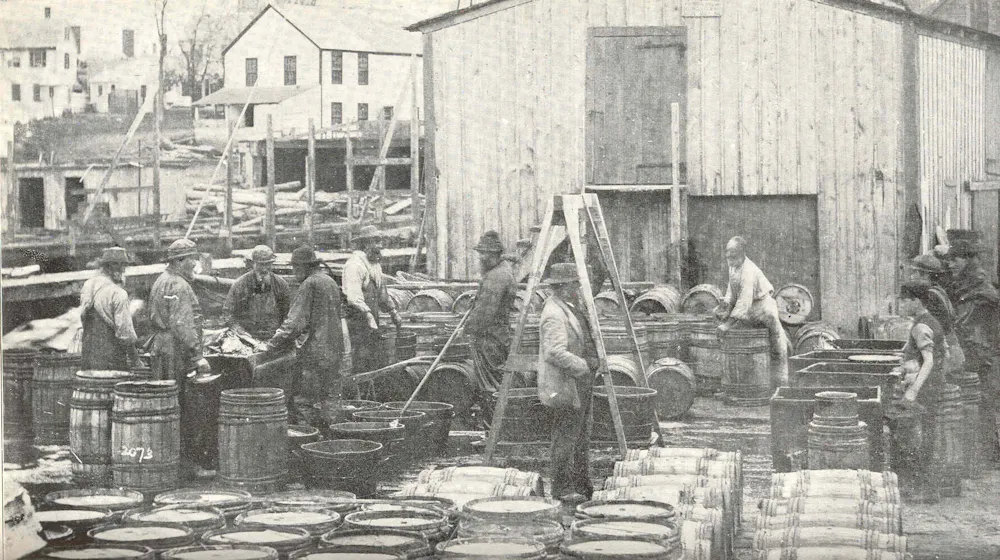
    Fishing has been an integral part of coastal New England culture since its towns were established. In this 1899 photo, a New England community weighs and packs mackerel.
    Charles Stevenson/Freshwater and Marine Image Bank

    Fishing started when the season opened and continued until the catch limit was reached. In some fisheries, this resulted in a “race to the fish” or a “derby,” where vessels competed aggressively to harvest the available catch in short amounts of time. The limit could be reached in a single day, as happened in the Pacific halibut fishery in the late 1980s.

    By the 1990s, however, open access systems were coming under increased criticism from economists as concerns about overfishing rose.

    The fish catch peaked in New England in 1987 and would remain far above what the fish population could sustain for two more decades. Years of overfishing led to the collapse of fish stocks, including North Atlantic cod in 1992 and Pacific sardine in 2015.

    As populations declined, managers responded by cutting catch limits to allow more fish to survive and reproduce. Fishing seasons were shortened, as it took less time for the fleets to harvest the allowed catch. It became increasingly hard for fishermen to catch enough fish to earn a living.

    Saving fisheries changed the industry

    In the early 2000s, as these economic and environmental challenges grew, fisheries managers started limiting access. Instead of allowing anyone to fish, only vessels or individuals meeting certain eligibility requirements would have the right to fish.

    The most common method of limiting access in the U.S. is through limited entry permits, initially awarded to individuals or vessels based on previous participation or success in the fishery. Another approach is to assign individual harvest quotas or “catch shares” to permit holders, limiting how much each boat can bring in.

    In 2007, Congress amended the 1976 Magnuson-Stevens Fishery Conservation and Management Act to promote the use of limited access programs in U.S. fisheries.

    Ships in the fleet out of New Bedford, Mass.
    Henry Zbyszynski/Flickr, CC BY

    Today, limited access is common, and there are positive signs that the management change is helping achieve the law’s environmental goal of preventing overfishing. Since 2000, the populations of 50 major fishing stocks have been rebuilt, meaning they have recovered to a level that can once again support fishing.

    I’ve been following the changes as a lawyer focused on ocean and coastal issues, and I see much work still to be done.

    Forty fish stocks are currently being managed under rebuilding plans that limit catch to allow the stock to grow, including Atlantic cod, which has struggled to recover due to a complex combination of factors, including climatic changes.

    The lingering effect on communities today

    While many fish stocks have recovered, the effort came at an economic cost to many individual fishermen. The limited-access Northeast groundfish fishery, which includes Atlantic cod, haddock and flounder, shed nearly 800 crew positions between 2007 and 2015.

    The loss of jobs and revenue from fishing impacts individual family income and relationships, strains other businesses in fishing communities, and affects those communities’ overall identity and resilience, as illustrated by a recent economic snapshot of the Alaska seafood industry.

    When original limited-access permit holders leave the business – for economic, personal or other reasons – their permits are either terminated or sold to other eligible permit holders, leading to fewer active vessels in the fleet. As a result, the number of vessels fishing for groundfish has declined from 719 in 2007 to 194 in 2023, meaning fewer jobs.

    A fisherman unloads a portion of his catch for the day of 300 pounds of groundfish, including flounder, in January 2006 in Gloucester, Mass.
    AP Photo/Lisa Poole

    Because of their scarcity, limited-access permits can cost upward of US$500,000, which is often beyond the financial means of a small businesses or a young person seeking to enter the industry. The high prices may also lead retiring fishermen to sell their permits, as opposed to passing them along with the vessels to the next generation.

    These economic forces have significantly altered the fishing industry, leading to more corporate and investor ownership, rather than the family-owned operations that were more common in the Andrea Gail’s time.

    Similar to the experience of small family farms, fishing captains and crews are being pushed into corporate arrangements that reduce their autonomy and revenues.

    Consolidation can threaten the future of entire fleets, as New Bedford, Massachusetts, saw when Blue Harvest Fisheries, backed by a private equity firm, bought up vessels and other assets and then declared bankruptcy a few years later, leaving a smaller fleet and some local business and fishermen unpaid for their work. A company with local connections bought eight vessels from Blue Harvest along with 48 state and federal permits the company held.

    New challenges and unchanging risks

    While there are signs of recovery for New England’s fisheries, challenges continue.

    Warming water temperatures have shifted the distribution of some species, affecting where and when fish are harvested. For example, lobsters have moved north toward Canada. When vessels need to travel farther to find fish, that increases fuel and supply costs and time away from home.

    Fisheries managers will need to continue to adapt to keep New England’s fisheries healthy and productive.

    One thing that, unfortunately, hasn’t changed is the dangerous nature of the occupation. Between 2000 and 2019, 414 fishermen died in 245 disasters.

    Stephanie Otts receives funding from the NOAA National Sea Grant College Program through the U.S. Department of Commerce. Previous support for fisheries management legal research provided by The Nature Conservancy.

    – ref. Checking in on New England’s fishing industry 25 Years after ‘The Perfect Storm’ hit movie theaters – https://theconversation.com/checking-in-on-new-englands-fishing-industry-25-years-after-the-perfect-storm-hit-movie-theaters-255076

    MIL OSI Analysis –

    June 28, 2025
  • MIL-OSI Analysis: Hurricane Helene set up future disasters, from landslides to flooding – cascading hazards like these are now upending risk models

    Source: The Conversation – USA – By Brian J. Yanites, Associate Professor of Earth and Atmospheric Science. Professor of Surficial and Sedimentary Geology, Indiana University

    The Carter Lodge hangs precariously over the flood-scoured bank of the Broad River in Chimney Rock Village, N.C., on May 13, 2025, eight months after Hurricane Helene. AP Photo/Allen G. Breed

    Hurricane Helene lasted only a few days in September 2024, but it altered the landscape of the Southeastern U.S. in profound ways that will affect the hazards local residents face far into the future.

    Mudslides buried roads and reshaped river channels. Uprooted trees left soil on hillslopes exposed to the elements. Sediment that washed into rivers changed how water flows through the landscape, leaving some areas more prone to flooding and erosion.

    Helene was a powerful reminder that natural hazards don’t disappear when the skies clear – they evolve.

    These transformations are part of what scientists call cascading hazards. They occur when one natural event alters the landscape in ways that lead to future hazards. A landslide triggered by a storm might clog a river, leading to downstream flooding months or years later. A wildfire can alter the soil and vegetation, setting the stage for debris flows with the next rainstorm.

    Satellite images before (top) and after Hurricane Helene (bottom) show how the storm altered landscape near Pensacola, N.C., in the Blue Ridge Mountains.
    Google Earth, CC BY

    I study these disasters as a geomorphologist. In a new paper in the journal Science, I and a team of scientists from 18 universities and the U.S. Geological Survey explain why hazard models – used to help communities prepare for disasters – can’t just rely on the past. Instead, they need to be nimble enough to forecast how hazards evolve in real time.

    The science behind cascading hazards

    Cascading hazards aren’t random. They emerge from physical processes that operate continuously across the landscape – sediment movement, weathering, erosion. Together, the atmosphere, biosphere and the earth are constantly reshaping the conditions that cause natural disasters.

    For instance, earthquakes fracture rock and shake loose soil. Even if landslides don’t occur during the quake itself, the ground may be weakened, leaving it primed for failure during later rainstorms.

    That’s exactly what happened after the 2008 earthquake in Sichuan Province, China, which led to a surge in debris flows long after the initial seismic event.

    A strong aftershock after a 7.8 magnitude earthquake in Sichuan province, China, in May 2008 triggered more landslides in central China.
    AP Photo/Andy Wong

    Earth’s surface retains a “memory” of these events. Sediment disturbed in an earthquake, wildfire or severe storm will move downslope over years or even decades, reshaping the landscape as it goes.

    The 1950 Assam earthquake in India is a striking example: It triggered thousands of landslides. The sediment from these landslides gradually moved through the river system, eventually causing flooding and changing river channels in Bangladesh some 20 years later.

    An intensifying threat in a changing world

    These risks present challenges for everything from emergency planning to home insurance. After repeated wildfire-mudslide combinations in California, some insurers pulled out of the state entirely, citing mounting risks and rising costs among the reasons.

    Cascading hazards are not new, but their impact is intensifying.

    Climate change is increasing the frequency and severity of wildfires, storms and extreme rainfall. At the same time, urban development continues to expand into steep, hazard-prone terrain, exposing more people and infrastructure to evolving risks.

    The rising risk of interconnected climate disasters like these is overwhelming systems built for isolated events.

    Yet climate change is only part of the equation. Earth processes – such as earthquakes and volcanic eruptions – also trigger cascading hazards, often with long-lasting effects.

    Mount St. Helens is a powerful example: More than four decades after its eruption in 1980, the U.S. Army Corps of Engineers continues to manage ash and sediment from the eruption to keep it from filling river channels in ways that could increase the flood risk in downstream communities.

    Rethinking risk and building resilience

    Traditionally, insurance companies and disaster managers have estimated hazard risk by looking at past events.

    But when the landscape has changed, the past may no longer be a reliable guide to the future. To address this, computer models based on the physics of how these events work are needed to help forecast hazard evolution in real time, much like weather models update with new atmospheric data.

    A March 2024 landslide in the Oregon Coast Range wiped out trees in its path.
    Brian Yanites, June 2025
    A drone image of the same March 2024 landslide in the Oregon Coast Range shows where it temporarily dammed the river below.
    Brian Yanites, June 2025

    Thanks to advances in Earth observation technology, such as satellite imagery, drone and lidar, which is similar to radar but uses light, scientists can now track how hillslopes, rivers and vegetation change after disasters. These observations can feed into geomorphic models that simulate how loosened sediment moves and where hazards are likely to emerge next.

    Researchers are already coupling weather forecasts with post-wildfire debris flow models. Other models simulate how sediment pulses travel through river networks.

    Cascading hazards reveal that Earth’s surface is not a passive backdrop, but an active, evolving system. Each event reshapes the stage for the next.

    Understanding these connections is critical for building resilience so communities can withstand future storms, earthquakes and the problems created by debris flows. Better forecasts can inform building codes, guide infrastructure design and improve how risk is priced and managed. They can help communities anticipate long-term threats and adapt before the next disaster strikes.

    Most importantly, they challenge everyone to think beyond the immediate aftermath of a disaster – and to recognize the slow, quiet transformations that build toward the next.

    Brian J. Yanites receives funding from the National Science Foundation.

    – ref. Hurricane Helene set up future disasters, from landslides to flooding – cascading hazards like these are now upending risk models – https://theconversation.com/hurricane-helene-set-up-future-disasters-from-landslides-to-flooding-cascading-hazards-like-these-are-now-upending-risk-models-259502

    MIL OSI Analysis –

    June 28, 2025
  • MIL-OSI Analysis: Natural disasters don’t disappear when the storm ends or the earthquake stops – they evolve

    Source: The Conversation – USA – By Brian J. Yanites, Associate Professor of Earth and Atmospheric Science. Professor of Surficial and Sedimentary Geology, Indiana University

    The Carter Lodge hangs precariously over the flood-scoured bank of the Broad River in Chimney Rock Village, N.C., on May 13, 2025, eight months after Hurricane Helene. AP Photo/Allen G. Breed

    Hurricane Helene lasted only a few days in September 2024, but it altered the landscape of the Southeastern U.S. in profound ways that will affect the hazards local residents face far into the future.

    Mudslides buried roads and reshaped river channels. Uprooted trees left soil on hillslopes exposed to the elements. Sediment that washed into rivers changed how water flows through the landscape, leaving some areas more prone to flooding and erosion.

    Helene was a powerful reminder that natural hazards don’t disappear when the skies clear – they evolve.

    These transformations are part of what scientists call cascading hazards. They occur when one natural event alters the landscape in ways that lead to future hazards. A landslide triggered by a storm might clog a river, leading to downstream flooding months or years later. A wildfire can alter the soil and vegetation, setting the stage for debris flows with the next rainstorm.

    Satellite images before (top) and after Hurricane Helene (bottom) show how the storm altered landscape near Pensacola, N.C., in the Blue Ridge Mountains.
    Google Earth, CC BY

    I study these disasters as a geomorphologist. In a new paper in the journal Science, I and a team of scientists from 18 universities and the U.S. Geological Survey explain why hazard models – used to help communities prepare for disasters – can’t just rely on the past. Instead, they need to be nimble enough to forecast how hazards evolve in real time.

    The science behind cascading hazards

    Cascading hazards aren’t random. They emerge from physical processes that operate continuously across the landscape – sediment movement, weathering, erosion. Together, the atmosphere, biosphere and the earth are constantly reshaping the conditions that cause natural disasters.

    For instance, earthquakes fracture rock and shake loose soil. Even if landslides don’t occur during the quake itself, the ground may be weakened, leaving it primed for failure during later rainstorms.

    That’s exactly what happened after the 2008 earthquake in Sichuan Province, China, which led to a surge in debris flows long after the initial seismic event.

    A strong aftershock after a 7.8 magnitude earthquake in Sichuan province, China, in May 2008 triggered more landslides in central China.
    AP Photo/Andy Wong

    Earth’s surface retains a “memory” of these events. Sediment disturbed in an earthquake, wildfire or severe storm will move downslope over years or even decades, reshaping the landscape as it goes.

    The 1950 Assam earthquake in India is a striking example: It triggered thousands of landslides. The sediment from these landslides gradually moved through the river system, eventually causing flooding and changing river channels in Bangladesh some 20 years later.

    An intensifying threat in a changing world

    These risks present challenges for everything from emergency planning to home insurance. After repeated wildfire-mudslide combinations in California, some insurers pulled out of the state entirely, citing mounting risks and rising costs among the reasons.

    Cascading hazards are not new, but their impact is intensifying.

    Climate change is increasing the frequency and severity of wildfires, storms and extreme rainfall. At the same time, urban development continues to expand into steep, hazard-prone terrain, exposing more people and infrastructure to evolving risks.

    The rising risk of interconnected climate disasters like these is overwhelming systems built for isolated events.

    Yet climate change is only part of the equation. Earth processes – such as earthquakes and volcanic eruptions – also trigger cascading hazards, often with long-lasting effects.

    Mount St. Helens is a powerful example: More than four decades after its eruption in 1980, the U.S. Army Corps of Engineers continues to manage ash and sediment from the eruption to keep it from filling river channels in ways that could increase the flood risk in downstream communities.

    Rethinking risk and building resilience

    Traditionally, insurance companies and disaster managers have estimated hazard risk by looking at past events.

    But when the landscape has changed, the past may no longer be a reliable guide to the future. To address this, computer models based on the physics of how these events work are needed to help forecast hazard evolution in real time, much like weather models update with new atmospheric data.

    A March 2024 landslide in the Oregon Coast Range wiped out trees in its path.
    Brian Yanites, June 2025
    A drone image of the same March 2024 landslide in the Oregon Coast Range shows where it temporarily dammed the river below.
    Brian Yanites, June 2025

    Thanks to advances in Earth observation technology, such as satellite imagery, drone and lidar, which is similar to radar but uses light, scientists can now track how hillslopes, rivers and vegetation change after disasters. These observations can feed into geomorphic models that simulate how loosened sediment moves and where hazards are likely to emerge next.

    Researchers are already coupling weather forecasts with post-wildfire debris flow models. Other models simulate how sediment pulses travel through river networks.

    Cascading hazards reveal that Earth’s surface is not a passive backdrop, but an active, evolving system. Each event reshapes the stage for the next.

    Understanding these connections is critical for building resilience so communities can withstand future storms, earthquakes and the problems created by debris flows. Better forecasts can inform building codes, guide infrastructure design and improve how risk is priced and managed. They can help communities anticipate long-term threats and adapt before the next disaster strikes.

    Most importantly, they challenge everyone to think beyond the immediate aftermath of a disaster – and to recognize the slow, quiet transformations that build toward the next.

    Brian J. Yanites receives funding from the National Science Foundation.

    – ref. Natural disasters don’t disappear when the storm ends or the earthquake stops – they evolve – https://theconversation.com/natural-disasters-dont-disappear-when-the-storm-ends-or-the-earthquake-stops-they-evolve-259502

    MIL OSI Analysis –

    June 28, 2025
  • MIL-OSI Analysis: Natural disasters don’t disappear when the storm ends or the earthquake stops – they evolve

    Source: The Conversation – USA – By Brian J. Yanites, Associate Professor of Earth and Atmospheric Science. Professor of Surficial and Sedimentary Geology, Indiana University

    The Carter Lodge hangs precariously over the flood-scoured bank of the Broad River in Chimney Rock Village, N.C., on May 13, 2025, eight months after Hurricane Helene. AP Photo/Allen G. Breed

    Hurricane Helene lasted only a few days in September 2024, but it altered the landscape of the Southeastern U.S. in profound ways that will affect the hazards local residents face far into the future.

    Mudslides buried roads and reshaped river channels. Uprooted trees left soil on hillslopes exposed to the elements. Sediment that washed into rivers changed how water flows through the landscape, leaving some areas more prone to flooding and erosion.

    Helene was a powerful reminder that natural hazards don’t disappear when the skies clear – they evolve.

    These transformations are part of what scientists call cascading hazards. They occur when one natural event alters the landscape in ways that lead to future hazards. A landslide triggered by a storm might clog a river, leading to downstream flooding months or years later. A wildfire can alter the soil and vegetation, setting the stage for debris flows with the next rainstorm.

    Satellite images before (top) and after Hurricane Helene (bottom) show how the storm altered landscape near Pensacola, N.C., in the Blue Ridge Mountains.
    Google Earth, CC BY

    I study these disasters as a geomorphologist. In a new paper in the journal Science, I and a team of scientists from 18 universities and the U.S. Geological Survey explain why hazard models – used to help communities prepare for disasters – can’t just rely on the past. Instead, they need to be nimble enough to forecast how hazards evolve in real time.

    The science behind cascading hazards

    Cascading hazards aren’t random. They emerge from physical processes that operate continuously across the landscape – sediment movement, weathering, erosion. Together, the atmosphere, biosphere and the earth are constantly reshaping the conditions that cause natural disasters.

    For instance, earthquakes fracture rock and shake loose soil. Even if landslides don’t occur during the quake itself, the ground may be weakened, leaving it primed for failure during later rainstorms.

    That’s exactly what happened after the 2008 earthquake in Sichuan Province, China, which led to a surge in debris flows long after the initial seismic event.

    A strong aftershock after a 7.8 magnitude earthquake in Sichuan province, China, in May 2008 triggered more landslides in central China.
    AP Photo/Andy Wong

    Earth’s surface retains a “memory” of these events. Sediment disturbed in an earthquake, wildfire or severe storm will move downslope over years or even decades, reshaping the landscape as it goes.

    The 1950 Assam earthquake in India is a striking example: It triggered thousands of landslides. The sediment from these landslides gradually moved through the river system, eventually causing flooding and changing river channels in Bangladesh some 20 years later.

    An intensifying threat in a changing world

    These risks present challenges for everything from emergency planning to home insurance. After repeated wildfire-mudslide combinations in California, some insurers pulled out of the state entirely, citing mounting risks and rising costs among the reasons.

    Cascading hazards are not new, but their impact is intensifying.

    Climate change is increasing the frequency and severity of wildfires, storms and extreme rainfall. At the same time, urban development continues to expand into steep, hazard-prone terrain, exposing more people and infrastructure to evolving risks.

    The rising risk of interconnected climate disasters like these is overwhelming systems built for isolated events.

    Yet climate change is only part of the equation. Earth processes – such as earthquakes and volcanic eruptions – also trigger cascading hazards, often with long-lasting effects.

    Mount St. Helens is a powerful example: More than four decades after its eruption in 1980, the U.S. Army Corps of Engineers continues to manage ash and sediment from the eruption to keep it from filling river channels in ways that could increase the flood risk in downstream communities.

    Rethinking risk and building resilience

    Traditionally, insurance companies and disaster managers have estimated hazard risk by looking at past events.

    But when the landscape has changed, the past may no longer be a reliable guide to the future. To address this, computer models based on the physics of how these events work are needed to help forecast hazard evolution in real time, much like weather models update with new atmospheric data.

    A March 2024 landslide in the Oregon Coast Range wiped out trees in its path.
    Brian Yanites, June 2025
    A drone image of the same March 2024 landslide in the Oregon Coast Range shows where it temporarily dammed the river below.
    Brian Yanites, June 2025

    Thanks to advances in Earth observation technology, such as satellite imagery, drone and lidar, which is similar to radar but uses light, scientists can now track how hillslopes, rivers and vegetation change after disasters. These observations can feed into geomorphic models that simulate how loosened sediment moves and where hazards are likely to emerge next.

    Researchers are already coupling weather forecasts with post-wildfire debris flow models. Other models simulate how sediment pulses travel through river networks.

    Cascading hazards reveal that Earth’s surface is not a passive backdrop, but an active, evolving system. Each event reshapes the stage for the next.

    Understanding these connections is critical for building resilience so communities can withstand future storms, earthquakes and the problems created by debris flows. Better forecasts can inform building codes, guide infrastructure design and improve how risk is priced and managed. They can help communities anticipate long-term threats and adapt before the next disaster strikes.

    Most importantly, they challenge everyone to think beyond the immediate aftermath of a disaster – and to recognize the slow, quiet transformations that build toward the next.

    Brian J. Yanites receives funding from the National Science Foundation.

    – ref. Natural disasters don’t disappear when the storm ends or the earthquake stops – they evolve – https://theconversation.com/natural-disasters-dont-disappear-when-the-storm-ends-or-the-earthquake-stops-they-evolve-259502

    MIL OSI Analysis –

    June 28, 2025
  • MIL-OSI Analysis: Natural disasters don’t disappear when the storm ends or the earthquake stops – they evolve

    Source: The Conversation – USA – By Brian J. Yanites, Associate Professor of Earth and Atmospheric Science. Professor of Surficial and Sedimentary Geology, Indiana University

    The Carter Lodge hangs precariously over the flood-scoured bank of the Broad River in Chimney Rock Village, N.C., on May 13, 2025, eight months after Hurricane Helene. AP Photo/Allen G. Breed

    Hurricane Helene lasted only a few days in September 2024, but it altered the landscape of the Southeastern U.S. in profound ways that will affect the hazards local residents face far into the future.

    Mudslides buried roads and reshaped river channels. Uprooted trees left soil on hillslopes exposed to the elements. Sediment that washed into rivers changed how water flows through the landscape, leaving some areas more prone to flooding and erosion.

    Helene was a powerful reminder that natural hazards don’t disappear when the skies clear – they evolve.

    These transformations are part of what scientists call cascading hazards. They occur when one natural event alters the landscape in ways that lead to future hazards. A landslide triggered by a storm might clog a river, leading to downstream flooding months or years later. A wildfire can alter the soil and vegetation, setting the stage for debris flows with the next rainstorm.

    Satellite images before (top) and after Hurricane Helene (bottom) show how the storm altered landscape near Pensacola, N.C., in the Blue Ridge Mountains.
    Google Earth, CC BY

    I study these disasters as a geomorphologist. In a new paper in the journal Science, I and a team of scientists from 18 universities and the U.S. Geological Survey explain why hazard models – used to help communities prepare for disasters – can’t just rely on the past. Instead, they need to be nimble enough to forecast how hazards evolve in real time.

    The science behind cascading hazards

    Cascading hazards aren’t random. They emerge from physical processes that operate continuously across the landscape – sediment movement, weathering, erosion. Together, the atmosphere, biosphere and the earth are constantly reshaping the conditions that cause natural disasters.

    For instance, earthquakes fracture rock and shake loose soil. Even if landslides don’t occur during the quake itself, the ground may be weakened, leaving it primed for failure during later rainstorms.

    That’s exactly what happened after the 2008 earthquake in Sichuan Province, China, which led to a surge in debris flows long after the initial seismic event.

    A strong aftershock after a 7.8 magnitude earthquake in Sichuan province, China, in May 2008 triggered more landslides in central China.
    AP Photo/Andy Wong

    Earth’s surface retains a “memory” of these events. Sediment disturbed in an earthquake, wildfire or severe storm will move downslope over years or even decades, reshaping the landscape as it goes.

    The 1950 Assam earthquake in India is a striking example: It triggered thousands of landslides. The sediment from these landslides gradually moved through the river system, eventually causing flooding and changing river channels in Bangladesh some 20 years later.

    An intensifying threat in a changing world

    These risks present challenges for everything from emergency planning to home insurance. After repeated wildfire-mudslide combinations in California, some insurers pulled out of the state entirely, citing mounting risks and rising costs among the reasons.

    Cascading hazards are not new, but their impact is intensifying.

    Climate change is increasing the frequency and severity of wildfires, storms and extreme rainfall. At the same time, urban development continues to expand into steep, hazard-prone terrain, exposing more people and infrastructure to evolving risks.

    The rising risk of interconnected climate disasters like these is overwhelming systems built for isolated events.

    Yet climate change is only part of the equation. Earth processes – such as earthquakes and volcanic eruptions – also trigger cascading hazards, often with long-lasting effects.

    Mount St. Helens is a powerful example: More than four decades after its eruption in 1980, the U.S. Army Corps of Engineers continues to manage ash and sediment from the eruption to keep it from filling river channels in ways that could increase the flood risk in downstream communities.

    Rethinking risk and building resilience

    Traditionally, insurance companies and disaster managers have estimated hazard risk by looking at past events.

    But when the landscape has changed, the past may no longer be a reliable guide to the future. To address this, computer models based on the physics of how these events work are needed to help forecast hazard evolution in real time, much like weather models update with new atmospheric data.

    A March 2024 landslide in the Oregon Coast Range wiped out trees in its path.
    Brian Yanites, June 2025
    A drone image of the same March 2024 landslide in the Oregon Coast Range shows where it temporarily dammed the river below.
    Brian Yanites, June 2025

    Thanks to advances in Earth observation technology, such as satellite imagery, drone and lidar, which is similar to radar but uses light, scientists can now track how hillslopes, rivers and vegetation change after disasters. These observations can feed into geomorphic models that simulate how loosened sediment moves and where hazards are likely to emerge next.

    Researchers are already coupling weather forecasts with post-wildfire debris flow models. Other models simulate how sediment pulses travel through river networks.

    Cascading hazards reveal that Earth’s surface is not a passive backdrop, but an active, evolving system. Each event reshapes the stage for the next.

    Understanding these connections is critical for building resilience so communities can withstand future storms, earthquakes and the problems created by debris flows. Better forecasts can inform building codes, guide infrastructure design and improve how risk is priced and managed. They can help communities anticipate long-term threats and adapt before the next disaster strikes.

    Most importantly, they challenge everyone to think beyond the immediate aftermath of a disaster – and to recognize the slow, quiet transformations that build toward the next.

    Brian J. Yanites receives funding from the National Science Foundation.

    – ref. Natural disasters don’t disappear when the storm ends or the earthquake stops – they evolve – https://theconversation.com/natural-disasters-dont-disappear-when-the-storm-ends-or-the-earthquake-stops-they-evolve-259502

    MIL OSI Analysis –

    June 28, 2025
  • MIL-OSI USA: $200M Boost for Critical Water Infrastructure

    Source: US State of New York

    overnor Kathy Hochul today announced that the Environmental Facilities Corporation Board of Directors approved nearly $200 million in financial assistance for water infrastructure improvement projects across New York State. The Board’s approval authorizes municipal access to low-cost financing and grants to get shovels in the ground for critical water and sewer infrastructure projects, from treatment processes to remove emerging contaminants from drinking water, to replacing lead service lines and modernizing aging systems. These investments protect public health and make projects more affordable, reducing the need for higher rate increases to fund improvements, while also creating good-paying jobs.

    “Clean water is a fundamental right, and New York is leading the way in making sure communities have the resources they need to protect it,” Governor Hochul said. “This funding will help New York City and communities across the state make critical upgrades to aging infrastructure, reduce pollution, and deliver safe, reliable water, while protecting the pockets of New Yorkers.”

    The Board approved a major $50 million investment in New York City, including a $25 million grant from the federal Infrastructure Investment and Jobs Act (IIJA) funding. The grant will be used by New York City exclusively for affordability programs that provide financial assistance to low-income water and sewer customers. The $25 million in interest-free financing will support a stormwater and resiliency project that is a key component of the larger Gowanus Canal Superfund Site cleanup. Construction of underground tanks and a network of improvements will fortify the City’s sewers and reduce combined sewage and stormwater overflows that have polluted the canal for a century.

    Today’s announcement builds on a longstanding State-City partnership that has advanced transformative water and sewer improvements. EFC’s financial assistance over the past 15 years has saved City ratepayers more than $2.7 billion on water infrastructure projects, including more than $400 million in direct grants. Under Governor Hochul’s leadership, the State continues to deliver critical financial resources to complete essential projects, ease the burden on local ratepayers, and build stronger, more resilient neighborhoods for generations to come.

    EFC’s Board approved grants and financings to local governments from the Clean Water and Drinking Water State Revolving Funds – a mix of federal and state dollars dedicated to financing community water infrastructure projects. State Revolving Fund interest rates are below market rate, and with long repayment periods, communities may save significantly on debt service compared to traditional financing. IIJA funding bolstered the State Revolving Funds and accelerated progress on essential clean water and drinking water projects.

    The Board also approved executing previously awarded State grants from the Water Infrastructure Improvement and Lead Infrastructure Forgiveness and Transformation programs. EFC Board approval is a critical step in the funding process and will allow communities to access these funds for project implementation. Leveraging federal funding with state investments maximizes the impact of each dollar spent, empowering local communities to make critical system improvements they need to keep their residents safe and ensuring cost is not a barrier for project implementation.

    Environmental Facilities Corporation President & CEO Maureen A. Coleman said, “Under Governor Hochul’s leadership, we are making historic investments that help communities take on complex, long-needed infrastructure projects without overburdening local ratepayers. Today’s announcement underscores the State’s unwavering commitment to affordable drinking water and wastewater service in New York City and communities statewide. We’re not just financing construction—we’re helping to deliver a cleaner, greener, more resilient future that New Yorkers deserve.”

    New York State Department of Environmental Conservation Commissioner Amanda Lefton said, “Investing in local water infrastructure and ensuring all communities have access to clean water is a top priority for New York. Across the state, municipalities large and small are challenged by aging water mains, crumbling wastewater treatment facilities, and outdated sewer systems. Governor Hochul continues to make generational investments that will help communities address critical infrastructure needs and protect water quality, water quantity, and our environment while keeping costs down for cash-strapped municipalities and New Yorkers.”

    New York State Health Commissioner Dr. James McDonald said, “Governor Hochul has made it clear that access to safe, clean drinking water is a top priority. This latest round of funding helps ensure those critical projects—like removing emerging contaminants—are both an affordable and achievable reality for communities across New York State. The State Health Department will continue to work with local municipalities and our state partners to make sure the water coming from the tap is safe and healthy for all New Yorkers.”

    New York State Secretary of State Walter T. Mosley said, “Governor Hochul recognizes that clean water infrastructure is vital to public health, economic development and community quality of life. The Governor’s visionary commitment of $200 million in low-cost financing and grants provides local governments with the support they need to become more resilient, sustainable and prosperous well into the future.”

    Senator Charles Schumer said, “Everyone deserves access to clean drinking water. These major federal investments will ensure families from Chautauqua to Port Washington have safe drinking water and our beautiful waterways stay clean, all while creating new good-paying jobs, jobs, jobs. I am proud to deliver millions in federal funding and will fight to preserve funding to modernize drinking water and water-sewer systems in the upcoming budget. I am grateful for Governor Hochul’s partnership in the fight to turn the tide on our state’s aging water infrastructure to keep our communities safe and healthy.”

    Representative Grace Meng said, “From combating flooding to ensuring clean drinking water, upgrading our water infrastructure is a crucial investment in our state’s future, and I’m always proud to fight for funding that makes these types of projects possible. I thank Governor Hochul for her leadership and helping to make needed improvements happen across New York.”

    Representative Joe Morelle said, “Everyone deserves to have confidence that the water from their kitchen faucet is clean and safe to use. In Washington, I’m always fighting for projects that support our community’s health and wellbeing. I’m grateful to Governor Hochul for her continued leadership and partnership in building a healthier New York for all.”

    Representative Tom Suozzi said, “The Governor and the state are effectively delivering essential funds to New York’s local water providers from the Bipartisan Infrastructure Law, which I helped negotiate as a member of the Problem Solvers Caucus. The Port Washington project is a crucial investment that will enhance and protect our water infrastructure for future generations while reducing the financial burden on our local taxpayers. I will continue to work with the state to try and bring vital federal resources back to New York.”

    Representative Pat Ryan said, “The freedom to drink clean water is fundamentally American. Our community has been pushing hard to ensure that every Hudson Valley family – especially our kids – has access to clean, safe drinking water. We’ve made real progress, including in Poughkeepsie. Last year, I was proud to work with the Governor to secure critical funds for lead pipe removal in Poughkeepsie. This funding is another step towards ensuring clean water for all, and I thank the Governor and all our partners for their advocacy and commitment to Hudson Valley public health.”

    State Senator Pete Harckham said, “This major investment from the state ensures public health standards while supporting local municipalities. Maintaining safe, accessible drinking water sources and supply systems is integral to future growth and prosperity, and I thank Governor Hochul, my colleagues in the State Legislature and the New York State Environmental Facilities Corporation for making the financial commitment to see this through.”

    Assemblymember Deborah J. Glick said, “Communities across New York are facing mounting challenges when it comes to water infrastructure—whether it’s combating contaminants like PFAS, repairing aging water and sewer systems, or replacing lead service lines. This critical funding provides much-needed support to local governments working to protect public health and ensure clean, safe water. I’m especially grateful that $50 million has been directed to support infrastructure improvements in New York City, and I thank Governor Hochul for her continued leadership in prioritizing these essential investments.”

    New York City Department of Environmental Protection Commissioner Rohit T. Aggarwala said, “New York City is home to nearly half of the State’s population and will make full and beneficial use of this grant and financing, which will help the people of Gowanus as well as low-income water customers across the five boroughs. This commitment from the State represents a new and positive development in the collaboration between EFC and DEP and I’m grateful for this partnership.”

    Funding was approved for projects in the following regions:

    Finger Lakes

    • Town of Leroy – $5 million grant for the formation of Water District No. 12, including installation of approximately 173,000 linear feet of water mains and appurtenances including hydrants, valves, and service meters.
    • Town of Milo – $366,000 grant for the installation of 4,600 linear feet of water main, gate valves, hydrants, meters, and additional appurtenances along NYS Route 54 to form Water District No. 4.
    • City of Rochester – $24 million for the replacement of 3,269 lead service lines, approximately 14% of the total lead and galvanized services lines in the water system. Rochester is one of 12 municipalities to receive a State grant as well as federal IIJA grants and interest-free financing for lead service line replacement. The State grant will reimburse costs that were not fully covered by IIJA grants, so upon completion of this project, the City won’t have to pay back the financing.

    Long Island

    • Village of Farmingdale – $4.6 million grant for the installation of an advanced oxidation process treatment system for the removal of 1,4-dioxane and a granular activated carbon treatment system for removal of PFOA and PFOS at the Ridge Road Well Site Plant No. 2.
    • Port Washington Water District – $5 million in grants for the construction of a granular activated carbon treatment system for the removal of PFOA and PFOS from Hewlett Well No. 4.
    • Suffolk County Water Authority – $1.5 million grant for the installation of approximately 7,500 linear feet of water main, gate valves, hydrants, meters, and additional appurtenances to provide public water to homes with contaminated private wells along Old Country Road.

    Mid-Hudson

    • City of Poughkeepsie – $6.7 million grant and low-cost financing package for the rehabilitation of the Fallkill Trunk portion of the sanitary sewer collection system.

    North Country

    • Village of Port Leyden – $8 million grant and interest-free financing package for the replacement of approximately 18,000 linear feet of water main and associated appurtenances, replacement of water meters, and water treatment plant upgrades.

    New York City

    • New York City Municipal Water Finance Authority – $50 million grant and interest-free financing package for the planning, design, and construction of the Gowanus Canal combined sewer overflow abatement facilities.

    Western New York

    • Village of Andover – $1.4 million grant for the development of a new groundwater well to provide needed source redundancy and replace an existing noncompliant spring source. The Board previously approved an interest-free financing in addition to the grant to support this project.
    • Town of Chautauqua – $7.7 million grant and interest-free financing package for the development of two new groundwater wells and a new treatment plant to replace the existing water source and treatment plant, and installation of approximately 14,000 linear feet of transmission and distribution water mains to extend the water district and serve 345 new residences that are currently dependent on private wells.
    • Town of Clymer – $10.5 million grant and interest-free financing package for the development and installation of a new ground water well to provide additional source capacity, replacement of approximately 26,000 linear feet of watermains, valves, hydrants, and appurtenances and a new 200,000-gallon water storage tank to replace a deteriorated tank.
    • Town of Ellicott – $6.4 million in grants for the design and construction of a sewer district extension.
    • Town of Randolph – $4.5 million grant and low-cost financing package for the planning, design, and construction of wastewater treatment plant improvements.
    • Town of Westfield – $9.5 million grant and interest-free financing for the design and construction of wastewater treatment plant and collection system improvements.

    Refinancing Completed Projects Will Achieve Long-Term Debt Service Savings
    The Board also took action to help ensure continued, long-term affordability of existing projects. EFC provides short-term financing for design and construction of projects. Once project construction is completed, the short-term financing is typically refinanced to long-term financing for up to 30 years. Based on current market conditions, these long-term interest-free financings are projected to save local ratepayers an estimated $51 million in interest payments over the life of the financings.

    The Board approved long-term financing for projects undertaken by communities in the following regions:

    Mohawk Valley

    • Village of Middleburgh – $2.5 million long-term interest-free financing for the planning, design, and construction of upgrades to the wastewater treatment plant.

    New York City

    • New York City Municipal Water Finance Authority – $42 million long-term interest-free financing for the design and construction of new engine generators to utilize digester gas and natural gas to cogenerate power and heat for on-site use at the North River Water Resource Recovery Facility.

    North Country

    • Village of Lowville – $9.3 million long-term interest-free financing for the planning, design, and construction of wastewater treatment plant improvements.

    New York’s Commitment to Water Quality
    New York State continues to increase its nation-leading investments in water infrastructure, including more than $2.2 billion in financial assistance from EFC for local water infrastructure projects in State Fiscal Year 2024 alone. The next round of EFC’s Water Infrastructure Improvement and Intermunicipal Water Infrastructure Grants is now open at www.efc.ny.gov. Governor Hochul has announced $325 million for this round.

    With $500 million allocated for clean water infrastructure in the FY26 Enacted Budget announced by Governor Hochul, New York will have invested a total of $6 billion in water infrastructure between 2017 and this year. Any community needing assistance with water infrastructure projects is encouraged to contact EFC. New Yorkers can track projects benefiting from EFC’s investments using the interactive project impact dashboard.

    MIL OSI USA News –

    June 28, 2025
  • MIL-OSI Analysis: Cascading disasters like those created by Hurricane Helene show why hazard models can’t rely on the past

    Source: The Conversation – USA – By Brian J. Yanites, Associate Professor of Earth and Atmospheric Science. Professor of Surficial and Sedimentary Geology, Indiana University

    The Carter Lodge hangs precariously over the flood-scoured bank of the Broad River in Chimney Rock Village, N.C., on May 13, 2025, eight months after Hurricane Helene. AP Photo/Allen G. Breed

    Hurricane Helene lasted only a few days in September 2024, but it altered the landscape of the Southeastern U.S. in profound ways that will affect the hazards local residents face far into the future.

    Mudslides buried roads and reshaped river channels. Uprooted trees left soil on hillslopes exposed to the elements. Sediment that washed into rivers changed how water flows through the landscape, leaving some areas more prone to flooding and erosion.

    Helene was a powerful reminder that natural hazards don’t disappear when the skies clear – they evolve.

    These transformations are part of what scientists call cascading hazards. They occur when one natural event alters the landscape in ways that lead to future hazards. A landslide triggered by a storm might clog a river, leading to downstream flooding months or years later. A wildfire can alter the soil and vegetation, setting the stage for debris flows with the next rainstorm.

    Satellite images before (top) and after Hurricane Helene (bottom) show how the storm altered landscape near Pensacola, N.C., in the Blue Ridge Mountains.
    Google Earth, CC BY

    I study these disasters as a geomorphologist. In a new paper in the journal Science, I and a team of scientists from 18 universities and the U.S. Geological Survey explain why hazard models – used to help communities prepare for disasters – can’t just rely on the past. Instead, they need to be nimble enough to forecast how hazards evolve in real time.

    The science behind cascading hazards

    Cascading hazards aren’t random. They emerge from physical processes that operate continuously across the landscape – sediment movement, weathering, erosion. Together, the atmosphere, biosphere and the earth are constantly reshaping the conditions that cause natural disasters.

    For instance, earthquakes fracture rock and shake loose soil. Even if landslides don’t occur during the quake itself, the ground may be weakened, leaving it primed for failure during later rainstorms.

    That’s exactly what happened after the 2008 earthquake in Sichuan Province, China, which led to a surge in debris flows long after the initial seismic event.

    A strong aftershock after a 7.8 magnitude earthquake in Sichuan province, China, in May 2008 triggered more landslides in central China.
    AP Photo/Andy Wong

    Earth’s surface retains a “memory” of these events. Sediment disturbed in an earthquake, wildfire or severe storm will move downslope over years or even decades, reshaping the landscape as it goes.

    The 1950 Assam earthquake in India is a striking example: It triggered thousands of landslides. The sediment from these landslides gradually moved through the river system, eventually causing flooding and changing river channels in Bangladesh some 20 years later.

    An intensifying threat in a changing world

    These risks present challenges for everything from emergency planning to home insurance. After repeated wildfire-mudslide combinations in California, some insurers pulled out of the state entirely, citing mounting risks and rising costs among the reasons.

    Cascading hazards are not new, but their impact is intensifying.

    Climate change is increasing the frequency and severity of wildfires, storms and extreme rainfall. At the same time, urban development continues to expand into steep, hazard-prone terrain, exposing more people and infrastructure to evolving risks.

    The rising risk of interconnected climate disasters like these is overwhelming systems built for isolated events.

    Yet climate change is only part of the equation. Earth processes – such as earthquakes and volcanic eruptions – also trigger cascading hazards, often with long-lasting effects.

    Mount St. Helens is a powerful example: More than four decades after its eruption in 1980, the U.S. Army Corps of Engineers continues to manage ash and sediment from the eruption to keep it from filling river channels in ways that could increase the flood risk in downstream communities.

    Rethinking risk and building resilience

    Traditionally, insurance companies and disaster managers have estimated hazard risk by looking at past events.

    But when the landscape has changed, the past may no longer be a reliable guide to the future. To address this, computer models based on the physics of how these events work are needed to help forecast hazard evolution in real time, much like weather models update with new atmospheric data.

    A March 2024 landslide in the Oregon Coast Range wiped out trees in its path.
    Brian Yanites, June 2025
    A drone image of the same March 2024 landslide in the Oregon Coast Range shows where it temporarily dammed the river below.
    Brian Yanites, June 2025

    Thanks to advances in Earth observation technology, such as satellite imagery, drone and lidar, which is similar to radar but uses light, scientists can now track how hillslopes, rivers and vegetation change after disasters. These observations can feed into geomorphic models that simulate how loosened sediment moves and where hazards are likely to emerge next.

    Researchers are already coupling weather forecasts with post-wildfire debris flow models. Other models simulate how sediment pulses travel through river networks.

    Cascading hazards reveal that Earth’s surface is not a passive backdrop, but an active, evolving system. Each event reshapes the stage for the next.

    Understanding these connections is critical for building resilience so communities can withstand future storms, earthquakes and the problems created by debris flows. Better forecasts can inform building codes, guide infrastructure design and improve how risk is priced and managed. They can help communities anticipate long-term threats and adapt before the next disaster strikes.

    Most importantly, they challenge everyone to think beyond the immediate aftermath of a disaster – and to recognize the slow, quiet transformations that build toward the next.

    Brian J. Yanites receives funding from the National Science Foundation.

    – ref. Cascading disasters like those created by Hurricane Helene show why hazard models can’t rely on the past – https://theconversation.com/cascading-disasters-like-those-created-by-hurricane-helene-show-why-hazard-models-cant-rely-on-the-past-259502

    MIL OSI Analysis –

    June 28, 2025
  • MIL-OSI Analysis: Toxic algae blooms are lasting longer in Lake Erie − why that’s a worry for people and pets

    Source: The Conversation – USA – By Gregory J. Dick, Professor of Biology, University of Michigan

    A satellite image from Aug. 13, 2024, shows an algal bloom covering approximately 320 square miles (830 square km) of Lake Erie. By Aug. 22, it had nearly doubled in size. NASA Earth Observatory

    Federal scientists released their annual forecast for Lake Erie’s harmful algal blooms on June 26, 2025, and they expect a mild to moderate season. However, anyone who comes in contact with the blooms can face health risks, and it’s worth remembering that 2014, when toxins from algae blooms contaminated the water supply in Toledo, Ohio, was considered a moderate year, too.

    We asked Gregory J. Dick, who leads the Cooperative Institute for Great Lakes Research, a federally funded center at the University of Michigan that studies harmful algal blooms among other Great Lakes issues, why they’re such a concern.

    The National Oceanic and Atmospheric Administration’s prediction for harmful algal bloom severity in Lake Erie compared with past years.
    NOAA

    1. What causes harmful algal blooms?

    Harmful algal blooms are dense patches of excessive algae growth that can occur in any type of water body, including ponds, reservoirs, rivers, lakes and oceans. When you see them in freshwater, you’re typically seeing cyanobacteria, also known as blue-green algae.

    These photosynthetic bacteria have inhabited our planet for billions of years. In fact, they were responsible for oxygenating Earth’s atmosphere, which enabled plant and animal life as we know it.

    The leading source of harmful algal blooms today is nutrient runoff from fertilized farm fields.
    Michigan Sea Grant

    Algae are natural components of ecosystems, but they cause trouble when they proliferate to high densities, creating what we call blooms.

    Harmful algal blooms form scums at the water surface and produce toxins that can harm ecosystems, water quality and human health. They have been reported in all 50 U.S. states, all five Great Lakes and nearly every country around the world. Blue-green algae blooms are becoming more common in inland waters.

    The main sources of harmful algal blooms are excess nutrients in the water, typically phosphorus and nitrogen.

    Historically, these excess nutrients mainly came from sewage and phosphorus-based detergents used in laundry machines and dishwashers that ended up in waterways. U.S. environmental laws in the early 1970s addressed this by requiring sewage treatment and banning phosphorus detergents, with spectacular success.

    How pollution affected Lake Erie in the 1960s, before clean water regulations.

    Today, agriculture is the main source of excess nutrients from chemical fertilizer or manure applied to farm fields to grow crops. Rainstorms wash these nutrients into streams and rivers that deliver them to lakes and coastal areas, where they fertilize algal blooms. In the U.S., most of these nutrients come from industrial-scale corn production, which is largely used as animal feed or to produce ethanol for gasoline.

    Climate change also exacerbates the problem in two ways. First, cyanobacteria grow faster at higher temperatures. Second, climate-driven increases in precipitation, especially large storms, cause more nutrient runoff that has led to record-setting blooms.

    2. What does your team’s DNA testing tell us about Lake Erie’s harmful algal blooms?

    Harmful algal blooms contain a mixture of cyanobacterial species that can produce an array of different toxins, many of which are still being discovered.

    When my colleagues and I recently sequenced DNA from Lake Erie water, we found new types of microcystins, the notorious toxins that were responsible for contaminating Toledo’s drinking water supply in 2014.

    These novel molecules cannot be detected with traditional methods and show some signs of causing toxicity, though further studies are needed to confirm their human health effects.

    Blue-green algae blooms in freshwater, like this one near Toledo in 2014, can be harmful to humans, causing gastrointestinal symptoms, headache, fever and skin irritation. They can be lethal for pets.
    Ty Wright for The Washington Post via Getty Images

    We also found organisms responsible for producing saxitoxin, a potent neurotoxin that is well known for causing paralytic shellfish poisoning on the Pacific Coast of North America and elsewhere.

    Saxitoxins have been detected at low concentrations in the Great Lakes for some time, but the recent discovery of hot spots of genes that make the toxin makes them an emerging concern.

    Our research suggests warmer water temperatures could boost its production, which raises concerns that saxitoxin will become more prevalent with climate change. However, the controls on toxin production are complex, and more research is needed to test this hypothesis. Federal monitoring programs are essential for tracking and understanding emerging threats.

    3. Should people worry about these blooms?

    Harmful algal blooms are unsightly and smelly, making them a concern for recreation, property values and businesses. They can disrupt food webs and harm aquatic life, though a recent study suggested that their effects on the Lake Erie food web so far are not substantial.

    But the biggest impact is from the toxins these algae produce that are harmful to humans and lethal to pets.

    The toxins can cause acute health problems such as gastrointestinal symptoms, headache, fever and skin irritation. Dogs can die from ingesting lake water with harmful algal blooms. Emerging science suggests that long-term exposure to harmful algal blooms, for example over months or years, can cause or exacerbate chronic respiratory, cardiovascular and gastrointestinal problems and may be linked to liver cancers, kidney disease and neurological issues.

    The water intake system for the city of Toledo, Ohio, is surrounded by an algae bloom in 2014. Toxic algae got into the water system, resulting in residents being warned not to touch or drink their tap water for three days.
    AP Photo/Haraz N. Ghanbari

    In addition to exposure through direct ingestion or skin contact, recent research also indicates that inhaling toxins that get into the air may harm health, raising concerns for coastal residents and boaters, but more research is needed to understand the risks.

    The Toledo drinking water crisis of 2014 illustrated the vast potential for algal blooms to cause harm in the Great Lakes. Toxins infiltrated the drinking water system and were detected in processed municipal water, resulting in a three-day “do not drink” advisory. The episode affected residents, hospitals and businesses, and it ultimately cost the city an estimated US$65 million.

    4. Blooms seem to be starting earlier in the year and lasting longer – why is that happening?

    Warmer waters are extending the duration of the blooms.

    In 2025, NOAA detected these toxins in Lake Erie on April 28, earlier than ever before. The 2022 bloom in Lake Erie persisted into November, which is rare if not unprecedented.

    Scientific studies of western Lake Erie show that the potential cyanobacterial growth rate has increased by up to 30% and the length of the bloom season has expanded by up to a month from 1995 to 2022, especially in warmer, shallow waters. These results are consistent with our understanding of cyanobacterial physiology: Blooms like it hot – cyanobacteria grow faster at higher temperatures.

    5. What can be done to reduce the likelihood of algal blooms in the future?

    The best and perhaps only hope of reducing the size and occurrence of harmful algal blooms is to reduce the amount of nutrients reaching the Great Lakes.

    In Lake Erie, where nutrients come primarily from agriculture, that means improving agricultural practices and restoring wetlands to reduce the amount of nutrients flowing off of farm fields and into the lake. Early indications suggest that Ohio’s H2Ohio program, which works with farmers to reduce runoff, is making some gains in this regard, but future funding for H2Ohio is uncertain.

    In places like Lake Superior, where harmful algal blooms appear to be driven by climate change, the solution likely requires halting and reversing the rapid human-driven increase in greenhouse gases in the atmosphere.

    Gregory J. Dick receives funding for harmful algal bloom research from the National Oceanic and Atmospheric Administration, the National Science Foundation, the United States Geological Survey, and the National Institutes for Health. He serves on the Science Advisory Council for the Environmental Law and Policy Center.

    – ref. Toxic algae blooms are lasting longer in Lake Erie − why that’s a worry for people and pets – https://theconversation.com/toxic-algae-blooms-are-lasting-longer-in-lake-erie-why-thats-a-worry-for-people-and-pets-259954

    MIL OSI Analysis –

    June 28, 2025
  • MIL-OSI Africa: Government identifies 59 biodiversity projects to unlock green finance

    Source: South Africa News Agency

    Government has identified 59 bankable biodiversity projects that are expected to generate at least $450,000 in green finance, Minister of Forestry, Fisheries and the Environment, Dr Dion George announced during the department’s budget vote speech in Parliament on Friday.

    These funds were identified through the biodiversity sector investment portal, which links investors with bankable projects as a means of growing the biodiversity economy. 

    The portal is among the initiatives by the Department of Forestry, Fisheries and the Environment (DFFE) has undertaken to position the department as a national leader in environmental financing.

    “In the face of budget cuts, the DFFE is doubling down on financial discipline and innovation to ensure every rand unlocks value for people and the environment. Our proactive spending review, initiated in October 2024, has identified significant cost-saving opportunities,  aiming to redirect resources towards high-impact environmental and conservation initiatives.

    “Each branch is now mandated to explore new revenue streams, reduce unnecessary expenditure, and secure sustainable financing. Work has also begun on draft regulations to unlock the value of carbon credits,” the Minister said.

    These will lay the groundwork for monetising environmental assets under the department’s portfolio – supporting job creation, habitat conservation, private sector investment, and financing of priority programmes. 

    “This marks a bold step toward positioning DFFE as a national leader in environmental financing. To support this broader mandate, we have launched discussions with international donors, private partners, and philanthropies.

    “The Green Fund, managed by the Development Bank of Southern Africa (DBSA), continues to channel public funding into innovative climate, energy, and waste projects. Our investment portal for the biodiversity economy has already spotlighted 59 bankable projects, leading to at least $450,000 in green finance committed,” he said.

    George assured parliament that the department’s entities continue to deliver exceptional impact – conserving our heritage, generating jobs, and building community resilience.

    “The South African National Parks (SANParks)  has placed inclusive development at the centre of its conservation mandate. Over the past five years, it has provided over 21 000 full-time jobs through the Expanded Public Works Programme, supported 3 127 small, micro and medium enterprises (SMMEs), and delivered 2 264 animals to emerging game farmers—ensuring that protected areas become engines of opportunity for surrounding communities.

    “iSimangaliso Wetland Park Authority is advancing its commercialisation strategy, with 62 contracts already signed and new revenue from tourism concessionaires set to flow directly to the entity from 1 September 2025,” the Minister said.

    As the nation’s frontline in early warning systems, the South African Weather Service has issued nearly 1 400 severe weather alerts last year and reached over 2 million vulnerable citizens through a targeted community radio programme and 32 outreach events. 

    “These efforts not only save lives but empower South Africans with climate information they can act on. The South African National Bioinformatics Institute (SANBI), South Africa’s national biodiversity steward, continues to lead in climate finance. A $40 million Green Climate Fund project will launch this year, benefiting over 350,000 people directly and 1.5 million indirectly through investments in ecosystem-based disaster risk reduction.

    “These achievements demonstrate that when we invest in our environmental entities, we invest in jobs, resilience, and a sustainable future,” the Minister said. – SAnews.gov.za

    MIL OSI Africa –

    June 28, 2025
  • Ukraine calls for EU sanctions on Bangladeshi entities for import of ‘stolen grain’

    Source: Government of India

    Source: Government of India (4)

    Ukraine plans to ask the European Union to sanction Bangladeshi entities it says are importing wheat taken from Ukrainian territories occupied by Russia, after its warnings to Dhaka failed to stop the trade, a top Ukrainian diplomat in South Asia said.

    Russian forces have occupied large parts of Ukraine’s southern agricultural regions since 2014 and Kyiv has accused Russia of stealing its grain even before the 2022 invasion. Russian officials say there is no theft of grain involved as the territories previously considered part of Ukraine are now part of Russia and will remain so forever.

    According to documents provided to Reuters by people familiar with the matter, the Ukraine Embassy in New Delhi sent several letters to Bangladesh’s foreign affairs ministry this year, asking them to reject more than 150,000 tonnes of grain allegedly stolen and shipped from Russian port of Kavkaz.

    Asked about the confidential diplomatic communication, Ukraine’s ambassador to India, Oleksandr Polishchuk, said Dhaka had not responded to the communication and Kyiv will now escalate the matter as its intelligence showed entities in Russia mix grain procured from occupied Ukrainian territories with Russian wheat before shipping.

    “It’s a crime,” Polishchuk said in an interview at Ukraine’s embassy in New Delhi.

    “We will share our investigation with our European Union colleagues, and we will kindly ask them to take the appropriate measures.”

    Ukraine’s diplomatic tussle with Bangladeshi authorities has not been previously reported.

    The Bangladesh and Russian foreign ministries did not respond to requests for comment.

    A Bangladeshi food ministry official said Dhaka bars imports from Russia if the origin of the grain is from occupied Ukrainian territory, adding that the country imports no stolen wheat.

    Amid the war with Russia, the agricultural sector remains one of the main sources of export earnings for Ukraine, supplying grain, vegetable oil and oilseeds to foreign markets.

    In April, Ukraine detained a foreign vessel in its territorial waters, alleging it was involved in the illegal trade of stolen grain, and last year seized a foreign cargo ship and detained its captain on similar suspicions.

    The EU has so far sanctioned 342 ships that are part of Russia’s so-called shadow fleet, which the bloc says enable Moscow to circumvent Western restrictions to move oil, arms and grain. Russia says Western sanctions are illegal.

    ‘NOT DIAMONDS OR GOLD’

    A Ukraine official told Reuters Ukrainian law prohibits any voluntary trade between Ukrainian producers, including grain farmers in the occupied territories, and Russian entities.

    The Ukraine Embassy has sent four letters to Bangladesh’s government, reviewed by Reuters, in which it shared vessel names and their registration numbers involved in the alleged trade of moving the grain from the Crimean ports of Sevastopol and Kerch, occupied by Russia since 2014, and Berdiansk, which is under Moscow’s control since 2022, to Kavkaz in Russia.

    The letters stated the departure and tentative arrival dates of the ships that left from Kavkaz for Bangladesh between November 2024 and June 2025.

    The June 11 letter said Bangladesh can face “serious consequences” of sanctions for taking deliveries of “stolen grain”, and that such purchases fuel “humanitarian suffering.”

    The sanctions “may extend beyond importing companies and could also target government officials and the leadership of ministries and agencies who knowingly facilitate or tolerate such violations,” the letter added.

    In a statement to Reuters, Anitta Hipper, EU Spokesperson for Foreign Affairs and Security Policy, said the vessels in question were not currently subject to any restrictive measures.

    The sanctions regime was designed to act against activities that undermine the food security of Ukraine including transportation of “stolen Ukrainian grain” and “any proven involvement of vessels in shipping stolen Ukrainian grain could provide the basis for future restrictive measures,” she added.

    The Russia-controlled territories, excluding Crimea, accounted for about 3% of the total Russian grain harvest in 2024, according to Reuters’ estimates based on official Russian data. Russian grain transporter Rusagrotrans says Bangladesh was the fourth largest buyer of Russian wheat in May.

    Ambassador Polishchuk told Reuters their intelligence shows Russia mixes its grain with that from occupied Ukrainian territories to avoid detection.

    A Russian trader, who spoke on condition of anonymity, said that when the grain is loaded for export at a Russian port, it is very difficult to track its origin.

    “These are not diamonds or gold. The composition of impurities does not allow for identification,” the person said.

    (Reuters)

    June 28, 2025
  • MIL-OSI Economics: Scheduled Banks’ Statement of Position in India as on Friday, June 13, 2025

    Source: Reserve Bank of India

    (Amount in ₹ crore)
      SCHEDULED COMMERCIAL BANKS
    (Including RRBs, SFBs and PBs)
    ALL SCHEDULED BANKS
    14-Jun-2024 30-May-2025* 13-Jun-2025* 14-Jun-2024 30-May-2025* 13-Jun-2025*
    I LIABILITIES TO THE BKG.SYSTEM (A)            
      a) Demand & Time deposits from banks 273308.16 365140.08 340603.24 277097.38 370999.12 346319.8749**
      b) Borrowings from banks 152185.60 110552.25 109671.80 152187.60 110574.25 109889.53
      c) Other demand & time liabilities 76032.19 25071.47 23927.34 76298.36 25465.93 24362.82
    II LIABILITIES TO OTHERS (A)            
      a) Deposits (other than from banks) 20902918.17 23172542.62 23069772.55 21358407.93 23662773.91 23561872.69
      i) Demand 2390694.11 2988920.70 2859239.01 2440672.19 3038379.44 2908818.31
      ii) Time 18512224.06 20183621.92 20210533.54 18917735.75 20624394.47 20653054.38
      b) Borrowings @ 780674.69 895727.00 837462.68 785083.63 900193.89 841977.70
      c) Other demand & time liabilities 965607.06 1034573.60 1106232.23 978521.91 1047707.96 1120178.02
    III BORROWINGS FROM R.B.I. (B) 111102.00 6516.00 2248.00 111102.00 6516.00 2248.00
      Against usance bills and / or prom. Notes            
    IV CASH 85283.14 87179.07 90471.61 87674.97 89604.92 93073.93
    V BALANCES WITH R.B.I. (B) 983708.00 956086.24 932453.46 1003434.00 975236.91 951630.59
    VI ASSETS WITH BANKING SYSTEM            
      a) Balances with other banks            
      i) In current accounts 7664.17 11434.59 10498.68 10483.91 13853.23 12729.59
      ii) In other accounts 178513.58 255330.58 244036.86 224431.26 318135.43 308394.18
      b) Money at call & short notice 11390.08 22812.64 21743.92 25192.27 40349.51 37684.89
      c) Advances to banks (i.e. due from bks.) 52270.19 36147.80 31496.42 54389.85 38542.46 33717.34£
      d) Other assets 107937.02 78091.66 65849.37 110591.29 82799.25 71109.15
    VII INVESTMENTS (At book value) 6231385.82 6706717.24 6691443.60 6384112.72 6861687.28 6877810.85
      a) Central & State Govt. securities+ 6230374.06 6706168.85 6690874.45 6376135.84 6853140.23 6869498.86
      b) Other approved securities 1011.77 548.39 569.14 7976.88 8547.05 8311.99
    VIII BANK CREDIT (Excluding Inter-Bank Advances) 16706417.54 18287376.91 18313977.69 17143118.18 18753740.95 18783780.83
      a) Loans, cash credits & Overdrafts $ 16392988.28 17949958.34 17976567.95 16826405.29 18412982.24 18443143.24
      b) Inland Bills purchased 64052.90 79467.07 78124.27 65383.33 80743.89 79300.44
      c) Inland Bills discounted 208278.98 222449.12 223752.50 209565.71 223956.61 225217.50
      d) Foreign Bills purchased 16140.00 13866.49 13510.87 16370.65 14063.24 13738.06
      e) Foreign Bills discounted 24957.38 21635.89 22022.09 25393.21 21994.97 22381.60
    NOTE
    * Provisional figures incorporated in respect of such banks as have not been able to submit final figures.
    (A) Demand and Time Liabilities do not include borrowings of any Scheduled State Co-operative Bank from State Government and any reserve fund deposits maintained with such banks by any co-operative society within the areas of operation of such banks.
    ** This excludes deposits of Co-operative Banks with Scheduled State Co-operative Banks. These are included under item II (a).
    @ Other than from Reserve Bank, National Bank for Agriculture and Rural Development and Export Import Bank of India.
    (B) The figures relating to Scheduled Commercial Banks’ Borrowings in India from Reserve Bank and balances with Reserve Bank are those shown in the statement of affairs of the Reserve Bank. Borrowings against usance bills and/ or promissory notes are under Section 17(4)(c) of the Reserve Bank of India Act, 1934. Following a change in the accounting practise for LAF transactions with effect from July 11, 2014, as per the recommendations of Malegam Committee formed to Review the Format of Balance Sheet and the Profit and Loss Account of the Bank, the transactions in case of Repo / Term Repo / MSF are reflected under ‘Borrowings from RBI’.
    £ This excludes advances granted by Scheduled State Co-operative Banks to Co-operative banks. These are included under item VIII (a).
    + Includes Treasury Bills, Treasury Deposits, Treasury Savings Certificates and postal obligations.
    $ Includes advances granted by Scheduled Commercial Banks and Scheduled Cooperative Banks to Public Food Procurement Agencies (viz. Food Corporation of India, State Government and their agencies under the Food consortium).
    Food Credit Outstanding as on
    (Amount in ₹ crore)
    Date 14-Jun-2024 30-May-2025 13-Jun-2025
    Scheduled Commercial Banks 36923.02 70580.71 67605.56
    Scheduled Co-operative Banks 50622.17 51972.99 51974.00

    The expression ‘Banking System’ or ‘Banks’ means the banks and any other financial institution referred to in sub-clauses (i) to (vi) of clause (d) of the explanation below Section 42(1) of the Reserve Bank of India Act, 1934.

    No. of Scheduled Commercial Banks as on Current Fortnight:120

    Ajit Prasad          
    Deputy General Manager
    (Communications)    

    Press Release: 2025-2026/606

    MIL OSI Economics –

    June 27, 2025
  • India exports first consignment of rose-scented litchi from Pathankot to Qatar

    Source: Government of India

    Source: Government of India (4)

    In a boost to India’s horticultural exports, the first consignment of rose-scented litchi from Pathankot, Punjab, was flagged off to Doha, Qatar, on Friday. The one-metric-tonne consignment marks a major milestone for India’s agri-export sector and was facilitated by the Agricultural and Processed Food Products Export Development Authority (APEDA) under the Ministry of Commerce & Industry, in collaboration with the Punjab Horticulture Department.

    Additionally, a separate 0.5-metric-tonne shipment was exported to Dubai, UAE, further strengthening India’s footprint in global fresh fruit markets.

    The premium litchis, supplied by progressive farmer Prabhat Singh from Sujanpur, were shipped in refrigerated pallets to ensure freshness. This initiative highlights the export potential of Pathankot, which benefits from ideal agro-climatic conditions for litchi cultivation.

    According to the National Horticulture Board, Punjab produced 71,490 metric tonnes of litchi in FY 2023–24, contributing over 12% to India’s total litchi output. During the same period, India exported 639.53 metric tonnes of litchi.

    With India’s fruit and vegetable exports reaching USD 3.87 billion in FY 2024–25—a 5.67% increase over the previous year—products like litchi, cherries, and jamun are gaining growing acceptance in international markets, alongside traditional favourites like mangoes, bananas, and grapes.

    The government’s continued efforts to support farmers, promote value-added agriculture, and expand global market access through APEDA are paving the way for India to emerge as a leading exporter of high-quality horticultural produce.

    June 27, 2025
  • MIL-OSI Australia: Sharing the National Collection: First Nations artworks visit Katherine

    Source: Commonwealth Director of Public Prosecutions

    Four First Nations artworks from the National Collection will travel to Katherine in the Northern Territory and be displayed alongside local creations as part of the Albanese Labor Government’s Sharing the National Collection program.

    The Godinymayin Yijard Rivers Arts and Culture Centre will exhibit the works for two years.

    The not-for-profit centre is a cultural development hub that hosts arts, cultural and community events managed by local artists and community leaders. 

    The loan includes: 

    • BOAB 100 – 15 senior artists from Warringarri Aboriginal Arts in Kununurra WA, created this group of objects, translating traditional carving designs of boab nuts onto aluminium. The work was commissioned by Wesfarmers Arts to commemorate their centenary in 2013 
    • Three sculptural metalworks by Abe Muriata – a Girramay man of the Cardwell Range area of North Queensland, Muriata is one of the few male master craftsman basket weavers in Australia; designing bi-cornual baskets unique to the rainforest people of his region. Expanding on his practice of using Jawun (lawyer cane), these works are created using recycled aluminium wire and screen door mesh  

    Minister for the Arts, Tony Burke, said the latest loan demonstrated how the program was getting works out of Canberra to all corners of Australia. 

    “At any point 98 per cent of the national collection is held in storage. Our program is giving hundreds of thousands of Australians a chance to see and experience these culturally significant works.

    “What better place could there be for these unique works of art to be displayed than in the beautiful surrounds of Katherine.”

    Member for Lingiari, Marion Scrymgour said the thought-provoking installation would be a welcome addition to the community in Katherine.

    “Bringing these artworks from the National Collection to Katherine not only provides a broader cultural experience for locals and visitors but will also provide opportunities for more exposure for local artists as they display their art alongside this Collection.

    “The Godinymayin Yijard Rivers Art and Culture Centre is the perfect place to showcase these incredible artworks.”

    Director of the National Gallery of Australia, Dr Nick Mitzevich, said the loan was a chance to experience unique aspects of First Nations art and culture.

    “The partnership with Godinymayin Yijard Rivers Arts and Culture Centre in Katherine showcases artistry from First Nations leaders. 

    “The Sharing the National Collection program offers opportunities to take works of art by First Nations communities to new regions across Australia – inviting new audiences to share in the richness of ongoing cultural practice.”

    Director of the Godinymayin Yijard Rivers Arts and Culture Centre, Clare Armitage, said the loan was an exciting opportunity for the centre. 

    “The Godinymayin Yijard Rivers Arts and Culture Centre is honoured to be a part of the Sharing the National Collection program.

    “The Big Rivers Region of the Northern Territory is one of the most culturally and linguistically diverse areas on earth, and it is very special for us to be working with the National Gallery of Australia for the first time to share these artworks with our communities.”

    Sharing the National Collection is part of Revive, Australia’s national cultural policy. The program has provided $11.8m over four years to fund the costs of transporting, installing and insuring works in the national art collection so that they can be seen right across the country. 

    Regional and suburban galleries can register their interest in the loan program here.

    MIL OSI News –

    June 27, 2025
  • MIL-OSI Africa: “West Africa has the potential to sustainably transform its food systems,” says Ms. Bintia Stephen-Tchicaya, Acting Food and Agriculture Organization (FAO) Subregional Coordinator for West Africa


    Download logo

    The 2025 Regional Report on Food and Nutrition Security in the Sahel and West Africa, reveals that nearly 52 million people in the region are affected by food insecurity. In an interview with the African Press Agency (APA news), Ms. Bintia Stephen-Tchicaya, Acting Subregional Coordinator of the FAO Office for West Africa said that despite the alarming figures reported, “the region has all it takes to sustainably transform its food systems,” said.

    Recently appointed to head the office overseeing 15 West African country programs, she focuses on innovation, resilience, and inclusion to address the structural and cyclical challenges facing West African agriculture.

    During the interview, Ms. Tchicaya presented the priorities of her mandate. She outlined her vision and ambition for the subregion to “build more inclusive, sustainable, competitive, and nutrition-sensitive food systems, based on the “Four Betters” strategy promoted by the FAO: better production, better nutrition, a better environment, and a better life.”

    She also emphasized that despite the combined effects of conflict, climate change, and economic volatility, viable solutions can be found. These include participatory approaches such as Farmer Field Schools (FFS), support for nutrition-sensitive agricultural policies, and the implementation of green hubs as part of the Great Green Wall initiative. “In Senegal, for example, we contributed to updating the agro-sylvo-pastoral orientation law, which now includes the fisheries sector, food systems and the climate change dimension,” she explained.

    “On the operational front, FAO has developed participatory approaches such as Farmer Field Schools and Dimitra clubs, which after years of implementation, have proven effective in driving behavior change and strong community engagement. These approaches are now being scaled up by the government and civil society organizations”, she said, adding “On the environmental front, the FAO supports the Senegalese government in implementing the Reforestation Agency and the Great Green Wall program, a bold initiative aiming to establish seventy resilient green hubs across arid and semi-arid areas between 2023 and 2032.”

    Faced with the decline in traditional funding, Ms. Stephen-Tchicaya calls for increased and diversified resource mobilization, focusing on: “Public-Private Partnerships, a multi-donor approach, climate and green financing, strengthened engagement with non-traditional donors (emerging countries, philanthropic foundations, regional financial institutions), increased inter-agency cooperation, community and civil society involvement, as well as South-South and triangular cooperation.”

    Ms. Stephen-Tchicaya also emphasized FAO’s strategic role in strengthening early warning systems, supporting agricultural governance, and using digital technologies and artificial intelligence to increase productivity, improve livestock traceability, and combat livestock theft, a phenomenon that is on the rise in the region.

    “FAO actively contributes to surveillance and early warning, particularly in the area of ​​food security, through its participation in the regional system for the prevention and management of food crises (PREGEC), coordinated by the CILSS. FAO also has tools such as the Global Information and Early Warning System (GIEWS), which enables precise monitoring of the agricultural season and provides harvest forecasts. FAO will continue this support while investing more in disaster risk prevention and reduction, particularly through anticipatory actions implemented before crises worsen. FAO’s true added value in the region lies in this connection between early warning and rapid response.”

    Furthermore, Ms. Tchicaya emphasized the importance of digital solutions for securing pastoral livelihoods: “We are convinced that the digitalization of the livestock sector constitutes an innovative and essential solution to protect pastoralists in the face of this unprecedented phenomenon in West Africa,” she argued.

    In her closing remarks, Ms. Tchicaya issued a strong call for collective mobilization. “We must act together—governments, technical and financial partners, the private sector, and civil society—to build resilient and sustainable food systems that meet the aspirations of West African populations,” she pleaded.

    Distributed by APO Group on behalf of Food and Agriculture Organization of the United Nations (FAO): Regional Office for Africa.

    MIL OSI Africa –

    June 27, 2025
  • MIL-OSI Africa: Eastern Cape June floods declared a national disaster

    Source: South Africa News Agency

    The Eastern Cape Province has officially been declared a national disaster zone in response to the widespread destruction caused by recent severe weather events.

    Eastern Cape Cooperative Governance and Traditional Affairs (CoGTA) MEC, Zolile Williams said the declaration, made under the Disaster Management Act (Act No. 57 of 2002), comes amid heavy rainfall, flooding, strong winds, and snowfall that have battered large parts of the country, with the Eastern Cape being the hardest hit.

    Highlighting the provincial government response to the June disaster, Williams said the Department of Social Development, in partnership with private sector organisations, has extended crucial psychosocial support to displaced families, bereaved communities, and schools affected by the loss of learners.

    “These services, which encompass counselling and emotional debriefing, are foundational to the healing and recovery process. Given the profound impact of the incident, we recognise this journey may be prolonged for those most deeply affected,” the MEC said. 

    The Department of Health has also deployed on-site healthcare services, providing medical assistance and replacing chronic medication that was swept away by the floods to those in need.

    Ongoing assessments are also being conducted to assess health risks in temporary shelters.

    Over 400 ID applications received

    Williams also reported that the Department of Home Affairs has been active in various shelters across the Amathole and OR Tambo districts, assisting families with applications for essential documents, including Identity Documents (ID), birth and death certificates.

    To date, 478 identity document replacement applications have been submitted, through assistance from three mobile units deployed in each of the two districts.

    Local schools have resumed classes and provisions were made for learners who missed exams due to the disaster. Postponed examination papers were also written on 23 June 2025.

    “Through the Department of Education, we have begun to deliver Learner and Teacher Support Material lost or destroyed during the disaster. We are also ensuring that uniform sets for learners in the flood affected schools has also resumed through the Provincial Department of Education.” 

    Restoration of basic services 

    Despite the devastation, significant progress has been made with the restoration of water and electricity in affected areas. 

    According to Williams, the electricity supply has been restored to over 80% of affected customers, with over 95% of the water supply having been restored in OR Tambo and Amathole District Municipalities, which were the most affected areas. 

    However, Williams noted that the floods caused significant damage to roads, schools, and healthcare facilities.

    He said the costs of repairing damaged infrastructure is estimated at R5. 1 billion, and this include about R3. 2 billion required across sector departments and R 1. 8 billion for the Municipal Infrastructure, as per MISA [Municipal Infrastructure Support Management] assessments. 

    A total of 6 869 households were affected, with 4 724 people left homeless across the province, except for the Nelson Mandela Bay Municipality, whilst 2 145 homes were partially damaged.

    “R461 million is required for Temporary Residential Units (TRUs), however, the province has R120 million rand, and we are looking to national government for an intervention in this area,” Williams said.

    Housing support and temporary shelters

    The Department of Human Settlements, in partnership with OR Tambo District Municipality, has activated mass-care shelters, including community halls and bed-and-breakfast facilities for displaced families in OR Tambo and Mnquma. 

    Williams said these arrangements will be operational for at least 30 days.

    “The Provincial Government is [also] securing land to facilitate the delivery of Temporary Residential Units and permanent housing, ensuring that our response addresses both urgent needs and long-term stability for these vulnerable communities. 

    “Currently, land has been identified in Mnquma for approximately 1 100 temporary residential units, while in the King Sabata Dalindyebo Municipality, land has been identified and we await a council resolution on the matter,” the MEC said.

    The floods caused extensive damage to road infrastructure, with the total repair estimated at R935 million. The Department of Transport has reprioritised R102 million from its budget, leaving a shortfall of R832 million.

    Emergency road clearance operations are underway, but 29 roads in Chris Hani and 22 in OR Tambo districts remain impassable. Internal teams began major repairs on 23 June 2025, and alternative routes are currently being used.

    In terms of public facilities, 431 schools and 69 health centres have been affected across the province. suffered damage. Repair work to the value of R600 000 has been completed on healthcare facilities.

    In the agricultural sector, interventions have been made in terms damage assessment, provision of veterinary services and technical advice.

    “In the main, farmers have lost 1 339 units of livestock, 1 803 hectares of crops have been destroyed, suffered damages to machinery, irrigation material such as pipes and risers, water tanks and fencing materials,” Williams said. – SAnews.gov.za 

    MIL OSI Africa –

    June 27, 2025
  • MIL-OSI Europe: Latest news – 30 June – 3 July: Committees and Political Groups

    Source: European Parliament

    In the week of 30 June, Members’ work is split between meetings in Parliamentary Committees and political groups. During this week, a Committee on Development will send a delegation to the 4th Financing for Development Conference (FfD4) in Seville to exchange views with stakeholders and support reforms of the international financial architecture. Meanwhile, the Committee on Agriculture and Rural Development will discuss draft reports on the livestock and wine sectors, focusing on a sustainable future for the EU livestock sector and on structural support measures in the wine sector. Follow the links below to discover this week’s highlights.

    MIL OSI Europe News –

    June 27, 2025
  • MIL-OSI Banking: Joint Summary of the Visit by H.E. Dr. Kao Kim Hourn, Secretary-General of ASEAN, to the Kingdom of Morocco

    Source: ASEAN – Association of SouthEast Asian Nations

    At the invitation of the Government of the Kingdom of Morocco, H.E. Dr. Kao Kim Hourn, Secretary-General of ASEAN, undertook an official visit to Morocco, from 24 to 26 June 2025.
     
    The visit underscored the growing cooperation between ASEAN and Morocco since the formalisation of the Sectoral Dialogue Partnership in 2023. It also reflected both sides’ shared commitment to further strengthening cooperation on promoting trade and investment, digital transformation, sustainable development, and people-to-people exchanges, among others.
     
    While in Rabat, the Secretary-General held meetings with H.E. Nasser Bourita, Minister of Foreign Affairs, African Cooperation and Moroccan Expatriates, H.E. Ryad Mezzour, Minister of Industry and Trade, H.E. Mohamed Saad Berrada, Minister of National Education, Pre-school Learning and Sports, H.E. Mohammed Mehdi Bensaid, Minister of Youth, Culture, and Communication, H.E. Abdeltif Loudyi, Minister Delegate to the Head of Government in Charge of the Administration of National Defense, and Mr. Redouane Arrach, Secretary-General of the Ministry of Agriculture, Fisheries, Rural Development, Water and Forests. The discussions touched on the deepening of ASEAN-Morocco relations, trade and investment, regional and global developments, and the importance of ASEAN as a regional consensus builder and its stabilising role in the Indo-Pacific region. The Meetings also emphasised the importance of upholding and strengthening the ASEAN Centrality, rules-based international order and the importance of practical cooperation pursued through the ASEAN Outlook on the Indo-Pacific (AOIP).
     
    The Secretary-General also delivered a lecture at the Moroccan Institute of Training, Research and Diplomatic Studies in Rabat where he exchanged views with a range of stakeholders on peace, diplomacy, and regional security issues. In Casablanca, the Secretary-General met with Mr. Said Ibrahimi, CEO of Casablanca Finance City (CFC), and engaged with representatives of the Moroccan General Confederation of Enterprises (CGEM), led by General Vice-President of CGEM, Mr. Mehdi Tazi.
     
    The visit of the Secretary-General of ASEAN to Morocco and his delegation demonstrated the scope and depth of ASEAN-Morocco relations and cooperation over the past years and reaffirmed both sides’ mutual commitment to further strengthening the partnership. ASEAN and Morocco look forward to advancing the implementation of the ASEAN-Morocco Practical Cooperation Areas (2024-2028) which will serve as a framework for tangible cooperation in the years ahead.
    The post Joint Summary of the Visit by H.E. Dr. Kao Kim Hourn, Secretary-General of ASEAN, to the Kingdom of Morocco appeared first on ASEAN Main Portal.

    MIL OSI Global Banks –

    June 27, 2025
  • MIL-OSI United Kingdom: Financial case study: commercial woodland over 100 hectares

    Source: United Kingdom – Government Statements

    Case study

    Financial case study: commercial woodland over 100 hectares

    Find out how creating a commercial woodland over 100 hectares stacks up with income through grants, timber, and carbon credits

    Understanding woodland financials 

    Woodland creation is a long-term commitment that can diversify your income. Planting the right tree in the right place, can provide new and reliable income streams and far-reaching benefits for your land, your local community and the environment. 

    Potential income from a new woodland is dependent on several factors. This includes species, how quickly trees grow, spacing, how long before harvesting occurs (rotation length), woodland size, and the location of your woodland – all of which can vary considerably resulting in several possible combinations and outcomes.  

    This case study shows how a real landowner created productive woodland. All figures are rounded to the nearest £100 and accurate as of September 2024. 

    Creating a commercial woodland that benefits nature recovery 

    A landowner in the north east of England had large area of semi-improved grass land. To meet their management and financial objectives, they created a large-scale productive woodland across approximately 100 hectares of this land. This woodland will also provide wider benefits to society.  

    The landowner applied for the Woodland Creation Planning Grant (WCPG) and the England Woodland Creation Offer (EWCO) to help fund the project. Over time, the new woodland will: 

    • increase biodiversity 
    • sequester carbon 
    • develop productive stands of broadleaf and conifer species  

    Additionally, the landowner could benefit from private finance through the Woodland Carbon Code (WCC) and timber markets.

    A treemap chart shows the income breakdown of EWCO and WCPG grants. Maintenance: £614,800. Standard costs: £426,800. Woodland infrastructure: £117,700. WCPG: £30,500. Additional contributions – nature recovery: £17,000.

    Woodland Creation Planning Grant (WCPG)  

    Designing new woodland requires bringing together your objectives with the site’s context, suitability; and environmental, economic, and social factors into a UK Forestry Standard (UKFS) compliant plan. This plan helps secure regulatory approval for converting land to woodland.  

    WCPG provides funding to help cover the cost of producing a UKFS compliant woodland creation design. This project received £30,500 in WCPG grant payments. 

    England Woodland Creation Offer (EWCO) 

    EWCO supports the establishment of new woodland by offering financial support for capital costs to plant and protect young trees, costs for maintaining those trees for up to 15 years after planting and installing infrastructure to manage your woodland.  

    The grant recognises the public and environmental benefits that woodlands bring through stackable payments called Additional Contributions. These encourage planting the right tree in the right place for the right reason. 

    This 100+ hectare woodland project will receive £1,206,300 (£11,800 per hectare) in EWCO grant payments over 15 years following initial capital work. This includes standard costs, maintenance payments, Additional Contributions and infrastructure payments. 

    Standard costs for capital work 

    This project received a payment of £426,800 for capital items needed to make the woodland happen – this covers the cost of buying trees and tree tubes, fencing, gates and other essentials, which offsets most of the establishment costs for this woodland. The highest expenses were deer fencing, purchasing and planting a total of 550,000 trees. 

    Maintenance payments 

    The landowner will receive maintenance payments of £400 per hectare for 15 years after planting, totalling £614,800. These payments help with the cost of tree replacement, weeding around the trees and the management of open space within the woodland.  

    Land managers should expect some tree losses in the early years of planting and plan for replacements. Appropriate maintenance and protection will help minimise these losses. For a project of this scale, up to 165,000 replacement trees might be needed in the first few years. 

    Additional contributions 

    EWCO provides extra stackable payments for woodland projects that provide wider benefits to people and the environment. Eligibility depends on the woodland’s design and location.  

    Woodland projects focused on timber production can deliver a range of public benefits. This new woodland qualified for an Additional Contribution for nature recovery benefits. 

    The landowner planted approximately 15 hectares of native woodland within the scheme. Converting semi-improved grassland to native woodland in these areas will improve biodiversity, which qualified for a one-off low nature recovery payment of £17,000.

    Income from timber 

    The demand for wood products in the UK hugely outweighs domestic production. We import over 73% of our timber, which was valued at £9.0 billion in 2022, making the UK the second largest net importer of forest products in the world1. This strong market demand for timber creates income opportunities for woodland owners. 

    This new woodland could generate income from timber in two ways:  

    1. the sale of standing trees, usually via an agent, that is harvested by the buyer 
    2. the sale of timber harvested by the woodland owner and sold as accessible from the roadside 

    This case study focuses on sale of standing timber over a 50-year period. The woodland is expected to produce 115,400m3 of timber through: 

    • regular thinning every 5-years (starting year 14) 
    • a clear fell of 27 hectares of conifer woodland (in year 34) 

    Using an average standing price of £35/m3 for conifer timber, the present value from timber income is estimated to be £1,426,704 (£13,900 per hectare).

    Price assumptions 

    We used £35/m³ based on the average timber price over the last 5 years. Timber prices have the possibility to be higher than assumed in this case study due to the following reasons: 

    • conifer timber prices have increased 200% over the past 20 years 
    • future UK timber demand is expected to remain strong 

    For simplicity, this case study doesn’t account for increasing maintenance costs over time. 

    Income from carbon 

    Carbon markets present an opportunity for landowners to generate more income from their land, by selling the additional carbon that new woodlands will sequester to help mitigate the impacts of climate change.  

    The Woodland Carbon Code (WCC) is the quality assurance standard for UK-based woodland creation projects hoping to generate carbon credits. Woodland creation projects can sell two types of carbon units under the Code:  

    Pending Issuance Units (PIUs)

    These represent estimated future carbon capture. They’re not guaranteed, so can’t be used to report against emissions, but instead allow companies to plan for future offsetting. PIUs convert into WCUs in vintages and at certain points in time, when this occurs the ‘promise’ of future carbon has been verified as converted into actual carbon storage in the woodland. 

    Woodland Carbon Units (WCUs)

    WCUs are verified units that represent one tonne of carbon dioxide that has been sequestered from the atmosphere. Companies purchasing WCUs make statements about their carbon neutrality as soon as they own them. This often results in a higher price per unit than PIUs. These units are independently verified in vintages after planting. 

    Projects under the code must meet a set of requirements, including a financial additionality test. This test must show carbon finance is necessary to make the project viable, and woodland income (without carbon credits) doesn’t exceed current land use income.  

    In this case study, the financial additionality test was passed, woodland creation would generate less income than the existing land use without carbon finance. So, the opportunity to join the voluntary carbon market could be taken up. To find out more about woodland and carbon, read our woodland creation fact sheet.  

    For this case study it has been assumed that all carbon units will be sold upfront as PIUs however, landowners can choose when to sell these units possibly speculating on future carbon price rises.  

    The project was registered and validated under the code and the landowner will verify its progress every 10 years from year 5 onwards, selling all its PIUs up front in Year 5. While landowners can hold credits to potentially benefit from future price increases, this case study assumes all units will be sold upfront as PIUs. 

    Over the first 35 years, the new woodland is likely to deliver over 30,000 WCUs. Using the average price of successful bids at the Woodland Carbon Guarantee auction in 2024 of £25 and assuming upfront sale in year 5 the estimated income from the carbon market is £768,100 (£7,500 per hectare).

    A bar chart shows estimated woodland carbon units (WCUs) for various years. Year 5 estimates 70 WCUs. Year 15: 16,610 WCUs. Year 25: 10,230 WCUs. Year 34: 3,020 WCUs. The total estimates 30,730 WCUs.

    How does this compare to agricultural income?  

    As with any change, there will be some costs associated with the establishment of woodland. For this landowner, who previously used the land for various crops, the main cost is foregone agricultural income. 

    While it’s impossible to predict agricultural income with certainty over a 50-year period, this case study uses the 5-year average Farm Business Income from the annual Farm Business Survey (FBS) for England and Wales to estimate the income foregone.

    An infographic showing the comparison of net income (including agricultural income foregone) and net income (excluding agricultural income foregone).

    Description of Income Income Description of Costs Costs
    WPCG £30,500    
    EWCO standard costs and maintenance payments £884,500 Planting, establishment, and maintenance costs £1,999,700
    EWCO additional contributions £16,500    
    Carbon income £646,700 Woodland Carbon Code costs £4,600
    Net timber income £1,426,700    
        Miscellaneous costs such as insurance £84,100
        Agricultural income forgone 523,000
    Total income £3,004,900 Total costs £2,088,400

    When will this income be seen? 

    While EWCO payments are made up front once planting is completed, followed by 15 years of maintenance, income from timber is realised at different time periods.  

    The table below displays the timeline of net income over a 50-year period. When looking at net income over time it can be determined that this productive forestry site is likely to break even between year 31 and 35 when the highest amount of timber income is received.

    Period Income Costs Net Income
    0-10 £1,560,700 £1,985,000 -£424,300
    10-20 £366,300 £35,600 £330,700
    20-30 £378,300 £25,100 £353,200
    30-40 £800,200 £372,100 £428,000
    40-50 £13,000 £12,300 £700

    Wider benefits of woodland creation  

    Well-managed woodlands can not only offer an additional income stream, but they can also help you cut costs, for example, you could choose to heat buildings with wood fuel harvested from your woodland. Trees offer much more than just commercial benefits and carbon capture: woodlands can support our health and well-being, improve air and water quality, boost biodiversity, protect crops and livestock, prevent nutrient loss and soil erosion, and alleviate flooding.  

    Discover the benefits of planting trees and learn about the positive impact trees can have on your business in our fact sheet: woods mean business.

    Updates to this page

    Published 27 June 2025

    MIL OSI United Kingdom –

    June 27, 2025
  • MIL-OSI Africa: Coffee exporters from Africa, the Pacific, Latin America, and Southeast Asia showcase at World of Coffee Geneva 2025


    Download logo

    The International Trade Centre (ITC) is showcasing its longstanding leadership in sustainable coffee development at the Specialty Coffee Association’s World of Coffee – Europe’s largest coffee trade show – hosted for the first time in Geneva from 26–28 June 2025.

    For over two decades, ITC has worked closely with the International Coffee Organization and regional institutions to support coffee value chains and SMEs across Latin America, Africa and Asia. From its flagship publication, The Coffee Guide – now in its fourth edition and widely regarded as the industry reference – to its deep partnerships promoting circular economy and inclusive business models, ITC supports building resilience, competitiveness and sustainable value chains for SME development..

    This year’s presence at the World of Coffee spotlights how ITC is investing in value addition, technical capacity building, regional trade, and youth and women-led entrepreneurship – with a focus on accompanying small and medium-sized enterprises (SMEs) in their efforts to benefit from trade while securing better market access and stronger returns. 

    ITC Executive Director Pamela Coke-Hamilton said: ‘Coffee is more than a commodity – for the many small businesses we support in countries across the world, the ability to improve the quality of their beans, process at origin and meet sustainability requirements in the face of rising climate concerns means they’re able to adapt to changes to tap into new markets and compete at the global level.’

    ICO Executive Director Vanusia Nogueira said: ‘No one can tackle the coffee sector’s challenges alone. We need expertise, funding, capable people and strong partnerships for collective action. The ICO and ITC have worked together for many years, and Pamela and I have deepened this collaboration – going beyond The Coffee Guide to drive calls to action across numerous coffee-producing countries. Together, we’ve supported efforts ranging from EUDR compliance and new field procedures to market access and boosting local consumption – each critical to increasing incomes where coffee is grown.’

    Hon. Bwino Fred Kyakulaga, Uganda’s Minister of State for Agriculture, Animal Industry and Fisheries, said: ‘Uganda reaffirms its ambitious commitment to transform its export trajectory—from $50 billion to $500 billion—through strategic value addition. Coffee will be one of the primary drivers for achieving this target, reinforcing not only our economic competitiveness but also our national transformation agenda. Additionally, the Government of Uganda has set aside $100 million to support investment in the gradual transition of the coffee sector from green bean export to both green bean and soluble coffee exports in a bid to generate more revenue and income for the farmers and the country as a whole.’

    In a separate meeting with ITC Deputy Executive Director Dorothy Tembo and her team, Hon. Bwino explored the possibility of a partnership with ITC focusing on value addition through science and technology transfer for sustainably increased coffee processing production.

    ITC at World of Coffee

    Booth 1359 | Palexpo Geneva | 26–28 June

    At Booth 1359, visitors can taste unique coffees from across the globe, connect directly with producers, and learn how ITC programmes are enabling sustainable and inclusive coffee growth from seed to sip.

    ITC will also co-host national booths with coffee sector stakeholders from:

    • Booth 1359: Democratic Republic of the Congo, Ethiopia, Ghana 

    • Booth 2469: Burundi

    • Booth 2365: Kenya

    • Booth 2531: Lao People’s Democratic Republic 

    • Booth 2467: Papua New Guinea

    • Booth 2271: Rwanda

    • Booth 2377: United Republic of Tanzania

    • Booth 2371: Uganda

    ITC Programmes represented

    • ITC Window I Trust Fund, related to the development of methodologies associated with accompanying SMEs in the green transition

    • European Union-East African Community Market Access Upgrade Programme (MARKUP) II, funded by the EU, will support over 40 coffee companies from East Africa to exhibit and engage with buyers.

    • African, Caribbean and Pacific Group of States (ACP) Business-Friendly, funded by the EU and Organisation of African, Caribbean and Pacific States, empowers small businesses through value addition, circular economy and trade development.

    • Netherlands Trust Fund V, funded by the Government of the Netherlands, supports coffee producers in Ethiopia, Ghana, and Senegal to grow exports and secure livelihoods.

    • United Kingdom Trade Partnerships Programme (UKTP), funded by the Foreign, Commonwealth and Development Office of the United Kingdom of Great Britain and Northern Ireland, aims to increase trade from developing countries to the United Kingdom and the European Union by maximizing the benefits of respective Economic Partnership Agreements and the United Kingdom’s Developing Countries Trading Scheme. 

    Distributed by APO Group on behalf of International Trade Centre.

    MIL OSI Africa –

    June 27, 2025
  • MIL-OSI Banking: Across Jammu, Kolkata and North East: Samsung Solve for Tomorrow Sparks Innovation Drive in Youth

    Source: Samsung

     
    New ideas continue to rise, as Samsung Solve for Tomorrow roadshows reach their final stretch. From the classrooms of Kolkata and the foothills of Jammu to the pine-covered landscapes of Shillong, each stop brought forward stories of determination, empathy and innovation.
     
    The latest phase of the roadshow touched Army Public School in Kolkata, Sher-e-Kashmir University of Agricultural Sciences and Technology (SKUAST) in Jammu, and North Eastern Hill University (NEHU) in Shillong — each campus buzzing with youthful energy and a shared purpose: to solve real-world problems with real solutions.
     
    Launched on April 29, 2025, Samsung Solve for Tomorrow is a national innovation programme that gives students across India the opportunity to build tech-based solutions using design thinking. The programme offers expert mentorship from Samsung leaders and IIT Delhi faculty, investor connects, prototyping support, and a chance to win INR 1 crore for the top four teams.
     
    Spandan Mahapatra, a student of Army Public School in Kolkata, stood before his peers and shared his idea — an AI tool to detect early learning disabilities in schoolchildren. “Too many students are labelled as ‘slow learners’ when what they really need is early support. Samsung Solve for Tomorrow gave me the courage to act on this,” he said.
     
    At SKUAST in Jammu, the conversation turned to the region’s unique challenges. Ayan Shahid Malik came forward with a concept for a mobile-based system to help marginal farmers monitor soil health. “We live in an agricultural belt where people still rely on traditional methods. I want to bring tech to them in a way that’s simple and practical,” said Ayan.
     
    Meanwhile, at NEHU in Shillong, surrounded by rolling hills and monsoon skies, Bashan Kur Buhroy spoke of using drone-based delivery systems for emergency medicines in remote areas. “In the Northeast, there are places where ambulances can’t go. My idea is to use drones for urgent deliveries. With guidance from Samsung Solve for Tomorrow, I can turn this from a sketch into a solution,” said Bashan.
     
    Each session was a reminder that innovation doesn’t need perfect labs or polished pitches — it needs a spark. And across these cities, that spark was everywhere: in recycled plastic bricks, in mental health support apps, in solar-powered farming solutions.
     
    As the final call for entries approaches, the roadshow leaves behind more than application forms. It leaves behind belief — in ideas, in collaboration, and in the potential of young India.
     
    Applications close on June 30, 2025.
     
    If you have an idea, now is the time to act.
     
    Let’s build a tomorrow that works for everyone — starting today.

    MIL OSI Global Banks –

    June 27, 2025
  • MIL-OSI Asia-Pac: Celebration of the 60th Anniversary of Dongjiang Water Supply to Hong Kong – Good Water Good Fish Logo Design Competition open for entries (with photo)

    Source: Hong Kong Government special administrative region

    Celebration of the 60th Anniversary of Dongjiang Water Supply to Hong Kong – Good Water Good Fish Logo Design Competition open for entries (with photo)
    The AFCD’s Accredited Fish Farm Scheme includes farm registration, aquatic fry registration, and quality assurance systems to ensure that fish farm products are local, safe, high-quality, and low-carbon. For more details, please visit the Accredited Fish Farm Scheme’s websiteIssued at HKT 14:30

    NNNN

    CategoriesMIL-OSI

    MIL OSI Asia Pacific News –

    June 27, 2025
  • MIL-OSI USA: ICYMI: Grassley Kicks Off ‘YouTube in Session’ Series with Wide-Ranging Conversation Alongside UnHerd’s Emily Jashinsky

    US Senate News:

    Source: United States Senator for Iowa Chuck Grassley

    WASHINGTON – Sen. Chuck Grassley (R-Iowa) was featured as the inaugural guest in YouTube’s new series, ‘YouTube in Session,’ which brings together members of Congress and YouTube content creators to foster conversation and civic engagement. Grassley sat down with Emily Jashinsky, host of UnHerd’s “Undercurrents” podcast, to reflect on his time in public service and discuss the latest on Iran, government oversight, the One Big Beautiful Bill and more.

    Watch the full video HERE and below. Excerpts of Grassley’s remarks follow.

    [embedded content]

    On President Trump’s efforts to broker peace between Israel and Iran:

    “I don’t think Iowans are different than Americans [on this issue]. They prefer peace to war, they prefer diplomacy to war… I think it’s not a war against Iran, it’s [a] war against Iran’s nuclear capability. I haven’t had the briefing on it that we’re going to get Thursday, but we assume that what’s been reported so far that…it’s decimated the Iranian nuclear program. 

    “I think it proves that the President says he’s a peacemaker. Look it – he had 60 days. He wanted to negotiate. At the end of 60 days, he put on another two weeks that really turned out to be two days. I think he worked very closely with the Israelis, and I think he had plans for the Israelis to accomplish a heck of a lot before we put our efforts in jeopardy. And I think now that this…ceasefire, if it holds – you don’t know what the Ayatollah’s thinking right now – but maybe it’ll bring about peace for another decade or two, or maybe longer than that.”

    On what motivates Grassley’s public service:

    “…I think [it’s] the responsibilities that we have to leave a better nation than we receive… I think since the pilgrims came here, this is about nine generations. Each generation’s left the country better than the previous generation. That’s a little bit in question now, but it’s my responsibility to continue that as best we can. 

    “And…being number one in the United States Senate, as far as seniority is concerned, puts me in a position for my number one interest – the state of Iowa, to represent that. But it goes way beyond the state of Iowa… I think it’s just the problems the country confronts, and your ability to help solve those problems.”

    On the media’s developing role in political discourse:

    “[Podcasts are] something we’ve found out in the 2024 election made a big impact, particularly on people under 50 years of age, or maybe under 40 years of age. 

    “I was maybe one of the first ones [in the Senate] to get a fax machine, and I did satellite back to Iowa once a month, on a TV interview that I did. But whether it’s that or radio programs I do – there’s three that I do every week, but there’s others I do once a month, maybe 10 or 12… [J]ournalism is a policeman, policing the political system we have. It’s to keep government constitutional, to keep those of us in government abiding by the law [and] being ethical… You expect the freedom of the press, the First Amendment and the people that practice journalism to take that seriously and keep government functioning, and reduce the cynicism that people have towards government or towards politicians. All of that is to build respect – because we may have the best Constitution in the world and the longest living Constitution in the world, but that very good piece of paper is useless if people don’t have respect for it. [Respect] for the institutions of government and for those of us that serve in government.”

    On the importance of representative government:

    “Whether it’s Twitter, or whether it’s the fax machine, or whether it’s radio programs, or whether it’s on podcasts…representative government is a dialogue with our constituents…

    “I try to explain at my town meetings that I’m one-half of the process of representative government. You, my constituents, [are] the other one-half, and this face-to-face meeting we’re having is the best way to do it. But I only see a few thousand people face-to-face as I visit each one of the 99 counties every year for a Q&A. So, I have to depend upon email and postal mail and telephones and any way people want to communicate with me. Because I only see a few thousand people, but I’ve got three and one-tenths million constituents…You’re the other half of representative government, and you’ve got to have dialogue. I’ve got to know what’s on your mind.”

    On FBI oversight and whistleblowers:

    “There is great respect, maybe in both political parties, for the FBI. But then…what journalists exposed, as well as Chuck Grassley and other people… You find out that [the FBI] can’t be trusted, and that the word ‘political weaponization’ is entirely legitimate. I think I proved that with what I exposed about Special Agent Thibault and lot of other people that aren’t as famous as him. But I mean, they actually [said] within their job in the FBI that ‘we’re going to see how we can get Trump.’

    “This all goes back to a pretty basic principle of government. What you learn in eighth grade civics: checks and balances of government. We not only appropriate money, we not only pass laws, and that’s not the end of it – you’ve got a responsibility to make sure that the executive branch faithfully executes those laws. That’s what it’s all about. 

    “And then these big departments – or even a small department – the people, the head of it, they can’t know what’s going on underneath. They ought to be listening to their whistleblowers… I think I have a reputation for taking most whistleblowing very seriously and some of this stuff has been exposed, and then you find out they’re retaliated against. Now, we’ve got a friendly administration in, and we’re getting some of these whistleblowers back into their job or we’re getting them back their reputation…but you shouldn’t treat whistleblowers that way. And if people like Christopher Wray and, before him, Comey – if they had listened to whistleblowers, this stuff would’ve never happened. Unless they wanted it to happen. And I can’t say they wanted it to happen, but you can’t know what’s going on below. And just patriotic people that I call whistleblowers – they just want the government to do what the government’s supposed to do and spend money the way Congress [and the people of this country] want it spent. 

    “So it’s just important that Congress do its oversight work, and it’s important that the executive branch listens to whistleblowers. There’s no reason for a whistleblower to come to me if the people that are in management in that department – from low to high – start listening to them.

    “Everything that has been covered up in the first Trump administration, without Trump knowing it, and in the Biden administration – we’re getting the cooperation that I need to bring transparency to government, to show what was wrong and to get protection for the whistleblowers, getting them back their job. We’re getting full cooperation on that [from this administration], and we never got it out of Wray.”

    On Congress delegating away too much of its authority:

    “Just think, the recent trade policies of this administration [are] just a little bit more severe than previous administrations under both Republicans and Democrats. But that’s all because Congress in 1962 and 1974 delegated one of its 18 powers to regulate interstate and foreign commerce to the president. Now, you can take that back, but you can imagine – if you don’t have two-thirds vote to take it back, the president isn’t going to give it up.

    “You‘ve got to write legislation [that’s] more specific. And it’s really easy to say, ‘Well, we don’t really know whether we should use this word or that sentence. Let’s just say, let’s give a broad authority and then let the regulators figure it out.’ That’s what the Supreme Court is now turning a corner on… In other words, anything over $100 million I think [in] economic impact – you better show us in the law exactly where Congress gave you the authority to do it. Now, this is going to put a big burden on Congress to write this legislation more specifically. That’s what we should be doing all the time anyway.”

    On bipartisanship:

    “Let me start with saying something I’m very sincere about saying: I don’t think a single senator dislikes me, and there’s no senator I dislike. And if anybody dislikes me, I don’t want to know who they are.

    “And then another thing I think is pretty important is the fact that I try to work in a bipartisan way. So don’t take my word for it – go to the Georgetown University website. Click on Senator Lugar Center, and they do an index every year. And I’m always in the top 12, sometimes in the top five – nobody can beat Senator Collins; it’d be useless to try. But then also remember the Senate, as an institution, drives bipartisanship because [of] the 60-vote requirement to shut off debate to get to finality on a bill. 

    On Washington then vs. now:

    “The biggest way [the Senate’s] changed in the 45 years I’ve been in the Senate is the first 25 or 30 years, we used to start at 10 a.m. on Monday and go to 4 p.m. on Friday. And now… we start the first vote at 5:30 on Monday, we work a full day Tuesday, a full day Wednesday, and usually by two in the afternoon, Thursday, it’s shut down.

    “Now I want to make very clear – for an individual senator, there’s enough work between Iowa and here. You can work seven days a week if you want to… There’s plenty of work to do, more than just when the Senate’s in session. But if you’re going to solve this country’s problems, you’ve got to spend more than two and a half days a week doing it. 

    “…[W]e’ve got to do things more efficiently than we’re doing it. We’re basically nothing but a confirmation body, confirming nominations all the time.

    “This Senate, under [Majority Leader] Thune, has passed more legislation than [former Majority Leader] Schumer did in the last two years, but there’s still a lot more we’ve got to do. I keep bringing up [that] we haven’t passed a new five-year Farm Bill. It’s supposed to be done in [20]23 and it hasn’t been done. I think it’ll be done this year. And then there’s 65 or 70 of us [senators] who want to get prescription drug prices down by bringing Pharmaceutical Benefit Managers under control – PBMs, nobody knows what they do, and if we knew what they do, we’d be find[ing] out some way of reducing prescription drug prices. How are you going to get those things [done] if you’re just working two and a half days a week?”

    On the One Big Beautiful Bill:

    “The [Senate Majority] Leader – and I’m proud of him for saying this – [said] we’re going to stay in session till we get this [bill] done… It’s got to be done. 

    “If you don’t get this bill passed, you’re going to have the largest tax increase in the history of the country – four and seven-tenths trillion dollars, over a 10-year period of time. It’s going to really hurt the middle class if we don’t do it.

    “The Democrats are saying this bill is nothing but [to] cut taxes for billionaires. But there isn’t a rate change from [the] 2017 [tax cuts], so that’s intellectually dishonest to say that. And [the bill] does a lot for working men and women, like through the not taxing tips. And it helps senior citizens with a special credit for them, and it helps overtime pay and the economic benefits that comes from that.

    “We’ve got to get this bill passed, because the economy is going to be disrupted very much if we have that big tax increase. And if we do pass it, it’s going to really help the economy grow.”

    -30-

    MIL OSI USA News –

    June 27, 2025
  • MIL-OSI USA: Issa Bill Will Incentivize Wildfire Prevention Through Innovative Targeted Tax Relief

    Source: United States House of Representatives – Congressman Darrell Issa (CA-50)

    WASHINGTON, D.C. – Congressman Darrell Issa (CA-48) has introduced the Wildfire Infrastructure and Landowner Tax Relief Act of 2025 (WILTR Act) to provide an unprecedented and innovative ability to make wildfire mitigation and resilience attainable for homeowners who know it provides essential protection from future fires.

    “It’s not enough to say we will be ready for the fire next time. We need to back it up with real solutions that put homeowners in charge,” said Rep. Issa. “This legislation makes it more possible than ever for homeowners to adopt breakthrough innovations in wildfire defense through targeted tax relief we know will make it possible.”

    The WILTR Act contains two key provisions that will incentivize homeowners to reduce wildfire risks on their property:

    • Exclusion from Gross Income – The Act excludes hazardous fuel reduction and firefighting infrastructure improvements on personal-use property from being considered taxable income. This ensures that homeowners receiving assistance from government agencies or non-profits will not face unexpected tax bills at the end of the year.

    • Above-the-Line Deduction – The Act allows homeowners to claim an above-the-line tax deduction for out-of-pocket expenses spent on hazardous fuel mitigation, encouraging residents to invest in wildfire prevention efforts that protect their families, neighbors, and communities.

    This legislation was inspired by Rep. Issa’s constituent landowners in Escondido, CA.  

    “I am extremely grateful to Congressman Issa for introducing legislation to remove tax penalties associated with conducting wildfire mitigation on private properties throughout California. Rancho Guejito is a pristine ranch in northern San Diego County that raises cattle, grows avocados and citrus, and operates vineyards and a winery. Without appropriate management, wildfires could ravage the property and move west toward populated areas. Congressman Issa’s proposed legislation will help ensure that Rancho Guejito Corporation does not incur federal tax penalties for partnering with government agencies and non-profits to conduct wildfire mitigation that the entire community will benefit from.” –- Hank Rupp III, Rancho Guejito Corporation

    “The California Association of Realtors strongly supports the WILTR Act and thanks Congressman Issa for introducing this important legislation. By incentivizing wildfire prevention through the tax code, this bill gives property owners the tools and assistance to take responsible, proactive steps that reduce risk to their homes and communities. At a time when wildfire threats are intensifying across California, the WILTR Act is a smart, forward-looking approach that supports the very people working to protect lives and property before disaster strikes.” — Heather Ozur, President, California Association of Realtors

    “On behalf of the National Water Resources Association (NWRA), I am pleased to offer our strong support for the Wildfire Infrastructure and Landowner Tax Relief Act of2025 (WILTR Act),” said Greg Morrison, NWRA Executive Vice President. “We commend your leadership in advancing this bipartisan solution to support wildfire prevention, protect public safety, and improve land and watershed resilience. Your bill aligns squarely with NWRA’s ongoing efforts this Congress to modernize federal tax law in ways that support land stewardship, public-private partnerships, and climate resilience.”

    “The WILTR Act not only encourages proactive fuel mitigation but also aligns economic incentives with public safety and land stewardship… By supporting both prevention and recovery efforts, the WILTR Act also recognizes the essential role local agencies and landowners play in creating the wildfire-resilient communities… We thank [Congressman Issa] for your continued efforts on behalf of California’s fire-prone communities and for providing our residents with the tools they need to safeguard lives and property.” – Keith McReynolds, Chief, North County Fire Protection District 

    “I want to thank and commend Congressman Issa for authoring the ‘Wildfire Infrastructure and Landowner Tax Relief Act of 2025,’ said Robin Maxson, Chair, San Diego Country Association Planning Groups (SANDAG). “Every day our residents struggle with the cost of living and seek solutions to the risks and preventative measures that property owners and taxpayers shoulder in East County, the backcountry, and unincorporated communities due to fires. Mr. Issa’s legislation will give these taxpayers relief for their efforts to practice fire safety and readiness. As the Chair of the Association of Planning Groups – San Diego County, I support this legislation and encourage Mr. Issa and his colleagues to make it law.”

    “As fire season approaches and readiness increasingly becomes a year-round effort, many property owners and taxpayers already assume the responsibility of fire safety and readiness to protect their land. I commend Congressman Issa for his proactive approach to safety and dedication to taxpayers by introducing the WILTR Act. The WILTR Act will provide a well-earned deduction to the taxpayer and an incentive to many people in San Diego County who take proactive steps toward fuel management and reduction.” – Ed Musgrove, Councilman, San Marcos

    “I would like to thank Congressman Issa for his introduction of the WILTR Act and his continued commitment to fire readiness and to the protection of lives and property. The WILTR Act provides both tax relief and increased incentives to landowners who take preventive measures in support wildfire risk reduction, and I enthusiastically support Congressman Issa’s WILTR Act.” – Judy Fitzgerald, Councilwoman, Escondido 

    “NAHB commends Rep. Issa for introducing the Wildfire Infrastructure and Landowner Tax Relief (WILTR) Act of 2025 and is proud to offer its strong support for this important legislation. By encouraging proactive wildfire mitigation, the WILTR Act not only strengthens community resilience, but also helps preserve access to insurance in fire-prone areas, where coverage is becoming increasingly unaffordable or unavailable. This targeted approach will help keep families safe and homes protected.”— Buddy Hughes, Chairman, National Association of Home Builders

    Cosponsors: Congressman Doug LaMalfa (CA-01), Congressman Michael Baumgartner (WA-05), Congressman Paul Gosar (AZ-09), Congressman Dan Newhouse (WA-04).

    Industry support includes the California Association of Realtors, National Association of Home Builders (NAHB), Family Farm Alliance, and National Water Resources Association (NWRA). 

    Additional California Support:

    State Senator Brian Jones

    San Diego County Supervisor Jim Desmond

    North County Fire Protection District Chief Keith McReynolds

    Southwest California Legislative Council

    Councilman Ed Musgrove, San Marcos

    The bill text can be found here.

    ###

    MIL OSI USA News –

    June 27, 2025
←Previous Page
1 … 48 49 50 51 52 … 308
Next Page→
NewzIntel.com

NewzIntel.com

MIL Open Source Intelligence

  • Blog
  • About
  • FAQs
  • Authors
  • Events
  • Shop
  • Patterns
  • Themes

Twenty Twenty-Five

Designed with WordPress