Category: Features

  • MIL-Evening Report: The Racial Discrimination Act at 50: the bumpy, years-long journey to Australia’s first human rights laws

    Source: The Conversation (Au and NZ) – By Azadeh Dastyari, Director, Research and Policy, Whitlam Institute, Western Sydney University

    On June 11, Australia marks 50 years since the Racial Discrimination Act became law. This important legislation helps make sure people are treated equally no matter their race, skin colour, background, or where they come from.

    But the act didn’t happen overnight. It took nearly ten years for Australia to follow through on the promises it made to the world to fight racism when it signed the International Convention on the Elimination of All Forms of Racial Discrimination in 1966.

    When Australia first signed that agreement, it still had laws and attitudes shaped by the White Australia Policy.

    Even after Australia started moving away from the White Australia Policy, federal leaders held off on making anti-racism laws. They weren’t sure it was allowed under the Constitution, worried about the cost, and didn’t want to upset the states. Many also feared that Australians wouldn’t support it.

    It took the courage of Gough Whitlam, Australia’s 21st prime minister, to pass Australia’s first anti-discrimination law. Between 1973 and 1975, Whitlam and his government made four attempts to pass laws against racial discrimination. The act was the result of their fourth try – this time, it worked.

    An uphill battle

    The first time the Racial Discrimination Bill was introduced was in 1973, it was alongside a Human Rights Bill. Together, they were part of a bigger plan to give people in Australia more rights and fair treatment.

    People had mixed feelings about the idea of a law to protect individual rights. Most of the concern was about the Human Rights Bill, but some also doubted whether a Racial Discrimination Act was needed.

    There was debate about whether it would really work or just be a symbolic step, and whether or not it would take away from people’s freedoms.

    In the end, the 1973 bill lapsed and did not become law.

    The Whitlam government reintroduced the bill twice more in 1974, once in April and then again in October.

    The April version added protections for immigrants and focused more on conciliation and education, but it wasn’t debated before an election.

    The bill returned in October with minor updates, mainly to strengthen education efforts and clarify that it used civil, not criminal, enforcement.

    Still, it was withdrawn in early 1975 because of ongoing political instability.

    The 1975 Racial Discrimination Bill was the Whitlam government’s final, and successful, push to make laws tackling racism.

    Familiar debates

    Labor MPs backed the 1975 version of the bill, highlighting its importance for Indigenous people and other marginalised groups.

    But the Liberal–Country Party Coalition, then in opposition, pushed back hard.

    While the opposition claimed to support equality, they questioned the legal basis of the bill, feared it gave too much power to the race relations commissioner and warned it might threaten free speech.

    Some opposition voices, especially in the Senate, went further, downplaying racism altogether. Senator Ian Wood claimed Australia was “singularly free of racial discrimination”.

    Senator Glen Sheil argued immigration was the issue:

    Australia over recent years has adopted an immigration policy that has allowed the immigration into this country of blacks, whites, reds, yellows and browns […] because of these problems, once again created by governments, we are now faced with this Racial Discrimination Bill. In my opinion if this bill is implemented it will create more discrimination, not less.

    The opposition successfully weakened the bill by removing several key parts, including:

    • criminal penalties for inciting racial discrimination

    • the ability of the commissioner to start legal proceedings in court or ask a court to make someone give evidence

    • and criminal penalties for publishing, distributing or expressing racial hostility.

    Despite these setbacks, the Racial Discrimination Act passed.

    Change takes time

    Even with all the compromises, the passing of the act was a major moment in Australian history.

    As Whitlam acknowledged:

    it is of course extraordinarily difficult to define racial discrimination and outlaw it by legislative means. Social attitudes and mental habits do not readily lend themselves to codification and statutory prohibition.

    The act has not erased racial discrimination, nor is it perfect.

    It continues to spark debates and needs to be further strengthened to meet the changing needs of our society.

    However, the laws have been used in real cases to protect people’s rights, shown the federal government does have the power under the Constitution to make laws about human rights, and has sent a strong message that everyone deserves to be safe and free from discrimination, regardless of their race, colour or national or ethnic origin.

    The story of the Racial Discrimination Act is a reminder that real change takes time, resolve and tenacity.

    While the laws finally passed, the Human Rights Bill introduced alongside it in 1973 did not.

    More than 50 years later, Australia still does not have a national Human Rights Act. As more people call for stronger human rights protections in our laws, the Racial Discrimination Act stands as both a reminder of what progress can look like and a challenge to imagine what bold leadership could achieve today.

    A Human Rights Act is now needed more than ever to protect those most at risk. It will take the same political will, moral clarity, and bravery that brought the Racial Discrimination Act to life.

    Azadeh Dastyari does not work for, consult, own shares in or receive funding from any company or organisation that would benefit from this article, and has disclosed no relevant affiliations beyond their academic appointment.

    ref. The Racial Discrimination Act at 50: the bumpy, years-long journey to Australia’s first human rights laws – https://theconversation.com/the-racial-discrimination-act-at-50-the-bumpy-years-long-journey-to-australias-first-human-rights-laws-257245


    MIL OSI AnalysisEveningReport.nz

  • MIL-Evening Report: For the first time, fossil stomach contents of a sauropod dinosaur reveal what they really ate

    Source: The Conversation (Au and NZ) – By Stephen Poropat, Research Associate, School of Earth and Planetary Sciences, Curtin University

    Artist’s reconstruction of Judy. Travis Tischler

    Since the late 19th century, sauropod dinosaurs (long-necks like Brontosaurus and Brachiosaurus) have been almost universally regarded as herbivores, or plant eaters.

    However, until recently, no direct evidence – in the form of fossilised gut contents – had been found to support this.

    I was one of the palaeontologists on a dinosaur dig in outback Queensland, Australia, that unearthed “Judy”: an exceptional sauropod specimen with the fossilised remains of its last meal in its abdomen.

    In a new paper published today in Current Biology, we describe these gut contents while also revealing that Judy is the most complete sauropod, and the first with fossilised skin, ever found in Australia.

    Remarkably preserved, Judy helps to shed light on the feeding habits of the largest land-living animals of all time.

    Plant-eating land behemoths

    Sauropod dinosaurs dominated Earth’s landscapes for the entire 130 million years of the Jurassic and Cretaceous periods. Along with many other species, they died out in the mass extinction event at the end of the Cretaceous 66 million years ago.

    Ever since the first reasonably complete sauropod skeletons were found in the 1870s, the hypothesis that they were herbivores has rarely been contested. Simply put, it is hard to envisage sauropods eating anything other than plants.

    Their relatively simple teeth were not adapted for tearing flesh or crushing bone. Their small brains and ponderous pace would have prevented them from outsmarting or outpacing most potential prey.

    And to sustain their huge bodies, sauropods would have had to eat regularly and often, necessitating an abundant and reliable food source – plants.

    Although the general body plan of sauropods seems pretty uniform – stocky, on all fours, with long necks – these behemoths did vary when we look more closely.

    Some had squared-off snouts with tiny, rapidly replaced teeth confined to the front of the mouth. Others had rounded snouts, with much more robust teeth, arranged in a row that extended farther back in the mouth. Neck length varied greatly (with some necks up to 15 metres long), as did neck flexibility. In addition, a few of them had taller shoulders than hips.

    Absolute size varied too – some were less enormous than others. All of these factors would have constrained how high above ground each species could feed and which plants they could reach.

    Food in the belly

    Sauropod discoveries are becoming more regular in outback Queensland, thanks largely to the Australian Age of Dinosaurs Museum in Winton.

    In 2017, I helped the museum unearth a roughly 95-million-year-old sauropod, nicknamed Judy after the museum’s co-founder Judy Elliott.

    We soon realised this find was extraordinary. Besides being the most complete sauropod skeleton and skin ever found in Australia, Judy’s belly region hosted a strange rock layer. It was about two square metres in area and ten centimetres thick on average, chock-full of fossil plants.

    The fact this plant-rich layer was confined to Judy’s abdomen and located on the inside surface of the fossil skin, made us wonder – had we unearthed the remains of Judy’s last meal or meals?

    If so, we knew we had something special on our hands: the first sauropod gut contents ever found.

    Multi-level feeding

    Analysis of Judy’s skeleton, which was prepared out of the surrounding rock by volunteers in the museum’s laboratory, enabled us to classify her as a Diamantinasaurus matildae.

    We scanned portions of Judy’s gut contents with X-rays at the Australian Synchrotron in Melbourne and at CSIRO in Perth, and with neutrons at Australia’s Nuclear Science and Technology Organisation in Sydney.

    This enabled us to digitally visualise the plants – which were preserved as voids within the rock – without destroying them.

    We did destructively sample some small portions of the gut contents to figure out their chemical make-up, along with the skin and surrounding rock.

    This revealed the gut contents were turned to stone by microbes in an acidic environment (stomach juices, perhaps), with minerals likely derived from the decomposition of Judy’s own body tissues.

    Judy’s gut contents confirm that sauropods ate their greens but barely chewed them – their gut flora did most of the digestive work.

    Most importantly, we can tell Judy ate bracts from conifers (relatives of modern monkey puzzle trees and redwoods), seed pods from extinct seed ferns, and leaves from angiosperms (flowering plants) just before she died.

    Conifers then, as now, would have been huge, implying Judy fed well above ground level. By contrast, flowering plants were mostly low-growing in the mid-Cretaceous.

    Based on other specimens (especially teeth), scientists previously thought Diamantinasaurus browsed plants relatively high off the ground. The conifer bracts in Judy’s belly support this.

    However, Judy was not fully grown when she died, and the angiosperms in her belly imply lower-level feeding, as well. It seems likely, then, that the diets of some sauropods changed slightly as they grew. Nevertheless, they were life-long vegetarians.

    Judy’s skin and gut contents are now on display at the Australian Age of Dinosaurs Museum in Winton. I’m not sure how I’d feel about having the remains of my last meal publicly exhibited for all to see posthumously, but if it helped the cause of science, I think I’d be OK with it.

    Stephen Poropat receives funding from the Australian Research Council through an ARC Laureate awarded to Prof. Kliti Grice, “Interpreting the molecular record in extraordinarily preserved fossils”.

    ref. For the first time, fossil stomach contents of a sauropod dinosaur reveal what they really ate – https://theconversation.com/for-the-first-time-fossil-stomach-contents-of-a-sauropod-dinosaur-reveal-what-they-really-ate-258183

    MIL OSI AnalysisEveningReport.nz

  • MIL-Evening Report: As livestock numbers grow, wild animal populations plummet. Giving all creatures a better future will take a major rethink

    Source: The Conversation (Au and NZ) – By Clive Phillips, Adjunct Professor in Animal Welfare, Curtin University

    Toa55/Shutterstock

    As a teenager in the 1970s, I worked on a typical dairy farm in England. Fifty cows grazed on lush pastures for most of their long lives, each producing about 12 litres of milk daily. They were loved and cared for by two herdsmen.

    About 50 years later, I visited a dairy farm in China. There, 30,000 cows lived indoors. Most of these selectively bred animals wore out after two or three years of producing 30–40 litres of milk every day, after which they were unceremoniously killed. The workers rarely had contact with the cows. Instead, they sat in offices, programming machines which managed them.

    This speaks to a huge and very recent shift in how we treat animals. Over the last half century, the human population has soared – and so too our demand for meat, milk and many other animal products. As a result livestock populations have ballooned while living conditions for animals permanently kept inside have drastically worsened.

    Even as farmed animals have multiplied, populations of wild animals have crashed. The two trends are deeply connected. Humans convert wildlife habitat into pastures and farms, expanding living space for farm animals at the expense of many other animals.

    This cannot continue. Humans must reckon with how we treat the myriad other species on the planet, whether we rely on them or not. As I argue in my new open access book, the growing scarcity of animal species should make us grasp our responsibility towards the welfare of all animal species on the planet, not just those in farms.

    Efforts to enshrine rights for animals is not enough. The focus has to be on our responsibilities to them, ensuring they lead good lives if in our care – or are left well alone if they are not.

    Should we care?

    In the last 50 years, two-thirds of all wild animal populations have been lost.

    The main cause is habitat loss, as native forest is felled to grow grass for cattle or corn and soya for livestock.

    By weight, the world’s farm animals and humans now dwarf the remaining wild animals. Farm animals weigh 630 million tonnes and humans 390 million tonnes, while wild land mammals now weigh just 20 million tonnes and marine mammals 40 million tonnes.

    Wildlife numbers have fallen off a cliff across many kingdoms of life. Three quarters of flying insects are gone from monitored areas of Western Europe. One in eight bird species is threatened with extinction worldwide.

    Insect populations are plunging, endangering the many animal species who rely on them.
    David Pineda Svenske/Shutterstock

    On animal welfare, philosophers have long argued one of two positions. The first is known as “utilitarianism”. This approach argues for minimising the bad things in the world and maximising the good things, regardless of who benefits from them, humans or other animals. This theory-heavy approach does little to restore our relationship with wild animals because of the difficulties in deciding what is good and bad for animals.

    The second has more to recommend it. This is the view that animals have the right to be looked after well. This approach has also been used to give rights to rivers, nature and even the atmosphere.

    But this doesn’t recognise the fact that only humans can attribute such rights to animals, who themselves do not have any concept of “rights”. It also doesn’t tackle the issue that most humans would not accord the same rights to a blue whale and an insect.

    A better approach might be to recognise our responsibilities to animals, rather than attribute rights to them.

    This would acknowledge the increasing rarity of animal species on Earth and the fact that – as far as we know – they’re unique in the universe. So far, no reliable signs have been found indicating life evolved on any other planets.

    Earth formed just over 4.5 billion years ago. Some evidence suggests simple animal life began just 400 million years later.

    The evolution of complex multicellular life on earth probably only happened once when a single celled organism – one of the ancient archaea, perhaps – engulfed a bacterium without digesting it. Instead, it found something better: putting it to work as an internal energy factory as the first mitochondrion. After that came life’s great flowering.

    But now we’re currently losing between 0.01–0.1% of all species each year. If we use an average species loss rate of 0.05% and assuming human pressures remain similar, life on Earth could have only 2,000 years left.

    Do we have responsibility to care for something just because it’s rare? Not always. But life is beautiful. We marvel when we are able to connect with wildlife. Other social animals also appear to derive pleasure from such relationships.

    If we destroy wild animal life, we could undermine the natural systems humans depend on. Pollinators are essential for orchards, forests protect topsoil and produce clean drinking water and predators prevent herbivore populations from soaring out of control and destroying crops. As wilder areas shrink, the chance of another animal virus spillover into humans increases.

    The habitat available for many wild animals has shrunk rapidly in recent decades.
    MohdFadhli_83/Shutterstock

    From small scale to industrial

    For almost all of human history, livestock herds were small enough that people could build relationships with the animals they depended on.

    But in only a couple of human generations, we’ve turned farm animal production into a factory process with billions of animals.

    For centuries, farm animals were walked to market. That, too, has changed. In 2005, I was undertaking research on a livestock ship alongside 80,000 sheep being transported from Australia to the Middle East. Hundreds of sheep die from the stress of these journeys, while many survivors arrive exhausted and terrified.

    These changes have made it possible for humans all around the globe to eat meat or dairy products at every meal. But it has come at a real cost to livestock and wild animals.

    Correcting this will not be easy. We have to learn to eat fewer animals or preferably none at all, restore habitat for wildlife and curb our consumption of the world’s natural resources.

    It’s not too late to restore animal habitat. Rewilding efforts are drawing back long-missing wild animals. There are hopeful signs for farm animal welfare too. The live export of Australian sheep will end in 2028. Battery cage production of eggs is dying out.

    These are big issues. But to paraphrase a quote reputedly by Confucius:

    The man who asks big questions is a fool for a minute. The man who does not ask, is a fool for life.

    Clive Phillips has received funding from several not-for-profit groups, including Voiceless and AnimalKind, to help make this book open access. He has previously had funding from several government and livestock industry organisations, as well as the World Organisation for Animal Health and Open Philanthropy. He was, until recently, a director of Humane Society International and chair of the Queensland and Western Australia government animal welfare boards. He is editor of the animal welfare book series of Springer Nature and another book series, Letters in Animal Welfare and Ethics for CABI, as well as editor-in-chief of the journals Animals, and Animal Behaviour and Welfare Cases.

    ref. As livestock numbers grow, wild animal populations plummet. Giving all creatures a better future will take a major rethink – https://theconversation.com/as-livestock-numbers-grow-wild-animal-populations-plummet-giving-all-creatures-a-better-future-will-take-a-major-rethink-256891

    MIL OSI AnalysisEveningReport.nz

  • MIL-Evening Report: Australia’s whooping cough surge is not over – and it doesn’t just affect babies

    Source: The Conversation (Au and NZ) – By Niall Johnston, Conjoint Associate Lecturer, Faculty of Medicine, UNSW Sydney

    Tomsickova Tatyana/Shutterstock

    Whooping cough (pertussis) is always circulating in Australia, and epidemics are expected every three to four years. However, the numbers we’re seeing with the current surge – which started in 2024 – are higher than usual epidemics.

    Vaccines for this highly infectious respiratory infection have been available in Australia for many decades. Yet it remains a challenging infection to control because immunity (due to prior infection, or vaccination) wanes with time.

    In 2025, more than 14,000 cases have been recorded already. Some regions, including Queensland and Western Australia’s Kimberley region, are seeing a marked rise in cases.

    In 2024, more than 57,000 cases of whooping cough were reported in Australia – the highest yearly total since 1991 – including 25,900 in New South Wales alone.

    What is causing the current surge?

    A few factors are driving numbers higher than we’d expect for an anticipated epidemic.

    COVID lockdowns in 2020 and 2021 reduced natural immunity to many diseases, disrupted routine childhood vaccination services, and resulted in rising distrust in vaccines. This has meant higher-than-usual numbers for many infectious diseases.

    And it’s not only Australia witnessing this surge.

    In the United States, whooping cough cases are at their highest since 1948, with deaths reported in several states, including two infants.

    In Australia, vaccine coverage remains relatively high but it is slipping and is below the national target of 95% .

    Even small declines may have a significant impact on infection rates.

    Who is at risk of whooping cough?

    Young babies, especially those under six weeks of age, are extremely vulnerable to whooping cough because they’re too young to be vaccinated.

    Infants under six months of age are also more likely to require hospitalisation for breathing support or have severe outcomes such as pneumonia, seizures or brain inflammation . Some do not survive.

    However, the greatest number of cases occur in older children and adults. In fact, in 2024, more than 70% of cases occurred in children 10 years and older, and adults.

    Babies who are too young to be vaccinated are most vulnerable.
    Halfpoint/Shutterstock

    Can you get whooping cough even if you’re vaccinated?

    The whooping cough vaccine works well, but its protection fades with time. Babies are immunised at six weeks, four months and six months, which gives good protection against severe illness.

    But without extra (booster) doses, that protection drops, falling to less than 50% by four years of age. That’s why booster doses at 18 months and four years are essential for maintaining protection against the disease.

    A whooping cough vaccine is also recommended for any adult who wishes to reduce the likelihood of becoming ill with pertussis. Carers of young infants, in particular, should have a booster dose if they’ve not received one in the past ten years.

    A booster dose is also recommended every ten years for health-care workers and early childhood educators.

    One of the best ways we can protect babies from the life-threatening illness of whooping cough is vaccination during pregnancy, which transfers protective antibodies to the unborn baby.

    If a woman hasn’t received a vaccine during pregnancy, they can be vaccinated as soon as possible after delivery (preferably before hospital discharge). This won’t pass protective immunity to the baby, but reduces the likelihood of the mother getting whooping cough, providing some indirect protection to the infant.

    How contagious is whooping cough?

    Whooping cough is extremely contagious – in fact, it is up to ten times more contagious than the flu.

    If you’re immunised against whooping cough, you’re likely to have milder symptoms. But you can still catch and spread it, including to babies who have not yet been immunised.

    Data shows siblings (and not parents) are one of the most common sources of whooping cough infection in babies.

    This highlights the importance of on-time vaccination not just during pregnancy, but also in siblings and other close contacts.

    How do I know it’s whooping cough, and not just a cold?

    Early symptoms of whooping cough can look just like a cold: a runny nose, mild fever, and a persistent cough.

    After about a week, the cough often worsens, coming in long fits that may end with a sharp “whoop” as the person gasps for breath.

    In very young babies, there may be no whoop at all. They might briefly stop breathing (called an “apnoea”) or turn blue.

    In teens and adults, the only sign may be a stubborn cough (the so-called “100-day” cough) that won’t go away.

    If you have whooping cough, you may be infectious for up to three weeks after symptoms begin, unless treated with antibiotics (which can shorten this to five days).

    You’ll need to stay home from work, school or childcare during this time to help protect others.

    What should I do to reduce my risk?

    Start by checking your vaccination record. This can be done through the myGov website, the Express Plus Medicare app or by asking your GP.

    If you’re pregnant, get a whooping cough booster in your second trimester. A booster is also important if you’re planning to care for young infants or meet a newborn.

    Got a cough that lasts more than a week or comes in fits? Ask your GP about testing.

    One quick booster could help stop the next outbreak from reaching you or your loved ones.

    Phoebe Williams receives funding from the National Health and Medical Research Council, the Gates Foundation, and the Medical Research Future Fund.

    Helen Quinn and Niall Johnston do not work for, consult, own shares in or receive funding from any company or organisation that would benefit from this article, and have disclosed no relevant affiliations beyond their academic appointment.

    ref. Australia’s whooping cough surge is not over – and it doesn’t just affect babies – https://theconversation.com/australias-whooping-cough-surge-is-not-over-and-it-doesnt-just-affect-babies-257808

    MIL OSI AnalysisEveningReport.nz

  • MIL-Evening Report: Johannesburg’s problems can be solved – but it’s a long journey to fix South Africa’s economic powerhouse

    Source: The Conversation (Au and NZ) – By Philip Harrison, Professor School of Architecture and Planning, University of the Witwatersrand

    South African president Cyril Ramaphosa met senior leaders of Johannesburg and Gauteng, the province it’s located in, in March 2025 to discuss ways to arrest the steep decline in South Africa’s largest city.

    Ramaphosa announced a two-year-long presidential intervention to tackle some of the city’s most pressing issues. It is to be led by the Presidential Johannesburg Working Group with eight cross-governmental and multi-stakeholder workstreams.

    Johannesburg was established 130 years ago, where the world’s largest-ever gold deposits were discovered. It grew rapidly in the early 20th century and became the country’s economic heartland and largest population centre. Like all South African cities, it was deeply scarred by apartheid policies. People were divided by racially defined groups. Good services and a strong economy benefited a minority, and a black majority were pushed into impoverished ghettos.

    But, for about the first two decades of post-apartheid rule from 1994, Johannesburg led the country with innovation and progressive change. It pioneered the new local government system, institutional reforms, new practice on city strategy and planning, pro-poor service delivery, and modern transport infrastructure.

    Today, however, the city is in a dire state. Over the past decade, roughly coinciding with the arrival of messy coalition governance in 2016, sound political leadership, administrative stability and financial management have crumbled. Underinvestment in infrastructure maintenance has led to collapsing services. Public trust is deteriorating among increasingly frustrated communities. This was evident in local election results. It also shows up in recent data released by the Gauteng City-Region Observatory on public trust in local government.

    The local economy has stagnated. The city’s official unemployment rate of 34.3% is higher than the national average of 32.9%. Mounting joblessness and dwindling incomes have intertwined with depleted trust to knock levels of payment for property rates and service charges. In turn this has deepened the financial and service maintenance crisis.

    Corruption in many parts of the city is an endemic complicating factor.

    The presidential intervention is designed to address this complex interplay between embedded legacies and failings post-apartheid. The workstreams involving city officials and concerned stakeholders are generating ideas for priority actions. There is also a new energy in the city government, with the executive mayor and members of his mayoral committee making turnaround promises.

    This long overdue attention is heartening. But some caution is called for. While some “quick wins” are needed, there will be no easy turnaround. The best prospect is likely to be a process of recovery that will require patience and methodical attention over the long term. A city cannot be repaired in the way an automobile can. A city has a trillion moving parts and is in a constant state of makeover, as dynamics of economy, technology, demography, environment, society, politics, and more, interact and produce change.

    The question is not whether a city is fixed – it can never finally be – but rather what trajectory it is on. For Johannesburg, the question is how to exit the downward spiral and begin the process of reconstruction.

    We are a group who previously worked in the City of Johannesburg as officials, who are now academics with decades of experience observing local governance trends and dynamics, or scholars engaged in civil society coalitions or communities mobilising around the crisis. Some of us have been involved in the Presidential Johannesburg Working Group over the last few months.

    Our view is that there are four areas needing urgent but sustained attention.

    Focus areas

    The first is the need for a joint effort across national, provincial and municipal government to resolve the crisis. We are pleased that this has begun. The political leadership in the city (and of the province) failed to grasp the opportunity provided by the post-2024 election national compromises to put together a broad-based government of local unity to lead reconstruction. There is no option now but to pursue an inter-governmental initiative led by national government with the committed involvement of the other spheres.

    Only genuine collaboration will succeed.

    In this respect, the Presidential Johannesburg Working Group holds promise. But what will be needed is careful, concerted work focused first on short-term priorities. Then, over years, on key structural challenges facing the city.

    Second, the city needs civil society in all its forms to hold a careful balance between keeping up the pressure on municipal government, constantly holding it accountable to its residents, and working with government to help it solve problems. The Joburg Crisis Alliance, Jozi-my-Jozi, WaterCAN and similar initiatives are claiming well-recognised and respected voice in the affairs of the municipality.

    Johannesburg needs a city government that is open to this scrutiny, accepting the need for transparency, and open to the help that civil society can offer.

    To raise the level of accountability and collaboration, a clear programme of restoration has to be communicated openly to the public. Milestones and expenditure requirements need to be set that allow for constant monitoring. There must be open council meetings, and regular online and in-person briefings.

    Also required are new mechanisms for citizen-based monitoring. These may include trained citizen monitors reporting on service delivery. Alternatively, the establishment of a sort of “Citizen’s Council” which meets regularly to receive reports from these monitors and the city administration.

    International examples include the Bürgerrat model. This is now fully institutionalised in parts of Germany and Austria to strengthen local democracy and accountability. In this model, citizens are randomly selected to sit on a council which monitors performance of local government and provides new ideas.

    Another approach could be for civil society organisations to be invited to a Citizen’s Council that would act in support of the oversight processes of the elected Municipal Council.

    Third, there has to be a solution to unstable coalition governments. These seem to be structured to facilitate separate political fiefdoms where spoils can be divided in the allocation of portfolios. At minimum, the presidential intervention must provide for a check and balance on processes where bureaucratic appointments and budgetary allocations may serve the interests of cronyism. For example, there should be transparency and rigour in appointments to the boards of Johannesburg’s municipally owned companies.

    Regulatory reforms are required in the political arena. This should include rules for the distribution of seats on the municipal executive and the election of mayors. Between January 2023 and August 2024 a tiny minority party held the mayoralty because the larger parties could not agree on a mayoral selection or, more cynically, to ensure that the executive mayor could not call large parties to account.

    More importantly, though, there has to be a change in political culture. This is a longer-term process.

    Fourth, the problems run far deeper than what bureaucratic reorganisation can achieve.

    The longer-term project is to build a capable administration with clear political direction and oversight but insulated from personal agendas and factional battles. The administration became confused and demoralised because of the political instability over an extended period. There are, however, still many capable and committed public servants in the city bureaucracy. The focus should be on working with them to rebuild the administration, making it a place where talent and initiative are recognised and rewarded.

    Restored political leadership and a rejuvenated administration is needed for a long term process, extending far beyond the quick wins. This process will involve refurbishing the decaying network infrastructure, restoring financial stability, reestablishing social trust and returning confidence to the city’s economy.

    2025 marks 30 years since the first democratic local elections. National government is looking seriously at sweeping municipal reforms. And the next municipal election – likely to be held at the end of 2026 – is an opportunity to make a deep transformation effort. Citizens can ensure that parties contesting the election place Johannesburg’s recovery at the heart of their agenda.

    Philip Harrison has received funding from South Africa’s National Research Foundation in support of the South African Research Chair in Spatial Analysis and City Planning.

    The Gauteng City-Region Observatory receives core grant funding from the Gauteng Provincial Government.

    Lorena Nunez Carrasco received funding from the National Research Foundation in support of research on the South African response on COVID-19

    Rashid Seedat receives funding from Gauteng Provincial Government for the Gauteng City-Region Observatory. He is affiliated with the Ahmed Kathrada Foundation as a member of the Board of Trustees.

    ref. Johannesburg’s problems can be solved – but it’s a long journey to fix South Africa’s economic powerhouse – https://theconversation.com/johannesburgs-problems-can-be-solved-but-its-a-long-journey-to-fix-south-africas-economic-powerhouse-256013

    MIL OSI AnalysisEveningReport.nz

  • MIL-Evening Report: Albanese says the government’s focus on delivering commitments is essential to reinforce faith in democracy

    Source: The Conversation (Au and NZ) – By Michelle Grattan, Professorial Fellow, University of Canberra

    Prime Minister Anthony Albanese says his second term government is “focused on delivery” of its commitments, declaring this is important not only for the economy but also for Australians’ faith in our democracy.

    In a speech to the National Press Club on Tuesday, partially released ahead of delivery, Albanese warns that the present era of global uncertainty reaches beyond just economic uncertainty.

    “It is the more corrosive proposition that politics and government and democratic institutions, including a free media, are incapable of meeting the demands of this moment.

    “Some simply dismiss such sentiment. Others cynically seek to harvest it. Our responsibility is to disprove it.

    “To recognise that some of this frustration is drawn from people’s real experience with government – be it failures of service delivery, or falling through the cracks of a particular system.

    “And to counter this, we have to offer the practical and positive alternative.To prove that a good, focused, reforming Labor government can make a real difference to people’s lives.”

    Albanese’s speech comes ahead of his departure later this week for the G7 summit in Canada, where he is expected to meet US President Donald Trump on the sidelines.

    Their talks are set to cover, in particular, the Albanese government’s bid for relief from the Trump tariffs and the president’s desire for Australia to significantly boost its spending on defence.

    Australia is subject to both the general US 10% tariff and the separate tariff on steel and aluminium, which the president has just increased to 50%.

    Australia will put on the table a proposal for arrangements on access to our critical minerals and rare earths, that will favour the US. The government has also been examining a way to give access to US beef, which currently faces an effective ban on biosecurity grounds.

    Albanese has stressed that any change would not compromise Australian biosecurity.

    The Trump administration has flagged it would like to see Australia boost defence spending to 3.5% of GDP. Albanese has said Australia makes its own defence decisions and that spending should be based on capability needs rather than a set percentage.

    Albanese’s stress, in his speech, on “delivery” of commitments is partly to manage expectations in the wake of the government’s massive majority.

    The unexpected election result has led to some pressures on the government to use its position to undertake a more radical agenda than the one it put at the election.

    Albanese says: “Our government’s vision and ambition for Australia’s future was never dependent on the size of our majority.

    “But you can only build for that future vision if you build confidence that you can deliver on urgent necessities.

    “How you do that is important too – ensuring that the actions of today, anticipate and create conditions for further reform tomorrow.”

    He says the government’s second-term agenda has been shaped by Australians’ lives, priorities and values.

    “It is the mission and the measure of a Labor government to give those enduring ideals of fairness, aspiration and opportunity renewed and deeper meaning, for more Australians.

    “To deliver reforms that hold no-one back – and drive progress that leaves no-one behind.

    “This is no small task. It demands we aim high and requires us to build big.”

    He points to the government’s promised big investment in Medicare as well as its commitments on housing and the energy transition.

    “Our vision is for a society that is a microcosm for the world – where all are respected and valued and our diversity is recognised as a strength.

    “Where our international relationships in the fastest growing region of the world in human history benefit us, but also provide a platform for us to play a stabilising global role in uncertain times.”

    Michelle Grattan does not work for, consult, own shares in or receive funding from any company or organisation that would benefit from this article, and has disclosed no relevant affiliations beyond their academic appointment.

    ref. Albanese says the government’s focus on delivering commitments is essential to reinforce faith in democracy – https://theconversation.com/albanese-says-the-governments-focus-on-delivering-commitments-is-essential-to-reinforce-faith-in-democracy-257331

    MIL OSI AnalysisEveningReport.nz

  • MIL-Evening Report: Trump has long speculated about using force against his own people. Now he has the pretext to do so

    Source: The Conversation (Au and NZ) – By Emma Shortis, Adjunct Senior Fellow, School of Global, Urban and Social Studies, RMIT University

    “You just [expletive] shot the reporter!”

    Australian journalist Lauren Tomasi was in the middle of a live cross, covering the protests against the Trump administration’s mass deportation policy in Los Angeles, California. As Tomasi spoke to the camera, microphone in hand, an LAPD officer in the background appeared to target her directly, hitting her in the leg with a rubber bullet.

    Earlier, reports emerged that British photojournalist Nick Stern was undergoing emergency surgery after also being hit by the same “non-lethal” ammunition.

    The situation in Los Angeles is extremely volatile. After nonviolent protests against raids and arrests by Immigration and Customs Enforcement (ICE) agents began in the suburb of Paramount, US President Donald Trump issued a memo describing them as “a form of rebellion against the authority of the government of the United States”. He then deployed the National Guard.

    ‘Can’t you just shoot them?’

    As much of the coverage has noted, this is not the first time the National Guard has been deployed to quell protests in the US.

    In 1970, members of the National Guard shot and killed four students protesting the war in Vietnam at Kent State University. In 1992, the National Guard was deployed during protests in Los Angeles following the acquittal of four police officers (three of whom were white) in the killing of a Black man, Rodney King.

    Trump has long speculated about violently deploying the National Guard and even the military against his own people.

    During his first administration, at the height of the Black Lives Matter protests, former Secretary of Defence Mark Esper alleged that Trump asked him, “Can’t you just shoot them, just shoot them in the legs or something?”

    Trump has also long sought to other those opposed to his radical agenda to reshape the United States and its role in the world. He’s classified them as “un-American” and, therefore, deserving of contempt and, when he deems it necessary, violent oppression.

    During last year’s election campaign, he promised to “root out the communists, Marxists, fascists and the radical left thugs that live like vermin within the confines of our country”. Even the Washington Post characterised this description of Trump’s “political enemies” as “echoing Hitler, Mussolini”.

    In addition, Trump has long peddled baseless conspiracies about “sanctuary cities”, such as Los Angeles. He has characterised them as lawless havens for his political enemies and places that have been “invaded” by immigrants. As anyone who has ever visited these places knows, that is not true.

    It is no surprise that in the same places Trump characterises as “disgracing our country”, there has been staunch opposition to his agenda and ideology.

    That opposition has coalesced in recent weeks around the activities of ICE agents, in particular. These agents, wearing masks to conceal their identities, have been arbitrarily detaining people, including US citizens and children, and disappearing people off the streets. They have also arrested caregivers, leaving children alone.

    As Adam Serwer wrote in The Atlantic during the first iteration of Trump in America, “the cruelty is the point”.

    The Trump administration’s mass deportation program is deliberately cruel and provocative. It was always only a matter of time before protests broke out.

    In a democracy, nonviolent protest by hundreds or perhaps a few thousand people in a city of ten million is not a crisis. But it has always suited Trump and the movement that supports him to manufacture crises.

    White House Deputy Chief of Staff Stephen Miller, a key architect of the mass deportations program and a man described by a former adviser as “Waffen SS”, called the protests “an insurrection against the laws and sovereignty of the United States”. Trump himself also described protesters as “violent, insurrectionist mobs”.

    Nowhere does the presidential memo deploying the National Guard name the specific location of the protests. This, and the extreme language coming out of the administration, suggests it is laying the groundwork for further escalation.

    The administration could be leaving space to deploy the National Guard in other places and invoke the Insurrection Act.

    Incidents involving the deployment of the National Guard are rare, though politically cataclysmic. It is rarer still for the National Guard to be deployed against the wishes of a democratically elected leader of a state, as Trump has done in California.

    A broader assault on democracy

    This deployment comes at a time of crisis for US democracy more broadly. Trump’s longstanding attacks against independent media – what he describes as “fake news” – are escalating. There is a reason that during the current protests, a law enforcement officer appeared so comfortable targeting a journalist, on camera.

    The Trump administration is also actively targeting independent institutions such as Harvard and Columbia universities. It is also targeting and undermining judges and reducing the power of independent courts to enforce the rule of law.

    Under Trump, the federal government and its state-based allies are targeting and undermining the rights of minority groups – policing the bodies of trans people, targeting reproductive rights, and beginning the process of undoing the Civil Rights Act.

    Trump is, for the moment, unconstrained. Asked overnight what the bar is for deploying the Marines against protesters, Trump responded: “the bar is what I think it is”.

    As New York Times columnist Jamelle Bouie recently observed:

    We should treat Trump and his openly authoritarian administration as a failure, not just of our party system or our legal system, but of our Constitution and its ability to meaningfully constrain a destructive and system-threatening force in our political life.

    While the situation in Los Angeles is unpredictable, it must be understood in the broader context of the active, violent threat the Trump administration poses to the US. As we watch, American democracy teeters on the brink.

    Emma Shortis is Director of International and Security Affairs at The Australia Institute, an independent think tank.

    ref. Trump has long speculated about using force against his own people. Now he has the pretext to do so – https://theconversation.com/trump-has-long-speculated-about-using-force-against-his-own-people-now-he-has-the-pretext-to-do-so-258471

    MIL OSI AnalysisEveningReport.nz

  • MIL-Evening Report: NZ homes are notorious for being cold and damp. Here are 4 ways to make yours feel warmer this winter

    Source: The Conversation (Au and NZ) – By John Tookey, Professor of Construction Management, Auckland University of Technology

    New Zealand has just been hit by the first big cold snap of 2025 and, like every year, many New Zealanders will be reaching for an extra jumper, slippers and maybe a blanket to try and keep warm.

    New Zealand’s housing stock has long been criticised for being damp, cold and ill-suited to the climate.

    In the 2018 Census, households were asked about the state of their homes. According to Stats NZ, 318,891 homes in New Zealand (21.5%) were affected by dampness and 252,855 (16.9%) had visible mould larger than A4 size at least some of the time.

    While the World Health Organization recommends a minimum indoor temperature of 18˚C, many homes in New Zealand fall below these thresholds, with some experiencing temperatures less than 16°C.

    Even when homes are built to code, there can still be issues and health risks. A lot of New Zealand’s housing is not fit for purpose – particularly at this time of the year.

    While improving heating and standards is a homeowner choice, for landlords it is increasingly a requirement. Over recent years landlords have faced increasing costs to achieve legal heating, ventilation and insulation requirements within 90 days of a new or renewed tenancy.

    For everyone else, there are ways to make homes more efficient to heat and comfortable to live in. Here are four ways to keep heat in your home this winter – some simple and affordable, while others are more of an investment.

    Insulation is your friend

    Firstly, insulation is our friend in winter. Double glazing is excellent but expensive (between NZ$450/m2 and $1500/m2) and subject to restrictions in heritage buildings. There are other options.

    Secondary glazing with glass, acrylic or applique plastic sheets can be a significantly more cost-effective option.

    Where possible, home owners should be looking at ways to add to thermal efficiency by increasing insulation.

    Walls can be retrofitted with cavity fillers. If your budget can stretch to it, rigid insulation board is also effective. Under the floor and in the roof spaces are favourites for these upgrades. They are relatively cheap improvements to make and generally pay for themselves.

    Target draughts

    Secondly, a warm and dry home requires finding and eliminating draughts.

    For many years, building scientists have sought to achieve airtight homes. An airtight home substantially reduces heat loss in winter.

    Temporary and permanent improvements can be made by buying or making some draught excluders and door sweeps for doorways. But specialist products such as adhesive-backed foam tape or V-strip weatherstripping around door and window frames are also very effective.

    Even just using masking tape during winter to seal the gaps in unused windows can help keep warmth in the home.

    Windows and a compass

    Third, use your window orientation strategically. Invest in heavier curtains (or blinds) that insulate windows. Then use a compass (you probably have a compass app on your phone) to work out which way is north.

    North-facing windows catch the sun during the day, and contribute to thermal gain in a house. South-facing windows are in shadow all day and tend to act as a heat sink, losing energy throughout the day.

    During the day, ensure curtains and blinds are open on the north side and closed on the south side. As soon as night falls, close the curtains to retain maximum heat. Try to keep unused rooms closed off and stick to the naturally warmer spaces.

    Move heat around

    Fourth, use ceiling fans, heat pumps, and dehumidifiers to maximise the available heat in your house.

    Heat will stratify into layers in your house. It is always going to be warmer near the ceiling of each room. Usually, the loft space is the warmest of all through maximum thermal gain during the day.

    Using a ducted heat pump can recycle that heat to the living spaces. Similarly, if you set the ceiling fan to move air around the room you will make the most of what you have. Ideally, run the ceiling fan backwards (clockwise) if it has that option, to create an updraught rather than a downdraught to aid circulation.

    Dehumidifiers are extremely useful in increasing the feeling of warmth in a house. During operation, they release some latent heat while condensing water. Dry air is easier to heat, making your heating more efficient.

    Your home can make you sick

    Cold damp homes can have significant health impacts, including respiratory issues, rheumatic fever and skin infections – particularly for children and vulnerable people.

    Targeting heat loss and dampness can help improve conditions. Will it ensure every home is warm and toasty? No. But these steps can make their homes just a little bit warmer – and healthier – this winter.

    John Tookey does not work for, consult, own shares in or receive funding from any company or organisation that would benefit from this article, and has disclosed no relevant affiliations beyond their academic appointment.

    ref. NZ homes are notorious for being cold and damp. Here are 4 ways to make yours feel warmer this winter – https://theconversation.com/nz-homes-are-notorious-for-being-cold-and-damp-here-are-4-ways-to-make-yours-feel-warmer-this-winter-257893

    MIL OSI AnalysisEveningReport.nz

  • MIL-Evening Report: How Trump’s trade war is supercharging the fast fashion industry

    Source: The Conversation (Au and NZ) – By Mona Mashhadi Rajabi, Postdoctoral Research Fellow, University of Technology Sydney

    Jade Gao/Getty Images

    When US President Donald Trump introduced sweeping new tariffs on Chinese imports the goal was to bring manufacturing back to American soil and protect local jobs.

    However, this process of re-shoring is complex and requires years of investment and planning – far too slow for the world of ultra-fast fashion, where brands are used to reacting in weeks, not years.

    Many clothing companies started to move production out of China during Trump’s first term. They relocated to countries such as Vietnam and Cambodia when the initial China-specific tariffs hit.

    This trend accelerated with the newer “reciprocal” tariffs. Instead of re-shoring production, many fashion brands are simply sourcing from whichever country offers the lowest total cost after tariffs. The result? The ultra-fast fashion machine adapted quickly and became even more exploitative.

    From Guangzhou to your wardrobe in days

    Platforms such as Shein and Temu built their success by offering trend-driven clothing at shockingly low prices. A $5 dress or $3 top might seem like a bargain, but those prices hide a lot.

    Much of Shein’s production takes place in the so-called “Shein village” in Guangzhou, China, where workers often sew for 12–14 hours a day under poor conditions to keep pace with the demand for new items.

    When the US cracked down on Chinese imports, the intention was to make American-made goods more competitive. This included raising the tariff on Chinese goods as high as 145% (since paused), and closing the “de minimis” loophole, which had allowed imports under US$800 to enter tariff-free.

    But these tariffs did not halt ultra-fast fashion. They just rerouted production to countries with lower tariffs and even lower labour costs. The Philippines, with a comparatively low tariff rate of 17%, emerged as a surprising alternative. However, the country can’t provide the industrial scale and infrastructure to match what China can offer.

    So why does Australia matter?

    Much of the cheap fashion previously bound for the US is now flooding other markets, including Australia.

    Australia still allows most low-value imports to enter tax-free, and platforms such as Shein and Temu have taken full advantage. Australian consumers are among the most frequent Shein and Temu buyers per capita globally.

    Just 3% of clothing is made in Australia and most labels rely on offshore manufacturing. This makes Australia an ideal target market for ultra-fast fashion imports. We have high purchasing power, lenient import rules and strong demand for low-cost style, especially due to the cost-of-living crisis.

    The hidden costs of cheap clothes

    The environmental impact of fast fashion is well known. However, amid the chaos of Trump’s tariff announcements, far less attention has been paid to how these policies – together with the retreat from climate commitments – worsen environmental harms, including those linked to fast fashion.

    The irony is that the tariffs meant to protect American workers have, in some cases, worsened conditions for workers elsewhere. Meanwhile, consumers in Australia now benefit from faster delivery of even cheaper goods as Temu, Shein and others have improved their shipping capabilities to Australia.

    Australian consumers send more than 200,000 tonnes of clothing to landfill each year. But the deeper problem is structural. The entire business model is built on exploitation and environmental damage.

    Factory workers bear the brunt of cost-cutting. In the race to stay competitive, many manufacturers reduce wages and overlook hazardous working conditions.

    Will ethical fashion ever compete?

    Fixing these problems will require a global rethink of how fashion operates.
    Governments have a role in regulating disclosures about supply chains and enforcing labour standards.

    Brands need to take responsibility for the conditions in their factories, whether directly owned or outsourced. Transparency is essential.

    Alternatives to fast fashion are gaining traction. Clothing rentals are emerging as a promising business model that help build a more circular fashion economy. Charity-run op shops have long been a sustainable source of second-hand clothing.

    Australia’s new Seamless scheme seeks to make fashion brands responsible for the full life of the clothes they sell. The aim is to help people buy, wear and recycle clothes in a more sustainable way.

    Consumers also matter. If we continue to expect clothes to cost less than a cup of coffee, change will be slow. Recognising that a $5 t-shirt has hidden costs, borne by people on the factory floor and the environment, is a first step.

    Some ethical brands are already showing a better way and offer clothes made under fairer conditions and with sustainable materials. These clothes are not as cheap or fast, but they represent a more conscious alternative especially for consumers concerned about synthetic fibres, toxic chemicals and environmental harm.

    Trump reshuffled the deck, but did not change the game

    Trump’s trade rules aim to re-balance global trade in favour of American industry, yet have cost companies more than US$34 billion in lost sales and higher costs. This cost will eventually fall on US consumers. In ultra-fast fashion, it mostly exposed how fragile and exploitative the system already was.

    Today, brands such as Shein and Temu are thriving in Australia. But unless we address the systemic inequalities in fashion production and rethink the incentives that drive this market, the true cost of cheap clothing will continue to be paid by those least able to afford it.

    Mona Mashhadi Rajabi receives funding from the Department of Foreign Affairs and Trade (DFAT), the Accounting and Finance Association of Australia and New Zealand (AFAANZ), and a Business Research Grant from the University of Technology Sydney.

    Lisa Lake previously received funding from NSW Department of Education Innovation and Collaboration grant to establish the Centre of Excellence in Sustainable Fashion + Textiles.

    Martina Linnenluecke receives funding from The Department of Foreign Affairs and Trade (DFAT) and the Australian Research Council. Her work is also supported by a Strategic Research Accelerator Grant from the University of Technology Sydney (UTS).

    Yun Shen does not work for, consult, own shares in or receive funding from any company or organisation that would benefit from this article, and has disclosed no relevant affiliations beyond their academic appointment.

    ref. How Trump’s trade war is supercharging the fast fashion industry – https://theconversation.com/how-trumps-trade-war-is-supercharging-the-fast-fashion-industry-257727

    MIL OSI AnalysisEveningReport.nz

  • MIL-Evening Report: Curious Kids: Why do dolphins jump out of the water?

    Source: The Conversation (Au and NZ) – By Katharina J. Peters, Lecturer in Biological Sciences, University of Wollongong

    Will Falcon/Shutterstock

    Why do dolphins jump out of the water?

    Charlize, age 8, Melbourne

    Have you ever seen images of dolphins jumping out of the waves and performing impressive acrobatics in the air? Or maybe you’ve seen it in real life?

    When a dolphin jumps, it can launch its whole body out of the water. While it looks like fun, it must also be hard work!

    So, why do dolphins jump out of the water? There are several possible reasons. Let’s jump in and explore them.

    A dolphin can launch its whole body out of the water.
    Paulphin Photography/Shutterstock

    To stay in touch

    Dolphins are social animals and live in groups. But it’s hard to see long distances underwater. So, they use the power of sound to stay in contact with each other.

    Sound travels much farther underwater than through the air. When dolphins jump, the slap of the landing makes a loud noise, and would be heard some distance away.

    Some species, such as spinner dolphins, use jumping to communicate their location to other group members, especially at night. This helps them keep track of each other.

    As an aside, spinner dolphins are very skilled jumpers. As the name suggests, they spin up to seven times in the air before landing back in the water!

    Spinner dolphins are the acrobats of the sea.

    The need for speed

    Have you ever tried to walk underwater? You will have felt how hard it is. That’s because water is more dense than air, which creates a “drag”, or resistance.

    Dolphins have streamlined bodies to reduce drag, but they still feel it. So, if they want to travel quickly – for example, if they are trying to escape a predator or hunt fish – they sometimes jump.

    While in the air, they travel faster than they would through water, and also save energy.

    To gather food

    Some dolphins weigh less than 50 kilograms, such as the Hector’s dolphin. Others weigh several tonnes, such as an orca.

    Either way, when a dolphin crashes back into the water, you can be sure it makes quite a noisy splash.

    Some dolphin species, such as dusky dolphins, use this noise to herd fish at the surface to make them easier to capture.

    Shaking off hitchhikers

    Fish called remoras can attach themselves to dolphins using a sucker on their head. This is good for the fish, because it can keep them safe and they have plenty to eat, such as small parasites and old bits of dolphin skin.

    While the remoras don’t hurt the dolphin, they probably slow it down. So dolphins may try to get rid of the little hitchhikers by jumping to dislodge them.

    A dolphin calf jumping to remove remoras.

    Fighting and frolicking

    Dolphins are highly intelligent animals. They have big brains and can learn tricks and solve puzzles. With intelligence also come other traits: playfulness and social behaviour.

    Sometimes, that social behaviour can end in a “fight”. Dolphin experts say two dolphins jumping around together might be actually trying to hit each other!

    Dolphins also love to frolic – not just with each other but with other marine mammals such as whales and sea lions, with turtles – or even just a piece of seaweed! So they might jump as some sort of “game”.

    As you can see, dolphins may jump for a range of reasons – sometimes just because it’s really fun!

    Katharina J. Peters does not work for, consult, own shares in or receive funding from any company or organisation that would benefit from this article, and has disclosed no relevant affiliations beyond their academic appointment.

    ref. Curious Kids: Why do dolphins jump out of the water? – https://theconversation.com/curious-kids-why-do-dolphins-jump-out-of-the-water-256462

    MIL OSI AnalysisEveningReport.nz

  • MIL-Evening Report: 2-million-year-old pitted teeth from our ancient relatives reveal secrets about human evolution

    Source: The Conversation (Au and NZ) – By Ian Towle, Research Fellow in Biological Anthropology, Monash University

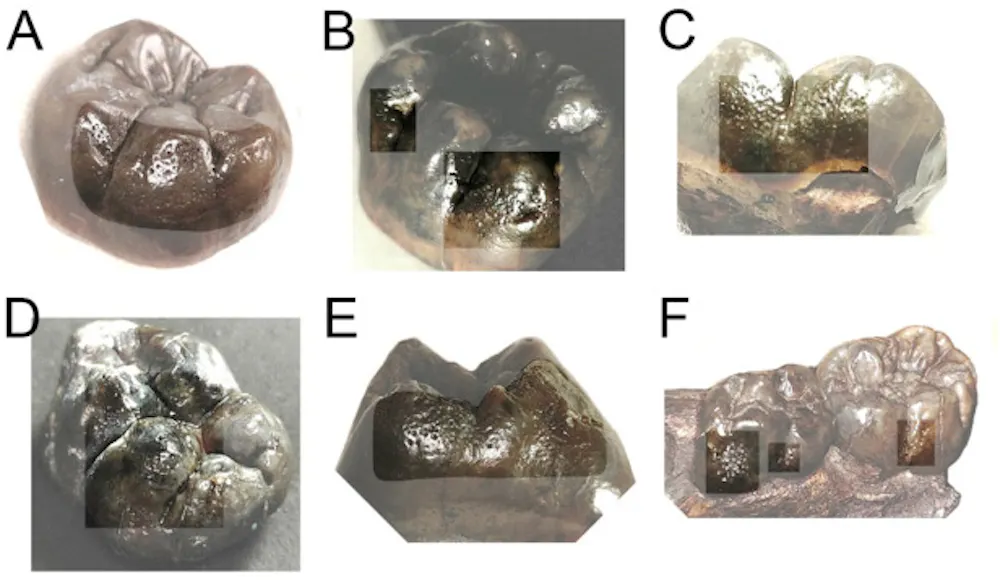
    Ian Towle / The Conversation

    The enamel that forms the outer layer of our teeth might seem like an unlikely place to find clues about evolution. But it tells us more than you’d think about the relationships between our fossil ancestors and relatives.

    In our new study, published in the Journal of Human Evolution, we highlight a different aspect of enamel. In fact, we highlight its absence.

    Specifically, we show that tiny, shallow pits in fossil teeth may not be signs of malnutrition or disease. Instead, they may carry surprising evolutionary significance.

    You might be wondering why this matters. Well, for people like me who try to figure out how humans evolved and how all our ancestors and relatives were related to each other, teeth are very important. And having a new marker to look out for on fossil teeth could give us a new tool to help fit together our family tree.

    Uniform, circular and shallow

    These pits were first identified in the South African species Paranthropus robustus, a close relative of our own genus Homo. They are highly consistent in shape and size: uniform, circular and shallow.

    Initially, we thought the pits might be unique to P. robustus. But our latest research shows this kind of pitting also occurs in other Paranthropus species in eastern Africa. We even found it in some Australopithecus individuals, a genus that may have given rise to both Homo and Paranthropus.

    Uniform, circular and shallow pitting on teeth may be a previously undetected clue about evolutionary relationships.
    Towle et al. / Journal of Human Evolution

    The enamel pits have commonly been assumed to be defects resulting from stresses such as illness or malnutrition during childhood. However, their remarkable consistency across species, time and geography suggests these enamel pits may be something more interesting.

    The pitting is subtle, regularly spaced, and often clustered in specific regions of the tooth crown. It appears without any other signs of damage or abnormality.

    Two million years of evolution

    We looked at fossil teeth from hominins (humans and our closest extinct relatives) from the Omo Valley in Ethiopia, where we can see traces of more than two million years of human evolution, as well as comparisons with sites in southern Africa (Drimolen, Swartkrans and Kromdraai).

    The Omo collection includes teeth attributed to Paranthropus, Australopithecus and Homo, the three most recent and well-known hominin genera. This allowed us to track the telltale pitting across different branches of our evolutionary tree.

    What we found was unexpected. The uniform pitting appears regularly in both eastern and southern Africa Paranthropus, and also in the earliest eastern African Australopithecus teeth dating back around 3 million years. But among southern Africa Australopithecus and our own genus, Homo, the uniform pitting was notably absent.

    A defect … or just a trait?

    If the uniform pitting were caused by stress or disease, we might expect it to correlate with tooth size and enamel thickness, and to affect both front and back teeth. But it doesn’t.

    What’s more, stress-related defects typically form horizontal bands. They usually affect all teeth developing at the time of the stress, but this is not what we see with this pitting.

    The uniform, even nature of the pitting suggests a genetic origin rather than environmental factors such as malnutrition or disease.
    Towle et al. / Journal of Human Evolution

    We think this pitting probably has a developmental and genetic origin. It may have emerged as a byproduct of changes in how enamel was formed in these species. It might even have some unknown functional purpose.

    In any case, we suggest these uniform, circular pits should be viewed as a trait rather than a defect.

    A modern comparison

    Further support for the idea of a genetic origin comes from comparisons with a rare condition in humans today called amelogenesis imperfecta, which affects enamel formation.

    About one in 1,000 people today have amelogenesis imperfecta. By contrast, the uniform pitting we have seen appears in up to half of Paranthropus individuals.

    Although it likely has a genetic basis, we argue the even pitting is too common to be considered a harmful disorder. What’s more, it persisted at similar frequencies for millions of years.

    A new evolutionary marker

    If this uniform pitting really does have a genetic origin, we may be able to use it to trace evolutionary relationships.

    We already use subtle tooth features such as enamel thickness, cusp shape, and wear patterns to help identify species. The uniform pitting may be an additional diagnostic tool.

    For example, our findings support the idea that Paranthropus is a “monophyletic group”, meaning all its species descend from a (relatively) recent common ancestor, rather than evolving seperatly from different Australopithecus taxa.

    And we did not find this pitting in the southern Africa species Australopithecus africanus, despite a large sample of more than 500 teeth. However, it does appear in the earliest Omo Australopithecus specimens.

    So perhaps the pitting could also help pinpoint from where Paranthropus branched off on its own evolutionary path.

    An intriguing case

    One especially intriguing case is Homo floresiensis, the so-called “hobbit” species from Indonesia. Based on published images, their teeth appear to show similar pitting.

    If confirmed, this could suggest an evolutionary history more closely tied to earlier Australopithecus species than to Homo. However, H. floresiensis also shows potential skeletal and dental pathologies, so more research is needed before drawing such conclusions.

    More research is also needed to fully understand the processes behind the uniform pitting before it can be used routinely in taxonomic work. But our research shows it is likely a heritable characteristic, one not found in any living primates studied to date, nor in our own genus Homo (rare cases of amelogenesis imperfecta aside).

    As such, it offers an exciting new tool for exploring evolutionary relationships among fossil hominins.

    Ian Towle does not work for, consult, own shares in or receive funding from any company or organisation that would benefit from this article, and has disclosed no relevant affiliations beyond their academic appointment.

    ref. 2-million-year-old pitted teeth from our ancient relatives reveal secrets about human evolution – https://theconversation.com/2-million-year-old-pitted-teeth-from-our-ancient-relatives-reveal-secrets-about-human-evolution-258390

    MIL OSI AnalysisEveningReport.nz

  • MIL-Evening Report: What can you do if you don’t like your child’s friends?

    Source: The Conversation (Au and NZ) – By Rachael Murrihy, Director, The Kidman Centre, Faculty of Science, University of Technology Sydney

    Getty Images/ Wander Woman Collective

    Many parents will be familiar with this situation: your child has a good or even best friend, but you don’t like them.

    Perhaps the friend is bossy, has poor manners or jumps on your furniture. Maybe you don’t like the way your child behaves when they are with this friend.

    For older children, your dislike might relate to the friend’s language, attitude towards school, or risk-taking behaviours. Maybe the friend is hot and cold and elicits more drama than Mean Girls.

    What can parents do?


    Read more:
    How can you help your child make friends?


    You will have a protective instinct

    If you see your child being treated poorly, this can ignite a protective instinct in parents that manifests in a bodily “fight or flight” response.

    This provides a rush of adrenaline, which can spur parents to take actions such as criticising the friend or even attempting to ban the friendship.

    However, this approach can do more harm than good, particularly for adolescents who are hardwired to push back on their parents.

    What can you do for younger kids?

    With younger children, clear boundaries can be set at the outset of a playdate. For example, “my bedroom is off limits for playing” or “we don’t jump on the couch”.

    If kids are using mean or rude language around each other, you can say “we don’t use that word in this house, be kind to each other”.

    Playdates can be moved outside, which can be particularly helpful if a child shows loud, destructive or rude behaviour. And if you can help it, organise fewer plays with that child.

    But parents may also want to reflect on why this child rubs them the wrong way. Is the reaction warranted, or does it comes from your own biases and opinions? Your child’s friends do not have to be the friends you would choose.

    Change your approach for older kids

    To become successful adults, teens need to move through developmental milestones of becoming autonomous and self-reliant. Intervening in their friendships interferes with this vital process of developing independence and identity, which ultimately disempowers them.

    In the 1960s, US psychologist Diana Baumrind published famous research on parenting. She found an authoritarian style – where the parent exerts complete control and does not listen to the child’s needs – results in a child with less confidence and independence than one brought up in a household that has rules but is also responsive to their needs.

    Adopting an authoritarian approach to friends or potential partners also risks the “Romeo and Juliet” effect, whereby disapproval makes the child more attracted to that person.

    So, for teenagers and their friends, the approach should be more nuanced. The primary goal is to encourage the child to see the parent as a person to come to when they have problems. If parents are tempted to be critical, they could ask themself: is it in the best interests of your child to be controlled?

    It is important to let children make mistakes so they can learn from them. Learning about what they do and don’t want in relationships is a crucial life skill.


    Read more:
    ‘How was school today?’ How to help kids open up and say more than ‘fine’


    How can you talk about friendship?

    Fostering an open dialogue about friends and relationships can allow parents to have influence in a subtle and developmentally appropriate way.

    For younger children, you could use a quiet moment to ask questions like “what can you say to Charlotte if you don’t want to play her game anymore?” or “what’s a good way to deal with it if she is being too bossy?”

    For older children, ideally wait until your teen wants to connect, rather than launching into questions. Ask gentle, non-judgmental questions about their friendship, like “what do you like to do together?” or “tell me about what you have in common”.

    If they seem upset or uncomfortable in some way, resist the urge to dismiss or solve the problem. Simply listening is the key to helping the child work it out, so they feel supported but not judged.

    And remember, not all friendships last. As children move through school and grow, most will naturally make new friends and move on from old ones.

    Clearly, one exception to adopting a teen-led approach is when safety is at risk. If they are being bullied or abused in any form – even if the child is opposed – parents should step in and speak to the school or other relevant authorities.


    Read more:
    What can you do if your child is being bullied?


    Rachael Murrihy does not work for, consult, own shares in or receive funding from any company or organisation that would benefit from this article, and has disclosed no relevant affiliations beyond their academic appointment.

    ref. What can you do if you don’t like your child’s friends? – https://theconversation.com/what-can-you-do-if-you-dont-like-your-childs-friends-257353

    MIL OSI AnalysisEveningReport.nz

  • MIL-Evening Report: Measles cases are surging globally. Should children be vaccinated earlier?

    Source: The Conversation (Au and NZ) – By Meru Sheel, Associate Professor, Infectious Diseases, Immunisation and Emergencies (IDIE) Group, Sydney School of Public Health, University of Sydney

    EyeEm Mobile GmbH/Getty Images

    Measles has been rising globally in recent years. There were an estimated 10.3 million cases worldwide in 2023, a 20% increase from 2022.

    Outbreaks are being reported all over the world including in the United States, Europe and the Western Pacific region (which includes Australia). For example, Vietnam has reportedly seen thousands of cases in 2024 and 2025.

    In Australia, 77 cases of measles have been recorded in the first five months of 2025, compared with 57 cases in all of 2024.

    Measles cases in Australia are almost all related to international travel. They occur in travellers returning from overseas, or are contracted locally after mixing with an infected traveller or their contacts.

    Measles most commonly affects children and is preventable with vaccination, given in Australia in two doses at 12 and 18 months old. But in light of current outbreaks globally, is there a case for reviewing the timing of measles vaccinations?

    Some measles basics

    Measles is caused by a virus belonging to the genus Morbillivirus. Symptoms include a fever, cough, runny nose and a rash. While it presents as a mild illness in most cases, measles can lead to severe disease requiring hospitalisation, and even death. Large outbreaks can overwhelm health systems.

    Measles can have serious health consequences, such as in the brain and the immune system, years after the infection.

    Measles spreads from person to person via small respiratory droplets that can remain suspended in the air for two hours. It’s highly contagious – one person with measles can spread the infection to 12–18 people who aren’t immune.

    Because measles is so infectious, the World Health Organization (WHO) recommends two-dose vaccination coverage above 95% to stop the spread and achieve “herd immunity”.

    Low and declining vaccine coverage, especially since the COVID pandemic, is driving global outbreaks.


    Read more:
    What are the symptoms of measles? How long does the vaccine last? Experts answer 6 key questions


    When are children vaccinated against measles?

    Newborn babies are generally protected against measles thanks to maternal antibodies. Maternal antibodies get passed from the mother to the baby via the placenta and in breast milk, and provide protection against infections including measles.

    The WHO advises everyone should receive two doses of measles vaccination. In places where there’s a lot of measles circulating, children are generally recommended to have the first dose at around nine months old. This is because it’s expected maternal antibodies would have declined significantly in most infants by that age, leaving them vulnerable to infection.

    If maternal measles antibodies are still present, the vaccine is less likely to produce an immune response.

    Research has also shown a measles vaccine given at less than 8.5 months of age can result in an antibody response which declines more quickly. This might be due to interference with maternal antibodies, but researchers are still trying to understand the reasons for this.

    A second dose of the vaccine is usually given 6–9 months later. A second dose is important because about 10–15% of children don’t develop antibodies after the first vaccine.

    In settings where measles transmission is under better control, a first dose is recommended at 12 months of age. Vaccination at 12 months compared with nine months is considered to generate a stronger, longer-lasting immune response.

    In Australia, children are routinely given the measles-mumps- rubella (MMR) vaccine at 12 months and the measles-mumps-rubella-varicella (MMRV, with “varicella” being chickenpox) vaccine at 18 months.

    Babies at higher risk of catching the disease can also be given an additional early dose. In Australia, this is recommended for infants as young as six months when there’s an outbreak or if they’re travelling overseas to a high-risk setting.

    A new study looking at measles antibodies in babies

    A recent review looked at measles antibody data from babies under nine months old living in low- and middle-income countries. The review combined the results from 20 studies, including more than 8,000 babies. The researchers found that while 81% of newborns had maternal antibodies to measles, only 30% of babies aged four months had maternal antibodies.

    This study suggests maternal antibodies to measles decline much earlier than previously thought. It raises the question of whether the first dose of measles vaccine is given too late to maximise infants’ protection, especially when there’s a lot of measles around.

    Should we bring the measles vaccine forward in Australia?

    All of the data in this study comes from low- and middle-income countries, and might not reflect the situation in Australia where we have much higher vaccine coverage for measles, and very few cases.

    Australia’s coverage for two doses of the MMR vaccine at age two is above 92%.

    Although this is lower than the optimal 95%, the overall risk of measles surging in Australia is relatively low.

    Nonetheless, there may be a case for broadening the age at which an early extra dose of the measles vaccine can be given to children at higher risk. In New Zealand, infants as young as four months can receive a measles vaccine before travelling to an endemic country.

    But the current routine immunisation schedule in Australia is unlikely to change.

    Adding an extra dose to the schedule would be costly and logistically difficult. Lowering the age for the first dose may have some advantages in certain settings, and doesn’t pose any safety concerns, but further evidence would be required to support this change. In particular, research is needed to ensure it wouldn’t negatively affect the longer-term protection that vaccination offers from measles.

    Making sure you’re protected

    In the meantime, ensuring high levels of measles vaccine coverage with two doses is a global priority.

    People born after 1966 are recommended to have two doses of measles vaccine. This is because those born before the mid-1960s likely caught measles as children (when the vaccine was not yet available) and would therefore have natural immunity.

    If you’re unsure about your vaccination status, you can check this through the Australian Immunisation Register. If you don’t have a documented record, ask your doctor for advice.

    Catch-up vaccination is available under the National Immunisation Program.

    Meru Sheel receives funding from the National Health and Medical Research Council and the Department of Foreign Affairs and Trade.

    Anita Heywood does not work for, consult, own shares in or receive funding from any company or organisation that would benefit from this article, and has disclosed no relevant affiliations beyond their academic appointment.

    ref. Measles cases are surging globally. Should children be vaccinated earlier? – https://theconversation.com/measles-cases-are-surging-globally-should-children-be-vaccinated-earlier-257942

    MIL OSI AnalysisEveningReport.nz

  • MIL-Evening Report: Can Israel still claim self-defence to justify its Gaza war? Here’s what the law says

    Source: The Conversation (Au and NZ) – By Donald Rothwell, Professor of International Law, Australian National University

    On October 7 2023, more than 1,000 Hamas militants stormed into southern Israel and went on a killing spree, murdering 1,200 men, women and children and abducting another 250 people to take back to Gaza. It was the deadliest massacre of Jews since the Holocaust.

    That day, Israeli Prime Minister Benjamin Netanyahu told the country, “Israel is at war”. The Israel Defence Forces (IDF) immediately began a military campaign to secure the release of the hostages and defeat Hamas. Since that day, more than 54,000 Palestinians have been killed, mostly women and children.

    Israel has maintained its response is justified under international law, as every nation has “an inherent right to defend itself”, as Netanyahu stated in early 2024.

    This is based on the right to self-defence in international law, which is outlined in Article 51 of the 1945 United Nations Charter as follows:

    Nothing in the present Charter shall impair the inherent right of individual or collective self-defence if an armed attack occurs against a Member of the United Nations[…]

    At the start of the war, many nations agreed Israel had a right to defend itself, but how it did so mattered. This would ensure its actions were consistent with international humanitarian law.

    However, 20 months after the October 7 attacks, fundamental legal issues have arisen around whether this self-defence justification still holds.

    Can Israel exercise self-defence ad infinitum? Or is it now waging a war of aggression against Palestine?

    Self-defence in the law

    Self-defence has a long history in international law.

    The modern principles of self-defence were outlined in diplomatic exchanges over an 1837 incident involving an American ship, The Caroline, after it was destroyed by British forces in Canada. Both sides agreed that an exercise of self-defence would have required the British to demonstrate their conduct was not “unreasonable or excessive”.

    The concept of self-defence was also extensively relied on by the Allies in the second world war in response to German and Japanese aggression.

    Self-defence was originally framed in the law as a right to respond to a state-based attack. However, this scope has broadened in recent decades to encompass attacks from non-state actors, such as al-Qaeda following the September 11 2001 terror attacks.

    Israel is a legitimate, recognised state in the global community and a member of the United Nations. Its right to self-defence will always remain intact when it faces attacks from its neighbours or non-state actors, such as Hamas, Hezbollah or the Houthi rebels in Yemen.

    However, the right of self-defence is not unlimited. It is constrained by the principles of necessity and proportionality.

    The necessity test was met in the current war due to the extreme violence of the Hamas attack on October 7 and the taking of hostages. These were actions that could not be ignored and demanded a response, due to the threat Israel continued to face.

    The proportionality test was also met, initially. Israel’s military operation after the attack was strategic in nature, focused on the return of the hostages and the destruction of Hamas to eliminate the immediate threat the group posed.

    The legal question now is whether Israel is still legitimately exercising self-defence in response to the October 7 attacks.

    This is a live issue, especially given comments by Israeli Defence Minister Israel Katz on May 30 that Hamas would be “annihilated” unless a proposed ceasefire deal was accepted.

    These comments and Israel’s ongoing conduct throughout the war raise the question of whether proportionality is still being met.

    A test of proportionality

    The importance of proportionality in self-defence has been endorsed in recent years by the International Court of Justice.

    Under international law, proportionality remains relevant throughout a conflict, not just in the initial response to an attack.

    While the law allows a war to continue until an aggressor surrenders, it does not legitimise the complete destruction of the territory where an aggressor is fighting.

    The principle of proportionality also provides protections for civilians. Military actions are to be directed at the foreign forces who launched the attack, not civilians.

    While Israel has targeted Hamas fighters in its attacks, including those who orchestrated the October 7 attacks, these actions have caused significant collateral deaths of Palestinian civilians.

    Therefore, taken overall, the ongoing, 20-month military assault against Hamas, with its high numbers of civilian casualties, credible reports of famine and devastation of Gazan towns and cities, suggests Israel’s exercise of self-defence has become disproportionate.

    The principle of proportionality is also part of international humanitarian law. However, Israel’s actions on this front are a separate legal issue that has been the subject of investigation by the International Criminal Court.

    My aim here is to solely assess the legal question of proportionality in self-defence and international law.

    Is rescuing hostages in self-defence?

    Israel could separately argue it is exercising legitimate self-defence to rescue the remaining hostages held by Hamas.

    However, rescuing nationals as an exercise of self-defence is legally controversial. Israel set a precedent in 1976 when the military rescued 103 Jewish hostages from Entebbe, Uganda, after their aircraft had been hijacked.

    In current international law, there are very few other examples in which this interpretation of self-defence has been adopted – and no international consensus on its use.

    In Gaza, the size, scale and duration of Israel’s war goes far beyond a hostage rescue operation. Its aim is also to eliminate Hamas.

    Given this, rescuing hostages as an act of self-defence is arguably not a suitable justification for Israel’s ongoing military operations.

    An act of aggression?

    If Israel can no longer rely on self-defence to justify its Gaza military campaign, how would its actions be characterised under international law?

    Israel could claim it is undertaking a security operation as an occupying power.

    While the International Court of Justice said in an advisory opinion last year that Israel was engaged in an illegal occupation of Gaza, the court expressly made clear it was not addressing the circumstances that had evolved since October 7.

    Israel is indeed continuing to act as an occupying power, even though it has not physically reoccupied all of Gaza. This is irrelevant given the effective control it exercises over the territory.

    However, the scale of the IDF’s operations constitute an armed conflict and well exceed the limited military operations to restore security as an occupying power.

    Absent any other legitimate basis for Israel’s current conduct in Gaza, there is a strong argument that what is occurring is an act of aggression. The UN Charter and the Rome Statute of the International Criminal Court prohibit acts of aggression not otherwise justified under international law.

    These include invasions or attacks by the armed forces of a state, military occupations, bombardments and blockades. All of this has occurred – and continues to occur – in Gaza.

    The international community has rightly condemned Russia’s invasion as an act of aggression in Ukraine. Will it now do the same with Israel’s conduct in Gaza?

    Donald Rothwell receives funding from the Australian Research Council.

    ref. Can Israel still claim self-defence to justify its Gaza war? Here’s what the law says – https://theconversation.com/can-israel-still-claim-self-defence-to-justify-its-gaza-war-heres-what-the-law-says-257822

    MIL OSI AnalysisEveningReport.nz

  • MIL-Evening Report: Why bystanders defend bad behaviour at work — even when they know it’s wrong

    Source: The Conversation (Au and NZ) – By Zhanna Lyubykh, Assistant Professor, Beedie School of Business, Simon Fraser University

    Rather than intervening, supporting targets or reporting the misconduct, bystanders may downplay it, withdraw support or even blame the target, which ultimately reinforces the mistreatment. (Shutterstock)

    “You always mess things up. Why are you even on this project? Just quit already.” Demeaning, hostile or undermining behaviour like this is more common in the workplace and damaging than many people realize. One in three employees experience such behaviours, and almost half witness them.

    Rather than intervening, supporting targets or reporting the misconduct, research shows bystanders may downplay it, withdraw support or even blame the target, which ultimately reinforces the mistreatment.

    As our recent study shows, this is largely because when mistreatment seems inevitable or commonplace, bystanders are psychologically motivated to justify it rather than challenge it.

    Why do bystanders rationalize mistreatment?

    Humans are hardwired to see mistreatment as wrong. Most of us value fairness and want to punish wrongdoing. But if this is the case, why do bystanders so often fail to act when they witness mistreatment?

    Our recent research explores this question drawing on system justification theory — the idea that people are motivated to see the systems they live and work in as fair, legitimate and stable.

    When mistreatment seems inevitable — when people think “that’s just how things work around here” — bystanders face a psychological dilemma. They can either challenge the behaviour and risk conflict, exclusion or backlash, or they can rationalize it as normal or deserved.

    Most people, often without realizing it, choose the latter. This mental shortcut allows them to preserve the comforting belief that the system is fair and people get what they deserve.

    One in three employees experience demeaning, hostile or undermining behaviour in the workplace, and almost half witness them.
    (Shutterstock)

    Witnessing workplace mistreatment

    We interviewed 554 employees who had witnessed workplace mistreatment within the past two weeks at the time the survey was conducted. They shared their thoughts on how inevitable they believed the mistreatment incident was, and how tolerant they felt their organization was toward such behaviour.

    In a follow-up survey, we asked these employees whether they felt the incident they witnessed was justifiable and the target as deserving. A week later, in a third survey, we asked these bystanders to report how they behaved toward the target, and whether they tried to address or minimize the incident.

    We found that when bystanders perceived mistreatment as inevitable, they were more likely to see the incident as justified and targets as deserving of that treatment. These bystanders were more likely to socially distance themselves from the target, engage in negative gossip about them and were less willing to offer help.

    Bystander inaction wasn’t due to cowardice or callousness, but was often a defence mechanism. Rationalizing mistreatment allowed bystanders to preserve the belief that their workplace was just. But this coping strategy can deepen harm for those who experience mistreatment, who may be further marginalized, isolated or discredited.

    How mistreatment is normalized

    Workplace climates play a key role in the normalization of mistreatment. Our findings indicate when employees believed their workplace tolerated mistreatment, they were more likely to rationalize it and less likely to support the person being mistreated.

    In these contexts, mistreatment isn’t just ignored, but is quietly accepted. Tacit acceptance sends a powerful message: this is normal, this is deserved, this is not worth challenging.

    What does a toxic, permissive workplace look like? Warning signs include staff who feel anxious about coming to work and leaders who publicly criticize employees or tell them to “toughen up” or “not take it personally.”

    If negative gossip is tolerated, or reports of mistreatment are ignored or delayed, these are also strong indicators that mistreatment has been normalized.

    Organizations may fail to acknowledge these patterns for a variety of reasons, including resistance, denial or a lack of readiness. But surfacing these issues is a strength, not a weakness. It allows organizations to address root causes, retain valuable employees, and foster a more respectful environment.

    When mistreatment is ignored in the workplace, it sends a message to employees that it is normal, deserved and not worth challenging.
    (Unsplash/Borja Verbena)

    4 ways to create positive change

    Even in workplaces where mistreatment has become normalized, positive change is possible. Research shows that effectively managing everyday incidents can create bottom-up effects that support broader positive change within the workplace, ultimately improving workplace climate.

    Managers have a particularly pivotal role to play. When they respond quickly, support targets openly and hold perpetrators accountable, they challenge the perception that mistreatment is inevitable. They also send a broader message about what behaviours are and aren’t acceptable in the workplace.

    Here are four evidence-based strategies that can help disrupt the bystander dynamic and improve workplace culture:

    1. Challenge the narrative of inevitability

    Organizations should clearly signal that mistreatment will not be tolerated in their workplace. This includes explicitly communicating behavioural expectations, investigating reports quickly and transparently, and ensuring senior leaders model respectful behaviour. These small but visible actions disrupt the sense that mistreatment is “just how things work.”

    2. Reduce ambiguity

    When organizations don’t define behavioural norms clearly, bystanders are more likely to rationalize mistreatment. Organizations should define what mistreatment includes, such as exclusion and sarcastic comments, and distinguish it from tough feedback or constructive conflict. Training can help employees recognize subtle forms of harm and reflect on how their reactions would appear to someone they respect.

    3. Enforce consequences consistently

    When policies exist but aren’t enforced, bystanders learn that mistreatment carries no cost. Organizations need to follow through on mistreatment policies, protect those who report it and make it clear that retaliation is unacceptable. Visibility matters: people need to see that action is taken.

    4. Support targets openly and meaningfully

    System justification often works by undermining the credibility of those being mistreated. Managers can counteract this by affirming the value of a person targeted, encouraging reintegration and monitoring their teams for subtle social exclusion. When targets are supported by respected leaders, bystanders are more likely to follow suit because people tend to look to leader behaviour towards employees as a sign of their value to the group.

    When targets are supported by respected leaders, bystanders are more likely to follow suit.
    (Shutterstock)

    Why this matters

    Much of the existing research on workplace mistreatment has focused on the importance of bystander and leader intervention. Our research adds a deeper layer by illustrating that bystanders may not intervene because they are subconsciously defending their belief in a fair and legitimate system.

    This defence mechanism is especially dangerous when mistreatment is common, creating a cycle in which the most vulnerable employees are harmed twice: first by the perpetrator, and then by those who fail to stand by them.

    Breaking this cycle requires more than training videos or one-off statements. It requires reshaping the climate that makes mistreatment seem normal, inevitable or trivial.

    The encouraging news is that even small, consistent actions can begin to shift these dynamics. Research has shown that incivility training that teaches people how to engage in civil ways, for example, has lasting effects on employee well-being and relationships. When these harmful dynamics are shifted, it improves the workplace for everyone.

    Zhanna Lyubykh receives funding from the Social Sciences and Humanities Research Council of Canada.

    Laurie J. Barclay receives funding from the Social Sciences and Humanities Research Council of Canada and the University of Guelph’s Research Leader Award.

    Nick Turner receives research funding from Cenovus Energy Inc., Haskayne School of Business’s Future Fund, Mitacs, and the Social Sciences and Humanities Research Council of Canada (SSHRC).

    Sandy Hershcovis receives funding from the Social Sciences and Humanities Research Council of Canada.

    ref. Why bystanders defend bad behaviour at work — even when they know it’s wrong – https://theconversation.com/why-bystanders-defend-bad-behaviour-at-work-even-when-they-know-its-wrong-257941

    MIL OSI AnalysisEveningReport.nz

  • MIL-Evening Report: Immortality at a price: how the promise of delaying death has become a consumer marketing bonanza

    Source: The Conversation (Au and NZ) – By Amy Errmann, Senior Lecturer, Marketing & International Business, Auckland University of Technology

    Living forever has become the wellness and marketing trend of the 2020s. But cheating death – or at least delaying it – will come at a price.

    What was once the domain of scientists and the uber rich is increasingly becoming a consumer product. Those pushing the idea, spearheaded by tech billionaire Bryan Johnson’s “Don’t Die” movement, believe death isn’t inevitable, but is a solvable problem.

    The global longevity market – spanning gene therapies, anti-ageing drugs, diagnostics and wellness plans – is projected to hit US$610 billion this year. At its core, the marketing of these products feeds off the age-old fear of mortality and the desire to stay young.

    But while the marketing is reaching the masses, this is still very much a luxury product. Immortality is being sold as exclusive, aspirational and symbolic. It’s not just about living longer – it’s about signalling status, controlling biology and being your “best future self”.

    Tapping into long-held fears

    What’s known as “terror management theory” puts forward the idea that humans and other animals have an instinctive drive for self-preservation. But humans are not only self-aware, they are also able to anticipate future outcomes – including the inevitability of death.

    The messaging behind the push to extend life taps into this internal tension between knowledge of our own mortality and the self-preservation instinct. And to be fair, it is not a new phenomenon.

    Cryonics – the preservation of bodies and brains at extremely low temperatures with the hope medical advancements will allow for their revival at some point in the future – was first popularised in Robert Ettinger’s 1962 book The Prospect of Immortality.

    Since then, the super-rich have invested in various companies promising to preserve their bodies for some unknown future date. It now costs US$200,000 to freeze your body, or $80,000 for just your brain.

    What’s truly new is how death is being marketed – not as fate, but as a flaw. Longevity isn’t just about living longer; it’s about turning mortality into a design problem, something to delay, manage and eventually solve.

    “Biohacking” sells the idea that with the right data, tools and discipline, you can upgrade your biology – and become your best, most future-proof self.

    This pitch targets high-income consumers aged 30 to 60, people already fluent in the language of optimisation – a mindset focused on maximising performance, productivity and longevity through data.

    The brands behind the living forever movement sell control, optimisation and elite identity. Ageing becomes a personal failure. Anti-ageing is self-discipline. Consumers are cast as CEOs of their own health – tracking sleep, fixing their gut and taking supplements.

    From biohacks to consumer branding

    There are now more than 700 companies working in the longevity market. Startups such as Elysium Health and Human Longevity Inc. offer DNA testing, supplements and personalised health plans.

    These aren’t medical treatments – they’re sold as tools to age “smarter” or “slower” and are pitched with the language of control over what once might have seemed uncontrollable.

    Don’t Die’s Bryan Johnson spends over US$2 million annually on his personal anti-ageing experiment.

    But the real pitch is to consumers: buy back time, one premium subscription at a time. Johnson’s company Blueprint offers diagnostics, supplements and exercise routines bundled into monthly plans starting at $333 and climbing to over $1,600.

    Longevity products promise more than health. They promise time, control and even immortality. But the quest to live forever, or at least a lot longer, raises moral and ethical questions about who benefits, and what kind of world is being created.

    Without thoughtful oversight, these technologies risk becoming tools of exclusion, not progress. Because if time becomes a product, not everyone will get to check out at the same counter.

    Amy Errmann does not work for, consult, own shares in or receive funding from any company or organisation that would benefit from this article, and has disclosed no relevant affiliations beyond their academic appointment.

    ref. Immortality at a price: how the promise of delaying death has become a consumer marketing bonanza – https://theconversation.com/immortality-at-a-price-how-the-promise-of-delaying-death-has-become-a-consumer-marketing-bonanza-257009

    MIL OSI AnalysisEveningReport.nz

  • MIL-Evening Report: The blow-up between Elon Musk and Donald Trump has been entertaining, but how did things go so bad, so fast?

    Source: The Conversation (Au and NZ) – By Henry Maher, Lecturer in Politics, Department of Government and International Relations, University of Sydney

    A no-holds-barred and very public blow-up between the world’s richest man and the president of the United States has had social media agog in recent days, with each making serious accusations against the other.

    And while tech billionaire Elon Musk appears to have cooled the spat somewhat – deleting some of his more incendiary social media posts about Donald Trump – the president still appears to be in no mood to make up, warning Musk of “very serious consequences” if he backs Democrats at the mid-term elections in 2026.

    Tensions erupted over Trump’s “One Big Beautiful Bill” (OBBB). The OBBB proposes extensive tax cuts which could add roughly US$3 trillion (A$4.62 trillion) to the US national debt.

    After stepping down from his role as advisor to Trump, Musk criticised the OBBB as “disgusting abomination” that would “burden America [sic] citizens with crushing unsustainable debt”. Trump returned fire, suggesting “Elon was ‘wearing thin’, I asked him to leave […] and he just went CRAZY!”.

    In a dramatic escalation, Musk responded by calling for Trump’s impeachment. Musk also tweeted allegations that Trump was implicated in the Epstein files related to child sex offender Jeffrey Epstein. He has since deleted those tweets.

    Why has the much-hyped “bromance” between Musk and Trump suddenly ended? And what was the basis of their alliance in the first place?

    Musk in politics

    Like many billionaires, Musk had previously been hesitant to get involved in frontline politics. He says he voted for Hillary Clinton in 2016 and Joe Biden in 2020, but claimed in 2021 “I would prefer to stay out of politics”.

    In early 2024, Musk was still claiming to be politically non-aligned, suggesting he would not donate to either presidential campaign.

    This apparent neutrality ended following the attempted assassination of Trump at a July 2024 campaign rally, with Musk immediately endorsing Trump.

    In reality, Musk’s conversion to the MAGA movement long predated the assassination attempt. Musk’s hyperactive Twitter/X account shows a steady radicalisation.

    Across 2020-2024, Musk engaged with accounts sharing MAGA and far-right conspiracy theories. These include the antisemitic Great Replacement Theory, and the related South African white genocide conspiracy. Musk’s posts also show the obsession with opposing diversity, equity and inclusion (DEI) policies characteristic of the MAGA movement.

    After endorsing Trump, Musk spent US$288 million (A$444 million) supporting Trump’s election and appeared at campaign events around the country.

    Musk’s support for Trump was both ideological and pragmatic.

    From tax cuts to immigration restrictions to opposing DEI, there were clearly many ideological commonalities between Musk and Trump.

    There were also clear practical benefits for both men. Trump gained the financial backing of the world’s wealthiest man. Musk gained not only unparalleled access to the US president, but also a role leading the new Department of Government Efficiency (DOGE).

    DOGE: success and failure

    Early reporting on the second Trump presidency noted the omnipresence of Musk, who at one point moved into Trump’s Mar-a-Lago resort to be close to the president.

    However, observers were sceptical about the potential effectiveness of DOGE, and Musk’s claim it would save the government US$2 trillion (A$3.02 trillion).

    In the early months of the Trump administration, Musk cut government programs and employees at a remarkable rate. The USAID program was particularly hard hit, as were the Department of Education and the Consumer Financial Protection Bureau.

    As the spending cuts picked up pace, Musk began to attract more controversy. Critics questioned the apparent power wielded by the unelected billionaire. Musk’s ties to the far right were also in the spotlight after he appeared to perform two “Roman salutes”, which many observers believed to be a Nazi salute.

    Trump clips Musk’s wings

    Musk’s apparent rampage through government did not last long. As Trump’s executive appointees assumed control of their departments, Musk and DOGE experienced increasing resistance. After a series of fractious cabinet meetings, Trump reportedly reduced the power of DOGE in March.

    Political attention was also clearly affecting Musk’s businesses. The negative publicity has significantly damaged the Tesla brand, leading to declining sales around the world and repeated falls in Telsa’s share price.

    On May 1, Musk announced he would be leaving DOGE, claiming the department had saved the government US$180 billion (A$277 billion) in spending. This number is likely an exaggeration, but still falls well short of his original target.

    Musk has learned a harsh lesson in politics – that the complexities of government resist simple reform and cannot be easily rolled back in the way a CEO might slim down a company.

    For Trump, his manoeuvring of Musk appears to be another smart political move. As the public face of DOGE, Musk bore the negative wrap for early government cuts and chaos. Having used his money and reputation, Trump dispensed with Musk as he has with so many advisers and appointees before.

    The falling out

    Musk departed his role in a muted White House ceremony, where Trump thanked him for his service and presented him with a ceremonial “golden key” to the White House.

    However, behind the public show of civility, tension was brewing over Trump’s One Big Beautiful Bill.

    Trump and Musk had originally claimed that the US$2 trillion (A$3.02 trillion) in DOGE savings could be used to fund a substantial tax cut. With the efficiency savings not eventuating, Musk worried the OBBB would significantly increase US public debt.

    Unable to convince Trump or other Republican legislators, Musk took to X, launching a “Kill the Bill” campaign that ultimately led to his incendiary showdown with Trump.

    For his part, Trump has belittled Musk, suggesting Musk only opposed the OBBB because it cut subsidies for electric vehicles.

    Though the subsidy cuts will affect Tesla, Musk has previously supported eliminating subsidies. Musk’s anger at the OBBB is more likely driven by the realisation he has been played by Trump.

    What now?

    Trump has used and discarded many other powerful figures in his chaotic political career. Musk has more power than most, and might be able to strike back at Trump.

    Yet, with his public reputation and brands already tarnished, Musk would be ill-advised to pick further fights with Trump and his adoring MAGA movement.

    Accordingly, Musk has indicated over the weekend he is open to a détente. Tesla investors will no doubt be relieved if Musk makes good on his pledge to step back from politics and return to his businesses.

    More concerning are the prospects for democracy. With wealth and power continuing to concentrate in a handful of billionaires, voters appear reduced to the role of viewers forced to watch the reality TV drama unfold.

    Though Trump appears to have won this round of billionaire battle royale, whatever happens next, democracy is the real loser.

    Henry Maher does not work for, consult, own shares in or receive funding from any company or organisation that would benefit from this article, and has disclosed no relevant affiliations beyond their academic appointment.

    ref. The blow-up between Elon Musk and Donald Trump has been entertaining, but how did things go so bad, so fast? – https://theconversation.com/the-blow-up-between-elon-musk-and-donald-trump-has-been-entertaining-but-how-did-things-go-so-bad-so-fast-258394

    MIL OSI AnalysisEveningReport.nz

  • MIL-Evening Report: New rules for cosmetic injectables aim to make the industry safer. Will they work?

    Source: The Conversation (Au and NZ) – By Christopher Rudge, Law lecturer, University of Sydney

    BearFoto/Shutterstock

    New guidelines to regulate Australia’s booming cosmetic procedures industry have been called “tough” and “a crackdown” in media reports this week.

    On Tuesday, the Australian Health Practitioner Regulation Agency (AHPRA) announced the new guidelines – one for procedures, the other for advertising – and said it put the lucrative industry “on notice”.

    The guidelines stem from AHPRA’s 2023 review of non-surgical cosmetic procedures – think injectables (such as Botox and dermal fillers), laser skin resurfacing, chemical peels, hair transplants and more.

    That review was established only after AHPRA investigated widespread reports about unsafe practices in cosmetic surgery in 2022, exposing risks and deficiencies in both the surgical and non-surgical cosmetics sector.

    These included the predatory targeting of under-18s, inadequate training for practitioners, and poor screening of patients. For example, 52-second telehealth consultations.

    So, how tough are these guidelines? And can they be enforced?

    What do the guidelines say?

    The new rules aim to put safety before sales and cover many more issues than any previous guidance.

    They also fill a gap, as they apply to all health practitioners. Previously only doctors had clear guidelines, while nurses and midwives had been guided by a “position statement” published by the Nursing and Midwifery Board of Australia.

    These new rules ban financial incentives, discounts and other financial arrangements, such as “contra deals” – where Botox injections might be administered in exchange for restaurant meals, as occurred in one New South Wales case.

    They also ban perks for social media influencers, who often get free treatments.

    The guidelines confirm influencers recruited by practitioners should not create unreasonable expectations of benefits for patients (which is already against the law if practitioners do it). If influencers do, the recruiting practitioner will be responsible.

    The new rules for health practitioners aim to make non-surgical procedures safer.
    Tijana Simic/Shutterstock

    Botox is a prescription-only drug subject to strict controls.

    But several practitioners have been disciplined for administering or procuring it inappropriately, such as in day spas or by arranging “remote” prescriptions by email. Recent cases of unregistered people injecting it at parties, resulting in botulism (a serious condition), also suggest gaps in oversight.

    The new rules allow only suitably trained practitioners to prescribe these drugs following an in-person or video consultation. Batch prescribing – issuing prescriptions for multiple patients – is now clearly unacceptable.

    The guidelines emphasise skills and training. Registered nurses will now need a year’s experience in other fields before giving cosmetic treatments. Enrolled nurses will be expected to first have a year of supervised, relevant experience.

    There must also be robust protocols to manage any complications after a procedure. Practitioners must provide detailed aftercare instructions, and ensure patients are aware of their right to complain and to whom.

    Screening for suitability

    Short and impersonal cosmetic consultations have often not met the legal requirements for informed consent.

    The guidelines address this by requiring registered nurses and nurse practitioners to thoroughly assess a patient’s suitability for a treatment.

    They must confirm the patient’s expectations are realistic, discuss risks and alternatives (including no treatment), be transparent about their own skills and experience, and explain all costs.

    The guidelines specify that screening assessments must check for underlying conditions, such as body dysmorphic disorder, which is known to be more common in those seeking cosmetic treatments.

    It is one of several mental health disorders diagnosed in people who experience anxiety and persistent thoughts about perceived flaws in their physical appearance.

    Patients experiencing this condition would likely be unsuitable. That’s because people with body dysmorphic disorder are at higher risk of poor psychosocial outcomes (such as poorer mental health or wellbeing).

    If found unsuitable, patients must be refused treatment and referred to another appropriate practitioner, such as a psychologist, for appropriate support.

    Overall, the new guidelines foster better informed consent processes. They prompt practitioners to screen for and discuss the psychosocial risks known to be associated with cosmetic procedures.

    Consultations will have to screen patients to see if they’re suitable for treatment.
    Chay_Tee/Shutterstock

    What about under 18s?

    AHPRA says the new rules offer greater protection for young people through new safeguards and special rules for under-18s.

    The guidelines say prescribing dermal fillers to minors is inappropriate. For other procedures, they require parental or guardian consent where practicable, and a cooling-off period of seven days between obtaining informed consent and the procedure.

    However, health practitioners will still be able to exercise their clinical judgement for under-18s within the limits of the law.

    That’s because the general law permits “mature minors” to lawfully consent to medical treatments if they have been assessed as having sufficient understanding and intelligence to appreciate fully what is being proposed.

    So, how are these rules enforced?

    These guidelines are not parliamentary laws.

    Instead, they define the standards expected of all registered health practitioners who perform non-surgical cosmetic procedures – except doctors, who have their own guidelines.

    If a health practitioner does not comply with the guidelines, the board responsible for their registration and accreditation – for example, the Nursing and Midwifery Board – can take “immediate action” to suspend them or launch disciplinary proceedings for extended sanctions.

    The guidelines will make it easier for national boards and state complaints organisations to support any allegations of professional wrongdoing against health professionals performing or promoting cosmetic procedures.

    Before now, there were no specific rules about cosmetic procedures – just the general (but important) codes of conduct for each profession.

    The guidelines give real teeth to the bodies that regulate the health profession and will likely enable them to weed out bad actors from the cosmetic workforce. Even so, they cannot compensate or redress patient harms.

    For that, patients may sue practitioners in court, report unlawful drug advertising to the Therapeutic Goods Administration (where fines can be issued), or take action under Australian consumer law.

    Christopher Rudge worked as a part-time research officer at the Medical Council of New South Wales in 2018.

    ref. New rules for cosmetic injectables aim to make the industry safer. Will they work? – https://theconversation.com/new-rules-for-cosmetic-injectables-aim-to-make-the-industry-safer-will-they-work-257898

    MIL OSI AnalysisEveningReport.nz

  • MIL-Evening Report: ‘Godfather of AI’ now fears it’s unsafe. He has a plan to rein it in

    Source: The Conversation (Au and NZ) – By Armin Chitizadeh, Lecturer, School of Computer Science, University of Sydney

    fran_kie/Shutterstock

    This week the US Federal Bureau of Investigation revealed two men suspected of bombing a fertility clinic in California last month allegedly used artificial intelligence (AI) to obtain bomb-making instructions. The FBI did not disclose the name of the AI program in question.

    This brings into sharp focus the urgent need to make AI safer. Currently we are living in the “wild west” era of AI, where companies are fiercely competing to develop the fastest and most entertaining AI systems. Each company wants to outdo competitors and claim the top spot. This intense competition often leads to intentional or unintentional shortcuts – especially when it comes to safety.

    Coincidentally, at around the same time of the FBI’s revelation, one of the godfathers of modern AI, Canadian computer science professor Yoshua Bengio, launched a new nonprofit organisation dedicated to developing a new AI model specifically designed to be safer than other AI models – and target those that cause social harm.

    So what is Bengio’s new AI model? And will it actually protect the world from AI-faciliated harm?

    An ‘honest’ AI

    In 2018, Bengio, alongside his colleagues Yann LeCun and Geoffrey Hinton, won the Turing Award for groundbreaking research they had published three years earlier on deep learning. A branch of machine learning, deep learning attempts to mimic the processes of the human brain by using artificial neural networks to learn from computational data and make predictions.

    Bengio’s new nonprofit organisation, LawZero, is developing “Scientist AI”. Bengio has said this model will be “honest and not deceptive”, and incorporate safety-by-design principles.

    According to a preprint paper released online earlier this year, Scientist AI will differ from current AI systems in two key ways.

    First, it can assess and communicate its confidence level in its answers, helping to reduce the problem of AI giving overly confident and incorrect responses.

    Second, it can explain its reasoning to humans, allowing its conclusions to be evaluated and tested for accuracy.

    Interestingly, older AI systems had this feature. But in the rush for speed and new approaches, many modern AI models can’t explain their decisions. Their developers have sacrificed explainability for speed.

    Bengio also intends “Scientist AI” to act as a guardrail against unsafe AI. It could monitor other, less reliable and harmful AI systems — essentially fighting fire with fire.

    This may be the only viable solution to improve AI safety. Humans cannot properly monitor systems such as ChatGPT, which handle over a billion queries daily. Only another AI can manage this scale.

    Using an AI system against other AI systems is not just a sci-fi concept – it’s a common practice in research to compare and test different level of intelligence in AI systems.

    Adding a ‘world model’

    Large language models and machine learning are just small parts of today’s AI landscape.

    Another key addition Bengio’s team are adding to Scientist AI is the “world model” which brings certainty and explainability. Just as humans make decisions based on their understanding of the world, AI needs a similar model to function effectively.

    The absence of a world model in current AI models is clear.

    One well-known example is the “hand problem”: most of today’s AI models can imitate the appearance of hands but cannot replicate natural hand movements, because they lack an understanding of the physics — a world model — behind them.

    Another example is how models such as ChatGPT struggle with chess, failing to win and even making illegal moves.

    This is despite simpler AI systems, which do contain a model of the “world” of chess, beating even the best human players.

    These issues stem from the lack of a foundational world model in these systems, which are not inherently designed to model the dynamics of the real world.

    Yoshua Bengio is recognised as one of the godfathers of AI.
    Alex Wong/Getty Images

    On the right track – but it will be bumpy

    Bengio is on the right track, aiming to build safer, more trustworthy AI by combining large language models with other AI technologies.

    However, his journey isn’t going to be easy. LawZero’s US$30 million in funding is small compared to efforts such as the US$500 billion project announced by US President Donald Trump earlier this year to accelerate the development of AI.

    Making LawZero’s task harder is the fact that Scientist AI – like any other AI project – needs huge amounts of data to be powerful, and most data are controlled by major tech companies.

    There’s also an outstanding question. Even if Bengio can build an AI system that does everything he says it can, how is it going to be able to control other systems that might be causing harm?

    Still, this project, with talented researchers behind it, could spark a movement toward a future where AI truly helps humans thrive. If successful, it could set new expectations for safe AI, motivating researchers, developers, and policymakers to prioritise safety.

    Perhaps if we had taken similar action when social media first emerged, we would have a safer online environment for young people’s mental health. And maybe, if Scientist AI had already been in place, it could have prevented people with harmful intentions from accessing dangerous information with the help of AI systems.

    Armin Chitizadeh does not work for, consult, own shares in or receive funding from any company or organisation that would benefit from this article, and has disclosed no relevant affiliations beyond their academic appointment.

    ref. ‘Godfather of AI’ now fears it’s unsafe. He has a plan to rein it in – https://theconversation.com/godfather-of-ai-now-fears-its-unsafe-he-has-a-plan-to-rein-it-in-258288

    MIL OSI AnalysisEveningReport.nz

  • MIL-Evening Report: The kimono is more than an artefact and more than clothing. It is a concept artists will make their own

    Source: The Conversation (Au and NZ) – By Sasha Grishin, Adjunct Professor of Art History, Australian National University

    The kimono garment, the national dress of Japan, carries within itself all of the magic and traditions of Japanese culture.

    The basic features of the kimono are fairly simple. It is a wrapped front garment with square sleeves that has a rectangular body where the left side is wrapped over the right, except in funerary use.

    The garment may be traced back to the Heian period as a distinctive style of dress for the nobility. In the Edo period (1603–1867) it came to a glorious culmination with colourful and expensive fabrics.

    The great poet Matsuo Bashō once wrote “Spring passes by / again and again in layers / of blossom-kimono”. Since childhood I’ve loved the mystical image “blossom-kimono”.

    In 2020, the Victoria and Albert Museum in London staged their epic exhibition Kimono: Kyoto to Catwalk, where hundreds of garments, accessories, prints and photographs charted the history of the kimono from the 17th century through to the present.

    A new exhibition from the National Gallery of Victoria is similarly ambitious. Over 70 fabulous garments of exquisite craftsmanship – some made of silk with gold and silver embroidery and dazzling designs – have been assembled within a context of over 150 paintings, posters, wood block prints, magazines and decorative arts.

    Although many of the items have never been previously exhibited in Australia, most are now in the collection of the NGV, with many specifically acquired for this exhibition.

    Exquisite production

    There are seven newly acquired Edo-period silk and ramie kimonos, richly decorated with leaves, tendrils and falling snow. They provide us with a glimpse at the wealth and sophistication of the samurai and merchant classes of the 18th and 19th centuries.

    One of the highlights is the Uchikake Furisode wedding kimono with pine, bamboo, plum and cranes, from the early to mid-19th century.

    It is a display of exquisite taste with satin silk, shibori tie dyeing, and embroidery with gold thread. The birds and the vegetation seem to float on the surface and must have created an amazing sight when worn.

    Uchikake Furisode wedding kimono with pine, bamboo, plum, and cranes early–mid 19th century. Satin silk, shibori tie dyeing, embroidery, gold thread, 177.5 cm (centre back) 131.0 cm (cuff to cuff).
    National Gallery of Victoria, Melbourne Purchased with funds donated by Michael and Emily Tong, 2024

    The garment is simple and functional and, despite the exquisiteness of its production, it is also restrained in contrast to the conspicuous exuberance of some examples of 19th century European courtly dress.

    Some of these Edo period kimonos can become quite narrative-driven in their design, as with the Hitoe kosode kimono with themes alluding to eight Noh theatre plays of the late Edo period. Slightly smaller than the wedding kimono, that was 177.5 cm long as opposed to 167 cm, this one revels in a blue background on gauze satin silk with a multiplicity of little narrative scenes like an assembly of diverse stage sets.

    Hitoe kosode, kimono with themes alluding to eight Noh theatre plays late Edo period. Gauze satin silk, paste resist dye, embroidery, gold thread, 167.0 cm (centre back) 124.0 cm (cuff to cuff).
    National Gallery of Victoria, Melbourne Purchased with funds donated by Jennifer Lempriere and Michael Pithie, 2024

    The exhibition also includes the work of contemporary Japanese kimono designers including Hiroko Takahashi, Jotaro Saito, Modern Antenna, Tamao Shigemune, Y&SONS, Rumi Rock and Robe Japonica.

    The kimono as a concept

    The kimono is more than an historic artefact, one where ideas and methods of production were to remain constant for centuries. It is also an idea that inspires designers working in international fashion houses.

    The NGV exhibition includes kimono-inspired works of Issey Miyake, Yohji Yamamoto, John Galliano, Comme des Garçon, Alexander McQueen, Givenchy, Zambesi and Rudi Gernreich.

    Alexander McQueen’s Gown, belt and sandals (Dégradé) (2007) is one of the takeaway memories from this exhibition. The humble functional kimono has been totally transfigured.

    To the silk-satin shell there have been added leather, metal and rubber accessories and synthetic shoulder pads. The purple and pink colour scheme and the sweeping sleeves that trail along the ground create a mesmerising and dominant phantom-like character that owns and dominates the space.

    Gown, belt and sandals (Dégradé), 2007. The blue lady (La Dame Bleue) collection, spring-summer 2008. Silk (satin), patent leather, leather, synthetic fabric (shoulder pads, wadding), cotton (laces), metal (fastenings), rubber, (a) 176.0 cm (centre back) 33.5 cm (waist, flat) (dress) (b) 37.0 × 61.0 cm (belt) (c-d) 23.0 × 19.5 × 80.0 cm (each) (sandals).
    National Gallery of Victoria, Melbourne, Gift of Krystyna Campbell-Pretty AM and Family through the Australian Government’s Cultural Gifts Program, 2021 ©Alexander McQueen

    It is difficult not to be impressed by McQueen’s vision, but we have now moved quite a long way from the kimono.

    The kimono is a wonderful concept – an armature on which to hang many different ideas. The beauty of this exhibition is that it frees the idea of a garment from a static piece of cloth, at best to be displayed on a dummy, to something approaching a concept in design that artists will clasp and from which they will create their own work.

    There are many rich nuances in the show, for example the superb almost monochrome and somewhat gothic Men’s undergarment (nagajuban) with graveyard, skulls and crescent moon (c.1930).

    Men’s undergarment (nagajuban) with graveyard, skulls and crescent moon c. 1930. Silk, wool, cotton 127.0 cm (centre back) 130.5 cm (cuff to cuff).
    National Gallery of Victoria, Melbourne Maureen Morrisey Bequest, 2018

    At the same time, we have Women’s kimono with geometric design and accessories (c.1930) with its polychrome exuberance with reds, blacks and greys combining geometric motifs with soft organic feather-like forms.

    Bashō’s “blossom-kimono” was a meditation on the passing of time and the hope that a young girl will live to experience wrinkles that come with old age. The kimono in this exhibition celebrates the passing of time and generational change within the life of an immortal idea about function, form and ideas of beauty.

    Kimono is at the National Gallery of Victoria until October 5.

    Sasha Grishin does not work for, consult, own shares in or receive funding from any company or organisation that would benefit from this article, and has disclosed no relevant affiliations beyond their academic appointment.

    ref. The kimono is more than an artefact and more than clothing. It is a concept artists will make their own – https://theconversation.com/the-kimono-is-more-than-an-artefact-and-more-than-clothing-it-is-a-concept-artists-will-make-their-own-253030

    MIL OSI AnalysisEveningReport.nz

  • MIL-Evening Report: John Pesutto owes Moira Deeming $2.3m, but he doesn’t have it. Can former premiers be forced to pick up the tab?

    Source: The Conversation (Au and NZ) – By Michael Legg, Professor of Law, UNSW Sydney

    Victorian MP Moira Deeming attracted headlines recently when news broke she’s intending to sue three former Liberal premiers, among other party figures.

    Why? Deeming is trying to recoup millions of dollars in legal costs after a successful defamation case.

    Who pays for legal action in Australia, particularly in civil courts, can be confusing. But given how expensive litigation can be and the big names involved in this case, it’s worth unpacking.

    How did we get here?

    In March 2023, Victorian Liberal MP Moira Deeming spoke at a “Let Women Speak” rally held at Parliament House in Melbourne. The rally was interrupted by protesters, who were described as “neo-Nazis”.

    After the rally, the then-Victorian Opposition Leader John Pesutto made a series of public statements implying Deeming had associations with the neo-Nazi groups and therefore needed to be expelled from parliament.

    Perhaps unsurprisingly, in December 2023 Deeming sued Pesutto in the Federal Court for defamation. A year later, she won her lawsuit.

    Pesutto was ordered to pay $300,000 in damages for the harm to Deeming’s reputation and the associated emotional distress she suffered.

    But that wasn’t the end of what Pesutto had to pay.

    Last month, the Federal Court also ordered Pesutto to pay $2.3 million to cover Deeming’s costs in winning her suit (in addition to having to pay his own costs).

    This has created some serious problems for both Pesutto and Deeming.

    It is a problem for Pesutto because he doesn’t have the money to pay and is now facing bankruptcy proceedings and his own possible expulsion from parliament.

    Former premier Jeff Kennett has spruiked a crowdfunding campaign to help fund Pesutto’s legal liabilities.

    It is a problem for Deeming because she will be out $2.3 million if Pesutto cannot come up with the money.

    So, Deeming is now looking around for someone else who might be made to pay Pesutto’s tab.

    What does the law say?

    The reason Pesutto has to pay is that in nearly all Australian courts, the standard order at the end of a lawsuit is that the loser has to pay the costs – for example, lawyers’ fees, court costs, and expert witness fees – of the winner.

    Usually the loser simply makes payment, unless they don’t have the financial means to do so, and the court proceedings are over.

    However, the court can make “third-party costs orders”. These are orders making someone other than the losing party responsible for paying the loser’s costs bill.

    Deeming’s solicitor has indicated, in a widely reported letter to Pesutto’s lawyers, that Deeming intends to seek payment of her costs from up to nine Liberal Party notables, including former premiers Ted Baillieu, Denis Napthine and Jeff Kennett, due to their alleged funding of Pesutto’s legal costs during the case.

    Though the court rules allow for a third party to pay costs, and courts have broad discretion to make almost any kind of costs order, the High Court has established certain circumstances that should be considered first.

    These circumstances include where a party to a lawsuit is insolvent or a “person of straw”, and where a third party has an interest in the subject of the litigation.

    Perhaps tellingly, the letter from Deeming’s solicitor reportedly states Pesutto was a person of straw and that the Liberal Party figures did have an interest in the proceedings. However, this would need to be accepted by a court for Deeming to be successful.

    How can people bankroll the court battles of others?

    Providing money to support another person bringing litigation was originally frowned on by the law. It was regarded as “champerty” and “maintenance”. Both were treated as criminal offences.

    The High Court of Australia has observed that law of maintenance and champerty can been traced to the Statute of Westminster the First of 1275. Some trace it back to Greek and Roman law.

    Maintenance was where a person “improperly, and for the purpose of stirring up litigation and strife, encourages others either to bring actions, or to make defences which they have no right to make”.

    But there were exceptions, such as where the maintainer acted from charitable motives or because the person maintained was family.

    Champerty was a type of maintenance where the funder received some reward, such as part of the outcome of the successful litigation. The vice was stirring up litigation, oppressing others and creating an incentive to tamper with evidence.

    Over time, however, Australian jurisdictions abolished the prohibition.

    Access to justice, including the ability to raise a defence, is often costly in Australia because of legal fees and the loser pays system. Many litigants need financial help to bring or defend litigation.

    Indeed, Australia now allows third-party litigation funding where a corporate entity funds the proceedings in return for a share of the recovery, as is commonly used in class actions and insolvency cases.

    While bankrolling of civil litigation is now business as usual, it is not entirely unregulated. The courts have power to prevent an “abuse of process”, typically through permanently halting proceedings.

    An abuse of process typically arises where the use of the court’s procedures unjustifiably negatively affects a party, or where it serves to bring the administration of justice into disrepute.

    If a funder repeatedly supported unmeritorious claims or defences, or misused court procedures, then the courts can step in, but this is a high bar.

    As a result, the main response to third parties financing litigation is to seek costs from them when the unsuccessful party cannot pay. Deeming will need to pursue this through the court.

    The authors do not work for, consult, own shares in or receive funding from any company or organisation that would benefit from this article, and have disclosed no relevant affiliations beyond their academic appointment.

    ref. John Pesutto owes Moira Deeming $2.3m, but he doesn’t have it. Can former premiers be forced to pick up the tab? – https://theconversation.com/john-pesutto-owes-moira-deeming-2-3m-but-he-doesnt-have-it-can-former-premiers-be-forced-to-pick-up-the-tab-258059

    MIL OSI AnalysisEveningReport.nz

  • MIL-Evening Report: Australia is in the firing line of Trump’s looming ‘revenge tax’. It’s a fight we’re unlikely to win

    Source: The Conversation (Au and NZ) – By Graeme Cooper, Professor of Taxation Law, University of Sydney

    Alexey_Arz/Shutterstock

    The Australian Labor Party just won an election victory for the ages. Now, it may be forced to walk back one of the key achievements of its first term.

    Here’s why: United States President Donald Trump is about to declare an income tax war on much of the world – and we Australians are not on the same side.

    Over in the US, the “One Big Beautiful Bill act” – a tax and spending package worth trillions of dollars – has been passed by the House of Representatives. It’s now before the Senate for consideration.

    Within it lies a new and highly controversial provision: Section 899. This increases various US tax rates payable by taxpayers from any country the US claims is maintaining an “unfair foreign tax” by five percentage points each year, up to an additional 20% loading.

    Having been an integral part of an international effort to create a global 15% minimum tax, Australia now finds itself in the firing line of Trump’s “revenge tax” warfare – and it’s a fight we’re unlikely to win.

    A global minimum tax rate

    The origins of the looming income tax war started in 2013, when the Organisation for Economic Co-operation and Development (OECD) released its plan to stamp out “base erosion and profit shifting”.

    This refers to a range of strategies often used by multinational companies to minimise the tax they pay, exploiting differences and gaps in the tax rules of different countries.

    The OECD’s first attempt to tackle the problem was a collection of disparate measures directed not only at corporate tax avoidance, but also controlling tax poaching by national governments and “sweetheart deals” negotiated by tax officials.

    Under both Labor and the Coalition, Australia was initially an enthusiastic backer of these attempts.

    However, the project was not a widespread success. Many countries endorsed the final reports but, unlike Australia, few countries acted on them.

    After the failure of this first project, the OECD tried again in 2019. This evolved to encompass two “pillars” to change the global tax rules.

    Pillar one would give more tax to countries where a company’s customers are located. Pillar two is a minimum tax of 15% on (a version of) the accounting profits of the largest multinationals earned in each country where the multinational operates.

    Labor picked up this project for the 2022 election, promising to support both pillars – and they honoured that promise.

    US Speaker of the House Mike Johnson speaks following the passage of the One Big Beautiful Bill Act on May 22.
    The Washington Post/Getty

    Mixed success

    Around the world, the two pillar project had mixed success. Pillar one was dead-on-arrival: most countries did nothing. But Australia and several other countries, mostly in Europe, implemented pillar two – the global minimum tax.

    The OECD has always maintained the base erosion and profit shifting (BEPS) project was a coalition of the willing, meant to rebalance the way income tax is allocated between producer and consumer countries, and rid the world of tax havens.

    In the US, Republicans did not share that view. For them, BEPS was simply another attempt by foreign countries to get more tax from US companies.

    This Republican dissatisfaction with the OECD is now on full display. On the first day of his second term, Trump issued an executive order, formally repudiating any OECD commitments the Biden administration might have given.

    He also directed his officials to report on options for retaliatory measures the US could take against any foreign countries with income tax rules that are “extraterritorial” or “disproportionately affect American companies”.

    Why Australia is so exposed

    Australia could find itself in the firing line of Trump’s tax warfare on many fronts. And the US doesn’t lack firepower. Section 899 adds to a number of retaliatory tax provisions the US already had at its disposal.

    The increased tax rates would affect Australian super funds and other investors earning dividends, rent, interest, royalties and other income from US companies.
    Australian super funds in particular are heavily invested in US markets, which have outperformed local stocks in recent years.

    It would also affect Australian managed funds owning land and infrastructure assets in the US, as well as Australian entities such as banks that carry on business in the US.

    And there are other measures that would expose US subsidiaries of Australian companies to US higher tax.

    The bill would even remove the doctrine of sovereign immunity for the governments of “offending” countries. Sovereign immunity refers to a tax exemption on returns that usually applies to governments. This means the Australian government itself could have to pay tax to the US.

    There are concerns on Wall Street this will dampen demand for US government bonds from foreign governments, which are big buyers of US Treasuries. The argument may sway some in the Senate – but how many remains to be seen.

    What Australia may need to do next

    We may be incredulous that anyone would consider our tax system combative, but enacting the OECD pillar two was always known to be risky.

    There are other, homegrown Australian tax measures that have drawn American ire.

    In 2015, Australia enacted an income tax measure (commonly called the “Google tax”) specifically directed at US tech companies. In 2017, we followed this up with a diverted profits tax. Trump’s bill specifically targets both measures.

    Tying ourselves to the OECD’s global minimum tax project might have seemed like a good idea in 2019. In 2025, it looks decidedly unappealing, and not just because of Trump.

    First, there is not actually any serious revenue in pillar two for Australia. Treasury’s revenue estimate totalled only $360 million after four years, just slightly more than a rounding error in the federal budget.

    Second, we are increasingly alone and vulnerable in this battle. It might feel emotionally satisfying to stand up to the US. If there was a sizeable coalition alongside us, there might be some point.

    If Trump’s One Big Beautiful Bill act does pass through the US Senate, the Australian government and business will be left exposed to much higher costs.

    Since abandoning the US market is not really an option, it might be time to surrender quietly and gracefully – by reversing, at the very least, the contentious bits of pillar two.

    Graeme Cooper does not work for, consult, own shares in or receive funding from any company or organisation that would benefit from this article, and has disclosed no relevant affiliations beyond their academic appointment.

    ref. Australia is in the firing line of Trump’s looming ‘revenge tax’. It’s a fight we’re unlikely to win – https://theconversation.com/australia-is-in-the-firing-line-of-trumps-looming-revenge-tax-its-a-fight-were-unlikely-to-win-257961

    MIL OSI AnalysisEveningReport.nz

  • MIL-Evening Report: Spit or swallow? What’s the best way to deal with phlegm?

    Source: The Conversation (Au and NZ) – By Niall Johnston, Conjoint Associate Lecturer, Faculty of Medicine, UNSW Sydney

    Pop Paul-Catalin/Shutterstock

    A spitting pot I consider as an essential part of the bed-room apparatus.

    That’s what French physician René Laennec wrote in 1821. Laennec, who invented the stethoscope, spent his days gazing at his patients’ phlegm. In the days before x-rays and blood tests, phlegm was considered a valuable diagnostic tool.

    Today, most of us don’t carry around a spitting pot. But a persistent question remains, especially during winter, when noses are dripping and chests are rattling.

    When you have a cough, should you spit out phlegm or is it better to swallow it?

    It might feel like an odd or even slightly stomach-churning topic, but it’s a remarkably common question patients ask doctors.

    What is phlegm?

    Phlegm, also known as sputum, is the thick, sticky mucus your lungs and windpipe make. This acts as a defensive barrier to protect them.

    Its main ingredients are mucins – large, sugar-coated proteins that trap viruses, bacteria, allergens and dust. These mucins also regulate inflammation and the body’s immune response to bacteria and viruses.

    We most commonly see phlegm with viral illness during winter. But phlegm is also evident in other medical conditions including asthma and allergies, bacterial infections, such as sinusitis, or with smoking or exposure to air pollution.

    In fact, we’re always making phlegm, even when we are healthy. Cells in the lungs secrete mucus to keep surfaces moist and trap irritants. When we encounter something potentially harmful, such as a virus or allergen, immune cells detect the threat and release signals that tell mucus-producing cells to step up their game.

    This extra mucus helps trap the invader and move it out of the lungs. Tiny hairs lining the airways (called cilia) then sweep the mucus up to the throat, where we cough it out or swallow it.

    These tiny hairs, or cilia, sweep phlegm up to your throat.
    Sakurra/Shutterstock

    The case for spitting

    Some people feel better if they spit out phlegm, especially if the phlegm is thick, sticky or irritates the throat.

    Spitting also lets you see what’s coming up. If phlegm contains blood, for example, it is important to see a doctor to exclude a more serious underlying illness, such as tuberculosis or cancer.

    If you do spit out, do so into a tissue and throw it in the bin. Wash your hands afterwards. This reduces the risk of spreading infection to others via respiratory droplets or contaminated surfaces.

    However, spitting out phlegm isn’t always practical, or polite. And for most viral infections, it doesn’t help you get better any faster than swallowing. The aim is to remove phlegm from the lungs, which occurs with either method.

    Spitting is also not feasible for young children, who haven’t yet developed the coordination to do so effectively. They’ll generally swallow their phlegm.

    How mucus keeps us healthy all year round, even if we’re not sick.

    The case for swallowing

    It might not sound particularly appealing, but swallowing phlegm is a normal process, and harmless. In fact, we often swallow phlegm without realising it.

    The lungs generate about 50 millilitres of phlegm daily. It goes unnoticed because it’s thin, blends with saliva and we continuously swallow it. We only become aware of it when it thickens, such as during a viral infection.

    After you swallow phlegm, it travels to the stomach, where acid and enzymes break it down, along with any germs it carries.

    Swallowing phlegm doesn’t “recycle” the germs, and it won’t result in the infection spreading elsewhere.

    In fact, swallowing viruses can even help build immunity. Once inside the gut, immune cells begin to recognise pieces of the virus and start preparing the body to respond more effectively to it in the future. Some important immunisations, such as the oral polio vaccine, work through this very mechanism.

    So, what’s the verdict?

    Whether you spit or swallow phlegm, both are safe. Spitting can help some people feel better, especially if their cough is associated with thick phlegm that’s causing distress.

    But for most healthy people, there’s no need to force a cough or spit out phlegm. Swallowing phlegm is completely safe. And in young children, it’s the only feasible option.

    In the end, it won’t matter if you spit or swallow your phlegm this winter. So choose what feels right (and least icky) for you.

    Phoebe Williams receives funding from the National Health and Medical Research Council, the Medical Research Future Fund, and the Gates Foundation.

    Niall Johnston does not work for, consult, own shares in or receive funding from any company or organisation that would benefit from this article, and has disclosed no relevant affiliations beyond their academic appointment.

    ref. Spit or swallow? What’s the best way to deal with phlegm? – https://theconversation.com/spit-or-swallow-whats-the-best-way-to-deal-with-phlegm-256216

    MIL OSI AnalysisEveningReport.nz

  • MIL-Evening Report: Premature babies are given sucrose for pain relief – but new research shows it doesn’t stop long-term impacts on development

    Source: The Conversation (Au and NZ) – By Mia Mclean, Senior lecturer, Auckland University of Technology

    Getty Images

    Infants born very preterm spend weeks or even months in the neonatal intensive care unit (NICU) while their immature brains are still developing.

    During this time, they receive up to 16 painful procedures every day. The most common is a routine heel prick used to collect a blood sample. Suctioning of the infant’s airways is also common.

    While many of these procedures provide critical care, we know they are acutely painful. Even tearing tape off the skin can be painful.

    We also know, from decades of research, that preterm babies’ exposure to daily painful invasive procedures is related to altered brain development, stress functioning and poorer cognitive and behavioural outcomes.

    The commonest strategy to manage acute pain in preterm babies is to give them sucrose, a sugar solution. But my recent research with Canadian colleagues shows this doesn’t stop these long-term impacts.

    In New Zealand, there is no requirement to document all procedures or pain treatments. But as the findings from our Canadian study show, we urgently need research to improve long-term health outcomes for children born prematurely.

    Long-term effects of pain in early life

    We collected data on the number of procedures, clinical exposures and sucrose doses from three NICUs across Canada.

    One of these sites does not use sucrose for acute pain management. This meant we were able to compare outcomes for children who received sucrose during their NICU stay and those who did not, without having to randomly assign infants to different care as you would in a randomised controlled trial – the gold standard approach.

    At 18 months of age, when children born preterm are typically seen for a follow-up, parents report on their child’s behaviour. Our findings replicate earlier research: very preterm babies who were exposed to painful procedures early in life showed more anxiety and depressive symptoms by toddlerhood.

    Our findings are similar regarding a child’s cognition and language, backing results from other studies. We found no link between preterm babies’ later behaviour and how much sucrose they were given to manage pain.

    The sweet taste of sucrose is thought to alleviate pain because it leads to the release of endorphins. It has become the worldwide standard of care for acute neonatal pain, but it doesn’t seem to be helping in the long term.

    Improving pain treatment

    About 1 in 13 babies are born preterm each year in Aotearoa New Zealand. Some 1-2% are very preterm, two to four months early. Māori and other ethnic minorities are at higher risk.

    Studies in New Zealand show children born very preterm have up to a three-fold risk of emotional disorders in preschool and by school age. This remains evident through adulthood.

    Sucrose may stop preterm babies from showing signs of pain, but physiological and neurological pain responses nevertheless happen.

    As is the case internationally, sucrose is used widely in New Zealand, but there is considerable variation in protocols of use across hospitals. No national guidelines for best practice exist.

    Infant pain should be assessed, but international data suggest this isn’t always the case. What’s more, pain isn’t always managed. Routine assessment of pain and parent education videos are useful initiatives to encourage pain management.

    Minimising the number of procedures is recommended by international bodies. Advances in clinical care, including the use of less invasive ventilation support and the inclusion of parents in the daily care of their infant, have seen the number of procedures decrease.

    Pain management guidelines also help, but whether these changes improve outcomes in the long term, we don’t know yet.

    We do know there are other ways of treating neonatal pain and minimising long-term impacts. Placing a newborn on a parent’s bare chest, skin-to-skin, effectively reduces short and long-term effects of neonatal pain.

    For times when whānau are not able to be in the NICU, we have limited evidence that other pain management strategies, such as expressed breast milk, are effective. Our recent research cements this: sucrose isn’t helping as we thought.

    Understanding which pain management strategies should be used for short and long-term benefits of this vulnerable population could make a big difference in the lives of these babies.

    This requires additional research and a different approach, while considering what is culturally acceptable in Aotearoa New Zealand. If the strategies we are currently using aren’t working, we need to think creatively about how to limit the impact of pain on children born prematurely.

    Mia Mclean does not work for, consult, own shares in or receive funding from any company or organisation that would benefit from this article, and has disclosed no relevant affiliations beyond their academic appointment.

    ref. Premature babies are given sucrose for pain relief – but new research shows it doesn’t stop long-term impacts on development – https://theconversation.com/premature-babies-are-given-sucrose-for-pain-relief-but-new-research-shows-it-doesnt-stop-long-term-impacts-on-development-256804

    MIL OSI AnalysisEveningReport.nz

  • MIL-Evening Report: Defections are fairly common in Australian politics. But history shows they are rarely a good career move

    Source: The Conversation (Au and NZ) – By Frank Bongiorno, Professor of History, ANU College of Arts and Social Sciences, Australian National University

    For many years now, Australian political scientists have pointed out that that established partisan allegiance is in decline. In 1967, 36% of Coalition supporters and 32% of Labor voters reported lifetime voting for their side. At the 2022 election, the Australian Election Study found the figures to be 16% and 12%.

    These changes help to explain the rising support for independents and minor parties at federal elections; they now take about a third of the primary vote.

    So much for voters. What about for politicians? Of course, there have always been plenty of parliamentarians who had an earlier stint as a member of some other party before landing in the one that sent them into parliament. Brendan Nelson was in the Labor Party before he was Liberal. John Gorton was Country Party before he was Liberal. Adam Bandt was Labor before he was Green. And so on. We are all entitled to change our minds, even if switching political parties was once closer to changing football teams – a habit that immediately arouses suspicion in a sports-loving nation.

    Senator Dorinda Cox’s switch from the Greens to the Labor Party was apparently a homecoming, according to Cox. She was once a Labor Party member, she said. Last week, she was criticising the party over its approval of Woodside’s Northwest Shelf gas project. This week, she finds Labor’s values aligned with her own.

    Of course, her defection has been accompanied by a steady leaking of little details of her Greens career, such as an excoriation of the Labor Party, in her application to run for the Greens, when she said the ALP patronised “women and people of colour” and cared more about its donors than members.

    That’s politics, but it’s a democratic deficit that senators elected as part of a Senate team, in a system that has facilitated above-the-line voting since 1984, can sit for years afterwards in the parliament as a member of another party.

    But good luck in getting up a constitutional change, via referendum, to change that.

    Still, it is easy to understand how such nimbleness breeds cynicism about political parties. Another perspective might be that the fluidity of allegiance out in the electorate has come to inhabit the political class itself.

    All the same, defections from one party to another are quite rare these days in federal politics, at least after one is sitting in parliament. But defections from a party to sit as an independent are not and some, such as Bob Katter, have managed to build successful political careers outside the parties.

    One who did not was was Julia Banks, the Liberal member for Chisholm, who announced she would not be seeking re-election and then left the party for the crossbench in the wake of Scott Morrison’s ascension to the leadership in 2018. Banks complained of bullying and intimidation within the Liberal Party and the wider parliament, and wrote a book on her experiences. She subsequently failed to gain election as an independent in another seat.

    There were several defectors in the last parliament. A House of Representatives crossbench that began at 16 had reached 19 by the end, with the defections of two Liberals (Russell Broadbent and Ian Goodenough, both after losing preselection) and one National, Andrew Gee, the latter over his party’s opposition to the Voice. Only Gee has lived politically to tell the tale, winning Calare as an Independent, as Peter Andren did before him.

    Defections from minor and microparties are especially common, based as they often are on a high-profile leader and lacking traditions of party discipline or solid structures of organisational governance. Jacqui Lambie began as a Palmer United Party senator. Tammy Tyrrell began as a Jacqui Lambie Network senator.

    The biggest “defection” in modern Australian politics was that of Cheryl Kernot from the Australian Democrats to the Labor Party in 1997. It is easy, over a quarter of a century on, and with the Australian Democrats no longer in the Australian parliament, to underestimate what a big deal this was at the time.

    Kernot was a rock star of a politician, leader of the Australian Democrats, and a national celebrity. But there are significant differences with Cox beyond Kernot’s greater eminence. She resigned her Senate seat immediately and would win the marginal Brisbane seat of Dickson in the following year’s election. Then, in 2001, she would lose it to a young and ambitious former policeman named Peter Dutton.

    The experience was ultimately an unhappy one for Kernot: she believed that having recruited her into the ranks, the Labor Party – and its leader, Kim Beazley, did not know how to make the best use of her. She was also on the receiving end of some relentlessly negative and sometimes intrusive media coverage. And by her own admission, she made mistakes. The story of her career’s unravelling is not straightforward. The role that gender played in it remains contentious.

    Perhaps Kernot’s experience would alone be sufficient to prompt second thoughts in anyone seeking to jump ship. There are, of course, older prohibitions. In the Labor Party, a defector was known as a “rat”. Billy Hughes, the prime minister whose effort to introduce conscription in the first world war split the party, is the most famous of them.

    “Rat” is not a word much heard these days, but it was thrown around a bit when Senator Fatima Payman defected in 2024, and applied more seriously in 1996 to Labor Senator Mal Colston when he resigned from the Labor Party in exchange for the deputy presidency of the Senate.

    The best historical example of a defection being good for your career is that of Joe Lyons, who ratted on Labor in 1931 to lead a new party called the United Australia Party, a switch engineered by a small group of influential businessmen.
    The circumstances – the Great Depression, real fear of civil violence, and the disintegration of a federal Labor government – were highly unusual.

    More commonly, defection is a bad career move. Most of the Labor politicians who went over to the breakaway anti-communist Democratic Labor Party (DLP) in the mid-1950s found themselves out of parliament and looking for a new job. Stan Keon, one of those flying high ahead of the split, even occasionally mentioned – unrealistically – as a possible future prime minister, would run a Melbourne wine shop. Others, such as Vince Gair, Queensland Labor premier, lived to fight another day as a DLP senator (and ambassador to Ireland).

    Cox has three years left of her senate term. After that, she will be at the mercy of the Labor Party. Labor won three Senate seats at the 2022 half-Senate election in Western Australia and perhaps it could do so again. On that occasion, in a surprise victory, the third place went to the young up-and-coming union organiser, Fatima Payman.

    Frank Bongiorno does not work for, consult, own shares in or receive funding from any company or organisation that would benefit from this article, and has disclosed no relevant affiliations beyond their academic appointment.

    ref. Defections are fairly common in Australian politics. But history shows they are rarely a good career move – https://theconversation.com/defections-are-fairly-common-in-australian-politics-but-history-shows-they-are-rarely-a-good-career-move-258177

    MIL OSI AnalysisEveningReport.nz

  • MIL-Evening Report: ‘There are too many unpleasant things in life without creating more’: why Impressionism is the world’s favourite art movement

    Source: The Conversation (Au and NZ) – By Sasha Grishin, Adjunct Professor of Art History, Australian National University

    Installation view of French Impressionism from the Museum of Fine Arts, Boston on display from June 6 to October 5, at NGV International, Melbourne. Photo: Sean Fennessy

    Impressionism is the world’s favourite art movement.

    Impressionist paintings create an oasis of beauty into which a viewer can escape from a sometimes dark and troubling world, or simply from the mundane boredom of urban living.

    The Impressionist master, Pierre-Auguste Renoir, once famously observed:

    To my mind, a picture should be something pleasant, cheerful, and pretty. Yes, pretty! There are too many unpleasant things in life as it is without creating still more of them.

    The new Impressionism exhibition at the National Gallery of Victory brings together over a 100 of these pleasant, cheerful and pretty paintings and graphics. It features some of the greatest names in French Impressionism, including Claude Monet, Pierre-Auguste Renoir, Edgar Degas, Camille Pissarro, Édouard Manet, Mary Cassatt, Berthe Morisot, Paul Signac and Alfred Sisley.

    Claude Monet French, 1840–1926 Water lilies, 1905. Oil on canvas. 89.5 x 100.3 cm. Museum of Fine Arts, Boston. Gift of Edward Jackson Holmes.
    Photography © Museum of Fine Arts, Boston. All Rights Reserved

    For the first time in Australia

    Initially, the Impressionist painters had difficulty in selling their work amid the torrent of negative criticism.

    But then their Parisian art dealer Paul Durand-Ruel established a gallery in New York City, and the American artist Mary Cassatt – who worked with the Impressionists in Paris – found increasing popularity. By the 1880s and 1890s, American collectors started to buy Impressionist paintings by many of the top French artists.

    This explains why the Museum of Fine Arts in Boston possesses such an outstanding collection of Impressionist paintings. Yet, unlike the museums in New York, the Boston museum is less well known and Australians are seeing many of these paintings for the first time.

    Mary Stevenson Cassatt American, 1844–1926 Ellen Mary in a white coat, c. 1896. Oil on canvas 81.3 x 60.3 cm. Museum of Fine Arts, Boston Gift of Charles, Hope, and Binney Hare in honor of Ellen Mary Cassatt.
    Photography © Museum of Fine Arts, Boston. All Rights Reserved

    To say that most works in this exhibition have never been previously seen in Australia is only partially true. Four years ago, just before Melbourne was locked down for COVID, the NGV launched a similar show. Apart from a handful of art lovers posing as media, that show expired under lockdown and was packed up and returned to Boston without being widely exposed to Australian audiences.

    The new reiteration is supplemented with six additional paintings, including the early and deeply moving painting by Degas of Degas’s Father Listening to Lorenzo Pagans Playing the Guitar (1869–72).

    Edgar Degas, French, 1834–1917, Degas’s Father Listening to Lorenzo Pagans Playing the Guitar, about 1869–72.
    Museum of Fine Arts Boston

    The whole exhibition has been totally reimagined as part of an immersive interior design. It moves far away from the clinical white cube of a modern exhibition space and closer to the 19th century posh domestic interiors in which the paintings first appeared.

    An extensive and in-depth exhibition

    Chronologically, the exhibition charts the development of French Impressionism from the mid-19th century and the so-called Barbizon school and realism, through to late Impressionism in the early 20th century.

    It includes the great paintings by Cézanne and Manet, and memorable paintings from early to late Impressionism. There is an abundance of important works by the main Impressionist masters including Monet (16 of his canvases in one room), Degas, Sisley, Renoir, Pissarro, Cassatt and Morisot, and a few unexpected gems by van Gogh and Signac.

    Installation view of French Impressionism from the Museum of Fine Arts, Boston on display from June 6 to October 5, at NGV International, Melbourne.
    Photo: Sean Fennessy

    It is an extensive and in-depth exhibition.

    The depth of the Boston collection enables rare insights. For example, when we see Édouard Manet’s Street Singer (1862), we may be aware that he employed his favourite model Victorine Meurent. Apart from being a model, Meurent was also an artist in her own right and in the same exhibition there is a self-portrait of her from 1876.

    Left: Edouard Manet, French, 1832–1883. Street singer, c. 1862. Oil on canvas. 171.1 x 105.8 cm Museum of Fine Arts, Boston Bequest of Sarah Choate Sears in memory of her husband, Joshua Montgomery Sears. Right: Victorine Meurent, French, 1844–1927. Self-portrait c. 1876. Oil on canvas 35 × 27 cm. Museum of Fine Arts, Boston Arthur Gordon Tompkins Fund.
    Photography © Museum of Fine Arts, Boston. All Rights Reserved.

    Strictly speaking, perhaps neither painting can be described as “Impressionist”. But it is a wonderful encounter of a woman being observed and, in the same exhibition, this woman looking out of the picture space and doing the observing. The self-portrait is one of those additions that was not in the original show.

    If we glance at a handful of some of the outstanding paintings in the show – including Monet’s Grainstack (snow effect) (1891), The water lily pond (1900), or Water lilies (1905); Renoir’s Dance at Bougival (1883) or The Seine at Chatou (1881); Pissarro’s Spring pasture (1889); Degas’s Racehorses at Longchamp (1871/1874); and Morisot’s Embroidery (1889) – we have all of the beloved features of French Impressionism.

    Camille Pissarro French (born in the Danish West Indies), 1830–1903 Spring pasture, 1889. Oil on canvas, 60 x 73.7 cm. Museum of Fine Arts, Boston Deposited by the Trustees of the White Fund, Lawrence, Massachusetts.
    Photography © Museum of Fine Arts, Boston. All Rights Reserved

    Light and bright

    While the French Impressionists were not a monolithic group, their art was generally characterised by three things.

    Firstly, a lighter and brighter palette with a conscious move to the ultraviolet end of the colour spectrum.

    Secondly, a divisionist application of colour with juxtaposed dabs of pigment allowing for colour to blend in the eye rather than on a mirror-smooth surface of the canvas.

    Finally, a move to a more democratic subject matter with landscapes, gardens, drinking parties, picnics and street scenes easily outnumbering images of pagan gods in complicated embraces.

    Paul Signac, French, 1863–1935. Port of Saint-Cast, 1890. Oil on canvas, 66 x 82.5 cm. Museum of Fine Arts, Boston Gift of William A. Coolidge.
    Photography © Museum of Fine Arts, Boston. All Rights Reserved

    Australian audiences never seem to tire of French Impressionism. This exhibition brings a fresh crop of rarely seen major paintings and graphics of the highest order.

    If you love Impressionism, French Impressionism from the Museum of Fine Arts, Boston, is a must-see exhibition. This new exhibition will change the history of Australian art exhibitions from Australia’s greatest Impressionist show that no one had seen, to Australia’s greatest Impressionist exhibition that everyone has seen.

    French Impressionism from the Museum of Fine Arts, Boston, is at the National Gallery of Victoria until October 5.

    Sasha Grishin does not work for, consult, own shares in or receive funding from any company or organisation that would benefit from this article, and has disclosed no relevant affiliations beyond their academic appointment.

    ref. ‘There are too many unpleasant things in life without creating more’: why Impressionism is the world’s favourite art movement – https://theconversation.com/there-are-too-many-unpleasant-things-in-life-without-creating-more-why-impressionism-is-the-worlds-favourite-art-movement-253031

    MIL OSI AnalysisEveningReport.nz

  • MIL-Evening Report: E-bikes and e-scooters are popular – but dangerous. A transport expert explains how to make them safer

    Source: The Conversation (Au and NZ) – By Geoff Rose, Professor in Transport Engineering, Monash Institute of Transport Studies, Monash University

    nazar_ab/Getty

    Last weekend a pedestrian in Perth tragically died after being struck by an e-scooter.

    This followed the death of another person in Victoria last month who was hit and killed by a modified e-bike which police alleged could travel at 90 kilometres per hour.

    A study published earlier this week also found nearly 180 e-scooter injuries in young people aged five to 15 at the Sunshine Coast University Hospital in 2023 and 2024. One in ten injuries were life-threatening or potentially life-threatening.

    Even though e-bikes and e-scooters have many benefits, such as improving urban accessibility and giving people scope to reduce or even eliminate carbon-emitting car use, these examples highlight their associated risks.

    For these risks to be properly addressed, an overhaul of regulations covering e-bikes and e-scooters is urgently needed.

    All to do with power

    E-bikes have a battery-powered motor to assist the rider. The key word there is “assist”: to be legal the rider has to be pedalling to get the power assistance.

    E-scooters are a new variant of the once humble children’s kick scooter. They are more sturdy to support an adult rider, and the battery-powered motor provides all the power.

    Some e-bikes and e-scooters have throttles, which enable riders to accelerate to higher speeds without pedalling. Technically, these are illegal.

    These new forms of urban transport are surging in popularity. This year alone, about 150,000 e-bikes are forecast to be sold across the country. An estimated 350,000 Australians – about 1.3% of the population – owned an e-scooter in 2024.

    Regulations governing e-bikes and e-scooters were historically designed with reference to the power required to ride a regular bicycle.

    A person needs to provide power equal to 220 watts to propel a regular bicycle at 32km/h on a flat road without a headwind.

    The figure of 250 watts emerged as the baseline in Europe for the power limit on e-bikes. It is 500 watts in Canada and 750 watts in the United States.

    In 2017, Australia harmonised its e-bike regulations with with those in Europe.

    The regulations specify that power-assisted e-bikes can have a motor up to 250 watts. But the rider must pedal to get the power assistance and it must cut out above 25km/h.

    E-bikes can travel faster than 25km/h. But the rider has to be providing all the power above that speed.

    The same power limit was applied to e-scooters. But given their design and smaller wheels, regulators in Australia were more conservative, specifying a 20km/h maximum speed.

    Differences across Australian states have since emerged with New South Wales allowing e-bikes up to 500 watts. Queensland has also removed motor power output from its e-scooter regulations and allows them to travel at speeds up to 25km/h.

    There are two main problems with the existing system of regulations. First, there is nothing to stop the import of high-performance e-bikes and e-scooters from overseas. Second, enforcement is difficult and rarely occurs, because the police don’t have the equipment to easily test motor power.

    There is a wide variety of e-bikes on the market.
    Sergey Ryzhov/Shutterstock

    What needs to change?

    The federal government has a clear role to play in stemming the import of e-bikes and e-scooters that exceed the legal limits for public use in Australia.

    However there is no evidence the government has engaged with the issue. This is inconsistent with its commitment to the National Road Safety Strategy and the approach taken to the management of vehicle safety and import regulations which apply to motor vehicles.

    State and territory governments must revise and simplify their e-bike and e-scooter regulations.

    Tasmania is on the front foot with its review of e-bike regulations. But e-scooter regulations also need reform – to make them easier for the public to understand, to ensure these devices offer a viable travel option for people and, importantly, to enable efficient enforcement.

    Local government and road authorities should have the power to set speed limits for e-bike and e-scooter riders on shared paths.
    Cromo Digital/Shutterstock

    A few changes to the rules could then make a big difference.

    For a start, references to motor power should be removed because the severity of a crash depends on speed not the power of the device. Having the regulations framed in terms of power is a complication for enforcement and we don’t use it to regulate motor vehicles.

    Then we need to focus on where, and how fast, these vehicles can be ridden.

    A good first step would be to follow the lead of Queensland and Tasmania and legalise footpath riding, subject to a 12km/h or 15km/h speed limit as is the case in those states.

    Restricting e-scooters to low-speed roads (up to 50km/h), and with a lower speed limit when ridden on the footpath, would minimise the risk of dangerous collisions with pedestrians and reduce the risk of dangerous collisions with cars on high-speed roads.

    Specifying a max speed under power assistance for e-bikes of 32km/h would bring us in line with the regulations for countries that have cities similar to Australia’s such as Canada and New Zealand.

    This would open our market to more models from overseas. It would also ensure e-bikes are better able to keep up with traffic when ridden on roads and are more competitive in terms of travel time relative to the car, to help further reduce car use.

    When it comes to e-scooters, moving to a 25km/h speed limit (as is the case in Queensland), combined with restricting their use to roads of up to 50km/h, would improve their compatibility with the flow of motor vehicles on local streets.

    Local government and road authorities should also have the power to declare areas where footpath riding is not permitted – for example, inner-city footpaths with heavy pedestrian activity. They should also have the power to set speed limits for riders on shared paths and bicycle lanes where there is likely to be interaction with pedestrians.

    With those changes in place, police would be able to enforce displayed speed limits for e-bikes and e-scooters using radar guns, as is already done in Queensland, and issue fines where appropriate.

    Geoff Rose has received in-kind support for his research, in the form of data, from shared e-scooter operating companies; he has served on the oversight panel for the Victorian Government’s shared e-scooter trial and he has consulted to the Tasmanian Department of State Growth on e-bike regulations.

    ref. E-bikes and e-scooters are popular – but dangerous. A transport expert explains how to make them safer – https://theconversation.com/e-bikes-and-e-scooters-are-popular-but-dangerous-a-transport-expert-explains-how-to-make-them-safer-257126

    MIL OSI AnalysisEveningReport.nz

  • MIL-Evening Report: ‘No one knew what was happening’: new research shows how domestic violence harms young people’s schooling

    Source: The Conversation (Au and NZ) – By Steven Roberts, Professor of Education and Social Justice, Monash University

    Taiki Ishikawa/ Unsplash, CC BY

    Every school around Australia is almost certain to have students who are victim-survivors of family and domestic violence.

    The 2023 Australian Child Maltreatment Study found neglect and physical, sexual and emotional abuse of children is widespread. Among Australians aged 16–65 years, 32% experienced physical abuse, 28.5% experienced sexual abuse, 39% experienced emotional abuse and 9% had been neglected during their childhoods.

    As the place where children spend the bulk of their time outside home, schools could be an important source of help and support. But are they equipped to do this?

    Our research, published in the Australian Journal of Social Issues, explores the impact of domestic and family violence on young people’s education. Our findings show just how significant the disruption to a young person’s education can be, including how safe or supported they feel at school.

    Our study

    Our study draws on data from the Adolescent Family Violence in Australia project. This is a national survey of more than 5,000 young Australians aged 16–20 years old. We focused on a subset of 1,651 respondents who had experienced domestic and family violence, either by experiencing violence between other family members or being directly subjected to it.

    The survey asked both structured and open-ended questions to explore the impacts of domestic and family violence.

    Family violence disrupts school attendance and participation

    Our study showed family violence has a significant impact on school attendance. Young people told us they missed classes or dropped out of school during their experiences of violence.

    For some young people, attending school while coping with trauma, fear and instability at home was too overwhelming.

    A 19-year-old woman shared how she became so anxious in the presence of teachers and other authority figures she could only manage one day of school per week in a secluded setting.

    Another young woman described missing classes regularly to care for her mother after violent episodes, while a 20-year-old man said he stayed home to protect his mother.

    Even when young victims did attend school, the emotional toll of family violence often meant they were socially withdrawn. Some spoke about losing friends due to frequent house moves and school shifts, while others withdrew socially because of anxiety and trauma. One 17-year-old explained:

    I don’t talk a lot to male teachers and don’t really have close friendships with girls at my school, so I tend to stay home.

    Some participants described school as a safe haven away from their abusive home. But even in these cases, learning was often still difficult. One young person commented:

    Yes, I wanted to go to school to get away from home, but felt very alone and isolated because no one knew what was happening.

    Family violence and homework

    The effects of family violence extend beyond the classroom. Many young people told us how the chaos, fear and emotional exhaustion of life at home made it difficult, if not impossible, to complete homework or study for exams. One young woman remarked:

    I can’t do any homework at home because it’s not a safe environment for me.

    Another young person described being kept up late listening to fighting or because of police visits, leaving them physically and emotionally exhausted in the morning.

    In some cases, abusive parents directly prevented their child from attending school or doing homework. Other young people described not having access to the tools they needed, like a working computer or internet connection – sometimes withheld deliberately by a parent.

    These accounts show how for some children experiencing family violence, learning at home is not just difficult, it is fundamentally unsafe.

    Young people spoke of how domestic violence made it impossible to study at home.
    C.T.PHAT/Shutterstock, CC BY

    A missed opportunity

    It can be difficult for schools to fully understand and appreciate what’s happening for students at home.

    Few of the young people we surveyed proactively disclosed their experiences to school staff, including teachers and counsellors. Disclosure rates ranged from just 12% to 17%, depending on the type of violence the young person reported experiencing.

    For those young people who did disclose, their experiences varied. Some young people described school staff as a lifeline – listening without judgement, offering helpful information and taking action where needed.

    Others described being ignored, dismissed or harmed further by insensitive responses. As one young person said, the “school counsellor told me I needed to understand dad’s behaviour and keep my head down”.

    The help students received seemed to depend on the individual teacher or school counsellor, their knowledge and training. This inconsistency represents a major barrier to effective and early intervention.

    What needs to change

    As well as learning, schools can also provide safety, stability and healing. We need schools to be supported to provide more effective and consistent care for students experiencing family violence.

    As other research has similarly found, responses need to be trauma-informed (recognising the impact of trauma on students) and student-centred (focusing on individuals’ needs). This involves:

    • providing trauma and domestic violence-informed training to all school staff

    • ensuring schools have clear processes to follow if a student disclosures domestic violence, including referrals to appropriate external supports

    • adopting flexible attendance and academic policies for young people impacted by domestic violence

    • building collaborative partnerships with community-based domestic violence and mental health services.


    The National Sexual Assault, Family and Domestic Violence Counselling Line – 1800RESPECT (1800 737 732) – is available 24 hours a day, seven days a week for any Australian who has experienced, or is at risk of, family and domestic violence and/or sexual assault. The Men’s Referral Service (1300 766 491) offers advice and counselling to men looking to change their behaviour.

    Steven Roberts receives funding from the Australian Research Council and the Australian Government and ANROWS, among others. He is a Board Director at Respect Victoria, but this article is written wholly separate from and does not represent that role.

    Kate has received funding for research on violence against women and children from a range of federal and state government and non-government sources. Currently, Kate receives funding from Australia’s National Research Organisation for Women’s Safety (ANROWS), the South Australian government, Safe Steps, Australian Childhood Foundation and 54 Reasons. This piece is written by Kate Fitz-Gibbon in her role at Monash University and Sequre Consulting, and is wholly independent of Kate Fitz-Gibbon’s role as chair of Respect Victoria and membership on the Victorian Children’s Council.

    Rebecca Stewart is a project officer at No to Violence. The views expressed in this article are her own.

    ref. ‘No one knew what was happening’: new research shows how domestic violence harms young people’s schooling – https://theconversation.com/no-one-knew-what-was-happening-new-research-shows-how-domestic-violence-harms-young-peoples-schooling-256890

    MIL OSI AnalysisEveningReport.nz

  • MIL-Evening Report: We tracked 13,000 giants of the ocean over 30 years, to uncover their hidden highways

    Source: The Conversation (Au and NZ) – By Ana M. M. Sequeira, Associate Professor, Research School of Biology, Australian National University

    Alexandra Vautin, Shutterstock

    Big animals of the ocean go about their days mostly hidden from view. Scientists know this marine megafauna – such as whales, sharks, seal, turtles and birds – travel vast distances to feed and breed.

    But almost a third are now at risk of extinction due largely to fishing, shipping, pollution and global warming.

    Protecting them can be difficult, because we don’t often know where these animals are.

    New research I led sought to shed light on the issue. My colleagues and I gathered 30 years of satellite tracking data to map hotspots of megafauna activity around the globe.

    We tracked 12,794 animals from 111 species to find out where they go. The results reveal underwater “highways” where megafauna crisscross the global Ocean. They also show where megafauna dwell for feeding and breeding. Now we know where these special places are, we have a better chance of protecting them.

    Satellite tracking reveals marine megafauna migration pathways and places of residence.
    Sequeira et al (2025) Science

    Pulling all the data together: a mega task

    For more than 30 years, marine biologists have tagged large animals in the sea with electronic devices and tracked their movements via satellite. The trackers capture data on everything from speed of travel, to direction of movement and where the animals spend most of their time.

    I put a call out to the global research community to bring together the tracking data. I hoped it would help scientists better understand the animals’ movements and identify their favourite places.

    Some 378 scientists from 50 countries responded. We assembled the world’s largest tracking dataset of marine megafauna. It includes species of flying birds, whales, fishes (mostly sharks), penguins, polar bears, seals, dugongs, manatees and turtles. They were tracked between 1985 and 2018, throughout the world’s oceans.

    Ana Sequeira swimming with a whale shark in Ningaloo Reef, Western Australia, to collect samples.
    Australian Institute of Marine Science

    Mapping reveals a lack of protection

    When we started analysing the data, it showed the tagged animals used some parts of the ocean more frequently than others. Most of them travelled to the central Indian Ocean, northeast Pacific Ocean, Atlantic north, and waters around Mozambique and South Africa.

    It’s likely this reflects a lack of data from elsewhere. However, these species are known to go to places where they are most likely to find food, so we expect some areas to be used more than others (including the areas we detected).

    Then we were able to identify the world’s most “ecologically and biologically significant areas” for the tracked animals.

    Currently only about 8% of the global ocean is protected. And only 5% of the important marine megafauna areas we identified occur within these existing marine protected areas.

    This leaves all of the other important marine megafauna areas we identified unprotected. In other words, the species using those areas are likely to suffer harm from human activities taking place at sea.

    More than 90% of the important marine megafauna areas we identified are exposed to high plastic pollution, shipping traffic or to intensifying global warming. And about 75% are exposed to industrial fishing.

    We also found marine megafauna tend to spend most of their time within exclusive economic zones. This area lies beyond the territorial sea or belt of water 12 nautical miles from the coast of each country, extending 200 nautical miles from shore. The presence of megafauna in these exclusive economic zones means individual countries could increase the protection afforded within their jurisdictions.

    About 40% of the important marine megafauna areas were located in these zones. But about 60% were on the high seas.

    The future of marine megafauna conservation

    The High Seas Treaty, recently adopted by the United Nations and signed by 115 countries, governs the conservation and sustainable use of marine biological biodiversity on the open ocean.

    Working alongside this treaty, the Kunming-Montreal Global Biodiversity Framework aims to protect 30% of the global ocean by 2030. This presents an opportunity to ensure important marine megafauna areas are well represented.

    We used an optimisation algorithm to identify the best areas to protect, when it comes to marine megafauna. We gave priority to areas that are potentially used for feeding, breeding, resting and migrating across all the different species.

    But even if important marine megafauna areas are selected when 30% of the ocean is protected, about 60% of these areas would still stay unprotected.

    Significant risks from human activities will remain. Management efforts must also focus on reducing harm from fishing and shipping. Fighting climate change and cutting down noise and plastic pollution should also be key priorities.

    Like for most megafauna on land, the reign of marine megafauna might come to an end if humanity does not afford these species greater protection.

    Ana M. M. Sequeira receives funding from the Australian Research Council and a Pew Marine Fellowship from the Pew Charitable Trusts. She is also affiliated with the University of Western Australia.

    ref. We tracked 13,000 giants of the ocean over 30 years, to uncover their hidden highways – https://theconversation.com/we-tracked-13-000-giants-of-the-ocean-over-30-years-to-uncover-their-hidden-highways-254610

    MIL OSI AnalysisEveningReport.nz

  • MIL-Evening Report: Resident-to-resident aggression is common in nursing homes. Here’s how we can improve residents’ safety

    Source: The Conversation (Au and NZ) – By Joseph Ibrahim, Professor, Aged Care Medical Research Australian Centre for Evidence Based Aged Care, La Trobe University

    Wbmul/Shutterstock

    The Coroners Court of Victoria is undertaking an inquest into the deaths of eight aged care residents across six facilities, over a nine-month period in 2021.

    Each death occurred after an interaction between residents, known as resident-to-resident aggression.

    If your loved one is living in aged care, it’s natural to be distressed and concerned for their safety after hearing about these deaths.

    Here’s what we know about when and where it’s more likely to happen, how relatives can safeguard their loved ones, and what’s happening across the system to reduce the risk of it occurring.

    What does it look like?

    Resident-to-resident aggression refers to aggressive and intrusive interactions between long-term care residents that would likely be unwelcome and potentially cause the recipient physical or psychological distress or harm. It includes physical, sexual and verbal aggression.

    However, the term “aggression” is potentially misleading. In most cases, the residents involved are not consciously intending to cause harm.

    The prevalence of resident-to-resident aggression in aged care has been estimated at 20%, but is likely under-reported. This means that over a month, 20% of aged care residents are likely to experience an incident of resident-to-resident aggression. This is usually verbal abuse or an invasion of privacy.

    The variation in reported prevalence rates makes it hard to know if the rate is increasing.

    The consequences of resident-to-resident aggression range in seriousness from functional decline, to psychological or physical injury, to death.

    In 2017, we published a national study of deaths from resident-to-resident aggression in nursing home residents in Australia. Over 14 years, we identified 28 deaths.

    Almost 90% of residents involved – either as an “exhibitor” (often referred to as the aggressor) or a target – had dementia. Three-quarters of those diagnosed with dementia had a history of behavioural and psychological symptoms of dementia, including wandering and physical aggression.

    Exhibitors of aggressive behaviour were mostly male (85.7%), often younger, and more recently admitted to the aged care facility than the target.

    Resident-to-resident aggression leading to death was most likely to occur between two male residents.

    Half of all incidents leading to death involved a resident pushing and the target falling, leading to injuries such as hip fracture and head injury. This underscores the vulnerabilities posed by physical frailty among aged care residents.

    Incidents resulting in death occurred mostly in communal areas, reflecting the ongoing challenges of an aged care system that relies on residents living together.

    Learning from past incidents

    Resident-to-resident aggression was previously brought to national attention by the death of a resident at the Oakden facility in South Australia. This led to a coronial inquest and the facility closed in 2017.

    The case raised issues including the need for residents exhibiting potentially aggressive behaviour to have regular clinical reviews, accurate and detailed documentation, and adequate escalation and reporting of any incidents of aggression.

    Since 2021, facilities have been required to report incidents of “unreasonable use of force”. The Australian Aged Care Quality and Safety Commission monitors these events through the Serious Incident Response Scheme.

    The last report, from March 2023, provides a series of case studies and highlights the need for better approaches to behaviour support and risk assessment.

    However, prevention requires a broader systems-based approach to better understand the problem, and generate and evaluate interventions. This should include reviewing trends at the facility, provider and national level.

    Approaching individual situations

    Resident-to-resident aggression is expected to become more common as more people are diagnosed with dementia.

    Cognitive impairment in both the exhibitor of aggressive behaviour and targets makes this more complex, as a resident could become either one, depending on the precipitating circumstances.

    In one-third of the cases we analysed, the exhibitor of aggressive behaviour and the target had been involved in an earlier incident together in the past 12 months. This suggests there are opportunities for intervention.

    Are police involved?

    When serious injury or death occurs, it is the role of police to investigate the incident and refer to the Office of Public Prosecutions, if appropriate.

    Attributing legal responsibility is problematic and criminal charges are rarely filed. This may be because the residents involved are unfit for police interview or unfit to stand trial.

    Alternatively, prosecution may not be deemed in the public interest.

    Managing symptoms of dementia

    Dementia may impair a person’s ability to reason, express their needs and manage their emotions. It can also impair their ability to respond, in a socially acceptable way, to interpersonal conflict.

    Behaviour-management strategies to support the person with dementia include having a calm environment with a familiar routine and clear communication.

    Over the past decade, more formal services have become available to help manage behavioural and psychological symptoms of dementia.

    Dementia Support Australia operates a Severe Behaviour Response Team which is available 24/7, responding to referrals from health professionals within 48 hours.

    Specialist dementia care units also operate across Australia, as recommended by the Royal Commission into Aged Care Quality and Safety final report.

    Managing dementia symptoms requires multidisciplinary expertise spanning the aged care, disability and mental health sectors. Yet integrating these services remains a challenge.

    The federal government has committed to addressing the sub-optimal management of residents living with dementia.

    Supporting your loved one

    If you’re worried about your loved one, the first step is to express these concerns directly to the facility staff, as you would with any other matter. Open communication helps the facility staff to get to know your loved one and provide more tailored support.

    Being better informed about the subject can help you to advocate for your loved one.

    The Older Persons Advocacy Network is available to residents for free, independent and confidential support. They can advocate for you if you feel your concerns aren’t being heard or your loved one’s care is compromised.

    What happens next with the inquest?

    The Coroners Court will investigate this important and distressing issue and aims to reduce the number of preventable deaths.

    The coroner will hear the evidence, and may make formal recommendations about how to improve resident safety. Government agencies are required to consider and respond to these recommendations.

    It’s clear we have a long way to go to safeguard the rights of older people living in residential care.

    Joseph Ibrahim is a medical specialist in geriatrics and an academic with over 30 years of clinical experience. He is a Professor with the Australian Centre for Evidence Based Aged Care, La Trobe University and an Adjunct Professor, Faculty of Medicine, Nursing and Health Sciences, Monash University. He previously received funding from state and national government for research into the safety and quality of aged care homes and resident-on-resident aggression. He has also been an expert witness for criminal and coroners court cases as well as the Royal Commission into Aged Care Quality and Safety.

    Amelia Grossi does not work for, consult, own shares in or receive funding from any company or organisation that would benefit from this article, and has disclosed no relevant affiliations beyond their academic appointment.

    ref. Resident-to-resident aggression is common in nursing homes. Here’s how we can improve residents’ safety – https://theconversation.com/resident-to-resident-aggression-is-common-in-nursing-homes-heres-how-we-can-improve-residents-safety-257818

    MIL OSI AnalysisEveningReport.nz