Category: Features

  • MIL-Evening Report: Newspoll and Resolve give Labor big leads as parliament resumes after the election

    Source: The Conversation (Au and NZ) – By Adrian Beaumont, Election Analyst (Psephologist) at The Conversation; and Honorary Associate, School of Mathematics and Statistics, The University of Melbourne

    With federal parliament to sit for the first time since the election on Tuesday, Newspoll gives Labor a 57–43 lead and Resolve a 56–44 lead. In Tasmania, Labor is a chance to gain a seat despite a 3% slide in their statewide vote.

    A national Newspoll gave Labor a 57–43 lead (55.2–44.8 to Labor at the May federal election). Fieldwork dates and the sample size were not reported, but it’s likely to have been taken July 14–18 from a sample of about 1,200.

    Primary votes were 36% Labor, 29% Coalition, 12% Greens, 8% One Nation and 15% for all Others. This is the lowest Coalition primary vote in Newspoll history that goes back to 1985, and about three points below the Coalition’s result at the election.

    Anthony Albanese’s net approval was net zero, a ten-point improvement for him since the final pre-election Newspoll, with 47% both satisfied and dissatisfied. Liberal leader Sussan Ley’s first rating was -7 net approval, with 42% dissatisfied and 35% satisfied. Albanese led Ley as better PM by 52–32.

    Here is the graph of Albanese’s net approval in Newspoll. While net zero is better than his negative ratings before the election, it’s a long way from his peak after winning the 2022 election.

    The lack of a massive surge in net approval for Albanese indicates that Labor’s landslide was more about voters’ dislike for alternatives than their liking of Labor. Peter Dutton and Donald Trump were both big factors in the election result. A DemosAU poll I covered on Saturday had voters opposed by 71–19 to a PM like Trump.

    Resolve poll

    A national Resolve poll for Nine newspapers, conducted with unknown fieldwork dates from a sample of 2,311, gave Labor a 56–44 lead by respondent preferences, from primary votes of 35% Labor, 29% Coalition, 12% Greens, 8% One Nation, 8% independents and 8% others.

    Albanese’s net approval was +3, with 45% giviing him a good rating and 42% a poor rating. In contrast to Newspoll, Sussan Ley’s first rating in Resolve was +9 (38% good, 29% poor). Albanese led Ley as preferred PM by 40–25.

    Asked whether the next year will get better or worse, 28% thought it would be personally better and the same share thought it would be worse. Asked this question on the national outlook, by 42–25 respondents expected it to get worse.

    By 33–32, respondents opposed the Liberal party having gender quotas, with Coalition voters opposed by 44–27. Men were opposed by 39–34, while women supported quotas by 30–27.

    Labor was thought best to handle economic management by 31–30 over the Liberals. On keeping the cost of living low, Labor led by 30–26. The last time Labor led on economic management in Resolve’s monthly polls was July 2023, and the last time they led on cost of living was October 2023.

    Tasmanian election updates

    Since my election night article, the count has advanced from 63% to 73% of enrolled voters, with all pre-poll votes now counted. These additional votes have not had major impacts on the results.

    Postals will be the largest number of outstanding votes still to be counted, but the Tasmanian Electoral Commission won’t begin the postal count until Thursday owing to legislative changes that require the TEC to ensure a postal voter hasn’t already voted by other means.

    Postals must be received by 10am on July 29 to be included. In Tasmania the Hare-Clark distribution of preferences is done by hand, and will begin after the postal receipt deadline. The TEC expects to have final results by August 2.

    Analyst Kevin Bonham has called 14 of the 35 seats for the Liberals, ten for Labor, five for the Greens and four for left-wing independents, leaving two undecided. In Lyons, the final seat is likely to be won by a Shooters, Fishers and Farmers candidate.

    In Bass, there’s a complex fight for the last seat between Labor, the Liberals and the Shooters. Labor may benefit from having two candidates in the race who have nearly equal votes, possibly enabling them to win three seats when they only deserve two based on party totals.

    If Labor wins the final Bass seat, they would gain a seat in an election where their statewide vote slid 3.1% to 25.9%.

    Adrian Beaumont does not work for, consult, own shares in or receive funding from any company or organisation that would benefit from this article, and has disclosed no relevant affiliations beyond their academic appointment.

    ref. Newspoll and Resolve give Labor big leads as parliament resumes after the election – https://theconversation.com/newspoll-and-resolve-give-labor-big-leads-as-parliament-resumes-after-the-election-261538

    MIL OSI AnalysisEveningReport.nz

  • MIL-Evening Report: In a world first, The Hague wants to arrest Taliban leaders over their treatment of women – what happens next?

    Source: The Conversation (Au and NZ) – By Yvonne Breitwieser-Faria, Lecturer in Criminal Law and International Law, Curtin University

    Earlier this month, the International Criminal Court (ICC) issued arrest warrants against the Taliban leadership in Afghanistan.

    The court’s Pre-Trial Chamber II cited reasonable grounds for believing supreme leader Haibatullah Akhundzada and chief justice Abdul Hakim Haqqani were guilty of “ordering, inducing or soliciting the crime against humanity of persecution on gender grounds.”

    The warrants – the first ever on charges of gender persecution – are being hailed as an “important vindication and acknowledgement of the rights of Afghan women and girls”.

    But will they improve the plight of women and girls in Afghanistan, given the Taliban does not recognise the court or its jurisdiction?

    The signs are not good with the Taliban denying the allegations and condemning the warrants as a “clear act of hostility [and an] insult to the beliefs of Muslims around the world”.

    Erased from public life

    Strict rules and prohibitions have been imposed on the Afghan people since the Taliban returned to power in August 2021.

    Women and girls have been singled out for even worse treatment by reason of their gender.

    According the warrants, the Taliban has

    severely deprived, through decrees and edicts, girls and women of the rights to education, privacy and family life and the freedoms of movement, expression, thought, conscience and religion.

    Women are banned from public places and girls from attending school once they turn 12.

    Zahra Nader is the editor-in-chief of newsroom Zan Times which investigates human rights violations in Afghanistan. She says Afghan women and girls are being silenced, restricted and stripped of their basic human rights.

    It is this discriminatory system of control of woman and girls in Afghanistan that is at the core of the court’s prosecution.

    The warrants also accuse the Taliban of persecuting

    other persons who don’t conform with the Taliban’s ideological expectations of gender, gender identity or expression; and on political grounds against persons perceived as ‘allies of girls and women.

    This is the first time an international tribunal or court has confirmed crimes against humanity involving LGBTQIA+ victims. This marks an important milestone in the protection of sexual minorities under international law.

    Crimes against humanity

    International law clearly spells put the offences which constitute crimes against humanity.

    The aim is to protect civilians from serious and widespread attacks on their fundamental rights. Different definitions of crimes against humanity have been included in the statutes of a handful of international tribunals and courts.

    The definition under the Rome Statute of the International Criminal Court is the most comprehensive. It includes severe deprivation of personal liberty, murder, enslavement, rape, torture, forced deportation or apartheid.

    Specifically, the Taliban leaders are accused under Article 7(1)(h) of the Rome Statute, which states:

    Persecution against any identifiable group or collectivity on political, racial, national, ethnic, cultural, religious, gender […] or other grounds that are universally recognised as impermissible under international law.

    Physical and direct violence is not necessary for persecution on “gender […] grounds” to be established. Systemic and institutionalised forms of harm, which can be the imposition of discriminatory societal norms, are sufficient.

    Women and girls are often disproportionately affected by Taliban policies and rules. But proving gender-based crimes have occurred is not enough. Discriminatory intent must also be established.

    The Taliban has been open about its religious beliefs and interpretations, suggesting a clear intention to persecute on the grounds of gender.

    Not just symbolic

    As with other cases, the court relies on the cooperation of states to execute and surrender those accused.

    The interim government in Kabul which was formed after the US-led invasion in 2001 became a party to the Rome Statute in 2003. Afghanistan remains legally obligated to prosecute perpetrators of these crimes – it must accept the Court’s jurisdiction in the matter.

    The Purple Saturdays Movement, an Afghan women-led protest group, is warning the arrest warrants must be more than just symbolic. Any failure to prosecute would likely result in an escalation of human rights violations:

    The Taliban has historically responded to international pressure not with reform, but by intensifying such repressive policies.

    Hopeful step

    It is important to note the strict policies and widespread abuses targeting women and girls in Afghanistan are ongoing, despite the intervention by the International Criminal Court.

    The court’s Office of the Prosecutor is stressing its commitment to pursuing “effective legal pathways” to bring the Taliban leadership to account. The Afghan Women’s Movement in Exile wants an independent international judicial committee established to monitor and accelerate the legal process.

    It is not yet clear if the warrants will actually lead to arrest and prosecution in The Hague. But we know this is possible. A prime example being the the arrest earlier this year of former Philippines President Rodrigo Duterte.

    At the very least, the arrests warrants are a hopeful step towards accountability for the Taliban and justice for the women and girls of Afghanistan.

    Yvonne Breitwieser-Faria does not work for, consult, own shares in or receive funding from any company or organisation that would benefit from this article, and has disclosed no relevant affiliations beyond their academic appointment.

    ref. In a world first, The Hague wants to arrest Taliban leaders over their treatment of women – what happens next? – https://theconversation.com/in-a-world-first-the-hague-wants-to-arrest-taliban-leaders-over-their-treatment-of-women-what-happens-next-261008

    MIL OSI AnalysisEveningReport.nz

  • MIL-Evening Report: Opera Australia gives us a rocking Carmen for the post-#metoo era

    Source: The Conversation (Au and NZ) – By Ruben Perez-Hidalgo, Lecturer in Spanish Studies, University of Sydney


    Keith Saunders/Opera Australia

    The story of Carmen, in the 19th century opera by French composer George Bizet, is, at its simplest, the story of a developing tension between Carmen, a stereotypically racialised woman attempting to break free from society’s impositions and her already-written fate.

    Anne-Louise Sark’s adaptation takes that conflict much further.

    Carmen (Danielle de Niese at the performance I attended) is a gypsy who works in a cigarette factory. She catches the eye of Don José (Abraham Bretón), who obsessively falls in love with her.

    Don José’s love for Carmen devolves into what today would be succinctly called “toxic”. In a post-#metoo era, where we are all attuned to anti-racism teachings, Sarks gives us a contrast between the antiquated words sung in French, and the conscious effort to make those words exist in our contemporary world.

    This Carmen is defined by many degrees of contrast. This rocking feeling of contradiction keeps on growing until the climax in the very last act.

    A toxic love

    The opening act begins in a square of Seville. Marg Horwell’s design sees the stage strewn with fluorescent confetti spread all over the floor (as if the Sydney Mardi Gras parade had just ended), a chain link fence colourfully crowded with love locks and flashy ribbons, behind which peeks a monumental but austere cross typical of most squares in that part of Spain.

    There, a teenage couple – sporting polyester track suits – alongside a pair of young lovers similarly attired, and a string of children discordantly dressed stay in the background while one of the khaki-wearing guards begins to sing an aria to the protagonist, “La Carmencita”, also known as Carmen.

    The sensation of the contrast between this contemporary setting and Bizet’s original opera is deepened at the beginning of the second act at Lillas Pastia’s Tavern.

    Marg Horwell’s design plays into the contrast between this contemporary setting and Bizet’s original opera.
    Keith Saunders/Opera Australia

    The stage is crowded by a neon-filled atmosphere composed of camp portrayals of the Virgin Our Lady of Guadalupe and pop art images of the Sacred Heart of Jesus.

    The charm of the background is enhanced by the stellar performances of not only the two main protagonists, Carmen and Don José, but by an array of supporting characters that truly elevate this second bout of the action.

    A string of smugglers are at the tavern of Lillas Pastias, plotting how to bring about their criminal deeds with the help of Carmen, her close friends (incredibly played by Helen Sherman and Jane Ede), and critically Don José, who has just joined them.

    Blinded by this “toxic” love, Don José cannot help but to increase the dramatic tension when he realises Carmen is losing interest in him in favour of the famous bullfighter from Granada, Escamillo (Andrii Kymach).

    The production sees stellar performances from an array of supporting characters.
    Keith Saunders/Opera Australia

    The tension is fortified by the visual conflict between the irreverent religious décor and the ongoing action, consisting of an unruly mob drinking and dancing until the early hours of the morning.

    By the end of this second act, there is another turn of the screw in the depiction of Don José’s progressive possessiveness of Carmen, who in parallel begins to assert ever more explicitly the signs of her indomitability.

    Exploding tension

    The plot picks up pace in the third act, set in the smugglers’ hideout.

    There, an Othello-like Don José spirals down, green with jealousy, in the face of an increasingly distant Carmen. The more Don José wants her, the more Carmen is filled with desires of freedom from her possessive lover.

    This tense dynamic explodes in the fourth act.

    Set in a little cottage right outside a bullring in Seville, it is at this point obvious Carmen and the matador Escamillo are lovers – anticipating Don José’s fatal deed.

    Although the audience must have expected Carmen’s death at the hands of the spirited Don José, witnessing the act of her killing on stage comes as more than just an awaited unpleasant surprise.

    It works to anchor the conflict at the core of Sark’s adaptation.

    The more Don José wants her, the more Carmen is filled with desires of freedom from her possessive lover.
    Keith Saunders/Opera Australia

    For a flash moment, we are pushed to peek beyond the fiction. Don José strangles with his bare hands the actress playing Carmen, her arm hopelessly punching her aggressor, her legs writhing in despair. Such an instant from our sad reality shocks through the stage, breaking the fourth wall.

    The theatricalisation of Carmen’s killing is also the realisation that male violence against women is anything but a fiction – least of all one left in the distant past.

    Paradoxically, the quick lowering of the curtain and the much-deserved long applause that follows serves to cut short the impact of the “real” death of Carmen shown on stage.

    Perhaps, for the next version, a new director will find a newer way to make Carmen’s reality last beyond the many pleasures of watching this multi-layered drama unfold.

    Carmen is at the Sydney Opera House for Opera Australia until September 19, then playing in Melbourne.

    Ruben Perez-Hidalgo does not work for, consult, own shares in or receive funding from any company or organisation that would benefit from this article, and has disclosed no relevant affiliations beyond their academic appointment.

    ref. Opera Australia gives us a rocking Carmen for the post-#metoo era – https://theconversation.com/opera-australia-gives-us-a-rocking-carmen-for-the-post-metoo-era-261103

    MIL OSI AnalysisEveningReport.nz

  • MIL-Evening Report: What happens if I go over or under on my NDIS plan? And what do shorter funding periods mean for me?

    Source: The Conversation (Au and NZ) – By Helen Dickinson, Professor, Public Service Research, UNSW Sydney

    The National Disability Insurance Scheme (NDIS) is undergoing another round of major reforms.

    One key change relates to the funding periods in which participants are allowed to spend their budgets.

    While these aim to improve the scheme’s sustainability, they risk making an already complex system even harder to navigate.

    A common question participants ask is: what happens if they overspend or underspend on their NDIS budgets?

    There isn’t a simple answer. But let’s unpack the components of budgets and set out some practical tips for NDIS participants.

    What is driving this round of NDIS reforms?

    Concerns about the growing NDIS budget prompted the government to limit annual growth to a target of 8% a year by mid-2026.

    One cost pressure the government has identified is intra-plan inflation. This happens when NDIS participants spend their budget before the end of their plan, meaning they need to ask for extra funding within their plan timeframe.

    In the 12 months to February 2024, the National Disability Insurance Agency (NDIA) – the body responsible for the NDIS – estimated intra-plan inflation costs more than A$3.3 billion. Around 15% of participants spend their budget before the end of their plan.

    Several changes are now in place to address this.

    What causes plans to be overspent (or underspent)?

    Overspending occurs when a participant runs out of funding before the end of their plan period.

    This can happen when a participant receives a plan that is insufficient to meet their needs, which is more common with first plans.

    It can also occur when a participant has a change in circumstances which means their support needs change, so they increase their spending before their plan can be reviewed.

    In both circumstances, participants must request additional funding so they can keep receiving supports.

    Participants might also find they underspend their budget.

    This can occur because of confusion over what is funded and how funds can be spent.

    But it can also be because of a lack of appropriate services near where the participant lives.

    Research shows Aboriginal and Torres Strait Islander people, people with psychosocial disability (from mental health issues such as schizophrenia or post-traumatic stress disorder) and people living in rural and remote areas are more likely to underspend.

    What an NDIS plan includes

    Each NDIS plan includes a total budget amount, which is the amount of funding allocated for all supports expected to last for the full duration of their plan.

    But this doesn’t mean participants can use this budget in whatever way they want.

    Participant spending needs to meet a set of criteria and can only be spent in the way the NDIA describes.

    NDIS supports are provided in plans using four support categories:

    • core supports – help with everyday activities such as personal care, household tasks and support to join in community activities

    • capacity-building supports – help to build or maintain skills and independence such as behaviour support, employment-related support and therapies

    • capital supports – high-cost assistive technologies, home modifications and specialist disability accommodation

    • recurring supports – regularly paid directly to a participant’s account and typically include costs for transport.

    In each category, supports are labelled either flexible or stated. Flexible supports allow for some discretion in how funds are used.

    “Assistance with daily life” can cover a range of tasks including household cleaning or meal preparation. These core support funds tend to be the most flexible.

    Stated supports, on the other hand, must be used exactly as the plan describes.

    Not all plans have funds in every category.

    Importantly, funds can’t be shifted from one category to another. You can’t, for example, use core funding for capacity building supports.

    New funding periods introduced

    In May, changes were introduced for new plans, meaning funds are released over set time periods.

    While the total value of the plan remains the same, there are now limits on when funds can be accessed and how long they need to last.

    Funding can be allocated over different periods:

    • quarterly – released in three-month blocks so spending is spread over the full length of the plan

    • monthly – for high-cost ongoing supports such as supported independent living

    • up-front – funding for one-off supports such as assistive technology can be released in full at the start of a plan.

    Participants may have different funding periods for different parts of their plan, although most funds will likely be released quarterly.

    If funds aren’t used in an allocated period they roll over into the next time block in the same plan.

    However, any funds left unused at the end of the full plan duration are returned to the NDIS funding pool.

    What’s the government trying to do?

    The change means participants can’t draw on future allocations if funds for a current period run out. Nor can funds be shifted between categories.

    If a plan is exhausted, participants may be left without support or face out-of-pocket costs, particularly if plans are self-managed.

    Service-providers may stop delivering support if they’re notified that a participant’s budget has run out.

    In some cases, the NDIS may consider persistent overspending as a sign the participant cannot effectively manage their plan. This could result in the NDIA taking over management of their plan.

    If a participant consistently finds their funds run out early, or if they need more funds because their circumstances change and they need more support, they can request a review of their plan to seek more funding.

    However, requesting a plan review can sometimes affect other areas of a participant’s plan. So some people may be reluctant to ask for a review and instead try to manage with less supports than they need.

    A number of disability rights organisations have spoken out against these changes, stating they have the potential to impact NDIS participants’ autonomy, safety and wellbeing.

    Tips for NDIS participants to manage their plans

    Ensure you understand your plan and how the funds are split between support categories and funding periods. It might be helpful to discuss this with a family member, friend or support coordinator.

    Remember, not everyone gets everything they ask for in their plan, so make sure you’re clear on the funding you received.

    If your plan seems insufficient for your needs, consider asking for a review.

    A good way to ensure your spending stays on track is to set budget goals for a plan. There are several different apps and software programs that can help with this.

    Finally, a range of websites offer advice and resources to help NDIS participants understand their budgets and spending. You can sometimes claim for these resources within your NDIS funding.

    Helen Dickinson receives funding from Australian Research Council., National Health and Medical Research Council. Medical Research Future Fund and Australian governments.

    Glenda Bishop receives funding from the Medical Research Future Fund.

    ref. What happens if I go over or under on my NDIS plan? And what do shorter funding periods mean for me? – https://theconversation.com/what-happens-if-i-go-over-or-under-on-my-ndis-plan-and-what-do-shorter-funding-periods-mean-for-me-259386

    MIL OSI AnalysisEveningReport.nz

  • MIL-Evening Report: What’s the difference between sperm and semen? And can pre-ejaculate get you pregnant?

    Source: The Conversation (Au and NZ) – By Theresa Larkin, Associate Professor of Medical Sciences, University of Wollongong

    priya kunkayan/Getty

    Semen, sperm, spunk, cum, ejaculate, pre-cum, seminal fluid. These are just some of the many words we use to describe what comes out of an erect penis.

    Some of these terms can be used interchangeably, but they’re not all the same. Do you know the difference?

    What is sperm?

    Sperm are male reproductive (sex) cells. The word “sperm” can refer to spermatozoon (singular) or spermatozoa (plural).

    Sperm are tiny cells with an oval-shaped body and a long tail. They measure just 1/20th of a millimetre in length and can only be seen with a microscope.

    Sperm are produced in the two testes (testicles). The testes are glands located inside the scrotum (the skin sac underneath where the penis is attached to the body).

    The testes begin producing sperm at puberty. Sperm production then continues throughout adult life, beginning to decline around age 40. The testes make about 200 million sperm every day.

    To develop, sperm need a temperature range of 34–35°C, which is lower than core body temperature (usually between 36 and 37°C). This is why the testes are located in the cooler scrotum and not in the abdomen or pelvis.

    Each sperm carries chromosomes, which are made up of DNA and genes. When a sperm cell fertilises a female reproductive cell (an ovum or egg), the genetic information of the sperm and ovum combines to form an embryo.

    What is semen?

    Ejaculated sperm has to reach the uterine (fallopian) tubes to fertilise an egg. This is a long journey, so sperm are carried in a fluid that nourishes and protects it (seminal fluid).

    Semen is the mix of sperm and seminal fluid together. It is Latin for “seed” from serere, “to sow”. Semen only exists outside the body, because sperm and seminal fluid only combine at the point of ejaculation.

    Seminal fluid is made in the sex glands. These are the seminal vesicles and prostate, which sit just behind and below the bladder, respectively.

    Semen is about 10% sperm.
    Alila Medical Media/Shutterstock

    The seminal vesicles produce a thick, gel-like substance. It clumps the sperm together immediately after ejaculation and provides the sperm with energy (fructose) to survive their journey.

    This fluid is alkaline – the opposite to acidic – which protects sperm in the more acidic vagina.

    The prostate secretes a thinner, milky fluid with acids that liquefy the semen. This helps the sperm to separate from the initial clump so they can travel through the cervix and uterus to the uterine tubes.

    The prostate also provides zinc, which is essential for sperm survival.

    Ejaculating secretes these fluids and sperm into the urethra, the narrow tube that runs through the penis and also transports urine. At this point, they combine as semen.

    Semen is about 10% sperm and 90% fluid from the seminal vesicles and prostate.

    What happens after ejaculation

    Ejaculating usually produces between 1.5 and 5 millilitres of semen, and each mL contains anywhere between 15 and 200 million sperm.

    If semen is ejaculated into a vagina, sperm have to travel around 15 centimetres to reach the uterine tubes, which is the most common site for fertilisation.

    The fastest and healthiest sperm travel this distance – about 3,000 times their body length – in only 30 minutes.

    For a human of average height, this equates to swimming about 5 kilometres in half an hour. That means sperm can swim twice as fast as the current world record for a 5km open water swim.

    Does ‘pre-cum’ have sperm in it?

    An aroused and erect penis can secrete up to 4mL of pre-ejaculate (pre-cum), which is completely different to semen.

    Pre-ejaculate is produced by different sex glands – the small bulbourethral glands that sit just under the prostate. It is a mucus fluid that lubricates and flushes out the urethra in the penis.

    Theoretically, pre-ejaculate doesn’t contain sperm. However, one small study found the pre-ejaculate of about 40% of men they studied contained sperm, though in very low numbers.

    The risk of getting pregnant from pre-ejaculate is very low – but not zero.

    What can semen say about your overall health?

    Semen is usually creamy-white or pale grey. It often has a faint ammonia or bleach smell, because of its alkaline pH.

    However its colour, consistency and smell can vary between people and even on different days for the same person.

    If semen has a foul odour, it may indicate an infection and should be checked by a doctor.

    Contraception and fertility

    A vasectomy is a form of male contraceptive. This involves cutting the two vas deferens – the tubes that carry sperm from the testes to the urethra. After a vasectomy, ejaculating will produce slightly less semen and it won’t contain sperm.

    Clinical trials have also started for a new potential male contraceptive pill that blocks sperm production in the testes.

    Oxidative stressan imbalance of too many damaging chemicals and not enough antioxidants – has a negative impact on sperm health and strongly contributes to male infertility.

    The World Health Organization has published a range of values for semen volume and sperm number, concentration, movement and structure among fertile males. However, low sperm count does not always mean lower fertility.

    To keep sperm healthy, it’s recommended to eat a healthy diet rich in antioxidants, exercise regularly, maintain a healthy weight, and not smoke, use recreational drugs or drink a lot of alcohol.

    Theresa Larkin does not work for, consult, own shares in or receive funding from any company or organisation that would benefit from this article, and has disclosed no relevant affiliations beyond their academic appointment.

    ref. What’s the difference between sperm and semen? And can pre-ejaculate get you pregnant? – https://theconversation.com/whats-the-difference-between-sperm-and-semen-and-can-pre-ejaculate-get-you-pregnant-253212

    MIL OSI AnalysisEveningReport.nz

  • MIL-Evening Report: New study peers beneath the skin of iconic lizards to find ‘chainmail’ bone plates – and lots of them

    Source: The Conversation (Au and NZ) – By Roy Ebel, PhD Candidate in Evolutionary Biology, Museums Victoria Research Institute

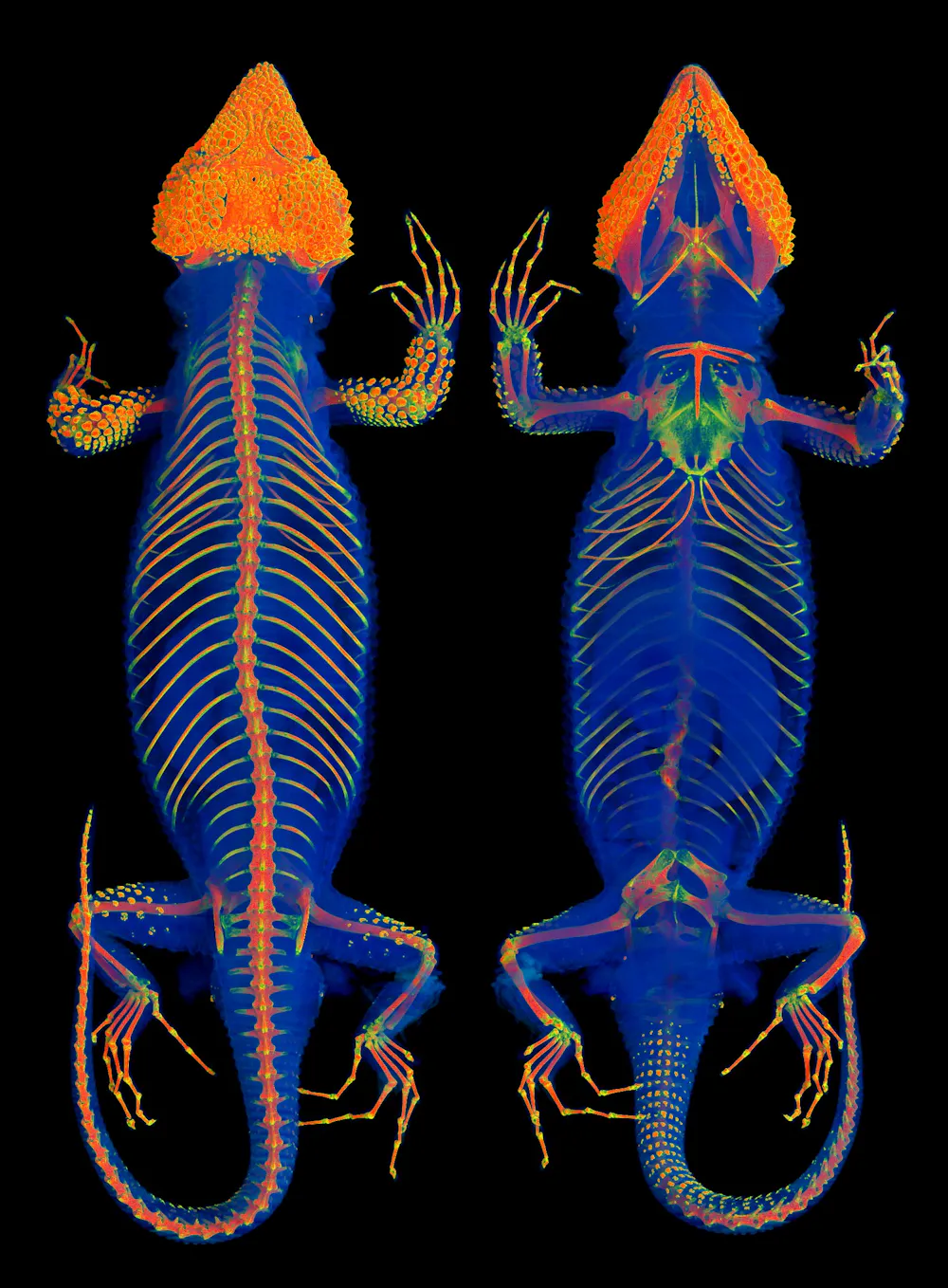
    Radiodensity heatmap of emerald tree monitors. Roy Ebel

    Monitor lizards, also known in Australia as goannas, are some of the most iconic reptiles on the continent. Their lineage not only survived the mass extinction that ended the reign of non-avian dinosaurs, but also gave rise to the largest living lizards on Earth.

    Today, these formidable creatures pace through forests and scrublands, flicking their tongues as they go.

    A new study published in the Zoological Journal of the Linnean Society looks beneath their skin. For the first time, it reveals hidden bone structures that may hold the key to the evolutionary success of goannas in Australia.

    An essential organ

    The skin is an organ essential for survival. In some animals, it includes a layer of bone plates embedded among the skin tissue. Think of the armour-like plates in crocodiles or armadillos: these are osteoderms.

    Their size ranges from microscopic to massive, with the back plates of the stegosaurus as the most impressive example.

    A mounted stegosaurus skeleton at the Natural History Museum, London.
    Jeremy Knight/Wikimedia Commons, CC BY

    We have only just started to understand these enigmatic structures. Osteoderms can be found in animal lineages that diverged up to 380 million years ago. This means these bone plates would have evolved independently, just like active flight did in birds, pterosaurs and bats.

    But what is their purpose? While the advantage of flight is undisputed, the case is not as clear for osteoderms.

    The most obvious potential would be for defence – protecting the animal from injuries. However, osteoderms may serve a far broader purpose.

    In crocodiles, for example, they help with heat regulation, play a part in movement, and even supply calcium during egg-laying. It is the interplay of these poorly understood functions that has long made it difficult to pinpoint how and why osteoderms evolved.

    Sand monitors, also known as sand goannas, are widespread through most of Australia.
    Ken Griffiths/Shutterstock

    A cutting-edge technique

    To help resolve this enigma, we had to go back to the beginning.

    Surprisingly, to date science has not even agreed on which species have osteoderms. Therefore, we assembled an international team of specialists to carry out the first large-scale study of osteoderms in lizards and snakes.

    We studied specimens from scientific collections at institutions such as the Florida Museum of Natural History, the Natural History Museum in Berlin, and Museums Victoria.

    However, we soon learnt that this came with challenges. Firstly, the presence of osteoderms can vary dramatically between individuals of the same species. Secondly, there is no guarantee that osteoderms are sufficiently preserved in all specimens.

    Most importantly, they are buried deep within skin tissue and invisible to the naked eye. Traditionally, finding them meant destroying the specimen.

    Instead, we turned to micro-computed tomography (micro-CT), an imaging technique similar to a medical CT scan, but with much higher resolution. This allowed us to study even the tiniest anatomical structures while keeping our specimens intact.

    Micro-CT-based, computer-generated 3D model of Rosenberg’s goanna (Varanus rosenbergi), with the left half showing osteoderms and endoskeleton.
    Roy Ebel

    Using computer-generated 3D models, we then digitally explored the bodies of lizards and snakes from all parts of the world. Incorporating data from prior literature, we processed almost 2,000 such samples in our search for osteoderms.

    To illustrate our results, we devised a technique called radiodensity heatmapping, which visually highlights the locations of bone structures in the body.

    For the first time, we now have a comprehensive catalogue showing where to find osteoderms in a large and diverse group; this will inform future studies.

    Radiodensity heatmapping shows newly discovered osteoderms (yellow to red) in the limbs and tail of the Mexican knob scaled lizard (Xenosaurus platyceps).
    Roy Ebel

    Not just anatomical curiosity

    What we found was unexpected. It was thought only a small number of lizard families had osteoderms. However, we encountered them nearly twice as often as anticipated.

    In fact, our results show nearly half of all lizards have osteoderms in one form or another.

    Our most astonishing finding concerned goannas. Scientists have been studying monitor lizards for more than 200 years. They were long thought to lack osteoderms, except in rare cases such as the Komodo dragon.

    So we were all the more surprised when we discovered previously undocumented osteoderms in 29 Australo-Papuan species, increasing their overall known prevalence five times.

    Examples of newly discovered osteoderms (magenta) in Australo-Papuan monitor lizards.
    Roy Ebel

    This isn’t just an anatomical curiosity. Now that we know Australian goannas have osteoderms, it opens up an exciting new avenue for further studies. This is because goannas have an interesting biogeographic history: when they first arrived in Australia about 20 million years ago, they had to adapt to a new, harsh environment.

    If osteoderms in goannas showed up around this time – possibly owing to new challenges from their environment – we’d gain crucial insights into the function and evolution of these enigmatic bone structures.

    Not only may we just have found the key to an untold chapter in the goanna story, our findings may also improve our understanding of the forces of evolution that shaped Australia’s unique reptiles as we know them today.

    Roy Ebel receives funding from the Australian Government’s Research Training Program.

    ref. New study peers beneath the skin of iconic lizards to find ‘chainmail’ bone plates – and lots of them – https://theconversation.com/new-study-peers-beneath-the-skin-of-iconic-lizards-to-find-chainmail-bone-plates-and-lots-of-them-260700

    MIL OSI AnalysisEveningReport.nz

  • MIL-Evening Report: Why has a bill to relax foreign investment rules had so little scrutiny?

    Source: The Conversation (Au and NZ) – By Jane Kelsey, Emeritus Professor of Law, University of Auckland, Waipapa Taumata Rau

    Getty Images

    While public attention has been focused on the domestic fast-track consenting process for infrastructure and mining, Associate Minister of Finance David Seymour has been pushing through another fast-track process – this time for foreign investment in New Zealand. But it has had almost no public scrutiny.

    If the Overseas Investment (National Interest Test and Other Matters) Amendment Bill becomes law, it could have far-reaching consequences. Public submissions on the bill close on July 23.

    A product of the ACT-National coalition agreement, the bill commits to amend the Overseas Investment Act 2005 “to limit ministerial decision making to national security concerns and make such decision making more timely”.

    There are valid concerns that piecemeal reforms to the current act have made it complex and unwieldy. But the new bill is equally convoluted and would significantly reduce effective scrutiny of foreign investments – especially in forestry.

    A three-step test

    Step one of a three-step process set out in the bill gives the regulator – the Overseas Investment Office which sits within Land Information NZ – 15 days to decide whether a proposed investment would be a risk to New Zealand’s “national interest”.

    If they don’t perceive a risk, or that initial assessment is not completed in time, the application is automatically approved.

    Transactions involving fisheries quotas and various land categories, or any other applications the regulator identifies, will require a “national interest” assessment under stage two.

    These would be assessed against a “ministerial letter” that sets out the government’s general policy and preferred approach to conducting the assessment, including any conditions on approvals.

    Other mandatory factors to be considered in the second stage include the act’s new “purpose” to increase economic opportunity through “timely consent” of less sensitive investments. The new test would allow scrutiny of the character and capability of the investor to be omitted altogether.

    If the regulator considers the national interest test is not met, or the transaction is “contrary to the national interest”, the minister of finance then makes a decision based on their assessment of those factors.

    Inadequate regulatory process

    Seymour has blamed the current screening regime for low volumes of foreign investment. But Treasury’s 2024 regulatory impact statement on the proposed changes to international investment screening acknowledges many other factors that influence investor decisions.

    Moreover, the Treasury statement acknowledges public views that foreign investment rules should “manage a wide range of risks” and “that there is inherent non-economic value in retaining domestic ownership of certain assets”.

    Treasury officials also recognised a range of other public concerns, including profits going offshore, loss of jobs, and foreign control of iconic businesses.

    The regulatory impact statement did not cover these factors because it was required to consider only the coalition commitment. The Treasury panel reported “notable limitations” on the bill’s quality assurance process.

    A fuller review was “infeasible” because it could not be completed in the time required, and would be broader than necessary to meet the coalition commitment to amend the act in the prescribed way.

    The requirement to implement the bill in this parliamentary term meant the options officials could consider, even within the scope of the coalition agreement, were further limited.

    Time constraints meant “users and key stakeholders have not been consulted”, according to the Treasury statement. Environmental and other risks would have to be managed through other regulations. There is no reference to te Tiriti o Waitangi or mana whenua engagement.

    Forestry ‘slash’ after Cyclone Gabrielle in 2023: no need to consider foreign investors’ track records.
    Getty Images

    No ‘benefit to NZ’ test

    While the bill largely retains a version of the current screening regime for residential and farm land, it removes existing forestry activities from that definition (but not new forestry on non-forest land). It also removes extraction of water for bottling, or other bulk extraction for human consumption, from special vetting.

    Where sensitive land (such as islands, coastal areas, conservation and wahi tapu land) is not residential or farm land, it would be removed from special screening rules currently applied for land.

    Repeal of the “special forestry test” – which in practice has seen most applications approved, albeit with conditions – means most forestry investments could be fast-tracked.

    There would no longer be a need to consider investors’ track records or apply a “benefit to New Zealand” test. Regulators may or may not be empowered to impose conditions such as replanting or cleaning up slash.

    The official documents don’t explain the rationale for this. But it looks like a win for Regional Development Minister Shane Jones, and was perhaps the price of NZ First’s support.

    It has potentially serious implications for forestry communities affected by climate-related disasters, however. Further weakening scrutiny and investment conditions risks intensifying the already devastating impacts of international forestry companies. Taxpayers and ratepayers pick up the costs while the companies can minimise their taxes and send profits offshore.

    Locked in forever?

    Finally, these changes could be locked in through New Zealand’s free trade agreements. Several such agreements say New Zealand’s investment regime cannot become more restrictive than the 2005 act and its regulations.

    A “ratchet clause” would lock in any further liberalisation through this bill, from which there is no going back.

    However, another annex in those free trade agreements could be interpreted as allowing some flexibility to alter the screening rules and criteria in the future. None of the official documents address this crucial question. As an academic expert in this area I am uncertain about the risk.

    But the lack of clarity underlines the problems exemplified in this bill. It is another example of coalition agreements bypassing democratic scrutiny and informed decision making. More public debate and broad analysis is needed on the bill and its implications.

    Jane Kelsey has received funding from the Marsden Fund for research related to New Zealand’s foreign investment regime and international agreements.

    ref. Why has a bill to relax foreign investment rules had so little scrutiny? – https://theconversation.com/why-has-a-bill-to-relax-foreign-investment-rules-had-so-little-scrutiny-261370

    MIL OSI AnalysisEveningReport.nz

  • MIL-Evening Report: Does play belong in primary school? New research suggests teachers are not sure

    Source: The Conversation (Au and NZ) – By Katy Meeuwissen, Lecturer in Early Childhood and Primary Education, University of Canberra

    Jon Challicom/ Getty Images

    Play is one of the most important parts of early childhood education in Australia.

    We know children learn about the world through play and it helps them build creativity and independence.

    There is also broad agreement among early childhood educators and policymakers about the importance of play from birth to five years.

    But once children start school, there is less certainty. Despite growing research about the importance of play in primary school, play is not often used for learning in these years.

    Our new study with Australian primary teachers highlights significant confusion about the role of play in their schools.

    Play can benefit older kids

    There is nothing to suggest the importance of play suddenly stops when children reach school age.

    Research shows play can support learning well into the primary years, helping students develop critical thinking, problem-solving and social skills.

    Recent studies even show play has learning benefits well beyond childhood. Young adults (aged 19–25) who engage in regular play have shown improved emotional intelligence and resilience.

    What do we mean by play?

    When we are talking about play in primary school, it is more than just playground time during recess and lunch.

    Play is what children do naturally, whereas play-based learning is when teachers use that natural playfulness as a teaching tool. Teachers will deliberately incorporate various types of play with specific learning goals and varying levels of adult guidance.

    For example, children might explore mathematical concepts such as geometry and spatial reasoning through LEGO construction. Teachers would guide discovery of patterns, measurements and problem-solving, and then step back to allow students to be creative.

    There is also evidence play can support literacy, numeracy and other academic goals, because it supports attention, memory and planning skills that underpin academic learning.

    Research shows it can also help maintain students’ enjoyment of and engagement in their studies.

    So when used effectively, it could be used across the school curriculum.

    Our research

    To better understand what teachers think about play and why they hold these views, we surveyed 238 teachers across Australia primary schools. Teachers ranged from those teaching the first year of primary school through to Year 6.

    Most of the teachers were from public schools. We used an online questionnaire and recruited participants through email and social media.

    Teachers’ different views on play

    The results revealed some inconsistencies in teachers’ views.

    Teachers strongly agreed play benefits children’s development. More than three-quarters (77%) strongly agreed students develop social skills through play, with similar numbers supporting play’s role in emotional, physical and language development.

    One teacher described play as “magic” and “where real learning happens”.

    However, only 52% strongly agreed students develop academic skills during play, revealing uncertainty about play’s educational value. As another teacher told us:

    Play is something that children do and it’s fun for them, however, [it] should be out of school. School is for learning.

    Some teachers still viewed play as separate from learning, with 61% agreeing that “play is a necessary break from learning” – suggesting they see play and learning as distinct entities rather than integrated.

    Adding to this confusion, teachers often used the terms “play” and “play-based learning” interchangeably, despite these being different concepts.

    How should play-based learning be structured?

    Even when teachers valued play in principle, they struggled to provide time for it in their classrooms. Teachers reported feeling caught between covering mandated content and providing meaningful play experiences. As one teacher told us:

    Play is fantastic for children but a challenge when there is so much limited time to cover such a huge curriculum.

    Teachers were also divided about their role in children’s play. Should they structure it? Leave kids alone? Supervise but not interfere?

    Our analysis revealed several distinct approaches, from hands-off supervision to active involvement. This reveals confusion about best practice (the research suggests different approaches can work, depending on the context).

    What can we do instead?

    Our research suggest there is missed opportunity when it comes to structuring play as part of learning in primary schools.

    To address this, we need several changes. Teacher education programs should include training in practical ways to use play as a teaching tool. For example, how to teach science concepts through games and experiments that feel like play to children.

    Professional development should also help existing teachers understand how to structure meaningful play that supports the curriculum.

    At a policy level, we also need better alignment between the early education and primary years, to ensure play does not disappear at the school gate.

    Katy Meeuwissen does not work for, consult, own shares in or receive funding from any company or organisation that would benefit from this article, and has disclosed no relevant affiliations beyond their academic appointment.

    ref. Does play belong in primary school? New research suggests teachers are not sure – https://theconversation.com/does-play-belong-in-primary-school-new-research-suggests-teachers-are-not-sure-259800

    MIL OSI AnalysisEveningReport.nz

  • MIL-Evening Report: Hold up, humans. Ants figured out medicine, farming and engineering long before we did

    Source: The Conversation (Au and NZ) – By Tanya Latty, Associate Professor in Entomology, University of Sydney

    Tambon Nong Chaeng/Pexels

    Think back to a time you helped someone move a heavy object, such as a couch. While at first the task may have appeared simple, it actually required a suite of advanced behaviours.

    The job needed verbal commands for social coordination (“pivot!”) and anticipation of near-future events (moving other furniture out of the way). It also required a clear, shared vision of the final goal (which room to take the couch to).

    It’s a small but satisfying example of human cooperation. But before we all get too pleased with ourselves, consider that ants – creatures with tiny brains and no capacity for speech – routinely pull off feats that rival, and sometimes exceed, our own.

    Ants routinely pull off feats that rival, and sometimes exceed, our own.
    Andre Moura/Pexels

    Understanding ant intelligence

    Earth is literally crawling with ants. Scientists estimate there are at least 20 quadrillion ants on Earth. That’s 20 followed by 15 zeros – more ants than stars in our galaxy!

    These incredible insects are amongst the most successful organisms on the planet. Part of the success comes from an ability to form complex societies, ranging from a few individuals to millions. And those societies, or colonies, are remarkably co-operative.

    Take, for example, ants’ abilities to move large food items. To do it, they mobilise teams of dozens – or even hundreds – of fellow workers. Together, they efficiently work together to transport the load back to the nest.

    Longhorn crazy ants (Paratrechina longicornis) are even known to clear debris from a path before a heavy object arrives – seemingly anticipating its trajectory and preparing the way.

    One experiment pit longhorn crazy ants against humans, all tasked with moving T-shaped objects (scaled to body size) through tight spaces. In some trials, the human teams were not permitted to speak or use gestures.

    And the result? Ants performed better in larger groups compared to smaller ones, showing the clear benefits of collective action. In contrast, human performance did not improve with group size. And when communication was restricted, human performance declined as group size increased.

    All this highlights how ants rely on collective intelligence, without the need for central control or sophisticated cognition.

    Expert farmers

    Humanity’s invention of agriculture 12,000 years ago is understandably hailed as one of our greatest achievements.

    But leaf cutter ants beat us to it. These ants (from the species Atta and Acromyrmex) evolved to undertake large-scale agriculture about 55 million years ago.

    These ants cut and transport fresh leaves not to eat directly, but to feed a fungus that serves as their main food source.

    This evolutionary partnership allows the ants to feed colonies with populations in the millions.

    Remarkably, leaf cutter ants have also evolved a form of biological pest control to protect their crops from bacteria. Some worker ants patrol the gardens, detecting infected sections of the fungus. Then they apply antibiotics produced by bacteria that live on their bodies.

    What’s more, many ant species farm aphids and other sap-sucking insects.

    As these farmed insects feed on plant sap, they excrete a sugary liquid the ants eagerly collect. In return, ants serve as bodyguards, defending their tiny livestock from predators such as ladybirds and lacewings.

    In some species, queen ants gently carry sap-sucking insects in their jaws as they fly off to start new colonies. Fossilised ants preserved in amber suggest this behaviour evolved up to 20 million years ago, long before humans domesticated animals.

    Ant medicine

    Medical care may seem like a distinctly human innovation. But several ant species have evolved sophisticated ways to treat injuries.

    When a Florida carpenter ant (Camponotus floridanus) is injured during a battle between colonies, its nest-mates will amputate a damaged limb to prevent infection from spreading. Ants receiving this battlefield care are more likely to survive than ants left untreated.

    Some ants can also detect infection and treat infected wounds by cleaning them and applying antimicrobial secretions from specialised glands.

    Master builders

    Some ant species are known to literally put their bodies on the line for the colony.

    Army ants (Eciton burchellii) join their bodies together to form structures. These include bridges across gaps on the forest floor, and “scaffolds” across steep terrain to prevent other ants from slipping.

    Even the nest is made of hundreds of thousands of ants joined together, complete with tunnels and chambers housing the larvae and the queen. The entire structure is packed up and rebuilt each day, after the colony emigrates a few hundred metres into the forest.

    Army ants join their bodies together to form structures.
    Smartse/Wikimedia, CC BY

    Weaver ants (Oecophylla smaragdina), meanwhile, self-assemble into rope ladders to span vertical gaps.

    They also form a line of workers that pull leaves together in treetops to form nests. Once the leaves are winched into place, other ants arrive with ant larvae in their jaws. Each larva produces a tiny blob of silk which the ants use to glue the leaves together.

    Fire ants (Solenopsis invicta), a major pest species, owes its invasive success partly to a unique method of dispersal.

    When their underground nests are flooded by rain, the ants join together into a huge raft which floats on a layer of buoyant larvae. These rafts can ride floodwaters in safety for hundreds of kilometres, until the ants reach dry land.

    When their nests are flooded, fire ants join together into a huge raft.
    TheCoz/Wikimedia, CC BY

    Lessons for humanity?

    Humans rightly take pride in our greatest achievements – agriculture, medicine, engineering and building civilisations. But remarkably, ants mastered these innovations millions of years before we did.

    Ants may be tiny – but by working together they can build complex societies and solve many problems. They might even teach humans a thing or two.

    Tanya Latty co-founded and volunteers for conservation organisation Invertebrates Australia, is former president of the Australasian Society for the Study of Animal Behaviour and is on the education committee for the Australian Entomological Society. She receives funding from the Australian Research Council, NSW Saving our Species, and Agrifutures Australia

    Chris R. Reid receives funding from the Australian Research Council and Macquarie University. He is secretary of the Australasian Society for the Study of Animal Behaviour and is on the education committee for the Australasian Entomological Society.

    ref. Hold up, humans. Ants figured out medicine, farming and engineering long before we did – https://theconversation.com/hold-up-humans-ants-figured-out-medicine-farming-and-engineering-long-before-we-did-258922

    MIL OSI AnalysisEveningReport.nz

  • MIL-Evening Report: Is spinal cord stimulation safe? Does it work? Here’s what you need to know if you have back pain

    Source: The Conversation (Au and NZ) – By Caitlin Jones, Postdoctoral Research Associate in Musculoskeletal Health, University of Sydney

    AsiaVision/Getty

    Spinal cord stimulators are electrical devices that are surgically implanted in the body to treat long-term pain. They have a battery pack and leads that deliver electrical impulses directly to the spinal cord. The devices are thought to work by providing electrical impulses that interfere with how the brain senses pain.

    Spinal cord stimulators are mainly used to treat chronic back pain, especially when other less invasive treatments have not worked. They also aim to reduce people’s reliance on risky pain medicines. These include opioids, which research shows are ineffective and harmful for low-back pain.

    But research, including our own, shows spinal cord stimulators work no better than a placebo. And they can also carry risks.

    Do they work?

    In a 2023 Cochrane review, researchers reviewed data from 13 randomised controlled trials on low-back pain and found no benefits in the short and medium term. These international reviews draw together the most robust evidence to provide a detailed summary of what we know on a particular topic.

    Only one of the trials in the review tested efficacy in the longer term (six months). That trial found no benefits of spinal cord stimulation.

    An earlier Cochrane review looked at the evidence of spinal cord stimulation for chronic pain in general, including for neck pain. Reviewers looked at 15 randomised controlled trials and couldn’t be certain about its benefits, largely due to the quality and reliability of the available trials.

    Are there side effects?

    Aside from disappointing results for pain relief, there are risks and side effects to consider.

    We co-authored an analysis of 520 adverse events reported to Australia’s Therapeutic Goods Administration (TGA). We found 79% of reported events were rated as severe, with 13% life-threatening. The same research found 80% of events required surgery to correct.

    Our recent analysis in the Medical Journal of Australia looked at data from private health insurers. These cover 90% of spinal cord stimulation implants in Australia. Five major insurers, which covered 76% of privately insured people, contributed de-identified data.

    We found about one-quarter of people who had a spinal cord stimulator implanted needed corrective surgery afterwards. These surgeries occurred within a median of about 17 months. This indicates these surgeries are not routine or expected interventions, such as to replace batteries, which are meant to last five to ten years.

    Our previous research shows the sorts of reasons for corrective surgery. These include to replace a malfunctioning device, or the person was in more pain, had an infection, or a puncture of the delicate tissues covering the spinal cord.

    However, even our latest findings are likely to underestimate the risk of these devices.

    Sometimes the lead delivering the electrical current moves away from the spinal cord to elsewhere in the body. This requires surgery to reposition the lead, but does not necessarily require new hardware, such as a brand new lead. So this type of corrective surgery is not counted in the data from the private health insurance companies.

    How much does it cost?

    We found spinal cord stimulators cost about A$55,000 per patient, including the device, its insertion, and managing any associated additional surgeries.

    For people who only had a “trial” – where the leads are implanted temporarily but the battery pack remains outside the body – this cost was about $14,000 per patient.

    These figures do not include any out-of-pocket costs.

    What do regulators say about the devices?

    In 2022 the TGA began a review of spinal cord stimulators on the market because of safety and performance concerns.

    As a result, several devices were removed from the Australian Register of Therapeutic Goods – that is, they were banned from use in Australia, but existing stock could still be used.

    The rest of the devices had conditions imposed, such as the manufacturers being required to collect and report safety data to the TGA at regular time points.

    Should I do my own online research?

    Yes, but be careful. Unfortunately not all online information about spinal cord stimulators is correct.

    Look for sites independent of those who manufacture or implant these devices.

    Government agencies, health departments and universities that have no financial interests in this area may be a better option.

    The Cochrane Library is also a reliable and independent source for trustworthy health information.

    What shall I ask my doctor?

    The Australian health department provides useful advice for consumers about medical implants.

    It says medical implants “are considered higher-risk therapeutic goods, and the decision to get one should not be taken lightly”. It recommends asking your health professional these questions:

    • do I really need this medical implant?

    • what are the risks/benefits?

    • is the medical implant approved?

    • where can I get more information?

    • what happens if I experience an adverse event?

    What else could I do for my back pain?

    There are other treatment options that are effective and have fewer risks than spinal cord stimulation.

    For example, education about how to manage your pain yourself, exercise, cognitive behavioural therapy (a type of psychological therapy), and non-steroidal anti-inflammatory medicines (such as ibuprofen) all have solid evidence to back them. All offer benefits that are not outweighed by their potential risks.

    Australian research has shown other types of therapy – such as sensorimotor retraining and cognitive functional therapy – are also effective. You can discuss these and other options with your health professional.

    Spinal cord stimulation is a good example of a treatment that got ahead of the evidence. Although the devices have been around since the 1960s, we’ve only had reliable trials to test whether they work in recent years.

    Everyone wants to find ways to help people with chronic pain, but we must ensure medical care is grounded in reliable science.

    Christopher Maher holds a research fellowship funded by the National Health and Medical Research Council.

    Caitlin Jones does not work for, consult, own shares in or receive funding from any company or organisation that would benefit from this article, and has disclosed no relevant affiliations beyond their academic appointment.

    ref. Is spinal cord stimulation safe? Does it work? Here’s what you need to know if you have back pain – https://theconversation.com/is-spinal-cord-stimulation-safe-does-it-work-heres-what-you-need-to-know-if-you-have-back-pain-261364

    MIL OSI AnalysisEveningReport.nz

  • MIL-Evening Report: Federal election feel like ages ago? Parliament is now back. Here’s your political refresher

    Source: The Conversation (Au and NZ) – By Jill Sheppard, Senior Lecturer, School of Politics and International Relations, Australian National University

    Tracey Nearmy/Getty

    Despite many pre-election predictions, the 48th Australian parliament looks quite similar to the 47th. The Labor Party has greater representation than before: 94 Members of the House of Representatives (up from 77) and 29 Senators (up from 26).

    The Coalition’s numbers were famously smashed at the election, and will be represented by 43 Members and 27 Senators.

    Despite the landslide electoral victory, Labor’s parliamentary position is not materially improved. It retains a majority in the House of Representatives, but Prime Minister Anthony Albanese faces the problem of finding jobs to keep such a large backbench occupied. Restless politicians reliably create havoc for their leaders (just ask Keir Starmer).

    In the Senate, Labor has more possible paths to a majority, but none is particularly pretty. Pre-election, the government required 12 additional senators to support its legislation. Often this support came from the Coalition, with the crossbench bypassed entirely, as in the case of political donation reforms.

    Other reforms, including workplace relations, were passed by a combination of Greens and independent senators.

    Labor can achieve a majority (38 votes) in the new Senate by negotiating with either the Greens or the Coalition. If neither is forthcoming, Labor can then turn to a disparate group of crossbenchers: four One Nation Senators, plus Fatima Payman, Jacqui Lambie, Ralph Babet and David Pocock.


    Read more:
    Grattan on Friday: New parliament presents traps for Albanese and Ley


    Clearing the decks

    How the new Senate configuration affects Labor’s legislative agenda depends on what exactly that agenda looks like.

    Labor went into the 47th parliament emphasising the Voice referendum, COVID and rising inflation.

    At the end of that term, ten bills were listed for debate but were “timed out” by the constitutional requirement to hold an election.

    The most controversial of these is the proposal to add a new 15% tax on superannuation balances of more than $3 million. The Greens, under previous leader Adam Bandt, promised to support the bill in 2023 pending the government extending superannuation to paid parental leave (which was legislated in 2024 and came into effect on July 1 2025).


    Read more:
    Actually, Gen Z stand to be the biggest winners from the new $3 million super tax


    The Greens continue to support the tax proposal in principle, but want the threshold lowered to $2 million.

    One Nation is strongly opposed. The Coalition has expressed willingness to negotiate on the condition that unrealised gains are exempt from valuations.

    The government has also proposed cutting the number of overseas students at Australian universities, ostensibly due to concerns over exploitation of the student visa program. The Greens have called the proposal “disastrous for tertiary education”.

    Pocock and the Coalition have both called for key changes to the bill. Their primary concerns are about a ministerial power to decide appropriate student numbers without parliamentary approval.

    Despite opposing the bill for different reasons, the Greens and Coalition were willing to team up against the government – perhaps foreshadowing strategy in the new parliament.

    What’s on the horizon?

    Labor announced just 15 specific policy proposals before the election. Only two costed promises are registered with the Parliamentary Budget Office. This gives Labor a free hand to determine its policy agenda in the 48th parliament.

    Right out of the gate, the government promised to cut HECS debt by 20%. Given the Greens would wipe all current HECS debt, they seem likely to wave this through the Senate.

    Treasurer Jim Chalmers has since declared that while “the first term was primarily inflation without forgetting productivity, the second term will be primarily productivity without forgetting inflation”.

    In search of new thinking, the government has announced an economic reform roundtable comprising government, business and experts, and covering economic resilience, skills, new technologies, healthcare reform and clean energy.

    Productivity is notoriously difficult to measure and improve. Whether policies arising from the roundtable will pass the parliament remains to be seen.

    However, the government’s invitation to Shadow Treasurer Ted O’Brien was accompanied with commentary that Chalmers does not believe O’Brien or his leader Sussan Ley are “by their nature constructive, collaborative types”.

    Other election policies should be legislated with ease. The Coalition has already supported purchasing the Port of Darwin, promised instant asset write-offs for small business, and pledged to match Labor’s Medicare spending dollar for dollar.

    The Coalition is also likely to support new fast-track training for 6,000 tradies.

    The Greens will likely support pro-worker reforms. These include legislated weekend penalty rates and new mental health spending.

    In general, the government’s stated agenda is incremental and should be achievable in this parliament. If the Greens won’t play ball, the Coalition will be waiting in line.

    This will probably lead to quixotic policymaking as Labor bounces between two ideologically opposed partners.

    Elsewhere, as in the case of the government’s post-election approval of new licences for gas extraction, policy can happen without parliamentary approval at all.

    In such cases, meaningful opposition will come from the cross- and backbenches, full of politicians eager to make a name for themselves.

    Jill Sheppard receives funding from the Australian Research Council. She worked as an adviser to Coalition parliamentarians between 2003 and 2007.

    Patrick Leslie receives funding from the Australian Research Council.

    ref. Federal election feel like ages ago? Parliament is now back. Here’s your political refresher – https://theconversation.com/federal-election-feel-like-ages-ago-parliament-is-now-back-heres-your-political-refresher-261360

    MIL OSI AnalysisEveningReport.nz

  • MIL-Evening Report: The first video of Earth’s surface lurching sideways in an earthquake offers new insights into this force of nature

    Source: The Conversation (Au and NZ) – By Jesse Kearse, Postdoctoral Researcher, Geophysics, Kyoto University

    Sai Aung MAIN/AFP via Getty Images

    During the devastating magnitude 7.7 Myanmar earthquake on March 28 this year, a CCTV camera captured the moment the plate boundary moved, providing the first direct visual evidence of plate tectonics in action.

    Tectonic plate boundaries are where chunks of Earth’s crust slide past each other – not smoothly, but in sudden, violent ruptures.

    The footage shows Earth’s surface lurching sideways, like a gigantic conveyor belt switched on for just a second, as the fault slips.

    What we’re seeing is the propagation of a large earthquake rupture – the primary mechanism that accommodates plate boundary motion at Earth’s surface. These shear fractures travel at several kilometres per second, making them notoriously difficult to observe.

    This video explains the moment Myanmar’s Sagaing Fault ruptured in a large earthquake, allowing the tectonic plate boundary to shift. Research: https://doi.org/10.1785/0320250024.

    These rare events, separated by centuries, have shaped our planet’s surface over millions of years, creating features such as Aotearoa New Zealand’s Alpine Fault and the Southern Alps.

    Until now, seismologists have relied on distant seismic instruments to infer how faults rupture during large earthquakes. This video sheds new light on the process that radiates seismic energy and causes the ground to shake.

    Analysis of the video

    In our new study, we analysed the video frame by frame. We used a technique called pixel cross-correlation to reveal that the fault slipped 2.5 metres sideways over a duration of just 1.3 seconds, with a maximum speed of 3.2 metres per second.

    The total sideways movement in this earthquake is typical of strike-slip fault ruptures, which move the land sideways (in contrast to faults that move land up and down).

    But the short duration is a major discovery.

    The timing of when a fault starts and stops slipping is especially difficult to measure from distant recordings, because the seismic signal becomes smeared as it travels through Earth.

    In this case, the short duration of motion reveals a pulse-like rupture – a concentrated burst of slip that propagates along the fault like a ripple travels down a rug when it’s flicked from one end.

    Capturing this kind of detail is fundamental to understanding how earthquakes work, and it helps us better anticipate the ground shaking likely to occur in future large events.

    Validation of the ‘slickenline’ hypothesis

    Our analysis also revealed something more subtle about the way the fault moved.

    We found the slip didn’t follow a straight path. Instead it curved. This subtle curvature mirrors patterns we’ve observed previously at fault outcrops.

    Called “slickenlines”, these geological scratch marks on the fault record the direction of slip.

    Our work shows the slickenlines we see on outcrops are curved in a manner similar to the curvature seen in the CCTV footage. Based on our video analysis, we can be certain that curved slip occurs, giving credence to our interpretations based on geological observations.

    In our earlier research, we used computer models to show that curved slickenlines could emerge naturally when an earthquake propagates in a particular direction. The Myanmar rupture, which is known to have travelled north to south, matches the direction predicted by our models.

    This alignment is important. It gives us confidence in using geological evidence to determine the rupture direction of past earthquakes, such as the curved slickenlines left behind after the New Zealand Alpine Fault’s 1717 earthquake.

    This first glimpse of a fault in motion shows the potential for video to become a powerful new tool in seismology. With more strategic deployments, future earthquakes could be documented with similar detail, offering further insight into the dynamics of fault rupture, potentially revolutionising our understanding of earthquake physics.

    Jesse Kearse receives funding from Royal Society Te Apārangi Marsden Fund.

    ref. The first video of Earth’s surface lurching sideways in an earthquake offers new insights into this force of nature – https://theconversation.com/the-first-video-of-earths-surface-lurching-sideways-in-an-earthquake-offers-new-insights-into-this-force-of-nature-261004

    MIL OSI AnalysisEveningReport.nz

  • MIL-Evening Report: After yet another election, Tasmanians are left wondering what the point of it was

    Source: The Conversation (Au and NZ) – By Robert Hortle, Deputy Director, Tasmanian Policy Exchange, University of Tasmania

    When the results firmed up a few hours after polling closed on Saturday, many Tasmanians would have been wondering, “what was the point of all that?”.

    A state election only 16 months after the last one looks to have delivered a parliament with a broadly similar distribution of seats.


    Read more:
    Liberals easily win most seats at Tasmanian election, but Labor may form government


    The results

    By the time counting ceased last night, the ABC had the Liberals on 14 seats, Labor on nine, the Greens on five, and three confirmed independents.

    The ABC’s projections of the Tasmanian election, captured at 11:15am on July 20th.
    ABC News

    With 65.3% of the vote counted, four seats remained in doubt. There was a small positive swing to the Liberals (3.3%), while a swing against Labor of 3.1% has them on track for their worst primary vote in more than a hundred years. The final seats may not be confirmed for a couple of weeks.

    Love, Labor’s lost

    At this stage, it looks like Labor’s gambit – instigating the no confidence motion that led to this election – has utterly failed. The party will now need to engage in some sober self-reflection on two fronts.

    First, there is the one-dimensional strategy that brought on the election and allowed the Liberals to blame Labor – and leader Dean Winter in particular – for dragging Tasmanians to the polls again.

    Labor had hoped that targeting the no confidence motion specifically at Premier Jeremy Rockliff would encourage the conservative-leaning Liberal cabinet to turf out their moderate leader.

    It was a near thing. Rockliff’s rivals apparently had almost enough votes to depose him by the time the Governor called the election.

    But did anyone at Labor HQ plan for what would happen if their gamble failed and the Liberals held firm under Rockliff? As Labor’s woefully under-prepared campaign stumbled into motion, it seemed the answer was “no”.

    Second, there will be questions asked about that lacklustre campaign, just as there were in 2024. An opposition could not ask for more favourable conditions: an 11-year incumbent government suffering a string of high profile policy failures; a looming mountain of debt; and ongoing health, education, housing, cost of living and sustainability challenges.

    And yet, Labor suffered negative swings in every seat, and they are battling to match their 2024 result of 10 seats.

    Liberals and Greens hold firm

    The Liberals will be pleased with the result. In the face of the dire circumstances outlined above, they have secured a positive swing in their primary vote and may pick up one or (at an outside chance) two additional seats.

    It doesn’t seem like their pro-stadium stance lost them votes in the north – where the proposal is unpopular – in part because Labor denied themselves a point of difference by also supporting the stadium.

    Another important factor in the north was the recruitment of two former federal Liberal MPs in Bass and Braddon, who are both polling well so far. However, their success may come at the expense of sitting Liberal members.

    The Greens’ vote held steady, with a projected 0.2% increase in their primary vote. All of their MPs had been returned before the close of counting on Saturday night, and they will be hoping one more can scrape through in Braddon.

    The crossbench zoo

    As expected, ex-Labor MP David O’Byrne, centre-left Kristie Johnston, and maverick Northwester Craig Garland were all returned. Johnston and Garland, in particlar, seem to have strongly increased their vote shares.

    There will be at least one new independent, with anti-salmon farm advocate Peter George securing a very strong primary vote in Franklin off the back of his recent federal campaign.

    There is a chance that this broadly progressive crossbench will be joined by climate change denier and pro-gun rights candidate Carlo di Falco (Lyons) from the Shooters, Fishers and Farmers.

    Where to now?

    So how are the major party leaders approaching the looming period of wheeling and dealing? Who’s forming minority government?

    Rockliff was the first to address the tally room on election night. He boldly claimed that the voters had re-endorsed his Liberal government – based on their increased vote share – and said he will ask the Governor to recommission him as premier.

    However, with only 14 or 15 seats, it will be challenging for the Liberals to implement their agenda in a parliament featuring a crossbench that is, for the most part, solidly progressive and vehemently anti-stadium.

    The Greens’ leader, Rosalie Woodruff, also spoke and again extended an offer of cooperation to Labor.

    Finally, as election night drew to a close, Labor Leader Dean Winter stepped up to speak. His tonally confused speech began with a tribute to murdered Tasmanian Police Constable Keith Smith, then shifted to the need for a more collaborative approach to politics. Winter left things on a cliffhanger, essentially saying “let’s wait and see”.

    Observers in the room noted the speech was strikingly similar to that given by former leader Rebecca White following the 2024 election – shortly before she was replaced by Winter.

    Will Labor have a crack at forming government? There would be a few obstacles to this. First, Winter would have to negotiate support from the diverse crossbench, including the Greens, with whom he has previously vowed not to collaborate.

    He and Labor have ignored previous opportunities to seize government in this way, the most recent being just five weeks ago. A change in tack at this stage could be difficult to sell.

    And if Rockliff forges ahead with his stated plan, Labor and the crossbench would need to vote down a new Liberal minority government on the floor of parliament. Labor would need to be very certain of their ability to govern before doing this – or risk another election.

    So while all of the party leaders spoke of maturity and collaboration in their speeches, until actions match words, Tasmanians will be forced to watch the parliamentary shenanigans continue.

    Robert Hortle does not work for, consult, own shares in or receive funding from any company or organisation that would benefit from this article, and has disclosed no relevant affiliations beyond their academic appointment.

    ref. After yet another election, Tasmanians are left wondering what the point of it was – https://theconversation.com/after-yet-another-election-tasmanians-are-left-wondering-what-the-point-of-it-was-260505

    MIL OSI AnalysisEveningReport.nz

  • MIL-Evening Report: Liberals easily win most seats at Tasmanian election, but Labor may form government

    Source: The Conversation (Au and NZ) – By Adrian Beaumont, Election Analyst (Psephologist) at The Conversation; and Honorary Associate, School of Mathematics and Statistics, The University of Melbourne

    With 63% of enrolled voters counted in today’s Tasmanian state election, The Poll Bludger is projecting that the final results will give the Liberals 39.7% of the statewide vote (up 3.0% since the March 2024 election), Labor just 25.7% (down 3.1%), the Greens 14.1% (up 0.2%), the Shooters 3.2% (up 0.9%), the Nationals 1.7% and independents 15.4%.

    Tasmania uses the proportional Hare-Clark system for its lower house elections. As described previously, the five seats Tasmania has at federal elections each return seven members for a total of 35 MPs. A quota for election is one-eighth of the vote, or 12.5%.

    The main Poll Bludger page gives projected quotas for each electorate for the Liberals, Labor and the Greens. The Liberals have just under four quotas in Braddon, over three in Bass and Lyons and over two in Clark and Franklin, suggesting 14 definite seats with more possible.

    Labor is just above or just below two quotas in all five seats, and should win ten seats. The Greens have 1.8 quotas in Clark, over one in each of Franklin, Bass and Lyons and 0.6 in Braddon, so they should win at least five seats.

    Of the independents, environmental campaigner Craig Garland has 0.8 quotas in Braddon and will be re-elected. Left-wing independent Kristie Johnston has 1.3 quotas in Clark, and will also be re-elected. In Franklin, both former Labor leader David O’Byrne and Teal Peter George (0.9 and 1.3 quotas respectively) have been elected.

    In Lyons, the Shooters candidate, with 0.6 quotas, is well positioned to win the final seat. In Bass, it appears more complex, but the final seat is likely to go to either the Liberals or the Shooters. None of the three former Jacqui Lambie Network MPs who won seats at the March 2024 election have been re-elected.

    Overall, the right-wing parties (Liberals and Shooters) are likely to win 16 of the 35 seats, but Labor, the Greens and left-wing independents are likely to win 19 seats. So even though the Liberals will win the most seats, Labor may be able to cobble together a government, but only if they cooperate with the Greens.

    This overall result assumes a 4–3 right split in Bass, Braddon and Lyons, but a 5–2 left split in both Clark and Franklin. In Franklin, the Liberals would be unlucky not to win three with 2.7 quotas, but Labor has 1.8 quotas and preferences from George should assist Labor.

    Many pre-poll votes have not yet been counted, and postals won’t be counted until next week. Postals are likely to assist the Liberals. The postal effect should be accounted for by The Poll Bludger’s projections.

    YouGov poll badly understated Liberals

    A late YouGov poll, conducted July 7–18 from a sample of 931, gave the Liberals 31% of the statewide vote (steady since June), Labor 30% (down four), the Greens 16% (up three), the Nationals 2%, the Shooters 1% and independents 20% (up two).

    A two-party vote is not applicable in Tasmania’s proportional system, but this poll gave Labor a 55–45 lead over the Liberals. Labor leader Dean Winter also led Liberal incumbent Jeremy Rockliff as better premier by 55–45. Rockliff was at -19 net approval and Winter at -13.

    The only other public Tasmanian polls were conducted by DemosAU. The final DemosAU poll, which I covered on Tuesday, gave the Liberals 34.9%, Labor 24.7%, the Greens 15.6%, the Nationals 2.7%, the Shooters 1.8% and independents 20.3%.

    The results show the Liberals headed for about a 14-point vote share win over Labor, so YouGov badly understated them.

    Federal Bradfield legal challenge

    Last Monday the Liberals challenged Teal Nicolette Boele’s 26-vote win in Bradfield at the May 3 federal election to the High Court, acting as the Court of Disputed Returns. Boele will be seated until the court resolves the case.

    The court can either confirm Boele’s win, void the election for this seat and order a byelection in Bradfield, or overturn the result and declare the Liberal candidate elected.

    After the official declaration of the election on June 12, the 40-day period for legal challenges to the results expires on Tuesday. Tuesday will also be the first sitting of federal parliament since the election, though it could have sat at any time after June 12.

    The Bradfield challenge will delay a Labor vs Liberal two-party count in that seat until the challenge is resolved. It’s likely the Australian Electoral Commission’s (AEC) current estimate in Bradfield is understating Labor, and therefore Labor is being very slightly understated nationally.

    DemosAU polls on democracy in Australia and Queensland federal

    DemosAU has emailed me a poll on democracy and voting systems in Australia. This poll was conducted in two waves in May and June from a total sample of 1,713.

    By 69–12, respondents thought Australian democracy is something to be proud of, and by 71–19 they did not think Australia needs a PM like Donald Trump. By 67–15, respondents trusted the AEC. By 53–23, they did not want the number of MPs increased.

    Asked for preferred voting system in the House of Representatives, 36% selected compulsory preferential voting (CPV), 27% first past the post (FPTP), 25% optional preferential voting (OPV) and 12% proportional representation (PR).

    Head to head, CPV and OPV both beat FPTP by 53–47, while CPV beat OPV by 54–46. All single-member systems were much preferred to PR.

    I previously covered the Queensland state DemosAU poll. In the federal Queensland poll, Labor led by 53–47 (50.6–49.4 to the Coalition at the election). Primary votes were 35% Labor, 31% Coalition, 13% One Nation, 12% Greens and 9% for all Others.

    Adrian Beaumont does not work for, consult, own shares in or receive funding from any company or organisation that would benefit from this article, and has disclosed no relevant affiliations beyond their academic appointment.

    ref. Liberals easily win most seats at Tasmanian election, but Labor may form government – https://theconversation.com/liberals-easily-win-most-seats-at-tasmanian-election-but-labor-may-form-government-261255

    MIL OSI AnalysisEveningReport.nz

  • MIL-Evening Report: From ‘Stone Age’ treasury boss to National Party Senator: John Stone 1929-2025

    Source: The Conversation (Au and NZ) – By John Hawkins, Head, Canberra School of Government, University of Canberra

    AUSPIC

    John Owen Stone AO was a legendary leader of the Commonwealth Treasury. He was secretary (departmental head) from January 1979 to September 1984 but was an intellectual driving force before then as deputy secretary from 1971 to 1978.

    Over those years he dealt with eight treasurers: Billy Snedden, Gough Whitlam, Frank Crean, Jim Cairns, Bill Hayden, Phillip Lynch, John Howard and Paul Keating.

    It is a sign of his influence that those years were dubbed the “Stone Age” by South Australian Premier Don Dunstan and others.

    Former Defence Department heads Arthur Tange and Tony Ayers were at various times called the “last of the mandarins” but Stone is probably truly the last.

    In 1978 journalist Paul Kelly called Stone “one of the two men who ran the nation”, the other being then prime minister Malcolm Fraser.

    It is hard to think of any later public servant about whom that could be said.

    Stone’s entry in the Senate’s biographical dictionary captures him well:

    he could be charming, witty and flattering, but he is often decried as being obstinate and arrogant.

    A Reserve Bank official is said to have said “I wish I was as certain about one thing as John Stone is about everything.”

    This obduracy cemented the Treasury’s reputation for arrogance and weakened its influence.

    Early years – from physics to economics

    John was born in 1929, the elder of two sons of a farmer and a primary school teacher. His childhood was spent in the Western Australian wheat belt. But after his parents divorced when he was 12, he moved with his mother to Perth.

    He attended Perth Modern School where contemporaries included Bob Hawke, Rolf Harris and Maxwell Newton.

    He graduated with first-class honours from the University of Western Australia in 1950, majoring in mathematical physics, and served as president of the students’ association.

    While there he met Billy Snedden, who two decades later would be Prime Minister William McMahon’s treasurer and with whom Stone would work as treasury deputy secretary.

    In 1951 he won a Rhodes scholarship. He initially enrolled for a physics degree at Oxford, but switched to economics, graduating with a Bachelor of Arts in Politics, Philosophy and Economics.

    He joined Australia’s Treasury, initially in its London office, in 1954. The same year he married Nancy Hardwick, a biochemical researcher, and they would have five children.

    The mandarin who put Treasury first

    Stone was an admirer of fellow Rhodes scholar Sir Roland Wilson, the longest-serving Treasury secretary with doctorates from Oxford and Chicago.

    Along with Wilson, Stone was a strong critic of the 1965 report of the Committee of Economic Inquiry known as the Vernon Report which called for greater planning and an independent economic advisory committee whose advice would have rivalled Treasury’s and succeeded in having Prime Minister Menzies reject it.

    In the late 1960s as treasury’s representative he was an executive director at the International Monetary Fund and defied his treasurer William McMahon by voting against the introduction of Special Drawing Rights that gave members rights over other members’ reserves.

    Stone believed that was why he was passed over for the secretary’s position when Frederick Wheeler was appointed in 1971.

    At treasury in the 1970s, Stone publicly clashed with members of a global environmental group called the Club of Rome about whether there were environmental limits to economic growth.

    During a public meeting in Canberra in 1973, he argued the world would not run out of the resources it needed because price rises would create incentives to use them more efficiently and develop substitutes.

    These ideas permeated the treasury’s second economic research paper called Economic Growth – is it Worth Having? which he heavily influenced.

    Stone claimed to have personally drafted the words in Treasurer Bill Hayden’s 1975 budget statement that said Australia was

    no longer operating in that simple Keynesian world in which some reduction in unemployment could, apparently, always be purchased at the cost of some more inflation.

    Stone was the driving force behind the subsequent Fraser government’s mantra of “fight inflation first”.

    As a senior Treasury officer, Stone was often openly contemptuous of politicians. He would share these views with journalists at the bar of the Hotel Canberra and in later years at the bar of the National Press Club.

    He was particularly critical when politicians had the temerity to take advice from what he termed “meretricious players” from outside the treasury.

    This attitude led Stone to oppose even the sort of free-market measures he might be expected to like when they were advocated by someone else.

    He unsuccessfully opposed the Whitlam government’s cuts to tariffs in 1973 and some of the recommendations of the Campbell Committee of Inquiry into Australia’s financial system in 1981.

    Fraser is said to have said Stone “believes in the deregulation of everything he does not regulate”.

    Stone also opposed the Hawke government’s decision to float the dollar in 1983.

    He argued the timing was wrong and that the dollar would appreciate, weakening the economy. After rising for a short time, the dollar actually depreciated and the economy performed strongly.

    Ludicrously, Stone denied having ever opposed it.

    Many in the Labor Party had wanted Stone sacked when it came to power in 1983, but Keating kept him on, partly to reassure financial markets. As Keating’s confidence in his own judgement grew, Stone’s influence waned.

    Stone announced his resignation just before the August 1984 budget and made a scathing attack on many of the government’s policies in his 1984 Shann Memorial Lecture at the University of Western Australia.


    Read more:
    Happy birthday AUD: how our Australian dollar was floated, 40 years ago this week


    Politics post-treasury

    Stone isn’t the only treasury official to have gone into politics. Leslie Bury even became treasurer. Jim Short and Arthur Sinodinos became assistant treasurers.

    But Stone was the only former head of the treasury to enter politics. He served as a National Party Senator for Queensland from 1987 to 1990, having been part of the Joh for Canberra campaign which had as its organising principle the anointing of Queensland Premier Joh Bjelke-Petersen as prime minister.

    He was the Senate running mate to Sir Joh’s wife Flo Bjelke-Petersen.

    Stone was twice the Coalition’s finance spokesman, but he was something of a loose cannon. John Howard dropped him from the front bench for a time after he said “Asian immigration has to be slowed”.

    He apparently held ambitions to be treasurer. In 1990 he resigned from the Senate to contest a seat in the House of Representatives that would have made that easier given treasurers are traditionally members of the lower house.

    Stone failed to win it. He then reneged on an earlier promise by nominating to return to his Senate seat. Faced with uproar in the party, he withdrew and his meteoric political career was over.

    He co-founded the HR Nicholls Society, which pressed for the deregulation of industrial relations laws, and the Samuel Griffith Society which concerned itself with states’ rights.

    Stone was active in the Institute of Public Affairs and wrote frequently in Quadrant. He opposed republicanism, centralism, trade unionism, multiculturalism and climate action.

    He died aged 96 and is survived by five children.

    John Hawkins was a senior economist at the Australian Treasury where he wrote a series of biographical essays on Australian treasurers.

    Selwyn Cornish is the Reserve Bank of Australia historian and a former Australian Treasury official.

    ref. From ‘Stone Age’ treasury boss to National Party Senator: John Stone 1929-2025 – https://theconversation.com/from-stone-age-treasury-boss-to-national-party-senator-john-stone-1929-2025-216360

    MIL OSI AnalysisEveningReport.nz

  • MIL-Evening Report: From ‘Stone Age’ treasury boss to National Party Senator: John Stone 1929-2025

    Source: The Conversation (Au and NZ) – By John Hawkins, Head, Canberra School of Government, University of Canberra

    AUSPIC

    John Owen Stone AO was a legendary leader of the Commonwealth Treasury. He was secretary (departmental head) from January 1979 to September 1984 but was an intellectual driving force before then as deputy secretary from 1971 to 1978.

    Over those years he dealt with eight treasurers: Billy Snedden, Gough Whitlam, Frank Crean, Jim Cairns, Bill Hayden, Phillip Lynch, John Howard and Paul Keating.

    It is a sign of his influence that those years were dubbed the “Stone Age” by South Australian Premier Don Dunstan and others.

    Former Defence Department heads Arthur Tange and Tony Ayers were at various times called the “last of the mandarins” but Stone is probably truly the last.

    In 1978 journalist Paul Kelly called Stone “one of the two men who ran the nation”, the other being then prime minister Malcolm Fraser.

    It is hard to think of any later public servant about whom that could be said.

    Stone’s entry in the Senate’s biographical dictionary captures him well:

    he could be charming, witty and flattering, but he is often decried as being obstinate and arrogant.

    A Reserve Bank official is said to have said “I wish I was as certain about one thing as John Stone is about everything.”

    This obduracy cemented the Treasury’s reputation for arrogance and weakened its influence.

    Early years – from physics to economics

    John was born in 1929, the elder of two sons of a farmer and a primary school teacher. His childhood was spent in the Western Australian wheat belt. But after his parents divorced when he was 12, he moved with his mother to Perth.

    He attended Perth Modern School where contemporaries included Bob Hawke, Rolf Harris and Maxwell Newton.

    He graduated with first-class honours from the University of Western Australia in 1950, majoring in mathematical physics, and served as president of the students’ association.

    While there he met Billy Snedden, who two decades later would be Prime Minister William McMahon’s treasurer and with whom Stone would work as treasury deputy secretary.

    In 1951 he won a Rhodes scholarship. He initially enrolled for a physics degree at Oxford, but switched to economics, graduating with a Bachelor of Arts in Politics, Philosophy and Economics.

    He joined Australia’s Treasury, initially in its London office, in 1954. The same year he married Nancy Hardwick, a biochemical researcher, and they would have five children.

    The mandarin who put Treasury first

    Stone was an admirer of fellow Rhodes scholar Sir Roland Wilson, the longest-serving Treasury secretary with doctorates from Oxford and Chicago.

    Along with Wilson, Stone was a strong critic of the 1965 report of the Committee of Economic Inquiry known as the Vernon Report which called for greater planning and an independent economic advisory committee whose advice would have rivalled Treasury’s and succeeded in having Prime Minister Menzies reject it.

    In the late 1960s as treasury’s representative he was an executive director at the International Monetary Fund and defied his treasurer William McMahon by voting against the introduction of Special Drawing Rights that gave members rights over other members’ reserves.

    Stone believed that was why he was passed over for the secretary’s position when Frederick Wheeler was appointed in 1971.

    At treasury in the 1970s, Stone publicly clashed with members of a global environmental group called the Club of Rome about whether there were environmental limits to economic growth.

    During a public meeting in Canberra in 1973, he argued the world would not run out of the resources it needed because price rises would create incentives to use them more efficiently and develop substitutes.

    These ideas permeated the treasury’s second economic research paper called Economic Growth – is it Worth Having? which he heavily influenced.

    Stone claimed to have personally drafted the words in Treasurer Bill Hayden’s 1975 budget statement that said Australia was

    no longer operating in that simple Keynesian world in which some reduction in unemployment could, apparently, always be purchased at the cost of some more inflation.

    Stone was the driving force behind the subsequent Fraser government’s mantra of “fight inflation first”.

    As a senior Treasury officer, Stone was often openly contemptuous of politicians. He would share these views with journalists at the bar of the Hotel Canberra and in later years at the bar of the National Press Club.

    He was particularly critical when politicians had the temerity to take advice from what he termed “meretricious players” from outside the treasury.

    This attitude led Stone to oppose even the sort of free-market measures he might be expected to like when they were advocated by someone else.

    He unsuccessfully opposed the Whitlam government’s cuts to tariffs in 1973 and some of the recommendations of the Campbell Committee of Inquiry into Australia’s financial system in 1981.

    Fraser is said to have said Stone “believes in the deregulation of everything he does not regulate”.

    Stone also opposed the Hawke government’s decision to float the dollar in 1983.

    He argued the timing was wrong and that the dollar would appreciate, weakening the economy. After rising for a short time, the dollar actually depreciated and the economy performed strongly.

    Ludicrously, Stone denied having ever opposed it.

    Many in the Labor Party had wanted Stone sacked when it came to power in 1983, but Keating kept him on, partly to reassure financial markets. As Keating’s confidence in his own judgement grew, Stone’s influence waned.

    Stone announced his resignation just before the August 1984 budget and made a scathing attack on many of the government’s policies in his 1984 Shann Memorial Lecture at the University of Western Australia.


    Read more:
    Happy birthday AUD: how our Australian dollar was floated, 40 years ago this week


    Politics post-treasury

    Stone isn’t the only treasury official to have gone into politics. Leslie Bury even became treasurer. Jim Short and Arthur Sinodinos became assistant treasurers.

    But Stone was the only former head of the treasury to enter politics. He served as a National Party Senator for Queensland from 1987 to 1990, having been part of the Joh for Canberra campaign which had as its organising principle the anointing of Queensland Premier Joh Bjelke-Petersen as prime minister.

    He was the Senate running mate to Sir Joh’s wife Flo Bjelke-Petersen.

    Stone was twice the Coalition’s finance spokesman, but he was something of a loose cannon. John Howard dropped him from the front bench for a time after he said “Asian immigration has to be slowed”.

    He apparently held ambitions to be treasurer. In 1990 he resigned from the Senate to contest a seat in the House of Representatives that would have made that easier given treasurers are traditionally members of the lower house.

    Stone failed to win it. He then reneged on an earlier promise by nominating to return to his Senate seat. Faced with uproar in the party, he withdrew and his meteoric political career was over.

    He co-founded the HR Nicholls Society, which pressed for the deregulation of industrial relations laws, and the Samuel Griffith Society which concerned itself with states’ rights.

    Stone was active in the Institute of Public Affairs and wrote frequently in Quadrant. He opposed republicanism, centralism, trade unionism, multiculturalism and climate action.

    He died aged 96 and is survived by five children.

    John Hawkins was a senior economist at the Australian Treasury where he wrote a series of biographical essays on Australian treasurers.

    Selwyn Cornish is the Reserve Bank of Australia historian and a former Australian Treasury official.

    ref. From ‘Stone Age’ treasury boss to National Party Senator: John Stone 1929-2025 – https://theconversation.com/from-stone-age-treasury-boss-to-national-party-senator-john-stone-1929-2025-216360

    MIL OSI AnalysisEveningReport.nz

  • MIL-Evening Report: Connie Francis was the voice of a generation and the soundtrack of post-war America

    Source: The Conversation (Au and NZ) – By Leigh Carriage, Senior Lecturer in Music, Southern Cross University

    Hulton Archive/Getty Images

    Connie Francis dominated the music charts in the late 1950s and early 1960s with hits like Stupid Cupid, Pretty Little Baby and Don’t Break the Heart That Loves You.

    The pop star, author and actor has died at 87, and will be remembered for recording the soundtrack songs of post-World War II America.

    Francis photographed around 1963.
    Silver Screen Collection/Getty Images

    An early life of music

    Francis was born Concetta Rosa Maria Franconero in Newark, New Jersey, to Italian immigrant parents. At a very early age, Francis was encouraged to take accordion and singing lessons, compete in talent shows, and later she would perform occasionally on the children’s production Star Time Kids on NBC, remaining there until she was 17.

    Within these early recordings you can hear her style begin to develop: her tone, great pitching, her versatility in vocal range. Her vocal delivery is technically controlled and stylistically structured, often nuanced – and even at this early stage demonstrating such power coupled with an adaptability for a broad range of repertoire.

    At 17, Francis signed a contract with MGM Records.

    One of her early recordings was the song Who’s Sorry Now?, written by Ted Snyder with lyrics by Bert Kalmar and Harry Ruby in 1923. Her version was released in 1957 and struggled to get noticed.

    The following year, Francis appeared with the ballad on American Bandstand. This performance exposed Francis’ talent for interpretation and her ability to bridge the teen and adult fanbase.

    The song would become a hit.

    It’s useful to listen to the original version to gain more insight into Francis’ vocal approach and styling. The original is an instrumental song of its time, with light whimsical call and response motives in a foxtrot feel.

    But in Francis’ version, she demonstrates her ability to revitalise a late 1950s pop music aesthetic. In an emotional delivery she croons her own rendition, with the country styling elements of Patsy Cline.

    Connie Francis performing in Milan in 1961.
    Universal Archive/Universal Images Group via Getty Images

    The voice of a generation

    Following Who’s Sorry Now?, Stupid Cupid (1958), Where The Boys Are (1960, the titular song of a feature film starring Francis) and Lipstick on Your Collar (1959) became the soundtrack songs of post-war America.

    Francis was supported with songs penned by the some of the best songwriters from the Brill Building, a creative collective in Manhattan that housed professional songwriters, working with staff writers Edna Lewis and George Goehring.

    In 1960, Francis released her hit Everybody’s Somebody’s Fool written by Jack Keller and Howard Greenfield. It was a teeny-bopper classic, and she became the first women to top the Billboard Hot 100.

    Francis records in the studio with Freddy Quinn at MGM in 1963 in New York.
    PoPsie Randolph/Michael Ochs Archives/Getty Images

    Styled after some of the other greats of the time – such as Frank Sinatra (1915–98), Dean Martin (1917–95) and Louis Prima (1910–70) – Francis’ performance on the Ed Sullivan show highlighted her connection to her Italian heritage and ability to draw from a broad repertoire.

    On the show, she performed Mama and La Paloma. Each performance is very carefully styled, a thoughtful approach to dynamics, sung in both English and Italian.

    Don’t Break the Heart That Loves You, a number one hit from 1962, features Francis’ gorgeous crooning harmonies. Then, the song breaks down into an earnest spoken part and finishes with a powerful belted vocal part of long notes.

    The song is full of confidence and hope.

    Away from the microphone

    Francis had two key roles in films, starring in Where the Boys Are (1960) and the comedy Follow the Boys (1963).

    She was an author of two books. The second, Who’s Sorry Now?, became a New York Times bestseller.

    Francis was involved with humanitarian causes. She was particularly involved with Women Against Rape, following her own violent rape in 1974, and the Valour Victims Assistance Legal Organisation, dedicated to supporting the legal rights of crime victims. A lesser known song in her repertoire, fitting to include here, is her version of Born Free from 1968.

    As a singer, Francis worked at her craft and transitioned effortlessly from one genre to another, performing for over five decades. She will be remembered as a trailblazing solo artist, leaving a strong legacy in popular music culture.

    She was the voice of one generation when she was a star. And in her final year she became the voice of a new generation as Pretty Little Baby, released in 1962, went viral on TikTok, with more than 1.4 million videos using her voice to share stories of their lives.

    Francis performs in Atlantic City, New Jersey, in 2009.
    Bobby Bank/WireImage

    Leigh Carriage does not work for, consult, own shares in or receive funding from any company or organisation that would benefit from this article, and has disclosed no relevant affiliations beyond their academic appointment.

    ref. Connie Francis was the voice of a generation and the soundtrack of post-war America – https://theconversation.com/connie-francis-was-the-voice-of-a-generation-and-the-soundtrack-of-post-war-america-261467

    MIL OSI AnalysisEveningReport.nz

  • MIL-Evening Report: Mark Latham’s portrait may come off federal caucus wall

    Source: The Conversation (Au and NZ) – By Michelle Grattan, Professorial Fellow, University of Canberra

    The Labor caucus tolerates having the odd “rat” among the photos of ALP leaders on the party room wall, but Mark Latham may have now pushed it too far.

    After the latest bizarre scandal surrounding the one-time federal Labor leader, who is an independent in the NSW upper house, there is a push to remove his image from the federal caucus gallery.

    Discussions are underway within Labor. No comment could be obtained from Prime Minister Anthony Albanese who was on his way back from China. But if the caucus women want to see the Latham photo go, that’s likely to be what happens.

    Social Services Minister Tanya Plibersek said on Friday, “I’m sure that there are plenty of people scratching their heads about his portrait being up in the caucus room and giving consideration to whether it’s appropriate or not”.

    Latham has a long record of scandal and offensive behaviour. In the most recent episode, his former partner, Nathalie Matthews, has accused him of a “sustained pattern” of domestic abuse, in a civil court application for an apprehended violence order. Among other things, she alleged he pressured her to take part in “degrading” sex acts.

    Text messages between the two have also been published this week in which Latham sent Matthews photos of and disparaging comments about female members of the state parliament.

    Latham has denied the Matthews’ allegations of domestic abuse and basically shrugged off a barrage of criticism of his photographing female politicians in the chamber without their consent (although he has apologised to at least one of them).

    Plibersek said Latham’s behaviour would see him sacked from any other workplace.

    Latham was federal Labor leader from December 2003 to January 2005. As the new leader he was considered to have a prospect of winning the 2004 election, although in the event the Coalition increased its majority. At the end of that campaign he attracted negative publicity for an aggressive handshake with then prime minister John Howard, when they crossed paths.

    Latham was initially elected to the NSW parliament under the banner of One Nation but fell out with Pauline Hanson.

    In 2024 he lost a defamation case brought by NSW crossbencher Alex Greenwich after Latham targeted him in a homophobic post on social media. Recently Latham revealed details, under parliamentary privilege, of a confidential psychologist report regarding Greenwich.

    Plibersek said it was “extraordinary that he was elected to the New South Wales parliament in the first place with his sort of track record.

    “The voters who put him there I’m sure would be really experiencing a bit of buyer’s remorse when they look at his behaviour; the way that he is spending his time in parliament certainly is not delivering value for taxpayers’ dollars.”

    Plibersek said when Latham became opposition leader she had “a little cry after work”. Latham beat Kim Beazley for the post after the leadership of Simon Crean collapsed.

    “I didn’t see evidence of this sort of behaviour back in the day, but I always had my doubts about him as a political figure, and I think those doubts have only increased in recent decades as his behaviour has become worse and more extreme.”

    Latham was a protege of Gough Whitlam, for whom he worked as a researcher. He held Whitlam’s former seat of Werriwa.

    Michelle Grattan does not work for, consult, own shares in or receive funding from any company or organisation that would benefit from this article, and has disclosed no relevant affiliations beyond their academic appointment.

    ref. Mark Latham’s portrait may come off federal caucus wall – https://theconversation.com/mark-lathams-portrait-may-come-off-federal-caucus-wall-261093

    MIL OSI AnalysisEveningReport.nz

  • MIL-Evening Report: Trump has ‘chronic venous insufficiency’. Is it dangerous? Can it be treated?

    Source: The Conversation (Au and NZ) – By Theresa Larkin, Associate Professor of Medical Sciences, University of Wollongong

    Anna Moneymaker/Staff/Getty

    US President Donald Trump has been diagnosed with “chronic venous insufficiency” after experiencing some mild swelling in his lower legs.

    According to a letter the White House published from the president’s doctor, the condition is common and not harmful, and the 79-year-old “remains in excellent health”.

    But what is chronic venous insufficiency? What causes it, and can it lead to other health problems? Let’s take a look.

    A disease of the veins

    Veins are the blood vessels that carry de-oxygenated blood from all parts of the body to the heart.

    Chronic venous insufficiency is a disease of the veins and mostly affects the legs.

    When someone has this condition, it becomes more difficult for the blood to flow back to the heart. In other words, blood pools in the legs, rather than travelling up easily through the legs, pelvis and abdomen to the heart.

    Blood pooling in the legs creates increased pressure in the veins in the legs and feet. This can cause swelling (called oedema), skin discolouration, varicose veins, and even skin ulcers (the skin stretches because of the increased pressure and becomes weak and can tear).

    What causes chronic venous insufficiency?

    There are several potential causes of chronic venous insufficiency, including damaged valves inside the veins in the legs.

    When we’re standing, blood has to flow back to the heart from the legs against gravity. Veins have valves inside them which ensure this one-way flow and stop blood from running back the wrong way.

    When valves in the veins – either the deeper veins or those closer to the skin’s surface – are damaged, this allows blood to flow backwards and pool in the legs.

    Damage to the inside lining of the vein wall can also cause chronic venous insufficiency. When the lining is damaged, it becomes less smooth and blood cells can stick to the wall and build up. This can block the inside of the vein and impede the return of blood to the heart. Smoking is a major cause of this, though it also happens naturally with age.

    Physical compression of a vein in the pelvis from the outside can also be a factor. Pregnancy, obesity or a tumour can push on a pelvic vein from the outside. This makes it harder for blood to flow through that vein, which causes back up of blood in the veins of the leg.

    Deep vein thrombosis (DVT) also increases the risk of chronic venous insufficiency. This is where blood clots form in the deep veins, most commonly in the legs. It can block blood flow or damage the vein wall, and increase blood pooling further down the leg.

    In a study I did with colleagues looking at people with chronic venous insufficiency, about 10% had a previous deep vein thrombosis. However, Trump’s doctor said there was no evidence of deep vein thrombosis in his case.

    Who gets it?

    The data on how many people get chronic venous insufficiency vary, but it is relatively common. In the United States, an estimated 10% to 35% of adults have the condition.

    A number of factors increase a person’s likelihood of developing chronic venous insufficiency. Smoking and having previously had a deep vein thrombosis are strongly linked to this condition. Other risk factors include older age, pregnancy, obesity, and prolonged periods of standing still.

    Is it dangerous?

    On its own, chronic venous insufficiency is not life-threatening, but it is a progressive condition. It increases the risk of other conditions which can be more serious.

    Interestingly, while deep vein thrombosis increases the risk of chronic venous insufficiency, people with chronic venous insufficiency also have a higher risk of deep vein thrombosis. This is because pooled blood doesn’t move as much, so it can start to form a clot.

    Deep vein thrombosis then increases the risk of pulmonary embolism, blood clots in the lungs, which are life threatening.

    In the legs, the most serious consequence of chronic venous insufficiency is developing a venous ulcer. Venous ulcers can be painful, are prone to infection (such as cellulitis), and have a high rate of recurring.

    Research has shown 4% of adults aged 65 and older in the US develop venous ulcers as a result of chronic venous insufficiency.

    Can it be treated?

    Whether and how chronic venous insufficiency can be treated depends somewhat on the cause.

    Initial conservative treatment usually involves elevating the legs and wearing compression stockings. Elevating the legs higher than the body means gravity will help blood flow back to the heart. Compression stockings help to push blood from the leg veins towards the heart.

    Exercise such as walking also helps because when the muscles in the legs contract, this moves more blood from the legs back to the heart. Exercise and diet changes may also be recommended to address any weight-related issues.

    In more progressive or severe cases, surgery may be needed to fix the inside of the veins, remove any underlying deep vein thrombosis, or insert a stent in the case of a vein compression.

    Overall, Trump has been diagnosed with a common condition for someone of his age, and his doctors have ruled out severe underlying disease. But this is a reminder of the importance of healthy veins and of the risk factors for venous disease.

    Theresa Larkin does not work for, consult, own shares in or receive funding from any company or organisation that would benefit from this article, and has disclosed no relevant affiliations beyond their academic appointment.

    ref. Trump has ‘chronic venous insufficiency’. Is it dangerous? Can it be treated? – https://theconversation.com/trump-has-chronic-venous-insufficiency-is-it-dangerous-can-it-be-treated-261460

    MIL OSI AnalysisEveningReport.nz

  • MIL-Evening Report: Separated men are nearly 5 times more likely to take their lives than married men

    Source: The Conversation (Au and NZ) – By Michael Wilson, Research Fellow and PhD Candidate in Men’s Mental Health, The University of Melbourne

    Breakups hurt. Emotional and psychological distress are common when intimate relationships break down. For some people, this distress can be so overwhelming that it leads to suicidal thoughts and behaviours.

    This problem seems especially the case for men. Intimate partner problems including breakups, separation and divorce feature in the paths to suicide among one in three Australian men aged 25 to 44 who end their lives.

    Men account for three in every four suicides in many nations worldwide, including Australia. So improving our understanding of links between relationship breakdown and men’s suicide risk has life-saving potential.

    Our research, published today, is the first large-scale review of the evidence to focus on understanding men’s risk of suicide after a breakup. We found separated men were nearly five times more likely to die by suicide compared to married men.

    What did we find?

    We brought together findings from 75 studies across 30 countries worldwide, involving more than 106 million men.

    We focused on understanding why relationship breakdown can lead to suicide in men, and which men are most at risk. We might not be able to prevent breakups from happening, but we can promote healthy adjustment to the stress of relationship breakdown to try and prevent suicide.

    Overall, we found divorced men were 2.8 times more likely to take their lives than married men.

    For separated men, the risk was much higher. We found that separated men were 4.8 times more likely to die by suicide than married men.

    Most strikingly, we found separated men under 35 years of age had nearly nine times greater odds of suicide than married men of the same age.

    The short-term period after relationship breakdown therefore appears particularly risky for men’s mental health.

    What are these men feeling?

    Some men’s difficulties regulating the intense emotional stress of relationship breakdown can play a role in their suicide risk. For some men, the emotional pain tied to separation – deep sadness, shame, guilt, anxiety and loss – can be so intense it feels never-ending.

    Many men are raised in a culture of masculinity that often encourages them to suppress or withdraw from their emotions in times of intense stress.

    Some men also experience difficulties understanding or interpreting their emotions, which can create challenges in knowing how to respond to them.

    Overall, our research found relationship breakdown may lead to suicide for some men because of the complex interaction between the individual (emotional distress) and interpersonal (changes in their social network and availability of support) impacts of a breakup.

    Many of these impacts don’t seem to feature in the paths to suicide after a breakup for women in the same way.

    Breakups also impact social networks

    As intimate relationships become more serious, we tend to spend less time investing in our friendships, especially if juggling the demands of a career and family.

    Many men, especially in heterosexual relationships, rely on their intimate partner as a primary source of social and emotional support – often at the expense of connections outside their relationship.

    This can create a risky situation if relationships break down, as it seems many men are left with little support to turn to. This rang true in our research, as men’s social disconnection and loneliness seemed to increase their suicide risk following relationship breakdown.

    We also know people can struggle to know how to support men after a breakup. Research has found some men who ask for support are told to just “get back on the horse”. Such a response invalidates men’s pain and reinforces masculine stereotypes that relationship breakdown doesn’t affect them.

    So, what can we do?

    There is no simple answer to preventing suicide following relationship breakdown, but a range of opportunities exist.

    We can intervene early, by educating young people with the skills to end relationships healthily, handle rejection and regulate the difficult emotions of a breakup.

    We can embed support groups and other opportunities for connection and peer support in relationship services that are regularly in contact with those navigating separation, to help combat loneliness.

    We can ensure mental health practitioners are equipped with the skills necessary to engage and respond effectively to men who seek help following a breakup, to help keep them safe until they can get back on their feet.

    Most importantly, if men come to any of us seeking support after a breakup, we can remember that time is often a great healer. The best we can do is sit with men in their pain, rather than try and get them to stop feeling it. This connection could be life-saving.

    Support and information is available at Relationships Australia and MensLine Australia. If this article has raised issues for you, or if you’re concerned about someone you know, call Lifeline on 13 11 14.

    Michael Wilson works for The University of Melbourne and consults to Movember. He receives funding from the Australian Government Research Training Program Scholarship, provided by the Australian Commonwealth Government and the University of Melbourne.

    Jacqui Macdonald receives funding from the National Health and Medical Research Council’s Medical Research Future Fund and the Australian Research Council. She convenes the Australian Fatherhood Research Consortium and she is on the Movember Global Men’s Health Advisory Committee.

    Zac Seidler has been awarded an NHMRC Investigator Grant. He is also the Global Director of Research with the Movember Institute of Men’s Health. He advises government on men’s suicide, masculinities, violence prevention and social media policy.

    ref. Separated men are nearly 5 times more likely to take their lives than married men – https://theconversation.com/separated-men-are-nearly-5-times-more-likely-to-take-their-lives-than-married-men-258196

    MIL OSI AnalysisEveningReport.nz

  • MIL-Evening Report: WA had the highest rates of Indigenous child removal in the country. At last, the state is finally facing up to it

    Source: The Conversation (Au and NZ) – By Jenna Woods, Dean, School of Indigenous Knowledges, Murdoch University

    Matt Jelonek/Getty Images

    First Nations people please be advised this article speaks of racially discriminating moments in history, including the distress and death of First Nations people.


    In 1997, Australia was confronted with the landmark Bringing Them Home report. It chronicled the country’s long, dark history of the forced removal of First Nations children.

    The report also made recommendations on what to do next. Compensation was key among them. Every state and territory heeded that call in the years that followed, except Western Australia.

    In the decades since, many have called for the recognition of, and compensation for, First Nations people in WA forcibly removed from their families, culture and Country. In May, Premier Roger Cook answered that call, announcing a redress scheme for living survivors of the Stolen Generations.

    But the Stolen Generations aren’t just historical; they’re ongoing. Many still feel the reverberations of decades of trauma. WA will finally seek to redress some of it.

    Generations forced apart

    WA had the highest rates of forcible removal of Aboriginal children in this country. Today, more than 50% of Aboriginal people in WA are either Stolen Generations survivors or their direct descendants.

    Historian Margaret Jacobs wrote that through the 1905 Aborigines Protection Act, “Indigeneity itself became inextricably associated with neglect”.

    Aboriginal families, due solely to their Aboriginality, were regarded as inferior and their children were removed en masse to missions where traditional cultural practices were prohibited. Stolen Generations child removals continued until the 1970s.

    In the missions where Aboriginal children were placed after removal, psychological, physical and sexual abuse was widespread. The children, often removed as infants, were institutionalised and raised by religious missionaries.

    Speaking in traditional languages or engaging in cultural practices were prohibited, with the goal being to strip them of their Aboriginality so they could be fully assimilated into Western society. To minimise barriers to this, parents and families were prohibited from communicating or visiting their children.

    The human consequences of these inhumane practices have been monumental.

    The financial impact

    Attachment theory attests to the importance of early childhood experiences of love, care and safety on an individual’s future life outcomes. The theory suggests infants develop one of four main attachment styles in response to the care they receive from their parents or other carers during infancy.

    The significance of this in the context of generations of children being forcibly removed from their caregivers cannot be understated.

    In addition, the majority of Stolen Generations children survived various forms of abuse within these institutions and live with the resulting trauma of that.

    Under the 1905 act, any property or personal items owned by Aboriginal people could be confiscated at any time and money owing to Aboriginal peoples, including wages, was to be paid to the Chief Protector of Aborigines.

    This prevented Aboriginal families from securing financial stability and establishing intergenerational wealth, despite their significant labour contributions to WA’s economic development.

    A good indicator of intergenerational wealth consolidation can be found in rates of home ownership.

    Currently, 45.8% of Aboriginal people in the greater Perth area own their home, compared with 70.4% of their non-Aboriginal counterparts.

    Of those, 10.8% of Aboriginal households own their home outright, compared with 28.5% for non-Aboriginal owners.

    This makes redress not just a symbolic move, but a deeply practical one too.

    Compounding disadvantage

    Overall, these circumstances have created a “gap within the Gap”.

    This refers to the first gap, being that Aboriginal people have poorer life outcomes than their non-Aboriginal counterparts.

    The gap within that gap is that Stolen Generations survivors and their descendants have poorer life outcomes than the general Aboriginal population.

    Stolen Generations peoples and their descendants are more likely to have mental health disorders, to experience family violence, homelessness or criminal justice involvement, and to have an addiction, including substances and gambling, while also being less likely to have a support network.

    This state scheme will make individual payments to living survivors of the Stolen Generations who were forcibly removed before July 1 1972.

    It will deliver a one-off payment of $85,000 to survivors in recognition of the trauma and pain they suffered through their removal.

    Registrations for Stolen Generations members who are eligible for this scheme will open in the latter half of 2025 and payments will commence by the end of the year.

    It won’t fix everything, but it’s a welcome sign of progress.


    13YARN is a free and confidential 24/7 national crisis support line for Aboriginal and Torres Strait Islander people who are feeling overwhelmed or having difficulty coping. Call 13 92 76.

    The authors do not work for, consult, own shares in or receive funding from any company or organisation that would benefit from this article, and have disclosed no relevant affiliations beyond their academic appointment.

    ref. WA had the highest rates of Indigenous child removal in the country. At last, the state is finally facing up to it – https://theconversation.com/wa-had-the-highest-rates-of-indigenous-child-removal-in-the-country-at-last-the-state-is-finally-facing-up-to-it-258695

    MIL OSI AnalysisEveningReport.nz

  • MIL-Evening Report: Thinking of trekking to Everest Base Camp? Don’t leave home without this expert advice

    Source: The Conversation (Au and NZ) – By Heike Schanzel, Professor of Social Sustainability in Tourism, Auckland University of Technology

    Purnima Shrestha /AFP via Getty Images

    Tourists in Kathmandu are tempted everywhere by advertisements for trekking expeditions to Everest Base Camp. If you didn’t know better, you might think it’s just a nice hike in the Nepalese countryside.

    Typically the lower staging post for attempts on the summit, the camp is still 5,364 metres above sea level and a destination in its own right. Travel agencies say no prior experience is required, and all equipment will be provided. Social media, too, is filled with posts enticing potential trekkers to make the iconic journey.

    But there is a real risk of creating a false sense of security. An exciting adventure can quickly turn into a struggle for survival, especially for novice mountaineers.

    Nevertheless, Sagarmatha National Park is deservedly popular for its natural beauty and the allure of the world’s highest peak, Chomolungma (Mount Everest). It is also home to the ethnically distinctive Sherpa community.

    Consequently, the routes to Everest Base Camp are among the busiest in the Himalayas, with nearly 60,000 tourists visiting the area each year. There are two distinct trekking seasons: spring (March to May) and autumn (September to October).

    High mountains require everyone to be properly prepared. Events which under normal conditions might be a minor inconvenience can be magnified in such an environment and pose a serious risk.

    Even at the start of the trek in Lukla (2,860m), one is exposed to factors that can directly or indirectly affect one’s health, especially altitude mountain sickness or unfamiliar bacteria.

    We interviewed 24 trekkers in May this year, as well as 60 residents and business owners in May 2023, to explore some of the safety issues anyone considering heading to base camp should be aware of.

    Life at high altitude

    First, it’s vital to choose goals within one’s technical and physical capabilities. While the human body can adapt to altitudes of up to 5,300m, the potential risk of altitude mountain sickness can occur at only 2,500m – lower than Lukla.

    Proper acclimatisation above 3,000m means ascending no more than 500m a day and resting every two to three days at the same altitude. The optimal (though rarely followed) approach is the “saw tooth system” of climbing during the day but descending to sleep at a lower level.

    Residents of the Khumbu region (on the Nepalese side of Everest) are familiar with the problem of tourists not acclimatising, or not paying attention to their surroundings. As one hotel owner said, pointing to a trekker setting out:

    He’s going uphill and it’s already late. It’s going to get dark and cold soon. He won’t make it to the next settlement. We have to report this to the authorities or go after him ourselves.

    Inexperienced trekkers should hire a local guide. Several we interviewed had needed medical evacuation, including a woman in her mid-20s who had to leave base camp after one night. She found her guides – not locals – online. But they never checked her vital signs during the trek:

    [The doctors] said that I had high-altitude pulmonary edema […] it was just really important to come down the elevation. And if I had tried to go higher, it probably would have been really bad.

    Health checks throughout the trek are imperative. This includes assessing the four main symptoms of altitude mountain sickness: headache, nausea, dizziness and fatigue. If they appear, the trekker shouldn’t go higher and might even need to descend.

    A Sherpa woman at the market in Namche Bazar, Nepal: respect the culture, eat local food.
    Paula Bronstein/Getty Images

    Take time to adapt

    Using a reputable local trekking agency might be more expensive, but it will help ensure safety and also familiarise the visitor with the local culture, helping avoid negative impacts on the host community.

    Too often, the primary goal of trekkers is a photo on the famous rock at base camp. Once obtained, many simply take a helicopter back to Kathmandu. As a helicopter tour agency owner said:

    They don’t want to get back on their feet. The goal, after all, has been achieved. In general, tourists used to be much better prepared. Now they know they can return by helicopter.

    Helicopter travel can be dangerous on its own, of course. But this tendency to view the trek as a one-way trip also affects host-guest relations and can irritate local communities.

    It’s also important to monitor your food and drink intake and watch for signs of food poisoning. Diarrhoea at high altitudes is particularly dangerous because it leads to rapid dehydration – hard to combat in mountain conditions.

    Low air pressure and reduced oxygen exacerbate the condition, weakening the body’s ability to recover. Also, the symptoms of dehydration can resemble altitude mountain sickness.

    When travelling in other climate zones or countries with different sanitary standards, there is inevitable contact with strains of bacteria not present in one’s natural microbiome.

    A good solution is to spend a few days naturally adapting to bacterial flora at a lower altitude in Nepal before heading to the mountains. Also, try to eat the local food, such as daal bhat, Nepal’s national dish. According to one hotel owner in Pangboche:

    Tourists demand strange food from us – pizza, spaghetti, Caesar salad – and then are angry that it doesn’t taste the way they want. This is not our food. You should probably eat local food.

    Most of the trekkers we interviewed during this spring season reported experiencing gastrointestinal issues, often for several days.

    Overall, diarrhoea-related infections are the leading cause of illness among travellers, including base camp trekkers. Studies conducted in the Himalayas show as many as 14% of mountain tourists contract gastroenteritis, accounting for about 10% of all helicopter evacuations.

    In the end, the commonest cause of failure or accident in the mountains is overestimating one’s abilities – what has been called “bad judgement syndrome” – when the route is too hard, the pace too fast, or there’s been too little time spent acclimatising.

    A simple solution: walk slowly and enjoy the views.

    Michal Apollo receives funding from the National Science Centre NCN Poland, the small-scale project awarded by the Institute of Earth Sciences, and the Research Excellence Initiative of the University of Silesia in Katowice. He is affiliated with the Global Justice Program, Yale University, and Academics Stand Against Poverty.

    Heike Schanzel does not work for, consult, own shares in or receive funding from any company or organisation that would benefit from this article, and has disclosed no relevant affiliations beyond their academic appointment.

    ref. Thinking of trekking to Everest Base Camp? Don’t leave home without this expert advice – https://theconversation.com/thinking-of-trekking-to-everest-base-camp-dont-leave-home-without-this-expert-advice-260497

    MIL OSI AnalysisEveningReport.nz

  • MIL-Evening Report: Pragmatic engagement – what Albanese’s visit reveals about China relations in a turbulent world

    Source: The Conversation (Au and NZ) – By Edward Sing Yue Chan, Postdoctoral Fellow in China Studies, Australian National University

    The Albanese government has faced an increasingly uncertain world since its re-election in May.

    US President Donald Trump has cast a long shadow over the Australia–US alliance, raising fresh questions about Canberra’s long-term regional strategy.

    Against this backdrop, Prime Minister Anthony Albanese’s approach to foreign policy is reflecting a careful recalibration – one that seeks to balance security partnerships with the pursuit of economic opportunities, especially with Australia’s largest trading partner, China.

    Albanese has wrapped up a six-day visit to China which was characterised by a highly pragmatic approach to dealing with the problems and irritants in the bilateral relationship.

    Economic engagement

    Albanese’s visit to Beijing, Shanghai and Chengdu – cities emblematic of Australia’s political, economic and cultural connections with China – was more than symbolic.

    It was a high-profile diplomatic venture, with Albanese meeting both the Chinese President Xi Jinping and Premier Li Qiang.

    But it was more than a leaders’ summit. A large team of key business leaders in banking, manufacturing, mining and education were on the trip to meet their Chinese counterparts and seek more cooperation.

    Economic engagement dominated the visit. As Albanese highlighted before his trip, “my priority is jobs”.

    Broader partnerships spanning multiple sectors, including healthcare, education and green energy, were canvassed. The two nations also explored closer cooperation on energy transition and climate change.

    Chinese Ambassador to Australia Xiao Qian has even floated a collaboration on artificial intelligence.

    However, the suggestion has been met with caution in Canberra due to ongoing concerns around national security and data governance.

    Cooperate where we can

    Beyond trade and investment, the visit also marked an effort to rebuild people-to-people exchanges.

    Since last year, Australian citizens have been able to visit China for up to 30 days without a visa. In turn, Australia will welcome more Chinese visitors under a new Memorandum of Understanding promoting Australia as a premier tourist destination for Chinese travellers.

    Albanese’s meetings with Xi Jinping and Li Qiang also yielded concrete results.

    The official joint statement emphasised economic cooperation, particularly in climate-related areas such as steel decarbonisation, dryland farming and the green economy.

    These outcomes align with the Albanese government’s guiding principle: cooperate where we can.

    The deeper economic cooperation has been noted in China, where there is an expectation collaboration will continue to accelerate on the back of improved relations.

    As James Laurenceson of the Australia–China Relations Institute recently noted, a stronger economic partnership will help foster more resilient ties across the board.

    More independent foreign policy

    Other analysts also see increased mutual benefits in the bilateral relationship.

    China-watcher James Curran suggests the visit may signal a maturing, more independent Australian foreign policy.

    The primary role of Australian statecraft is to do everything we possibly can to avoid a conflict. To avoid ever getting close to a decision about following the Americans into a war of that kind.

    This was best illustrated by Albanese’s refusal to provide Washington with a wide-ranging and largely open-ended commitment to support the US in any conflict with China over Taiwan.

    Indeed, as Curran observes, Albanese has tried to steer the relationship away from disagreement and towards pragmatic engagement.

    Following his meeting with Xi, Albanese was repeatedly asked by Australian journalists if he raised sensitive issues such as Taiwan, China’s military build-up and the South China Sea.

    While he confirmed these topics were addressed, he emphasised a preference for peaceful engagement:

    […] we want peace and security in the region. That is in the interest of both Australia and in the interest of China.

    Unsurprisingly, the joint statement made no reference to these issues, reflecting a mutual decision to sidestep confrontation in favour of stabilising the relationship.

    Quietly managing differences

    This diplomatic posture toward China would appear to be a defining feature of the Albanese government’s second term: strengthening cooperation while quietly managing differences.

    Rather than highlighting points of contention, the government is opting to avoid open disagreement where possible.

    Overt disputes risk destabilising bilateral ties. If issues are raised publicly, it is unlikely to shift entrenched positions on either side. This explains why the ownership of the Port of Darwin, for example, was not mentioned during Albanese’s meeting with Xi.

    Critics, however, argue this risks projecting weakness towards China.

    Justin Bassi, executive director of the Australian Strategic Policy Institute, warns the government is staying silent in the face of ongoing Chinese coercion:

    Australia is only complying with China’s desires when the government says nothing and leaves the public to trust that the threats posed by China are all being dealt with in the classified realm. This is not viable policy. Australia’s sovereignty must not be contingent on Beijing’s preferences.

    Even within China, analysts are cautious about Albanese’s approach. As one Chinese scholar told us, “a stable relationship does not necessarily mean a friendly one”.

    In fact, while the Chinese media has stressed Australia and China’s shared commitment to regional stability, this was barely mentioned in the official joint statement.

    Mutual interests

    Still, there is recognition on both sides that pragmatism rather than ideological grandstanding is the more sustainable path forward.

    In sum, Albanese’s visit does not mark a dramatic reset or bold new direction in Australia–China relations. Rather, it signals a shift toward greater realism.

    In an increasingly complex and multipolar world, diplomacy grounded in mutual interests, rather than ideology, is not just practical, but may be a growing trend across the globe.

    The authors do not work for, consult, own shares in or receive funding from any company or organisation that would benefit from this article, and have disclosed no relevant affiliations beyond their academic appointment.

    ref. Pragmatic engagement – what Albanese’s visit reveals about China relations in a turbulent world – https://theconversation.com/pragmatic-engagement-what-albaneses-visit-reveals-about-china-relations-in-a-turbulent-world-260578

    MIL OSI AnalysisEveningReport.nz

  • MIL-Evening Report: ‘Don’t tell me!’ Why some people love spoilers – and others will run a mile

    Source: The Conversation (Au and NZ) – By Anjum Naweed, Professor of Human Factors, CQUniversity Australia

    DreamBig/Shutterstock, The Conversation

    This article contains spoilers!

    I once leapt out of a train carriage because two strangers were loudly discussing the ending of the last Harry Potter book. Okay – I didn’t leap, but I did plug my ears and flee to another carriage.

    Recently, I found myself in a similar predicament, trapped on a bus, entirely at the mercy of two passengers dissecting the Severance season two finale.

    But not everyone shares my spoiler anxiety. I have friends who flip to the last page of a book before they’ve read the first one, or who look up the ending before hitting play. According to them, they simply need to know.

    So why do some of us crave surprise and suspense, while others find comfort in instant resolution?

    What’s in a spoiler?

    Spoilers have become a cultural flashpoint in the age of streaming, social media and shared fandoms.

    Researchers define “spoiler” as undesired information about how a narrative’s arc will conclude. I often hear “spoilers!” interjected mid-sentence, a desperate protest to protect narrative ignorance.

    Hitchcock’s twist-heavy Psycho elevated spoiler sensitivity. Its release came with an anti-spoilers policy including strict viewing times, lobby warnings recorded by the auteur himself, and even real policemen urging “total enjoyment”. A bold ad campaign implored audiences against “cheating yourselves”.

    The twists were fiercely protected.

    Even the Star Wars cast didn’t know Darth Vader’s paternity twist until premiere night. Avenger’s Endgame filmed multiple endings and used fake scripting to mislead its stars. And Andrew Garfield flat-out lied about his return to Spider-Man: No Way Home – a performance worthy of an Oscar – all for the sake of fan surprise and enjoyment.

    But do spoilers actually ruin the fun, or just shift how we experience it?

    The satisfaction of a good ending

    In 2014, a Dutch study found that viewers of unspoiled stories experienced greater emotional arousal and enjoyment. Spoilers may complete our “mental models” of the plot, making us less driven to engage, process events, or savour the unfolding story.

    But we are also likely to overestimate the negative effect of a spoiler on our enjoyment. In 2016, a series of studies involving short stories, mystery fiction and films found that spoiled participants still reported high levels of enjoyment – because once we’re immersed, emotional connection tends to eclipse what we already know.

    But suspense and enjoyment are complex bedfellows.

    American media psychology trailblazer Dolf Zillmann said that suspense builds tension and excitement, but we only enjoy that tension once the ending lands well.

    The thrill isn’t fun while we’re hanging in uncertainty – it’s the satisfying resolution that retroactively makes it feel good.

    That could be why we scramble for an “ending explained” when a film or show drops the ball on closure. We’re trying to resolve uncertainty and settle our emotions.

    Spoilers can also take the pressure off. A 2009 study of Lost fans found those who looked up how an episode would end actually enjoyed it more. The researchers found it reduced cognitive pressure, and gave them more room to reflect and soak in the story.

    Spoilers put the audience back in the driver’s seat – even if filmmakers would rather keep hold of the wheel. People may seek spoilers out of curiosity or impatience, but sometimes it’s a quiet rebellion: a way to push back against the control creators hold over when and how things unfold.

    That’s why spoilers are fertile ground for power dynamics. Ethicists even liken being spoiled to kind of moral trespass: how dare someone else make that decision for me?!

    But whether you avoid spoilers or seek them out, the motive is often the same: a need to feel in control.

    Shaping your emotions

    Spoiler avoiders crave affect: they want emotional transportation.

    When suspense is part of the pleasure, control means choosing when and how that knowledge lands. There’s a mental challenge to be had in riding the story as it unfolds, and a joy in seeing it click into place.

    That’s why people get protective, and even chatter about long-aired shows can spark outrage. It’s an attempt to police the commentary and preserve the experience for those still waiting to be transported.

    Spoiler seekers want control too, just a different kind. They’re not avoiding emotion, they’re just managing it. A spoiler affords control over our negative emotions, but also softens the blow, and inoculates us against anxiety.

    Psychologists dub this a “non-cognitive desensitisation strategy” to manage surprise, a kind of “emotional spoiler shield” to protect our attachments to shows and characters, and remind us that TV, film and book narratives are not real when storylines hit close to home.

    Knowing what happens turns into a subtle form of self-regulation.

    So, what did I do when Severance spoilers floated by? Did I get off the bus? Nope, I stayed put and faced the beast. As I tried to make sense of the unfamiliar plot points (The macrodata means what? Mark stays where?), I found the unexpected chance to dive deeper.

    Maybe surprise is not the sum of what makes something entertaining and worth engaging with. Spoiler alert! It’s good to have an end to journey towards, but it’s the journey that matters, in the end.

    Anjum Naweed does not work for, consult, own shares in or receive funding from any company or organisation that would benefit from this article, and has disclosed no relevant affiliations beyond their academic appointment.

    ref. ‘Don’t tell me!’ Why some people love spoilers – and others will run a mile – https://theconversation.com/dont-tell-me-why-some-people-love-spoilers-and-others-will-run-a-mile-256803

    MIL OSI AnalysisEveningReport.nz

  • MIL-Evening Report: AI is now part of our world. Uni graduates should know how to use it responsibly

    Source: The Conversation (Au and NZ) – By Rachel Fitzgerald, Associate Professor and Deputy Associate Dean (Academic), Faculty of Business, Economics and Law, The University of Queensland

    MTStock Studio/ Getty Images

    Artificial intelligence is rapidly becoming an everyday part of lives. Many of us use it without even realising, whether it be writing emails, finding a new TV show or managing smart devices in our homes.

    It is also increasingly used in many professional contexts – from helping with recruitment to supporting health diagnoses and monitoring students’ progress in school.

    But apart from a handful of computing-focused and other STEM programs, most Australian university students do not receive formal tuition in how to use AI critically, ethically or responsibly.

    Here’s why this is a problem and what we can do instead.

    AI use in unis so far

    A growing number of Australian universities now allow students to use AI in certain assessments, provided the use is appropriately acknowledged.

    But this does not teach students how these tools work or what responsible use involves.

    Using AI is not as simple as typing questions into a chat function. There are widely recognised ethical issues around its use including bias and misinformation. Understanding these is essential for students to use AI responsibly in their working lives.

    So all students should graduate with a basic understanding of AI, its limitations, the role of human judgement and what responsible use looks like in their particular field.

    We need students to be aware of bias in AI systems. This includes how their own biases could shape how they use the AI (the questions they ask and how they interpret its output), alongside an understanding of the broader ethical implications of AI use.

    For example, does the data and the AI tool protect people’s privacy? Has the AI made a mistake? And if so, whose responsibility is that?

    What about AI ethics?

    The technical side of AI is covered in many STEM degrees. These degrees, along with philosophy and psychology disciplines, may also examine ethical questions around AI. But these issues are not a part of mainstream university education.

    This is a concern. When future lawyers use predictive AI to draft contracts, or business graduates use AI for hiring or marketing, they will need skills in ethical reasoning.

    Ethical issues in these scenarios could include unfair bias, like AI recommending candidates based on gender or race. It could include issues relating to a lack of transparency, such as not knowing how an AI system made a legal decision. Students need to be able to spot and question these risks before they cause harm.

    In healthcare, AI tools are already supporting diagnosis, patient triage and treatment decisions.

    As AI becomes increasingly embedded in professional life, the cost of uncritical use also scales up, from biased outcomes to real-world harm.

    For example, if a teacher relies on AI carelessly to draft a lesson plan, students might learn a version of history that is biased or just plain wrong. A lawyer who over-relies on AI could submit a flawed court document, putting their client’s case at risk.

    How can we do this?

    There are international examples we can follow. The University of Texas at Austin and University of Edinburgh both offer programs in ethics and AI. However, both of these are currently targeted at graduate students. The University of Texas program is focused on teaching STEM students about AI ethics, whereas the University of Edinburgh’s program has a broader, interdiscplinary focus.

    Implementing AI ethics in Australian universities will require thoughtful curriculum reform. That means building interdisciplinary teaching teams that combine expertise from technology, law, ethics and the social sciences. It also means thinking seriously about how we engage students with this content through core modules, graduate capabilities or even mandatory training.

    It will also require investment in academic staff development and new teaching resources that make these concepts accessible and relevant to different disciplines.

    Government support is essential. Targeted grants, clear national policy direction, and nationally shared teaching resources could accelerate the shift. Policymakers could consider positioning universities as “ethical AI hubs”. This aligns with the government-commissioned 2024 Australian University Accord report, which called for building capacity to meet the demands of the digital era.

    Today’s students are tomorrow’s decision-makers. If they don’t understand the risks of AI and its potential for error, bias or threats to privacy, we will all bear the consequences. Universities have a public responsibility to ensure graduates know how to use AI responsibly and understand why their choices matter.

    The authors do not work for, consult, own shares in or receive funding from any company or organisation that would benefit from this article, and have disclosed no relevant affiliations beyond their academic appointment.

    ref. AI is now part of our world. Uni graduates should know how to use it responsibly – https://theconversation.com/ai-is-now-part-of-our-world-uni-graduates-should-know-how-to-use-it-responsibly-261273

    MIL OSI AnalysisEveningReport.nz

  • MIL-Evening Report: Rising seas threaten to swallow one of NZ’s oldest settlement sites – new research

    Source: The Conversation (Au and NZ) – By Peter N. Meihana, Senior Lecturer in History, Te Kunenga ki Pūrehuroa – Massey University

    Veronika Meduna, CC BY-SA

    One of Aotearoa New Zealand’s oldest settlement sites is at risk of being washed away by rising seas, according to new research.

    Te Pokohiwi o Kupe (Wairau Bar) near Blenheim is a nationally significant archaeological site. It dates back to the first arrival of people and holds the remains of first-generation Polynesian settlers as well as many cultural artefacts.

    The site is significant for the local iwi, Rangitāne o Wairau, because of its history of colonial exploitation and the eventual repatriation of koiwi tangata (ancestral remains) in 2009, which marks an important moment in the modern history of Rangitāne.

    Coastal flooding is already a hazard at Te Pokohiwi o Kupe, but this increases dramatically as sea level rises. The study, led by Te Rūnanga a Rangitāne o Wairau in partnership with researchers at Earth Sciences NZ, shows about 20% of the site could be inundated during a 100-year storm event under current sea levels.

    But with 50 centimetres of climate-driven sea-level rise, which could occur as soon as the 2050s under high-emissions scenarios, more than half of the site could flood in the same event. If sea levels rise to a metre, which could be reached during the early 2100s, three-quarters of the site will be inundated and subject to significant erosion.

    From grave robbers to collaborators

    During the first part of the 20th century, the site was raided by fossickers searching for curios. In 1939, they uncovered an urupa (cemetery) and disinterred the remains of one of the earliest ancestors, along with their sperm whale tooth necklace and moa egg.

    Further “discoveries” drew Roger Duff, then an ethnologist at the Canterbury Museum, to the site in 1942. He led several excavations until the summer of 1963-64.

    The Rangitāne community protested the excavations. Tribal elder Hohua Peter MacDonald was particularly vocal, but the tribe was unable to prevent the digs and the removal of ancestors and their burial goods.

    In 2003, Rangitāne presented their Treaty of Waitangi claims before the Waitangi Tribunal. The tribunal agreed the Crown had breached the treaty in its dealings with the tribe and subsequent negotiations saw land at Te Pokohiwi returned to Rangitāne. These land parcels were close to where ancestors had been taken and the remains were eventually returned in 2009.

    Prior to the repatriation, the University of Otago, Canterbury Museum and Rangitāne agreed that research, including genetic sequencing of the koiwi tangata and an archaeological survey of the site, would take place before the reburial. Due to their past experiences, Rangitāne had little trust in the scholastic community. But in a first of its kind, a memorandum of understanding was signed between the parties.

    Before the reburial of the koiwi tangata, the iwi agreed to genetic sequencing and an archaeological survey of the site.
    Veronika Meduna, CC BY-SA

    Maintaining connections

    Our study used high-resolution, local-scale analysis of sea-level rise and coastal change to assess the risk to archaeological taonga (treasures) and wāhi tapu (sacred sites) at Te Pokohiwi o Kupe.

    By combining the knowledge of Rangitāne hapū (sub-tribal groups) about the site’s boundaries and locations of ancestral or archaeological taonga with LiDAR-derived topographic data, the research team mapped its exposure to present-day and future coastal inundation from spring tides and storm-wave events.

    Sea-level scenarios were consistent with the latest projections by the Intergovernmental Panel on Climate Change and national guidelines to estimate the likely timing of future inundation.

    Results suggest climate-driven shoreline changes and permanent inundation will increasingly threaten this culturally and archaeologically significant site.

    While this research focused on relative and extreme sea-level inundation risks, earlier palaeo-tsunami studies show the area is also known to be exposed to tsunami hazards.

    Ongoing research supported by a Natural Hazards Commission grant seeks to expand on our findings by integrating multiple inundation types with iwi-led experiences of impacts and mitigation. The goal is to develop new inclusive approaches for quantifying the effects of compounding inundation hazards.

    The integrated place-based approach underpinning this research supports dialogue about adaptation and rescue options for protecting sacred sites threatened by climate change through a combination of locally led and nationally supported interventions.

    For Rangitāne, Te Pokohiwi o Kupe is a place where relationships are maintained, responsibilities upheld and identity reaffirmed. While its archaeological value is widely recognised, its deeper significance lies in the enduring connection Rangitāne maintain with the whenua (land) and with the stories, knowledge and obligations it carries.

    Over time, the nature of that relationship has evolved. What was once marked by protest and exclusion has shifted into a place of active management and leadership, in part supported through the return of the land as part of the iwi’s treaty settlement.

    Now, with growing threats posed by sea-level rise and coastal erosion, that connection faces a different kind of challenge. The concern is not only for what may be physically lost, but for what it might mean to lose the ability to stand in that place, to gather there and to sustain the relationship that has grounded generations of Rangitāne people in Wairau.

    The focus is not only on preserving what remains, but on ensuring the connection to Te Pokohiwi continues, even as the landscape changes. More than protecting a site, this is about protecting the ability of Rangitāne to remain in meaningful relationship with Te Pokohiwi o Kupe, its stories and its significance.

    Peter N. Meihana is a trustee of Te Runanga a Rangitāne o Wairau.

    Ongoing research is supported through the Natural Hazards Commission (Toka Tū Ake EQC Project No. 4045).

    Corey Hebberd does not work for, consult, own shares in or receive funding from any company or organisation that would benefit from this article, and has disclosed no relevant affiliations beyond their academic appointment.

    ref. Rising seas threaten to swallow one of NZ’s oldest settlement sites – new research – https://theconversation.com/rising-seas-threaten-to-swallow-one-of-nzs-oldest-settlement-sites-new-research-260799

    MIL OSI AnalysisEveningReport.nz

  • MIL-Evening Report: New Barbie with type 1 diabetes could help kids with the condition feel seen – and help others learn

    Source: The Conversation (Au and NZ) – By Lynne Chepulis, Associate Professor, Health Sciences, University of Waikato

    Mattel Inc/AP, The Conversation, CC BY

    Barbie has done many things since she first appeared in 1959. She’s been an astronaut, a doctor, a president and even a palaeontologist. Now, in 2025, Barbie is something else: a woman with type 1 diabetes.

    Mattel’s latest Barbie was recently launched by Lila Moss, a British model who lives with type 1 diabetes. The doll comes with a visible insulin pump and a continuous glucose monitor, devices many people with diabetes rely on.

    To some people, this might seem like just another version of the doll. But to kids living with type 1 diabetes – especially young girls – it’s a big deal. This new Barbie is not just a toy. It’s about being seen.

    What is type 1 diabetes?

    Type 1 diabetes is a condition where the body stops making insulin, the hormone that helps control blood sugar levels.

    It’s not caused by lifestyle or diet. It’s an autoimmune condition (a disorder where the immune system mistakenly attacks healthy cells) and often starts in childhood.

    People with type 1 diabetes need to take insulin every day, often through multiple injections or an insulin pump. They also need to check their blood sugar regularly, using finger pricks or a continuous glucose monitor worn on the skin (usually the upper arm).

    Although type 1 diabetes can be effectively managed, there is no cure.

    Millions of people across the world live with this condition, and numbers are on the rise. In Australia, type 1 diabetes affects more than 13,000 children and teens, while in New Zealand, around 2,500 children under 18 have type 1 diabetes. Globally, 1.8 million young people are affected.

    Children with type 1 diabetes may wear a continuous glucose monitor.
    Pavel Danilyuk/Pexels

    Managing type 1 diabetes isn’t easy for children

    Young people with type 1 diabetes must think about their condition every day – at school, during sports, at sleepovers and even while playing. They may have to stop what they’re doing and check their blood sugar levels. It can feel isolating and frustrating.

    Stigma is a big issue for children and young people with type 1 diabetes. Some young people feel embarrassed using their insulin pumps or checking their blood sugar in public. One study found pre-teens with diabetes sometimes felt they received unwanted attention when using devices such as insulin pumps and glucose monitors.

    Stigma can make young people less likely to take care of their diabetes, which can create problems for their health.

    Seeing a Barbie with an insulin pump and glucose monitor could make a significant difference.

    Children form their sense of identity early, and toys play a surprisingly powerful role in that process. While children with type 1 diabetes can often feel different from their peers, toys can help normalise their experience and reduce the sense of isolation that can come with managing a chronic condition.

    Research shows toys and media such as books and TV shows reflecting children’s experiences can boost self-esteem, reduce stigma and improve emotional wellbeing.

    For girls especially, Barbie is more than a doll. She represents what is often perceived to be admired or desirable and this can influence how girls perceive their own bodies. A Barbie with a glucose monitor and insulin pump sends a clear message: this is part of real life. You’re not alone.

    That kind of visibility is empowering. It tells children their condition doesn’t define them or limit their potential. It also helps challenge outdated stereotypes about illness and disability.

    Some may worry a doll with a medical condition might make playtime too serious or scary. But in reality, play is how kids learn about the world. Toys that reflect real life – including health issues – can help children process emotions, ask questions, reduce fear and feel more in control.


    Read more:
    Whatever happened to Barbie’s feet? Podiatrists studied 2,750 dolls to find out


    A broader shift towards inclusivity and representation

    Mattel’s new Barbie shows diabetes and the devices needed to manage the condition in a positive, everyday way, and that matters. It can start conversations and help kids without diabetes learn what those devices are and why someone wears them. It builds understanding early.

    Mattel has added to its range of Barbies in recent years to showcase the beauty that everyone has. There are now Barbies with a wide range of skin tones, hair textures, body types and disabilities – including dolls with hearing aids, vitiligo (loss of skin pigmentation) and wheelchairs. The diabetes Barbie is part of this broader shift toward inclusivity and should be applauded.

    Every child should be able to find toys that reflect who they are, and the people they love.

    This Barbie won’t make diabetes go away. But she might help a child feel more seen, more confident, more like their peers. She might help a classmate understand that a glucose monitor isn’t scary – it’s just something some people need. She might make a school nurse’s job easier when explaining to teachers or students how to support a student with diabetes.

    Living with type 1 diabetes as a child is tough. Anything that helps kids feel a little more included, and a little less different, is worth celebrating. A doll might seem small. But to the right child, at the right moment, it could mean everything.

    Lynne Chepulis receives funding from the Health Research Council of New Zealand

    Anna Serlachius receives funding from the Health Research Council and Breakthrough T1D (formerly JDRF).

    ref. New Barbie with type 1 diabetes could help kids with the condition feel seen – and help others learn – https://theconversation.com/new-barbie-with-type-1-diabetes-could-help-kids-with-the-condition-feel-seen-and-help-others-learn-261263

    MIL OSI AnalysisEveningReport.nz

  • MIL-Evening Report: Australian law is clear: criticism of Israel does not breach the Racial Discrimination Act

    Source: The Conversation (Au and NZ) – By Bill Swannie, Senior Lecturer, Thomas More Law School, Australian Catholic University

    Earlier this month, the Federal Court found controversial Muslim cleric Wissam Haddad breached the Racial Discrimination Act.

    Justice Angus Stewart ruled a series of speeches Haddad posted online were “fundamentally racist and antisemitic [and] profoundly offensive” towards Jewish people in Australia.

    However, the court also ruled criticism of Israel, Zionism and the Israel Defense Forces are not antisemitic and therefore do not breach the law.

    This finding could help inform the current debate on how to define antisemitism in Australia.

    Antisemitism and the law

    Haddad’s sermons were found to include “perverse generalisations” about Jewish Australians made at a time of “heightened vulnerability” following the October 7 2023 attacks on Israel by Hamas.

    The court’s decision is based on provisions in the Racial Discrimination Act.

    The act applies equally to all racial and ethnic groups in Australia. It does not refer directly to antisemitism, nor does it prohibit it specifically.

    But Jewish people have been recognised as a distinct ethnic group protected by the act since 2002. As such, several successful court cases have been brought by Australian Jews under the laws.

    To breach the act, speech must be likely to “offend, insult, humiliate or intimidate” a reasonable member of the target group – in this case, Jewish people in Australia. Trivial or minor harms do not meet this standard.

    Also, the speech must have been done “because of” the race or ethnicity of the target group. This means the race or ethnicity of the person or group must be one of the reasons for the speech.

    The law protects against racial discrimination, which includes ethnicity. It does not prohibit religious discrimination. However, for Jews, Sikhs and other ethno-religious groups there is some overlap.

    There is no liability under the Racial Discrimination Act if the speech was done “reasonably and in good faith” for a “genuine purpose in the public interest”.

    This is the free speech defence.

    Other breaches of the RDA

    In 2002, the Federal Court found the act was breached by a website that denied the extent and existence of the Jewish Holocaust.

    The website’s creator, Frederick Toben, claimed the content was true and its publication was in the public interest. However, the language used by Toben was deliberately provocative. His clear intention to offend Jewish people meant no defence was available.

    In September 2023, a Melbourne secondary college breached the act by allowing Jewish students to be systematically bullied and harassed, including through the use of racial epithets and Nazi swastikas.

    The court took into account the intergenerational trauma experienced by students whose families were affected by the Holocaust. The school was ordered to pay compensation to the students totalling more than $400,000.

    Criticism of Israel does not breach the law

    Crucially, in the recent Haddad decision, the court stated “it is not antisemitic to criticise Israel”.

    Parts of a speech made by Haddad that referred directly to the conduct of Israel and the Israel Defense Forces did not breach the Racial Discrimination Act because they could not reasonably be regarded as referring to Jewish people.

    Further, references in the speech to Zionism were regarded by the court as referring to a political ideology, rather than Jewish ethnicity.

    However, the court did recognise that criticism of Zionism and Israel was sometimes coded, or included subtle references to Jewish identity.

    Under the act, courts must carefully consider the context of relevant speech, including the tone and language used. That means blaming Jewish people for the actions of Israel or the Israeli military, for example, could in fact breach the law.

    Antisemitism definition

    The Federal Court’s decision in the Haddad case preceded the proposed antisemitism strategy by Jillian Segal, the government’s special envoy on combating hatred against Jewish people.

    Her report recommends the International Holocaust Remembrance Alliance’s definition of antisemitism be embedded in all public institutions.

    The definition is controversial because it appears to conflate criticism of Israel with racial and ethnic prejudice. Concerns have been raised legitimate criticism of Israel and its government would be stifled if the definition was widely embraced.

    A version of the definition was adopted in February by Universities Australia, the governing body for Australian universities.

    Some universities have rejected the definition on the grounds it may restrict legitimate academic freedom on campus.

    No defence available to Haddad

    Haddad argued his speeches were justified because they were based on Islamic scriptures. However, after weighing up expert evidence, the court found denigrating Jewish people was not supported by scripture.

    The speeches were not made “reasonably and in good faith”, given Haddad had used inflammatory language. He further “courted controversy” by also maligning Christians and Hindus.

    As the speeches were no more than “bigoted polemic”, no conflict between religious freedom and the Racial Discrimination Act arose.

    In summary, Haddad breached the act by making profoundly offensive speeches regarding Jewish people in Australia.

    The court ordered the sermons be removed from social media, while Haddad was ordered not to repeat them.

    The decision clarifies that antisemitic speech is prohibited by the discrimination laws, although criticism of Israel is not.

    Bill Swannie does not work for, consult, own shares in or receive funding from any company or organisation that would benefit from this article, and has disclosed no relevant affiliations beyond their academic appointment.

    ref. Australian law is clear: criticism of Israel does not breach the Racial Discrimination Act – https://theconversation.com/australian-law-is-clear-criticism-of-israel-does-not-breach-the-racial-discrimination-act-261175

    MIL OSI AnalysisEveningReport.nz

  • MIL-Evening Report: Grattan on Friday: New parliament presents traps for Albanese and Ley

    Source: The Conversation (Au and NZ) – By Michelle Grattan, Professorial Fellow, University of Canberra

    Anthony Albanese hasn’t been in any rush to convene the new parliament, which Governor-General Sam Mostyn will open on Tuesday.

    It’s only mildly cynical to observe that governments of both persuasions often seem to regard having pesky members and senators around too much as a hindrance to business. Accountability is all very good in theory – facing it in practice is another matter.

    In this first fortnight of the new parliament, however, much of the attention will be less on the government than on the opposition. Liberal leader Sussan Ley has handled her early weeks without tripping. But her critics hover like crows on the fence in lambing season. Angus Taylor, who narrowly lost the leadership ballot, retains his ambition. The right-wing media wait for Ley’s mistakes.

    Ley will need to maintain a strong grip on her team’s messaging, especially on foreign and defence policy, or the Coalition will open itself to criticism.

    Taylor, now the defence spokesman, attracted attention this week when he went out on a limb on Taiwan, telling the ABC, “we should have a joint commitment with them [the US] to the security of Taiwan”.

    Ley, who says she wants to avoid unrelenting negativity, must choose the Coalition’s targets carefully. It has been presented with some useful fodder with the (inadvertently) leaked Treasury brief to the re-elected government that urged the need for tax rises and spending cuts. This is manna from political heaven because it is on the Coalition’s favoured economic ground, and raises issues for which the government doesn’t have immediate or clear-cut answers.

    As important as Ley’s own performance will be, so will that of shadow treasurer Ted O’Brien. Taylor’s handling of the job last term was a serious weakness for the Coalition.

    Facing a well-prepared and confident counterpart in Jim Chalmers, O’Brien must find his feet quickly. Sensibly, he has hired on his staff an experienced, credible economist, Steven Hamilton, who has been an assistant professor of economics at George Washington University in Washington DC. Hamilton has also been a regular contributor to The Australian Financial Review, so he has a feel for, and contacts in, the financial media.

    The government has a mix of legislation to introduce in this initial fortnight. Albanese promised during the campaign that Labor’s first cab off the rank would be its commitment to cut student debt by 20%. It also foreshadowed early action to cement in penalty rates.

    It didn’t anticipate having to rush in a bill to strip funding from childcare centres that do not meet safety standards. This follows the recent revelations
    of abuse.

    The first parliamentary fortnight comes in the run-up to the government’s August 19–21 productivity roundtable (named by Chalmers the “economic reform roundtable”). With expectations inevitably exploding, observers will be watching closely the dynamics between the treasurer and the prime minister in parliament.

    The two agree that delivering election promises should be the floor, rather than the ceiling, of ambition for the second term. But their degrees of ambition differ. Chalmers fears Albanese’s is limited; the prime minister fears his treasurer’s will overreach. Will Albanese show a restraining hand on the roundtable in the weeks before it?

    As the government wants to emphasise delivery to voters in the early days of the parliament, Chalmers hasn’t rushed to seek the deal he needs with the Greens on his controversial changes to superannuation tax arrangements. The plan is to increase the tax on balances of more than $3 million, and tax the unrealised capital gains.

    The Greens want the $3 million reduced to $2 million and that amount indexed. It’s a fair assumption a compromise will be reached when negotiations occur.

    That will be a relatively easy test for the Greens under their new leader Larissa Waters, who has also said she wants to be constructive while holding the government to account.

    Later on, though, will come harder issues, including whether the Greens will sign up to a new environmental protection authority, stymied by political obstacles last term.

    In general, the Senate will be less complicated for the government in coming months than last term, given the Greens hold the sole balance of power on legislation contested by the opposition.

    That means things are more frustrating for other Senate crossbenchers.

    In his stand on staffing, Albanese is not improving their mood. Pauline Hanson’s One Nation doubled its representation to four senators but has no extra staff. Staff allocation is up to the prime minister, who has once again been arbitrary about how many staff individual Senate crossbenchers receive. This is an unfair and indefensible system – there should be independent, consistent rules.

    ACT senator David Pocock hasn’t lost any staff but he has lost clout, compared with last term when his vote could be crucial and he was able to trade it for concessions from the government. The new numbers deal him and other non-Green crossbenchers out of the game.

    In the House of Representatives, the Teals retain strong representation but, as in the last parliament, they can only exert (limited) influence, not power. For a while early this year, when it looked as if there would be a hung parliament, they were preparing wish lists.

    One new Teal will be sworn in next week, Nicolette Boele, who won the seat of Bradfield from the Liberals. She can’t know, however, whether she will see out her term. The Liberals have challenged the result after she won by just 26 votes. The matter will be decided by the Court of Disputed Returns.

    There are three possible outcomes: the court confirms the result; the result is overturned and the seat awarded to Liberal candidate Gisele Kapterian (who was allowed to vote in the Liberal leadership and supported Ley); or a fresh election is ordered.

    The Liberals are taking some risk with the challenge. If there were a new election, and they lost it, that would be another setback for them and could destabilise Ley’s leadership.

    Michelle Grattan does not work for, consult, own shares in or receive funding from any company or organisation that would benefit from this article, and has disclosed no relevant affiliations beyond their academic appointment.

    ref. Grattan on Friday: New parliament presents traps for Albanese and Ley – https://theconversation.com/grattan-on-friday-new-parliament-presents-traps-for-albanese-and-ley-261096

    MIL OSI AnalysisEveningReport.nz

  • MIL-Evening Report: Why a surprise jump in unemployment isn’t as bad as it sounds

    Source: The Conversation (Au and NZ) – By Jeff Borland, Professor of Economics, The University of Melbourne

    New figures show Australia’s seasonally adjusted unemployment rate unexpectedly rose to 4.3% – its highest level since late 2021 – in June this year, up from 4.1% in May.

    While this is bad news, it’s not as bad as it might seem. Higher unemployment came from more people looking for work. In the long run, that’s good for the economy.

    And these figures also make it more likely we’ll see an interest rate cut next month – which is now looking overdue.

    What’s the bad news?

    This is the second month in a row we’ve seen no growth in total employment, while total hours worked (the number of hours worked by employed individuals, regardless of whether they are full-time, part-time or overtime) in the past month has gone backwards.

    All this adds to the picture of a slowing labour market since the start of the year, after surprisingly strong growth in the second half of 2024.

    The latest Australian Bureau of Statistics release also includes data on where extra hours worked during 2025 have come from.

    Employment growth has come entirely from the “non-market sector” – which is healthcare and social assistance, education and training, and public administration and safety. And the big driver of those extra jobs has been in social assistance and health care, which is largely government-funded.

    That means employment has gone backwards in the rest of the economy, adding to a picture of a jobs market being propped up by government investment in the caring economy.

    Why it as bad as you might think

    The reason unemployment rose is that more people were looking for work – so it’s not because employment fell.

    Of course, we’d prefer those people to have found jobs. But it does mean people weren’t losing jobs for the unemployment rate to rise.

    The growth in labour force participation in June continues the trend of strong growth since late 2021. In the long run, that’s a good thing – it means the country can produce more output, and more people gain an income from work.

    An interest rate cut now looks more certain

    A fortnight ago, the Reserve Bank surprised most people by keeping the cash rate on hold at 3.85%.

    Today’s unemployment data is extra evidence that the labour market isn’t contributing to inflation pressure – in fact, it’s the opposite.

    It shows an interest rate cut is now overdue. The Reserve Bank board meets again in mid-August, with a decision on rates announced on August 12.

    When will we know if this is a blip or a trend?

    One possibility is that some of the extra people who became unemployed in June have a job to go to in the next month. Ups and downs in that group have at times been influential in driving unemployment numbers in recent times. In that case, this month’s figures may partly turn out to be a blip. We’ll be able to tell that when we see next month’s figures.

    But the blip is unlikely to explain all of the rise in June. This is also about a labour market that is slowing.

    Jeff Borland receives funding from the Australian Research Council.

    ref. Why a surprise jump in unemployment isn’t as bad as it sounds – https://theconversation.com/why-a-surprise-jump-in-unemployment-isnt-as-bad-as-it-sounds-261375

    MIL OSI AnalysisEveningReport.nz