Category: Fisheries

  • MIL-OSI Asia-Pac: Arbitral process in our country is an additional burden to the normal hierarchical mechanism of adjudication, says the Vice-President

    Source: Government of India

    Arbitral process in our country is an additional burden to the normal hierarchical mechanism of adjudication, says the Vice-President

    Article 136 intervention, supposed to be a narrow-slit, is hurting arbitral process-VP

    Retired judges of this country are asset to arbitral process, but it needs to be supplemented by domain experts- VP

    Without fear of contradiction, I can say we are nowhere when it comes to international commercial arbitration-VP Dhankhar

    Every economic activity will have differences, requiring quick solutions; we should focus on adjudication-VP

    Let us move towards difference settlement from dispute resolution-VP

    VP addresses the Colloquium organised by India International Arbitration Centre

    Posted On: 01 MAR 2025 1:33PM by PIB Delhi

    The Vice-President, Shri Jagdeep Dhankhar today stated that, “Arbitral process in our country is just an additional burden to the normal hierarchical mechanism of adjudication”.

    Delivering his keynote address as Chief Guest at the Colloquium organised by India International Arbitration Centre (IIAC) at Bharat Mandapam in NewDelhi today, Shri Dhankhar said, “Arbitrators play as much critical role as members of the bar associated with the arbitral process. Surprisingly, there is, I’m saying it with utmost restraint, absolute tight fist control of a segment of a category that is involved with arbitral process determination. And this tight fist control emanates out of judicial feats. And if we examine it on an objective platform, it is excruciatingly painful. This country has rich human resource in every facet. Oceanography, maritime, aviation, infrastructure and what not. And the disputes are relatable to the experience which is sectoral. Unfortunately, we have taken in this country a very myopic view of arbitration as if it is adjudication. It is much beyond adjudication. It is not conventional adjudication as historically evaluated globally”.

    Emphasising on the need for participation of domain experts in arbitration, Shri Dhankhar underlined, “A former Chief Justice of this country……did make an observation, “Process has become an old boys’ club”.  He was referring to retired judges’ participation in the arbitral process. I should not be misunderstood even for a moment. Retired judges of this country are asset to arbitral process. They lend credibility to us. I know some of the former chief justice and judges being absolutely appreciated globally for international commercial arbitration……But there are areas where the arbitral tribunal needs to be supplemented by experts in the field of oceanography, in aviation, in infrastructure”.

    Drawing attention towards the use of Art. 136 and its impact on the arbitral process, Shri Dhankhar stated, “The Attorney General of the country can really reflect and make a big change. Which country in the world, Attorney tell me, has suo moto cognisance by the highest court? I’m sure I can’t look around. And Article 136 intervention was supposed to be a narrow-slit. The wall has been demolished with anything and everything under the sun, including what a magistrate has to do, what a Session Judge has to do, what a District Judge has to do, what a High Court Judge has to do. That wall demolition is also hurting arbitral process. All I am suggesting in all humility and as the concerned citizen of this country that the issue which you are debating is of critical importance to micro, small industries. They want facile, easy arbitral process”.

    Expressing his concern over the progress of the arbitration ecosystem in the country, Shri Dhankhar said, “Now is the time when India is emerging in every field globally. Why not India should emerge as a global dispute resolution centre? If I reflect to myself……what do they have which we don’t? Their infrastructure is hardly comparable to what we have. And look at cultural centers where arbitrators can really engage. Go to Kolkata, go to Jaipur, go to Bangalore, Hyderabad, Chennai, any part, get away from the metro then you’ll have. I have seen in ten years growth of arbitral centers with credibility in Dubai and Singapore. On self-assessment without fear of contradiction, I can say we are nowhere. We are not in the mind of people who are having commercial relationship with us if it is international commercial arbitration.”

    Underlining the need to move towards difference settlement, VP stated, “Let us navigate, because it is time for us to navigate, step by step, from alternative resolution to amicable resolution. Why should it be alternative? It must be first option. Why should it be substitute to litigation? So amicable resolution, from dispute resolution to difference resolution. Why do we label it dispute? These are differences. These are differences because a new person has taken to a particular enterprise in making India, he has engaged in a startup. There is some difference. This difference he wants to iron out because he is not all in all. He can’t have a way with all of various departments. And therefore let us convert it from dispute resolution to difference resolution and then why resolution? Why not make it from resolution to settlement? And why look for judicially unforeseeable package of awards? Let us get into consensual convergence. All these in my modest assessment will secure commercial partnerships. They will not break partnerships. They will nurture partnerships in commerce, business trade and industry. They will ensure their blossoming”.

    “Every economic activity will have differences, disputes, requiring quick solutions. Sometimes disputes and differences arise on account of perceptional variations, inadequate support or helplessness. In this situation it is very significant that we focus on adjudication”, he added.

     Dr. Kamalinne Pinitpuvadol, Secretary General, Asian-African Legal Consultative Organization (AALCO), Shri R. Venkataramani, Attorney General for India, Justice Hemant Gupta (Retd.), Former Judge, Supreme Court of India and Chairperson, IIAC, and other dignitaries were also present on the occasion. 

    ***

     JK/RC/SM

    (Release ID: 2107208) Visitor Counter : 61
    MIL OSI Asia Pacific News

  • MIL-Evening Report: Cyclone Alfred is expected to hit southeast Queensland – the first in 50 years to strike so far south

    Source: The Conversation (Au and NZ) – By Steve Turton, Adjunct Professor of Environmental Geography, CQUniversity Australia

    If you’re in southeast Queensland, brace yourself.

    Tropical Cyclone Alfred is expected to cross the southeast Queensland coast late this Thursday as a Category 2 storm. The last tropical cyclone to make landfall in the region was ex-Tropical Cyclone Zoe in 1974, half a century ago.

    Category 2 cyclones produce winds at levels considered damaging at best, destructive at worst – typically gusting as high as 164 kilometres per hour. It can cause minor damage to houses and significant damage to signs, trees and caravans. Power failures are common, while small boats can break moorings. Significant beach erosion is likely on the Sunshine Coast and Gold Coast.

    Cyclone Alfred formed nine days ago in the Coral Sea, 900 kilometres north east of Cairns, then headed out to sea. Then it tracked south, reaching severe Category 4 status east of Mackay. In recent days, the storm weakened further as it meandered into the cooler waters of the southern Coral Sea. The cyclone seemed set to peter out, far offshore.

    No longer. The latest forecasts show the storm sharply changing direction and making a beeline for heavily populated areas of southeast Queensland.

    Its erratic path is not unexpected. Cyclones forming over the Coral Sea have the most unpredictable paths in the world, frustrating coastal Queensland residents, fishers, tourist operators and meteorologists themselves.

    Alfred is a typically unpredictable Coral Sea cyclone. But unusually, it has maintained its cyclonic structure and intensity much further south, into subtropical latitudes.

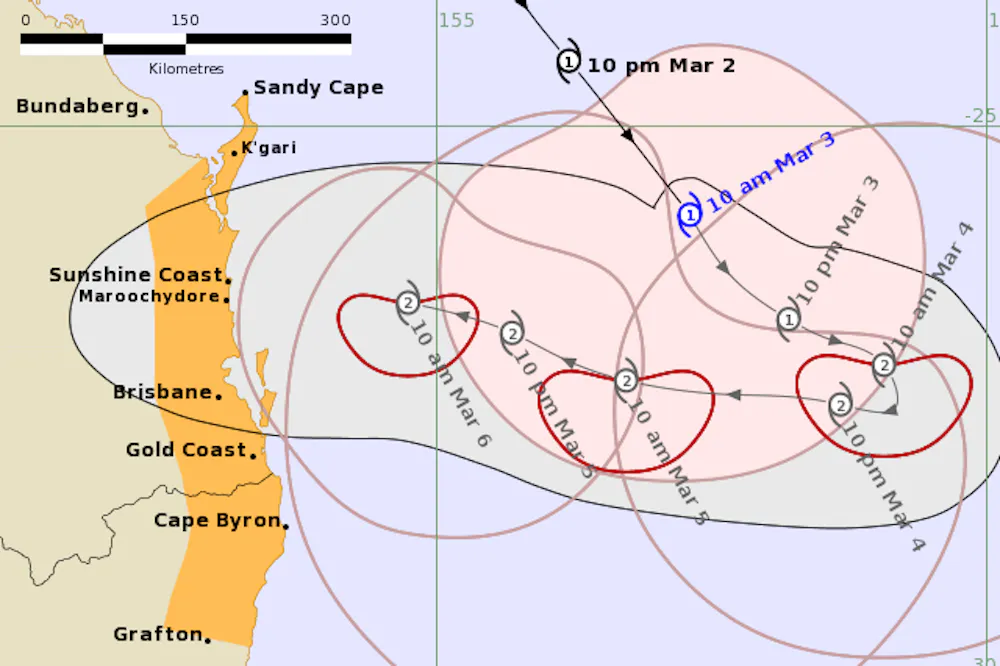
    Issued Monday March 3rd, this map shows the forecast path of Cyclone Alfred this week.
    Bureau of Meteorology, CC BY-NC-ND

    Cyclones, typhoons and hurricanes explained

    Cyclones, hurricanes and typhoons are different names for the same intense, horizontally rotating tropical storms. They occur in seven tropical ocean basins, above and below the equator.

    These storms need atmospheric heat. They only form over seas warmer than 27°C, where evaporation rates are high. They don’t occur in the cooler South Atlantic basin, and only rarely in the southeast Pacific, during strong El Niño events when sea surface temperatures are warmer.

    The northwest Pacific – off eastern Asia and the Philippines – experiences the most frequent and intense tropical storms (known there as typhoons).

    Australia averages about 13 cyclones a year. Most won’t make landfall and only a few are severe. The world’s hardest hit nation is China, where six cyclones make landfall annually.

    This map shows the aggregated paths of the world’s tropical cyclone over the 150 years to 2006. Note: this map uses the Saffir-Simpson scale in measuring wind speeds, which differs slightly to the Australian scale.
    NASA, CC BY-NC-ND

    In the north Pacific and north Atlantic, cyclones typically follow predictable tracks. They move westwards, steered by sub-tropical high pressure sytems to their north.

    Cyclone paths are also fairly predictable off the northwest coast of Australia. They typically form over the Timor Sea and drift southwest before shifting south and crossing the coast. Some are severe, as we saw with Category 5 Cyclone Zelia last month.

    By contrast, Coral Sea cyclones such as Alfred are much harder to predict.

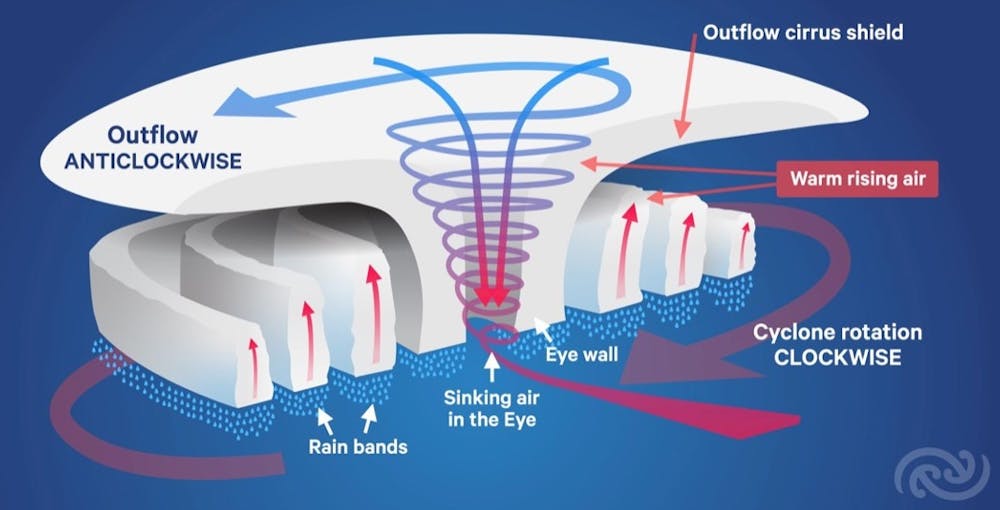
    In the southern hemisphere, cyclones spin clockwise. This figure shows how cyclones form around a low pressure system over warm seawater. Depending on their intensity, tropical cyclones are steered by dominant winds in the lower, middle and upper layers of the atmosphere.
    Metservice New Zealand, CC BY-NC-ND

    How cyclones are steered

    Strong winds are the main force steering cyclones, determining direction and forward speed.

    Severe tropical cyclones (categories 3–5) are characterised by deep convection currents, which form the famous eye at the centre of the storm, as well as feeder rainbands converging into their centre. Severe systems are generally steered by winds in the middle to upper levels.

    By contrast, weaker cyclones (categories 1–2) are much shallower and often have little or no convection around their centre. They tend to be steered by winds in the lower to middle levels. At present, Cyclone Alfred looks to remain relatively weak.

    Wind speed and direction can differ markedly in different levels of the atmosphere. Winds can also change direction at the same level. These competing influences are what lies behind the erratic paths of our cyclones.

    Cyclones forming in the Coral Sea are more likely to be pushed in different directions by different winds and weather systems than their equivalents in other ocean basins. This is what makes them so hard to predict.

    In our region, cyclones are largely steered by two high pressure systems.

    The first pushes cyclones east, and the second steers them west. If both are present and roughly equal in strength, they can hold a cyclone near-stationary. We saw this with Cyclone Alfred for most of the last week.

    Slow-moving tropical cyclones such as Alfred are more likely to wander, while faster-moving cyclones such as Severe Cyclone Yasi follow a stronger steering pattern and more predictable paths.

    Quite often, cyclones travel south and east out to sea. There, they quietly die in a large area of ocean colloquially known as the cyclone graveyard, southeast of Brisbane. These cyclones are steered by different weather systems – upper troughs, cold masses of air from the Southern Ocean.

    Cyclone Alfred was initially steered east by a near equatorial ridge to its northeast, then became stuck between this high pressure ridge and a sub-tropical ridge to its southwest. This is why it meandered very slowly south and built up strength to become severe.

    An upper trough then pushed it southeast over the weekend. This week, it’s likely to turn sharply westward towards land, propelled by a high pressure ridge to the south.

    Landfall – but where?

    After meandering around the Coral Sea for more than a week, Cyclone Alfred’s forecast track now seems more certain.

    The system is expected to intensify from a Category 1 to 2 tomorrow as it moves over warmer waters and draws in more moisture-laden air. This should see it maintain near Category 2 status until landfall. After it hits, it should rapidly weaken to a tropical low over southern Queensland into the weekend.

    Alfred will bring a lot of rain, making flooded rivers and flash flooding likely. The Bureau of Meteorology has issued a flood watch for catchments all the way from Maryborough to the Northern Rivers area of New South Wales. These communities should prepare now.

    Cyclone Alfred has a large area of gales, so will affect a wide swathe of coastline from K’gari (Fraser Island) to Byron Bay. Storm-force winds will cover a 100km wide area, mostly concentrated on its southern flank as it approaches and crosses the coast.

    In the longer term, Alfred’s remnants will likely be captured by an approaching upper trough and taken back offshore, where it will die in the cyclone graveyard – gone, but not likely to be forgotten.

    Steve Turton has previously received funding from the Australian Government.

    ref. Cyclone Alfred is expected to hit southeast Queensland – the first in 50 years to strike so far south – https://theconversation.com/cyclone-alfred-is-expected-to-hit-southeast-queensland-the-first-in-50-years-to-strike-so-far-south-251241

    MIL OSI AnalysisEveningReport.nz

  • MIL-OSI New Zealand: Environmental heroes celebrated in the Love Your Place Awards

    Source: Auckland Council

    Volunteers, businesses and schools making a positive impact to protect and restore the Waitākere Ranges have been recognised in the 2024 Love Your Place Awards.

    Around 100 guests came together to celebrate the mahi of these exceptional people at an awards ceremony held at the Titirangi War Memorial Hall on Sunday 2 March 2025.

    The awards are held every second year, thanks to the funding from the Waitākere Ranges Local Board and are organised by EcoMatters Environment Trust.

    “It’s inspiring and humbling to see all the amazing initiatives and passion from the community who are so dedicated to protect our beloved natural environment,” says Greg Presland, Chair of the Waitākere Ranges Local Board.

    “The board is immensely proud of everyone who contributes to helping preserve the special place we call home. Our heartfelt thanks and congratulations to all the nominees and winners.”

    EcoMatters CEO Carla Gee says it’s always encouraging to see how many people are contributing to conservation and climate action in the Waitākere Ranges.

    “It’s so inspiring to hear about how much is happening in this very special part of Auckland, from grassroots conservation efforts to waste minimisation. As judges, it’s always a struggle to choose just one winner from all the nominees. We’re grateful to the Waitākere Ranges Local Board for continuing to support these awards, so that those doing the mahi here know their efforts are appreciated,” says Carla.

    Awards were given in five categories, recognising youth, school groups, businesses, volunteer groups and individual volunteers who have made an impact in stream restoration, environmental education and protection, pest control, native planting, invasive weeding and waste management.

    Winners
    • Denise Yates Award: for youth (under 18) showing emerging leadership around local environmental issues. 

    • Karaka Award: for a school or school group taking action on a local environmental issue. 

    • Nīkau Award: for a business or social enterprise making a contribution to improve the environment. 

    • Rātā Award: for an outstanding volunteer group or organisation taking action on a local environmental issue. 

      • Winner: Restoration Ruatuna

      • Judges Commendation: Friends of Whatipu

      • Judges Commendation: Petrelheads

    • Kahikatea Award: for an outstanding individual volunteer taking action on a local environmental issue. 

    Find out more about the award winners here.

    Stay up to date

    Sign up for the Waitākere Ranges Local Board E-news to get the latest news and events direct to your inbox each month, or follow them on Facebook.

    MIL OSI New Zealand News

  • MIL-OSI New Zealand: Going for growth in exports and aquaculture

    Source: New Zealand Government

    The Coalition Government is going for growth by unlocking additional exports and creating jobs in the aquaculture industry Oceans and Fisheries Minister Shane Jones and Minister for Agriculture, and Trade and Investment Todd McClay announced today.

    The two ministers have confirmed support for salmon farming which is estimated to create an additional sector wide $500m of salmon exports by 2035. 

    “The Coalition Government will be co-investing $11.72 million over five years from the Sustainable Food and Fibre Futures fund as part of a $29.3 million programme, led by New Zealand King Salmon to increase production and drive up exports, Minister McClay says. 

    The joint project will look at ways to expand salmon farming around New Zealand including in deep water while continuing to meet environmental obligations.”

    “The ‘Future Salmon Farming Programme’ will prove the viability of open ocean farming for the King Salmon species to make New Zealand a leading global supplier for this high value product.

    “It will also drive innovation, allowing fish farmers to maximise productivity and profitability and get a better return for their product.”  

    “We expect this investment to boost exports and produce more higher paying jobs in our regions,” Todd McClay said.  

    Minister Shane Jones says this is another example of the Coalition Government’s commitment to growing the aquaculture industry and supporting innovation in the sector, to the benefit of all New Zealanders.

    “We have a strong track record of supporting New Zealand aquaculture, including investing in projects to boost mussel spat availability, extending the resource consents for marine farms, and listing seven aquaculture projects in the Fast-Track Bill, which includes two new open ocean salmon farms.

    “It’s clear that open ocean aquaculture is going to be key for the industry’s growth. These farms will increase our capacity for farmed salmon by 40,000 tonnes annually in addition to the expected 10,000 tonnes from New Zealand King Salmon’s pilot open ocean farm.”

    “The Coalition Government has got big plans for the aquaculture sector, which I’ll be releasing in full soon. Open ocean salmon farming is a big part of these plans, as it directly supports our focus on delivering profitable, resilient, and sustainable marine farms around New Zealand, that work for the regions, Māori, our marine farmers, and the economy as a whole,” Mr Jones says.

    MIL OSI New Zealand News

  • MIL-Evening Report: Belle Gibson, teenage lives and trying to find the traitors: what we’re streaming this March

    Source: The Conversation (Au and NZ) – By Bruce Isaacs, Associate Professor, Film Studies, University of Sydney

    Disney+/Netflix/Stan

    This month, as the weather stays high and you’re likely to want to stay under the air-conditioning, our experts have a cornucopia of shows and films they’re watching to suit every mood.

    There is Robert de Niro’s romp through politics which “stretches the bounds of credibility”, new seasons of The Traitors from both the United Kingdom and the United States, three new Aussie productions and a new comedy from Aotearoa New Zealand. There is a documentary about Cyclone Tracy for the history buffs – and to round it all out, the intriguingly titled Nightbitch.

    Zero Day

    Netflix

    It seems appropriate that Netflix’s attempt to create a show that captures the state of US politics should be as absurd and troubling as the first months of the Trump administration. Zero Day stretches the bounds of credibility, but, like Trump, it is hypnotic viewing.

    A former president, George Mullen (Robert de Niro) is called upon to track down the source of a cyber-attack which turns off all power for one minute, leading to multiple deaths.

    Mullen’s own family story becomes central to the plot, involving both his wife (Joan Allen) and daughter (Lizzy Caplan) – who conveniently happens to be a congresswoman, clearly inspired by left-wing congresswoman Alexandria Ocasio-Cortez.

    Zero Day is full of such references, from the current president (Angela Bassett), a nod to Kamala Harris, to a populist radio host and a sinister tech tycoon.

    American reviews have complained the series tries too hard to appeal across partisan lines, to suggest woke calls from the left is equivalent to extremism on the right. Yes, there’s a fuzziness to the politics of Zero Day. But I saw it as a cry of despair at the state of American public life which is also highly entertaining television.

    Dennis Altman

    Optics

    ABC iView

    What does it mean to tell the truth? And how do we, as consumers of media, differentiate truth from fabrication? Optics, a new comedy series from the ABC, asks these questions through the setting of a public relations firm.

    The show expertly balances humour with quick-wit, social media vernacular, and a level of marketing wordsmithing that makes you question if the news has ever told you a true story.

    The show is based in the PR firm Fritz & Randell and opens with the death of its aging CEO Frank Fritz (Peter Carroll), in a men-only board meeting no less.

    After Frank’s death, the son of the cofounder, Ian Randell (Charles Firth) makes a bid for top spot. But the owner of the firm, Bobby Bahl (Claude Jabbour) is concerned with “optics”, so he puts two young women in charge instead.

    Their young, spunky attitude and social media prowess is seen as a massive advantage. And it is. But it soon becomes apparent this move is much more than a feminist fresh-take for the firm – and is rather a bid to push some skeletons further back in the closet.

    With outrageous lines such as “is there an emoji for miscarriage”, you are guaranteed an entertaining watch. The show will have you questioning the stories you yourself are presented through news outlets. Further still, it will make you wonder how many hands those stories passed through before they hit the papers and screens.

    – Edith Jennifer Hill


    Read more:
    ABC’s Optics is a clever, believable comedy that will make you second-guess what you see in the media


    N00b

    Netflix (Australia), ThreeNow (New Zealand)

    N00b is a coming-of-age story set in small town Gore, New Zealand, a proverbial “arse-end” of the world. Under show creator Victoria Boult, the series bristles with a vibrancy and edginess.

    It’s a familiar story of rugby jocks (“boys”) and popular kids, geeks, misfits, and their witless teachers. It’s something of a modest, reality snapshot of the teen dramas it so confidently riffs on, shows like Laguna Beach and The O.C.

    But what makes this a courageous entry in the genre is N00b’s willingness to be both uproariously funny and caustically cynical. This is a very funny teen comedy, and yet it is also dark and provocative in ways I found refreshing and quite surprising.

    Boult cut her teeth on film studies at the University of Sydney and then went on to work with Jane Campion on The Power of the Dog. The sureness of vision and the deftness of the way in which Boult understands genre is so impressive. The production is based on Boult’s viral TikTok series of the same name (which I can highly recommend).

    I sincerely hope that N00b finds a major audience and perhaps even garners a cult following. Highly recommend.

    Bruce Isaacs

    The Traitors US and UK, seasons three

    TenPlay (Australia), ThreeNow (New Zealand)

    The third seasons from The Traitors UK and US are fantastic companion pieces, with respective hosts Claudia Winkleman and Alan Cumming guiding the plucky contestants with their camp prowess.

    With their third seasons, the creative teams behind each version have realised that the more theatrical the better, with Winkleman and Cumming leading the charge with their sass and eccentric fashion choices. The setting of Ardross Castle (for both series) in the Scottish Highlands helps.

    The premise is simple: a cast of contestants must complete challenges to earn money for the kitty. Hidden among the faithful contestants are traitors. If a traitor makes it to the end, they keep the money for themselves.

    Each episode, the faithfuls must banish a contestant who they think is a traitor. That evening, the traitors also meet in their turret, wearing mysterious cloaks of course, to “murder” a contestant in their sleep.

    The British season has a diverse cast of everyday contestants, with standouts being one person who gives herself away as a traitor within seconds of being chosen, and another faking a Welsh accent to appear more down to earth.

    The US season is vastly different with a cast of former reality television show icons. Here, it’s fascinating to see how contestants from different franchises, such as RuPaul’s Drag Race, Real Housewives, Survivor and Big Brother all approach the game differently.

    Both the American and British versions of The Traitors are fantastic viewing and it’s a genuine shame that the Australian version was let down with substandard casting choices and an aesthetic that was the antithesis of camp.

    Stuart Richards

    Cyclone Tracy

    9 Now

    On Christmas Eve 2024, Australia remembered the 50th anniversary of the destruction of Darwin wrought by Cyclone Tracy. Fittingly, the 9 Now streaming service marked this anniversary by featuring the 1986 miniseries Cyclone Tracy, a vivid depiction of 1970s Darwin and the terrible impact of the cyclone.

    Cyclone Tracy stars Tracy Mann as Connie, a widow and mother of two who has just paid off the mortgage of her hotel, which serves as the central stage for the drama.

    The series captures the cultural diversity of Darwin (though some portrayals veer towards caricature at times), and the city itself is beautifully evoked through archival footage and great production design. The cyclone itself is frightening, and its destructive power is powerfully evoked (the series’ director of photography, Andrew Lesnie, would later win an Oscar for cinematography).

    In the mid-1980s, when this series first went to air, many viewers would have still been coming to terms with this terrible disaster: it was an act of storytelling for the nation. Watching it in 2025, Cyclone Tracy reminds us of the importance of these nation-making television programs that were once such an important part of Australian culture.

    – Michelle Arrow

    Apple Cider Vinegar

    Netflix

    Apple Cider Vinegar tells the story of the elaborate cancer con orchestrated by Australian blogger Annabelle (Belle) Gibson.

    For anyone who followed Gibson during her rise to fame in the 2010s – or her spectacular fall – the show feels eerily familiar.

    From the clothing, to the makeup, to the food, Apple Cider Vinegar excels in set design and staging. Every effort has been made to ensure this true story, based on a lie, looks like it did when it was unfolding on our phone screens in the 2010s.

    As someone who followed Gibson closely and spent months hunting down the recalled cookbook to see if the health claims were as outlandish as I’d heard (they were), this show was a treat to watch.

    The scenes are cut with recreations of Belle’s stylised Instagram pictures of green juices, beaches and food with “no nasties”. Belle’s account was removed from Instagram after the massive public ousting of her hoax.

    Apple Cider Vinegar has done an incredible job recreating this account and breathing life back into the deleted content.

    Whether or not you are already familiar with Gibson’s story, Apple Cider Vinegar is a compelling watch. You’ll especially love it if you enjoy non-fiction productions that play with ideas of truth such as iTonya, the Tinder Swindler and Inventing Anna.

    – Edith Jennifer Hill


    Read more:
    Belle Gibson built a ‘wellness’ empire on a lie about cancer. Apple Cider Vinegar expertly unravels her con


    Invisible Boys

    Stan (Australia), TVNZ+ (New Zealand)

    Stan’s new series Invisible Boys follows four young gay men as they understand and explore their identities while living in Geraldton, a regional town in Western Australia.

    Charlie Roth (Joseph Zada), Zeke Calogero (Aydan Calafiore), Kade “Hammer” Hammersmith (Zach Blampied) and Matt Jones (Joe Klocek) represent four very different young men. Yet they share the experience of feeling invisible because of their sexuality.

    An adaptation of Holden Sheppard’s novel of the same name, the story challenges linear narratives of progress and typical ideals of queer life. It also shows how such mentalities can lead gay and bisexual men growing up in regional Australia to feel invisible, as they often don’t fit the neat narratives associated with “progress”.

    No previous teen drama has been quite as truthful in its representation of some young gay and bisexual men’s experiences.

    As someone who grew up gay in regional Australia, it feels like an authentic representation of my own experience. There’s something universal about Charlie, Zeke, Kade and Matt’s stories of not fitting in, and of being invisible to be safe.

    Most striking is the way the series captures the complicated mix of joy and fear – the clash of opportunity and consequence – that accompanies becoming visibly gay in these environments.

    – Damien O’Meara


    Read more:
    Stan’s Invisible Boys carries the tradition of real, gritty Aussie teen drama, while smashing it into something new


    Nightbitch

    Disney+

    “Motherhood,” the beleaguered stay-at-home mother of Nightbitch tells us in contemplative voice-over, “is probably the most violent experience a human can have aside from death itself”.

    The film sets out to show motherhood is also far more savage and feral than the anodyne images posted on social media by retrograde tradwives or mumfluencers would have us believe.

    As Nightbitch puts it, it’s “fucking brutal”.

    Mother (Amy Adams) is an unnamed installation artist who places her career on hold to raise her young son. Wrung out by the demands of motherhood and increasingly furious with the lack of support she receives from her incompetent and often absent Husband (Scoot McNairy), Mother starts to spiral out of control, morphing into a dog complete with tail, sharpened canines, extra nipples and a ravenous desire for raw meat.

    Nightbitch takes the fear of the reproductive woman literally, drawing on magic realism and horror tropes to show the visceral and psychological metamorphosis women undergo on becoming mothers. Unfortunately director Marielle Heller’s refusal to lean into the body horror results in a neutered narrative with more bark than bite.

    – Rachel Williamson


    Read more:
    A new wave of filmmakers are exploring motherhood’s discontents. Nightbitch makes this monstrous


    Michelle Arrow receives funding from the Australian Research Council.

    Bruce Isaacs, Damien O’Meara, Dennis Altman, Edith Jennifer Hill, Rachel Williamson, and Stuart Richards do not work for, consult, own shares in or receive funding from any company or organisation that would benefit from this article, and have disclosed no relevant affiliations beyond their academic appointment.

    ref. Belle Gibson, teenage lives and trying to find the traitors: what we’re streaming this March – https://theconversation.com/belle-gibson-teenage-lives-and-trying-to-find-the-traitors-what-were-streaming-this-march-250759

    MIL OSI AnalysisEveningReport.nz

  • MIL-Evening Report: Leakage is a risk with carbon storage projects – NZ’s new framework must be clear on how to deal with this liability

    Source: The Conversation (Au and NZ) – By David Dempsey, Associate Professor in Natural Resources Engineering, University of Canterbury

    Shutterstock/Oksana Bali

    The government recently announced a framework to regulate carbon capture, utilisation and storage (CCUS) by New Zealand companies.

    Energy and Climate Change Minister Simon Watts outlined new rules that would allow emitters to capture their carbon dioxide (CO₂) emissions and inject them underground for permanent disposal. They would then avoid having to pay for those emissions under the Emissions Trading Scheme.

    Globally, CCUS is currently used mostly by coal or gas-fired power stations, liquefied natural gas plants and petroleum refineries. There are 41 commercial operations around the world, and they capture about 40 million tonnes of CO₂ annually.

    Our peers (Australia, the United States and the European Union) already have CCUS frameworks and storage projects. The Intergovernmental Panel on Climate Change acknowledges CCUS’s role in curbing emissions, but highlights challenges in scaling and technology readiness.

    New Zealand faces the challenge of reducing emissions from strategic industries such as steel, concrete, fossil fuels and their derivatives (methanol, ammonia). CCUS has been tabled as an interim solution, strongly supported by the fossil fuel industry. However, critics warn it could reduce incentives to phase out fossil fuels.

    The government argues its CCUS framework aligns New Zealand with international standards. This claim has merit insofar as successful climate action is likely to require international collaboration and technology transfer.

    CCUS in New Zealand could enable reinjection of CO₂ produced from the Kapuni gas field in Taranaki, with “utilisation” involving diverting some of the gas for use in the food and beverage or horticulture industries.

    However, leakage of CO₂ from long-term disposal sites is a major technical risk and New Zealand’s framework must be clear on how it would deal with this liability.

    A bubbling sping near Lake Boehmer emits noxious fumes.
    Elizabeth Conley/Houston Chronicle via Getty Images

    Lake Boehmer and how things might go wrong

    Rules for CCUS projects generally require operators to monitor, report and remedy any leakage of CO₂. But because the industry is young, it is useful to take a broader look at geological leakage in the past to reveal how future challenges play out.

    Lake Boehmer, in the the Permian Basin of West Texas, wasn’t always there. But 20 years ago an old irrigation well started leaking saltwater and hasn’t stopped since.

    The well was drilled in 1951 by an oil and gas company. No oil was discovered so the well was handed over to the landowner for irrigation. The well produced water, but also poisonous hydrogen sulphide, enough to kill a farmhand in 1953.

    In the 1990s, the well started leaking. Water from a deep aquifer had pushed its way up alongside the well through geological layers of salt. The water dissolved the salt, worsening the leak, and emerged from underground three times saltier than seawater.

    The Railroad Commission, which regulates the oil and gas industry in Texas, says they are not liable to plug the well because they only have jurisdiction over oil wells. The original operator, which is claimed to have promised to plug the well “any time it becomes polluted with mineral water”, is no longer in business. No one can find the landowner.

    After 20 years, Lake Boehmer has grown to 60 acres. Its shore is rimmed in salt crystals and the odd dead bird from hydrogen sulphide exposure. No one can agree who should fix it.

    Could something similar happen with CCUS? Exacerbating factors in the Boehmer case include deterioration of an aged well – it’s almost 50 years since leakage started – and the absence of a backstop party as the final holder of liability. Both could happen with CCUS under the wrong circumstances.

    Better ways of dealing with leakage

    The Decatur CCUS project in the US state of Illinois has been injecting CO₂ produced from corn ethanol two kilometres deep into sandstone. Over about a decade, 4.5 million tonnes of CO₂ has been injected – emissions diverted from the atmosphere.

    The US government imposes strict monitoring rules on CCUS projects. Special monitoring wells are drilled into the disposal aquifer to measure pressure changes and how far the CO₂ has travelled.

    Unfortunately, one of these wells started to leak, possibly due to corrosion. It allowed about 8,000 tonnes of CO₂ to escape into overlying geological layers.

    This is rightly concerning, but to put it into perspective, the size of the leak is 0.2% of the injected CO₂ volume and none of it has escaped to the atmosphere or shallow groundwater. The leak was detected, the US Environmental Protection Agency (EPA) intervened, issuing a notice that the leak be remediated, and the company plugged the well.

    This illustrates a functioning CCUS framework. Monitoring requirements ensured the leak was discovered and the regulator was empowered to dictate remedial action.

    However, critics have questioned the timeliness of the operator’s disclosure. The site remains on hold but may resume operations if the EPA is satisfied with the fix.

    Lessons for New Zealand

    A proposal circulated last year suggests the government will model its legislation on Australia and the EU, with CCUS operators being responsible for leaks during disposal operations and for a time after site closure.

    This is like the Decatur situation. It makes sense for operators to fix leaks because they have the technical expertise and are the direct financial beneficiaries of emissions disposal.

    It gets trickier on generational time frames. Companies can go out of business or might leave the country. In these cases, the government is liable for long-term leakage and may seek financial security from the operator to cover future costs.

    A leak arising decades after closure could be more difficult to detect and costly to fix, especially if held up by a protracted fight around liability. This is the Lake Boehmer example.

    Some CCUS seems inevitable if the world is to meet climate targets. It is therefore important to prepare for the possibility of a leak by having robust practices and clear responsibility.

    Although it may seem unfair to burden future generations with looking after CO₂ disposal sites, we argue it is preferable to a legacy that has those same climate-warming gases in the atmosphere.

    David Dempsey receives funding from MBIE for research into carbon dioxide removal.

    Andrew La Croix receives funding from MBIE for research into carbon dioxide removal.

    ref. Leakage is a risk with carbon storage projects – NZ’s new framework must be clear on how to deal with this liability – https://theconversation.com/leakage-is-a-risk-with-carbon-storage-projects-nzs-new-framework-must-be-clear-on-how-to-deal-with-this-liability-251006

    MIL OSI AnalysisEveningReport.nz

  • MIL-Evening Report: Submarine cables keep the world connected. They can also help us study climate change

    Source: The Conversation (Au and NZ) – By Cynthia Mehboob, PhD Scholar in Department of International Relations, Australian National University

    Gail Johnson/Shutterstock

    Last month tech giant Meta announced plans to build the world’s longest submarine communication cable.

    Known as Project Waterworth, the 50,000-kilometre cable would link five continents. Meta says it would improve connectivity and technological development in countries including the United States, India and Brazil.

    Improving global connectivity has been the main purpose of submarine cables since the first one was laid across the Atlantic Ocean in 1858.

    Globally, there are currently around 1.4 million kilometres of these garden hose-sized, plastic-wrapped cables. The optical fibres inside can transmit data at speeds of up to 300 terabits per second.

    But submarine cables can do far more than just enhance telecommunications. In fact, a recent conference I attended in London highlighted how a relatively new generation of cables can also be used to keep us safe from threats such as climate change and natural disasters.

    Multipurpose cables

    SMART – short for Scientific Monitoring and Reliable Telecommunications – cables are designed for environmental monitoring. They are a joint initiative by the International Telecommunications Union, the World Meteorological Organization and UNESCO’s Intergovernmental Oceanographic Commission.

    The Transatlantic submarine cable, connecting British North America to Ireland, was laid in 1858.
    Rod Allday, CC BY-SA

    These cables are equipped with sensors that measure vital environmental data in the ocean. This data includes seismic activity, temperature fluctuations and pressure changes. It can be used to improve early-warning systems for tsunamis and earthquakes as well as tracking changes in the climate.

    OFS – short for optical fibre sensing – cables are aimed at protecting critical infrastructure. They use the fibre within to detect vibrations surrounding the cable. This allows cable operators to identify potential disruptions from fishing activity, ship anchors and other physical disturbances.

    A handful of countries, including France and Portugal, are actively investing in these cables. The European Commission is also supporting SMART cable projects within broader infrastructure strategies.

    A slow uptake

    The topic of sensing cables comes up at conferences, thanks to industry professionals who work on it pro bono. But the technology isn’t widely adopted by the broader industry and governments. For example, SMART cables have been around since 2010, but there are only two projects in development.

    The reasons for this slow uptake boil down to three major concerns, as discussed at the conference.

    1. Outdated regulation

    The legal framework governing undersea cables is outdated.

    While the United Nations Convention on the Law of the Sea regulates international waters, it doesn’t address cables equipped with environmental sensors.

    This legal ambiguity introduces additional complexities to already lengthy and complex processes for obtaining permits when sensing technologies are integrated into cables.

    2. No clear business model

    Industry executives question the financial feasibility of sensing cables. For example, during the conference in London, several industry executives suggested adding sensors raises costs by approximately 15%, with no clear revenue return.

    Unlike data traffic, environmental data doesn’t directly generate income. Unless governments intervene with funding, tax incentives or expedited permits, cable operators have little incentive to absorb these added costs and complexities.

    3. Security risks

    At the subsea cable conference in London, several industry insiders also warned embedding sensors in cables could create new security risks.

    Some governments might view sensing-equipped cables as surveillance tools rather than neutral scientific infrastructure.

    There is also concern such cables could become attractive targets for malicious actors.

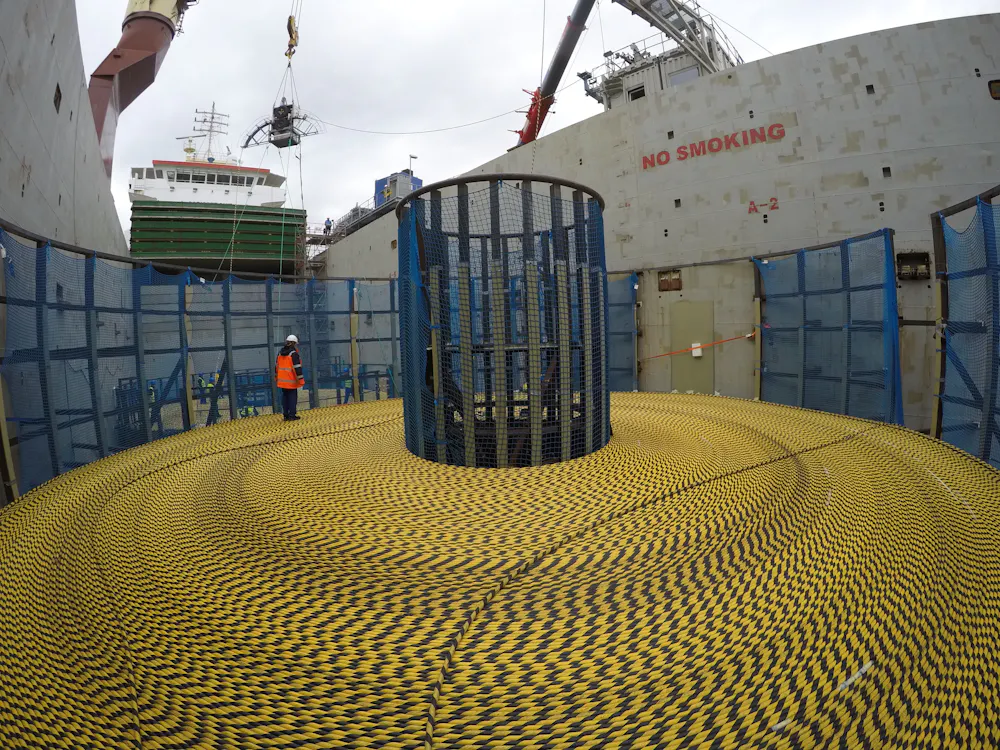
    Large ships are used to deploy and repair submarine cables in the ocean.
    Korn Srirawan/Shutterstock

    A need for more ocean data

    But there are good reasons for more countries and industry to invest in SMART cables.

    For example, information on ocean depth, seabed composition and temperature fluctuations is valuable. A wide array of industries, from shipping and offshore energy to fisheries and insurance, could leverage this data to enhance their operations and mitigate risks.

    Scientists have also pointed out that in order to better understand climate change, we need more and better data about what’s happening in the ocean.

    Current subsea cable regulatory hurdles make investing in sensing technology challenging. But if regulation is updated, projects such as Meta’s Waterworth Project could more easily integrate sensors.

    With experts suggesting the Waterworth Project be viewed as multiple cables instead of one, sensors could just be deployed on less geopolitically sensitive cable branches.

    They could facilitate the creation of an open-access, publicly funded database for ocean observation data. Such a platform could consolidate real-time data from sensing cables, satellites and marine sensors. This would provide a transparent, shared resource for scientists, policymakers and industries alike.

    Of course, deploying sensing technology may not be feasible in volatile regions such as the Baltic or South China seas.

    But there is potential in areas especially vulnerable to climate change, such as the Pacific. Here, scientific data could be harnessed to model oceanic changes and explore solutions to rising sea levels and extreme weather patterns.

    Data collected from submarine cables can help us better understand the effects of climate change on the ocean.
    somavarapu madhavi/Shutterstock

    A path forward

    Portugal demonstrates a path forward for SMART cables. Despite the regulatory challenges, it is actively investing in SMART cables in order to improve climate data.

    Other governments can learn from this if they wish to fulfil their moral duty to invest in infrastructure that serves as a public good.

    The idea of embedding sensors in cables may not be the perfect climate change fix. But it’s a step toward understanding the ocean’s invisible rhythms – a small but necessary gesture to stop pretending our planet’s breakdown will fix itself.

    Cynthia Mehboob does not work for, consult, own shares in or receive funding from any company or organisation that would benefit from this article, and has disclosed no relevant affiliations beyond their academic appointment.

    ref. Submarine cables keep the world connected. They can also help us study climate change – https://theconversation.com/submarine-cables-keep-the-world-connected-they-can-also-help-us-study-climate-change-251046

    MIL OSI AnalysisEveningReport.nz

  • MIL-OSI Canada: Minister’s statement on Search and Rescue Volunteer Memorial Day

    Kelly Greene, Minister of Emergency Management and Climate Readiness, has released the following statement on Search and Rescue Volunteer Memorial Day:

    “Today, we recognize the incredible dedication of search and rescue volunteers and the sacrifices they have made while serving people in British Columbia.

    “Our province is fortunate to have some of the most skilled, passionate and selfless search and rescue volunteers in the world. Together, the BC Search and Rescue Association, Royal Canadian Marine Search and Rescue, and PEP Air have saved the lives of thousands of people. They are heroes.

    “Search and rescue volunteers are on call 24 hours a day, 365 days a year, providing their time and expertise to help people throughout British Columbia. While much of their work happens far from public view, their impact is felt across the entire province. They are the lifelines in our greatest moments of need, and we are incredibly grateful for their dedication. To all those volunteering on search and rescue teams, on behalf of all British Columbians, thank you. We are forever grateful.

    “It takes a remarkable kind of person to be a search and rescue volunteer: someone who is driven, courageous and has an unwavering commitment to helping others. These search and rescue missions can come with an incredible cost. Since 1967, there have been 17 search-and-rescue volunteers who have lost their lives while serving British Columbians. Their sacrifices will never be forgotten.

    “Today, on Search and Rescue Memorial Day, I would like to invite all British Columbians to reflect on those heroic volunteers who lost their lives in the pursuit of safety for others, their loves ones, and their service to the people of our province.”

    MIL OSI Canada News

  • MIL-OSI Global: Soaring U.S. egg prices and millions of dead chickens signal the deep problems and risks in modern poultry production

    Source: The Conversation – Canada – By Tony Weis, Professor of Geography and Environment, Western University

    The recent volatility of egg prices in the United States has been a hot topic. Media coverage has consistently made the connection between supply problems and virulent strains of avian flu that has been afflicting poultry birds since 2022.

    Many articles have indicated that, in addition to millions of birds dying from avian flu, infected flocks have widely been killed en masse in an attempt to contain its spread. The livestock industry euphemistically calls this killing of infected animals “depopulation,” and around 150 million birds have been depopulated since the current crisis began.

    I have studied industrial livestock production for many years and have seen its myriad problems flash in and out of the media — such as greenhouse gas emissions, air and water pollution, food-borne illnesses, labour exploitation, and animal suffering. But it’s rare for the sector to stay in the media for long.

    The unusually heavy media coverage of expensive eggs, depopulated chickens and avian flu has highlighted some of the deep problems and risks of modern poultry production. Unfortunately, however, important context and dynamics have been regularly omitted.

    Unpacking key omissions helps to better understand both the nature of these chronic risks of infectious disease and the perilous response of the Trump administration.

    The spotlight on avian flu

    Multiple strains of avian flu chronically circulate within populations of both wild and domesticated birds. Avian flu is prone to frequent mutations, and occasionally some strains become more virulent and spillover across species.

    In addition to the problems avian flu in poultry production, recent media coverage has also highlighted the virus’s broader dangers.

    Avian flu is currently ravaging many wild animal species around the world, reaching into extremely remote places and even zoos.

    In the U.S., avian flu recently spilled over into cattle — causing widespread illness after a mutation enabled intra-species transmission.

    Avian flu has also caused a small number of severe human illnesses in the U.S. (primarily workers in poultry operations). Although no human-to-human transmission is evident — a necessary condition for a pandemic — this potential remains a grave threat.

    Key issues underplayed

    Although the media coverage of egg prices, depopulated chickens and avian flu has cast a valuable spotlight on many aspects of modern poultry production, it has also tended to leave out some important elements.

    Mentions in the media of many millions of chickens being killed to contain the spread of avian flu will surely sound jarring to some. But such figures pale in comparison to the 9.5 billion chickens slaughtered annually in the U.S. and the 76 billion slaughtered annually worldwide.

    Poultry birds now comprise 70 per cent of the total biomass of all birds on earth. Most are produced in densely-packed operations where reproduction, life and death have been greatly accelerated.

    Modern chickens have been selectively bred to either put on weight (broilers) or produce eggs (layers) very quickly. Broilers reach slaughter weight in a mere six weeks. Layer hens produce nearly an egg a day for about a year or two, before being slaughtered. These short life-cycles are rarely mentioned in coverage of depopulations.

    The growing risk of avian flu mutations relate to both enormity of poultry bird populations — by far the biggest habitat for the virus — and the unhealthy conditions of life in large enclosures.

    According to the U.S. Census of Agriculture, over 97 per cent of layers live in operations with at least 10,000 birds. Over 99 per cent of broilers are grown in operations with annual sales of at least 100,000 birds.

    This scale also relates to a question that has, with a few notable exceptions, received scant coverage: since infected populations cannot simply be shipped to the slaughterhouse, how are the birds actually killed?

    A leading approach to depopulation is ventilation shutdown. This involves turning off the powerful fans needed to make the ambient conditions in large enclosures bearable, and results in agonizing deaths.

    Researchers are investigating ways to augment ventilation shutdown as part of a broader research agenda seeking to develop systematic ways to depopulate large operations. This agenda clearly illustrates that the livestock industry is acutely aware of the great risks of infectious disease evolution within these spaces.

    Undermining infectious disease surveillance

    In the 2024 election campaign, Republicans regularly pointed to high egg prices in efforts to highlight rising inflation. In early 2025, the continuing rise of egg prices has cast a glare on U.S. President Donald Trump’s failed promise to immediately solve inflation.

    In response to scrutiny, the Trump administration initially tried to blame Biden for the depopulation of chickens. While such deflection might work for a time, Trump and his advisors realize they need a strategy to increase egg supplies.

    This emerging strategy must be viewed in relation to Trump’s sweeping assault on state institutions and regulations — which includes undermining crucial capacity for infectious disease surveillance. Trump made immediate cuts to the Centers for Disease Control and Prevention and forced it to disengage with the World Health Organization. He has also promised big cuts to the National Institutes of Health.

    In this context, it’s unsurprising that Trump is laying out a simple plan to increase the egg supply: rebuilding layer populations, reducing depopulations and trusting the livestock and pharmaceutical industries to find ways of containing avian flu — likely through vaccines and strengthened biosecurity.

    It’s profoundly irrational to be weakening infectious disease surveillance in the midst of the current avian flu crisis (and amid mounting infectious disease risks more generally).
    It’s also hard to fathom how further empowering the leading actors in poultry production can be expected to resolve the risks of avian flu that are so bound up in the nature of modern production.

    Pursuing this course might temporarily bring egg prices down, but it also inevitably means passing untold risks into the future.

    Tony Weis does not work for, consult, own shares in or receive funding from any company or organisation that would benefit from this article, and has disclosed no relevant affiliations beyond their academic appointment.

    ref. Soaring U.S. egg prices and millions of dead chickens signal the deep problems and risks in modern poultry production – https://theconversation.com/soaring-u-s-egg-prices-and-millions-of-dead-chickens-signal-the-deep-problems-and-risks-in-modern-poultry-production-249679

    MIL OSI – Global Reports

  • MIL-OSI USA News: Immediate Expansion of American Timber Production

    Source: The White House

    class=”has-text-align-left”>By the authority vested in me as President by the Constitution and the laws of the United States of America, it is hereby ordered:

    Section 1.  Purpose.  The production of timber, lumber, paper, bioenergy, and other wood products (timber production) is critical to our Nation’s well-being.  Timber production is essential for crucial human activities like construction and energy production.  Furthermore, as recent disasters demonstrate, forest management and wildfire risk reduction projects can save American lives and communities.

    The United States has an abundance of timber resources that are more than adequate to meet our domestic timber production needs, but heavy-handed Federal policies have prevented full utilization of these resources and made us reliant on foreign producers.  Our inability to fully exploit our domestic timber supply has impeded the creation of jobs and prosperity, contributed to wildfire disasters, degraded fish and wildlife habitats, increased the cost of construction and energy, and threatened our economic security.  These onerous Federal policies have forced our Nation to rely upon imported lumber, thus exporting jobs and prosperity and compromising our self-reliance.  It is vital that we reverse these policies and increase domestic timber production to protect our national and economic security.

    Sec2.  Directives to the Secretary of the Interior and the Secretary of Agriculture

    (a)  Within 30 days of the date of this order, the Secretary of the Interior and the Secretary of Agriculture, through the Director of the Bureau of Land Management (BLM) and the Chief of the United States Forest Service (USFS), respectively, shall each issue new or updated guidance regarding tools to facilitate increased timber production and sound forest management, reduce time to deliver timber, and decrease timber supply uncertainty, such as the Good Neighbor Authority described in 16 U.S.C. 2113a, stewardship contracting pursuant to 16 U.S.C. 6591c, and agreements or contracts with Indian tribes under the Tribal Forest Protection Act as contemplated by 25 U.S.C. 3115a.  The Secretary of the Interior and the Secretary of Agriculture shall also each submit to the Director of the Office of Management and Budget any legislative proposals that would expand authorities to improve timber production and sound forest management.
         

    (b)  Within 60 days of the date of this order, the Secretary of the Interior, through the Director of the United States Fish and Wildlife Service (FWS), and the Secretary of Commerce, through the Assistant Administrator for Fisheries, shall complete a strategy on USFS and BLM forest management projects under section 7 of the Endangered Species Act (ESA) (16 U.S.C. 1536) to improve the speed of approving forestry projects.  The Secretary of the Interior, through the Director of the FWS, shall also examine any applicable existing authorities that would permit executive departments and agencies (agencies) to delegate consultation requirements under section 7 of the ESA to other agencies and, if necessary, provide a legislative proposal to ensure consultation is streamlined.
         

    (c)  Within 90 days of the date of this order, the Secretary of the Interior and the Secretary of Agriculture shall together submit to the President, through the Assistant to the President for Economic Policy, a plan that sets a target for the annual amount of timber per year to be offered for sale over the next 4 years from Federal lands managed by the BLM and the USFS, measured in millions of board feet.
         

    (d)  Within 120 days of the date of this order, the Secretary of the Interior, through the Directors of the FWS and the BLM, and the Secretary of Agriculture, through the Chief of the USFS, shall complete the Whitebark Pine Rangewide Programmatic Consultation under section 7 of the ESA.
         

    (e)  Within 180 days of the date of this order, the Secretary of the Interior and the Secretary of Agriculture shall consider and, if appropriate and consistent with applicable law, adopt categorical exclusions administratively established by other agencies to comply with the National Environmental Policy Act and reduce unnecessarily lengthy processes and associated costs related to administrative approvals for timber production, forest management, and wildfire risk reduction treatments.
         

    (f)  Within 280 days of the date of this order, the Secretary of the Interior shall consider and, if appropriate and consistent with applicable law, establish a new categorical exclusion for timber thinning and re-establish a categorical exclusion for timber salvage activities.  

    Sec3.  Streamlined Permitting.  All relevant agencies shall eliminate, to the maximum extent permissible by law, all undue delays within their respective permitting processes related to timber production.  Additionally, all relevant agencies shall take all necessary and appropriate steps consistent with applicable law to suspend, revise, or rescind all existing regulations, orders, guidance documents, policies, settlements, consent orders, and other agency actions that impose an undue burden on timber production.

    Sec4.  Endangered Species Committee.  (a)  Agencies are directed to use, to the maximum extent permissible under applicable law, the ESA regulations on consultations in emergencies to facilitate the Nation’s timber production.  The Secretary of the Interior, as Chairman of the Endangered Species Committee, shall ensure a prompt and efficient review of all submissions to such committee, to include identification of any legal deficiencies, in order to ensure the timely consideration of exemption applications and, where possible, to resolve such applications before the deadlines set by the ESA.  

    (b)  Federal members of the Endangered Species Committee, or their designees, shall coordinate to develop and submit a report to the President, through the Assistant to the President for Economic Policy, that identifies obstacles to domestic timber production infrastructure specifically deriving from implementation of the ESA and recommends procedural, regulatory, and interagency improvements.

    (c)  The Secretary of the Interior shall ensure that the Director of the FWS, or the Director’s authorized representative, is available to consult promptly with agencies and to take other appropriate action concerning the applicability of the ESA’s emergency regulations.  The Secretary of Commerce shall ensure that the Assistant Administrator for Fisheries, or the Assistant Administrator’s authorized representative, is available for such consultation and to take such other action as may assist in applying the ESA’s emergency regulations.

    Sec5.  General Provisions.  (a)  Nothing in this order shall be construed to impair or otherwise affect:

    (i)   the authority granted by law to an executive department or agency, or the head thereof; or

    (ii)  the functions of the Director of the Office of Management and Budget relating to budgetary, administrative, or legislative proposals.

    (b)  This order shall be implemented consistent with applicable law and subject to the availability of appropriations.

    (c)  This order is not intended to, and does not, create any right or benefit, substantive or procedural, enforceable at law or in equity by any party against the United States, its departments, agencies, or entities, its officers, employees, or agents, or any other person.

    THE WHITE HOUSE
        March 1, 2025.

    MIL OSI USA News

  • MIL-OSI USA: Little Leaf Farms Announces Limited Voluntary Withdrawal of a Specific Lot Code of Southwest Salad Kit Due to Undeclared Fish and Wheat

    Source: US Department of Health and Human Services – 3

    Summary

    Company Announcement Date:
    February 28, 2025
    FDA Publish Date:
    March 01, 2025
    Product Type:
    Food & Beverages
    Reason for Announcement:

    Recall Reason Description
    Undeclared fish and wheat allergen

    Company Name:
    Little Leaf Farms
    Brand Name:

    Brand Name(s)
    Little Leaf Farms

    Product Description:

    Product Description
    Southwest Salad Kits

    Company Announcement
    Little Leaf Farms is voluntarily recalling a specific lot code of its Southwest Salad Kits due to the potential presence of undeclared fish and wheat allergens. People who have an allergy or severe sensitivity to wheat and/or fish run the risk of serious or life-threatening allergic reaction if they consume these products.
    The affected product was produced during a single run on Wednesday, February 19, 2025, resulting in one pallet of 96 cases (576 individual clamshells). Little Leaf Farms has determined that fewer than 20 individual Southwest Salad Kits were incorrectly assembled during this run.
    Product was distributed to the following states: Massachusetts, Connecticut, and New Hampshire. The Southwest Salad Kits were distributed to retail stores including Ahold USA Freetown, Kilduff, Stew Leonard’s, Associated Grocers of New England, Shapiro Produce, and C&S Wholesale Grocers, Inc (Hatfield) between February 20, 2025, and February 22, 2025.
    The recalled product is identified as follows:

    Product Name: Southwest Salad Kit
    Lot Number: 050011 as the first six digits (printed on the bottom left of the package)
    Enjoy By Date: 03/08/2025
    Package Size: Individual clamshell

    Consumers who may have purchased the potentially affected Southwest Salad Kits with this lot number are asked to return it to the place of purchase for a full refund or immediately dispose of them. Little Leaf Farms is advising affected retailers in its distribution network to remove existing products with the above-identified lot code from their shelves and warehouses.
    The issue was identified after receiving one consumer complaint noting incorrect ingredients. No injuries or illnesses have been reported to date.
    While the products are safe to eat and the company believes the issue is extremely limited, it is taking this measure to ensure the safety of its consumers.
    Consumers with questions should contact Little Leaf Farms Consumer Relations at (844) LIL-LEAF, Monday- Friday 9-12pm, 1:30-5pm EST, or email us at hello@littleleaffarms.com.

    Company Contact Information

    Product Photos

    Content current as of:
    03/01/2025

    Regulated Product(s)

    Follow FDA

    MIL OSI USA News

  • MIL-OSI Video: President Cyril Ramaphosa arrives in Namibia for State Funeral of Former President Dr Samuel Nujoma

    Source: Republic of South Africa (video statements)

    President Cyril Ramaphosa arrives in the Republic Of Namibia for State Funeral
    of Former President Dr Samuel Shafishuna Nujoma

    Stay updated, South Africa! Subscribe to The Presidency’s Channel here: https://www.youtube.com/@PresidencyZA/?sub_confirmation=1.

    Checkout more: http://www.thepresidency.gov.za

    Get Social
    Facebook ► https://www.facebook.com/PresidencyZA
    Instagram ► https://www.instagram.com/presidencyza/?hl=en
    Twitter ► @PresidencyZA

    #ThePresidencyofSouthAfrica #PresidencyZA

    https://www.youtube.com/watch?v=D7DyEsTBv-I

    MIL OSI Video

  • MIL-OSI Security: Kansas Man Sentenced for Crimes Related to Child Sexual Abuse

    Source: Federal Bureau of Investigation (FBI) State Crime News

    KANSAS CITY, KAN. – A Kansas man received a combined sentence of 87 months in prison after pleading guilty in two separate cases related to criminal misconduct involving minors.

    According to court documents, Daniel Paul Prekopa, 46, of Wichita pleaded guilty to one count of attempted travel with intent to engage in illicit sexual conduct. In a separate case, Prekopa pleaded guilty to one count of possession of child sexual abuse materials.

    In September 2023, the National Center for Missing and Exploited Children (NCMEC) notified the Wichita Police Department about a cybertip concerning child sexual abuse materials uploaded to a Dropbox account. Law enforcement confirmed through investigation that the account to belonged to Prekopa.  The materials depicted children under the age of 12 years old engaged in sexual conduct. 

    In a separate investigation in September 2023, the Federal Bureau of Investigation (FBI) Child Exploitation Task Force engaged in covert chat sessions on platforms known to be frequented by adults attempting to lure children into sexual acts. An undercover agent posing as a minor received a direct message from a user later to be confirmed as Daniel Prekopa. Prekopa sent provocative photos of himself and made sexually illicit comments during multiple exchanges with whom he thought to be a minor, at one point writing, “I could get in major trouble since you’re under 16. But idc either” and “And you have damn cops online trying to catfish people to get them in trouble”.

    FBI agents arrested Prekopa after he traveled from Kansas City, Missouri, to Overland Park, Kansas, for the intended purpose of engaging in illicit sexual conduct with a person under the age of 18.

    The Federal Bureau of Investigation (FBI), Kansas Internet Crimes Against Children Task Force (ICAC),  and the Wichita Police Department investigated the cases.

    Assistant U.S. Attorney Faiza Alhambra prosecuted the cases.

    Project Safe Childhood
    This case was brought as part of Project Safe Childhood, a nationwide initiative to combat the growing epidemic of child sexual exploitation and abuse launched in May 2006 by the Department of Justice. Led by U.S. Attorneys’ Offices and CEOS, Project Safe Childhood marshals federal, state, and local resources to better locate, apprehend and prosecute individuals who exploit children via the Internet, as well as to identify and rescue victims. For more information about Project Safe Childhood, please visit https://www.justice.gov/psc. 
    ###


    MIL Security OSI

  • MIL-OSI Australia: Stay off saltpans – protect the environment and your vehicle

    Source: Government of Queensland

    Issued: 26 Feb 2025

    Open larger image

    The vehicle was bogged and abandoned on the saltpan for almost six weeks.

    Four-wheel-drive enthusiasts in the Townsville region are urged to stop driving on saltpans due to the risks of getting bogged and having their vehicles written off.

    Recently, a Toyota Hilux was bogged to the axels and most likely written off after being stuck on the saltpans at Cape Cleveland for almost six weeks.

    Senior Conservation Officer Craig Dunk from the Department of the Environment, Tourism, Science and Innovation said the owner tried crossing the saltpan in the Bowling Green Bay National Park.

    “We don’t want anyone getting bogged on the saltpans, and there are locations in the Townsville region where people can lawfully test their four-wheel-drive skills and their vehicles,” Mr Dunk said.

    “Four-wheel-drive enthusiasts need to protect the environment and their vehicles by staying off the saltpans.

    “Unfortunately, the Hilux owner tried to drive about three kilometres across the saltpan to reach a creek on the other side and made it about halfway across before abandoning his vehicle.

    “He reported it to the department on 23 September 2024, and unfavourable weather conditions meant it couldn’t be retrieved until 5 November 2024.

    “During that time, it was inundated by several king tides and exposed to heavy rain, and it is likely that it will be written off.

    “Once the thick saltpan crust is broken a vehicle will quickly sink to the axels, and this is an expensive price to pay for disregarding the environment.”

    Mr Dunk said under the Nature Conservation Regulation, it is an offence to drive or ride a vehicle into restricted sections of a protected area and people can be fined for leaving access tracks.

    “We have issued a $322 fine to the Hilux owner and issued fines to two other people who recently became bogged in our protected areas,” he said.

    “Saltpans in Bowling Green Bay National Park are also listed under the Ramsar convention on wetlands of international importance, and the maximum penalty for unauthorised use of a vehicle in a protected area is $3,226.

    “Driving on saltpans damages the crust, uproots vegetation, causes soil compaction and erosion, disturbs bird and crustacean populations and has the potential for contamination.

    “They are critical parts of our marine ecosystems and support hidden life, including saline or brackish sedgelands, crustaceans, worms and birdlife.”

    Information about what roads or tracks are approved can be found in maps on the QPWS website at https://parks.desi.qld.gov.au/parks.

    MIL OSI News

  • MIL-OSI China: Low-altitude economy boosts smart agriculture

    Source: China State Council Information Office

    As dawn breaks over the vast wheat fields, a fleet of drones hums to life, rising like a swarm of mechanical bees. Guided by skilled pilots, the drones glide over the expanse, spraying the crops with precisely measured doses of pesticide.

    In just three days, more than 80,000 mu (approximately 5,333.33 hectares) of wheat fields will be treated. This level of efficiency is unimaginable in traditional farming.

    In a display of agricultural modernization, this annual operation in Zhaoqiao Township, in Bozhou City, east China’s Anhui Province, highlights the increasing role of unmanned aerial vehicles (UAVs) in China’s agricultural sector.

    To ensure optimal pest control, nearly 40 skilled drone pilots operate UAVs weighing between 50 and 70 kilograms, swiftly maneuvering over vast wheat fields to apply pesticides efficiently and precisely.

    “Traditional manual pesticide spraying could only cover 10 to 15 mu per day. Now, a single agricultural drone can handle about 1,000 mu daily, ensuring even coverage without gaps or overlaps,” said Jiao Rui, a 33-year-old drone team leader.

    Bozhou alone has nearly 3,000 agricultural drones in operation, contributing to a nationwide total of 251,000 UAVs dedicated to agricultural services in 2024.

    These drones collectively covered 2.67 billion mu of farmland, marking a nearly 25 percent year-on-year increase. Beyond pest control, they are also used for fertilization, seeding, pollination, and field monitoring, significantly enhancing agricultural productivity.

    The recently released “No. 1 Central Document” for 2025 outlines priorities to deepen rural reforms further and solid steps to advance all-around rural revitalization. It emphasizes the importance of developing new quality productive forces in agriculture in light of local conditions.

    Han Wenxiu, executive deputy director of the Office of the Central Committee for Financial and Economic Affairs, emphasized at a recent press conference that smart technologies, including UAVs, mechanized farming, AI-driven agriculture, and low-altitude economy applications, hold vast potential for rural development.

    According to the Civil Aviation Administration of China, the country’s low-altitude economy is expected to reach a market size of 1.5 trillion yuan (about 209.09 billion U.S. dollars) by 2025 and could grow to 3.5 trillion yuan by 2035.

    This sector is rapidly integrating into various rural applications, from agricultural protection to forest fire prevention, water resource inspection, rural logistics, and tourism.

    In the mountainous Hongqi Village of Yuexi County, Anhui, a small white drone takes off daily from its automated docking station, ready to carry out its tasks.

    Equipped with high-definition and infrared cameras, as well as a loudspeaker, the drone patrols a 15-square-kilometer forest area for 40 minutes before returning to recharge.

    Later, it flies to check on elderly residents living alone, enabling local staff to communicate with them remotely. During flood season, the drone’s tasks expand to include river inspections.

    Since the launch of the pilot program in August 2024, drones in Hongqi Village have covered a total of 1,422.95 kilometers and detected over 30 safety hazards, all of which were promptly addressed.

    “Previously, forest patrols required two workers on motorcycles for an entire day, and visiting elderly residents in the mountains took about 90 minutes round-trip. With UAVs, we significantly enhance efficiency and service delivery,” said Shi Yongshi, the first secretary of Hongqi Village.

    Anhui’s local practices epitomize a broader national trend. By 2027, east China’s Zhejiang Province plans to have over 10,000 agricultural drones in operation, covering more than 65 million mu of farmland. Drone-based rural inspections are also set to reach over 30 percent of villages.

    Low-altitude logistics are expanding across cities and rural areas in Guangdong Province, focusing on high-value seafood transport, maritime supply deliveries, rapid medical shipments, and agricultural product transport from mountainous regions.

    “Beyond agriculture, the low-altitude economy is becoming a new engine for rural revitalization and industrial upgrading,” said Zhang Jian, a professor at the Civil Aviation Flight University of China. 

    MIL OSI China News

  • MIL-OSI Australia: $6.5 Million Boost to Enhance Mimosa Rocks National Park

    Source: New South Wales Government 2

    Headline: $6.5 Million Boost to Enhance Mimosa Rocks National Park

    Published: 28 February 2025

    Released by: Minister for Environment and Heritage, Minister for Regional NSW


    Work is about to commence at Mimosa Rocks National Park on the NSW Far South Coast, which is receiving a $6.5 million funding boost to strengthen the park’s resilience against natural disasters.

    Severe flood events in 2021 and 2022 caused significant damage to the park, leading to extensive closures of campsites and visitor precincts.

    Around 76 per cent of campgrounds – 60 sites in total – along with several popular day-use areas were either closed or had limited access until repairs could be made.

    The investment is being made under the $200 million Infrastructure Betterment Fund, which is financed by the Australian and NSW Governments to support the repair and rebuilding of public assets directly impacted by natural disasters.

    This funding for Mimosa Rocks National Park will support critical improvements including:

    • Upgraded drainage systems to manage heavy rainfall.
    • Relocation of high-risk campsites to minimise future flood damage.
    • Improved road surfaces for better access and safety.
    • Enhanced pedestrian beach access points to mitigate the effects of ocean storms surges and dune erosion.

    Improvements will be made to four precincts within the national park, including three campgrounds:

    • Aragunnu,
    • Gillards Beach,
    • Middle Beach,
    • Nelsons Beach.

    Construction will commence in the coming months, and visitors are advised to expect intermittent disruptions.

    Visitors should check NSW National Parks and Wildlife Service alerts before any visit: https://www.nationalparks.nsw.gov.au/alerts/alerts-list.

    People can register for progress updates by visiting: https://www.environment.nsw.gov.au/mimosa-rocks-betterment.

    Quote attributable to Federal Member for Eden-Monaro, Kristy McBain:

    “Mimosa Rocks National Park is one of the Sapphire Coast’s most popular destinations, which is why we’re investing $6.5 million with the NSW Government to repair the damage caused by storms – supporting upgrades to the park’s facilities, and making it more resilient into the future.

    “From fishing, birdwatching, picnics, and whale watching – Mimosa Rocks has so much to offer, which is why we’re ensuring that locals can make the most of it, and that we can continue to attract more visitors to the Bega Valley.”

    Quote attributable to NSW Minister for the Environment, Penny Sharpe:

    “National parks are one of NSW’s greatest public assets, loved by everyone from locals to international visitors.

    “The NSW Government is funding critical upgrades to Mimosa Rocks National Park to ensure visitor facilities can better withstand storms and floods. This will reduce flood closures and minimise disruptions to visitors, while improving safety.

    “The improvements will also reduce economic impacts to the region by ensuring campsites and visitor precincts remain open.”

    Quote attributable to NSW Minister for Regional NSW, Tara Moriarty:

    ”This is an important investment in the south coast in the Mimosa Rocks National Park, to ensure more resilience for sites used by visitors can be better protected. This is good for locals and the many Australians who love to visit our parks.

    “This is another good example of the positive outcome when the NSW and Commonwealth Governments work close together to deliver for the south coast.”

    Quote attributable to NSW Member for Bega, Dr Michael Holland:

    “Each year, more than 200,000 people visit Mimosa Rocks National Park, making it a key contributor to the regional economy of the Bega Valley.  

    “It is crucial that Mimosa Rocks is accessible for visitors and offers them an exceptional experience of this beautiful south coast gem.”

    MIL OSI News

  • MIL-OSI United Nations: ‘Ramadan Embodies Values of Compassion,’ Says Secretary-General at Start of Holy Month

    Source: United Nations 4

    Following is the text of UN Secretary-General António Guterres’ video message on the beginning of Ramadan, today:

    I send my warmest wishes as Muslims around the world begin observing the Holy Month of Ramadan.  Ramadan embodies the values of compassion, empathy and generosity.  It is an opportunity to reconnect with family and community.  A chance to remember those less fortunate.

    To all those who will spend this sacred time amid displacement and violence, I wish to express a special message of support.  I stand with all those who are suffering.  From Gaza and the wider region, to Sudan, the Sahel and beyond.

    And I join those observing Ramadan to call for peace and mutual respect.  Every Ramadan, I undertake a solidarity visit and fast with a Muslim community around the globe.  These missions remind the world of the true face of Islam.

    And I always come away even more inspired by the remarkable sense of peace that fills this season.  In this Holy Month, let us all be uplifted by these values and embrace our common humanity to build a more just and peaceful world for all.  Ramadan Kareem.

    MIL OSI United Nations News

  • MIL-OSI Security: Former Stoneham Police Officer Sentenced to More Than Two Years in Prison for Bribery Charges

    Source: Office of United States Attorneys

    Defendant defrauded a company to obtain tens of millions of dollars of Mass Save funds through paying bribes and kickbacks to company employees

    BOSTON – A former Stoneham Police Officer has been sentenced in federal court in Boston for a bribery and kickback scheme that netted millions of dollars in Mass Save contracts.  

    Joseph Ponzo, 51, of Stoneham, was sentenced by U.S. District Court Judge Nathaniel M. Gorton to 27 months in prison, to be followed by two years of supervised release. Joseph Ponzo was also ordered to pay $115,528 in restitution and a $100,000 fine. In November 2024, Joseph Ponzo pleaded guilty to one count of conspiracy to commit honest services wire fraud; 24 counts of honest services wire fraud; one count of making false statements to government officials; and four counts of causing false tax returns to be filed with the Internal Revenue Service from 2016 to 2019. Joseph Ponzo was indicted by a federal grand jury in January 2023 along with his brother Christopher Ponzo.

    “Joseph Ponzo was a sworn officer, who pledged an oath to uphold the law, not violate it. However, he chose greed over integrity,” said United States Attorney Leah B. Foley. “Joseph Ponzo’s greed came at the cost of consumers who were left paying the bill. A prison sentence is the price he will now pay for taking bribes and kickbacks.”

    “When an officer shrugs off his sworn oath and breaks the law to pad his paycheck like Joseph Ponzo did, he betrays the people of his community – and all of us who wear a badge,” said Jodi Cohen, Special Agent in Charge of the FBI’s Boston Division. “Every year, Massachusetts homeowners spend millions of dollars to fund energy conservation projects for consumers. Joseph Ponzo and his brother cheated them by shelling out hundreds of thousands of dollars in a steady stream of bribes and kickbacks to an insider who steered contracts their way, ignoring all ethical boundaries. Know that the FBI will continue to tenaciously investigate such corruption, and bring those involved to justice.”

    “Today’s sentencing of Joseph Ponzo demonstrates IRS-CI’s commitment to routing out corruption from all levels of the government.” said Thomas Demeo, Acting Special Agent in Charge of the Internal Revenue Service Criminal Investigation, Boston Field Office. “Ponzo orchestrated an elaborate kickback scheme to improperly obtain contracts from a government backed program designed to aid the citizens of the Commonwealth of Massachusetts. Programs like Mass Save are designed to help all citizens of Massachusetts, especially the less fortunate, who otherwise would not be able to afford these upgrades to their homes.”

    Joseph Ponzo, along with his brother and co-conspirator Christopher Ponzo, conspired to pay, and did pay, tens of thousands of dollars in cash bribes, kickbacks, and other in-kind benefits, including a John Deere tractor, a computer, home bathroom fixtures and free electrical work, among other things, to Company A employees (Associates 1 and 2) in exchange for the Associates’ assistance in getting the defendants millions of dollars in Mass Save contracts.

    Massachusetts law requires utility companies to collect an energy efficiency surcharge on all Massachusetts energy consumers. These funds, which amount to hundreds of millions of dollars each year, are to be disbursed by the utility companies to fund energy efficiency programs and initiatives in Massachusetts. Under the Mass Save program, the utility companies select lead vendors, like Company A, to approve and select contractors to perform energy improvement work for residential customers. This contracting work – performed by contractors at no-cost or reduced cost to the customer – is then paid for by Company A with Mass Save funds.

    On a weekly basis, from 2013 to 2017, Christopher Ponzo paid Associate 1 $1,000 in cash. At times, Christopher Ponzo paid Associate 1 $5,000 to $10,000 in cash, telling Associate 1 that the extra money was from Joseph Ponzo for his part in the bribery scheme. In return for these payments, Associate 1, among other things, helped Joseph Ponzo set up a shell company, Air Tight, to do insulation work and get approved as a Company A contractor under the Mass Save program. Joseph Ponzo put his spouse’s name on Air Tight incorporation documents and contracting licenses in order to conceal his involvement in his corrupt side business. Despite having no professional experience in residential insulation work, Joseph Ponzo collected over $7 million under the Mass Save program.    

    After Associate 1 left Company A in 2017, Christopher Ponzo and Joseph Ponzo recruited Associate 2 to the bribery-kickback scheme from approximately 2018 to 2022, paying Associate 2 thousands of dollars in cash and hiring a relative of Associate 2 as part of the ongoing scheme.

    During the course of the bribery-kickback scheme, Joseph Ponzo aided in the filing of false tax returns from 2016 to 2019 by claiming hundreds of thousands of dollars in false business deductions. To disguise personal expenses as business deductions, Joseph Ponzo used his company credit card to make hundreds of thousands of dollars in purchases at The Home Depot, Lowes and Staples, claiming to his tax preparers that charges at those establishments were business-related. In reality, Joseph Ponzo used the company credit card at those stores to purchase gift cards that he and his spouse then used to make thousands of dollars in personal expenditures.  

    In April 2022, both Joseph Ponzo and Christopher Ponzo falsely denied making bribe payments to any Company A employees when interviewed by federal agents.

    In February 2025, Christopher Ponzo was sentenced to 27 months in prison, to be followed by two years of supervised release. Christopher Ponzo was also ordered to pay a $300,000 fine.

    U.S. Attorney Foley; FBI SAC Cohen; and IRS Acting SAC Demeo made the announcement today. Assistant U.S. Attorneys Lauren Maynard and Dustin Chao of the Criminal Division prosecuted the case.

    MIL Security OSI

  • MIL-OSI Security: Romance scheme fraudster admits to $3 million conspiracy

    Source: Office of United States Attorneys

    HOUSTON – A 47-year-old Houston man has entered a guilty plea to wire fraud and conspiracy for a romance scheme targeting citizens nationwide, many of whom were elderly, announced U.S. Attorney Nicholas J. Ganjei.

    Darlington Akporugo admitted to being a central figure in a long-running romance scheme based in Houston that victimized citizens from Chicago to Kentucky. Akporugo worked with others to lure victims through online romances and then induce them to send money to various bank accounts he controlled.   

    To further the fraud, Akporugo and his co-conspirators used fake names to contact victims on social media, gain their confidence and then persuade them to invest in non-existent businesses or provide funds for invented personal circumstances.

    As part of his plea, Akporugo admitted to approaching potential victims, primarily on social media sites such as Facebook, and then directing them to send money to either his or his associates’ bank accounts. That money was often then directed overseas.

    In addition to collecting cash and wire transfers, Akpourgo also admitted to having victims open lines of credit in his name and, in one case, purchasing a luxury vehicle for his personal use.

    During the multi-year investigation, authorities were able to identify over 25 victims of the scheme, the majority either retired or of advanced age.     

    Losses from the fraud ring’s operation total more than $3 million.   

    “As we unfortunately have seen, victims of romance scams suffer tremendous financial loss, sometimes amounting to their entire life savings,” said Ganjei. “Those have fallen prey to such fraudsters are often too embarrassed to come forward and report the incident to law enforcement. Although this is an understandable reaction, we encourage victims to nonetheless come forward, as their story may help the future victimization of others.”

    U.S. District Judge Charles Eskridge will impose sentencing June 6. At that time, Akporugo faces up to 20 years in federal prison and a possible $250,000 maximum fine.

    He will remain in custody pending that hearing.

    Homeland Security Investigations conducted the investigation. Assistant U.S. Attorney Thomas Carter prosecuted the case.

    MIL Security OSI

  • MIL-OSI USA: Secondhand (and Third-Hand) Smoke May Be Making Your Pet Sick

    Source: US Food and Drug Administration

    Image

    Español
    If you’re a smoker, you probably realize the dangers smoking may pose to your health. But have you ever thought about how the habit affects your pet? According to Food and Drug Administration veterinarian Carmela Stamper, D.V. M., the news is not good.
    “Smoking’s not only harmful to people; it’s harmful to pets, too,” Stamper says. “If 58 million non-smoking adults and children are exposed to tobacco smoke, imagine how many pets are exposed at the same time.”
    What’s Lingering on Your Rug, Furniture, and Clothes?
    Both secondhand smoke (which lingers in the air your animal breathes in) and third-hand smoke hurt pets. What’s third-hand smoke? It’s residue (harmful compounds that are left behind, such as nicotine) that can get on skin and clothes, as well as furniture, carpets, and other things where a smoker lives.
    “Like children, dogs and cats spend a lot of time on or near the floor, where tobacco smoke residue concentrates in house dust, carpets and rugs. Then, it gets on their fur,” Stamper explains. “Dogs, cats and children not only breathe these harmful substances in, but pets can also ingest them by licking their owner’s hair, skin, and clothes.” 
    And of course, if your dog or cat grooms itself or another animal, he’s ingesting the residues as well, Stamper says.
    Facts That May Surprise You About Pets and Smoking
    Did you know …

    how tobacco smoke affects a dog depends on the length of the dog’s nose?
    that certain dog breeds are at increased risk of nose or lung cancer?
    that cats who live with people who smoke more than a pack of cigarettes a day have three times the risk of developing lymphoma, a cancer of the immune system?
    that your smoking can endanger your pet bird, guinea pig, and even your fish?

    Learn More
    Learn more about the dangers smoking can pose to your pet and find some resources to help a smoker you know cut back on or quit smoking in the article “Be Smoke-free and Help Your Pets Live Longer, Healthier Lives,” on the FDA website.
    back to top

    Content current as of:
    08/26/2021

    Regulated Product(s)

    MIL OSI USA News

  • MIL-OSI New Zealand: Unexplained death, Morningside

    Source: New Zealand Police (National News)

    Attribute to Detective Senior Sergeant Chris Allan:

    An investigation has been launched after the death of a woman at a Morningside address last night.

    Police were called to the Don Croot Street property about 9.15pm, after a report of a woman being found unconscious.

    CPR was performed, however unfortunately the woman was not able to be revived.

    Her death is currently being treated as unexplained, and Police are working to establish the full circumstances of what has occurred.

    A scene examination will be carried out at the property today.

    Anyone who has any information about this incident encouraged to call Police.

    You can do so through our 105 service, quoting reference number 250228/6990.

    Information can also be shared anonymously through Crime Stoppers on 0800 555 111.

    ENDS

    Issued by Police Media Centre

    MIL OSI New Zealand News

  • MIL-OSI USA: Scott Highlights Need to Confirm Trump Administration Nominees for Top Economic, Financial Regulator Posts

    US Senate News:

    Source: United States Senator for South Carolina Tim Scott

    WASHINGTON — At yesterday’s nominations hearing before the U.S. Senate Committee on Banking, Housing, and Urban Affairs, Senator Tim Scott (R-S.C.) highlighted the qualifications of President Trump’s nominees to top economic policy and financial regulator posts: 

    • Dr. Stephen Miran, nominee to be Chairman of the Council of Economic Advisors, Executive Office of the President
    • Mr. Jeffrey Kessler, nominee to be Under Secretary of Commerce for Industry and Security, Department of Commerce
    • Mr. William Pulte, nominee to be Director, Federal Housing Finance Agency
    • Mr. Jonathan McKernan, nominee to be Director, Bureau of Consumer Financial Protection

    Senator Scott emphasized the importance of quickly advancing President Trump’s nominees to rebuild the economy, restore confidence in the financial system, and ensure American families have the tools to thrive.

    Senator Scott’s opening remarks as delivered:

    I want to take a second to congratulate each of our nominees before us today and thank you for your willingness to serve our country.

    If confirmed, you will help put our nation back on the path to prosperity. 

    As we reflect on the past four years, we must acknowledge the severe damage created by the Biden administration’s reckless spending.

    It’s hard for me to forget, as a kid and my brother growing up in poverty, single parent household, watching my mother trying to make every single dollar count. She did the best she could with what she had. 

    Inflation is especially cruel to the communities like the one I grew up in.

    No one should have to make a choice between putting food on the table and keeping the lights on.

    During Joe Biden’s time in office, overall prices rose by over 20 percent, energy by 34 percent, transportation 31 percent, groceries 22 percent.

    I refuse to accept that the last four years will be the next four years.

    Unlike his predecessor, President Trump understands what it takes to create a blue-collar comeback. And I’m excited about that.

    Each of the nominees before us today will play a critical role in rebuilding the economy, restoring confidence in our financial system, and ensuring that American families can thrive once again.  

    The Council of Economic Advisers serves as the White House’s chief advisors, think tank so to speak, providing the President with data-driven guidance on policy decisions. 

    Dr. Stephen Miran is an accomplished economist with a strong record of advocating for fiscal responsibility and pro-growth policies.

    He will play an instrumental role in helping President Trump rebuild America’s economy. 

    Turning to Mr. Kessler, the Department of Commerce’s mission is to create an environment for economic growth and opportunity for all communities.

    Unfortunately, under President Biden, we saw China rapidly advance in developing advanced technologies that support its military capabilities, distort global markets, and erode competitiveness of U.S. companies.  

    Mr. Kessler’s experience in trade and national security policy will be critical in strengthening our supply chains and ensuring the U.S. leads in the next generation technologies. 

    Now, let’s talk about housing. Under President Biden, the dream of homeownership became unaffordable for millions and millions of Americans. The FHFA plays a crucial role in overseeing Fannie Mae, Freddie Mac, and the Federal Home Loan Bank – entities that significantly influence the U.S. housing finance market.

    These institutions not only impact mortgage rates and housing affordability, but also provide essential liquidity to the mortgage market, ensuring a stable supply of funds for home loans. 

    William Pulte is a businessman with a deep understanding of the housing market. His insight and passion for people will serve him well in leading the FHFA’s efforts to address our broken housing system.

    And finally, the CFPB was allegedly created to protect American consumers, but under the Biden administration, it overstepped its authority, burdened businesses with excessive politically driven regulation, and drove up costs for consumers.

    The CFPB has become a tool for progressive overreach, making it harder for small banks and lenders to serve their communities.

    Jonathan McKernan has the expertise needed to rein in the CFPB’s excesses and ensure that the agency works for consumers – not against them.

    Today’s hearing is not just about these four nominees – it is about the future of our economy and the direction of our country.

    We have an opportunity to undo the failures of the past four years and usher in a golden era of American prosperity.

    That begins by confirming these well-qualified individuals who will stand up for the American families, American workers, and for small businesses.

    MIL OSI USA News

  • MIL-OSI Europe: Answer to a written question – Designation of the Port of Licata under Regulation (EC) No 1005/2008 – E-000266/2025(ASW)

    Source: European Parliament

    1. All Member States, including Italy, have submitted the list of designated ports authorised for landing and transhipment of fisheries products for 2025, in compliance with Article 5(3) of the Council Regulation (EC) No 1005/2008[1].

    2. It is up to the Member States’ authorities to determine if the ports in their territories are suitable for inclusion in the list of designated ports under Regulation (EC) No 1005/2008. Italian authorities have not designated the Port of Licata as designated port in accordance with Article 5 of Regulation (EC) No 1005/2008.

    • [1] https://eur-lex.europa.eu/eli/reg/2008/1005/oj/eng
    Last updated: 28 February 2025

    MIL OSI Europe News

  • MIL-OSI Europe: Answer to a written question – Support for traditional fishing with boat seines in Greece – E-000158/2025(ASW)

    Source: European Parliament

    1. The Commission recalls that the use of towed gears, including boat seines, is prohibited within 3 nautical miles of the coast or within the 50 m isobath where that depth is reached at a shorter distance from the coast[1]. Derogations can be granted under certain conditions by the Commission at the request of a Member State provided that the fisheries concerned are subject to a management plan.

    In December 2021, Greece informed the Commission of its decision to withdraw a request for derogation and not adopt the related management plan. Such decision of a Member State only ends the derogation process and does not constitute a violation of EU law. If the derogation from the prohibition for the use of boat seines is not requested, the adoption of the related management plan is no longer necessary.

    2. The European Maritime, Fisheries and Aquaculture Fund (EMFAF)[2] is designed to offer support to the fisheries sector in many ways, notably to contribute to the sustainable use and management of aquatic and maritime resources. Competent authorities can consider mobilising financing from the Greek EMFAF Programme to provide support to the fisheries sector concerned. The activation of EMFAF financial support should be in line with the objectives of the Greek EMFAF Programme as agreed between the Commission and Greece. Member States may equally grant state aid to undertakings in the fisheries sector in line with the Fisheries state aid guidelines[3].

    3. A Member State’s choice to withdraw a request for a derogation and subsequently not adopt the related management plan does not breach EU law. Therefore, the Commission does not have any grounds to intervene.

    • [1] Article 13 of Regulation (EC) No 1967/2006, eur-lex.europa.eu/legal-content/EN/TXT/PDF/?uri=CELEX:32006R1967
    • [2] https://oceans-and-fisheries.ec.europa.eu/funding/emfaf_en
    • [3] Communication from the Commission, Guidelines for state aid in the fishery and aquaculture sector, OJ C 107, 23.3.2023, p. 1.
    Last updated: 28 February 2025

    MIL OSI Europe News

  • MIL-OSI Europe: Answer to a written question – Illegal fishing activity of Turkish vessels in Greek territorial waters near Alexandroupoli – E-000067/2025(ASW)

    Source: European Parliament

    1. The EU has a strategic interest in a stable and secure environment in the Eastern Mediterranean and in a cooperative and mutually beneficial relationship with Türkiye. Under the General Fisheries Commission for the Mediterranean, the EU reporting mechanisms ensure structured communication between coastal and flag States, enabling action when vessels are suspected of engaging in Illegal Unreported and Unregulated (IUU) fishing. Also, in line with the relevant Council Regulation (EC)[1], the Member State concerned has primary responsibility for control in its waters, including the adoption of enforcement measures and resource allocation.

    2. The Commission supports Greece through the European Maritime, Fisheries and Aquaculture Fund and the European Fisheries Control Agency, which deploys the patrol vessel ‘Ocean Sentinel’, provides satellite imagery and aerial surveillance and coordinates inspection campaigns. The Commission intends to reinforce controls by improving synergies with the European Maritime Safety Agency and strengthening joint deployments in the Mediterranean.

    3. Alleged IUU fishing by Turkish vessels is monitored by the Commission and the Member States concerned. In this context, unequivocal commitment to good neighbourly relations, to international agreements and to the principle of peaceful settlement of disputes in accordance with the United Nations’ Charter, as well as abstaining from unilateral actions which run counter to EU interests, violate international law and the sovereign rights of EU Member States, remains an essential requirement[2]. Türkiye’s ratification of the United Nations Convention on the Law of the Sea (Unclos) would improve cooperation with the EU on fisheries and maritime policy[3].

    • [1] https://eur-lex.europa.eu/eli/reg/2009/1224/oj/eng as recently modified by Regulation (EU) 2023/2842 of 22 November 2023.
    • [2] https://enlargement.ec.europa.eu/joint-communication-european-council-state-play-eu-turkiye-political-economic-and-trade-relations-0_en
    • [3] https://enlargement.ec.europa.eu/document/download/8010c4db-6ef8-4c85-aa06-814408921c89_en?filename=T%C3%BCrkiye%20Report%202024.pdf
    Last updated: 28 February 2025

    MIL OSI Europe News

  • MIL-OSI USA: Virginia Lawmakers Rip President Trump’s Plans to Dissolve or Privatize the Postal Service

    US Senate News:

    Source: United States Senator for Virginia Tim Kaine
    WASHINGTON, D.C. – Today, U.S. Senators Mark R. Warner and Tim Kaine and U.S. Representatives Bobby Scott, Gerry Connolly, Don Beyer, Jennifer McClellan, Suhas Subramanyam and Eugene Vindman (all D-VA) urged President Trump to halt any proposal that would alter the U.S. Postal Service (USPS) without congressional consultation and approval. 
    “We write to express our great concern regarding reports that you intend to dissolve the United States Postal Service’s (USPS) bipartisan Board of Governors and move the independent agency under the control of the Department of Commerce. The Postal Service plays a crucial role in keeping our communities, especially in our rural areas, connected to each other and to the wider world. From delivering prescription medications and household goods, to election ballots, paychecks, and critical bills, USPS continues to be an essential part of Americans’ everyday lives. However, press reports indicate you are planning to upend over 50 years of Congressionally-mandated independence at USPS with no clear strategy for continuing essential mail delivery services or achieving financial sustainability,” the lawmakers wrote in a letter to President Trump. “We urge you to cease the advancement of any proposal that would alter the USPS without congressional consultation and approval.”
    Since Congress passed the Postal Reorganization Act of 1970, USPS has operated as an independent agency run by a bipartisan Board of Governors who are appointed by the president and confirmed by the Senate. However, press reports have recently suggested that President Trump intends to sign an executive order to dissolve the Board and move the independent agency under the control of Secretary Howard Lutnick at the Department of Commerce. Last Friday, the president confirmed these reports when he said he was considering a “form of a merger” for the Postal Service. The letter rejects this vague and unconstitutional plan.
    Wrote the lawmakers, “Throughout our nation’s history, the Postal Service has been an integral function of the U.S. government, particularly in rural areas. While 63% of post offices in rural areas do not generate enough revenue to cover their costs, Congress continues to ensure changes do not disadvantage rural areas because all Americans deserve the same mail delivery service regardless of where they live. Given your reported interest in privatizing the Postal Service, the universal service obligation that binds the Postal Service to deliver to all Americans could be scrapped for a plan that risks cutting off rural delivery and worsening service for all.”
    The letter also references Virginia’s mail delivery issues, raising concerns that the president’s plans could upend recent improvements in mail service.
    “Virginians are unfortunately familiar with the impacts of mail delivery falling short in the Commonwealth. In late 2023, USPS chose Richmond, Virginia as the first location to implement sweeping reforms under the ‘Delivering for America’ plan, including opening the Richmond Regional Processing and Distribution Center (RPDC). Shortly after, Virginia’s on-time service performance became the worst in the country. Last year, we met with Postmaster General Louis DeJoy on three occasions to push USPS to do everything in its power to improve mail service in Virginia. Throughout the year, we saw steady improvements in USPS’s mail service as we continued to press for increased transparency, greater engagement with the public, and a higher standard of service,” they wrote.
    Continued the members, “While some communities in Virginia still experience service performance issues, we were pleased to see a USPS Inspector General report in January 2025 that found USPS had stabilized service at the Richmond RPDC, achieved most of the expected savings for fiscal year 2024, and returned statewide mail service to match nationwide averages. We fear such a significant upheaval of USPS’s governing structure and operations, as has been reported in the press, could reverse the improvement in mail service we have seen across Virginia.”
    Lastly, the Virginia lawmakers noted dismantling or privatizing the Postal Service would jeopardize its critical facilitation of the nation’s vote by mail system. 
    “We are also disturbed by the notion that a USPS merger with the Department of Commerce will insert an intense partisan agenda into the distribution of millions of mail-in ballots as we approach election season. In the 2024 election, USPS processed 99.22 million ballots, with 99.88% of ballots delivered from voters to election officials within seven days and only one day on average to deliver ballots from voters to election officials. With over 2.3 million Virginians voting absentee in the 2024 general election, it is imperative that no changes are made to USPS that would undermine its ability to facilitate free and fair elections,” they wrote.
    Concluded the lawmakers, “Any effort to ignore federal law and fire all members of the USPS’s Board of Governors – Republicans and Democrats who have been appointed by presidents and confirmed by the U.S. Senate – and move this independent agency under your control, will be met with fierce opposition. Furthermore, we request that you provide a full accounting of any changes that is being explored to alter USPS service, leadership, and personnel.”
    A copy of the letter is available here.

    MIL OSI USA News

  • MIL-OSI USA: What They Are Saying: Tuberville’s Legislation Will Save Women and Girls’ Sports

    US Senate News:

    Source: United States Senator Tommy Tuberville (Alabama)

    WASHINGTON – In January 2025, U.S. Senator Tommy Tuberville (R-AL) reintroduced the Protection of Women and Girls in Sports Act, or S.9, to save women’s sports and preserve Title IX protections for female athletes. Over the past four years, the Biden administration took a sledgehammer to Title IX – resulting in more than 900 women losing trophies to men competing in women’s sports. These policies are wildly unpopular as 79% of Americans agree that men should not compete against women.

    As a former coach and educator for 40 years, Senator Tuberville has been a champion in the fight to protect women’s sports during his entire time in Congress. Last year, he forced a vote on an amendment that would protect female athletes by keeping men out of women’s sports – all 51 Democrats voted against it. Thankfully, President Trump signed a historic Executive Order earlier in February banning men from competing in women’s sports and protecting Title IX. Unfortunately, Executive Orders can be reversed. Senator Tuberville’s bill would make President Trump’s Executive Order permanent.

    The U.S. House of Representatives passed similar legislation on a bipartisan basis in January. Senate Majority Leader John Thune (R-SD) announced earlier this week that S.9 will get a vote on Monday, March 3. Ahead of the vote, a bipartisan coalition of former and current female athletes, coaches, parents, lawmakers, and advocates are voicing their support for Sen. Tuberville’s legislation.

    What They Are Saying:

    “Congress established Title IX to ensure that women and girls have equal and fair opportunities based on biological reality, and it has protected their safety for decades.  After watching the Biden administration claw away at the integrity of Title IX for four years, I am proud to stand with my colleagues and President Trump in fighting to restore the protections that Title IX was always meant to provide to girls and women in sports,” said Sen. Cindy Hyde-Smith (R-MS).

    “Since the start of his administration, President Trump has kept his promise to protect female athletes by preventing biological males from competing in their sports. With the Protection of Women and Girls in Sports Act vote approaching, it’s up to Congress to safeguard competitive opportunities for female athletes for generations to come. This is the women’s rights issue of our time, and I am proud to join my colleagues in ensuring young girls across America can compete on a level playing field,” said Sen. Cynthia Lummis (R-WY).

    “Protecting our daughters’ and granddaughters’ right to safe and fair competition is non-negotiable. We cannot allow biological men to compete in women’s sports and undermine the hard-fought victories of generations of American women and girls. I’m proud to stand up for Title IX alongside Senator Tuberville, President Trump, and my Republican colleagues,” said Sen. Jim Risch (R-ID).

    “Men have no place competing in women’s athletics, this shouldn’t be controversial. Title IX was created to ensure fairness and equal opportunities for female athletes, yet the radical left is working to dismantle those protections. The House has already passed my legislation to restore common sense and protect the integrity of women’s sports. Now, the Senate must act. I urge my colleagues to stand with women and pass this critical bill without delay. Thank you to Senator Tuberville for his leadership in this fight,” said Rep. Greg Steube (R-FL-17).

    “The American people spoke loud and clear in November that they do not want men in women’s sports or locker rooms. We cannot allow Democrats to erase Title IX, endangering our girls and undermining years of hard work. I applaud Coach Tuberville for his leadership, and I’m glad that the Senate is following through on the mandate given to us,” said Rep. Mary Miller (R-IL-15).

    “The American people have made it clear: there is a national mandate to stand up for objective truth and to support women — safeguarding our privacy, safety, and equal opportunities. Thanks to the leadership of Senator Tuberville, advancing critical legislation to protect women’s rights has become a legislative priority. With the Protection of Women and Girls in Sports Act now being heard on the Senate floor, we’re one step closer to ensuring that women no longer lose trophies, roster spots, playing time, scholarships, or fair competition to men in their own sport. On Monday, the nation will see which members of the US Senate choose to stand for truth and fairness — answering the call of Americans nationwide,” said Riley Gaines, former 12x All-American swimmer at the University of Kentucky.

    “I hope SB9 passes with bipartisan support. Eighty percent of Americans agree that men do not belong in women’s sports, and I urge all senators to vote in the best interests of their constituents. Having been forced to compete against and undress alongside a male athlete, I never want another girl to experience the same. This bill would help ensure that,” said Paula Scanlan, former teammate of Lia Thomas at the University of Pennsylvania.

    “It’s time for the senate to do the right thing — stand up for women and girls and pass the Protect Women and Girls in Sports Act. This is not a political or partisan issue. It’s about basic biological truth and fairness for women and girls,” said Jennifer Sey, former 7x National Team Member for USA Gymnastics, 1986 Women’s National Gymnastics Champion, CEO XX-XY Athletics.

    “Protecting women and girls in sports should not be a partisan issue. It’s about fairness, safety, and common sense. I know firsthand what it’s like to race against a male and be forced to change in a locker room with one. No woman should have to sacrifice her dignity or opportunities in the name of politics. This vote is a chance for leaders on both sides of the aisle to do what’s right, stand up for women, defend the integrity of sports, and uphold the very protections Title IX was meant to guarantee. I urge every senator to put politics aside and vote YES on SB9. Anything less is a betrayal of the women and girls who are counting on them,” said Kaitlynn Wheeler, former women’s swim team member at the University of Kentucky. 

    “I am urging every Senator to stand with women and vote YES on the Protection of Women and Girls in Sports Act! 80% of Americans agree—no males in girls’ or women’s sports! I’ve been a lacrosse coach for 29 years, inducted into three halls of fame for my contributions to the game. Yet, I was removed from my position as Head Women’s Lacrosse Coach at Oberlin College. Thanks to Senator Tuberville, the Senate has an opportunity to be heroes and codify the executive order into law! Vote YES—for the young girls already competing in sports, and for those who need your vote to have a chance to play tomorrow!” said Kim Russell, former women’s lacrosse coach at Oberlin College.

    “As someone who spent decades as a broadcaster covering women’s sports, I am heartbroken by the misguided attempts to destroy Title IX. I have seen firsthand the doors that can be opened in a young woman’s life through scholarships and sports. This isn’t about excluding anyone, it is about protecting the rights of women and girls to fair, safe competition. You can’t call yourself a feminist and not support preserving Title IX for women and girls everywhere. I was so proud to be at the White House to witness President Trump signing a historic Executive Order protecting women’s sports and preserving Title IX. Unfortunately, Executive Orders can be reversed. Congress needs to act on this. I was glad to see the Protection of Women and Girls in Sports Act pass the House on a bipartisan basis and urge every Senator to think about their daughters, nieces, and granddaughters and vote yes on this critical legislation,” said Sage Steele, former SportsCenter host.

    “The Protection of Women and Girls in Sports Act is a critical next step to meaningful, lasting Title IX protections for female student athletes. It provides the clarity schools and governing bodies need to affirm the dignity of women and girls. I’m proud to link arms with fellow female athletes to support S.9. Our support of this legislation championed by Senator Tuberville has nothing to do with politics, but everything to do with our lived experiences. We’ve been betrayed by regressive policies compromising the assurances for equal protection on the basis of sex women won over 50 years ago. S.9 will reaffirm our rights and ensure future generations of female athletes will never have to face the injustice of men taking our places in women’s sports again,” said Macy Petty, former volleyball player at Lee University.

    “Despite constant roadblocks and years of battling the system, women have fought hard, and continue to fight to be seen as equal in their athletic capabilities. Until the passage of title IX in 1972, there were fewer than 30,000 female collegiate athletes in the US. The number is in 100s of thousands today. But even to this day, females have never had equal opportunity in sports against their male counterparts. And now with males entering female sports, it feels like we have lost decades of advancement. Watching the females on my team suffer this injustice was just too much for me to ignore. Females have worked way too hard and far too long to be sidelined by males who are generally bigger, faster, and stronger. That’s why I support the Protection of Women and Girls in Sports Act led by Senator Tuberville. We are asking all members of Congress to support this bill and stand together for the protection and fairness of female sports now and into the future,” said Coach Melissa Batie-Smoose, former San Jose State University assistant volleyball coach.

    “Senator Tuberville is taking a stand to protect women in sports, and it’s long overdue. As someone who has experienced the harm firsthand, I would never want another young woman to go through what I did at San Jose State or be left traumatized. The Protection of Women and Girls in Sports Act will ensure that no one has to endure what Riley Gaines or Peyton McNabb experienced. This act safeguards young female athletes from the physical and mental trauma of competing against men in a sport that should be their safe space. I urge every senator to consider: if this were your daughter, how would you feel watching her lose opportunities, face unfair competition, and be put at risk all while knowing you had the power to stop it? Senator Tuberville is doing what any responsible leader should—fighting for our safety. He must be heard and taken seriously,” said Brooke Slusser, former volleyball team captain at San Jose State University.

    “Women’s sports and spaces deserve the protection that has been stripped away from so many women including myself in recent years. SB9, the Protection of Women and Girls in Sports Act, would restore that protection. It is crucial that senators listen to their constituents instead of continuing to support an agenda that undermines female success. Nearly 80% of Americans believe gender ideology has no place in our locker rooms, on our podiums, or on our rosters. This Senate vote should reflect that statistic. We are on the brink of ending the suffering that women across the country have endured. Thank you, Senator Tuberville, for your leadership and for taking the initiative to truly preserve the rights of women,” said Lily Mullens, Roanoke College swim team captain. 

    “SB9, The Protection of Women and Girls in Sports Act is about ensuring female athletes have fair, safe, and equal opportunities. This is more than just about sports—it’s about protecting women’s rights and integrity. On Monday, the Senate can choose to stand up for truth, common sense, and women,” said Payton McNabb, former North Carolina high school volleyball player.

    “The Protection of Women and Girls in Sports Act of 2025 is of utmost importance because it ensures no female athlete is put in harms way on the court or field, forced into vulnerable spaces like our locker rooms where men are currently allowed, and gives us the power to champion our sports without the unfair biological advantages men have when competing. Female athletes throughout history have worked too hard for us to revert back to letting men invade our sports taking away opportunities, accolades, and ultimately our mark in the history of sports. As a female athlete that has been directly impacted by the participation of transgender athletes in women’s sports, I ask you to end this now. Please protect the future generations of female athletes from the mental, emotional, and physical warfare my teammates and I went through. My question to those who vote against this bill is how many more female athletes are going to have to get hurt, forfeit matches, lose out on scholarships, undress in front of men in their locker rooms, and even see full male genitalia involuntarily before you do something? What about your daughters, nieces, and even future grandchildren, is this something you’re okay with happening to them?” said Sia Liilii, University of Nevada Reno volleyball co-captain.

    “More than 50 years ago, Congress enacted Title IX to ensure women had fair and equal opportunities in athletics. But radical gender ideology has tried to erase that hard-fought victory by insisting that men can be women. Women have been forced to share their private locker rooms with men and female athletes have lost out on scholarships, roster spots, and titles simply because they are not as strong and fast as their male counterparts. This injustice needs to end. President Trump’s Executive Order is the blueprint for strong stance on this issue, and now we need Congress to permanently codify the obvious and historical intention of Title IX into law to guard against future attacks from radical activists.  It is simple: women’s sports must be for women only. We thank Sen. Tuberville for his tireless leadership on this issue!” said Penny Nance, CEO and President of Concerned Women for America Legislative Action Committee.

    Senator Tommy Tuberville represents Alabama in the United States Senate and is a member of the Senate Armed Services, Agriculture, Veterans’ Affairs, HELP, and Aging Committees.

    MIL OSI USA News

  • MIL-OSI United Kingdom: Successful projects highlighted at Harbours Management Board

    Source: Scotland – Highland Council

    When The Highland Council’s Harbours Management Board met earlier today, (Friday 28 February) members expressed their delight that two projects are bringing benefits to the council, the fishing industry and their local communities.

    The Highland Council manages approximately ninety ports, harbours and marine facilities, ten of which provide Marine Gas Oil (MGO) bunkering facilities. There has been a notable increase in the size of commercial vessels using these facilities over the last few years, putting an increasing demand on the existing systems.

    A new faster fuel pump installed at Kyle Harbour in October 2024 is proving to be a great success, with fuel sales up and for the time it takes for vessels to refuel cut, making a stop to take on fuel far more attractive for all forms of boats.

    The previous pumps at Kyle had a maximum output of 15,000 litres an hour which was too low for some of the larger vessels due to strict turnaround times set by the contracting companies. The new pump has an output of between 24,000-28,000 litres per hour.

    Average monthly sales of fuel have increased:

    •           2022/23 = 378,698 litres;

    •           2023/24 = 558,303 litres; and

    •           2024/25 to date = 626,698 litres

    Chair of the Board, Councillor Michael Green said: “The income generated from fuel sales at our ports and harbours is an important income source for the Council. We are delighted that since the pump went into operation on 16 October 2024 there has been a total of 1,115,638 litres sold. By investing in modern infrastructure , such as the high-capacity fuel pump at Kyle Harbour, the Council is not only meeting the evolving needs of the maritime industry but also driving economic growth. The Harbours Board, along with the Highland Council is embracing a new entrepreneurial spirit, demonstrating a dynamic customer-led approach to business that prioritises efficiency, innovation and community benefit.

    Another important source of income are fish landings at council run harbours and the Board discussed figures that put Kinlochbevie to the fore of harbours across Scotland.

    Details of fish landings into all Scottish Harbours are collected by the Scottish Government and published is detailed within Appendix 1. The information provides useful and interesting information on the health of the fishing industry and harbours.

    Although the full report for individual harbours is not yet available on the Scottish Government website, statistics for Kinlochbervie have been published.

    The report ranks the council-run harbour as 6th overall in landings by tonnage with 7,923T landed. The total tonnage landed in 2024 was up by 30% compared to 2023, making it the highest % increase for tonnage in Scotland. Also ranked 6th overall in value of landings, the total value of landings last year was up by 21% compared to 2023, again, the highest % increase for value in Scotland.

    Councillor Green said: “Successful fishing harbours are at the heart of the communities where they are located, offering employment, income and sales opportunities for the local economies. The figures for Kinlochbervie are excellent and show a thriving busy fishing harbour, very much at the heart of the local community.  I want to thank everyone working at the harbour and everyone who supports it for their hard work. We look forward to seeing figures for our other harbours when they are published.”

    MIL OSI United Kingdom

  • MIL-OSI USA: Cassidy, Colleagues Introduce Bill to Protect Louisiana Rice from India, China

    US Senate News:

    Source: United States Senator for Louisiana Bill Cassidy
    WASHINGTON – U.S. Senators Bill Cassidy, M.D. (R-LA), Cindy Hyde-Smith (R-MS), John Boozman (R-AR), Joni Ernst (R-IA), and Tommy Tuberville (R-AL) introduced the Prioritizing Offensive Agricultural Disputes and Enforcement Act to protect the Louisiana rice industry against dumping of cheap produce into U.S. markets from India and China. 
    “Louisianans want to eat rice grown in their backyard, not from the other side of the world,” said Dr. Cassidy. “The rice industry is critical to Louisiana’s economy. We must level the playing field for our rice farmers.”  
    “As a strong advocate for our agriculture industry and the ability of American producers to compete fairly on the global stage, I will remain steadfast in fighting those nations that undermine our farmers. When countries blatantly violate their WTO commitments, they must be held accountable. Giving the USDA a bigger role in trade disputes is a crucial step to safeguard a key sector of Mississippi’s and our nation’s economy. I am proud to once again support it,” said Senator Hyde-Smith. 
    “American rice and wheat farmers continue to be targeted by India’s egregious over-subsidization, and there are countless other examples. This legislation will give us the tools needed to address unfair practices and market manipulation by our trading partners to level the playing field and maintain a competitive advantage in the global marketplace,” said Senator Boozman. 
    “In Iowa, trade directly impacts the everyday lives of our hardworking farmers and is critical to the success of our entire state. Breaking down the bureaucratic barriers between the USDA and USTR will help ensure Iowa farmers are on a level playing field when engaging with global markets,” said Senator Ernst. 
    “America’s ag industry can out-compete anyone in the world—as long as the rules are fair. But right now, our farmers, ranchers, and fishermen are suffering because of foreign countries violating their trade obligations. We must level the playing field to bolster our domestic ag industry. I’m proud to join Senator Cassidy’s efforts to eliminate barriers to our agriculture exports and will keep working to remove red tape for those in our ag industry,” said Senator Tuberville.
    The Prioritizing Offensive Agricultural Disputes and Enforcement Act establishes a joint task force on agricultural trade enforcement led by the U.S. Trade Representative (USTR). The task force will more proactively monitor upcoming Indian and Chinese industrial subsidies, rather than waiting to react after subsidies are in place. The bill will also require the task force to report recommendations to Congress to deal with unfair subsidies they identify.
    Background
    Earlier this month, Cassidy asked U.S. Trade Representative Jamieson Greer if he would commit to putting tariffs on shrimp coming from other countries that use illegal antibiotics and forced labor during Greer’s confirmation hearing. Greer replied that USTR would consider tariffs if an investigation found that unfair trade practices were not remedied.
    Last year, Cassidy worked to secure $27,152,411.00 for Louisiana fisheries, shrimpers, and fishing communities affected by natural disasters between 2017 and 2022.
    In April 2024, Cassidy advocated for Louisiana shrimpers and rice producers at a U.S. Senate Finance Committee hearing with former U.S. Trade Representative Katherine Tai. He pressed her on progress USTR is making to prevent shrimp dumping from Asia. Cassidy also highlighted a whistleblower report on the safety of shrimp imported from India.
    In 2023, Cassidy also introduced the India Shrimp Tariff Act to raise U.S. tariffs to be equivalent to subsidies received by the Indian shrimp farming industry. India is the world’s top shrimp exporter, accounting for roughly 40 percent of U.S. shrimp imports, largely due to massive state subsidies. 

    MIL OSI USA News

  • MIL-OSI USA: (Not so) Secret Creek fish passage project begins construction Monday, March 3 on both directions of I-5 near Stanwood

    Source: Washington State News 2

    STANWOOD – The fish have stayed silent, but the secret is out. A two-year construction project to remove barriers to fish along Secret Creek beneath both directions of Interstate 5 and Old Highway 99 will begin work. 

    Starting Monday, March 3, people traveling along both directions of I-5 in northern Snohomish County will see work zones near 236th Street Northeast (milepost 210) and State Route 532/Stanwood-Bryant Road (milepost 212).

    Contractor crews working for the Washington State Department of Transportation will replace culverts that run under I-5 and Old Highway 99 with structures that allow fish and wildlife to pass beneath the highways. To keep people and goods moving during construction, traffic will be shift to temporary two-lane bypasses for each direction of I-5 through the end of 2025. 

    What to expect

    Initial weather-dependent nighttime work is scheduled from 8 p.m. to 6 a.m. Monday through Friday the week of March 3. If needed, additional nighttime work may continue the week of March 10. Once the work zones are in place, daytime work is set to begin Monday, March 10, and will happen weekdays between 7 a.m. and 5 p.m. through December 2025. 

    To establish work zones, crews will place concrete barriers and close one lane in each direction of I-5. In these work zones they will first build bypass roadways. Once the bypass lanes are built, which is expected to take about eight weeks, traffic will shift, and both directions of I-5 will remain in a two-lane configuration through the remainder of 2025. The speed limit will be reduced to 60 mph in the work zone, and people should plan for extra travel time, especially during peak hours.

    Restoring fish passage at Secret Creek

    The new Secret Creek crossings beneath I-5 and Old Highway 99 will open more than 5 miles of potential habitat to fish, including chum and coho salmon, resident trout, steelhead and sea run cutthroat. The new passages will allow other aquatic life and wildlife to pass beneath the highways.

    The $57.5 million I-5 Secret Creek project is part of WSDOT’s ongoing effort to improve fish passage and reconnect waterways.

    WSDOT has worked for nearly three decades to improve fish passage and reconnect streams to help keep waterways healthy. Since 2013, a federal injunction has required WSDOT to accelerate efforts to replace fish barriers. The culverts along Secret Creek and an unnamed tributary are part of the injunction.

    These new structures are designed to be larger, more resilient to changing conditions and provide lasting improvements for fish and wildlife.

    People can use the WSDOT interactive map to learn about corrected and uncorrected barriers and can find real-time updates by visiting the Secret Creek Online Open House and the WSDOT Travel Map.

    MIL OSI USA News