Category: Fisheries

  • MIL-OSI Canada: Empowering kids to get in the game

    [. They teach teamwork, build confidence and promote healthy lifestyles that last well into adulthood. Unfortunately, financial barriers to sport can force some Albertan children to watch from the sidelines.

    Alberta’s government remains committed to supporting Albertans facing higher costs of living. The province is breaking down the financial barriers that prevent kids from engaging in sport and recreation programs and getting them back in the game. If passed, Budget 2025 would provide $8 million to the Every Kid Can Play program.

    “I’m proud Alberta’s government is supporting families with affordable access to sport and recreation through the Every Kid Can Play program. Sport is for everyone, which is why we’re breaking down financial barriers to ensure no child is forced to watch from the sidelines.”

    Joseph Schow, Minister of Tourism and Sport

    If the budget passes, $3.5 million would go directly to helping cover sport registration costs for families in need. Since 2023, the Every Kid Can Play program has supported more than 21,000 registrations for children and youth to access sport and recreation.

    “Increasing affordable access to sport and recreation for Alberta’s children and youth will help support them in their development by providing mentorship and improving their physical and mental wellness. I am proud to support the Every Kid Can Play initiative to continue building up and supporting stronger communities.”

    Searle Turton, Minister of Children and Family Services

    “Sport provides opportunity for children and youth to build healthy habits, friendships and lifelong memories. By making sport more affordable and accessible, we’re not only helping families keep more money in their pockets – we’re enriching the lives of our young people now and for many years to come.”

    Nathan Neudorf, Minister of Affordability and Utilities

    In the past year alone, more than 12,200 kids who would otherwise have been unable to access sport were able to get into the game thanks to the Every Kid Can Play program helping cover the cost of registration. Through funds directed to KidSport Alberta, the Every Kid Can Play program offers eligible families up to $350 per child to offset the costs of kids’ registration in sports and recreational activities.

    The Every Kid Can Play program also supports provincial and community non-profit organizations, reducing financial pressures and increasing the number of kids the programs are able to admit. Since 2023, the Every Kid Can Play program has supported more than 200 child and youth-focused community-level programs throughout Alberta.

    “At KidSport Alberta, we believe the impact of sport on children’s lives goes far beyond competition and physical fitness – it’s about confidence, community and opportunity. Thanks to the Government of Alberta’s renewed commitment to the Every Kid Can Play Program, we can continue to strive towards our goal of an Alberta in which ALL kids have a chance to play.” 

    Kelly Oehlerking, executive director, KidSport Alberta

    “The Every Kid Can Play program opened doors for us, giving my grandson the opportunity to be involved in the sports he loves. I’m grateful that the Government of Alberta is working to make sport and recreation more accessible and affordable for all families across Alberta.” 

    Sylvia Donley, guardian of a child who has benefited from the Every Kid Can Play Program

    “Thanks to the support of Alberta’s government through the Every Kid Can Play program, we provided 285 children, including newcomers and refugees, with affordable sports opportunities. This funding has helped create an inclusive space where kids can develop skills, build friendships and feel a sense of belonging in their new community.”

    Umair Ahad, director, Pamir Canadian Multiculturalism Council

    The Every Kid Can Play program is designed to address affordability and accessibility challenges to sport, physical activity and recreation programs for Alberta kids and their families.

    Budget 2025 is meeting the challenge faced by Alberta with continued investments in education and health, lower taxes for families and a focus on supporting the economy.

    Related information

    • KidSport Alberta
    • Every Kid Can Play Program

    Multimedia

    • Watch the news conference

    MIL OSI Canada News

  • MIL-OSI Security: Strathcona County — Strathcona County RCMP arrest male for several robberies

    Source: Royal Canadian Mounted Police

    Between Oct. 24, 2024, and Jan. 8, 2025, Strathcona County RCMP responded to a series of five robbery incidents involving a masked suspect. The robberies occurred at the 7-Eleven locations on Clover Bar Road and Wye Road, and the Circle K convenience store on Ridgemont Way in Sherwood Park. In December 2024, two additional robberies occurred at 7-Eleven locations in Edmonton and were initially investigated by the Edmonton Police Service (EPS).

    Through strong co-operation and information sharing between the RCMP and EPS Robbery Unit, these incidents were determined to be connected. In each case, the suspect stole cigarettes before fleeing either on foot or in a vehicle. Fortunately, no employees were physically harmed during the robberies and a suspect was identified.

    On Jan. 24, 2025, Strathcona County RCMP GIS, Strathcona County RCMP Crime Reduction Unit and RCMP Police Dog Service executed a residential search warrant in rural Strathcona County and arrested the suspect.

    A 26-year-old individual, a resident of Sherwood Park, is facing the following charges:

    • Robbery (x5)
    • Disguise with intent (x2)
    • Fail to comply (x2)

    Following a judicial interim release hearing, the individual was remanded into custody to appear in Alberta Court of Justice in Sherwood Park on Jan. 29, 2025.

    RCMP is committed to enhancing public safety through strong collaboration with various law enforcement agencies. These collaborations enable sharing of intelligence, resources, and specialized expertise, allowing for a more coordinated response to crime. If you have information regarding this event or any other suspicious or illegal activity please contact Strathcona County RCMP at 780-467-7741. If you wish to remain anonymous, you can contact Crime Stoppers at 1-800-222-8477 (TIPS), online at www.P3Tips.com or by using the “P3 Tips” app available through the Apple App or Google Play Store. To report crime online, or for access to RCMP news and information, download the Alberta RCMP app through Apple or Google Play.

    MIL Security OSI

  • MIL-OSI Russia: “Science is very fluid, very fast. You have to keep up with it.”

    Translartion. Region: Russians Fedetion –

    Source: State University Higher School of Economics – State University Higher School of Economics –

    Vladimir Dimidov studies positive psychology and explores the problem of time perspective. In an interview with the Young Scientists of the Higher School of Economics project, he explained why we should think about the future, how to prevent burnout, and which places on Lake Baikal are worth visiting.

    How I got into science

    At the age of four, I wanted to become an inventor. That’s probably where it all started. I tried myself in different fields – electronics, robotics. Then I realized that something humanitarian was closer to me. I tried to become a writer. Then I entered psychology and already in my second year I met Oksana Vladimirovna Zashchirinskaya, a doctor of psychological sciences and professor at St. Petersburg State University. She was the first person who had no doubts about my successful scientific future. And in my fourth year, having worked indirectly on scientific projects, I began to look for a specific place, a research institute, where I would like to work.

    Where did I end up?

    I work at the International Laboratory of Positive Psychology of Personality and Motivation. Positive psychology is a global trend in personality psychology that deals with the problems of happiness and meaning. My scientific supervisor Dmitry Alekseevich Leontiev is a leading scientist, as well as the grandson of the famous Soviet psychologist Alexei Nikolaevich Leontiev and one of his direct followers.

    There is no other place like this in Russia. On the one hand, it is a hereditary, generational, real scientific school. On the other hand, Dmitry Alekseevich is one of the world-class scientists, and he transmits his knowledge to us. This is probably the most valuable experience that can be gained here.

    What I am researching

    Time perspective. Understanding what time perspective is is a separate theoretical task. On the one hand, it can be understood that a person is not only focused on the present, but also looks to the past and the future. In other approaches, time perspective is precisely the perspective of the future, a cognitive-motivational formation consisting of a person’s goals, aspirations, hopes, and fears.

    I suppose that time perspective plays a certain role in the regulation of behavior. Let’s take spirituality, for example. How does it enter our lives? I think through time perspective. Experiments will show whether this is true. But there is an assumption that higher behavior regulators (for some it is God, for others it is morality) appear in our lives precisely because we have a future, we think about the consequences of our actions.

    Time Perspective Effects

    People who have a time perspective are less susceptible to momentary emotions; their happiness depends less on the peak of experiences here and now, and more on meanings.

    In other words, if a person has a goal in the distant future, he may be more resistant to frustration.

    Such a goal could be, for example, defending a dissertation. What distinguishes science from other areas is the need to plan, including your defense. And people who plan better, build a path to their goal, have a more detailed time perspective.

    The lack of a time perspective can have very serious consequences. Suicide is committed by people who have lost their sense of purpose, and the first sign may be that a person has no purpose in life. Alcoholism is also one of the signs of a lack of meaning. A person’s sense system is simplified. Because of this, he becomes more dependent on momentary desires. His illness or tendency to drink alcohol intensifies. Because this intensifies, his sense system is simplified. All this takes on a pathological character.

    How my research is structured

    One of the specific hypotheses I want to test is that time perspective is a specific phenomenon that separates meaning from happiness. In statistical terms, we can say that there is a moderation effect: the correlation either increases or decreases when we introduce time perspective. In the example of happiness and meaning, their relationship should be lower. Let’s say they correlate at 0.7, but when we introduce time perspective into the model, they start to correlate at 0.4. This means that the relationship is destroyed, reduced.

    The main study looks standard: I recruit a certain sample (about two hundred people) so that the study has sufficient power. This sample must be homogeneous. Then I conduct a set of tests. Most of them I still have to develop or test in Russian.

    And then a certain structural model is built, in which there is happiness and positive emotions, there is meaning and time perspective. Within the framework of the dissertation, there will be a number of other important variables. By analyzing the indicators, we can assume whether time perspective plays a role or not.

    What I am proud of

    By not spreading myself too thin. I can do a lot in science or in the academic environment right now, but I try to concentrate on my dissertation, on distant goals.

    There is one achievement. I opened a student research project group at the Faculty of Social Sciences. We worked for a year and conducted a number of interesting studies. This was my first experience of management. I won’t say that I am proud of it, but overall I consider this enterprise successful.

    We developed the issue of goal setting. We asked people how they think about goals, set goals, why, where it all starts, what difficulties there are in this process. The results are reflected in the article “Subjective experience of goal setting”, which will soon be published in the journal “World of Psychology” by my colleagues who worked with me. This process is described there in sufficient detail. We also created a test on involvement in the goal and conducted a number of tests.

    What We Learned About Goal Setting

    We conducted two studies. They were on maximally similar samples. But at the same time, we gave some people the freedom to write down their goals, and others were asked to choose from aspirations that had been empirically identified over decades of research. And we looked at what role meaning plays.

    It turned out that people who wrote down their goals themselves had one structure of involvement in these goals, but when we gave them the aspirations ourselves, the picture was different.

    In theory, these aspirations are divided into internal and external. Internal ones are, for example, the desire for self-development, external ones are the desire to look attractive. We thought that the structures for internal and external goals would differ. It turned out that the structure in each specific case will be its own.

    Some goals bring inspiration, a person gets energy from this inspiration and gets involved. Some goals do not bring inspiration at all, but motivate a person to work on themselves. And this structure in this case depends on the meaning of the goal. My dissertation will have a higher level of generalization: it is not about specific goals, but in principle about the time perspective.

    For example, does a person consider his future limited, if he feels that he may not have as long to live as he would like, most of his life has been lived. Or, on the contrary, the future is open, a person does not know how much longer he will live, and wants to set goals for a long, long time.

    My dream as a scientist

    I have a distant goal – to found an institute. An institute in the broadest sense – it can be an educational institution or a laboratory.

    I could say that it is a dream. But it is not a dream, it is a goal. And there are also things that can be called fantasies. For example, if we talk about the state of psychology and science in Russia, I have a fantasy that scientists will become a little more immersed in science. So far, this has not happened.

    Science is very fluid, very fast. You have to keep up with it.

    You need to be aware of the current state of science, read articles that are published in your field here and now. For example, in 2024, article in the journal “Neuro”. Neurophysiologists, based on experiments with rats, put forward the initial provisions that the functioning of consciousness can be explained by quantum dualism.

    Ideally, people who study the psychology of consciousness can mobilize and begin research based on this article. But only a few will do it. These same few will be cited. These same few will set trends for other scientists. And other scientists will come to this in years, when quantum dualism may no longer be so relevant.

    Before I came to my topic, I wrote probably a dozen research projects, and each topic was closer and closer to what we have now.

    And I see a certain gap between what we do and what our closest colleagues do – psychologists from all over Russia. They use a methodology that is significantly behind. They write research for the drawer. As a scientist, I dream that in Russia the gap between provincial and metropolitan science would be smaller (although, as my scientific supervisor says, there is most provincial science in Moscow – unfortunately, this is true). I want general competence to grow.

    What areas of science could I study?

    The parts of science are closely integrated into each other. From the topic of time perspective, I can move, for example, to the topic of the temporal aspect of consciousness, to talk about how consciousness here and now, consciousness that unfolds further, provides us with a state in the flow of time, the flow of life. This is close to my topic, but already a different area. And I see this as a topic for tomorrow. Maybe tomorrow I will get a grant on this topic, or maybe no one will need it, and I will turn in another direction.

    First of all, science is a worldview. I began to notice that as I delved into the scientific field, my thinking changed greatly. And this can even lead to conflicts with colleagues who are poorly integrated into science. For example, the question of truth.

    The scientist does not know the truth. He strives for it, but he will never know it. He gradually gains power over certain pieces of reality. And such a shaky one that perhaps a new study will refute it, and he will have to adapt to it. He has to think in changeable categories, to build his worldview on the fact that, in essence, nothing is true. And if it is true, then there must be numbers, there must be statistics – in statistical sciences, and in empirical science there must be an empirical base that confirms this. And even a series of confirmations does not give the scientist the right to think that this is so.

    More reliable data is a refutation of something. If it were shown on mice, humans and dolphins that there is no quantum dualism, we could say with more certainty that consciousness is still something different, but not like that. And we could study it further.

    If I hadn’t become a scientist

    I could become a writer, a cyberneticist, a philosopher, a data scientist. All of this is useful to me even in my work. I can easily immerse myself in philosophical and psychological research. Data Science is how we conduct research. Of course, prose would probably be more difficult for me to write than scientific articles, but I would manage. Perhaps poetry is not my thing, but who knows…

    How I use artificial intelligence

    For data analysis, we can only use artificial intelligence to a limited extent now, because the scientific community is not yet accustomed to it. For example, I can process data using machine learning, but it should be an analogue of an existing statistical method that we can do manually. So that if we publish an article, reviewers understand it.

    Personally, I discuss models with artificial intelligence. For example, we have a task to develop a test of time perspective. I have a certain set of variable characteristics: some were identified in a literature review, others in another study of mine. You can generalize this yourself in one way – theoretically. You can generalize it empirically, conduct a study if there are suitable methods. Or you can discuss it with artificial intelligence, giving it certain instructions.

    For example, in terms of time perspective, I have 15 different characteristics. I can’t measure them all in a dissertation, it would be too much. They are from different theories, some of them intersect, some don’t. Discussing this with artificial intelligence, I can identify a more coherent structure, say, of four components.

    Artificial intelligence is very good at identifying what are called in statistics orthogonal and oblique structures, that is, things that are definitely not correlated, and things that are weakly or strongly correlated.

    Who would I like to meet?

    With positive psychologist Robert Emmons. He is an American fundamental psychologist who studied the problems of personal aspirations, wrote about spirituality and religiosity. At the turn of the 2000s, he studied human goals. This is close to what I do. And recently – for more than ten years – he has been studying the problem of gratitude (whether it is an emotion or religious gratitude to God). I would ask him – why. I consider him a genius, but why he chose this direction, I still do not understand.

    Emmons’s graduate student was Ken Sheldon, who at one time worked as the scientific director of our laboratory. He is still an invisibly present at HSE, as his goal self-concordance model sometimes pops up – a model of the correspondence of goals with the interests, values and needs of the individual.

    How my typical day is structured

    Every day is like a new one, everything is different. The only thing is that every evening I walk the dog, and I periodically start the morning with pancakes that my girlfriend makes. I really love them.

    Do I get burnout?

    As I have noticed, scientists work in cycles. I am also starting to experience this, but I do not have burnout as such. There is simply a deterioration in my general condition, but I know very well how to deal with it. You need to do what you love. If I am currently doing work that is not interesting to me, I can put it aside and spend half an hour doing something that I enjoy.

    Science has helped me even in difficult moments in my life. I could miss the whole day due to various events. Feel tired all evening. Not sleep until 4am. But at 4am I would sit down to do science, and my life would become better.

    What are my hobbies besides science?

    I do sports. In the warm season, I like to go to the horizontal bars. Often with friends. I love my friends very much. Most of them are also connected with science. My best friend, with whom I have been friends since school, is involved in cybersecurity. He is also a graduate student. So in any free moment I try to meet with one of them. Or at least call, if a friend is from another city.

    What does sport give?

    Sport is a great tonic, changes the physiological state of the body. Beneficial hormones and hormones of happiness are produced. Sport stabilizes the nervous system, strengthens certain neural connections in the brain due to muscle innervation. And it improves your mood!

    What I read recently

    Nassim Taleb’s book “The Statistical Consequences of Fat Tails”. It is very critical of statistics in the social sciences. And, frankly, it is impossible not to agree with it.

    When collecting data, we work with a certain set of data as normally distributed indicators. We proceed from the assumption that everything we have received is subject to certain statistical laws.

    When we get a normal distribution, we know what to do with it. But if the distribution deviates from the normal, we don’t know how to work with that yet.

    “Fat tails” are just one of the signs that something deviates from the normal.

    Taleb wrote a book based on several dissertations and a number of articles by statisticians. It says that the distribution will most often be different. Most often it will obey other laws, not those we rely on. But we will work, closing our eyes to this. That’s how I was taught, that’s how everyone is taught now.

    If we admit that the book is telling the truth, we will have to admit that we can’t do anything. Statisticians should teach us (scientists who use applied statistics) to work with other data distributions. And they themselves can’t work with all types of distributions.

    Advice to young scientists

    Among young scientists, especially among my peers, the issue of earning money is acute. If you want to earn money, go into business or management. If you are a person of the heart, then go where your heart leads you. But remember that only the best of the best will earn money doing what you really like.

    Favorite place in Moscow

    I really like the Gorka Park with its sports ground under Maroseyka, not far from the Vyshka. And I like the park on Vorobyovy Gory, there is the Luzhniki sports complex nearby, you can work out on the horizontal bars and then walk along the embankment with friends.

    Favorite place in Irkutsk

    In Irkutsk, where I was born and raised, there are also two wonderful embankments. Not far from Irkutsk is Baikal, if you go to a non-tourist place, everything there is wonderful.

    I like the town of Slyudyanka in the south of Baikal. It is equidistant from the Buryat centers of attraction and Irkutsk. I have relatives there. And Baikal there is exactly the kind that is remembered: nature, beaches, mountains.

    I also love the village of Staraya Angasolka, located on the Circum-Baikal Railway. In 1926, Nikolai Roerich passed through this station, and now there is a museum to him there.

    Please note: This information is raw content directly from the source of the information. It is exactly what the source states and does not reflect the position of MIL-OSI or its clients.

    MIL OSI Russia News

  • MIL-OSI Global: Coastal economies rely on NOAA, from Maine to Florida, Texas and Alaska – even if they don’t realize it

    Source: The Conversation – USA – By Christine Keiner, Chair, Department of Science, Technology, and Society, Rochester Institute of Technology

    U.S. fishing industries, both commercial and recreational, rely on healthy coastal areas. Wolfgang Kaehler/LightRocket via Getty Images

    Healthy coastal ecosystems play crucial roles in the U.S. economy, from supporting multibillion-dollar fisheries and tourism industries to protecting coastlines from storms.

    They’re also difficult to manage, requiring specialized knowledge and technology.

    That’s why the National Oceanic and Atmospheric Administration – the federal agency best known for collecting and analyzing the data that make weather forecasts and warnings possible – leads most of the government’s work on ocean and coastal health, as well as research into the growing risks posed by climate change.

    The government estimates that NOAA’s projects and services support more than one-third of the nation’s gross domestic product. Yet, this is one of the agencies that the Trump administration has targeted, with discussions of trying to privatize NOAA’s forecasting operations and disband its crucial climate change research.

    As a marine environmental historian who studies relationships among scientists, fishermen and environmentalists, I have seen how NOAA’s work affects American livelihoods, coastal health and the U.S. economy.

    Here are a few examples from just NOAA’s coastal work, and what it means to fishing industries and coastal states.

    Preventing fisheries from collapsing

    One of the oldest divisions within NOAA is the National Marine Fisheries Service, known as NOAA Fisheries. It dates to 1871, when Congress created the U.S. Commission of Fish and Fisheries. At that time, the first generation of conservationists started to worry that America’s natural resources were finite.

    By conducting surveys and interviewing fishermen and seafood dealers, the fish commissioners discovered that freshwater and saltwater fisheries across the country were declining.

    Looking back on 150 years of NOAA’s fisheries history.

    Oil spills and raw sewage were polluting waterways. Fishermen were using high-tech gear, such as pound nets, to catch more and more of the most valuable fish. In some areas, overfishing was putting the future of the fisheries in jeopardy.

    One solution was to promote aquaculture, also known as fish or shellfish farming. Scientists and entrepreneurs reared baby fish in hatcheries and transferred them to rivers, lakes or bays. The Fish Commission even used refrigerated railroad cars to ship fish eggs across the country.

    Today, U.S. aquaculture is a US$1.5 billion industry and the world’s fastest-growing food sector. Much of the salmon you see in grocery stores started as farm-raised hatchlings. NOAA provides training, grants and regional data to support the industry.

    Men carry pails of fish specimens to a U.S. Fish Commission ‘fish car’ – a train car designed specifically for transporting fish or fish eggs to stock U.S. rivers, lakes and coastal waters – in this historical photo.
    Smithsonian Institution Archives

    NOAA Fisheries also helps to regulate commercial and recreational fishing to keep fish populations healthy and prevent them from crashing.

    The 1976 Magnuson-Stevens Fishery Conservation and Management Act and other laws implemented catch limits to prevent overfishing. To develop fair regulations and combat illegal practices, NOAA and its predecessors have worked with fishing organizations through regional fishery management councils for decades.

    These industries generate $321 billion in sales and support 2.3 million jobs.

    Restoring coral reefs to help marine life thrive

    NOAA also benefits U.S. coastal communities by restoring coral reefs.

    Corals build up reefs over centuries, creating “cities of the sea.” When they’re healthy, they provide nurseries that protect valuable fish species, like snapper, from predators. Reefs also attract tourism and protect coastlines by breaking up waves that cause storm-driven flooding and erosion.

    The corals of Hawaii, Florida, Puerto Rico and other tropical areas provide over $3 billion a year in benefits – from sustaining marine ecosystems to recreation, including sport fishing.

    However, reefs are vulnerable to pollution, acidification, heat stress and other damage. Warming water can cause coral bleaching events, as the world saw in 2023 and 2024.

    NOAA monitors reef health. It also works with innovative restoration strategies, such as breeding strains of coral that resist bleaching, so reefs have a better chance of surviving as the planet warms.

    Battling invasive species in the Great Lakes

    A third important aspect of NOAA’s coastal work involves controlling invasive species in America’s waters, including those that have menaced the Great Lakes.

    Zebra and quagga mussels, spiny water flea and dozens of other Eurasian organisms colonized the Great Lakes starting in the late 1900s after arriving in ballast water from transoceanic ships. These invaders have disrupted the Great Lakes food web and clogged cities’ water intake systems, causing at least $138 million in damage per year.

    Zebra mussels found attached to this boat at an inspection station in Oregon show how easily invasive species can be moved. The boat had come from Texas and was on its way to Canada.
    Oregon Department of Fish & Wildlife, CC BY-SA

    In the Northwest Atlantic, Caribbean and Gulf of Mexico, invasive lionfish, native to Asia and Australia, have spread, preying on native fish essential to coral reefs. Lionfish have become one of the world’s most damaging marine fish invasions.

    NOAA works with the Coast Guard, U.S. Geological Survey and other organizations to prevent the spread of invasive aquatic species. Stronger ballast water regulations developed through the agency’s research have helped prevent new invasions in the Great Lakes.

    Understanding climate change

    One of NOAA’s most crucial roles is its leadership in global research into understanding the causes and effects of climate change.

    The oil industry has known for decades that greenhouse gases released into the atmosphere from burning fossil fuels would raise global temperatures.

    Evidence and research from around the world have connected greenhouse gas emissions from human activities to climate change. The data have shown how rising temperatures have increased risks for coastal areas, including worsening heat waves and ocean acidification that harm marine life; raising sea levels, which threaten coastal communities with tidal flooding and higher storm surges; and contributing to more extreme storms.

    NOAA conducts U.S. climate research and coordinates international climate research efforts, as well as producing the data and analysis for weather forecasting that coastal states rely on.

    Why tear apart an irreplaceable resource?

    When Republican President Richard Nixon proposed consolidating several different agencies into NOAA in 1970, he told Congress that doing so would promote “better protection of life and property from natural hazards,” “better understanding of the total environment” and “exploration and development leading to the intelligent use of our marine resources.”

    The Trump administration is instead discussing tearing down NOAA. The administration has been erasing mentions of climate change from government research, websites and policies – despite the rising risks to communities across the nation. The next federal budget is likely to slash NOAA’s funding.

    Commercial meteorologists argue that much of NOAA’s weather data and forecasting, also crucial to coastal areas, couldn’t be duplicated by the private sector.

    As NOAA marks its 55th year, I believe it’s in the nation’s and the U.S. economy’s best interest to strengthen rather than dismantle this vital agency.

    Christine Keiner conducted research at the NOAA Library for her books “The Oyster Question” and “Deep Cut.”

    ref. Coastal economies rely on NOAA, from Maine to Florida, Texas and Alaska – even if they don’t realize it – https://theconversation.com/coastal-economies-rely-on-noaa-from-maine-to-florida-texas-and-alaska-even-if-they-dont-realize-it-250016

    MIL OSI – Global Reports

  • MIL-OSI Global: As flu cases break records this year, vaccine rates are declining, particularly for children and 65+ adults

    Source: The Conversation – USA – By Annette Regan, Adjunct Associate Professor of Epidemiology, University of California, Los Angeles

    It’s not too late to get a flu shot. Fat Camera/E+ via Getty Images

    In February 2025, flu rates spiked to the highest levels seen in at least 15 years, with flu outpacing COVID-19 infections and hospitalizations for the first time since the beginning of the COVID-19 pandemic. The Centers for Disease Control and Prevention has classified this flu season as having “high” severity across the U.S.

    The Conversation asked epidemiologist Annette Regan to explain why this flu season is different from last year’s and what people can do to help reduce the spread.

    How do flu cases and hospitalizations this year compare with previous years?

    Beginning in late January and extending through February 2025, flu hospitalizations have been higher than any other week since before 2009.

    Most flu cases appear to be from influenza A strains, with a split between influenza A/H3N2 and influenza A/H1N1. These are two different subtypes of the influenza A virus.

    Researchers believe that historically seasons that are predominated by influenza A/H3N2 infections tend to be more severe, but infections from influenza A/H1N1 can still be very severe.

    This year’s season is also peaking “late” compared with the past three flu seasons, which peaked in early or late December.

    Unfortunately, there have been a number of deaths from flu too this season. Since Jan. 1, 2025, alone, over 4,000 people, including 68 children, have died from flu. While the number of deaths do not mark a record number, it shows that flu can be a serious illness, even in children.

    Unless directed otherwise, everyone ages 6 months and older should get a flu shot.

    Why are flu cases so high this year?

    There are a number of factors behind any severe season, including poor community protection from low immunization rates and low natural immunity, virus characteristics, vaccine effectiveness and increased human contact via travel, office work or schools.

    Unfortunately, flu vaccination rates have declined since the COVID-19 pandemic. At the end of the 2023-24 flu season, 9.2 million fewer doses were administered in pharmacies and doctors’ offices compared with an average year before the pandemic.

    In addition, since 2022, fewer and fewer doses of flu vaccine have been distributed by private manufacturers. Flu vaccination rates for adults have historically been in the 30% to 60% range, much lower than the recommended 70%. Before the COVID-19 pandemic, flu vaccination rates were increasing by around 1% to 2% every year.

    Flu vaccination rates began dropping after the COVID-19 pandemic, especially in higher-risk groups. Flu vaccination in children has dropped from 59% in 2019-20 to 46% in 2024-25. In adults 65 years and older, the group with the greatest risk of hospitalization and death, flu vaccination rates dropped from 52% in 2019-20 to 43% in 2024-25.

    Lower vaccination rates mean a greater portion of the population is not protected by vaccines. Data shows that vaccination reduces the risk of flu hospitalization. Even if a vaccinated person gets infected, they may be less likely to experience severe illness. As a result, low vaccination rates could contribute to higher flu severity this season.

    However, low vaccination rates are probably not the only reason for the high rates of flu this season. In previous severe seasons, genetic changes to the viruses have made them better at infecting people and more likely to cause severe illness.

    The effectiveness of annual flu vaccines varies depending on how well the vaccine matches the circulating virus. The effectiveness of vaccines ranges from 19% to 60% in any given season. In the 2023-24 flu season, the vaccine was 42% effective.

    Similarly, early 2024-25 data from the U.S. shows that the vaccine was 41% to 55% effective against flu hospitalizations in adults and 63% to 78% effective against flu hospitalizations in children.

    Something as simple as regular handwashing could keep you from getting the flu.

    How do seasonal flu symptoms differ from COVID-19 and other illnesses?

    It’s important to remember that people often incorrectly refer to “the flu” when they have a common cold. Flu is caused only by the influenza virus, which tends to be more severe than common colds and more commonly causes a fever.

    Many of the signs and symptoms for flu, COVID-19 and other respiratory viruses are the same and can range from mild coldlike symptoms to pneumonia and respiratory distress. Common flu symptoms are fever, cough and fatigue, and may also include shortness of breath, a sore throat, nasal congestion, muscle aches and headache.

    Some symptoms, such as changes in or loss of taste and smell, are more common for COVID-19. For both COVID-19 and flu, the symptoms do not start until about one to four days after infection, and symptoms seem to last longer for COVID-19.

    The only way to know what virus is causing an infection is to test. This can be done using a rapid test, some of which now test for flu and COVID-19 together, or by seeing a doctor and getting tested using a nasal swab. There are prescription antiviral medications available to treat flu and COVID-19, but they need to be taken near the time that symptoms start.

    Some people are at high risk of severe flu and COVID-19, such as those who are immunosuppressed, have diabetes or have chronic heart or lung conditions. In these cases, it is important to seek early care and treatment from a health care professional. Some doctors will also prescribe via telehealth calls, which can help reduce the strain on doctors’ offices, urgent care centers and emergency rooms when infection rates are high.

    What can people do now to help steer clear of the flu?

    There are a number of ways people can reduce their risk of getting or spreading flu. Since the flu season is still underway, it’s not too late to get a flu vaccine. Even in seasons when the vaccine’s effectiveness is low, it is likely to offer better protection compared with remaining unvaccinated.

    Handwashing and disinfecting high-traffic surfaces can help reduce contact with the flu virus. Taking efforts to avoid contact with sick people can also help, including wearing a mask when in health care facilities.

    Finally, remember to take care of yourself. Exercising, eating healthy and getting sufficient sleep all help support a healthy immune system, which can help reduce chances of infection.

    Those who have been diagnosed with flu or are experiencing flu-like symptoms should avoid contact with other people, especially in crowded spaces. Covering coughs and sneezes can help reduce the amount of virus that is spread.

    Annette Regan receives research funding from the National Institutes of Health, the US Centers for Disease Control and Prevention, and the Global Vaccine Data Network, and she is employed by the Department of Research & Evaluation at Kaiser Permanente Southern California.

    ref. As flu cases break records this year, vaccine rates are declining, particularly for children and 65+ adults – https://theconversation.com/as-flu-cases-break-records-this-year-vaccine-rates-are-declining-particularly-for-children-and-65-adults-250252

    MIL OSI – Global Reports

  • MIL-OSI Global: The science behind airplane deicing – a mechanical engineer explains how chemistry and physics make flying a more uplifting experience

    Source: The Conversation – USA – By Andrew Sommers, Professor of Mechanical and Manufacturing Engineering, Miami University

    A worker deices an airplane at the airport in Brussels. AP Photo/Virginia Mayo

    If you are a frequent flyer, you’ve probably been at the airport waiting to jet somewhere on a winter trip when the voice of an airline employee announces over the intercom that there will be a slight delay while the plane gets deiced. But how does this process actually work, and why is it needed?

    As a mechanical engineer who studies frost growth and water droplets on surfaces, I have come to appreciate the importance of deicing planes. Indeed, deicing is an important safety step performed by the airlines on wintry days because of how snow and ice can affect the physics of flying.

    Why deice?

    In short, deicing is necessary because snow and ice on airplane wings can decrease lift by as much as 30%. Lift is the vertical upward force that keeps a plane in the sky. It is generated when air flows over the wings of a plane.

    Ice and snow can alter how air flows over the wings, which can affect a pilot’s ability to maneuver and control the aircraft. It can also increase the stall speed, which is not good either. Stall speed is the minimum speed needed by an aircraft to generate enough lift to keep it aloft.

    Additionally, ice on the wings can break off in flight, potentially damaging one or more of the flaps on the wings or an engine. Needless to say, deicing has become an indispensable part of flying, especially in the winter months.

    Operators apply green anti-icing fluid to the wing of a plane. The green hue, which indicates a Type IV fluid, helps the operators see which parts they might have missed.
    Orchidpoet/E+ via Getty Images

    Deicing chemicals

    Most people are familiar with the chemical deicers that are used on roads during the winter months. However, the salts in these products can be corrosive, so they’re not used on aircraft.

    Aircraft deicers consist of a water-based solution of glycol – a colorless, odorless organic liquid – mixed with various additives. These additives might include a thickening agent; a substance that prevents corrosion; a surfactant, which decreases the surface tension; a flame retardant, and a dye.

    Glycols are very good at lowering the freezing point of water, which makes it harder for water to freeze or stay frozen on surfaces. Propylene glycol and ethylene glycol are the two most common types used, typically making up 30% to 70% of the deicing solution.

    Glycols are made up of carbon, hydrogen and oxygen atoms. Pictured here is the chemical structure of ethlyene glycol.
    Cacycle/Wikimedia Commons, CC BY-SA

    For years, only ethylene glycol was used in deicers because of its low cost. However, because propylene glycol is less toxic to wildlife and humans, its adoption by commercial airlines has grown steadily since the 1980s.

    How does the deicing process work?

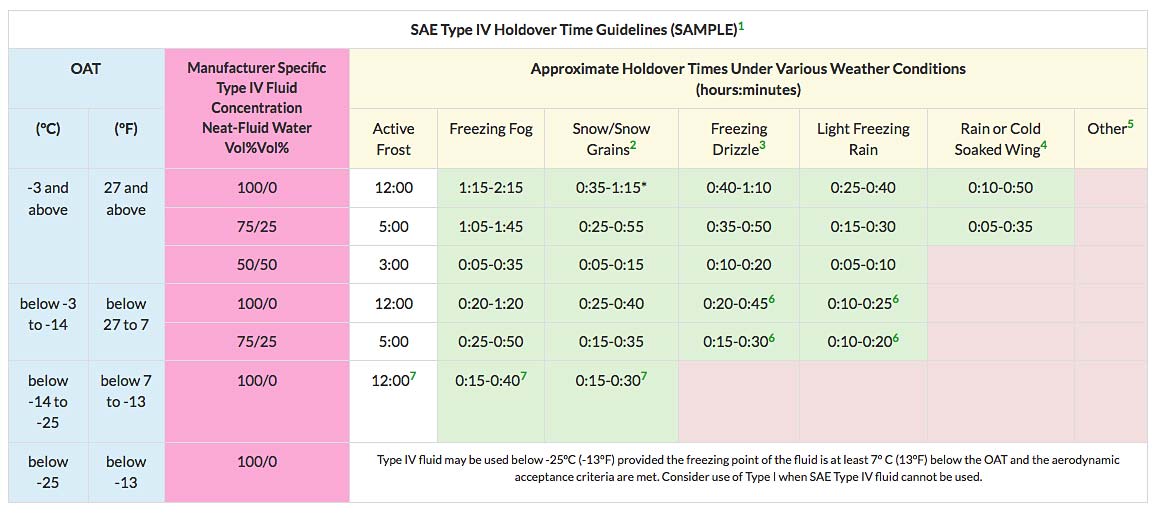
    Airlines use four standard fluid types when deicing aircraft. These fluids have different viscosities – viscosity is a measure of a fluid’s resistance to flow – and holdover times, which is the length of time the fluids are expected to protect the plane during snow or icing conditions.

    The deicing process includes both complex crew logistics and interesting science.

    In the United States, airlines typically use a two-step process before flying. First, they perform deicing using either a heated Type I fluid or a heated solution of Type I fluid and water.

    Deicing removes existing ice and snow from the wings of the plane, which is why airlines often heat the deicing fluid to around 140 to 150 degrees Fahrenheit (60 to 66 degrees Celsius) before application.

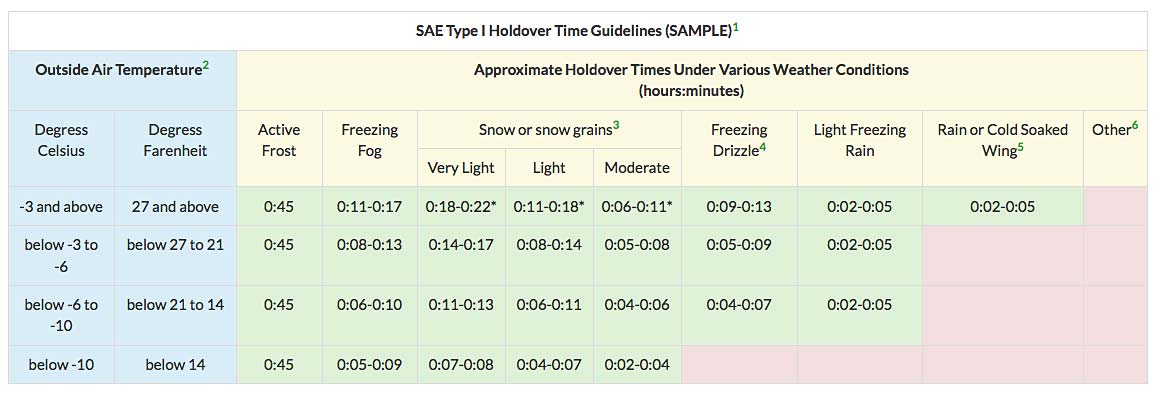
    Type I fluids are the thinnest of the deicing fluids, and they’re often red or orange. They spread the easiest on a plane’s surface because they have the lowest viscosity. Since they’re thin enough to flow off a plane when it’s not moving – or moving slowly – they can be applied to any aircraft.

    But as a result, they also have the shortest holdover times, often less than 20 minutes depending on the weather conditions. These holdover times vary, though, and can be less than five minutes for snow if the outside air temperature is below 14 F (minus 10 C).

    Next, the ground crews will typically apply an anti-icing fluid to the aircraft – often Type II or Type IV. Anti-icing solutions are used to help prevent the future accumulation of snow and ice on the wings of planes.

    Type II and Type IV fluids contain thickening agents that increase their viscosity. These thickeners allow the fluid to remain on the aircraft longer to help melt newly forming frost or ice. This translates to longer holdover times – often more than 30 minutes for snow – but it also means the plane needs to reach a higher speed to shear, or blow off, the fluid.

    Once applied, Type II and IV fluids will generally stay on the aircraft until the plane is taxiing down the runaway during takeoff. By then, it has gained enough speed to produce the shear force necessary to remove the fluid from the plane. Type II fluids are a clear or pale straw color, while Type IV fluids are generally green. Including a colored dye helps the ground crew clearly see what parts of the plane have been coated and which areas still need application.

    Type III fluids are not as common anymore. They are formulated to shear off at lower speeds and thus are sometimes used on small commuter aircraft since these planes typically don’t go as fast as commercial jetliners.

    Environmental impact of deicing

    Environmental considerations are also an important part of deicing. Glycols require a lot of oxygen to biodegrade, which can deplete dissolved oxygen in streams or lakes. This, in turn, can threaten aquatic life, like fish and other organisms, that need dissolved oxygen to breathe.

    In addition, ethylene glycol is toxic to wildlife, so the Environmental Protection Agency requires airports to monitor their stormwater runoff. For this reason, most airports collect and treat stormwater runoff on-site or send it to a municipal wastewater treatment facility.

    Airports are also increasingly starting to use fluid recovery systems to recycle the glycols and capture the additives in these fluids, which are often toxic, too. They’ll often use designated areas outside for deicing planes so they can collect and store the fluids after they run off the plane in holding tanks underground until they can be recycled.

    Atmospheric icing

    During flight, planes use other technologies to mitigate the icing risks. For example, most modern aircraft use bleed air systems, which channel hot air from the engine’s compressor through interior ducts to the leading edges of the wings and other critical areas to help prevent ice buildup while the plane is in the sky.

    Some planes also use electrically heated panels embedded in the aircraft’s wings to generate heat. These control systems typically cannot be used while the plane is on the ground, since they rely on cold air flowing across the wing’s surface. This airflow is usually achieved at cruising altitude and is necessary to prevent the plane’s surface from getting too hot.

    Airlines may sometimes also use icephobic coatings to help keep new ice from forming and sticking on the outside surfaces of planes. These coatings delay how soon new ice can form. They can also reduce how strongly the ice adheres to the surface.

    Icephobic polymer coatings can mitigate ice buildup and help reduce ice adhesion on surfaces.
    Hernández Rodríguez et al., 2024., CC BY-SA

    Smaller planes may also use inflatable rubber strips called pneumatic boots on the wings that can be inflated as needed to break off accumulated ice on the leading edge of the wings.

    Flying is truly a modern scientific marvel. A lot of engineering goes into not only getting planes off the ground but also keeping them ice-free during flight. So the next time you experience a weather-related delay at the airport, just remember that deicing is needed to ensure both a safe flight and a truly uplifting one.

    Andrew Sommers does not work for, consult, own shares in or receive funding from any company or organization that would benefit from this article, and has disclosed no relevant affiliations beyond their academic appointment.

    ref. The science behind airplane deicing – a mechanical engineer explains how chemistry and physics make flying a more uplifting experience – https://theconversation.com/the-science-behind-airplane-deicing-a-mechanical-engineer-explains-how-chemistry-and-physics-make-flying-a-more-uplifting-experience-248732

    MIL OSI – Global Reports

  • MIL-OSI Canada: Province Seeks Feedback on New Online Mapping Tool for Developing Aquaculture

    Source: Government of Canada regional news

    The Province wants feedback on the design of a new online mapping tool that will help identify areas for possible aquaculture development.

    The new coastal classification mapping tool will screen coastal waters to determine where aquaculture could be possible, based on conditions and needs of farmed salmon, trout, oysters and mussels. The results can then be used to guide and inform the selection of specific areas for further investigation, which would include public input.

    “There is a tremendous opportunity for growth for aquaculture that will help meet the increasing demand for seafood, and we are going to do this responsibly,” said Kent Smith, Minister of Fisheries and Aquaculture. “The mapping tool will help provide a better understanding of where aquaculture could potentially happen in Nova Scotia – and where it likely will not happen.”

    The Centre for Marine Applied Research, a division of Perennia, is providing scientific support for the development of the aquaculture coastal classification system.

    More information and the online survey are at: https://novascotia.ca/coastal-classification-system-engagement/. The consultation ends March 15.

    Aquaculture – the farming of fish, shellfish and aquatic plants – is the fastest-growing food production method in the world and is essential for meeting a growing demand for seafood. It is a key growth opportunity for Nova Scotia.


    Quotes:

    “Aquaculture coastal classification serves as a crucial first step to understanding various influences on future aquaculture projects. The process can help identify areas needing more study and areas that could benefit from additional monitoring and data collection. By integrating spatial data into an online map, it becomes a comprehensive tool for understanding where sustainable aquaculture is possible and helping industry, stakeholders, government officials, scientists and the public access detailed information about aquaculture in Nova Scotia.”
    Jenny Weitzman, research scientist, Centre for Marine Applied Research

    “We see the coastal classification system as a good tool for people looking to get into Nova Scotia’s aquaculture sector or expanding their farms into new areas. Folks can learn about our dynamic coastline and get base level data to better understand how their farm plans might work in one area over another. Any resource that provides solid data and promotes growth is positive for the sector.”
    Jeff Bishop, Executive Director, Aquaculture Association of Nova Scotia


    Quick Facts:

    • the aquaculture industry employs almost 800 people and generates about $120 million every year for Nova Scotia’s economy
    • selecting a location for aquaculture development requires a comprehensive review
    • coastal areas will be assessed using set criteria such as water depth and temperature to determine possible suitability for growing salmon, trout, oysters and mussels
    • the coastal classification system is not a decision-making tool; its purpose is to share information that will be useful to industry, communities and others

    Additional Resources:

    Information about aquaculture and marine plants: https://novascotia.ca/fish/aquaculture/

    Centre for Marine Applied Research: https://cmar.ca


    Other than cropping, Province of Nova Scotia photos are not to be altered in any way.

    MIL OSI Canada News

  • MIL-OSI Canada: Climate Change Funding for Seafood Companies; Another Call for Applications

    Source: Government of Canada regional news

    NOTE: The list of funding recipients and projects follows this release.

    Fourteen seafood companies and related organizations across the province are receiving funding to help reduce their carbon footprint.

    The projects, supported through the Fisheries and Aquaculture Energy Efficiency Innovation Fund, range from the first zero-emission electric lobster boat in Canada to solar power at lobster and bait facilities.

    “Addressing climate change continues to be a priority for our government,” said Kent Smith, Minister of Fisheries and Aquaculture. “Funding for these seafood organizations will help support our efforts to respond to climate change, reducing fossil fuel use and greenhouse gas emissions, as well as reduce costs for industry.”

    The fund is a $6.5-million, three-year program that supports new projects that reduce greenhouse gas emissions produced by boats, buildings and other commercial fisheries and aquaculture operations.

    The Province is now accepting applications for the fund’s second round. Examples of eligible projects include:

    • adapting emerging electric and hybrid technology for fishing vessels and fleets
    • installing renewable energy systems
    • reducing emissions through equipment upgrades and new technology
    • conducting research to enable future emission-reduction projects.

    The deadline for applications is April 11.


    Quotes:

    “The fisheries and aquaculture industry plays a vital role in Nova Scotia, generating significant economic benefits and employment opportunities across the province. Energy efficiency improves these economic benefits through cost reductions, helping organizations enhance long-term productivity and competitiveness. When organizations invest in energy efficiency, they can improve equipment lifespans, increase operational resilience and solidify their position as a global leader in the industry.”
    Stephen MacDonald, President and CEO, EfficiencyOne

    “This fund represents a direct investment into members of the Nova Scotia Seafood Alliance and the seafood sector to reduce their bottom line by increasing efficiency, mitigating greenhouse gas emissions and reducing the biggest costs they have for operation – energy. At the same time, the reputational benefits of moving the industry to a low-emission model will elevate Nova Scotia seafood products above their competitors on the shelves in premium markets worldwide. This is a win-win for everyone involved.”
    Kris Vascotto, Executive Director, Nova Scotia Seafood Alliance

    “The Province’s support to build and demonstrate the first all-electric lobster boat is an important step in developing Membertou’s sustainable fishery for future generations. The electric boat will play an important role in building trust in battery-electric propulsion as a viable solution for decarbonizing Canada’s commercial fishery.”
    Chief Terry Paul, CEO, Membertou


    Quick Facts:

    • the Nova Scotia Fisheries and Aquaculture Loan Board will make available $10 million over three years in dedicated lending to support eligible applicants
    • the fund is a commitment in Our Climate, Our Future: Nova Scotia’s Climate Change Plan for Clean Growth
    • the Department of Energy provided $2 million to the fund

    Additional Resources:

    More information on the Fisheries and Aquaculture Energy Efficiency Innovation Fund is available at: https://www.efficiencyns.ca/business/business-types/agriculture/fisheries-and-aquaculture-energy-efficiency-innovation-fund/

    Fisheries and Aquaculture Loan Board lending program: https://nsfishloan.ca/energy-efficiency

    Our Climate, Our Future: Nova Scotia’s Climate Change Plan for Clean Growth: https://climatechange.novascotia.ca/sites/default/files/uploads/ns-climate-change-plan.pdf


    Approved projects:

    • Bill and Stanley Oyster Company Ltd. – $250,000 to implement an electric work boat and electric forklift at a shellfish farm
    • BMC Seafoods Limited – $100,000 to implement an energy-efficient heat exchanger that will reduce electricity costs at a live lobster holding facility
    • Brazil Rock Lobster Association – $100,000 to install solar and wind-power on 18-member lobster vessels
    • Glas Ocean Electric – $198,225 towards a data logging study on five harbours/wharves which will involve 20 vessels
    • Havre Boucher Seafoods Inc. – $250,000 to implement a fully electric aluminum work boat with vessel-to-grid charging capability at a shellfish farm
    • Ignite (Atlantic) – $150,000 toward a study to develop a marine electrification roadmap for the communities of Digby and Sheet Harbour
    • L. Walker Seafoods – $30,000 toward an energy efficient condenser with floating head pressure control at a live lobster holding facility
    • Little Harbour Fisheries – $9,848 to install solar panels and convert energy usage to a renewable source at a bait storage facility
    • Membertou Fisheries Inc. – $250,000 toward the first zero-emission electric lobster fishing boat in Canada
    • NovaShell Fisheries – $70,000 toward an energy-efficient heat exchanger with floating head pressure control at a new live lobster holding facility
    • R. Baker Fisheries Limited – $86,500 to install advanced refrigeration units that will reduce energy consumption at a seafood processing facility
    • Red Fish Blue Fish Incorporated – $14,871 to install a solar photovoltaic system with battery storage at a commercial bait storage facility
    • Strait of Canso Superport Corporation – $250,000 toward a charging station for electric vessels
    • Yarmouth Bar Fisheries – $50,000 toward solar installation that will result in a net-zero seafood processing/live holding facility

    Other than cropping, Province of Nova Scotia photos are not to be altered in any way

    MIL OSI Canada News

  • MIL-OSI Economics: North Macedonia formally accepts Agreement on Fisheries Subsidies

    Source: World Trade Organization

    DG Okonjo-Iweala said: “I’m grateful for North Macedonia’s formal acceptance of the Agreement on Fisheries Subsidies. While a landlocked country, North Macedonia’s acceptance demonstrates its commitment to the multilateral trading system and the WTO, and underscores all members’ shared interest in responsible fisheries resource management, ocean sustainability, and food security. This acceptance provides further momentum for the entry into force of this important agreement for people and the planet.”

    Mr. Bilali said: “By joining this agreement, North Macedonia reaffirms its dedication to the conservation of marine resources and the fight against harmful subsidies that contribute to overfishing.”

    North Macedonia’s instrument of acceptance brings to 91 the total number of WTO members that have formally accepted the Agreement. Twenty more formal acceptances are needed for the Agreement to come into effect. The Agreement will enter into force upon acceptance by two-thirds of the membership.

    Adopted by consensus at the WTO’s 12th Ministerial Conference (MC12), held in Geneva on 12-17 June 2022, the Agreement on Fisheries Subsidies sets new, binding, multilateral rules to curb harmful subsidies, which are a key factor in the widespread depletion of the world’s fish stocks. In addition, the Agreement recognizes the needs of developing economies and least-developed countries and establishes a fund to provide technical assistance and capacity building to help them implement the obligations.

    The Agreement prohibits subsidies for illegal, unreported and unregulated (IUU) fishing, for fishing overfished stocks, and for fishing on the unregulated high seas.

    Members also agreed at MC12 to continue negotiations on outstanding issues, with a view to adopting additional provisions that would further enhance the disciplines of the Agreement.

    The full text of the Agreement can be accessed here. The list of members that have deposited their instruments of acceptance is available here. Information for members on how to accept the Protocol of Amendment is available here.

    Share

    MIL OSI Economics

  • MIL-OSI United Nations: 28 February 2025 Donors making a difference: community engagement to promote, provide and protect the health and well-being of all

    Source: World Health Organisation

    WHO defines community engagement as “a process of developing relationships that enable stakeholders to work together to address health-related issues and promote well-being to achieve positive health impact and outcomes”.

    WHO’s partners and donors support the Organization to work in this area as there are undeniable benefits to engaging communities in promoting health and well-being. At its core, community engagement enables changes in behaviour, environments, policies, programmes and practices within communities.

    Below are some country stories that demonstrate the breadth of community engagement work that WHO conducts, resulting in more positive health outcomes for the people in these communities than before.

    Uganda trains district health workers on community-based approach to Ebola

    Uganda trains Community Health workers from Kole, Mukono and Wakiso districts on community-based approach to Ebola. Photo by: WHO/Sadat Kamugisha 

    Uganda’s Ministry of Health conducted a training on Ebola disease detection and management for Community Health Workers representatives from Kole, Wakiso, and Mukono districts. Participants focused on multi-sectoral action to safeguard communities from emerging zoonotic diseases with pandemic potential such as Ebola.

    Communities play an integral role in raising awareness, supporting case identification, tracing contacts, and maintaining essential health services. The emphasis on collaboration with local leaders, volunteers, and health workers is vital for effective responses to public health emergencies. Building on lessons learned from past health crises, Uganda has already made substantial advancements in emergency preparedness.

    The three-day event was supported by WHO, and the UK Public Health Rapid Support Team (UK-PHRST), which is a UK aid project funded by the Department of Health and Social care. The community protection approach is a central component of WHO’s new Health emergency prevention, preparedness, response, and resilience framework.

    Visit the WHO/Uganda web page to read the full story.

    Community engagement for access to health services in Lao PDR

    CONNECT team members discuss community health priorities in Khammouane Province, Lao PDR. Photo by: WHO/Enric Catala

    Developed by the Lao Ministry of Health and Ministry of Home Affairs in response to COVID-19 with the support of WHO and partners, the CONNECT initiative enhances local governance and community engagement for equitable access to public services, particularly health.

    Supported by USAID, the Australian Government and Luxembourg, as of July 2024, CONNECT reached over 230 villages across 10 provinces (including Vientiane Capital) and support already in-place for expansion to all provinces.

    An external evaluation of implementation in 12 villages found an increase in essential service uptake for maternal health and improved attitudes towards using primary care; increased trust in health providers; increased sense of ownership of health at community level; and increased vaccination uptake and confidence, especially among ethnic groups and previously unreached communities.

    Visit the WHO/WPRO web page to read the full story.

    Côte d’Ivoire community radios boost public awareness on mpox outbreak

    Community radios, pillar of the fight against mpox. Photo by: WHO/Toiherou De Marfere Sidibe

    A network of community radio stations, known as Radio Santé, comprises 350 stations in West African, with over half based in Côte d’Ivoire. Launched in 2020 during the COVID-19 pandemic with major support from WHO, Radio Santé has become a preferred channel for disseminating reliable, verified health information. It brings together nearly 1000 journalists and communications specialists.

    Radio Santé is an interactive and accessible tool for mobilizing communities around health issues, throughout Côte d’Ivoire and across borders. Health authorities use Radio Santé to counter rumours and misinformation, and to strengthen community engagement, which is crucial to curbing the spread of diseases such as mpox.

    After WHO declared mpox as a public health emergency of international concern in August 2024, Radio Santé devoted its health talk show to mpox. 185 Ivorian community radio stations have since broadcasted messages on mpox. Over 50 programmes have been produced and broadcast in eight countries: Benin, Burkina Faso, Chad, Guinea, Mali, Niger, Senegal and Togo.

    Visit the WHO/Côte d’Ivoire web page to read the full story.

    Bolivia strengthens social participation in health for indigenous population

    Indigenous organizations are clear about their requests. They want free and equitable access to health care, an improved indigenous health network, incorporation of traditional medicine, and the consideration of the indigenous population’s culture, customs, and practices. Photo by: WHO/PAHO

    The Ministry of Health and Sports of Bolivia is engaging indigenous populations in community participation processes, creating space for them to discuss health topics, share concerns, and contribute to a health improvement plan.

    The meaningful inclusion and engagement of indigenous populations in health policy planning, taking into account the social determinants of health, is critical to ensure context-specific interventions, uptake of guidance and services, and positive health outcomes for all.

    PAHO/WHO, through the Universal Health Coverage Partnership, has supported the Ministry of Health and Sports of Bolivia in this endeavour since 2021. The UHC Partnership operates in over 125 countries, representing over 3 billion people. It is supported and funded by Belgium, Canada, the European Union, France, Germany, Ireland, Luxembourg, Japan, the United Kingdom of Great Britain and Northern Ireland, and WHO

    Visit the PAHO/AMRO web page to read the full story.

    Weaving hope in Honduras: the community wisdom that saves lives

    Maternal health in Honduras Hermelinda shares her experience. Photo by: WHO/Honduras

    In Honduras, high rates of maternal and neonatal mortality are often the result of multiple factors, including socioeconomic barriers, lack of access to adequate healthcare services, gaps in education and awareness about maternal and child health, and cultural differences.

    Hermelinda Hernández, who is familiar with the local practices and beliefs of her community and also recognizes the value of professional medical interventions, participated in the “Knowledge Dialogues Methodology” workshop organized by the Honduran Ministry of Health with the support of PAHO/WHO and funded by Global Affairs Canada.

    The workshop aimed to promote mutual understanding between midwives and healthcare providers to reach agreements that improve the health of women, and adolescent girls in situations of vulnerability within the community.

    Visit the PAHO/AMRO web page to read the full story.

    Grassroots heroes in Cambodia

    Mrs Say Sa with her Baby in Cambodia’s Principal of Health Centre Kok Chuk. Photo by: Aforative media

    In Cambodia, village chiefs stepped up to create a healthier future for their communities. In villages across 25 provinces, 2000 village chiefs and nearly 5400 village health support groups received trainings, organised by the Ministry of Heath with support from WHO and the EU.

    This equipped the chiefs with knowledge and skills necessary to control transmission of COVID-19, influenza, and other respiratory diseases, and collaborate with authorities more closely on health issues facing their communities.

    The chiefs then shared their newfound knowledge during community dialogues, which then transformed how community members adopted healthier practices. Empowered with accurate information, communities embraced protective measures during times of high COVID-19 transmission.

    Visit the WHO/WPRO web page to read the full story, and more on EU’s support to WHO in ASEAN region.

    Bolstering public awareness to help curb mpox spread in Uganda

    Dr Kenneth Kabali, WHO Field Coordinator for Busoga Sub-region sensitizes the community on mpox in Mayuge district, Eastern Uganda. Photo by: WHO/Abdu Mutwalibu Seguya

    Uganda witnessed an upsurge in mpox cases, with laboratory-confirmed cases increasing from 24 as of 21 September to 413 as of 7 November 2024. Health authorities, with support from WHO and partners, worked closely with communities to raise awareness about the dangers of the disease and how to stay safe, and address misinformation and stigma.

    The risk communication and community engagement team reached more than 100 fishmongers, fisherfolk, boda boda (motorbike taxi) riders, 8000 school children and 30 sex workers. In addition, 500 teachers in the district have been oriented on mpox.

    WHO is also using mass media to expand the reach of mpox response communication. With funding from USAID, WHO has contracted 10 regional radio stations and 2 national TV stations to raise awareness and promote preventative behaviour.

    Visit the WHO/AFRO web page to read the full story.

    Combating measles: a comprehensive community-centred approach in Ethiopia

    Combating measles, a comprehensive community-centred approach in Ethiopia. Photo by: WHO/Hassen Ali

    In the districts of Sidama, Central, and South Ethiopia, access to healthcare is often challenging, exacerbated by various health emergencies. A community-led initiative made remarkable progress in combating measles, malaria, and malnutrition through collaborative efforts between local health facilities, community health workers, and government agencies.

    The initiative received significant financial support from the European Civil Protection and Humanitarian Aid Operations (ECHO) bolstering community-based intervention efforts.

    By leveraging collaboration between healthcare facilities, community health workers, and local communities, this initiative represents a beacon of hope in improving healthcare access and outcomes in regions of Ethiopia.

    Visit the WHO/Ethiopia web page to read the full story.

    WHO races to contain malaria resurgence in southeastern Iran

    Malaria resurgence in Iran. Photo by: WHO/Iran

    A race against time is underway in southeastern Iran, where the resurgence of malaria threatens to undo years of progress. The dramatic rise in cases has been attributed to the devastating floods in neighbouring Pakistan in September 2022 which led to an expansion of malaria breeding sites.

    WHO, with crucial support from the Government of Japan, is on the ground in Sistan and Baluchestan Province, battling this public health emergency and working to protect vulnerable communities. Japan’s generous contribution provided 4902 mosquito dome tents offering families protection from infected mosquitos, 50 000 malaria rapid diagnostic tests enabling health care workers to quickly identify and treat infected individuals, and 1655 kg of insecticides, deployed to contain mosquito populations at their source. The combined resources are estimated to benefit 77 400 people in the province.

    In December 2024, a WHO mission observed a proactive approach to malaria control demonstrated by local health workers as they conducted house-to-house screenings, distributed mosquito nets and educated communities on how to use them.

    Visit the WHO/Iran web page to read the full story.

    Mali: screening for malnutrition in affected children to avoid complications

    Screening for malnutrition in affected children to avoid complications, Mali. Photo by: WHO/Razzack Saizonou

    Malnutrition among children is one of the main health problems that the affected populations of Ségou had to face after severe floods hit Mali between July and October 2024. Having lost everything including their food reserves and their means of subsistence, people found themselves in a very precarious situation.

    Among the more than 370,000 people affected by these floods, children, who represent 45% of the affected population, are particularly vulnerable. To enable access to health care, WHO, with thanks to the Central Emergency Response Fund, supported the deployment of mobile clinics on relocation sites.

    In the Ségou region, three sites were set up and equipped with medical tents. Medical staff go there five times a month. Between July and October 2024, nearly 700 children suffering from malnutrition were identified in the three health districts of the Ségou region.

    Visit the WHO/Mali web page to read the full story in French.

    Effective community engagement saving lives in Tanzania during cholera outbreak

    Abdul Zachari, a young man is washing his hands. Photo by: WHO/Clemence Eliah

    The recurrence of Cholera outbreaks has been a threat to many lives in the United Republic of Tanzania for decades now. In mid-2024, situation reports from the Ministry of Health indicated that, the outbreak have been reported in 19 regions of Tanzania Mainland. Thanks to flexible funding available for responding to outbreaks such as this, WHO has been able to support the Government’s efforts to control cholera outbreaks. Risk Communications and Community Engagement (RCCE) Experts worked on the ground delivering an intensive community sensitization in over 92 households and 32 villages . The joint and community-based action plan against Cholera outbreak was built jointly, this way enhancing 54 community members and local authorities from the affected wards and districts. The community engagement strategies adopted generate local solutions tailored to control and prevent further transmissions in these areas. In addition, WHO applied behavioral science approaches to guide tailored interventions to community protection and resilience – and as a result, enhancing many lives in Tanzania.

    Visit the WHO/Tanzania web page to read the full story.

    * * * *

    Read more about the WHO’s community engagement work.

    The donors and partners acknowledged in this story are (in alphabetical order) Australia, Belgium, Canada, the European Union (ECHO), France, Germany, Ireland, Luxembourg, Japan, the United Kingdom of Great Britain and Northern Ireland, United Nations Central Emergency Response Fund, and the USA Agency for International Development.

    WHO’s work is made possible through all contributions of our Member States and partners. WHO thanks all donor countries, governments, organizations and individuals who are contributing to the Organization’s work, with special appreciation for those who provide fully flexible contributions to maintain a strong, independent WHO.

    MIL OSI United Nations News

  • MIL-OSI Video: Secretary-General/Bangladesh, Ramadan, Türkiye & other topics – Daily Press Briefing (27 February)

    Source: United Nations (Video News)

    Noon Briefing by Stéphane Dujarric, Spokesperson for the Secretary-General.

    Highlights:
    Secretary-General/Bangladesh
    Secretary-General/Ramadan Message
    Türkiye
    Haiti
    Ukraine
    Sudan
    Democratic Republic of the Congo/Jean-Pierre Lacroix
    Democratic Republic of the Congo
    Occupied Palestinian Territory
    Lebanon
    Staff Security

    SECRETARY-GENERAL/BANGLADESH
    Every year, the Secretary-General does a Ramadan solidarity visit, where he likes to visit and fast with a Muslim community, which is facing distress. He began this tradition when he was High Commissioner for Refugees. In his own words, the Secretary-General said that Ramadan embodies the values of compassion, empathy and generosity. It is an opportunity to reconnect with family, with community and a chance to remember those less fortunate. These missions are to remind the world of the true face of Islam.
    This year, the Secretary-General will be going to Bangladesh from the 13-16 March. He will travel to Cox’s Bazaar to join an Iftar and meet with Rohingya refugees who have been forcibly displaced from their homes in Myanmar, and also, of course, with the host Bangladeshi communities who have been generously in hosting the refugees from Myanmar.
    During his visit, he will also be in the capital of Bangladesh, Dhaka, where he will meet with the Chief Adviser for the interim government, Professor Muhammed Yunus, as well as with young women and men and representatives from civil society.

    SECRETARY-GENERAL/RAMADAN MESSAGE
    In his annual message at the start of Ramadan, the Secretary-General expressed a special message of support to all those who will spend this sacred time in displacement and violence. From Gaza and the wider region, to Sudan, the Sahel and beyond.
    The Secretary-General stands with all those who are suffering and joins those observing Ramadan to call for peace and mutual respect.

    TÜRKIYE
    On the reports coming out of Türkiye regarding Abdullah Öcalan, the imprisoned leader of the Kurdistan Workers Party, the PKK, and his message calling for fighters to lay down their arms and the PKK to dissolve itself, the spokesperson said that the Secretary-General welcomes this important development. This represents a glimmer of hope, which would lead to the resolution of a long-standing conflict.

    HAITI
    The World Food Programme (WFP) today said that, as part of their emergency response in Haiti, they continue to provide critical food assistance, cash-based transfers, and hot meals across the Artibonite, Nord, and Ouest departments. This includes $1.2 million in cash assistance, as well as nearly 3,000 meals distributed in border regions to Haitians deported back to their country.
    Last week, the WFP organized the first of two humanitarian cargo flights from Panama City to Port-au-Prince. This was the first humanitarian cargo flight to land at the Port-au-Prince airport since its closure lastNovember.
    The flight carried medicines, vaccines, and medical supplies for eight humanitarian organizations. A second flight is scheduled in about one month.

    Full highlights: https://www.un.org/sg/en/content/noon-briefing-highlight?date%5Bvalue%5D%5Bdate%5D=27%20February%202025

    https://www.youtube.com/watch?v=nX1Wlh5xwHk

    MIL OSI Video

  • MIL-OSI Asia-Pac: Some due to ignorance, label our spirituality as superstition-VP

    Source: Government of India

    Vice President’s Secretariat

    Some due to ignorance, label our spirituality as superstition-VP

    This is the land of Shyama Prasad Mukherjee….fortunate that the festering wound he saw, is no longer present in our Constitution-VP

    In our culture, we have endured cruelty, invasions…When Nalanda was set on fire, just imagine what was destroyed!- VP

    About 1200-1300 years ago..our cultural and religious centers were destroyed; despite everything India’s culture could not be eradicated, it is still alive today-VP

    The answer to everything today can be found in Sanatan; Sanatan stands for inclusivity-VP

     Sanatan does not believe in subjugation, if you surrender to Sanatan, you are not a captive, you become a free person, a free soul-VP

    Greatest adornment for any country is not its wealth, but its culture-VP

    Religion cannot be seen in a narrow, conservative manner; religion cannot be assessed within limited boundaries-VP

    VP addresses the Closing Ceremony of 150th Birth Anniversary of Gaudiya Mission’s founder Acharya Srila Bhakti Siddhanta Saraswati Goswami Prabhupad

    Posted On: 28 FEB 2025 5:24PM by PIB Delhi

    The Vice-President, Shri Jagdeep Dhankhar today said that some due to ignorance are labelling our sacred elements like spirituality as superstition. Underlining that Sanatan stands for inclusivity, Shri Dhnakhar stated, “ Some people, due to ignorance or blindly pursuing the meaning of things, wrongly label our sacred elements, spirituality, as superstition.”

    “The answer to everything today can be found in Sanatan. What Sanatan teaches is essential for the system of today, no matter where in the world it is. Sanatan stands for inclusivity, Sanatan stands for universal goodness, Sanatan stands for the supremacy of the soul. Sanatan does not believe in subjugation. If you surrender to Sanatan, you are not a captive, you become a free person, a free soul”, he further stated.

    “Religion cannot be seen in a narrow, conservative manner. Religion cannot be assessed within limited boundaries. We must understand the true meaning of religion, and only then will we realize that we all need to resolve to make India ‘Vishwa Guru’ once again. And India becoming the ‘Vishwa Guru is the greatest auspicious message for the world”, he added.

    Addressing the gathering at the closing ceremony of 150th Birth Anniversary of Gaudiya Mission’s founder Acharya Srila Bhakti Siddhanta Saraswati Goswami Prabhupad, Shri Dhnakhar said, “ In our culture, we have endured cruelty, invasions, and barbarism……What kind of barbarity, extremity, and reckless destruction of our religious places, our cultural symbols! When Nalanda was set on fire, just imagine what was destroyed! How many floors did Nalanda have, how many lakhs of books were there, and they were not just for India, but for the entire world. The progress of technology today has some connection to the knowledge stored in our treasure of wisdom”.

    In his address he further stated, “This is the land of Shyama Prasad Mukherjee, who never compromised on nationalism. And what a huge sacrifice it was! Today, we are in a fortunate time, that the concerns Shyama Prasad Mukherjee had, his thoughts, his commitment to nationalism, and the festering wound he saw, is no longer present in our Constitution”.

    Emphasising on the significance of culture and the need to preserve the cultural aspects of society, Shri Dhankhar underlined, “Today, we need our children to have an awareness of our culture. It is a positive sign that many programs are being conducted in this direction, but if there is one greatest adornment for any country, it is not its wealth, but its culture. Once the culture is disrupted, the decline cannot be stopped. Cultural aspects, all elements related to culture, their preservation, sustenance, and protection are crucial because they define India”.

    “There was a time….when people from around the world came searching for knowledge, for light. Our institutions were of great repute, but at some point, we strayed from the path. Foreign invasions happened, this was about 1200-1300 years ago. A cruel act occurred, a thunderbolt, a violent blow struck, and our cultural and religious centers were destroyed. We had the occasion to witness barbarity in extremity. It’s unimaginable what was done. And see, despite everything that happened over 1000 years, India’s culture could not be eradicated. It is still alive today”, he added.

    Referring to India as the cultural centre of the world, the Vice-President highlighted, “ India is the cultural centre of the world and Kolkata is one of the epicentres of culture ! The challenges the world faces today are frightening. They compel us to think….We talk about climate change, but the greatest crisis today lies in the human mind. Humanity is restless. Even though we are materially rich, powerful, capable of demonstrating strength, something is still missing. And when people feel this lack, they see only one North Star—India.”

    Shri C.V. Ananda Bose, Hon’ble Governor of West Bengal,  Shri Suresh Gopi, Minister of State for Tourism, Srimad Bhakti Sundar Sanyasi Goswami Maharaj, President & Acharya, Gaudiya Mission and other dignitaries were also present on the occasion.

    ****

    JK/RC/SM

    (Release ID: 2106991)

    MIL OSI Asia Pacific News

  • MIL-OSI Europe: Written question – Use by Danish Fishers PO of EMFAF funding intended to promote sustainable fisheries – P-000770/2025

    Source: European Parliament

    Priority question for written answer  P-000770/2025
    to the Commission
    Rule 144
    Sigrid Friis (Renew)

    It has been reported in the Danish media that the producers’ organisation Danish Fishers PO (DFPO) is using money from the European Maritime, Fisheries and Aquaculture Fund (EMFAF) in a way that might be at odds with the aims of the fund. Although the funding is intended to promote sustainable fishing, the DFPO is allegedly using it to influence policymakers with a view to weakening or reversing sustainability measures[1].

    • 1.When the Commission approved Denmark’s EMFAF programme in December 2022, it was with a clear objective of supporting the sustainable development of fisheries. Can the Commission confirm whether it is aware of these allegations about the DFPO’s use of funds?
    • 2.Does the Commission take the view that the Danish system for checking and supervising EMFAF funding is sufficient to ensure that the funds are being used in accordance with EMFAF’s aims?
    • 3.If not, what steps can the Commission take, in cooperation with the Danish authorities, to ensure better compliance with the rules?

    Submitted: 19.2.2025

    • [1] https://www.dr.dk/nyheder/indland/organisationer-danmarks-fiskeriforening-bruger-baeredygtighedsmidler-paa-modarbejde
    Last updated: 28 February 2025

    MIL OSI Europe News

  • MIL-OSI United Kingdom: Publication of Wildlife Crime in Scotland 2023

    Source: Scottish Government

    An Official Statistics in Development publication for Scotland

    The latest statistics on wildlife crime in Scotland were published today by the Chief Statistician for Scotland. Recorded wildlife crime offences were down by 23%, from 286 offences in 2021-22 to 220 offences in 2022-23, bringing recorded wildlife crime back close to pre-pandemic levels.

    These statistics also contain data on Crown Office and Procurator Fiscal Service cases, criminal proceedings and scientific evidence and intelligence. Key results from the report include:

    • Over half of all recorded wildlife crimes were categorised as either offences involving birds (31%) or fish poaching (25%).
    • The Police Scotland divisions with the highest recorded wildlife offences in 2022-23 were the Highlands and Islands (35), the Lothians and Scottish Borders (32) and the North East (31).
    • The Crown Office and Procurator Fiscal Service received 63 cases in 2022-23 relating to wildlife crime (which may include more than 1 offence per case), with fish poaching being the most common category (30 cases). Of these 63 cases, 37 (59%) received an alternative to prosecution (e.g. fine), 15 (24%) were prosecuted, and 11 (17%) resulted in no action.
    • Criminal proceedings statistics for 2022-23 show that 36 people were proceeded against for wildlife crimes – a substantial increase from 2021-22 (20 people) and 2020-21 (2 people) which had been impacted by court closures and reduced capacities.

    Background

    When a wildlife crime is suspected, the first step is for it to be reported to the police (or detected by the police), and then recorded. Further steps may include investigation to assess whether the recorded crime should be part of a case submitted to the Crown Office and Procurator Fiscal Service (COPFS) and then a decision on whether there is sufficient evidence for the case to be prosecuted. Ultimately a court case may result in a conviction or acquittal. All these stages may be supported by relevant scientific evidence and intelligence.

    This report presents statistics relating to 2022-23 for the various stages described above. Although these sets of statistics are related, direct comparisons between them cannot be made due to differences in data sources, timing and the bases on which statistics were collated. For example, several recorded crimes may be included in one COPFS case (involving multiple sources of scientific evidence), and subsequent criminal proceedings may occur in a different year.

    Official statistics are produced in accordance with the Code of Practice for Statistics

    MIL OSI United Kingdom

  • MIL-OSI USA: Padilla Urges Elon Musk and OPM to Stop Sending Mass Emails to Legislative Branch Employees

    US Senate News:

    Source: United States Senator Alex Padilla (D-Calif.)

    Padilla Urges Elon Musk and OPM to Stop Sending Mass Emails to Legislative Branch Employees

    WASHINGTON, D.C. — Today, U.S. Senator Alex Padilla (D-Calif.), Ranking Member of the Senate Committee on Rules and Administration, urged Elon Musk and Acting Director of the Office of Personnel Management (OPM) Charles Ezell to cease mass email communications from the Department of Government Efficiency (DOGE) and OPM to employees of legislative branch offices and agencies. Despite not being subject to personnel actions by the executive branch, several legislative branch offices and agencies have received mass emails from hr@opm.gov, risking the sharing of sensitive, unauthorized information.

    Over the weekend, thousands of employees across the federal government received mass emails, asking them to summarize what they did in the past week, with Musk saying failure to respond would be taken as their resignation. Padilla stressed that sending these emails to legislative branch offices and agencies is particularly troubling as executive branch agencies warn their own employees not to respond to OPM’s mass email because “doing so would risk sensitive information falling into the hands of malign foreign actors.”

    “Neither the White House nor DOGE nor OPM have any authority or legitimate purpose to mass email legislative branch offices and agencies demanding information from employees or to threaten adverse personnel actions,” wrote Senator Padilla. “Unfortunately, Rules Committee staff have verified that mass emails from hr@opm.gov were sent to multiple legislative branch offices and agencies, wasting time and resources and potentially misleading employees into responding and sharing legislative branch information in an unauthorized manner.”

    “The fact that these mass emails are also going beyond the scope of the executive branch is yet another sign of how DOGE is operating in an uninformed, poorly executed, and chaotic manner,” continued Padilla.

    Specifically, Padilla asked Musk and Ezell to take steps by Monday, March 3, to stop any further mass email communications directed at employees in legislative branch offices and agencies. 

    Full text of the letter is available here and below:

    Dear Acting Director Ezell and Mr. Musk:

    Your agencies should cease directing any further mass email communications from the Office of Personnel Management (OPM) or the White House’s U.S. Department of Government Efficiency (DOGE) Service to the employees of legislative branch offices and agencies, who are not subject to personnel actions by the Executive branch. 

    Neither the White House nor DOGE nor OPM have any authority or legitimate purpose to mass email legislative branch offices and agencies demanding information from employees or to threaten adverse personnel actions. Unfortunately, Rules Committee staff have verified that mass emails from hr@opm.gov were sent to multiple legislative branch offices and agencies, wasting time and resources and potentially misleading employees into responding and sharing legislative branch information in an unauthorized manner.

    This is especially concerning as several executive branch agencies have even warned their own employees not to respond to these messages because doing so would risk sensitive information falling into the hands of malign foreign actors. The fact that these mass emails are also going beyond the scope of the executive branch is yet another sign of how DOGE is operating in an uninformed, poorly executed, and chaotic manner.

    In light of these inappropriate and potentially harmful actions, I ask that you confirm by Monday, March 3, 2025, that OPM and DOGE have taken steps to ensure that they will cease directly any further mass email communications at legislative branch offices and agencies and their employees. 

    I appreciate your prompt attention to this matter. For any questions, please do not hesitate to contact the Senate Rules Committee Democratic staff at 202-224-6352.

    Sincerely,

    MIL OSI USA News

  • MIL-OSI China: Beijing’s largest exhibition center opens its doors

    Source: China State Council Information Office

    The exterior of the Capital International Exhibition & Convention Center (CIECC) in Beijing, Feb. 26, 2025. [Photo by Liu Caiyi/China.org.cn] 

    The Capital International Exhibition & Convention Center (CIECC) officially began operations on Feb. 21, 2025. As the largest and most advanced exhibition venue in Beijing, it is expected to play a vital role in supporting the city’s development as an international exchange and consumption center.

    Spanning 210,000 square meters of indoor exhibition space and 15,000 square meters of meeting space, the CIECC aligns with Beijing’s push to become a global exhibition hub. This complex and the adjacent China International Exhibition Center (New Venue) offer a combined net exhibition space of 300,000 square meters. It is expected that by drawing major international events, Beijing’s position in the global exhibition and convention industry will be further strengthened. 

    The CIECC houses nine exhibition halls arranged in a fishbone pattern and features a digital management platform. The system includes intelligent navigation displays, information kiosks and robotic patrols for event operations. A flowing “ribbon” structure links different areas of the complex, designed to improve pedestrian flow and create visual harmony throughout the facility. A central north-south corridor serves as the main thoroughfare and includes landscaped outdoor gathering areas.

    The Capital International Exhibition & Convention Center (CIECC) features a geometric roof system creating lightweight, heat-insulated spaces without columns in Beijing, Feb. 26, 2025. [Photo by Liu Caiyi/China.org.cn]

    With its eco-friendly design, the CIECC meets the highest criteria under China’s green building assessment and rating framework. The venue integrates smart building management, hybrid ventilation, rainwater collection and on-site photovoltaic systems, minimizing its environmental impact.

    Ji Qing, general manager of the center, said the venue is designed to meet the increasing demand for high-level international events.

    “We are confident it will play a significant role in further enhancing Beijing’s global influence,” Ji said.

    Located in Beijing’s Shunyi district, not far away from the Beijing Capital International Airport, the CIECC is positioned to elevate the city’s status as an international exhibition destination.

    MIL OSI China News

  • MIL-OSI Economics: The SOC files: Chasing the web shell

    Source: Securelist – Kaspersky

    Headline: The SOC files: Chasing the web shell

    Web shells have evolved far beyond their original purpose of basic remote command execution, and many now function more like lightweight exploitation frameworks. These tools often include features such as in-memory module execution and encrypted command-and-control (C2) communication, giving attackers flexibility while minimizing their footprint.

    This article walks through a SOC investigation where efficient surface-level analysis led to the identification of a web shell associated with a well-known toolset commonly associated with Chinese-speaking threat actors. Despite being a much-discussed tool, it is still used by the attackers for post-exploitation activities, thanks to its modular design and adaptability. We’ll break down the investigative process, detail how the analysts uncovered the web shell family, and highlight practical detection strategies to help defenders identify similar threats.

    Onset

    It’s early Monday morning, almost 4am UTC time, and the apparent nighttime calm inside the SOC is abruptly interrupted by an alert from our SIEM. It indicates that Kaspersky Endpoint Security’s heuristic engine has detected a web shell (HEUR:Backdoor.MSIL.WebShell.gen) on the SharePoint server of a government infrastructure in Southeast Asia, a warning that no SOC analyst would want to ignore.

    The night shift team springs into action, knowing that the web shell could be the beginning of much worse activity, and that every second counts. Initial analysis of the telemetry suggests that the attackers exploited the affected web server, either by taking advantage of another web shell or a command injection vulnerability.

    From the listing above, where the process tree that triggered the first detection is reported, it is possible to observe an attempt to deploy a web shell disguised as a 404 page. The certutil utility was used to download the ASPX payload, which was hosted by abusing Bashupload. This web service, which is used to upload files from the command line and allows one-time downloads of samples, is no stranger to being abused as an ingress tool transfer technique.

    As is common practice, the command has been slightly obfuscated by using escape characters (such as ^ and “) to break up the keywords “certutil” and “urlcache” in order to bypass basic detection rules based on simple pattern matching.
    As part of our MDR service, we are required to operate within pre-established boundaries that are tailored to the customer’s business continuity needs and risk tolerance. In this case, the customer retains ownership of decisions regarding sensitive assets, including the isolation of compromised hosts, so we can’t instantly block the attack and must continue to observe and perform a preliminary threat analysis.

    A manual reconnaissance and discovery activity by an operator starts appearing, and despite the tension, an occasional typo (“localgorup”) manages to draw a smile:

    Aftermath

    To gain system privileges, the threat actors used several variants of the well-known Potato tools, either as memory-only modules or as standalone executables:

    To bring standalone binaries into the environment, the attackers again used the Bashupload free web service, which we saw in the initial web shell alert. Of all the tools, the GodPotato standalone binary ultimately succeeded in gaining system privileges.

    With elevated access, the attackers moved on to domain trust enumeration, mapping relationships between domains and identifying potential targets for lateral movement. But let’s get back to the main question: What kind of web shell are we dealing with here?

    Identifying the threat

    Unfortunately, we were unable to retrieve the web shell sample used during the initial access phase. However, starting with the privilege escalation phase, several .NET modules began to appear in the memory of the IIS worker process ( w3wp.exe), ranging from popular tools like Potato to other lesser known ones. One set of libraries in particular caught our attention, so we decided to investigate further by performing a manual inspection.

    Fortunately, the libraries were not obfuscated and lent themselves to quick static analysis:

    Example of a library detected in IIS process memory (0x0B593115C273A90886864AF7D4973EED)

    In the image above, if you look at the orange method names in the Assembly Explorer on the left, you can observe some peculiarities that can be used to identify similar samples. Although many of the methods names are very generic, there is one that is quite unique, EnjsonAndCrypt. A quick Google search of this name yields no results, which means it may be sample-specific.

    The getExtraData method is also interesting: although it has a non-specific name, there is a sequence of bytes [126, 126, 126, 126, 126, 126] that is used to parse key:value pairs whose value is base64 encoded:

    The “extraData” structure example

    Threat actors need to use the same byte sequence if they want to maintain backward compatibility across different implant versions, but since it is also very generic, we should combine both indicators, the getExtraData name and this byte array, to define a sufficiently precise detection condition that can be used in conjunction with EnjsonAndCrypt to create a detection rule.

    Uncovering modules and variants

    By feeding our newly created YARA rule to a multi-AV platform such as VirusTotal, we can identify additional samples that differ from those observed in the targeted infrastructure. It is worth noting that some of these have a poor detection rate:

    Poorly detected BasicInfo.dll (32865229279DE31D08166F7F24226843) sample

    Below are the most common names of libraries that match the rule:

    Module filenames

    Those familiar with the toolkit used may have already identified it by looking at these filenames, but if not, it is also possible to infer the relationship by simply pivoting to the samples available on VT:

    Sample FC793D722738C7FCDFE8DED66C96495B relations on VT

    Behinder, also known as Rebeyond, Ice Scorpion, 冰蝎 (Bīng xiē), is known as a cross-platform web shell designed to be compatible with most popular web servers running PHP, Java or ASP.NET as in our investigation. Although the web shell sample itself is very lightweight and somewhat basic, the tool includes a powerful GUI for operators with numerous capabilities including loading additional modules and giving them full control over compromised environments.

    Its built-in AES-encrypted communication allows threat actors to maintain stealthy control over a compromised web server, often bypassing traditional network detection mechanisms, and its modular, flexible nature allows malicious actors to use it as a base for customization even though it is only available as a pre-built tool on GitHub. Moreover, the presence of several step-by-step Chinese language tutorials on CSDN (Chinese Software Developer Network) makes it widely accessible to opportunistic bad actors.

    The bigger picture

    Taking a step back, the relationship between the memory artifacts observed on the customer’s server during the post-exploitation phase and the web shell source code becomes evident. The web shell is not just a foothold, it’s a fully functional backdoor that facilitates encrypted communication with the operators’ infrastructure, allowing them to call built-in or custom-loaded libraries, deploy additional tools, conduct reconnaissance and exfiltrate data while remaining hidden:

    ASPX web shell side by side with .NET payload

    Although the Behinder web shell has been widely discussed in the past, especially the PHP and JSP variants, it is still a current and evolving cyberweapon. Even if attackers make mistakes or act carelessly by reusing the same encryption keys or exhibiting the same patterns, we can’t afford to let our guard down. In the incident described in this article, if we had not taken the time to dig deeper into the artifacts observed in memory, we likely would have missed the toolkit altogether.

    Threats evolve quickly, and signature-based malware detection only catches what we already know. Underestimating the potential of memory-based payloads can lead to a false sense of security. Teams may assume that if they haven’t detected any suspicious files, they are safe, when in fact threats may be actively operating in memory.

    For SOC teams, continuous learning, proactive threat hunting, and refining detection techniques are essential to staying ahead of adversaries.

    Happy hunting and see you on the next mission!

    YARA rule

    Indicators of compromise

    Payloads
    EF153E1E216C80BE3FDD520DD92526F4                          god.exe
    B8A468615E0B0072D2F32E44A7C9A62F                          BadPotato.dll
    B5755BE4AAD8D8FE1BD0E6AC5728067B                          SweetPotato.dll
    578A303D8A858C3265DE429DB9F17695                         BasicInfo.dll
    EA19D6845B6FC02566468FF5F838BFF1                          FileOperation.dll
    CD56A5A7835B71DF463EC416259E6F8F                          Cmd.dll
    5EA7F17E75D43474B9DFCD067FF85216                          Echo.dll

    File paths

    C:ProgramDataDRM
    C:UsersDefaultVideos

    MIL OSI Economics

  • MIL-OSI Africa: Secretary-General’s video at the beginning of Ramadan [scroll down for French and Arabic versions]

    Source: United Nations – English

    strong>Download the video: https://s3.us-east-1.amazonaws.com/downloads2.unmultimedia.org/public/video/evergreen/MSG+SG+/SG+RAMADAN+31+JAN+25/3334567_MSG+SG+RAMADAN+31+JAN+25.mp4

    I send my warmest wishes as Muslims around the world begin observing the Holy Month of Ramadan.

    Ramadan embodies the values of compassion, empathy and generosity.

    It is an opportunity to reconnect with family and community.

    A chance to remember those less fortunate.

    To all those who will spend this sacred time amid displacement and violence, I wish to express a special message of support.

    I stand with all those who are suffering.

    From Gaza and the wider region, to Sudan, the Sahel and beyond.

    And I join those observing Ramadan to call for peace and mutual respect.

    Every Ramadan, I undertake a solidarity visit and fast with a Muslim community around the globe.

    These missions remind the world of the true face of Islam.

    And I always come away even more inspired by the remarkable sense of peace that fills this season.     

    In this Holy Month, let us all be uplifted by these values and embrace our common humanity to build a more just and peaceful world for all. 

    Ramadan Kareem.

    *****
    Je présente mes vœux les plus chaleureux aux millions de musulmans du monde entier qui entament le mois sacré du Ramadan.

    Le Ramadan incarne les valeurs de compassion, d’empathie et de générosité.

    Il est l’occasion de renouer avec sa famille et sa communauté.

    Il est aussi l’occasion de penser aux personnes moins bien loties.

    Je tiens à adresser à toutes celles et ceux qui passeront cette période sacrée au milieu des déplacements et de la violence un message particulier de soutien.

    Je suis aux côtés de tous ceux qui souffrent.

    Qu’ils soient de Gaza et de la région, du Soudan, du Sahel, et au-delà.

    Je me joins à tous ceux qui observent le Ramadan pour appeler à la paix et au respect mutuel.

    Chaque Ramadan, je rends visite à une communauté musulmane dans le monde pour témoigner ma solidarité et partager leur jeûne.

    Ces missions permettent de rappeler au monde le vrai visage de l’Islam.

    J’en reviens toujours plus inspiré par le remarquable sentiment de paix qui règne pendant cette saison.

    En ce mois sacré, puisons dans ces valeurs et dans notre humanité commune afin de bâtir un monde plus juste et pacifique pour tous.

    Ramadan karim.

    *****

    أبعث بأحر تمنياتي إلى المسلمين في العالم أجمع بمناسبة حلول شهر رمضان الفضيل.
          
         فشهر رمضان يجسد قيم التراحم والتعاطف والسخاء.
     
              وهو فرصة لإعادة التواصل مع العائلة والمجتمع.

               وفرصة لتذكر من هم أقل حظاً.
        
           وأود أن أبعث برسالة دعم خاصة إلى جميع أولئك الذين سيقضون هذه الأوقات المباركة وسط أجواء النزوح والعنف.

               وأعرب عن تضامني مع كل أولئك الذين يعانون.
            
       من غزة والمنطقة بأسرها، إلى السودان ومنطقة الساحل وما وراءها.
         
          وأضم صوتي إلى أصوات صائمي رمضان في الدعوة إلى السلام والاحترام المتبادل.
        
           وقد دأبتُ في كل رمضان على القيام بزيارة تضامن وعلى الصيام مع أحد التجمعات المسلمة في أنحاء مختلفة من العالم.
           
      وهي زيارات تذكر العالم بالوجه الحقيقي للإسلام.
             
      ودائما ما أعود محملا بالمزيد من الشعور الرائع بالسلام الذي يفيض به هذا الموسم الرمضاني.

               دعونا، في هذا الشهر الفضيل، نتخذ جميعا من هذه القيم وسيلة للتسامي ونتمسك كلُّنا بإنسانيتنا المشتركة لبناء عالم أكثر عدلاً وسلاما للجميع.

               رمضان كريم.

    MIL OSI Africa

  • MIL-OSI United Nations: Secretary-General’s video at the beginning of Ramadan [scroll down for French and Arabic versions]

    Source: United Nations secretary general

    Download the video: https://s3.us-east-1.amazonaws.com/downloads2.unmultimedia.org/public/video/evergreen/MSG+SG+/SG+RAMADAN+31+JAN+25/3334567_MSG+SG+RAMADAN+31+JAN+25.mp4

    I send my warmest wishes as Muslims around the world begin observing the Holy Month of Ramadan.

    Ramadan embodies the values of compassion, empathy and generosity.

    It is an opportunity to reconnect with family and community.

    A chance to remember those less fortunate.

    To all those who will spend this sacred time amid displacement and violence, I wish to express a special message of support.

    I stand with all those who are suffering.

    From Gaza and the wider region, to Sudan, the Sahel and beyond.

    And I join those observing Ramadan to call for peace and mutual respect.

    Every Ramadan, I undertake a solidarity visit and fast with a Muslim community around the globe.

    These missions remind the world of the true face of Islam.

    And I always come away even more inspired by the remarkable sense of peace that fills this season.     

    In this Holy Month, let us all be uplifted by these values and embrace our common humanity to build a more just and peaceful world for all. 

    Ramadan Kareem.

    *****
    Je présente mes vœux les plus chaleureux aux millions de musulmans du monde entier qui entament le mois sacré du Ramadan.

    Le Ramadan incarne les valeurs de compassion, d’empathie et de générosité.

    Il est l’occasion de renouer avec sa famille et sa communauté.

    Il est aussi l’occasion de penser aux personnes moins bien loties.

    Je tiens à adresser à toutes celles et ceux qui passeront cette période sacrée au milieu des déplacements et de la violence un message particulier de soutien.

    Je suis aux côtés de tous ceux qui souffrent.

    Qu’ils soient de Gaza et de la région, du Soudan, du Sahel, et au-delà.

    Je me joins à tous ceux qui observent le Ramadan pour appeler à la paix et au respect mutuel.

    Chaque Ramadan, je rends visite à une communauté musulmane dans le monde pour témoigner ma solidarité et partager leur jeûne.

    Ces missions permettent de rappeler au monde le vrai visage de l’Islam.

    J’en reviens toujours plus inspiré par le remarquable sentiment de paix qui règne pendant cette saison.

    En ce mois sacré, puisons dans ces valeurs et dans notre humanité commune afin de bâtir un monde plus juste et pacifique pour tous.

    Ramadan karim.

    *****

    أبعث بأحر تمنياتي إلى المسلمين في العالم أجمع بمناسبة حلول شهر رمضان الفضيل.
          
         فشهر رمضان يجسد قيم التراحم والتعاطف والسخاء.
     
              وهو فرصة لإعادة التواصل مع العائلة والمجتمع.

               وفرصة لتذكر من هم أقل حظاً.
        
           وأود أن أبعث برسالة دعم خاصة إلى جميع أولئك الذين سيقضون هذه الأوقات المباركة وسط أجواء النزوح والعنف.

               وأعرب عن تضامني مع كل أولئك الذين يعانون.
            
       من غزة والمنطقة بأسرها، إلى السودان ومنطقة الساحل وما وراءها.
         
          وأضم صوتي إلى أصوات صائمي رمضان في الدعوة إلى السلام والاحترام المتبادل.
        
           وقد دأبتُ في كل رمضان على القيام بزيارة تضامن وعلى الصيام مع أحد التجمعات المسلمة في أنحاء مختلفة من العالم.
           
      وهي زيارات تذكر العالم بالوجه الحقيقي للإسلام.
             
      ودائما ما أعود محملا بالمزيد من الشعور الرائع بالسلام الذي يفيض به هذا الموسم الرمضاني.

               دعونا، في هذا الشهر الفضيل، نتخذ جميعا من هذه القيم وسيلة للتسامي ونتمسك كلُّنا بإنسانيتنا المشتركة لبناء عالم أكثر عدلاً وسلاما للجميع.

               رمضان كريم.

    MIL OSI United Nations News

  • MIL-Evening Report: Yes, paper straws suck. Rather than bring back plastic ones, let’s avoid single-use items

    Source: The Conversation (Au and NZ) – By Bhavna Middha, ARC DECRA Senior Research Fellow, Centre for Urban Research, RMIT University

    Dragon Images/Shutterstock

    When US President Donald Trump ordered federal agencies to return to plastic straws, claiming the paper version is ineffective and “disgustingly dissolves in your mouth”, he was widely criticised for setting back efforts to reduce plastic pollution. But many alternatives designed to help phase out single-use plastics don’t really solve the problem at all.

    It’s not unusual to see plastic bans challenged or overturned. However, a government ban on the substitute is altogether new.

    It’s true paper straws can disintegrate and become soggy before we finish a drink. Problems with finding viable substitutes to single-use plastics is one of the many challenges involved in phasing them out.

    Sometimes, swapping one single-use item for another really is more trouble than it’s worth. A better approach would be to change our society’s single-use and disposal mindset.

    The problem with plastic

    Plastic pollution is an urgent problem for the environment and human health. Microplastics are everywhere, from Antarctica to our brains.

    Plastic is made from fossil fuels, and so contributes to global warming. What’s more, plastic production is forecast to triple by 2050.

    But recycling is difficult. Less than 10% of the world’s plastic has been recycled.

    So we need to reduce our use of plastic in the first place, rather than trying to clean it up afterwards.

    Substituting plastic straws for paper still involves using virgin materials.
    JeniFoto/Shutterstock

    Poor substitutes and other traps

    Trump rejected paper straws, saying they “don’t work” as well as plastic straws. The poor consumer experience of drinking through a soggy straw is one thing, but there are other problems too.

    Swapping one problematic or hazardous material for another is sometimes called “regrettable substitution”, because the replacement has its own issues. For example, one harmful chemical used to make plastics is often replaced with others that are as bad or worse.

    Paper straws, like paper cups, are often coated with plastics such as polyethylene or acrylic resin. This makes them difficult to recycle but also raises the risk of pollution. Some paper straws have been shown to contain more “forever chemicals” (per- and polyfluoroalkyl substances, or PFAS) than plastic.

    Along with paper, other plant-based materials such as corn starch and bamboo are increasingly replacing single-use plastics – especially in food packaging. These substitutes carry a cost that is passed down to consumers, and many are more expensive to produce than plastic.

    Some are labelled “compostable” or “biodegradable”. The term compostable suggests they will break down in home compost heaps or green waste bins, but that has been called into question.

    Unfortunately, the term “biodegradable” does not necessarily mean a material will break down in home compost, or even landfill. It may require heat or pressure – in an industrial setting – for it to disintegrate enough to be harmless or safely used on your garden.

    When it comes to straws, paper, bamboo, metal and glass have all been adopted as substitutes. Metal and glass straws could be dangerous for kids and less able-bodied people. They can also be hard to clean. Again, “biodegradable plastic” products have been accused of greenwashing and have been banned from organic composting bins in New South Wales and potentially Victoria because they don’t disintegrate well or are contaminated.

    Meanwhile, thicker plastic bags labelled “reusable” have been introduced following bans on lightweight “single-use” plastic bags. While these durable bags may be reused for months at a time, they will eventually wear out and then they are even harder to break down in landfill.

    Plastic bans can be problematic

    Governments all over the world have attempted to ban single-use plastic. Often these bans are introduced without considering how the products are used in daily life and how those services will be replaced. The changes may disadvantage certain groups and new supply chains need to be created.

    Often, governments wanting to be seen as protecting the environment target the low-hanging fruit such as plastic straws and plastic bags, rather than packaging as a whole.

    So it’s no surprise these bans have faced opposition. Many have already been repealed or diluted.

    In India, for example, the plastic ban was criticised for shifting the burden of waste management away from larger, more polluting industries on to smaller businesses. Larger establishments were also accused of passing the costs of substitute packaging, such as more expensive paper and cloth, to consumers.

    Better to avoid single-use items

    It’s time to stop searching for the perfect substitute. Let’s instead focus on getting rid of single-use items altogether.

    Remember, straws were originally used for very specific cases and places: very young children and others unable to drink straight from a cup. They might still need straws.

    Single-use bottles are unnecessary. We should learn from Germany’s glass bottle reuse system and set up circular loops of production and distribution.

    Get serious about reducing plastic packaging

    While some packaging – even some plastics – is needed for food safety and freshness, an overhaul of unnecessary packaging would go a long way.

    In the United Kingdom, anti-waste charity WRAP examined fresh produce in supermarkets and called for the government to ban packaging on 21 fruits and vegetables sold in supermarkets by 2030. These included cucumbers, bananas and potatoes.

    Removing unnecessary packaging and plastics involves reconfiguring social rules, knowledge, standards and expectations such as making items without packaging affordable and widely available. We must challenge our disposable society by creating spaces and practices that allow reuse.

    Better policies and regulations

    Policies that prevent plastics from reaching consumers in the first place would be better than bans on single-use items.

    Governments should put the onus on the corporations that have profited from plastic and their role in plastic pollution.

    Supermarkets and the food industry as a whole must also take responsibility for their part in the plastic waste problem.

    Voluntary codes have not worked. Government regulation levels the playing field, but industry expertise and technical and social knowledge is needed to ensure systems work. While not without its challenges, Australia’s tyre recycling system has addressed many similar issues. The scheme’s approach to developing a national market for used tyres could be replicated for plastics, packaging and glass.

    Meaningful change for our environment and health requires government regulations done well and fairly. It also requires coordinated waste infrastructure and industry practices that build on technical expertise and consumers’ lived experience.

    Bhavna Middha receives funding from the Australian Research Council through the Discovery Early Career Research Award.

    Ralph Horne receives funding from the Australian Research Council (ARC) and a range of industry and government partners from time to time, to support research activities relevant to this article. In particular, he is a Chief Investigator on the ARC Research Hub Transformation of Reclaimed Waste Resources to Engineered Materials and Solutions for a Circular Economy (TREMS).

    Kajsa Lundberg does not work for, consult, own shares in or receive funding from any company or organisation that would benefit from this article, and has disclosed no relevant affiliations beyond their academic appointment.

    ref. Yes, paper straws suck. Rather than bring back plastic ones, let’s avoid single-use items – https://theconversation.com/yes-paper-straws-suck-rather-than-bring-back-plastic-ones-lets-avoid-single-use-items-250266

    MIL OSI AnalysisEveningReport.nz

  • MIL-OSI Asia-Pac: President Lai presides over third meeting of Healthy Taiwan Promotion Committee

    Source: Republic of China Taiwan

    Details
    2024-11-28
    President Lai presides over second meeting of Healthy Taiwan Promotion Committee
    On the afternoon of November 28, President Lai Ching-te presided over the second meeting of the Healthy Taiwan Promotion Committee. In his opening statement, the president said that we are implementing mental health support programs this year to provide more support for young and middle-aged people, pointing out that the policy has served over 20,000 people since it was implemented just over three months ago. In terms of bolstering mental health resiliency, the president said we still have much to do, our government must lead by example, and the public and private sectors must work together, making every effort to ensure that no one is left behind. Noting that our goal is to reduce the standardized cancer mortality rate by one-third by the year 2030, President Lai stated that next year’s budget for cancer screening will be increased to NT$6.8 billion. He also stated that plans are in the works to establish a fund for new cancer drugs, adding that in the general budget we will allocate NT$5 billion, which will gradually rise to NT$10 billion. At the same time, he said, we are also actively promoting genetic testing and precision medicine. He expressed confidence that expanding preventive screening at the front end and providing advanced treatments at the back end will effectively fight cancer and improve the overall health of our citizens. A translation of President Lai’s opening statement follows: Today is the second meeting of the Healthy Taiwan Promotion Committee. First, I want to thank our two deputy conveners, our advisors and committee members, and our friends online for their enthusiastic participation. I also want to welcome Committee Member Chien Wen-jen (簡文仁), who was on leave for the previous meeting. I would also like to introduce three new committee members: Let’s welcome Committee Member Huang Chin-shun (黃金舜), president of the Federation of Taiwan Pharmacists Associations. During the pandemic, he led the nation’s pharmacists in promoting services including name-based distribution systems for masks and rapid-test kits and home delivery of medications. I am sure that he will be able to provide many valuable views regarding pharmaceutical safety and supply resilience.    Let’s also welcome Committee Member Ko Fu-yang (柯富揚). During his time as secretary-general of the National Union of Chinese Medical Doctors’ Association, he led the Chinese medicine community in the transition from experience-based medicine to evidence-based medicine, and promoted the modernization of traditional Chinese medicine. With his participation, the committee will be able to spur research and development in both modern and traditional medicine. Our third new committee member is Liao Mei-nan (廖美南), president of the Taiwan Nurses Association, who was unable to be here today. She has long been dedicated to raising the quality of nursing care and actively promoting a high-quality, friendly work environment for nurses. The committee will rely on her experience to strengthen the link between policy and practice in nursing care. I want to thank all the members of the committee once again for working together with the government. Since the last committee meeting, under the guidance of Minister without Portfolio Chen Shih-chung (陳時中), the Ministry of Health and Welfare (MOHW) has implemented various policies. At the beginning of October, for example, three major AI centers were set up to resolve three key AI application issues: implementation, certification, and reimbursement, helping advance Taiwan’s smart healthcare ecosystem. At today’s meeting, the MOHW will first deliver a report on the progress of certain items listed in the first committee meeting, followed by a joint report by the MOHW and Ministry of Education on bolstering public mental health resilience and a report by the MOHW on enhancing cancer prevention and treatment strategies.  The World Health Organization has affirmed that “there is no health without mental health.” In a fast-changing, fast-paced society, the government should invest more resources in the field of mental health to safeguard the people’s overall health. We are therefore implementing mental health support programs this year and expanding the range of eligibility, from 15 to 30, to 15 to 45 years old, to provide more support for young and middle-aged people. That policy has served over 20,000 people since it was implemented just over three months ago. In terms of bolstering mental health resiliency, we still have much to do. From the workplace to the campus and every corner of society, our government must lead by example, and the public and private sectors must work together, making every effort to ensure that no one is left behind.    Aside from mental health, in view of cancer being the leading cause of death in Taiwan for 42 consecutive years, our goal is to reduce the standardized cancer mortality rate by one-third by the year 2030. And so we must expand screening and advance treatment. Last year, the government subsidized screenings for five types of cancer, providing a total of 4.87 million screenings and detecting 11,000 cases of cancer and 52,000 cases of precancerous conditions. We have allocated an additional NT$4 billion beginning next year, bringing the total budget for cancer screening to NT$6.8 billion, to expand the scope of cancer screening eligibility and services.  Plans are also in the works to establish a fund for new cancer drugs. In next year’s general budget we will allocate NT$5 billion, which will gradually rise to NT$10 billion, to provide reimbursement funding for a variety of new cancer drugs and reduce the economic burden on patients. These new measures will be reported on in detail moments from now by the MOHW. At the same time, we are also actively promoting genetic testing and precision medicine. Next generation sequencing, for example, has already been included in National Health Insurance coverage, which will help provide patients with precise, individualized treatment strategies. I am confident that expanding preventive screening at the front end and providing advanced treatments at the back end will effectively fight cancer and improve the overall health of our citizens. Today’s meeting will help the government understand viewpoints from many perspectives so we can promote policies that more closely meet the public’s needs. Let’s keep working hard together. Thank you.  Following his statement, President Lai heard a report on the progress of certain items listed in the first committee meeting from deputy executive secretary and National Health Insurance Administration Director General Shih Chung-liang (石崇良), a joint report on bolstering public mental health resilience from Deputy Minister of Health and Welfare Lin Ching-yi (林靜儀) and Deputy Minister of Education Lin Teng-chiao (林騰蛟), and a report on enhancing cancer prevention and treatment strategies from Deputy Minister of Health and Welfare Chou Jih-haw (周志浩). Afterward, President Lai exchanged views with the committee members regarding the content of the reports.  

    Details
    2024-11-28
    President Lai presides over first meeting of Healthy Taiwan Promotion Committee
    On the afternoon of August 22, President Lai Ching-te presided over the first meeting of the Healthy Taiwan Promotion Committee. As the committee’s convener, the president presented committee members with their letters of appointment, and explained that the Healthy Taiwan Promotion Committee is not just about promoting a Healthy Taiwan, but also achieving a Balanced Taiwan. The president stated that the committee spans various areas of expertise, and also considers the balance of Taiwan’s northern, central, southern, and eastern regions. The president expressed confidence that by soliciting a wide range of suggestions, engaging in diverse dialogue, and forging a consensus, the committee can help to realize health equality and further elevate the standard of medical care in Taiwan. President Lai indicated that next year, the Ministry of Health and Welfare’s total budget will be increased, along with expanded investment in medical treatment and care. In addition, he reported that the central government budget has also added a National Health Insurance (NHI) financial assistance program, which will help to enhance the work environments of healthcare professionals. The president stated that we will also launch the Healthy Taiwan Cultivation Plan to help rear talent and develop smart medicine. These budgets and programs, President Lai stated, reflect the government’s determination to create a Healthy Taiwan, and prove that “Healthy Taiwan” is not just a slogan, and has already been turned into concrete action. A translation of President Lai’s opening statement follows: At the end of my first month in office, I announced that the Presidential Office will establish three committees in response to three major global issues of nationwide concern: climate change, health promotion, and social resilience. These committees will consolidate forces from different sectors to strategize on national development. At the beginning of this month, we convened the first meeting of the National Climate Change Committee. Today, we convene the first meeting of the Healthy Taiwan Promotion Committee. I would like to thank the three deputy conveners and all advisors and committee members for making a commitment to the Healthy Taiwan Promotion Committee. I also want to thank our fellow citizens and friends joining us online to follow the committee’s proceedings. During my campaign, I was constantly thinking about what I could contribute to our people that is different from past presidents if I were fortunate enough to be elected. After a lot of thought, I felt that as a physician, I should utilize my professional background in health care and work together with people from all sectors of society to help create a Healthy Taiwan. Healthy Taiwan is our goal, and health is both a basic human right and a universal value. Health promotion not only involves the well-being of a nation’s people, but is also of great concern to humankind so that we may survive and thrive. Taiwan is a responsible member of the international community. Amid the challenges of the pandemic over the past few years, we have shared disease prevention supplies, technology, and experience with countries around the world, and have continued to contribute to the global public health system. Going forward, Taiwan must actively address critical health-related challenges, including cancer, transnational communicable diseases of unknown origin, antibiotic-resistant superbugs, a low birth rate, and an aging society. We are confident that, sharing countermeasures and experience with countries around the world, we can keep people healthy and make the nation stronger so that the world embraces Taiwan. I want to thank former Superintendent of National Cheng Kung University Hospital Chen Jyh-hong (陳志鴻), who is also a mentor of mine, for organizing five regional forums and a national forum for the Healthy Taiwan Promotion Alliance this past March and April. Over 1,200 healthcare professionals from all over the country attended the forums and shared their views. Premier Cho Jung-tai (卓榮泰), Vice Premier Cheng Li-chiun (鄭麗君), and I were also invited to attend the national forum and participate in full. I also want to thank the experts from various fields for their suggestions throughout this process, which became key reference points for promoting policies after we took office on May 20. The position paper on the table in front of you is a compilation of those valuable insights, which will be the foundation of our future actions. To implement the Healthy Taiwan initiative, we must also achieve a Balanced Taiwan. Therefore, the Healthy Taiwan Promotion Committee established today not only spans various areas of expertise, but also considers the balance of Taiwan’s northern, central, southern, and eastern regions to achieve nationwide health equality. I want to thank the nine advisors here with us today: Superintendent Wu Ming-shiang (吳明賢), Superintendent Chen Wei-ming (陳威明), Chairman Cherng Wen-jin (程文俊), President Chiu Kuan-ming (邱冠明), and Chairman Chang Hong-jen (張鴻仁) from northern Taiwan; Superintendent Chen Mu-kuan (陳穆寬) from central Taiwan; Superintendent Lin Sheng-che (林聖哲) and President Yu Ming-lung (余明隆) from southern Taiwan; and Superintendent Lin Shinn-zong (林欣榮) from eastern Taiwan. Your participation will give us a better understanding of viewpoints from around the country. The objective of Healthy Taiwan is to raise the population’s average life expectancy while simultaneously reducing time spent living with illness or disability, while also caring for physical, mental, and spiritual health. The 20 members of the committee are therefore drawn from a variety of fields of professional expertise. We have Superintendent Chen Shih-ann (陳適安) in the field of smart medicine, Vice-Superintendent Susan Shur-fen Gau (高淑芬) in pediatric psychiatry, medical and long-term care service integration specialist Superintendent Chan Ding-cheng (詹鼎正), and emerging infectious disease specialist Director Shen Ching-fen (沈靜芬). We have also invited Professor Tsai Sen-tien (蔡森田) to provide suggestions on optimizing healthcare services and health insurance sustainability, and invited President Chou Ching-ming (周慶明) and President Huang Cheng-kuo (黃振國) to continue promoting the Family Medicine Plan and report on primary care issues. We have also recruited President Li Yi-heng (李貽恒), who put forward the 888 Program for prevention and treatment of the “three highs” (high blood pressure, high cholesterol, and high blood sugar) and kidney disease, pediatric health specialist President Ni Yen-hsuan (倪衍玄), women’s health care specialist Secretary-General Huang Jian-pei (黃建霈), and President Hung Te-jen (洪德仁), who is focused on community development. We also have Dean Shan Yan-shen (沈延盛) from the field of cancer prevention and treatment, psychiatric and mental health specialist Professor Su Kuan-pin (蘇冠賓), epidemiology expert and Emeritus Research Fellow Ho Mei-shang (何美鄉), and biomedicine and regenerative medicine specialist Professor Patrick Ching-ho Hsieh (謝清河). The committee also includes specialist in nutrition and health for all ages President Kuo Su-e (郭素娥), and expert in the promotion of physical activity and health Vice Chairman Chien Wen-jen (簡文仁). I also want to thank Chairman Lin De-wen (林德文) for participating as we work together to enhance the health and well-being of indigenous peoples. In addition, public sector participants include Minister of National Development Liu Chin-ching (劉鏡清) and Minister of Education Cheng Ying-yao (鄭英耀), as well as Minister of Health and Welfare Chiu Tai-yuan (邱泰源), who is serving as executive secretary, and NHI Administration Director General Shih Chung-liang (石崇良) serving as deputy executive secretary. Over 80 percent of the committee’s members are from the private sector, and I will take advantage of this opportunity to continue to combine the strengths of all stakeholders throughout society to promote a healthy lifestyle for one and all, and enhance medical care for all ages. At today’s first meeting of the committee, the Ministry of Health and Welfare will brief us on two topics: the first is the Healthy Taiwan vision plan, illustrating Taiwan’s current challenges and opportunities, as well as an action blueprint. The second issue is reform and optimization for NHI sustainability. Next year will mark the 30th anniversary of our NHI system. NHI is the pride of Taiwan, because health insurance can free citizens from the vicious cycle of poverty caused by illness, or illness caused by poverty. Since 2020, the NHI system has achieved a public satisfaction rate of over 90 percent. Next year, Taiwan will also become a “super-aged society,” which means that one of every five people will be a senior citizen 65 or older. Due to new pharmaceuticals of all kinds, the development of new technologies, and citizen expectations for an optimized medical practice environment, many aspects of health insurance operations will face an increasing number of challenges. The NHI system’s core values are health equality and mutual assistance for all. Better care for everyone, however, depends on sustainable NHI operations. We closely monitor NHI system point values, but also want to embody the greater values of the system. The government will continue to refine the budget system and management, rationally distribute medical resources and stabilize point values, and continue to optimize NHI finances to enhance the efficiency and quality of services. We also look forward to working with everyone to achieve sustainable NHI development, enhance health equality, and further elevate the standard of medical care in Taiwan. I also want to report that next year, the Ministry of Health and Welfare’s total budget will reach NT$370.2 billion, an increase of NT$31.8 billion over this year. The total budget is expected to allocate NT$60.7 billion to expand investment in medical treatment and care to create a Healthy Taiwan. The central government budget has also added an NHI financial assistance program that includes incentives for maintaining specified nurse-patient ratios across all three shifts and rotating night-shift nursing staff, and promoting smart information upgrades at medical facilities to enhance the work environments of healthcare professionals. We will also launch the Healthy Taiwan Cultivation Plan, investing funds to support medical institutions at all levels nationwide, rear talent, and develop smart medicine. Regarding the fund for new cancer drugs that many cancer patients care deeply about, in next year’s general budget we will allocate NT$5 billion for health insurance funding. In 2026, that figure is expected to reach NT$10 billion. We will also promote the fifth-stage national plan for cancer prevention and treatment, and beginning next year the budget for cancer screening will be increased by NT$4 billion, reaching NT$6.8 billion, to boost screening rates. I want everyone to know that these budgets and programs reflect the government’s determination to create a Healthy Taiwan. Since I took office, the government has created plans and programs to increase nursing staff levels and promote public mental health. We also launched an Acute Hospital Care at Home pilot project to provide integrated long-term and medical care services. Once again, I would like to thank everyone here today for participating, and thank our fellow citizens for their support. I also want our fellow citizens to know that Healthy Taiwan is not just a slogan, and has already been turned into concrete action. These are all concrete, substantive actions by a government team that has been in office for less than 100 days. I am confident that with the support and participation of our committee members and advisors, and through soliciting a wide range of suggestions, engaging in diverse dialogue, and forging a consensus, our actions to create a Healthy Taiwan will more closely align with society’s expectations, and we will move more quickly and steadily toward realizing our vision. Thank you. Following his statement, President Lai presented letters of appointment to the committee members, heard a report from Minister Chiu illustrating the Healthy Taiwan vision plan, and heard a report from Director General Shih on reform and optimization for NHI sustainability. Afterward, President Lai exchanged views with the committee members regarding the content of the two reports and the Rules of Procedure for Meetings of the Office of the President Healthy Taiwan Promotion Committee.

    Details
    2024-11-28
    President Lai attends opening of International Conference on Emergency Medicine 2024
    On the morning of June 20, President Lai Ching-te attended the opening ceremony of the International Conference on Emergency Medicine (ICEM) 2024. In remarks, President Lai stated that one goal of his administration is to create an even healthier Taiwan and that we will continue to strengthen our capabilities in medicine and public health to enhance health for all and help make the world a better place. The president emphasized that the global disease prevention network is something every country should be a part of, and that if any country is missing from this network, the rest of the world will be at a disadvantage. The president then asked for the participants’ support for Taiwan to participate in the World Health Organization so that we may contribute even more to the global public health system. A transcript of President Lai’s remarks follows: I would like to begin by welcoming all guests from overseas to Taiwan. ICEM is the world’s largest conference on emergency medicine. Over 2,500 experts and academics from home and abroad have gathered here for this year’s conference. This not only underlines the importance of emergency medicine, but is also a testament to global cooperation in medicine. This year also marks TSEM’s [Taiwan Society of Emergency Medicine] 30th anniversary. I would like to thank Chairperson Ng Chip-jin (黃集仁), President Hsu Chien-chin (許建清), and everyone who helped bring ICEM to Taiwan. This conference will help expand people-to-people diplomacy, showing Taiwan’s development and contributions in emergency medicine to the world. I am confident that everyone here shares my belief that health is a basic human right. And to ensure this right, emergency medical professionals are indispensable. Before entering politics, I myself worked as a clinician. I know well that emergency rooms are at the frontline of hospitals, and often the last hope for those who need lifesaving care. Especially during the COVID-19 pandemic, we all witnessed the rapid response and important support of emergency medical professionals, who gave their all for the health of others. I want to take this opportunity to express my utmost respect for your work. The theme of ICEM 2024 is Glocalization of Emergency Medicine: Global Wisdom and Local Solution. With that in mind, I hope that through clinical research, public health, smart tech, and other strategies, we can help reduce disparities in emergency medicine around the world. Here in Taiwan, we have made major progress in emergency medicine, from developing a cutting-edge trauma care system to implementing advanced strategies for disaster response. We are also committed to training highly skilled professionals in the field, as well as developing an advanced medical infrastructure. This conference will give Taiwan the opportunity to share our experience, and allow everyone to exchange best practices, engage in discussions, and promote the global development of emergency medicine. One goal of my administration is to create an even healthier Taiwan. We will continue to strengthen our capabilities in medicine and public health to enhance health for all and help make the world a better place. A healthier Taiwan also means a booming medical sector, and an even higher quality and diversity of medical services. Taiwan has had, and will continue to have, many medical accomplishments to share with the world. Today, all of you gather here to continue making global contributions through emergency medicine. The mission of IFEM [International Federation for Emergency Medicine] is to create a world where all people, in all countries, have access to high quality emergency medical care. On this point, the global disease prevention network is something every country should be a part of. If any country is missing from this network, the rest of the world will be at a disadvantage. I would like to ask for your support for Taiwan to participate in the World Health Organization, so that we may contribute even more to the global public health system. And as President Hsu Chien-chin has said, although the road is long, if we travel together, we can travel far. With this vision as our guide, alongside our friends from around the world, Taiwan will strive to achieve our common goals and realize quality healthcare for all. I wish ICEM 2024 great success, and all participants a rewarding experience. I also invite you to travel around Taiwan during your stay, and get to know our beautiful nation. Following his remarks, President Lai and the distinguished guests took part in the kick-off ceremony for the conference. IFEM President Ffion Davies was also in attendance at the event.

    Details
    2024-11-28
    President Lai meets WHA action team
    On the morning of June 1, President Lai Ching-te met with members of Taiwan’s World Health Assembly (WHA) action team. In remarks, President Lai stated that standing on the front lines, the team fought for the human right to health for both Taiwan and the world. He also thanked the international community for their support for Taiwan. The president said that Taiwan is an indispensable member of the international community when it comes to ensuring global health security. In addition, he said that one of the new government’s goals is to create a healthier Taiwan, as we want our people to live longer and healthier, and that we want to leverage Taiwan’s strengths in public health and medicine. He said we will continue to deepen our partnerships with other countries as we build an even more resilient global public health system, and that a healthy Taiwan will help make the world a better place. A translation of President Lai’s remarks follows: I would like to warmly welcome our partners from the WHA action team back from Geneva, and express my appreciation for your hard work and efforts. Standing on the front lines, you fought for the human right to health for both Taiwan and the world, and we thank you for giving it your all. Your flight only just arrived at 7 a.m., but I can see that everyone is still in high spirits. You have truly put in your heart for Taiwan, and once again, I thank you all. It is regrettable that at this year’s WHA, constrained by political factors, a proposal item for Taiwan to join as an observer was not included in the agenda yet again. However, the hard work of our WHA action team over the years has already borne fruit. Last year, the Ministry of Health and Welfare signed MOUs with the public health agencies of the Czech Republic, Canada, and the United Kingdom, and bilateral talks this year included discussion on substantive cooperation. The bilateral talks carried out by our action team in Geneva were not only more numerous this year, but also involved officials of even higher level. The team also held professional forums addressing important issues of the WHA in cooperation with various medical and health organizations. This is all proof of Taiwan’s contribution toward global public health and the human right to health. The steps we take for Taiwan to participate in world health affairs will not falter. Support for Taiwan from the international community grows stronger year by year. This year, 26 member states of the World Health Organization and the European Union, which is an observer, directly or indirectly voiced their support for Taiwan’s participation in the WHA. Their support reaffirms that Taiwan is an indispensable member of the international community when it comes to ensuring global health security. Health knows no borders. Health is a basic human right. One of the new government’s goals is to create a healthier Taiwan. We want our people to live longer and healthier. And we also want to leverage Taiwan’s strengths in public health and medicine, as we deepen our cooperation with other countries and work together to advance the health of humankind and global sustainable development. I want to thank the member states for their support for Taiwan. I also want to once again thank the members of the WHA action team and our many friends, both here and outside of Taiwan, for their hard work on this issue. Moving forward, we will continue to deepen our partnerships with other countries as we build an even more resilient global public health system. So just as democratic Taiwan continues to shine its light upon the world, a healthy Taiwan will help make the world a better place. On that note, let us keep working together toward these goals. After President Lai concluded his remarks, Minister of Health and Welfare Chiu Tai-yuan (邱泰源) presented a photo collage to show President Lai some of the highlights of the action team’s activities in Geneva.

    Details
    2024-11-28
    President Tsai meets World Medical Association President Lujain Alqodmani
    On the morning of December 11, President Tsai Ing-wen met with a delegation led by World Medical Association (WMA) President Dr. Lujain Alqodmani. In remarks, President Tsai thanked the WMA for its many years of speaking up for Taiwan on the international stage. President Tsai emphasized that we will continue to show how Taiwan can help by actively contributing to global health security. The president expressed her belief that with Taiwan’s achievements and capabilities in medicine and public health, we can join forces with many more countries to optimize the medical environment and make a more positive impact on the health of humankind. A translation of President Tsai’s remarks follows: I extend a warm welcome to President Alqodmani, who is visiting Taiwan once again. I am also glad to see WMA Secretary General Dr. Otmar Kloiber. Both of you are well acquainted with Taiwan and are our close friends. You have demonstrated your support through concrete actions. I would like to express my deepest thanks. The WMA is the largest international NGO that represents physicians. You staunchly defend health security and the rights and interests of physicians around the world with professionality and impartiality. I want to take this opportunity to thank the WMA on behalf of the Taiwanese people for its longstanding support of our participation in the World Health Organization (WHO) and World Health Assembly (WHA). This May, for example, our WHA action team collaborated with the WMA to hold a forum on emergency medicine in Geneva in the lead-up to the WHA. We will continue to show how Taiwan can help by actively contributing to global health security. During the COVID-19 pandemic, Taiwan demonstrated the resilience of its public healthcare system and shared its experiences in combating the pandemic with the world. We have also shared our medical services and construction capabilities, two areas in which we excel, with our diplomatic allies to help enrich the lives of their people and enhance the quality and environment of healthcare. We hope that President Alqodmani and Secretary General Kloiber will continue to speak up for Taiwan on the international stage. I believe that with Taiwan’s achievements and capabilities in medicine and public health, we can join forces with many more countries to optimize the medical environment. Together, we can make a more positive impact on the health of humankind. I also want to thank the Taiwan Medical Association (TMA) for serving as a bridge of communication between the government and the medical community, which helps us in implementing many of our policies. We look forward to the TMA further expanding exchanges and cooperation between the medical and international communities. I am looking forward to exchanging ideas with you today. Your visit to Taiwan will no doubt lay the groundwork for further cooperation. I wish you all a successful trip.

    Details
    2025-02-14
    President Lai holds press conference following high-level national security meeting
    On the morning of February 14, President Lai Ching-te convened the first high-level national security meeting of the year, following which he held a press conference. In remarks, President Lai announced that in this new year, the government will prioritize special budget allocations to ensure that Taiwan’s defense budget exceeds 3 percent of GDP. He stated that the government will also continue to reform national defense, reform our legal framework for national security, and advance our economic and trade strategy of being rooted in Taiwan while expanding globally. The president also proposed clear-cut national strategies for Taiwan-US relations, semiconductor industry development, and cross-strait relations. President Lai indicated that he instructed the national security and administrative teams to take swift action and deliver results, working within a stable strategic framework and according to the various policies and approaches outlined. He also instructed them to keep a close watch on changes in the international situation, seize opportunities whenever they arise, and address the concerns and hope of the citizens with concrete actions. He expressed hope that as long as citizens remain steadfast in their convictions, are willing to work hand in hand, stand firm amidst uncertainty, and look for ways to win within changing circumstances, Taiwan is certain to prevail in the test of time yet again. A translation of President Lai’s remarks follows: First, I would like to convey my condolences for the tragic incident which occurred at the Shin Kong Mitsukoshi department store in Taichung, which resulted in numerous casualties. I have instructed Premier Cho Jung-tai (卓榮泰) to lead the relevant central government agencies in assisting Taichung’s municipal government with actively resolving various issues regarding the incident. It is my hope that these issues can be resolved efficiently. Earlier today, I convened this year’s first high-level national security meeting. I will now report on the discussions from the meeting to all citizens. 2025 is a year full of challenges, but also a year full of hope. In today’s global landscape, the democratic world faces common threats posed by the convergence of authoritarian regimes, while dumping and unfair competition from China undermine the global economic order. A new United States administration was formed at the beginning of the year, adopting all-new strategies and policies to address challenges both domestic and from overseas. Every nation worldwide, including ours, is facing a new phase of changes and challenges. In face of such changes, ensuring national security, ensuring Taiwan’s indispensability in global supply chains, and ensuring that our nation continues to make progress amidst challenges are our top priorities this year. They are also why we convened a high-level national security meeting today. At the meeting, the national security team, the administrative team led by Premier Cho, and I held an in-depth discussion based on the overall state of affairs at home and abroad and the strategies the teams had prepared in response. We summed up the following points as an overall strategy for the next stage of advancing national security and development. First, for overall national security, so that we can ensure the freedom, democracy, and human rights of the Taiwanese people, as well as the progress and development of the nation as we face various threats from authoritarian regimes, Taiwan must resolutely safeguard national sovereignty, strengthen self-sufficiency in national defense, and consolidate national defense. Taiwan must enhance economic resilience, maintain economic autonomy, and stand firm with other democracies as we deepen our strategic partnerships with like-minded countries. As I have said, “As authoritarianism consolidates, democratic nations must come closer in solidarity!” And so, in this new year, we will focus on the following three priorities: First, to demonstrate our resolve for national defense, we will continue to reform national defense, implement whole-of-society defense resilience, and prioritize special budget allocations to ensure that our defense budget exceeds 3 percent of GDP. Second, to counter the threats to our national security from China’s united front tactics, attempts at infiltration, and cognitive warfare, we will continue with the reform of our legal framework for national security and expand the national security framework to boost societal resilience and foster unity within. Third, to seize opportunities in the restructuring of global supply chains and realignment of the economic order, we will continue advancing our economic and trade strategy of being rooted in Taiwan while expanding globally, strengthening protections for high-tech, and collaborating with our friends and allies to build supply chains for global democracies. Everyone shares concern regarding Taiwan-US relations, semiconductor industry development, and cross-strait relations. For these issues, I am proposing clear-cut national strategies. First, I will touch on Taiwan-US relations. Taiwan and the US have shared ideals and values, and are staunch partners within the democratic, free community. We are very grateful to President Donald Trump’s administration for their continued support for Taiwan after taking office. We are especially grateful for the US and Japan’s joint leaders’ statement reiterating “the importance of maintaining peace and stability across the Taiwan Strait as an indispensable element of security and prosperity for the international community,” as well as their high level of concern regarding China’s threat to regional security. In fact, the Democratic Progressive Party government has worked very closely with President Trump ever since his first term in office, and has remained an international partner. The procurement of numerous key advanced arms, freedom of navigation critical for security and stability in the Taiwan Strait, and many assisted breakthroughs in international diplomacy were made possible during this time. Positioned in the first island chain and on the democratic world’s frontline countering authoritarianism, Taiwan is willing and will continue to work with the US at all levels as we pursue regional stability and prosperity, helping realize our vision of a free and open Indo-Pacific. Although changes in policy may occur these next few years, the mutual trust and close cooperation between Taiwan and Washington will steadfastly endure. On that, our citizens can rest assured. In accordance with the Taiwan Relations Act and the Six Assurances, the US announced a total of 48 military sales to Taiwan over the past eight years amounting to US$26.265 billion. During President Trump’s first term, 22 sales were announced totaling US$18.763 billion. This greatly supported Taiwan’s defensive capabilities. On the foundation of our close cooperation with the past eight years’ two US administrations, Taiwan will continue to demonstrate our determination for self-defense, accelerate the bolstering of our national defense, and keep enhancing the depth and breadth of Taiwan-US security cooperation, along with all manner of institutional cooperation. In terms of bilateral economic cooperation, Taiwan has always been one of the US’s most reliable trade partners, as well as one of the most important cooperative partners of US companies in the global semiconductor industry. In the past few years, Taiwan has greatly increased both direct and indirect investment in the US. By 2024, investment surpassed US$100 billion, creating nearly 400,000 job opportunities. In 2023 and 2024, investment in the US accounted for over 40 percent of Taiwan’s overall foreign investment, far surpassing our investment in China. In fact, in 2023 and 2024, Taiwanese investment in China fell to 11 percent and 8 percent, respectively. The US is now Taiwan’s biggest investment target. Our government is now launching relevant plans in accordance with national development needs and the need to establish secure supply systems, and the Executive Yuan is taking comprehensive inventory of opportunities for Taiwan-US economic and trade cooperation. Moving forward, close bilateral cooperation will allow us to expand US investment and procurement, facilitating balanced trade. Our government will also strengthen guidance and support for Taiwanese enterprises on increasing US investment, and promote the global expansion and growth of Taiwan’s industries. We will also boost Taiwan-US cooperation in tech development and manufacturing for AI and advanced semiconductors, and work together to maintain order in the semiconductor market, shaping a new era for our strategic economic partnership. Second, the development of our semiconductor industry. I want to emphasize that Taiwan, as one of the world’s most capable semiconductor manufacturing nations, is both willing and able to address new situations. With respect to President Trump’s concerns about our semiconductor industry, the government will act prudently, strengthen communications between Taiwan and the US, and promote greater mutual understanding. We will pay attention to the challenges arising from the situation and assist businesses in navigating them. In addition, we will introduce an initiative on semiconductor supply chain partnerships for global democracies. We are willing to collaborate with the US and our other democratic partners to develop more resilient and diversified semiconductor supply chains. Leveraging our strengths in cutting-edge semiconductors, we will form a global alliance for the AI chip industry and establish democratic supply chains for industries connected to high-end chips. Through international cooperation, we will open up an entirely new era of growth in the semiconductor industry. As we face the various new policies of the Trump administration, we will continue to uphold a spirit of mutual benefit, and we will continue to communicate and negotiate closely with the US government. This will help the new administration’s team to better understand how Taiwan is an indispensable partner in the process of rebuilding American manufacturing and consolidating its leadership in high-tech, and that Taiwan-US cooperation will benefit us both. Third, cross-strait relations. Regarding the regional and cross-strait situation, Taiwan-US relations, US-China relations, and interactions among Taiwan, the US, and China are a focus of global attention. As a member of the international democratic community and a responsible member of the region, Taiwan hopes to see Taiwan-US relations continue to strengthen and, alongside US-China relations, form a virtuous cycle rather than a zero-sum game where one side’s gain is another side’s loss. In facing China, Taiwan will always be a responsible actor. We will neither yield nor provoke. We will remain resilient and composed, maintaining our consistent position on cross-strait relations: Our determination to safeguard our national sovereignty and protect our free and democratic way of life remains unchanged. Our efforts to maintain peace and stability in the Taiwan Strait, as well as our willingness to work alongside China in the pursuit of peace and mutual prosperity across the strait, remain unchanged. Our commitment to promoting healthy and orderly exchanges across the strait, choosing dialogue over confrontation, and advancing well-being for the peoples on both sides of the strait, under the principles of parity and dignity, remains unchanged. Regarding the matters I reported to the public today, I have instructed our national security and administrative teams to take swift action and deliver results, working within a stable strategic framework and according to the various policies and approaches I just outlined. I have also instructed them to keep a close watch on changes in the international situation, seize opportunities whenever they arise, and address the concerns and hope of the citizens with concrete actions. My fellow citizens, over the past several years, Taiwan has weathered a global pandemic and faced global challenges, both political and economic, arising from the US-China trade war and Russia’s invasion of Ukraine. Through it all, Taiwan has persevered; we have continued to develop our economy, bolster our national strength, and raise our international profile while garnering more support – all unprecedented achievements. This is all because Taiwan’s fate has never been decided by the external environment, but by the unity of the Taiwanese people and the resolve to never give up. A one-of-a-kind global situation is creating new strategic opportunities for our one-of-a-kind Taiwanese people, bringing new hope. Taiwan’s foundation is solid; its strength is great. So as long as everyone remains steadfast in their convictions, is willing to work hand in hand, stands firm amidst uncertainty, and looks for ways to win within changing circumstances, Taiwan is certain to prevail in the test of our time yet again, for I am confident that there are no difficulties that Taiwan cannot overcome. Thank you.

    MIL OSI Asia Pacific News

  • MIL-OSI USA: Gillibrand Leads Effort With Senators Schumer, Blumenthal, Murphy To Reintroduce $65 Million Annual Authorization For Long Island Sound Restoration

    US Senate News:

    Source: United States Senator for New York Kirsten Gillibrand

    Today, U.S. Senators Kirsten Gillibrand (D-NY), Charles E. Schumer (D-NY), Richard Blumenthal (D-CT), and Chris Murphy (D-CT) reintroduced the Long Island Sound Restoration and Stewardship Reauthorization Act. The Long Island Sound borders New York and Connecticut, with more than 20 million people living within 50 miles of the Sound’s beaches. Decades of high levels of pollution, dumping of dredged materials, and releases of untreated sewage have put the Sound’s wildlife population, fisheries, water quality, and surrounding communities at risk. The economic viability of the Sound, which contributes around $9.4 billion annually to the regional economy, is dependent on activities like sport and commercial fishing, boating, recreation, and tourism. This bill would reauthorize a total of $65 million annually for water quality and shore restoration programs.

    Passage of the Long Island Sound Restoration and Stewardship Reauthorization Act is necessary to protect one of New York’s most important natural and economic treasures,” said Senator Gillibrand.I’m leading the charge to reauthorize $65 million annually for restoration efforts that will preserve the Sound’s long-term health for generations to come.”

    “The Long Island Sound is a natural treasure and economic engine for New York that draws families, boaters, tourists, and anglers to our shores,” said Senator Schumer. “I’ve worked hard to deliver the federal funding to protect, clean up, and improve the Sound, its habitats, and beaches, but there is more work to be done. The Long Island Sound Restoration and Stewardship Reauthorization Act will authorize $65 million annually for projects that will boost the Sound’s water quality, restore its shorelines and coastal wetlands, and ensure a cleaner environment for New Yorkers for generations to come.”

    “Urgent action is needed to protect and preserve Long Island Sound – an ecological treasure home to precious wildlife,” said Senator Blumenthal. “The reauthorization of $65 million annually will support efforts to restore shore programs and improve water quality, after sewage, runoffs and other contaminants have polluted the Sound for years. I’ll continue to fight to protect Long Island Sound for nearby communities, wildlife populations, and future generations to thrive.”

    “Shoreline communities in Connecticut rely on a clean, healthy Long Island Sound. We made historic investments in its restoration over the past few years, and we can’t afford to roll back that progress. I’m glad to team up with Leader Schumer and Senators Gillibrand and Blumenthal on this bill to protect the future of the Sound,” said Senator Murphy.

    Representatives Nick LaLota (R-NY) and Joe Courtney (D-CT) introduced companion legislation in the House of Representatives. The bill is also supported by stakeholder groups in New York and Connecticut.

    “The Long Island Sound is more than just a body of water—it’s a vital part of life for communities across Suffolk County. Protecting the Sound means supporting the local economies that depend on tourism, fishing, recreation and maritime industries. That’s why I proudly introduced companion legislation to Senator Gillibrand’s bill in the House, in partnership with my colleague across the aisle and across the Sound, Congressman Courtney. This bipartisan, bicameral effort underscores our shared commitment to investing in the future of our communities, environment, and the countless people who rely on the Sound. These legislative measures will safeguard the Sound and its watershed for generations to come, reinforcing my commitment to improving the quality of life for all Long Islanders,” said Rep. Nick LaLota.

    “We are hitting the ground running in the new Congress to get the Long Island Sound Caucus’s top bipartisan priority across the finish line,” said Rep. Joe Courtney. “The Sound is a unique body of water and a powerful engine to our region’s fishing, shipbuilding, and ecotourism economies. Our bill ensures the Sound remains a valuable resource for our communities for years to come. I am confident that after the bill’s passage in the House last Congress and growing momentum in the Senate, we will once and for all send our bill to the President’s desk.”

    “In the last decade there is much progress to report in restoring Long Island Sound. Water quality has improved, the dead zone has shrunk, wetlands have been restoration,  fish passages have been created, and stormwater runoff is being filtered. We cannot stop now, we still have more to accomplish. The Long Island Sound Restoration and Stewardship Reauthorization Act is critically needed to continue progress and ensure a healthy Sound for future generations. The Sound is an extension of our backyards, a gem that is beloved by millions of people. Thank you to Senator Gillibrand for her continued support championing protection for the Sound,” said Adrienne Esposito, Executive Director, Citizens Campaign for the Environment.  

    “With its 1,194 square miles and over 23 million people living within fifty miles of its shorelines, Long Island Sound has served as a major economic driver for our local economies, estimated to exceed $10 Billion per year. The health of the Sound is critical to our economy, to the wildlife that inhabit it, and to the people who enjoy it. Over the past 20 years, the improved health of the Sound was made possible through projects funded by the bi-state and bipartisan Long Island Sound Restoration and Stewardship Act. Since this Act expired at the end of 2024, it is critical that Congress reauthorize this bill and fund it at the authorized level of $65 million per year,” said Eric Swenson, Executive Director, Hempstead Harbor Protection Committee.

    “Communities in Connecticut and New York depend on Long Island Sound for a vibrant economy as people near and far spend time here swimming, boating, fishing, and enjoying great seafood. Sustaining the Long Island Sound Restoration and Stewardship Act enables everyone to work together for clean, healthy water and natural resources, which supports jobs around the region. A clean, resilient Long Island Sound is also essential to preserving populations of local plants and wildlife in the water and along the coastline,” saidHolly Drinkuth, Director of River and Estuary Conservation, The Nature Conservancy in CT.

    “The continuation of efforts to preserve and restore the Long Island Sound depends on our youth. At Project Oceanology we raise students’ collective understanding of the vulnerability of the marine environment and what they can do to protect it. Our hands-on experiential educational programs are delivered on the waters and shorelines of the Sound. We integrate ocean literacy principles and Next Generation Science Standards into K-12 education. Since our founding in 1972 we have provided over one million participants including students, summer campers, teachers, and the public first hand opportunities to explore, learn, and take action,” said Andrew Ely, Executive Director of Project Oceanology.

    “We are grateful to Senator Gillibrand and co-sponsors Senate Democratic Leader Schumer from New York and Senators Blumenthal and Murphy from Connecticut—for prioritizing the reauthorization of critical funding for clean water and restoration programs that protect and restore the health of Long Island Sound,” said Denise Stranko, executive vice president of programs for Save the Sound. “To reintroduce this bill this early in the new session demonstrates the leadership and commitment of our legislators from the Long Island Sound region, who have continued to champion this essential legislation and the important work it supports.” 

    “Investment in Long Island Sound is critical to the health of our communities,” said the Maritime Aquarium at Norwalk Director of Conservation and Policy Dr. Sarah Crosby. “At The Maritime Aquarium, this investment is directly funding research that will inform restoration strategy and increase resilience of our salt marshes–ecosystems that protect coastlines from the devastating effects of hurricanes. We are grateful to Senators Gillibrand, Schumer, Blumenthal and Murphy, as well as Representatives LaLota and Courtney, for their unwavering support of Long Island Sound’s habitats and wildlife.”

    “The Long Island Sound Restoration and Stewardship Reauthorization Act is absolutely critical to the health and sustainability of the Sound as well as the prosperity of our coastal communities. On Long Island, the environment is the economy, and we commend and thank Senator Gillibrand and her fellow lawmakers for leading this charge and looking out for New Yorkers,” said Julie Tighe, President of the New York League of Conservation Voters. 

    In 1985, the U.S. Environmental Protection Agency (EPA), in agreement with New York and Connecticut, created the Long Island Sound Study (LISS), a partnership charged with advancing efforts to restore the Sound and address low oxygen levels and excess nitrogen levels that have depleted fish and shellfish populations as well as hurt shoreline wetlands. In 1990, the Long Island Sound Improvement Act was passed, providing federal dollars to advance Sound cleanup projects, including wastewater treatment improvements.

    In 2006, Congress passed the Long Island Sound Stewardship Act, which provided federal dollars for projects to restore the coastal habitat to help revitalize the wildlife population, coastal wetlands, and plant life. In 2018, Senator Gillibrand’s Long Island Sound Restoration and Stewardship Act, which combined and reauthorized the two complementary water quality and habitat restoration programs, was enacted as a part of the America’s Water Infrastructure Act of 2018. As of 2022, federal funding for the Long Island Sound had enabled programs to significantly reduce the amount of nitrogen entering the Long Island Sound from sewage treatment plants by 70.3% compared to the 1990s, reduce hypoxic conditions by 58% compared to the 1990s, restore at least 2,239 acres of coastal habitat, and fund 570 conservation projects.

    MIL OSI USA News

  • MIL-OSI USA: Wyden, Merkley Join Bill to Codify DOJ’s Office of Environmental Justice

    US Senate News:

    Source: United States Senator Ron Wyden (D-Ore)

    February 27, 2025

    Washington, D.C. U.S. Senators Ron Wyden and Jeff Merkley said today they are joining legislation that would permanently codify the Office of Environmental Justice within the Department of Justice’s Environment and Natural Resources Division, in the wake of Attorney General Pam Bondi’s recent order eliminating all environmental justice efforts at the department.

    Bondi’s directive followed Donald Trump’s executive order ending all Diversity, Equity, and Inclusion initiatives across federal agencies. As a result, programs combating pollution in communities of color, indigenous people, and low-income areas were effectively shut down in Oregon and nationwide. The Trump administration also terminated several division attorneys responsible for prosecuting environmental violations. 

    “The attack on environmental justice is an attack on the millions of Americans relying on clean air and clean water across our country,” Wyden said. “Federal agencies have a responsibility to protect our communities – not tear down solutions that keep people healthy for generations. Trump and his oil-loving cronies are not just making the climate crisis worse. They are also harming the most vulnerable communities in America.” 

    “Everyone, in every corner of Oregon—and across the country—deserves clean air, clean water, and protection from climate chaos. Unfortunately, the dismantling of environmental justice efforts by the Trump Administration has left our most vulnerable communities exposed to even greater risks,” Merkley said. “The Empowering and Enforcing Environmental Justice Act addresses these disparities by codifying vital protections, holding polluters accountable, and ensuring that every community, especially those most impacted by climate disasters and toxic pollution, has the necessary tools to secure a healthier, safer future.”

    The legislation would strengthen efforts at the Department of Justice to enforce environmental laws, hold polluters accountable, and support state and local environmental enforcement capacity. The Empowering and Enforcing Environmental Justice Act would also authorize $50 million in annual grant funding to assist state and local governments with their own environmental enforcement efforts.

    Senator Wyden is a longtime champion of environmental justice. In 2019, Wyden and his colleagues introduced legislation to overhaul the federal energy tax code, create jobs, and combat climate change. In 2022, Wyden’s Clean Energy for America Act was enacted as part of the Inflation Reduction Act – significantly lowering carbon emissions while reducing energy costs. In 2024, Wyden announced a federal investment of $20 million for the Confederated Tribes of Grand Ronde to build a safe, accessible shelter for communities affected by the rising climate crisis. 

    The bill was introduced by U.S. Senator Alex Padilla, D-Calif., and in addition to Wyden and Merkley, the bill was co-sponsored by Senators Richard Blumenthal, D-Conn., Cory Booker, D-N.J., Tammy Duckworth, D-Ill., Edward J. Markey, D-Mass., Bernard Sanders, I-Vt., Adam Schiff, D-Calif., Chris Van Hollen, D-Md, and U.S. Representatives Yassamin Ansari, D-Ariz., Suzanne Bonamici, D-Ore., Jasmine Crockett, D-Texas., Diana DeGette, D-Colo., Tim Kennedy, D-N.Y., Raja Krishnamoorthi, D-Ill., Doris Matsui, D-Calif., LaMonica McIver, D-N.J., Eleanor Holmes Norton, D-D.C., Dina Titus, D-Nev., and Rashida Tlaib, D-Mich.

    The text of the bill is here.

    MIL OSI USA News

  • MIL-OSI Australia: ‘The key question is what’s driving the changes we’re seeing in the satellite record?’: Research voyage heads to Denman Glacier

    Source: Australian Government – Antarctic Division

    Data crucial to understanding diversity, distribution, connectivity
    The Denman Marine Voyage has a large number of early career researchers and Professor Delphine Lannuzel from the University of Tasmania, working with ACEAS, said she was particularly excited by the “breadth of expertise and career stages brought together on this voyage”. 
    “The Denman Glacier is one of the most dynamic and vulnerable parts of the East Antarctic Ice Sheet,” she said.
    “This is a unique opportunity for ACEAS scientists and collaborators to study this remote area and contribute our piece of the puzzle to understand the drivers and consequences of changes.”
    Scientists from SAEF will investigate the region’s biodiversity. One major project will seek to reveal life on the seafloor, including octopus, sea spiders, starfish and urchins.
    “The ocean off the Denman Glacier terminus is a freezing, remote and almost unexplored habitat, yet if it is anything like other parts of the Southern Ocean, it could be home to a surprising diversity of life, potentially rivalling that found in tropical seas,” SAEF science coordinator Professor Jan Strugnell, from James Cook University, said.
    “The data gathered on this trip will be crucial to understanding the diversity, distribution and connectivity of life in this habitat, which is key to its conservation.
    “In addition, harnessing some of the information encoded in their DNA will enable us to look into the future and improve projections of the behaviour of the East Antarctic Ice Sheet and its contributions to sea level rise.”
    It is scheduled to leave Hobart on March 1 and return in early May. 
    The DMV is a collaboration between the Australian Antarctic Division, Securing Antarctica’s Environmental Future (SAEF), the Australian Centre for Excellence in Antarctic Science (ACEAS) and the Australian Antarctic Program Partnership (AAPP).

    The Denman Glacier Photo: Dr David Souter

    MIL OSI News

  • MIL-OSI USA: Cantwell Statement on Mass NOAA Layoffs

    US Senate News:

    Source: United States Senator for Washington Maria Cantwell
    02.27.25
    Cantwell Statement on Mass NOAA Layoffs
    WASHINGTON, D.C. – Today, the Trump Administration laid off at least 880 workers from the National Oceanic and Atmospheric Administration (NOAA). U.S. Senator Maria Cantwell (D-WA), ranking member of the Senate Committee on Commerce, Science, and Transportation and senior member of the Senate Finance Committee, issued the following statement:
    “The firings jeopardize our ability to forecast and respond to extreme weather events like hurricanes, wildfires, and floods—putting communities in harm’s way. They also threaten our maritime commerce and endanger 1.7 million jobs that depend on commercial, recreational and tribal fisheries, including thousands in the State of Washington. This action is a direct hit to our economy, because NOAA’s specialized workforce provides products and services that support more than a third of the nation’s GDP.”
    Last week, Sen. Cantwell sent a letter to Secretary of Commerce Howard Lutnick, calling on him to exempt the National Weather Service (NWS) from the federal hiring freeze, and protect all NOAA workers from firings “that would jeopardize the safety of the American public.”
    “Without NOAA’s workforce, communities will not be prepared for the next big Nor’easter, hurricane, wildfire, or drought,” wrote Sen. Cantwell. “Ships will not be able to safely navigate through our waterways. Farmers will not have the data they need to manage their crops. NOAA’s workforce keeps people alive and provides communities with the scientific support tools to protect their families and grow their businesses. I urge you to appreciate these critical government functions and reverse the hiring freeze and refrain from mass firings of these invaluable public servants—American lives depend on it.”
    Also last week, speaking in opposition to the nomination of now-Secretary Lutnick on the Senate floor, Sen. Cantwell cited his “tepid support” for NOAA as a key reason for her decision to vote against his confirmation.
    “When asked for the record, ‘Should NOAA be dismantled, as called for in Project 2025?’, Mr. Lutnick would only say he’ll figure it out once he’s confirmed,” Sen. Cantwell said. “We needed a bigger commitment to NOAA. NOAA already supplies a big, important aspect of what we deal with, with weather forecasting, tracking extreme weather, hurricanes, wildfires, managing our fisheries, operating ships that conduct important charting for national security. Mr. Lutnick gave very tepid support for NOAA.”
    Project 2025 calls for NOAA to be “dismantled and many of its functions eliminated,” calling it part of the “climate change alarm industry.” NOAA provides critical services to the nation including weather forecasts, extreme storm tracking and monitoring, tools to enable communities to adapt to sea level rise and climate change, supporting fisheries management, and conserving marine mammals and other protected species including salmon and orcas.
    Sen. Cantwell is a champion of NOAA and helped secure $3.3 billion in NOAA investments in the Inflation Reduction Act to help communities prepare for and adapt to climate change, boost science needed to understand changing weather and climate patterns, and invest in advanced computer technologies that are critical for extreme weather prediction and emergency response. Her Fire Ready Nation Act, bipartisan legislation to strengthen NOAA’s ability to help forecast, prevent, and fight wildfires, passed the Commerce committee unanimously earlier this month and now heads to the full Senate for consideration.

    MIL OSI USA News

  • MIL-OSI USA: Duckworth Rips Trump for Firing More Veterans Than Any Other President, Uplifts Impacted Veterans’ Personal Stories During National VoteVets Town Hall

    US Senate News:

    Source: United States Senator for Illinois Tammy Duckworth

    February 27, 2025

    [WASHINGTON, D.C.] – Today at an emergency national town hall hosted by VoteVets, combat Veteran and U.S. Senator Tammy Duckworth (D-IL)—a member of the U.S. Senate Veterans’ Affairs Committee (SVAC) who still receives her own health care services through the U.S. Department of Veterans Affairs (VA)—called out Donald Trump and Elon Musk for inflicting needless pain and chaos on our nation’s Veterans. During the town hall, Veterans who have been fired by Elon Musk’s DOGE bravely came forward—for the first time—to share how Trump’s cuts and layoffs have uprooted their lives. Duckworth pledged to continue advocating for our nation’s heroes and pushing back against the Trump Administration’s harmful policies and employee purges that are leaving Veterans jobless and jeopardizing their access to critical VA care and benefits. Full video of Duckworth’s remarks and Veterans’ testimonies during the town hall can be found on YouTube.

    “Donald Trump is firing more Veterans than any other President in recent history and jeopardizing access to the care and benefits our heroes have earned through their service,” said Duckworth. “How dare a five-time draft dodging coward turn his back on the men and women who, unlike him, actually were brave enough to serve our nation in uniform. Let’s call Trump and Musk’s DOGE cuts what they are: They’re a middle finger to our Veterans, and they’re a slap in the face to the sacrifices they’ve made. Trump and unelected billionaire Elon Musk may not know the first thing about sacrifice and service, but our Veterans sure as hell do. We will not be quiet, and I will never stop working to honor the commitment we’ve made to our nation’s heroes.”

    During the town hall, Veterans courageously came forward to share their stories and detail the real damage Trump and Musk have had on their lives:

    Dustin Conklin—a Veteran from Caseyville, Illinois—said in part: “I’m a Veteran of the United States Navy. This fall, I took a job with the Natural Resources Conservation Service for the USDA. The USDA moved me out here to Illinois. I left where I was secure, I left my support network… On February 13th in the middle of the night, I open up my email and I get a blank email with an attachment saying I was fired… I’m going to lose my health insurance that covers me and my daughter. My health insurance is important because I have regular therapy appointments and access to medication that I’m about to lose… And through this whole time, I see on the internet Elon Musk playing with chainsaws and the President posting things laughing about making people cry. It’s been defeating.”

    Frances Greenley—a Veteran from Lake Stevens, Washington—said in part: “During my time in the Coast Guard, I was a Naval Engineering Officer which meant I ran all of the maintenance contracts on the ships. It was very important for the people managing the contracts to make sure there was no waste, fraud and abuse. When I got out of my service, I went to work for the federal acquisition service—we are on the front lines of fighting waste, fraud and abuse… Like Dustin, my supervisors didn’t know I was terminated, I forwarded them my termination letter… I was fired by a political appointee in a form letter… If [Trump and Elon] want to increase the transparency and best use of the dollar, you would increase personnel who are project management specialists and contracting officers–but they terminated me instead.”

    Kyle Lewis—a Veteran from Columbia, Maryland—said in part: “I joined the Navy back in the 1990s. I was diagnosed with stage 4 cancer in January 2020. I was given 6 weeks to live, my doctor said if you don’t start this experimental and aggressive treatment now, you’re not going to be here much longer. I was fortunate to get into a clinical trial at Johns Hopkins, which was funded by the NIH—I say was funded because it’s not anymore. The cuts that DOGE has made to cancer research as well as other lifesaving medical research has put my cancer research at risk, as well as millions of Americans including Veterans and children who are in far worse situations than I am… I just find this absolutely disgusting as an American. This is not how we take care of our family, our friends and our communities.”

    In the wake of Trump and Musk’s mass federal layoffs, Duckworth has repeatedly expressed her outrage that many Veterans suddenly found themselves jobless. After the first VA purge laid off workers with the Veterans Crisis Line—including several Veterans—Duckworth successfully pushed the Trump Administration to reinstate these devoted public servants that work to support our Veterans in their darkest moments.

    Additionally, Duckworth joined U.S. Senator and SVAC Ranking Member Richard Blumenthal (D-CT) and a group of 34 Democratic Senators calling on VA Secretary Collins to immediately reinstate the more than 1,000 VA employees terminated earlier this month who serve Veterans and their families nationwide.

    Duckworth’s full remarks as prepared for the town hall can be read below:

    Hello everyone, thank you for being here today.

    I actually invited President Musk—I mean Elon Musk—to join us as well. But I’m not shocked that he didn’t have the courage necessary to show up—after all, he and Trump never actually show up for the Veterans they claim to care about.

    They never actually have our backs.

    But the good news is that my Democratic colleagues do, including Washington Attorney General Nick Brown and Baltimore County Councilmember Pat Young, who are both here with me this afternoon.

    Look, on the campaign trail, Trump promised to look out for Veterans and servicemembers. Obviously, this was a lie.

    Obviously, a man who claims to “know more” than our generals who have served honorably for decades… A man who calls our fallen servicemembers “suckers and losers”… A man who cried “bone spurs” when his nation needed him the most…

    Obviously someone as ignorant as this wouldn’t mind executing the most craven political move imaginable: Using our heroes as political pawns to get elected, then abandoning them once he takes office.

    To give a quick summary of the past few weeks:

    Trump and Musk have slashed roughly 2,400 VA jobs…A decision that won’t make things more efficient, like they claimed, but will actually lead to longer wait times, more backlog and more chaos for Veterans.

    They’ve also launched a wider purge of federal workers—firing, in total, an estimated 6,000 Veterans, including the folks behind the Veterans Crisis Line.

    The only reason they are doing this is to try to find enough loose change behind the couch cushions so that they can give even bigger tax breaks to the rich guys they pal around with on the golf course.

    Let me say that another way: They care more about making sure Mar-a-Lago billionaires can buy yet another private jet than ensuring our Veterans have access to the benefits and care they have earned.

    So let’s call this what it is: It’s a middle finger to our heroes. It’s a slap in the face to the sacrifices they’ve made. It’s BS, frankly. And every one of us who has served should feel insulted.

    Donald Trump has fired more Veterans than any other President in recent history.

    How dare a five-time draft dodging coward turn his back on the men and women who, unlike him, actually were brave enough to serve our nation in uniform?

    How dare he call himself king, and act like servicemembers are his subjects—as if they are not the reason America is already great?

    How dare he and Elon Musk sit in their ivory towers and use their power to stomp on those feeling powerless?

    Listen, I heard Secretary Collins’ lie last week that not one Veterans Crisis Line worker was fired in this purge.

    But the thing is, I’ve also heard directly from Veterans nationwide who’ve proven that this is untrue—who’ve reached out and personally shared with me their actual letters of termination.

    I fought to get these folks reinstated, and I’m grateful that after such a loud outcry, we were able to get them their jobs back.

    But there are so many others still left out in the cold, unsure how they’ll be able to put food on the table for their families next week…

    Veterans who’ve been abandoned by the VA Secretary who is supposed to have their backs.

    Secretary Collins has either been lied to about these firings or is knowingly, repeatedly lying to the American people.

    If it’s the former, then all he has to do is check his casework inbox. If it’s the latter… then, well, shame on you, Secretary. Shame. On. You.

    Think about it: The Crisis Line is where Veterans turn when they are considering suicide or self-harm.

    The public servants working there are doing some of the toughest work imaginable to support our heroes in their absolute darkest hour.

    These are the people Trump and Musk are happy to throw by the wayside. That should tell you everything you need to know about how this Administration actually feels about our Veterans. That should tell you how patriotic they really are. Trump may like to wrap himself in the flag with one hand, but with the other, he’s signing off on the orders that sell out our heroes to line his own pockets.

    There are countless tragic examples of how DOGE’s purge has already caused havoc. To name just a few: A health care appointments have been cancelled due to staffing shortages…The number of beds and operating rooms at VA facilities have been cut down… And suicide prevention training sessions have been postponed or canceled. These jobs should’ve never been threatened in the first place. 

    And for Secretary Collins to say that no damage was done here is a straight-up betrayal of the people he is supposed to be serving.

    It’s an insult to Americans like Chelsea Milburn… A Navy reservist who, after being fired from her job in the Department of Education, said, quote: “I feel like I have served my country admirably, and now it has betrayed me.”

    It’s an insult to folks like Francis Greenley, who you’ll hear from shortly: Francis is a Coast Guard Veteran whose decades-long job was quite literally putting out fires on military ships as well as fighting waste and fraud in the military budget.

    I guess Musk didn’t see the irony behind firing someone that—unlike DOGE—was actually making our government more efficient.

    And it’s an insult to people like Jacob Adam Bushno…A disabled Veteran and a constituent of mine who joined the Army his junior year, right after 9/11.

    Jacob served two tours in Iraq. Then, when he came home, despite suffering from PTSD, he dedicated his life to continuing his service, this time for the federal government—working as a wildland firefighter and forest technician among other jobs.

    Jacob was part of this month’s purge. As he told my team this week: “I’ve always served this country. In some way, shape or form, I’ve always served. I’ve either tried to protect our country from terrorism or bad guys or Mother Nature.

    “So this has been a gut-shot—a pretty bad one—and it’s taken its toll on me. If [Trump and Musk] actually cared about Veterans, they wouldn’t be treating any of us like this… They aren’t making our country better. They’re making it worse.”

    Jacob is right.

    So let me just close with this: Everyone on this call today knows how much our Veterans have done for our nation.

    Trump and Musk may not know the first thing about sacrifice and service. But our Veterans sure as hell do.

    So please know that I will never stop fighting for our heroes, no matter who’s in the White House.

    But I’m counting on each of you to be my partners in this work.

    After all, we’ve already seen proof that our collective pressure campaign is working: Trump’s VA was ready to cut hundreds of contracts that would’ve even further hurt Veterans health services from providing cancer care to assessing toxic exposure.

    But they were forced to backtrack—because we spoke out. Because we made noise. So we can’t stop there.

    Look, I get how in this moment, it’d be easy to feel defeated… to want to tune out rather than turn on the news. 

    But now more than ever, we can’t let ourselves become disengaged. We have to channel our outrage into action. Because there’s too much at stake to get discouraged.

    There will always be people in hallowed halls who try to use their power to only look out for themselves. But here’s what I know: the power of the people is always greater than the people in power.

    And if we want tomorrow to be better than yesterday, we have to come together…We have to recognize that our voices DO matter… Then we have to use those voices to speak out… even if—especially when—anyone tries to silence us.

    You have my word that I am with you. That I am listening to you. That I am one of you. And that I will never abandon you.

    It’s an absolute honor to call myself part of this team… and to have you all as my partners on the front lines of this fight.

    -30-

    MIL OSI USA News

  • MIL-OSI Australia: Work ramps up to return rail service to Wallerawang

    Source: New South Wales Government 2

    Headline: Work ramps up to return rail service to Wallerawang

    Published: 28 February 2025

    Released by: Minister for Regional Transport and Roads


    The Minns Labor Government is moving ahead with plans to restore regional rail services to the town of Wallerawang for the first time in 35 years.

    Thanks to a $7 million investment from the government, early work to allow passenger trains to stop at Wallerawang Railway Station will begin next week.

    The geotechnical preparations next week will pave the way in coming weeks for early enabling works to improve the station’s amenity.

    A contract has been awarded for these early enabling works which will involve building assessments and improvements to adjacent buildings including painting, cleaning and refurbishment of existing signage. 

    Then, in coming months, the community will be updated on the final stage which will be minor infrastructure construction works to bring the station up to the standard required to allow trains to stop there.  

    The Wallerawang station, between Lithgow and Bathurst, was closed by the Liberal and Nationals government in 1989 and is currently inaccessible to the public. 

    Once all the necessary work has been completed, passengers will be once again able to catch services to and from Wallerawang, which will operate similarly to Millthorpe, Stuart Town and Tarana stations which operate as unattended stations.

    Details of the train services that will stop at Wallerawang and the associated timetables will be confirmed closer to the station’s re-opening date which is scheduled around the end of 2026.  

    Minister for Regional Transport and Roads, Jenny Aitchison said:

    “I know how keen the community of Wallerawang and rail advocates are to see Wallerawang Station re-open and I am delighted to announce that early work is starting to enable it once again to host passenger services, instead of trains just passing through.

    “I’m sure this is welcome news for the roughly 2000 people who live in Wallerawang but also those from surrounding villages and towns.

    “They will have increased public transport options to access education, health and employment providing vital connections that will help sustain the economic and social wellbeing of the region. 

    “Returning passenger trains to Wallerawang will also help open up tourism and visitation to the region which offers beautiful scenery, national parks, recreational activities such as mountain biking and fishing spots and farm stays.”

    NSW Labor’s Bathurst spokesperson, Stephen Lawrence said:

    “Wallerawang Railway Station has a special place in NSW rail history and on the eve of its 155 year anniversary, I am excited to see work ramping up on the restoration passenger rail services.

    “The Minns Labor Government is committed to improving access to regional transport option across the state and I look forward to seeing the first train stop at Wallerawang around the end of 2026.”

    Mayor of Lithgow City Council, Cassandra Coleman said:

    “I’d like to thank the Labor government for honouring a promise made by the current state member when he was in government.

    “Railway services are always going to be central to ensuring that this community is economically viable going into the future.”

    MIL OSI News

  • MIL-OSI Security: Two Southern California Men Arrested on Indictment Alleging Scheme Targeting Elderly Victims and Causing $10 Million in Losses

    Source: Office of United States Attorneys

    LOS ANGELES – Two men living in Southern California were arrested today for allegedly leading a complex money laundering scheme that targeted more than 100 victims, many of whom were targeted because they were elderly, and caused victims more than $10 million in losses.

    Sylas Nyuydzene Verdzekov, 38, of Chino Hills, and Lovert Che, 44, of Lomita, were taken into federal custody today. A third defendant, Mustapha Nkachiwouo Selly Yamie, 29, of Inglewood, is being sought by law enforcement. Each defendant is charged with one count of conspiracy to commit money laundering.

    Verdzekov and Che are expected to be arraigned this afternoon in United States District Court in downtown Los Angeles.

    “As the indictment alleges, these defendants built a sophisticated fraud and money laundering scheme that targeted and preyed on our most vulnerable citizens.  They not only stole the victims’ money, but robbed them of their security and trust,” said Acting United States Attorney Joseph T. McNally. “Let this serve as a clear message: If you defraud members of our community, especially the elderly, we will hold you accountable to the fullest extent of the law.”

    “Financial fraud against our elder population has unfortunately lined the pockets of several transnational criminal organizations,” said HSI Los Angeles Acting Special Agent in Charge John Pasciucco. “HSI and our law enforcement partners remain committed to protecting our most vulnerable and ensuring the public is informed of the red flag indicators of elder fraud.”

    According to the indictment, from at least November 2021 and continuing to the present, Verdzekov, Yamie, and Che, and their co-conspirators, created fake identification documents of fictitious people, including passports and driver’s licenses. Using these fake documents, the defendants and their co-conspirators created at least 36 shell companies in California, which conducted no legitimate business and were created solely to advance their crimes.

    Verdzekov, Yamie, and Che, and their co-conspirators, opened at least 145 bank accounts and at least 32 private mailboxes across Southern California using the fake identities and sham businesses.

    In one scheme specifically targeting elderly victims using phone calls and email pop-ups, the defendants and their co-conspirators posed as law enforcement personnel or employees with well-known companies attempting to help the victims maintain the security of their accounts. They then allegedly fabricated claims of victim bank accounts or payment accounts being compromised and needing to be resolved quickly.

    The defendants and their co-conspirators convinced the victims of their purported authority through pictures of fake badges and fake job titles, then requested the victims’ personally identifiable information (PII) and bank account information. Victims were told they needed to move money from their corrupted accounts quickly to ensure they kept all their money, and to move it into accounts that Verdzekov, Yamie, and Che, and their co-conspirators, fraudulently opened and controlled. Victims typically moved money via electronic bank transfers, money orders, cashier’s checks, or personal checks into these fraudulent bank accounts or mailboxes. 

    The defendants and their co-conspirators then deposited the ill-gotten gains into the bank accounts they controlled with the intent of disguising the ownership and control of the funds. Verdzekov, Yamie, Che, and their co-conspirators then withdrew large cash amounts to use the stolen funds on personal expenses, including rental payments.

    In a similar scam, the defendants and their co-conspirators allegedly posed as a real estate owner selling property. Using fake identification and credentials, the defendants deceived victims into believing that they were entering into a legitimate sale of the property and tricked the victims into wiring money or mailing a check to an account or mailbox the defendants and their co-conspirators controlled.

    In total, Verdzekov, Yamie, and Che, and their co-conspirators, laundered at least $10 million in funds taken from at least 100 victims. 

    An indictment is merely an allegation. All defendants are presumed innocent until proven guilty beyond a reasonable doubt in a court of law.

    If convicted, the defendants would face a statutory maximum sentence of 20 years in federal prison.

    Homeland Security Investigations’ Document Benefit Fraud Task Force, the FBI’s Honolulu Field Office, the U.S. Department of State’s Diplomatic Security Service (DSS), and the United States Postal Inspection Service are investigating this matter.  The investigation remains ongoing.

    If you think you have been a victim of a scam, immediately contact your bank or financial institution to request a recall or reversal as well as a Hold Harmless Letter or Letter of Indemnity and contact local law enforcement. Additionally, file a detailed complaint with the Internet Crime Complaint Center at www.ic3.gov. The Internet Crime Complaint Center is run by the FBI and serves as the country’s hub for reporting cybercrime. 

    Assistant United States Attorneys Sarah S. Lee and Gregg E. Marmaro of the Major Frauds Section are prosecuting this case.

    MIL Security OSI

  • MIL-OSI NGOs: Australia releases coordinates of coral destruction by NZ fishers to Greenpeace

    Source: Greenpeace Statement –

    SYDNEY, Friday 28 FEB 2025 – Despite the New Zealand government refusing to release the location where a New Zealand bottom trawler hauled up deep sea coral in the Tasman Sea late last year, Australia has released the coordinates on request from Greenpeace, a move the group applauded as “promising ocean protection leadership”.

    The Tasman Viking, a New Zealand bottom trawler, pulled up 37kg of deep sea coral in the Lord Howe Rise area, renowned for diverse marine life in October 2024. This triggered a rule under the South Pacific Regional Fisheries Management Organisation (SPRFMO), to temporarily close the area.

    Under SPRFMO, the best available information is meant to be provided on the nature of an encounter with coral such as this, and Greenpeace has offered to document the site as part of their Seamounts Expedition, due to commence in March 2025.

    But requests from Greenpeace for the coordinates of the closed area were declined by the New Zealand Government due to ‘commercial sensitivity’. The Australian SPRFMO Commissioner has now released these coordinates in response to requests from Greenpeace.

    Georgia Whitaker, Greenpeace Australia Pacific Senior Campaigner, said:

    “It’s promising to see the Australian Government prioritising ocean protection and scientific research over commercial interests. By releasing the coordinates of bottom-trawling vandalism, the Australian government has proven it can and will stand up for the ocean.

    “What we need to see now is the Australian Government take a step further to protect these waters by finally ratifying the Global Ocean Treaty into Australian law, and proposing that rich biodiverse areas like the Tasman Sea can become ocean sanctuaries free from destructive industrial fishing.”

    Earlier this week, both major Australian political parties indicated their intent to take ocean protection seriously this election. Labor has acknowledged that only 24% of Australia’s waters are highly protected from industrial fishing and oil and gas – Greenpeace is calling for that number to be increased, not just in domestic waters but in adjoining international waters.

    “True ocean protection leadership on the global stage is about hoisting the sails and facing the wind — we need strong policies that protect the ocean and the high seas between Australia and New Zealand, with no loopholes for industry,” Whitaker added.

    Greenpeace Aotearoa expedition lead Ellie Hooper is calling the New Zealand government’s refusal to share the coordinates “ludicrous” and  “a blatant example of the Luxon-led government running interference for the fishing industry.”

    Hooper says: “These coordinates have already been shared with all fishing companies and SPRFMO countries, so why is the information being hidden in order to prevent research and documentation?

    “Australia clearly has a more progressive and transparent approach when it comes to deep-sea management, and has provided us with the chance to go to this area and attempt to survey it.”

    It’s estimated that coral brought to the surface by trawlers is only a small fraction of what’s destroyed on the seafloor.1

    New Zealand is the only country still bottom trawling in the high seas of the South Pacific and has faced criticism for blocking protection measures at SPRFMO this month.

    Notes:
    Coral in nets to destroyed on seafloor ratios:
    1. Geange, S. et al 2017, SC7-DW14, and Stephenson, F. et al 2022, SC10-DW04  

    —ENDS—

    MIL OSI NGO

  • MIL-OSI Australia: NSW’s State Fish, the Eastern Blue Groper, will continue being protected

    Source: New South Wales Premiere

    Published: 28 February 2025

    Released by: Minister for Agriculture


    The NSW Government today announced that the State’s Fish, the Eastern Blue groper, will continue to be protected following scientific advice and community feedback.

    Consequently, the no-line fishing prohibition, implemented 12 months ago, will continue for a further three years from 1 March 2025 to enable further research and monitoring on the species.

    This decision combines with the long-term existing prohibition on spearfishing and commercial fishing of the Eastern Blue Groper to continue the temporary prohibition of line fishing.

    This decision has been taken after the Government considered a range of important factors including recently published scientific information that raised concerns about the potential impacts of climate change and that caution should be taken in managing the species due to their unique biological traits.

    The State’s Fish holds a special place for many people and communities, and this has also contributed to the decision to continue the fishing prohibition of the iconic Eastern Blue Groper.

    This decision aligns with the situation in Victoria where for a long period of time there has been a prohibition of line fishing, spear fishing and commercial fishing for the Blue Groper.

    The Government is committed to the sound management of our fisheries resources while also enabling the important activity of recreational fishing to be undertaken along the coast and inland waters of NSW.

    Steps were taken early last year by the Government to ensure the protection of the State’s Fish, by placing a 12 month prohibition on line fishing for the fish, so research could be done to ascertain the best way to manage the Blue Groper and to enable community consultation.

    The protection afforded by a prohibition on fishing was required following a community outcry on the behaviour of persons found illegally spearing the fish along the NSW coast and a concern for the sustainability of the species.

    During the 12-month period of the ban, the Department of Primary Industries and Regional Development undertook both community engagement, comprehensive research and stock assessment of the Blue Groper.

    The stock assessment concluded that the Eastern Blue Groper is in a sustainable position, however there is a risk the species is being impacted by climate change and warming waters.

    The decision to continue a ban of line fishing will afford protection for the State Fish while the Department of Primary Industries and Regional Development continue scientific monitoring and research of this important species, including looking at how the community can get involved through citizen science programs.

    NSW Minister for Agriculture Tara Moriarty said:

    “NSW’s State Fish, the Eastern Blue Groper, will continue being protected after the Government considered a range of advice, community feedback and scientific research.

    “There is a strong community interest in the State’s iconic Eastern Blue Groper, and there is a community expectation that we take every step possible to understand any potential impacts that climate change may be having on the species.

    “Three further years of scientific monitoring will deliver a deeper level of understanding of how this wonderful fish is coping with warming conditions and what impact those conditions are having on the population, particularly in our inshore waters where people interact with the Eastern Blue Groper.

    “I know some fishers will be disappointed, but I also know there are many in the NSW community, including fishers, who want this State Fish protected and that is what the Government is doing.”

    MIL OSI News