Ms. Nahla Haider, Chair of the Committee on the Elimination of Discrimination against Women,
Distinguished Members of the Committee,
Delegates, experts, friends,
Greetings of peace!
We enter CEDAW deliberations on General Recommendation 41 on Gender Stereotypes at a moment of grave import for the human rights of women and girls and, indeed, their very bodily autonomy.
There is powerful pushback against the rights of women, in all their diversities, and particularly their reproductive rights. Across the globe, we discern fierce opposition that threatens decades of progress.
And what progress!
Maternal mortality down by one third since the year 2000.
Adolescent births have also dropped by a third over the same period.
More than 160 countries have passed laws to address domestic violence.
Yet within the halls of the United Nations, previously agreed longstanding language on gender equality, diversity and sexual and reproductive health and reproductive rights comes under attack with increasing frequency. In this game of diplomatic chess, women and girls are the disposable pawns.
That’s not hyperbole. Gender stereotypes are not merely societal nuisances; they are deep-rooted causes of discrimination that affect women and girls in profound ways.
The effects show in stories we at UNFPA constantly hear from girls our programmes support, like Amina.
Amina was a bright girl who excelled in her studies. She dreamed of becoming a doctor. Yet when she was 13, her parents told her she was to be married. In her village, girls were expected to marry young and raise children.
It’s a familiar story – one that plays out day after day, year in, year out, in communities around the world. Not all will have happy endings. Indeed, failure to act upon harmful gender stereotypes can mean a death sentence for a girl coerced into marriage or forced to bear children before her mind and her body are ready.
Fortunately, Amina’s story took a good turn when UNFPA helped her find her voice, stand up for her rights and return to school. Now, she is inspiring other girls in her village to imagine a different future and pursue their dreams.
In this context, thank goodness for the Convention on the Elimination of Discrimination against Women. CEDAW is a fundamental safeguard in our shared commitment to advancing gender equality.
Gender stereotypes remain an impediment to human progress. Stereotyping constrains women’s and girls’ access to sexual and reproductive health and rights by controlling their bodies, denying them autonomy in healthcare decisions, and perpetuating stigma and shame around their sexuality.
Harmful stereotypes pose significant risks to economic, social and political stability.
They limit the participation of women in the workforce, contribute to the gender wage gap, restrict leadership opportunities and decrease productivity.
Women still earn just 77 cents for every $1 dollar paid to men, not to mention their unpaid labor in the home. Is it any wonder that poverty so often wears a woman’s face?
Stereotypes increase all forms of gender-based violence. Now, with the rise of unregulated technology, they are being amplified and weaponized. Biased algorithms and toxic online interactions add yet another layer of disadvantage, discrimination and often violence, severely limiting the opportunities, potential and participation of women and girls. This must change.
The ripple effects of these pernicious stereotypes touch every aspect of our lives and our societies.
They drive political polarization, fracture communities and undermine the very foundations of democracy. By reinforcing harmful divisions, fueling bitter conflicts and exacerbating inequality, stereotypes contribute to a more fractured and unstable world, where progress and peace become ever more elusive.
Gender equality is a fundamental human right. Yet gender discrimination persists, and factors such as age, race, class, disability and sexual orientation intersect to compound challenges for women and girls.
What more must be done to end the stereotyping of women of African descent and other ethnic minorities, which remains so pervasive in popular culture?
This flattening of identities and experiences can have deadly consequences. A Black woman is told by her doctor that he is uncomfortable treating her with adequate pain medicine. Even though the woman is herself a doctor, and familiar with all the protocols, she is denied life-saving care.
What happens when systems fail to truly ‘see’ a woman with disabilities in all her complexity? When we fail to see that she, too, has needs and desires?
I am reminded of Mary, a young woman in Uganda with a physical disability. She has dreams for her life but tells us that she always feels invisible. Healthcare providers often overlook her sexual and reproductive health needs, assuming that she’s not sexually active.
A local organization, supported by UNFPA, provided Mary with accessible information about her body, reproductive health and healthy relationships. We also trained healthcare workers to provide the inclusive, non-judgmental care all women, regardless of their abilities, deserve.
Empowered with knowledge and confident in her rights, Mary has become an advocate for other women with disabilities, challenging the stigma and stereotypes that so often limit their right to make informed choices about their bodies and lives.
The gender stereotypes that CEDAW aims to dislodge are deeply woven into the fabric of our societies, perpetuated by everyone from governments and the media to schools and healthcare systems.
And let us remember, stereotypes don’t just harm women and girls. They affect everyone. That’s why I expect men to step up.
Men need to be willing to step away from roles that privilege their power and choices over women’s. Gender stereotypes affect them, too – how they express or suppress their emotions, the interests and jobs they pursue, their financial responsibilities and their recourse to violence and aggression. This in turn shapes laws, policies and many aspects of life, ranging from healthcare to employment.
At UNFPA, we are tackling harmful gender stereotypes head on.
We fight for laws that protect women and girls. We work with communities to shift harmful social and gender norms, and we support comprehensive sexuality education to help young people develop healthy attitudes and behaviours and to empower girls to become leaders. Education is transformative.
Technology, too, can transform lives. Together with partners, UNFPA is working to create a digital world that is safe and accessible to all. We are taking the lead in demanding that big tech respect women and girls and make the digital space gender bias–free.
We also work with boys and men, so that they become allies in the fight for gender equality and are not themselves trapped by harmful gender norms.
Fathers’ Schools in Armenia, Azerbaijan, Belarus, Georgia, Moldova and Ukraine, funded by the European Union and implemented by UNFPA and UN Women, are encouraging men to embrace their roles as engaged fathers while also creating pathways for women to thrive in the workforce.
By shining a light on gender stereotypes as a grave human rights issue, setting clear international standards and holding States accountable, CEDAW, through this General Recommendation, can help drive societal change.
Drawing on this General Recommendation, and in response to national demands, UNFPA will continue to support legislation, policies, and programmes that aim to eliminate discriminatory practices and social norms.
Quoting Dr. bell hooks:
“Stereotypes abound when there is distance. They are an invention, a pretense that one knows when the steps that would make real knowing possible cannot be taken or are not allowed.”
Quoting Audre Lorde:
“For the master’s tools will never dismantle the master’s house.”
People of CEDAW,
Continue to formulate processes that give a woman her own money – that’s power, beyond empowerment. Wallet autonomy.
Continue to deliver self-agency, self-determination and bodily autonomy. That’s part of human dignity.
Fashion changes to match the female face of healthcare and caregiving, and also adapt to the female face of logistics, of shipping and other industries that are newly big employers of women.
From menarche through menopause and across a woman’s life course, hopefully, to healthy longevity – break stereotypes and allow people to speak to what matters.
Distinguished Delegates,
In this uncertain moment, don’t fail to stand with women – all women – unapologetically, without reservation.
The nature of your noble mandate calls you to be selfless, but allow me to add that you also need to look after your own self, with kindness.
Sisters, I encourage you to renew your personal commitment to Article 24 of the Universal Declaration of Human Rights: Women absolutely have the right to rest and leisure.
In closing, I urge each of you, whatever your role—whether in government, civil society, academia, United Nations agencies or other stakeholders—to engage actively in the development of this General Recommendation.
This is not the time to roll back the clock on women’s rights and choices. Yes, compromise will be necessary. Yet set the essential boundaries. Hold fast to long-standing international norms. Stand up for women and stay inspired.
The pendulum swings. So, again, seek what inspires you. Because the march continues. And your work saves and transforms lives.
The Queensland Parks and Wildlife Service (QPWS) is investigating an incident on K’gari after a twelve-year-old boy was bitten on the back by a tagged dingo near Yidney Rocks.
Around 12:15pm on Sunday 16 January 2025, two children and an adult were playing in shallow water when the male dingo approached him from behind and bit him.
Nearby fishers ran to assist and attempted to deter the dingo with a stick. The dingo moved away but followed the group back to their accommodation.
The group were carrying a dingo stick but put it on nearby rocks before entering the water. The boy was treated by paramedics for superficial puncture wounds and a laceration.
When rangers attended the scene, the dingo was still in the area. Rangers have identified the dingo from photographs and provided Be dingo-safe information to fishers and staff at the private accommodation.
Rangers will monitor the dingo and provide further education to residents and visitors to the island.
People are urged to always carry a dingo stick. Fishers are advised to move dingoes on immediately and not let them linger nearby.
Award from Sustainable Blue Economies Programme Blue Social Challenge Fund reaffirms UK’s commitment to collaborating with Caribbean nations to safeguard vital ocean resources.
The UK Government through its Sustainable Blue Economies Programme Blue Social Challenge Fund (BSCF) has awarded a grant of £99,191 (approximately BZD250,000) to MarAlliance for the project “Mangrove Habitat for Juvenile Fish Recruitment: Building Local Knowledge and Capacity.” This initiative reaffirms the UK’s commitment to collaborating with Caribbean nations to safeguard vital ocean resources.
The Fund aims to enhance the resilience of Small Island Developing States (SIDS) like Belize and their economies to the impacts of climate change and economic shocks, through better ocean management, poverty reduction/improved livelihoods and greater use of nature-based solutions.
High Commissioner Christine Rowlands stated:
By funding this project, we are supporting work that enables local communities and fishers to contribute data needed for the sustainable management of Belize’s beautiful mangrove forests and juvenile fishes. This in turn contributes to improved livelihoods of fishers, sustainable fisheries, and builds climate resilience of coastal communities. This is the purpose of BSCF, to support vulnerable communities working together to address the adverse impacts of climate change on their livelihoods and we are happy to work with MarAlliance on this initiative.
Belize’s mangrove ecosystems play a crucial role in mitigating coastal erosion, sequestering carbon, and providing essential nursery habitats for juvenile fish. However, extensive mangrove loss over the past two decades has posed a significant threat to coastal integrity and the livelihoods dependent on sustainable fisheries.
This project seeks to bridge critical knowledge gaps by evaluating the contribution of mangroves to fish population recruitment. Leveraging advanced methodologies such as environmental DNA (eDNA) analysis, the initiative will generate valuable insights to enhance fisheries management in Belize. By actively engaging university students and local community members, the project aims to expand the scientific understanding of mangrove ecology while delivering direct economic benefits to stakeholders through training and fieldwork participation. The data collected will provide coastal communities and policymakers with robust evidence on the ecological and economic value of mangroves, facilitating informed conservation strategies in Belize.
A key aspect of the project is its participatory approach of co-created scientific research with fishers and coastal communities. Through targeted training initiatives, local community members will be empowered to take an active role in resource stewardship, ensuring alignment between local practices and national fisheries objectives.
Dr. Rachel Graham, Founder and Executive Director of MarAlliance highlighted that:
Our mangrove based fisheries work illuminates the critical role of these ecosystems as vital nursery habitats, bridging scientific inquiry and community knowledge to quantify and protect juvenile fish populations. With profound gratitude to the British High Commission, MarAlliance is transforming local fishing insights into evidence-based strategies that support small-scale fishers adapting to unprecedented environmental challenges along Belize’s vulnerable coastal shorelines.
The project’s outputs will include a publicly accessible scientific report informing of the contributions of mangroves to biodiversity and fisheries productivity. Ultimately, this initiative aims to have a cadre of trained local biologists and fishers, heighten awareness of mangroves as critical nursery habitats for sustained fisheries, strengthen community livelihoods, and drive policy actions to protect Belize’s coastal ecosystems, thereby enhancing resilience to climate change.
Why is water different colors in different places? – Gina T., age 12, Portland, Maine
What do you picture when you think of water? An icy, refreshing drink? A crystal-blue ocean stretching to the horizon? A lake reflecting majestic mountains? Or a small pond that looks dark and murky?
You would probably be more excited to swim in some of these waters than in others. And the ones that seem cleanest would probably be the most appealing. Whether or not you realize it, you are applying concepts in physics, biology and chemistry to decide whether you should leap in.
The color of water offers information about what’s in it. As an engineer who studies water resources, I think about how I can use the color of water to help people understand how polluted lakes and beaches are, and whether they are safe for swimming and fishing.
Light and the color of water
Drinking water normally looks clear, but ponds, rivers and oceans are filled with floating particles. They may be tiny fragments of dirt, rock, plant material or other substances.
These particles are often carried into the water during storms. Any rainfall that hits the ground and doesn’t go into the soil becomes runoff, flowing downhill until it reaches an open body of water and picking up loose materials along the way.
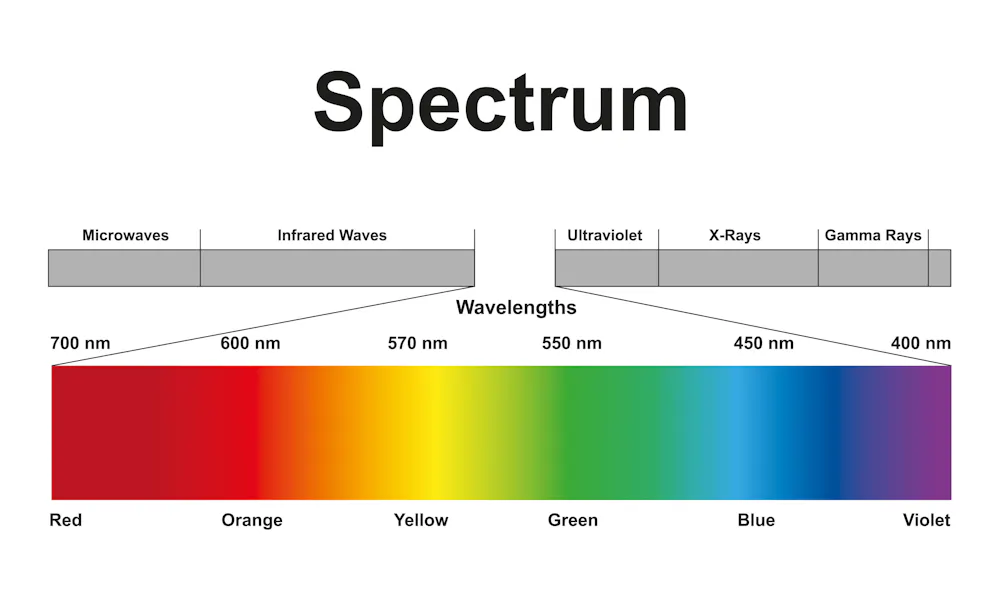
Particles in water interact with radiation from the Sun shining on the water’s surface. The particles can either absorb this radiation or reflect it in a different direction – a process known as scattering. What we see with our eyes is the fraction of radiation that is scattered back out of the water’s surface. It strongly affects how water looks to us, including its color.
Visible light forms just a small part of the electromagnetic spectrum, which includes all types of electromagnetic radiation. Within the visible range, different wavelengths of light produce different colors. Ali Damouh/Science Photo Library, via Getty Images
Depending on the properties of the particles in our water sample, they will absorb and scatter radiation at different wavelengths. The light’s wavelength determines the color we see with our eyes.
Cleaner, more pure water backscatters light in the blue range, which makes it look blue. One famous example is Crater Lake in Oregon, which lies in a volcanic crater and is fed by rain and snow, without any streams to carry sediment into it.
Deep waters like Crater Lake look dark blue, but shallow waters that are very clear, such as those around many Caribbean islands, can appear light blue or turquoise. This happens because light reflects off the white, sandy bottom.
When water contains a lot of plant material, chlorophyll – a pigment plants make in their leaves – will absorb blue light and backscatter green light. This often happens in areas that contain a lot of runoff from highly developed areas, such as Lake Okeechobee in Florida. The runoff contains fertilizer from farms and lawns, which is made of nutrients that cause plant growth in the water.
Finally, some water contains a lot of material called color-dissolved organic matter – often from decomposing organisms and plants, and also human or animal waste. This can happen in forested areas with lots of animal life, or in heavily populated areas that release wastewater into streams and rivers. This material mostly absorbs radiation and backscatters very little light across the spectrum, so it makes the water look very dark.
Bad blooms
Scientists expect water in nature to contains sediments, chlorophyll and organic matter. These substances help to sustain all living organisms in the water, from tiny microbes to fish that we eat. But too much of a good thing can become a problem.
For example, when water contains a lot of nutrients and heats up on bright sunny days, plant growth in the water can get out of control. Sometimes it causes harmful algal blooms – plumes of toxic algae that can make people very sick if they swim in the water or eat fish that came from it.
When water bodies become so polluted that they threaten fish and plants, or humans who drink the water, state and federal laws require governments to clean them up. The color of water can help guide these efforts.
Engineering professor Courtney Di Vittorio and her students collect water samples from High Rock Lake in North Carolina to assess its water quality.
My students and I collect water samples at High Rock Lake, a popular spot for swimming, boating and fishing in central North Carolina. Because of high chlorophyll levels, algal blooms are occurring there more often. Residents and visitors are worried that these blooms will become harmful.
Using satellite photos of the lake and our sampling data, we can produce water quality maps. State officials use the maps to track chlorophyll levels and see how they change in space and time. This information can help them warn the public when there are algal blooms and develop new rules to make the water cleaner.
Hello, curious kids! Do you have a question you’d like an expert to answer? Ask an adult to send your question to CuriousKidsUS@theconversation.com. Please tell us your name, age and the city where you live.
And since curiosity has no age limit – adults, let us know what you’re wondering, too. We won’t be able to answer every question, but we will do our best.
Courtney Di Vittorio receives funding from the North Carolina Attorney General’s Office Environmental Enhancement Grant Program (award WFU021PRE1) to collect data at High Rock Lake, NC. She is affiliated with the Yadkin Riverkeepers, an environmental advocacy not-for-profit group, and the North Carolina Lake Management Society.
Picture a primordial Earth: a world of muted browns, greys and greens. Fast forward to today, and Earth teems with a kaleidoscope of colours. From the stunning feathers of male peacocks to the vivid blooms of flowers, the story of how Earth became colourful is one of evolution. But how and why did this explosion of colour happen? Recent research is giving us clues into this part of Earth’s narrative.
The journey towards a colourful world began with the evolution of vision, which initially developed to distinguish light from dark over 600 million years ago. This ability probably arose in early organisms, like single-celled bacteria, enabling them to detect changes in their environment, such as the direction of sunlight. Over time, more sophisticated visual systems evolved and allowed organisms to perceive a broader spectrum of light.
For example, trichromatic vision – the ability to detect three distinct wavelengths such as red, green and blue – originated approximately 500-550 million years ago. This coincided with the “Cambrian explosion” (about 541 million years ago), which marked a rapid diversification of life, including the development of advanced sensory systems like vision.
The first animals with trichromatic vision were arthropods (a group of invertebrates that includes insects, spiders and crustaceans). Trichromatic vision emerged 420-500 million years ago in vertebrates. This adaptation helped ancient animals to navigate their environments and detect predators or prey in ways that monochromatic vision could not.
Fossil evidence from trilobites, extinct marine arthropods that roamed the seas over 500 million years ago, suggests they had compound eyes. This means eyes with multiple small lenses, each capturing a fraction of the visual field, which combine to form a mosaic image. These eyes could detect multiple wavelengths, providing an evolutionary advantage in dim marine environments by enhancing the animal’s visibility and motion detection.
Boyd’s forest dragon blends in with its habitat. Jonathan Goldenberg, CC BY-NC-ND
The stage was set: organisms could see a colourful world before they became colourful themselves.
The first burst of conspicuous colour came from plants. Early plants began producing colourful fruits and flowers, such as red, yellow, orange, blue and purple, to attract animals to help plants with seed dispersal and pollination.
Analytical models based on present-day plant variation suggest that colourful fruits, which appeared roughly 300-377 million years ago, co-evolved with seed-dispersing animals, such as early relatives of mammals. Flowers and their pollinators emerged later, around 140-250 million years ago. These innovations marked a turning point in Earth’s palette.
The rise of flowering plants (angiosperms) in the Cretaceous period, over 100 million years ago, brought an explosion of colour, as flowers evolved brighter and more vibrant hues than seeds to attract pollinators like bees, butterflies and birds.
Conspicuous colouration in animals emerged less than 140 million years ago. Before, animals were mostly muted browns and greys. This timeline suggests that colour evolution was not inevitable, shaped instead by ecological and evolutionary factors, which could have led to different outcomes under different circumstances.
Vibrant colours often evolved as a kind of signalling to attract mates, deter predators, or establish dominance. Sexual selection probably played a strong role in driving these changes.
Dinosaurs provide some of the most striking evidence of early animal colouration.
Fossilised melanosomes (pigment-containing cell structures called organelles) in feathered dinosaurs like Anchiornisreveal a vivid red plumage.
These feathers probably served display purposes, signalling fitness to mates or intimidating rivals. Similarly, the fossilised scales of a green and black ten million-year-old snake fossil suggest early use of colour for signalling or camouflage.
This snake, a juveline Bornean keeled green pit viper comes in a variety of colours. Jonathan Goldenberg, CC BY-NC-ND
The evolution of colour is not always straightforward. Take poison frogs, for instance. These small amphibians display striking hues of blue, yellow, or red, not to attract mates but to warn predators of their toxicity, a phenomenon known as aposematism.
But some of their close relatives, equally toxic, blend into their environments. So why evolve bright warning signals when camouflage could also deter predators? The answer lies in the local predator community and the cost of producing colour. In regions where predators learn to associate vibrant colours with toxicity, conspicuous coloration is an effective survival strategy. In other contexts, blending in may work.
Clownfish lure other fish to anemone with their bright colours. Jonathan Goldenberg, CC BY-NC-ND
Unlike many mammals, which have dichromatic vision and see fewer colours, most primates including humans have trichromatic vision, enabling us to perceive a broader range of hues, including reds. This probably helped our ancestors locate fruit in forests and likely played a role in social signalling. We see flowers differently from pollinators like bees, which can detect ultraviolet patterns invisible to us, highlighting how colour is tailored to a species’ ecological needs.
A world still changing
Earth’s palette isn’t static. Climate change, habitat loss, and human influence are altering the selective pressures on colouration, potentially reshaping the visual landscape of the future. For example, some fish species exposed to polluted waters are losing their vibrant colours, as toxins disrupt pigment production or visual communication.
As we look to the past, the story of Earth’s colours is one of gradual transformation punctuated by bursts of innovation. From the ancient seas where trilobites first saw the world in colour to the dazzling displays of modern birds and flowers, life on Earth has been painting its canvas for over half a billion years.
What will the next chapter of this vibrant story hold?
Jonathan Goldenberg receives funding from the European Union’s Horizon Europe research and innovation program under the Marie Skłodowska-Curie grant agreement No. 101126636.
Source: United Kingdom – Executive Government & Departments
Case study
Tree planting at Yeomadon Farm set to improve the landscape for business and recreation
Yeomadon Farm used their England Woodland Creation Offer (EWCO) funding to improve the landscape for business and recreation.
Yeomadon Farm has been in Rob Moore’s family since the early 1900s and has seen a range of uses, including dairy, beef farming and a successful holiday cottage business.
More recently, Rob and his wife Catherine have replaced their cattle with trees. They want their land to be more compatible with their holiday cottage enterprise by reducing heavy machinery around the cottages and, in time, to provide a woodland for the guests to enjoy.
Conifer saplings grow on the the newly planted site at Yeomadon Farm. Copyright Yeomadon Farm.
Yeomadon Farm facts
location: Devon / Cornwall county border
size: 18 hectares
type: conifer woodland with broadleaf edges
species: Sitka spruce, lodgepole pine, Norway spruce, western red cedar, hazel, silver birch, sessile oak, common alder and wild cherry
date planted: February 2022
grant: England Woodland Creation Offer (EWCO)
main objective: to improve the landscape to complement an existing holiday cottage business
Moving towards forestry
While Rob and Catherine didn’t have any prior experience of forestry, the family didn’t let this stand in their way. They chose to create woodland to complement their already thriving holiday cottage business, which has a focus on nature-based activities, such as fishing and local walks.
They will also be looking for the woodland to generate income for them in the future.
Rob Moore, owner of Yeomadon Farm, said:
Our initial thought was if we could turn this agricultural land into forestry without it costing us anything, then we’ll be happy.
Financially supported woodland creation
After first hearing about the England Woodland Creation Offer (EWCO) in the Mole Valley newsletter, Rob and Catherine were keen to explore using their land to create woodland. They had some initial conversations with land agent Pryor and Rickett Silviculture about what this might look like, including which fields they had earmarked for planting.
Their agent managed the woodland creation process from initial site visits, arranging involvement from a Forestry Commission woodland officer and the completion of the EWCO grant application, through to sourcing and planting the saplings.
For Rob and Catherine, this process was really positive. They felt having an agent to guide them through the grant application was invaluable and made the financial side of the process much more straightforward.
The scheme was eligible for an ‘additional contribution’ for water quality, a one-off payment available through EWCO where a woodland’s location and design deliver public benefits. In this case, for promoting drainage for the site’s waterlogged soils.
The agents, along with the local woodland officer, helped Rob and Catherine select which trees to plant. This decision was largely based on what would be most suitable for the ground, which tends to get water-logged. They also wanted to ensure a mix of species to offer resilience against our changing climate and the threat of pests and diseases.
The centre of the woodland is made up of Sitka spruce, Norway spruce, lodgepole pine and western red cedar, with a surrounding ring of mixed native broadleaf species close to the fishing lakes. The agents arranged contractors to hand plant 33,000 trees, which took 3 weeks.
Rob and Catherine Moore with a conifer sapling planted at Yeomadon Farm. Copyright Yeomadon Farm.
Catherine Moore, owner of Yeomadon Farm, said:
We didn’t need to do anything. If we had to do the whole process all by ourselves, we wouldn’t have known where to start!
Saving costs during the establishment process
Rob and Catherine were able to make savings by doing much of the maintenance work themselves. Rob sprayed the surrounding ground around the new trees, which ensured growth wasn’t hampered by the grass or weeds. The process took him 8 days and saved on the expense of additional labour costs.
Similarly, they put in the fencing themselves. They used a total of 1,800 metres of deer fencing and gates, with additional rabbit netting. As the woodland grows, they will seek additional advice on how it can provide further income. For now, they both agree that it stacks up financially.
Deer fencing with rabbit netting to protect the new saplings. Copyright Yeomadon Farm.
Benefits for nature, people and the planet
Rob and Catherine have noticed some additional benefits to the wildlife and biodiversity of the area. They stated that “it may be that we’re just noticing the wildlife more than we used to, or that it’s flourishing now that we’re disturbing the land less, but we don’t remember seeing sparrowhawks before!” In addition, the woodland will, in time, be open for the guests at the holiday cottages to enjoy.
The Yeomadon Farm scheme was celebrated in the Devon Woodland Awards ‘New Woodland on Farm’ category, where Rob and Catherine won silver. The judges praised the scheme and the ingenuity in designing and using specialist equipment for planting and maintenance.
Top tips
Consider using an agent. Rob and Catherine were completely new to forestry when they started on this journey and found it invaluable having an agent to navigate them through the process.
Don’t underestimate the labour required in getting the scheme up and running. Factor these costs into your planning as they could make a big difference.
Think about planning ahead. Work out how to manage the grass and what machinery you might need as these could all add up in terms of cost and overall finances.
Consider your financing options in the short-term to cover the up-front costs of planting your new woodland. This is because EWCO payments are received once all capital work has been completed and evidence is reviewed.
Source: Rosneft – Rosneft – An important disclaimer is at the bottom of this article.
With the support of RN-Uvatneftegaz (part of the Rosneft oil production complex), a festival of the culture of the indigenous peoples of the North, “The Wealth of the Uvat Taiga,” was held in the regional center of Uvat.
The festival was held for the third time. Every year it attracts more and more participants and this year it was the most numerous – about 1,500 guests from all taiga settlements of the Uvatsky district visited it. The winter festival originated as a fair of folk crafts, but with the support of oil workers it acquired the format of a cultural festival.
The cultural program of the festival included national vocal and dance performances. Guests of the festival took part in master classes on making national Khanty amulets and dolls, painting plates with traditional northern ornaments with images of animal symbols of the Uvatsky district. The building of the district House of Culture housed an exhibition of paintings “Beliefs of the Khanty People”.
During the sports program, the participants competed in national sports – throwing a tynzyan on a khorey (a lasso on a pole used to drive deer), archery, jumping over sleds, pulling a stick, etc. The sports and hunting tournament, a competition for agility in overcoming an obstacle course, was especially spectacular. An entertainment and development program was organized for the young guests.
The fair stalls offered traditional crafts to the guests of the festival: fresh-frozen and smoked fish, meat, berries, pine nuts, fur and bead products. In addition, visitors could try national cuisine: northern fish soup and tea made from taiga herbs and berries.
Preservation of the national culture of the indigenous peoples of the North and their traditional way of life is one of the significant areas of Rosneft’s social policy. The Company’s enterprises implement many social projects in the regions of their operations, develop the infrastructure of northern villages, help reindeer herder families, improve the material and technical base of educational institutions, social and medical facilities in the areas of original residence of indigenous peoples.
RN-Uvatneftegaz supports representatives of the Khanty, Mansi and Evenki of the Tyumen Region. Oil workers together with the administration of the Uvatsky municipal district presented the indigenous people with equipment for traditional trades – snowmobiles, boat motors, gasoline generators of electricity, as well as motor oil from Rosneft for engines. In total, in recent years, the company has handed over more than 160 units of equipment to Khanty families.
The company also provides access to winter roads and ice crossings, which it builds for production needs, and organizes fuel supplies at the deposits closest to the camps.
In addition, with the participation of RN-Uvatneftegaz, the ethnographic cultural center “Uvas Mir Khot” has been created and is developing in the vicinity of Tyumen, which in translation from Khanty means “House of Northern People”. National ritual holidays, cultural events, concerts, interactive excursions, lessons in local history and native language, and master classes are held on the territory of the center all year round.
Reference:
RN-Uvatneftegaz, a subsidiary of Rosneft, is exploring and developing a group of fields located in the Uvatsky District of the Tyumen Region. The Uvatsky project includes 19 licensed areas with a total area of over 25 thousand km2.
Department of Information and Advertising of PJSC NK Rosneft February 17, 2025
Please note: This information is raw content directly from the source of the information. It is exactly what the source states and does not reflect the position of MIL-OSI or its clients.
This file may not be suitable for users of assistive technology.
Request an accessible format.
If you use assistive technology (such as a screen reader) and need a version of this document in a more accessible format, please email enquiries@raib.gov.uk. Please tell us what format you need. It will help us if you say what assistive technology you use.
Summary
At around 05:40 on Monday 4 March 2024, a passenger train struck a section of redundant rail that had been left foul of the track on the approach to Walton-on- Thames station. At the time of the collision with this rail, the train was travelling at around 85 mph (137 km/h). The front coach derailed, and the train came to a stand around 500 metres beyond the point of derailment.
The redundant rail had inadvertently been left there by a team that had completed work in the area over the previous weekend. Checks undertaken after the work was completed did not identify that a section of redundant rail was in a potentially hazardous position before the railway was handed back for normal operation. This was because no person in charge had supervised the work and because a track handback engineer had not been effectively briefed as to what work had been undertaken before they inspected the track.
RAIB found that the arrangements in place for planning and delivering the work did not effectively manage the risk of a section of rail being left foul of the running line and that the process for inspecting the railway after the work was completed did not provide staff with clear guidance on which areas should be checked. Additionally, the relevant railway rules and standards do not clearly define the roles and responsibilities required to safely deliver work on complex work sites like the one involved in the accident.
Recommendations
As a result of its investigation, RAIB has made two recommendations. The first is addressed to Colas Rail (in consultation with Network Rail), to review its processes related to collecting redundant material when working on or near the line. The second is addressed to Network Rail (in consultation with the Rail Safety and Standards Board) to review the rules and standards relating to how tasks delivered in complex work sites should be co‑ordinated and supervised and to create a coherent process for confirming that the line is safe for the passage of trains after the work is complete.
Additionally, two learning points have been identified. The first reinforces the importance of infrastructure maintainers arranging adequate site lighting. The second concerns the importance of railway organisations ensuring that guidance material relating to superseded standards is removed from resource libraries when new standards are issued.
Andrew Hall, Chief Inspector of Rail Accidents said:
Following a passenger train striking redundant rail on the track in 2018, RAIB issued Urgent Safety Advice to Network Rail regarding safety of the line after engineering work. Since this advice was issued, RAIB has examined a number of further accidents caused by objects, including temporary road-rail access points and a trolley, being left on the track after the completion of maintenance work. These accidents caused damage to the railway infrastructure, the trains involved and resulted in temporary closures to the affected lines. This most recent accident at Walton-on-Thames resulted in a passenger train derailing at speed. Although no one was hurt on this occasion, the train could easily have deviated from the line of the track and struck other trains or objects.
Maintenance work is often carried out at night which makes ensuring the line is subsequently safe for the passage of trains particularly challenging. The risk is very clear. Unfortunately, this accident happened because that risk was not effectively managed. This, following other similar recent incidents, should serve as a stark reminder of the importance of effectively managing the risk of objects being left on the track after overnight maintenance.
Notes to editors
The sole purpose of RAIB investigations is to prevent future accidents and incidents and improve railway safety. RAIB does not establish blame, liability or carry out prosecutions.
RAIB operates, as far as possible, in an open and transparent manner. While our investigations are completely independent of the railway industry, we do maintain close liaison with railway companies and if we discover matters that may affect the safety of the railway, we make sure that information about them is circulated to the right people as soon as possible, and certainly long before publication of our final report.
Topics: Family and domestic violence; Men’s behaviour change; Additional funding for Tasmania; Election timing.
KYLIE BAXTER, HOST: We all know the figures around domestic violence. They are terrible and seem to be getting worse. Not everywhere, but in a lot of places. Now, Federal Labor has promised funding to tackle the issue, but the big question is, will it actually make a difference? I’m joined by Social Services Minister Amanda Rishworth. Thank you for joining me on the program.
AMANDA RISHWORTH, MINISTER FOR SOCIAL SERVICES: Great to be with you.
KYLIE BAXTER: So, what is the current situation around domestic violence? I mean, how bad is it?
AMANDA RISHWORTH: What we have in Australia is really unacceptable levels of family and domestic violence. When you look at the statistics, one woman loses their life around every 10 days, which is just unacceptable. Partly we are seeing, of course, an important conversation about this, often domestic and family violence. We knew it may be happening behind closed doors and we weren’t talking about it. It’s really important we have a conversation about it, but we’ve got to have action as well. That’s what I’ve been doing over the last two and a half years. But this new national partnerships agreement with the Tasmanian government allows us to roll out more support where it’s needed.
KYLIE BAXTER: Okay, so let’s talk about Tasmania. How are we faring in relation to domestic violence?
AMANDA RISHWORTH: Well, look, each state and territory has its own challenges, but it also has some really important options and services available for people. And when it comes to Tasmania, there’s been a lot of work done delivering, for example, rural family violence outreach programs. We know Tasmania is a pretty spread out place and so some of the funding that we previously worked with the Tasmanian Government has been looking at rural family violence outreach programs, but also, for example, family violence training for legal professionals, which is really important. So, look, Tasmania has some of the same challenges as the rest of the country, but also there are some other challenges, such as the spread out population, which also needs to be looked at how we address that as well.
KYLIE BAXTER: This funding announcement from the Labor Federal Government of more than $15.7 million, what exactly is it going to be used for?
AMANDA RISHWORTH: This will be used for a number of things and it complements the other investments we’ve made across the country, including to things like our Escaping Violence Program, which is a national program which people can get funds to leave a violent situation. But this particular new agreement will allow for funding for specialised services for women, services to support those exposed to family and domestic violence, to heal and recover, and also in particular working with men, including men’s behaviour change programs. One particular program that’s been identified by the Tasmanian government in which they could invest in is an early intervention program with young men, particularly around the ages of 12 to 17, really to break that cycle. They may have witnessed violence being used themselves and maybe showing signs of recreating that pattern. And so this program is really one example of a really important program about breaking that cycle.
KYLIE BAXTER: If you’ve just joined me, you’re listening to the voice of Amanda Rishworth who is the Federal Social Services Minister. Now, when we have these conversations, despite the fact that men are mostly the perpetrators against women, we often receive texts asking, but what about men? Is there dedicated money for men? Possibly, I guess for things like psychologists and psychiatrists to help break the cycle. I mean, you’ve obviously mentioned, you know, younger men aged 12 and up, but what about guys of different age groups? I mean, is any money available to help them go and see a psychologist or a psychiatrist if they need it?
AMANDA RISHWORTH: Yes, look, there are a lot of programs. Firstly, I would say that while we do acknowledge that men can also be victims of domestic and family violence, the vast majority are women and it is perpetrated by men. But we do acknowledge that men can be victims too. And so things like 1800RESPECT or the Escaping Violence Program is open to all victim-survivors. But if we talk about what’s available to men and bringing men into the conversation, about how we solve it. You’re absolutely right, there’s a number or many programs that we’ve funded over the last two years to try and engage men. As you mentioned, we’ve been funding work with young boys and men, but also looking at how we have behaviour changed. So, there is No To Violence, which is a national phone line in which people can get telephone online counselling information about how they might, they might be concerned about their behaviour. This is dedicated to them to actually have a conversation. A lot of people, a lot of men decide to call Mensline as well. And that is also a very important option if people want, in a non judgmental way, to have a conversation about things that they might be concerned with and get the help they might need to engage with a behaviour change program, for example.
KYLIE BAXTER: And I guess the important question is, when are these initiatives actually going to be rolled out?
AMANDA RISHWORTH: Well, the funding will begin from the first of July this year. That’s the agreement through the national partnerships. But it is not the only money that we have contributed to the Tasmanian Government. This builds on an extra $23 million that we’ve provided already to the Tasmanian Government to boost things like their frontline workforce and other programs. So, this is an additional money to continue this important work.
KYLIE BAXTER: Obviously this is an election promise and so do you have concerns if Labor is not re-elected, how will things roll then for victims of domestic violence?
AMANDA RISHWORTH: We hope that whoever wins the election will commit to this funding. Of course, we’ve signed this agreement with the Tasmanian Government but I can’t speak for the Liberal National Party of whether they would seek to rip up this agreement. I hope they don’t. But this is our clear commitment to making a difference when it comes to these issues.
KYLIE BAXTER: And have you had any closed door meetings in the past few days or week in relation to an election date?
AMANDA RISHWORTH: Oh, look, I have to be honest, election dates are above my pay grade. So, no, I can’t, I can’t give you the inside scoop today. Unfortunately there is one person that I don’t know if he’s made up his mind yet, but one person that knows when that election is, and that’s our Prime Minister.
KYLIE BAXTER: Thank you very much for your time. Appreciate you coming on the Drive program.
A spontaneous memorial of flowers in St Petersburg, Russia, on the day of Alexei Navalny’s death, February 16 2024.Aleksey Dushutin/Shutterstock
This is the best day of the past five months for me … This is my home … I am not afraid of anything and I urge you not to be afraid of anything either.
These were Alexei Navalny’s words after landing at Moscow’s Sheremetyevo Airport on January 17 2021. Russia’s leading opposition figure had spent the past months recovering in Germany from an attempt on his life by the Russian Federal Security Service (FSB). Minutes after making his comments, Navalny was detained at border control. And he would remain behind bars until his death on February 16 2024, in the remote “Polar Wolf” penal colony within the Arctic Circle.
“Why did he return to Russia?” That’s the question I’m asked about Navalny most frequently. Wasn’t it a mistake to return to certain imprisonment, when he could have maintained his opposition to Russia’s president, Vladimir Putin, from abroad?
But Navalny’s decision to return didn’t surprise me. I’ve researched and written about him extensively, including co-authoring Navalny: Putin’s Nemesis, Russia’s Future?, the first English-language, book-length account of his life and political activities. Defying the Kremlin by returning was a signature move, reflecting both his obstinacy and bravery. He wanted to make sure his supporters and activists in Russia did not feel abandoned, risking their lives while he lived a cushy life in exile.
The Insights section is committed to high-quality longform journalism. Our editors work with academics from many different backgrounds who are tackling a wide range of societal and scientific challenges.
Besides, Navalny wasn’t returning to certain imprisonment. A close ally of his, Vladimir Ashurkov, told me in May 2022 that his “incarceration in Russia was not a certainty. It was a probability, a scenario – but it wasn’t like he was walking into a certain long-term prison term.”
Also, Navalny hadn’t chosen to leave Russia in the first place. He was unconscious when taken by plane from Omsk to Berlin for treatment following his poisoning with the nerve agent Novichok in August 2020. Navalny had been consistent in saying he was a Russian politician who needed to remain in Russia to be effective.
In a subsequent interview, conducted in a forest on the outskirts of the German capital as he slowly recovered, Navalny said: “In people’s minds, if you leave the country, that means you’ve surrendered.”
Video: ACF.
Outrage, detention and death
Two days after Navalny’s final return to Russia, the Anti-Corruption Foundation (ACF) – the organisation he established in 2011 – published its biggest ever investigation. The YouTube video exploring “Putin’s palace” on the Black Sea coast achieved an extraordinary 100 million views within ten days. By the start of February 2021, polling suggested it had been watched by more than a quarter of all adults in Russia.
Outrage at Navalny’s detention, combined with this Putin investigation, got people on to the streets. On January 23 2021, 160,000 people turned out across Russia in events that did not have prior approval from the authorities. More than 40% of the participants said they were taking part in a protest for the first time.
But the Russian authorities were determined to also make it their last time. Law enforcement mounted an awesome display of strength, detaining protesters and sometimes beating them. The number of participants at protests on January 31 and February 2 declined sharply as a result.
Between Navalny’s return to Russia in January 2021 and his death in February 2024, aged 47, he faced criminal case after criminal case, adding years and years to his time in prison and increasing the severity of his detention. By the time of his death, he was in the harshest type of prison in the Russian penitentiary system – a “special regime” colony – and was frequently sent to a punishment cell.
The obvious intent was to demoralise Navalny, his team and supporters – making an example of him to spread fear among anyone else who might consider mounting a challenge to the Kremlin. But Navalny fought back, as described in his posthumously published memoir, Patriot. He made legal challenges against his jailers. He went on hunger strike. And he formed a union for his fellow prisoners.
He also used his court appearances to make clear his political views, including following Russia’s full-scale invasion of Ukraine in February 2022, declaring: “I am against this war. I consider it immoral, fratricidal, and criminal.”
Navalny’s final public appearance was via video link. He was in good spirits, with his trademark optimism and humour still on display. Tongue firmly in cheek, he asked the judge for financial help:
Your Honour, I will send you my personal account number so that you can use your huge salary as a federal judge to ‘warm up’ my personal account, because I am running out of money.
Navalny died the following day. According to the prison authorities, he collapsed after a short walk and lost consciousness. Although the Russian authorities claimed he had died of natural causes, documents published in September 2024 by The Insider – a Russia-focused, Latvia-based independent investigative website – suggest Navalny may have been poisoned.
A mourner adds her tribute to Alexei Navalny’s grave in Moscow after his burial on March 1 2024. Aleksey Dushutin/Shutterstock
Whether or not Putin directly ordered his death, Russia’s president bears responsibility – for leading a system that tried to assassinate Navalny in August 2020, and for allowing his imprisonment following Navalny’s return to Russia in conditions designed to crush him.
Commenting in March 2024, Putin stated that, just days before Navalny’s death, he had agreed for his most vocal opponent to be included in a prisoner swap – on condition the opposition figure never returned to Russia. “But, unfortunately,” Putin added, “what happened, happened.”
‘No one will forget’
Putin is afraid of Alexei, even after he killed him.
Yulia Navalnaya, Navalny’s wife, wrote these words on January 10 2025 after reading a curious letter. His mother, Lyudmila Navalnaya, had written to Rosfinmonitoring – a Russian state body – with a request for her son’s name to be removed from their list of “extremists and terrorists” now he was no longer alive.
The official response was straight from Kafka. Navalny’s name could not be removed as it had been added following the initiation of a criminal case against him. Even though he was dead, Rosfinmonitoring had not been informed about a termination of the case “in accordance with the procedure established by law”, so his name would have to remain.
This appears to be yet another instance of the Russian state exercising cruelty behind the veil of bureaucratic legality – such as when the prison authorities initially refused to release Navalny’s body to his mother after his death.
“Putin is doing this to scare you,” Yulia continued. “He wants you to be afraid to even mention Alexei, and gradually to forget his name. But no one will forget.”
Alexei Navalny and his wife, Yulia Navalnaya, at a protest rally in Moscow, May 2012. Dmitry Laudin/Shutterstock
Today, Navalny’s family and team continue his work outside of Russia – and are fighting to keep his name alive back home. But the odds are against them. Polling suggests the share of Russians who say they know nothing about Navalny or his activities roughly doubled to 30% between his return in January 2021 and his death three years later.
Navalny fought against an autocratic system – and paid the price with his life. Given the very real fears Russians may have of voicing support for a man still labelled an extremist by the Putin regime, it’s not easy to assess what people there really think of him and his legacy. But we will also never know how popular Navalny would have been in the “normal” political system he fought for.
What made Navalny the force he was?
Navalny didn’t mean for the humble yellow rubber duck to become such a potent symbol of resistance.
In March 2017, the ACF published its latest investigation into elite corruption, this time focusing on then-prime minister (and former president), Dmitry Medvedev. Navalny’s team members had become masters of producing slick videos that enabled their message to reach a broad audience. A week after posting, the film had racked up over 7 million views on YouTube – an extraordinary number at that time.
The film included shocking details of Medvedev’s alleged avarice, including yachts and luxury properties. In the centre of a large pond in one of these properties was a duck house, footage of which was captured by the ACF using a drone.
Video: ACF.
Such luxuries jarred with many people’s view of Medvedev as being a bit different to Putin and his cronies. As Navalny wrote in his memoir, Medvedev had previously seemed “harmless and incongruous”. (At the time, Medvedev’s spokeswoman said it was “pointless” to comment on the ACF investigation, suggesting the report was a “propaganda attack from an opposition figure and a convict”.)
But people were angry, and the report triggered mass street protests across Russia. They carried yellow ducks and trainers, a second unintended symbol from the film given Medvedev’s penchant for them.
Another reason why so many people came out to protest on March 26 2017 was the organising work carried out by Navalny’s movement.
The previous December, Navalny had announced his intention to run in the 2018 presidential election. As part of the campaign, he and his team created a network of regional headquarters to bring together supporters and train activists across Russia. Although the authorities had rejected Navalny’s efforts to register an official political party, this regional network functioned in much the same way, gathering like-minded people in support of an electoral candidate. And this infrastructure helped get people out on the streets.
The Kremlin saw this as a clear threat. According to a December 2020 investigation by Bellingcat, CNN, Der Spiegel and The Insider, the FSB assassination squad implicated in the Novichok poisoning of Navalny had started trailing him in January 2017 – one month after he announced his run for the presidency.
At the protests against Medvedev, the authorities’ growing intolerance of Navalny was also on display – he was detained, fined and sentenced to 15 days’ imprisonment.
The Medvedev investigation was far from the beginning of Navalny’s story as a thorn in the Kremlin’s side. But this episode brings together all of the elements that made Navalny the force he was: anti-corruption activism, protest mobilisation, attempts to run as a “normal” politician in a system rigged against him, and savvy use of social media to raise his profile in all of these domains.
Courting controversy
In Patriot, Navalny writes that he always “felt sure a broad coalition was needed to fight Putin”. Yet over the years, his attempts to form that coalition led to some of the most controversial points of his political career.
In a 2007 video, Navalny referred to himself as a “certified nationalist”, advocating for the deportation of illegal immigrants, albeit without using violence and distancing himself from neo-Nazism. In the video, he says: “We have the right to be Russians in Russia, and we’ll defend that right.”
Although alienating some, Navalny was attempting to present a more acceptable face of nationalism, and he hoped to build a bridge between nationalists and liberals in taking on the Kremlin’s burgeoning authoritarianism.
But the prominence of nationalism in Navalny’s political identity varied markedly over time, probably reflecting his shifting estimations of which platform could attract the largest support within Russia. By the time of his thwarted run in the 2018 presidential election, nationalist talking points were all but absent from his rhetoric.
However, some of these former comments and positions continue to influence how people view him. For example, following Russia’s annexation of Crimea in 2014, Navalny tried to take a pragmatic stance. While acknowledging Russia’s flouting of international law, he said that Crimea was “now part of the Russian Federation” and would “never become part of Ukraine in the foreseeable future”.
Many Ukrainians take this as clear evidence that Navalny was a Russian imperialist. Though he later revised his position, saying Crimea should be returned to Ukraine, some saw this as too little, too late. But others were willing to look past the more controversial parts of his biography, recognising that Navalny represented the most effective domestic challenge to Putin.
Another key attempt to build a broad political coalition was Navalny’s Smart Voting initiative. This was a tactical voting project in which Navalny’s team encouraged voters to back the individual thought best-placed to defeat the ruling United Russia candidate, regardless of the challenger’s ideological position.
The project wasn’t met with universal approval. Some opposition figures and voters baulked at, or flatly refused to consider, the idea of voting for people whose ideological positions they found repugnant – or whom they viewed as being “fake” opposition figures, entirely in bed with the authorities. (This makes clear that Navalny was never the leader of the political opposition in Russia; he was, rather, the leading figure of a fractious constellation of individuals and groups.)
But others relished the opportunity to make rigged elections work in their favour. And there is evidence that Smart Voting did sometimes work, including in the September 2020 regional and local elections, for which Navalny had been campaigning when he was poisoned with Novichok.
In an astonishing moment captured on film during his recovery in Germany, Navalny speaks to an alleged member of the FSB squad sent to kill him. Pretending to be the aide to a senior FSB official, Navalny finds out that the nerve agent had been placed in his underpants.
How do Russians feel about Navalny now?
It’s like a member of the family has died.
This is what one Russian friend told me after hearing of Navalny’s death a year ago. Soon afterwards, the Levada Center – an independent Russian polling organisation – conducted a nationally representative survey to gauge the public’s reaction to the news.
The poll found that Navalny’s death was the second-most mentioned event by Russian people that month, after the capture of the Ukrainian city of Avdiivka by Russian troops. But when asked how they felt about his death, 69% of respondents said they had “no particular feelings” either way – while only 17% said they felt “sympathy” or “pity”.
And that broadly fits with Navalny’s approval ratings in Russia. After his poisoning in 2020, 20% of Russians said they approved of his activities – but this was down to 11% by February 2024.
Video: BBC.
Of course, these numbers must be taken for what they are: polling in an authoritarian state regarding a figure vilified and imprisoned by the regime, during a time of war and amid draconian restrictions on free speech. To what extent the drop in support for Navalny was real, rather than reflecting the increased fear people had in voicing their approval for an anti-regime figure, is hard to say with certainty.
When asked why they liked Navalny, 31% of those who approved of his activities said he spoke “the truth”, “honestly” or “directly”. For those who did not approve of his activities, 22% said he was “paid by the west”, “represented” the west’s interests, that he was a “foreign agent”, a “traitor” or a “puppet”.
The Kremlin had long tried to discredit Navalny as a western-backed traitor. After Navalny’s 2020 poisoning, Putin’s spokesman, Dmitry Peskov, said that “experts from the United States’ Central Intelligence Agency are working with him”. The Russian state claimed that, rather than a patriot exposing official malfeasance with a view to strengthening his country, Navalny was a CIA stooge intent on destroying Russia.
Peskov provided no evidence to back up this claim – and the official propaganda wasn’t believed by all. Thousands of Russians defied the authorities by coming out to pay their respects at Navalny’s funeral on March 1 2024. Many, if not all, knew this was a significant risk. Police employed video footage to track down members of the funeral crowd, including by using facial recognition technology.
The first person to be detained was a Muscovite the police claimed they heard shouting “Glory to the heroes!” – a traditional Ukrainian response to the declaration “Glory to Ukraine!”, but this time referencing Navalny. She spent a night in a police station before being fined for “displaying a banned symbol”.
Putin always avoided mentioning Navalny’s name in public while he was alive – instead referring to him as “this gentleman”, “the character you mentioned”, or the “Berlin patient”. (The only recorded instance of Putin using Navalny’s name in public when he was alive was in 2013.)
However, having been re-elected president in 2024 and with Navalny dead, Putin finally broke his long-held practice, saying: “As for Navalny, yes he passed away – this is always a sad event.” It was as if the death of his nemesis diminished the potency of his name – and the challenge that Navalny had long presented to Putin.
Nobody can become another Navalny
Someone else will rise up and take my place. I haven’t done anything unique or difficult. Anyone could do what I’ve done.
So wrote Navalny in the memoir published after his death. But that hasn’t happened: no Navalny 2.0 has yet emerged. And it’s no real surprise. The Kremlin has taken clear steps to ensure nobody can become another Navalny within Russia.
In 2021, the authorities made a clear decision to destroy Navalny’s organisations within Russia, including the ACF and his regional network. Without the organisational infrastructure and legal ability to function in Russia, no figure has been able to take his place directly.
More broadly, the fate of Navalny and his movement has had a chilling effect on the opposition landscape. So too have other steps taken by the authorities.
Russia has become markedly more repressive since the start of its war on Ukraine. The human rights NGO First Department looked into the number of cases relating to “treason”, “espionage” and “confidential cooperation with a foreign state” since Russia introduced the current version of its criminal code in 1997. Of the more than 1,000 cases, 792 – the vast majority – were initiated following Russia’s full-scale invasion of Ukraine in 2022.
Russian law enforcement has also used nebulous anti-extremism and anti-terrorism legislation to crack down on dissenting voices. Three of Navalny’s lawyers were sentenced in January 2025 for participating in an “extremist organisation”, as the ACF was designated by a Moscow court in June 2021. The Russian legislature has also passed a barrage of legislation relating to so-called “foreign agents”, to tarnish the work of those the regime regards as foreign-backed “fifth columnists”.
Mass street protests are largely a thing of the past in Russia. Restrictions were placed on public gatherings during the COVID pandemic – but these rules were applied selectively, with opposition individuals and groups being targeted. And opportunities for collective action were further reduced following the full-scale invasion of Ukraine.
Freedom of speech has also come under assault. Article 29, point five of the Russian constitution states: “Censorship shall be prohibited.” But in September 2024, Kremlin spokesperson Peskov said: “In the state of war that we are in, restrictions are justified, and censorship is justified.”
Legislation passed very soon after the 2022 invasion of Ukraine made it illegal to comment on the Russian military’s activities truthfully – and even to call the war a war.
YouTube – the platform so central to Navalny’s ability to spread his message – has been targeted. Without banning it outright – perhaps afraid of the public backlash this might cause – the Russian state media regulator, Roskomnadzor, has slowed down internet traffic to the site within Russia. The result has been a move of users to other websites supporting video content, including VKontakte – a Russian social media platform.
In short, conditions in Russia are very different now compared to when Navalny first emerged. The relative freedom of the 2000s and 2010s gave him the space to challenge the corruption and authoritarianism of an evolving system headed by Putin. But this space has shrunk over time, to the point where no room remains for a figure like him within Russia.
In 2019, Navalny told Ivan Zhdanov, who is now director of the ACF: “We changed the regime, but not in the way we wanted.” So, did Navalny and his team push the Kremlin to become more authoritarian – making it not only intolerant of him but also any possible successor?
There may be some truth in this. And yet, the drastic steps taken by the regime following the start of the war on Ukraine suggest there were other, even more significant factors that have laid bare the violent nature of Putin’s personal autocracy – and the president’s disdain for dissenters.
Plenty for Russians to be angry about
How can we win the war when dedushka [grandpa] is a moron?
In June 2023, Evgeny Prigozhin – a long-time associate of Putin and head of the private military Wagner Group – staged an armed rebellion, marching his forces on the Russian capital. This was not a full-blown political movement against Putin. But the target of Prigozhin’s invective against Russia’s military leadership had become increasingly blurry, testing the taboo of direct criticism of the president – who is sometimes referred to, disparagingly, as “grandpa” in Russia.
And Prigozhin paid the price. In August 2023, he was killed when the private jet he was flying in crashed after an explosion on board. Afterwards, Putin referred to Prigozhin as a “talented person” who “made serious mistakes in life”.
In the west, opposition to the Kremlin is often associated with more liberal figures like Navalny. Yet the most consequential domestic challenge to Putin’s rule came from a very different part of the ideological spectrum – a figure in Prigozhin leading a segment of Russian society that wanted the Kremlin to prosecute its war on Ukraine even more aggressively.
Video: BBC.
Today, there is plenty for Russians to be angry about, and Putin knows it. He recently acknowledged an “overheating of the economy”. This has resulted in high inflation, in part due to all the resources being channelled into supporting the war effort. Such cost-of-living concerns weigh more heavily than the war on the minds of most Russians.
A favourite talking point of the Kremlin is how Putin imposed order in Russia following the “wild 1990s” – characterised by economic turbulence and symbolised by then-president Boris Yeltsin’s public drunkenness. Many Russians attribute the stability and rise in living standards they experienced in the 2000s with Putin’s rule – and thank him for it by providing support for his continued leadership.
The current economic problems are an acute worry for the Kremlin because they jeopardise this basic social contract struck with the Russian people. In fact, one way the Kremlin tried to discredit Navalny was by comparing him with Yeltsin, suggesting he posed the same threats as a failed reformer. In his memoir, Navalny concedes that “few things get under my skin more”.
Although originally a fan of Yeltsin, Navalny became an ardent critic. His argument was that Yeltsin and those around him squandered the opportunity to make Russia a “normal” European country.
Navalny also wanted Russians to feel entitled to more. Rather than be content with their relative living standards compared with the early post-Soviet period, he encouraged them to imagine the level of wealth citizens could enjoy based on Russia’s extraordinary resources – but with the rule of law, less corruption, and real democratic processes.
‘Think of other possible Russias’
When looking at forms of criticism and dissent in Russia today, we need to distinguish between anti-war, anti-government, and anti-Putin activities.
Despite the risk of harsh consequences, there are daily forms of anti-war resistance, including arson attacks on military enlistment offices. Some are orchestrated from Ukraine, with Russians blackmailed into acting. But other cases are likely to be forms of domestic resistance.
Criticism of the government is still sometimes possible, largely because Russia has a “dual executive” system, consisting of a prime minister and presidency. This allows the much more powerful presidency to deflect blame to the government when things go wrong.
There are nominal opposition parties in Russia – sometimes referred to as the “systemic opposition”, because they are loyal to the Kremlin and therefore tolerated by the system. Within the State Duma, these parties often criticise particular government ministries for apparent failings. But they rarely, if ever, now dare criticise Putin directly.
Nothing anywhere close to the challenge presented by Navalny appears on the horizon in Russia – at either end of the political spectrum. But the presence of clear popular grievances, and the existence of organisations (albeit not Navalny’s) that could channel this anger should the Kremlin’s grip loosen, mean we cannot write off all opposition in Russia.
Navalny’s wife, Yulia, has vowed to continue her husband’s work. And his team in exile maintain focus on elite corruption in Russia, now from their base in Vilnius, Lithuania. The ACF’s most recent investigation is on Igor Sechin, CEO of the oil company Rosneft.
But some have argued this work is no longer as relevant as it was. Sam Greene, professor in Russian politics at King’s College London, captured this doubt in a recent Substack post:
[T]here is a palpable sense that these sorts of investigations may not be relevant to as many people as they used to be, given everything that has transpired since the mid-2010s, when they were the bread and butter of the Anti-Corruption Foundation. Some … have gone as far as to suggest that they have become effectively meaningless … and thus that Team Navalny should move on.
Navalny’s team are understandably irritated by suggestions they’re no longer as effective as they once were. But it’s important to note that this criticism has often been sharpest within Russia’s liberal opposition. The ACF has been rocked, for example, by recent accusations from Maxim Katz, one such liberal opposition figure, that the organisation helped “launder the reputations” of two former bank owners. In their response, posted on YouTube, the ACF referred to Katz’s accusations as “lies” – but this continued squabbling has left some Russians feeling “disillusioned and unrepresented”.
So, what will Navalny’s long-term legacy be? Patriot includes a revealing section on Mikhail Gorbachev – the last leader of the Soviet Union, whom Navalny describes as “unpopular in Russia, and also in our family”. He continues:
Usually, when you tell foreigners this, they are very surprised, because Gorbachev is thought of as the person who gave Eastern Europe back its freedom and thanks to whom Germany was reunited. Of course, that is true … but within Russia and the USSR he was not particularly liked.
At the moment, there is a similar split in perceptions of Navalny. Internationally, he was nominated for the Nobel Peace Prize, awarded the Sakharov Prize by the European Parliament, and a documentary about him won an Oscar.
But there are also those outside of Russia who remain critical: “Navalny’s life has brought no benefit to the Ukrainian victory; instead, he has caused considerable harm,” wrote one Ukrainian academic. “He fuelled the illusion in the west that democracy in Russia is possible.”
Trailer for the Oscar-winning documentary Navalny.
Inside Russia, according to Levada Center polling shortly after his death, 53% of Russians thought Navalny played “no special role” in the history of the country, while 19% said he played a “rather negative” role. Revealingly, when commenting on Navalny’s death, one man in Moscow told RFE/RL’s Russian Service: “I think that everyone who is against Russia is guilty, even if they are right.”
But, for a small minority in Russia, Navalny will go down as a messiah-like figure who miraculously cheated death in 2020, then made the ultimate sacrifice in his battle of good and evil with the Kremlin. This view may have been reinforced by Navalny’s increasing openness about his Christian faith.
Ultimately, Navalny’s long-term status in Russia will depend on the nature of the political system after Putin has gone. Since it seems likely that authoritarianism will outlast Putin, a more favourable official story about Navalny is unlikely to emerge any time soon. However, how any post-Putin regime tries to make sense of Navalny’s legacy will tell us a lot about that regime.
While he was alive, Navalny stood for the freer Russia in which he had emerged as a leading opposition figure – and also what he called the “Beautiful Russia of the Future”. Perhaps, after his death, his lasting legacy in Russia remains the ability for some to think – if only in private – of other possible Russias.
To hear about new Insights articles, join the hundreds of thousands of people who value The Conversation’s evidence-based news. Subscribe to our newsletter.
Ben Noble has previously received funding from the British Academy and the Leverhulme Trust. He is an Associate Fellow of Chatham House.
Source: Peter the Great St Petersburg Polytechnic University – Peter the Great St Petersburg Polytechnic University –
The Polytechnic University is hosting another collection of humanitarian aid for military personnel and children from social institutions of the DPR and LPR, residents of the Kursk and Belgorod regions as part of the regional Headquarters campaign
Every polytechnician can join this campaign. Fleece blankets, thermal socks, balaclavas, thermoses, thermal underwear, tools, electric power extension cord on a reel from 25 m, batteries, tonometers, tactical first aid kits, T-shirts, long sleeves, tactical backpacks, sleeping bags, hunting matches, reinforced tape, three-in-one coffee, portioned sugar, tea bags, canned meat, fish factory-made, condensed milk, towels, wide water-repellent plasters, large sterile wipes, large hemostatic sponges, wide and sterile bandages, Esmarch tourniquets or tourniquets, absorbent diapers for adults, tactical medical pouches, etc. are accepted.
Humanitarian aid can be delivered on weekdays from 10:00 to 18:00 to the following addresses:
Room 206 of the Main Cultural Institution of SPbPU (Volunteer Projects Center “Harmony” (Dobro.Center SPbPU); Polytechnic Tower; Building 6, room 1 (Humanities Institute Directorate); Building 9, room 324; Student Club (on the territory of the Lepota coworking space).
Activists of the SPbPU Dobro.Center “Harmony” conduct master classes on weaving tactical bracelets and making talismans of goodness, organize art exhibitions and perform in hospitals, help in warehouses of humanitarian aid. The guys meet children from evacuated territories, accompany wounded servicemen during examinations in hospitals, bring things, fruits and sweets to hospital wards. Excursions to the Polytechnic University of military personnel are planned in the near future.
For more information, please contact the group VKontakte or bymail.
Please note: This information is raw content directly from the source of the information. It is exactly what the source states and does not reflect the position of MIL-OSI or its clients.
The Government’s newly announced funding for biodiversity and tourism of $30-million over three years is a small fraction of what is required for conservation in this country.
“Touting this funding announcement as a win for biodiversity is frankly embarrassing, given the deep cuts made to conservation last year,” says the Green Party spokesperson for Conservation, Marama Davidson.
“We can and must do more to protect biodiversity in our country by adequately funding conservation programmes through comprehensive, government-backed stewardship.
“This new funding is a mere drop in the bucket compared to what the Government’s own officials have told it is required for conservation – it also does very little to make up for the huge shortfalls the Department of Conservation is facing.
“The Department of Conservation manages a third of our country’s land. Officials say that they are $25 million a year short just to maintain their assets, and yet last year they had another $31 million a year cut from its budget by this ideologically driven Government with its relentless push to reduce public spending – regardless of the consequences.
“Unfortunately we have seen this Government repeatedly undermine Aotearoa New Zealand’s conservation priorities in favour of commercial interests, despite full knowledge of the challenge we as a country face to protect our biodiversity.
“Cuts by this Government are dismantling environmental agencies, including the Ministry for the Environment, and the Climate Change Commission, all the while eroding science capability across the public service.
“When the Green Party was last in government, we oversaw the largest funding injection for conservation in over a decade. Let’s fully resource DOC and environmental bodies so future generations can enjoy Te Taiao” says Marama Davidson.
Source: The Conversation (Au and NZ) – By Louise Pryke, Honorary Research Associate, Department of Classics and Ancient History, University of Sydney
Lisa Tomasetti/Opera Australia
“It’s an old song”, Hermes (Christine Anu) sings at the opening of Hadestown, but “we’re gonna sing it again and again”.
Based on a myth first told in Greece over 2,500 years ago, Hadestown is a modern retelling of the story of lovers Orpheus and Eurydice.
In ancient Greece, Orpheus was considered the greatest of all musicians, due to his divine heritage. His musical ability makes Orpheus uniquely well suited as the lead for a musical.
In the myth and the musical, Orpheus descends into the Underworld to retrieve his wife, Eurydice, after her untimely death. Moved by his powerful song, the king and queen of the Underworld, Hades and Persephone, allow Orpheus to leave their realm with Eurydice.
One condition: Orpheus must not look back at his wife until they have fully emerged from the underworld.
It’s a tale of a love from long ago
The story of Orpheus and Eurydice is one of the most retold myths from antiquity, likely due to its narrative focus on love, loss, and the human condition.
The ancient story of Orpheus and Eurydice is best known from Ovid’s Metamorphoses and Virgil’s Georgics. While Ovid places Orpheus in a world governed by unpredictable gods, Virgil’s focus on natural order means that the tragic events feel predetermined.
There are numerous other ancient versions, including a mention in Plato’s Symposium, where the philosopher (somewhat unfairly) suggests the musician lacked commitment to his lover.
During the Middle Ages, Eurydice was paralleled with biblical Eve. Eurydice and Eve were both figures known to have unfortunate encounters with snakes, and both were viewed as vulnerable to sin (in Eurydice’s case, being carried away by Hades).
Orpheus was sometimes seen as a Christ-like figure, with his descent to hell compared to Christ’s journey to save souls. Indeed, Orpheus is referenced by his fellow traveller to Hell, Dante, in his Inferno.
Jean Raoux, Orpheus and Eurydice, about 1709. Getty Museum
The love story of Orpheus and Eurydice recently featured in the Netflix series Kaos (2024). The story is referenced in video games Don’t Look Back (2009) and Hades (2020).
Orpheus’ desperate journey to reconnect with his lost love holds continued relevance, thousands of years after its first telling.
Our lady of the underground
In the musical, the story of Orpheus and Eurydice is paralleled with the story of Hades and Persephone.
In ancient myth, the union of Hades and Persephone in the Underworld was said to cause the changing of the seasons.
Evelyn De Morgan, Demeter Mourning for Persephone,1906. Wikimedia Commons
Zeus offered the solution: Persephone would spend half the year below ground and half above.
When Persephone was with Hades, the world would enter winter. The new life connected with the coming of spring signalled Demeter’s joy at the return of her beloved daughter.
Way down Hadestown
The musical, written by Anaïs Mitchell, is largely faithful to the broad arc of the ancient story of Orpheus and Eurydice. A notable exception is seen in the death of Eurydice. In the ancient myth, this is often attributed to snakebite; in the musical she chooses to descend to the Underworld due to economic desperation.
Having Eurydice choose to sign her life over to Hades arguably lends her a limited amount of agency, although she almost immediately regrets her decision.
While in the ancient myth, Eurydice’s speech is limited to her whispered farewell, these poets all give us an insight into Eurydice’s thoughts and feelings. The musical continues this tradition of giving agency, hopes and opinions.
The story of Orpheus and Eurydice is paralleled in the musical with the story of Hades and Persephone. Lisa Tomasetti/Opera Australia
The dangers posed by unpredictable seasons, seen in the ancient myth of Hades and Persephone, is used in the musical to reflect modern concerns over climate change and environmental decline.
Rising seas and poor harvests threaten the lives of those inhabiting the industrialised world of Hadestown.
Orpheus attempts to bring a dystopian world “back in tune” through restoring environmental harmony, bringing a hopeful note to the tragic story.
Anu is a reassuring presence as the narrator and Orpheus’ confidant, the god Hermes. Lisa Tomasetti/Opera Australia
Nothing changes
In this Australian restaging of the hit Broadway production, Noah Mullins rises to the significant challenge of portraying Orpheus, the greatest of all musicians. Abigail Adriano’s raw portrayal of Eurydice’s confinement in the underworld is genuinely moving.
Anu is a reassuring presence as the narrator and Orpheus’ confidant, the god Hermes. Adrian Tamburini’s powerful bass-baritone adds to the authority of Hades, and Elenoa Rokobaro gives a dazzling performance as Persephone. The chorus and mostly on-stage band are excellent.
The story of Orpheus and Eurydice has been told for thousands of years. Lisa Tomasetti/Opera Australia
At its heart, the myth of Orpheus and Eurydice confronts one of the defining challenges of mortality: the reality that death can separate us from those we love and value most.
In retelling the myth, Hadestown offers timely meditations on the power of creativity and human connection, bringing this ancient love story alive again for modern audiences.
Hadestown is in Sydney until April 26, then touring to Melbourne.
Louise Pryke does not work for, consult, own shares in or receive funding from any company or organisation that would benefit from this article, and has disclosed no relevant affiliations beyond their academic appointment.
Humans have been poisoning rodents for centuries. But fast-breeding rats and mice have evolved resistance to earlier poisons. In response, manufacturers have produced second generation anticoagulant rodenticides such as bromadiolone, widely used in Australian households.
Unfortunately, these potent poisons do not magically disappear after the rodent is dead. For example, it’s well known owls who eat poisoned rodents suffer the same slow death from internal bleeding.
Our new research shows the problem is much bigger than owls. We found Australia’s five largest marsupial predators – the four quoll species and the Tasmanian devil – are getting hit by these poisons too.
Half of the 52 animals we tested had these poisons in their bodies. Some had died from it. These species are already threatened by foxes and feral cats. Rat poison is yet another threat – and one they may not be able to survive. Other countries have moved to ban these poisons. But in Australia, they’re widely available.
How does rat poison end up in a Tasmanian devil?
Quolls and Tasmanian devils are carnivores. They eat mammals, birds, amphibians and reptiles, finding food by hunting – or by scavenging dead bodies, including rats and mice. But do they eat enough poisoned rats and mice to be at risk?
To find out, we analysed liver samples from all four of Australia’s quoll species as well as the iconic Tasmanian devil. The samples came from dead animals from a range of sources, including animals dying in veterinary care, found as roadkill, or simply found dead.
Each of these species is endangered or vulnerable. Together, they represent the largest remaining Australian carnivorous marsupials – native animals at the top of their food chains.
We tested samples from 52 animals. Half of these were positive for second generation anticoagulant rodenticides. Of these, 21% tested positive for more than one rodenticide.
Unfortunately, many animals we tested had consumed doses high enough to kill. Around 15% of the Tasmanian devils, 20% of the eastern quolls, 22% of chuditch (western quolls) and 20% of the spotted-tailed quolls tested were very likely to die either from the poison itself or a related cause such as longer-term sickening.
Tasmanian devils often scavenge from carcasses – exposing them to poisoned rats. Vaclav Matous/Shutterstock
We found one chuditch from a Perth suburb had been exposed to three different second-generation rodenticides. It had levels of one poison, brodifacoum, at 1.6 milligrams per kilo, far above the rate presumed to be lethal to mammals. This is likely the highest recorded exposure rate in an Australian marsupial.
Some 5% of Tasmanian devils had also been exposed to lethal levels of these second-generation poisons and a further 10% were exposed to potentially lethal levels.
Even when these poisons don’t directly kill the quoll or devil, they can leave it worse off.
All five species are threatened, meaning their populations are a fraction of what they used to be. Even small changes to populations can trigger more rapid decline.
Our analysis indicates an increase in deaths of just 2–4% of the chuditch population could increase extinction risk by 75%. This figure is dwarfed by how many chuditch are at risk from rat poisons, which we estimate at 22% of any given population in each generation, based on the exposure rates here.
So, exposure to rat poison alone is likely enough to tip the species towards extinction – even without other threats such as being killed by foxes and cats.
The release of an eastern quoll during a translocation. Rat poisons may pose a real risk to the species. Judy Dunlop, CC BY-NC-ND
Can poisons be too potent?
After the poison kills a mouse or rat, it remains lethal for some time.
The poisons we examined take several months to halve in toxicity, meaning during this time they can kill owls, reptiles, frogs and small and medium-sized mammals such as possums.
In Australia and around the world, evidence is mounting that these second-generation rodenticides are killing many more animals than those targeted. The poisons are hitting a wide range of carnivores including otters, wolves, foxes and raccoons. Even the famous Californian condor is threatened by rodenticides.
Efforts to use thousands of litres of bromadiolone to stop a mouse plague in New South Wales triggered strong criticism. But to date, criticism has done little to curb their use in Australia.
Second generation anticoagulant poisons are extremely effective at killing rats and mice – but the poison doesn’t stop there. speedshutter Photography/Shutterstock
Australia is an outlier on this issue. In European and North American nations, these products are restricted to use by licensed pest controllers and banned for home use. Some nations have gone further and banned these poisons altogether. But here, you can buy them at Bunnings, Coles or Woolworths.
Last year, a delegation of Australian researchers lobbied politicians to do more to regulate the use of these poisons.
The institution responsible for ensuring poisons are safe is the Australian Pesticides and Veterinary Medicine Authority. At present, the authority is weighing a decision on whether to introduce restrictions on these second-generation poisons, expected in April.
In the absence of regulation, you can make a difference at home. Don’t use second-generation poisons which rely on brodifacoum, bromadiolone, difethialone, difenacoum or flocoumafen. Get rid of your mouse or rat problem with first-generation poisons containing warfarin, coumatetralyl or other chemicals.
Taking a moment to consider these alternatives could save Australia’s most threatened native predators from an agonising death.
Acknowledgements: Michael Lohr (Birdlife Australia) was the lead author on the research behind this article. Cheryl Lohr (Department of Biodiversity, Conservation and Attractions, Western Australia) contributed to the research.
The authors do not work for, consult, own shares in or receive funding from any company or organisation that would benefit from this article, and have disclosed no relevant affiliations beyond their academic appointment.
Source: Australia Government Statements – Agriculture
17 February 2025
Who does this notice affect?
Biosecurity industry participants who hold a Class 7.1 approved arrangement for the import of live ornamental fish.
Importers of live marine ornamental fish.
Departmental staff who attend the class 7.1 approved arrangement, to inspect and release live ornamental fish undergoing the post arrival quarantine period.
What has changed?
The Department of Agriculture, Fisheries and Forestry has…
Entries open for new-look ExportNZ ASB Central Region Export Awards
The ExportNZ ASB Central Region Export Awards will return this year with an expanded format, building off the success of last year’s sold-out ExportNZ ASB Wellington Export Awards.
This year’s new-look event recognises the efforts of exporters from Wellington to the wider Central region. It will be hosted for the first time in Palmerston North, at the Palmerston North Conference and Function Centre on June 6.
The awards will be hosted on an alternate basis between Wellington and Palmerston North each year.
ExportNZ Central and Hawke’s Bay manager Amanda Liddle says the new format reflects the growth of the export industry across the Central region, including Wellington, Whanganui, Wairarapa, Horowhenua and Manawatū.
“ExportNZ is delighted to be holding the ExportNZ ASB Central Region Export Awards for the first time in Palmerston North this year. The region has a thriving export sector and an important logistics ecosystem which is crucial to the New Zealand export economy. We look forward to celebrating the success of exporters throughout the lower North Island,” said Liddle.
Palmerston North Mayor Grant Smith says the event is recognition of a region that punches above its weight.
“We’re proud to host the 2025 Central Export Awards, alternating biennially with Wellington over the coming years. Despite being a powerhouse in primary industries, our city and wider region are often overlooked in the export conversation. Yet we’re at the heart of New Zealand’s food and fibre sector – producing and exporting beef, lamb, poultry, venison, fresh produce, cropping, seafood, dairy, honey, and forestry products worldwide.
“Beyond agriculture, we’re also home to many world-class manufacturers, a growing tech sector, and have a strong international education presence.
“We’re grateful to our partners Central Economic Development Agency, Manawatū District Council, Horizons Regional Council, and the Manawatū Business Chamber for supporting this event and celebrating our exporters’ achievements,” said Smith.
In partnership with ASB, the awards honour the success of Central exporters in international markets.
The Central region is home to many major exporters, responsible for strong overseas trade, cutting-edge research and industry partnerships – making it an ideal location for this year’s expanded event.
ASB Head of International Trade Mike Atkins says:
“ASB is excited to expand our partnership with Business Central in launching the ExportNZ ASB Central Region Export Awards this year. The Manawatū region has a rich history in food innovation and science, backed by thriving primary, technology, distribution, and logistics sectors.
“We look forward to recognising and celebrating the achievements of the region’s exporters, who play an important role in New Zealand’s economic growth agenda,” Atkins said.
Are you leading the way in innovation, championing sustainability, or building a thriving export business?
The ExportNZ ASB Central Region Export Awards welcomes entries from exporters across these categories:
CentrePort Wellington Excellence in Innovation:This award recognises companies that excel in bringing innovative solutions to global markets, encompassing everything from intellectual property and strategy to process implementation and success tracking.
ExportNZ Excellence in Sustainability:This award recognises businesses that have woven sustainability into their core operations, achieving global success while creating positive environmental and social impact.
DHL Best Emerging Business:This award aims to recognise an outstanding exporting business that is in the early stages of expanding internationally, with an annual turnover of $5 million or less.
Gallagher Insurance Best Established Business:This award celebrates success based on net return to the New Zealand economy for more established companies, typically with over five years in export markets and likely annual revenue exceeding $5 million.
The awards are judged by a panel of experienced exporting specialists to ensure a fair and comprehensive evaluation of each entry. This year the judges are David Boyd, Chair of ExportNZ and Founder of Foot Science International; ASB Head of International Trade Mike Atkins; and Paul Brewerton, Customer Manager at New Zealand Trade and Enterprise
ExportNZ welcomes entries from exporters in the following regions:
– Greater Wellington
– Wairarapa
– Horowhenua
– Manawatū
– Whanganui
Whether you’re just beginning your export journey or are an established international player, we encourage you to share your success story. Entries open on the17 th of February2025and will close on the16 th of April 2025.Tickets are available now.
It’s an unfortunate fact that bad people sometimes want guns. And while laws are designed to prevent guns falling into the wrong hands, the determined criminal can be highly resourceful.
There are three main ways to source an illegal weapon: find a lawful owner willing to provide one unlawfully, buy one from another criminal, or make your own.
The first two options aren’t as easy as they sound. The buyer might “know a guy” willing to sell, but the seller generally has good reason to be cautious about who they sell to.
The price of the right firearm can be high, too, as is how “clean” its history is. No criminal wants to be connected to someone else’s crimes by their weapon’s history.
Which leads us to the third option. Privately made firearms, manufactured to avoid detection by the authorities, are nothing new. What has grown is the computer-aided manufacture, of which 3D-printing technology is the best known form, enabling manufacture without traditional gunsmithing skills.
The resulting “ghost guns” will potentially become more prevalent in New Zealand, and are already posing a significant challenge in overseas jurisdictions. With public submissions on the planned rewriting of the Arms Act closing at the end of February, it’s an issue we can’t ignore.
No room for complacency
Although blueprints of fully 3D-printed firearms are most common, hybrid designs, conversion kits, and firearms components sold as a kit or as separate pieces, are all gaining ground.
These are all far more advanced and deadly than the homemade wood and metal weapon used in 2022 to kill former Japanese Prime Minister Shinzo Abe.
Their ease of manufacture, improved reliability and performance, non-traceability and lower cost all appear to be driving demand. There is also the ideological attraction of avoiding state scrutiny that makes 3D-printing popular with far-right extremist groups.
This growth mirrors overseas trends. But it’s important to keep the numbers in perspective. Of the 9,662 firearms (including airguns) the New Zealand Police seized between August 2016 and July 2022, the most common were conventional rifles and shotguns.
However, that is no cause for complacency. If proposed firearms law reforms – such as a new registry – help shrink the black market, we can expect the ghost gun market to grow.
3D printed guns and gun conversion devices held by the US National Firearm Reference Vault. Getty Images
Gaps in the law
Legislation passed in 2020 makes the crime of illegal manufacturing (by unlicensed people) punishable by up to ten years’ imprisonment.
Additional penalties can be added for making certain prohibited items, such as large-capacity magazines. In October last year, an Otago man became the first to be imprisoned in New Zealand for 3D-printing firearms.
Despite this, and the foreseeable risk, there are several significant gaps in New Zealand law.
1. Making guns detectable
Unlike the US and some other countries, New Zealand does not mandate that every gun be detectable by containing enough metal to set off X-ray machines and metal detectors.
The US also prohibits any firearms with major components that do not show up accurately in standard airport imaging technology.
2. Penalties for obtaining blueprints
While the manufacture of 3D-printed firearms is illegal, there is nothing specific in New Zealand law about downloading blueprints.
There may be scope within existing censorship laws around downloading objectionable material. But this may be limited by the need to classify each plan or blueprint as objectionable. And artificial intelligence means these plans can change and evolve rapidly.
More wholesale laws covering the computer-aided manufacture of firearms or their individual parts would be preferable.
Canada, for example, introduced recent changes to firearms law making it a crime to access or download plans or graphics. Knowingly sharing or selling such data online for manufacturing or trafficking is also a crime, with penalties of up to ten years in prison.
New South Wales, Tasmania and South Australia are all making new laws in this area. In the case of South Australia, offenders face up to 15 years in prison for the possession of 3D-printer firearms blueprints.
3. Preventing ‘ghost ammunition’
Privately manufactured firearms still require ammunition to be effective, and the Arms Act is only partly effective in this area.
But that obligation does not apply when firearms licence holders give, share or otherwise supply ammunition among themselves. Furthermore, there are only limited regulations around obtaining the precursors or tools for making ammunition, with only a few key ingredients, like gunpowder, restricted to licence holders.
This is similar to the Australian approach. But Australia also requires licensed owners to purchase only the type of ammunition required for their specific firearms type.
Trying to the correct balance here is tricky: the law must be practical to work but also ensure a potential ghost gun market does not create a “ghost ammunition” market, too.
The ability to privately manufacture firearms, by computer-aided methods in particular, is a foreseeable and potentially hard-to-police problem. But by learning from other jurisdictions and making a few simple law changes, New Zealand can move now to make communities safer.
The author thanks Clementine Annabell for assisting with the research for this article.
Alexander Gillespie is a recipient of a Borrin Foundation Justice Fellowship to research comparative best practice in the regulation of firearms. He is also a member of the Ministerial Arms Advisory Group. The views expressed here are his own and not to be attributed to either of these organisations.
A Northland fishing company has been fined $16,500 for failing to use the required fishing gear and providing a false statement on their fish landing return.
Macnicol Fishing Limited was sentenced in the North Shore District Court on 3 charges on Friday (14 February 2025) under the Fisheries Act, following a successful prosecution by Fisheries New Zealand.
The company did not use tori lines which are required to prevent accidental seabird capture when surface long lining. Fish landing returns record where a fish was caught for the purposes of sustainable fisheries management.
“All longliners are expected to use tori lines when surface longlining. Video footage showed the fishing vessel Carolina M was longlining without using this bird scaring device – which increases the risk of catching endangered seabirds.
“The rules are there for a reason and most commercial fishers follow them closely,” says Fisheries New Zealand district manager, fisheries compliance, Glen Blackwell.
Off the coast of the Bay of Plenty, another of the company’s vessels, Kiella, filed an electronic report identifying a different area to where the fish was actually harvested from.
The following month, the Kiella filed another incorrect electronic report, related to its catch of snapper and trevally. Both these incidents occurred in areas, north of Auckland.
Mr Blackwell says accurate reporting is essential to sustainable management of our fisheries.
“It is a fisher’s responsibility to accurately report their catch. This information is an important part of considerations when setting catch limits, so we take misreporting seriously.”
MPI encourages people to report suspected illegal activity through the ministry’s 0800 4 POACHER number (0800 476 224)
For further information and general enquiries, emailinfo@mpi.govt.nz
For media enquiries, contact the media team on 029 894 0328.
DLNR News Release-Woman Cited for Entering Sacred Falls State Park
Posted on Feb 14, 2025 in Latest Department News, Newsroom
STATE OFHAWAIʻI
KA MOKU ʻĀINA OHAWAIʻI
DEPARTMENT OF LAND AND NATURALRESOURCES
KA ‘OIHANA KUMUWAIWAI ‘ĀINA
JOSH GREEN, M.D. GOVERNOR
DAWNCHANG CHAIRPERSON
WOMAN CITED FOR ENTERING SACRED FALLS STATE PARK
FOR IMMEDIATE RELEASE
Feb. 14, 2024
HONOLULU — After more than 25 years, countless news stories, and thousands of social media posts, some people have not heard the message that Sacred Falls State Park was closed, after a 1999 rockfall that killed eight people and injured 30 others.
A visiting California woman and her husband were rescued last Sunday afternoon, from the park after the man fell off the trail and was seriously injured. The husband remains in the hospital, so their names are not being released to protect their privacy.
Officers from the DLNR Division of Conservation and Resources (DOCARE) interviewed a 67-year-old California woman who told them they were staying at a property close to Sacred Falls. They decided to follow a streambed to explore the Sacred Falls area, which led them to the Sacred Falls Trail.
The woman was issued a Civil Resources Violation System (CRVS) citation for a violation of HAR 13-146-4 (a) Closing of Areas under DLNR Division of State Parks Administrative Rules. This carries an administrative, non-criminal penalty of $1000.
DOCARE Chief Jason Redulla commented, “It’s unfortunate this man was hurt so badly, though the incident could have been avoided had the couple known about the dangers of Sacred Falls and the reason it was closed more than 25 years ago. In addition to rock falls and eroding trails, first responders like the Honolulu Fire Department and Emergency Services put their lives at risk when they have to rescue people from the closed park.”
# # #
RESOURCES
(All images/video courtesy: DLNR)
HD video – Sacred Falls State Park-closed (May 9, 2020):
What you need to know: Governor Newsom today announced that the Delta Conveyance Project has received a required permit to advance the project, which will upgrade the State Water Project to allow the state to capture and move more water efficiently.
SACRAMENTO — Governor Newsom announced today another important step in the state’s work to modernize its water infrastructure through the Delta Conveyance Project. Passing yet another critical milestone, the project received a required Incidental Take Permit. The permit includes measures to minimize, avoid, and fully mitigate impacts on threatened or endangered species as a result of the construction, operation, and maintenance of the Delta Conveyance Project.
“California doesn’t have to choose between safeguarding endangered species and protecting our water supply — this permit demonstrates we can do both.”
Governor Gavin Newsom
The Delta Conveyance Project will upgrade the State Water Project, enabling California’s water managers to capture and move more water during high-flow atmospheric rivers to better endure dry seasons. The tunnel, a modernization of the infrastructure system that delivers water to millions of people, would improve California’s ability to take advantage of intense periods of rain and excess flows in the Sacramento River.
By developing infrastructure – including intake and tunneling facilities – on the Sacramento River in the Delta region, the Delta Conveyance Project would better equip the State Water Project to take advantage of the types of atmospheric rivers that are becoming more common. This would expand the state’s ability to improve water supply reliability, while maintaining fishery and water quality protections. During atmospheric rivers last year, the Delta Conveyance Project could have captured enough water for 9.8 million people’s yearly usage.
California is expected to lose 10% of its water supply due to hotter and drier conditions, threatening the water supply for millions of Californians. Extreme weather whiplash will result in more intense swings between droughts and floods – California’s 60-year-old water infrastructure is not built for these climate impacts.
“We are proceeding with confidence towards implementing this critical project to protect our state’s primary supply of clean, affordable water,” said Karla Nemeth, Director of California’s Department of Water Resources.
Safeguarding protected species
The Incidental Take Permit was issued to the Department of Water Resources by the California Department of Fish and Wildlife. Incidental take permits are most commonly issued for construction, utility, transportation, and other infrastructure-related projects. Permittees must implement species-specific minimization and avoidance measures and fully mitigate the impacts of the project including:
Erecting protective fencing around sensitive habitat within construction sites.
Limited operating periods to avoid species breeding, migration, etc.
Pre-construction surveys to identify and mark sensitive or suitable habitat features.
Onsite construction personnel education programs covering species identification, protected status, and measures to take if one is found.
The Delta Conveyance Project is critical to the Governor’s build more, faster agenda to modernize our water infrastructure and increase resilience to protect communities in the face of extreme droughts and floods. Learn more at build.ca.gov.
Press Releases, Recent News
Recent news
Feb 14, 2025
News SACRAMENTO – Governor Gavin Newsom today announced his appointment of 14 Superior Court Judges: seven in Los Angeles County; one in Modoc County; two in Riverside County; one in San Diego County; one in San Mateo County; one in Tulare County; and one in Ventura…
Feb 13, 2025
News What you need to know: Governor Newsom today issued an executive order to cut more red tape and continue streamlining rebuilding, recovery, and relief for survivors of the Los Angeles area firestorms. SACRAMENTO — Today, Governor Gavin Newsom issued an executive…
Feb 12, 2025
News Kate Hoit, of Sacramento, has been appointed Deputy Secretary of Communications at the California Department of Veterans Affairs. Hoit has been the PACT Act Enterprise Program Management Office Communications and Outreach Lead at the U.S. Department of Veterans…
Distinguished audience, this is my maiden visit to this prestigious university. While I hold the office of the Vice-President of the country, and by that virtue I happen to be ex-officio chairman of the Council of States, commonly referred to as the Rajya Sabha.
My recent public life started in 2019, when the honourable President on 20th of July signed a warrant appointing me Governor, State of West Bengal. It was an act of providence, because that happened to be the birthday of my wife. Another providential convergence, it was 50th anniversary of Neil Armstrong’s landing on the moon but for me, it was painful, because for three decades as a Senior Advocate, and for four decades as an advocate, I was with the jealous mistress, the legal profession.
The jealous mistress left me, and my wife got liberated so my active connection with the institution was virtual, not physical. But I can assure anyone who is listening to me, I jealously pondered the jealous mistress. And I thoroughly relished being an advocate for about ten and a half years, and thereafter senior advocate for three decades.
Given this background, I will not fail in availing an opportunity on this platform to reflect on issues that are dominating discourse at the present, and the largest democracy on the planet, the oldest, the most vibrant, and home to one-sixth of humanity. I would reflect on constitutional institutions that define democracy, that is, legislature, judiciary, executive but before that, let me advert, democracy has been evolved and defined by two words, One, expression. You must have right to express. If that right is compromised, throttled, or diluted, democracy gets thinner and thinner and thinner.
It is your right of expression that makes you the most important factor in the democracy, the stakeholder. One facet of expression is right to vote. But more important is to express your views, your point of view. You participate in governance, administration, by having a voice of expression. This expression is not standalone, this expression requires dialogue. Expression without dialogue means my way or no way.
Dialogue is nothing but reflection, either approval of your expression or the other point of view. My own experience says that in life, the other point of view is not only important but more often than not the correct point of view. But lending consideration to the other point of view is quintessential for humanity’s development, because consideration does not mean you concede a point. Consideration means you respect all points of view, and you can find a way out.
If the two points cannot be reconciled, herein comes the human spirit of cooperation, convergence, coordination. A difference of opinion should not result in confrontation. A difference of opinion must ignite an urge to converge to find a common ground. Sometimes yielding is a better part of discretion.
In this backdrop, let me focus on the state of the nation. I say so because I had the occasion to see the state of the nation in 1989 when I was elected to the Parliament for the first time. Also when I became a Union Minister then and I had the occasion to see the state of the nation now, also last decade or so.
In last few years, as a consequence of affirmative governance, innovative policies, the nation is filled with an environment of hope and possibility that can be seen all around. It is all prevailing. We have witnessed economic upsurge that is being accoladed by global institutions like the International Monetary Fund or the World Bank.
Economic growth of this country amongst large economies is outstanding because we are at the peak. This economic growth has fuelled a phenomenal infrastructure growth which everyone has come across. Unimaginable, beyond dreams, people-centric policies have led to ground realisation of facilities that are very wholesome to the people at large. Every house with electric connection, with toilet, with cooking gas availability, with banking inclusion. Ongoing schemes like pipe water, roof top solar schemes. There has been handholding of those who are in the last row by way of making available resources to them including affordable housing or Pradhan Mantri Awas Yojana.
What has impressed our young people, and the public at large is deep digital penetration. The technological accessibility and adaptation have been massive, stunning the world. This has enhanced both easy service delivery and ease of governance, ease of business. Once there was a system when because of lack of transparency, lack of accountability, power corridors were infested with agents known as liaison. They corrupted the system; technology has neutralised that.
Therefore, to cut it short, no country in the world has grown so fast as Bharat in last few years. Now, this development that the people have tasted has converted our Bharat at the moment as the most aspirational Nation in the world and imagine, a one-sixth of humanity is in high aspirational gear. There are chances of people getting restive or getting in restlessness but if unleashed, this nuclear energy can take us to great heights and that is a challenge before institutions that define our democracy. This calls for optimal performance by pillars of democracy, the legislature, the judiciary and the executive.
Friends, time constraint permits me only suggestive focus and for the kind of intelligence that is there in the audience, a suggestion or even a subtle suggestion will make my point.
India’s democratic framework did not start in 1947. We have several millennia of rich jurisprudence and that demands careful preservation of institutional autonomy and mutual respect amongst its pillars. Jurisdictional respect and deference require that these institutions operate within defined constitutional bounds while maintaining cooperative dialogue, keeping national interest ever in mind. The principle of separation of powers, necessitates clear demarcation of responsibilities to prevent institutional overreach.
Legislatures to begin with because I am directly connected with this in my position as Chairman of the Council of States. Our Parliament, once a theatre of profound dialogue and debate, has yielded to disruption and disturbance. You all are aware.
The deliberative dignity envisioned by our Constitution makers stands compromised today with partisan interpretations even on matters of National Security prevailing. How can we ever sacrifice Nation-First principle! How can we relegate national interest to any other interest!
Friends, Parliament’s transformation from deliberative dignity to disruptive discord virtually threatens democratic essence. Let me remind you of the Constituent Assembly that, painstakingly, over 18 sessions, spread over little less than three years, dealt with issues that were highly contentious. They were divisive, but there were no disruptions. Tough issues and tough terrain were negotiated with the spirit to find solutions through dialogue, debate, consensus, give and take.
Through dialogue of the highest order, these institutions now must achieve, in contemporary times, synergy in serving greater national causes. While doing so, they can maintain their distinct identities. It is concerning because I see day in and day out.
Friends, I was inviting your attention that the high standards set by the Constituent Assembly are today compromised. How can we allow in temples of democracy disturbance and disruption? That means the public representatives are not mindful of their constitutional ordinance. How can national interest be overtaken by partisan concerns? How can confrontational stance, and often of irretrievable nature, show exit door to consensus? I urge all through this platform to be cognisant of alarmingly potential and dangers inherent in such kind of derailments undermining the sanctity of parliamentary institutions. To sacrifice such institutions is to taint and tarnish democracy and this indicates lack of commitment to national development. Time for us to be in togetherness, in tandem, to get a reprieve from this malady. I said, I am in a diagnostic clinic of the highest order.
Coming to Judiciary, being a member of the bar, I have association. I am therefore a foot soldier. Lawyers are extension of the Bench. They work in togetherness with mutual respect and admiration. Judgements are as good as the assistance of the Bench. It is one of the factors.
Like legislature, the judicial architecture also faces critical structural changes. When I became a parliamentary affairs minister in 1990, I went to that room from where the Supreme Court operated. For many years it operated from the Parliament building. There were eight judges, they were not sitting on odd days because there was no work. More often than not, all the eight judges sat together. Gradually we know the situation that is now, and rightly reflected by Justice Bose, but I invite to steer your minds on one aspect. When the strength of the Supreme Court was eight judges, under Article 145(3) there was a stipulation that interpretation of the Constitution will be by a bench of five judges or more.
Please note, when the strength was eight, it was five and Constitution allows the highest court of the land to interpret the Constitution. You interpret what is interpretable. In the guise of interpretation, there can be no arrogation of authority. That being the situation, without reflecting more, for fear of being understood or misunderstood, understood in one pretext or misunderstood in another pretext, we need to urgently focus to ensure that the essence and sprit which the founding fathers had in mind under Article 145(3) about interpretation of the Constitution must be respected. If I analyse arithmetically, they were very sure interpretation will be by a majority of judges because the strength then was eight. That five stands as it is and the number is more than fourfold.
I seek to recall observations made in speech imparted by a former Chief Justice of India, Shri Gogoi, as nominated Member of Rajya Sabha, nominated by the Honourable President of India in the distinguished category of 12. The former Chief Justice of India as sitting member of Rajya Sabha in the nominated category which is elevated, reflected, I seek to quote him, “The law may not be to be my liking but that does not make it arbitrary. Does it violate the basic feature of the Constitution? I have to say something about the basic structure. There is a book by former Solicitor-General of India Andhyarujina on the Kesavananda Bharati case. Having read the book, my view is that the doctrine of the basic structure of the Constitution has a debatable, very debatable jurisprudential basis. I would not say anything more than this.”
The basic structure doctrine debate reflects our institutional tendency to question foundations while ignoring structural cracks.
Slightly digressing, we are a country where iconic status is accorded to parameters that are baffling. We don’t scrutinise or probe and that reputation becomes a serious cause of concern because we label someone a jurist without proper analysis. Time for us to give it up. And as much as I have reflected on occasions, we can’t allow others to calibrate us.
Another facet, and I try to make it as noticeable as possible, the Judiciary’s public presence must be primarily through judgments. Judgments speak for themselves. Judgments carry weightage and under the Constitution, if the judgement emanates from the highest court of the land, it has binding presidential value. Any other mode of expression other than through judgments avoidably undermines institutional dignity. Again, with the total command that I have, I exercise restraint to assert I seek revisitation of the present state of affairs, so that we get back to the groove, a groove that can give sublimity to our judiciary.
When we look around the globe, we never find judges reflecting the way we see here on all issues. I must indicate there is a soothing development. Of late, the storm is withering, calm is prevailing. I hope it continues because we really had a very stormy session echoed in the country, outside the country, on issues, and on occasion so personalised through public domain reflections that sanctity of the highest court was compromised when a judgement of the Supreme Court was called, that it is final because it is the last one. Someday, my view will prevail.
Sir, I have known you from a distance. In the High Court at Jharkhand, even if I did not have a case in your court, I used to sit in the last row. There is an aura of the court. Judgments are read, and they will be read by generations that come. When institutions compete instead of complement, democracy pays the price. For Constitutional democracy to survive, institutions must learn to differ without disrupting. And dissent without destroying. Democracy thrives not on institutional isolation, but in coordinated autonomy. Indisputably, institutions contribute productively and optimally while working in their respective domains. Out of difference, I will not advert to instances, except observe that executive governance by judiciary is being frequently noticed and discussed nearly in all quarters.
We are a sovereign nation, our sovereignty resides in the people. The constitution given by the people makes this sovereignty inviolable. Executive governance reflecting the will of the people is constitutionally sanctified. Accountability is enforceable when executive roles are performed by elected government. Governments are accountable to legislature and periodically accountable to the electorate but if executive governance is arrogated or outsourced, enforceability of accountability will not be there.
Exclusively, governance lies with the government. Sir, with utmost respect, from any other source in the country or outside, from legislature or judiciary, it is antithetical to Constitutionalism and certainly not in consonance with fundamental premise of democracy. Sir, executive governance by judicial decree is a Constitutional paradox that largest democracy on the planet cannot afford any longer. When institutions forget their bounds, democracy is remembered by the wounds this forgetfulness imparts. The constitution envisions harmony, synergetic approach, to be in sync, surely, a concert of chaos was never in the contemplation of the founding fathers of the Constitution. Constitutional consultation without institutional coordination is mere Constitutional tokenism.
Sir, let me give one illustration, when two words were interpreted for the first time, consultation and concurrence, and it was indicated that consultation will be concurrence by a judicial directive. Those who engaged in this interpretation conveniently did not avert to article 370 where both the words are used. Article 370 of the Constitution, which is no longer therefortunately, because it was the only temporary article of the Constitution, uses both, consultation and concurrence. How can the two words forget the lexical premise of it used in the constitution? I have distinguished people on the academic side be so taken. I have often said, when it comes to gender discrimination, if it is obvious, is tolerable but when gender discrimination is subtle, it is very painful. That has to be remedied. Similarly, the line between judicial activism and overreach is thin, but the impact on democracy is thick.
Sir, you are aware of a case decided, if I’m not mistaken, by Justice Vivian Bose. The line between may be true and must be true is very thin. It has to be negotiated by unimpeachable evidence of great veracity. Similarly, the situation when we come to revenue matters, tax planning, tax evasion, tax avoidance. The line is very thin. Justice Desai, while sitting with Justice Krishna Iyer, had said so and it says, if you are a good chartered accountant, plan. If you are a powerful man, it is avoidance. If you are vulnerable, then you know, wrath of love.
Similarly, I say, the line is thin, but this thin line is between democracy and despotism. To stir your minds, how can in a country like ours, or in any democracy, by statutory prescription, Chief Justice of India participates in the selection of the CBI director. Can there be any legal rationale for it? I can appreciate that a statutory prescription took shape because executive of the day yielded to a judicial verdict. But time has come to revisit. This surely does not merge with democracy. How can we involve Chief Justice of India with any executive appointment?
I have no doubt the nation is on its way to emerging as a developed nation.
For the first time, Bharat is not a nation with a potential. Potential is getting harnessed and exploited day in and day out. Viksit Bharat is not our dream. It is a definitive object we are bound to achieve but this requires earnest, coordinated functioning of the three vital institutions. I therefore, strongly suggest evolution of a structured dialogue mechanism must be there for inter-institutional coordination. Thereby, national interest will be served. Constitutional consultationsmust have a protocol for the same.
Sir, the blurring line again between judicial review as you are aware was evolved in the American Supreme Court long back. It’s very blurred, Judicial review and judicial overreach. Let me invite attention of all of you. In the Supreme Court of America, before 1869 had judges varying in number, six, eight, but strength was in single digit. In 1869, they decided eight judges. Today, there are eight judges, all the eight judges sit together with quorum being six. They have no pendency.
It is this place where you can examine that the jurisdiction of the American Supreme Court is nearly the same as our jurisdiction. Is there a matter in judicial domain which lies exclusively with the magistrate or a district judge or the High Court not being dealt by the Supreme Court? The structure of the Constitution is very categorical. Judicial governance is left to the High Courts in their areas. There’s a constitutional prescription, all subordinate courts and tribunals in the jurisdictional area of the High Court are subject to the control of the High Court but there is no similar control of the Supreme Court of either the High Courts or subordinate judiciary.
When I analyse the disposals, Sir, to play and fudge it with figures, it’s very dangerous because we are monetising ignorance of the people. If informed minds get into the habit of exploiting the ignorance of others, nothing can be more dangerous than this. I have examined the recent two volumes sent by the Supreme Court registry. The disposal has to be two-faceted.
Dismissal at the threshold of Article 136 that is largely their disposal. The disposal after leave is granted or otherwise the statutory appeals are there is the only real disposal. And how can there be disposal when in a country unknown to the other dispensations in the world we have a PIL court, we have Suo moto cognizance. Day in and day out we are appointing committees, SITs, groups. I wouldn’t say more, except executive decision-making. The autonomy is not autonomy. The autonomy comes with a great sense of accountability and that accountability is enforceable rigorously and on occasions in a stringent way by several agencies that virtually are at the neck of the bureaucrats or politicians deciding it. Let us preserve it.
Parliamentary supremacy in law-making I concede is subject to judicial review. It’s a good thing, the judicial review has to be on the anvil that the legislation is in conformity with the Constitution but when it comes to making an amendment in the Indian Constitution, the ultimate repository, the ultimate power, the ultimate authority and the last authority is only the Indian Parliament. There can be no intervention from any quarter whatsoever on any pretext whatsoever because will of the people is reflected in a representative manner on the most sanctified platform through elections.
The world and the nation face existential challenges today. Our institutions cannot afford to be standalone. Our institutions cannot believe as being a repository of an authority dictating others how to conduct their affairs. Neither the legislature can do it nor any other institution, climate change means a global existential challenge. Within our country we have challenges of illegal migrants, demographic dislocations. These are not small issues, conversion through allurements. These issues must engage our attention. We have to find solutions to the problems and neutralise these menacing forces that have sinister design and are activating perniciously anti-national narratives.
I conclude that time has come for each one of us individually and for each institution collectively to introspect, reform and return to the Constitutional groove as envisioned by our founding fathers, ensuring democracy’s sustainable growth through proper jurisdictional deference and coordination.
I am grateful for the patient hearings, and I am sure this institution will emerge as a think tank to discuss issues because there is no other platform to sum up. I have reflected only on tip of the iceberg.
Casting Nets, Catching Success India’s Fisheries on the Rise
Posted On: 15 FEB 2025 10:18AM by PIB Delhi
Introduction:
India is the second largest fish producing country with around 8% share in global fish production. Over the past two decades, India’s fisheries sector has witnessed significant growth and transformation. From technological advancements to policy reforms, the period from 2004 to 2024 has been marked by milestones that have bolstered India’s position in global fisheries and aquaculture. The Union Budget 2025-26, proposed the highest ever total annual budgetary support of Rs. 2,703.67 crores for the fisheries sector. This is a testament to India’s achievement as a leader in aquaculture and seafood exports!
“THE SUNRISE SECTOR” IN THE UNION BUDGET 2025-26
The 2025-26 budget announcement strategically focuses on enhancing financial inclusion, reducing financial burden on farmers by reducing custom duties and furthering development of the marine fisheries.
Additionally, The Budget 2025-26 highlights enabling a framework for sustainable harnessing of fisheries from Exclusive Economic Zone (EEZ) and High Seas with special focus on Lakshadweep and A&N Islands. This will ensure sustainable harnessing of the untapped potential of the marine fish resources in the Indian EEZ and adjacent High Seas for growth in the marine sector.
The Government of India also increased the Kisan Credit Card (KCC) lending limit from ₹3 lakh to ₹5 lakh to enhance credit accessibility for fishers, farmers, processors and other fisheries’ stakeholders. This move aims at streamlining the flow of financial resources ensuring that necessary funds are easily accessible for fulfilling working capital requirements of the sector.
Two Decades of Success
Increase in Production: Fish production increased to an impressive 184.02 lakh tons (2023-24) from 95.79 lakh tons (2013-14) and 63.99 lakh tons (2003-04) registering an increase of 88.23 lakh tons in 10 years (2014-24) as compared to an increase of 31.80 lakh tons (2004-14).
Increase in Inland and Aquaculture Fish Production: A tremendous increase of 77.71 lakh tons was achieved in Inland and Aquaculture fish production from 2014-24 as against the 26.78 lakh tons achieved from 2004-14.
The marine fish production doubled to 10.52 lakh tons (2004-14) from 5.02 lakh tons (2014-24).
As reported by Marine Products Export Development Authority (MPEDA), during the financial year 2023-24, India exported 17,81,602 MT of Seafood worth ₹ 60,523.89 Cr. The export value has witnessed a significant jump from 609.95 Cr in 2003-04.
Policy Initiatives and Schemes:
Blue Revolution: The Blue Revolution scheme was the first step towards making the fisheries sector economically viable and robust. With its multi-dimensional activities, Blue Revolution focuses mainly on increasing fisheries production and productivity from aquaculture and fisheries resources, both inland and marine. The Blue Revolution Scheme was launched in FY2015-16 with a central outlay of Rs. 3000 crores for 5 years.
However, as the sector needed reforms to address critical gaps across the value chain; Thus, the Pradhan Mantri Matsya Sampada Yojana (PMMSY) scheme was conceived in 2020 to help the fisheries sector achieve new heights while ensuring socio-economic welfare of fishers, fish farmers and other stakeholders. The Pradhan Mantri Matsya Sampada Yojana (PMMSY) is being implemented for a period of five years (2020-21 to 2024-25) with an investment of Rs 20,050 crore. The initiative delves into the domain of inland fisheries and aquaculture, recognizing their pivotal role in bolstering production and ensuring robust food security.
Fish Farmers Producer Organisations (FFPOs)– Under the ongoing PMMSY, there is a provision to provide financial assistance for setting up of Fish Farmers Producer Organisations (FFPOs) to economically empower the fishers and fish farmers and enhance their bargaining power which ultimately help to improve the standard of living of fishers.
The Department of Fisheries has so far accorded approval for setting up of a total of 2195 FFPOs at a total project cost of Rs.544.85 crore comprising 2000 fisheries cooperative as FFPOs and 195 new FFPOs. Further, to facilitate access to institutional credit by fishers and fish farmers, Kisan Credit Card facility has been extended to fisheries since 2018-19 and till date 4,50,799 KCC card have been sanctioned to fishers and fish farmers.
Fisheries and Aquaculture Infrastructure Development Fund (FIDF)-
In the Union Budget 2018, the Hon’ble Finance Minister announced setting up of a Fisheries and Aquaculture Infrastructure Development Fund (FIDF) for fisheries sector. Accordingly, during 2018-19, a dedicated fund, FIDF was created with a total funds size of Rs 7522.48 crore.
The Department of Fisheries, has approved a total 136 project proposals/projects at a total cost of Rs.5801.06 crore with project cost restricted for interest subvention at Rs.3858.19 crore received from various State Governments/UTs and other eligible entities. Extension of FIDF will further intensify development of various fisheries infrastructures.
Pradhan Mantri Matsya Kisan Samridhi Sah-Yojana-
The Union Cabinet approved the Pradhan Mantri Matsya Kisan Samridhi Sah-Yojana (PMMKSSY), a Central Sector Sub-scheme under the Pradhan Mantri Matsya Sampada Yojana (PMMSY) in February 2024 for a period of four years from FY 2023-24 to FY 2026-27. PM-MKSSY will be implemented in all the States and Union Territories with an estimated outlay of ₹6000 crore. PM-MKSSY intends to address the inherent weaknesses of the sector through identified financial and technological intervention for bringing in institutional reforms to support the transformation of the fisheries sector in the Long-term.
Integrated Aqua Parks Under PMMSY-
4. The Department of Fisheries in India has been actively promoting the development of integrated aquaparks to boost the fisheries sector. These aquaparks are part of the Pradhan Mantri Matsya Sampada Yojana (PMMSY) and aim to enhance the aquaculture value chain through various initiatives. The Department has accorded approval for setting up of a total 11 integrated aquaparks in the country at a total cost of Rs 682.6 crore.
Artificial Reefs Deployed Under PMMSY-
Artificial reefs are man-made structures placed on the seafloor to enhance marine habitats and ecosystems. These structures mimic natural reefs and provide shelter, food sources, and breeding grounds for various marine organisms. In India, the Department of Fisheries has been actively promoting the installation of artificial reefs across coastal states to support sustainable marine fisheries conservation efforts. These initiatives aim to rejuvenate coastal fisheries, rebuild fish stocks, and enhance marine biodiversity. The Department of Fisheries, with technical support from the Fishery Survey of India (FSI) and ICAR-Central Marine Fisheries Research Institute (CMFRI), is committed to promoting sustainable practices and improving the livelihoods of coastal communities through these projects. As on Sep 2024, installation of 937 artificial reefs have been approved at a project cost of Rs. 291.37 crore in the states/UTs of AP, Gujarat, Lakshadweep, Karnataka, Odisha, Maharashtra, Goa, Kerala, Puducherry, Tamil Nadu, and West Bengal.
Designated NBCs Under PMMSY-
The Department of Fisheries in India has designated specific Nucleus Breeding Centres (NBCs) to enhance the genetic quality of aquaculture species. These NBCs play a crucial role in improving the productivity and quality of species like shrimp, which are vital for both domestic consumption and export.
Technological Advancements:
Satellite Technology Integration: National Rollout Plan for Vessel Communication and Support System, application of Oceansat, Potential Fishing Zones (PFZ) etc., undertaken by Department of Fisheries on application of space technologies in the fisheries sector.
GIS-Based Resource Mapping: Implementation of Geographic Information System (GIS) technology for mapping marine fish landing centers and fishing grounds, aiding in effective resource management.
The components of the scheme for strengthening of database and geographical information system GIS for fisheries sector are as under:
ICAR-Central Institute of Fisheries Education (CIFE): A Centre of Excellence
The Central Institute of Fisheries Education (CIFE), established in 1961, is India’s leading institution for higher education and research in fisheries. CIFE has trained more than 4,000 fisheries extension workers and professionals who play a crucial role in promoting sustainable fisheries practices across the country. CIFE’s role in capacity building has been critical to the growth of India’s fisheries sector.
Key highlights of India’s sustainable fishing efforts include:
National Policy on Marine Fisheries (NPMF, 2017): The Government of India has introduced the NPMF, which places a strong emphasis on sustainability as the core principle for all marine fisheries actions. This policy guides the conservation and management of India’s marine fishery resources.
Regulation and Conservation Measures: To ensure the long-term sustainability of marine fish stocks, the Government has implemented several conservation measures, including:
Uniform Fishing Ban: A 61-day uniform fishing ban during the monsoon season in the EEZ to allow fish stocks to replenish.
Prohibition of Destructive Fishing Methods: Bans on pair trawling, bull trawling, and the use of artificial LED lights in fishing, which help reduce overfishing and minimize damage to marine ecosystems.
Promotion of Sustainable Practices: Encouraging sea ranching, the installation of artificial reefs, and mariculture activities such as seaweed cultivation.
Fisheries Regulations by States/UTs: Coastal States/UTs have also implemented gear-mesh size and engine power regulations, minimum legal size (MLS) of fish, and zonation of fishing areas for different types of vessels, contributing to sustainable fishing.
Conclusion:
The period from 2004 to 2024 has been transformative for India’s fisheries sector. Through concerted efforts in policy implementation, technological integration, and sustainable practices, India has not only enhanced its fish production but also ensured the socio-economic development of its fishing communities. As the nation moves forward, continued focus on innovation and sustainability will be key to maintaining this upward trajectory.
Special Trains from New Delhi to Prayagraj to Depart from Platform 16 to the Extent Possible ; Passengers to Use Ajmeri Gate for Entry/Exit Additional RPF and GRP Personnel Deployed to Manage Peak Rush; 4 Special Trains Operated Today, 5 More Scheduled for Tomorrow to Facilitate Devotees Traveling to Mahakumbh
Ex-Gratia and Compensation Given to Kin of Deceased, Grievously Injured, and Minor Injured Passengers; Railway Personnel Attend the Last Rites of all the 18 Deceased.
Two-Member High-Level Committee Begins Probe into Yesterday’s Tragic Incident at New Delhi Railway Station
Posted On: 16 FEB 2025 7:11PM by PIB Delhi
A day after the tragic incident of stampede at New Delhi railway station, Northern Railway enforced a number of measures to avoid any such untoward incident in the days to come. It has been decided that all special trains in the direction of Prayagraj will be run from platform number 16 to the extent possible . Therefore all the passengers wanting to go to Prayagraj shall come & go from Ajmeri Gate side of New Delhi railway station. Regular trains will continue to be operated from all platforms as the regular practice is. This is a step in the direction of avoiding peak hour rush getting accumulated in one platform.
In addition, the deployment of RPF & GRP forces in New Delhi Railway station has been increased. These personnel are assisting the passengers by helping them guide towards the platform in which their train is scheduled to depart. In addition to the focus on increased operational efficiency in rush hours, Northern Railways ran three special trains by evening 7 pm to clear the additional rush in the direction of Prayagraj. This includes one special train to Darbhanga via Prayagraj and two more special trains towards Prayagraj. Besides regular trains towards prayagraj one more special Train is scheduled to depart at 9 pm to cater to the peak evening hour demand. Given the unprecedented crowd of travellers wanting to go in the direction of Prayagraj, Indian Railway has scheduled five more special trains Tomorrow, i.e. 17/02/205 for Mahakumbh devotees.
In order to avoid any untoward incident in future, Indian Railways appeals through media outlets to the public at large, not to fall prey to rumours as it was witnessed in the unfortunate incident at New Delhi railway station yesterday. All the travellers are requested not to change platforms on hearsay and strictly follow the official announcement. Indian Railway seeks cooperation of passengers by adhering to operational planning of Indian Railways. This will go a long way & help zonal railway authorities to smoothly execute planned regular & special train services for the commuters.
Railways Helpline no 139 continues to serve for the people to reach out for any enquiry and passenger support during ongoing rush situations. Indian Railways has received more than 130 calls relating to yesterday’s unfortunate incident on this helpline number by 5 PM today. Further, Indian Railway personnel assisted the families of each deceased by accompanying them to their Homes and & took part in their final rites.
Earlier in the day, Indian Railways gave an ex-gratia of rupees 10 lakh to the kin of all the 18 deceased. An amount of rupees 2.5 lakh to grievously injured passengers and a compensation of rupees 1 lakh for passengers with minor injury were distributed to the 15 injured, during the day.
The two member high level committee announced to probe yesterday’s untoward incident has begun its work. The committee comprises Shri Pankaj Gangwar, Principal Chief Security Commissioner & Shri Nar Singh, Principal Chief Commercial Manager, Northern Railway, both Higher Administrative Grade officers.
Special Trains from New Delhi to Prayagraj to Depart from Platform 16; Passengers to Use Ajmeri Gate for Entry/Exit Additional RPF and GRP Personnel Deployed to Manage Peak Rush; 4 Special Trains Operated Today, 5 More Scheduled for Tomorrow to Facilitate Devotees Traveling to Mahakumbh
Ex-Gratia and Compensation Announced for Kin of Deceased, Grievously Injured, and Minor Injured Passengers; Railway Personnel Attend the Last Rites of all the 18 Deceased.
Two-Member High-Level Committee Begins Probe into Yesterday’s Tragic Incident at New Delhi Railway Station
Posted On: 16 FEB 2025 7:11PM by PIB Delhi
A day after the tragic incident of stampede at New Delhi railway station, Northern Railway enforced a number of measures to avoid any such untoward incident in the days to come. It has been decided that all special trains in the direction of Prayagraj will be run from platform number 16. Therefore all the passengers wanting to go to Prayagraj shall come & go from Ajmeri Gate side of New Delhi railway station. Regular trains will continue to be operated from all platforms as the regular practice is. This is a step in the direction of avoiding peak hour rush getting accumulated in one platform.
In addition, the deployment of RPF & GRP forces in New Delhi Railway station has been increased. These personnel are assisting the passengers by helping them guide towards the platform in which their train is scheduled to depart. In addition to the focus on increased operational efficiency in rush hours, Northern Railways ran three special trains by evening 7 pm to clear the additional rush in the direction of Prayagraj. This includes one special train to Darbhanga via Prayagraj and two more special trains towards Prayagraj. Besides regular trains towards prayagraj one more special Train is scheduled to depart at 9 pm to cater to the peak evening hour demand. Given the unprecedented crowd of travellers wanting to go in the direction of Prayagraj, Indian Railway has scheduled five more special trains Tomorrow, i.e. 17/02/205 for Mahakumbh devotees.
In order to avoid any untoward incident in future, Indian Railways appeals through media outlets to the public at large, not to fall prey to rumours as it was witnessed in the unfortunate incident at New Delhi railway station yesterday. All the travellers are requested not to change platforms on hearsay and strictly follow the official announcement. Indian Railway seeks cooperation of passengers by adhering to operational planning of Indian Railways. This will go a long way & help zonal railway authorities to smoothly execute planned regular & special train services for the commuters.
Railways Helpline no 139 continues to serve for the people to reach out for any enquiry and passenger support during ongoing rush situations. Indian Railways has received more than 130 calls relating to yesterday’s unfortunate incident on this helpline number by 5 PM today. Further, Indian Railway personnel assisted the families of each deceased by accompanying them to their Homes and & took part in their final rites.
Earlier in the day, Indian Railways gave an ex-gratia of rupees 10 lakh to the kin of all the 18 deceased. An amount of rupees 2.5 lakh to grievously injured passengers and a compensation of rupees 1 lakh for passengers with minor injury were distributed to the 15 injured, during the day.
The two member high level committee announced to probe yesterday’s untoward incident has begun its work. The committee comprises Shri Pankaj Gangwar, Principal Chief Security Commissioner & Shri Nar Singh, Principal Chief Commercial Manager, Northern Railway, both Higher Administrative Grade officers.
Shri Vineet Jain ji, industry leaders, CEOs, all other esteemed dignitaries, ladies and gentlemen! Greetings to all of you…
Last time when I attended the ET Summit, elections were just around the corner. At that time, I had humbly said that Bharat would work at a new speed in our third term. I am satisfied that this speed is now visible, and the country is also supporting it. After the formation of the new government, the BJP-NDA has been continuously receiving the blessings of the people in various states across the country! In June, the people of Odisha accelerated the resolution of a ‘Viksit Bharat’ (Developed India), then the people of Haryana extended their support, and now the people of Delhi have given us overwhelming support. This is an acknowledgment of how the people of the country are standing shoulder to shoulder in pursuit of the goal of a ‘Viksit Bharat’.
Friends,
As you mentioned, I just returned last night from my visit to the U.S. and France. Today, whether it’s the world’s major countries or global forums, the level of trust they have in Bharat is unprecedented. This was also reflected in the discussions during the AI Action Summit in Paris. Today, Bharat is at the centre of global discussions about the future, and in some areas, it is even leading. Sometimes, I wonder—if in 2014, the people of this country had not blessed us, just think—if a new wave of reforms had not begun in Bharat, would we have seen this transformation? I don’t think so, not at all. And I am sure you would not be convinced otherwise either. Would so many changes have taken place? Those of you who understand Hindi must have immediately grasped my point. The country was functioning before as well. But back then, Bharat witnessed two things—the Congress speed of development and the Congress speed of corruption. If that had continued, what would have happened? A crucial time period for the country would have been wasted. In 2014, the Congress government had set a target—that by 2044, they would make Bharat the third-largest economy. That means they were thinking in terms of a 30-year timeline. That was the Congress speed of development. And now, you have also seen the speed of development of a ‘Viksit Bharat’. In just one decade, Bharat has made it to the top five economies of the world. And friends, I say this with full responsibility—you will see Bharat becoming the world’s third-largest economy in the next few years. Just do the math—2044 vs. today’s speed. A young nation like ours needs this very speed, and today, Bharat is moving forward with exactly that momentum!
Friends,
Previous governments avoided reforms, and we must not forget this. The ET folks may forget, but I remind them. The reforms that were eventually implemented in the past were not out of conviction but out of compulsion. Today, the reforms happening in Bharat are being carried out with conviction. The earlier mindset was—why put in so much effort? Why bother with reforms? We’ve been elected, let’s just enjoy, complete five years, and think about elections when they come. There was hardly any discussion about how major reforms could transform the country. You all belong to the business world. You don’t just deal with numbers—you review your strategies, discard old methods, even if they were profitable once. No industry moves forward by carrying the burden of outdated practices—it lets them go. Unfortunately, governments developed a habit of living under the burden of colonial rule in Bharat. Therefore, British-era policies and systems were carried forward mindlessly even after independence. We often hear a phrase—Justice delayed is justice denied. It’s spoken like a sacred mantra. We’ve been hearing this for years, but did anyone work seriously to fix it? No. Over time, we became so accustomed to these inefficiencies that we stopped noticing the need for change. And then, there’s an ecosystem—some of them may be present here too—that actively prevents discussions on positive developments. Their entire energy is spent on blocking progress. But in a democracy, it’s equally important to discuss and reflect on good things as it is to critique the negatives. Yet, a mindset has been created where spreading negativity is considered democratic, and if positive developments are highlighted, democracy is labelled as weak. It’s critical to break free from this mentality. Let me give you some examples…
Friends,
Until recently, the penal codes in Bharat were from 1860. Yes, 1860! The country became independent, but we never thought of changing them because we had developed a habit of living with a colonial mindset. What was the purpose of these 1860 laws? Their aim was to strengthen British rule in Bharat and punish Indian citizens. When a system is built with punishment at its core, how can justice be delivered? That’s why, justice used to take years under this system. We made a massive change. It wasn’t easy—it took tremendous effort, millions of human hours—but we finally brought in the Bharatiya Nyaya Sanhita (BNS). The Indian Parliament approved it, and now, even though it has been only 7–8 months since its implementation, the changes are already visible. You may not see it in newspapers, but if you go among the people, you’ll notice it. Let me share some real examples of how justice delivery has transformed since Nyaya Sanhita has been introduced. It took just 14 days to solve a triple murder case —from FIR to final judgment! The accused was sentenced to life imprisonment. In one such case, a minor’s murder case was resolved within 20 days. In regard to a gang rape case in Gujarat —FIR was filed on October 9, the charge sheet was submitted by October 26, and today, February 15, the court has convicted the accused. In Andhra Pradesh, the court sentenced the accused to 25 years of imprisonment in a crime against a 5-month-old child. Digital evidence played a crucial role in this case. In another case of rape and murder, the suspect was tracked through the e-prison module. Similarly, a rape and murder case was registered in another state, which revealed that the accused had already been jailed for another crime in a different state. His arrest happened without delay. There are countless such cases where justice is being delivered swiftly.
Friends,
A major reform has also been undertaken in property rights. A UN study has identified the lack of property rights as a major challenge for people in many countries. Across the world, millions of people do not have legal documents for their property. But having clear property rights helps in reducing poverty. Earlier governments didn’t even realize this, and even if they did, who would take on the headache? Who would put in the effort? After all, this kind of work doesn’t make it to ET headlines, so why bother? But this is not how nations are run or built! That’s why we launched the Svamitva Yojana. Drone surveys have been conducted in over 3 lakh villages under the Svamitva Yojana. More than 2.25 crore people have received property cards. And today, I’m giving ET a headline: I know writing about Svamitva might not be easy for ET, but with time, even habits change!
Due to the Svamitva Yojana, property worth 100 lakh crore rupees has been unlocked in rural areas of the country. This means that these properties worth 100 lakh crore rupees already existed in villages, belonging to the poor, but it could not be utilized for economic development. Since people in villages did not have property rights, they could not avail loans from banks. However, this issue has now been permanently resolved. Today, reports from across the country highlight how property cards under the Svamitva Yojana are benefiting people. A few days ago, I spoke to a sister from Rajasthan who had received a property card under this scheme. Her family had been living in a small house for 20 years. As soon as they got the property card, they were able to secure a loan of 8 lakh rupees from the bank. With this money, she started a shop, and the income from it is now helping her family support their children’s higher education. This is how change happens! In another state, a person in a village used his property card to get a loan of 4.5 lakh rupees from the bank. With that money, he purchased a vehicle and started a transportation business. In yet another village, a farmer took a loan against his property card and set up modern irrigation facilities in his fields. There are many such examples where new earning opportunities are emerging for villagers and the poor. These are the real stories of reform, perform, and transform—stories that don’t make it to newspaper headlines or TV channels.
Friends,
After independence, there were many districts in our country where governments failed to bring development. This was a failure of governance—not a lack of budget. Funds were allocated, announcements were made, and even stock market reports were published about rising and falling indices. But what should have been done was a focused effort on these districts. Instead, these districts were labelled as backward districts and left to fend for themselves. No one was willing to work on them. Even government officials posted there considered it a punishment posting.
Friends,
Amidst this negativity, I took this challenge head-on and completely changed the approach. We identified more than 100 districts across the country, which were once called backward districts, but I called them Aspirational Districts—not backward. We started assigning young officers to these districts and worked on improving governance at the micro level. We focused on the indicators where these districts lagged the most. Then, we implemented the government’s flagship schemes in these areas in mission mode through special camps. Today, many of these aspirational districts have transformed into inspirational districts.
I want to talk about some of the Aspirational Districts in Assam—those that previous governments labelled as backward—and I want to highlight their transformation. Take Barpeta district in Assam, for example. Back then in 2018, only 26% of elementary schools had the correct student-to-teacher ratio. Only 26%. Today, that number has reached 100% in that district, ensuring that every school meets the required teacher-student balance. Similarly, in Begusarai, Bihar, only 21% of pregnant women were receiving supplementary nutrition, despite the availability of budget and resources. But despite that only 21% women were receiving supplementary nutrition. In Chandauli, Uttar Pradesh, the figure was even lower at 14%. But today, this number has reached 100% in both districts. We’ve also made remarkable progress in child vaccination campaigns. In Shravasti, Uttar Pradesh, vaccination coverage has increased from 49% to 86%. In Ramanathapuram, Tamil Nadu, it has improved from 67% to 93%. Seeing these successes, we realized that this grassroots transformation model was highly effective. So, after successfully identifying and working on 100 Aspirational Districts, we have now taken this mission to the next level. We have identified 500 Aspirational Blocks, where we are now focusing on rapid development. Just imagine—when these 500 blocks experience fundamental improvements, the entire nation’s development indicators will transform!
Friends,
Here, we have a large number of industry leaders present. You have seen multiple decades and have been in business for a long time. The kind of business environment Bharat should have was often part of your wish list. Now, think—where were we 10 years ago, and where are we today? A decade ago, Bharat’s banking system was in crisis. It was fragile, and millions of Indians were outside the formal banking network. As Vineet ji just mentioned about Jan-Dhan accounts, Bharat was one of the few countries where accessing credit was very difficult.
Friends,
We worked on multiple levels simultaneously to strengthen the banking sector. Our strategy has been: Banking the unbanked, Securing the unsecured and Funding the unfunded. Ten years ago, the argument was that financial inclusion was impossible because there weren’t enough bank branches. But today, nearly every village in Bharat has a bank branch or banking correspondent within 5 km. One example of how credit access has improved is the MUDRA Yojana, which has provided 32 lakh crore rupees to those who would have never qualified for loans under the old banking system. This is a huge change. MSME loans have become much easier to access. Today, even street vendors are getting collateral-free loans, and loans for farmers have more than doubled. We are not only disbursing more loans with bigger amounts but also ensuring that our banks remain profitable. A decade ago, even Economic Times was publishing headlines about banking scams and record NPAs (Non-Performing Assets). Editorials were filled with concerns about the fragility of our banking system. And today what is being published? Between April and December, public sector banks have recorded over 1.25 lakh crore rupees in profits! Friends, this is not just a change in headlines. This is a change in the system, driven by our banking reforms. It proves that the pillars of our economy are growing stronger than ever.
Friends,
In the past decade, we have transformed the fear of business into the ease of doing business. With GST, Bharat now has a Single Large Market, which has significantly benefited industries. Our unprecedented infrastructure development has reduced logistics costs and increased efficiency. We have eliminated hundreds of unnecessary compliances and are now further reducing them through Jan Vishwas 2.0. I firmly believe that government intervention should be minimized. To achieve this, we are also setting up a Deregulation Commission to streamline regulations even further.
Friends,
Today, Bharat is witnessing another major transformation—one that is preparing us for the future. When the First Industrial Revolution began, Bharat was sinking deeper into colonial rule. During the Second Industrial Revolution, while the world was witnessing new inventions and factories, Bharat’s local industries were being destroyed. Raw materials were being exported out of Bharat, leaving us behind. Even after independence, the situation didn’t change much. When the world was moving toward the computer revolution, Indians had to get a licence just to buy a computer! Bharat missed out on the benefits of the first three industrial revolutions, but in the Fourth Industrial Revolution, we are ready to move forward alongside the world!
Friends,
In its journey toward becoming a ‘Viksit Bharat’, our government considers the private sector a key partner. The government has opened several new sectors for private participation, including the space sector. Today, many young entrepreneurs and start-ups are making significant contributions in this space sector. Similarly, the drone sector, which was once closed to the public, now offers huge opportunities for youth. We have also opened up commercial coal mining for private firms, making auctions more liberalised. The private sector has played a major role in the country’s renewable energy achievements, and now, we are also expanding private participation in the power distribution sector to enhance efficiency. One of the biggest reforms in this year’s budget is something that no one dared to do before—we have opened the nuclear sector for private participation as well!
Friends,
Today, our politics has also become performance-oriented. The people of Bharat have made it clear—only those who stay connected to the ground and deliver real results will survive. A government must be sensitive to people’s problems—that is the first requirement of good governance. Unfortunately, those who handled policy-making before us often lacked both sensitivity and willpower to bring real change. Our government, however, has listened to people’s problems with empathy and taken bold, decisive steps to solve them with passion and commitment. Various global studies confirm that because of the basic facilities provided to citizens and their empowerment in the last decade, 25 crore Indians have moved out of poverty. This massive shift has created a new neo-middle class, which is now aspiring to buy their first two-wheeler, first car, and first home. To support the middle class, we made a significant change in this year’s budget—we increased the zero-tax limit from 7 lakh rupees to 12 lakh rupees. This decision will strengthen the middle class and further boost economic activity across the country. This is possible only with a government that is both proactive and sensitive to the needs of the people!
Friends,
A ‘Viksit Bharat’ is built on a foundation of trust—trust among citizens, the government, and business leaders. This element of trust is essential for progress. Our government is working tirelessly to strengthen this trust among the people. We are creating an environment of confidence for innovators, where they can incubate their ideas freely. We are ensuring that businesses can rely on stable and supportive policies for sustainable growth. I hope that this ET Summit will further reinforce this trust. With these words, I conclude my remarks. Best wishes to all of you. Thank you very much!
DISCLAIMER: This is the approximate translation of PM’s speech. Original speech was delivered
Source: Hong Kong Government special administrative region
Follow-up on incident of water turned red in Tuen Mun River Follow-up on incident of water turned red in Tuen Mun River ***********************************************************
The Environmental Protection Department (EPD) and the Drainage Services Department (DSD) are following up on the incident that the water of Tuen Mun River was found red. The EPD received a report at around 5pm today (February 15), stating that some water of Tuen Mun River had turned red. The EPD and the DSD immediately arranged staff to the scene for investigation. Investigating officers found that the river water had resumed normal and was no longer red. No fish deaths were found at the scene. On-site tests also showed that the water quality indicators (including pH levels, dissolved oxygen, etc) remained normal. The EPD staff have collected water samples for further investigations. Initial investigation revealed that there was draining pipe testing with red dye powder. The DSD had confirmed that it did not conduct any dye testing there. The EPD and the DSD will continue to follow up on the incident.
Ends/Saturday, February 15, 2025Issued at HKT 20:50
Social media, AI and human trust led to a record-breaking year of advanced scams and personal data loss
AUCKLAND, 17 February 2024 – Gen™ (NASDAQ: GEN), a global leader in consumer Cyber Safety with a family of brands including Norton, Avast, LifeLock, Avira, AVG, ReputationDefender and CCleaner, today released its Q4/2024 Gen Threat Report. The report reveals a surge in online threats to close out a record-breaking 2024, with 2.55 billion cyberthreats blocked in October to December – equalling 321 threats every second. The risk ratio of encountering threats reached 27.7 percent in Q4, with social engineering attacks comprising 86 percent of all blocked threats, demonstrating the advanced psychological tactics used by cybercriminals today.
“We’re continuing to see scam-related threats becoming far more dangerous as they hide, sometimes in plain sight, throughout every aspect of our digital life,” said Siggi Stefnisson, Cyber Safety CTO at Gen. “This quarter we saw them prey on people’s emotions, such as the need to shop on budget during the holidays, the desire to find love during the end of the year, the hope for change during government elections and more. And, unfortunately, this is resulting in people continuing to lose money and control over their personal information. In 2025 we only expect these risks to increase as the rise of AI-powered systems and devices will mark the next frontier for cybercrime.”
The Dark Side of Social Media Scam-related attacks continue to demonstrate global reach and adaptability. Phishing attacks rose by 14 percent in Q4 of 2024, with many exploiting platforms for creating websites like Wix and spoofing brands such as Apple iCloud with fake invoice scams. Meanwhile, malvertising remained a leading method of driving scams and malware delivery, comprising 41 percent of all blocked attacks for the quarter.
Social media platforms remained one of the prime grounds for scams and cybercrime at the end of 2024. Facebook stands out, accounting for a staggering 56 percent of total identified threats. YouTube trails behind at 24 percent, followed by X with 10 percent and Reddit and Instagram both accounting for 3 percent of all social media threats. When it comes to messaging platforms, despite WhatsApp’s larger user base, Telegram experiences six times more threats due to scammers utilising the platform’s additional privacy features to make their crimes harder to track by authorities.
The ways that scammers are using social media vary with such different people and use cases for the platforms. Gen found that the main ways people were scammed across social media were:
Deceptive online ads (Malvertising) (27%): These deceptive ads spread malicious software onto the device being used or redirected people to malicious websites that can do the same.
Fake e-shops (23%): People are lured by fraudulent online stores, also exposing personal and financial data.
Phishing (18%): Scams aimed at stealing sensitive information like credit card numbers or passwords.
Social media is quickly turning into a playground for scammers to leverage platform algorithms, AI, and personalised interactions to scale their attacks faster and more effectively than ever before. Read the full analysis on social media threats in our latest blog.
Year-End Spike in Financial Scams October to December marked the year’s most active quarter for financial scams, with mobile phones serving as a primary attack vector. Leading this trend were:
The largest deepfake crypto scam: The infamous CryptoCore group, known for hijacking YouTube accounts to promote their crypto scam campaigns, capitalised on the US Presidential Election. The group used deepfake videos featuring figures like Elon Musk to steal over $7 million from its victims. This marked the largest attack of its kind.
Mobile banking trojans: New mobile bankers, phone applications designed to steal banking information, launched in Q4 of 2024. This included DroidBot which used remote access capabilities to go after banking details and crypto wallets. Another was ToxicPanda that disguised itself as Visa, dating apps and Chrome. The well-known BankBot banker saw infections rise by 236 percent compared to Q3 of 2024.
Spyware and SpyLoans: Malicious apps promising quick money with high interest rates and predatory repayment schedules, also surged this quarter. Once installed, these apps request access to SMS messages, photos and other sensitive information, allowing them to spy on the victim. After a few weeks, the victim faces extortion and threats of their private data being published unless they pay to the cybercriminals. A new spyware strain disguised as a body mass index (BMI) calculator spread via the Amazon App Store, a novel distribution tactic reflecting the rising number of official Android app stores.
Personal Data – The New Gold Personal data loss continued to pose a high risk of identity theft and loss of privacy for consumers. Scam-Yourself Attacks, such as ClickFix and FakeCaptcha, grew rapidly. In Q4, Gen blocked attacks targeting 4.2 million individuals, a 130 percent increase from the previous quarter. These campaigns use psychological manipulation to deceive people into copying and executing malicious code, potentially leading to financial fraud, account takeovers or malware infections.
To help people stay protected from this threat and keep their data safe, Gen introduced a Clipboard Protection feature across the Norton, Avast and AVG brands that blocks clipboard-based threats before they can execute.
For the third consecutive quarter, ransomware continued its alarming upward trend, with a notable 50 percent increase in Q4. This highlights an escalating threat for both organisations and individuals globally.
About Gen Gen™ (NASDAQ: GEN) is a global company dedicated to powering Digital Freedom through its trusted Cyber Safety brands, Norton, Avast, LifeLock, Avira, AVG, ReputationDefender and CCleaner. The Gen family of consumer brands is rooted in providing safety for the first digital generations. Now, Gen empowers people to live their digital lives safely, privately, and confidently today and for generations to come. Gen brings award-winning products and services in cybersecurity, online privacy and identity protection to nearly 500 million users in more than 150 countries. Learn more at GenDigital.com.
Firefighters have extinguished a fire on the third floor of a multi-story apartment block in Willis St, Wellington, this afternoon.
Fire and Emergency Assistant Commander Matt Franklin said multiple 111 calls were received and the apartment was fully involved in fire when the first crews arrived shortly after 2.30pm.
“We responded swiftly and in numbers, extinguished the fire and conducted a full search of the building. Fortunately, no-one was home in the apartment,” he said.
There is smoke on all levels and firefighters have been ventilating the building.
Six fire trucks, one aerial appliance (ladder truck), a command unit and operational support vehicles attended.
Specialist fire investigators have begun work to establish the origin and cause of the fire.
As at 4pm there were still road closures in place and people are asked to avoid the area so as not to delay the movement of emergency services.
Police are asking for the public’s help after a crash last night where a vehicle struck a house.
Emergency services were called about 9.30pm to Birkenhead Crescent, Flaxmere, after a vehicle left the road and went onto a property.
Fortunately, the occupants of the house were not injured. The driver and a passenger fled the scene.
Police are now working to locate the driver and understand the full circumstances of what has occurred.
We are asking to hear from anyone who may have seen a poorly painted blue Ford Falcon with no registration plates driving around the area before the crash, who could help establish its movements.
We would also like to hear from anyone who might have CCTV footage from the area that may have captured footage of the incident or the vehicle/occupants.
If you can help, please use our 105 service and quote reference number 250216/6819.
Government scientists at NOAA collect and provide crucial public information about coastal conditions that businesses, individuals and other scientists rely on.NOAA’s National Ocean Service
Information on the internet might seem like it’s there forever, but it’s only as permanent as people choose to make it.
That’s apparent as the second Trump administration “floods the zone” with efforts to dismantle science agencies and the data and websites they use to communicate with the public. The targets range from public health and demographics to climate science.
We are a research librarian and policy scholar who belong to a network called the Public Environmental Data Partners, a coalition of nonprofits, archivists and researchers who rely on federal data in our analysis, advocacy and litigation and are working to ensure that data remains available to the public.
In just the first three weeks of Trump’s term, we saw agencies remove access to at least a dozen climate and environmental justice analysis tools. The new administration also scrubbed the phrase “climate change” from government websites, as well as terms like “resilience.”
Here’s why and how Public Environmental Data Partners and others are making sure that the climate science the public depends on is available forever.
Why government websites and data matter
The internet and the availability of data are necessary for innovation, research and daily life.
If the data and tools used to understand complex data are abruptly taken off the internet, the work of scientists, civil society organizations and government officials themselves can grind to a halt. The generation of scientific data and analysis by government scientists is also crucial. Many state governments run environmental protection and public health programs that depend on science and data collected by federal agencies.
Removing information from government websites also makes it harder for the public to effectively participate in key processes of democracy, including changes to regulations. When an agency proposes to repeal a rule, for example, it is required to solicit comments from the public, who often depend on government websites to find information relevant to the rule.
And when web resources are altered or taken offline, it breeds mistrust in both government and science. Government agencies have collected climate data, conducted complex analyses, provided funding and hosted data in a publicly accessible manner for years. People around the word understand climate change in large part because of U.S. federal data. Removing it deprives everyone of important information about their world.
The second Trump administration seems different, with more rapid and pervasive removal of information.
In response, groups involved in Public Environmental Data Partners have been archiving climate datasets our community has prioritized, uploading copies to public repositories and cataloging where and how to find them if they go missing from government websites.
Most federal agencies decreased their use of the phrase ‘climate change’ on websites during the first Trump administration, 2017-2020. Eric Nost, et al., 2021, CC BY
As of Feb. 13, 2025, we hadn’t seen the destruction of climate science records. Many of these data collection programs, such as those at NOAA or EPA’s Greenhouse Gas Reporting Program, are required by Congress. However, the administration had limited or eliminated access to a lot of data.
Maintaining tools for understanding climate change
We’ve seen a targeted effort to systematically remove tools like dashboards that summarize and visualize the social dimensions of climate change. For instance, the Climate and Economic Justice Screening Tool mapped low-income and other marginalized communities that are expected to experience severe climate changes, such as crop losses and wildfires. The mapping tool was taken offline shortly after Trump’s first set of executive orders.
Most of the original data behind the mapping tool, like the wildfire risk predictions, is still available, but is now harder to find and access. But because the mapping tool was developed as an open-source project, we were able to recreate it.
Preserving websites for the future
In some cases, entire webpages are offline. For instance, the page for the 25-year-old Climate Change Center at the Department of Transportation doesn’t exist anymore. The link just sends visitors back to the department’s homepage.
During Donald Trump’s first week back in office, the Department of Transportation removed its Climate Change Center webpage. Internet Archive Wayback Machine
Fortunately, our partners at the End of Term Web Archive have captured snapshots of millions of government webpages and made them accessible through the Internet Archive’s Wayback Machine. The group has done this after each administration since 2008.
If you are worried that certain data currently still available might disappear, consult this checklist from MIT Libraries. It provides steps for how you can help safeguard federal data.
Narrowing the knowledge sphere
What’s unclear is how far the administration will push its attempts to remove, block or hide climate data and science, and how successful it will be.
Already, a federal district court judge has ruled that the Centers for Disease Control and Prevention’s removal of access to public health resources that doctors rely on was harmful and arbitrary. These were putback online thanks to that ruling.
We worry that more data and information removals will narrow public understanding of climate change, leaving people, communities and economies unprepared and at greater risk. While data archiving efforts can stem the tide of removals to some extent, there is no replacement for the government research infrastructures that produce and share climate data.
Eric Nost is affiliated with the Environmental Data and Governance Initiative and the Public Environmental Data Partners.
Alejandro Paz is affiliated with the Environmental Data and Governance Initiative.