Category: Fisheries

  • MIL-OSI Asia-Pac: Indian Coast Guard celebrates its 49th Raising Day

    Source: Government of India (2)

    Posted On: 01 FEB 2025 7:17PM by PIB Delhi

    Indian Coast Guard (ICG) celebrated its 49th Raising Day on February 01, 2025, marking nearly five decades of dedicated service to the nation. On the occasion, the President, Vice-President, Prime Minister and Raksha Mantri have extended their heartfelt congratulations to ICG, recognising its remarkable achievements and significant role in safeguarding India’s maritime interests. To mark the day, ICG’s Director General Paramesh Sivamani laid a wreath at the National War Memorial, New Delhi and paid homage to the bravehearts who laid down their lives in the service of the nation.

    From its humble beginnings in 1977 with just seven surface platforms, the ICG has grown into a formidable force, now comprising 151 ships and 76 aircraft. By 2030, the ICG is poised to achieve its target force levels of 200 surface platforms and 100 aircraft, solidifying  its position as one of the world’s premier Coast Guard services.

    With its motto ‘Vayam Rakshamah’ (We Protect), the ICG has consistently ensured the safety and security of India’s maritime zones. Since its inception, the service has saved over 11,730 lives, including 169 in the past year alone. This unwavering commitment highlights ICG’s vital role in safeguarding seafarers, fishermen, and vessels across the vast 4.6 million sq-km, Indian Search and Rescue Region.

    ICG maintains round-the-clock vigilance, deploying 55-60 surface platforms and 10-12 aircraft daily to monitor and protect India’s vast maritime domain. In addition to search and rescue operations, the ICG has played a pivotal role in preventing and combating illegal activities at sea. It has seized contraband worth Rs 52,560.96 crore, including a record seizure of 6,016 kgs of narcotics in a single catch in the Andaman Sea. The ICG’s disaster response capabilities are also a testament to its strength and resolve, with notable operations such as rescue during Cyclone ASNA in Gujarat, flood rescue and relief in Gujarat and Wayanad, besides coordinating complex night-time medical evacuation operations.

    The ICG’s proactive approach extends to marine environment protection as the designated authority for oil spill response in Indian waters. The ICG has also led key national exercises, including the National Pollution Response Exercise, a series of Regional and state level exercises, further enhancing its preparedness.

    The ICG’s commitment to self-reliance and modernisation is evident through its continued embrace of indigenous capabilities. Under the Make-in-India initiative, contracts have been signed for state-of-the-art air cushion vehicles, advanced communication systems, new generation patrol vessels and helicopters. Approvals have been granted for the procurement of Multi-Mission Maritime Aircraft, Dorniers, and additional helicopters, enhancing the ICG’s ability to respond to emerging maritime threats.

    ICG has partnered with leading Indian manufacturers for indigenous shipbuilding, ensuring the use of the highest quality materials for maritime safety and security. Additionally, as part of its infrastructure development more than 1,000 meters of jetty is under construction.

    Embracing technological advancements, the ICG has launched the Automation of Service Healthcare Administration (ASHA) app to streamline medical examinations and e-health records for personnel. The foundation has also been laid for the Tier-III Data Centre as part of its Digital Coast Guard initiative, enhancing its technological infrastructure. The establishment of new facilities such as the Maritime Rescue Coordination Centre, Chennai, and the Coast Guard Air Enclave in Puducherry, further strengthens ICG’s response capabilities in the Indian Ocean Region.

    In line with the Government’s Swachh Bharat Abhiyan, the ICG organised the International Coastal Clean-up Day on September 21, 2024, mobilising efforts across coastal states and Union Territories to promote cleanliness and environmental stewardship.

    ***

    SR/Savvy

    (Release ID: 2098736) Visitor Counter : 22

    MIL OSI Asia Pacific News

  • MIL-Evening Report: Australia spends $714 per person on roads every year – but just 90 cents goes to walking, wheeling and cycling

    Source: The Conversation (Au and NZ) – By Matthew Mclaughlin, Adjunct Research Fellow, The University of Western Australia

    Nick Starichenko/Shutterstock

    What could you buy for 90 cents? Not much – perhaps a banana.

    Unfortunately, that’s how much the Australian government has invested per person annually on walking, wheeling and cycling over the past 20 years.

    How would Australians’ lives change if that figure rose?


    Read more:
    What makes a city great for running and how can we promote ‘runnability’ in urban design?


    The state of play here and overseas

    From 2008-2028, the federal government spent $384 million on the following active transport investments:

    All up, about $714 per person is spent annually on roads; 90 cents out of this $714 is just pocket change.

    Even if you don’t want to walk, wheel or ride, you should care because less driving helps everyone, including other drivers, who benefit from reduced traffic.

    As a result of this over-investment in car road-building, Australia has the smallest number of walking trips of 15 comparable countries across Western Europe and North America.

    Cycling rates are equally dismal.

    Globally, the United Nations recommends nations spend 20% of their transport budgets on walking and cycling infrastructure.

    Countries like France, Scotland, the Netherlands, Denmark, Sweden and the largest cities in China invest between 10% and 20%.

    These places were not always known for walking and cycling – it took sustained redirecting of investment from roads to walking and cycling.

    Meanwhile, many Australians are dependent on cars because they have no other choice in terms of transport options.

    Why spend more on walking and cycling?

    Road use is inherently dangerous – in Australia last year, more than 1,300 people died on our roads, which is more than 25 people a week.

    Owning a car can also be expensive, which is especially concerning for those struggling with the cost-of-living.

    The typical Australian household spends 17% of its income on transport – with car ownership making up 92.5% of that figure, compared to 7.5% on public transport.

    Many Australians feel forced to own a car to get around, so investing in paths and public transport provides people the freedom to get around how they choose.

    Congestion is getting worse in most major cities and we can’t build our way out of it with more or wider roads.

    About two-thirds of car journeys in our cities could be walked, wheeled or cycled in 15 minutes or less, but these short car trips clog up our roads with traffic.

    A major source of all emissions in Australia are from driving.

    If more people felt safe to walk, cycle or take public transport, it would reduce this major emissions source.

    There is a strong rationale and economic argument, too. The NSW government has estimated every kilometre walked benefits the national economy by $6.30, while every kilometre cycled benefits the economy by $4.10.

    This means that by simply walking 500 metres to the local shops and back, you’re saving the economy about $6, while riding five kilometres to work and back saves a whopping $41 for the economy.


    But where could we get this funding from?

    Redirecting funding from the current road budget makes the most sense, because getting more people walking, wheeling and cycling eases pressure on the transport system (think of school holiday traffic).

    This is a popular proposition. One study found two-thirds of Australians supported the redirection of funding from roads to walking and cycling infrastructure. Another found many Australians support building more walking and cycling paths where they live.

    This is not a partisan issue: all Australians in all communities would benefit, including drivers who would face less traffic and enjoy more parking availability.

    Unfortunately, false solutions to our unwalkable and un-cycleable communities continue to derail our focus on fixing the root cause of our problems. For example, telling people to ride to work, while not providing them a safe place to do so, doesn’t make sense.

    What could $15 per person get us?

    Investing $15 per Australian per year would create a better built environment to walk, wheel or ride and deliver significant economic, social and environmental benefits.

    If this was matched with 50:50 funding from state and territory governments (which often happens with transport projects) over a ten-year period, this investment would deliver the four national projects already shortlisted on Infrastructure Australia’s infrastructure priority list for our largest capital cities: Sydney, Melbourne, Perth, Brisbane.

    It could also fund up to 15 regional cities to build comprehensive networks. Wagga Wagga for example, is about to finish building a 56 kilometre network of walking and cycling paths. As a result, those using the network are 3.7 times more likely to meet physical activity guidelines than those who don’t.

    Such an investment could also fund supporting initiatives, such as electric bike subsidies which have proven extremely popular in both Queensland and Tasmania.

    What could $10 or $5 per person get us?

    The Australian government could invest less than $15 per person – at $5 or $10 per year, the key projects outlined in Infrastructure Australia’s infrastructure priority list could still be targeted, but those would just take proportionally longer because there is less money.

    Or, instead of investing in the four capital cities on the infrastructure priority list, it could invest in two.

    A different approach could be to spend $5 or $10 to fund infrastructure for regional towns, but this wouldn’t help the problems in our capital cities.

    When it comes to transport, the saying goes “we get what we build” – so if we build more roads, we get more people driving. If we build paths, we get more people walking and cycling short journeys and our roads are less congested.

    We need bold solutions, and $15 should be seen not as an extravagance.

    Acknowledgement: We would like to thank Sara Stace, President of Better Streets Australia, for her expertise in discussions regarding this article.

    Dr Matthew ‘Tepi’ Mclaughlin has received research funding from government research funding organisations. He is currently a Board Member of Better Streets.

    Peter McCue receives an Australian Postgraduate Research Award to study a PhD. He is a member of the Executive Committee and Chair of the Advocacy Committee of the Asia-Pacific Society for Physical Activity.

    Grant Ennis does not work for, consult, own shares in or receive funding from any company or organisation that would benefit from this article, and has disclosed no relevant affiliations beyond their academic appointment.

    ref. Australia spends $714 per person on roads every year – but just 90 cents goes to walking, wheeling and cycling – https://theconversation.com/australia-spends-714-per-person-on-roads-every-year-but-just-90-cents-goes-to-walking-wheeling-and-cycling-247902

    MIL OSI AnalysisEveningReport.nz

  • MIL-OSI Australia: Transformed Municipal Baths site now open!

    Source: State of Victoria Local Government 2

    The former Bendigo Municipal Baths next to Faith Leech Aquatic Centre in Barnard Street has been transformed into a fantastic new recreation area that is now open for the public to enjoy.

    City of Greater Bendigo Mayor Cr Andrea Metcalf said after being fenced off to the public for many years, the City has completed a major $3M project to re-open this once hidden area to provide an attractive urban park complete with a lakeside loop track and boardwalk for community use.

    “The City is very proud to have funded this important project which we think will become a much loved and popular spot in the heart of Bendigo’s Rosalind Park precinct,” said Cr Metcalf.

    The project has included:

    • Major works to stabilise the dam wall
    • Removal of perimeter fencing
    • Removal of the island
    • Sludge removal and water quality improvements
    • Installation of fish habitat logs for freshwater mussels and small native fish
    • Installation of irrigated lawn areas, park seating, pedestrian lighting and signage
    • Planting of shade trees, native aquatic plantings and landscaping
    • Construction of a loop walking path and installation of a board walk on the eastern side of the water body
    • Interpretive signage, landscaping and vegetation by Djandak

    The original Municipal Baths were officially opened over 110 years ago in 1913 on the site of an existing dam. The baths were Bendigo’s primary location for swimming and bathing until the opening of the adjacent Bendigo Olympic Swimming Pool (now Faith Leech Aquatic Centre) in 1958.

    Originally more than twice its current size, the baths facility once featured a grandstand, change rooms, diving platforms, jetties, training areas, sunbathing decks and a water polo area. There was also a shallow paddling paddock that was reserved for children up to nine years old.

    At the official opening large crowds filled the pavilion and grounds to watch exhibitions by the Royal Life Saving Society and swimming races by members of the Bendigo Swimming Club. Bunting adorned the buildings and a local brass band performed on the day. The baths quickly became one of the most popular swimming places in Bendigo.

    The development of the adjacent Bendigo Olympic Pool in the 1950s signalled the closure of the Municipal Baths and over time, the old infrastructure was removed, and the site was fenced off to the public in the 1980s.

    In 2014 the City of Greater Bendigo developed a Masterplan for Rosalind Park which recommended opening up and restoration of the site for community use as a key action of the plan.

    MIL OSI News

  • MIL-OSI Global: Lake beds are rich environmental records — studying them reveals much about a place’s history

    Source: The Conversation – Canada – By Irene Gregory-Eaves, Professor, Biology, McGill University

    It’s important to study how climate change and human activity affects our lakes. (Shutterstock)

    Canada has more lakes than any other country in the world, with a huge diversity of lake sizes, depths, shapes, water chemistries, underlying geologies and hydrologies (the waters that flow in and out of them). Sediments accumulate on lake floors which, at the offshore and undisturbed depths, act as archival records.

    Paleolimnology is the study of lake sediments to identify changes in climate and human activity.

    When a lake develops algal blooms, fishless conditions or masses of weeds, it is difficult to determine whether this is part of the lake’s natural cycle or the result of human activities. To understand this, we need to know a lake’s history, and particularly what it was like before humans settled in the area in large numbers.

    As researchers in paleolimnology, the historical study of freshwater sediments, we examine the sediments that settles at the bottom of lakes. This accumulation of both organic and inorganic matter from within and outside then lake ecosystem helps us understand the history of these lakes and how they may have changed over time.

    Seeing through glass walls

    One group of microbes that preserve very well in lake sediments is the diatoms. These single-celled algae have delicately ornamented cell walls, of which each species is characterized by its distinct morphology. Because diatom cell walls are comprised of opaline silica — essentially, glass — they remain preserved in sediments even after their organic components have decomposed.

    Freshwater diatoms and plankton viewed under a microscope.
    (Shutterstock)

    The shape of diatom cell walls often reflects their habitats in the lake — whether they lived floating in the open water (planktic species) or nearer to the shoreline or lake bottom, often attached to rocks, sediments or vegetation (benthic species). Additionally, different species are adapted to distinct environments, for example high or low nutrient concentrations, different salinity levels or lake acidity. As such, we can use the diatom remains in sediments to reconstruct past lake environments.

    Unfortunately, not everything that lives in lakes will be preserved, and much of the cellular material of photosynthetic microbes decomposes over time. The main photosynthetic pigment across all photosynthetic organisms is chlorophyll a, which gradually breaks down over time. However, the molecules into which it degrades are more stable.

    By measuring chlorophyll a and its degradation products in lake sediments, we can get a sense of how lake primary production (the amount of photosynthetic biomass produced in the lake) has changed through time. This is done by using spectroscopy to measure how sediments absorb and reflect light, since chlorophyll a and its degradation products absorb light in specific wavelengths.

    By examining changes in the diatom species combined with sedimentary chlorophyll a from different core intervals, we can infer how the fundamental “producers” at the base of the lake food web have changed over the centuries, and even millennia.

    Canada’s changing lakes

    Our research team examined diatoms and sedimentary chlorophyll a from more than 200 lakes across Canada as part of a large-scale sampling program known as LakePulse.

    Collecting sediment cores from lake beds.
    (D. Akeya), CC BY

    At each lake, we collected a sediment core and samples from the upper-most and bottom-most sections of the mud were analyzed. These represented modern (deposited in the last few years) and pre-industrial (laid down more than 150 years ago, before the establishment of industrialized practices) samples. Comparing modern and pre-industrial diatoms in each lake, we found two clear patterns resulting from the impacts of direct human development and climate warming.

    The first pattern was that lakes with high concentrations of agriculture or urban development surrounding them showed the biggest changes. Diatom species composition changed to forms better adapted to higher nutrients and salinity. The most pronounced changes occurred in the Prairies, which are currently characterized by intense agricultural development and relatively shallow lakes that are more susceptible to nutrient pollution.

    The second pattern that we identified was a general increase in planktic diatoms. During the summer, a pattern known as thermal stratification develops in many lakes, where the upper water is heated by the sun and sits on top of colder water. As climates warm, the period during which lakes are stratified in summer has been getting longer.

    Based on earlier research, we know that planktic diatoms thrive in thermally stratified, open water environments. LakePulse researchers noticed an increase of planktic diatoms in the majority of lakes across Canada regardless of the degree of human impacts, which suggested that climate change is having a marked effect on the composition of these primary producers.

    Sedimentary chlorophyll a also indicated increased primary production in a majority of Canadian lakes, reflecting longer open-water periods (when most lakes show their maximum production) as ice duration decreases due to climate change.


    Read more:
    Climate change could alter the chemistry of deepwater lakes and harm ecosystems


    Manitou Lake, Sask. is a fishless lake in western Saskatchewan that has been severely impacted by drainage for urban, industrial and agricultural purposes.
    (Shutterstock)

    Preserving lakes

    Across Canada, the effects of climate change and human activities are changing primary producers in lake food webs. Physical conditions are also changing, with transitions towards stronger and longer periods of stratification for many lakes, and increased nutrients and salinity levels in lakes with high human impacts.

    These changes can have major negative consequences. Increased algal production means that as the organisms die and settle to the lake bottom, they are decomposed, which uses up the oxygen in bottom waters. Longer stratified periods can lead to greater oxygen depletion, as the time between episodes of mixing that renew oxygen in cold bottom waters increases.

    This can have devastating impacts for cold-water species, such as lake trout, that need high-oxygen cold water to survive through the summer months.

    By using paleolimnology to understand how ecosystems have changed over time, we gain valuable insights into the impacts that human activity and climate change may have on Canadian lakes. This knowledge will serve to preserve the health of our freshwater resources for future generations.

    Katherine Griffiths of Champlain College Saint-Lambert co-authored this article.

    Irene Gregory-Eaves receives funding from Natural Sciences and Engineering Research Council (NSERC), Fonds de recherche du Québec -nature et technologies (FRQNT) and the Canada Research Chairs (CRC) programs.

    Dermot Antoniades receives funding from NSERC, FRQNT, CFI and CRC.

    Hamid Ghanbari does not work for, consult, own shares in or receive funding from any company or organisation that would benefit from this article, and has disclosed no relevant affiliations beyond their academic appointment.

    ref. Lake beds are rich environmental records — studying them reveals much about a place’s history – https://theconversation.com/lake-beds-are-rich-environmental-records-studying-them-reveals-much-about-a-places-history-247504

    MIL OSI – Global Reports

  • MIL-OSI Canada: Statement from Premier Pillai on Black History Month

    Statement from Premier Pillai on Black History Month
    jlutz

    “February is Black History Month, a time to celebrate the achievements of Black Canadians and deepen our understanding of their contributions to Canada and the Yukon. This year’s theme, Black Legacy and Leadership: Celebrating Canadian History and Uplifting Future Generations, highlights the invaluable contributions Black individuals have made, and continue to make, in shaping our communities.

    “Black history is an important part of the Yukon’s past. During the Gold Rush, Black individuals found new opportunities in the territory and we all owe a great deal to the Black soldiers who helped build the Alaska Highway during the Second World War. Their efforts created the north-south route that remains essential to life in the Yukon today.

    “To learn more about these stories, the Yukon Archives and the Hidden Histories Society Yukon offer valuable resources on Black heritage in the North. I also encourage Yukoners to attend the 12th annual Yukon African Music Festival to gain further insight into African culture and attend the Yukon International Conference on Diversity and Inclusion.

    “While this month is a time to reflect, we must also commit to honouring Black history and fighting racism all year. It’s not enough to simply avoid racism, we must actively work against it.

    “We are fortunate to live in a diverse and vibrant community. Let’s take this opportunity to celebrate the contributions of Black Canadians and work towards a more inclusive future for all.”

    MIL OSI Canada News

  • MIL-OSI Australia: Update – Body of man recovered in waters at Inneston National Park

    Source: South Australia Police

    Police are preparing a report for the coroner after the body of a man missing from Browns Beach was located this afternoon.

    The alarm was raised about 8pm on Saturday 1 February after the man who was fishing with friends was seen to fall into the water.

    Police coordinated a search and rescue effort which included PolAir, Water Operations Unit and national park rangers

    At 1.40pm Sunday 2 February police recovered the body of the 41-year-old man from Salisbury after information from a fishing vessel they had located the man near to Pondalowie Bay.

    There are no suspicious circumstances and police will be preparing a report for the coroner.

    MIL OSI News

  • MIL-Evening Report: What’s driving north Queensland’s deadly, record-breaking floods?

    Source: The Conversation (Au and NZ) – By Steve Turton, Adjunct Professor of Environmental Geography, CQUniversity Australia

    A flooded street in Townsville John Wilkinson/Facebook

    Record-breaking floods across north Queensland have now turned deadly, with one woman drowning while being rescued on Sunday morning. And the floodwaters are still rising, with rain set to continue.

    Over the 48 hours to Sunday, there were reports of up to 1 metre of rainfall in parts of northeast Queensland. The torrential rain continues, particularly in the Herbert Coast region and north to around Tully.

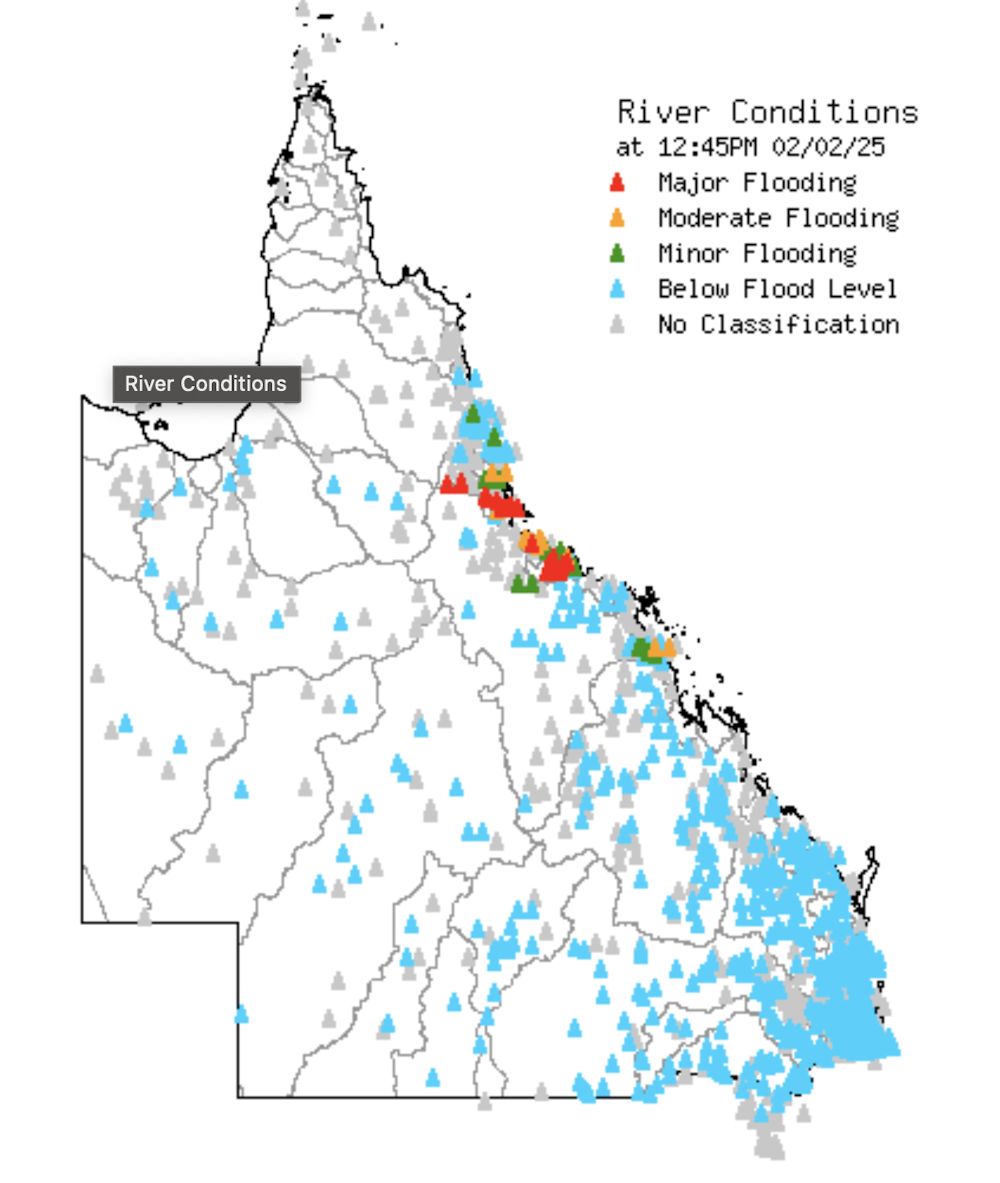
    Major flooding in northern Queensland rivers, as of 12.45pm February 2.
    Bureau of Meteorology

    Residents of Ingham and nearby towns, about 100km from Townsville, are witnessing flooding from the nearby Herbert River. This morning, it was at 15 metres and rising. With more heavy rain forecast for the next 24 hours, the Herbert River is likely to break the 1967 record of 15.2 metres later today.

    Queensland Premier David Crisafulli – who grew up on his family’s sugar cane farm in Ingham – has said the floods will be a “once in a century” event for the town. To make matters worse, authorities say the town has lost power and an extended outage is likely.

    The atmospheric factors behind these floods are very similar to recent floods in the region – and climate change is no doubt playing a role.

    The flood level for the Herbert River at Ingham set in 1967 was 15.2 metres. It’s likely to be breached this afternoon (Sunday February 2).
    Australian Bureau of Meteorology, CC BY

    Where are the floods hitting?

    For many people in Townsville – the largest city in Northern Australia – the unfolding emergency will bring back memories of the devastating February 2019 floods, which caused A$1.24 billion in damage. Residents have been asked to evacuate from several low-lying suburbs which were inundated in 2019.

    Authorities in Townsville asked all residents in the low-lying black zone to evacuate by midday Sunday February 2. Floodwaters could reach second-storey heights in this zone. Residents in pink suburbs have been asked to be on standby.
    Townsville Council, CC BY

    It is too early to say if this flood event will be worse. Fortunately, water levels in the city’s Ross River Dam are much lower than 2019. Townsville Airport has recorded 545mm of rain over the past 48 hours, with many northwest suburbs recording much higher levels. The township of Rollingstone – 60km northwest of Townsville – recorded a whopping 702mm over the 24 hours to 9am Sunday.

    Further north in the Cairns to Daintree region, residents are watching with concern, with many still raw after the record-breaking floods of December 2023.

    What’s behind these floods?

    The ongoing 2025 extreme rainfall event, the 2019 Townsville floods and the 2023 Cairns and Daintree floods are remarkably similar in many ways.

    What triggered each of these floods was prolonged heavy rain falling on the southeast flank of a stationary tropical low weather system. Normally, tropical lows bring wind and rain, but move through quite quickly. But in recent years, we have seen a tendency for these systems to stall, sitting in place over or near land and dumping huge volumes of rain.

    Last week, the Bureau of Meteorology warned that five tropical lows were forming around northern Australia. Most tropical cyclones form from tropical lows embedded in the region’s monsoon trough, a large low pressure band which forms over summer and draws in warm, moist air from the adjacent tropical seas.

    But significant rain events like this one don’t necessarily require a tropical cyclone. Slow-moving deep monsoon lows over land can also deliver huge amounts of rain and widespread flooding.

    These atmospheric conditions allow intense rain bands to form between converging winds: warm, moist winds from the northeast and southeast winds originating from the Coral Sea. As the winds collide, they push the moist air up into the cooler parts of the atmosphere where it condenses and falls as torrential rain.

    More extreme rainfall and higher frequencies of flooded rivers and flash floods around the world have a clear link to climate change and ongoing global heating.

    The main drivers behind these events include warming of the atmosphere. For every 1°C of warming, the atmosphere holds 7% more water vapour. Recent research suggests this figure could be even higher for short duration rainfall.

    Hotter oceans hold more energy, meaning they can also amplify the global water cycle when atmospheric conditions are suitable.

    This year’s latest ever monsoon

    This year, sea surface temperatures in the northwest Coral Sea are 1-2°C above average. Ocean temperatures have risen because of a lack of cloud cover and rain last month. In northwestern Australia, this has given rise to an intensifying marine heatwave.

    This ocean heat is likely to be driven by the Australian monsoon’s latest ever arrival. The monsoon brings heavy rains to northern Australia, triggering the wet season. When it arrives, sea surface temperatures generally drop due to a combination of high cloud cover and the cooling effect of rainwater.

    After a slow start, the North Australian monsoon season is now in full swing.

    The Bureau of Meteorology is monitoring an active monsoon trough for any low pressure systems, which may develop into tropical cyclones over the next week or so. If any cyclone does form, it will gain energy from warmer than usual sea surface temperatures.

    What’s next for north Queensland?

    The flood emergency in north Queensland is far from over. All global circulation models predict heavy rain to continue in the region, extending up towards Cape York and the Gulf Country as an active monsoon surge moves in from Indonesia.

    As river catchments get saturated, more and more water will run off and engorge rivers. Forecasts are for rain to continue well into tonight and the next few days. We are likely to see more flooding in more places this week.

    For the latest updates, check the Bureau of Meteorology’s Queensland flood warnings, ABC Emergency or local ABC radio stations.

    Steve Turton has received funding from the Australian Government.

    ref. What’s driving north Queensland’s deadly, record-breaking floods? – https://theconversation.com/whats-driving-north-queenslands-deadly-record-breaking-floods-248847

    MIL OSI AnalysisEveningReport.nz

  • MIL-Evening Report: What’s driving north Queensland’s record-breaking, deadly floods?

    Source: The Conversation (Au and NZ) – By Steve Turton, Adjunct Professor of Environmental Geography, CQUniversity Australia

    A flooded street in Townsville John Wilkinson/Facebook

    Record-breaking floods across north Queensland have now turned deadly, with one woman drowning while being rescued on Sunday morning. And the floodwaters are still rising, with rain set to continue.

    Over the 48 hours to Sunday, there were reports of up to 1 metre of rainfall in parts of northeast Queensland. The torrential rain continues, particularly in the Herbert Coast region and north to around Tully.

    Major flooding in northern Queensland rivers, as of 12.45pm February 2.
    Bureau of Meteorology

    Residents of Ingham and nearby towns, about 100km from Townsville, are witnessing flooding from the nearby Herbert River. This morning, it was at 15 metres and rising. With more heavy rain forecast for the next 24 hours, the Herbert River is likely to break the 1967 record of 15.2 metres later today.

    Queensland Premier David Crisafulli – who grew up on his family’s sugar cane farm in Ingham – has said the floods will be a “once in a century” event for the town. To make matters worse, authorities say the town has lost power and an extended outage is likely.

    The atmospheric factors behind these floods are very similar to recent floods in the region – and climate change is no doubt playing a role.

    The flood level for the Herbert River at Ingham set in 1967 was 15.2 metres. It’s likely to be breached this afternoon (Sunday February 2).
    Australian Bureau of Meteorology, CC BY

    Where are the floods hitting?

    For many people in Townsville – the largest city in Northern Australia – the unfolding emergency will bring back memories of the devastating February 2019 floods, which caused A$1.24 billion in damage. Residents have been asked to evacuate from several low-lying suburbs which were inundated in 2019.

    Authorities in Townsville asked all residents in the low-lying black zone to evacuate by midday Sunday February 2. Floodwaters could reach second-storey heights in this zone. Residents in pink suburbs have been asked to be on standby.
    Townsville Council, CC BY

    It is too early to say if this flood event will be worse. Fortunately, water levels in the city’s Ross River Dam are much lower than 2019. Townsville Airport has recorded 545mm of rain over the past 48 hours, with many northwest suburbs recording much higher levels. The township of Rollingstone – 60km northwest of Townsville – recorded a whopping 702mm over the 24 hours to 9am Sunday.

    Further north in the Cairns to Daintree region, residents are watching with concern, with many still raw after the record-breaking floods of December 2023.

    What’s behind these floods?

    The ongoing 2025 extreme rainfall event, the 2019 Townsville floods and the 2023 Cairns and Daintree floods are remarkably similar in many ways.

    What triggered each of these floods was prolonged heavy rain falling on the southeast flank of a stationary tropical low weather system. Normally, tropical lows bring wind and rain, but move through quite quickly. But in recent years, we have seen a tendency for these systems to stall, sitting in place over or near land and dumping huge volumes of rain.

    Last week, the Bureau of Meteorology warned that five tropical lows were forming around northern Australia. Most tropical cyclones form from tropical lows embedded in the region’s monsoon trough, a large low pressure band which forms over summer and draws in warm, moist air from the adjacent tropical seas.

    But significant rain events like this one don’t necessarily require a tropical cyclone. Slow-moving deep monsoon lows over land can also deliver huge amounts of rain and widespread flooding.

    These atmospheric conditions allow intense rain bands to form between converging winds: warm, moist winds from the northeast and southeast winds originating from the Coral Sea. As the winds collide, they push the moist air up into the cooler parts of the atmosphere where it condenses and falls as torrential rain.

    More extreme rainfall and higher frequencies of flooded rivers and flash floods around the world have a clear link to climate change and ongoing global heating.

    The main drivers behind these events include warming of the atmosphere. For every 1°C of warming, the atmosphere holds 7% more water vapour. Recent research suggests this figure could be even higher for short duration rainfall.

    Hotter oceans hold more energy, meaning they can also amplify the global water cycle when atmospheric conditions are suitable.

    This year’s latest ever monsoon

    This year, sea surface temperatures in the northwest Coral Sea are 1-2°C above average. Ocean temperatures have risen because of a lack of cloud cover and rain last month. In northwestern Australia, this has given rise to an intensifying marine heatwave.

    This ocean heat is likely to be driven by the Australian monsoon’s latest ever arrival. The monsoon brings heavy rains to northern Australia, triggering the wet season. When it arrives, sea surface temperatures generally drop due to a combination of high cloud cover and the cooling effect of rainwater.

    After a slow start, the North Australian monsoon season is now in full swing.

    The Bureau of Meteorology is monitoring an active monsoon trough for any low pressure systems, which may develop into tropical cyclones over the next week or so. If any cyclone does form, it will gain energy from warmer than usual sea surface temperatures.

    What’s next for north Queensland?

    The flood emergency in north Queensland is far from over. All global circulation models predict heavy rain to continue in the region, extending up towards Cape York and the Gulf Country as an active monsoon surge moves in from Indonesia.

    As river catchments get saturated, more and more water will run off and engorge rivers. Forecasts are for rain to continue well into tonight and the next few days. We are likely to see more flooding in more places this week.

    For the latest updates, check the Bureau of Meteorology’s Queensland flood warnings, ABC Emergency or local ABC radio stations.

    Steve Turton has received funding from the Australian Government.

    ref. What’s driving north Queensland’s record-breaking, deadly floods? – https://theconversation.com/whats-driving-north-queenslands-record-breaking-deadly-floods-248847

    MIL OSI AnalysisEveningReport.nz

  • MIL-Evening Report: Delayed monsoon and a stalled tropical low: what’s behind north Queensland’s record-breaking floods

    Source: The Conversation (Au and NZ) – By Steve Turton, Adjunct Professor of Environmental Geography, CQUniversity Australia

    A flooded street in Townsville John Wilkinson/Facebook

    Record-breaking floods across north Queensland have now turned deadly, with one woman drowning while being rescued on Sunday morning. And the floodwaters are still rising, with rain set to continue.

    Over the 48 hours to Sunday, there were reports of up to 1 metre of rainfall in parts of northeast Queensland. The torrential rain continues, particularly in the Herbert Coast region and north to around Tully.

    Major flooding in northern Queensland rivers, as of 12.45pm February 2.
    Bureau of Meteorology

    Residents of Ingham and nearby towns, about 100km from Townsville, are witnessing flooding from the nearby Herbert River. This morning, it was at 15 metres and rising. With more heavy rain forecast for the next 24 hours, the Herbert River is likely to break the 1967 record of 15.2 metres later today.

    Queensland Premier David Crisafulli – who grew up on his family’s sugar cane farm in Ingham – has said the floods will be a “once in a century” event for the town. To make matters worse, authorities say the town has lost power and an extended outage is likely.

    The atmospheric factors behind these floods are very similar to recent floods in the region – and climate change is no doubt playing a role.

    The flood level for the Herbert River at Ingham set in 1967 was 15.2 metres. It’s likely to be breached this afternoon (Sunday February 2).
    Australian Bureau of Meteorology, CC BY

    Where are the floods hitting?

    For many people in Townsville – the largest city in Northern Australia – the unfolding emergency will bring back memories of the devastating February 2019 floods, which caused A$1.24 billion in damage. Residents have been asked to evacuate from several low-lying suburbs which were inundated in 2019.

    Authorities in Townsville asked all residents in the low-lying black zone to evacuate by midday Sunday February 2. Floodwaters could reach second-storey heights in this zone. Residents in pink suburbs have been asked to be on standby.
    Townsville Council, CC BY

    It is too early to say if this flood event will be worse. Fortunately, water levels in the city’s Ross River Dam are much lower than 2019. Townsville Airport has recorded 545mm of rain over the past 48 hours, with many northwest suburbs recording much higher levels. The township of Rollingstone – 60km northwest of Townsville – recorded a whopping 702mm over the 24 hours to 9am Sunday.

    Further north in the Cairns to Daintree region, residents are watching with concern, with many still raw after the record-breaking floods of December 2023.

    What’s behind these floods?

    The ongoing 2025 extreme rainfall event, the 2019 Townsville floods and the 2023 Cairns and Daintree floods are remarkably similar in many ways.

    What triggered each of these floods was prolonged heavy rain falling on the southeast flank of a stationary tropical low weather system. Normally, tropical lows bring wind and rain, but move through quite quickly. But in recent years, we have seen a tendency for these systems to stall, sitting in place over or near land and dumping huge volumes of rain.

    Last week, the Bureau of Meteorology warned that five tropical lows were forming around northern Australia. Most tropical cyclones form from tropical lows embedded in the region’s monsoon trough, a large low pressure band which forms over summer and draws in warm, moist air from the adjacent tropical seas.

    But significant rain events like this one don’t necessarily require a tropical cyclone. Slow-moving deep monsoon lows over land can also deliver huge amounts of rain and widespread flooding.

    These atmospheric conditions allow intense rain bands to form between converging winds: warm, moist winds from the northeast and southeast winds originating from the Coral Sea. As the winds collide, they push the moist air up into the cooler parts of the atmosphere where it condenses and falls as torrential rain.

    More extreme rainfall and higher frequencies of flooded rivers and flash floods around the world have a clear link to climate change and ongoing global heating.

    The main drivers behind these events include warming of the atmosphere. For every 1°C of warming, the atmosphere holds 7% more water vapour. Recent research suggests this figure could be even higher for short duration rainfall.

    Hotter oceans hold more energy, meaning they can also amplify the global water cycle when atmospheric conditions are suitable.

    This year’s latest ever monsoon

    This year, sea surface temperatures in the northwest Coral Sea are 1-2°C above average. Ocean temperatures have risen because of a lack of cloud cover and rain last month. In northwestern Australia, this has given rise to an intensifying marine heatwave.

    This ocean heat is likely to be driven by the Australian monsoon’s latest ever arrival. The monsoon brings heavy rains to northern Australia, triggering the wet season. When it arrives, sea surface temperatures generally drop due to a combination of high cloud cover and the cooling effect of rainwater.

    After a slow start, the North Australian monsoon season is now in full swing.

    The Bureau of Meteorology is monitoring an active monsoon trough for any low pressure systems, which may develop into tropical cyclones over the next week or so. If any cyclone does form, it will gain energy from warmer than usual sea surface temperatures.

    What’s next for north Queensland?

    The flood emergency in north Queensland is far from over. All global circulation models predict heavy rain to continue in the region, extending up towards Cape York and the Gulf Country as an active monsoon surge moves in from Indonesia.

    As river catchments get saturated, more and more water will run off and engorge rivers. Forecasts are for rain to continue well into tonight and the next few days. We are likely to see more flooding in more places this week.

    For the latest updates, check the Bureau of Meteorology’s Queensland flood warnings, ABC Emergency or local ABC radio stations.

    Steve Turton has received funding from the Australian Government.

    ref. Delayed monsoon and a stalled tropical low: what’s behind north Queensland’s record-breaking floods – https://theconversation.com/delayed-monsoon-and-a-stalled-tropical-low-whats-behind-north-queenslands-record-breaking-floods-248847

    MIL OSI AnalysisEveningReport.nz

  • MIL-OSI China: People enjoy various activities across China during Spring Festival

    Source: People’s Republic of China – State Council News

    People enjoy various activities across China during Spring Festival

    Updated: February 2, 2025 09:44 Xinhua
    A fish lantern performance team parades at a scenic spot in Luoyang, central China’s Henan Province, during the Spring Festival holiday on Jan. 31, 2025. [Photo/Xinhua]
    Tourists visit a scenic spot decorated with colorful lights and ribbons in Haigang District of Qinhuangdao, north China’s Hebei Province, during the Spring Festival holiday on Jan. 31, 2025. [Photo/Xinhua]
    Tourists watch a lantern show in Yuncheng, north China’s Shanxi Province, during the Spring Festival holiday on Jan. 31, 2025. [Photo/Xinhua]
    Two girls in traditional costumes look at lanterns in Tancheng County of Linyi, east China’s Shandong Province, during the Spring Festival holiday on Jan. 31, 2025. [Photo/Xinhua]
    People watch lanterns in Neihuang County of Anyang City, central China’s Henan Province, during the Spring Festival holiday on Jan. 31, 2025. [Photo/Xinhua]
    People watch a musical fountain in Zhanyi District of Qujing, southwest China’s Yunnan Province, during the Spring Festival holiday on Jan. 31, 2025. [Photo/Xinhua]
    Tourists visit Lijiang ancient town in Lijiang, southwest China’s Yunnan Province, during the Spring Festival holiday on Jan. 31, 2025. [Photo/Xinhua]
    Tourists watch a live-action drama in Fengnan District of Tangshan, north China’s Hebei Province, during the Spring Festival holiday on Jan. 31, 2025. [Photo/Xinhua]
    Tourists take a cruise to enjoy the night scenery in Yuzhong District of southwest China’s Chongqing during the Spring Festival holiday on Jan. 31, 2025. [Photo/Xinhua]

    MIL OSI China News

  • MIL-OSI Australia: Search for missing person in waters at Inneston National Park

    Source: South Australia Police

    Emergency services are searching for a man after reports he went missing in waters off Browns Beach, Inneston National Park this evening.

    The alarm was raised about 8pm on Saturday 1 February after the man who was fishing with friends was seen to fall into the water.

    The man was wearing a dark red t-shirt and dark shorts.

    Police together with PolAir, water operations and local park rangers are currently searching the area.

    MIL OSI News

  • MIL-OSI Canada: Eating Disorders Awareness Week: Minister Williams

    Source: Government of Canada regional news (2)

    MIL OSI Canada News

  • MIL-OSI Canada: Premier’s, minister’s, parliamentary secretaries’ statements on Black History Month

    Source: Government of Canada regional news

    Premier David Eby has issued the following statement celebrating Black History Month:

    “Black History Month is an opportunity for us all to learn about and celebrate the many and diverse contributions of Black people to our province.

    “In 1858, more than 800 Black settlers came north from California to Vancouver Island on the invitation of colonial governor James Douglas. They were promised equality under the law, as well as the right to vote and purchase property. Some settlers formed the Victoria Pioneer Rifle Corps, an all-Black police force.

    “One of the settlers, Mifflin Gibbs, was elected to Victoria council eight years later, becoming the first Black person to hold public office in British Columbia. He was a prominent voice in favour of the colony joining the Canadian Confederation. More than a century later, social worker Rosemary Brown became the first Black woman to be elected to the B.C. legislature. Emery Barnes, a former professional football player with the B.C. Lions, served as the province’s first Black Speaker of the legislative assembly.

    “A Black presence has been a constant in the province’s history, including descendants of the original immigrants. From salmon canner John Sullivan Deas to Emma Stark’s contributions as a school teacher to Seraphim Joe Fortes’ celebrated lifesaving to Barbara Howard on the track in the 1930s to Harry Jerome on the track in the 1960s to Eleanor Collins becoming the first Black entertainer in Canada to host her own national television program, the rich and varied achievements of Black British Columbians have helped make the province the place it is today.

    “We should all feel pride in these accomplishments, while acknowledging the unjust barriers Black people face in their daily lives. Government is working to build an inclusive province where everyone feels they belong, as we build a more just and equitable society for all. Taking part in Black History Month enriches everyone.”

    Lisa Beare, Minister of Education and Child Care, said:
    “Students in B.C. have opportunities to learn about the diverse communities that shape our province, including the accomplishments and challenges of historic and contemporary Black British Columbians. Learning about Black History and other cultural histories helps students appreciate our province’s rich cultural heritage and supports the development of school communities where everyone feels safe, included and represented.”

    Jessie Sunner, parliamentary secretary for anti-racism initiatives, said:
    “Black History Month is a time to honour pioneers like Mifflin Wistar Gibbs, Harry Jerome, Eleanor Collins and Rosemary Brown, whose legacies continue to inspire us. This month gives us the chance to reflect on the ongoing fight against anti-Black racism. Legislation like the Anti-Racism Act aims to remove systemic barriers to government programs and services that Black communities face in the province. Let’s recommit to amplifying Black voices. As we celebrate the rich history and resilience of B.C.’s Black communities, we strive to build a welcoming province for everyone.”

    George Anderson, parliamentary secretary for transit, said:
    “Black History Month is an opportunity to celebrate the excellence and contributions of Black individuals like John Sullivan Deas, Rosemary Brown, Justice Selwyn Romilly and June Francis, who have enriched every facet of our society, from culture and innovation to leadership and service. Here in British Columbia, we honour the achievements of those who have broken barriers and inspired progress, while recognizing the work still needed to ensure equal opportunity for all. I carry with me the stories of struggle, perseverance and hope paved by so many. By breaking down systemic barriers, we can create a future where everyone, regardless of background, can thrive and contribute to a more just world.”

    MIL OSI Canada News

  • MIL-OSI Australia: Search for missing person in waters at Inneston National Park National Park

    Source: South Australia Police

    Emergency services are searching for a man after reports he went missing in waters off Browns Beach, Inneston National Park this evening.

    The alarm was raised about 8pm on Saturday 1 February after the man who was fishing with friends was seen to fall into the water.

    The man was wearing a dark red t-shirt and dark shorts.

    Police together with PolAir, water operations and local park rangers are currently searching the area.

    MIL OSI News

  • MIL-OSI China: 1 dead, 3 missing after 2 fishing boats run aground off S. Korea’s southern island

    Source: China State Council Information Office

    One person was confirmed dead and three others went missing Saturday after two fishing boats carrying 15 crew members ran aground in waters off South Korea’s southern resort island of Jeju, according to Yonhap news agency.

    It was reported to the coast guard at about 9:24 a.m. local time (0024 GMT) that a 32-ton fishing vessel with seven people on board and a 29-ton vessel carrying eight were stranded in waters off the island.

    Twelve people were rescued around noon (0300 GMT), and three remained unaccounted for.

    Among the rescued, a captain of the 32-ton vessel in his 50s was taken in cardiac arrest to a hospital while receiving first-aid treatment such as cardiopulmonary resuscitation (CPR), but he died later.

    The others showed symptoms of hypothermia, but it was not a life-threatening injury.

    The captains of both vessels were South Koreans, while the other crew members were foreigners, such as Vietnamese and Indonesians.

    Search and rescue operations had been underway for the missing three crew members

    MIL OSI China News

  • MIL-OSI China: China expresses condolences to victims of US aircraft collision

    Source: China State Council Information Office

    China expresses deep condolences to the victims and profound sympathy to their families following a mid-air collision of a passenger plane and a helicopter near Reagan National Airport in the United States Wednesday night, a Chinese foreign ministry spokesperson said on Friday.

    The foreign ministry and the Chinese embassy in the U.S. launched the emergency response mechanism immediately after the incident. Unfortunately, two Chinese nationals lost their lives in the incident, according to preliminary verification of the victims, the spokesperson said.

    China has asked the U.S. to provide timely updates on the search and rescue efforts, identify the cause of the accident as soon as possible, and handle the ensuing matters properly, according to the spokesperson.

    “We will provide necessary assistance to the families of the Chinese victims as they deal with the incident,” the spokesperson added.

    The mid-air collision that happened in Washington, D.C. involved an American Airlines regional jet with 60 passengers and four crew members on board and a military Blackhawk helicopter with three U.S. Army soldiers.

    U.S. President Donald Trump confirmed no survivors in the collision at a Thursday press conference in the White House.

    MIL OSI China News

  • MIL-OSI USA: SCHUMER DELIVERS NEARLY $1.8 MILLION IN NEW FED FUNDING TO HELP CITY OF SHERRILL MODERNIZE CRITICAL INFRASTRUCTURE TO SUPPORT NEW DEVELOPMENT AND LEGACY MANUFACTURING AT SILVER CITY INDUSTRIAL PARK IN…

    US Senate News:

    Source: United States Senator for New York Charles E Schumer
    After Securing $300,000+ From U.S. Economic Development Administration in 2020, Schumer Pushed For More To Cover Increased Project Costs And Has Now Secured Over $2M In Total Fed Investment
    Senator Says Millions In Fed $$ To Upgrade Sherrill’s Electrical Infrastructure Is Key To Unlocking New Shovel-Ready Sites, Attracting New Commercial Development & Supporting New Growth At Legacy Manufacturing Companies In Oneida County
    Schumer: Fed $$ Will Help Oneida County Power Commercial & Manufacturing Growth  
    U.S. Senator Charles E. Schumer today announced he is delivering $1,797,780 in new federal funding to help the City of Sherrill modernize the substation and electrical infrastructure servicing the Silver City Industrial Park, bringing the total federal investment to $2,103,780. The senator explained these critical infrastructure upgrades will help Oneida County and Mohawk Valley EDGE attract new businesses and jobs while continuing to support the growth and prosperity of legacy manufacturers like Sherrill Manufacturing and Briggs & Stratton.
    “Bringing new companies to Oneida County starts with ensuring that Silver City Industrial Park is shovel-ready. I’m proud to deliver nearly $1.8 million in new federal funding to upgrade critical electrical infrastructure in the City of Sherrill so we can fuel new commercial investments and catalyze new growth at legacy manufacturing companies in the Mohawk Valley,” said Senator Schumer. “Across Upstate New York, we are seeing a resurgence in manufacturing with Micron’s historic $100+ billion investment in Clay and Wolfspeed’s investment in Marcy thanks to my bipartisan CHIPS & Science Law. The time to prepare for even more investment is now. This federal funding is an essential piece of the puzzle needed to modernize Sherrill’s electrical infrastructure so Silver City can be shovel-ready for businesses to move in and set up shop and legacy manufacturers can continue to grow and prosper in our community.”
    Schumer previously helped secure $306,000 for the City of Sherrill’s Project Powerslam in 2020. Unfortunately, the estimated cost of the project more than quadrupled due to the increased cost of construction and labor in recent years, forcing the City to press pause on the project and seek additional funding. The senator pushed the U.S. Economic Development Administration (EDA) for additional federal investment to make up the shortfall and get the project back on track. Schumer said this multi-million dollar strategic investment from the EDA will finally allow the City to upgrade its 50+-year-old “South” substation to provide more reliable, resilient power to Sherill’s business and residential community for decades to come and help pave the way for planned expansion at Silver City Industrial Park. As part of the agreement, the City of Sherrill will contribute approximately $500,000 in matching funds.
    The upgraded electrical infrastructure will help provide the reliable power needed for continued growth at legacy manufacturing companies, specifically Sherrill Manufacturing, which is the only American manufacturer of flatware, and Briggs and Stratton, which is a lawn and garden equipment manufacturer. These companies have already brought millions in investments and hundreds of jobs to Oneida County, and the City of Sherrill hopes continued investment in its critical infrastructure will set the stage for these companies to keep growing and for new companies to locate alongside them.
    “On behalf of the City of Sherrill, I would like to extend our sincerest thanks to Senator Chuck Schumer for his unwavering support and tireless advocacy in securing millions in Economic Development Administration funding for the City of Sherrill.  Alongside the Senator, I would also like to thank the incredible team at Mohawk Valley EDGE for their hard work and commitment throughout the grant process. This funding will play a pivotal role in upgrading our electric distribution substation, supporting not only the long-term sustainability of our power grid but also fostering continued growth and jobs in our region,” said Brandon Lovett, Sherill City Manager. “Thanks to extraordinary collaboration between the Senator, the incredible team at Mohawk Valley EDGE, and the Sherrill community, we are closer than ever before growth and advancement at the Silver City Industrial Park. This project will provide critical infrastructure to support recent growth at existing businesses from Briggs & Stratton to Sherrill Manufacturing, while also paving the way for new investment and economic development in the years to come.”
    “Sherrill has seen tremendous industrial development success with companies like Sherrill Manufacturing, Upstate Stone, and Briggs & Stratton expanding in the Silver City Industrial Park, drawing significant attention to the area as a prime location for manufacturers,” said Oneida County Executive Anthony J. Picente Jr. “Thanks to Senator Schumer’s leadership in securing this funding, we can modernize the city’s electrical infrastructure to further support our legacy manufacturers and fuel new investment. The benefit of municipal power in Sherrill is already a major incentive in an otherwise high-cost energy environment, and these upgrades will enhance reliability and capacity, ensuring the city remains a competitive and attractive hub for industry in Oneida County.”
    “We at Sherrill Manufacturing and Liberty Tabletop are excited to hear about further investment to improve the infrastructure within the Silver City Industrial Park.  As our business continues to grow, updated and reliable infrastructure is critical to our success as the only manufacturer of flatware in the United States,” said Matthew A. Roberts, President and Co-Founder, Sherrill Manufacturing Inc. and Liberty Tabletop. “We would like to once again thank Senator Schumer for his dedication to assisting both legacy and new business in the Mohawk Valley and across New York State. His hard work and partnership will help to ensure that Sherrill, NY can truly continue to be the Silver City.”
    Schumer has a long history of fighting for economic development in Oneida County and the Mohawk Valley. Last year, Schumer secured $500,000 for Brownfield’s Community-wide Assessment for MV EDGE to safely clean up and sustainably reuse contaminated properties across Oneida County and to position underused properties like the former St. Luke’s Campus for redevelopment. Last September, Schumer delivered nearly $13 million from his Bipartisan Infrastructure Law for the Oneida Indian Nation to install 50+ new electric fast charging stations in the Mohawk Valley. Last October, Schumer announced a $750 million federal investment in Wolfspeed from his bipartisan Chips & Science Law that will accelerate the company’s ongoing Mohawk Valley expansion and hiring of hundreds of good-paying jobs. In 2023, Schumer delivered $2 million to Mohawk Valley Community College to help create a new semiconductor and advanced manufacturing training center to give the Mohawk Valley workforce the skills and training they need to be prepared for future investment in economic development.
    In December of last year, Schumer also announced that he successfully included in the reauthorization of the Economic Development Administration the bipartisan ONSHORE Act to surge more EDA resources into shovel-ready site development. Schumer was able to steer this reauthorization into law at the end of last year. Schumer’s provision creates a new grant program to support site development or expansion projects for manufacturing industries critical to national or economic security, all of which are modeled on the ONSHORE Act. Through this program, EDA will assist with site and utility readiness, workforce development, distribution, and logistics, to prepare strategic mega sites and regionally impactful sites across places like Upstate NY for new industrial investment. The EDA funding will place an emphasis on building up the workforce through training and other support as a key priority for attracting and scaling new employers at these industrial sites, providing new federal resources for the pressing priority of workforce development. 

    MIL OSI USA News

  • MIL-OSI USA: Transcript: Governor Hochul is a Guest on Univision 41

    Source: US State of New York

    Earlier today, Governor Kathy Hochul was a guest on Univision 41. The Governor spoke with Mariela Salgado on her affordability agenda, immigration, public safety and more.

    AUDIO: The Governor’s remarks are available in audio form here.

    A rush transcript of the Governor’s remarks is available below:

    Mariela Salgado, Univision 41: So we’re very blessed that you’re talking to us and we’re very thankful, because we know how busy you are. So when you guys are ready, let us know. Just give me five minutes before we start, so I know we’re good. We’re good? Okay.

    Governor, so the first question is to talk about the economy, and after I’m done with the question, I’ll just do a quick Spanish question. So, when you talk about your agenda, you talk about fighting for New Yorkers families. And I’ve been in your press conferences, and you talk about your family, you allude to your daughter in law and having to spend — and knowing for yourself how expensive things are — and you talk about inflation, and you see how things have gone up. And you’ve heard what New Yorkers are saying, and you’ve presented an array of so many things. When you planned your agenda for this budget, what were the main areas that you were concerned about when you presented that?

    Governor Hochul: I am concerned so much about New York’s struggling families. My own family, my grandparents were immigrants, came here and lived in great poverty. They were migrant farm workers. My grandpa was a steel worker. My parents lived in a trailer park. We were raised having to get our clothes at used clothing stores. And you know, we were not doing well financially for a long time. But what I also know is my experience as a young mom and how expensive it is to pay for the diapers and the formula, and the kids outgrow their clothes every three months. And not just from my life, but I see now my own son and daughter in law struggling as well.

    So I come to a Budget process and look at it as a statement of my priorities of what I want for New Yorkers and New York families, and to be able to firmly say, “I’m on your side, your family is on my fight and here’s what I’m going to do to find countless ways to put money back in your pockets.” And whether it’s the inflation rebate — which puts money back to the people who weren’t paid because of inflation — $500 per family. Someone with children under the age of four — $1,000 per child, school age child $500. Also covering the cost of all school breakfasts and lunches — that’s money back for every parent to be able to not have to spend $1,600 a year.

    You add it all up, plus a middle class tax cut, there are many families in New York who will receive $5,000 more in their pockets. So, I took my own life experience, but also what I’ve seen as Governor going to every corner of the State and here in the boroughs where life can be hard for people — they struggle, they want to be successful — and anything I can do as Governor to relieve them of that burden is what drives me every single day.

    Mariela Salgado, Univision 41: Now, those are immediate reliefs: the child tax credit, the rebate. Those are things that people are going to get right away and will see an impact on their pockets. But the child care, as a parent, I know how expensive it is. That’s going to take some time because there are spaces that need to be built and things need to be figured out. So when do you think parents are going to start to see those benefits coming through?

    Governor Hochul: We announced a program that for families earning $108,000 or less, their child care costs are kept at $15 a week. Now think about that. An average family pays, right now, $21,000 a year for child care for one child. You may have two and you’re paying even more, but we are saying that there’s families that are struggling. We should have that expense capped at $15. The problem is, we need to have more providers. We need more facilities. So in my Budget, I understood this, and I’m putting $110 million into building new child care facilities, renovating existing ones and making home child care more available for people as well.

    So there’s no one answer, but we’re working hard. I know people want to know when, but it is hard to try to break through a system where no one paid attention before. I’m New York’s first Mom Governor. I had to leave a job I loved because I couldn’t find child care. I know what that does to your family when one income is gone, or if you’re a single parent and you can’t find anyone to watch your children. So those are real struggles, but it’s something I’m fighting for every day and trying to solve for people, and there will come a time when people will have all the access to affordable child care that they need.

    Mariela Salgado, Univision 41: That’s kind of the question with housing — and we’ll go quickly on with the interview, but — these are the things people need: To go from child care to housing, and you’ve done a couple of things. One is the $100 million investment, which is geared to people who — and I’ll talk about what my community needs, which is trying to have the American dream and be a homeowner. We see that a lot in places like Long Island where people have been struggling to be able to access that. When do you think that would be, you know, a reality for them? And then also we talk about New York City, “City of Yes”; creating more space. That’s a very robust plan — long term — but very robust. More than 80,000 new housing there. So, when do you think people in Long Island, per se, will be able to access those benefits?

    Governor Hochul: Well, with respect to the assistance for first time homebuyers, I want to pass it in my Budget this year and make it available almost immediately. So, let’s get through the Budget. It usually wraps up in the spring, and then we’ll talk about how to get that money out there. So, that is so important because that is the manifestation of the dream: to have your own place to call your own. And this is where your family can grow up, and someday, your own children might live in the neighborhood.

    And the problem with places like Long Island and others, is they’ve not built enough housing to meet the demand for people to want to raise their children there. And I’ve taken this on and it’s been a hard fight, but I did support the City with $1 billion to help the Mayor get the “City of Yes” done. But also, we have thousands and thousands of housing units and apartments that are not online because they need repairs done to them.

    So we’re trying to make it so landlords will make those repairs and bring on more units. So what happens is you flood the zone. You bring in as much housing as you can. And then what happens? Prices start to drop. That’s what we also need to have. So people starting out in that first apartment, you can save the money to get that home. We’ll have that apartment available to them. So it’s, it’s a whole continuum of approaches to it, but no other Governor has worked harder on what is people’s largest expense, whether they’re paying rent or mortgage. And some families are paying half of their income, half of their earnings, in just their housing alone. And that doesn’t consider all the other bills they have in covering the cost of children.

    So I know how important it is. My family struggled. My parents lived in a trailer park. My grandparents had a family of 10 in a tiny, little house with two bedrooms. I grew up with that experience, seeing them live like that, and I know how critical it is for people just to feel that they have that within their reach.

    Mariela Salgado, Univision 41: Congestion price was not easy. It was — you had some criticism. First it was one price, then you came to a different, more reduced price, but still people were complaining about what they had to pay because of the economy. We are hearing from people in the Bronx and I’m not sure this is correct, because I’m sure there have to be studies, that some of the people who are driving through the zone are trying to avoid paying the toll, and they’re using their bridges or their roads, and that’s creating more congestion on their roads. Is that something that was considered when that was put in place? Are you going to be looking at it, maybe creating more studies to see if that needs to be tweaked somehow or fixed?

    Governor Hochul: Right. This is a program that was passed back by my predecessor in the Legislature back in 2019. And they did study for many years the environmental impacts and also the traffic impacts. It was supposed to go into effect in June. I knew that $15 was just too much for New Yorkers, especially when inflation was so high. So I paused it. I got a lot of criticism for doing that. But I had to work hard to reduce the price, and we did by 40 percent. So I’m very much aware of the cost and what it does for families.

    But there are areas of our city that are seeing less traffic. But you’re absolutely right, we need to go back to the areas that might be affected in a way that wasn’t anticipated. There is money for traffic mitigation for the Bronx, about $150 million. But also to look at the effects of, if traffic’s congregating — are there higher rates of asthma, for example. I’m very concerned about the health of our children in places like the Bronx. So, of course, this is always going under review and study.

    Mariela Salgado, Univision 41: And another question and I have to talk about the Trump administration because we’ve had conversations with Republican legislators who have told us that there’s a possibility that the new administration might want to somehow revert the plan. Is that something that can happen?

    Governor Hochul: It is already the law. It was supported by the Biden administration and all the — it has already started. So I don’t know if that will happen or not.

    Mariela Salgado, Univision 41: Okay. So we don’t really know? If this is something that–

    Governor Hochul: No.

    Mariela Salgado, Univision 41: And to that effect, we’ve heard President Trump speak highly of you. Do you have a relationship with him? Have you talked to him about certain issues? And the reason I bring it up is because immigration is in everybody’s mind and I know that this is a sanctuary state, and it’s not new in New York, and many states have helped the federal government when it comes to immigrants. Now it’s front and stage, but it’s something that’s been done for a long time. But, of course, there is concern and fear right now among people because it’s frontal. So, are you having any connection with them right now? Are you having conversations with Tom Homan?

    Governor Hochul: I have been having conversations. And what I’ve reinforced is the fact that we have always worked with ICE when it comes to removing people who have committed serious crimes. Whether they’re in their own country, they never should have been able to arrive here, or they do something while they’re here. This has happened. So we want to make sure that all of our citizens and all the residents and all the people who have come before, whether they have status or not, that they’re safe from criminals. So we have said we will work with the Trump administration, just like we did with the Biden administration.

    These ICE raids are not something new. There’s just more attention on them. But this has been going on for a while. But, even though we want to support removing criminals, I want people to not live in fear. It is heartbreaking to me to know that there are children not going to school today, or not going to a doctor’s office, someone who’s ill or a senior citizen needs that appointment. They’re not going to churches. So, people’s lives are being so disrupted because of that.

    And I reinforce the administration that we’ll help you with the criminal element, absolutely. But, let’s not go after these families and separate them. Let’s not have a cruel approach to this.

    I mean, we can find them jobs. I said before, we have 400,000 open jobs in the State of New York. We give people work authorization. They can actually do what they came for and what we want them to do, get a job — get a job and work and take care of their family.

    Mariela Salgado, Univision 41: So, you’re having that conversation with them?

    Governor Hochul: Yes.

    Mariela Salgado, Univision 41: And the reason why I bring it up is because we’re hearing stories like this mom, for example, she was 60-years-old and she had an order of deportation. Her mom never told her to do anything. Now she’s an adult, she has kids, and she has to be deported. So things like that. Or you know, somebody who had a DUI 20 years ago and now is a grandparent. I’m not saying that a DUI is something right to do and people need to be accountable. But urging the administration to see it case by case.

    Governor Hochul: We cannot give up our compassion. We cannot be a State where people are not feeling protected and supported. That’s never been who we are as New Yorkers. And we’re proud of that. So again, it is very easy for me to separate someone who will do harm to other people and say, “You do not belong here.”

    But other people should not have that hanging over their heads that they’ve been doing — especially ones who were brought here as children. I mean, think about those individuals. Or someone who may have done something when they’re 20 and now they’re 60 years old. We have to have compassion for people and understand that they’re part of our society. And we cannot reject them now.

    Mariela Salgado, Univision 41: We’re hearing things from — I like speaking with you. I’m sorry, I know we’re running out of time — but we’re hearing things from teachers. I have a very good relationship with teachers from high schools. And they tell me, “Look, we have gang members here.” You know, like from MS-13. And that’s going to happen in Long Island. They’re going to want to come in. Because some of the police are not going to let them in, so they’re going to have to come in. And that’s the reality.

    Governor Hochul: The gangs have to go. I mean, there’s a gang — a dangerous gang from Venezuela — which is showing up here and causing crimes and wreaking havoc. And we have to just round them up and send them back. That’s not legal activity here. And that is exactly what the administration has been doing.

    Mariela Salgado, Univision 41: But I’m also talking about — sorry to interrupt, Governor — the gangs that are in schools who might be like MS-13.

    Governor Hochul: No, no. MS-13 has been here for a long time. I mean, they murdered a 13-year-old girl on Long Island years ago. I met her parents. So, no, they have been here. And they have to be removed. We cannot have gang members operating freely in our schools, whether they’re from a gang, from another country, or they’re a street gang here. We have to protect our children and our teachers in a school environment. That’s a basic necessity.

    Mariela Salgado, Univision 41: I won’t talk about immigration anymore because I don’t have time. I have two more questions, but I want to shift to subway safety. And I think it’s important because the subway is related to the economy, too. There was a very big fear — I think we’re better now. But there was a moment where the perception of fear was scary.

    Because one thing is, “Oh, we’re okay, the crime has gone down.” You know, Mayor Adams kept saying that. Another thing is people having the perception of being afraid and not going, and that’s hard to break. But now I think it’s better than perception. However we are hearing from people that six months patrolling at night might just not be enough.

    So, then there’s the mental health initiatives that might not be hitting on time. So the question is, do you think it’s being done enough?

    Governor Hochul: I’m very impatient when it comes to protecting our subways, and that’s why I took dramatic steps where I have actually used State support, State money, to hire more police officers, to put them on overtime so we can have those patrols all night long. People coming in for their jobs, whether they’re health care workers, they work the night shift, they work at a hotel or a restaurant. I mean, it is scary to be on a train when there’s not a lot of other people, and you feel so vulnerable. That’s why every single train will have two police officers — not one, but two — patrolling during the nighttime hours. We said six months just so we could manage the Budget. I’m willing to look at the numbers, but I do believe that the crimes are going down.

    But as long as there’s still that really frightening story that you hear where someone’s pushed onto the subway track and, or, you know, assaulted. These are horrible crimes. They do create fear. So, I can tell you the statistics. I just had a briefing with the — I guess it was at the breakfast hosted by the new Commissioner of Police — and she gave statistics that are really, really inspiring to know that our police are working so hard to protect our community. And there’s always going to be those cases that grab the attention of the public and are just creating fear. And that’s something that is unfortunate because it’s not the entire story, but how people feel is what matters to me.

    And I want to help break through that. So, we’re going to keep funding this. Every single train car, at my insistence, now has a camera in it. If someone’s committing a crime, they will be caught. And people know that as well. And also, the Commissioner of Police announced a whole initiative dealing with the quality of life crimes.

    And saying that people with mental health issues need to be removed, we support that. We’re trying to change State law in this Budget that says that if someone who’s not able to take care of themselves does harm to others — they cannot live on the subway. The subways are not rolling homeless shelters. We need to get people into supportive care, housing or hospitalizations. So, we have to do more, but there is progress being made.

    Mariela Salgado, Univision 41: So this could be perpetual if needed. I have one more question. I have 30 seconds, so one more question. And it’s a quick one. I just have to ask it. The possibility of Mayor Adams being pardoned by President Trump — what do you think?

    Governor Hochul: I don’t know that that’s going to happen. We’re also hearing about charges being dropped. Two different things could happen: You get pardoned and you’re forgiven for crimes — which is what a pardon does — or if the charges are dropped. That’s a whole different dynamic. It’s still evolving right now, we really don’t know what the outcome is like.

    Mariela Salgado, Univision 41: Thank you very much, Governor.

    Governor Hochul: Wonderful. Thank you.

    MIL OSI USA News

  • MIL-OSI USA: Welch Statement on Trump Administration Firing January 6th Prosecutors and F.B.I. Agents

    US Senate News:

    Source: United States Senator Peter Welch (D-Vermont)
    WASHINGTON, D.C.—U.S. Senator Peter Welch (D-Vt.) released the following statement on the Trump Administration firing January 6th prosecutors at the Department of Justice and reportedly targeting hundreds of F.B.I. agents, including some who investigated the insurrection:
    “The President wants the Department of Justice to answer not to the Constitution, and not to the people, but to him. Donald Trump will stop at nothing to exact political retribution now that the keys to the White House are back in his hands. Unfortunately for our democracy, he also has keys to our Supreme Court and both chambers of Congress.
    “President Trump’s nominees for Attorney General and F.B.I. Director said career employees wouldn’t be targets of political retribution, but it already appears to be happening. It’s clear who is, and will always be, in control of the Justice Department—and that is President Trump. My colleagues shouldn’t need any additional evidence.”

    MIL OSI USA News

  • MIL-OSI Security: Riverside County Man Sentenced to Over 15 Years in Prison for Producing Sexually Explicit Images of Children He Met Online

    Source: Office of United States Attorneys

    SANTA ANA, California – A Riverside County man was sentenced today to 188 months in federal prison for catfishing a preteen girl he met on an online gaming platform and persuading her to send him sexually explicit photos of herself and, later, of her five-year-old relative.

    John Matthew Piecuch, 64, of Hemet, was sentenced by United States District Judge John W. Holcomb, who scheduled a May 1, 2025, restitution hearing in this matter.

    Piecuch pleaded guilty in July 2024 to one count of production of child pornography. He has been in federal custody since August 2021.

    “Online games and platforms can allow child predators to hide behind fake identities and lure children into sharing private information,” said Acting U.S. Attorney Joseph McNally. “It is critical that we hold these predators accountable and convey a message of zero tolerance for those who prey on our youth. I also urge parents everywhere to monitor their children’s online activity to ensure their health and safety.”

    Piecuch met on Roblox, an online gaming platform, an individual identified in court documents as “Minor Victim 1,” a 12-year-old-girl. Piecuch told the victim he was a 13-year-old boy.

    In January 2021, Piecuch and Minor Victim 1 texted each other, during which time he persuaded her to send him sexually explicit images of herself. Piecuch also persuaded Minor Victim 1 to take and send him sexually explicit photographs of Minor Victim 2, a five-year-old girl, her relative.

    Minor Victim 1’s mother saw some of the text messages between her daughter and Piecuch on the girl’s mobile device, which prompted her to contact law enforcement, according to court documents.

    Once he completes his prison sentence, Piecuch will remain on supervised release for the rest of his life.

    The FBI investigated this matter in conjunction with the Carroll County (Maryland) Sheriff’s Office.

    Assistant United States Attorney Sonah Lee of the Riverside Branch Office is prosecuting this case

    MIL Security OSI

  • MIL-OSI USA: Shaheen Addresses New Hampshire Sea Grant’s Annual Research Symposium, Highlights Importance of Federal Funding for Coastal Communities

    US Senate News:

    Source: United States Senator for New Hampshire Jeanne Shaheen
    (Durham, NH) – Today, U.S. Senator Jeanne Shaheen (D-NH), former Chair and now senior member of the U.S. Senate Commerce, Justice and Science Appropriations Subcommittee, delivered remarks at New Hampshire Sea Grant’s Annual Research Symposium and highlighted the importance of federal funding for coastal communities. The New Hampshire Sea Grant Research Symposium is a showcase of recent projects which are supported by federal funding through the National Oceanic and Atmospheric Administration (NOAA)’s National Sea Grant College Program. The event provides a forum to discuss putting scientific research into action through applied research, education and engagement in local communities. You can view photos from the event here.
    “Sea Grant is a key driver of efforts to protect our coast that not only strengthens the health of our coastal areas, but also informs and improves how we utilize coastal resources to benefit our local communities and the coastal economy,” said Senator Shaheen. “Unfortunately, the current administration’s efforts to cut grants and loans that these communities rely on has caused chaos and panic, while fueling uncertainty about the future of these programs. We need to be focused on creating jobs and strengthening our economy, not gutting programs that help to do just that.”
    Based at the University of New Hampshire since 1980, New Hampshire Sea Grant is one of 34 Sea Grant programs in the U.S. under the umbrella of the National Oceanic and Atmospheric Administration (NOAA)’s National Sea Grant College Program. New Hampshire Sea Grant works to support a coastal environment that sustains healthy ecosystems, economies and people through integrated research, extension, education and communications efforts.
    As a senior member and former Chair of the U.S. Senate Commerce, Justice and Science Appropriations Subcommittee, Shaheen has long advocated for robust funding for the Sea Grant account, which directly supports the New Hampshire Sea Grant program. In the fiscal year (FY) 2024 government funding bill, Shaheen helped secure $80 million for the National Sea Grant College Program which directly funds the New Hampshire Sea Grant program. She also worked across party lines to secure, within that funding,  $2 million for lobster research, $1 million to train young fishermen and $1 million to support research into the impacts of PFAS and other emerging contaminants, efforts that will help ensure that New Hampshire’s coastal economy remains strong for future generations.

    MIL OSI USA News

  • MIL-OSI Security: Assault on Woman Sends Browning Man to Prison for More Than Three Years

    Source: Federal Bureau of Investigation (FBI) State Crime Alerts (c)

    GREAT FALLS — A Browning man who admitted to beating and then using a belt to assault a woman on the Blackfeet Indian Reservation was sentenced today to three years and two months in prison, to be followed by three years of supervised release, U.S. Attorney Jesse Laslovich said.

    The defendant, Briar Joseph Crawford, 29, pleaded guilty in September 2024 to assault with a dangerous weapon.

    Chief U.S District Judge Brian M. Morris presided.

    The government alleged in court documents that on Aug. 6, 2023, Crawford went to Glacier National Park go fishing with the victim, identified as Jane Doe. After consuming alcohol, Crawford and Doe argued, and the conflict escalated to Crawford assaulting Doe over several hours. At one point, Crawford removed his belt, wrapped it around Doe’s neck, grabbed it and lifted her weight off the ground until she blacked out. Doe suffered numerous injuries from the prolonged assault.

    The U.S. Attorney’s Office prosecuted the case. The FBI and Blackfeet Law Enforcement Services conducted the investigation.

    XXX

    MIL Security OSI

  • MIL-OSI Asia-Pac: Text of Vice-President’s address at the 3rd National Conference of Deaf-blind on ‘Advocacy for Education and Employment’ (Excerpts)

    Source: Government of India

    I must share our joy, joy of myself and Dr Sudesh Dhankhar right from the time we came here. Our energy level has gone up. Our happiness has risen. We feel blessed to be at this place. I congratulate the Institute and others that have converged to hold this third national seminar on very important subject, Deaf-Blind on advocacy for education and employment. Education and employment, both are fundamental. Boys and Girls, loss of physical vision, I have seen can be compensated. But you have that vision which matters to us. When that vision is perverted, dangers emanate.

    What I have seen here when there was an address, I was overwhelmed, not only by what I saw but the response thereof. My deep sense of gratitude to all those who have come together and thought leaders professionals, change makers to contribute to this great cause of humanity. This collective will generate inclusivity and compassion. Rights appreciation about those who are challenged or differently-abled is fundamental. They have enormous talent and potential. They have infinite capacity to contribute. They require some handholding. Let me remind you by quoting a couplet from our great epic Ramcharitmanas. The couplet is in Uttar kand “पर हित सरिस धर्म नहिं भाई। पर पीड़ा सम नहिं अधमाई॥“In translation it means it is ultimate religiosity. It is highest the Dharma, if you alleviate suffering of someone, if you minimise pain of someone, if you hand hold someone. And it is extreme painful irreligiousityअधर्म if you inflict some kind of pain in anybody. We must draw our lessons. Let all our actions be marked by empathy, compassion. I have no doubt that the enormous potential of the differently challenged or physically challenged whom the Prime Minister has rightly given a name Divyang. Divyang is expression of divinity. A greatest respect to human being. The nation will flourish with your participation. History is a proof that disability has not tamed human spirit. Human spirit that which is in you cannot be tamed, you can overcome daunting situations. Mountains have been climbed. Rivers have been crossed. Records have been set in Paralympics. I have had the good fortune to see in India International Paralympic Games.

    The talent which is there in this group, the group before me is a source of inspiration and motivation for all who think they are abled because they have vision, they can hear, they can speak. As I said you are the gifted once with the real vision that vision is a precious jewel. Let me tell you the greatest scientist of our generation who changed understanding of physics, professor, Stephen Hawkins he was challenged and who does not know Helen Keller. She had difficulty in speaking and listening, but she turned out to be one of the greatest authors. I see all around Stephen Hawkins and Helen Kellers in our country. I have seen them myself. Our mission, therefore has to be very clear and that is in our Constitution. We have to provide a life of dignity, purpose and fulfilment. Fortunately, Prime Minister Narendra Modi is committed in mission mode to serve the cause of Divyang.

    He has got them in vote, in elections, in governance, in every walk of life. He has created policies that allow our Divyang to fully exploit their potential, their talent and realise their dreams. Let me tell you some of the schemes that make us proud, inclusive governance and Viksit Bharat is not possible without your participation. Democracy will be incomplete and suffer a great void without your satisfaction to use your talent. In 2016, as was indicated by our friend and the nation passed Rights of Person with disabilities. This was in 2016, the third year of Prime Minister‘s regime. The purpose was to facilitate their voting, special queues, voting from home, braille features on EVMs and numerous other initiatives. This has increased quality of participation in our democratic process. Election commission of India has gone a great length to enhance it. Reservation in education increased in premier institutions also from 3 to 5%. I am personally aware and delighted when a Divyang gets into Indian foreign service, Indian Administrative Service. Indian Sign Language Research and Training Centre set up in 2015 and National Institute of Mental Health Rehabilitation in 2019 are steps in the right direction.

    Centre for disability sports is being set up at Gwalior for specially abled citizens. Boys, and girls, Paralympics that are in four categories dealing with different disabilities are now global event in which Indian participation is getting glorified. Accessible India campaign, Sugamya Bharat Abhiyan launched in 2015, the result is all institutions. The infrastructure has to be friendly for Divyangjans.This as a matter of fact is a social responsibility which I am happy to note is being discharged by everyone.

    We all need to converge to bring out the best in our divyangjan. This requires special educators, special curriculum and methodologies. It is time, we employ technology, artificial intelligence, advanced technologies, so that this very valuable category of human resource can optimally perform.

    One of the most delightful moment which me and my wife, Dr. Sudesh had when we went to an autism school in Delhi, the school initiated by Rashmi Das. She took up the challenge in a passion mode, in a mission mode. She executed the project which is world class. It is there that I came to know that autism is a different kind of a challenge where you require a different kind of ecosystem. I have no doubt Rashmi Das Institute in Autism will soon be world class because we need to not only hand hold, emotionally hand hold. We need to give company to them. It is only a matter of time when we will find their touch of hand with us will convey energy to us. They will give us more than they will take from us.We need to be highly sensitive to their health requirements. We need to evolve a mechanism that engages in a system which is efficient, seamless, helpful, affirmative and productive for them. We must always ensure they must not have isolation. They must have company. That will be soothing either side. Sometimes they may require counseling, but who does not require counseling?And therefore, community engagement not with a sense of sympathy, but with a sense of empathy. Community engagement on a level playing field. Community engagement which allows them to express themselves in music, in art, in games, in sports and other aspects. I am sure all steps will be taken because government has provided futuristic affirmative policies to hand hold this category.

    Our journey to build inclusive Bharat, developed Bharat, A Bharat of our dreams cannot fructify unless your dreams are satisfied.On your own, you are capable to catalyze your dreams but others should not come in the way. In this great effort, NGOs have a greater role to play. The role should not be cosmetic or surface scratching. The role must be achievement oriented. CSR funds must be committed for development of this category. Let each one of us contribute because each one of us has a role to play. As policymakers, we have two distinguished Parliamentarians and Deputy Chairmen of the Rajya Sabha here. Great role as policymakers, as educators, advocates, caregivers, or simply as compassionate human beings. Let us discharge this divine obligation and ensure that the world is a good place to live for our dear Divyangjans.

    Let me conclude by a quote from Mahatma Gandhi: I quote, “The best way to find yourself is to lose yourself in the service of others.” Unquote. Let us dedicate ourselves to the service of those who look for us, who look us for support and solidarity, not sympathy.

    On my own behalf and that of my wife, Dr. Sudesh Dhankhar I can assure you in our own way we will look for opportunities to contribute and will be in touch with this Institute.

    I wish all of you a great future because no nation in the world has risen in last 10 years as Bharat has risen. The jump that Bharat has taken by economic upsurge, infrastructure growth, deep technological penetration, and improvement in the lives of ordinary people by toilet, by gas connection, by piped water, by connectivity of rail, road, air. And this makes our Bharat at the moment most aspirational country in the world that challenge requires every human resource in the country gets opportunity of expression, your expression and dialogue with you will define a sense of our civilization. Helping this category Divyang will turn out to be nectar for the persons who are doing it.

    I am grateful. My best wishes to all of you.

    MIL OSI Asia Pacific News

  • MIL-OSI USA: FEMA Schedules Additional Agriculture Recovery Centers

    Source: US Federal Emergency Management Agency 2

    strong>HICKORY, N.C. – Four more one-day Agricultural Recovery Centers are planned the first week of February to help North Carolina farmers recover from Helene damage. All are open 9 a.m. to 6 p.m.
    Feb. 3 in Mitchell County
    Mayland Community College
    Sam Phillips Center (next to vocational building)
    200 Mayland Dr.
    Spruce Pine, NC 28777
     
    Feb. 4 in Burke County:
    Burke County Agricultural Center
    130 Ammons Rd.
    Morganton, NC 28655
     
    Feb. 5 in Avery County:Avery Cooperative Extension
    661 Vale Rd.
    Newland, NC  28657
     
    Feb. 6 in Yancey County
    Yancey Senior Center
    503 Medical Campus Dr.
    Burnsville, NC 28714
     
    The walk-through events will provide information on addressing agricultural or rural needs that are not covered by standard programs offered by FEMA or the state and offer opportunities for farmers, ranchers, nursery owners, vineyards, honeybee growers and fish producers to meet with agricultural officials to learn about specific assistance available as they recover.  
    The centers have specifically trained representatives of FEMA, the U.S. Department of Agriculture, North Carolina Department of Commerce and Natural Resources, U.S. Small Business Administration, local Farm Service Agency officials and other government agencies, to assist agricultural workers with their recovery needs.  Please bring evidence of ownership, or photos of damaged or lost tools and equipment, along with estimated replacement costs to expedite your application.  You can learn more here: Help for Self-Employed.
    These events kicked off with four centers this week in McDowell, Henderson, Buncombe and Watauga counties.
     

    MIL OSI USA News

  • MIL-OSI USA: Padilla, Calvert Introduce Bipartisan Bill to Support the Lower Colorado River Multi-Species Conservation Program

    US Senate News:

    Source: United States Senator Alex Padilla (D-Calif.)

    Padilla, Calvert Introduce Bipartisan Bill to Support the Lower Colorado River Multi-Species Conservation Program

    WASHINGTON, D.C. — U.S. Senator Alex Padilla (D-Calif.) and Representative Ken Calvert (R-Calif.-41) introduced bipartisan legislation to support Lower Colorado River Multi-Species Conservation Program (LCR MSCP) activities.
    The bill would increase the funding available for species conservation by creating an interest-bearing account at the Department of the Treasury for funds that the Colorado River Lower Basin states and the federal government contribute to the LCR MSCP. Currently, the Bureau of Reclamation holds the funding that states, including California, Arizona, and Nevada, contribute in an account that does not collect interest.
    The legislation advanced out of the Senate Committee on Energy and Natural Resources by voice vote last Congress. Senators Catherine Cortez Masto (D-Nev.), Mark Kelly (D-Ariz.), Jacky Rosen (D-Nev.), and Adam Schiff (D-Calif.) are cosponsoring the legislation.
    “The Lower Colorado River Multispecies Conservation Program is critical to balancing our water needs and hydropower production with the conservation of native species in the Lower Colorado River,” said Senator Padilla. “As ongoing drought threatens the Colorado River’s water resources and increases project costs, allowing the program’s account to accrue interest is a simple, bipartisan solution to ensure that California’s contributions to this program go even further.”
    “Providing additional resources for the Lower Colorado River Multi-Species Conservation Program at no cost to taxpayers will support one of our most important natural resources in the Southwest,” said Representative Calvert. “This bipartisan bill is a common-sense step that allows excess funds in the LCR MSCP to earn interest and maintain their effectiveness.”
    “The Metropolitan Water District of Southern California is proud to participate in the Lower Colorado River Multispecies Conservation Program (LCR MSCP), an incredibly successful collaboration between the federal government, states, and other stakeholders to create habitat for 28 native species,” said Deven Upadhyay, the Interim General Manager of the Metropolitan Water District of Southern California. “This bill will enable the funds provided by the States for LCR MSCP projects to be held in an interest-bearing account. The interest collected on this non-federal funding will be reinvested in MSCP projects. Metropolitan appreciates Representative Calvert and Senator Padilla for introducing this bi-partisan legislation and looks forward to its passage.”
    “The Multi-Species Conservation Program has improved degraded river habitat conditions to create a more resilient Lower Colorado River—a vital part of the ecosystem and essential for birds, other wildlife, and the people that depend upon it,” said Jennifer Pitt, National Audubon Society’s Colorado River Program Director. “Allowing for smarter investment of the program’s funding will allow Colorado River partners to better protect water and habitat for threatened and endangered species and prevent new species from needing to be listed. We thank the bill sponsors for moving quickly to introduce this bill to generate additional funding for the MSCP into the future.”
    The Lower Colorado River provides critical water and power supplies across the Southwest. The LCR MSCP was authorized by Congress in 2009 and is supported by agencies within the federal government, as well as state, tribal, and local water, power, and wildlife agencies. Within the geographic scope of the LCR MSCP from Lake Mead to the Mexican border, the program will establish over 8,000 acres of native riparian and aquatic habitat. It includes additional science-based research and management efforts focused on expanding knowledge of the local wildlife and the quality of the habitat restoration efforts. The program has already achieved success in stocking thousands of native fish and increasing numbers of breeding migratory birds within 5,000 acres of new riparian habitat.
    The LCR MSCP has a budget of $626 million for its 50-year term. The funding is shared among the program participants on the basis of 50 percent federal, 25 percent California, and 12.5 percent each from Arizona and Nevada. Through the LCR MSCP agreements, the Lower Basin states committed to make quarterly payments to cover the program costs based on the initial budget estimates established in 2005. For Fiscal Year 2024, the program budget calls for funding of $38.8 million, with the state participants paying $19.4 million.
    Over time, the pace of funding has exceeded work expenditures, and the Bureau of Reclamation has accumulated over $60 million in contributed funds for future costs. However, the accounts in which Reclamation holds the contributed funds do not earn interest or any investment return. Multiple funds established by congressional action in the U.S. Treasury are directed to be invested or to earn interest. This legislation simply allows the LCR MSCP to do the same.
    Full text of the bill is available here.

    MIL OSI USA News

  • MIL-OSI United Kingdom: Essential work to improve Lendal starts 3 February

    Source: City of York

    Published Friday, 31 January 2025

    Two urgent improvement works are due to begin on Lendal. To ensure the safety of public and workers on site, Lendal will have daily and temporary closures to vehicles as follows:

    Northern Gas Networks will carry out essential work to the roadway on weekdays from Monday 3 February until Friday 14 February. The road will be open for deliveries and access before 10:30am and will be closed to vehicles from 10:30am until 5pm, Monday-Saturday.

    Outside those times, metal plates will be laid over the workings so vehicles can drive along Lendal. Pedestrian access will remain open throughout to ensure access to businesses.

    City of York Council will resurface and improve footways from 24 February for three months until late May 2025, weather permitting. The road will be open before 10:30am and closed to vehicles from 10:30am until 4pm each weekday.

    Outside those times, works will be barriered off but access will be maintained. Pedestrian access will remain open throughout. Pathways and cyclist routes will be maintained, where possible, to allow access to any properties and businesses safely. Emergency services will be permitted through the works at all times.

    Work will pause during the busy Easter holiday period from the end of Friday 4 April and start again on the morning of Tuesday 22 April. Access will be open during that period and the Blake Street barriers will be staffed as usual.

    Blue Badge parking will be suspended on Blake Street, Lendal and St Helen’s Square during the closure periods.

    During these two closures, access for Blue Badge holders will be via Goodramgate, which is used by the vast majority of Blue Badge holders. Blue Badge holders will be able to access and park along Goodramgate, Church Street and Colliergate as usual.

    Cllr Kate Ravilious, Executive Member for Transport at City of York Council, said:

    The decision to pause Blue Badge vehicle access along the Lendal loop has not been taken lightly, but the forthcoming roadworks are essential and the footway repairs will improve accessibility for everyone.

    “We have checked to see if these two periods of work could run alongside each other to minimise disruption. Unfortunately, the access needed for staff and vehicles couldn’t be safely operated.

    “We’re notifying Blue Badge holders, taxi drivers and affected businesses ahead of these temporary closures.”

    MIL OSI United Kingdom

  • MIL-OSI Security: Columbus man sentenced to 17 years in prison for 4 armed robberies of postal carriers

    Source: Office of United States Attorneys

    COLUMBUS, Ohio – A Columbus man was sentenced in U.S. District Court today to 204 months in prison for four armed robberies of Postal carriers. 

    Thierno S. Bah, 22, of Columbus, used firearms and robbed postal carriers of their U.S. Postal Service keys on four occasions between December 2022 and May 2023. He was arrested in August 2023.

    “Seventeen years in federal prison is a serious consequence in line with the seriousness of this type of violent crime. We have held numerous individuals accountable in the Southern District of Ohio in recent years for their crimes against United States Postal Service carriers who are simply doing their jobs. As a result of our focused efforts and the vigorous investigations by our federal law enforcement partners, we’ve seen a decrease in new assaults,” said U.S. Attorney Kenneth L. Parker.

    Bah, who is also known as “Wopo” and “Wopoonese,” worked with others to steal service keys, which are then used to steal mail from USPS receptacles (a process known as “fishing”). Individuals then “cook” the mail by washing personal and business checks and other financial instruments to reflect new payees and new payment amounts. Bah and others would then recruit third parties to deposit the newly washed checks in their own accounts and split the profit.       

    The thefts occurred in Central Ohio on:

    • Dec. 29, 2022
    • Jan. 3, 2023 (two separate robberies on this date)
    • May 11, 2023

    Bah pleaded guilty in November 2023 and admitted to using a handgun to rob a postal carrier in German Village on Dec. 29, 2022. Bah pointed the handgun at the victim’s stomach and demanded his vehicle and service keys.

    On Jan. 3, 2023, Bah pushed a postal carrier into her mail truck while she was sorting mail in the back of the truck on East Columbus Street. He then pushed a gun into the victim’s side before stealing her keys.

    Later that day, Bah committed another armed postal robbery, this time in Whitehall. Bah approached the victim and pushed the handgun into her stomach before stealing her personal car keys and the USPS service keys.

    On May 11, 2023, Bah robbed a Postal worker at the Post Office Retail Store on West Broad Street. Bah approached the victim while she was outside on a break. Bah asked the victim for her keys, and when she asked, “What keys?” he pistol-whipped her in the head with his handgun. Bah forcibly accompanied the victim into the post office to retrieve her service keys.

    Kenneth L. Parker, United States Attorney for the Southern District of Ohio; Elena Iatarola, Special Agent in Charge, Federal Bureau of Investigation (FBI), Cincinnati Division; Lesley Allison, Inspector in Charge, U.S. Postal Inspection Service (USPIS); Columbus Police Chief Elaine Bryant; Westerville Police Chief Charles Chandler; and Whitehall Police Chief Mike Crispen announced the sentence imposed today by U.S. District Judge Algenon L. Marbley. Assistant United States Attorney Noah R. Litton is representing the United States in this case.

    # # #

    MIL Security OSI

  • MIL-OSI Global: Leonardo da Vinci’s incredible studies of human anatomy still don’t get the recognition they deserve

    Source: The Conversation – UK – By Michael Carroll, Reader / Associate Professor in Reproductive Science, Manchester Metropolitan University

    Wikimedia, CC BY-SA

    The mere mention of Leonardo da Vinci evokes genius. We know him as a polymath whose interests spanned astronomy, geology, hydrology, engineering and physics. As a painter, his Mona Lisa and Last Supper are considered works of mastery.

    Yet one great achievement that frequently goes unrecognised is his studies of human anatomy. More than 500 years after his death, it’s time this changed.

    Leonardo is thought to have been born on April 15 1452 in Anchiano, a small hamlet near the town of Vinci, close to Florence. His mother was a 16-year-old peasant girl called Caterina di Meo Lippi, and his father was Ser Piero da Vinci, a 26-year-old notary.

    Being illegitimate, the young Leonardo was only permitted an elementary education in reading, writing and arithmetic. He was also barred from becoming a notary, but this worked out to his advantage. Instead of being constrained by life as an officiate, he was free to be creative and explore the world of nature, satisfying his insatiable appetite for knowledge.

    The human anatomy became one of his great interests. This was seeded during his time as an apprentice in Andrea del Verrocchio’s bottega (studio) in Florence, where studying the human form was crucial for achieving realistic depictions.

    Creating detailed anatomical drawings required precise sketching skills and the ability to accurately depict the structures being studied. As Leonardo’s fascination grew, he would delve deeper into anatomy as a discipline.

    Pioneers

    This traces back to the 2nd-century Greek physician Galen of Pergamum, whose anatomical descriptions were mostly based on insights he had gained through dissecting animals and studying wounded gladiators. However, he did no human dissections – they were illegal during his time – and many of his extrapolations from animal to human anatomy were wrong.

    Galen dissecting a monkey, Veloso Salgado (1906).
    wikimedia

    It wasn’t until the 14th century that anatomy and medical science advanced thanks to the start of systematic human cadaver dissections. The physician Mondino de Liuzzi, who practised the first public dissections of human cadavers at the University of Bologna, published the first modern anatomical text, Anathomia Corporis Humani, in 1316.

    The text was mostly descriptive in nature, like that of Galen, lacking drawings to illustrate anatomy. Subsequent texts on the subject during the 14th and early 15th centuries did contain drawings, but these were basic and unrealistic.

    Leonardo advanced this discipline through his remarkable observational skills, knowledge of perspective and, most notably, his outstanding drawing abilities. His anatomical sketches were unlike anything seen before. For example, his sketches of the muscles of the arms and human skull are comparable to illustrations in today’s medical anatomy texts.

    Sketches of human muscles, 1515.
    Italian Renaissance Art, CC BY-SA

    According to Leonardo’s biographer, Giorgio Vasari, the artist “was one of the first who, with Galen’s teachings, began to bring honour to medical studies and to shed real light upon anatomy, which had until that time been shrouded in the deepest shadows of ignorance”.

    Leonardo was the first to depict a detailed study of the human spine, showing its natural curvature and correctly numbered vertebrae. He drew and described nearly all the bones and muscles of the body in beautiful detail, as well as investigating their biomechanics.

    His studies on the heart combined both experimentation and observation. Using an ox’s heart to understand blood flow though the aortic valves, Leonardo poured molten wax into the surrounding cavities to make a wax cast, from which a glass model of the heart was made. He then pumped water mixed with grass seeds through this model to visualise the flow pattern. From this experiment, he concluded that the vortex-like flow of blood through the aortic valves was responsible for closing them during each heartbeat.

    Sketches of the heart, c1507.
    MAG, CC BY-SA

    Over 450 years later, in 1968, scientists used dyes and radiography methods to observe this blood flow and prove that Leonardo was correct. A study in 2014 using MRI (magnetic resonance imaging) also demonstrated that he had provided a strikingly precise depiction of these vortex-like flows.

    Shortcomings

    Leonardo may have dissected around 30 human corpses during his lifetime. Most took place at the Santa Maria Nuova hospital in Florence, and later at the Santo Spirito hospital in Rome. The fact he didn’t have more human cadavers to study probably helps to explain why he also got things wrong.

    In addition, Leonardo was very influenced by Galen, through his readings of both Mondino de Liuzzi and the Persian writer Avicenna (c980-1037), while also dissecting animals such as dogs, cattle and horses to fill in human anatomical gaps.

    This approach is evident in his study of the male and female reproductive system, as I found when carrying out a detailed review of his work in this area. Misconceptions included the presence of three channels in the penis for semen, urine and “animal spirit”. The prostate gland is also missing in all his sketches of the male reproductive system. Meanwhile, he made the uterus spherical (derived from cow dissections), and similarly misrepresented the fallopian tubes and ovaries.

    Even then, Leonardo still got a lot right. He correctly depicts the position of the foetus in the uterus, and the umbilical cord anatomy. He also correctly argued that penile erections were caused by blood engorgement and not by air or “vital spirits” flowing into the penis, as suggested by Galen.

    Sketch of baby in the womb, c1510-1513.
    Wikimedia, CC BY-SA

    Where he got things wrong, Leonardo’s shifting focus may also have played a part. His restlessness, disorganised notes and unfinished work suggest ADHD (attention deficit hyperactivity disorder). Equally, this may also explain his boundless curiosity and incredible creativity.

    Despite his shortcomings, Leonardo’s anatomical studies were centuries ahead of their time, rivalling modern standards. His work in this area might have been more appreciated had he published it in a book: he had planned one, and is said to have been collaborating with the Renaissance physician and professor, Marc’Antonio della Torre.

    Unfortunately, this was cut short with Marc’Antonio’s death in 1511. Leonardo died in 1519 at the age of 67, and while his gifts to the world have received endless attention, his important contributions to anatomy remain overshadowed, and deserve greater recognition.

    Michael Carroll does not work for, consult, own shares in or receive funding from any company or organisation that would benefit from this article, and has disclosed no relevant affiliations beyond their academic appointment.

    ref. Leonardo da Vinci’s incredible studies of human anatomy still don’t get the recognition they deserve – https://theconversation.com/leonardo-da-vincis-incredible-studies-of-human-anatomy-still-dont-get-the-recognition-they-deserve-248708

    MIL OSI – Global Reports

  • MIL-OSI Global: How should Keir Starmer handle Donald Trump – and how’s it going so far?

    Source: The Conversation – UK – By Martin Farr, Senior Lecturer in Contemporary British History, Newcastle University

    The pairing of British prime minister Keir Starmer and US president Donald Trump connotes many imponderables. The only certainty happens to be the most significant: they will be in office together for four years.

    It is rare for a prime minister and a president to have the luxury of knowing – barring extreme unpredictabilities, such as death or incapacity – they have a full term in harness. And personal chemistry matters.

    Trump emphasises (rather too much for the liking of America’s allies) the deal, the handshake, the gaze; the bond that only the lonely, only those who lead, can have. Starmer emphasises level-headedness (although his government has not been particulary conspicuous in evincing it).

    Opposites may well attract, but the precedents for coterminous presidents and prime ministers are not encouraging. John Major and Bill Clinton, elected seven months apart, spent 1992 to 1997 together. But in the very definition of what not to do before an election, London had made its preference for the result of the election in America known – and the other guy won. The Conservative and the Democrat were no more than coolly cordial thereafter.

    On his re-election in 2001, Tony Blair knew he had George W. Bush for at least four years – it turned out to be eight – but the consequences for him were disastrous once the two decided to partake in a war on “terror”.

    In 1964, Harold Wilson and Lyndon Johnson were elected almost simultaneously, and spent 1964 to 1968 together. Though they were Labour and Democrat, and therefore from sister parties, it was not a harmonious pairing. Wilson’s meddling in, but lack of support for, Johnson’s war in Vietnam was a source of unbridled irritation in the White House.

    Trump and May

    The last time Trump became president, Theresa May was prime minister and she travelled with undisguised haste to the White House. There she achieved a highly untypical diplomatic coup in getting Trump to commit publicly to Nato (that bars should be so low was a general feature of the presidency).

    Their subsequent relationship was, however, toxic. No prime minister has been less likely to gaze, to bond (despite pictures of them holding hands), and the president held her as having mangled Brexit, a bid for freedom with which he was keen to associate himself.

    Before the US election, Starmer displayed a unfamiliar deftness of touch, and banked some credit. His immediate phone call to candidate Trump following an attempt on his life in July was both bold and smart. There followed the fabled Trump Tower two-hour chicken dinner.

    It was more typical for Starmer that when it emerged, in a most unfortunate echo of 1992, Labour activists – and Starmer’s own pollster – were working on the Kamala Harris campaign, Trump’s people cried foreign interference and threatened legal action.

    And the two in Starmer’s team who will have the most exposure to the new administration have both been publicly rude about Trump. David Lammy, now foreign secretary, called him “deluded, dishonest, xenophobic [and] narcissistic” in 2019.

    Peter Mandelson, nominated but not yet confirmed as the UK ambassador to the US, has made comments about Trump being a “bully” and a “danger to the world”. To appease opposition in DC on his appointment, Mandelson has since turned on a sixpence (or perhaps a dime).

    This is, at root, about Trump. No other president would have attracted such comments from frontline politicians. But from TV studio to TV studio, Lammy and Mandelson will have those quotes hung about their necks as if they were modern-day ancient mariners. Starmer’s innate caution in public utterance, in this area at least, has inured him.

    Indeed, the repercussions of his unusual boldness in picking Mandelson over a career diplomat may discourage Starmer from ever thinking imaginatively again.

    Most members of the Trump administration would be naturally hostile to a Labour government even without its leading figures insulting their boss or campaigning for his opponent. Certainly, the grounds for disagreement are great: the threat of tariffs, demanded increases in defence spending, the sovereignty of the Chagos Islands, co-operation with China and support for Ukraine.

    Thus Morgan McSweeney – architect of Labour’s 2024 victory, planner of its re-election and Starmer’s chief of staff – flew out to meet Susie Wiles, his equivalent in the White House. (It did not, a person privy to such information told me, go well. Voices were raised.)

    Elon Musk, this moment’s most prominent presidential acolyte inveighed on X, “Starmer must go”, adding for good measure, “He is a national embarrassment.” It is indeed embarrassing – for Starmer – but he will be consoled with the well-founded suspicion that the life-expectancy of Musk and Trump’s tech bromance will be much less than four years.

    Cause for self-reflection

    The return of Trump, emboldened and more powerful than before, has effectively forced the posing of the age-old question: over which expanse of sea should Britain gaze – the Channel or the Atlantic? Churchill thought it should – and that only Britain could – do both.

    Hence, perhaps, Trump’s own public statement about the possible destination of his first international trip: “It could be UK. Traditionally, it’s been UK.”

    It hasn’t. Only Jimmy Carter, in 1977, and Joe Biden, in 2021, visited the UK first – and then because of summits. More than a few presidents (most recently Ford and Johnson) didn’t visit at all.

    But even what might have been a supportive comment was laced with arsenic: “Last time, I went to Saudi Arabia because they agreed to buy 450 billion dollars’ worth of United States merchandise … And if that offer were right, I’d do that again.” Which at least may free the British government to be as unsentimentally transactional.

    Trump and Starmer achieved big victories, albeit when painted in the most flattering terms. Starmer’s came on a historically low combination of vote share and voter turnout, Trump’s with fewer votes than Biden. But Trump will like that Starmer won a large majority. When May managed to lose hers in 2017, what little respect Trump had for her went with it.

    Starmer would much rather have had four years with Biden, and even more with Harris, another public prosecutor of the left. But he has to deal with the transatlantic relationship as it is, rather than as he would wish it to be, and this one is most unlikely to be special.

    Starmer is, moreover, a realist. Which is why he’ll also know that the second Trump presidency will be much more consequential than the first. Caution may have limited effect.

    Martin Farr does not work for, consult, own shares in or receive funding from any company or organisation that would benefit from this article, and has disclosed no relevant affiliations beyond their academic appointment.

    ref. How should Keir Starmer handle Donald Trump – and how’s it going so far? – https://theconversation.com/how-should-keir-starmer-handle-donald-trump-and-hows-it-going-so-far-248697

    MIL OSI – Global Reports

  • MIL-OSI NGOs: DRC: In Goma, a chaotic situation and many war wounded

    Source: Médecins Sans Frontières –

    This week, the fighting between M23, the Congolese army, and their respective allies reached the city centre of Goma, Democratic Republic of Congo (DRC). Médecins Sans Frontières (MSF) teams have reoriented part of their activities to respond to emergency needs, such as caring for war-wounded people. Virginie Napolitano, MSF emergency coordinator in Goma, describes the situation in the city.

    This week, the situation was very chaotic. At the beginning, there were clashes with artillery. We also heard a lot of gunshots crackling in the city, very close to homes and our workplaces. When we finally managed to go out for our activities, we saw military uniforms lying around in the streets, as well as many gun shells. There were also a lot of weapons in the streets, some of which were recovered by people or armed groups.

    We know that there has been a lot of looting in the city. Many stocks of international organisations have been affected, including those of MSF. They contained humanitarian supplies, such as medicines, which allow NGOs to work, particularly in the displaced persons camps. Most humanitarian organisations can no longer work.

    A chaotic situation

    Goma has some two million inhabitants, to which must be added more than 650,000 people displaced by the fighting in recent months or years, who live near the city, in unsanitary camps. MSF only has a very small stock of medicines and has stopped intervening in these camps for the time being, even though we were able to go there on Thursday. Some of the MSF teams have managed to make donations to hospitals, including donating medical care kits, fuel and water to Virunga General Referral hospital in Goma.

    For almost a week, the electricity was completely cut off in the city, which added to the general chaos. Goma was cut off from the world, it was a total blackout. The water was also cut off and until now many people do not have access to drinking water. 

    The inhabitants of Goma, and the displaced people who have joined the city to flee the fighting, are forced to go to Lake Kivu to fill water cans. Fortunately, the National Red Cross is on site. Their work allows people to chlorinate these water cans to prevent the spread of water-borne diseases, such as cholera. Despite these interventions, on Thursday, 30 January we learned that several cases of cholera had been reported in Goma. MSF teams are starting to work in support of the treatment of people suffering from this disease and on water and sanitation in the city.

    Before the fighting broke out in the city, MSF teams were working in Kyeshero hospital, located in the western part of the city, in support of the Ministry of Health. They were providing care for malnourished children; most of whom came from the displaced people camps near the city. We quickly put in place a plan for a mass influx of wounded, in particular to support the International Commitee of the Red Cross’s (ICRC) work in Ndosho hospital. The latter is overwhelmed by the number of wounded that need to be treated.

    As early as 23 January, the first wounded began to arrive at the hospital or to be transferred to us by the ICRC. In one day alone, Wednesday, 29 January, we received nearly 140 wounded at the hospital triage, many of whom were hospitalised. This was the first day that the fighting had eased. This allowed the wounded, who had stayed at home and could not access care, to go to a hospital.

    At the beginning of the M23 offensive on Goma, we received patients who were mostly injured by shrapnel. Recently, the patients we treated were mainly wounded by bullets, including civilians hit by stray bullets. These are often people who were close to the fighting and were unable to protect themselves, or people who were injured while they were at home. The bullets went through the wooden walls of their houses. We have also received people who were taking part in the fighting, soldiers or their allies.

    Currently, the morgue at Kyeshero hospital is overflowing with bodies. There are nearly 40 of them, most of which are unidentified. We are in discussions with the Ministry of Health to try to organise dignified burials for these people. The morgues at other hospitals in Goma are also overwhelmed. We also know that the collection of bodies is not finished, the Red Cross and civil protection continue this work. Death toll can only be made when the clashes and urban violence have completely ceased and this work carried out by the Red Cross will be finished.

    War wounded

    Kyeshero hospital is overwhelmed by the number of wounded, even though the MSF teams and those from the Ministry of Health are doing their best. They were used to treating malnourished children and after the implementation of the plan for the mass influx of wounded, found themselves treating war wounded. In this hospital, we lack medicines but also staff, particularly those specialising in surgery.

    Some of the hospital staff were unable to come to work because of the fighting in the city. Those who had already been there since Sunday provided all the treatment by staying there for four days in a row, without being able to sleep properly. Our activities were heavily affected by the fact of not being able to move around and bring medical equipment, medicines and food for the patients.

    The most urgent thing for MSF is to be able to replenish our stocks of medical equipment and medicines as quickly as possible, and to bring in specialised staff, particularly to increase surgical care. A surgeon and an anesthesiologist should arrive in Kyeshero this Friday, 31 January, which would allow us to increase treatment capacities.

    On Thursday, 30 January, we managed to go to some displaced persons camps located to the west of the city. The situations are quite different in these camps, but in the Kashaka camp, people were particularly worried, particularly following the numerous lootings in the city.

    On the other hand, this chaotic situation adds to the trauma of their displacement, since they had already fled the fighting between M23, the Congolese army, and their respective allies. Displaced people no longer feel safe. Some have started to dismantle their shelters and leave the camps, in the hope of finding some safety elsewhere. Those who remain are wondering whether they will be able to, or will be forced to by armed groups, return home.

    MIL OSI NGO