NewzIntel.com

    • Checkout Page
    • Contact Us
    • Default Redirect Page
    • Frontpage
    • Home-2
    • Home-3
    • Lost Password
    • Member Login
    • Member LogOut
    • Member TOS Page
    • My Account
    • NewzIntel Alert Control-Panel
    • NewzIntel Latest Reports
    • Post Views Counter
    • Privacy Policy
    • Public Individual Page
    • Register
    • Subscription Plan
    • Thank You Page

Category: Fisheries

  • MIL-OSI Security: Former Health Care Manager Sentenced to Prison for Embezzlement Scheme

    Source: Federal Bureau of Investigation (FBI) State Crime Alerts (b)

    MACON, Ga. – The former office manager of a Middle Georgia chiropractic office was sentenced to serve more than five years in prison after a federal jury found her guilty of committing bank fraud and other federal crimes in an embezzlement scheme that cost an established spinal center more than $200,000 in losses and resulted in its closure.

    Emiliya Radford, 33, of Warner Robins, Georgia, was sentenced to serve 66 months in prison to be followed by three years of supervised release by U.S. District Judge Marc Treadwell on Oct. 9. In addition, Radford will pay $298,042.72 in restitution to Dr. James C. Smith on behalf of Smith Spinal Care Center. Radford was found guilty of one count each of bank fraud, wire fraud and federal program theft following approximately one hour of deliberations by a federal jury on June 27. There is no parole in the federal system.

    “Financial crime can be life-changing for its victims; here, it forced a business’s closure and burdened innocent people with debt and other troubles,” said U.S. Attorney Peter D. Leary. “FBI and our other federal, state and local law enforcement partners will work to protect small businesses from financial crimes and hold fraudsters accountable.”

    “Radford violated the trust of the company that hired her and elevated her to a position of leadership,” said Robert Gibbs, Senior Supervisory Senior Resident Agent of FBI Atlanta’s Macon office. “Because of her selfishness and greed, she has not only thrown away her career, but crippled a business and took away jobs from numerous victims. She will now serve a well-deserved prison sentence.”

    According to court documents and evidence submitted at trial, Radford’s company, Cyber Pinecone, was hired in Sept. 2019 under a one-year contract to perform marketing work for Smith Spinal Care Center (SSCC) in Warner Robins. In May 2020, Radford was hired as Office Manager at the business, and her new salary included marketing work. Radford was given signatory authority over the SSCC bank account and was responsible for issuing and signing all biweekly payroll checks, including her own.

    Radford collected her salary as office manager and, without authorization of SSCC, continued to write and endorse checks to her business, Cyber Pinecone, for extensive marketing work totaling more than $200,000. In addition, she gave herself an unauthorized pay raise and used money from the SSCC bank account to purchase $11,015.67 worth of items from the Apple store that she shipped to her residence. When Radford quit on Dec. 19, 2022, none of the Apple items could be located at SSCC, but some were found inside her home when federal agents executed a search warrant on May 4, 2023. A portion of the embezzled funds came from COVID-19 Federal Economic Disaster Loans (EIDL) directed to aid the business.

    The case was investigated by FBI.

    Assistant U.S. Attorney Elizabeth Howard prosecuted the case for the Government.

    MIL Security OSI –

    January 23, 2025
  • MIL-OSI United Kingdom: Angling brothers prosecuted for 3 counts of illegal fishing

    Source: United Kingdom – Executive Government & Departments

    Two brothers from Redditch pleaded guilty at Northampton Magistrates Court to fishing illegally.

    An Environment Agency fisheries enforcement officer checking rod licences.

    • Fishing in the close season, without a licence and using an illegal bait has led to prosecutions for two brothers.

    • Fisheries enforcement officers clamp down on illegal angling to protect fish stocks and make fishing sustainable .

    Two brothers from Redditch have pleaded guilty at Northampton Magistrates Court to three counts of illegal fishing in cases brought by the Environment Agency on Monday 23 September 2024. 

    Liam Astley Morris, 19 and Joseph Astley Morris, 21, of Kingsley Avenue pleaded guilty to fishing in the close season, fishing without a licence and using an illegal bait at Cleeve Prior, River Avon, Evesham on 21 April 2024.

    The fines

    Joseph Astley Morris received a fine of £87 as well as costs of £65 and a victim surcharge of £34.  His brother, Liam received a fine of £40, costs of £65 and a victim surcharge of £16.

    The annual close season (from 15 March – 15 June) prevents fishing for coarse fish in rivers and streams across England. This helps to protect fish when they are spawning and supporting vulnerable stocks.

    A spokesperson for the Environment Agency said: 

    These two brothers were not only fishing in the close season, but they were also fishing without a licence and using an illegal bait.  We hope their prosecutions will act as a deterrent to anyone who is thinking of breaking the laws and byelaws we have in place across England. 

    We urge anglers to respect the close season to help reduce pressures on our fisheries, benefitting fish and the wider environment.

    Illegal fishing undermines the Environment Agency’s efforts to protect fish stocks and make fishing sustainable.  Money raised from fishing licence sales is used to protect and improve fish stocks and fisheries for the benefit of legal anglers.

    We inspect rod licences 24/7, seven days a week to check on cases of illegal fishing and for those caught cheating the system, we will always prosecute. 

    Fishing licences

    Any angler aged 13 or over, fishing on a river, canal or still water needs a licence to fish. A 1-day licence costs from just £7.10, and an annual licence costs from £35.80 (concessions available). Junior licences are free for 13 – 16-year-olds.  

    Licences are available from http://www.gov.uk/get-a-fishing-licence or by calling the Environment Agency on 0344 800 5386 between 8am and 6pm, Monday to Friday. 

    Fisheries enforcement

    The Environment Agency carries out enforcement work all year round and is supported by partners including the police and the Angling Trust. Fisheries enforcement work is intelligence-led, targeting known hot-spots and where illegal fishing is reported. 

    Anyone with information about illegal fishing activities can contact the Environment Agency incident hotline 24/7 on 0800 807060 or anonymously to Crimestoppers on 0800 555 111.  

    The charges

    Joseph Astley Morris and Liam Astley Morris were both charged with the following offences: 

    On the 21st day of April 2024 at Cleeve Prior – River Avon, Evesham fished for freshwater fish in the close season contrary National Byelaw 2 of the Environment Agency Byelaws made on the 12th July 2010 and contrary to National Byelaw 6 confirmed 23rd March 2010 made pursuant to sections 210 and 211 Schedule 25 of the Water Resources Act 1991.

    On the 21st day of April 2024 at Cleeve Prior – River Avon, Evesham in a place where fishing is regulated, fished for freshwater fish or eels by means of an unlicensed fishing instrument, namely rod and line.  Contrary to Section 27(1)(a) of the Salmon and Freshwater Fisheries Act 1975. 

    On the 21st day of April 2024 at Cleeve Prior – River Avon, Evesham used an illegal bait in connection with fishing with rod and line. Contrary to Byelaw 5 of the Environment Agency Byelaws which were confirmed on 11 May 2001 and made pursuant to Section 210 and Schedule 25 of the Water Resources Act 1991 and Contrary to Section 211 of the said Act.

    Share this page

    The following links open in a new tab

    • Share on Facebook (opens in new tab)
    • Share on Twitter (opens in new tab)

    Updates to this page

    Published 15 October 2024

    MIL OSI United Kingdom –

    January 23, 2025
  • MIL-OSI USA: McConnell Statement On The Passing Of Tom Donohue

    US Senate News:

    Source: United States Senator for Kentucky Mitch McConnell
    WASHINGTON, D.C. – U.S. Senate Republican Leader Mitch McConnell (R-KY) released the following statement today on the passing of former U.S. Chamber of Commerce CEO Tom Donohue:
    “Elaine and I were saddened to learn of the passing of our good friend, Tom Donohue. Around Washington and across the country, so many people will remember Tom as exactly that: a friend. And no doubt, that is what Tom would prefer.
    “But those fortunate to call Tom a friend also knew a visionary leader, an extraordinary advocate, and a tireless builder of coalitions whose transformative work left the U.S. Chamber, the broader business community, and our entire nation stronger.
    “Job creators and entrepreneurs across America could hope for no greater partner than Tom. He was a seasoned navigator of the halls of power and a clearinghouse for professional connections who turned the Chamber into an unmatched champion of American enterprise.
    “Today, our prayers are with the entire Donohue family as they mourn an incredible life.”

    MIL OSI USA News –

    January 23, 2025
  • MIL-OSI USA: Kean Honors Local Law Enforcement at Hometown Heroes Event

    Source: United States House of Representatives – Representative Tom Kean, Jr. (NJ-07)

    (October 15, 2024) BERNARDSVILLE, NJ – Last Friday, Congressman Tom Kean, Jr. (NJ-07) hosted his inaugural Law Enforcement Hometown Heroes event at the Bernardsville Library to recognize and honor outstanding law enforcement officers in the community. In attendance were Bernardsville Council President Al Ribeiro, Bernards Township Mayor Jennifer Asay, the Hometown Heroes, along with their families, friends, and supervisors. 

    Congressman Kean honored 22 Hometown Heroes, who represent all six counties in New Jersey’s 7th Congressional District. Each Hometown Hero was nominated by their chiefs and supervisors for the outstanding work they do every day. 

    “First responders and law enforcement are the backbone of our communities’ safety,” said Congressman Kean. “I am fortunate to represent a district filled with some of the most selfless and hard-working people, including those we recognized as Law Enforcement Hometown Heroes. I am grateful to play a small role in recognizing their efforts as a token of appreciation for the difficult responsibilities these men and women have keeping our communities safe.” 

    “I’m grateful to Congressman Kean for choosing to recognize our law enforcement professionals,” said Sergeant Daniel Kern, 2024 Law Enforcement Hometown Hero. “Law enforcement officers are some of the most misunderstood professionals. The vast majority of officers sacrifice a great deal for their communities and do so without the expectation or desire of any recognition. My department is full of officers that could easily be here in my place.”  

    “I am grateful to have been nominated and recognized as part of Congressman Kean’s Hometown Heroes Initiative,” said Sergeant Tracy Baldassare, 2024 Law Enforcement Hometown Hero. “I am proud to represent and serve alongside all of the honorable women and men of the Bernards Township Police Department. Being able to do so in my hometown has been an added privilege, for which I will always be thankful.” 

    Photos of the event can be found HERE.  
     

    The Honorees are:

     Honorees That Attended:

    Captain Miguel Acabou – Clark Police Department

    Sergeant Tracy Baldassare-Bernards Township Police Department

    Lieutenant Douglas Baylor- Phillipsburg Police Department

    Officer Alyse Brown- Sparta Township Police Department

    Staff Sargeant Brent Hawkswell – NJ State Police

    Sergeant Daniel Kern-Hopatcong Police Department

    Captain Michael Jackson- Mountainside Police Department

    Corporal Gretchen L. Malone -Hunterdon County Sheriff’s Office

    Officer Jarren Mann -Hunterdon County Sheriff’s Office

    Lieutenant Thomas Polito- Bedminster Township Police Department

    Detective Elizabeth Savnik – Westfield Police Department

    Officer John M. Simonetti Jr.- Mount Olive Police Department

    Lieutenant Donald Sretenovic -New Providence Police Department

    Patrolman Peter Zabita-Hopatcong Police Department


    Honorees That Did Not Attend:

    Officer Vincent Conti- Scotch Plains Police Department

    Officer Jessica Gutsick- High Bridge Police Department

    Corporal Ryan Kamieniecki- Far Hills Police Department

    Captain Jonathan Rachel – Springfield Police Department

    Captain Scott Rayack – Rahway Police Department

    Sergeant Timothy Richard-Bernardsville Police Department

    Officer Connor Strohm- Readington Township Police Department

    Officer Nicholas J. Villa- Raritan Township Police Department


    ###

    MIL OSI USA News –

    January 23, 2025
  • MIL-OSI: FHLBank San Francisco Awards $7.3 Million in Grants to Boost Economic Development in Arizona, California, and Nevada

    Source: GlobeNewswire (MIL-OSI)

    SAN FRANCISCO, Oct. 15, 2024 (GLOBE NEWSWIRE) — The Federal Home Loan Bank of San Francisco (FHLBank San Francisco) announced today that it has awarded $7.3 million in economic development grants under the Access to Housing and Economic Assistance for Development (AHEAD) Program. The awards will support 84 nonprofit organizations dedicated to strengthening communities across Arizona, California, and Nevada. This funding represents an 82% increase over last year’s grant cycle and the previously announced allocation for 2024 of $4 million. The AHEAD Program, now in its 20th year, was designed to advance innovative economic and community development initiatives that empower underserved communities. Delivered in partnership with its member financial institutions, FHLBank San Francisco’s AHEAD Program has funded over $32 million in grants over the past two decades.

    “As we celebrate 20 years of the AHEAD Program, we remain committed to investing in communities throughout our district and to funding organizations leading innovative and important economic development programs,” said Alanna McCargo, president and chief executive officer of FHLBank San Francisco. “The AHEAD Program provides funding that our member organizations use to make grants to local nonprofits for initiatives that directly address capacity building, jobs, and community needs. Together, we’re making a lasting difference and driving economic growth where it’s needed most.”

    The AHEAD grant program encourages FHLBank San Francisco’s members to build strong relationships with nonprofit organizations that have specific economic and community development expertise. The 2024 grant cycle will distribute 84 grants through 60 different members, with 10 of those members engaged in the program for the first time. AHEAD Program grantees support a wide range of projects and beneficiaries, addressing diverse needs across various sectors and communities. The largest portions of 2024 grants have been allocated to the following key areas:

    • 29% of grants for Entrepreneurial/Microenterprise projects
    • 20% of grants for Capacity Building projects
    • 14% of grants for Job Training projects
    • 12% of grants for Economic Development projects
    • 11% of grants for Social Services projects

    Examples of the 2024 AHEAD grant recipients, include:

    • Phoenix, Arizona – Local First Arizona partnered with member Arizona Financial Credit Union to receive a $100,000 AHEAD grant to fund the Native Business incubator pilot project. The grant will enable the delivery of culturally relevant and professional business education for entrepreneurs – who are Tribal members – to help unlock new business opportunities and gain access to capital.
    • Aptos, California – California Farmlink, a community development financial institution (CDFI), partnered with member Bank of the Sierra to receive a $98,912 AHEAD grant to fund the Building Wealth and Resilience with California Farmers project. This grant will assist Hispanic farmers, ranchers, and fishers – who face acute barriers to accessing capital – by making business assistance programs available in Spanish to help these entrepreneurs scale their businesses and become more sustainable.
    • Las Vegas, Nevada – Nevada Hospitality Foundation partnered with member Employers Insurance Company of Nevada to receive a $100,000 AHEAD grant to fund a project that works to address industry workforce challenges, such as skill gaps, unemployment, or underemployment. This grant will focus on connecting ethnic minority and rural residents with an employer after developing technical skills they need to succeed in the hospitality labor trade.

    The AHEAD grant program is just one example of the Bank’s commitment to fostering economic vitality, affordable homeownership, and wealth creation by contributing up to 15% of annual net profits to mission-aligned initiatives each year. Additional important community initiatives led by the Bank include the Affordable Housing Program (AHP) grants, Empowering Black Homeownership grants, the Tribal Nations Program, and Middle-Income Downpayment Assistance and Workforce Initiative Subsidy for Homeownership (WISH) matching grant programs that provide downpayment assistance to low- and middle-income first-time homebuyers.

    To learn more about the AHEAD program and this year’s economic development grant recipients, visit http://www.fhlbsf.com.

    About the Federal Home Loan Bank of San Francisco

    The Federal Home Loan Bank of San Francisco is a member-driven cooperative helping local lenders in Arizona, California, and Nevada build strong communities, create opportunity, and change lives for the better. The tools and resources we provide to our member financial institutions — commercial banks, credit unions, industrial loan companies, savings institutions, insurance companies, and community development financial institutions — propel homeownership, finance quality affordable housing, drive economic vitality, and revitalize whole neighborhoods. Together with our members and other partners, we are making the communities we serve more vibrant, equitable, and resilient.

    The MIL Network –

    January 23, 2025
  • MIL-OSI Europe: Financing food security will yield high returns

    Source: European Investment Bank

    The problem is that countries with the highest levels of food insecurity often have the hardest time accessing financing. Among the biggest obstacles are high transaction costs, fragmented agriculture markets, insecure land rights, poor administrative capacity, weak governance, and political instability.

    One of the keys to overcoming these hurdles is to pursue stronger international partnerships. That is why the EIB, the Food and Agriculture Organization of the United Nations, and other international organizations are working together closely to promote food security, environmental sustainability, and climate resilience. By pooling resources and experience, especially in Sub-Saharan Africa, we can overcome the chronic financing challenges.

    For example, by drawing on the expertise and convening power of FAO, we can provide more funding for agrifood and bioeconomy activities. In 2023 alone, the FAO Investment Centre helped mobilize $6.6 billion in new investment by designing 38 public investment projects backed by financing partners in 26 countries. And this came on top of implementation support to ongoing projects, representing a total of around $46.7 billion.

    But scaling up such financing requires the right kind of tools, not least financial products that reduce risk for the private sector. For example, blended finance – which combines public and private funds – and innovative financing mechanisms like climate bonds can make these investments more attractive to capital that is still sitting on the sidelines.

    Feeding the world is not just a moral responsibility; it is a strategic imperative. Hunger is an immediate global crisis that demands massive investments. Fortunately, the potential rewards are well worth it. Sustainable agrifood systems do far more than simply reduce poverty and hunger. They also create jobs, promote economic growth, reduce gender inequality, improve health, and build stronger communities. The return is enormous, and the cost of doing nothing is even greater.

    This article was originally published by Project Syndicate.

    MIL OSI Europe News –

    January 23, 2025
  • MIL-OSI USA: Spooky on the Space Station

    Source: NASA

    Cultures around the world celebrate Halloween on Oct 31. In many places, in addition to people wearing costumes and eating candy, this day is associated with spooky decorating using fake blood, skeletons, flies, and spiders, some of them glow-in-the-dark.
    Crew members on the International Space Station have been known to indulge in a bit of dressing up and candy consumption to mark the day, and the research they conduct year-round occasionally involves these iconic Halloween themes. No tricks, just treats.

    A current investigation, Megakaryocytes Flying-One or MeF1, investigates how components of real blood known as megakaryocytes and platelets develop and function during spaceflight. Megakaryocytes are large cells found in bone marrow and platelets are pieces of these cells. Both play important roles in blood clotting and immune response. Results could improve understanding of changes in inflammation, immune responses, and clot formation in spaceflight and on the ground.

    Fake spiders and flies are popular Halloween decorations (and fodder for fun pranks). Several investigations on the space station have used real ones.
    Fruit Fly Lab-02 used fruit flies, Drosophila melanogaster, to examine the cellular and genetic mechanisms that affect heart health during spaceflight. The flies experienced several effects on cardiac function, including changes in muscle fibers, that could be a fundamental response of heart muscles to microgravity.
    MVP Fly-01 looked at how spaceflight affects immune function and resulting changes to the nervous system of the same type of flies, along with the value of artificial gravity as a countermeasure. Researchers found that artificial gravity provided some protection to physical changes to the central nervous system from spaceflight. Spiders, Fruit Flies and Directional Plant Growth (CSI-05) compared the weaving characteristics of golden orb-web spiders on the space station and the ground. Under natural conditions, the spiders build asymmetric webs with the hub near the upper edge, where they wait for prey. In microgravity, most but not all webs were quite symmetric, although webs built when the lights were on were more asymmetric and the spiders waited facing away from the lights. This could mean that in the absence of gravity, the spiders orient to the direction of light.

    Everyone needs healthy bones and skeletons, and not just on Halloween. But spaceflight and aging on Earth can cause loss of bone mass. Space station research has looked at the mechanisms behind this loss as well as countermeasures such as exercise and nutrition.
    Bisphosphonates as a Countermeasure to Bone Loss examined whether a medication that blocks the breakdown of bone, in conjunction with the routine in-flight exercise program, protected crew members from bone mineral density loss during spaceflight. The research found that it did reduce loss, which in turn reduced the occurrence of kidney stones in crew members.
    Assessment of the Effect of Space Flight on Bone (TBone) studied how spaceflight affects bone quality using a high-resolution bone scan technique. Researchers found incomplete recovery of bone strength and density in the tibia (a bone in the lower leg), comparable to a decade or more of terrestrial age-related bone loss. The work also highlighted the relationship between length of a mission and bone loss and suggested that pre-flight markers could identify crew members at greatest risk.
    In a merging of blood and bones, CSA’s Marrow looked at whether microgravity has a negative effect on bone marrow and the blood cells it produces. Decreased production of red blood cells can lead to a condition called space anemia. Findings related to the expression of genes involved in red blood cell formation and those related to bone marrow adipose or fat tissue, which stores energy and plays a role in immune function, could contribute to development of countermeasures. Marrow results also suggested that the destruction of red blood cells (known as hemolysis) is a primary effect of spaceflight and contributes to anemia. Bad news for vampires.

    Fluorescence – a cool effect at a ghoulish party – also is a common tool in scientific research, enabling researchers to see physical and genetic changes. The space station has special microscopes for observing glow-in-the-dark samples.
    For Medaka Osteoclast 2, an investigation from JAXA (Japan Aerospace Exploration Agency), researchers genetically modified translucent Medaka fish with fluorescent proteins to help them observe cellular and genetic changes the fish experience during spaceflight. One analysis revealed a decrease in the mineral density of bones in the throat and provided insights into the mechanisms behind these changes.

    Biorock, an investigation from ESA (European Space Agency), examined how microgravity affects the interaction between rocks and microbes and found little effect on microbial growth. This result suggests that microbial-supported bioproduction and life support systems can perform in reduced gravity such as that on Mars, which would be a perfect place for an epic Halloween celebration.

    MIL OSI USA News –

    January 23, 2025
  • MIL-Evening Report: Three letters, one number, a knife and a stone bridge: how a graffitied equation changed mathematical history

    Source: The Conversation (Au and NZ) – By Robyn Arianrhod, Affiliate, School of Mathematics, Monash University

    William Murphy / Flickr, CC BY

    On October 16 1843, the Irish mathematician William Rowan Hamilton had an epiphany during a walk alongside Dublin’s Royal Canal. He was so excited he took out his penknife and carved his discovery right then and there on Broome Bridge.

    It is the most famous graffiti in mathematical history, but it looks rather unassuming:

    i 

    ²

     = j 

    ²

     = k 

    ²

     = ijk = 

    –1

    Yet Hamilton’s revelation changed the way mathematicians represent information. And this, in turn, made myriad technical applications simpler – from calculating forces when designing a bridge, an MRI machine or a wind turbine, to programming search engines and orienting a rover on Mars. So, what does this famous graffiti mean?

    Rotating objects

    The mathematical problem Hamilton was trying to solve was how to represent the relationship between different directions in three-dimensional space. Direction is important in describing forces and velocities, but Hamilton was also interested in 3D rotations.

    Mathematicians already knew how to represent the position of an object with coordinates such as x, y and z, but figuring out what happened to these coordinates when you rotated the object required complicated spherical geometry. Hamilton wanted a simpler method.

    He was inspired by a remarkable way of representing two-dimensional rotations.
    The trick was to use what are called “complex numbers”, which have a “real” part and an “imaginary” part. The imaginary part is a multiple of the number i, “the square root of minus one”, which is defined by the equation i ² = –1.

    By the early 1800s several mathematicians, including Jean Argand and John Warren, had discovered that a complex number can be represented by a point on a plane. Warren had also shown it was mathematically quite simple to rotate a line through 90° in this new complex plane, like turning a clock hand back from 12.15pm to 12 noon. For this is what happens when you multiply a number by i.

    When a complex number is represented as a point on a plane, multiplying the number by i amounts to rotating the corresponding line by 90° anticlockwise.
    The Conversation, CC BY

    Hamilton was mightily impressed by this connection between complex numbers and geometry, and set about trying to do it in three dimensions. He imagined a 3D complex plane, with a second imaginary axis in the direction of a second imaginary number j, perpendicular to the other two axes.

    It took him many arduous months to realise that if he wanted to extend the 2D rotational wizardry of multiplication by i he needed four-dimensional complex numbers, with a third imaginary number, k.

    In this 4D mathematical space, the k-axis would be perpendicular to the other three. Not only would k be defined by k ² = –1, its definition also needed k = ij = –ji. (Combining these two equations for k gives ijk = –1.)

    Putting all this together gives i ² = j ² = k ² = ijk = –1, the revelation that hit Hamilton like a bolt of lightning at Broome Bridge.

    Quaternions and vectors

    Hamilton called his 4D numbers “quaternions”, and he used them to calculate geometrical rotations in 3D space. This is the kind of rotation used today to move a robot, say, or orient a satellite.

    But most of the practical magic comes into it when you consider just the imaginary part of a quaternion. For this is what Hamilton named a “vector”.

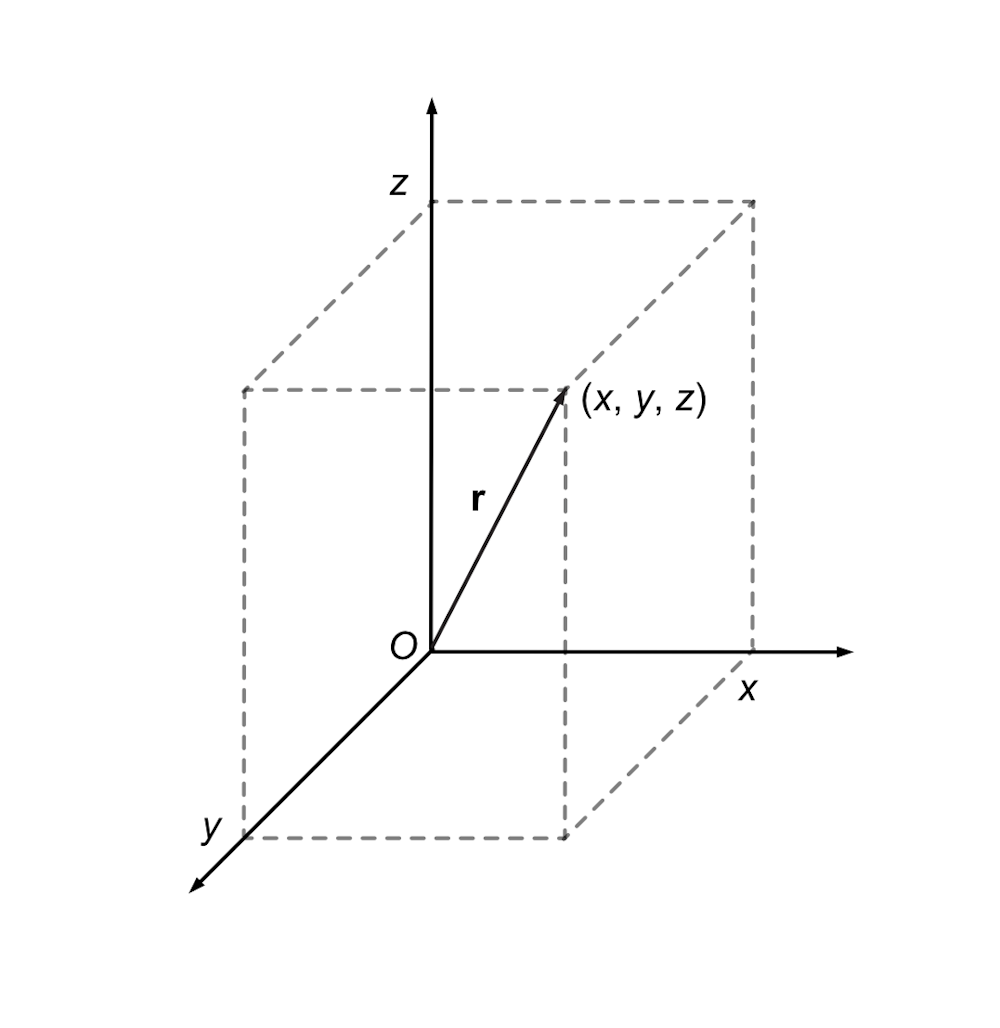
    A vector encodes two kinds of information at once, most famously the magnitude and direction of a spatial quantity such as force, velocity or relative position. For instance, to represent an object’s position (x, y, z) relative to the “origin” (the zero point of the position axes), Hamilton visualised an arrow pointing from the origin to the object’s location. The arrow represents the “position vector” x i + y j + z k.

    This vector’s “components” are the numbers x, y and z – the distance the arrow extends along each of the three axes. (Other vectors would have different components, depending on their magnitudes and units.)

    A vector (r) is like an arrow from the point O to the point with coordinates (x, y, z).
    The Conversation, CC BY

    Half a century later, the eccentric English telegrapher Oliver Heaviside helped inaugurate modern vector analysis by replacing Hamilton’s imaginary framework i, j, k with real unit vectors, i, j, k. But either way, the vector’s components stay the same – and therefore the arrow, and the basic rules for multiplying vectors, remain the same, too.

    Hamilton defined two ways to multiply vectors together. One produces a number (this is today called the scalar or dot product), and the other produces a vector (known as the vector or cross product). These multiplications crop up today in a multitude of applications, such as the formula for the electromagnetic force that underpins all our electronic devices.

    A single mathematical object

    Unbeknown to Hamilton, the French mathematician Olinde Rodrigues had come up with a version of these products just three years earlier, in his own work on rotations. But to call Rodrigues’ multiplications the products of vectors is hindsight. It is Hamilton who linked the separate components into a single quantity, the vector.

    Everyone else, from Isaac Newton to Rodrigues, had no concept of a single mathematical object unifying the components of a position or a force. (Actually, there was one person who had a similar idea: a self-taught German mathematician named Hermann Grassmann, who independently invented a less transparent vectorial system at the same time as Hamilton.)

    Hamilton also developed a compact notation to make his equations concise and elegant. He used a Greek letter to denote a quaternion or vector, but today, following Heaviside, it is common to use a boldface Latin letter.

    This compact notation changed the way mathematicians represent physical quantities in 3D space.

    Take, for example, one of Maxwell’s equations relating the electric and magnetic fields:

    ∇


    ×


    E


    = –∂
    B
    /∂

    t

    With just a handful of symbols (we won’t get into the physical meanings of ∂/∂t and ∇ ×), this shows how an electric field vector (E) spreads through space in response to changes in a magnetic field vector (B).

    Without vector notation, this would be written as three separate equations (one for each component of B and E) – each one a tangle of coordinates, multiplications and subtractions.

    The expanded form of the equation. As you can see, vector notation makes life much simpler.
    The Conversation, CC BY

    The power of perseverance

    I chose one of Maxwell’s equations as an example because the quirky Scot James Clerk Maxwell was the first major physicist to recognise the power of compact vector symbolism. Unfortunately, Hamilton didn’t live to see Maxwell’s endorsement. But he never gave up his belief in his new way of representing physical quantities.

    Hamilton’s perseverance in the face of mainstream rejection really moved me, when I was researching my book on vectors. He hoped that one day – “never mind when” – he might be thanked for his discovery, but this was not vanity. It was excitement at the possible applications he envisaged.

    A plaque on Dublin’s Broome Bridge commemorate’s Hamilton’s flash of insight.
    Cone83 / Wikimedia, CC BY-SA

    He would be over the moon that vectors are so widely used today, and that they can represent digital as well as physical information. But he’d be especially pleased that in programming rotations, quaternions are still often the best choice – as NASA and computer graphics programmers know.

    In recognition of Hamilton’s achievements, maths buffs retrace his famous walk every October 16 to celebrate Hamilton Day. But we all use the technological fruits of that unassuming graffiti every single day.

    Robyn Arianrhod does not work for, consult, own shares in or receive funding from any company or organisation that would benefit from this article, and has disclosed no relevant affiliations beyond their academic appointment.

    – ref. Three letters, one number, a knife and a stone bridge: how a graffitied equation changed mathematical history – https://theconversation.com/three-letters-one-number-a-knife-and-a-stone-bridge-how-a-graffitied-equation-changed-mathematical-history-241034

    MIL OSI Analysis – EveningReport.nz –

    January 23, 2025
  • MIL-OSI USA: Artwork featuring materials from nature on display at the Atrium Gallery at One Capitol Hill through Jan. 22

    Source: US State of Rhode Island

    Providence, RI� The Rhode Island State Council on the Arts (RISCA) announced today that works by three Charlestown-based artists Robin Spears Jr., Narragansett Indian Tribe citizen, his cousin, River Spears, Narragansett member, and Mikala Jackson, Kutzudika’a Paiute, Paiute Shoshone member, are currently on display in the Atrium Gallery at One Capitol Hill. The exhibition, Indigenous Innovations, features traditional artwork utilizing natural materials from the eastern woodland and coastal landscape.

    The Opening Reception — and an opportunity to meet the artists � will be on Wednesday, Oct. 30, 5 p.m. – 7 p.m., in the Atrium Gallery, first floor of the state’s Administration Building, One Capitol Hill, Providence. The reception is free and open to the public.

    Official Bios (provided by the artists)

    Robin Spears Jr. is a hunter, fisherman and gatherer. He uses these gifts of the earth to create. He grew up in a family of stone masons and has spent more than 35 years doing the art of stonework. Lieutenant Spears is an Environmental Police Officer for the Narragansett Tribe, caring for the land and its resources. He especially enjoys working with antler, cedar, turtle shells, bone, stone, wampum and other natural materials to create dance sticks, fans, pipes, rattles and other pieces of art. He is inspired by nature, his family, and his Narragansett culture.

    River Sokenun Spears, Robin’s cousin, a Narragansett Tribal citizen, is a self-taught wampum jewelry artist and flint knapper. Drawing inspiration from the natural world, he gathers resources from the land to create traditional Indigenous weapons, projectile points, and jewelry that honor his heritage. Influenced by his Uncle Craig Spears Sr. and skilled craftsman Alan Hazard, River sculpts wampum into intricate pieces that tell stories of his people and culture. His passion for preserving tradition extends to flint snapping, where the crafts arrow points from flint, chert, obsidian, glass, dacite, and quartz. Currently, he is an apprentice under Spears Jr. through RISCA’s Folk Art Fellowship Program.

    Mikala Jackson is an indigenous 28-year-old self-taught artist. A descendent of Kutzudika’a Paiute from Mono Lake, California, as well as Paiute Shoshone from Fort McDermitt, Nevada. Her most significant inspirations come from her family and culture. Being an indigenous woman during this present time has encouraged her to explore her own identity and aims to encourage others to do the same. In 2022, she was invited to participate in the side-by-side art exhibit of Warwick center for the arts and was awarded third place. Today she continues working on her craft and often attends art markets where she sells her artwork and more.

    All the artists reside in Charlestown.

    Exhibit Details

    What: Indigenous Innovations showcases the artwork of Robin Spears Jr. and two emerging artists. When: On display until Jan. 22; open to the public, weekdays 8:30 a.m.-4:30 p.m. Where: First floor of the state’s Administration Building, One Capitol Hill, Providence. Opening Reception and Meet the Artist: Wednesday, Oct. 30, 5 p.m.-7 p.m., Atrium Gallery, One Capitol Hill, Providence. Free and open to the public.

    MIL OSI USA News –

    January 23, 2025
  • MIL-OSI USA: BIRD IN HAND – Shapiro Administration to Announce $3.4 Million for Stream and Watershed Restoration Projects

    Source: US State of Pennsylvania

    October 16, 2024 – Bird in Hand, PA

    ADVISORY – BIRD IN HAND – Shapiro Administration to Announce $3.4 Million for Stream and Watershed Restoration Projects

    The Pennsylvania Department of Environmental Protection (DEP) will announce more than $3.4 million in grants to projects to improve water quality and fish and wildlife habitat throughout Pennsylvania’s part of the Chesapeake Bay watershed and other watersheds.

    DEP will be joined by EPA Regional Administrator Adam Ortiz and representatives from the Lancaster County Conservation District.

    WHAT:
    DEP announcing $3.4 million in watershed restoration grants

    WHEN:
    Wednesday October 16; 1:00 PM

    WHERE:
    2557 Old Philadelphia Pike, Bird in Hand, PA 17505

    For more information, visit the Pennsylvania Department of Environmental Protection’s website, or follow DEP on Facebook, X (formerly Twitter), or LinkedIn.

    MEDIA CONTACT: DEP Newsroom, RA-EPNEWS@pa.gov

    MIL OSI USA News –

    January 23, 2025
  • MIL-OSI Economics: DG Okonjo-Iweala: Members need to “continue to be constructive” to achieve outcomes

    Source: World Trade Organization

    “We need to continue to be constructive and to keep in our sights that we are here to achieve outcomes,” DG Okonjo-Iweala told members, citing positive discussions on several issues under negotiation.

    On agriculture, the DG said she was grateful for the positive discussion that took place at the Trade Negotiations Committee meeting on 10 October, which focused on advancing the agriculture negotiations.

    The DG said she, the General Council chair — Ambassador Petter Ølberg (Norway) — and the chair of the agriculture negotiations — Ambassador Alparslan Acarsoy (Türkiye) — would be meeting with members shortly in order to respond to some of the questions posed during the meeting and find an agreement on a process for moving the negotiations forward.

    “We can’t accept this important negotiation to be stalemated,” the DG said. “It’s been so for two and a half decades … let’s try and take it very seriously and find a way through.”

    On fisheries subsidies, the DG welcomed progress on acceptances of the Agreement on Fisheries Subsidies concluded in 2022 and noted that only 25 more acceptances are needed to ensure entry into force of the Agreement, with a number of additional acceptances expected in the days and weeks ahead. 

    She also underlined that members were “almost there” with regards to a deal on the second part of the Agreement, which aims to address subsidies contributing to overcapacity and overfishing.  “There are some issues, not many, and some members who need more work to be done so that we can push towards a conclusion,” she said.

    On development, the DG said she was happy that the work has resumed on special and differential treatment proposals at an 11 October meeting of the Committee on Trade and Development. To keep up the momentum and to work towards more concrete results, members should achieve as many results as possible in Geneva rather than waiting for the next Ministerial Conference, she told members.

    On dispute settlement reform, the DG noted that reform of the system was a “collective desire of every member in this room,” the importance of which was underlined at recent meetings of the Group of 20 foreign ministers and the UN General Assembly meeting in New York.

    She thanked the facilitator and co-coordinators of the reform talks for their efforts. “I hope we can continue to push along the work,” she said. “I know it’s not easy, and it requires a lot of listening, but slow and steady is what we need until we can get to where we want.”

    On investment facilitation for development (IFD), DG Okonjo-Iweala noted the continued discussions on the proponents’ request to incorporate the IFD Agreement into the WTO framework. The DG said she welcomed the tone of the exchanges at the General Council meeting and said she detected a “willingness to dialogue” and continue to find a solution among the membership.

    Share

    MIL OSI Economics –

    January 23, 2025
  • MIL-OSI USA: Congressman Nickel Urges Congress to Reconvene and Fund FEMA Relief Efforts

    Source: United States House of Representatives – Congressman Wiley Nickel (NC-13)

    Congressman Nickel Urges Congress to Reconvene and Fund FEMA Relief Efforts

    Washington, September 30, 2024

    Today, in response to the widespread devastation caused by Hurricane Helene, Congressman Wiley Nickel (NC-13) issued the following statement calling for urgent Congressional action:

    “With the severe damage from Hurricane Helene, Congress must return to Washington and pass a supplemental funding package to fully support FEMA ‘s efforts,” said Congressman Nickel. “This funding is critical to ensure FEMA has the resources necessary to provide lifesaving assistance to communities in need.”

    “Unfortunately, the budget designed by Speaker Johnson failed to include provisions for disaster relief funding. FEMA cannot risk running out of funds while responding to a natural disaster of this magnitude. We must act quickly and in a bipartisan manner to get this done for the American people.”

    MIL OSI USA News –

    January 23, 2025
  • MIL-OSI Australia: Inglewood celebrates momentous 160th anniversary

    Source: Victoria Country Fire Authority

    Joe Watts and CFA board member Beth Davidson OAM reveal the Inglewood tanker’s new name

    Inglewood Fire Brigade marked a significant milestone over the weekend, celebrating its 160th anniversary with a special dinner to honour its long-serving members.

    The event, held at Inglewood Golf Club, featured the naming of the brigade’s two trucks. They were dedicated to Joe Watts, who served for 55 years, and former Captain Brian Rodwell. 

    Inglewood Fire Brigade Captain Andrew Smith said the event was a fitting tribute to all past and present members who have served the community since 1864. 

    “It’s hard to put into words what the 160th anniversary means to the town, and the celebrations certainly lived up to expectations,” Andrew said.  

    “Recognising the contributions of Joe and Brian was a highlight for us all.” 

    A particularly poignant moment came when the family of former member David Dowler accepted his CFA life membership on his behalf.  

    David, who dedicated a combined 32 years of service to the Inglewood and Maldon fire brigades, sadly passed away shortly before the event. 

    “Dave was always first to the station when the pager went, and first to put up his hand for strike team duties,” Andrew said. 

    “He has been an integral part of the Inglewood brigade for several years and his sudden passing has affected the entire team. 

    “Dave’s guidance and sense of humour will be sadly missed. 

    “We were privileged to have members of Dave’s family attend our 160th celebration.” 

    Additional recognition included CFA life memberships for John Little (35 years) and David Patterson (30 years). Service awards, ranging from five-year certificates to 50-year medals, were also presented. 

    Andrew, who has been with the brigade for 18 years and served as captain for eight, expressed his pride in leading the brigade through such a significant occasion. 

    “It’s an honour to lead the brigade at such an important time in its history,” he said.  

    “Living in a small country town and being part of the CFA is about giving back to the community.” 

    Established in 1864, following a meeting of 150 locals at the Royal Hotel in Inglewood, the brigade operated from its Grant Street station for 154 years before moving to a new station on Southey Street in 2019. 

    “We’ve been fortunate to move into a brand new station, and we’ve recently added a new heavy tanker,” Andrew said.  

    “The old station, designed for horse-drawn vehicles, will always be part of our history, but the new facility is a huge boost.” 

    Inglewood itself was devastated by a fire in 1862, two years before the brigade was formed. The townspeople managed to stop the fire by tearing down buildings and ferrying water from a nearby dam. More recently, the brigade responded to a major shop fire on the town’s main street in late August this year. 

    With 30 members currently on the roster, Inglewood Fire Brigade is well positioned for its next 160 years, although Andrew said there is always room for more recruits. 

    “We’re always on the lookout for people willing to help protect their local community. If you’re interested, we’d love to hear from you.” 

    If you or anyone you know is interested in becoming a CFA volunteers, you can find out more here. 

    Submitted by CFA Media

    MIL OSI News –

    January 23, 2025
  • MIL-OSI USA: RELEASE: REP. HILL INTRODUCES LEGISLATION TO ADDRESS AMERICA’S HOUSING CRISIS

    Source: United States House of Representatives – Congressman French Hill (AR-02)

    WASHINGTON, D.C. – Rep. French Hill (R-AR) today introduced the Renewing Opportunity in the American Dream (ROAD) to Housing Act, which is designed to reverse decades of ineffective housing policies and implement targeted reforms to improve access to affordable, quality housing for all Americans. Senator Tim Scott (R-SC) recently introduced companion legislation in the Senate.

    Rep. Hill said, “Americans are struggling to find affordable housing to live in. For years, federal housing policy under the Biden-Harris Administration has been burdened by ineffective solutions and excessive bureaucracy. With the ROAD to Housing Act, we are taking real steps toward creating a housing market that benefits everyone—renters, homeowners, and families striving for stability. I thank my friend Senator Tim Scott for spearheading this legislation in the Senate and my colleagues Rep. John Rose, Rep. Dan Meuser, Rep. Scott Fitzgerald, Rep. Mike Lawler, and Rep. Zach Nunn for leading this legislation with me in the House.”

    Sen. Scott said, “I’m the son of a single mother – growing up, we lived with family until we were able to rent a small place of our own. I know firsthand the importance of access to quality, affordable housing. Unfortunately, Democrats’ solution for years has been to spend trillions on programs that have yielded little results, especially for minorities as homeownership rates for African Americans have barely changed in over 50 years. Costs to buy a home and to rent continue to increase, and homelessness is at record levels. It’s past time for Congress to take serious action to reverse decades of failed housing policies and put all Americans on the road to housing.” 

    Further Background:

    ROAD To Housing Act: This legislation offers a wide-ranging approach to reforming federal housing policy. The key pillars of this bill are to increase access to affordable housing, promote opportunity, incentivize local solutions, and ensure proper oversight and accountability over federal housing programs. Rep. John Rose (R-TN), Rep. Dan Meuser (R-PA), Rep. Scott Fitzgerald (R-WI), Rep. Mike Lawler (R-NY), and Rep. Zach Nunn (R-IA) are original co-sponsors of this legislation. 

    MIL OSI USA News –

    January 23, 2025
  • MIL-OSI Australia: Inflation Expectations – Why They Matter and How They Are Formed

    Source: Reserve Bank of Australia

    Introduction

    I would first like to pay respect to the traditional and original owners of this land, the Gadigal people of the Eora Nation, to pay respect to those who have passed before us and to acknowledge today’s custodians of this land. I also extend that respect to any First Nations people joining us here today.

    A low and stable inflation rate is critical to preserving macroeconomic stability. Having a good idea of what’s going to happen to prices allows businesses to plan for investment and expansion. It also makes things like budgeting and financial planning easier for households. This is particularly true for those on low incomes, who typically have smaller financial buffers than others and spend more of their income on essentials. And with more stable household and business balance sheets, the financial system is more stable.

    The experience of the last few years has clearly highlighted this. Everyone across the economy has felt the increased cost of living. This is very clear in the data we monitor, such as household spending, but it’s perhaps more apparent in survey metrics such as consumer confidence, which remains much lower than its pre-pandemic average (Graph 1). So there are a number of good reasons to bring inflation down and keep it at a low and stable rate.

    In addition to the tangible impact of elevated inflation today, central bankers often note that they want to make sure that inflation expectations remain anchored. But why is this the case? And what impact do current inflation outcomes have on expectations?

    Why do inflation expectations matter?

    Macroeconomists generally think that a prerequisite for consistently achieving low and stable inflation over time is well-anchored inflation expectations. That is, people across the economy believe inflation will generally average a low rate (in Australia’s case, 2–3 per cent), and they make decisions based on this underlying belief that becomes self-reinforcing. Indeed, this is a key lesson from economic history; there are multiple episodes that demonstrate the damage de-anchored expectations can cause, and the policy effort and welfare costs associated with re-anchoring them. Türkiye’s current experience is just one example (Graph 2).

    So why do expectations matter at all when it comes to economic outcomes? We think they matter because people don’t just make decisions based on what is happening today, they also factor in what they think will happen tomorrow. In other words, inflation expectations are at least partly self-fulfilling.

    For example, our decision over how much to save for retirement today is determined by how much income we think we’ll need once we stop working, and this is partly influenced by what we think will happen to prices between now and then.

    In addition to changing the behaviour of households, inflation expectations also directly feed into all of the decisions firms make – for example, over capital investment, pricing and staffing. One way this occurs is through the wage-setting process (Graph 3). This could be workers, or their union representatives, bargaining for higher wages if they think inflation will be higher. Or it could be firms’ expectations of higher future prices giving them the confidence to offer higher wages today to attract workers.

    And given that this is an investment conference, I’d be remiss not to mention how important inflation expectations are to the domestic and international portfolio allocation decisions made by financial market participants. These expectations then feed into long-term interest rates, exchange rates, and the prices of assets in our superannuation funds and all other investment portfolios. In short, inflation expectations are a factor in pretty much every economic decision that’s made every day.

    The fact that expectations feed into actual inflation outcomes means de-anchored expectations typically leads to greater inflation volatility (Graph 4). Volatility breeds uncertainty, and uncertainty makes decisions harder for everyone. As a business, how do you decide when it’s right to invest if you’re less sure of the financial returns? And to go back to the example of households deciding how much to save for retirement or to buy a home, a bout of unexpectedly high inflation is very hard to plan for. Both the effort required to make decisions with uncertainty, and that some otherwise good decisions will not be made, makes us all worse off.

    Tracking inflation expectations

    Given the enormous damage that such de-anchoring can cause, and that policy can be enacted more flexibly while expectations remain anchored, the RBA Board is constantly alert for signs that this risk might emerge here in Australia. It does that by tracking a range of inflation expectations measures, including multiple financial market measures, and surveys of households, unions and professional forecasters. That analysis indicates that inflation expectations have not become de-anchored through the current high-inflation experience (Graph 5).

    So we’re not currently concerned that expectations could become de-anchored in the near term. But we do think it’s important that we track how they’re evolving and that we understand how expectations are formed, so we can monitor whether there are any signs of this risk materialising in the future.

    As I’ve already alluded to, there are a number of different groups across the economy, and each plays a part in determining aggregate macroeconomic outcomes. To understand what’s happening to expectations, we therefore need to understand how different groups form their inflation expectations, as they each play critical roles in determining how the economy evolves over time.

    For consumption/savings decisions, households’ own expectations matter the most. For wage bargaining and competition for labour, unions’ and firms’ expectations likely matter most. And when it comes to how inflation expectations feed into long-term interest rates, it’s the financial markets’ expectations that matter.

    In short, given the importance of inflation expectations as a driving force of many economic decisions, we need to understand how all of the different groups across the economy form their inflation expectations so that we can do our best to keep them anchored.

    So today I’m going to discuss some of the latest research in this area, which we have conducted ourselves and in partnership with our colleagues in academia. This includes a Research Discussion Paper that has been released in parallel with this event, which explores some of the points below in more detail – I encourage you all to have a look at my colleagues’ work.

    The presentation I am giving today draws heavily on a presentation at one of the first ‘Policy Issues Meetings’ with RBA Board members earlier this year. As previously highlighted by Governor Bullock, these meetings:

    … assemble a group of staff with the right experience and expertise to give the members insights and diversity of perspectives on the key issues relevant for policy. It will provide analysis of issues that are relevant to a few upcoming [Board] meetings, not just the immediate one.

    These new meetings have been very well received by Board members. They have appreciated the opportunity to explore policy-relevant topics in more depth and to meet with more of the staff that are engaged in the work. In turn, staff have valued the additional engagement with their work, so it’s been a clear win-win.

    For most of this speech, I’ll be focusing on household and union expectations, and mostly on short-term expectations. In the past, how these groups form expectations has been less well-understood, and this is why we’ve focused our latest research here.

    But before turning to unions and households, it is worth mentioning that we have a reasonable understanding of how financial markets form expectations. Financial markets efficiently incorporate signals about the likely future direction of inflation into market prices; by taking active positions that are contingent on economic outcomes, it’s no surprise that market participants keep themselves very well-informed about what’s happening. From these prices, we can discern whether their short- and long-term expectations remain anchored to the RBA’s inflation target.

    To understand how households and unions form their expectations, we’ve collaborated with academic colleagues to develop a very general model approach that we’ve then applied to different data series. The model assumes that some people form their expectations by extrapolating from their previous experience. That is, they assume that their experience of price increases in the past are a good guide for what they’ll experience in the future. The model also assumes that some people build on this and take account of forward-looking information as well. For example, they might expect to see a sharp increase in grocery prices in the future if it’s reported that the harvest has been poor.

    The first iteration of the model was run through to around the middle of the pandemic. The graph shows the fit of the model to actual data. In the grey lines are unions’ one- and two-year-ahead expectations, and households’ one-year-ahead expectations (Graph 6). And then the blue lines are the model estimates of each of these.

    We think the model did a reasonable job over the historical period. Especially for unions, where the model pretty much captured every major wiggle in their expectations.

    We’ve learned a lot from this process, but there are three key insights that I want to highlight:

    1. We estimate that around three-quarters of households and unions form their expectations by extrapolating from their lived experience. That is, they observe what inflation was yesterday and compare it to what they expected. Every time inflation turns out higher than what these people expected, they partially adjust their expectations up.
    2. This extrapolation process happens a lot slower for households than it does for unions. That is, households only adjust their expectations a small amount each time they are surprised. As a result, inflation has to be persistently higher or lower than previously expected for expectations to change significantly.
    3. The remaining one-quarter of unions and households don’t just extrapolate, they incorporate a lot more of the broader economic information available to them (beyond inflation outcomes themselves) to make forward-looking judgements about where inflation is likely to go. In principle, this is similar to the RBA’s forecasting process – we look at past outcomes and forward-looking indicators to assess how we think inflation will evolve from today.

    Of the roughly 25 per cent who take on board additional information, this could come from a number of different sources. To carry on my groceries example from earlier, in 2011 this group might have expected that banana prices would shoot up in the months after Tropical Cyclone Yasi struck northern Queensland, given the reporting of the damage to that year’s crop. Or this group could be looking at economic forecasts – including the RBA’s – to get a sense of where inflation may be heading.

    With this better understanding of how people form their inflation expectations, we can now assess how they have evolved recently, relative to what the models expected they would do.

    Less extrapolation recently could reflect greater attention to inflation or recognition that the recent episode is temporary

    The orange line is the model’s prediction for how inflation expectations would evolve during the recent high-inflation period (Graph 7). While inflation was rising, expectations were evolving in-line with the model’s output. But the model suggested that the turning point in expectations would come later. So expectations are currently lower than our models thought would be the case.

    As best we can tell, the models missed the turning point because unions and households have been extrapolating less from the recent high inflation outcomes. The model attributes part of this to an increase in the share of people who take on board forward-looking information, from around one-quarter to over two-thirds for unions.

    This finding is consistent with a theory known as the ‘rational inattention’ hypothesis. The idea being that when inflation is low and stable, extrapolation from the past provides a reasonably accurate expectation of the future, so it is not worth paying more ‘attention’. Conversely, when inflation does not fit this pattern – for example, in the recent past when it was much higher – extrapolation might provide a poor forecast. So it is ‘rational’ for people to put more effort into thinking about where inflation will head next.

    Another finding from the model is that those who use previous inflation to form their expectations, that is they use yesterday’s experience to guide today, have been adjusting their view more slowly in recent years. A possible reason for this is that some people have seen the recent experience as atypical and so don’t expect it to continue – given the nature of the shocks (the pandemic and then the conflict in Ukraine), it’s easy to understand this. So while this group only use previous inflation outcomes to form their expectations, they do appear to adjust how much weight they put on specific outcomes to take account of broader economic conditions.

    Unfortunately, these are just plausible hypotheses at this point, we don’t have enough evidence to be definitive. If once inflation sustainably returns to the target band expectation formation reverts to how it was before the recent episode, that would provide further evidence in favour of these hypotheses. But more importantly, it would give us comfort that in future inflationary episodes, expectation formation might similarly change in a way that mutes the increase in expectations.

    Another possible explanation is that some more ‘salient’ prices have evolved differently to average prices

    In everything I’ve shown so far, we assume that the price increases that matter most are the ones that people spend most of their money on. Which is exactly how the Consumer Price Index, or CPI, is constructed.

    But that might not be how people extrapolate from what they have previously observed to form their expectations. Our lived experience is that we ‘see’ some prices much more frequently than others, and that some price changes are more noticeable than others.

    Prices that change regularly or that people pay often may be particularly influential when people form their expectations – they’re more visible, and they could be seen as a proxy for what’s happening to all prices across the economy. These are known as salient prices.

    While there are some obvious candidates for prices that may be salient – such as fuel, groceries, rent, and energy prices – determining how salient they are has unfortunately proven difficult.

    The strongest result we have obtained is with respect to petrol and diesel prices – that is, the prices you see changing every day when you drive past a petrol station or fill your car up. For other potentially salient prices, whether or not our models identify them as salient depends on the various other modelling decisions that are made. But for fuel prices, it doesn’t seem to matter what you do to the model, these prices almost always show up as salient.

    Having said all that, allowing for fuel to be a salient price in the model does not significantly change the model’s estimate of inflation expectations most of the time. This occurs because fuel prices are volatile and households learn slowly. So it actually takes an extended period of fuel prices evolving differently to other prices before there would be a meaningful impact on expectations (according to the model).

    But that’s exactly what we have seen in the past few years (Graph 8). From the beginning of 2021 until mid-2022, fuel price inflation was much higher than average price inflation, increasing 61 per cent over this period. But for most of the period since then, fuel price inflation has been around its historical average, while much of the broader consumption basket has continued to experience above-target price inflation.

    So, for household’s expectations, accounting for the salience of fuel prices can at least partially explain why the simpler inflation expectations model presented earlier predicted that short-term inflation expectations would remain higher for longer.

    Conclusion

    To conclude, recent research has improved our understanding of how people form inflation expectations. As a result, we have been able to better analyse how expectations have evolved during the recent high-inflation period. And it’s a good news story with respect to expectations:

    • Short-term expectations appear to be converging towards long-term expectations, and these have remained anchored through the recent past.
    • There’s no evidence of expectations being more persistent than normal.
    • And there’s even some evidence of households and unions extrapolating less from recent inflation, at least during the period of higher inflation.
    • We need to be mindful of certain prices that may be particularly ‘salient’ for households. But such prices work in both directions, and recently have been working to bring expectations down faster.

    References

    Afrouzi H and C Yang (2021), ‘Dynamic Rational Inattention and the Phillips Curve’, CESifo Working Paper No 8840.

    Ampudia M, MJ Lombardi and T Renault (2024), ‘The Wage-price Pass-through Across Sectors: Evidence from the Euro Area’, BIS Working Paper No 1192.

    Anesti N, V Esady and M Naylor (2024), ‘Food Prices Matter Most: Sensitive Household Inflation Expectations’, CFM Discussion Paper Series CFM-DP2024-34.

    Bazzoni E, M Jacob, S Land, M Mijer, J Moulton and S Welchering (2022), ‘European Consumer Pessimism Intensifies in the Face of Rising Prices’, McKinsey & Company, October.

    Beckers B and A Brassil (2022), ‘Inflation Expectations in Australia’, The Australian Economic Review, 55.

    Beckers B, A Clarke, A Gao, M James and R Morgan (2024), ‘Developments in Income and Consumption Across Household Groups’, RBA Bulletin, January.

    Bernanke B (2013), ‘A Century of US Central Banking: Goals, Frameworks, Accountability’, Journal of Economic Perspectives, 27(4).

    Binder CC (2017), ‘Measuring Uncertainty Based on Rounding: New Method and Application to Inflation Expectations’, Journal of Monetary Economics, 90.

    Binder CC (2018), ‘Inflation Expectations and the Price at the Pump’, Journal of Macroeconomics, 58.

    Blinder AS (1982), ‘The Anatomy of Double-Digit Inflation in the 1970s’, in Hall RE (ed), Inflation: Causes and Effects, University of Chicago Press, pp 261–282.

    Borio C, M Lombardi, J Yetman and E Zakrajšek (2023), ‘The Two-regime View of Inflation’, BIS Papers No 113.

    Brassil A, C Gibbs and C Ryan (forthcoming), ‘Boundedly Rational Expectations and the Optimality of Flexible Average Inflation Targeting’, RBA Research Discussion Paper.

    Brassil A, Y Haidari, J Hambur, G Nolan and C Ryan (2024), ‘How Do Households Form Inflation and Wage Expectations?’, RBA Research Discussion Paper No 2024-07.

    Bullock M (2023), ‘A Monetary Policy Fit for the Future’, Australian Business Economists Annual Dinner, Sydney, 22 November.

    Bullock M (2024), ‘The Costs of High Inflation’, Keynote Address to the Anika Foundation Fundraising Lunch, Sydney, 5 September.

    Charm T, JR Saavedra, K Robinson and T Skiles (2022), ‘The Great Uncertainty: US Consumer Confidence and Behavior during Inflationary Times’, McKinsey & Company, August.

    Chin M and L Lin (2023), ‘The Pass-through of Wages to Consumer Prices in the COVID-19 Pandemic: Evidence from Sectoral Data in the U.S.’, IMF Working Paper No 2023/233.

    Chua CL and S Tsiaplias (2024), ‘The Influence of Supermarket Prices on Consumer Inflation Expectations’, Journal of Economic Behavior and Organization, 219.

    Coibion O, Y Gorodnichenko, S Kumar and M Pedemonte (2020), ‘Inflation Expectations as a Policy Tool?’, Journal of International Economics, 124.

    D’Acunto F, U Malmendier, J Ospina and M Weber (2019), ‘Salient Price Changes, Inflation Expectations, and Household Behavior’, June.

    De Fiore F, T Goel, D Igan and R Moessner (2022), ‘Rising Household Inflation Expectations: What are the Communication Challenges for Central Banks?’, BIS Bulletin, No 55.

    Haidari Y and G Nolan (2022), ‘Sentiment, Uncertainty and Households’ Inflation Expectations’, RBA Bulletin, September.

    Hambur J and R Finlay (2018), ‘Affine Endeavour: Estimating a Joint Model of the Nominal and Real Term Structures of Interest Rates in Australia’, RBA Research Discussion Paper No 2018-02.

    Kilian L and X Zhou (2022), ‘Oil Prices, Gasoline Prices, and Inflation Expectations’, Journal of Applied Econometrics, 37(5).

    Maćkowiak B, F Matějka and M Wiederholt (2023), ‘Rational Inattention: A Review’, Journal of Economic Literature, 61(1).

    Moore A (2016), ‘Measures of Inflation Expectations in Australia’, RBA Bulletin, December.

    RBA (2024), ‘Box A: Are Inflation Expectations Anchored?’, Statement on Monetary Policy, August.

    Reiche L and A Meyler (2022), ‘Making Sense of Consumer Inflation Expectations: The Role of Uncertainty’, ECB Working Paper Series No 2642.

    Sims C (2003), ‘Implications of Rational Inattention’, Journal of Monetary Economics, 50(3).

    Suthaharan N and J Bleakley (2022), ‘Wage-price Dynamics in a High-inflation Environment: The International Evidence’, RBA Bulletin, September.

    Wood D, I Chan and B Coates (2023), ‘Inflation and Inequality: How High Inflation Is Affecting Different Australian Households’, Working paper prepared for the RBA Annual Conference, Sydney, 25–26 September.

    MIL OSI News –

    January 23, 2025
  • MIL-OSI Submissions: Australia – One week until Meet the Buyer: Facilitating business deals for WA’s food and beverage sector

    Source: ProntoPR.com.au

    There’s one week to go before the Buy West Eat Best trade show, ‘Meet the Buyer,’, which will be held at Crown on 22 October.

    Now in its fourth year, ‘Meet the Buyer’ is Western Australia’s largest and most diverse showcase of WA food and beverage businesses.

    Buy West Eat Best program manager Melissa Worthington said exhibitor space sold out in record time and there are delegate tickets still available.

    “The growth of ‘Meet the Buyer’ has been driven by the state’s agrifood business community and it’s always gratifying to hear the positive outcomes for suppliers and buyers,” Ms Worthington said.

    “It’s WA’s most important food and beverage trade show, and it’s the only event of its kind that brings together buyers, importers, chefs, sommeliers, media and educators under one roof for one day,” she said.

    Almost 70 percent of respondents to the 2023 ‘Meet the Buyer’ survey said their attendance had resulted in a positive commercial outcome, whether it was finding new stockists or simply gaining more knowledge about how to improve their chances of getting their products into the market or business to business connections.

    Chef Paul Lange, from Smokey Q rubs and sauces, connected with a Woolworths buyer at the inaugural ‘Meet the Buyer’ and went on to pursue opportunities with a Coles representative.

    “It’s really exciting for a smaller business to get that recognition from the larger players,” Mr Lange says.

    More than 80 percent of respondents said the trade show had enabled them to meet buyers or business contacts they had not met previously.

    Sweeter Banana Co-operative’s Doriana Mangili said Meet the Buyer has helped build relationships, opening up opportunities outside the event.

    “Over the years with one retailer we would just have a bit of a yarn and then this year we were invited to attend one of their trade shows. This wouldn’t have happened without us attending ‘Meet the Buyer’ each year and getting to know them,” Ms Mangili said.

    The inclusive atmosphere at ‘Meet the Buyer’ enables attendees to get to know one another in an informal setting, including at the sundowner event after the show. Many attendees have commented on the positive engagement with others and the joys of meeting new people and building their networks.

    For chefs like Blair Allen, from Amelia Park Restaurant in Wilyabrup in WA’s south west, ‘Meet the Buyer’ is also a great way to catch up with suppliers who he might only otherwise deal with over the phone or email.

    “Just putting faces to names was great – it just makes the whole ordering process easier,” Mr Allen said.

    ‘Meet the Buyer’ is also an ideas incubator, with so many people in the know at hand to offer suggestions and advice.

    Almost 40 percent of respondents to the 2023 survey said they had changed their business strategy, product range or packaging as a result of ‘Meet the Buyer’.

    One said they had introduced a couple of new lines, while another said they were customising products for WA companies.

    Chef Rob Nixon, from That Plant Café, said it’s great to see producers take suggestions on board.

    “It’s one of the best things I’ve ever been to,” Mr Nixon said.

    “As chefs, we’re so busy running our own restaurant that we would have a hard time going to see one or two small-batch producers, let alone 100 or so. Here, they are all under the one roof.”

    More than 92 percent of attendees said they would be returning to ‘Meet the Buyer’ in 2024.

    ‘Meet the Buyer’ will host more than 80 food and beverage exhibitors showcasing in excess of 550 products and is set to attract local, interstate and international visitors.

    For more information about Meet the Buyer, visit meetthebuyer.com.au.

    About Buy West Eat Best

    The Buy West Eat Best program is a voluntary food labelling and marketing initiative developed by the Western Australian Government to assist local food and beverage producers to promote their products to grocery shoppers and those that dine out.

    Buy West Eat Best works with members to support and promote the buy local message, highlight the importance of seasonality and champion delicious, fresh ranges of fruits and vegetables that grocery shoppers can seek out, particularly as new seasons commence.

    The program works across the supply chain, from producers, processors, retail, and foodservice businesses; providing a critical conduit to strengthen the resilience and sustainability of businesses and identify source of origin for consumers. There is a vast and diverse range of local businesses and brands that are members of the Buy West Eat Best community.

    When you see the distinctive Buy West Eat Best bite mark logo you can be assured that you are buying premium food that has been grown, farmed, fished, processed, prepared and served right here in WA.

    The program has matured, and it is vitally important to the State from an economic and employment perspective – the food and drink industry or agrifood sector is the second largest export sector to mining and resources and critical to the diversification and sustainability of local communities across the State.

    The Buy West Eat Best logo is a registered trademark owned by the Department of Primary Industries and Regional Development (DPIRD), administered by government and championed by business and industry.

    http://www.buywesteatbest.org.au

    MIL OSI – Submitted News –

    January 23, 2025
  • MIL-OSI USA: Month of Discovery: Nadine Noaman ‘26, Uncovering UConn Muslim History

    Source: US State of Connecticut

    The contributions of the Muslim community at UConn — from the Arabic language program, to partnerships with international universities, to the Muslim Student Association and the Islamic Center at UConn (ICUC) — are now so integral to the University that a newly arrived first-year student might not think twice about how they all came to be, says Nadine Noaman ’26 (CLAS).

    But Noaman knows exactly how much work went into creating today’s community.

    “The impact of these generations should not go unnoticed. We are part of UConn history,” she says.

    Noaman is currently producing a docuseries entitled “Tracing the Trailblazers: UConn’s Muslim Community, Accommodations, and Activism Journey,” funded by the UConn IDEA grant and UConn BOLD Women’s Leadership Network.

    The impact of these generations should not go unnoticed. We are part of UConn history.

    For the project, Noaman is collecting oral histories from alumni and students who span the last half-century of Muslim life at UConn. The earliest interviewees were doctoral students at UConn in the 1970s; the most recent are current undergraduates, Noaman’s peers.

    The series has three major aims, says Noaman: to preserve this rich community history, to highlight strides made by Muslims at UConn, and to track the impact of Muslim student activism on the university.

    For Noaman, this history is personal. She herself is a third-generation leader in UConn’s Muslim community: both her maternal grandparents received their PhDs from UConn in the 1980s, and her mother received a Pharm.D. from the school. (Her aunt and uncle are also alumni.)

    The UConn International House in the 1950s. (Jerauld A. Manter/Department of Archives & Special Collections/UConn Library)

    From the Ashes

    In late 2023, a fire destroyed the Whitney House on the edge of the UConn Storrs campus – an iconic white building near Mirror Lake that had variously served as UConn’s International House and the home of the Rainbow Center over the past 50 years. The house was dismantled after the University deemed it beyond repair.

    “One of the earliest memories that I have that sparked the idea [for ‘Tracing the Trailblazers’] was when my mom and I were passing by the International House when they were about to take it down,” Noaman remembers. “And she started to recall how impactful that building was on campus. She shared how there were communal prayers and Eid celebrations – so many initiatives and events took place there that brought communities together.”

    “It’s unfortunate that the building is no longer physically there,” she continues. “In that moment, I realized I want to honor and preserve the legacy and experiences of these past generations at UConn.”

    UConn’s Muslim students tabling at the International Fair in the 1980s. (Courtesy of Nadine Noaman)

    Though the International House is no longer standing, UConn’s Muslim community has found other venues for sharing space and strengthening community ties. The Islamic Center at UConn (ICUC) hosts daily prayers, holiday festivities, and weekly halaqas, or lecture circles, to discuss Islam-related topics. It also accommodates the Muslim Student Association (MSA), of which Noaman is the Islamic Education Chair.

    “I love when I have the opportunity to do tabling; I get to talk to other amazing Huskies on campus and clear up misconceptions about Islam or provide accurate knowledge,” she says.

    In addition, Noaman also currently works as a coordinator for UConn Salaam, a program within the Asian American Cultural Center. Salaam develops programming that increases accurate knowledge of Islam, strives to dismantle Islamophobia, and builds coalitions amongst various student organizations.

    Muslim community members participate in a weekly halaqa, 2024. (Photo by Nadine Noaman)

    What Changes, What Stays the Same

    MSA table set up for an event informing the student community about Muslim life (Photo by Nadine Noaman)

    As a prominent player in these spaces, Noaman was curious about how Muslim life at UConn had evolved from the experiences of her grandparents to her own. While working on “Tracing the Trailblazers,” she learned that the reasons for this evolution were twofold.

    There were societal issues: the early interviewees recalled hostile jokes about Muslims all living in the desert, while current students report having to counter misconceptions that Islam promotes violence. Though the trends changed over time, they all fall “under the same iceberg: lack of knowledge,” notes Noaman.

    Second, there was the dynamic way the UConn Muslim community advocated for their needs, encouraging the University to be a more positive and inclusive place. Community organizing and solidarity established more accommodations for Islamic worship and holidays for generations to come.

    Celebrating the Diversity of Islam

    By engaging with the stories in “Tracing the Trailblazers,” Noaman says, viewers will be able to appreciate a rich array of perspectives and backgrounds.

    “There is such diversity in our Muslim community – in one Friday prayer, we realized that we had over 40 different nationalities represented,” she says.

    Muslim Huskies go on to make a difference for the University and the world, contributing in diverse ways, too.

    “We are a religion of peace,” says Noaman. “There’s a strong emphasis on being active in our community and helping others. So, many of my friends are in fields like healthcare and engineering because they want to embody those specific Islamic values.”

    Editing “Tracing the Trailblazers.” (Courtesy of Nadine Noaman)

    Noaman herself (who is double-majoring in Psychological Sciences and Spanish) wants to go into education – a field for which her coursework, student leadership, and independent research have well prepared her.

    Once complete, “Tracing the Trailblazers” will be available to stream online, and Noaman hopes to be able to host an on-campus premiere as well. She extends her gratitude to God, as well as her family, peers, and the BOLD network and IDEA grant team who supported this independent project.

    Having the funding was “affirming and motivating, and it gave me the resources to be detailed in the research aspect,” Noaman says. “I’ve done traditional research before, but embarking on this project has expanded my understanding of what I see as research, and so I’m grateful for this experience – times a gazillion-fold.”

    Month of Discovery

    October is the Month of Discovery, when undergraduates are introduced to the wealth of research and innovation opportunities at UConn. This month, enjoy profiles of outstanding undergraduate innovators on UConn Today, attend a full slate of programming on campus and online, and register for Discovery
    Quest to launch your undergraduate experience to new heights.

    Students interested in learning more about research and innovation opportunities at UConn can check out the series of events offered as part of the Month of Discovery. Come to Research Connections on Thursday, Oct. 10, to learn how to get involved in UConn research. The Experience Innovation Expo at the Werth Institute is a great opportunity to get inspired and discover the wide range of programs for entrepreneurship, innovation, and creativity at UConn.

    MIL OSI USA News –

    January 23, 2025
  • MIL-OSI USA: A Congress.gov Interview with Wade Ballou, the Legislative Counsel of the House of Representatives

    Source: US Global Legal Monitor

    Today’s interview is with Wade Ballou, the Legislative Counsel of the House of Representatives.

    As Legislative Counsel, Wade Ballou oversees the House Office of the Legislative Counsel (HOLC). HOLC provides legislative drafting services to the committees and Members of the House of Representatives on a nonpartisan, impartial, and confidential basis.

    Recent recognition of Wade’s service to Congress includes the 2024 Democracy Award for Lifetime Achievement by Congressional Staff and exceptional leadership and contributions, including through the development of the Comparative Print Suite for the U.S. House of Representatives. 

    Describe your background.

    I am from Roanoke, Virginia. During my youth I was active in sports, Scouting, and the YMCA. I earned a B.S. in forestry (industrial forestry operations with cooperative education certificate) from Virginia Tech in 1980. At Tech, I was active in Alpha Phi Omega. APO is the coed national service fraternity affiliated with Scouting. I met my wife in APO. We’ve been married for 41 years and have two married sons and two grandchildren. I am an Eagle Scout and have served as an adult leader in Scouting, both as cubmaster and scoutmaster.

    What is your academic/professional history?

    After Virginia Tech, I went to the University of Virginia School of Law and earned a J.D. in 1983. I joined the Office of the Legislative Counsel, U.S. House of Representatives in the fall of 1983, where I am presently employed. The Office is a non-partisan, career office responsible for drafting legislation for the House, its committees, members, and leadership. After completing training, during which I drafted federal law generally, I worked with foreign affairs legislation. Due to needs of the Office, in 1986, I moved into the areas of Native American issues (including health care and land claims), federal land issues (including natural resources, water reclamation and irrigation, public lands, and forestry), and intelligence, and later picked up parts of veteran’s affairs. In 1996, I changed to the tax team, again due to the needs of the Office. As a member of the team, I drafted in all areas of federal tax law, specializing in pensions, health care, bonds, and excise taxes. Alongside of tax, I have worked in public debt, ERISA, health care, and social security.

    I earned a graduate certificate in spiritual direction studies from Washington Theological Union in 2013 and a certificate in spiritual formation from the Avila Institute in 2015.

    In 2016, I was appointed the 8th Legislative Counsel of the House of Representatives, effective August 1. During my time as the head of the Office, there has been significant change in both the House and the Office, including a 45% increase in the number of attorneys and a significant increase in demand for draft legislation. The Office now has some 90 personnel, including 68 attorneys. Some of the changes include improving the recruiting system and modifying the training methodology for new attorneys and transitioning the Office to a new Sharepoint site and digital leave management system.

    I have also been fortunate to be able to work with other institutions in the legislative branch, especially through participation in the Congressional Data Task Force. This includes:

    1. Partnering with the Clerk of the House and the Government Publishing Office to develop and update the Comparative Print Suite, a software tool that provides on-demand comparisons of how a bill changes law, how amendments change a bill, bill-to-bill differences, and a bill viewer; and

    2. Working to provide educational opportunities concerning the legislative process and drafting software applications.

    How would you describe your job to other people?

    My official job title is Legislative Counsel of the House of Representatives. The fun way to describe my job is that I am responsible for producing paper for the House. This is a throwback to my forestry days where the job of a procurement forester is to ensure that the mill never runs out of timber.

    Additionally, I meet with members and staffs of parliaments around the world to discuss and share ideas for improvements in legislative process and drafting. These opportunities include working through the House Democratic Initiative, the National Democratic Institute, and the International Republican Institute. I am an associate member of the Commonwealth Association of Legislative Counsel and a frequent speaker and contributor to webinars on improving legislative drafting organized by Bússola Tech, an international leader in this arena.

    What is your role in the development of Congress.gov?

    I do not think of this as a role, but I brought to the attention of Congress.gov various research and document needs that are useful to drafters. They developed features to meet those needs. It is interesting to me that most of my draft files are on Congress.gov in the form of bills and resolutions.

    What is your favorite feature of Congress.gov?

    Well, there are two features that I use a lot. Whenever a drafting request requires beginning with a public version of a bill or resolution (introduced, reported, passed, etc.), we begin with the version that is posted on Congress.gov in the XML format. So, the download feature that allows me to save this version on my computer system is a big hit for me. In addition, I use the tables of public laws and appropriations a lot. I will get to these either from links on the website or from searches and filters.

    What is the most interesting fact you’ve learned about the legislative process while working for Congress?

    Ha. The legislative process happens. Sometimes it is textbook. Sometimes it is a bit convoluted. Sometimes a bill is conferenced before it is introduced. But, the formal steps are acknowledged, even if it is by discharge or unanimous consent. So, it is important to know the ideal path to how a bill becomes law so that you can place a question in the context of this ideal.

    What’s something most of your co-workers do not know about you?

    During high school and college, I was a member of forest fire fighting teams. Today we would call these wildland fire teams.


    Subscribe to In Custodia Legis – it’s free! – to receive interesting posts drawn from the Law Library of Congress’s vast collections and our staff’s expertise in U.S., foreign, and international law.

    MIL OSI USA News –

    January 23, 2025
  • MIL-OSI Global: ‘Childless cat ladies’ is a political catchphrase that doesn’t match reality − Democrats and Republicans have similar demographics and experiences when it comes to parenthood

    Source: The Conversation – USA – By Laurel Elder, Professor of Political Science, Hartwick College

    Republicans and Democrats tend to have children at around the same rates and ages and to view parenthood in a similar way. iStock / Getty Images Plus

    Republican vice presidential candidate JD Vance infamously said in 2021 that the Democratic Party is run by “a bunch of childless cat ladies who are miserable at their own lives and the choices they’ve made” – and do not have a “direct stake” in the future of the United States.

    Three years later, after Vance’s selection as Trump’s vice presidential pick, these comments resurfaced and quickly became a cultural touchstone.

    In July 2024, Vance clarified his controversial comments, saying that what he meant was that the Democratic Party has become anti-family and anti-child.

    At a September 2024 campaign event alongside Donald Trump, Arkansas Gov. Sarah Huckabee Sanders echoed Vance’s sentiments about Democrats being anti-family. “My kids keep me humble. Unfortunately, Kamala Harris doesn’t have anything keeping her humble,” she said.

    The single cat lady theme was amplified further when singer Taylor Swift used it to sign off on her Instagram endorsement of Harris.

    While the cat lady framing is new, politicians making parenthood and family a centerpiece in their appeals to the American public has a long history.

    As we show in our 2012 book, “The Politics of Parenthood,” and subsequent research, politicians have been using messages about parenthood as a way to appeal to voters since the 1980s. eg: link wouldn’t work for me

    Content analysis of party platforms and speeches by presidential candidates reveals that both parties have devoted more and more time and space to making the case that they are the true pro-family party. Republicans argue that lower taxes and smaller government strengthen American families, while Democrats argue that strengthening social welfare programs represents the best way to support families.

    Despite the parties’ contrasting pro-family messages and the image conjured by Vance’s childless cat lady comments, Republicans and Democrats are not really that different when it comes to their actual experiences having and raising children.

    Our analysis shows that the age at which Americans have children, how many children they have and whether parents work outside the home are surprisingly similar across partisan lines.

    A woman attends a CatCon event in Pasadena, Calif., in August 2024 and wears a ‘Childless cat ladies for Kamala’ shirt.
    Genaro Molina/Los Angeles Times via Getty Images

    Democrats and Republicans find parenting rewarding

    To explore whether there are differences between Republicans and Democrats in terms of their families, we analyzed data from the 2022 General Social Survey, which had 4,149 respondents. GSS is a nationally representative and well recognized survey of American adults that has been conducted since 1972. We also analyzed data from a 2022 Pew survey of 3,757 mothers and fathers focused on parenting in America.

    This data shows that both Republicans and Democrats deeply value their roles as parents. In the Pew survey, 87% of parents said that their role as a parent is the most important or one of the most important aspects of their identity. Our analysis shows this is true for parents in both parties – 86% of Democrats and 88% of Republicans said they value their role as parents as the most or one of the most important aspects of their identity.

    Similarly, our analysis of the Pew data reveals that Democrats and Republicans both enjoy being parents – 84% of Republicans say they find parenting enjoyable most or all of the time, compared with 81% of Democrats.

    That said, contemporary parenting is also challenging.

    The 2022 Pew survey showed that 29% of parents describe raising children as stressful most or all of the time. And 42% of parents report that raising children is tiring all or most of the time. Our analysis shows that this is equally true for Republicans and Democrats.

    Indeed, the stresses of modern parenthood led the U.S. surgeon general in August 2024 to issue a public health advisory about parents’ declining mental well-being.

    One of the reasons for this stress is that most parents today are balancing parenthood with work. The Republican Party has long embraced “traditional marriage,” meaning a marriage between a man and a woman, where the mother stays home to raise the children. Yet the reality is that most moms have jobs outside the home. In our analysis of the 2022 Pew data, we find that about the same portion of Republican moms – 67% – work outside the home as Democratic moms, who totaled 69%.

    Both Republican and Democratic moms do more parenting

    Another way that the experience of parenthood is similar across partisan lines is that moms spend more time parenting than dads. Pew asked parents with partners and spouses about the division of labor around a variety of child care tasks in 2022.

    In our analysis of the full set of this data, which Pew provided us, we found that 77% of Democratic mothers and 80% of Republican mothers report doing more than their spouse or partner when it comes to managing their children’s activities. And 60% of Democratic mothers and 58% of Republican mothers report providing more comfort and emotional support to their children than their spouses or partners do.

    This may account for why the Pew data reveals that mothers, more so than fathers, report parenting being tiring most or all of the time – 47% for moms, compared with 34% for dads. Once again, our analysis shows that mothers’ higher levels of fatigue hold true for both Republican and Democratic mothers compared with Republican and Democratic dads.

    To assess the demographics of parenthood, we analyzed the 2022 General Social Survey data and found that Republicans and Democrats start their families at a similar age, just as they did a decade ago.

    On average, male and female Democrats are 26 when they have their first kid, while Republicans are 25. Higher levels of education are associated with starting families later, but this is true for those in both parties.

    Looking at women specifically, we find that Democratic women have their first child at 25 years old, and Republican women at 24. There is no evidence that Democratic women – more so than Republican women – are delaying having children so that they can pursue their careers, as suggested by Vance and Sanders in their critiques of the Democratic Party and Harris specifically.

    It is true that Americans are having fewer children compared with a few decades ago. But this drop in having children is nearly universal in high-income democracies, even despite some government policies that seek to increase the birth rate in the U.S.

    Our analysis reveals that the gap between Republicans and Democrats on this issue is modest. On average, Democrats are having 1.53 children, compared with 1.86 for Republicans.

    And the 2022 General Social Survey data shows that Democrats do report having no children at a modestly higher rate than Republicans, but it is men – more than women – who report being childless at higher rates. Among Americans over 40, 22% of Democratic men and 16% of Republican men have no kids, compared with 17% of Democratic women and 10% of Republican women.

    Despite political rhetoric suggesting there is a deep partisan divide among Americans on issues of families and child-rearing, the data tells a different story. It paints a picture of Americans, whether Democrats or Republicans, as remarkably similar in the basic demographics of parenting, as well as in their views about the joys and challenges of parenthood.

    The authors do not work for, consult, own shares in or receive funding from any company or organization that would benefit from this article, and have disclosed no relevant affiliations beyond their academic appointment.

    – ref. ‘Childless cat ladies’ is a political catchphrase that doesn’t match reality − Democrats and Republicans have similar demographics and experiences when it comes to parenthood – https://theconversation.com/childless-cat-ladies-is-a-political-catchphrase-that-doesnt-match-reality-democrats-and-republicans-have-similar-demographics-and-experiences-when-it-comes-to-parenthood-238960

    MIL OSI – Global Reports –

    January 23, 2025
  • MIL-OSI Global: Color complexity in social media posts leads to more engagement, new research shows

    Source: The Conversation – USA – By Vamsi Kanuri, Associate Professor of Marketing, University of Notre Dame

    If you work in digital marketing, you don’t need to be told a picture’s worth a thousand words. More than half of content marketers say images are crucial for achieving their social media goals, and a staggering 70% of users prefer image-based posts over text, surveys have found.

    But which types of visuals work best? While anecdotal evidence abounds, systematic research on this topic is scarce.

    As a professor of business who knows the issues social media managers face while picking images for their posts – and who collected thousands of Facebook posts from two organizations in different industries – I saw an opportunity.

    Pigments and pixels

    Together with my colleagues Christian Hughes and Brady Hodges, I looked at what researchers call “color complexity.”

    Color complexity is similar to colorfulness, but it’s not quite the same: It’s measured as color variation across pixels in an image, and our brains process it subliminally. The more the brain has to decipher color variations across neighboring pixels, the harder it has to work.

    Fortunately, advanced computer vision technology makes it easier than ever to measure color complexity, and biometric eye-tracking makes it possible to see what images grab people’s attention in real time.

    We conducted four studies, looking at both real-world Facebook posts from two firms and experimental data using biometric eye-tracking. On the whole, we found that more complex images in social media posts tended to capture greater attention.

    However, there were some caveats.

    For instance, posts made later in the day and those with images that took up more screen space tended to benefit more from color complexity. This suggests that the timing and visual prominence of posts play a role in maximizing engagement.

    In addition, when images were paired with negative, feel-bad text, color complexity made less of a difference.

    We also found that pairing images with complex texts can actually strengthen the link between color complexity and user engagement. This surprising finding suggests that more intricate language might encourage people to pay more attention to the images.

    The complexities of color

    The importance of color in marketing, and its influence on everything from brand perception to purchase intentions, has long been well documented. Much less is known, however, about the role of color complexity in social media engagement. Our research is beginning to fill that gap.

    Overall, our findings underscore the importance of strategic image design in social media marketing. They suggest that a nuanced approach to image design, incorporating high color complexity where appropriate, can significantly enhance user engagement.

    For marketers and content creators, the implications are clear: Investing in the careful curation of social media images, especially those with high color complexity, can lead to better user engagement. Just be mindful of the timing and context, too.

    Vamsi Kanuri works for the University of Notre Dame.

    – ref. Color complexity in social media posts leads to more engagement, new research shows – https://theconversation.com/color-complexity-in-social-media-posts-leads-to-more-engagement-new-research-shows-240980

    MIL OSI – Global Reports –

    January 23, 2025
  • MIL-OSI Global: How profits from big pharma’s use of genetic information could revolutionise nature conservation

    Source: The Conversation – UK – By Eleanor Jane Milner-Gulland, Tasso Leventis Professor of Biodiversity, University of Oxford

    The blood of rare horseshoe crabs is sometimes used in the development of vaccines. Sinhyu Photographer/Shutterstock

    The blue blood of threatened horseshoe crabs contains a chemical essential for testing the safety of vaccines. So these ancient creatures are highly sought after by pharmaceutical companies worldwide, contributing to declines in their populations.

    While species are disappearing at alarming rates, with a global biodiversity financing gap of US$600 billion to US$800 billion (£460 billion to £610 billion) annually, the genetic information of rare plants and animals is a commercially valuable resource.

    Advances in technology now allow the rapid sequencing and sharing of genetic data, bringing huge benefits (and profits) for biotechnology and medicine. However, it also opens the door to “biopiracy”: the unethical or unlawful appropriation of biological resources, typically from countries or Indigenous communities in developing countries.

    Even if genetic information is obtained and used appropriately and within the law, important ethical, legal and financial questions still arise: who owns the genetic data derived from nature, and how can we ensure fair sharing of the benefits derived from their use?

    A key debate at Cop16, the upcoming UN biodiversity conference, will be how best to channel funding into protecting valuable biological resources. If done properly, people can benefit from the genetic information that nature contains, while ensuring that those conserving these resources, particularly Indigenous people, are properly compensated financially for their efforts.

    Our recent paper argues that rules of fair allocation, which have been around since the time of Aristotle, offer a potential way forward.

    Genetic information extracted from living organisms can now be easily digitised and shared across borders. This practice, often referred to as digital sequence information (DSI), plays a pivotal role in advancing research in fields such as medicine, agriculture and environmental science.

    For example, the genome of the COVID-19 virus was digitally sequenced and shared globally, enabling researchers worldwide to use that DSI to develop vaccines quickly.

    Yet, this leads to ethical and legal challenges. The genetic codes of plants and animals from all over the world are stored in international databases, often without proper acknowledgement or compensation to the countries or communities where these sequences originated.

    Countries with rich biodiversity, particularly in developing countries, have raised concerns that their genetic resources are being used – and in some cases monetised and commercialised – without approval or fair compensation. Indigenous peoples and local communities have similar concerns.

    So, who owns genetic data? It depends.

    The ownership of genetic data derived from plants and animals has become a grey area. In theory, countries have sovereignty over their biodiversity, as stipulated in an international agreement adopted in 2010 called the Nagoya protocol. This mandates that countries sharing their biological resources should be compensated through access and benefit-sharing agreements.

    Genetic codes of rare plants aren’t currently owned by their country of origin.
    Polonio Video/Shutterstock

    However, the concept of DSI has complicated these agreements. When genetic data is transformed into a digital format and stored in databases, it is not always clear whether the original country still holds any rights over that data.

    Should the digital sequence information of a rare Amazonian plant, for example, belong to the country where it was found, or is it now part of a global commons available to any researcher or commercial entity? Currently, there is no universal agreement on DSI, and with companies and research institutions using genetic data freely, this opens the door to the next wave of biopiracy

    Biopiracy has been a historical problem, long before digital data entered the picture. For decades, pharmaceutical and agricultural companies have sourced plant and animal materials from the Amazon rainforest or African savannas. They patented products based on those materials and profited without compensating source countries or Indigenous peoples and local communities who may have used these species for generations.

    Now this issue extends beyond physical specimens. The real treasure lies in the genetic information itself. When genetic data is digitised and shared globally, it becomes challenging to trace its origins and hold companies accountable for unauthorised use.

    In the absence of benefit-sharing mechanisms (formal ways to share the monetary and non-monetary benefits of using biodiversity with those who bear the costs of conserving it), companies can patent discoveries derived from DSI, with profits flowing to corporations and research institutions in developed countries.

    Meanwhile, low-to-middle-income nations that are home to these resources and the communities that protect them do not benefit. We argue this is unjust and contributes towards the continued undervaluation and therefore degradation of biodiversity.

    A new genetic code

    At Cop16, a potential solution is up for a negotiation: a global system governing the exchange of DSI, including a multilateral fund into which companies which benefit from DSI would contribute.

    This fund would be used to pay for action to conserve biodiversity, with a specific priority given to funding for Indigenous peoples and local communities, women and youth. As well as providing compensation for stewardship of the biodiverse ecosystems that contain these genetic resources, funding can be used for training and capacity-building (such as genetic research), which could start to compensate for longstanding inequalities of opportunity that are built into today’s research and commercialisation systems.

    Many questions remain as to how this fund would work. That will be negotiated at Cop16. One particular challenge is determining how to implement mechanisms to distribute this fund that are fair, enforceable, and do not overburden countries or companies.

    Proposed solutions are grounded in rules of fair allocation. Pharmaceutical companies using DSI could contribute in proportion to their profits or revenues. Beneficiaries could receive payment or other benefits according to criteria such as the levels of biodiversity conserved, threats to biodiversity and financial need.

    This multilateral fund could be a major contributor to conservation finance, and one which is directed at those who actually conserve biodiversity on the ground. It has been described as a potentially “historic breakthrough” by the executive secretary of the convention on biological diversity.

    But there are still major hurdles to overcome. Big pharma companies are resistant due to the potential financial implications. There has been limited engagement from the conservation community, perhaps because fair sharing of the benefits from genetic materials appears much less immediately pressing than the conservation of wild species and their habitats.

    If successful, this could represent a major step towards generating the finance that is desperately needed to support nature conservation. It would set a precedent for similar mechanisms to ensure that those benefiting from using nature pay for the cost of conserving or restoring it – just like bycatch taxes in commercial fisheries or pollution taxes on large agribusinesses.

    We believe that this proposal could be revolutionary if it succeeds in channelling large amounts of biodiversity finance to where it is most needed in a fair and equitable way. Genetic data should not only be seen as a resource that generates new drugs and technologies, but as a shared asset of humanity, with the rights and sovereignty of nature’s stewards properly respected and valued.


    Don’t have time to read about climate change as much as you’d like?

    Get a weekly roundup in your inbox instead. Every Wednesday, The Conversation’s environment editor writes Imagine, a short email that goes a little deeper into just one climate issue. Join the 35,000+ readers who’ve subscribed so far.


    Eleanor Jane Milner-Gulland receives funding from UKRI, Research England Development Fund, Login5 Foundation, IKI, Defra, USFWS, Leverhulme Trust and the Leventis Foundation. She is a member of the UK government’s Defra Biodiversity Evidence Committee, chairs the Darwin Expert Committee, a member of IUCN-SSC, and the Nature Positive Initiative.

    Dale Squires was supported by an Oxford Martin School Visiting Fellowship.

    Hollie Booth receives funding from the UK Darwin Initiative. As well as University of Oxford she is affiliated with The Biodiversity Consultancy and Kebersamaan Untuk Lautan.

    – ref. How profits from big pharma’s use of genetic information could revolutionise nature conservation – https://theconversation.com/how-profits-from-big-pharmas-use-of-genetic-information-could-revolutionise-nature-conservation-240565

    MIL OSI – Global Reports –

    January 23, 2025
  • MIL-OSI Global: We tend to keep away from midges and – even when in swarms – they tend to keep away from each other

    Source: The Conversation – UK – By Alex Dittrich, Senior Lecturer in Zoology, Nottingham Trent University

    Shutterstock

    We’ve all found ourselves trying to avoid the swarms of midges that are so common in late summer. But as you try to avoid them, what you may not know is that they are equally keen to avoid each other.

    It’s strange behaviour for creatures that typically move around together. But physicist Andrew Reynolds from research centre Rothamsted Research recently investigated swarms of the non-biting midge Chironomus riparius, and found something very strange happening.

    While they may move around in swarms, they do so in a way that ensures they keep their distance from each other. And it might be why, paradoxically, they are so successful at breeding.

    Swarming, where animals form large and dense groups, is common in a lot of animals. A lot of us are familiar with the murmuration of starlings at sunset as they dance in the setting sun, for example. In water, animals form shoals, pods and schools. They may vary in their cohesiveness and the species that they contain, but are all essentially different types of swarms.

    It helps animals evade predators and gives them safety in numbers. Large numbers of animals in these aggregations make it difficult for predators to single out a target. This is known as the selfish herd effect where animals seek positions towards the centre of a herd, shoal or flock where there’s less risk of being attacked.

    Animals sometimes behave differently as part of a bigger system where the animal is interacting with it’s nearest neighbour. Fish for example align themselves and match speed with their nearest neighbour to shoal together and avoid collisions. Birds operate in a similar way.

    Social insects such as ants often swarm in the summer, in mate-finding nuptial flights. Locusts defoliate large patches of land before moving on. Some researchers suggest that this social aggregation behaviour is linked to elevated serotonin the locusts get from close contact.

    However, in the midge C. riparius we see something different.

    Reynold’s research showed that these midges maintain maximum distance from one another. In the lab based models of these midges he studied, the midges are almost, by equal measure attracted to the centre of a swarm, but also away from each other.

    Birds in a flock move in the same direction, staying close to one another (positive correlation). But C. riparius midges position themselves apart, so if one moves left, others tend to move right for example (maximal anticorrelation).

    The swarms of C. riparus are predominantly for reproductive purposes and they are made up of males. Midges maximise their potential to find a mate by collecting at the same time, in the same place. You could argue that’s how bars and pubs work for humans.

    When a female enters the swarm however, and is pursued by a male, the swarm maintains cohesion. The other members of the swarm are still drawn towards her. But this force of attraction is weaker than the negative “impulse” for the males to stay away from each other.

    Staying evenly spaced means there is less competition between males. Which means that, as a group, they spend less energy and have more overall mating success.

    The repellent effect also has other advantages. When midges are spaced apart in an organised and distributed way, the swarm can collectively respond to disruptions, such as changes in weather or predators, without losing its structure. Because each midge’s relative position to each other is defined by the maximal anticorrelation, a disturbance to one part of the swarm can quickly be compensated by the whole group.

    We might learn a thing or two from the midge. In social situations, let’s take a step back, wait our turn, and give each other some space. Don’t interrupt your friend in conversation, don’t barge in at the self-service checkouts in the supermarket… and certainly don’t flirt with your friend’s partner.

    Alex Dittrich does not work for, consult, own shares in or receive funding from any company or organisation that would benefit from this article, and has disclosed no relevant affiliations beyond their academic appointment.

    – ref. We tend to keep away from midges and – even when in swarms – they tend to keep away from each other – https://theconversation.com/we-tend-to-keep-away-from-midges-and-even-when-in-swarms-they-tend-to-keep-away-from-each-other-241055

    MIL OSI – Global Reports –

    January 23, 2025
  • MIL-OSI Canada: Canada Carbon Rebate rural top-up, 2024 and 2025

    Source: Government of Canada News

    Backgrounder

    Canada’s approach to pollution pricing is also designed to put money back into people’s pockets.

    Ensuring carbon pollution pricing helps make life more affordable

    A price on pollution is widely recognized as the most efficient means to reduce the greenhouse gas emissions that are contributing to the more intense wildfires, droughts, and floods caused by climate change. Canada’s approach to pollution pricing is also designed to put money back into people’s pockets.

    Putting a price on pollution is a cornerstone of Canada’s plan, which is working to tackle climate change.

    Quarterly Canada Carbon Rebate for individuals—increased rural top-up

    The climate crisis is affecting all of Canada, but especially rural and small communities. They frequently face environmental, social, economic, cultural, and health impacts from climate change that are more intense than those in urban areas. Despite these challenges, these communities show remarkable resilience and often lead the way in adaptation efforts across Canada.

    Canadians living in rural and small communities are on the front lines of climate change, witnessing firsthand the devastating impacts of intensified wildfires, droughts, and floods. A price on pollution is found to be one of the most efficient ways that Canada is reducing greenhouse gas emissions, which contribute significantly to the frequency and severity of these impacts caused by climate change. The Canada Carbon Rebate both puts money back into people’s pockets and also stimulates investment in clean alternatives.

    In provinces where the federal fuel charge applies, most households get back more than they pay through the Canada Carbon Rebate for individuals, as a result of the federal carbon pollution pricing system, with lower- and middle-income households benefitting the most.

    To further recognize rural Canadians’ higher energy needs, particularly for home-heating and transportation, the Government of Canada has doubled the rural top-up available for households in rural areas and smaller communities from 10 percent to 20 percent of their Canada Carbon Rebate base amount, as of April 2024.

    This October, eligible Canadians will receive the enhanced rural top-up for the first time. The increase will be retroactive to April 1, 2024, so those households can expect an increased top-up amount for October 2024 with a one-time boost due to the increased top-up amounts for April and July.

    The top-up will apply to residents of provinces where the federal fuel charge applies, that is, Alberta, Saskatchewan, Manitoba, Ontario, Newfoundland and Labrador, New Brunswick, and Nova Scotia whose primary residence is outside a Census Metropolitan Area, as defined by Statistics Canada. All rebate recipients in Prince Edward Island are eligible for the rural top-up, and it is included in their base amount. Determine if you qualify for the rural top-up.

    The table below shows the amount a family of four can expect to receive each quarter in 2024–2025. As all proceeds are returned in the province they were collected in, the rebate amount varies between provinces. It is higher in provinces with more consumption of fossil fuels.

    Table 1

    Quarterly Canada Carbon Rebate amounts for families of four for 2024 and 2025

    Province Family of four Rural
    Alberta $450.00 $540.00
    Manitoba $300.00 $360.00
    Ontario $280.00 $336.00
    Saskatchewan $376.00 $451.20
    New Brunswick $190.00 $228.00
    Nova Scotia $206.00 $247.20
    Prince Edward Island* $220.00 $220.00
    Newfoundland and Labrador $298.00 $357.60

    *As all residents of Prince Edward Island are eligible for the 20 percent rural top-up, it is reflected in the base amount for that province.

    Table 2

    Annual Canada Carbon Rebate amounts for families of four for 2024 and 2025

    Province Family of four Rural
    Alberta $1,800.00 $2,160.00
    Manitoba $1,200.00 $1,440.00
    Ontario $1,120.00 $1,344.00
    Saskatchewan $1,504.00 $1,804.80
    New Brunswick $760.00 $912.00
    Nova Scotia $824.00 $988.80
    Prince Edward Island* $880.00 $880.00
    Newfoundland and Labrador $1,192.00 $1,430.40

    *As all residents of Prince Edward Island are eligible for the 20 percent rural top-up, it is reflected in the base amount for that province.

    Canada Carbon Rebate for Small Businesses

    Canada’s small- and medium-sized businesses are the backbone of the Canadian economy and the heart of our communities. Across the country, they keep main streets flourishing, create good jobs, and deliver on the dream of entrepreneurship. Through the new Canada Carbon Rebate for Small Businesses, the Government of Canada is delivering on its commitment to return proceeds from the price on pollution directly to small- and medium-sized businesses with employees in the provinces where the federal fuel charge applies.

    This accelerated and automated return process will deliver over $2.5 billion directly to an estimated 600,000 small- and medium-sized businesses with employees in provinces where the pollution pricing system applies through a refundable tax credit. By receiving direct payments from the Canada Revenue Agency, separate from tax refunds, this simple process for returning fuel charge proceeds will help eligible small- and medium-sized businesses to focus on what matters most—driving their businesses forward.

    The Canada Revenue Agency plans to issue the rebate to eligible Canadian-controlled private corporations (CCPCs) that filed their 2023 tax return no later than July 15, 2024, by the end of the calendar year. Most businesses should receive their payment by:

    • December 16, 2024, if registered for direct deposit
    • December 31, 2024, if receiving payment by cheque

    On October 1, 2024, the Government of Canada specified payment rates, on a per employee basis, for the 2019–2020 to 2023–2024 fuel charge years, and the designated provinces in which these payment rates will apply.

    Table 3

    Specified payment rates per employee for the Canada Carbon Rebate for Small Businesses, 2019 and 2020 to 2023 and 2024

    – 2019 to 2020 2020 to 2021 2021 to 2022 2022 to 2023 2023 to 2024
    Alberta* n/a $147 $123 $140 $181
    Saskatchewan $110 $271 $244 $298 $233
    Manitoba $48 $99 $77 $89 $168
    Ontario $26 $68 $75 $86 $146
    New Brunswick* n/a n/a n/a n/a $87
    Nova Scotia* n/a n/a n/a n/a $119
    Prince Edward Island* n/a n/a n/a n/a $82
    Newfoundland and Labrador* n/a n/a n/a n/a $179

    *As the federal fuel charge only came into effect as of January 1, 2020, in Alberta, and as of July 1, 2023, in New Brunswick, Nova Scotia, Prince Edward Island, and Newfoundland and Labrador, small businesses in these provinces will receive payments for proceeds collected as of those respective dates.

    Table 4

    Example payment amounts for businesses, by number of employees, 2019 to 2023

    – 10 employees 25 employees 50 employees 100 employees 499 employees
    Alberta* $5,910 $14,775 $29,550 $59,100 $294,909
    Saskatchewan $11,560 $28,900 $57,800 $115,600 $576,844
    Manitoba $4,810 $12,025 $24,050 $48,100 $240,019
    Ontario $4,010 $10,025 $20,050 $40,100 $200,099
    New Brunswick* $870 $2,175 $4,350 $8,700 $43,413
    Nova Scotia* $1,190 $2,975 $5,950 $11,900 $59,381
    Prince Edward Island* $820 $2,050 $4,100 $8,200 $40,918
    Newfoundland and Labrador* $1,790 $4,475 $8,950 $17,900 $89,321

    *As the federal fuel charge only came into effect as of January 1, 2020, in Alberta, and as of July 1, 2023, in New Brunswick, Nova Scotia, Prince Edward Island, and Newfoundland and Labrador, small businesses in these provinces will receive payments for proceeds assessed after those respective dates.

    Additionally, to allow more businesses to receive a payment, it is also being proposed that corporations that file their tax return for 2023 after July 15, 2024, and on or before December 31, 2024, would be eligible for a payment. Legislation enacting these changes requires Royal Assent before payments can be issued to businesses filing after the initial July 15 deadline.

    More information on the Canada Carbon Rebate for Small Businesses payment amounts from 2019 and 2020 to 2023 and 2024 has been published by Finance Canada.

    Pollution pricing relief for farmers and fishers

    Farmers are on the frontlines of climate change, facing ever-increasing risks of floods, droughts, and storms to their operations. Canada’s approach to pollution pricing offers targeted support to farmers, who are also investing to deploy cost-saving and job-creating clean technology solutions. Farmers generally do not pay the fuel charge for gasoline and light fuel oil (diesel) used in eligible farming machinery on farms. Additionally, biological emissions are not priced under this federal system, totalling roughly 97 percent of on-farm emissions.

    Greenhouse operators also receive upfront relief of 80 percent of the fuel charge on propane and marketable natural gas used to heat an eligible greenhouse or to supplement carbon dioxide in eligible greenhouses to grow or produce plants.

    Additionally, farm businesses that operate in provinces where the federal fuel charge is in place can generally receive a refundable tax credit, the purpose of which is to return fuel charge proceeds related to farm use of natural gas and propane in heating and drying activities in those provinces to help farmers transition to lower-carbon ways of farming.

    Canada’s Greenhouse Gas Offset Credit System also provides an economic incentive for farmers to undertake innovative greenhouse gas reduction and removal projects.

    As part of the strengthened climate plan and the 2030 Emissions Reduction Plan, the Government of Canada committed over $1.5 billion to accelerate the agricultural sector’s progress on reducing emissions while remaining a global leader in sustainable agriculture. This includes $470.7 million for the Agricultural Clean Technology (ACT) Program to create an enabling environment for developing and adopting clean technology. This will help drive the changes required to achieve a low-carbon economy and promote sustainable growth in Canada’s agriculture and agri-food sector.

    Fishers are also provided with relief from paying the federal fuel charge on gasoline and light fuel oil (diesel) used in fishing vessels for eligible fishing activities.

    Industrial pollution pricing system

    Industrial pollution pricing systems are designed to ensure there is a price incentive for industrial emitters to reduce their greenhouse gas emissions and spur innovation while remaining competitive. Not only does pollution pricing ensure big polluters pay their fair share, it is also helping Canada attract new major projects that are creating good paying jobs.

    Canada’s approach to pollution pricing gives major heavy industries certainty on the price they pay for the pollution they generate, helping to bring forward investments in job-creating cleaner alternatives to meet their business needs. This helps them make informed decisions and is also designed to protect against the risk of industrial facilities moving to another region to avoid paying a price on carbon pollution.

    All proceeds generated from the federal industrial pollution pricing system in backstop jurisdictions are returned in the jurisdiction of origin to support industrial projects in cutting emissions and using new, cleaner technologies and processes.

    The Output-Based Pricing System (OBPS) Proceeds Fund returns proceeds collected under the federal OBPS and is comprised of two streams: the Decarbonization Incentive Program and the Future Electricity Fund. Further information on projects being funded by federal industrial pollution pricing proceeds has been published on the Open Government Portal.

    MIL OSI Canada News –

    January 23, 2025
  • MIL-OSI Europe: France’s submission of Catherine Geslain-Lanéelle’s candidacy for the position of FAO director general (18.12.18)

    Source: Republic of France in English
    The Republic of France has issued the following statement:

    The first EU candidate to the FAO

    The French candidate was designated on October 15 as the European Union candidate for FAO general director. This is the first time that EU member states are selecting a common candidate for election to the head of this agency. It is also the first time that a woman is a candidate for the position.

    A candidacy to put the fight against hunger and malnutrition back at the top of political agendas

    Since it was founded, the FAO has helped reduce food insecurity and malnutrition. However it must be noted that hunger is once again increasing in the world.

    Catherine Geslain-Lanéelle is determined to give a new impetus to the FAO and its efforts to eradicate hunger by 2030, in line with the UN’s sustainable development goals. Reducing poverty, stepping up rural development and deeply transforming our food systems are all priorities for the French and European candidate. It is vital to bring all member countries and partners around to a shared, renewed vision in order to strengthen the FAO’s efforts to bring about a world free from hunger and malnutrition.

    To that end, the candidate pledges to expand cooperation and synergies with other UN organizations, especially the IFAD, WFP and the WHO. She wishes to contribute fully to the implementation of UN reform, strengthening cooperation with scientific and technical bodies and all relevant actors.

    Catherine Geslain-Lanéelle also wants the FAO to play a major role as the leading global organization in the areas of food security and nutrition, based on solid and recognized technical and scientific knowledge.

    Strengthening food security, eradicating poverty, combating climate change: a type of agriculture that produces more, in a better way

    Food security and contributions to the agricultural, fisheries and forestry sectors are vital not only to feed humankind but also to provide decent jobs in rural areas, strengthen the role of women and young people, eradicate poverty, and save the planet.

    To achieve these goals, the candidate intends to strengthen investment in research and knowledge, education and training, innovation and infrastructure.

    In a context marked by climate change and the existence of numerous conflicts, the candidate is committed to ensuring that the FAO plays a central role in solutions so that everyone, regardless of where he or she lives, has access to healthy, safe and sustainably produced food. This is the prerequisite for a peaceful, more stable and fairer world.

    In-depth expertise in the areas of food and agriculture and recognized leadership

    Catherine Geslain-Lanéelle, an agricultural engineer and former director general of the Ministry of Agriculture, is a recognized leader with a proven capacity to manage complex organizations operating in a multicultural environment. She also has a high level of professional experience in the areas of food systems, rural development and food security, in France as well as in Europe.

    She has held the most senior positions in the French Ministry of Agriculture, serving successively as deputy director of the Department of International Trade (food aid and international assistance), director general, General Directorate for Food, and director general, General Directorate for Economic and Environmental Performance of Businesses.

    At the European level, after having worked at the European Commission as an expert on consumer food safety issues, she served as executive director of the European Food Safety Authority (EFSA) for more than seven years.

    Throughout her career, Catherine Geslain-Lanéelle has dedicated her strong scientific and technical expertise in agriculture, fisheries, forestry, rural development, food systems and nutrition to the design and implementation of public agricultural and food policies at the national, European and international levels.

    The Food and Agriculture Organization (FAO) is a specialized agency of the United Nations responsible for issues relating to agriculture (including livestock farming, forestry, fisheries and aquaculture) and food. It is a universal intergovernmental organization with 197 members, including the EU. The FAO is active in more than 130 countries around the world. The next director general of the FAO will be elected by member states in June 2019 for a four-year term. Nominations for the office of director-general are being accepted from December 1, 2018, to February 28, 2019.

    Press contacts:

    MIL OSI Europe News –

    January 23, 2025
  • MIL-OSI Global: Scientists around the world report millions of new discoveries every year − but this explosive research growth wasn’t what experts predicted

    Source: The Conversation – USA – By David P. Baker, Professor of Sociology, Education and Demography, Penn State

    The number of research studies published globally has risen exponentially in the past decades. AP Photo/Frank Augstein, file

    Millions of scientific papers are published globally every year. These papers in science, technology, engineering, mathematics and medicine present discoveries that range from the mundane to the profound.

    Since 1900, the number of published scientific articles has doubled about every 10 to 15 years; since 1980, about 8% to 9% annually. This acceleration reflects the immense and ever-growing scope of research across countless topics, from the farthest reaches of the cosmos to the intricacies of life on Earth and human nature.

    Derek de Solla Price wrote an influential book about the growth rate of science.
    The de Solla Price family/Wikimedia Commons

    Yet, this extraordinary expansion was once thought to be unsustainable. In his influential 1963 book, “Little Science, Big Science… And Beyond,” the founder of scientometrics – or data informetrics related to scientific publications – Derek de Solla Price famously predicted limits to scientific growth.

    He warned that the world would soon deplete its resources and talent pool for research. He imagined this would lead to a decline in new discoveries and potential crises in medicine, technology and the economy. At the time, scholars widely accepted his prediction of an impending slowdown in scientific progress.

    Faulty predictions

    In fact, science has spectacularly defied Price’s dire forecast. Instead of stagnation, the world now experiences “global mega-science” – a vast, ever-growing network of scientific discovery. This explosion of scientific production made Price’s prediction of collapse perhaps the most stunningly incorrect forecast in the study of science.

    Unfortunately, Price died in 1983, too early to realize his mistake.

    So, what explains the world’s sustained and dramatically increasing capacity for scientific research?

    We are sociologists who study higher education and science. Our new book, “Global Mega-Science: Universities, Research Collaborations, and Knowledge Production,” published on the 60th anniversary of Price’s fateful prediction, offers explanations for this rapid and sustained scientific growth. It traces the history of scientific discovery globally.

    Factors such as economic growth, warfare, space races and geopolitical competition have undoubtedly spurred research capacity. But these factors alone cannot account for the immense scale of today’s scientific enterprise.

    The education revolution: Science’s secret engine

    In many ways, the world’s scientific capacity has been built upon the educational aspirations of young adults pursuing higher education.

    Funding from higher education supports a large part of the modern scientific enterprise.
    AP Photo/Paul Sancya

    Over the past 125 years, increasing demand for and access to higher education has sparked a global education revolution. Now, more than two-fifths of the world’s young people ages 19-23, although with huge regional differences, are enrolled in higher education. This revolution is the engine driving scientific research capacity.

    Today, more than 38,000 universities and other higher-education institutions worldwide play a crucial role in scientific discovery. The educational mission, both publicly and privately funded, subsidizes the research mission, with a big part of students’ tuition money going toward supporting faculty.

    These faculty scientists balance their teaching with conducting extensive research. University-based scientists contribute 80% to 90% of the discoveries published each year in millions of papers.

    External research funding is still essential for specialized equipment, supplies and additional support for research time. But the day-to-day research capacity of universities, especially academics working in teams, forms the foundation of global scientific progress.

    Even the most generous national science and commercial research and development budgets cannot fully sustain the basic infrastructure and staffing needed for ongoing scientific discovery.

    Likewise, government labs and independent research institutes, such as the U.S. National Institutes of Health or Germany’s Max Planck Institutes, could not replace the production capacity that universities provide.

    Collaboration benefits science and society

    The past few decades have also seen a surge in global scientific collaborations. These arrangements leverage diverse talent from around the world to enhance the quality of research.

    International collaborations have led to millions of co-authored papers. International research partnerships were relatively rare before 1980, accounting for just over 7,000 papers, or about 2% of the global output that year. But by 2010 that number had surged to 440,000 papers, meaning 22% of the world’s scientific publications resulted from international collaborations.

    This growth, building on the “collaboration dividend,” continues today and has been shown to produce the highest-impact research.

    Universities tend to share academic goals with other universities and have wide networks and a culture of openness, which makes these collaborations relatively easy.

    Today, universities also play a key role in international supercollaborations involving teams of hundreds or even thousands of scientists. In these huge collaborations, researchers can tackle major questions they wouldn’t be able to in smaller groups with fewer resources.

    Supercollaborations have facilitated breakthroughs in understanding the intricate physics of the universe and the synthesis of evolution and genetics that scientists in a single country could never achieve alone.

    The IceCube collaboration, a prime example of a global megacollaboration, has made big strides in understanding neutrinos, which are ghostly particles from space that pass through Earth.
    Martin Wolf, IceCube/NSF

    The role of global hubs

    Hubs made up of universities from around the world have made scientific research thoroughly global. The first of these global hubs, consisting of dozens of North American research universities, began in the 1970s. They expanded to Europe in the 1980s and most recently to Southeast Asia.

    These regional hubs and alliances of universities link scientists from hundreds of universities to pursue collaborative research projects.

    Scientists at these universities have often transcended geopolitical boundaries, with Iranian researchers publishing papers with Americans, Germans collaborating with Russians and Ukrainians, and Chinese scientists working with their Japanese and Korean counterparts.

    The COVID-19 pandemic clearly demonstrated the immense scale of international collaboration in global megascience. Within just six months of the start of the pandemic, the world’s scientists had already published 23,000 scientific studies on the virus. These studies contributed to the rapid development of effective vaccines.

    With universities’ expanding global networks, the collaborations can spread through key research hubs to every part of the world.

    Is global megascience sustainable?

    But despite the impressive growth of scientific output, this brand of highly collaborative and transnational megascience does face challenges.

    On the one hand, birthrates in many countries that produce a lot of science are declining. On the other, many youth around the world, particularly those in low-income countries, have less access to higher education, although there is some recent progress in the Global South.

    Sustaining these global collaborations and this high rate of scientific output will mean expanding access to higher education. That’s because the funds from higher education subsidize research costs, and higher education trains the next generation of scientists.

    De Solla Price couldn’t have predicted how integral universities would be in driving global science. For better or worse, the future of scientific production is linked to the future of these institutions.

    David Baker receives funding from the U.S. National Science Foundation, U.S. National Institutes of Health, Fulbright, FNR
    Luxembourg, and the Qatar Nation Research Fund.

    Justin J.W. Powell has received funding for research on higher education and science from Germany’s BMBF, DFG, and VolkswagenStiftung; Luxembourg’s FNR; and Qatar’s QNRF.

    – ref. Scientists around the world report millions of new discoveries every year − but this explosive research growth wasn’t what experts predicted – https://theconversation.com/scientists-around-the-world-report-millions-of-new-discoveries-every-year-but-this-explosive-research-growth-wasnt-what-experts-predicted-237274

    MIL OSI – Global Reports –

    January 23, 2025
  • MIL-OSI Global: Godzilla at 70: The monster’s warning to humanity is still urgent

    Source: The Conversation – USA – By Amanda Kennell, Assistant Professor of East Asian Languages and Cultures, University of Notre Dame

    The monster in the 2023 movie “Godzilla Minus One.” Toho Co. Ltd., CC BY-ND

    The 2024 Nobel Peace Prize has been awarded to Nihon Hidankyo, the Japan Confederation of A- and H-bomb Sufferers Organizations. Many of these witnesses have spent their lives warning of the dangers of nuclear war – but initially, much of the world didn’t want to hear it.

    “The fates of those who survived the infernos of Hiroshima and Nagasaki were long concealed and neglected,” the Nobel committee noted in its announcement. Local groups of nuclear survivors created Nihon Hidankyo in 1956 to fight back against this erasure.

    Atomic bomb survivor Masao Ito, 82, speaks at the park across from the Atomic Bomb Dome in Hiroshima in May 15, 2023.
    Richard A. Brooks/AFP via Getty Images

    Around the same time that Nihon Hidankyo was formed, Japan produced another warning: a towering monster who topples Tokyo with blasts of irradiated breath. The 1954 film “Godzilla” launched a franchise that has been warning viewers to take better care of the Earth for the past 70 years.

    We study popular Japanese media and business ethics and sustainability, but we found a common interest in Godzilla after the 2011 earthquake, tsunami and meltdown at Japan’s Fukushima Daiichi nuclear plant. In our view, these films convey a vital message about Earth’s creeping environmental catastrophe. Few survivors are left to warn humanity about the effects of nuclear weapons, but Godzilla remains eternal.

    Into the atomic age

    By 1954, Japan had survived almost a decade of nuclear exposure. In addition to the bombings of Hiroshima and Nagasaki, the Japanese people were affected by a series of U.S. nuclear tests in the Bikini Atoll.

    When the U.S. tested the world’s first hydrogen bomb in 1954, its devastation reached far outside the expected damage zone. Though it was far from the restricted zone, the Lucky Dragon No. 5 Japanese fishing boat and its crew were doused with irradiated ash. All fell ill, and one fisherman died within the year. Their tragedy was widely covered in the Japanese press as it unfolded.

    The Castle Bravo hydrogen bomb test on March 1, 1954, produced an explosion equivalent to 15 megatons of TNT, more than 2.5 times what scientists had expected. It released large quantities of radioactive debris into the atmosphere.

    This event is echoed in a scene at the beginning of “Godzilla” in which helpless Japanese boats are destroyed by an invisible force.

    “Godzilla” is full of deep social debates, complex characters and cutting-edge special effects for its time. Much of the film involves characters discussing their responsibilities – to each other, to society and to the environment.

    This seriousness, like the film itself, was practically buried outside of Japan by an alter ego, 1956’s “Godzilla, King of the Monsters!” American licensors cut the 1954 film apart, removed slow scenes, shot new footage featuring Canadian actor Raymond Burr, spliced it all together and dubbed their creation in English with an action-oriented script they wrote themselves.

    This version was what people outside of Japan knew as “Godzilla” until the Japanese film was released internationally for its 50th anniversary in 2004.

    From radiation to pollution

    While “King of the Monsters!” traveled the world, “Godzilla” spawned dozens of Japanese sequels and spinoffs. Godzilla slowly morphed from a murderous monster into a monstrous defender of humanity in the Japanese films, which was also reflected in the later U.S.-made films.

    In 1971, a new, younger creative team tried to define Godzilla for a new era with “Godzilla vs. Hedorah.” Director Yoshimitsu Banno joined the movie’s crew while he was promoting a recently completed documentary about natural disasters. That experience inspired him to redirect Godzilla from nuclear issues to pollution.

    World War II was fading from public memory. So were the massive Anpo protests of 1959 and 1960, which had mobilized up to one-third of the Japanese people to oppose renewal of the U.S.-Japan security treaty. Participants included housewives concerned by the news that fish caught by the Lucky Dragon No. 5 had been sold in Japanese grocery stores.

    At the same time, pollution was soaring. In 1969, Michiko Ishimure published “Paradise in the Sea of Sorrow: Our Minamata Disease,” a book that’s often viewed as a Japanese counterpart to “Silent Spring,” Rachel Carson’s environmental classic. Ishimure’s poetic descriptions of lives ruined by the Chisso Corp.’s dumping of methyl mercury into the Shiranui Sea awoke many in Japan to their government’s numerous failures to protect the public from industrial pollution.

    The Chisso Corp. released toxic methylmercury into Minamata Bay from 1932 to 1968, poisoning tens of thousands of people who ate local seafood.

    “Godzilla vs. Hedorah” is about Godzilla’s battles against Hedorah, a crash-landed alien that grows to monstrous size by feeding on toxic sludge and other forms of pollution. The film opens with a woman singing jazzily about environmental apocalypse as young people dance with abandon in an underground club.

    This combination of hopelessness and hedonism continues in an uneven film that includes everything from an extended shot of an oil slick-covered kitten to an animated sequence to Godzilla awkwardly levitating itself with its irradiated breath.

    After Godzilla defeats Hedorah at the end of the film, it pulls a handful of toxic sludge out of Hedorah’s torso, gazes at the sludge, then turns to stare at its human spectators – both those onscreen and the film’s audience. The message is clear: Don’t just lazily sing about imminent doom – shape up and do something.

    Official Japanese trailer for ‘Godzilla vs. Hedorah’

    “Godzilla vs. Hedorah” bombed at the box office but became a cult hit over time. Its positioning of Godzilla between Earth and those who would harm it resonates today in two separate Godzilla franchises.

    One line of movies comes from the original Japanese studio that produced “Godzilla.” The other line is produced by U.S. licensors making eco-blockbusters that merge the environmentalism of “Godzilla” with the spectacle of “King of the Monsters.”

    A meltdown of public trust

    The 2011 Fukushima disaster has now become part of the Japanese people’s collective memory. Cleanup and decommissioning of the damaged nuclear plant continues, amid controversies around ongoing releases of radioactive water used to cool the plant. Some residents are allowed to visit their homes but can’t move back there while thousands of workers remove topsoil, branches and other materials to decontaminate these areas.

    Before Fukushima, Japan derived one-third of its electricity from nuclear power. Public attitudes toward nuclear energy hardened after the disaster, especially as investigations showed that regulators had underestimated risks at the site. Although Japan needs to import about 90% of the energy it uses, today over 70% of the public opposes nuclear power.

    The first Japanese “Godzilla” film released after the Fukushima disaster, “Shin Godzilla” (2016), reboots the franchise in a contemporary Japan with a new type of Godzilla, in an eerie echo of the damages of and governmental response to Fukushima’s triple disaster. When the Japanese government is left leaderless and in disarray following initial counterattacks on Godzilla, a Japanese government official teams up with an American special envoy to freeze the newly named Godzilla in its tracks, before a fearful world unleashes its nuclear weapons once again.

    Their success suggests that while national governments have an important role to play in major disasters, successful recovery requires people who are empowered to act as individuals.

    The authors do not work for, consult, own shares in or receive funding from any company or organization that would benefit from this article, and have disclosed no relevant affiliations beyond their academic appointment.

    – ref. Godzilla at 70: The monster’s warning to humanity is still urgent – https://theconversation.com/godzilla-at-70-the-monsters-warning-to-humanity-is-still-urgent-237934

    MIL OSI – Global Reports –

    January 23, 2025
  • MIL-OSI Global: Nobel economics prize: how colonial history explains why strong institutions are vital to a country’s prosperity – expert Q&A

    Source: The Conversation – UK – By Renaud Foucart, Senior Lecturer in Economics, Lancaster University Management School, Lancaster University

    This year’s Nobel memorial prize in economics has gone to Daron Acemoglu and Simon Johnson of the Massachusetts Institute of Technology and James Robinson of the University of Chicago for their work on why there are such vast differences in prosperity between nations.

    While announcing the award, Jakob Svensson, the chairman of the economics prize committee, said: “Reducing the huge differences in income between countries is one of our times’ greatest challenges”. The economists’ “groundbreaking research” has given us a “much deeper understanding of the root causes of why countries fail or succeed.”

    The award, which was established several decades after the original Nobel prizes in the 1960s, is technically known as the Sveriges Riksbank prize in economic sciences. The academics will share the award and its 11 million kroner (£810,000) cash prize.

    To explain their work and why it matters, we talked to Renaud Foucart, a senior lecturer in economics at Lancaster University in the UK.

    What did Daron Acemoglu, Simon Johnson and James Robinson win for?

    The three academics won the prize mostly for providing causal evidence of the influence of the quality of a country’s institutions on its economic prosperity.

    At first glance, this may seem like reinventing the wheel. Most people would agree that a country that enforces property rights, limits corruption, and protects both the rule of law and the balance of power, will also be more successful at encouraging its citizens to create wealth, and be better at redistributing it.

    But anyone following the news in Turkey, Hungary, the US or even the UK, will be aware that not everyone agrees. In Hungary for instance, cases of corruption, nepotism, a lack of media pluralism, and threats to the independence of the judiciary have led to a fierce battle with the European Union.

    Rich countries typically have strong institutions. But several (wannabe) leaders are perfectly comfortable with weakening the rule of law. They do not seem to see institutions as the cause of their prosperity, just as something that happens to be correlated.

    In their view, why does the quality of institutions vary across countries?

    Their work starts with something that has clearly not had a direct effect on today’s economic prosperity: living conditions at the start of European colonialism in the 14th century. Their hypothesis is that, the richer and the more inhospitable to outsiders a place was, the more colonial powers were interested in brutally stealing the country’s riches.

    In that case, they built institutions without any regard for the people living there. This led to low quality institutions during the colonial period, that continued through independence and led to bad economic conditions today.

    All of this is because – and this is another domain to which this year’s laureates contributed – institutions create the conditions of their own persistence.

    In contrast, in more hospitable and less developed places, colonialists did not take resources. They instead settled and tried to create wealth. So, it was in their (selfish) interest to build democratic institutions that benefited people living there.

    The researchers then tested their hypothesis by looking at historical data. First, they found a “great reversal” of fortune. Places that were the most urbanised and densely populated in 1500 became the poorest by 1995. Second, they found that places where settlers died quickly from disease and could therefore not stay – while local populations were mostly immune – are also poorer today.

    Looking at the colonial roots of institutions is an attempt to disentangle causes and consequences. It is also perhaps the main reason why the committee would say that even if this year’s laureates did not invent the idea that institutions matter, their contribution is worthy of the highest distinction.

    Some have suggested the work simply argues ‘democracy means economic growth’. Is this true?

    Not in a vacuum. For instance, their work does not tell us that imposing democracy from scratch on a country with otherwise malfunctioning institutions will work. There is no reason for a democratic leader not to become corrupt.

    Institutions are a package. And this is why it is so important to preserve their different aspects today. Weakening even a little bit of the protections the state offers to citizens, workers, entrepreneurs and investors may then lead to a vicious circle where people do not feel safe that they will be defended against corruption or expropriation. And this leads to lower prosperity and more calls for authoritarian rules.

    There may also be outliers. China is clearly trying to push the idea that capitalism without a liberal democracy can be compatible with economic success.

    The growth of China since Deng Xiaoping’s reforms in the 1980s coincides with the introduction of stronger property rights for entrepreneurs and businesses. And, in that sense, it is a textbook version of the power of institutions.

    But it is also true that Deng Xiaoping ordered the crushing by the military of the Tiananmen Square protests for democracy in 1989. China today also has a clearly more authoritarian system than western democracies.

    And China is still much poorer than its democratic counterparts, despite being the world’s second-largest economy. China’s GDP per capita is not even a fifth of that of the US, and it is facing major economic challenges of its own.

    Actually, according to Acemoglu, Xi Jinping’s increasingly authoritarian regime is the reason why China’s economy is “rotting from the head”.

    What trajectory are democratic institutions throughout the world currently on?

    Acemoglu has expressed concern that democratic institutions in the US and Europe are losing support from the population. And, indeed, many democracies do seem to be doubting the importance of protecting their institutions.

    They flirt with giving more power to demagogues who claim it is possible to be successful without a strong set of rules that bind the hands of the rulers. I doubt today’s prize will have the slightest influence on them.

    But if there is one message to take home from the work of this year’s laureates, it is that voters should be cautious not to throw the baby of economic prosperity with the bathwater of the sometimes frustrating rules that sustain it.

    Renaud Foucart does not work for, consult, own shares in or receive funding from any company or organisation that would benefit from this article, and has disclosed no relevant affiliations beyond their academic appointment.

    – ref. Nobel economics prize: how colonial history explains why strong institutions are vital to a country’s prosperity – expert Q&A – https://theconversation.com/nobel-economics-prize-how-colonial-history-explains-why-strong-institutions-are-vital-to-a-countrys-prosperity-expert-qanda-241305

    MIL OSI – Global Reports –

    January 23, 2025
  • MIL-OSI Global: Why autumn 2024 is your best chance to see lots of weird and wonderful fungi

    Source: The Conversation – UK – By Rowena Hill, Postdoctoral Researcher in Mycology, Earlham Institute

    Parrot waxcaps fruit in autumn across northern Europe. Dan Molter/Wikipedia, CC BY

    The UK and north-western Europe have had a particularly wet 2024. Extreme weather patterns caused by climate change are nothing to celebrate, but there is one group of organisms that will have appreciated all the rain.

    Numerous languages have a saying to the effect of “growing like mushrooms after the rain”. Indeed, rainfall across the year is a major factor in the prevalence of mushrooms. These are the short-lived structures we see poking above the soil that fungi use for reproduction. The rest of the fungus is actually there all the time, growing within the soil in a web of filaments known as mycelium.

    Similar to the way plants spread their offspring via seeds, fungi produce mushrooms to release spores that can be carried on the wind or spread by animals. As with any organism’s reproduction, it costs the fungus a lot of energy to make mushrooms, so its decision to make this investment will be attuned to when it is likely to have the best chance of success.

    Spores need moisture to germinate, and it generally helps if it’s not too cold. Autumn in the temperate climate found across much of Europe usually provides these conditions in abundance. Add in a mild, wet summer to get things started and that’s why we’re probably looking at a bumper autumn for wild mushrooms in 2024.


    Do the seasons feel increasingly weird to you? You’re not alone. Climate change is distorting nature’s calendar, causing plants to flower early and animals to emerge at the wrong time.

    This article is part of a series, Wild Seasons, on how the seasons are changing – and what they may eventually look like.


    How to make the most of it

    Some of the most prized gourmet mushrooms can be foraged in autumn, like chanterelles or porcini. When done responsibly, it’s a great hobby. But foragers beware: there has been an influx of mushroom identification books written by generative-AI and riddled with (potentially deadly) errors, so always get information about edible mushrooms from a safe and reliable source.

    Chanterelle mushrooms are edible (and delicious).
    lzf/Shutterstock

    If you ever feel tempted to pick something without being certain what it is, remember the adage: “there are old mushroom hunters and there are bold mushroom hunters, but there are no old bold mushroom hunters”. Never munch on a hunch.

    Autumn is the most productive season for mushrooms in temperate regions, though spring is fruitful too; St George’s mushroom was named for its tendency to appear around April 23. It’s also not only mushroom-forming fungi that have these seasonal and weather-driven patterns. Cases of a nasty lung infection called valley fever in the south-western US are caused by the microscopic Coccidioides soil fungi. They peak in the autumn, with particular surges in years following wet winters.


    Read more:
    Fungal infections known as valley fever could spike this fall – 3 epidemiologists explain how to protect yourself


    Considering fungi are so dependent on weather and temperature, it’s not surprising that the timing and overall length of mushroom production is being affected by climate change. This mirrors the shifts in seasonal patterns for plants and animals.

    While an extended mushroom season could sound like good news to foragers, unfortunately, changing conditions may make fungal diseases like valley fever a bigger problem. And as extreme floods become more common, exposure to mould fungi will probably become a more pressing health issue in homes.

    Mushrooms are full of water, so wet autumn weather tends to favour fungi.
    Sergei Kochetov/Shutterstock

    Fungi aren’t just rain-lovers, though, they’re actually also rain-makers. Spores released into the atmosphere from fungi can act as a surface on which moisture in the air can form water droplets, and when this happens on a large scale it can contribute to the formation of clouds.

    This is just one example of the many underappreciated ways that fungi support our environment. Come rain or shine, I hope that you have the opportunity to get out into nature this autumn and enjoy the fungi.

    Rowena Hill does not work for, consult, own shares in or receive funding from any company or organisation that would benefit from this article, and has disclosed no relevant affiliations beyond their academic appointment.

    – ref. Why autumn 2024 is your best chance to see lots of weird and wonderful fungi – https://theconversation.com/why-autumn-2024-is-your-best-chance-to-see-lots-of-weird-and-wonderful-fungi-240280

    MIL OSI – Global Reports –

    January 23, 2025
  • MIL-OSI USA: Waller, Thoughts on the Economy and Policy Rules at the Federal Open Market Committee

    Source: US State of New York Federal Reserve

    Thank you, Athanasios, and thank you for the opportunity to be part of this very worthy celebration.1 In support of the theme of this conference, I do have some thoughts on the Shadow Open Market Committee’s contributions to the policy debate, in particular its advocacy for policy rules. But before I get to that, I am going to exercise the keynote speaker’s freedom to talk about whatever I want. To that end, I want to take a few minutes to offer my views on the economic outlook and its implications for monetary policy. So let me start there, and afterward I will discuss the role that policy rules play in my decision making and in the deliberations of the Federal Open Market Committee (FOMC).
    In the three weeks or so since the most recent FOMC meeting, data we have received has been uneven, as it sometimes has been over the past year. I continue to judge that the U.S. economy is on a solid footing, with employment near the FOMC’s maximum employment objective and inflation in the vicinity of our target, even though the latest inflation data was disappointing.
    Real gross domestic product (GDP) grew at a 2.2 percent annual rate in the first half of 2024, and I expect it to grow a bit faster in the third quarter. The Blue Chip consensus of private sector forecasters predicts 2.3 percent, while the Atlanta Fed’s GDPNow model, based on up-to-the moment data, is predicting real growth of 3.2 percent.
    Earlier, there were concerns that GDP in the first half of this year was overstating the strength of the economy, since gross domestic income (GDI) was estimated to have grown a mere 1.3 percent in the first half of this year, suggesting a big downward revision to GDP was coming. But revisions received after our most recent FOMC meeting showed the opposite—GDI growth was revised up substantially to 3.2 percent. This change in turn led to an upward revision in the personal saving rate of about 2 percentage points in the second quarter, leaving it at 5.2 percent in June. This revision suggests that household resources for future consumption are actually in good shape, although data and anecdotal evidence suggests lower-income groups are struggling. These revisions suggest that the economy is much stronger than previously thought, with little indication of a major slowdown in economic activity.
    That outlook is supported by consumer spending that has been and continues to be strong. Though the growth in personal consumption expenditures (PCE) has moderated since the second half of 2023, it has continued at an average pace of close to 2.5 percent so far this year. Also, my business contacts believe that there is considerable pent-up demand for durable goods, home improvements, and other big-ticket items, demand that built up due to high interest rates for credit cards and home equity loans. Now that rates have started to come down and are expected to come down more, consumers will be eager to make those purchases. For business spending, purchasing managers for manufacturers describe ongoing weakness in that sector, but those for the large majority of businesses outside of manufacturing continue to report a solid expansion of activity.
    Now let’s talk about the labor market. Only a couple months ago, it appeared that the labor market was cooling too quickly. Low numbers for job creation and a jump in the unemployment rate from 4.1 percent in June to 4.3 percent in July raised risks that the labor market was deteriorating. To remind you of how bad the markets viewed the July data, some Fed watchers were calling for an emergency FOMC meeting to discuss a rate cut. While the unemployment rate ticked down in August, job growth was once again well below expectations. Many were arguing that the labor market was on the verge of a serious deterioration and that the Fed was behind the curve even after a 50 basis point cut in the policy rate at the September FOMC meeting.
    Then we got the September employment report. Job creation in September was unexpectedly strong at 254,000 and the unemployment rate fell back down to 4.1 percent, which is where it was in June. The report also showed big upward revisions to payroll gains for the previous two months. Together, the message was loud and clear: While job creation has moderated and the unemployment rate has risen over the past year, the labor market remains quite healthy.
    Along with other new data on the labor market, the evidence is that labor supply and demand have come into balance. The number of job vacancies, a sign of strength in the labor market, has fallen gradually since the beginning of the year. The ratio of vacancies to unemployed is at 1.2, about the level in 2019, which was a pretty strong labor market. To put this number into perspective, recent research has shown that this ratio has been above 1 only three times since 1960.2 The quits rate, another sign of labor market strength, has fallen lower than it was in 2019, a decrease which partly reflects that the hiring rate has fallen as labor supply and demand have come into better balance.
    In sum, based on payrolls, the unemployment rate and job revisions, there has been a very gradual moderation in labor demand relative to supply, but not a deterioration. The stability of the labor market, as reflected in these two measures as well as the other metrics I mentioned, bolsters my confidence that we can achieve further progress toward the FOMC’s inflation goal while supporting a healthy labor market that adds jobs and boosts wages and living standards for workers.
    I will be looking for more evidence to support this outlook in the weeks and months to come. But, unfortunately, it won’t be easy to interpret the October jobs report to be released just before the next FOMC meeting. This report will most likely show a significant but temporary loss of jobs from the two recent hurricanes and the strike at Boeing. I expect these factors may reduce employment growth by more than 100,000 this month, and there may be a small effect on the unemployment rate, but I’m not sure it will be that visible. Since the jobs report will come during the usual blackout period for policymakers commenting on the economy, you won’t have any of us trying to put this low reading into perspective, though I hope others will.
    Looking ahead, I expect payroll gains to moderate from their current pace but continue at a solid rate. The unemployment rate may drift a bit higher but is likely to remain quite low in historical terms. While I believe the labor market is on a solid footing, I will continue to watch the full range of data for signs of weakness.
    Meanwhile, inflation, after showing considerable progress for several months toward the FOMC’s 2 percent target, likely moved up in September. The consumer price index grew 0.2 percent over the past month, 2.1 percent over the past three months, 1.6 percent over six months and 2.4 percent in the past year. Oil prices fell over most of the summer but then more recently have surged. Excluding energy and also food prices that likewise tend to be volatile, and just as it did in August, core CPI inflation printed at 0.3 percent in September and 3.3 percent over the past year.
    Private-sector forecasts are predicting that PCE inflation, the FOMC’s preferred measure, will also move up in September. Core PCE prices are expected to have risen around 0.25 percent last month. While not a welcome development, if the monthly core PCE inflation number comes in around this level, over the last 5 months it is still running very close to 2 percent on an annualized basis. We have made a lot of progress on inflation over the course of the last year and half, but that progress has clearly been uneven—at times it feels like being on a rollercoaster. Whether or not this month’s inflation reading is just noise or if it signals ongoing increases, is yet to be seen. I will be watching the data carefully to see how persistent this recent uptick is.
    The FOMC’s inflation goal is an average of 2 percent over the longer run and there are some good reasons to think that price increases will be modest going forward. I am hearing reports from firms that their pricing power seems to have waned as consumers have become more sensitive to price changes. There has also been a steady slowing in the growth of labor compensation. It is true that average hourly earnings growth in September ticked up to 4 percent over the past year. And though it might seem like wage increases of 4 percent a year would put upward pressure on inflation that is near 2 percent, that might not be true if one considers productivity, which has grown at an average annual rate of 2.9 percent for the past five quarters. Some of this strength was making up for productivity that shrank due to the pandemic, but the longer it continues—up 2.5 percent for the second quarter—the better productivity supports wage growth of 4 percent, or even higher, without driving up inflation. All that said, I will be watching all the data related to inflation closely.
    With the labor market in rough balance, employment near its maximum level, and inflation generally running close to our target over the past several months, I want to do what I can as a policymaker to keep the economy on this path. For me, the central question is how much and how fast to reduce the target for the federal funds rate, which I believe is currently set at a restrictive level. To help answer questions like this, I often look at various monetary policy rules to assess the appropriate setting of policy. Policy rules have long been of serious interest to the Shadow Open Market Committee. So before I turn to my views on the future path of policy, I thought I would talk about monetary policy rules versus discretion and begin with some background about the use of rules at the FOMC.
    For a brief overview of the history of the advent of rules at the Board, I have been directed to the second chapter of The Taylor Rule and the Transformation of Monetary Policy written by George Kahn, and I have also consulted the memories of longtime members of the Board staff.3 Rules came along in the 1990s as the Fed was moving away from monetary targeting, focusing more on interest-rate policy, and taking its first major steps toward increased transparency. There was immediate interest in Taylor-type rules among Fed staff, and even some contributions of research.4 There was a presentation to the FOMC on rules in 1995, and that was the same year that John Taylor’s Bay Area colleague, Janet Yellen, was apparently the first policymaker to mention the Taylor rule at an FOMC meeting. While FOMC decisions mimicked a Taylor rule much of the time under Chairman Alan Greenspan, he was famously an advocate of “constructive ambiguity” in communication, and he and other central bankers since have resisted the suggestion that decisions could be handed over to strict rules. Today, of course, a number of rules-based analyses are included in the material submitted to policymakers ahead of every FOMC meeting, and we publish the policy prescriptions of different rules as part of the Board’s semi-annual Monetary Policy Report. Rules have become part of the furniture in modern policymaking.
    As everyone here knows, but for the benefit of other listeners, Taylor rules relate the level of the policy interest rate to a limited number of other economic variables, most often including the deviation of inflation from a target value and a measure of resource use in the economy relative to some long-run trend.5 There are numerous forms of the Taylor rule, but they generally fall into two categories.
    The first of these, an inertial rule, has the property that the policy rate changes only slowly over time. I tend to think of it as an approach that captures the reaction function of a policymaker in a stable economy where the forces that would tend to change the economy and policy build over time. When change does occur, a gradual response may give policymakers time to assess the true state of the economy and the possible effects of their decision. One example I can use is the steadfastness of policymakers in the latter part of 2023, when inflation fell more rapidly than was widely expected, and again in early 2024, when it briefly escalated. The FOMC did not change course either time, an approach validated by inertial rules.
    A non-inertial rule, on the other hand, allows and in fact calls for relatively quick adjustments to policy. The guidance from these rules is more useful when there is a turning point in the economy, and policymakers need to stay ahead of events. One saw these non-inertial rules prescribe a sharper rise in the policy rate above the effective lower bound starting in 2021 as inflation began climbing above the FOMC’s 2 percent target. Non-inertial rules are also more useful in the face of major shocks to the economy such as the 2008 financial crisis and the start of the pandemic.
    The great promise of rules is that they provide a simple and reliable guide to policy, but what should one do when different rules recommend different policy actions given the same economic conditions? Right now, inertial rules tell us to move slowly in reducing policy rates toward a neutral stance that neither restricts nor stimulates the economy. On the other hand, non-inertial rules tell us to cut the policy rate more aggressively, subject to the caveat that one is certain of the values of all the ‘star’ variables: U*, Y* and r*. I think the answer is that while rules are valuable in helping analyze policy options, they have limitations. Among these are the limits of the data considered, which is typically narrower than the range of data that policymakers use to make decisions, and also the fact that simple policy rules do not take into account risk management, which is often a critical consideration in policy decisions. So, while policy rules serve as a good check on discretionary policy, there are times when discretion is needed. As a result, I prefer to think of them as “policy rules of thumb”.
    Turning to my view for the path for policy, let me discuss three scenarios that I have had in mind to manage the risks of upcoming decisions in the medium term.
    The first scenario is one where the overall strong economic developments that I have described today continue, with inflation nearing the FOMC’s target and the unemployment rate moving up only slightly. This scenario implies to me that we can proceed with moving policy toward a neutral stance at a deliberate pace. This path would be based on the judgment that the risks to both sides of our dual mandate are balanced. In this circumstance, our job is to keep inflation near 2 percent and not slow the economy unnecessarily.
    Another scenario, less likely in light of recent data, is that inflation falls materially below 2 percent for some time, and/or the labor market significantly deteriorates. The message here is that demand is falling, the FOMC may suddenly be behind the curve, and that message would argue for moving to neutral more quickly by front-loading cuts to the policy rate.
    The third scenario applies if inflation unexpectedly escalates either because of stronger-than-expected consumer demand or wage pressure, or because of some shock to supply that pushes up inflation. As we learned in the recovery from the pandemic recession, when demand was stronger and supply weaker than initially expected, such surprises do occur. In this circumstance, as long as the labor market isn’t deteriorating, we can pause rate cuts until progress resumes and uncertainty diminishes.
    Most recently, we have seen upward revisions to GDI, an increase in job vacancies, high GDP growth forecasts, a strong jobs report and a hotter than expected CPI report. This data is signaling that the economy may not be slowing as much as desired. While we do not want to overreact to this data or look through it, I view the totality of the data as saying monetary policy should proceed with more caution on the pace of rate cuts than was needed at the September meeting. I will be watching to see whether data, due out before our next meeting, on inflation, the labor market and economic activity confirms or undercuts my inclination to be more cautious about loosening monetary policy.
    Whatever happens in the near term, my baseline still calls for reducing the policy rate gradually over the next year. The median rate for FOMC participants at the end of 2025 is 3.4 percent, so most of my colleagues likewise expect to reduce policy over the next year. There is less certainty about the final destination. The median estimated longer-run level of the federal funds rate in the Committee’s Summary of Economic Projections (SEP) is 2.9 percent, but with quite a wide dispersion, ranging from 2.4 percent to 3.8 percent. While much attention is given to the size of cuts over the next meeting or two, I think the larger message of the SEP is that there is a considerable extent of policy accommodation to remove, and if the economy continues in its current sweet spot, this will happen gradually.
    Thank you again, for the opportunity to be part of today’s conference, and for allowing me to share some thoughts, relevant to monetary policy rules and my day job back in Washington. The Shadow Committee has elevated the public debate about monetary policy. May you continue to play that role for many years to come.

    1. The views expressed here are my own and are not necessarily those of my colleagues on the Federal Open Market Committee. Return to text
    2. See Pierpaolo Benigno and Gauti B. Eggertsson (2024), “Revisiting the Phillips and Beveridge Curves: Insights from the 2020s Inflation Surge (PDF),” paper presented at “Reassessing the Effectiveness and Transmission of Monetary Policy,” a symposium sponsored by the Federal Reserve Bank of Kansas City, held in Jackson Hole, Wyo., August 23. Return to text
    3. See Evan F. Koenig, Robert Leeson, and George A. Kahn, eds. (2012), The Taylor Rule and the Transformation of Monetary Policy (Stanford, Calif.: Hoover Institution Press). I was assisted in this brief history by Board economists James Clouse and Edward Nelson. Return to text
    4. See Dale W. Henderson and Warwick J. McKibbin (1993), “A Comparison of Some Basic Monetary Policy Regimes for Open Economies: Implications of Different Degrees of Instrument Adjustment and Wage Persistence,” Carnegie-Rochester Conference Series on Public Policy, vol. 39 (December), pp. 221–317). This paper was also published in the International Finance Discussion Papers series and is available on the Board’s website at https://www.federalreserve.gov/pubs/ifdp/1993/458/ifdp458.pdf. Return to text
    5. For a variety of Taylor rules and their implication for policy, see the Monetary Policy Report, available on the Board’s website at https://www.federalreserve.gov/monetarypolicy/publications/mpr_default.htm. Return to text

    MIL OSI USA News –

    January 23, 2025
  • MIL-OSI United Nations: Civil Society Organizations Brief the Committee on the Elimination of Discrimination against Women on the Situation of Women in Chile, Canada, Japan, Cuba and Benin

    Source: United Nations – Geneva

    The Committee on the Elimination of Discrimination against Women was this afternoon briefed by representatives of civil society organizations on the situation of women’s rights in Chile, Canada, Japan, Cuba and Benin, whose reports will be considered during the second and third weeks of the session.

    In relation to Chile, speakers raised concerns regarding gender-based violence, abortion, and the treatment of trans people.

    Those speaking on Canada raised topics including the treatment of indigenous women and girls, femicide, and harassment of migrant workers. 

    On Japan, speakers addressed the selective surname system, Japan’s military sexual slavery, and women’s pensions.

    Speakers for Cuba raised issues including legislation on femicide, women in poverty, and the treatment of lesbians. 

    In relation to Benin, speakers addressed human trafficking, attacks on lesbian, gay, bisexual, intersex, queer and transgender people, and discrimination of sex workers. 

    The National Rights Institute of Chile and the Children’s Rights Ombudsperson of Chile spoke on Chile, as did the following non-governmental organizations: Corporation of Opportunity and Jointly Action Opcion – OPCION; Federación Luterana Mundial; and CIMUNIDIS – Círculo Emancipados de Mujeres y Niñas con Discapacidad de Chile.

    The following non-governmental organizations spoke on Canada: Union of BC Indian Chiefs; South Asian Legal Clinic of Ontario and Colour of Poverty – Colour of Change; Justice for Girls and Just Planet; Cecile Kazatchkine, on behalf of HIV Legal Network, Barbra Schlifer Commemorative Clinic; Bout du monde; Amnesty International Canada; Aysha Khan, on behalf of International Human Rights Program (IHRP) at the University of Toronto Faculty of Law, Global Human Rights Clinic (GHRC) at the University of Chicago Law School, and a coalition of almost 50 organizations; Development Alternatives with Women for a New Era (DAWN); International Physicians for the Prevention of Nuclear War Canada (IPPNWC); and Amnesty International Canada. 

    The following non-governmental organizations spoke on Japan: Family Association of the Missing Persons Probably Related to the DPRK; Association to Preserve the Family Bond; People’s Alliance for Protection of Imperial Lineage by Paternal Male Succession to the Imperial Throne; Global Alliance for Anti-Discrimination (GAAD); JNNC (Japan NGO Network for CEDAW); JFBA (Japan Federation of Bar Associations); Be the Change Okinawa, and on behalf of Action Okinawa, Ginowan Churamizu Kai (Clean Water Protection Committee), AIPR, and ACSILs; Warriors Japan; Lawyers and DV Thrivers against Violence and Abuse Japan (LVAJ) and Safe Parents Japan (SPJ); Women’s Political Empowerment; Women’s Active Museum on War and Peace (WAM): and Development Alternatives with Women for a New Era (DAWN) and Pacific Network on Globalisation (PANG).

    The following non-governmental organizations spoke on Cuba: Red de Juristas por los Derechos Sexuales, Unión Nacional de Juristas de Cuba, Asociación Cubana de las Naciones Unidas, Museo Virtual de la Memoria contra la violencia basada en Género Iniciativa para la Investigación y la Incidencia; Cuido 60; Red de Mujeres Lesbianas y Bisexuales; CUBALEX; Justicia 11J; FMC; Prisoners Defenders; Mesa de Diálogo de la Juventud Cubana; and Observatorio de Género de Alas Tensas y Museo de la Disidencia en Cuba.

    The following non-governmental organizations spoke on Benin: Right here Right Now 2 and CFMPDH; Synergie Trans Bénin; Association Solidarité; Changement Social Bénin; and Plurielles.

    The Committee on the Elimination of Discrimination against Women’s eighty-ninth session is being held from 7 to 25 October.  All documents relating to the Committee’s work, including reports submitted by States parties, can be found on the session’s webpage.  Meeting summary releases can be found here.  The webcast of the Committee’s public meetings can be accessed via the UN Web TV webpage.

    The Committee will next meet in public at 10 a.m. on Tuesday, 15 October, to  consider the eighth periodic report of Chile (CEDAW/C/CHL/8).

    Opening Remarks by the Committee Chair

    ANA PELÁEZ NARVÁEZ, Committee Chairperson, said this was the second opportunity during the session for non-governmental organizations to provide information on States parties that were having their reports reviewed during the second and third weeks of the session, namely Chile, Canada, Japan, Cuba and Benin.

    Statements by Non-Governmental Organizations 

    Chile

    Non-governmental organizations speaking on Chile said sexual violations had increased drastically between 2019 and 2023.  Protection measures continued to be deficient.  It was concerning that violence against girls and adolescents was increasing. As of June 2023, there were 42 pregnant women and 100 children living with their mothers in prison systems. There needed to be a cultural change in the community, whereby gender-based violence was no longer acceptable. There needed to be a comprehensive sexual education law to ensure rights for women and adolescents.  The abortion regime based on legal grounds was insufficient and there were barriers to accessing contraceptives in primary health care.  Warnings had been issued about six defective contraceptive pills with no steps taken to investigate or provide reparations to those affected.  In Chile, around 800,000 migrant women faced violence and hate speech, especially those with irregular migration status.  The humanitarian visa for migrants was not implemented well in practice. 

    Since 2019, there had been a Constitutional Legal Reform Act, establishing the State’s duty to fight gender equality.  The State’s anti-discrimination law had been in congress for five years and was in danger of being rejected.  Chile had yet to fulfil its obligation to repeal laws discriminating against married women or subordinating them to their husbands.  The comprehensive law on violence against women did not include protection measures for women in penitentiary institutions who had suffered violence.  Violence against trans-people had increased by 145 per cent, and trans-femicide was not recognised as a crime.  The State showed no willingness to address issues faced by trans-people.  Women and girls with disabilities in Chile experienced discrimination.  A report by the Office of the High Commissioner found that there were 163 suspicious deaths in short-stay mental health facilities.  There had been reports of electro-shock therapy on girls with disabilities. 

    Canada

    Speakers on Canada said there were genocidal consequences for indigenous women and girls in the country.  These violations were tied to colonial policies. In its 2015 inquiry, the Committee found that indigenous women and girls suffered from the worst socio-economic conditions, as well as systemic racism and violence, which manifested as pervasive poverty, lack of access to housing, high rates of child apprehension, and disproportionate criminalisation.  The Committee had found that sex discrimination in Canada’s Indian Act was a root of violence, marginalising women and their descendants, excluding them from their lands, cultures and communities, and disentitling them to full personhood.  The 2019 National Inquiry into Missing and Murdered Indigenous Women and Girls issued 231 Calls for Justice.  To-date, only two were complete, and more than half had not been started. Colonialism and the legacy of Residential Schools continued to impact indigenous girls’ access to education. Racialised communities faced oppression in Canada, with Black femicide and forced sterilisations of Black and indigenous women erased due to data gaps and under-reporting. 

    Canada was failing to take serious action on gender-based violence.  Femicides were increasing, with a woman killed every 2.5 days.  But this was not taken into account in the national action plan. Survivors of gender-based violence needed stronger protections and support services.  Law enforcement and judicial officers must receive proper training on these violence dynamics.  Canada needed to ensure survivors were not criminalised for self-defence, and strengthen protections against coercive control and litigation abuse.  In Canada, women who used drugs and indigenous women were disproportionately impacted by HIV/AIDS and faced increased risk of violence and barriers to healthcare.  Migrant workers and migrant sex workers in Canada faced significant oppression due to restrictive work permits, increasing their vulnerability to workplace abuse, harassment and sexual violence. Canada must remove these restrictions, decriminalise these groups, and establish policies that ensured safe working conditions.

    Canada was also implicated in exploitative deep-sea mining, as Canadian companies sought financial gains through predatory partnerships with some Pacific Island States.  These companies must be investigated.  Pacific women and Canadian indigenous women deeply opposed these projects, as they threatened the ocean and marine life.  Canadian resource extraction projects had also increased violence in Ecuador against indigenous women, which would be exacerbated by a proposed free trade agreement.

    Japan

    Speakers on Japan raised issues including objecting to separate surnames after marriages, which could destroy family unity and have negative impacts on children.  The immediate adoption of a selective surname system for married couples was needed.  The ruling party’s promotion of expanding the use of maiden names did not address gender discrimination.  Half of single-mother households lived in relative poverty, as 70 per cent of them did not receive child support and were unable to escape poverty, due to the significant wage gap between men and women. 

    The issue of Japan’s military sexual slavery had been raised 30 years ago before the Committee in 1994. Measures taken by the State were not victim-centred, and therefore failed.  The Government of Japan was called on to recognise that the “comfort women” issue remained unresolved and to fully implement the previous Committee recommendations.  The Status of Forces Agreement between Japan and the United States should be revised to eliminate violence against women linked to United States’ military bases in Okinawa and elsewhere.  There had been seven cases of gender-based violence against women and girls by the United States’ military within the past 11 months.  Since 1954, over 210,000 crimes and accidents by the military had occurred.  There needed to be comprehensive actions taken to end the culture of impunity. Japan needed to accept that the “comfort women” system was one of sexual slavery, and that it had a legal responsibility to provide reparations to all victims. 

    The ratification of the Optional Protocol should be expedited, and there should be a comprehensive anti-discrimination law.  Japan was also urged to create a permanent gender equality committee, to monitor the implementation of the Convention’s concluding observations.  There was an urgent need for the establishment of an independent, national human rights institution in line with the Paris Principles. It was crucial to eliminate low wages and pensions for women due to the gender wage gap, non-regular employment, and unpaid work.  The Japanese Government was also urged to rescue all abductees from the Democratic People’s Republic of Korea.  The Committee was urged to recommend that Japan stop dumping radioactive wastewater in the Pacific Ocean and take immediate steps towards safely disposing the waste on land. 

    Cuba

    Those speaking on Cuba said Cuban women were calling for a robust legislative change of gender-based violence. The State needed to work to coordinate actors on gender issues.  The State should systematically assess the impact of legislation and public policies on gender equality.  The Committee was urged to pay special attention to the devastating impacts of the embargo which had a detrimental impact on women’s organizations. 

    There was a comprehensive law against gender-based violence, but the act of femicide should be defined.  The rate of femicide was occurring in Cuba more than 10 times that which was occurring in Spain.  Cuba had serious deficiencies in the reparation system of gender-based violence.  The legislation should be reformed to establish provisional payments which provided immediate support, particularly to women of African descent or those with low income.  The State should strengthen mechanisms for the prevention and punishment of gender-based violence, and redouble efforts to deconstruct gender stereotypes. 

    Poverty in Cuba today had the face of a woman, particularly that of an Afro-descendent, elderly woman.  Social rights had been cut by the State and women were further exposed to food insecurity and poverty.  The health care system lacked regulations to protect lesbians from phobic treatment.  There needed to be training and awareness raising for health professionals to provide care, free of stigma and phobia. 

    Benin

    Organizations speaking on Benin said women were economically and sexually exploited in Benin as part of human trafficking.  Legislation on this was vague.  Benin was a country of origin, transit and destination of women and children for human trafficking.  It was recommended that the definition of procuring be outlined in the Criminal Code. 

    In Benin, lesbian, gay, bisexual, intersex, queer and transgender people underwent verbal, physical and sexual attacks. Discrimination undergone by these women worsened their economic positioning.  No specific healthcare programme took these people into account, despite their vulnerability.  Lesbian women were not seen as key members of the population.  Religious beliefs and fear of side effects prohibited access to abortion, despite it being decriminalised in 2020.   It was recommended that Benin set up mobile clinics all over the country to facilitate access to sexual and reproductive services. Safe abortion should be accessible without the need for authorisation from a third party. 

    Sex workers continued to be discriminated against in Benin.  The only existing instruments were oppressive in nature.  The national health development plan excluded the healthcare of sex workers.  Today, some services did not cover the medicine for sexually transmitted diseases for sex workers.   If a sex worker underwent an act of violence, victims were required to submit a medical certificate which came at a cost that was prohibitive for these women. 

    Questions by Committee Experts

    A Committee Expert said since there had been a reshuffle in the cabinet in Japan, what was the status of the Gender Ministry?  Who was heading it?  Was there a COVID-19 response plan that covered gender-based violence?  On Canada, was female genital mutilation still an issue?  What was the gravity of the occurrence of femicide? 

    Another Expert asked if the Japanese organizations had information around restricted access to abortion, including that permission was required from a spouse or partner?  Could information on the lack of sexual reproductive education for young people be provided?

    An Expert asked Cuba what services were available for persons deprived of liberty, which were not available to lesbian, gay, bisexual, transgender and intersex persons?  What were the rules related to internal migration in Cuba? 

    A Committee Expert asked Chile if the benefits of the Judicial Academy, which aimed to avoid bias and victimisation of women, were being reaped? 

    Another Expert asked Benin about the medical forms for victims of gender-based violence; were these free? What had the Government done to make birth registration free?  Was there a law on legal aid?  If so, what crimes or rights violations qualified for legal aid?  Was there a court to handle family disputes? 

    An Expert asked Cuba whether the labour law included issues of sexual harassment?

    Another Expert asked Canada how many recommendations by the Truth and Reconciliation Commission had been met?

    A Committee Expert asked Cuba about the situation of human rights defenders who were women?  In Chile, following the 2017 reform, was abortion still practiced illegally?  Could more information be provided about the extractive and mining industries and their impact on women and communities? 

    An Expert asked Cuba for information around issues pertaining to education? 

    A Committee Expert asked how challenging it was to be a female politician in Benin?

    Statements by the National Human Rights Institution of Chile and the Children’s Rights Ombudsman of Chile

    CONSUELO CONTRERAS LARGO, National Director, National Human Rights Institute of Chile, began by referring to gender-based violence.  According to figures from the National Service for Women and Gender Equity, in the last 10 years, there had been 423 femicides in Chile, with figures per year that fluctuated between 34 and 46 femicides.  In 2024, there were already 29 femicides.  In the last two years, there had been a sharp increase in attempted femicides.  In its 2018 and 2021 Annual Reports, the Institution indicated statistical difficulties in recognising violence that affected women in different contexts, since the State did not disaggregate the information into characterisation variables. Consequently, the treatment of violence against women was addressed in a uniform manner, which homogenised the situation of discrimination and violence, preventing the design of public policies capable of responding to different needs.  The State should implement disaggregation of data, particularly for rural women, women with disabilities, and other groups. 

    The Programme for the Comprehensive Prevention of Violence against Women had a budget which was 2.38 per cent of the budget of the ministerial portfolio, which was limited considering the magnitude of the task.  For the 2024 budget, the authorities announced a growth of 5.2 per cent, as part of their programmatic redesign.  The institution remained concerned at the main task defined in the programme.  The programme did not involve any kind of follow-up and it was not possible to discern if those who received the training continued to develop prevention activities. The programme also did not have a territorial focus without taking into account the different realities of women. It was concerning that the courts did not recognise the identity of trans-women in their sentences, according to current gender identity law. 

    The regulatory framework for violence against women had been bolstered.  On 4 March 2020, law no. 21,212 came into force, which redefined and expanded the concept of femicide in Chile.  On 9 May 2023, law 21,565 was published, which established a regime of protection and comprehensive reparation in favour of victims of femicide and their families; and on 14 June, law 21,675 came into force, which established measures to prevent, punish and eradicate violence against women, based on their gender.  There were other legal bodies that had been approved and had entered into force in the country.  Draft bills were moving slowly through the legislature.   Discussions were underway on the bill to reform conjugal partnership and the bill to combat discrimination.  In 2019, a bill was presented that sought to establish the mandatory nature of comprehensive sex education in schools.  This draft was rejected in October 2020 and archived, with no plans for it to be brough back into legislation. 

    As of August 2024, the National Human Rights Institution had registered 19 complaints for human trafficking. During a visit to border regions, the Institute was able to verify the low number of resources of the police units destined to combat trafficking in persons.  The Institute had established the duty of the executive branch to develop and implement a public policy to combat trafficking in persons.  It should also continuously and systematically monitor and evaluate the implementation of new legislation through data collection and analysis and research on internal and cross-border trafficking. 

    ANUAR QUESILLE VERA, Children’s Rights Ombudsperson of Chile, underscored that sexual violence against children and adolescents continued to be one of the most urgent and complex challenges facing the country.  Despite efforts and progress in other areas, the data showed that girls and adolescents continued to be the main victims of this problem.  Between January and June 2024, the Public Prosecutor’s Office of Chile reported a total of 25,352 victims entered into its registries for sexual crimes, of which 59.40 per cent were females under 18.  The State addressed sexual exploitation in a disconnected way, with gaps in areas of prevention, criminal prosecution, punishment and reparation for victims.  It was alarming that, despite the growing incidence of this phenomenon, the State had not prioritised this problem in a systemic manner, which reflected in the limitations faced by the different services and institutions.

    The fate of children in the care of the State was concerning.  There were also new challenges in relation to the security of digital environments. Online platforms and digital spaces had become fertile grounds for the perpetration of sexual violence and abuse. Comprehensive regulation that protected children and adolescents in these spaces was essential.  In view of these challenges, since the beginning of 2024, the Children’s Ombudsman’s Office had urged the Government to adhere to the Council of Europe’s Lanzarote Convention, which was seen as a key tool to protect children and adolescents against sexual exploitation and abuse. Unfortunately, no significant progress had been reported in this regard. 

    In terms of sexual and reproductive rights, the limited perspective on the progressive autonomy, ownership of rights, and agency of girls and adolescents continued to affect their access to the benefits of the law on abortion.    Adolescents were mostly seeking abortion due to being raped.  The Committee was called on to prioritise legislative strengthening and intersectoral coordination of State institutions, with a focus on increasing resources and adequate training to respond effectively to the challenges posed.

    Questions by Committee Experts

    A Committee Expert asked if the Ombudsperson had any specific information on early marriage, which continued to be a problem?

    Another Expert asked if light could be shed on the issue of comprehensive sexual education in Chile? What were the obstacles?  What should the Committee look at to allow adolescents to access this information? 

    An Expert asked if there were any statistics on how many women who had suffered rape in Chile had then resorted to abortion, and how often was this denied? 

    A Committee Expert asked about the pension gap in Chile? 

    Another Committee Expert asked about the anti-discrimination bill which was presented to amend the Constitution in regard to multiple discrimination?  What were the social and political drivers which did not allow this bill to pass? 

    An Expert asked about global supply chains which were growing in importance in Chile, which was exporting agricultural products to neighbouring countries.  Had any gender-based violence been identified in the supply chains? 

    Responses by the National Human Rights Institution of Chile and the Children’s Rights Ombudsman of Chile

    In response, JUAN ENRIQUE PI, International Adviser, said the Anti-Discrimination Act did not reform the Constitution; the Constitution of 1980 still prevailed.  There seemed to be no movement to further prohibit discrimination. In 2020, there had been an attempt to bring about an act on comprehensive education, to prevent sexual violence against girls and boys.  However, this bill was rejected by a majority and had been shelved.  There was currently no bill in Chile to address sex education in schools.  There was no initiative under discussion. 

    ANUAR QUESILLE VERA, Children’s Rights Ombudsperson of Chile, said Chile had raised the age of marriage to 18.  However, one of the key problems being faced by the country had to do with informal unions in rural areas.  It was difficult to obtain figures on these. 

    JAVIERA SCHWEITZER GONZÁLEZ, International Affairs Coordinator, said when it came to the law on abortion, there was an information gap.  Almost 99 per cent of cases of young girls and adolescents undergoing abortion did have some support.  When it came to conscientious objection, this was of particular concern.  There was no protocol providing for a lack of equipment and there were no available teams. Civil society said the law enforced did not cover training and guidelines and the rights which should protect medical teams.  Furthermore, in the case of rape, few people went to health centres because of revictimisation.  Some headway had been made in comprehensive sex education, however, there were restrictions in terms of its effective implementation.  There had been a drop in the number of teenage pregnancies, but this was due to a use of contraceptives and not comprehensive sexual education. Teenagers had also identified a gap in comprehensive sexual education. 


    Produced by the United Nations Information Service in Geneva for use of the media; 
    not an official record. English and French versions of our releases are different as they are the product of two separate coverage teams that work independently.


    CEDAW24.027E

    MIL OSI United Nations News –

    January 23, 2025
←Previous Page
1 … 219 220 221 222 223 … 242
Next Page→
NewzIntel.com

NewzIntel.com

MIL Open Source Intelligence

  • Blog
  • About
  • FAQs
  • Authors
  • Events
  • Shop
  • Patterns
  • Themes

Twenty Twenty-Five

Designed with WordPress