Category: Fisheries

  • MIL-OSI Submissions: Why Texas Hill Country, where a devastating flood killed more than 135 people, is one of the deadliest places in the US for flash flooding

    Source: The Conversation – USA (2) – By Hatim Sharif, Professor of Civil and Environmental Engineering, The University of Texas at San Antonio

    A Kerrville, Texas, resident watches the flooded Guadalupe River on July 4, 2025. Eric Vryn/Getty Images

    Texas Hill Country is known for its landscapes, where shallow rivers wind among hills and through rugged valleys. That geography also makes it one of the deadliest places in the U.S. for flash flooding.

    In the early hours of July 4, 2025, a flash flood swept through an area of Hill Country dotted with summer camps and small towns about 70 miles northwest of San Antonio. More than 135 people died in the flooding. The majority of them were in Kerr County, including more than two dozen girls and counselors at one summer camp, Camp Mystic. Dozens more people were still unaccounted for a week later.

    The flooding began with a heavy downpour, with more than 10 inches of rain in some areas, that sent water sheeting off the hillsides and into creeks. The creeks poured into the Guadalupe River.

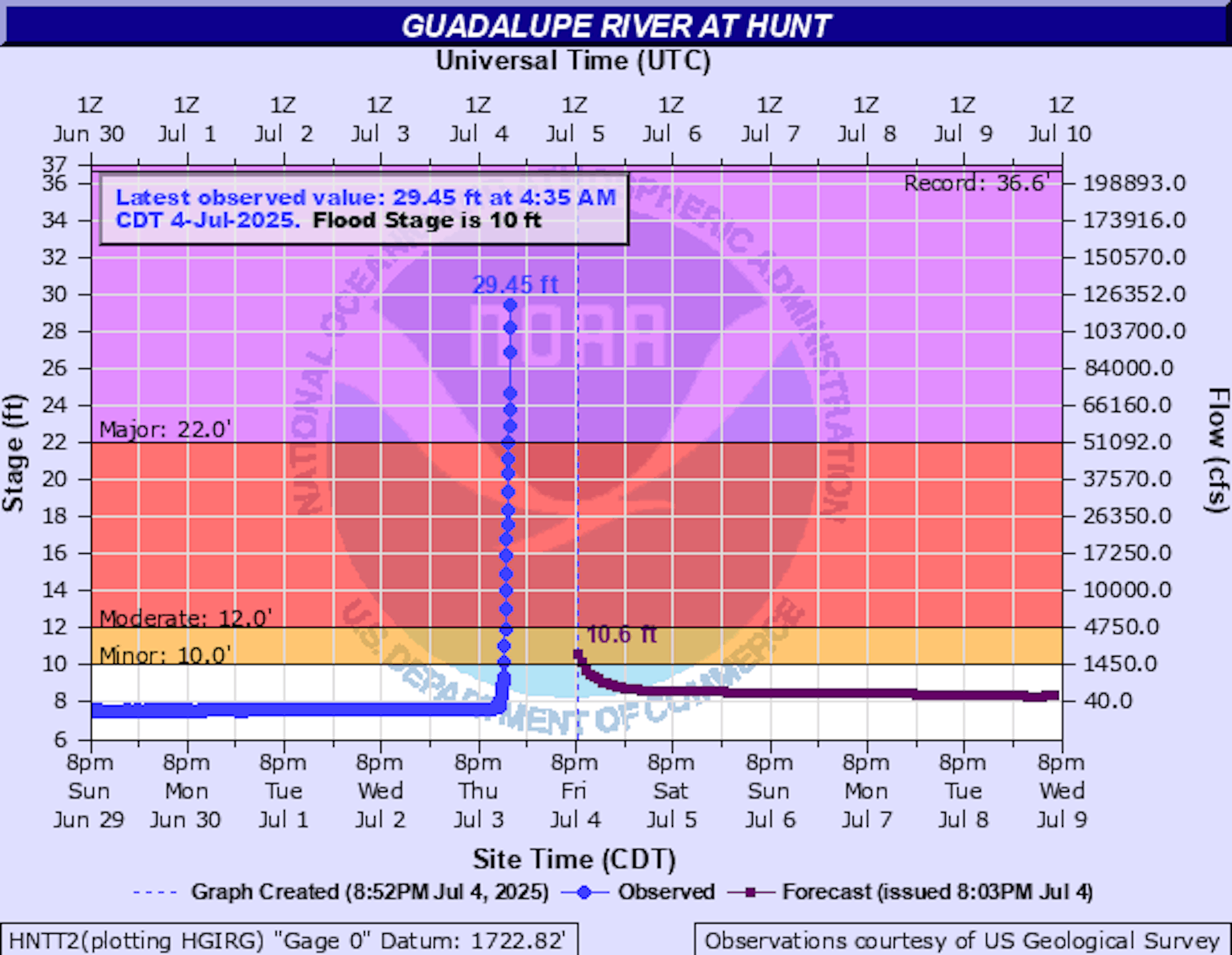
    A river gauge at Hunt, Texas, near Camp Mystic, showed how quickly the river flooded: Around 3 a.m. on July 4, the Guadalupe River was rising about 1 foot every 5 minutes at the gauge, National Weather Service data shows. By 4:30 a.m., it had risen more than 20 feet. As the water moved downstream, it reached Kerrville, where the river rose even faster.

    Flood expert Hatim Sharif, a hydrologist and civil engineer at the University of Texas at San Antonio, explains what makes this part of the country, known as Flash Flood Alley, so dangerous.

    What makes Hill Country so prone to flooding?

    Texas as a whole leads the nation in flood deaths, and by a wide margin. A colleague and I analyzed data from 1959 to 2019 and found 1,069 people had died in flooding in Texas over those six decades. The next highest total was in Louisiana, with 693.

    Many of those flood deaths have been in Hill County. It’s part of an area known as Flash Flood Alley, a crescent of land that curves from near Dallas down to San Antonio and then westward.

    The hills are steep, and the water moves quickly when it floods. This is a semi-arid area with soils that don’t soak up much water, so the water sheets off quickly and the shallow creeks can rise fast.

    When those creeks converge on a river, they can create a surge of water that wipes out homes and washes away cars and, unfortunately, anyone in its path.

    Hill Country has seen some devastating flash floods. In 1987, heavy rain in western Kerr County quickly flooded the Guadalupe River, triggering a flash flood similar to the one in 2025. Ten teenagers being evacuated from a camp died in the rushing water.

    San Antonio, at the eastern edge of Hill Country, was hit with a flash flood on June 12, 2025, that killed 13 people whose cars were swept away by high water from a fast-flooding creek near an interstate ramp in the early morning.

    Why does the region get such strong downpours?

    One reason Hill Country gets powerful downpours is the Balcones Escarpment.

    The escarpment is a line of cliffs and steep hills created by a geologic fault. When warm air from the Gulf rushes up the escarpment, it condenses and can dump a lot of moisture. That water flows down the hills quickly, from many different directions, filling streams and rivers below.

    As temperature rise, the warmer atmosphere can hold more moisture, increasing the downpour and flood risk.

    A tour of the Guadalupe River and its flood risk.

    The same effect can contribute to flash flooding in San Antonio, where the large amount of paved land and lack of updated drainage to control runoff adds to the risk.

    What can be done to improve flash flood safety?

    First, it’s important for people to understand why flash flooding happens and just how fast the water can rise and flow. In many arid areas, dry or shallow creeks can quickly fill up with fast-moving water and become deadly. So people should be aware of the risks and pay attention to the weather.

    Improving flood forecasting, with more detailed models of the physics and water velocity at different locations, can also help.

    Probabilistic forecasting, for example, can provide a range of rainfall scenarios, enabling authorities to prepare for worst-case scenarios. A scientific framework linking rainfall forecasts to the local impacts, such as streamflow, flood depth and water velocity, could also help decision-makers implement timely evacuations or road closures.

    Education is particularly essential for drivers. One to two feet of moving water can wash away a car. People may think their trucks and SUVs can go through anything, but fast-moving water can flip a truck and carry it away.

    Officials can also do more to barricade roads when the flood risk is high to prevent people from driving into harm’s way. We found that 58% of the flood deaths in Texas over the past six decades involved vehicles. The storm on June 12 in San Antonio was an example. It was early morning, and drivers had poor visibility. The cars were hit by fast-rising floodwater from an adjacent creek.

    This article, originally published July 5, 2025, has been updated with the death toll rising.

    Hatim Sharif does not work for, consult, own shares in or receive funding from any company or organization that would benefit from this article, and has disclosed no relevant affiliations beyond their academic appointment.

    ref. Why Texas Hill Country, where a devastating flood killed more than 135 people, is one of the deadliest places in the US for flash flooding – https://theconversation.com/why-texas-hill-country-where-a-devastating-flood-killed-more-than-135-people-is-one-of-the-deadliest-places-in-the-us-for-flash-flooding-260555

    MIL OSI

  • MIL-OSI USA: July 23rd, 2025 Heinrich Blasts Trump Administration for Raising Electricity Costs on American Families Amidst Growing Energy Demand

    US Senate News:

    Source: United States Senator for New Mexico Martin Heinrich

    WASHINGTON — In his opening statement during a U.S. Senate Energy and Natural Resources Committee hearing on rising energy demand, U.S. Senator Martin Heinrich (D-N.M.), Ranking Member of the Committee, raised the alarm on the energy affordability crisis facing working families and cited recent, irresponsible actions taken by the Trump Administration and Congressional Republicans that will raise energy costs on working families — including the passage of their Big, Bad Bill, their dismantling of our nation’s clean energy industry, and a recent directive from the Department of the Interior that will inevitably delay new generation additions to the grid and drive up costs further.

    VIDEO: Ranking Member Martin Heinrich (D-N.M.) blasts Trump Administration for raising electricity prices on working families during a hearing on the U.S. Senate Energy and Natural Resources Committee, July 23, 2025.

    “As Mr. Gramlich points out in his testimony, electricity bills are starting to become unaffordable for too many Americans,” said Heinrich. “And recent actions by President Trump and the Republican reconciliation bill will only make it worse.”

    “The reconciliation bill alone is estimated to increase annual energy costs more than $16 billion in 2030 and more than $33 billion by 2035,” continued Heinrich. “This is because, at a time when we need every electron we can get, the reconciliation bill is causing many clean energy projects to be canceled.”

    Heinrich additionally noted his concerns on how a new directive from the Department of the Interior that requires Secretary Doug Burgum to personally review and sign off on wind and solar projects on federal lands will risk delaying new generation additions to the grid, subsequently driving up families’ energy costs.

    A video of Heinrich’s opening remarks can be found here.

    A transcript of Heinrich’s remarks as delivered is below:

    Thank you, Chairman Lee. Welcome to our witnesses, Mr. Gramlich, Mr. Huntsman, and Mr. Tench.

    As we’ll discuss today, the scale and drivers of today’s rising electricity demand are relatively unprecedented.

    It’s not just that electricity demand is reaching record highs, it’s that we’re entering a new era of a sustained load growth.

    The structural forces underlying today’s load growth are converging: the growth of AI data centers; the electrification of vehicles, buildings, industry; as well as a resurgence in domestic manufacturing.

    And meeting this load growth will require structural changes to how we permit and build our energy infrastructure.

    In his testimony, Mr. Tench states that Vantage would prefer to “source power from the grid” but the “system is out of sync.”

    From interconnection timelines that are too long, transmission lines that take too long to build, and permitting that is too fragmented, the challenges that Mr. Tench articulates are the same ones that this Committee has been trying to address for some time.

    As Mr. Tench noted in his testimony, “No single business or technical workaround can substitute for a coordinated, modern, responsive grid.”

    Fortunately, we sit on the Committee that can help make that happen.

    The urgency isn’t just about maintaining our edge in AI innovation, it’s about affordability.

    As Mr. Gramlich points out in his testimony today, electricity bills are becoming unaffordable for too many Americans.

    And recent actions by President Trump and by the ‘Big, Bad Bill’ will make this worse.

    The reconciliation bill alone is estimated to increase annual energy costs more than $16 billion in 2030 and more than $33 billion by 2035.

    This is because, at a time when we need every single electron we can get, the reconciliation bill is causing many clean energy projects to be canceled.

    And the President’s tariffs are driving up equipment costs—raising the cost of all energy generation resources. All of them.

    This is leading directly to Americans spending more on their utility bills.

    And on top of this, an aging electrical grid is causing many energy projects to be stalled for years in interconnection queues.

    In June 2025, Grid Strategies released a study that found that investing in well-planned, high-capacity transmission could save U.S. households between $6.3 and $10.4 billion annually—and that’s even after accounting for the cost of actually building those transmission lines.

    The amount of energy currently in U.S. interconnection queues substantially exceeds the existing electricity demands—if only the grid could integrate it.

    According to the Energy Information Administration, in 2024, the U.S. installed nearly 49 gigawatts of new grid capacity, 95% of which was from renewable resources.

    This year, the EIA estimates that developers will build 63 GW of new capacity, including 32.5 GW of new utility-scale solar, 7.7 GW of wind power, 18.2 GW of energy storage, and just 4.4 GW of natural gas-fired generation.

    Clean energy is the most affordable and it’s the fastest type of energy generation to deploy—outpacing natural gas, which is facing years-long backlogs in turbine availability.

    If you order a gas, combine cycle natural gas turbine today, you’ll be lucky if it puts its first electron on the grid before 2032.

    Meanwhile, states like Texas and California are demonstrating that high levels of renewable energy do not compromise grid reliability—in fact, they improve it.

    After Texas added 9,600 MW of clean energy, including 5,400 MW of solar, 3,800 MW of energy storage, and 253 MW of wind, ERCOT CEO Pablo Vegas said that the risk of grid emergencies dropped to less than 1 percent, that’s down from 16 percent the previous year.

    NERC’s 2025 Summer Reliability Assessment confirmed this trend, showing that the risk of rolling blackouts in Texas fell from 15 percent to 3 percent as battery capacity came online.

    I’ll close by saying that I am deeply disturbed by the recent Department of Interior policy that requires Secretary Doug Burgum to personally review and sign off on wind and solar projects on federal lands.

    This nakedly political decision will risk delaying new generation additions to the grid when we need them the most.

    And consequently, will drive up costs.

    According to the Department of Energy, federal lands in the contiguous United States could support more than 7,700 GW of renewable energy capacity.

    And with that said, I look forward to discussing how we can meet the rise in electricity demand and lower energy costs for households by integrating the most affordable and rapidly deployable energy resources today, while also investing in long-term modernization.

    Thank you, Chairman.

    MIL OSI USA News

  • MIL-OSI Russia: Fishing season begins at largest lake on China-Russia border

    Translation. Region: Russian Federal

    Source: People’s Republic of China in Russian – People’s Republic of China in Russian –

    An important disclaimer is at the bottom of this article.

    Source: People’s Republic of China – State Council News

    BEIJING, July 24 (Xinhua) — Local fishermen went down to Lake Xingkai (Khanka) on Tuesday and cast their nets to haul in the first batch of fish, marking the end of the seasonal fishing ban on the largest lake on the China-Russia border, Zhongxinshe News Agency reported.

    Lake Xingkai, located in the southeast of Heilongjiang Province /Northeast China/ and in the Primorsky Territory of the Russian Far East, is the largest border lake of the two countries. Its water surface area is 4,380 square kilometers.

    Shinkai has rich fish resources. According to research, there are 65 species of fish in the lake. In order to ensure biodiversity and promote sustainable fisheries development, a seasonal fishing ban has been in place in this lake since 1952.

    This year, a 40-day fishing ban on the lake began in early June.

    According to a local border control official, patrols will be stepped up during the fishing season and measures will be taken to prevent and combat illegal fishing activities to ensure security and stability in the border areas. -0-

    Please note: This information is raw content obtained directly from the source of the information. It is an accurate report of what the source claims and does not necessarily reflect the position of MIL-OSI or its clients.

    .

    MIL OSI Russia News

  • MIL-OSI USA: Senators Marshall & Bennet Introduce Legislation To Strengthen Existing Protections Against Surprise Medical Bills

    US Senate News:

    Source: United States Senator for Kansas Roger Marshall

    Washington – On Wednesday, U.S. Senator Roger Marshall, M.D. (R-Kansas), led the re-introduction of the No Surprises Act Enforcement Act along with Senator Michael Bennet (D-Colorado). The No Surprises Act, originally passed in 2020, instills key patient protections and ensures an efficient resolution process for disputes between health insurers and providers. However, the resolution process is not being executed as Congress intended.
    Specifically, the No Surprises Act Enforcement Act will reinforce the original intent of the No Surprises Act by closing enforcement gaps through increasing penalties for parties who are non-compliant with payment deadlines. The bill also increases transparency in reporting requirements.
    “Surprise medical bills can have devastating economic impacts on families’ checkbooks. The idea that health insurers are breaking the law and unfairly punishing patients and providers is unbelievable,” said Senator Marshall. “Our legislation ensures that out-of-network medical bills are resolved promptly and fairly, with enhanced penalties for any failure by the health insurers to do so. We are keeping our promises to the American people, who often feel helpless battling the powerful insurers and the health care industry. This bill will double down to ensure this law is properly enforced.”
    “For too long, surprise medical bills left Coloradans on the hook for high, unexpected costs after a hospital visit. That’s why I introduced bipartisan legislation in 2019 to ban this harmful practice, and I was glad to see the No Surprises Act signed into law,” said Senator Bennet. “This legislation ensures that health care providers and insurance companies are upholding their obligations under that law.”
    The House companion bill was introduced by Reps. Greg Murphy (R-North Carolina-03), Raul Ruiz (D-California-25), John Joyce (R-Pennsylvania-13), Kim Schrier (D-Washington-8), Bob Onder (R-Missouri-3), and Jimmy Panetta (D-California-19).
    “Nearly five years ago, the bipartisan No Surprises Act was signed into law to eliminate surprise medical billing,” said Representative Murphy, M.D. “Although this historic legislation became law, big insurance companies have not been held accountable for paying what they owe. My bill cracks down on those that are willfully defying the law and doubles down on protecting patients. I am grateful for the continued bipartisan support to put patients first and prevent Americans from being crushed by medical debt from surprise billing.”
    “As an emergency physician, I’ve seen how delayed payments to providers hurt patients in underserved communities,” said Representative Ruiz. “The No Surprises Act Enforcement Act will ensure accountability for both insurers and providers, so health officials can enforce the law effectively and patients can receive timely, uninterrupted care.”
    “The No Surprises Act was the culmination of months of bipartisan work to ensure patients do not face surprise medical bills when receiving medical services outside of their network. Unfortunately, implementation of this law has been deeply flawed, often flagrantly ignoring Congressional intent,” said Representative Joyce, M.D. “By introducing the bipartisan No Surprises Act Enforcement Act, we can ensure balance in the way the No Surprises Act is being enforced by enacting necessary penalties for those not complying promptly with the law itself.”
    “In 2020, I was proud to join my colleagues in supporting the No Surprises Act, a bipartisan bill to protect patients from unexpected medical bills when emergency care is provided out of network,” said Representative Schrier, M.D. “The No Surprises Enforcement Act will hold insurers and providers equally responsible for upholding the guidelines set by the No Surprises Act and continue to protect patients.”
    “When Congress passed the No Surprises Act in 2020, it had one mission: protect patients from crippling, unexpected medical bills. But now, far too many insurance companies are skirting the law by refusing to pay providers on time, shifting costs back onto families, and even surprise billing patients. That’s unacceptable,” said Representative Onder. “The No Surprises Act Enforcement Act holds insurers accountable by applying the same penalties to insurers that already exist for providers. This bipartisan bill sends a clear message: our parents, our kids, and everyday Missourians deserve accountability, transparency, and fairness, no matter who’s at fault.”
    “Gaps in the enforcement of the No Surprises Act have allowed some providers and insurers to sidestep the law and leave patients vulnerable to unexpected medical bills,” said Representative Panetta. “Our bipartisan No Surprises Act Enforcement Act would increase penalties and close enforcement loopholes to give this law more teeth and dissuade bad actors.  We need to be doing all we can to shield working families from costly, surprise medical expenses and restore fairness and accountability across our health care system.”
    Click here to read the full bill text.

    MIL OSI USA News

  • MIL-OSI USA: Senators Marshall & Bennet Introduce Legislation To Strengthen Existing Protections Against Surprise Medical Bills

    US Senate News:

    Source: United States Senator for Kansas Roger Marshall

    Washington – On Wednesday, U.S. Senator Roger Marshall, M.D. (R-Kansas), led the re-introduction of the No Surprises Act Enforcement Act along with Senator Michael Bennet (D-Colorado). The No Surprises Act, originally passed in 2020, instills key patient protections and ensures an efficient resolution process for disputes between health insurers and providers. However, the resolution process is not being executed as Congress intended.
    Specifically, the No Surprises Act Enforcement Act will reinforce the original intent of the No Surprises Act by closing enforcement gaps through increasing penalties for parties who are non-compliant with payment deadlines. The bill also increases transparency in reporting requirements.
    “Surprise medical bills can have devastating economic impacts on families’ checkbooks. The idea that health insurers are breaking the law and unfairly punishing patients and providers is unbelievable,” said Senator Marshall. “Our legislation ensures that out-of-network medical bills are resolved promptly and fairly, with enhanced penalties for any failure by the health insurers to do so. We are keeping our promises to the American people, who often feel helpless battling the powerful insurers and the health care industry. This bill will double down to ensure this law is properly enforced.”
    “For too long, surprise medical bills left Coloradans on the hook for high, unexpected costs after a hospital visit. That’s why I introduced bipartisan legislation in 2019 to ban this harmful practice, and I was glad to see the No Surprises Act signed into law,” said Senator Bennet. “This legislation ensures that health care providers and insurance companies are upholding their obligations under that law.”
    The House companion bill was introduced by Reps. Greg Murphy (R-North Carolina-03), Raul Ruiz (D-California-25), John Joyce (R-Pennsylvania-13), Kim Schrier (D-Washington-8), Bob Onder (R-Missouri-3), and Jimmy Panetta (D-California-19).
    “Nearly five years ago, the bipartisan No Surprises Act was signed into law to eliminate surprise medical billing,” said Representative Murphy, M.D. “Although this historic legislation became law, big insurance companies have not been held accountable for paying what they owe. My bill cracks down on those that are willfully defying the law and doubles down on protecting patients. I am grateful for the continued bipartisan support to put patients first and prevent Americans from being crushed by medical debt from surprise billing.”
    “As an emergency physician, I’ve seen how delayed payments to providers hurt patients in underserved communities,” said Representative Ruiz. “The No Surprises Act Enforcement Act will ensure accountability for both insurers and providers, so health officials can enforce the law effectively and patients can receive timely, uninterrupted care.”
    “The No Surprises Act was the culmination of months of bipartisan work to ensure patients do not face surprise medical bills when receiving medical services outside of their network. Unfortunately, implementation of this law has been deeply flawed, often flagrantly ignoring Congressional intent,” said Representative Joyce, M.D. “By introducing the bipartisan No Surprises Act Enforcement Act, we can ensure balance in the way the No Surprises Act is being enforced by enacting necessary penalties for those not complying promptly with the law itself.”
    “In 2020, I was proud to join my colleagues in supporting the No Surprises Act, a bipartisan bill to protect patients from unexpected medical bills when emergency care is provided out of network,” said Representative Schrier, M.D. “The No Surprises Enforcement Act will hold insurers and providers equally responsible for upholding the guidelines set by the No Surprises Act and continue to protect patients.”
    “When Congress passed the No Surprises Act in 2020, it had one mission: protect patients from crippling, unexpected medical bills. But now, far too many insurance companies are skirting the law by refusing to pay providers on time, shifting costs back onto families, and even surprise billing patients. That’s unacceptable,” said Representative Onder. “The No Surprises Act Enforcement Act holds insurers accountable by applying the same penalties to insurers that already exist for providers. This bipartisan bill sends a clear message: our parents, our kids, and everyday Missourians deserve accountability, transparency, and fairness, no matter who’s at fault.”
    “Gaps in the enforcement of the No Surprises Act have allowed some providers and insurers to sidestep the law and leave patients vulnerable to unexpected medical bills,” said Representative Panetta. “Our bipartisan No Surprises Act Enforcement Act would increase penalties and close enforcement loopholes to give this law more teeth and dissuade bad actors.  We need to be doing all we can to shield working families from costly, surprise medical expenses and restore fairness and accountability across our health care system.”
    Click here to read the full bill text.

    MIL OSI USA News

  • MIL-Evening Report: ER Report: A Roundup of Significant Articles on EveningReport.nz for July 24, 2025

    ER Report: Here is a summary of significant articles published on EveningReport.nz on July 24, 2025.

    World’s highest court issues groundbreaking ruling for climate action. Here’s what it means for Australia
    Source: The Conversation (Au and NZ) – By Wesley Morgan, Research Associate, Institute for Climate Risk and Response, UNSW Sydney JOHN THYS/AFP via Getty Images The world’s highest court says countries are legally obliged to prevent harms caused by climate change, in a ruling that repudiates Australia’s claims it is not legally responsible for emissions

    Politics with Michelle Grattan: Chris Bowen on why it’s ‘a little frustrating’ bidding for COP 31
    Source: The Conversation (Au and NZ) – By Michelle Grattan, Professorial Fellow, University of Canberra Energy and climate issues are front and centre for both sides of politics. The government is struggling with pushback from some regional communities against the rollout of transmission lines and wind farms. At the same time, it will soon have

    Cycling’s governing body is introducing new rules to slow down elite riders. Not everyone’s happy
    Source: The Conversation (Au and NZ) – By Popi Sotiriadou, Associate Professor of Sport Management – Director Business Innovation, Griffith University MARCO BERTORELLO/AFP via Getty Images Most sports look to support their athletes to become “faster, higher, stronger” – in reference to the Olympic Games’ original motto – so it is perhaps surprising that cycling’s

    Swirling nebula of two dying stars revealed in spectacular detail in new Webb telescope image
    Source: The Conversation (Au and NZ) – By Benjamin Pope, Associate Professor, School of Mathematical and Physical Sciences, Macquarie University The day before my thesis examination, my friend and radio astronomer Joe Callingham showed me an image we’d been awaiting for five long years – an infrared photo of two dying stars we’d requested from

    UN’s highest court finds countries can be held legally responsible for emissions
    By Jamie Tahana in The Hague for RNZ Pacific The United Nations’ highest court has found that countries can be held legally responsible for their greenhouse gas emissions, in a ruling highly anticipated by Pacific countries long frustrated with the pace of global action to address climate change. In a landmark opinion delivered yesterday in

    Five arms, no heart and a global family: what DNA revealed about the weird deep-sea world of brittle stars
    Source: The Conversation (Au and NZ) – By Tim O’Hara, Senior Curator of Marine Invertebrates, Museums Victoria Research Institute A brittle star of the species _Gorgonocephalus eucnemis_. Lagunatic Photo / Getty Images You may have read that the deep sea is a very different environment from the land and shallow water. There is no light,

    Birds use hidden black and white feathers to make themselves more colourful
    Source: The Conversation (Au and NZ) – By Simon Griffith, Professor of Avian Behavioural Ecology, Macquarie University The green-headed tanager (_Tangara seledon_) has a hidden layer of plumage that is white underneath the orange feathers and black underneath the blue and green feathers. Daniel Field Birds are perhaps the most colourful group of animals, bringing

    Is sleeping a lot actually bad for your health? A sleep scientist explains
    Source: The Conversation (Au and NZ) – By Charlotte Gupta, Senior Postdoctoral Research Fellow, Appleton Institute, HealthWise Research Group, CQUniversity Australia Walstrom, Susanne/Getty We’re constantly being reminded by news articles and social media posts that we should be getting more sleep. You probably don’t need to hear it again – not sleeping enough is bad

    From grasslands to killing fields: why trees are bad news for one of Australia’s most stunning birds
    Source: The Conversation (Au and NZ) – By Gabriel Crowley, Adjunct Associate Professor in Geography, University of Adelaide JJ Harrison/Wikimedia, CC BY Picture this. A small, rainbow-coloured chick emerges from its nest for the first time. It stretches its wings and prepares to take flight. But before the fledgling’s life in the wild has begun,

    As seas rise and fish decline, this Fijian village is finding new ways to adapt
    Source: The Conversation (Au and NZ) – By Celia McMichael, Professor in Geography, The University of Melbourne Celia McMichael, CC BY-NC-ND In the village of Nagigi, Fiji, the ocean isn’t just a resource – it’s part of the community’s identity. But in recent years, villagers have seen the sea behave differently. Tides are pushing inland.

    After 70 years, twisted gothic thriller The Night of the Hunter remains as disturbing and beguiling as ever
    Source: The Conversation (Au and NZ) – By Ben McCann, Associate Professor of French Studies, University of Adelaide United Artists/Getty Images In 1955, director Charles Laughton crafted one of the darkest, strangest fairytales ever to come out of Hollywood. The Night of the Hunter remains visually exquisite and profoundly unsettling. Shortly before Ben Harper is

    Almost a third of NZ households face energy hardship – reform has to go beyond cheaper off-peak power
    Source: The Conversation (Au and NZ) – By Kimberley O’Sullivan, Senior Research Fellow, He Kainga Oranga – Housing and Health Research Programme, University of Otago Igor Suka/Getty Images The spotlight is again on New Zealand’s energy sector, with a group of industry bodies and independent retailers pushing for a market overhaul, saying the sector was

    Immigration courts hiding the names of ICE lawyers goes against centuries of precedent and legal ethics requiring transparency in courts
    Source: The Conversation (Au and NZ) – By Cassandra Burke Robertson, Professor of Law and Director of the Center for Professional Ethics, Case Western Reserve University Some immigration courts have allowed ICE attorneys to conceal their names during proceedings. Jacob Wackerhausen/iStock via Getty Images Something unusual is happening in U.S. immigration courts. Government lawyers are

    How the UK’s immigration system splits families apart – by design
    Source: The Conversation (Au and NZ) – By Nando Sigona, Professor of International Migration and Forced Displacement and Director of the Institute for Research into International Migration and Superdiversity, University of Birmingham arda savasciogullari/Shutterstock The letter that arrived for eleven-year-old Guilherme in June 2025 was addressed personally to him. The UK Home Office was informing

    4.48 Psychosis revival: the play’s window into a mind on the edge is as brutal as ever
    Source: The Conversation (Au and NZ) – By Leah Sidi, Associate Professor of Health Humanities, UCL Under bright lights, the audience looks at a bare stage on two planes. Below, a small stage is white and empty, occupied only by a table and two chairs. Above, a huge, slanted mirror reflects a bird’s-eye view of

    Togo’s ‘Nana-Benz’: how cheap Chinese imports of African fabrics has hurt the famous women traders
    Source: The Conversation (Au and NZ) – By Fidele B. Ebia, Postdoctoral fellow, Duke Africa Initiative, Duke University The manufacturing of African print textiles has shifted to China in the 21st century. While they are widely consumed in African countries – and symbolic of the continent – the rise of “made in China” has undermined

    2 ways cities can beat the heat: Which is best, urban trees or cool roofs?
    Source: The Conversation (Au and NZ) – By Ian Smith, Research Scientist in Earth & Environment, Boston University Trees like these in Boston can help keep neighborhoods cooler on hot days. Yassine Khalfalli/Unsplash, CC BY When summer turns up the heat, cities can start to feel like an oven, as buildings and pavement trap the

    Indonesian military set to complete Trans-Papua Highway under Prabowo’s rule
    By Julian Isaac The Indonesian Military (TNI) is committed to supporting the completion of the Trans-Papua Highway during President Prabowo Subianto’s term in office. While the military is not involved in construction, it plays a critical role in securing the project from threats posed by pro-independence Papuan resistance groups in “high-risk” regions. Spanning a total

    View from The Hill: Nationals’ mavericks ensure the Coalition is the issue in parliament’s first week
    Source: The Conversation (Au and NZ) – By Michelle Grattan, Professorial Fellow, University of Canberra For almost as long anyone can remember, the Nationals have caused the Coalition grief on climate and energy policy. Still, for Barnaby Joyce to bring on a fresh load of trouble – with a private member’s bill to scrap Australia’s

    Childcare centres will have funding stripped if they’re not ‘up to scratch’. Is this enough?
    Source: The Conversation (Au and NZ) – By Erin Harper, Lecturer, School of Education and Social Work, University of Sydney Maskot/Getty Images Childcare centres will lose their eligibility for fee subsidies if they don’t meet safety standards, according to a new bill introduced to parliament on Wednesday. As Education Minister Jason Clare told parliament: it

    MIL OSI AnalysisEveningReport.nz

  • MIL-Evening Report: ER Report: A Roundup of Significant Articles on EveningReport.nz for July 24, 2025

    ER Report: Here is a summary of significant articles published on EveningReport.nz on July 24, 2025.

    World’s highest court issues groundbreaking ruling for climate action. Here’s what it means for Australia
    Source: The Conversation (Au and NZ) – By Wesley Morgan, Research Associate, Institute for Climate Risk and Response, UNSW Sydney JOHN THYS/AFP via Getty Images The world’s highest court says countries are legally obliged to prevent harms caused by climate change, in a ruling that repudiates Australia’s claims it is not legally responsible for emissions

    Politics with Michelle Grattan: Chris Bowen on why it’s ‘a little frustrating’ bidding for COP 31
    Source: The Conversation (Au and NZ) – By Michelle Grattan, Professorial Fellow, University of Canberra Energy and climate issues are front and centre for both sides of politics. The government is struggling with pushback from some regional communities against the rollout of transmission lines and wind farms. At the same time, it will soon have

    Cycling’s governing body is introducing new rules to slow down elite riders. Not everyone’s happy
    Source: The Conversation (Au and NZ) – By Popi Sotiriadou, Associate Professor of Sport Management – Director Business Innovation, Griffith University MARCO BERTORELLO/AFP via Getty Images Most sports look to support their athletes to become “faster, higher, stronger” – in reference to the Olympic Games’ original motto – so it is perhaps surprising that cycling’s

    Swirling nebula of two dying stars revealed in spectacular detail in new Webb telescope image
    Source: The Conversation (Au and NZ) – By Benjamin Pope, Associate Professor, School of Mathematical and Physical Sciences, Macquarie University The day before my thesis examination, my friend and radio astronomer Joe Callingham showed me an image we’d been awaiting for five long years – an infrared photo of two dying stars we’d requested from

    UN’s highest court finds countries can be held legally responsible for emissions
    By Jamie Tahana in The Hague for RNZ Pacific The United Nations’ highest court has found that countries can be held legally responsible for their greenhouse gas emissions, in a ruling highly anticipated by Pacific countries long frustrated with the pace of global action to address climate change. In a landmark opinion delivered yesterday in

    Five arms, no heart and a global family: what DNA revealed about the weird deep-sea world of brittle stars
    Source: The Conversation (Au and NZ) – By Tim O’Hara, Senior Curator of Marine Invertebrates, Museums Victoria Research Institute A brittle star of the species _Gorgonocephalus eucnemis_. Lagunatic Photo / Getty Images You may have read that the deep sea is a very different environment from the land and shallow water. There is no light,

    Birds use hidden black and white feathers to make themselves more colourful
    Source: The Conversation (Au and NZ) – By Simon Griffith, Professor of Avian Behavioural Ecology, Macquarie University The green-headed tanager (_Tangara seledon_) has a hidden layer of plumage that is white underneath the orange feathers and black underneath the blue and green feathers. Daniel Field Birds are perhaps the most colourful group of animals, bringing

    Is sleeping a lot actually bad for your health? A sleep scientist explains
    Source: The Conversation (Au and NZ) – By Charlotte Gupta, Senior Postdoctoral Research Fellow, Appleton Institute, HealthWise Research Group, CQUniversity Australia Walstrom, Susanne/Getty We’re constantly being reminded by news articles and social media posts that we should be getting more sleep. You probably don’t need to hear it again – not sleeping enough is bad

    From grasslands to killing fields: why trees are bad news for one of Australia’s most stunning birds
    Source: The Conversation (Au and NZ) – By Gabriel Crowley, Adjunct Associate Professor in Geography, University of Adelaide JJ Harrison/Wikimedia, CC BY Picture this. A small, rainbow-coloured chick emerges from its nest for the first time. It stretches its wings and prepares to take flight. But before the fledgling’s life in the wild has begun,

    As seas rise and fish decline, this Fijian village is finding new ways to adapt
    Source: The Conversation (Au and NZ) – By Celia McMichael, Professor in Geography, The University of Melbourne Celia McMichael, CC BY-NC-ND In the village of Nagigi, Fiji, the ocean isn’t just a resource – it’s part of the community’s identity. But in recent years, villagers have seen the sea behave differently. Tides are pushing inland.

    After 70 years, twisted gothic thriller The Night of the Hunter remains as disturbing and beguiling as ever
    Source: The Conversation (Au and NZ) – By Ben McCann, Associate Professor of French Studies, University of Adelaide United Artists/Getty Images In 1955, director Charles Laughton crafted one of the darkest, strangest fairytales ever to come out of Hollywood. The Night of the Hunter remains visually exquisite and profoundly unsettling. Shortly before Ben Harper is

    Almost a third of NZ households face energy hardship – reform has to go beyond cheaper off-peak power
    Source: The Conversation (Au and NZ) – By Kimberley O’Sullivan, Senior Research Fellow, He Kainga Oranga – Housing and Health Research Programme, University of Otago Igor Suka/Getty Images The spotlight is again on New Zealand’s energy sector, with a group of industry bodies and independent retailers pushing for a market overhaul, saying the sector was

    Immigration courts hiding the names of ICE lawyers goes against centuries of precedent and legal ethics requiring transparency in courts
    Source: The Conversation (Au and NZ) – By Cassandra Burke Robertson, Professor of Law and Director of the Center for Professional Ethics, Case Western Reserve University Some immigration courts have allowed ICE attorneys to conceal their names during proceedings. Jacob Wackerhausen/iStock via Getty Images Something unusual is happening in U.S. immigration courts. Government lawyers are

    How the UK’s immigration system splits families apart – by design
    Source: The Conversation (Au and NZ) – By Nando Sigona, Professor of International Migration and Forced Displacement and Director of the Institute for Research into International Migration and Superdiversity, University of Birmingham arda savasciogullari/Shutterstock The letter that arrived for eleven-year-old Guilherme in June 2025 was addressed personally to him. The UK Home Office was informing

    4.48 Psychosis revival: the play’s window into a mind on the edge is as brutal as ever
    Source: The Conversation (Au and NZ) – By Leah Sidi, Associate Professor of Health Humanities, UCL Under bright lights, the audience looks at a bare stage on two planes. Below, a small stage is white and empty, occupied only by a table and two chairs. Above, a huge, slanted mirror reflects a bird’s-eye view of

    Togo’s ‘Nana-Benz’: how cheap Chinese imports of African fabrics has hurt the famous women traders
    Source: The Conversation (Au and NZ) – By Fidele B. Ebia, Postdoctoral fellow, Duke Africa Initiative, Duke University The manufacturing of African print textiles has shifted to China in the 21st century. While they are widely consumed in African countries – and symbolic of the continent – the rise of “made in China” has undermined

    2 ways cities can beat the heat: Which is best, urban trees or cool roofs?
    Source: The Conversation (Au and NZ) – By Ian Smith, Research Scientist in Earth & Environment, Boston University Trees like these in Boston can help keep neighborhoods cooler on hot days. Yassine Khalfalli/Unsplash, CC BY When summer turns up the heat, cities can start to feel like an oven, as buildings and pavement trap the

    Indonesian military set to complete Trans-Papua Highway under Prabowo’s rule
    By Julian Isaac The Indonesian Military (TNI) is committed to supporting the completion of the Trans-Papua Highway during President Prabowo Subianto’s term in office. While the military is not involved in construction, it plays a critical role in securing the project from threats posed by pro-independence Papuan resistance groups in “high-risk” regions. Spanning a total

    View from The Hill: Nationals’ mavericks ensure the Coalition is the issue in parliament’s first week
    Source: The Conversation (Au and NZ) – By Michelle Grattan, Professorial Fellow, University of Canberra For almost as long anyone can remember, the Nationals have caused the Coalition grief on climate and energy policy. Still, for Barnaby Joyce to bring on a fresh load of trouble – with a private member’s bill to scrap Australia’s

    Childcare centres will have funding stripped if they’re not ‘up to scratch’. Is this enough?
    Source: The Conversation (Au and NZ) – By Erin Harper, Lecturer, School of Education and Social Work, University of Sydney Maskot/Getty Images Childcare centres will lose their eligibility for fee subsidies if they don’t meet safety standards, according to a new bill introduced to parliament on Wednesday. As Education Minister Jason Clare told parliament: it

    MIL OSI AnalysisEveningReport.nz

  • MIL-OSI USA: Senator Murray, British Columbia Premier Eby, WA Small Businesses Speak Out About How Trump’s Reckless Trade War with Canada is Creating Chaos, Hurting Business, and Raising Costs

    US Senate News:

    Source: United States Senator for Washington State Patty Murray

    ICYMI: Senator Murray Hears from Mayors and Business Leaders About How Trump’s Trade War is Hurting Border Communities in Northwest Washington

    AP: Trump’s 35% Canada tariff plan deepens a rift between the neighbors

    ***WATCH HERE; DOWNLOAD HERE***

    Washington, D.C. –  Today, U.S. Senator Patty Murray (D-WA), Vice Chair of the Senate Appropriations Committee, held a virtual press conference with British Columbia Premier David Eby and Washington state business leaders to sound the alarm on how President Trump’s trade war with Canada is driving down business and creating chaos for families, small businesses, and economies on both sides of the border.

    Canada is the second-largest export market for Washington state, exporting $7.9 billion in goods and $2.2 billion in services annually. Washington state imports $17.8 billion in goods from Canada each year, with energy imports accounting for 54 percent of that total. 608 Canadian-owned companies employ 25,050 workers in Washington state. Canada is also the largest source of international visitors to the U.S., accounting for 20.4 million visits and $20.5 billion in spending in 2024. The Bureau of Transportation Statistics reported a 35 percent drop in border crossings into the U.S. through the Peace Arch and Pacific Highway Crossings in Washington state this May, compared to the same month last year. Additional data on trade between Washington state and Canada is available HERE.  

    President Trump recently announced a plan to impose 35 percent tariffs across-the-board on imports from Canada beginning August 1st. This comes after Trump has already applied 50 percent tariffs on steel and aluminum—of which Canada is the largest exporter to the United States—and 25 percent duties on cars, excluding U.S. made parts. Yesterday, after a meeting with Canada’s political leaders—including Premier Eby—Prime Minister Mark Carney downplayed the chances of success in talks aimed at reaching a trade deal with President Trump.

    “Canada isn’t just a trading partner for us—it is our ally, and they are our neighbor. We have friends, and families that span that northern border. We have supply lines and businesses that depend on the open flow of trade, tourism, and goodwill between our countries,” Senator Murray said at the press conference today. “Canada is one of our largest trading partners—accounting for, every year, nearly $8 billion in exports including our seafood, apples, and airplane parts and more than $2 billion in cross-border tourism and business. Not to mention we actually import nearly $18 billion in goods from Canada each year. So, for us, having Trump throw a tantrum with these tariffs is really throwing a wrench into our businesses that have operated for decades, and throwing communities on both sides of the border into chaos, and really throwing our neighborly way of life into jeopardy.”

    “Here’s what Trump needs to understand: this is not reality TV. It is actual reality,” Senator Murray continued. “These aren’t people playing ‘businessman’—they are trying to run actual businesses, that employ actual Americans. Unlike him, they don’t thrive on outrage. And they do not want any drama, they need certainty, they need common sense. And they need policies that bring in customers, not drive them away, and bring prices down, not drive them up. So, I want you all to know I am going to keep fighting in Congress to put an end to these pointless tariffs that are making life harder for people on both sides of our border. And I will keep pushing for legislation to reassert Congress’s power over tariff policy. It is beyond clear we cannot entrust this responsibility to a President who is toggling economic policies on and off like a kid with a joystick.”

    “We have a long and happy relationship with the American people; they’re our friends, our family members and coworkers. President Trump’s actions have broken our trust with his government, but they’ll never shake our relationship with our closest neighbours. I am grateful for Senator Murray’s leadership at this time in calling out a President that ran on an affordability agenda and is now bringing in tariffs that are raising the price of everyday goods for hard working families,” said David Eby, Premier of British Columbia.  

    “President Trump seems to have created the 51st state that he was talking about, which is the great state of uncertainty. And this is affecting all of us and that we predict that in 2025 alone, that tariffs will cost SEL $100 million in unanticipated federal taxes. These $100 million, divided by our 7000 owners, is a hit of $14,000 per employee around the world. And I agree so much with Senator Murray that the best thing we can do is to support the efforts by Democrats and Republicans in both the House and the Senate to restore congressional control over tariffs and block this President and future ones from abusing executive orders, especially here in the case of free trade,” saidDr. Ed Schweitzer, founder of Schweitzer Engineering Laboratories in Pullman.

    “Maintaining good relations with our northern neighbors is paramount to our maritime industry. Along with being a key supplier for vital parts of the industry, our relations also impact negotiations, such as the Pacific Salmon Treaty being negotiated right now. These negotiations and trade rely on goodwill and good relations, and we cannot state enough how much we value our Canadian partners in all sectors of our maritime industry here in the United States,” said Dan Tucker, Executive Director of the Whatcom Working Waterfront Coalition.

    Washington state has one of the most trade-dependent economies of any state in the country, with 40 percent of jobs in the state tied to international commerce. Washington state is the top U.S. producer of apples, blueberries, hops, pears, spearmint oil, and sweet cherries—all of which risk losing vital export markets due to retaliatory tariffs from key trading partners including Canada. Additionally, more than 12,000 small and medium-sized companies in Washington state export goods and will struggle to absorb the impact of retaliatory tariffs. Trump’s tariffs during his first term were extremely costly for Washington state—for example, India imposed a 20 percent retaliatory tariff on U.S. apples, causing Washington apple shipments to India to fall by 99 percent and growers to lose hundreds of millions of dollars in exports.

    Senator Murray has been a vocal opponent of Trump’s chaotic trade war and has been constantly lifting up the voices of people in every corner of Washington state who are being harmed by this administration’s approach to trade. Senator Murray continues to call on Republicans to end Trump’s trade war—which Congress has the power to do—and take back Congress’ Constitutionally-granted power to impose tariffs. Earlier this year—among many other events—Senator Murray brought together leaders across Washington state to highlight how Trump’s ongoing trade war is already a devastating hit to Washington state’s economy, businesses, and our agriculture sector, and held a roundtable discussion in Blaine on how Trump’s chaotic trade war and senseless tariffs are specifically hurting Washington state’s border communities and local businesses. Senator Murray has also taken to the Senate floor to lay out how Trump’s chaotic trade war is seriously threatening our economy, American businesses, families’ retirement savings, and so much else.

    Senator Murray’s full remarks, as delivered, are below and video is HERE:

    “Thank you everyone for joining us today.

    “You know for a so-called businessman, President Trump doesn’t seem to know the first thing about running a business—then again, maybe that explains his six bankruptcies. But besides that, every time Trump opens his mouth, he is demonstrating that he doesn’t understand how tariffs work and doesn’t care if his absurd tax hikes are hurting our economy and our small businesses. The reality is plain as day. Especially in places like Washington state where we are on the front line of a trade war with our neighbors that nobody asked for.

    “Canada isn’t just a trading partner for us—it is our ally, and they are our neighbor. We have friends, and families that span that northern border. We have supply lines and businesses that depend on the open flow of trade, tourism, and goodwill between our countries.

    “Canada is one of our largest trading partners—accounting for, every year, nearly $8 billion in exports including our seafood, apples, and airplane parts and more than $2 billion in cross-border tourism and business. Not to mention we actually import nearly $18 billion in goods from Canada each year.  

    “So, for us, having Trump throw a tantrum with these tariffs is really throwing a wrench into our businesses that have operated for decades, and throwing communities on both sides of the border into chaos, and really throwing our neighborly way of life into jeopardy.

    “How are farmers supposed to stay afloat when Trump just jacked up the cost of the supplies they need, at the same time that he is driving some of their best customers away?

    “How are businesses and factories supposed to keep the lights on when their supply chains are being disrupted, and their inputs—like energy, and steel, and aluminum—keep getting more expensive?

    “How are hotels and towns that are fueled by tourism supposed to keep their doors open, when cancellations are going up, bookings are going down, and 75 percent of Canadian travelers who weregoing to visit the U.S. are deciding they’d now rather go somewhere the President doesn’t constantly attack?

    “So, let’s be clear, these aren’t hypothetical questions. They are the cold, hard realities Trump is forcing onto our communities. It doesn’t take much imagination to see how hard Trump’s trade war is making life for people—especially for our border communities.

    “All you have to do is listen. Talk to ferry operators, who are feeling the squeeze of reduced travel. Talk to community leaders in Bellingham and Whatcom County, where 12 percent of taxable retail sales came from Canadians. Talk to business owners in Point Roberts, which just completely depends on Canadian trade and tourism.

    “I have been telling this over and over to my colleagues and anyone who will listen. If you want to understand the real cost of what is happening, come to Washington state, talk to people on the front lines of this pointless, painful trade war.

    “And that’s exactly why we are having this call today. To put a spotlight on what we are seeing on both sides of the border; to make more of these voices heard; to raise the alarm; and maybe even offer a little economics lesson to Trump—since he appears to need it.

    “When you raise the costs for small businesses—which is exactly what tariffs do, when you drive away loyal customers, and trading partners—which is exactly what happens when you toss up barriers and toss out insults—you make life harder, and you raise costs for everyday Americans. It is very clear that President Trump wants to treat tariffs like a reality TV show, constantly playing up the outrage and the uncertainty of the ‘Will he? Won’t he?’ drama that he seems to like living in. But the questions that I am hearing when I talk to folks home in Washington state, are more like, ‘Why on Earth would he do this?’ and ‘What the heck is he thinking?’ and ‘How am I going to be able to afford this?’

    “Because here’s what Trump needs to understand: this is not reality TV. This is actual reality. These aren’t peopleplaying ‘businessman’—they are trying to run actual businesses, that employ actual Americans. Unlike him, they don’t thrive on outrage. And they do not want any drama, they need certainty, they need common sense. And they need policies that bring in customers, not drive them away, and bring prices down, not drive them up.

    “So, I want you all to know I am going to keep fighting in Congress to put an end to these pointless tariffs that are making life harder for people on both sides of our border. And I will keep pushing for legislation to reassert Congress’s power over tariff policy.

    “It is beyond clear we cannot entrust this responsibility to a President who is toggling economic policies on and off like a kid with a joystick.

    “We have got to keep talking about this, which is why we are having this call today, until more of my Republican colleagues get the message. And I thank everybody who’s participating in this today to talk about what you are seeing.

    “So, I’m joined on this call by British Columbia Premier David Eby, he will be speaking next. As I’ve told him in the past, I appreciate our relationship and thank you for working with us on this. It’s a joy to have you on this call.”

    MIL OSI USA News

  • MIL-OSI USA: King to Witness: Electric Bills in Maine are Rising, Storage and Transmission Solutions Should Be Pursued

    US Senate News:

    Source: United States Senator for Maine Angus King

    WASHINGTON, D.C. — Today, in a hearing of the Energy and Natural Resources (ENR) Committee, Senator Angus King (I-ME) spoke about the rising costs of electric bills in Maine and the path forward to address these rising costs via transmission upgrades and battery storage for renewable energy sources. In his exchange with Rob Gramlich, the President of Grid Strategies LLC, King highlighted that while battery storage capabilities exist today, the demand is only growing greater. King also shared that by simply upgrading existing transmission lines, the United States can lower the cost of home energy in places like Maine.

    Senator King began, “The word transmission has come up numerous times a day and how important it is and what an important part it is of this discussion. Unfortunately, this morning, the Department of Energy terminated a loan program for a major interregional transmission system in the Midwest. So, here we are talking about how important transmission is, and here is the Department of Energy – and it was not a grant, it was a loan guarantee program. I just think the timing is somewhat ironic.

    “We all know that solar and wind are intermittent. We understand that [and] everybody knows that. I was in the hydro business, that is also intermittent. It doesn’t always rain. As well as wind, biomass and large-scale conservation. What is really happening is really dramatic in terms of energy storage,” Senator King continued. “If you have adequate energy storage, solar and wind are baseload, because you have something to make up the difference. I used AI … to check on where we are on batteries. As of five minutes ago, the U.S. added a record 10.4 gigawatts of utility scale battery storage in 2024, marking a 66% increase from the prior year. In 2025, the EIA anticipates a record-setting year with another 18 gigawatts of utility scale battery storage on the grid. Looking ahead, the EIA forecast the U.S. battery storage will nearly double, reaching 65 gigawatts by the end of 2026.

    Senator King continued, “In other words, the battery industry is no longer a fantasy or a distant dream. It is happening right now in a very substantial scale. As you point out come Mr. Gramlich, it saved the day in Texas and California, and is already working, the idea of integrating batteries with solar and wind. Let me talk for a minute though about transformation. Mr. Gramlich, this is what worries me, it used to be an electric bill in Maine was 25% transmission and distribution and 75 source of energy. It is now about 50/50 and transmission is getting more and more expensive. Everybody knows we have to rebuild the grid. My concern it’s going to be done in an expensive way that will add dramatically to ratepayers’ cost. Mr. Gramlich, you are nodding. I take it you agree. The record doesn’t show nodding.

    Gramlich responded, “Absolutely. We are doing transmission in sometimes the most expensive way possible now and we can change that.”

    As a member of the Senate Energy and Natural Resources Committee, Senator King has repeatedly emphasized the importance of permitting reform to deliver carefully considered, timely approvals of sorely-needed clean energy projects. Senator King has also been one of the Senate’s most vocal advocates for improving energy storage technologies and development and worked to include significant storage investments in the Bipartisan Infrastructure Law and Inflation Reduction Act. Most recently, Senator King reiterated the importance of an “all of the above” energy policy strategy during an ENR hearing considering the nominations of Energy Secretary Chris Wright and Interior Secretary Doug Burgum.

    MIL OSI USA News

  • MIL-OSI USA: Bacon and Nadler Reintroduce Legislation to Protect Organ Donors

    Source: United States House of Representatives – Congressman Don Bacon (2nd District of Nebraska)

    Bacon and Nadler Reintroduce Legislation to Protect Organ Donors

    Washington – Today, Representatives Don Bacon (NE-02) and Jerrold Nadler (NY-12) reintroduced the Living Donor Protection Act bill package to protect the rights of living organ donors. The Living Donor Protection Act is introduced as a two-bill package in the House, H.R. 4583, the Living Donor Protection Act and H.R.4582, the Living Donor FMLA Protection Act. The bills, taken together, are identical to last session’s Living Donor Protection Act and S.1552 introduced in the Senate this session.

    “Our state is fortunate to have Nebraska Medicine, which has a robust living donor kidney exchange program, performing more kidney chains which involves anonymous donors donating to someone without a compatible living donor, than almost any hospital nationwide. However, some living donors are discriminated against when it comes to rates and provision of life insurance and disability insurance,” said Representative Bacon. “This legislation will help open the doors to more living donors so we can save more lives.”

    “Every year, thousands of Americans die while waiting on an organ transplant, yet potential organ donors still face barriers that punish them for trying to selflessly save a life. Insurance discrimination and the threat of job loss can make it economically impossible for potential donors to move forward with donation and these roadblocks are costing lives,” said Representative Nadler. “Congress must do everything in its power to remove deterrents to organ donation, which is why Congress must pass the Living Donor Protection Act bill package.”

    Organ donation saves thousands of lives every year, but burdensome roadblocks often stop individuals from becoming living donors. The Living Donor Protection Act bill package would protect living organ donors and promote organ donation in three easy, low-cost ways: 

    1. Prohibits life, disability, and long-term care insurance companies from denying or limiting coverage and from charging higher premiums based only on donor status;
    2. Amends the Family and Medical Leave Act of 1993 to specifically allow private and civil service employees to use FMLA leave to recover from donation surgery; and
    3. Directs HHS to update their materials on live organ donation to reflect these new protections and encourage more individuals to consider donating an organ.

    Currently, there are over 103,000 people on the national transplant waiting list, with almost 90,000 people on the kidney transplant list. The average wait time for a kidney transplant is about three to five years, and during that time, many patients become too sick to receive a transplant or die—13 people die each year waiting for an organ transplant. Receiving an organ from a living donor can shorten this wait time and ultimately allow the best chance for long-term success. Unfortunately, studies have found that up to one in four living donors report discrimination in the rates and provision of life insurance and disability insurance, and they can struggle to receive time off from work to complete their donation and recovery. Reducing barriers to living organ donation and educating potential donors on the protections provided to them under law will help to promote living organ donation and save the lives of those waiting for a transplant.

    The Living Donor Protection Act is endorsed by Alport Syndrome Foundation, American Association of Kidney Patients, American Council of Life Insurers, American Heart Association, American Kidney Fund, American Liver Foundation, American Nephrology Nurses Association, American Society of Nephrology, American Society of Pediatric Nephrology, American Society of Transplant Surgeons, American Society of Transplantation, Dialysis Patient Citizens, Global Liver Institute, IGA Nephropathy Foundation, International Society of Glomerular Disease, Kidney Transplant Collaborative, National Kidney Foundation, NephCure, the Nonprofit Kidney Care Alliance (NKCA), North American Transplant Coordinators Organization, Northwest Kidney Centers, the PKD Foundation, the Rogosin Institute, Sanofi, the United Network for Organ Sharing (UNOS), Transplant Recipients International Organization (TRIO), and Renal Physicians Association.

    “On behalf of all kidney patients, organ donors and American taxpayers, the American Association of Kidney Patients salutes U.S. Senators Tom Cotton and Kristen Gillibrand and U.S. Representatives Don Bacon and Jerrold Nadler for introducing the bipartisan Living Donor Protection Act so that living organ donors will no longer face the Hobbesian choice of saving an innocent human life at the risk of losing insurance coverages that provide economic security and peace of mind to their families and loved ones. The time is now for America to transcend high-cost, high-mortality dialysis care as the default solution for people living with kidney failure and to encourage greater living organ donation and greater transplant opportunities for all Americans in need of a life-saving organ,” said Edward V. Hickey, III, President, American Association of Kidney Patients.

    “Life insurers are committed to helping people access the financial protection they want and need for themselves and their families. The Living Donor Protection Act will help ensure that organ donors can continue to access life, disability income, or long-term care coverage, while upholding fair underwriting standards. Most importantly, it will safeguard those who selflessly give the gift of life through organ donation,” said David Chavern, President and CEO, American Council of Life Insurers.

    “The selfless individuals who give the gift of life by donating a kidney should not face discrimination by life, long-term care, or disability insurers. This legislation would be a significant step in efforts to encourage more living donors and reduce the kidney transplant waiting list by providing the protections that living donors should receive for their lifesaving actions,” said LaVarne Burton, President and CEO, American Kidney Fund. 

    “No child or adult should die waiting for a liver transplant. We must work together to increase living organ donation, and the Living Donor Protection Act provides a tangible path forward by removing key barriers for those willing to give the gift of life. We are so grateful to Representatives Bacon and Nadler for their extraordinary leadership and commitment to advancing living donor transplantation, which will help thousands of liver patients throughout the country,” said Lorraine Stiehl, CEO, American Liver Foundation and caregiver to a transplant patient. 

    “ASN commends the re-introduction of the Living Donor Protection Act and accompanying Living Donor FMLA Protection Act, critical legislation which will remove barriers that discourage living donors from providing the life-saving gift of a kidney transplant. Americans who are considering becoming living donors deserve more support than the current system provides for them, and ASN believes the Living Donor Protection Act and accompanying Living Donor FMLA Protection Act are critical to achieve this goal,” said Prabir Roy-Chaudhury, MD, PhD, FASN, President, American Society of Nephrology President.

    “On behalf of the American Society of Transplantation (AST), representing a majority of the nation’s transplant medical professionals, our Society strongly applauds and endorses the re-introduction of the Living Donor Protection Act (LDPA). AST is grateful for the ongoing and steadfast leadership of Representatives Bacon, Nadler and Senators Cotton and Gillibrand to protect transplant patients and strengthen living donation. The LDPA is a patient-focused bill seeking to remove policy barriers that might otherwise prevent an individual from providing a lifesaving donor organ. AST greatly appreciates this bipartisan, bicameral, and patient centric legislation. We look forward to working with you to advance the LDPA in this 119th Congress,” said Dr. Jon Kobashigawa, MD, President, American Society of Transplantation. 

    “On behalf of more than 2,000 transplant surgeons and professionals, the American Society of Transplant Surgeons (ASTS) enthusiastically commends the champions of the Living Donor Protection Act (LDPA) for their unwavering commitment to saving lives. As a tireless advocate for this legislation since its inception—and a proud partner in shaping its recent progress—ASTS is thrilled to see the momentum continue following the bill’s strong bipartisan support in the 118th Congress. With a preliminary CBO score of zero, there is no better time for Congress to act. Passing the LDPA will provide vital, commonsense protections for living donors and remove unnecessary employment and insurance barriers to giving the ultimate gift: the gift of life,” said Ginny L. Bumgardner, MD, PhD, American Society of Transplant Surgeons.  

    “Global Liver Institute strongly supports the Living Donor Protection Act as an essential step to save lives by making the donation process affordable for living donors and protecting their employment. This bipartisan legislation was a collaborative effort, reflecting the policies determined most important to support living donors as determined by organ donors, liver and kidney patients, the insurance industry, transplant professionals, nephrologists, advocacy organizations and disease professionals. We look forward to its final passage in the 119th Congress,” said Larry Holden, President and CEO, Global Liver Institute.  

    “Living donors are heroes demonstrating compassion and generosity, and they are also rigorously screened individuals at the peak of health. Our family, friends and neighbors who choose to give the gift of a kidney enable thousands of Americans per year to resume a life where they can fully contribute to society, the economy, and their families rather than being limited by the life-support stopgap of dialysis. The ISGD enthusiastically endorses the Living Donor Protection Act,” said Laurel Damashek, Executive Director, International Society of Glomerular Disease and living donor kidney transplant recipient. 

    “We applaud Representatives Bacon and Nadler for their continued leadership on the Living Donor Protection Act. Taking this new approach of splitting the bill to ensure a smoother passage is an appropriate and needed step. These bills are a bipartisan approach to address the national organ shortage crisis, remove barriers to transplantation and recognize the courage and generosity of those who choose to save lives through donation. We urge Congress to pass this legislation quickly,” said Kevin Longino, CEO, National Kidney Foundation and a kidney transplant recipient.

    “As nonprofit dialysis providers, kidney transplant is an ideal outcome for many of our patients and legislation to protect and support living donors is critical to our patient-centered mission,” said Monica Massaro, Executive Director, Nonprofit Kidney Care Alliance.

    “Polycystic kidney disease currently has no cure, and for many of the 600,000 patients living in the US, organ transplantation becomes their best path forward when kidney function declines. Living donors don’t just extend lives—they reduce strain on our health care system and save taxpayer money by helping patients avoid dialysis. Yet needless barriers disincentivize many from stepping up to help. The Living Donor Protection Act is a commonsense, bipartisan solution that will ensure living donors are protected, not penalized, for their generosity,” said Susan Bushnell, President and CEO, Polycystic Kidney Disease (PKD) Foundation.

    “As a pioneer in transplantation since performing New York State’s first living donor kidney transplant in 1963, The Rogosin Institute believes that kidney transplantation is the ideal treatment for patients with end-stage kidney disease. We are proud to wholeheartedly endorse all components of the Living Donor Protection Act.  Importantly, the Act will remove barriers to donation such as insurance uncertainty and financial insecurity. Rogosin extends our thanks to the bipartisan members of Congress supporting this critical legislation. We thank Congressmen Bacon and Nadler for championing the Living Donor Protection Act,” said The Rogosin Institute.

    “Living organ donors save people’s lives and should be able to give the gift of life without fear of insurance discrimination or financial retribution, especially as they recover from surgery. The Living Donor Protection Act rightfully protects these selfless individuals from this. Thank you, Sens. Cotton and Gillibrand and Reps. Bacon and Nadler for your bipartisan leadership and for standing up for living organ donors,” said Maureen McBride, Ph.D., CEO, United Network for Organ Sharing.

    The text of the bills can be found here and here.

    ###

    MIL OSI USA News

  • MIL-OSI USA: Case Introduces Proposal To Expand Indigenous-Based Tourism

    Source: United States House of Representatives – Congressman Ed Case (Hawai‘i – District 1)

    (Washington, DC) — U.S. Representative Ed Case (D-Hawai‘i-First District) has introduced proposed legislation in the U.S. House to authorize federal grants to Indian Tribes, Tribal organizations, Native Alaskans and Native Hawaiian organizations for fostering indigenous history and culture-based travel and tourism.

    “This measure is especially important for my home state of Hawai‘i, where the link between tourism and our indigenous peoples, Native Hawaiians, is essential”, said Case. “Native Hawaiian history and culture is at the heart of our islands’ uniqueness. It is one of the major draws for our visitors, and activities based on our indigenous history and culture should be developed by Native Hawaiians wherever and however possible.”

    Case said his measure is the House companion to S. 612, introduced by Senators Lisa Murkowski, Chair of the Senate Indian Affairs Committee, and Brian Schatz, Vice Chairman of the Committee. The bill makes important corrections to the NATIVE Act to authorize grants to Indian Tribes, Tribal organizations, Native Alaskans and Native Hawaiian organizations for recreational travel and tourism activities.

    Case said that Congress enacted the NATIVE Act in 2016 to provide grants, loans and technical assistance to Indian Tribes, Tribal organizations, Native Alaskans and Native Hawaiian organizations to assist in developing tourism in indigenous peoples communities and enhancing opportunities for visitors to learn about indigenous peoples’ history, cultures, traditional foods, languages and arts. He said unfortunately, the act did not clearly authorize the federal Bureau of Indian Affairs (BIA) or the Office of Native Hawaiian Relations (ONHR) to issue the grants, which led to implementation challenges.

    “Our bill corrects this oversight by clearly authorizing the BIA and ONHR, along with several other federal agencies, to issue these grants and authorize appropriations for the program,” said Case. “The bill will enable improved access to federal resources, helping these communities build sustainable tourism infrastructure and expand cultural tourism. In turn, it will foster a broader appreciation of indigenous peoples and create jobs and boost economic development in rural and underserved areas.”

    Case continued: “The past generations have witnessed a great renaissance of the Hawaiian language and culture, and in turn over the ensuing years Native Hawaiian practitioners and culture have become an increasingly visible and central part of our visitor industry. We in Hawai‘i are committed to fostering this sector of our economy in a way that encourages long-term cultural preservation efforts.

    “Through improving the implementation of the NATIVE Act, which has helped both Native Hawaiian Organizations and local Native Hawaiian businesses, our federal government will do a better job preserving and promoting Native Hawaiian culture.

    “We can help connect tourists with the rich indigenous heritage of Hawai‘i though community-based visitor experiences that protect cultural sites, promote education and create jobs.”

    1.      Link to measure is here

    2.      Link to Case remarks on the measure is here

    ###


    MIL OSI USA News

  • MIL-OSI New Zealand: Rites of fish passage

    Source: NZ Department of Conservation

    Corbies Creek, Canterbury, showing the exclusion barrier (left) and a DOC team removing weeds to improve longjaw habitat. Photo: Sjaan Bowie/DOC. 

    About this time last year, a group of DOC rangers and scientists set out from Twizel for a regular check of a population of threatened fish in nearby Corbies Creek. It was a beautiful day. Soon after getting their gear in the water, they realised something was very wrong. Where were all the fish? Only a year ago they’d found more than 100 in a 25m stretch, but there were hardly any there now.  

    Corbies Creek, along with just a few other small streams in Canterbury, is a refuge for native lowland longjaw galaxias. If we lost them from here, they’d be gone from everywhere. Sleek, pencil-thin and exquisitely camouflaged, their pale-yellow skin is dusted with brown and silver flecks. Adults rarely grow longer than 80 mm.  

    Lowland longjaw galaxias. Photo: P Ravenscroft/DOC.   

    Longjaws are one of New Zealand’s river-resident galaxiid species that live their entire lives in a single waterway. All river-resident galaxiids are vulnerable to being eaten or displaced by larger fish. Some, including longjaws, can’t share habitat with any bigger fish. To safeguard this population, an exclusion barrier has been built to stop predatory trout and kōaro from swimming up into their habitat. 

    So how had two brown trout – the cause of the drastic decline at Corbies Creek – got up there? Sjaan Bowie, DOC senior freshwater technical advisor, thinks the trout were carried across a paddock from a nearby waterway, in a particularly high flood event a few months earlier.  

    Rest assured the trout were quicky removed and the longjaws are bouncing back.  

    “We’re pleased to report that monitoring in March this year found numbers had risen from just 12 to more than 50 fish, and no more trout have been seen upstream of the barrier.”

    Limited tools available – innovations welcome 

    Sjaan says this near-miss extinction of longjaws in Corbies Creek shows that more management tools will be needed to protect our freshwater fish in the future.  

    “What we’re doing generally works fine for small streams under current climatic conditions. But with increasing temperatures, we’re seeing trout head further inland looking for cooler water. More severe weather is also causing bigger floods and longer droughts. This combination increases the risk of trout making it past barriers or accidentally getting into threatened fish habitat, as we saw in Corbies Creek.” 

    Flooding can overtop fish barriers and put native species at risk. Photo: Dean Nelson/DOC.

    She highlights the need for better technology – both for remote monitoring of populations and to protect larger areas.  

    “We’re looking at remote water level monitoring, so we’d get a warning ‘ping’ and could go and check if a barrier had been breached or there was an overland flow. There’s also a need to protect more and larger areas to prevent individual populations becoming genetically isolated. 

    “A fish exclusion barrier that works in larger rivers or low gradient streams without backing up the flow and creating a pool, would also make a big difference to the ongoing survival of these species. If anyone has bright ideas about how to build something like that, we’d really love to hear from you.” 

    Sjaan says the same issues are faced in fish conservation around the world, so any solutions we created here could be used internationally.  

    Regardless, future work to secure our river-resident galaxiids is likely to include building exclusion barriers in new streams and moving current barriers downstream. Other tools like captive breeding and translocations into protected areas are also likely to be necessary. 

    An exclusion barrier in Omarama Spring protects an important population of non-migratory galaxiids. Photo: Sjaan Bowie/DOC.

    Let them through – migratory fish need to move

    Managing the other group of New Zealand’s native fish couldn’t be more different. It’s vital for these species to be able to move up and down waterways and get to and from the sea to complete their lifecycles. In this group of migratory species are eels, bullies and the fish we collectively known as whitebait – the juveniles of īnanga, kōaro and banded, giant and shortjaw kōkopu.  

    The strongest swimmers of the group move the furthest inland. Kōaro stand out as best in class as they can climb near-vertical walls. Īnanga are the most challenged by inclines, jumps, rapids and fast flows, and tend to stay in flatter areas near the coast.   

    Human-built structures in waterways can present swimming challenges. Conservation work for migratory species therefore includes identifying, fixing or removing barriers like poorly designed or unmaintained culverts, fords, dams and weirs.  

    As part of her role, Sjaan advocates for better fish passage. She’s helped develop and update fish passage guidelines and resources, given dozens of seminars about best practice, offered advice and support to others, and coordinated the New Zealand Fish Passage Advisory Group.  

    “We can make a real difference for migratory fish by removing barriers. Yes, we can plant trees and improve habitat but if we can take out something that’s stopping migration, the benefit is immediate. It means the fish aren’t slowed down or stopped in their migration and allows them to get to natural habitat upstream to grow and mature.” 

    Researching ways to fix impassable culverts

    Sjaan Bowie setting up a net to capture and count fish that made it up a ramp and through the culvert. Photo: Nixie Boddy/DOC. 

    Culverts are a big issue. There are hundreds of thousands of them around the country and some hinder or block fish passage by creating overhangs or impassably fast flows.  

    Sjaan and her colleagues have been testing different retrofitted baffles and ramps to see how well they help fish move up and through culverts.  

    “We couldn’t find a lab that was big enough, so we chose some barriers in waterways on the South Island’s West Coast. It has high rainfall, lots of culverts and an abundance of fish.  

    “It looks like these fixes can be used to improve passage for some species under certain conditions, but not for all species. They may be best considered as a temporary solution. Final results will indicate when they improved passage, and allow us to offer better guidance on installation, monitoring and maintenance of these fixes.”  

    Brittany Earl, freshwater ranger (left) and Nixie Boddy measuring post-trial fish before releasing them back into Hodson Stream. Photo: Sjaan Bowie/DOC.

    Sjaan says if there’s a structure that’s restricting fish passage, the best option is always to remove it. “If that’s not possible we need to consider replacing or fixing it permanently.” 

    Spectacular success at Te Pouaruhe wetland, Wairarapa  

    Our work with the Wairarapa Moana Wetlands project restored fish passage to Te Pouaruhe wetland in early 2022 – using a large digger.  

    The area was drained for agriculture in the 1940s and separated from Lake Ōnoke by a stopbank and two culverts. One of the culverts had a flap gate that severely limited fish access to the wetland from the lake and the sea. The digger removed the culverts and made two breaks in the stopbank that now provide free passage up and downstream.  

    Before and after fish surveys in 2019 and 2023 found huge differences in the number and range of species present. Īnanga and common bullies were found at every sampling site in 2023 and in large numbers at most sites. At one site, the number of īnanga rose from 339 to 1563 after fish passage was restored.

    Challenges to fix ford in lower Waipoua River, Northland

    This ford across the Waipoua River was built to provide access for mana whenua (local residents) and commercial forestry vehicles.  

    It’s a significant barrier to fish passage because of a drop off downstream and culverts inside the ford that accelerate the flow. Installing four fish ramps has helped, but a permanent solution is still needed. 

    “Having a barrier 5 km from the sea restricts or prevents fish access to around 100 km of beautiful stream habitat in kauri forest”, says Sjaan. “Improving fish passage there would make a big difference for many species, including threatened shortjaw kōkopu.”  

    Fixing the ford is a priority for Te iwi o Te Roroa and DOC and options, including a fish bypass or replacement bridge, are being looked at.  

    This ford across Waipoua River hinders fish passage for several species despite the installation of floating fish ramps. Photo Sarah Wilcox/DOC

    Progress to celebrate and some lessons learned  

    Reflecting on progress in the last 10 years, Sjaan is pleased to have national guidelines, improved policy and new tools in place.  

    “The Fish Passage Assessment Tool is one way that anyone can record instream structures and assess the risk they pose to fish passage. The tool has contributed to a database of more than 150,000 structures nationwide that are being prioritised and ticked off.  

    “It’s been exciting to see councils such as Northland, Taranaki and West Coast, as well as other organisations, taking action to remove barriers and put in some good fixes to open up habitat for fish.” 

    Wairau Stream after work by New Plymouth District Council to remove a culvert that was hindering fish passage. Photo: New Plymouth District Council.

    Sjaan says instream structures always have at least a dual purpose – to transport water and allow fish to move – and both are important to consider.   

    “One stand-out lesson for me though is the benefit of oversizing and embedding culverts. They will be long-lasting, stand up to floods, and provide good fish passage.”  

    This article was first published in the New Zealand Water Review.  

    Read more about fish passage 

    Read more about our work to secure populations of migratory fish: Ngā Ika e Heke migratory fish workstream: Freshwater restoration

    MIL OSI New Zealand News

  • MIL-OSI Australia: Transcript – ABC 7.30 with Sarah Ferguson

    Source: Murray Darling Basin Authority

    SARAH FERGUSON: I just want to change the tone very slightly here because we are used to politicians appearing to be thick-skinned. The execution of power demands it, and I should say this is not a reflection on Barnaby Joyce. I just wanted to change the tone. Because tonight we’ll see a slightly different side of Education Minister Jason Clare, who today introduced the Government’s childcare legislation and who is tasked with fixing the crisis in childcare that’s left some of our youngest children vulnerable. He joined me earlier. 

    Jason Clare, welcome.

    JASON CLARE: Thank you.

    FERGUSON: So, new legislation today, it gives you the power to cut off subsidies to childcare centres using the big stick. What is the threshold for taking that decision?

    CLARE: Well, it depends on the seriousness of what’s happening in a centre. If we’re concerned that there’s an imminent threat to the safety of children in a centre, that centre can be shut down today —

    FERGUSON. So, that already exists?

    CLARE: That already exists. And state regulators can and do, do that. But if we’ve got centres that are not meeting that standard, that quality and safety standard, there’ll be the capacity, because of this legislation, for the Secretary of my department to issue a show cause notice to a centre to explain why they are not meeting that standard, otherwise the funding will be cut off within 28 days. But there’s also the flexibility in the legislation to set conditions. So, the Secretary could also say, you must do a number of things in order to maintain your funding. That flexibility is important here to make sure that we target the right centres. And I’ve got to tell you, there’s a bit of work going on right now before the legislation’s passed between my department and state regulators to make sure that we’ve got a list of the centres that we can and will target with this legislation.

    FERGUSON. So, that’s the question. How do you know which of Australia’s 15,000 centres to target? So tell me about that work?

    CLARE: Well, they know. State regulators know this because they rate centres —

    FERGUSON: Yes, but do they? Because the numbers on the frequency of testing, some of them haven’t been. I think the average is every four years. Some centres haven’t been tested for 10 years. So, what information are they relying on?

    CLARE: Well, they know through the centres that they’ve rated that there’s about 4 per cent of centres that aren’t meeting that minimum safety standard and that can be everything from an exit sign through to lack of supervision. They also know the centres where they’ve set conditions for them themselves, and they’ve told them, you’ve got a couple of months to meet the grade, meet the standard and then they come back a couple of months later and they haven’t. They’re the sort of centres that the states are telling us they want to use this legislation to pull the funding from.

    FERGUSON: I suppose the question is, is this plan built on shaky foundations? Given that the way the system works, the way the accreditation is done, the way the testing is done, there are such huge gaps in it. Yes, there may be centres that have been identified by the states and territories. What about all those centres, some of them, that haven’t been visited for 10 years? What about those centres that have waivers? Where do they fit in?

    CLARE: Well, this is where states need to step up. You know, the Commonwealth needs to step up. All centres need to step up here if we’re going to make sure that this legislation does what we want it to do. But, you know, Sarah, I’m also not here to say that this is a silver bullet, that this is going to guarantee that every child’s safe just because of this legislation. I spent a good part of the day dealing with some mothers of children who were sexually assaulted and abused in centres that were already at that standard. That doesn’t mean that we shouldn’t be using the power that the Commonwealth has, with all the funding we provide to centres, to say to centres, if you’re not at that standard, we’re going to remove the funding. At its core, this is not about cutting off funding to centres and shutting centres down. If it works the way it should work, it’ll send a message to the people who run these centres that you’ve got to get to that standard or the money’s going to be turned off.

    FERGUSON. So, what do you do? You say you want the states to do more, but what do you do about the fact that there clearly aren’t enough regulators available in the states and territories to look at all of those 15,000 centres? There are too many with very long gaps, never, never tested, or the little gaps that I was talking about. So, you know, there aren’t enough regulators in the states to visit those centres. So, what do you do about that?

    CLARE: There’s two things. The regulators already tell us they know where to target this legislation at the centres that they repeatedly go to, and they’re not meeting standards. But there’s also more work that the states need to do to build that workforce. And we’ve seen Queensland, South Australia and Victoria announce an extra investment in their regulators. That’s a good thing. There’s work that’s got to be done right across the country. And it’s not just this legislation; it’s not just the work of regulators. It’s the things we talked about a couple of weeks ago. It’s about a register so that we know where workers are from centre to centre and from state to state. It’s about CCTV and how that works. If we’re going to roll that out, we’ve got to make sure we do it in the right way, so that the sort of predators we’re all worried about in our centres can’t use that sort of information for all the wrong reasons. And it’s about the sort of training that we provide to the most important people who work in those centres. One of the things I’m very conscious of in this job is that with everything that’s happened in the last couple of weeks, the people who work in our centres, the good, honest, hard-working people who love our kids, look after our kids, including mine in centres, feel tarnished, feel tarred by this. People have been spat on in the streets for wearing their uniform. They’re the best asset we’ve got here to keep our kids safe, 99.9 per cent of them are those people.

    FERGUSON: You’re clearly worried about those people, aren’t you?

    CLARE: I am, I am. They do some of the most important work in the world. When my wife fell pregnant for the second time, we showed an ultrasound to my little boy, Jack, and told him he was going to be a big brother. And we thought, you know, he’d be really excited. First thing he said was, I can’t wait to tell Kelly. Kelly is the woman that looked after him at childcare, and it told me that this is not an ordinary job. These are very special people, and they’re as hurt and as angry as everybody else out there. And I’ve got to use this role and this responsibility and this opportunity to tell Australia how important they are as well. But we’ve got to equip them with the skills that they need and to identify a predator lying in clear sight who might be grooming a child or grooming them. And that’s what mandatory child safety training is all about.

    FERGUSON: Just come back to the way the system works, because you’re bringing your personal experience to that. It’s important. It’s something that’s clearly moved you because you’ve been very lucky to have excellent childcare staff. But do you think that they are also being let down by the standard system? It’s been in place for a long time. Is it still adequate for what we need to address what is a crisis in the childcare system?

    CLARE: No. No.

    FERGUSON: So do you need to – Well, I’m asking about the system of standards itself. For example, as you know, the way things stand at the moment, a childcare centre cannot be failed for its performance. Do you need to have at least a standard of failure?

    CLARE: Well, it sort of is, but there’s euphemisms about how you describe it.

    FERGUSON: Isn’t it time we got rid of all of the euphemisms in this area?

    CLARE: The point is, and it’s- I think it’s pretty bloody obvious that the system has failed parents here and that we’ve all got a responsibility to step up. That’s the Commonwealth Government, that’s State Governments, that’s the people who run these centres as well. Part of this legislation is the power to cut off funding. Part of it is also the power to advise parents or to publish information to tell the mums and dads whose children are at these centres that unless the standards improve at that centre, we’re going to cut off their funding. Not just them, but also to pass that same information on to the board members who run these companies and the stock exchange. You know, the big-

    FERGUSON: Do you think those big companies, in particular the private equity involved in childcare and some of the big companies with multiple centres, do you think these people have been indifferent to the suffering of children in those centres?

    CLARE: Money talks, and unfortunately, some organisations have put profit ahead of the safety of our children. Now I’m happy for –

    FERGUSON: (Interjecting) Will any of those companies, those groups, still be operating in Australia?

    CLARE: If they don’t meet the standards that we set as a nation, that parents expect and that our kids deserve, no. If they meet those standards, then that’s good. What this legislation’s about is sending a very clear message. You know what the standards are. If you don’t meet them, then there’s no place for you in the childcare system in Australia —

    FERGUSON: (Interjecting) I want to be very clear about the standards because I’m raising questions about the nature of the standards themselves. This whole system that you are creating depends on the standards themselves being strong and effective. Do those standards themselves, the way we rate childcare centres, do they need to be overhauled?

    CLARE: I think the standards are sound. I think the rating system is sound. I think there’s more work that needs to be done by the states to make sure that we’re rating centres properly. Now that doesn’t mean –

    FERGUSON: (Interjecting) Frequently enough? 

    CLARE: — And more frequently, and it happens differently in different states. So, there’s- please don’t interpret this as me blaming the states. We’ve all got a responsibility here, whether it’s Labor Governments, Liberal Governments, State or Federal. Good work’s been done. But not enough, not fast enough. There’s more work that needs to be done if we’re serious about making sure that we keep the kids that are walking through and sometimes being carried through the doors of our childcare centres safe.

    FERGUSON: Jason Clare, thank you very much for answering the questions and also sharing that story about yourself. I appreciate it.

    CLARE: Thank you.

    FERGUSON: Thank you. 

    MIL OSI News

  • MIL-OSI New Zealand: Track repair confirmed for Waimata Gemstone Bay

    Source: NZ Department of Conservation

    Date:  24 July 2025

    Tracks to Gemstone and Stingray bays were damaged in the same February 2023 extreme weather events which resulted in the extended closure of walking access to Mautohe Cathedral Cove.

    DOC’s Coromandel Operations Manager Nick Kelly says DOC has worked hard to assess the tracks and was pleased to find a good solution for Gemstone.

    “A repair project will see a reroute of the existing track and a new 40 metre section constructed in time for the summer visitor season, all going to plan.

    “We’ve explored a couple of options to reinstate access to Waimata Gemstone Bay and we’ve chosen what we consider to be the most cost-effective and simplest solution.”

    The new route will take visitors away from a slip risk area and will be much safer to construct. It will require some vegetation removal and the construction of box steps in places. The track will be gravel with wooden edging and connect with existing access stairs.

    The reinstatement option also means there’s no need for geotechnical stabilisation.

    Nick cautioned Waimata Gemstone Bay and the track are still prone to coastal erosion, but the choice of a low complexity option means future repairs are likely to be cheaper and quicker.

    “Reinstating the Waimata Gemstone Bay track will restore land access to a popular snorkelling destination within Te Whanganui-O-Hei Marine Reserve,” says Nick.

    “The bay’s rocky reef has long supported educational snorkelling trips by local schools and provides both visitors and the community the opportunity to experience marine life in a marine protected area.”

    Investigations into reinstating walking access to nearby Te Karaka Stingray Bay, have highlighted significant difficulties, costs and visitor risks, Nick says. Other considerations are the cost to maintain hard infrastructure at the site and the long-term sustainability of having a track to the site.

    “Unfortunately, this means walking access to Stingray Bay will not be reinstated.

    “The current steps are gradually being twisted by a slow-slip landslide which over time will require significant maintenance if access is reestablished. Nick acknowledges there will be disappointment about the Te Karaka Stingray Bay decision but says it’s a tough, but necessary, call.

    “Geotechnical advice confirms the cliffs surrounding the beach are highly unstable, with active rockfall areas and limited practical options for mitigation.

    “Visitors would be forced into hazardous zones by rising tides or walk near to unstable cliff – and we don’t think that’s sensible or safe considering the type of visitor who goes there.”

    Te Karaka Stingray Bay can still be reached from the sea. Anyone planning to do this is urged to check weather, sea and tide conditions.

    DOC is working with mana whenua and the community to identify the best options for the long-term management and protection of Cathedral Cove Recreation Reserve.

    With over 2000 tourism businesses operating in protected natural areas, nature tourism is worth $3.4 billion each year and is vital in supporting local communities like Hahei.

    Contact

    For media enquiries contact:

    Email: media@doc.govt.nz

    MIL OSI New Zealand News

  • MIL-OSI USA: Chairman Wicker: The Pentagon needs major reform. Now is our chance

    US Senate News:

    Source: United States Senator for Mississippi Roger Wicker

    Fox News Opinion

    Read the full opinion editorial below.

    Last year, I released two plans for reforming the military. The first, 21st Century Peace through Strength, focused on the need for additional defense funding to produce what the U.S. military needs to keep the peace.

    The second, Restoring Freedom’s Forge, outlined a plan to change fundamentally the Pentagon’s business processes away from a Soviet-style bureaucratic mess to a modern process that rewards commercial innovation and fosters competition. 

    Fortunately, President Donald Trump campaigned on both these issues. He promised a defense spending boost, and we are well on our way after the $150 billion military infusion included in the reconciliation bill.  And the president promised to pursue wholesale Pentagon reform, getting rid of red tape and instead freeing our innovators to build weapons better, faster and at lower cost.

    In Congress, we recognize that we have no time to waste. The Senate Armed Services Committee recently voted overwhelmingly (26-1) to advance Congress’ annual National Defense Authorization Act (NDAA). This bill contains the most significant reforms to the Pentagon’s weapons-buying process in generations.

    For decades, we have paid defense companies to develop weapons primarily with taxpayer money. While this process will still be necessary for some systems, there are thousands of innovative companies who are developing weapons using private capital. This bill is written to encourage acquisition by those companies, who are often outpacing the Pentagon’s processes by years. 

    We have also spent many years under a broken weapons buying process. At dozens of stages, officials can say “No” and slow programs down. As it stands, program managers decide what to buy but shortly thereafter lose authority over the process. From there, contracting officers under a separate reporting structure can take 18 months to run a compliance-based process. This NDAA would create portfolio acquisition executives who are empowered to make decisions, take risk and then be held accountable for decisions.

    For decades, we have levied a crazy, years-long bureaucratic process to qualify new parts and types of weapons for military use. That process rewards the status quo and severely discourages competition. This bill will create a new streamlined process for qualification, pairing it with a new $1 billion fund from the reconciliation bill. Taken together, we will dramatically improve competition at the Pentagon and protect against price-gouging.

    The United States has a legacy of building some of the most advanced munitions in the world. The track records of our GMLRS surface-to-surface missiles and Patriot air defense interceptors are undeniable. But not every one of our weapons needs to be “exquisite,” a term of art for systems that are sophisticated, intricate and difficult to build. Instead, we are providing nearly $5 billion in defense reconciliation for new lower-cost munitions, many of which will be produced through advanced manufacturing. 

    We are living in the most dangerous moment since World War II. To enable an American-led 21st century, we need a military and a defense industrial base capable of maintaining the peace. The defense reconciliation bill made a big bet on American innovation, and the Senate’s 2026 NDAA introduces fundamental Pentagon reforms. With both, we can achieve a generational rebuilding of the U.S. military.


    MIL OSI USA News

  • MIL-Evening Report: As seas rise and fish decline, this Fijian village is finding new ways to adapt

    Source: The Conversation (Au and NZ) – By Celia McMichael, Professor in Geography, The University of Melbourne

    Celia McMichael, CC BY-NC-ND

    In the village of Nagigi, Fiji, the ocean isn’t just a resource – it’s part of the community’s identity. But in recent years, villagers have seen the sea behave differently. Tides are pushing inland. Once abundant, fish are now harder to find. Sandy beaches and coconut trees have been washed away.

    Like many coastal communities, including those across the Pacific Islands region, this village is now under real pressure from climate change and declining fish stocks. Methods of fishing are no longer guaranteed, while extreme weather and coastal erosion threaten homes and land. As one villager told us:

    we can’t find fish easily, not compared to previous times […] some fish species we used to see before are no longer around.

    When stories like this get publicity, they’re often framed as a story of loss. Pacific Islanders can be portrayed as passive victims of climate change.

    But Nagigi’s experience isn’t just about vulnerability. As our new research shows, it’s about the actions people are taking to cope with the changes already here. In response to falling fish numbers and to diversify livelihoods, women leaders launched a new aquaculture project, and they have replanted mangroves to slow the advance of the sea.

    Adaptation is uneven. Many people don’t want to or can’t leave their homes. But as climate change intensifies, change will be unavoidable. Nagigi’s experience points to the importance of communities working collectively to respond to threats.

    Unwelcome change is here

    The communities we focus on, Nagigi village (population 630) and Bia-I-Cake settlement (population 60), are located on Savusavu Bay in Vanua Levu, Fiji’s second largest island. Fishing and marine resources are central to their livelihoods and food security.

    In 2021 and 2023, we ran group discussions (known as talanoa) and interviews to find out about changes seen and adaptations made.

    Nagigi residents have noticed unwelcome changes in recent years. As one woman told us:

    sometimes the sea is coming further onto the land, so there’s a lot of sea intrusion into the plantations, flooding even on land where it never used to be

    Tides are pushing ashore in Nagigi, threatening infrastructure.
    Celia McMichael, CC BY-NC-ND

    In 2016, the devastating Tropical Cyclone Winston destroyed homes and forced some Nagigi residents to move inland to customary mataqali land owned by their clan.

    As one resident said:

    our relocation was smooth because […] we just moved to our own land, our mataqali land.

    But some residents didn’t have access to this land, while others weren’t willing to move away from the coast. One man told us:

    leave us here. I think if I don’t smell or hear the ocean for one day I would be devastated.

    Adaptation is happening

    One striking aspect of adaptation in Nagigi has been the leadership of women, particularly in the small Bia-I-Cake settlement.

    In recent years, the Bia-I-Cake Women’s Cooperative has launched a small-scale aquaculture project to farm tilapia and carp to tackle falling fish stocks in the ocean, tackle rising food insecurity and create new livelihoods.

    Women in the cooperative have built fish ponds, learned how to rear fish to a good size and began selling the fish, including by live streaming the sale. The project was supported by a small grant from the United Nations Development Programme and the Women’s Fund Fiji.

    Recently, the cooperative’s women have moved into mangrove replanting to slow coastal erosion and built a greenhouse to farm new crops.

    As one woman told us, these efforts show women “have the capacity to build a sustainable, secure and thriving community”.

    The community’s responses draw on traditional social structures and values, such as respect for Vanua – the Fijian and Pacific concept of how land, sea, people, customs and spiritual beliefs are interconnected – as well as stewardship of natural resources and collective decision-making through clans and elders, both women and men.

    Nagigi residents have moved to temporarily close some customary fishing grounds to give fish populations a chance to recover. The village is also considering declaring a locally-managed marine area (known as a tabu). This is a response to climate impacts as well as damage to reefs, pollution and overfishing.

    For generations, village residents have protected local ecosystems which in turn support the village. But what is new is how these practices are being strengthened and formalised to respond to new challenges.

    A women’s cooperative have built aquaculture ponds to raise and sell fish.
    Celia McMichael, CC BY-NC-ND

    Adaptation is uneven

    While adaptation is producing some successes, it is unevenly spread. Not everyone has access to customary land for relocation and not every household can afford to rebuild damaged homes.

    What Nagigi teaches us, though, is the importance of local adaptation. Villagers have demonstrated how a community can anticipate risks, respond to change and threats, recover from damage and take advantage of new opportunities.

    Small communities are not just passive sites of loss. They are collectives of strength, agency and ingenuity. As adaptation efforts scale up across the Pacific, it is important to recognise and support local initiatives such as those in Nagigi.

    Sharing effective adaptation methods can give ideas and hope to other communities under real pressure from climate change and other threats.

    Many communities are doing their best to adapt often undertaking community-led adaptation, even despite the limited access Pacific nations have to global climate finance.

    Nagigi’s example shows unwelcome climatic and environmental changes are already arriving. But it’s also about finding ways to live well amid uncertainty and escalating risk by using place, tradition and community.

    The authors acknowledge the support of the people of Nagigi and Bia-I-Cake, and especially the Bia-I-Cake Women’s Cooperative, for sharing their time and insights.

    Celia McMichael receives funding from the Australian Research Council (ARC).

    Merewalesi Yee does not work for, consult, own shares in or receive funding from any company or organisation that would benefit from this article, and has disclosed no relevant affiliations beyond their academic appointment.

    ref. As seas rise and fish decline, this Fijian village is finding new ways to adapt – https://theconversation.com/as-seas-rise-and-fish-decline-this-fijian-village-is-finding-new-ways-to-adapt-261573

    MIL OSI AnalysisEveningReport.nz

  • MIL-OSI: Northrim BanCorp Earns $11.8 Million, or $2.09 Per Diluted Share, in Second Quarter 2025

    Source: GlobeNewswire (MIL-OSI)

    ANCHORAGE, Alaska, July 23, 2025 (GLOBE NEWSWIRE) — Northrim BanCorp, Inc. (NASDAQ:NRIM) (“Northrim” or the “Company”) today reported net income of $11.8 million, or $2.09 per diluted share, in the second quarter of 2025, compared to $13.3 million, or $2.38 per diluted share, in the first quarter of 2025, and $9.0 million, or $1.62 per diluted share, in the second quarter a year ago. The increase in second quarter 2025 profitability as compared to the second quarter a year ago was primarily the result of an increase in net interest income, higher purchased receivable income, and increased mortgage banking income, which were partially offset by a higher provision for credit losses, higher other operating expenses, and a higher provision for income taxes. Net interest income increased primarily due to higher loan balances and higher yields on earning assets. Purchased receivable income increased primarily due to the Company’s acquisition of Sallyport Commercial Finance, LLC (“Sallyport or SCF”), which was completed on October 31, 2024. Sallyport and its direct and indirect subsidiaries provide services and products related to purchased receivable factoring and asset-based lending in the United States, Canada, and the United Kingdom.

    Dividends per share in the second quarter of 2025 remained consistent with the first quarter of 2025 at $0.64 per share as compared to $0.61 per share in the second quarter of 2024.

    “Strong loan growth, increasing asset yields, and stable funding costs drove record net interest income in the second quarter of this year,” said Mike Huston, Northrim’s President and Chief Executive Officer. “We continue to attract new customers to Northrim and believe we have an opportunity to steadily increase our market share over the next few years.”

    Second Quarter 2025 Highlights:

    • Net interest income in the second quarter of 2025 increased 7% to $33.6 million compared to $31.3 million in the first quarter of 2025 and increased 24% compared to $27.1 million in the second quarter of 2024.
    • Net interest margin on a tax equivalent basis (“NIMTE”)* was 4.72% for the second quarter of 2025, up 11-basis points from the first quarter of 2025 and up 42-basis points from the second quarter a year ago.
    • Return on average assets (“ROAA”) was 1.48% and return on average equity (“ROAE”) was 16.37% for the second quarter of 2025 compared to ROAA of 1.76 and ROAE of 19.70 in the prior quarter and ROAA of 1.31% and ROAE of 14.84% for the second quarter of 2024.
    • Portfolio loans were $2.20 billion at June 30, 2025, up 4% from the preceding quarter and up 17% from a year ago, primarily due to new customer relationships and expanding market share, as well as retaining certain mortgages originated by Residential Mortgage, a subsidiary of Northrim Bank (the “Bank”). The Company sold $61 million in consumer mortgages in the second quarter of 2025 that were included in loans held for investment as of the end of 2024 to reduce the concentration of residential real estate loans and to provide additional liquidity for future commercial and construction loan growth.
    • Total deposits were $2.81 billion at June 30, 2025, up 1% from the preceding quarter, and up 14% from $2.46 billion a year ago. Non-interest bearing demand deposits increased 5% from the preceding quarter and increased 10% year-over-year to $777.9 million at June 30, 2025 and represent 28% of total deposits.
    • The average cost of interest-bearing deposits was 2.04% at June 30, 2025, up slightly from 2.01% at March 31, 2025 and down from 2.21% at June 30, 2024.
    • Mortgage loan originations were $277.1 million in the second quarter of 2025, up from $121.6 million in the first quarter of 2025 and up from $181.5 million in the second quarter a year ago. Mortgage loans funded for sale were $249.7 million in the second quarter of 2025, compared to $108.5 million in the first quarter of 2025 and $152.3 million in the second quarter of 2024.
    Financial Highlights Three Months Ended
    (Dollars in thousands, except per share data) June 30, 2025 March 31, 2025 December 31,
    2024
    September 30,
    2024
    June 30, 2024
    Total assets $ 3,243,760   $ 3,140,960   $ 3,041,869   $ 2,963,392   $ 2,821,668  
    Total portfolio loans $ 2,202,115   $ 2,124,330   $ 2,129,263   $ 2,007,565   $ 1,875,907  
    Total deposits $ 2,809,170   $ 2,777,977   $ 2,680,189   $ 2,625,567   $ 2,463,806  
    Total shareholders’ equity $ 290,219   $ 279,756   $ 267,116   $ 260,050   $ 247,200  
    Net income $ 11,778   $ 13,324   $ 10,927   $ 8,825   $ 9,020  
    Diluted earnings per share $ 2.09   $ 2.38   $ 1.95   $ 1.57   $ 1.62  
    Return on average assets   1.48 %   1.76 %   1.43 %   1.22 %   1.31 %
    Return on average shareholders’ equity   16.37 %   19.70 %   16.32 %   13.69 %   14.84 %
    NIM   4.66 %   4.55 %   4.41 %   4.29 %   4.24 %
    NIMTE*   4.72 %   4.61 %   4.47 %   4.35 %   4.30 %
    Efficiency ratio   64.68 %   63.54 %   66.96 %   66.11 %   68.78 %
    Total shareholders’ equity/total assets   8.95 %   8.91 %   8.78 %   8.78 %   8.76 %
    Tangible common equity/tangible assets*   7.50 %   7.41 %   7.23 %   8.28 %   8.24 %
    Book value per share $ 52.55   $ 50.67   $ 48.41   $ 47.27   $ 44.93  
    Tangible book value per share* $ 43.35   $ 41.47   $ 39.17   $ 44.36   $ 42.03  
    Dividends per share $ 0.64   $ 0.64   $ 0.62   $ 0.62   $ 0.61  
    Common stock outstanding   5,522,271     5,520,892     5,518,210     5,501,943     5,501,562  
                                   

    * References to NIMTE, tangible book value per share, and tangible common equity to tangible common assets, (both of which exclude intangible assets) represent non-GAAP financial measures. Management has presented these non-GAAP measurements in this earnings release, because it believes these measures are useful to investors. See the end of this release for reconciliations of these non-GAAP financial measures to GAAP financial measures.

    Alaska Economic Update
    (Note: sources for information included in this section are included on page 14.)

    The Alaska Department of Labor (“DOL”) has reported Alaska’s seasonally adjusted unemployment rate in May of 2025 was 4.7% compared to the U.S. rate of 4.2%. The rate has held steady in Alaska at 4.7% for eight consecutive months. The total number of payroll jobs in Alaska, not including uniformed military, increased 1.1% or 3,800 jobs between May of 2024 and May of 2025.  

    According to the DOL, the Oil and Gas sector had the largest growth rate in new jobs of 8.8% through May of this year compared to the prior year, up 700 direct jobs. The Construction sector added 700 positions for a year-over-year growth rate of 3.7% through May of 2025. The larger Health Care sector grew by 1,200 jobs for an annual growth rate of 2.9%. Transportation, Warehousing and Utilities added 600 jobs for a 2.3% growth rate over the same period. Professional and Business Services increased 500 jobs year-over-year through May of 2025, up 1.7%.

    The Government sector grew by 200 jobs for 0.2% growth, adding 400 State positions while losing 200 Federal jobs in Alaska over the same period. Declining sectors between May 2024 and May 2025 were Information down 100 jobs or (-2.3%), Manufacturing (primarily seafood processing) shrinking 200 positions (-2.1%), Wholesale Trade lost 100 jobs (-1.5%) and Financial Activities, down 100 jobs (-0.9%).

    Alaska’s seasonally adjusted personal income was $57.4 billion in the first quarter of 2025 according to the Federal Bureau of Economic Analysis (“BEA”). This was an annualized improvement in the first quarter of 6.4% for Alaska, compared to the national average of 6.7%. Alaska enjoyed an annual personal income improvement of 6% in 2024 compared to the U.S. increase of 5.4%, ranking Alaska 6th best in the nation. The $885 million increase in personal income in the first quarter of 2025 in Alaska came from a $352 million increase in net earnings from wages, $440 million growth in government transfer receipts, and a $92 million increase in investment income.

    Alaska’s Gross State Product (“GSP”) in the first quarter of 2025 reached $72 billion according to the BEA. Alaska’s inflation adjusted “real” GSP increased 1.5% in 2024 and decreased -1.8% annualized in the first quarter of 2025. The average U.S. GDP growth rate was 2.8% for 2025 and -0.5% in the first quarter of 2025. Alaska’s real GSP decrease in the first quarter of 2025 was primarily caused by a decrease in the Mining, Oil & Gas sector, somewhat offset by improvements in the Construction sector.

    Alaska exported $5.9 billion in goods to foreign countries in 2024 according to the U.S. International Trade Administration. China is the largest importer of Alaska’s products at $1.5 billion, followed by Australia at $804 million, Japan at $674 million and South Korea at $634 million in 2024. Fish and related maritime products accounted for the largest volume at $2.1 billion, followed by minerals and ores at $2 billion, and primary metals at $992 million in 2024. Oil & Gas exports are $380 million because the majority of Alaska’s production is refined and consumed in the United States. Chief Credit Officer and Bank Economist Mark Edwards stated, “President Trump’s significant changes to international tariffs has created uncertainty in trade markets. At this time, it is unknown how each country will respond. Alaska’s natural resources are highly valued commodities throughout the world. If issues arise with one country, such as China, it is most likely that Alaska’s products will be redirected to other markets like Japan and South Korea or sold domestically in the United States. Canada is the largest long-term investor in Alaska’s mining industry. This involves significant fixed capital investments made over decades that are unlikely to shift dramatically in the short-run. Alaska’s Legislature just passed a bill HJR-11 with an approval vote of 33-4 titled, Recognizing and honoring the relationship between Canada and Alaska. It highlights the deeply interconnected friendship between Alaska and Canada culturally, economically, and militarily.”

    According to the US Bureau of Labor Statistics, the Consumer Price Index (“CPI”) for the U.S. increased 2.7% between June of 2024 and June of 2025. In Alaska, the rate of CPI increase was lower at 1.6% for the same time period.   Food and beverage, housing costs, and medical care costs were the largest causes for inflation. Declining motor fuel prices, transportation, recreation and household furnishing costs have helped moderate inflationary pressures in Alaska.

    The monthly average price of Alaska North Slope (“ANS”) crude oil has ranged between $76.39 a barrel in January of 2025 and $67.07 in May of the prior year. The June 2025 average was $72.62. The Alaska Department of Revenue (“DOR”) calculated ANS crude oil production was 461 thousand barrels per day (“bpd”) in Alaska’s fiscal year ending June 30, 2024.   Production rose to 469 thousand bpd in fiscal year ending June 30, 2025.   In the Spring 2025 Revenue Forecast published March 12, 2025, the DOR expects production to continue to grow to 663 thousand bpd by fiscal year 2034. This is primarily a result of new production coming on-line in and around the NPR-A region west of Prudhoe Bay. A partnership between Santos and Repsol is constructing the new Pikka field and ConocoPhillips is developing the large new Willow field. There are also a number of smaller new fields in the ANS that are contributing to the State of Alaska’s production growth estimates.

    The Alaska Permanent Fund is seeded annually by the oil wealth the State continues to save each year and has grown significantly over 40 years of successful investment. As of May 31, 2025 the fund’s value was $83.13 billion. According to the DOR it is scheduled to contribute $3.7 billion to Alaska General Fund in fiscal year 2025 for general government spending and to pay the annual dividend to Alaskan residents.

    According to the Alaska Multiple Listing Services, the average sales price of a single family home in Anchorage rose 6.2% in 2024 to $510,064, following a 5.2% increase in 2023. This was the seventh consecutive year of price increases. Through June of 2025 prices have continued to increase on average 2.6% to $523,059.

    The average sales price for single family homes in the Matanuska Susitna Borough rose 3.8% in 2024 to $412,859, after increasing 4% in 2023. This continues a trend of average price increases for more than a decade in the region. Through June of 2025 prices have continued to increase on average 6.9% to $441,463. These two markets represent where the vast majority of the Bank’s residential lending activity occurs.

    The Alaska Multiple Listing Services reported a 3.4% increase in the number of units sold in Anchorage when comparing 2024 to 2023. The first six months of 2025 has seen a 4.8% increase in home sales compared to the first half of 2024 in Anchorage.  

    There was virtually no change in the number of homes sold in the Matanuska Susitna Borough, with only four fewer homes sold in 2024 than in 2023 or -0.2%. In the first six months of 2025 the number of units sold has increased 13.1% in the Matanuska Susitna Borough compared to the first half of 2024.

    Northrim Bank sponsors the Alaskanomics blog to provide news, analysis, and commentary on Alaska’s economy. Join the conversation at Alaskanomics.com, or for more information on the Alaska economy, visit: www.northrim.com and click on the “Business Banking” link and then click “Learn.” Information from our website is not incorporated into, and does not form, a part of this earnings release.

    Review of Income Statement

    Consolidated Income Statement

    In the second quarter of 2025, Northrim generated a ROAA of 1.48% and a ROAE of 16.37%, compared to 1.76% and 19.70%, respectively, in the first quarter of 2025 and 1.31% and 14.84%, respectively, in the second quarter a year ago.

    Net Interest Income/Net Interest Margin

    Net interest income increased 7% to $33.6 million in the first quarter of 2025 compared to $31.3 million in the first quarter of 2025 and increased 24% compared to $27.1 million in the second quarter of 2024.   Interest expense on deposits increased to $10.3 million in the second quarter of 2025 compared to $9.9 million in the first quarter of 2025 and compared to $9.5 million in the second quarter of 2024.

    NIMTE* was 4.72% in the second quarter of 2025 up from 4.61% in the preceding quarter and 4.30% in the second quarter a year ago. NIMTE* increased 42 basis points in the second quarter of 2025 compared to the second quarter of 2024 primarily due to a favorable change in the mix of earning-assets towards higher loan balances as a percentage of total earning-assets, higher yields on those assets as variable rate loans reset at higher rates which were only partially offset by an increase in borrowings. The weighted average interest rate for new loans booked in the second quarter of 2025 was 7.27% compared to 7.30% in the first quarter of 2025 and 7.90% in the second quarter a year ago. The yield on the investment portfolio in the second quarter of 2025 increased to 3.07% from 2.97% in the first quarter of 2025 and 2.82% in the second quarter of 2024. “We are continuing to see some benefits from the repricing of our loan portfolio and new production increasing our margin” said Jed Ballard, Chief Financial Officer. Northrim’s NIMTE* continues to remain above the peer average of 3.26% posted by the S&P U.S. Small Cap Bank Index with total market capitalization between $250 million and $1 billion as of March 31, 2025.

    Provision for Credit Losses

    Northrim recorded a provision for credit losses of $2.0 million in the second quarter of 2025, which was comprised of a provision for credit losses on loans of $1.8 million, a $157,000 provision for credit losses on unfunded commitments, and a provision for credit losses on purchased receivables of $18,000. This compares to a benefit to the provision for credit losses of $1.4 million in the first quarter of 2025, which was comprised of a benefit to the provision for credit losses on loans of $1.1 million, a $322,000 benefit for credit losses on unfunded commitments, and a provision for credit losses on purchased receivables of $46,000. In the second quarter a year ago, Northrim recorded a benefit to the provision for credit losses of $120,000 which was comprised of a $134,000 provision for credit losses on loans and a $254,000 benefit to the provision for credit losses on unfunded commitments.

    The increase to the provision for credit losses on loans in the second quarter of 2025 as compared to the prior quarter and the same quarter a year ago was primarily a result of increased loan balances as well as an increase in estimated loss rates due to less favorable economic forecasts and trends in qualitative factors. The increase to the provision for unfunded commitments in the second quarter of 2025 was primarily due to an increase in estimated loss rates which was only partially offset by changes in mix of unfunded commitments.

    Nonperforming assets, net of government guarantees, decreased during the quarter to $11.9 million at June 30, 2025, compared to $12.3 million at March 31, 2025, and increased compared to $5.1 million at June 30, 2024. The increase in nonperforming assets, net of government guarantees at June 30, 2025 compared to June 30, 2024 is primarily the result of the acquisition of Sallyport in the fourth quarter of 2024.

    The allowance for credit losses on loans was 290% of nonperforming loans, net of government guarantees, at the end of the second quarter of 2025, compared to 262% three months earlier and 365% a year ago.

    Other Operating Income

    In addition to home mortgage lending, Northrim has interests in other businesses that complement its core community banking activities, including purchased receivables financing and wealth management. Other operating income contributed $16.6 million, or 33% of total second quarter 2025 revenues, as compared to $13.0 million, or 29% of revenues in the first quarter of 2025, and $9.6 million, or 26% of revenues in the second quarter of 2024. The increase in other operating income in the second quarter of 2025 as compared to the second quarter of 2024 was primarily the result of increased purchased receivable income due to the Company’s acquisition of Sallyport on October 31, 2024. Mortgage banking income in the second quarter of 2025 increased as compared to the first quarter of 2025 and second quarter of 2024 due to a higher volume of mortgage activity. See further discussion regarding mortgage activity contained under “Home Mortgage Lending” below.  

    Other Operating Expenses

    Operating expenses were $32.5 million in the second quarter of 2025, compared to $28.2 million in the first quarter of 2025, and $25.2 million in the second quarter of 2024. The increase in other operating expenses in the second quarter of 2025 compared to the first quarter of 2025 was primarily due to an increase in salaries and other personnel expense, including $980,000 in higher mortgage commissions expense due to higher mortgage volume, $763,000 in higher salary expense, a $760,000 increase in group medical expenses, and increases in profit share expense and payroll taxes. Additionally, marketing expense increased due to timing of annual charitable contributions. The increase in total other operating expenses in the second quarter of 2025 compared to the second quarter a year ago was primarily due to an increase in salaries and other personnel expense, the increase in compensation expense for Sallyport acquisition payments, and an increase in data processing expense. Total other operating expense increased $2.1 million in the Specialty Finance segment in the second quarter of 2025 compared to the second quarter of 2024 due to the acquisition of Sallyport on October 31, 2024.

    Income Tax Provision

    In the second quarter of 2025, Northrim recorded $4.0 million in state and federal income tax expense for an effective tax rate of 25.3%, compared to $4.3 million, or 24.2% in the first quarter of 2025 and $2.5 million, or 21.9% in the second quarter a year ago. The increase in the tax rate in the second quarter of 2025 as compared to the first quarter of 2025 and second quarter of 2024 is primarily the result of a decrease in tax credits and tax exempt interest income as a percentage of pre-tax income in 2025 as compared to 2024.

    Community Banking

    Northrim is committed to meeting the needs of the diverse communities in which it operates. As a testament to that support, the Bank has branches in four regions of Alaska identified by the Federal Reserve as ‘distressed or underserved non-metropolitan middle-income geographies’.

    Net interest income in the Community Banking segment totaled $30.0 million in the second quarter of 2025, compared to $28.2 million in the first quarter of 2025 and $24.3 million in the second quarter of 2024. Net interest income increased $5.7 million or 23% in the second quarter of 2025 as compared to the second quarter of 2024 mostly due to higher interest income on loans. This increase was only partially offset by lower interest income on investments and higher interest expense on deposits and borrowings.

    The provision for credit losses in the Community Banking segment was $1.3 million in the second quarter of 2025 compared to a benefit to the provision for credit losses of $1.8 million in the first quarter of 2025 and a benefit to the provision for credit losses of $184,000 in the same quarter a year ago. The increase to the provision for credit losses in the Community Banking segment in the second quarter of 2025 as compared to the prior quarter and the same quarter a year ago was primarily a result of increased loan balances as well as an increase in estimated loss rates due to less favorable economic forecasts and trends in qualitative factors. In the first quarter of 2025, the Company recorded a net benefit for credit losses in the Community Banking segment primarily due to changes in the Company’s loss rate regression models for commercial, commercial real estate, and construction loans. These decreases in the provision were only partially offset by increases in estimated loss rates for management’s assessment of economic conditions and an increase for higher loan balances.

    Other operating expenses in the Community Banking segment totaled $21.8 million in the second quarter of 2025, up $3.2 million or 17% from $18.6 million in the first quarter of 2025, and up $3.7 million or 20% from $18.1 million in the second quarter a year ago. The increase in the second quarter of 2025 as compared to the prior quarter and compared to the same quarter a year ago was primarily due to increases in salaries and other personnel expense, including $667,000 in higher salary expense, an $873,000 increase in group medical expenses, as well as increases in profit share expense and payroll taxes. Additionally, marketing expense increased due to timing of annual charitable contributions.

    The following tables provide highlights of the Community Banking segment of Northrim:

      Three Months Ended
    (Dollars in thousands, except per share data) June 30, 2025 March 31, 2025 December 31,
    2024
    September 30,
    2024
    June 30, 2024
    Net interest income $ 29,971 $ 28,151   $ 27,643 $ 25,928 $ 24,318  
    (Benefit) provision for credit losses   1,319   (1,768 )   771   1,492   (184 )
    Other operating income   3,268   2,703     2,535   3,507   2,451  
    Other operating expense   21,764   18,581     19,116   18,723   18,069  
    Income before provision for income taxes   10,156   14,041     10,291   9,220   8,884  
    Provision for income taxes   2,413   3,253     1,474   2,133   1,786  
    Net income $ 7,743 $ 10,788   $ 8,817 $ 7,087 $ 7,098  
    Weighted average shares outstanding, diluted   5,611,558   5,608,102     5,597,889   5,583,055   5,558,580  
    Diluted earnings per share attributable to Community Banking $ 1.37 $ 1.93   $ 1.58 $ 1.26 $ 1.27  
      Year-to-date
    (Dollars in thousands, except per share data) June 30, 2025 June 30, 2024
    Net interest income $ 58,122   $ 48,533
    (Benefit) provision for credit losses   (449 )   13
    Other operating income   5,971     4,919
    Other operating expense   40,345     35,247
    Income before provision for income taxes   24,197     18,192
    Provision for income taxes   5,666     3,752
    Net income Community Banking segment $ 18,531   $ 14,440
    Weighted average shares outstanding, diluted   5,611,734     5,562,025
    Diluted earnings per share $ 3.30   $ 2.59


    Home Mortgage Lending

    During the second quarter of 2025, mortgage loans funded for sale were $249.7 million, compared to $108.5 million in the first quarter of 2025, and $152.3 million in the second quarter of 2024.

    During the second quarter of 2025, the Bank purchased loans of $27.5 million from its subsidiary, Residential Mortgage, of which approximately half were jumbos, one-quarter were mortgages for second homes, and one-quarter were adjustable rate mortgages, with a weighted average interest rate of 6.71%, as compared to $13.1 million and 6.39% in the first quarter of 2025, and $29.2 million and 6.82% in the second quarter of 2024. Net interest income contributed $3.5 million to total Home Mortgage Lending revenue in the second quarter of 2025, up from $3.0 million in the prior quarter, and up from $2.8 million in the second quarter a year ago.

    The Company reclassified $100 million in consumer mortgages held for investment to held for sale in the first quarter of 2025 and recorded unrealized losses of $1.2 million related to this portfolio in the first quarter of 2025. In the second quarter of 2025, the Company sold $61 million of the $100 million that was reclassified to loans held for sale in the first quarter of 2025 for a total realized loss of $545,000.

    The Arizona, Colorado, and Pacific Northwest mortgage expansion markets were responsible for 22% of Residential Mortgage’s $216 million total production in the second quarter of 2025 (excluding the $61 million in mortgages sold noted above), 20% of $122 million total production in the first quarter of 2025, and 22% of $182 million total production in the second quarter of 2024.

    The provision for credit losses in the Home Mortgage Lending segment was $639,000 in the second quarter of 2025 compared to a benefit to the provision for credit losses of $307,000 in the first quarter of 2025 and a provision for credit loses of $64,000 in the second quarter of 2024. The increase in the provision for credit losses in the second quarter of 2025 in the Home Mortgage Lending segment as compared to the prior quarter and the same quarter a year ago was primarily a result of increased loan balances. The benefit to the provision for loan losses in the Home Mortgage Lending segment in the first quarter of 2025 was primarily the result of the reclassification of $100 million in mortgage loans to loans held for sale, which was only partially offset by an increase in the provision for loan losses due to changes in the Company’s loss rate regression models for home mortgage loans.

    The net change in fair value of mortgage servicing rights decreased mortgage banking income by $818,000 during the second quarter of 2025 compared to a decrease of $855,000 for the first quarter of 2025 and a decrease of $81,000 for the second quarter of 2024. Mortgage servicing revenue increased to $3.0 million in the second quarter of 2025 from $2.7 million in the prior quarter and increased from $2.2 million in the second quarter of 2024 due to an increase in production of Alaska Housing Finance Corporation (AHFC) mortgages, which contribute to servicing revenues at origination. In the second quarter of 2025, the Company’s servicing portfolio increased $69.3 million compared to a $24.0 million increase in the first quarter of 2025, and an increase of $41.8 million in the second quarter of 2024.

    As of June 30, 2025, Northrim serviced 6,458 loans in its $1.55 billion home-mortgage-servicing portfolio, a 5% increase compared to the $1.48 billion serviced as of the end of the first quarter of 2025, and a 41% increase from the $1.10 billion serviced a year ago.

    The following tables provide highlights of the Home Mortgage Lending segment of Northrim:

      Three Months Ended
    (Dollars in thousands, except per share data) June 30,
    2025
    March 31,
    2025
    December 31,
    2024
    September 30,
    2024
    June 30,
    2024
    Mortgage commitments $ 73,198   $ 68,258   $ 32,299   $ 77,591   $ 88,006  
               
    Mortgage loans funded for sale $ 249,680   $ 108,499   $ 162,530   $ 209,960   $ 152,339  
    Mortgage loans funded for investment   27,455     13,061     23,380     38,087     29,175  
    Total mortgage loans funded $ 277,135   $ 121,560   $ 185,910   $ 248,047   $ 181,514  
    Mortgage loan refinances to total fundings   10 %   11 %   11 %   6 %   6 %
    Mortgage loans serviced for others $ 1,553,987   $ 1,484,714   $ 1,460,720   $ 1,166,585   $ 1,101,800  
               
    Net realized and unrealized gains on mortgage loans sold and held for sale $ 5,091   $ 1,580   $ 3,747   $ 5,079   $ 3,189  
    Change in fair value of mortgage loan commitments, net   (110 )   660     (665 )   60     390  
    Total production revenue   4,981     2,240     3,082     5,139     3,579  
    Mortgage servicing revenue   2,957     2,696     2,847     2,583     2,164  
    Change in fair value of mortgage servicing rights:          
    Due to changes in model inputs of assumptions1   (355 )   (322 )   1,372     (566 )   239  
    Other2   (463 )   (533 )   (499 )   (402 )   (320 )
    Total mortgage servicing revenue, net   2,139     1,841     3,720     1,615     2,083  
    Other mortgage banking revenue   280     170     238     293     222  
    Total mortgage banking income $ 7,400   $ 4,251   $ 7,040   $ 7,047   $ 5,884  
               
    Net interest income $ 3,507   $ 3,046   $ 3,280   $ 2,941   $ 2,775  
    Provision (benefit) for credit losses   639     (307 )   305     571     64  
    Mortgage banking income   7,400     4,251     7,040     7,047     5,884  
    Other operating expense   7,593     6,490     7,198     7,643     6,697  
    Income before provision for income taxes   2,675     1,114     2,817     1,774     1,898  
    Provision for income taxes   746     310     842     497     532  
    Net income $ 1,929   $ 804   $ 1,975   $ 1,277   $ 1,366  
               
    Weighted average shares outstanding, diluted   5,611,558     5,608,102     5,597,889     5,583,055     5,558,580  
    Diluted earnings per share attributable to Home Mortgage Lending $ 0.34   $ 0.14   $ 0.35   $ 0.23   $ 0.25  

    1Principally reflects changes in discount rates and prepayment speed assumptions, which are primarily affected by changes in interest rates.
    2Represents changes due to collection/realization of expected cash flows over time.

      Year-to-date
    (Dollars in thousands, except per share data) June 30, 2025 June 30, 2024
    Mortgage loans funded for sale $ 358,179   $ 236,663  
    Mortgage loans funded for investment   40,516     46,578  
    Total mortgage loans funded $ 398,695   $ 283,241  
    Mortgage loan refinances to total fundings   10 %   6 %
         
    Net realized and unrealized gains on mortgage loans sold and held for sale $ 6,671   $ 5,168  
    Change in fair value of mortgage loan commitments, net   550     777  
    Total production revenue   7,221     5,945  
    Mortgage servicing revenue   5,653     3,725  
    Change in fair value of mortgage servicing rights:    
    Due to changes in model inputs of assumptions1   (677 )   528  
    Other2   (996 )   (634 )
    Total mortgage servicing revenue, net   3,980     3,619  
    Other mortgage banking revenue   450     351  
    Total mortgage banking income $ 11,651   $ 9,915  
         
    Net interest income $ 6,553   $ 5,007  
    Provision for credit losses   332     16  
    Mortgage banking income   11,651     9,915  
    Other operating expense   14,083     12,783  
    Income before provision for income taxes   3,789     2,123  
    Provision for income taxes   1,056     595  
    Net income Home Mortgage Lending segment $ 2,733   $ 1,528  
         
    Weighted average shares outstanding, diluted   5,611,734     5,562,025  
    Diluted earnings per share $ 0.48   $ 0.28  

    1Principally reflects changes in discount rates and prepayment speed assumptions, which are primarily affected by changes in interest rates.
    2Represents changes due to collection/realization of expected cash flows over time.

    Specialty Finance

    The Company’s Specialty Finance segment includes Northrim Funding Services and Sallyport. Northrim Funding Services is a division of the Bank and has offered factoring solutions to small businesses since 2004. Sallyport is a leading provider of factoring, asset-based lending and alternative working capital solutions to small and medium sized enterprises in the United States, Canada, and the United Kingdom that the Company acquired on October 31, 2024 in an all cash transaction valued at approximately $53.9 million. The composition of revenues for the Specialty Finance segment are primarily purchased receivable income, but also includes interest income from loans and other fee income.

    The acquisition of Sallyport included $1.1 million in one-time deal related costs which are reflected in other operating expenses for the fourth quarter of 2024 in the tables below. Total pre-tax income for Sallyport for the second quarter of 2025 was $1.3 million compared to $1.3 million in the first quarter of 2025 and $945,000 for the two months of operations in the fourth quarter of 2024, excluding transaction costs.

    Average purchased receivables and loan balances at Sallyport were $71.0 million for the second quarter of 2025 with a yield of 27.23% compared to average balances of $59.9 million for the first quarter of 2025 and a yield of 35.8%. The yield in the first quarter of 2025 included the recognition of $899,000 in nonaccrual fee income collected during the quarter related to two nonperforming receivables and the collection of a $350,000 line termination fee. The yield excluding these items for the first quarter of 2025 was 27.4%.

    The following tables provide highlights of the Specialty Finance segment of Northrim:

      Three Months Ended
    (Dollars in thousands, except per share data) June 30,
    2025
    March 31,
    2025
    December 31,
    2024
    September 30,
    2024
    June 30,
    2024
    Purchased receivable income $ 5,897 $ 6,150   $ 3,526   $ 1,033 $ 1,242
    Other operating income   75   (64 )   (68 )    
    Interest income   782   596     407     158   170
    Total revenue   6,754   6,682     3,865     1,191   1,412
    Provision for credit losses   18   666     125      
    Compensation expense – SCF acquisition payments   600   600          
    Other operating expense   2,531   2,500     3,063     362   428
    Interest expense   668   496     489     185   210
    Total expense   3,817   4,262     3,677     547   638
    Income before provision for income taxes   2,937   2,420     188     644   774
    Provision for income taxes   831   688     53     183   218
    Net income Specialty Finance segment $ 2,106 $ 1,732   $ 135   $ 461 $ 556
    Weighted average shares outstanding, diluted   5,611,558   5,608,102     5,597,889     5,583,055   5,558,580
    Diluted earnings per share attributable to Specialty Finance $ 0.38 $ 0.31   $ 0.02   $ 0.08 $ 0.10
      Year-to-date
    (Dollars in thousands, except per share data) June 30, 2025 June 30, 2024
    Purchased receivable income $ 12,047 $ 2,587
    Other operating income   11  
    Interest income   1,378   382
    Total revenue   13,436   2,969
    Provision for credit losses   684  
    Compensation expense – SCF acquisition payments   1,200  
    Other operating expense   5,031   802
    Interest expense   1,164   422
    Total expense   8,079   1,224
    Income before provision for income taxes   5,357   1,745
    Provision for income taxes   1,519   494
    Net income Specialty Finance segment $ 3,838 $ 1,251
    Weighted average shares outstanding, diluted   5,611,734   5,562,025
    Diluted earnings per share $ 0.69 $ 0.23


    Balance Sheet Review

    Northrim’s total assets were $3.24 billion at June 30, 2025, up 3% from the preceding quarter and up 15% from a year ago. Northrim’s loan-to-deposit ratio was 78% at June 30, 2025, up from 76% at both March 31, 2025 and June 30, 2024.

    At June 30, 2025, liquid assets, investments, and loans maturing within one year were $1.15 billion and our funds available for borrowing under our existing lines of credit were $507.9 million. Given these sources of liquidity and our expectations for customer demands for cash and for our operating cash needs, we believe our sources of liquidity to be sufficient for the foreseeable future.

    Average interest-earning assets were $2.89 billion in the second quarter of 2025, up 4% from $2.78 billion in the first quarter of 2025 and up 12% from $2.57 billion in the second quarter a year ago. The average yield on interest-earning assets was 6.27% in the second quarter of 2025, up from 6.10% in the preceding quarter and up from 5.83% in the second quarter of 2024.

    Average investment securities decreased to $515.9 million in the second quarter of 2025, compared to $523.8 million in the first quarter of 2025 and $640.0 million in the second quarter a year ago. The average net tax equivalent yield on the securities portfolio was 3.07% for the second quarter of 2025, up from 2.97% in the preceding quarter and up from 2.82% in the year ago quarter. The average estimated duration of the investment portfolio at June 30, 2025, was approximately 2.4 years compared to approximately 2.5 years at June 30, 2024. As of June 30, 2025, $55.7 million of available for sale securities with a weighted average yield of 1.40% are scheduled to mature in the next six months, $106.8 million with a weighted average yield of 1.28% are scheduled to mature in six months to one year, and $145.0 million with a weighted average yield of 1.96% are scheduled to mature in the following year, representing a total of $307.5 million or 11% of earning assets that are scheduled to mature in the next 24 months.

    Total unrealized losses, net of tax, on available for sale securities decreased by $1.9 million in the second quarter of 2025 resulting in total unrealized loss, net of tax, of $3.6 million compared to $5.5 million at March 31, 2025, and $15.2 million a year ago. The average maturity of the available for sale securities with the majority of the unrealized loss is 1.3 years. Total unrealized losses on held to maturity securities were $711,000 at June 30, 2025, compared to $1.1 million at March 31, 2025, and $3.0 million a year ago.

    Average interest bearing deposits in other banks decreased to $27.2 million in the second quarter of 2025 from $38.0 million in the first quarter of 2025 and increased from $17.4 million in the second quarter of 2024, as cash was used to fund loan growth and provide liquidity.

    Loans held for sale decreased to $127.1 million at June 30, 2025, compared to $159.6 million at March 31, 2025, largely due to the sale of $61 million consumer mortgage loans in the second quarter of 2025 that had been reclassified to loans held for sale from portfolio loans in the first quarter of 2025, and increased from $85.9 million a year ago, due to higher loan production by Residential Mortgage.

    Portfolio loans were $2.20 billion at June 30, 2025, up 4% from the preceding quarter and up 17% from a year ago. Portfolio loans, excluding consumer mortgage loans, were $2.00 billion at June 30, 2025, up $59.1 million or 3% from the preceding quarter and up 21% from a year ago. This increase in the second quarter of 2025 was diversified throughout the loan portfolio including consumer mortgage loans increasing by $19 million, construction loans increasing by $31.2 million, commercial real estate owner-occupied loans increasing $17.1 million, and nonowner-occupied commercial real estate and multi-family loans increasing by $6.5 million from the preceding quarter. These increases were partially offset by a $3.8 million decrease in commercial loans. Average portfolio loans in the second quarter of 2025 were $2.17 billion, which was consistent with the preceding quarter after the sale of $61 million in consumer mortgage loans, and up 18% from a year ago. Yields on average portfolio loans in the second quarter of 2025 increased to 6.99% from 6.89% in the first quarter and increased from 6.87% in the second quarter of 2024. The yield on new portfolio loans, excluding consumer mortgage loans, was 7.45% in the second quarter of 2025 as compared to 7.43% in the first quarter of 2025 and 8.26% in the second quarter of 2024.

    Northrim’s loans and credit lines are subject to approval procedures and amount limitations. These limitations apply to the borrower’s total outstanding indebtedness and commitments to us, including the indebtedness of any guarantor. Generally, Northrim is permitted to make loans to one borrower of up to 15% of the unimpaired capital and surplus of the Bank. The legal lending limit was $39.4 million at June 30, 2025. At June 30, 2025, Northrim had 22 relationships totaling $504.0 million in portfolio loans whose total direct and indirect commitments were greater than 50% of the legal lending limit.

    Alaskans continue to account for substantially all of Northrim’s deposit base. Total deposits were $2.81 billion at June 30, 2025, up 1% from $2.78 billion at March 31, 2025, and up 14% from $2.46 billion a year ago. “The increase in deposits in the second quarter of 2025 was consistent with our customers’ normal business cycles which typically result in increases in deposit balances in the second and third quarters and decreases in the first and fourth quarters,” said Ballard. At June 30, 2025, 75% of total deposits were held in business accounts and 25% of deposit balances were held in consumer accounts. Northrim had approximately 34,000 deposit customers with an average balance of $60,000 as of June 30, 2025. Northrim had 27 customers with balances over $10 million as of June 30, 2025, which accounted for $731.1 million, or 27%, of total deposits. Demand deposits increased by 5% from the prior quarter and increased 10% from the prior year to $777.9 million at June 30, 2025. Demand deposits were 28% of total deposits at June 30, 2025 up from 27% at March 31, 2025 and were down from 29% of total deposits at June 30, 2024. Average interest-bearing deposits were up 1% to $2.03 billion with an average cost of 2.04% in the second quarter of 2025, compared to $2.00 billion and an average cost of 2.01% in the first quarter of 2025, and up 18% compared to $1.73 billion and an average cost of 2.21% in the second quarter of 2024. Uninsured deposits totaled $1.02 billion or 36% of total deposits as of June 30, 2025 compared to $1.08 billion or 40% of total deposits as of December 31, 2024.

    Shareholders’ equity was $290.2 million, or $52.55 book value per share, at June 30, 2025, compared to $279.8 million, or $50.67 book value per share, at March 31, 2025 and $247.2 million, or $44.93 book value per share, a year ago. Tangible book value per share* was $43.35 at June 30, 2025, compared to $41.47 at March 31, 2025, and $42.03 per share a year ago. The increase in shareholders’ equity in the second quarter of 2025 as compared to the first quarter of 2025 was largely the result of earnings of $11.8 million and an increase in the fair value of the available for sale securities portfolio, which increased $1.9 million, net of tax, which were only partially offset by dividends paid of $3.6 million. The Company did not repurchase any shares of common stock in the second quarter of 2025 and currently has no plans to repurchase shares this year. Tangible common equity to tangible assets* was 7.50% as of June 30, 2025, compared to 7.41% as of March 31, 2025 and 8.24% as of June 30, 2024. Northrim continues to maintain capital levels in excess of the requirements to be categorized as “well-capitalized” with Tier 1 Capital to Risk Adjusted Assets of 9.80% at June 30, 2025, compared to 9.76% at March 31, 2025, and 11.68% at June 30, 2024.

    Asset Quality

    Northrim believes it has a consistent lending approach throughout economic cycles, which emphasizes appropriate loan-to-value ratios, adequate debt coverage ratios, and competent management.

    Nonperforming assets (“NPAs”) net of government guarantees were $11.9 million at June 30, 2025, down from $12.3 million at March 31, 2025 and up from $5.1 million a year ago. Of the NPAs at June 30, 2025, $4.2 million are attributable to the Community Banking segment and $7.5 million are attributable to the Specialty Finance segment.

    Net adversely classified loans were $35.8 million at June 30, 2025, as compared to $20.4 million at March 31, 2025, and $7.1 million a year ago. Adversely classified loans are loans that Northrim has classified as substandard, doubtful, and loss, net of government guarantees. The increase in adversely classified loans, net of government guarantees, at June 30, 2025 as compared to the prior quarter is mostly attributable to two commercial relationships totaling $16.0 million. Net loan charge-offs were $140,000 in the second quarter of 2025, compared to net loan recoveries of $34,000 in the first quarter of 2025, and net loan recoveries of $26,000 in the second quarter of 2024. Additionally, Northrim had 13 loan modifications to borrowers experiencing financial difficulty totaling $3.3 million, net of government guarantees that had been modified in the last twelve months as of June 30, 2025.

    Northrim had $141.2 million, or 6% of portfolio loans, in the Healthcare sector, $127.2 million, or 6% of portfolio loans, in the Tourism sector, $121.0 million, or 5% of portfolio loans, in the Accommodations sector, $93.4 million, or 4% of portfolio loans, in the Retail sector, $84.2 million, or 4% of portfolio loans, in the Aviation (non-tourism) sector, $76.2 million, or 3% of portfolio loans, in the Fishing sector, and $59.5 million, or 3% in the Restaurants and Breweries sector as of June 30, 2025.

    Northrim estimates that $105.9 million, or approximately 5% of portfolio loans, had direct exposure to the oil and gas industry in Alaska, as of June 30, 2025, and $1.5 million of these loans are adversely classified. As of June 30, 2025, Northrim has an additional $76.9 million in unfunded commitments to companies with direct exposure to the oil and gas industry in Alaska, and no unfunded commitments on adversely classified loans. Northrim defines direct exposure to the oil and gas sector as loans to borrowers that provide oilfield services and other companies that have been identified as significantly reliant upon activity in Alaska related to the oil and gas industry, such as lodging, equipment rental, transportation and other logistics services specific to this industry.

    About Northrim BanCorp

    Northrim BanCorp, Inc. is the parent company of Northrim Bank, an Alaska-based community bank with 20 branches throughout the state and differentiates itself with its detailed knowledge of Alaska’s economy and its “Customer First Service” philosophy. The Bank has two wholly-owned subsidiaries, Sallyport Commercial Finance, LLC, a specialty finance company and Residential Mortgage Holding Company, LLC, a regional home mortgage company. Pacific Wealth Advisors, LLC is an affiliated company.

    www.northrim.com

    Forward-Looking Statement

    This release may contain “forward-looking statements” as that term is defined for purposes of Section 21E of the Securities Exchange Act of 1934, as amended. These statements are, in effect, management’s attempt to predict future events, and thus are subject to various risks and uncertainties. Readers should not place undue reliance on forward-looking statements, which reflect management’s views only as of the date hereof. All statements, other than statements of historical fact, regarding our financial position, business strategy, management’s plans and objectives for future operations are forward-looking statements. When used in this report, the words “anticipate,” “believe,” “estimate,” “expect,” and “intend” and words or phrases of similar meaning, as they relate to Northrim and its management are intended to help identify forward-looking statements. Although we believe that management’s expectations as reflected in forward-looking statements are reasonable, we cannot assure readers that those expectations will prove to be correct. Forward-looking statements, are subject to various risks and uncertainties that may cause our actual results to differ materially and adversely from our expectations as indicated in the forward-looking statements. These risks and uncertainties include: descriptions of Northrim’s and Sallyport’s financial condition, results of operations, asset based lending volumes, asset and credit quality trends and profitability and statements about the expected financial benefits and other effects of the acquisition of Sallyport by Northrim Bank; expected cost savings, synergies and other financial benefits from the acquisition of Sallyport by Northrim Bank might not be realized within the expected time frames and costs or difficulties relating to integration matters might be greater than expected; the ability of Northrim and Sallyport to execute their respective business plans; potential further increases in interest rates; the value of securities held in our investment portfolio; the impact of the results of government initiatives, including tariffs, on the regulatory landscape, natural resource extraction industries, and capital markets; the impact of declines in the value of commercial and residential real estate markets, high unemployment rates, inflationary pressures and slowdowns in economic growth; changes in banking regulation or actions by bank regulators; potential further increases in inflation, supply-chain constraints, and potential geopolitical instability, including the war in Ukraine and the conflict in the Middle East; financial stress on borrowers (consumers and businesses) as a result of higher rates or an uncertain economic environment; the general condition of, and changes in, the Alaska economy; our ability to maintain or expand our market share or net interest margin; the sufficiency of our allowance for credit losses and the accuracy of the assumptions or estimates used in preparing our financial statements, including those related to current expected credit losses accounting guidance; our ability to maintain asset quality; our ability to implement our marketing and growth strategies; our ability to identify and address cyber-security risks, including security breaches, “denial of service attacks,” “hacking,” and identity theft; disease outbreaks; and our ability to execute our business plan. Further, actual results may be affected by competition on price and other factors with other financial institutions; customer acceptance of new products and services; the regulatory environment in which we operate; and general trends in the local, regional and national banking industry and economy. In addition, there are risks inherent in the banking industry relating to collectability of loans and changes in interest rates. Many of these risks, as well as other risks that may have a material adverse impact on our operations and business, are identified in the “Risk Factors” section of our Annual Report on Form 10-K for the fiscal year ended December 31, 2024, and from time to time are disclosed in our other filings with the Securities and Exchange Commission. However, you should be aware that these factors are not an exhaustive list, and you should not assume these are the only factors that may cause our actual results to differ from our expectations. These forward-looking statements are made only as of the date of this release, and Northrim does not undertake any obligation to release revisions to these forward-looking statements to reflect events or conditions after the date of this release.
    References:

    https://www.bea.gov/

    http://almis.labor.state.ak.us/

    http://www.tax.alaska.gov/programs/oil/prevailing/ans.aspx

    http://www.tax.state.ak.us/

    https://www.bls.gov/regions/west/news-release/consumerpriceindex_anchorage.htm

    https://www.alaskarealestate.com/MLSMember/RealEstateStatistics.aspx

    https://www.akleg.gov/basis/Bill/Text/34?Hsid=HJR011C

    https://www.trade.gov/data-visualization/tradestats-express-trade-partner-state

    https://tax.alaska.gov/programs/programs/reports/RSB.aspx?Year=2025&Type=Spring

    Home

    https://www.capitaliq.spglobal.com/web/client?auth=inherit&overridecdc=1&#markets/indexFinancials

    Contact: Mike Huston, President, CEO, and COO
      (907) 261-8750
      Jed Ballard, Chief Financial Officer
      (907) 261-3539
       
    Income Statement            
    (Dollars in thousands, except per share data) Three Months Ended   Year-to-date
    (Unaudited) June 30, March 31, June 30,   June 30, June 30,
        2025   2025     2024       2025   2024  
    Interest Income:            
    Interest and fees on loans $ 40,519 $ 37,470   $ 32,367     $ 77,989 $ 62,817  
    Interest on portfolio investments   3,765   3,675     4,310       7,440   8,830  
    Interest on deposits in banks   515   416     232       931   1,070  
    Total interest income   44,799   41,561     36,909       86,360   72,717  
    Interest Expense:            
    Interest expense on deposits   10,304   9,935     9,476       20,239   18,656  
    Interest expense on borrowings   903   329     380       1,232   561  
    Total interest expense   11,207   10,264     9,856       21,471   19,217  
    Net interest income   33,592   31,297     27,053       64,889   53,500  
                 
    Provision (benefit) for credit losses   1,976   (1,409 )   (120 )     567   29  
    Net interest income after provision for credit losses   31,616   32,706     27,173       64,322   53,471  
                 
    Other Operating Income:            
    Mortgage banking income   7,400   4,251     5,884       11,651   9,915  
    Purchased receivable income   5,897   6,100     1,242       12,047   2,587  
    Bankcard fees   1,153   1,074     1,105       2,227   2,022  
    Service charges on deposit accounts   726   677     572       1,403   1,121  
    Unrealized gain (loss) on marketable equity securities   78   (50 )   (60 )     28   254  
    Other income   1,386   988     834       2,324   1,522  
    Total other operating income   16,640   13,040     9,577       29,680   17,421  
                 
    Other Operating Expense:            
    Salaries and other personnel expense   20,854   17,223     16,627       38,077   32,044  
    Data processing expense   3,366   3,104     2,601       6,470   5,260  
    Occupancy expense   2,104   1,889     1,843       3,993   3,805  
    Professional and outside services   1,113   1,115     726       2,228   1,481  
    Marketing expense   1,042   672     690       1,714   1,203  
    Insurance expense   756   1,017     692       1,773   1,471  
    Compensation expense – SCF acquisition payments   600   600           1,200    
    OREO expense, net rental income and gains on sale   2   3     2       5   (389 )
    Other expense   2,651   2,548     2,013       5,199   3,957  
    Total other operating expense   32,488   28,171     25,194       60,659   48,832  
                 
    Income before provision for income taxes   15,768   17,575     11,556       33,343   22,060  
    Provision for income taxes   3,990   4,251     2,536       8,241   4,841  
    Net income $ 11,778 $ 13,324   $ 9,020     $ 25,102 $ 17,219  
                 
    Basic EPS $ 2.13 $ 2.41   $ 1.64     $ 4.54 $ 3.13  
    Diluted EPS $ 2.09 $ 2.38   $ 1.62     $ 4.47 $ 3.10  
    Weighted average shares outstanding, basic   5,521,811   5,519,998     5,500,588       5,520,905   5,500,083  
    Weighted average shares outstanding, diluted   5,611,558   5,608,102     5,558,580       5,611,734   5,562,025  
    Balance Sheet      
    (Dollars in thousands)      
    (Unaudited) June 30, March 31, June 30,
        2025     2025     2024  
           
    Assets:      
    Cash and due from banks $ 43,734   $ 29,671   $ 33,364  
    Interest bearing deposits in other banks   97,549     35,852     21,058  
    Investment securities available for sale, at fair value   429,421     463,096     584,964  
    Investment securities held to maturity   36,750     36,750     36,750  
    Marketable equity securities, at fair value   8,747     8,669     12,381  
    Investment in Federal Home Loan Bank stock   8,343     5,342     4,929  
    Loans held for sale   127,116     159,603     85,926  
           
    Portfolio loans   2,202,115     2,124,330     1,875,907  
    Allowance for credit losses, loans   (22,585 )   (20,922 )   (17,694 )
    Net portfolio loans   2,179,530     2,103,408     1,858,213  
    Purchased receivables, net   109,098     95,489     25,722  
    Mortgage servicing rights, at fair value   27,506     26,814     21,077  
    Other real estate owned, net            
    Premises and equipment, net   36,501     37,070     40,393  
    Lease right of use asset   7,033     7,632     8,244  
    Goodwill and intangible assets   50,824     50,824     15,967  
    Other assets   81,608     80,740     72,680  
    Total assets $ 3,243,760   $ 3,140,960   $ 2,821,668  
           
    Liabilities:      
    Demand deposits $ 777,948   $ 742,560   $ 704,471  
    Interest-bearing demand   1,196,048     1,187,465     906,010  
    Savings deposits   248,141     256,650     238,156  
    Money market deposits   196,166     193,842     195,159  
    Time deposits   390,867     397,460     420,010  
    Total deposits   2,809,170     2,777,977     2,463,806  
    Other borrowings   63,026     13,136     43,961  
    Junior subordinated debentures   10,310     10,310     10,310  
    Lease liability   7,077     7,682     8,269  
    Other liabilities   63,958     52,099     48,122  
    Total liabilities   2,953,541     2,861,204     2,574,468  
           
    Shareholders’ Equity:      
    Total shareholders’ equity   290,219     279,756     247,200  
    Total liabilities and shareholders’ equity $ 3,243,760   $ 3,140,960   $ 2,821,668  
           

    Additional Financial Information
    (Dollars in thousands)
    (Unaudited)

    Composition of Portfolio Loans                        
      June 30, 2025   March 31, 2025   December 31,
    2024
      September 30,
    2024
      June 30, 2024
      Balance % of
    total
      Balance % of
    total
      Balance % of
    total
      Balance % of
    total
      Balance % of
    total
    Commercial loans $ 569,753   27 %   $ 573,593   27 %   $ 518,148   24 %   $ 492,414   24 %   $ 495,781   26 %
    Commercial real estate:                            
    Owner occupied properties   447,561   20 %     430,442   20 %     420,060   20 %     412,827   20 %     383,832   20 %
    Nonowner occupied and                            
    multifamily properties   696,766   31 %     690,277   32 %     619,431   29 %     584,302   31 %     551,130   30 %
    Residential real estate:                            
    1-4 family properties                            
    secured by first liens   206,905   9 %     188,219   9 %     270,535   13 %     248,514   12 %     222,026   12 %
    1-4 family properties                            
    secured by junior liens &                            
    revolving secured by first liens   60,118   3 %     53,836   3 %     48,857   2 %     45,262   2 %     41,258   2 %
    1-4 family construction   36,005   2 %     34,017   2 %     39,789   2 %     39,794   2 %     29,510   2 %
    Construction loans   187,442   8 %     156,211   7 %     214,068   10 %     185,362   9 %     154,009   8 %
    Consumer loans   7,570   %     7,424   %     7,562   %     7,836   %     6,679   %
    Subtotal   2,212,120         2,134,019         2,138,450         2,016,311         1,884,225    
    Unearned loan fees, net   (10,005 )       (9,689 )       (9,187 )       (8,746 )       (8,318 )  
    Total portfolio loans $ 2,202,115       $ 2,124,330       $ 2,129,263       $ 2,007,565       $ 1,875,907    
                                 
    Composition of Deposits                        
      June 30, 2025   March 31, 2025   December 31,
    2024
      September 30,
    2024
      June 30, 2024
      Balance % of total   Balance % of total   Balance % of total   Balance % of total   Balance % of total
    Demand deposits $ 777,948 28 %   $ 742,560 27 %   $ 706,225 27 %   $ 763,595 29 %   $ 704,471 29 %
    Interest-bearing demand   1,196,048 42 %     1,187,465 43 %     1,108,404 41 %     979,238 37 %     906,010 36 %
    Savings deposits   248,141 9 %     256,650 9 %     250,900 9 %     245,043 9 %     238,156 10 %
    Money market deposits   196,166 7 %     193,842 7 %     196,290 7 %     204,821 8 %     195,159 8 %
    Time deposits   390,867 14 %     397,460 14 %     418,370 16 %     435,870 17 %     420,010 17 %
    Total deposits $ 2,809,170     $ 2,777,977     $ 2,680,189     $ 2,628,567     $ 2,463,806  


    Additional Financial Information

    (Dollars in thousands)
    (Unaudited)

    Asset Quality June 30,   March 31,   June 30,  
        2025     2025     2024  
    Nonaccrual loans – Community Banking $ 4,180   $ 4,274   $ 4,233  
    Nonaccrual loans – Home Mortgage Lending   197     221     253  
    Nonaccrual loans – Specialty Finance   3,484     3,573     344  
    Nonaccrual loans – Total   7,861     8,068     4,830  
    Loans 90 days past due and accruing – Community Banking           17  
    Loans 90 days past due and accruing – Total           17  
    Total nonperforming loans – Community Banking   4,180     4,274     4,250  
    Total nonperforming loans – Home Mortgage Lending   197     221     253  
    Total nonperforming loans – Specialty Finance   3,484     3,573     344  
    Total nonperforming loans – Total   7,861     8,068     4,847  
    Nonperforming loans guaranteed by gov’t – Community Banking   70     80      
    Nonperforming loans guaranteed by gov’t – Total   70     80      
    Net nonperforming loans – Community Banking   4,110     4,194     4,250  
    Net nonperforming loans – Home Mortgage Lending   197     221     253  
    Net nonperforming loans – Specialty Finance   3,484     3,573     344  
    Net nonperforming loans – Total   7,791     7,988     4,847  
                 
    Repossessed assets – Community Banking   50     297     297  
    Repossessed assets – Total   50     297     297  
                 
    Nonperforming purchased receivables – Specialty Finance   4,017     4,007      
                 
    Net nonperforming assets – Community Banking   4,160     4,491     4,547  
    Net nonperforming assets – Home Mortgage Lending   197     221     253  
    Net nonperforming assets – Specialty Finance   7,501     7,580     344  
    Net nonperforming assets – Total $ 11,858   $ 12,292   $ 5,144  
                 
    Adversely classified loans, net of gov’t guarantees – Community Banking $ 32,128   $ 16,592   $ 6,006  
    Adversely classified loans, net of gov’t guarantees – Home Mortgage Lending   223     252     718  
    Adversely classified loans, net of gov’t guarantees – Specialty Finance   3,484     3,573     344  
    Adversely classified loans, net of gov’t guarantees – Total $ 35,835   $ 20,417   $ 7,068  
                 
    Special mention loans, net of gov’t guarantees – Community Banking $ 3,966   $ 14,496   $ 8,902  
    Special mention loans, net of gov’t guarantees – Home Mortgage Lending   790     637      
    Special mention loans, net of gov’t guarantees – Total $ 4,756   $ 15,133   $ 8,902  
    Asset Quality, Continued June 30,   March 31,   June 30,  
        2025       2025       2024    
    Nonperforming loans, net of government guarantees / portfolio loans   0.35   %   0.38   %   0.26   %
    Nonperforming loans, net of government guarantees / portfolio loans,            
    net of government guarantees   0.38   %   0.40   %   0.28   %
    Nonperforming assets, net of government guarantees / total assets   0.37   %   0.39   %   0.18   %
    Nonperforming assets, net of government guarantees / total assets            
    net of government guarantees   0.38   %   0.41   %   0.19   %
                 
    Loans 30-89 days past due and accruing, net of government guarantees /       %    
    portfolio loans   0.06   %   0.04   %   0.03   %
    Loans 30-89 days past due and accruing, net of government guarantees /            
    portfolio loans, net of government guarantees   0.06   %   0.04   %   0.04   %
                 
    Allowance for credit losses for loans / portfolio loans   1.03   %   0.98   %   0.94   %
    Allowance for credit losses for loans / portfolio loans, net of gov’t guarantees   1.10   %   1.06   %   1.01   %
    Allowance for credit losses for loans / nonperforming loans, net of            
    government guarantees   290   %   262   %   365   %
                 
    Gross loan charge-offs for the quarter – Community Banking $3     $50     $—    
    Gross loan charge-offs for the quarter – Specialty Finance   152                
    Gross loan charge-offs for the quarter – Total   155       50          
                 
    Gross loan recoveries for the quarter – Community Banking   (15 )     (84 )     (26 )  
    Gross loan recoveries for the quarter – Home Mortgage Lending                  
    Gross loan recoveries for the quarter – Specialty Finance                  
    Gross loan recoveries for the quarter – Total ($15 )   ($84 )   ($26 )  
                 
    Net loan (recoveries) charge-offs for the quarter – Community Banking ($12 )   ($34 )   ($26 )  
    Net loan (recoveries) charge-offs for the quarter – Specialty Finance   152                
    Net loan (recoveries) charge-offs for the quarter – Total $140     ($34 )   ($26 )  
                 
    Net loan charge-offs (recoveries) year-to-date – Community Banking ($46 )   ($34 )   ($68 )  
    Net loan charge-offs (recoveries) year-to-date – Specialty Finance   152                
    Net loan charge-offs (recoveries) year-to-date – Total $106     ($34 )   ($68 )  
                 
    Net loan charge-offs (recoveries) for the quarter / average loans, for the quarter   0.01   %     %     %
                 
    Net loan charge-offs (recoveries) year-to-date / average loans,            
    year-to-date annualized   0.01   %   (0.01 ) %   (0.01 ) %
                 
    Allowance for credit losses for purchased receivables / purchased receivables   3.05   %   3.72   %     %
                 
    Net purchased receivable charge-offs (recoveries) for the quarter $281     $—     $—    
                 
    Net purchased receivable charge-offs (recoveries) year-to-date $281     $—     $—    
                 
    Net purchased receivable charge-offs (recoveries) for the quarter /            
    average purchased receivables, for the quarter   0.27   % NA   NA  
                 
    Net purchased receivable charge-offs (recoveries) year-to-date / average            
    purchased receivables, year-to-date annualized   0.61   % NA   NA  


    Additional Financial Information

    (Dollars in thousands)
    (Unaudited)

    Average Balances, Yields, and Rates                
      Three Months Ended
      June 30, 2025   March 31, 2025   June 30, 2024
        Average     Average     Average
      Average Tax Equivalent   Average Tax Equivalent   Average Tax Equivalent
      Balance Yield/Rate   Balance Yield/Rate   Balance Yield/Rate
    Assets                
    Interest bearing deposits in other banks $ 27,216   7.60 %   $ 37,969   4.44 %   $ 17,352   5.27 %
    Portfolio investments   515,916   3.07 %     523,753   2.97 %     639,980   2.82 %
    Loans held for sale   173,675   6.50 %     46,223   5.86 %     65,102   6.08 %
    Portfolio loans   2,172,482   6.99 %     2,173,425   6.89 %     1,845,832   6.87 %
    Total interest-earning assets   2,889,289   6.27 %     2,781,370   6.10 %     2,568,266   5.83 %
    Nonearning assets   306,206         293,415         204,509    
    Total assets $ 3,195,495       $ 3,074,785       $ 2,772,775    
                     
    Liabilities and Shareholders’ Equity                
    Interest-bearing deposits $ 2,029,100   2.04 %   $ 2,002,594   2.01 %   $ 1,725,013   2.21 %
    Borrowings   86,404   4.14 %     37,081   3.55 %     38,390   3.92 %
    Total interest-bearing liabilities   2,115,504   2.12 %     2,039,675   2.04 %     1,763,403   2.25 %
                     
    Noninterest-bearing demand deposits   737,112         697,534         706,339    
    Other liabilities   54,320         63,348         58,549    
    Shareholders’ equity   288,559         274,228         244,484    
    Total liabilities and shareholders’ equity $ 3,195,495       $ 3,074,785       $ 2,772,775    
    Net spread   4.15 %     4.06 %     3.58 %
    NIM   4.66 %     4.55 %     4.24 %
    NIMTE*   4.72 %     4.61 %     4.30 %
    Cost of funds   1.57 %     1.52 %     1.60 %
    Average portfolio loans to average                
    interest-earning assets   75.19 %       78.14 %       71.87 %  
    Average portfolio loans to average total deposits   78.54 %       80.49 %       75.92 %  
    Average non-interest deposits to average                
    total deposits   26.65 %       25.83 %       29.05 %  
    Average interest-earning assets to average                
    interest-bearing liabilities   136.58 %       136.36 %       145.64 %  


    Additional Financial Information

    (Dollars in thousands)
    (Unaudited)

    Average Balances, Yields, and Rates          
      Year-to-date
      June 30, 2025   June 30, 2024
        Average     Average
      Average Tax Equivalent   Average Tax Equivalent
      Balance Yield/Rate   Balance Yield/Rate
    Assets          
    Interest bearing deposits in other banks $ 32,563   5.77 %   $ 39,457   5.36 %
    Portfolio investments   519,813   3.02 %     655,458   2.82 %
    Loans held for sale   110,301   6.35 %     48,868   6.10 %
    Portfolio loans   2,172,950   6.94 %     1,819,629   6.81 %
    Total interest-earning assets   2,835,627   6.19 %     2,563,412   5.76 %
    Nonearning assets   299,848         202,819    
    Total assets $ 3,135,475       $ 2,766,231    
               
    Liabilities and Shareholders Equity          
    Interest-bearing deposits $ 2,015,920   2.02 %   $ 1,728,468   2.17 %
    Borrowings   61,879   3.96 %     31,167   3.55 %
    Total interest-bearing liabilities   2,077,799   2.08 %     1,759,635   2.19 %
               
    Noninterest-bearing demand deposits   717,432         705,736    
    Other liabilities   58,809         59,478    
    Shareholders’ equity   281,435         241,382    
    Total liabilities and shareholders’ equity $ 3,135,475       $ 2,766,231    
    Net spread   4.11 %     3.57 %
    NIM   4.61 %     4.20 %
    NIMTE*   4.66 %     4.26 %
    Cost of funds   1.55 %     1.57 %
    Average portfolio loans to average interest-earning assets   76.63 %       70.98 %  
    Average portfolio loans to average total deposits   79.50 %       74.75 %  
    Average non-interest deposits to average total deposits   26.25 %       28.99 %  
    Average interest-earning assets to average interest-bearing liabilities   136.47 %       145.68 %  


    Additional Financial Information

    (Dollars in thousands, except per share data)
    (Unaudited)

    Capital Data (At quarter end)            
      June 30, 2025   March 31, 2025   June 30, 2024  
    Book value per share $52.55     $50.67     $44.93    
    Tangible book value per share* $43.35     $41.47     $42.03    
    Total shareholders’ equity/total assets   8.95   %   8.91   %   8.76   %
    Tangible Common Equity/Tangible Assets*   7.50   %   7.41   %   8.24   %
    Tier 1 Capital / Risk Adjusted Assets   9.80   %   9.76   %   11.68   %
    Total Capital / Risk Adjusted Assets   10.71   %   10.62   %   12.58   %
    Tier 1 Capital / Average Assets   7.99   %   8.02   %   9.17   %
    Shares outstanding   5,522,271       5,520,892       5,501,562    
    Total unrealized loss on AFS debt securities, net of income taxes ($3,571 )   ($5,452 )   ($15,197 )  
    Total unrealized gain on derivatives and hedging activities, net of income taxes $1,026     $1,097     $1,212    
    Profitability Ratios                    
      June 30, 2025   March 31, 2025   December 31,
    2024
      September 30,
    2024
      June 30, 2024  
    For the quarter:                    
    NIM 4.66 % 4.55 % 4.41 % 4.29 % 4.24 %
    NIMTE* 4.72 % 4.61 % 4.47 % 4.35 % 4.30 %
    Efficiency ratio 64.68 % 63.54 % 66.96 % 66.11 % 68.78 %
    Return on average assets 1.48 % 1.76 % 1.43 % 1.22 % 1.31 %
    Return on average equity 16.37 % 19.70 % 16.32 % 13.69 % 14.84 %
      June 30, 2025   June 30, 2024  
    Year-to-date:        
    NIM 4.61 % 4.20 %
    NIMTE* 4.66 % 4.26 %
    Efficiency ratio 64.14 % 68.85 %
    Return on average assets 1.61 % 1.25 %
    Return on average equity 17.99 % 14.35 %


    *Non-GAAP Financial Measures

    (Dollars and shares in thousands, except per share data)
    (Unaudited)

    Non-GAAP financial measures have inherent limitations, are not required to be uniformly applied, and are not audited. Although we believe these non-GAAP financial measures are frequently used by stakeholders in the evaluation of the Company, they have limitations as analytical tools and should not be considered in isolation or as a substitute for analysis of results as reported under GAAP.

    Net interest margin on a tax equivalent basis

    Net interest margin on a tax equivalent basis (“NIMTE”) is a non-GAAP performance measurement in which interest income on non-taxable investments and loans is presented on a tax equivalent basis using a combined federal and state statutory rate of 28.43% in both 2025 and 2024. The most comparable GAAP measure is net interest margin and the following table sets forth the reconciliation of NIMTE to net interest margin for the periods indicated.

      Three Months Ended
      June 30, 2025   March 31, 2025   December 31,
    2024
      September 30,
    2024
      June 30, 2024
    Net interest income $ 33,592     $ 31,297     $ 30,841     $ 28,842     $ 27,053  
    Divided by average interest-bearing assets   2,889,289       2,781,370       2,787,517       2,674,291       2,568,266  
    Net interest margin (“NIM”)2   4.66 %     4.55 %     4.41 %     4.29 %     4.24 %
                       
    Net interest income $ 33,592     $ 31,297     $ 30,841     $ 28,842     $ 27,053  
    Plus: reduction in tax expense related to                  
    tax-exempt interest income   409       379       379       385       378  
      $ 34,001     $ 31,676     $ 31,220     $ 29,227     $ 27,431  
    Divided by average interest-bearing assets   2,889,289       2,781,370       2,787,517       2,674,291       2,568,266  
    NIMTE2   4.72 %     4.61 %     4.47 %     4.35 %     4.30 %
      Year-to-date
      June 30, 2025   June 30, 2024
    Net interest income $ 64,889     $ 53,500  
    Divided by average interest-bearing assets   2,835,627       2,563,412  
    Net interest margin (“NIM”)3   4.61 %     4.20 %
           
    Net interest income $ 64,889     $ 53,500  
    Plus: reduction in tax expense related to      
    tax-exempt interest income   788       757  
      $ 65,677     $ 54,257  
    Divided by average interest-bearing assets   2,835,627       2,563,412  
    NIMTE3   4.66 %     4.26 %

    2Calculated using actual days in the quarter divided by 365 for the quarters ended in 2025 and 366 for the quarters ended in 2024, respectively.

    3Calculated using actual days in the year divided by 365 for year-to-date period in 2025 and 366 for year-to-date period in 2024, respectively.

    *Non-GAAP Financial Measures
    (Dollars and shares in thousands, except per share data)
    (Unaudited)

    Tangible Book Value Per Share

    Tangible book value per share is a non-GAAP measure defined as shareholders’ equity, less intangible assets, divided by shares outstanding. The most comparable GAAP measure is book value per share and the following table sets forth the reconciliation of tangible book value per share and book value per share for the periods indicated.

      June 30, 2025   March 31, 2025   December 31,
    2024
      September 30,
    2024
      June 30, 2024
                       
    Total shareholders’ equity $ 290,219   $ 279,756   $ 267,116   $ 260,050   $ 247,200
    Divided by shares outstanding   5,522     5,521     5,518     5,502     5,502
    Book value per share $ 52.55   $ 50.68   $ 48.41   $ 47.26   $ 44.93
      June 30, 2025   March 31, 2025   December 31,
    2024
      September 30,
    2024
      June 30, 2024
                       
    Total shareholders’ equity $ 290,219   $ 279,756   $ 267,116   $ 260,050   $ 247,200
    Less: goodwill and intangible assets   50,824     50,824     50,968     15,967     15,967
      $ 239,395   $ 228,932   $ 216,148   $ 244,083   $ 231,233
    Divided by shares outstanding   5,522     5,521     5,518     5,502     5,502
    Tangible book value per share $ 43.35   $ 41.47   $ 39.17   $ 44.36   $ 42.03


    Tangible Common Equity to Tangible Assets

    Tangible common equity to tangible assets is a non-GAAP ratio that represents total equity less goodwill and intangible assets divided by total assets less goodwill and intangible assets. The most comparable GAAP measure of shareholders’ equity to total assets is calculated by dividing total shareholders’ equity by total assets and the following table sets forth the reconciliation of tangible common equity to tangible assets and shareholders’ equity to total assets for the periods indicated.

    Northrim BanCorp, Inc. June 30, 2025   March 31, 2025   December 31,
    2024
      September 30,
    2024
      June 30, 2024
                       
    Total shareholders’ equity $ 290,219     $ 279,756     $ 267,116     $ 260,050     $ 247,200  
    Total assets   3,243,760       3,140,960       3,041,869       2,963,392       2,821,668  
    Total shareholders’ equity to total assets   8.95 %     8.91 %     8.78 %     8.78 %     8.76 %
    Northrim BanCorp, Inc. June 30, 2025   March 31, 2025   December 31,
    2024
      September 30,
    2024
      June 30, 2024
    Total shareholders’ equity $ 290,219     $ 279,756     $ 267,116     $ 260,050     $ 247,200  
    Less: goodwill and other intangible assets, net   50,824       50,824       50,968       15,967       15,967  
    Tangible common shareholders’ equity $ 239,395     $ 228,932     $ 216,148     $ 244,083     $ 231,233  
                       
    Total assets $ 3,243,760     $ 3,140,960     $ 3,041,869     $ 2,963,392     $ 2,821,668  
    Less: goodwill and other intangible assets, net   50,824       50,824       50,968       15,967       15,967  
    Tangible assets $ 3,192,936     $ 3,090,136     $ 2,990,901     $ 2,947,425     $ 2,805,701  
    Tangible common equity ratio   7.50 %     7.41 %     7.23 %     8.28 %     8.24 %

    Note Transmitted on GlobeNewswire on July 23, 2025, at 12:15 pm Alaska Standard Time.

    The MIL Network

  • MIL-OSI USA: Rep. Andrea Salinas Leads Colleagues in Letter Opposing Trump Administration’s Attacks on the Forest Service

    Source: US Representative Andrea Salinas (OR-06)

    Washington, D.C. – Today, U.S. Representative Andrea Salinas (OR-06), joined by ten of her colleagues on the House Agriculture Committee, sent a letter to President Trump highlighting the harm his administration has done to the U.S. Forest Service.

    The letter demonstrates that the Trump administration’s actions – which include firing thousands of fire-qualified personnel, slashing funding, and moving forward an ill-conceived reorganization plan – will undermine wildfire preparedness and response across the country. The letter calls on President Trump to reverse course to undo the damage his administration has already caused.

    Click here or see below for the full letter:

    Dear President Trump,

     As we move deeper into wildfire season, we write to express our grave concern regarding your administration’s sustained attacks on the U.S. Forest Service (USFS). Widespread staff reductions, irresponsible budget proposals, and harmful organizational changes undermine the agency’s ability to effectively manage public lands, mitigate the risk of extreme wildfire, and protect the safety of communities across the country. 

    In early 2025, USFS undertook large-scale staffing reductions. More than 3,400 probationary employees were terminated, and thousands more departed under early retirement and separation incentives. The agency lost qualified wildfire response staff, as well as personnel specializing in fuels and forest management. These staff also conducted essential forest restoration work in the wake of wildfires to help critical ecosystems recover quickly and effectively. The loss of this expertise directly impairs the agency’s ability to reduce wildfire risk and respond effectively when fires occur moving forward. Despite what DOGE may claim, these employees were not part of some imagined bureaucratic fraud, they were dedicated public servants working to protect our public lands and our communities.

    In recent months your administration has advanced plans to shift many wildland fire responsibilities away from USFS and into a new entity housed within the Department of the Interior. This proposal has raised serious concerns among experts in fire response and forest management who warn it would create unnecessary disruption, fragment coordination, and delay urgently needed fuels reduction treatments during a time of escalating wildfire threats. For instance, the National Association of Forest Service Retirees has raised concerns that such an entity would take billions of dollars and many years to establish, even if done in an effective manner that preserves federal firefighting capabilities and minimizes chaos. There is also concern that such a new entity would ignore the critical role rank-and-file USFS workers play in fire preparedness and response and the inherent connection between wildfire and ongoing forest health and management. Moreover, as we move away from having a definable fire season and towards year-round risk of severe fire behavior, it is hard to imagine reorganizing our nation’s federal wildland firefighting responsibilities without creating unnecessary confusion and stress while attempting to protect vulnerable communities.

    Unfortunately, based on your administration’s track record, these concerns are well founded. From the chaotic mass firings of USFS personnel and the disruption caused by DOGE’s unfounded allegations of “waste, fraud, and abuse,” to the implementation of ill-conceived funding freezes and issuance of repetitive and vague Executive Orders, your Administration has repeatedly demonstrated an inability to execute complex plans efficiently or in good faith. It should come as no surprise, then, that your budget request included no funding to assist with any reorganization effort – nor did it request funds to replace the loss of personnel critical to the USFS’s wildfire preparedness and response capabilities.

    We would be remiss not to also mention our concern with the USFS budget proposal for Fiscal Year 2026. Slashing support for state, tribal, and private forestry programs that provide technical and financial assistance to landowners and resource managers to help sustain the nation’s forests and grasslands, protect communities from wildland fire, and restore forest ecosystems is downright dangerous. For example, eliminating funding for the Forest Service’s Collaborative Forest Landscape Restoration program, one of the agency’s most popular and effective programs, will actively hinder our ability to reduce the risk of catastrophic wildfire and support economic revitalization in rural communities.

    The USFS is also currently withholding funding from critical state, tribal, and private forestry programs, which are essential to preparing for and responding to wildfire on non-federal lands. We are deeply concerned by reports that program funding is being redirected to pay for the unauthorized and ill-conceived Deferred Resignation Program (DRP). Reallocating funding from its congressionally authorized purpose in order to pay employees to not work is an absurd, illegal, and irresponsible use of taxpayer dollars. If additional resources are desired to pursue DRP or other reorganization efforts, USFS should formally request and justify the need for these resources.

    Moving forward, we urge you to direct USFS to rectify the harm it has already done to wildfire preparedness and response. That means re-hiring or replacing terminated employees and resuming the distribution of state, tribal, and private forestry grants. It also means dropping ill-conceived reorganization plans until meaningful planning has occurred and required funds have been secured.

    The wildfire crisis is not going away. We should work together to reverse the dangerous course USFS is on, and bolster our wildfire preparedness and response capacity through collaborative, interagency efforts with a proven track record of success. Failure to do so will have catastrophic consequences.

    ###

    MIL OSI USA News

  • MIL-OSI USA: Celebrating 53 Years Since the Launch of Landsat 1

    Source: US Geological Survey

    Illustration of Landsat 1

    With a swarm of satellites now circling the Earth, it’s easy to take for granted the unique value of monitoring our home planet from space. In the 1970s, however, the idea was still novel. When the Earth Resources Technology Satellite (ERTS-1)—what we now call Landsat 1—launched in 1972, it posed the following question: could we manage our natural resources using remotely-sensed data? The answer, 53 years on, is a resounding “yes.” 

    Even before the launch of ERTS-1, there were 305 proposed investigations across various disciplines, according to the ERTS-A Press Kit.  

    Members of the Landsat project office understood the value of the program would depend on the practical and widespread uses of the data collected by the ERTS Multispectral Scanner (MSS) instrument. In June 1970, NASA requested proposals for the use of data from researchers around the world. (Etter Mack). The accepted proposals came from a diverse range of institutions including universities, industry, non-profit organizations, and federal and state government agencies, demonstrating the broad interest in utilizing this new Earth observation capability. These were categorized into different scientific disciplines, covering everything from agriculture and forestry to geology and hydrology. 

    The United States Geological Survey (USGS), which planned the ERTS program alongside NASA, was the largest operational user of ERTS-1 data. In the first years of ERTS-1 in orbit, the USGS used the data to monitor strip mining, locate oil and mineral deposits, map flooding, and identify land use change. The USGS also played a large role in encouraging the widespread use of remote sensing by developing new techniques, providing training, and encouraging operational use programs throughout the federal government and beyond. 

    Between the launches of ERTS-1 and ERTS-2 (later renamed Landsat 2), the USGS and three other federal agencies—the Department of Agriculture, the Army Corp of Engineers, and the National Oceanic and Atmospheric Administration (NOAA)—began investigating how they could use ERTS data. The Department of Agriculture identified major applications areas, including inventorying and monitoring agricultural, range, and forested lands; tracking changes in the urban-rural interface; and monitoring wildlife habitat for management. The Army Corps of Engineers used ERTS-1 data for the National Dam Safety Program, to develop large-area environmental impact statements, and to study the Atlantic and Pacific coasts of the U.S. In anticipation of the launch of ERTS-2, the Corps of Engineers planned multiple NASA-funded investigations focused on reservoir management, coastal planning, and environmental impact prediction. NOAA used ERTS-1 data to improve aeronautical charts and identified further operational uses of ERTS data including water quality monitoring, impact assessments of human activity on fisheries, and snow cover analysis. 

    Landsat 1 fundamentally changed Earth observation. Its groundbreaking MSS was the first Earth-observing instrument designed to obtain calibration data in orbit and established standards for satellite-based Earth observation. What began as an experimental satellite,  has grown into one of the longest-running and most valuable Earth observation programs in the world. Today, the Landsat archive supports billions in annual economic benefits across sectors like agriculture, forestry, water resources, geology and mineral exploration, and environmental monitoring. Research in each of these key application areas has grown as each new Landsat mission innovated on previous technology. That legacy continues and will expand with the next generation of Landsat satellites.

    References

    Allaway, H.; Witten, D.; McDavid, J.; Finley, D.; Bottorff, M.; Handy, J.; Thomas, C. ERTS-B Press Kit; NASA: Washington, D.C., 20546, 1975. https://www.google.com/books/edition/Project_ERTS_B/9JjX7fSnhyUC?hl=en&gbpv=1

    McRoberts, J.; Lynch, J. ERTS Press Kit; NASA: Washington, D.C., 20546, 1972. https://ntrs.nasa.gov/api/citations/19760066719/downloads/19760066719.p…

    Pamela Etter Mack. Viewing the Earth : The Social Construction of the Landsat Satellite System; Mit Press: Cambridge, Mass., 1990.

    Timothy C. Bidwell and Cheryl A. Mitchell. Author index to published ERTS-1 Reports. Sioux Falls, SD: Technicolor Graphics under contract to USGS EROS Data Center, 86. 1975. https://pubs.usgs.gov/unnumbered/70159283/report.pdf

    Return to all Landsat Headlines

    MIL OSI USA News

  • MIL-OSI Europe: Written question – Disclosure of text messages between Commission President von der Leyen and Pfizer-CEO Bourla – E-002812/2025

    Source: European Parliament

    Question for written answer  E-002812/2025/rev.1
    to the Commission
    Rule 144
    Bert-Jan Ruissen (ECR)

    On 7 July 2025, the debate on the tabled motion of censure against the Commission took place in Strasbourg. This motion concerned the non-disclosure of text messages between Commission President von der Leyen and Pfizer-CEO Bourla. During this debate, the Commission President unfortunately did not commit to making the text messages public, despite the ruling of the General Court of the European Union of 14 May 2025[1]. The deadline for lodging an appeal against that judgment elapsed on 14 July 2025.

    • 1.Did the Commission avail itself of the opportunity to lodge an appeal against the judgment of the General Court of the European Union of 14 May 2025?
    • 2.During the debate on 7 July 2025, the Commission President stressed the importance of transparency in European public administration. How does the Commission intend to actually demonstrate this transparency? Does the Commission still intend to make the text messages public?
    • 3.The Commission stated the following in its press release of 14 May 2025: ‘The Commission will now closely study the General Court’s decision and decide on next steps. To this effect, the Commission will adopt a new decision providing a more detailed explanation[2]’ – When does the Commission expect to publish this decision?

    Submitted: 9.7.2025

    • [1] Judgment of the General Court of the European Union of 14 May 2025, T‑36/23, ECLI:EU:T:2025:483 (Stevi and The New York Times v Commission).
    • [2] https://ec.europa.eu/commission/presscorner/detail/en/statement_25_1211.
    Last updated: 23 July 2025

    MIL OSI Europe News

  • MIL-OSI USA: Merkley and Hoyle Introduce Columbia River Clean-Up Act to Reauthorize Columbia River Basin Restoration Program

    Source: US Representative Val Hoyle (OR-04)

    July 23, 2025

    For Immediate Release: July 23, 2025 

    WASHINGTON, D.C.  – Today, Oregon’s U.S.Senator Jeff Merkleyand U.S. Representative Val Hoyle (OR-04) introduced the Columbia River Clean-Up Act to reauthorize the Columbia River Basin Restoration Program. Sen. Merkley created the Columbia River Basin Restoration Program in 2016 to focus federal attention on reducing toxics and pollution through voluntary efforts in the Columbia River Basin. However, funding for the program is set to expire next year. The Columbia River Clean-Up Act would ensure the program can be funded for another five years, through 2030.

    “Our rivers and waterways are the lifeblood of communities across Oregon and the rest of the Pacific Northwest,” said Sen. Merkley. “The Columbia River Basin Restoration Program—which I created in 2016—is vital to preventing toxic pollutants from accumulating in our environment. Our bill reauthorizes this critical program, ensuring federal dollars will continue to support a cleaner, healthier Columbia River for Tribal communities, wildlife, ecosystems, and the economy.”

    “The Columbia River Basin is one of our most important watersheds — supporting communities, economies, and ecosystems across the Pacific Northwest,” said Rep. Hoyle. “Reauthorizing the Columbia River Basin Restoration Program is critical to continuing the progress we’ve made in cleaning up toxic pollution and protecting public health. This voluntary program is a proven, bipartisan success, and I’m proud to join Senator Merkley in leading the effort to ensure it continues delivering results for Oregonians, Tribal Nations, and future generations.”

    The Columbia River Basin is the second-largest watershed in the United States, stretching across parts of Oregon, Washington, Idaho, Montana, and beyond. Home to 8 million people and more than 15 Tribal Nations, the Basin is central to the cultural, economic, and ecological identity of the Pacific Northwest. 

    For decades, industrial pollution, toxic runoff, and habitat degradation have threatened the health of the river and the communities that depend on it. The Columbia River Basin Restoration Program, first authorized in 2016, was the first federal initiative specifically designed to address toxic contamination in this critical watershed. Since its inception, the program has helped fund on-the-ground restoration projects, empowered Tribal and community-led efforts, and strengthened the scientific foundation for long-term recovery. 

    The Columbia River Clean-Up Act is endorsed by the Affiliated Tribes of Northwest Indians, Columbia River Inter-Tribal Fish Commission, The Freshwater Trust, Lower Columbia Estuary Partnership, National Wildlife Federation, The Nature Conservancy, Oregon Association of Clean Water Agencies, Pacific Northwest Waterways Association, and Trout Unlimited. 

    The Freshwater Trust – Joe Witworth, President & CEO:

    “The Columbia River Basin Restoration program incentivizes effective and collaborative conservation effort with public and private partners across Idaho, Montana, Oregon and Washington. We strongly support the reauthorization of this funding.”

    Lower Columbia Estuary Partnership – Elaine Placido, Executive Director:

    “The Columbia River Basin Restoration Program unites Idaho, Montana, Oregon, and Washington to reduce toxic pollution in the Columbia River Basin through coordinated, community-driven solutions. This program is a transformative resource for the Lower Columbia Estuary Partnership. With its support, we are implementing locally designed stormwater projects at schools and community centers. We’ve also leveraged program funding to secure over $1 million in additional investments, significantly amplifying the program’s reach and impact.”

    The National Wildlife Federation – Alicia Marrs, Director of Wester Water:

    “The health and resilience of the Columbia River Basin is critical to the more than 8 million people that depend on it for their drinking water. Reducing contaminants is essential to maintaining a healthy water supply so that fish, wildlife, and communities and economies in the Basin can thrive.?With the future of EPA funding uncertain, reauthorizing the Columbia River Basin Restoration Program ensures previous investments are not wasted and we continue to leverage collaborative, voluntary efforts with tribes and states that protect communities and ecosystems from toxic pollution. We are grateful for Representative Hoyle’s sustained leadership on this critical issue and look forward to continued collaborations to build resilience for the entire region.”

    The Nature Conservancy – Sammy Mastaw Jr., Columbia Basin Program Director:

    “Salmon are facing a myriad of threats, including pollution and contamination of vital habitat. The introduction of the Columbia River Clean-Up Act — reauthorizing the Columbia River Basin Restoration Program — is a practical, science-based investment in the resilience of the Basin, and an important step toward healing for salmon and people.” Said Sammy Matsaw Jr, Columbia Basin Program Director with The Nature Conservancy.

    Oregon Association of Clean Water Agencies – Jerry Linder, Executive Director:

    “Columbia Basin Restoration Funds enabled EPA to provide grant funds to the Oregon Association of Clean Water Agencies to complete work aimed at toxics reduction, specifically reducing PFAS and Phthalates through public education, low toxicity institutional purchasing guidelines, assessment of PFAS and Phthalate sources, and industrial pollution prevention information and assistance. The products of this effort are on the Oregon ACWA website and there have been 5111 downloads, so the information is making a difference to reduce toxics in the Columbia Basin and elsewhere. There is still much work to be done and the Columbia River Basin Clean-Up Act is essential to continuing the progress that has been made so far.”

    Pacific Northwest Waterways Association – Neil Maunu, Executive Director:

    “The Pacific Northwest Waterways Association (PNWA) was proud to support the?original?legislation that created this voluntary program to aid in the clean up and prevention of toxins that are harmful to the Columbia River ecosystem, listed species, and people. PNWA supports the reauthorization of?the?program?under the Columbia River Clean Up Act?to continue the?valuable?collaborative work being done by local communities, organizations, and Tribes to improve water quality and the environment on the Columbia River,”?said Neil Maunu, Executive Director of the PNWA.

    Trout Unlimited – Chrysten Rivard, Oregon Director:

    “For nearly a decade, the successful Columbia River Basin Restoration Program has made key investments across the Columbia River Basin to reduce toxins and improve water quality. Trout Unlimited applauds Congresswoman Hoyle’s leadership to ensure that this program continues to support Tribal, state and local governments, and non-profit groups throughout the basin who are working to make a difference for our waters and communities.”

    This bill is co-sponsored by U.S. Senators Wyden (D-Ore) and Murray (D-Wash.)

    The text of the Columbia River Clean-Up Act is available here.

    Background

    The Columbia River Basin Restoration Program

    • Officially designates the national importance of the Columbia River Basin, which includes Oregon, Washington, Idaho, and Montana. 

    • Authorized the Environmental Protection Agency (EPA) to establish the Columbia River Basin Restoration Working Group to understand and reduce toxics across the basin. It includes representatives of states, local governments, Tribal governments, ports, and non-profit organizations.

    • Directed the EPA to develop the Columbia River Basin Restoration Funding Assistance Program, which is a voluntary, competitive grants program for environmental protection and restoration programs throughout the Basin.

    • In 2021, the EPA awarded more than $79 million in Bipartisan Infrastructure Law funding through this program to reduce toxics in fish and water throughout the Basin. Awardees in past years have included:

    ###

    MIL OSI USA News

  • MIL-OSI USA: Ezell’s Bipartisan Bill to Reauthorize the Integrated Ocean Observing System Passes Out of Natural Resources Committee

    Source: United States House of Representatives – Congressman Mike Ezell (Mississippi 4th District)

    Today, the House Natural Resources Committee passed legislation introduced by Representative Mike Ezell (R-MS-04) to reauthorize the Integrated Ocean Observing System (IOOS) for five more fiscal years. The bill maintains the program’s funding level at $56 million annually, ensuring continued support for critical ocean and coastal monitoring efforts that benefit fisheries, maritime industries, and coastal communities nationwide.

    Cosponsors of the legislation include Reps. Bonamici, Weber, Dingell, Radewaggen, Davis, Harder, Casten, Case, Rutherford, Smith, Webster, Haridopolos, Rokuda, Amo, Pallone, Pingree, Stevens, Castor, McBride, Begich, Elfreth, DelBene, Magaziner.

    IOOS is a nationally coordinated network of regional observation systems that provides real-time data on ocean conditions, helping to safeguard economic activities, public safety, and environmental health. The reauthorization also includes updates to improve the program’s effectiveness and modernization efforts to meet evolving scientific and operational needs.

    “IOOS is essential to keeping coastal economies strong and resilient, especially in Mississippi,” Ezell said. “This reauthorization ensures we maintain vital ocean monitoring resources while modernizing the program to maximize its impact. Enhanced ocean data collection also improves hurricane forecasting and severe weather preparedness, which can save lives and reduce costly storm damage. I’m proud to lead this legislation as it will support jobs, commerce, and our nation’s leadership in ocean science. I look forward to seeing it come to the House floor for a vote in the near future.”

    “Congressman Ezell’s bill will reauthorize the Integrated Coastal and Ocean Observation System Act of 2009,” House Natural Resources Chairman Westerman said. “This will ensure that near real-time data is available to manage our nation’s coasts and marine waters. I applaud Rep. Ezell for his work on this legislation and look forward to working with him to help usher this bill through the legislative process.”

    “As the Representative for Texas’ Gulf Coast, I know firsthand how critical reliable ocean monitoring is to protecting our coastal communities, supporting maritime jobs, and strengthening our national economy,” Weber said. “The IOOS Reauthorization bill helps us do just that, by improving weather forecasting and ensuring the safety of the hardworking men and women along our shores.”

    “The Integrated Ocean Observing System provides vital weather data that supports fishermen and other hard working Americans who make their living from the ocean,” Magaziner said. “I am proud to help lead this bipartisan effort to reauthorize IOOS and ensure that this critical program continues to serve coastal communities across the country.”

    Background on the IOOS Reauthorization Act of 2025:

    • Clarifying the nature of operational oceanographic data provided by IOOS.

    • Updating statutory references to align with current law, including replacing the National Ocean Research Leadership Council with the Ocean Policy Committee.

    • Enhancing the role of the Interagency Ocean Observation Committee to maximize IOOS’s integration and capabilities.

    The bill’s passage out of committee marks a significant step toward continued federal support for ocean observation infrastructure that underpins economic, environmental, and public safety benefits across the nation.

    MIL OSI USA News

  • MIL-OSI USA: Bicameral Legislation Introduced to Restore Abruptly Cancelled Program Supporting Students with Disabilities

    Source: United States House of Representatives – Congresswoman Sara Jacobs (D-CA-53)

    July 23, 2025

    Representatives Sara Jacobs (CA-51), Lucy McBath (GA-06), Juan Vargas (CA-52), Eugene Vindman (VA-07),  and Mark DeSaulnier (CA-10) have introduced the Charting My Path to Future Success Act, legislation to restore an abruptly discontinued federal program designed to help students with disabilities succeed in adulthood. Senators Tim Kaine (D-VA) and Edward Markey (D-MA) have introduced companion legislation in the Senate.

    The bill directs the U.S. Department of Education to reissue the solicitation and award the contract for the “Charting My Path for Future Success Program,” a $45 million, ten-year initiative originally launched in 2019 during the first term of the Trump Administration. The program was abruptly canceled in February 2025 after more than $25 million had already been spent and just as participating students began receiving services.

    Rep. Sara Jacobs said, “It’s a big step from high school to adulthood – whether that’s college, job training, or employment – and it’s an even bigger step for students with disabilities, who may need a little extra support. That’s why the Charting My Path for Future Success Program provided students with disabilities with support and resources during this crucial transition. But unfortunately, DOGE’s abrupt cancellation of this program has abandoned these students, stifling their opportunity and limiting their potential. I’m proud to support this bill to restore this program, initially created by the first Trump Administration, and help students with disabilities during one of the most important times in their lives.”

    “Seeing your child grow up to thrive is the goal for every parent, and that takes on another level of significance when your child has a condition that makes learning more difficult. After years of recruiting families to participate and training teachers to be part of this program, the sudden cancellation abandoned students and families who rely on these services,” said Rep. Lucy McBath.

    “The President and Secretary McMahon claimed that students with disabilities would not be negatively affected by their plans to gut the Department of Education, but they already are. Now, students and their families are being left behind and being forced to reckon with the possibility of a lifetime on disability assistance instead of a path to a stable job. I’m grateful to my House and Senate colleagues for joining me on this legislation. We won’t leave America’s students behind.”

    “This program was created to better support teens with disabilities and help them plan for college, a career, and independence. Participating students reported feeling empowered and hopeful about their futures. Then, DOGE and Trump pulled the rug out from under these kids and families and cancelled the program with no warning in the middle of the school year,” said Rep. Juan Vargas. “The over 1,600 students enrolled in this program – including students in my district – deserve better. I’m proud to join my colleagues in introducing the Charting My Path for Future Success Act to restore this funding and support.”

    “Students across Virginia’s Seventh District and our country deserve a real chance to thrive after high school. And yet, the Trump Administration just recklessly cut the ‘Charting My Path for Future Success’ program from Spotsylvania County Public Schools and I cannot let that stand,” said Rep. Eugene Vindman. “That’s why I am proud to introduce this bill – we owe it to students and families to re-start this program and prohibit the Administration from canceling it without Congressional approval.” 

    “As a staunch advocate for the disability community throughout my decades in public service and as a senior member of the Education Committee, I am proud to support this bill to bring back funding that the Department of Education recklessly eliminated for the Charting My Path for Future Success Program. The Administration’s ill-conceived contract cancellations brought needless uncertainty to school districts across the country, including Mt. Diablo Unified School District in the community I represent. This bill will help us to stand up for students with disabilities and their right to a quality education and the opportunity to reach their full potential,” said Rep. Mark DeSaulnier.

    “Ripping away critical funding and resources for disabled students is cruel and hurts America’s future,” said Senator Kaine. “The Charting My Path for Future Success Program was established during Trump’s first term, but now Trump and DOGE have cancelled funding with no warning. Not only does this harm disabled students who are depending on this support, it also hurts the teachers and Spotsylvania schools whose jobs and school budgets depend on this funding. I’m proud to introduce the Charting My Path for Future Success Act to immediately reissue this funding and ensure all students are set up for success.”

    “Yet again, the Trump administration has ripped away education funding that students, families, and communities were relying on. In Massachusetts and nationwide, students with disabilities and their families were thriving in the Charting My Path for Future Success program. Now, the Trump administration has abandoned those students,” said Senator Markey. “I am proud to join my colleagues in introducing the Charting My Path for Future Success Act to ensure we provide students with disabilities the support they need to thrive.”


    Designed to support students with Individualized Education Programs (IEPs) across a wide range of disabilities, the program provided one-on-one and small group sessions, mentoring, and year-round tutoring. Thirteen school districts in 11 states were participating in the pilot, which had enrolled over 1,600 high school juniors and seniors and their families.


    Participating districts include school systems in Georgia, Utah, Virginia, Massachusetts, California, Alaska, and New York.


    The bill is endorsed by a coalition of disability advocacy organizations, including the Consortium for Constituents with Disabilities Education Task Force, the National Center for Learning Disabilities, The Arc of the United States, the Autism Society of America, the National Disability Rights Network, and the Council of Administrators of Special Education.

    Full text of the legislation is available here.

    ###

    MIL OSI USA News

  • MIL-OSI Canada: Freshwater fishing licence sales streamlined to B.C.’s WILD system

    Recreational freshwater anglers will soon be able to buy B.C. freshwater fishing licences through the Wildlife Information and Licensing Data system (WILD), bringing fishing and hunting licensing into one convenient online platform.

    Starting in fall 2025, people who are not already registered in the WILD system can create a profile and obtain a free Fish and Wildlife ID (FWID) in preparation for the 2026–27 licence year. An FWID will be needed to purchase a freshwater fishing licence when sales open in WILD in spring 2026.

    Currently, people access WILD using a Basic BCeID. This fall, B.C. residents and people who reside in Canada outside of B.C. will also have the option to log in using their BC Services Card account. This secure and convenient new method automates identity and residency verification, helping reduce administrative workload, reduce wait times and enhance the user experience. People who do not reside in Canada will need to use or create a Basic BCeID to access and obtain an FWID online in WILD.

    Since its launch in 2016, WILD has improved public access to hunting applications and authorizations and helped government process applications faster. Over the past five years, roughly 93% of all limited entry hunting applications and 30% of all hunting licences were purchased online through WILD.

    B.C. is home to some of the world’s most renowned freshwater fishing destinations, attracting residents and visitors alike. Recreational fishing also supports local economies, particularly in rural and tourism-dependent communities.

    Expanding WILD to include freshwater fishing licence sales will further streamline the licensing process for stakeholders and government, improve data collection, and support informed decision-making for fish and wildlife management.

    Quick Facts:

    • Licence fees for freshwater fishing licences help fund research, conservation and education programs, improve angler access and the provincial stocking program through the Freshwater Fisheries Society of B.C. (https://www.gofishbc.com/).
    • Conservation surcharge fees provide grants for fish conservation projects through the Habitat Conservation Trust Foundation (https://hctf.ca/).
    • A Fish and Wildlife ID (FWID) is mandatory and will provide access to licences for approximately 350,000 anglers who fish in B.C. each year.
    • Anglers can register for their FWID online through WILD or in person at retailers.

    Learn More:

    To read details about WILD System Quick Reference Guides, visit: https://www2.gov.bc.ca/gov/content/sports-culture/recreation/fishing-hunting/hunting/wild-system/quick-reference-guides

    MIL OSI Canada News

  • MIL-OSI USA: Congressman Nick Langworthy Introduces Reliable Federal Infrastructure Act to Cut Costs and Modernize Construction Standards

    Source: US Congressman Nick Langworthy (NY-23)

    WASHINGTON, D.C. – Today, Congressman Nick Langworthy (NY-23) introduced the Reliable Federal Infrastructure Act, legislation to eliminate outdated and burdensome federal building mandates that no longer align with modern construction realities.


    “Taxpayers should not be on the hook for radical policies that only drive up the cost of constructing federal infrastructure while harming reliability. This bill would ensure Federal agencies to tailor building design and construction to their specific needs, rather than aiming to hit arbitrary efficiency targets,” said Congressman Langworthy. “It will help rein in inflated construction costs, accelerate project timelines, and foster innovation by removing rigid, top-down mandates. The Reliable Federal Infrastructure Act is a part of my broader effort to inject common-sense back into government.”


    Currently, federal agencies must comply with strict energy efficiency standards set forth in Section 305(a)(3)(D) of the Energy Conservation and Production Act and reinforced in theEnergy Independence and Security Act of 2007. These one-size-fits-all mandates—enacted during an aggressive federal climate policy push—create unnecessary cost burdens, slow down construction timelines, and limit design flexibility for new federal buildings.


    The Reliable Federal Infrastructure Act would repeal these outdated requirements, allowing agencies to pursue energy-efficient solutions where appropriate, while also prioritizing practicality, cost-effectiveness, and mission-readiness.


    The full text can be found here.


    Original cosponsors of this legislation include Rep. Diana Harshbarger (R-TN), Rep. Troy Balderson (R-OH), Rep. Michael Rulli (R-OH), Rep. Julie Fedorchak (R-ND), and Rep. Pat Harrigan (R-NC).  


    Groups that support this legislation include the American Gas Association, American Public Gas Association, GPA Midstream Energy Equipment and Infrastructure Alliance, Independent Petroleum Association of America, American Petroleum Institute, National Gas Supply Association, MEA Energy Association, GO-WV, Northwest Gas Association, Tennessee Gas Association, Energy Association of Pennsylvania, Natural Gas Association of Georgia, Northeast Gas Association, Carolinas Natural Gas Coalition. 


    “We commend Congressman Langworthy and all of the cosponsors who recognize natural gas is the most reliable and affordable form of energy in the United States today – it’s our nation’s strategic advantage,” said AGA President and CEO Karen Harbert. “The Reliable Federal Infrastructure Act would preserve vital resiliency in our national infrastructure to ensure operability in high-stakes moments, protect our national security and deliver life essential energy to mission critical federal and military facilities across our nation.”


    “GPA Midstream applauds Rep. Nick Langworthy (NY-23) for introducing the Reliable Federal Infrastructure Act, which aims to allow federal buildings in America the ability to use the appropriate energy source, which often is natural gas or propane,” said Stuart Saulters, VP, Federal Affairs, GPA Midstream. “Unfortunately, previous legislation imposed prescriptive federal building energy performance standards, which often disallow the use of natural gas or propane. These one-size-fits-all requirements on the design, construction, and operation of new federal buildings often result in unnecessary cost increases, inflexible compliance burdens, and construction delays. The federal government, just like American citizens, should be able to use the most reliable and affordable energy source. GPA Midstream hopes the House of Representatives will pass the Reliable Federal Infrastructure Act soon.”


    ###

    MIL OSI USA News

  • MIL-OSI Africa: Morocco, Gambia Pledge to Make Partnership a Model of Inter-African Cooperation

    Source: APO


    .

    Minister of Foreign Affairs, African Cooperation and Moroccan Expatriates Mr. Nasser Bourita and Minister of Foreign Affairs, International Cooperation and Gambians Abroad Mr. Sering Modou Njie, reiterated on Wednesday in Rabat their countries’ shared commitment to making the Morocco-Gambia partnership a model of inter-African cooperation based on values of solidarity and mutual support.

    During their meeting, the two ministers also praised the strong ties of brotherhood and solidarity uniting the two countries, under the enlightened leadership of His Majesty King Mohammed VI and His Excellency President Adama Barrow.

    They also discussed various ways to deepen ties between Morocco and The Gambia, and reviewed cooperation between the two countries in areas of common interest at the bilateral, regional, and international levels.

    Mr. Bourita and Njie also reaffirmed their commitment to exploring new prospects of cooperation in priority areas such as investment, industry, trade, fisheries and renewable energy, health, water, education, infrastructure, and ports.

    In this regard, Mr. Bourita reiterated Morocco’s willingness to contribute to the implementation of The Gambia’s National Development Plan 2023-2027, which aims to provide basic social services and promote social and economic development in The Gambia.

    Njie’s visit to Morocco is his first travel abroad since his appointment as Minister of Foreign Affairs, International Cooperation, and Gambians Abroad.

    Distributed by APO Group on behalf of Kingdom of Morocco – Ministry of Foreign Affairs, African Cooperation and Moroccan Expatriates.

    MIL OSI Africa

  • MIL-OSI USA: Warner, Kaine, and Colleagues Press FAA on Federal Workforce Cuts and Use of AI on Aviation Safety

    US Senate News:

    Source: United States Senator for Commonwealth of Virginia Mark R Warner

    WASHINGTON – U.S. Senators Mark R. Warner and Tim Kaine (both D-VA) joined Senator Edward J. Markey (D-MA) and nine of their Senate colleagues in sending a letter to Federal Aviation Administration (FAA) Administrator Bryan Bedford requesting answers on the impact of FAA workforce reductions on aviation safety, including among analytical staff who proactively identify safety risks. The senators also inquired about comments by FAA officials suggesting the agency is using artificial intelligence (AI) to analyze safety data to identify risks.

    “The tragic crash of American Airlines flight 5342 highlighted serious gaps in our aviation safety system and demonstrated the need for a robust and experienced analytical workforce at the Federal Aviation Administration (FAA). Unfortunately, over the past six months, your agency has significantly reduced its workforce. We are deeply concerned about these reductions’ impact on aviation safety, the lawmakers wrote.

    “The National Transportation Safety Board (NTSB) investigation into the crash of American Airlines flight 5342 has demonstrated the need for a robust FAA workforce, beyond the air traffic controllers and other FAA personnel on the front lines of our aviation system. According to the NTSB investigation, more than 15,000 ‘close proximity events’ occurred at Ronald Reagan Washington National Airport over the last five years—reflecting a shockingly high trend that the FAA should have identified…It’s critical that this Administration ensures the FAA has the workforce capacity to proactively and properly analyze aviation safety data to prevent another crash like the American Airlines flight 5342 tragedy,” the senators continued.  

    “In the aftermath of the crash, the FAA should be analyzing the near miss data from events at Reagan National Airport and reviewing the sufficiency of FAA staffing. Instead, the agency has moved ahead with workforce reductions. In particular, FAA fired hundreds of probationary employees in critical support roles key to assisting air traffic controllers in doing their jobs,” the lawmakers wrote. 

    The lawmakers requested the following information by August 11, 2025:

    1. For each FAA line of business and its relevant suboffices, please provide the (a) number of employees employed as of January 1, 2025, (b) number of employees employed as of July 1, 2025, and (c) the current number of job openings. 
    2. For each FAA line of business and its relevant suboffices, please indicate whether any of its job positions are currently subject to a hiring freeze as of January 20, 2025.
    3. Please provide the analysis conducted by the Office of Airports related to the impact of workforce cuts on its safety mission.
    4. Besides the Office of Airports, please explain if any other FAA line of business has conducted an analysis of the impact of workforce cuts on its ability to deliver its mission. If so, please provide those analyses. 
    5. Please explain all relevant FAA lines of business and relevant suboffices charged with identifying aviation safety trends and possible safety risks affecting airport operations in congested airspace. 
    6. What specific AI tools is the FAA using to analyze aviation safety impacts and flight data and how is this improving FAA’s analysis? Does the FAA have adequate staff, familiar with these tools, to manage this analysis and ensure the security of the data used and generated by AI?

    In addition to Warner, Kaine, and Markey, the letter was cosigned by Senators Angela Alsobrooks (D-MD), Richard Blumenthal (D-CT), Cory Booker (D-NJ), Mazie Hirono (D-HI), Jeff Merkley (D-OR), Bernie Sanders (I-VT), Chris Van Hollen (D-MD), Elizabeth Warren (D-MA), and Peter Welch (D-VT). 

    Warner and Kaine have long championed aviation safety and spoken out against federal workforce reductions at the FAA and other agencies. Following the January 29, 2025 collision between an Army Black Hawk helicopter and American Airlines flight 5342 near Ronald Reagan Washington National Airport (DCA), Warner and Kaine demanded answers from the FAA on additional safety measures to protect the public and expressed concerns about the impact of the “Department of Government Efficiency” in addressing issues that led to the mid-air collision. The senators also introduced legislation to strengthen aviation safety. Kaine, a member of the Senate Armed Services Committee, successfully got a provision included in the committee-passed Fiscal Year 2026 National Defense Authorization Act to require that all Department of Defense aircraft that operate near commercial airports be equipped with broadcast positioning technology. Earlier this year, Kaine invited Jason King, a veteran from Fairfax who was fired from his position in the FAA’s safety division, as his guest to the State of the Union address. King was rehired after the State of the Union. 

    Full text of the letter is available here and below: 

    Dear Administrator Bedford,

    The tragic crash of American Airlines flight 5342 highlighted serious gaps in our aviation safety system and demonstrated the need for a robust and experienced analytical workforce at the Federal Aviation Administration (FAA). Unfortunately, over the past six months, your agency has significantly reduced its workforce. We are deeply concerned about these reductions’ impact on aviation safety. We therefore write to request information on changes in the FAA workforce and their impact on aviation safety, including any analyses that the FAA has conducted on the effects of workforce reductions on the agency’s safety mission. 

    The National Transportation Safety Board (NTSB) investigation into the crash of American Airlines flight 5342 has demonstrated the need for a robust FAA workforce, beyond the air traffic controllers and other FAA personnel on the front lines of our aviation system. According to the NTSB investigation, more than 15,000 “close proximity events” occurred at Ronald Reagan Washington National Airport over the last five years — reflecting a shockingly high trend that the FAA should have identified. At a Senate Commerce Committee hearing in March, the then-Acting FAA Administrator Chris Rocheleau acknowledged that the agency missed this warning sign, in part because of the sheer volume of data that FAA personnel must analyze. The Acting Administrator’s testimony illustrated the need for an FAA workforce robust and experienced enough to analyze all relevant data and identify safety risks. It’s critical that this Administration ensures the FAA has the workforce capacity to proactively and properly analyze aviation safety data to prevent another crash like the American Airlines flight 5342 tragedy.

    Despite this clear need for enhanced analytical capacity, the FAA has instead moved to reduce its workforce during this critical period. In the aftermath of the crash, the FAA should be analyzing the near miss data from events at Reagan National Airport and reviewing the sufficiency of FAA staffing. Instead, the agency has moved ahead with workforce reductions. In particular, FAA fired hundreds of probationary employees in critical support roles key to assisting air traffic controllers in doing their jobs. With the Department of Transportation (DOT) pushing personnel to leave via two rounds of the Deferred Resignation Program — under which employees could elect to resign and receive pay until September 2025 — coupled with the federal hiring freeze, federal officials are leaving their jobs and it may be difficult for the FAA to attract new, qualified employees. Although the DOT assured Senators that key FAA safety staff were exempt from firings and the Deferred Resignation Program, the FAA has still not clarified whether it has the staff it needs to ensure the safety of the American public. Estimates from the DOT suggest that between 1,000 and 3,000 employees may leave the agency once the Deferred Resignation Program offers are finalized. According to an internal presentation to FAA management: “Employees are departing the agency in mass quantities across all skill levels.” Most recently, the Department of Transportation may now be able to move ahead with a large Reduction in Force after the Supreme Court’s recent ruling allowing federal agencies to move forward with staffing cuts consistent with existing federal law. This moment — after a tragic crash highlighted critical gaps in aviation safety — seems like precisely the wrong time for the FAA to aggressively shrink its workforce.

    Moreover, the FAA’s recent announcement that it is using artificial intelligence (AI) to analyze its data — without explaining whether such AI tools are reliable or effective — provides little reassurance to the public. While we support the use of technology to improve how aviation safety data is used, the decision to rely on technological fixes while simultaneously moving ahead with staffing reductions is deeply worrisome. The FAA has not been transparent with Congress about the types of technology it is now using, whether those technologies are replacing, augmenting, or otherwise impacting the FAA workforce, or whether it requires human review of AI analyses before using any analysis in a safety-related decision. This reliance on technological fixes — without a transparent analysis of the FAA’s workforce levels and capacity— raises questions about the FAA’s commitment to prioritizing safety.

    If the FAA lacks the staff to identify safety risks before future incidents occur, Congress must be informed of this as soon as possible. At a recent Senate Commerce Committee hearing, Senators questioned FAA officials from the Office of Airports, the Office of Aviation Safety, and the Air Traffic Organization about the personnel reductions at their respective offices and whether their offices had conducted any analysis on the impact of these workforce cuts on aviation safety. Only the head of the FAA Office of Airports — which is charged with planning and developing a safe and efficient national airport system — responded that his Office had conducted such an analysis. Senators urged the FAA to turn over that analysis to the Committee, along with data on any workforce reductions, but to date it has not. It is essential that Congress have sufficient information to understand the impact of recent FAA personnel changes on aviation safety.

    To better understand the impact of FAA workforce reductions on aviation safety, please provide written responses to the following questions and requests for information by August 11, 2025:

    1. For each FAA line of business and its relevant suboffices, please provide the (a) number of employees employed as of January 1, 2025, (b) number of employees employed as of July 1, 2025, and (c) the current number of job openings.
    2. For each FAA line of business and its relevant suboffices, please indicate whether any of its job positions are currently subject to a hiring freeze as of January 20, 2025.
    3. Please provide the analysis conducted by the Office of Airports related to the impact of workforce cuts on its safety mission.
    4. Besides the Office of Airports, please explain if any other FAA line of business has conducted an analysis of the impact of workforce cuts on its ability to deliver its mission. If so, please provide those analyses.
    5. Please explain all relevant FAA lines of business and relevant suboffices charged with identifying aviation safety trends and possible safety risks affecting airport operations in congested airspace.
    6. What specific AI tools is the FAA using to analyze aviation safety impacts and flight data and how is this improving FAA’s analysis?
      1. Does the FAA have adequate staff, familiar with these tools, to manage this analysis and ensure the security of the data used and generated by AI?
      2. How were these AI tools selected? Please describe the specific testing or evaluation conducted in advance of the implementation of the tools and provide a copy of any reports or conclusions produced. If no testing or evaluation occurred, please explain why not.

    Thank you in advance for your attention to this matter. 

    Sincerely,

    MIL OSI USA News

  • MIL-OSI USA: Warner, Kaine, & Colleagues Press FAA on Federal Workforce Cuts and Use of AI on Aviation Safety

    US Senate News:

    Source: United States Senator for Virginia Tim Kaine
    WASHINGTON, D.C. – U.S. Senators Mark R. Warner and Tim Kaine (both D-VA) joined Senator Edward J. Markey (D-MA) and nine of their Senate colleagues in sending a letter to Federal Aviation Administration (FAA) Administrator Bryan Bedford requesting answers on the impact of FAA workforce reductions on aviation safety, including among analytical staff who proactively identify safety risks. The senators also inquired about comments by FAA officials suggesting the agency is using artificial intelligence (AI) to analyze safety data to identify risks.
    “The tragic crash of American Airlines flight 5342 highlighted serious gaps in our aviation safety system and demonstrated the need for a robust and experienced analytical workforce at the Federal Aviation Administration (FAA). Unfortunately, over the past six months, your agency has significantly reduced its workforce. We are deeply concerned about these reductions’ impact on aviation safety,” the lawmakers wrote.
    “The National Transportation Safety Board (NTSB) investigation into the crash of American Airlines flight 5342 has demonstrated the need for a robust FAA workforce, beyond the air traffic controllers and other FAA personnel on the front lines of our aviation system. According to the NTSB investigation, more than 15,000 ‘close proximity events’ occurred at Ronald Reagan Washington National Airport over the last five years—reflecting a shockingly high trend that the FAA should have identified…It’s critical that this Administration ensures the FAA has the workforce capacity to proactively and properly analyze aviation safety data to prevent another crash like the American Airlines flight 5342 tragedy,” the senators continued.
    “In the aftermath of the crash, the FAA should be analyzing the near miss data from events at Reagan National Airport and reviewing the sufficiency of FAA staffing. Instead, the agency has moved ahead with workforce reductions. In particular, FAA fired hundreds of probationary employees in critical support roles key to assisting air traffic controllers in doing their jobs,” the lawmakers wrote.
    The lawmakers requested the following information by August 11, 2025:
    For each FAA line of business and its relevant suboffices, please provide the (a) number of employees employed as of January 1, 2025, (b) number of employees employed as of July 1, 2025, and (c) the current number of job openings.
    For each FAA line of business and its relevant suboffices, please indicate whether any of its job positions are currently subject to a hiring freeze as of January 20, 2025.
    Please provide the analysis conducted by the Office of Airports related to the impact of workforce cuts on its safety mission.
    Besides the Office of Airports, please explain if any other FAA line of business has conducted an analysis of the impact of workforce cuts on its ability to deliver its mission. If so, please provide those analyses.
    Please explain all relevant FAA lines of business and relevant suboffices charged with identifying aviation safety trends and possible safety risks affecting airport operations in congested airspace.
    What specific AI tools is the FAA using to analyze aviation safety impacts and flight data and how is this improving FAA’s analysis? Does the FAA have adequate staff, familiar with these tools, to manage this analysis and ensure the security of the data used and generated by AI?
    In addition to Warner, Kaine, and Markey, the letter was cosigned by Senators Angela Alsobrooks (D-MD), Richard Blumenthal (D-CT), Cory Booker (D-NJ), Mazie Hirono (D-HI), Jeff Merkley (D-OR), Bernie Sanders (I-VT), Chris Van Hollen (D-MD), Elizabeth Warren (D-MA), and Peter Welch (D-VT).
    Warner and Kaine have long championed aviation safety and spoken out against federal workforce reductions at the FAA and other agencies. Following the January 29, 2025 collision between an Army Black Hawk helicopter and American Airlines flight 5342 near Ronald Reagan Washington National Airport (DCA), Warner and Kaine demanded answers from the FAA on additional safety measures to protect the public and expressed concerns about the impact of the “Department of Government Efficiency” in addressing issues that led to the mid-air collision. The senators also introduced legislation to strengthen aviation safety. Kaine, a member of the Senate Armed Services Committee, successfully got a provision included in the committee-passed Fiscal Year 2026 National Defense Authorization Act to require that all Department of Defense aircraft that operate near commercial airports be equipped with broadcast positioning technology. Earlier this year, Kaine invited Jason King, a veteran from Fairfax who was fired from his position in the FAA’s safety division, as his guest to the State of the Union address. King was rehired after the State of the Union.
    Full text of the letter is available here and below:
    Dear Administrator Bedford,
    The tragic crash of American Airlines flight 5342 highlighted serious gaps in our aviation safety system and demonstrated the need for a robust and experienced analytical workforce at the Federal Aviation Administration (FAA). Unfortunately, over the past six months, your agency has significantly reduced its workforce. We are deeply concerned about these reductions’ impact on aviation safety. We therefore write to request information on changes in the FAA workforce and their impact on aviation safety, including any analyses that the FAA has conducted on the effects of workforce reductions on the agency’s safety mission.
    The National Transportation Safety Board (NTSB) investigation into the crash of American Airlines flight 5342 has demonstrated the need for a robust FAA workforce, beyond the air traffic controllers and other FAA personnel on the front lines of our aviation system. According to the NTSB investigation, more than 15,000 “close proximity events” occurred at Ronald Reagan Washington National Airport over the last five years — reflecting a shockingly high trend that the FAA should have identified. At a Senate Commerce Committee hearing in March, the then-Acting FAA Administrator Chris Rocheleau acknowledged that the agency missed this warning sign, in part because of the sheer volume of data that FAA personnel must analyze. The Acting Administrator’s testimony illustrated the need for an FAA workforce robust and experienced enough to analyze all relevant data and identify safety risks. It’s critical that this Administration ensures the FAA has the workforce capacity to proactively and properly analyze aviation safety data to prevent another crash like the American Airlines flight 5342 tragedy.
    Despite this clear need for enhanced analytical capacity, the FAA has instead moved to reduce its workforce during this critical period. In the aftermath of the crash, the FAA should be analyzing the near miss data from events at Reagan National Airport and reviewing the sufficiency of FAA staffing. Instead, the agency has moved ahead with workforce reductions. In particular, FAA fired hundreds of probationary employees in critical support roles key to assisting air traffic controllers in doing their jobs. With the Department of Transportation (DOT) pushing personnel to leave via two rounds of the Deferred Resignation Program — under which employees could elect to resign and receive pay until September 2025 — coupled with the federal hiring freeze, federal officials are leaving their jobs and it may be difficult for the FAA to attract new, qualified employees. Although the DOT assured Senators that key FAA safety staff were exempt from firings and the Deferred Resignation Program, the FAA has still not clarified whether it has the staff it needs to ensure the safety of the American public. Estimates from the DOT suggest that between 1,000 and 3,000 employees may leave the agency once the Deferred Resignation Program offers are finalized. According to an internal presentation to FAA management: “Employees are departing the agency in mass quantities across all skill levels.” Most recently, the Department of Transportation may now be able to move ahead with a large Reduction in Force after the Supreme Court’s recent ruling allowing federal agencies to move forward with staffing cuts consistent with existing federal law. This moment — after a tragic crash highlighted critical gaps in aviation safety — seems like precisely the wrong time for the FAA to aggressively shrink its workforce.
    Moreover, the FAA’s recent announcement that it is using artificial intelligence (AI) to analyze its data — without explaining whether such AI tools are reliable or effective — provides little reassurance to the public. While we support the use of technology to improve how aviation safety data is used, the decision to rely on technological fixes while simultaneously moving ahead with staffing reductions is deeply worrisome. The FAA has not been transparent with Congress about the types of technology it is now using, whether those technologies are replacing, augmenting, or otherwise impacting the FAA workforce, or whether it requires human review of AI analyses before using any analysis in a safety-related decision. This reliance on technological fixes — without a transparent analysis of the FAA’s workforce levels and capacity— raises questions about the FAA’s commitment to prioritizing safety.
    If the FAA lacks the staff to identify safety risks before future incidents occur, Congress must be informed of this as soon as possible. At a recent Senate Commerce Committee hearing, Senators questioned FAA officials from the Office of Airports, the Office of Aviation Safety, and the Air Traffic Organization about the personnel reductions at their respective offices and whether their offices had conducted any analysis on the impact of these workforce cuts on aviation safety. Only the head of the FAA Office of Airports — which is charged with planning and developing a safe and efficient national airport system — responded that his Office had conducted such an analysis. Senators urged the FAA to turn over that analysis to the Committee, along with data on any workforce reductions, but to date it has not. It is essential that Congress have sufficient information to understand the impact of recent FAA personnel changes on aviation safety.
    To better understand the impact of FAA workforce reductions on aviation safety, please provide written responses to the following questions and requests for information by August 11, 2025:
    For each FAA line of business and its relevant suboffices, please provide the (a) number of employees employed as of January 1, 2025, (b) number of employees employed as of July 1, 2025, and (c) the current number of job openings.
    For each FAA line of business and its relevant suboffices, please indicate whether any of its job positions are currently subject to a hiring freeze as of January 20, 2025.
    Please provide the analysis conducted by the Office of Airports related to the impact of workforce cuts on its safety mission.
    Besides the Office of Airports, please explain if any other FAA line of business has conducted an analysis of the impact of workforce cuts on its ability to deliver its mission. If so, please provide those analyses.
    Please explain all relevant FAA lines of business and relevant suboffices charged with identifying aviation safety trends and possible safety risks affecting airport operations in congested airspace.
    What specific AI tools is the FAA using to analyze aviation safety impacts and flight data and how is this improving FAA’s analysis?
    Does the FAA have adequate staff, familiar with these tools, to manage this analysis and ensure the security of the data used and generated by AI?
    How were these AI tools selected? Please describe the specific testing or evaluation conducted in advance of the implementation of the tools and provide a copy of any reports or conclusions produced. If no testing or evaluation occurred, please explain why not.

    Thank you in advance for your attention to this matter.
    Sincerely,

    MIL OSI USA News

  • MIL-OSI USA: Rep. Nadler and Rep. Bacon Reintroduce Legislation to Protect Organ Donors

    Source: United States House of Representatives – Congressman Jerrold Nadler (10th District of New York)

    Today, Representatives Jerrold Nadler (NY-12) and Don Bacon (NE-02) reintroduced the Living Donor Protection Act bill package to protect the rights of living organ donors. The Living Donor Protection Act is introduced as a two-bill package in the House, H.R. 4583, the Living Donor Protection Act and H.R.4582, the Living Donor FMLA Protection Act. The bills, taken together, are identical to last session’s Living Donor Protection Act and S.1552 introduced in the Senate this session.

    “Every year, thousands of Americans die while waiting on an organ transplant, yet potential organ donors still face barriers that punish them for trying to selflessly save a life. Insurance discrimination and the threat of job loss can make it economically impossible for potential donors to move forward with donation and these roadblocks are costing lives,” said Representative Nadler. “Congress must do everything in its power to remove deterrents to organ donation, which is why Congress must pass the Living Donor Protection Act bill package.”

    “Our state is fortunate to have Nebraska Medicine, which has a robust living donor kidney exchange program, performing more kidney chains which involves anonymous donors donating to someone without a compatible living donor, than almost any hospital nationwide. However, some living donors are discriminated against when it comes to rates and provision of life insurance and disability insurance,” said Representative Bacon. “This legislation will help open the doors to more living donors so we can save more lives.”

    Organ donation saves thousands of lives every year, but burdensome roadblocks often stop individuals from becoming living donors. The Living Donor Protection Act bill package would protect living organ donors and promote organ donation in three easy, low-cost ways: 

    1. Prohibits life, disability, and long-term care insurance companies from denying or limiting coverage and from charging higher premiums based only on donor status;
    2. Amends the Family and Medical Leave Act of 1993 to specifically allow private and civil service employees to use FMLA leave to recover from donation surgery; and
    3. Directs HHS to update their materials on live organ donation to reflect these new protections and encourage more individuals to consider donating an organ.

    Currently, there are over 103,000 people on the national transplant waiting list, with almost 90,000 people on the kidney transplant list. The average wait time for a kidney transplant is about three to five years, and during that time, many patients become too sick to receive a transplant or die—13 people die each year waiting for an organ transplant. Receiving an organ from a living donor can shorten this wait time and ultimately allow the best chance for long-term success. Unfortunately, studies have found that up to one in four living donors report discrimination in the rates and provision of life insurance and disability insurance, and they can struggle to receive time off from work to complete their donation and recovery. Reducing barriers to living organ donation and educating potential donors on the protections provided to them under law will help to promote living organ donation and save the lives of those waiting for a transplant.

    The Living Donor Protection Act is endorsed by Alport Syndrome Foundation, American Association of Kidney Patients, American Council of Life Insurers, American Heart Association, American Kidney Fund, American Liver Foundation, American Nephrology Nurses Association, American Society of Nephrology, American Society of Pediatric Nephrology, American Society of Transplant Surgeons, American Society of Transplantation, Dialysis Patient Citizens, Global Liver Institute, IGA Nephropathy Foundation, International Society of Glomerular Disease, Kidney Transplant Collaborative, National Kidney Foundation, NephCure, the Nonprofit Kidney Care Alliance (NKCA), North American Transplant Coordinators Organization, Northwest Kidney Centers, the PKD Foundation, the Rogosin Institute, Sanofi, the United Network for Organ Sharing (UNOS), Transplant Recipients International Organization (TRIO), and Renal Physicians Association.

    “On behalf of all kidney patients, organ donors and American taxpayers, the American Association of Kidney Patients salutes U.S. Senators Tom Cotton and Kristen Gillibrand and U.S. Representatives Don Bacon and Jerrold Nadler for introducing the bipartisan Living Donor Protection Act so that living organ donors will no longer face the Hobbesian choice of saving an innocent human life at the risk of losing insurance coverages that provide economic security and peace of mind to their families and loved ones. The time is now for America to transcend high-cost, high-mortality dialysis care as the default solution for people living with kidney failure and to encourage greater living organ donation and greater transplant opportunities for all Americans in need of a life-saving organ,” said Edward V. Hickey, III, President, American Association of Kidney Patients.

    “Life insurers are committed to helping people access the financial protection they want and need for themselves and their families. The Living Donor Protection Act will help ensure that organ donors can continue to access life, disability income, or long-term care coverage, while upholding fair underwriting standards. Most importantly, it will safeguard those who selflessly give the gift of life through organ donation,” said David Chavern, President and CEO, American Council of Life Insurers.

    “The selfless individuals who give the gift of life by donating a kidney should not face discrimination by life, long-term care, or disability insurers. This legislation would be a significant step in efforts to encourage more living donors and reduce the kidney transplant waiting list by providing the protections that living donors should receive for their lifesaving actions,” said LaVarne Burton, President and CEO, American Kidney Fund. 

    “No child or adult should die waiting for a liver transplant. We must work together to increase living organ donation, and the Living Donor Protection Act provides a tangible path forward by removing key barriers for those willing to give the gift of life. We are so grateful to Representatives Bacon and Nadler for their extraordinary leadership and commitment to advancing living donor transplantation, which will help thousands of liver patients throughout the country,” said Lorraine Stiehl, CEO, American Liver Foundation and caregiver to a transplant patient. 

    “ASN commends the re-introduction of the Living Donor Protection Act and accompanying Living Donor FMLA Protection Act, critical legislation which will remove barriers that discourage living donors from providing the life-saving gift of a kidney transplant. Americans who are considering becoming living donors deserve more support than the current system provides for them, and ASN believes the Living Donor Protection Act and accompanying Living Donor FMLA Protection Act are critical to achieve this goal,” said Prabir Roy-Chaudhury, MD, PhD, FASN, President, American Society of Nephrology President.

    “On behalf of the American Society of Transplantation (AST), representing a majority of the nation’s transplant medical professionals, our Society strongly applauds and endorses the re-introduction of the Living Donor Protection Act (LDPA). AST is grateful for the ongoing and steadfast leadership of Representatives Bacon, Nadler and Senators Cotton and Gillibrand to protect transplant patients and strengthen living donation. The LDPA is a patient-focused bill seeking to remove policy barriers that might otherwise prevent an individual from providing a lifesaving donor organ. AST greatly appreciates this bipartisan, bicameral, and patient centric legislation. We look forward to working with you to advance the LDPA in this 119th Congress,” said Dr. Jon Kobashigawa, MD, President, American Society of Transplantation. 

    “On behalf of more than 2,000 transplant surgeons and professionals, the American Society of Transplant Surgeons (ASTS) enthusiastically commends the champions of the Living Donor Protection Act (LDPA) for their unwavering commitment to saving lives. As a tireless advocate for this legislation since its inception—and a proud partner in shaping its recent progress—ASTS is thrilled to see the momentum continue following the bill’s strong bipartisan support in the 118th Congress. With a preliminary CBO score of zero, there is no better time for Congress to act. Passing the LDPA will provide vital, commonsense protections for living donors and remove unnecessary employment and insurance barriers to giving the ultimate gift: the gift of life,” said Ginny L. Bumgardner, MD, PhD, American Society of Transplant Surgeons.  

    “Global Liver Institute strongly supports the Living Donor Protection Act as an essential step to save lives by making the donation process affordable for living donors and protecting their employment. This bipartisan legislation was a collaborative effort, reflecting the policies determined most important to support living donors as determined by organ donors, liver and kidney patients, the insurance industry, transplant professionals, nephrologists, advocacy organizations and disease professionals. We look forward to its final passage in the 119th Congress,” said Larry Holden, President and CEO, Global Liver Institute.  

    “Living donors are heroes demonstrating compassion and generosity, and they are also rigorously screened individuals at the peak of health. Our family, friends and neighbors who choose to give the gift of a kidney enable thousands of Americans per year to resume a life where they can fully contribute to society, the economy, and their families rather than being limited by the life-support stopgap of dialysis. The ISGD enthusiastically endorses the Living Donor Protection Act,” said Laurel Damashek, Executive Director, International Society of Glomerular Disease and living donor kidney transplant recipient. 

    “We applaud Representatives Bacon and Nadler for their continued leadership on the Living Donor Protection Act. Taking this new approach of splitting the bill to ensure a smoother passage is an appropriate and needed step. These bills are a bipartisan approach to address the national organ shortage crisis, remove barriers to transplantation and recognize the courage and generosity of those who choose to save lives through donation. We urge Congress to pass this legislation quickly,” said Kevin Longino, CEO, National Kidney Foundation and a kidney transplant recipient.

    “As nonprofit dialysis providers, kidney transplant is an ideal outcome for many of our patients and legislation to protect and support living donors is critical to our patient-centered mission,” said Monica Massaro, Executive Director, Nonprofit Kidney Care Alliance.

    “Polycystic kidney disease currently has no cure, and for many of the 600,000 patients living in the US, organ transplantation becomes their best path forward when kidney function declines. Living donors don’t just extend lives—they reduce strain on our health care system and save taxpayer money by helping patients avoid dialysis. Yet needless barriers disincentivize many from stepping up to help. The Living Donor Protection Act is a commonsense, bipartisan solution that will ensure living donors are protected, not penalized, for their generosity,” said Susan Bushnell, President and CEO, Polycystic Kidney Disease (PKD) Foundation.

    “As a pioneer in transplantation since performing New York State’s first living donor kidney transplant in 1963, The Rogosin Institute believes that kidney transplantation is the ideal treatment for patients with end-stage kidney disease. We are proud to wholeheartedly endorse all components of the Living Donor Protection Act.  Importantly, the Act will remove barriers to donation such as insurance uncertainty and financial insecurity. Rogosin extends our thanks to the bipartisan members of Congress supporting this critical legislation. We thank Congressmen Bacon and Nadler for championing the Living Donor Protection Act,” said The Rogosin Institute.

    “Living organ donors save people’s lives and should be able to give the gift of life without fear of insurance discrimination or financial retribution, especially as they recover from surgery. The Living Donor Protection Act rightfully protects these selfless individuals from this. Thank you, Sens. Cotton and Gillibrand and Reps. Bacon and Nadler for your bipartisan leadership and for standing up for living organ donors,” said Maureen McBride, Ph.D., CEO, United Network for Organ Sharing.

    The text of the bills can be found here and here.

    ###

    MIL OSI USA News

  • New National Cooperative Policy to be unveiled soon: Amit Shah

    Source: Government of India

    Source: Government of India (4)

    The Government is set to unveil the New National Cooperative Policy (NCP), aimed at realising the vision of “Sahakar se Samriddhi,” the core mandate of the Ministry of Cooperation. In a written reply to the Rajya Sabha, Minister of Cooperation Amit Shah said that the policy seeks to unlock the full potential of the cooperative sector by providing a comprehensive framework for its growth and development.

    To formulate the new policy, a national-level committee was constituted on 2nd September 2022 under the chairmanship of Suresh Prabhakar Prabhu. The committee comprises experts from the cooperative sector, representatives from various levels of cooperative societies, Secretaries and Registrars of Cooperative Societies from States and Union Territories, and officials from central ministries and departments.

    Over the course of its work, the committee held 17 meetings and organised four regional workshops to gather feedback and suggestions from stakeholders across the country. These inputs have been carefully integrated into the draft policy, which is now ready and will be made public shortly.

    Highlighting the Government’s efforts to strengthen the cooperative movement, the Minister informed the House that a comprehensive plan has been approved to expand the reach of cooperatives to the grassroots level. The plan aims to establish two lakh new multipurpose Primary Agricultural Credit Societies (M-PACS), along with dairy and fishery cooperatives, in every panchayat and village across India over the next five years. This will be achieved through convergence of various Government of India schemes such as the Dairy Infrastructure Development Fund (DIDF), National Programme for Dairy Development (NPDD), and the Pradhan Mantri Matsya Sampada Yojana (PMMSY), with active support from NABARD, NDDB, NFDB, and State Governments.

    As part of this initiative, Margdarshika-a guidebook detailing the roles and responsibilities of all stakeholders- was released on 19th September 2024. According to the National Cooperative Database, a total of 21 new PACS have been registered in Haryana as of 30th June 2025.

    However, no new PACS were established in the state during the first quarter of the current financial year, from 1st April to 30th June 2025, as per the latest data available on the National Cooperative Database Portal.