Category: France

  • MIL-OSI Translation: 12/10/2024 Statement by the UNIFIL participating states following the recent attacks on UN peacekeepers in Lebanon.

    MIL ASI Translation. Region: Polish/Europe –

    Fuente: Gobierno de Polonia en poleco.

    At the initiative of Poland, a group of 34 countries participating in the UNIFIL peacekeeping mission in Lebanon, including three permanent members of the UN Security Council, issued a joint statement in New York on 12 October condemning the recent attacks on the mission’s force base. The countries called for an immediate cessation of attacks and for ensuring adequate protection for UN personnel in accordance with international law. The countries reaffirmed their full support for the UNIFIL mission and activities, the main objective of which is to ensure stability and lasting peace in southern Lebanon, as well as in the Middle East, in accordance with the relevant Security Council resolutions. They stressed that the role of UNIFIL is particularly important in light of the escalating situation in the region. The statement was addressed to the UN Secretary-General António Guterres, the President of the UN General Assembly Philemon Yang, the Under-Secretary-General for Peacekeeping Operations Jean-Pierre Lacroix and the members of the Security Council. The UNIFIL mission is staffed by 10,000 personnel. peacekeeping troops, including over 200 Poles. Below is a list of countries that have joined the Polish initiative:

    1. Armenia2. Austria3. Bangladesh4. Brasilia5. Cambodia6. Chino7. Chipre8. Salvador9. Estonia10. Fiji11. Finland12. France13. Ghana14. Guatemala15. Hungary16. Indonesia17. Ireland18. Italy19. Kazakhstan20. Republic of Korea21. Latvia22. Malaysia23. Malta24. Mongolia25. Nepal26. Netherlands27. Poland28. Qatar29. Sierra Leone30. Spain31. Sri Lanka32. Tanzania33. Turkey34. Great Britain35. Germany36. Peru37. Uruguay Content of the statement:Statement by the States participating in the UNIFIL mission following the recent attacks on UN peacekeepers in Lebanon.As States participating in the United Nations Interim Force in Lebanon (UNIFIL), we reaffirm our full support for the UNIFIL mission and activities, the primary objective of which is to ensure stability and lasting peace in South Lebanon, as well as in the Middle East, in accordance with the relevant UN Security Council resolutions.We consider the role of UNIFIL to be particularly important in light of the escalating situation in the region.In this regard, we strongly condemn the recent attacks on UNIFIL peacekeepers. Such actions must be immediately stopped and properly investigated.We call on the parties to the conflict to respect the presence of UNIFIL, which entails the obligation to guarantee the safety of its personnel at all times, so that they can continue to implement their mandate and continue their work of mediation and support for peace and stability in Lebanon and the wider region.We reaffirm our commitment to multilateral cooperation with the UN at its core. We call for respect for international law, in particular the UN Charter and the relevant Security Council resolutions.

    MILES AXIS

    EDITOR’S NOTE: This article is a translation. Apologies should the grammar and/or sentence structure not be perfect.

    MIL Translation OSI

  • MIL-OSI Translation: 12/10/2024 Varsovia Regain control, ensure safety

    MIL ASI Translation. Region: Polish/Europe –

    Fuente: Gobierno de Polonia en poleco.

    At the heart of our country’s migration policy is caring for the security of Poland – millions of Poles. El primer ministro Donald Tusk announced the adoption of the government strategy “Regain control, ensure security”, the aim of which will be to regain full control over migration and to limit as much as possible the illegal crossing of Polish borders. The Prime Minister also referred to other government obligations implemented in recent months. One of the most important challenges in Poland, Europe and the world is to develop a strong response to the challenges and fears caused by mass migration and migratory pressure driven by hostile states. “Poland is supposed to be safe. Poles should feel free. Safe and free in their country. That’s why our migration policy is so important,” admitted the Prime Minister. The foundations of freedom are the state of law, the rule of law and true democratic rules, which have been consistently destroyed over the last eight years. MIGRATION WAS A TOOL OF FIGHT. Lack of real control and chaos in the previous migration policy. government caused hundreds of thousands of people from Asia and Africa to come to Poland, towards whom an atmosphere of hatred and contempt was created. “They built a partly corrupt system, and now no one has any doubts about it, which allowed for an absolutely uncontrolled influx, partly privatized, hundreds of thousands of formally legal migrants or hundreds of thousands of illegal ones. Was it the Belarusian border, was it the visa system, was it pseudo-studies, was it a completely privatized policy when it comes to the labor market versus migrants,” explained Donald Tusk. Thanks to the actions of the current government, in the first half of 2024 a total of 31 percent fewer visas of all categories compared to the same period in 2023. Their predecessors created the most pro-migration government in Europe, in the context of illegal migration, which had no regard for the security of its nation and EU borders. “One of the elements of the migration strategy will be the temporary territorial suspension of the law for asylum and I will demand that it be recognized in Europe. We know well how it is used by Lukashenko, Putin, by smugglers, smugglers and human traffickers, how this right to asylum is used exactly contrary to its essence,” the prime minister admitted. The current government is making a kind of turn in this matter, distancing itself from the disastrous practices of its predecessors and proposes coherent actions in this area. Migration will not threaten the security of either borders or citizens. MIGRATION AND INTEGRATION Over the last eight years, the Polish state has lost control over the wave of illegal migration, and the influx of immigrants has become a weapon in the political struggle. In the years 2018-2023, Poland issued over 6 million euros of visas, most of which were 3.8 million euros for work visas.  “The state is responsible for ensuring that people who want to work honestly in Poland, pay taxes, integrate with Polish society and study at a real university come to Poland. And these are people who deserve respect, respect. This also means integration activities. If someone wants to come to Poland permanently, work longer, study longer, they must want to respect Polish standards and Polish customs, they must want to integrate. After adopting this strategy, which has also happened in recent months, we will reduce illegal migration in Poland to a minimum. We will eliminate these practices in order to fully regain control over who comes, why they come, and how useful they can be,” said the head of government. A negative example of omitting integration processes is the Germans, who put private interests ahead of the good of society. The government’s tough attitude in line with the national interest will protect Polish women and men from fear and provide them with a sense of security. ACTIONS OF THE MFA In the fight against the huge influx of people from Asia and Africa, the Ministry of Foreign Affairs not only increased the prices of Polish visas, but also introduced new guidelines for Polish consulates, which previous governments used for their own purposes. “What I am saying can be achieved, but on one condition: that Donald Tusk’s government will not have someone constantly putting a stick in its spokes, vetoing it maliciously, sending it to the so-called Tribunal, that it will not block even appointment of Polish ambassadors.” – Radosław Sikorski added to the Minister of Foreign Affairs. In its report, the Supreme Audit Office found a number of irregularities in the Ministry of Foreign Affairs regarding, among others: consular activities, visa process or favoring companies, people and agencies. The previous Ministry of Foreign Affairs was indifferent to the threat posed by Russia and from the beginning of aggression against Ukraine until December 2023, it issued over 1.8 thousand to Russian citizens. fenómeno.GREAT RETURN TO THE HOMELANDPolonia, like many European countries, is struggling with the challenge of demographic decline. One of the ways to fight it will be the return of Poles and people with Polish roots to their homeland. “We are planning a policy of accelerated returns of Poles and people of Polish origin from the Polish diaspora and abroad. By building the image of a safe country, Poland is also becoming an attractive place for Poles who can come back here. Why wouldn’t an 18-year-old Polish woman, a 20-year-old Pole living in England, France or the United States want to come back here, study here. Soon he will be earning as much as in England, and the place is nicer. And perhaps also thanks to our migration strategy, it will really be not only the coolest, but also objectively the safest place in Europe,” announced Donald Tusk. Citizenship, repatriation and contact with the diaspora are one of the important elements of the migration strategy developed since December 2023. Poland did not have such a document in 2016. THE BORDER IS MORE AND MORE CLEAR Over recent months, our country has rebuilt its credibility in the international arena and has become the country on which the security of the eastern wall of the entire European Union rests, both in terms of defense against foreign countries and illegal immigrants. This year, Poland will allocate 4.3% of GDP to defense, and next year 4.7%. This is the most in the entire North Atlantic Alliance. “The fact that today we invest so much in our defense, in our security, and we do it in a well-thought-out way, also builds the image of Poland as a country that really knows what it is about and that really cares about security. ”- Prime Minister said. The construction of one of the strongest armies in the EU, the ruthless attitude of the Polish government and the services operating on the border with Belarus do not go unnoticed among those involved in the process of illegal border crossing. UNCROSSABLE BORDER Since December 2023, the Polish government has been consistently sealing the border with Belarus , which is attacked every day as part of the so-called hybrid war. The inviolability of Polish borders is guarded by thousands of policemen, soldiers and the Border Guard. If it turns out to be impassable for illegal migrants, no one will die on this border. Anyone who has such a need and is persecuted will be able to come to Poland. On one condition that it complies with all procedures, laws and rules in force in Poland. There is no way that someone would illegally enter Poland and we would turn a blind eye to it,” declared Donald Tusk. In less than a year of government, only two people lost their lives at the border. As many as 18 people died in 2023. TIME FOR ACTION Years of neglect are visible not only in the aspect of defense or migration policy. The actions of the previous government blocked the transfer of billions of zlotys that could have been spent on important investments. “Europe, both institutions and heads of state, all accepted that Poland regained access to European funds and became the center of Europe and the heart of Europe again. In a sense, it was these millions of Polish women and men who decided, and not only our actions, that Poland regained Europe and Europe regained Poland, including these billions,” said Primer Ministro. From the first days of this term, the government also cares about the safety of citizens in other dimensions, which can be seen in social benefits for families and the most needy, facilities for those running agricultural activities and health care. Poles can use, among others: from the “grandmother’s program”, the 800+ program or leave for entrepreneurs. The Prime Minister emphasized that no change could take place without the will of voters. He thanked all those who trusted the current government. “We are aware of how much we owe to those millions who, sometimes despite the circumstances, went and took power from the hands of these people who had been spoiling the Polish state for 8 years, destroying our hopes and dreams. The bromear pair is a real guarantee. Para bromear, the real foundation of these good, positive changes. For us, we are just workers. It is our job to transform these hopes, dreams, our obligations, the expectations of our voters into facts every day, every month. The most important thing is that we maintain and greatly accelerate the course of changes that we started at the end of last year,” explained Donald Tusk. The Prime Minister emphasized that Poles want a completely different Poland than it was under the previous government – they expect the highest standards. Voters’ demands towards the government motivate it to act. It is to them that the government pledged to continue working for the country and its inhabitants.

    MILES AXIS

    EDITOR’S NOTE: This article is a translation. Apologies should the grammar and/or sentence structure not be perfect.

    MIL Translation OSI

  • MIL-OSI Global: 2024 US presidential election: can we believe the polls?

    Source: The Conversation – France – By Jérôme Viala-Gaudefroy, Spécialiste de la politique américaine, Auteurs historiques The Conversation France

    Nationwide polls are often of limited relevance, considering the unique structure of the US electoral system. To gain a better understanding of the upcoming presidential election, we need to focus on surveys conducted in the pivotal battlegrounds – the so-called swing states. After the missteps in previous elections, it’s hard to place too much confidence in these polls, as many rely on unrepresentative samples.


    As we head toward the 2024 US presidential election, media large and small frequently fall into the trap of “horse race” journalism. Policy questions are rarely treated in depth, and the emphasis is often on the latest polls. One week they announce Kamala Harris as moving ahead, and the next, Donald Trump still has an edge. But how reliable are these polls?

    In the United States, rather than being elected by direct popular vote, the president is chosen indirectly through the Electoral College, an institution inscribed in the country’s constitution. Each state is assigned a number of electors based in part on its population, but also on its number of senators. As a result, smaller states get a larger voice than their population would indicate.

    One of the implications is that national election polls can be deceiving. In most states with established partisan majorities, the outcomes are predictable due to the winner-takes-all approach. This system awards all of a state’s electoral votes to the candidate who wins the popular vote in that state (with the exception of Maine and Nebraska, which use a proportional system). As a result, the most relevant polls are those conducted in “swing states”, where neither party holds a consistent advantage.

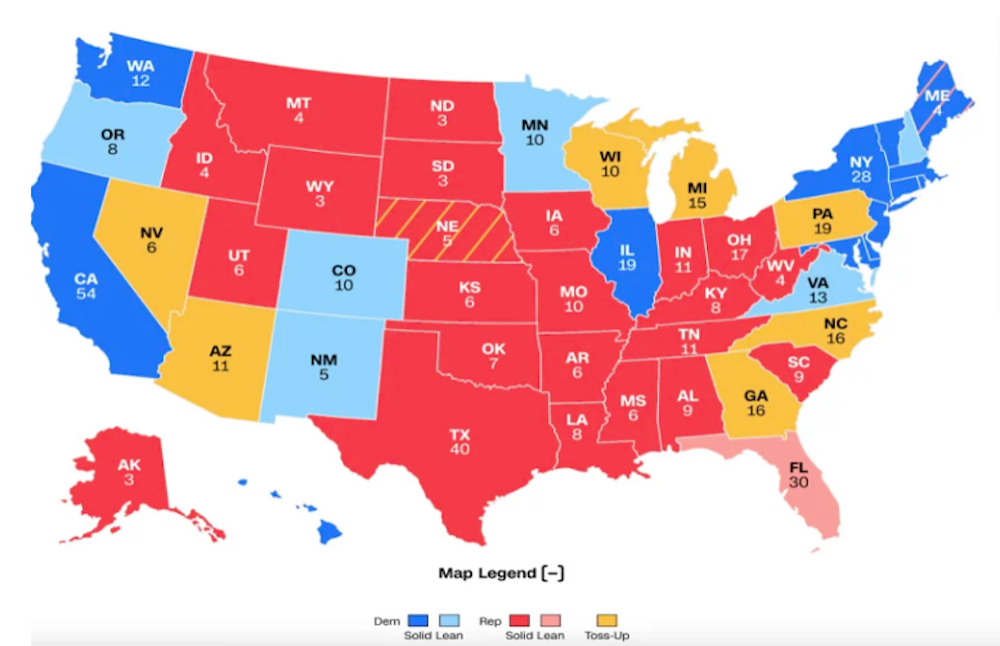
    According to recent analyses, around ten states are expected to be in play for 2024. Based on recent trends, there are seven swing states to watch: Nevada, Arizona, Wisconsin, Michigan, Pennsylvania, North Carolina, and Georgia. In the 2016 and 2020 elections, victory margins in these states were razor-thin, often less than 1%.

    With both Harris and Trump within striking distance of the 270 Electoral College votes needed to win the presidency, these swing states, with a combined 91 votes, will determine the outcome.

    Map published on 18 August 2024 by CNN. The number of electors for each state are show. The colors indicate the states that appear to be strongly (dark blue) or probably (light blue) leaning toward Kamala Harris, and strongly (red) or probably (pink) leaning toward Donald Trump. In yellow are the seven pivotal states where victory is likely to come down to a small number of votes. Click to zoom.

    The 2016 and 2020 polling failures: flukes or systemic issues?

    When the margins are so tight in these key states, accurately measuring voter intentions is an enormous challenge. In 2016, national polls correctly predicted Hillary Clinton’s popular-vote win – she had nearly 3 million more than Trump. However, they failed to foresee Trump’s Electorial College victories in critical states, which ultimately put him over the top.

    The American Association for Public Opinion Research (AAPOR) pointed out several reasons for these errors, including underrepresentation of Republican voters, over-representation of college-educated voters (who tend to lean Democratic), and an underestimation of undecided voters who eventually voted for Trump or third-party candidates.

    Despite efforts to fix these problems, other biases showed up in 2020. While graduate voters were not over-represented and undecideds were evenly split between Biden and Trump, the Covid-19 pandemic had made the pollsters’ task more complicated. AAPOR points out that the states with a higher proportion of Covid-19 cases were the ones with the highest polling errors. As a result, pollsters underestimated Trump’s vote share in key swing states and also overestimated Biden’s national lead, making the 2020 polls the least accurate in 40 years.

    Proportion of polling errors in presidential elections since 1936. Click to zoom.
    Pew Reseach Center

    Despite these errors, Biden still triumphed, winning 4 percent more of the popular vote and taking home 306 electoral votes to Trump’s 232. Biden’s victories in the swing states of Arizona, Georgia, Michigan, Nevada, Pennsylvania, and Wisconsin make all the difference.

    Polling errors and public distrust

    Errors of this magnitude naturally increase the public’s scepticism of polling, especially among Republicans, who are already wary of establishment institutions. Contrary to initial assumptions, Trump voters didn’t hesitate to express their preferences in 2016 and 2020. However, they were less likely to participate in polls due in part to their distrust of mainstream institutions. As a result, working-class white voters – and their opinions – were underrepresented in many polls.

    Pollsters also face technical challenges. Getting a respondent on the phone now requires calling hundreds of people, thanks to caller ID and call screening. Polls with smaller samples (fewer than 1,000 respondents) are less reliable. To deal with these hurdles, many pollsters are now using a mix of methods, including e-mail, online surveys, and robocalls.

    Though cheaper, online surveys often draw voluntary participants who are compensated, which leads to issues of accuracy and representation. This growing reliance on online polling has contributed to a doubling of polling companies from 2000 to 2022, according to Pew Research Center.

    Margin of error and identifying “likely” voters

    The margin of error is a critical component of polling that is often misunderstood by the public and media. It typically falls between 3 and 4 percentage points, but for smaller demographic groups (for example, young people, white men, or Hispanics), it can be even higher. Media headlines, however, frequently imply a candidate is leading, even when the difference is within the margin of error. University of California, Berkeley researchers suggest that to ensure 95% accuracy, the margin of error should be closer to 6%.

    However, the media sometimes amplify results, particularly in headlines, by implying that a candidate is ahead, even when the difference is within the margin of error. Moreover, researchers at the University of Berkeley have shown that to guarantee 95% accuracy, this margin should be increased to at least 6%. This means a candidate projected to receive 54% of the vote is likely, in reality, to secure anywhere between 48% and 60%, reflecting an actual margin of error of 12 percentage points.

    Another significant challenge for pollsters is identifying likely voters. Only around two-thirds of citizens eligible to vote actually go to the polls. In 2016, turnout on the Democratic side was overestimated, giving the false impression that Clinton was a lock for victory. This likely caused some of her supporters to stay home, while Trump’s base showed up in force when polls suggested he was behind. Accurately predicting who will turn out to vote is crucial to polling accuracy.

    Lessons from the 2022 midterms: A glimmer of hope for 2024?

    Polling showed notable improvements during the 2022 midterm elections, with the results being the most accurate since 1998. Importantly, there was no significant bias toward either party. However, midterm elections operate differently than presidential elections, and the dynamics for 2024 may be very different. That said, many polling institutions have adapted since 2016: as of 2022, 61% of polling firms had changed their methods, such as refining sampling techniques and improving question wording. More than a third have changed their methods after 2020.

    While these changes are positive, challenges remain, especially in predicting turnout and combating low response rates.

    What good are polls, then?

    At the end of the day, election polls offer snapshots – often imprecise – and can only provide general trends. Polling methods vary across firms, introducing biases that make it difficult to compare results.

    Survey aggregators offer averages that might be more reliable than individual polls, but they still come with a degree of uncertainty. This is true for FiveThirtyEight, the well-known website founded by statistics guru Nate Silver. After ABC took over in 2023, Silver left, taking his forecasting model with him to his new platform, Silver Bulletin, which continues to attract significant media attention.

    With the unpredictability of polls, political betting markets have become popular as polling alternatives. Platforms like Polymarket, which recently hired Silver, have multiplied rapidly. Some people, like Elon Musk, argue that markets provide better forecasts than traditional polls, though this claim is unproven. There are also concerns that these markets could be manipulated to sway public opinion.

    While opinion polls aren’t the best tools for predicting elections – as this could be one of the closest in recent history – their value lies in gauging public opinion on key issues. However, even in this role, polls can still be biased, often influenced by how questions are phrased.

    For example, in 2019 USA Today ran the headline “Poll: Half of Americans say Trump is victim of a ‘witch hunt’ as trust in Mueller erodes”. This was in reference to Special Counsel Robert Mueller’s investigation into Russian interference in the 2016 election. The question asked by the poll was:

    “President Trump has called the special counsel’s investigation a ‘witch hunt’ and said he has been investigated more than previous presidents for political reasons. Do you agree?”

    The problem with this wording is that it combined two different ideas: whether the investigation was a “witch hunt” and whether Trump had been unfairly targeted for political reasons. On top of that, the question lacked neutrality, presenting only his perspective.

    Naturally, Trump used the result to his advantage, even though other polls from sources such as The Washington Post, CBS News, and NPR-PBS told a different story.

    To use polling data wisely during this election, it’s crucial to recognize these limitations and pay attention to the fine print – details like the sample size, polling date, margin of error, and methodology. Additionally, consider the poll’s sponsors, who may only release results that align with their particular agenda.

    Ultimately, the best way to interpret polling data is with caution, focusing on general trends rather than any single poll. And always remember, election outcomes can be full of surprises.

    Jérôme Viala-Gaudefroy ne travaille pas, ne conseille pas, ne possède pas de parts, ne reçoit pas de fonds d’une organisation qui pourrait tirer profit de cet article, et n’a déclaré aucune autre affiliation que son organisme de recherche.

    ref. 2024 US presidential election: can we believe the polls? – https://theconversation.com/2024-us-presidential-election-can-we-believe-the-polls-240834

    MIL OSI – Global Reports

  • MIL-Evening Report: 30 years ago, Tarantino’s Pulp Fiction shook Hollywood and redefined ‘cool’ cinema

    Source: The Conversation (Au and NZ) – By Ben McCann, Associate Professor of French Studies, University of Adelaide

    IMDB

    What might be the most seismic moment in American cinema? Film “speaking” for the first time in The Jazz Singer? Dorothy entering the Land of Oz? That menacing shark that in 1975 invented the summer blockbuster?

    Or how about that moment when two hitmen on their way to a job began talking about the intricacies of European fast food while listening to Kool & The Gang?

    Directed by Quentin Tarantino, Pulp Fiction (1994) celebrates its 30th birthday this month. Watching it now, this story of a motley crew of mobsters, drug dealers and lowlifes in sunny Los Angeles still feels startlingly new.

    Widely regarded as Tarantino’s masterpiece, the director’s dazzling second film was considered era-defining for its memorable dialogue, innovative narrative structure and unique blend of humour and violence. It was nominated for seven Academy Awards, made stars of Samuel L. Jackson and Uma Thurman, and revitalised John Travolta’s career.

    Pulp Fiction is dark, often poignant, and very funny. It is, as one critic describes it, an “intravenous jab of callous madness, black comedy and strange unwholesome euphoria”.

    Tarantino’s trademark style includes plenty of violence and gore.
    IMDB

    A Möbius strip plot

    Famous for its non-linear narrative, Pulp Fiction weaves together a trio of connected crime stories. The three chapters – Vincent Vega and Marsellus Wallace’s Wife, The Gold Watch and The Bonnie Situation – loop, twist and intersect but, crucially, never confuse the viewer.

    Tarantino has often paid tribute to French filmmakers Jean-Luc Godard and Jean-Pierre Melville, whose earlier films also presented their narratives out of chronological order and modified the rules of the crime genre.

    By inviting audiences to piece Pulp Fiction together like a puzzle, Tarantino laid the way for subsequent achronological films such as Memento (2000), Go (1999) and Lock, Stock and Two Smoking Barrels (1998).

    Pop culture meets postmodernism

    In his influential essay Postmodernism, or the Cultural Logic of Late Capitalism, first published in 1984, political theorist Frederic Jameson coined the term “new depthlessness” to describe postmodern culture.

    Jameson perceived a shift away from the depth, meaning and authenticity that characterised earlier forms of culture, towards a focus on surface and style.

    Pulp Fiction’s iconic movie poster shows character Mia Wallace (Uma Thurman) smoking a cigarette.
    IMDB

    Pulp Fiction fits Jameson’s definition of depthlessness. It is stuffed with homages to popular culture and a vivid array of character types drawn from other B-movies – hitmen, molls, mob bosses, double-crossing boxers, traumatised war veterans and tuxedo-wearing “fixers”. It is a film of surfaces and allusions.

    Jackson, Travolta and Thurman feature alongside established 1990s box-office stars including Bruce Willis and industry stalwarts Harvey Keitel and Christopher Walken, both of whom have brief but memorable cameos.

    The film’s most iconic scene takes place at the retro 1950s-themed Jack Rabbit Slim’s diner. Thurman’s twist contest with Travolta fondly echoes Travolta’s earlier dancing in Saturday Night Fever (1977) and pays homage to other dance scenes in films such as 8 ½ (1963) and Band of Outsiders (1964).

    Words and music

    Film critic Roger Ebert once noted how Tarantino’s characters “often speak at right angles to the action”, giving long speeches before getting on with the job at hand.

    Pulp Fiction is full of witty and quotable monologues and dialogue, ranging from the philosophical to the mundane. Conversations about foot massages and blueberry pie bump up against Bible verses and reflections on fate and redemption.

    The film’s 1995 Oscar for Best Original Screenplay was a fitting achievement for Tarantino, who many regard as the snappiest writer in film history. Countless other filmmakers have looked to replicate Pulp Fiction’s mashup of cool and coarse.

    Needle drops are just as important in establishing Pulp Fiction’s mood and tone. The film’s eclectic soundtrack pings between surf rock, soul and classic rock ‘n’ roll.

    The soundtrack peaked at No. 21 on the Billboard 200 in 1994 and stayed in the charts for more than a year.

    Dividing the critics

    Though it was officially released in October 1994, Pulp Fiction had already made a stir earlier that by winning the prestigious Palme d’Or at the Cannes Film Festival.

    Many expected Krzysztof Kieślowski’s Three Colours: Red to take the top prize. Tarantino himself seemed stunned, telling the Cannes audience: “I don’t make the kind of movies that bring people together. I make movies that split people apart.”

    The film has divided critics ever since.

    Many adored Pulp Fiction for its intoxicating allure and sheer adrenaline-fuelled pleasure. To this day it maintains a 92% critic score on Rotten Tomatoes. Film critic Todd McCarthy called it a film “bulging with boldness, humour and diabolical invention”.

    But the backlash was equally robust. Some criticised the film for its excessive gore and irresponsible use of racial slurs. Screenwriting guru Syd Field felt it was too shallow and too talky. Jean-Luc Godard, once one of Tarantino’s idol, apparently hated it.

    Nonetheless, its financial success (a box office return of US$213 million from an $8 million budget) signalled the growing importance and cultural prestige of independent US films. Miramax, the studio that backed it, went on to become a major force in the industry.

    The 1994 film made stars of Samuel L. Jackson and Uma Thurman.
    IMDB

    A lasting legacy

    Shortly after Pulp Fiction’s release, the word “Tarantinoesque” appeared in the Oxofrd English Dictionary. The entry reads:

    Resembling or imitative of the films of Quentin Tarantino; characteristic or reminiscent of these films Tarantino’s films are typically characterised by graphic and stylized violence, non-linear storylines, cineliterate references, satirical themes, and sharp dialogue.

    Pulp Fiction has since been parodied and knocked off countless times. Hollywood suddenly began mass-producing low-budget crime thrillers with witty, self-reflexive dialogue. Things to Do in Denver When You’re Dead (1995), 2 Days In The Valley (1996) and Very Bad Things (1998) are just some example.

    Graffiti artist Bansky even stencilled the likeness of Jules and Vincent all over London, with bananas in place of guns. The Simpsons got in on the act too.

    Tarantino once summed up his working method as follows:

    Ultimately all I’m trying to do is merge sophisticated storytelling with lurid subject matter. I reckon that makes for an entertaining night at the movies.

    I’d say there’s no better way to describe Pulp Fiction.

    Ben McCann does not work for, consult, own shares in or receive funding from any company or organisation that would benefit from this article, and has disclosed no relevant affiliations beyond their academic appointment.

    ref. 30 years ago, Tarantino’s Pulp Fiction shook Hollywood and redefined ‘cool’ cinema – https://theconversation.com/30-years-ago-tarantinos-pulp-fiction-shook-hollywood-and-redefined-cool-cinema-236877

    MIL OSI AnalysisEveningReport.nz

  • MIL-OSI Australia: Major funding boost for the Asylum Seekers Centre

    Source: New South Wales Premiere

    Published: 11 October 2024

    Released by: Minister for Health, Minister for Multiculturalism


    The Asylum Seekers Centre will be able to expand primary care clinics and meet the increasingly complex health needs of some of Sydney’s most vulnerable residents, thanks to a grant of more than $1 million from the NSW Government.

    Minister for Health Ryan Park today announced funding of $1.07 million over three years for the Centre, which will help employ more clinical staff to manage the growing number of chronic illnesses such as diabetes and cardiovascular disease in the asylum seeker community.

    The funding will also help the Centre address the increasing need and cost of medicine for members of the community without access to the Pharmaceutical Benefits Scheme (PBS).

    The Asylum Seekers Centre is a not-for-profit organisation that was established in 1993 and offers practical and personal support to people seeking asylum. The Centre also provides primary healthcare services for people seeking asylum with limited Medicare eligibility through a specialist nurse-led health service with volunteer GPs and other specialists.

    The Centre’s health service runs four GP clinics per week and has seen an 81 per cent increase in visits since June 2022. The complexity of visits has increased due to growing mental health presentations, an ageing population, and increased demand for pharmaceuticals, compounded by rising costs.

    Quotes attributable to Minister for Health Ryan Park:

    “This funding will allow people seeking asylum to access critical healthcare services they otherwise wouldn’t be able to.

    “Without access to the valuable work of the Asylum Seekers Centre, patients would often have nowhere else to turn but to our already busy emergency departments.”

    Quotes attributable to Minister for Multiculturalism, Steve Kamper:

    “NSW settles a significant proportion of people fleeing conflicts in Australia. They are an important part of the NSW community and we must ensure they have access to the services they need.

    “We are proud to support the Asylum Seekers Centre to facilitate access to essential primary health care to those who need it most.”

    Quotes attributable to Asylum Seekers Centre CEO Frances Rush OAM:

    “The Asylum Seekers Centre Health Clinic relies on the support of the state government, as well as the generosity of our GPs, physiotherapists, and others who provide their services for free, including partner organisations that provide free access to optometry and dentistry.”

    “The Asylum Seekers Centre is appreciative of both the Minister’s support for the Centre’s Health Clinic and the recognition of the often-precarious plight that people seeking asylum in our state face.”

    “Without access to the Centre’s pharmaceutical services, many people seeking asylum would not have the means to access life-saving medication – a priority healthcare right for all.”

    “This funding will go a long way to help address the great need in our community, enhancing the health and lives of people seeking asylum.”

    MIL OSI News

  • MIL-OSI Australia: North Coast small business lights up Paris and the Premier’s NSW Export Awards

    Source: New South Wales Premiere

    Published: 12 October 2024

    Released by: Minister for Industry and Trade


    A small business from the state’s mid north coast which helped light up the Paris Olympics has been named NSW Exporter of the Year at the Premier’s NSW Export Awards.

    Bellingen business Planet Lighting supplied 1,600 red and amber LED lights for ramps and pathways around the Olympic Village as part of an interactive installation that’s now a permanent fixture in the French capital.

    Planet Lighting is a small business success story – they’ve been manufacturing lights since the 1930s.

    They are one of the leading Australian suppliers of medical and surgical lights and export their custom-built products throughout Asia, Europe and the Americas.

    With a team of 50 employees, Planet Lighting meticulously designed and manufactured the light fixtures, partnering with local suppliers and international distributors to bring its LED display to the global stage.

    Planet Lighting was among 17 other NSW businesses from a diverse range of industries including agribusiness, manufacturing, creative arts and advanced technologies honoured last night at a gala ceremony at Sydney Town Hall.

    Now in its 62nd year, the Premier’s NSW Export Awards celebrate the success and resilience of NSW exporters, whose export of goods and services is worth $150 billion annually to NSW.

    Winners were announced across five state categories and 13 national categories. The national category winners will now progress as finalists for the Australian Export Awards, to be held in Canberra next month.

    For a full list of NSW award winners visit the Export Council of Australia.

    Minister for Industry and Trade Anoulack Chanthivong said:

    “Exports not only benefit individual businesses, they are a critical part of our economy, with trade supporting one in five Australian jobs.

    “The NSW Government is proud to support our wonderful exporting community. Accessing overseas markets can be a game-changer for NSW businesses looking to accelerate their growth, and this year’s award winners are doing exactly that – capitalising on the incredible opportunities that come through exporting.

    “A big congratulations to Planet Lighting and all our other NSW Export Award winners who are shining bright overseas and showcasing the best of what NSW has to offer the world.”

    Planet Lighting Managing Director Mia Iggulden said: 

    “We’re incredibly proud to be recognised amongst a strong field of NSW exporters.

    “Innovation and collaboration are at the heart of everything we do at Planet Lighting. Our partnerships with local suppliers and dedicated overseas distributors have been instrumental in our journey, allowing us to invest in advanced manufacturing technologies and create new local jobs. We’re excited to continue pushing the boundaries of lighting design, all while supporting the community we call home.”

    Chair of the Export Council of Australia Dianne Tipping said:

    “There was strong interest in this year’s awards with nominations from more than 200 NSW exporters.

    “Through the awards, we have celebrated exporters who have by hard work and resilience succeeded in global markets, whilst inspiring others to grow their own businesses by going global. They are taking NSW innovation onto the world stage, supporting jobs and economic growth for all.” 

    MIL OSI News

  • MIL-OSI Australia: Bulldogs are beautiful companions & worthy AFL team mascots

    Source: Ministers for Social Services

    It was Harry S Truman who said “If you want a friend in (insert name of city where politicians gather), get a dog”.

    Not to malign my many friends in Canberra, Truman had a point.

    My life would be infinitely poorer had I not shared so much of it with dogs.

    And there is one breed of dog in particular that has a very special place in my heart — the British bulldog.

    I love bulldogs. I have a bulldog, Walter. I had two bulldogs until last year when my beloved Tilly died at the ripe old age of 11.

    As honorary patron of the British Bulldog Club of Victoria, I feel it is my solemn duty to speak on behalf of not just the Walters and the Tillies of this country, but on behalf of all bulldogs.

    These canine companions are magnificent. They are loyal, don’t mind a pat (therapeutic for the patter and the pattee), and are content to lie under your study desk ‘til the wee small hours blissfully unstressed by matters of policy and politics.

    So having declared upfront my bias for these lovable lumps, you will understand my outrage that it has been suggested the Western Bulldogs AFL team should drop the bulldog as its mascot.

    The People for the Ethical Treatment of Animals claim the Western Bulldogs club is “supporting the intentional breeding of dogs with painful and debilitating deformities and encouraging people to buy dogs with extreme features that cause them to suffer”.

    Excuse me for being blunt but what a load of rubbish.

    PETA thinks that the Western Bulldogs should rebrand as “the Mutts” to encourage people to “adopt, don’t shop”.

    Don’t get me wrong, pet rescue organisations are absolutely worthy of praise for the role they play.

    But to be honest, PETA’s extreme stance is an insult to ethical breeders of bulldogs and responsible owners alike.

    Bulldogs are one of the breeds known as brachycephalic. They’re dogs that generally have wider, shortened heads and a shortened snout. People sometimes refer to them as having squished faces — just one of their many endearing attributes.

    You know the ones I’m talking about — the chonks that are British bulldogs, Australian bulldogs and their little Frenchie mates, boxers, pugs, chihuahuas, shih tzus and a long list of others.

    Just as poodles have curly hair, and great Danes have long legs, bulldogs have turned up noses. It’s just how they are.

    But, we cannot be naive. There are unethical breeders who will breed features into these dogs because there is a demand for a certain look such as a squishier face. Designer dogs as they’re known.

    But to get that squishier face you also get increased folds of skin around and inside the nose and throat, and that can lead to a condition called brachycephalic obstructive airway syndrome or BOAS.

    BOAS can affect a dog’s ability to breathe, and affected pups can struggle to cope with the heat or even the most usual of activities like exercise, play, eating, drinking and sleeping.

    But PETA is wrong to pretend there has not been extensive research carried out to ensure the wellbeing of bulldogs in Australia.

    Dogs Australia is dedicated to improving the health of dogs and administers the respiratory function grading scheme.

    This groundbreaking scheme by the Kennel Club and the Cambridge Veterinary School provides an international, collaborative, and evidence-based approach — with a clinical assessment and exercise tolerance test — to help improve the health of BOAS-affected breeds globally.

    The data dogs is then shared on the Officially Registered Canine Health Information Database (ORCHID). Breeders can then access this information and make an evidence-based selection of the most suitable stock for breeding purposes.

    The RGF scheme has four grades — 0 means no evidence of BOAS; 1 means mild BOAS; 2 is moderate BOAS; and 3 means clinically affected or severe BOAS.

    And do you know what has happened since the scheme was introduced and breeders had access to the data in the UK? Vets are recording fewer and fewer scores of 2 and 3 in the brachy dogs they see.

    So, just as you can introduce problems into a breed, you can also breed them out. You just need to give people the right information.

    I met several owners and breeders at the Melbourne Royal Show a few weeks ago, who proudly showed their British bulldogs are just as cuddly and affectionate as they are well bred — and always on the lookout for snacks. And I say that with absolutely no judgment.

    Bottom line is, they love their bulldogs.

    And Western Bulldogs fans love their mascot.

    To suggest that big, boofy head should be replaced on the team’s logo is sacrilege.

    Originally published in The West Australian Monday 14 October 2024.

    MIL OSI News

  • MIL-OSI New Zealand: Backing the bittern: The bird on the brink

    Source: Environment Canterbury Regional Council

    Threats facing the Australasian Bittern (Matuku-hūrepo)

    The bittern’s declining numbers are reflective of the region’s shrinking wetlands, where they’re commonly found. Since European settlement, 90 per cent of freshwater and natural wetlands and half of our coastal wetlands in Waitaha have been lost through human impact. 

    Other threats include collisions with vehicles and starvation caused by:

    • changes in water levels that leave birds ‘high and dry’,
    • lack of food and/or habitat where the species can hunt,
    • and murky water quality (sedimentation) – as bittern are visual feeders. 

    One of the best ways we can help the species is to protect and enhance our remaining wetlands, and where possible, create new wetlands, to provide an optimum breeding and feeding habitat.

    Elusive ‘spy’ behaviour

    Preserving raupō habitat

    90 per cent of bittern sightings in Waitaha over the last 15 years have occurred in the Te Waihora and Pegasus Bay areas. Their most important habitat is dense/mature raupō beds on river, wetland or lake edges.

    The wetlands around the margin of Te Waihora are the largest remaining area of wetland habitat in lowland Canterbury, covering around 4,500 hectares. A DOC-run willow control programme, which we’re helping fund, is a key initiative for supporting bittern.

    Not only do willows suck up large volumes of water but they also encroach on native wetland vegetation such as raupō. They create a dense canopy and interfere with the function of the wetland, including destroying spawning grounds for benthic fish (fish that deposit their spawn on or near the bottom of the sea or lake) – which the bittern feed on.

    At Te Waihora, willows were invading the raupō at an alarming rate. The ‘bittern habitat’ aspect was a key driver for establishing and maintaining the control programme, which began in 2011. 

    DOC biodiversity ranger Allanah Purdie says reversing the spread of willow is a cost-effective and efficient way to support bittern. 

    “Raupō is by far their preferred habitat – so when you remove the willow, you get bittern.” 

    As Allanah points out, the species’ perilous future is representative of the overall condition of wetland systems that remain. 

    “It’s an indicator for all our other wetland species and the health of the ecosystem as a whole, all of which are suffering as a result of long-term wetland degradation.” 

    Community conservation efforts

    In Waimakariri, the Bittern Īnanga Rushland wetland is one of three Kaiapoi projects being undertaken by an extended family who are passionate about restoring biodiversity to the area. 

    One of the aims is to attract bittern, and the site has also been identified as a potential Canterbury mudfish habitat. It is receiving $15,000 in funding this financial year through the Waimakariri Water Zone Committee. 

    The support will help with the control of willows and poplars, along with more than 350 metres of fencing to create a large buffer to protect the rushland and make room for plantings. 

    Landowner Nicky Auld says a bittern is now frequenting the area. 

    “It was very rewarding seeing a bittern for the first time, and it is now a regular visitor to the rushland – where it feeds on eels, fish and whitebait.  

    “We’ve been scattering raupō seeds in the hope that the rushland may become even more attractive to these magnificent birds, and a breeding ground.” 

    Others who have raupō on their property are already in a good position to help. 
    Allanah says wet areas with fresh standing water – about 20 cm deep – are ideal habitat. 

    “Bittern need areas to take-off and land in, so consider keeping the larger stature plants back at least ten metres from the water, with Carex around the margin and then raupō in the middle.  

    “The species is intrinsically linked to areas with marginal or dense vegetation. They don’t like being out in the open and are very prone to disturbance. If you have a disturbance event in a wetland they’ll go to ground or disappear.” 

    Bittern are known for being highly mobile, so when they do disappear – it can be to quite a distance away. One that was fitted with a transmitter was tracked flying from Te Waihora to Blenheim – more than 300 km. 

    Preventing extinction

    Conservationist Peter Langlands, who’s carried out extensive monitoring of bittern in Waitaha, describes the situation as ‘critical’. 

    “I’m worried that we may lose the source population of bittern in Canterbury. We must act now if we’re to save the species.” 

    Peter believes a collaborative approach to large scale habitat restoration projects, and scaling up wetland creation, will lead to the best conservation outcomes.  

    Frances echoes Peter’s sentiment. 

    “They’re such a mysterious, and surprisingly graceful bird. When you see one for the first time – it’s special. It would be really unfair if we didn’t manage to conserve that experience for people.” 

    MIL OSI New Zealand News

  • MIL-OSI USA: Congressman Aderholt Announces the Death of His Mother, Mary Frances Aderholt, 88

    Source: United States House of Representatives – Congressman Robert Aderholt (AL-04)

    A note from Congressman Aderholt on the passing of his mother:

    My mom, Mary Frances Aderholt, passed away Saturday afternoon October 12, 2024 here in Haleyville. She was 88, and I thank God I had her as long as I did.

    I was with her a couple of days last week and before I left her to go out of town Thursday morning, I told her I loved her and she told me that she loved me.

    She was the best mom a son could possibly have.

    Even though she was 88, I would have liked to have had her much, much longer. To be honest, it is especially tough, as I am an only child, and lost my dad three years ago. Thankfully, I have the strong arm of the Lord Jesus to cling to.

    It is also comforting to know she had a faith in Christ Jesus and she is reunited with my dad, whom she loved so much.

    She was quite a lady, and very proper, and always wanted to do things first class. She, along with my dad, were my biggest cheerleaders.

    I look forward to seeing both of them again.

    I love you Mom!

    Recently I was reminded of the song: “He is mine I am His” I want to share the words as it has given me great encouragement. It was written by a fellow Winston Countian, GT Speer back in 1965.

    He Is Mine & I Am His Forever

    GT Speer

    Verse 1: God’s amazing grace sent down from Heaven Rescued me from death and from shame

    Opened up my eyes and brought salvation

    Now I’m His, praise His holy name

    Chorus: Now I know ( I know) He is mine (that He’s mine) I am His forever (I’m His forever)

    He is leading me along life’s way (along life’s way)

    He’ll be holding to my hand (to my hand)

    When I cross death’s river (When I cross death’s river) He will take the sting of death away (death’s sting away)

    Verse 2: ‘Tis so sweet just to know I have Jesus with me He will keep me from sin and from strife

    He delivered me from condemnation

    Now I have eternal life

    Repeat Chorus

    Bridge: He’ll be holding to my hand (to my hand)

    When I cross death’s river (When I cross death’s river) He will take the sting of death away (death’s sting away)

    Tag: He will take the sting of death away (death’s sting away)

    MIL OSI USA News

  • MIL-OSI Translation: The government of New Caledonia launches a geographic information portal dedicated to natural hazards

    MIL OSI Translation. French Polynesian to English –

    Source: Government of New Caledonia

    In order to better inform the population about the natural risks to which New Caledonia is exposed, the government of New Caledonia is providing a new geographic information portal. In collaboration with the Digital and Modernization Department (DINUM), the Department of Industry, Mines and Energy of New Caledonia (DIMENC) has developed and put online the “Géorisque” portal: https://georisque.georep.nc/

    This portal provides simplified access to geographic data relating to natural hazards in the territory. To date, the information available concerns land movements, marine submersion, coastal erosion, and the presence of environmental asbestos. This data is regularly updated and enriched by the relevant services.

    As an extension of the Coastal Observatory (OBLIC), the Géorisque portal offers explanatory notices to facilitate the understanding and use of data. Users can explore interactive mapping, consult summary dashboards by municipality, and download or print maps according to their specific needs. Direct access to data layers is also available via the Géorep portal: https://dimenc.georep.nc.

    In a participatory approach, Géorisque also allows the population to contribute to enriching information by reporting new observations or events linked to natural risks.

    This project is part of the New Caledonian government’s desire to improve public awareness of environmental risks. In particular, it responds to a recommendation made in March 2024 by the Territorial Chamber of Auditors in its report on civil security policy in the area of major climate risks in New Caledonia.

    The data collected and disseminated on this portal aims to support local public policies, whether in the areas of housing, transport or risk prevention, and thus to strengthen coordination between the competent authorities.

    EDITOR’S NOTE: This article is a translation. Apologies should the grammar and/or sentence structure not be perfect.

    MIL Translation OSI

  • MIL-OSI Europe: UN – World Day Against the Death Penalty (10 Oct. 2024)

    Source: Republic of France in English
    The Republic of France has issued the following statement:

    On this 22nd World Day Against the Death Penalty, France reiterates its opposition to this cruel, unjust and inhumane punishment everywhere and in all circumstances.

    The abolition of the death penalty is steadily making headway around the world. But 51 nations continue to apply it.

    At the last UN General Assembly, France and its partner countries presented their biennial resolution calling for a moratorium on executions with the ultimate aim of abolishing the death penalty.

    On December 10, 2023, the 75th anniversary of the Universal Declaration of Human Rights, President Macron announced that France would host the 9th World Congress Against the Death Penalty in 2026.

    France calls on all nations to sign and ratify the Second Optional Protocol to the International Covenant on Civil and Political Rights, aimed at abolishing the death penalty.

    On this symbolic day, France honors the memory of Robert Badinter, who passed away on February 9.

    MIL OSI Europe News

  • MIL-OSI Europe: Federal Councillor Beat Jans at ministerial meeting in Luxembourg

    Source: Switzerland – Federal Administration in English

    Bern, 10.10.2024 – On 10 October, Federal Councillor Beat Jans attended a meeting of justice and home affairs ministers of the (EU and) Schengen states in Luxembourg. The talks focused on better protection of the external border, internal border controls and the need for reform in relation to the EU’s return policy.

    These are priority issues for the Schengen states this year. The Hungarian Council presidency focused the ministerial meeting agenda on the protection of the external border, in particular the digitalisation of processes and systems, and the implementation of interoperability.

    Federal Councillor Beat Jans stressed that external border protection was only one element of a functioning Schengen area and that challenges such as secondary immigration, Dublin transfers and internal border controls must also be addressed. External borders should also be strengthened through better cooperation with third countries. In this regard, the head of the FDJP referred to Switzerland’s positive experience with migration partnerships, which served the interests of all parties involved and ensured that fundamental rights were guaranteed.

    Mr Jans welcomed the discussion on return policy initiated by the Council presidency. He emphasised that there was a need to reform legislation in the area of return policy and argued in favour of Schengen states having greater room for manoeuvre in returning dangerous individuals. He was open to the suggestion that voluntary return to Afghanistan and Syria and the associated expansion of operational support from Frontex should be discussed in European bodies.

    Bilateral meetings

    In Luxembourg, Mr Jans held his first talks with the new French Interior Minister, Bruno Retailleau. He spoke with the new Greek Migration and Asylum Minister, Nikos Panagiotopoulos, about cooperation on migration as part of Switzerland’s second contribution to selected EU states. Switzerland is providing support in Greece for projects to strengthen migration management and to accommodate vulnerable refugees. Mr Jans was briefed by Norwegian Justice Minister Emilie Enger Mehl on the latest asylum policy decisions in Norway. He discussed internal border controls with Czech Interior Minister Vít Rakušan and Austrian Interior Minister Gerhard Karner.


    Address for enquiries

    FDJP Communication Service, info@gs-efd.admin.ch, T +41 58 462 18 18


    Publisher

    Federal Department of Justice and Police
    http://www.ejpd.admin.ch

    MIL OSI Europe News

  • MIL-OSI United Nations: Experts of the Committee on the Elimination of Discrimination against Women Commend New Zealand’s Promotion of Gender Equality, Ask about Initiatives to Address Violence against Women and Discrimination against Māori Women and Girls

    Source: United Nations – Geneva

    The Committee on the Elimination of Discrimination against Women today considered the ninth periodic report of New Zealand, with Committee Experts praising the State’s achievements in promoting gender equality and raising questions about initiatives to address high levels of violence against women and discrimination against Māori women and girls, and reports of reduced funding for those initiatives.

    In the dialogue, several Committee Experts commended New Zealand’s efforts promoting gender equality.  One Expert welcomed that the State party had achieved gender parity in Parliament recently, while another Expert congratulated the State party on ranking fourth in the Global Gender Gap Index.

    Natasha Stott Despoja, Committee Expert and Rapporteur for New Zealand, said the rates of violence against women and girls in New Zealand were alarming. She also expressed concern about reports of reduced funding for initiatives to prevent violence against women.

    Another Committee Expert said Māori women and girls continued to face disproportionate levels of discrimination.  The Committee was alarmed by austerity measures which weakened efforts to fight discrimination in many Government bodies, including the disestablishment of the Māori Health Authority.  How would the State party promote the rights of indigenous peoples?

    Saunoamaali’i Dr Karanina Sumeo, Acting Chief Human Rights Commissioner of New Zealand, said that although Māori women and girls continued to experience various inequalities, the Government was reviewing the role of the Māori Tribunal and had stopped all efforts to implement the United Nations Declaration on the Rights of Indigenous Peoples.  The Government needed to implement the Declaration, she said.

    Introducing the report, Kellie Coombes, Secretary for Women and Chief Executive of the Ministry for Women of New Zealand and head of the delegation, said New Zealand’s women leaders had held the role of Prime Minister for 16 out of the last 27 years.  In October 2022, women Members of Parliament gained an equal share of seats in the New Zealand House of Representatives, making the State one of only six countries in the world to have achieved gender equality in Parliament.

    The delegation added that the Government had implemented temporary special measures to improve women’s representation in political bodies and the defence force.  A woman had been appointed as the leader of the New Zealand Army in September 2024. New Zealand also held back funding from sporting bodies that did not have a certain level of female representation on their boards.

    Emma Powell, Chief Executive of the Interdepartmental Executive Board for the Elimination of Family Violence and Sexual Violence of New Zealand, said the National Strategy for the Elimination of Family Violence and Sexual Violence guided efforts to address the underlying social conditions and norms that led to family violence and sexual violence.  The State party aimed to reduce the number of annual crimes against women by 11,000 in the next two years.  For 2024, ministers had agreed not to cut the budget devoted to combatting family and sexual violence.

    Paula Rawiri, Deputy Secretary of Policy at Te Puni Kōkiri (Ministry for Māori Development) of New Zealand, said New Zealand was working to ensure that it was a nation where Māori women and girls could thrive.  The Ministry for Māori Development would soon publish reports on disparities in justice, health, education, employment and socio-economic wellbeing.  This body of work would yield valuable insights on legislative and policy levers to combat intersecting forms of discrimination against Māori women and girls.

    In closing remarks, Ms. Coombes said New Zealand had made good progress toward gender equality and the empowerment of women and girls, underpinned by its commitment to the Convention.  There was more work to be done, and the Committee’s concluding observations would help the State party to achieve its goals.

    Ana Peláez Narváez, Committee Chair, in concluding remarks, thanked the delegation for the constructive dialogue, which had allowed the Committee to better understand the situation of women and girls in the State party.  The Committee called on the State party to implement its recommendations for the benefit of all women and girls in New Zealand.

    The delegation of New Zealand consisted of representatives from the Executive Board for the Elimination of Family Violence and Sexual Violence; Te Puni Kōkiri (Ministry of Māori Development); Ministry for Women; and the Permanent Mission of New Zealand to the United Nations Office at Geneva.

    The Committee will issue the concluding observations on the report of New Zealand at the end of its eighty-ninth session on 25 October.  All documents relating to the Committee’s work, including reports submitted by States parties, can be found on the session’s webpage.  Meeting summary releases can be found here.  The webcast of the Committee’s public meetings can be accessed via the UN Web TV webpage.

    The Committee will next meet in public at 3 p.m. on Monday, 14 October to hold a meeting with non-governmental organizations and national human rights institutes from Chile, Canada, Japan and Cuba, whose reports will be reviewed next week.


    Report


    The Committee has before it the ninth periodic report of New Zealand (CEDAW/C/NZL/9).

    Presentation of Report

    KELLIE COOMBES, Secretary for Women and Chief Executive of the Ministry for Women of New Zealand and head of the delegation, said New Zealand strongly valued diversity and took pride in promoting human rights and equal treatment for all people.  It was the first country where women gained the right to vote and had a strong record of women’s political leadership.  In September, the State marked the one hundred and thirty-first anniversary of women’s suffrage.  Women leaders had held the role of Prime Minister for 16 out of the last 27 years. In October 2022, women Members of Parliament gained an equal share of seats in the New Zealand House of Representatives, making the State one of only six countries in the world to have achieved gender equality in Parliament.  New Zealand ranked fourth out of 146 nations on the World Economic Forum Global Gender Gap Index.

    Since the last report was submitted, New Zealand had had a change of Government.  The new Government’s key focus areas included rebuilding the economy, restoring law and order, and delivering better public services.  It was committed to the protection of the human rights of all women and girls in New Zealand, the promotion of gender equality, upholding women’s safety and wellbeing, protecting women and girls from all forms of violence, and reducing gender inequities in health.  Through deliberate action, the public service gender pay gap had fallen from 12.2 per cent in 2018 to 7.1 per cent in 2023, its lowest level. Work was now progressing alongside New Zealand businesses to develop a gender pay gap calculation tool.

    Work towards improving health outcomes for women and girls included the extension of free breast cancer screening for women aged 70-74, which would mean around 120,000 more women would be eligible for screening every two years.  The introduction last year of a world-leading self-test for cervical screening had seen more than 80 per cent of women being tested take up this option.  In 2023, for the fourth consecutive year, women’s representation on public sector boards reached 50 per cent or above, with women now holding 53.9 per cent of these roles.  Women were also better represented in board chair roles, reaching 46.2 per cent – a significant increase from 41.9 per cent in 2022. 

    Māori and ethnic diversity of public sector boards had also continued to increase since data collection for ethnicity began in 2019. The Global Women and the Champions for Change Group had achieved at least 40 per cent representation of women at board level.  Women’s representation on councils was the highest it had ever been, at nearly 46 per cent at the 2022 elections.  The online safety organization “Netsafe” was developing an online toolkit for workplaces to protect women in leadership positions from harassment and abuse.

    Women’s participation in the New Zealand labour force had steadily increased, from 54.3 per cent in 1991 to 67.4 per cent in June 2024. The women’s employment rate was currently at 64.5 per cent, remaining the fifth highest since measurement began in 1986.  Families in New Zealand had been negatively impacted by rising living costs.  Recent initiatives to support working parents included a six per cent increase in paid parental leave, and the introduction of the “FamilyBoost” payment to help families meet the cost of early childhood education.  The Government had also committed to prioritising a bill to allow parents to share parental leave as they see fit and introduce a three-day stay policy to ensure mothers and babies were entitled by law to 72 hours post-partum care.

    Health outcomes were improving overall for women in New Zealand and women had a longer life expectancy than men.  However, women spent more years in poor health than men with more medical interventions for conditions experienced across their lifetime. Health challenges were bigger for many groups of women and girls, including wāhine Māori (Māori women), Pacific women, rural women and disabled women.

    The State party was committed to gender equality in New Zealand for all women and girls.  Despite significant progress, challenges remained, and the Government needed to continue to build on the progress it had made to improve outcomes for all women and girls.

    EMMA POWELL, Chief Executive of the Interdepartmental Executive Board for the Elimination of Family Violence and Sexual Violence of New Zealand, said New Zealand had high and concerning rates of family violence and sexual violence.  Women were three times as likely as men to experience intimate partner violence. One in three women experienced sexual assault in their lifetime. In December 2021, the National Strategy for the Elimination of Family Violence and Sexual Violence was launched. It guided the efforts of the Government, indigenous peoples, communities and specialist sectors to address the underlying social conditions and norms that led to family violence and sexual violence. 

    The first action plan to implement the strategy, spanning 2021-2023, was now complete, and from its 40 actions progress had been made across a range of areas, including the development and implementation of new family violence workforce capability frameworks and training, and expanded community-led responses to violence.  The next action plan would be published by the end of the year.  It would prioritise improving multi-agency responses, and strengthening the evaluation of what worked to support investment, further equipping workforces to respond to victims of violence.

    PAULA RAWIRI, Deputy Secretary of Policy at Te Puni Kōkiri (Ministry for Māori Development) of New Zealand, said that after a period of nationwide mourning of the recent passing of Kingi Tuheitia Pōtatau Te Wherowhero IIV, a beacon of implicit reverence for indigenous women had appeared through the anointment of a young Māori queen.  New Zealand was driving a transformational journey of advancement for Māori women and girls, working to ensure that New Zealand was a nation where Māori women and girls could thrive.  The Ministry for Māori Development had implemented research arising from the Mana Wāhine Kaupapa Inquiry on systemic discrimination, deprivation and inequities experienced by Māori women as a result of Treaty of Waitangi breaches by the Crown.  An initial tranche of reports would shortly be published on the representation of Māori women in public sector decision-making roles and disparities in justice, health, education, employment and socio-economic wellbeing.  This body of work would yield valuable insights on legislative and policy levers to combat intersecting forms of discrimination against Māori women and girls. 

    The Ministry had also developed a series of national strategies, which were driving better outcomes and equality for Māori women and girls across fields such as justice, child protection, living with disabilities, access to technology, housing and education.  It was working to ensure greater representation of Māori women in public sector decision-making roles and within Māori communities. Māori women, girls and families continued to carry the burden of socio-economic inequity.  There was much more to do but when Māori society thrived, New Zealand society also thrived.

    SAUNOAMAALI’I DR KARANINA SUMEO, Acting Chief Human Rights Commissioner of New Zealand, said the Human Rights Commission had “A” status accreditation under the Paris Principles.  Māori women and girls continued to experience various inequalities. The Government was reviewing the role of the Māori Tribunal and had stopped all efforts to implement the United Nations Declaration on the Rights of Indigenous Peoples.  The Government needed to implement the Declaration and provide mental health support for Māori women and girls.  There had been a recent reduction in funding for responses to gender-based violence. 

    This year, a report from a Royal Commission of Inquiry revealed cases of torture of women and girls in New Zealand institutions. The State party needed to implement the Inquiry’s recommendations and develop legislation to reduce online harm against women.  The social security system disadvantaged women and could lead to their financial entrapment.  In 2023, one in eight children lived in poverty in New Zealand and gender and ethnic pay gaps persisted.  For every one dollar a New Zealand man earned, Māori and Pacific women earned less than 70 cents.  The Government lacked urgency to address this issue.  Workplace harassment was also affecting women.  The Government needed to reinstate the Fair Payment Agreement Act and ensure the right to equal work for all genders and persons with disabilities.

    Questions by a Committee Expert 

    NATASHA STOTT DESPOJA, Committee Expert and Rapporteur for New Zealand, said that New Zealand had long been a global leader in national development, both with regard to its labour force, being the first country to introduce minimum wage, and with regard to gender equality, being the first country in the world to afford women with the right to vote.  She commended the progress that had been made toward ensuring women in rural communities had access to abortion through the national establishment of the abortion telehealth service.  However, there were concerns around the Government’s reinterpretation of the Treaty of Waitangi and the removal of several equity measures, including the Māori health authority, and removal of State support for the United Nations Declaration on the Rights of Indigenous Peoples.  Māori women and girls had reported feeling unhoused, unnoticed and unsafe.  What progress had been made in protecting their rights, and in implementing the recommendations issued by the Royal Commission of Inquiry into abuse of Māori women and girls in institutions?

    The Committee noted recent steps taken to address family and sexual violence, including the 2018 passing of the Family Violence Act, the Sexual Violence Legislation Act in 2021, and the launch of the National Strategy and Action Plan to Eliminate Family Violence and Sexual Violence in 2022.  However, the rates of violence against women and girls in New Zealand were alarming.  Women were disproportionately at risk of facing violence.  Ms. Stott Despoja expressed concern about reports of reduced funding for initiatives to prevent violence against women, and the cessation of a safety-focused regulatory review of online services and platforms before it was completed.  What had been the impact of the 2019 Christchurch mosque shooting on women and girls?  Were women and girls of Muslim faith facing increased social hostility in the public space?

    It was welcome that the Convention and New Zealand’s reports had been published on the Ministry for Women’s website.  Did the State party plan to publish these in Pacific languages? There was a concerning lack of specific mentions of gender within New Zealand’s Human Rights Act.  What steps had been taken to amend the Act to include specific prohibitions of discrimination on the grounds of gender identity, gender expression, and sex characteristics?  It was also concerning that legal aid funding for cultural reports had been removed.  Around 67 per cent of women in prison in New Zealand were Māori.  Did the State party have a replacement strategy for these reports? How many times had gender-discrimination cases been brought before the courts in the last five years, and how many times had the Convention been invoked?

    Responses by the Delegation

    The delegation said the New Zealand Law Commission was reviewing whether the Human Rights Act adequately protected transgender people and people with diverse sexual characteristics.  The Government would consider any recommendations made when the review was completed in 2025.  In September this year, the Government launched a Human Rights Monitor, which recorded and tracked recommendations from the United Nations treaty bodies. The Government would consider the recommendation to publish information related to the Convention in Pacific languages. 

    Recently, New Zealand had changed the threshold for persons who could receive legal aid, increasing access for marginalised women and girls, including Māori and Pacific women and girls.  There had been six court cases since 2018 that had referred to the Convention.

    The Ministry for Women had developed a working relationship with the New Zealand Islamic Council since the Christchurch shooting and was working to support Muslim women and girls in the community, including to reach leadership positions.  The Government had launched an impactful campaign that sought to challenge perceptions of this group.

    New Zealand was committed to the United Nations Declaration on the Rights of Indigenous Peoples and the Treaty of Waitangi, and the positive outcomes that both sought for the Māori community.  The Government had decided to focus on meeting targets in nine key areas, aiming to support families at community level, so as to implement the Declaration.  Recent policy changes had affected the Māori community.  The Government would work together with Māori organizations to address concerns related to these changes.

    Questions by Committee Experts 

    One Committee Expert congratulated New Zealand for ratifying all nine of the United Nations human rights treaties.  New Zealand’s first national action plan on women, peace and security concluded in 2019.  The Committee hoped that the next iteration of the plan would include measures addressing security both internally and externally.  Could more information on New Zealand’s feminist diplomacy be provided? The omission of language as grounds for discrimination in State legislation needed to be revisited.  It was welcome that the 2023 budget included a gender lens.  Did the budget address intersectional discrimination against women with disabilities?

    It was welcome that there were six Supreme Court judgements on the Convention. Did the Māori Tribunal apply the Convention in its decision making?  Data was part of the Māori knowledge system, and the way that the digital domain was governed had implications in this regard.  The Government had reportedly failed to protect Māori from online risks, including related to the protection of their data.  How would the Government protect and support access to data for Māori women?

    Another Committee Expert said that New Zealand had made history in the nineteenth century by being the first country to allow women to vote.  It was welcome that the State party had achieved gender parity in Parliament recently.  Māori women and girls continued to face disproportionate levels of discrimination. The current Government had disestablished the Māori Health Authority.  The Committee was also alarmed by austerity measures which weakened efforts to fight discrimination in many Government bodies.  What temporary special measures was the State party planning to achieve full gender parity in political representation?  How would the State party address gaps created by budget cuts in the protection of the rights of women and girls?  How would the State party increase Māori representation in local governments and promote the rights of indigenous peoples domestically and internationally?

    Responses by the Delegation

    The delegation said New Zealand continued to progress work aligned to its national action plan on women, peace and security.  It was developing a second national action plan, but no decisions had been made yet.  The State had co-hosted a women, peace and security summit in Samoa in 2019, which had launched a gender defence network that included defence forces from countries in the region.  New Zealand had also supported gender mainstreaming in Fiji and the development of the State’s first women, peace and security action plan.  There was also a gender focal point network within the defence force.  The New Zealand police provided support in eight Pacific nations to strengthen the frontline response to gender-based violence.

    New Zealand supported women’s leadership, and equitable access to health and education in the Pacific.  In 2021, it launched a gender action plan to ensure that its official development assistance incorporated a gender lens.  At least 60 per cent of official development assistance focused on promoting gender equality.  The State party published an annual report of official development assistance, which outlined spending on policies promoting gender equality.

    The State party had ministries supporting Pacific peoples and persons with disabilities.  It had developed databases of women in leadership positions.  The Ministry for Women had developed a tool that supported Government bodies to implement a gender perspective.

    The State party ensured the independence of the judiciary.  Judges and members of the judiciary received training that encouraged them to operate in a gender responsive manner.

    The Government had implemented temporary special measures to improve women’s representation in political bodies and the defence force.  A woman had been appointed as the leader of the New Zealand Army in September 2024.  New Zealand held back funding from sporting bodies that did not have a certain level of female representation on their boards.  Women currently held 31 per cent of board-level roles in private companies. The Government was considering policies to accelerate progress in this area.  New Zealand was encouraging women and girls to pursue careers in science, technology, engineering and maths fields, and was working to address online harassment of women in leadership through its “Netsafe” programme.

    New Zealand was advocating for issues, including reproductive health and rights, equal pay for equal work, and women’s participation within the United Nations human rights mechanisms.  The State had also worked to strengthen language on gender equality and women’s empowerment in General Assembly resolutions.

    Funding for the Ministry for Women had recently been reduced by around seven per cent. It continued to work to fulfil its mandate with this budget.  The Ministry worked collaboratively with other Government bodies to achieve results for the communities they represented.

    Questions by Committee Experts 

    NATASHA STOTT DESPOJA, Committee Expert and Rapporteur for New Zealand, asked whether the 2024 budget had gender budgeting.  Was the Government planning a national action plan on the rights of women and girls?

    A Committee Expert congratulated the State party on ranking fourth in the Global Gender Gap Index and for its efforts to reduce harmful gender stereotyping.  However, some stereotypes against women remained prevalent.  What measures were in place to address these?  The high level of violence against women and girls was alarming.  Domestic violence rates had increased over the last five years.  How was the Government responding to this?  How did it protect women who left violent partners? Two-thirds of family violence incidents were not reported to the police.  Was the Government considering restorative justice models to address family and sexual violence, and raising awareness on economic harm as a form of family violence?

    There had been an increase in gender-based abuse on online platforms, yet funding for reducing online harm had been reduced.  Would the State party review laws to increase accountability and transparency for online companies?  The Committee welcomed a new bill that would make stalking a crime.  What was the timeline for its implementation?

    The Crimes Act of 1961 was amended in 2016 to address trafficking in persons for various purposes, including forced labour.  How many traffickers had been penalised for sex trafficking over the reporting period?  The Government had implemented legislation to address modern slavery, but had this year disbanded the modern slavery leadership group.  How was the Government addressing modern slavery?  The State party fully decriminalised prostitution in 2003.  What had been the positive and negative implications of this legal measure?

    The Government had also rolled back protections for migrant workers in work visa and seasonal employment schemes.  Employers were now allowed to increase accommodation costs, and visa applications for migrants’ spouses and children were no longer supported.  Did the State party intend to ratify the International Labour Organization Convention 190 on workplace violence?

    Responses by the Delegation

    The delegation said gender budgeting was not included in the 2024 budget due to time constraints after the formation of the new Government.  However, agencies reported on the implications of budgeting for women.  The Ministry for Women was not currently prioritising the development of a national action plan on the rights of women and girls.

    Sport played an important role in countering gender stereotypes.  The 2023 Women’s World Cup, which was co-hosted by New Zealand, had increased the profile of women’s sports and athletes. The Broadcasting Standards Authority monitored portrayals of women and girls in the media and had issued guidance on their representation.

    New Zealand’s Crime and Victims Survey showed that there had been an increase in family violence and sexual assault in the last two years.  The State party aimed to further strengthen data collection on these crimes and reduce the number of annual crimes against women by 11,000 in the next two years.  The National Strategy on Family and Sexual Violence had been renewed and the Government was developing a new set of actions under the strategy.  For 2024, ministers had agreed not to cut the budget devoted to combatting family and sexual violence.  Judicial and police training programmes had clear curricula addressing family and sexual violence and capacity building efforts were ongoing.

    Work was underway to recognise stalking as a crime and the bill on stalking was expected to pass by the end of this year.  Economic harm against women and girls was pervasive in New Zealand. The Government would strengthen awareness raising campaigns on this issue, targeting vulnerable groups.

    New Zealand’s policy was to not ratify international conventions until domestic law aligned with them.  The State party would consider aligning domestic legislation with International Labour Organization Convention 190 before ratifying it.  Employers were allowed to recruit seasonal migrant workers in sectors where there were staff shortages.  They were required to pay for half of workers’ airfares, provide quality accommodation for employees, and respect their rights.

    Work on addressing trafficking in persons was ongoing.  In the last 12 months, there had been 17 certified instances of trafficking identified, but there had been no convictions secured related to people trafficking over the reporting period.  The action plan against forced labour, people trafficking and slavery was in place until 2025.  There had been various policies and laws implemented to prevent trafficking and exploitation of migrants under the action plan.  Training in trafficking in persons had been provided for 400 frontline border officials, and fora on combatting trafficking in persons were held annually.

    The Prostitution Reform Act of 2003 decriminalised prostitution, aiming to protect sex workers’ rights.  There was an issue with section 19 of the Act, which prohibited foreign nationals from engaging in sex work.  This section aimed to protect migrants from exploitation but could have a negative impact on migrant workers.  Changes to this legislation would require careful consultation with stakeholders. On balance, the Act was a positive advancement for sex workers’ rights in New Zealand, but the State party would continue to assess how it was implemented.

    Questions by Committee Experts

    A Committee Expert asked about the causes of the recent rise in gender-based violence.  The Expect welcomed the State’s efforts to prevent underage marriage.  What these made any achievements?  Was the Government working to identify underage and forced marriages that went under the radar?

    Another Committee Expert welcomed efforts by the State party to promote women’s participation in sports and address sexual and family violence.  What work was the State party doing with perpetrators of sexual violence?  How many complaints were reported of discrimination against intersex persons each year?

    Responses by the Delegation

    The delegation said the cost-of-living crisis had exacerbated the situation of vulnerable families, potentially leading to an increase in rates of violence. There was also a high rate of revictimisation, indicating that some State responses lacked effectiveness. The State party was working with civil society to address this issue.

    Coerced marriage was illegal in New Zealand.  A Family Court judge needed to provide permission for young people aged 16 or 17 to marry.  The police’s policy on forced and underaged marriages had been updated to address a wider range of coerced unions.  Sexual offenders were required to participate in 50 hours of counselling sessions.  The Government was changing the design of rehabilitation programmes to counter reoffending and implementing awareness raising programmes promoting positive masculinity.  The Ministry of Māori Development was involved in community-led efforts to address sexual and family violence against Māori women.


    Questions by Committee Experts

    One Committee Expert said New Zealand had made remarkable steps in promoting gender balance.  The Inter-Parliamentary Union ranked New Zealand at fifteenth worldwide in women’s representation in political bodies.  However, the representation of women in Parliament had recently decreased from the 2022 peak.  Some political parties had implemented quotas of 50 per cent female representation, but not all had.  Only 29 per cent of the managerial positions of private companies were held by women. Did the State party plan to introduce gender quotas for all political parties?  What initiatives were in place to support women politicians and women in the foreign service?  What was the representation of women in the judiciary?

    Another Committee Expert said that since 2006, persons born in New Zealand were not automatically entitled to New Zealand nationality; at least one parent needed to now be a New Zealand or Australian citizen for the child to receive nationality.  What was the status of the bill to repeal this legislation and were there measures to address the harm it had caused, including for Western Samoan persons? The process for granting citizenship for stateless persons was too long and did not have a deadline.  Would the State party consider ratifying the 1954 Convention relating to the status of stateless persons?

    Responses by the Delegation

    The delegation said that in 2022, the Government announced funding for intersex healthcare, including peer support and training for practitioners.  The Government promoted a human rights-based approach to intersex health.  There was a lack of data on intersex healthcare, but work was underway to collect such data by 2027.

    New Zealand had a Harmful Digital Communications Act that addressed online stalking and posting images without consent.  Complaints related to online abuse could be sent to the Online Safety Authority “NetSafe”, which could bring cases to courts as necessary.  The Authority was pushing back strongly against online abuse.

    The issue of gender quotas within political parties was a matter for the parties themselves.  There was a push to make Parliament more family friendly.  Parliamentary recess periods were being aligned with school holidays and there was a play area on Parliament grounds.  Several women parliamentarians were balancing work and childcare.  The share of women in the judiciary was 53 per cent.

    Questions by Committee Experts 

    NATASHA STOTT DESPOJA, Committee Expert and Rapporteur for New Zealand, asked if there would be further legal amendments to ensure intersex persons had the same protection as males and females.

    Another Committee Expert commended New Zealand’s progress in women’s education, including its endorsement and implementation of the Safe Schools Declaration, and provision of educational support to pregnant teenagers and Māori girls. Around 34 per cent of women with disabilities had received no education and there was a lack of teaching aides for children with disabilities.  How would the State party address these issues? 

    Indigenous and poor children lacked access to internet services.  How would the State party facilitate online learning for poor and indigenous women?  There continued to be high levels of bullying of marginalised children in schools.  How would the State party address impunity for bullying in schools?  The Government had recently cut funding for the school lunches programme by over 100 million United States dollars.  Did the State party intend to revive this funding?  How was the State party facilitating the teaching of indigenous and Pacific languages in schools?

    One Committee Expert said New Zealand had progressive traditions that had been reflected in its achievements in women’s employment and representation in managerial positions.  What measures were being developed to support migrant women and Pacific Islander women to access employment, particularly in the private sector?  Was the State party using new technologies to analyse the employment market and barriers to it? 

    There was reportedly a high level of workplace violence; 38 per cent of women had suffered such violence.  The State party had not ratified International Labour Organization conventions related to workplace violence.  How many complaints had been submitted to the Human Rights Commission on workplace harassment?  What progress had been made in the plan to combat workplace harassment?  Had the State party considered measures to support working mothers, such as a four-day working week?  Were women able to access employment in fast-growing technology sectors?

    Responses by the Delegation

    The delegation said the Law Commission had published an issues paper on legislation on intersex persons.  Consideration of this paper would address increased protection for intersex persons.

    New Zealand was committed to ensuring that education was accessible and inclusive for all students, including women and girls.  School boards needed to ensure that schools were safe, inclusive places for all students and staff and that students could receive the highest standard of education.  There were measures in place to strengthen the learning support system for children with disabilities, including measures to increase teachers’ ability to meet the needs of all learners. 

    The Ministry of Education’s digital technologies programme aimed to increase students’ access to digital technology for learning and their digital literacy. The rural broadband initiative had significantly increased access to the internet in rural areas.  When the programme was completed in 2025, more than 99 per cent of rural areas would have access to the internet.  More than 650 Māori communities had gained access to the internet through the programme. 

    Data on bullying indicated that students with disabilities, poor students and lesbian, gay, bisexual, transgender and intersex students were disproportionately affected by it.  Bullying prevention and response work by the Bullying Prevention Advisory Group aimed to foster safe and inclusive environments in schools.  The Department of Internal Affairs had developed resources that helped children and parents to stay safe online.  The school lunches programme was still in place, though its funding had been reduced.

    Education legislation included provisions that called on the Crown to respect Māori persons’ education rights.  The Government had committed to a Māori education action plan that promoted their identity, culture, language and rights as indigenous peoples, and fostered educational environments free from racism.  Barriers to implementing this plan included the lack of teachers in rural areas.

    In August 2024, the employment action plan was launched, which aimed to promote access to employment for marginalised groups, including women.  The State party was developing a voluntary calculation tool for the gender wage gap.  It would consider whether to make the tool mandatory in the future.  Over 100 businesses had already published their gender pay gaps online as part of the initiative.

    In 2023, changes were made to the legal system to help women to seek justice when they experienced workplace harassment.  The deadline for filing a complaint was extended from 90 days to one year.  Grievances related to workplace harassment could be raised with mediation bodies, the Employment Relations Authority, or courts if required.  The Government provided 26 weeks of paid parental leave for workers of either gender.  Pay was equal to workers’ normal pay up to a threshold of 700 New Zealand dollars, and leave could be shared between both parents.

    Questions by Committee Experts 

    A Committee Expert said it was remarkable that the Government provided free period products to students.  Was the State party considering making education in indigenous languages compulsory in all schools across the State?

    Another Committee Expert said New Zealand had a shortage of nurses due to the aging of society and the demands of the profession.  There was also a shortage of midwives.  The wages of these professions were not following inflation. What measures were in place to increase the number of nurses and midwives, particularly in rural areas? What measures were in place to protect persons with disabilities from sterilisation procedures being implemented on them without their free, prior and informed consent?

    Abortion services had been made legal and available for most women, but there was a lack of training on abortion for rural health workers, limiting access in rural areas.  How was the State party ensuring access to abortion services in rural areas and preventing stigmatisation of persons who sought abortions?  What measures were in place to speed up the diagnosis of endometriosis? How would the State party prevent cervical and uterus cancer in Māori women and implement the Committee’s general recommendation 39 on indigenous health?

    NATASHA STOTT DESPOJA, Committee Expert and Rapporteur for New Zealand, said women made up 90 per cent of COVID-19 pandemic-related redundancies in 2020. Marginalised women had disproportionately high levels of poverty and women obtained an average of 25 per cent less superannuation than their male counterparts.  How was the State party addressing this?  The 2023 budget had included funds for free early childcare for two-year-old children.  Had these funds been invested as planned in 2024?

    Responses by the Delegation

    The delegation said education providers were required to provide Māori language education to all students who wished to receive it.  Making such education compulsory would require extensive consultations with stakeholders.

    The health workforce plan for 2023 and 2024 aimed to address challenges in the workforce and attract more healthcare staff.  Support funding was provided to former midwives to encourage them to return to the profession.  Support was also being provided to nursing and midwifery students to help them to access work, with additional support being provided to Māori and Pacific students. The State party had exceeded its targets for recruiting Māori and Pacific nurses.

    It was illegal for sterilisations to be performed without consent.  Persons with disabilities had the right to informed consent regarding such procedures and the right to refuse medical treatment. The Health and Disability Commissioner received and worked to resolve complaints related to health services. In 2024, the Ministry of Health had implemented a programme to respond to the needs of persons with disabilities and promote supported decision making.

    Medical practitioners were provided with training on abortion care and contraception.  Self-screening technologies were being implemented to increase cancer screenings. The Māori Health Authority’s role had been brought within the Health New Zealand agency.  The Authority had provided health services tailored to Māori, including Māori women.  Health New Zealand would continue with this mandate, aiming to provide faster and higher quality health services, including cancer screening, for Māori women.

    The 2024 budget included a partial refund for early childhood education fees. The first allotment of these funds had recently been distributed to families.  Families could access 20 free hours of early childhood education per week once their children turned three.

    New Zealand had a high level of occupational segregation, which led to the COVID-19 pandemic disproportionately impacting women in the tourism and hospitality sector.  Support payments were provided to persons impacted by the pandemic.

    Questions by Committee Experts 

    ANA PELÁEZ NARVÁEZ, Committee Chair, said that the 1979 law on sterilisation allowed parents and guardians to make a decision on sterilisation on behalf of persons with disabilities in their care.  Was this law still being applied?

    A Committee Expert asked how women could lead data governance.  What mental health services would be made available to rural women farmers, who were disproportionately affected by climate change? Was the State party implementing relevant international conventions on climate change?

    Would the State party follow the Bangkok Rules in its treatment of women prisoners?  What legal services were available for migrant women who were victims of harmful practices?  Forty per cent of women with disabilities experienced intimate partner violence. How was the State party addressing this?

    Another Committee Expert asked about measures implemented to address issues in the family court system, including measures with a gender lens.  There was a shortage of family law legal aid providers, especially in rural areas.  How was this being addressed?  What child support payments had been ordered for fathers in the past 10 years?  Had payments decreased?  How did the State party train family court mediators on parental alienation?  How were family members protected from violent fathers?  Was the State party investigating discriminatory inheritance practices?

    Responses by the Delegation

    The delegation said the Ministry of Health was focused on delivering better outcomes for women living in rural communities.  It was working to increase awareness of telehealth services and improve transport and accommodation assistance for rural people seeking healthcare.

    The State party had implemented measures to increase access to healthcare, including maternal healthcare, for women in prisons and had invested in employment, re-education and training programmes for those women.  The Bangkok Rules were reflected in the State’s 2004 and 2005 legislation on correctional facilities.

    New Zealand had victims support services and legal aid services that were available for migrants.  In 2025, the Government planned to conduct a review of its legal aid services. Migrants, including temporary migrants, who were victims of family violence could apply for a special residency visa that fast-tracked access to New Zealand citizenship.  The State party would engage with stakeholders to assess how harmful practices were affecting migrant women.

    The State party would continue to increase the reach of training for family court staff.  Resources had been updated to increase the accessibility of family courts for children and young people.  There were bills before parliament that aimed to protect women from abuse in courts and that removed the mandatory two-year period for resolving family disputes. Judges were compelled to take note of family violence when considering guardianship of children, and to incorporate child witness statements when assessing family violence.  The Government continued to pursue improvements in legislation related to family courts.

    Concluding Remarks 

    KELLIE COOMBES, Secretary for Women and Chief Executive of the Ministry for Women of New Zealand and head of the delegation, said the Committee’s questions and reflections showed the time and energy it had invested into analysing the situation of women and girls in New Zealand.  New Zealand had made good progress toward gender equality and the empowerment of women and girls, underpinned by its commitment to the Convention.  There was more work to be done, and the Committee’s concluding observations would help the State party to achieve its goals.  The dialogue with the Committee had been positive, constructive and engaging.

    ANA PELÁEZ NARVÁEZ, Committee Chair, thanked the delegation for the constructive dialogue, which had allowed the Committee to better understand the situation of women and girls in the State party.  The Committee called on the State party to implement its recommendations for the benefit of all women and girls in New Zealand.

    Produced by the United Nations Information Service in Geneva for use of the media; 
    not an official record. English and French versions of our releases are different as they are the product of two separate coverage teams that work independently.


    CEDAW24.026E

    MIL OSI United Nations News

  • MIL-OSI Security: Charlottetown, PE — PEI RCMP continue to seek tips from public to help find Élora Patoine

    Source: Royal Canadian Mounted Police

    PEI RCMP continue to seek tips from public to help find Élora Patoine

    October 10, 2024, Charlottetown, PEI – Élora Patoine was reported missing in late September 2023 and was last seen in Moncton on June 19 2023. This investigation started with a call from a concerned citizen and the PEI RCMP Major Crime Unit has been investigating ever since.

    “PEI RCMP continue to ask anyone who might have a tip for police on this investigation to please contact your local RCMP detachment,” said Cpl Gavin Moore, Media Relations Officer for the Prince Edward Island RCMP.

    Previous Media releases :

    Update – Missing person: Élora Patoine

    October 6, 2023, Charlottetown – RCMP continue their investigation to locate Élora Patoine. RCMP have learned that her last known sighting was on Albert Street in Moncton on June 19. She was last seen wearing a brown faux leather jacket, black pants and had a school bag with her. RCMP have made use of the new Missing Persons Act as part of this investigation.

    If you have information concerning the location of Élora Patoine please contact Prince District RCMP at 902-436-9300. Information can also be provided anonymously through Crime Stoppers at 1-800-222-TIPS (8477).

    Original Release:

    October 3, 2023, Borden -Carleton, Prince Edward Island…Prince District RCMP is asking for the public’s assistance in locating 30-year-old Élora Patoine, who was last seen in Borden- Carleton on June 17, 2023.

    Patoine is described as 5-foot-10, 140- 150 lbs and has curly brown hair. She speaks French and English and has connections to PEI and Quebec. She was reported missing this week.

    When someone goes missing, it has deep and far-reaching impacts for the person and those that know them. We ask that people spread the word through social media respectfully.

    The RCMP Prince District and RCMP Major Crime Unit are investigating.

    Anyone with information on the whereabouts of Élora Patoine is asked to contact Prince District RCMP at 902-436-9300. Information can also be provided anonymously through Crime Stoppers at 1-800-222-TIPS (8477).

    Note to media: A photo of Élora Patoine is attached.

    MIL Security OSI

  • MIL-OSI New Zealand: Pacific Trade Invest NZ releases New Zealand Market Insights for Pacific exporters

    Source: Pacific Trade Invest NZ

    Pacific Trade Invest NZ has released four new market insights to support primary produce exporters in the Blue Pacific. These succinct, fact-packed documents provide essential information on New Zealand’s import requirements, helping businesses navigate the export process more effectively.

    The latest Market Insights cover Coconut, Mango, Pineapple, and Tahitian Lime. They are available as A4, two-sided quick fact sheets, or in comprehensive reports spanning 20 pages. These resources offer a detailed look into each product’s market entry requirements and serve as valuable tools for Pacific exporters.

    The reports are available by logging into the Blue Pacific Portal on the PTI NZ website, where a free account can be set up for full access to these and other critical trade resources: https://pacifictradeinvest.com/en/blue-pacific-portal/


    For direct links to each insight, visit:


    ABOUT PACIFIC TRADE INVEST NZ

    • Is part of the Pacific Trade Invest Global Network of offices operating in Sydney, Australia; Beijing, People’s Republic of China; Geneva, Switzerland and Auckland, New Zealand.
    • An agency of Pacific Islands Forum Secretariat (PIFS), funded by New Zealand’s Ministry of Foreign Affairs and Trade (MFAT).
    • Supports the 16 Forum Island countries and Territories: Cook Islands, Federated States of Micronesia, Fiji, French Polynesia, Kiribati, Republic of the Marshall Islands, Nauru, New Caledonia, Niue, Palau, Papua New Guinea, Samoa, Solomon Islands, Tonga, Tuvalu, and Vanuatu.

    MIL OSI New Zealand News

  • MIL-OSI China: China-led resolution on women’s rights wins broad support at UNHRC

    Source: People’s Republic of China – State Council News

    Chen Xu, China’s permanent representative to the UN Office in Geneva and other international organizations in Switzerland, speaks during the 57th session of the United Nations Human Rights Council in Geneva, Switzerland, Oct. 9, 2024. A resolution marking the 30th anniversary of the Beijing Declaration and Platform for Action was adopted by consensus on Wednesday during the 57th session of the United Nations Human Rights Council. [Photo/Xinhua]

    GENEVA, Oct. 10 — A resolution marking the 30th anniversary of the Beijing Declaration and Platform for Action was adopted by consensus on Wednesday during the 57th session of the United Nations Human Rights Council.

    Chen Xu, China’s permanent representative to the UN Office in Geneva and other international organizations in Switzerland, introduced the draft resolution. It was co-submitted by China, Denmark, France, Kenya, and Mexico, and received widespread support, with 112 countries backing the initiative as co-sponsors.

    Chen noted that the Fourth World Conference on Women in Beijing adopted the Beijing Declaration and Platform for Action, marking a historic milestone in the development of women’s rights globally.

    While acknowledging the significant progress in women’s social status over the past three decades, Chen emphasized that challenges remain in fully realizing the goals of the Beijing Declaration and Platform for Action. The resolution aims to revitalize the declaration’s spirit, reflecting the shared ambition to accelerate gender equality and strengthen international cooperation in tackling these persistent challenges.

    During the adoption of the resolution, representatives from countries including France, Finland, Gambia, Sudan, the Dominican Republic, Chile, Argentina, and Japan affirmed that the declaration’s spirit continues to guide global efforts to promote and protect women’s rights.

    China has also proposed convening a Global Leaders’ Meeting on Gender Equality and Women’s Empowerment in 2025, marking the 30th anniversary of the Fourth World Conference on Women.

    The 57th session of the United Nations Human Rights Council is held in Geneva, Switzerland, Oct. 9, 2024. [Photo/Xinhua]

    MIL OSI China News

  • MIL-OSI Banking: China Mobile and Huawei Scoop Best 5G Voice Innovation Award for 5G New Calling at Network X

    Source: Huawei

    Headline: China Mobile and Huawei Scoop Best 5G Voice Innovation Award for 5G New Calling at Network X

    [Paris, France, October 11, 2024] The 5G New Calling solution, a groundbreaking joint innovation from China Mobile and Huawei, was recognized with the prestigious Best 5G Voice Innovation Award at the Network X annual award ceremony. This achievement is a testament to the solution’s outstanding technical innovation and far-reaching market influence, underscoring the strength of the partnership between the two industry leaders. By pushing the boundaries of 5G voice services, this joint innovation will advance the intelligent transformation of voice communications in the global 5G era.
    A marquee annual event in the global communications industry, Network X gathers top-tier telecom operators, pioneering technology innovators, and influential decision makers from around the world. The awards presented at the event represent a badge of honor, recognizing and celebrating outstanding innovations in a wide range of communications sectors. By acknowledging and showcasing such innovations, these awards not only inspire further innovation, but also drive the growth and prosperity of the global communications industry as a whole.
    China Mobile and Huawei win Best 5G Voice Innovation Award at Network X

    As 5G technologies continue to gather momentum, the traditional landscape of voice services is giving way to a more intelligent and diverse range of communication experiences. The 5G New Calling solution is at the forefront of this transformation, leveraging the IP Multimedia Subsystem (IMS) to establish a comprehensive multimodal communications platform. This innovative platform seamlessly integrates various communication modes, including voice, text, images, and gestures, and takes things to the next level by incorporating cutting-edge technologies such as Real-Time Translation, Visualized Voice Calling, and Real-Time Voice Driven Avatar. The end result is unparalleled calling experiences for users.
    One of the standards set out in 3GPP’s Release 18, 5G New Calling redefines operators’ basic communication services with three revolutionary features: ultra-high-definition clarity, intelligence, and interactivity. New Calling is a major breakthrough in the voice industry, marking a leap forward in service intelligence for the 5G era. China Mobile has been blazing a trail in taking advantages of New Calling’s new market opportunities. Notably, by September 2024, the carrier had over 20 million subscribers to their New Calling services. This not only underscore the vast market potential of the 5G New Calling industry, but also highlight the technological prowess and market leadership of the partnership between Huawei and China Mobile.
    As Feng Shaorui, Head of China Mobile International France, accepted the award, he underscored the company’s unwavering commitment to innovation-driven development, with a specific focus on integrating intelligence into its products. Emphasizing the significance of industry collaboration, Mr. Feng highlighted China Mobile’s strong partnerships with leading companies like Huawei, with whom they will continue to collaborate to develop New Calling as a platform-like product that seamlessly integrates with users’ dialing pads. By harnessing the power of intelligence, China Mobile is poised to elevate its products to all-new heights.
    Chen Haiyong, President of the CS&IMS Domain of Huawei Cloud Core Network Product Line, pointed to the significance of the groundbreaking achievement by Huawei and China Mobile in building the world’s first commercial 5G New Calling network. As well as significantly enhancing the calling experiences and communication efficiency for users, this pioneering effort also leaves a lasting impact on the global market. Looking ahead, Huawei plans to build upon this success by creating intelligent service entry points based on users’ dialing pads, with the goal of empowering operators to unlock new business opportunities and drive success.

    MIL OSI Global Banks

  • MIL-OSI Australia: Social Media Summit address

    Source: Australian Executive Government Ministers

    Good afternoon,
     
    Thank you, Premier Peter Malinauskas for inviting me to speak on behalf of the Prime Minister, the Honourable Anthony Albanese.
     
    It is wonderful to be in Adelaide for this joint Summit focussed on a very important discussion taking place nationally, and around the world.
     
    I acknowledge the Traditional Owners – the Kaurna people – and pay respect to Elders past and present. I extend this to First Nations people attending.
     
    Thank you to New South Wales Premier Chris Minns for hosting Day One of the Social Media Summit in Sydney.
     
    And thanks to you – the experts, academics, policy makers and young people – who have come together to share your insights and experiences in this space.
     
    A space that has evolved exponentially over decades.
     
    Australia’s first Minister for Communications was known as the Postmaster General.
     
    Established at Federation, the Minister’s responsibilities were the provision of postal and telegraphic services throughout Australia.
     
    It wasn’t until 1975, when its Department’s name changed to reflect the rise in electronic media.
     
    Fast forward to today, and the internet continues to undergo significant change; as do the challenges faced by governments and regulators.
     
    We are now raising the second generation of digital natives.
     
    Social media is ubiquitous and a normal part of life for many young people.
     
    It can be a source of entertainment, education and connection with the world – and each other.
     
    But we are also seeing social harms affecting young people.
     
    And it is for this reason that we are here today.
      
    The Albanese Government understands parents and communities are concerned about the harmful impacts of social media and want action.
     
    Social media has a social responsibility. We know they can – and should – do better to address harms on their platforms.
     
    Governments around the world are grappling with this.
     
    No government, no regulator and no law can protect every child from every threat, every day.
     
    But we must work together to support our children to be happy, healthy and safe.
     
    The number one priority of the Albanese Government is the safety of Australians, including online.
     
    Australia is a world-leader when it comes to online safety, and I want to acknowledge the terrific work of our eSafety Commissioner, Julie Inman Grant.
     
    Online safety has traditionally been an area of bipartisanship in Australia, and that has served us well.
     
    Our Government is taking action on a number of fronts.
     
    Today, I will step out the Commonwealth’s approach to legislating a national minimum age for social media access – our latest effort to address online safety.
     
    This is significant reform.
     
    And we will work with State and Territory governments, regulators, experts, industry and the community.
     
    Today, I will cover three things:

    • The pragmatic approach we are taking to social media age limits;
    • The design principles that will underpin our reforms;
    • And, finally, how this aligns to our whole-of-government approach to improving online safety.

    As a mother of two young daughters, I understand that parents worry about the amount of time their children spend on social media.
     
    Research released by eSafety yesterday explored children’s use of online services, including social media, in 2024.
     
    The Social Media Pulse Survey found a significant number of children aged 8-12 are spending time on digital platforms.
     
    84 per cent reported using at least one online service, including social media or messaging services, since the start of this year.
     
    While the proportion of overall users increased with age, a significant majority – three quarters – have accessed an online service by 8 years old.
     
    More than two-thirds of children aged 12 have their own accounts.
     
    As parents, we also worry our children may unintentionally access harmful, distressing and age-inappropriate content on their feeds.
     
    We know that almost two-thirds of 14 to 17 year-olds have viewed extremely harmful content online including drug abuse, suicide or self-harm, as well as violent and gory material.
     
    A quarter have been exposed to content promoting unsafe eating habits.
     
    This is unacceptable and must be addressed.
     
    As Communications Minister, I have been engaging with a wide range of stakeholders in this space – and I have learned a lot.
     
    Young people tell me social media allows them to connect and feel socially included.
     
    It can be an entry point to health and mental health support, a creative outlet, or a platform for legitimate children’s programming.
     
    But young people also understand the need for protection.
     
    Survey data released by the Minns Government in the lead-up to the Summit highlighted widespread community concern. 87 per cent of survey respondents said they support age limits for social media.
     
    The national conversation has seen a range of ages proposed. We welcome this input.
     
    Let me also take the opportunity to acknowledge the extensive work of former High Court Chief Justice Robert French.
     
    Our age assurance trial is evaluating technologies that could be effective to age-limit access to social media platforms from 13 up to 16 years.
     
    And preventing people under 18 from accessing online pornography.
     
    The trial includes targeted stakeholder consultation and consumer-focussed research looking into attitudes towards different technologies, and issues of privacy, security and accessibility.
     
    The Albanese Government has also brought forward the independent review of Australia’s Online Safety Act by a year.
     
    This critical and comprehensive body of work is looking at how to ensure our regulatory settings keep pace with emerging online harms and are fit for purpose.
     
    I look forward to receiving the final report in coming weeks.
     
    The Albanese Government has asked the States and Territories for their views on what the age for social media access should be, including evidence from a youth development perspective.
     
    The Prime Minister wrote to the Premiers and Chief Ministers last week seeking views on this, and a range of related matters, including:

    • Community appetite on the role for parental consent as a factor for age limits and permissions;
    • On grandfathering arrangements for existing account holders;
    • The need for a safety net or exemption for support services like mental health and education;
    • And what state-based supports they have available for children – particularly those who are vulnerable or isolated – to connect and access services away from social media.

     
    No solution will be perfect, and consensus on the ‘right’ age is unlikely.
     
    Young people are digitally savvy and will find ways to circumvent controls.
     
    But we can’t let the ‘perfect’ be the enemy of good – we need to make progress to ensure our safeguards keep improving.
     
    This is about protecting young people, not punishing or isolating them or their parents.
     
    It is letting parents know that we are in their corner when it comes to supporting their children’s health and wellbeing.
     
    I am conscious of the pressure on parents in trying to oversee when and how their children use social media.
     
    Establishing an age limit for social media will help signal a set of normative values that support parents, teachers, and society more broadly.

    For this reason, a key design principle of the Commonwealth’s legislative approach is to place the onus on platforms, not parents or young people.
     
    Penalties for users will not feature in our legislative design.
     
    Instead, it will be incumbent on the platforms to demonstrate they are taking reasonable steps to ensure fundamental protections are in place at the source.
     
    Our approach will ensure the eSafety regulator provides oversight and enforcement.
     
    We are also considering an exemption framework to accommodate access for social media services that demonstrate a low risk of harm to children.
     
    The aim of an exemption is to create positive incentives for digital platforms to develop age-appropriate versions of their apps, and embed safe and healthy experiences by design.  
     
    We are conscious of the harmful features in the design of platforms that drive addictive behaviours.
     
    This is why we will set parameters to guide platforms in designing social media that allows connections, but not harms, to flourish.
     
    We will set a 12-month implementation timeframe to provide industry and the regulator time to implement systems and processes.
     
    And we will review these measures to ensure they are effective and delivering the outcomes Australians want.

    Our strategic objective is clear: social media must exercise a social responsibility.
     
    This is the approach we are taking across government.
     
    As Communications Minister, I am working to curb seriously harmful misinformation and disinformation from being spread at speed and at scale on social media. An issue I know was raised by young people at the Summit yesterday. 

    Efforts to improve online safety for all Australians are being taken across the Albanese Government. 
     
    The Minister for Industry and Science is supporting businesses and organisations to safely and responsibly use and innovate with AI.
     
    The Attorney General has criminalised the non-consensual sharing of deep-fake material and he is seeking to criminalise ‘doxxing’ – that is when a victim’s identity, private information or personal details is shared without consent.
     
    Myself and the Minister for Social Services, Amanda Rishworth, are making dating apps safer through a world-leading voluntary code developed by industry to better protect their users.
     
    I am progressing Classification Scheme reforms to address violent and misogynistic adult content that reinforces unacceptable attitudes towards women.
     
    And, finally, I amended the Basic Online Safety Expectations determination to ensure the best interest of the child is a primary consideration in service design.
     
    These changes also go to the systems that power content delivered by algorithms that influence what Australians see.
      
    The Albanese Labor Government is a reformist government.
     
    We are not afraid to tackle difficult reforms or hold big tech to account.
     
    Platforms are not above the laws of this land.
     
    In legislating a minimum age to access social media, we are laying the challenge at the front door of social media companies to do better.
     
    We will work with you: the experts, academics, industry, premiers, parents and young people to progress these important reforms.
     
    And support young Australians to be safe and to thrive, now and into the future.
     
    Thank you.

    MIL OSI News

  • MIL-OSI Banking: China Mobile and Huawei Scoop Best 5G Voice Innovation Award for 5G New Calling at Network X Oct 11, 2024

    Source: Huawei

    Headline: China Mobile and Huawei Scoop Best 5G Voice Innovation Award for 5G New Calling at Network X
    Oct 11, 2024

    [Paris, France, October 11, 2024] The 5G New Calling solution, a groundbreaking joint innovation from China Mobile and Huawei, was recognized with the prestigious Best 5G Voice Innovation Award at the Network X annual award ceremony. This achievement is a testament to the solution’s outstanding technical innovation and far-reaching market influence, underscoring the strength of the partnership between the two industry leaders. By pushing the boundaries of 5G voice services, this joint innovation will advance the intelligent transformation of voice communications in the global 5G era.
    A marquee annual event in the global communications industry, Network X gathers top-tier telecom operators, pioneering technology innovators, and influential decision makers from around the world. The awards presented at the event represent a badge of honor, recognizing and celebrating outstanding innovations in a wide range of communications sectors. By acknowledging and showcasing such innovations, these awards not only inspire further innovation, but also drive the growth and prosperity of the global communications industry as a whole.
    China Mobile and Huawei win Best 5G Voice Innovation Award at Network X

    As 5G technologies continue to gather momentum, the traditional landscape of voice services is giving way to a more intelligent and diverse range of communication experiences. The 5G New Calling solution is at the forefront of this transformation, leveraging the IP Multimedia Subsystem (IMS) to establish a comprehensive multimodal communications platform. This innovative platform seamlessly integrates various communication modes, including voice, text, images, and gestures, and takes things to the next level by incorporating cutting-edge technologies such as Real-Time Translation, Visualized Voice Calling, and Real-Time Voice Driven Avatar. The end result is unparalleled calling experiences for users.
    One of the standards set out in 3GPP’s Release 18, 5G New Calling redefines operators’ basic communication services with three revolutionary features: ultra-high-definition clarity, intelligence, and interactivity. New Calling is a major breakthrough in the voice industry, marking a leap forward in service intelligence for the 5G era. China Mobile has been blazing a trail in taking advantages of New Calling’s new market opportunities. Notably, by September 2024, the carrier had over 20 million subscribers to their New Calling services. This not only underscore the vast market potential of the 5G New Calling industry, but also highlight the technological prowess and market leadership of the partnership between Huawei and China Mobile.
    As Feng Shaorui, Head of China Mobile International France, accepted the award, he underscored the company’s unwavering commitment to innovation-driven development, with a specific focus on integrating intelligence into its products. Emphasizing the significance of industry collaboration, Mr. Feng highlighted China Mobile’s strong partnerships with leading companies like Huawei, with whom they will continue to collaborate to develop New Calling as a platform-like product that seamlessly integrates with users’ dialing pads. By harnessing the power of intelligence, China Mobile is poised to elevate its products to all-new heights.
    Chen Haiyong, President of the CS&IMS Domain of Huawei Cloud Core Network Product Line, pointed to the significance of the groundbreaking achievement by Huawei and China Mobile in building the world’s first commercial 5G New Calling network. As well as significantly enhancing the calling experiences and communication efficiency for users, this pioneering effort also leaves a lasting impact on the global market. Looking ahead, Huawei plans to build upon this success by creating intelligent service entry points based on users’ dialing pads, with the goal of empowering operators to unlock new business opportunities and drive success.

    MIL OSI Global Banks

  • MIL-OSI Security: USS Annapolis Returns Home to Naval Base Guam Following Indo-Pacific Deployment

    Source: United States INDO PACIFIC COMMAND

    The Los Angeles-class fast-attack submarine USS Annapolis (SSN 760) returned to its homeport of Naval Base Guam after a successful three-month deployment in the Indo-Pacific region, Oct. 5, 2024.

    “USS Annapolis exemplifies excellence and stands as the pinnacle of our submarine force, playing a vital role in ensuring a free and open Indo-Pacific,” said Capt. Neil Steinhagen, commander, Submarine Squadron 15. “Their unwavering commitment to advancing theater security and executing operational tasks has produced outstanding results. True to their motto, ‘Born Free, Hope to Die Free,’ the crew of Annapolis consistently meets every challenge head-on, showcasing unparalleled operational readiness and exceptional teamwork. Bravo Zulu, team—welcome home!”

    Under the command of Capt. James Tuthill, Annapolis completed missions vital to national security, bolstering operational maritime capabilities in the Pacific. During their deployment, the submarine participated in key bilateral operations with the French Navy and welcomed Rear Adm. Chris Cavanaugh, commander, Submarine Group Seven, during a port visit to Yokosuka, Japan.

    “My crew answered the call, exemplifying remarkable dedication to our mission across the Pacific,” said Tuthill. “I couldn’t be prouder of them, or the tenacity and professionalism they displayed every day at sea. Their resilience, determination, and refusal to quit when things got hard define my extraordinary team. It’s a true honor to lead such an inspiring group. They rose to every occasion.”

    Commissioned on April 11, 1992, Annapolis is the fourth ship in the history of the U.S. Navy to be named for Annapolis, Maryland, home of the United States Naval Academy.

    Assigned to Commander, Submarine Squadron 15 at Polaris Point, Naval Base Guam, Annapolis is one of four Los Angeles-class fast-attack submarines forward-deployed in the Pacific. Renowned for their unmatched speed, endurance, stealth, and mobility, Los Angeles-class submarines form the backbone of the Navy’s submarine force, ensuring readiness and agility in safeguarding maritime interests around the world.

    MIL Security OSI

  • MIL-OSI China: Paris collection draws evolution of ink painting

    Source: China State Council Information Office 3

    Art lovers in China may not be aware of this, but a museum in Paris houses an important collection of Asian and Chinese art. The ongoing exhibition The Journey of Ink: Modern and Contemporary Chinese Paintings From the Musee Cernuschi showing at the Bund One Art Museum in Shanghai marks the first time a selection of masterpieces from the Paris museum is on display in China.

    Running until Jan 5, the exhibition features 89 paintings from the collection of the Musee Cernuschi, including works by familiar masters such as Zhang Daqian, Lin Fengmian, Qi Baishi and Sanyu.

    The Musee Cernuschi’s collection of modern and contemporary Chinese art has been displayed for more than 70 years, says Eric Lefebvre, director and general curator of the French museum. This year marks the 60th anniversary of diplomatic ties between China and France, “so we think it is a great opportunity to share the ink paintings with audiences in Shanghai”, he told media at the opening ceremony.

    “We have selected artworks spanning almost a century to showcase how Chinese ink art innovated and developed throughout this period.”

    The exhibition ranges from paintings made at the beginning of the 20th century to the creations of living artists in the final chapter.

    “We search for a link with the past in the paintings,” says Mael Bellec, head of the Chinese and Korean collections at the Musee Cernuschi.

    In the curatorial process, Lefebvre and Bellec discovered a narrative thread connecting the works and chose ink painting as the main theme. “Because ink is native to Chinese characteristics, viewing it conjures the feeling of its history,” Bellec says.

    Many Chinese artists stayed in Paris and “while they were there, they did new things with what they learned … When two cultures meet, there is a blending that happens almost immediately and brings forth new ideas”, Bellec tells China Daily.

    “In France, people tend to forget that these artists were there and are part of our history,” he says. “Except for a few artists such as Pan Yuliang, whose biographic movie was made starring famous actress Gong Li, it’s not so easy to recognize and acknowledge them as part of our history, too,” he adds.

    For French visitors to the Cernuschi Museum in Paris, Bellec says: “Studying the art from a faraway country helps you to get out of your own culture and broaden your view of the world and its aesthetics, which is very different from your own.”

    Visitors to the exhibition in Shanghai will find landscape paintings, flowers and birds, and hand scrolls traditionally mounted in the first showroom.

    “Then, one chapter after another, they will observe the evolution of ink paintings, from the forms to the techniques,” Lefebvre says.

    To give audiences a full evolutionary experience, Lefebvre and Bellec also selected a series of videos from the institution’s archives, dating as early as the 1930s, that document the painting process of some artists.

    “From these videos, we can learn about the techniques of Zhang Daqian and see how artist Walasse Ting created the popular action painting style of the United States, reflecting the integration of Chinese and Western art,” Lefebvre says.

    A significant part of the exhibit joins the museum collection from the 1950s when the Musee Cernuschi received an important donation of paintings from Guo Youshou, a Chinese diplomat who later worked for UNESCO.

    An important collector and promoter of Chinese art, Guo facilitated the first series of exhibitions of Chinese art in France, Switzerland and Slovakia. From the 1950s to 60s, he helped to organize three exhibitions of Zhang Daqian in France, says Xie Dingwei, founding director of the Bund One Art Museum.

    “In 1953, Guo donated 76 paintings to the Musee Cernuschi, including works by Xu Beihong, Lin Fengmian, Pu Ru and my father,” says Xie, the son of renowned Chinese artist Xie Zhiliu.

    Guo’s donation played an important part in the Musee Cernuschi’s collection of modern Chinese art. Today, “we recognize him as a pioneer who made great contributions by introducing Chinese art to the world”, Xie says.

    MIL OSI China News

  • MIL-OSI United Kingdom: Lord Provost Bill Campbell Blog #28

    Source: Scotland – City of Dundee

    Hello and welcome to my End of Month Blog #28 as the Lord Provost of Dundee.

    After having taken time off from carrying out events in August due ill health, from the beginning of September I returned to active duties and seen some of the fantastic activities and events taking place in the city.

    Activities over September included:

    • On Thursday 5th, I attended the Consular Corps in Scotland Summer event in Edinburgh. I was very keen to attend this event to meet with the many Consuls based in Scotland, some of whom I had previously met, and some of whom this event facilitated me meeting some of the recently appointed Consuls for the first time. Events such as this allow me to carry out part of my duties as Lord Provost which include promoting Dundee internationally;
    • I attended the Annual Dundee Submarine Memorial Service at the Dundee International Submarine Memorial on Saturday 7th. I laid a wreath during the Service on behalf of the City and followed on to a reception at the Apex Hotel where I spoke with representatives from the Royal Navy, Dutch and French Navies, and Officers from Dundee Sea & Royal Marines Cadets;
    • On Sunday 8th, Depute Lord Provost Kevin Cordell attended and officially opened the 2024 Dundee Cyclathon. This was the landmark 20th anniversary of the Cyclathon;
    • Following an invite from a Modern Studies 1st Year class at St Paul’s RC Academy, I took part in a Question & Answer session on the role of Lord Provost of Dundee on Wednesday 11th. I was delighted to visit the class and take part in the Q&A which was a very enjoyable experience with wide-ranging and very interesting questions put to me;
    • On Thursday 12th, I attended the Order of Malta’s 2024 Scottish Mass and Investiture at St Margaret’s Chapel which is situated not far from the Meadows area in Edinburgh. I was honoured to be invited to attend and following the Mass, there were Order of Merit presentations of medals to Scots who had assisted with work over many years;
    • The Lady Provost and I attended the Nine Incorporated Trades of Dundee Glovers Dinner & Annual General Meeting on Friday 13th at the Woodlands Hotel. I have been honoured to have been regularly associated with The Nine Incorporated Trades of Dundee since becoming Lord Provost and am I hugely appreciative of their support. As Lord Provost, I was part of a Q&A event at this Dinner;
    • On Saturday 14th, the Lady Provost and I attended a service in the Congregational Church in Dundee to lay up the previous Standard for The War Widows Association and welcome in the new Standard. I had the great honour of making a speech during the Service in the Congregational Church;
    • The Lady Provost and I attended a performance of Snake in the Grass at Dundee Rep on Wednesday 18th. This was a superb performance from an amazing cast and we were engrossed in this play from start to finish;
    • On Thursday 19th, I was delighted to be asked to give a welcome speech and present the 25 Year Long Service Awards to employees of Tayside Contracts at this year’s Tayside Contracts Long Service Recognition Ceremony in the City Chambers;
    • I was very grateful to be invited by David Dorward, MBE, DL to attend the fifth birthday event on the evening of Thursday 19th for Launch It (Dundee) who support enterprising young founders and is based in Kandahar House in the city centre. David, as the chairperson, very kindly showed me around the facilities and I had the opportunity to meet with a number of current and former attendees;
    • On Saturday 21st, I attended the 140th Anniversary Celebratory Dinner for the Ye Amphibious Ancients Bathing Association (YeAABA) which was formed in 1884. This was a superb event held at Forbes of Kingennie with special stories, awards and great conviviality with the very large attendance contributing to an excellent atmosphere. I was delighted to be asked to make a speech at this event. My congratulations to YeAABA on reaching this magnificent milestone;
    • I attended the Dundee Design Festival at Michelin Scotland Innovation Parc (MSIP) on Sunday 22nd. I was delighted to be invited for a preview of Scotland’s National Festival of Contemporary Design which showcased the work of over 180 Scottish designers and design companies. MSIP provided a stunning backdrop to this amazing festival which I hugely enjoyed;
    • On the morning of Wednesday 25th, I had the pleasure of providing a Civic Welcome in the City Chambers to a group of just over 20 visitors from the Isle of Lewis as part of their visit to Dundee and Fife. They arrived at the Civic Floor for a Civic Tour and I was delighted to greet them all individually on behalf of the City as well as exchange gifts;
    • On the afternoon of Wednesday 25th, I took the Citizenship Ceremony in the Committee Rooms in City Square;
    • On the afternoon of Thursday 26th, I gave a Civic Reception to the Salvation Army in Dundee in the City Chambers;
    • Depute Lord Provost Kevin Cordell welcomed the Scottish Ambulance Service to the City Chambers for their Awards Ceremony on the evening of Thursday 26th;
    • The Lady Provost and I attended the Nine Incorporated Trades of Dundee Biennial Dinner on Friday 27th where I replied to a toast to the City of Dundee. This was an evening celebrating Raymond Edwards’ successful term as Deacon Convener and the impressive heritage of the Nine Incorporated Trades of Dundee and how they contribute to the city;
    • I attended an event at Holyrood marking the 25th Anniversary of the Scottish Parliament on Saturday 28th of which included an address by His Majesty The King and an introduction by the Rt Hon Alison Johnstone MSP, the Presiding Officer of the Scottish Parliament. The celebration also included music from the Gaelic Cóisir Alba from the Royal Conservatoire of Scotland and a performance from over 90 young people brought together by Sistema Scotland.

    Outwith the events outlined above, this was a very busy month of activities which included a number of visits to the capital and a variety of meetings and additional events held within the city.

    For updates as they occur, you can find the latest Lord Provost news and activities on both Facebook and Twitter/X.

    Thank you for taking the time to read my Blog.

    MIL OSI United Kingdom

  • MIL-Evening Report: Bring France into decolonisation talks, French Polynesian president tells UN

    By Stefan Armbruster 0f BenarNews

    French Polynesia’s president and civil society leaders have called on the United Nations to bring France to the negotiating table and set a timetable for the decolonisation of the Pacific territory.

    More than a decade after the archipelago was re-listed for decolonisation by the UN General Assembly, France has refused to acknowledge the world’s peak diplomatic organisation has a legitimate role.

    France’s reputation has taken a battering as an out-of-touch colonial power since deadly violence erupted in Kanaky New Caledonia in May, sparked by a now abandoned French government attempt to dilute the voting power of indigenous Kanak people.

    Pro-independence French Polynesian President Moetai Brotherson told the UN Decolonisation Committee’s annual meeting in New York on Monday that “after a decade of silence” France must be “guided” to participate in “dialogue.”

    “Our government’s full support for a comprehensive, transparent and peaceful decolonisation process with France, under the scrutiny of the United Nations, can pave the way for a decolonisation process that serves as an example to the world,” Brotherson said.

    Brotherson called for France to finally co-operate in creating a roadmap and timeline for the decolonisation process, pointing to unrest in New Caledonia that “reminds us of the delicate balance that peace requires”.

    ‘Problem with decolonisation’
    In August, he warned France “always had a problem with decolonisation” in the Pacific, where it also controls the territories of New Caledonia and Wallis and Futuna.

    The 121 islands of French Polynesia stretch over a vast expanse of the Pacific, with a population of about 280,000, and was first settled more than 2000 years ago.

    Often referred to as Tahiti after the island with the biggest population, France declared the archipelago a protectorate in 1842, followed by full annexation in 1880.

    France last year attended the UN committee for the first time since the territory’s re-inscription in 2013 as awaiting decolonisation, after decades of campaigning by French Polynesian politicians.

    French Permanent Representative to the UN Nicolas De Rivière responds to French Polynesian President Moetai Brotherson at the 79th session of the Decolonisation Committe on Monday. Image: UNTV

    “I would like to clarify once again that this change of method does not imply a change of policy,” French permanent representative to the UN Nicolas De Rivière told the committee on Monday.

    “There is no process between the state and the Polynesian territory that reserves a role for the United Nations,” he said, and pointed out France contributes almost 2 billion euros (US $2.2 billion) each year, or almost 30 percent of the territory’s GDP.

    After the UN session, Brotherson told the media that France’s position is “off the mark”.

    17 speakers back independence
    French Polynesia was initially listed for decolonisation by the UN in 1946 but removed a year later as France fought to hold onto its overseas territories after the Second World War.

    Granted limited autonomy in 1984, with control over local government services, France retained administration over justice, security, defence, foreign policy and the currency.

    Seventeen pro-independence and four pro-autonomy – who support the status quo – speakers gave impassioned testimony to the committee.

    Lawyer and Protestant church spokesman Philippe Neuffer highlighted children in the territory “solely learn French and Western history”.

    “They deserve the right to learn our complete history, not the one centred on the French side of the story,” he said.

    “Talking about the nuclear tests without even mentioning our veterans’ history and how they fought to get a court to condemn France for poisoning people with nuclear radiation.”

    France conducted 193 nuclear tests over three decades until 1996 in French Polynesia.

    ‘We demand justice’
    “Our lands are contaminated, our health compromised and our spirits burned,” president of the Mururoa E Tatou Association Tevaerai Puarai told the UN denouncing it as French “nuclear colonialism”.

    “We demand justice. We demand freedom,” Puarai said.

    He said France needed to take full responsibility for its “nuclear crimes”, referencing a controversial 10-year compensation deal reached in 2009.

    Some Māʼohi indigenous people, many French residents and descendants in the territory fear independence and the resulting loss of subsidies would devastate the local economy and public services.

    Pro-autonomy local Assembly member Tepuaraurii Teriitahi told the committee, “French Polynesia is neither oppressed nor exploited by France.”

    “The idea that we could find 2 billion a year to replace this contribution on our own is an illusion that would lead to the impoverishment and downfall of our hitherto prosperous country,” she said.

    Copyright ©2015-2024, BenarNews. Republished with the permission of BenarNews.

    MIL OSI AnalysisEveningReport.nz

  • MIL-OSI Security: Breakthrough in longstanding Dutch missing person case

    Source: Interpol (news and events)

    LYON, France – The remains of Dutch national Angelique Hendrix, who disappeared in 1990, have been identified after an international DNA match was made via INTERPOL. 

    Angelique Hendrix was identified through international DNA match 34 years after she disappeared

    In 1991, Belgian authorities found unidentified human remains in Maasmechelen, just across the border from Angelique’s home in Stein, Netherlands.

    The case remained unsolved until a recent change in Belgium’s legislation allowed its DNA profiles to be shared with INTERPOL’s I-Familia database. It contains DNA data from biological relatives of missing persons.

    Dutch authorities had previously shared DNA data from Angelique’s family with I-Familia, which led to the match when Belgian authorities submitted DNA data from the human remains to INTERPOL.

    Further research and collaboration involving Belgium and the Netherlands confirmed Angelique’s identification.

    Created and managed by INTERPOL, the I-Familia database relies on voluntary DNA submissions from family members of missing persons. The database is used to compare DNA profiles with those from unidentified deceased persons and international missing persons cases.

    This case represents the first I-Familia match for both Belgium and the Netherlands since the database was launched in 2021. I-Familia contains more than 21,000 DNA profiles from 78 countries and is used exclusively for solving missing persons cases. It is not connected to INTERPOL’s criminal databases. 

    INTERPOL Secretary General Jürgen Stock said:

    “The major breakthrough in Angelique’s identification was thanks to the efforts of Belgian and Dutch law enforcement and the crucial role of I-Familia in providing answers to families of missing persons.

    “For missing persons cases, international cooperation plays a vital role in enabling investigators to put together the various pieces of the puzzle surrounding a person’s disappearance.”

    The I-Familia database is also an important part of the separate Identify Me international appeal launched earlier this week, which seeks the public’s help in uncovering the identities of unknown deceased women found across six European countries.

    Members of the public with any information on the circumstances of Angelique’s disappearance can contact the Dutch police via http://www.politie.nl/angelique.

    MIL Security OSI

  • MIL-OSI Security: Ireland’s ‘Most Wanted’ arrested in United Arab Emirates

    Source: Interpol (news and events)

    LYON, France – One of Ireland’s most wanted fugitives, Sean McGovern, has been arrested in the United Arab Emirates following cooperation via INTERPOL.

    The 38-year-old, an alleged high-ranking member of the Kinahan Organized Crime Group, was taken into custody by Dubai Police on Thursday 10 October.

    The arrest follows the publication of an INTERPOL Red Notice, or international wanted persons alert, to support the ongoing collaboration between Irish and UAE authorities.

    INTERPOL Secretary General Jürgen Stock said:

    “One of Ireland’s most wanted individuals has been arrested thanks to the combined efforts of the Irish authorities and the United Arab Emirates.

    “Cases like this underline the value of international police cooperation via INTERPOL’s global network, and again highlights that no fugitive can consider themselves safe from justice.

    McGovern, who is wanted for charges including murder and directing an organized crime group, will be held in the UAE pending extradition proceedings.

    MIL Security OSI

  • MIL-OSI United Kingdom: Channel Islands jointly agree to support Manche Iles Express10 October 2024 The Government of Jersey, States of Guernsey, and the Sark Chief Pleas have collectively agreed to financially support the France-Channel Islands passenger-only fast ferry service Manche Iles Express for… Read more

    Source: Channel Islands – Jersey

    10 October 2024

    The Government of Jersey, States of Guernsey, and the Sark Chief Pleas have collectively agreed to financially support the France-Channel Islands passenger-only fast ferry service Manche Iles Express for 2025 operations.

    The request for financial support by the Departmental Council of La Manche (DCLM) was made in response to increased operating costs which put the viability of the service at risk.

    Since being established, it is estimated that the DCLM has committed over €20m to the service. The Channel Islands’ support is conditional on the scheduled service operating as intended in 2025.

    The Channel Islands’ combined contribution is €370,000: 

    • The Government of Jersey has committed €200,000
    • The States of Guernsey, through the Committee for Economic Development €167,000
    • The Sark Chief Pleas €3,000.

    The DCLM are also seeking additional funding from the adjacent ports of Carteret, Diélette and Granville, who also benefit from the Manche Iles Express services.

    Jersey’s Minister for Sustainable Economic Development, Deputy Kirsten Morel,  said: “From increasing tourism, enabling business opportunities, or simply connecting friends and family across the channel, Islanders have benefitted from the passenger services offered by Manche Iles Express for two decades, and it continues to provide a valuable service. It is important we therefore support the service in the short term whilst working together on a longer-term solution.”

    The Chief Minister in the States of Guernsey, Deputy Lyndon Trott, said: “With our cultural connections to Normandy, and the attraction of the likes of the Maison de Victor Hugo, Guernsey offers an excellent destination for summer French visitors wishing to come to and experience what the Islands have to offer. Losing the service would be a significant loss to the Bailiwick Islands and our wider economies and am pleased to confirm the Bailiwick of Guernsey’s support of the service next year and we look forward to working with DLCM to develop the service beyond 2025.”​

    MIL OSI United Kingdom

  • MIL-OSI Europe: Anti-trafficking practitioners meet in Italy for first Mediterranean regional simulation-based training exercise

    Source: Organization for Security and Co-operation in Europe – OSCE

    Headline: Anti-trafficking practitioners meet in Italy for first Mediterranean regional simulation-based training exercise

    A staged police search during the final phase of the week-long anti-human trafficking simulation training exercise conducted in Vicenza, Italy (CoESPU/Vicenza) Photo details

    The first Mediterranean regional simulation-based training exercise for anti-trafficking practitioners from OSCE participating States and Partners for Co-operation concluded today in Vicenza, Italy, at the premises of the Centre of Excellence for Stability Police Units (CoESPU).
    In the framework of this week-long training, more than 50 anti-trafficking practitioners from Italy, Malta, Spain, Algeria, Egypt and Tunisia came together to solve complex cases of human trafficking. The training scenario incorporated complex and diverse migratory flows across multiple States, demonstrating how criminal groups exploit the vulnerability of migrants and displaced persons to traffic them into labour exploitation, sexual exploitation or forced criminality. The training brought together a wide range of professionals from across the anti-trafficking ecosystem, including prosecutors, labour inspectors, social workers, criminal and financial investigators, lawyers, NGO workers and migration officers. Participants were trained on their individual roles, as well as on how to effectively co-operate with their counterparts in the identification of trafficking victims and detection, investigation and prosecution of human trafficking crimes. In this context, the practitioners had the chance to practice and master their skills in multi-agency collaboration, applying victim-centred and trauma-informed approaches.
    “With Mediterranean security indivisible from security within the OSCE region at large, the Mediterranean regional simulation-based training exercise demonstrated the lasting value and continued collaboration between the OSCE, participating States, and Mediterranean Partners for Co-operation, and how strengthening efforts to combat trafficking in human beings contributes to improved security across the wider region,” said Dr. Kari Johnstone, the OSCE’s Special Representative and Co-ordinator for Combating Trafficking in Human Beings, in her closing remarks.   
    First implemented in 2016, the OSCE’s simulation-based trainings remain a highly relevant training tool to enhance the capacity of OSCE participating States and Partners for Co-operation to promptly identify and assist presumed victims of trafficking in human beings as well as investigate and prosecute perpetrators through the use of a multi-agency, victim-centred, trauma-informed, gender-sensitive and human rights-based approach. 
    This activity was implemented with the financial support from the Governments of France, Germany, Ireland, Luxembourg, Liechtenstein, Malta, Monaco, Switzerland and the US, as well as the Republic of Italy, which also provided in kind contributions.
    For more information on simulation-based trainings, please visit Simulation-based training | OSCE

    MIL OSI Europe News

  • MIL-OSI Europe: Fighting environmental crime focus of regional workshop in Montenegro

    Source: Organization for Security and Co-operation in Europe – OSCE

    Headline: Fighting environmental crime focus of regional workshop in Montenegro

    Participants of the regional workshop “Fighting Environmental Crime in Montenegro and the Balkans region”, organized by the Environment Protection Agency of Montenegro, the French Embassy in Podgorica, and the OSCE Mission to Montenegro, Plavnica, 10 October 2024. (OSCE) Photo details

    In the last decade, a pronounced form of environmental crime has been present in Montenegro and the region, including illegal activities in forestry, land, stone, riverbeds and sand exploitation, destruction of nature’s biodiversity, as well as illegal construction, which poses a significant threat to natural resources and public health. In the fight against environmental crime, a holistic approach, co-operation and data exchange amongst institutions is of key importance.
    This was conclusion of the regional workshop “Fighting Environmental Crime in Montenegro and the Balkans region”, organized by the Environment Protection Agency of Montenegro, the French Embassy in Podgorica, and the OSCE Mission to Montenegro from 8 to 10 October at the Plavnica Eco Resort.
    The event gathered around 50 representatives of the police, judicial and prosecutorial institutions, international organizations and NGOs from the region, as well as from Bulgaria, Greece and France, who discussed the ways of fighting against crimes that affect the environment and institutional co-operation and coordination in addressing environmental crimes.
    Opening the event, Stephen Harmon, the OSCE Mission’s Security Co-operation and Governance Programme Manager, stated that the OSCE worked with Montenegrin institutions to strengthen their capacity and efficiency in addressing environmental crime. “We supported the ‘Environmental crime in Montenegro’ analysis, which detailed environmental crimes in the country, together with recommendations on how to combat them. “A long time ago we were given one task, to be stewards of this world, our home the only one we will ever have. Our efforts have been poor at best. We are gathered here to renew our commitment in unity to that task,” said Harmon.
    The Ambassador of France to Montenegro, Anne-Marie Maskay, said that the country’s diverse ecosystems, including national parks, rivers, and coastal areas, were under siege from various forms of environmental crime. “While Montenegro has made substantial progress in establishing a legal framework to protect its environment, significant gaps remain. The implementation of this framework is often incomplete due to insufficient resources, lack of trained personnel, and also corruption that hamper the effective monitoring and enforcement of environmental regulations,” said Ambassador Maskay. She added that more stringent laws were necessary that specifically addressed environmental crime, but also underscored the need to establish specialized environmental police units.
    Zoran Brđanin, Director of the Police Directorate, stated that police analysis, intelligence and operational data and initiated investigative criminal and misdemeanour proceedings show the presence of environmental crime in Montenegro. “It is precisely for this reason that the Police Directorate recognized this form of crime in the latest update of the Serious and Organized Crime Threat Assessment – SOCTA and included it in the list of national priorities. In the coming period, the Police Directorate will implement proactive investigative measures and actions to prove criminal acts related to the abuse of official position and provision of logistical support to persons who carry out criminal activities in forestry. In addition, conventional measures and actions and will be intensified during the wood cutting season,” said Brđanin.
    Milan Gazdić, Director of the Environment Protection Agency of Montenegro, stated that activities such as illegal logging, wildlife smuggling and hazardous waste disposal disrupt ecosystems and undermine the efforts for sustainable development. “This workshop provides an opportunity to strengthen co-operation among all actors. With the knowledge and commitment of all present, I am convinced that we will make significant progress in the fight against environmental crime,” said Gazdić, adding that one of the key results in Montenegro will be the formation of the National Working Group, which represents an important step towards improving the efficiency of environmental protection in Montenegro.
    This three-day regional workshop was a follow-up on the event the Mission organized in June, when representatives of Montenegrin institutions gathered to discuss their co-operation in promoting environmental protection and addressing environmental crimes.

    MIL OSI Europe News

  • MIL-OSI United Nations: Towards 2030: A new roadmap for Europe and North America’s commitments to the World Heritage Convention

    Source: United Nations

    During its 46th session in New Delhi, India today – the World Heritage Committee adopted the 2024-2031 Regional Action Plan of Europe and North America, as one of the outcomes of the Third Cycle of Periodic Reporting for this region.

    Action Plans are a tool for setting regional priorities for the implementation of the World Heritage Convention. It is a way of interpreting and translating the outcomes of  Periodic Reporting into strategic goals according to a set timeline. Site managers and focal points can use the Action Plans to guide, inspire and inform their World Heritage-related work. The new Regional Action Plan of Europe and North America, the first to cover these two sub-regions together, has been developed with the active contribution and support of the 51 States Parties in the region.

    Following this adoption, the UNESCO World Heritage Centre is organising an event entitled ‘TOWARDS 2030: A new roadmap for Europe and North America’s commitments to the World Heritage Convention. Presentation of the 2024-2031 Regional Action Plan of Europe and North America’.

    The event will take place on Monday, 29 July 2024, from 6:15 pm to 7:45 pm local time in Room 1 (MR6) of the Bharat Mandapam Convention Centre, New Delhi, India.

    Catering and interpretation in English and French will be provided during the event.

    The event is dedicated to present the 2024-2031 Regional Action Plan of Europe and North America that is foreseen to be adopted by the World Heritage Committee on the same day, as one of the outcomes of the Third Cycle of Periodic Reporting for this region. The main objective of the side event is to hear the voices of those who have contributed to this regional effort and to familiarise the audience with the main objectives of the Regional Action Plan, the challenges facing the region and how the Regional Action Plan will help to address them.

    Learn more about Periodic Reporting in this region here: https://whc.unesco.org/en/eur-na/

    MIL OSI United Nations News

  • MIL-OSI Security: Defense News: USS Annapolis Returns Home to Naval Base Guam Following Indo-Pacific Deployment

    Source: United States Navy

    NAVAL BASE GUAM – The Los Angeles-class fast-attack submarine USS Annapolis (SSN 760) returned to its homeport of Naval Base Guam after a successful three-month deployment in the Indo-Pacific region, Oct. 5, 2024.

    “USS Annapolis exemplifies excellence and stands as the pinnacle of our submarine force, playing a vital role in ensuring a free and open Indo-Pacific,” said Capt. Neil Steinhagen, commander, Submarine Squadron 15. “Their unwavering commitment to advancing theater security and executing operational tasks has produced outstanding results. True to their motto, ‘Born Free, Hope to Die Free,’ the crew of Annapolis consistently meets every challenge head-on, showcasing unparalleled operational readiness and exceptional teamwork. Bravo Zulu, team—welcome home!”

    Under the command of Capt. James Tuthill, Annapolis completed missions vital to national security, bolstering operational maritime capabilities in the Pacific. During their deployment, the submarine participated in key bilateral operations with the French Navy and welcomed Rear Adm. Chris Cavanaugh, commander, Submarine Group Seven, during a port visit to Yokosuka, Japan.

    “My crew answered the call, exemplifying remarkable dedication to our mission across the Pacific,” said Tuthill. “I couldn’t be prouder of them, or the tenacity and professionalism they displayed every day at sea. Their resilience, determination, and refusal to quit when things got hard define my extraordinary team. It’s a true honor to lead such an inspiring group. They rose to every occasion.”

    Commissioned on April 11, 1992, Annapolis is the fourth ship in the history of the U.S. Navy to be named for Annapolis, Maryland, home of the United States Naval Academy.

    Assigned to Commander, Submarine Squadron 15 at Polaris Point, Naval Base Guam, Annapolis is one of four Los Angeles-class fast-attack submarines forward-deployed in the Pacific. Renowned for their unmatched speed, endurance, stealth, and mobility, Los Angeles-class submarines form the backbone of the Navy’s submarine force, ensuring readiness and agility in safeguarding maritime interests around the world.

    MIL Security OSI