Source: People’s Republic of China in Russian – People’s Republic of China in Russian –
Source: People’s Republic of China – State Council News
BERLIN, June 22 (Xinhua) — Yuan Jiajun, member of the Political Bureau of the Communist Party of China (CPC) Central Committee and secretary of the CPC Chongqing Municipal Committee, led a party delegation to visit Germany from June 19 to 22 at the invitation of the Social Democratic Party of Germany (SPD).
Yuan Jiajun met with German Chancellor of the Federal Chancellery Torsten Frey, SPD co-chair Saskia Esken and North Rhine-Westphalia Prime Minister Hendrik Wüst.
Yuan Jiajun also attended a number of events, including a bilateral dialogue on economic and trade cooperation and the launch ceremony of the first ASEAN Express train, an extension of the China-Europe freight rail service.
As a member of the Politburo of the CPC Central Committee said, the important agreements reached by Chinese President Xi Jinping and German Chancellor Friedrich Merz outlined the course for the further development of China-Germany comprehensive strategic partnership.
China, Yuan Jiajun pointed out, hopes to strengthen strategic communication with Germany, unleash the potential of bilateral cooperation, and promote the healthy and stable development of China-Germany and China-EU relations.
The CPC intends to deepen exchanges and contacts with various political parties in Germany to ensure a clear understanding of the goals and tasks of China’s reform and development, and promote the development of bilateral relations through concrete achievements of inter-party exchanges, he said.
Yuan Jiajun assured that Chongqing will implement the important consensus of the leaders of the two countries, expand cooperation with the German side in the fields of technological innovation, trade and economic logistics, green and low-carbon development and industry, so as to contribute to the friendly and mutually beneficial cooperation between China and Germany.
Representatives of the German side, in turn, pointed out that both Germany and China are important major countries, and strengthening cooperation between them will help bring more certainty to the world. According to representatives of the FRG, Germany expects to expand exchanges and cooperation with China at the inter-party and regional levels, strengthen contacts and coordination in international affairs, and promote progress in German-Chinese and European-Chinese relations.
During the visit, Yuan Jiajun also held separate meetings with the heads of Siemens, Mercedes-Benz Group and other representatives of German business and industry circles. He spoke about Xi Jinping Thought on Governance and the significant opportunities for China’s cooperation with other countries provided by the decisions of the Third Plenary Session of the 20th CPC Central Committee on further comprehensively deepening reform, expanding high-level opening up to external development and achieving high-quality development.
In addition, Yuan Jiajun was present at the signing of agreements on several cooperation projects. –0–
Source: The Conversation – USA – By Jeffrey Fields, Professor of the Practice of International Relations, USC Dornsife College of Letters, Arts and Sciences
People observe fire and smoke from an Israeli airstrike on an oil depot in Tehran, Iran, on June 15, 2025. Stringer/Getty Images
The two countries have been particularly hostile to each other since Iranian students took over the U.S. Embassy in Tehran in November 1979, resulting in economic sanctions and the severing of formal diplomatic relations between the nations.
Some of the major events in U.S.-Iran relations highlight the differences between the nations’ views, but others arguably presented real opportunities for reconciliation.
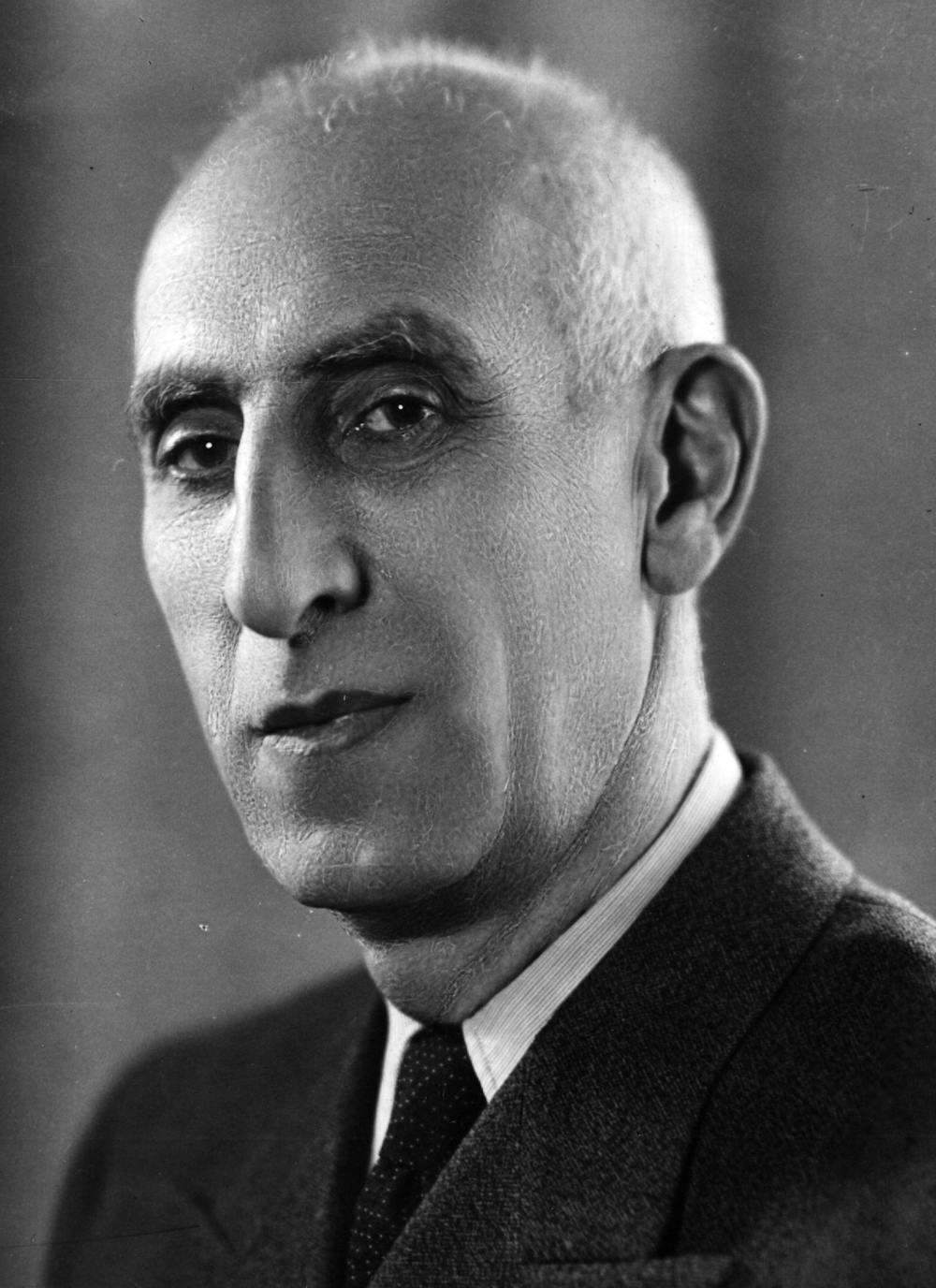
In 1951, the Iranian Parliament chose a new prime minister, Mossadegh, who then led lawmakers to vote in favor of taking over the Anglo-Iranian Oil Company, expelling the company’s British owners and saying they wanted to turn oil profits into investments in the Iranian people. The U.S. feared disruption in the global oil supply and worried about Iran falling prey to Soviet influence. The British feared the loss of cheap Iranian oil.
President Dwight Eisenhower decided it was best for the U.S. and the U.K. to get rid of Mossadegh. Operation Ajax, a joint CIA-British operation, convinced the Shah of Iran, the country’s monarch, to dismiss Mossadegh and drive him from office by force. Mossadegh was replaced by a much more Western-friendly prime minister, handpicked by the CIA.
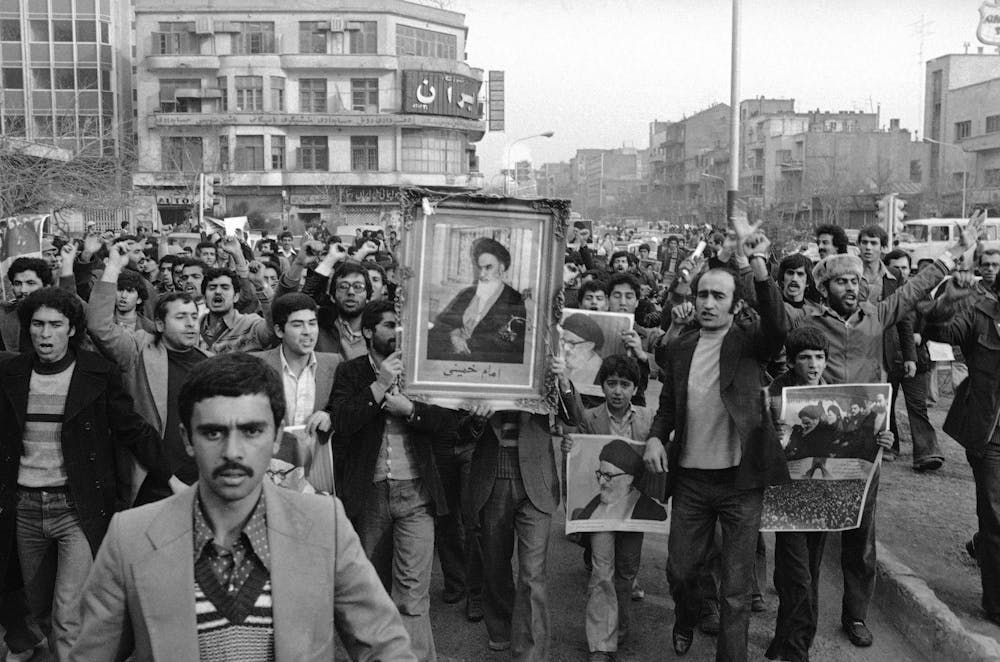
Demonstrators in Tehran demand the establishment of an Islamic republic. AP Photo/Saris
1979: Revolutionaries oust the shah, take hostages
After more than 25 years of relative stability in U.S.-Iran relations, the Iranian public had grown unhappy with the social and economic conditions that developed under the dictatorial rule of Shah Mohammad Reza Pahlavi.
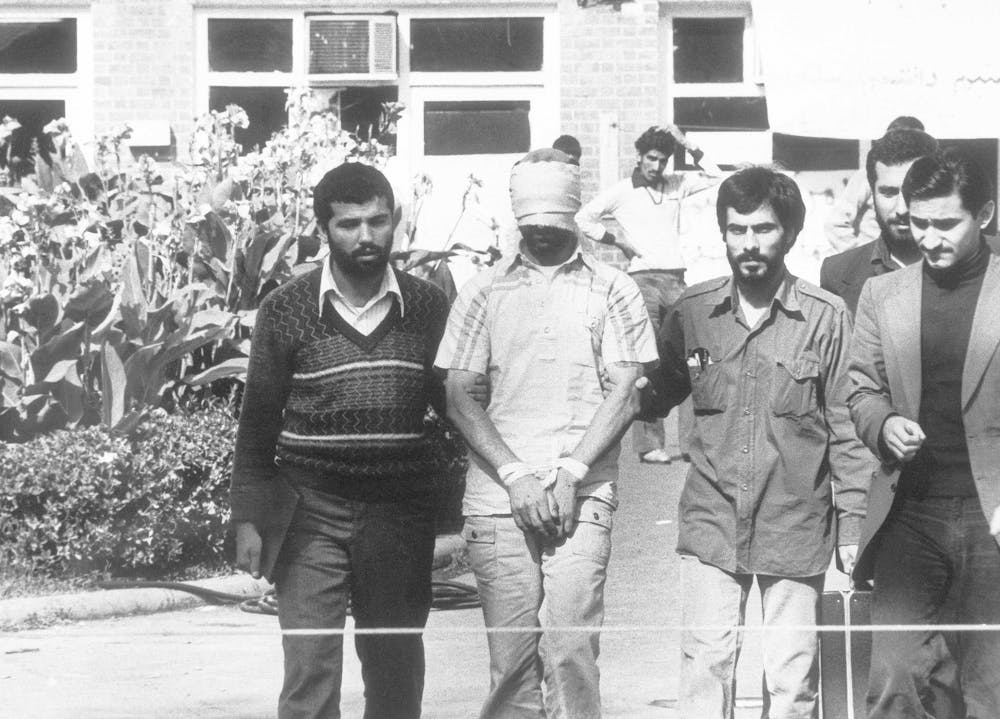
Iranian students at the U.S. Embassy in Tehran show a blindfolded American hostage to the crowd in November 1979. AP Photo
In October 1979, President Jimmy Carter agreed to allow the shah to come to the U.S. to seek advanced medical treatment. Outraged Iranian students stormed the U.S. Embassy in Tehran on Nov. 4, taking 52 Americans hostage. That convinced Carter to sever U.S. diplomatic relations with Iran on April 7, 1980.
Two weeks later, the U.S. military launched a mission to rescue the hostages, but it failed, with aircraft crashes killing eight U.S. servicemembers.
The shah died in Egypt in July 1980, but the hostages weren’t released until Jan. 20, 1981, after 444 days of captivity.
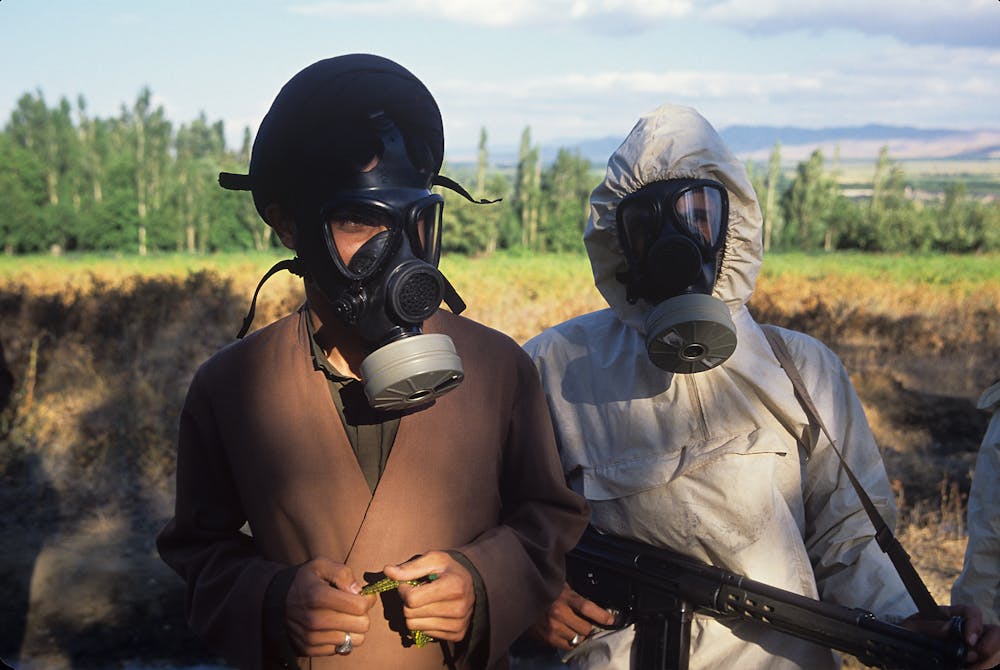
An Iranian cleric, left, and an Iranian soldier wear gas masks to protect themselves against Iraqi chemical-weapons attacks in May 1988. Kaveh Kazemi/Getty Images
The U.S. was concerned that the conflict would limit the flow of Middle Eastern oil and wanted to ensure the conflict didn’t affect its close ally, Saudi Arabia.
U.S. officials moderated their usual opposition to those illegal and inhumane weapons because the U.S. State Department did not “wish to play into Iran’s hands by fueling its propaganda against Iraq.” In 1988, the war ended in a stalemate. More than 500,000 military and 100,000 civilians died.
1981-1986: US secretly sells weapons to Iran
The U.S. imposed an arms embargo after Iran was designated a state sponsor of terrorism in 1984. That left the Iranian military, in the middle of its war with Iraq, desperate for weapons and aircraft and vehicle parts to keep fighting.
The last shipment, of anti-tank missiles, was in October 1986. In November 1986, a Lebanese magazine exposed the deal. That revelation sparked the Iran-Contra scandal in the U.S., with Reagan’s officials found to have collected money from Iran for the weapons and illegally sent those funds to anti-socialist rebels – the Contras – in Nicaragua.
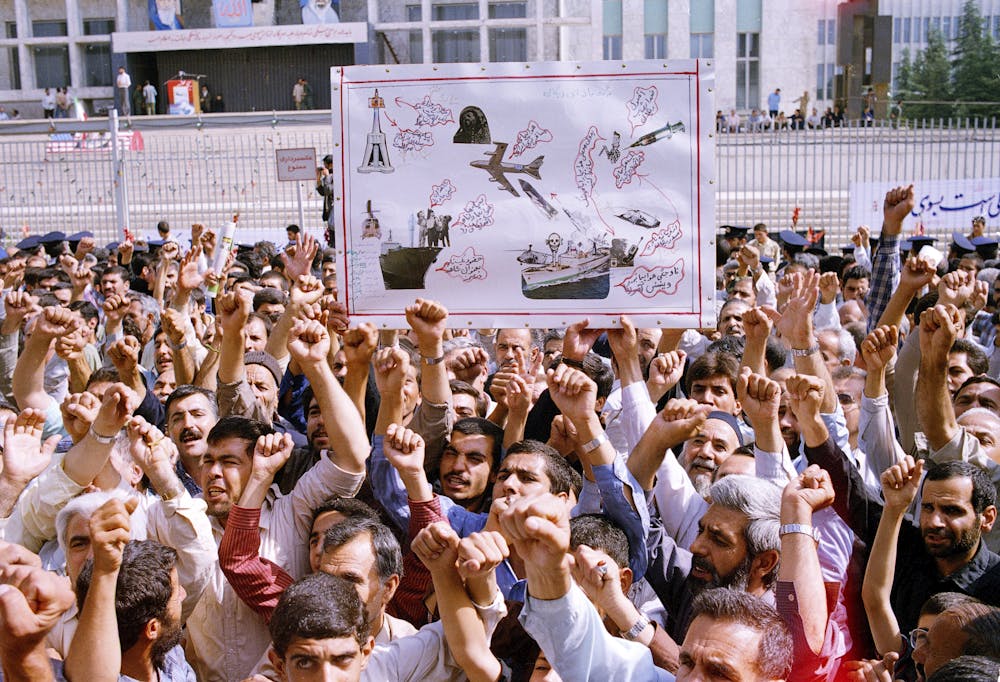
At a mass funeral for 76 of the 290 people killed in the shootdown of Iran Air 655, mourners hold up a sign depicting the incident. AP Photo/CP/Mohammad Sayyad
Either during or just after that exchange of gunfire, the Vincennes crew mistook a passing civilian Airbus passenger jet for an Iranian F-14 fighter. They shot it down, killing all 290 people aboard.
The U.S. called it a “tragic and regrettable accident,” but Iran believed the plane’s downing was intentional. In 1996, the U.S. agreed to pay US$131.8 million in compensation to Iran.
1997-1998: The US seeks contact
In August 1997, a moderate reformer, Mohammad Khatami, won Iran’s presidential election.
U.S. President Bill Clinton sensed an opportunity. He sent a message to Tehran through the Swiss ambassador there, proposing direct government-to-government talks.
Shortly thereafter, in early January 1998, Khatami gave an interview to CNN in which he expressed “respect for the great American people,” denounced terrorism and recommended an “exchange of professors, writers, scholars, artists, journalists and tourists” between the United States and Iran.
However, Supreme Leader Ayatollah Ali Khamenei didn’t agree, so not much came of the mutual overtures as Clinton’s time in office came to an end.
In his 2002 State of the Union address, President George W. Bush characterized Iran, Iraq and North Korea as constituting an “Axis of Evil” supporting terrorism and pursuing weapons of mass destruction, straining relations even further.
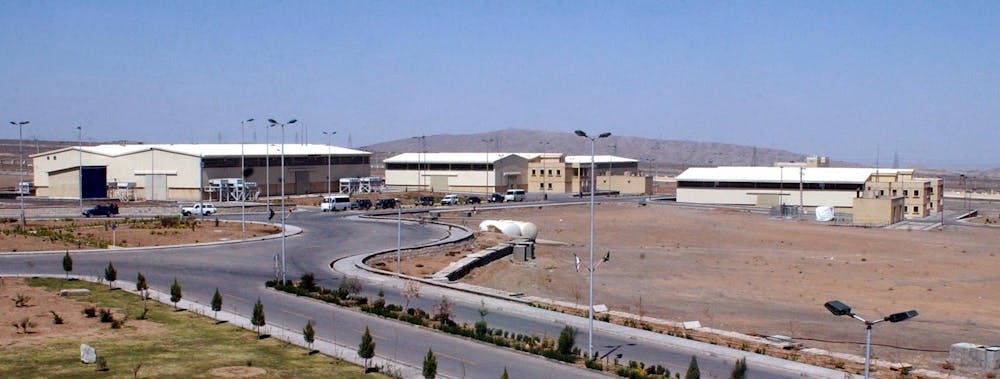
Inside these buildings at the Natanz nuclear facility in Iran, technicians enrich uranium. AP Photo/Vahid Salemi
That was a violation of the terms of the Nuclear Nonproliferation Treaty, which Iran had signed, requiring countries to disclose their nuclear-related facilities to international inspectors.
One of those formerly secret locations, Natanz, housed centrifuges for enriching uranium, which could be used in civilian nuclear reactors or enriched further for weapons.
Starting in roughly 2005, U.S. and Israeli government cyberattackers together reportedly targeted the Natanz centrifuges with a custom-made piece of malicious software that became known as Stuxnet.
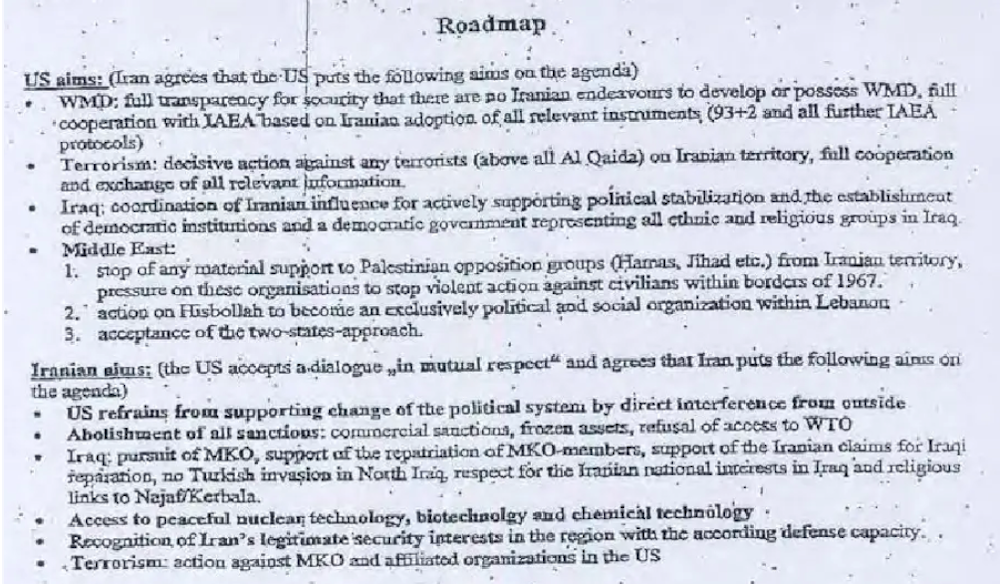
An excerpt of the document sent from Iran, via the Swiss government, to the U.S. State Department in 2003, appears to seek talks between the U.S. and Iran. Washington Post via Scribd
In May 2003, senior Iranian officials quietly contacted the State Department through the Swiss embassy in Iran, seeking “a dialogue ‘in mutual respect,’” addressing four big issues: nuclear weapons, terrorism, Palestinian resistance and stability in Iraq.
Hardliners in the Bush administration weren’t interested in any major reconciliation, though Secretary of State Colin Powell favored dialogue and other officials had met with Iran about al-Qaida.
When Iranian hardliner Mahmoud Ahmadinejad was elected president of Iran in 2005, the opportunity died. The following year, Ahmadinejad made his own overture to Washington in an 18-page letter to President Bush. The letter was widely dismissed; a senior State Department official told me in profane terms that it amounted to nothing.
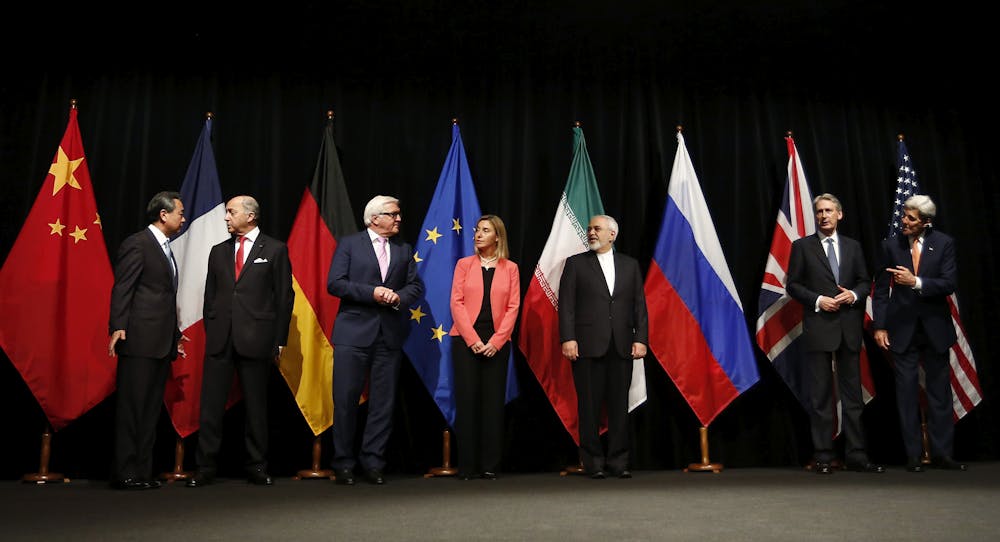
After a decade of unsuccessful attempts to rein in Iran’s nuclear ambitions, the Obama administration undertook a direct diplomatic approach beginning in 2013.
Iran, the U.S., China, France, Germany, Russia and the United Kingdom signed the deal in 2015. It severely limited Iran’s capacity to enrich uranium and mandated that international inspectors monitor and enforce Iran’s compliance with the agreement.
In return, Iran was granted relief from international and U.S. economic sanctions. Though the inspectors regularly certified that Iran was abiding by the agreement’s terms, President Donald Trump withdrew from the agreement in May 2018.
2020: US drones kill Iranian Maj. Gen. Qassem Soleimani
At the time, the Trump administration asserted that Soleimani was directing an imminent attack against U.S. assets in the region, but officials have not provided clear evidence to support that claim.
Hamas’ brazen attack on Israel on Oct. 7, 2023, provoked a fearsome militarized response from Israel that continues today and served to severely weaken Iran’s proxies in the region, especially Hamas – the perpetrator of the attacks – and Hezbollah in Lebanon.
2025: Trump 2.0 and Iran
Trump saw an opportunity to forge a new nuclear deal with Iran and to pursue other business deals with Tehran. Once inaugurated for his second term, Trump appointed Steve Witkoff, a real estate investor who is the president’s friend, to serve as special envoy for the Middle East and to lead negotiations.
Negotiations for a nuclear deal between Washington and Tehran began in April, but the countries did not reach a deal. They were planning a new round of talks when Israel struck Iran with a series of airstrikes on June 13, forcing the White House to reconsider is position.
On June 22, in the early morning hours, the U.S. chose to act decisively in an attempt to cripple Iran’s nuclear capacity, bombing three nuclear sites and causing what Pentagon officials called “severe damage.” Iran vowed to retaliate.
This story has been updated to reflect the U.S. bombing of Iranian nuclear sites on June 22, 2025.
Jeffrey Fields receives funding from the Carnegie Corporation of New York and Schmidt Futures.
SCARPERIA E SAN PIERO, Italy, June 22, 2025 (GLOBE NEWSWIRE) — Bitget, the leading cryptocurrency exchange and Web3 company, is teaming up with MotoGP, the highest class of motorcycle road racing events, in a high-octane partnership that merges the breakneck speed of racing with the high-stakes precision of crypto trading. As the newly minted Regional Partner for select Grand Prix events across Europe and Southeast Asia, Bitget is bringing crypto onto the track, and into the fast lane.
Kicking off at the iconic Mugello Circuit during the Italian Grand Prix, the collaboration marks a new era where precision engineering meets algorithmic agility, and where every second, like every trade, has the power to make it count.
Bitget’s partnership will speed across multiple marquee MotoGP events in 2025, including Italy, Germany, Spain, and Indonesia, bringing together fans of motorsport and crypto under one roaring banner of performance, resilience, and speed.
“Racing is a sport of milliseconds; crypto is a market of micro-decisions. This partnership is our way of showing the world that success — on the track or on the charts — comes down to smart moves and fearless execution,” said Gracy Chen, CEO at Bitget.“We’re excited to join MotoGP in putting power, precision, and potential into the hands of every user and every fan.”
At the heart of the campaign is three-time MotoGP World Champion Jorge Lorenzo, whose relentless pursuit of perfection makes him a fitting icon for Bitget’s iconic “Make It Count” slogan.
“I’ve always believed that you win races not just on instinct — but by making every lap, every line, every second count. It’s the same mindset Bitget brings to trading, and I’m proud to be part of this story,” said Jorge Lorenzo. “The worlds of MotoGP and crypto aren’t as different as they seem — they both reward those who stay sharp and think fast.”
The campaign features trackside activations, exclusive VIP experiences, and a series of cross-platform digital initiatives. At Mugello, KOLs and media will get behind-the-scenes access to the paddock and rider interactions, blending all the high-octane energy of race weekend, wrapped in a sleek, Bitget-branded experience.
“MotoGP is built on precision, innovation, and high-speed decisions — values that align naturally with Bitget,” agreed MotoGP CCO Dan Rossomondo.
This collaboration follows Bitget’s headline partnerships with Lionel Messi, Juventus, and LALIGA, reinforcing its track record in bridging the gap between crypto and culture. With over 120 million users globally and a daily trading volume topping $20 billion, Bitget continues to shift the narrative from volatility to victory.
About Bitget
Established in 2018, Bitget is the world’s leading cryptocurrency exchange and Web3 company. Serving over 120 million users in 150+ countries and regions, the Bitget exchange is committed to helping users trade smarter with its pioneering copy trading feature and other trading solutions, while offering real-time access to Bitcoin price, Ethereum price, and other cryptocurrency prices. Formerly known as BitKeep, Bitget Wallet is a leading non-custodial crypto wallet supporting 130+ blockchains and millions of tokens. It offers multi-chain trading, staking, payments, and direct access to 20,000+ DApps, with advanced swaps and market insights built into a single platform. Bitget is at the forefront of driving crypto adoption through strategic partnerships, such as its role as the Official Crypto Partner of the World’s Top Football League, LALIGA, in EASTERN, SEA and LATAM markets, as well as a global partner of Turkish National athletes Buse Tosun Çavuşoğlu (Wrestling world champion), Samet Gümüş (Boxing gold medalist) and İlkin Aydın (Volleyball national team), to inspire the global community to embrace the future of cryptocurrency.
Risk Warning:Digital asset prices are subject to fluctuation and may experience significant volatility. Investors are advised to only allocate funds they can afford to lose. The value of any investment may be impacted, and there is a possibility that financial objectives may not be met, nor the principal investment recovered. Independent financial advice should always be sought, and personal financial experience and standing carefully considered. Past performance is not a reliable indicator of future results. Bitget accepts no liability for any potential losses incurred. Nothing contained herein should be construed as financial advice. For further information, please refer to our Terms of Use.
About MotoGP
Faster. Forward. Fearless. Since 1949, MotoGP™ has grown into a global sports and entertainment brand with an incredible legacy and an even more exciting future. Each season, the greatest riders from across the globe come together to race the fastest prototype motorcycles on some of the world’s greatest racetracks – creating the most exciting sport on Earth.
SCARPERIA E SAN PIERO, Italy, June 22, 2025 (GLOBE NEWSWIRE) — Bitget, the leading cryptocurrency exchange and Web3 company, is teaming up with MotoGP, the highest class of motorcycle road racing events, in a high-octane partnership that merges the breakneck speed of racing with the high-stakes precision of crypto trading. As the newly minted Regional Partner for select Grand Prix events across Europe and Southeast Asia, Bitget is bringing crypto onto the track, and into the fast lane.
Kicking off at the iconic Mugello Circuit during the Italian Grand Prix, the collaboration marks a new era where precision engineering meets algorithmic agility, and where every second, like every trade, has the power to make it count.
Bitget’s partnership will speed across multiple marquee MotoGP events in 2025, including Italy, Germany, Spain, and Indonesia, bringing together fans of motorsport and crypto under one roaring banner of performance, resilience, and speed.
“Racing is a sport of milliseconds; crypto is a market of micro-decisions. This partnership is our way of showing the world that success — on the track or on the charts — comes down to smart moves and fearless execution,” said Gracy Chen, CEO at Bitget.“We’re excited to join MotoGP in putting power, precision, and potential into the hands of every user and every fan.”
At the heart of the campaign is three-time MotoGP World Champion Jorge Lorenzo, whose relentless pursuit of perfection makes him a fitting icon for Bitget’s iconic “Make It Count” slogan.
“I’ve always believed that you win races not just on instinct — but by making every lap, every line, every second count. It’s the same mindset Bitget brings to trading, and I’m proud to be part of this story,” said Jorge Lorenzo. “The worlds of MotoGP and crypto aren’t as different as they seem — they both reward those who stay sharp and think fast.”
The campaign features trackside activations, exclusive VIP experiences, and a series of cross-platform digital initiatives. At Mugello, KOLs and media will get behind-the-scenes access to the paddock and rider interactions, blending all the high-octane energy of race weekend, wrapped in a sleek, Bitget-branded experience.
“MotoGP is built on precision, innovation, and high-speed decisions — values that align naturally with Bitget,” agreed MotoGP CCO Dan Rossomondo.
This collaboration follows Bitget’s headline partnerships with Lionel Messi, Juventus, and LALIGA, reinforcing its track record in bridging the gap between crypto and culture. With over 120 million users globally and a daily trading volume topping $20 billion, Bitget continues to shift the narrative from volatility to victory.
About Bitget
Established in 2018, Bitget is the world’s leading cryptocurrency exchange and Web3 company. Serving over 120 million users in 150+ countries and regions, the Bitget exchange is committed to helping users trade smarter with its pioneering copy trading feature and other trading solutions, while offering real-time access to Bitcoin price, Ethereum price, and other cryptocurrency prices. Formerly known as BitKeep, Bitget Wallet is a leading non-custodial crypto wallet supporting 130+ blockchains and millions of tokens. It offers multi-chain trading, staking, payments, and direct access to 20,000+ DApps, with advanced swaps and market insights built into a single platform. Bitget is at the forefront of driving crypto adoption through strategic partnerships, such as its role as the Official Crypto Partner of the World’s Top Football League, LALIGA, in EASTERN, SEA and LATAM markets, as well as a global partner of Turkish National athletes Buse Tosun Çavuşoğlu (Wrestling world champion), Samet Gümüş (Boxing gold medalist) and İlkin Aydın (Volleyball national team), to inspire the global community to embrace the future of cryptocurrency.
Risk Warning:Digital asset prices are subject to fluctuation and may experience significant volatility. Investors are advised to only allocate funds they can afford to lose. The value of any investment may be impacted, and there is a possibility that financial objectives may not be met, nor the principal investment recovered. Independent financial advice should always be sought, and personal financial experience and standing carefully considered. Past performance is not a reliable indicator of future results. Bitget accepts no liability for any potential losses incurred. Nothing contained herein should be construed as financial advice. For further information, please refer to our Terms of Use.
About MotoGP
Faster. Forward. Fearless. Since 1949, MotoGP™ has grown into a global sports and entertainment brand with an incredible legacy and an even more exciting future. Each season, the greatest riders from across the globe come together to race the fastest prototype motorcycles on some of the world’s greatest racetracks – creating the most exciting sport on Earth.
Source: The Conversation – Canada – By Mohammadamin Ahmadfard, Postdoctoral Fellow, Mechanical & Industrial Engineering, Toronto Metropolitan University
Artificial intelligence (AI) is quietly transforming how cities generate, store and distribute energy, acting as the invisible conductor that orchestrates cleaner, smarter and more resilient cities.
By integrating renewables — from solar panels and wind turbines to geothermal grids, hydrogen plants, electric vehicles and batteries — AI can enable cities to manage diverse energy sources as a single, intelligent system.
One striking example is the Oya Hybrid Power Station in South Africa. Here, AI-driven controls seamlessly co-ordinate solar, wind and battery storage to deliver reliable power to up to 320,000 households. Using AI makes this kind of integration not only possible, but dramatically more efficient.
Recent research shows AI can also optimize how batteries, solar and the grid interact in buildings. A 2023 study found that deep learning and real-time data helped a boarding school in Turin, Italy increase low-cost energy purchases and cut its electricity bill by more than half.
Cleaner, smarter energy grids
AI models are increasingly able to predict weather with greater precision. These predictions allow electric grid operators to plan hours ahead, storing excess energy in batteries or adjusting supply to meet demand before a storm or heatwave hits.
Using AI to respond strategically to weather is a game-changer. In Cambridge, England, a system called Aardvark uses satellite and sensor data to generate rapid, accurate forecasts of sun and wind patterns.
Unlike traditional supercomputer-driven weather models, Aardvark’s AI can deliver precise local forecasts in minutes on an ordinary computer. This makes advanced weather prediction more accessible and affordable for cities, utilities and even smaller organizations — potentially transforming how communities everywhere plan for and respond to changing weather.
AI models are increasingly able to predict weather with greater precision, allowing electric grid operators to plan ahead, storing excess energy in batteries or adjusting supply to meet demand before a storm or heat wave hits. (Shutterstock)
AI for smarter district heating and cooling
In Munich, Germany, AI is improving geothermal district heating by using underground sensors to monitor temperature and moisture levels in the ground.
The collected data feeds into a digital simulation model that helps optimize network operations. In more advanced versions, during winter cold snaps, such systems can suggest lowering flow to underused spaces like half-empty offices and boosting heat where demand is higher, such as in crowded apartments.
This intelligent, self-optimizing approach extends the life of equipment and delivers more warmth with the same energy input.
This is a breakthrough with enormous potential for cities in cold climates with established geothermal networks, such as Winnipeg in Canada and Iceland’s Reykjavik.
Although these cities have not yet adopted AI-driven monitoring systems, they could benefit from AI’s real-time improvements in efficiency, comfort and energy savings during harsh winters — a principle that holds true wherever geothermal district heating and cooling exists.
Inside the home, AI-managed smart climate systems can factor in how many people are in each room, which appliances are in use, how much natural sunlight each space receives. (Shutterstock)
Smart buildings
Inside the home, AI-managed smart climate systems can factor in how many people are in each room, which appliances are in use, how much natural sunlight each space receives and how much electricity or heat a home’s solar panels generate throughout the day.
Based on this, AI determines how to heat or cool rooms efficiently, and can transfer energy from one space to another, balancing comfort with minimal energy use.
Coastal cities and those in wind-heavy regions are using AI in other creative ways. In Orkney, Scotland, excess wind and tidal energy are converted into green hydrogen. Instead of letting that surplus power go to waste, an AI system called HyAI controls when to generate hydrogen based on wind forecasts, electricity prices and how full the hydrogen storage tanks are.
When winds are strong at night and electricity is cheap, the AI can divert surplus power to produce hydrogen and store it for later use. On calmer days, that stored hydrogen can power fuel cells or buses.
Energy storage
AI is transforming energy storage into a smart, revenue-generating force. In Finland, a startup called Capalo AI has developed Zeus VPP, an AI-powered virtual power plant that aggregates distributed batteries from homes, businesses and other sites.
Zeus VPP uses advanced forecasting and AI algorithms to decide when batteries should charge or discharge, factoring in energy prices, local consumption and weather forecasts. This enables battery owners to earn revenue by participating in electricity markets, while also supporting grid stability and making better use of renewable energy.
AI-powered dynamic line rating adjusts how much electricity a line can carry in real time, boosting capacity by 15 to 30 per cent when conditions allow. This helps utilities maximize the use of existing infrastructure instead of relying on costly upgrades.
At the local level, AI analyzes smart metre data to predict which transformers are overheating due to rising EV and heat pump use.
By forecasting these stress points, utilities can proactively upgrade equipment before failures happen — a shift from reactive to predictive maintenance that makes the grid stronger and cities more resilient.
AI-powered public transit and mobility
Transportation innovation is becoming part of the energy solution, with AI at the centre of this transformation. In New York City, energy company Con Edison has installed major battery storage systems to help manage peak electricity demand and reduce reliance on polluting peaker plants, which supply energy only during high-demand periods.
More broadly, Con Edison is deploying advanced AI-powered analytics software across its electric grid — optimizing voltage, enhancing reliability and enabling predictive maintenance. Together, these efforts show how combining energy storage and AI-driven analytics can make even the world’s busiest cities more resilient and efficient.
AI is also powering “vehicle-to-grid” innovations in California, where an AI-driven platform manages electric school buses that can supply stored energy back to the grid during periods of high demand.
By carefully managing when buses charge and discharge, these systems help keep the grid reliable and ensure vehicles are ready for their daily routes. As this technology expands, parked electric vehicles could serve as valuable backup resources for the electricity system.
Transportation innovation is becoming part of the energy solution. (Shutterstock)
AI for clean energy initiatives
AI is rapidly transforming cities by revolutionizing how energy is used and managed. Google, for example, has slashed cooling energy at its data centres by up to 40 per cent using AI that fine-tunes fans, pumps and windows more efficiently than any human operator.
Organizations like the Electric Power Research Institute (EPRI), in collaboration with NVIDIA, Microsoft and others, have launched the Open Power AI Consortium, which is creating open-source AI tools for utilities worldwide.
These tools will enable even the most resource-constrained cities to deploy advanced AI capabilities, without having to start from scratch, helping to level the playing field and accelerate the global energy transition.
The result is not just cleaner air and lower energy bills, but a path to fewer blackouts and more resilient homes.
Mohammadamin Ahmadfard receives funding from the Natural Sciences and Engineering Research Council of Canada (NSERC) and Mitacs Inc. for his postdoctoral research at Toronto Metropolitan University.
Source: People’s Republic of China in Russian – People’s Republic of China in Russian –
Source: People’s Republic of China – State Council News
Duisburg, Germany, June 22 (Xinhua) — The ASEAN Express freight train departed from Duisburg, Germany, on Saturday.
The train, loaded with maternity and childcare products, cosmetics and medical supplies, is expected to arrive in ASEAN countries in 19 days, passing through the southwest Chinese city of Chongqing.
“ASEAN Express” has provided a “seamless connection” between two major international trade routes – the new international land-sea trade corridor and the China-Europe freight rail route. It has also significantly improved transportation efficiency compared with traditional sea routes.
Li Yan, deputy director of Chongqing Port and Logistics Bureau, said that the ASEAN Express, an extension of the China-Europe freight rail service, has the potential to become an efficient, green and stable economic and trade corridor connecting the two continents.
Following the departure ceremony of the ASEAN Express train, a promotional event was held, during which representatives of Chinese and German enterprises exchanged views on corridor cooperation and supporting services. Several cooperation agreements were signed. –0–
Source: The Conversation – Africa – By Rachel Ama Asaa Engmann, Associate Professor and Director of Christiansborg Archaeological Heritage Project, Associate Graduate Faculty, Rutgers University
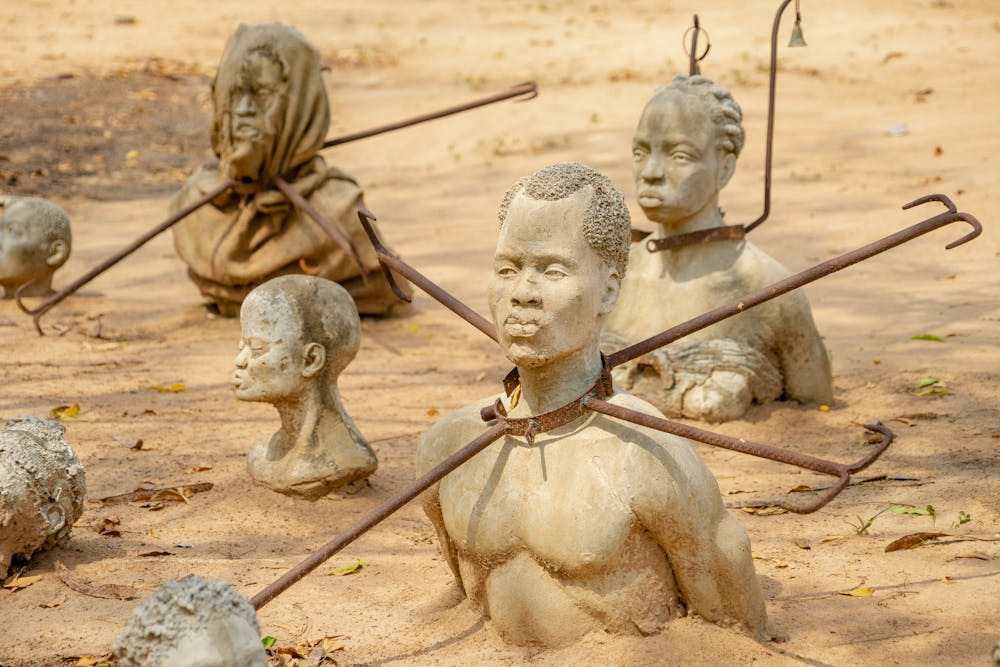
Thousands of sculpted heads – captive African men, women, and children – meticulously created by the artist Kwame Akoto-Bamfo, emerge from the soil at the Nkyinkyim Museum, as a sacred gathering of ancestors. Together, they form a powerful monument to the horror, violence, and resistance to enslavement, as well as the ongoing work of remembrance and healing.
Kwame Akoto-Bamfo is a Ghanaian multidisciplinary artist who engages with the histories and legacies of the transatlantic slave trade and colonialism at home and, increasingly, internationally, on both sides of the Atlantic.
As an archaeologist who works in the field of critical heritage studies, Akoto-Bamfo’s work is important for its powerful engagement with memory, material culture and restorative justice. I feature it in a chapter of a new book that I co-edited called Architectures of Slavery: Ruins and Reconstructions.
Who is Kwame Akoto-Bamfo?
Akoto-Bamfo studied at the Kwame Nkrumah University of Science and Technology in Kumasi. He obtained his bachelor’s and master of fine arts degrees, both in sculpture. After graduating, the artist worked as a school teacher and a university lecturer.
In 2015, Akoto-Bamfo rose to international fame through a series of large-scale installations. He called it ‘Nkyinkyim’ (“twisting” in the Ghanaian Twi language, as in the proverb, “Life’s journey is twisted”).
Four years later, he established the ‘Nkyinkyim Museum’, a non-profit organisation known as the ‘Ancestor Project’. This open-air museum is located in Nuhalenya-Ada, a two-hour drive from Accra. It has become a space for people of African descent to engage in restorative healing through art and education.
Nkyinkyim Museum
At the site’s entrance, three twenty-five-foot monuments are displayed. They are made of stone, concrete and wood. The first is inspired by North and Eastern Africa, and the second by Sudano-Sahelian architecture. The third is inspired by the Forest regions in Central and West Africa.
The collection includes multiple installations in collaboration with the local community. They illustrate “the diversity in our narratives surrounding history, philosophy, and religious beliefs”. The artist himself, demonstrates a mastery of multimedia art forms, working in cement, terracotta, brass, copper, and wood, noting “one can reach different heights with different technologies.”
Today, the museum features a sacred healing space with a compelling display of thousands of unique concrete life size heads and 7,000 terracotta miniature sculpted heads. They include captive Africans abducted, sold and forcibly trafficked during the transatlantic slave trade.
His sculptures capture captives’ shock, horror, anger, distress and fear—emotions. This is communicated through their facial expressions in an installation that is disturbingly evocative and profoundly haunting. It is inspired by ‘nsodie’, an Akan funerary sculpture tradition, that dates back to approximately the twelfth century. Akoto-Bamfo explains during our conversations relating to the research for book:
I wanted to draw upon Akan belief in commemoration and remembrance after death in order to honour the young, old, men and women, who originated from various ethnic groups and who died in the Atlantic Ocean during the Middle Passage and did not get that chance.
Each year, the annual ‘Ancestor Veneration’ ceremony takes place under the guidance of chiefs, priests, and priestess from various ethnic groups.
Visitors are invited to participate in certain Akan rites and ceremonies – free from photography and selfies that undermine or commercialise sacred funerary art practices. Says Akoto-Bamfo:
I am Akan, so initially I began with Akan traditional rites, but now our ceremonies welcome other African ethnic groups including the Ga-Dangme, Ewe, and Yoruba, from Ghana and Nigeria, as well as African descendant people in the African diaspora.
In contrast, the ‘Freedom Parade Festival’ allows participants to creatively express and contribute to an evolving heritage tradition, without the specified observances. For example, painted bodily adornment applied directly onto the skin, yet without the necessary spiritual rites.
A protest monument
Akoto-Bamfo’s sculptures have also gained recognition beyond Ghana’s borders. For instance, the permanent installation at the Legacy Museum and National Museum for Peace and Justice in Montgomery, Alabama in the US.
More recently, in 2021, his Blank Slate Project Monument toured throughout the United States. This included stops at Times Square in New York and the King Center in Atlanta. It depicts an enslaved ancestor, bent forward with his hands behind his back, head turned sideways, face on the ground, with a booted foot on his head.
Akoto-Bamfo describes this work as “a noisy one — a protest piece that speaks against racist Civil War monuments.” The work was completed prior to the police killing of George Floyd that led to widespread protests in the US in 2020. It was first unveiled in a private viewing in Ghana, prior to its shipment to the United States.
He says:
We had a lot of discussions among those involved in the project: some feared it might incite violence, others said that it was a prediction.
The work is interactive. It holds a removable placard that invites viewers to inscribe their reactions to the statue, which are then exhibited. Akoto-Bamfo emphasises:
I wanted ordinary people, both individuals and communities, to relate, and to contribute to, not only towards my artwork but also to the wider ongoing discussions. As an artist, I believe that I do not have the sole right to speak. I wanted ordinary Americans to add their voices because I am already contributing.
In Europe too, his work is featured at the 169 Museum in Germany.
In Ghana, Akoto-Bamfo’s work was initially seen as too controversial. The artist shares:
At first, I had to be extremely resilient because my work was concerned with the slave trade, slavery, colonialism, racism, and human rights. I embraced uncomfortable dialogue. Yet these were difficult topics for galleries and the art world at that time in Ghana.
He adds:
Today, however, some even view me as a spiritual leader… but I have always had an innate antipathy towards injustice. My work is not only about the past but what is unfolding now.
Akoto-Bamfo offers a closing reflection on why this kind of memory work matters:
I just want to use the little knowledge that I have to contribute towards the work of restorative and transformative justice.
Rachel Ama Asaa Engmann does not work for, consult, own shares in or receive funding from any company or organisation that would benefit from this article, and has disclosed no relevant affiliations beyond their academic appointment.
Source: The Conversation – Africa – By Rachel Ama Asaa Engmann, Associate Professor and Director of Christiansborg Archaeological Heritage Project, Associate Graduate Faculty, Rutgers University
Thousands of sculpted heads – captive African men, women, and children – meticulously created by the artist Kwame Akoto-Bamfo, emerge from the soil at the Nkyinkyim Museum, as a sacred gathering of ancestors. Together, they form a powerful monument to the horror, violence, and resistance to enslavement, as well as the ongoing work of remembrance and healing.
Kwame Akoto-Bamfo is a Ghanaian multidisciplinary artist who engages with the histories and legacies of the transatlantic slave trade and colonialism at home and, increasingly, internationally, on both sides of the Atlantic.
As an archaeologist who works in the field of critical heritage studies, Akoto-Bamfo’s work is important for its powerful engagement with memory, material culture and restorative justice. I feature it in a chapter of a new book that I co-edited called Architectures of Slavery: Ruins and Reconstructions.
Who is Kwame Akoto-Bamfo?
Akoto-Bamfo studied at the Kwame Nkrumah University of Science and Technology in Kumasi. He obtained his bachelor’s and master of fine arts degrees, both in sculpture. After graduating, the artist worked as a school teacher and a university lecturer.
In 2015, Akoto-Bamfo rose to international fame through a series of large-scale installations. He called it ‘Nkyinkyim’ (“twisting” in the Ghanaian Twi language, as in the proverb, “Life’s journey is twisted”).
Four years later, he established the ‘Nkyinkyim Museum’, a non-profit organisation known as the ‘Ancestor Project’. This open-air museum is located in Nuhalenya-Ada, a two-hour drive from Accra. It has become a space for people of African descent to engage in restorative healing through art and education.
Nkyinkyim Museum
At the site’s entrance, three twenty-five-foot monuments are displayed. They are made of stone, concrete and wood. The first is inspired by North and Eastern Africa, and the second by Sudano-Sahelian architecture. The third is inspired by the Forest regions in Central and West Africa.
The collection includes multiple installations in collaboration with the local community. They illustrate “the diversity in our narratives surrounding history, philosophy, and religious beliefs”. The artist himself, demonstrates a mastery of multimedia art forms, working in cement, terracotta, brass, copper, and wood, noting “one can reach different heights with different technologies.”
Today, the museum features a sacred healing space with a compelling display of thousands of unique concrete life size heads and 7,000 terracotta miniature sculpted heads. They include captive Africans abducted, sold and forcibly trafficked during the transatlantic slave trade.
His sculptures capture captives’ shock, horror, anger, distress and fear—emotions. This is communicated through their facial expressions in an installation that is disturbingly evocative and profoundly haunting. It is inspired by ‘nsodie’, an Akan funerary sculpture tradition, that dates back to approximately the twelfth century. Akoto-Bamfo explains during our conversations relating to the research for book:
I wanted to draw upon Akan belief in commemoration and remembrance after death in order to honour the young, old, men and women, who originated from various ethnic groups and who died in the Atlantic Ocean during the Middle Passage and did not get that chance.
Each year, the annual ‘Ancestor Veneration’ ceremony takes place under the guidance of chiefs, priests, and priestess from various ethnic groups.
Visitors are invited to participate in certain Akan rites and ceremonies – free from photography and selfies that undermine or commercialise sacred funerary art practices. Says Akoto-Bamfo:
I am Akan, so initially I began with Akan traditional rites, but now our ceremonies welcome other African ethnic groups including the Ga-Dangme, Ewe, and Yoruba, from Ghana and Nigeria, as well as African descendant people in the African diaspora.
In contrast, the ‘Freedom Parade Festival’ allows participants to creatively express and contribute to an evolving heritage tradition, without the specified observances. For example, painted bodily adornment applied directly onto the skin, yet without the necessary spiritual rites.
A protest monument
Akoto-Bamfo’s sculptures have also gained recognition beyond Ghana’s borders. For instance, the permanent installation at the Legacy Museum and National Museum for Peace and Justice in Montgomery, Alabama in the US.
More recently, in 2021, his Blank Slate Project Monument toured throughout the United States. This included stops at Times Square in New York and the King Center in Atlanta. It depicts an enslaved ancestor, bent forward with his hands behind his back, head turned sideways, face on the ground, with a booted foot on his head.
Akoto-Bamfo describes this work as “a noisy one — a protest piece that speaks against racist Civil War monuments.” The work was completed prior to the police killing of George Floyd that led to widespread protests in the US in 2020. It was first unveiled in a private viewing in Ghana, prior to its shipment to the United States.
He says:
We had a lot of discussions among those involved in the project: some feared it might incite violence, others said that it was a prediction.
The work is interactive. It holds a removable placard that invites viewers to inscribe their reactions to the statue, which are then exhibited. Akoto-Bamfo emphasises:
I wanted ordinary people, both individuals and communities, to relate, and to contribute to, not only towards my artwork but also to the wider ongoing discussions. As an artist, I believe that I do not have the sole right to speak. I wanted ordinary Americans to add their voices because I am already contributing.
In Europe too, his work is featured at the 169 Museum in Germany.
In Ghana, Akoto-Bamfo’s work was initially seen as too controversial. The artist shares:
At first, I had to be extremely resilient because my work was concerned with the slave trade, slavery, colonialism, racism, and human rights. I embraced uncomfortable dialogue. Yet these were difficult topics for galleries and the art world at that time in Ghana.
He adds:
Today, however, some even view me as a spiritual leader… but I have always had an innate antipathy towards injustice. My work is not only about the past but what is unfolding now.
Akoto-Bamfo offers a closing reflection on why this kind of memory work matters:
I just want to use the little knowledge that I have to contribute towards the work of restorative and transformative justice.
Rachel Ama Asaa Engmann does not work for, consult, own shares in or receive funding from any company or organisation that would benefit from this article, and has disclosed no relevant affiliations beyond their academic appointment.
Source: The Conversation – Africa – By Rachel Ama Asaa Engmann, Associate Professor and Director of Christiansborg Archaeological Heritage Project, Associate Graduate Faculty, Rutgers University
Thousands of sculpted heads – captive African men, women, and children – meticulously created by the artist Kwame Akoto-Bamfo, emerge from the soil at the Nkyinkyim Museum, as a sacred gathering of ancestors. Together, they form a powerful monument to the horror, violence, and resistance to enslavement, as well as the ongoing work of remembrance and healing.
Kwame Akoto-Bamfo.
Kwame Akoto-Bamfo is a Ghanaian multidisciplinary artist who engages with the histories and legacies of the transatlantic slave trade and colonialism at home and, increasingly, internationally, on both sides of the Atlantic.
As an archaeologist who works in the field of critical heritage studies, Akoto-Bamfo’s work is important for its powerful engagement with memory, material culture and restorative justice. I feature it in a chapter of a new book that I co-edited called Architectures of Slavery: Ruins and Reconstructions.
Who is Kwame Akoto-Bamfo?
Akoto-Bamfo studied at the Kwame Nkrumah University of Science and Technology in Kumasi. He obtained his bachelor’s and master of fine arts degrees, both in sculpture. After graduating, the artist worked as a school teacher and a university lecturer.
In 2015, Akoto-Bamfo rose to international fame through a series of large-scale installations. He called it ‘Nkyinkyim’ (“twisting” in the Ghanaian Twi language, as in the proverb, “Life’s journey is twisted”).
Four years later, he established the ‘Nkyinkyim Museum’, a non-profit organisation known as the ‘Ancestor Project’. This open-air museum is located in Nuhalenya-Ada, a two-hour drive from Accra. It has become a space for people of African descent to engage in restorative healing through art and education.
Nkyinkyim Museum
At the site’s entrance, three twenty-five-foot monuments are displayed. They are made of stone, concrete and wood. The first is inspired by North and Eastern Africa, and the second by Sudano-Sahelian architecture. The third is inspired by the Forest regions in Central and West Africa.
Sculptures at the museum entrance.Kwame Akoto-Bamfo
The collection includes multiple installations in collaboration with the local community. They illustrate “the diversity in our narratives surrounding history, philosophy, and religious beliefs”. The artist himself, demonstrates a mastery of multimedia art forms, working in cement, terracotta, brass, copper, and wood, noting “one can reach different heights with different technologies.”
Today, the museum features a sacred healing space with a compelling display of thousands of unique concrete life size heads and 7,000 terracotta miniature sculpted heads. They include captive Africans abducted, sold and forcibly trafficked during the transatlantic slave trade.
An installation of the heads of enslaved people.Kwame Akoto-Bamfo
His sculptures capture captives’ shock, horror, anger, distress and fear—emotions. This is communicated through their facial expressions in an installation that is disturbingly evocative and profoundly haunting. It is inspired by ‘nsodie’, an Akan funerary sculpture tradition, that dates back to approximately the twelfth century. Akoto-Bamfo explains during our conversations relating to the research for book:
I wanted to draw upon Akan belief in commemoration and remembrance after death in order to honour the young, old, men and women, who originated from various ethnic groups and who died in the Atlantic Ocean during the Middle Passage and did not get that chance.
Each year, the annual ‘Ancestor Veneration’ ceremony takes place under the guidance of chiefs, priests, and priestess from various ethnic groups.
The museum displays 7,000 terracotta sculpted heads.Kwame Akoto-Bamfo
Visitors are invited to participate in certain Akan rites and ceremonies – free from photography and selfies that undermine or commercialise sacred funerary art practices. Says Akoto-Bamfo:
I am Akan, so initially I began with Akan traditional rites, but now our ceremonies welcome other African ethnic groups including the Ga-Dangme, Ewe, and Yoruba, from Ghana and Nigeria, as well as African descendant people in the African diaspora.
In contrast, the ‘Freedom Parade Festival’ allows participants to creatively express and contribute to an evolving heritage tradition, without the specified observances. For example, painted bodily adornment applied directly onto the skin, yet without the necessary spiritual rites.
A protest monument
Akoto-Bamfo’s sculptures have also gained recognition beyond Ghana’s borders. For instance, the permanent installation at the Legacy Museum and National Museum for Peace and Justice in Montgomery, Alabama in the US.
More recently, in 2021, his Blank Slate Project Monument toured throughout the United States. This included stops at Times Square in New York and the King Center in Atlanta. It depicts an enslaved ancestor, bent forward with his hands behind his back, head turned sideways, face on the ground, with a booted foot on his head.
The Blank Slate Monument in New York.Roshi Sariaslan
Akoto-Bamfo describes this work as “a noisy one — a protest piece that speaks against racist Civil War monuments.” The work was completed prior to the police killing of George Floyd that led to widespread protests in the US in 2020. It was first unveiled in a private viewing in Ghana, prior to its shipment to the United States.
He says:
We had a lot of discussions among those involved in the project: some feared it might incite violence, others said that it was a prediction.
The work is interactive. It holds a removable placard that invites viewers to inscribe their reactions to the statue, which are then exhibited. Akoto-Bamfo emphasises:
I wanted ordinary people, both individuals and communities, to relate, and to contribute to, not only towards my artwork but also to the wider ongoing discussions. As an artist, I believe that I do not have the sole right to speak. I wanted ordinary Americans to add their voices because I am already contributing.
In Europe too, his work is featured at the 169 Museum in Germany.
The effects of enslavement are still felt today.Kwame Akoto-Bamfo
In Ghana, Akoto-Bamfo’s work was initially seen as too controversial. The artist shares:
At first, I had to be extremely resilient because my work was concerned with the slave trade, slavery, colonialism, racism, and human rights. I embraced uncomfortable dialogue. Yet these were difficult topics for galleries and the art world at that time in Ghana.
He adds:
Today, however, some even view me as a spiritual leader… but I have always had an innate antipathy towards injustice. My work is not only about the past but what is unfolding now.
Akoto-Bamfo offers a closing reflection on why this kind of memory work matters:
I just want to use the little knowledge that I have to contribute towards the work of restorative and transformative justice.
– Kwame Akoto-Bamfo: the Ghanaian artist using work about slavery to find justice and healing – https://theconversation.com/kwame-akoto-bamfo-the-ghanaian-artist-using-work-about-slavery-to-find-justice-and-healing-259184
United Nations Secretary-General Antonio Guterres has warned that the “dangerous escalation” of the Iran conflict through US bombing of nuclear sites in the country can catastrophically get out of control.
In a statement minutes before US President Donald Trump’s address to the nation on Saturday night, Guterres said the attack was “a direct threat to international peace and security.”
He said he was “gravely alarmed by the use of force by the United States against Iran today” and warned that “there is a growing risk that this conflict could rapidly get out of control – with catastrophic consequences for civilians, the region, and the world.”
Trump said his “military carried out massive, precision strikes on the three key nuclear facilities in the Iranian regime: Fordo, Natanz, and Esfahan.”
“Our objective was the destruction of Iran’s nuclear enrichment capacity and a stop to the nuclear threat posed by the world’s No. 1 state sponsor of terror,” he said.
The US and Israel, Trump said, worked “as a team like perhaps no team has ever worked before.”
He warned, “There will be either peace or there will be tragedy for Iran, far greater than we have witnessed over the last eight days.”
There are more targets that the US can hit in Iran, he said.
“But if peace does not come quickly, we will go after those other targets with precision, speed, and skill. Most of them can be taken out in a matter of minutes.”
However, in an earlier Truth Social post, Trump also said, “Now is the time for peace! Thank you for your attention to this matter.”
“There’s no military in the world that could have done what we did tonight. Not even close,” he added.
Israel had started attacking Iran’s nuclear facilities on June 13, and Iran retaliated with missiles and drones, some of which managed to penetrate Israel’s defence.
Trump, who had been vacillating between restraint and joining Israel, had said on Thursday that he would decide whether to attack in a two-week frame, but it came two days later.
The US attack followed an apparently failed last-minute diplomatic effort by foreign ministers of Britain, Germany and France, along with the European Union representative, to de-escalate the situation.
Two of the three sites that Trump said had been hit had been attacked earlier by Israel.
They were Fordo and Natanz, which are uranium enrichment facilities where the element is refined to ultimately reach bomb grade.
The third facility attacked was a storage for the enriched uranium.
Source: People’s Republic of China – State Council News
A freight train loaded with auto components, LED monitors and other goods on Saturday departed from Xi’an, a city in northwest China’s Shaanxi Province, bound for Duisburg in Germany, marking a significant milestone as the number of China-Europe freight trains operating on full timetables has now exceeded 1,000.
The full timetable service, first launched in October 2022, enables China-Europe freight trains to run according to pre-arranged schedules, including designated train numbers, routes, departure times and arrival times across countries along the route.
To date, the number of routes operating under fixed timetables has expanded to 11, featuring 17 trains running on a regular weekly schedule. With more fixed timetable trains added to the schedule, the China-Europe Railway Express is expected to deliver its cargo with even greater reliability.
This service has also become a preferred option for transporting high-value-added goods, including photovoltaic panels, solar modules and marine diesel engine parts. Notably, the average value per container transported by these trains is approximately 41 percent higher than that of other services, according to the China State Railway Group Co., Ltd.
Currently, over 98,000 twenty-foot equivalent units (TEUs) of cargo have been transported via full timetable China-Europe freight trains, the company said.
China-Europe freight trains have evolved into a cornerstone of the Belt and Road Initiative — promoting trade and connectivity between Europe and Asia. At present, a total of 128 Chinese cities have launched China-Europe freight train services, reaching 229 cities in 26 European countries and more than 100 cities in 11 Asian countries.
ER Report: Here is a summary of significant articles published on EveningReport.nz on June 22, 2025.
Caitlin Johnstone: Israel supporters will be despised for the rest of their lives Report by Dr David Robie – Café Pacific. – COMMENTARY: By Caitlin Johnstone Do Israel’s supporters know it’s over for them? Like, they know they’re going to be despised for the rest of their lives, right? That they will never, ever live down the fact that they supported a live-streamed genocide? And that it will
Another Iraq? Military expert warns US has no real plan if it joins Israel’s war on Iran Report by Dr David Robie – Café Pacific. – Iran’s Foreign Minister, Abbas Araghchi, held talks with France, Germany, and the United Kingdom yesterday in Geneva as Israel’s attacks on Iran entered a second week. A US-based Iranian human rights group reports the Israeli attacks have killed at least 639 people. Israeli war planes have
Israel blocks Gaza aid organisations’ access to fuel, hospitals running out BEARING WITNESS: By Cole Martin in occupied Bethlehem Kia ora koutou, I’m a Kiwi journo in occupied Bethlehem, here’s a brief summary of today’s events across the Palestinian and Israeli territories from on the ground. Sixty nine people killed in Gaza, 12 while seeking aid, and 221 injured (172 seeking aid). 11 killed by Israeli
Analyst dismisses ‘lie by rogue’ Netanyahu over Iran’s nuclear programme Asia Pacific Report A leading Middle East analyst has pushed back against US President Donald Trump’s dismissal of the conclusion of his own national intelligence chief, who said in April that Iran is not building a nuclear weapon. Marwan Bishara, Al Jazeera’s senior political analyst, said in an interview that Tulsi Gabbard, the US Director
Source: State University of Management – Official website of the State –
June 22, 1941 is a day that will forever remain in the memory of our people.
At 4:15 a.m., when the world was still asleep, Nazi Germany, violating all agreements, unleashed a war against the Soviet Union. This moment marked the beginning of the Great Patriotic War – one of the most tragic periods in the history of our country.
Alarms woke people up. Many could not believe what was happening. The morning skies turned fiery as German planes began bombing towns and villages. The world that seemed stable collapsed in a second.
Hundreds of thousands of soldiers and civilians found themselves in the epicenter of horror. Bombing, destruction, fear, death – all this became a reality that people had to face.
But despite heavy losses and terrible suffering, the people showed incredible resilience.
From the first days of the war, people gathered in self-defense units, signed up for the army, prepared to defend their homeland. This day marked the beginning of a long and difficult journey, in which everyone united from the southern seas to the polar region, regardless of gender, age, nationality or profession.
The Moscow Engineering and Economic Institute (today GUU) contributed to the common Victory. Many employees went to the front, fought in the 7th division of the people’s militia, the 3rd Moscow Communist Division and other formations. During the war years, the university continued to work on training specialists who were needed by the country’s economy more than ever. When the enemy approached the capital, university representatives participated in defense activities: they built fortifications, worked in logging, and organized subsidiary farming.
June 22, 1941 is not just a date. It is a symbol of courage and unity that became the basis for victory in a war that took millions of lives but did not break the spirit of the people.
We remember and honor those who fought, who gave their lives for freedom and independence. Eternal memory to the heroes!
Please note: This information is raw content directly from the source of the information. It is exactly what the source states and does not reflect the position of MIL-OSI or its clients.
Source: People’s Republic of China in Russian – People’s Republic of China in Russian –
Source: People’s Republic of China – State Council News
BEIJING, June 21 (Xinhua) — A freight train carrying auto components, LED monitors and other goods left Xi’an in northwest China’s Shaanxi Province for Duisburg, Germany on Saturday, marking a milestone as the number of scheduled China-Europe freight trains for the entire route has exceeded 1,000 units.
The full schedule service, first launched in October 2022, allows China-Europe freight trains to operate according to a pre-arranged schedule, including assigned train numbers, lines, departure times and arrival times between countries along the respective route.
Today, the number of routes operating on a full schedule has increased to 11, with 17 trains running weekly. The increase in the number of trains with a set schedule is expected to ensure even greater reliability in the delivery of goods by the China-Europe express train.
The mode of transportation has also become the preferred option for high-value-added goods, including photovoltaic panels, solar modules and marine diesel engine parts. The average value of one container of cargo carried by these trains is about 41 percent higher than other services, according to China State Railway Group Co., Ltd.
As noted by the corporation, to date, China-Europe freight trains, operating on a full schedule, have transported more than 98 thousand twenty-foot equivalent units (TEU).
China-Europe freight trains have become a cornerstone of the Belt and Road Initiative, promoting trade and connectivity between Europe and Asia. At present, China-Europe freight train routes have been launched from 128 Chinese cities, reaching 229 cities in 26 European countries and more than 100 cities in 11 Asian countries. –0–
Source: People’s Republic of China in Russian – People’s Republic of China in Russian –
Source: People’s Republic of China – State Council News
BERLIN, June 21 (Xinhua) — Israel’s recent air strikes on Iran have delayed Tehran’s ability to develop nuclear weapons by at least two to three years, the Jewish state’s Foreign Minister Gideon Saar said on Friday.
As G. Saar noted in an interview with the German newspaper Bild, which was given in Jerusalem and published on Saturday, the Israeli armed forces launched a large-scale operation against Iranian military infrastructure and nuclear facilities, which resulted in the deaths of several high-ranking Iranian military commanders and nuclear scientists.
“I consider this a success – we have achieved many results,” he said. “We will not stop until we do everything possible to eliminate the Iranian nuclear threat.”
An Israeli diplomat has called on Germany and other European countries to increase political and military support for the Jewish state.
Mr. Saar made the statements after US President Donald Trump said on June 19 that he would decide within two weeks whether to order the US military to launch a direct strike on Iran.
Iranian Foreign Minister Abbas Araghchi told Turkey’s Anadolu Agency on Saturday that Iran was “fully prepared” to resolve the dispute over its nuclear program through negotiations. -0-
The ECOWAS Commission, through its Directorate of Humanitarian and Social Affairs (DHSA), in collaboration with the Ministry of Gender, Children and Social Protection of the Republic of Ghana, successfully hosted a three-day national capacity-building workshop on the Continental Results Framework (CRF) for Women, Peace and Security (WPS) from the 10th to 12th of June 2025, in Accra. The workshop was part of ECOWAS’s continued efforts to support Member States in institutionalizing robust, data-driven mechanisms for tracking and reporting on the implementation of United Nations Security Council Resolution 1325 and related WPS commitments. It forms part of the broader ECOWAS Peace, Security and Governance (EPSG) Project, co-financed by the European Union and the German Government (BMZ), and implemented by GIZ.
Delivering remarks on behalf of Dr Sintiki Tarfa Ugbe, the Director, Humanitarian and Social Affairs of the ECOWAS Commission, Mr. Olatunde Olayemi welcomed participants and reaffirmed the Commission’s commitment to inclusive peace and security. “Ensuring the full-fledged contributions of women is sine qua non,” he noted. He emphasized that ECOWAS’s adaptation of the African Union CRF into a simplified regional framework is key to achieving more effective monitoring, implementation, and reporting on WPS across West Africa.
Mrs. Josiane Sombo, representing the West Africa Network for Peacebuilding (WANEP), highlighted the role of civil society as co-creators of peace and custodians of accountability. She noted that the CRF is not merely a technical tool; but a moral and political commitment and as civil society, they remain committed to ensuring that evidence-based, inclusive, and collaborative reporting is embedded in WPS monitoring systems.
Speaking on behalf of the German Federal Ministry for Economic Cooperation and Development (BMZ), Ms. Paulina Hawkins reiterated Germany’s strong support for feminist development cooperation. She highlighted that the workshop represents a vital step in localizing regional frameworks and enhancing national ownership of the WPS agenda. “For the CRF is not just a reporting mechanism, but a strategic instrument for institutional transformation,” she added.
The European Union Delegation to Ghana, represented by Davide Messina, emphasized that the EPSG Project reflects the EU’s long-standing partnership with ECOWAS to promote inclusive governance and gender-responsive peacebuilding. He highlighted that the training is more than capacity-building but should be seen as an investment in a stable, peaceful, and prosperous West Africa.
Delivering the opening remarks on behalf of the Ministry of Gender, Children and Social Protection, Ms. Faustina Acheampong Akua Frempomaa underscored Ghana’s leadership in WPS implementation. With the GHANAP II and the Gender Equity Act of 2024, Ghana is setting new standards for institutional accountability. “This workshop provides a timely opportunity to enhance our national reporting systems and align with regional WPS frameworks,” the representative affirmed.
Over 40 participants, including government officials, civil society representatives, security sector personnel, and technical working group members, were trained on the application of the simplified CRF tool and questionnaire. Through participatory sessions and practical exercises, stakeholders strengthened their capacity to monitor WPS indicators, track progress, and contribute meaningfully to Ghana’s national and regional WPS reports. The workshop concluded with a renewed commitment to inter-agency collaboration and institutionalizing the CRF within national monitoring and evaluation systems. Ghana joins seven other Member States – Côte d’Ivoire, Nigeria, Benin, Liberia, The Gambia, Senegal and Togo that have hosted similar national CRF trainings as part of ECOWAS’s regional strategy to enhance WPS accountability mechanisms.
Distributed by APO Group on behalf of Economic Community of West African States (ECOWAS).
Headline: Global Energy Balance: Heads of Major Energy Companies, Experts Discuss Future of Energy Sector at SPIEF
At the Energy Panel of the XXVIII St. Petersburg International Economic Forum, leading industry experts, politicians, scientists, government officials and heads of major international energy companies discussed current trends in the global energy market.
Their assessments and forecasts largely coincided with the visionary concept of industry development presented by Igor Sechin, Head of Rosneft. In his report “Odyssey of the Global Economy in Search of the Golden Fleece. The New Landscape a of the Global Energy Industry”, he announced that the current state of the global energy industry is at the stage of formation of a new image due to the multiple growth of electricity consumption, the generation of which will be provided by both fossil fuels and renewable energy sources. According to him, the optimal solution today is “synthesis of conventional and alternative energy sources”.
The event, organized with the support of Rosneft, was addressed by Mohammed Bin Saleh Al-Sada, Chairman of the Rosneft Board of Directors, Delcy Rodriguez, Executive Vice President of the Republic of Venezuela, Simon Aloysius Mantiri, Chief Executive Officer of Pertamina, Zhang Daowei, Vice President of CNPC, Shiva Prasad Panda Madhusudana, Executive Director of Reliance Industries, Alexander Dynkin, Academician of the Russian Academy of Sciences, Zhurabek Mirzamakhmudov, Minister of Energy of the Republic of Uzbekistan, Nobuo Tanaka, Chairman of the Supervisory Board of the Japanese government’s non-profit Low Carbon Technology Initiative, and David Gadzhimirzaev, President of TOFS.
ENERGY TRANSITION WITHOUT TRANSITION
Mohammed Bin Saleh Al-Sada opened the discussion of Igor Sechin’s report, noting the depth of his analysis. “It was comprehensive – the way you showed that progress and energy are inseparable,” Al-Sada addressed Sechin.
The head of Rosneft’s Board of Directors drew the audience’s attention to the fact that despite the active promotion of the idea of transition to RES, the share of fossil energy sources in the energy mix has not changed in recent decades. He recalled that Igor Sechin mentioned in the report that fossil fuels account for 80% of the global energy mix. “And this statistic has not changed for the last 20 years! We are fluttering around these 80% fossil fuels and energy sources, and so not much has changed!” exclaimed Al-Sada, describing the situation in the global energy sector.
“In other words, we are essentially not making any transition away from hydrocarbons,” he concluded, emphasizing that the transition to renewables is being imposed on the industry and the public.
“I would also like to take as a baton from Mr. Sechin, and pass my comment to you. It’s like food for thought: are we actually transitioning from fossil fuels to renewable fuels?“,” Al-Sada addressed the audience.
The Rosneft Chairman also noted that energy demand does not always coincide with production growth for various reasons.
“I would like to express two small thoughts in order to further enhance the valuable things we heard in Mr. Sechin’s words. <...> Lack of investment is already a reality in the hydrocarbon and energy sectors. This is something that could really bring us to a serious energy shortage. “If this trend continues we could face an energy shortage. This is not only my personal opinion, but also what a large number of analysts, including the International Energy Agency, and other respected experts, who in their reviews have emphasized the importance of having sufficient investment in the hydrocarbon sector. Otherwise, we will face the risk of a primary energy shortage!”, emphasized Al-Sada.
FUTURE FOR SYNERGY
Zhang Daowei, Vice President of China’s CNPC, remarked on the interest in the report by Rosneft’s CEO. In his speech, the top manager of the Chinese company expressed similar assessments of the ways of development of the global energy sector – in particular, the need for synergy between traditional and new energy sources.
“We have always believed that in the context of the energy transition course, it is necessary to adhere to synergetic, integrated development of traditional and new energy sources, to take full account of the characteristics and degree of development of our countries’ markets, to properly link energy transition with energy security, and to promote a fair and sustainable model of energy transformation,” Daowei said.
According to the vice president, under this philosophy, CNPC, on the one hand, continues to increase the exploration and development of oil and gas fields domestically and import high-quality resources from abroad, including strengthening long-term cooperation with Russia in the field of hydrocarbon trade. On the other hand, CNPC is actively pursuing a green, low-carbon development strategy and realizing the development of a “three-step strategy” combining oil and gas projects with wind, solar, geothermal, hydrogen and carbon capture technologies.
Simon Aloysius Mantiri, President and CEO of Pertamina Indonesia, said that the company is pursuing a dual growth strategy that is based on both conventional resources and low-carbon solutions. Meanwhile, natural gas plays an important role in the country’s energy mix.
“Natural gas is at the center of our strategy to transition to cleaner fuels. And today we are expanding our LNG capacity and capability for both domestic and export needs,” he said.
The Pertamina chief virtually reiterated the point made in Igor Sechin’s report and emphasized that by achieving a balance of energy sources and a comprehensive approach, the company is able to ensure high economic growth and carbon neutrality in parallel.
Reliance Industries CEO P.M.S. Prasad said India does not choose between energy access and innovation. “It is integrating both. By developing scalable, context-specific solutions, it is addressing local priorities while making a significant contribution to global sustainability. From rural microgrids to energy efficient data centers, India is turning its potential into a strategic asset,” Prasad said.
He emphasized that international partnerships play a vital role in this ambitious effort. “Energy remains a key cornerstone of the strategic relationship between India and Russia. India values this trusted partnership and appreciates the cooperation forged over decades. The leadership of both countries is committed to take this partnership to an even higher bar in the future,” summarized Reliance Industries’ CEO.
NUCLEAR POWER PLANTS ARE NOT BEING WRITTEN OFF
Rosneft CEO Igor Sechin, in his keynote speech at the Energy Panel, noted the growing interest in nuclear power generation worldwide and, accordingly, the growth of investments in this area. According to him, this is happening against the backdrop of growing energy consumption and in future nuclear power will be in demand along with fossil sources and renewable energy sources.
Reliance Industries CEO Panda Madhusudana Shiva Prasad, in turn, speaking on India’s energy outlook, emphasized the significant role of nuclear power generation.
“Gas, renewables supported by energy storage systems and a robust transmission grid, and nuclear power will play a key role. India’s bold nuclear program, including small modular reactors, reflects its commitment to long-term energy security and decarbonization,” Prasad said.
The renewed interest in investments in NPP construction was noted in the speech of Uzbek Minister of Energy Zhurabek Mirzamakhmudov. He spoke about joint plans with Russia to build two units of 55 megawatts each, and two units of VWR type reactors – water-water power reactor. The head of the ministry also said that gas-fired power plants are being installed in the country, hydropower is being developed, the share of renewable sources is increasing, and storage systems are being created at the same time.
The Minister noted the substantial nature of Igor Sechin’s report, which contains a detailed analysis and reflects all trends in the development of global energy, science and economy.
ENERGY SECURITY IN FIRST PLACE
Delcy Rodriguez, Executive Vice President of the Republic of Venezuela, in her speech supported the thesis expressed by the head of Rosneft that energy security issues should come first.
“We always advocate that the energy transition be carried out responsibly, taking into account reality, to avoid abrupt changes that could jeopardize energy security,” Rodriguez said.
Venezuela’s Executive Vice President named the main components of a stable energy system of the future: energy security, reliable supply, accessibility for all, while respecting nature – with minimal environmental impact.
Among the main threats to energy security, Rodriguez named illegal sanctions against producing countries and the hegemony of the dollar.
Nobuo Tanaka, Chairman of the Supervisory Board of the Japanese government’s non-profit Low Carbon Technology Initiative, said the answer to energy security is always to diversify supply sources, improve energy efficiency and seek alternative energy sources, including renewable energy, nuclear energy and regulate the market with predictable policies.
AGAINST LOGIC
The panelists drew attention to the political events of recent decades and stated that geopolitics is now shaping the direction of economic cooperation. And often against the logic of market expediency and economic efficiency.
Tanaka recalled how he discussed Germany’s energy policy with Chancellor Merkel in 2009: “I asked her why Germany does not use nuclear power. She answered like this: Mr. Tanaka, I am a scientist, I know how important it is to use nuclear power, but in order to use it in Germany, she said, give me votes in exchange. Yes, she’s a good scientist, but she’s also a very smart politician.”
The professor is sure that despite her experience Merkel made a very serious mistake by changing the policy on the use of nuclear power plants under the pressure of public opinion. Another mistake was the refusal to use Russian energy carriers and Russian natural gas. “I think she was misled,” Tanaka said.
“Geopolitics is a factor of the 21st century global economy. It is geopolitical interests that brought the BRICS countries together. The criterion for membership is not to use sanctions against other members of the organization. But geopolitics has also become a kind of “trap” for Germany after Trump’s victory,” said Alexander Dynkin, a member of the Russian Academy of Sciences.
He noted that the European bureaucrats are concerned about the complete refusal of energy supplies from Russia by 2027. “They are not stopped by the growth of costs, undermining the competitiveness of the EU,” – said Dynkin and recalled that if in 2014, the U.S. GDP was ahead of the EU GDP. US GDP was only 12% ahead of EU GDP, last year the US economy was already 50% larger than the European one.
“Although the German energy crisis is formally over, the country paid for it with three years of stagnation, deindustrialization, inflation, and migration crisis,” said the RAS academy member.
DIGITAL REVOLUTION
The thesis in Igor Sechin’s report that the digital revolution opens a new era in the development of the oil and gas industry was warmly echoed by the audience. In particular, David Gadzhimirzaev, General Director of TOFS Oilfield Services Group, thanked Rosneft for supporting innovation and technology development. He emphasized the importance of ensuring the availability, stability and reliability of resources, which is exactly what new technologies can provide, which will reduce the cost of bringing barrels to the surface.
“We all know that just this year the Energy Strategy-2050 was approved, which includes the fact that by 2050 about 70% of the Russian Federation’s production will be from hard-to-recover reserves. Therefore, we are not only working on expertise, but also working on the production of new technologies,” Gadzhimirzaev said.
Department of Information and Advertising Rosneft Oil Company June 21, 2025
Headline: Global Energy Balance: Heads of Major Energy Companies, Experts Discuss Future of Energy Sector at SPIEF
At the Energy Panel of the XXVIII St. Petersburg International Economic Forum, leading industry experts, politicians, scientists, government officials and heads of major international energy companies discussed current trends in the global energy market.
Their assessments and forecasts largely coincided with the visionary concept of industry development presented by Igor Sechin, Head of Rosneft. In his report “Odyssey of the Global Economy in Search of the Golden Fleece. The New Landscape a of the Global Energy Industry”, he announced that the current state of the global energy industry is at the stage of formation of a new image due to the multiple growth of electricity consumption, the generation of which will be provided by both fossil fuels and renewable energy sources. According to him, the optimal solution today is “synthesis of conventional and alternative energy sources”.
The event, organized with the support of Rosneft, was addressed by Mohammed Bin Saleh Al-Sada, Chairman of the Rosneft Board of Directors, Delcy Rodriguez, Executive Vice President of the Republic of Venezuela, Simon Aloysius Mantiri, Chief Executive Officer of Pertamina, Zhang Daowei, Vice President of CNPC, Shiva Prasad Panda Madhusudana, Executive Director of Reliance Industries, Alexander Dynkin, Academician of the Russian Academy of Sciences, Zhurabek Mirzamakhmudov, Minister of Energy of the Republic of Uzbekistan, Nobuo Tanaka, Chairman of the Supervisory Board of the Japanese government’s non-profit Low Carbon Technology Initiative, and David Gadzhimirzaev, President of TOFS.
ENERGY TRANSITION WITHOUT TRANSITION
Mohammed Bin Saleh Al-Sada opened the discussion of Igor Sechin’s report, noting the depth of his analysis. “It was comprehensive – the way you showed that progress and energy are inseparable,” Al-Sada addressed Sechin.
The head of Rosneft’s Board of Directors drew the audience’s attention to the fact that despite the active promotion of the idea of transition to RES, the share of fossil energy sources in the energy mix has not changed in recent decades. He recalled that Igor Sechin mentioned in the report that fossil fuels account for 80% of the global energy mix. “And this statistic has not changed for the last 20 years! We are fluttering around these 80% fossil fuels and energy sources, and so not much has changed!” exclaimed Al-Sada, describing the situation in the global energy sector.
“In other words, we are essentially not making any transition away from hydrocarbons,” he concluded, emphasizing that the transition to renewables is being imposed on the industry and the public.
“I would also like to take as a baton from Mr. Sechin, and pass my comment to you. It’s like food for thought: are we actually transitioning from fossil fuels to renewable fuels?“,” Al-Sada addressed the audience.
The Rosneft Chairman also noted that energy demand does not always coincide with production growth for various reasons.
“I would like to express two small thoughts in order to further enhance the valuable things we heard in Mr. Sechin’s words. <...> Lack of investment is already a reality in the hydrocarbon and energy sectors. This is something that could really bring us to a serious energy shortage. “If this trend continues we could face an energy shortage. This is not only my personal opinion, but also what a large number of analysts, including the International Energy Agency, and other respected experts, who in their reviews have emphasized the importance of having sufficient investment in the hydrocarbon sector. Otherwise, we will face the risk of a primary energy shortage!”, emphasized Al-Sada.
FUTURE FOR SYNERGY
Zhang Daowei, Vice President of China’s CNPC, remarked on the interest in the report by Rosneft’s CEO. In his speech, the top manager of the Chinese company expressed similar assessments of the ways of development of the global energy sector – in particular, the need for synergy between traditional and new energy sources.
“We have always believed that in the context of the energy transition course, it is necessary to adhere to synergetic, integrated development of traditional and new energy sources, to take full account of the characteristics and degree of development of our countries’ markets, to properly link energy transition with energy security, and to promote a fair and sustainable model of energy transformation,” Daowei said.
According to the vice president, under this philosophy, CNPC, on the one hand, continues to increase the exploration and development of oil and gas fields domestically and import high-quality resources from abroad, including strengthening long-term cooperation with Russia in the field of hydrocarbon trade. On the other hand, CNPC is actively pursuing a green, low-carbon development strategy and realizing the development of a “three-step strategy” combining oil and gas projects with wind, solar, geothermal, hydrogen and carbon capture technologies.
Simon Aloysius Mantiri, President and CEO of Pertamina Indonesia, said that the company is pursuing a dual growth strategy that is based on both conventional resources and low-carbon solutions. Meanwhile, natural gas plays an important role in the country’s energy mix.
“Natural gas is at the center of our strategy to transition to cleaner fuels. And today we are expanding our LNG capacity and capability for both domestic and export needs,” he said.
The Pertamina chief virtually reiterated the point made in Igor Sechin’s report and emphasized that by achieving a balance of energy sources and a comprehensive approach, the company is able to ensure high economic growth and carbon neutrality in parallel.
Reliance Industries CEO P.M.S. Prasad said India does not choose between energy access and innovation. “It is integrating both. By developing scalable, context-specific solutions, it is addressing local priorities while making a significant contribution to global sustainability. From rural microgrids to energy efficient data centers, India is turning its potential into a strategic asset,” Prasad said.
He emphasized that international partnerships play a vital role in this ambitious effort. “Energy remains a key cornerstone of the strategic relationship between India and Russia. India values this trusted partnership and appreciates the cooperation forged over decades. The leadership of both countries is committed to take this partnership to an even higher bar in the future,” summarized Reliance Industries’ CEO.
NUCLEAR POWER PLANTS ARE NOT BEING WRITTEN OFF
Rosneft CEO Igor Sechin, in his keynote speech at the Energy Panel, noted the growing interest in nuclear power generation worldwide and, accordingly, the growth of investments in this area. According to him, this is happening against the backdrop of growing energy consumption and in future nuclear power will be in demand along with fossil sources and renewable energy sources.
Reliance Industries CEO Panda Madhusudana Shiva Prasad, in turn, speaking on India’s energy outlook, emphasized the significant role of nuclear power generation.
“Gas, renewables supported by energy storage systems and a robust transmission grid, and nuclear power will play a key role. India’s bold nuclear program, including small modular reactors, reflects its commitment to long-term energy security and decarbonization,” Prasad said.
The renewed interest in investments in NPP construction was noted in the speech of Uzbek Minister of Energy Zhurabek Mirzamakhmudov. He spoke about joint plans with Russia to build two units of 55 megawatts each, and two units of VWR type reactors – water-water power reactor. The head of the ministry also said that gas-fired power plants are being installed in the country, hydropower is being developed, the share of renewable sources is increasing, and storage systems are being created at the same time.
The Minister noted the substantial nature of Igor Sechin’s report, which contains a detailed analysis and reflects all trends in the development of global energy, science and economy.
ENERGY SECURITY IN FIRST PLACE
Delcy Rodriguez, Executive Vice President of the Republic of Venezuela, in her speech supported the thesis expressed by the head of Rosneft that energy security issues should come first.
“We always advocate that the energy transition be carried out responsibly, taking into account reality, to avoid abrupt changes that could jeopardize energy security,” Rodriguez said.
Venezuela’s Executive Vice President named the main components of a stable energy system of the future: energy security, reliable supply, accessibility for all, while respecting nature – with minimal environmental impact.
Among the main threats to energy security, Rodriguez named illegal sanctions against producing countries and the hegemony of the dollar.
Nobuo Tanaka, Chairman of the Supervisory Board of the Japanese government’s non-profit Low Carbon Technology Initiative, said the answer to energy security is always to diversify supply sources, improve energy efficiency and seek alternative energy sources, including renewable energy, nuclear energy and regulate the market with predictable policies.
AGAINST LOGIC
The panelists drew attention to the political events of recent decades and stated that geopolitics is now shaping the direction of economic cooperation. And often against the logic of market expediency and economic efficiency.
Tanaka recalled how he discussed Germany’s energy policy with Chancellor Merkel in 2009: “I asked her why Germany does not use nuclear power. She answered like this: Mr. Tanaka, I am a scientist, I know how important it is to use nuclear power, but in order to use it in Germany, she said, give me votes in exchange. Yes, she’s a good scientist, but she’s also a very smart politician.”
The professor is sure that despite her experience Merkel made a very serious mistake by changing the policy on the use of nuclear power plants under the pressure of public opinion. Another mistake was the refusal to use Russian energy carriers and Russian natural gas. “I think she was misled,” Tanaka said.
“Geopolitics is a factor of the 21st century global economy. It is geopolitical interests that brought the BRICS countries together. The criterion for membership is not to use sanctions against other members of the organization. But geopolitics has also become a kind of “trap” for Germany after Trump’s victory,” said Alexander Dynkin, a member of the Russian Academy of Sciences.
He noted that the European bureaucrats are concerned about the complete refusal of energy supplies from Russia by 2027. “They are not stopped by the growth of costs, undermining the competitiveness of the EU,” – said Dynkin and recalled that if in 2014, the U.S. GDP was ahead of the EU GDP. US GDP was only 12% ahead of EU GDP, last year the US economy was already 50% larger than the European one.
“Although the German energy crisis is formally over, the country paid for it with three years of stagnation, deindustrialization, inflation, and migration crisis,” said the RAS academy member.
DIGITAL REVOLUTION
The thesis in Igor Sechin’s report that the digital revolution opens a new era in the development of the oil and gas industry was warmly echoed by the audience. In particular, David Gadzhimirzaev, General Director of TOFS Oilfield Services Group, thanked Rosneft for supporting innovation and technology development. He emphasized the importance of ensuring the availability, stability and reliability of resources, which is exactly what new technologies can provide, which will reduce the cost of bringing barrels to the surface.
“We all know that just this year the Energy Strategy-2050 was approved, which includes the fact that by 2050 about 70% of the Russian Federation’s production will be from hard-to-recover reserves. Therefore, we are not only working on expertise, but also working on the production of new technologies,” Gadzhimirzaev said.
Department of Information and Advertising Rosneft Oil Company June 21, 2025
Iran’s Foreign Minister, Abbas Araghchi, held talks with France, Germany, and the United Kingdom yesterday in Geneva as Israel’s attacks on Iran entered a second week.
A US-based Iranian human rights group reports the Israeli attacks have killed at least 639 people. Israeli war planes have repeatedly pummeled Tehran and other parts of Iran. Iran is responded by continuing to launch missile strikes into Israel.
Hundreds of thousands of Iranians have protested in Iran against Israel. Meanwhile, President Trump continues to give mixed messages on whether the US will join Israel’s attack on Iran.
On Wednesday, Trump told reporters, “I may do it, I may not do it”. On Thursday, White House Press Secretary Karoline Leavitt delivered a new statement from the President.
KAROLINE LEAVITT: “Regarding the ongoing situation in Iran, I know there has been a lot of speculation among all of you in the media regarding the president’s decision-making and whether or not the United States will be directly involved.
“In light of that news, I have a message directly from the president. And I quote, ‘Based on the fact that there’s a substantial chance of negotiations that may or may not take place with Iran in the near future, I will make my decision whether or not to go within the next two weeks.’”
AMY GOODMAN, The War and Peace Report:President Trump has repeatedly used that term, “two weeks,” when being questioned about decisions in this term and his first term as president. Leavitt delivered the message shortly after President Trump met with his former adviser, Steve Bannon, who has publicly warned against war with Iran.
Bannon recently said, “We can’t do this again. We’ll tear the country apart. We can’t have another Iraq,” Bannon said.
This comes as Trump’s reportedly sidelined National Intelligence Director Tulsi Gabbard from key discussions on Iran. In March, Gabbard told lawmakers the intelligence community, “Continues to assess that Iran is not building a nuclear weapon.”
But on Tuesday, Trump dismissed her statement, saying, “I don’t care what she said.”
Earlier Thursday, an Iranian missile hit the main hospital in Southern Israel in Beersheba. After the strike, Israeli Defense Minister Israel Katz threatened to assassinate Ayatollah Khamenei, saying Iran’s supreme leader, “Cannot continue to exist.”
Israeli Prime Minister Benjamin Netanyahu visited the hospital and likened Iran’s attack to the London Blitz. Netanyahu stunned many in Israel by saying, “Each of us bears a personal cost. My family has not been exempt. This is the second time my son Avner has cancelled a wedding due to missile threats.”
We’re joined now by William Hartung, senior research fellow at the Quincy Institute for Responsible Statecraft. His new article for The National Interest is headlined, “Don’t Get Dragged Into a War with Iran.”
Can you talk about what’s going on right now, Bill, the whole question of whether the U.S. is going to use a bunker-buster bomb that has to be delivered by a B-2 bomber, which only the US has?
Another Iraq: Military expert warns US has no real plan Video: Democracy Now!
WILLIAM HARTUNG: Yeah. This is a case of undue trust in technology. The US is always getting in trouble when they think there’s this miracle solution. A lot of experts aren’t sure this would even work, or if it did, it would take multiple bombings.
And of course, Iran’s not going to sit on its hands. They’ll respond possibly by killing US troops in the region, then we’ll have escalation from there. It’s reminiscent of the beginning of the Iraq War, when they said, “It’s going to be a cakewalk. It’s not going to cost anything.”
Couple of trillion dollars, hundreds of thousands of casualties, many US veterans coming home with PTSD, a regime that was sectarian that paved the way for ISIS, it couldn’t have gone worse.
And so, this is a different beginning, but the end is uncertain, and I don’t think we want to go there.
AMY GOODMAN: So, can you talk about the GBU-57, the bunker-buster bomb, and how is it that this discussion going on within the White House about the use of the bomb — and of course, the US has gone back and forth — I should say President Trump has gone back and forth whether he’s fully involved with this war.
At first he was saying they knew about it, but Israel was doing it, then saying, “We have total control of the skies over Tehran,” saying we, not Israel, and what exactly it would mean if the US dropped this bomb and the fleet that the US is moving in?
WILLIAM HARTUNG: Yes, well, the notion is, it’s heavy steel, it’s more explosive power than any conventional bomb. But it only goes so deep, and they don’t actually know how deep this facility is buried. And if it’s going in a straight line, and it’s to one side, it’s just not clear that it’s going to work.
And of course, if it does, Iran is going to rebuild, they’re going to go straight for a nuclear weapon. They’re not going to trust negotiations anymore.
So, apparently, the two weeks is partly because Trump’s getting conflicting reports from his own people about this. Now, if he had actual independent military folks, like Mark Milley in the first term, I think we’d be less likely to go in.
But they made sure to have loyalists. Pete Hegseth is not a profile in courage. He’s not going to stand up to Trump on this. He might not even know the consequences. So, a lot of the press coverage is about this bomb, not about the consequences of an active war.
AMY GOODMAN: Right, about using it. In your recent piece, you wrote, “Israeli officials suggested their attacks may result in regime change in Iran, despite the devastating destabilising impact such efforts in the region would have.”
Can you talk about the significance of Israel putting forward and then Trump going back and forth on whether or not Ali Khamenei will be targeted?
WILLIAM HARTUNG: Yeah, I think my colleague Trita Parsi put it well. There’s been no example of regime change in the region that has come out with a better result. They don’t know what kind of regime would come in.
Could be to the right of the current one. Could just be chaos that would fuel terrorism, who knows what else.
So, they’re just talking — they’re winging it. They have no idea what they’re getting into. And I think Trump, he doesn’t want to seem like Netanyahu’s pulling him by the nose, so when he gets out in front of Trump, Trump says, “Oh, that was my idea.”
But it’s almost as if Benjamin Netanyahu is running US foreign policy, and Trump is kind of following along.
AMY GOODMAN: You have Netanyahu back in 2002 saying, “Iran is imminently going to have a nuclear bomb.” That was more than two decades ago.
WILLIAM HARTUNG: Exactly. That’s just a cover for wanting to take out the regime. And he spoke to the US Congress, he’s made presentations all over the world, and his intelligence has been proven wrong over, and over, and over.
And when we had the Iran deal, he had European allies, he had China, he had Russia. There hadn’t been a deal like that where all these countries were on the same page in living memory, and it was working.
And Trump trashed it and now has to start over.
AMY GOODMAN: So, talk about the War Powers Act. The Virginia Senator Kaine has said that — has just put forward a bill around saying it must be — Congress that must vote on this. Where is [Senator] Chuck Schumer [Senate minority leader]? Where is [Hakeem] Jeffries [Congress minoroity leader] on this, the Democratic House and Senate leaders?
WILLIAM HARTUNG: Well, a lot of the so-called leaders are not leading. When is the moment that you should step forward if we’re possibly going to get into another disastrous war? But I think they’re concerned about being viewed as critical of Israel.
They don’t want to go out on a limb. So, you’ve got a progressive group that’s saying, “This has to be authorised by Congress.” You’ve got Republicans who are doubtful, but they don’t want to stand up to Trump because they don’t want to lose their jobs.
“Risk your job. This is a huge thing. Don’t just sort of be a time-server.
AMY GOODMAN: So, according to a report from IAEA, the International Atomic Energy Agency, released in May, Iran has accumulated roughly 120 kilograms of uranium enriched to 60 percent, which is 30 percent away from weapons-grade level of 90 percent. You have Rafael Grossi, the head of the IAEA, saying this week that they do not have evidence that Iran has the system for a nuclear bomb.
WILLIAM HARTUNG: Yes, well, a lot of the discussion points out — they don’t talk about, when you’ve got the uranium, you have to build the weapon, you have to make it work on a missile.
It’s not you get the uranium, you have a weapon overnight, so there’s time to deal with that should they go forward through negotiations. And we had a deal that was working, which Trump threw aside in his first term.
AMY GOODMAN: Talk about the foreign minister of Iran, Araghchi, in Geneva now speaking with his counterparts from Britain, France, the EU.
WILLIAM HARTUNG: Well, I don’t think US allies in Europe want to go along with this, and I think he’s looking for some leverage over Trump. And of course, Trump is very hard to read, but even his own base, the majority of Trump supporters, don’t want to go to war.
You’ve got people like Tucker Carlson, Steve Bannon saying it would be a disaster. But ultimately, it comes down to Trump. He’s unpredictable, he’s transactional, he’ll calculate what he thinks it’ll mean for him.
AMY GOODMAN: And what impact does protests have around the country, as we wrap up?
WILLIAM HARTUNG: Well, I think taking the stand is infectious. So many institutions were caving in to Trump. And the more people stand up, 2000 demonstrations around the country, the more the folks sitting on the fence, the millions of people who, they’re against Trump, but they don’t know what to do, the more of us that get involved, the better chance we have of turning this thing around.
So, we should not let them discourage us. We need to build power to push back against all these horrible things.
AMY GOODMAN: Finally, if the US were to bomb the nuclear site that it would require the bunker-buster bomb to hit below ground, underground. Are we talking about nuclear fallout here?
WILLIAM HARTUNG: I think there would certainly be radiation that would of course affect the Iranian people. They’ve already had many civilian deaths. It’s not this kind of precise thing that’s only hitting military targets.
And that, too, has to affect Iran’s view of this. They were shortly away from another negotiation, and now their country’s being devastated, so can they trust us?
AMY GOODMAN: Bill Hartung is senior research fellow at the Quincy Institute for Responsible Statecraft. His new piece for The National Interest is headlined, “Don’t Get Dragged Into a War with Iran.”
Republished from Democracy Now! under Creative Commons.
Source: Rosneft – Rosneft – An important disclaimer is at the bottom of this article.
At the Energy Panel of the XXVIII St. Petersburg International Economic Forum, leading industry experts, politicians, scientists, government officials and heads of major international energy companies discussed current trends in the global energy market.
Their assessments and forecasts largely coincided with the visionary concept of the industry development presented by Rosneft CEO Igor Sechin. In his report “The Odyssey of the World Economy in Search of the Golden Fleece. The New Image of World Energy,” he announced that the current state of world energy is at the stage of forming a new image, caused by the multiple growth of electricity consumption, the generation of which will be provided by both fossil fuels and renewable energy sources. According to him, the optimal solution today is “the synthesis of traditional and alternative energy sources.”
The event, organized with the support of PJSC NK Rosneft, was attended by Chairman of the Board of Directors of Rosneft Mohammed Bin Saleh Al-Sada, Executive Vice President of the Republic of Venezuela Delcy Rodriguez, Chief Executive Officer of Pertamina Simon Aloysius Mantiri, Vice President of CNPC Zhang Daowei, Executive Director of Reliance Industries Panda Madhusudana Shiva Prasad, Academician of the Russian Academy of Sciences Alexander Dynkin, Minister of Energy of the Republic of Uzbekistan Jurabek Mirzamakhmudov, Chairman of the Supervisory Board of the non-profit initiative of the Japanese government for the development of low-carbon technologies Nobuo Tanaka, as well as President of TOFS Group David Gadzhimirzaev.
ENERGY TRANSITION WITHOUT TRANSITION
Mohammed Bin Saleh Al-Sada opened the discussion of Igor Sechin’s report, noting the depth of his analysis. “It was comprehensive – the way you showed that progress and energy are inseparable,” Al-Sada addressed Sechin.
The head of the board of directors of Rosneft drew the audience’s attention to the fact that, despite the active promotion of the idea of switching to renewable energy sources, the share of fossil energy sources in the energy balance has not changed in recent decades. He recalled that Igor Sechin mentioned in his report that fossil fuels account for 80% of the world’s energy balance. “And these statistics have not changed in the last 20 years! We flutter around these 80% of fossil fuels and energy sources, and, therefore, little has changed!” exclaimed Al-Sada, describing the situation in the global energy sector.
“In other words, we are essentially not making any transition away from hydrocarbons,” he concluded, emphasizing that the transition to renewable energy sources is being imposed on the industry and the public.
“I would also like to take the baton from Mr. Sechin and pass on my comment to you. This is food for thought: are we really moving from fossil fuels to renewables?” Al-Sada addressed the audience.
The Chairman of the Board of Directors of Rosneft also noted that the demand for energy for various reasons does not always coincide with the growth of production. “I would like to express two small thoughts in order to further color the valuable things that we heard in the words of Mr. Sechin. The lack of investment is already a reality in the hydrocarbon and energy sectors. This is what can really lead us to a serious shortage of energy. “If this trend continues, we may face a shortage of energy resources. This is not only my personal opinion, but also what a large number of analysts say, including the International Energy Agency and other respected experts, who in their reviews emphasize the importance of having sufficient investment in the hydrocarbon sector. Otherwise, we will face the risk of a shortage of primary energy!” Al-Sada emphasized.
THE FUTURE IS SYNERGY
Vice President of China’s CNPC Zhang Daowei noted that he listened with interest to the report of Rosneft’s Chief Executive Officer. In his speech, the top manager of the Chinese company expressed similar assessments of the development paths of the global energy sector – in particular, the need for synergy between traditional and new energy sources.
“We have always believed that in the context of the energy transition course, it is necessary to adhere to the synergetic, comprehensive development of traditional and new energy sources, fully take into account the characteristics and level of development of our countries’ markets, properly link the energy transition with energy security, and promote a fair and sustainable model of energy transformation,” Daowei noted.
According to the vice president, within the framework of this philosophy, CNPC, on the one hand, continues to increase the exploration and development of oil and gas fields at home and import high-quality resources from abroad, including strengthening long-term cooperation with Russia in the field of hydrocarbon trade. On the other hand, CNPC actively adheres to the strategy of “green”, low-carbon development and implements the development of the “three-step strategy” combining oil and gas projects using wind, solar, geothermal, hydrogen and carbon capture technologies.
Indonesia’s Pertamina President and CEO Simon Aloysius Mantiri said the company is pursuing a dual growth strategy that relies on both traditional resources and low-carbon solutions, with natural gas playing a major role in the country’s energy mix.
“Natural gas is at the center of our strategy to transition to cleaner fuels. And today we are expanding our capacity and ability to produce LNG for both domestic and export needs,” he said.
The head of Pertamina essentially repeated the thesis voiced in Igor Sechin’s report, and particularly emphasized that by achieving a balance of energy sources and a comprehensive approach, the company is capable of ensuring high rates of economic growth and, at the same time, carbon neutrality.
Reliance Industries CEO PMS Prasad said India does not choose between energy access and innovation. “It integrates both. By developing scalable, context-specific solutions, it addresses local priorities while making a significant contribution to global sustainability. From rural microgrids to energy-efficient data centres, India is turning its potential into a strategic asset,” Prasad said.
He stressed that international partnerships play a vital role in this ambitious endeavour. “Energy remains a key cornerstone of the strategic relationship between India and Russia. India values this trusting partnership and appreciates the cooperation built over decades. The leadership of both countries is committed to taking this partnership to even higher levels in the future,” the Reliance Industries CEO concluded.
NUCLEAR POWER PLANTS ARE NOT WRITTEN OFF THE ACCOUNTS
Rosneft CEO Igor Sechin noted in his keynote speech at the Energy Panel the growing interest in nuclear power generation worldwide and, accordingly, the growth of investments in this area. According to him, this is happening against the backdrop of growing energy consumption and in the future nuclear energy will be in demand along with fossil fuels and renewable energy sources.
Reliance Industries CEO Panda Madhusudana Shiva Prasad, speaking in turn about the prospects for the development of India’s energy sector, particularly emphasized the significant role of nuclear power generation.
“Gas, renewables supported by energy storage systems and a robust transmission grid, and nuclear power will play a key role. India’s ambitious nuclear programme, including small modular reactors, reflects its commitment to long-term energy security and decarbonisation,” Prasad said.
The revival of interest in investment in the construction of nuclear power plants was noted in the speech of the Minister of Energy of Uzbekistan Jurabek Mirzamakhmudov. He spoke about joint plans with Russia to build two units of 55 megawatts each, and two units of VVR-type reactors – water-cooled power reactors. The head of the ministry also reported that the country is installing power plants where gas is burned, hydropower is developing, the share of renewable sources is increasing, and storage systems are being created at the same time.
The Minister noted the content of Igor Sechin’s report, which provided a detailed analysis and reflected all the development trends in global energy, science and economics.
ENERGY SECURITY FIRST
In her speech, the Executive Vice President of the Republic of Venezuela, Delcy Rodriguez, supported the thesis expressed by the head of Rosneft that issues of ensuring energy security should be a top priority.
“We always advocate that the energy transition be carried out responsibly, taking into account reality, in order to avoid abrupt changes that could threaten energy security,” Rodriguez said.
The Executive Vice President of Venezuela named the main components of a stable energy system of the future: energy security, reliable supplies, accessibility for all, and at the same time respect for nature – with minimal impact on the environment.
Among the main threats to energy security, Rodriguez named illegal sanctions against producing countries and the hegemony of the dollar.
Chairman of the Supervisory Board of the Japanese government’s non-profit initiative to develop low-carbon technologies Nobuo Tanaka, in turn, noted that the answer to energy security issues is always associated with diversification of supply sources, increasing energy efficiency and searching for alternative energy sources, including renewable energy sources, nuclear energy and regulating the market through predictable policies.
CONTRARY TO LOGIC
The participants in the discussion drew attention to the political events of the last decades and stated that today geopolitics shapes the directions of economic cooperation. Moreover, often contrary to the logic of market expediency and economic efficiency.
Tanaka recalled in this regard how he discussed Germany’s energy policy with Chancellor Merkel in 2009: “I asked her why Germany does not use nuclear energy. She answered like this: Mr. Tanaka, I am a scientist, I know how important it is to use nuclear energy, but in order to use it in Germany, she said, give me the votes of the voters in exchange for it. Yes, she is a good scientist, but she is also a very smart politician.”
The professor is sure that despite her experience, Merkel made a very serious mistake by changing her policy on the use of nuclear power plants under pressure from public opinion. Another mistake was the refusal to use Russian energy resources and Russian natural gas. “I think she was misled,” Tanaka said.
“Geopolitics is a factor in the global economy of the 21st century. It is geopolitical interests that united the BRICS countries. The criterion for membership is not the application of sanctions against other members of the organization. But geopolitics has also become a kind of “trap” for Germany after Trump’s victory,” says academician of the Russian Academy of Sciences Alexander Dynkin.
He noted that Eurocrats are concerned about the complete rejection of energy supplies from Russia by 2027. “They are not stopped by the growth of costs, which undermines the competitiveness of the EU,” Dynkin noted and recalled that if in 2014 the US GDP was ahead of the EU GDP by only 12%, then last year the American economy was already 50% larger than the European one.
“Although the German energy crisis is formally over, the country paid for it with three years of stagnation, deindustrialization, inflation, and a migration crisis,” said the member of the Russian Academy of Sciences.
DIGITAL REVOLUTION
The thesis voiced in Igor Sechin’s report that the digital revolution is opening a new era in the development of the oil and gas industry received a warm response from the audience. In particular, David Gadzhimirzaev, CEO of the oilfield services company TOFS, thanked Rosneft for supporting innovation and developing technologies. He emphasized the importance of ensuring the availability, stability and reliability of resources, which can be provided by new technologies that will reduce the cost of lifting barrels to the surface.
“We all know that literally this year the energy strategy-2050 was approved, which includes the fact that by 2050 about 70% of the Russian Federation’s production will be from hard-to-recover reserves. Therefore, we, in turn, are not only working on the expertise, but also working on the production of new technologies,” Gadzhimirzaev said.
Department of Information and Advertising of PJSC NK Rosneft June 21, 2025
Please note: This information is raw content directly from the source of the information. It is exactly what the source states and does not reflect the position of MIL-OSI or its clients.
Source: People’s Republic of China – State Council News
In the first five months of 2025, 24,018 new foreign-invested enterprises were established on the Chinese mainland, representing year-on-year growth of 10.4 percent, the Ministry of Commerce said on Friday.
From January to May, foreign direct investment (FDI) in the Chinese mainland totaled 358.19 billion yuan (about 49.96 billion U.S. dollars) in actual use, which was down 13.2 percent year on year, according to the ministry.
The actual use of FDI during the period came in at 91.52 billion yuan for the manufacturing industry, and at 259.64 billion yuan for the services industry.
The actual use of FDI in the country’s high-tech industries reached 109.04 billion yuan, with FDI rising 146 percent in the e-commerce services sector, 74.9 percent in the aerospace equipment manufacturing sector, 59.2 percent in the chemical pharmaceuticals manufacturing sector, and 20 percent in the medical instrument and equipment manufacturing sector.
Investment from Association of Southeast Asian Nations (ASEAN) member states increased 20.5 percent year on year during the period, and investment from Japan rose 70.2 percent, per ministry data.
Investment from the United Kingdom, the Republic of Korea and Germany increased 60.9 percent, 10.3 percent and 7.1 percent during the same period, according to the data.
Source: People’s Republic of China – State Council News
In the gold medal battle between two first-timers, it was Georgia who lifted the trophy in the mixed team event by winning 4-1 over South Korea at the 2025 World Judo Championships at the Papp Laszlo Arena here on Friday.
Asian champion Lee Seung-yeob of South Korea started high and earned the full ippon in the men’s +90 kg which brought the first point for his team before Georgia fought back and showed their power in the next competitions.
In the women’s 57kg clash, Georgia’s newly-crowned world champion Eteri Liparteliani dominated the game by winning a massive Tani-otoshi over 2024 world champion Huh Mi-mi. Mikheili Bakhbakhashvili took the upper hand with a sumi-gaeshi over his South Korean rival Bae Dong-hyun in the men’s -73kg contest.
Mariam Tchanturia continued Georgia’s winning streak in the women’s -70kg and Lasha Bekauri sealed the victory by scoring an ippon over Kim Jong-hoon in the men’s -90kg.
“I’m so happy because I did the double, double world champion! I am very happy to be the first world champion and want to be the first Olympic champion too,” said Liparteliani, 25, who is now the first and only Georgian woman to win a world championship among all Olympic sports.
Germany and Japan shared the third place on the mixed team podium.
The eight-day World Judo Championships featured individual and mixed team events as Japan topped the medal standings with six golds, four silvers, and four bronzes from individual competitions.
Source: People’s Republic of China – State Council News
Fu Cong (C, Front), China’s permanent representative to the United Nations, speaks at a Security Council emergency meeting on threats to international peace and security at the UN headquarters in New York, on June 20, 2025. A Chinese envoy on Friday called for international efforts to promote talks to ease Israel-Iran tensions. (Xinhua/Xie E)
A Chinese envoy on Friday called for international efforts to promote talks to ease Israel-Iran tensions.
As the Israel-Iran military conflict enters its eighth day, it is distressing to see the conflict has resulted in a large number of civilian casualties and damage to facilities on both sides, said Fu Cong, China’s permanent representative to the United Nations.
If the conflict escalates further, not only will both sides suffer greater losses, but regional countries will also be severely affected, he warned.
Israel’s actions violate international law and the norms of international relations, jeopardize the sovereignty and security of Iran, and undermine regional peace and stability. China unequivocally condemns this, he told an emergency meeting of the Security Council.
At this critical juncture, the international community should further forge consensus and make every effort to promote talks to ease tensions, he said.
Fu said there must be an immediate ceasefire and an end to the fighting.
The use of force is not the right way to resolve international disputes. It will only exacerbate hatred and conflict. The sooner a ceasefire is in place, the less damage will be done. The situation in the region cannot be allowed to slide into an unknown abyss, he said.
“The parties to the conflict, Israel in particular, should cease fire as soon as possible to prevent the situation from escalating and to avoid any spillover of the fighting.”
He stressed that the safety of civilians must be ensured.
The red line for civilian protection in armed conflict must not be crossed at any time, and the indiscriminate use of force is unacceptable. The parties to the conflict must strictly abide by international law, resolutely avoid harming innocent civilians, refrain from attacking civilian facilities, and facilitate the evacuation of third-country nationals, he said.
The current conflict has interrupted the negotiation process on the Iranian nuclear issue. The attacks on multiple Iranian nuclear facilities set a dangerous precedent and could have catastrophic consequences, said Fu. “We must not waver in the general direction of a political settlement of the Iranian nuclear issue, and we must persist in returning the Iranian nuclear issue to the track of a political solution through dialogue and negotiation.”
China welcomes the talks in Geneva between the Iranian foreign minister and his counterparts from Britain, France, Germany, as well as the EU foreign and security policy chief, said Fu.
The Israel-Iran conflict has led to a sudden escalation of tensions in the Middle East, and has had a serious impact on global security. Recently, the foreign ministers of 21 Arab and Islamic countries issued a joint statement, calling for a ceasefire, resuming talks on the Iranian nuclear issue, and maintaining lasting peace in the region. China fully supports the statement, he said.
The international community, especially major countries with special influence on the parties to the conflict, should make efforts to cool down the situation, rather than doing the opposite, said Fu.
The Security Council, as the primary body responsible for maintaining international peace and security, should play a greater role in this regard. China supports the council in taking necessary actions in a timely fashion, he said.
China stands ready to continue to strengthen communication and coordination with all relevant parties, build synergies, uphold justice, and play a constructive role in restoring peace in the Middle East, said the Chinese ambassador.
Double Olympic medallist Neeraj Chopra delivered a commanding performance at the Paris Diamond League, claiming top spot with a powerful 88.16m throw on his very first attempt at Stade Charléty on Saturday.
His opening throw set the benchmark for the evening and remained unmatched throughout the competition. Despite recording three fouls in his six attempts, the early effort was enough to keep him in the lead in a highly competitive field.
Germany’s Julian Weber, a former Diamond League champion and one of Chopra’s fiercest rivals, came closest with a strong 87.88m effort, also in the first round. Despite a consistent series, Weber was unable to surpass Chopra’s mark and finished second.
Brazil’s Luiz Maurício da Silva delivered a career-best 86.62m throw in the third round, placing third and setting a new South American record in the process.
This was Chopra’s first appearance at the Paris Diamond League since 2017, when he finished fifth with a throw of 84.67m as a junior world champion. The Paris meet marked the eighth stop on the 2025 Diamond League circuit, which will culminate in a two-day final in Zurich this August.
Chopra began his 2025 campaign with a win at the Potch Invitational in South Africa, throwing 84.52m. He made headlines in Doha by breaching the elusive 90m barrier for the first time, setting a new Indian national record with a 90.23m effort—though he was narrowly edged by Weber’s personal best of 91.06m.
The rivalry continued at Poland’s Janusz Kusociński Memorial, where Weber again finished ahead with 86.12m to Chopra’s 84.14m in wet, tricky conditions.
In Paris, however, Chopra reclaimed the lead—and reminded the world why he remains one of the sport’s most formidable athletes.
Double Olympic medallist Neeraj Chopra delivered a commanding performance at the Paris Diamond League, claiming top spot with a powerful 88.16m throw on his very first attempt at Stade Charléty on Saturday.
His opening throw set the benchmark for the evening and remained unmatched throughout the competition. Despite recording three fouls in his six attempts, the early effort was enough to keep him in the lead in a highly competitive field.
Germany’s Julian Weber, a former Diamond League champion and one of Chopra’s fiercest rivals, came closest with a strong 87.88m effort, also in the first round. Despite a consistent series, Weber was unable to surpass Chopra’s mark and finished second.
Brazil’s Luiz Maurício da Silva delivered a career-best 86.62m throw in the third round, placing third and setting a new South American record in the process.
This was Chopra’s first appearance at the Paris Diamond League since 2017, when he finished fifth with a throw of 84.67m as a junior world champion. The Paris meet marked the eighth stop on the 2025 Diamond League circuit, which will culminate in a two-day final in Zurich this August.
Chopra began his 2025 campaign with a win at the Potch Invitational in South Africa, throwing 84.52m. He made headlines in Doha by breaching the elusive 90m barrier for the first time, setting a new Indian national record with a 90.23m effort—though he was narrowly edged by Weber’s personal best of 91.06m.
The rivalry continued at Poland’s Janusz Kusociński Memorial, where Weber again finished ahead with 86.12m to Chopra’s 84.14m in wet, tricky conditions.
In Paris, however, Chopra reclaimed the lead—and reminded the world why he remains one of the sport’s most formidable athletes.
On June 13, 2025, the Justice Department secured the denaturalization of a convicted collector and distributor of child sexual abuse material.
While still a citizen of the United Kingdom, Elliott Duke enlisted in the U.S. Army. In 2012, while serving in Germany, Duke began receiving and distributing child sexual abuse material via email and the internet.
In November 13, 2012, Duke applied for citizenship under a provision that permits U.S. servicemembers to obtain U.S. citizenship. When asked on his naturalization application if he had “ever committed a crime or offense for which you were not arrested,” Duke listed only a speeding ticket. On January 18, 2013, a U.S. Citizenship and Immigration Services officer interviewed Duke, and Duke, once more, orally testified that he had never committed a crime or offense for which he had not been arrested. On January 18, 2013, Duke took the Oath of Allegiance and was granted U.S. citizenship.
On May 14, 2013, police officers in Louisiana arrested Duke and charged him with receipt and distribution of child pornography. During a police interview and in his plea agreement, Duke confessed to downloading, possessing, and distributing child pornography via his email account and the internet on dates both before and after his naturalization. Law enforcement officers from Immigration and Customs Enforcement’s Homeland Security Investigations (“HSI”) later found 168 videos and 187 still images on Duke’s computer depicting minor boys and girls engaged in the lascivious display of sexual activity and bestiality. On January 23, 2014, Duke was convicted of receipt and possession of child pornography.
On February 19, 2025, the Justice Department filed a complaint in the United States District Court for the Western District of Louisiana seeking Duke’s denaturalization based on his crimes and his failure to disclose them during his naturalization process. On June 13, 2025, the Honorable James D. Cain, Jr, United States District Judge, entered an order revoking Duke’s U.S. citizenship.
“The laws intended to facilitate citizenship for brave men and women who join our nation’s armed forces will not shield individuals who have fraudulently obtained U.S. citizenship by concealing their crimes,” said Assistant Attorney General Brett A. Shumate. “If you commit serious crimes before you become a U.S. citizen and then lie about them during your naturalization process, the Justice Department will discover the truth and come after you.”
The case was investigated as part of Operation Prison Lookout, an ongoing national initiative involving the Justice Department and ICE to identify and prosecute sex offenders who have fraudulently obtained United States citizenship. This case was prosecuted by Deputy Chief Hans H. Chen of the Justice Department’s Office of Immigration Litigation, General Litigation and Appeals Section, Affirmative Litigation Unit, with assistance from HSI, ICE’s Office of the Principal Legal Advisor, and Assistant U.S. Attorney Shannon Smitherman of the U.S. Attorney’s Office for the Western District of Louisiana.
On June 13, 2025, the Justice Department secured the denaturalization of a convicted collector and distributor of child sexual abuse material.
While still a citizen of the United Kingdom, Elliott Duke enlisted in the U.S. Army. In 2012, while serving in Germany, Duke began receiving and distributing child sexual abuse material via email and the internet.
In November 13, 2012, Duke applied for citizenship under a provision that permits U.S. servicemembers to obtain U.S. citizenship. When asked on his naturalization application if he had “ever committed a crime or offense for which you were not arrested,” Duke listed only a speeding ticket. On January 18, 2013, a U.S. Citizenship and Immigration Services officer interviewed Duke, and Duke, once more, orally testified that he had never committed a crime or offense for which he had not been arrested. On January 18, 2013, Duke took the Oath of Allegiance and was granted U.S. citizenship.
On May 14, 2013, police officers in Louisiana arrested Duke and charged him with receipt and distribution of child pornography. During a police interview and in his plea agreement, Duke confessed to downloading, possessing, and distributing child pornography via his email account and the internet on dates both before and after his naturalization. Law enforcement officers from Immigration and Customs Enforcement’s Homeland Security Investigations (“HSI”) later found 168 videos and 187 still images on Duke’s computer depicting minor boys and girls engaged in the lascivious display of sexual activity and bestiality. On January 23, 2014, Duke was convicted of receipt and possession of child pornography.
On February 19, 2025, the Justice Department filed a complaint in the United States District Court for the Western District of Louisiana seeking Duke’s denaturalization based on his crimes and his failure to disclose them during his naturalization process. On June 13, 2025, the Honorable James D. Cain, Jr, United States District Judge, entered an order revoking Duke’s U.S. citizenship.
“The laws intended to facilitate citizenship for brave men and women who join our nation’s armed forces will not shield individuals who have fraudulently obtained U.S. citizenship by concealing their crimes,” said Assistant Attorney General Brett A. Shumate. “If you commit serious crimes before you become a U.S. citizen and then lie about them during your naturalization process, the Justice Department will discover the truth and come after you.”
The case was investigated as part of Operation Prison Lookout, an ongoing national initiative involving the Justice Department and ICE to identify and prosecute sex offenders who have fraudulently obtained United States citizenship. This case was prosecuted by Deputy Chief Hans H. Chen of the Justice Department’s Office of Immigration Litigation, General Litigation and Appeals Section, Affirmative Litigation Unit, with assistance from HSI, ICE’s Office of the Principal Legal Advisor, and Assistant U.S. Attorney Shannon Smitherman of the U.S. Attorney’s Office for the Western District of Louisiana.
On June 13, 2025, the Justice Department secured the denaturalization of a convicted collector and distributor of child sexual abuse material.
While still a citizen of the United Kingdom, Elliott Duke enlisted in the U.S. Army. In 2012, while serving in Germany, Duke began receiving and distributing child sexual abuse material via email and the internet.
In November 13, 2012, Duke applied for citizenship under a provision that permits U.S. servicemembers to obtain U.S. citizenship. When asked on his naturalization application if he had “ever committed a crime or offense for which you were not arrested,” Duke listed only a speeding ticket. On January 18, 2013, a U.S. Citizenship and Immigration Services officer interviewed Duke, and Duke, once more, orally testified that he had never committed a crime or offense for which he had not been arrested. On January 18, 2013, Duke took the Oath of Allegiance and was granted U.S. citizenship.
On May 14, 2013, police officers in Louisiana arrested Duke and charged him with receipt and distribution of child pornography. During a police interview and in his plea agreement, Duke confessed to downloading, possessing, and distributing child pornography via his email account and the internet on dates both before and after his naturalization. Law enforcement officers from Immigration and Customs Enforcement’s Homeland Security Investigations (“HSI”) later found 168 videos and 187 still images on Duke’s computer depicting minor boys and girls engaged in the lascivious display of sexual activity and bestiality. On January 23, 2014, Duke was convicted of receipt and possession of child pornography.
On February 19, 2025, the Justice Department filed a complaint in the United States District Court for the Western District of Louisiana seeking Duke’s denaturalization based on his crimes and his failure to disclose them during his naturalization process. On June 13, 2025, the Honorable James D. Cain, Jr, United States District Judge, entered an order revoking Duke’s U.S. citizenship.
“The laws intended to facilitate citizenship for brave men and women who join our nation’s armed forces will not shield individuals who have fraudulently obtained U.S. citizenship by concealing their crimes,” said Assistant Attorney General Brett A. Shumate. “If you commit serious crimes before you become a U.S. citizen and then lie about them during your naturalization process, the Justice Department will discover the truth and come after you.”
The case was investigated as part of Operation Prison Lookout, an ongoing national initiative involving the Justice Department and ICE to identify and prosecute sex offenders who have fraudulently obtained United States citizenship. This case was prosecuted by Deputy Chief Hans H. Chen of the Justice Department’s Office of Immigration Litigation, General Litigation and Appeals Section, Affirmative Litigation Unit, with assistance from HSI, ICE’s Office of the Principal Legal Advisor, and Assistant U.S. Attorney Shannon Smitherman of the U.S. Attorney’s Office for the Western District of Louisiana.
Source: People’s Republic of China in Russian – People’s Republic of China in Russian –
Source: People’s Republic of China – State Council News
GENEVA, June 20 (Xinhua) — Iranian Foreign Minister Abbas Araghchi condemned Israel’s strikes on his country in Geneva on Friday.
Speaking at the 59th session of the UN Human Rights Council (UNHRC), A. Araghchi said that the Jewish state had launched “unprovoked aggression” against Iran.
A. Araghchi arrived in Geneva for a meeting with the Foreign Ministers of Great Britain, France and Germany, which was also attended by the High Representative of the European Union for Foreign Affairs and Security Policy.
In his speech at the UN Human Rights Council meeting, A. Araghchi noted that Israel is committing “a terrible genocide in Palestine,” and is now carrying out aggression against Iran.
The Jewish state is committing war crimes and crimes against humanity, the head of the Iranian Foreign Ministry said.
He recalled that Iran’s nuclear facilities were also attacked, despite the fact that they are under the supervision of the International Atomic Energy Agency.
Such strikes not only violate international law, but could also trigger serious radioactive leaks with catastrophic consequences for the environment and public health, he added.
A. Araghchi also recalled that on June 15, Iran was supposed to hold a meeting with the United States dedicated to a peaceful solution to the Iranian nuclear problem. The Israeli shelling, according to him, is a betrayal of diplomacy and a blow to the UN system. –0–
Source: People’s Republic of China in Russian – People’s Republic of China in Russian –
Source: People’s Republic of China – State Council News
GENEVA, June 20 (Xinhua) — Foreign ministers of Iran, Britain, France and Germany concluded a meeting in Geneva, Switzerland at 7 p.m. local time on Friday, after a meeting that lasted about three hours.
The meeting marked the first direct consultations between Iran and senior Western officials since the outbreak of the military conflict between Israel and Iran. –0–