NewzIntel.com

    • Checkout Page
    • Contact Us
    • Default Redirect Page
    • Frontpage
    • Home-2
    • Home-3
    • Lost Password
    • Member Login
    • Member LogOut
    • Member TOS Page
    • My Account
    • NewzIntel Alert Control-Panel
    • NewzIntel Latest Reports
    • Post Views Counter
    • Privacy Policy
    • Public Individual Page
    • Register
    • Subscription Plan
    • Thank You Page

Category: Germany

  • MIL-OSI United Nations: Civilians at breaking point in eastern DR Congo warns top aid official, in call to resume talks

    Source: United Nations 2

    19 February 2025 Peace and Security

    As the Security Council prepared to gather on Wednesday to debate the international community’s response to the growing emergency in eastern Democratic Republic of the Congo (DRC), the UN’s top aid official there urged all warring parties to allow lifesaving relief supplies to reach the most vulnerable.

    “The rapid and uninterrupted expansion of the conflict, particularly in South Kivu province, continues to inflict a heavy toll on the civilian population,” said UN humanitarian coordinator for DRC, Bruno Lemarquis. “The population can no longer continue to pay such a heavy price for a conflict that continues to spread and now threatens the stability of the entire region.”

    The veteran aid official’s appeal came as yet more vulnerable people reportedly fled combat zones amid advancing and heavily armed Rwanda-backed M23 rebels. On Sunday the opposition fighters took control of Bukavu – the second major eastern DRC city to fall, in a matter of weeks.

    “It is imperative to put an end to the confrontations” and resume dialogue, Mr. Lemarquis insisted, as he echoed concerns stressed by the UN Secretary-General that the continuing M23 offensive threatens regional stability.

    For aid teams who remain committed to helping vulnerable and hard-to-reach communities impacted by the fighting, Mr. Lemarquis signalled that the most urgent priorities include reopening airports for humanitarian flights in Goma – capital of North Kivu and Kavumu in South Kivu, both now controlled by M23.

    ‘Tense’ situation in Bukavu

    The security situation in Bukavu remains tense, according to the UN aid coordination office, OCHA, which also reported that commercial boats have resumed services on Lake Kivu between Bukavu and Goma.

    Humanitarian partners have also reported widespread looting in various part of Bukavu over the weekend, including a UN World Food Programme warehouse containing 7,000 tonnes of supplies.

    “Several churches and collective centres in Bukavu are reportedly hosting displaced people,” OCHA noted in an update, adding that humanitarian assessment activities resumed on Tuesday “and will continue tomorrow as conditions permit”.

    In addition to the urgent need for humanitarian supply flights, the UN aid coordinator urged respect for international law regarding the rights of internally displaced people (IDPs). Just last week, relief agencies expressed concern at a 72-hour ultimatum issued by M23 representatives to IDPs in Goma who were told to go back to their villages.

    “Any return can only take place on a voluntary basis, under safe, dignified and sustainable conditions, in accordance with international principles,” Mr. Lemarquis explained.

    Neutrality at core of mission

    The UN aid coordinator also insisted that relief teams’ “sole mission” was to provide vital assistance and protection to the most vulnerable, “wherever they may be…This action is guided by the humanitarian principles of neutrality, impartiality, humanity, and independence, without taking sides or engaging in political considerations.”

    The DRC emergency is one of the most complex humanitarian crises in the world; it follows decades of clashes between the Congolese armed forces and various non-State armed groups, widespread human rights violations and sexual violence.

    Humanitarian needs are staggering and not just in eastern DRC, according to the UN refugee agency, UNHCR, which noted that seven million people within the country are displaced and more than one million have sought asylum beyond the country’s borders.

    Most of these refugees are hosted by Angola, Burundi, the Republic of the Congo, Malawi, Rwanda, South Africa, Uganda, Tanzania and Zambia. At the same time, the DRC – a country seven times the size of Germany – also hosts more than half a million refugees and asylum-seekers.

    This latest crisis in DRC’s east has already uprooted hundreds of thousands of vulnerable people in a matter of weeks. Between 10 and 15,000 people have now crossed into neighbouring Burundi in a matter of days.

    “UNHCR urgently calls for increased support to assist refugees and prevent further suffering,” it said in an online appeal. “We also urge an immediate end to hostilities in eastern DRC to prevent more displacement and civilian harm.”

    MIL OSI United Nations News –

    February 20, 2025
  • MIL-OSI: Atos Successfully Supports Invictus Games Vancouver Whistler 2025 Reach New Heights

    Source: GlobeNewswire (MIL-OSI)

                                                                   News

    Atos Successfully Supports Invictus Games Vancouver Whistler 2025 Reach New Heights

    Atos services were instrumental in helping participants share their extraordinary resilience and passion on-site and with audiences worldwide

    Vancouver and Whistler, Canada, and Paris, France, February 18, 2025 – Atos, a global leader in digital transformation and the Official Technology Partner of the Invictus Games Vancouver Whistler 2025, today announces it has successfully delivered the full range of critical IT services that helped make the games, which took place from February 8 to 16, 2025, a unique event.

    This event brought together up to 550 competitors from 23 nations, introducing winter sports to the Invictus Games for the first time. Atos provided the entire range of essential services, including data processing, timing and scoring, public scoreboards, TV graphics, as well as live results for a total of 11 sports: Wheelchair Basketball, Sitting Volleyball, Wheelchair Rugby, Indoor Rowing, Swimming, Wheelchair Curling, Alpine Skiing, Snowboarding, Biathlon, Nordic Skiing, and Skeleton.

    The Invictus Games is an international adaptive multi-sport event founded by Prince Harry, Duke of Sussex, for wounded, injured, and sick service members and Veterans. Launched in London in 2014, the Games aim to use the power of sport to inspire recovery, support rehabilitation, and generate a wider understanding and respect for those who serve their countries. Participants compete in a spirit of brotherhood, sharing their experiences and showcasing their resilience, determination and courage. 

    Adaptative sports come with a unique set of rules and categories based on competitors’ health, where Atos’ experience and advanced sports technologies play a crucial role. These solutions significantly enhance the readiness and deployment capabilities, ensuring a seamless experience for athletes and organizers.

    Atos relied on the unparalleled expertise of its 25 on-site professionals and 10 remote technicians from its Sport Technology Center of Excellence in Spain to ensure operational excellence throughout the 8 days of competition. More than 110 computers were deployed across various sports disciplines, in addition to providing over 300 TV graphics for the live broadcast of the event. One of the highlights of Atos’s collaboration at the Invictus Games was the implementation of a remote On-Venue Result system (OVR) for certain sports, including Wheelchair Basketball, Sitting Volleyball, Wheelchair Rugby, and Indoor Rowing. Atos experts perfectly managed, deployed, and monitored the entire spectrum of the Games’ technology, ensuring that all services run smoothly and efficiently during the entire competition.

    “We believe this event beautifully showcases the spirit of sportsmanship and the incredible resilience of the competitors” said Nacho Moros, Head of Major Events, Atos. “We are proud that our cutting-edge technology and all the experience we accumulated in supporting the largest sport events worldwide in the past decades created an amazing experience for the Invictus Games 2025 competitors and fans alike. We are looking forward to pursuing this journey, and keeping integrating new, exciting features in future editions.”

    Atos has been serving its partners and customers through a dedicated in-house sports and major events division (“Major Events”) for over 30 years, giving it an unmatched experience and the flexibility to serve its customers regardless of their exposure, size and scale. From global events to local competitions such as the next 2025 European Youth Olympic Winter Festival to be held in Bakuriani (Georgia), Atos consistently strives to deliver technology excellence to its entire customer base. 

    Atos has been involved with the Olympic Movement since 1992 and the Paralympic Movement since 2002 and is the Official Digital Technology Partner of the European Olympic Committee 2027 edition of the European Games, as well as the official Digital partner for Special Olympics International. In addition, the company is also the Official Information Technology Partner of UEFA National Team Football. Most recently, Atos has been instrumental in delivering successful leading-edge IT services for iconic events such as UEFA EURO 2024™ in Germany and the Olympic and Paralympic Games Paris 2024. 

    To learn more about Atos solutions for sporting events and major events, visit Atos major events. 

    ***

    About Invictus Games Vancouver Whistler 2025

    The Invictus Games Vancouver Whistler 2025, presented by ATCO and Boeing, is an international sporting competition for wounded, injured, and sick service members and Veterans. From February 8-16, 2025, the seventh Invictus Games brought together up to 550 competitors from up to 25 nations in 11 adaptive sports in the natural beauty of British Columbia, Canada. Invictus means unconquered and the Games celebrate courage, resiliency and the strength of the human spirit. Through the power of sport, the Games will inspire recovery, support rehabilitation, and generate a wider understanding and respect for those who have served their country.   

    The Invictus Games Vancouver Whistler 2025 were held on the traditional territories of the Lil̓wat7úl (Líl̓wat), xʷməθkʷəy̓əm (Musqueam), Sḵwx̱wú7mesh (Squamish) and səlilwətaɬ (Tsleil-Waututh) Nations. True Patriot Love Foundation, the Government of Canada, and the Province of British Columbia are the valued Founding Partners of the Invictus Games Vancouver Whistler 2025.   

    Visit invictusgames2025.ca for the latest updates, supporting materials and full Games details. 

    About Atos

    Atos is a global leader in digital transformation with c. 82,000 employees and annual revenue of c. € 10 billion. European number one in cybersecurity, cloud and high-performance computing, the Group provides tailored end-to-end solutions for all industries in 69 countries. A pioneer in decarbonization services and products, Atos is committed to a secure and decarbonized digital for its clients. Atos is a SE (Societas Europaea) and listed on Euronext Paris.

    The purpose of Atos is to help design the future of the information space. Its expertise and services support the development of knowledge, education and research in a multicultural approach and contribute to the development of scientific and technological excellence. Across the world, the Group enables its customers and employees, and members of societies at large to live, work and develop sustainably, in a safe and secure information space.

    Press contact

    Laurent Massicot | laurent.massicot@atos.net | +33 (0)7 69 48 01 80

    Attachment

    • Global News – Atos Successfully Supports Invictus Games 2025 Reach New Heights

    The MIL Network –

    February 20, 2025
  • MIL-OSI United Nations: University of Potsdam (UP)

    Source: UNISDR Disaster Risk Reduction

    Mission

    Since its founding in 1991, the University of Potsdam has excelled in research and teaching and is well positioned both on a national and international scale. The university aims to play an active role among Germany’s leading research universities on a sustained basis. The university actively engages in qualified training of urgently needed skilled personnel and ensure a rapid translation of the latest scientific findings into practice. It is of particular concern to us to win strong political, economic, and social partners. Through its reporting, the university aims to inform, arouse interest, and show connecting factors which improve the density and stability of the university’s network for education, science and knowledge transfer – to the benefit of Brandenburg.

    MIL OSI United Nations News –

    February 20, 2025
  • MIL-OSI United Nations: Human Rights Council to Hold its Fifty-Eighth Regular Session from 24 February to 4 April 2025

    Source: United Nations – Geneva

    The United Nations Human Rights Council will hold its fifty-eighth regular session from 24 February to 4 April 2025 at the Palais des Nations in Geneva, starting with its high-level segment from 24 to 26 February, when dignitaries representing more than 100 Member States will address the Council.

    The session will open at 9 a.m. on Monday, 24 February under the Presidency of Ambassador Jürg Lauber of Switzerland. Delivering statements at the opening will be the Secretary-General of the United Nations, António Guterres; the President of the United Nations General Assembly , Philemon Yang; the United Nations High Commissioner for Human Rights, Volker Türk; as well as the Chief of the Federal Department of Foreign Affairs of Switzerland, Ignazio Cassis. The Council will be meeting in room XX of the Palais des Nations.

    On Monday, 3 March, the Council is scheduled to hear a global update by the High Commissioner for Human Rights on the situation of human rights around the world. The general debate on his global update will start following his presentation of a number of country-specific reports and updates.

    During the session, the Council will hold 30 interactive dialogues with the High Commissioner, his Office and designated experts, with Special Procedure mandate holders and investigative mechanisms, and with Special Representatives of the Secretary-General. The Council will also hold five enhanced interactive dialogues and one high-level dialogue, as well as nine general debates.

    The Council will also hold the annual high-level panel discussion on human rights mainstreaming with a focus on the thirtieth anniversary of the Beijing Declaration and Platform for Action; the biennial high-level panel on the death penalty ; panel discussions on early warning and genocide, HIV response and leaving no one behind, and on rights to work and to social security ; the annual interactive debate on the rights of persons with disabilities; the annual discussion on the rights of the child; and a commemoration of the International Day for the Elimination of Racial Discrimination.

    The Council will examine the situation of human rights in a number of countries under its various agenda items, including the situation in the occupied Palestinian territory, Eritrea, Sudan, South Sudan, Nicaragua, Afghanistan and Myanmar under agenda item two; in Iran, Syria, Venezuela, Ukraine, Belarus, the Democratic People’s Republic of Korea, and Myanmar under agenda item four; and in Mali, Haiti, Ukraine, the Democratic Republic of the Congo, South Sudan and Central African Republic under agenda item 10.

    The final outcomes of the Universal Periodic Review of 14 States will also be considered, namely those of Norway, Albania, Democratic Republic of the Congo, Côte d’Ivoire, Portugal, Bhutan, Dominica, Democratic People’s Republic of Korea, Brunei Darussalam, Costa Rica, Equatorial Guinea, Ethiopia, Qatar and Nicaragua. 

    Towards the end of the session, the Council will appoint three new members of the Expert Mechanism on the Rights of Indigenous Peoples.

    A detailed agenda and further information on the fifty-eighth session can be found on the session’s webpage . Reports to be presented are available here. 

    First Week of the Session 

    The fifty-eighth regular session will open at 9 a.m. on Monday, 24 February with a short opening meeting, followed by the start of the high-level segment, which will continue until 26 February, and during which the Council will hear addresses by more than 100 dignitaries. Intervening during the high-level segment will be the annual high-level panel discussion on human rights mainstreaming in the afternoon of 24 February and the biennial high-level panel on the death penalty in the morning of Tuesday, 25 February. The general segment will follow the conclusion of the high-level segment in the afternoon of Wednesday, 26 February.

    On Thursday, 27 February, the Council will hold an interactive dialogue on the High Commissioner’s report on the occupied Palestinian territory, including East Jerusalem, and the obligation to ensure accountability and justice, followed by enhanced interactive dialogues on the situation of human rights in Eritrea and on the High Commissioner’s report on Sudan, with the assistance of the designated Expert. Friday, 28 February, will see the conclusion of the discussion on Sudan, followed by an enhanced interactive dialogue on the report of the Commission on Human Rights in South Sudan. This will be followed by three interactive dialogues, the first on the report of the Group of Human Rights Experts on Nicaragua, the second with the Special Rapporteur on the situation of human rights in Afghanistan, and the third on the High Commissioner’s oral update on Myanmar.

    Second Week of the Session 

    At the beginning of the second week, on the morning of Monday, 3 March, the Council will hear the High Commissioner’s global update, then conclude the interactive dialogue on the High Commissioner’s oral update on Myanmar. This will be followed by the presentation of reports on the activities of the Office of the High Commissioner in Colombia, Guatemala and Honduras, and of another report on Cyprus, and oral updates on Sri Lanka and Nicaragua. The Council will then begin the general debate under agenda item two, namely the annual report of the High Commissioner for Human Rights and reports of the Office of the High Commissioner and the Secretary-General, which will conclude on Tuesday, 4 March. The Council will subsequently begin its considerations under agenda item three on the promotion and protection of all human rights, holding interactive dialogues with the Special Rapporteur on torture and other cruel, inhuman or degrading treatment or punishment and with the Special Rapporteur on freedom of religion or belief.

    On the morning of Wednesday, 5 March, the Council will hold a panel on early warning and genocide prevention, then conclude its interactive dialogue with the Special Rapporteur on freedom of religion or belief. This will be followed by an enhanced interactive dialogue on the report of the Office of the High Commissioner on transitional justice. Another panel will be held on Thursday, 6 March on HIV response and leaving no one behind, in addition to two interactive dialogues with the Special Rapporteur on the situation of human rights defenders and the Special Rapporteur in the field of cultural rights. A third panel will be held in the morning of Friday, 7 March on rights to work and to social security, followed by two interactive dialogues with the Special Rapporteur on the right to adequate housing and the Independent Expert on the rights of persons with albinism.

    Third Week of the Session 

    The Council will start its third week on Monday, 10 March with a focus on disability, beginning with an interactive dialogue with the Special Rapporteur on the rights of persons with disabilities, to be followed by the annual debate on the rights of persons with disabilities. The day will conclude with an interactive dialogue with the Independent Expert on foreign debt, which will continue in the morning of Tuesday, 11 March. Two more interactive dialogues will also be held on Tuesday with the Special Rapporteur on the right to food and the Special Rapporteur on the promotion and protection of human rights and fundamental freedoms while countering terrorism.

    Wednesday, 12 March will see a further three interactive dialogues with the Special Rapporteur on the right to privacy, and the Special Representatives of the Secretary-General on violence against children and on children and armed conflict, the latter of which will conclude on Thursday, 13 March. The focus on children will continue on Thursday, with the Council also holding its annual discussion on the rights of the child, the theme of which will be early childhood development, and starting an interactive dialogue with the Special Rapporteur on the sale of children, which will conclude on Friday, 14 March.

    On Friday, an interactive dialogue with the Special Rapporteur on the human right to a healthy environment will precede the presentation of reports by the open-ended intergovernmental working group on transnational corporations and other business enterprises with respect to human rights, the Secretary-General, the High Commissioner and his Office, followed by the start of the general debate on agenda item three.

    Fourth Week of the Session

    The first day of the Council’s fourth week, Monday 17 March, will be devoted to concluding the general debate on agenda item three. From Tuesday, 18 March, consideration of agenda item four, human rights situations that require the Council’s attention, will begin. First on the schedule is a joint interactive dialogue with the Special Rapporteur and the independent international fact-finding mission on the situation of human rights in Iran, followed by interactive dialogues with the independent international commission of inquiry on Syria, the fact-finding mission on Venezuela and the independent international commission of inquiry on Ukraine.

    On Wednesday, 19 March, after the conclusion of the dialogue with the commission of inquiry on Ukraine, three more separate interactive dialogues will be held with the group of independent experts on the situation of human rights in Belarus and with the Special Rapporteurs on the situation of human rights in the Democratic People’s Republic of Korea and in Myanmar.

    Thursday, 20 March, will see the Council hear the presentation of the High Commissioner’s report on the Democratic People’s Republic of Korea and his oral update of the situation of human rights in Venezuela. This will be followed by the general debate on agenda item four, which will conclude on the morning of Friday, 21 March. On Friday, the Council will also hold an interactive dialogue with the Special Rapporteur on minority issues, before beginning considerations under agenda item five on human rights bodies and mechanisms. After hearing the presentation of reports by the Forum on Minority Issues, the Social Forum, and the Special Procedures of the Council, it will commence the general debate on agenda item five.

    Fifth Week of the Session 

    The Council will start its fifth week on Monday, 24 March with its consideration under agenda item six of the final outcomes of the Universal Periodic Reviews of 14 States: Norway, Albania, Democratic Republic of the Congo, Côte d’Ivoire, Portugal, Bhutan, Dominica, Democratic People’s Republic of Korea, Brunei Darussalam, Costa Rica, Equatorial Guinea, Ethiopia, Qatar and Nicaragua. This consideration will continue through to the morning of Wednesday, 26 March, after which the Council will hold a general debate on agenda item six. This will be followed by the presentation of the reports of the High Commissioner and the Secretary-General under agenda item seven, namely the human rights situation in Palestine and other occupied Arab territories, and the general debate on this agenda item. The general debate under agenda item eight – follow-up and implementation of the Vienna Declaration and Programme of Action – is also scheduled to commence on Wednesday afternoon.

    Ending racism will be the Council’s theme for Thursday, 27 March. After concluding the debate under agenda item eight, it will hear the presentation of the report of the intergovernmental working group on the effective implementation of the Durban Declaration and Programme of Action, then hold its general debate on agenda item nine, namely racism, racial discrimination, xenophobia and related forms of intolerance, follow-up to and implementation of the Durban Declaration and Programme of Action. From 2:30 to 4:30 p.m., the Council will also hold a meeting in commemoration of the International Day for the Elimination of Racial Discrimination.

    Friday, 28 March will begin with the conclusion of the debate under agenda item nine, followed by three interactive dialogues conducted under agenda item 10 on technical assistance and capacity-building. The first dialogue will be with the Independent Expert on the situation of human rights in Mali; the second on the High Commissioner’s report on the situation of human rights in Haiti, with the participation of the Independent Expert on the subject; and the third on the High Commissioner’s oral update on the situation of human rights in Ukraine.

    Sixth Week of the Session 

    Monday, 31 March is a United Nations holiday. On Tuesday, 1 April, the Council will hold an enhanced interactive dialogue on oral updates by the High Commissioner and by the team of international experts on the Democratic Republic of the Congo, followed by an interactive dialogue on the report of the Office of the High Commissioner on technical assistance and capacity building for South Sudan and a high-level dialogue on the Central African Republic. At the end of the day, the Council will hear the annual presentation of the High Commissioner on technical cooperation and his oral update on Georgia, and the presentation of the report of the Board of Trustees of the Voluntary Fund for Technical Cooperation, followed by the general debate on agenda item 10.

    The general debate will conclude on Wednesday, 2 April, and the Council will then start to act on draft decisions and resolutions, appoint three new members of the Expert Mechanism on the Rights of Indigenous Peoples, and adopt the report of the fifty-eighth regular session, before closing the session on Friday, 4 April.

    The Human Rights Council 

    The Human Rights Council is an inter-governmental body within the United Nations system, made up of 47 States, which is responsible for strengthening the promotion and protection of human rights around the globe. The Council was created by the United Nations General Assembly on 15 March 2006 with the main purpose of addressing situations of human rights violations and making recommendations on them.

    The composition of the Human Rights Council at its fifty-eighth session is as follows: Albania (2026); Algeria (2025); Bangladesh (2025); Belgium (2025); Benin (2027); Bolivia (2027); Brazil (2026); Bulgaria (2026); Burundi (2026); Chile (2025); China (2026); Colombia (2027); Costa Rica (2025); Côte d’Ivoire (2026); Cuba (2026); Cyprus (2027); Czechia (2027); Democratic Republic of the Congo (2027); Dominican Republic (2026); Ethiopia (2027); France (2026); Gambia (2027); Georgia (2025); Germany (2025); Ghana (2026); Iceland (2027); Indonesia (2026); Japan (2026); Kenya (2027); Kuwait (2026); Kyrgyzstan (2025); Malawi (2026); Maldives (2025); Marshall Islands (2027); Mexico (2027); Morocco (2025); Netherlands (2026); North Macedonia (2027); Qatar (2027); Republic of Korea (2027); Romania (2025); South Africa (2025); Spain (2027); Sudan (2025); Switzerland (2027); Thailand (2027); and Viet Nam (2025).

    The term of membership of each State expires in the year indicated in parentheses.

    The President of the Human Rights Council in 2025 is Jürg Lauber (Switzerland). The four Vice-Presidents are Tareq Md Ariful Islam (Bangladesh), Razvan Rusu (Romania), Paul Empole Losoko Efambe (Democratic Republic of the Congo) and a fourth Vice-President to be elected later from the Group of Latin American and Caribbean States. Mr. Efambe will also serve as Rapporteur of the Geneva-based body.

    The dates and venue of the fifty-eighth session are subject to change.

    Information on the fifty-eighth session can be found here , including the annotated agenda and the reports to be presented.

    For further information, please contact Pascal Sim (simp@un.org), Matthew Brown (matthew.brown@un.org) or David Díaz Martín (David.diazmartin@un.org)

    ___________

    Produced by the United Nations Information Service in Geneva for use of the media; 
    not an official record. English and French versions of our releases are different as they are the product of two separate coverage teams that work independently.


    HRC.25.001E

    MIL OSI United Nations News –

    February 20, 2025
  • MIL-OSI Europe: OSCE Supports Medical Training for Border Service Personnel in Kyrgyzstan

    Source: Organization for Security and Co-operation in Europe – OSCE

    Headline: OSCE Supports Medical Training for Border Service Personnel in Kyrgyzstan

    Participants of the specialized Train-the-Trainer (ToT) programme aimed at strengthening the medical response capabilities of the Border Service. Osh, Kyrgyzstan. (OSCE) Photo details

    Bishkek, 31 January 2025 – The OSCE Programme Office in Bishkek has implemented a specialized Train-the-Trainer (ToT) programme aimed at strengthening the medical response capabilities of the Border Service of the State Committee for National Security of the Kyrgyz Republic.
    From 27 to 31 January 2025, nine selected lecturers, instructors, and medical professionals participated in the training at the Border Service Training Centre in Osh. The training developed by Lazarus Ltd, a UK-based company, was designed in line with International Mine Action Standards (IMAS) “Basic Care Provider” requirements and tailored to local conditions.
    The ToT programme focused on theoretical and practical training. Participants gained expertise in training methodologies, fostering an engaging learning environment, and instructional skills. The hands-on sessions included the use of training dummies, wound simulators, and scenario-based exercises to enhance their ability to train Border Service personnel effectively.
    This programme follows an initial needs assessment conducted by Lazarus Training in September 2024 and the basic and intermediate-level medical training delivered in November–December 2024, in which 30 personnel completed the basic training and 15 completed the intermediate training. The final stage will involve the procurement of training equipment to further enhance the Border Service’s medical training capacity. The newly trained trainers will now continue conducting medical trainings within the Border Service, further reinforcing the sustainability of the programme.
    Through this initiative, the OSCE continues to support regional security and capacity-building efforts, ensuring that Border Service personnel are equipped with the skills necessary to respond effectively to medical emergencies.
    The initiative is implemented within the framework of the extrabudgetary project “Reducing risk of illicit small arms and light weapons, ammunition and explosives proliferation across border of Kyrgyz Republic,” funded by the US, Germany, Norway, UK, and supported by Austria and Poland.

    MIL OSI Europe News –

    February 20, 2025
  • MIL-OSI United Kingdom: expert reaction to study looking at life expectancy changes in 20 European countries from 1990-2021

    Source: United Kingdom – Executive Government & Departments

    February 18, 2025

    A study published in The Lancet Public Health looks at life expectancy changes across 20 European countries from 1990-2020. 

    Prof Jennifer Dowd, Professor of Demography and Population Health, University of Oxford, said:

    Does the press release accurately reflect the science?

    “While accurate overall, the press release at times oversimplifies and overstates the conclusions of the paper, including the press release title: “We are no longer living longer.”  The paper looks at mortality trends from 1990-2021 and finds slowing improvements in life expectancy in the decade prior to COVID–but improvements still mean we are living longer.  Life expectancy declined due to COVID-19 in 2020 and 2021, but this is likely a temporary shock and doesn’t mean we will die sooner than our parents and grandparents, as implied. The press release also states that food, physical activity, and obesity are largely to blame for these trends, but this overstates what we can confidently say about these causes.”


    Is this good quality research?  Are the conclusions backed up by solid data?

    “This is good quality research, especially in the standard estimation of life expectancy trends and the causes of death contributing to these trends. The part of the analysis that tries to attribute slower mortality improvements to specific risk factors such as cholesterol, hypertension, and “dietary risks” is on shakier ground. The estimates used for this part of the analysis were based on different data and analysis that are not discussed in detail here. The estimation of how risk factors such as diet causally impact mortality is methodologically very challenging, and there is a lot of uncertainty about any single estimate. In addition, the population-representative data on the prevalence and trends of these risk factors across all the countries is not readily available. Putting these two sources of uncertainty together means it is very difficult to attribute country-level life expectancy trends to specific risk factors with high confidence. The “under the hood” part of how these estimates are produced is largely glossed over in the paper, but they are presented as established facts.”

    How does this work fit with the existing evidence?

    “The analysis of trends in life expectancy is consistent with previous work that has shown similar trends and slowdowns in improvements in the decade prior to COVID. For example, see a recent review “Progress Stalled? The Uncertain Future of Mortality in High-Income Countries””

    Have the authors accounted for confounders?  Are there important limitations to be aware of?

    “The portion of the paper attributing life expectancy changes to specific risk factors like diet and physical activity is based on other analyses that are highly vulnerable to bias due to confounding. The conclusions for this portion of the analysis should be tempered.”


    What are the implications in the real world?  Is there any overspeculation? 

    “We are seeing slowdowns in life expectancy improvements after decades of often rapid gains. But even slow improvements mean we are living longer on average. Slowing improvements may be a warning sign of things to come, so we need to continue tracking these trends. This paper makes strong statements about the specific risk factors responsible for slowing life expectancy improvements, including obesity, high cholesterol, and “occupational risks.” While these risk factors are no doubt important for health, we can’t say with certainty how each one contributes to these trends.”


    How confident can we be as to the causes of the decline in life expectancy in England?

    “The reported decline in life expectancy in England was only during COVID. Prior to that there were slower improvements in life expectancy compared to the previous period and compared to other countries. There is not broad agreement on the cause of these slowdowns, as it is difficult to directly test mechanisms such as austerity cuts. We have good evidence that the slower improvements were largely attributable to slowing improvements in cardiovascular disease, as well as some increases in external cause mortality such as drug deaths at younger ages and midlife. For more thorough examinations, please see paper here and here.”


    Could these trends be potentially linked to current state of NHS/ waiting lists? Also could the use of weight-loss drugs potentially help reverse this trend if they tackle rising obesity rates?

    “Challenges with the NHS are one potential contributor to mortality trends in England, but the size of their contribution is not well established. These trends likely reflect much longer-term trends in risk factors such as obesity that accumulate over time. Since the obesity epidemic is now many decades old, more people are entering midlife and older age having been obese for a long time, which could be contributing to these trends. There is cautious optimism that the new GLP-1 class of diabetes and weight-loss drugs could be a game-changer for treating obesity have some long-term benefits for life expectancy, though more evidence is needed to confirm this.”

    Dr Yize Wan, NIHR Clinical Lecturer in Intensive Care Medicine & Anaesthesia, William Harvey Research Institute (WHRI), Queen Mary University London (QMUL), said:

    “The reasons for these findings are complex and likely to be a combination of both individual risk factors from health behaviours and the need to improve access and delivery of healthcare systems. This study has highlighted the importance of addressing modifiable risk factors and preventing and not just treating long-term disease. It would be important to see if these trends are seen across the whole population or whether people from more socioeconomically deprived or different ethnic backgrounds are disproportionally affected. Particularly as we know that socioeconomically and ethnically disadvantaged population groups are more likely to be exposed to common risk factors such as poor diet and low physical activity as well as have more limited access to healthcare.”


    Prof Tom Sanders, Professor emeritus of Nutrition and Dietetics, King’s College London (KCL), said:

    “This is a useful analysis of changes in life expectancy across Europe since 2011 compared with the period 1990-2011.  Prior to this life expectancy had increased by about 11 years compared with 1960s for a variety of reasons particularly better control of high blood pressure, blood pressure and immunisation against flu as well as lifestyle changes (smoking cessation and better diet) including increased prosperity. This study shows overall across the 20 countries there was an improvement in life expectancy increased from 1990 up to 2011 by on average 0.23 years but this rate of improvement slowed to 0.15 years between 2011 and 2019. The UK, France and Germany showed bigger declines in life-expectancy compared to the Nordic countries.

    “It is important to recognise that the demographics of the European population have changed markedly in some countries such as the UK, France and Germany because of increased migration compared to Nordic countries. In the UK, the population growth had been due to migration often from countries where life expectancy is much lower.

    “The authors attribute the small decline in life-expectancy to increasing prevalence of obesity particularly in younger and middle-aged adults. While, obesity is likely to contribute to decreased life expectancy in future generations, the prevalence was not particularly high in the older generation, who accounted for most of the deaths in the period 2011-2019.”

    ‘Changing life expectancy in European countries 1990–2021: a subanalysis of causes and risk factors from the Global Burden of Disease Study 2021’ by Nicholas Steel et al. was published in The Lancet Public Health at 23:30 UK time Tuesday 18th February 2025. 

    DOI: 10.1016/S2468-2667(25)00009-X

    Declared interests

    Dr Yize Wan: I have no declarations of interest.

    Prof Jennifer Dowd: No conflicts.

    For all other experts, no reply to our request for DOIs was received.

    MIL OSI United Kingdom –

    February 20, 2025
  • MIL-OSI China: Einstein Probe captures rare X-ray flash from binary star system

    Source: China State Council Information Office 2

    A Long March-2C carrier rocket carrying a new astronomical satellite named Einstein Probe (EP) blasts off from the Xichang Satellite Launch Center in southwest China’s Sichuan Province, Jan. 9, 2024. [Photo/Xinhua]
    China’s Einstein Probe (EP) astronomical satellite has captured an X-ray flash from a rare and elusive binary star system, offering new insights into the interaction and evolution of massive stars.
    The research, a collaboration between Chinese and international scientists, was published in the latest issue of The Astrophysical Journal Letters.
    The binary system consists of a large, hot star 12 times the mass of the Sun, and a compact white dwarf with a mass similar to that of the Sun but only the size of the Earth. Only a handful of such systems have been identified, and this is the first time scientists have tracked the X-ray light from the pair as it flared up and then faded.
    On May 27, 2024, the Wide-field X-ray Telescope (WXT) onboard the EP satellite detected X-rays from the Small Magellanic Cloud, a neighboring galaxy. To trace the source, identified as EP J0052, scientists used EP’s Follow-up X-ray Telescope (FXT) and also enlisted NASA’s Swift and NICER X-ray telescopes, as well as the European Space Agency (ESA)’s XMM-Newton telescope.
    Data analysis revealed the source to be a rare and intriguing celestial pair.
    “We realized that we were looking at something unusual, that only EP could catch. This is because, among current telescopes monitoring the X-ray sky, WXT is the only one that can see lower energy X-rays with sufficient sensitivity to catch the novel source,” says Alessio Marino, a researcher at the Institute of Space Sciences in Spain, and lead author of the study.
    “The unusual duo consists of a massive star that we call a ‘Be star,’ weighting 12 times the Sun, and a stellar ‘corpse’ known as a white dwarf, a compact and hyper-dense object, with a mass similar to that of our star,” explains Marino.
    The two stars orbit closely, with the white dwarf’s strong gravitational field pulling material from its companion. This process eventually leads to a catastrophic nuclear explosion, creating a bright flash across multiple wavelengths, including visible light, UV and X-rays.
    According to the scientists, the two stars’ interaction began with the larger star exhausting its nuclear fuel, shedding material onto its companion. As the Be star grew to 12 times the mass of the Sun, the remaining core of the other star collapsed into a white dwarf. Now, the white dwarf is pulling material from the Be star’s outer layers.
    “This study gives us new insights into a rarely observed phase of stellar evolution, which is the result of a complex exchange of material that must have happened among the two stars,” said Ashley Chrimes, an X-ray astronomer at ESA. “It’s fascinating to see how an interacting pair of massive stars can produce such an intriguing outcome.”
    Erik Kuulkers, ESA project scientist for EP, noted that outbursts from Be-white dwarf systems are extraordinarily difficult to observe. “The advent of EP offers the unique chance to spot these fleeting sources and test our understanding of how massive stars evolve.”
    The EP mission is one of a series of space science missions led by the Chinese Academy of Sciences. It is also an international collaboration mission with contributions from the ESA, the Max Planck Institute for Extraterrestrial Physics in Germany, and the French space agency CNES.
    Launched on Jan. 9, 2024, from Xichang Satellite Launch Center in Sichuan Province, southwest China, the EP satellite carries two scientific instruments: the WXT, which provides a wide view of the X-ray sky, and the FXT, which allows for detailed observation of transient sources detected by the WXT.
    EP is an international collaborative mission, and its science team comprises about 300 researchers worldwide. The recent publication of the first paper led by scientists from the ESA member states based on EP data highlights the project’s openness and collaborative spirit in scientific research, said Yuan Weimin, EP’s principal investigator.
    “We hope that the EP satellite will continue to provide invaluable observational datasets for the worldwide astronomical community, driving advancements in humanity’s understanding of the ever-changing universe,” he added.

    MIL OSI China News –

    February 19, 2025
  • MIL-OSI Economics: Spam and phishing in 2024

    Source: Securelist – Kaspersky

    Headline: Spam and phishing in 2024

    The year in figures

    • 27% of all emails sent worldwide and 48.57% of all emails sent in the Russian web segment were spam
    • 18% of all spam emails were sent from Russia
    • Kaspersky Mail Anti-Virus blocked 125,521,794 malicious email attachments
    • Our Anti-Phishing system thwarted 893,216,170 attempts to follow phishing links
    • Chat Protection in Kaspersky mobile solutions prevented more than 60,000 redirects via phishing links from Telegram

    Phishing and scams in 2024

    Phishing for travelers

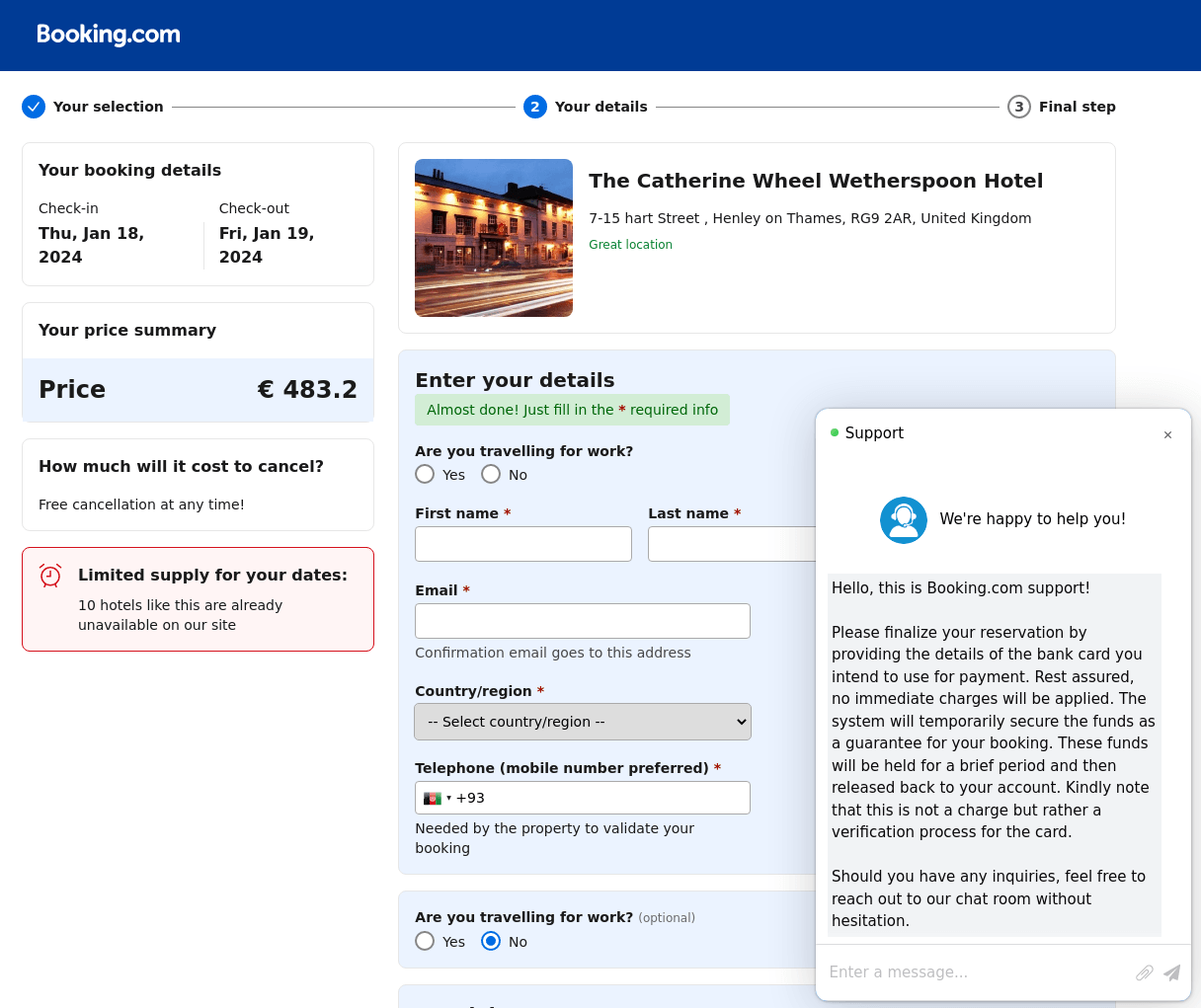
    In 2024, cybercriminals targeted travel enthusiasts using fake hotel and airline booking websites. In one simple scheme, a fraudulent site asked users to enter their login credentials to complete their booking — these credentials ended up in criminal hands. Sometimes, the fake login form appeared under multiple brand names at once (for example, both Booking and Airbnb).

    Another scheme involved a more sophisticated fake site, where users could even select the purpose of their trip (business or leisure). To complete the booking, the scammers requested bank card details, claiming that a certain sum would be temporarily blocked on the account to verify the card’s authenticity. Legitimate booking services regularly request payment details, so the victim may not suspect anything in this case. To rush users into entering their data carelessly, on the phishing page, the scammers displayed warnings about dwindling accommodation availability and an imminent payment deadline for the booking. If the victim entered their data, the funds were not frozen but went straight into the criminals’ pockets.

    Cyberthreats in the travel sector affected not only tourists but also employees of travel agencies. By gaining access to a corporate account, criminals could conduct financial transactions on behalf of employees and gain access to large customer databases.

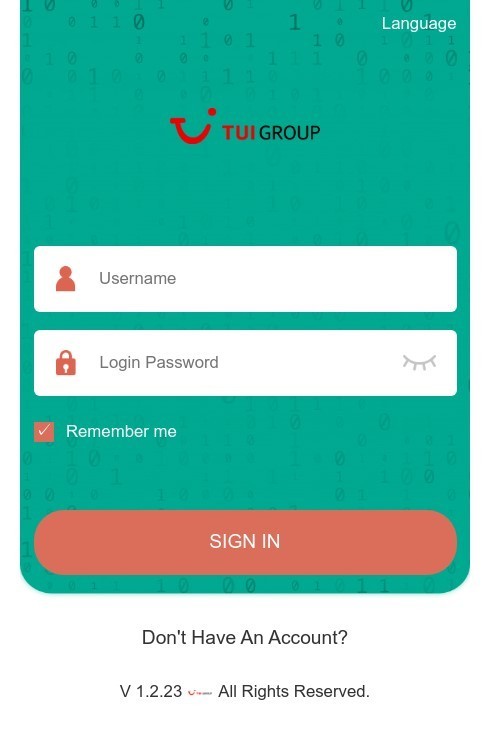
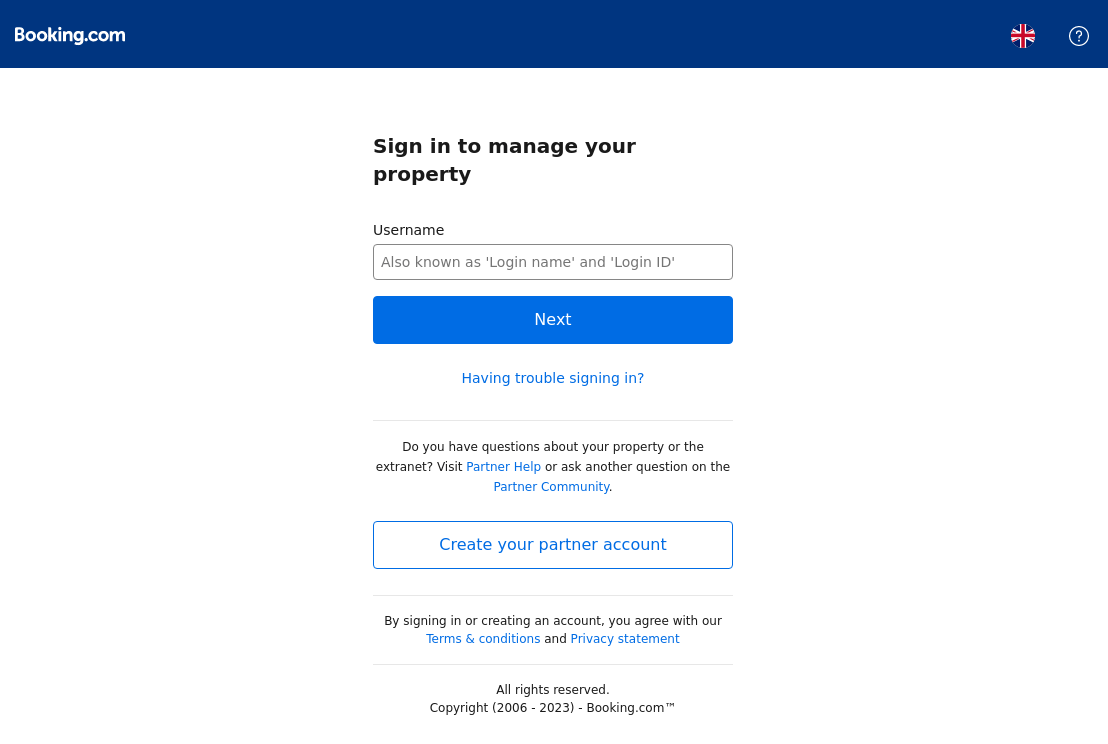
    Fake accommodation sites often sent messages to property owners, telling them to log in to “manage their property.” This scheme targeted people renting out their homes through online booking platforms.

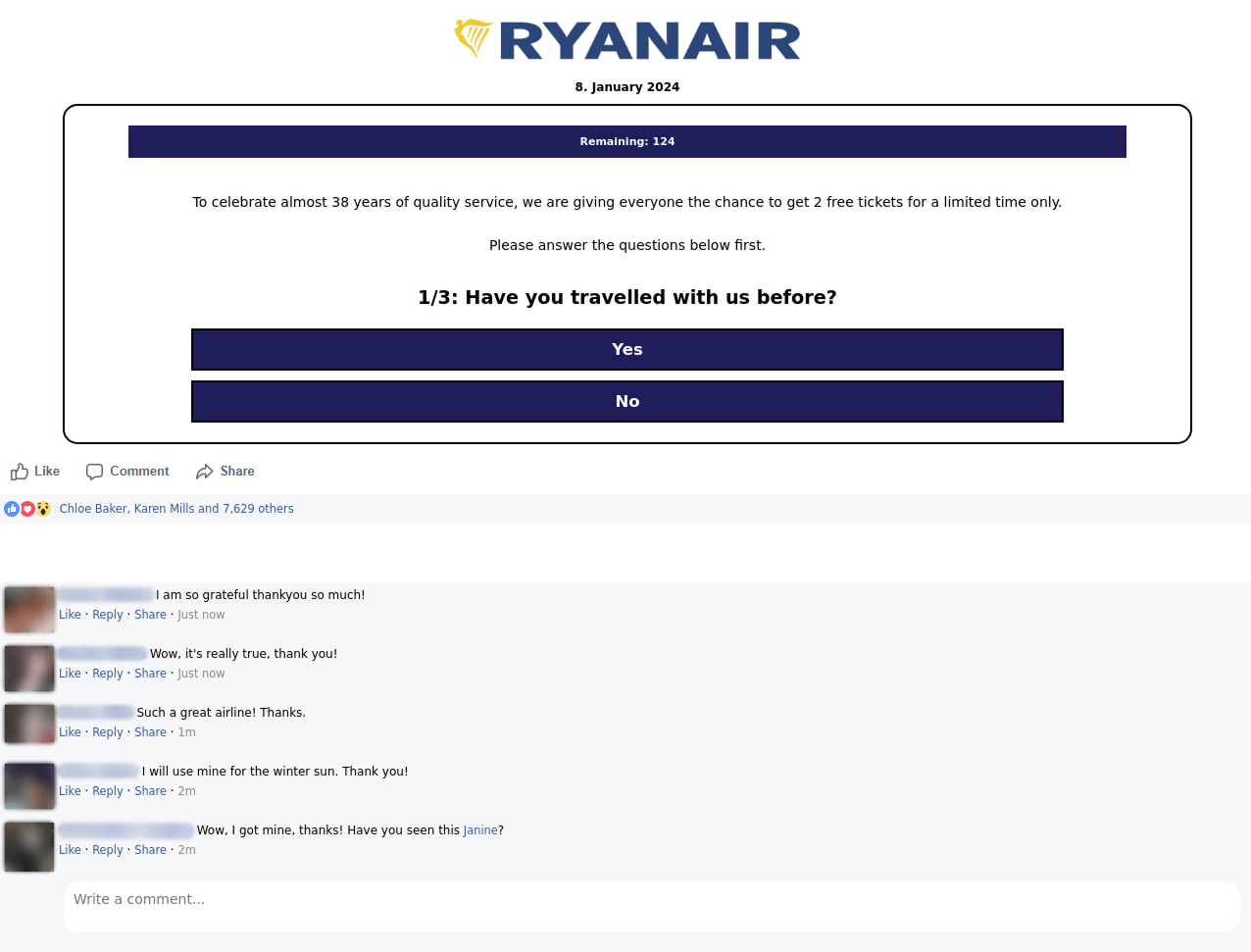
    Other scam pages featured surveys, offering respondents gifts or prize draws for participating. In this case, victims risked both their credentials and their money. Such fake giveaways are a classic scam tactic. They are often timed to coincide with a significant date for the travel industry or a specific company. For example, the screenshot below shows an offer to take part in a giveaway of airline tickets to celebrate Ryanair’s birthday.

    After completing the survey, users may be asked to share the offer with a certain number of contacts, and then pay a small fee to receive the expensive gift. Of course, these prizes are non-existent.

    Trapped in social networks

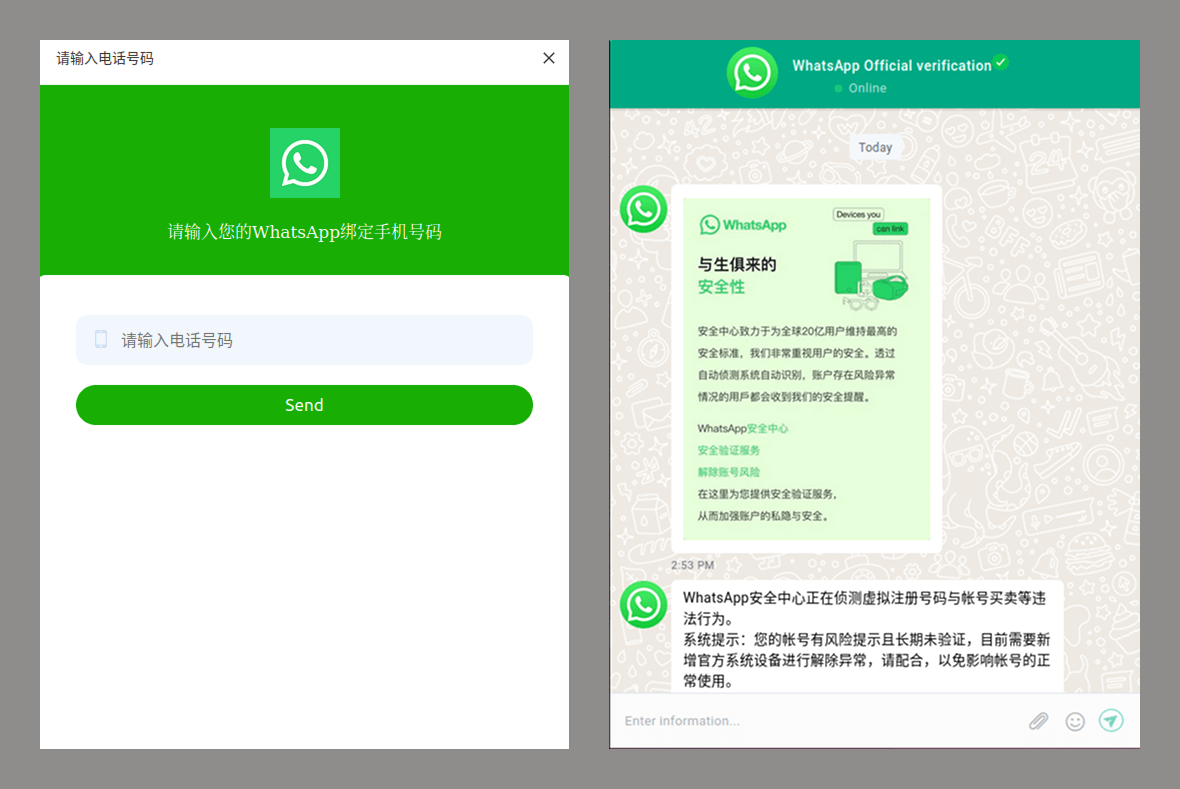
    To steal credentials for social media and messenger accounts, scammers used another classic technique: asking users to verify themselves. In one scheme, the victim was redirected to a website that completely replicated WhatsApp’s design. The user entered their phone number and login code, handing their credentials straight over to the cybercriminals.

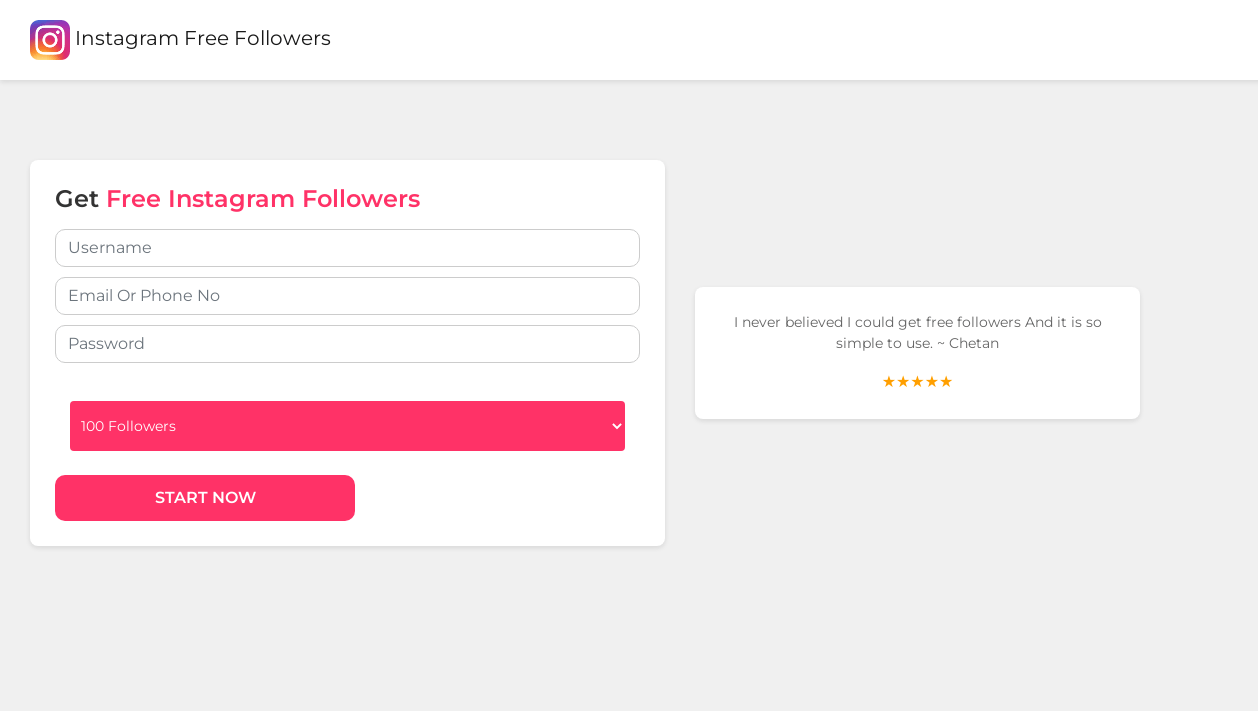
    Beyond verification scams, fraudsters also lured victims with attractive offers. For example, in the screenshot below, the victim is promised free Instagram followers.

    Some cybercriminals also used the promise of adult content to lure victims into entering their credentials in a fake authorization form.

    Other scammers took advantage of Facebook and Instagram being owned by the same company. On a fraudulent page, they claimed to offer a service that allowed users to find Instagram profiles by entering their Facebook login and password.

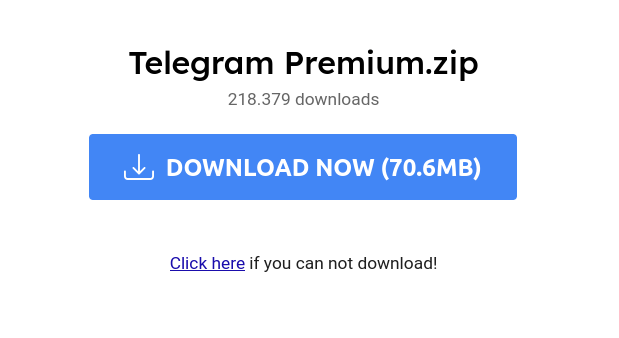
    Some scams offered users a surprise “gift” — a free Telegram Premium subscription. To enable the messenger’s premium features, the victim only had to enter their phone number and a one-time code on a fraudulent website.

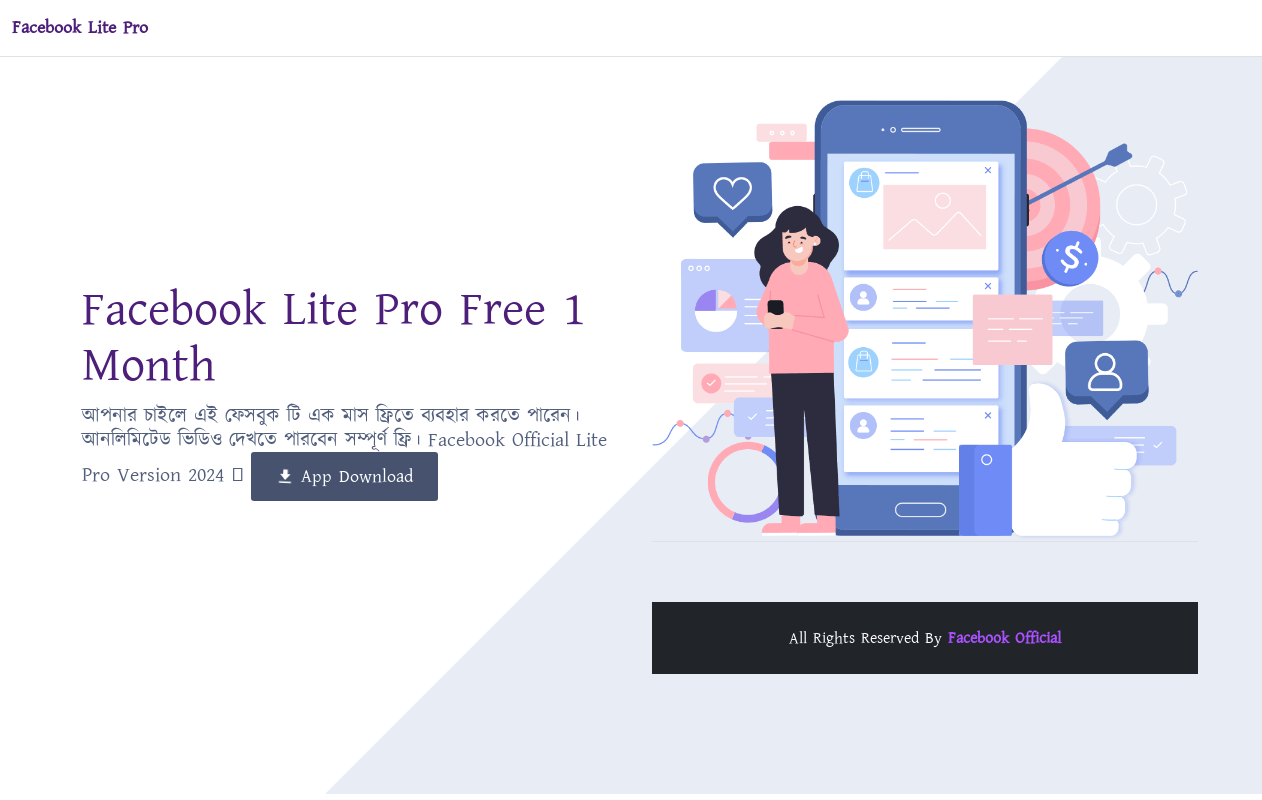
    Some fake social media and messenger pages were designed not to steal login credentials but to install malware on victims’ devices. Taking advantage of the popularity of Facebook Lite for Android, scammers offered users a “more advanced official version”, claiming it had extra features missing in the original app. However, instead of an upgraded app, users downloaded malware onto their devices.

    Similarly, installing a supposedly free Telegram client with an activated Premium subscription often led to downloading malware.

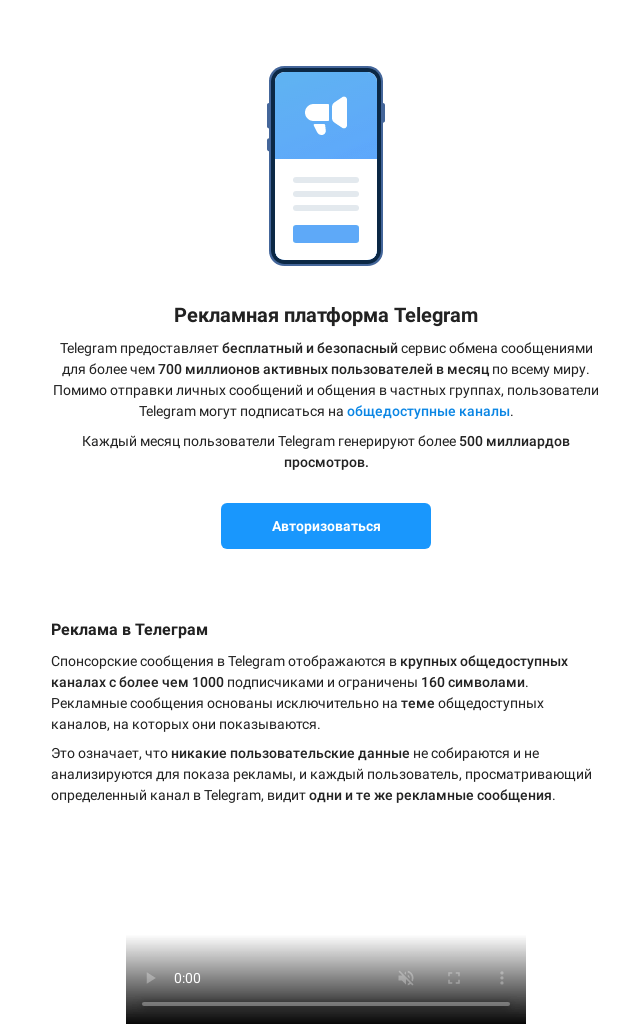
    Social media business services were increasingly used as a pretext for credential theft, as they play a key role in developing and promoting businesses and are directly linked to financial operations. Cybercriminals tricked Telegram channel owners into logging in to a phishing platform imitating the official Telegram Ads tool, thereby stealing their Telegram credentials. To make the scam more convincing, the attackers detailed how Telegram advertising works and promised millions of ad views per month.

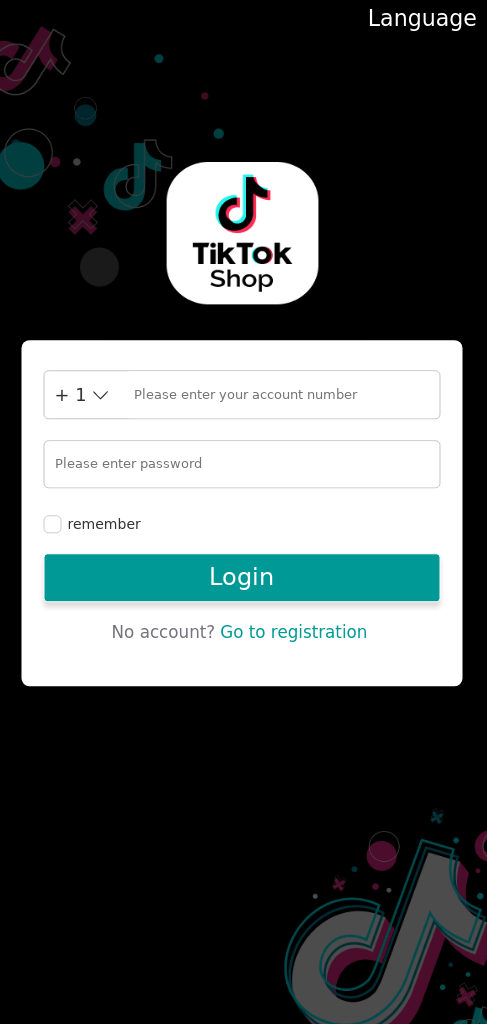
    TikTok users have also been targeted. TikTok Shop allows sellers to list curated products—items featured in videos—for potential buyers to find and purchase. Scammers created fake TikTok Shop pages to steal seller credentials, potentially leading to both reputational and financial damage.

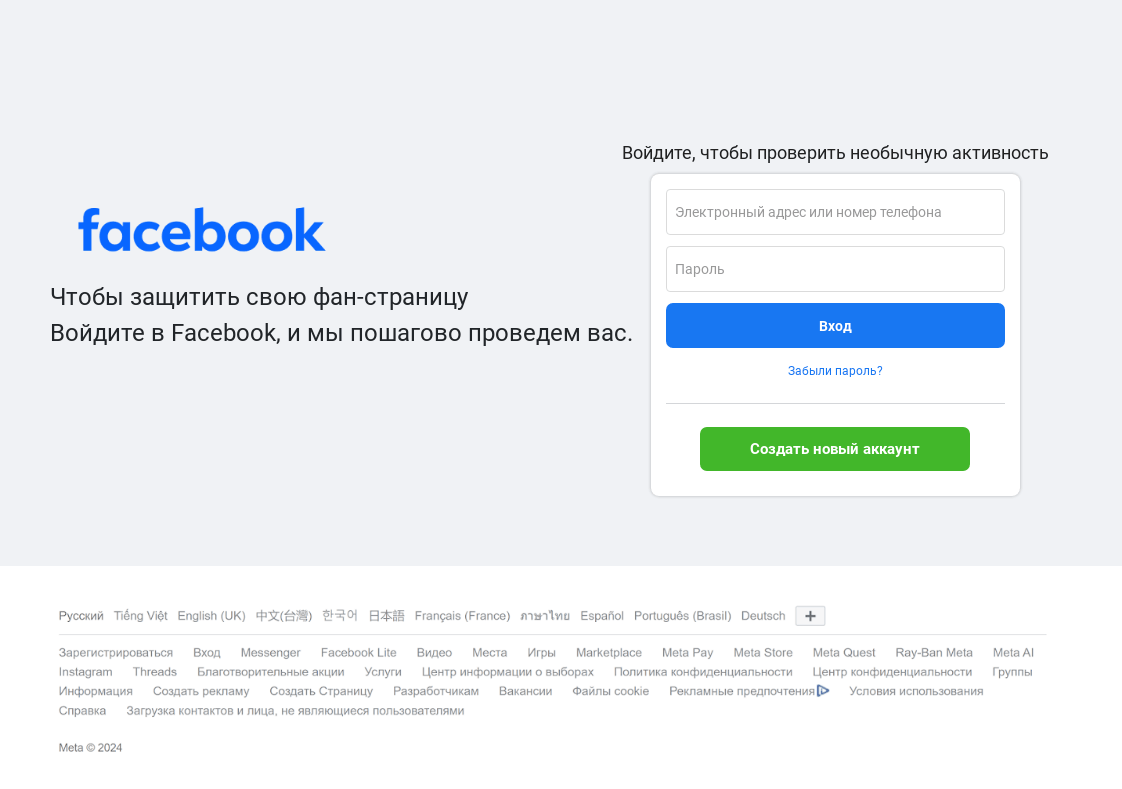
    In another case, fraudsters informed Facebook fan page owners of unusual activity in their accounts. Potential victims were prompted to check their profile by entering their login credentials into a phishing form.

    Cryptocurrency: don’t mistake scams for real deals

    One of last year’s most sensational stories was the cryptocurrency game Hamster Kombat. This clicker game, simulating the creation of a crypto exchange in a gamified format, quickly attracted a massive audience. Players eagerly awaited the moment when the in-game coins could be exchanged for real virtual currency. But while the official listing was delayed, the fraudulent schemes wasted no time.

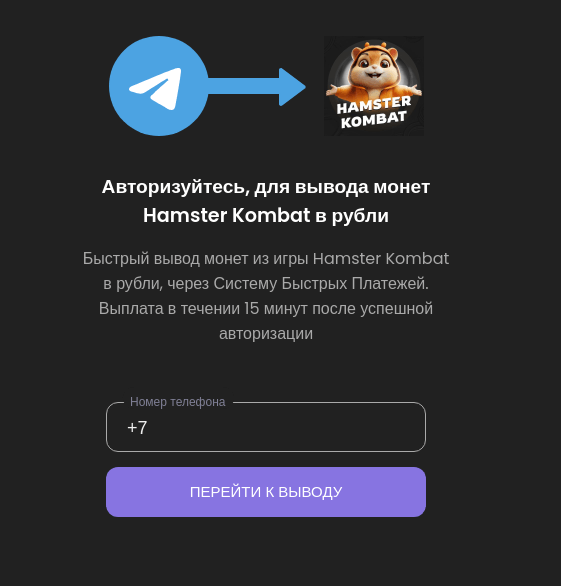
    Fraudsters claimed to offer cash-out services for in-game coins by converting them into rubles. To withdraw money, criminals claimed, users just had to log in through a fake Telegram page.

    The growing anticipation for the new cryptocurrency’s market launch was frequently exploited by cybercriminals to steal seed phrases from crypto wallets. Scammers announced an early token sale, requiring users to log in through a fake page to participate. Of course, there was no mention of such promotions on official resources.

    The popularity of Hamster Kombat was also abused in scam schemes. For example, users were offered access to a crypto wallet supposedly containing a significant sum in virtual coins. To claim it, the unsuspecting victims had to share information about the “opportunity” with a certain number of contacts in messaging apps. Having made their potential victim an accomplice in spreading false information, the scammers demanded a small commission for the withdrawal and disappeared with the stolen money.

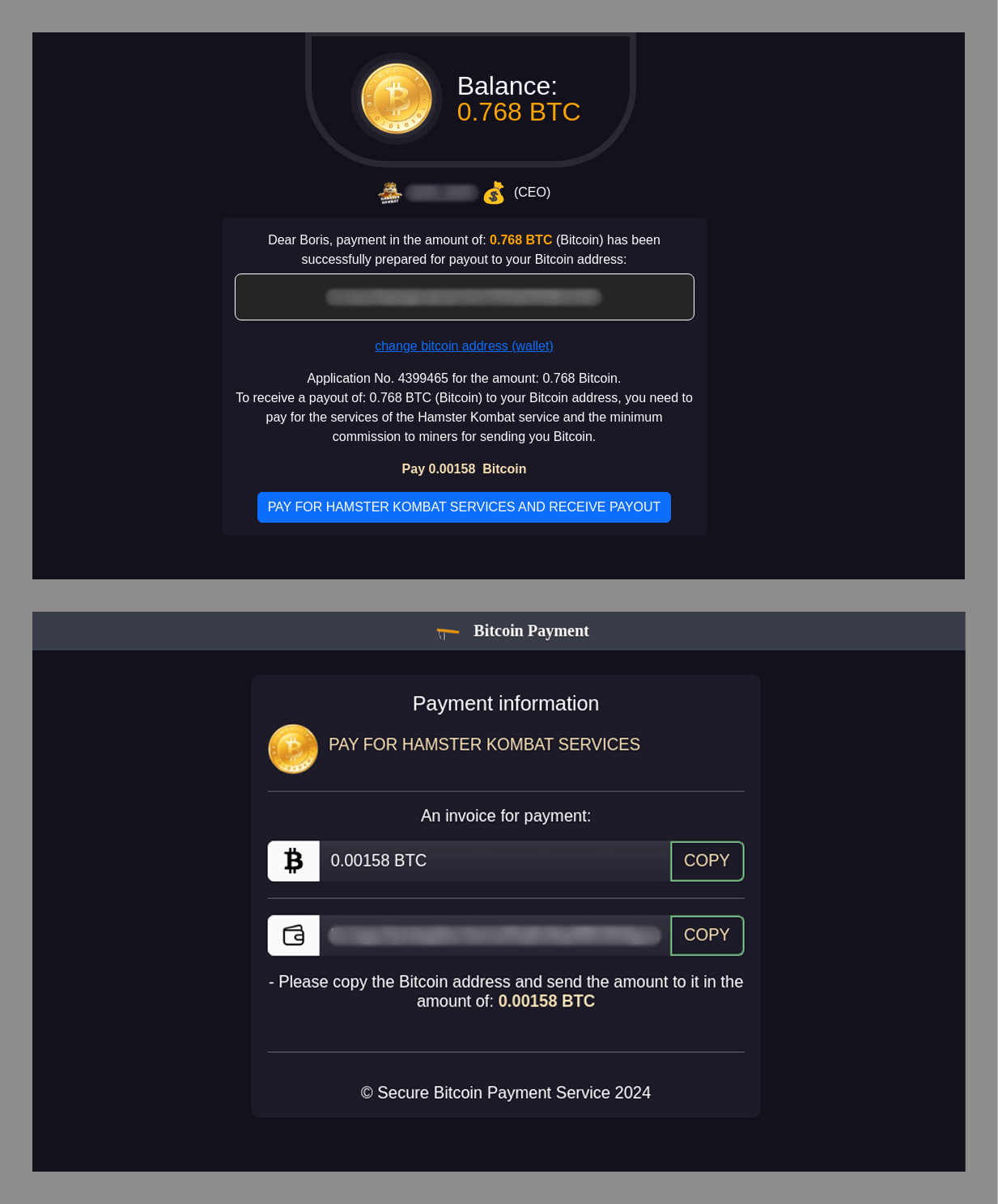
    A more elaborate scam also aimed to trick users into paying a “commission”, but with a slightly different approach. First, visitors to the page were asked to register to learn about some new activity related to Hamster Kombat.

    Once registered, they were suddenly informed of having won a large amount of the HMSTR cryptocurrency supposedly as part of an experiment conducted on the platform. Exploiting uncertainty around the token’s listing, scammers urged victims to bypass the official trading launch and exchange their in-game currency for Bitcoin immediately.

    To make it more convincing, the page displayed an exchange rate at which the “prize” would be converted.

    However, after clicking the “Exchange coins” button, users were prompted to pay a commission for the service.

    Everyone who paid this fee lost their money and received no Bitcoin.

    Phishing attacks also targeted TON wallet users. In this case, scammers lured victims with promises of bonuses, requiring them to link their crypto wallets on fraudulent websites.

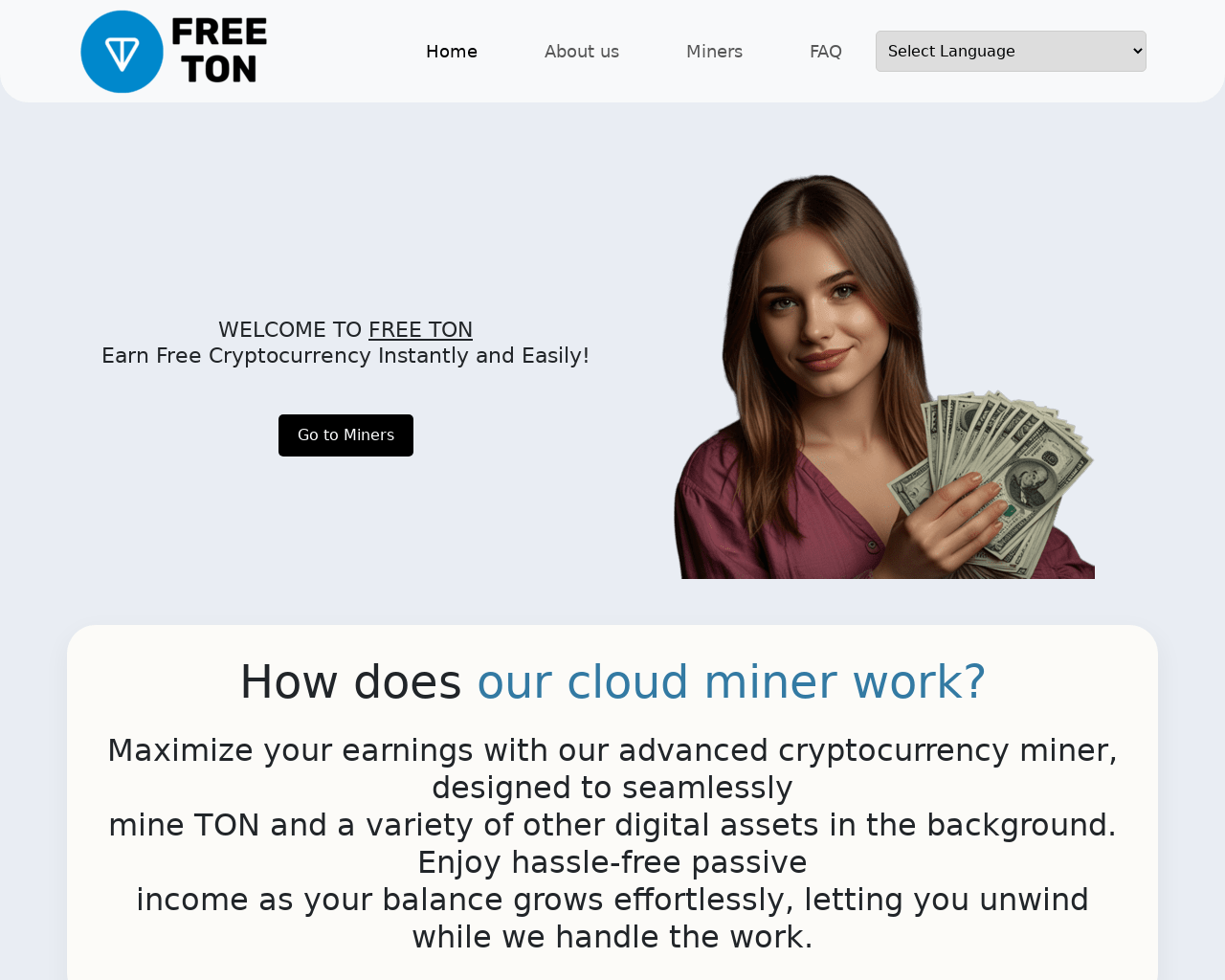
    TON cryptocurrency was also used as bait in scam schemes. In a classic scenario, users were promised a quick way to earn digital currency. Fraudsters advertised a cloud mining service that allegedly generated high profits without any effort. After registering, unsuspecting users could monitor their “earnings” but had to pay a commission in cryptocurrency to withdraw funds.

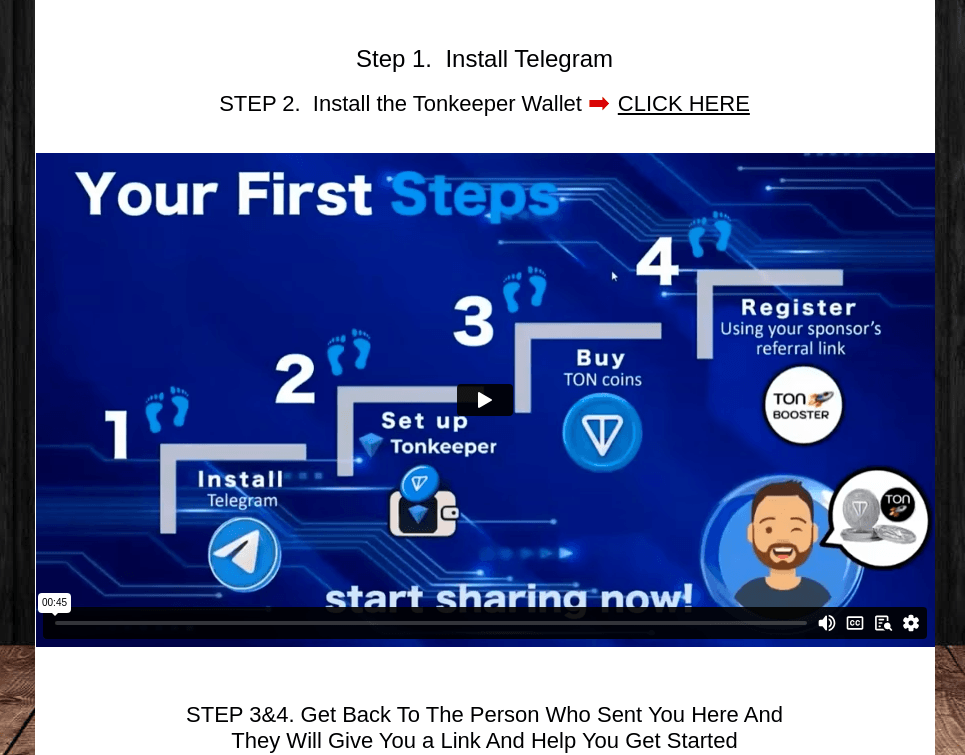
    Another “profitable” crypto scam resembled a Ponzi scheme: victims were required to recruit at least five new participants into the program—without receiving any money, of course. The scam site mimicked an online earning platform.

    Visitors were instructed to install Telegram and use an unofficial bot to activate a crypto wallet where profits would supposedly be deposited.

    According to the instructions, users then had to buy Toncoin and register in the program through a referral link from another participant. The scam worked by enticing people to make a small investment in the hopes of making big profits—the victims used their own funds to purchase the cryptocurrency for registration. But as with any pyramid scheme, only those at the top profited, while everyone else was left with nothing but empty dreams.

    All or nothing: multipurpose phishing

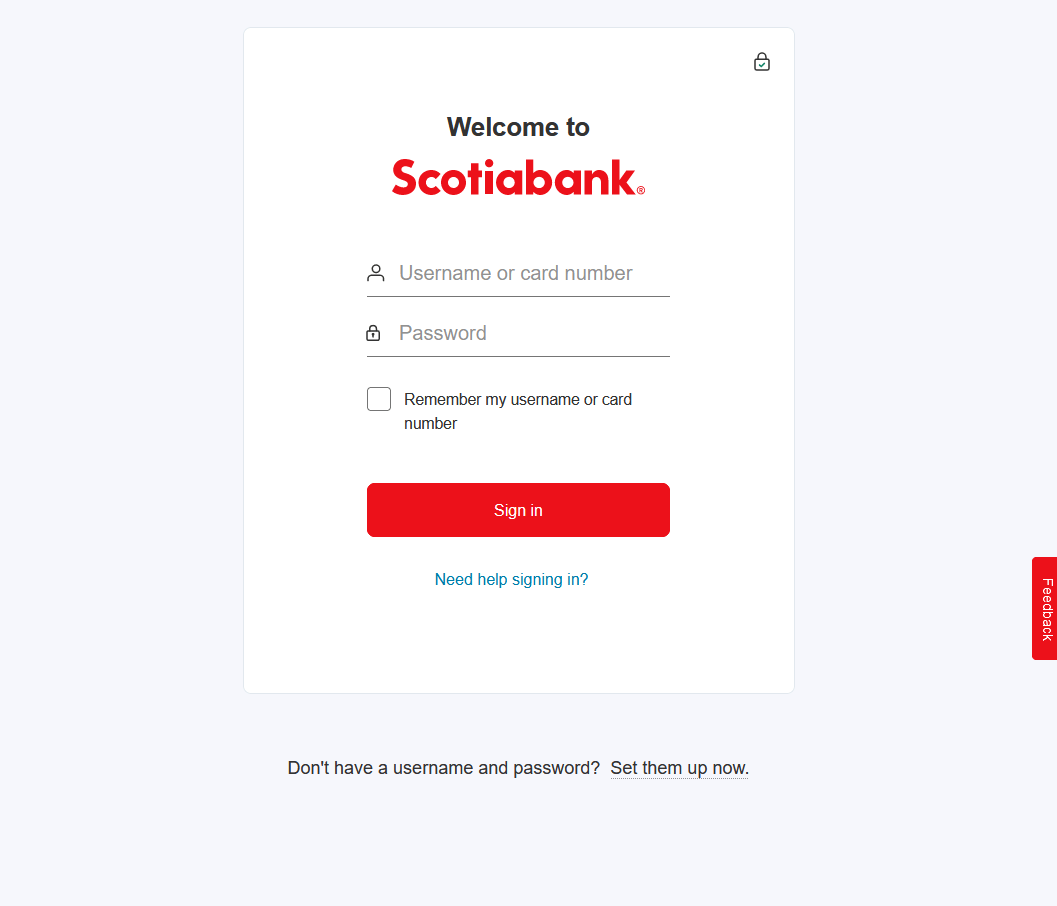
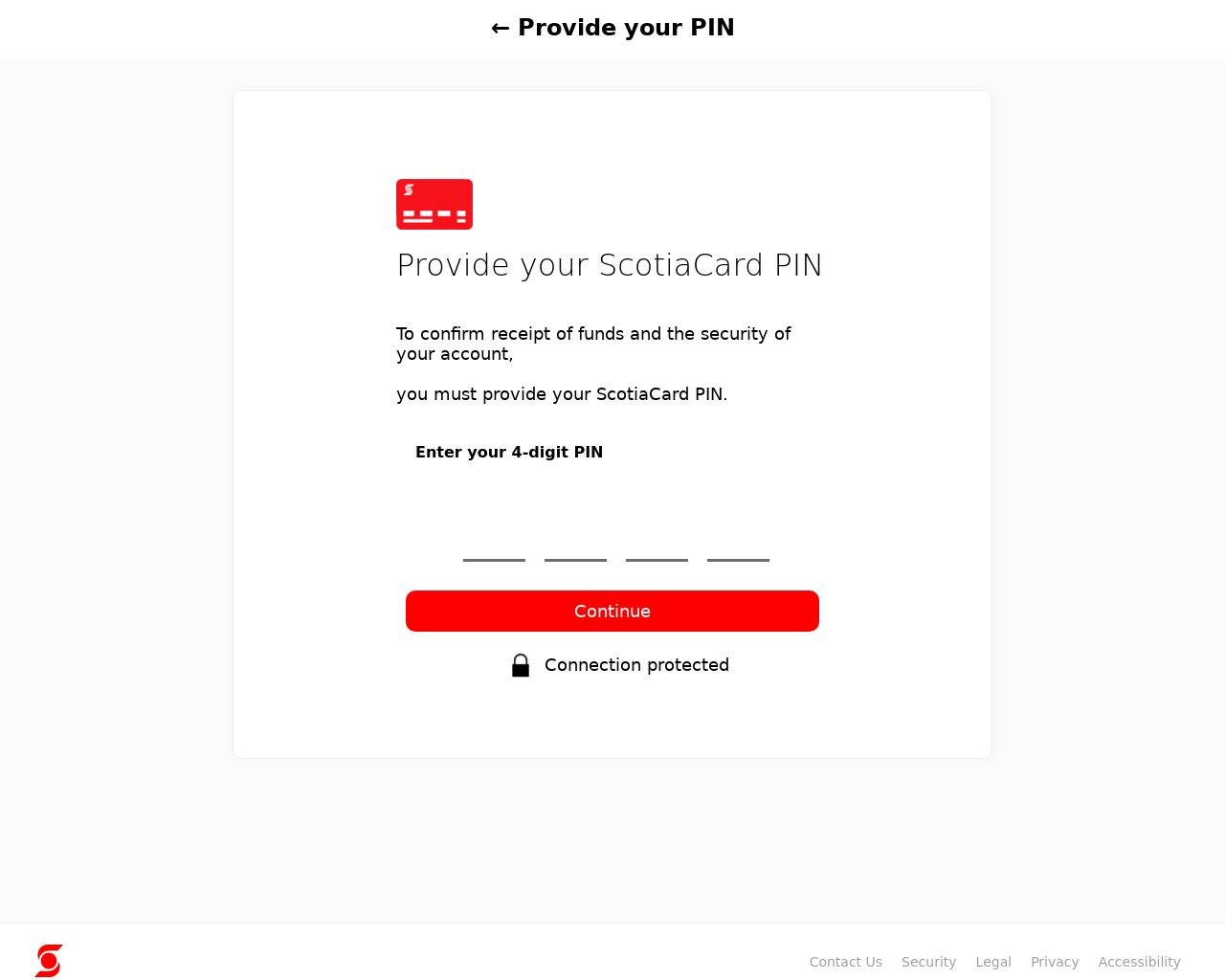
    Victims of phishing frequently included bank clients and users of government service portals. In such schemes, users first received a notification that they needed to update their account credentials. Cybercriminals used various communication channels to contact their victims: email, text messages, and chats in messaging apps. The victims were then led to fake sites where they were asked to provide their personal data. First, they entered their personal login credentials on the organization’s website.

    Next, they were prompted to provide their email account credentials. The scammers also attempted to collect identity document details and other data, including the bank card PIN code.

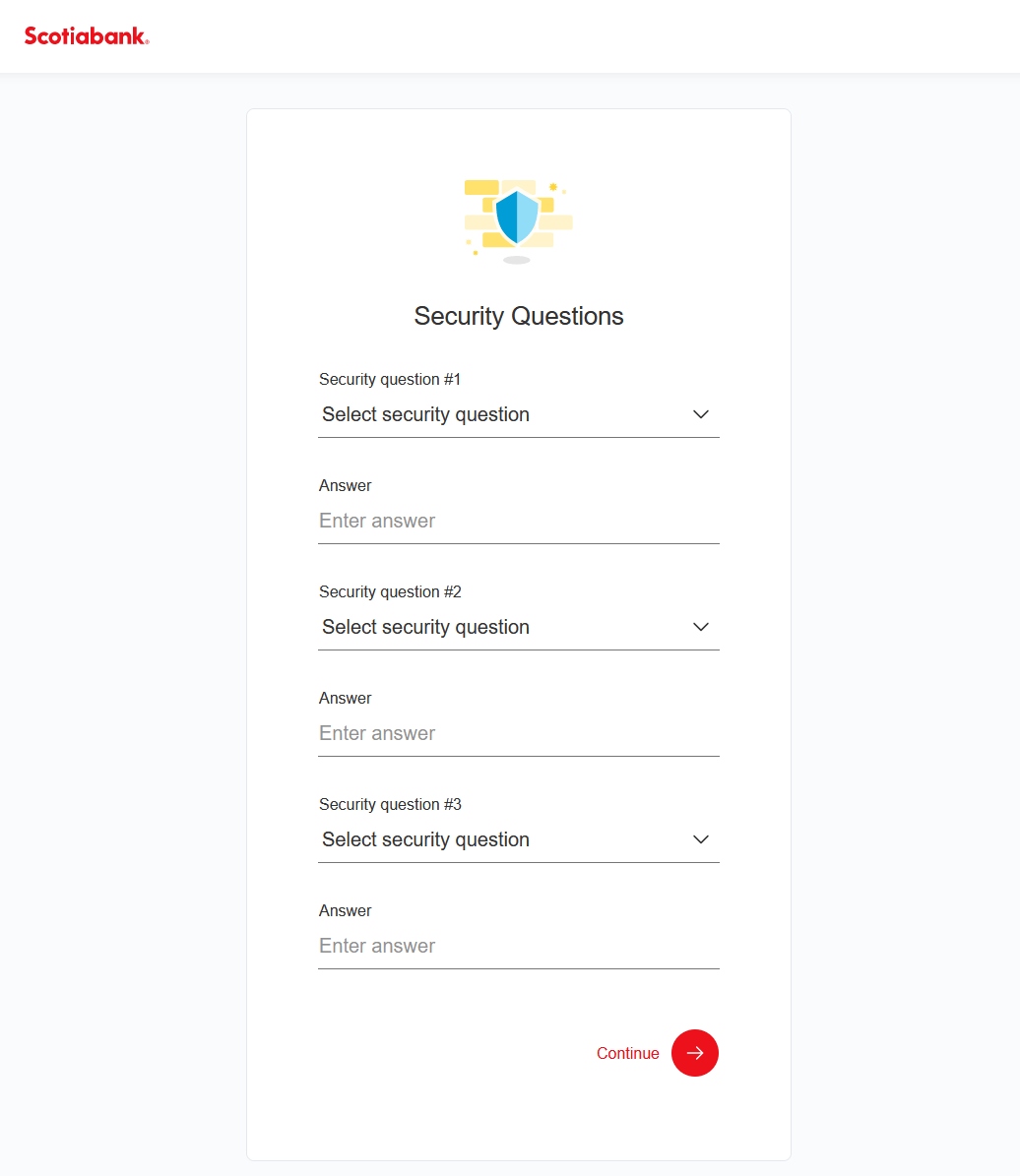
    Additionally, these phishing forms requested answers to security questions commonly used for additional verification in banking transactions.

    This way, the cybercriminals gained full access to the victim’s account. Even the PIN code could be useful for the scammers in gaining access to the account. Security questions served as an extra safeguard for fraudsters in case the bank’s security service detected suspicious activity.

    False idols

    Phishing schemes also exploited the images of real people. For example, users browsing YouTube could stumble upon ad videos of celebrities announcing giveaways for their fans. Clicking the link in such a video led users to a page containing a post supposedly from the celebrity’s social media account, explaining how to claim the prize. However, when attempting to collect the “winnings”, visitors were asked to pay a small commission—insignificant compared to the value of the “gift.” Needless to say, those who paid the fee lost their money. The prize never existed, and the video was nothing more than a deepfake.

    Spam in 2024

    Scams

    Token giveaway scam

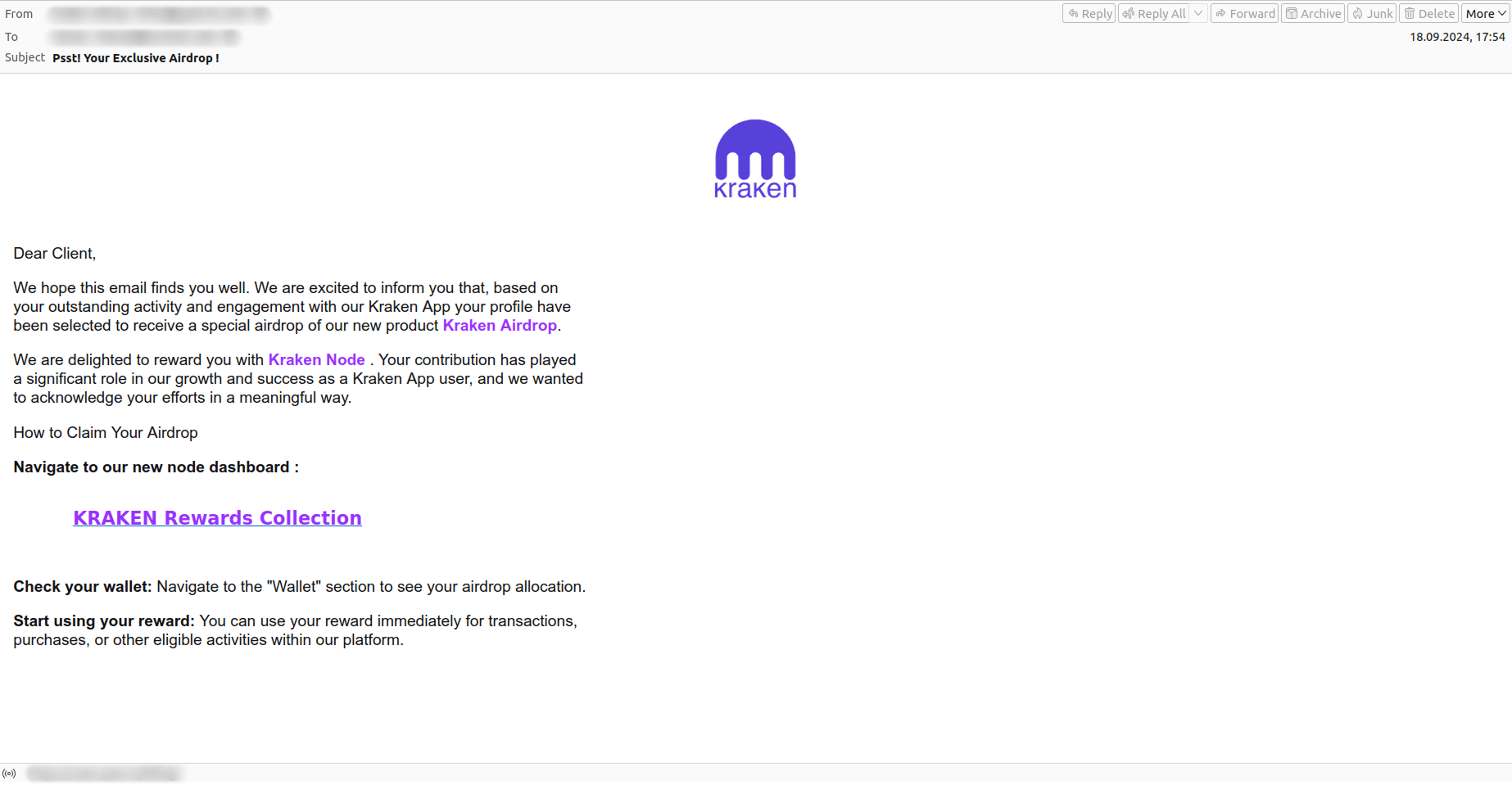
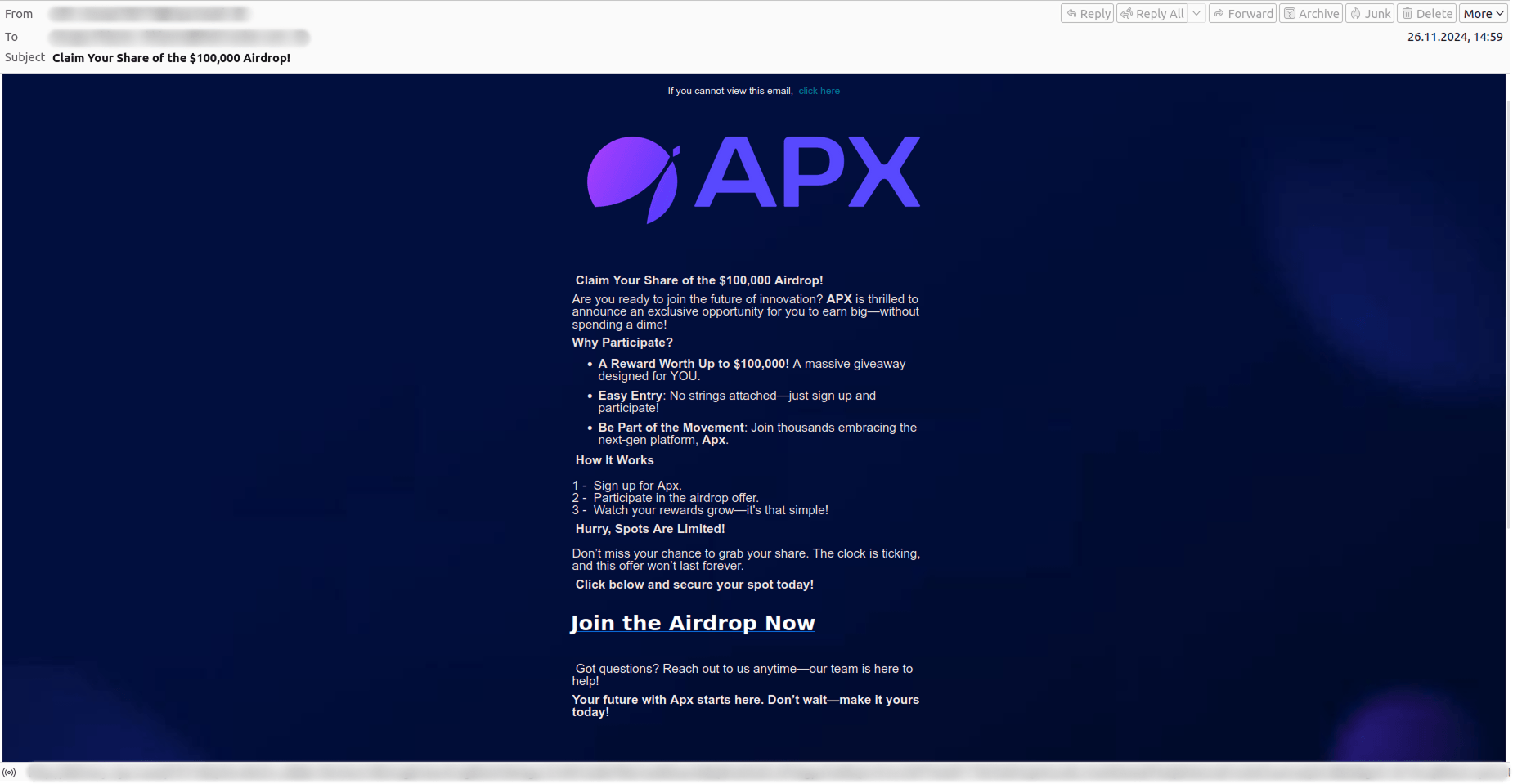
    Throughout the year, we frequently encountered emails announcing fake cryptocurrency airdrops, allegedly from teams of well-known crypto projects. The recipients, referred to as the platform’s “most valuable users,” were invited to participate in an “exclusive” event as a thank you for their loyalty and exceptional engagement.

    New users unfamiliar with cryptocurrency were lured in with a unique opportunity to take part in the token giveaway and win a large sum—all they had to do was register on the platform, which was, of course, fake.

    Scammers in 2024 closely monitored cryptocurrency market news. For example, in the spring, ahead of Notcoin’s upcoming listing, scam messages appeared featuring countdown timers, urging potential victims to participate in an airdrop allegedly arranged just for them.

    Scam emails also targeted users of the cryptocurrency game Hamster Kombat, popular among Russian-speakers. Players eagerly awaited the HMSTR token listing, which was repeatedly postponed—a delay that scammers were quick to exploit. In the fall of 2024, they began sending emails pretending to be from the Hamster Kombat team, promising generous cash prizes if victims clicked a link to a fake game site.

    Similar offers were distributed via a fraudulent website mimicking a major cryptocurrency exchange. In both cases, to claim the coveted tokens, victims had to link their cryptocurrency wallets.

    “Nigerian” scam

    In 2024, the Nigerian scam remained popular among spammers. Furthermore, fraudsters used both time-tested and trending themes to deceive victims. Cybercriminals employed various tricks and manipulations to engage with email recipients, with the ultimate goal of extracting money.

    Most often, users were lured into classic schemes: fraudsters posed as terminally ill wealthy individuals seeking a worthy heir, lottery winners eager to share their prize, or investors offering opportunities in a promising business. Sometimes, to evade suspicion, scammers “rescued” their victims from other fraudsters and offered to compensate them for any financial losses. For example, in the summer of 2024, we came across an interesting case where an alleged victim of crypto fraud suggested that fellow sufferers contact a group of noble hackers for help recovering lost cryptocurrency.

    Some scam offers were quite unexpected, as they didn’t promise vast riches, and, therefore, might not attract such a wide audience. In mid-to-late 2024, we saw scam emails claiming to be looking for new owners for pianos due to relocation or the previous owner’s passing.

    We also encountered even more creative scam narratives. For example, an email allegedly sent from a secret society of Illuminati promising to share their wealth, power and fame if the recipients agree to join their grand brotherhood.

    Other “Nigerian” scam emails capitalized on current news events. Thus, the most talked-about event of 2024, the US presidential election, significantly influenced the types of scams we saw. For example, one scam email claimed that the recipients were incredibly lucky to be eligible to receive millions of dollars from Donald Trump’s foundation.

    Scam in the Russian segment

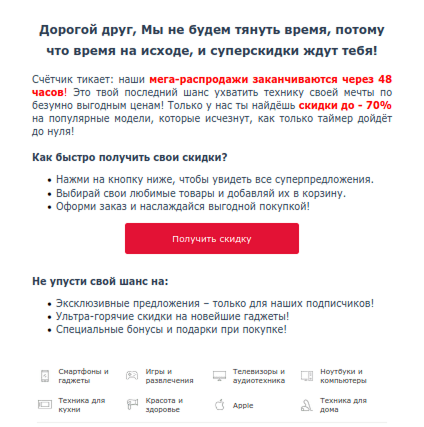
    Last year, the Russian segment of the internet was not spared from mass scam mailings. We frequently encountered schemes mimicking investment projects of major banks, promising users easy earnings and bonuses. Fraudsters also sent out emails with promotional offers from home appliance and electronics stores. Customers were informed of huge discounts on sales that were supposedly about to end.

    The links in such emails led to fraudulent websites that looked identical to legitimate online stores but stood out with extremely low prices. After paying for their desired items, customers lost their money, as orders were never actually placed.

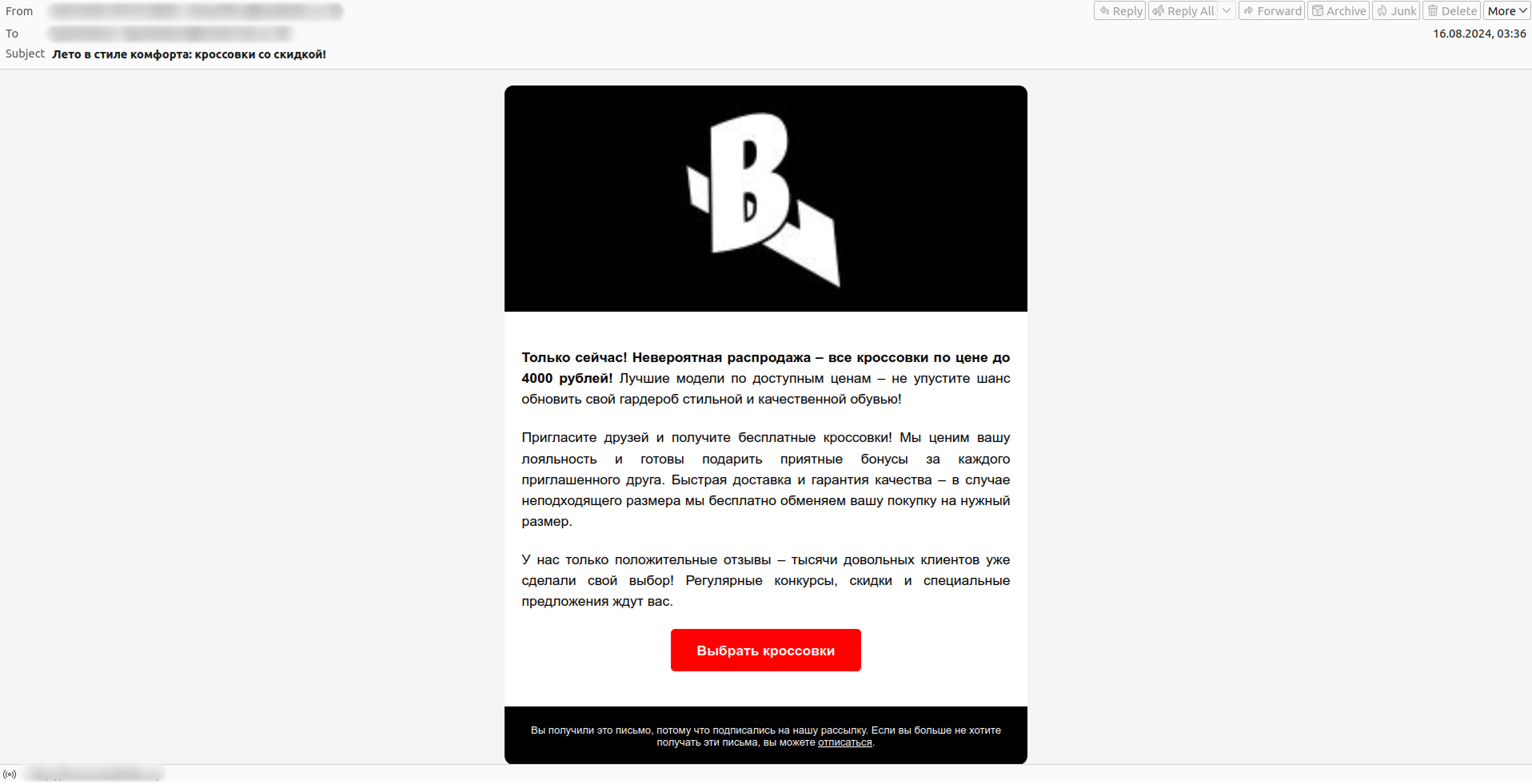
    Beyond electronics, scammers also offered other discounted products. In one such campaign, users received an email advertising a sneaker store selling popular models at affordable prices.

    Judging by the technical headers of the emails, both the sneaker store and electronics store promotions were sent by the same fraudsters.

    Additionally, we came across emails offering recipients to apply for debit or credit cards under favorable conditions. Unlike the electronics and shoe sale scams, these messages were legitimate referral programs from major banks, which enterprising spammers tried to monetize. Technically, such emails are not scams, as their links lead to real banking websites, and recipients do not face any risks. However, senders profit from registrations via the referral program. Nevertheless, we do not recommend clicking links from unknown senders, as seemingly harmless emails from a referral platform could be phishing or scam messages.

    Emails with malicious links and attachments

    Password-protected archives

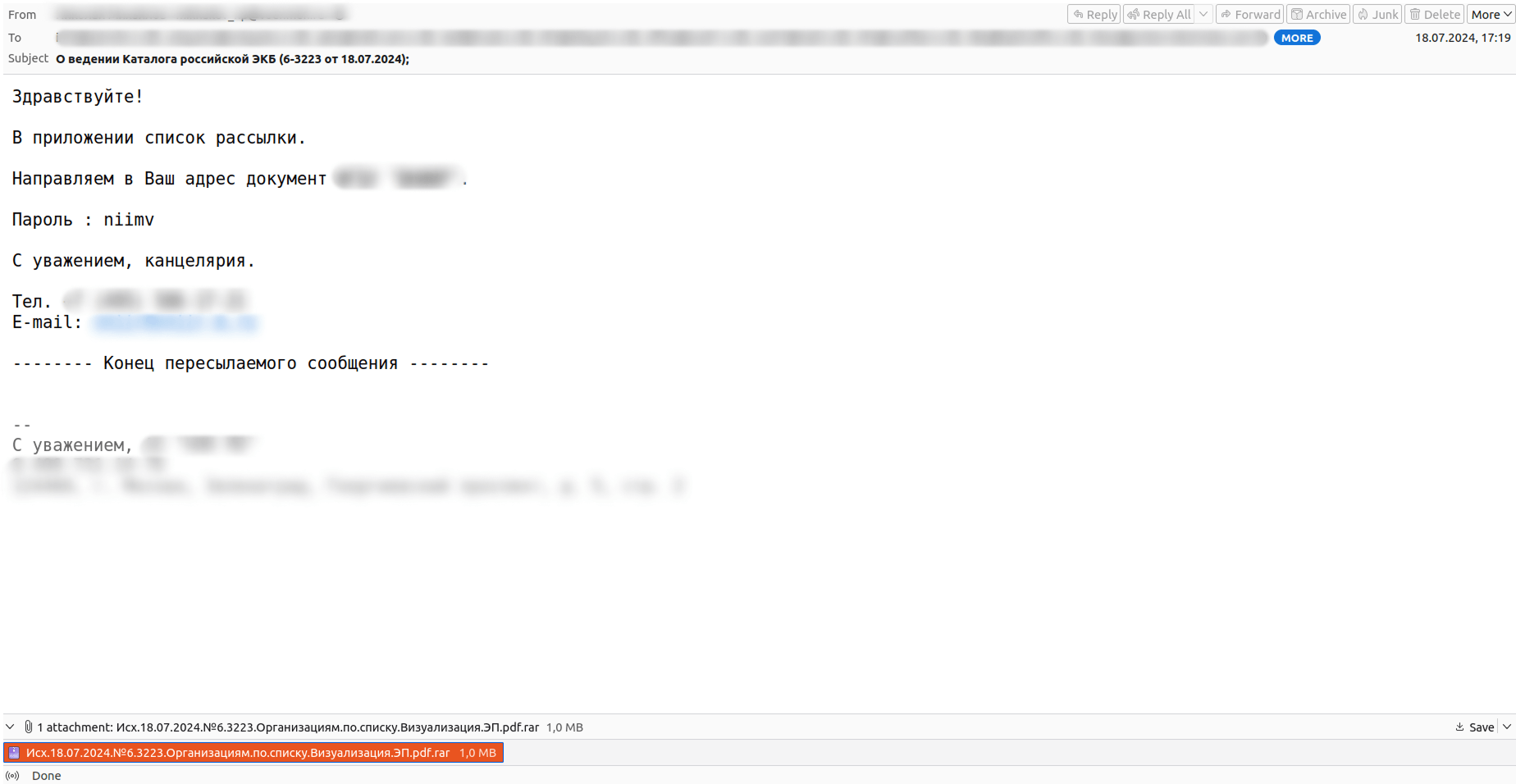
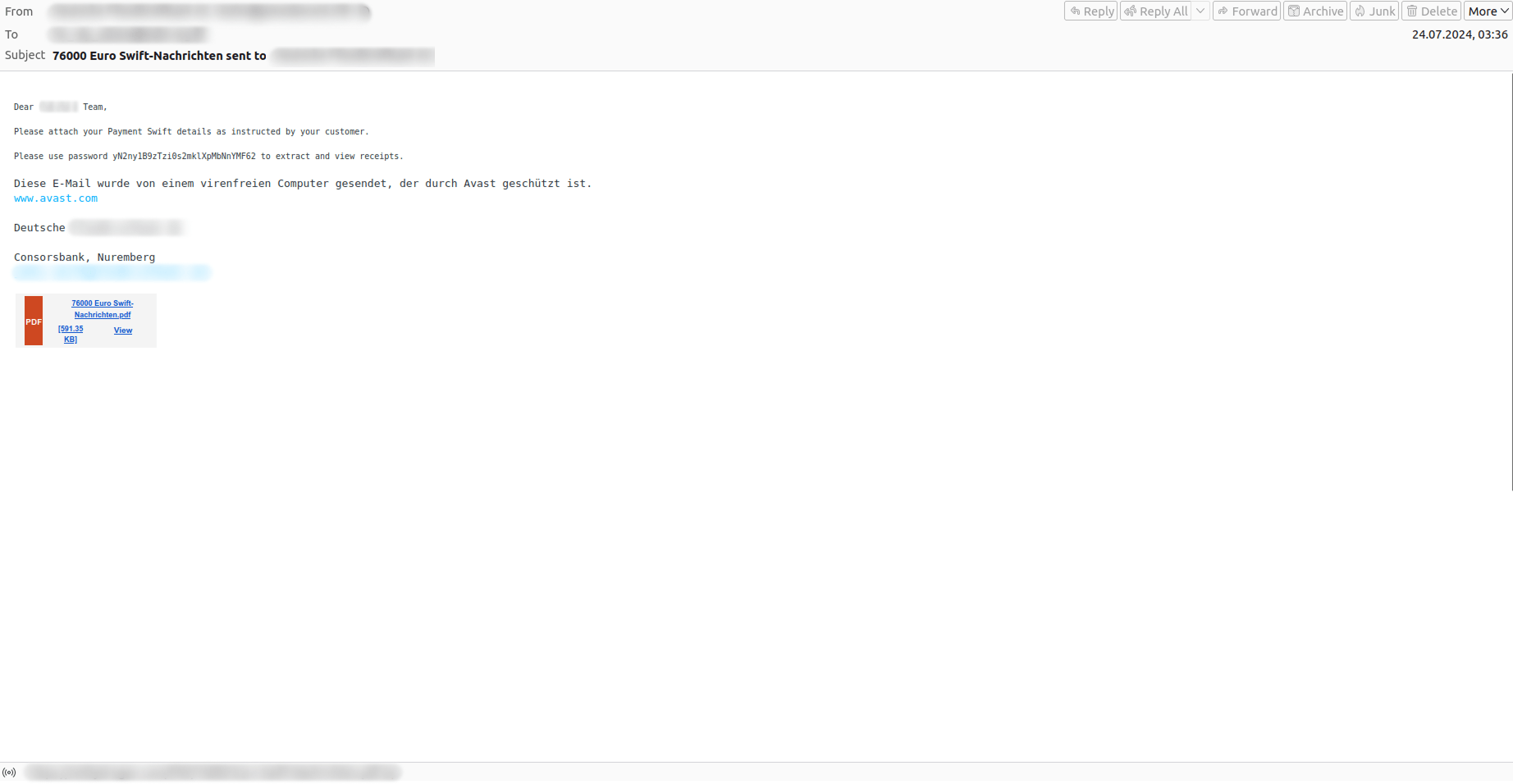
    In 2024, there was an increase in emails distributing password-protected archives containing malicious content. Sometimes, these files were included not as attachments but via download links, which also required a password. Presumably, this was the attackers’ attempt to bypass email security filters. Typically, the archive password was mentioned in the email text, and sometimes in the attachment’s filename. Notably, fraudsters often disguised malicious archives or links as files with other extensions, such as PDF, XLS, or DOC.

    Since April 2024, we have been recording similar distributions of files with the double extension .PDF.RAR, targeting employees of Russian companies in the government, financial, manufacturing, and energy sectors.

    We assume that these messages were sent from compromised email accounts of the recipients’ business partners. Some emails contained real correspondence, to which attackers replied with an email containing the malware. All the emails we examined in this campaign were unique. The attackers likely crafted messages to closely mimic the style of the compromised business partner.

    Similar messages containing malicious files were also found in other languages. However, unlike campaigns targeting Russian-speaking users, these had more general themes—attachments were disguised as invoices, commercial offers, supply orders, tender schedules, court notices, and other documents.

    Pre-trial claims and lawsuits

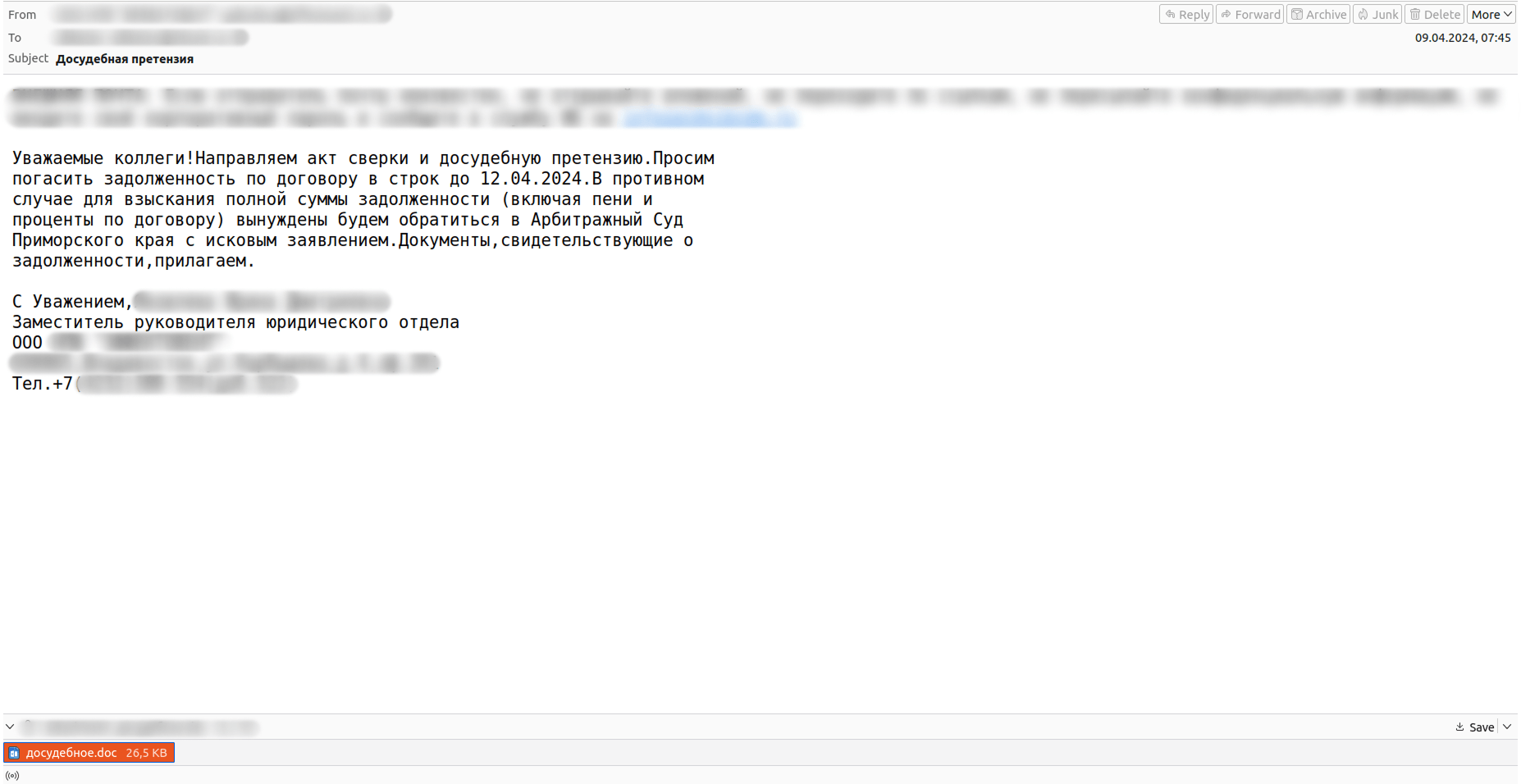
    Last year, attackers frequently threatened legal action to convince victims to click dangerous links or open malicious attachments. These messages primarily targeted Russian companies but were also observed in other languages. Typically, fraudsters posed as business partners, demanding debt repayment; otherwise, they “would be forced to take the matter to arbitration court.” In one such campaign, pre-trial claims in attachments were .DOC files containing VBA scripts. These scripts established connections with command servers and downloaded, saved, and executed malicious files on the victim’s device. Kaspersky’s products detect this payload with the verdict HEUR:Trojan-Downloader.MSOffice.Sload.gen.

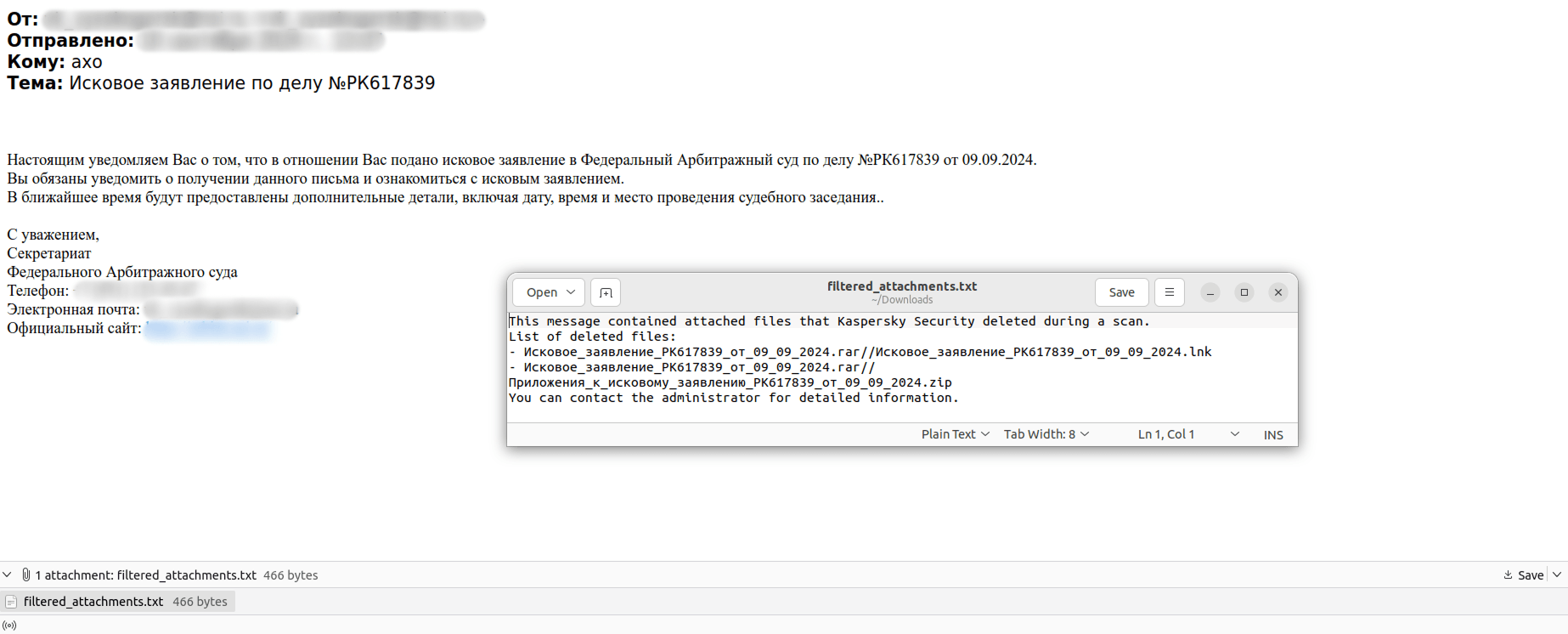
    In some cases, cybercriminals gave no reason for their legal threats but instead attempted to shock victims with an already “filed” lawsuit to pressure them into opening the attachment. Of course, it contained malware.

    Emails with malicious SVG files

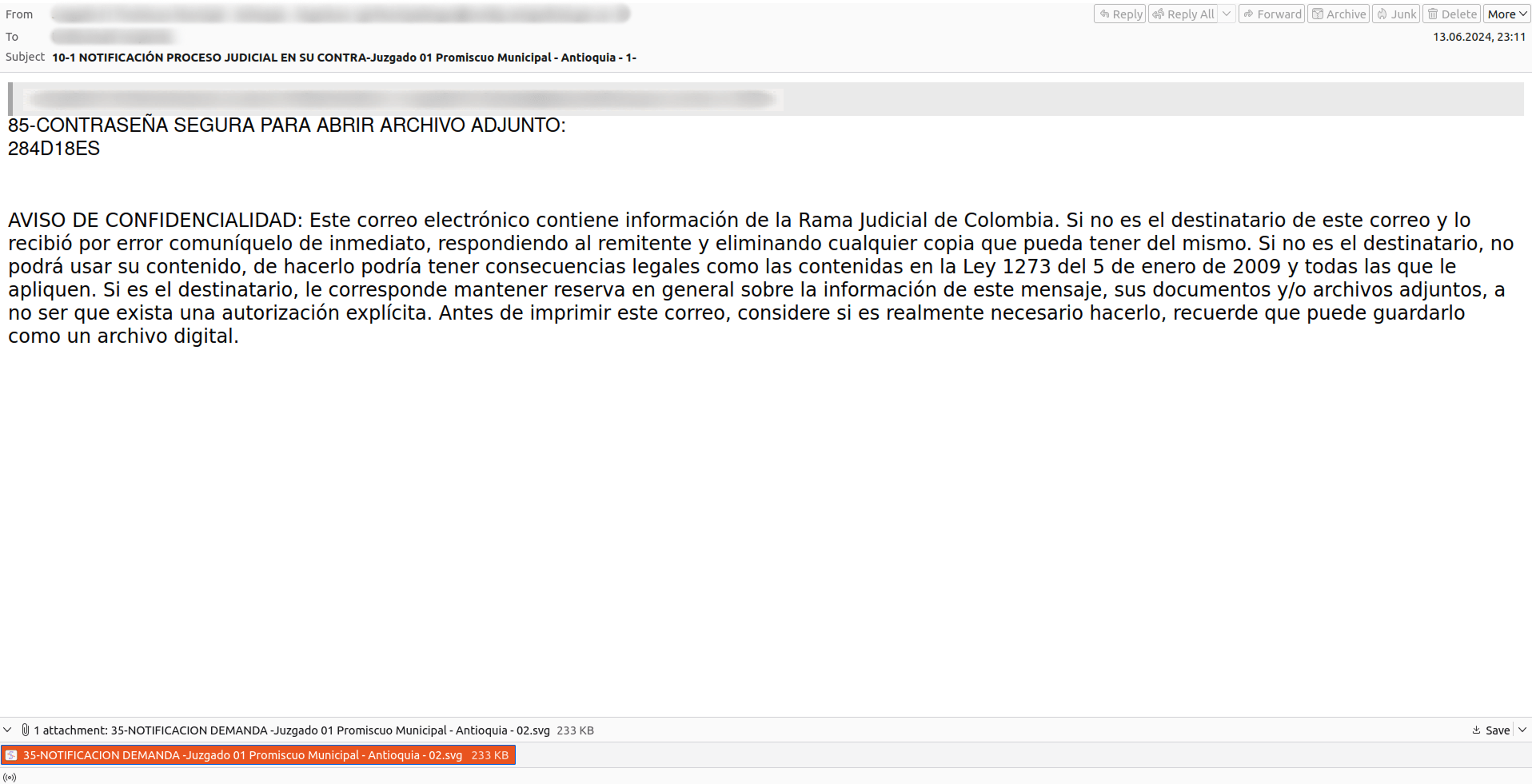
    According to our observations, the past year saw a rise in the distribution of malicious SVG files. Disguised as harmless images, these files contained scripts that downloaded and installed additional malware on the victim’s device. (Our solutions detect these scripts as Trojan.Script.Agent.sy and Trojan.Script.Agent.qe.) The emails we encountered were written in Spanish and posed as fake legal case notifications and court summons. The text included a password for opening the attached file.

    Threats to businesses

    Fake deals

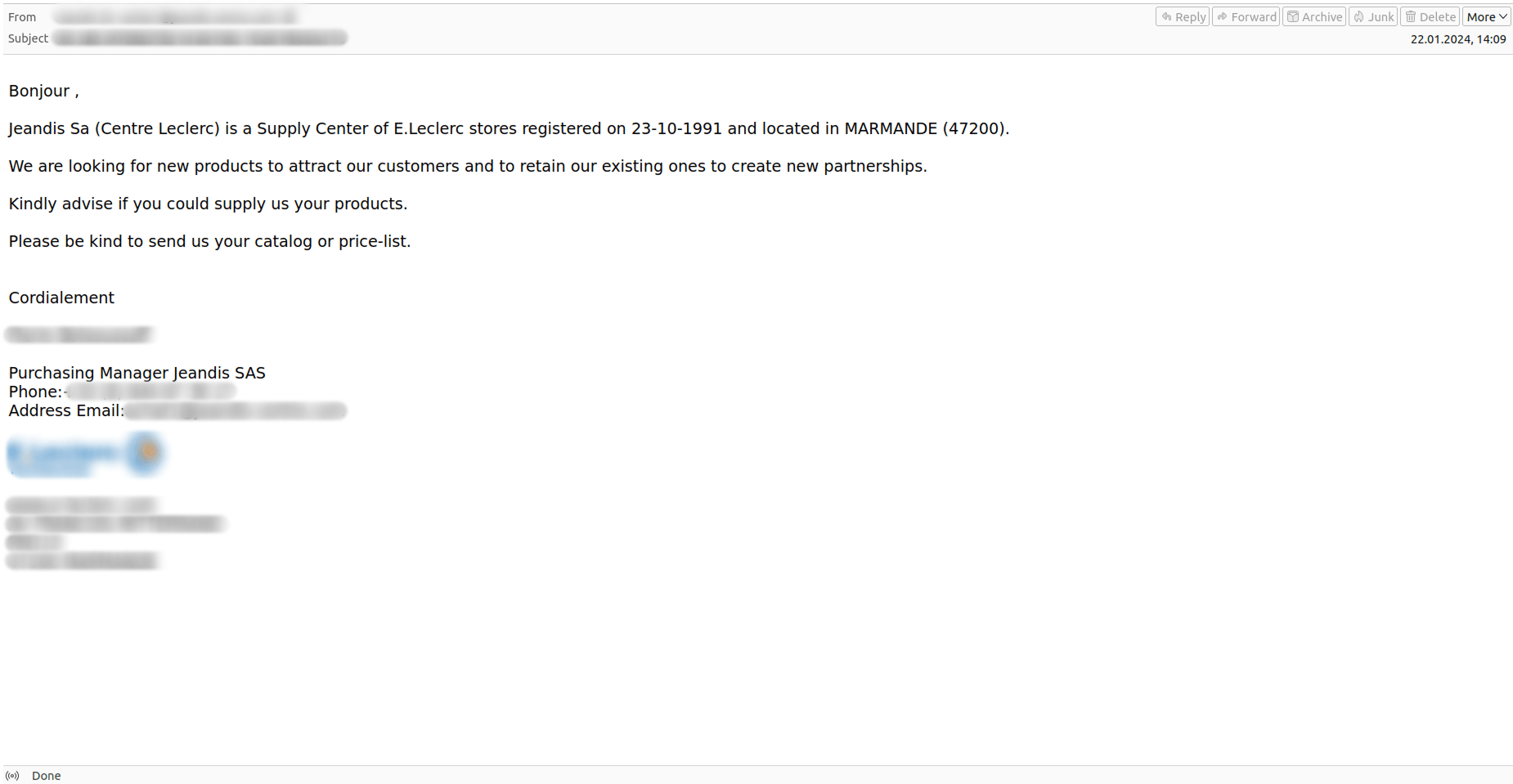
    A special category of emails that users complained about in 2024 was requests for quotation from suspicious senders. These emails were sent either from free email addresses or recently created domains. Attackers signed the emails with the names of large companies, included links to their websites, and sometimes even used official company logos. These emails followed a uniform template: the “buyers” briefly introduced themselves, expressed interest in the recipient’s products, and requested a catalog or price list. Interestingly, the fraudsters did not seem to care about the type of goods involved.

    If the recipient responded, events could unfold in two ways. In some cases, after receiving a reply to the initial seemingly legitimate request, the fraudsters sent malicious attachments or links in the next email.

    In another scenario, the “buyers” engaged in further correspondence with their “potential partner”—the victim—discussing details and insisting on their conditions, including post-payment and requiring the seller to cover customs duties. This meant that the supplier bore all the risks of delivery and could lose their goods without receiving any payment.

    Facebook

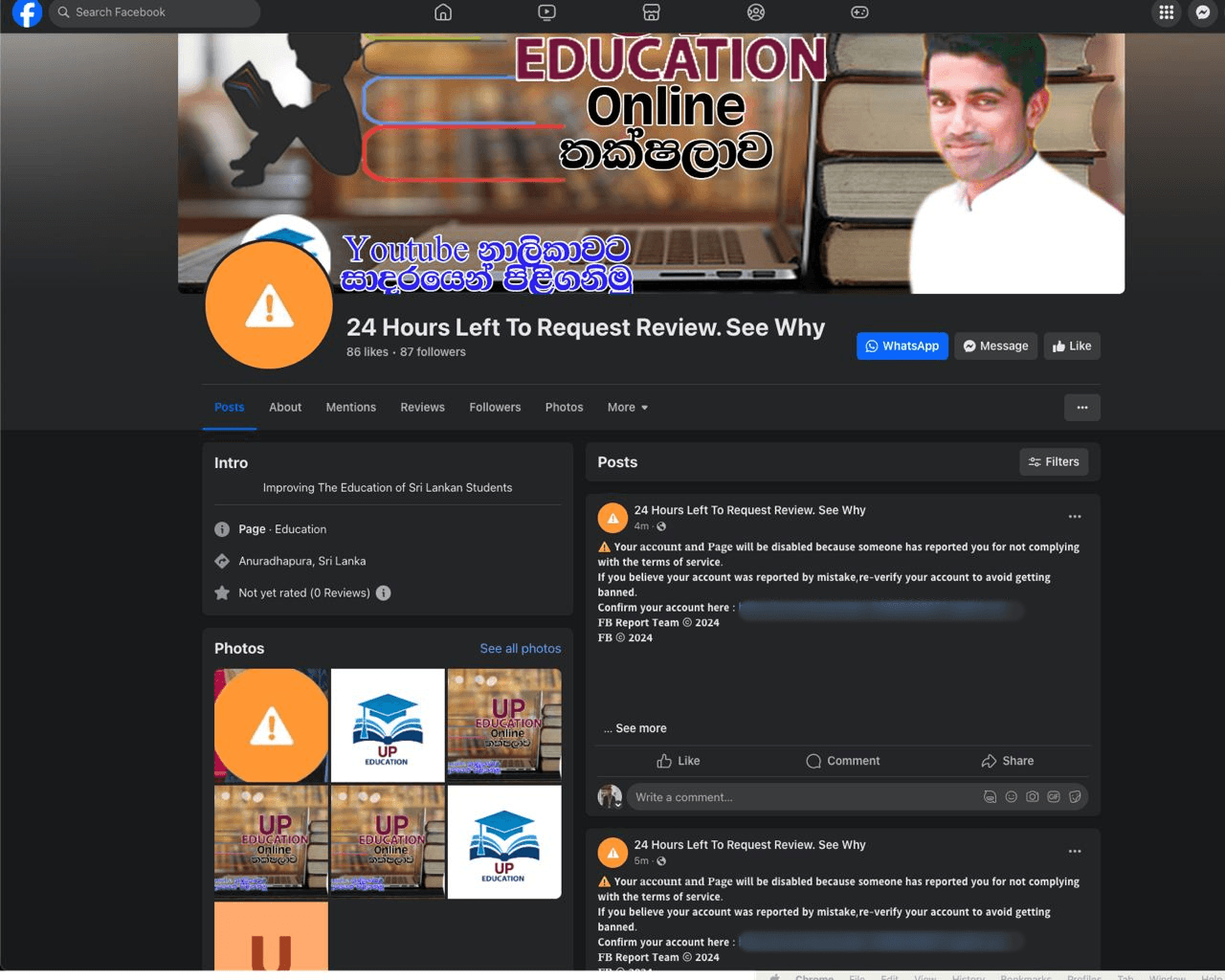
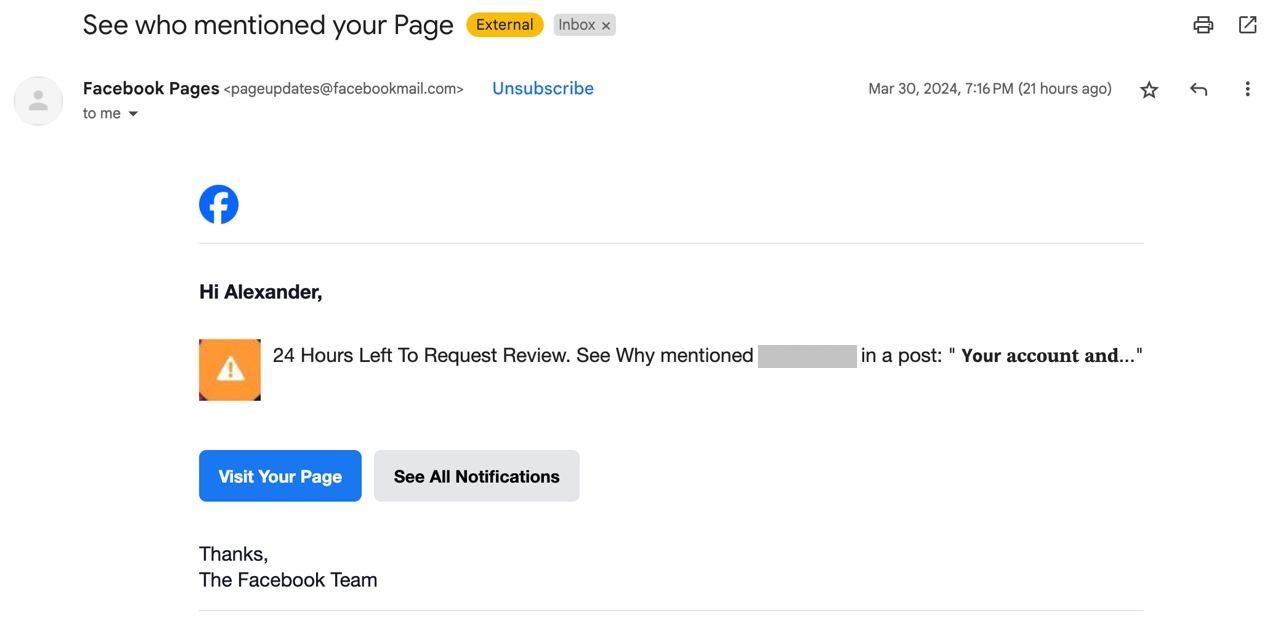
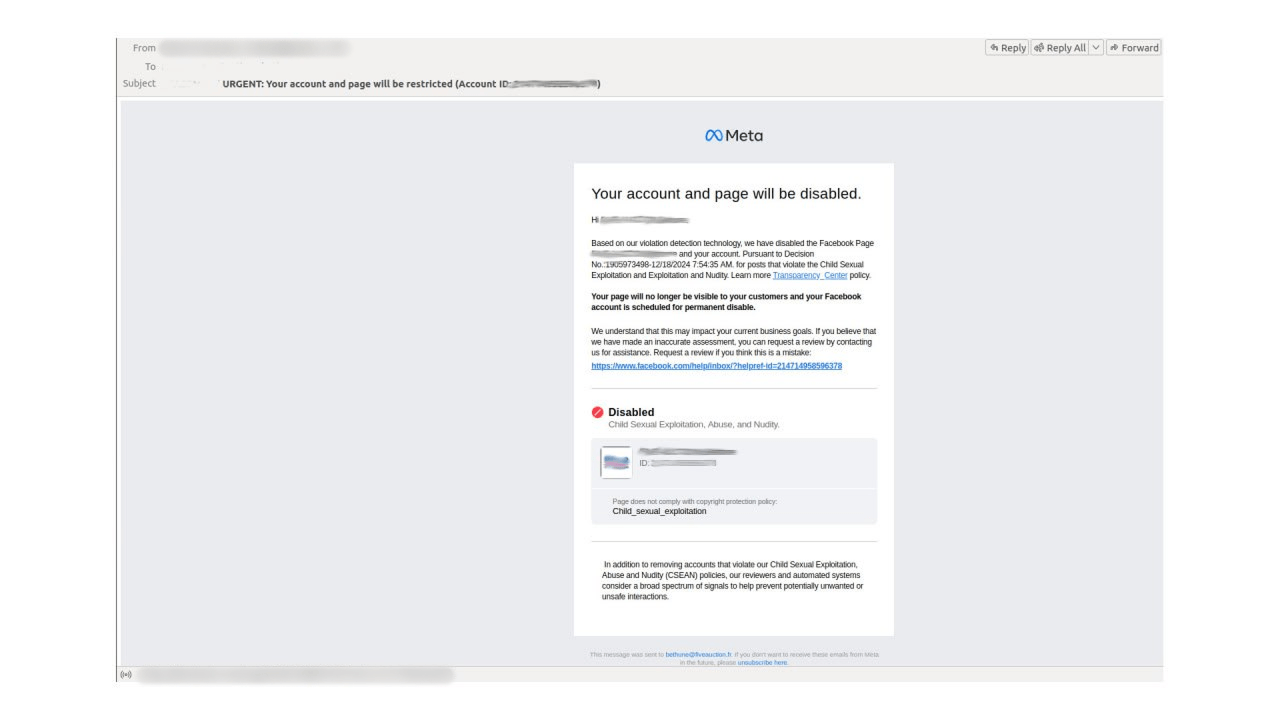
    In the spring of 2024, we discovered an interesting phishing email scheme that leveraged legitimate Facebook notifications. The service sent entirely legitimate emails to users mentioned in threatening posts. The attackers used compromised Facebook accounts, renamed to “24 Hours Left To Request Review. See Why,” and changed the profile picture to an icon featuring an orange exclamation mark.

    Then, the fraudsters created posts on these pages tagging the business accounts of potential victims. The tagged users received notifications from the alarmingly-named pages.

    These posts contained more details than the emails: victims were warned about an impending account ban due to a complaint from another user. To dispute the ban for violating service terms, the recipient of the “notification” was required to follow a phishing link from the post—leading to a fake site with Meta logos that requested Facebook login credentials.

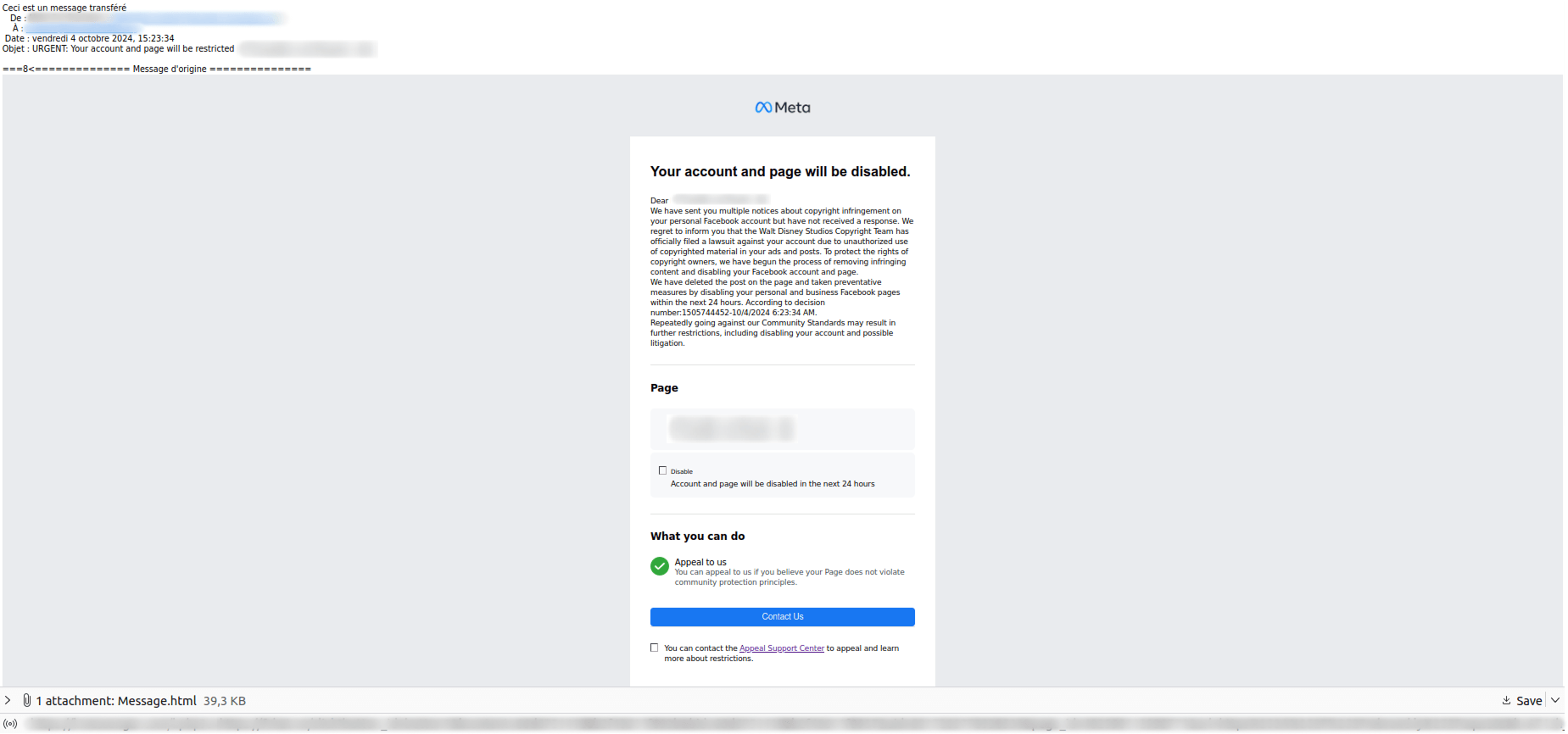
    We also found phishing emails containing legitimate Facebook links in October 2024, but this time without using the platform’s infrastructure. These emails contained notifications of lawsuits for copyright infringement and the removal of unlawful posts from the recipient’s profile. The target was warned that their personal and business pages would be blocked within 24 hours, pressuring them to take hasty and careless action.

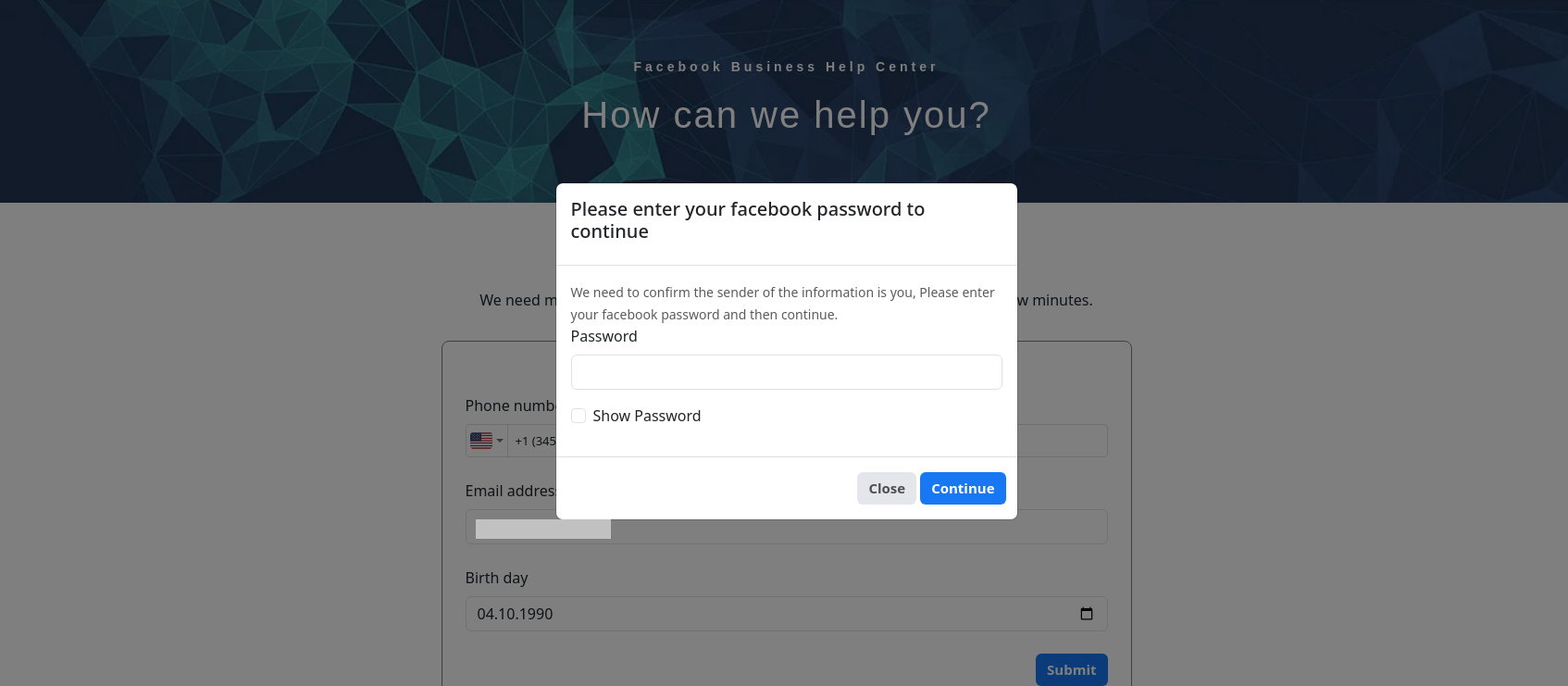
    However, they were immediately offered the chance to appeal by contacting the “Appeal Support Center.” The link in the email led to a phishing site disguised as Meta’s support service, where the victim was also asked to enter their profile password. To make the phishing link more convincing, a legitimate mechanism for redirecting users to external Facebook resources was used.

    At the end of 2024, we noticed an email campaign targeting companies promoting their business pages on Facebook. These emails mimicked official Meta for Business notifications and threatened to block the user’s account and business page for violating the platform’s rules and community policies.

    To dispute these accusations, the fraudsters urged the profile owners to click a link to contact “Facebook support” in a legitimate messenger. However, in reality, the victim was communicating with the owner of a fan page called “Content Moderation Center,” imitating an official support service employee. The scam could have been identified by the “Fan Page” label in the chat, though it was easy to miss.

    News agenda

    In 2024, scammers continued to exploit news agenda in spam campaigns.

    During the UEFA Euro 2024 football championship in Germany, emails began to appear offering merchandise with UEFA EURO 2024 logos.

    After Pavel Durov’s arrest in Paris, we noticed English-language messages calling for donations to supposedly fund his legal defense.

    In the fall of last year, a scam campaign began circulating, offering not-yet-released MacBook Pro M4 devices at low prices or even for free. The links in these emails led to fake websites imitating major marketplaces.

    Before Black Friday, we recorded a surge in spam offering exclusive discounts. The links in these messages lured victims to sites disguised as marketplaces, electronics stores, and financial institutions.

    B2B spam campaigns

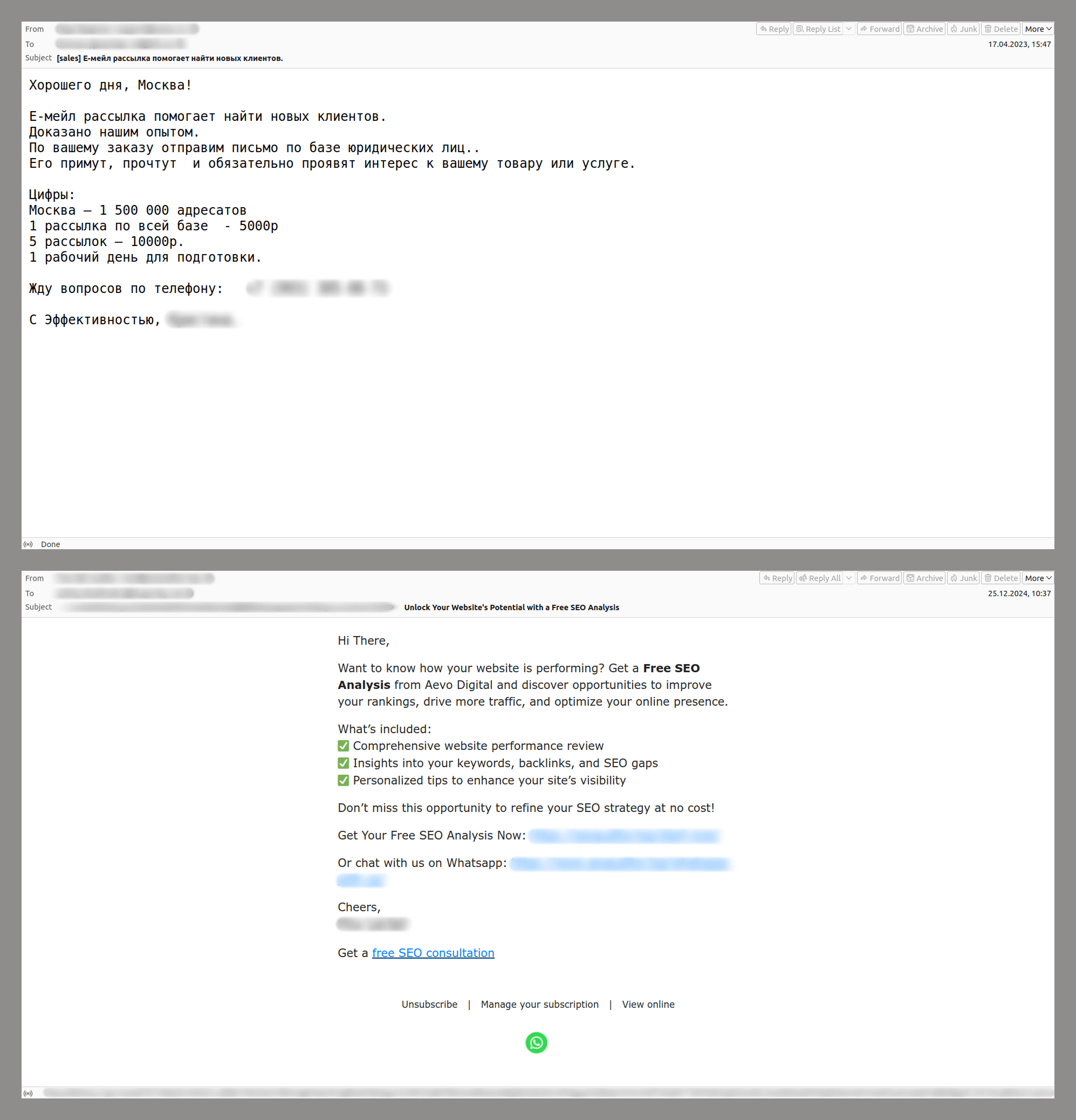
    Online promotion services

    One of the most common categories of spam email in 2024, complained of frequently by our corporate clients, was commercial offers for online promotion. Users were offered services such as creating or redesigning websites, setting up SEO tools, and purchasing databases with potential client contacts and other information. Other advertised services included guest post placement with backlinks to the client’s site, writing positive reviews, removing negative reviews, and creating personalized email campaigns. While these messages are not malicious or fraudulent, they are mass-distributed and unsolicited, causing inconvenience to users. The popularity of this type of spam is likely driven by the development of digital marketing tools and the search for new clients for small- and medium-sized businesses amid growing online competition.

    Buying likes and followers on social media

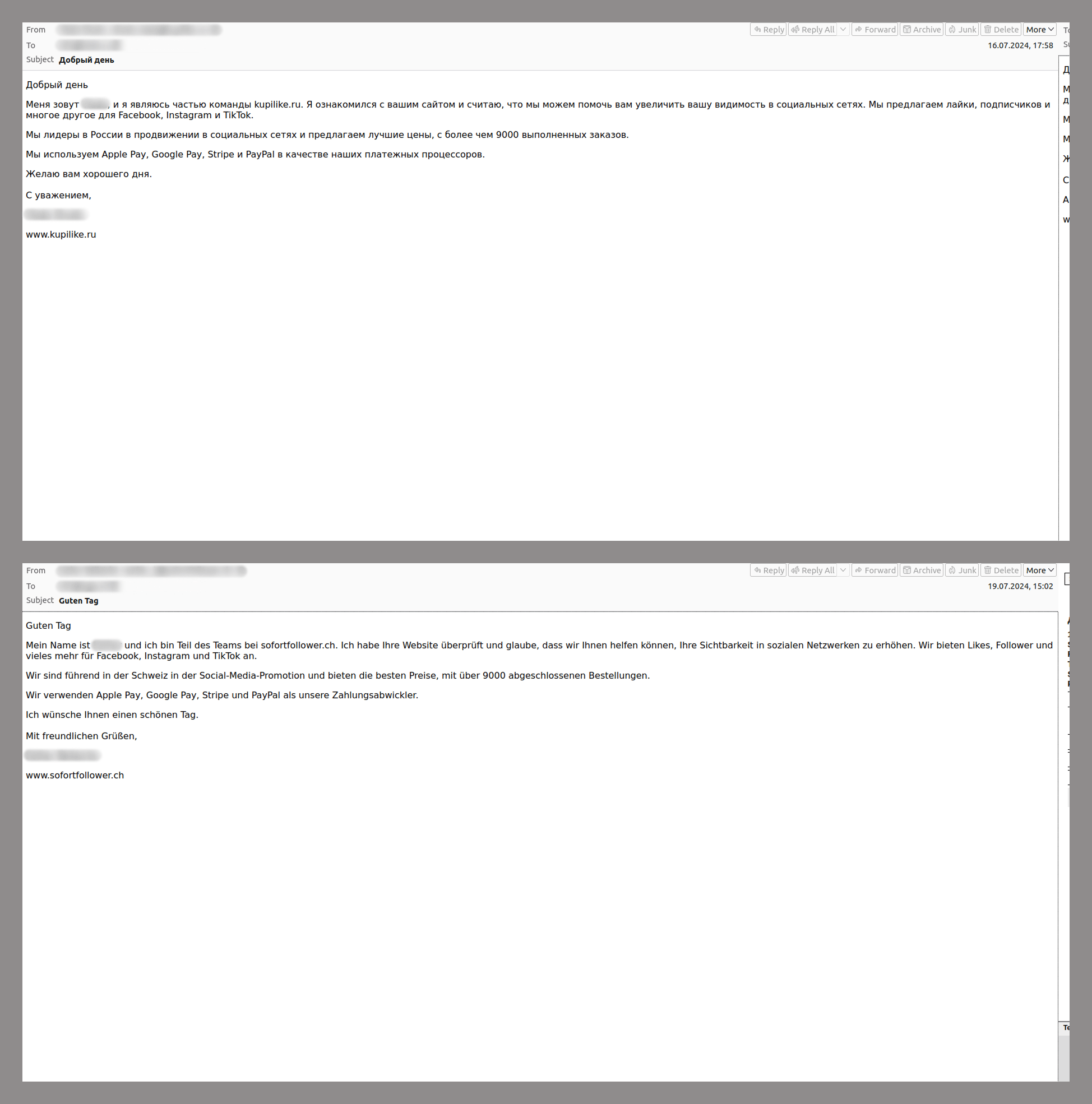
    We also frequently encountered business offers for the online promotion of company accounts on social media. Spammers sell fake likes and followers. They often pose as employees of real social media marketing firms, claiming to be industry leaders. At the end of their emails, the spammers included a link to a marketing platform and payment options for their services. One such campaign, which we observed throughout the past year and is still active, stood out due to the variety of languages used in the emails and the diversity of domain names. With these tactics, the spammers aimed to reach a global audience.

    AI in B2B emails

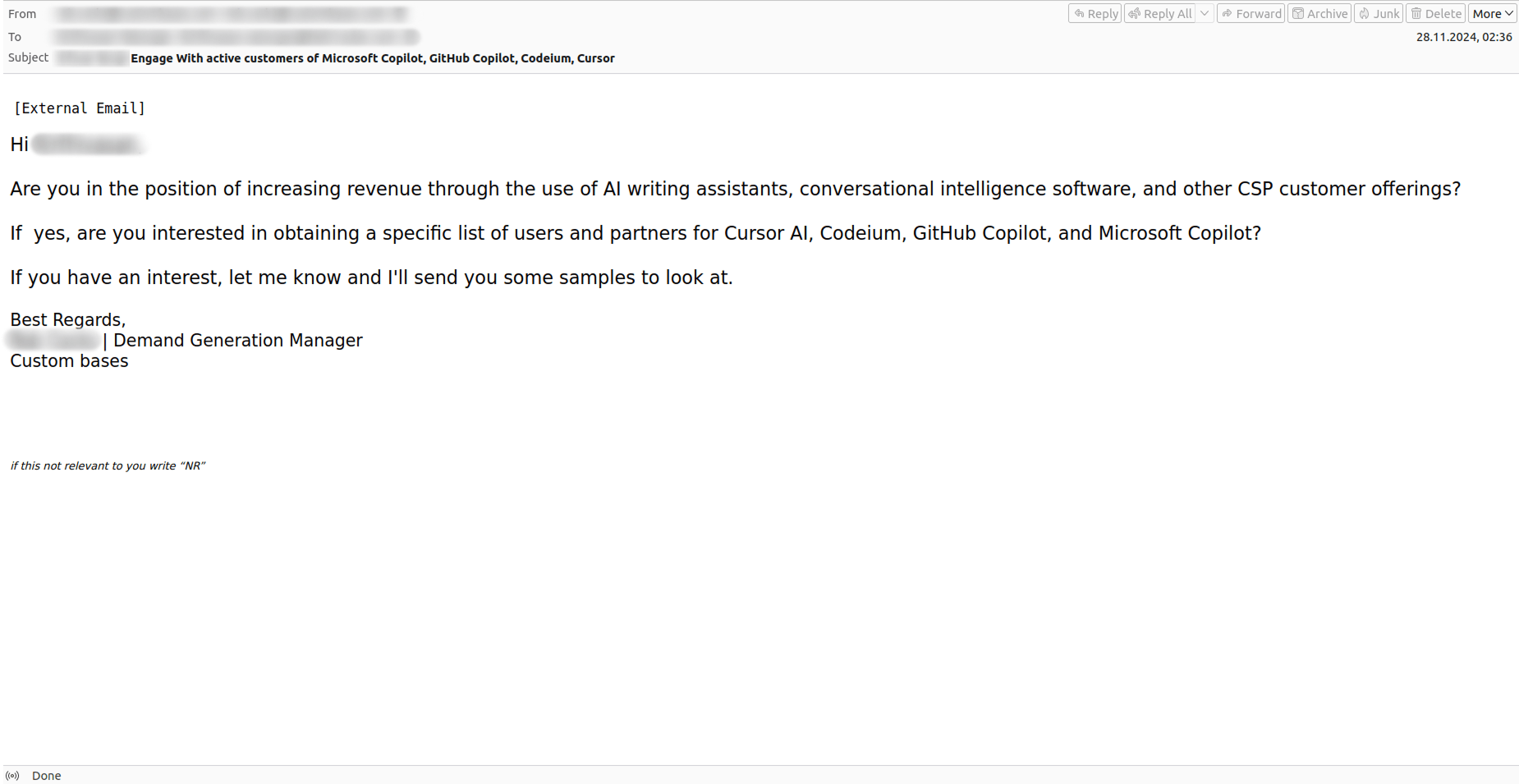
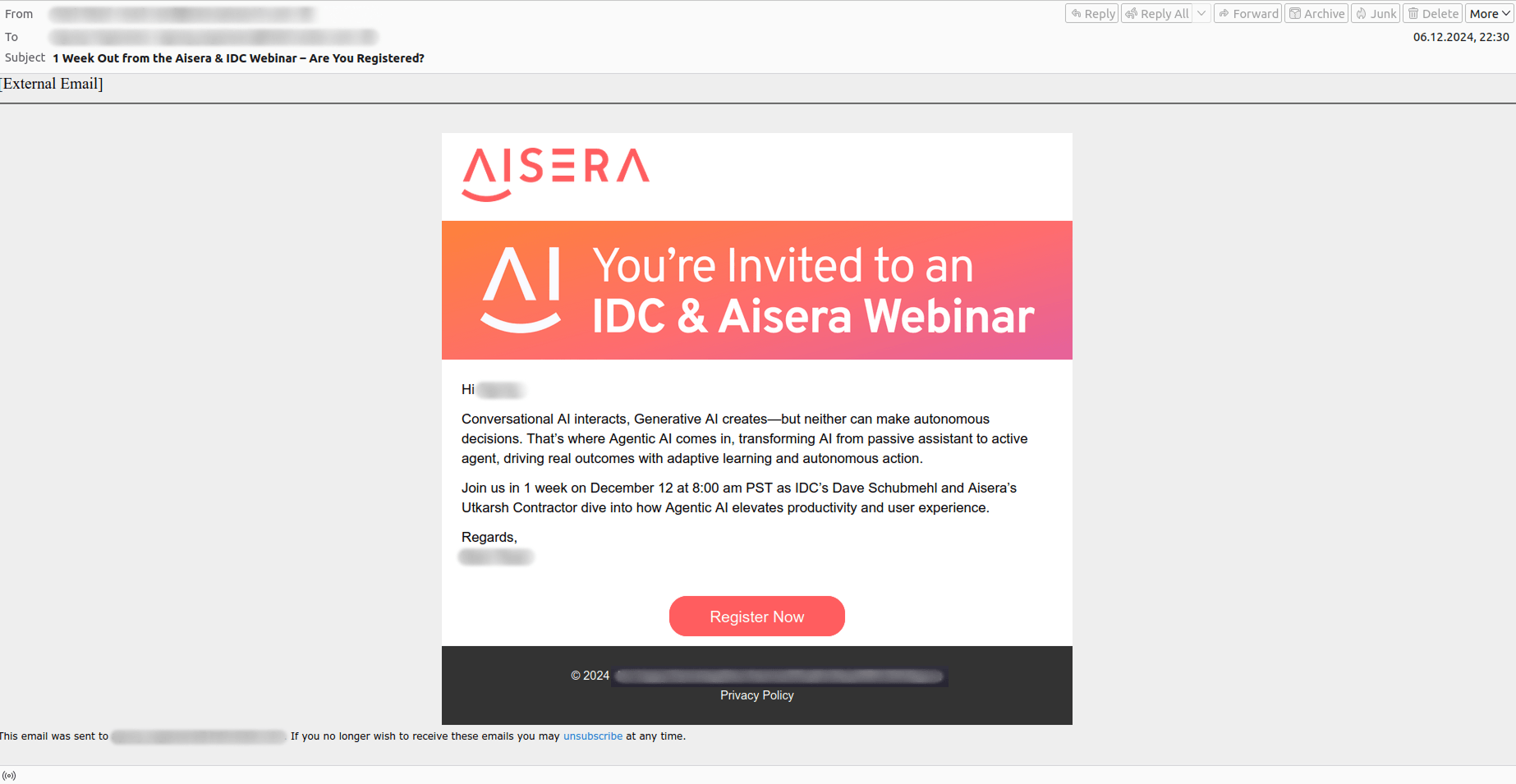
    The growing popularity of neural networks has led companies to actively integrate AI into their business processes. We assume that clients of such organizations, in turn, are drawn to service offers that incorporate neural networks. As a natural consequence of this trend, AI-driven solutions began appearing in spam campaigns advertising online marketing services.

    Spammers emphasized using AI, particularly ChatGPT, to perform various business tasks. We identified the following themes in these emails:

    • Attracting website traffic
    • Creating advanced lead generation strategies
    • Developing unique approaches tailored to a brand’s identity
    • Producing and publishing content
    • Launching personalized multi-channel marketing campaigns
    • Creating custom videos for YouTube channels

    Other topics also appeared in spam emails, but they all shared the same goal—enhancing business processes and attracting potential clients.

    Another particularly popular category of spam related to neural networks was advertising online events. Last year, we encountered numerous examples of emails promoting webinars about the promising capabilities and practical applications of AI in business operations.

    Targeted phishing in 2024

    In 2024, two main trends were observed in targeted phishing:

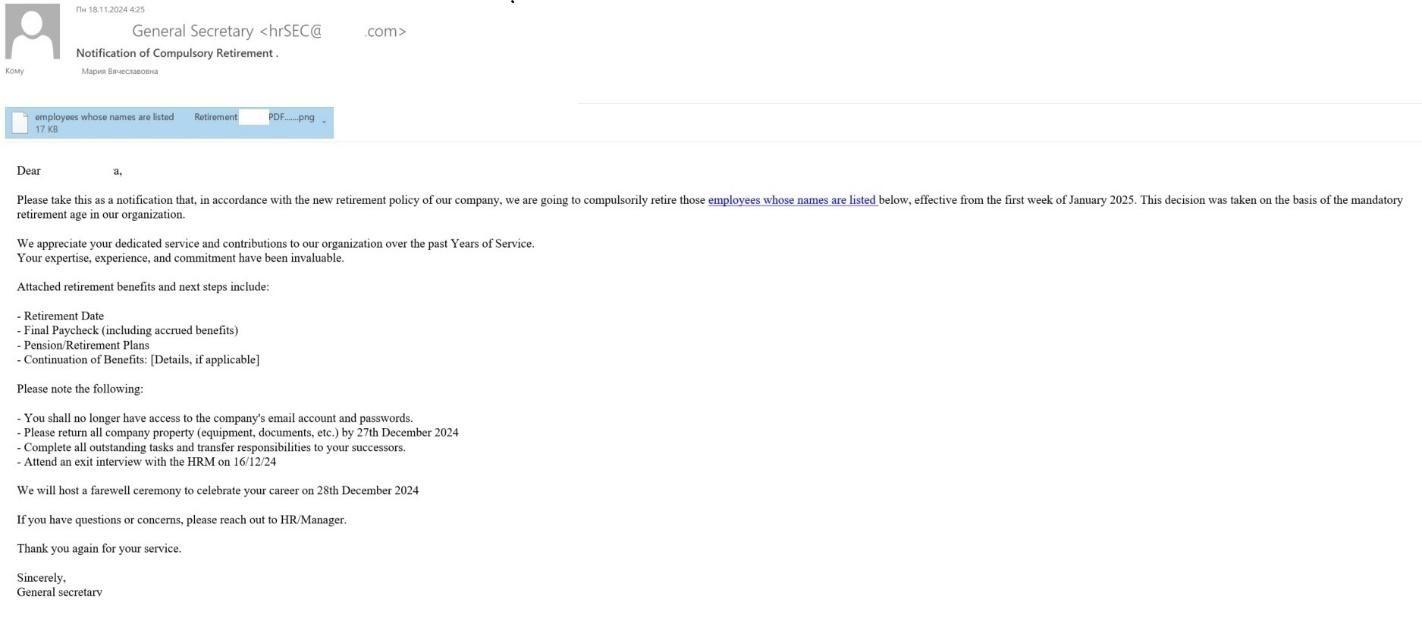
    1. Notifications on behalf of a company’s HR department. Employees were asked to fill out or sign a document, such as a vacation schedule, accessible via a link in an email. Sometimes, instead of routine requests, attackers resorted to more extravagant tactics—such as inviting employees to check if they were on a list of staff to be dismissed.

    Phishing email from HR

    In all these cases, the common factor was that clicking the link led the employee to a phishing login page instead of the actual corporate portal. Most often, attackers targeted Microsoft accounts, though some phishing forms mimicked internal corporate resources.

    Fake login form

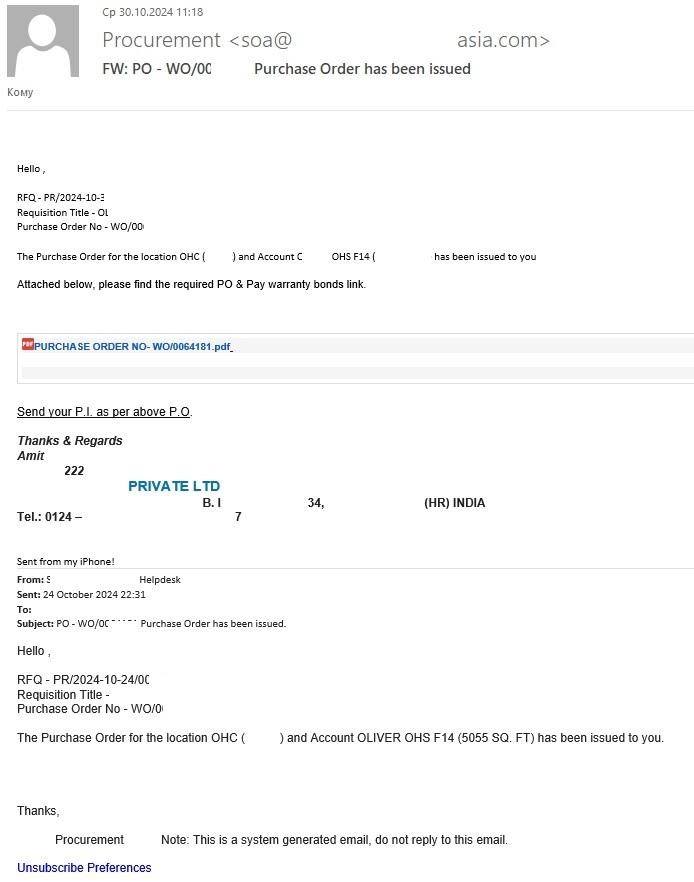
    1. Emails from a seller to a buyer, or vice versa. One common scheme involved a buyer or seller asking the victim to review an offer or respond to questions about product delivery and required specifications. These emails contained attached documents that actually concealed phishing links.

    Example of a phishing email from a seller

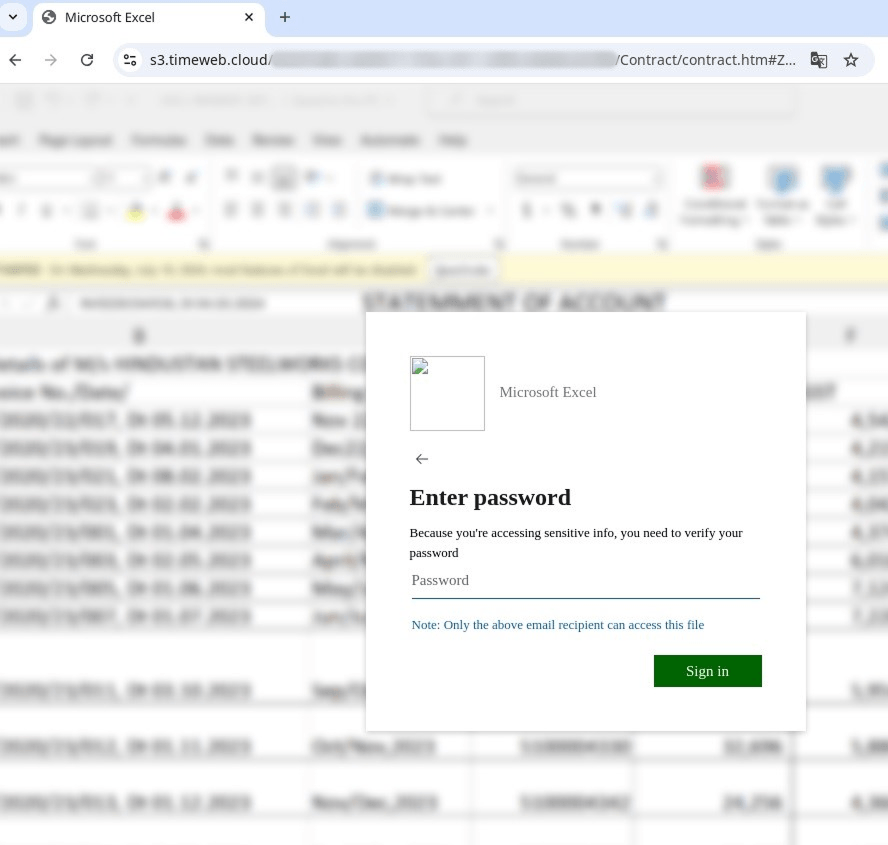
    When attempting to open the attachment, the user was redirected to a phishing page. As in the previous case, these fake forms harvested Microsoft credentials and corporate account logins.

    Fake password entry form

    Statistics: phishing

    The number of phishing attacks in 2024 increased compared to the previous year. Kaspersky solutions blocked 893,216,170 attempts to follow phishing links—26% more than in 2023.

    Number of Anti-Phishing triggerings, 2024 (download)

    Map of phishing attacks

    Users from Peru (19.06%) encountered phishing most often. Greece (18.21%) ranked second, followed by Vietnam (17.53%) and Madagascar (17.17%). They are closely followed by Ecuador (16.90%), Lesotho (16.87%) and Somalia (16.70%). The final places in the TOP 10 are occupied by Brunei (16.55%), Tunisia (16.51%) and Kenya (16.38%).

    Country/territory Share of attacked users*
    Peru 19.06
    Greece 18.21
    Vietnam 17.53
    Madagascar 17.17
    Ecuador 16.90
    Lesotho 16.87
    Somalia 16.70
    Brunei 16.55
    Tunisia 16.51
    Kenya 16.38

    * Share of users who encountered phishing out of the total number of Kaspersky users in the country/territory, 2024

    Top-level domains

    The most common domain zone hosting phishing sites remains the COM zone (29.78%)—its popularity has increased one and a half times compared to 2023. In second place is the XYZ domain (7.10%), which ranked fifth last year, followed by TOP (6.97%), which retained its position in the top ten. Next, with a slight margin from each other, are the ONLINE (4.25%) and SITE (3.87%) domain zones, where phishing sites were less actively hosted last year. The Russian RU domain (2.23%) and the global NET domain (2.02%) are in sixth and seventh place, respectively. Following them are CLICK (1.41%) and INFO (1.35%)—the year before, these zones were not frequently used. Closing the top ten is another national domain: UK, with a share of 1.33%.

    Most frequent top-level domains for phishing pages, 2024 (download)

    Organizations targeted by phishing attacks

    The rating of organizations targeted by phishers is based on the detections of the deterministic component in the Anti-Phishing system on user computers. The component detects all pages with phishing content that the user has tried to open by following a link in an email message or on the web, as long as links to these pages are present in the Kaspersky database.

    In 2024, the highest number of attempts to access phishing links blocked by Kaspersky solutions was associated with pages imitating various web services (15.75%), surpassing global internet portals (13.88%), which held the top position in 2023. The third and fourth positions in last year’s top ten also swapped places: banks moved ahead (12.86%), overtaking online stores at 11.52%. Attackers were also interested in social media (8.35%) and messengers (7.98%): attacks targeting them strengthened their positions in the ranking. For websites imitating delivery services, we observed a decline in phishing activity (6.55%), while the share of payment systems remained unchanged at 5.82%. Also included in the list of the most frequently targeted organizations were online games (5.31%) and blogs (3.75%).

    Distribution of organizations targeted by phishers, by category, 2024 (download)

    Statistics: spam

    Share of spam in email traffic

    In 2024, spam emails accounted for 47.27% of the total global email traffic, an increase of 1.27 p.p. compared to the previous year. The lowest spam levels were recorded in October and November, with average shares dropping to 45.33% and 45.20%, respectively. In December, we observed a seemingly slight upward trend in junk emails, resulting in the fourth quarter of the year being the calmest. Spam activity peaked in the summer, with the highest number of emails recorded in June (49.52%) and July (49.27%).

    Share of spam in global email traffic, 2024 (download)

    In the Russian internet segment, the average spam share exceeded the global figure, reaching 48.57%, which is 1.98 p.p. higher than in 2023. As in the rest of the world, spammers were least active at the end of the year: in the fourth quarter, 45.14% of emails were spam. However, unlike global trends, in Runet, we recorded four months during which the spam share exceeded half of all traffic: March (51.01%), June (51.53%), July (51.02%), and September (51.25%). These figures identified the third quarter as the most active, with a share of 50.46%. December was the calmest month, and interestingly, despite spam levels being generally high or the same in Russia, the number of spam emails in December was lower than the global figure: 44.56%.

    Share of spam in Runet email traffic, 2024 (download)

    Countries and territories where spam originated

    We continue to observe an increase in the share of spam sent from Russia—from 31.45% to 36.18%. The United States and mainland China, which held second and third place last year, swapped positions, with China’s share increasing by 6 p.p. (17.11%) and the US share decreasing by 3 p.p. (8.40%). Kazakhstan, which entered the top twenty for the first time last year, rose from eighth to fourth place (3.82%), pushing Japan (2.93%) down, and causing Germany, previously in fifth place, to drop one position with a share of 2.10%. India’s share slightly decreased, but the country moved up two positions from last year to seventh place. Conversely, the amount of spam sent from Hong Kong more than doubled (1.75%), allowing this territory to take eighth place in the top twenty. Next come Brazil (1.44%) and the Netherlands (1.25%), whose shares continued to decline.

    TOP 20 countries and territories where spam originated in 2024 (download)

    Malicious email attachments

    In 2024, Kaspersky solutions detected 125,521,794 attempts to open malicious email attachments, ten million fewer than the previous year. Interestingly, one of the peaks in email antivirus detections occurred in April—in contrast to 2023, when this month had the lowest malicious activity. In January and December, we observed a relative decrease in detections, while increases were noted in spring and autumn.

    Number of email antivirus detections, 2024 (download)

    The most common malicious email attachments were Agensla stealers (6.51%), which ranked second last year. Next were Badun Trojans (4.51%), which spread in archives disguised as electronic documents. The Makoob family moved from eighth to third place (3.96%), displacing the Noon spyware (3.62%), which collects browser passwords and keystrokes. The malicious Badur PDFs, the most common attachments in 2023, dropped to fifth place with a 3.48% share, followed by phishing HTML forms from the Hoax.HTML.Phish family (2.93%). Next in line were Strab spyware Trojans (2.85%), capable of tracking keystrokes, taking screenshots, and performing other typical spyware actions. Rounding out the top ten were SAgent VBS scripts (2.75%), which were not as actively used last year, the Taskun family (2.75%), which maintained its previous share, and PDF documents containing phishing links, Hoax.PDF.Phish (2.11%).

    TOP 10 malware families distributed as email attachments, 2024 (download)

    The list of the most widespread malware reflects trends similar to the distribution of families, with a few exceptions: the Hoax.HTML.Phish variant of malicious HTML forms dropped two positions (2.20%), and instead of a specific Strab Trojan sample, the top ten included the ISO image Trojan.Win32.ISO.gen, distributed via email (1.39%).

    TOP 10 malicious programs distributed as email attachments, 2024 (download)

    Countries and territories targeted by malicious mailings

    In 2024, users in Russia continued to face malicious email attachments more frequently than other countries, although the share of email antivirus detections in this country decreased compared to last year, to 11.37%. China ranked second (10.96%), re-entering the top twenty after several years. Next came Spain (8.32%), Mexico (5.73%), and Turkey (5.05%), which dropped one position each with a slight decline in malicious attachments. Switzerland (4.82%) took sixth place, appearing in the ranking for the first time. Following them were Vietnam (3.68%), whose share declined, and the UAE (3.24%), which strengthened its position in the ranking. Also among frequent targets of malicious spam were users from Malaysia (2.99%) and Italy (2.54%).

    TOP 20 countries and territories targeted by malicious mailings, 2024 (download)

    Conclusion

    Political and economic crises will continue to provide new pretexts for fraudulent schemes. In some cases presented in the 2024 report, we can observe the “greed” of cybercriminals: the use of two different company brands on the same page; a credible fake of a resource aimed not at stealing credentials but at stealing money; comprehensive questionnaires that can lead not only to loss of access to funds but also to identity theft. Such multi-layered threats may become a new trend in phishing and scam attacks.

    We continue to observe major news events being exploited in spam campaigns that promise easy earnings and discounted goods or services. The growing user interest in artificial intelligence tools is actively being leveraged by spammers to attract an audience, and this trend will undoubtedly continue.

    MIL OSI Economics –

    February 19, 2025
  • MIL-OSI China: China’s Einstein Probe captures rare X-ray flash from binary star system

    Source: People’s Republic of China – State Council News

    BEIJING, Feb. 19 — China’s Einstein Probe (EP) astronomical satellite has captured an X-ray flash from a rare and elusive binary star system, offering new insights into the interaction and evolution of massive stars.

    The research, a collaboration between Chinese and international scientists, was published in the latest issue of The Astrophysical Journal Letters.

    The binary system consists of a large, hot star 12 times the mass of the Sun, and a compact white dwarf with a mass similar to that of the Sun but only the size of the Earth. Only a handful of such systems have been identified, and this is the first time scientists have tracked the X-ray light from the pair as it flared up and then faded.

    On May 27, 2024, the Wide-field X-ray Telescope (WXT) onboard the EP satellite detected X-rays from the Small Magellanic Cloud, a neighboring galaxy. To trace the source, identified as EP J0052, scientists used EP’s Follow-up X-ray Telescope (FXT) and also enlisted NASA’s Swift and NICER X-ray telescopes, as well as the European Space Agency (ESA)’s XMM-Newton telescope.

    Data analysis revealed the source to be a rare and intriguing celestial pair.

    “We realized that we were looking at something unusual, that only EP could catch. This is because, among current telescopes monitoring the X-ray sky, WXT is the only one that can see lower energy X-rays with sufficient sensitivity to catch the novel source,” says Alessio Marino, a researcher at the Institute of Space Sciences in Spain, and lead author of the study.

    “The unusual duo consists of a massive star that we call a ‘Be star,’ weighting 12 times the Sun, and a stellar ‘corpse’ known as a white dwarf, a compact and hyper-dense object, with a mass similar to that of our star,” explains Marino.

    The two stars orbit closely, with the white dwarf’s strong gravitational field pulling material from its companion. This process eventually leads to a catastrophic nuclear explosion, creating a bright flash across multiple wavelengths, including visible light, UV and X-rays.

    According to the scientists, the two stars’ interaction began with the larger star exhausting its nuclear fuel, shedding material onto its companion. As the Be star grew to 12 times the mass of the Sun, the remaining core of the other star collapsed into a white dwarf. Now, the white dwarf is pulling material from the Be star’s outer layers.

    “This study gives us new insights into a rarely observed phase of stellar evolution, which is the result of a complex exchange of material that must have happened among the two stars,” said Ashley Chrimes, an X-ray astronomer at ESA. “It’s fascinating to see how an interacting pair of massive stars can produce such an intriguing outcome.”

    Erik Kuulkers, ESA project scientist for EP, noted that outbursts from Be-white dwarf systems are extraordinarily difficult to observe. “The advent of EP offers the unique chance to spot these fleeting sources and test our understanding of how massive stars evolve.”

    The EP mission is one of a series of space science missions led by the Chinese Academy of Sciences. It is also an international collaboration mission with contributions from the ESA, the Max Planck Institute for Extraterrestrial Physics in Germany, and the French space agency CNES.

    Launched on Jan. 9, 2024, from Xichang Satellite Launch Center in Sichuan Province, southwest China, the EP satellite carries two scientific instruments: the WXT, which provides a wide view of the X-ray sky, and the FXT, which allows for detailed observation of transient sources detected by the WXT.

    EP is an international collaborative mission, and its science team comprises about 300 researchers worldwide. The recent publication of the first paper led by scientists from the ESA member states based on EP data highlights the project’s openness and collaborative spirit in scientific research, said Yuan Weimin, EP’s principal investigator.

    “We hope that the EP satellite will continue to provide invaluable observational datasets for the worldwide astronomical community, driving advancements in humanity’s understanding of the ever-changing universe,” he added.

    MIL OSI China News –

    February 19, 2025
  • MIL-OSI USA: Durbin Condemns President Trump’s Art Of Appeasement To Russian President Vladimir Putin

    US Senate News:

    Source: United States Senator for Illinois Dick Durbin

    February 18, 2025

    Durbin: President Trump has always had a strange affinity for assorted autocrats and dictators—a troubling stain and liability for the leader of the free world

    WASHINGTON – In a speech on the Senate floor, U.S. Senate Democratic Whip Dick Durbin (D-IL) condemned President Trump’s appeasement to Russian President Vladimir Putin—where Trump announced key concessions to Putin regarding Ukraine, while apparently ignoring Ukraine’s key demands. Durbin began his speech by recounting history in which British Prime Minister Neville Chamberlain touted the now infamous Munich Agreement as the way to stave off Hitler’s Nazi Germany. One year later, Hitler invaded Poland and triggered World War II.

    “Over time, Chamberlain’s name became synonymous with the term ‘appeasement.’ And for good reason. You see, while Chamberlain’s goal of peace may have been honorable, he was dangerously naïve about the human nature of a tyrant in Germany who was bent on territorial and maniacal ambitions—pursuits that could only be thwarted with strength,” said Durbin. “Well, President Trump’s ‘art of the deal’ opening negotiation with Vladimir Putin has the same naïve odor of appeasement.”

    Durbin continued, “Trump and his fledgling Defense Secretary publicly gave away huge concessions at the start—signaling they would not insist on a return to Ukraine’s sovereign 2014 borders or future NATO membership. It’s also not clear from the Administration’s bewildering Munich Security Conference remarks if Trump plans to even include Ukraine, or our European allies, in the negotiations over its own future. It is no wonder that in the UK—where they remember Chamberlain’s folly all too well—Donald Trump’s early pronouncements were lambasted for their misreading of history by leaders across the political spectrum.”

    Members of the UK Parliament are speaking out against President Trump’s attempt to work with Putin. One Member of Parliament lamented that the West now “might be facing the worse betrayal of a European ally since Poland in 1945.” Another stated, “This is less the Art of a Deal and more a charter for Appeasement.”

    Durbin concluded, “President Trump has always had a strange affinity for autocrats and dictators—a troubling stain and liability for the leader of the free world. He almost seems to want their adoration and admiration—especially compared to the clear-eyed leadership of Ronald Reagan in his dealing with the Soviets. But there are real consequences to Trump’s autocrat liaisons for American and allied security—ones Republicans in the Senate must take more seriously. His crazy rants about Greenland, Canada as a 51st state, Panama, and the Gulf of Mexico may be amusing to some including himself, but it certainly does not portend well for the foreign policy of the United States. Simply caving to Putin and walking away from Ukraine—just as Chamberlain did to Hitler—is an invitation for more confrontations in the future.”

    Video of Durbin’s remarks on the Senate floor is available here.

    Audio of Durbin’s remarks on the Senate floor is available here.

    Footage of Durbin’s remarks on the Senate floor is available here for TV Stations.

    -30-

    MIL OSI USA News –

    February 19, 2025
  • MIL-OSI Security: U.S. Marshals Arrest Cleveland Homicide Suspect and Barberton Shooting Suspect

    Source: US Marshals Service

    Garfield Heights, OH – This afternoon, members of the U.S. Marshals led Northern Ohio Violent Fugitive Task Force (NOVFTF) arrested Oturi Germany, 46 and Oturiana Germany, 28.  Oturi Germany was wanted by the Cleveland Division of Police for aggravated murder. Oturiana Germany was wanted by the Barberton Police Department for felonious assault.

    On January 10, 2025, officers from the Cleveland Division Police, 3rd District, located a deceased male inside a storage room in the basement of an apartment building located in the 2100 block of E. 78th Street, Cleveland, Ohio. The male victim had suffered a gunshot wound to his back. Oturi Germany was later identified as a suspect in this fatal incident and a warrant for aggravated murder was issued for his arrest.

    On February 17, 2025, a male was shot three times at the Washington Square Apartments in Barberton, Ohio. The male victim suffered three non-life-threatening gun shot wounds. The Barberton Police Department identified Oturiana Germany as a suspect in the shooting and a warrant was issued for her arrest.

    This afternoon, members of the NOVFTF arrested both Oturi and Oturiana Germany inside a vehicle near the 5100 block of E. 117th Street, Garfield Heights, Ohio. Two firearms were located during the arrest and seized by officers on scene.

    U.S. Marshal Pete Elliott stated, “Thankfully, no one was hurt during the arrest and our task force was able to take two violent fugitives and firearms off the street today. Our task force is comprised of outstanding officers who are highly trained, which results in safe arrests like the ones today in Garfield Heights.”

    Anyone with information concerning a wanted fugitive can contact the Northern Ohio Violent Fugitive Task Force at 1-866-4WANTED (1-866-492-6833), or you can submit a web tip. Reward money is available, and tipsters may remain anonymous.  Follow the U.S. Marshals on Twitter @USMSCleveland.  

    MIL Security OSI –

    February 19, 2025
  • MIL-OSI Economics: WTO chairpersons for 2025

    Source: World Trade Organization

    General Council

    H.E. Mr. Saqer Abdullah Almoqbel (Kingdom of Saudi Arabia)

    Dispute Settlement Body

    H.E. Ms. Clare Kelly (New Zealand)

    Trade Policy Review Body

    H.E. Mr. Asset Irgaliyev (Kazakhstan)

    Council for Trade in Goods

    H.E. Mr. Gustavo Nerio Lunazzi (Argentina)

    Council for Trade in Services

    H.E. Mr. Ram Prasad Subedi (Nepal)

    Council for Trade-Related Aspects of Intellectual Property Rights (TRIPS)

    Mme. Emmanuelle Ivanov-Durand (France)

    Committee on Trade and Development

    H.E. Dr. Mzukisi Qobo (South Africa)

    Committee on Balance-of-Payments Restrictions

    H.E. Dr. José R. Sánchez-Fung             (Dominican Republic)

    Committee on Budget, Finance and Administration

    H.E. Mrs. Carmen Heidecke (Germany)

    Committee on Trade and Environment

    H.E. Mr. Erwin Bollinger (Switzerland)

    Committee on Regional Trade Agreements

    H.E. Mr. José Valencia (Ecuador)

    Working Group on Trade, Debt and Finance

    H.E. Mr. Suon Prasith (Cambodia)

    Working Group on Trade and Transfer of Technology

    H.E. Mr. Salomon Eheth (Cameroon)

    Council for Trade in Services in Special Session

    H.E. Dr. Adamu Mohammed Abdulhamid (Nigeria)

    MIL OSI Economics –

    February 19, 2025
  • MIL-OSI United Nations: Experts of the Committee on Economic, Social and Cultural Rights Congratulate Rwanda on Number of New Jobs Created, Ask Questions on Women’s Political Representation and Recognising the Cultures of Rwanda’s Different Ethnic Groups

    Source: United Nations – Geneva

    The Committee on Economic, Social and Cultural Rights today concluded its review of the fifth periodic report of Rwanda, with Committee Experts commending the State on the number of new jobs created, while raising questions about women’s political representation and how Rwanda recognised the cultures of its different ethnic groups. 

    Preeti Saran, Committee Expert and Country Taskforce Member, was impressed with some of the figures shared, including seven per cent gross domestic product growth and 1.3 million jobs created.  These were commendable and Rwanda should be congratulated.   

    Peters Sunday Omologbe Emuze, Committee Vice-Chair and Country Rapporteur for Rwanda, said Rwanda had made significant progress in gender equality, and especially women’s political representation.  What steps were being taken to increase women’s representation in local administration and the private sector? How was the gender pay gap addressed? What was being done to combat discrimination against women and stereotypes? 

    Ms. Saran said each ethnic group in Rwanda had a rich cultural heritage.  For the sake of national unity and reconciliation, if everyone was being referred to as Rwandan, how did the State propagate the cultural richness of the population?   Rwanda had been extremely welcoming to refugees from all over the world, who brought their own specific languages and cultures.  What measures had the State party taken to ensure equal cultural rights for ethnic groups that had come as aliens, refugees or asylum seekers? 

    The delegation said over the years, Rwanda had implemented measures to achieve gender equality, particularly in Parliament, where it was around 63 per cent in the Chamber of Deputies and around 53 per cent in the Senate.  Quotas were in place which mandated that a minimum of 30 per cent of leaders should be women.  When the issue of equality was dealt with properly, this had a cascading effect on other policies.  A few years ago, the State recognised that gender-based violent crimes were specific in nature and needed to be treated in a certain way. 

    The delegation said there was no significant cultural diversity within the country, as everyone shared the same language and culture.  Traditionally the ethnic groups had been defined based on occupation and turning them into an ethnicity was introduced by the colonialists.  It had been entrenched in identity cards for Tutsis, Hutus and Twas.  This negated the fact that people could have moved from one group to another.   There were no significant differences in culture between these groups.  Rwanda had received a number of people who faced difficulties in their own countries. Diversity days were organised at schools, encouraging refugees and asylum seekers to share their culture. 

    Emmanuel Ugirashebuja, Minister of Justice and Attorney General of Rwanda and head of the delegation, said in 2023, Rwanda further refined its governance framework by aligning the schedules of presidential and parliamentary elections, enhancing efficiency and reducing electoral costs.  During the period under consideration, Rwanda successfully completed its ambitious 2020 Vision and adopted the Vision 2050.  From 2018 to 2024, Rwanda implemented its first national strategy for transformation, which laid the foundation for sustainable development, and was succeeded by the second national strategy for transformation, which ran until 2029.   Through these strategies, Rwanda maintained steady economic growth, with gross domestic product expanding at an average of 7 per cent and per capita income rising from $729 to $1,040 in 2023/2024. 

    In concluding remarks, Mr. Emuze thanked the Rwandan delegation for attending the dialogue, noting the high calibre of the delegation.  The Committee wished the delegation a safe journey home. 

    In his concluding remarks Mr. Ugirashebuja expressed appreciation for the constructive dialogue with the Committee.  The State had learnt many valuable lessons and looked forward to receiving the Committee’s recommendations.  Mr. Ugirashebuja extended an open invitation to the Committee to visit Rwanda in the future. 

    The delegation of Rwanda was comprised of representatives from the Ministry of Justice; the National Institute of Statistics; the Rwanda Education Board; the Department of International Justice Judicial Cooperation; and the Permanent Mission of Rwanda to the United Nations Office at Geneva.

    The Committee’s seventy-seventh session is being held until 28 February 2025.  All documents relating to the Committee’s work, including reports submitted by States parties, can be found on the session’s webpage.  Webcasts of the meetings of the session can be found here, and meetings summaries can be found here.

    The Committee will next meet in public at 3 p.m. on Tuesday, 18 February to begin its consideration of the seventh periodic report of the Philippines (E/C.12/PHL/7).

    Report

    The Committee has before it the fifth periodic report of Rwanda (E/C.12/RWA/5).

    Presentation of Report

    EMMANUEL UGIRASHEBUJA, Minister of Justice and Attorney General of Rwanda and head of the delegation, said since the last review by the Committee over a decade ago, Rwanda had undergone significant changes in its policy, legal and institutional landscape.  In 2023, Rwanda further refined its governance framework by aligning the schedules of presidential and parliamentary elections, enhancing efficiency, and reducing electoral costs. 

    At the institutional level, Rwanda established the Rwanda Forensic Laboratory in 2016, upgrading it to the Rwanda Forensic Institute in 2023.  The Institute had enhanced forensic and advisory services, strengthening accountability in sectors critical to economic, social and cultural rights.  Its digital forensic and document services helped combat financial crimes like fraud and embezzlement.  In 2017, the Rwanda Investigation Bureau was established to enhance specialisation and professionalism in crime investigation. 

    In the judiciary, Rwanda made significant strides in strengthening its justice system.  In 2018, the Court of Appeal was established, further enhancing the country’s capacity to provide effective legal recourse.   In 2024, the establishment of an Appeal Tribunal to hear matters relating to refugee and asylum claims reinforced Rwanda’s commitment to upholding the rights of individuals in vulnerable situations.  Rwanda’s legal framework strongly supported the protection of economic, social and cultural rights, as enshrined in the Constitution.  Since the last report, Rwanda had enacted several laws that aligned with the provisions of the Covenant and contributed to the progressive realisation of economic, social and cultural rights.  These included the education law that guaranteed access to quality education at all levels, as well as health laws. 

    During the period under consideration, Rwanda successfully completed its ambitious 2020 Vision and adopted the Vision 2050.  From 2018 to 2024, Rwanda implemented its first national strategy for transformation, which laid the foundation for sustainable development, and was succeeded by the second national strategy for transformation, which ran until 2029.   Through these strategies, Rwanda maintained steady economic growth, with gross domestic product expanding at an average of 7 per cent and per capita income rising from $729 to $1,040 in 2023/2024.  

    Infrastructure development advanced with the construction of over 1,600 kilometres of national roads and 4,137 kilometres of feeder roads.   Job creation efforts led to over 1.3 million decent and productive jobs, while financial inclusion improved from 89 per cent in 2017 to 96 per cent by 2024.  Life expectancy also increased from 66.6 in 2017 to 69.9 years in 2024. 

    Rwanda also significantly strengthened its healthcare system under the strategy. Seven new hospitals were added to the existing 52, while 23 were rehabilitated or expanded.  Community-based health insurance coverage reached 93 per cent of the population. Healthcare modernisation included advanced imaging, laboratory equipment, local pharmaceutical manufacturing, and digital health systems.  

    In 2023, Rwanda, in partnership with Germany Biotechnology Company BioNTech, set-up an mRNA vaccine manufacturing facility, the first of its kind on the African continent, which would have the capacity to produce between 50 and 100 million doses of mRNA vaccines annually, and conduct trials on new therapeutics for malaria, tuberculosis, HIV, cancers and other diseases.  

    Through the Girinka programme (one cow per family programme), Rwanda distributed 333,146 cows to an equivalent number of households.  Rwanda valued the opportunity to engage in a constructive dialogue with the Committee.

    Questions by a Committee Expert

    PETERS SUNDAY OMOLOGBE EMUZE, Committee Vice-Chair and Country Rapporteur for Rwanda, asked how the 2015 constitutional amendments had affected Rwanda’s commitment to international human rights standards.  Did it enable the State party to override Covenant protections in favour of domestic law? What measures were being taken to ensure that the provisions of the Covenant were invoked by domestic courts? 

    What training programmes were in place for judges, law enforcement and government officials to ensure consistent application of the Covenant?  The important work of Rwanda’s national human rights institution was noted.  Was the selection process of its members carried out by a committee appointed by the President?  Did members require clearance from the Prime Minister’s office for official travel outside Rwanda?  Had the State party accepted the recommendations of the Global Alliance of National Human Rights Institutions to strengthen the institution in line with the Paris Principles?

    What measures had been taken to guarantee that human rights defenders could continue their work without undue restrictions on freedoms of expression, peaceful assembly and association?  What steps were taken to protect them from risks of unlawful killings, enforced disappearances, harassment and intimidation, including judicial harassment?  Could the State party clarify the concerns regarding non-governmental organization registration requirements?  Were there any obstacles for opposition groups to promote and advocate for the promotion of human rights, including economic, social and cultural rights? 

    When would the State party finalise a national action plan for business and human rights?  What steps were being taken to put in place a comprehensive legal and regulatory framework for human rights due diligence for businesses?  What measures were in place to ensure Rwanda met its nationally determined contributions under the Paris Agreement? 

    What measures were in place to combat corruption, particularly in public procurement and State-owned enterprises?  What challenges did anti-corruption institutions face in maintaining independence and effectiveness?  What measures were being taken to address them?  The Committee noted Rwanda’s legislative efforts to combat discrimination.  However, reports indicated persistent structural inequalities, particularly affecting Batwa people, women and girls, people living in deprived urban and rural areas, persons with disabilities, people living in poverty, and lesbian, gay, bisexual, transgender and intersex persons.  How did Rwanda plan to address these challenges? 

    How did Rwanda plan to address the absence of disaggregated data to assess the situation of the Batwa people?  What steps were being taken to combat poverty, high infant mortality, malnutrition, and lower educational outcomes among the Batwa? What kind of barriers did the Batwa continue to face to land titling and how did Rwanda plan to secure their rights to land ownership?  What measures were in place to prevent forced displacement of the Batwa people from their ancestral lands?  How was adequate compensation provided when Batwa lands were expropriated?  How did the State party ensure consultations with Batwa people in decisions likely to affect them?

    Rwanda had made significant progress in gender equality, and especially women’s political representation.  What steps were being taken to increase women’s representation in local administration and the private sector?  How was the gender pay gap addressed?  What was being done to combat discrimination against women and stereotypes?  How had the Rwanda Gender Monitoring Office and its Gender Management Information System contributed to tracking gender equality initiatives? 

    Responses by the Delegation

    The delegation said since the 2015 Constitutional amendments, no new organic laws had come into place.  There was consistent training on the use of human rights in courts.  However, the members of the bar tended not to apply international conventions in the courts. The reason for this was because the Constitution provided for a whole section of bill of rights, which was a replica of the Covenant.  However, lawyers were still trained on the use of human rights conventions.   

    Members of the human rights institution were manually selected via a presidential order.  This was a rigorous process, and many candidates were considered.  The appointment process was comparable to any other country with human rights mechanisms.  Whenever Commissioners wanted to travel, they informed the Minister’s office and a document was provided, called the travel clearance. Given that this caused significant confusion, the Government had decided to do away with the travel clearance.   

    Rwanda did all it could to strengthen the National Commission of Human Rights, and put in place any recommendations received. Rwanda was on track to reach its goals regarding carbon emissions.  The State was encouraging businesses to go green, which in turn would create “green jobs” which would contribute to more employment.  An example of this could be seen in the State employing young people to plant trees.  The Rwandan Government had heavily invested in areas key to social equality.  The community-based insurance now extended to certain diseases previously not covered, including cancer. 

    Rwanda aimed to achieve zero tolerance for corruption.  Key institutions like the Ombudsman’s office had played a key role towards achieving this goal.  Rwanda had improved its global ranking from 49th to 43rd place in 2024 in the Transparency Index Global Corruption Index.

    Rwandans and the Batwa spoke the same language and had the same culture.  The Batwa people could be found throughout the country and did not live in a designated area.  Rwanda aimed to ensure no one was left behind, regardless of their status.  Land registration helped to resolve dispute around land, and to ensure that land was adequately registered. 

    Over the years, Rwanda had implemented measures to achieve gender equality, particularly in Parliament, where it was around 63 per cent in the Chamber of Deputies and around 53 per cent in the Senate.  Quotas were in place which mandated that a minimum of 30 per cent of leaders should be women.  When the issue of equality was dealt with properly, this had a cascading effect on other policies.  A few years ago, the State recognised that gender-based violent crimes were specific in nature and needed to be treated in a certain way. 

    No discrimination against any group was tolerated in Rwanda.  Measures had been put in place to ensure that anyone who faced discrimination was able to access fast reparations.  There were many issues which were largely context-specific to Rwanda. 

    Questions by Committee Experts

    PREETI SARAN, Committee Expert and Taskforce Member, was impressed with some of the figures shared, including seven per cent gross domestic product growth and 1.3 million jobs created.  These were commendable and Rwanda should be congratulated.   What kind of resource constraints had the State faced in budgetary allocations for social spending?  What challenges had there been when dealing with external partners? 

    KARLA LEMUS DE VÁSQUE, Committee Expert and Taskforce Member, said marital violence affected 46 per cent of women who were married and 18 per cent of men, with many never seeking help for the violence they had suffered.  What measures had been put in place to combat the cultural norms which perpetuated marital violence?  How were victims of violence being supported so they could report the crime?

    A Committee Expert asked what steps were being taken by the Government to ensure safe access by humanitarian organizations to the population affected by the conflict in the Democratic Republic of the Congo?  How had the State ensured its policies and actions did not obstruct humanitarian aid? What was the coordination framework that the State had with armed groups operating in the Democratic Republic of the Congo, particularly the M23?  How might the State respond to the concerns regarding any potential support for these armed groups? 

    What measures had been put in place to prevent and punish any involvement by Rwandan stakeholders in conflict zones in the Democratic Republic of the Congo?  What measures had the State adopted to ensure that no armed group benefitted from support from the State?  What measures had been put in place to remedy any violations, including forced labour in mining areas under the control of armed groups, among others? 

    Another Expert asked about the role of civil society when drafting reports to treaty bodies?  Were all civil society organizations invited to participate in the drafting procedures?  What was the position of Rwanda on the Rome Statute?  Was there a possibility that the Government might consider acceding to it? Rwanda had extraterritorial obligations. The President had reiterated a lack of knowledge regarding the Rwandan military participating in the conflict of the Democratic Republic of the Congo.  How was oversight of the military activities ensured?  How did Rwanda ensure that armed groups operating in other countries received no support?

    A Committee Expert asked what the State was doing to combat the illicit trade of minerals?  What specific measures were taken to enhance specific imports and exports? 

    PETERS SUNDAY OMOLOGBE EMUZE, Vice-Chair and Taskforce Leader for Rwanda, said there had been allegations of Government members committing unlawful killings, enforced disappearances, and intimidation and reprisals, against those defending human rights.  What had the State party done to prevent this? Despite measures taken by the State party to improve rights for indigenous peoples, challenges remained. How did the State party intend to address challenges in this regard, including the lack of disaggregated data? How would Rwanda address challenges such as poverty, infant mortality, lower school attendance, and higher drop-out rates, among others? 

    Responses by the Delegation

    The delegation said Rwanda had challenges in terms of budget.  The State aimed to address this through development partners.  However, resources were not always permanent.  Although Rwanda worked with development partners, the State aimed to be financially stable in terms of its own financing. 

    Rwanda had developed mechanisms to capture data regarding gender-based violence.  Initially, people were scared to report cases due to stigmatisation.  Investigators had been trained to interview victims of gender-based violence.  When cases proceeded, it was ensured that they were not held in public, so as not to endanger the lives of the victims. 

    The Democratic Republic of the Congo had its own problems as did Rwanda, and the State could not bear the burden of others’ problems.  Anything happening beyond the territory of Rwanda should be dealt with by those States. 

    Civil society played an important role in the drafting of the report and in helping Rwanda achieve its human rights obligations. Rwanda had not yet joined the Rome Statute, but if the appropriate time came and if it was necessary, the State would willingly join the Statute.  At present, the State was not considering joining the Statue in the near future. 
    Rwanda was the first country in the Great Lakes region to commit to a due diligence mechanism.  This ensured Rwanda could not be used as a route for illicit mines. There were mechanisms in place to protect against enforced disappearances.  There was zero tolerance for anyone who threatened human rights defenders. 

    Questions by a Committee Expert

    PREETI SARAN, Committee Expert and Taskforce Member, asked what recent measures the State party had taken to address unemployment rates and to guarantee access to work?  What specific steps had been taken to address the problem of labour under-utilisation?  What major obstacles had Rwanda faced in addressing the employment challenge?  How was the integration of women into the labour force being promoted? 

    What specific steps had the State party taken for those facing discrimination to access the labour market.  What had Rwanda done to enforce laws dealing with discrimination at the workplace and to encourage employers to adopt anti-discrimination measures specifically related to sexual orientation at the workplace? How were systemic barriers for persons with disabilities being removed?  What measures had been taken to enable the transition of workers from the informal to the formal sector, particularly for women, the disadvantaged, and persons with disabilities?  What was the anticipated timeframe for establishing a minimum wage? 

    Many workers were reportedly exposed to frequent occupational accidents due to unsafe working conditions, leading to occupational injuries and fatalities.  Had the State party formulated an updated national policy on occupational health and safety?  How did the State party reinforce and implement the Labour Code on occupational health and safety?  Had the State party developed rights awareness programmes targeting domestic workers and employers? 

    What steps had been taken to establish a safe reporting system for domestic workers to report workplace violence?  What initiatives were in place to provide confidential and accessible health care for domestic workers?  What steps had the State party taken to remove any such legal barriers to the enjoyment of the right to form trade unions and the right to strike.

    The adoption of the updated national social protection policy (2020), which aimed to ensure that Rwandan citizens had a dignified standard of living, was commendable.  Were there any proposals to improve and expand the coverage process to ensure that it included the widest possible population, particularly the most marginalised and disadvantaged in the informal sector?  What steps had the State party taken to expand the community-based health insurance scheme to cover specialised health services, medicines, assistive devices, and commodities required by persons with disabilities? 

    Responses by the Delegation

    The delegation said employment was a concern in Rwanda.  Rwanda had a young population and the State needed to create an enabling environment for the youth to thrive.  It was hoped the law on startups would ensure easy financing of start-ups for the youth. A proportion of the laws provided for special consideration for women and people living with disabilities, to ensure these traditionally marginalised groups could access these resources. 

    Despite the efforts that the Government had put in place, there were still instances of gender-based discrimination.  There had been instances in the private sector where questions had been asked about women’s marital status to ascertain if they would be looking to seek maternity leave.  The State was looking at how to incentivise the private sector to ensure they did not discriminate based on gender.  No one in Rwanda was discriminated against based on their sexual orientation.  If discrimination was there, the State worked with civil society to address this.  It was important to have a synergy with civil society organizations to address persistent discriminatory issues.  There were quotas of 30 per cent for women, and the State monitored these closely to ensure gender equity was being achieved.   

    There were a lot of workers employed in the informal sector, and the State tried to formalise these areas.  Cooperatives were important in ensuring people came together, and worked like trade unions to highlight challenges faced by people in the informal sector.  There had been a growth in the number of cooperatives registered over recent years. The State had seen unfortunate incidents where people had been trapped in mines due to unsuitable mining.  The Rwanda mining board ensured that it monitored mining sites; however, people sometimes ventured into illegal mining at nighttime and ended up being trapped.  Work was being done with the local governments to ensure these unfortunate situations were avoided. 

    The minimum wage was a difficult debate.  The Government was on the right path regarding what an acceptable minimum wage was in Rwanda.  The process was long, but the Government aimed to develop a suitable minimum wage for the greater good of the country.  Laws guaranteed safety for domestic workers, including salaries and leave. Labour inspectors took steps to ensure the legal mechanisms were being utilised. 

    Questions by Committee Experts

    A Committee Expert said the issues of the Democratic Republic of the Congo were relevant.  What tools and mechanisms had the State created to ensure there was respect for economic, cultural and social rights?  How was it ensured that impunity was combatted abroad, particularly in the context of the armed conflict? 

    KARLA LEMUS DE VÁSQUE, Committee Expert and Taskforce Member, acknowledged that the State had extended fully-paid maternity leave for mothers in all sectors, but there were challenges to ensuring the legislation was enforced, particularly in the informal sector. What mechanisms were in place to ensure all working mothers could enjoy maternity leave?  Had the State considered implementing a specific measure to ensure women who gave birth to children with disabilities were given maternity leave commiserate with the situation of their child?  Were there incentives to encourage men to use paternity leave?

    What efforts were being carried out to punish employers who were in breach of child labour laws?  What results had the new national strategy on child labour yielded?  There were still high levels of poverty, especially for families.  What was the State doing in terms of the social schemes designed to eradicate extreme poverty?  What challenges did small-scale farmers meet when it came to increasing their yield and diversifying their crop?  What support programmes were in place for them?  Had the State considered expanding the food assistance programmes for vulnerable groups?

    A study of Rwanda’s development bank showed many people on low income still did not have access to affordable housing. What policies had been adopted to ensure the cost of housing was accessible?  What percentage of the national budget was set aside for the building and maintenance of social housing?  What initiatives had been launched to ensure that people who were vulnerable had access to affordable housing?  Had any laws been passed on rent control?  What measures could be implemented to ensure water rates were affordable? 

    Current adaptation measures were not enough to mitigate the impacts of climate change?  Had studies or surveys been carried out to assess the impact of climate change, and how had the State responded to findings?  What food resilience programmes could the State develop, including food storage programmes?  What measures had been implemented to ensure enough resources were set aside for the health sector, including for the most disadvantaged groups? What measures had been developed to extend the scope and coverage of mental health services?  What strategies had been developed to increase the number of qualified birth attendants in remote areas?  What measures had been implemented to strengthen investment in infrastructure?  How was equitable access to contraception guaranteed?   

    Responses by the Delegation

    The delegation said in January 2025, the Cabinet approved the resolution on the additional package of services for the community-based health insurance, including kidney transplants, cancer care, blood transfusions, knee and hips replacements, dialysis and prosthetics, among other procedures.  These were now all covered by the community-based health insurance. 

    The one cow per family programme provided a cow to families in the most vulnerable communities.  More than 14,500 families had been provided with furnished housing and 124 model villages had been established between 2017 and 2024, with all the essential amenities. 

    Rwanda did not have effective jurisdiction over any country and could not be held accountable for human rights violations beyond its borders.  The problems of the Democratic Republic of the Congo were internal.  Rwanda would welcome refugees from the Democratic Republic of the Congo if the problems persisted. 

    Since the COVID-19 pandemic, certain programmes had been implemented, including a voluntary saving scheme which was open to any citizen.  The International Labour Organization, in collaboration with Rwanda, had recruited a team to conduct a study on the barriers to social protection in the informal sector, and it would develop recommendations to address these. 

    Since 2023, paid maternity leave had increased from 12 to 14 weeks.  New changes in the law mandated that a pregnant woman or a breastfeeding mother should not be made to do any work that was too physically demanding or damaging to their overall health.  Those on maternity leave received their full salary.   Regular labour inspections were conducted, with more than 5,000 inspections carried out every year.  More than 1,500 of the enterprises where inspections took place were in the informal sector.   In the 2023-2024 fiscal year, 112 businesses were administratively sanctioned due to employment-related issues.  In the same period, 26 investigations had been conducted into cases of child labour, and 18 had been referred to the courts with five convicted. 

    The Government of Rwanda had implemented various social protection initiatives to eliminate extreme poverty.  In 2024, over 102,000 vulnerable individuals received monthly cash transfers and more than 80,000 households benefitted from flexible employment programmes.  As of May 2024, there had been an old age grant for impoverished individuals over the age of 65.  As of 2024, 315,327 households had been enrolled in the programme for sustainable graduation, where they received mentorship, financial support, and access to productive assets. 

    It was becoming more difficult for farmers to predict the weather, given the adverse impacts of climate change.  Pilot projects were launched to allow farmers to access buyers in value chains, by ensuring their quality standards were high. The Rwanda culture board helped to increase agriculture and animal resources, advising farmers on the best seeds for each area of the country to ensure the best harvest.  The Government heavily subsidised fertilizer for farmers to increase their output.  The Government subsidised up to 40 per cent of the cost of water, and access to clean water had increased substantially in the country. 

    Rwanda aimed to quadruple its workforce of healthcare service providers.  Below the age of 18, parental consent was required for any health intervention, including contraception and reproductive health services.  To enhance access to sexual reproductive health services, the age of consent should be reduced to 15 years.  To address this, a draft health service law was currently under consideration by the Parliament.  The level of teen pregnancy had decreased due to education and sensitisation, but it was also expected the draft health service law would result in a further decrease in teen pregnancy. 

    Questions by Committee Experts

    KARLA LEMUS DE VÁSQUE, Committee Expert and Taskforce Member, asked if there was any recent study on the deficit in housing which would help address current challenges?  Were there any laws on rent control? 

    How was the State addressing social and economic gaps which could address the prevalence of non-communicable diseases. Despite progress made in public health, communicable diseases, including malaria and HIV/AIDS, were a cause for concern. What measures had been adopted to strengthen health infrastructure in areas where access was limited?  What was being done to improve the prevention programmes? 

    A Committee Expert asked about the national health insurance; how did it function?  Did the State consider sharing revenues with areas where they obtained the resources from? 

    Another Expert said the country’s drug policy was focused on criminalisation and punitive measures.  Would the State consider decriminalising drug use and changing the approach to one that was health-based?   What measures had been taken to provide specialised training to law enforcement agents?  What was being done to mainstream mental health in primary health services? 

    A Committee Expert asked whether Rwanda had considered using human rights methodologies to design and better assess public policies? 

    An Expert asked about access to water in rural areas? What measures had the State taken to address climate change and its impact on the agricultural sector? 

    Responses by the Delegation

    The delegation said there had been a survey on housing deficits which had been presented in the Cabinet.  There were no laws on rent to reduce increases, but it was illegal to charge rent in foreign currencies, which helped to ensure rent was controlled.  Community health care workers were taught to deal with non-communicable diseases. There were also free community-based activities which took place to ascertain the levels of non-communicable diseases.  Community health workers had also helped sensitise people around diseases such as HIV and tuberculosis.   

    Around 90 per cent of land had been registered, and everyone, including women and vulnerable groups, had access to land.  After Rwanda developed its own gold refinery, businesses from other places came with gold to the refinery.  The Government agreed that drug consumption should not be criminalised, but the distribution of drugs should be criminalised.  More than 82 per cent of households had access to improved drinking water, and in Kigali this went up to 97 percent.  Numbers were lower in the western part of the country at around 75 per cent. 

    The Government was intensely investing in areas of water availability. 

    Questions by Committee Experts

    ASLAN ABASHIDZE, Committee Expert and Taskforce Member, said dropout rates in Rwanda had decreased to 5.5 per cent in primary schools and 7.5 per cent in secondary schools.  Could statistics be provided for the last five years, from 2019 to 2023, specifically on how many children were expected to enrol in primary school, and how many transitioned to lower secondary school, and then to upper secondary school?  According to the statistics provided, what percentage in the mentioned 40,000 students with disabilities who began their studies in schools and universities during the 2022/23 academic year represented the total number of children with disabilities who were expected to start schooling in that academic year? 

    What was the overall state of school infrastructure? Did schools meet the minimum requirements for lighting, drinking water, sanitation, and nutrition?  What steps was the Government taking in this regard? How were these initiatives funded? Why was disaggregated data on the Batwa group unavailable?   Could information on higher education enrolment and completion rates disaggregated by sex, rural and urban areas, and economic status be provided? 

    Was there a shortage of teachers in certain subjects? If there were challenges in this area, were there programmes to address them?  Could more details about the “We are all Rwandans” programmes be provided? How was the National Digital Inclusion Council funded?  Were private companies involved, and if so, on what terms?

    Responses by the Delegation

    The delegation said the number of teachers had increased by around 73 per cent, from around 68,000 in 2013 to around 100,000 in 2023/2024.  A teacher management system helped to determine if there were any gaps across the country.  The school dropout rate continued to decline at all levels.  There was a programme called school feeding which provided adequate and nutritious meals in schools.  The Government had started the journey of constructing schools, with a focus on accessibility by adding ramps, widening doorways, improving ventilation and lowering blackboards, to ensure they were accessible for students using wheelchairs.  Of the 4,986 schools in Rwanda, 3,392 now met accessibility standards, a significant improvement from just 765 schools in 2017.  Rwanda was committed to promoting inclusive education for children with disabilities.

    Questions by Committee Experts

    A Committee Expert asked for clarification around the official languages?  What was the language taught in primary schools?  How many universities were there in Rwanda?  Were there international students who studied in Rwanda? Did the Government provide scholarships for foreign students, particularly Africans?  Was the Swahili language widely spoken? 

    PREETI SARAN, Committee Expert and Taskforce Member, said each ethnic group in Rwanda had a rich cultural heritage.  For the sake of national unity and reconciliation, if everyone was being referred to as Rwandan, how did the State propagate the cultural richness of the population?  Rwanda had been extremely welcoming to refugees from all over the world, who brought their own specific languages and culture.  What measures had the State party taken to ensure equal cultural rights for ethnic groups who had come as aliens, refugees or asylum seekers? 

    An Expert asked if the State was collecting data with regards to young people aged between 15 to 24, who neither studied nor worked?  If this issue was not resolved, it could generate major issues. 

    PETERS SUNDAY OMOLOGBE EMUZE, Committee Vice-Chair and Country Rapporteur for Rwanda, asked what Rwandan troops were doing in the Democratic Republic of the Congo? 

    Responses by the Delegation

    The delegation said Kinyarwanda was recognised as the official language.  Rwanda had just one language.  There was no significant cultural diversity within the country, as everyone shared the same language and culture.  Traditionally, the ethnic groups had been defined based on occupation and turning them into an ethnicity was introduced by the colonialists.  It had been entrenched in identity cards for Tutsis, Hutus and Twas.  This negated the fact that people could have moved from one group to another.   There were no significant differences in culture between these groups.  French was an official language in Rwanda, due to colonisation by Belgium.  However, the majority of instruction was in English.   

    As of 2025, there were 19 universities in Rwanda, comprised of three public universities and 16 private institutions.  Schools such as the Carnegie Melon University from the United States taught courses, and specific scholarships were offered to Africans.  Scholarships were also offered to people fleeing their countries due to dangers, such as women from Afghanistan and people from Sudan.  Education could solve a lot of issues, including criminality and unemployed youth. 

    Rwanda was doing its best to attain the highest standard of economic, social and cultural rights, and would take any opportunities to learn from other countries in this regard. 

    Swahili was now an official language, recognised in the Constitution as a Lingua Franca.  It was widely spoken and taught in schools. 

    Rwanda had received a number of people who faced difficulties in their own countries.  Diversity days were organised at schools, encouraging refugees and asylum seekers to share their culture. 

    Closing Remarks

    PETERS SUNDAY OMOLOGBE EMUZE, Vice-Chair and Country Rapporteur for Rwanda, thanked the Rwandan delegation for attending the dialogue, noting the high calibre of the delegation.  The Committee wished the delegation a safe journey home. 

    EMMANUEL UGIRASHEBUJA, Minister of Justice and Attorney General of Rwanda and head of the delegation, expressed appreciation for the constructive dialogue with the Committee.  The State had learnt many valuable lessons and looked forward to receiving the Committee’s recommendations.  Rwanda’s achievements in access to health, education, and employment demonstrated the Government’s commitment to sustainable development. The country had a lot of challenges, including addressing inequalities, mitigating the effects of the global crisis, and ensuring policies translated into tangible improvements for the lives of the most vulnerable.  Rwanda was committed to resolving these challenges and to implementing the Committee’s recommendations.  Mr. Ugirashebuja extended an open invitation to the Committee to visit Rwanda in the future. 

    __________

    Produced by the United Nations Information Service in Geneva for use of the media; 
    not an official record. English and French versions of our releases are different as they are the product of two separate coverage teams that work independently.


    CESCR25.005E

    MIL OSI United Nations News –

    February 19, 2025
  • MIL-OSI Europe: Written question – Unknown chemical status – E-000558/2025

    Source: European Parliament

    Question for written answer  E-000558/2025
    to the Commission
    Rule 144
    Anders Vistisen (PfE)

    Denmark would like to modify the intercalibration of environmental objectives as regards the status of the Baltic Sea and Danish fjords and straits under the WFD[1] (GES[2]). In this connection, Denmark would like to lower the limit value for chlorophyll in order to comply with the GES objective for the Baltic Sea.

    Sweden and Germany have followed the WFD as regards the baseline analysis (WFD, Annex V); they have carried out the requisite analyses for chemical substances and concluded that the two countries’ water bodies have ‘poor WFD status’.

    In Denmark, these analyses have not been carried out to such an extent that they can be used in river basin management plans; and, in the baseline analysis and subsequently in the management plans, Denmark has made reference to ‘unknown chemical status’.

    • 1.Will it be possible to carry out an intercalibration exercise involving Denmark, Sweden and Germany if Denmark has termed chemical status ‘unknown’?
    • 2.Is it possible to comply with chemical requirements and obligations under the WFD if there is no knowledge of stressors (unknown status) other than nitrogen and to carry out subsequent intercalibration?
    • 3.As regards achieving good chemical status, ‘unknown chemical status’ strongly suggests that the data basis is inadequate. How can it be demonstrated that the WFD requirement for GES will be achievable?

    Submitted: 6.2.2025

    • [1] WFD – Water Framework Directive (https://eur-lex.europa.eu/legal-content/EN/TXT/HTML/?uri=CELEX:32000L0060).
    • [2] GES – Good ecological status.
    Last updated: 18 February 2025

    MIL OSI Europe News –
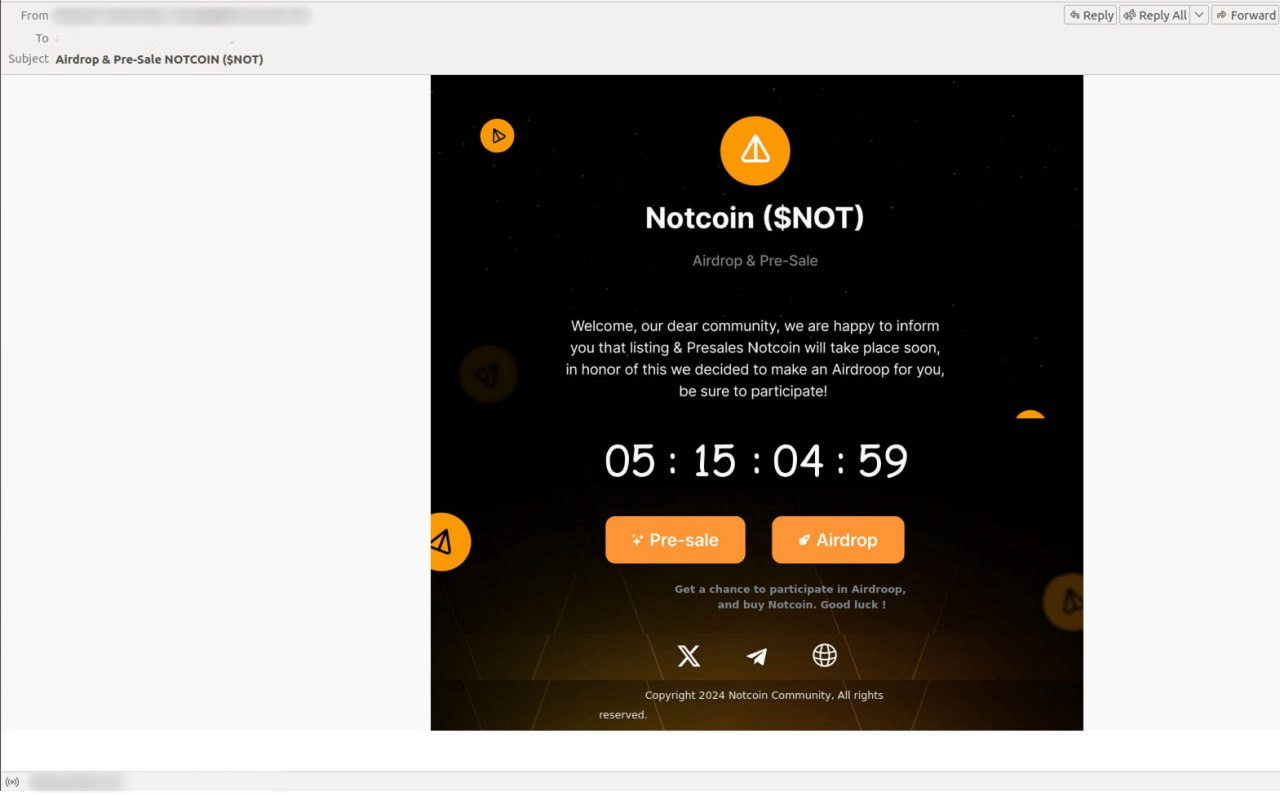
    February 19, 2025
  • MIL-OSI Global: Net-zero homes are touted as a solution for climate change, but they remain out of reach for most

    Source: The Conversation – Canada – By Ehsan Noroozinejad Farsangi, Visiting Senior Researcher, Smart Structures Research Group, University of British Columbia

    Net-zero homes play an important role in combating climate change. (Shutterstock)

    Net-zero homes use natural energy sources and are designed to use less energy and, as such, are considered important in the fight against climate change. But for the average Canadian, they’re still out of reach.

    Net-zero homes are important for tackling climate change. This includes both net-zero energy (NZE) homes, which produce as much energy as they use each year, and net-zero carbon (NZC) homes, which don’t release any carbon dioxide.

    Released in the summer of 2024, the Canada Green Buildings Strategy outlines a bold vision to transform the country’s building sector, aiming for net-zero emissions and enhanced resilience by 2050. This is a bold step forward, but transforming the sector will require sustained collaboration across all levels of government, industry and communities.

    CTV News covers the federal government’s Green Buildings Strategy.

    Net-zero homes use green energy sources and efficient designs to match the amount of energy they produce with the amount they use. They use strategies like thermal shells that use less energy, high-performance components and the addition of green energy systems.

    Net-zero homes also help Canada reach larger climate goals by reducing the amount of carbon dioxide it releases into the air.

    Purchasing and installing these technologies can be cost-prohibitive, but in the long run, homeowners both save money on power bills and reduce their greenhouse gas emissions.

    Those who are unable to make changes to their homes can still live in a net-zero way by buying green power or carbon offsets.

    The sustainable housing market

    Net-zero homes are becoming more popular in Canada. To speed up building processes and reduce costs, builders are trying out pre-fabricated and modular building techniques.

    In 2024, the Canadian federal government announced a $600 million package of loans and funding to help make it easier and cheaper to build homes. This funding will support innovative technologies like pre-fabricated and modular construction, robotics, 3D-printing and mass timber to build homes faster and cheaper.


    Read more:
    Canada’s housing crisis: Innovative tech must come with policy reform


    The Net Zero Council of the Canadian Home Builders’ Association has also been important in enhancing standards and practices and promoting novel approaches that cut costs while still being environmentally friendly. In doing so, CHBA drives the adoption of cheaper, environmentally friendly technologies and processes, enhancing industry standards and practices across Canada.

    While CHBA collaborates with government agencies, such as Natural Resources Canada to promote innovation and elevate industry standards. Government programs typically provide funding, technical support and policy guidance, whereas CHBA focuses on training, best practices and market development for its members.

    Government research programs through CanmetENERGY also work to improve technologies and give builders and planners the tools they need.

    There are several reasons that owning a net-zero home has not yet become widespread. These include: high initial costs, limited awareness and education, gaps in policy and regulation and market challenges including difficulties in scaling up and integrating net-zero technologies.

    Future directions

    To make net-zero homes accessible to all Canadians, a multi-faceted approach is required.

    Increased subsidies and incentives and expanding financial support for both builders and buyers can lower barriers to entry. The government of Canada’s 2030 Emission Reduction Plan includes $9.1 billion in new investments over the next eight years — adding to the $17 billion announced in 2021 — to support decarbonization efforts.

    Enhancing public awareness and developing educational campaigns highlighting the cost savings and environmental benefits of net-zero homes are both essential approaches to raising awareness and support.

    Policy reform can accelerate adoption of net-zero homes. Examples include harmonizing building codes and introducing mandatory energy efficiency standards to accelerate adoption.

    Supporting continued research into technical innovation and developing cost-effective materials and renewable energy systems will drive down costs. Investment in modern methods of construction should be prioritized to accelerate the transition toward sustainable and energy-efficient building practices.

    Partnerships between governments, private developers and non-profits can bring together resources and expertise to scale net-zero housing initiatives.

    The Sustainable Finance Action Council recommends steps to mobilize private capital to support decarbonization and climate resilience in the Canadian economy, including in the housing sector.

    Solar panels the roofs of apartment buildings in Munich, Germany.
    (Shutterstock)

    Successful international models

    Several countries have demonstrated how net-zero homes can become a reality through innovative policies, community-driven approaches and public-private partnerships:

    BedZED in the United Kingdom is the country’s first eco-village project. It uses community-focused design and renewables to significantly cut carbon footprints.

    The Passive House standard is a German housing policy that sets a global benchmark for ultra-low energy consumption, emphasizing airtight construction and heat recovery.

    California’s ambitious Zero Net Energy policies help reduce overall carbon footprints by driving cutting-edge home construction practices.

    The Net Zero Energy House (ZEH) Program in Japan encourages advanced insulation, efficient appliances and rooftop solar.

    The Netherlands is a leader in innovative, large-scale retrofitting for net-zero housing, most notably through the Energiesprong program.

    These international models highlight that success lies in integrating strong policy frameworks, advanced technology and collaborative practices. They demonstrate that with the right mix of government support, industry innovation and residents embracing green choices, net-zero living can become more widespread.

    Housing is an important part of how to address climate change. As Canada pushes to make net-zero homes more affordable, each step forward strengthens communities, reduces greenhouse gas emissions and helps homeowners save money.

    Dr Ehsan Noroozinejad Farsangi has secured funding to develop innovative solutions for housing and climate crises.

    T.Y. Yang does not work for, consult, own shares in or receive funding from any company or organisation that would benefit from this article, and has disclosed no relevant affiliations beyond their academic appointment.

    – ref. Net-zero homes are touted as a solution for climate change, but they remain out of reach for most – https://theconversation.com/net-zero-homes-are-touted-as-a-solution-for-climate-change-but-they-remain-out-of-reach-for-most-247622

    MIL OSI – Global Reports –

    February 19, 2025
  • MIL-OSI Global: The German election explained through seven essential questions

    Source: The Conversation – UK – By Gabriele Abels, Jean Monnet Professor for Comparative Politics & European Integration, University of Tübingen

    Germany is holding a federal election on February 23 – a snap vote called by chancellor Olaf Scholz when his coalition government fell apart at the end of last year. Parties are running to win seats in the national parliament, or Bundestag. And with an unusual level of interest from onlookers outside the country, including the world’s richest man, The Conversation asked Gabriele Abels, the Jean Monnet professor for comparative politics and European integration at the University of Tübingen, to prime us on the basics, via seven essential questions.

    1. Who are the main parties running in this election?

    The parties standing in the federal election are, from left to right on the political spectrum: Linke (the Left), SPD (social democrats), Greens, FPD (liberals), CDU/CSU (conservatives), AfD (right-wing extremist/populist).

    There is also the Buednis Sahra Wagenknecht (BSW), but this party is not so easy to fit into the left-right spectrum. The BSW holds leftist positions on social policy issues but is also anti-migration and opposed to sanctions against Russia and against military support for Ukraine.

    2. When will we know the results?

    It will take several days after February 23 to confirm the final results of the election.

    Based on the exit polls we will have fairly reliable results that evening but there may still be some uncertainty. It depends on how many people vote by post (a trend which is on the rise) and on how the smaller parties fare.

    There are three such parties – Linke, FDP and BSW – hovering around a 5% vote-share in pre-election polls. This is the threshold for qualifying for any seats in parliament at all, so whether or not the three make it past 5% will have quite an effect on the overall composition of the Bundestag and the distribution of seats among the parties in parliament.

    There is an additional rule: parties winning at least three districts (basic mandate clause) qualify for the Bundestag and will get seats according to their share of party votes. The Linke is investing its hopes in this option.

    3. Who is most likely to become chancellor?

    According to all opinion polls, the conservatives (CDU/CSU) will win the election and become the biggest party in government. This means that their lead candidate Friedrich Merz will become the next chancellor.

    4. Will one party run the government?

    No party will have enough seats to form a government alone, given that the German system makes it extremely difficult to do so, by design. A coalition needs to be formed comprising parties that together hold more than 50% of the seats in the Bundestag.


    Read more:
    AfD: how Germany’s constitution was designed with the threat of extremism in mind


    Even when we have the full results, forming a new government will, most likely, take some time. Talks between parties will start immediately after the election, but it might take several months to put a government together. It depends on the numbers at play and the political arithmetic – essentially the extent to which different combinations of parties agree or disagree on various policy positions.

    During a period in the 1950s, when Konrad Adenauer was chancellor, there was an option to have a single-party government. But even he preferred a coalition. Other than that, there has always been the need to form a coalition after an election.

    Unlike the Nordic countries, we in Germany do not have a tradition of minority governments since they are considered to be too weak and unstable. Germans prefer governments which are backed by a clear majority in the Bundestag.

    5. Why does Germany have a system that makes coalitions the norm?

    It is partly political culture to prefer stable majorities and emphasise compromise. But the proportional voting system and increased political fracturing also play a part in delivering many different parties into the Bundestag.

    Until the early 1980s there were usually three parties (conservative, social democrats and liberals). Today, we have seven parties in the Bundestag. Proportional voting gives new parties more possibilities to win seats, while the 5% threshold is a barrier against excessive fragmentation.

    6. We hear a lot about the AfD – but will it be in government?

    No – at least, not this time. There is what we call a brandmauer (firewall), meaning that, so far, none of the other parties is willing to form a government with the AfD. The most likely partner would be the conservatives. Yet, their lead candidate Merz is very outspoken that cooperation with the AfD would mean selling out the conservative soul. Given that the AfD is becoming more and more radical, this is not likely to change in the near future.

    However, there is already a level of cooperation between the AfD and other parties at the local level and even in some state parliaments, especially in East German Länder (states). Often, new patterns of coalition formation are tried out in Länder parliaments and later serve as models for the federal level. The AfD is hoping this will be the case for them.

    7. How important is this election in historical context?

    I would not call this election historic on the scale of the one that just took place in the US. But this election is nevertheless important – and is perceived as important by voters in terms of the future of Germany and its economy.

    Migration and the economy are the top issues and there is a strong sense of frustration as well as a growing distrust in politics. The majority of voters are happy about the snap election given that the coalition led by Olaf Scholz was no longer efficient and there was constant in-fighting.

    However, given that this election has been called at short notice, it’s not clear that turnout will match the current strength of feeling. There has not been much time to register for a postal vote and parties have had only a brief campaign window to win over voters. Which of them will be able to mobilise their voters and also non-voters (recently between 25% and 30% of the electorate will be a crucial deciding factor. Lately the AfD has been successful in terms of mobilising non-voters and also at mobilising young voters. That said, older voters make up the majority, so a lot hangs in the balance.

    Gabriele Abels does not work for, consult, own shares in or receive funding from any company or organisation that would benefit from this article, and has disclosed no relevant affiliations beyond their academic appointment.

    – ref. The German election explained through seven essential questions – https://theconversation.com/the-german-election-explained-through-seven-essential-questions-247945

    MIL OSI – Global Reports –

    February 19, 2025
  • MIL-OSI Global: Shein could be a shot in the arm for the London Stock Exchange – but the fashion giant might not like the added scrutiny

    Source: The Conversation – UK – By Isaac T. Tabner, Senior Lecturer in Finance, Director of the MSc Finance, University of Stirling

    T. Schneider/Shutterstock

    Fast fashion giant Shein’s mooted flotation on the London Stock Exchange (LSE) could be larger than any stock exchange listing seen in Europe in the last year. Coming at a time when the LSE is struggling to attract new listings, with some firms migrating to other exchanges, this could be a welcome boost. So it is perhaps unsurprising that the Chinese-founded company has been courted by the UK government, the LSE and those whose role it is to champion the City of London.

    Yet there are ongoing concerns about the controversial business model and practices of Shein, whose founder Chris Xu relocated himself and the company’s headquarters to Singapore in 2022. These were exacerbated when Shein’s lawyer struggled to tell the UK’s business and trade parliamentary committee whether the company uses cotton from China.

    Campaign group Stop Uyghur Genocide recently said it will seek a judicial review if the UK regulator, the Financial Conduct Authority (FCA), approves the LSE listing. And a “Say No to Shein” campaign has nearly 50,000 signatures on the activist website 38 Degrees. (Shein says it strictly prohibits forced labour in its supply chain globally.)

    More idealistic observers might question whether it is really a good idea for the UK to be courting such a controversial listing. The UK, after all, is a second-choice destination after Shein’s ambition to list on the US market failed – amid concerns about forced labour, among other things.

    So what are the claims against Shein? On environmental, social and governance (ESG) grounds the firm is controversial. Although Shein says it is working hard to reduce its environmental impact, its business model – supplying items cheap enough to be discarded after a single use – is at odds with a more sustainable society and thus problematic for the “E” in ESG.

    Some people add an additional “E” (for ethics) to the acronym. Concerns raised about the human and employee rights of workers in Shein’s supply chain and Shein’s reluctance to talk about them, even to a parliamentary committee, highlight both the “social” and the “ethical”. For its part, the company said last year it was actively working to improve its suppliers’ practices.

    If less than 10% of Shein’s equity is floated, which is the what company is proposing, it will still be controlled by its founders and majority shareholders as if it had remained a fully private company. An LSE listing would normally compel Shein to either comply with the UK corporate governance code, or explain why it did not. But dispersed minority investors with a combined ownership of less than 10% would have little or no say in the governance of a business that remained more than 90% owned and controlled by a few founding investors.

    Therefore, a listing of 10% or less would also raise concerns among minority investors about the “G” for governance. This is particularly true if their holding is involuntary, for example as part of an employee pension scheme. Shein said in a social impact report, however, that it has set up a sustainability committee to provide an extra layer of corporate governance.

    Shein’s lawyer struggled to answer questions on the source of its cotton.

    Given these issues, who gains and who loses from the proposed flotation? Shein itself could of course be among the winners. Common motives for a stock exchange listing are raising capital to finance new investment or giving founding shareholders an opportunity to cash out. Listing can also make mergers and acquisitions more straightforward and incentivise employees to stay with the company by offering preferential terms for buying shares.

    There is also no doubt that a listing would be presented as a positive sign that the UK is open and attractive for business. It would generate an initial windfall, and ongoing revenue for the LSE, plus substantial fees for financial and legal service providers based in the City of London.

    Downsides

    As a private company, Shein has kept details of its financial situation out of the public domain. If the LSE listing does go ahead (which is by no means certain), the company will be required to give detail on its legal and reputational risks, as well as its financial accounts.

    This will let prospective investors and others involved in the listing estimate a pricing range for the flotation. Recent headlines suggest a total equity valuation between US$50 billion and US$66 billion (£40 billion and £52 billion), yet if the listing does not go ahead it is impossible to estimate its market value with any reliability using information that is currently in the public domain.

    Shein’s apparent desire for secrecy, and its reluctance to publish detailed financial data, suggests that its founders and controlling investors may not be comfortable with the increased scrutiny that a listing will require. A 2023 report from the company, however, claimed Shein was committed to “continued progress and transparency” in terms of sustainability and its social impact.

    If credible revelations about controversial business practices such as forced labour or illegal working conditions emerge, this is likely to damage the stock price. No doubt outside investors would have plenty of incentive to scrutinise Shein’s activities – at least, more than the consumer buying a £10 dress for a night out.

    Perhaps a cautionary example can be drawn from the UK’s much smaller home-grown fast-fashion contender, Boohoo.com (now worth around £400 million after peaking at more than £5 billion in 2020). After an initial stellar performance, the firm’s stock price never recovered from reports in 2020 about workers in its UK supply chain being paid £3.50 an hour.

    An independent review published the same year found many failings in the company’s UK supply chain – Boohoo Group responded by pledging to implement the recommendations of the review in full. However, a BBC Panorama investigation indicated that it had not fulfilled its pledges. And at under 30 pence per share, its stock price is down more than 90% since the scandal first broke. (After the programme, Boohoo insisted that it had implemented “every one” of the independent review’s recommendations.)

    Shein’s listing – if it goes ahead – will open its inner workings to public scrutiny in a way that it has never experienced before. Already, people who have never engaged with fast fashion are discussing the business practices of the company.

    If awareness is the first stage of progress, such increased scrutiny can only be a good thing for those concerned about the darker side of the fast fashion industry.

    Isaac T. Tabner is a member of the following professional bodies:

    CFA Institute,
    CFA Society of the UK,
    Personal Finance Society and Chartered Insurance Institute.

    – ref. Shein could be a shot in the arm for the London Stock Exchange – but the fashion giant might not like the added scrutiny – https://theconversation.com/shein-could-be-a-shot-in-the-arm-for-the-london-stock-exchange-but-the-fashion-giant-might-not-like-the-added-scrutiny-249541

    MIL OSI – Global Reports –

    February 19, 2025
  • MIL-OSI Economics: Microsoft announces latest investment in Europe, $700M for computing capacity in Poland

    Source: Microsoft

    Headline: Microsoft announces latest investment in Europe, $700M for computing capacity in Poland

    This morning, I stood in Warsaw with Poland’s Prime Minister, Donald Tusk, and announced Microsoft’s latest cloud and AI infrastructure investment in Europe. Building on our initial billion-dollar investment to launch a Polish cloud region in 2023, I announced that Microsoft will spend another $700 million by the middle of next year to expand our computing capacity in the country. And we will deepen our work with Polish National Defense to strengthen Poland’s cybersecurity, including by working together on the development of AI competencies and emerging digital technologies, including new AI and quantum breakthroughs. 

    This marks the latest critical step for Microsoft’s business, economic, and political relationships in Poland – and in Europe as a whole.  

    During the past 16 months, we have announced more than $20 billion in AI and cloud infrastructure investments that represent an important part of our datacenter expansion across 15 European countries. Today’s investment in Poland builds on the integrated supply chain we are building with manufacturers across the EU. It calls on suppliers that are manufacturing critical components not only in Poland but in Italy, France, Germany, Finland, Ireland, and the United Kingdom. It also includes components manufactured and exported from Indiana in the United States. It’s the type of investment that creates jobs and fosters economic growth throughout Europe and across the Atlantic. 

    Promoting Trans-Atlantic Investment, Trade, and Economic Growth 

    The American technology sector is creating world-leading AI technology and is focused on being a trusted “partner of choice” around the world. And European policy leaders are focused on mobilizing more capital and increasing productivity by “closing the innovation gap.” Even in a time of fragmenting geopolitics, today’s announcement illustrates that these two technology ambitions are more aligned than divergent.  

    In multiple ways, our investment in Poland puts both these goals into practice. It demonstrates how vastly the technology sector has changed since I first joined Microsoft as an employee in Paris more than 31 years ago. While we develop and provide world-leading technology products and services globally, we now support these with enormous national investments in infrastructure and large numbers of local employees. More than ever, technology requires coordinated investments that connect countries and span oceans. 

    Sustained Technology Support During a Decade of Crises 

    Equally important, technology has become a lynchpin for national needs in times of crisis. European Commission President Ursula von der Leyen has aptly put recent history in perspective. As she highlighted, Europe faces a competitiveness challenge that comes as the third crisis of the 2020s, after the pandemic and the war in Ukraine.  

    It’s worth reflecting on the critical role of technology in helping to support the responses needed for each of these crises. 

    Five years ago this month, the first pandemic in a century literally started to shut doors around the world. At Microsoft, our employees and partners used new video and productivity technology like Teams to keep the economy moving forward in every corner of Europe. In just days, businesses, schools, universities, hospitals, and governments sustain their operations by moving online.  

    Two years later, the Russian military invaded Ukraine. At Microsoft, we helped move Ukraine’s critical data and technology services to our datacenters across Europe, ensuring their continued operation outside the range of cruise missile and air attacks. And like several other technology companies, we immediately helped Ukraine’s officials and citizens defend their nation from Russian cyberattacks. As a company, we provided more than $250 million of free technology and financial assistance. And we have sustained this substantial support to this day. 

    As Europe now launches a new “competitiveness compass,” technology will again play an indispensable role. Especially as working-age populations shrink and aging populations expand, economic growth and prosperity will depend more than ever on new technology. Productivity growth will require it. And the competitiveness of Europe’s many great industries and companies, large and small, will depend on their ability to hone their ongoing leadership in critical scientific domains and put their data to work. Across the continent, European institutions will need to harness the power of AI and the cloud. 

    A Strong Foundation for Europe’s AI Transition 

    AI is rapidly becoming what economists call a General Purpose Technology, or GPT. In contrast to single-purpose technologies, GPTs boost innovation and productivity across the entire economy. Throughout history, transformative GPTs like ironworking, electricity, machine tooling, computer chips, and software have not only driven economic growth but sparked new discoveries and inventions, changing the way we live and work.  

    The good news is that the foundation for Europe’s AI transition is already being laid. Industry leaders are investing tens of billions to construct state-of-the-art infrastructure to help Europe access, adopt, and innovate on the world’s most advanced cloud and AI technology. And companies like Microsoft are developing and offering innovative AI tools and vital services that are ready for use by every sector of every European economy.  

    As a company, we are developing and operating our AI infrastructure and platform services with a constant focus on Europe’s needs. This is one reason we announced our AI Access Principles in Barcelona a year ago. These eleven principles govern our operations and are designed to ensure that Microsoft’s AI infrastructure is accessible, open, and available on fair terms to the entire European economy.  

    As we’ve put these principles into practice, we’ve recognized the vital role of open-source software and AI models for European researchers, start-ups, businesses, and governments. We’ve launched the Azure AI Foundry, a platform designed to help developers build, run, and optimize AI-driven applications. The Foundry supports flexible choices and now supports more than 1,800 AI models, from OpenAI’s o3-mini to open-source models like Llama, Mistral, and others, all giving Europe the tools it needs to stay competitive in the fast-moving AI landscape. European developers can then use our Models as a Service offering to distribute their products instantly to our datacenters around the world, so customers can call on them for AI-powered applications. 

    We also recognize that technology innovation requires investments in people. That’s why we’re investing in our AI Skilling Initiative across Europe. We’re partnering with government, education, industry, and civil society to help bring AI skills to users, developers, and organizational leaders. Through our strategic partnerships, we have already helped to skill 2.9 million Europeans and are on track to engage 8 million people by the end of the year. 

    Technology Collaboration Built on Interdependence 

    We readily recognize that European leaders sometimes worry about becoming overly dependent on American technology. We appreciate that such questions are both natural and legitimate. We take them seriously and work hard to address them, including by understanding European values, supporting European needs, and adapting to European rules.  

    Along the way, we often point to a second technology dimension that too easily is overlooked. The reality is that this dependence runs both ways.  

    As a company, we’re pouring tens of billions of dollars of investment into acquiring land, constructing massive buildings, bringing additional electricity to the grid, and installing the world’s most advanced computing, networking, liquid cooling, and other technology.  

    These datacenters are not built on wheels.  

    Once constructed, these billions of dollars in infrastructure are permanent and subject to local laws, regulations, and governments. Time inevitably brings changes. It’s imperative as a company that we constantly remain focused on earning and sustaining our “license to operate” within each country. With datacenters, this starts with each local community and runs up to officials with EU-wide responsibilities. Our economic dependence on Europe runs deep. 

    As Microsoft celebrates its 50th birthday less than two months from now, we look back at more than four decades of European presence and support. As a company, we’ve seen many things change. And we ourselves have changed. We’ve put down deep roots, with employees and families in communities and countries across the continent.  

    But even amid constant change, one thing has been constant. Our support for Europe has been not only steady but steadfast.  

    MIL OSI Economics –

    February 19, 2025
  • MIL-OSI Economics: Press Release: Zion Oil & Gas Announces Renewed Operations Underway for MJ-01 Well Testing & Recompletion Project in Israel

    Source: Zion Oil and Gas

    Headline: Press Release: Zion Oil & Gas Announces Renewed Operations Underway for MJ-01 Well Testing & Recompletion Project in Israel

    Zion Oil & Gas Announces Renewed Operations Underway for MJ-01 Well Testing & Recompletion Project in Israel

    Current Unit Program Ends on February 28


    DALLAS, Texas, and CAESAREA, Israel, February 18, 2025

    DALLAS, Texas, and CAESAREA, Israel, February 18, 2025 – Zion Oil & Gas, Inc. (OTC: ZNOG) is pleased to announce a significant operational milestone as work resumes on the recompletion of the Megiddo-Jezreel 1 (MJ-01) well in Israel. This marks a crucial phase in Zion’s ongoing efforts to unlock Israel’s onshore energy potential.
     

    Operations Update: Crews on the Ground and Progress Underway

    Zion’s rig crew arrived in Israel on February 15, 2025, and has commenced critical maintenance and preparatory work. The rig, which was safely “warm stacked” in September, is undergoing necessary maintenance procedures, including fluid changes, lubrication and greasing, and mechanical, electrical, and safety audits to ensure peak functionality.

    Following maintenance, the team will begin drilling out the temporary plug at approximately 1,100 meters. This phase is expected to take 2-3 weeks, paving the way for the subsequent well recompletion and testing operations. Once the plug is removed, Zion will proceed with setting a permanent plug at the deeper part of the well to isolate the targeted zones of interest for testing.
     

    Global Coordination & Logistics

    Zion Oil & Gas has successfully navigated complex logistical challenges to ensure the timely delivery of essential equipment. Resources are currently enroute from across the globe, including India, Romania, Germany, the Netherlands, the UAE, the United States, and Tanzania. This unprecedented international cooperation underscores the dedication and perseverance of Zion’s team and partners.

    “As we move forward with this phase of operations, we are witnessing God’s provision in extraordinary ways,” said Monty Kness, VP of Operations. “The ability to coordinate a project of this scale, with equipment and expertise sourced from multiple continents, is a testament to both our team’s determination and the global support behind our mission.”
     

    Security and Site Preparedness

    Zion has maintained continuous security at the MJ-01 site, ensuring a stable and secure operational environment. Additionally, commercial air travel into Israel has steadily resumed, further supporting logistical operations.

    “Our focus remains on safety, precision, and execution,” said Zion CEO Rob Dunn. “With boots on the ground and critical equipment in motion, we are committed to seeing this project through knowing God has directed our steps forward.”
     

    Completion Timeline & Next Steps

    With all necessary equipment expected to be on-site by mid-March, barring unforeseen circumstances Zion anticipates its well completion and testing operations should be nearing completion in Q2 2025. The team remains confident in its planned operations and will continue to provide updates as milestones are achieved.
     

    Final Opportunity: Unit Program Closing February 28, 2025

    Zion Oil & Gas reminds investors that the current Unit Program will close on February 28, 2025. This is the final opportunity to participate before the program concludes.

    For every $250.00 UNIT purchased, investors receive:
    – Common stock based on the high-low average sale price on OTCQB: ZNOG for the day of purchase (or the next trading day if purchased after 4:00 PM EST).
    – 50 Warrants with an exercise price of $0.25 each.
    – 50 Additional Warrants for those enrolled in Automatic Monthly Investments (AMI) at $50/month or more (one-time only).
    – Warrants are exercisable for 12 months from March 31, 2025, to March 31, 2026.

    To learn more, click HERE.
     

    Faith & Perseverance

    John Brown, Zion’s Founder and Chairman, expressed gratitude for the unwavering support from shareholders and believers in its mission. “We remain steadfast in our calling, knowing that each step forward is guided by the Lord. As we embark on this critical phase of operations, we are encouraged by His promises and the faithfulness of our supporters.”
     

    About Zion Oil & Gas, Inc.

    Zion Oil & Gas, a U.S. public company traded on OTCQB: ZNOG, is dedicated to exploring for oil and gas onshore in Israel under its Megiddo Valleys License 434 which covers approximately 75,000 acres.

    For more information, visit www.zionoil.com.
     

    “The end of a matter is better than its beginning, and patience is better than pride.”
    Eccl 7:8 NIV

    “Bless the Lord, O my soul, and forget not all his benefits, who forgives all your iniquity, who heals all your diseases, who redeems your life from the pit, who crowns you with steadfast love and mercy, who satisfies you with good so that your youth is renewed like the eagle’s.”
    Ps 103:2-5 ESV

    FORWARD-LOOKING STATEMENTS: Statements in this communication that are not historical fact, including, but not limited to, statements regarding Zion’s operations and the results therefrom, including testing and completion; Zion’s ability to discover and produce oil in commercial quantities; Zion’s ability to continue as a going concern; operational risks in ongoing exploration efforts; regulatory approvals needed for exploration within our license and the rig’s operation; the effect, if any, of the uncertainties associated with wars and skirmishes between Israel and other organizations and/or countries, and liquidity for shareholders on the OTC market are forward-looking statements as defined in the “Safe Harbor” provisions of the Private Securities Litigation Reform Act of 1995. These forward-looking statements are based on assumptions that are subject to significant known and unknown risks, uncertainties, and other unpredictable factors, many of which are described in Zion’s periodic reports filed with the SEC and are beyond Zion’s control. These risks could cause Zion’s actual performance to differ materially from the results predicted by these forward-looking statements. These risks and uncertainties include, but are not limited to, those described in Item 1A in Zion’s Annual Report on Form 10-K, which is expressly incorporated herein by reference, and other factors as may periodically be described in Zion’s filings with the SEC. Zion can give no assurance that the expectations reflected in these statements will prove to be correct and assumes no responsibility to update these statements.

    MIL OSI Economics –

    February 19, 2025
  • MIL-OSI Global: 5 ways to improve security governance and prevent future illegal mining tragedies from happening

    Source: The Conversation – Canada – By Andrew Grant, Associate Professor of Political Studies, Queen’s University, Ontario

    After six months trapped underground, roughly 246 illegal miners were rescued at Buffelsfontein gold mine in Stilfontein, South Africa, in mid-January following a court order and intense public outcry.

    An estimated 2,000 miners had been trapped underground after police blocked food and water from families and supporters in an attempt to force them into surrendering for arrest. In total, 87 died, many from starvation or dehydration, according to civic groups. Some survivors reportedly resorted to eating cockroaches or the flesh of their deceased colleagues to survive.

    Illegal miners, known as “zama zamas” in South Africa, are people who enter mining sites without authorization to extract leftover gold and other minerals, often under dangerous and exploitative conditions.

    This incident highlights the current failures in security governance at abandoned mining sites. Rather than ensuring safety and protecting lives, the police response contributed to the scale of the tragedy.

    To prevent similar tragedies, security governance at abandoned or closed mining sites must be improved, and inclusive policies that address employment needs must be implemented.

    A dangerous occupation

    As more mining sites in South Africa and across the world reach the end of their life cycles, the number of mine closures will increase, along with the need for more effective security governance.

    The value of remaining minerals, combined with the dearth of alternatives to sustain livelihoods, has led some people to engage in illegal artisanal mining, despite the significant risks involved.

    While illegal mining provides financial support for households in impoverished regions, it also releases pollutants into the environment, disrupts and degrades water resources and supports criminal networks.

    South Africa is a prime example of these challenges. The country is home to an estimated 6,000 abandoned mines and 30,000 illegal miners. Security governance challenges are a major part of South Africa’s socioeconomic reality, and these challenges continue to grow despite government crackdowns in recent years.

    Current enforcement efforts are doing little to address the decades of poor post-mine closure management. South Africa’s Petroleum and Mineral Resources Development Act requires mining companies to rehabilitate sites after closure, although compliance is sporadic, leaving communities and ecosystems at risk.

    With limited job opportunities in the formal sectors of the economy, many young people aged 15 to 34 have turned to informal sectors, including illegal mining, due to its low entry barriers. Compounding the problem is the government’s failure to legally distinguish between illegal and informal mining.

    5 ways to improve security governance

    The Buffelsfontein incident is a grim reminder that security governance cannot rely solely on policing tactics. Addressing the worsening socioeconomic cycle of miners trapped in abandoned and uncontrolled mines will require governments, companies and local communities to build stronger relationships before crises arise.

    Solutions must recognize that zama zamas work with no safety equipment and face daily threats from criminal syndicates who control mining territories. We propose five solutions that, together, address the socioeconomic and governance challenges:

    1. The Petroleum and Mineral Resources Development Act should be amended so mining permits are only granted when firms provide a mine closure security plan. This plan must include physical barriers like fencing and sealed shafts, with local communities involved in security enforcement. Funding would come from an independent relinquishment fund via annual contributions over the active lifespan of the mine to an interest-earning annuity held by a local financial institution and monitored by government and civil society.

    2. Security efforts should combine private security firms with community-based approaches, including hiring local residents in monitoring roles. This approach will foster trust, create jobs, improve security governance and enhance environment, social and governance (ESG) investment ratings.

    3. Drawing from successful models in other countries like Chile, drones, unmanned aerial vehicles and artificial intelligence monitoring methods can help monitor and secure high-risk areas. When used ethically, such technologies can reduce unauthorized mining activities.

    4. With unemployment in South African mining regions exceeding 40 per cent, governments and the private sector must focus on renewable energy, agriculture and entrepreneurship as economic alternatives for mining communities. Germany’s Emscher Park Project, for instance, has transformed coal mining regions into renewable energy hubs that create jobs and revitalize local economies. South Africa can also repurpose abandoned mining sites for such initiatives.

    5. As South Africa turns its attention to critical minerals, it has an opportunity to expand its green bonds to include funding for post-closure financial recovery for mining communities. These funds could finance infrastructure projects, vocational training and education so mining communities can transition successfully to other economic sectors.

    Lessons for Canada

    Canada is no stranger to the challenges of managing mines after closure. Across the Yukon, Northwest Territories and northern parts of several provinces, tailing pond failures have led to environmental pollution during the post-closure phase of the mining cycle.

    Investing in post-closure mine rehabilitation can prevent future harms to the environment, as well as enhance the human security of local communities. Green investors and sustainable finance funds like those informed by the Institute for Sustainable Finance must take a more active role in funding these efforts.

    The Buffelsfontein tragedy should serve as a wake-up call: security governance must evolve from punitive enforcement to proactive protection. Providing alternative livelihoods to illegal mining weakens criminal networks, removes dangerous working conditions, reduces environmental harms and saves lives.

    Though Canada is considered a mining superpower, it could learn valuable lessons from South Africa’s experience. Adopting our suggested solutions could help Canada address its own abandoned mine risks and ensure a more sustainable future for its mining communities.

    Andrew Grant has received grants from the Social Sciences and Humanities Research Council of Canada

    Benjamin Ofosu-Atuahene has received funding in the form of an Ontario Graduate Scholarship.

    Olusola Ogunnubi has received funding from the Social Sciences and Humanities Research Council of Canada.

    – ref. 5 ways to improve security governance and prevent future illegal mining tragedies from happening – https://theconversation.com/5-ways-to-improve-security-governance-and-prevent-future-illegal-mining-tragedies-from-happening-248741

    MIL OSI – Global Reports –

    February 19, 2025
  • MIL-OSI Asia-Pac: Korea-Malaysia summit (November 2024)

    Source: Government of the Republic of Korea

    Korea-Latvia summit (November 2024)

    President Yoon Suk Yeol on Nov. 28 hosted a summit at his office for visiting Latvian President Edgars Rinkevics on raising bilateral cooperation and analyzing regional and international situations.

    Both leaders agreed to strengthen bilateral cooperation in sectors such as bio and pharmaceuticals, national security and the defense industry.

    Korea-Malaysia summit (November 2024)

    President Yoon Suk Yeol on Nov. 25 hosted summit talks in Seoul with Malaysian Prime Minister Anwar Ibrahim, who was on an official visit to Korea, and adopted a joint statement on their newly formed strategic partnership.

    Both leaders welcomed the resumption of negotiations on a bilateral free trade agreement this year and agreed to accelerate efforts to conclude the deal next year. They also pledged to raise cooperation in infrastructure and supply chains for core minerals.

    Korea-Peru summit (November 2024)

    President Yoon Suk Yeol and Peruvian President Dina Boluarte on Nov. 16 held a bilateral summit at the Presidential Palace in Lima, Peru, and agreed to bolster cooperation in the defense sector and infrastructure.
    The two countries concluded memorandums of understanding on joint production of KF-21 fighter jet parts, development of naval ships (submarines) and cooperation in army ground equipment. 

    • Current Affairs President Yoon’s visits to Peru, Brazil for APEC, G20

    Korea-ASEAN summit (October 2024)

    President Yoon Suk Yeol on Oct. 10 attended the 25th Association of Southeast Asian Nations (ASEAN) Summit at the National Convention Centre in Vientiane, Laos, where he and ASEAN leaders agreed to form a comprehensive strategic partnership and launch joint projects in a range of sectors.

    They also agreed to stimulate trade and investment through a bilateral free trade agreement and the Regional Comprehensive Economic Partnership, while creating a “conducive and favourable environment” for ASEAN and Korean business such as the ASEAN-ROK (Republic of Korea) Business Council.

    • Current Affairs President Yoon’s visit to 3 Asian nations

    Korea-Japan summit (October 2024)

    President Yoon Suk Yeol on Oct. 10 held a summit with Japanese Prime Minister Shigeru Ishiba at a hotel in Vientiane, Laos, their first talks since the prime minister assumed office on Sept. 1. 

    Both leaders agreed on the growing need to raise bilateral cooperation in regional and global issues and expand the horizons for such collaboration on the global stage.

    • Current Affairs President Yoon’s visit to 3 Asian nations

    Korea-Philippines summit (October 2024)

    President Yoon Suk Yeol, on a state visit to the Philippines, on Oct. 7 agreed with Philippine President Ferdinand Marcos Jr to form a bilateral strategic partnership at their summit held at the presidential Malacanang Palace in Manila.

    Both leaders also adopted a joint declaration on higher cooperation in all sectors including national security and economy like nuclear power plants. 

    • Current Affairs President Yoon’s visit to 3 Asian nations

    Korea-Czechia summit (September 2024)

    President Yoon Suk Yeol on Sept. 19 discussed with Czech President Petr Pavel in Prague cooperation in strategic sectors including nuclear power plants. Both leaders also shared opinions on developing their bilateral strategic partnership.

    Korea-New Zealand summit (September 2024)

    President Yoon Suk Yeol and New Zealand Prime Minister Christopher Luxon on Sept. 4 at their bilateral summit adopted a joint statement on stronger bilateral relations in trade, economy, science, human exchange, national security and international cooperation.

    Both leaders also agreed to elevate their Partnership for the 21st Century concluded in 2006 to a comprehensive strategic partnership.

    Korea-Germany summit (July 2024)

    President Yoon Suk Yeol on July 10 in Washington held bilateral talks with German Chancellor Olaf Scholz on the sidelines of the NATO Summit.
    President Yoon said he hopes to work more closely with Germany on global issues such as support for Ukraine, supply chain disruptions and the climate crisis. He also hailed Germany’s application to join the United Nations Command. 

    • Current Affairs President Yoon’s US visit for NATO Summit

    Korea-Japan summit (July 2024)

    President Yoon Suk Yeol on July 10 in Washington held bilateral talks with Japanese Prime Minister Fumio Kishida on the sidelines of the NATO Summit.
    President Yoon said, “The recent signing by Russia and North Korea of a comprehensive strategic partnership treaty and their accelerated closeness in military and economic ties are raising serious concern over global security as well as that of East Asia.”

    • Current Affairs President Yoon’s US visit for NATO Summit

    MIL OSI Asia Pacific News –
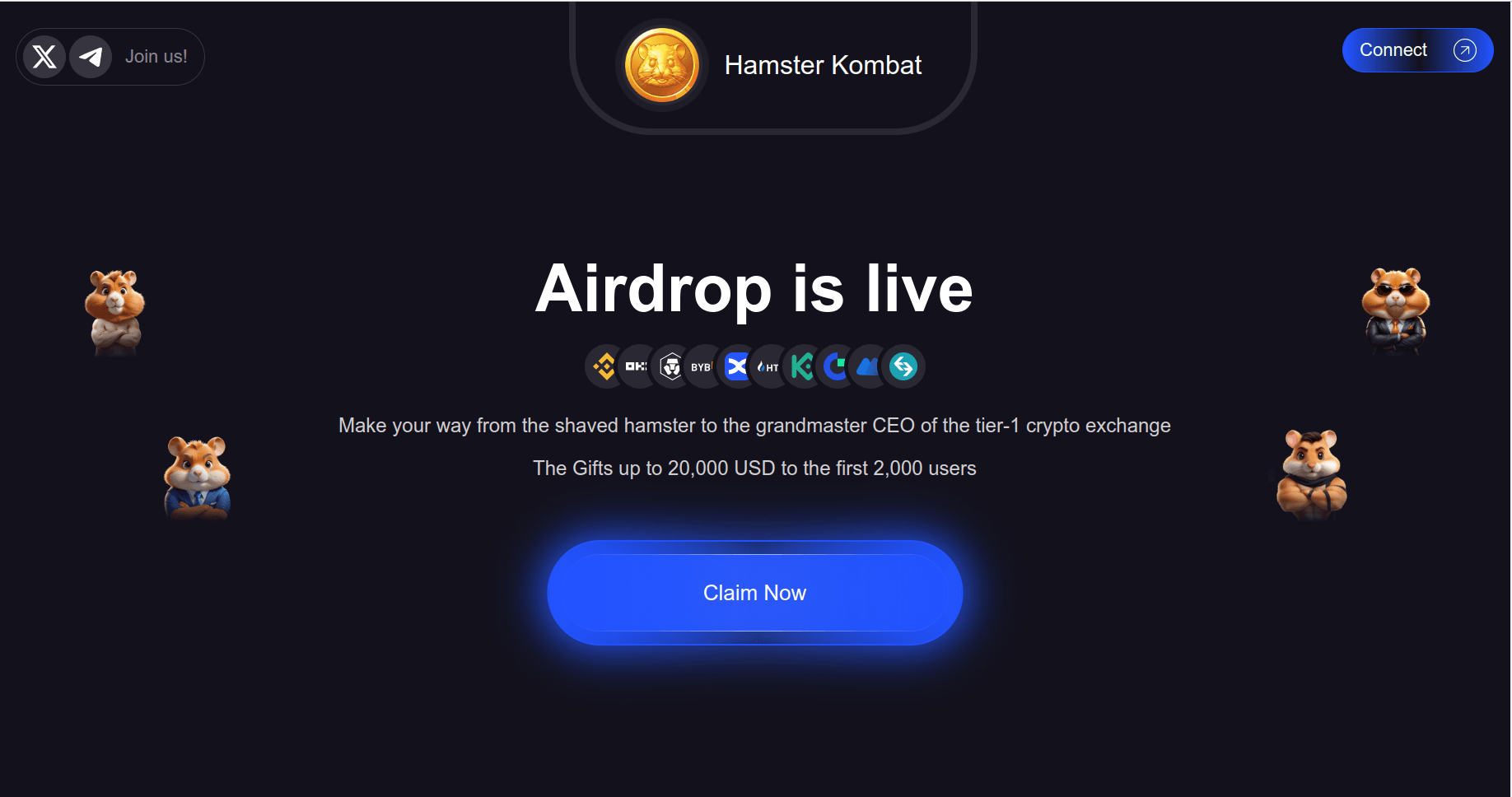
    February 19, 2025
  • MIL-OSI Asia-Pac: Korea-Latvia summit (November 2024)

    Source: Government of the Republic of Korea

    Korea-Latvia summit (November 2024)

    President Yoon Suk Yeol on Nov. 28 hosted a summit at his office for visiting Latvian President Edgars Rinkevics on raising bilateral cooperation and analyzing regional and international situations.

    Both leaders agreed to strengthen bilateral cooperation in sectors such as bio and pharmaceuticals, national security and the defense industry.

    Korea-Malaysia summit (November 2024)

    President Yoon Suk Yeol on Nov. 25 hosted summit talks in Seoul with Malaysian Prime Minister Anwar Ibrahim, who was on an official visit to Korea, and adopted a joint statement on their newly formed strategic partnership.

    Both leaders welcomed the resumption of negotiations on a bilateral free trade agreement this year and agreed to accelerate efforts to conclude the deal next year. They also pledged to raise cooperation in infrastructure and supply chains for core minerals.

    Korea-Peru summit (November 2024)

    President Yoon Suk Yeol and Peruvian President Dina Boluarte on Nov. 16 held a bilateral summit at the Presidential Palace in Lima, Peru, and agreed to bolster cooperation in the defense sector and infrastructure.
    The two countries concluded memorandums of understanding on joint production of KF-21 fighter jet parts, development of naval ships (submarines) and cooperation in army ground equipment. 

    • Current Affairs President Yoon’s visits to Peru, Brazil for APEC, G20

    Korea-ASEAN summit (October 2024)

    President Yoon Suk Yeol on Oct. 10 attended the 25th Association of Southeast Asian Nations (ASEAN) Summit at the National Convention Centre in Vientiane, Laos, where he and ASEAN leaders agreed to form a comprehensive strategic partnership and launch joint projects in a range of sectors.

    They also agreed to stimulate trade and investment through a bilateral free trade agreement and the Regional Comprehensive Economic Partnership, while creating a “conducive and favourable environment” for ASEAN and Korean business such as the ASEAN-ROK (Republic of Korea) Business Council.

    • Current Affairs President Yoon’s visit to 3 Asian nations

    Korea-Japan summit (October 2024)

    President Yoon Suk Yeol on Oct. 10 held a summit with Japanese Prime Minister Shigeru Ishiba at a hotel in Vientiane, Laos, their first talks since the prime minister assumed office on Sept. 1. 

    Both leaders agreed on the growing need to raise bilateral cooperation in regional and global issues and expand the horizons for such collaboration on the global stage.

    • Current Affairs President Yoon’s visit to 3 Asian nations

    Korea-Philippines summit (October 2024)

    President Yoon Suk Yeol, on a state visit to the Philippines, on Oct. 7 agreed with Philippine President Ferdinand Marcos Jr to form a bilateral strategic partnership at their summit held at the presidential Malacanang Palace in Manila.

    Both leaders also adopted a joint declaration on higher cooperation in all sectors including national security and economy like nuclear power plants. 

    • Current Affairs President Yoon’s visit to 3 Asian nations

    Korea-Czechia summit (September 2024)

    President Yoon Suk Yeol on Sept. 19 discussed with Czech President Petr Pavel in Prague cooperation in strategic sectors including nuclear power plants. Both leaders also shared opinions on developing their bilateral strategic partnership.

    Korea-New Zealand summit (September 2024)

    President Yoon Suk Yeol and New Zealand Prime Minister Christopher Luxon on Sept. 4 at their bilateral summit adopted a joint statement on stronger bilateral relations in trade, economy, science, human exchange, national security and international cooperation.

    Both leaders also agreed to elevate their Partnership for the 21st Century concluded in 2006 to a comprehensive strategic partnership.

    Korea-Germany summit (July 2024)

    President Yoon Suk Yeol on July 10 in Washington held bilateral talks with German Chancellor Olaf Scholz on the sidelines of the NATO Summit.
    President Yoon said he hopes to work more closely with Germany on global issues such as support for Ukraine, supply chain disruptions and the climate crisis. He also hailed Germany’s application to join the United Nations Command. 

    • Current Affairs President Yoon’s US visit for NATO Summit

    Korea-Japan summit (July 2024)

    President Yoon Suk Yeol on July 10 in Washington held bilateral talks with Japanese Prime Minister Fumio Kishida on the sidelines of the NATO Summit.
    President Yoon said, “The recent signing by Russia and North Korea of a comprehensive strategic partnership treaty and their accelerated closeness in military and economic ties are raising serious concern over global security as well as that of East Asia.”

    • Current Affairs President Yoon’s US visit for NATO Summit

    MIL OSI Asia Pacific News –
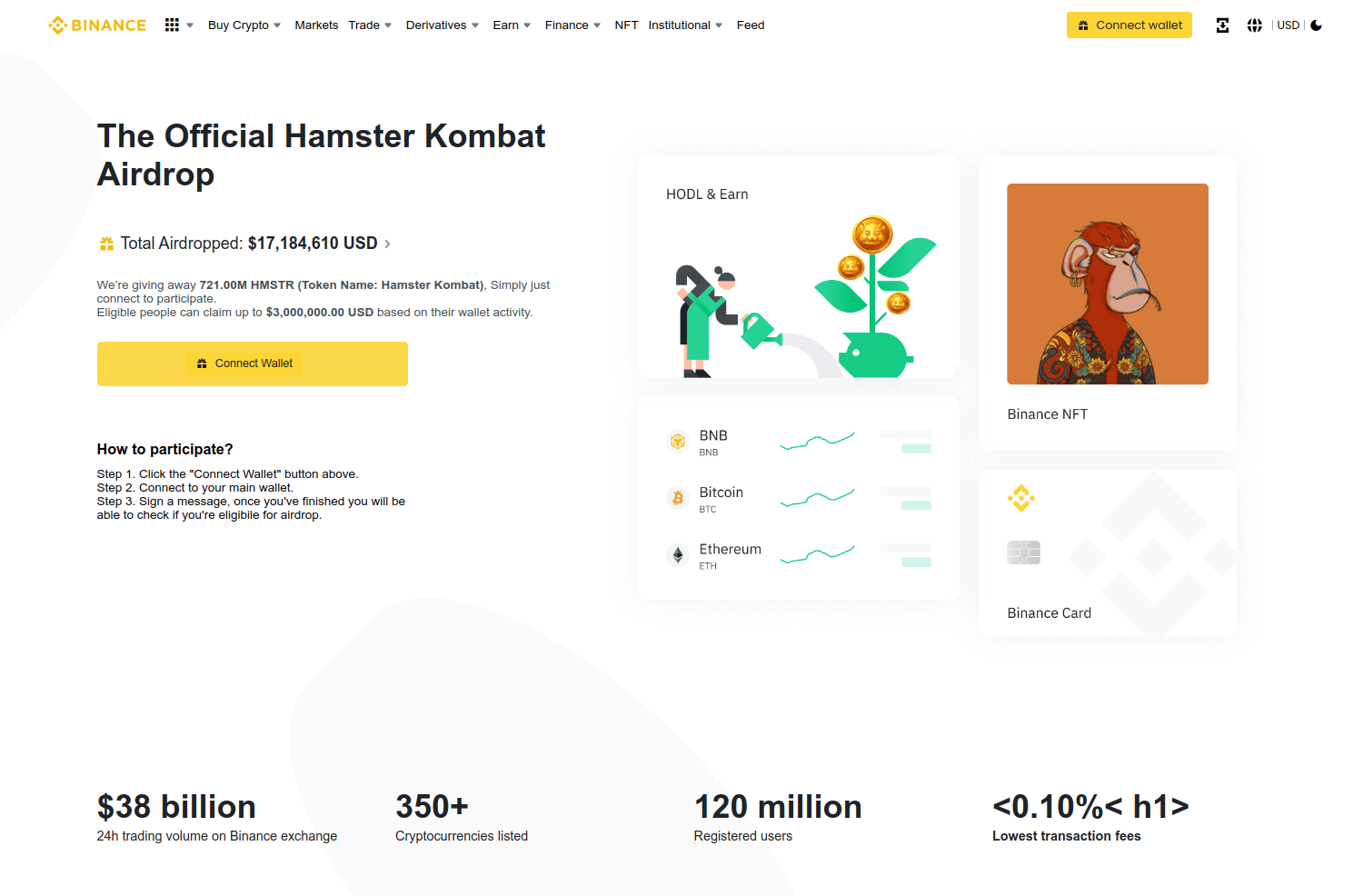
    February 19, 2025
  • MIL-OSI: Visited App Releases List of Top Travel Destinations in 2024

    Source: GlobeNewswire (MIL-OSI)

    TORONTO, Feb. 18, 2025 (GLOBE NEWSWIRE) — The travel app, Visited, by Arriving In High Heels Corporation, has published a travel report which showcases top travel trends around the world with highlight of 2024 travels. 

    Visited is a travel tracking app, which lets users map out their travel journey, mark famous places visited on travel lists and helps with trip planning for their itinerary feature. It is the ultimate travel bucket list planning app, as it has over 150 travel lists available from ancient sites to golf destinations. The app is available in 30 languages for both iOS or Android and is free to download.

    According to Visited’s travel stats, the average global traveler has been to 18 countries. While American travelers have been to 23. Travelers from the United Arab Emirates have visited the most countries, with an average of 30 countries visited. Swiss and Finnish travelers came in second and third as the most well-traveled. The most popular countries to visit are France, Spain, Italy, Germany, the UK, and the U.S. 

    The most sought-after places to visit are Australia, Japan, New Zealand and Brazil. The top destinations that American travelers want to travel to include Australia, Greece, and New Zealand. The highest numbers of American users have traveled to Mexico, Canada, France, the UK, and Italy.

    The most popular travel destinations in the world in 2024 were in Europe, while the U.S. is in 12th spot, Turkey is in 10th spot and Thailand is in 15th spot. For American travelers, 2024 saw the UK, Portugal and Japan topping the list of the most visited countries.

    The most popular travel lists are world wonders, capitals of the world and culinary experiences.

    The travel report was compiled based on 2.4 million international users and over 300,000 U.S. users. To see more top travel lists and browse top destinations worldwide, download Visited on iOS or Android. For the full travel report, visit https://visitedapp.com/travel-report-results/

    To learn more about the Visited app, visit https://visitedapp.com. 

    About Arriving In High Heels Corporation

    Arriving In High Heels Corporation is a mobile app company with apps including Pay Off Debt, X-Walk, and Visited, their most popular app. Visited Media provides customized travel research services to travel companies.

    Contact Information

    Anna Kayfitz

    anna@arrivinginhighheels.com

    The MIL Network –

    February 19, 2025
  • MIL-OSI: WSO2Con 2025 to Showcase How Enterprises Can Embrace ‘Platformless Modernization’ to Drive Innovation

    Source: GlobeNewswire (MIL-OSI)

    Austin, TX, Feb. 18, 2025 (GLOBE NEWSWIRE) — WSO2Con 2025 will empower enterprises to embrace ‘Platformless Modernization’ by showcasing real-world strategies, expert insights, and innovations that simplify development, accelerate digital transformation, and future-proof IT infrastructures. Keynotes, customer stories and technical discussions during the three-day event will explore and deep-dive into how enterprises can transform digital innovation by eliminating the complexities of traditional platforms either by adopting an enterprise-grade internal developer platform or leveraging software-as-a-service offerings to build your own. The event will take place from March 18 to 20, 2025, in Barcelona, Spain, at the Palau de Congressos de Catalunya.

    Delivering a platform experience without the complexity

    Platformless modernization aims to redefine how organizations build, deploy, and manage applications. Traditional platforms often come with operational overhead, requiring businesses to maintain infrastructure and navigate complex configurations. A platformless approach removes these burdens, making the platform layer invisible to developers, so they can focus on just building innovative applications and providing better digital experiences to their customers and users.

    At WSO2Con 2025, WSO2 executives and industry experts will explore what platformless modernization means for enterprises, offering insights into:

    • How businesses can deliver developer-friendly experiences without the overhead of managing platforms
    • Strategies for enabling rapid, secure, and scalable application development powered by API management, integration, and identity solutions
    • The role of internal developer platforms (IDPs) in modernizing software delivery with AI, Kubernetes, and cloud-native architectures

    Insightful keynotes and customer success stories

    The conference will feature a distinguished lineup of keynote speakers. In his opening keynote, WSO2’s Founder and CEO, Dr. Sanjiva Weerawarana will discuss the vision for platformless modernization with WSO2 technical experts providing in-depth sessions on how platformless is shaping the future of integration, API management and identity & access management. 

    Jeremy Schneider, Senior Partner & Co-Head of Global Software & High-Tech Practice, McKinsey and Company will provide a framework for navigating evolution in the digital economy in his keynote Every Company is a Software Company. In other keynote presentations, Amy Bingham, vice president & chief information officer at Pekin Insurance will share learnings on how Pekin turned a challenging year of unprecedented setbacks into a story of resilience, rebuilding, and long-term success in an increasingly unpredictable world. Jonathan Pearl, executive director – technology product management at financial services company, BNY Mellon, will explore the power of APIs and how they can be used to drive modernization, innovation and collaboration – both internally and externally. He will discuss the key principles and best practices for designing, building, discovering and governing APIs, as well as the cultural and organizational changes needed to successfully support an API first strategy.

    Registration for WSO2Con 2025 is still open with a flash sale from February 18 to 21, 2025. To register and view the full agenda, visit https://wso2.com/wso2con/2025/. 

    About WSO2

    Founded in 2005, WSO2 is the largest independent software vendor providing open-source API management, integration, and identity and access management (IAM) products. WSO2’s products and platforms—including our next-gen internal developer platform, Choreo—empower organizations to leverage the full potential of APIs for secure delivery of digital services and applications, enabling thousands of enterprises in over 90 countries globally to drive their digital transformation journeys. Our open-source, API-first approach frees developers and architects from vendor lock-in, enabling rapid digital product creation. Recognized as leaders by industry analysts, WSO2 has over 800 employees worldwide with offices in Australia, Brazil, Germany, India, Spain, Sri Lanka, the UAE, the UK, and the US, with USD100M in annual recurring revenue. Visit https://wso2.com to learn more. Follow WSO2 on LinkedIn and X (formerly Twitter).

    Trademarks and registered trademarks are the properties of their respective owners.

    ###

    The MIL Network –

    February 19, 2025
  • MIL-OSI Global: Trans people affirmed their gender without medical help in medieval Europe − history shows how identity transcends medicine and law

    Source: The Conversation – USA – By Sarah Barringer, Ph.D. Candidate in English, University of Iowa

    The Lady and the Unicorn: Sight. Unknown/Musée de Cluny, Paris via Didier Descouens/Wikimedia Commons

    Restrictions on medical care for transgender youth assume that without the ability to medically transition, trans people will vanish.

    As of 2024, 26 U.S. states have banned gender-affirming care for young people. Less than a month into office, President Donald Trump issued numerous executive orders targeting transgender people, including a mandate to use “sex” instead of “gender” on passports, visas and global entry cards, as well as a ban on gender-affirming care for young people. These actions foreground the upcoming Supreme Court case of U.S. vs. Skrmetti which promises to shape the future of gender-affirming health care in the U.S., including restrictions or bans.

    History, however, shows that withholding health care does not make transgender people go away. Scholarship of medieval literature and historical records reveals how transgender people transitioned even without a robust medical system – instead, they changed their clothes, name and social position.

    Surgery in medieval times

    Surgery was not a widespread practice in the medieval period. While it gained some traction in the 1300s, surgery was limited to southern France and northern Italy. Even there, surgery was dangerous and the risk of infection high.

    Cutting off fleshy bits is an old practice and, potential dangers aside, removing a penis or breasts wasn’t impossible. But amputating functioning limbs was nearly always a form of punishment. Medieval people, including surgeons and patients, likely would not have had positive views of surgery that involved removing working body parts.

    Illustration from a Latin translation of Albucasis’ Chirurgia, depicting surgical instruments.
    Wellcome Collection

    Surgeons in the 14th century were increasingly thinking about how to perform surgery on those with both male and female genitalia – people now called intersex. But they thought about this in terms of “correcting” genitalia to make it more apparently male or female – an attitude still present today. Historically, the procedure was probably performed on adults, but today it is usually performed on children. Both then and now, the surgery often disregards the patient’s wishes and is not medically necessary, at times leading to complications later. For patients deemed female, excess flesh could be cut away, and for patients deemed male, the vulva could be cauterized to close it.

    There is, however, at least one historical example of a transgender individual receiving surgery. In 1300, near Bern, Switzerland, an unnamed woman was legally separated from her husband because she was unable to have sex with him. Soon after, the woman headed to Bologna, which was the surgery capital of Europe at the time. There, a surgeon cut open the woman’s vulva, revealing a penis and testicles. The account ends, “Back home, he took a wife, did rural work, and had legitimate and sufficient intercourse with his wife.”

    The story presents the possibility of medical transition, possibly even a desire for it. But given the limits of surgical techniques and ideologies at the time, these forms of medical transition were unlikely to be common.

    Transitioning without medicine

    To transition without medicine, medieval transgender people relied on changes they could make themselves. They cut their hair, put on different clothes, changed their names, and found new places in society.

    In 1388, a young woman named Catherine in Rottweil, Germany, “put on men’s clothes, declared herself to be a man, and called herself John.” John went on to marry a woman and later developed breasts. This caused some initial consternation – the city council of Rottweil sent John and his wife to court. However, the court did not see breasts as inhibiting John’s masculinity and the couple went home without facing any charges.

    In 1395, a transgender woman named Eleanor Rykener appeared before a court in London, England, after she was caught working as a prostitute. The court clerk wrote “that a certain Anna … first taught [her] to practice this detestable vice in the manner of a woman. [She] further said that a certain Elizabeth Bronderer first dressed [her] in women’s clothing” and later she took on work as an embroideress and tapster, a sort of bartender. The account is Rykener’s own, but the court clerk editorialized it, notably adding the phrase “detestable vice” in reference to prostitution.

    Detail of lovers in bed, Aldobrandino of Siena, Le Régime du corps, northern France. 13th century.
    British Library Catalogue of Illuminated Manuscripts/Sloane MS 2435, f. 9v.

    Rykener’s account reveals that there were a number of people interested in helping her transition – people who helped her dress, taught her how to behave, provided her employment and supported her choice of a new name. Community was a more important part of her transition than transforming her body. Based on the record, she apparently did not make an effort to create breasts.

    Another account appeared in 1355 in Venice, Italy, concerning Rolandina Ronchaia. While John declared himself male, and Rykener was very active in her transition, Ronchaia’s transition was spurred on by the perceptions of others. She argued that she had always had a “feminine face, voice and gestures,” and was often mistaken for a woman. She also had breasts, “in women’s fashion.” One night, a man came to have sex with her, and Ronchaia, “wishing to connect like a woman, hid [her] own penis and took the man’s penis.” After that, she moved to Venice, where, although she continued to wear men’s clothes, she was still perceived as a woman.

    Ronchaia’s account is unique because it emphasizes her body and her desire to change it by hiding her penis. But this was still a matter of what she herself could do to express her gender, rather than a medical transition.

    A long transgender history

    The accounts of medieval transgender individuals are limited – not only in number but in length. A lot of things did not get written down, and people were not talking about transgender people the way we are now.

    Historical accounts of transgender individuals are almost always in court records, which reflect the concerns of the court more clearly than the concerns of its subjects. The court was especially worried about sexual activity between men, which both overemphasizes the importance of sex in medieval transgender people’s lives and often obscures that these accounts are even about transgender people. Eleanor Ryekener’s account frequently misgenders her and refers to her as “John.”

    But it’s clear that transgender people existed in the medieval period, even when medical care was unavailable to them.

    A court document from the interrogation of John Rykener.
    Internet Medieval Source Book/Wikimedia Commons

    It is also the case that many of these individuals – Rykener is a likely exception – were probably intersex, and their experience would be different from those who were not. Intersex people were legally recognized and allowed some leeway if they chose to transition as an adult. This is starkly apparent in an account from Lille, France, in 1458, where a transgender woman was accused of sodomy and burned at the stake. She claimed “to have both sexes,” but the account says this was not the case. While being demonstrably intersex may not have saved her, that she claimed she was is telling.

    Gender transition has a long history, going even further back than the medieval period. Then as now, the local community played a vital role in aiding an individual’s transition. Unlike the medieval period, most modern societies have far greater access to medical care. Despite current restrictions, transgender people have far more options for transition than they once did.

    Medieval modes of transitioning are not a solution to current denials of medical care. But medieval transgender lives do illuminate that transgender people will not vanish even when the legal and medical systems strive to erase them.

    Sarah Barringer does not work for, consult, own shares in or receive funding from any company or organization that would benefit from this article, and has disclosed no relevant affiliations beyond their academic appointment.

    – ref. Trans people affirmed their gender without medical help in medieval Europe − history shows how identity transcends medicine and law – https://theconversation.com/trans-people-affirmed-their-gender-without-medical-help-in-medieval-europe-history-shows-how-identity-transcends-medicine-and-law-248559

    MIL OSI – Global Reports –

    February 19, 2025
  • MIL-OSI Global: The secret behind Temu’s rock-bottom prices

    Source: The Conversation – France – By Henri Isaac, Maître de conférences en sciences de gestion, Université Paris Dauphine – PSL

    Temu has made a remarkable entry in the global e-commerce landscape, quickly becoming the fifth largest online marketplace in France. Critics claim Temu’s ultra-competitive pricing relies on unfair practices. Yet its success stems from the powerful—and proven—business model of its parent company, Pinduoduo, which started as an online marketplace for fresh fruit…

    In just two years, the Chinese e-commerce platform Temu has emerged as a key contender in the global marketplace. In France, it ranked as the fifth most-visited online commerce platform in October 2024. At the heart of this remarkable achievement are its ultra-low prices, which many observers argue are made possible only through questionable practices, such as poor product quality, dumping, aggressive marketing, and deceptive trade tactics.
    Despite widespread skepticism over its long-term viability, Temu continues to invest heavily in advertising and market penetration, challenging an e-commerce sector where no new player has made a significant breakthrough in the past decade. While other online retailers, like AliExpress and the fashion giant Shein, have disrupted Western markets with similar cutthroat pricing strategies, only Temu has done what few believed possible: outperforming Amazon, the long-standing gold standard for competitive pricing.

    From factory to global store

    Temu’s pricing policies are not revolutionary in China. The platform closely follows the business model of its parent company, Pinduoduo (or PDD Holdings). As Pinduoduo’s international arm, Temu represents China’s ambition to transition from being the world’s factory to becoming the world’s store. Its low prices are not a temporary launch tactic but a fundamental pillar of its long-term strategy.

    Established in Boston in September 2022, Temu is an offshoot of the Chinese e-commerce giant Pinduoduo, founded in 2015 following the success of Pinhaohuo. Introduced by Colin Huang in April that year, Pinhaohuo used WeChat’s group-buying model to sell bulk orders of fresh fruit. Its rapid growth led to the creation of Pinduoduo, which disrupted China’s e-commerce market—long dominated by JD.com and Alibaba—before expanding globally through Temu. Today, Temu operates in 79 countries.

    Reverse auctions and consigned inventory: driving down prices

    At the heart of Temu’s pricing strategy is the Consumer-To-Manufacturer (C2M) model, introduced by Pinduoduo in March 2023. This approach utilizes reverse auctions, where Temu solicits bids from manufacturers, forcing suppliers to compete by offering the lowest possible prices. PDD Holdings sets final product prices and profit margins, and manufacturers deliver products directly to Pinduoduo’s warehouses in China, eliminating the need for Temu to purchase or hold stock. Instead, manufacturers bear storage costs and must take back any unsold items. Payments are typically made quarterly, further easing Temu’s financial burden. In essence, Pinduoduo operates a consigned inventory model.

    Reverse auctions enable Temu to secure the lowest possible prices from the outset, with Pinduoduo’s logistics expertise allowing for rapid order consolidation, creating economies of scale that particularly benefit smaller manufacturers who, without Pinduoduo, would struggle to achieve such demand levels. Additionally, by pooling shipping logistics, Pinduoduo further reduces total product costs compared to direct manufacturer sales.

    Creating a buzz on social media

    On the consumer side, Pinduoduo deploys its group-buying model to drive sales through social media trends. The name Pinduoduo roughly translates as “together, more savings, more fun,” reflecting its core strategy: the more buyers in a group purchase, the lower the price. This tactic has propelled Pinduoduo to become the world’s leading social commerce platform by user numbers, with 694 million users in China alone as of June 2024, according to XQuestMobile China.

    Beyond group purchasing, Pinduoduo has leveraged gamified (gamification) shopping features–widespread in Chinese business culture–to encourage impulse buying, a challenge for most online retailers.

    The company entered the market by strategically targeting overlooked consumer segments, focusing on lower-income shoppers in smaller cities and rural areas, rather than competing for wealthier urban customers dominated by JD.com and Alibaba. This approach led to rapid growth and profitability by 2021. By 2023, Pinduoduo, including Temu, reported $34.879 billion in revenue and a net income of $8.267 billion.

    A commission-free revenue model

    How does Pinduoduo generate revenue? By charging manufacturers for end-customer shipping logistics and marketing services such as product promotion, visibility, and platform placement. Logistics revenue accounts for 38% of the platform’s total earnings, while marketing services contribute 62%.

    Unlike Amazon and other online marketplaces, Pinduoduo does not take commissions on sales. Instead, it operates as a logistics and marketing service provider, facilitating distribution for manufacturers and managing logistics flows.

    This proven revenue framework is key to Pinduoduo’s highly competitive prices. Additionally, the company benefits from a favorable corporate tax rate in China–15% compared to the standard 25% for traditional businesses. By leveraging bulk purchasing, optimized marketing and logistics, and a commission-free structure, Pinduoduo can sustain its low-cost pricing strategy—much like its Chinese e-commerce rival, Shein.

    Favorable customs regulations

    Temu is duplicating the Pinduoduo model abroad. Within this framework, Temu benefits from the U.S. customs tariffs (Section 321 of the Tariff Act of 1930), that exempts goods valued under $800 from customs duties. The EU provides a similar exemption for items under €150 (Article 23 of Regulation 1186/2009). Most of Temu’s products fall below these thresholds, allowing them to be shipped duty-free.

    Within two years, Temu has onboarded over 200,000 retailers, shipped 4 million packages daily from 60 warehouses in China and attracted 467 million users worldwide by offering products 40% to 60% cheaper than Amazon. To rapidly grow its customer base and achieve self-sustaining critical mass in Europe and the U.S., Temu is investing heavily in product subsidies.

    Its online advertising strategy is equally aggressive, with substantial investments in social media ads on platforms like TikTok, Instagram, and Snapchat, as well as search engine ranking. While exact figures for these campaigns remain undisclosed, annual reports from PDD Holdings, show its marketing spend–including Temu’s–increased by 34% to approximately €10.7 billion in 2023, with an estimated $4 to 5 billion allocated to Temu alone.

    Temu’s marketing strategy and its slogan, “Shop like a billionaire,” follow the playbook of major digital platforms, where sustained subsidies drive demand and fuel viral engagement. In such models, economies of scale are directly tied to consumer demand—a concept known as the demand-side economy of scope.

    High logistics costs

    Expanding the Pinduoduo model internationally comes with logistical challenges, particularly due to the higher shipping costs of air freight delivery from China, making the current international model vulnerable to potential losses.

    To address this, Temu began transitioning to a new operating model in March 2024, gradually shifting from its initial fully managed approach to a semi-managed one. Under this model, Temu-represented merchants ship products via ocean freight to U.S. warehouses for local distribution.

    Additionally, Temu has engaged the Chinese diaspora in the U.S. to operate “family warehouses” from their homes, including apartments and garages, providing storage, labeling, and shipping services at competitive rates. This strategy attracts smaller merchants who cannot afford large warehouse facilities. It also demonstrates how retailers are adapting to Temu’s evolving logistics model, with the platform primarily managing purchasing and pricing.

    However, Temu has introduced a traditional model, where sellers set their own prices much like eBay, AliExpress, and Amazon. Already rolled out across several European countries, including the UK, Germany, Spain, and France, the model could challenge Temu’s ability to sustain its ultra-low prices.

    If Temu transitions into a more conventional marketplace, how will its low-cost offerings stack up against Amazon? Temu has disrupted the online retail landscape, but can its aggressive pricing strategy stand the test of time?

    Henri Isaac est membre de Renaissance Numérique.

    – ref. The secret behind Temu’s rock-bottom prices – https://theconversation.com/the-secret-behind-temus-rock-bottom-prices-249231

    MIL OSI – Global Reports –

    February 19, 2025
  • MIL-OSI United Kingdom: Defence Secretary’s speech on Defence Reform

    Source: United Kingdom – Executive Government & Departments

    Transcript of the Defence Secretary’s address on defence reform at the Institute for Government.

    Good morning, everyone. Thank you for being here and thank you for hosting us today.

    The Institute for Government, in my book, plays a really important role in Westminster. It helps hold Ministers to account for what we say we’re going to do as part of that bigger mission to securing this country a better government for Britain.

    I must say, when I confirmed this event a few weeks ago, I wouldn’t have expected such interest in MOD reform, and I’m really grateful for the level of this attendance and presence, both in the room and online.

    But I guess the pace of the geopolitical change which you were referring to Hannah, and what we’re seeing right now confirms what I would argue is the need for change within defence too.

    As I said on my first day as Secretary of State in the department, when I came through the doors, I’m a Defence Secretary that’s more interested in getting results and global opportunities than headlines, and I guess I’m delivering on that promise, making a speech on defence reform right in the middle of parliamentary recess.

    However, the headlines, the wider headlines, and the decisions that we make right now over the coming weeks will not only define the outcome of the conflict in Ukraine, but the security of our world for a generation to come, and the nature of government means dealing with these challenges.

    In my view, the test of leadership, of political leadership isn’t just about managing the immediate, it’s also about reforming for the future.

    We’re in a new era of threat that demands a new era for defence and in the middle of everything else, last week, the new Defence Secretary Pete Hegseth in the US and I,  made time to discuss the aims we share on defence reform.

    This government, our new Labour government, was elected on a mandating one word: change.

    We govern on an instruction in one word: deliver.

    And as a new government, we’re delivering for defence.

    Over these first seven months, we stepped up and speeded up support for Ukraine. We’ve increased defence spending this year by nearly £3 billion, and we’ll set the path to spending 2.5% of GDP in the Spring.

    We’ve launched a new Defence Industrial Strategy. We secured a deal to buy back 36,000 military homes to improve conditions for personnel and get better value for the taxpayer.

    We’ve given the men and women of our armed forces the biggest pay increase for more than 20 years. We signed the landmark Trinity House agreement with the Germany.

    We’ve already progressed the Armed Forces Commissioner bill through the House of Commons to give a strong independent voice to improve service life.

    We have in the MOD two major change programmes both launched within the first month of government.

    One, the Strategic Defence Review. Two, our Defence Reform program. Each is essential for the other. The Defence Review will reinforce the imperative for Defence Reform. Defence reform is the foundation for being able to implement the Defence Review and for discharging what is our first duty in government.

    Exactly a year ago, actually, in February, I gave a speech at Policy Exchange on defence reform in which I outlined, and I said then the need to create a strong defence centre capable of leading Britain meeting the increasing threats we face.

    And in a little noticed section of the Labour Party manifesto at the July election, we pledged specific reforms and said strengthening our defences requires stronger leadership, clearer accountability, faster delivery, less waste and better value for money.

    By the end of July, I put in place a new team, new leadership, and weekly meeting meetings with me to drive our defence reform programme.

    And today, I wanted to offer an update on where we’ve got to and where we are going in the months ahead.

    One of the really special things about this job, the special things about this special job are the deeply impressive men and women I meet every day, from the submariners coming home from weeks undersea, to apprentices on Derby’s nuclear reaction production lines, to the NATO HQ team with people in the MOD building that last week pulled together the Ukraine led contact group meeting of 46 nations in the room at one week’s notice.

    Extraordinary people doing extraordinary things within a system that very often doesn’t work in the way that we need it to, for an increasingly dangerous world, work in the way that we need it to, to provide our armed forces with what they need to deter, to fight and to win.

    First, underpinning it all is the absence of clear, consistent accountability, central to the effectiveness of any organisation. Yet I have been in too many meetings when I ask who’s leading this? Who’s responsible for getting this done? And no one is able to give me a single, clear answer.

    Second, while everyone agrees that defence spending needs to increase, it’s not just how much you spend, but it’s how well you spend it. And we’re simply not securing the value for money our armed forces, our economy needs for every defence panel.

    We duplicate even the most central tasks. For example, we have eleven separate finance functions, two and a half thousand people doing the same activity in different places, in different ways. And third defence is mired in process and procedure. We’ve added complexity where simplicity is needed.

    Procurement, we’ve got a situation where we employ eleven checkers for every one decision maker. So, no wonder it takes an average six years for a large programme simply to get onto contract.

    So today, I’m here to declare that investment in defence will be matched by reform.

    First, we’re introducing clear points of accountability at every level within UK defence, starting at the top with four new senior leaders, four leaders who report to me as Defence Secretary and my ministerial team at the central point of accountability to the British people and to the British public.

    The Chief of the Defence Staff, who, for the first time since this role was created, now commands the service chiefs and will be the head of newly established Military Strategic Headquarters, responsible for force design and war planning across our integrated force.

    The Permanent Secretary, our principal accounting officer, who will run a leaner, more agile Department of State with more policy muscle to lead arguments across Whitehall and with allies, we’ll revamp senior roles to elevate those into policymakers with broad portfolios and powerful mandates.

    Third, our new Armaments Director, who will fix procurement and drive growth. I’ll come back to the detail of the National Armaments Director in a moment.

    Fourthly, our Chief of Defence Nuclear, who will continue to lead and deliver the national Nuclear Enterprise within the recently established ring fence and freedoms.

    This new quad will lead a defence which is more concentrated on warfighting, readiness and on deterrence.

    They’ll shift the approach as an organisation, which too often has been obsessed with process, to one focus on outcomes, in which information flows quickly, accountabilities are clear, and results are demanding. This new quad will be up and running from the 31st of March.

    On finance will match our new accountabilities, making hardware that manages money better to secure better value for money, for the taxpayer, better outcomes for the armed forces.

    [Political reference removed]

    Instead of the ten current top line budget holders, there will be four new budget holders, one for each of this new quad. We will introduce three new centrally determined financial budgets, each with ministerial oversight, readiness, operations, investment.

    The new readiness budget will hold the chiefs of the services to account for how they run their day-to-day spending. This will be done by the Chief of Defence Staff through our new Military Strategic Headquarters. The Military Strategic Headquarters will be responsible for the new operations budget, unencumbered by the excess bureaucracy and the lack of clarity that characterises the way the defence is organised now, and ministers will direct those priorities.

    And then finally, our new National Armaments Director will run the single new investment budget, bringing together eight separate procurement budgets across the organisation into one.

    This will help cut waste, reduce duplication, it will help ensure that we are buying better what our front-line forces need. In turn, the Armaments Director will acquire owning capabilities which are affordable within the budgets set by Ministers.

    These budgets, as with the quad, will have Initial Operating Capability from the end next month, 31st March.

    Our new National Armaments Director will fundamentally change how defence works partner with industry, how the defence becomes the engine for driving economic growth.

    So sitting alongside the Permanent Secretary, the Chief of Defence Staff, then executing £20 billion-plus budget to build sustain our national arsenal, because at this time, we must rearm Britain, and I see this as a new FTSE 100 company within the MOD tasked, if you like, with getting the very best capabilities needed into the hands of our frontline forces.

    Delivering on our Defence Industrial Strategy to create more defence jobs, more defence apprenticeships in every region and nation across the UK. Tasked with driving British exports up and wider, tasked with receiving responsibility for the entire end to end acquisition system for the MOD.

    They will save the taxpayer at least £10 billion over the next decade, savings that we would reinvest directly into Britain’s defence. Our interim National Armaments Director will be in post by the end of next month, recruitment for a permanent candidate is already underway.

    In conclusion, the world is changing. Defence is changing. Our reform programme represents the biggest shake up of UK defence for over 50 years.

    Let me say this. This is a government whose commitment to defence is unshakeable. It’s the foundation for our Plan for Change, for the delivery of our government’s missions, we will match sustained investment with serious reform.

    It will mean, growing the economy. It will mean a more muscular defence for a more dangerous world. It will mean, Britain, which is secure, at home, and strong abroad.

    Updates to this page

    Published 18 February 2025

    MIL OSI United Kingdom –

    February 19, 2025
  • MIL-OSI Europe: Written question – Restricting German civil servants’ fundamental rights in connection with opposition parties – E-000361/2025

    Source: European Parliament

    Question for written answer  E-000361/2025/rev.1
    to the Commission
    Rule 144
    Tomasz Froelich (ESN)

    According to an internal German Federal Police directive dated 7 January 2025, based on an ordinance of 29 August 2024 issued by the German Federal Minister for the Interior, Nancy Faeser (SPD), federal police officers who are members of Alternative für Deutschland (AfD) or who actively support that party, in particular by standing for election, face disciplinary consequences, including dismissal. Activities within the AfD may be classed as ‘misconduct’ and constitute grounds for dismissal. The AfD has not been declared unconstitutional by the Federal Constitutional Court under Article 21(4) of the Basic Law and is protected by political-party privilege. There cannot possibly be disciplinary consequences for a civil servant by dint of being a member of it. Testing an individual civil servant’s constitutional loyalty requires an individualised appraisal.[1]

    • 1.In the Commission’s view, does the action taken by Minister Faeser, i.e. federal police officers should be dismissed without an individualised assessment of their constitutional loyalty and solely by dint of their membership of or support for the AfD, jeopardise the fundamental rights of those civil servants?
    • 2.Is the Commission aware of similar cases where such action has been taken in other Member States? If so, which ones?
    • 3.Does the Commission intend to take account of the action taken by the Federal Minister for the Interior in its report on the rule of law in Germany?

    Submitted: 27.1.2025

    • [1] Josef Franz Lindner, ‘Zur Parteimitgliedschaft von Beamten’, Verfassungsblog.de, 15 February 2019.
    Last updated: 18 February 2025

    MIL OSI Europe News –
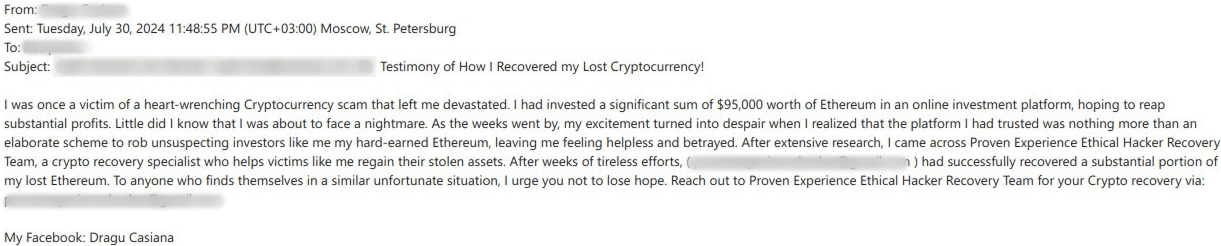
    February 19, 2025
  • MIL-OSI Economics: Young innovators shine: Meet the finalists of the Verizon Unloc Young Entrepreneurs Challenge

    Source: Verizon

    Headline: Young innovators shine: Meet the finalists of the Verizon Unloc Young Entrepreneurs Challenge

    LONDON, U.K. – Five young entrepreneurs have been named as finalists in the latest Young Entrepreneurs Challenge (YEC), an initiative launched by Verizon and Unloc.

    The challenge, now in its seventh year, aims to discover the business leaders of tomorrow by tasking young European entrepreneurs between the ages of 16 and 25 to devise a tech-led business idea that addresses a key industry or societal issue.

    This year’s challenge has brought to light a number of business models that tackle current sustainability and healthcare challenges including water restoration robots, biodegradable textiles from kombucha by-products, reforestation hexapod robots, a floating solar solution and a robotic glove for stroke rehabilitation. The team received over 100 competitive and innovative business ideas from a wide range of countries across Europe including the UK, Ireland, Spain, Italy, France, Germany, Switzerland, Belgium, Greece, Slovakia, Turkey, Portugal, Austria, Ukraine, Bulgaria, Estonia and Poland.

    “Throughout the past seven years, the Young Entrepreneurs Challenge has been a brilliant opportunity to discover young and promising talent across Europe. There is nothing like the imagination and innovation of a young mind. The YEC serves as a platform to help bring their ideas to life,” said Sanjiv Gossain, General Manager and Head of EMEA for Verizon Business.

    “Young entrepreneurs in Europe often face hurdles and scepticism in accessing funding and mentorship. Verizon Business is proud to play a small role in helping this next generation of tech leaders stay a step ahead in the industry, as they work to make a positive impact around the world.”

    “We are in an era where technological innovation is crucial for tackling complex challenges in sustainability, climate change, and health. Investing in the next generation of leaders and their ideas is essential to addressing these issues,” said Hayden Taylor, Co-Founder and Chief Executive of Unloc. “Each year, we are amazed by the ingenuity of young entrepreneurs and are impressed to see the innovative ideas submitted for the Young Entrepreneurs Challenge.”

    The five finalists will now compete head-to-head in a grand finale held in March 2025, pitching their business concept live to a panel of expert judges and invited guests representing both the worlds of business and education.

    The winner receives £10,000 (€11,750*), mentorship and a technology support package to help kickstart their business. In addition, the winner will also receive a ticket to attend the Global One Young World 2025 Munich Summit.

    Each runner-up will receive £977 (€1175) to fund their start-up business, a personalised development plan that focuses on key priorities, and access to a series of masterclasses over the next year that will pair the finalists with various industry experts.

    Here are the 2025 finalists:

    Aleksandra Daniljuk – AquaRenew

    Aleksandra aims to address the global environmental crisis of water pollution caused by excess nitrogen and phosphorus in water bodies. Her solution involves small, solar-powered robots that use wire meshes to collect harmful algae blooms, release oxygen through air stones to combat oxygen depletion, and utilise zeolite biofilters to absorb excess nutrients, thereby preventing further eutrophication.

    The key selling point is its self-sustaining business model. The collected algae will be sold to businesses that convert them into biofuels and other sustainable products, creating a revenue stream to fund more robots. This approach not only restores aquatic ecosystems but also fosters sustainability and generates economic value.

    Aleksandra’s solution also aligns with the UN SDG 14: Life Below Water, promoting ecological restoration and sustainability.

    Luisanny Martinez – Skomby by Tex

    Skomby by Tex is a solution to modern challenges in fashion and sustainability that offers a sustainable, biodegradable material made from kombucha fermentation by-products. The eco-friendly alternative to traditional leather and textiles is crafted from bacterial cellulose, offering a lightweight, durable, and unique texture. 

    The material is 100% biodegradable and compostable, and can even be reused as planting capsules. To further enhance the sustainable model of the business, the team uses natural dyes like turmeric, spirulina, and saffron, ensuring no toxic chemicals are involved.

    Skomby by Tex collaborates with local kombucha producers in order to reduce waste and emissions. Luisanny’s long-term vision is to scale production while maintaining low-impact manufacturing practices, such as sun drying and ambient-temperature fermentation.

    Marta Bernardino – Trovador

    The precision reforestation market is projected to reach $9.77 billion by 2033, growing at a 5.74% CAGR, with high demand from the private sector. Recognising a billion-dollar opportunity, Marta developed Trovador, a reforestation robotics company that combats climate change by planting trees in hard-to-reach areas. Unlike drones, which have a low survival rate for seeds, Trovador’s hexapod robots plant saplings with a 90% survival rate. These AI-driven robots navigate challenging terrains like cliffs and slopes, ensuring effective reforestation.

    Trovador’s unique hexapod design preserves essential soil conditions for sapling survival and operates autonomously, overcoming obstacles in real-time. This innovative approach supports sustainability by providing rural communities with a safe, efficient reforestation solution, aligning with several UN Sustainable Development Goals.

    The service is quite simple and self-explanatory: clients select the planting site, the robot is deployed, and reforestation is monitored remotely. With just £2.5 (€3) per tree, Trovador is 30% more affordable than traditional methods, while excelling in speed, safety, and sustainability.

    Sebastiaan Schalkwijk – Solar Sub

    Solar Sub’s floating solar solution revolutionises renewable energy by placing solar panels on water bodies, maximising land use and harnessing natural cooling. This approach enhances system efficiency, increasing energy yield by up to 27% compared to traditional solar systems.

    Solar Sub’s advanced cooling technology and optimal panel positioning improve efficiency and durability, reducing operational costs and extending the lifespan of solar installations. This innovation sets Solar Sub apart from competitors facing issues with panel overheating and degradation.

    Sebastiaan adopts a licensing business model which allows rapid scaling without significant capital investment. This reduces upfront costs and risks, enabling us to focus on strategic partnerships. His model has gained traction with support from key industry players, confirming market interest and feasibility.

    Zain Sumdani – Exoheal

    Exoheal addresses the global shortage of physiotherapists and the inaccessibility of effective therapy with a robotic glove and a machine-learning-powered app. This solution delivers personalised, real-time therapy, enabling stroke recovery from home. Early trials show a 50% improvement in recovery time compared to traditional methods.

    Exoheal app connects patients with hospitals and clinics, allowing remote monitoring and real-time feedback. Its modular design and scalable production ensure affordability and the ability to meet global demand.

    By 2028, Zain and his team aim to transform 100,000 lives, saving governments $178 million in healthcare costs and enabling $16 million in inpatient earnings.

    For more information on the Young Entrepreneurs Challenge visit: youngentrepereneurschallenge.com


    About Unloc

    Unloc was founded in 2013 by award-winning young leaders and advocates Hayden Taylor and Ben Dowling. Our mission is to empower young people to be innovative changemakers who seek to build stronger communities and sustainable businesses. We develop young people’s skills, enhance their potential and boost their determination to succeed. This is encapsulated in our ‘Developing Young Potential’ tagline. We work towards our mission by delivering inspiring educational programmes in our growing network of schools and colleges, our physical Changemaker Studios spaces in Portsmouth and London, and work with business leaders to deliver a range of programmes that help us achieve our mission. For more information about Unloc visit www.unloc.org.uk

    MIL OSI Economics –
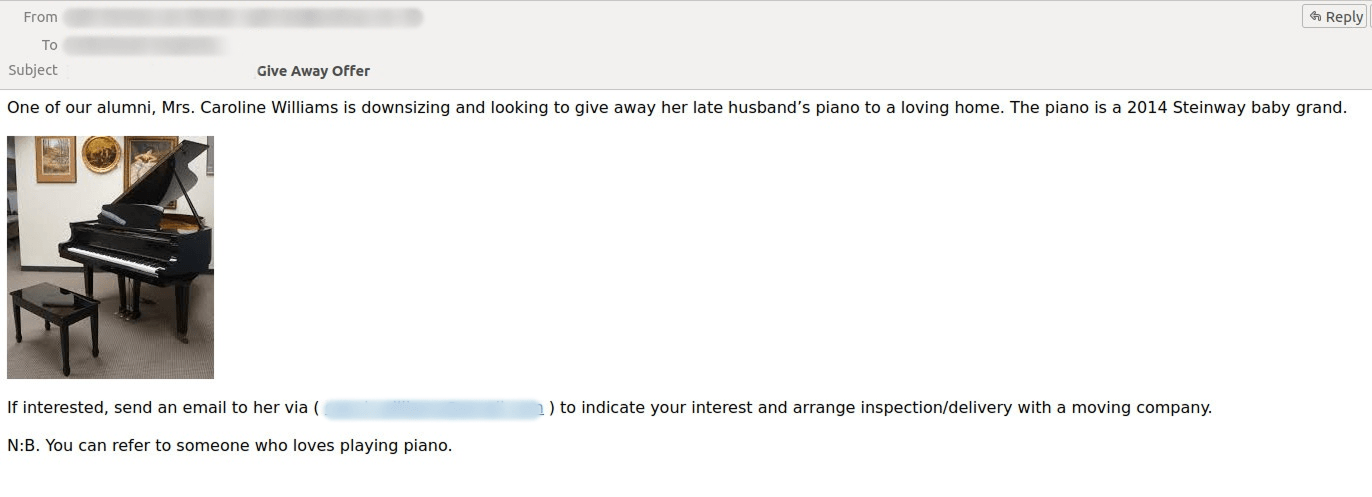
    February 19, 2025
  • MIL-OSI Banking: Huawei Europe Bags Prestigious Top Employer 2025 Award for Sixth Consecutive Year Feb 18, 2025

    Source: Huawei

    Headline: Huawei Europe Bags Prestigious Top Employer 2025 Award for Sixth Consecutive Year
    Feb 18, 2025

    [Düsseldorf, Germany, February 18, 2025] Huawei Europe earned recognition as a Top Employer in Europe for the sixth consecutive year in 2025. This prestigious certification covers the following 17 countries: Austria, Belgium, France, Germany, the Czech Republic, Greece, Hungary, Italy, Ireland, the Netherlands, Portugal, Poland, Romania, Spain, Switzerland, Sweden and Turkey.
    Huawei received the Top Employer Europe Award during the Top Employers Institute celebration dinner event

    The recognition is a testament to Huawei Europe’s exemplary human resources practices and underscores its commitment to fostering a culture of innovation, inclusivity, and continuous improvement.
    Lesley White, Vice President of Human Resources, Huawei European Region said: “Europe is home to a diverse and highly skilled talent pool, driving innovation and excellence. Being certified as a Top Employer in Europe is a testament to Huawei’s commitment to fostering a supportive, inclusive, and growth-oriented workplace. This recognition underscores the importance of investing in employee development, well-being and engagement, ensuring that the company not only attracts top talent but also retains and empowers them to thrive in a competitive global landscape.”
    The Top Employers Institute is a globally recognized authority in certifying excellence in employment practices. The certification process involves a comprehensive survey across six core dimensions, with over 250 detailed questions assessing various HR practices. Each topic is evidence-based, ensuring answers are factual and aligned with industry benchmarks, followed by a rigorous audit to guarantee certification accuracy.
    Patrik Rendel, Regional Manager DACH & CEE of Top Employers Institute said: ” On behalf of the Top Employers Institute, we extend our heartfelt congratulations to Huawei for achieving the prestigious Top Employer certification with an impressive score of 91.26%. This remarkable accomplishment reflects commitment to implementing best HR practices. Huawei’s dedication to empowering talent and driving innovation sets a benchmark for excellence in the industry. We are proud to recognize Huawei as a leader in people practices and look forward to your continued success in shaping the future of work. ”
    Lesley White, Vice President of Human Resources, Huawei European Region with Top Employers Institute CEO David Plink

    Huawei is dedicated to driving digital transformation and innovation, connecting the world through cutting-edge ICT technology. With a focus on excellence, we empower individuals to lead, excel, and shape the future of connectivity. Join us in a dynamic, supportive environment where your contributions will be recognized, and your potential can break boundaries, advancing both your career and global progress.
    To learn more visit: https://career.huawei.com/reccampportal/euportal/portal/index.html

    MIL OSI Global Banks –

    February 19, 2025
←Previous Page
1 … 87 88 89 90 91 … 125
Next Page→
NewzIntel.com

NewzIntel.com

MIL Open Source Intelligence

  • Blog
  • About
  • FAQs
  • Authors
  • Events
  • Shop
  • Patterns
  • Themes

Twenty Twenty-Five

Designed with WordPress