Category: Germany

  • MIL-OSI Europe: Written question – EU contributions to various foundations – E-000345/2025

    Source: European Parliament

    Question for written answer  E-000345/2025/rev.1
    to the Commission
    Rule 144
    Gerald Hauser (PfE)

    Germany funded Gates Foundation projects to the tune of EUR 600 million in taxpayers’ money in 2023 – an example of public-private partnerships supporting the Western elites. Cooperation between politicians and US foundations, such as the Gates or Rockefeller Foundations, raises questions about sovereignty and transparency. The EU plays a key role in promoting such projects through partnerships like the one between the World Economic Forum and the United Nations. This raises the question of how the EU ensures these funds safeguard European interests and are not undermined by the influence of private actors like Gates.

    • 1.How does the Commission protect its policies from the external influence of private US foundations and how is transparency in their funding by EU Member States ensured?
    • 2.What criteria and standards are applied in the selection of cooperation projects with private foundations and organisations or programmes involving private foundations?
    • 3.Which of the cooperation projects between the EU and foundations and NGOs have been evaluated so far and what has been the outcome of these evaluations in terms of their impact and the achievement of the agreed objectives?

    Submitted: 27.1.2025

    Last updated: 6 February 2025

    MIL OSI Europe News

  • MIL-OSI: Equasens: 2024 annual revenue

    Source: GlobeNewswire (MIL-OSI)

    Villers-lès-Nancy, 6 February 2025 – 6:00 p.m. (CET)

    PRESS RELEASE

    2024 annual revenue: €216.8 million including €58.6 million in Q4 (+2.6% on a reported basis and -0.4% like-for-like)

    Revenue (€&) 2023
    Reported basis
    2024
    Reported basis
    Change /
    Reported basis
    Of which external growth Of which Ségur1 2024

    Of which Ségur 2023

    Like-for-like change
    (organic growth)
    Q1 56.2 53.3 -2.9 -5.2% 2.0 0.3 -1.4 -3.8 -6.7%
    Q2 56.4 54.7 -1.7 -3.0% 1.7 0.3 -1.2 -2.6 -4.6%
    Q3 50.1 50.2 0.1 0.3% 1.8 0.2 -0.3 -1.5 -3.0%
    Q4 57.0 58.6 1.5 2.6% 1.7 0.2 -0.3 -0.2 -0.4%
    Total 219.7 216.8(*) -3.0 -1.4% 7.2 1.1 -3.2 -8.2 -3.7%

    (*)unaudited

    Note: Acquisitions in 2023 and 2024 (Atoopharm, Speach2Sense, Pratilog, ADV in Germany – now Pharmagest Germany) and Digipharmacie) have been restated in the scope of consolidation.
    Maintaining a strategy of external growth, in December 2024 Equasens Group acquired 90% of the capital of Calimed SAS, a software publisher for private practitioners and surgeons (with no consolidated revenue in Q4 2024).

    Equasens Group, (Euronext Paris™ – Compartment B – FR 0012882389 -EQS), a leading provider of digital solutions for healthcare professionals, reported full-year revenue for the 12-month period ending 31 December 2024 of €216.8m, contracting 1.4% on a reported basis. Like-for-like (organic growth), i.e. excluding the effects of acquisitions and the impact of the Ségur digital healthcare investment programme, revenue decreased by 3.7%.

    Annual revenue at 12/31/24 / Division (€m) 2023
    Reported basis
    2024
    Reported basis
    Change /
    Reported basis
    Of which external growth Of which Ségur 2024

    Of which Ségur 2023

    Like-for-like change
    (organic growth)
    Pharmagest 162.7 163.5 0.8 0.5% 7.1 0.5 -1.5 -5.3 -3.3%
    Axigate Link 31.1 32.1 1.0 3.2%   0.3  -1.0 1.7 5.5%
    e-Connect 15.0 11.2 -3.8 -25.3%       -3.8 -25.3%
    Medical Solutions 8.9 7.9 -1.0 -10.9% 0.1 0.3 -0.7 -0.7 -8.1%
    Fintech 2.0 2.0 0.0 -2.1%       0.0 -2.1%
    Total 219.7 216.8 -3.0 -1.4% 7.2 1.1 -3.2 -8.2 -3.7%

    No businesses were transferred between Divisions in FY 2024.

    FY revenue for the 12 month period ending 31 December 2024 / Activities (€m) 2023
    Reported basis
    2024
    Reported basis
    Change / Reported basis
    Sale of configurations and hardware 93.5 86.1 -7.4 -7.9%
    Scalable maintenance and professional training services 78.1 81.0 2.8 3.6%
    Software solutions and subscriptions 45.4 46.8 1.4 3.0%
    Other services (including intermediation) 2.7 2.9 0.2 7.9%
    Total 219.7 216.8 -3.0 -1.4%

    In Q4 2024 alone, Equasens Group registered sales of €58.6m, up 2.6% on a reported basis at 31 December 2023 (-0.4% like-for-like).

    Q4 2024 revenue / Division (€m) 2023
    Reported basis
    2024
    Reported basis
    Change /
    Reported basis
    Of which external growth Of which Ségur 2024

    Of which Ségur 2023

    Like-for-like change
    (organic growth)
    Pharmagest 42.2 43.4 1.2 2.9% 1.7 0.1 -0.2 -0.5 -1.1%
    Axigate Link 8.9 9.5 0.7 7.6%   0.1 -0.1 0.7 7.7%
    e-Connect 3.3 2.9 -0.3 -10.1%       -0.3 -10.1%
    Medical Solutions 2.2 2.2 0.0 -0.9%   0.1 -0.1 0.0 -2.1%
    Fintech 0.6 0.5 -0.1 -11.6%       -0.1 -11.6%
    Total 57.1 58.6 1.5 2.6% 1.7 0.3 -0.4 -0.2 -0.4%
    Q4 2024 revenue highlights by type of business 2023
    Reported basis
    2024
    Reported basis
    Change / Reported basis
    Sale of configurations and hardware 23.2 23.5 0.1 0.4%
    Scalable maintenance and professional training services 19.8 20.4 0.6 3.1%
    Software solutions and subscriptions 13.2 13.8 0.5 4.1%
    Other services (including intermediation) 0.8 1.0 0.2 27.5%
    Total 57.1 58.6 1.5 2.6%
    • In a year marked by political instability, particularly in France, configuration and equipment sales were again heavily impacted on a full-year basis (-7.9%). The recovery initially anticipated in Q3 got off to a slower than expected start with marginal growth in Q4 (+0.4%).
    • Scalable maintenance services and business training continued to display positive momentum with stable growth (+3.1 % in Q4 2024 and +3.6% for the full year).
    • Software solutions and subscriptions performed particularly well in H2 after declining in the first half (reflecting the base effect from Ségur) to achieve 3% growth for the full year.
    • The PHARMAGEST Division recorded annual sales of €163.5m (+0.5%) for the year ended 31 December 2024 on a reported basis, including €7.1m of restated sales arising from acquisitions in 2023 and 2024. On a like-for-like basis, sales for the division declined 3.3% for the full year.

    In Q4 2024, the Division grew 2.9% to €43.4m on a reported basis compared with Q4 2023, including €1.7m in restated sales linked to acquisitions in Q4 2023 and 2024. Like-for-like, the division’s sales declined 1.1% in the last quarter.

    • The Division’s strategy of innovation and bringing new software, hardware and services to market has strengthened its value proposition in terms of pharmacy productivity and automation solutions starting in the third quarter, with, for example, the id.Express payment terminal deployed in France, Germany and Belgium, the new id.Genius module integrating AI into dispensing, and id.Assistance, a new service facilitating the use and adoption of the id. offering on a day-to-day basis.
    • Based on these advances, the Pharmacy business now has a differentiating offering capable of generating revenue from its customer base (€2m at 31/12/2024) and contributing to growth in market share with more than 500 new customers in France and Italy (+€3.5m at 31/12/2024).
    • Digipharmacie, a provider of digital accounts payable management solutions for pharmacies, recently approved as a partner of the French e-reporting platform (Plateforme de Dématérialisation Partenaire or PDP), recorded annual growth of 27%.
    • The shift of the Division to SaaS offering culminated in the launch in September 2024 of the ASCA Dynamics solution, a cloud based version of the electronic label management software developed by Equasens Group. Nearly 250 of the 500 pharmacies added to ASCA’s customer base in 2024 are already equipped with this solution.

    This Division accounts for 75.4% of total revenue.

    • The AXIGATE LINK division registered €32.1m in revenue for the 12 month period ended 31 December 2024 (+3.2% on a reported basis and +5.5% like-for-like). In Q4 2024, the Division grew 7.6% to €9.5m on a reported basis compared with the same period in 2023. Like-for-like, the division’s revenue grew 7.7% in the last quarter.
      • The nursing home sector, which accounts for 53% of the Division’s revenues, experienced a strong growth in 2024, with the addition of 104 new establishments (excluding the UK), bringing its installed base to a total of 3,400 sites. The Titanlink SaaS offering was a resounding success, more than 600 sites equipped out of a total of 2,500 in France and 90 in Belgium out of a total of 932.
      • The Homecare sector also delivered a very solid performance, with a net gain of 20 customers, including 5 Hospital-at-Home programmes. In addition, the sector started rolling out the first version of a software package for regional elderly and disabled homecare centres (Centres de Ressources Territoriales or CRTs) to coordinate patient care. This activity accounts for 22% of the Division’s revenue.
      • The Hospital sector, 12% of the Division’s revenue, grew 4.1% in 2024 compared with 2023 with a net increase of 7 facilities, including 3 major psychiatric establishments. A portion of these orders signed in 2024 will be implemented and recognised in revenue for 2025.
      • The PandaLab Pro secure messaging system recently passed the milestone of 50,000 independent users or private organisations and 360,000 messages sent per month. 2024 experienced a growth in the number of use cases, particularly in teleconsultation, remote assistance and outpatient prescriptions, with the latter reaching 85,000 prescriptions exchanged in December 2024 alone.

    This Division accounts for 14.8% of total revenue.

    • The E-CONNECT division had revenue of €11.2m for the year ended 31 December 2024 (down 25.3% on a reported basis). Revenue in Q4 2024 was down 10.1% in relation to the same quarter in 2024 to €2.9m, representing a decline significantly less than in previous quarters.
      • Despite challenging market conditions, 2024 remained a year of investment, following an exceptional period in 2023 which benefited from a one-off regulatory development (the discontinuation of Application Reader Terminal sales).
      • In Q4 2024, Kapelse’s eS-KAP+ mobility solution was authorised for all prescribing healthcare professionals, midwives and health centres. This latest certification completes the “auxiliary health practitioners” approval obtained in 2024 and extends the number of partner software publishers who are starting to integrate eS-KAP+ into their business applications.
      • Sales of KAP-eCV (the electronic French health insurance card reader) got off to a promising start, with several thousand readers sold in Q4.
      • In November 2024, the new NOVIAcare offering (entailing a switch to modular sales) met with considerable success when it was unveiled at the Silver Economy Expo international exhibition in Cannes, confirming the potential of the first scalable and modular telecare solution on the market.

            This Division accounts for 5.2% of total revenue.

    • The MEDICAL SOLUTIONS Division recorded revenue of €2.2m in Q4 2024, down slightly (-0.9%) on Q4 2023. Reflecting the diminishing impact of the base effect from the Segur digital healthcare investment programme, the decline for the full year was limited to -10.9% to €7.9m, compared with -19.1% in H1 2024.
      • The launch of LOQUii, the AI voice consultation assistant, in November 2024, provides further confirmation of the recovery. By adopting a “Try Before You Buy” formula, more than 500 doctors used the solution in Q4, highlighting the potential for significant growth from Q1 2025 onwards, once the initial trial period is over.
      • At the same time, the roll-out of the MS.Safe online backup solution that combines safety and ease of use attracted around 50 users in less than two months.

    The Division accounts for 3.6% of total revenue.

    • The FINTECH Division  recorded revenue of €0.5m (-11.6%) in Q4 2024, and €2.0m for the full year (-2.1% compared with 2023).
      • The new Dispay digital bankcard payment service now integrated into the medical software solution of healthcare professionals resulted in subscriptions by 80 customers in Q4 and the Division remains confident that it will generate additional revenues as its customer base expands.

    The Division accounts for 1.0% of total revenue.

    2025 outlook
    Based on the encouraging indicators for Q4 2024, the Group is looking ahead to 2025 with confidence. Positive momentum is expected for the first half of the year, benefiting notably by a favourable base effect at the start of the year. A significant acceleration is expected in the second half with nominal growth of nearly 10%, driven by the capital expenditures and the roll-out of new solutions (software, hardware and services).

    In this context, Equasens Group is in the process of implementing a major strategic transformation to SaaS (Software as a Service) business model. This transition entails the gradual migration from solutions hosted at healthcare professionals’ premises to solutions hosted in the Group’s data centers which are certified Health Data Hosting (HDS) and ISO 27001. The new add-on modules are now developed almost exclusively for SaaS solutions which will increase the proportion of recurring revenues. This transformation is driven by a robust cloud infrastructure and customised support to assist our customers with their digital transition.

    At the same time, the Group is continuing to invest in Artificial Intelligence and accelerating its integration into its business tools to enhance its range of decision-making tools. This development brings real added value to healthcare professionals by making the prescription process more secure, providing personalised patient support and optimized time management.

    Backed by a solid financial structure, the Group will continue to monitor potential opportunities for external growth.

    This guidance does not take into account the potential effect of cyclical or macro-economic events that could have a direct or indirect impact on the healthcare sector.

    Financial calendar:

    • FY 2024 results: 29 March 2025
    • Presentation of 2024 annual results (SFAF): 31 March 2025, Paris
    • Q1 2025 revenue: 12 May 2025
    • Annual General Meeting: 26 June 2025
    • Q2 2025 revenue: 31 July 2025
    • H1 2025 results: 26 September 2025
    • Presentation of H1 2025 results to analysts (SFAF): 29 September 2025
    • Q3 2025 revenue: 5 November 2025
    • FY 2025 revenue: 5 February 2026

    About Group Equasens

    Founded over 35 years ago, Equasens Group, a leader in digital healthcare solutions, today employs over 1,300 people across Europe.
    Equasens Group’s specialised business applications facilitate the day-to-day work of healthcare professionals and their teams, working in private practice, collaborative medical structures or healthcare establishments. The Group also provides comprehensive support to healthcare professionals in the transformation of their profession by developing electronic equipment, digital solutions and healthcare robotics, as well as data hosting, financing and training adapted to their specific needs.
    And reflecting the spirit of its tagline “Technology for a More Human Experience”, the Group is a leading provider of interoperability solutions that improve coordination between healthcare professionals, their communications and data exchange resulting in better patient care and a more efficient and secure healthcare system.

    Listed on Euronext Paris™ – Compartment B

    Indexes: MSCI GLOBAL SMALL CAP – GAÏA Index 2020 – CAC®SMALL and CAC®All-Tradable
    Included in the Euronext Tech Leaders segment and the European Rising Tech label

    Eligible for the Deferred Settlement Service (“Service à Réglement Différé” – SRD) and equity savings accounts invested in small and mid caps (PEA-PME).
    ISIN: FR 0012882389 – Ticker Code: EQS

    Get all the news about Equasens Group www.equasens.com and on LinkedIn

    CONTACTS

    EQUASENS Group
    Analyst and Investor Relations:
    Chief Administrative and Financial Officer: Frédérique Schmidt
    Tel: +33 (0)3 83 15 90 67 – frederique.schmidt@equasens.com

    Financial communications agency:
    FIN’EXTENSO – Isabelle Aprile

    Tel.: +33 (0)6 17 38 61 78 – i.aprile@finextenso.fr

    Forward-looking statements
    This press release contains forward-looking statements that are not guarantees of future performance and are based on current opinions, forecasts and assumptions, including, but not limited to, assumptions about Equasens’ current and future strategy and the environment in which Equasens operates. These involve known and unknown risks, uncertainties and other factors, which may cause actual results, performance or achievements, or industry results or other events, to materially differ from those expressed in or implied by such forward-looking statements. These risks and uncertainties include those detailed in Chapter 3 “Risk factors” of the Universal Registration Document filed with the French financial market authority (Autorité des Marchés Financiers or AMF) on April 29, 2024 under number D.24-0366. These forward-looking statements are valid only as of the date of this press release.


    1 An investment programme rolled out by the French government to support the national strategy for eHealth acceleration.

    Attachment

    The MIL Network

  • MIL-OSI Economics: TWAAO: BaFin warns against offers on website twaao.com

    Source: Bundesanstalt für Finanzdienstleistungsaufsicht – In English

    The financial supervisory authority BaFin warns against offers on the website twaao.com. According to information available to BaFin, TWAAO allegedly based in Frankfurt is offering financial and investment services and crypto-asset services without the required authorisation.

    Anyone offering financial or investment services or crypto-asset services in Germany requires a license from BaFin. However, some companies offer such services without the required license. Information on whether a particular company is authorized by BaFin can be found in the company database.

    The information provided by BaFin is based on Section 37 (4) of the German Banking Act (KWG) and Section 10 (7) of the German Crypto Markets Supervision Act (KMAG).

    Please be aware:

    BaFin, the German Federal Criminal Police Office (BundeskriminalamtBKA) and the German state criminal police offices (Landeskriminalämter) recommend that consumers seeking to invest money online should exercise the utmost caution and do the necessary research beforehand in order to identify fraud attempts at an early stage.

    MIL OSI Economics

  • MIL-OSI Economics: ReFi Solutions: BaFin warns consumers against offers on website refi-solutions.com

    Source: Bundesanstalt für Finanzdienstleistungsaufsicht – In English

    The Federal Financial Supervisory Authority BaFin warns consumers against offers from the company ReFi Solutions or Remote Finance Solutions on website refi-solutions.com. According to information available to BaFin, banking transactions and financial services are being provided on this website without the required authorisation.

    Anyone conducting banking business or providing financial or investment services in Germany may do so only with authorisation from BaFin. However, some companies offer these services without the required authorisation. Information on whether companies have been authorised by BaFin can be found in BaFin’s database of companies.

    The information provided by BaFin is based on section 37 (4) of the German Banking Act (Kreditwesengesetz – KWG).

    Please be aware:

    BaFin, the German Federal Criminal Police Office (BundeskriminalamtBKA) and the German state criminal police offices (Landeskriminalämter) recommend that consumers seeking to invest money online should exercise the utmost caution and do the necessary research beforehand in order to identify fraud attempts at an early stage.

    MIL OSI Economics

  • MIL-OSI Economics: Grow State Markets: BaFin warns against website fina-eu.growstatemarkets.com (previously: growstatemarkets.com)

    Source: Bundesanstalt für Finanzdienstleistungsaufsicht – In English

    The financial supervisory authority BaFin warns against trading platform Grow State Markets. According to its findings, financial, investment and crypto asset services are provided by Grow State Markets (which in the past operated the website growstatemarkets.com) without the required authorisation. The company is not supervised by the alleged FINAEU (European Financial Authority). There is no FINAEU supervisory authority and it does not supervise companies that operate in the financial sector.

    FINAEU was already a subject of a warning issued by BaFin on 29 August 2024.

    Anyone conducting banking business or providing financial or investment services in Germany may do so only with authorisation from BaFin. However, some companies offer these services without the required authorisation. Information on whether companies have been authorised by BaFin can be found in BaFin’s database of companies.

    The information provided by BaFin is based on Section 37 (4) of the German Banking Act (KWG) and Section 10 (7) of the German Crypto Markets Supervision Act (KMAG).

    Please be aware:

    BaFin, the German Federal Criminal Police Office (BundeskriminalamtBKA) and the German state criminal police offices (Landeskriminalämter) recommend that consumers seeking to invest money online should exercise the utmost caution and do the necessary research beforehand in order to identify fraud attempts at an early stage.

    MIL OSI Economics

  • MIL-OSI United Nations: International Community Must Keep Pushing for Permanent Ceasefire, Work towards Gaza’s Reconstruction, Secretary-General Tells Palestinian Rights Committee

    Source: United Nations General Assembly and Security Council

    Speakers Urge Member States to Fully Support UN Palestine Refugee Agency’s Vital Work, Stress Rising Violence by Israeli Settlers in West Bank Must Stop

    The international community must keep pushing for a permanent ceasefire and work towards the reconstruction of Gaza, the UN Chief told the Palestinian Rights Committee today, highlighting the essential role of the United Nations Relief and Works Agency for Palestine Refugees in the Near East (UNRWA) in the process.

    “At its essence, the exercise of the inalienable rights of the Palestinian people is about the right of Palestinians to simply live as human beings in their own land,” said UN Secretary-General António Guterres in his remarks to the Committee on the Exercise of the Inalienable Rights of the Palestinian People as it opened its 2025 session.

    However, the realization of those rights steadily slips farther out of reach as the world witnesses “chilling, systematic dehumanization and demonization of an entire people”, he said.  Nearly 50,000 people — 70 per cent of them women and children — have been reported killed and most of Gaza’s civilian infrastructure — hospitals, schools and water facilities — has been destroyed.  Displacement after displacement, hunger and disease left an entire generation homeless and traumatized.

    “We cannot go back to more death and destruction,” he asserted, adding that the UN is working around the clock to reach Palestinians in need and scale up support.  That requires rapid, safe, unimpeded, expanded and sustained humanitarian access, he said, calling on Member States to fully fund humanitarian operations and support UNRWA’s vital work.

    In the search for solutions, it is crucial to stay true to the bedrock of international law and avoid any form of ethnic cleansing, he stressed, adding that a viable, sovereign Palestinian State living side by side in peace and security with Israel is “the only sustainable solution for Middle East stability”.

    Relatedly, he voiced grave concern over rising violence by Israeli settlers and other violations in the occupied West Bank, including East Jerusalem.  “The violence must stop,” he said, urging respect for international law, including the International Court of Justice orders.

    “The ceasefire was a decisive step forward in providing aid and safety,” said Coly Seck (Senegal), the elected Chair of the Committee for 2025.  He called on States to “reinvent strategies to block the way for those enemies of peace on Palestinian ground” and on the international community to defend “these people long oppressed”, adding:  “This is a key year for the Palestinian cause.”

    Permanent Observer for State of Palestine Rejects Concept of ‘Ceasefire in the Gaza Strip and Open Hell in the West Bank’

    Riyad H. Mansour, Permanent Observer for the State of Palestine, said that while “we are delighted to have a ceasefire”, the agreement must become permanent and cover all parts of the Occupied Palestinian Territory.  He rejected the concept of “a ceasefire in the Gaza Strip and open hell in the West Bank”, and underscored the need to implement all the agreement’s provisions, including the reconstruction of Gaza and the safe return of the Palestinians to the areas from which they were displaced.

    Outlining his objectives for 2025, he stressed that defending UNRWA — the most successful story of multilateralism since the UN’s inception — is paramount.  Furthermore, he outlined his plan to work with all Member States towards a successful international conference in June, co-chaired by Saudi Arabia and France, to accomplish the objectives established by the International Court of Justice. The body determined that prolonged occupation of the Palestinian Territory is unlawful and must be terminated as quickly as possible.  Echoing that, the General Assembly legislated that this illegal occupation must be terminated within one year.

    Underscoring the need to rebuild Gaza, he declared:  “It is part of our homeland, and we do not have a homeland other than the State of Palestine [nor] are we looking for other homelands or countries”.  Rejecting any idea of ethnic cleansing, he urged all countries to help Palestine’s Government in this endeavour.  Accordingly, he spotlighted “intense meetings and communications” between President Mahmoud Abbas and the leaders of Jordan, Egypt and Saudi Arabia.

    “There is no power on Earth that can remove the Palestinian people from our ancestral homeland, including Gaza,” he said, adding that the return of 400,000 Palestinians to the north is “our answer for those who want us to kick us out of Gaza”.

    UNRWA Is Stabilizing Force, Committed Partner to Peace, Agency Official Says

    Greta Gunnarsdottir, Head of the UNRWA Liaison Office in New York, speaking on behalf of the Agency’s Commissioner-General, Philippe Lazarini, said that, although the Knesset legislation prohibiting UNRWA’s operations creates challenges, the Agency’s local staff continues to operate “at considerable personal risk” in the occupied West Bank.  While operations in Gaza continue, it is unclear how the contact prohibition with Israeli officials will constrain the Agency’s work.  Since the ceasefire, UNRWA has distributed food to 750,000 people and conducted 17,000 medical consultations; in January, 260,000 children enrolled in its online learning programmes.

    However, she emphasized curtailing UNRWA’s operations will undermine the ceasefire and sabotage Gaza’s recovery and political transition.  “The Government of Israel is investing significant resources to portray the Agency as a terrorist organization,” she said, adding that — as a result — donors are declining or reducing funding.  “For 75 years, UNRWA has been a stabilizing force and a committed partner for peace in the Occupied Palestinian Territory.  It must be allowed to remain so until a political solution is at hand,” she stated.

    UN Special Rapporteur on the Right to Food Calls Israel’s Starving of 2.3 Million Palestinians in Gaza ‘Fastest Starvation Campaign in Modern History’

    Michael Fakhri, UN Special Rapporteur on the Right to Food, speaking via video conference, recalled that Israel announced its intent to starve the civilians in Gaza on 6 October 2023 — before the Hamas attacks.  On the reached agreement, he said:  “This is not a ceasefire, [but] a slowing down of Israel’s genocide and starvation campaign.”

    On 6 October 2023, Gaza had been under a blockade for 23 years, with 50 per cent of its civilians already food insecure and 80 per cent dependent on humanitarian aid.  “How is it even possible for Israel to starve 2.3 million Palestinians in Gaza so quickly and so completely,” he asked, citing it as “the fastest starvation campaign in modern history”.

    One of the reasons for UNRWA’s creation in 1948 was to prevent the starvation of the Palestinian people, he pointed out, stressing that “there has always been the risk of starvation”.  The International Court of Justice has recognized the risk of genocide and the occurrence of starvation, as reflected in its warrants on the crime of starvation against Israel’s Prime Minister Benjamin Netanyahu and former Defence Minister Yoav Gallant.

    The right of return and the right to self-determination of the Palestinian people constitute the foundation necessary for future political solutions, he continued.  Israel has been attacking Palestinians “at degrees of violence not seen before”, destroying food systems and creating conditions of hunger that will last for generations.  Moreover, it has attacked the UN itself — it shot at peacekeepers in Lebanon, killed a record number of UN staff in Gaza, mostly UNRWA, and declared the Secretary-General a persona non grata.

    Nonetheless, he emphasized that without the support of the United States and Germany — among others — Israel would be unable to implement its starvation campaign and commit genocide.  Washington, D.C., under the previous administration, exited international law, while “the current administration exited the UN” by defunding UNRWA, threatening to defund the United Nations Educational, Scientific and Cultural Organization (UNESCO) and withdrawing from the Human Rights Council. “What is at stake is the international legal order and the UN itself,” he warned, highlighting the importance of the Hague Group, which was created to implement the decisions of the International Court of Justice and the International Criminal Court.

    Recounting Death of Relatives in Gaza Due to Israeli Bombings, UNRWA USA Philanthropy Director Stresses ‘We Will Continue’

    “My world shuttered for the first time on 24 November 2023, when Israel dropped a bomb on the family home where my brother lived,” said Hani Almadhoun, Senior Director of Philanthropy at UNRWA USA, also recalling the humiliation of his other brother, who was falsely accused of being a fighter.  “Palestinian men were paraded by the Israeli army in their underwear as if they were part of some grotesque spectacle,” he observed.  While his non-profit organization supports UNRWA’s work, he noted that individual efforts — no matter how heartfelt — cannot replace the comprehensive support of an established institution like UNRWA.  He further recalled that, in February 2024, together with his brother Mahmoud, he co-founded the Gaza Soup Kitchen, which soon became a “lifeline” serving hot meals to thousands of families.

    When hospitals were under siege, Mahmoud also created a medical clinic that provided baby formula and diapers and founded a small school for 560 children.  He said that “forcing the Palestinians out of Gaza is as unrealistic as draining the ocean”, stating:  “Whenever the world failed the Palestinian people […] the land did not.”  His concluded by citing the words of his brother Mahmoud, who was killed by an Israeli strike in November 2024: “We will continue.”

    Committee Members Highlight UNRWA’s Indispensable Role, Reject Any Attempts to Expel Palestinians from Occupied Palestinian Territory

    In the ensuing discussions, Committee members highlighted UNRWA’s indispensable role, with Cuba’s delegate stressing that “to prohibit the work of the Agency today means undermining the present and the future of the Palestinian people”.

    While Guyana’s delegate underscored that “the ceasefire must be a stepping stone towards the lasting peace”, her counterpart from Venezuela warned that the latest developments in the West Bank could threaten the agreement.

    Others, including Nicaragua’s representative, rejected the recent declarations that imply attempts to expel the Palestinian population from its territories.  A displacement plan — “even opening it for discussion” — is unacceptable, said Türkiye’s representative.

    Echoing that, Qatar’s delegate said that, during the comprehensive reconstruction process in Gaza, the international community must ensure that Palestinians remain on their land.

    For her part, Egypt’s delegate said that commemorating the Committee’s fiftieth anniversary manifests “the failure of the international community to assist the Palestinian people”.

    2025 Work Programme Adopted, Bureau Elected  

    In other business, the Committee adopted its work programme for 2025 and unanimously elected Coly Seck (Senegal) as Chair and Neville Melvin Gertze (Namibia), Jaime Hermida Castillo (Nicaragua), Ahmad Faisal Muhamad (Malaysia), Arrmanatha Christiawan Nasir (Indonesia) and Ernesto Soberón Guzmán (Cuba) as Vice-Chairs.

    MIL OSI United Nations News

  • MIL-OSI Europe: Czech city Ústí nad Labem to get green upgrades with EIB loan of almost €43 million

    Source: European Investment Bank

    • EIB lends €42.8 million to Ústí nad Labem in north-west Czechia to upgrade municipal infrastructure.
    • Loan to cover building, transport and energy renovations.
    • Improvements also planned for education and social care.

    The European Investment Bank (EIB) is lending €43 million (CZK 1.08 billion) to the Czech city of Ústí nad Labem for a range of green and social improvements, highlighting a Europe-wide push for urban renewal and sustainability.

    Ústí nad Labem, with a population of around 90 000 located near the Czech border with Germany, will use the EIB loan to refurbish buildings, enhance energy efficiency, develop clean power and upgrade services, including public transport, education and social care.

    The city is an industrial centre where a number of Czech manufacturing companies are located. It has a port on the river Elbe and serves as a major road and railway hub. The European Union seeks to make all cities climate-neutral by 2050 to combat global warming.

    “This loan to Ústí nad Labem underscores our commitment to empowering cities in their transition towards climate-neutral and sustainable growth. By modernising infrastructure, improving energy efficiency and advancing renewable energy investments, we are enhancing quality of life while building a greener, more inclusive and resilient future for people,” said EIB Vice-President Kyriacos Kakouris.

    Part of the EIB loan will go to works at the municipal zoo, including upgrading animal pavilions, visitor areas and energy and water management. These efforts support climate action by reducing greenhouse gas emissions.

    The EIB loan stems from an EU initiative, the Just Transition Mechanism (JTM), which aims to address the social and economic impacts of transitioning to a climate-neutral economy. By blending loans from the EIB with grants from the European Commission, JTM supports investments in the regions most affected by this transition, ensuring no community is left behind. Accordingly, the EIB will finance up to 72% of the overall project costs, complemented by funding from EU grants and the city’s budget. The project promoter benefits from the support of the InvestEU Advisory Hub and will apply for a Public Sector Loan Facility (PSLF) grant, which would amount to 25% of the EIB loan amount.  

    The EIB loan aligns with the city’s development strategy supporting sustainable urban renewal. The EIB will also advise the City of Ústí in terms of conducting investments in municipal infrastructure, zoo pavilions, water management and energy savings.

    “Public housing, mobility and energy are key topics in our transformation process and in the long-term and sustainable direction of the city, and I am very pleased that we have managed to secure financing for these types of projects through cooperation with the EIB. I believe that we are only beginning our cooperation with the EIB, that will significantly advance the city and our zoo, which can become a truly modern and energy-self-sufficient area. We are also striving to access EIB support within the ELENA programme,“ said Ústí nad Labem Mayor Petr Nedvědický.          

    This EIB loan overcomes obstacles to market financing, ensuring that Ústí nad Labem can invest in essential public goods, services and a sustainable future.

    Background information

    About the EIB and Czechia

    The European Investment Bank (EIB) is the long-term lending institution of the European Union. It finances investments contributing to EU policy goals. The EIB Group invested €2.47 billion in Czechia in 2024, supporting regional development and boosting economic resilience while also enhancing environmental sustainability and improving quality of life.

    About PSLF and the Just Transition Mechanism

    The Public Sector Loan Facility aims to alleviate the social and economic effects of the transition towards climate neutrality in the EU regions. This blending facility combines loans from the EIB with grants from the European Commission to help mainly public sector entities in the most hard-hit EU regions, which are identified in the territorial just transition plans, to mobilise additional public investments and meet their development needs in the transition towards climate neutrality. The first PSLF call for proposals was launched on 19 July 2022 with ten intermediate cut-offs until the end of 2025. There are three cut-off dates per year planned until the end of 2025. A second call for proposals will be launched in 2026.

    To find out more about PSLF and PSLF-funded projects, please visit the CINEA website.

    CINEA

    The European Climate, Infrastructure and Environment Executive Agency (CINEA) is an executive agency established by the European Commission to implement parts of EU funding programmes for transport, energy, climate action, environment, maritime fisheries and aquaculture.

    CINEA aims to support its beneficiaries, establish strong partnerships, deliver high-quality programme and project management, foster effective knowledge-sharing and create synergies between programmes, to support a sustainable, connected and decarbonised Europe.

    MIL OSI Europe News

  • MIL-OSI Global: These maps of support for Germany’s far-right AfD lay bare the depth of the urban-rural divide

    Source: The Conversation – UK – By Rolf Frankenberger, Managing Director Research, Institute for Research on Right-Wing Extremism (IRex), University of Tübingen

    The process of industrialisation, globalisation and urbanisation – spreading out from urban centres into the countryside – is one of the core developments of modern society. It has changed people’s lives in almost every part of the world. This is a process that has been going on for more than a century. New lifestyles have developed and traditional ones have been challenged.

    A new division has emerged as a result between the urban and the rural. The two are more than just forms of settlements – they reflect ideals, values and lifestyles. Those who live in towns and cities lead almost entirely different lives to those who live in the countryside.

    Where the two meet, there is potential for tension. And that tension can be politicised. In Germany, the Alternative für Deutschland (AfD), a far-right nationalist and völkisch party, is using the “urban-rural divide” to polarise and mobilise an electorate that is attracted by romanticised notions of purity, tradition, nation and rurality.

    Using spatial and data analysis, we can illustrate the patterns of this politicisation.

    Imagine you are living in a small village in the countryside. You strongly believe in traditions and family life. You regard the landscape around you as home – as heimat, as it would be called in German. But people from abroad are moving into your village, because they can afford land there. They are different in the way they think and live. They might, for example, be digital nomads in search of a picturesque location for their home office.

    These newcomers bring the city with them, changing the rural community they join. City, to you, is a cipher for urbanity, globalism and individualism.

    But this is just one side of the coin. The other is that people from the countryside also move to cities, be it for education, work or just because there is nothing left in their village. And they bring their lifestyles to the city, too, trying to keep up traditional ideals of how the world should look.

    Diversity, ambiguity and, sometimes, incompatibility become the norm under these conditions. Urban lifestyles and designs – such as shared flats, alternative family forms, non-binary identity or digital mobility at work – collide with rural norms such as the traditional family and “rootedness” across generations.

    This can happen both in cities and in rural areas. As a result, a pluralism of ideas, styles and values arises – ranging from progressive, liberal and leftist, inclusive, modernist values to traditional, conservative and rightist, exclusive and nationalist beliefs. They coexist but are unevenly distributed over urban and rural areas.

    The AfD and other far-right parties introduce a political meaning to the urban-rural divide. The AfD pushes a narrative of the city as a negative force that is fundamentally incompatible with the rural. It claims that an elite cartel has usurped power in Germany and is trying to destroy the “culturally determined German identity”. It instead advocates for the protection of a leitkultur – of customs and traditions (brauchtum) that it believes create identity. It asserts heteronormativity as a biological fact, emphasises a strong traditional family, traditional farming and rural identity.

    What might be called cultural landscapes (kulturlandschaften) have become a particular battleground of late, with opposition to the construction of wind turbines, especially in forests, now a policy position. The AfD’s candidate for chancellor, Alice Weidel, described these as “windmills of shame” (“Windmühlen der Schande”) and called for their dismantling at the recent party congress. Wind turbines can be understood here as expressions of urban leitmotifs in a rural cultural landscape – they disrupt the countryside to provide energy for unseen urban consumers.

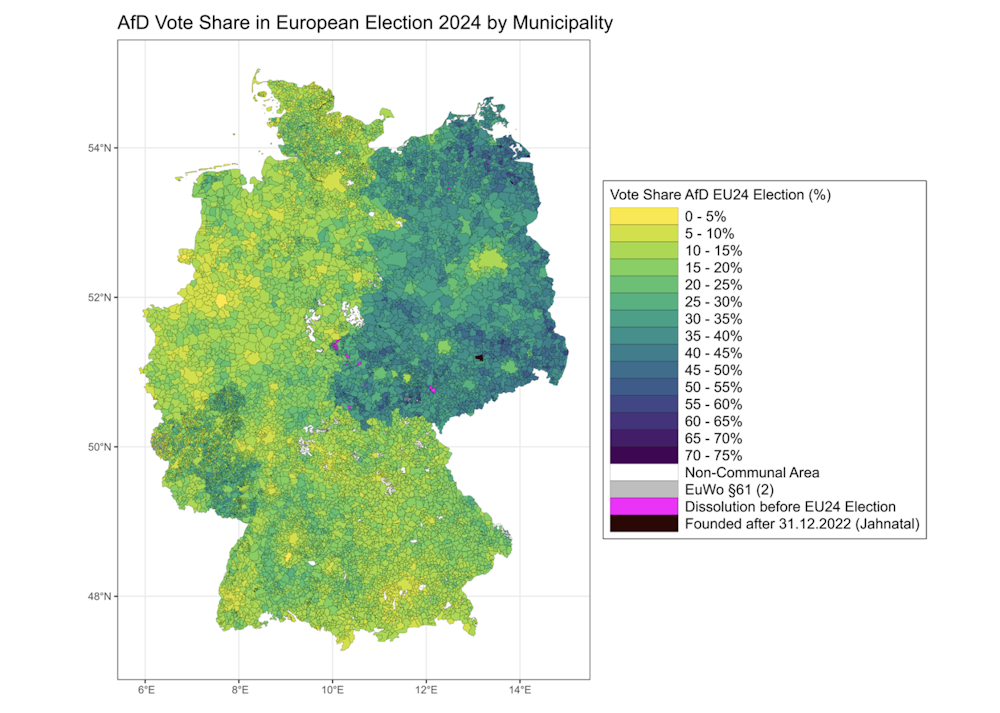
    And ultimately, this politicisation translates into electoral outcomes. In the European parliament elections of June 2024, the AfD took 15.9% of German votes. If we look at the spatial distribution of the AfD’s vote, a pattern showing the salience of the urban-rural divide emerges.

    East and west, town and country

    It’s clear by looking at the map that most (though not all) of the AfD’s strongholds are in eastern Germany – the region which used to be the German Democratic Republic (GDR). Fascism and Nazism were outlawed by decree when this anti-fascist state was established but, in reality, far-right ideologies don’t die off that easily. The result was that extremist views survived in an environment where there was also a lack of education on the National Socialism of the past – and a lack of education about democracy.

    When the socialist authoritarian GDR regime fell in 1989, Germany was reunified under western conditions. This had various effects, including a sense that the experiences of the east were not valued. The inequalities between the two sides of the reunified nation have left some in the east feeling distant from the state. The AfD’s version of nationalism finds fertile ground here.

    Another pattern is also clear across the whole country: the AfD is stronger in remote and rural areas and weaker in urban centres. There is less support in cities such as Berlin, Cologne, Dresden, Hamburg, Leipzig, Munich and Stuttgart. Places with more globalised cultures, international business and diverse populations remain comparably resilient to the spread of the far right.

    AfD support in different municipalities. The darker the colours, the higher the AfD vote share.
    R Frankenberger, CC BY-ND

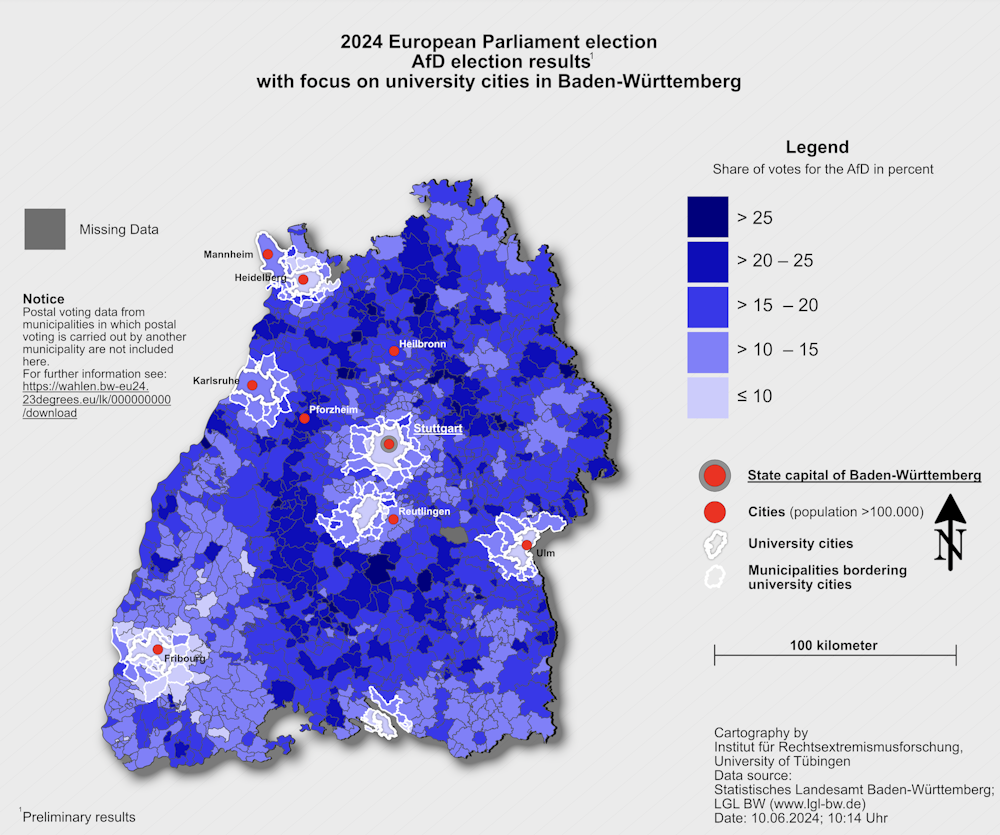
    These patterns become more visible if you take the European election results in the state of Baden-Württemberg as an example.

    The AfD performs significantly worse in the more globalised, cosmopolitan and university-oriented urban areas and their suburbs than in the more remote and rural areas of Baden-Württemberg. On the map, university cities are marked out with a white outline.

    AfD support mapped, with university cities highlighted.
    University of Tübingen, CC BY-ND

    The AfD is particularly strong in the northern and eastern Black Forest, on the Baar, in the Swabian Alb, in the Rems-Murr district, in the Swabian Forest and in Hohenlohe. Most of these areas are remote, with many small towns and villages. They have slightly lower income levels and lower levels of migration than average. They are much more traditional in terms of culture and religion than urban areas.

    The Black Forest, the Swabian Forest, and Hohenlohe also have quite strong protestant and evangelical communities, which are strongholds of traditional family life, customs and traditions.

    We should expect to see these trends continue. The AfD looks set to make further gains in the February 23 election being held in Germany, retaining its strongholds in the east but also spreading into the west in rural areas. The urban-rural divide will therefore become all the more apparent and entrenched when German voters head to the polls.

    Rolf Frankenberger does not work for, consult, own shares in or receive funding from any company or organisation that would benefit from this article, and has disclosed no relevant affiliations beyond their academic appointment.

    ref. These maps of support for Germany’s far-right AfD lay bare the depth of the urban-rural divide – https://theconversation.com/these-maps-of-support-for-germanys-far-right-afd-lay-bare-the-depth-of-the-urban-rural-divide-248405

    MIL OSI – Global Reports

  • MIL-OSI United Kingdom: Labour warned against pandering to far right

    Source: Scottish Greens

    It’s impossible to beat the far right by copying them.

    Labour cannot defeat the far right by pandering to them or replicating their policies, warns Scottish Greens co-leader Lorna Slater.

    The warning comes as a group of Labour MPs called on Labour to take a more right-wing stance on immigration and other issues, and as Scottish Labour leader Anas Sarwar said he couldn’t rule out working with Reform MSPs to take power in Scotland.

    With recent polls showing that Reform UK are set to gain seats in Holyrood and for the first time take the lead in Westminster, Scottish Greens are calling on Labour to ignore the far right’s toxic game.

    Scottish Greens Co-Leader Lorna Slater said:

    “Copying the hateful and authoritarian policies of the far right is always wrong. It punished marginalised people and normalises extreme policies. It won’t win Labour any votes, and will simply legitimise the toxic policies of Reform and those like them.

    “Time and again, across Europe and the world, we have seen that trying to mimic the far-right and take them on at their own game does nothing to silence them; it only makes them louder.

    “In Germany, the AfD has been legitimised by mainstream parties who have pandered to them on immigration; now these fascists stand a real chance at entering government and in America, Donald Trump was propelled to the White House by a pitiful failure of centrist opposition who tried to do the same.

    “Labour needs to learn lessons from fighting the far right across the world, but I have little hope that Keir Starmer will listen. He promised change, yet on everything from tackling the climate crisis to protecting working-class families he is already failing badly.”

    Ms Slater added:

    “Scotland deserves so much better than a race to the bottom between Labour, the Tories and Nigel Farage. We can have a fairer, greener and more equal future.

    “Whilst other parties are lurching to the right, the Scottish Greens are standing our ground as a party that will always put people and planet before profit.”

    MIL OSI United Kingdom

  • MIL-OSI Banking: BaFin warns consumers about various websites advertising automated crypto trading bot

    Source: Bundesanstalt für Finanzdienstleistungsaufsicht – In English

    The Federal Financial Supervisory Authority (BaFin) warns consumers about a series of platforms advertising an AI-controlled algorithm for trading in financial instruments and cryptoassets. Specifically, the following providers are under investigation:

    • zivaprofit7.com – ZivaProfit7 Ai
    • velmocoin.com – Velmo Coin AI
    • zolintex.com – Zolintex AI
    • luxigain.com – LuxiGain AI
    • grabcapital4u.com – GrabCapitaL4u Ai
    • tivanafund.com – TivanaFund AI
    • brixogain.com – Brixo Gain AI
    • brixofund.com – BrixoFund AI
    • pamborich.com – Pamborich Ai
    • zonocash.com – Zono Cash AI
    • econarix.com – Econarix AI
    • zorbofund.com – ZorboFund AI
    • gaintomo.com – GAINTOMO AI
    • trovafund.com – TrovaFund AI
    • gliporich.com – GlipoRich AI
    • viznofund.com – ViznoFund AI
    • grivogain.com – GrivoGain AI

    Anyone offering financial or investment services or crypto-asset services in Germany requires a license from BaFin. However, some companies offer such services without the required license. Information on whether a particular company is authorized by BaFin can be found in the company database.

    The information provided by BaFin is based on Section 37 (4) of the German Banking Act (KWG) and Section 10 (7) of the German Crypto Markets Supervision Act (KMAG).

    Please be aware:

    BaFin, the German Federal Criminal Police Office (BundeskriminalamtBKA) and the German state criminal police offices (Landeskriminalämter) recommend that consumers seeking to invest money online should exercise the utmost caution and do the necessary research beforehand in order to identify fraud attempts at an early stage.

    MIL OSI Global Banks

  • MIL-OSI Global: Where support for Germany’s far-right AFD is growing and why – podcast

    Source: The Conversation – UK – By Laura Hood, Host, Know Your Place podcast, The Conversation

    Germany is holding an election on February 23 and the contest is attracting an unusual amount of attention. That’s because the far-right Alternative for Germany (AFD) is polling in second place on 20% of the national vote.

    Should the party end up with a vote share on this scale, it would be its best ever result in a national election. It would change the face of the German parliament and force mainstream parties into difficult questions about their longstanding refusal to work with extreme parties.

    The AFD’s roots are in nationalistic and racist movements. It continues to take an ultra anti-immigration stance and, in this election, is calling for “demigration” – effectively the deportation of migrants.

    In this episode of The Conversation Weekly podcast, Rolf Frankenberger, an expert on right-wing extremism at the University of Tübingen in Germany, explains where the AFD draws its support from and what type of Germany it wants to return to.

    Frankenburger has found two clear trends in the geographical distribution of AfD voting. The first is common among far-right parties around the world:

    “ There are always exceptions, of course, but the main pattern is that around the big cities like Berlin, like Hamburg, Bremen, Hanover, Münster, Stuttgart, Munich, Frankfurt in these cities and their direct environment and suburbs, the AFD is less important. Whereas in the specific rural areas, like in Saxonia, in the Erzgebirge, in Baden-Württemberg, in the Black Forest, in Rhineland Palatinate, in the more rural areas, they have their strongholds.”

    The second, however, is unique to Germany. Support for the AFD is far more concentrated in the east of Germany. This region was the part of the country that made up the communist German Democratic Republic between 1949 and 1990, before German reunification.

    “Reunification in Germany produced winners and losers. And in the view of many East German people – and much of it is true – there are inequalities that were produced by reunification.”

    These divisions are being exploited to push what Frankenburger terms a form of white supremacist, traditionalist “Völkisch nationalism” – not a term that is well understood outside of Germany but which resonates heavily in domestic politics.

    “And so the AFD comes in and says ‘hey, there’s something wrong with the state, there’s something wrong with democracy, and there’s something wrong with our heritage. So we have a strong German heritage. We have an identity, we have an idea and all the others are trying to destroy it’. So it’s a kind of protest.”

    To find out more about narratives pushed by the AFD, listen to the interview with Rolf Frankenberger on The Conversation Weekly podcast.


    This episode of The Conversation Weekly was written and produced by Mend Mariwany and Gemma Ware. Sound design was by Michelle Macklem, and theme music by Neeta Sarl.

    Clips in this episode from AFP News, AfD in English, DW News and Al Jazeera English.

    Listen to The Conversation Weekly via any of the apps listed above, download it directly via our RSS feed or find out how else to listen here.

    Rolf Frankenberger does not work for, consult, own shares in or receive funding from any company or organisation that would benefit from this article, and has disclosed no relevant affiliations beyond their academic appointment.

    ref. Where support for Germany’s far-right AFD is growing and why – podcast – https://theconversation.com/where-support-for-germanys-far-right-afd-is-growing-and-why-podcast-249045

    MIL OSI – Global Reports

  • MIL-OSI: Danish Government Borrowing and Debt 2024

    Source: GlobeNewswire (MIL-OSI)

    Today, Danmarks Nationalbank publishes the report Danish Government Borrowing and Debt 2024.

    The highlights are: 

    Central government debt fell to a historic low of kr. 217 billion, equivalent to 7.4 per cent of GDP in 2024. Interest costs remained low at a total of kr. -0.3 billion and the yield spread to Germany became negative during the year. The highest possible credit rating of AAA has been retained with a stable outlook. Consolidation remained a key focus to maintain a well-functioning and liquid government securities market. In February, a new 2-year government bond was opened and in September a 2-year euro denominated bond was issued under the government’s EMTN programme. Robust risk management has continued to stabilise the government’s interest rate and market risk. Combined with the solid Danish economy, the Danish government enters 2025 in a strong position for managing government debt. 

    Read more in the report Danish Government Borrowing and Debt 2024 at https://www.nationalbanken.dk/en/news-and-knowledge/publications-and-speeches

    Enquiries can be directed to governmentdebt@nationalbanken.dk. 

    The MIL Network

  • MIL-OSI: ING posts full-year 2024 net profit of €6,392 million and outstanding commercial growth

    Source: GlobeNewswire (MIL-OSI)

    ING posts full-year 2024 net profit of €6,392 million and outstanding commercial growth

    Full-year profit before tax of €9,300 million, supported by growing customer base and increase in lending and deposits
    Mobile primary customer base rises by 1.1 million in 2024 to 14.4 million
    Net core lending growth of €28 billion, or 4%, and net core deposits growth of €47 billion (7%)
    Total income of €22.6 billion; double-digit growth in fee income, surpassing €4 billion for the first time
    Full-year return on equity of 13.0%; proposed final cash dividend of €0.71 per share
     
    4Q2024 profit before tax of €1,771 million with a CET1 ratio of 13.6%
    Increase of 434,000 mobile primary customers in the fourth quarter, with growth in all markets
    Total income resilient year-on-year, supported by continuously strong fee income
    Risk costs remain below our through-the-cycle average, reflecting strong asset quality
    CET1 ratio decreases to 13.6% following the shareholder distribution announced in October
     

    CEO statement

    “In 2024, we have made very good progress in the implementation of our strategy. We have accelerated growth, diversified our income, provided superior value to customers and continued to play a leading role in supporting our clients’ sustainable transition,” said ING CEO Steven van Rijswijk. “We’re pleased with our strong results and are on track to make the targets as communicated on our Capital Markets Day in June. We have continued to invest in the growth of our business, resulting in a larger customer base and higher revenues, while continuously executing our plans to drive operational efficiencies.

    “We have increased the number of our mobile primary customers by 1.1 million, resulting in a total of 14.4 million mobile primary customers, with Germany, the Netherlands, Spain and Poland especially contributing to the growth. Core lending has also grown across all markets, by €28 billion, with particularly strong growth of €19 billion in our mortgage portfolio, especially in Germany and the Netherlands. Our deposit base has risen by €47 billion, again with contributions from all Retail countries and our Wholesale business. In Wholesale Banking, we have seen strong results from Financial Markets and we have continued investing in our front office and building our product foundations.

    “Total income has increased to a record €22.6 billion and we have posted a net result of €6.4 billion, maintaining a high level after a very strong 2023. Fee income has increased 11% year-on-year, following an increase in both assets under management and in customer trading activity in Retail. Fee income growth in Wholesale Banking was mainly driven by a higher number of capital markets issuance deals for our clients.

    “Sustainability is a priority for our clients and for ING. We have increased our sustainable volume mobilised to €130 billion, up from €115 billion in 2023, showing strong progress against our 2027 target of €150 billion per annum. During the year, we have engaged with more than 1,600 of our Wholesale Banking clients on their transition plans. In Retail Banking, including in Germany, the Netherlands and Australia, we have supported our customers with sustainable mortgages, renovation loans and digital tools, allowing them to identify possible energy upgrades to their homes and connecting them with accredited home renovators.

    “For the coming year, we remain vigilant as we foresee ongoing geopolitical volatility and a fragmented economic outlook. We are confident that we have the right strategy to deliver value to all of our stakeholders by growing our customer base, continuing to diversify our income and supporting clients in their sustainable transitions. I would like to take this opportunity to thank our shareholders for their continued support, our clients for their continued trust and our employees for their hard work and collaboration.”

     
    Further information
    All publications related to ING’s Full year and 4Q 2024 results can be found at the quarterly results page on ING.com. For more on investor information, go to www.ing.com/investors.

    A short ING ON AIR video with CEO Steven van Rijswijk discussing our FY/4Q2024 results is available on Youtube.

    For further information on ING, please visit www.ing.com. Frequent news updates can be found in the Newsroom or via the @ING_news feed on X. Photos of ING operations, buildings and its executives are available for download at Flickr.

     
    Investor conference call, Media meeting and webcasts
    Steven van Rijswijk, Tanate Phutrakul and Ljiljana Čortan will discuss the results in an Investor conference call on 6 February 2025 at 9:00 a.m. CET. Members of the investment community can join the conference call at +31 20 708 5074 (NL), or +44 330 551 0202 (UK) (registration required via invitation) and via live audio webcast at www.ing.com.

    Steven van Rijswijk, Tanate Phutrakul and Ljiljana Čortan will also discuss the results in a media meeting on 6 February 2024 at 11:00 a.m. CET. Journalists are welcome at ING’s Cedar office, Bijlmerdreef 106, Amsterdam. Alternatively, they can dial-in in listen-only mode via +31 20 708 5073 (NL), or +44 330 551 0200 (UK) – quote ING Media Call 4Q2024 when prompted by the operator. The meeting can also be followed via live audio webcast at www.ing.com.

     
    Investor enquiries
    E: investor.relations@ing.com

    Press enquiries

    T: +31 20 576 5000
    E: media.relations@ing.com

     
    ING Profile
    ING is a global financial institution with a strong European base, offering banking services through its operating company ING Bank. The purpose of ING Bank is: empowering people to stay a step ahead in life and in business. ING Bank’s more than 60,000 employees offer retail and wholesale banking services to customers in over 100 countries.

    ING Group shares are listed on the exchanges of Amsterdam (INGA NA, INGA.AS), Brussels and on the New York Stock Exchange (ADRs: ING US, ING.N).

    ING aims to put sustainability at the heart of what we do. Our policies and actions are assessed by independent research and ratings providers, which give updates on them annually. ING’s ESG rating by MSCI was reconfirmed by MSCI as ‘AA’ in August 2024 for the fifth year. As of December 2023, in Sustainalytics’ view, ING’s management of ESG material risk is ‘Strong’. Our current ESG Risk Rating, is 17.2 (Low Risk). ING Group shares are also included in major sustainability and ESG index products of leading providers. Here are some examples: Euronext, STOXX, Morningstar and FTSE Russell.

    Important legal information
    Elements of this press release contain or may contain information about ING Groep N.V. and/ or ING Bank N.V. within the meaning of Article 7(1) to (4) of EU Regulation No 596/2014 (‘Market Abuse Regulation’).

    ING Group’s annual accounts are prepared in accordance with International Financial Reporting Standards as adopted by the European Union (‘IFRS- EU’). In preparing the financial information in this document, except as described otherwise, the same accounting principles are applied as in the 2023 ING Group consolidated annual accounts. The Financial statements for 2024 are in progress and may be subject to adjustments from subsequent events. All figures in this document are unaudited. Small differences are possible in the tables due to rounding.

    Certain of the statements contained herein are not historical facts, including, without limitation, certain statements made of future expectations and other forward-looking statements that are based on management’s current views and assumptions and involve known and unknown risks and uncertainties that could cause actual results, performance or events to differ materially from those expressed or implied in such statements. Actual results, performance or events may differ materially from those in such statements due to a number of factors, including, without limitation: (1) changes in general economic conditions and customer behaviour, in particular economic conditions in ING’s core markets, including changes affecting currency exchange rates and the regional and global economic impact of the invasion of Russia into Ukraine and related international response measures (2) changes affecting interest rate levels (3) any default of a major market participant and related market disruption (4) changes in performance of financial markets, including in Europe and developing markets (5) fiscal uncertainty in Europe and the United States (6) discontinuation of or changes in ‘benchmark’ indices (7) inflation and deflation in our principal markets (8) changes in conditions in the credit and capital markets generally, including changes in borrower and counterparty creditworthiness (9) failures of banks falling under the scope of state compensation schemes (10) noncompliance with or changes in laws and regulations, including those concerning financial services, financial economic crimes and tax laws, and the interpretation and application thereof (11) geopolitical risks, political instabilities and policies and actions of governmental and regulatory authorities, including in connection with the invasion of Russia into Ukraine and the related international response measures (12) legal and regulatory risks in certain countries with less developed legal and regulatory frameworks (13) prudential supervision and regulations, including in relation to stress tests and regulatory restrictions on dividends and distributions (also among members of the group) (14) ING’s ability to meet minimum capital and other prudential regulatory requirements (15) changes in regulation of US commodities and derivatives businesses of ING and its customers (16) application of bank recovery and resolution regimes, including write down and conversion powers in relation to our securities (17) outcome of current and future litigation, enforcement proceedings, investigations or other regulatory actions, including claims by customers or stakeholders who feel misled or treated unfairly, and other conduct issues (18) changes in tax laws and regulations and risks of non-compliance or investigation in connection with tax laws, including FATCA (19) operational and IT risks, such as system disruptions or failures, breaches of security, cyber-attacks, human error, changes in operational practices or inadequate controls including in respect of third parties with which we do business and including any risks as a result of incomplete, inaccurate, or otherwise flawed outputs from the algorithms and data sets utilized in artificial intelligence (20) risks and challenges related to cybercrime including the effects of cyberattacks and changes in legislation and regulation related to cybersecurity and data privacy, including such risks and challenges as a consequence of the use of emerging technologies, such as advanced forms of artificial intelligence and quantum computing (21) changes in general competitive factors, including ability to increase or maintain market share (22) inability to protect our intellectual property and infringement claims by third parties (23) inability of counterparties to meet financial obligations or ability to enforce rights against such counterparties (24) changes in credit ratings (25) business, operational, regulatory, reputation, transition and other risks and challenges in connection with climate change and ESG-related matters, including data gathering and reporting (26) inability to attract and retain key personnel (27) future liabilities under defined benefit retirement plans (28) failure to manage business risks, including in connection with use of models, use of derivatives, or maintaining appropriate policies and guidelines (29) changes in capital and credit markets, including interbank funding, as well as customer deposits, which provide the liquidity and capital required to fund our operations, and (30) the other risks and uncertainties detailed in the most recent annual report of ING Groep N.V. (including the Risk Factors contained therein) and ING’s more recent disclosures, including press releases, which are available on www.ING.com.

    This document may contain ESG-related material that has been prepared by ING on the basis of publicly available information, internally developed data and other third-party sources believed to be reliable. ING has not sought to independently verify information obtained from public and third-party sources and makes no representations or warranties as to accuracy, completeness, reasonableness or reliability of such information.

    Materiality, as used in the context of ESG, is distinct from, and should not be confused with, such term as defined in the Market Abuse Regulation or as defined for Securities and Exchange Commission (‘SEC’) reporting purposes. Any issues identified as material for purposes of ESG in this document are therefore not necessarily material as defined in the Market Abuse Regulation or for SEC reporting purposes. In addition, there is currently no single, globally recognized set of accepted definitions in assessing whether activities are “green” or “sustainable.” Without limiting any of the statements contained herein, we make no representation or warranty as to whether any of our securities constitutes a green or sustainable security or conforms to present or future investor expectations or objectives for green or sustainable investing. For information on characteristics of a security, use of proceeds, a description of applicable project(s) and/or any other relevant information, please reference the offering documents for such security.

    This document may contain inactive textual addresses to internet websites operated by us and third parties. Reference to such websites is made for information purposes only, and information found at such websites is not incorporated by reference into this document. ING does not make any representation or warranty with respect to the accuracy or completeness of, or take any responsibility for, any information found at any websites operated by third parties. ING specifically disclaims any liability with respect to any information found at websites operated by third parties. ING cannot guarantee that websites operated by third parties remain available following the publication of this document, or that any information found at such websites will not change following the filing of this document. Many of those factors are beyond ING’s control.

    Any forward-looking statements made by or on behalf of ING speak only as of the date they are made, and ING assumes no obligation to publicly update or revise any forward-looking statements, whether as a result of new information or for any other reason.

    This document does not constitute an offer to sell, or a solicitation of an offer to purchase, any securities in the United States or any other jurisdiction.

    Attachment

    The MIL Network

  • MIL-OSI United Nations: Reusable rockets, air taxis and ‘autonomous autos’ are the future: WIPO

    Source: United Nations 4

    Economic Development

    Air taxis, “autonomous autos” and reusable rockets are just some of the future transport solutions that inventors all over the world are striving to make a reality, while patents for combustion engines are “flatlining”, the UN intellectual property agency (WIPO) said on Thursday.

    Latest information gleaned from patent filings featuring in WIPO’s Technology Trends report on the Future of Transportation, offers a tempting glimpse of a not-so distant and enticing future where there’s less traffic pollution, fewer snarl-ups and air travel to the other side of the world – made possible in just a few hours.

    Analysis of patents shows that inventors are working hard to ensure that how we get around tomorrow is cleaner and better than today,” maintained WIPO, which said that patent filings for future transportation solutions have grown by 700 per cent over the last two decades, from 15,000 inventions in 2003 to 120,000 in 2023.

    Autonomous ships and smart ports are revolutionizing transportation at sea; electric vehicles, high-speed trains and smart traffic management systems are driving change on land,” WIPO insisted.

    “Vertical take-off and landing aircraft are offering new ways to travel by air, while reusable rockets and satellite technology are pushing what is possible beyond the earth’s atmosphere.”

    Driving this trend is the recognition that transportation accounts for more than one-third of CO2 emissions globally, which has encouraged the development of sustainable technologies that reduce the environmental impact of transportation.

    These include the adoption of electrified propulsion, the shift to renewable energy sources and the promotion of public and shared transport options.

    Digitalization is also revolutionizing the transportation sector, WIPO insists, pointing to the rise of autonomous driving, “which is projected to generate from $300 billion to $400 billion in revenue by 2035”.

    Patently true

    According to the Geneva-based UN agency, intellectual property supports this kind of groundbreaking innovation – such as wireless charging for electric vehicles – by encouraging investment in research and development.

    Competition is fierce as firms jostle for access to rare earth minerals, while AI is also taking centre stage, WIPO says.

    “The report also shows flatlining growth in patenting activity for legacy products like the internal combustion engine and other fossil fuel-based systems” such as catalytic converters, the UN agency noted.

    Its data indicated that more than 1.1 million inventions have reshaped transportation since 2000, introducing the prospect of sustainable alternatives to fossil fuel-based systems such as renewable energy cells, air taxis and self-piloting cargo ships.

    In the driver’s seat of this travel transformation are China, Japan, the US, South Korea and Germany, which represent the world’s top inventors. Land transportation patents dominate global filings, at 3.5 times more than for air, sea and space combined. The US, meanwhile, has filed the most international patents.

    The largest area of growth in patenting is related to sustainable propulsion – such as batteries for electric vehicles or hydrogen fuel cells – which represent efforts to ensure that people and goods are moved around in a “cleaner, more climate-friendly fashion”.

    Experts with an eye on imaginative transport solutions for the future say that AI is also poised to play a key role. They point to the rise of autonomous driving, although infrastructure has not adapted swiftly enough for such vehicles to take over, the WIPO report notes.

    Drone dilemma

    The scarcity of minerals, meanwhile, will determine whether the world can massively adopt electric cars – vehicles that report co-author Christopher Harrison says may not be miracle solutions for private owners.

    “Having these rare and limited raw earth minerals in an electric vehicle for personal use that’s been utilized only a few per cent of the day is not an effective use of those tools,” he told journalists.

    In the air sector, drones will continue their sky-high ascension.

    I would not like to look up at a sky full of drones delivering pizzas or a pair of gloves to my house and causing visual and noise pollution,” said Robert Garbett, the founder of Drone Major Group, cited in the WIPO report.

    “If a delivery is to a remote location that is really hard to get to, people will be more likely to accept it as a beneficial solution,” he added, citing emergency medicine as an example.

    According to WIPO, transport patent growth in China has been strong given its recent dominance of the electric vehicle market. But other countries have also contributed with strong patent filings activity including Sweden, Italy, India and Canada.

    MIL OSI United Nations News

  • MIL-OSI USA: Gillibrand, Schumer, Tenney Reintroduce Bipartisan Bill To Establish The Fort Ontario Holocaust Refugee Shelter National Historical Park

    US Senate News:

    Source: United States Senator for New York Kirsten Gillibrand

    During WWII, Fort Ontario Was The Only Shelter In The United States for Jewish Refugees Fleeing The Holocaust;

    Legislation Would Keep Their Stories Alive For Generations To Come 

    U.S. Senate Minority Leader Chuck Schumer and U.S. Senator Kirsten Gillibrand are reintroducing the bipartisan Fort Ontario Holocaust Refugee Shelter National Historical Park Establishment Act. The Fort Ontario military complex dates back to the early 1840s, and during World War II, it was the only emergency refugee camp in the country for those fleeing the Holocaust. From August 1944 until February 1946, Fort Ontario housed 982 mostly Jewish refugees from Europe, most of whom went on to become American citizens. Designating the Fort Ontario Holocaust Refugee Shelter as a National Historic Park would give this important historical site permanent protection and help ensure that it is preserved for generations to come. Representative Claudia Tenney (R-NY) leads companion legislation in the House. 

    The Holocaust Refugee Shelter at Fort Ontario was a place of safety and hope during a dark moment in history, and it deserves recognition in the National Park System,” said Senator Gillibrand. “I am proud to once again be introducing this legislation to achieve this goal and am determined to work across the aisle to get it done.” 

    “It’s only fitting to preserve the rich history of the Safe Haven Holocaust Refuge Shelter Museum and Fort Ontario by officially designating Safe Haven as a National Historical Park. Together, Safe Haven and Fort Ontario tell the powerful history of Central New York and Oswego County dating back to the earliest days of our nation, standing proudly as a beacon of hope for hundreds of Jewish and European refugees forced to flee their homes to escape the horrors of the Holocaust and World War II,” said Senator Schumer. “I’ve been advocating for this designation in Congress for years and was proud to lead this legislation to passage in the Senate last year. Today, we’re taking a step closer to giving Americans from across the country the opportunity to learn about Safe Haven and the role it played in shaping Central New York. I urge my colleagues in the Senate to once again support this bill, and implore the House of Representatives to join us, so we can preserve the rich history of the Safe Haven Holocaust Refugee Shelter Museum, Fort Ontario and Oswego County for years to come.”

    “We must ensure that the historic importance of Fort Ontario is properly honored and preserved for future generations. Once an important site in the battles of the French and Indian War and the War of 1812, as well as a refugee camp for Holocaust survivors, it is crucial that we secure the recognition this significant historic site truly deserves. The Fort Ontario Holocaust Refugee Shelter National Historical Park Establishment Act aims to safeguard this monument’s profound legacy for years to come and solidify its status as a National Monument,” said Congresswoman Tenney.

    Senator Gillibrand has been advocating for Fort Ontario for many years. In 2018, she passed a bill to require the National Park Service to conduct a special resource study (SRS) – the first step in the process to designate a site as a unit of the National Park System – of the Fort Ontario site. In 2024, the SRS was finalized and concluded that the two-acre portion of Fort Ontario representing the fort’s use as a World-War II European refugee shelter meets all necessary criteria. Last year, the bill passed the Senate but failed to become law.

    The full text of the legislation is available here.

    “We are honored to have the federal government recognize this important chapter, not only of our heritage, but in the pages of American history,” said Oswego County Legislature Chairman James Weatherup, District 9. “This shelter was the only one of its kind in the U.S. The nearly 1,000 refugees who came to Oswego became part of the fabric of our community, and we are privileged to help share their stories.”

    “I want to thank Senator Schumer, Senator Gillibrand and Representative Tenney for their unwavering efforts to reintroduce the “Fort Ontario Holocaust Refugee Shelter National Historical Park Establishment Act”. I strongly believe that the prominence and history that our fort holds are remarkably significant to the story of our country and deserves a national designation. Fort Ontario took in 982 refugees; men, women, and children, who were allowed into the United States during the Holocaust. These refugees were housed in Oswego, NY from August of 1944 until February of 1946. With Fort Ontario being the only refugee shelter for Holocaust victims in all of the United States during World War II, I think that speaks to the gravity and deservedness of this designation,” said Mayor Robert Corradino, City of Oswego. “Thank you again to our representatives working to achieve this legislation. I have great hope to see it be awarded and keep the story of these men, women, and children alive for years to come, with a reach far greater than the Oswego community.”

    “The NYS Office of Parks, Recreation and Historic Preservation and Fort Ontario State Historic Site look forward to this potential partnership. The story of the 982 refugees who called Fort Ontario home from 1944-46 is indeed a national story and one we would be happy to assist the NPS, Safe Haven Museum and the City of Oswego to bring to greater national attention.”  said Matthew Macvittie, Historic Site Manager Fort Ontario NYS Historic Site.

    “I am thrilled that this long, bi-partisan effort to bring proper recognition to the truly unique and historically significant Fort Ontario Holocaust Refugee Shelter is coming to fruition.  I want to thank Senators Schumer and Gillibrand, and Congresswoman Tenney for sponsoring this truly worthwhile bill and for working with me throughout the years to make this happen,” said Former Congressman John Katko.

    “The Jewish Federation of Central New York, strongly urges that Fort Ontario be established as a unit of the National Park System. As the only refugee camp in the United States during the Holocaust, the Fort represents a moment of national commitment to justice and freedom.  It would be a worthy addition to the United States’ National Park System. Thank you, Senator Gillibrand, for continuing to push this legislation forward,” said Barbara Davis, Interim President/CEO, Jewish Federation of CNY

    “We are all excited about the re-introduction of the bill to honor the memory of the 982 refugees from the Holocaust who were housed at Fort Ontario during WWII. I want to thank former Congressman John Katko, Senators Kirsten Gillibrand and Chuck Schumer, and Congresswoman Claudia Tenney for their dedication to preserve this unique period in American history,” said Judy Coe Rapaport, Acting President, Safe Haven Holocaust Refugee Shelter Museum.

    “We are very excited to hear the news that Senator Schumer, Senator Gillibrand, and Congresswoman Tenney will be reintroducing to Congress the Fort Ontario Holocaust Refugee Shelter National Historical Park Establishment Act,” said Daniel Laird, President of Friends of Fort Ontario. “Fort Ontario is singularly unique in that it served as the only refugee camp or shelter for mostly Jewish Holocaust refugees in the United States during WWII. It is where the Holocaust came to America; where every day Americans first met the victims of Nazi persecution and heard their personal stories of survival first-hand. It is where the press finally found a Holocaust story they deemed worthy of feature coverage, and it resulted in the Holocaust moving from the back to the front pages of American newspapers after over eleven years of Hitler’s reign of terror. Furthermore, Fort Ontario is where the first group of refugees entered the United States outside the immigration quota system and were granted asylum. It is, therefore, the birthplace of American Refugee Policy. For these reasons and a list of many more too long to go into, Fort Ontario is well worthy of becoming a National Historical Park.”

    “After touring Ohrdurf Concentration Camp in Germany, Lt. General Dwight D. Eisenhower warned that someday some may deny that the Holocaust ever happened. In order for them to bear witness to Nazi atrocities, Eisenhower ordered troops in theatre including my father to tour Nazi concentration camps. With the last of the greatest generation and Holocaust survivors and Shelter Refugees passing on, and with Anti-Semitism and Holocaust denials on the rise, Eisenhower’s dire prediction has come true. As a National Historical Park, dedicated to interpreting the unique history and significance of the WWII Fort Ontario Emergency Refugee Shelter, Fort Ontario will forever prove to Americans and others that the Holocaust actually happened. I am deeply grateful to Senators Schumer and Gillibrand, and Congresswoman Tenney for making this great effort to establish the Fort Ontario Holocaust Refugee Shelter National Historical Park,” said Paul Lear, Historian, Member of the Board of the Safe Haven Holocaust Refugee Shelter Museum.

    “I am deeply grateful to the Senator Gillibrand, Senator Schumer and Representative Tenny for their unwavering advocacy in ensuring that the stories of refugees are never forgotten. These stories serve as a powerful reminder of how a single, symbolic gesture by the United States not only saved countless lives but also demonstrated the resilience and strength of the human spirit, inspiring us all to work towards a better, more compassionate world,” said Treasurer- Safe Haven Holocaust Refugee Shelter Museum and Friends of Fort Ontario.

    “One of my proudest accomplishments during my tenure as President of the Safe Haven Holocaust Refugee Shelter Museum, was developing a 2022 Grand Reopening that introduced the public to our 32 new exhibits!  Each exhibit celebrates the 987 survivors who were able to flee from the genocide and inhumane madness that was the Holocaust and be sheltered by the United States at Fort Ontario from 1944-1946.  This small group of Holocaust survivors’ harrowing stories of suffering, loss and resilience are the narratives of the Museum’s exhibits.  And with the support of the bipartisan Fort Ontario Holocaust Refugee Shelter National Historical Park Establishment Act, we will be able to ensure our beloved refugees and their descendants that the Museum’s precious historical artifacts and narratives will be nationally preserved, protected and administered on the same grounds where the echoes of hope and healing can still be heard!” said Audrey S. Hurley, Emeriti President, Safe Haven Holocaust Refugee Shelter Museum.

    “The Fort Ontario Refugee Shelter holds an indelible place in our nation’s history and is part of the fabric of this region. I appreciate the work of our federal representatives to help ensure this sacred place earns its rightful designation as a National Historic Park,” said Assembly Minority Leader Will Barclay.

    MIL OSI USA News

  • MIL-OSI Economics: How real-world businesses are transforming with AI – with 50 new stories

    Source: Microsoft

    Headline: How real-world businesses are transforming with AI – with 50 new stories

    Updated February 5, 2025: The post contains 50 new customer stories, which appear at the beginning of each section of customer lists. The post will be updated regularly with new stories.

    One of the highlights of my career has always been connecting with customers and partners across industries to learn how they are using technology to drive their businesses forward. In the past 30 years, we’ve seen four major platform shifts, from client server to internet and the web to mobile and cloud to now — the next major platform shift to AI.  

    As today’s platform shift to AI continues to gain momentum, Microsoft is working to understand just how organizations can drive lasting business value. We recently commissioned a study with IDC, The Business Opportunity of AI, to uncover new insights around business value and help guide organizations on their journey of AI transformation. The study found that for every $1 organizations invest in generative AI, they’re realizing an average of $3.70 in return — and uncovered insights about the future potential of AI to reshape business processes and drive change across industries.

    Check out the top 5 AI trends to watch from IDC and Microsoft

    Today, more than 85% of the Fortune 500 are using Microsoft AI solutions to shape their future. In working with organizations large and small, across every industry and geography, we’ve seen that most transformation initiatives are designed to achieve one of four business outcomes:  

    1. Enriching employee experiences: Using AI to streamline or automate repetitive, mundane tasks can allow your employees to dive into more complex, creative and ultimately more valuable work.
    2. Reinventing customer engagement: AI can create more personalized, tailored customer experiences, delighting your target audiences while lightening the load for employees.
    3. Reshaping business processes: Virtually any business process can be reimagined with AI, from marketing to supply chain operations to finance, and AI is even allowing organizations to go beyond process optimization and discover exciting new growth opportunities.
    4. Bending the curve on innovation: AI is revolutionizing innovation by speeding up creative processes and product development, reducing the time to market and allowing companies to differentiate in an often crowded field.

    In this blog, we’ve collected more than 300 of our favorite real-life examples of how organizations are embracing Microsoft’s proven AI capabilities to drive impact and shape today’s platform shift to AI. Today, we’ve added new stories of customers using our AI capabilities at the beginning of each section. We’ll regularly update this story with more. We hope you find an example or two that can inspire your own transformation journey.

    Enriching employee experiences

    Generative AI is truly transforming employee productivity and wellbeing. Our customers tell us that by automating repetitive, mundane tasks, employees are freed up to dive into more complex and creative work. This shift not only makes the work environment more stimulating but also boosts job satisfaction. It sparks innovation, provides actionable insights for better decision-making and supports personalized training and development opportunities, all contributing to a better work-life balance. Customers around the world have reported significant improvements in employee productivity with these AI solutions:

    New Stories:

    1. Acentra Health created MedScribe using Azure OpenAI Service. The solution has saved 11,000 nursing hours and nearly $800,000. It also helped each nurse process 20 to 30 letters daily, while achieving a 99% approval rate for MedScribe-generated letters.
    2. Brisbane Catholic Education provides Microsoft 365 Copilot to 12,500 educators, and uses Microsoft Copilot Studio to create a generative AI tool to help educators integrate Catholic traditions and values into the classroom.
    3. Crediclub saves 96% per month in auditing expenses and analyzes 150 meetings per hour with Azure AI, freeing up time for 800 sales advisors and 150 branch managers to interact directly with customers.
    4. eClinicalWorks developed a tool using Azure AI services and Azure AI Document Intelligence to help healthcare workers scan, sort and match thousands of faxes each year to match the faxed data with current patient files.
    5. Education Authority of Northern Ireland (EANI) introduced Microsoft 365 Copilot to reduce admin work, allowing teachers to focus on students. The Microsoft partnership ensures secure and ethical AI use, while teacher training focuses on prompt writing and effective tool adoption.
    6. Ma’aden uses Microsoft 365 Copilot to enhance productivity, saving up to 2,200 hours monthly. Tasks like drafting emails, creating documents and data analysis have become more efficient, helping Ma’aden achieve its growth goals.
    7. Marketing org mci group uses Microsoft 365 Copilot to enhance the use of AI and other technological advances to boost employee efficiency.
    8. Michelin deployed Microsoft 365 Copilot and a generative AI in-house chatbot based on Azure OpenAI Service called “Aurora” designed to help employees optimize work and team performance, boosting productivity tenfold.
    9. Raiffeisen Bank International built its own ChatGPT using Azure OpenAI Service to automate repetitive tasks like documenting intelligence and more rapidly summarize legal, regulation and banking documents.
    10. Sanabil Investments deployed Microsoft 365 Copilot to help employees reduce the time spent on manual everyday tasks that diverted focus from more strategic and valuable work. Within two months, approximately 70% of employees regularly used Copilot.
    11. Sensei rolled out Microsoft 365 to reduce the number of internal apps and better connect systems for easier collaboration, and is using Microsoft 365 Copilot to increase efficiency.
    12. Sikshana Foundation is working with Microsoft Research India to introduce an AI copilot for teachers that shortens preparation time for lessons from an hour or more to just minutes.
    13. The University of Hong Kong adopted Microsoft 365 Copilot to enhance productivity by automating administrative tasks and providing intelligent assistance, allowing faculty to focus more on teaching.

    1. Accenture and Avanade launched a Copilot business transformation practice, supported by Microsoft, and co-invested in new capabilities, solutions and training to help organizations securely and responsibly reinvent their business functions with generative and agentic AI and Copilot technologies.
    2. Access Holdings Plc adopted Microsoft 365 Copilot, integrating generative AI into daily tools and, as a result, writing code now takes two hours instead of eight, chatbots launch in 10 days instead of three months and presentations are prepared in 45 minutes instead of six hours.
    3. Adobe is connecting Adobe Experience Cloud workflows and insights with Microsoft 365 Copilot to deliver generative-AI powered capabilities that enable marketers to increase collaboration, efficiency and creativity.
    4. Amadeus empowers its teams to focus their time and skills on value-added tasks with Microsoft 365 Copilot, by summarizing email threads, chat or transcripts and summing up information from diverse sources.
    5. ANZ has invested in Microsoft 365 Copilot, GitHub Copilot and Copilot in Microsoft Edge to boost productivity and innovation across its workforce.
    6. Asahi Europe & International (AEI) has adopted Microsoft 365 Copilot, saving employees potentially 15% of time previously spent on administrative tasks.
    7. AXA developed AXA Secure GPT, a platform powered by Azure OpenAI Service that empowers employees to leverage the power of generative AI while targeting the highest level of data safety and responsible use of the tool.
    8. Axon Enterprise developed a new AI tool with Azure OpenAI Service called Draft One, resulting in an 82% decrease in time spent on reports, which freed up officers to engage more with their community.
    9. Aztec Group enhanced productivity and client experience by trialing Microsoft 365 Copilot with 300 staff, uncovering “unlimited” use cases and plans for a wider rollout.
    10. Bader Sultan & Bros. Co. W.L.L. implemented Microsoft 365 Copilot to enhance employee productivity and speed up customer response times.
    11. Bancolombia is using GitHub Copilot to empower its technical team, achieving a 30% increase in code generation, boosting automated application changes to an average of 18,000 per year, with a rate of 42 productive daily deployments.
    12. Bank of Queensland Group is using Microsoft 365 Copilot, with 70% of users saving two-and-a-half to five hours per week.
    13. BaptistCare Community Services is using Microsoft 365 Copilot to save employees time as they navigate workforce shortage challenges allowing them to focus more on the people they care for.
    14. Barnsley Council was recognized as “Double Council of the Year in 2023” for its implementation of Microsoft 365 Copilot, which modernized operations and reduced administrative tasks, leading to improved job satisfaction and increased creativity.
    15. BlackRock purchased more than 24,000 Microsoft 365 Copilot licenses spanning all employees, functions and locations, helping improve the Copilot experience, including codeveloping new features and functions.
    16. British Heart Foundation is testing Microsoft 365 Copilot and in its initial test, users estimate that Microsoft 365 Copilot could save them up to 30 minutes per day.
    17. Buckinghamshire Council deployed Microsoft 365 Copilot with staff reporting productivity improvements, quality enhancements and time savings which are enabling the different teams to do more with less.
    18. Campari Group adopted Microsoft 365 Copilot to help employees integrate it into their workflow, resulting in time savings of about two hours a week from the support of routine activities such as email management, meeting preparation, content creation and skill acquisition.
    19. Canadian Tire Corporation moved its data from on-premises systems to Microsoft Azure and built digital assistants using Azure OpenAI Service, and now more than 3,000 corporate employees save 30 to 60 minutes a day using its ChatCTC digital assistant.
    20. Capita is using GitHub Copilot for productivity improvements as well as improvements in developer satisfaction, recruitment and retention.
    21. Cathay leverages Microsoft 365 Copilot to streamline meetings and manage information more effectively, reducing time-consuming tasks and fostering creativity.
    22. CDW used Microsoft 365 Copilot to improve work quality for 88% of users, enabling 77% to complete tasks faster, and increasing productivity for 85% of users.
    23. Chi Mei Medical Center is lightening workloads for doctors, nurses and pharmacists with a generative AI assistant built on Azure OpenAI Service.
    24. Clifford Chance adopted Microsoft 365 Copilot to streamline tasks, automate processes and enhance collaboration. Lawyers use it to draft and manage emails and ensure compliance, allowing them to focus on complex legal work and improve productivity.
    25. DLA Piper chose Microsoft 365 Copilot to boost productivity for operational and administrative teams, saving up to 36 hours weekly on content generation and data analysis.
    26. Eaton adopted Microsoft 365 Copilot to automate the creation of 1,000 standard operating procedures to streamline customer service operations and improve data access across teams, cutting creation time from one hour to 10 minutes.
    27. E.ON is focused on Germany’s energy transition, leveraging Microsoft 365 Copilot to manage the complex grid in real-time, increasing productivity and efficiency for its workforce.
    28. Enerijisa Uretim has adopted Microsoft 365 Copilot to streamline meeting summaries, reformat documents and compile reports, enabling employees to concentrate on more strategic and fulfilling activities instead of spending six hours in meetings.
    29. EPAM is deploying Microsoft 365 Copilot to consolidate information and generate content and documents.
    30. Farm Credit Canada implemented Microsoft 365 Copilot which resulted in time savings on routine tasks for 78% of users, with 30% saving 30 to 60 minutes per week and 35% saving over an hour per week, allowing employees to focus on more value-added tasks.
    31. Finastra used Microsoft 365 Copilot to automate tasks, enhance content creation, improve analytics and personalize customer interactions, with employees citing a 20%-50% time savings.
    32. Four Agency Worldwide increased employee productivity using Microsoft 365 Copilot to generate ideas for creative work and support administrative-heavy processes, data analysis and report generation, allowing staff to focus on outreach and less time doing paperwork.
    33. Goodwill of Orange County developed an AI-powered app using Azure AI capabilities to help more people, including those with developmental, intellectual and physical disabilities, work in unfilled e-commerce positions.
    34. Harvey uses Azure OpenAI to simplify routine tasks across hundreds of law firms and legal teams, with one corporate lawyer saying he saved 10 hours of work per week.
    35. Honeywell employees are saving 92 minutes per week — that’s 74 hours a year! Disclaimer: Statistics are from an internal Honeywell survey of 5,000 employees where 611 employees responded.
    36. Insight employees using Copilot are seeing four hours of productivity gained per week from data summarization and content creation.
    37. Joos uses Microsoft 365 Copilot to grow its brand with worldwide collaboration by streamlining meetings, optimizing presentations and improving communications.
    38. Kantar is harnessing the power of Microsoft 365 Copilot by reducing costly, time-consuming IT processes and boosting productivity for employees.
    39. KMS Lighthouse enhanced its knowledge management platform with Microsoft Teams and Dynamics 365 integration, enabling users to leverage KMS Lighthouse without having to switch applications. And with Azure OpenAI Service, companies can create relevant content more quickly within the KMS Lighthouse application.
    40. KPMG Australia is using Microsoft Azure OpenAI Service, Azure AI Search and Microsoft Copilot 365 to perform advanced text analysis of dozens of client source documents to identify full or partial compliance, or noncompliance, in a fraction of the time required for manual assessments.
    41. LGT is launching Microsoft Copilot LGT to improve efficiency, showing users save an average of an hour a week even in the pilot phase.
    42. Localiza&Co, a leader in the mobility industry in Latin America, implemented Microsoft 365 Copilot to automate processes and improve efficiency, and reduced 8.3 working hours per employee per month.
    43. Lotte Hotels & Resorts has been creating a new work culture that allows employees to work more efficiently and focus on the nature of the work by adopting Microsoft Power Platform for automation.
    44. MAIRE is leveraging Microsoft 365 Copilot to automate routine tasks, saving over 800 working hours per month, freeing up engineers and professionals for strategic activities while supporting MAIRE’s green energy transition by reducing their carbon footprint.
    45. McDonald’s China chose Microsoft Azure AI, GitHub Copilot and Azure AI Search to transform its operations, resulting in a significant increase in AI adoption, consumption and retention from 2,000 to 30,000 employee transactions monthly.
    46. McKnight Foundation adopted Microsoft 365 Copilot for all staff, saving time, increasing productivity and freeing space to focus on strategic priorities.
    47. Medigold Health uses Azure OpenAI Service to significantly reduce the time that clinicians spend writing reports during their consultation and administrative time.
    48. Morula Health is using Microsoft 365 Copilot to enhance productivity, streamline medical writing tasks and ensure data security, ultimately improving efficiency and client satisfaction.
    49. Motor Oil Group is achieving remarkable efficiency gains by integrating Microsoft 365 Copilot into its workflows, with staff spending minutes on tasks that used to take weeks.
    50. Nagel-Group uses Azure OpenAI Service to help employees quickly access information which saves time, creates efficiency and transparency and leads to higher-quality answers overall.
    51. National Australia Bank is leveraging Microsoft 365 Copilot for daily productivity and data analysis and insights and Microsoft Copilot for Security to quickly analyze millions of security event logs and allow engineers to focus on more important areas.
    52. NFL Players Association integrated Azure AI Services and Azure App Service into their video review process, reducing review time by up to 73%, significantly increasing efficiency and enhancing player safety through consistent rule enforcement.
    53. O2 Czech Republic boosts productivity and streamlines meetings with Microsoft 365 Copilot, revolutionizing how information is shared and making automation a part of daily work.
    54. Onepoint developed a secure conversational agent based on Azure OpenAI which delivers productivity gains of between 10% and 15% across all business lines.
    55. Orange Group has over 40 use cases with Azure OpenAI Service and GitHub Copilot across business functions to support employees in their day-to-day tasks, enabling them to concentrate on higher value-added activities.
    56. Oxford University Hospitals NHS Foundation Trust implemented Microsoft 365 Copilot to improve staff report productivity by saving one to two hours a week, or simple formatting tasks down to a matter of seconds, enabling more resources to deliver frontline services.
    57. PA Consulting transformed its sales operations with Microsoft 365 Copilot, so its people can invest more time on the activities that have the biggest impact for clients and maximize the strategic value they provide.
    58. Petrobras used Azure OpenAI Service to create ChatPetrobras, which is streamlining workflows, reducing manual tasks and summarizing reports for its 110,000 employees.
    59. Petrochemical Industries Company automates work processes to save time with Microsoft 365 Copilot from weeks to days, hours to seconds.
    60. PIMCO built ChatGWM with Azure AI Studio, a comprehensive platform that provides the ability to ask questions, receive responses and verify answers all in one place, so teams can spend more time engaging clients and having deeper conversations.
    61. PKSHA Technology is optimizing their time on critical work by increasing efficiency in meeting preparations, data analytics and ideation with the help of Microsoft 365 Copilot.
    62. Providence has collaborated with Nuance and Microsoft to accelerate development and adoption of generative AI-powered applications, helping improve care quality and access, and reduce physician’s administrative workloads.
    63. RTI International adopted Microsoft 365 Copilot to gain productivity wherever possible, allowing staff to focus on their areas of expertise, delivering even better science-backed solutions for clients.
    64. SACE, an Italian finance and insurance firm, is using Microsoft 365 Copilot and Viva to boost productivity and unlock employee potential while enhancing overall well-being — and productivity improvement data from the first nine months of implementation shows a 23% increase.
    65. Sandvik Coromant is using Microsoft Copilot for Sales to drive efficiency and accuracy, shaving at least one minute off each transaction, allowing sellers and account managers to focus their expertise on responding to customers’ needs with analysis, creativity and adaptability.
    66. Sasfin Bank built a solution on Microsoft Azure that centralized 20,000 documents to analyze contract clauses and provide real-time snapshots, moving guesswork into data-driven decision-making.
    67. Scottish Water implemented Microsoft 365 Copilot reducing mundane tasks to a minimum, and thus freeing up time for employees to work on the more meaningful tasks.
    68. Shriners Children’s developed an AI platform allowing clinicians to easily and securely navigate patient data in a singular location, enhancing patient care, and improving the efficiency of their healthcare services.
    69. Siemens is leveraging Azure OpenAI Service to improve efficiency, cut downtime and address labor shortages.
    70. Softchoice employees are experiencing firsthand how Microsoft 365 Copilot can transform daily workflows, realizing productivity gains of 97% reduction in time spent summarizing technical meetings and up to 70% less time spent on content creation.
    71. Syensqo utilized Microsoft’s Azure OpenAI Service to develop a custom AI chatbot in three months, which improved their internal data management, decision-making and overall efficiency.
    72. Teladoc Health uses Microsoft 365 Copilot to revolutionize its telehealth operations, automating routine tasks, boosting efficiency and increasing productivity.
    73. Telstra developed two cutting-edge generative AI tools based on Microsoft Azure OpenAI Service: 90% of employees are using the One Sentence Summary tool which resulted in 20% less follow-up customer contact and 84% of customer service agents using the Ask Telstra solution.
    74. Topsoe achieved 85% AI adoption among office employees in seven months, significantly enhancing productivity and business processes.
    75. Torfaen County Borough Council utilized Microsoft 365 Copilot to streamline back-office processes, resulting in significant time savings and enhanced productivity for both business and children’s services teams, with further rollouts planned.
    76. Trace3 leveraged Microsoft 365 Copilot to streamline and enhance processes across the business and with clients, such as reducing the time it takes HR recruiting managers to respond to applicants within a couple of days instead of several weeks.
    77. Unilever is reinventing their marketing process with Copilot, saving time on briefing tasks, automatically pulling in relevant market data, content and insights to accelerate campaign launches.
    78. Uniper SE implemented Microsoft 365 Copilot to reduce time spent on manual and repetitive tasks, and help workers focus on more pressing work, such as developing enhanced solutions to speed up the energy transition.
    79. Unum Group built a custom AI application to search 1.3 terabytes of data with 95% accuracy using Azure OpenAI Service.
    80. Virgin Atlantic adopted Microsoft 365 Copilot and GitHub Copilot and is seeing real business benefits, including productivity improvements, enabling new ways of working.
    81. Visier built a generative AI assistant that leverages Azure AI and Azure OpenAI Services to deliver workforce analytics and actionable insights for more than 50,000 customers.
    82. Virtual Dental Care developed an AI application Smart Scan that leverages Microsoft Azure to reduce paperwork for mobile dental clinics in schools by 75% and frees dentists to devote more time to patient care.
    83. Zakladni Skola As Hlavkova adopted Microsoft 365 Copilot and saw a 60% improvement in handling administrative documents, decreased lesson preparation from hours to few minutes, increased inclusivity and enhanced communication with students and parents.

    Reinventing customer engagement

    We’ve seen great examples of how generative AI can automate content creation, ensuring there’s fresh and engaging materials ready to go. It personalizes customer experiences by crunching the numbers, boosting conversion rates. It makes operations smoother, helping teams launch campaigns faster. Plus, it drives innovation, crafting experiences that delight customers while lightening the load for staff. Embracing generative AI is key for organizations wanting to reinvent customer engagements, stay ahead of the game and drive both innovation and efficiency.

    New Stories:

    1. Aditya Birla Capital built the SimpliFi chatbot on Microsoft Azure to simplify financial services information and offers through intelligent search and proactive nudging with minimum latency and high scalability.
    2. AIA is using Copilot in Dynamics 365 Customer Service to allow customer service representatives to handle more cases in less time by automating time-consuming tasks like drafting customer emails and summarizing lengthy chats and case histories.
    3. Aydem Energy and Microsoft partner Softtech used Azure OpenAI Service to create an AI assistant for WhatsApp, providing customers with real-time updates and handling meter readings, bill checks and claims.
    4. The City of Buenos Aires developed Boti with ChatGPT using Azure OpenAI Service to manage multiple service channels and personalize key services for residents and tourists. The chatbot centralizes data, enables natural language interactions and scales to handle high demands, managing 2 million queries per month without human intervention, alleviating the operational burden by 50%, improving the citizen experience and increasing efficiency.
    5. de Alliantie built a generative AI chatbot using Azure OpenAI to digest information in their online knowledge base so staff can get accurate answers in seconds. Another Azure AI-based solution transcribes and summarizes calls, then categorizes them by theme.
    6. Haceb created a virtual technical support assistant with generative AI, helping on-the-ground technicians troubleshoot, diagnose and resolve product issues faster and more efficiently.
    7. Lloyds Banking Group developed the Branch Translation App using Microsoft Power Apps and Azure AI services with a goal to improve communication with non-English speaking customers and the innovation enhanced service delivery, receiving positive feedback from employees and customers alike.
    8. Staffbase provides its clients with Staffbase Companion, which helps it enhance internal communication with quick content generation, summarization, translation and future capabilities — and remain confident in data protection.
    9. Tekion built Automative Retail Cloud, a unified, cloud-native platform that uses generative AI to analyze communications, extract insights and provide customer-specific recommendations for sales agents.
    10. Welcome Account created a banking application with a conversational agent based on Azure OpenAI Service, in order to help people manage their finances and administrative procedures. This multilingual agent already assists no less than a thousand refugees on a daily basis.
    11. UBS is using Azure AI solutions, including Azure AI Search and Azure OpenAI Service, to power “Smart Assistants” that streamline content access and provide real-time information to Client Advisors, boosting efficiency and client engagement.
    12. Virbe enables businesses to interact with customers through AI-powered avatars, and with Azure AI services like Azure OpenAI Service and Azure AI Search, Virbe enhanced its AI avatars and simplified engagement with enterprise customers — and customers are seeing up to a 10x increase in leads.

    ————————————————————————————————————————–

    1. Absa has adopted Microsoft Copilot to streamline various business processes, saving several hours on administrative tasks each day.
    2. Adobe leverages Microsoft Azure to streamline the customer experience, harnessing the power of the connected cloud services and creating a synergy that drives AI transformation across industries.
    3. Acentra Health developed Medscribe, a web application that uses Azure OpenAI Service to generate draft letters in a secure, HIPPA-compliant enclave that responds to customer appeals for healthcare services within 24 hours, reducing the time spent on each appeal letter by 50%.
    4. Air India leveraged Azure OpenAI Service to develop a virtual assistant that has handled nearly 4 million customer queries with full automation, significantly enhancing customer experience and avoiding millions of dollars in customer support costs.
    5. Alaska Airlines is using Microsoft Azure, Microsoft Defender, and GitHub to ensure its passengers have a seamless journey from ticket purchase to baggage pickup and started leveraging Azure OpenAI Service to unlock more business value for its customer care and contact centers.
    6. Ally Financial is using Azure OpenAI Service to reduce manual tasks for its customer service associates, freeing up time for them to engage with customers.
    7. BMW Group optimizes the customer experience connecting 13 million active users to their vehicles with the MyBMW app on Azure, which supports 450 million daily requests and 3.2TB data processing.
    8. Boyner has tripled its e-commerce performance using Microsoft Azure, seeing a rise in customer satisfaction, engagement, conversion rate and revenue.
    9. Bradesco Bank integrated Microsoft Azure to its virtual assistant, BIA, resulting in reduced response time from days to hours, improving operational efficiency and client satisfaction.
    10. Capgemini Mexico integrated GitHub Copilot to support scalable AI implementations which has led to improved customer experiences and increased efficiency.
    11. Capitec Bank uses Azure OpenAI Service and Microsoft 365 Copilot, enabling their AI-powered chatbot to assist customer service consultants in accessing product information more efficiently, saving significant time for employees each week.
    12. Cdiscount is leveraging GitHub Copilot and Azure OpenAI Service to enhance developer efficiency, optimize product sheet categorization and improve customer satisfaction.
    13. Cemex used Azure OpenAI Service to launch Technical Xpert, an AI tool used by sales agents to provide instant access to comprehensive product and customer solution information, significantly reducing search time by 80%.
    14. Chanel elevated their client experience and improved employee efficiency by leveraging Microsoft Fabric and Azure OpenAI Service for real-time translations and quality monitoring.
    15. City of Burlington created two AI-powered solutions: MyFiles system using Microsoft Power Platform for building permits, and CoBy, a 24/7 customer support assistant using Microsoft Copilot Studio.
    16. City of Madrid created an AI virtual assistant with Microsoft Azure OpenAI Service offering tourists accurate, real-time information and personalized responses in 95-plus languages.
    17. Cognizant is making performance management more effective and meaningful with Microsoft Azure Machine Learning to help clients across industries envision, build, and run innovative digital enterprises.
    18. Coles Group has leveraged Microsoft Azure to enhance its digital presence and improve customer engagement, rolling out new applications to its stores six times faster without disrupting workloads.
    19. Commercial Bank of Dubai used Microsoft Azure to upgrade its application infrastructure, improving transaction security and speed so individual customers can now open an account and start banking in about two minutes.
    20. Cradle Fund, dedicated to nurturing startups in Malaysia, introduced an AI-driven chatbot to boost user interaction and increase public engagement. User engagement quadrupled while resolution time was reduced from two days to a few clicks. Cradle also decreased customer service costs by 35%, increased international interactions by 40% and increased daily average visits 10-fold.
    21. Doctolib, a leading eHealth company in France, leverages Microsoft technology to develop an AI-powered medical assistant, integrating both Azure OpenAI Service and Mistral Large on Azure.
    22. Docusign used Azure AI to develop its Intelligent Agreement Management (IAM) platform, which supports millions of workflows, reducing contract processing times and enhancing customer satisfaction with advanced AI-powered analytics.
    23. Dubai Electricity and Water Authority has significantly improved productivity and customer satisfaction by integrating multiple Microsoft AI solutions, reducing task completion time from days to hours and achieving a 98% customer happiness rate.
    24. Elcome uses Microsoft 365 Copilot to improve the customer experience, reducing response times from 24 hours to eight hours.
    25. elunic developed shopfloor.GPT based on Azure OpenAI leading to increased productivity for customers saving 15 minutes per request.
    26. Estée Lauder Companies is leveraging Azure OpenAI Service to create closer consumer connections and increase speed to market with local relevancy.
    27. First National Bank (FNB) is using Microsoft Copilot for Sales to help bankers create professional, thoughtful emails in 13 native South African languages, to enhance customer interactions, streamline communications and reinforce its commitment to innovation and customer service.
    28. Flora Food Group migrated to Microsoft Fabric to offer more detailed and timely insights to its customers, enhancing service delivery and customer satisfaction.
    29. Groupama deployed a virtual assistant using Azure OpenAI Service that delivers reliable, verified and verifiable information, and boasts an 80% success rate.
    30. Holland America Line developed a virtual agent using Microsoft Copilot Studio that acts as a digital concierge on their website to support new and existing customers and travel advisors, which has achieved a strong resolution rate and is currently handling thousands of conversations per week.
    31. International University of Applied Sciences (IU) adopted Azure OpenAI Service to revolutionize learning with a personalized study assistant that can interact with each student just like a human would.
    32. Investec is using Microsoft 365 Copilot for Sales to enhance the bank’s client relationships, estimating saving approximately 200 hours annually ultimately boosting sales productivity and delivering personalized, seamless customer experience.
    33. Jato Dynamics used Azure OpenAI Service to automate content generation, helping dealerships save approximately 32 hours each month.
    34. Kenya Red Cross worked with Pathways Technologies to develop a mental health chatbot in Azure AI.
    35. LALIGA is delivering a seamless fan experience and AI insights with Azure Arc, using AI in Azure for optimizing match scheduling and other key operations.
    36. Legrand used Azure OpenAI Service to reduce the time to generate product data by 60% and improve customer support interactions with fast, accurate information.
    37. Linum is using Microsoft Azure to train their text-to-video models faster and more efficiently without losing performance or wasting resources.
    38. Lumen Technologies is redefining customer success and sales processes through the strategic use of Microsoft 365 Copilot, enhancing productivity, sales and customer service in the global communications sector.
    39. Mars Science & Diagnostics used the Azure AI catalog to build generative AI apps to enhance accuracy and extract data insights quickly, helping pets with critical, undiagnosed conditions receive the care they require faster.
    40. McKinsey & Company is creating an agent to reduce client onboarding process by reducing lead time by 90% and administrative work by 30%.
    41. Meesho leveraged Microsoft’s Azure OpenAI Service and GitHub Copilot to enhance customer service and software development, resulting in a 25% increase in customer satisfaction scores and 40% more traffic on customer service queries.
    42. Milpark Education integrated Microsoft Copilot and Copilot Studio and in just four months, improved efficiency and accuracy of student support, decreasing the average resolution time by 50% and escalation time by more than 30%.
    43. National Basketball Association is using Azure OpenAI Service to speed up the time to market, helping fans connect with the league with personalized, localized insights to enhance the fan experience.
    44. NC Fusion chose a comprehensive Microsoft solution to make marketing engagement activities easier and accurately target the best audience segments.
    45. Medgate, a telehealth subsidiary of Otto Group developed a medical Copilot powered by Azure OpenAI which summarizes consultations, supports triage and provides real-time translations.
    46. Orbital Witness embraced the use of large language models (LLMs) in Azure OpenAI to build its innovative AI Agent application, Orbital Copilot, which can save legal teams 70 percent of the time it takes to conduct property diligence work.
    47. Pacific Gas & Electric built a chatbot using Microsoft Copilot Studio that saves $1.1 million annually on helpdesk support.
    48. Parloa took a “voice-first” approach and created an enterprise-grade AI Agent Management platform to automate customer interactions across phone, chat and messaging apps.
    49. Pockyt is using GitHub Copilot and anticipates a 500% increase in productivity in the medium to long term as they continue adapting AI and fine-tuning their software development life cycle.
    50. South Australia Department for Education launched an AI-powered educational chatbot to help safeguard students from harmful content while introducing responsible AI to the classrooms.
    51. Sync Labs is using Microsoft Azure to create AI-driven solutions that have led to a remarkable 30x increase in revenue and a 100x expansion of their customer base.
    52. Syndigo is using Azure to accelerate digital commerce for its customers by more than 40% and expand its customer base.
    53. Telkomsel created a virtual assistant with Azure OpenAI Service, resulting in a leap in customer self-service interactions from 19% to 45%, and call volume dropped from 8,000 calls to 1,000 calls a day.
    54. Torrens University chose to use Azure OpenAI to uplift its online learning experience, saving 20,000 hours and $2.4 million in time and resources.
    55. Trusting Social integrated Microsoft Azure services to launch AI-driven agents that are changing how banks function and transforming their customer’s banking experience.
    56. University of California, Berkeley used Azure OpenAI Service to deploy a custom AI chatbot that supports student learning and helps students with complex coursework.
    57. University of Sydney created a self-serve AI platform powered by Azure OpenAI Service, to enable faculty to build custom chatbots for enhancing student onboarding, feedback, career simulation and more.
    58. Van Lanschot Kempen is using Microsoft 365 Copilot to reduce the time needed for daily tasks, freeing up time to invest in that crucial personal connection.
    59. Virgin Money built an award-winning virtual assistant using Copilot Studio to help build customers’ confidence in their digital products and services.
    60. VOCALLS automates over 50 million interactions per year, resulting in a 78% reduction in average handling time aside from a 120% increase in answered calls.
    61. Vodafone Group is leveraging Microsoft’s AI solutions, including Azure AI Studio, OpenAI Service, Copilot and AI Search, to achieve a 70% resolution rate for customer inquiries through digital channels and reduce call times by at least one minute.
    62. Walmart is using Azure OpenAI Service to deliver a helpful and intuitive browsing experience for customers designed to serve up a curated list of the personalized items a shopper is looking for.
    63. Weights & Biases created a platform which runs on Microsoft Azure that allows developers to keep records, log successes and failures and automate manual tasks.
    64. World2Meet is providing better customer service and operations with a new virtual assistant powered by Microsoft Azure.
    65. Xavier College is modernizing its student information systems on Microsoft Dynamics 365 and Microsoft Azure to unlock powerful insights, fostering innovation and data-driven decision making.
    66. Zavarovalnica Triglav implemented Microsoft Dynamics 365 and Azure OpenAI Service to streamline its operations with automated responses and smart rerouting of customer enquiries.
    67. Zurich Insurance Group used Azure OpenAI Service to develop advanced AI applications that led to more accurate and efficient risk assessment evaluations, accelerating the underwriting process, reducing turnaround times and increasing customer satisfaction.

    Reshaping business process

    Transforming operations is another way generative AI is encouraging innovation and improving efficiency across various business functions. In marketing, it can create personalized content to truly engage different audiences. For supply chain management, it can predict market trends so companies can optimize their inventory levels. Human resources departments can speed up the hiring process, while financial services can use it for fraud detection and risk assessments. With generative AI, companies are not just refining their current processes, they’re also discovering exciting new growth opportunities.

    New Stories:

    1. Bank of Queensland is modernizing its operations with Azure, Microsoft 365 and Microsoft 365 Copilot, using AI to optimize business processes such as creating marketing content, building reports and plans and drafting HR content.
    2. Document360 created an AI-powered knowledge base and service platform for companies to create, manage and publish online documentation, including product manuals, SOPs and wikis.
    3. Eduvos is simplifying the student enrollment experience with Microsoft Azure and Dynamics 365, reducing the time from 90 days to nearly instantaneous and associated costs by 90%.
    4. Emirates Global Aluminum (EGA) uses Azure Local to support its digital manufacturing platform, including support for safety-critical applications that use AI. Through its hybrid Azure environment, EGA has achieved 10 to 13 times faster AI response time and 86% cost savings for AI image and video use cases.
    5. Hellenic Cadastre built a system that reads and categorizes property contracts, applies legal rules and provides assessments for approval using Azure OpenAI Service. Today, property transaction assessments take less than 10 minutes instead of hours, reducing costs from 15 euros to 0.11 euros per assessment. The system also enhanced property owners’ legal security and boosted the Greek economy by enabling transactions to be completed sooner.
    6. Startup legal-i is using AI to analyze unstructured data and help expensive insurance specialists make better decisions faster — speeding up healthcare and insurance processes and improving the accuracy of outcomes.
    7. Publishing company SHUEISHA Inc. is using Microsoft Security Copilot to enable faster incident response, boosting the confidence and effectiveness of cybersecurity personnel.
    8. thyssencrupp is using the Siemens Industrial Copilot, built on Azure OpenAI Service, to address a skilled labor gap while revolutionizing how it programs and operates machinery.
    9. U.S. AutoForce implemented Dynamics 365 Supply Chain Management to centralize warehouse data, connect processes and improve operational efficiency while using Microsoft Copilot for Finance to automate monthly reconciliations.

    ————————————————————————————————————————–

    1. ABB Group integrated Azure OpenAI Service into their Genix Copilot platform enabling customers to achieve up to 30% savings in operations and maintenance, 20% improvement in energy and emission optimization and an 80% reduction in service calls.
    2. Accelleron used Microsoft Power Platform to support numerous business applications and simplify processes for service agents and employees, resulting in the onboard of new agents in 30 minutes, compared to two days for other solutions.
    3. Accenture developed an AI-powered financial advisor that leverages RISE with SAP on Microsoft Azure to enhance their infrastructure and integrate financial data.
    4. Atomicwork leverages Azure OpenAI to bring together three power capabilities: a conversational assistant, a modern service management system and a workflow automation platform.
    5. Blink Ops fully embraced generative AI to build the world’s first Security Automation Copilot with more than 8,000 automated workflows to help any Security/IT task through prompts.
    6. Chalhoub Group is using Microsoft Fabric to modernize its data analytics and streamline its data sources into one platform, increasing agility, enhancing analytics and accelerating processes.
    7. Cineplex is developing innovative automation solutions for finance, guest services and other departments, saving the company over 30,000 hours a year in manual processing time.
    8. ClearBank moved its services to Microsoft Azure to gain scalability and efficiency, pushing out 183% more monthly system releases, gaining both scalability and efficiency.
    9. Danske Statsbaner increases productivity up to 30% with help from Microsoft AI solutions.
    10. Dentsu implemented Microsoft Azure AI Foundry and Azure OpenAI Service to build a predictive analytics copilot that supports media insights, cutting analysis time by 80% and overall time to insight by 90%, reducing analysis costs.
    11. Dow implemented Microsoft 365 Copilot to empower teams with AI-driven insights and streamline essential workflows by automating tasks across departments, saving millions of dollars on shipping operations in the first year.
    12. Eastman implemented Microsoft Copilot for Security realizing the benefits of accelerated upskilling, step-by-step guidance for response and faster threat remediation.
    13. Fast Shop migrated to Microsoft Azure creating a self-service culture of access to data, eliminating delays, reducing costs and increasing leadership satisfaction with data while providing more agility in reporting.
    14. Florida Crystals adopted a value-added solution across Microsoft products including Microsoft 365 Copilot to reduce telecom expenses and automate industrial process controls.
    15. GHD is reinventing the RFP process in construction and engineering with Microsoft 365 Copilot.
    16. GovDash is a SaaS platform that leverages artificial intelligence to streamline the entire business development life cycle for government contracting companies using Azure OpenAI.
    17. Grupo Bimbo is deploying Microsoft’s industrial AI technologies to modernize its manufacturing processes, optimizing production and reducing downtime, driving significant cost savings, and empowering global innovation.
    18. Insight Canada implemented Microsoft 365 Copilot to streamline business operations, with 93% of users realizing productivity gains in functions including sales, finance and human resources.
    19. Intesa Sanpaolo Group enhanced its cybersecurity with AI-enabled Microsoft Sentinel and Microsoft Copilot for Security, resulting in faster threat detection, increased productivity and reduced storage costs.
    20. Kaya deployed a custom implementation of Microsoft Dynamics 365 and Power BI to modernize its supply chain, leading to enhanced visibility, improved planning and streamlined inter-department operations.
    21. Lenovo leveraged Dynamics 365 Customer Service to rapidly manage customer inquiries by streamlining repetitive tasks, boosted agent productivity by 15%, reduced handling time by 20% and reached record-high customer satisfaction.
    22. Lionbridge Technologies, LLC is using Microsoft Azure and Azure OpenAI Service to accelerate its delivery times and improve quality, reducing project turnaround times by up to 30%.
    23. LTIMindtree integrated Microsoft Copilot for Security, offering automated incident response, integrated threat intelligence and advanced threat analysis.
    24. Mania de Churrasco used Microsoft Azure, Power Platform and Microsoft 365 to achieve high efficiency, security and scalability in its operations, in addition to improving its data intelligence, which indirectly participated in a 20% increase in sales year on year.
    25. National Bank of Greece built an Azure-powered Document AI solution to transform its document processing, improving the bank’s accuracy to 90%.
    26. Nest Bank has revolutionized its operations by integrating Microsoft 365 Copilot and Azure OpenAI Service, resulting in doubled sales and increased daily transactions from 60,000 to 80,000, showcasing the transformative impact of generative AI in the financial sector.
    27. Network Rail modernized their data analytics solution with Microsoft Azure, helping engineers understand data 50% faster than before and improve efficiency, passenger experiences and safety — all while saving costs.
    28. Nsure developed an AI-powered agent that uses Copilot Studio and Power Automate to reduce manual processing time by 60% while also reducing associated costs by 50%.
    29. Oncoclínicas implemented Microsoft Azure to transform its entire data ecosystem with a web portal and mobile application that performs all image processing and storage.
    30. Operation Smile used Azure OpenAI Service, Fabric and Power Apps to eliminate manual data entry, resulting in reduced translation errors by about 90% and the time required for completing reports from four to five hours to just 15 to 20 minutes.
    31. Pacifico Seguros has adopted Microsoft Copilot for Security to optimize its security operations and anticipate and neutralize threats more efficiently and effectively.
    32. Parexel adopted Azure Databricks and Microsoft Power BI, achieving an 85% reduction in data engineering tooling costs, a 30% increase in staff efficiency and a 70% reduction in time to market for data product delivery.
    33. Paysafe used Microsoft 365 Copilot to streamline meetings, information management and document creation, addressing language barriers, eliminating time-consuming tasks and boosting creativity along the way.
    34. Planted is integrating Azure OpenAI to manage everyday tasks more efficiently and facilitate the search for information for innovative process development.
    35. Presidio realized dramatic productivity gains saving 1,200 hours per month on average for the employees using Microsoft 365 Copilot and created 70 new business opportunities.
    36. Qatar Charity used Copilot Studio to increase its call center efficiency, reducing average handle time by 30%, increased customer satisfaction by 25%, and achieved a 40% reduction in IT maintenance costs.
    37. Saphyre uses Microsoft Azure and AI to provide an intelligent cloud-based solution that automates and streamlines financial trading workflows around client and counterparty life cycle management, reducing manual efforts by 75%.
    38. StarKist Foods used Azure to effectively unite production and demand processes with finance, reducing the planning cycle from 16 hours to less than one.
    39. Swiss International Air Lines migrated and modernized with Microsoft Azure, achieving up to 30% cost savings, a remarkable boost in platform stability along with enhanced security visibility.
    40. ZEISS Group uses Microsoft Fabric to create a secure and trusted data supply chain that can be shared effortlessly across a range of business units.
    41. ZF Group builds manufacturing efficiency with over 25,000 apps and 37,000 unique active users on Power Platform.

    Bending the curve on innovation

    Generative AI is revolutionizing innovation by speeding up creative processes and product development. It’s helping companies come up with new ideas, design prototypes, and iterate quickly, cutting down the time it takes to get to market. In the automotive industry, it’s designing more efficient vehicles, while in pharmaceuticals, it’s crafting new drug molecules, slashing years off R&D times. In education, it transforms how students learn and achieve their goals. Here are more examples of how companies are embracing generative AI to shape the future of innovation.

    New Stories:

    1. Agricultural Development Trust (ADT) of Baramati is analyzing water, weather, nutrient, pH data and more with AI to increase crop yields in India.
    2. DrumBeat.AI is using Microsoft AI services to predict, identify and treat ear diseases in communities that are both rural and remote, helping to prevent hearing loss among Indigenous communities in Australia.
    3. Dynamic Health Systems created its VitruCare365® platform on the Microsoft Cloud for healthcare technologies to enable motivational care planning. Built on Microsoft Azure, FHIR (Fast Healthcare Interoperability Resources) and Dynamics 365, it provides personalized apps powered by Azure OpenAI Service to each patient and is deployed as an extension to the Microsoft 365 tools clinicians use every day.
    4. Cities can use Esri’s ArcGIS geospatial platform to create environmental digital twins that simulate heavy rainfall and apply hot spot analysis to highlight flooding. Adding Azure AI to the geospatial digital twin will reveal insights in impossible amounts of data.
    5. Digital employment agency Gojob developed Aglae, a virtual assistant based on Azure OpenAI Service, to pre-qualify candidates within 15 minutes, enabling recruiters to achieve record employment placement rates.
    6. Institut Curie and Microsoft partner Witivio developed Copilot for Researcher, an agent that can help researchers with some of the administrative tasks in their jobs so they have more time to spend on actual new ideas in the fight against cancer.
    7. NASA created Earth Copilot to transform how people interact with Earth’s data.
    8. Parity is helping women athletes use data and AI to help improve their well-being, performance and careers.
    9. Petbarn created “PetAI” using Azure OpenAI Service, Azure AI Search and Azure App Service to provide Australian pet owners highly personalized advice and product recommendations.
    10. Project Guacamaya is using daily satellite images and various AI models tailored to the Amazon ecosystem to help prevent its deforestation, allowing for quicker action to be taken in at-risk areas.
    11. Properstar developed a solution to simplify the analysis of unstructured real estate data and create a dynamic, AI-powered filtering system that provides more nuanced search results.
    12. RadarFit is using generative AI and a unique gamification strategy to encourage healthy habits in Brazil, with a comprehensive health and wellness program aimed at helping companies reduce chronic disease rates.
    13. SEDUC is using Microsoft 365 Copilot for administrative tasks — such as generating legal documents and handling administrative inquiries — and has expanded to include AI usage with students and teachers, including personalized learning to cater to individual student needs and help them recover from learning losses during the pandemic.
    14. Indonesia’s Universitas Terbuka used Microsoft Azure OpenAI services and Azure AI Foundry to build an AI tutor that delivers accurate, curriculum-aligned responses and streamlines student assessment. The tutor currently supports 500 classes and some 100,000 students.
    15. World Traveler is using AI including Microsoft Reading Progress and Microsoft Immersive Reader to help teachers reach its globally and educationally diverse students with personalized learning experiences.
    16. South Korean startup Wrtn Technologies brings ATI close to people, with a “superapp” that compiles an array of AI use cases and services, but localized for Korean users to integrate AI into their everyday lives.

    ————————————————————————————————————————–

    1. Air India has incorporated Microsoft 365 Copilot into multiple departments, unlocking a new realm of operational insights that not only provides critical data on flight punctuality and operational hurdles, but also empowers proactive, collaborative decision making.
    2. Agnostic Intelligencedeployed Azure OpenAI Service to eliminate time-consuming tasks, saving users up to 80% of their time, and enabling IT managers to focus on innovation and quality assurance.
    3. Albert Heijn is using Azure OpenAI for everything from customer personalization to demand forecast and food waste projects, making it easier for its customers to change their lifestyle.
    4. Amgen is using Microsoft 365 Copilot to boost productivity and has the potential to speed up drug development and support advancements in their business processes.
    5. APEC leverages Microsoft Azure and deep neural network algorithms to develop an app that enables healthcare providers to capture retinal images, increasing the accuracy to identify Retinopathy of Prematurity (RoP) to 90%.
    6. ASOS is using Azure AI Studio to help customers discover new looks with genuine shopping insights, personalized conversations, naturalism and even humor to enliven the shopping journey.
    7. Auburn University is incorporating Microsoft Copilot to promote AI literacy, accessibility and collaboration, with the aim to expand educational and economic opportunities for its entire academic community with AI-centric tools.
    8. B3 launched an AI assistant using Azure OpenAI Service that aids 10,000 users a day to answer Brazilians’ questions about how to start investing.
    9. Basecamp Research aims to build the world’s largest database of national biodiversity and apply AI and machine learning to advance bioscience.
    10. Bayer is using Microsoft Copilot to contribute to feeding a growing global population and helping people lead healthier, disease-free lives.
    11. BMW AG implemented Azure AI to develop a mobile data recorder copilot for faster data management helping engineers reduce the lead time for insights from days to hours or sometimes minutes.
    12. Brembo leveraged Azure OpenAI to develop ALCHEMIX, a solution to generate innovative compounds for its brake pads, drastically reducing the development time of new compounds from days to mere minutes.
    13. Canary Speech can now train new vocal models in as little as two months and handle millions of transactions per month with Microsoft Azure.
    14. CapitaLand simplified internal processes increasing efficiency to more than 10,000 man-days saved per year and deployed Azure OpenAI Service to build the first AI hospitality chatbot for its lodging business.
    15. Cassidy is using Azure OpenAI Service to enhance efficiency across various industries, supporting over 10,000 companies.
    16. Coca-Cola is implementing Azure OpenAI Service to develop innovative generative AI use cases across various business functions, including testing how Microsoft 365 Copilot could help improve workplace productivity.
    17. Denso is developing “human-like” robots using Azure OpenAI Service as the brain to help robots and humans work together through dialogue.
    18. eFishery is using Azure OpenAI for farmers to get the data and insights on fish and shrimp farming, including more precise feeding and water quality monitoring.
    19. EY developed an application that automatically matches and clears incoming payments in SAP, resulting in an increase from 30% to 80% in automatically cleared payments and 95% matched payments, with estimated annual time savings of 230,000 hours globally.
    20. EY worked with Microsoft to make Azure AI Foundry more inclusive for all, serving the 20% of the global workforce identifying as neurodivergent.
    21. FIDO is using Azure OpenAI Service to develop an AI tool that uses sound to pinpoint leaky pipes, saving precious drinking water.
    22. Georgia Tech is using Azure OpenAI Service to enhance the electric vehicle (EV) charging infrastructure, achieving rapid data classification and predictive modeling, highlighting the reliability of networked chargers over non-networked ones.
    23. GigXR developed a solution to create the intelligence for specific AI patients using Microsoft Azure OpenAI Service and other Azure services.
    24. GoTo Group is significantly enhancing productivity and code quality across its engineering teams by adopting GitHub Copilot, saving over seven hours per week and achieved a 30% code acceptance rate.
    25. GovTech used Microsoft Azure OpenAI Service to create LaunchPad, sparking more than 400 ideas and 20 prototypes, laying the foundation for the government to harness the power of generative AI.
    26. H&R Block is using Azure AI Studio and Azure OpenAI Service to build a new solution that provides real-time, reliable tax filing assistance.
    27. Haut.AI provides skin care companies and retailers with customizable, AI-based skin diagnostic tools developed with the help of Microsoft AI.
    28. Helfie is building a solution that caters to healthcare providers who can arm their patients with an application to more quickly and accurately access the care they need.
    29. Hitachi will implement Azure Open AI Service, Microsoft 365 Copilot and GitHub Copilot to create innovative solutions for the energy, mobility and other industries.
    30. Icertis is providing AI-based tools that will recognize contract language and then build algorithms to automatically choose the right approach based on the content of the contract.
    31. Iconem leveraged AI-generated imagery to process and analyze a vast amount of photogrammetry data used to create the 3D digital twin of St. Peter’s Basilica, allowing visitors to explore every intricate detail from anywhere in the world.
    32. ITOCHU is using Azure OpenAI Service and Azure AI Studio to evolve its data analytics dashboard into a service that provides immediate recommendations by automatically creating evidence-based product proposals.
    33. IU International University of Applied Sciences (IU) is using the power of Azure OpenAI Service to develop Syntea, an AI avatar integrated into Microsoft Teams and Microsoft 365 Copilot, making learning more personalized, autonomous and flexible.
    34. Khan Academy has partnered with Microsoft to bring time-saving and lesson-enhancing AI tools to millions of educators.
    35. Lufthansa Group developed an animated 3D avatar called Digital Hangar to help guide passengers from initial travel inspiration to flight booking through an exchange with an Avatar in natural language.
    36. Mia Labs implemented Azure OpenAI to produce and protect its conversational AI virtual assistant Mia that provides fast support from investors, along with the sophisticated security posture and threat protection capabilities for AI workloads.
    37. Mitsubishi Heavy Industries is using Azure OpenAI Service to help accelerate digital innovation in power plants.
    38. Molslinjen has created an AI analytics toolbox that has reduced fuel emissions, improved customer satisfaction and brought in millions of additional revenue.
    39. New Sun Road implemented AI into a local controller for energy systems to balance the supply, storage and use requirements. This optimized loads to accelerate the deployment of renewable energy for local clean power for communities.
    40. Novo Nordisk recently published initial results with predictive AI models for advanced risk detection in cardiovascular diseases, including an algorithm that can predict patients’ cardiovascular risk better than the best clinical standards.
    41. Ontada implemented Azure AI and Azure OpenAI Service to target nearly 100 critical oncology data elements across 39 cancer types and now accesses an estimated 70% of previously unanalyzed or unused information, accelerating its life science product development, speeding up time to market from months to just one week.
    42. Paige.AI is using AI and Microsoft Azure to accelerate cancer diagnoses with data from millions of images.
    43. Pets at Home created an agent to help its retail fraud detection team investigate suspicious transactions.
    44. Plan Heal is using Microsoft AI to create solutions that enable patients to monitor and report health metrics so care providers can better serve them.
    45. Pacific Northwest National Laboratory (PNNL) is testing a new battery material that was found in a matter of weeks, not years, as part of a collaboration with Microsoft.
    46. Rijksmuseum is harnessing the power of Copilot to make art accessible at scale by joining forces with Microsoft to improve and expand the art experience for blind and low-vision community members.
    47. Royal National Institute of Blind People is using Azure AI services to develop an AI-based solution that quickly and accurately converts letters to braille, audio, and large print formats.
    48. Schneider Electric provides productivity-enhancing and energy efficiency solutions and is using a whole suite of AI tools to hasten its own innovation and that of its customers.
    49. SPAR ICS created an award-winning, AI-enabled demand forecasting system achieving 90% inventory prediction accuracy.
    50. SustainCERT deployed GenAI and machine learning for automated data verification, extraction from documents and to accelerate auditing processes to enable verifying the impacts and credibility of carbon credits.
    51. Suzuki Motor Corporation is adopting Azure OpenAI Service for data security, driving company-wide use with five multipurpose apps.
    52. Tecnológico de Monterrey created a generative AI-powered ecosystem built on Azure OpenAI Service with the goal to personalize education based on the students’ needs, improve the learning process, boost teachers’ creativity and save time on tedious tasks.
    53. TomTom is using Azure OpenAI Service, Azure Cosmos DB and Azure Kubernetes Service to revolutionize the driver experience.
    54. Toyota is deploying AI agents to harness the collective wisdom of engineers and innovate faster in a system named “O-Beya,” or “big room” in Japanese. The “O-Beya” system currently has nine AI agents — from a Vibration Agent to a Fuel Consumption Agent.
    55. Unilever is partnering with Microsoft to identify new digital capabilities to drive product innovation forward, from unlocking the secrets of our skin’s microbiome to reducing the carbon footprint of a multibillion-dollar business.
    56. Unity used Microsoft Azure OpenAI Service to build Muse Chat, an AI assistant that can guide creators through common questions and help troubleshoot issues to make game development easier.
    57. University of South Florida is using Microsoft 365 Copilot to alleviate the burden of repetitive, time-consuming tasks so faculty and staff can spend this time creatively solving problems, conducting critical research, establishing stronger relationships with peers and students and using their expertise to forge new, innovative paths.
    58. Utilidata built the first distributive AI and accelerated computing platform for the electric grid allowing flexible transformation and dynamic infrastructure to increase electrification and decarbonization.
    59. Visma has developed new code with GitHub Copilot, Microsoft Azure DevOps and Microsoft Visual Studio as much as 50 percent faster, contributing to increased customer retention, faster time to market and increased revenue.
    60. Wallenius Wilhelmsen is implementing Microsoft 365 Copilot and using Microsoft Viva to drive sustainable adoption, streamlining processes, empowering better decision making and cultivating a culture of innovation and inclusion.
    61. Wipro is committed to delivering value to customers faster and improving the outcomes across the business by investing $1 billion in AI and training 200,000 employees on generative AI principles with Microsoft Copilot.

    Read more:

    IDC InfoBrief: sponsored by Microsoft, 2024 Business Opportunity of AI, IDC# US52699124, November 2024

    Tags: AI, AI Azure, Azure OpenAI Service, Copilot, Copilot Studio, Microsoft 365 Copilot

    MIL OSI Economics

  • MIL-OSI United Nations: Human Rights Council to Hold Special Session onthe Democratic Republic of the Congo on 7February

    Source: United Nations – Geneva

    The United Nations Human Rights Council will hold a special session on the human rights situation in the east of the Democratic Republic of the Congo on Friday, 7 February 2025.

    The session will start at 10 a.m. in room XX of the Palais des Nations in Geneva. The meeting will be webcast live in the six official languages of the United Nations.

    The special session is being convened per an official request submitted on Monday evening, 3 February, by the Democratic Republic of the Congo, which has been supported by 27 States thus far.

    For a special session to be convened, the support of one-third of the 47 members of the Council – 16 or more – is required. This request is thus far supported by the following States members of the Council (27): Algeria, Belgium, Bulgaria, Burundi, Chile, Colombia, Costa Rica, Cyprus, Czechia, the Democratic Republic of the Congo, the Dominican Republic, France, Germany, Ghana, Iceland, Japan, Kyrgyzstan, Malawi, Marshall Islands, Morocco, the Netherlands, North Macedonia, the Republic of Korea, Romania, South Africa, Spain and Switzerland.

    The request is also supported by the following 21 observer States: Australia, Austria, Croatia, Denmark, Estonia, Finland, Greece, Hungary, Ireland, Italy, Latvia, Liechtenstein, Lithuania, Luxembourg, Malta, Poland, Portugal, Slovakia, Slovenia, Sweden and the United Kingdom.

    The list of signatories remains open up to the holding of the special session. Therefore, the above list of States is to be considered provisional.

    In connection with this special session, the Council will convene an organizational meeting on Thursday, 6 February at 10 a.m. when specific details on the special session and its scenario will be announced. This organizational meeting will also be webcast live.

    This will be the thirty-seventh special session of the Human Rights Council. On 28 November 2008, the Council held a special session on the situation of human rights in the east of the Democratic Republic of the Congo. The full list of special sessions of the Human Rights Council can be seen here .


    Produced by the United Nations Information Service in Geneva for use of the media; 
    not an official record. English and French versions of our releases are different as they are the product of two separate coverage teams that work independently. 


    HRC25.001E

    MIL OSI United Nations News

  • MIL-OSI Europe: Written question – The European fertiliser industry in purgatory – E-000396/2025

    Source: European Parliament

    Question for written answer  E-000396/2025
    to the Commission
    Rule 144
    Daniel Buda (PPE)

    Fertiliser prices in the EU have increased significantly since the start of 2025[1] due to the rise in gas prices, the weakening of the euro and global market dynamics. Farmers are paying more and more for nitrogen, phosphorus and potassium fertilisers, owing to rising urea prices, both in Europe and worldwide.

    On top of this, SKW Piesteritz, the largest producer of ammonia and urea in Germany[2], has cut production and temporarily shut down one factory due to increased production costs, strict environmental regulations and cheap imports of Russian fertilisers.

    The company’s directors point to a lack of action and ineffectual policy for the protection of the European market, and have stressed the need to reduce energy costs and taxes in order to maintain competitiveness. The crisis is affecting agriculture and logistics, resulting in shortages of transportation products such as AdBlue.

    • 1.How does the Commission plan to ensure the availability of the fertilisers vital to food security at affordable prices and in sufficient quantities to support European agriculture?
    • 2.What steps will the Commission take to end dependency on Russian fertilisers and boost European fertiliser production?
    • 3.When will a much-needed EU fertiliser strategy be published, as often called for by the European Parliament?

    Submitted: 29.1.2025

    • [1] https://agrointel.ro/315520/piata-ingrasamintelor-la-inceput-de-2025-se-scumpesc-fertilizantii-cu-azot-fosfor-si-potasiu
    • [2] https://agrointel.ro/315771/un-mare-producator-de-ingrasaminte-din-europa-isi-reduce-productia-din-cauza-costurilor-ridicate
    Last updated: 5 February 2025

    MIL OSI Europe News

  • MIL-OSI Europe: Written question – Spread of foot-and-mouth disease in the EU – E-000395/2025

    Source: European Parliament

    Question for written answer  E-000395/2025
    to the Commission
    Rule 144
    Daniel Buda (PPE), Dan-Ştefan Motreanu (PPE)

    In Germany, the first case of foot-and-mouth disease in four decades has been detected on a farm near Berlin[1], triggering swift action: the slaughter of infected animals; transport bans; and the suspension of exports. Trading partners such as the UK and South Korea have imposed restrictions, banning the import of cattle, pigs and sheep from Germany[2], which theatens to undermine an agricultural sector with exports worth EUR 5 billion in 2024.

    • 1.What urgent concrete measures will the European Commission adopt to support Member States in preventing the spread of this disease, while ensuring continuity of trade and protecting the European agriculture sector?
    • 2.How does the Commission plan to support farmers affected by the outbreak of foot-and-mouth disease, both in terms of compensating for financial losses and of preventing similar crises in the future?

    Submitted: 29.1.2025

    • [1] https://www.politico.eu/article/germany-farmer-fear-massive-hit-foot-and-mouth-outbreak/
    • [2] https://www.politico.eu/article/uk-bans-german-livestock-imports-after-foot-and-mouth-outbreak/
    Last updated: 5 February 2025

    MIL OSI Europe News

  • MIL-OSI Europe: Answer to a written question – Addressing the matter of the Nord Stream gas pipelines – E-002767/2024(ASW)

    Source: European Parliament

    Investigations into the explosions that occurred on the Nord Stream I and II pipelines in September 2022 fall under the responsibilities of the Member States concerned and are still ongoing in Germany.

    The Commission does not interfere with ongoing investigations or prejudge its outcome.

    Last updated: 5 February 2025

    MIL OSI Europe News

  • MIL-OSI NGOs: Egypt: Immediately release Badr Mohamed who has served his unjust protest-related sentence

    Source: Amnesty International –

    Ahead of an appeal hearing at the Court of Cassation against Badr Mohamed’s unjust conviction and five-year prison sentence in connection to the Ramsis Square protests on 16 August 2013, when he was 17 years old, Amnesty International’s Egypt Campaigner, Souleimene Benghazi, said:

    “Amnesty International has long called on the Egyptian authorities to immediately release Badr Mohamed and quash his unjust conviction and five-year prison sentence, which was handed down following a grossly unfair mass trial in which he was denied the right to an adequate defence. By 11 February, Badr Mohamed would have already spent a total of five years behind bars. It is high time for the Egyptian authorities to end this injustice and allow him to reunite with his family, including his wife Elena, an Austrian national, and his four-year-old daughter, Amina, whose birth he missed.

    “Conditions in Badr 1 prison where Badr Mohamed is being held are notoriously inhumane. Not only is he held with other prisoners in a small, cramped cell but he also has no bed, heating or access to clean water or adequate healthcare.

    “His ordeal is emblematic of the Egyptian authorities’ unrelenting reprisals against actual or perceived government critics, and their vicious crackdown on any form of dissent” – Amnesty International’s Egypt Campaigner, Souleimene Benghazi

    “Badr Mohamed was a 17-year-old child when he was swept up in mass arrests of protesters and bystanders over a decade ago. His ordeal is emblematic of the Egyptian authorities’ unrelenting reprisals against actual or perceived government critics, and their vicious crackdown on any form of dissent. As well as releasing Badr Mohamed, Egyptian authorities must also release thousands of other individuals including peaceful protesters, opposition politicians, journalists and human rights defenders who have been arbitrarily detained solely for exercising their human rights or following grossly unfair trials.”

    Background

    Badr Mohamed was released on bail three months after his initial arrest on 16 August 2013 in connection to the Ramsis Square protests. Amnesty International documented the unlawful force used by security forces against protesters and bystanders during the protests, resulting in the death of 97 protesters. Badr Mohamed was later convicted and sentenced to five years’ imprisonment in absentia in a grossly unfair mass trial in August 2017 on charges of participation in an illegal gathering and engaging in violence.

    He was re-arrested in May 2020, and retried on the same charges as per Egyptian law for those tried in their absence. On 12 January 2023, Badr Mohamed was convicted and sentenced to five years in prison following a grossly unfair retrial in front of a terrorism circuit of the Cairo Criminal Court.

    On 28 January 2025, the United Nation’s Human Rights Council carried out its Universal Periodic Review of Egypt’s human rights record. Several states such as Germany, Finland, Luxembourg, New Zealand and the United Kingdom have called on the Egyptian authorities to release all those arbitrarily detained for exercising their human rights or for politically motivated reasons.

    MIL OSI NGO

  • MIL-OSI Global: Belarus election: how ‘Europe’s last dictator’ held onto power as his opponents were jailed or exiled

    Source: The Conversation – UK – By Stephen Hall, Lecturer (Assistant Professor) in Russian and Post-Soviet Politics, University of Bath

    The acclamation of Alexander Lukashenko as Belarus president for a seventh straight term was confirmed on January 26. The electoral authorities announced that the man known as “Europe’s last dictator” – the only president the country has had since it held its first “democratic” election in 1994 – had won 87% of the vote.

    Most western leaders have dismissed the result as a “sham”. Germany’s foreign minister, Annalena Baerbock, posted on X that “the people of Belarus had no choice”, while the Polish foreign minister, Radosław Sikorski, commented that he was surprised “only” 87.6% of the electorate had voted for Lukashenko: “Will the rest fit inside the prisons?” he asked.

    But the result was never really in doubt. Sikorski’s barb about jailing opponent figures is right on the money. Many of Belarus’s main opposition figures are already behind bars and the rest are in exile. And, just to make sure of things, well before the campaign started – in January 2024 – Lukashenko changed the law so that only those people who were had lived permanently in Belarus for 20 years could stand for the presidency. This meant that the most prominent opposition leader not now in prison in Belarus, Sviatlana Tsikhanouskaya, was ineligible.

    Tsikhanouskaya fled after the election to avoid the fate of her husband, Sergei Tsikhanouski, who was arrested in 2020, two days after declaring his candidacy for the election. He has since been jailed for 18 years on charges of “preparation of mass disorder” and “incitement to hatred”. Tsikhanouskaya was herself tried in absentia and sentenced to 15 years for high treason, inciting social hatred, attempts to seize power, forming an “extremist” group and harming national security.

    So with no real opposition allowed to stand, Lukashenko’s reelection was pretty much a foregone conclusion. A survey conducted by the think tank Chatham House at the end of 2024 found that about one-third of Belarusians said they supported Lukashenko – and most of these people also commented they thought the country was going in the right direction.

    Keeping Belarus out of the war was a major factor for these voters. A further 41% professed to be neutral. When it came to electoral integrity, 36% agreed or somewhat agreed that the result was predetermined. Among pro-democracy voters that number rose to 77%.

    Government in exile

    Tsikhanouskaya leads a government in exile from Lithuania, heading what her team has called a “united transitional cabinet”, tasked with “ensuring the transition of power from dictatorship to democracy, and promoting fair and free elections”. The cabinet is supported by a national coordinating council of 70 members which is elected on a two-yearly basis and who main function is to establish the ground rules for a “ democratic and rule-of-law-based state”.

    Tsikhanouskaya’s efforts have been supported by a range of countries, including the US which, in August 2020, urged the Lukashanko regime to “actively engage Belarusian society, including through the newly established National Coordination Council, in a way that reflects what the Belarusian people are demanding, for the sake of Belarus’ future, and for a successful Belarus”.

    But being a leader in exile means it is difficult to bridge the barrier to Belarusians at home.

    Political prisoners

    Other opposition figures are mainly still in prison. Sergei Tsikhanouski was recently was charged with violating prison rules, which will increase his existing 18-year sentence.

    His fellow opposition leader, Viktar Babaryka – who was also arrested in the run-up to the 2020 election – was given 14 years on trumped-up up charges. His assistant Maria Kolesnikova, who took over from him as a protest leader, was jailed after publicly destroying her passport so she could not be forcibly exiled by the authorities.

    Although not part of the political opposition another prominent figure, Ales Bialiatski, a human rights activist who won the Nobel peace prize in 2022 was sentenced to ten years in jail in 2023 for smuggling and allegedly financing the 2020 protests.

    Overtures to the west

    Since the summer of 2024, 200 political prisoners have been released, a possible sign that Lukashenko wants to reset relations with the west. He did something similar in 2015, the year after Russia annexed Crimea.

    At the time his release of six opposition activists was seen as a possible sign the Belarus leader was concerned his country could be at risk from Russian aggression and he was looking to keep with the EU and the US.

    Kolesnikova was recently allowed a prison visit from her father for the first time in nearly two years. Meanwhile a journalist was given access to Babaryka in jail and allowed to record a video of the jailed dissident for his daughter.

    If the release of prisoners and reappearance of the two jailed dissidents are indeed an attempt to reset relations with the west, the fact he still has more than 1,000 political prisoners behind bars will give Lukashenko plenty of diplomatic leeway.

    But given Lukashenko’s close alignment with Russian president Vladimir Putin and the fact that he allowed Belarus to be used as a launch pad for Russia’s invasion of Ukraine, it is unlikely that many western countries will be won over.

    Lukashenko has shown himself to be an irritant many times over the years. In 2021, the year before Russia’s invasion of Ukraine, the Belarus leader was roundly criticised for trying to spark a migrant crisis in neighbouring Poland, Lithuania and Latvia. Belarus was reportedly flying Iraqi and Afghan migrants from the Middle East and bussing them to the border where Belarusian troops were trying to push them across.

    As far as armed resistance to Lukashenko is concerned, the Kastuś Kalinoŭski Regiment, a group of Belarusian volunteers has been fighting as part of Ukraine’s armed forces since March 2022. The regiment’s stated aim is to help Ukraine fight off Russia and become part of the EU and Nato and to strive for Belarus to do the same.

    The next election is due to be held in 2030. Alexander Lukashenko will be 75.

    Stephen Hall does not work for, consult, own shares in or receive funding from any company or organisation that would benefit from this article, and has disclosed no relevant affiliations beyond their academic appointment.

    ref. Belarus election: how ‘Europe’s last dictator’ held onto power as his opponents were jailed or exiled – https://theconversation.com/belarus-election-how-europes-last-dictator-held-onto-power-as-his-opponents-were-jailed-or-exiled-248962

    MIL OSI – Global Reports

  • MIL-OSI Security: Former Soldier Sentenced to Over Seven Years in Prison for Sexual Abuse of a Child on Joint Base Lewis-McChord

    Source: Federal Bureau of Investigation (FBI) State Crime News

    Defendant previously investigated in the Army and prosecuted in State Court for sexual assault crimes

    Tacoma – A former U.S. Army soldier was sentenced today in U.S. District Court in Tacoma to 87 months in prison for abusive sexual contact with a child, announced U.S. Attorney Tessa M. Gorman. Cameron James Taylor, 49, of Seattle, pleaded guilty in May 2024 and has been in custody since his guilty plea.  At today’s sentencing hearing Chief U.S. District Judge David G. Estudillo noted the conduct in this case may cause the victim lifetime torment. The victim “is a strong individual” and “shows courage to move on” Chief Judge Estudillo said.

    “This horrific conduct cannot go unpunished. Our work to protect children on our military bases is a priority in the Western District of Washington,” said U.S. Attorney Gorman. “Mr. Taylor sexually assaulted a child who was just 5 years old. He then pressured the child to hide the conduct when questioned by other adults. I commend the strength of the victim in this case.”

    According to records filed in the case, Taylor left the Army in 2016 with an “Other than Honorable” discharge after he was investigated for sexual assault of an unconscious female in Germany, and for assaulting soldiers who went to arrest him. Taylor resigned in lieu of Court Martial.

    Once back in the U.S., Taylor was convicted of the 2019 sexual assault of a 5-year-old neighbor child. Taylor forced the child to massage him and reach into his pants. In 2022, Taylor was sentenced in King County Superior Court to 18 months in prison.

    During the investigation related to the neighbor child, other children who had been in Taylor’s care were interviewed. Taylor had coached a child, who was now a teen about hiding his sexual assaults. Ultimately, the child disclosed to a relative that in 2012, while stationed on JBLM, Taylor locked the then 5- or 6-year-old in a closet and sexually assaulted the child.

    On the eve of trial, Taylor pleaded guilty.

    In asking for the 8-year sentence prosecutors wrote to the court, “Taylor’s crimes reveal a man who lacks empathy and who prioritized his own pleasure over others’ pain. Taylor is also no stranger to the justice system; this is his third criminal sex offense. The government hopes that a 96-month sentence, coupled with lifetime supervised release, will prevent Taylor from reoffending again.”

    Taylor is required to register as a sex offender following his prison term. Chief Judge Estudillo ordered that he be on supervised release for ten years following prison.

    The case was investigated by U.S. Army Criminal Investigations (CID), the King County Sheriff’s Office, and the FBI.

    The case was prosecuted by Assistant United States Attorneys Hillary K. Stuart and Erika J. Evans.

    MIL Security OSI

  • MIL-OSI Economics: coincapitals.net and easyinvestingpro.com: BaFin warns against websites

    Source: Bundesanstalt für Finanzdienstleistungsaufsicht – In English

    The operators of the websites appear under the names CoinCapitals and EasyInvestingPro, without using a legal form. They do not provide any information about their place of business.

    Recently, a large number of websites with almost identical content have already come to light, and BaFin has also issued warnings about these. In the vast majority of, cases the presentation on the websites begins with the following sentence: “Step into the trading arena with confidence & [name of website]”. However, this introductory sentence has been changed in some cases, as on the website easyinvestingpro.com, to: “Step into the world of trading with [name of website]” or “Step confidently into the world of trading with [name of website]”. However, the rest of the content on the websites has remained essentially the same.

    Anyone offering financial or investment services or crypto-asset services in Germany requires a license from BaFin. However, some companies offer such services without the required license. Information on whether a particular company is authorized by BaFin can be found in the company database.

    The information provided by BaFin is based on Section 37 (4) of the German Banking Act (KWG) and Section 10 (7) of the German Crypto Markets Supervision Act (KMAG).

    Please be aware:

    BaFin, the German Federal Criminal Police Office (BundeskriminalamtBKA) and the German state criminal police offices (Landeskriminalämter) recommend that consumers seeking to invest money online should exercise the utmost caution and do the necessary research beforehand in order to identify fraud attempts at an early stage.

    MIL OSI Economics

  • MIL-OSI Economics: Global Trade Verein: BaFin warns against website gtv-holdings.com

    Source: Bundesanstalt für Finanzdienstleistungsaufsicht – In English

    The German Federal Financial Supervisory Authority (BaFin) warns against offers on the website gtv-holdings.com. According to its findings, the Global Trade Verein, Zurich, Switzerland, offers financial and investment services there without a license.

    Der Betreiber tritt auf seiner Website unter der Bezeichnung Global Trade Verein auf, ohne Nennung einer Rechtsform. Unter diesem Namen lässt sich kein Eintrag im Schweizer Handelsregister finden.

    The operator appears on its website under the name Global Trade Verein, without mentioning a legal form. No entry can be found under this name in the Swiss commercial register.

    Anyone offering financial or investment services or crypto-asset services in Germany requires a license from BaFin. However, some companies offer such services without the required license. Information on whether a particular company is authorized by BaFin can be found in the company database.

    The information provided by BaFin is based on Section 37 (4) of the German Banking Act (KWG) and Section 10 (7) of the German Crypto Markets Supervision Act (KMAG).

    Please be aware:

    BaFin, the German Federal Criminal Police Office (BundeskriminalamtBKA) and the German state criminal police offices (Landeskriminalämter) recommend that consumers seeking to invest money online should exercise the utmost caution and do the necessary research beforehand in order to identify fraud attempts at an early stage.

    MIL OSI Economics

  • MIL-OSI Africa: US health funding cuts: what Nigeria stands to lose

    Source: The Conversation – Africa – By Oyewale Tomori, Fellow, Nigerian Academy of Science

    US president Donald Trump’s decision to withdraw the US from the World Health Organization is threatening funding for critical health programmes like HIV/Aids and tuberculosis in different parts of the world, including Nigeria.

    The Conversation Africa’s Adejuwon Soyinka asked professor of virology and former WHO Africa regional virologist Oyewale Tomori why Nigeria is heavily dependent on US funding for some of its health programmes, what’s at risk and how to mitigate the impact.

    How dependent is Nigeria on US funding for health?

    Sadly, Nigeria and many African countries are too dependent on US funding and other donor funding for basic health activities and interventions. These activities are the normal function of a good and responsive government which is committed to the welfare of citizens.

    According to a US embassy publication, since 2021, the US has committed to providing nearly US$20 billion in health programmes in Africa. The report says in 2023 alone, the US invested over US$600 million in health assistance in Nigeria. That is about 21% of Nigeria’s 2023 annual health budget.

    Nigeria has, over the years, allocated on the average about 5% of the national budget to health. Three quarters of that covers recurrent expenditure like salaries.

    Nigeria’s proposed 2025 budget is ₦49.74 trillion (US$33 billion), of which ₦2.4 trillion (US$1.6 billion) (4.8%) is allocated to health. This is lower than the 5.15% allocated to health in the 2024 budget.

    The private sector plays a significant role in the Nigeria’s healthcare system, providing close to 60% of healthcare services.

    In recent years, traditional medicine is increasingly offering complementary and alternative medicine in support of the services provided by the federal, state and local government areas levels.

    What health programmes does the US fund in Nigeria?

    The US support is focused on preventing malaria, under the US President’s Malaria Initiative; ending HIV, through the US President’s Emergency Plan for AIDS Relief; and delivering vaccines (COVID, polio, rotavirus, IPV2 and HPV).

    Malaria is a major public health concern in Nigeria. In 2021, there were an estimated 68 million cases of malaria and 194,000 deaths. Nigeria has the highest burden of malaria globally, nearly 27% of the global malaria burden.

    Nigeria has a high burden of HIV – fourth in the world. A large number of Nigerians live with the virus. The national agency responsible for AIDS control reported a rate of 1,400 new HIV cases per week in 2023.

    Nigeria has experienced outbreaks of yellow fever, meningitis, cholera, Lassa fever and COVID-19.

    In addition to helping with managing these major diseases, the US government also provided funds to strengthen the country’s ability to prevent, detect, respond to and recover from emerging public health threats.

    With these funds, a Public Health Emergency Management Programme was established and national disease surveillance systems were upgraded. Nigeria’s laboratory diagnostics were enhanced to test for Ebola, mpox, yellow fever, measles, Lassa fever, cholera and cerebrospinal meningitis.

    Other countries (Japan, Germany, Canada, the UK) also provided support through building and equipping laboratories and training health workers.

    What’s most at risk?

    Interventions most at risk are those of which the Nigerian government has abdicated its responsibilities to the donors. They include provision of rapid diagnostic tests for malaria, insecticide-treated bed nets, malaria preventive treatments in pregnancy, provision of fast acting malaria medicines and insecticide for home spraying.

    The following HIV interventions are likely to be adversely affected: HIV counselling and testing services, especially for pregnant women to prevent mother-to-child transmission of HIV, and the care of people living with HIV with TB/HIV services, as well as care and support for orphans and vulnerable children.

    Sustaining laboratory capacity for rapid disease diagnosis will suffer a major setback with reduced or lack of reagents and consumables.

    A huge amount of laboratory equipment is provided by donors. Servicing and replacement of equipment will be affected.

    The Nigerian health sector’s challenges include inadequate funding, shortage of healthcare professionals, poor access to healthcare due to cost, poor infrastructure, and high prevalence of preventable diseases.

    Cutting off US money is not likely to affect the shortage of healthcare professionals, as the major reason for the shortage is their deteriorating work environment and unsafe social environment. This environment was created by years of economic downturn and social insecurity in Nigeria.

    Why is Nigeria still so reliant on US funding?

    I think Nigeria lacks national pride as it begs for assistance to provide what it already has the resources for. The government seems to place the well-being of the citizens on a secondary status.

    Many African governments assume the world owes Africa compensation for colonial activities. But to me, the danger to Nigeria’s freedom from dependency is not truly knowing what we are, who we are, and how endowed we are.

    The world describes Nigeria as “resource limited” and, without thinking, Nigerians accept such name calling. Nigeria is not resource-limited, it is resource wasteful. Nigeria is not resource constrained; it is corruption constrained. Until Nigerians know who and what we are, we will never find the solution to our problems.

    Nigeria’s acceptance of the tag “resource-limited” drives it to beg for assistance even in areas of its highest capability, capacity and competence and where it has highly trained people. Like disease prevention and control.

    Africa has since the 1960s experienced numerous outbreaks of diseases and has acquired significant expertise in disease prevention and control. An example is the 2014 Ebola outbreak in Nigeria, which was brought under control within three months with only 20 cases and eight deaths.

    This was a disease that raged for three years and ravaged three countries: Guinea, Liberia and Sierra Leone. It was reported in seven others with 28,600 cases and 11,326 deaths.

    In Nigeria, the country coordinated response activities which were anchored on the participation of the community. The community was part of disease investigation, contact tracing, isolation of cases and adoption of infection, prevention and control interventions.

    How can Nigeria mitigate the impact?

    Nigeria must immediately provide emergency funds to cover the shortfall arising from the action of the US government. What Trump has done should have been anticipated, because he did the same things during his first term of office.

    Nigeria must re-order its priorities, and provide funds to create and sustain an enabling environment for talented human resources to function effectively for disease control and prevention.

    The country must prioritise disease prevention and control (in that order) through adequate and sustained funding of disease surveillance activities at all levels of governance.

    Nigeria needs to decentralise disease surveillance, prevention and control by enabling states and local government areas to take responsibility. The Nigeria Centre for Disease Control and Prevention should coordinate state and local government areas activities, instead of acting as the controller of diseases in Nigeria.

    – US health funding cuts: what Nigeria stands to lose
    – https://theconversation.com/us-health-funding-cuts-what-nigeria-stands-to-lose-248921

    MIL OSI Africa

  • MIL-OSI Global: US health funding cuts: what Nigeria stands to lose

    Source: The Conversation – Africa – By Oyewale Tomori, Fellow, Nigerian Academy of Science

    US president Donald Trump’s decision to withdraw the US from the World Health Organization is threatening funding for critical health programmes like HIV/Aids and tuberculosis in different parts of the world, including Nigeria.

    The Conversation Africa’s Adejuwon Soyinka asked professor of virology and former WHO Africa regional virologist Oyewale Tomori why Nigeria is heavily dependent on US funding for some of its health programmes, what’s at risk and how to mitigate the impact.

    How dependent is Nigeria on US funding for health?

    Sadly, Nigeria and many African countries are too dependent on US funding and other donor funding for basic health activities and interventions. These activities are the normal function of a good and responsive government which is committed to the welfare of citizens.

    According to a US embassy publication, since 2021, the US has committed to providing nearly US$20 billion in health programmes in Africa. The report says in 2023 alone, the US invested over US$600 million in health assistance in Nigeria. That is about 21% of Nigeria’s 2023 annual health budget.

    Nigeria has, over the years, allocated on the average about 5% of the national budget to health. Three quarters of that covers recurrent expenditure like salaries.

    Nigeria’s proposed 2025 budget is ₦49.74 trillion (US$33 billion), of which ₦2.4 trillion (US$1.6 billion) (4.8%) is allocated to health. This is lower than the 5.15% allocated to health in the 2024 budget.

    The private sector plays a significant role in the Nigeria’s healthcare system, providing close to 60% of healthcare services.

    In recent years, traditional medicine is increasingly offering complementary and alternative medicine in support of the services provided by the federal, state and local government areas levels.

    What health programmes does the US fund in Nigeria?

    The US support is focused on preventing malaria, under the US President’s Malaria Initiative; ending HIV, through the US President’s Emergency Plan for AIDS Relief; and delivering vaccines (COVID, polio, rotavirus, IPV2 and HPV).

    Malaria is a major public health concern in Nigeria. In 2021, there were an estimated 68 million cases of malaria and 194,000 deaths. Nigeria has the highest burden of malaria globally, nearly 27% of the global malaria burden.

    Nigeria has a high burden of HIV – fourth in the world. A large number of Nigerians live with the virus. The national agency responsible for AIDS control reported a rate of 1,400 new HIV cases per week in 2023.

    Nigeria has experienced outbreaks of yellow fever, meningitis, cholera, Lassa fever and COVID-19.

    In addition to helping with managing these major diseases, the US government also provided funds to strengthen the country’s ability to prevent, detect, respond to and recover from emerging public health threats.

    With these funds, a Public Health Emergency Management Programme was established and national disease surveillance systems were upgraded. Nigeria’s laboratory diagnostics were enhanced to test for Ebola, mpox, yellow fever, measles, Lassa fever, cholera and cerebrospinal meningitis.

    Other countries (Japan, Germany, Canada, the UK) also provided support through building and equipping laboratories and training health workers.

    What’s most at risk?

    Interventions most at risk are those of which the Nigerian government has abdicated its responsibilities to the donors. They include provision of rapid diagnostic tests for malaria, insecticide-treated bed nets, malaria preventive treatments in pregnancy, provision of fast acting malaria medicines and insecticide for home spraying.

    The following HIV interventions are likely to be adversely affected: HIV counselling and testing services, especially for pregnant women to prevent mother-to-child transmission of HIV, and the care of people living with HIV with TB/HIV services, as well as care and support for orphans and vulnerable children.

    Sustaining laboratory capacity for rapid disease diagnosis will suffer a major setback with reduced or lack of reagents and consumables.

    A huge amount of laboratory equipment is provided by donors. Servicing and replacement of equipment will be affected.

    The Nigerian health sector’s challenges include inadequate funding, shortage of healthcare professionals, poor access to healthcare due to cost, poor infrastructure, and high prevalence of preventable diseases.

    Cutting off US money is not likely to affect the shortage of healthcare professionals, as the major reason for the shortage is their deteriorating work environment and unsafe social environment. This environment was created by years of economic downturn and social insecurity in Nigeria.

    Why is Nigeria still so reliant on US funding?

    I think Nigeria lacks national pride as it begs for assistance to provide what it already has the resources for. The government seems to place the well-being of the citizens on a secondary status.

    Many African governments assume the world owes Africa compensation for colonial activities. But to me, the danger to Nigeria’s freedom from dependency is not truly knowing what we are, who we are, and how endowed we are.

    The world describes Nigeria as “resource limited” and, without thinking, Nigerians accept such name calling. Nigeria is not resource-limited, it is resource wasteful. Nigeria is not resource constrained; it is corruption constrained. Until Nigerians know who and what we are, we will never find the solution to our problems.

    Nigeria’s acceptance of the tag “resource-limited” drives it to beg for assistance even in areas of its highest capability, capacity and competence and where it has highly trained people. Like disease prevention and control.

    Africa has since the 1960s experienced numerous outbreaks of diseases and has acquired significant expertise in disease prevention and control. An example is the 2014 Ebola outbreak in Nigeria, which was brought under control within three months with only 20 cases and eight deaths.

    This was a disease that raged for three years and ravaged three countries: Guinea, Liberia and Sierra Leone. It was reported in seven others with 28,600 cases and 11,326 deaths.

    In Nigeria, the country coordinated response activities which were anchored on the participation of the community. The community was part of disease investigation, contact tracing, isolation of cases and adoption of infection, prevention and control interventions.

    How can Nigeria mitigate the impact?

    Nigeria must immediately provide emergency funds to cover the shortfall arising from the action of the US government. What Trump has done should have been anticipated, because he did the same things during his first term of office.

    Nigeria must re-order its priorities, and provide funds to create and sustain an enabling environment for talented human resources to function effectively for disease control and prevention.

    The country must prioritise disease prevention and control (in that order) through adequate and sustained funding of disease surveillance activities at all levels of governance.

    Nigeria needs to decentralise disease surveillance, prevention and control by enabling states and local government areas to take responsibility. The Nigeria Centre for Disease Control and Prevention should coordinate state and local government areas activities, instead of acting as the controller of diseases in Nigeria.

    Oyewale Tomori does not work for, consult, own shares in or receive funding from any company or organisation that would benefit from this article, and has disclosed no relevant affiliations beyond their academic appointment.

    ref. US health funding cuts: what Nigeria stands to lose – https://theconversation.com/us-health-funding-cuts-what-nigeria-stands-to-lose-248921

    MIL OSI – Global Reports

  • MIL-OSI USA: U.S. International Trade in Goods and Services, December and Annual 2024

    Source: US Bureau of Economic Analysis

    The U.S. Census Bureau and the U.S. Bureau of Economic Analysis announced today that the goods and services deficit was $98.4 billion in December, up $19.5 billion from $78.9 billion in November, revised.

    U.S. International Trade in Goods and Services Deficit
    Deficit: $98.4 Billion  +24.7%°
    Exports: $266.5 Billion  –2.6%°
    Imports: $364.9 Billion  +3.5%°

    Next release: Thursday, March 6, 2025

    (°) Statistical significance is not applicable or not measurable. Data adjusted for seasonality but not price changes

    Source: U.S. Census Bureau, U.S. Bureau of Economic Analysis; U.S. International Trade in Goods and Services, February 5, 2025

    Exports, Imports, and Balance (exhibit 1)

    December exports were $266.5 billion, $7.1 billion less than November exports. December imports were $364.9 billion, $12.4 billion more than November imports.

    The December increase in the goods and services deficit reflected an increase in the goods deficit of $18.9 billion to $123.0 billion and a decrease in the services surplus of $0.6 billion to $24.5 billion.

    For 2024, the goods and services deficit increased $133.5 billion, or 17.0 percent, from 2023. Exports increased $119.8 billion or 3.9 percent. Imports increased $253.3 billion or 6.6 percent.

    Three-Month Moving Averages (exhibit 2)

    The average goods and services deficit increased $4.7 billion to $83.8 billion for the three months ending in December.

    • Average exports decreased $1.2 billion to $268.8 billion in December.
    • Average imports increased $3.5 billion to $352.7 billion in December.

    Year-over-year, the average goods and services deficit increased $19.2 billion from the three months ending in December 2023.

    • Average exports increased $9.8 billion from December 2023.
    • Average imports increased $29.0 billion from December 2023.

    Exports (exhibits 3, 6, and 7)

    Exports of goods decreased $7.5 billion to $170.2 billion in December.

      Exports of goods on a Census basis decreased $6.7 billion.

    • Consumer goods decreased $1.8 billion.
      • Pharmaceutical preparations decreased $1.4 billion.
    • Industrial supplies and materials decreased $1.8 billion.
      • Crude oil decreased $0.9 billion.
      • Other petroleum products decreased $0.3 billion.
      • Other precious metals decreased $0.3 billion.
      • Fertilizers, pesticides, and insecticides decreased $0.3 billion.
    • Capital goods decreased $1.4 billion.
      • Computers decreased $0.9 billion.
      • Civilian aircraft increased $1.4 billion.
    • Automotive vehicles, parts, and engines decreased $0.9 billion.
      • Trucks, buses, and special purpose vehicles decreased $0.4 billion.
      • Other automotive parts and accessories decreased $0.3 billion.

      Net balance of payments adjustments decreased $0.8 billion.

    Exports of services increased $0.4 billion to $96.3 billion in December.

    • Travel increased $0.3 billion.
    • Financial services increased $0.1 billion.

    Imports (exhibits 4, 6, and 8)

    Imports of goods increased $11.4 billion to $293.1 billion in December.

      Imports of goods on a Census basis increased $11.3 billion.

    • Industrial supplies and materials increased $10.8 billion.
      • Finished metal shapes increased $9.2 billion.
      • Nonmonetary gold increased $1.0 billion.
    • Consumer goods increased $2.2 billion.
      • Toys, games, and sporting goods increased $0.8 billion.
      • Cell phones and other household goods increased $0.8 billion.
    • Capital goods increased $1.3 billion.
      • Computers increased $1.2 billion.
      • Computer accessories increased $0.9 billion.
      • Civilian aircraft decreased $1.1 billion.
    • Automotive vehicles, parts, and engines decreased $2.2 billion.
      • Passenger cars decreased $1.6 billion.

      Net balance of payments adjustments increased $0.1 billion.

    Imports of services increased $1.0 billion to $71.8 billion in December.

    • Transport increased $0.5 billion.
    • Travel increased $0.3 billion.

    Real Goods in 2017 Dollars – Census Basis (exhibit 11)

    The real goods deficit increased $14.9 billion, or 15.4 percent, to $111.9 billion in December, compared to a 17.3 percent increase in the nominal deficit.

    • Real exports of goods decreased $5.4 billion, or 3.7 percent, to $141.9 billion, compared to a 3.8 percent decrease in nominal exports.
    • Real imports of goods increased $9.5 billion, or 3.9 percent, to $253.8 billion, compared to a 4.0 percent increase in nominal imports.

    Revisions

    In addition to revisions to source data for the November statistics, the seasonally adjusted goods data were revised for January through November so that the totals of the seasonally adjusted months equal the annual totals.

    Revisions to November exports

    • Exports of goods were revised up $0.1 billion.
    • Exports of services were revised up $0.1 billion.

    Revisions to November imports

    • Imports of goods were revised up $0.8 billion.
    • Imports of services were revised up $0.1 billion.

    Goods by Selected Countries and Areas: Monthly – Census Basis (exhibit 19)

    The December figures show surpluses, in billions of dollars, with Netherlands ($5.0), South and Central America ($3.5), United Kingdom ($2.3), Hong Kong ($0.7), Brazil ($0.4), Saudi Arabia ($0.4), Belgium ($0.3), and Australia ($0.2). Deficits were recorded, in billions of dollars, with China ($25.3), European Union ($20.4), Mexico ($15.2), Switzerland ($13.0), Vietnam ($11.4), Canada ($7.9), Germany ($7.6), Taiwan ($6.9), Ireland ($6.2), South Korea ($5.6), Japan ($5.5), India ($4.9), Italy ($4.1), Malaysia ($2.5), France ($1.1), Israel ($0.8), and Singapore ($0.4).

    • The deficit with Switzerland increased $9.1 billion to $13.0 billion in December. Exports decreased $0.7 billion to $1.2 billion and imports increased $8.4 billion to $14.2 billion.
    • The deficit with Canada increased $2.9 billion to $7.9 billion in December. Exports decreased $0.4 billion to $29.1 billion and imports increased $2.5 billion to $37.0 billion.
    • The deficit with Ireland decreased $3.1 billion to $6.2 billion in December. Exports decreased $0.1 billion to $1.2 billion and imports decreased $3.2 billion to $7.5 billion.

    Annual Summary for 2024

    Exports, Imports, and Balance (exhibit 1)

    For 2024, the goods and services deficit was $918.4 billion, up $133.5 billion from $784.9 billion in 2023. Exports were $3,191.6 billion, up $119.8 billion from 2023. Imports were $4,110.0 billion, up $253.3 billion from 2023.

    The 2024 increase in the goods and services deficit reflected an increase in the goods deficit of $148.5 billion, or 14.0 percent, to $1,211.7 billion and an increase in the services surplus of $14.9 billion, or 5.4 percent, to $293.3 billion.

    The goods and services deficit was 3.1 percent of current-dollar gross domestic product in 2024, up from 2.8 percent in 2023.

    Exports (exhibits 3, 6, and 7)

    Exports of goods increased $38.6 billion to $2,083.8 billion in 2024.

      Exports of goods on a Census basis increased $47.1 billion.

    • Capital goods increased $40.2 billion.
      • Computer accessories increased $11.3 billion.
      • Civilian aircraft engines increased $8.7 billion.
      • Computers increased $8.2 billion.
      • Semiconductors increased $8.1 billion.
    • Other goods increased $17.9 billion. (See the “Notice” for more information.)
    • Automotive vehicles, parts, and engines decreased $10.8 billion.
      • Other automotive parts and accessories decreased $4.3 billion.
      • Passenger cars decreased $4.0 billion.
      • Trucks, buses, and special purpose vehicles decreased $3.0 billion.

      Net balance of payments adjustments decreased $8.5 billion.

    Exports of services increased $81.2 billion to $1,107.8 billion in 2024.

    • Travel increased $26.3 billion.
    • Other business services increased $16.0 billion.
    • Telecommunications, computer, and information services increased $11.9 billion.
    • Financial services increased $11.6 billion.

    Imports (exhibits 4, 6, and 8)

    Imports of goods increased $187.1 billion to $3,295.6 billion in 2024.

      Imports of goods on a Census basis increased $187.2 billion.

    • Capital goods increased $103.3 billion.
      • Computer accessories increased $33.5 billion.
      • Computers increased $28.3 billion.
      • Semiconductors increased $9.4 billion.
      • Other industrial machinery increased $9.0 billion.
    • Consumer goods increased $48.4 billion.
      • Pharmaceutical preparations increased $43.6 billion.
    • Automotive vehicles, parts, and engines increased $16.1 billion.
      • Passenger cars increased $10.0 billion.
      • Other automotive parts and accessories increased $4.8 billion.
    • Foods, feeds, and beverages increased $15.9 billion.
      • Meat products increased $3.5 billion.
      • Fruits, frozen juices increased $2.3 billion.
      • Bakery products increased $2.2 billion.
      • Other foods increased $2.0 billion.
      • Vegetables increased $1.7 billion.

      Net balance of payments adjustments decreased $0.2 billion.

    Imports of services increased $66.2 billion to $814.4 billion in 2024.

    • Travel increased $19.2 billion.
    • Charges for the use of intellectual property increased $12.2 billion.
    • Transport increased $11.7 billion.
    • Insurance services increased $11.5 billion.

    Real Goods in 2017 Dollars – Census Basis (exhibit 11)

    The real goods deficit increased $98.8 billion, or 9.6 percent, to $1,132.4 billion in 2024, compared to a 13.2 percent increase in the nominal deficit.

    • Real exports of goods increased $41.7 billion, or 2.5 percent, to $1,737.8 billion, compared to a 2.3 percent increase in nominal exports.
    • Real imports of goods increased $140.5 billion, or 5.1 percent, to $2,870.2 billion, compared to a 6.1 percent increase in nominal imports.

    Goods by Selected Countries and Areas – Census Basis (exhibits 14 and 14a)

    The 2024 figures show surpluses, in billions of dollars, with Netherlands ($55.5), South and Central America ($47.3), Hong Kong ($21.9), Australia ($17.9), and United Kingdom ($11.9). Deficits were recorded, in billions of dollars, with China ($295.4), European Union ($235.6), Mexico ($171.8), Vietnam ($123.5), Ireland ($86.7), Germany ($84.8), Taiwan ($73.9), Japan ($68.5), South Korea ($66.0), Canada ($63.3), India ($45.7), Thailand ($45.6), Italy ($44.0), Switzerland ($38.5), Malaysia ($24.8), Indonesia ($17.9), France ($16.4), Austria ($13.1), and Sweden ($9.8).

    • The deficit with the European Union increased $26.9 billion to $235.6 billion in 2024. Exports increased $2.6 billion to $370.2 billion and imports increased $29.4 billion to $605.8 billion.
    • The deficit with Taiwan increased $26.1 billion to $73.9 billion in 2024. Exports increased $2.4 billion to $42.3 billion and imports increased $28.5 billion to $116.3 billion.
    • The surplus with the Netherlands increased $12.7 billion to $55.5 billion in 2024. Exports increased $8.3 billion to $89.6 billion and imports decreased $4.4 billion to $34.1 billion.

    All statistics referenced are seasonally adjusted; statistics are on a balance of payments basis unless otherwise specified. Additional statistics, including not seasonally adjusted statistics and details for goods on a Census basis, are available in exhibits 1-20b of this release. For information on data sources, definitions, and revision procedures, see the explanatory notes in this release. The full release can be found at www.census.gov/foreign-trade/Press-Release/current_press_release/index.html or www.bea.gov/data/intl-trade-investment/international-trade-goods-and-services. The full schedule is available in the Census Bureau’s Economic Briefing Room at www.census.gov/economic-indicators/ or on BEA’s website at www.bea.gov/news/schedule.

    Next release: March 6, 2025, at 8:30 a.m EST
    U.S. International Trade in Goods and Services, January 2025

    Notice

    Impact of Canada Border Services Agency’s (CBSA) Release of CBSA Assessment and Revenue Management (CARM)

    The CBSA introduced a new accounting system (CARM) on October 21, 2024. As a result, importers in Canada have experienced delays in filing shipment information. These delays affected the compilation of statistics on U.S. exports of goods to Canada for September through December 2024, which are derived from data compiled by Canada through the United States – Canada Data Exchange. A dollar estimate of the filing backlog is included in estimates for late receipts and, following the Census Bureau’s customary practice for late receipt estimates, is included in the export end-use category “Other goods” as well as in exports to Canada. This estimate will be replaced with the actual transactions reported by the Harmonized System classification in June 2025 with the release of “U.S. International Trade in Goods and Services, Annual Revision.” Until then, please refer to the supplemental spreadsheet “CARM Exports to Canada Corrections,” which provides a breakdown of the late receipts by 1-digit end-use category. This spreadsheet will be updated as late export transactions are received to reflect reassignments from the initial “Other goods” category to the appropriate 1-digit end-use category.

    If you have questions or need additional information, please contact the Census Bureau, Economic Indicators Division, International Trade Macro Analysis Branch, on 800-549-0595, option 4, or at eid.international.trade.data@census.gov or BEA, Balance of Payments Division, at InternationalAccounts@bea.gov.

    Upcoming Changes to the Real (Chained-Dollar) Series

    Effective with the release of the February 2025 statistics on April 3, 2025, the Census Bureau will continue to use the Bureau of Labor Statistics (BLS) U.S. Import and Export Price Indexes to calculate the chained-dollar series (exhibits 10 and 11). The BLS will be implementing changes to the indexes with the release of the February 2025 U.S. Import and Export Price Indexes on March 18, 2025. The changes to the indexes could impact the chained-dollar values. Please refer to the BLS notice for additional information on the Upcoming Change to Data Source for Import and Export Price Indexes: U.S. Bureau of Labor Statistics.

    If you have any questions or need additional information, please contact the Census Bureau, Economic Statistical Methods Division, International Trade Statistical Methods Branch, on 301-763-3080.

    MIL OSI USA News

  • MIL-OSI Global: Ukraine: prospects for peace are slim unless Europe grips the reality of Trump’s world

    Source: The Conversation – UK – By Stefan Wolff, Professor of International Security, University of Birmingham

    When EU leaders gathered for their first ever meeting solely dedicated to defence issues on February 3, in Brussels, the war in Ukraine was uppermost on their minds. Yet, three weeks before the third anniversary of Russia’s full-scale invasion, Ukraine is only the tip of an iceberg of security challenges that Europe faces.

    War on a scale not seen in Europe since 1945 has returned to the continent. Russian sabotage of everything from critical infrastructure to elections is at levels reminiscent of the cold war. And the future of the EU’s most important defence alliance, Nato, is uncertain.

    In light of these challenges alone, let alone the ongoing instability in the Middle East, western Balkans and south Caucasus, it’s hard to disagree with the observation by EU council president António Costa that: “Europe needs to assume greater responsibility for its own defence.”

    But it’s hardly a groundbreaking statement. And at the end of proceedings, the outcome of what was ultimately only an informal meeting, was underwhelmingly summarised by Costa as “progress in our discussions on building the Europe of defence”.

    This does not bode well for Ukraine. US support is unlikely to continue at the levels reached during the final months of the Biden administration. In fact, ongoing debates in the White House on Ukraine policy have already caused some disruption to arms shipments from Washington to Kyiv.

    Building blocs

    If there is a silver lining for Ukraine here, it is Trump’s continuous search for a good deal. His latest idea is that Ukraine could pay for US support with favourable concessions on rare earths, and potentially other strategic resources.

    These would include preferential deals to supply the US with titanium, iron ore and coal, as well as critical minerals, including lithium. Whether this is a sustainable basis for US support in the long term is as unclear as whether it will make any material difference to Trump thinking beyond a ceasefire.

    The other ray of hope for Ukraine is that there is a much greater recognition in EU capitals now about the need for a common European approach to defence. A greater focus on building a “coalition of the willing” including non-EU members UK and Norway is a potentially promising path.

    But hope, as they say, is not a winning strategy. In a Trump-like transactional fashion, Brussels – in exchange for a deal on defence with London – is insisting on UK concessions on youth mobility and fishing rights. It’s unlikely that this will prove an insurmountable stumbling bloc, but it will create yet more delays at a moment when time is of the essence for Europe as a whole to signal determination about security and defence.

    This is further complicated by two factors. On the one hand, there is the looming threat of a trade war between the US and the EU. That the UK may still be able to avoid a similar fate, according to Trump, feels like good news for London. But it will also put the UK in a potentially awkward position as it seeks an ambitious post-Brexit reset with the EU and harbours hopes to improve relations with China.

    With Trump clearly hostile towards both Brussels and Beijing, this may become an impossible balancing act for the British government to pull off.

    Europe’s fragile unity

    On the other hand, EU unity has become more fragile. Trump’s victory has emboldened other populist leaders in Europe – notably the significantly more pro-Russian Slovak and Hungarian prime ministers, Robert Fico and Viktor Orbán. The same applies to the UK, where Nigel Farage, leader of the Reform UK party – which has overtaken the ruling Labour party in the latest public opinion polls – is known for his Ukraine-sceptical views.

    To that equation add a weak government in France and the likelihood of protracted coalition negotiations in Germany after hotly contested parliamentary elections at the end of February. The prospects for decisive EU and wider European action on strengthening its own security and defence capabilities right now appear vanishingly slim.

    Seen in the light of such multiple and complex challenges, it is astonishing how much the EU is still trapped in a wishful thinking exercise – and one that appears more and more disconnected from reality. Contrary to Costa’s fulsome pronouncements after the EU leaders’ meeting, there is little evidence that the US under Trump will remain Europe’s friend, ally and partner.

    There’s also little to suggest that the American president shares the values and principles that once underpinned the now rapidly dismantling international order. Other countries’ national sovereignty, territorial integrity and the inviolability of their borders are not at the forefront of Trump’s foreign policy doctrine.

    If, as Costa proclaimed, “peace in Europe depends on Ukraine winning a comprehensive, just and lasting peace”, then the future looks bleak indeed for Europe and Ukraine. At this point the EU and its member states are a long way off from being able to provide Ukraine with the support it needs to win. This is not just because they lack the military and defence-industrial capabilities. They also lack a credible, shared vision of how to acquire them while navigating a Trumpian world.

    Stefan Wolff is a past recipient of grant funding from the Natural Environment Research Council of the UK, the United States Institute of Peace, the Economic and Social Research Council of the UK, the British Academy, the NATO Science for Peace Programme, the EU Framework Programmes 6 and 7 and Horizon 2020, as well as the EU’s Jean Monnet Programme. He is a Trustee and Honorary Treasurer of the Political Studies Association of the UK and a Senior Research Fellow at the Foreign Policy Centre in London.

    ref. Ukraine: prospects for peace are slim unless Europe grips the reality of Trump’s world – https://theconversation.com/ukraine-prospects-for-peace-are-slim-unless-europe-grips-the-reality-of-trumps-world-248911

    MIL OSI – Global Reports

  • MIL-OSI Global: As Trump tries to slash US foreign aid, here are 3 common myths many Americans mistakenly believe about it

    Source: The Conversation – USA – By Joannie Tremblay-Boire, Assistant Professor of Public Policy, University of Maryland

    U.S. lawmakers and employees and supporters of the U.S. Agency for International Development speak outside the agency’s headquarters on Feb. 3, 2025. Kevin Dietsch/Getty Images

    U.S. foreign aid is in disarray.

    The Trump administration froze most aid disbursements on Jan. 20. According to billionaire Elon Musk, an adviser to President Donald Trump with “special government employee status,” the U.S. Agency for International Development, widely known as USAID, had been shut down as of Feb. 3, 2025.

    Although the Trump administration lacks the legal authority to do this, hundreds of people on the agency’s staff have been put on unpaid leave or fired, according to news reports.

    And the agency’s official website wasn’t working. A partial replacement, however, had appeared within the State Department’s website.

    I’m a scholar of public policy who researches nonprofits, which in the foreign aid sphere are often called nongovernmental organizations. These groups are responsible for carrying out many programs funded by foreign aid from governments such as the United States.

    In light of the Trump administration’s attack on the government’s main foreign aid agency and the disruption of this funding, I believe it’s important to debunk three common myths:

    1. The U.S. spends too much on foreign aid.
    2. The U.S. spends more than its fair share on foreign aid compared with other countries.
    3. Corrupt governments squander U.S. foreign aid.

    What is foreign aid?

    Foreign aid consists of money, goods and services – such as training – that government agencies provide to other countries. Foreign aid falls into two broad categories: economic assistance and military – sometimes called security – aid.

    Economic assistance includes all programs with development or humanitarian objectives. That tends to include projects related to health, disaster relief, the promotion of civil society, agriculture and the like. Most U.S. economic aid dollars come from the State Department budget, including spending allocated by USAID, which has operated as an independent agency since the Kennedy administration.

    On Feb. 3, Secretary of State Marco Rubio declared that he was serving as USAID’s acting director, indicating that the agency was no longer independent of the State Department.

    While U.S. taxpayers have long spent just a few bucks each on foreign aid every year, the impact is profound, saving millions of people from hunger, averting the worst of natural disasters such as droughts and flooding, tackling life-threatening diseases such as tuberculosis and malaria, and more.

    Myth No. 1: US spends too much on foreign aid

    The United States consistently spends only about 1% of its budget on foreign aid, including military and economic support. The 2023 aid managed by USAID totaled about US$40 billion.

    Americans tend to believe that their government spends a far bigger share of its budget on foreign aid than it does.

    In a survey the Kaiser Family Foundation conducted in 2015, it found that, on average, Americans believed that foreign aid accounts for nearly one-third of the budget. Only 3% of those polled answered correctly that foreign aid constituted 1% or less of total federal spending.

    Myth No. 2: US spends more than its fair share

    According to the Organization for Economic Cooperation and Development, the United States is by far the leading national source of economic assistance dollars. In 2023, it contributed $64.7 billion in overseas development assistance, far outpacing the $37.9 billion spent by Germany, the second-biggest source of that kind of aid. Some of this assistance is managed by USAID, some by the Department of State, and a small portion by other government agencies, such as the Treasury and Health and Human Services departments.

    That tells only part of the story, however. The United States spends very little on foreign aid relative to the size of its economy, particularly compared with other rich countries. The U.S. spent about 0.24% of its gross national income on overseas development assistance in 2023. By comparison, Norway, the top contributor by this metric, gave 1.09% of its gross national income in overseas development aid that year. The United States ranks toward the bottom of OECD countries, close to Portugal and Spain, by this measurement.

    In 1970, the United Nations General Assembly agreed that “economically advanced countries” would aim to direct at least 0.7% of their national income to overseas development assistance. Although developed countries have repeatedly mentioned this target in agreements and at summits since then, very few countries have reached that goal. In 2023, only five countries met the 0.7% target.

    The OECD average was just 0.37% in 2023 – far higher than the 0.24% the U.S. provided that year.

    Myth No. 3: Corrupt governments squander US aid

    You may think that foreign aid consists of government-to-government transfers of money. But governments channel most aid through nonprofits such as Catholic Relief Services, public-private partnerships, private companies such as Chemonics International and Deloitte, and multilateral organizations such as the United Nations and the World Bank.

    In fact, according to the Congressional Research Service, between 2013 and 2022, most U.S. foreign assistance bypassed governments altogether: NGOs received 24% of the money, for-profit companies 21%, multilateral organizations 34%, and other organizations, such as universities, research institutes and faith-based organizations, 7%.

    When the political scientist Simone Dietrich researched this question, she found that the United States outsources a lot of its foreign aid to NGOs. This is especially the case with the support it provides countries with bad governance and rampant corruption such as Sudan and Sri Lanka, which could be likely to squander or swipe those funds.

    To be sure, corrupt governments sometimes do squander U.S. foreign aid. But it is important to understand that most aid never enters the coffers of those corrupt governments in the first place.

    Even without Trump’s proposed cuts, US fails to lead

    Even if Trump fails at his current bid to greatly reduce foreign aid spending, other countries, including the United Kingdom and Denmark, are spending far more on economic assistance for the world’s poorest people, as a share of their economies, than the U.S. does.

    Slashing foreign aid would damage U.S. credibility with American allies, reduce U.S. influence around the globe and – as a group of more than 120 retired generals and admirals predicted when Trump tried to slash foreign aid in his first administration – make Americans less safe.

    Parts of this article appeared in a story first published on April 6, 2017, and have been updated.

    Joannie Tremblay-Boire does not work for, consult, own shares in or receive funding from any company or organization that would benefit from this article, and has disclosed no relevant affiliations beyond their academic appointment.

    ref. As Trump tries to slash US foreign aid, here are 3 common myths many Americans mistakenly believe about it – https://theconversation.com/as-trump-tries-to-slash-us-foreign-aid-here-are-3-common-myths-many-americans-mistakenly-believe-about-it-248979

    MIL OSI – Global Reports