Category: Global

  • MIL-OSI Global: Trump’s Project 2025 agenda caps decades-long resistance to 20th century progressive reform

    Source: The Conversation – USA – By Colin Gordon, Professor of History, University of Iowa

    There has long been a tug-of-war over White House plans to make government more liberal or more conservative. Douglas Rissing/iStock / Getty Images Plus

    For much of the 20th century, efforts to remake government were driven by a progressive desire to make the government work for regular Americans, including the New Deal and the Great Society reforms.

    But they also met a conservative backlash seeking to rein back government as a source of security for working Americans and realign it with the interests of private business. That backlash is the central thread of the Heritage Foundation’s “Project 2025” blueprint for a second Trump Administration.

    Alternatively disavowed and embraced by President Donald Trump during his 2024 campaign, Project 2025 is a collection of conservative policy proposals – many written by veterans of his first administration. It echoes similar projects, both liberal and conservative, setting out a bold agenda for a new administration.

    But Project 2025 does so with particular detail and urgency, hoping to galvanize dramatic change before the midterm elections in 2026. As its foreword warns: “Conservatives have just two years and one shot to get this right.”

    The standard for a transformational “100 days” – a much-used reference point for evaluating an administration – belongs to the first administration of Franklin D. Roosevelt.

    President Franklin D. Roosevelt signs the Social Security Bill in Washington on Aug. 14, 1935.
    AP Photo, file

    Social reforms and FDR

    In 1933, in the depths of the Great Depression, Roosevelt faced a nation in which business activity had stalled, nearly a third of the workforce was unemployed, and economic misery and unrest were widespread.

    But Roosevelt’s so-called “New Deal” unfolded less as a grand plan to combat the Depression than as a scramble of policy experimentation.

    Roosevelt did not campaign on what would become the New Deal’s singular achievements, which included expansive relief programs, subsidies for farmers, financial reforms, the Social Security system, the minimum wage and federal protection of workers’ rights.

    Those achievements came haltingly after two years of frustrated or ineffective policymaking. And those achievements rested less on Roosevelt’s political vision than on the political mobilization and demands made by American workers.

    A generation later, another wave of social reforms unfolded in similar fashion. This time it was not general economic misery that spurred actions, but the persistence of inequality – especially racial inequality – in an otherwise prosperous time.

    LBJ’s Great Society

    President Lyndon B. Johnson’s Great Society programs declared a war on poverty and, toward that end, introduced a raft of new federal initiatives in urban, education and civil rights.

    These included the provision of medical care for the poor and older people via Medicaid and Medicare, a dramatic expansion of federal aid for K-12 education, and landmark voting rights and civil rights legislation.

    As with the New Deal, the substance of these policies rested less with national policy designs than with the aspirations and mobilization of the era’s social movements.

    Resistance to policy change

    Since the 1930s, conservative policy agendas have largely taken the form of reactions to the New Deal and the Great Society.

    The central message has routinely been that “big government” has overstepped its bounds and trampled individual rights, and that the architects of those reforms are not just misguided but treasonous. Project 2025, in this respect, promises not just a political right turn but to “defeat the anti-American left.”

    After the 1946 midterm elections, congressional Republicans struck back at the New Deal. Drawing on business opposition to the New Deal, popular discontent with postwar inflation, and common cause with Southern Democrats, they stemmed efforts to expand the New Deal, gutting a full employment proposal and defeating national health insurance.

    They struck back at organized labor with the 1947 Taft-Hartley Act, which undercut federal law by allowing states to pass anti-union “right to work” laws. And they launched an infamous anti-communist purge of the civil service, which forced nearly 15,000 people out of government jobs.

    In 1971, the U.S. Chamber of Commerce commissioned Lewis Powell – who would be appointed by Republican President Richard Nixon to the Supreme Court the next year – to assess the political landscape. Powell’s memorandum characterized the political climate at the dawn of the 1970s – including both Great Society programs and the anti-war and Civil Rights movements of the 1960s – as nothing less than an “attack on the free enterprise system.”

    In a preview of current U.S. politics, Powell’s memorandum devoted special attention to a disquieting “chorus of criticism” coming from “the perfectly respectable elements of society: from the college campus, the pulpit, the media, the intellectual and literary journals, the arts and sciences, and from politicians.”

    Powell characterized the social policies of the New Deal and Great Society as “socialism or some sort of statism” and advocated the elevation of business interests and business priorities to the center of American political life.

    A copy of Project 2025 is held during the Democratic National Convention on Aug. 21, 2024, in Chicago.
    AP Photo/J. Scott Applewhite

    Building a conservative infrastructure

    Powell captured the conservative zeitgeist at the onset of what would become a long and decisive right turn in American politics. More importantly, it helped galvanize the creation of a conservative infrastructure – in the courts, in the policy world, in universities and in the media – to push back against that “chorus of criticism.”

    This political shift would yield an array of organizations and initiatives, including the political mobilization of business, best represented by the emergence of the Koch brothers and the powerful libertarian conservative political advocacy group they founded, known as Americans for Prosperity. It also yielded a new wave of conservative voices on radio and television and a raft of right-wing policy shops and think tanks – including the Heritage Foundation, creator of Project 2025.

    In national politics, the conservative resurgence achieved full expression in President Ronald Reagan’s 1980 campaign. The “Reagan Revolution” united economic and social conservatives around the central goal of dismantling what was left of the New Deal and Great Society.

    Powell’s triumph was evident across the policy landscape. Reagan gutted social programs, declared war on organized labor, pared back economic and social regulations – or declined to enforce them – and slashed taxes on business and the wealthy.

    Publicly, the Reagan administration argued that tax cuts would pay for themselves, with the lower rates offset by economic growth. Privately, it didn’t matter: Either growth would sustain revenues, or the resulting budgetary hole could be used to “starve the beast” and justify further program cuts.

    Reagan’s vision, and its shaky fiscal logic, were reasserted in the “Contract with America” proposed by congressional Republicans after their gains in the 1994 midterm elections.

    This declaration of principles proposed deep cuts to social programs alongside tax breaks for business. It was perhaps most notable for encouraging the Clinton administration to pass the Personal Responsibility and Work Opportunity Act of 1996, “ending welfare as we know it,” as Clinton promised.

    Aiming at the ‘deep state’

    Project 2025, the latest in this series of blueprints for dramatic change, draws most deeply on two of those plans.

    As in the congressional purges of 1940s, it takes aim not just at policy but at the civil servants – Trump’s “deep state” – who administer it.

    In the wake of World War II, the charge was that feckless bureaucrats served Soviet masters. Today, Project 2025 aims to “bring the Administrative State to heel, and in the process defang and defund the woke culture warriors who have infiltrated every last institution in America.”

    As in the 1971 Powell memorandum, Project 2025 promises to mobilize business power; to “champion the dynamic genius of free enterprise against the grim miseries of elite-directed socialism.”

    Whatever their source – party platforms, congressional bomb-throwers, think tanks, private interests – the success or failure of these blueprints rested not on their vision or popular appeal but on the political power that accompanied them. The New Deal and Great Society gained momentum and meaning from the social movements that shaped their agendas and held them to account.

    The lineage of conservative responses has been largely an assertion of business power. Whatever populist trappings the second Trump administration may possess, the bottom line of the conservative cultural and political agenda in 2025 is to dismantle what is left of the New Deal or the Great Society, and to defend unfettered “free enterprise” against critics and alternatives.

    Colin Gordon receives funding from the National Endowment for the Humanities, the Mellon Foundation, and the Russell Sage Foundation.

    ref. Trump’s Project 2025 agenda caps decades-long resistance to 20th century progressive reform – https://theconversation.com/trumps-project-2025-agenda-caps-decades-long-resistance-to-20th-century-progressive-reform-247176


    MIL OSI – Global Reports

  • MIL-OSI Global: Your environment affects how well your medications work − identifying exactly how could make medicine better

    Source: The Conversation – USA – By Gary W. Miller, Professor of Environmental Health Sciences, Columbia University Mailman School of Public Health

    Even the air you breathe may influence how effective a drug may be for you. Jorg Greuel/Photodisc via Getty Images

    Your genes play a major role in determining your height, hair and eye color, and skin tone, but they don’t tell the entire story of who you are. Your environment is incredibly important in shaping your personality, your likes and dislikes, and your health. In fact, your diet, social interactions, exposure to pollution, physical activity and education often exceed the influence of genetics on many of the features that define you.

    Figuring out how your genes and environment increase your likelihood of developing asthma, heart disease, cancer, dementia and other conditions can have life-changing consequences. The field of genomics has made it relatively straightforward to test both in the hospital and at home for a wide range of genetic variations linked to disease risk.

    And in recent years, science has been making progress on tracking down the environmental culprits that drive risk for several diseases – and on identifying ways to optimize treatments based on your personal environmental exposures.

    Prescribing the most effective treatment from the get-go can reduce harmful drug reactions.
    Willie B. Thomas/DigitalVision via Getty Images

    My work as a pharmacologist and toxicologist has led me to the emerging science of exposomics – the study of all of the physical, chemical, biological and social factors that affect your biology. While your genome comprises all of the genes that encode your biology, your exposome is a concept that comprises all your environmental exposures. Like how researchers use DNA sequencers to study genomics, scientists in exposomics use chemistry and high-tech sensors to measure the effects of thousands of environmental factors on health.

    Medications don’t always work

    For many people, standard drug therapies to treat certain conditions simply don’t work. Controlling blood pressure often requires months of trial and error. It can take months or even years to identify an adequate treatment plan for depression.

    Adverse events caused by medications account for more than 1 million visits to emergency departments each year in the U.S. What drives these differences in drug effects between patients? Is it their genes? Are they not taking their medication as prescribed due to side effects? Or something else?

    As it turns out, your environment can have a major effect on how well specific treatments work for you. Think about the warning labels advising you not to drink grapefruit juice while taking a specific drug, for example. This is because a natural chemical in grapefruit inhibits the enzymes that break down those medications. Some common statins used to control high cholesterol can build up to toxic levels because the chemical in grapefruit juice blocks its normal processing.

    Grapefruit isn’t the only environmental factor affecting how you respond to your medications. Over 8,600 chemicals are used in commerce in the U.S., and you are exposed to thousands of these chemicals on a daily basis. It is more likely than not that many of these chemicals can interact with the drugs you take.

    Your exposome encompasses a wide range of factors.
    Nathalie Ruaux/Wikimedia Commons, CC BY-SA

    Some of the chemicals we use to keep fleas and ticks off pets can actually increase the levels of the same enzyme blocked by grapefruit juice, meaning a statin may be broken down so fast that it doesn’t control elevated cholesterol.

    Byproducts from the combustion of organic matter, such as engine exhaust and burning wood, can also interfere with drug-metabolizing enzymes. Some of these chemicals, called polyaromatic hydrocarbons, can inactivate medications used to treat asthma. The environmental factor triggering your asthma could prevent the drugs used to treat it from working.

    A chemical solution?

    Advances in chemistry are helping researchers figure out what chemicals are getting in the way of treatment.

    Your hospital laboratory can already measure dozens of molecules in your blood. Measuring your salt levels can tell doctors how your kidneys are working, cholesterol levels indicate your risk of heart disease, and specific enzymes reveal your liver’s health. These common tests are routine and useful for nearly every patient.

    There are many additional tests that can help determine how a specific condition is progressing or responding to therapy. Hemoglobin A1c levels help determine how well glucose levels are being controlled in those with prediabetes or diabetes. And thousands of other human diseases have their own corresponding biomarkers.

    In research laboratories, scientists can detect the presence of thousands of molecules at once using instruments called mass spectrometers. Each chemical in a sample has a unique mass, and these devices measure these masses for scientists to categorize. Thus, scientists can identify all of the pesticides, plasticizers, plastics, pollution and other chemicals present in a given sample. They can also measure your own internal biology, such as the compounds involved in processing the food you eat and the hormones influencing how you behave.

    Moreover, mass spectrometers can measure drug metabolites. When you take a drug, it is typically broken down or metabolized to several different compounds. Some of these compounds contribute to the drug’s effects, while others are inactive. Analyzing what metabolites are present in your body provides information about how you process drugs and whether the drugs you’re taking will interact with each other.

    Taking all these factors together, scientists can study how your environment may be interfering with the effectiveness of your medications.

    A better prescription – for you

    Together with dozens of scientists across many institutions, my colleagues and I are developing methods to measure all of the chemicals in your body. The project, dubbed IndiPHARM – short for individualized pharmacology – is designing tools to measure a wide range of drugs, drug metabolites and environmental chemicals at the same time.

    By combining environmental data with genetic information, we hope to improve how drugs work in people by figuring out whether chemicals in their environment or diet are altering how they process a given drug. This includes whether the administered drugs are at therapeutic levels, how the drugs and chemicals are interacting with each other, and determining whether other variables are affecting intended drug effects. This could lead to changing the amount of drug prescribed, switching to a different medication or even redesigning the medicines themselves.

    Our team is starting with identifying the environmental and biological factors associated with metabolic diseases, including obesity and diabetes, along with common co-occurring conditions such as hypertension, high cholesterol and depression. For example, there are significant differences in how well people respond to anti-obesity or anti-diabetes drugs, and we hope to figure out why that is so all patients can benefit through tailored treatment.

    Getting the right drug to the right person at the right time requires a better understanding of the environmental factors that influence how they work. We envision a future where a doctor can use your genetic and environmental history to figure out the best drug treatment that would work for you from the start, reducing the need for trial and error.

    Gary W. Miller receives funding from the National Institutes of Health, the Advanced Research Project Agency for Health, the Department of Defense, Cancer Research UK, and the European Commission. He is co-founder of Exposome Therapeutics.

    ref. Your environment affects how well your medications work − identifying exactly how could make medicine better – https://theconversation.com/your-environment-affects-how-well-your-medications-work-identifying-exactly-how-could-make-medicine-better-246476

    MIL OSI – Global Reports

  • MIL-OSI Global: Where does black fall on the color spectrum? A color scientist explains

    Source: The Conversation – USA – By Michael J. Murdoch, Associate Professor of Color Science, Rochester Institute of Technology

    You perceive electromagnetic radiation in the form of light in all the colors of the rainbow. MirageC/Movement via Getty Images

    Curious Kids is a series for children of all ages. If you have a question you’d like an expert to answer, send it to curiouskidsus@theconversation.com.


    Where does black fall on the color spectrum? – Utsav, age 17, Navi Mumbai, Maharashtra, India


    People love the rainbow of ROYGBIV colors: red, orange, yellow, green, blue, indigo and violet. Human eyes perceive visible light as this array of colors.

    You may notice that some colors you can perceive aren’t part of the classic rainbow, though. Where is black, for example?

    I’m an associate professor of color science, a field that combines physics and perception. Color scientists are interested in learning more about human vision and applying that knowledge to make color systems – such as in cameras, screens or lighting systems – work better.

    To understand where black falls on the color spectrum, first consider what light actually is.

    Light is radiation visible to the human eye

    Light is energy called electromagnetic radiation. It’s made up of a stream of energy particles called photons.

    Each photon has its own energy level. There are two characteristics you can use to describe a photon. Its frequency is how fast it vibrates back and forth – or oscillates – as it travels. And its wavelength is the distance between those oscillations in space.

    Light is made up of photons traveling as waves through space.
    DrSciComm via Wikimedia Commons, CC BY

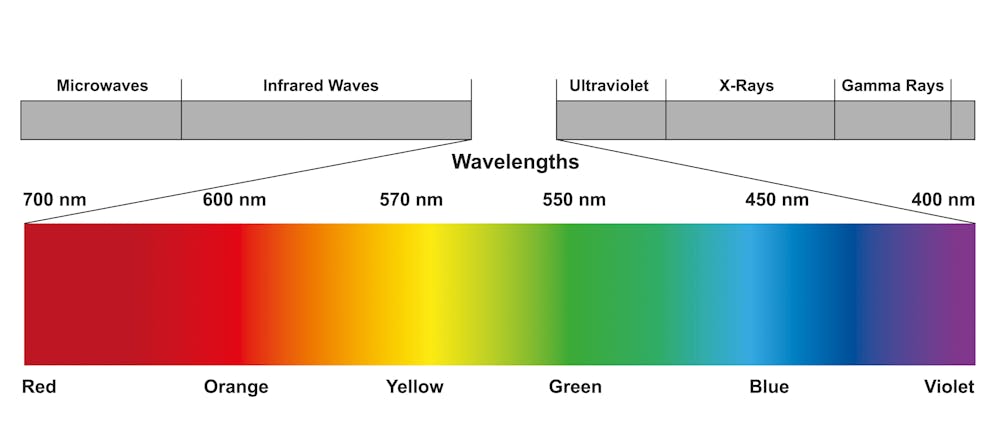
    As photons with wavelengths within a range of about 400–700 nanometers stream into your eyes, your brain perceives them as light. Scientists call these photons visible radiation. You perceive photons with different wavelengths as different colors.

    Photons outside that range of wavelengths are invisible to human eyes. Shorter wavelength energy includes ultraviolet, X-ray and gamma radiation, while longer wavelength energy includes infrared and radio waves.

    The human eye can perceive only a small range of wavelengths of radiation.
    Ali Damouh/Science Photo Library via Getty Images

    Shades and intensities

    Color perception is also affected by the quantity of photons – what physicists call the power – at different visible wavelengths. More photons means more powerful light, which looks brighter. A very vivid color consists mostly of photons of similar wavelength. For example, a pure red may consist of photons that all share the same wavelength near 620 nanometers.

    A stream of photons with a wider range of wavelengths will appear as a paler, less saturated color. White light, such as natural daylight, consists of photons with wavelengths spread fairly evenly across a wide range of the visible spectrum. LEDs and other electric light sources are not quite as uniform across the spectrum, but they still appear white or achromatic, meaning without color.

    Mixtures of wavelengths combine and appear as new colors. The human visual system interprets pure red light and pure green light combined as yellow. Add in pure blue, and this mix of radiation appears white. Scientists and engineers take advantage of this quality in display devices, which are able to create a huge range of perceived colors by mixing the primary colors red, green and blue.

    Black on the color spectrum

    While there’s no black in a rainbow, photons anywhere in the electromagnetic spectrum can be seen as black. Or in some cases, they can’t be seen at all!

    Radiation within the visible spectrum can appear black if it is low in power – more specifically, lower in power than its surroundings.

    Additionally, radiation outside the visible range of wavelengths appears black to our eyes. For example, infrared radiation appears black because it is invisible to humans.

    Perception is subjective

    Our eyes detect the wavelength and power of the light, but our brains interpret it. So color perception always depends on the context.

    People are good at adapting to a wide range of light levels, from sunlight to starlight. So our perception of color and brightness depends on what’s around and what we’ve been looking at recently. If you step from outdoor daylight into a dark theater, at first you probably perceive the whole environment as black, and you may even have trouble finding your way.

    However, your visual system immediately begins to adapt to the low light level. Soon, visual details begin to emerge. What appeared black now has different levels of lightness and color.

    Color perception depends on the surrounding environment.
    Michael J. Murdoch

    Consider the optical illusion that consists of a light rectangle next to a dark rectangle. Each rectangle contains a circle. The circles appear to be different shades but in fact are identical. Against the light background, the circle is dark enough to appear black. Surrounded by the black background, it becomes clear that the circle is merely dark gray. Even when you know the circles are the same, it’s hard to believe because the effect of the surrounding background is so strong.

    In a smooth gradient from gray to black, where does black begin?
    Michael J. Murdoch

    You might be asking yourself, how dark must a color be to appear black? Another way to ask the question is, how low in power must the physical light be in order to look black?

    For a visual answer, look at a gradient from dark gray to black. Where in the gradient is the boundary, or threshold, at which you call it black? What if you dim your display or view the screen in a much brighter or much darker environment? Probably the best answer for how dark it must be is, “It depends.”

    Color perception is a fascinating topic, and we color scientists are continuing to uncover details of how the human visual system works while also applying our knowledge to many other useful things, including dyes, cameras, printers, LED lighting systems and AR/VR displays.


    Hello, curious kids! Do you have a question you’d like an expert to answer? Ask an adult to send your question to CuriousKidsUS@theconversation.com. Please tell us your name, age and the city where you live.

    And since curiosity has no age limit − adults, let us know what you’re wondering, too. We won’t be able to answer every question, but we will do our best.

    Michael Murdoch is a member and former board member of the Inter-Society Color Council, part of the Color Literacy Project.

    ref. Where does black fall on the color spectrum? A color scientist explains – https://theconversation.com/where-does-black-fall-on-the-color-spectrum-a-color-scientist-explains-234540

    MIL OSI – Global Reports

  • MIL-OSI Global: Fossil shark teeth are abundant and can date the past in a unique way

    Source: The Conversation – USA – By Stephanie Killingsworth, Ph.D. Student in Geological Sciences, University of Florida

    A paleontologist holds a megalodon fossil tooth. Kristen Grace/FLMNH, CC BY-SA

    The ratios of strontium isotopes in fossil shark teeth can be used to better understand how coastal environments evolved in ancient times, according to our newly published work.

    As paleontologists with the Florida Museum of Natural History, we’re interested in understanding ancient Florida environments.

    Our study was one of the first to date Florida coastal deposits using fossil shark teeth and a technique that looks at variations in ocean strontium. Strontium is a chemical element that occurs naturally in rock, soil and water.

    Ocean strontium values change over time, which makes measuring the levels of the chemical element a unique global system for determining the age of similar coastal sedimentary rock deposits worldwide.

    Changes in strontium isotope ratios have multiple causes. Land erosion deposits strontium into oceans, while carbonate-producing marine life produce and release strontium when building their skeletons. Strontium is also released by deep-sea vents.

    Geochemist Donald DePaolo and geologist B. Lynn Ingram discovered variations in ocean strontium by examining strontium isotopes ratios in marine sediments, including fossils. The levels of strontium isotopes in marine sediments provide a “time stamp” that correlates to the strontium value of the seawater at that time.

    That data allowed scientists to map out ratios of strontium isotopes in seawater over time. This global strontium seawater curve correlates to the geologic timescale. Scientists use the curve to reconstruct past ocean chemistry and climate conditions, as well as the age of mollusks and other shell-producing marine fossils.

    Why it matters

    Properly dating ancient sites is key to understanding how Earth and its living creatures evolved over time.

    But historically, strontium dating, while reliable, had limitations.

    For example, it works best in fully marine environments and is challenging to use in fossil sites along coastlines. That’s because the strontium values might be influenced by land sediments and freshwater rivers.

    Additionally, material used for strontium dating must not have undergone considerable physical and chemical change during fossilization, the preservation of once living things from the past. Any major chemical alteration to the fossil can affect the strontium value and give an inaccurate date.

    Our study shows that fossil shark teeth are more resistant to these types of changes due to their outer enamel-like surface.

    Remarkably, fossil shark teeth are also incredibly abundant. Sharks ruled the earth’s oceans for 400 million years, and every individual grows and sheds thousands of teeth in their lifetime.

    How we did our work

    Florida fossil sites are unique in that they possess some of the richest fossil sediments for important times in geologic history. These sites can help us understand changing climates, vegetation and sea levels over time.

    The Florida Museum of Natural History has a collection of over 115,000 shark tooth specimens from Florida alone.

    To do our study, we selected shark tooth specimens from two significant Neogene-period fossil sites in Florida. The Neogene, from 2.6 to 23.5 million years ago, was a time of immense change in biodiversity because of changing climates.

    We analyzed the strontium present in powdered samples collected by shaving a thin layer from the surfaces of the teeth. The age of the teeth helped to clarify the age of the fossil sites where they were collected. This data enabled us to calibrate and differentiate the ages of our two sites, Montbrook and Palmetto Fauna Bone Valley, by about 600,000 years.

    Before our study, scientists could estimate the age of the sites based only on mammal fossils. The sites were thought to be the same age. Our work provides a more precise date.

    These ages offer new insights into what happened in the southeastern region of North America, some 5 million to 6 million years ago. Our revised age calibrations coincide with global events, including major sea-level fluctuations and the Great American Biotic Interchange – the migration of land mammals between North and South America after the formation of the Isthmus of Panama 4 million to 5 million years ago.

    For example, because certain species of ground sloths are not found at the Montbrook site (5.85 million years old) but are found at the Palmetto Fauna Bone Valley site (5.22 million years old), it suggests the immigration of ground sloths into North America occurred between these two dates.

    The Research Brief is a short take on interesting academic work.

    Bruce J. MacFadden receives funding from the National Science Foundation.

    Stephanie Killingsworth does not work for, consult, own shares in or receive funding from any company or organization that would benefit from this article, and has disclosed no relevant affiliations beyond their academic appointment.

    ref. Fossil shark teeth are abundant and can date the past in a unique way – https://theconversation.com/fossil-shark-teeth-are-abundant-and-can-date-the-past-in-a-unique-way-247749

    MIL OSI – Global Reports

  • MIL-OSI Global: While plastic dominates human consumption, the global economy will remain hooked on fossil fuels

    Source: The Conversation – UK – By Adam Hanieh, Professor of Political Economy and Global Development, Institute of Arab and Islamic Studies, University of Exeter

    Plastic waste in the Maldives. MOHAMED ABDULRAHEEM/Shutterstock

    In early December 2024, hopes for a landmark global treaty to curb plastic pollution were dashed as negotiations in South Korea stalled. Leading the campaign against the deal were major oil-producing nations, especially Saudi Arabia and Russia, who argued for a more flexible approach to any legally binding limits on plastic manufacturing.

    The collapse of any agreement came despite scientific research delivering ever more alarming warnings about the dangers of plastic pollution. Over the last two years, an avalanche of studies have revealed the pervasive presence of tiny plastic particles in human blood, brains, and even placental tissue.

    These particles, which stem from the breakdown of larger plastic waste, have been linked to everything from inflammation to hormonal disruption, and potential long-term health risks such as cancer. Aside from their effects on human health, plastics are wreaking havoc on marine ecosystems, with microplastics now found in Arctic ice and in the bodies of fish and birds.

    Behind these alarming studies stands a seemingly unstoppable juggernaut of plastic production. The annual global production of plastics reportedly grew nearly two hundredfold between 1950 (two million tonnes) and 2015 (381 million tonnes), and the pace of growth is accelerating.

    Over half of all plastics ever made were produced in the past 25 years, and production levels are estimated to double or triple again by 2050. And more production brings more waste.

    Less than 10% of all plastics ever produced have been recycled. And the volume of “mismanaged plastics” – those which are not recycled, incinerated, or sealed in landfills – is also estimated to double by 2050.

    It seems as if humans have become the organic detritus within a plastic world of our own creation.

    Plastic elephants

    But despite growing awareness around the problems associated with plastic, there is a fundamental flaw in how we tend to think about it as a product.

    For there is a tendency to frame plastic as a problem of pollution and recycling, rather than as an integral part of our fossil fuel-driven world. This narrative is also promoted by major oil companies, such as the American giant, ExxonMobil, which stated in the lead up to the South Korean summit: “The issue is pollution. The issue is not plastic.”

    The problem with this perspective is that it obscures the fact that plastics are petrochemical products: substances which are ultimately derived from oil and gas.

    Indeed, the future of fossil fuels is increasingly tied to the future of plastics. It has been estimated that by 2040, plastics will account for as much as 95% of net growth in oil demand.

    This is perhaps why 220 fossil fuel lobbyists attended those recent treaty discussions, outnumbering all other delegations. It could also explain why Saudi Arabia, home to one of the world’s largest petrochemical companies, led the opposition to any global limits on plastic production.

    At the core of capitalism

    The problem we confront is not simply the presence of an oil lobby, it is the systemic role that plastics play within capitalism.

    Plastics, and the wider petrochemical industry, played a crucial part in the transformation of global capitalism from the mid-20th century onwards.

    As I explore in my book, Crude Capitalism, the things we used to need to build and make things previously relied on sourcing naturally occurring, labour-intensive goods like timber, cotton or metals. But the invention of plastics and other synthetic materials separated commodity production from nature.

    More plastic in the pipeline.
    Kodda/Shutterstock

    Oil became more than a fuel – it was the substance that came to dominate our lives. A petrochemical shift to the rise of an oil-dominated world. With capitalism untethered from natural cycles, there was a radical reduction in the time taken to produce commodities and an end to any limits on the quantity and diversity of goods produced.

    Along with this, consumption habits became centred around notions of disposability and obsolescence. Plastics made the essential features of contemporary capitalism possible: a drive to limitless growth, continual acceleration of production and consumption, and the frenzied expansion of markets.

    The emergence of fast fashion is just one example. Alongside poorly paid garment workers in countries such as Bangladesh, really cheap clothing was only made possible through the massive expansion of polyester production (a kind of plastic), which freed the industry from its dependence on supplies of wool and cotton.

    The consumption of plastics looms large in today’s ecological crisis. And having become so accustomed to thinking about oil and gas as primarily an issue of energy and fuel choice, perhaps we have lost sight of how much of our lives depend upon the products of petroleum.

    These synthetic materials drove a post-war revolution in productivity, bringing labour-saving technology and mass consumption. It is now almost impossible to identify an area of life that has not been radically transformed by the presence of plastics and other petrochemicals.

    Plastic products have become normalised as natural parts of our daily existence. And it is this paradox which must be fully confronted if we are to move beyond fossil fuels.

    Adam Hanieh’s research into petrochemicals has been supported by a Political Economy Fellowship from the Independent Social Research Foundation (ISRF).

    ref. While plastic dominates human consumption, the global economy will remain hooked on fossil fuels – https://theconversation.com/while-plastic-dominates-human-consumption-the-global-economy-will-remain-hooked-on-fossil-fuels-247393

    MIL OSI – Global Reports

  • MIL-OSI Global: Presidential smiles: the untold story of teeth in the White House

    Source: The Conversation – UK – By Rae Gillibrand, Lecturer, Premodern History, University of Leeds

    When Donald Trump joined Elon Musk for a live interview on X (formerly Twitter) late last year, the conversation covered a range of significant topics: his near-assassination, Biden’s withdrawal from the race, and the future of the presidency. However, for many viewers, an unexpected detail stole the spotlight: Trump’s slurred speech and lisp.

    Was Trump wearing dentures? The public certainly seemed to think so. Throughout the interview, the word “dentures” was mentioned over 15,000 times on X and the interview sparked the resurgence of the hashtag #DenturedDonald.

    Why does this matter? Trump is, after all, 78 years old, and a 2017 survey showed that nearly one in four Americans aged 75 and older have no teeth left at all. However, presidential dental health has long had an impact on public perception and leadership itself. From George Washington’s infamous dentures to Teddy Roosevelt’s toothy grin, a president’s teeth (or lack thereof) have often shaped the way they are seen by the American public.

    Since the appointment of George Washington as the first US president, it has been tradition for each new president to commission a portrait of themselves during their time in office. However, it was not until Ronald Reagan’s portrait, completed in 1991, that we saw a president depicted with a smile.

    This is partly to do with practicality – many early portraits were painted from life, and sitting with a smile for hours was almost impossible – and partly to do with etiquette. In the 18th century, a wide smile was considered a sign of lewdness and drunkenness and associated largely with the lower classes.

    Indeed, a 1703 text on “decorum and civility” said that some people part their lips so that “their teeth are almost entirely visible. This is entirely contradictory to decorum, which forbids you to allow your teeth to be uncovered, since nature gave us lips to conceal them.”

    It is often suggested that historical portraits avoided smiles because of poor dental hygiene, but in reality, social conventions played a much larger role. For earlier presidents, maintaining an image of sobriety, morality and respectability was important, and a serious expression was seen as a reflection of these values.

    This all changed with Teddy Roosevelt. When Roosevelt became the 25th US president in 1901, photography was becoming much more accessible. Technological advancements and the introduction of handheld cameras meant that photography could be practised by a much broader range of people.

    Because of this, Roosevelt was often candidly photographed while laughing or smiling, leading to his reputation as “the first president who smiled”.

    He even capitalised on his grin in his 1904 campaign by releasing the Teddy’s Teeth Whistle. Retailing at five cents (US$1.77 or £1.44 in today’s money), supporters were encouraged to buy a set and “blow the horn for Teddy”.

    Roosevelt’s embrace of his smile and the promotion of his teeth marked a shift in how a president’s image could be used to influence public perception, showing that good dental health could be a powerful political tool.

    Worse than wood

    Not all presidents were as diligent as Roosevelt when it came to dental hygiene. George Washington, for example, was infamous for his poor dental health.

    His letters, diaries and financial accounts reveal a long history of dental troubles, ultimately leading to his use of dentures. However, contrary to popular belief, Washington’s dentures were not made of wood. Instead, they were made from materials including ivory, animal teeth and human teeth.

    One of Washington’s account books reveals that he bought nine teeth from enslaved people on his Mount Vernon plantation. This detail adds a sinister layer to the history of Washington’s dental care because, while these people were paid for their teeth, their enslaved status probably left them with little choice in the matter.

    Washington’s poor dental hygiene also extended to his care of his dentures. They became notoriously stained, largely due to his fondness for rich red wine. One letter from his dentist chastised him for the condition of his dentures, stating: “The set [of dentures] you sent me from Philadelphia … was very black, occasioned either by your soaking them in port wine, or by your drinking it. I advise you to either take them out after dinner and put them in clean water … or clean them with a brush.”

    These insights into Washington’s dental struggles underscore the lasting effect of oral health on the presidential image.

    Presidential dental health has played, and continues to play, an important role in shaping public perception, with teeth often serving as symbols of both personal care and political power. Whether influencing how a president is seen or reflecting broader social attitudes, the state of a leader’s teeth has clearly left its mark on the history of the office.

    Rae Gillibrand does not work for, consult, own shares in or receive funding from any company or organisation that would benefit from this article, and has disclosed no relevant affiliations beyond their academic appointment.

    ref. Presidential smiles: the untold story of teeth in the White House – https://theconversation.com/presidential-smiles-the-untold-story-of-teeth-in-the-white-house-248391

    MIL OSI – Global Reports

  • MIL-OSI Global: Why drying clothes indoors could put your health at risk

    Source: The Conversation – UK – By Rebecca A. Drummond, Associate Professor, Immunology and Immunotherapy, University of Birmingham

    Magic Lens/Shutterstock

    Hanging the washing out to dry in the garden has been a rare sight these last few months, with winter storms bringing freezing temperatures and 100mph gusts of wind. But does the way we dry our clothes indoors actually matter?

    Drying wet clothing on racks in poorly ventilated spaces could increase the amount of mould growing in your home, which is associated with poor health and, in some cases, even death.

    When mould grows in your home, it can form black or green coloured patches on the walls, and usually creates an unpleasant musty smell. It shouldn’t be ignored, because being exposed to mould over long periods of time can have serious health implications.

    Mould is a broad term for a group of fungi that produce tiny particles called spores. Fungi produce spores when conditions are right for their growth, which can include cooler temperatures and high humidity. This is why you’re more likely to find mould growing on bathroom ceilings or damp walls, where there is more water for fungal spores to settle and grow.

    There are many different species of mould. The most common ones to cause problems in damp homes are penicillium and aspergillus. It’s estimated that we breathe in small numbers of spores from these fungi on a daily basis.

    Luckily, our immune system is very good at spotting and killing fungal spores, which limits the number of fungal lung infections in humans even though we’re constantly exposed. Immune cells called macrophages sit inside the air spaces of the lungs (called alveoli), and these cells eat anything you inhale that could be considered harmful, including fungal spores.

    Risks for compromised immune systems

    However, there are many people whose immune systems are not able to remove fungal spores, and in these cases the fungi can cause dangerous infections or make underlying health conditions (such as asthma) much worse.

    People who have damaged or compromised immune systems are at higher risk of becoming seriously unwell from fungal infections. Moulds like aspergillus cause infections in patients with limited immune function, or who have lung damage from diseases like asthma, cystic fibrosis and chronic obstructive pulmonary disease (COPD) associated with heavy smoking.

    In people with asthma, the immune system overreacts to triggers (including fungal spores) causing inflammation in the lung. This inflammation makes it more difficult to breathe by reducing the size of the airways. The same type of immune response is responsible for the symptoms of asthma and allergic responses, and fungal spores can also trigger these same types of immune responses. This means that fungal spores can be a particularly powerful trigger for some people.

    In very extreme cases, the fungal spores don’t just cause inflammation but can invade the airways and block them leading to bleeding within the lung. This happens when spores germinate and form long spiderweb-like projections called mycelium which create sticky lumps that block airways and damage the delicate tissues of the lung.

    Growing resistance

    Aspergillus infections are treated with antifungal drugs called azoles, which prevent the fungal cells from forming properly. Azoles are very effective, but there are increasing rates of resistance to azoles reported in aspergillus which is a significant cause for concern.

    We have a limited range of antifungal drugs available to treat mould infections – and when resistance develops this can severely reduce the options a patient has for treatment.

    Resistance to drugs such as azoles can develop in patients who take these drugs for long periods of time, but recent research has indicated that resistance is more commonly developing in the environment, where most fungi are found. This means that even before a patient is diagnosed with an aspergillus infection, it may already be too late for the antifungal drugs to be effective.

    Development of drug resistance in environmental fungi has been linked to use of azoles and other antifungal drugs in farming. Fungal infections are a big problem for crops, and plants need protection from these infections the same way we do. Unfortunately, the same drugs we use in the clinic are the same types that are being used in agriculture.

    Climate change may also be driving drug resistance in environmental fungi. Exposure to high temperatures was recently found to help moulds develop resistance to commonly prescribed antifungal drugs. There have also been reports of patients becoming ill from species of mould that were not thought to cause human disease, in part because they could not grow at the human body temperature.

    More mould species could therefore be picking up the ability to cause infections, as well as becoming drug resistant. Research programs and healthcare initiatives that monitor for these changes are vital to help us become prepared for potential increases in mould infections.

    While a healthy immune system means that typical exposure to fungal spores is not likely to cause you any health problems, being exposed to very large amounts of fungal spores can prove to be fatal even for people who don’t have underlying health issues.

    In 2020, toddler Awaab Ishak died as a direct result of high exposure to fungal spores, caused by excessive damp and mould in his home.

    His death led to a change in UK law (Awaab’s Law) which requires landlords to respond promptly to damp in homes they manage, to ensure that tenants are not exposed to excessive levels of fungal spores which can affect their physical and mental health.

    It’s important, then, to help keep your home free of mould. The best way to do this is ensure you have good ventilation and take other measures to reduce damp, such as using a dehumidifier or investing in a heated clothes rack to dry your clothes indoors in the winter.

    Rebecca A. Drummond receives funding from the Medical Research Council, the Wellcome Trust and the Lister Institute.

    ref. Why drying clothes indoors could put your health at risk – https://theconversation.com/why-drying-clothes-indoors-could-put-your-health-at-risk-248467

    MIL OSI – Global Reports

  • MIL-OSI Global: How to argue without falling out – an expert guide

    Source: The Conversation – UK – By Jessica Robles, Lecturer in Social Psychology, Loughborough University

    Pormezz / Shutterstock

    To disagree is an inescapable part of being human. We simply are not all the same. But whereas a small disagreement may remain amiable, particularly over text or online where we can edit our responses, a face-to-face row over a sensitive topic can develop into a more antagonistic form of argument.

    You may have experienced this over the recent festive season, when many of us spend more time in close contact with our relatives than usual. This can sometimes bring simmering tensions to the surface.

    An argument can start over a lot of things, from politics to each other’s behaviour – something anyone who spends much time on social media will be familiar with. But the stronger the view, the more intense and complex an argument can become.

    So, what can you do to avoid a minor argument becoming a major row – whether online or face-to-face? As an expert in social interactions, I think paying attention to what someone says – and how they say it – is crucial, along with learning how to avoid responding in ways that might blow up in your face.

    Remember, disagreements are a normal part of life and relationships. But here are three key tips for how to avoid them escalating into something more serious.


    Ready to make a change? The Quarter Life Glow-up is a new, six-week newsletter course from The Conversation’s UK and Canada editions.

    Every week, we’ll bring you research-backed advice and tools to help improve your relationships, your career, your free time and your mental health – no supplements or skincare required. Sign up here to start your glow-up at any time.


    1. Manage escalation

    If you disagree with someone, stay in the conversation in a productive way by avoiding using direct insults. Also, take care to avoid actions that may put the other person on the back foot, such as accusing, complaining or mocking them.

    We tend to put a lot of emphasis on the content of an argument, and also on our assumptions about what the other person “really thinks”. What is the argument about? Is it just a misunderstanding – or is it a matter of personality, where one party is biased or has some ulterior motive?

    The rise of social media has created an age of endless conflict.
    pathdoc / Shutterstock

    We care very much whether the person actually believes what they are saying. Research suggests we often resent people playing “devil’s advocate” outside of certain settings.

    But you cannot truly know someone’s intentions, so it’s a good idea to avoid thinking the worst about the person you are arguing with. Otherwise, you might unfairly talk to them as if they’re being manipulative, unfair, damaging or thoughtless.

    2. Be open-minded

    Sometimes, what someone has said may sound (and feel) pretty awful. When this happens, keep two things in mind.

    First, nothing we say has just one meaning. There are often multiple interpretations, and you cannot always trust the first one that leaps to mind when you’re in the heat of the moment.

    During an argument, it’s worth slowing down and thinking through all possible interpretations. Consider asking for a moment to think, or getting a cup of tea to distract both of you from an escalation.

    Second, if what the person is saying still sounds negative no matter how charitable you try to be, ask them to explain more. This may not be easy to do, but people will often reveal what they meant if they have to elaborate. And helping them feel as if they are being carefully listened to might defuse a possible escalation.

    3. Stay on track

    There is another side to this coin: choosing carefully what you say, and keeping in mind how you will come across. Anyone can get caught up in an argument and say something they regret, including you.

    Something to balance carefully is “going meta” – pausing to talk about the argument you’re having and the way you’re having it. This can be productive if, for instance, you ask to keep the conversation focused on something specific. However, it can easily come across as an implicit criticism of the other person.

    If you do choose to discuss the quarrel you’re having, you may have to include an apology or speak in a quieter tone to keep the other person from thinking you are going to accuse them of arguing “wrongly” in some way. It’s challenging, so don’t feel bad if you don’t get it right the first time you try this technique.

    Anyone can get caught up in an argument, including you.
    fizkes / Shutterstock

    Do we have the same values?

    People don’t just argue for the sake of arguing. One of the main reasons for engaging in an argument is to position ourselves in relation to other people. Are we on the same side, and do we have the same values?

    Arguments are also tied to identity. The most contentious arguments generate strong feelings. We’re aware that we might be judged for our opinions, and others will assume that we might judge them in return.

    Mutual judgment can easily escalate not just during a disagreement but in the relationship as a whole, causing a temporary falling-out or even loss of friendship. People who want to avoid this often assume the answer is to simply put their feelings aside and “focus on facts”.

    But denying an emotional response might feel like denying one’s commitment to a valued cause. Recognising that someone feels this way is an important step to knowing what you might be able to change their mind about – and what is best left alone, at least for now.

    Jessica Robles does not work for, consult, own shares in or receive funding from any company or organisation that would benefit from this article, and has disclosed no relevant affiliations beyond their academic appointment.

    ref. How to argue without falling out – an expert guide – https://theconversation.com/how-to-argue-without-falling-out-an-expert-guide-236812

    MIL OSI – Global Reports

  • MIL-OSI Global: The Sims: from Hot Date to Get Famous, why expansion packs have been key to the game’s longevity

    Source: The Conversation – UK – By Aditya Deshbandhu, Lecturer of Communications, Digital Media Sociology, University of Exeter

    SimCity 3000, the predecessor to The Sims, played a pivotal part in my childhood, growing up in Hyderabad, India. Its recreation of the western, urban world helped me understand how cities were planned, designed and financed – and how they provided people with key services like transportation, health and education while preparing for accidents and other hazards.

    As an eight-year-old trying to figure out my place in the world, that game offered me a way to make meaning of the chaos that can be life. So, when The Sims launched in 2000 – enabling me to live inside a virtual city, rather than simply build one – I had to get my hands on a copy.

    Twenty-five years later, I write this piece in a drastically different gaming landscape, where games offer high visual fidelity and ever-increasing frame rates for ultra-smooth game play. But despite all these technological innovations and the pursuit of photo-realism, the popularity of The Sims’ game designer Will Wright’s satire on American consumer culture endures.


    Sul Sul! This article is part of a mini series from The Conversation marking 25 years of The Sims franchise.


    The franchise’s four Sims games had sold over 200 million copies before the latest instalment, The Sims 4, became free to play in 2022. Players now spend their money on extras within the game. Over 85 million people played The Sims worldwide in 2024.

    At a time when the success of a modern video game is measured in metrics like “cumulative engagement time” (number of players playing at the same time), acquisition of new players and “intensity of engagement” (number of hours spent by a player), now-over-a-decade-old The Sims 4 continues to excel with its mastery of the live-service format.

    The trailer for the first Sims game.

    Live-service describes the form modern digital games embrace when they transition from conventional products into “services” – a shift made possible because games today can be regularly updated, fixed and expanded upon by their makers remotely. They can acquire new levels and in-game features in a similar way to how streaming platforms like Netflix drop new episodes of your favourite show.

    Players don’t buy a live-service game, they sign up for the journey.

    Expanding player horizons

    In each incarnation of The Sims, players have been able to access new ways to perform roles and tasks that mimic everyday life, in the form of expansions and content packs.

    The original title, The Sims (2000), had seven expansion packs and two content packs. I distinctly remember brewing potions in the chemistry lab and rubbing a magic lamp to conjure a genie in the first expansion, Livin’ Large; the new holiday island that was built for The Sims: Vacation; and leaving my Sim’s home to visit downtown areas as part of Hot Date.

    The trailer for The Sims Hot Date expansion pack.

    But for The Sims 4 (2014), the developers went all in. This game – and its subsequent expansions – represents a digital supermarket of lifestyles, sub-cultures, activities and stardom. For example, 2018’s Get Famous pack not only introduced Del Sol Valley – a region that resembled Los Angeles and the Hollywood Hills – but also introduced the “reputation” mechanism for players.

    The Discover University expansion (2019) allowed players to take their Sims to school in a new region called Britechester – after this update, the game integrated Sims’ careers and education, and in many ways changed the rules of the game. And the Eco Lifestyle expansion pack (2020) is memorable because the game engaged with ideas of sustainable living for the first time.

    Genre, fantasy and reality

    From content packs featuring a digital recreation of singer Katy Perry in The Sims 3 to collaborations with streamers, content creators and fashion houses, The Sims has remained relevant by consistently blurring the lines between genre, reality and fantasy.

    Hot Date was a popular early Sims expansion pack.

    Today, video game makers the world over try to master formats like free-to-play games where players pay for cosmetic items, customisations and added content, or expansions offering downloadable content. The Sims set the standard for most of them.

    Over the past 25 years, this franchise has had several life simulation competitors in the form of Second Life, Facebook’s once popular Farmville, virtual reality experiences like Half-Life: Alyx and, during the pandemic when we worked, learnt and played online, initiatives like the Metaverse.

    However, today only The Sims endures. The game’s developers continue to give its players what they want, while also getting them to engage with difficult ideas like sustainability, the question of life and death, and even gentrification (For Rent expansion pack, anyone?).

    Few games let players critique life so closely. For game researchers like me, this begs the question: do people play life simulation games like The Sims in order to build alternative lives, relive their own – or create something entirely new?


    Looking for something good? Cut through the noise with a carefully curated selection of the latest releases, live events and exhibitions, straight to your inbox every fortnight, on Fridays. Sign up here.


    Aditya Deshbandhu does not work for, consult, own shares in or receive funding from any company or organisation that would benefit from this article, and has disclosed no relevant affiliations beyond their academic appointment.

    ref. The Sims: from Hot Date to Get Famous, why expansion packs have been key to the game’s longevity – https://theconversation.com/the-sims-from-hot-date-to-get-famous-why-expansion-packs-have-been-key-to-the-games-longevity-248604

    MIL OSI – Global Reports

  • MIL-OSI Global: Will multinational companies flock to Syria? Maybe, if foreign aid arrives first

    Source: The Conversation – UK – By Ana Carolina Garriga, Professor of Political Science, University of Essex

    hanohiki / Shutterstock

    Syria’s new foreign minister, Asaad al-Shaibani, recently appeared at the World Economic Forum’s annual conference in the Swiss resort of Davos. He announced that his country is open for business and seeking foreign investment.

    After more than 13 years of civil war and decades of dictatorship that saw Syria become a pariah state, the country needs all the financial support it can get. But will foreign firms set up shop in Syria?

    Countries like Syria, emerging from conflict, face the challenge of convincing investors they are a safe environment for investment. Our research suggests companies look at what governments are doing in terms of aid when considering whether to invest. In general, post-war countries that receive more foreign aid subsequently receive more foreign investment.

    Foreign direct investment (FDI) typically involves multinational companies building factories, opening stores or investing capital in businesses abroad. It can be highly beneficial for developing countries.

    FDI is the most stable source of international financing, and generally has positive long-term effects on economic growth and poverty reduction. More importantly for incumbent governments, FDI has positive short-term effects on domestic employment, government financing and spending, and foreign exchange reserves.

    It also has a potential positive effect on government approval ratings, as attracting inward FDI signifies political competence to voters. These reasons are why almost all governments compete to receive these financial flows.

    FDI is especially important in post-conflict countries. Civil wars typically destroy or seriously harm the productive capacity of countries. In Syria, the conflict destroyed tens of billions of US dollars worth of infrastructure, and incapacitated more than half its electrical grid.

    After 13 years of civil war, Syria needs all the financial support it can get.
    Vagabjorn / Shutterstock

    War often disrupts a country’s access to the international economic exchanges that help economic growth. Since the beginning of its conflict in March 2011, Syria’s annual exports have dropped from US$8.8 billion (£7.1 billion) to US$1 billion, due to the war and war-related sanctions. Its economy has shrunk by 54%.

    Foreign investment can contribute substantially to rebuilding the economy. But post-conflict countries might seem risky to investors.

    Foreign firms sometimes avoid countries plagued by violence, political instability, or political risk. Conflict could reemerge in Syria, and multinational corporations probably do not want their business in a place where factories could be bombed or customers killed.

    Post-conflict situations are also relatively information-poor environments. Conflict often hampers data collection efforts, and governments, in desperate need of capital, may be incentivised to misrepresent the actual state of the economy or strength of the political system.

    In the case of Syria, foreign observers do not know what to make of the new ruling coalition, which is led by a designated terrorist organisation in Hayat Tahrir al-Sham. While the international community seems to want to support Syria – the UK, for example, has been clear about its intention to help the country – observers are unsure about the environment and how it might change in the coming years.

    In these kinds of situation, international investors look at a variety of signals. In our research, we show that one key signal is whether other governments have sent official development aid to post-conflict countries.

    Following the aid

    We argue that the decision to send aid to a country signals the donors’ trust of local authorities. What matters is this presence of aid, whether or not the aid achieves its intended purpose.

    Examining decades of global data, we have found a robust relationship between foreign aid and subsequent investment in post-conflict countries – with one striking exception.

    There does not seem to be a relationship between aid from the US and foreign investment. Because so much of US foreign aid is geostrategic – to shore up alliances or secure access to particular areas – investors do not seem to view it as a valuable signal about the recipient country.

    So, Syria should perhaps not worry too much about the new US president Donald Trump’s plan to cut American foreign aid. If aid from other government donors can still flow in, this could encourage investment to follow.

    Fortunately for Syria, some countries and international organisations have already pledged aid – including the UK, which has announced £50 million in humanitarian aid for the country and its refugees. This seems like a good sign for Syria’s future – even more so because of the signal it sends to foreign investors.

    Specific domestic policies that encourage FDI and build stronger institutions will be necessary to secure investment in the longer term. Syria will need to demonstrate its commitment to the rule of law and property rights, while creating a stable environment for investment.

    However, if the pledged aid materialises – and if more countries chip in – this could lead to substantial economic benefits for Syria.

    The authors do not work for, consult, own shares in or receive funding from any company or organisation that would benefit from this article, and have disclosed no relevant affiliations beyond their academic appointment.

    ref. Will multinational companies flock to Syria? Maybe, if foreign aid arrives first – https://theconversation.com/will-multinational-companies-flock-to-syria-maybe-if-foreign-aid-arrives-first-248406

    MIL OSI – Global Reports

  • MIL-OSI Global: Representation gaps and the rise of populism

    Source: The Conversation – UK – By Laurenz Guenther, Postdoctoral researcher, Department of Economics, Bocconi University

    Shutterstock/Alejo Bernal

    The rise of rightwing populists continues across the west, leaving many wondering how mainstream parties can respond. Part of the picture is the failure of political parties to meet voters’ views on immigration with policy responses.

    Germany is a strong example here. In 2013, it had no notable rightwing populist party. Alternative for Germany (the AfD) did already exist, but it was neither populist nor strongly anti-immigrant. But immigration into Germany was increasing.

    In the years prior to 2013, several hundred thousand asylum seekers from Africa and the Middle East entered the country each year. Many Germans wanted lower immigration but German political parties were not offering corresponding policies. The public and parliamentarians were already on a different page.

    To measure this disagreement, researchers asked representative samples of German parliamentarians and ordinary citizens the following question in 2013: “Should it be easier or harder for foreigners to immigrate?”

    They could choose from 11 responses, ranging from “0 – immigration for foreigners should be much easier” to “10 – immigration for foreigners should be much harder”.

    The results show that most Germans wanted to restrict immigration in 2013. Despite this public demand, nearly all parliamentarians from all the four major parties wanted to facilitate immigration.

    Immigration attitudes in 2013:

    How the representation gap emerged over immigration.
    L Guenther, CC BY-ND

    Two years later, in 2015, the refugee crisis began. Over the course of just a few years, two million asylum seekers entered Germany. In response, Germans viewed immigration as an increasingly important issue and increasingly voted based on their attitudes towards immigration. Because most Germans wanted lower immigration, this increased the demand for an anti-immigration party.

    During this time, the AfD changed its policy platform to become Germany’s only party that was clearly calling for much lower immigration. As a result, the AfD became the only party to represent the will of many Germans on the issue they considered most important.

    Immigration attitudes in 2017:

    From this perspective, it is not surprising that the AfD strongly increased its vote share in the 2017 election and became the first party to the right of the conservatives to ever enter the federal parliament.

    In my research, I found similar patterns are evident across Europe. In 27 countries, most political mainstream parties are much more in favour of immigration than the majority of their voters and citizens demand.

    The representation gap is not only systematic across countries but also across political issues and voter subgroups. On nearly all cultural issues, such as multiculturalism or gender relations, I found that voters are more conservative than their parliamentarians.

    Across Europe, the difference between the average voter and parliamentarian is as large as the difference between the average conservative and socialist parliamentarian.

    Even voters with the same level of education, or voters who are well-informed about politics, are much more culturally conservative than their representatives. Even immigrants themselves are much more opposed to immigration and multiculturalism than the average parliamentarian.

    While these cultural representation gaps have existed for a long time, it is the increase in their salience and perceived importance that contributes to the rise of rightwing populism. This is most strongly driven by the increased importance in immigration.

    These results matter because they can equip politicians with the information they need to win (back) voters. And on a deeper level, these findings raise the question whether mainstream parties need to adjust their policies on immigration.

    One important argument of mainstream politicians against populists is that once populists come to power they aim to establish dictatorships and then rule against the interest of the people. However, this argument rings hollow if mainstream parties are unwilling to acknowledge and act on the issues considered most important by the people.

    Laurenz Guenther receives funding from Bocconi University. He is affiliated with the Instutute for European Policymaking at Bocconi University.

    ref. Representation gaps and the rise of populism – https://theconversation.com/representation-gaps-and-the-rise-of-populism-245871

    MIL OSI – Global Reports

  • MIL-OSI Global: How The Sims’ endless customisation fostered one of gaming’s most diverse player communities

    Source: The Conversation – UK – By Andra Ivănescu, Senior Lecturer in Game Studies and Ludomusicology, Brunel University of London

    Katy Perry is in a recording booth. She turns to the camera, smiles and begins to sing: “Badipsa frooby noop”. As if to confirm that we didn’t mishear her, she repeats “Badipsa frooby noop” and gives the camera a thumbs up.

    The moment was captured in 2010, in a behind-the-scenes video of Perry recording her song Last Friday Night in Simlish – the language spoken by characters in The Sims games. It was part of her branded downloadable content (DLC) package, Sweet Treats, which was available to players of The Sims 3.

    The Sims is celebrating its 25th anniversary in 2025, to the chagrin of many a millennial. From its groundbreaking approach to inclusive character creation to the surreal charm of global pop stars re-recording their hits in Simlish, The Sims has always operated at the intersection of individuality and shared culture.

    Created by one of the industry’s few auteur game-designers, Will Wright, The Sims 1 was released on the cusp of the millennium and changed the video game landscape forever.

    The game harks back to what game studies researcher Jesper Juul described, in his foundational book Half-Real (2005), as the “primordial game structure”. This is a game in which the player doesn’t follow a set story or structure in a linear way, but gets to design their own strategies, combining the rules in often unpredictable ways.


    Sul Sul! This article is part of a mini series from The Conversation marking 25 years of The Sims franchise.


    More than that, players are able to tell their own stories and build emergent narratives. These narratives are not about war, fantasy worlds or outer space, but regular people, regular homes, regular jobs and plenty of WooHoo (The Sims’ euphemism for sex).

    Custom creativity

    The Sims franchise provides players with a space to perform and experiment, to be cruel, silly or creative. These modes of play can take the form of machinima – using the game engine to make creative videos. Or using features like the family album, in which players can capture photos of their avatars within the game to make poignant statements about important social issues.

    The base game has provided an increasingly diverse range of opportunities for customisation of characters, spaces and activities. And the large quantity of available DLCs and mods (player-made modifications to the game) has offered even more variety.

    Many of the customisation options have been explicitly related to characters’ identities, and the series has gradually improved its representation. For instance, while the original game already included same-sex relationships, The Sims 2 included a “joined union” option which was similar to marriage. By The Sims 3, same-sex couples could marry with no distinction from opposite-sex couples. Similar developments have taken place in the diversity of skin tones and gender identities as the series progressed.


    Read more:
    Why The Sims 4’s new inclusion of transgender and disabled sims matters


    As a result of these inclusive changes, players enjoy gaming experiences as diverse as they are.

    Phillip Ring, executive producer on The Sims 4, provided an overview of the game’s demographics in a Game Developers Conference talk in 2023. Only 21% of Sims players are men, while 55% identify as heterosexual and 62% as white. Ring explained how the game’s developers, Maxis and Electronic Arts, consider equality, diversity and inclusion as part of hiring, development and engaging with the player community. Active inclusivity has become an essential part of The Sims design.

    None of this touts The Sims as a digital utopia. The franchise has been criticised for its consumerist ideology, and much of its progressive content has been deeply controversial in different territories of the game’s release.

    Katy Perry records Last Friday Night in Simlish.

    For better or worse, the game has both reflected and shaped pop culture – which brings us back to Katy Perry. The Simlish version of her song may sound nonsensical, but it reflected a cultural moment – the post-feminist, anthemic pop of the 2010s.

    That moment has now passed. In a post-Brat summer era, Perry’s Sims moment feels outdated. The Sims, however, remains relevant, evolving alongside popular culture.

    In his book Understanding Video Game Music (2016), musicologist Tim Summers interprets Simlish rerecordings as satires of contemporary pop culture. I disagree. Instead, I believe Simlish is designed to let players “fill in the blanks”, using their imagination to shape meaning.

    This has always been central to The Sims – allowing players to project their own stories onto a world within the cultural zeitgeist. Many of us grew up with The Sims. As we’ve evolved, so has the game – which remains a dynamic cultural artefact.


    Looking for something good? Cut through the noise with a carefully curated selection of the latest releases, live events and exhibitions, straight to your inbox every fortnight, on Fridays. Sign up here.


    Andra Ivănescu is the recepient of a British Academy/Leverhulme Small Research Grant for her project Gaming Censorship: Videogame Content Regulation in the UK.

    ref. How The Sims’ endless customisation fostered one of gaming’s most diverse player communities – https://theconversation.com/how-the-sims-endless-customisation-fostered-one-of-gamings-most-diverse-player-communities-248686

    MIL OSI – Global Reports

  • MIL-OSI Global: How The Sims accidentally invented the cosy game genre

    Source: The Conversation – UK – By Adam Jerrett, Lecturer, Faculty of Creative & Cultural Industries, University of Portsmouth

    Ooboo Vroose Baa Dooo! That’s “happy birthday” in Simlish, the delightfully nonsensical language of The Sims. The life simulation video game franchise turns 25 this year, making me feel officially old.

    Like many others, I grew up playing The Sims, oscillating between designing dream homes and orchestrating ideal careers, and trapping my Sim characters in a tiny block room, removing all the doors and watching the chaos ensue. For the more benevolent among us, The Sims was an endlessly rewarding digital dollhouse.

    Game designer Sid Meier (creator of the Civilisation series) defines a video game as “a series of interesting decisions”. In most games, interesting decisions are about which gun to use or which party member to heal. The Sims’ interesting decisions, however, were far more mundane. “What clothes should I make my simulated human (typically a digital avatar of myself or my friends) wear?”; “Who should they date?”; and, most importantly: “Should I use the ‘rosebud’ cheat to give myself infinite money?”

    The Sims went on to become one of the bestselling franchises of all time, with myriad sequels, expansions and an obsessed player base. While similar titles at the time, such as Black and White, had you playing as an omnipotent god, they were primarily strategy games based around controlling territory. What made The Sims special was its focus on emergent narratives – player-driven experiences where players could create their own stories.


    Sul Sul! This article is part of a mini series from The Conversation marking 25 years of The Sims franchise.


    Much of this focus is also present in what is now called the “cosy game” genre. These are games that focus not on conflict or challenges, but rather on creativity, exploration and personal expression.

    Before Stardew Valley let us befriend a moody fisherman, Animal Crossing allowed us to be financially terrorised by a raccoon, and Unpacking made us cry over a box of kitchen utensils, The Sims showed us a new way to play. One where the biggest challenge was forgetting to pay your bills, and the most rewarding accomplishment was finally affording a pool (whose exit ladder may or may not just have mysteriously disappeared).

    This normalised the idea that games didn’t need to be won to be fun. It was a shift in design philosophy that paved the way for later games that let players tend a farm, manage a café, or befriend ghosts without a game-defined goal.

    A trailer for one of the more recent expansion packs, Cottage Living.

    The Sims was less about victory than it was about making your own fun – whether that meant imagining your future family life with your crush, or seeing how well you could build your Sim’s career from the ground up before succumbing to late-stage capitalism.

    Copying The Sims’ homework

    Many features that define the cosy game genre today trace directly back to The Sims. It popularised meticulous environment building and customisation tools, for example, from house layouts to outfit choices and suspiciously elaborate hedge mazes. This DNA is the bedrock of many modern cosy games, like Tiny Glade’s whimsical castle-building or pandemic hit Animal Crossing: New Horizons’ island growing.

    The Sims was free from combat or major stressors (unless you count fire hazards and rogue Grim Reapers). No timers, no pressure – just vibes (unless you forgot to build a toilet, in which case the vibes would be bad). You could play at your own pace, which came to define other self-paced games like A Short Hike.


    Looking for something good? Cut through the noise with a carefully curated selection of the latest releases, live events and exhibitions, straight to your inbox every fortnight, on Fridays. Sign up here.


    Much of The Sims was about the relationships between the Sims themselves. They could get married, have children, make friends and even enemies. Instead of fighting for survival, Sims were fighting for their relationships.

    This was augmented by a growing “machinima” fan culture, where players made short films and movies using in-game footage. These forms of emergent, social storytelling are a mainstay of modern gaming and meme culture, made even more prevalent by social media and the “share” buttons now on many game controllers.

    In this work of machinima, a Sims player has made a sitcom trailer using footage from their gameplay.

    Over the years, The Sims franchise has become a bastion for diversity, equity and inclusion. Most recently, that’s meant allowing players to create disabled and transgender Sims.

    This provides more representation to players, and showcases the importance of cosy games for exploring an array of identities, values and stories. The move has even inspired copycats like the upcoming Inzoi, which provides even more realistic graphics and complex life simulation, building on the formula introduced by Sims creator Will Wright all those years ago.

    For 25 years, The Sims has proven that games can be different. They don’t need conflict, challenge or even victory to be engaging. Sometimes, the real joy comes from designing an entire town, crafting a chaotic soap opera – or simply watching a Sim pace around a door-less room, gradually descending into madness.

    Adam Jerrett does not work for, consult, own shares in or receive funding from any company or organisation that would benefit from this article, and has disclosed no relevant affiliations beyond their academic appointment.

    ref. How The Sims accidentally invented the cosy game genre – https://theconversation.com/how-the-sims-accidentally-invented-the-cosy-game-genre-248702

    MIL OSI – Global Reports

  • MIL-OSI Global: How to set healthy boundaries

    Source: The Conversation – Canada – By Gio Dolcecore, Assistant Professor, Social Work, Mount Royal University

    Boundaries are about what you do when something triggers an emotional response from you, and how you communicate to others what you are feeling. (Shutterstock)

    Setting our boundaries can sometimes be tough. Maybe you’re living with someone who’s always in your space. Or you’ve got that friend who feels a little too comfortable trauma-dumping on you. Maybe you feel your spouse isn’t respecting your choices.

    Whatever the reason, telling others how you feel isn’t always easy. And it can be difficult to figure out where to draw your lines and how to communicate them to others.

    There’s also a lot of misunderstanding about what boundaries are and what they aren’t. The prevalence of “therapy-speak” can make figuring that out even harder.

    Setting boundaries can often seem complicated and feel uncomfortable. That’s because it can take a lot of courage to stick up for yourself. It also takes a lot of emotional regulation and self-awareness.

    However, setting boundaries doesn’t have to be a daunting prospect. Taking time to figure out how to communicate them effectively can lead to healthier relationships with the people in your life.


    Ready to make a change? The Quarter Life Glow-up is a new, six-week newsletter course from The Conversation’s UK and Canada editions.

    Every week, we’ll bring you research-backed advice and tools to help improve your relationships, your career, your free time and your mental health – no supplements or skincare required. Sign up here to start your glow-up at any time.


    Setting healthy boundaries

    Think of boundaries as promises you make to yourself about how you will respond to others when their actions or words conflict with your self-worth, communication style and relationship expectations. Things that influence our beliefs towards boundaries can include our cultural, religious and political identities.

    Boundaries are about what you do when something triggers an emotional response from you, and how you communicate to others what you are feeling. Boundaries are not about telling others what to do or how to feel.

    People in different places approach them in different ways. American authors like Brené Brown see boundaries as a way of loving ourselves by saying no, even if that means we let someone else down.

    Looking at cultures around the world can also help us learn more about the intricate relationship between boundaries, communication style and relationship expectations. For example, in Iran the term gheirat refers to a moral-emotional experience. It is a concept referring to an experience when there is a violation involving people, such as romantic partners, family dynamics and politics.

    A healthy boundary can be invitational, meaning you are inviting others to participate in the problem-solving process. In relationships we have to balance our feelings, their feelings and what is needed for the relationship to blossom. This tricky balance means inviting others in, while indicating what is needed for you to safely participate.

    For example saying “let’s finish this conversation when neither of us is raising our voices” is a healthy way of setting a boundary compared to “leave me alone right now” or “don’t speak to me like that.”

    Telling someone not to speak to you during a hard conversation can sound dismissive of their feelings, especially if they’re feeling unheard. The boundary is not about the conversation ending, it’s about what is needed for the conversation to continue in a respectful way.

    You don’t always owe others your time to communicate and explain what you need. Sometimes, it’s about walking away from a situation that you know isn’t serving you.
    (Shutterstock)

    Communication is key

    Healthy boundaries can be a way to mutually emotionally regulate. For example, saying “it makes me uncomfortable when you tell your friends personal details about our relationship” is offering others two opportunities. The first, awareness of how their actions are making you feel. And second, the opportunity to problem-solve with you.

    Most people will respond by explaining why they are doing what they are doing. With that information, you can decide how you want to respond. Maybe they’re choosing to disclose information to their friends because they rely on external processing to help make decisions. Or maybe they’re looking for external validation. You get to choose how to respond now that you have their rationale.

    As a therapist, I often tell clients you have options when it comes to setting and maintaining boundaries. The next time you have to set a boundary, think of the following tips.

    Do:

    • Express how you’re feeling in response to someone’s actions or inaction.

    • Identify your priorities and know your limits. Provide an opportunity for repair.

    • If someone tells you why they did what they did, remind them it’s important for you they recognize how you’re feeling versus rationalizing their behaviour.

    Don’t:

    • Tell someone how to act or feel.

    • Expect others to know what you need or what you’re thinking.

    • Rely on others to uphold your boundaries.

    You don’t always owe others your time to communicate and explain what you need. Sometimes, it’s about walking away from a situation that you know isn’t serving you. Based on how you observe people living their life, how they talk about social or political issues, conduct themselves when you express your feelings, you can choose not to give people access to your life.

    Sometimes walking away is about preserving your self-worth, especially after you’ve tried communicating and problem solving. This is where boundaries become hard to maintain, because we have to determine whether someone’s actions are enough to protect ourselves and uphold our self worth.

    However you choose to set your boundaries, communicating them honestly and calmly is key to getting others to understand and respect them.

    Gio Dolcecore does not work for, consult, own shares in or receive funding from any company or organisation that would benefit from this article, and has disclosed no relevant affiliations beyond their academic appointment.

    ref. How to set healthy boundaries – https://theconversation.com/how-to-set-healthy-boundaries-237745

    MIL OSI – Global Reports

  • MIL-Evening Report: Troubled road in New Caledonia fully reopens after eight-month closure

    By Patrick Decloitre, RNZ Pacific correspondent French Pacific desk

    The main provincial road linking New Caledonia’s capital, Nouméa, to the south of the main island will be fully reopened to motorists after almost eight months.

    Route Provinciale 1 (RP1), which passes through Saint Louis, had been the scene of violent acts — theft, assault, carjackings — against passing motorists and deemed too dangerous to remain open to the public.

    Instead, since the violent riots that started in mid-May 2024, residents of nearby Mont-Dore had to take special sea ferries to travel to Nouméa, while police and gendarmes gradually organised protected convoys at specific hours.

    The rest of the time, motorists and pedestrians were “filtered” by law enforcement officers, with two “locks” located at each side of the Saint Louis village.

    The troubled road was even fully closed to traffic in July 2024 after tensions and violence in Saint Louis peaked.

    Last Friday, January 31, French High Commissioner Louis Le Franc announced that the RP1 would be fully reopened to traffic from today.

    Gendarme patrols stay
    The French High Commission, however, stressed that the law enforcement setup and gendarme patrols would remain posted “as long as it takes to ensure everyone’s safety”.

    “Should any problem arise, the high commission reserves the right to immediately reduce traffic hours,” a media release warned.

    The RP1’s reopening coincides with the beginning, this week, of crucial talks in Paris between pro-independence, pro-France camps and the French state on New Caledonia’s political future status.

    This article is republished under a community partnership agreement with RNZ.

    MIL OSI AnalysisEveningReport.nz

  • MIL-Evening Report: Sir Collin Tukuitonga criticises RFK Jr’s measles claims, slams health misinformation

    By Susana Suisuiki, RNZ Pacific Waves presenter/producer

    The chair of a World Health Organisation (WHO) advisory group is urging world leaders to denounce misinformation around health.

    Sir Collin Tukuitonga is reacting to comments made by US Senator Robert F Kennedy, who claimed that measles was not the cause of 83 deaths in Samoa during a measles outbreak there in 2019.

    Samoa’s Head of Health Dr Alec Ekeroma rejected Kennedy’s claim, calling it a “complete lie”.

    Speaking to RNZ Pacific Waves, Sir Collin said leaders had a duty to protect people from inaccurate public health statements.

    He said he was “absolutely horrified” that the person who “is the most influential individual in the US health system” could “tell lies and keep a straight face”.

    “But [I am] not surprised because Kennedy has a history of subscribing to fringe, incorrect knowledge, conspiracy theories, and odd things of that type.”

    He said Dr Ekeroma was very clear and direct in his condemnation of the lies from Kennedy and the group.

    ‘Call it for what it is’
    “I encourage all of our people who are in a position to call these people for what it is.”

    Sir Collin is the chair of the WHO’s Strategic and Technical Advisory Group on the Prevention and Control of Noncommunicable Diseases.

    He said Kennedy’s comments and attitude toward vaccination will feed the anti-vaxxers and and discourage parents who might be uncertain about vaccines.

    “So, [it is] potentially going to have a negative impact on immunisation programmes the world over. The United States has a significant influence on global health policy.

    “These kinds of proclamations and attitudes and ideologies will have disastrous consequences.”

    He believes that the scientific community should speak up, adding that political and business leaders in the region should also condemn such behaviour.

    Sir Collin Tukuitonga . . . “horrified” that the “most influential individual in the US health system” could “tell lies and keep a straight face”. Image: Ryan Anderson/Stuff/RNZ

    Withdrawal of US from WHO
    Sir Collin described President Donald Trump’s decision to pull the US out of the WHO as “dangerous”.

    He said Washington is a major contributor to the money needed by WHO, which works to protect world health, especially vulnerable communities in developing countries.

    “I understand they contribute about a fifth of the WHO budget,” he said.

    “The United States is a world leader in the technical, scientific expertise in a number of areas, that may not be as available to the rest of the world.

    “Research and development of new medicines and new treatments, a large chunk of which originates in the United States.

    “The United States falling out of the chain of surveillance and reporting of global outbreaks, like Covid-19, puts the whole world at risk.”

    He added there were ‘a good number of reasons” why the move by the US was “shameful and irresponsible”.

    This article is republished under a community partnership agreement with RNZ.

    MIL OSI AnalysisEveningReport.nz

  • MIL-OSI Global: Donald Trump’s tariff wallop demonstrates the brute power of an imperial presidency

    Source: The Conversation – Canada – By Daniel Drache, Professor Emeritus, Department of Politics, York University, Canada

    As promised, United States President Donald Trump has imposed punishing tariffs on all exports from Canada and Mexico, leading to retaliatory tariffs from Canada.

    Canada’s closest ally has torn up the Canada-U.S.-Mexico trade deal negotiated only seven years ago. The rationale behind what the Wall Street Journal editorial board has called “the dumbest trade war in history” isn’t even clear.

    The pessimistic view is that if Canada doesn’t give Trump everything he wants, he will bulldoze the country with more tariffs, sanctions on banks, enhanced border inspections and even a travel ban — everything he recently threatened to do to Colombia.

    Canada’s political class is scrambling because the U.S. has long been a cultural sibling and an economic partner. But now it is toxic, threatening and untrustworthy. Will Canada sign another trade deal with Trump in office? The chances recede the longer the tariffs remain in place.

    Iron-fisted

    It’s never been more clear that Trump is obsessive, seldom a bluffer and always iron-fisted. He seems to have planned and executed this tariff bomb to cause maximum pain and chaos. Now he says the European Union is next on his list.

    Trump is counting on his new majorities in U.S. Congress to ram through his radical right populist agenda, forcing other countries to play a role in his melodrama.

    In response to Trump’s charge that the U.S. subsidizes Canadian trade, former Conservative prime minister Stephen Harper pointed out that half of America’s imported oil comes from Canada, and its price is significantly discounted due to a lack of pipeline capacity. “It’s actually Canada that subsidizes the United States in this regard,” Harper said.

    Nevertheless, Trump’s preferred foreign policy tactic is to hit first with economic sanctions and negotiate later. With his near total grip on U.S. government, he can now achieve all his aims through tariffs.


    Read more:
    Canada-U.S. tariff war: How it will impact different products and industries


    The imperial presidency

    Trump’s vision for his imperial presidency is organized around an old idea: the revenue tariff. Before income taxes, border tariffs were the primary source of income for government. But back then, government did a lot less.

    For example, America’s 19th-century navy of wooden sailing ships was purchased with tariffs. But it would be impossible to fund modern-day health care, student loans and $13 billion aircraft carriers with tariff revenues.

    A recent study by the Peterson Institute for International Economics shows the math doesn’t add up. Tariffs are levied on imported goods and are worth about US$3 trillion. American income tax is levied on incomes and are worth more than US$20 trillion. Government would have to be much smaller, and tariffs would have to be so high they would choke American trade, for tariffs to make economic sense.

    And yet Trump has a broad mandate. In the summer of 2024, the U.S. Supreme Court ruled in Trump v. United States that presidents require a broadly defined “presumptive immunity from prosecution for … official acts.”

    This decision has given Trump the legal clout to force the entire federal government to answer to the president himself.


    Read more:
    US Supreme Court immunity ruling ideal for a president who doesn’t care about democracy


    War against democracy

    Trump is using his vast new mandate to wage multiple wars simultaneously. These wars against the guardrails of liberal democracy require the punishment of his enemies inside his own party.


    Read more:
    Canada should be preparing for the end of American democracy


    Republicans who have voted against Trump legislation during his first term faced high-profile challenges in the primaries as he funded their opponents. Today, the war is waged against those who are insufficiently loyal, including the highest ranks of the Coast Guard and the FBI.

    The war against the administrative state involves the mass firing of independent inspectors, federal lawyers and thousands of civil servants to be replaced by foot soldiers personally loyal to the leader.

    The Trump administration has sent out “deferred resignation” notices that invite the entire civil service to resign. This is the tactic Trump’s key adviser, Elon Musk, implemented at X, and it suggests a wave of firings will soon begin.

    Nonsensical trade war

    The trade war against Canada and Mexico is peculiar because neither country has expressed any willingness to abolish the United States-Mexico-Canada Agreement, which is among the achievements of Trump’s first administration.

    Nevertheless, the paranoid Trump seems to be convinced that he got a raw deal in 2018, and so he wants to scrap the whole treaty and negotiate something tougher that brings more jobs home.

    In 2024, the cars that were ranked most “American” in terms of their content and final assembly were made by Tesla, Honda and Volkswagen. By comparison, the best-selling the Dodge Ram 1500 pickup truck ranked No. 43 on the list. What Trump considers American and non-American isn’t clear, even to voters.

    A new Bank of Canada forecast predicts that American tariffs may reduce Canadian GDP by six per cent. The federal government is planning an enormous bailout package to compensate for widespread job losses like the one offered to businesses and individuals during the pandemic.

    Unsurprisingly, Trump divides Canada’s leadership. Alberta and Saskatchewan have publicly criticized the Team Canada approach. Alberta Premier Danielle Smith refused to sign the joint federal/provincial statement and played to her secessionist base.


    Read more:
    Why Alberta’s Danielle Smith is rejecting the Team Canada approach to Trump’s tariff threats


    Even so, former Alberta premier Jason Kenney recognizes the peril, arguing that Alberta needs to “be prepared to retaliate … we can’t be wusses about this; we have to have a spine.”

    What’s next?

    Canada is an export-led economy based on natural resources. Its strength lies not in refusing to buy California wine or Florida orange juice. Its main sources of leverage are oil and gas, potash and uranium, rare earth minerals, timber products and hydroelectric power. But of all these, oil, uranium, and hydro-electric power are Canada’s biggest guns.

    It’s not yet clear how effective the Canadian government’s strategy will be. Previous rounds of retaliation after the steel and aluminum tariffs in Trump’s first term did not drive him to the negotiating table. It’s also unclear what the CEOs of Canada’s branch-plant multinational corporations will do when their loyalties are divided between Trump and Canada.

    Furthermore, it’s anyone’s guess how much the dissent of western Canadian premiers has hurt Canada’s case with Trump. Certainly, his preferred tactic is to divide and conquer.

    Finally, it’s unclear if Ontario Premier Doug Ford’s “Captain Canada” approach will earn the respect or disdain of Republicans — although, ultimately, it doesn’t matter what the rest of the American political class thinks because Trump and his inner circle are calling all the shots.

    In practical terms, there is little Canada can do to address the false accusations that it’s complicit in the illicit drug trade and in migrants crossing the border into the U.S. Facts don’t matter to Trump. He will eventually come up with a demand, and if Canada doesn’t give in, he will ramp up the economic pain.

    Welcome to the post-liberal world order.

    The authors do not work for, consult, own shares in or receive funding from any company or organisation that would benefit from this article, and have disclosed no relevant affiliations beyond their academic appointment.

    ref. Donald Trump’s tariff wallop demonstrates the brute power of an imperial presidency – https://theconversation.com/donald-trumps-tariff-wallop-demonstrates-the-brute-power-of-an-imperial-presidency-247524

    MIL OSI – Global Reports

  • MIL-OSI Global: Online performance reviews: How technology has changed manners and etiquette

    Source: The Conversation – France – By George Kassar, Full-time Faculty, Research Associate, Performance Analyst, Ascencia Business School

    Thoughtful netiquette can help create a respectful, clear and productive virtual appraisal experience. Gerd Altmann/Pixabay

    As we settle into the new year, one meeting often weighs heavily on the minds of employees: the performance appraisal review. For some, it’s a time of validation and recognition, while for others, it brings a mix of anticipation and uncertainty.

    These meetings are a common practice in human resource management and are an important part of the performance management process. Despite some debates on the effectiveness of these systematic assessments, they are still frequently used to help organizations evaluate employee output, provide feedback and set future goals and rewards.

    With the rise of modern technologies, the dynamics of these appraisals have changed dramatically, especially in terms of manners and etiquette.

    What are performance appraisal reviews?

    Performance appraisals are a set of structured evaluations of employees’ job performance against set criteria and organizational goals. These evaluations are essential for managing human resources effectively. They provide insights into employee productivity, help identify training needs and align individual goals with the broader organizational mission. They also play a critical role in career development by offering feedback that helps employees understand their strengths and areas for improvement. And they are a key factor in management decisions about promotions, compensation, and sometimes, terminations.

    Employee reactions to performance appraisals can vary greatly depending on multiple factors. Active participation in the appraisal process can lead to more positive perceptions of its fairness and effectiveness. Further, fair and constructive appraisals can boost employee satisfaction and commitment, whereas poorly conducted ones can lead to dissatisfaction and disengagement.

    On the other hand, performance appraisals can also be a significant source of stress for employees. The anticipation of critical feedback and the high stakes associated with these evaluations can induce anxiety and tension. In fact, some studies suggests that performance appraisals contribute to employee burn-out.

    This stress-inducing aspect of appraisals can greatly influence the manners, attitudes and behaviors of employees during these meetings.

    The influence of modern technologies on manners and etiquette

    In the last few years, especially during the Covid pandemic, modern technologies have transformed performance appraisal reviews. Video conferencing and communication tools integrated into performance management software have made remote and flexible appraisals possible. These tools have significantly altered communication styles, shifting the focus to digital interactions that often lack non-verbal cues. Some behavioral scientists even noted that while online communication was essential during the pandemic, it lacks the richness of face-to-face interaction, which can affect the clarity and warmth of communication.

    Netiquette, or Internet etiquette, consists of the polite behaviors expected in online communications. The importance of netiquette in performance appraisals is basically to ensure clear and respectful communication. Adhering to netiquette helps maintain a professional tone and reduces the risk of misunderstandings in virtual settings.

    So while digital communication has led to new norms and expectations for politeness, clarity and respect remain crucial factors. Without physical presence, explicit expressions of politeness and consideration are more important than ever, helping to replicate the nuances of face-to-face communication in a virtual environment.

    Theoretical perspectives on manners and etiquette

    The late sociologist Norbert Elias’s theories offer a historical perspective on how manners and societal norms evolve. In his book, The Civilizing Process, Elias traces the development of manners from medieval times to the modern era, arguing that societal norms become more regulated and refined over time. This process involves both sociogenetic aspects, which concern social changes over long periods, and psychogenetic ones, which concern the internalization of social norms.

    Elias’s theories can also help us understand how manners and etiquette in modern organizations are evolving. His ideas have been shown to apply to organizational behavior, highlighting the importance of self-regulation and refinement in professional settings. As performance appraisals become more formalized, they reflect broader societal trends in these directions.

    Further applying Elias’s civilizing process to the digital age involves understanding how manners and etiquette adapt to technological advancements. Developing new norms for digital behavior helps maintain respectful and effective communication; netiquette is a contemporary extension of the civilizing process. As performance appraisals increasingly move online, adhering to netiquette helps ensure positive and constructive experiences.

    Implications for performance appraisals

    Modern technologies have blurred the traditional boundaries of place, time and organization, affecting employee behavior and manners. These changes challenge traditional notions of hierarchy and authority, encouraging more egalitarian and flexible interactions. This shift requires employees to adapt to the new culture of organizations. Observing the netiquette guidelines that follow can significantly enhance the online appraisal experience for both employees and managers.

    Preparation as self-regulation: Testing the Internet connection, camera and microphone reflects Elias’s concept of internalized norms as self-regulatory practices that enhance interactions. Creating a quiet, well-lit space shows respect for the meeting and fosters a focused environment.

    Professional presentation: Dressing appropriately and using a distraction-free background reflect Elias’s view of manners as societal refinement markers. A clean, professional setup conveys respect for the occasion and the participants.

    Simulated social cues: Making eye contact by looking at the camera, maintaining good posture, and using natural gestures to recreate in-person cues help make for effective communication.

    Clarity of speech: Speaking clearly and avoiding vague terminology aligns with Elias’s view that refined language is essential for civilized interactions. Clarity helps overcome the comparative lack of non-verbal cues in virtual settings.

    Time management: Joining the meeting a few minutes early and silencing notifications reflect Elias’s ideals of punctuality and order, showing respect for everyone’s time.

    Follow-up: A thank-you message after the appraisal supports Elias’s civilizing process by reinforcing professional gratitude and respect.


    If your next performance appraisal review is scheduled online, consider these straightforward yet impactful practices. Thoughtful netiquette – when adopted by both managers and employees – can create a respectful, clear and productive virtual appraisal experience, making a real difference on how feedback is communicated and received.

    George Kassar ne travaille pas, ne conseille pas, ne possède pas de parts, ne reçoit pas de fonds d’une organisation qui pourrait tirer profit de cet article, et n’a déclaré aucune autre affiliation que son organisme de recherche.

    ref. Online performance reviews: How technology has changed manners and etiquette – https://theconversation.com/online-performance-reviews-how-technology-has-changed-manners-and-etiquette-244056

    MIL OSI – Global Reports

  • MIL-OSI Global: Lake beds are rich environmental records — studying them reveals much about a place’s history

    Source: The Conversation – Canada – By Irene Gregory-Eaves, Professor, Biology, McGill University

    It’s important to study how climate change and human activity affects our lakes. (Shutterstock)

    Canada has more lakes than any other country in the world, with a huge diversity of lake sizes, depths, shapes, water chemistries, underlying geologies and hydrologies (the waters that flow in and out of them). Sediments accumulate on lake floors which, at the offshore and undisturbed depths, act as archival records.

    Paleolimnology is the study of lake sediments to identify changes in climate and human activity.

    When a lake develops algal blooms, fishless conditions or masses of weeds, it is difficult to determine whether this is part of the lake’s natural cycle or the result of human activities. To understand this, we need to know a lake’s history, and particularly what it was like before humans settled in the area in large numbers.

    As researchers in paleolimnology, the historical study of freshwater sediments, we examine the sediments that settles at the bottom of lakes. This accumulation of both organic and inorganic matter from within and outside then lake ecosystem helps us understand the history of these lakes and how they may have changed over time.

    Seeing through glass walls

    One group of microbes that preserve very well in lake sediments is the diatoms. These single-celled algae have delicately ornamented cell walls, of which each species is characterized by its distinct morphology. Because diatom cell walls are comprised of opaline silica — essentially, glass — they remain preserved in sediments even after their organic components have decomposed.

    Freshwater diatoms and plankton viewed under a microscope.
    (Shutterstock)

    The shape of diatom cell walls often reflects their habitats in the lake — whether they lived floating in the open water (planktic species) or nearer to the shoreline or lake bottom, often attached to rocks, sediments or vegetation (benthic species). Additionally, different species are adapted to distinct environments, for example high or low nutrient concentrations, different salinity levels or lake acidity. As such, we can use the diatom remains in sediments to reconstruct past lake environments.

    Unfortunately, not everything that lives in lakes will be preserved, and much of the cellular material of photosynthetic microbes decomposes over time. The main photosynthetic pigment across all photosynthetic organisms is chlorophyll a, which gradually breaks down over time. However, the molecules into which it degrades are more stable.

    By measuring chlorophyll a and its degradation products in lake sediments, we can get a sense of how lake primary production (the amount of photosynthetic biomass produced in the lake) has changed through time. This is done by using spectroscopy to measure how sediments absorb and reflect light, since chlorophyll a and its degradation products absorb light in specific wavelengths.

    By examining changes in the diatom species combined with sedimentary chlorophyll a from different core intervals, we can infer how the fundamental “producers” at the base of the lake food web have changed over the centuries, and even millennia.

    Canada’s changing lakes

    Our research team examined diatoms and sedimentary chlorophyll a from more than 200 lakes across Canada as part of a large-scale sampling program known as LakePulse.

    Collecting sediment cores from lake beds.
    (D. Akeya), CC BY

    At each lake, we collected a sediment core and samples from the upper-most and bottom-most sections of the mud were analyzed. These represented modern (deposited in the last few years) and pre-industrial (laid down more than 150 years ago, before the establishment of industrialized practices) samples. Comparing modern and pre-industrial diatoms in each lake, we found two clear patterns resulting from the impacts of direct human development and climate warming.

    The first pattern was that lakes with high concentrations of agriculture or urban development surrounding them showed the biggest changes. Diatom species composition changed to forms better adapted to higher nutrients and salinity. The most pronounced changes occurred in the Prairies, which are currently characterized by intense agricultural development and relatively shallow lakes that are more susceptible to nutrient pollution.

    The second pattern that we identified was a general increase in planktic diatoms. During the summer, a pattern known as thermal stratification develops in many lakes, where the upper water is heated by the sun and sits on top of colder water. As climates warm, the period during which lakes are stratified in summer has been getting longer.

    Based on earlier research, we know that planktic diatoms thrive in thermally stratified, open water environments. LakePulse researchers noticed an increase of planktic diatoms in the majority of lakes across Canada regardless of the degree of human impacts, which suggested that climate change is having a marked effect on the composition of these primary producers.

    Sedimentary chlorophyll a also indicated increased primary production in a majority of Canadian lakes, reflecting longer open-water periods (when most lakes show their maximum production) as ice duration decreases due to climate change.


    Read more:
    Climate change could alter the chemistry of deepwater lakes and harm ecosystems


    Manitou Lake, Sask. is a fishless lake in western Saskatchewan that has been severely impacted by drainage for urban, industrial and agricultural purposes.
    (Shutterstock)

    Preserving lakes

    Across Canada, the effects of climate change and human activities are changing primary producers in lake food webs. Physical conditions are also changing, with transitions towards stronger and longer periods of stratification for many lakes, and increased nutrients and salinity levels in lakes with high human impacts.

    These changes can have major negative consequences. Increased algal production means that as the organisms die and settle to the lake bottom, they are decomposed, which uses up the oxygen in bottom waters. Longer stratified periods can lead to greater oxygen depletion, as the time between episodes of mixing that renew oxygen in cold bottom waters increases.

    This can have devastating impacts for cold-water species, such as lake trout, that need high-oxygen cold water to survive through the summer months.

    By using paleolimnology to understand how ecosystems have changed over time, we gain valuable insights into the impacts that human activity and climate change may have on Canadian lakes. This knowledge will serve to preserve the health of our freshwater resources for future generations.

    Katherine Griffiths of Champlain College Saint-Lambert co-authored this article.

    Irene Gregory-Eaves receives funding from Natural Sciences and Engineering Research Council (NSERC), Fonds de recherche du Québec -nature et technologies (FRQNT) and the Canada Research Chairs (CRC) programs.

    Dermot Antoniades receives funding from NSERC, FRQNT, CFI and CRC.

    Hamid Ghanbari does not work for, consult, own shares in or receive funding from any company or organisation that would benefit from this article, and has disclosed no relevant affiliations beyond their academic appointment.

    ref. Lake beds are rich environmental records — studying them reveals much about a place’s history – https://theconversation.com/lake-beds-are-rich-environmental-records-studying-them-reveals-much-about-a-places-history-247504

    MIL OSI – Global Reports

  • MIL-OSI Global: Students cheating with generative AI reflects a revenue-driven post-secondary sector

    Source: The Conversation – Canada – By Salmaan Khan, Assistant Professor (LTF), Department of Criminology, Toronto Metropolitan University

    The higher education sector continues to grapple with the advent of generative artificial intelligence (genAI), with much of the concern focused on ethical issues around student misconduct.

    GenAI models such as ChatGPT offer students untraceable and economic means of churning out answers and term papers on any given subject.

    For many instructors, this means traditional forms of course evaluation are now ineffective. The question that faculty and administration across the sector are asking is: how can we effectively assess and evaluate student competence on a given subject?

    An equally significant question that needs to be asked — but remains relatively absent in current discussion — is the following: what existing conditions in higher education are shaping the scale and nature of the impact of genAI on learning?

    As I argue in a recent article in the Journal of Interactive Technology and Pedagogy, widespread use of genAI among students needs to be understood as reflecting economic, structural and learning conditions specific to post-secondary education today.

    This is not to justify violations of academic integrity codes. Rather, it is to emphasize that only by considering the realities of their milieu can educators contemplate more critical and engaged learning. It is also to underscore that this problem begs more systemic reforms.

    The context

    Since the mid-1980s, a political ideology that values the free market and the deregulation of government services has continued to inform federal and provincial levels of government — neoliberalism.


    Read more:
    What exactly is neoliberalism?


    In this context of deregulation, higher education has been undergoing what can be described as a “neoliberal turn.” This has happened as successive governments have either initiated or tacitly allowed for consistent funding cuts to public services in the education, health-care and social-service sectors.

    In Ontario, while provincial funding made up 78 per cent of university operating revenue in the 1987-88 fiscal year, by 2022 it made up only 24 per cent.

    Similar trends have been identified for federal and provincial government funding for higher education across the country, which is in steady decline as revenues from tuition fees continue to make up an increasing share.

    The impacts of neoliberal policies have, for higher education, translated into a number of effects:

    • The marketization of education as a private investment for individual students, as opposed to a public good, as public investment shrinks;

    • A rise in tuition fees and increase in student debt;

    • A restructuring of academic labour where casual and low-paid contract faculty now make up half the academic workforce.

    A 2018 Policy Options report notes a correlation between a decrease in public funding and increased class sizes: “In 2005, just under 25 per cent of first-year Ontario university courses had more than 100 students. By 2018, that number was 32 per cent.” Large classes, the report notes, reduce opportunities for more student-faculty contact, and result in a poorer learning experience for the students.

    Institutions have shifted as they increasingly adopt the competitive and cost-cutting measures needed to survive amid receding public funding.

    Universities are now more “revenue-driven and expenditure-adverse,” with administrators prioritizing activities that enhance the institution’s revenue, such as research work or the securing of grants. Falling by the wayside is the practice of teaching and the education of students.


    Read more:
    With precarious jobs, work identities shift — including for contract academics


    The impact on students

    A recent report published by Wiley surveyed more than 2,000 undergraduate students at institutions of higher education in North America on the topic of academic integrity in the era of AI.

    Of the students surveyed, a majority noted the role of emerging technologies, such as ChatGPT, in making it easier to cheat than before. When asked why more students may turn toward cheating, almost half responded that because education is so expensive, there is an added pressure to pass or attain certain grades.

    Thirty six per cent of students said they are more willing to cheat because it is hard to balance going to school with work or family commitments.


    Read more:
    ChatGPT: Student insights are necessary to help universities plan for the future


    Many students face significant hardships in making ends meet while the cost of living rises.
    (Shutterstock)

    Pressures facing students

    There are innumerable pressures facing undergraduate students today. Neoliberal cuts to education have drastically increased the cost of education, and many students face significant hardships in making ends meet as wages stagnate while the cost of living rises.

    When I ask my students about their employment situation, most are working part-time. Many are working full-time while juggling a full course load and some even take more than a full course load.

    When larger numbers of students are batched into lecture halls, there are fewer opportunities for active student-teacher engagement, characterized by dialogue,
    which is a key ingredient in fostering engaged and critical learning. In this context, should we be surprised if students feel disconnected?

    In the same Wiley report, students noted they are more likely to resort to cheating if they do not sense the significance of the course material to either their own lives or to the real world.

    A case for structural change

    These conditions are not isolated, nor are they the flaw of only one educational institution. They reflect broader structural conditions.

    The crisis spurred by concerns with student ethics or of the use of genAI to cheat on assigned work must be understood within this larger context, as opposed to being seen as emerging from features specific to genAI.

    If provided with the right conditions, genAI — as with other digital learning tools like PowerPoint slides or game-based platforms — can be harnessed in the service of developing more engaged learning practices.

    However, doing so will require fundamental transformations to the higher education industry, and to its existing pedagogical commitments.

    Salmaan Khan does not work for, consult, own shares in or receive funding from any company or organisation that would benefit from this article, and has disclosed no relevant affiliations beyond their academic appointment.

    ref. Students cheating with generative AI reflects a revenue-driven post-secondary sector – https://theconversation.com/students-cheating-with-generative-ai-reflects-a-revenue-driven-post-secondary-sector-247304

    MIL OSI – Global Reports

  • MIL-OSI Global: How political polarization informed Mexico’s protests against femicide

    Source: The Conversation – Canada – By Arturo Tejeda Torres, Sessional instructor, Department of Social Sciences, University of Alberta

    Between 2015 and 2024, more than 8,000 women were killed in Mexico because of their gender.

    These crimes are referred to as femicides and, unlike homicides, are not the consequence of private or personal disputes. Instead, they are the result of a culture of oppression and domination that historically has targeted women and perpetuated a patriarchal society.

    While the number of femicides has decreased in recent years, there has not been any significant decline, and it remains a serious crisis. According to government data, around 10 women and girls across Mexico are killed every day by intimate partners or other family members. Worsening the crisis is Mexico’s systemic impunity, with many crimes going unreported or uninvestigated, and unreliable data masking the true scale of this problem.

    As a result, femicides in Mexico have been described as “another pandemic” — one driven by a deeply embedded machismo culture of violence against women, combined with a lack of transparency and justice from the state.

    In response to this crisis, protests led by feminist groups have gained increasing attention in recent years. They have urged Mexican society to recognize the severity of this problem and called on authorities to act. However, the polarized political climate in Mexico has undermined the demands of these demonstrations.

    Polarization shaped public conversation

    My doctoral research focused on examining the political and public discourse surrounding protests against gender-based violence in Mexico. More specifically, my work analysed how polarizing narratives, especially on social media platforms, affected these demonstrations.

    In 2020, feminist collectives organized the annual International Women’s Day march alongside a silent strike called #UnDiaSinNosotras (#ADayWithoutUs) in which women abstained from all public activities for an entire day.

    While the support for these protests grew, even from conservative groups traditionally opposed to feminist ideals, speculations emerged about the movement being used opportunistically to undermine the left-wing federal government.

    Initially, then-president Andrés Manuel López Obrador expressed solidarity with feminist groups. However, after refusing to revise his strategy on femicide, he warned that conservative elements could be infiltrating the protests. This created an unusual scenario where conservative groups backed feminist demands while the left-wing federal government dismissed them.

    Such a turbulent political climate raises several questions: Did conservative groups suddenly embrace progressive feminist ideals? Did feminist groups align with conservatives despite historically opposing their ideas? Did the left-wing government adopt conservative positions to counter feminist movements? More importantly, how did this scenario impact the calls of the protests against femicide?

    A fluid polarization

    Polarization is typically framed as a stark and often stagnant political divisions between two dominant and opposing narratives. However, the interactions produced in scenarios like Mexico’s feminist protests suggest more fluid dynamics.

    Rather than a rigid conflict between two opposing sets of ideals, polarization here should been seen as a relationship between narratives that are constantly reshaped and defined by each other.

    This can be observed in how the narratives aligned with the federal government and those opposing it demonstrated apparent contradictions based on the other’s positioning regarding the protests.

    Following this, it can be interpreted that conservative groups backed the protests as a way of reinforcing their opposition to the government. Similarly, the left-wing governing party, typically associated with more progressive ideals, appeared as dismissive of the protests and their demands to distance itself from perceived conservative influences.

    Viewing polarization this way helps explain how unlikely allies find themselves on the same side of particular issues. In this context, polarization is less about fixed beliefs and values and more about maintaining a distinct identity relative to the opposing side. In essence, polarization becomes an exercises in being as opposed as possible to the other side.

    Obscuring social issues

    My analysis of social media comments about the protests revealed they centred on two themes: debates on whether the feminist movement was being co-opted by conservative forces and criticism of López Obrador and his administration.

    In both cases, the discussions shifted away from the urgent issue of femicides, ignoring the protests’ central calls. Moreover, these conversations reinforced existing political divisions rather than addressing the root problem. This way, the interplay between the narratives involved created a polarized environment in which political rivalries overshadowed meaningful discussion of the structural violence against women.

    In other words, polarized dynamics can obscure urgent and immediate social issues, contributing to impunity and a lack of action.

    The Mexican political landscape reveals how forms of violence and oppression can be reproduced and reinforced through the interactions happening around them. In this sense, addressing femicides requires not only structural modifications to current strategies but also changing how this issue is discussed.

    It’s also essential to recognize how polarization, as a fluid dynamic, shapes the public space. Doing this can provide insights into how meaningful action can happen in the context of today’s social and political debates framed by stark perceived divisions.

    Arturo Tejeda Torres does not work for, consult, own shares in or receive funding from any company or organisation that would benefit from this article, and has disclosed no relevant affiliations beyond their academic appointment.

    ref. How political polarization informed Mexico’s protests against femicide – https://theconversation.com/how-political-polarization-informed-mexicos-protests-against-femicide-246974

    MIL OSI – Global Reports

  • MIL-OSI Global: Syrian regime change: How rebel victories often lead to unstable, non-inclusive governments

    Source: The Conversation – Canada – By Sally Sharif, Lecturer in Political Science, University of British Columbia

    Syria’s rebel leader, Ahmed al-Sharaa, has defended his decision to fill his cabinet with wartime loyalists and delay constitutional and electoral processes, describing these moves as pragmatic necessities for the country’s fragile transition.

    At the same time, he has called for the disarmament of all rival factions, especially the Kurds in northern Syria. In a recent Al-Arabiya interview, al-Sharaa outlined a vision for a presidential system, with appointed, not elected, delegates shaping Syria’s new constitution before elections could be held.

    His blueprint leaves little room for international oversight, as he insisted the United Nations and foreign powers should play only a minimal role in the process.


    Read more:
    Syria after Assad: A fresh chance for inclusive governance and power-sharing, or more of the same?


    Many observers are focusing on Hayat Tahrir al-Sham (HTS), the factional winner of Syria’s protracted war, and its troubling history of ties to al-Qaida and ISIS.

    Questions abound: Will the group’s past alliances shape its governance? Can a group with such a violent legacy chart a path to inclusive peace?

    These questions are vital, but my research with colleagues at the universities of Notre Dame and Pittsburgh suggests that regimes emerging from rebel victories tend to share strikingly similar governance challenges. The question isn’t just whether Syria will chart a different course — it’s whether it can defy the grim lessons of history.

    Rebel victories

    Rebel victories tend to follow a predictable script: a regime born of war seeks to solidify power under the guise of stability.

    The Taliban’s takeover of Afghanistan in 1996 offers a stark example. After their military triumph, they penned a constitution in private, with input solely from Islamic scholars. No civil society entities were invited to the table. The resulting document prioritized ideology over inclusivity, and laid the groundwork for a repressive regime.

    Rebel victories are not mere regime changes; they are seismic upheavals. Unlike negotiated transitions or elite-led coups, these regimes arise from violent conflict.

    Our research has found that since 1946, 45 countries have experienced one or more episodes of rebel victory, leaving behind weak states with fragile institutions and deep societal divides. Governance in these situations often becomes synonymous with survival, with leaders prioritizing the consolidation of authority over fostering broad-based stability.

    Cases of rebel victory underline a troubling trend: rebel leaders often use constitutional processes to centralize power rather than create institutions that can manage grievances or prevent renewed violence.

    Expropriation of private property

    Our research indicates that constitutions drafted by rebel regimes frequently allow for selective enforcement of property rights, granting broad powers to expropriate under vague justifications. For instance, constitutions of rebel regimes are more likely to allow the government to expropriate private property for “general public purposes,” often without compensation or legal recourse.

    Most victorious rebels use constitutional changes to maintain property insecurity as a strategy for consolidating power in an uncertain environment. After the fall of the Derg regime in Ethiopia in 1991, the country’s rebel regime used constitutional provisions to expropriate land for “public use,” selectively targeting marginalized communities and dissenting regions. It consolidated power under the guise of reform while undermining property rights and economic liberalization.

    While such measures may temporarily stabilize power, they also fuel grievances, erode trust in state institutions, and often sow the seeds of future conflict.

    A small number of rebel regimes, however, take a different path, opting for negotiated constitutional reform. By including rival groups in the process and extending political, social and civic rights to marginalized populations, these regimes can lay the groundwork for more inclusive governance and lasting peace.

    Between 1989 and 2012, 56 per cent of comprehensive peace accords included provisions for constitutional reform. Such reforms often serve as nation-building mechanisms in newly formed states, or promote peace among divided communities. By creating a written, negotiated framework for governance, constitutions incentivize non-violent engagement and provide citizens and international entities with tools to hold rebel incumbents accountable.

    Helping rebel regimes

    There are two ways the global community can influence what happens in rebel regimes — by being punitive and/or by incentivizing. When the Taliban won in Afghanistan in 2021, the international community quickly imposed sanctions on the new rebel regime and froze Afghan assets abroad.

    In our analysis, we found that sanctions and arms embargoes — examples of punitive actions — do not significantly reduce the likelihood of civil wars recurring in rebel regimes.

    Instead of punitive measures, the Global North in particular should try to influence Syria’s new leaders with incentivizing measures, such as offering economic aid in exchange for peace agreements and facilitating peace-building processes.

    The good news for the international community is that, unlike the Taliban, al-Sharaa has shown an openness to collaborate with the West. This presents a critical opportunity to encourage Syria’s rebel leaders to adopt inclusive governance practices, which, in the long run, will reduce the risk of renewed conflict.

    Instead of calling for the complete disarmament of rival factions and drafting a new constitution solely by delegates of the rebel winners, al-Sharaa should sign a peace agreement with rival factions which includes the terms for a negotiated, inclusive constitutional reform process.

    Sally Sharif does not work for, consult, own shares in or receive funding from any company or organisation that would benefit from this article, and has disclosed no relevant affiliations beyond their academic appointment.

    ref. Syrian regime change: How rebel victories often lead to unstable, non-inclusive governments – https://theconversation.com/syrian-regime-change-how-rebel-victories-often-lead-to-unstable-non-inclusive-governments-247540

    MIL OSI – Global Reports

  • MIL-OSI Global: Canada-U.S. tariff war: How it will impact different products and industries

    Source: The Conversation – Canada – By Sylvanus Kwaku Afesorgbor, Associate Professor of Agri-Food Trade and Policy, University of Guelph

    U.S. President Donald Trump has imposed a 25 per cent tariff on most Canadian goods. A senior governmental official said they are expected to come into effect on Feb. 4.

    This tariff will have significant economic consequences on both sides of the border, as the U.S. and Canada share one of the largest bilateral trade relationships in the world.

    A key concern is the highly integrated supply chains between the two countries. Many goods cross the border multiple times as intermediate inputs before becoming final products. Imposing tariffs at any point in this supply chain will raise production costs and increase prices for a wide range of goods traded between the U.S. and Canada.

    For Canada, the tariffs on Canadian products will significantly affect Canada’s competitiveness in the U.S. market by driving up prices. Such tariffs could pose serious challenges for various sectors in Canada, given the country’s heavy reliance on the U.S. economy.

    Effects on different sectors

    The impact of U.S. tariffs on Canadian prices is likely to differ across sectors and products, depending on their reliance on the U.S. market.

    Sectors with a higher dependence on U.S. trade are likely to experience more severe disruptions. If the tariffs make certain products uncompetitive, Canadian producers may struggle to secure alternative markets in the short term.

    Industries such as agriculture, manufacturing and energy will experience varying degrees of impact. Energy products and motor vehicles, which represent Canada’s largest exports to the U.S., are expected to be among the most adversely affected.

    In the agricultural and forestry sector, wood and paper products, along with cereals, are among Canada’s largest exports to the U.S., with the U.S. accounting for 86 to 96 per cent of these exports, according to data from the World Integrated Trade Solution.

    In the energy and mineral sector, crude oil is Canada’s top export, reaching US$143 billion in 2023, with 90 per cent destined for the U.S. Given its critical role as Canada’s largest export across all sectors, it is not surprising that Trump has noted crude oil would subject to a lower tariff of 10 per cent.

    Canada’s dependence on U.S. trade

    When examining the impact on different products, it’s not only the value of trade that matters, but also the share of trade. The share of trade indicates how reliant Canada is on the U.S. compared to other markets.

    A high trade share with the U.S. suggests a product is particularly vulnerable to trade disruptions, as Canada depends heavily on the U.S. market for that product. Conversely, a lower share indicates that Canada has diversified suppliers, which reduces its dependence on the U.S.


    Read more:
    Trump’s tariff threat could shake North American trade relations and upend agri-food trade


    For instance, in 2023, Canada’s top exports to the U.S. included vehicles and parts, nuclear machinery and plastics, according to data from the World Integrated Trade Solution. The U.S. accounted for 93 per cent of vehicle and parts exports, 82 per cent of nuclear machinery exports, and 91 per cent of plastics exports.

    This data highlights Canada’s extreme dependence on the U.S. market, making these industries within the manufacturing sector highly susceptible to the tariff. This could harm jobs in the manufacturing sector, which is vital to employment in Canada, providing jobs for over 1.8 million people.

    Canada’s reliance on the U.S. is also evident in imports. In 2023, vehicle imports totalled US$92 billion, with the U.S. accounting for 58 per cent of that amount.

    The dependence is also evident in the agri-food and forestry sector, where Canada heavily relies on U.S. imports. This suggests that retaliatory tariffs on agricultural goods from the U.S. could have a substantial impact on food prices in Canada.

    Retaliatory tariffs and inflationary pressures

    Canada has announced it’s imposing $155 billion of retaliatory tariffs on U.S. imports in response. This could contribute to inflationary pressures within Canada.

    Prime Minister Justin Trudeau says this includes immediate tariffs on $30 billion worth of goods as of Tuesday, followed by further tariffs on $125 billion worth of American products in 21 days’ time to “allow Canadian companies and supply chains to seek to find alternatives.”

    This will include tariffs on “everyday items such as American beer, wine and bourbon, fruits and fruit juices, including orange juice, along with vegetables, perfume, clothing and shoes,” and also on major consumer products like household appliances, furniture and sports equipment, and materials like lumber and plastics.

    Given Canada’s significant dependence on U.S. imports, the retaliatory tariffs will raise the cost of American goods entering the country, further driving up consumer prices and exacerbating inflation.

    In its latest policy rate announcement, the Bank of Canada warned of the severe economic consequences of Trump’s tariffs, highlighting their potential to reverse the current downward trend in inflation.

    What should Canada do now?

    Canada must extend its economic diplomacy efforts beyond the Trump administration, engaging with the U.S. Congress and Senate to advocate for the reconsideration of tariffs on Canadian goods. The Canadian government should persist in leveraging this channel to push for a reversal of the tariffs. This kind of broader negotiation remains the most effective approach to mitigating trade tensions and ensuring stable economic relations with the U.S.

    At the same time, Canada must reduce dependence on the U.S. market by adopting a comprehensive export diversification strategy. While the U.S. remains a convenient and accessible trade partner, expanding into emerging and developing markets would help mitigate risks and create more stable long-term trade opportunities.


    Read more:
    Trump’s tariff threat is a sign that Canada should be diversifying beyond the U.S.


    One effective way to achieve export diversification is by expanding free trade agreements (FTAs) with emerging and developing economies. Currently, Canada has 15 FTAs covering about 51 countries, but there is room for expansion. However, signing FTAs alone is insufficient; Canada must ensure these agreements translate into tangible trade growth with partner countries.

    International politics is increasingly shaping global trade, making it imperative for Canada to proactively manage diplomatic and trade relations. In recent years, tensions have emerged with key partners such as China, India and Saudi Arabia. These countries could all become potential markets for Canadian products. Given that China is Canada’s second-largest export destination, there is significant potential to expand trade ties.

    Additionally, countries like the United Arab Emirates present promising markets, particularly for agricultural products, as the UAE imports about 90 per cent of its food.

    Boosting innovation and productivity

    Canada stands at a critical juncture in its trade relationship with the U.S. While diplomatic efforts remain essential to averting harmful tariffs, they cannot be the country’s only line of defence.

    Boosting productivity is one of the most effective ways for Canada to improve its competitiveness in global markets. Canadian producers should prioritize innovation and the adoption of advanced technologies to enhance efficiency and maintain a competitive edge, particularly as they seek to expand beyond the U.S.

    In response to potential U.S. tariffs, the Canadian government should implement a bailout strategy to provide short-term relief and mitigate revenue losses to firms that will be mostly affected. Additionally, Canada should leverage its embassies and consulates worldwide to promote exports and help affected firms identify and access new market opportunities.

    By doing this, Canada can position itself as a more self-reliant and competitive player in the global economy — one less vulnerable to shifting U.S. policies.

    Sylvanus Kwaku Afesorgbor receives funding from the OMAFRA and the USDA. He is affiliated with the Centre for Trade Analysis and Development (CeTAD Africa).

    Naduni Uduwe Welage and Promesse Essolema do not work for, consult, own shares in or receive funding from any company or organisation that would benefit from this article, and have disclosed no relevant affiliations beyond their academic appointment.

    ref. Canada-U.S. tariff war: How it will impact different products and industries – https://theconversation.com/canada-u-s-tariff-war-how-it-will-impact-different-products-and-industries-248824

    MIL OSI – Global Reports

  • MIL-OSI Global: Education in Zimbabwe has lost its value: study asks young people how they feel about that

    Source: The Conversation – Africa – By Kristina Pikovskaia, Leverhulme Early Career Research Fellow, University of Edinburgh

    Zimbabwean students and graduates are actively seeking change to the education system. AFP via Getty Images

    Education, especially higher education, is a step towards adulthood and a foundation for the future.

    But what happens when education loses its value as a way to climb the social ladder? What if a degree is no guarantee of getting stable work, being able to provide for one’s family, or owning a house or car?

    This devaluing of higher education as a path to social mobility is a grim reality for young Zimbabweans. Over the past two decades the southern African country has been beset by economic, financial, political and social challenges.

    These crises have severely undermined the premises and promises of education, especially at a tertiary level. A recent survey by independent research organisation Afrobarometer found that 90% of young Zimbabweans had secondary and post-secondary education compared to 83% of those aged between 36 and 55. But 41% of the youth were unemployed and looking for a job as opposed to 26% of the older generation.

    The situation is so dire that it’s become a recurring theme in Zimdancehall, a popular music genre produced and consumed by young Zimbabweans. “Hustling” (attempts to create income-generating opportunities), informal livelihoods and young people’s collapsed dreams are recurrent topics in songs like Winky D’s Twenty Five, Junior Tatenda’s Kusvikira Rinhi and She Calaz’s Kurarama.

    I study the way people experience the informal economy in Zimbabwe and Zambia. In a recent study I explored the loss of education’s value as a social mobility tool in the Zimbabwean context.

    My research revealed how recent school and university graduates think about the role of education in their lives. My respondents felt let down by the fact that education no longer provided social mobility. They were disappointed that there was no longer a direct association between education and employment.

    However, the graduates I interviewed were not giving up. Some were working towards new qualifications, hoping and preparing for economic improvements. They also thought deeply about how the educational system could be improved. Many young people got involved in protests. These included actions by the Coalition of Unemployed Graduates and the #ThisGown protests, which addressed graduate unemployment issues. Some also took part in #ThisFlag and #Tajamuka protests, which had wider socio-economic and political agendas.

    Understanding history

    To understand the current status and state of education in Zimbabwe it’s important to look to the country’s history.

    Zimbabwe was colonised by the British from the late 19th century. The colonial education system was racialised. Education for white students was academic. For Black students, it was mostly practice-oriented, to create a pool of semi-skilled workers.

    In the 1930s education was instrumental in the formation of Zimbabwe’s Black middle class. A small number of Black graduates entered white collar jobs, using education as a social mobility tool. The educational system also opened up somewhat for women.

    Despite some university reforms during the 1950s, the system remained deeply racialised until the 1980s. That’s when the post-colonial government democratised the education system. Primary school enrolment went up by 242%, and 915% more students entered secondary school. In the 1990s nine more state universities were opened.

    However, worsening economic conditions throughout the 1990s put pressure on the system. A presidential commission in 1999 noted that secondary schools were producing graduates with non-marketable skills – they were too academic and focused on examinations. Students’ experiences, including at the university level, have worsened since then.

    The decline has been driven by systemic and institutional problems in primary and secondary education, like reduced government spending, teachers’ poor working conditions, political interference and brain drain. This, coupled with the collapse of the formal economic sector and a sharp drop in formal employment opportunities, severely undermined education’s social mobility function.

    ‘A key, but no door to open’

    My recent article was based on my wider doctoral research. For this, I studied economic informalisation in Zimbabwe’s capital city, Harare. It involved more than 120 interviews during eight months of in-country research.

    This particular paper builds on seven core interviews with recent school and university graduates in the informal sector, as well as former student leaders.

    Winky D’s “Twenty Five” is about young Zimbabweans’ grievances.

    Some noted that education had lost part of its value as it related to one’s progression in society. As one of my respondents, Ashlegh Pfunye (former secretary-general of the Zimbabwe National Students Union), described it, young people were told that education was a key to success – but there was no door to open.

    Some of my respondents were working in the informal sector, as vendors and small-scale producers. Some could not use their degrees to secure jobs, while others gave up their dreams of obtaining a university degree. Lisa, for example, was very upset about giving up on her dream to pursue post-secondary education and tried to re-adjust to her current circumstances:

    I used to dream that I will have my own office, now I dream that one day I’ll have my own shop.

    Those who had university qualifications stressed that, despite being unable to apply their degrees in the current circumstances, they kept going to school and getting more certification. This prepared them for future opportunities in the event of what everyone hoped for: economic improvement.

    Historical tensions

    Some of my interviewees, especially recent university graduates and activists, were looking for possible solutions – like changing the curriculum and approach to education that trains workers rather than producers and entrepreneurs. As Makomborero Haruzivishe, former secretary-general of the Zimbabwe National Students’ Union, said: “Our educational system was created to train human robots who would follow the instructions.”

    Entrepreneurship education is a popular approach in many countries to changing the structure of classic education. In the absence of employment opportunities for skilled graduates, it is supposed to provide them with the tools to create such opportunities for themselves and others.


    Read more:
    Nigeria’s universities need to revamp their entrepreneurship courses — they’re not meeting student needs


    In 2018, the government introduced what it calls the education 5.0 framework. It has a strong entrepreneurship component. It’s too soon to say whether it will bear fruit. And it may be held back by history.

    For example, the introduction of the Education-with-Production model in the 1980s, which included practical subjects and vocational training, was met with resistance because it was seen as a return to the dual system.

    Because of Zimbabwe’s historically racialised education system, many students and parents favour the UK-designed Cambridge curriculum and traditional academic educational programmes. Zimbabwe has the highest number of entrants into the Cambridge International exam in Africa.

    Feeling let down

    The link between education and employment in Zimbabwe has many tensions: modernity and survival, academic pursuits and practicality, promises and reality. It’s clear from my study that graduates feel let down because the modernist promises of education have failed them.

    Parts of this research have been funded by the University of Oxford and the Leverhulme Trust (ECF-2022-055).

    ref. Education in Zimbabwe has lost its value: study asks young people how they feel about that – https://theconversation.com/education-in-zimbabwe-has-lost-its-value-study-asks-young-people-how-they-feel-about-that-244661

    MIL OSI – Global Reports

  • MIL-OSI Global: Sudan war: ethnic divisions are being used to cover up army failures – peace scholar

    Source: The Conversation – Africa – By Jan Pospisil, Associate Professor at the Centre for Peace and Security, Coventry University

    Sudan’s civil war has devastated the country and strained relations with neighbouring South Sudan. Events in January 2025 have stirred up xenophobic feelings in Sudan and outrage in its southern neighbour, heightening the risk of regional instability.

    Early in the year, the Sudanese Armed Forces captured Wad Madani, a town in Sudan’s central Al Gazira state. The paramilitary Rapid Support Forces had seized control of the town at the start of Sudan’s civil war in April 2023.

    In the days following the army’s takeover of Wad Madani, various images and videos surfaced online. They showed brutal reprisals from the soldiers, including systemic killings and torture. Some of these acts were ethnically targeted against South Sudanese workers employed in the region’s agricultural schemes.

    These images sparked outrage in South Sudan. This led to anti-Sudanese riots in the capital Juba and other cities on 16 January 2025, resulting in fatalities, injuries and widespread looting.

    The Sudanese army formed a committee to investigate the attacks in Wad Madani. The credibility of these investigation is questionable, however, given that the committee is composed of army loyalists.

    Further hurting the investigation’s credibility was a statement a few days later from the army’s second-in-command, Mohamed al-Atta, alleging that South Sudanese fighters constitute 65% of the Rapid Support Forces.

    These events have strained relations between Sudan and South Sudan, compounding an already volatile association.

    They also highlight a war strategy the Sudanese army is pursuing to gain domestic support: that the Rapid Support Forces is primarily composed of foreigners, in this case, South Sudanese fighters.


    Read more:
    War in Sudan puts South Sudan in danger too: the world’s youngest nation needs a stable neighbour


    This rhetoric has been fuelled by historical tensions between Sudan and South Sudan arising from the liberation war and the latter’s subsequent independence. South Sudan’s independence resulted in the loss of valuable oil resources for Sudan.

    Further, the narrative that the Rapid Support Forces largely comprises foreign fighters – helpfully for the army – feeds and taps into nationalistic and xenophobic sentiments in Sudan. These sentiments date back to the post-independence efforts of the ruling elite to establish an Islamic and Arab state. This marginalised smaller ethnic groups.

    The army’s rhetoric is further supported by the overlap of tribal and ethnic affiliations across Sudan’s borders, including South Sudan and Chad. There are also the numerous reports of the paramilitary group receiving support from foreign players like the United Arab Emirates.

    I have studied transition processes and conflict dynamics in Sudan and South Sudan for more than 15 years. In my view, the army has used the narrative that the Rapid Support Forces is a foreign one to rally domestic support – and distract attention from its own actions and failures.

    The strategy

    The leadership of the Sudanese Armed Forces has frequently emphasised the Rizeigat origins of the paramilitary forces’ leader, Mohamed Hamdan Dagalo, or Hemedti.

    The Rizeigat tribe spans both the Darfur and Chad border. This has supported claims that the Rapid Support Forces includes Chadians. Reports of the paramilitary group recruiting in Chad and the presence of Chadian militants in Khartoum have further reinforced this portrayal.

    When it comes to South Sudanese involvement, there is documented evidence of South Sudanese fighters participating in the Sudan conflict. However, the scale of their involvement is grossly overstated. Even the highest estimates from my research contacts suggest fewer than 5,000 South Sudanese fighters have been involved. This is a mere fraction of the Rapid Support Forces’ estimated 100,000-strong militia.


    Read more:
    Sudan is burning and foreign powers are benefiting – what’s in it for the UAE


    Another contributing factor to the narrative around South Sudanese involvement is the South Sudan People’s Movement/Army. This is an opposition group that operates along the Sudan-South Sudan border. It targets South Sudanese government forces, sometimes using Sudan as a base of operations.

    Since the onset of the war, I have learned in the course of my work that some South Sudan People’s Movement/Army troops have aligned with the Rapid Support Forces and participated in battles across Khartoum. Others have used their time in Sudan to acquire weapons and supplies for operations in South Sudan.

    However, these opposition fighters are primarily motivated by pragmatic considerations. These include access to resources and political leverage, rather than any ideological alignment with the paramilitary group’s broader goals. These goals include reshaping the power dynamics in Sudan.

    The South Sudanese group’s leader Stephen Buay has formally denied any links with the Rapid Support Forces. However, he has occasionally praised the paramilitary troops’ push against the Sudanese army.

    Buay is participating in peace talks in Nairobi, where he has collaborated with other South Sudanese opposition figures to form a new joint force. This underscores his focus on South Sudan rather than Sudan.

    The implications

    Against this background, al-Atta’s claim that South Sudanese fighters make up most of the Rapid Support Forces is best understood as part of a broader strategy to justify the army’s actions and rally nationalist sentiment.

    This strategy, however, worsens ethnic and regional tensions. It scapegoats South Sudanese fighters and further entrenches divisions between the two nations.


    Read more:
    How militia groups capture states and ruin countries: the case of Sudan’s Rapid Support Forces


    This rhetoric aligns with the Sudanese army regime’s broader propaganda efforts, which frequently vilify perceived outsiders or adversaries to consolidate power and justify its actions on the battlefield.

    This approach risks perpetuating the cycle of violence, mistrust and regional instability.

    Jan Pospisil receives funding from the UK Foreign, Commonwealth and Development Office (FCDO) through the PeaceRep research programme.

    ref. Sudan war: ethnic divisions are being used to cover up army failures – peace scholar – https://theconversation.com/sudan-war-ethnic-divisions-are-being-used-to-cover-up-army-failures-peace-scholar-248325

    MIL OSI – Global Reports

  • MIL-Evening Report: Indonesia’s amnesty plan for West Papua independence fighters greeted with scepticism

    By Victor Mambor and Tria Dianti

    The Indonesian government’s proposal to grant amnesty to pro-independence rebels in West Papua has stirred scepticism as the administration of new President Prabowo Subianto seeks to deal with the country’s most protracted armed conflict.

    Without broader dialogue and accountability, critics argue, the initiative could fail to resolve the decades-long unrest in the resource-rich region.

    Yusril Ihza Mahendra, coordinating Minister for Law, Human Rights, Immigration and Corrections, announced the amnesty proposal last week.

    On January 21, he met with a British government delegation and discussed human rights issues and the West Papua conflict.

    “Essentially, President Prabowo has agreed to grant amnesty . . .  to those involved in the Papua conflict,” Yusril told reporters last week.

    On Thursday, he told BenarNews that the proposal was being studied and reviewed.

    “It should be viewed within a broader perspective as part of efforts to resolve the conflict in Papua by prioritising law and human rights,” Yusril said.

    ‘Willing to die for this cause’
    Sebby Sambom, a spokesman for the West Papua National Liberation Army (TPNPB) rebels, dismissed the proposal as insufficient.

    “The issue isn’t about granting amnesty and expecting the conflict to end,” Sambom told BenarNews. “Those fighting in the forests have chosen to abandon normal lives to fight for Papua’s independence.

    “They are willing to die for this cause.”

    Despite the government offer, those still engaged in guerrilla warfare would not stop, Sambon said.

    Papua, Indonesia’s easternmost region that makes up the western half of New Guinea island, has been a flashpoint of tension since its controversial incorporation into the archipelago nation in 1969.

    Papua, referred to as “West Papua” by Pacific academics and advocates, is home to a distinct Melanesian culture and vast natural resources and has seen a low-level indpendence insurgency in the years since.

    The Indonesian government has consistently rejected calls for Papua’s independence. The region is home to the Grasberg mine, one of the world’s largest gold and copper reserves, and its forests are a critical part of Indonesia’s climate commitments.

    Papua among poorest regions
    Even with its abundant resources, Papua remains one of Indonesia’s poorest regions with high rates of poverty, illiteracy and infant mortality.

    Critics argue that Jakarta’s heavy-handed approach, including the deployment of thousands of troops, has only deepened resentment.

    President Prabowo Subianto . . . “agreed to grant amnesty . . .  to those involved in the Papua conflict.” Image: Kompas

    Yusril, the minister, said the new proposal was separate from a plan announced in November 2024 to grant amnesty to 44,000 convicts, and noted that the amnesty would be granted only to those who pledged loyalty to the Indonesian state.

    He added that the government was finalising the details of the amnesty scheme, which would require approval from the House of Representatives (DPR).

    Prabowo’s amnesty proposal follows a similar, albeit smaller, move by his predecessor, Joko “Jokowi” Widodo, who granted clemency to several Papuan political prisoners in 2015.

    While Jokowi’s gesture was initially seen as a step toward reconciliation, it did little to quell violence. Armed clashes between Indonesian security forces and pro-independence fighters have intensified in recent years, with civilians often caught in the crossfire.

    Cahyo Pamungkas, a Papua researcher at the National Research and Innovation Agency (BRIN), argued that amnesty, without prior dialogue and mutual agreements, would be ineffective.

    “In almost every country, amnesty is given to resistance groups or government opposition groups only after a peace agreement is reached to end armed conflict,” he told BenarNews.

    No unilateral declaration
    Yan Warinussy, a human rights lawyer in Papua, agreed.

    “Amnesty, abolition or clemency should not be declared unilaterally by one side without a multi-party understanding from the start,” he told BenarNews.

    Warinussy warned that without such an approach, the prospect of a Papua peace dialogue could remain an unfulfilled promise and the conflict could escalate.

    Usman Hamid, director of Amnesty International Indonesia, said that while amnesty was a constitutional legal instrument, it should not apply to those who have committed serious human rights violations.

    “The government must ensure that perpetrators of gross human rights violations in Papua and elsewhere are prosecuted through fair and transparent legal mechanisms,” he said.

    Papuans Behind Bars, a website tracking political prisoners in Papua, reported 531 political arrests in 2023, with 96 political prisoners still detained by the end of the year.

    Only 11 linked to armed struggle
    Most were affiliated with non-armed groups such as the West Papua National Committee (KNPB) and the Papua People’s Petition (PRP), while only 11 were linked to the armed West Papua National Liberation Army (TPNPB).

    The website did not list 2024 figures.

    Anum Siregar, a lawyer who has represented Papuan political prisoners, said that the amnesty proposal has sparked interest.

    “Some of those detained outside Papua are requesting to be transferred to prisons in Papua,” she said.

    Meanwhile, Agus Kossay, leader of the National Committee for West Papua, which campaigns for a referendum on self-determination, said Papuans would not compromise on “their God-given right to determine their own destiny”.

    In September 2019, Kossay was arrested for orchestrating a riot and was sentenced to 11 months in jail. More recently, in 2023, he was arrested in connection with an internal dispute within the KNPB and was released in September 2024 after serving a sentence for incitement.

    “The right to self-determination is non-negotiable and cannot be challenged by anyone. As long as it remains unfulfilled, we will continue to speak out,” Kossay told BenarNews.

    Victor Mambor and Tria Dianti are BenarNews correspondents. Republished with permission.

    MIL OSI AnalysisEveningReport.nz

  • MIL-Evening Report: UN rapporteur welcomes ‘best news’ — Hague Group coalition pushing for Palestinian state

    Asia Pacific Report

    UN Special Rapporteur to the Occupied Palestinian Territory Francesca Albanese has hailed the formation of The Hague Group, describing it as the “best news” from a coalition of policymakers “in a long time”.

    Formed on Friday in the city of its namesake, The Hague Group’s members — Belize, Bolivia, Colombia, Cuba, Honduras, Malaysia, Namibia, Senegal and South Africa — have joined together to “end Israeli occupation of the State of Palestine”.

    The groups said in a joint statement that they could not “remain passive in the face of such international crimes” committed by Israel against the Palestinians.

    They said they would work to see the “realisation of the inalienable right of the Palestinian people to self-determination, including the right to their independent State of Palestine”.

    Albanese said on social media: “Let’s make it real. And let’s keep growing.”

    “The Hague Group’s formation sends a clear message — no nation is above the law, and no crime will go unanswered,” said the South African Minister of International Relations and Cooperation Ronald Lamola.

    South Africa filed a case before the International Court of Justice alleging genocide in 2023 and an interim ruling in January 2024 said that there was “plausible genocide” and accepted the case for substantive judgment. Since then, 14 countries have joined the proceedings in support of South Africa and Palestine.

    Malaysia has been preparing a draft resolution for United Nations to expel Israel from the global body.

    Joyful scenes erupted today as buses carrying Palestinian prisoners released under last month’s Gaza ceasefire deal arrived in Ramallah, in the occupied West Bank. A total of 183 prisoners were due to be freed today.

    Three captives — Keith Siegel, Ofer Kalderon and Yarden Bibas– were earlier released in two separate locations in southern and northern Gaza.

    Samoan artist Michel Mulipola with his characteristic clutch of protest flags at the “march of the martyrs” in Auckland today . . . latest addition is the flag of the Democratic Republic of Congo to acknowledge a brutal war being waged by M23 rebels. Image: David Robie/APR

    NZ ‘march of the martyrs’ protest
    In New Zealand’s largest city Auckland Tāmaki Makaurau today, hundreds of pro-Palestinian protesters staged a vigil and march for the more than 47,000 Palestinians killed in Israel’s war on Gaza — mostly women and children.

    Hamas released three more hostages from Gaza today – a total of 14 since the ceasefire. Image: Al Jazeera screenshot APR

    More than 44,500 names of the victims of the genocidal war were spread out on the pavement of Te Komititanga Square in the heart of Auckland and one of the organisers, Dr Abdallah Gouda, said: “It is important to honour the names, they are people, families — they are not just numbers, statistics.”

    A canvas with an outline of Palestine flag was also spread out and protesters invited to dip their fingers in black, red and green paint — the colours of the Palestinian flag — and daub the ensign with their collective fingerprints.

    This was part of a global campaign to “stamp my imprint” for the return to Palestine.

    “Each mark represents solidarity and remembrance for those who have lost their lives in the struggle for justice,” said the campaign.

    “As you add your fingerprint, please take a moment to reflect on their sacrifice and the collective desire for peace and freedom.

    “This canvas will become a living tribute with each fingerprint contributing to a powerful symbol of unity and support.”

    Today’s Palestinian and decolonisation “march of the martyrs” in Auckland. Image: David Robie/APR

    The protesters followed with a “march for the martyrs” through central streets of Auckland past the consulate of the United States, main backer and arms supplier to Israel, and beside the city’s iconic harbourside.

    More than 100 Palestinians have been killed by Israeli forces since the ceasefire was signed and came into force on January 19.

    A young girl keeps vigil over more than 44,000 names from the 47,000 people killed in Israel’s war on Gaza at today’s pro-Palestinian demonstration in Auckland today. Image: David Robie/APR

    UNRWA chief “salutes’ aid staff defying Israeli ban
    Meanwhile, Al Jazeera reports that the head of the UN’s agency for Palestinian refugees (UNRWA) has hailed staff for continuing to work despite an Israeli ban on their operations coming into force on Thursday.

    In a post on social media, Philippe Lazzarini said: “I salute the commitment of UNRWA staff”.

    “We remain committed to upholding the humanitarian principles and fulfil our mandate,” Lazzarini said.

    He noted that nearly 500,000 Palestinians in the occupied West Bank, including occupied East Jerusalem, continued to access healthcare provided by UNRWA.

    Since the start of the ceasefire in Gaza, UNRWA has ensured that humanitarian food supplies entering the territory under bombardment have reached more than 600,000 people, he said.

    “UNRWA must be allowed to do its work until Palestinian institutions are empowered and capable within a Palestine State,” he added.

    Israel passed a law in October that came into effect this week, banning UNRWA from operating on Israeli territory — including in East Jerusalem where its headquarters is located — and prohibiting contact with Israeli authorities.

    However, Israel is occupying the Palestinian territories illegally in defiance of many UN resolutions ordering it to leave.

    UNRWA has said that it is mandated by the UN General Assembly and is committed to staying open and delivering services to Palestinians despite Israel’s prohibitions.

    Israeli Prime Minister Benjamin Netanyahu as he was portrayed on a banner at the Palestinian “march of the martyrs” in Auckland today . . . he is “wanted” by the International Criminal Court to face charges of war crimes and crimes against humanity. Image: APR

    MIL OSI AnalysisEveningReport.nz

  • MIL-Evening Report: NZ-Kiribati fallout: Maamau’s inability to engage with NZ difficult to defend

    COMMENTARY: By Barbara Dreaver, 1News Pacific correspondent

    There has rightly been much debate and analysis over New Zealand’s decision to review the aid it gives to Kiribati.

    It’s a big deal. So much is at stake, especially for the I-Kiribati people who live with many challenges and depend on the $100 million aid projects New Zealand delivers.

    It would be clearly unwise for New Zealand to threaten or cut aid to Kiribati — but it has every right to expect better engagement than it has been getting over the past year.

    What has been disturbing is the airtime and validation given to a Kiribati politician, newly appointed Minister of Women, Youth, Sport and Social Affairs Ruth Cross Kwansing.

    It’s helpful to analyse where this is coming from so let’s make this very clear.

    She supports and is currently a minister of a government that in 2022 suspended Chief Justice William Hastings and Justice David Lambourne of the High Court, and justices Peter Blanchard, Rodney Hansen and Paul Heath of the Court of Appeal.

    She supports and is part a government that deported Lambourne, who is married to Opposition Leader Tessie Lambourne — and they have I-Kiribati children. (He is Australian but has been in the Kiribati courts since 1995).

    She supports and is part of a government that requires all journalists — should they get a visa to go there — to hand over copies of all footage/information collected.

    She also benefits from a 220 percent pay rise that her government passed for MPs in 2021.That same year, ministers were gifted cars with China Aid embossed on the side, as well as a laptop from Beijing.

    1News broke story
    This week, 1News broke the story of New Zealand putting aid sent to Kiribati on hold — pending a review — after a year of trying to get a bilateral meeting with the Kiribati President Taneti Maamau, who is also the Minister of Foreign Affairs.

    NZ-Kiribati fallout: A ‘Pacific way’ perspective on the Peters spat

    Amidst a gushing post about a president who recently gave this rookie MP a ministerial post, Cross Kwansing wrote of the “media manufactured drama” and “the New Zealand media, in its typical fashion, seized the opportunity to patronise Kiribati, and the familiar whispers about Chinese influence began to circulate”.

    These comments shouldn’t come as any surprise as blaming the media is a common tactic of politicians and Cross Kwansing is no different.

    Just because the new minister doesn’t like what New Zealand has decided to do doesn’t mean it must be “media manufactured”.

    Her comment that “the New Zealand media, in its typical fashion, seized the opportunity to patronise Kiribati” is also ridiculous.

    The journalist that broke the story — myself — is half I-Kiribati and incredibly proud of her heritage and the gutsy country that she was born in and grew up in, with family who still live there.

    Cross Kwansing has been a member of parliament for less than six months. To not discuss the geopolitical implications with China, given the way the world is evolving and Kiribati’s close ties, would be naive and ignorant.

    Pacific leaders frustrated
    It is not just New Zealand that Maamau has refused to meet. Over the last two years, Pacific Island leaders have spoken of frustration in trying to engage with the president.

    Maamau is known to be a pleasant man and enjoyable to converse with. But, for whatever reason, he has chosen not to engage with many leaders or foreign ministers.

    Cross Kwansing has helpfully shared that the president announced to his cabinet ministers that he would delegate international engagements to his vice president so he could concentrate “intently on domestic matters”.

    Fair enough. Except that Maamau has chosen to hang on to the foreign minister portfolio.

    It is quite right that New Zealand Foreign Minister Winston Peters would expect to engage with his Kiribati counterpart — especially given the level of investment and numerous attempts being made, and then a date finally agreed on by Maamau himself.

    Six days before Peters was meant to arrive in Kiribati, the island nation’s Secretary of Foreign Affairs told the NZ High Commission there that the president was now “unavailable”. In the diplomatic world, especially given the attempts that had preceded it, that is hugely disrespectful.

    There are different strategies the New Zealand government could have chosen to take to deal with this. Peters has had enough and chosen a hardline course that is likely to have negative impacts on New Zealand in the long term, but it’s a risk he obviously thinks is worth taking.

    Cross Kwansing has spoken about prioritising cooperation and mutual respect over ego and political posturing. Absolutely right — except that this piece of helpful advice should also be taken by her own government. It works both ways for the sake of the people.

    Barbara Dreaver is of Kiribati and Cook Islands descent. She was made an Officer of the New Zealand Order of Merit in 2024 for services to investigative journalism and Pacific communities. This TVNZ News column has been republished with permission.

    MIL OSI AnalysisEveningReport.nz

  • MIL-OSI Global: Trump’s 25% tariffs on Canada and Mexico amp up the risk of a broader trade war

    Source: The Conversation – Global Perspectives – By Markus Wagner, Professor of Law and Director of the UOW Transnational Law and Policy Centre, University of Wollongong

    It’s official. On February 1, US President Donald Trump will introduce a sweeping set of new 25% tariffs on imports from Canada and Mexico. China will also face new tariffs of 10%.

    During the presidential campaign, Trump threatened tariffs against all three countries, claiming they weren’t doing enough to prevent an influx of “drugs, in particular fentanyl” into the US, while also accusing Canada and Mexico of not doing enough to stop “illegal aliens”.

    There will be some nuance. On Friday, Trump said tariffs on oil and gas would come into effect later, on February 18, and that Canadian oil would likely face a lower tariff of 10%.

    This may only be the first move against China. Trump has previously threatened the country with 60% tariffs, asserting this will bring jobs back to America.

    But the US’ move against its neighbours will have an almost immediate impact on the three countries involved and the landscape of North American trade. It marks the beginning of what could be a radical reshaping of international trade and political governance around the world.

    What Trump wants from Canada and Mexico

    While border security and drug trade concerns are the official rationale for this move, Trump’s tariffs have broader motivations.

    The first one is protectionist. In all his presidential campaigning, Trump portrayed himself as a champion of US workers. Back in October, he said tariff was “the most beautiful word in the dictionary”.

    Trump hasn’t hidden his fondness for protectionist trade measures.

    This reflects the ongoing scepticism toward international trade that Trump – and politicians more generally on both ends of the political spectrum in the US – have held for some time.

    It’s a significant shift in the close trade links between these neighbours. The US, Mexico and Canada are parties to the successor of the North American Free Trade Agreement (NAFTA): the United States-Mexico-Canada Agreement (USMCA).

    Trump has not hidden his willingness to use tariffs as a weapon to pressure other countries to achieve unrelated geopolitical goals. This is the epitome of what a research project team I co-lead calls “Weaponised Trade”.

    This was on full display in late January. When the president of Colombia prohibited US military airplanes carrying Colombian nationals deported from the US to land, Trump successfully used the threat of tariffs to force Colombia to reverse course.


    Read more:
    What are tariffs?


    The economic stakes

    The volume of trade between the US, Canada, and Mexico is enormous, encompassing a wide range of goods and services. Some of the biggest sectors are automotive manufacturing, energy, agriculture, and consumer goods.

    In 2022, the value of all goods and services traded between the US and Canada came to about US$909 billion (A$1.46 trillion). Between the US and Mexico that same year, it came to more than US$855 billion (A$1.37 trillion).

    One of the hardest hit industries will be the automotive industry, which depends on cross-border trade. A car assembled in Canada, Mexico or the US relies heavily on a supply of parts from throughout North America.

    Tariffs will raise costs throughout this supply chain, which could lead to higher prices for consumers and make US-based manufacturers less competitive.

    Auto manufacturing stands to be hit hard by Trump’s tariffs.
    Around the World Photos/Shutterstock

    There could also be ripple effects for agriculture. The US exports billions of dollars in corn, soybeans, and meat to Canada and Mexico, while importing fresh produce such as avocados and tomatoes from Mexico.

    Tariffs may provoke retaliatory measures, putting farmers and food suppliers in all three countries at risk.

    Trump’s decision to delay and reduce tariffs on oil was somewhat predictable. US imports of Canadian oil have increased steadily over recent decades, meaning tariffs would immediately bite US consumers at the fuel pump.

    We’ve been here before

    This isn’t the first time the world has dealt with Trump’s tariff-heavy approach to trade policy. Looking back to his first term may provide some clues about what we might expect.

    In 2018, the US levied duties on steel and aluminium. Both Canada and Mexico are both major exporters of steel to the US.

    In his first term, Trump imposed major tariffs on US steel imports.
    ABCDstock/Shutterstock

    Canada and Mexico imposed retaliatory tariffs. Ultimately, all countries removed tariffs on steel and aluminium in the process of finalising the United States-Mexico-Canada Agreement.

    Notably, though, many of Trump’s trade policies remained in place even after President Joe Biden took office.

    This signalled a bipartisan scepticism of unfettered trade and a shift toward on-shoring or re-shoring in US policy circles.

    The options for Canada and Mexico

    This time, Canada and Mexico’s have again responded with threats of retaliatory tariffs.

    But they’ve also made attempts to mollify Trump – such as Canada launching a “crackdown” on fentanyl trade.

    Generally speaking, responses to these tariffs could range from measured diplomacy to aggressive retaliation. Canada and Mexico may target politically sensitive industries such as agriculture or gasoline, where Trump’s base could feel the pinch.

    There are legal options, too. Canada and Mexico could pursue legal action through the United States-Mexico-Canada Agreement’s dispute resolution mechanisms or the World Trade Organization (WTO).

    Both venues provide pathways for challenging unfair trade practices. But these practices can be slow-moving, uncertain in their outcomes and are susceptible to being ignored.

    A more long-term option for businesses in Canada and Mexico is to diversify their trade relationships to reduce reliance on the US market. However, the facts of geography, and the large base of consumers in the US mean that’s easier said than done.

    The looming threat of a global trade war

    Trump’s latest tariffs underscore a broader trend: the widening of the so-called “Overton window” to achieve unrelated geopolitical goals.

    The Overton Window refers to the range of policy options politicians have because they are accepted among the general public.

    Arguments for bringing critical industries back to the US, protecting domestic jobs, and reducing reliance on foreign supply chains gained traction after the ascent of China as a geopolitical and geoeconomic rival.

    These arguments picked up steam during the COVID-19 pandemic and have increasingly been turned into actual policy.

    The potential for a broader trade war looms large. Trump’s short-term goal may be to leverage tariffs as a tool to secure concessions from other jurisdictions.

    Trump’s threats against Denmark – in his quest to obtain control over Greenland – are a prime example. The European Union (EU), a far more potent economic player, has pledged its support for Denmark.

    A North American trade war – foreshadowed by the Canadian and Mexican governments – might then only be harbinger of things to come: significant economic harm, the erosion of trust among trading partners, and increased volatility in global markets.

    Markus Wagner receives funding from the Department of Defence, Australia as a Chief Investigator on a project titled Weaponised Trade.

    ref. Trump’s 25% tariffs on Canada and Mexico amp up the risk of a broader trade war – https://theconversation.com/trumps-25-tariffs-on-canada-and-mexico-amp-up-the-risk-of-a-broader-trade-war-248667

    MIL OSI – Global Reports

  • MIL-OSI Global: The far-right is rising at a crucial time in Germany, boosted by Elon Musk

    Source: The Conversation – Global Perspectives – By Matt Fitzpatrick, Professor in International History, Flinders University

    With only a few weeks until Germany’s election, Elon Musk has unambiguously thrown his support behind the far-right Alternative for Germany (AfD) party. In a video address to a party rally last week, he appeared to urge Germans to “move on” from any “past guilt” related to the Holocaust.

    It’s good to be proud of German culture, German values, and not to lose that in some sort of multiculturalism that dilutes everything.

    Troublingly, the AfD is now firmly entrenched as Germany’s second-most popular political party, behind the centre-right Christian Democratic Union (CDU). Like all parties in German elections, however, it cannot win an outright majority. It is also unlikely to be invited to join any ruling coalition that emerges from the February 23 election.

    But the AfD’s anti-migrant, anti-government sloganeering has already seriously distorted Germany’s public debate and democratic culture, leaving many to ask whether it even needs to win elections to see its policies implemented.

    This was evident following a dramatic week in Germany’s Bundestag.

    First, in a radical break with Germany’s political norms, opposition leader Friedrich Merz deliberately drew on the votes of the AfD on Wednesday to ram a radical anti-asylum seeker motion through the parliament.

    It was the first time in the history of the Bundestag that a parliamentary majority was reached with the help of the far right. Merz’s action was widely condemned as a “taboo-breaking” step towards legitimising the AfD.

    Merz tried to take this a step further with a far-reaching bill to tighten immigration controls on Friday. Although the bill narrowly failed, all of the AfD voted with Merz. Twelve members of his own CDU party refused to back him.

    Merz’s courting of the far right is widely seen as politically unnecessary, given his conservative CDU is already leading the national polls, making him the favourite to succeed the Social Democratic Party (SDP)‘s Olaf Scholz as chancellor.

    This raises a couple crucial questions heading into the election. Is it insiders or outsiders that are playing the biggest role in bringing the far right into the mainstream? And just how big a role will the AfD play after the election?

    The Musk effect

    Musk’s embrace of the AfD should come as no surprise, given the integral part he played in Donald Trump’s election victory in the United States. In the German context, however, his behaviour and statements have taken on darker hues.

    Germans know only too well what is at stake when democracy is eroded by those who abuse its freedoms to attack it. Had Musk’s now notorious Nazi salutes following Trump’s inauguration been performed in Berlin, for example, he might have faced up to three years in prison.

    The catchphrase “never again” has underpinned German politics since the second world war. Yet, the response to Musk’s recent provocations was oddly muted in some sections of the German media.

    The German tabloid Bild made embarrassing excuses for his Hitlerian salute, while others spoke vaguely of a “questionable gesture”.

    With a few notable exceptions, it was left to activists to remind Germans of the severity of this gesture – projecting an image of Musk’s salute on a German Tesla plant, alongside the word “heil”.

    Given the seriousness with which Germany patrols representations of its Nazi past, it was surprising just how few journalists were prepared to state without equivocation that “a Hitler salute is a Hitler salute is a Hitler salute”.

    Merz’s embrace of the far right

    Initially, there were some signs Germany’s main political leaders would decry Musk’s attempts to normalise far-right politics in the country.

    When Musk called the AfD the “last spark of hope” in December, both Scholz and Merz quickly condemned his meddling.

    Scholz has continued to label Musk’s blatant attempts to influence German politics as “unacceptable” and “disgusting”.

    Merz claims to be keeping his distance from Musk. But it appears his strategy for winning the election is not far from what Musk is suggesting – mimicking AfD policies and collaborating with the party on anti-immigration votes.

    In his most radical break with the centrism that characterised the CDU under former Chancellor Angela Merkel, Merz cracked the “firewall” against working with the far-right this week. Knowing just what it meant, he used the AfD’s support to pass the starkly worded nationalist border protection motion in the Bundestag.

    The AfD publicly celebrated their good fortune, calling it a “historic day for Germany”.

    Democratic party leaders, meanwhile, registered their shock and dismay. Merkel herself spoke out against Merz, saying it was “wrong” to “knowingly” work with the AfD.

    Her intervention appears to have been critical to the immigration bill failing on Friday, with many of her former supporters in the CDU withholding their votes.

    What AfD’s rise could mean

    Given the two votes in the past week and Musk’s high-profile intervention, many in Germany now fear a CDU victory in the election could signal more collaboration with the AfD.

    The Left Party has denounced Merz as an AfD puppet and demanded Musk be forbidden from entering Germany.

    The Greens’ Robert Habeck, Germany’s vice chancellor, has said Merz’s nationalist coalition would “destroy Europe”. He has also warned Musk to keep his “hands off our democracy”, prompting Musk to label Habeck “a traitor to the German people”.

    Musk is by no means the cause of the AfD’s popularity, but his embrace of the extremist party has given it a global profile and credibility in circles that might not have otherwise considered supporting it.

    Musk has been a controversial figure in Germany ever since his Tesla “gigafactory” arrived in Brandenburg and was promptly accused of felling 500,000 trees and irreparably damaging precious groundwater reserves. Accusations of Tesla breaching German labour laws and even conducting surprise checks on sick workers have also not endeared him to progressive Germans.

    As some commentators have suggested, it is probably not coincidental the AfD’s plans for the German economy would benefit Musk’s business interests. Economic self-interest alone seems insufficient, however, to explain why Musk has gravitated to the extreme right.

    The same might be said of Merz. Electoral calculations alone cannot explain his risky courting of the far right. He has long been the frontrunner to win the next election. Cosying up to the AfD will only make it harder to form a coalition with either Scholz’s Social Democratic Party or the Greens.

    If these two parties refuse to deal with Merz, the only other bloc large enough to deliver his party control of the government would be the AfD. Would he go so far?

    Whether it is formally part of the next government or not, the AfD and its camp followers (such as Musk) could be set to have a much bigger influence on German politics. How this will change Germany in the long term remains to be seen.

    Matt Fitzpatrick receives funding from the Australian Research Council.

    ref. The far-right is rising at a crucial time in Germany, boosted by Elon Musk – https://theconversation.com/the-far-right-is-rising-at-a-crucial-time-in-germany-boosted-by-elon-musk-247895

    MIL OSI – Global Reports