Forgetting is part of our daily lives. You may walk into a room only to forget why you went in there – or perhaps someone says hi on the street and you can’t remember their name.
But why do we forget things? Is it simply a sign of memory impairment, or are there benefits?
One of the earliest findings in this area highlighted that forgetting can occur simply because the average person’s memories fade away. This comes from 19th century German psychologist Hermann Ebbinghaus, whose “forgetting curve” showed how most people forget the details of new information quite rapidly, but this tapers off over time. More recently, this has been replicated by neuroscientists.
Forgetting can also serve functional purposes, however. Our brains are bombarded with information constantly. If we were to remember every detail, it would become increasingly difficult to retain the important information.
One of the ways that we avoid this is by not paying sufficient attention in the first place. Nobel prize winner Eric Kandel, and a host of subsequent research, suggest that memories are formed when the connections (synapses) between the cells in the brain (the neurons) are strengthened.
Paying attention to something can strengthen those connections and sustain that memory. This same mechanism enables us to forget all the irrelevant details that we encounter each day. So although people show increased signs of being distracted as they age, and memory-related disorders such as Alzheimer’s disease are associated with attention impairments, we all need to be able to forget all the unimportant details in order to create memories.
Handling new information
Recalling a memory can sometimes also lead to it changing for the purposes of coping with new information. Suppose your daily commute involves driving the same route every day. You probably have a strong memory for this route, with the underlying brain connections strengthened by each journey.
But suppose one Monday, one of your usual roads is closed, and there’s a new route for the next three weeks. Your memory for the journey needs to be flexible enough to incorporate this new information. One way in which the brain does this is by weakening some of the memory connections, while strengthening new additional connections to remember the new route.
Ever reach the office and barely even remember driving there? Twinster Photo
Clearly, an inability to update our memories would have significant negative consequences. Consider PTSD (post-traumatic stress disorder), where an inability to update or forget a traumatic memory means an individual is perpetually triggered by reminders in their environment.
From an evolutionary standpoint, forgetting old memories in response to new information is undoubtedly beneficial. Our hunter-gatherer ancestors might have repeatedly visited a safe water hole, only to one day discover a rival settlement, or a bear with newborn cubs there. Their brains had to be able to update the memory to label this location as no longer safe. Failure to do so would have been a threat to their survival.
Reactivating memories
Sometimes, forgetting may not be due to memory loss, but to changes in our ability to access memories. Rodent research has demonstrated how forgotten memories can be remembered (or reactivated) by supporting the synaptic connections mentioned above.
Rodents were taught to associate something neutral (like a bell ringing) with something unpleasant (like a mild shock to the foot). After several repetitions, the rodents formed a “fear memory” where hearing the bell made them react as though they expected a shock. The researchers were able to isolate the neuronal connections which were activated by pairing the bell and the shock, in the part of the brain known as the amygdala.
They then wondered if artificially activating these neurons would make the rodents act as if they expected their foot to be shocked even if there was no bell and no shock. They did this using a technique called optogenetic stimulation, which involves using light and genetic engineering, and showed that it was indeed possible to activate (and subsequently inactivate) such memories.
One way that this might be relevant to humans is through a type of transient forgetting which might not be due to memory loss. Return to the earlier example where you see someone in the street and can’t remember their name. Perhaps you believe you know the first letter, and you’ll get the name in a moment. This is known as the tip-of-the-tongue phenomenon.
When this was originally studied by American psychologists Roger Brown and David McNeill in the 1960s, they reported that people’s ability to identify aspects of the missing word was better than chance. This suggested that the information was not fully forgotten.
One theory is that the phenomenon occurs as a result of weakened connections in memory between the words and their meanings, reflecting difficulty in remembering the desired information.
However, another possibility is that the phenomenon might serve as a signal to the individual that the information is not forgotten, only currently inaccessible.
This might explain why it occurs more frequently as people age and become more knowledgeable, meaning their brains have to sort through more information to remember something. The tip of the tongue phenomenon might be their brain’s means of letting them know that the desired information is not forgotten, and that perseverance may lead to successful remembering.
In sum, we may forget information for a host of reasons. Because we weren’t paying attention or because information decays over time. We may forget in order to update memories. And sometimes forgotten information is not permanently lost, but rather inaccessible. All these forms of forgetting help our brain to function efficiently, and have supported our survival over many generations.
This is certainly not to minimise the negative outcomes caused by people becoming very forgetful (for example, through Alzheimer’s disease). Nonetheless, forgetting has its evolutionary advantages. We only hope that you’ve found this article sufficiently interesting that you won’t forget its contents in a hurry.
The authors do not work for, consult, own shares in or receive funding from any company or organisation that would benefit from this article, and have disclosed no relevant affiliations beyond their academic appointment.
Following a campaign marred by widespread and credible allegations of massive interference by Russia and pro-Russian proxies, Moldova’s incumbent president, Maia Sandu, has won another term in the second round of presidential elections.
According to preliminary results published by the country’s central electoral commission on November 3, Sandu beat her second-round challenger, Alexandr Stoianoglo, with 55% of the vote and on a higher turnout than in the first round of elections on October 20.
There were more than 180,000 votes between the incumbent and her challenger. In a country with an electorate of just over three million people, this is a significant margin, especially when compared with the razor-thin yes vote in the EU referendum that was on the same day as the first round of the presidential election two weeks ago. In that election, Sandu came first with 42%, compared to Staionoglo’s 26%, but in the EU poll, just 10,000 votes separated the yes and the no votes.
Sandu, who campaigned on a strongly pro-European platform, prevailed despite pro-Russian interference and fearmongering and a campaign by Stoianoglo that emphasised the importance of good relations with both Moscow and Brussels.
Moldova’s election result will certainly have come as a relief not only to Sandu and her supporters but also to Moldova’s western partners. It is the first time that a popularly elected president has won a second term in the tiny landlocked former Soviet satellite. The country borders Romania and Ukraine and has a small but significant Russian breakaway region, Transnistria, as a constant reminder of Moscow’s influence in the region.
Moldova’s election presents a clear difference to the Georgian parliamentary election results on October 26, which saw an openly pro-Russian Georgian Dream party win an election considered as neither particularly free nor fair, in results that the Georgia’s opposition-aligned president and western pollsters allege have been rigged.
Sandu’s win, by contrast, demonstrates both the appeal of the idea of a European future and the limits of Russian interference. Yet the understandable enthusiasm about the result in Moldova also needs to be tempered by a more careful analysis of some of the deeply entrenched societal cleavages that the elections have all but confirmed and the difficulties that lie ahead.
Deep divisions
Sandu’s win overall looks impressive. But she did not win the vote in Moldova itself, where Stoianoglo beat her by some 30,000 votes. What saved Sandu, like the EU referendum, was the strong support for her among voters in the diaspora, where she captured almost five times as many votes as Stoianoglo.
Just over 270,000 votes (83%) of the votes cast by Moldovans living abroad, predominantly in western Europe and north America, saw her comfortably across the finishing line. There may be good reasons not to distinguish between votes from inside and outside Moldova – but the optics are not good.
Nor can the overall margin of Sandu’s victory gloss over the fact that her supporters inside the country are predominantly concentrated in the capital and the centre of the country. In the capital Chisinau, in the centre of Moldova, Sandu won with 57%, representing almost one-third of her total vote inside the country. In the north and south of the country, Stoianoglo generally took the largest vote share.
In the country’s second-largest city, Balti in the north, he won 70% of the vote, compared to Sandu’s 30%. In the southern autonomous region of Gagauzia, a hotbed of pro-Russian, anti-European activism, Sandu obtained less than 3%. In Transnistria, Sandu came away with just 20% of the vote.
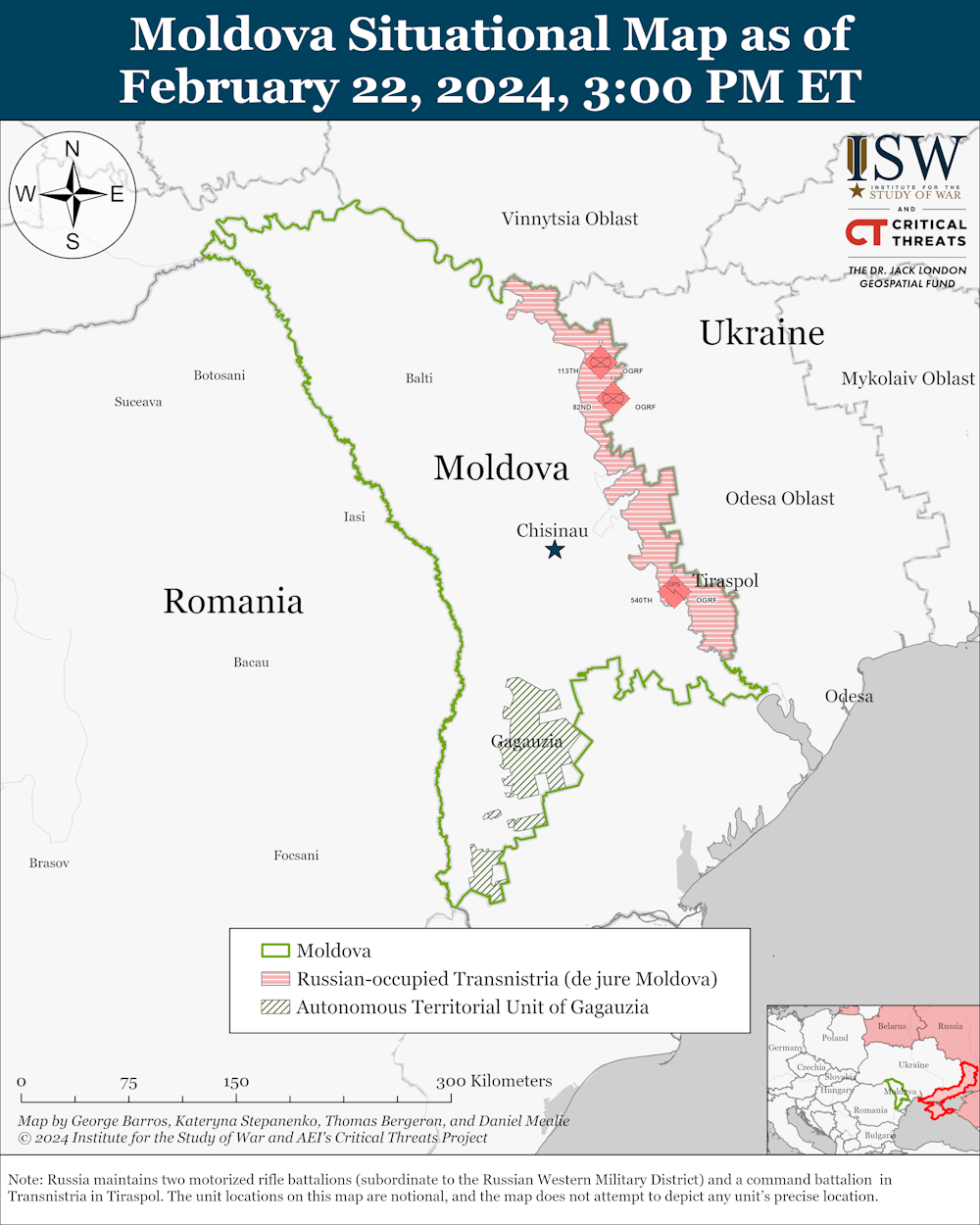
Map of Moldova showing the breakaway regions of Transnistria and Gaugazia. Institute for the Study of War
These results are not surprising, given the outcome of the first round of the elections. But they represent fall in support for Sandu compared to in 2020, when she beat the then incumbent, socialist party leader Igor Dodon. Four years ago, Sandu obtained over 250,000 votes more than Dodon, winning almost 58% of the total vote. While she took the overwhelming share of the diaspora vote then as well, she also bested Dodon in most constituencies in the south.
Dodon campaigned for Stoianoglo in this election, but much of the challenger’s support was very probably due to a massive pro-Russian interference campaign that capitalised on many Moldovans’ fears and frustrations. Pro-Moscow messages aimed to capitalise on fears about being dragged into Russia’s war against Ukraine.
But there was also frustration with a government that has made little progress on much needed anti-corruption reforms and presided over a serious cost-of-living crisis in the aftermath of the Covid-19 pandemic and made worse by the war on Moldova’s eastern neighbour. Sandu’s party, the Party of Action and Solidarity (PAS) won a commanding majority in the 2021 elections – so failures of the government are seen as failures of Sandu and her agenda.
Challenges ahead
That Sandu won the presidency again, and against these odds, demonstrates her resilience. But it can’t be taken for granted that her party will similarly prevail in parliamentary elections due by the autumn of 2025. She may well be forced into a difficult cohabitation with a potentially socialist-led government next year. In a parliamentary democracy, in which the powers of the government by far exceed those of the president, this could significantly slow down Moldova’s EU accession negotiations.
But there are also some silver linings on the horizon. That Sandu won clearly demonstrates the limits of Russian interference. There is a core part of the Moldovan electorate that cannot be swayed by Russian misinformation or vote buying. This is a basis on which Sandu and PAS can build.
Perhaps more importantly, Sandu and Stoianoglo both sent conciliatory signals on election eve. Stoianoglo emphasised the importance of respecting the outcome of the democratic process and expressed the hope that Moldovans would now move beyond hatred and division. Sandu acknowledged the concerns of those who had not voted for her and promised to serve as the president of all Moldovans and to work for the country’s further development.
If they both stay true to their word, Moldova may finally break with a past of repeated political crises and economic stagnation.
Stefan Wolff is a past recipient of grant funding from the Natural Environment Research Council of the UK, the United States Institute of Peace, the Economic and Social Research Council of the UK, the British Academy, the NATO Science for Peace Programme, the EU Framework Programmes 6 and 7 and Horizon 2020, as well as the EU’s Jean Monnet Programme. He is a Trustee and Honorary Treasurer of the Political Studies Association of the UK and a Senior Research Fellow at the Foreign Policy Centre in London.
The Fortune-Teller by Caravaggio (1595-8).Louvre Museum
In the late 1740s, Samuel Meadwell arrived in London. A “raw country fellow” from Northamptonshire, he had come to work as a distiller’s apprentice and hoped to make his fortune.
When a pair of women told him there was “something very particular in [his] face”, he was intrigued. They introduced him to a widow called Mary Smith, who allegedly practised “the art of astrology, before very great people, princes, and the like”. She persuaded Meadwell to wrap all his money in a handkerchief with two peppercorns, some salt and a little mould. After waiting three hours, she explained, he would discover a great fortune.
Meadwell discovered only that his money had been replaced with scraps of metal. Smith was deported for fraud, while Meadwell learned a lesson about city life. He bemoaned his naivety – but he was not alone in believing in the power of astrologers, or the potential for magical methods to reveal weighty secrets.
In early modern Britain (1500-1750), divination was widespread. People consulted diviners to find stolen goods, learn about the next harvest, or scrutinise their marriage fortunes. Sometimes they wanted to know what diseases or disasters loomed, and several nobles exhibited an unwholesome interest in the monarch’s date of demise.
The sex of unborn children was another topic of speculation: when Anne Boleyn gave birth to the future Elizabeth I in 1533, she disappointed not only Henry VIII, but also a whole host of “astrologers, sorcerers, and sorceresses” who had assured the couple that a male heir was forthcoming.
Diviners came from across the social spectrum. Learned astrologers could command audiences with kings and queens. Most people, however, relied on the services of a local cunning-man or woman.
There were also so-called “Egyptian” fortunetellers who roamed the country reading palms. These travellers probably did not have African origins. A hostile 1673 work claimed that they were “great pretenders” who sought to dupe “the ignorant” by associating themselves with Egyptians, “a people heretofore very famous for astronomy, natural magic, [and] the art of divination”.
The authorities did not approve. In 1530, an act passed by Henry VIII’s parliament sought to expel “Egyptians” from the country, complaining that they conned people using “great, subtle, and crafty means” such as fortunetelling.
Underpinning many divinatory methods was the belief that God’s divine plan was encoded in the patterns of the natural world. Palmistry relied on interpreting the marks God had traced on the body. Astrologers, meanwhile, focused on the movements of the planets.
Between 1658 and 1664, a woman called Sarah Jinner published almanacks containing astrological readings for the forthcoming year. She ranged from predicting “desperate and unreconciliable wars” to cautioning women that: “We find Mercury in Pisces retrograde in the 6th House, [which] denoteth that servants will generally be cross, vexatious, and intolerable, especially maidservants.”
Meeting a Swine. From Dr Solman’s translation of Aristotle’s Golden Cabinet of Secrets (c. 1690).
The behaviour of animals was also considered portentous. A pamphlet from circa 1690 declared that “to meet a swine the first thing in a morning, carrying straw in its mouth, denotes a maid, or widow, shall soon be married, and very fruitful in children”. On the other hand, magpies flying around you signified “much strife and brawling in marriage”.
When a great murmuration of starlings was spied battling in the air above Cork in 1621, people whispered that it signified divine anger. Eight months later the city was devastated by a fire.
Other divination practices relied on chance. Cheap pamphlets outlined ways of divining with dice, the idea being that God determined the outcome. Another practice was to open a Bible randomly and consult the first passage that caught the eye. Bibles could alternatively be used to catch thieves. The usual method was to insert a key into the Bible, recite the names of the suspects, and wait for the Bible or the key to move.
A similar technique involved suspending a sieve from a pair of shears. The sieve would rotate when a thief’s name was mentioned.
Divination and the authorities
These practices were viewed with suspicion by the ecclesiastical and secular authorities, especially after the 16th-century Reformation.
Divination by the sieve and shears in Cornelius Agrippa, De Occulta Philosophia (1567). Opera Omnia
Most dangerous of all was divination by consulting spirits. The Scottish cunning-man Andrew Man claimed to have an angelic adviser, Christsonday, who told him whether upcoming years would be good or bad. He was also in a sexual relationship with the Fairy Queen, who had promised to teach him to “know all things”. Leading local figures concluded that Man had really been cavorting with devils. He was tried for witchcraft, and executed in 1598.
In general, however, cunning-folk enjoyed good standing within their communities. Currents of scepticism flowed faster during the 18th-century Enlightenment. A 1762 work expressed a common view when it blamed belief in divination on the “ignorance and darkness” that “covered the minds of mankind”. But divinatory practices were themselves a quest for enlightenment, and the prospect of unravelling the mysteries of the future has remained compelling up to the present day.
Looking for something good? Cut through the noise with a carefully curated selection of the latest releases, live events and exhibitions, straight to your inbox every fortnight, on Fridays. Sign up here.
Martha McGill receives funding from the British Academy.
Increasing rights for Indigenous people and local communities was one of the few steps forward at Cop16. Philipp Montenegro, CC BY-NC-ND
Progress at the UN’s biodiversity summit, Cop16, in Cali, Columbia, has been slow. Frustratingly so.
There were high hopes that the Colombian hosts could coordinate action between developed and developing countries towards reaching the landmark global biodiversity agreement reached in Montreal, Canada at Cop15 two years ago. But after two weeks and one long night, negotiations ended abruptly. Many delegates had to leave to catch flights home with key issues unresolved.
This conference started with alarming news that the latest edition of the red list – the official record of threatened species – shows that more than one third of tree species face extinction in the wild. That’s more than the number of threatened birds, mammals, reptiles and amphibians combined.
Urging negotiators to recognise the seriousness of this nature crisis, Colombia’s president Gustavo Petro warned they were facing “the battle for life”.
There was certainly no shortage of people seeking solutions.
In the heart of the city, Cop16’s green zone hosted vibrant music, film screenings, indigenous arts and crafts. Local people, businesses and conference delegates discussed creative and collaborative ways to address the nature crisis.
Over in the blue zone, the official conference space, there was a notable increase in the diversity of communities participating across side events and pavilions. The links between biodiversity and human health were highlighted. So too was the importance of nature for water and food security.
In his opening video message, UN secretary general Antonio Guterres urged countries gathered to “engage all of society” as “la Cop de la gente” (a Cop of the people).
So protests from Indigenous people and local communities were particularly powerful. Including greater recognition for these groups in the final decisions from the meeting was a rare sign of progress. A new fund to ensure that these groups would receive a share of the profits from the commercial use of digital sequence information – genetic information from native plants and animals – was another victory.
A new set of principles developed by the UK government to prioritise gender issues in conservation and ensure fair access to the benefits biodiversity action for all marginalised groups received widespread support.
The focus on economic resilience was more prominent than ever, with two days dedicated to business and finance. In 2018, only 300 businesses attended Cop14 in Egypt. In Cali, this number was 3,000.
Delegates assemble for the negotiations at Cop16. Philipp Montenegro, CC BY-NC-ND
Private investors, pension funds, the insurance industry and public banks stressed the importance of creating robust measures of biodiversity improvement. Business sectors focused on transition plans that could support fair and transparent means of reporting progress. The nature tech sector is growing too, with start-ups expected to attract up to $2 billion (£1.5 billion) in investments by the end of 2024.
Back in the negotiating halls, delegates faced an uphill struggle. Only 44 out of 196 national plans to protect biodiversity have been updated to reflect the new targets. So, it’s no surprise that a gap is widening between current reality and the ambitious set of 23 targets which governments must reach by 2030. While countries agreed to a progress review in 2026, no consensus was reached on the indicators to be used. Progress was painfully slow.
Negotiators debated how the global agreement on biodiversity should interact with its sister conventions on climate and desertification. Further discussions next year might identify how this could work but this probably won’t lead to drastic change. Some countries, including India and Russia, still seemed unwilling to accept the critical risks posed to nature and society of exceeding the 1.5°C global target for climate change.
Many developing nations were concerned that greater integration between the climate crisis and biodiversity would lead to “double counting” of funding with the danger that developed countries could backtrack on their promises to support dedicated action on nature. Others, including the EU, argued that action to conserve and restore nature was an essential part of tackling all environmental and societal global challenges.
The deadlock between these positions continued for days. In the final hours of Cop16, negotiators reached a compromise that sets out a more integrated pathway for bringing action on climate and nature together. While the effects of climate change directly exacerbate biodiversity loss, restoring nature can be a powerful tool in the fight to mitigate the climate crisis and benefit biodiversity. Nature-based solutions – measures like restoring peatlands and wetlands, planting trees and mangroves – help build that resilience.
Heads of state and ministers joining at the midpoint of the meeting pointed out the need to ensure that nature is protected both for its own sake and for the communities that depend on healthy ecosystems for their livelihood and wellbeing.
But at the end of a long final night, these words were not accompanied by concrete plans for action or the financial commitments about how nature protection should be paid for that many at Cop16 were hoping for.
Whole of society, all of government?
The global biodiversity agreement set in 2022 called for a whole of society approach to address the nature crisis. Cop16 certainly delivered. From local communities to huge businesses, there was a spirit of rolling up sleeves and putting investment and innovation to work using nature-based solutions to restore and conserve biodiversity.
One of many packed side-events which bought the ‘whole of society’ together at Cop16. Philipp Montenegro, CC BY-NC-ND
The same energy and commitment was clear from many of the local and sub-national governments assembled at Cop16. The first gathering of Mayors for Nature demonstrated significant commitment to action.
Leaders from California and Quebec set the tone by investing in large-scale programmes, with Quebec not only committing to fund their own biodiversity action but also contributing to the global biodiversity fund – the first regional government to do so.
But national governments struggled to move forward. The complexity of addressing biodiversity and its necessary interactions with sectors such as agriculture, transport and mining, as well as concerns over historic injustices between developing and developed countries, was perhaps too much for Cop16 to resolve.
The risk is that, as governments navigate these challenges, the private sector could accelerate action without scrutiny. I worry that the lack of policy coordination could deter investors and slow the pace of action that local communities and regional governments want to make. Rather than waiting for global consensus, groups can catalyse change while holding each other accountable to make swift progress to save nature.
Don’t have time to read about climate change as much as you’d like?
Harriet Bulkeley receives funding from the European Commission and currently serves as an advisor to the UK Department of Environment, Food and Rural Affairs.
Source: The Conversation – UK – By Vanessa Newby, Assistant Professor, Institute of Security and Global Affairs, Leiden University
After a month of heavy bombardment, and despite continuing its military campaign and clearing border villages in south Lebanon, Israel is reportedly indirectly negotiating a peace deal with Hezbollah leaders. The terms of a ceasefire require the full implementation of UN resolution 1701, with a presence of around 10,000 Lebanese armed forces (LAF) soldiers stationed along the “blue line” which divides Israel from Lebanon and the Golan Heights. But making 1701 work has always proved a challenge.
There can be no doubt that since its inception in 2006, resolution 1701 has never been fully implemented in south Lebanon. Adopted unanimously in 2006, the purpose of the resolution was to end hostilities between Hezbollah and Israel, with the UN security council calling for a permanent ceasefire.
A key objective of 1701 is to ensure the area south of the Litani River in south Lebanon is free from any weapons other than those of the Lebanese state and the United Nations Interim Force in Lebanon (Unifil)
It is on this issue that Unifil has received the most opprobrium. International observers and politicians have criticised Unifil’s inability to locate and remove Hezbollah’s weapons. The IDF blames Unifil for failing to prevent the rearmament of Hezbollah and for allegedly not doing enough to prevent Hezbollah attacks on Israel.
But the question of why resolution 1701 was not fully implemented is not a simple one. Multiple actors are involved, of which one key player is the LAF. A large part of fulfilling resolution 1701 means ensuring that LAF are deployed in southern Lebanon as the only legitimate provider of force representing the Lebanese government. Understanding their role and the constraints they face is an important part of the puzzle.
Prior to the outbreak of the Lebanese civil war in 1975, south Lebanon was sparsely populated and regarded as strategically unimportant. When civil war broke out, political and operational factors meant the LAF could not deploy to the south.
These factors included the defection of LAF officers to sectarian militia and a lack of sufficient resources. The influence of neighbouring Syria and the heavy presence of militia groups, plus the occupation of the “zone of security” in south Lebanon by the IDF and its proxy militia the South Lebanon Army complicated matters.
After the 2006 war, LAF became an important official party to resolution 1701 and Unifil worked closely with them to fulfil three main objectives: first, to assist with their re-introduction into the area of operations; second, to improve their operational capabilities; and third, to seek international funding for the LAF to improve their technical capabilities.
Hunting for Hezbollah
Unifil is mandated to assist LAF in taking steps towards the establishment of an area free from armed personnel between the blue line and the Litani River.
Map of sourthern Lebanon showing the blue line which covers the Lebanese-Israeli border and extends to cover the Lebanese-Golan Heights border. Striving2767, CC BY-NC-SA
Until recently LAF and Unifil often conducted joint patrols to search for unexploded ordinance and unauthorised weapons. If Unifil independently discovered an illegal weapons cache, it would notify the LAF, which handled the weapons’ recovery.
This approach helped Unifil sidestep confrontations with the local population, on whose support they depend to patrol safely and execute the mandate. But while this policy was supportive of the goals of 1701, ultimately it proved ineffective.
There were a number of reasons for this. First, the LAF faces legal restrictions on entering private property. If it suspects illegal weapons are stored on private land, the LAF needs a court order to enter the property. This takes time, which gives the owner of the property the opportunity to remove the weapons. To fully implement 1701, this legal barrier would need to be removed.
The LAF also has to walk a political tightrope between different political factions in Beirut, and is also sensitive to the need for local support in the south. While LAF is undoubtedly popular in Lebanon, many in the south are Shia Muslims with strong loyalties to Hezbollah and the Amal movement (a Shia militia which now operates as a political party in Lebanon). These groups offer both a degree of security and material help in the form of social services.
While conducting field research in southern Lebanon from 2012 to 2018, I discovered that civilians in the region understand that it is difficult for LAF to hunt aggressively for weapons. This is because they need to retain a working relationship with Hezbollah which – with its allies – constitutes the political majority in Beirut. Ridding south Lebanon of Hezbollah weapons will require political cover from Beirut.
Another problem the LAF has faced is getting hold of modern weaponry due to Israeli opposition, despite the LAF enjoying strong international support. Israel’s “qualitative military edge” strategy, supported by the US, means that it campaigns internationally against any of its border states obtaining weapons deemed to pose a threat to its security. This has on occasion prevented LAF from accepting essential defensive equipment, such as armoured vehicles and air defence systems, from its European friends.
Preventing LAF from getting defensive equipment contradicts the EU and US stated goal of strengthening LAF. It also supports Hezbollah’s claim that it can only hand over national security to LAF when it is properly equipped to defend Lebanon. A civilian I interviewed in south Lebanon in 2013 summed up the paradox: “We would prefer that the international community made a decision to allow the military to be armed properly, and then we don’t need the resistance.”
Ultimately the political and legal tightrope the LAF walks in Lebanon is deeply implicated in why resolution 1701 has never been fully implemented. Neither a national army nor a peacekeeping force are capable of enforcing a Hezbollah withdrawal in the absence of political and legal agreement in Beirut, or local support in south Lebanon.
Any calls for the full implementation of 1701 will require the unqualified support of all parties to 1701. This is not just those involved in the conflict – Israel, Hezbollah and the Lebanese government – but also various international stakeholders including the US, EU and all countries with UN peacekeepers in Lebanon. It will be a delicate balance.
Vanessa Newby does not work for, consult, own shares in or receive funding from any company or organisation that would benefit from this article, and has disclosed no relevant affiliations beyond their academic appointment.
To say that Paddington Bear is a beloved British icon would be something of an understatement. The Peruvian bear, who arrived at Paddington station with nothing but his suitcase, a love of marmalade sandwiches and a luggage tag reading “please look after this bear”, was created by Michael Bond in the 1958 classic A Bear Called Paddington.
Bond went on to write 29 Paddington books, and the bear has appeared in TV adaptations for nearly 50 years. The 2014 Paddington film was launched to much acclaim, leading to a sequel in 2017. Paddington even appeared with Queen Elizabeth II during the Platinum Jubilee celebrations in 2022, cementing his status as a quintessential symbol of British identity.
In the third film, premiering November 8, Paddington will visit Peru in search of his dear Aunt Lucy. As part of the marketing campaign for the new film, the UK Home Office has granted Paddington his own British passport.
What can Paddington Bear’s citizenship journey teach our leaders?
Join The Conversation UK and migration experts in London on November 16 for a screening of Paddington Peru and a discussion on migration, citizenship and belonging.
“We wrote to the Home Office asking if we could get a replica, and they actually issued Paddington with an official passport,” one of the film’s producers said. “You wouldn’t think the Home Office would have a sense of humour, but under official observations, they’ve listed him as Bear.”
Arriving from Peru in need of help, Paddington is often afforded the status of refugee-in-chief – even immortalised in Banksy artwork. Bond was inspired by Jewish refugees arriving in the UK from Europe during the second world war when he created the character.
In being granted British citizenship, Paddington has fared far better than most people arriving in the UK in need of help. Under the current system, asylum seekers must navigate a complex process, often over many years, in which they are disbelieved, excluded and stigmatised. A third of all people seeking asylum in the UK are refused at their initial application.
Should they manage to be granted refugee status, after five years they may apply for indefinite leave to remain. Should that be granted, after another year they may apply for citizenship status. For this to be granted, the applicant must be able to prove language skills, have passed the “life in the UK” test and be shown to be of “good character”.
Giving Paddington a passport is an unsettling display of double standards from the same Home Office that has overseen the hostile environment and other harsh asylum policies. The Home Office has made conditions in the UK as difficult as possible for people settling from overseas and has subjected people arriving in the UK to seek asylum – much like Paddington – to delays, detention, destitution and deportation.
In its treatment of the Windrush generation, the Home Office has deported people who have legally lived and worked all their lives in the UK – and has failed to compensate victims. For the Home Office then to issue a passport to a fictional character as a publicity stunt is, to put it mildly, problematic.
At the same time, the whole episode is a very clear reflection of how access to British citizenship really works. Access to British citizenship for people arriving in need of safety depends on proving yourself to be deserving of refugee status, and then of citizenship status.
Research has shown that people tend to see child refugees (like those who inspired Bond to create Paddington) as the most deserving of help. Paddington has also shown himself to integrate into the British way of life, sipping tea and eating marmalade sandwiches in a cosy duffel coat and wellies.
This supposedly deserving refugee contrasts against those seen as undeserving – most often men of colour who are seen as “invading” in “swarms”. Until recently, anyone who arrived in the UK on a boat (as Paddington did) to claim asylum would be at risk of being sent to Rwanda to have their claims processed. Keir Starmer has indicated his openness to similar offshoring deals.
The stunt also highlights how valuable a commodity British citizenship has become. While people from the Windrush generation and their descendants worked and paid taxes in the UK all their lives, only to be told that they weren’t really British, citizenship is far easier to acquire for those on investor visas, which require a £2 million investment in the UK.
The citizenship acquisition process itself is also expensive, costing upwards of £5,000 per application. While most refugees will struggle to get British citizenship, for Paddington it came relatively easily as an investment in the UK film industry.
I won’t begrudge Paddington his passport. He’s waited long enough for the security and stability of a status denied to so many non-citizens around the world. However, this stunt has highlighted both the double standards of a hostile Home Office attempting to create the illusion of benevolence, and the realities of a citizenship acquisition process which continually fails the vulnerable.
Katie Tonkiss receives funding from the Economic and Social Research Council.
Traditionally, Britain was regarded as the class society. And class was pre-eminent among the factors used to explain political party allegiance. In broad terms, working-class voters chose Labour, the party set up to represent them. Middle-class voters chose the Conservatives, the party that represented homeowners and business owners.
Since the 1960s, there has been a decline in class-based voting. Our social background is no longer such a good predictor of our party.
That may be because there are more parties to choose from, or because the big two have changed their offering to appeal to a wider audience, but it’s also about class-based abstention. In the 1960s, most working-class people voted in elections, and when they did so they tended to vote for Labour. Now, many more working-class people do not vote at all. And when they do, they are less drawn to any party in particular.
Class differences with respect to turnout have thus become greater than class differences with respect to vote choice. Or put another way, class is now more important as a participatory divide than it is as a partisan divide.
According to the long-running British Election Study (BES), the difference in reported turnout between people with working-class occupations and middle-class occupations was less than 5 percentage points in 1964. In 2024, it was 16 percentage points.
Put into context, the difference in reported turnout between the under-30s and the over-60s in 2024 was 20 percentage points. This age gap is the subject of great concern and much discussion. We worry a lot about why young people are not voting. Numerous initiatives have been launched to try and get young people more involved in politics. Yet the class gap, of a very similar magnitude, has received almost no attention at all.
BES data over the years shows us that the working class has generally been somewhat less likely to vote than the middle class. But from 1964 to 2001, the difference in turnout rates was fairly modest. Turnout bumped along, up and down, but the relative difference did not change much, and turnout among both groups tended to increase and decrease in tandem.
However, since 2001, the turnout patterns between the two classes have sharply diverged. In the election of 2001, overall turnout was the lowest since 2018 at just 59.4%. The middle-class vote bounced back after that nadir but the working-class vote did not, remaining instead at historically low levels. Before 2001, the average class gap in turnout was 6 percentage points. So today’s 16 percentage-point gap is nearly three times greater than the pre-2001 level.
The widening class gap in turnout, 1964-2024:
The chart below shows how the size of this class gap on turnout compares with the size of the class gap on support for Labour, the party which was originally founded to represent working-class interests.
In 1964, among people with working-class occupations, 11% did not vote, 55% voted for Labour, and the remaining 34% voted for the Conservatives or another party. Among people with middle-class occupations, 7% did not vote, just 18% voted for Labour, and the remaining 75% voted for the Conservatives or another party. The class gap on turnout was therefore just 5 percentage points, compared with the class gap on Labour support of 37 percentage points.
The class gap in turnout has overtaken the class gap in support for Labour, 1964-2024:
Over time, Labour has become a less distinctively working-class party. This has particularly been the case since the New Labour period, when Tony Blair famously rebranded the party to project a more middle-class image.
The result has been that the size of the class gap on Labour support has declined, while the size of the class gap on turnout has increased – to the point in the early 2000s where class differences on turnout overtook class differences on support for Labour.
These findings have important implications. There is a widespread belief that class has become less important in British politics, and so does not merit as much attention as it once did. This belief is false.
While it is certainly true that class divisions are not as evident as they once were in terms of structuring vote choice, this is because class has been pushed outside the political system. Whereas previously the middle class and working class were divided on who to vote for, now they are divided on whether to bother voting at all.
The authors do not work for, consult, own shares in or receive funding from any company or organisation that would benefit from this article, and have disclosed no relevant affiliations beyond their academic appointment.
The neglect of working-class voters in the past few decades has had profound consequences for British political life. Disillusioned with the two main parties, many have turned to Nigel Farage’s Reform and others are simply not voting at all.
With the next election likely to be a tight race in many key constituencies, something must be done to win these voters back.
But as we find out in the fifth and final part of Know Your Place: what happened to class in British politics, a podcast series from The Conversation Documentaries, the relationship between class and voting could be about to become even more complicated. So it’s difficult for any party to know how to put an electoral coalition together.
Paula Surridge, professor of political sociology at the University of Bristol, has identified what she calls cross-pressured voters as a key demographic in post-Brexit British politics. These are people who are probably economically left wing – they want better public services and wealth redistribution – but who are more right wing on social issues such as immigration and crime and punishment.
In a system like we have in Britain, where we’ve got first past the post and two big parties to choose from, that creates lots of swing voters who, when economics is their priority as we saw in 2024, they might lean more to Labour. When immigration or Brexit or something along that dimension is their priority, they might lean towards the Conservatives or a party like Reform.
Want more politics coverage from academic experts? Every week, we bring you informed analysis of developments in government and fact check the claims being made.
Appealing to such voters is therefore a real challenge. And while the perception is that they’ve flocked to Farage, Surridge says that’s not the full picture at all.
Many working-class voters were prioritising economic issues, public services. They don’t, on the whole, vote Reform for that reason. The voters for whom immigration was absolutely their most important issue, which are a much smaller group, they were very likely to vote Reform.
Reform came second in 98 constituencies – 89 of which ended up going to Labour. A lot of those constituencies were won on wafer-thin majorities, and they should be considered highly at risk in the next election. So working out how to appeal to cross-pressured voters is key.
The bigger challenge, however, is winning voters back from the sofa. The truth is that there is a more salient class divide in Britain: who actually votes at all.
According to Oliver Heath, professor of politics at Royal Holloway, University of London, who has tracked the history of turnout and class over the past 20 years, working-class voters are staying away from the ballot box. The first real signs of this were in 2001, when Tony Blair won a second term with a turnout of 59%, one of the lowest in British history.
2001 was when turnout fell off a cliff … and it dropped across all segments of society. But since then, turnout has rebounded quite a large extent amongst middle-class voters, but stayed very low amongst working class voters.
For decades working-class communities were assumed to vote Labour, and so Labour gave them relatively little political attention. Now, the tables have turned and its Labour constituencies in the Red Wall that are some of the most competitive in the country. But it won’t be easy for Labour to bring these voters back on side, says Heath.
Even after the great implosion of the Conservatives, the votes haven’t gone back to Labour. So, it’s hard to rebuild those connections once they’ve come undone.
Meanwhile, Rosie Campbell, professor of politics at King’s College London, warns that we can’t presume to know what middle-class voters will do either.
The backlash of the middle class in some areas against the Conservatives in what you would expect to be traditional Conservative heartlands is really interesting. And I think what it’s showing is that social change and demographic change are shifting our political landscape.
Pay attention to the middle-class vote in the next election. Shutterstock/William Barton
All this means that British politics is more fractured than ever, according to John Curtice, senior research fellow at the National Centre for Social Research.
It looks as though our politics isn’t two-party politics now, and it’s never looked less like two-party politics at any stage since 1945 … therefore there are many potential options as to how things might play out.
One of those options is a radical disruption to the class system itself, potentially triggered by artificial intelligence. A question that Curtice is asking himself:
Will class inequality still be articulated through the difference between people in working-class jobs and those in middle-class jobs, or those people who are very much at the creative end of middle-class jobs, who AI are probably not going to be able to replace, and those who are not quite in the same position?
In other words, AI has the potential to split the middle class and redefine the entire occupational structure of the UK. What will that do to our political preferences? It’s all to play for.
For more analysis on what else could shape the way class and politics interact in the future, listen to the full episode of Know Your Place: what happened to class in British politics on The Conversation Documentaries.
A transcript is available on Apple Podcasts.
Know Your Place: what happened to class in British politics is produced and mixed by Anouk Millet for The Conversation. It’s supported by the National Centre for Social Research.
Listen to The Conversation Documentaries via any of the apps listed above, download it directly via our RSS feed or find out how else to listen here.
Rosie Campbell receives funding from the ESRC, the UKRI andThe Leverhulme Trust. John Curtice receives funding from UKRI-ESRC. Vladimir Bortun, Geoffrey Evans, Paula Surridge and Oliver Heath do not work for, consult, own shares in or receive funding from any company or organisation that would benefit from this article, and have disclosed no relevant affiliations beyond their academic appointment.
Source: The Conversation – UK – By Mark Griffiths, Director of the International Gaming Research Unit and Professor of Behavioural Addiction, Nottingham Trent University
Hollywood actor Armie Hammer was accused of sending messages detailing cannibalistic fantasies in 2021.DFree/Shutterstock
After allegedly sending messages detailing cannibalistic fetishes, Hollywood actor Armie Hammer hopes to relaunch his career with a new podcastand movie.
Now, it seems, Hammer is laughing off the cannibalism allegations. Speaking to his first podcast guest, Tom Arnold, Hammer says, “I’m not gonna lie. I’m just like, Hey, I’m a cannibal!”
But being sexually aroused by the fantasy – or reality – of cannibalism is real. I should know, as it’s one of the subjects I discuss in my latest book Sexual Perversions and Paraphilias: An A-Z
Paraphilias are uncommon types of sexual expression often described as sexual deviations, sexual perversions or disorders of sexual preference.
They are typically accompanied by intense sexual arousal to unconventional or non-sexual stimuli such as enemas (klismaphilia), statues (agalmatophilia), teeth (odontophilia) and vomit (emetophilia).
To many people paraphilias may seem bizarre or socially unacceptable, representing the extreme end of the sexual continuum – and in some cases, such as zoophilia (having sex with animals) and necrophilia (having sex with dead people), may be illegal.
Paraphilias may be laughed off, dismissed or leave some people disgusted, but there’s a pressing need for more research into uncommon sexual behaviour given how little we know.
Sexual fantasies and behaviour are a fundamental part of the human experience. What is considered immoral or even illegal changes according to the social and temporal context. But whatever sexual desires are considered illicit or depraved in a particular time and place are also stigmatised.
Researching paraphilias, even the most distasteful or criminal, is essential to help safeguard vulnerable groups. Research can also help minimise the discrimination faced by those with uncommon sexual interests, helping ensure their access to sexual health care and psychological support, which can be lacking.
Vorarephilia
Vorarephilia – or “vore” – refers to being sexually aroused by the idea of being eaten, eating another person or observing this process for sexual gratification.
Most of the fantasies of vorarephiliacs involve being the ones eaten. Devouring someone could be viewed as the ultimate act of dominance by a predator and the ultimate act of submission by the prey.
The most infamous vorarephiliac is arguably Armin Meiwes from Germany.
Meiwes had allegedly been fantasising about cannibalism since his childhood and frequented cannibal fetish websites. He posted around 60 online adverts asking if anyone would like to be eaten by him.
In March 2002, Bernd Jürgen Brandes responded to Meiwes. They met up only once. Meiwes bit off Brandes’ penis, which the two of them cooked and ate.
Brandes was videotaped being stabbed to death by Meiwes in his bath. The body was then stored for Meiwes to eat.
Meiwes was eventually convicted of murder and imprisoned for life. However, it’s worth nothing that although some paraphilias are illegal, most cause no psychological or behavioural problems when they are engaged by consenting adults.
Dacryphilia
Dacryphilia is getting sexual arousal from seeing someone cry.
It showed there were sub-types of dacryphilia, even among such a small group. Based on the interviews, I identified three types of dacryphile.
Compassionate dacryphiles are sexually aroused by the compassion of comforting a crier.
Dominant or submissive dacryphiles are sexually aroused by either causing tears in a consenting submissive partner or by being made to cry by a consenting dominant partner.
“Curled lip” dacryphiles are sexually aroused by the curling of a protruded bottom lip during crying.
Eproctophilia
Eproctophilia involves being sexually aroused by flatulence.
In 2013, I published the first case study of an eproctophile. The case concerned a 22-year-old single man, Brad*, an American from Illinois.
Brad recalled that in middle school he had a crush on a girl who had farted in the class. Brad said:
This blew my mind [I] knew by simple biology that girls farted, but hearing that the girl I had been fawning over was capable of such a thing sparked a strange interest in me.
Brad first engaged in an eproctophilic act with a male friend in his mid-teens. Up to that point he had considered himself heterosexual. However, this changed when he heard his male friend fart.
Brad said it was “appealing in sound” and that he began fixating on it. He set up a bet with the wager being the right to fart in the loser’s face for a week. He continued to lose such bets once every few weeks for about two years.
Apotemnophilia
Apotemnophilia refers to being sexually aroused by the fantasy or reality of being an amputee.
Some apotemnophiles may pretend to be amputees but, for a minority, the behaviour involves obsessive scheming to convince a surgeon to perform a medically unnecessary amputation.
To most people, this might seem like a type of masochism, but case studies suggest that there is no erotisation of pain – only of the healed amputated stump.
Salirophilia
Salirophilia is sexual arousal from soiling or dishevelling someone attractive, which can include tearing or damaging the desired person’s clothing, covering them in mud or filth or messing up their hair or make-up.
My 2019 case study involved Jeff*, a 58-year-old Australian heterosexual. Jeff recounted that when he was young he wanted to masturbate in strange places such as lying under a cabinet in a dirty garage.
Jeff said that he engaged in solitary salirophilic practices regularly but very infrequently with female partners because it was difficult to find like-minded women.
He was also a fan of the television show Fear Factor in which contestants perform revolting tasks for prize money, such as eating rotting food or being submerged in foul fluids. These were a source of sexual arousal for Jeff. He told me: “I just find the defilement of an attractive woman’s body erotic.”
*The names of case study participants in this article have been changed.
Dr. Mark Griffiths has received research funding from a wide range of organizations including the Economic and Social Research Council, the British Academy and the Responsibility in Gambling Trust. He has also carried out consultancy for numerous gambling companies in the area of player protection, social responsibility and responsible gaming.. Views expressed here are his own and not those of these funding bodies.
But I assume the awkwardness in conversations about work is related to stereotypes of hip-hop culture. Among many, one of those assumptions is that hip-hop is only made for and by young people.
It’s no surprise that ageism exists in and about hip-hop culture; in the U.S., ageism is everywhere. But I would argue that ageism in hip-hop is especially strong because the first generation of rappers is only now reaching their golden years.
In response to 9th Wonder, legendary hip-hop artist Q-Tip warned on the social platform X that hip-hop fans might be turned off by a category with “adult” in the name. He suggested “Traditional Hip-Hop” instead, arguing that the music should all appear in “one pot,” lest it turn off younger listeners.
Whether it’s called Adult Contemporary or Traditional Hip-Hop, several hip-hop legends have recently released new music that could fit into this category. In July 2024, the legendary lyricist Rakim, who’s 56 years old, released “G.O.D.’S NETWORK (REB7RTH),” his first album in 15 years. Two months later, 54-year-old MC Lyte released “1 of 1,” her ninth studio album, and 56-year-old LL Cool J released “The Force,” his 14th studio album and his first in 11 years.
Growing pains
Since hip-hop emerged as a cultural force more than 50 years ago, people still seem to pigeonhole rap as music made by and for young people.
And it’s true that in hip-hop’s early days, teenagers were at the forefront of the fledgling movement.
A 1973 back-to-school party organized by a 15-year-old girl from the Bronx named Cindy Campbell is often credited with birthing hip-hop. Grand Wizzard Theodore was just 12 years old when he invented record scratching in 1977. The hip-hop careers of artists like Roxanne Shanté, Run-DMC and Ice Cube all began when they were teens.
Being closely intertwined with the perception of youth culture isn’t necessarily a good thing. It can compel critics to treat the music and its practitioners less seriously.
Rappers, no matter their age, can be dismissed or treated as childish or immature.
Call it growing pains: Unlike, say, classical or country, 50 years is a blip in the history of music. And for much of that time, critics regarded hip-hop as a passing fad. Then it was seen as an emergent subculture.
Nowadays, equating hip-hop with youth culture confines it to an arena it has long outgrown.
Imposter syndrome grows
Nonetheless, as rappers age, some can seem uncomfortable about participating in a form that can be so easily dismissed.
In 2015, filmmaker Paul Iannacchino Jr. released a documentary, “Adult Rappers,” about working-class rap artists.
All the people interviewed for the film rap professionally but aren’t famous. They are mostly men. Most of them admit that they sidestep questions about what they do for a living. One unshakable takeaway is the embarrassment about their age.
Even famous rappers aren’t immune to this feeling. Before his move to instrumental flute music, André 3000, one of the greatest rappers of all time, lamented becoming the old rapper still making music beyond his prime.
“I remember, at like 25, saying, ‘I don’t want to be a 40-year-old rapper,’” he told The New York Times in 2014. “I’m 39 now, and I’m still standing by that. I’m such a fan that I don’t want to infiltrate it with old blood.”
André 3000 has been a gifted lyricist for decades, and remains so. If he feels this way, I can imagine that many other artists might feel that, at a certain age, they don’t belong to the culture anymore.
Despite the fact that audiences have aged alongside the artists, it can still feel like there’s pressure to stay tapped in to youth culture, lest they create music that, to quote André 3000 more recently, lacks “fresh ingredients.”
This might encourage some aging artists to attempt to maintain a youthful sheen that will resonate with young audiences. Think of it as a pop culture version of Oscar Wilde’s novel “The Picture of Dorian Gray.”
In the novel, a man sells his soul for youth. Rather than physically aging, a painting of him ages instead, taking on the physical signs of his transgressions and pleasures.
It’s still easy to think of hip-hop as confined to a frame that bears all the marks of youthful longings, rebellion and sins: juvenile vitality, sprightly beauty and vigorous hedonism.
The expectations lead audiences to assume all artists have similar youthful aims and concerns. They can also lead artists to perform like they’re young and write about the concerns they had as youngsters, despite their respective ages. The hip-hop artists who can’t or choose not to pretend to be “forever young” are expected to “evolve” into moguls, actors, podcasters or reality TV personalities.
Of course, those assumptions only end up limiting what artists of all ages can accomplish.
Rappers at whatever level of celebrity you observe, famous and not famous, continue to create while embracing the inevitability of age. Nas, whose debut album, “Illmatic,” was released in 1994, has had an outstanding run of albums in the 2020s.
Jay-Z’s “4:44” showcased the rapper’s changing sensibilities that have seemingly evolved as he has aged.
North Carolina duo Little Brother’s entire catalog displays awareness of the absurdity of avoiding adulthood – outstandingly so, I might add, on their 2019 album, “May the Lord Watch.”
Even emerging rappers like Conway the Machine and 7xvethegenius seem to be able to balance burgeoning careers without caving to youth-obsessed pretenses.
Creating new, cleverly named musical categories to sidestep biases against aging probably won’t solve the issue. In hip-hop, as in so many American industries, ageism isn’t going away.
But I’d rather have that conversation than pretend I’m something I’m not.
A.D. Carson does not work for, consult, own shares in or receive funding from any company or organization that would benefit from this article, and has disclosed no relevant affiliations beyond their academic appointment.
Partisan squabbling isn’t just annoying – it’s also bad for business.
That’s what my colleagues and I found in a recent study on how uncertainty in environmental policy affects business investment.
First, we analyzed more than 300 million newspaper articles, looking for keywords related to environmental policy uncertainty. We found that this uncertainty spikes around election seasons and has nearly doubled over the past decade.
Then we looked at business investment rates – a common way to gauge a company’s financial health – at companies in affected sectors, such as those in the agriculture, mining, energy and automotive industries. We found that environmental policy uncertainty lowered those companies’ business investment rates by 0.010%.
That might not sound like a lot, but as economists like me know, small sums add up over time.
For example, the rise in environmental policy uncertainty in the run-up to the 2008 presidential election was linked with a one-time drop of the investment rate of 25% for companies affected by environmental policy, we found. This effect was larger than the uncertainty associated with defense, health and finance policy.
But my team also found a silver lining. Policy uncertainty had much less of an effect on business investment when control of Congress was divided and policy changes required bipartisan support, we discovered.
When the same political party controlled both chambers of Congress, environmental policy uncertainty was associated with a 0.013% decrease in investment rates. But when Congress was split, this decrease shrank to a much smaller 0.002%.
Why it matters
Because policy uncertainty tends to spike around elections, our results suggest that the current political environment is creating headwinds for business investment.
Our study also suggests that policies designed to spur business investment may be less effective than previously thought, because of the uncertainty they introduce.
Take, for example, the Inflation Reduction Act, passed in 2021, and the bipartisan infrastructure law of 2022. Both were crafted to encourage investment in clean-energy technologies.
But uncertainty over whether these packages would pass in the first place – and, if so, what these policies would include – may have deterred investment before they went into effect. And uncertainty about what aspects of the laws will continue after the election could also depress business investment.
A degree of uncertainty may be built into the democratic process. After all, the faster and more secretive a government is, the less accountable it is to the public. If you think of it that way, some uncertainty is an unavoidable cost of a healthy policymaking process.
Our study puts a price tag on these costs and reminds policymakers that political infighting is a drag on the economy. Our results do suggest one promising path forward: bipartisanship.
What’s next
Because there’s so much variety in environmental policies, our team is now doing research to see whether businesses respond differently to uncertainty in “carrot” policies – such as subsidies or tax breaks – versus “stick” policies, such as fines or other punishments.
Answering this question will help policymakers minimize the effects of uncertainty.
It’s also an open question whether newspaper articles convey information to business leaders or simply reflect the information they already have. If it’s the latter, media coverage may not be a great measure of the uncertainty businesses face.
To address this concern, we’re working to develop ways to measure uncertainty based on earnings call transcripts instead of newspaper articles. These could be a more direct way to gauge the uncertainties influencing business decisions.
The Research Brief is a short take about interesting academic work.
Charles Sims does not work for, consult, own shares in or receive funding from any company or organization that would benefit from this article, and has disclosed no relevant affiliations beyond their academic appointment.
Two-thirds of the world’s food comes today from just nine plants: sugar cane, maize (corn), rice, wheat, potatoes, soybeans, oil-palm fruit, sugar beet and cassava. In the past, farmers grew tens of thousands of crop varieties around the world. This biodiversity protected agriculture from crop losses caused by plant diseases and climate change.
Today, seed banks around the world are doing much of the work of saving crop varieties that could be essential resources under future growing conditions. The Svalbard Global Seed Vault in Norway supports them all. It is the world’s most famous backup site for seeds that are more precious than data.
Tens of thousands of new seeds from around the world arrived at the seed vault on Svalbard, a Norwegian archipelago in the Arctic Ocean, in mid-October 2024. This was one of the largest deposits in the vault’s 16-year history.
And on Oct. 31, crop scientists Cary Fowler and Geoffrey Hawtin, who played key roles in creating the Global Seed Vault, received the US$500,000 World Food Prize, which recognizes work that has helped increase the supply, quality or accessibility of food worldwide.
The Global Seed Vault has been politically controversial since it opened in 2008. It is the most visible site in a global agricultural research network associated with the United Nations and funders such as the World Bank.
These organizations supported the Green Revolution – a concerted effort to introduce high-yielding seeds to developing nations in the mid-20th century. This effort saved millions of people from starvation, but it shifted agriculture in a technology-intensive direction. The Global Seed Vault has become a lightning rod for critiques of that effort and its long-term impacts.
I have visited the vault and am completing a book about connections between scientific research on seeds and ideas about immortality over centuries. My research shows that the Global Seed Vault’s controversies are in part inspired by religious associations that predate it. But these cultural beliefs also remain essential for the vault’s support and influence and thus for its goal of protecting biodiversity.
The Global Seed Vault gives scientists the tools they may need to breed crops that can cope with a changing climate.
Backup for a global network
Several hundred million seeds from thousands of species of agricultural plants live inside the Global Seed Vault. They come from 80 nations and are tucked away in special metallic pouches that keep them dry.
The vault is designed to prolong their dormancy at zero degrees Fahrenheit (-18 degrees Celsius) in three ice-covered caverns inside a sandstone mountain. The air is so cold inside that when I entered the vault, my eyelashes and the inside of my nose froze.
The Global Seed Vault is owned by Norway and run by the Nordic Genetic Resources Centre. It was created under a U.N. treaty governing over 1,700 seed banks, where seeds are stored away from farms, to serve as what the U.N. calls “the ultimate insurance policy for the world’s food supply.”
This network enables nations, nongovernmental organizations, scientists and farmers to save and exchange seeds for research, breeding and replanting. The vault is the backup collection for all of these seed banks, storing their duplicate seeds at no charge to them.
The seed vault’s cultural meaning
The vault’s Arctic location and striking appearance contribute to both its public appeal and its controversies.
In fact, however, the archipelago of Svalbard has daily flights to other Norwegian cities. Its cosmopolitan capital, Longyearbyen, is home to 2,700 people from 50 countries, drawn by ecotourism and scientific research – hardly a well-hidden site for covert activities.
Because of its mission to preserve seeds through potential disasters, media regularly describe the Global Seed Vault as the “doomsday vault,” or a “modern Noah’s Ark.” Singled out based on its location, appearance and associations with Biblical myths such as the Flood, the Garden of Eden and the apocalypse, the vault has acquired a public meaning unlike that of any other seed bank.
The politics of seed conservation
One consequence is that the vault often serves as a lightning rod for critics who view seed conservation as the latest stage in a long history of Europeans removing natural resources from developing nations. But these critiques don’t really reflect how the Global Seed Vault works.
The vault and its sister seed banks don’t diminish cultivation of seeds grown by farmers in fields. The two methods complement one another, and seed depositors retain ownership of their seeds.
Another misleading criticism argues that storing seeds at Svalbard prevents these plants from adapting to climate change and could render them useless in a warmer future. But storing seeds in a dormant state actually mirrors plants’ own survival strategy.
Dormancy is the mysterious plant behavior that “protects against an unpredictable future,” according to biologist Anthony Trewavas. Plants are experts in coping with climate unpredictability by essentially hibernating.
Seed dormancy allows plants to hedge their bets on the future; the Global Seed Vault extends this state for decades or longer. While varieties in the field may become extinct, their banked seeds live to fight another day.
Storing more than seeds
In 2017, a delegation of Quechua farmers from the Peruvian Andes traveled to Svalbard to deposit seeds of their sacred potato varieties in the vault. In songs and prayers, they said goodbye to the seeds as their “loved ones” and “endangered children.” “We’re not just leaving genes, but also a family,” one farmer told Svalbard officials.
The farmers said the vault would protect what they called their “Indigenous biocultural heritage” – an interweaving of scientific and cultural value, and of plants and people, that for the farmers evoked the sacred.
People from around the world have sought to attach their art to the Global Seed Vault for a similar reason. In 2018, the Svalbard Seed Cultures Ark began depositing artworks that attach stories to seeds in a nearby mine.
Pope Francis sent an envoy with a handmade copy of a book reflecting on the pope’s message of hope to the world during the COVID-19 pandemic. Japanese sculptor Mitsuaki Tanabe created a 9-meter-long steel grain of rice for the vault’s opening and was permitted to place a miniature version inside.
Seeds sleeping in Svalbard are far from their home soil, but each one is enveloped in an invisible web of the microbes and fungi that traveled with it. These microbiomes are still interacting with each seed in ways scientists are just beginning to understand.
I see the Global Seed Vault as a lively and fragile place, powered not by money or technology but by the strange power of seeds. The World Food Prize once again highlights their vital promise.
Adriana Craciun does not work for, consult, own shares in or receive funding from any company or organization that would benefit from this article, and has disclosed no relevant affiliations beyond their academic appointment.
Because there are typically no symptoms until the first fracture occurs, osteoporosis is considered a silent disease. Some call it a silent killer.
Osteoporosis is a bone disease characterized by decreased bone density and strength, leading to fragile, brittle bones that increase the risk of fractures, especially in the spine, hips and wrists.
The reasons for the increase include lifestyle issues, particularly smoking, lack of physical activity and alcohol abuse. Our aging population, along with the insufficient attention paid to this disease, are also why osteoporosis is on the rise.
If you are older, it may be discouraging to read those statistics. But as orthopedic specialistswho have studied this disease, we know that osteoporosis is not inevitable. The key to having healthy bones for a lifetime is to take some simple preventive measures – and the earlier, the better.
Although the symptoms are not obvious early on, certain signs will indicate your bones are becoming weaker. The most serious complications of osteoporosis are fractures, which can lead to chronic pain, hospitalization, disability, depression, reduced quality of life and increased mortality. Worldwide, osteoporosis causes nearly 9 million fractures annually. That’s one osteoporotic fracture every three seconds.
Height loss, back pain
Minor bumps or falls may lead to fractures, especially in the hip, wrist or spine. These types of fractures are often the first sign of the disease.
If you notice that you’re getting shorter, the cause could be compression fractures in the spine; this too is a common symptom of osteoporosis.
Although it’s typical for most people to lose height as they age – about 1 to 1½ inches (2.5 to 3.8 centimeters) over a lifetime – those with osteoporosis who have multiple spinal fractures could lose 2 to 3 inches or more in a relatively rapid time frame.
Curved posture, or noticeable changes in posture, may lead to a hunched back, which could be a sign that your spine is weakening and losing density.
A healthy diet and exercise are two ways to build up bone density.
Calcium and vitamin D
Osteoporosis cannot be completely cured, but certain lifestyle and dietary factors can lower your risk.
Calcium and vitamin D are essential for bone health. Calcium helps maintain strong bones, while vitamin D assists in calcium absorption. Women over age 50 and men over 70 should consume at least 1,200 milligrams of calcium daily from food and, if necessary, supplements.
The easy way to get calcium is through dairy products. Milk, yogurt and cheese are among the richest sources. One cup of milk provides about 300 milligrams of calcium, one-fourth of the daily requirement. If you are vegan, calcium is in many plant-based foods, including soy, beans, peas, lentils, oranges, almonds and dark leafy greens.
Adults should aim for two to three servings of calcium-rich foods daily. Consuming them throughout the day with meals helps improve absorption.
Vitamin D is obtained mostly from supplements and sunlight, which is the easiest way to get the recommended dose. Your body will produce enough vitamin D if you expose your arms, legs and face to direct sunlight for 10 to 30 minutes between 10 a.m. and 3 p.m., two to three times a week.
Although it’s best to wear short-sleeve shirts and shorts during this brief period, it’s okay to wear sunglasses and apply sunscreen to your face. Sunlight through a window won’t have the same effect – glass reduces absorption of the UV rays needed for vitamin D production. People with darker skin, or those living in less sunny regions, may need more sunlight to get the same effect.
If a doctor has given you a diagnosis of osteoporosis, it’s possible the calcium and vitamin D that you’re getting through food and sun exposure alone is not enough; you should ask your doctor if you need medication.
Chickpeas, sesame seeds and dark green vegetables, such as kale, arugula and broccoli, are good sources of calcium.
Aim for 30 minutes of weight-bearing exercise at least four days a week, combined with muscle-strengthening exercises at least twice a week.
Particularly for women, who lose bone density during and after menopause, regular exercise is critical. Working out prior to menopause will reduce the risk of osteoporosis in your later years.
Medical imaging such as a bone density scan and spinal X-rays can help confirm osteoporosis and detect compression fractures. These basic tests, combined with age and medical history, are enough to make a clear diagnosis.
Managing osteoporosis is a long-term process that requires ongoing commitment to lifestyle changes. Recognizing the early warning signs and making these proactive lifestyle changes is the first step to prevent the disease and keep your bones healthy.
The authors do not work for, consult, own shares in or receive funding from any company or organization that would benefit from this article, and have disclosed no relevant affiliations beyond their academic appointment.
My three daughters and I arrived in Michigan from Pakistan in 2000.
Moving here was my choice, and I followed the legal process. Before the move, I had often been to the United States. I was familiar with the culture and spoke fluent English, so I thought I was prepared.
Resuming my career as a physician in the U.S. was arduous, but I finally passed all the qualifying exams and completed a psychiatry residency at Michigan State University in 2006. After finishing my studies, I stayed on as faculty.
Of course, there is nothing new or particularly unique about my family’s experience. Immigration, whether it is out of choice or forced by conflict, has always been part of the American experience. After all, the U.S. Constitution was signed by seven first-generation immigrants.
I teach cultural psychiatry to medical students and residents, specifically how to provide culturally appropriate care to Muslim patients. After more than 20 years in Michigan, I’m deeply rooted in the Muslim and immigrant community, and I’ve seen firsthand how anxious and uncertain my community is about the 2024 presidential election.
In the first half of 2024, the Michigan Chapter of the Council on American-Islamic Relations documented 239 complaints of discrimination against Muslims, an 81% increase over the same period in 2023. In the report, CAIR-MI Executive Director Dawud Walid attributed the uptick to “policies of elected officials, rhetoric of candidates running for office, along with victim blaming by some political pundits.”
A key Arab American political action committee based in Michigan refused to endorse either candidate this cycle. Although the PAC typically backs Democrats, this year it said “neither candidate represents our hopes and dreams as Arab Americans.”
In late September, a national group of three dozen Muslim American scholars and imams signed an open letter calling on Muslims not to vote for Democratic nominee Kamala Harris.
“We want to be absolutely clear,” the letter reads, “don’t stay home and skip voting. This year, make a statement by voting third party for the presidential ticket.”
I know my vote is my voice, and I fully intend to participate in the electoral process. But I can’t trust any of the candidates to create a safe haven for my family – a place where my daughters and I can thrive and live our American dream.
Farha Abassi does not work for, consult, own shares in or receive funding from any company or organization that would benefit from this article, and has disclosed no relevant affiliations beyond their academic appointment.
Why does Jupiter look like it has a surface – even though it doesn’t have one? – Sejal, age 7, Bangalore, India
The planet Jupiter has no solid ground – no surface, like the grass or dirt you tread here on Earth. There’s nothing to walk on, and no place to land a spaceship.
But how can that be? If Jupiter doesn’t have a surface, what does it have? How can it hold together?
Jupiter’s mass is two-and-a-half times that of all the other planets in the solar system combined.
First, some facts
Jupiter, the fifth planet from the Sun, is between Mars and Saturn. It’s the largest planet in the solar system, big enough for more than 1,000 Earths to fit inside, with room to spare.
While the four inner planets of the solar system – Mercury, Venus, Earth and Mars – are all made of solid, rocky material, Jupiter is a gas giant with a composition similar to the Sun; it’s a roiling, stormy, wildly turbulent ball of gas. Some places on Jupiter have winds of more than 400 mph (about 640 kilometers per hour), about three times faster than a Category 5 hurricane on Earth.
Start from the top of Earth’s atmosphere, go down about 60 miles (roughly 100 kilometers), and the air pressure continuously increases. Ultimately you hit Earth’s surface, either land or water.
Compare that with Jupiter: Start near the top of its mostly hydrogen and helium atmosphere, and like on Earth, the pressure increases the deeper you go. But on Jupiter, the pressure is immense.
As the layers of gas above you push down more and more, it’s like being at the bottom of the ocean – but instead of water, you’re surrounded by gas. The pressure becomes so intense that the human body would implode; you would be squashed.
Go down 1,000 miles (1,600 kilometers), and the hot, dense gas begins to behave strangely. Eventually, the gas turns into a form of liquid hydrogen, creating what can be thought of as the largest ocean in the solar system, albeit an ocean without water.
Go down another 20,000 miles (about 32,000 kilometers), and the hydrogen becomes more like flowing liquid metal, a material so exotic that only recently, and with great difficulty, have scientists reproduced it in the laboratory. The atoms in this liquid metallic hydrogen are squeezed so tightly that its electrons are free to roam.
Keep in mind that these layer transitions are gradual, not abrupt; the transition from normal hydrogen gas to liquid hydrogen and then to metallic hydrogen happens slowly and smoothly. At no point is there a sharp boundary, solid material or surface.
An illustration of Jupiter’s interior layers. One bar is approximately equal to the air pressure at sea level on Earth. NASA/JPL-Caltech
Scary to the core
Ultimately, you’d reach the core of Jupiter. This is the central region of Jupiter’s interior, and not to be confused with a surface.
Scientists are still debating the exact nature of the core’s material. The most favored model: It’s not solid, like rock, but more like a hot, dense and possibly metallic mixture of liquid and solid.
But pressure wouldn’t be your only problem. A spacecraft trying to reach Jupiter’s core would be melted by the extreme heat – 35,000 degrees Fahrenheit (20,000 degrees Celsius). That’s three times hotter than the surface of the Sun.
An image taken of Jupiter by Voyager 1. Note the Great Red Spot, a storm large enough to hold three Earths. NASA/JPL
Jupiter helps Earth
Jupiter is a weird and forbidding place. But if Jupiter weren’t around, it’s possible human beings might not exist.
That’s because Jupiter acts as a shield for the inner planets of the solar system, including Earth. With its massive gravitational pull, Jupiter has altered the orbit of asteroids and comets for billions of years.
Without Jupiter’s intervention, some of that space debris could have crashed into Earth; if one had been a cataclysmic collision, it could have caused an extinction-level event. Just look at what happened to the dinosaurs.
Maybe Jupiter gave an assist to our existence, but the planet itself is extraordinarily inhospitable to life – at least, life as we know it.
Could something be living in Europa’s water? Scientists won’t know for a while. Because of Jupiter’s distance from Earth, the probe won’t arrive until April 2030.
Hello, curious kids! Do you have a question you’d like an expert to answer? Ask an adult to send your question to CuriousKidsUS@theconversation.com. Please tell us your name, age and the city where you live.
And since curiosity has no age limit – adults, let us know what you’re wondering, too. We won’t be able to answer every question, but we will do our best.
Benjamin Roulston does not work for, consult, own shares in or receive funding from any company or organization that would benefit from this article, and has disclosed no relevant affiliations beyond their academic appointment.
Contemporary economic challenges in Africa appear to be shifting the continent into a new era of development. From COVID-19 to war-induced inflation, many countries in Africa are facing significant economic challenges. The crises of recent years come on top of longer-term increases in debt, especially after the 2014 commodity price shock.
These circumstances have been the backdrop to recent conflicts, coups, and regime changes. But these contemporary crises follow a period of relatively successful state-led development in the first two decades of the 21st century, resulting in a hype about the new “African lions” and the emergence of an “Africa rising” narrative.
Two cases stand out as emblematic of this era: Rwanda’s vision of a Dubai-style financial and service hub, and Ethiopia’s rapid manufacturing and infrastructure ambitions.
Much has been written about the international factors behind this era of state-led development. The focus has been on the extension of private finance and the growth of “new” lenders such as China, India and Brazil. But these perspectives often overlook important questions. What has inspired ambitious African national plans over the last two decades? What assumptions were made about how development happens and how it should look?
In new research published in a special issue of a journal, we analyse these modernising visions. We unpick their differences and commonalities using cases from multiple countries.
Our emphasis is on understanding ideas, beliefs, and norms in shaping development plans. Such perspectives are often overlooked in the study of Africa. Scholars have often presumed that ruling elites are primarily interested in narrow material power or self-enrichment. We argue that ideas and beliefs underpin the goals and content of development plans.
The research covered in the special issue covers Angola, Eritrea and Tanzania, but in this article we will unpack our analysis of Ethiopia and Rwanda.
20th century modernist development
Many of the elements of development this century look like resurgent 20th century “high modernism”. This is a term coined by scholar James Scott to describe top-down, state-led, authoritarian programmes of economic development. These programmes typically used infrastructure and technology to engineer supposedly “backward”, “traditional” people and landscapes into efficient, modern, rational alternatives.
Perhaps the chief examples here are large dams. Historically, dams were viewed as the hallmark projects of modernisation. They could tame nature and deploy technology, whether electricity or irrigation, to found modern economies and workers. Ghana’s Akosombo Dam is one such project.
But building dams paused from the mid-1990s to the mid-2000s as the World Bank and other major funders withdrew. Dam projects were seen as having too-high social and economic costs and as not performing well. Such negative impacts also generated significant protests.
Rwanda’s case
Underpinning Rwanda’s model is a concentrated Leninist-style power structure. The president and associated elites chart the path to progress. The party, with its affiliated companies and investment funds, is all powerful – not solely the state. Rwanda also revived mid-century plans, from dams to an east African railway corridor. Electricity was deemed central, resulting in a rapid, but overambitious five-fold increase in over 15 years.
This recent period was not just a reproduction of the 1960s, however. It had new elements. A Dubai-style aesthetic is central to the reinvented capital, Kigali, where the goal is to create a new corporate service hub, replete with skyscraper, conference centres, shopping malls and a new international airport. This replaces the 20th century obsession with industrial sites and brutalist concrete.
Rather than the state-led programmes of the 20th century, pro-market reforms have been incorporated. There’s an embrace of private enterprise, a stock market and investment. The country’s electricity boom was largely enacted by private firms and Rwanda consistently ranks as one of the top countries in the Ease of Doing Business index. It takes hours, not weeks, to set up a company and there’s a speedy regulatory bureaucracy.
In some cases, “neoliberal” reforms have been brought in, with private enterprise and investment in previously state-controlled domains. Rwanda embraced corporate investment and ownership while making business-friendly, low-tax reforms. The private sector was given a big role in Rwanda’s boom to build over 40 microhydro plants in 15 years.
New public management techniques, with individual incentives and civil service targets, were adopted.
Ethiopia’s case
Ethiopia focused on investments in large agricultural plantations and industrial parks. The result evoked 20th century modernisation drives. A broad-based infrastructure boom and an industrialisation strategy that moved agricultural produce up the value chain would transform the structure of the economy. The Grand Ethiopian Renaissance Dam, the Addis-Djibouti Railway and other megaprojects became symbols of this vision. The aim was to maintain state control of the commanding heights of the economy (electricity, water, telecommunications and aviation, among others), while building an industrial base that would absorb the surplus agricultural labour.
This was coupled with investments in education and health. In 2016, Ethiopia had the third highest ratio of public investment to GDP, but also one of the fastest economic growth rates globally.
Unlike Rwanda, this ideology has not survived. Progress in health, education and income was achieved but political tensions grew. By the mid 2010s, the material reality of people’s livelihoods could no longer keep up with the promises the ruling party had evoked. Dissent was not tolerated and led to mass protests, riots, and the eventual demise of the party. Since 2018, there has been a dramatic shift in ideology and vision with an openness to liberalisation, and a focus away from industrialisation to the service sector.
Continuity and change
Overall, our analysis reveals a combination of continuity and change during this period. It marks the triumph of an “African left”, with old titans like Tanzania’s Chama Cha Mapinduzi or Mozambique’s Frelimo joined by new revolutionary parties also inspired by Marxism.
The language of communism or socialism is not used explicitly. But a belief endures that top-down schemes and mega-infrastructure can catapult people into an “enlightened” future. Structural economic barriers are surmountable through technology and engineering.
Simultaneously, one cannot escape the language of the Davos establishment about the supremacy of markets, importance of foreign investment and pledges to tackle climate change and poverty. This illustrates the degree to which these illiberal modernisers are connected to international policymaking.
Our publication conceptualises this pattern of continuity and change, as a 10-point “illiberal modernisers” manifesto. Although holding considerable variation between countries, we argue that these these hegemonic ruling parties shared common goals of transforming society through an elite-defined programme.
Ultimately, the pattern of continuity and change demonstrates the importance of analysing ideas, beliefs, and values. Elites in Africa, just as elsewhere, are not only interested in power but are influenced by ideas about development.
Barnaby Joseph Dye receives funding from the Economic and Social Science Research Council (UK).
Biruk Terrefe received funding from the Heinrich Böll Foundation (Germany).
Source: The Conversation – Africa – By Henning Melber, Extraordinary Professor, Department of Political Sciences, University of Pretoria
The former liberation movement South West Africa People’s Organisation (Swapo) has been in firm political control of Namibia since independence in 1990.
Itula, contesting as an “independent candidate” without party nomination, managed to snatch 30% of the votes from Geingob. Swapo’s downward trend was confirmed by a dramatic decline in support in the 2020 regional and local elections.
Despite these shifting grounds, democracy stood the test of time. The smooth transition following the death of Geingob in February 2024 was a sign of political stability. Previous vice-president Nangolo Mbumba became interim president.
But Swapo faces a new quality of opposition.
I have followed and analysed policy in Namibia since independence. In my view, the national assembly and presidential elections of 27 November 2024 signify a new political scenario. For the first time a clear victory for Swapo seems less certain.
Swapo
The Swapo election manifesto pays tribute to Geingob. But it doesn’t mention his Harambee Prosperity Plan. Nor does it feature his metaphor of the “Namibian house”, in which nobody is left behind.
This signifies an abrupt closing of a chapter. Mbumba declared himself a caretaker, not interested in the position for a long term. He therefore does not feature prominently in the election manifesto.
As decided by the party congress in December 2023 the Swapo presidential candidate is Netumbo Nandi-Ndaitwah, also known as “NNN”. Born in 1952, she was a Swapo Youth League activist from her school days and joined Swapo in exile in the mid-1970s. As a liberation struggle veteran she became part of the party leadership and has been a cabinet member since independence.
Nandi-Ndaitwah would be the first female Namibian head of state if elected. But she faces strong competition from Itula.
Namibia’s president is directly elected by a 50% + 1 vote from the electorate. There are several presidential candidates nominated by parties with notable followings. This raises the possibility of no candidate achieving an absolute majority in the first round, for the first time. There would then be a second-round presidential election between the two candidates with most votes.
While not yet in parliament, Itula’s party, Independent Patriots for Change, made inroads in the 2020 regional and local government elections. In 2019, the Popular Democratic Movement won 16 out of the 96 parliamentary seats, becoming the official opposition. The newcomer Landless People’s Movement won four seats, making it the third strongest party.
Despite all these recent gradual shifts, hopes for visible transformation were largely unfulfilled. Namibian politics remained business as usual. As Rui Tyitende, a political scientist at the University of Namibia, recently wrote:
Namibia’s opposition parties are marred by political promiscuity, factionalism, internal conflicts and a perennial struggle for power … Even though Swapo is dysfunctional, the opposition needs to earn the right to govern.
The manifestos
This year’s election campaigns started much earlier than usual, testifying to new dynamics. While often lacking substance beyond personalised insults, electioneering remained peaceful. Notably, since independence, Namibia has not recorded a single politically motivated killing.
Despite early campaigning, party manifestos were released only from mid-September. These kept the media watching out for often dubious promises. Swapo wants to allocate about N$85.7 billion (U$4.9 billion) over five years for mass employment. It does not explain where the funds will come from. But it projects this will create 256,538 jobs.
The Landless People’s Movement claims to be Marxist, but includes a commitment to promoting a free market economy, and investment by multinationals. It also wants to send the first Namibian satellite into space.
Arguably, election manifestos have no serious impact on voting behaviour. For example, among the older generation, political party loyalties remain influenced to some extent by the liberation struggle history, and regional and ethnic identities.
In contrast, Namibians who were born after independence make up more than half of the country’s three million people, with an average age of 21 years. Many of the younger electorate live in urban areas, and have become an increasingly decisive factor. For them, the anti-colonial struggle and ethnicity provide little influence. This might be a factor in voting behaviour.
It seems that Swapo continues to attract the biggest crowds at rallies. However, it remains a matter of speculation if this signals huge electoral support, or is due to the entertainment by popular artists. Entertainment has always played a role in Namibian elections.
Free T-shirts, food and drinks are also incentives for people attending rallies, many of whom are not yet of voting age. While facing financial constraints, Swapo still has the most funds and donors. Another advantage is that it has a functioning operational structure throughout the country, with a regional and local presence of activists.
Something new or more of the same?
Swapo has comparative advantages but there is growing frustration among voters. Its dominance since independence has resulted in a form of democratic authoritarianism or authoritarian democracy. But voter support has still declined.
Similarly authoritarian leadership in the opposition parties and factional in-fighting provide no hope of alternative policies or political culture. Their political coalitions ended in disarray. This might come to Swapo’s rescue.
An unlikely but possible scenario would be an elected president coming from outside Swapo, while Swapo dominates the national assembly. The head of state has far-reaching executive powers. But he or she would then have to work with ministers and deputy ministers drawn from a parliament dominated by Swapo.
Such a constellation would complicate governance. It risks making a non-Swapo president a lame duck. It would be the biggest test for Namibia’s constitutional democracy and rule of law since independence.
As South Africa’s case shows, a former liberation movement can still have a future despite losing its outright majority.
Swapo could get beyond the nostalgic liberation struggle mindset and reinvent itself as a modern political party. This could – as happened in South Africa – pave the way to enter coalition politics in the best interest of the people.
“In his message for the day, the secretary-general underscores that a free press is fundamental to human rights, to democracy and to the rule of law,” Dujarric said.
‘Alarming rate of fatalities’ “Recent years have seen an alarming rate of fatalities in conflict zones, particularly in Gaza, which has seen the highest number of killings of journalists and media workers in a war in decades.
“In his message, he warned that journalists in Gaza have been killed at a level unseen by any conflict in modern times.
“The ongoing ban preventing international journalists from Gaza suffocates the truth even further,” he said.
Cook Islands Prime Minister Mark Brown has returned from New Caledonia saying it is not a simple “black and white situation”.
Brown returned from a three-day Pacific fact-finding mission in the French Pacific territory alongside the Prime Ministers of Solomon Islands, Tonga and Fiji.
New Caledonia has been going through a period of turmoil with violence and arson since May, resulting in 13 deaths and the destruction of many businesses.
“There’s no doubt there is a call and a need for the easing of tensions in the country,” Brown said.
“This would enable more dialogue to take place between the various vested groups to find a pathway forward for New Caledonia.”
Brown said Kanaky New Caledonia’s population was diverse, made up of indigenous Kanak, French, and Pacific diaspora.
Almost all of these groups want greater autonomy from France with some also wanting full independence or to remain a French territory, he said.
“But you have quite a large group between those two extremes that want a way forward that enables New Caledonians, all of them, to be able to determine their own future.”
Pacific policing France ‘may wish to consider’ Brown said Australia’s newly proposed regional policing initiative is “an option that New Caledonians may wish to consider”.
“At the moment that’s being done by the state government through France through its gendarmes and police force.”
The last time regional policing was used was in Solomon Islands after ethnic unrest in the 2000s, he said.
When asked whether France had “militarised” New Caledonia, Brown said France sent a lot of support “to help maintain law and order” but the focus now was on the reduction of tensions and dialogue.
France’s Ambassador to the Pacific Véronique told the ABC she doubted French authorities would see the need for Pacific police to be deployed to New Caledonia.
Brown said the other issue was the need for an urgent financial package.
“Unlike most other Pacific countries in cases of disaster whether they be natural disaster or other sorts, Pacific countries have the likes of the World Bank, the Asian Development Bank, development partners that would support and assist.
Relying solely on France “In the case of New Caledonia, it doesn’t have the association with any of those financial institutions and would rely solely on France for its support.”
There needed to first be a reduction of tensions so that any rebuild would not be under threat from more civil unrest, he said.
Brown said Pacific nations had taken different decolonisation paths — with the exception of Tonga which had never been colonised.
Fiji became a republic after a number of coups and Cook Islands is self-governing in free association with New Zealand.
“Each of us took a different path to where we are today to gain our autonomy and our sovereignty and it’s something that we were able to share with New Caledonia.”
This article is republished under a community partnership agreement with RNZ.
Source: The Conversation – UK – By Mark Griffiths, Director of the International Gaming Research Unit and Professor of Behavioural Addiction, Nottingham Trent University
Hollywood actor Armie Hammer was accused of sending messages detailing cannibalistic fantasies in 2021.DFree/Shutterstock
After allegedly sending messages detailing cannibalistic fetishes, Hollywood actor Armie Hammer hopes to relaunch his career with a new podcastand movie.
Now, it seems, Hammer is laughing off the cannibalism allegations. Speaking to his first podcast guest, Tom Arnold, Hammer says, “I’m not gonna lie. I’m just like, Hey, I’m a cannibal!”
But being sexually aroused by the fantasy – or reality – of cannibalism is real. I should know, as it’s one of the subjects I discuss in my latest book Sexual Perversions and Paraphilias: An A-Z
Paraphilias are uncommon types of sexual expression often described as sexual deviations, sexual perversions or disorders of sexual preference.
They are typically accompanied by intense sexual arousal to unconventional or non-sexual stimuli such as enemas (klismaphilia), statues (agalmatophilia), teeth (odontophilia) and vomit (emetophilia).
To many people paraphilias may seem bizarre or socially unacceptable, representing the extreme end of the sexual continuum – and in some cases, such as zoophilia (having sex with animals) and necrophilia (having sex with dead people), may be illegal.
Paraphilias may be laughed off, dismissed or leave some people disgusted, but there’s a pressing need for more research into uncommon sexual behaviour given how little we know.
Sexual fantasies and behaviour are a fundamental part of the human experience. What is considered immoral or even illegal changes according to the social and temporal context. But whatever sexual desires are considered illicit or depraved in a particular time and place are also stigmatised.
Researching paraphilias, even the most distasteful or criminal, is essential to help safeguard vulnerable groups. Research can also help minimise the discrimination faced by those with uncommon sexual interests, helping ensure their access to sexual health care and psychological support, which can be lacking.
Vorarephilia
Vorarephilia – or “vore” – refers to being sexually aroused by the idea of being eaten, eating another person or observing this process for sexual gratification.
Most of the fantasies of vorarephiliacs involve being the ones eaten. Devouring someone could be viewed as the ultimate act of dominance by a predator and the ultimate act of submission by the prey.
The most infamous vorarephiliac is arguably Armin Meiwes from Germany.
Meiwes had allegedly been fantasising about cannibalism since his childhood and frequented cannibal fetish websites. He posted around 60 online adverts asking if anyone would like to be eaten by him.
In March 2002, Bernd Jürgen Brandes responded to Meiwes. They met up only once. Meiwes bit off Brandes’ penis, which the two of them cooked and ate.
Brandes was videotaped being stabbed to death by Meiwes in his bath. The body was then stored for Meiwes to eat.
Meiwes was eventually convicted of murder and imprisoned for life. However, it’s worth nothing that although some paraphilias are illegal, most cause no psychological or behavioural problems when they are engaged by consenting adults.
Dacryphilia
Dacryphilia is getting sexual arousal from seeing someone cry.
It showed there were sub-types of dacryphilia, even among such a small group. Based on the interviews, I identified three types of dacryphile.
Compassionate dacryphiles are sexually aroused by the compassion of comforting a crier.
Dominant or submissive dacryphiles are sexually aroused by either causing tears in a consenting submissive partner or by being made to cry by a consenting dominant partner.
“Curled lip” dacryphiles are sexually aroused by the curling of a protruded bottom lip during crying.
Eproctophilia
Eproctophilia involves being sexually aroused by flatulence.
In 2013, I published the first case study of an eproctophile. The case concerned a 22-year-old single man, Brad*, an American from Illinois.
Brad recalled that in middle school he had a crush on a girl who had farted in the class. Brad said:
This blew my mind [I] knew by simple biology that girls farted, but hearing that the girl I had been fawning over was capable of such a thing sparked a strange interest in me.
Brad first engaged in an eproctophilic act with a male friend in his mid-teens. Up to that point he had considered himself heterosexual. However, this changed when he heard his male friend fart.
Brad said it was “appealing in sound” and that he began fixating on it. He set up a bet with the wager being the right to fart in the loser’s face for a week. He continued to lose such bets once every few weeks for about two years.
Apotemnophilia
Apotemnophilia refers to being sexually aroused by the fantasy or reality of being an amputee.
Some apotemnophiles may pretend to be amputees but, for a minority, the behaviour involves obsessive scheming to convince a surgeon to perform a medically unnecessary amputation.
To most people, this might seem like a type of masochism, but case studies suggest that there is no erotisation of pain – only of the healed amputated stump.
Salirophilia
Salirophilia is sexual arousal from soiling or dishevelling someone attractive, which can include tearing or damaging the desired person’s clothing, covering them in mud or filth or messing up their hair or make-up.
My 2019 case study involved Jeff*, a 58-year-old Australian heterosexual. Jeff recounted that when he was young he wanted to masturbate in strange places such as lying under a cabinet in a dirty garage.
Jeff said that he engaged in solitary salirophilic practices regularly but very infrequently with female partners because it was difficult to find like-minded women.
He was also a fan of the television show Fear Factor in which contestants perform revolting tasks for prize money, such as eating rotting food or being submerged in foul fluids. These were a source of sexual arousal for Jeff. He told me: “I just find the defilement of an attractive woman’s body erotic.”
*The names of case study participants in this article have been changed.
Dr. Mark Griffiths has received research funding from a wide range of organizations including the Economic and Social Research Council, the British Academy and the Responsibility in Gambling Trust. He has also carried out consultancy for numerous gambling companies in the area of player protection, social responsibility and responsible gaming.. Views expressed here are his own and not those of these funding bodies.
Source: The Conversation – USA – By Joseph Patrick Kelly, Professor of Literature and Director of Irish and Irish American Studies, College of Charleston
If elected, Donald Trump has vowed to demolish what he calls the “deep state” – a conspiratorial term for the American federal bureaucracy. A second Trump administration, running mate JD Vance has said, should fire thousands of civil servants and replace them with MAGA loyalists.
Trump has said he would tap the billionare Elon Musk as the hatchet man to lead his proposed government commission on “efficiency” in government.
For years, conservatives have claimed that taking power from government agencies gives it back to the people. Yet while it might seem counterintuitive, Americans actually exercise their sovereignty through the administrative state.
The American administrative state was established almost 100 years ago by President Franklin Delano Roosevelt. As a historian of American democracy, I think it’s valuable to remember what the old deal looked like while Trump rails against the New Deal.
The Gilded Age
Around 1900, America was not really democratic. The federal government did not rule by the consent of the governed. As historian Heather Cox Richardson recently argued, the American government was an oligarchy.
These people were America’s “other half,” as the social reformer Jacob Riis called them in 1890. And they were effectively excluded from the social contract.
Meanwhile, for rich white men like Andrew Carnegie and John D. Rockefeller it was, as Mark Twain quipped, a “Gilded Age.” Robber barons ran their industrial empires with impunity.
When their employees tried to organize or protest, industrialists got sheriffs and police to suppress them. Or they hired private armies of “detectives,” like the Pinkertons, as Carnegie did when steelworkers struck in Homestead, Pennsylvania.
Governors called in the National Guard, as Ephraim Morgan did in 1921 to suppress a labor dispute in West Virginia. Sometimes, it was the regular Army, as in 1919, when soldiers from Camp Pike propped up the peonage system of tenant farming by indiscriminately machine-gunning Black farmers hiding in the woods outside Elaine, Arkansas.
‘We stand at Armageddon’
Forced by popular clamor, Congress decided to act.
It created the Interstate Commerce Commission in 1887 and told its commissioners to compel railroads, which were gouging some customers and favoring others, to charge fair rates to everyone.
This was the start of federal regulation.
In 1895, the New York Legislature passed the Bakeshop Act, making it illegal to force an employee to work more than 10 hours a day or 60 hours a week.
The Supreme Court, however, was still friendly to business. In its 1905 decision in Lochner v. New York, the court ruled against the Bakeshop Act. No one could regulate the workday or work week. The decision stripped Congress and state legislatures of their nascent regulatory powers. That enraged President Teddy Roosevelt.
“(T)he right of the people to rule,” Roosevelt later thundered, had been usurped by the corporations. With apocalyptic fury he predicted, “We stand at Armageddon!”
That was in 1912. The Lochner era, as historians call this period when workers and the public had few protections from exploitative businesses, lasted another 20 years.
It was, in essence, a revolution. After nearly 60 years of corporate domination, the 1932 election would “return America to its own people,” to use Roosevelt’s words.
Of course, it was not really a “return.” In the precorporation world, most Americans – notably women and Black people – couldn’t participate in their own government. But 1932 was a giant step toward democracy. And the great innovation that would usher in this modern, liberal democracy was the administrative state: a meritocracy of career civil servants dedicated to carrying out the law.
That’s the administrative state in action. It’s how 122 million people cooperated to make complex, modern society work – without surrendering their sovereignty to some dictator like Benito Mussolini or Josef Stalin.
But the Supreme Court kept striking down New Deal laws and regulations.
After a massive electoral victory in 1936, FDR threatened to “pack” the court by raising the number of justices from nine to 15. Finally, the court relented. In a 5-4 decision, it allowed the state of Washington’s Industrial Welfare Committee to establish a minimum wage – $14.50 for a 48-hour work week.
Most history textbooks don’t mention this milestone, but that’s when liberal democracy was secured.
Why does the U.S. have cleaner air and water today than it did in the 1960s? Because in 1970, Congress passed the Clean Air Act, and a new Environmental Protection Agency was empowered to write and perpetually rewrite regulations that execute Congress’ antipollution laws.
The alternative
This system produces the occasional injustice or overreach.
But gutting regulatory agencies and replacing a meritocratic bureaucracy with MAGA loyalists won’t help small farmers or family-owned fishing boats. It will empower big corporations to pollute, exploit their workers, price-gouge customers, cut corners on safety – and to corrupt the political system.
Unlike presidential appointees, who serve at the pleasure of the president, civil servants work for the people. They are empowered by Congress, and the president cannot fire them. At least for now.
Joseph Patrick Kelly has previously volunteered as an officer at the county and precinct level in the Democratic Party.
Source: The Conversation – Africa – By Charlie Shackleton, Professor & Research Chair in Interdisciplinary Science in Land and Natural Resource Use for Sustainable Livelihoods, Rhodes University
The springbok is best known, thanks to it being a name for sports teams.A Oosthuizen/iStock/Getty Images
Alongside a national flag, anthem and coat of arms, most countries have one or more plant and animal species that they designate as national symbols. The national animal of China, for example, is the giant panda, a nation-wide source of pride and diplomacy. Americans salute the bald eagle as a symbol of strength and freedom.
But how do South Africans relate to their official national symbols? Do they even know what they are? It’s a country with an enviable variety of ethnicities, cultures, languages, histories, landscapes and biodiversity. It’s also a country fractured by colonialism and apartheid.
South Africa is still in the process of building a unified and national identity as it moves beyond apartheid, an oppressive system of legislated racial division that formally ended with the advent of democracy in 1994.
The process of nation building includes developing a shared history, identity, pride and values of what it means to be South African. One dynamic in this process is the shaping of a collective identity around particular national icons, symbols, activities and personalities. The national anthem, flag, sports stars, artists and the like. Things that make citizens proud of their country and its people, despite a divided past.
King protea. Carol Phillips/iStock/Getty Images
Reflecting its mega-biodiversity status, South Africa boasts five national animal and plant symbols. These are the national animal (springbok), fish (galjoen), bird (blue crane), flower (king protea) and tree (real yellowwood). Yet, their usefulness in helping build a national identity depends on South Africans actually knowing what they are. Sadly, this seems not to be the case.
As environmental scientists we’re intrigued by the relationships between humans and nature. Environmental scholars Ondwela Tshikombeni, Monde Ntshudu and I recently conducted a study to find out how much South Africans know about the five biodiversity symbols. We found that only a tiny fraction could name all of them. The level of knowledge about them was generally low.
This indicates that these symbols can’t be effectively used to help build a common South African identity. Nor will they add value to biodiversity conservation campaigns in a time when the need to protect nature increases due to the impacts of human development and climate change.
National animals and plants
The process of choosing a species as a national symbol is different depending on the country and may even be contested. In Turkey, for example, the national animal is the grey wolf. It can be a symbol of pride or be rejected because it’s the controversial name of a rightwing political group.
Many national symbols are rooted in history and could stem from the emblems of the political, colonial or economic elites of the past. Or they may be more recent and based on lobbying by certain groups or even via public vote. Britain, for example, asked the public to choose a national bird. The robin won.
Galjoen. Biodiversity Heritage Library/Wikimedia Commons, CC BY
The first national animal to be used as a symbol in South Africa was the springbuck (or springbok), proposed in 1906 as a name for the country’s rugby team ahead of a tour of Europe. The most recent addition was the galjoen in 1992.
Our study
We surveyed 382 urban dwellers in four towns spanning three provinces: Mossel Bay, Kariega (formerly Uitenhage), Gcuwa (formerly Butterworth) and Kokstad. In each town we set out to interview 25 adults across low-, medium- and high-income areas and the central business district.
Blue crane. Knowsley Hall/Wikimedia Commons
As part of the survey, we asked people to name each of the five national biodiversity symbols. After that, we presented them with photos of four different species (one of which was the national one) and asked them to correctly identify the national species.
What we found
Only 11 of the respondents (3%) could name all five symbols, while almost half (48%) could not correctly name a single one. The most widely known were the springbok (40%) and the king protea (40%), perhaps because they correspond to the names of national sporting teams. The blue crane was mentioned by only 16% of the respondents and the galjoen (8%) and yellowwood (6%) fared even worse.
The numbers were slightly better when respondents were asked to identify each species from a photo of four choices – 58% identified the protea, 51% the blue crane, 45% the springbok, 26% the galjoen and 16% the real yellowwood.
Real yellowwood. Abu Shawka/ Wikimedia Commons, CC BY-SA
To benchmark these knowledge levels, we also asked a few questions about the national flag and coat of arms. Only eight people knew the meaning of the phrase at the base of the coat of arms (ǃke e꞉ǀxarraǁke, meaning “diverse people unite” in the |Xam language of the country’s original inhabitants). Only 29% correctly knew that the Y-shape in the middle of the national flag was green. This indicates that the low knowledge of national symbols is not limited to just biodiversity symbols.
What can be done about it
It’s clear that a great deal more effort is needed to popularise the national biodiversity symbols if they’re to be used to help shape a national identity in South Africa. They could be promoted in schools where other national symbols, like the flag and anthem, are common.
The South African National Biodiversity Institute and the Department of Sport, Arts and Culture could promote them during September’s heritage month celebrations. They could engage the public by popularising their names in the different official languages of the country and their roles in folklore and indigenous knowledge. They could also be featured in national and international tourism promotions.
Ondwela Tshikombeni and Monde Ntshudu contributed to this article
Charlie Shackleton received funding from the National Research Foundation under the SARChI Chairs programme for this work.
There is some disagreement among legal practitioners and scholars about whether corporations have duties under international law.
Many argue that only states are bound by international law, and it is those states which are obliged to regulate how businesses operate within their borders. Corporations have only a voluntary responsibility to avoid committing human rights violations through their operations.
I have been doing research in the area of corporate accountability for human rights violations since 2006. My most recent paper looks at the role of multinational corporations (multinationals) in benefiting from and perpetuating structural poverty in the global south.
I argue that international law can no longer exempt corporations from liability for human rights violations, including those arising from poverty. Under certain circumstances, corporations should have duties under international law to ensure human rights are fulfilled. I argue that this is particularly true when it comes to socio-economic rights such as the rights to housing, education, food, water and healthcare.
International human rights law must be developed to impose duties directly on multinational corporations to alleviate poverty in the developing countries where they operate.
This is not an absolute duty – it would only arise in certain circumstances and for specific periods of time, as I show in my paper.
Poverty and corporations
Some estimate that as many as 1.3 billion people live in poverty – more than 10% of the world’s population, the vast majority in the global south.
Poverty is also deadly. It is estimated that at least 21,300 people die every day as a result of poverty and inequality. Poverty is a human rights violation, affecting the rights to dignity, life, food and water.
Businesses have a long history of profiting from human rights abuses. Finance and transport companies have acknowledged ties to the slave trade. European banks reportedly assisted South Africa’s apartheid government to procure arms.
Even when they are not directly responsible for human rights violations, multinational corporations may be complicit. Multinationals based in the global north tend to exploit developing countries for their cheap labour, natural resources and weak regulatory frameworks. In other words, corporations benefit from poverty.
International law
In 2005, Professor John Ruggie was appointed as the United Nations secretary-general’s special representative on the issue of human rights and transnational corporations and other business enterprises. He developed the United Nations Guiding Principles on Business and Human Rights. This framework adopts the position that only states are subjects and have duties under international human rights law.
The UN guiding principles are organised around three pillars, known as Protect, Respect and Remedy. The first pillar relates to states’ obligations to uphold human rights. It includes the duty to regulate businesses to ensure they do not violate rights through their operations. The second pillar refers to corporations’ responsibility to respect human rights. This is voluntary and not a legal obligation. The third pillar ensures that victims of human rights violations have access to effective remedies.
This framework relies on three factors: states which have the interests of their citizens at heart, corporations complying with human rights standards, and effective remedial systems. If all three work together, then the UN guiding principles can address corporate accountability for rights violations.
In practice, however, this is not the case. Many states, particularly those in the developing world with high levels of poverty, rely on foreign investment. This creates a power imbalance when negotiating with large multinational corporations. Multinationals are able to demand favourable investment conditions, including relaxing laws that might protect human rights.
Under the UN guiding principles, if states do not impose obligations on corporations to comply with human rights, they do not have such obligations.
Next steps
Not all corporations should have the same duties as states. I propose a set of factors that would determine when a corporation might have a duty under international human rights law to fulfil socio-economic rights. These factors are:
the extent of the violation
the position or vulnerability of the victim
the urgency of the situation
whether the corporation is the only actor that can fulfil the right.
For example, let us imagine a scenario in which a company operates a mine in the Central African Republic. It has built a hospital for its workers and management. Surrounding the mining operations are indigent communities who resided in the area before the operations began.
One day, a child from one of the settlements is knocked over by a car. Her injuries are not life-threatening, but they are severe and the child is in terrible pain. The closest hospital is the mine-owned private hospital. There is a public hospital, but it is far away and travelling there would take time and be costly. The child’s family rushes her to the mine’s hospital for emergency treatment. Does the hospital have a legal duty to admit the child and pay for her treatment?
Applying a combination of the factors, the answer is yes. The child is vulnerable by virtue of her age and poverty, the situation is urgent, and the mine hospital is the only entity that can fulfil the right under the circumstances.
Using this framework, I argue that international human rights law should be developed to mitigate the harm of poverty in the global south, by imposing duties on corporations that benefit from poverty. Some corporations have a perverse incentive to keep communities poor. International law has a role to play in overturning this state of affairs.
Ultimately, my proposal seeks to review what we think of as a fair and just economy. Nothing will change if only states have obligations under international law. The global economic market is neither free nor fair. It has created the most severe human rights violations of our age. International human rights law must address this.
Bonita Meyersfeld has received funding from the National Research Foundation as part of her NRF rating.
NERMEEN SHAIKH: Israel’s deadly siege on northern Gaza has entered a 30th day. Early week, the World Health Organisation managed to deliver some medical supplies to the Kamal Adwan Hospital, but on Thursday, Israeli fighter jets bombed the hospital’s third floor, where the supplies were being stored.
Al Jazeera reports Israeli forces are continuing to shell Beit Lahia, the scene of multiple massacres last week. On Wednesday, an Israeli attack on a market in Beit Lahia killed at least 10 Palestinians. Earlier in the week, Israel struck a five-story residential building, killing at least 93 people, including 25 children.
Meanwhile, at the United Nations, the UN Special Rapporteur on the Occupied Palestinian Territory, Francesca Albanese, has released a major report accusing Israel of committing genocide.
Albanese concludes that Israel’s war on Gaza is part of a campaign of, “long-term intentional, systematic, state-organised forced displacement and replacement of the Palestinians” . The report is titled Genocide as Colonial Erasure.
AMY GOODMAN: Francesca Albanese is now facing intensifying personal attacks from Israeli and US officials. She was set to brief Congress earlier last week, but the briefing was cancelled. On Tuesday, the US Ambassador to the United Nations, Linda Thomas-Greenfield, wrote on social media, “As UN Special Rapporteur Albanese visits New York, I want to reiterate the US belief she is unfit for her role. The United Nations should not tolerate antisemitism from a UN-affiliated official hired to promote human rights.”
On Wednesday, Francesca Albanese spoke at the United Nations and responded to the US attacks.
FRANCESCA ALBANESE: I have the same shock that you have, looking at how the United States is behaving in this context, in the context of the genocide that is unfolding in Gaza. I’m not — I’m not surprised that they attack anyone who speaks to the facts that are, frankly, on our watch in Gaza. And they do that so brutally because they feel called out, because it’s not that it’s that the United States is simply an observer. The United States is being an enabler in what Israel has been doing.
AMY GOODMAN: That was UN Special Rapporteur Francesca Albanese speaking at the United Nations on Wednesday. She joins us here in our studio.
Welcome back to Democracy Now! Thanks so much for joining us.
Well, before we get you to further respond to what the US and Israel is saying, can you lay out the findings of your report?
Colonial Erasure’: UN expert Francesca Albanese on Israel’s “intent to destroy” Gaza Video: Democracy Now!
FRANCESCA ALBANESE: Absolutely. First of all, thank you for having me.
I have to say that this report is the second I write on — and I present to the United Nations on the topic of genocide. And it has been very reluctantly that I’ve taken on the responsibility to be the chronicler of — the chronicler of an unfolding genocide in Gaza.
In March this year, I concluded that there were reasonable grounds to believe that Israel had committed at least three acts of genocide in Gaza, like killing members of the protected group, Palestinians; inflicting severe bodily and mental harm; and creating conditions of life that would lead to the destruction of the group. And the reason why I identified these were not just war crimes and crimes against humanity is because I identified an intent to destroy.
And I understand that even in this country, people are quite confused about what is genocidal intent, because it’s not a motive. One can have many motives to commit a crime. And I understand genocide is a very insidious one, and it’s difficult to identify what’s a motive. But this is not about the motives. The intent to commit genocide is the determination to destroy, which is fully evident in — especially in the Gaza Strip, as I identified in — as argued in March already.
The reason why I continue to write about genocide — and, in fact, this report walks on the heels of the previous one — is in order to better explain the intent, especially state intent, because there is another misunderstanding that there should be a trial of the alleged perpetrators in order to have — to attribute responsibility to a state.
No, because not only you have had acts committed that should have been prevented by the — in a rule of law, in a proclaimed rule of law system like Israel, where there is the government, the Parliament, the judiciary, working as checks and balances, genocide has not only been not prevented, [it] has been enabled through the various organs of the state.
And I explain what has happened as of October 7, which has provided the opportunity to escalate violence, to build on the rage and on the fury of many Israelis, turning the soldiers into willful executioners, is that there was already a plan, hatred.
I mean, the Palestinians, like Ilan Pappé says, are victims not of war, but of a political ideology that has been unleashed. Palestinians have always been an unwanted encumbrance in the Israeli mindset, because they are an obstacle both as an identity and as legal status to the realisation of Greater Israel as a state for Jewish Israelis only.
NERMEEN SHAIKH:So, we’ll go back to — because I do want to ask about the Israeli state institutions that you name and the branches of the Israeli state that have been involved in forming this state’s intent. But if you could elaborate on the point that you make, the difference between intent and motive, and in particular what you say in the report about how it’s critical to determine genocidal intent, “by way of inference”?
You know, that’s a different phrasing than one has heard in all of this conversation about genocide so far. If you explain what you mean by that and what such a determination makes possible? So, rather than just looking at genocidal intent in other forms, what it means to infer genocidal intent?
FRANCESCA ALBANESE: So, first of all, what constitutes genocide is established by Article II of the Genocide Convention, which creates a twofold obligation for member states, to prevent genocide so genocide doesn’t have to complete itself. When there is a manifestation of intent, even genocidal intent, there is already an obligation to intervene, because a crime is unfolding.
And then there is an obligation to punish. How the jurisprudence, especially after Rwanda and after former Yugoslavia, there have been cases both for criminal proceedings, where individual perpetrators have been investigated and tried, and [the] responsibility of the state, litigated before the International Court of Justice. This is how the jurisprudence on genocide has developed.
And the intent has been further elaborated upon what the Genocide Convention says. And while it might be difficult to have direct intent, meaning to have — it’s difficult but not impossible, in fact, to have a state official say, “Yes, let’s go and destroy everyone” — although I do believe that there is direct intent in this genocide in Gaza.
But the court also established that genocide can be inferred from the scale of the attack on the people, the nature of the attack, the general conduct. And what it says is that normally there should be a holistic approach in order to identify intent, which is exactly what I’ve done.
And indeed, this is why I proposed in this report what I called the triple lens approach. We need to look at the conduct, like the totality of the conduct, instead of studying with a microscope each and every crime. We need to look at the whole, against the totality of the people, the Palestinians as such, in the totality of the land, that Israel has slated as its own by divine design.
NERMEEN SHAIKH: No, absolutely. And then, if you could — the other precedent you’ve just spoken about — of course, Rwanda and former Yugoslavia — another case that you cite in the International Court of Justice is The Gambia v. Myanmar. So, how is that comparable to what we see happening in Gaza? Why is that a relevant example and different from both Rwanda and former Yugoslavia?
FRANCESCA ALBANESE: Let me tell you what I see as the major differences in the case of Israel, because it’s a very complex discussion. But in all four cases, there is a toxic combination of hatred, ideological hatred, which has informed political doctrines. And this is true in all the various contexts we are mentioning. The other common element is that there is [a] combination of crimes. Like, forced displacement is not an act of genocide per se, but the jurisprudence says that it can contribute to corroborate the intent.
But, again, mass killing or mass destruction of property, torture and other crimes against a person, which translate into an infliction of physical and mental harm to the group, not individuals as such, but individuals as part of the group, these are common elements to all genocides.
What I find characteristic in this one is, first of all, this is not — I mean, the state of Israel is not Myanmar and is not Rwanda 30 years ago. This is not war-torn former Yugoslavia. This is a state which has a separation of powers, different organs, as I said, checks and balances. And let me give you a specific example, because you asked me to comment on the state functions.
In January this year, the International Court of Justice issued a set of preliminary measures in the context of its identification, before even looking at the merits of the case initiated by South Africa for Israel’s breach, alleged breach, of the Genocide Convention, which identified the plausibility of risk for the rights protected — of the rights of the Palestinians protected under the Genocide Convention, which means plausibility — it’s semantics, but it’s plausibility that genocide might be committed against the Palestinians in Gaza.
And the provisional measures included an obligation to investigate and prosecute the various cases of incitement, genocidal incitement, that the court had already identified. And it mentions leaders, senior leaders, of the Israeli state. Has there been any investigation? Has there been any prosecution?
But I’m telling you more. The genocidal statements didn’t resonate as shocking in the Israeli public, not only because there was rage, an enormous rage and animosity, of course. I mean, this is understandable, that the facts of October 7 were brutal and traumatized the people.
But at the same time, hatred against the Palestinians and hate speech, it’s not something that started on October 7. I do remember, and I do remember the shock I felt because no one was reacting, and years ago, there were Israeli ministers talking of — freely, of killing, justifying the killing of Palestinians’ mothers and children because they would turn into terrorists.
AMY GOODMAN: Francesca Albanese, talk about the title of your report, Genocide as Colonial Erasure.
FRANCESCA ALBANESE: This is another element which I think — and, in fact, it’s the most important, where we see the difference between this genocide and others, because there is a settler-colonial component. And again, if you look at what the International Court of Justice in July this year concluded, when it decided that the — when it found that Israel’s 57 years of occupation in Gaza, the West Bank and East Jerusalem is unlawful and needs to be withdrawn totally and unconditionally, as rapidly as possibly, which the General Assembly says by September 2025.
The court said that it amounts to — that the colonies amount to — have led to a process of annexation and racial segregation and apartheid. And these are the features of settler colonialism, the taking of the land, the taking of the resources, displacing the local population and replacing it. This has been a feature.
Now, it is in this context that we need to analyse what is happening today. And by the way, don’t believe, don’t listen only to Francesca Albanese. Listen to what these Israeli leaders and ministers are saying — reoccupying Gaza, retaking Gaza, recolonising Gaza, reconquesting Gaza. This is what they are saying.
And there are settlers on expeditions, not only to Gaza but also to Lebanon. So, this is why I say that the main difference, the main feature of this genocide, apart all the horrible aspects of it, is that this is the first settler-colonial genocide to be ever litigated before a court, an international court.
And this is why coming to this country, which is a country birthed from a genocide, when I meet the Native Americans, for example, I feel the pain of these people. And I say if we manage to build on the intersectionality of Indigenous struggle, the cry for justice behind this case for Palestine will resonate even louder, because it will somewhat be an act of atonement from the settler-colonial endeavor, which has sprouted out of Europe, toward Indigenous peoples. So there is a lot of symbolism behind it.
NERMEEN SHAIKH:And, you know, the analogy — first of all, you talked about the case brought by South Africa, so what they share, apart from South Africa and Israel-Palestine, is both the fact that they were colonial-settler states, as well as the fact that apartheid has been established as having occurred in both places.
Now, in the case of South Africa, it was a decision that was taken by the United Nations at the time of apartheid, was unseating South Africa from the General Assembly. There have been calls now to do the same with Israel. So, if you could — if you could comment on that?
And then, I just want to quote another short sentence from your report, in which you say, “As the world watches the first live-streamed settler-colonial genocide, only justice can heal the wounds that political expedience has allowed to fester.” So, if you could talk about the International Court of Justice’s case in that context, what role you think they can play, South Africa’s case, in resolving or addressing — seeing and addressing this wound?
FRANCESCA ALBANESE: First of all, let me unpack the question of the unseating Israel, because this is one of the recommendations I made in my report. Under Article 6 of the UN Charter, a member state can be suspended of its credentials or its membership by the General Assembly upon recommendation of the UN Security Council. And the first criticism I got is that we cannot do that, because every states commit international law violations. Absolutely. Absolutely.
But there are two striking features here. First, Israel is quite unique in maintaining an unlawful occupation, which has deemed such by — in at least one full occasion, but again, there was already a case brought before the ICJ in 2004, so there have been two ICJ advisory opinions.
There is a pending case for genocide. There has been the violations of hundreds of resolutions by the — on Israel — over occupied Palestinian territory, by the Security Council, the General Assembly, the Human Rights Council, and steady violation of international humanitarian law, human rights law, the Apartheid Convention, the Genocide Convention. So this is quite unique.
But all the more, this year alone, Israel has conducted an attack, an unprecedented attack, against the United Nations. It has attacked physically, through artillery, weapons, bombs, UN premises. Seventy percent of UNRWA offices and UNRWA buildings, clinics, distribution centers have been hit and shelled by the Israeli army.
Two hundred and thirty UN staff members have been killed by Israel in Gaza alone. UN peacekeepers in Lebanon have been attacked. And this doesn’t even take into account the smear, the defamation against senior UN officials, the declaration of the secretary-general as persona non grata, the referring to the General Assembly as a “cloak of antisemites”.
Again, this has mounted to a level — the hubris against the United Nations and international law has been unchecked and unbounded forever, but now, especially after the Knesset passed a law outlawing UNRWA, declaring UNRWA a terrorist organisation, and therefore disabling it from its capacity to deliver aid and assistance especially in Gaza and the West Bank and East Jerusalem, this is the nail in the coffin of the UN Charter.
And it can also contribute to that sense of colonial erasure, because here it’s not just at stake the function of a UN body — and UNRWA is a subsidiary body of the General Assembly, so it’s even more serious. But there is the capacity of UNRWA to deliver humanitarian aid in a desperate situation, and also the fact that UNRWA is seen by Israel as the symbol of Palestinian identity, especially the Palestinian refugees. So there is an attempt to erase Palestinianness, including by hitting UNRWA.
AMY GOODMAN: I want to ask you about your trip here, as we begin to wrap up. The US Ambassador to the United Nations, Linda Thomas-Greenfield, quoted on — tweeted on Tuesday, “As UN Special Rapporteur Albanese visits New York, I want to reiterate the US belief she is unfit for her role. The United Nations should not tolerate antisemitism from a UN-affiliated official hired to promote human rights.” If you can further address their charge of antisemitism against you?
FRANCESCA ALBANESE: Yeah.
AMY GOODMAN: And talk about what happened. You were supposed to come to Congress and speak and brief them, but that was cancelled this week.
FRANCESCA ALBANESE: Yes, it was canceled. But let me — first of all, I’m very embarrassed to read this, because a senior US official who writes this, I mean, it shows a little bit of desperation. I’m sorry, but, you know, I’m very candid.
And let me unpack my antisemitism for the audience. So, what I’ve been accused of — the reason why I’ve been accused of antisemitism — is because I’ve allegedly compared the Jews to the Nazis. Never done. Never done.
What I’ve said, what I’ve done is saying, and I keep on saying, that history is repeating itself. I’ve never done such a comparison where I draw the parallel. It’s on the behaviour of member states who have the legal and moral obligation to prevent atrocities, including an unfolding genocide.
In the past, they have done nothing — nothing — until the end of the Second World War, to prevent the genocide of the Jews and the Roma and Sinti. And they’ve done nothing to prevent the genocide of the Bosnians.
And they’ve done nothing to prevent the genocide of the Rwandans. And they are doing the same today. This is where I insist that now, compared to when there was the Holocaust, now we have a human rights framework that should prevent this. The Genocide Convention to prevent this. So, this is one of the points.
The second point, — which leads to portray me as an antisemite, which is really offensive — is that I’ve said that October 7 was not — I’ve contested, I’ve challenged the argument that October 7 was an antisemitic attack. October 7 was a crime, was heinous. And again, I’ve condemned the acts that were directed against the Israeli civilians, and expressed solidarity with the victims, with the families. I’ve been in contact with the families of the hostages.
But I’ve also said the hatred that led that attack, that prompted that attack, to the extent it hit civilians, not the military, but it was prompted not by the fact that the Israelis are Jews, but the fact that the Israelis — I mean, the Israelis are part of that endeavor that has kept the Palestinians in a cage for 17 years and, before, under martial law for 37 years. And Palestinians have tried — it’s true they have used violence, but before violence, they have tried dialogue. They have tried collaboration. They have tried a number of means to access justice, and they have gone nowhere.
I can — I mean, let me relate just this case, because last year I worked with children. And someone who was 17 years old before October 7 last year had never set foot out of Gaza. This is the reality. And I spoke with children while I was writing my report on “unchilding”, the experience of Palestinians under Israeli occupation. And one of them — I mean, there were these two girls fighting, because one of them had been able to go to Israel and the West Bank because she had cancer and could be treated, and the other was jealous, because, she said, “At least she was sick, and she could go, she could travel. I’ve never seen the mountains.”
And again, this doesn’t justify violence, but, please, please, put things in context. And even Israeli scholars have said claiming that October 7 was prompted by antisemitism is a way to decontextualize history and to deresponsibilise Israel.
I condemn Israel not because it’s a Jewish state. It’s not about that, but because it’s in breach of international law through and through. And were the majority of Israelis Buddhists, Christians, atheists, it would be the same. I would be as vocal as I am now.
NERMEEN SHAIKH: Francesca, just one last question, and we only have a minute. Your recent book, J’Accuse, you take the title, of course, from the letter Émile Zola wrote during the Dreyfus Affair to the French president. You came under severe criticism for the choice of that title. Could you explain why you chose it and what it means in this context?
FRANCESCA ALBANESE: Absolutely. I have the sense that whatever I say comes under scrutiny and criticism. But J’Accuse is — first of all, it’s the title that was proposed by the editor, the publisher. And I was against it until October 7.
When I saw the narrative, the dehumanization of the Palestinians after October 7, and what it was legitimising, I said, “This is the title. We need to use it,” because I draw the parallel between what is happening to the Palestinians and what has happened to other groups, particularly the Jewish people in Europe.
I say the Holocaust was not just about the concentration camps. The Holocaust was a culmination of centuries of discrimination, and the previous decades had led the Jewish people in Europe to be kicked out of jobs, professions, to be treated like subhumans, as animals. And it’s this dehumanisation that we need to look at in the face today, in the eyes today, and recognise as leading to atrocity crimes.
AMY GOODMAN: We want to thank you for being with us, Francesca Albanese, UN Special Rapporteur on the Occupied Palestinian Territory.
Financial literacy is vital for individuals and households. Simply put, it’s the ability to understand and effectively use various financial skills: budgeting, managing debt, making sound investments, and understanding financial statements.
These skills are crucial for businesses, too – especially small and medium enterprises. Small and medium enterprises are widely recognised as the backbone of many low-income countries’ economies. The World Bank estimates that these businesses account for between 60% and 70% of jobs in sub-Saharan Africa and approximately 40% of low-income countries’ GDPs globally.
Ghana is one of the countries whose economy relies heavily on small and medium enterprises. Much emphasis has been placed on how important it is for these businesses to access finance. But far less has been discussed about the value of financial literacy. In Ghana, as is the case in many other countries, the reality is that many small and medium enterprises still fail to grow as expected, even when they have access to capital. This surprising outcome suggests that access to finance, while crucial, is not the sole factor determining business success. The missing piece of the puzzle? Financial literacy.
We conducted a study to find out whether managers at small and medium enterprises in Ghana believed that financial literacy would help them to improve their growth after accessing finance. CEOs and senior financial managers who self-identified as being financially literate told us that their businesses had grown as a result, explicitly linking growth and financial literacy.
It is clear from this study that financial literacy empowers the managers of small and medium enterprises to make informed decisions, make the best use of their resources, and avoid common pitfalls that can derail business growth. It enables them not only to access finance but also to use it effectively for sustainable growth and long-term success.
Our findings have wider implications. Small and medium enterprises are vital for economic growth. But their potential is being undermined by a lack of financial literacy. This isn’t just a problem for businesses themselves: it’s a problem for the entire economy they are part of. When small and medium enterprises fail to grow, job creation stalls, innovation slows down, and the economy as a whole suffers.
We defined small and medium enterprises in the same way as Ghana’s Statistical Service does: companies that have 250 or fewer employees.
Ultimately, 201 firms across the manufacturing and services sectors took part in the study. The vast majority of responses were from CEOs and senior finance managers, which is important since people in these positions ought to have comprehensive knowledge about a firm’s growth and performance.
The respondents saw a clear link between financial literacy and access to finance for growing their businesses. One CEO said:
Understanding financial principles is the foundation of our business decisions. Without financial literacy, we wouldn’t have been able to secure the necessary funding to expand our operations. It’s not just about getting access to finance but knowing how to manage it effectively that drives growth.
A senior financial manager told us:
Before improving our financial literacy, we struggled to convince lenders of our potential. Learning how to present our financials clearly and manage our cash flow gave us the credibility we needed to secure financing and invest in our growth.
Some interviewees discussed how not being financially literate had hampered their ability to properly use funding. A finance manager said that, after securing an initial round of funding. “we quickly realised we couldn’t manage cash flow effectively”, adding:
It felt like we were putting out fires every day. I didn’t understand terms like ‘liquidity ratios’ or ‘debt management’ until I started learning about financial literacy. It was eye-opening.
These lessons happened in various ways, some more formal than others. One CEO, realising their own financial management skills needed work, hired a financial officer with strong abilities in this area and learned a great deal from them.
Some CEOs signed themselves up for financial management workshops; others organised short courses for their entire teams. One told us: “We took a financial literacy course designed for entrepreneurs, and it gave us new insights into how to manage loans and investments. It wasn’t just about survival but also about how to leverage what we had to grow. Now, we budget better, monitor our cash flow closely, and even started saving for unexpected expenses.”
There are several ways to improve financial literacy among small and medium enterprises.
First, policymakers should incorporate mandatory financial literacy training into existing support programmes for these businesses. It should cover essential financial management skills such as budgeting, cash flow management and investment planning.
Policymakers could also facilitate partnerships between banks, microfinance institutions and educational organisations to offer targeted financial literacy workshops for managers at small and medium enterprises. This would equip businesses to manage the financial support they receive.
Finally, policymakers should introduce incentives, such as reduced interest rates or preferential loan terms, for small and medium enterprises that complete certified financial literacy courses. This would motivate managers to enhance their financial management skills, leading to more sustainable business growth and improved economic outcomes.
Samuel Adomako does not work for, consult, own shares in or receive funding from any company or organisation that would benefit from this article, and has disclosed no relevant affiliations beyond their academic appointment.
Then there’s the multimedia firehose of tragic accidents, gruesome images from devastating wars, seemingly random local street violence, warnings of a Third World War and grim distress signals about the dangers of rising authoritarianism on the eve of the United States presidential election and the possible return to power of climate-change skeptic Donald Trump.
Combine these stressors with our own personal mortality reminders: that new grey hair, an unexpected medical diagnosis, the COVID-19 related deaths of our friends or colleagues, and we’re left grappling with surprising and unwelcome fear.
But trying to get through our days as mostly functional, civilized adults while paralyzed with fear about our unavoidable death isn’t optimal or sustainable. Thankfully, our brains have a hardwired, helpful strategy that’s explained by “terror management theory.”
Defence mechanisms
Terror management researchers have shown that we all have predictable defences aimed at repressing our death awareness. Unfortunately, those defences can also contribute to destructive social forces.
Recognizing and understanding how these defences work is essential to making them less dangerous. These defences depend a lot on our pre-existing identities and whether death awareness operates within our conscious or subconscious mind.
When death fears are unconscious or just “background noise,” the situation gets more complex and problematic. Some of us will harden our identities and ideas about what we believe is right or just, what we are entitled to and with whom we’ll share resources, opportunities and power.
The result is increased social fragmentation and polarization rather than capitalizing on people’s diverse ideas, perspectives and experiences.
Authoritarian playbook
When mortality awareness is infused throughout a society — say, during a deadly pandemic or climate disasters — manipulating people’s death fears becomes a seductive route to power for authoritarians or would-be authoritarians like Trump.
Some people will become receptive to a charismatic figure’s promises of safety, rules, and a return to a better time.
In a subsequent study, Fritsche’s results were more dire: death awareness defences created “prejudice, stereotyping, aggression, and racism, which, in turn, can lead to the escalation of violent intergroup conflict and, thus, the escalation of war.”
While this trajectory isn’t guaranteed, ignoring the influence of mortality defences on social dynamics seems both short-sighted and foolish.
Be a hero
So, what can we do to avoid the worst outcomes of polarization, antagonism against marginalized and racialized communities, authoritarianism and potential violence?
Second, a final defence against mortality fears is to build up our self-esteem through positive “hero projects.” Through these activities — philanthropy, raising children, works of art or literature, teaching, protest or activism for social change — we commit to an action that may not be in our immediate self-interest but we persist despite difficulties, discomfort and often daunting odds.
In our hero projects, we may take less but give more, and direct our energy to outcomes that will, hopefully, benefit our communities long after we’re gone.
The authoritarians among us are already adept at manipulating our mortality fears for their own benefit. We can accept their preferred power trajectory, or we can recognize the influence of mortality fears and create alternatives in the days, weeks, months and years to come.
Sarah Elizabeth Wolfe gratefully acknowledges two decades of funding from Canada’s Social Sciences and Humanities Research Council. The author does not work for, consult, own shares in or receive funding from any company or organization that would benefit from this article, and has disclosed no relevant affiliations beyond her academic appointment.
South Asian countries Bangladeshand India are using settler colonial policies as they resettle citizens in contested territories.
The intention is to reduce the demographic strength of ethnic minorities, minimize their influence over their ancestral lands and eliminate their demands for internal autonomy.
Population resettlement was an integral part of European colonialism. European colonizers settled their people in countries like India, bought up large swaths of land, established institutions that served their interests and achieved the territorial domination of the countries they colonized.
But even following the decline of European colonialism, the inclination towards colonial policy has not decreased in South Asia. My preliminary research is finding that population resettlement has become a part of the region’s post-colonial playbook.
The scene in South Asia
Over the years, South Asian countries have advanced population resettlement projects in their contested ethnic territories.
Nepal, for instance, launched its organized population resettlement program in 1961, relocating the Pahadi people from the hilly areas of the country to the Tarai lowlands, the contested homeland of the Madheshi, Tharu and Indigenous Peoples.
In the 1990s, nearby Bhutan evicted around a million Nepali-speaking ethnic Lhotsampas from its southern region and offered incentives to the majority Bhutanese people to settle in the area.
In 2019, the Indian government amended the country’s constitution to allow non-Kashmiri people from elsewhere in India to settle in India-administered Kashmir. The Muslim majority region has been divided into Indian, Pakistani and Chinese controlled areas for decades.
Pakistan hasn’t embarked on population resettlement to this scale, but its treatment of ethnic minorities is also troubling. The extreme oppression of ethnic groups in East Pakistan prompted Bengali minorities to fight for independence, leading to the formation of modern Bangladesh in 1971.
South Asian countries pursued these settlement policies as ethnic minorities — the Madheshis in Nepal, the Lhotshampas in Bhutan, the Kashmiris in Kashmir, the Paharis in Bangladesh and the Tamils in Sri Lanka — were demanding autonomy and self-determination in their ancestral territories.
The governments in these countries fear autonomy will eventually lead to secession. They’ve pursued settler colonial policies to resettle citizens in these regions to prevent that from happening.
Despite official claims that resettlements foster greater economic development and inter-ethnic harmony, population relocation causes real harms to ethnic cohesion, solidarity and collective rights.
It suggests these South Asian governments have internalized colonialism, although they didn’t all share the same experiences with European colonialism.
Choosing a questionable path
India, Bangladesh, Pakistan and Sri Lanka experienced direct British colonial occupation. While Nepal and Bhutan were not under direct colonial rule, they had indirect encounters with the British.
Nepal faced threats to its territorial integrity from the British government and fought against the potential encroachment during the Anglo-Nepal War of 1814-1816. It signed a humiliating treaty with the British government and ceded its sovereign rights over some of its territories.
Bhutan signed a treaty in 1910, allowing the British government to oversee its external affairs.
South Asian countries emulated the settler colonial mentalities of their former colonizers and are resorting to practices that hurt the marginalized communities living within their national borders.
Governments often insist they’ve adopted resettlement projects to enhance economic growth, development and inter-ethnic harmony. However, it is often ethnic minorities who are displaced and face threats to their cultures, traditions and languages. The displacement of Indigenous Paharis in Bangladesh is a glaring example.
Tarnishing reputations
Granting autonomy to ethnic minorities that would allow them to exercise their right to self-determination internally could prevent these human rights violations, but some South Asian governments have not taken this route.
Instead, they’re opting to move non-ethnic minority citizens into ethnic territories.
In an era when inclusion has become something aspirational in many countries, this colonial population resettlement practice is likely to hurt the credibility and reputations of South Asian states — and probably won’t end well. The nationalist dreams and aspirations of ethnic minorities don’t vanish in the face of adversity; quite the contrary.
Hari Har Jnawali receives funding from the Social Sciences and Humanities Research Council of Canada to work on the project “Population Resettlements in Ethnic Territories of South Asia: Why and How States Pursue Internal Colonialism?”
One Health is based on an understanding that our health and that of animals, plants and ecosystems are interdependent. (Shutterstock)
November 3 is World One Health Day. One Health brings all parts of society and governments together to tackle joint problems of human, animal, plant and ecosystem health.
Canada needs a One Health plan now to better face worsening climate change, accelerating biodiversity loss, pandemic threats, and threats from superbugs resistant to antibiotics. Canada’s actions on these issues are reactive rather than preventive, and aren’t well co-ordinated or funded. This undermines our readiness and response.
One Health is based on an understanding that our health and that of animals, plants and ecosystems are interdependent. It presents a way to promote the health of all and to navigate the inevitable trade-offs.
The virus had never been reported in cows before. Its detection was slow and too little was done to stop the spread. As of Nov. 1, H5N1 had spread quickly to 404 dairy farms across 14 states, costing millions in lost milk production and spilling back into poultry and wildlife, killing millions more birds.
It is concerning that H5N1 has also infected at least 39 people, primarily farm workers, fortunately causing only mild symptoms.
H5N1 is a growing threat because it infects many species, including seals, mink, bears, foxes, coyotes, dogs and cats. Influenza viruses that jump species pose a greater pandemic threat because of the mixing that may occur when different influenza viruses infect the same animal or person. This can produce new, more severe strains of human flu.
No one wants to face another pandemic. Canada’s actions to keep ahead of this threat would be enhanced by national One Health planning and co-ordination.
One Health around the world
National One Health plans of other countries, like Rwanda, Thailand and Bangladesh, have been shown to help prevent human and animal disease outbreaks. Global Affairs Canada and the International Development Research Centre have invested $40 million since 2021 to support One Health internationally, including in hotspots of disease emergence.
The U.S. has a One Health Act and recently launched its national co-ordination platform. However, Canada has just begun this work at home. Canada created a high level steering committee to oversee the Pan-Canadian Action Plan on Antimicrobial Resistance (AMR). Time and effort were taken to involve federal, provincial and territorial agencies, Indigenous people, civil society and researchers to arrive at an inclusive framework with the right objectives, responsibilities and outputs. It’s an ideal model for a new Canadian One Health action plan.
Canada has a mixed track record of working across sectors, whether to fight past outbreaks of Mad Cow Disease, avian or swine flu, or co-ordinating actions by people from different departments and agencies on H5N1 or COVID-19 today. There are problems: nationally, collaboration is informal and focused on single issues, more reactive than preventive, and not supported by any overarching plan, decision-making structure or resources to ensure consistent, ongoing co-operation across threats and issues.
The risks of not putting these measures in place include information not reaching decision-makers, resources and expertise not being used optimally, trade-offs being misread by other agencies or partners, duplication and gaps, and too little getting done to prevent health threats.
Implementing One Health
Without a national One Health plan, Canada risks being vulnerable to new threats, including pandemics. (Shutterstock)
There is guidance. In 2021, the World Health Organization, the UN Food and Agriculture Organization, UN Environment, and the World Organisation for Animal Health agreed to work together on a One Health Joint Plan of Action and implementation guidance.
With gender equality, inclusiveness and equity, and the importance of local and traditional knowledge at the fore, countries should start implementing One Health by assessing capacities and programs already in place, setting up and funding national co-ordination, setting priorities for action, then producing and putting into action their national plan.
Canada should mirror what it has done to manage antibiotic-resistant microbes by developing and governing our own national One Health action plan, similar to the Pan-Canadian Action Plan on Antimicrobial Resistance.
Without a national One Health plan, Canada risks being vulnerable to new threats (including pandemics), investing too little in prevention and having a suboptimal response. It’s time for Canada’s One Health action plan.
This article was co-authored by Andrea Ellis, DVM, MSc., a consultant currently supporting One Health work with the World Organisation for Animal Health. She is the former Senior Veterinary Advisor to the Chief Veterinary Officer and World Organisation for Animal Health Delegate for Canada.
Dominique Charron is affiliated with the McEachran Institute and START.org. She is a member of the One Health High Level Expert Panel that advises the World Health Organization, UN Food and Agriculture Organization, UN Environment, and World Organisation for Animal Health. She is a former Vice-President, Programs and Partnerships, of the International Development Research Centre.
Cate Dewey is currently working on a community One Health project in Rwanda. The project is managed by Veterinarians without Borders, North America and is funded by Global Affairs Canada
As a scholar focused on race and gender issues, I recognize that these seemingly inconsistent definitions of blackness are not inconsistent at all. They demonstrate a consistent position on whiteness.
In both cases, Trump implies that the race of his opponent is all voters need to know to determine their characters. It is an ideology that normalizes the dominance and privilege of white Americans within a racial hierarchy.
Trump has said he believes America was at its best in the 1940s and 1950s. However, Trump’s long-standing inflammatory rhetoric around race — including his recent racist comments degrading Haitian refugees in Springfield, Ohio — do not simply glorify a time immediately before the civil rights era. They recall an older era.
Calls to “Make America Great Again” hearken back to colonialism, when whiteness — particularly white, male power — was at its peak. The period from 1500 to the 1960s was a time when white men could exercise control over people of color by racially classifying their bodies. And they protected whiteness by passing laws that declared “one drop” of Black blood as enough to declare someone Black.
Whiteness is property, as the legal scholar Cheryl Hines has argued. It’s an asset for those who possess it. It offers benefits like white privilege and the idea of being white as moral and superior.
More specifically, one-drop statutes reflected a fear that people who were considered white in terms of their appearance but had Black ancestry could reproduce with other white people. This, in turn, would result in the supposed degeneration of the white race.
These laws attempted to legally define Blackness.
Power and dominance
Harris and Obama, the children of immigrants, both have mixed-race backgrounds. Harris is the child of a Black Jamaican father and an Indian mother. Obama is the son of a Black Kenyan father and a white American mother.
However, Trump insists that Harris was “Indian all the way,” while Obama was a “Black president.” For me, this perspective reveals another aspect of Trump’s racial thinking: He appears to believe in the impenetrability and power of whiteness.
Trump sees Harris as capable of dancing back and forth between being Indian and being Black. Yet he has never implied that Obama can dance between being Black and being white.
In a society that often ties physical characteristics to racial identity, many people might find it difficult to imagine Obama as identifying as white. That’s because our society associates his skin tone and hair texture with Blackness.
However, I argue that the inability to view this hypothetical racial dance as possible for Harris and not for Obama is tied to white supremacist beliefs.
These beliefs defend whiteness as being imbued with dominance over other racial groups. This power is reflected in the ability to define the race of others, regardless of how they may identify themselves. And it is reflected in the desire to also limit who can count as white.
Trump does both of those things.
Donald Trump answers questions at the National Association of Black Journalists’ annual convention in Chicago on July 31, 2024. Kamil Krzaczynski/AFP via Getty Images
A foil to white identity
“She was always of Indian heritage, and she was only promoting Indian heritage. I didn’t know she was Black until a number of years ago, when she happened to turn Black, and now she wants to be known as Black,” Trump said in July at a gathering of Black journalists.
He added: “So I don’t know, is she Indian or is she Black? I respect either one, but she obviously doesn’t, because she was Indian all the way, and then all of a sudden she made a turn and she went – she became a Black person.”
By suggesting that Harris has strategically identified as Black for political gain, Trump implies that there’s a political advantage to being Black in America.
This notion aligns with the racist belief, fueled by white racial resentment, that Black Americans are afforded privileges over whites and Asian Americans.
The sociologist Arlie Hochschild has shown that many white Trump supporters believe circumstances in America have gotten worse for whites in recent decades. They believe many of the gains for people of color — affirmative action and other diversity policies — have been at the expense of the rights of white people.
Simultaneously, Trump’s comments emphasize his own whiteness by using Harris’ and Obama’s race as a foil to his white identity. Research on the construction of race in America shows that whiteness is devoid of meaning without something to define itself against.
For white people who feel many things have been taken away from them in an increasingly multiracial America, Trump is their warrior. He campaigns to protect the white population and culture of America.
Marya T. Mtshali does not work for, consult, own shares in or receive funding from any company or organization that would benefit from this article, and has disclosed no relevant affiliations beyond their academic appointment.
As the US election unfolds, American territories such as the Northern Marianas, American Samoa, and Guam, along with the broader Pacific region, will be watching the developments.
As the question hangs in the balance of whether the White House remains blue with Kamala Harris or turns red under Donald Trump, academics, New Zealand’s US ambassador, and Guam’s Congressman have weighed in on what the election means for the Pacific.
Massey University’s Centre for Defence and Security Studies senior lecturer Dr Anna Powles said it would no doubt have an impact on small island nations facing climate change and intensified geopolitics, including the rapid expansion of military presence on its territory Guam, following the launch of an interballistic missile by China.
Pacific leaders lament the very real security threat of climate-induced natural disasters has been overshadowed by the tug-of-war between China and the US in what academics say is “control and influence” for the contested region.
Dr Powles said it came as “no surprise” that countries such as New Zealand and Australia had increasingly aligned with the US, as the Biden administration had been leveraging strategic partnerships with Australia, New Zealand, and Japan since 2018.
Despite China being New Zealand’s largest trading partner, New Zealand is in the US camp and must pay attention, she said.
“We are not seeing enough in the public domain or discussion by government with the New Zealand public about what this means for New Zealand going forward.”
Pacific leaders welcome US engagement but are concerned about geopolitical rivalry.
Earlier this month, Pacific Islands Forum Secretary-General Baron Waqa attended the South Pacific Defence Ministers meeting in Auckland.
He said it was important that “peace and stability in the region” was “prioritised”.
Referencing the arms race between China and the US, he said, “The geopolitics occurring in our region is not welcomed by any of us in the Pacific Islands Forum.”
While a Pacific Zone of Peace has been a talking point by Fiji and the PIF leadership to reinforce the region’s “nuclear-free stance”, the US is working with Australia on obtaining nuclear-submarines through the AUKUS security pact.
Dr Powles said the potential for increased tensions “could happen under either president in areas such as Taiwan, East China Sea — irrespective of who is in Washington”.
South Pacific defence ministers told RNZ Pacific the best way to respond to threats of conflict and the potential threat of a nuclear attack in the region is to focus on defence and building stronger ties with its allies.
New Zealand’s Defence Minister said NZ was “very good friends with the United States”, with that friendship looking more friendly under the Biden Administration. But will this strengthening of ties and partnerships continue if Trump becomes President?
US President Joe Biden (center) stands for a group photo with Pacific Islands Forum leaders following the Pacific Islands Forum Summit at the South Portico of the White House in Washington on September 25, 2023. Image: Jim Watson/RNZ
US President Joe Biden, center, stands for a group photo with Pacific Islands Forum leaders following the Pacific Islands Forum Summit, at the South Portico of the White House in Washington on September 25, 2023. Photo: Jim Watson
US wants a slice of Pacific Regardless of who is elected, US Ambassador to New Zealand Tom Udall said history showed the past three presidents “have pushed to re-engage with the Pacific”.
While both Trump and Harris may differ on critical issues for the Pacific such as the climate crisis and multilateralism, both see China as the primary external threat to US interests.
The US has made a concerted effort to step up its engagement with the Pacific in light of Chinese interest, including by reopening its embassies in the Solomon Islands, Vanuatu, and Tonga.
On 12 July 2022, the Biden administration showed just how keen it was to have a seat at the table by US Vice-President Kamala Harris dialing in to the Pacific Islands Forum meeting in Fiji at the invitation of the then chair former prime minister Voreqe Bainimarama. The US was the only PIF “dialogue partner” allowed to speak at this Forum.
However, most of the promises made to the Pacific have been “forward-looking” and leaders have told RNZ Pacific they want to see less talk and more real action.
Defence diplomacy has been booming since the 2022 Solomon Islands-China security deal. It tripled the amount of money requested from Congress for economic development and ocean resilience — up to US$60 million a year for 10 years — as well as a return of Peace Corps volunteers to Fiji, Tonga, Samoa and Vanuatu.
Health security was another critical area highlighted in 2024 the Pacific Islands Forum Leaders’ Declaration.
The Democratic Party’s commitment to the World Health Organisation (WHO) bodes well, in contrast to the previous Trump administration’s withdrawal from the WHO during the covid-19 pandemic.
It continued a long-running programme called ‘The Academy for Women Entrepreneurs’ which gives enterprising women from more than 100 countries with the knowledge, networks and access they need to launch and scale successful businesses.
While both Trump and Harris may differ on critical issues for the Pacific such as the climate crisis and multilateralism, both see China as the primary external threat to US interests. Image: 123RF/RNZ
Guam’s take Known as the tip of the spear for the United States, Guam is the first strike community under constant threat of a nuclear missile attack.
It was seen as a signal of China’s missile capabilities which had the US and South Pacific Defence Ministers on edge and deeply “concerned”.
China’s Defence Ministry said in a statement the launch was part of routine training by the People’s Liberation Army’s Rocket Force, which oversees conventional and nuclear missile operations and was not aimed at any country or target.
The US has invested billions to build a 360-degree missile defence system on Guam with plans for missile tests twice a year over the next decade, as it looks to bolster its weaponry in competition with China.
Despite the arms race and increased military presence and weaponry on Guam, China is known to have fewer missiles than the US.
The US considers Guam a key strategic military base to help it stop any potential attacks. Image: RNZ Pacific/Eleisha Foon
However, Guamanians are among the four million disenfranchised Americans living in US territories whose vote does not count due to an anomaly in US law.
“While territorial delegates can introduce bills and advocate for their territory in the US Congress, they have no voice on the floor. While Guam is exempted from paying the US federal income tax, many argue that such a waiver does not make up for what the tiny island brings to the table,” according to a BenarNews report.
US Congressman for Guam James Moylan has spent his time making friends and “educating and informing” other states about Guam’s existence in hopes to get increased funding and support for legislative bills.
Moylan said he would prefer a Trump presidency but noted he has “proved he can also work with Democrats”.
Under Trump, Moylan said Guam would have “stronger security”, raising his concerns over the need to stop Chinese fishing boats from coming onto the island.
Moylan also defended the military expansion: “We are not the aggressor. If we put our guard down, we need to be able to show we can maintain our land.”
Moylan defended the US military expansion, which his predecessor, former US Congressman Robert Underwood, was concerned about, saying the rate of expansion had not been seen since World War II.
“We are the closest there is to the Indo-Pacific threat,” Moylan said.
“We need to make sure our pathways, waterways and economy is growing, and we have a strong defence against our aggressors.”
“All likeminded democracies are concerned about the current leadership of China. We are working together…to work on security issues and prosperity issues,” US Ambassador to New Zealand Tom Udall said.
When asked about the military capabilities of the US and Guam, Moylan said: “We are not going to war; we are prepared to protect the homeland.”
Moylan said that discussions for compensation involving nuclear radiation survivors in Guam would happen regardless of who was elected.
The 23-year battle has been spearheaded by atomic veteran Robert Celestial, who is advocating for recognition for Chamorro and Guamanians under the RECA Act.
Celestial said that the Biden administration had thrown their support behind them, but progress was being stalled in Congress, which is predominantly controlled by the Republican party.
But Moylan insisted that the fight for compensation was not over. He said that discussions would continue after the election irrespective of who was in power.
“It’s been tabled. It’s happening. I had a discussion with Speaker Mike Johnson. We are working to pass this through,” he said.
US Marine Force Base Camp Blaz. Image: RNZ Pacific/Eleisha Foon
If Trump wins Dr Powles said a return to Trump’s leadership could derail ongoing efforts to build security architecture in the Pacific.
There are also views Trump would pull back from the Pacific and focus on internal matters, directly impacting his nation.
For Trump, there is no mention of the climate crisis in his platform or Agenda47.
This is in line with the former president’s past actions, such as withdrawing from the Paris Climate Agreement in 2019, citing “unfair economic burdens” placed on American workers and businesses.
Trump has maintained his position that the climate crisis is “one of the great scams of all time”.
The America First agenda is clear, with “countering China” at the top of the list. Further, “strengthening alliances,” Trump’s version of multilateralism, reads as what allies can do for the US rather than the other way around.
“There are concerns for Donald Trump’s admiration for more dictatorial leaders in North Korea, Russia, China and what that could mean in a time of crisis,” Dr Powles said.
A Trump administration could mean uncertainty for the Pacific, she added.
While Trump was president in 2017, he warned North Korea “not to mess” with the United States.
“North Korea [is] best not make any more threats to the United States. They will be met by fire and fury like the world has never seen.”
North Korea responded deriding his warning as a “load of nonsense”.
Although there is growing concern among academics and some Pacific leaders that Trump would bring “fire and fury” to the Indo-Pacific if re-elected, the former president seemed to turn cold at the thought of conflict.
In 2023, Trump remarked that “Guam isn’t America” in response to warning that the US territory could be vulnerable to a North Korean nuclear strike — a move which seemed to distance the US from conflict.
If Harris wins Dr Powles said that if Harris wins, it was important to move past “announcements” and follow-through on all pledges.
A potential win for Harris could be the fulfilment of the many “promises” made to the Pacific for climate financing, uplifting economies of the Pacific and bolstering defence security, she said.
Pacific leaders want Harris to deliver on the Pacific Partnership Strategy, the outcomes of the two Pacific Islands-US summits in 2022 and 2023, and the many diplomatic visits undertaken during President Biden’s presidency.
The Biden administration recognised Cook Islands and Niue as sovereign and independent states and established diplomatic relationships with them.
Harris has pledged to boost funding to the Green Climate Fund by US$3 billion. She also promised to “tackle the climate crisis with bold action, build a clean energy economy, advance environmental justice, and increase resilience to climate disasters”.
Dr Powles said that delivery needed to be the focus.
“What we need to be focused on is delivery [and that] Pacific Island partners are engaged from the very beginning — from the outset to any programme right through to the final phase of it.”
This article is republished under a community partnership agreement with RNZ.