Category: Global

  • MIL-OSI Global: Zimbabwe’s house of stone: the gallery that showcases a famous sculpture tradition

    Source: The Conversation – Africa – By Tinashe Mushakavanhu, Research Associate, University of Oxford

    Zimbabwe is the house of stone, both literally and figuratively, with its very name derived from the ancient stone city of Great Zimbabwe. Stone is more than just a material here – it’s the totem pole of the country’s identity, shaping both its history and artistic legacy. And there’s no better place to witness this than Chapungu Sculpture Park.

    On the outskirts of Harare’s industrial zone, the sprawling estate is both a gallery for stone artistry and a living landscape, home to over 90 varieties of indigenous trees, with a tributary of the Mukuvisi river running through it. Art and nature intertwine, offering a unique glimpse into Zimbabwe’s famous sculptural tradition.

    The last time I visited, in 2021, founder Roy Guthrie was still around, but he has since passed away. His enduring legacy remains visible throughout the park.

    The former refrigerator salesman turned stone broker was arguably one of the most influential figures in bringing Zimbabwean sculpture to the global stage. He organised international exhibitions and artist residencies. At one point he had more than 200 artists in his books.

    But his vision extended beyond exporting artwork. His true ambition was to create the largest and most representative permanent collection of Zimbabwean stone sculpture. Here, in the open air, different generations of artists’ works stand side by side, demonstrating the evolution of the art form.

    Today I am here to meet Marcey Mushore, Guthrie’s widow. She tells me the park is now managed by a trust and shares the many plans in place to honour and expand his work. One is establishing a dedicated museum.

    As we walk from the entrance, beneath a canopy of trees nicknamed “the cathedral”, sculptures line the pathways, creating a quiet dialogue. Leading the way is our guide, artist-turned-administrator Nicholas Kadzungura. He arrived at Chapungu as an apprentice and has never left. Today he is a walking institutional memory.

    A stone archive

    My book in progress, The Stone Philosophers, foregrounds the lives of the black Zimbabwean artists who made stone sculpture famous. I am grappling with this vexing question: What does a stone archive look like? One possible answer could be that it takes the form of a well-tended garden park with sculptures from Zimbabwe’s master sculptors.

    As we stand facing the water, Mushore points towards a cluster of trees to indicate where the museum would be built. Perhaps, in a few years, the brush will be cleared, and in its place will rise a building dedicated to housing the history of Zimbabwean stone sculpture.

    Despite the international recognition it has garnered since the 1960s, there is still no local museum solely dedicated to this art form. British curator Frank McEwen, founding director of the National Gallery of Zimbabwe, is often regarded as the architect of the movement. And Guthrie considered McEwen an influence.

    Zimbabwean sculpture

    With Zimbabwean sculpture, each piece tells a story, simple and elaborate, ranging from spirit-filled folk tales to depictions of the everyday moments that shape life. You’re confronted by human-size shapes of torsos, heads, animals and sometimes abstract figurations.

    While often categorised under the contentious label of “Shona sculpture”, the stone sculptors of Zimbabwe were not exclusively Shona, the country’s largest ethnic group. The term was popularised by McEwen.

    In fact, some of these artists came from other parts of Zimbabwe and from neighbouring countries like Zambia, Malawi or Angola, broadening the scope of the tradition. The sculptors primarily work with serpentine stone – especially springstone, fruit serpentine and leopard rock – alongside opal stone, verdite and dolomite, sourced mainly from the Great Dyke, a 300km geological formation in central Zimbabwe.

    Beyond the architectural metaphor of Zimbabwean writer Novuyo Rosa Tshuma’s novel, House of Stone, who were the builders and stone workers behind the legend of Zimbabwe?

    The country’s name is thanks to the Shona people’s long artisanal tradition of stone working. It’s not just a metaphor. Cities were built with blood, sweat and tears. Stone sculpture was not a peculiarity that was ignited by colonial encounter. It was always there, through generations and traditions. It was just not yet classified in anthropological terms, or exhibited in the colonial museum.

    The modern stone sculpture movement in Zimbabwe emerged organically. It was a phenomenon shaped by groups of friends, siblings, and spouses whose work made a significant contribution to the African modernism of the 1960s and 1970s.

    The artists who brought stone sculpture to prominence formed networks that stretched from village to village, collaborating informally. Their work was eventually co-opted into the white-dominated art world of Rhodesia, as the country was known in colonial times. From there, it was exported to Europe and the US.

    Although these artists rose to prominence during a period of decolonisation in the 1950s and 1960s, they remained marginal figures in their own country. When Rhodesia declared unilateral independence in 1965, becoming an isolated stronghold of white supremacy, the history of stone sculpture became inseparable from the broader struggles faced by black Zimbabweans. It reflected the racist exclusions and hardships endured by its creators, who persisted against the odds.

    Keeping tradition alive

    Today, Zimbabwe is better known for its young visual artists, who primarily work in painting, mixed media and collage. While stone sculpture was once the country’s dominant art form, its visibility has diminished – not in production, but in critical conversations about art. A simple internet search yields little on its history or artistic significance; instead, results are dominated by commercial gallery websites showcasing polished sculptures for sale, with little attention given to the artists or their creative processes.

    This emphasis on the final product over the maker is not new. It traces back to the very origins of the stone sculpture movement. What we see here is a repressed archive, where gaps in documentation are not accidental but the result of historical omissions. These absences, in turn, expose deeper questions of power, access and visibility in the art world.


    Read more:
    John Hlatywayo: remembering a great Zimbabwean artist who was woefully neglected by history


    As we conclude our tour of Chapungu, a group of artists, seated on planks of wood and large stones, wave at us. They represent a new generation, carrying forward the tradition of stone sculpture in Zimbabwe, ensuring that this art form continues to evolve and endure.

    Tinashe Mushakavanhu does not work for, consult, own shares in or receive funding from any company or organisation that would benefit from this article, and has disclosed no relevant affiliations beyond their academic appointment.

    ref. Zimbabwe’s house of stone: the gallery that showcases a famous sculpture tradition – https://theconversation.com/zimbabwes-house-of-stone-the-gallery-that-showcases-a-famous-sculpture-tradition-253072

    MIL OSI – Global Reports

  • MIL-OSI Global: What will happen at the funeral of Pope Francis

    Source: The Conversation – Global Perspectives – By Joanne M. Pierce, Professor Emerita of Religious Studies, College of the Holy Cross

    A side altar with reliquary at the St. Mary Major Basilica in Rome. Pope Francis has chosen to be buried in that basilica. Photo by Alberto Pizzoli/AFP via Getty Images

    The 88-year-old pontiff had been well aware of his fragile state and advanced age. As early as 2015, Pope Francis had expressed the desire to be buried in the Basilica of Santa Maria Maggiore, a fifth-century church in Rome dedicated to the Blessed Virgin Mary. He was so devoted to Mary and her basilica that after each of his more than 100 trips abroad, he would visit it after returning to Rome to pray and meditate.

    No pope has been buried in Santa Maria Maggiore since the 17th century, when Pope Clement IX was laid to rest there.

    I’m a specialist in Catholic liturgical history. In earlier centuries, papal funerals have been elaborate affairs, ceremonies befitting a Renaissance prince or other regal figure. But in recent years, the rites have been simplified. As Pope Francis has mandated, here are the steps that the ritual will follow.

    First station: Preparation of the body

    The funeral rites take place in three parts, called stations. The first takes place in the pope’s private chapel, after medical professionals have certified his death. Until recently, this stage had taken place at the pope’s bedside.

    After the body lies in rest in the chapel, the cardinal serving as the pope’s camerlengo – the pope’s chief of staff – will make the arrangements for the funeral. He is also tasked with running the Vatican until a new pope is elected. The current camerlengo is Cardinal Kevin Joseph Farrell, appointed by Francis in 2019.

    As has been done for centuries, the camerlengo will formally call the deceased pope by the full name given to him when he was baptized as an infant – Jorge Mario Bergoglio. There are narratives or legends stating that, at this time, the pope was also tapped three times on the forehead with a small silver hammer. However, there is no documented proof that this was actually done in earlier centuries to verify a pope’s death.

    The pope’s ring is defaced after his death.
    Livio Anticoli/Gamma-Rapho via Getty Images

    Traditionally, another ancient rite will also take place after the declaration of the pope’s death: the defacing of the pope’s ring. Each pope wears a custom-made ring with an engraved image of a man fishing from a boat, hearkening back to the gospel of Matthew, where Jesus calls St. Peter a “fisher of men.” This Fisherman’s Ring, with the name of the current pope engraved over the image, could act as a seal on official documents. The camerlengo will break Francis’ ring and smash the seal with a hammer or other instrument to prevent any other person from using it.

    The pope’s apartments will also be locked, with no one allowed to enter; traditionally, this was done to prevent looting.

    Second station: Viewing the body

    The deceased pope will be dressed in his simple white cassock and red vestments, then placed in a simple wooden coffin. This will be carried in procession to St. Peter’s Basilica, where the public viewing will take place for the next three days.

    The pope’s body will be left in the plain, open casket during this viewing period in order to emphasize the pope’s humble role as a pastor, not a head of state. The earlier practice would have been to place the body on top of a tall raised platform, called a catafalque; this ended with the funeral of Pope Benedict XVI in 2022.

    Pope Benedict was also the last pope to be buried in the traditional three coffins of cypress, lead and elm. Two coffins contained specific documents about his pontificate; the first coffin also held the traditional three bags of coins – gold, silver and copper – representing each year of his pontificate.

    At Francis’ funeral, after the public viewing, a plain white cloth will be placed over the pope’s face as he lies in the oak coffin, a continuing part of papal funerals. But this will be the first time that only a single coffin will be used; it will likely contain a document describing his pontificate and a bag of coins from his pontificate as well.

    The funeral Mass will then be celebrated at St. Peter’s, most likely inside because of the late winter weather, and there will likely be a crowd of believers outside, assembled on the plaza. The homily will reflect on the life and spirituality of the deceased pope; Francis himself preached at the funeral of his retired predecessor, Pope Benedict. And the future Pope Benedict, as Cardinal Joseph Ratzinger, preached at the funeral of Pope St. John Paul II when Ratzinger was the leader, or the dean, of all senior church officials – what’s known as the College of Cardinals.

    The current dean is 91-year-old Cardinal Giovanni Battista Re, and it is unclear whether he will be able to continue this tradition due to his advanced age. Masses will continue to be said in Francis’ memory for nine days after his death – a period called the Novendialis. This ritual was inspired by an ancient Roman tradition prescribing a mourning period ending on the ninth day after a death.

    Third station: Burial

    Why does Pope Francis want to be buried in St. Mary Major and not in the Vatican?

    Popes in the past have been buried in several different places. Until the legalization of Christianity in the Roman Empire in the early fourth century, popes would be interred in the catacombs, the burial grounds on the outskirts of Rome.

    Afterward, popes could be buried in a number of different locations, such as the Basilica of St. John Lateran – the official cathedral of Rome – or other churches in and around Rome. A few were even buried in France during the 14th century, when the papacy moved to the French border for political reasons.

    Most popes are buried in the grottoes underneath St. Peter’s, and since Pope Leo XIII’s burial at St. John Lateran in 1903, every pope has been buried at St. Peter’s. According to Francis’ wishes, however, there will likely be a procession across Rome to Santa Maria Maggiore, including the hearse and cars carrying others who will attend this private ritual.

    Mourners gather as Pope John XXIII lies in state at St. Peter’s Basilica, Vatican City, Rome, on June 5, 1963.
    Reg Lancaster/Daily Express/Hulton Archive/Getty Images

    After a few final prayers and sprinkling of holy water, the coffin will be placed in its final location inside the church. Only later will the area be opened to the public for prayers and veneration.

    After so many journeys from Rome to visit Catholic communities in countries across the globe, and so many visits to this basilica for prayer and meditation, it seems fitting that, at the end of his life’s journey, Francis would make one last trip to the church he loved so much to be laid to rest forever.

    Joanne M. Pierce does not work for, consult, own shares in or receive funding from any company or organization that would benefit from this article, and has disclosed no relevant affiliations beyond their academic appointment.

    ref. What will happen at the funeral of Pope Francis – https://theconversation.com/what-will-happen-at-the-funeral-of-pope-francis-250364

    MIL OSI – Global Reports

  • MIL-OSI Global: How the next pope will be elected – what goes on at the conclave

    Source: The Conversation – Global Perspectives – By Mathew Schmalz, Professor of Religious Studies, College of the Holy Cross

    Cardinals attend Mass at St. Peter’s Basilica, before they enter the conclave to decide who the next pope will be, on March 12, 2013, in Vatican City. Photo by Franco Origlia/Getty Image

    With the death of Pope Francis, attention now turns to the selection of his successor. The next pope will be chosen in what is called a “conclave,” a Latin word meaning “a room that can be locked up,” or, more simply, “a closed room.”

    Members of the College of Cardinals will cast their votes behind the closed and locked doors of the Vatican’s Sistine Chapel, famous for its ceiling frescoes painted by Michelangelo. Distinguished by their scarlet robes, cardinals are chosen by each pope to elect future popes. A cardinal must be under the age of 80 to be eligible to vote in the conclave. Of the 252 members of the College of Cardinals, 138 are currently eligible to elect the new pope.

    As a scholar of global Catholicism, I am especially interested in how this will be the most diverse conclave in the history of the Catholic Church.

    For many centuries, the College of Cardinals was dominated by Europeans – Italians, in particular. In fact, the first time a non-European cardinal actually cast a ballot in a conclave was only in the 20th century, when Baltimore’s archbishop, James Gibbons, voted in the 1903 papal election. Now, the College of Cardinals has members from over 90 countries, with Francis having appointed nearly 80% of them.

    Holding a conclave to elect a pope is a tradition that goes back centuries. The practice was established in 1274 under Pope Gregory X in reaction to the chaos surrounding his own election, which lasted nearly three years. The tradition is old, but the results can be surprising, as when Francis himself was elected in 2013 as the first non-European pope in almost 1,300 years and the first Jesuit pope ever.

    The conclave begins

    Before the conclave, the College of Cardinals will meet in what are called “general congregations” to discuss issues facing the church. These general congregations will also be an opportunity for new cardinals and those from distant geographical locations to get to know their fellow cardinals.

    This can be a time for politicking. In times past, the politicking was rumored to include bribes for votes, as was alleged in the election of Alexander VI, a Borgia pope, in 1492. Nowadays, it is considered to be bad form – and bad luck – for a cardinal to lobby for himself as a candidate. Buying votes by giving money or favors to cardinals is called “simony” and is against church law.

    Two to three weeks after the papal funeral, the conclave will begin. The cardinals will first make a procession to the Sistine Chapel, where electronic jamming devices will have been set up to prevent eavesdropping and Wi-Fi and cellphone use. As they file into the chapel, the cardinals will sing, in Latin, the hymn “Come Holy Spirit.” They will then vow on a book of the Gospels to keep the conclave proceedings secret.

    After these rituals, the Master of Papal Liturgical Celebrations will say out loud, in Latin, “Extra Omnes,” which means “Everyone Out.” The doors of the Sistine Chapter will then be locked, and the conclave will begin.

    Francis pledging to uphold the vow of secrecy.

    The voting process

    The cardinals electing the pope will be seated in order of rank.

    Usually, the dean of the College of Cardinals is seated in the first position. But the current dean – Cardinal Giovanni Battista Re – is over the eligible voting age and will not participate in the conclave. Instead, this papal election will be led by the Vatican’s secretary of state, Cardinal Pietro Parolin.

    When the cardinals have assembled, nine will be chosen at random to run the election, with three of them being “scrutinizers” who will examine the ballots and read them aloud.

    A ballot card used at the 2013 papal conclave.
    Tktru via Wikimedia Commons, CC BY-NC-SA

    After writing down the name of their chosen candidate, the cardinals will bring their ballots to the front of the chapel and place them on a plate that is set on top of an urn in front of the scrutinizers. Using the plate to drop their ballot into the urn, they will say, “I call as my witness Christ the Lord who will be my judge, that my vote is given to the one who before God I think should be elected.”

    A new pope is elected by a two-thirds majority. If this majority is not reached during the first ballot, the ballots will be burned in a stove. Black smoke rising through the Sistine Chapel’s chimney will signal to the outside world that the election is still ongoing, a tradition that began with the election of Benedict XV in 1914. Chemical additives are used to make sure the smoke is black because during the election of John Paul II, there was confusion over the smoke’s color.

    Following the first day – and on the days thereafter – there will be up to four ballots a day if a two-thirds majority is not reached. Both Benedict XVI and Francis were elected after relatively few ballots: four in the case of Benedict; five with Francis. According to rules set by Benedict, if a new pope is not chosen after 13 days, there will be a day of prayer and reflection. Then the election will be between the top two candidates, one of whom must receive a two-thirds majority.

    This new rule, some commentators have suggested, could lead to a longer, or even deadlocked, conclave because a compromise candidate is less likely to emerge.

    The Room of Tears

    Conclaves are usually short, such as the three-ballot election that chose Pope Pius XII in 1939. On a few occasions, deliberations have been quite long – the longest being the 1740 papal conclave, which elected Benedict XIV and lasted 181 days.

    But regardless of the time frame, a new pope will be chosen. Once a candidate receives enough votes, he is asked, “Do you accept your canonical election as Supreme Pontiff?” By saying “Accepto,” or “I accept,” he becomes the new leader of the Catholic Church. This time, the ballots will be burned to create white smoke that will tell the world that the conclave has ended and that a new pope has been chosen.

    Immediately after being elected, the new pope decides on his name, as Jorge Maria Bergoglio did when he was the first pope to choose the name Francis. The choice of a name – especially one of an immediate predecessor – often indicates the direction of the new pope’s pontificate. In Francis’ case, his name honored St. Francis of Assisi, a 13th century mystic known for his simplicity and love for nature.

    The so-called Room of Tears.

    The new pope is then led to the “Room of Tears.” In this chamber, off the Sistine Chapel, he will have moments to reflect on the burdens of his position, which have often brought new popes to tears. He will put on a white cassock and other signs of his office. His election will be announced from the balcony of St. Peter’s Basilica.

    When Francis was announced as pope.

    From the balcony, the new pope will greet the crowd below and deliver his first blessing to the world. A new pontificate will have begun.

    Mathew Schmalz is Roman Catholic and a political independent.

    ref. How the next pope will be elected – what goes on at the conclave – https://theconversation.com/how-the-next-pope-will-be-elected-what-goes-on-at-the-conclave-164363

    MIL OSI – Global Reports

  • MIL-OSI Global: Pope Francis has died, aged 88. These were his greatest reforms – and controversies

    Source: The Conversation – Global Perspectives – By Joel Hodge, Senior Lecturer, Faculty of Theology and Philosophy, Australian Catholic University

    Pope Francis has died on Easter Monday, aged 88, the Vatican announced. The head of the Catholic Church had recently survived being hospitalised with a serious bout of double pneumonia.

    Cardinal Kevin Farrell’s announcement began:

    Dearest brothers and sisters, with deep sorrow I must announce the death of our Holy Father Francis. At 7:35 this morning, the Bishop of Rome, Francis, returned to the house of the Father.

    There were many unusual aspects of Pope Francis’ papacy. He was the first Jesuit pope, the first from the Americas (and the southern hemisphere), the first to choose the name “Francis” and the first to give a TED talk. He was also the first pope in more than 600 years to be elected following the resignation, rather than death, of his predecessor.

    From the very start of his papacy, Francis seemed determined to do things differently and present the papacy in a new light. Even in thinking about his burial, he chose the unexpected: to be placed to rest not in the Vatican, but in the Basilica of St Mary Major in Rome – the first pope to be buried there in more than 300 years.

    Vatican News reported the late Pope Francis had requested his funeral rites be simplified.

    “The renewed rite,” said Archbishop Diego Ravelli, “seeks to emphasise even more that the funeral of the Roman Pontiff is that of a pastor and disciple of Christ and not of a powerful person of this world.”

    Straddling a line between “progressive” and “conservative”, Francis experienced tension with both sides. In doing so, his papacy shone a spotlight on what it means to be Catholic today.

    The day before his death, Pope Francis made a brief appearance on Easter Sunday to bless the crowds at St Peter’s Square.

    Between a rock and a hard place

    Francis was deemed not progressive enough by some, yet far too progressive by others.

    His apostolic exhortation (an official papal teaching on a particular issue or action) Amoris Laetitia, ignited great controversy for seemingly being (more) open to the question of whether people who have divorced and remarried may receive Eucharist.

    He also disappointed progressive Catholics, many of whom hoped he would make stronger changes on issues such as the roles of women, married clergy, and the broader inclusion of LGBTQIA+ Catholics.

    The reception of his exhortation Querida Amazonia was one such example. In this document, Francis did not endorse marriage for priests, despite bishops’ requests for this. He also did not allow the possibility of women being ordained as deacons to address a shortage of ordained ministers. His discerning spirit saw there was too much division and no clear consensus for change.

    Francis was also openly critical of Germany’s controversial
    “Synodal Way” – a series of conferences with bishops and lay people – that advocated for positions contrary to Church teachings. Francis expressed concern on multiple occasions that this project was a threat to the unity of the Church.

    At the same time, Francis was no stranger to controversy from the conservative side of the Church, receiving “dubia” or “theological doubts” over his teaching from some of his Cardinals. In 2023, he took the unusual step of responding to some of these doubts.

    Impact on the Catholic Church

    In many ways, the most striking thing about Francis was not his words or theology, but his style. He was a modest man, even foregoing the Apostolic Palace’s grand papal apartments to live in the Vatican’s simpler guest house.

    He may well be remembered most for his simplicity of dress and habits, his welcoming and pastoral style and his wise spirit of discernment.

    He is recognised as giving a clear witness to the life, love and joy of Jesus in the spirit of the Second Vatican Council – a point of major reform in modern Church history. This witness has translated into two major developments in Church teachings and life.

    Love for our common home

    The first of these relates to environmental teachings. In 2015, Francis released his ground-breaking encyclical, Laudato si’: On Care for Our Common Home. It expanded Catholic social teaching by giving a comprehensive account of how the environment reflects our God-given “common home”.

    Consistent with recent popes such as Benedict XVI and John Paul II, Francis acknowledged climate change and its destructive impacts and causes. He summarised key scientific research to forcefully argue for an evidence-based approach to addressing humans’ impact on the environment.

    He also made a pivotal and innovative contribution to the climate change debate by identifying the ethical and spiritual causes of environmental destruction.

    Francis argued combating climate change relied on the “ecological conversion” of the human heart, so that people may recognise the God-given nature of our planet and the fundamental call to care for it. Without this conversion, pragmatic and political measures wouldn’t be able to counter the forces of consumerism, exploitation and selfishness.

    Francis argued a new ethic and spirituality was needed. Specifically, he said Jesus’ way of love – for other people and all creation – is the transformative force that could bring sustainable change for the environment and cultivate fraternity among people (and especially with the poor).

    Synodality: moving towards a Church that listens

    Francis’s second major contribution, and one of the most significant aspects of his papacy, was his commitment to “synodality”. While there’s still confusion over what synodality actually means, and its potential for political distortion, it is above all a way of listening and discerning through openness to the guidance of the Holy Spirit.

    It involves hierarchy and lay people transparently and honestly discerning together, in service of the mission of the church. Synodality is as much about the process as the goal. This makes sense as Pope Francis was a Jesuit, an order focused on spreading Catholicism through spiritual formation and discernment.

    Drawing on his rich Jesuit spirituality, Francis introduced a way of conversation centred on listening to the Holy Spirit and others, while seeking to cultivate friendship and wisdom.

    With the conclusion of the second session of the Synod on Synodality in October 2024, it is too soon to assess its results. However, those who have been involved in synodal processes have reported back on their transformative potential.

    Archbishop of Brisbane, Mark Coleridge, explained how participating in the 2015 Synod “was an extraordinary experience [and] in some ways an awakening”.

    Catholicism in the modern age

    Francis’ papacy inspired both great joy and aspirations, as well as boiling anger and rejection. He laid bare the agonising fault lines within the Catholic community and struck at key issues of Catholic identity, triggering debate over what it means to be Catholic in the world today.

    He leaves behind a Church that seems more divided than ever, with arguments, uncertainty and many questions rolling in his wake. But he has also provided a way for the Church to become more converted to Jesus’ way of love, through synodality and dialogue.

    Francis showed us that holding labels such as “progressive” or “conservative” won’t enable the Church to live out Jesus’ mission of love – a mission he emphasised from the very beginning of his papacy.

    The authors do not work for, consult, own shares in or receive funding from any company or organisation that would benefit from this article, and have disclosed no relevant affiliations beyond their academic appointment.

    ref. Pope Francis has died, aged 88. These were his greatest reforms – and controversies – https://theconversation.com/pope-francis-has-died-aged-88-these-were-his-greatest-reforms-and-controversies-229111

    MIL OSI – Global Reports

  • MIL-OSI Global: Pope Francis tried to change the Catholic Church for women, with mixed success

    Source: The Conversation – Global Perspectives – By Tracy McEwan, School of Humanities, Creative Industries and Social Sciences, University of Newcastle

    Pope Francis, the head of the Catholic Church, died on Easter Monday at the age of 88.

    On Easter Sunday, he used his message and blessing to appeal for peace in Middle East and Ukraine.

    Pope Francis will be remembered as a pastoral leader who cared deeply about the environment and those impacted by migration, poverty and war.

    During his Pontificate, he did make important changes to the patriarchal structure of the Catholic Church – but did he go far enough?

    A pope for all?

    Throughout his papacy, Pope Francis highlighted the struggles of women in society. He took important steps to expand opportunities for women in the church and address its patriarchal structure.

    This was showcased by his inclusion of women in the 2024 synod (a global meeting of the whole church, represented by bishops) and his granting of voting rights for 57 women out of a total of 368 attendees.

    His appointment of around 20 women to positions of authority in the Vatican is unprecedented.

    This includes the recent 2025 appointment of an Italian religious sister, Simona Brambilla, to lead a Vatican department.

    During his papacy, Pope Francis also strongly supported the ongoing involvement of women in positions of leadership in the Roman Curia (the governance body of the church).

    At local levels, in parishes, he made it possible for women to be formally appointed to the positions of catechist and lector – roles previously reserved for men.

    He also emphasised a need for more women to study and teach theology.

    An ‘urgent challenge’

    However, these changes barely scratched the surface of securing full equality for women in the Catholic Church.

    Pope Francis himself stated women still encountered obstacles, and opportunities for women to participate were under-utilised by local churches.

    In his autobiography, published in January this year, he wrote of the “urgent challenge” to include women in central roles at every level of church life.

    He viewed this move as essential to “de-masculinising” the church and removing the problem of clericalism.

    Importantly, the reasoning that underpins women’s limited role in the life of the church remains unchanged.

    In particular, Pope Francis referred to gender stereotypes and supported the theology of complementarianism (a view that women are different but equally valued, where their central contribution is to motherhood, femininity and pastoral care responsibilities).

    While Pope Francis was genuinely committed to dialogue about and with women, his legacy remains contradictory.

    Equality is still lacking

    Women have been appointed to administrative and management positions, but decision making and ministry still largely rest with clerical men.

    Pope Francis’ emphasis on the “feminine nature” women bring to roles, rather than their gifts and talents, limited women.

    And although he called out discrimination against women in broader society, he expressed opposition to contemporary feminism, which he titled “gender ideology” and “machismo with a skirt”.

    Moreover, despite ongoing discussions, Pope Francis appeared to be unresponsive to calls for a greater role for women in ministry.

    Women cannot preach during Mass or be ordained to the priesthood or deaconate, despite multiple attempts by Catholic reform groups to advocate for women’s inclusion.

    The 2023 International Survey of Catholic Women, which surveyed more than 17,000 Catholic women from 104 countries and eight language groups, found women across the world were keen for church reform that recognises women’s leadership capacities and ongoing contribution to church communities.

    More than eight in ten (84%) of the women surveyed supported reform in the church. Two-thirds (68%) agreed women should be ordained to the priesthood, and three-quarters (78%) were supportive of women preaching during Mass.

    The survey reported on the deep frustration and despair women experienced for not having their gifts and talents recognised.

    Women also stated they are dissatisfied with the burden of labour they carry in the church.

    In this regard, Pope Francis did not address the financial burdens and exploitation of Catholic women who work for the church without adequate recognition or pay. This leaves women, particularly those working in parishes, open to exploitation.

    More worryingly, decades after cases of abuse were reported to the Vatican, Pope Francis publicly acknowledged that women, particularly nuns, were significantly affected by spiritual and sexual abuse.

    While this recognition is important, church responses to abuse remain inadequate and more needs to be done to safeguard women in pastoral settings.

    With regard to sexual and reproductive decision-making, the International Survey of Catholic Women found the majority of respondents wanted more freedom of conscience around such issues. This is because when they are denied by church law, women’s agency was diminished and their vulnerability to situations of gendered violence increased.

    The papacy of Pope Francis has made no reforms in this area, leaving many Catholic women frustrated and disappointed.

    Hope for the future?

    More than 60 years ago, Vatican II generated hope for change among Catholic women.

    Pope Francis reignited that hope, and listened. But responses have been too slow and Catholic women are still waiting for genuine reform.

    Tracy McEwan receives funding from the Australia-Germany Joint Research Cooperation Scheme (DAAD) and Australian Research Theology Foundation Inc. (ARTFinc).

    Kathleen McPhillips receives funding from the Australian Research Theology Foundation, the Australia-Germany Joint Research Cooperation Scheme (DAAD) and the Ian and Shirley Norman Foundation.

    ref. Pope Francis tried to change the Catholic Church for women, with mixed success – https://theconversation.com/pope-francis-tried-to-change-the-catholic-church-for-women-with-mixed-success-250911

    MIL OSI – Global Reports

  • MIL-OSI Global: Pope Francis dies: an unconventional pontiff who sought to modernise Catholicism

    Source: The Conversation – Global Perspectives – By Liam Temple, Assistant Professor in the History of Catholicism, Durham University

    From the moment of his election in 2013, Jorge Mario Bergoglio, the man who became Pope Francis, proved himself to be unconventional.

    Shedding much of the formality of previous papal elections, he appeared for the first time on the balcony of Saint Peter’s Basilica in a simple white cassock without the red ermine-trimmed cape, known as a mozzetta, traditionally worn on such occasions.

    On his chest was the silver pectoral cross he had worn as archbishop of Buenos Aires, rather than the gold cross worn by previous popes. His early demonstrations of unconventionality went beyond his dress as he refused to live in the Apostolic Palace, residing primarily in the Domus Sanctae Marthae guesthouse.

    He was a pope of other firsts.

    He took the name, Francis, in honour of Saint Francis of Assisi, becoming the first uniquely named pope in over 1,000 years (the last being Pope Lando in 913). Many of his major teachings, known as “papal encyclicals”, echoed the wisdom of Saint Francis.

    For instance, Laudato Si (Praise Be to You, 2015) and Fratelli Tutti (All Brothers and Sisters, 2020), concerning care for the planet and care for each other respectively, drew their inspiration from the saint.

    “My roots are Italian, but I am Argentinian and Latin American,” he insisted in his recent autobiography. It was this background as the first pope from the southern hemisphere, and his upbringing in Argentina, that formed his role as a voice for those on the peripheries of society: migrants, the poor, victims of war and the helpless.

    Such an approach also reflected a diverse new reality within the church. The majority of the 1.36 billion Catholics around the world live outside Europe and North America.

    He made clear early on that representing this new reality was central to his papacy by making his first official papal visit outside of Rome to the island of Lampedusa in southern Italy, where many migrants and refugees fleeing warfare attempted to land as a route into Europe. Denouncing people trafficking and referring to the 2013 migrant shipwreck that killed over 300 people, Pope Francis would later describe the island as an “underwater cemetery for too, too many corpses”.

    A modernising pope

    Pope Francis was also the first pope to be formed entirely in the spirit of the Second Vatican Council (1962-1965), which brought about fundamental changes to how the Catholic church related to wider society and the “modern world”. This included the celebration of the Mass in vernacular languages, rather than exclusively Latin.

    Such formation shaped his attitude on such topics as the role of women in the church, technology and AI, the ongoing ecological crisis and the relationship between Catholicism and other faiths.

    While the pope had made clear his feelings that “Vatican II” had not yet been fully implemented, his adherence to its ethos has made him unpopular with Catholics who view the changes brought about by the council as misplaced.

    In 2021, he imposed new restrictions on the use of the older Latin mass, which had been commonplace before the council, now requiring priests to have the permission of their bishop for such a celebration. This reversed the allowances of his predecessor, Benedict XVI, who had permitted all priests to say Mass using the Roman Missal of 1962, without bishops permitting them.

    The move was unpopular among many traditionalists who saw the pope as distancing himself from historical tradition. In response, the pope had criticised “those who seek to ‘safeguard the ashes’ of the past” rather than concerning themselves with the future growth and progress of the church.

    In many ways, Pope Francis embodied a tension at the heart of Catholicism in the 21st century: too liberal for some Catholics and not liberal enough for others. As such, his attempts at reform necessarily became a fine balancing act. History will undoubtedly judge whether the right balance was struck.

    His papacy was not without controversy. In May 2024 he apologised for using a derogatory term for gay men in a private meeting with Italian bishops, the remarks splashed on headlines around the world. The episode was particularly shocking as he had previously indicated a shift in the tone of the church’s attitude on issues such as blessings for same-sex couples.

    In 2018, he admitted he made “grave errors” in his handling of clerical abuse cases in Chile. During a visit to the country, he had defended Bishop Juan Barros who stood accused of covering up sexual abuse. The pope cited a “lack of truthful and balanced information” and subsequently invited the victims to Rome to apologise.

    The pope’s funeral and burial will continue his unconventionality. He will forgo the traditional three interlocking caskets of cypress, lead and oak, instead requesting a simple, zinc-lined wooden coffin.

    He will also be the first pope to be buried outside the Vatican in over a century, asking instead to be buried at Rome’s Basilica of St. Mary Major. His funeral ceremony will also be simplified and shortened at his request.

    Such will be the last act of an unconventional pope, for as he states in his autobiography, “the bishop of Rome is a pastor and a disciple, not a powerful man of this world”.

    Liam Temple does not work for, consult, own shares in or receive funding from any company or organisation that would benefit from this article, and has disclosed no relevant affiliations beyond their academic appointment.

    ref. Pope Francis dies: an unconventional pontiff who sought to modernise Catholicism – https://theconversation.com/pope-francis-dies-an-unconventional-pontiff-who-sought-to-modernise-catholicism-251522

    MIL OSI – Global Reports

  • MIL-OSI Global: Three ways Pope Francis influenced the global climate movement

    Source: The Conversation – UK – By Celia Deane-Drummond, Professor of Theology, Director of Laudato Si’ Research Institute, Campion Hall, University of Oxford

    The death of Pope Francis has been announced by the Vatican. I first met the late Pope Francis at the Vatican after a conference called Saving Our Common Home and the Future of Life on Earth in July 2018. My colleagues and I sensed something momentous was happening at the heart of the church.

    At that time, I was helping to set up the new Laudato Si’ research institute at the Jesuit Hall at the University of Oxford. This institute is named after the pope’s 2015 encyclical (a letter to bishops outlining church policy) on climate change.

    Its mission is rooted in the pope’s religiously inspired vision of integral ecology – a multidisciplinary approach that addresses social and ecological issues of equality and climate breakdown.

    Originating from Argentina, Pope Francis, the first Jesuit pope, witnessed firsthand the destruction of the Amazon and the plight of South America’s poorest communities. His concern for justice for vulnerable communities and protection of the planet go hand in hand with his religious leadership.

    In his first papal letter, Laudato Si’, he called for all people, not just Catholics, to pay more attention to the frailty of both our planet and its people. What we need is no less than a cultural revolution, he wrote. As a theologian, I recognise that he inspired significant change in three key ways.

    1. At global climate summits

    It’s no coincidence that Pope Francis released Laudato Si’ at a crucial moment in 2015 prior to the UN climate summit, Cop21, in Paris. A follow-up exhortation, or official statement, Laudate Deum, was released in October 2023, just before another UN climate summit, Cop28 in Dubai.

    Did the decisions at these global meetings shift because of the influence of Pope Francis? Potentially, yes. In Laudate Deum, Pope Francis showed both encouragement and some frustration about the achievements of international agreements so far.

    He berated the weakness of international politics and believes that Cop21 represented a “significant moment” because the agreement involved everyone.

    After Cop21, he pointed out how most nations had failed to implement the Paris agreement which called for limiting the global temperature rise in this century to below 2°C. He also called out the lack of monitoring of those commitments and subsequent political inertia. He tried his best to use his prominent position to hold power to account.

    Promoting a general moral awareness of the need to act in ecologically responsible ways, both in international politics and at the local level is something that previous popes, Pope John Paul II and Pope Benedict XVI also did. But, Pope Francis’s efforts went beyond that, by connecting much more broadly with grassroots movements.

    2. By advocating for Indigenous people

    Cop28 marked the first time that close to 200 countries agreed to transition away from fossil fuels. Pope Francis’s interventions potentially helped shift the needle just a little in the desired direction.

    His emphasis on listening to Indigenous people may have influenced these gatherings. Compared with previous global climate summits, Cop28 arguably opened up the opportunity to listen to the voices of Indigenous people.

    However, Indigenous people were still disappointed by the outcomes of Cop28. Pope Francis’s lesser-known exhortation Querida Amazonia, which means “beloved Amazonia”, was published in February 2020.

    This exhortation resulted from his conversations with Amazonian communities and helped put Indigenous perspectives on the map. Those perspectives helped shape Catholic social teaching in the encyclical Fratelli Tutti, which means “all brothers and sisters”, published on October 3 2020.

    For many people living in developing countries where extractive industries such as oil and gas or mining are rife, destruction of land coincides with direct threats to life. Pope Francis advocated for Indigenous environmental defenders, many of whom have been inspired to act by their strong faith.

    For example, Father Marcelo Pérez, an Indigenous priest living in Mexico, was murdered by drug dealers just after saying mass on October 23 2023 as part of the cost of defending the rights of his people and their land.

    While 196 environmental defenders were killed globally in 2023, Pope Francis continued to advocate on behalf of the most marginalised people as well as the environment.

    3. By inspiring activism

    I’ve been speaking to religious climate activists from different church backgrounds in the UK as part of a multidisciplinary research project on religion, theology and climate change based at the University of Manchester. Most notably, when we asked more than 300 activists representing six different activist groups who most influenced them to get involved in climate action, 61% named Pope Francis as a key influencer.

    On a larger scale, Laudato Si’ gave rise to the Laudato Si’ movement which coordinates climate activism across the globe. It has 900 Catholic organisations as well as 10,000 of what are known as Laudato Si’ “animators”, who are all ambassadors and leaders in their respective communities.

    Our institute’s ecclesial affiliate, Tomás Insua, based in Assisi, Italy, originally helped pioneer this global Laudato Si’ movement. We host a number of ecumenical gatherings which bring together people from different denominations and hopefully motivate churchgoers to think and act in a more climate-conscious way.

    Nobody knows who the next pope might be. Given the current turmoil in politics and shutting down of political will to address the climate emergency, we can only hope they will build on the legacy of Pope Francis and influence political change for the good, from the grassroots frontline right up to the highest global ambitions.


    Don’t have time to read about climate change as much as you’d like?

    Get a weekly roundup in your inbox instead. Every Wednesday, The Conversation’s environment editor writes Imagine, a short email that goes a little deeper into just one climate issue. Join the 40,000+ readers who’ve subscribed so far.


    Celia Deane-Drummond does not work for, consult, own shares in or receive funding from any company or organisation that would benefit from this article, and has disclosed no relevant affiliations beyond their academic appointment.

    ref. Three ways Pope Francis influenced the global climate movement – https://theconversation.com/three-ways-pope-francis-influenced-the-global-climate-movement-251430

    MIL OSI – Global Reports

  • MIL-OSI Global: Pope Francis: why his papacy mattered for Africa – and for the world’s poor and marginalised

    Source: The Conversation – Africa – By Stan Chu Ilo, Research Professor, World Christianity and African Studies, DePaul University

    The death of Pope Francis in an Italian hospital on 21 April 2025 marks the end of a significant era for the Vatican and the global Catholic following of 1.3 billion faithful.

    The first pope from the Americas and also the first to come from outside the west in the modern era, Pope Francis was elected leader of the Catholic church on 13 March 2013.

    By the time the Argentinian Cardinal Jorge Bergoglio was elected pope in 2013 there was a general feeling that the Catholic church was reaching the end of an era. At the time, the church was beset by crises, from corruption to clerical sexual abuse.

    Some of the challenges facing the church which the ageing Pope Benedict XVI could no longer handle included:

    Moreover, the church was reeling from the revelation of papal secrets of his predecessor Pope Benedict by the papal butler. A book detailing these secrets portrayed the Vatican as a corrupt hotbed of jealousy, intrigue and underhanded factional fighting.

    The revelations caused the church a great deal of embarrassment.

    It meant therefore that Cardinal Bergoglio was elected by the Catholic cardinals with a mandate to clean up the church and reform the Vatican and its bureaucracy. He was to institute processes and procedures for transparency, accountability and renewal of the church and its structures, and address the lingering scandals of clerical abuse.

    The Pope’s global legacy

    Three key things defined his papal role and legacy.

    First is concentrating on the core competence of the church: serving the poor and the marginalised. This is what the founder of the Christian religion, Jesus Christ, did.

    Francis focused the Catholic church and the entire world on one mission: helping the poor, addressing global inequalities, speaking for the voiceless, and placing the attention of the world on those on the periphery.

    He also chose to live simply, forsaking the pomp and pageantry of the papacy.

    Secondly, he changed the way the Catholic church’s message is communicated. In his programmatic document, Evangelii Gaudium, he called the church to what he calls “missionary conversion”. His thinking was that everything that is done in the church must be about proclaiming the good news to a wounded and broken world.

    His central message was that of mercy towards all, an end to wars, our common humanity and the closeness of God to those who suffer. The suffering in the world continues to grow because of injustice, greed, selfishness and pride. He also focused on symbols and simple style to press home his message, like celebrating mass at a wall that divides the United States and Mexico.


    Read more:
    Pope Francis: the first post-colonial papacy to deliver messages that resonate with Africans


    In 2015 he made a risky trip to Bangui, the capital of Central African Republic, during a time of war and tension between the fighting factions of the Muslim Seleka and the Christian anti-balaka. He drove on the Popemobile with both the highest ranking Muslim cleric in the country and his Christian counterpart and visited both a Christian church and a mosque to press home the message of peace.

    The third strategy was restructuring the church and reforming the Vatican bank.

    He created the G8 (a representative council of cardinals from every part of the world) to advise him, calling the Catholic church to a synod for dialogue on every aspect of the life of the church. This effort was unprecedented.

    He also overhauled the procedures for the synod of bishops, making it more participatory, and gave women and the non-ordained voting rights. He shook up the membership of the Vatican department that picks bishops to include women. He appointed the first woman (Sr Simone Brambilla) to lead a major Vatican department and to have a cardinal as her deputy. Another woman (Sr Raffaella Petrini) was named the first woman governor of the Vatican City State.

    Pope Francis and Africa

    The pontiff’s legacy will be keenly felt in Africa. Three things stand out.

    First, he reflected the concerns of people on the continent with his message against imperialism, colonialism, exploitation of the poor by the rich, global inequality, neo-liberal capitalism and ecological injustice. Pope Francis became a voice for Africa. When he visited Kenya in 2015, he chose to visit the slums of Nairobi to proclaim the gospel of liberation to the forsaken of society. He called on African governments to guarantee for the poor and all citizens access to land, lodging and labour.

    In a sense, Pope Francis embodied the message of decolonisation and was driven in part by the liberation theology that developed in Latin America. This theology tied religious faith with liberation of the people from structures of injustice and structural violence.

    Secondly, he encouraged African Catholics to develop Africa’s own unique approach to pastoral life and addressing social issues in Africa. Particularly, Pope Francis believed in decentralisation and local processes in meeting local challenges. He said many times that it is not necessary that all problems in the church be solved by the pope at the Roman centre of the church.

    In this way, he encouraged the growth and development of African priorities and cultural adaptation to the Catholic faith. He also encouraged greater transparency and accountability among African bishops and gave African Catholic universities and seminaries greater autonomy to develop their own educational priorities and programmes.

    Thirdly, Pope Francis had a very deep connection to Africa’s young people. He encouraged and supported initiatives and programmes to strengthen the agency of young people, to give them hope and support their personal, spiritual and professional development. For the first time in history, on 1 November 2022, Pope Francis met virtually with more than 1,000 young Africans for an hour. I helped organise this meeting. He answered their questions and encouraged them to fight for what they believe.

    A reformist agenda

    The reforms of Pope Francis could be termed a movement – from a church of a few where priests and bishops and the pope call the shots to a church of the people of God where everyone’s voice matters and where everyone’s concerns and needs are catered to.

    He quietly changed the tone of the message and the style of the leadership at the Vatican.

    Granted, he did not substantially alter the content of that message, which is often seen as conservative, Eurocentric, and resistant to cultural pluralism and social change. But he constantly chipped away at its foundations through inclusion and an openness to hearing the voices of everyone, including those who do not agree with the church’s position. In doing this, he shifted the priorities and practices of the Catholic church regarding such core issues as power and authority.

    Pope Francis opened the doors to the voices of the marginalised in the church — women, the poor, the LGBTQI+ community, and those who have disaffiliated from the church. Many African Catholics would love to see more African representation at the Vatican, and many of them also worry about the widening division in the church, particularly driven by cultural and ideological battles in the west that have nothing to do with the social and ecclesial context of Africa.

    Why his papacy mattered

    Pope Francis was the first pope from the Americas, the first Jesuit pope, the first to choose the name Francis and the first to come from outside the west in the modern era. He chose the name Francis because he wanted to focus his papacy on the poor, emulating St Francis of Assisi.

    In a sense, Pope Francis redefined what religion and spirituality mean for Catholicism. It’s not laying down and enforcing the law without mercy, it is caring for our neighbours and the Earth. This is the kind of religion the world needs today.

    Stan Chu Ilo does not work for, consult, own shares in or receive funding from any company or organisation that would benefit from this article, and has disclosed no relevant affiliations beyond their academic appointment.

    ref. Pope Francis: why his papacy mattered for Africa – and for the world’s poor and marginalised – https://theconversation.com/pope-francis-why-his-papacy-mattered-for-africa-and-for-the-worlds-poor-and-marginalised-251059

    MIL OSI – Global Reports

  • MIL-OSI Global: 80 years after atomic bombs devastated Japan, Donald Trump’s actions risk nuclear proliferation

    Source: The Conversation – Canada – By Jamie Levin, Associate Professor of Political Science, St. Francis Xavier University

    The policy of every American president since Harry S. Truman has been to limit the proliferation of nuclear weapons.

    They have not always been successful. The world’s most powerful weapons spread, with nine countries now possessing them. But no United States president has actively sought their further proliferation, as the belligerent policies of Donald Trump are now set to do.

    In 2018, during his first term as president, Trump tore up the Iran nuclear deal, which had successfully placed limits on the enrichment of weapons-grade materials in exchange for sanctions relief.

    Iran has since accelerated its nuclear weapons program. Estimates now put Iran within months or even weeks of producing several bombs.

    A short time later, after a series of escalating threats, Trump suggested that North Korea had agreed to denuclearize. Talks ensued, but a deal never materialized.

    In fact, Trump failed to stop, let alone roll back, North Korea’s ambitious nuclear weapons programs. North Korea is now said to possess at least 50 warheads as well as the means to deliver them.

    No longer an ally

    Under the second Trump administration, the world is facing a rapidly growing proliferation risk of a different kind, one that is found not only among the usual suspects in Iran and North Korea, but also among a long list of U.S. allies who once basked in American security guarantees.

    Merely two months into Trump’s second term, America’s European allies have grown increasingly concerned that the U.S. is no longer a reliable ally.

    That’s due to his suspension (and then reinstatement) of weapons transfers and intelligence sharing with Ukraine, an explicitly prioritized rapprochement with Russia, open denigration of its NATO allies, suggestions that the U.S. would not come to their defence if attacked, and his active and repeated threats to the sovereignty and territorial integrity of Canada, Greenland and Panama.

    Against this backdrop, Trump’s guiding Project 2025 principles advocate escalating nuclear testing, breaking a long-held taboo.

    Once protected by its nuclear umbrella, America’s closest allies are now threatened by it. Europe’s loss of confidence in the U.S. is so severe that finding alternatives has now become part of serious discussions in capitals across the continent. France and the United Kingdom are poised to fill the void by extending their nuclear deterrence to the likes of Germany and Poland.

    The scene in Asia

    But the risk of proliferation is greatest in East Asia. On the campaign trail in 2016, Trump mused that Japan and South Korea might need to develop nuclear weapons. “It’s only a matter of time,” he said.

    That time is unfortunately now.

    While Trump has been busy burning bridges in Europe and North America, his allies in East Asia — South Korea and Japan — have been watching the implosion of the U.S.-led international order in dismay. They have no alternative to the American nuclear umbrella but to build their own deterrent capabilities.

    Polls now show that more than two-thirds of South Koreans support their country’s acquisition of nuclear weapons independent of the U.S. Key figures across the political spectrum as well as a growing chorus of academics and journalists have also openly floated the idea of nuclearization.

    To address South Korea’s growing anxiety and check its nascent nuclear ambitions, the previous Joe Biden administration launched a bilateral initiative called Nuclear Consultative Group in 2023.

    It established a regular mechanism between the two countries to discuss the state of the nuclear umbrella and perform joint defence exercises. This measure went a long way to quiet the voices calling for South Korean nuclearization — until Trump returned to the White House.

    South Korea

    Trump’s so-called America First foreign policy has given every reason for South Korea to once again question the reliability of U.S. security guarantees. If the Trump administration is willing to throw its oldest and closest allies in the North Atlantic under the bus, there is little reason for South Koreans to place their continued faith in the U.S.

    As important as South Korea has been to an American grand strategy, it has always been a second-tier ally and its bilateral alliance with the U.S. was never as important as NATO or as special as the Canada-U.S. relationship. South Korea is much more vulnerable to abandonment, and it now appears to be expandable in the second Trump administration.

    Going nuclear is not a question of means for South Korea. It has one of the most advanced civilian nuclear industries in the world, with 24 reactors in operation and more than enough scientific know-how to churn out weapons in a short time, estimated at six to 12 months.

    The question has always been one of political will, the absence of which has rested on American security assurances. With the Trump administration actively demolishing security guarantees to its closest allies, South Korea may conclude that the only viable path to its continued existence in the post-American world is acquiring nuclear weapons.

    Japan

    South Korea’s nuclearization would likely lead to a domino effect, triggering a new wave of nuclear proliferation across the region. If South Korea makes a dash for the bomb, Japan will have no choice but to follow suit.

    Japan has a full nuclear fuel cycle, including a uranium enrichment plant, spent-fuel reprocessing facilities, nine tons plutonium and 1.2 tons of enriched uranium that can be easily fashioned into thousands of nuclear bombs in as little as six months.

    While the tragedies of Hiroshima and Nagasaki have long served as a guardrail against nuclearization in Japan, that moral taboo was sustained by a credible U.S. nuclear umbrella. And once the nuclear genie is out of the bottle, Taiwan will have every incentive to resurrect its earlier clandestine nuclear weapons program and seek its own deterrence capability.

    Catastrophic dangers

    While going nuclear may be individually rational for the East Asian countries, the collective outcome for the region and beyond is fraught with catastrophic risks.

    The world is now grappling with the most dangerous collective action problem because the solution that has worked so well for decades — credible American security assurance — is eroding.

    In upending the very international order that the U.S. established, the Trump administration is not merely chipping away at the global security architecture underpinned by myriad American security guarantees. It’s imploding the post-Second World War security order from within and the moral, political and institutional bulwark against nuclear proliferation.

    In this predatory, zero-sum world of Trumpian foreign policy, putting America First necessarily means putting everyone else last — and, along the way, inadvertently fuelling nuclear proliferation.

    The authors do not work for, consult, own shares in or receive funding from any company or organisation that would benefit from this article, and have disclosed no relevant affiliations beyond their academic appointment.

    ref. 80 years after atomic bombs devastated Japan, Donald Trump’s actions risk nuclear proliferation – https://theconversation.com/80-years-after-atomic-bombs-devastated-japan-donald-trumps-actions-risk-nuclear-proliferation-254459

    MIL OSI – Global Reports

  • MIL-OSI Global: 150 years ago, the Metre Convention determined how we measure the world — a radical initiative for the time

    Source: The Conversation – Canada – By Jonathan Simone, Adjunct Professor of Biological Sciences, Brock University

    Unified systems of measurement are important for scientific progress. (Shutterstock)

    On May 20, 1875, delegates from a group of 17 countries gathered in Paris to sign what may be the most overlooked yet globally influential treaty in history: the Metre Convention.

    At a time when different countries (and even different cities defined weights and lengths based on local artifacts, royal body parts or grains of wheat, this rare agreement among nations offered something simple yet undeniably impactful: consistency.

    A radical initiative for its time, the Metre Convention ultimately birthed a system of measurement that would transcend language, politics and tradition, and lay the foundation for a new global era of scientific and technological advancement.

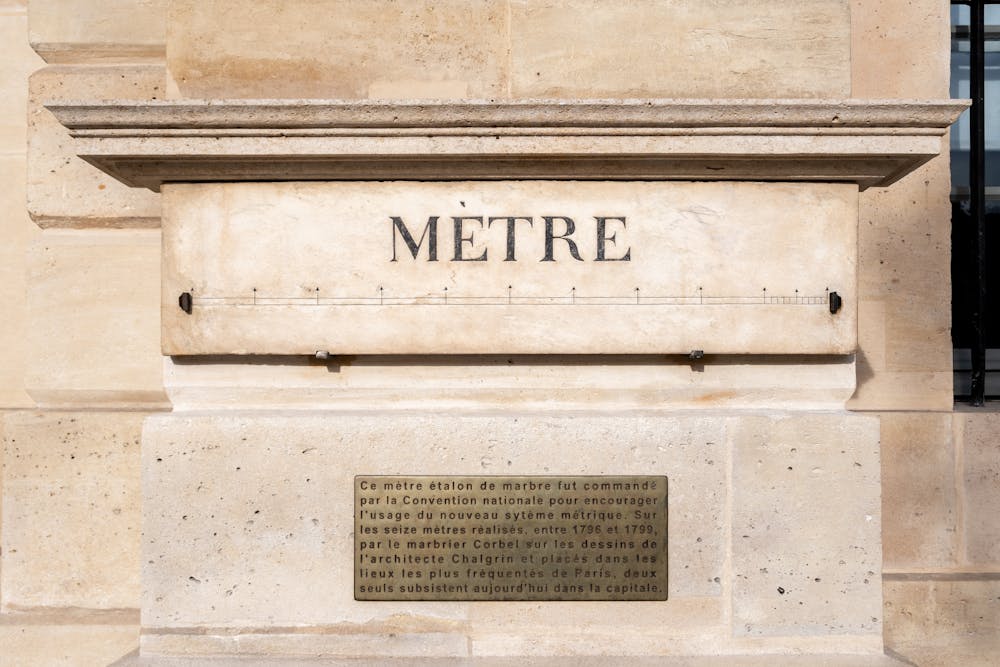
    Official engraved marble standard metre, at the Place Vendôme in Paris. The standard was promoted during the French Revolution to introduce the metric system to France.
    (Shutterstock)

    A world divided by measurement

    By the mid-19th century, the push for standardization had become increasingly urgent. Scientific discovery was accelerating, global trade was booming and industrial projects were growing in scale and complexity. But the world’s measurements were, frankly, a mess.

    France had introduced the metric system during its revolutionary years, but other nations were slow — or outright unwilling — to adopt it.

    Rivalries simmered not just among empires, but within the scientific community itself. Astronomers couldn’t compare celestial observations across borders because their units didn’t match. Engineers designing railway systems across Europe had to navigate conflicting standards for track gauges, load weights and even timekeeping.

    This wasn’t just inefficient. It was a barrier to progress, a strain on economies and a growing source of frustration or a scientific world that aimed to speak in universal truths.

    Faced with growing societal demands, the industrial world agreed it was time to act. The Metre Convention was the result.

    Scientists and diplomats representing the 17 participating countries collectively established the Bureau International des Poids et Mesures (BIPM), headquartered just outside Paris, as the official keeper of measurement standards. Today, the BIPM is backed by 64 member states and governs the Système International d’Unités (SI), the measurement framework that underpins everything from bridges to smartphones.

    When standards fail

    Developing and agreeing on a system of units is the mandate of the Bureau International des Poids et Mesures.
    (Bureau International des Poids et Mesures), CC BY-ND

    And while by today’s standards, the SI may seem like a relic of old-school science bureaucracy, it’s anything but. Standardized measurement is the invisible infrastructure of the modern world. And when it fails, or more specifically when we ignore it, the consequences can be severe.

    Take the Gimli Glider incident. In 1983, an Air Canada flight from Montréal to Edmonton ran out of fuel midway through its journey. The cause was a miscalculation caused by confusion between metric and imperial units: the ground crew had used pounds instead of kilograms to measure fuel, and the pilots didn’t catch the error.

    The plane lost power at 41,000 feet (around 12,500 metres for those who prefer their near-death experiences in metric), and glided safely to an abandoned airstrip in Gimli, Man., and to the annals of history as a symbol of what happens when we take standards for granted.

    Or consider the Mars Climate Orbiter, a US$327 million NASA spacecraft that disintegrated upon entering Mars’ atmosphere in 1999. Engineers at Lockheed Martin had used imperial units, while NASA had assumed metric. The mismatch led to a critical navigation error and the failure of the mission, highlighting the importance of consistency in measurement, even far beyond the confines of Earth’s atmosphere.

    The Gimli Glider and Mars Orbiter failures show what happens when consistency breaks down, but they’re more than just cautionary tales. They reveal how much of modern life depends on the shared language of measurement, and how easily that foundation can be cracked.

    And therein lies the genius of the Metre Convention. It created a system that allows the world to communicate in the same terms. When someone says “kilogram,” “second” or “volt,” there is no ambiguity. That shared understanding is what makes global collaboration possible.

    The Mars Climate Orbiter at the Spacecraft Assembly and Encapsulation Facility in the Kennedy Space Center in Florida.
    (NASA/KSC)

    From man-made objects to universal constants

    But as scientists are wont to do, good ideas are refined, and standards evolve. For much of its post-Metre Convention history, the kilogram was defined by a physical artifact — a hunk of platinum-iridium alloy stored in a vault in France. But in 2019, that changed. Now, the kilogram is defined by Planck’s constant, a fundamental feature of the universe. The shift marked the final step in a long journey: every base unit in the SI is now rooted in nature rather than arbitrary human artifacts.


    Read more:
    Redefining the kilogram means redefining how we measure wealth


    That change wasn’t just symbolic, it was necessary. Our ability to measure time, mass and distance with extreme precision affects nearly every aspect of modern life.

    GPS signals rely on time measurements accurate to the billionth of a second. Quantum computers and particle accelerators require calibration on mind-bendingly small scales. Even weather forecasting depends on standardized measurements of pressure, temperature and humidity.

    Shared standards in a divided world

    But perhaps the most underrated legacy of the Metre Convention is its role in building trust across borders.

    At a time when misinformation spreads quickly and even basic facts are contested, international standards offer a shared foundation that scientists, governments and industries can rely on. It’s a form of global co-operation that has quietly endured for 150 years.

    That co-operation becomes particularly apparent in moments of political strain. Although the United States appears uncompromising in its commitment to feet and inches, American scientists, engineers and manufacturers rely heavily on the metric system, especially when collaborating across borders.

    As tensions rise between close allies like the U.S. and Canada, metric standards remain a consistent point of harmony. The two countries may spar diplomatically, but when it comes to assembling a car in Windsor with parts made in Detroit, the bolts still fit.

    Looking ahead

    Still, like all institutions, BIPM and the SI reflect the times in which they were created. The original signatories were almost exclusively colonial powers. It took almost a century for other nations to gain an equal seat at the table, and even now, access to the tools and infrastructure that facilitate precision metrology — the act of taking extremely accurate measurements — remains unequal.

    If the next 150 years of the Metre Convention are to be as successful as the first, greater inclusivity and accessibility will need to be central to its mission.

    We live in a world held together by decimals, tolerances and agreed-upon constants that keep planes in the air, bridges from collapsing and scientific progress on track.

    The Metre Convention reminds us that science isn’t only about big breakthroughs and bold ideas. Sometimes it’s about consensus and agreeing, together, on what a metre actually is. And even after 150 years, the simple idea of agreeing how to measure the world remains one of humanity’s greatest achievements.

    So, what should we do with this anniversary? Maybe throw a party with metric-themed cocktails (may I suggest a 100mL Old Fashioned?). At the very least, we should take a moment to reflect on just how essential, and how easy to overlook, measurement really is.

    Jonathan Simone does not work for, consult, own shares in or receive funding from any company or organisation that would benefit from this article, and has disclosed no relevant affiliations beyond their academic appointment.

    ref. 150 years ago, the Metre Convention determined how we measure the world — a radical initiative for the time – https://theconversation.com/150-years-ago-the-metre-convention-determined-how-we-measure-the-world-a-radical-initiative-for-the-time-252108

    MIL OSI – Global Reports

  • MIL-OSI Global: Women are steadier leaders in times of crisis, but they are still being overlooked

    Source: The Conversation – Canada – By Ivona Hideg, Associate Professor and Ann Brown Chair in Organization Studies, York University, Canada

    One persistent gender stereotype is the belief that women are ‘too emotional’ to be effective leaders. This misconception continues to undermine their chances of being considered for leadership roles in the first place. (Shutterstock)

    Please fill out your disclosure statement (red button to the right under your name) when you have a chance

    As Canadians prepare to vote in a federal election during a period of global instability marked by trade disruptions, economic uncertainty, and armed conflict, the country’s political leadership remains notably traditional in one key respect: gender.

    All of Canada’s major political parties are currently led by men, and Canada has never elected a woman as prime minister. Kim Campbell briefly held the office in 1993 after Brian Mulroney’s resignation as leader of the Progressive Conservative Party. Her short tenure ended with a historic electoral defeat for the Conservatives.

    With global tensions rising and Canada facing unprecedented uncertainties, it may seem easy to overlook the lack of women on election ballots. But strong, inclusive leadership is a practical necessity in these uncertain times.

    A growing body of research and real-world examples are challenging longstanding assumptions about what makes an effective leader. In times of crisis, traditional leadership styles marked by dominance and rigidity — usually associated with men — often fall short.

    Instead, leadership styles marked by empathy, flexibility, and open communication — usually associated with women — are proving to be both effective and essential. This kind of leadership helps steady teams when emotions run high and the path forward is unclear — exactly the kind of qualities Canada may need in the near future.

    Leadership during COVID-19

    One persistent gender stereotype is the belief that women are “too emotional” to be effective leaders. This misconception continues to undermine women’s chances of being considered for leadership roles in the first place.

    However, our research findings challenge this assumption and suggest it’s actually men who are more likely to let emotions drive their behaviour during periods of uncertainty.


    Read more:
    The world needs more women leaders — during COVID-19 and beyond


    Our recently published research examined how gender influenced the behaviour of leaders during the COVID-19 pandemic. We analyzed survey responses from a sample of 137 supervisor-subordinate pairs working in the Netherlands during 2020.

    We focused on two dominant emotions during the pandemic — anxiety and hope — as they are both common responses to uncertainty. Anxiety reflects a sense of lost control, while hope suggests some belief in regaining it. These emotions, we predicted, would would shape leaders’ actions.

    Women less likely to be driven by emotion

    Our study found that men leaders who experienced higher levels of hope were more likely to engage in family friendly supervision, which refers to leaders providing support for employees’ non-work demands. This was especially critical during the COVID-19 pandemic.

    However, when men leaders experienced higher levels of anxiety, they were more likely to act out via abusive supervision. This included snapping at employees, making unreasonable demands, or behaving in a punitive way.

    In contrast, the behaviour of women leaders was not influenced by feelings of anxiety or hope. Regardless of how they felt, women were more likely to show consistent, family-supportive behaviours that helped staff manage work-life challenges. They also refrained from lashing out abusively when anxious.

    These findings aligned with our expectations. We anticipated women would be less likely to act on their emotions than men, as women are often conditioned to put the needs of others above their own, especially in times of stress.

    As a result, we expected — and observed — that women leaders would be less affected by their emotions and more likely to consider others.

    The danger of the glass cliff

    Our research highlights the importance of humanising leadership rooted in communal values. One particularly effective approach that does this is transformational leadership, which focuses on inspiring, supporting, and empowering others.

    Studies show that women are more likely to adopt this leadership style. Yet research also reveals a troubling gap: when women lead this way, they are less likely to be recognized or rewarded for it, compared to men. In many cases, women might behave the same as their men counterparts, yet they are judged differently — not based on what they do, but who they are.

    Women are also more likely to be appointed to leadership roles in times of crisis or decline. This phenomenon, known as the “glass cliff,” places women in precarious positions with limited chances of success.

    Consider the case of Campbell, who became party leader just months before an election her party was widely expected to lose. It could be argued she faced a glass cliff. Rather than a fair shot at leadership, she was handed a near-certain defeat.

    These patterns reflect how deeply embedded gender bias is, and how it continues to influence who gets to lead and under what conditions.


    Read more:
    The ‘glass cliff’ is steep for Canada’s female politicians


    The case for caring leadership

    In the face of ongoing U.S. tariffs, threats on Canada’s sovereignty, and other global issues, Canada needs effective leadership more than ever. But in times of crisis, reacting impulsively to strong emotions can be costly.

    The leadership style that appears most effective during turbulent times is based on communal values of care, rather than impulsively reacting to one’s emotions. As our research shows, this approach is more closely aligned with how women often lead, despite persistent stereotypes suggesting that women are overly emotional.


    Read more:
    Growing threats faced by women candidates undermine our democracy


    Yet, women remain underrepresented in leadership positions, especially in politics. Despite this gap, public conversation on the issue remain noticeably silent.

    Although we can’t rewrite the past, we can reflect on what might be missing from leadership today. When we consistently overlook those who lead with compassion, we risk losing out on exactly the kind of leadership that could help our country navigate the turbulent waters ahead.

    Ivona Hideg’s research has received funding from the Social Sciences and Humanities Research Council of Canada (SSHRC).

    Winny Shen receives funding from the Social Sciences and Humanities Research Council of Canada (SSHRC).

    Tanja Hentschel does not work for, consult, own shares in or receive funding from any company or organisation that would benefit from this article, and has disclosed no relevant affiliations beyond their academic appointment.

    ref. Women are steadier leaders in times of crisis, but they are still being overlooked – https://theconversation.com/women-are-steadier-leaders-in-times-of-crisis-but-they-are-still-being-overlooked-254676

    MIL OSI – Global Reports

  • MIL-OSI Global: Service closures in Vancouver’s Downtown Eastside leave sex workers without vital support

    Source: The Conversation – Canada – By Jennie Pearson, PhD Candidate, Interdisciplinary Studies Graduate Program, University of British Columbia

    In late February, the PACE Society, a long-standing pillar of support for sex workers in Vancouver, announced it was suspending services and programming and laying off most staff. For more than 30 years, PACE has provided peer support, counselling and basic services using a “by, for and with” sex workers approach.

    Now, amid a funding crisis that has led to layoffs of mostly staff with current or former experience of sex work, the future of vital support services for sex workers in Vancouver is uncertain.

    PACE’s announcement was another heavy loss following a string of closures and service reductions at organizations serving sex workers and other marginalized women in Vancouver’s Downtown Eastside.

    February also marked the closure of the WISH Drop-in Centre. The centre provided essential lifeline for street-based sex workers in the Downtown Eastside, offering overnight respite and critical access to resources for over four decades.

    While PACE and WISH have described their closures as temporary, their eventual reopening remains uncertain. Both organizations intend to resume services with the renewal of the funding cycle in April 2025. In the meantime, sex workers face an urgent and growing void of essential support services and community spaces.

    Making sex workers more vulnerable

    As collaborators on the AESHA Project (An Evaluation of Sex Workers’ Health Access), we have worked in partnership with sex workers and community organizations to document how criminalization, policing and structural inequities impact sex workers’ health and safety.

    For over 14 years, the AESHA Project, based at the University of British Columbia, has highlighted the crucial role of community services in supporting sex workers’ health, safety and well-being and how a lack of funding undermines sex workers’ access to these vital services.

    The loss of safe spaces for sex workers, even temporarily, carries profound and far-reaching consequences. These impacts were thoroughly documented in the findings of the Missing Women Commission of Inquiry, led by former B.C. attorney general Wally Oppal. The inquiry examined systemic failures that contributed to the targeted violence and murders of sex workers in Vancouver.

    Among the commission’s key recommendations was the urgent need to enhance protections and expand access to critical supports for sex workers, recognizing that such services are fundamental to their safety and well-being.

    For years, front-line organizations such as WISH and PACE have been instrumental in advancing this mandate, providing basic necessities like hot meals and safe overnight spaces, as well as trauma-informed counselling, peer support networks and opportunities for community connection. The abrupt closure of these spaces severs support networks for sex workers.

    Chronic under-funding

    Such organizations are vital, and sex workers deserve to feel like these spaces matter and are worth keeping open. However, funding for community-led, rights-based approaches to sex work services has historically been limited in Canada. Federal governments have prioritized prohibitionist approaches and “exit programs” that do not meet community needs.

    Vancouver-based sex work services are not alone in experiencing funding shortfalls and closures. On March 7, SafeSpace London issued an urgent call for donations following the loss of city funding. This dynamic is also visible in Vancouver, where the closure of PACE and other similar organizations is occurring within the context of a broader “revitalization” agenda, which aims to prioritize development over community infrastructure.

    A leaked draft memo from October 2024 revealed Vancouver Mayor Ken Sim’s plan for reshaping the Downtown Eastside. Among these plans is an effort to expedite private development approvals, notably through the use of spot rezoning — a tool that allows municipal authorities to rezone individual outside the city’s established planning frameworks.

    The memo also outlines the Sim’s intention to conduct a comprehensive review of local non-profit organizations and to actively “track their funding envelope.” While framed as a step toward increased accountability, research highlights that heightened scrutiny of chronically under-funded community organizations often leads to greater instability and compromises service delivery.

    Non-profits are in crisis, but this cannot be solved by increased surveillance and funding cuts. Community organizers have critically examined the potential consequences of this development-driven approach, raising concerns that it will accelerate gentrification and undermine the availability of essential community services.

    Community organizations, often relied upon to fill the gaps left by government disinvestment, often face chronic funding shortages. Despite providing essential services, many are forced into cycles of short-term, unstable funding that limit their ability to plan for the long term or advocate for systemic change.

    This precarious situation is not incidental. It reflects a broader shift in recent decades of governments offloading responsibility for social welfare onto under-funded non-profits while maintaining the illusion of support with fragmented funding schemes.

    The closure of critical services is not a sign of individual organizational failure. Rather, it is a direct consequence of a system that prioritizes investments in policing and property development over sustained investment in community well-being and support for the most marginalized residents of Vancouver.

    Organizations that provide critical support to sex workers need stability and self-determination to cultivate meaningful, community-led approaches that meet immediate needs and work toward long-term change.

    Jennie Pearson receives funding from the Canadian Institutes of Health Research, and is a volunteer with PACE Society.

    Andrea Krüsi has received funding from the Canadian Institutes of Health Research, Vancouver Foundation, National Institutes of Health and Canada Foundation for Innovation. PACE and WISH staff are part of the community advisory board of the AESHA study.

    Melody Wise a Research Coordinator for the AESHA project, a position supported by funding from the Canadian Institutes of Health Research. She is a volunteer with SWAN Vancouver, a non-profit providing support to im/migrant sex workers in Greater Vancouver.

    ref. Service closures in Vancouver’s Downtown Eastside leave sex workers without vital support – https://theconversation.com/service-closures-in-vancouvers-downtown-eastside-leave-sex-workers-without-vital-support-253710

    MIL OSI – Global Reports

  • MIL-OSI Global: Planning for death: four things you can do to ease your family’s emotional and financial stress

    Source: The Conversation – Africa – By Amanda Craft, Associate Lecturer in Accounting and Financial Planning, Western Sydney University

    When someone dies, the people left behind face more than grief. They are often hit with a wave of decisions – emotional, logistical and financial – that must be made quickly and under pressure.

    You may not be able to control what happens after you’re gone. But you can make the process a lot easier for your family by doing a few simple things now. Financial therapy research shows that financial decisions made under stress or grief are more likely to lead to conflict or regret.

    Our work as researchers and practitioners in financial planning and financial therapy explores how money isn’t just about spreadsheets and savings – it’s also about identity, emotions, and relationships.

    Planning for death, as hard as it may be, is one of the kindest acts you can offer.

    Death is inevitable, but chaos doesn’t have to be. A few gentle conversations, a simple will, and a bit of planning can protect your family from unnecessary pain. You don’t need to have everything figured out – you just need to start. Even small steps taken now can have a ripple effect on your family’s financial and emotional wellbeing.

    We have identified four practical steps you can take: start the conversation; talk about what matters to you; get your paperwork in order; and make your funeral plans known.

    What to do

    Start the conversation. In many cultures, death is difficult to talk about. It can feel awkward, inappropriate, or even disrespectful to bring it up with loved ones. But avoiding the conversation doesn’t stop death from coming – it only makes it harder for those left behind.

    Financial therapy research shows that avoidance of money conversations is common, but can be damaging. People avoid these talks because of anxiety, cultural taboos, or fear of upsetting others, but they’re exactly the conversations that help reduce stress in the future. You don’t need to hold a formal family meeting.

    A softer approach often works best. For example, if someone in your community passes away, you could say, “It got me thinking about what you’d want for your funeral.” If they seem uncomfortable, try saying, “I know it’s not easy to talk about. I just care, and I’d rather know than have to guess.” If they still don’t want to talk, that’s okay. Sometimes planting the seed is enough.

    Talk about what matters to you. Every family and community has its own way of honouring the dead. Some prefer large, traditional funerals with extended family and religious rites. Others may want something smaller, more personal, or less expensive. When people know what matters most to you – and what doesn’t – they are more likely to carry out your wishes with peace of mind.

    Research has found that clarity around financial and emotional intentions helps reduce family tension and grief-related conflict.

    For example, you might not want money borrowed for your funeral. You might prefer cremation, or a specific cultural rite. Or you may want something symbolic, like a tree planted in your honour. Saying it now helps your loved ones later.

    Get your paperwork in order. A will helps ensure that your assets go where you want them to. It also helps reduce disputes among family members. But in South Africa, for example, only around 15% of people die with a valid will. In Nigeria, 70% of people die intestate and 80% of people in Ghana die without a valid will. That leaves families at the mercy of state rules – and that can create real problems.

    Make sure your will is clear, legally valid, and updated to reflect any life changes such as marriage, divorce, or the birth of a child. It’s also essential to review your nominated beneficiaries on life policies and pensions. If they are outdated or deceased, the payout may be delayed or go to someone you didn’t intend. Leaving financial matters unclear can also unsettle family roles and identities, especially when adult siblings or extended relatives feel overlooked.

    Make your funeral plans known. In many African households, funerals are deeply significant events, tied to culture, status, and family pride. But the cost of burying a loved one, and the weight of organising the ceremony, can fall heavily on those who remain.

    If you’ve taken out a funeral policy or belong to a burial society or stokvel (savings club), make sure someone knows. Funeral policies can pay out within 48 hours – but some take weeks, depending on the circumstances and paperwork. Write down the name of the provider, the expected payout, and who to contact.

    Keep documents in a safe place, and tell a trusted person where to find them. Even if you can’t afford a policy, having a clear conversation about what you would want – and what you wouldn’t – is a powerful gift. Not everyone wants a lavish send-off. Sometimes, what people want most is for their family to avoid debt and stay united.

    Planning ahead allows families to mourn, rather than scramble.

    Amanda Craft is a shareholder of Auriavia Pty Ltd. She is affiliated with the Financial Therapy Association

    Bomikazi Zeka does not work for, consult, own shares in or receive funding from any company or organisation that would benefit from this article, and has disclosed no relevant affiliations beyond their academic appointment.

    ref. Planning for death: four things you can do to ease your family’s emotional and financial stress – https://theconversation.com/planning-for-death-four-things-you-can-do-to-ease-your-familys-emotional-and-financial-stress-254321

    MIL OSI – Global Reports

  • MIL-Evening Report: Mediawatch: Jailed Australian foreign correspondent’s life spread across the big screen

    By Colin Peacock, RNZ Mediawatch presenter

    In 1979, Sam Neill appeared in an Australian comedy movie about hacks on a Sydney newspaper.

    The Journalist was billed as “a saucy, sexy, funny look at a man with a nose for scandal and a weakness for women”.

    That would probably not fly these days — but as a rule, movies about Australian journalists are no laughing matter.

    Back in 1982, a young Mel Gibson starred as a foreign correspondent who was dropped into Jakarta during revolutionary chaos in The Year of Living Dangerously. The 1967 events the movie depicted were real enough, but Mel Gibson’s correspondent Guy Hamilton was made up for what was essentially a romantic drama.

    There was no romance and a lot more real life 25 years later in Balibo, another movie with Australian journalists in harm’s way during Indonesian upheaval.

    Anthony La Paglia had won awards for his performance as Roger East, a journalist killed in what was then East Timor — now Timor-Leste — in December 1975. East was killed while investigating the fate of five other journalists — including New Zealander Guy Cunningham — who was killed during the Indonesian invasion two months earlier.

    The Correspondent has a happier ending but is still a tough watch — especially for its subject.

    Met in London newsrooms
    I first met Peter Greste in newsrooms in London about 30 years ago. He had worked for Reuters, CNN, and the BBC — going on to become a BBC correspondent in Afghanistan.

    He later reported from Belgrade, Santiago, and then Nairobi, from where he appeared regularly on RNZ’s Nine to Noon as an African news correspondent. Greste later joined the English-language network of the Doha-based Al Jazeera and became a worldwide story himself while filling in as the correspondent in Cairo.

    Actor Richard Roxburgh as jailed journalist Peter Greste in The Correspondent alongside Al Jazeera colleagues Mohammed Fahmy and Baher Mohammed. Image: The Correspondent/RNZ

    Greste and two Egyptian colleagues, Baher Mohamed and Mohamed Fahmy, were arrested in late 2013 on trumped-up charges of aiding and abetting the Muslim Brotherhood, an organisation labeled “terrorist” by the new Egyptian regime of the time.

    Six months later he was sentenced to seven years in jail for “falsifying news” and smearing the reputation of Egypt itself. Mohamed was sentenced to 10 years.

    Media organisations launched an international campaign for their freedom with the slogan “Journalism is not a crime”. Peter’s own family became familiar faces in the media while working hard for his release too.

    Peter Greste was deported to Australia in February 2015. The deal stated he would serve the rest of his sentence there, but the Australian government did not enforce that. Instead, Greste became a professor of media and journalism, currently at Macquarie University in Sydney.

    Movie consultant
    Among other things, he has also been a consultant on The Correspondent — now in cinemas around New Zealand — with Richard Roxborough cast as Greste himself.

    Greste told The Sydney Morning Herald he had to watch it “through his fingers” at first.

    Australian professor of journalism Peter Greste …. posing for a photograph when he was an Al Jazeera journalist in Kibati village, near Goma, in the eastern Democratic Republic of Congo on 7 August 2013. Image: IFEX media freedom/APR

    “I eventually came to realise it’s not me that’s up there on the screen. It’s the product of a whole bunch of creatives. And the result is … more like a painting rather than a photograph,” Greste told Mediawatch.

    “Over the years I’ve written about it, I’ve spoken about it countless times. I’ve built a career on it. But I wasn’t really anticipating the emotional impact of seeing the craziness of my arrest, the confusion of that period, the claustrophobia of the cell, the sheer frustration of the crazy trial and the really discombobulating moment of my release.

    “But there is another very difficult story about what happened to a colleague of mine in Somalia, which I haven’t spoken about publicly. Seeing that on screen was actually pretty gut-wrenching.”

    In 2005, his BBC colleague Kate Peyton was shot alongside him on their first day in on assignment in Somalia. She died soon after.

    “That was probably the toughest day of my entire life far over and above anything I went through in Egypt. But I am glad that they put it in [The Correspondent]. It underlines … the way in which journalism is under attack. What happened to us in Egypt wasn’t a random, isolated incident — but part of a much longer pattern we’re seeing continue to this day.”

    Supporters of the jailed British-Egyptian human rights activist Alaa Abd el-Fattah take part in a candlelight vigil outside Downing Street in London, United Kingdom, as he begins a complete hunger strike while world leaders arrive for COP27 climate summit in Sharm el-Sheikh, Egypt, in 2022. Image: RNZ Mediawatch/AFP

    ‘Owed his life’
    Greste says he “owes his life” to fellow prisoner Alaa Abd El-Fattah — an Egyptian activist who is also in the film.

    “There’s a bit of artistic licence in the way it was portrayed but . . .  he is easily one of the most intelligent, astute and charismatic humanitarians I’ve ever come across. He was one of the main pro-democracy activists who was behind the Arab Spring revolution in 2011 — a true democrat.

    “He also inspired me to write the letters that we smuggled out of prison that described our arrest not as an attack on … what we’d actually come to represent. And that was press freedom.

    “That helped frame the campaign that ultimately got me out. So, for both psychological and political reasons, I feel like I owe him my life.

    “There was nothing in our reporting that confirmed the allegations against us. So I started to drag up all sorts of demons from the past. I started thinking maybe this is the universe punishing me for sins of the past. I was obviously digging up that particular moment as one of the most extreme and tragic moments. It took a long time for me to get past it.

    “He’d been in prison a lot because of his activism, so he understood the psychology of it. He also understood the politics of it in ways that I could never do as a newcomer.”

    “Unfortunately, he is still there. He should have been released on September 29th last year. His mother launched a hunger strike in London . . . so I actually joined her on hunger strike earlier this year to try and add pressure.

    “If this movie also draws a bit of attention to his case, then I think that’s an important element.”

    Another wrinkle
    Another wrinkle in the story was the situation of his two Egyptian Al Jazeera colleagues.

    Greste was essentially a stranger to them, having only arrived in Egypt shortly before their arrest.

    The film shows Greste clashing with Fahmy, who later sued Al Jazeera. Fahmy felt the international pressure to free Greste was making their situation worse by pushing the Egyptian regime into a corner.

    “To call it a confrontation is probably a bit of an understatement. We had some really serious arguments and sometimes they got very, very heated. But I want audiences to really understand Fahmy’s worldview in this film.

    “He and I had very different understandings of what was going … and how those differences played out.

    “I’ve got a hell of a lot of respect for him. He is like a brother to me. That doesn’t mean we always agreed with each other and doesn’t mean we always got on with each other like any siblings, I suppose.”

    His colleagues were eventually released on bail shortly after Greste’s deportation in 2015.

    Fahmy renounced his Egyptian citizenship and was later deported to Canada, while Mohamed was released on bail and eventually pardoned.

    Retrial — all ‘reconvicted’
    “After I was released there was a retrial … and we were all reconvicted. They were finally released and pardoned, but the pardon didn’t extend to me.

    “I can’t go back because I’m still a convicted ‘terrorist’ and I still have an outstanding prison sentence to serve, which is a little bit weird. Any country that has an extradition treaty with Egypt is a problem. There are a fairly significant number of those across the Middle East and Africa.”

    Greste told Mediawatch his conviction was even flagged in transit in Auckland en route from New York to Sydney. He was told he failed a character test.

    “I was able to resolve it. I had some friends in Canberra and were able to sort it out, but I was told in no uncertain terms I’m not allowed into New Zealand without getting a visa because of that criminal record.

    “If I’m traveling to any country I have to say … I was convicted on terrorism offences. Generally speaking, I can explain it, but it often takes a lot of bureaucratic process to do that.”

    Greste’s first account of his time in jail — The First Casualty — was published in 2017. Most of the book was about media freedom around the world, lamenting that the numbers of journalists jailed and killed increased after his release.

    Something that Greste also now ponders a lot in his current job as a professor of media and journalism.

    Ten years on from that, it is worse again. The Committee to Protect Journalists (CPJ) says at least 124 journalists and media workers were killed last year, nearly two-thirds of them Palestinians killed by Israel in its war in Gaza.

    The book has now been updated and republished as The Correspondent.

    This article is republished under a community partnership agreement with RNZ.

    MIL OSI AnalysisEveningReport.nz

  • MIL-Evening Report: Palestinian solidarity vigil at Easter in NZ as Israeli bombing rages in Gaza

    Asia Pacific Report

    Peaceful protesters in Aotearoa New Zealand’s largest city Auckland held an Easter prayer vigil honouring Palestinian political prisoners and the sacrifice of thousands of innocent lives as relentless Israeli bombing of displaced Gazans in tents killed at least 92 people in two days.

    Organisers of the rally for the 80th week since the war began in October 2023 said they aimed for a shift in emphasis for quietness and meditation this spiritual weekend.

    “This is dedicated to the Palestine Prisoners’ Day and those who have died, innocent of any crime — women, children, journalists, patients, friends, healthcare workers, those buried under rubble, non-military civilians,” said Kathy Ross of Palestinian Solidarity Network Aotearoa (PSNA).

    “All those starving and needing our help,” she added.

    The organisers created a flowers and candles circle of peace with hibiscus blossoms in an area of Britomart that has become dubbed “Palestinian Corner”.

    Placards declared “Free all Palestinian prisoners — all 10,000 people” and “Release the Palestinian prisoners.”

    Palestinian fusion dancer and singer Rana Hamida, who last year sailed on the Freedom Flotilla boat Handala in an attempt to break the Israel siege of Gaza, spoke about how people could keep their spirits up in the face of such terrible atrocities, and sang a haunting hymn.

    Calmness and strength
    She also described how the air and wind could help protesters seek calmness and strength in spite of storms like Cyclone Tam that gusted across much of New Zealand yesterday on Good Friday causing havoc.

    She spread her arms like wings as Palestinian flags fluttered strongly, saying: “The wind is now blowing in exactly the right direction.”

    The Palestinian “circle of peace” at today’s spiritual vigil on Easter Saturday in Tāmaki Makaurau Auckland. Image: Asia Pacific Report

    Another PSNA organiser, Del Abcede, spoke about the incarceration of Palestinian paediatrician Dr Hussam Abu Safiya, the director of Kamal Adwan Hospital in northern Gaza, who was kidnapped by the Israeli military last December 27 — two days after Christmas – and has been held in detention without charge and under torture ever since.

    “The reason why he was arrested is because he would not leave his hospital or his patients,” she said, adding that he had been held incommunicado for a long time.

    “I want to dedicate a special honour and prayer for him and I hope that he will be released soon.”

    Beaten in prison
    Dr Safiya is suffering from a serious eye injury as a result of being beaten in Israeli prison, his lawyer has revealed to media.

    According to lawyer Ghaid Qassem, Dr Abu Safiya has been classified by Israeli authorities as an “unlawful combatant” but has not yet been charged or received any court trials.

    Despite a global campaign calling for him to be released from prison, Israeli authorities have continued to interrogate and torture Dr Abu Safiya.

    Vigil organisers Kathy Ross (left) and Del Abcede speaking at the prayer vigil for Palestine today . . . courageous Dr Hussam Abu Safiya is pictured on the placard. Image: Asia Pacific Report

    Another speaker at the vigil, Dr David Robie, said he had been a journalist for 50 years and he found it “shameful” that the Western media — including Aotearoa New Zealand — failed to report the genocide and ethnic cleansing truthfully, and in fact was normalising the “horrendous crimes”.

    He called for silent prayer for the at least 232 Gazan journalists killed — many along with their entire families — who had been courageously reporting the truth to the rest of the world.

    Banners at the vigil referred to “Jesus [was] Palestinian – born in Bethlehem” and “Let Gaza live”. One placard declared “Jesus was an anti-imperialist Palestinian Jew who preached (and practised) radical love for all – not a violent bully bigot”.

    Other vigils and protests took place across New Zealand at Easter weekend, especially in Ōtautahi Christchurch.

    Journalist Dr David Robie speaking about how Western media has been “normalising” genocide and calling for prayer for the killed Gazan journalists. Image: Bruce King

    ‘Violating’ religious status quo
    Meanwhile, in Jerusalem reports were emerging that Israelis were “taking pride in violating the status quo” with religious traditions at Easter.

    A protester carrying her placard proclaiming Jesus as an “anti-imperialist Palestinian Jew” who preached love for all. Image: Asia Pacific Report

    Xavier Abu Eid, a political scientist and former adviser to the Palestine Liberation Organisation (PLO) from occupied East Jerusalem, explained on Al Jazeera that Jerusalem, “has a very central place” in the history of Palestinian Christians.

    “We have to … understand what the Israeli occupation is doing to all Palestinians, because there is a concept. … It’s called the status quo. It’s understood and it’s under a very old agreement, centuries or older than the state of Israel,” he said.

    Under the status quo, “the status of Christian and Muslim holy sites, including Al-Aqsa Mosque, for example, and the Holy Sepulchre, would be respected,” Dr Eid explained.

    Despite this, he said, “Israeli government officials are taking pride in violating the status quo of Al-Aqsa Mosque compound by allowing Israeli settlers to pray in Al-Aqsa Mosque”.

    He said the Israeli authorities are also trying to “turn the Mount of Olives, a very important place for this [Easter] celebration, into an Israeli national park”.

    “So you’re talking about a community that feels under threat, not just from a national point of view with the Israeli government, pushing for ethnic cleansing and annexation, but also from the traditions that religiously we have kept here for generations,” he noted.

    The UN Palestine relief agency UNRWA reports that after 1.5 years of war in Gaza, at least 51,000 Palestinians have been killed, 1.9 million people have been forcibly displaced multiple times, and the Israel military has blocked humanitarian aid from entering the besieged enclave for seven weeks.

    A “Jesus was born in Bethlehem” banner at today’s Britomart vigil for Palestine. Image: Asia Pacific Report

    MIL OSI AnalysisEveningReport.nz

  • MIL-Evening Report: Did Australia back the wrong war in the 1960s? Now Putin’s Russia is knocking on the door

    ANALYSIS: By Ben Bohane

    This week Cambodia marks the 50th anniversary of the fall of Phnom Penh to the murderous Khmer Rouge, and Vietnam celebrates the fall of Saigon to North Vietnamese forces in April 1975.

    They are being commemorated very differently; after all, there’s nothing to celebrate in Cambodia. Its capital Phnom Penh was emptied, and its people had to then endure the “killing fields” and the darkest years of its modern existence under Khmer Rouge rule.

    Over the border in Vietnam, however, there will be modest celebrations for their victory against US (and Australian) forces at the end of this month.

    Yet, this week’s news of Indonesia considering a Russian request to base aircraft at the Biak airbase in West Papua throws in stark relief a troubling question I have long asked — did Australia back the wrong war 63 years ago? These different areas — and histories — of Southeast Asia may seem disconnected, but allow me to draw some links.

    Through the 1950s until the early 1960s, it was official Australian policy under the Menzies government to support The Netherlands as it prepared West Papua for independence, knowing its people were ethnically and religiously different from the rest of Indonesia.

    They are a Christian Melanesian people who look east to Papua New Guinea (PNG) and the Pacific, not west to Muslim Asia. Australia at the time was administering and beginning to prepare PNG for self-rule.

    The Second World War had shown the importance of West Papua (then part of Dutch New Guinea) to Australian security, as it had been a base for Japanese air raids over northern Australia.

    Japanese beeline to Sorong
    Early in the war, Japanese forces made a beeline to Sorong on the Bird’s Head Peninsula of West Papua for its abundance of high-quality oil. Former Australian prime minister Gough Whitlam served in a RAAF unit briefly stationed in Merauke in West Papua.

    By 1962, the US wanted Indonesia to annex West Papua as a way of splitting Chinese and Russian influence in the region, as well as getting at the biggest gold deposit on earth at the Grasberg mine, something which US company Freeport continues to mine, controversially, today.

    Following the so-called Bunker Agreement signed in New York in 1962, The Netherlands reluctantly agreed to relinquish West Papua to Indonesia under US pressure. Australia, too, folded in line with US interests.

    That would also be the year when Australia sent its first group of 30 military advisers to Vietnam. Instead of backing West Papuan nationhood, Australia joined the US in suppressing Vietnam’s.

    As a result of US arm-twisting, Australia ceded its own strategic interests in allowing Indonesia to expand eastwards into Pacific territories by swallowing West Papua. Instead, Australians trooped off to fight the unwinnable wars of Indochina.

    To me, it remains one of the great what-ifs of Australian strategic history — if Australia had held the line with the Dutch against US moves, then West Papua today would be free, the East Timor invasion of 1975 was unlikely to have ever happened and Australia might not have been dragged into the Vietnam War.

    Instead, as Cambodia and Vietnam mark their anniversaries this month, Australia continues to be reminded of the potential threat Indonesian-controlled West Papua has posed to Australia and the Pacific since it gave way to US interests in 1962.

    Russian space agency plans
    Nor is this the first time Russia has deployed assets to West Papua. Last year, Russian media reported plans under way for the Russian space agency Roscosmos to help Indonesia build a space base on Biak island.

    In 2017, RAAF Tindal was scrambled just before Christmas to monitor Russian Tu95 nuclear “Bear” bombers doing their first-ever sorties in the South Pacific, flying between Australia and Papua New Guinea. I wrote not long afterwards how Australia was becoming “caught in a pincer” between Indonesian and Russian interests on Indonesia’s side and Chinese moves coming through the Pacific on the other.

    All because we have abandoned the West Papuans to endure their own “slow-motion genocide” under Indonesian rule. Church groups and NGOs estimate up to 500,000 Papuans have perished under 60 years of Indonesian military rule, while Jakarta refuses to allow international media and the UN High Commissioner for Human Rights to visit.

    Alex Sobel, an MP in the UK Parliament, last week called on Indonesia to allow the UN High Commissioner to visit but it is exceedingly rare to hear any Australian MPs ask questions about our neighbour West Papua in the Australian Parliament.

    Canberra continues to enhance security relations with Indonesia in a naive belief that the nation is our ally against an assertive China. This ignores Jakarta’s deepening relations with both Russia and China, and avoids any mention of ongoing atrocities in West Papua or the fact that jihadi groups are operating close to Australia’s border.

    Indonesia’s militarisation of West Papua, jihadi infiltration and now the potential for Russia to use airbases or space bases on Biak should all be “red lines” for Australia, yet successive governments remain desperate not to criticise Indonesia.

    Ignoring actual ‘hot war’
    Australia’s national security establishment remains focused on grand global strategy and acquiring over-priced gear, while ignoring the only actual “hot war” in our region.

    Our geography has not changed; the most important line of defence for Australia remains the islands of Melanesia to our north and the co-operation and friendship of its peoples.

    Strong independence movements in West Papua, Bougainville and New Caledonia all materially affect Australian security but Canberra can always be relied on to defer to Indonesian, American and French interests in these places, rather than what is ultimately in Australian — and Pacific Islander — interests.

    Australia needs to develop a defence policy centred on a “Melanesia First” strategy from Timor to Fiji, radiating outwards. Yet Australia keeps deferring to external interests, to our cost, as history continues to remind us.

    Ben Bohane is a Vanuatu-based photojournalist and policy analyst who has reported across Asia and the Pacific for the past 36 years. His website is benbohane.com  This article was first published by The Sydney Morning Herald and is republished with the author’s permission.

    MIL OSI AnalysisEveningReport.nz

  • MIL-Evening Report: Trump executive orders roll back ocean fisheries protections in Pacific

    By Gujari Singh in Washington

    The Trump administration has issued a new executive order opening up vast swathes of protected ocean to commercial exploitation, including areas within the Pacific Islands Heritage Marine National Monument.

    It allows commercial fishing in areas long considered off-limits due to their ecological significance — despite overwhelming scientific consensus that marine sanctuaries are essential for rebuilding fish stocks and maintaining ocean health.

    These actions threaten some of the most sensitive and pristine marine ecosystems in the world.

    Condeming the announcement, Greenpeace USA project lead on ocean sanctuaries Arlo Hemphill said: “Opening the Pacific Islands Heritage Marine National Monument to commercial fishing puts one of the most pristine ocean ecosystems on the planet at risk.

    “Almost 90 percent of global marine fish stocks are fully exploited or overfished. The few places in the world ocean set aside as large, fully protected ocean sanctuaries serve as ‘fish banks’, allowing fish populations to recover, while protecting the habitats in which they thrive.

    “President Bush and President Obama had the foresight to protect the natural resources of the Pacific for future generations, and Greenpeace USA condemns the actions of President Trump today to reverse that progress.”


    President Trump signs executive order on Pacific fisheries     Video: Hawai’i News Now

    Slashed jobs at NOAA
    A second executive order calls for deregulation of America’s fisheries under the guise of boosting seafood production.

    Greenpeace USA oceans campaign director John Hocevar said: “If President Trump wants to increase US fisheries production and stabilise seafood markets, deregulation will have the opposite effect.

    The Pacific Islands Heritage Marine National Monument . . . “Trump’s executive order could set back protection by decades.” Image: Wikipedia

    “Meanwhile, the Trump administration has already slashed jobs at NOAA [National Oceanic and Atmospheric Administration] and is threatening to dismantle the agency responsible for providing the science that makes management of US fisheries possible.”

    “Trump’s executive order on fishing could set the world back by decades, undoing all the progress that has been made to end overfishing and rebuild fish stocks and America’s fisheries.

    “While there is far too little attention to bycatch and habitat destruction, NOAA’s record of fisheries management has made the US a world leader.

    “Trump seems ready to throw that out the window with all the care of a toddler tossing his toys out of the crib.”

    ‘Slap in face to science’
    Hawai’i News Now reports that a delegation from American Samoa, where the economy is dependent on fishing, had been lobbying the president for the change and joined him in the Oval Office for the signing.

    Environmental groups are alarmed.

    “Trump right here is giving a gift to the industrial fishing fleets. It’s a slap in the face to science,” said Maxx Phillips, an attorney for the Centre for Biological Diversity.

    “To the ocean, to the generations of Pacific Islanders who fought long and hard to protect these sacred waters.”

    Republished from Greenpeace USA with additional reporting by Hawai’i News Now.

    The executive orders, announced on April 17, 2025, are detailed here:

    MIL OSI AnalysisEveningReport.nz

  • MIL-OSI Global: Scientists found a potential sign of life on a distant planet – an astronomer explains why many are still skeptical

    Source: The Conversation – USA – By Daniel Apai, Associate Dean for Research and Professor of Astronomy and Planetary Sciences, University of Arizona

    An illustration of the exoplanet K2-18b, which some research suggests may be covered by deep oceans. NASA, ESA, CSA, Joseph Olmsted (STScI)

    A team of astronomers announced on April 16, 2025, that in the process of studying a planet around another star, they had found evidence for an unexpected atmospheric gas. On Earth, that gas – called dimethyl sulfide – is mostly produced by living organisms.

    In April 2024, the James Webb Space Telescope stared at the host star of the planet K2-18b for nearly six hours. During that time, the orbiting planet passed in front of the star. Starlight filtered through its atmosphere, carrying the fingerprints of atmospheric molecules to the telescope.

    JWST’s cameras can detect molecules in the atmosphere of a planet by looking at light that passed through that atmosphere.
    European Space Agency

    By comparing those fingerprints to 20 different molecules that they would potentially expect to observe in the atmosphere, the astronomers concluded that the most probable match was a gas that, on Earth, is a good indicator of life.

    I am an astronomer and astrobiologist who studies planets around other stars and their atmospheres. In my work, I try to understand which nearby planets may be suitable for life.

    K2-18b, a mysterious world

    To understand what this discovery means, let’s start with the bizarre world it was found in. The planet’s name is K2-18b, meaning it is the first planet in the 18th planetary system found by the extended NASA Kepler mission, K2. Astronomers assign the “b” label to the first planet in the system, not “a,” to avoid possible confusion with the star.

    K2-18b is a little over 120 light-years from Earth – on a galactic scale, this world is practically in our backyard.

    Although astronomers know very little about K2-18b, we do know that it is very unlike Earth. To start, it is about eight times more massive than Earth, and it has a volume that’s about 18 times larger. This means that it’s only about half as dense as Earth. In other words, it must have a lot of water, which isn’t very dense, or a very big atmosphere, which is even less dense.

    Astronomers think that this world could either be a smaller version of our solar system’s ice giant Neptune, called a mini-Neptune, or perhaps a rocky planet with no water but a massive hydrogen atmosphere, called a gas dwarf.

    Another option, as University of Cambridge astronomer Nikku Madhusudhan recently proposed, is that the planet is a “hycean world”.

    That term means hydrogen-over-ocean, since astronomers predict that hycean worlds are planets with global oceans many times deeper than Earth’s oceans, and without any continents. These oceans are covered by massive hydrogen atmospheres that are thousands of miles high.

    Astronomers do not know yet for certain that hycean worlds exist, but models for what those would look like match the limited data JWST and other telescopes have collected on K2-18b.

    This is where the story becomes exciting. Mini-Neptunes and gas dwarfs are unlikely to be hospitable for life, because they probably don’t have liquid water, and their interior surfaces have enormous pressures. But a hycean planet would have a large and likely temperate ocean. So could the oceans of hycean worlds be habitable – or even inhabited?

    Detecting DMS

    In 2023, Madhusudhan and his colleagues used the James Webb Space Telescope’s short-wavelength infrared camera to inspect starlight that filtered through K2-18b’s atmosphere for the first time.

    They found evidence for the presence of two simple carbon-bearing molecules – carbon monoxide and methane – and showed that the planet’s upper atmosphere lacked water vapor. This atmospheric composition supported, but did not prove, the idea that K2-18b could be a hycean world. In a hycean world, water would be trapped in the deeper and warmer atmosphere, closer to the oceans than the upper atmosphere probed by JWST observations.

    Intriguingly, the data also showed an additional, very weak signal. The team found that this weak signal matched a gas called dimethyl sulfide, or DMS. On Earth, DMS is produced in large quantities by marine algae. It has very few, if any, nonbiological sources.

    This signal made the initial detection exciting: on a planet that may have a massive ocean, there is likely a gas that is, on Earth, emitted by biological organisms.

    K2-18b could have a deep ocean spanning the planet, and a hydrogen atmosphere.
    Amanda Smith, Nikku Madhusudhan (University of Cambridge), CC BY-SA

    Scientists had a mixed response to this initial announcement. While the findings were exciting, some astronomers pointed out that the DMS signal seen was weak and that the hycean nature of K2-18b is very uncertain.

    To address these concerns, Mashusudhan’s team turned JWST back to K2-18b a year later. This time, they used another camera on JWST that looks for another range of wavelengths of light. The new results – announced on April 16, 2025 – supported their initial findings.

    These new data show a stronger – but still relatively weak – signal that the team attributes to DMS or a very similar molecule. The fact that the DMS signal showed up on another camera during another set of observations made the interpretation of DMS in the atmosphere stronger.

    Madhusudhan’s team also presented a very detailed analysis of the uncertainties in the data and interpretation. In real-life measurements, there are always some uncertainties. They found that these uncertainties are unlikely to account for the signal in the data, further supporting the DMS interpretation. As an astronomer, I find that analysis exciting.

    Is life out there?

    Does this mean that scientists have found life on another world? Perhaps – but we still cannot be sure.

    First, does K2-18b really have an ocean deep beneath its thick atmosphere? Astronomers should test this.

    Second, is the signal seen in two cameras two years apart really from dimethyl sulfide? Scientists will need more sensitive measurements and more observations of the planet’s atmosphere to be sure.

    Third, if it is indeed DMS, does this mean that there is life? This may be the most difficult question to answer. Life itself is not detectable with existing technology. Astronomers will need to evaluate and exclude all other potential options to build their confidence in this possibility.

    The new measurements may lead researchers toward a historic discovery. However, important uncertainties remain. Astrobiologists will need a much deeper understanding of K2-18b and similar worlds before they can be confident in the presence of DMS and its interpretation as a signature of life.

    Scientists around the world are already scrutinizing the published study and will work on new tests of the findings, since independent verification is at the heart of science.

    Moving forward, K2-18b is going to be an important target for JWST, the world’s most sensitive telescope. JWST may soon observe other potential hycean worlds to see if the signal appears in the atmospheres of those planets, too.

    With more data, these tentative conclusions may not stand the test of time. But for now, just the prospect that astronomers may have detected gasses emitted by an alien ecosystem that bubbled up in a dark, blue-hued alien ocean is an incredibly fascinating possibility.

    Regardless of the true nature of K2-18b, the new results show how using the JWST to survey other worlds for clues of alien life will guarantee that the next years will be thrilling for astrobiologists.

    Daniel Apai receives funding for astrobiology research from NASA, the Heising-Simons Foundation, and the Gordon and Betty Moore Foundation.

    ref. Scientists found a potential sign of life on a distant planet – an astronomer explains why many are still skeptical – https://theconversation.com/scientists-found-a-potential-sign-of-life-on-a-distant-planet-an-astronomer-explains-why-many-are-still-skeptical-254900

    MIL OSI – Global Reports

  • MIL-OSI Global: ‘I never issued a criminal contempt citation in 19 ½ years on the bench’ – a former federal judge looks at the ‘relentless bad behavior’ of the Trump administration in court

    Source: The Conversation – USA – By John E. Jones III, President, Dickinson College

    ‘You just didn’t mess around with federal judges,’ says a former federal judge. ‘It was a good way to get your head handed to you.’ sesame, DigitalVision Vectors/Getty Images

    Legal battles between the Trump administration and advocates for deportees flown to prison in El Salvador have turned into conflicts between the government and the judges overseeing those cases. One federal judge, James Boasberg, accused Trump administration lawyers of the “willful disregard” of his order in March to halt those flights, saying there was “probable cause” to hold officials in criminal contempt. Another federal judge, Paula Xinis, strongly chastised government lawyers for their failure to follow her order – affirmed by the U.S. Supreme Court – to “facilitate” the return of a man, Kilmar Abrego Garcia, wrongly deported to El Salvador. Xinis cited the government’s “repeated refusal to provide even the most basic information as to any steps they have taken.”

    All this happened as administration officials made public statements disparaging the judges. Trump aide Stephen Miller described Xinis as a “Marxist judge” who “now thinks she’s president of El Salvador.” President Donald Trump had earlier called Boasberg a “Radical Left Lunatic Judge” in a social media post and demanded his impeachment.

    Politics editor Naomi Schalit interviewed Dickinson College President John E. Jones III about this extraordinary conflict. Jones is a former trial lawyer, former federal judge, and a one-time GOP candidate for the U.S. House.

    Right now we’re seeing two judges have a tough time with attorneys from the government. What governs behavior in the courtroom?

    For all the time that I was on the bench, and certainly before that, it was a pretty awe-inspiring thing to go into federal court. The federal court was the big leagues; you just didn’t mess around with federal judges. It was a good way to get your head handed to you, not because judges have hair triggers, but simply because there is a certain decorum that obtains in federal court, a gravity about the proceedings. It’s deference to the court and working within the boundaries of professional ethics. It’s being respectful when the court asks you a question. It involves never criticizing that judge in a personal way outside the courtroom, no matter how much you may disagree with the judge.

    I’m struck by the discourteousness of the government attorneys. They’re treating life-appointed district judges like they’re just impediments to what they want to do. It is something that has not ever happened, I think, in the annals of federal jurisprudence.

    Judge James E. Boasberg, chief judge of the U.S. District Court in the District of Columbia.
    Carolyn Van Houten/The Washington Post via Getty Images

    Attorney General Pam Bondi said Boasberg was “trying to protect terrorists who invaded our country over American citizens.” Is this unusual coming from a U.S. attorney general?

    I think we’re seeing unusual behavior from the Department of Justice in every single high-profile instance. I have never seen anything like it.

    Even in the most strident disputes, I do not recall an attorney general of the United States or the DOJ senior leadership team so personalizing their criticisms of individual district judges. It borders on unethical, and these are, in many cases, contrived and ad hominem attacks on the integrity of these judges.

    Besides professionalism and ethics, one of the reasons you’ve not seen it before is because it puts the DOJ attorneys who are out there on the line in a very difficult spot in front of the judges. You need only look to the unfortunate DOJ career attorney who was suspended and fired when he essentially did nothing more than fulfill his duty of candor to the court in answering questions.

    What is expected of an attorney in the courtroom?

    In federal court, attorneys need to bring their A game. The proceedings move more quickly. The requirements to be well-versed in the law and the facts are much greater. The judges are of a different caliber than in some state courts and county courts. So you you have to be on the ball.

    What judges really don’t like are circumstances where attorneys are being disrespectful to them, where they’re blatantly being disingenuous and where they are unresponsive to the court’s entreaties. Judges practice law before they get on the bench; they understand that lawyers have a duty to zealously advocate for their client. But when lawyers appear to be misrepresenting what is taking place, that is a cardinal sin in federal court.

    Paula Xinis at the U.S. Senate Committee on the Judiciary hearing on her nomination to be a U.S. district judge for the District of Maryland on July 22nd, 2015.
    U.S. Senate Committee on the Judiciary

    Can you connect what’s going on with Judge Xinis to Judge Boasberg’s finding that probable cause existed to hold the Trump administration in contempt?

    Judge Boasberg tied it up beautifully in the memorandum opinion he wrote – the whole panoply from when the president’s Alien Enemies Act proclamation was signed in the middle of the night but not published until the next day, to the fact that three airplanes flew deportees to El Salvador after Boasberg had ordered them not to.

    It’s one big show of contempt for the court, rife with dishonest behavior, and I think Boasberg is entirely right to vindicate the authority of the court and commence these contempt proceedings.

    In the case of Judge Xinis, she’s not there yet. What she’s doing, in stages, is attempting to test the government’s compliance with the word “facilitate.” The Supreme Court had upheld her earlier order, saying “The order properly requires the Government to ‘facilitate’ Abrego García’s release from custody in El Salvador.”

    I don’t think the government’s going to do anything. The government’s position now is, if they don’t like any single thing that a federal judge does, they immediately appeal it with the idea that they want to get it to the Supreme Court. Assuming that the appeal is denied, or is granted, that means that down the road, there’s a showdown.

    Unfortunately, in Xinis’ case, I think the situation calls for some clarification. The government’s going to just be obdurate and they’re going to continue to be difficult and espouse their definition of “facilitate” versus what I think is a commonsense reading of the Supreme Court’s opinion.

    I don’t think the Supreme Court in any way meant for the government not to bring Abrego Garcia back. But in writing the opinion they were too soft, afraid of traipsing into the executive’s power to run foreign affairs.

    You have two judges seriously considering holding someone in the Trump administration in contempt, possibly even criminal contempt. What does it mean for a judge to be in that specific position?

    I never issued a criminal contempt citation in 19 ½ years on the bench against anyone or any entity. Never.

    The only contempt that I was ever in the business of issuing was civil contempt. Typically it would happen in a civil case when somebody wouldn’t produce a particular record.

    But in Boasberg’s case, I think it’s the relentless bad behavior of the government, as he details amply in his opinion, that has gotten him to this point. He’s not going to allow the bad behavior of the government to go unpunished. It’s a signal to the government that he sees their behavior in the worst possible light.

    Could the president pardon anyone Boasberg convicts of criminal contempt?

    I think he probably could. We’ll see. I think from Boasberg’s standpoint, he can play that out in his mind and say, “This might be an exercise in futility.” But I don’t think that’s the point. I think that the point is that he’s got to vindicate the authority of the court – and that happens even if the executive chooses to exercise the pardon power.

    John E. Jones III does not work for, consult, own shares in or receive funding from any company or organization that would benefit from this article, and has disclosed no relevant affiliations beyond their academic appointment.

    ref. ‘I never issued a criminal contempt citation in 19 ½ years on the bench’ – a former federal judge looks at the ‘relentless bad behavior’ of the Trump administration in court – https://theconversation.com/i-never-issued-a-criminal-contempt-citation-in-19-1-2-years-on-the-bench-a-former-federal-judge-looks-at-the-relentless-bad-behavior-of-the-trump-administration-in-court-254877

    MIL OSI – Global Reports

  • MIL-OSI Global: With federal funding in question, artists can navigate a perilous future by looking to the past

    Source: The Conversation – USA – By Johanna K. Taylor, Associate Professor, The Design School, Arizona State University

    Keith Haring paints a mural in New York City on Aug. 20, 1987. Mark Hinjosa/Newsday RM via Getty Images

    In a February 2025 Truth Social post, President Donald Trump declared a “Golden Age in Arts and Culture.”

    So far, this “golden age” has entailed an executive order calling for the federal agency that funds local museums and libraries to be dismantled, with most grants rescinded. The Trump administration has forbidden federal arts funding from going to artists who promote what the administration calls “gender ideology”. There’s been a purge of the board of the Kennedy Center for the Performing Arts, with Trump appointing himself chair. And the administration has canceled National Endowment for the Humanities grants.

    Suffice it to say, many artists and arts organizations across the U.S. are worried: Will government arts funding dry up? Do these cuts signal a new war on arts and culture? How do artists make it through this period of change?

    As scholars who study the arts, activism and policy, we’re watching the latest developments with apprehension. But we think it’s important to point out that while the U.S. government has never been a global leader of arts funding, American artists have always been innovative, creative and scrappy during times of political turmoil.

    A rocky relationship with the arts

    For much of the country’s early history, government funding for the arts was rarely guaranteed or stable.

    After the Civil War, the Second Industrial Revolution facilitated massive concentrations of wealth, in what became known as the the Gilded Age. Private arts funding soared during this period, with some titans of industry, such as Andrew Carnegie and John D. Rockefeller, seeing it as their duty to build museums, theaters and libraries for the public. The heavy reliance on private funding for the arts troubled some Americans, who feared these institutions would become too exposed to the whims of the wealthy.

    In response, Progressive Era activists and politicians argued that it was the government’s responsibility to build arts spaces accessible to all Americans.

    The Federal Theatre Project was shuttered after a production of ‘Revolt of the Beavers’ in 1937.
    Heritage Art/Heritage Images via Getty Images

    Efforts to fund the arts expanded with the election of Franklin D. Roosevelt in 1932, as the country was reeling from the Great Depression. From 1935 to 1943, the Works Progress Administration provided jobs with stable wages for artists through the Federal Art Project. However, Congress famously terminated the program in response to a 1937 production of “The Revolt of the Beavers,” which conservative politicians denounced for containing overt Marxist themes.

    Nonetheless, over the ensuing decades, the federal government generally signaled its support for the arts.

    Congress established the National Endowment for the Arts and the National Endowment for the Humanities in 1965 to fund arts organizations and artists. And since 1972, the General Services Administration has commissioned public art for federal buildings and organized a registry of prospective artists.

    The NEA gave US$8.4 million in direct funding to artists in 1989 via fellowships and grants. This might be considered the high-water mark for unrestricted government funding for individual artists.

    Andres Serrano’s ‘Piss Christ’ spurred calls to restrict public funding of the arts.
    Fairfax Media/Getty Images

    By the 1980s, sexuality, drugs and American morality had become hot-button political issues. The arts, from music to theater, were at the center of this culture war. Pressure escalated in 1989 when conservative leaders contested two NEA-funded exhibitions featuring work by Andres Serrano and Robert Mapplethorpe, which they deemed homoerotic and anti-Christian. In 1990, Congress instated a “decency clause” guiding all future NEA work. When Republicans regained control of Congress in 1994, they slashed direct funding for the arts.

    With direct funding to artists largely eliminated, today’s artists can indirectly receive federal government support through federal arts agency grants, which are given to arts organizations that then dole out a portion to artists. Local and state government agencies also provide small amounts of direct support for artists.

    The stage of democracy

    Artists and arts organizations have a long legacy of persistence and strategic organizing during periods of political and economic upheaval.

    In the pre-Revolutionary colonies, representatives of the British government banned theatrical performances to discourage revolutionary action. In response, activist playwrights organized underground parlor dramas and informal dramatic readings to keep arts-based activism alive.

    William Wells Brown wrote antislavery plays in the antebellum period.
    Hulton Archive/Getty Images

    Activist theater continued into the antebellum period for the purposes of promoting the abolitionist cause.

    These dramas, often organized by women, would take place in living rooms, outside of public view. The clandestine staged readings – the most famous of which was written by one of the earliest Black American playwrights, William Wells Brown – seeded enthusiasm and solidarity for the antislavery cause. These privately staged readings took place alongside public performances and lectures.

    Craft the world you want

    Dozens of experimental schools like the Highlander Folk School in Tennessee and Commonwealth College in Arkansas were founded in the 1920s and 1930s to train activists.

    Supporting adult learners of all ages – but specifically young adults – they initially focused on arts-based techniques for training workers in labor activism. For example, students wrote short plays based on their experiences of factory work. In their rehearsals and performances, they imagined endings in which workers triumphed over cruel bosses.

    Many programs were residential, rural and embraced early versions of mutual aid, where artists and activists support one another directly through pooling money and resources. Tuition was minimal and generally provided directly from labor organizations and allies, including the American Fund for Public Service. Most teachers were volunteers, and the learning communities often farmed to cover basic necessities.

    Although these institutions faced perpetual threats from local governments and even the FBI, these communal schools became testing grounds for social change. Some programs even became training sites for civil rights activists.

    Curate the world you need

    Black artists have long created spaces for community connection and career development. The Great Migration brought many Black American artists and thinkers to New York City, famously spurring the Harlem Renaissance, which lasted from the end of World War I through the 1920s. During this period, the neighborhood became a fountain of culture, with Black artists producing countless plays, books, music and other visionary works.

    This legacy continued at Just Above Midtown, or JAM, a gallery and arts laboratory led by Linda Goode Bryant from 1974 through 1986 on West 57th Street in Manhattan.

    At the time, arts organizations primarily supported artwork by white men. In response, Goode Bryant launched JAM to create a space that supported and celebrated artists of color. JAM provided arts business workshops, cultivated collaborations and launched the careers of Black artists such as David Hammons and Lorraine O’Grady.

    Linda Goode Bryant attends the opening reception of an exhibition honoring Just Above Midtown at the Museum of Modern Art in New York City on Oct. 3, 2022.
    Eugene Gologursky/Getty Images for The Museum of Modern Art

    The future is now

    Whether or not they realize it, many artists and arts organizations today are integrating lessons from the past.

    In recent years, they’ve promoted the unionization of museum workers and created local mutual aid networks such as the Museum Workers Relief Fund, which was one of many groups fundraising for arts workers during the COVID-19 pandemic. They’re building networks of financial support to share space and money with other artists and arts organizations. And they’re forming cultural land trusts, which create land cooperatives where artists can work and live with one another.

    What’s more, new philanthropic models are reshaping arts funding by elevating the perspectives of artists, rather than those of wealthy funders. CAST in San Francisco helps arts organizations find affordable gallery and performance spaces. The Community and Cultural Power Fund uses a trust-based philanthropy model that allows artists and community members to decide who receives future grants. The Ruth Foundation for the Arts makes artists the decision-makers in giving grants to arts organizations.

    While the current challenges are unprecedented – and funding threats will likely reshape arts organizations and further limit direct support for artists – we’re confident that the arts will persist with or without government support.

    The authors do not work for, consult, own shares in or receive funding from any company or organization that would benefit from this article, and have disclosed no relevant affiliations beyond their academic appointment.

    ref. With federal funding in question, artists can navigate a perilous future by looking to the past – https://theconversation.com/with-federal-funding-in-question-artists-can-navigate-a-perilous-future-by-looking-to-the-past-252453

    MIL OSI – Global Reports

  • MIL-OSI Global: Trump’s attacks on central bank threaten its independence − and that isn’t good news for sound economic stewardship (or battling inflation)

    Source: The Conversation – USA – By Cristina Bodea, Professor of Political Science, Michigan State University

    Nearly every country in the world has a central bank – a public institution that manages a country’s currency and its monetary policy. And these banks have an extraordinary amount of power. By controlling the flow of money and credit in a country, they can affect economic growth, inflation, employment and financial stability.

    These are powers that many politicians – including, currently, U.S. President Donald Trump – would seemingly like to control or at least manipulate. That’s because monetary policy can provide governments with economic boosts at key times, such as around elections or during periods of falling popularity.

    The problem is that short-lived, politically motivated moves may be detrimental to the long-term economic well-being of a nation. They may, in other words, saddle the economy with problems further down the line.

    That is why central banks across the globe tend to receive significant leeway to set interest rates independently and free from the electoral wishes of politicians.

    In fact, monetary policymaking that is data-driven and technocratic, rather than politically motivated, has since the early 1990s been seen as the gold standard of governance of national finances. By and large, this arrangement, in which central bankers keep politicians at arm’s length, has achieved its main purpose: Inflation has been relatively low and stable in countries with independent central banks, such as Switzerland or Sweden – certainly until the pandemic and war in Europe began pushing up prices globally.

    In comparison, countries such as Lebanon and Egypt, where independence was never extended, or Argentina and Turkey, where it has been curtailed, have experienced more bouts of high inflation.

    But despite independence being seen to work, central banks over the past decade have come under increased pressure from politicians. They hope to keep interest rates low and reap voter gratitude for a humming economy and cheap loans.

    Trump is one recent example. In his first term as president, he criticized his own choice to head the U.S. Federal Reserve and demanded lower interest rates. After Fed Chair Jerome Powell warned that tariffs are “highly likely” to trigger inflation, Trump lashed out on April 17, 2025, in an online post in which he accused Powell of being “TOO LATE AND WRONG” on interest rate cuts, while suggesting that the central banker’s “termination cannot come fast enough!”

    As political economists, we are not surprised to see politicians try to exert influence on central banks. Monetary policy, even with independence, has always been political. For one thing, central banks remain part of the government bureaucracy, and independence granted to them can always be reversed – either by changing laws or backtracking on established practices.

    Moreover, the reason politicians may want to interfere in monetary policy is that low interest rates remain a potent, quick method to boost an economy. And while politicians know that there are costs to besieging an independent central bank – financial markets may react negatively or inflation may flare up – short-term control of a powerful policy tool can prove irresistible.

    Legislating independence

    If monetary policy is such a coveted policy tool, how have central banks held off politicians and stayed independent? And is this independence being eroded?

    Broadly, central banks are protected by laws that offer long tenures to their leadership, allow them to focus policy primarily on inflation, and severely limit lending to the rest of the government.

    Of course, such legislation cannot anticipate all future contingencies, which may open the door for political interference or for practices that break the law. And sometimes central bankers are unceremoniously fired.

    However, laws do keep politicians in line. For example, even in authoritarian countries, laws protecting central banks from political interference have helped reduce inflation and restricted central bank lending to the government.

    In our own research, we have detailed the ways that laws have insulated central banks from the rest of the government, but also the recent trend of eroding this legal independence.

    Politicizing appointees

    Around the world, appointments to central bank leadership are political – elected politicians select candidates based on career credentials, political affiliation and, importantly, their dislike or tolerance of inflation.

    But lawmakers in different countries exercise different degrees of political control.

    A 2025 study shows that the large majority of central bank leaders – about 70% – are appointed by the head of government alone or with the intervention of other members of the executive branch. This ensures that the preferences of the central bank are closer to the government’s, which can boost the central bank’s legitimacy in democratic countries, but at the risk of permeability to political influence.

    Alternatively, appointments can involve the legislative power or even the central bank’s own board. In the U.S., while the president nominates members of the Federal Reserve Board, the Senate can and has rejected unconventional or incompetent candidates.

    Moreover, even if appointments are political, many central bankers stay in office long after the people who appointed them have been voted out. By the end of 2023, the most common length of the governors’ appointment is five years, and in 41 countries the legal mandate was six years or longer. Powell is set to stay on as Fed chair until his term expires in 2026. The Fed chair position has traditionally been protected by law, as Powell himself acknowledged in November 2024: “We’re not removable except for cause. We serve very long terms, seemingly endless terms. So we’re protected into law. Congress could change that law, but I don’t think there’s any danger of that.” But Trump’s firing of leaders of other independent federal agencies has set up a legal challenge that could affect the Fed, too.

    In the 2000s, several countries shortened the tenure of their central banks’ governors to four or five years. Sometimes, this was part of broader restrictions in central bank independence, as was the case in Iceland in 2001, Ghana in 2002 and Romania in 2004.

    The low inflation objective

    As of 2023, all but six central banks globally had low inflation as their main goal. Yet many central banks are required by law to try to achieve additional and sometimes conflicting goals, such as financial stability, full employment or support for the government’s policies.

    This is the case for 38 central banks that either have the explicit dual mandate of price stability and employment or more complex goals. In Argentina, for example, the central bank’s mandate is to provide “employment and economic development with social equity.”

    Poor monetary policy can lead to rising prices in Argentina.
    AP Photo/Natacha Pisarenko

    Conflicting objectives can open central banks to politicization. In the U.S. the Federal Reserve has a dual mandate of stable prices and maximum sustainable employment. These goals are often complementary, and economists have argued that low inflation is a prerequisite for sustainable high levels of employment.

    But in times of overlapping high inflation and high unemployment, such as in the late 1970s or when the COVID-19 crisis was winding down in 2022, the Fed’s dual mandate has become active territory for political wrangling.

    Since 2000, at least 23 countries have expanded the focus of their central banks beyond just inflation.

    Limits on government lending

    The first central banks were created to help secure finance for governments fighting wars. But today, limiting lending to governments is at the core of protecting price stability from unsustainable fiscal spending.

    History is dotted with the consequences of not doing so. In the 1960s and 1970s, for example, central banks in Latin America printed money to support their governments’ spending goals. But it resulted in massive inflation while not securing growth or political stability.

    Today, limits on lending are strongly associated with lower inflation in the developing world. And central banks with high levels of independence can reject a government’s financing requests or dictate the terms of loans.

    Yet over the past two decades, almost 40 countries have made their central banks less able to limit central government funding. In the more extreme examples – such as in Belarus, Ecuador or even New Zealand – they have turned the central bank into a potential financier for the government.

    Scapegoating central bankers

    In recent years, governments have tried to influence central banks by pushing for lower interest rates, making statements criticizing bank policy or calling for meetings with central bank leadership.

    At the same time, politicians have blamed the same central bankers for a number of perceived failings: not anticipating economic shocks such as the 2007-09 financial crisis; exceeding their authority with quantitative easing; or creating massive inequality or instability while trying to save the financial sector.

    And since mid-2021, major central banks have struggled to keep inflation low, raising questions from populist and antidemocratic politicians about the merits of an arm’s-length relationship.

    But chipping away at central bank independence, as Trump appears to be doing with his open criticism of the Fed chair and implicit threats of dismissal, is a historically sure way to high inflation.

    This is an updated version of an article that was originally published by The Conversation on June 14, 2024.

    The authors do not work for, consult, own shares in or receive funding from any company or organization that would benefit from this article, and have disclosed no relevant affiliations beyond their academic appointment.

    ref. Trump’s attacks on central bank threaten its independence − and that isn’t good news for sound economic stewardship (or battling inflation) – https://theconversation.com/trumps-attacks-on-central-bank-threaten-its-independence-and-that-isnt-good-news-for-sound-economic-stewardship-or-battling-inflation-254870

    MIL OSI – Global Reports

  • MIL-OSI Global: As views on spanking shift worldwide, most US adults support it, and 19 states allow physical punishment in schools

    Source: The Conversation – USA – By Christina Erickson, Associate Dean in the College of Nursing and Professional Disciplines, University of North Dakota

    Spanking in the U.S. generally ends around age 12, when children become big enough to resist or fight back. Sandro Di Carlo Darsa/Brand X Pictures via Getty Images

    _Nearly a half-century after the Supreme Court ruled that school spankings are permissible and not “cruel and unusual punishment”, many U.S. states allow physical punishment for students who have misbehaved.

    _Today, over a third of the states allow teachers to paddle or spank students. More than 100,000 students are paddled in U.S. schools each year.

    Christina Erickson, an associate dean and professor of social work at the University of North Dakota, wrote a book on the subject: “Spanked: How Hitting Our Children is Harming Ourselves.” She discussed the scope of the practice and its effects with The Conversation.

    What spanking legislation exists worldwide?

    Around the world, 68 countries have banned the hitting of children in any form, including spanking. This movement began in 1979 with Sweden’s ban on all forms of physical punishment, including spanking in any setting, and including in the family home.

    The pace of change quickened in the early 2000s when more countries adopted similar laws. For example, the legal language of countries like Nepal rests on an emerging definition of children as rights holders similar to adults and as humans worth protecting from harm.

    Spanking in schools is legal in 19 states.
    Maskot/Getty Images

    What are US policies toward spanking?

    Each state in the U.S. has its own child abuse laws, and all states, tribes and territories aim to protect children from abuse. But all state laws also allow parents to hit their children if it does not leave an injury or a mark.

    A typical example is Oklahoma’s definition of child abuse and neglect. It includes an exception that permits parents to use ordinary force as a means of discipline, including spanking, using an implement like a switch or a paddle. However, leaving evidence of hitting, such as welts, bruises, swelling or lacerations, is illegal and considered child abuse in all states.

    Parental spanking of children is considered unique from other physical violence because of the relational context and the purpose. Laws entitle parents to hit their children for the purpose of teaching a lesson or punishing them to improve behavior. Children are the only individuals in society who can be hit by another person and the law does not regard it as assault.

    Spanking’s impact on a child is unfortunately similar to abusive hitting. Spanking has been labeled as an “Adverse Childhood Experience,” or ACE. These are events that cause poor health outcomes over the span of one’s life.

    The practice of spanking also affects parents. Acceptance of the physical discipline of spanking puts parents at risk for the escalation of physical punishment that leads to abuse.

    Parents who spank their child have the potential to abuse them and be caught in a legal and child protection system that aims to protect children from harm. It is unclear what triggers a parent to cross over from discipline into abuse. Research shows that spanking at a young age, such as a 1-year-old, increases the chance of involvement by Child Protective Services by 33%.

    Some school districts require permission from parents to allow disciplinary paddling in school, while others do not require any communication. State law does not assure agreement between parents and school districts on what offenses warrant a paddling. Parents may feel they have no alternative but to keep their child in school, or fear reprisal from school administrators. Some students are old enough to denounce the punishment themselves.

    In this school district, physical punishment is used only when parents give written permission.

    Is spanking considered the same as hitting?

    The term spank conceals the concept of hitting and is so commonplace it goes unquestioned, despite the fact that it is a grown adult hitting a person much smaller than them. The concept is further concealed because hitting a child’s bottom hides any injuries that may occur.

    Types of hitting that are categorized as spanking have narrowed over the years but still persist. Some parents still use implements such as tree switches, wooden spoons, shoes or paddles to “spank” children, raising the chances for abuse.

    Most spanking ends by the age of 12, partly because children this age are able to fight back. When a child turns 18, parental hitting becomes the same as hitting any other adult, a form of domestic violence or assault throughout the U.S.

    There is a lack of a consistent understanding of what constitutes a spanking. The definition of spanking is unique to each family. The number of hits, clothed or not, or using an implement, all reflect geographical or familial differences in understanding what a spanking is.

    How do US adults view spanking?

    People in the United States generally accept spanking as part of raising children: 56% of U.S. adults strongly agree or agree that “… it is sometimes necessary to discipline a child with a good, hard spanking.” This view has been slowly changing since 1986, when 83% of adults agreed with that statement.

    The laws worldwide that protect children from being hit usually begin by disallowing nonparental adults to hit children. This is happening in the U.S. too, where 31 states have banned paddling in schools.

    At a national level, efforts have been made to end physical punishment in schools. However, 19 states still allow spanking of children in public schools, which was upheld by a 1977 Supreme Court case.

    With the slow but steady drop of parents who believe that sometimes children need a good hard spanking, as well as the ban of paddling in schools in 31 states, one could argue that the U.S. is moving toward a reduction in spanking.

    What does research say about spanking?

    Spanking’s negative influence on children’s behavior has been documented for decades. Spanking seems to work in the moment when it comes to changing or stopping the immediate behavior, but the negative effects are hidden in the short term and occur later in the child’s life. Yet because the spanking seemed to work at the time, the parent doesn’t connect the continued bad behavior of the child to the spanking.

    An abundance of research shows that spanking causes increased negative behaviors in childhood. Spanking lowers executive functioning for children, increases dating violence as teenagers and even increases struggles with mental health and substance abuse in adulthood. Spanking does not teach new or healthy behaviors, and is a stress-inducing event for the child and the adult hitting them.

    No studies have shown positive long-term benefits from spanking. Because of the long-standing and expansive research findings showing a range of harm from spanking and the increased association with child abuse, the American Psychological Association recommends that parents should never spank their children.

    What are some resources for parents?

    Consider these questions when choosing a discipline method for your child:

    • Is the expectation of your child developmentally accurate? One of the most common reasons parents spank is because they are expecting a behavior the child is not developmentally able to execute.

    • Can the discipline you choose grow with your child? Nearly all spanking ends by age 12, when kids are big enough to fight back. Choose discipline methods you can use over the long term, such as additional chores, apologies, difficult conversations and others that can grow with your child.

    • Might there be another explanation for your child’s behavior? Difficulty of understanding, fear or miscommunication? Think of your child as a learner and use a growth mindset to help your child learn from their life experiences.

    Parents are the leaders of their families. Good leaders show strength in nonthreatening ways, listen to others and explain their decisions. Don’t spoil your kids. But being firm does not have to include hitting.

    Is spanking children good for parents?

    Doubtful. Parents who hit their kids may be unaware that it influences their frustration in other relationships. Expressing aggression recharges an angry and short-tempered internal battery that transfers into other parts of the adults’ lives.

    Practicing calm when with your children will help you be calmer at work and in your other relationships. Listening to and speaking with a child about challenges, even from a very early age, is the best way to make it part of your relationship for the rest of your life.

    Choose a method that allows you to grow. Parents matter too.

    Christina Erickson does not work for, consult, own shares in or receive funding from any company or organization that would benefit from this article, and has disclosed no relevant affiliations beyond their academic appointment.

    ref. As views on spanking shift worldwide, most US adults support it, and 19 states allow physical punishment in schools – https://theconversation.com/as-views-on-spanking-shift-worldwide-most-us-adults-support-it-and-19-states-allow-physical-punishment-in-schools-240186

    MIL OSI – Global Reports

  • MIL-OSI Global: Lawsuits seeking to address climate change have promise but face uncertain future

    Source: The Conversation – USA – By Hannah Wiseman, Professor of Law, Penn State

    Kelsey Juliana, a lead plaintiff in a federal lawsuit over responsibility for climate change, speaks at a 2019 rally in Oregon. AP Photo/Steve Dipaola

    The U.S. Supreme Court in March 2025 ended a decade-old lawsuit filed by a group of children who sought to hold the federal government responsible for some of the consequences of climate change. But just two months earlier, the justices allowed a similar suit from the city and county of Honolulu, Hawaii, to continue against oil and gas companies.

    Evidence shows that fossil fuel companies, electric utilities and the federal government have known about climate change, its dangers and its human causes for at least 50 years. But the steps taken by fossil fuel companies, utilities and governments, including the U.S. government, have not been enough to meet international climate targets.

    So local and state governments and citizens have asked the courts to force companies and public agencies to act. Their results have varied, with limited victories to date. But the cases keep coming.

    Attacking the emissions themselves

    In general, legal claims in the U.S. can be based on the U.S. and state constitutions, federal and state laws, or what is called “common law” – legal principles created by courts over time.

    Lawsuits have used state and federal laws to try to limit greenhouse gas pollution itself and to seek financial compensation for alleged industry cover-ups of the dangers of fossil fuels, among many other types of claims.

    In 2007 the U.S. Supreme Court determined that greenhouse gases such as carbon dioxide emitted from motor vehicles were a “pollutant” under the federal Clean Air Act. As a result, the court ordered the Environmental Protection Agency to either determine whether greenhouse gases from new vehicles contribute to climate change, and therefore endanger human health, or justify its refusal to study the issue.

    In 2009 the EPA found that carbon dioxide emissions did in fact endanger human health – a decision called the “endangerment finding.” In 2010 it imposed limits on carbon dioxide emissions from new vehicles and, later, from newly constructed power plants.

    But related EPA efforts to regulate emissions from older power plants – the ones that emit the most pollution – failed when challenged in court on the grounds that they went too far in limiting emissions beyond the power plants’ own properties.

    The Biden administration had finalized a new rule to clean up these older plants, but the Trump administration is now seeking to withdraw it.

    The Trump administration is also now beginning the complicated process of reviewing the 2009 endangerment finding. It could try to remove the legal basis for EPA greenhouse gas regulations.

    A common-law approach

    In response to this federal executive seesaw of climate action, some legal claims use a court-based, or common law, approach to address climate concerns. For instance, in Connecticut v. American Electric Power, filed in 2004, nine states asked a federal judge to order power plants to reduce their emissions. The states said those emissions contributed to global warming, which they argued met the federal common law definition of a “public nuisance.”

    That case ended when the U.S. Supreme Court ruled in 2011 that the existence of a statute – the federal Clean Air Actmeant common law did not apply. Other plaintiffs have tried to use the “public nuisance” claim or a related common-law claim of “trespass” to force large power plants or oil and gas producers to pay climate-related damages. But in those cases, too, courts found that the Clean Air Act overrode the common-law grounds for those claims.

    With those case outcomes, many plaintiffs have shifted their strategies, focusing more on state courts and seeking to hold the fossil fuel industry responsible for allegedly deceiving the public about the causes and effects of climate change.

    Three examples of petroleum industry advertisements a lawsuit alleges are misleading about the causes of climate change.
    State of Maine v. BP, Chevron, ExxonMobil, Shell, Sunoco and American Petroleum Insititute

    Examining deception

    In many cases, state and local governments are arguing that the fossil fuel industry knew about the dangers of climate change and deceived the public about them, and that the industry exaggerated the extent of its investments in energy that doesn’t emit carbon.

    Rather than directly asking courts to order reduced carbon emissions, these cases tend to seek damages that will help governments cover the costs associated with climate change, such as construction of cooling centers
    and repair of roads damaged by increased precipitation.

    In legal terms, the lawsuits are saying oil and gas companies violated consumer-protection laws and committed common-law civil violations such as negligence. For instance, the city of Chicago alleges that major petroleum giants – along with the industry trade association the American Petroleum Institute – had “abundant knowledge” of the public harms of fossil fuels yet “actively campaigned” to hide that information and deceive consumers. Many other complaints by states and local governments make similar allegations.

    Another lawsuit, from the state of Maine, lists and provides photographs of a litany of internal industry documents showing industry knowledge of the threat of climate change. That lawsuit also cites a 1977 memo from an Exxon employee to Exxon executives, which stated that “current scientific opinion overwhelmingly favors attributing atmospheric carbon dioxide increase to fossil fuel consumption,” and a 1979 internal Exxon memo about the buildup of carbon dioxide emissions, which warned that “(t)he potential problem is great and urgent.”

    These complaints also show organizations supported by fossil fuel companies published ads as far back as the 1990s, with titles such as “Apocalypse No” and “Who told you the earth was warming … Chicken Little?” Some of these ads – part of a broader campaign – were funded by a group called the Information Council for the Environment, supported by coal producers and electric utilities.

    Courts have dismissed some of these complaints, finding that federal laws overrule the principles those suits are based on. But many are still winding their way through the courts.

    In 2023 the Supreme Court of Hawaii found that federal laws do not prevent climate claims based on state common law. In January 2025 the U.S. Supreme Court allowed the case to continue.

    Lead claimant Rikki Held, then 22, confers with lawyers before the beginning of a 2023 Montana trial about young people’s rights in a time of climate change.
    William Campbell/Getty Images

    Other approaches

    Still other litigation approaches argue that governments inadequately reviewed the effects of greenhouse gas emissions, or even supported or subsidized those emissions caused by private industry. Those lawsuits – some of which were filed by children, with help from their parents or legal guardians – claim the governments’ actions violated people’s constitutional rights.

    For instance, children in the Juliana v. United States case, first filed in 2015, said 50 years of petroleum-supporting actions by presidents and various federal agencies had violated their fundamental “right to a climate system capable of sustaining human life.” The 9th U.S. Circuit Court of Appeals ruled that their claim was a “political question” – meant for Congress, not the courts. The U.S. Supreme Court declined to reconsider that ruling in March 2025.

    But children in Montana found more success. The Montana Constitution requires state officials and all residents to “maintain and improve a clean and healthful environment … for present and future generations.” In 2024 the Montana Supreme Court determined that this provision “includes a stable climate system that sustains human lives and liberties.”

    The Montana Supreme Court also reviewed a state law banning officials from considering greenhouse gas emissions of projects approved by the state. The court found that the ban violated the state constitution, too. Since then, the Montana Supreme Court has specifically required state officials to review the climate effects of a project for which permits were challenged.

    Concerned people and groups continue to file climate-related lawsuits across the country and around the world. They are seeing mixed results, but as the cases continue and more are filed, they are drawing attention to potential corporate and government wrongdoing, as well as the human costs of climate change. And they are inspiring shareholders and citizens to demand more accurate information and action from fossil fuel companies and electric utilities.

    Hannah Wiseman receives funding from the Alfred P. Sloan Foundation, Arnold Ventures, and the National Science Foundation for work researching the energy transition, renewable energy policy, hydrogen, and carbon capture and sequestration. She is a scholar member of the Center for Progressive Reform.

    ref. Lawsuits seeking to address climate change have promise but face uncertain future – https://theconversation.com/lawsuits-seeking-to-address-climate-change-have-promise-but-face-uncertain-future-253484

    MIL OSI – Global Reports

  • MIL-OSI Global: Claims of ‘anti-Christian bias’ sound to some voters like a message about race, not just religion

    Source: The Conversation – USA – By Rosemary (Marah) Al-Kire, Postdoctoral Research Associate, University of Washington

    A 2024 study examined how voters perceive claims that Christians experience widespread discrimination. JTSorrell/iStock via Getty Images Plus

    President Donald Trump and members of his administration have long used allegations of anti-Christian discrimination as a rallying cry for supporters, arguing that policies and laws on issues like school prayer and LGBTQ+ rights threaten Christians’ right to express their beliefs.

    Weeks into his second term, Trump took action, signing an executive order on “Eradicating Anti-Christian Bias.” The order vowed to “protect the religious freedoms of Americans and end the anti-Christian weaponization of government” by identifying anti-Christian conduct and recommending policy changes. In mid-April, Secretary of State Marco Rubio instructed employees in the State Department to report any incidents of such bias that occurred during the Biden administration.

    Many critics contest claims of widespread discrimination against Christians in U.S. society, given that Christians are the country’s largest faith group and benefit from associated privileges. Consider how Christmas is recognized as a federal holiday, whereas other faiths’ major holidays are not.

    As social psychologists, we were curious who claims of anti-Christian bias appeal to, and how those claims are perceived.

    Hats for sale at a campaign rally for Donald Trump in Vandalia, Ohio, on March 16, 2024.
    AP Photo/Jessie Wardarski

    Our 2024 research, as well as other scholars’ work, suggests that people’s beliefs about anti-Christian discrimination are tied with their attitudes about race. These studies suggest that when politicians talk about anti-Christian bias, it does more than signal a concern and commitment to Christians – it can also serve as a signal of white solidarity.

    A changing America

    Even though they remain the largest religious and racial groups, white Americans and Christian Americans have both declined as a proportion of the U.S. population. Over the past two decades, the percentage of Christian Americans has decreased from 78% to 63%, and the percentage of white Americans has decreased from 69% to 60%. White Christians now account for less than 50% of the country.

    Many scholars have argued that, at the root, some white and Christian Americans feel threatened by these demographic shifts. Increasing secularization and other cultural changes have added to some white Christians’ sense that their identity is under attack. According to FBI data, however, only 3% of hate crimes over the past five years targeted Christians. In comparison, 14% targeted Jews, Muslims or Sikhs – groups that make up just 3% of the population.

    The Public Religion Research Institute found that 55% of white Americans believe discrimination against white people is as much of a problem as discrimination against minority groups. Meanwhile, 60% of white evangelicals say that Christians in the U.S. face discrimination.

    In his executive order, Trump echoes these perceptions of threat, painting a picture of embattlement for Christians.

    The executive order provides examples of charges brought against Christian pro-life protesters and alleges that Democrats failed to respond to attacks on churches. The executive order criticizes the Biden administration for policies that it says “force Christians to affirm radical transgender ideology against their faith,” including for potential foster parents.

    Testing views

    Historically, white people and Christians were often treated as the quintessential Americans – meaning race and religion are tightly connected in U.S. culture.

    Sixty-two percent of white American adults identify as Christian, and 61% of American Christians identify as white.

    Marchers protest school integration in Little Rock, Ark., in 1959. One of their signs says ‘Please save our Christian America.’
    Bledsoe/Library of Congress/Interim Archives/Getty Images

    In our four experiments, published in Psychological Science in March 2024, we tested these connections between views of race and religion, focusing on claims about anti-Christian bias.

    First, in two online experiments of about 3,000 participants, we randomly assigned white and Black Christians to one of four groups. One group did not read anything, while the other three were each given a brief blurb about discrimination. Each blurb summarized a different group’s fears that bias against them was increasing: white Americans, Black Americans and Christian Americans.

    Afterward, we asked all the participants to assess how much bias they think those groups actually face. Compared to white Christians who did not read anything, white Christians who read the blurb about anti-Christian bias perceived greater anti-white bias. Black Christians who read the blurb about anti-Christian bias, however, did not perceive greater anti-white bias than Black Christians who did not read anything.

    Thus, it appears that the white Christians mentally linked anti-Christian and anti-white bias.

    In our other two experiments, we randomly assigned about 1,000 white and Black Christians to read an interview excerpt from a fictional local politician who was asked about the most pressing issue in their community. The politician either voiced concern about anti-Christian bias, anti-white bias, religious freedom or the economy.

    What are you worried about?
    microgen/iStock via Getty Images Plus

    Afterward, we asked participants several questions about the politician, including whether they thought this figure was liberal or conservative, and whether they thought this figure would be “concerned about bias against white people.” Black and white Christian respondents believed the politician who voiced concern about anti-Christian bias was also more likely to fight for the rights of white people, relative to the politician who discussed the economy.

    We also asked participants whether they found the politician’s interview offensive. Both Black and white Christians viewed the message about anti-Christian bias as less offensive than the message about anti-white bias.

    Importantly, these effects held regardless of whether participants believed the politician was conservative or liberal.

    Taken together, these findings suggest that expressing concern for anti-Christian bias can be interpreted as signaling allegiance to white people – without the social cost of being accused of racism. Instead, allegations of anti-Christian bias can be presented in a positive way as issues of “religious freedom,” a core American value.

    Whether intentionally or not, it seems that rallying around anti-Christian bias can serve as a “dog whistle” signaling support for people concerned about changes in America’s racial makeup, as well.

    Michael Pasek receives funding from the Russell Sage Foundation.

    Clara L. Wilkins and Rosemary (Marah) Al-Kire do not work for, consult, own shares in or receive funding from any company or organization that would benefit from this article, and have disclosed no relevant affiliations beyond their academic appointment.

    ref. Claims of ‘anti-Christian bias’ sound to some voters like a message about race, not just religion – https://theconversation.com/claims-of-anti-christian-bias-sound-to-some-voters-like-a-message-about-race-not-just-religion-250729

    MIL OSI – Global Reports

  • MIL-OSI Global: Crime is nonpartisan and the blame game on crime in cities is wrong – on both sides

    Source: The Conversation – USA – By Justin de Benedictis-Kessner, Associate Professor of Public Policy, Harvard Kennedy School

    Neither party – Democrats nor Republicans – is doing a better job at fixing crime. Carl Ballou – iStock/Getty Images Plus

    Following George Floyd’s death at the hands of police in Minneapolis in 2020, the U.S. has undergone a national reckoning over crime prevention and police reform.

    Across the country, calls went out from activists to rethink the scope and role of the police. Some on the left vowed to “defund” the police. Others on the right promised to instead “back the blue” and maintain or increase police funding.

    This rhetorical tug-of-war unfolded while many cities across the country grappled with spiking crime rates during the first months of the COVID-19 pandemic.

    Blaming crime on Democratic city leaders was a centerpiece of Donald Trump’s 2024 presidential campaign. He repeatedly made claims about crime spikes in recent years without evidence or context.

    More recently, Republican congressional leaders have called several Democratic mayors from across the country to testify before Congress about their sanctuary city policies that are aimed at protecting noncitizens from deportation. These congressional politicians have asserted that these Democratic mayors – Brandon Johnson of Chicago, Mike Johnston of Denver, Michelle Wu of Boston, and Eric Adams of New York – have “created a public safety nightmare” in their cities by allowing immigrants without legal authorization to stay there.

    Journalists and politicians on both sides of the aisle have claimed that local election results over the past four years in places like San Francisco and Los Angeles reflect a widespread frustration with Democratic policies on crime in cities.

    Under this argument, Democratic city leaders need to change their approach on crime to satisfy voters. It’s become a political axiom of sorts that policies championed largely by Democratic city leaders over the past half decade have resulted in rising crime levels.

    As researchers of politics and public policy, we wanted to figure out if that was true.

    A New York Times headline from June 8, 2022, linking crime rates and the Democratic Party.
    The New York Times

    Neither party does a better job

    As any student of introductory statistics learns, correlation doesn’t imply causation. Looking at increases or decreases in crime rates in Republican or Democratic cities and claiming either party is to blame would be making exactly this error: confusing correlation with causation.

    We put to the test the argument that one side or the other is better at fighting crime in our research published in January 2025. By employing three decades of data on mayoral elections from across the country, we were able to disentangle city leaders’ partisanship from other features of cities.

    Contrary to much of the political rhetoric and media coverage aimed at most Americans, our results show that neither party is doing a better job at actually causing crime to decrease.

    In Dallas, Mayor Eric Johnson has claimed that Democratic leaders aren’t taking public safety seriously and that the Democratic Party is “with the criminals.” Johnson switched from being a Democrat to a Republican in 2023 and attributes his decision at least partially to this partisan difference on crime and policing and the seriousness with which he takes this policy issue.

    But our research shows that Johnson’s and others’ claims about Democratic cities becoming more dangerous just aren’t true: Mayors from the Democratic Party aren’t making cities any more – or less – dangerous than mayors from the Republican Party.

    Nor, it turns out, is there any support for claims by some progressive Democrats that they would reduce the role – and enormous budgets – of police departments in cities across the country.

    When we examined the number of sworn police officers in cities and how much money those cities spend on the police, Democratic and Republican mayors alike have had surprisingly little influence on police department budgets or sizes.

    In other words, Democrats aren’t cutting police budgets, nor are Republicans increasing police budgets. Most cities have increased police budgets in the past few years, possibly due to pressure from police unions.

    Dallas Mayor Eric Johnson speaks during the second day of the 2024 Republican National Convention in Milwaukee on July 16, 2024.
    Andrew Caballero-Reynolds/AFP via Getty Images

    ‘Crime is nonpartisan’

    It turns out that campaign promises from both sides of the partisan aisle about crime and policing have little bearing on what’s happening on the ground in most cities and police departments across the country.

    Neither party is doing a better job at reducing crime. Nor is either party actually addressing the ballooning financial cost of local police forces in the U.S., nor the long-term reputational costs from police misconduct for trust in the police and government more broadly.

    As others have said: crime is nonpartisan.

    Crime has decreased across the U.S. during the past three decades overall, and the isolated cities where crime has increased recently can reverse these temporary trends.

    Partisan blame narratives do little to actually lower crime and make neighborhoods safer, though.

    There are real evidence-backed policies that reduce crime – such as youth jobs programs in Chicago and Boston. Other policies reduce racial disparities in the criminal justice system – such as alternative 911 response programs that use unarmed behavioral health workers to respond to some types of emergencies.

    These policies and interventions might not be as slogan-worthy as “defund the police” or “back the blue.” Nor is implementing these policies as politically convenient as blaming sanctuary city mayors. But research shows that they work and can move cities toward the shared goal of improved public safety for their residents.

    Justin de Benedictis-Kessner has previously received funding from the Bloomberg Center for Cities, the MIT Election Data + Science Lab, the Massachusetts Department of Transportation, and the Boston Area Research Initiative.

    Christopher S. Warshaw receives funding from the MIT Election Data + Science Lab, the Russell Sage Foundation, and Democracy Fund.

    ref. Crime is nonpartisan and the blame game on crime in cities is wrong – on both sides – https://theconversation.com/crime-is-nonpartisan-and-the-blame-game-on-crime-in-cities-is-wrong-on-both-sides-252218

    MIL OSI – Global Reports

  • MIL-OSI Global: All models are wrong − a computational modeling expert explains how engineers make them useful

    Source: The Conversation – USA – By Zachary del Rosario, Assistant Professor of Engineering, Olin College of Engineering

    When engineers design things, they use models to predict how the things will work in the natural world. But all models have limitations. MTStock Studio/E+ via Getty Images

    Nicknamed “Galloping Gertie” for its tendency to bend and undulate, the Tacoma Narrows Bridge had just opened to traffic on July 1, 1940. In a now infamous failure, in the face of moderate winds the morning of Nov. 7, 1940, the bridge started to repeatedly twist. After an hour of twisting, the bridge collapsed. One fatal engineering assumption led the bridge to shake itself apart.

    At the time, many designers believed that wind could not cause bridges to move up and down. That it actually can may seem like an obvious fact now, but that incorrect assumption cost about US$65 million in today’s dollars and a dog’s life.

    Small vertical movements allowed the bridge to twist. Near the end, the bridge twisted in ways the designers had never anticipated. This twisting stressed the bridge until the Tacoma Narrows Bridge collapsed.

    By assuming no vertical movement from wind, the engineers didn’t study how parts of the bridge would flutter in the wind before they built the bridge. This oversight ultimately doomed the bridge.

    The Tacoma Narrows Bridge collapsed in 1940 because its designers assumed it wouldn’t flutter up and down in the wind, but it ended up being slender enough that the wind caused it to move up and down.
    University of Washington Libraries Digital Collections

    This failure illustrates an idea that many engineering students learn during their coursework: All engineering calculations are based on models. Safe design requires engineers to recognize the assumptions in their models and to ensure the design’s safety despite any limitations.

    I am an expert in computational modeling, which I teach at Olin College. In my classes, I talk about models and teach engineers to use them safely.

    Learning to use models carefully is important: As the famous statistician George Box said, “All models are wrong – some are useful.”

    Models and their engineering use

    Models are interpretive frameworks that help scientists and engineers connect data to the real world. For instance, you likely have an everyday sense for the strength of objects: If you bend a piece of wood with enough force, it will break. A stronger board can take more force.

    Engineers have models that make this everyday sense more precise.

    Engineering strength depends on an interpretive framework that relates forces, the size of an object and their ratio − which represents mechanical stress. What engineers call “strength” relates to this computed stress.

    Considering strength helps engineers select a material that is strong enough to build a bridge.

    An interpretive framework − a model − for strength, used in engineering. Force, F, and size or area, A, are used to compute stress, sigma. Sigma is then used to determine strength.
    Jorge Stolfi/Wikimedia Commons, CC BY-SA

    But all models leave out details from the real world. To compute stress, an engineer needs to describe the shape of an object. Real objects are complex, so the engineer simplifies their shape for the sake of computation.

    For instance, an engineer may take a complex bundle of wires and assume they act together as a single cylinder. This simplified shape may help them choose how many wires to bundle together and set the overall thickness of the bundle.

    However, assumptions introduce limitations: The cylinder simplification assumes the individual wires don’t exist, so it doesn’t help determine how to weave the wires together. Engineers can − and do − make more detailed models where they need to, but even those have assumptions and limitations.

    Simplification of a wire rope as an assumed cylinder. This assumption may be appropriate for choosing the number of wires, but it is wholly inappropriate for determining the arrangement of wires.
    HaeB/Wikimedia Commons, modified by Zachary del Rosario, CC BY-SA

    This interplay between assumptions and limitations is at the heart of all models. Engineers working on the Tacoma Narrows Bridge assumed no wind-driven vertical movement, which led to a limitation: They couldn’t predict the wind-driven flutter that shook the bridge apart.

    The same idea holds true for more abstract models. Some companies that make facial recognition systems based on artificial intelligence assume their systems are accurate, given that they do a good job of picking out the correct face from a set of training data. However, outside researchers have shown that some training datasets introduce limitations.

    The engineers who built these training datasets assumed their data had enough faces to represent most people, but these datasets underrepresented nonwhite people. This limitation led the systems to disproportionately target Black people.

    In pursuit of better AI systems, some researchers assume that more training data is the most effective approach. This data-intensive approach has the limitation of an enormous environmental impact. Computing with large sets of data takes a lot of energy, since data centers are resource-intensive.

    The trick to using models safely is to pick assumptions where the limitations do not ruin their intended use. The gold standard is to test. But testing isn’t always possible. For example, building a test bridge isn’t a luxury that structural engineers can afford.

    Carefully selecting and creating proper models requires good judgment.

    Teaching modeling

    Engineering judgment involves a careful balance of trust and skepticism toward mathematics − the bedrock of many engineering models. Developing engineering judgment is difficult, and it usually emerges from years of experience. I teach a modeling and simulation course that jump-starts students’ engineering judgment.

    My co-instructors and I invite students to build their own models, which is a pretty uncommon experience for engineering students. Students then identify the assumptions in their models, state their limitations and, importantly, justify how those limitations do not prevent them from safely using the model.

    Example diagram of a model intended for choosing the size of a wire rope. The model is based on the assumption that the rope will be a solid cylinder. This imposes limitations on studying how the wires are woven together, but it doesn’t hinder the model’s intended use.
    4300streetcar/Wikimedia Commons, modified by Zachary del Rosario, CC BY-SA

    Engineering failures like the Tacoma Narrows Bridge can occur when engineers are not aware of a model’s assumptions and limitations. While courses often teach young engineers to make assumptions and use models, they rarely focus on these models’ limitations. Helping students develop their engineering judgment can prevent failures like “Galloping Gertie” from happening again.

    Zachary del Rosario receives funding from the National Science Foundation and Toyota Research Institute.

    ref. All models are wrong − a computational modeling expert explains how engineers make them useful – https://theconversation.com/all-models-are-wrong-a-computational-modeling-expert-explains-how-engineers-make-them-useful-253309

    MIL OSI – Global Reports

  • MIL-OSI Global: Posh-house drama, Elton’s new album and art to make you weep – what to watch, see and listen to this week

    Source: The Conversation – UK – By Jane Wright, Commissioning Editor, Arts & Culture, The Conversation UK

    This week I’ve seen Disney’s latest bingeable series, The Stolen Girl, variously described as a “posh-house drama”, “the equivalent of an airport novel” and “enjoyably preposterous” – so what’s not to like?

    One episode in, I’m lapping up the lavishly immaculate interiors and clipped tones of rich people who call everyone “darling”. And I always enjoy the hilariously shonky portrayal of journalists and the way dramatists think they speak to each other. Local hack Selma to her (extremely mild and unbothered) boss: “I’m sorry I missed the deadline! I was focused on the background story, it’s important.” Boss, rolling his eyes: “Can’t you put an alert on your phone or something?” Selma: “Next time I will, I promise!”

    The fact that no newsroom boss has ever spoken like that to a reporter who missed a deadline is neither here nor there. This twisty-turny thriller grabs you by the lapels and doesn’t let go. Private-jet stewardess Elisa and criminal lawyer Fred are horrified to find their daughter Lucia has vanished, after a hastily arranged playdate-turned-sleepover with a new schoolfriend turns out to be a meticulously planned abduction.

    But why their daughter? Is there more to Elisa and Fred and their perfect life than meets the eye? From leafy Cheshire to the south of France, their secrets and lies play out, unravelling their once-happy lives. Like the recent Netflix hit Adolescence, social media is a factor in facilitating the crime – but crucially, through the investigations of Selma, also an instrument of solving it.

    The Stolen Girl is streaming on Disney now.

    Painting and pain

    A decade in the making, the National Gallery’s take on the most exciting 50 years of Siena’s artistic production showcases an astonishing array of works. Art history expert Louise Bourdua describes Siena: The Rise of Painting 1300-1350 as “a pleasure for the eye and commendable for its ability to make medieval religious art accessible”.

    The exhibition focuses on so much more than the pre-eminent painters Duccio, Simone Martini and brothers Ambrogio and Pietro Lorenzetti. On show is a wealth of Siena’s visual culture represented in illuminated manuscripts, reliquaries (containers for holy relics), sculptures, gold and enamel work, rugs and silks.

    Showstoppers include Duccio’s stunning gold-painted Crucifixion triptych, Pietro Lorenzetti’s five-panel altarpiece from the church of Santa Maria della Pieve in Arezzo, and the beautifully carved head of Christ by Lando di Pietro – identified as the creator of the work by the personal handwritten prayers concealed within the sculpture, also on display.

    Siena: The Rise of Painting, 1300-1350 is at the National Gallery until June 22.

    The child of immigrant Jamaican parents growing up in the turbulent Britain of the 1970s and ’80s, Donald Rodney’s artistic expression was shaped by his experience of a socially and racially fractured environment.

    His first retrospective exhibition in more than 15 years, Donald Rodney: Visceral Canker at London’s Whitechapel Gallery, is a chance to see the remarkable work of an artist who died at just 36 from sickle-cell anaemia. Described by the Jamaican cultural theorist Stuart Hall as an “emblematically black disease”, it would eventually claim Rodney’s life and that of three of his siblings.

    Encapsulating painting, drawing, pastels, photography, sculptural assemblages, installations and computer-generated art, the show reveals an artist who was angry, ambitious and audacious; who meshed his experience of racism with his illness to draw the poisonous connections of slavery and colonialism to a childhood blighted by anti-immigrant sentiment, the rise of the far right, and pain.

    But as contemporary art specialist Richard Hylton explains, by the late 1970s and early 80s, these children of black immigrants were becoming adults, and new forms of British cultural identity were being explored – including a whole new wave of artistic expression that saw young black British artists rail against the idea of black youth as the public enemy. Rodney’s work endures as an invitation to look beneath the surface of images and society, to better understand the pernicious workings of inequality and racism.

    Donald Rodney: Visceral Canker is at the Whitechapel Gallery until May 4.

    The ballad of John and Yoko (and Elton)

    Capturing an early 1970s charged with political unrest, anti-war sentiment and media saturation, the new documentary One to One: John & Yoko is a revealing exploration of John Lennon’s post-Beatles life and activism with his Japanese partner, Yoko Ono.

    Often dismissed as a pop-star WAG, here Ono is firmly positioned as an artist in her own right. More crucially, we see the influential role she played in nudging Lennon into more radical territory beyond the political songs that emerged in the late-era Beatles. Musically and socially, the pair aimed to galvanise a generation disillusioned by the failure of 1960s “flower-power” to create any kind of genuine social change.

    As a researcher of Ono’s performance art, Stephanie Hernandez found the film compelling in its portrayal of Ono’s avant-garde flair and Lennon’s energetic rock‘n’roll style as complementary forces driving their own brand of pop activism.

    One to One is in cinemas now.

    The irrepressible Elton John is back with a new album, Who Believes in Angels?, a collaboration with country singer Brandi Carlile.

    Since 2020, almost half of the 100 biggest tracks have been collaborations. John has done his fair share of musical hook-ups, with luminaries such as Little Richard, Aretha Franklin, George Michael, Eminem and even Luciano Pavarotti. Now his first post-retirement album with the Grammy-winning Carlile has just reached the top spot in the UK album charts.

    John has described the making of the album as “one of the greatest musical experiences” of his life. So what is it about this collaboration that has so “utterly revitalised” the 78-year-old showman? Is he not quite ready to leave the limelight? Or is he seeking a challenge across new genres, in hitching his piano to a much younger star from a different part of the musical universe? Glenn Fosbraey, an expert in pop music and performance, explains why John (and many other music legends) won’t let the sun go down just yet.


    Looking for something good? Cut through the noise with a carefully curated selection of the latest releases, live events and exhibitions, straight to your inbox every fortnight, on Fridays. Sign up here.


    ref. Posh-house drama, Elton’s new album and art to make you weep – what to watch, see and listen to this week – https://theconversation.com/posh-house-drama-eltons-new-album-and-art-to-make-you-weep-what-to-watch-see-and-listen-to-this-week-254848

    MIL OSI – Global Reports

  • MIL-OSI Global: Freaky Tales: this gory 80s-inspired anthology film is all surface and no substance

    Source: The Conversation – UK – By Matthew Melia, Senior Lecturer and Course leader of the Humanities Foundation Degree, Kingston University

    Nostalgia for the 1980s has been in vogue since the release of Stranger Things in 2016. The Netflix show brought about a renaissance of interest in the popular culture of the time firmly rooted in nostalgia – video game arcades, the role-playing game Dungeons and Dragons, horror films and a reverie for the horror of the VHS and video-nasty era.

    Don’t get me wrong, I am a big fan of this form of nostalgia – if it’s done right. Freaky Tales, an anthology film that deals with 80s’ California punk, anti-fascism, hip-hop and VHS culture, could have been a great addition to this sort of nostalgia bait. Sadly, it is a mess, which, for most of its run time, feels like a film about the 80s generated by AI.

    To go on TikTok is to be confronted by a gen-Z army cosplaying a neon-drenched and romanticised version of the 80s. Filters are used to replicate the low-fi aesthetics of VHS tape, super 8 and cinefilm, while the content creators dress in the styles of the decade and espouse a wishful nostalgia for an era they are at least three decades too young to have experienced firsthand. Freaky Tales seems aimed at this market.

    But this is how the nostalgia industry (or nostalgia capitalism) works. Contemporary digital media facilitates and creates nostalgia in a way that gives the appearance of authenticity but is mostly all surface. Nostalgia is passed on, remediated and sanitised.


    Looking for something good? Cut through the noise with a carefully curated selection of the latest releases, live events and exhibitions, straight to your inbox every fortnight, on Fridays. Sign up here.


    It’s worth also noting that it’s always the Hollywood synthy, US version of 80s pop culture that dominates. Few young people have developed a fabricated sense of nostalgia for the dreariness of Thatcher’s Britain, for instance. A period that history academic Lucy Robinson writes was full of “pop culture and politics … that shaped modern Britain,” in her incisive critical assessment Now That’s What I Call A History of the 1980s.

    Freaky Tales is comprised of four interlocking stories, which are bound in a way that is hard to really comprehend.

    Are the stories connected through the two sets of characters – a couple of young punks and a pair of female hip-hop artists – leaving a screening of The Lost Boys who reappear in different stories? Is it the strange alien green glow that reappears across all the stories? The marker of a solid anthology film is a tight structure and a sense of place, which the film at least has with all stories based in Oakland, California. But for the most part, Freaky Tales feels half built and uncertain of itself.

    Buried somewhere though is a better film trying to get out. Take the first story “Strength in Numbers: the Gilman Strikes Back about the denizens of the Gilman punk club in Oakland, taking a violent and gory stand against a band of neo-nazis they are being harassed by.

    The sequence ends in a sort of bloody 1980s’ punk version of the Gunfight at the O.K. Corral (there are also clear references to Walter Hill’s 1979 cult classic The Warriors). Here there was an opportunity to look deeper into the emergence of California punk culture of the era, the Gilman is a place of real cultural significance where the scene fermented and bands like Rancid, The Offspring, Green Day and the East Bay punk scene in the 1990s got a start.

    Dead Kennedy’s track Nazi Punks Fuck Off became a rallying cry of 80s anti-fascist punk as did Black Flag’s Rise Above (this is at least included on the film’s soundtrack). So why not look at least a little deeper into the antifascist movement within the US punk movement during the era? It can be done and I’d recommend Jeremy Saulnier’s harrowing 2015 film Green Room, which examines the subject from a more contemporary perspective.

    Instead, the film adopts a rather more facile approach. This is most evident in its choice to use animated “bangs” and “thwocks” like a Batman comic during the big fight sequence. By and large this section (by far the worst of the four) feels like content devoid of substance.

    In story two, “Don’t fight The Feeling”, the action centres around a pair of aspiring female hip-hop performers who enter into a rap battle with the performer Too Short (the real life Too Short appears in a cameo as a cop later in the film) and tackles misogyny and hip-hop culture. There are shades of seminal black indie director Spike Lee (Do The Right Thing, 1989) here in its foregrounding of black culture and subjects (although, it must be said, Ryan Fleck and Anna Boden are both white).

    It could have potentially complemented the punk story if it dealt with the cultural impact of 80s’ hip-hop and the struggles of female performers. But again, it feels half formed – part of the problem being that the film is trying perhaps to do too much.

    There are things to enjoy, however, in the film. It is pleasingly gory and has some clever moments. Man of the moment Pedro Pascal takes the lead in the third section (the best of the four), “Born to Mack”, as an enforcer trying to go straight and Ben Mendelsohn puts in an enjoyably sleazy turn as a corrupt cop. The success of the film rest’s chiefly on their shoulders.

    Born to Mack clearly has shades of the king of pop culture nostalgia Quentin Tarantino, especially in its clever and surprising cameo from 80s’ icon Tom Hanks who plays a mysterious video store owner. Tarantino’s films (not least 1994’s Pulp Fiction – the blueprint for this type of anthologised nostalgia cinema) were at the forefront 1990s’ indie cinema, and were framed by his obsessions with 60s, 70s and 80s pop culture.

    Freaky Tales has the potential to offer a more nuanced engagement with the era and its cultural references points while still maintaining a sense of Trashy exploitation fun. Sadly it falls short of the mark.

    Freaky Tales is in selected cinemas from April 18 and on digital platforms from April 28.

    Matthew Melia does not work for, consult, own shares in or receive funding from any company or organisation that would benefit from this article, and has disclosed no relevant affiliations beyond their academic appointment.

    ref. Freaky Tales: this gory 80s-inspired anthology film is all surface and no substance – https://theconversation.com/freaky-tales-this-gory-80s-inspired-anthology-film-is-all-surface-and-no-substance-254754

    MIL OSI – Global Reports

  • MIL-Evening Report: What was HMNZS Manawanui doing before it sank? Calls for greater transparency

    By Susana Leiataua, RNZ National presenter

    There are calls for greater transparency about what the HMNZS Manawanui was doing before it sank in Samoa last October — including whether the New Zealand warship was performing specific security for King Charles and Queen Camilla.

    The Manawanui grounded on the reef off the south coast of Upolu in bad weather on 5 October 2024 before catching fire and sinking. Its 75 crew and passengers were safely rescued.

    The Court of Inquiry’s final report released on 4 April 2025 found human error and a long list of “deficiencies” grounded the $100 million vessel on the Tafitoala Reef, south of Upolu, where it caught fire and sank.

    Equipment including weapons and ammunition continue to be removed from the vessel as its future hangs in the balance.

    The Court of Inquiry’s report explains the Royal New Zealand Navy was asked by “CHOGM Command” to conduct “a hydrographic survey of the area in the vicinity of Sinalei whilst en route to Samoa”.

    When it grounded on the Tafitoala Reef, the ship was following orders received from Headquarters Joint Forces New Zealand. The report incorrectly calls it the “Sinalei Reef”.

    Sinalei is the name of the resort which hosted King Charles and Queen Camilla for CHOGM — the Commonwealth Heads of Government Meeting — which began in Samoa 19 days after the Manawanui sank from 25-26 October 2024. The Royals arrived two days before CHOGM began.

    Support of CHOGM
    Speaking at the release of the court’s final report, Chief of Navy Rear Admiral Garin Golding described the Manawanui’s activity on the south coast of Upolu.

    “So the operation was done in support of CHOGM — a very high-profile security activity on behalf of a nation, so it wasn’t just a peacetime operation,” he said.

    “It was done in what we call rapid environmental assessment so we were going in and undertaking something that we had to do a quick turnaround of that information so it wasn’t a deliberate high grade survey. It was a rapid environmental assessment so it does come with additional complexity and it did have an operational outcome. It’s just, um you know, we we are operating in complex environments.

    “It doesn’t say that we did everything right and that’s what the report indicates and we just need to get after fixing those mistakes and improving.”

    Sinalei Resort . . . where the royal couple were hosted. Image: Dominic Godfrey/RNZ Pacific

    The report explained the Manawanui was tasked with “conducting the Sinalei survey task” “to survey a defined area of uncharted waters.” But Pacific security fellow at Victoria University’s Centre for Strategic Studies at Victoria University Iati Iati questions what is meant by “in support of the upcoming CHOGM”.

    “All we’ve been told in the report is that it was to support CHOGM. What that means is unclear. I think that needs to be explained. I think it also needs to be explained to the Samoan people, who initiated this.

    “Whether it was just a New Zealand initiative. Whether it was done for CHOGM by the CHOGM committee or whether it was something that involved the Samoa government,” Iati said.

    What-for questions
    “So a lot of the, you know, who was behind this and the what-for questions haven’t been answered.”

    Iati said CHOGM’s organising committee included representatives from Samoa as well as New Zealand.

    “But who exactly initiated that additional task which I think is on paragraph 37 of the report after the ship had sailed, the extra task was then confirmed. Who initiated that I’m not sure and I think that needs to be explained. Why it was confirmed after the sailing that also needs to be explained.

    “In terms of security, I guess the closest we can come to is the fact that you know King Charles was staying on that side and Sinalei Reef. It may have something to do with that but this is just really unclear at the moment and I think all those questions need to be addressed.”

    The wreck of the Manawanui lies 2.1 nautical miles — 3.89km — from the white sandy beach of the presidential suite at Sinalei Resort where King Charles and Queen Camilla stayed during CHOGM.

    Just over the fence from the Royals’ island residence, Royal New Zealand Navy divers were coming and going from the sunken vessel in the early days of their recovery operation, and now salvors and the navy continue to work from there.

    AUT Law School professor Paul Myburgh said the nature of the work the Manawanui was carrying out when it ran aground on the reef has implications for determining compensation for people impacted by its sinking.

    Sovereign immunity
    “Historically, if it was a naval vessel that was the end of the story. You could never be sued in normal courts about anything that happened on board a naval vessel. But nowadays, of course, governmental vessels are often involved in commercial activity as well,” he said.

    “So we now have what we call the restrictive theory of sovereign immunity which states that if you are involved in commercial or ordinary activity that is non-governmental you are subject to the jurisdiction of the courts, so this is why I’ve been wanting to get to the bottom of exactly what they were doing.

    “Who instructed whom and that sort of thing. And it seems to me that in line with the findings of the report all of this seems to have been done on a very adhoc basis.”

    RNZ first asked the New Zealand Defence Force detailed questions on Friday, April 11, but it declined to respond.

    This article is republished under a community partnership agreement with RNZ.

    MIL OSI AnalysisEveningReport.nz

  • MIL-OSI Global: Toronto’s most recent car attack was a targeted crime, not a mass attack

    Source: The Conversation – Canada – By Jack L. Rozdilsky, Associate Professor of Disaster and Emergency Management, York University, Canada

    On April 15, Toronto once again experienced a soft-target vehicular ramming attack when a passenger vehicle intentionally struck and injured four pedestrians on the Toronto Metropolitan University (TMU) campus.

    Almost exactly seven years ago, in the 2018 Toronto van attack, Alek Minassian intentionally drove onto a Yonge Street sidewalk. Motivated by individual extremism with a basis in incel ideology, Minassian killed 11 people and injured 16 more.

    The Toronto Police Service news conference in response to the hit-and-run incident at TMU.

    History seems to repeat itself in Toronto, with car attacks being a means of choice for criminals. Regardless of whether the latest car attack is a terror-related mass attack or an individually targeted crime, the intentional hit-and-run incident shows these attacks have become a grim reality facing the city.

    A traumatic event

    The attack took place on a Tuesday afternoon just before 2 p.m. on Nelson Mandela Walk in the heart of the downtown TMU campus. The public walkway was designated as a pedestrian-only space, located between the campus library and an academic building.

    Investigators have identified a suspect as Ryan Petroff, and have described it as an isolated incident intentionally targeting a specific individual.

    Police statements allege a man drove a four-door Honda Accord along Nelson Mandela Walk and hit several people, including innocent bystanders. Four people were injured, with one sustaining serious but not life-threatening injuries. All are expected to recover.

    The area of the TMU car attack was clearly designated as a pedestrian-only zone.
    (J. Rozdilsky), CC BY

    The suspect remains at large, and other than indicating that the attack was intentional, Toronto Police Service has not yet elaborated on motives or the relationship between the intended victim and the suspect.

    The day after the attack, TMU issued a statement saying university community members were not involved in the incident and mentioned that campus-based supports had been made available for anyone impacted by witnessing the traumatic event.

    Barriers against future attacks

    In the hours after the attack, immediate actions were taken to plug the gap the attacker exploited to drive onto the pedestrian walkway, and temporary planter-type barriers were placed at the attack site.

    TMU also issued a second statement specifically concerning pedestrian walkway safety. It acknowledged the troubling event while attempting to quell campus safety concerns:

    “The university is discussing with the City of Toronto what additional safety measures can be implemented to ensure pedestrian walkways used by TMU community members and the public are safe while maintaining accessibility for emergency vehicles.”

    Conflicts between vehicles and pedestrians

    A dedicated attacker exploited a gap where a car was able to enter a zone dedicated to pedestrians. In hindsight, the easy question to ask is: why wasn’t that gap plugged beforehand?

    This sidesteps the ubiquitous nature of the problem, which is that potential conflict between vehicles and pedestrians exists almost everywhere in a complex urban environment.

    In 2020, Nelson Mandela Walk was revitalized to enhance quality, safety and accessibility. Standard traffic management activities to reduce conflict — referred to as “modal separation” — were in place prior to the incident.

    The walkway had a visually separate streetscape from the traffic lanes of nearby Gerrard Street: the interlocked brick surface, decorative trees and benches clearly indicated it was not a street for cars.

    In addition, posted signs indicated the area was for pedestrian use only. Barriers such as bollards, fences, cement trash cans and large planters were present at points along the walkway.

    In this case, a criminal found one gap in protection and intentionally ignored and evaded all of the elements that were in place to separate people from cars.

    Targeted mass attacks

    The 2025 TMU car attack highlighted a problem that is not new to Toronto: targeted criminal activity that can cascade into a mass casualty incident.


    Read more:
    What authorities can learn from the Raptors parade shooting


    In 2019, four people were wounded at Nathan Phillips Square when gunfire erupted during the celebrations for the Toronto Raptors NBA championship win. This was another example of a targeted attack that almost resulted in a wider mass casualty incident.

    More than 100,000 people were in the area near the shooting, and it was determined that the shooting was a targeted criminal incident, not a mass attack on the celebration itself.

    While Toronto’s most recent vehicular attack at TMU had the elements of a mass attack, it was apparently a targeted crime focused on one individual. Nonetheless these incidents, and not just terrorist-type mass attacks, have the potential to result in a mass casualty incident.

    Jack L. Rozdilsky receives support for research communication and public scholarship from York University. He also has received research support from the Canadian Institutes of Health Research.

    ref. Toronto’s most recent car attack was a targeted crime, not a mass attack – https://theconversation.com/torontos-most-recent-car-attack-was-a-targeted-crime-not-a-mass-attack-254686

    MIL OSI – Global Reports