Category: Great Britain

  • MIL-OSI USA: ICE Boston arrests Salvadoran national charged with raping Massachusetts resident

    Source: US Immigration and Customs Enforcement

    BOSTON — U.S. Immigration and Customs Enforcement apprehended an illegally present Salvadoran national charged with raping a Massachusetts resident when officers arrested Jose Garcia-Salmeron, 34, in Boston Jan. 22.

    “Jose Garcia-Salmeron is charged with victimizing one of our Massachusetts residents and represents a significant threat to the safety of Massachusetts neighborhoods,” said ICE Enforcement and Removal Operations Boston acting Field Office Director Patricia H. Hyde. “We will not tolerate such threats to our neighbors. ERO Boston will continue to prioritize public safety by targeting, arresting, and removing any illegally present individuals who present such a threat to our New England communities.”

    U.S. Border Patrol agents arrested Garcia July 16, 2007, after he illegally entered the United States and issued him a notice to appear before a Department of Justice immigration judge. They then transferred Garcia to the Office of Refugee Resettlement, which released him from custody Aug. 31, 2007.

    An immigration judge ordered Garcia removed from the United States to El Salvador on Nov. 11, 2007.

    ERO Boston encountered Garcia July 2, 2024, following his arrest by the Revere Police Department in Massachusetts, and issued an immigration detainer against him with the Nashua Street Jail in Boston.

    The Chelsea District Court arraigned Garcia July 3, 2024, on a charge of rape, which was indicted to Suffolk Superior Court, Boston.

    The Chelsea District Court in Massachusetts,ignored ERO Boston’s immigration detainer and released Garcia from custody July 26, 2024.

    Garcia remains in ERO custody.

    Members of the public with information regarding child sex offenders can report crimes or suspicious activity by dialing the ICE Tip Line at 866-DHS-2-ICE (866-347-2423) or completing the online tip form.

    Learn more about ERO Boston’s mission to increase public safety in our New England communities on X at @EROBoston.

    MIL OSI USA News

  • MIL-Evening Report: Friday essay: Seize the day – Virginia Woolf’s Mrs Dalloway at 100

    Source: The Conversation (Au and NZ) – By Naomi Milthorpe, Senior Lecturer in English, University of Tasmania

    I’m at the park with my daughter, who is jumping in and out of puddles, splashing, shrieking at me (Mum! Look what I can do!), as I read frantically, taking one-handed notes on my phone (Mum! Look at this!). Part of me wishes I could enjoy with her this moment of pleasure in movement. The other, more insistent part is thinking about this essay: where to start, what to say, how to sum up the extraordinary legacy of the book I’m re-reading, Virginia Woolf’s Mrs Dalloway, which this year marks 100 years since its first publication in 1925. How am I supposed to write about this book?

    If you were to read a synopsis, it might seem like a book purely for an academic specialist (which, admittedly, I am). One day in London in June 1923, an ageing rich woman, Clarissa Dalloway, prepares to give a party. Across town, a shell-shocked Great War veteran, Septimus Warren Smith, loses his grip on sanity. Between them oscillate other characters: Clarissa’s former lover Peter Walsh, Clarissa’s husband Richard and daughter Elizabeth, Elizabeth’s tutor Doris Kilman, Septimus’s wife Rezia, and his doctors Holmes and Bradshaw.

    Like that other modernist monument, James Joyce’s Ulysses (1922), Mrs Dalloway is explicitly quotidian. It follows ordinary people through ordinary activities on an ordinary day – shopping, walking in the park, riding the bus, going to appointments, mending a dress. As Woolf’s characters go about their day, scenes and impressions are filtered through their individual consciousnesses, threaded together with language, images and memories.

    The novel opens with the famous line “Mrs Dalloway said she would buy the flowers herself”, a sentence remarkable for its banality, as well as for its commitment to the in medias res plunge into life that Woolf was so keen on. The iconic status of the line is demonstrated by the number of online parodies it inspires, perhaps only surpassed by William Carlos Williams’s poem This Is Just To Say, which has become a verified meme.

    A new seam

    On Good Friday 1924, Woolf wrote on a page of the manuscript she was drafting – then called “The Hours” – that “I will write whatever I want to write.” She could write whatever she wanted to write because she owned her own publishing house, The Hogarth Press. The actual press was in the basement of her suburban Richmond home.

    Mrs Dalloway, first edition dust jacket, with cover art by Vanessa Bell. The Hogarth Press, 1925.
    Public domain, via Wikimedia Commons

    Mrs Dalloway was the second of Woolf’s novels to be self-published in this way. Being a small-press publisher allowed her to experiment formally in ways that would have been impossible if she was working with a mainstream publisher. In A Writer’s Diary, she describes her process as both exploratory and technical. On August 30, 1923, she wrote: “I dig out beautiful caves behind my characters”. Later, in October 1924: “I practise writing; do my scales”.

    I recently co-hosted a conference here in Hobart, which included a panel on contemporary Tasmanian experimental writing. The writers who spoke that day talked of the struggle to place work that pushed the boundaries of form and genre. A hundred years after Woolf’s efforts to unearth what she called a new “seam”, commercial imperatives continue to constrain writers and their work.

    Despite Woolf’s refusal to compromise with mainstream tastes, Mrs Dalloway was well received. Her contemporaries recognised the novel’s importance immediately. “An intellectual triumph”, proclaimed P.C. Kennedy in the New Statesman; “a cathedral”, pronounced E.M. Forster in the New Criterion.

    It sold moderately well: 1,500 copies within about a month of its publication on May 14 – more than her prior novel, Jacob’s Room, had sold in a year. Her biographer Hermione Lee records that in 1926 income from writing allowed Woolf and her husband Leonard to install a hot water range and toilet at their country home.

    Woolf’s novel was revolutionary for its depiction of same-sex attraction and mental illness, as well as for its challenge to the novel form and representation of time. Clarissa remembers the jolt of desire she felt as an 18-year-old for her friend Sally Seton, who kisses her on the terrace of her house at Bourton:

    the most exquisite moment of her whole life passing a stone urn with flowers in it. Sally stopped; picked a flower; kissed her on the lips. The whole world might have turned upside down! The others disappeared; there she was alone with Sally. And she felt that she had been given a present, wrapped up, and told just to keep it, not to look at it – a diamond, something infinitely precious, wrapped up, which, as they walked (up and down, up and down), she uncovered, or the radiance burnt through, the revelation, the religious feeling!

    Clarissa, made “virginal” in middle age by illness and marital boredom, is surprised by this irrupting memory. She connects it to her sense of joy in life itself: “the moment of this June morning on which was the pressure of all the other mornings […] collecting the whole of her at one point”.

    Clarissa and Septimus Smith – though they never meet – are shadow versions of each other. Both have beaky noses, thin pale birdlike bodies, and histories of illness.

    Septimus, so capable as a soldier in the Great War, buries the trauma of seeing his commanding officer Evans killed, only to have it resurface in visual and aural hallucinations, of Evans behind the trees, and birds singing in Greek. He perceives, as Clarissa does, the burden of the past upon the present, and he suffers as a result of the coercion of the social system – what Woolf’s narrator ironises as the sister goddesses Conversion and Proportion.

    “Worshipping proportion […] made England prosper”, because proportion forbids despair, illness, and emotional extremes. Conversion, the strong arm of Empire, “offers help, but desires power; smites out of her way roughly the dissentient, the dissatisfied”. Conversion “loves blood better than brick, and feasts most subtly on the human will”. Together, they suck the life from those who cannot or will not comply with them.

    For Septimus, who has witnessed the dreadful disproportion of the war, ordinary social life becomes a torturous pressure cooker, a “gradual drawing together of everything to one centre before his eyes, as if some horror had come almost to the surface and was about to burst into flames”. A reviewer for the Times Literary Supplement emphasised this aspect of its experimentalism:

    Watching Mrs Woolf’s experiment, certainly one of the hardest and very subtly planned, one reckons up its cost. To get the whole value of the present you must enhance it, perhaps, with the past.

    Watching my daughter lark about is shadowed by the two surgeries she had in early childhood to correct her developmental hip dysplasia. I hear her screech with joy in the park, rocketing about freely; I hear her scream in pain in the hospital, encased in plaster from the midsection down. As Woolf knew, the past and the present are experienced within us simultaneously.

    Doubled experience

    “In this book I have almost too many ideas,” Woolf wrote in her diary on June 19, 1923. “I want to give life and death, sanity and insanity; I want to criticise the social system, and to show it at work, at its most intense.”

    Woolf’s ideas have inspired scores of interpretations, focusing on time, space, reality, psychology, domesticity, history, sexual relations, politics, fashion, the environment, health and illness. She is now probably the most written-about 20th century English author. I can remember vividly first reading this novel as an undergraduate, after which I devoured Woolf’s revolutionary 1929 essay A Room of One’s Own, which criticised the educational, economic and social constraints that prevented women, in many instances, from writing anything at all.

    Cover of the first edition of A Room of One’s Own (1929).
    Public domain.

    Woolf, of course, could and did write. This was a function, as she knew, of her financial and class privilege. Feminist politics has progressed beyond Woolf, but she laid one of the foundation stones. In her fiction, she modelled a method of writing that critiques patriarchal thinking. She focuses our attention on overlooked individuals and their inner lives, and she splendidly undoes the Victorian conception of plot.

    The same year Woolf published Mrs Dalloway, she also published her important collection of essays, The Common Reader. The first piece in that book, on the medieval letters of the Paston family, describes the illumination cast by these ordinary, non-literary pieces of writing:

    Like all collections of letters, they seem to hint that we need not care overmuch for the fortunes of individuals. The family will go on, whether Sir John lives or dies. It is their method to heap up in mounds of insignificant and often dismal dust the innumerable trivialities of daily life, as it grinds itself out, year after year. And then suddenly they blaze up; the day shines out, complete, alive, before our eyes.

    Mrs Dalloway encompasses this doubled experience of insignificance and blazing life. Woolf writes of the past emerging into the present day and the present’s capacity to reshape the past. In her diary, she called this her “tunnelling process, by which I tell the past in instalments, as I have need of it”.

    In tunnelling through narrative, digging out caves behind her characters, Woolf flung out a lot of what seems to be dust – buying flowers, ogling girls, table manners and weight gain, advertising, letter writing, doctor’s appointments, eating eclairs in a department store cafe. The novel reminds us of these moments’ triviality, and their significance, through repeated reference to the bells and clocks of London striking the hour.

    This is why the opening line – and the novel as a whole – is so remarkable. It catches drops of shimmering reality from moments that can so easily go unremarked. This, Woolf knew, was what writing needed to do: to stop time. As she wrote of the Pastons’ letters: “There is the ancient day, spread out before us, hour by hour.”

    Portrait of Virginia Woolf – Roger Fry (1917)
    Public domain, via Wikimedia Commons

    Her metaphor shows that Woolf’s thinking about time also had a spatial dimension. These two dimensions of space and time structure Mrs Dalloway’s theme and method, As David Daiches explained in his 1939 book The Novel and the Modern World, Woolf first links a series of different perspectives through a single shared moment in time – marked by the sound of the bells – then switches to an individual perspective, anchored in space, and moves through that individual’s memories.

    Woolf wrote in her diary that “the caves shall connect and each comes to daylight at the present moment.” Daiches diagrammed these relations in time and space as a series of connected trees, arguing that they illustrated the novel’s concern with “the importance of contact and at the same time the necessity of keeping the self inviolable, of the extremes of isolation and domination”.

    A legacy of inspiration

    Since its publication, Mrs Dalloway has continued to inspire. For second-wave feminism, Woolf was a touchstone. Since the 1970s, she has enjoyed an unparalleled position in the history of 20th century letters, inspiring the recovery of other contemporaneous women writers connected with the Bloomsbury group.

    Michael Cunningham’s The Hours, Robin Lippincott’s Mr Dalloway and John Lanchester’s Mr Phillips all appeared in the three years between 1998 and 2000, all of them reflecting Woolf’s legacy, tacitly or explicitly.

    Because of the Oscar-winning film adaptation by Stephen Daldry, Cunningham’s novel is the most recognisable of these three. The Hours revises Mrs Dalloway through the stories of three women: Virginia Woolf herself; Laura Brown, a 1950s housewife who reads Mrs Dalloway; and Clarissa Vaughan, nicknamed Mrs Dalloway by her former lover Richard, for whom she throws a literary party.

    Cunningham’s novel counterpoints, as Woolf did, the work of living with the work of art. The homemaker Laura Brown tries to bake a cake to equal a work of art, hoping “to be as satisfied and as filled with anticipation as a writer putting down the first sentence, a builder beginning to draw the plans.” Later, her delirious dying son Richard regrets what he views as the failure of his art to compete with simply living:

    I wanted to create something alive and shocking enough that it could stand beside a morning in somebody’s life. The most ordinary morning. Imagine trying to do that. What foolishness.

    More recently, Michelle Cahill’s Daisy & Woolf (2023) and Miranda Darling’s Thunderhead (2024) have wrestled with Mrs Dalloway the character, and with Woolf’s legacy. Darling’s novel revives a new “Mrs” Dalloway, Winona, a wealthy Sydney suburban writer, wife and mother, who struggles to break through “to something more real” than the constraint of middle class domestication.

    Cahill’s Daisy & Woolf explores a minor character from Mrs Dalloway, whom Woolf failed to make properly live: Daisy Simmons, Peter Walsh’s Anglo-Indian fiancee. In Woolf’s novel, Daisy exists entirely offstage. She is a romantic memory of Peter’s, “dark, adorably pretty”. Daisy, writes Cahill, is

    trapped in the past, in a moment, a vignette, but not the kind that would enter a room, open a window, to a life inside, a life in the mind, as it does for Clarissa with a squeak of hinges on the very first page of Mrs Dalloway! Not a real girl, Daisy, too arch perhaps, the air not stirring for her, seeing as she has no present tense.

    Cahill’s present-day narrator Mina, writing back to Woolf, sees Daisy as a fully fleshed character: a mixed-race woman living in Calcutta in the twilight of Empire, as the Indian independence movement grows in strength. In recovering Daisy’s rich personal and political history, narrated through letters to Peter, Cahill reclaims interiority for this marginalised character.

    In her 1937 essay Craftsmanship, the BBC broadcast of which is the only surviving recording of her voice, Woolf wrote: “Words, English words, are full of echoes, of memories, of associations.”

    Mrs Dalloway shows us the ways that words can both connect and sever. Characters pass each other on the street, muse on a shared past, or witness the same event from different vantage points and through different filters of personality and psyche. As Hermione Lee explained, for Woolf “the really important life was ‘within’”.

    Peter remembers Clarissa’s theory of life, which is expounded on top of a bus going down Shaftesbury Avenue:

    She felt herself everywhere; not here here here; […] but everywhere. […] so that to know her, or any one, one must seek out the people who completed them; even the places […] since our apparitions, the part of us which appears, are so momentary compared with the other, the unseen part of us, which spreads wide, the unseen might survive, be recovered somehow attached to this person or that, or even haunting certain places, after death.

    Late in the book, Septimus’s suicide is reported to Clarissa at the party. “Oh,” she thinks, “in the middle of my party, here’s death”. And in the middle of her party, Clarissa feels not only the disaster of death – “her disaster, her disgrace […] and she forced to stand here in her evening dress” – but the deep pulsing joy of life. “Nothing could be slow enough; nothing last too long.”

    In certain lights – to paraphrase Michael Cunningham – Mrs Dalloway might look like the book of one’s own life, a book that will locate you, parent you, arm you for life’s changes. As an undergraduate, I was mesmerised by Woolf’s language and her grasp on the inner life.

    Though Clarissa Dalloway is 52, Woolf turned 43 the year her novel was published. I’m turning 43 this year, too. Woolf, ravaged by long periods of illness and partially toothless, thought of herself as elderly. I do not, though I am no longer young. But to re-read this novel at this age reminds me to relish these long hours and short years: to sniff flowers, feel the lift of the gusting wind, jump and splash with my children, read the patterns made by the clouds. To seize the day.

    Naomi Milthorpe does not work for, consult, own shares in or receive funding from any company or organisation that would benefit from this article, and has disclosed no relevant affiliations beyond their academic appointment.

    ref. Friday essay: Seize the day – Virginia Woolf’s Mrs Dalloway at 100 – https://theconversation.com/friday-essay-seize-the-day-virginia-woolfs-mrs-dalloway-at-100-246331

    MIL OSI AnalysisEveningReport.nz

  • MIL-OSI Security: Two Men Indicted for COVID Unemployment and Loan Fraud

    Source: Office of United States Attorneys

    Defendants allegedly received over $43,000 in Pandemic Unemployment Assistance funds

    BOSTON – Two men were arrested for allegedly submitting fraudulent information in an effort to obtain loans through the Pandemic Unemployment Assistance (PUA) program.

    Dominik Manigo, 25, of Weymouth, and Nelson Roche Diaz, 28, of Brockton, were indicted by a federal grand jury on one count of wire fraud conspiracy, and on one count each of wire fraud. Manigo and Roche appeared in federal court in Boston on Monday.

    According to the charging documents, in or about May 2020, Manigo and Roche allegedly submitted fraudulent claims for PUA on the Massachusetts Department of Unemployment Assistance portal. Further, Manigo and Roche allegedly submitted fraudulent letters claiming the pandemic had impacted their employment at a restaurant in Boston. Manigo and Roche each allegedly received over $43,000 in PUA and related funds.

    The charges of wire fraud and wire fraud conspiracy provide for a sentence of up to 20 years in prison, up to three years of supervised release and a fine of up to $250,000. Sentences are imposed by a federal district court judge based upon the U.S. Sentencing Guidelines and statutes which govern the determination of a sentence in a criminal case.

    United States Attorney Leah B. Foley; Jonathan Mellone, Special Agent in Charge of the U.S. Department of Labor, Office of Inspector General, Office of Investigations, Labor Racketeering and Fraud, Northeast Region; Michael J. Krol, Special Agent in Charge of Homeland Security Investigations in New England; Colonel Geoffrey D. Noble, Superintendent of the Massachusetts State Police; Boston Police Commissioner Michael Cox; and Thomas Demeo, Acting Special Agent in Charge of the Internal Revenue Service Criminal Investigation, Boston Field Office made the announcement today. Valuable assistance was provided by the Weymouth Police Department. Assistant U.S. Attorney Samuel R. Feldman of the Narcotics and Money Laundering Unit is prosecuting the case.

    This case is part of an Organized Crime Drug Enforcement Task Forces (OCDETF) operation. OCDETF identifies, disrupts, and dismantles the highest-level criminal organizations that threaten the United States using a prosecutor-led, intelligence-driven, multi-agency approach. Additional information about the OCDETF Program can be found at https://www.justice.gov/OCDETF.

    On May 17, 2021, the Attorney General established the COVID-19 Fraud Enforcement Task Force to marshal the resources of the Department of Justice in partnership with agencies across government to enhance efforts to combat and prevent pandemic-related fraud.  The Task Force bolsters efforts to investigate and prosecute the most culpable domestic and international criminal actors and assists agencies tasked with administering relief programs to prevent fraud by augmenting and incorporating existing coordination mechanisms, identifying resources and techniques to uncover fraudulent actors and their schemes, and sharing and harnessing information and insights gained from prior enforcement efforts.  For more information on the department’s response to the pandemic, please visit https://www.justice.gov/coronavirus and https://www.justice.gov/coronavirus/combatingfraud.

    Anyone with information about allegations of attempted fraud involving COVID-19 can report it by calling the Department of Justice’s National Center for Disaster Fraud (NCDF) Hotline via the https://www.justice.gov/disaster-fraud/webform/ncdf-disaster-complaint-form.https://www.justice.gov/disaster-fraud/webform/ncdf-disaster-complaint-form

    The details contained in the charging documents are allegations. The defendant is presumed innocent unless and until proven guilty beyond a reasonable doubt in a court of law.
     

    MIL Security OSI

  • MIL-OSI USA: Markey, Pressley Bill Renaming Post Office on Dorchester Ave Signed into Law Last Month by President Biden

    US Senate News:

    Source: United States Senator for Massachusetts Ed Markey
    Washington (January, 29, 2025) – Today, Senator Edward J. Markey (D-Mass.) and Congresswoman Ayanna Pressley (MA-07) marked the Lunar New Year by celebrating the enactment of their legislation to name the U.S. Postal Service office on Dorchester Avenue in Boston after the late Caroline Chang (1940-2018), a community leader and lifelong AAPI activist in Boston’s Chinatown community. The bill passed the House in February of last year and was signed into law by President Biden in November.
    “I am proud that our legislation to honor community leader, public servant, and activist Caroline Chang is law,” said Senator Markey. “Caroline Chang played an instrumental role in Boston’s Asian American community and her decades of public service to her community will now finally be physically memorialized.”
    “Who we honor in our federal buildings and monuments matters, and I am so thrilled that Caroline Chang is getting the recognition she deserves for her lifelong service to Boston, the Massachusetts 7th, and our Commonwealth,” said Congresswoman Pressley. “I was especially honored to celebrate the Lunar New Year with Caroline’s family and celebrate the enactment of this bill, the very first federal building in the Commonwealth to be named in honor of an AAPI individual. This is a living tribute to her life, values, and incredible impact she’s had on Boston’s Chinatown community and beyond. I’m grateful to Caroline’s family, our community partners, our Senate colleagues, and President Biden for working with us to get this bill over the finish line.”
    “Caroline dedicated her life to ensure all people were treated equally and fairly. Born to an immigrant family, Caroline spoke for those who couldn’t speak for themselves. She saw firsthand, discrimination towards her community and did something about it. She recognized the deficiencies in health care in minority neighborhoods, and did something about it. She recognized shortages in affordable housing, and did something about it. Her career and achievements will forever be remembered through the dedication of this post office in her name,” said Russell Eng, Caroline Chang’s nephew. “Our family is proud of Caroline’s work, and are very grateful to Congresswoman Pressley, her incredible staff, the Massachusetts delegation to Congress and the Senate, President Biden for signing this law, and especially the Asian Community of Massachusetts for nominating her.
    “The Asian American community is forever great full for the work of Caroline Chang in uplifting the needs and rights of the Chinese Immigrant community. She is a pioneer in our community to fight for equal access to government resources for the public good. Many of our non profit community organizations such as South Cove Health Center, Asian American Civil Association, Asian American  Community Development Corporation and Chinese Historical Society are the fruit of Caroline’s work,” said Suzanne Lee, Founder of Chinese Progressive Association. “We are excited to have the Post Office named in honor of her. There’s no better representation of public service than Caroline Chang.”
    There are currently 617 postal facilities in Massachusetts. Of those facilities renamed, only one honors a woman and five honor a person of color. With the enactment of this bill, the USPS office at 25 Dorchester Avenue is now the first federal building in Massachusetts to be named after an AAPI individual.
    Caroline Chang spent her life serving the Boston Chinatown community. Born and raised in Chinatown, Caroline served as an interpreter in her early life for community members seeking medical care. In 1970, Boston Mayor Kevin White appointed Chang as the manager of Chinatown’s Little City Hall, where she advocated on behalf of residents. Chang went on to receive her law degree from Suffolk Law School in 1970 and spent more than 30 years with the United States Department of Health and Human Services as the Regional Manager for the Office for Civil Rights, making her the highest-ranking Asian American in the federal government in New England at the time.
    Throughout her years of public service, Caroline Chang played a founding role in several organizations that continue to serve the Boston Chinatown community, including:
    The South Cove Community Health Center
    The Asian Community Development Corporation (ACDC)
    The Chinese Historical Society of New England (CHSNE)
    The Harry H. Dow Memorial Legal Assistance Fund
    The Asian American Civic Association (AACA)
    The Greater Boston Chinese Golden Age Center
    A copy of the bill text can be found here, and Caroline’s biography is available here. 

    MIL OSI USA News

  • MIL-OSI Security: Leader of Brockton-Area Drug Trafficking Organization Pleads Guilty to Fentanyl Conspiracy

    Source: Office of United States Attorneys

    BOSTON – A Braintree man pleaded guilty yesterday in federal court in Boston to fentanyl conspiracy charge.

    Jonathan Melendez Decatro, a/k/a “Jacha,” 32, of Braintree, pleaded guilty to one count of conspiracy to distribute and to possess with intent to distribute fentanyl. U.S. District Court Chief Judge F. Dennis Saylor IV scheduled sentencing for May 12, 2025. Pursuant to a plea agreement filed in court, Melendez Decatro will face a sentence of 10 years in prison and five years of supervised release. Melendez Decatro was indicted in June 2023.  

    During an investigation that began in 2019, Melendez Decatro was identified as the leader of a large-scale fentanyl and cocaine trafficking organization (DTO) operating in the Brockton area, who sourced drugs directly from Colombia, Mexico and the Dominican Republic. On two dates in 2021, packages intended for Melendez Decatro were intercepted by law enforcement and each found to contain a kilogram of cocaine. Additionally, on several dates in the spring of 2023, Melendez Decatro conspired with an individual who resided in the Dominican Republic to distribute in total 1.5 kilograms of fentanyl to another individual in Braintree. It was later determined that the purity of the fentanyl exceeded 50% and also contained xylazine. During of search of Melendez Decatro’s residence, over $10,000 in drug proceeds and clothing worn during the fentanyl transactions were recovered.

    The charge of conspiracy to distribute and to possess with intent to distribute controlled substances provides for a sentence of at least 10 years and up to life years in prison, at least five years and up to a lifetime of supervised release and a fine of up to $10 million. Sentences are imposed by a federal district court judge based upon the U.S. Sentencing Guidelines and statutes which govern the determination of a sentence in a criminal case.

    United States Attorney Leah B. Foley; Michael J. Krol, Special Agent in Charge of Homeland Security Investigations in New England; Jodi Cohen, Special Agent in Charge of the Federal Bureau of Investigation, Boston Division; and Stephen Belleau, Acting Special Agent in Charge of the Drug Enforcement Administration, New England Field Division made the announcement today. Valuable assistance was provided by the Drug Enforcement Administration in Bogota; United States Postal Inspection Service; Massachusetts State Police; and the Brockton Police Department. Assistant U.S. Attorney Lindsey E. Weinstein of the Criminal Division is prosecuting the case.

    This operation is part of an Organized Crime Drug Enforcement Task Forces (OCDETF) Strike Force Initiative, which provides for the establishment of permanent multi-agency task force teams that work side-by-side in the same location. This co-located model enables agents from different agencies to collaborate on intelligence-driven, multi-jurisdictional operations to disrupt and dismantle the most significant drug traffickers, money launderers, gangs, and transnational criminal organizations. OCDETF identifies, disrupts, and dismantles the highest-level criminal organizations that threaten the United States using a prosecutor-led, intelligence-driven, multi-agency approach. Additional information about the OCDETF Program can be found at https://www.justice.gov/OCDETF
     

    MIL Security OSI

  • MIL-OSI Global: Bird flu cases surging in UK but risk to humans remains low

    Source: The Conversation – UK – By Ed Hutchinson, Professor, MRC-University of Glasgow Centre for Virus Research, University of Glasgow

    Avian influenza control zones have been put in place in England, Scotland and Wales to control the virus’s spread among birds. AlanMorris/ Shutterstock

    A human case of bird flu has recently been detected in England. This news comes just days after restrictions were put in place to curb the virus’s spread among wild birds and poultry in England and Scotland.

    Although cases of bird flu are surging among birds in the UK, the risk of the virus spreading to humans still remains extremely low. A bit of context about influenza explains why health protection agencies think this is the case.

    There are many different influenza viruses out there. They’re all related, but each specialises in infecting different types of animals.

    Each winter, humans have to deal with three different types of seasonal influenza virus – H1N1, H3N2 and influenza B viruses. Meanwhile, birds, particularly shore birds and waterfowl, contend with a huge number of their own influenza viruses.

    Most of these avian influenza viruses only afflict birds with minor infections of the airway or gut. But a small set cause more serious illness. These are called highly pathogenic avian influenza viruses (HPAIVs).

    Among the HPAIVs, the H5N1 strains stand out. H5N1 bird flu, which is largely a disease of wild birds, has been notorious since the late 1990s for causing major die-offs of poultry worldwide – and for occasionally causing serious illness in humans. Viruses evolve rapidly, and in 2020 H5N1 evolved so it could spread more aggressively in wild birds.

    The resulting outbreak tore through bird populations globally, including devastating die-offs in seabird colonies when the virus arrived in the UK in 2021. As it spread, the virus also caused outbreaks in farmed birds.

    All outbreaks ebb and flow. After mid-2023, cases of H5N1 subsided in the UK. However, the virus never fully disappeared – and in autumn 2024, cases in wild birds started increasing again. It’s very hard to keep wild birds and farmed birds apart, and infections in poultry farms soon followed.

    In the UK, the threat of H5N1 to birds is tracked through ongoing surveillance. In response to these rising cases, avian influenza prevention zones have recently been declared for England, Scotland and now Wales. These restrictions aim to reduce the risk of farmed birds getting infected. Anyone keeping birds in England, Scotland and Wales will be required to take additional measures to prevent their birds being infected – including keeping birds under cover in regions facing the greatest risk.

    Wild birds spread the virus to domestic poultry.
    Andrew M. Allport/ Shutterstock

    These prevention zones are an important intervention. But given the current outbreak’s scale in wild birds, these measures will at best only reduce the ongoing risk to farmed birds, rather than eliminating it.

    What does this outbreak mean for humans?

    Despite the serious problems H5N1 is causing for birds, the risk to humans is still very low. Because each virus is closely adapted to a particular host species, it’s really hard for bird flu to infect a human.

    When infections do occur, this is normally only in people who have close contact with birds – and even then it’s an unusual event. The recent case of bird flu in a poultry worker in England is almost certainly an example of this sort of “spillover” infection.

    It’s good to hear the affected person is currently well and that antiviral drugs – which work against these viruses – have been offered to others who may have been exposed. The control measures announced over the weekend will help reduce the risk of other people who work with poultry getting infected.

    If you don’t have close contact with either wild or farmed birds, your chances of being infected are very low indeed. Still, if you come across any dead birds (particularly waterfowl), it’s important to avoid handling them. Try to prevent pets from scavenging bird carcasses and avoid feeding pets raw bird meat from non-commercial sources. Sightings of dead or sick birds can be reported to health protection agencies.

    Because influenza viruses are killed quickly by heat, there should be no risk to the public from eating properly-cooked eggs or poultry. The UK outbreak may also cause temporary difficulties in accessing free-range eggs and an increase in egg prices – things that have already been seen in the US, which is also experiencing a major H5N1 outbreak.

    Is bird flu a problem anywhere else?

    What’s happening in the UK is just one part of an ongoing global H5N1 outbreak.

    In some regions, strains of the virus have managed to spread beyond wild birds and infect mammals as well. In South America, H5N1 is causing devastating outbreaks in seals and sea lions. In the US, it has managed to adapt to dairy cattle and is being shed in their milk.

    There have also been reported human infections. In the US, numerous farm workers have caught H5N1 from cattle, so far with relatively mild symptoms. There have also been two cases of severe illness in the US and Canada in people who caught a slightly different strain of H5N1 from birds, one of which sadly led to the patient’s death.

    These cases underscore the potential risks of H5N1 infections. But because human infections are so rare, how likely each strain of H5N1 is to cause severe disease in humans is still unclear. We also need to be on the lookout for any signs that any H5N1 strain anywhere might gain the ability to spread between humans. This would be an exceptionally unusual event – but to minimise the risk of future influenza pandemics, it’s crucial situations like this are carefully monitored.

    Nothing has been reported which suggests human-to-human transmission has occurred anywhere during the current outbreak. In the UK we have good surveillance for detecting any signs of this if it did. If wider spread did occur, the reserves of vaccines and antiviral drugs that we have in the UK would give us opportunities to intervene.

    For now, bird flu remains a very real problem, but is primarily a problem for birds. By intervening now to protect farmed birds, we hope that we can keep it that way.

    Ed Hutchinson receives funding from the Wellcome Trust and UKRI, including through the Flu:TrailMap-One Health consortium which is working to respond to the H5N1 outbreak. He has unpaid positions on the board of the European Scientific Working group on Influenza and other respiratory viruses (ESWI) and as a scientific adviser to PinPoint Medical.

    ref. Bird flu cases surging in UK but risk to humans remains low – https://theconversation.com/bird-flu-cases-surging-in-uk-but-risk-to-humans-remains-low-248350

    MIL OSI – Global Reports

  • MIL-OSI Global: Most of Britain’s peat bogs could stop forming new peat as the climate changes – new study

    Source: The Conversation – UK – By Jonathan Ritson, Research Fellow, Geography, University of Manchester

    Joe Dunckley / shutterstock

    By the 2080s, climate change will mean most of Britain’s peatlands could be too dry to form new peat. That’s the stark warning from a new academic study my colleagues and I just published in the Journal of Applied Ecology.

    Peat bogs are found in areas where there is lots of rain but poor drainage. These vital ecosystems are relied upon to deliver drinking water, host rare plant and bird life and to mitigate the risk of floods by slowing rainwater as it heads downstream.

    Perhaps most importantly, peatlands also sequester huge amounts of carbon. That’s because peat is made of the remnants of plants accumulated over hundreds or thousands of years. Waterlogged conditions mean the plants don’t fully decompose, so the carbon they’re made of is kept in the ground and isn’t released into the atmosphere. Peat can be several metres deep so all that plant matter adds up – per square metre, a typical British peat bog stores far more carbon than a tropical rainforest.

    As peat needs very wet conditions to form, our study first mapped out the temperature and rainfall conditions under which this has occurred in the UK in the past. We then took the Met Office’s UK climate projections and looked at where these conditions would continue to occur by the 2080s. The results were, quite frankly, shocking.

    Although small pockets of favourable conditions may still be present in Wales, and larger ones in Scotland, the outlook for England is dismal, with barely any areas continuing to be suitable for peat formation due to increasing temperatures and lower summer rainfall.

    UK peatlands. The large red patch at the top of mainland Scotland is the Flow Country.
    James Hutton Institute / Biogeochemistry

    In the “Flow Country” of northern Scotland, a bog so big it has been designated a Unesco world heritage site, the area in which we might expect peatlands to thrive is likely to be reduced by at least 50% even in the best-case climate scenario. This scenario of mild warming is, unfortunately, unlikely to happen. More extreme scenarios of peatland degradation are increasingly realistic.

    We still don’t know exactly what this will mean for the peatlands in places like Exmoor or Dartmoor in southern England, however we do know that life will become more and more challenging for these precious ecosystems. Not experiencing the temperature and rainfall that caused peat formation in the first place could mean they start to emit the carbon currently stored, as this is reliant on them staying wet and boggy.

    Peatlands are naturally resilient and aren’t going to disappear overnight (the Peak District in northern England was heavily degraded for over a century, yet still hosts many metres of peat soils). But conservation and restoration work is going to be ever more necessary if we are to preserve these landscapes as carbon sinks rather than sources.

    More money for conservation

    One ray of light in all this is that the challenging conditions in England could actually unlock more money for conservation efforts. The UK Peatland Code is a climate finance initiative that allows landowners to generate income from peatland restoration by selling carbon credits. The number of credits they can claim is based on the difference in avoided emissions from a “do nothing” scenario in which they do no restoration.

    Our new results show that doing nothing could be even worse than previously thought, meaning more carbon finance may be unlocked. Perversely, bad news for England’s peatlands could bring about the money needed to save them.

    Thankfully, through measures such as the government’s Nature for Climate scheme and ongoing investment in fundamental peatland science, the UK has something of a head start in peatland restoration. Techniques that were once trialled in small areas are now being rolled out across whole landscapes.

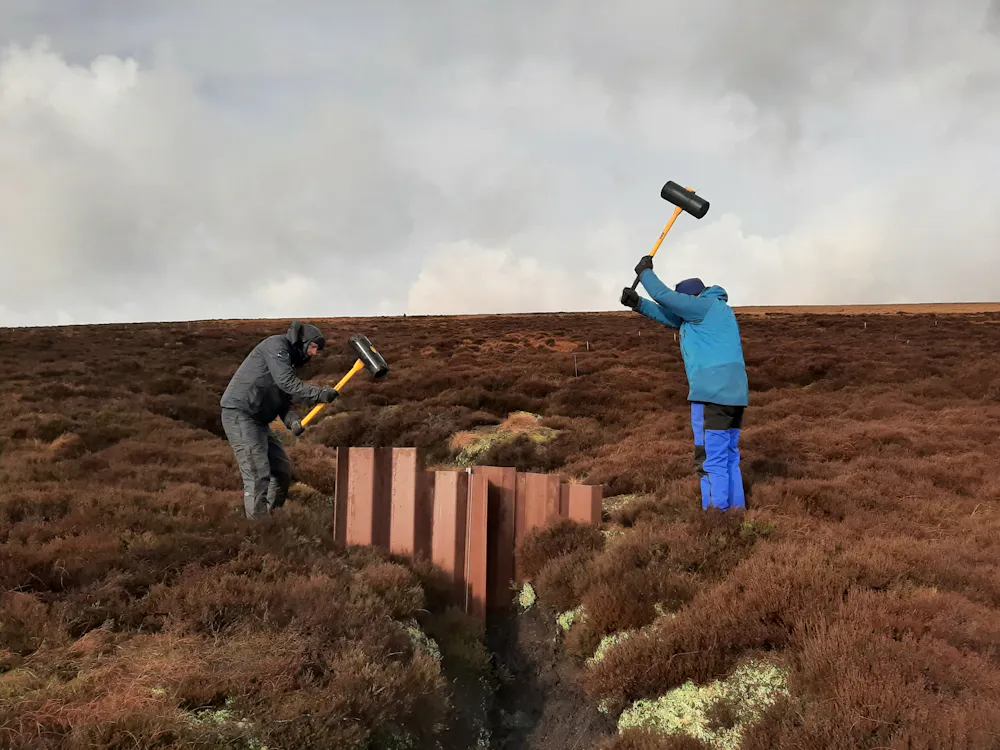
    Gully blocking to raise peatland water tables and limit carbon loss, as part of the GGR-Peat project at the National Trust High Peak Estate.
    Jonathan Ritson

    The Great North Bog initiative, as one example, has linked together restoration organisations, researchers and landowners to deliver restoration across four national parks and three national landscapes. This is truly the scale that is needed if the UK is serious about meeting its climate targets.

    More will be required, however, as huge swathes of peatland remain in a degraded state. While bleak messages like those in our new study could lead to resignation about the effects of climate change, there is an alternative way of looking at it: we must show how bad things could get if we don’t do anything, and then see this as a call to action.

    Jonathan Ritson has received funding from charities delivering peatland restoration.

    ref. Most of Britain’s peat bogs could stop forming new peat as the climate changes – new study – https://theconversation.com/most-of-britains-peat-bogs-could-stop-forming-new-peat-as-the-climate-changes-new-study-248515

    MIL OSI – Global Reports

  • MIL-OSI United Kingdom: Ending Violence Against Women and Girls Momentum Fund – Expression of Interest

    Source: Northern Ireland City of Armagh

    Support for community and voluntary organisations currently working to end violence against women and girls.

    Council is issuing an expression of interest for those community and voluntary organisations who are already involved in the delivery of activity to end violence against women and girls and require support to continue the delivery of their activity until 31st March 2025. This expression of interest allows constituted community and voluntary organisations who are currently delivering activity aligned to the Outcomes of the Ending Violence Against Women and Girls strategy to apply for up to a maximum of £5000. This is for delivery taking place February – March 2025 only. Applications for the expression of interest momentum fund delivery February – March 2025 must be submitted via email by the deadline of 12 noon 13th February 2025. For an application form and guidance notes, please email:  

    *protected email*

    MIL OSI United Kingdom

  • MIL-OSI: Cegedim’s revenue grew 6.3% in 2024

    Source: GlobeNewswire (MIL-OSI)


    PRESS RELEASE

    Quarterly financial information as of December 31, 2024
    IFRS – Regulated information – Not audited

    Cegedim’s revenue grew 6.3% in 2024

    • Full year revenue rose 4.7% like for like to €654.5 million
    • Fourth quarter revenue grew 5.9% like for like to €178.7 million
    • All operating divisions contributed to growth in the fourth quarter

    Boulogne-Billancourt, France, January 30, 2025, after the market close

    Revenue

      Fourth quarter Change Q4 2024 / 2023
    in millions of euros 2024 2023

    reclassified(1)

    Reclassification(1) 2023

    Reported

    Reported

    vs. reclassified(1)

    Like for like(2)(3)

    vs. reclassified(1)

    Software & Services 80.1 75.7 (8.7) 84.4 +5.8% +2.8%
    Flow 27.0 24.2 (0.6) 24.8 +12.0% +11.7%
    Data & Marketing 38.4 35.8 0.0 35.8 +7.1% +7.1%
    BPO 21.2 19.6 0.0 19.6 +7.8% +7.8%
    Cloud & Support 12.0 11.3 +9.3 2.0 +6.2% +6.2%
    Cegedim 178.7 166.6 0.0 166.6 +7.2% +5.9%
      Full year Change FY 2024 / 2023
    in millions of euros 2024 2023

    reclassified(1)

    Reclassification(1) 2023

    Reported

    Reported

    vs. reclassified(1)

    Like for like(2)(4)

    vs. reclassified(1)

    Software & Services 307.8 302.3 (24.3) 326.6 +1.8% (1.2)%
    Flow 100.3 93.4 (2.5) 95.9 +7.3% +7.2%
    Data & Marketing 125.9 114.9 0.0 114.9 +9.6% +9.6%
    BPO 82.7 71.5 0.0 71.5 +15.8% +15.8%
    Cloud & Support 37.8 33.9 +26.8 7.1 +11.3% +11.3%
    Cegedim 654.5 616.0 0.0 616.0 +6.3% +4.7%

    Cegedim’s consolidated fourth quarter 2024 revenues rose to €178.7 million, up 7.2% as reported and 5.9% like for like(2) compared with the same period in 2023. All operating divisions contributed to like for like growth in the fourth quarter.

    Over the full year, revenues rose 6.3% as reported and 4.7% like for like compared with 2023. Marketing, health insurance, HR, and cloud businesses delivered the most solid growth over the full year. As expected, the Software & Services division felt the impact of comparisons with Ségur public health investment spending in 2023 and a slowdown in international sales because the Group decided to refocus its UK doctor software activities on Scotland, and then later decided to voluntarily place that business under administration.

    Analysis of business trends by division 

    • Software & Services
    Software & Services Fourth quarter Change Q4 2024 / 2023 Full year Change FY 2024 / 2023
    in millions of euros 2024 2023

    Reclassified(3)

    Reported

    vs. reclassified(1)

    Like for like(2)

    vs. reclassified(1)

    2024 2023

    reclassified(1)

    Reported

    vs. reclassified(1)

    Like for like(2)

    vs. reclassified(1)

    Cegedim Santé 21.3 18.1 +17.2% +1.8% 80.2 76.5 +4.8% (7.1)%
    Insurance, HR, Pharmacies, and other services 47.2 44.9 +5.1% +5.1% 176.7 173.3 +2.0% +1.9%
    International businesses 11.6 12.7 (8.2)% (3.5)% 50.9 52.5 (3.0)% (3.0)%
    Software & Services 80.1 75.7 +5.8% +2.8% 307.8 302.3 +1.8% (1.2)%

    Revenues at Cegedim Santé grew 17.2% as reported in the fourth quarter and 1.8% like for like. Reported growth over the full year came to 4.8%, but like-for-like revenues fell 7.1% due to the absence of Ségur public health investments, which generated revenue of €4.7 million in 2023. Reported growth includes Visiodent from March 1, 2024. The new subsidiary has already started marketing Group products like the Maiia appointment scheduling app and the Claude Bernard database to its clients, but those sales are not reflected in like-for-like growth.

    Others French subsidiaries saw reported revenue growth of 5.1% in the fourth quarter and 2% over the full year (1.9% LFL; Phealing acquired in Q4 2023). Over both the fourth quarter and the full year, the division was propelled by growth at the insurance businesses, thanks to robust project-based sales, and by HR, which is still getting a boost from its client diversification strategy. On the other hand, sales to pharmacies were down substantially—as they were at some of the competitors. This was partly because equipment sales slowed after many pharmacies updated their equipment in 2023. In addition, the pharmacy software business took in more than €2 million in Ségur public health investment revenues in 2023, creating a tough comparison.

    Internationally, revenues from software sales to UK doctors declined, as expected, following the Group’s decision early in the year to refocus the activity on Scotland. Unfortunately, the market proved too sluggish for this plan to succeed. On December 10, the Group decided to deconsolidate this subsidiary after announcing it would be voluntarily placed under administration. That move aggravated the drop in reported revenues in the fourth quarter, which came to 8.2%.

    Flow Fourth quarter Change Q4 2024 / 2023 Full year Change FY 2024 / 2023
    in millions of euros 2024 2023

    reclassified(1)

    Reported

    vs. reclassified(1)

    Like for like(2)

    vs. reclassified(1)

    2024 2023

    reclassified(1)

    Reported

    vs. reclassified(1)

    Like for like(2)

    vs. reclassified(1)

    e-business 15.0 14.0 +7.1% +6.7% 58.5 55.4 +5.6% +5.3%
    Third-party payer 12.0 10.2 +18.7% +18.7% 41.8 38.0 +9.9% +9.9%
    Flow 27.0 24.2 +12.0% +11.7% 100.3 93.4 +7.3% +7.2%

    Fourth-quarter growth in e-business, e-invoicing, and digitized data exchanges was 7.1%. The boost came from a rebound in Invoicing & Purchasing in France and a continued surge at the Healthcare Flow segment, which started early in the year, owing to dynamic new offerings for hospitals that are designed to make their drug purchasing secure. Growth over the full year was a solid 5.6%.

    The digital data flow business dealing with reimbursement of healthcare payments in France (Third-party payer) experienced 18.7% growth in Q4. It was boosted by strong growth in demand for its fraud and long-term illness detection offerings. Over the full year, this trend more than offset the transfer of revenue attributable to the Allianz contract—now attributed to the BPO business—and allowed the unit to post growth of 9.9%.

    • Data & Marketing
    Data & Marketing Fourth quarter Change Q4 2024 / 2023 Full year Change FY 2024 / 2023
    in millions of euros 2024 2023

    reclassified(1)

    Reported

    vs. reclassified(1)

    Like for like(2)

    vs. reclassified(1)

    2024 2023

    reclassified(1)

    Reported

    vs. reclassified(1)

    Like for like(2)

    vs. reclassified(1)

    Data 22.4 21.0 +6.3% +6.3% 65.5 64.5 +1.6% +1.6%
    Marketing 16.0 14.8 +8.2% +8.2% 60.4 50.4 +19.9% +19.9%
    Data & Marketing 38.4 35.8 +7.1% +7.1% 125.9 114.9 +9.6% +9.6%

    Data businesses posted 6.3% yoy growth in the fourth quarter, cementing an improvement over the second half, particularly in France. Thanks to its strong presence on the ground and its agility in adapting to customer demands, the Data business has been able to post positive growth of 1.6% in 2024, following a remarkable year in 2023.

    The Marketing segment had a solid fourth quarter, up 8.2%, and a record year, with growth of 19.9%. The performance showed the soundness of its phygital media strategy for pharmacies and was bolstered by special ad campaigns during the Olympics.

    BPO Fourth quarter Change Q4 2024 / 2023 Full year Change FY 2024 / 2023
                    in millions of euros 2024 2023

    Reclassified(4)

    Reported

    vs. reclassified(1)

    Like for like(2)

    vs. reclassified(1)

    2024 2023

    reclassified(1)

    Reported

    vs. reclassified(1)

    Like for like(2)

    vs. reclassified

    Insurance BPO 15.4 14.0 +9.9% +9.9% 60.0 49.9 +20.2% +20.2%
    Business Services BPO 5.8 5.6 +2.8% +2.8% 22.7 21.6 +5.5% +5.5%
    BPO 21.2 19.6 +7.8% +7.8% 82.7 71.5 +15.8% +15.8%

    The Insurance BPO business grew by 9.9% over the fourth quarter, chiefly owing to its overflow business, which has been flourishing since the start of the year. Growth over the full year amounted to 20.2%, partly thanks to a favorable comparison stemming from the April 1, 2023, launch of the Allianz contract.

    Business Services BPO (HR and digitalization) reported growth of 2.8% in the fourth quarter and 5.5% over the full year on the back of a popular compliance offering and new clients.

    • Cloud & Support
    Cloud & Support Fourth quarter Change Q4 2024 / 2023 Full year Change FY 2024 / 2023
    in millions of euros 2024 2023

    reclassified(1)

    Reported

    vs. reclassified(1)

    Like for like(2)

    vs. reclassified(1)

    2024 2023

    reclassified(1)

    Reported

    vs. reclassified(1)

    Like for like(2)

    vs. reclassified(1)

    Cloud & Support 12.0 11.3 +6.2% +6.2% 37.8 33.9 +11.3% +11.3%

    The Cloud & Support division’s trajectory continued over the fourth quarter, with growth of 6.2% bringing FY growth to 11.3%. The progress reflects our expanded range of sovereign cloud-backed products and services, which earned the ANSSI security visa for SecNumCloud certification.

    Highlights

    Apart from the items cited below, to the best of the company’s knowledge, there were no events or changes during Q4 2024 that would materially alter the Group’s financial situation.

    On December 10, 2024, Cegedim announced that it had voluntarily placed its UK subsidiary—INPS, which sells software for doctors—under administration.

    Significant transactions and events post December 31, 2024
    To the best of the company’s knowledge, there were no post-closing events or changes after December 31, 2024, that would materially alter the Group’s financial situation.

    Outlook

    Like-for-like revenue growth(1) in 2024 was just below the bottom of the announced 5% to 8% range compared with 2023. Had the Group not refocused INPS on Scotland and then closed it later in the year, it would have met the 5% target. This performance is unlikely to jeopardize the outlook for recurring operating income, which is expected to continue improving.
    That said, the deconsolidation of INPS is likely to result in significant non-cash adjustments.
    These statements are not forecasts and are based on financial information that has not yet been audited.

    —————

    WEBCAST ON JANUARY 30, 2025 AT 6:15 PM (PARIS TIME)
    The webcast is available at: www.cegedim.fr/webcast
    The FY 2024 revenue presentation is available at:
    https://www.cegedim.fr/documentation/Pages/presentation.aspx

    Financial calendar:

    2025 March 27 after the close

    March 28 at 10:00 am

    April 24 after the close

    June 13 at 9:30

    July 24 after the close

    September 25 after the close

    September 26 at 10:00 am

    October 23 after the close

    2024 results

    SFAF meeting

    Q1 2025 revenues

    Shareholders’ general meeting

    H1 2025 revenues

    H1 2025 results

    SFAF meeting

    Q3 2025 revenues

    Financial calendar: https://www.cegedim.fr/finance/agenda/Pages/default.aspx

    Disclaimer
    This press release is available in French and in English. In the event of any difference between the two versions, the original French version takes precedence. It was sent to Cegedim’s authorized distributor on January 30, 2025, no earlier than 5:45 pm Paris time.
    The figures cited in this press release include guidance on Cegedim’s future financial performance targets. This forward-looking information is based on the opinions and assumptions of the Group’s senior management at the time this press release is issued and naturally entails risks and uncertainty. For more information on the risks facing Cegedim, please refer to Chapter 7, “Risk management”, section 7.2, “Risk factors and insurance”, and Chapter 3, “Overview of the financial year”, section 3.6, “Outlook”, of the 2023 Universal Registration Document filled with the AMF on April 3, 2024, under number D.24-0233.

    About Cegedim:
    Founded in 1969, Cegedim is an innovative technology and services group in the field of digital data flow management for healthcare ecosystems and B2B, and a business software publisher for healthcare and insurance professionals. Cegedim employs nearly
    6,700 people in more than 10 countries and generated revenue of over €654 million in 2024.
    Cegedim SA is listed in Paris (EURONEXT: CGM).
    To learn more please visit: www.cegedim.fr
    And follow Cegedim on X: @CegedimGroup, LinkedIn, and Facebook.

    Aude Balleydier
    Cegedim
    Media Relations
    and Communications Manager

    Tel.: +33 (0)1 49 09 68 81
    aude.balleydier@cegedim.fr

    Damien Buffet
    Cegedim
    Head of Financial
    Communication

    Tel.: +33 (0)7 64 63 55 73
    damien.buffet@cegedim.com

    Céline Pardo
    Becoming RP Agency
    Media Relations Consultant

    Tel.:        +33 (0)6 52 08 13 66
    cegedim@becoming-group.com


    ____________________________________________________________________________________________________________________________________________________

    (1) At constant scope and exchange rates.

    Annexes

    Breakdown of revenue by quarter and division

    in millions of euros   Q1 Q2 Q3 Q4 Total
    Software & Services   74.3 77.8 75.6 80.1 307.8
    Flow   25.4 24.2 23.7 27.0 100.3
    Data & Marketing   27.0 32.3 28.2 38.4 125.9
    BPO   20.2 19.7 21.6 21.2 82.7
    Cloud & Support   9.0 9.1 7.7 12.0 37.8
    Group revenue   155.9 163.1 156.8 178.7 654.5
    in millions of euros   Q1
    reclassified
    Q2
    reclassified
    Q3
    reclassified
    Q4
    reclassified
    Total
    reclassified
    Software & Services   74.4 76.2 76.0 75.7 302.3
    Flow   24.0 22.8 22.4 24.2 93.4
    Data & Marketing   24.6 30.3 24.1 35.8 114.9
    BPO   14.4 18.4 19.0 19.6 71.5
    Cloud & Support   8.4 7.4 6.8 11.3 33.9
    Group revenue   145.9 155.1 148.3 166.6 616.0

    Revenue breakdown by geographic zone, currency, and division at December 31, 2024

    as a % of consolidated revenues   Geographic zone   Currency
      France EMEA
    ex. France
    Americas   Euro GBP Other
    Software & Services   83.5% 16.4% 0.1%   86.9% 11.4% 1.7%
    Flow   92.1% 7.9% 0.0%   94.6% 5.4% 0.0%
    Data & Marketing   97.9% 2.1% 0.0%   98.1% 0.0% 1.9%
    BPO   100.0% 0.0% 0.0%   100.0% 0.0% 0.0%
    Cloud & Support   99.9% 0.1% 0.0%   100.0% 0.0% 0.0%
    Cegedim Health Data UK   90.6% 9.3% 0.1%   92.2% 6.6% 1.2%

    (1)   As of January 1, 2024, our Cegedim Outsourcing and Audiprint subsidiaries—which were previously housed in the Software & Services division—as well as BSV—formerly of the Flow division—have been moved to the Cloud & Support division in order to capitalize on operating synergies between cloud activities and IT solutions integration.
    (2)   At constant scope and exchange rates.
    (3)   The positive currency impact of 0.2% was mainly due to the pound sterling. The positive scope effect of 1.1% was attributable to the first-time consolidation in Cegedim’s accounts of Visiodent starting March 1, 2024.
    (4)   The positive currency impact of 0.2% was mainly due to the pound sterling. The positive scope effect of 1.4% was attributable to the first-time consolidation in Cegedim’s accounts of Visiodent starting March 1, 2024.

    (1)   3To take advantage of synergies, Cegedim Outsourcing, Audiprint, and BSV have been reassigned to the Cloud & Support division.
    (2)   At constant scope and exchange rates.

    (1)   4To take advantage of synergies, Cegedim Outsourcing, Audiprint, and BSV have been reassigned to the Cloud & Support division.
    (2)   At constant scope and exchange rates.

    Attachment

    The MIL Network

  • MIL-OSI United Kingdom: Environmental Improvement Plan rapid review

    Source: United Kingdom – Executive Government & Departments

    Statement of key findings from the Environmental Improvement Plan rapid review launched on 30 July 2024.

    Applies to England

    Documents

    Details

    This statement from Defra’s Secretary of State, Steve Reed, provides an update on the rapid review of the Environmental Improvement Plan (EIP) launched on 30 July 2024. It sets out key strategic findings from the rapid review and plans for revising the EIP.

    Updates to this page

    Published 30 January 2025

    Sign up for emails or print this page

    MIL OSI United Kingdom

  • MIL-OSI United Kingdom: Jail terms for men who ran Kent waste warehouse

    Source: United Kingdom – Executive Government & Departments

    Rubbish later caught fire, disrupting town – Lancashire and Devon men guilty of waste crime

    Fire-ravaged unit at Westwood Business Park in Margate

    Routine complaints about flies in a seaside town unearthed a vast cavern of illegally-stored waste.

    No wonder the flies, as well as rats, were interested. David Weeks and Lee Brookes had built up a massive stockpile of rubbish, neatly packaged in black plastic.

    The Environment Agency prosecuted the pair, resulting in suspended prison sentences totalling 20 months between them for filling a Margate warehouse with the waste.

    It was spring 2017. As the weather warmed up, frustrated residents rang the local council to report swarms of flies close to an anonymous building.

    Officials at Thanet District Council contacted the Environment Agency, which began an investigation. It discovered the illegal storage of thousands of bales of household and construction waste inside the building, unit P, on the Westwood Business Park.

    Baled waste stored inside unit P before the fire.

    A director of Devon-based DW Land Ltd, Weeks signed a one-year lease with the building’s owners at the start of 2017.

    Lorry after lorry dumped waste

    But no sooner was the ink dry on the lease that lorry after lorry began arriving in Margate from across the home counties – a procession of 220 vehicles over three months, offloading 6,000 blocks of waste and placed in the building.

    Totnes businessman Weeks employed Brookes’ firm, OMC Outdoor Maintenance Company, of Whitworth, in Lancashire, to secure and manage unit P. Weeks told the Environment Agency he was the agent for two companies wanting the site for an energy-from-waste plant. 

    Judge Simon Taylor KC heard the waste had left legal sites in Hampshire and Hertfordshire, bound for the Kent coast, to be stored inside the building, but outside the law. Neither Brookes nor Weeks obtained an environmental permit for the storage of waste.

    Risk became reality when building went up in flames

    Matt Higginson, environment manager for the Environment Agency in Kent, said:

    Weeks and Brookes profited financially from payments made to the sites where the waste originated and from its storage in Kent.

    Not getting an environmental permit for the building, avoiding the cost and requirements of getting one, Weeks and Brookes gave themselves an unfair advantage over legitimate waste operators

    A permit for the site would have required a plan to manage the risk of fire. Risk became reality when the building went up in flames. The disruption for local people went on for almost a month.

    This case proves you must use firms authorised to take away your waste. Check the register of waste carriers’ licences on gov.uk.

    Throughout 2017 and 2018, Weeks and Brookes gave the Environment Agency several excuses as to why they couldn’t clear the waste from the building. 

    On 18 September that year, the building caught fire. Kent Fire and Rescue Service fought the blaze for 25 days. At its peak, rubbish burst out of the packaging. Although no cause for the fire has ever been found, roads and businesses had to close, and the disruption led to operations cancelled at the local hospital.

    View of fire-ravaged unit P at Westwood Business Park in Margate.

    It was only a year later, towards the end of 2019, and almost three years after the first delivery of rubbish, what waste survived the fire was finally removed by the battered building’s new owner.

    Weeks and Brookes gave scant assistance to the Environment Agency’s investigation. Even after the fire, the pair kept a very low profile.

    David Weeks, 55, of School Hill, Totnes, Devon, was sentenced to 16 months in prison, suspended for two years. He also to pay £5,000 in costs, and a victim surcharge of £140.

    Judge Taylor also gave Weeks 150 hours unpaid work and 20 hours of rehabilitation activity aimed at preventing him from reoffending. He’ll have to wear an electronic tag to monitor his daytime movements for the next two months. 

    Lee Brookes, of Tonacliffe Way, Whitworth, Lancashire, received a sentence of four months in prison, suspended for a year. He was also given 80 hours of unpaid work and the same 20 hours of rehabilitation programme. The court also ordered the 49-year-old to pay costs of £1,000 and a £115 victim surcharge.   

    At the hearing on 21 January, the court was told Weeks was fined almost £10,000 seven years ago for his part in the management of a site in Plymouth where 13,000 tonnes of wood was stored illegally.   

    The two men pleaded guilty at an earlier hearing to knowing their respective companies, DW Land and OMC Maintenance, ran the waste operation in Margate without an environmental permit between 13 January 2017 and 22 August 2019, against regulation 12 (1)(a) of the Environmental Permitting (England and Wales) Regulations 2016. 

    DW Land Ltd, of Paignton Road, Stoke Gabriel, Totnes, Devon, and OMC Outdoor Maintenance Company Ltd, also of Tonacliffe Way, Whitworth, Lancashire, are no longer trading.

    Contact us: Journalists only –

    0800 141 2743 or communications_se@environment-agency.gov.uk

    Updates to this page

    Published 30 January 2025

    MIL OSI United Kingdom

  • MIL-OSI United Kingdom: Abortion statists reveal horrific rise

    Source: Traditional Unionist Voice – Northern Ireland

    Statement by TUV leader Jim Allister:

    “The abortion statistics published today by the Department of Health are deeply troubling. They show that the number of abortions being carried out in Northern Ireland increased by a shocking 28.8% since the previous year, with 2,792 performed in 2023/24 compared with  2,168 in 2022/23. If one goes back further the rise is even more stark. In 2020/21 the figure was 1,574 meaning there has been an increase of over 77% when compared with today’s figures.

    “While I welcome the increase in the volume of data published by the Department, I note that the information continues to fall well short of the information released by health authorities in Great Britain. In GB the socioeconomic background of the mother, whether she has had more than one abortion and other information is available but not in Northern Ireland. I received an assurance from the then Minister in 2024 that this situation would change. Why hasn’t it?”

    TUV MLA Timothy Gaston added:

    “I have been pressing Minister Nesbitt on issues related to abortion since becoming the Member for North Antrim and tellingly he has been less than forthcoming with responses. It is time that Northern Ireland had a properly informed debate about this issue. When the public were given an opportunity to have their say in response to an NIO consultation a massive 79% of the 21,200 responses to the consultation recorded their opposition to the abortion regulations. In spite of what some in the media may try to claim, there is still considerable opposition to abortion in Northern Ireland and there will be many who will share my alarm at the growth in the number of abortions in our Province.

    “It is clear from today’s figures that abortion is increasingly becoming just another form of birth control in Northern Ireland and that the dishonest debate around the matter in the early 2020s, framed around “hard cases”, did not deal with the real issues created by the legislation imposed on Northern Ireland.”

    MIL OSI United Kingdom

  • MIL-OSI United Kingdom: TUV meet American Consul to Northern Ireland

    Source: Traditional Unionist Voice – Northern Ireland

    Jim Allister KC MP, Timothy Gaston MLA and Dr Dan Boucher from the TUV met the American Consul General James Applegate and Political-Economic Chief Dori Winter to Northern Ireland on Thursday 30 January in Ballymena.

    Mr Allister said:

    “We were delighted to meet the Consul and Deputy Consul.

    “Having expressed our condolences following the tragic events in Washington DC overnight, we talked about both the constitutional and economic implications of the Irish Sea border and particularly its implications for the United Kingdom’s relationship with the United States and its implications on a possible UK-US trade deal.

    “Constitutionally, we impressed upon our friends the impact of what has been the biggest reversal in democracy in the western world, with the disenfranchisement of the people of Northern Ireland in 300 areas of law, and our subjection to the law of a foreign Parliament that we don’t make and cannot change, and the consequences of the European Union’s attendant intervention to undermine cross community consent at Stormont.

    “Economically, we explained  how the dependence of Northern Ireland, as a fully integrated part of the UK economy, on receipt of economic inputs from Great Britain, means that rather that providing us with the best of both worlds, the Irish Sea border is undermining and damaging those parts of the Northern Ireland economy that sit beyond the service sector, (to which the Protocol does not apply), especially manufacturing.

    “We also reflected on the forthcoming 250th anniversary of the American Declaration of Independence on 4th July 2026 and on the critical role played by Ulster Scots from Northern Ireland in laying the foundation for the United States.”

    MIL OSI United Kingdom

  • MIL-OSI United Kingdom: New theme group created to establish future careers for the Armed Forces community

    Source: City of Plymouth

    Pictured from left to right hand side, front row:
    Andrew McConochie, Lieutenant Commander, Royal Navy
    Cllr Pauline Murphy, Deputy Lord Mayor and Armed Forces Champion, Plymouth City Council
    Emma Hewitt, Skills Lead, Plymouth City Council
    Victoria Mead, Skills and Workforce Coordinator, Plymouth City Council

    Pictured from left to right hand side, back row:
    David FitzGerald, President of the Royal British Legion Dartmoor Branch
    Darryl Newman, Nursing and Clinical Professions Recruitment Lead and Armed Forces Champion, University Hospitals Plymouth NHS Trust
    Consort Cllr Mark Coker, Plymouth City Council
    Cllr Chris Penberthy, Cabinet Member for Housing, Cooperative Development and Communities
    Lewis Elliot, Sea Cadet
    Jon Beake, Defence Relationship Management in the SW, Wessex RCFA

    Plymouth’s Armed Forces Covenant is launching a new theme group to help enable better access to local employment, skills and training opportunities for military service leavers, working-age veterans, military family spouses, partners and young people.

    Last year, the Council renewed its commitment to the Armed Forces Covenant.

    The Armed Forces Covenant is a nationwide agreement between the armed forces community, the nation and the government.

    One of the commitments from signing the Covenant, is to establish better job and training opportunities for members of the Armed Forces community.

    Led by Plymouth City Council’s Skills Launchpad Plymouth team, the representatives of the group are:

    • Plymouth’s Veterans and Families Hub
    • Forces Employment Charity
    • Career Transition Partnership
    • The Royal Marines Charity
    • Department for Work and Pensions.

    With strong involvement from local employers who are signatories of the Armed Forces Covenant including University Hospitals Plymouth NHS Trust, Babcock, Livewell Southwest, Crowne Plaza Hotel, Wolferstans Solicitors and Plymouth City Bus.

    A launch event was held today to bring together a key group of people who will be involved in this work and to raise the profile of the Armed Forces Covenant with the local business community.

    Deputy Lord Mayor and Armed Forces Champion, Councillor Pauline Murphy, said: “Working in city-wide partnership, we want to recognise, communicate and seek to reduce the challenges faced by those within the Armed Forces community.

    “As a proud military city, I am delighted that we are launching Plymouth’s new vision for enabling better access to local employment and future careers. We are pro-actively engaging with our business community to increase commitment for the Armed Forces Covenant and want to create a win-win to help solve recruitment challenges in the city as we promote the highly transferrable skills and talent of our military community.

    “We are excited to support this joined up approach which builds on the Council’s renewal last year and strong commitment to the Armed Forces Covenant.”

    Attendees at the theme group launch event held 30 January 2025 at the Council House

    Speaking at the launch event, Darryl Newman, Nursing and Clinical Professions Recruitment Lead and Armed Forces Champion at University Hospitals Plymouth NHS Trust said: “I’m proud to be chairing the Armed Forces Future Careers and Employers Group to support our city’s Armed Forces Community.

    “The Armed Forces Future Careers and Employers Group will bring together employers across the city to identify, support and grow employment for the Armed Forces Community across Plymouth, whilst sharing best practice.”

    Representing the Royal Navy, Andrew McConochie, Lieutenant Commander said: “With Plymouth being home to the largest naval base in Western Europe with the highest concentration of veterans in England, this new coordinated approach will provide significant value to serving personnel in planning their local employment and future career transitions, along with valuable support for their families, helping to both attract and retain talent in the city.” 

    Luke Pollard MP for Plymouth Sutton and Devonport shared his best wishes for a successful launch of the new theme group. He said: “I am so proud of my home city of Plymouth for stepping up to enhance localised employment and training support for our valued Armed Forces community. By fostering this new collaboration between local, regional and national service providers, and building better awareness of the increasing investment and growth in jobs and career pathways available in the city, we can create a brighter future.

    “We greatly appreciate the businesses who have already pledged their support for the Armed Forces Covenant, and I’d encourage more Plymouth organisations to become part of the Ministry of Defence’s Employer Recognition Scheme so that we can achieve even more positive outcomes together.”

    To find out more and to get involved, email [email protected]

    MIL OSI United Kingdom

  • MIL-OSI Global: How nonprofits abroad can fill gaps when the US government cuts off foreign aid

    Source: The Conversation – USA – By Susan Appe, Associate Professor of Public Administration and Policy, University at Albany, State University of New York

    The U.S. Agency for International Development distributes a lot of foreign aid through local partners in other countries. J. David Ake/Getty Images

    The U.S. government gives other nations US$68 billion of foreign assistance annually – more than any other country. Over half of this sum is managed by the U.S. Agency for International Development, including funds for programs aimed at fighting hunger and disease outbreaks, providing humanitarian relief in war zones, and supporting other lifesaving programs such as the President’s Emergency Plan for AIDS Relief.

    President Donald Trump suspended most U.S. foreign aid on Jan. 20, 2025, the day he took office for the second time. The next day, Secretary of State Marco Rubio issued a stop-work order that for 90 days halted foreign aid funding disbursements by agencies like USAID.

    A week later, dozens of senior USAID officials were put on leave after the Trump administration reportedly accused them of trying to “circumvent” the aid freeze. The Office of Management and Budget is now pausing and evaluating all foreign aid to see whether it adheres to the Trump administration’s policies and priorities.

    I’m a scholar of foreign aid who researches what happens to the U.S. government’s local partners in the countries receiving this assistance when funding flows are interrupted. Most of these partners are local nonprofits that build schools, vaccinate children, respond to emergencies and provide other key goods and services. These organizations often rely on foreign funding.

    A ‘reckless’ move

    Aid to Egypt and Israel was spared, along with some emergency food aid. The U.S. later waived the stop-work order for the distribution of lifesaving medicines.

    Nearly all of the other aid programs remained on hold as of Jan. 29, 2025.

    Many development professionals criticized the freeze, highlighting the disruption it will cause in many countries. A senior USAID official issued an anonymous statement calling it “reckless.”

    InterAction, the largest coalition of international nongovernmental organizations in the U.S., called the halt contrary to U.S. global leadership and values.

    Of the $35 billion to $40 billion in aid that USAID distributes annually, $22 billion is delivered through grants and contracts with international organizations to implement programs. These can be further subcontracted to local partners in recipient countries.

    When this aid is frozen, scaled back or cut off altogether, these local partners scramble to fill in the gaps.

    The State Department manages the rest of the $68 billion in annual U.S. foreign aid, along with other agencies, such as the Peace Corps.

    The start of Marco Rubio’s tenure as U.S. secretary of state was marked by chaos and confusion regarding foreign aid flows.
    Kevin Dietsch/Getty Images

    How local nonprofits respond and adapt

    While sudden disruptions to foreign aid are always destabilizing, research shows that aid flows have fluctuated since 1960, growing more volatile over the years. My research partners and I have found that these disruptions harm local service providers, although many of them manage to carry on their work.

    Over the years, I have conducted hundreds of interviews with international nongovernmental organizations and these nonprofits’ local partners across Latin America, Africa and Asia about their services and funding sources. I study the strategies those development and humanitarian assistance groups follow when aid gets halted. These four are the most common.

    1. Shift to national or local government funding

    In many cases, national and local governments end up supporting groups that previously relied on foreign aid, filling the void.

    An educational program spearheaded by a local Ecuadorian nonprofit, Desarrollo y Autogestión, called Accelerated Basic Cycle is one example. This program targets young people who have been out of school for more than three years. It allows them to finish elementary school – known as the “basic cycle” in Ecuador – in one year to then enter high school. First supported in part by funding from foreign governments, it transitioned to being fully funded by Ecuador’s government and then became an official government program run by the country’s ministry of education.

    2. Earn income

    Local nonprofits can also earn income by charging fees for their services or selling goods, which allows them to fulfill their missions while generating some much-needed cash.

    For example, SEND Ghana is a development organization that has promoted good governance and equality in Ghana since its founding in 1998. In 2009, SEND Ghana created a for-profit subsidiary called SENDFiNGO that administers microfinance programs and credit unions. That subsidiary now helps fund SEND Ghana’s work.

    Bangladesh Rural Advancement Committee and the Grameen Bank, which is also in Bangladesh, use this approach too.

    3. Tap local philanthropy

    Networks such as Worldwide Initiatives for Grantmaker Support and Global Fund for Community Foundations have emerged to promote local philanthropy around the world. They press governments to adopt policies that encourage local philanthropy. This kind of giving has become easier to do thanks to the emergence of crowdfunding platforms.

    Still, complex tax systems and the lack of incentives for giving in many countries that receive foreign aid are persistent challenges. Some governments have stepped in. India’s corporate social responsibility law, enacted in 2014, boosted charitable incentives. For example, it requires 2% of corporate profits to go to social initiatives in India.

    4. Obtain support from diaspora communities

    Diasporas are people who live outside of their countries of origin, or where their families came from, but maintain strong ties to places they consider to be their homeland.

    Local nonprofits around the globe are leveraging diaspora communities’ desire to contribute to economic development in their countries of origin. In Colombia, for example, Fundación Carla Cristina, a nongovernmental organization, runs nursery schools and provides meals to low-income children.

    It gets some of its funding from diaspora-led nonprofits in the U.S., such as the New England Association for Colombian Children, which is based outside of Boston, and Give To Colombia in Miami.

    A push for the locals to do more

    Trump’s stop-work order coincided with a resurgence of a localization push that’s currently influencing foreign aid from many countries.

    With localization, nations providing foreign aid seek to increase the role of local authorities and organizations in development and humanitarian assistance. USAID has been a leading proponent of localization.

    I believe that the abruptness of the stop-work order is likely to disrupt many development projects. These projects include support to Ukrainian aid groups that provide emergency humanitarian assistance and projects serving meals to children who don’t get enough to eat.

    To be sure, sometimes there are good reasons for aid to be halted. But when that happens, sound and responsible donor exit strategies are essential to avoid the loss of important local services.

    Susan Appe does not work for, consult, own shares in or receive funding from any company or organization that would benefit from this article, and has disclosed no relevant affiliations beyond their academic appointment.

    ref. How nonprofits abroad can fill gaps when the US government cuts off foreign aid – https://theconversation.com/how-nonprofits-abroad-can-fill-gaps-when-the-us-government-cuts-off-foreign-aid-248378

    MIL OSI – Global Reports

  • MIL-OSI United Kingdom: Youth Justice Statistics: let’s build on this momentum

    Source: United Kingdom – Executive Government & Departments

    A blog by Keith Fraser, YJB Chair and Board Champion for Over-Represented Children.

    Keith Fraser

    Every year, we reach a pivotal moment in the youth justice calendar: the publication of our annual statistics.

    These figures are not just numbers on a page—they are essential tools that help us understand the landscape of youth justice in England and Wales. They inform our priorities,  support our advice to government ministers, and shape the support provided to children in the system.

    Looking at this year’s data, there are several positives worth celebrating, as well as persistent and emerging challenges we must continue to address.

    Fewer first time entrants and reduced knife offences

    One of the most encouraging trends is the continued fall in the number of children entering the youth justice system for the first time—a 3% drop to a record low. This is particularly welcome given the slight rise last year, which raised concerns that we might be witnessing a new upward trend.

    Early intervention remains key. All agencies hold a responsibility to prevent children from offending and the evidence says that the earlier we can support vulnerable children, the more likely they are to lead positive, constructive lives and contribute to our communities.

    The number of stop and searches has also fallen by 4%, though it remains a concern that over three-quarters result in No Further Action. This does little to build trust in policing and broader public services for children and young people, particularly among Black and other minority communities. We must ensure police and youth justice responses are both proportionate and appropriate.

    While we are pleased that many forces are adopting child-centred policing or a Child First approach to ensure better outcomes for children, victims and the wider community, there is clearly still work to be done.

    We are in conversation with our partners, such as the National Police Chiefs’ Council, to advocate for evidence-based practice, share advice   and to ensure scrutiny is in place to ensure that children from ethnic minorities are not disproportionately represented. We will also offer advice to Ministers on what our oversight tells us is needed to create the necessary improvements.

    It is reassuring to see a 6% drop in proven knife or offensive weapon offences committed by children, marking the sixth consecutive year of decline. While knife crime is often associated with children in the media, it is important to note that adults commit most of these offences.

    Addressing the root causes—such as poverty, trauma, exploitation, and fear—remains critical. The majority of children who carry knives often do so out of a legitimate sense of fear or victimisation. We must address and reduce  these societal pressures and help children develop better ways to manage risk and think through consequences.

    Another record low in the data was the average number of children in custody falling 3% against the previous year (to 430). While this is welcome, we advocate for a complete rethink of the approach to custody that is more in line with the new secure school. The secure school, which opened last year, places education and healthcare at the heart of its approach to support children and steer them away from reoffending.

    Emerging challenges

    Despite, or because of the reduced number of children in custody, we are concerned by the growing number of young adults aged 18 that remain there. These establishments are meant for children and yet the number of 18-year-olds has more than doubled from around 60 in the previous year to 150 in the latest year. This was due to pressures on capacity in the adult estate, and heightens the need for reform in the adult criminal justice system. 

    Another area that presents a significant challenge is the time it takes to process cases in the court system. On average, it now takes 225 days from offence to completion. This is four days longer than during the pandemic, when there were court closures, for cases to be resolved.

    Delays place a huge strain on children, their families, and victims alike. Prolonged uncertainty affects children psychologically and practically, leaving them unable to plan or move forward and potentially delaying them from accessing the right support at the right time.

    We are advocating for both short-term and long-term solutions. In the short term, youth courts should be given greater powers, as they are better suited to meet the needs of children than Crown Courts. Technological advancements, like the Common Platform, could also improve case progression. In the long term, we need systemic reform of courts t o streamline processes and reduce delays.

    Persistent issues

    Alarmingly, nearly three-quarters of children on custodial remand do not go on to receive custodial sentences.

    This means that hundreds of children and their families experience the negative effects of custody and then go on to receive a community sentence, or no sentence at all. Having children in custody that do not need to be there not only creates additional trauma and exposure to criminality for the children, but also leads to unnecessary risk and costs for the general public. The evidence is clear that contact with the criminal justice system, and custody, heightens the likelihood of reoffending.

    The proven reoffending rate for children has increased as has the number of children and the number of children who reoffended. This along with the reductions in first time entrants suggests that the children in the system now require a higher level of support to break free from an offending cycle. We will be looking at this very closely in the coming weeks.

    I have to say that I am greatly encouraged by the reduced over-representation of Black children across a range of areas. Compared to other ethnicities, Black children saw the biggest decrease in stop and search and first time entrants.

    While still massively over-represented compared to the general population, Black children in custody are at their lowest proportion since 2017. There is also a significant decrease (21%) in the numbers of Black children on remand, with Black children being the only ethnicity this year to see a reoffending rate decrease. We must be clear: any level of over-representation is unacceptable, but something is clearly working towards achieving change , and we remain determined to continue collaborating with our partners to address the contributors to racial disparity.

    I am particularly concerned by the fact that the proportion of children with Mixed ethnicity in custody has doubled over the past decade. We must understand why this is happening and, more importantly, work together to prevent it.

    Community-based solutions are essential. The London Accommodation Pathfinder is a promising example, providing targeted support to boys of Black or Mixed heritage who might otherwise be remanded to custody. By offering appropriate community settings, we can achieve better outcomes and reduce unnecessary detention.

    Let’s build on this momentum

    I want to express my heartfelt gratitude to everyone in the youth justice sector for their dedication and hard work. These statistics show that positive change is possible when we collaborate and adopt evidence-based approaches.

    But there is still much to do. Let’s continue to push for a youth justice system that recognises the potential in every child and supports them on their journey toward a brighter future.

    By working together, we can build on this momentum to ensure better outcomes for all children, and victims with less crime, and safer communities.

    Updates to this page

    Published 30 January 2025

    MIL OSI United Kingdom

  • MIL-OSI United Kingdom: Committee to consider proposals early engagement on possible Visitor Levy

    Source: Scotland – City of Perth

    The Council’s Economy and Infrastructure Committee will next week be asked for approval to begin early engagement on the possibility of a Perth and Kinross Visitor Levy Scheme, with a view to allowing elected members to make a decision informed by local feedback at the end of this year.

    The Visitor Levy (Scotland) Act 2024 grants local authorities the power to introduce a levy on overnight accommodation, with the funds raised reinvested locally to enhance the visitor experience.

    While a scheme like this could create significant opportunities for local investment, Councillor Eric Drysdale, Convener of Economy and Infrastructure, explained the importance of first listening to residents and leaders in the tourism industry locally.

    Councillor Drysdale said: “It’s really important to be clear that the question to committee next week is not about whether or not to introduce a Visitor Levy Scheme, it’s about getting the support to start speaking to those most affected about what would need to be taken into consideration. The feedback from this early engagement is essential to make sure that we are able to make an informed decision before committing to the approach in Perth and Kinross.”

    Tourism is a significant part of the Perth and Kinross economy, but with high visitor numbers there is also an impact on our local communities.

    Councillor Drysdale added: “While visitors bring significant benefits to our local economy, there are also associated costs. The Council introduced the Visitor Rangers service because we recognised that investment was needed to support responsible tourism, and minimise the impact of visitors on our year-round residents.

    “With growing demands for critical services to protect health and social care, support pupils with additional support needs, and tackle poverty, we have a duty to explore any opportunities for additional sources of income which can be invested to support growing our visitor economy. That would then allow core funding to be focused on the services which are needed by the most vulnerable people in our communities.”

    If approved by committee the early engagement process will last between 6 and 10 months. A full report from the feedback received, along with a draft Visitor Levy Scheme developed during the engagement, would then be presented to councillors in December 2025 to consider whether or not to proceed with introducing a scheme. If approved in December, a statutory consultation period of 12 weeks and then an 18-month implementation would follow. As a result, the earliest possible date for a scheme being introduced would be Summer 2027. 

    MIL OSI United Kingdom

  • MIL-OSI United Kingdom: River Yare receives £282,000 for creation of floodplain wetlands

    Source: United Kingdom – Executive Government & Departments

    The Environment Agency, Norfolk Rivers Trust and Water Resources East joined forces on a project along a section of the River Yare.

    Credit: Josh Jaggard

    The £282,000 project creates a healthier, more dynamic and resilient river and floodplain habitat along the River Yare. The River Yare is one of only 210 chalk streams worldwide: making it an incredibly rare and precious habitat.

    Most chalk streams are in southern England—including 58 in East Anglia alone.

    The Environment Agency provided a third of the funding, with additional funding support from the Norfolk Water Strategy Programme (NWSP) along with in-kind donations.

    NWSP is hosted by Water Resources East in partnership with Norfolk County Council, Anglian Water and The Nature Conservancy with support from WWF and Finish partnership.

    The project involved creating a 651-metre meandering river channel and reconnecting the River Yare to its lowland floodplain meadow.

    This reconnection will restore natural processes, enhance river habitats; resilience by slowing water flow, and promote sediment deposition on the floodplain during floods; improving water quality.

    Furthermore, a mosaic of new wetland habitats, including 6 scrapes and 2 ponds covering an area of 10,696 m2, has been created.

    Boost for habitat quality

    These features will enhance water storage during high flows, thus providing natural flood management and increased groundwater infiltration.

    These changes to the river flows will boost habitat quality and complexity, benefitting species like water voles, insects, breeding wader birds, reptiles and marginal plants.

    Amy Prendergast, Catchment Delivery Manager for the Environment Agency, said:

    Restoring biodiversity in partnership projects like this is incredibly important to protecting the South Norfolk landscape.

    The team worked hard to bring this high-quality design, which was bespoke to the site, to life with climate change adaptations in mind. We look forward to working closely with partners again in future.

    Donna Dean, NRT’s River Restoration Team Leader, said:

    We faced several challenges completing this project, including two very wet periods. Despite this, it’s been incredibly rewarding to see the wetlands come to life as they fill with water.

    Restoring meandering rivers and re-wetting landscapes is a major win for both wildlife and river health. After the recent rainfall, the floodplain is functioning naturally, storing water and reducing peak flows downstream.

    Already, the site is being visited by a variety of bird species, including snipe, little egrets, oyster catchers and sandpipers.

    Hannah Gray, Water Resources East’s (WRE) Programme Manager for Nature-Based Solutions, said: 

    WRE were thrilled to bring additional funding partners together to deliver water security and biodiversity improvements in the Yare catchment.

    As one of the first pilot projects in our Norfolk Water Strategy Programme, the River Yare restoration scheme has provided valuable insights for our growing portfolio of nature-based solutions investments.

    Updates to this page

    Published 30 January 2025

    MIL OSI United Kingdom

  • MIL-OSI United Kingdom: A third of birthing women vaccinated in the first month of RSV offer

    Source: United Kingdom – Executive Government & Departments

    Over a third of women giving birth got the new RSV vaccine in September, protecting newborns from severe illness.

    The new maternal Respiratory Syncytial Virus (RSV) vaccine rolled out in September saw more than 1 in 3 women giving birth take up the offer during the first month, giving vital protection to newborns from the first day of life against what can be a severe and life-threatening illness.

    UK Health Security Agency (UKHSA) data from NHS GP practice records shows 33.6% of women who delivered in September had the RSV vaccine.

    With women delivering in September having a relatively short window to take up the offer, the data shows the new maternal RSV programme got off to a positive start in its first month of introduction. Further coverage data for October births, with pregnant women having had a longer window in which to get vaccinated, will be published in a month’s time.

    The most recent week-to-week data from the NHS in England shows that over 140,000 pregnant women have now been vaccinated since the programme launched in September.

    Pregnant women should be offered their RSV vaccine around the time of the 28-week antenatal appointment. Anyone who hasn’t heard by this stage should contact their maternity service or GP practice to make an appointment to ensure they don’t leave their newborn vulnerable to the virus.

    The data shows considerable variability in uptake by ethnic group ranging from 11% in women of mixed white and black Caribbean ethnicity to over 50% in white Irish and Chinese ethnic groups.

    RSV accounts for around 30,000 hospitalisations of children under 5 in the UK every year, and tragically causes 20 to 30 infant deaths.

    Despite infecting around 90% of children within the first 2 years of life, RSV is not something that many people are aware of. It typically causes mild, cold-like symptoms. However, it can lead to severe lung infections like pneumonia and infant bronchiolitis and is a leading cause of infant mortality globally.

    Having the vaccine during every pregnancy is the best way to protect your baby against RSV, as the vaccine boosts your immune system to produce more antibodies against the virus, and these then pass through the placenta to help protect your baby from the day they are born.

    To highlight the important protection provided by the RSV vaccine offered in pregnancy, UKHSA has produced new materials for pregnant women. These resources help to explain the impact of RSV infection and how by getting the RSV vaccine in pregnancy, women help protect their babies in the first few months of life when they are most at risk. The resources also act as a visual reminder to get vaccinated.

    Dr Conall Watson, Consultant Epidemiologist, UKHSA, said:

    The RSV vaccine offers a vital opportunity for any mums-to-be to protect their babies from severe RSV lung infection and it’s encouraging to see the RSV programme getting off to such a positive start with over a third of women who gave birth in September having had the vaccine.

    Every year in the UK around 30,000 under 5s are hospitalised, and tragically RSV causes 20 to 30 infant deaths. That is why every pregnant woman is eligible to get vaccinated as soon as they reach 28 weeks – providing protection for their newborn against RSV in the vulnerable early months of life.

    Steve Russell, NHS England National Director for Vaccinations and Screening, said:

    Thanks to the hard work of NHS staff, 140,000 pregnant women have had the RSV vaccine since we began offering it in September, with vaccination and maternity teams across the country raising awareness and making it as easy as possible for those eligible to get the life-saving jab.

    With higher numbers of RSV cases circulating this winter is it vital you get protected if eligible – so please come forward and speak with your GP about getting your jab today.

    Updates to this page

    Published 30 January 2025

    MIL OSI United Kingdom

  • MIL-OSI Russia: Konstantin Kolodin: projects ahead of their time

    Translartion. Region: Russians Fedetion –

    Source: Saint Petersburg State University of Architecture and Civil Engineering – Saint Petersburg State University of Architecture and Civil Engineering – Konstantin Kolodin

    On February 3, candidate of architecture, artist, sculptor, associate professor of the department of architectural environment design at SPbGASU, head of the architectural workshop Konstantin Kolodin will open his personal exhibition at our university.

    The exhibition is only a small part of his works. It is impossible to display all the results of almost half a century of creativity within the framework of one exhibition. But what is presented will allow visitors to get acquainted with the unique style of the author, the various facets of his talent, to feel his worldview and, at the same time, to look at familiar things with different eyes.

    We talk with the master about his works, about creativity, which has long since crossed the borders of Russia and found recognition in the USA, Israel, and England.

    – Konstantin Ivanovich, how did it all begin?

    – I was born in Buryatia. My creative biography began in childhood. In the fifth grade I organized a puppet theater, wrote scripts myself, made puppet characters with my friends, glued decorations, involved classmates in productions. We went on tour with performances to neighboring villages. We hired a man with a horse…

    A year later, we won the regional amateur art competition with “Koshkin Dom”. The second place went to the choir of the Kamensk Asbestos-Cement Plant! And this was a strong team under the leadership of qualified specialists, and the plant did not skimp on costumes and musical instruments. We were awarded a two-week excursion to Moscow.

    In the seventh grade, when we were already living with our parents in Biysk, I completed my first concept: I made an architectural model for the reconstruction of the city block where our school was located. It all started when a chemistry teacher who often held theme nights approached me. For them, I drew huge posters with various chemical reactions on the school stage. She asked if I could come up with an idea for the reconstruction of our block. I answered: “I can!”, and I already saw what it could be like. Soon the project was presented at an exhibition of the best school works in the city community center, attracted attention and caused surprise among visitors.

    – Did this determine your choice of profession?

    – I don’t think so. I wanted to go to VGIK and become a director-animator. In my senior year, I sent a letter there, inquiring about the admission rules. They told me that I needed at least a year of experience as an assistant director. There was only one theater in our city. I went there and with youthful maximalism asked: “Can you hire me as an assistant director?” They told me that I first needed to graduate from the institute and get a diploma…

    I have always drawn and made sculptures, so I decided to enroll in the architecture department of the Novosibirsk Civil Engineering Institute. I arrived with a backpack full of sculptures. It turned out that the application period had ended. They still asked me to show my works to a commission of specialists from all departments. When I took them out of my backpack, they asked me to leave the office. I heard a heated discussion outside the door. Then the deputy dean came out and told me something. Then he gave me a sharpened pencil, paper and allowed me to join the applicants who were preparing for exams in the drawing room…

    – Time to think about future work?

    – My studies coincided with the years of stagnation. It turned out that studying wasn’t very interesting: the emphasis was on the architecture of typical buildings. And if you imagine that you’ll have to do this all your life, it even became scary.

    Shortly before the diploma defense, a delegation from the Tomsk Civil Engineering Institute came to us to select specialists for the architectural design department from among the graduates.

    I was offered to go to work as a teacher. I had to answer that I had no desire to work in typical architecture. But if they help me open a sculpture studio at the institute, then I will go!

    I arrived at the appointed time. I was told that there was a lecture tomorrow. How so? A lecture on sculpture? It turned out that no: it was a lecture on the subject “Introduction to the Specialty”.

    Now I can’t even remember what I was telling, I just remember how I drew the Colosseum in section and perspective on the board. The students later said that they liked this lecture with explanations in the drawings…

    The sculpture department was never opened. Architectural activity began.

    At 22, I became the head of the workshop. In 1982, the first graduation took place, almost all of my graduates entered graduate school. Many teach, now even their children come to me.

    – Can this time be called a period of new creative successes?

    – Quite. Even during my architectural pre-graduation practice, I met artists and showed them my sculpture works. And I was quite surprised when I was invited to participate in an art exhibition. The exhibition committee recommended taking all my works and organizing a personal exhibition in the hall of the State Art Gallery of Novosibirsk. My hall was next to the halls that contained works by Roerich, Kuindzhi, and Repin.

    It made a strong impression on me. It was scary, but also nice that my works were honored with such high attention from the organizers and appreciation of the visitors.

    – Tell us about your first memorable projects.

    – The first project was a Komsomol assignment. I was asked to design a ski base. And, strangely enough, it was built.

    The next project also found me. It was the “Project of a village for three thousand residents for the Anzhersky chemical and pharmaceutical plant” in the Kemerovo region.

    Many of my conceptual projects were initially perceived ambiguously. For example, “Reconstruction of the central part of the city of Tomsk with the construction of an inhabited bridge along both banks of the Tom River” raised the question: are there really bridges along rivers?

    But it is a wonderful idea to harmoniously integrate new buildings into the urban development, which will allow to develop empty spaces, to create new symbols of the old city. In these bridges-buildings, according to the concept, there are offices, shops, restaurants, concert halls, museums, hotels. In the structure of the bridges we have integrated eco-friendly transport with free travel for passengers.

    – Do you propose this idea in St. Petersburg?

    – It really suits St. Petersburg. In 1990, I won a competition and was invited to the design institute “Lengrazhdanproekt” to the position of chief architect of projects in Leningrad.

    Later he became deputy head of the administration for architecture and urban development of Zelenogorsk, and headed the program “Resort zone “Karelian Isthmus”” – now this is the Resort District of St. Petersburg.

    An idea came to mind to develop St. Petersburg in the north-west direction with the creation of a ring road around the city. With a concept drawn on a regular sheet of paper, I came to the Committee on Urban Development and Architecture and heard: “This is not Moscow, no one will build a ring road!”

    Then, regarding the development of the concept, I turned to Valery Nefedov, who was the dean of the architecture faculty at the time. He suggested bringing the issue up for discussion at the department of urban development. The department unanimously voted against the concept.

    Soon I received a call from MArchI, saying that the department where I studied was being closed because it had not passed certification, and they asked me to help “pull it up” to the required level.

    I agreed to transfer to the position of associate professor. The rector of MARCHI asked me: “Will you help?” I answered that I would help. “What do you want in return?” I said: “An architectural studio for students, where I would teach according to my program.” “Why do you need that?” “I want to carry out a city reconstruction project.” “Which one?” “St. Petersburg!” “Design Paris, just don’t touch Moscow!”

    The department became the best after two years. I was promoted to professor. We were invited to the international exhibition “300 Years of St. Petersburg: Russia Open to the World” with the works we had done on St. Petersburg. We called the project “St. Petersburg 300 – St. Petersburg 400”. Our exhibits were appreciated by Patriarch Alexy, deputies who came to the exhibition, the city’s chief architect and Governor Vladimir Yakovlev, who was in charge of the city at the time. We visited Moscow and Berlin with the concept. The project traveled to various exhibitions for six months.

    Time shows that initially misunderstood ideas are later realized. For example, the Lakhta Center was built not far from the place indicated in my concept, and the ring road is almost the same as in our concept. The Western High-Speed Diameter was also present in our model.

    Our conceptual project “Street of Peace” seemed like a strange fantasy to everyone, but today a similar concept is being implemented in Saudi Arabia.

    – How do you manage to stay ahead of your time?

    – People often ask me: why do I do such projects? I don’t know. I just do it, and I like it. I explain it as a gift sent from above and accept it as a mission that must be fulfilled.

    The list of awards, exhibitions and prizes can go on and on, but every project is dear to me.

    There are still a lot of ideas, as before, but I understand that there is less and less time left.

    I would be glad to open a studio if such an opportunity were provided. I am often asked, where do you store the exhibits? The question is absolutely correct. It is not always possible to preserve something valuable. It would be good if our university museum would deal with these issues.

    Imagine: decades will pass, other generations will be here, and what we once did will be visible, studied, learned from, ideas picked up or improved. This is important for the common history.

    Please note: This information is raw content directly from the source of the information. It is exactly what the source states and does not reflect the position of MIL-OSI or its clients.

    MIL OSI Russia News

  • MIL-OSI United Kingdom: Minister for Latin America and Caribbean speech at RUSI Latin American Security Conference 2025

    Source: United Kingdom – Executive Government & Departments

    Parliamentary Under-Secretary of State for Latin America and Caribbean, Baroness Chapman of Darlington, gave a speech at the RUSI Latin American Security Conference 2025.

    Thank you, Malcolm. I was just saying to Malcolm before that the last time I was here was to hear Douglas Alexander speak. This was at a time before Brexit, before COVID.

    We had a coalition government – he was the Shadow Foreign Secretary then, and much in the world has changed since.

    And it’s been far too long – that was, I think 2014, so 11 years ago. And I hope that I’ll be back here – well let’s see if I’m invited back here after this morning!

    Anyway, thank you Malcolm for that warm introduction.

    And good morning, everyone – bom dÍa, buenos dias a todos y todas.

    If you are joining us from Latin America, as I believe some people are online. Thank you for getting up so early – muchismas gracias.

    My Spanish is atrocious, but I am getting some lessons, so hopefully that will be improving soon. And as the Brazilian Ambassador reminded me yesterday, a little bit of Portuguese wouldn’t go amiss either, so I’ll be working on that.

    Before I say anything else, I want to thank RUSI for bringing us together for the third Latin American Security Conference – and to all of your for making this a priority.

    I have a passion for Latin America, and it is great when you get the opportunity to be in a room full of other people that share that view.

    When I meet with Latin American leaders, they tell me that they do feel that they have an important role to play alongside the UK.

    Nobody has told me that they feel ignored by the UK – which is good – but they have all said that they have the desire to be more included in the future.

    The geopolitics that we all spend our time trying to understand and to shape, drives and shapes the prospects for many of the people in Latin America – whether that’s climate change, economic growth and security, in every sense, they are priorities there exactly as they are priorities for us here.

    The war in Ukraine, the conflict in the Middle East, the role of China, US elections – all influence the politics of Latin America.

    Throw in the descent of Venezuela into autocracy, and our as-yet un-ending tragedy that is Haiti – and we have got a lot to talk about together.

    As we approach 200 years of bilateral relations with Brazil, Argentina and Colombia, we should consider how far we’ve come, but also what needs to come next.

    Speaking recently to the next generation of officer cadets at the Royal Naval College at Dartmouth, some 200 years since the days when John Illingworth and Admiral Lord Cochrane supported growing independence across the region, our defence and security co-operation is strong. In Latin America there is pride in our past relationships, and a strong sense that we should do more, not less, together in the future.

    Combatting serious organised crime to protect communities here as well as there, including the heinous trade in human misery that is illegal migration; getting urgent humanitarian relief to those bearing the brunt of natural disasters across the region; pursuing Antarctic science and wider marine protection.

    Perhaps the fact that the UK has positive relationships in Latin America, the fact that it is a relatively safe, peaceful, democratic region, means the spotlight doesn’t rest on it all that often from here in the UK.

    But I see an open, growing, industrious region of the world, without which this government will find it that much harder to achieve our missions of growth, security and climate action.

    Looking across Latin America, the lesson is clear. Without security, you can’t have growth. And without growth, climate action is impossible.

    As we’ve all said hundreds of times – the first responsibility of every government, the bedrock on which the economy sits, and the ultimate guarantor of everything we hold dear, is security.

    While the focus of our attention is rightly on the wars in Europe and the Middle East, Latin America has led the news twice in recent days here in the UK.

    Extraordinary as that is – and I know because I’ve spoken to them, that Colombia and Panama do not always welcome the reason for this attention – there is a place for Latin American countries in geopolitics now that is changing.

    With attention, I think, being positive, comes opportunity.

    Panama – no longer on the financial services grey list; stable, democratic, and inviting infrastructure investment from the UK. We’re seen as a respectful, trusted partner, and they want to do business with us.

    Latin American countries really do want to work with the UK. They see the long-term value in the tailored offer from the investment and security space. We can be proud of it, but we need to make it easier for countries in Latin America to do business with us.

    And I would like to thank Ecuador particularly at the moment, for their term on the Security Council.

    Because we have so much in common with them as independent nations – we must all stand firm in the face of Russia’s invasion of Ukraine, particularly as Russia turns its sights on Latin America as a key target for disinformation, because we know the truth.

    This illegal and unprovoked war by a Permanent Member of the UN Security Council is a flagrant violation of the UN Charter, and the principles of sovereignty and territorial integrity.

    It makes us all, wherever we are, less safe.

    And with so much strong support for Ukraine from across Latin America. I know you will all be looking forward to hearing from Yaroslav Brisiuck from the Ministry of Foreign Affairs later today – on deepening dialogue and cooperation with Latin America and the Caribbean.

    We are not the only country who sees Latin America’s strategic relevance and weight.

    We know our allies in the US are considering their approach as well. The fact that Secretary Rubio’s first foreign trip is to the region, and that he spoke in his confirmation hearing about the positive relationships as well as the challenges that the US faces there demonstrates the centrality of Latin America for US foreign Policy.

    This is no bad thing. And whilst we will not always agree on the specifics every day of this approach or that, we believe that we must continue to be in close dialogue with the region and the US, to work towards common goals.

    When it comes to China’s engagement in the region, we must understand why so many Latin American countries pursue partnerships with China on development, investment and trade.

    But our job – where we can – is to provide Latin America with a choice. An alternative that many say that they want. Maybe not always cheaper, but better.

    From now on, our approach to China will be consistent – cooperating where we can, competing where we have different interests, and challenging where we must.

    But the most important thing about this, is consistency.

    The schizophrenic posturing doesn’t work.

    It’s about calm, straightforward diplomacy, never ignoring issues where we fundamentally disagree, such as the detention of Jimmy Lai.

    But cooperating where it’s in our interests, especially on climate and growth.

    But we know that sustainable growth can’t happen without security.

    Criminal gangs are multinational. Their power to feed off misery while making billions feeds of weak state institutions, drives corruption, deforestation, drug deaths and sex trafficking.

    They pursue profit at any cost, with little cost to themselves, through the production and trafficking of cocaine and other illegal drugs,  destroying lives, communities, and ecosystems in the process.

    Where organised crime gangs are in competition with the state – this is why our role in supporting the peace process in Colombia… this shows us why, it is so vital.

    Illegal mining, deforestation, and the loss of species, human rights abuses, organised immigration crime, channelling of illicit finance, modern slavery, I could go on.

    The impact is being felt now in Latin America, and on the streets of Britain,
    Most of the world’s cocaine produced in Latin America.  

    It transits through Ecuador, Peru, and Bolivia, before being trafficked via increasingly complex, global routes, entering the UK via European ports.

    But let’s be honest with ourselves about this.

    It is cocaine demand in this country that is fuelling so much misery and insecurity across Latin America.

    A kilo of cocaine was valued at approximately £1,600 – at the start of its journey in Latin America.

    But by the time it reaches the UK, its value leaps by more than 1600% to more than £28,000. And that is one hell of a margin. That’s why this trade is so pervasive.

    We are with working France and the Netherlands and European partners, on joint approaches to tackle maritime cocaine trafficking from Latin America into the UK. And we are working with our partners across the region on this as well.

    This includes £19 million from the UK across six Latin American countries over five years. This is not just about seizures.

    We’re backing our partners’ efforts, following the money, building stronger regional links,  and tackling the flow of illicit finance.

    In Ecuador – we are working with our partners to make sure fewer vulnerable people fall prey to transnational drugs cartels, whether as victims and perpetrators of Serious Organised Crime, as well as working alongside US law enforcement, to conduct regular counternarcotic and other illicit trafficking operations in the Caribbean Sea.

    Talking face to face with the brave, specialist law enforcement teams in Ecuador, Colombia and the Caribbean, it is clear to me just how much they value UK expertise and support. And how much value we can add to their operations, because we listen to their needs, respect their expertise and are partners with them for the long term.

    In Peru, Brazil, Brazil, and Ecuador – we are working together to make financial investigations into mining and logging crimes more effective.

    In Colombia – working with state institutions to improve the enforcement of environmental law is at the heart of our work for forest protection.

    Because we can’t protect a single stick of rainforest. It is regional governments that do that. But we can help them with the tools they need to do the job.

    Access to satellite imagery, intelligence and security co-operation, support with judicial processes, police kit, registration of vehicles. Where we can help, we must.

    The Home Office is working with the courageous Colombian police in Bogotá – as part of their work developing key partnerships to identify and disrupt threats to the UK Border, from illegal migration and the trafficking of drugs.

    Together, we are now using advanced technical equipment, enhanced analytical and detection techniques, and improved intelligence flows – to strengthen border security and our collective ability to detect and prevent the movement of cocaine to the UK and Europe, especially in Brazil, Colombia, Ecuador, Panama and Peru.

    I have also made it my priority in my early months in the job to improve our departmental cooperation with the Home Office, The MoD and the NCA. The new Joint Home Office/FCDO Migration Unit will strengthen the cooperation in Whitehall and our efforts on the Ground.

    The Latin America that hundreds of thousands of UK citizens a year visit today is 660 million people strong and counting – with a combined GDP of nearly $6 trillion.

    And happily, in all my visits to the region as well as our conversations in the UK, our partners across Latin America have made it clear that they share this government’s ambition – to achieve long-term, resilient growth, and bring opportunity to people across our countries.

    This is something we are working together to achieve across a vast range of work.

    In Chile, during my visit at the start of the year, I saw how Anglo-American are introducing innovative, safer, and more responsible mining techniques.

    Extraordinary, as someone who comes from the North East of England, married to the son of Welsh miners, to see a remotely operated mine. Without mining obviously there is no decarbonisation, but this is mining that has been done from the centre of Santiago, out in a mine with nobody underground, nobody’s life at risk. It is really something to behold.

    When I travelled to President Sheinbaum’s inauguration, in Mexico we signed a new Memorandum of Understanding with the Mexican Ministry for Agriculture and Rural Development – which will boost trade, advance sustainable agriculture, and renew our partnership.

    And at the end of last year,  the UK became the first European nation to accede to the growing Indo-Pacific trade bloc, the Trans-Pacific Partnership, or ‘CPTPP’, joining Chile, Mexico, and Peru.

    This makes our collective GDP £12 trillion, means zero tariffs for more than 90% of exports between members, and opens up market opportunities across three continents.

    And building on the four agreements with the region we already have – this does represent a huge opportunity for businesses.

    Of course, none of this is possible if the bigger picture is not in place – which bring me to peace and democracy.

    Latin America is now home to many stable democracies – we share so many values.

    And we are working together to uphold human rights, and the rule of law, across the region and at the UN.

    When it comes to the Falkland Islands, our position is steadfast, and our commitment to defending the Falkland Islanders’ right of self-determination will not waiver.

    Only the Falkland Islanders can and should decide their own future.

    This approach underpins the South Atlantic cooperation agreement with Argentina – announced by the Foreign Secretary and former Argentine Foreign Minister Diana Mondino, last September.

    We are grateful for our work in partnership and our dialogue on these issues with Argentina.

    When it comes to Colombia, this government will  advocate for implementation of the 2016 peace  agreement, as a priority.

    We have learned ourselves, through Northern Ireland, that no piece of paper achieves peace. It’s that consistent work of decades by political and community leaders that keeps peace. Peace is hard, requires constant vigilance, but the UK is with Colombia, for the long term, of this journey.

    But the impact of Venezuela’s catastrophic leadership is being felt across the region.

    That is why the UK sanctioned 15 new members of Nicolas Maduro’s regime, who are responsible for undermining democracy, and committing serious human rights abuses – on 10 January, the same day he asserted power illegitimately in Venezuela once again.

    And at a time where we know that you’re all worried about the wider impacts of the abhorrent violence in Haiti, as well as providing £28 million a year to the multilateral institutions still operating on the ground to support the population,  we are providing £5 million to the Kenyan-led Multinational Security Support Mission – working to bring about the stability that is so desperately needed, to pave the way for free and fair elections.

    However far away that prospect feels today, we must never give up hope.

    No country can do right by its citizens, or play its part in the world, when people live in fear and without hope.

    Our determination to tackle climate change and biodiversity loss binds us together. The region is home to so many of the natural assets on which our global prosperity depends.

    A quarter of the world’s tropical rainforest, including the mighty Amazon, and massive deposits of the metals and minerals we all need to make a leap to clean energy.

    The government welcomes the strong leadership we’re seeing from within the region. Building on generations of care led by indigenous people, and decades of pioneering innovation.

    We’re working together with Brazil, to make the next big climate summit in Belém a success, and I’m delighted that Brazil and Chile are working with us through the finance mission of the new Global Clean Power Alliance that the Prime Minister launched at the G20 in Rio with President Lula last year.

    When it comes to minerals that are critical to the transition away from fossil fuels, and toward clean energy, including two thirds of the world’s lithium, the reserves that we need for batteries, Latin America has the resources, and the UK holds the markets and the institutions.

    So we’re working together – across government in the UK and with businesses, and with partners across the region – to take a strategic approach to deliver more diversified and secure supply chains, while raising standards, and mining more responsibly.

    So to close I just want to thank RUSI for making it a priority to bring us together to discuss how the UK, Latin America and our wider partners and allies can work together even more effectively for our shared security and prosperity.

    I’ve sensed a real appetite for this from our partners across the region, but I want all of us here in the UK to be ambitious about what is possible when we work with Latin America.

    And I want us all to recognise the importance of Latin American leadership in changing what is possible at a global level as well, on the challenges and opportunities we face.

    Sure – this government here can improve our economy, we can do better on our security, and our borders, we can do our bit to reduce carbon emissions and support work against climate change.

    We can do that without changing our approach to Latin America. But how much better, and how much more successful, and how much more secure any gains we make will be if we work alongside our partners, our allies in Latin America, now and in the years ahead.

    Thank you.

    Updates to this page

    Published 30 January 2025

    MIL OSI United Kingdom

  • MIL-OSI United Kingdom: Statement on Colomendy Outdoor Activity Centre

    Source: City of Liverpool

    The lease of Colomendy Outdoor Activity Centre will be returned to Liverpool City Council following the current leaseholder entering into administration.

    Earlier this month, Kingswood Colomendy Ltd, the site’s tenant, and its parent company, Inspiring Learning Ltd, both ceased trading and administrators were appointed.

    Kingswood Colomendy Ltd was granted a 30-year lease on the North Wales site in 2007 but administrators have informed LCC, as the freehold owner, that the lease will be handed back to the council. This is known as disclaiming the lease.

    The centre, which is at Loggerheads, near Mold, is now closed.

    When the lease is returned, the council will perform an options appraisal for the long-term use of the site.

    MIL OSI United Kingdom

  • MIL-OSI United Kingdom: UKHSA launches new metagenomic surveillance for health security

    Source: United Kingdom – Executive Government & Departments

    The UK launches mSCAPE, a world-first metagenomics initiative by UKHSA to enhance health security through rapid pathogen detection and surveillance.

    The UK has taken a leap forward in its efforts to use pathogen genomics to improve health security. Today the UK Health Security Agency (UKHSA) launches a world-first metagenomics initiative to aid in the rapid detection of infectious diseases that could threaten the UK. The metagenomics Surveillance Collaboration and Analysis Programme (mSCAPE), which has been in development over the last year, is piloting the use of metagenomic data for public health surveillance and pathogen analysis.    

    The programme is a collaborative initiative, led by UKHSA and involving a consortium of NHS and academic partners including the University of Birmingham, University of Edinburgh, and the NHS Clinical Respiratory Metagenomics Network led by Guy’s and St Thomas’ NHS Foundation Trust.    

    UKHSA will take anonymous pathogen data from multiple labs that are using metagenomics for diagnosis, including those in the NHS, and analyse it at a national level to monitor trends, epidemiology and pathogen emergence at speed. This will allow for assessment of the ability to significantly improve identification of new outbreaks as well as enabling the source of an outbreak to be better understood, predictions to be made about the effectiveness of potential treatments, and any concerning mutations can be identified.  

    Effective use of metagenomic data will add a new, crucial insight to current health protection surveillance systems in the UK. mSCAPE aims to develop the capability to use this data as part of UKHSA’s ongoing surveillance of new and emerging infections, pathogens of pandemic potential, and to monitor the evolution of pathogens that cause disease.    

    Metagenomic methodology allows for untargeted sequencing of patient samples for the presence of pathogenic viruses and bacteria, which is a significant step forward in detection and diagnosis abilities. Traditional genomic methodologies have required scientists to target sample sequencing towards pathogens that are already known to the scientific and medical community. Pathogen-agnostic metagenomic methods do not require scientists to know for sure what pathogens are present in a sample before the sequencing is conducted.  

    This is a major advantage in the detection of known but unexpected pathogens for which specific tests are not readily available and for pathogens not normally found in humans. It is also beneficial in the event of the emergence of a previously unknown novel pathogen.  Metagenomic sequencing is becoming established as a clinical diagnostic test, and its use is currently being expanded in the NHS.  

    Professor Susan Hopkins, UKHSA Chief Medical Advisor, said:  

    Genomics has been a crucial aspect of the response to the COVID-19 pandemic from the very start, and the UK’s enormous technical expertise in this area has allowed us to play a leading role in the identification and analysis of COVID-19 variants as they emerge.   

    The new mSCAPE programme will allow us to use the UK’s leading genomics capability to conduct community surveillance using pathogen-agnostic sequencing data for the first time anywhere in the world, and our new initiative to share our pathogen genomic data demonstrates our commitment to our data being used to improve health globally.  

    This is a hugely exciting development which will increase our ability to respond at speed to new and emerging pathogens and will help to ensure that we are as prepared as possible to act quickly and effectively to protect the public from future threats. 

    Professor Dame Sue Hill, Chief Scientific Officer for NHS England and Senior Responsible Officer for NHS Genomics, said:

    Genomics is revolutionising the way we predict, prevent, diagnose and treat illness – whether it’s diagnosing rare conditions in children more quickly, helping personalise cancer treatments to make them more effective, or identifying people at greater risk from kidney disease.

    The mSCAPE programme is another great example of how the UK is leading the world in this field, and we are pleased to be able to support it through our Networks of Excellence in Severe Respiratory Infections.

    Updates to this page

    Published 30 January 2025

    MIL OSI United Kingdom

  • MIL-OSI United Kingdom: Government aims to crack down on rogue higher education operators

    Source: United Kingdom – Executive Government & Departments

    Proposed reforms to tighten rules around franchising and crack down on fraud in the student finance system that cost taxpayers £2m in 2022/23.   

    Tough new reforms proposed by the Department for Education would tighten controls on university franchising arrangements in England to safeguard public money and shore up the reputation of our world class higher education sector.   

    Franchising enables universities to subcontract courses to external providers. When done right, it makes it easier for more students to access higher education, especially in areas where options are limited, or when people such as mature students are balancing study around work and life.    

    The number of students studying at franchised providers has more than doubled in recent years, with over 130,000 using their services. But an investigation by the National Audit Office (NAO) raised concerns about franchising arrangements, with fraud in the sector costing the public purse £2m in 2022/23.    

    More than half of 341 franchised institutions are currently unregistered with the Office for Students (OfS), meaning they are not directly regulated. In some cases, students are offered poor-quality courses that fail to justify their cost, showing a clear need for reform.   

    Under new government plans published for consultation today (30 January), delivery partners with 300 or more students would be required to register with the OfS to ensure their courses meet rigorous quality standards, in order to be eligible to access to student finance.   

    If the OfS finds that a provider is not meeting the standards required of registered providers, they will be publicly held to account and could risk facing fines and the suspension of their registration, in the most extreme circumstances. The OfS will also publish student outcome data for all subcontracted partnerships every year.   

    The move comes ahead of a significant package of higher education reforms due to be announced this summer that will put students first and cement universities’ status as engines of growth in their communities, as the government delivers its Plan for Change to drive economic growth and raise living standards.   

    Education Secretary Bridget Phillipson said:   

    We are committed to cracking down on rogue operators who misuse public money and damage the reputation of our world-class universities.  

    Franchising can be a valuable tool to widen access to higher education, and these proposals will ensure students can trust the quality of their courses, no matter where or how they choose to study.   

    The credibility of our universities is at stake, but these proposals seek to protect students and safeguard taxpayer’s money, as part of our work to drive growth through our Plan for Change.  

    Franchising allows courses to be adapted to suit different needs and circumstances. It also helps colleges and universities work more closely together and gives new, innovative education providers a chance to get started.   

    Providers such as London South Bank University, which partners with some of the city’s top NHS teaching Trusts to help students’ studying midwifery and other front-line services, demonstrate the real-world benefits of franchising – with students achieving their qualifications alongside invaluable workplace experience, helping to address the critical shortage of healthcare professionals.   

    Universities and colleges whose names and brands are being used by franchises will remain responsible for ensuring their subcontracted arrangements meet quality and standards requirements. New regulations could come into effect as soon as spring next year, depending on the outcome of the consultation.  

    These reforms would protect the high standards of the UK’s higher education sector, which contributes around £265bn to the UK economy, ensuring it continues to drive economic growth and benefit both students and the wider economy.

    These proposals would strengthen the OfS’s ability to protect the public money that goes into franchising. The consultation aligns with the OfS’s work to strengthen conditions of registration related to governance and student interests.    

    The OfS will shortly be consulting on changes to requirements for providers that wish to join its register to ensure they are all managed and governed effectively.   

    The OfS has currently paused registration of new higher education providers to support the sector with financial sustainability concerns, after finding 72 per cent of providers could be operating in deficit by next year.   

    They expect the pause to stay in place until August 2025 but will review the decision every three months, meaning the registration process should be open again by the time the government’s proposed changes would take effect.   

    The Department for Education’s consultation will be open from 30 January to 4 April 2024. After the consultation closes, the Department for Education will review the responses and aims to publish its official response in the summer.

    DfE media enquiries

    Central newsdesk – for journalists 020 7783 8300

    Updates to this page

    Published 30 January 2025

    MIL OSI United Kingdom

  • MIL-OSI United Kingdom: January blues banished at ABC Age Friendly tea dance

    Source: Northern Ireland City of Armagh

    Cllr Kate Evans who is an Age Friendly Champion for the ABC Borough is pictured with ABC Age Friendly Officer Stephanie Rock at the tea dance at the Armagh City Hotel.

    The January blues were banished in style at the ABC Age Friendly Tea Dance held in the Armagh City Hotel.

    Over 200 people aged 50 plus, turned out for the social event on Thursday 23 January, which was organised by the ABC Age Friendly Officer Stephanie Rock and funded by the Public Health Agency.

    As well as the tea dance, the event included information stands from a wide range of Service Providers who were on hand to offer helpful advice.

    Cllr Kate Evans who is an Age Friendly Champion for the ABC Borough, welcomed everyone to the tea dance and thanked all those who helped organise the successful event.

    Everyone thoroughly enjoyed a great afternoon of moving, connecting and learning about services available to people aged 50 plus in the Borough.

    To find out about future Age Friendly events happening in the ABC Borough, or to sign up for the ABC Seniors Newsletter, you can contact Stephanie on tel: 07825 010630 or by email:

    *protected email*

    You can also keep up to date by visiting the Age Friendly webpage on the council website – www.armaghbanbridgecraigavon.gov.uk/agefriendly

    MIL OSI United Kingdom

  • MIL-OSI United Kingdom: ‘This Girl Moves’ inspires young leaders to get more girls active

    Source: Northern Ireland City of Armagh

    Armagh City, Banbridge and Craigavon (ABC) Borough Council and the Southern Health and Social Care Trust (SHSCT) have teamed up once again to host the ‘This Girl Moves’ Leadership Day to inspire and motivate teenage girls to get active!

    Funded by the Public Health Agency, the programme is designed to inspire female students to create positive change within their schools by encouraging and supporting their peers to become more active, irrespective of age, ability and shape.

    Twenty-four female pupils aged 13-15 years representing Brownlow Integrated College, Craigavon Senior High School, Lurgan Junior High School and Killicomaine Junior High School attended the recent event at Dromore Community Centre.

    Through a series of interactive workshops, physical activity sessions and team-building exercises, the girls explored the factors impacting on girls’ participation in sport and creative ways to help get more girls involved in exercise and sport.

    The participants will return to their schools as ambassadors tasked with promoting physical activities and encouraging more girls to get active and stay active. Over the coming months, they will continue to work with the ABC Council and SHSCT teams to fulfil their roles, whilst also working towards the ‘I Can Lead’ Award, developed by the Leadership Skills Foundation.

    Speaking at the ‘This Girl Moves’ Leadership Day, Deputy Lord Mayor, Councillor Kyle Savage said, “The research shows that girls are more likely to disengage from sport and physical activity, experience more barriers and drop out of sports in their teenage years. I am therefore delighted that we can continue to support this campaign to inspire young girls across the borough to create positive change together and among their peers. I wish all the girls every success with their leadership journeys and their campaigns to get more girls active.”

    Southern Health and Social Care Trust Physical Activity Lead, Clare Drummy, added, “Children here have the lowest physical activity levels throughout the UK. For this reason, we’re committed to supporting girls to become more active in a way that suits them, so this can be sustained into adulthood.

    “We know that peer support has the greatest influence on teenage girls, which is why we are recruiting physical activity ambassadors to support and encourage girls in their schools to be active.”

    The ‘This Girl Moves’ programme will run across the SHSCT area with further events to take place in the coming weeks. For further information, contact

    *protected email*

    or

    *protected email*

    MIL OSI United Kingdom

  • MIL-OSI United Kingdom: Free bus travel on offer for up to two thousand Spectra visitors

    Source: Scotland – City of Aberdeen

    First Bus has teamed up with Scotland’s Festival of Light for the second year running to offer free bus travel to Spectra visitors.

    With an apt festival theme of Journeys this year, up to two thousand two-trip tickets have been made available, allowing visitors to claim free travel for First Bus services, as they make their way to and from Spectra on their chosen date.

    The festival, owned and commissioned by Aberdeen City Council, will return from February 6 to February 9, with a packed programme of 15 art light installations, and a wide range of supporting activations, from fire street performances to dancers and musicians.

    From a giant moon apparently removed from its orbit and lassoed to a boat, to a dreamy inflatable light castle, and an enormous illuminated slinky toy installation, there’ll be a wide range of artworks for people of all ages to enjoy.

    Councillor Martin Greig, Aberdeen City Council’s Culture spokesperson, said: “Spectra draws in thousands of visitors to the city centre each year. It’s fantastic to be partnering with First Bus again, after the free travel offer proved so popular in 2024, to allow visitors to travel to and from the festival in a sustainable way.

    “We’re looking forward to the festival getting underway, as it truly shines a spotlight on everything Aberdeen has to offer. We hope that visitors take advantage of this offer and enjoy both the fantastic artworks and other performances, as well as the hospitality of our city centre businesses.”

    David Adam, Operations Manager for First Bus in Aberdeen, said: “We’re delighted to be partnering with Spectra once again to offer sustainable travel to up to two thousand visitors going to-and-from the festival. 

    “Events like Spectra, which bring so many people to Aberdeen city centre, are fantastic for everyone and captures the imagination while showing off some of Aberdeen’s most iconic buildings in a new, exciting way.”

    Now in its 11th year, the celebration of light, art and creativity is now firmly established in Scotland’s event calendar, having grown in the past decade, from an initial audience of 10,000 at a single site to attracting over 100,000 visits over four days in 2024 and contributing £2.6 million in visitor spend to the local economy.

    Those interested in claiming the free travel offer are encouraged to sign-up to the Spectra mailing list by 12pm on Monday 3 February. Details will then be shared with instructions on how to claim a two-trip ticket which will be redeemable through the First Bus app, per app user during the festival dates from 6 to 9 February. More information on how to claim the offer is available at: http://www.spectrafestival.com/

    Check out the full line-up for Spectra here: http://www.spectrafestival.com/ 

    MIL OSI United Kingdom

  • MIL-OSI United Kingdom: Highland growth opportunities showcased to international audience

    Source: Scotland – Highland Council

    Whilst in attendance at the Scottish Cities Week the Council Leader had the opportunity to meet with the Secretary of State for Scotland and the Parliamentary Under-Secretary of State for Scotland making representation on a number of matters that are important to the whole of the Highland Council area . Pictured is The Highland Council Leader, Councillor Raymond Bremner with the Secretary of State for Scotland, The Rt Hon Ian Murray MP and Allan Maguire, the Council’s Head of Development and Regeneration.

    The Highland Council’s Leader Councillor Raymond Bremner attended Scottish Cities Week in London (20-22 January) to promote investment opportunities in Inverness, the Highlands and the Highland Council area.  Scottish Cities Week aims to provide a focused opportunity to create and develop long-term strategic partnerships, with a wide array of investors and developers.

    Its success is rooted in the cities working in collaboration with the Scottish and UK Government, via the Scottish Cities Alliance, to boost investor confidence and deliver a programme of activity promoting the benefits of investing in Scotland’s smart and sustainable cities. It also provides opportunities for Highland Council representatives to meet with government Ministers and Cabinet Secretaries and discuss matters of importance to the Highlands.

    The multi-day event is attended by national and international investors together with representatives from the Scottish Government, Scottish Development International and the Department of Business and Trade.  This year’s event programme focused on seizing the unique opportunities related to our contribution towards the transition to net zero and other high growth businesses and sectors, driving place-based investment and innovation and enabling infrastructure.  

    The event coincides with the council’s recent launch of the new Invest Highland brand which is aimed at promoting the Highlands’ wealth of investment opportunities.

    Council Leader Cllr Raymond Bremner said: “The Highland region is really coming into its own and is attracting interest from all over the world.  We have so much to offer inward investors and Scottish Cities Week is a great platform for showcasing the world class opportunities which exist throughout our area. Attracting investors to the region is essential to address societal challenges and unlock transformational change. 

    “With representatives also attending from Highlands and Islands Enterprise and the Inverness and Cromarty Firth Green Freeport, it helps demonstrate the successful partnerships we have in Highland and shows our ambition for the future.”

    30 Jan 2025

    MIL OSI United Kingdom

  • MIL-OSI United Kingdom: Highland Winter Road Conditions Report – Thursday 30 January 2025

    Source: Scotland – Highland Council

    The information provided is a summary of reports from operational staff and is intended to give a general indication of typical conditions in each area at a point in time.  It is not intended to imply that any individual route is entirely snow and ice free and drivers must be aware that conditions can change rapidly and make their own assessment of conditions for travelling.

    Maps of the Council’s gritting routes by priority and policy are available online

    The Met Office’s yellow warning for Ice over the Highlands expired at 10am today.

    Highland Road Conditions Report for Thursday 30 January 2025 are as follows:   

    Skye and Raasay 07:28 – Treatment is ongoing on all routes. Road conditions are reported as having icy patches. There are no known overnight issues.

    Nairn 07:42 – Treatment is ongoing on all routes and footpaths. Road conditions are damp on lower routes with ice and snow/sleet on higher routes. There are no known overnight issues.

    Badenoch and Strathspey 07:43 – Treatment is ongoing on all routes as well as footpaths, as resources permit. Road conditions have snow/sleet affecting the North of the area with damp and icy roads in the South. There are no known overnight issues.

    East Ross-shire 07:56 – All routes and footpaths have received treatment. Road conditions have widespread black ice across the area and caution is advised on all routes.

    Wester Ross, Strathpeffer and Lochalsh 06:58 – Road conditions are very icy due to a cold snap overnight. Extreme caution is advised when travelling across the ward. Road conditions in the East are reported to be very icy around Strathpeffer/Contin/Garve areas as well as Marybank through to Strathconnon. Snow is present on the A832 around The Fain. On the mountain passes, there is a covering of frozen snow on the Belach na ba and a covering of frozen hail on the Mam Ratagan. There are no known overnight issues.

    Caithness 06:49 – Road conditions are frosty especially on inland routes, with sleet showers continuing in the morning. Negative road surface temperatures were reported in the am. Weekend routes are being treated due to resource availability as well as footpaths. There are no known overnight issues.

    Lochaber 08:41 – All priority and secondary roads have received treatment. Treatment is ongoing on other routes as needed. Road conditions are damp/wet and some have a lot of sparkle sections. There are no known overnight issues.

    Sutherland 08:19 – All routes have received treatment. Road conditions are icy with a light dusting of snow on high ground. Conditions are milder to the North and West of the county.

    Inverness 06:32 – Treatment is ongoing on all routes and footpaths. Road conditions are damp with some snow on higher ground. There are no known overnight issues.

    No schools are currently closed today due to the weather.  For details visit www.highland.gov.uk/schoolclosures – please note that this page is cleared at 4pm each day.

    Follow our social media channels to keep up-to-date with all Highland Council road issues – X @HighlandCouncil and Facebook

    Information and flooding advice is available on our website

    Information on weather warnings is available on the Met Office website

    For information on Trunk Roads follow @trafficscotland

    For information on power cuts, visit SSEN website

    SEPA are the Scottish Environment Protection Agency – SEPA

    Ready Scotland’s aim is to make Scotland more resilient to emergencies. We know that disruptions can happen at any time and we’re here to help – Ready Scotland

    MIL OSI United Kingdom

  • MIL-OSI Video: UK Baroness Hazarika: Lord Speaker’s Corner | House of Lords | Episode 25

    Source: United Kingdom UK House of Lords (video statements)

    From politics to comedy to campaigning against anti-social behaviour, broadcaster Ayesha Hazarika is the latest guest on Lord Speaker’s Corner.

    Baroness Hazarika grew up in Coatbridge, Scotland and is the first person of Indian Assamese heritage to join the House of Lords. She rose to become a senior adviser to Labour figures including Harriet Harman and Ed Miliband, playing a crucial role preparing them for PMQs:

    ‘I think Prime Minister’s Questions gets a very bad rap, because it does often become quite Punch and Judy, but I think it’s a really important function of our democracy. There are not many democracies around the world where the principal politician in the land is called to the same spot week in, week out, and faces questions on any topic from any Member of Parliament across the country.’

    In this episode, Baroness Hazarika talks about her unlikely career path from politics to stand-up comedy and broadcasting, and back to politics. She also explains to Lord McFall how she will use her new political platform to campaign against anti-social behaviour and crime:

    ‘I don’t like calling this low-level crime, because I don’t think it’s low-level crime. But I think this stuff is not easy, but the more we talk about it and the more we press government ministers, that puts the pressure on them to keep on keeping this a priority.’

    Finally, Baroness Hazarika tells Lord McFall about receiving the phone call to offer her a place in the Lords, explaining ‘I really couldn’t believe it, because if you’re somebody like me from my background and you’ve loved politics your whole life, it’s a real honour to be asked to join the House of Lords for the party that you have served and the party you love.’

    She shares that this wasn’t the first thought that went through her head though, saying ‘The person said, “I’m calling on behalf of Keir Starmer. This is really serious. Are you by yourself? I think you better sit down.” And the first thing I thought was, “Oh my goodness, what have I been saying on my social media? Am I about to get cancelled, or am I about to get suspended from the Labour Party? Have I said something terrible?’

    See more from the series https://www.parliament.uk/business/lords/house-of-lords-podcast/

    #HouseOfLords #UKParliament #LordSpeakersCorner #LordsMembers

    https://www.youtube.com/watch?v=JlYFCKWBnCo

    MIL OSI Video