Category: Great Britain

  • MIL-OSI United Kingdom: New Town ambition for Liverpool North

    Source: City of Liverpool

    Plans to redevelop one of Britain’s most deprived areas and to build more than 10,000 new homes have been set out by Liverpool City Council.

    A visionary submission for New Town status has been sent to the Department of Housing, Communities and Local Government for New Town status to expand the regeneration of the northern fringe of the City through to Bootle town centre.

    The new development – to be known as Liverpool North – would span 5km between Bootle and Liverpool and include Everton, Anfield and Kirkdale.

    The bold proposal would see the transformation of a number of brownfield sites, which would also lay the foundations for economic growth and sustainability, encompassing Everton FC’s new £500m stadium at Bramley Moore Dock and the £20m Bootle New Strand development project.

    Liverpool City Council has worked in collaboration with Sefton Council, Liverpool City Region Combined Authority, Homes England, and key landowners in the area to set out a 10-year vision for the area.

    The partnership could see the ambitious proposals revitalise communities blighted by high deprivation, unlocking economic potential for decades to come. The plan will focus on building on unused land, repurposing old buildings while maintaining and supporting communities that already call the area home.

    New Town status is a designation given to certain areas in the UK that are undergoing significant redevelopment. These areas are often characterised by a mix of old and new housing, commercial spaces and infrastructure. The goal of New Town status is to revitalise these areas and to make them more attractive places to live, work and play.

    Liverpool North is strategically located with existing transport links and presents a key opportunity for large-scale urban expansion and regeneration.

    Liverpool City Council is planning to accelerate housing development in the Liverpool North area through several key projects. These include:
    Goodison Legacy: working with Everton Football Club and Everton in the Community, the Council is developing plans for the area around Goodison Park, including a new strategic walking and cycling route that will unlock key housing sites (“The Toffee Trail”).
    County Road: proposals for County Road are also being developed, with a focus on linking Goodison to the new Bramley Moore Stadium.
    Anfield: The Council is working with housing associations, commercial partners and Liverpool Football Club to bring forward housing and mixed-use development in the Anfield area, including a “Red Walk” connection.
    Greatie Market: a £5 million investment in Great Homer Market is expected to stimulate increased housing development around the market.

    These projects are all linked to other major developments in the area, such as Liverpool Waters, Bramley Moore Dock, Ten Streets Creative District and Pumpfields.

    The Council has developed these transformational plans with the support of Everton Football Club, Everton in the Community and Liverpool Football Club, in addition to key landowners and place shapers in the area – including Torus, Riverside Group, and One Vision.

    The Liverpool North corridor represents a unique opportunity to marry urban development in Liverpool with regeneration plans in Bootle, creating a strategic city fringe location. This area currently faces significant challenges, including high deprivation, economic inactivity, and poor housing quality.

    The vision is to create a sustainable and attractive new community. This will be achieved through the building of high-quality housing with a significant proportion of affordable homes, investing in existing homes to improve quality and significantly improving transport infrastructure.

    Councillor Liam Robinson, Leader of Liverpool City Council, said: “These ambitious plans mark the beginning of an era of change and transformation for the whole Liverpool City Region. If given the go-ahead by the UK Government, Liverpool North will be a dramatic new landmark between the city centre and Bootle and provide a catalytic boost to the area.

    “The revitalisation of communities across a huge area, from Bootle through Kirkdale, to Anfield and Everton, will give the whole region a massive economic boost, provide thousands of affordable homes and create new districts providing employment, leisure and educational opportunities.

    “I can’t wait to see how this plan develops in the coming months and the difference it will make to our great City.”

    Councillor Marion Atkinson, Leader of Sefton Council, said: “We welcome the Government’s commitment to regeneration and this would super-charge our plans to transform Bootle and south Sefton for the benefit of residents and businesses.

    “We’ve already seen the impact that our work has had so far with the creation of the Salt and Tar entertainment venue along with plans to improve the Strand Shopping Centre so it becomes a modern town centre but this would take things on to another level.

    “We all know too well the challenges we have with some of the housing quality in the borough so this would also see huge improvements in the housing stock while improving our links into the city centre and beyond.

    “By working across the city region area there are so many opportunities for us to benefit from the significant investment on our doorstep through projects such as Everton’s new stadium and I’m excited to see how this develops.”

    Steve Rotheram, Mayor of the Liverpool City Region, said: “Our plans for North Liverpool and South Sefton is a perfect example of how the Liverpool City Region’s bold, joined-up thinking can help deliver on the government’s national missions, including the drive to build 1.5 million new homes. We’re not just about hitting targets for the sake of it; but transforming areas that have been left behind for far too long and showing the power of regeneration to improve lives.

    “Our vision aligns perfectly with what the country needs right now—thousands of high-quality, affordable homes that lay the foundations for strong, thriving communities. Working hand in hand with local councils, housing associations, and national partners, we’re proving that the Liverpool City Region is ready to lead the way again.

    “This will be about much more than bricks and mortar; it’s about giving people pride in their place, creating opportunities, and showing how ambition and collaboration can deliver real change. Together, we’re not just building houses—we’re building hope, ambition, and a brighter future for our region.”

    MIL OSI United Kingdom

  • MIL-OSI United Kingdom: Joint Statement on Local Government Reform – Ten councils in Hertfordshire release update on local government reform

    Source: St Albans City and District

    Ten councils in Hertfordshire have released a joint statement on local government reform:

    “Following the publication of the Devolution White Paper, and subsequent statements by the leader of Hertfordshire County Council, we would like to make it clear that we do not support the creation of one unitary council for Hertfordshire. 

    “Our county is diverse and made up of over 1.2 million residents across urban, suburban, and rural areas. Any reform of local government in Hertfordshire should follow a period of proper consultation with residents, businesses, elected representatives and stakeholders. Looking at the evidence, we should decide collectively what is best for our area. A single unitary council for the county risks diminishing local representation, with decision-making that is remote from the communities we serve.

    “We do not support postponing the county council elections scheduled for May 2025. The government has indicated that this will only happen in priority areas who have clear and agreed plans. This is not the case in Hertfordshire, so we cannot be in the first phase of these reforms. 

    “We recognise that the government’s white paper sets a clear direction of travel. As Hertfordshire’s district and borough council leaders, we want to work collaboratively with others to agree how we respond to this. Any changes must be carefully considered, transparent, and inclusive, ensuring that residents and businesses are fully engaged in shaping the future governance of Hertfordshire.

    “Our objective must be to get this right for our residents and businesses. That cannot be achieved if we make rushed decisions that have not been given the serious consideration that they deserve.”


    Statement agreed by the following leaders:

    Peter Taylor, Elected Mayor of Watford (Watford Borough Council)
    Councillor Richard Henry, Leader of Stevenage Borough Council
    Councillor Jeremy Newmark, Leader of Hertsmere Borough Council
    Councillor Stephen Giles-Medhurst, Leader of Three Rivers District Council
    Councillor Paul de Kort, Leader of St Albans City and District Council
    Councillor Max Holloway, Leader of Welwyn Hatfield Borough Council
    Councillor Daniel Allen,  Leader of North Hertfordshire Council
    Councillor Adrian England, Leader of Dacorum Borough Council
    Councillor Mark Mills-Bishop, Leader of Broxbourne Borough Council
    Councillor Ben Crystal, Leader of East Herts District Council 

    MIL OSI United Kingdom

  • MIL-OSI United Kingdom: Joint Statement on Local Government Reform – ten councils in Hertfordshire release update

    Source: St Albans City and District

    Ten councils in Hertfordshire have released a joint statement on local government reform:

    “Following the publication of the Devolution White Paper, and subsequent statements by the leader of Hertfordshire County Council, we would like to make it clear that we do not support the creation of one unitary council for Hertfordshire. 

    “Our county is diverse and made up of over 1.2 million residents across urban, suburban, and rural areas. Any reform of local government in Hertfordshire should follow a period of proper consultation with residents, businesses, elected representatives and stakeholders. Looking at the evidence, we should decide collectively what is best for our area. A single unitary council for the county risks diminishing local representation, with decision-making that is remote from the communities we serve.

    “We do not support postponing the county council elections scheduled for May 2025. The government has indicated that this will only happen in priority areas who have clear and agreed plans. This is not the case in Hertfordshire, so we cannot be in the first phase of these reforms. 

    “We recognise that the government’s white paper sets a clear direction of travel. As Hertfordshire’s district and borough council leaders, we want to work collaboratively with others to agree how we respond to this. Any changes must be carefully considered, transparent, and inclusive, ensuring that residents and businesses are fully engaged in shaping the future governance of Hertfordshire.

    “Our objective must be to get this right for our residents and businesses. That cannot be achieved if we make rushed decisions that have not been given the serious consideration that they deserve.”


    Statement agreed by the following leaders:

    Peter Taylor, Elected Mayor of Watford (Watford Borough Council)
    Councillor Richard Henry, Leader of Stevenage Borough Council
    Councillor Jeremy Newmark, Leader of Hertsmere Borough Council
    Councillor Stephen Giles-Medhurst, Leader of Three Rivers District Council
    Councillor Paul de Kort, Leader of St Albans City and District Council
    Councillor Max Holloway, Leader of Welwyn Hatfield Borough Council
    Councillor Daniel Allen,  Leader of North Hertfordshire Council
    Councillor Adrian England, Leader of Dacorum Borough Council
    Councillor Mark Mills-Bishop, Leader of Broxbourne Borough Council
    Councillor Ben Crystal, Leader of East Herts District Council 

    MIL OSI United Kingdom

  • MIL-OSI Global: Nurses need care too – how curbing self-sacrifice can prevent burnouts

    Source: The Conversation – UK – By Ester Ellen Trees Bolt, Post-doctoral Researcher, University of Leeds

    PeopleImages.com – Yuri A/Shutterstock

    Reflecting on my mother’s decade-long nursing career, I often wonder why so many nurses leave the profession after just a few years.

    In the UK, the shortage of nurses has reached alarming levels. Fewer students are enrolling in nursing programmes, and nearly half of newly registered nurses leave within five to ten years.

    Meanwhile, the demand for healthcare continues to grow, as outlined in England’s NHS Long-Term Workforce Plan, which sets out how the NHS will ensure there are enough nurses and doctors to support patients.

    The problem is not confined to the UK: nursing faces a global crisis. The high turnover of skilled professionals has serious implications for healthcare systems worldwide.

    The Netherlands is also experiencing troubling trends, with predictions of a significant healthcare staffing shortfall in the coming decades.

    Burnout is one of the most pressing reasons behind this exodus of nurses from the profession.

    Culture of self-sacrifice

    I interviewed nurses in the Netherlands about their workplace experiences including burnout for my research.

    And I found that one of the main reasons nurses leave is because of the profession’s culture of self-sacrifice. While empathy, compassion, and dedication are hallmarks of nursing, these qualities can lead to them working too hard. Nurses often push themselves so hard to meet their patients’ needs that they neglect their own health. Nursing often reinforces the culture of self-sacrifice, with an unspoken expectation that nurses should prioritise patients’ needs.

    My research shows that nurses are actively seeking employment to avoid burnout, but this often involves changing employers – a decision that is personally and organisationally intense and costly. I argue that, to ensure they remain in the workforce long term, nurses should be trained in setting boundaries and prioritising self-care.

    Nurses, particularly in long-term care, frequently form strong emotional bonds with their patients, which makes it challenging to draw boundaries between professional responsibilities and personal attachment. Interviews with nurses highlight the emotional toll of this. Several nurses mentioned feeling guilt when calling in sick, knowing their patients and colleagues depend on them. Some described how increased workloads, due to colleagues’ absences, eventually left them too overworked to continue. Others reported being constantly contacted to work extra shifts, even on their days off, due to staffing shortages caused by absenteeism and turnover.

    These stories reflect the relentless pressure nurses face. For many, the instinct to help others is both a source of pride and a path to burnout. When nurses don’t to set boundaries, their bodies often force them to stop – through illness and exhaustion.

    How to change

    Although nurses are the backbone of healthcare systems, the profession is undervalued and often viewed as less professional compared to other medical roles. This perception disrespects the complexity of nursing and discourages young people from entering the field.

    To address these issues, nurses need more support from employers and colleagues, including doctors and HR teams. Public campaigns must celebrate nursing as a highly skilled and indispensable profession, challenging outdated stereotypes.

    Burnout prevention also requires systemic changes. Nursing education must teach self-care and boundary setting as essential skills. Research indicates that nurses often report improved mental health and job satisfaction after switching employers, suggesting that organisational culture is pivotal in retaining staff – and that some workplaces are already leading the way.

    Self-sacrifice culture is a double-edged sword. While it reflects the compassion and dedication that define nursing, it poses a serious threat to the sustainability of the profession. To retain nurses, they need to be viewed as true professionals and be acknowledged for the value they deliver to the overall care processes. By fostering a culture that values personal boundaries, supports wellbeing, and elevates the professional identity of nursing, we can ensure that nurses are cared for just as much as they care for others.

    Failure to act will have far reaching consequences not just for nurses but for patients and healthcare systems around the world.

    Ester Ellen Trees Bolt does not work for, consult, own shares in or receive funding from any company or organisation that would benefit from this article, and has disclosed no relevant affiliations beyond their academic appointment.

    ref. Nurses need care too – how curbing self-sacrifice can prevent burnouts – https://theconversation.com/nurses-need-care-too-how-curbing-self-sacrifice-can-prevent-burnouts-244312

    MIL OSI – Global Reports

  • MIL-OSI Global: ‘Yes, I am a human’: bot detection is no longer working – and just wait until AI agents come along

    Source: The Conversation – UK – By Irfan Mehmood, Associate Professor in Business Analytics and AI, University of Bradford

    ‘Let’s try for a third time.’ Gago Design

    You’re running late at the airport and need to urgently access your account, only to be greeted by one of those frustrating tests — “Select all images with traffic lights” or “Type the letters you see in this box”. You squint, you guess, but somehow you’re wrong. You complete another test but still the site isn’t satisfied.

    “Your flight is boarding now,” the tannoy announces as the website gives you yet another puzzle. You swear at the screen, close your laptop and rush towards the gate.

    Now, here’s a thought to cheer you up: bots are now solving these puzzles in milliseconds using artificial intelligence (AI). How ironic. The tools designed to prove we’re human are now obstructing us more than the machines they’re supposed to be keeping at bay.

    Welcome to the strange battle between bot detection and AI, which is set to get even more complicated in the coming years as technology continues to improve. So what does the future look like?

    Captcha, which stands for Completely Automated Public Turing test to tell Computers and Humans Apart, was invented in the early 2000s by a team of computer scientists at Carnegie Mellon University in Pittsburgh. It was a simple idea: get internet users to prove their humanity via tasks they can easily complete, but which machines find difficult.

    Machines were already causing havoc online. Websites were flooded with bots doing things like setting up fake accounts to buy up concert tickets, or posting automated comments to market fake Viagra or to entice users to take part in scams. Companies needed a way to stop this pernicious activity without losing legitimate users.

    The early versions of Captcha were basic but effective. You’d see wavy, distorted letters and type them into a box. Bots couldn’t “read” the text the way humans could, so websites stayed protected.


    Chris Messina, CC BY

    This went through several iterations in the years ahead: ReCaptcha was created in 2007 to add a second element in which you had to also key in a distorted word from an old book.

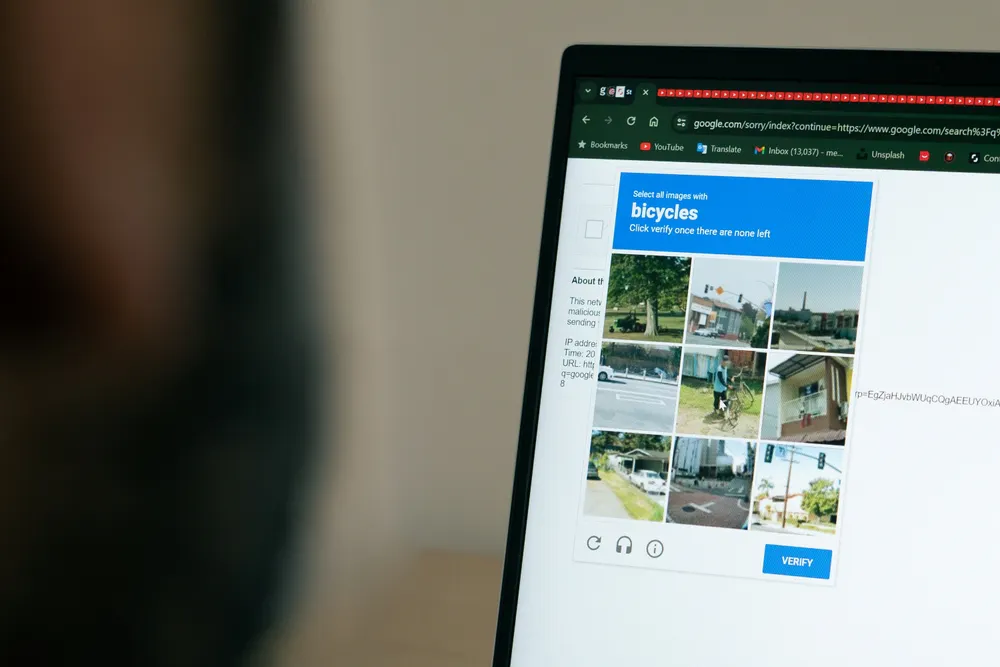
    Then in 2014 – by now acquired by Google – came reCaptcha v2. This is the one that asks users to tick the “I am not a robot” box and often choose from a selection of pictures containing cats or bicycle parts, or whatever. Still the most popular today, Google gets paid by companies who use the service on their website.

    Damn those bicycles.
    Lilgrapher

    How AI has outgrown the system

    Today’s AI systems can solve the challenges these Captchas rely on. They can “read” distorted text, so that the wavy or squished letters from the original Captcha tests are easy for them. Thanks to natural language processing and machine learning, AI can decode even the messiest of words.

    Similarly, AI tools such as Google Vision and OpenAI’s Clip can recognise hundreds of objects faster and more accurately than most humans. If a Captcha asks an AI to click all the buses in a picture selection, they can solve it in fractions of a second, whereas it might take a human ten to 15 seconds.

    This isn’t just a theoretical problem. Consider driving tests: waiting lists for tests in England are many months long, though you can get a much faster test by paying a higher fee to a black-market tout. The Guardian reported in July that touts commonly used automated software to book out all the test slots, while swapping candidates in and out to fit their ever-changing schedules.

    In an echo of the situation 20 years ago, there are similar issues with tickets for things such as football matches. The moment tickets become available, bots overwhelm the system – bypassing Captchas, purchasing tickets in bulk and reselling them at inflated prices. Genuine users often miss out because they can’t operate as quickly.

    Similarly, bots attack social media platforms, e-commerce websites and online forums. Fake accounts spread misinformation, post spam or grab limited items during sales. In many cases, Captcha is no longer able to stop these abuses.

    What’s happening now?

    Developers are continually coming up with new ways to verify humans. Some systems, like Google’s ReCaptcha v3 (introduced in 2018), don’t ask you to solve puzzles anymore. Instead, they watch how you interact with a website. Do you move your cursor naturally? Do you type like a person? Humans have subtle, imperfect behaviours that bots still struggle to mimic.

    Not everyone likes ReCaptcha v3 because it raises privacy issues – plus the web company needs to assess user scores to determine who is a bot, and the bots can beat the system anyway. There are alternatives that use similar logic, such as “slider” puzzles that ask users to move jigsaw pieces around, but these too can be overcome.

    Slider Captcha:


    GitHub

    Some websites are now turning to biometrics to verify humans, such as fingerprint scans or voice recognition, while face ID is also a possibility. Biometrics are harder for bots to fake, but they come with their own problems – privacy concerns, expensive tech and limited access for some users, say because they can’t afford the relevant smartphone or can’t speak because of a disability.

    The imminent arrival of AI agents will add another layer of complexity. It will mean we increasingly want bots to visit sites and do things on our behalf, so web companies will need to start distinguishing between “good” bots and “bad” bots. This area still needs a lot more consideration, but digital authentication certificates are proposed as one possible solution.

    In sum, Captcha is no longer the simple, reliable tool it once was. AI has forced us to rethink how we verify people online, and it’s only going to get more challenging as these systems get smarter. Whatever becomes the next technological standard, it’s going to have to be easy to use for humans, but one step ahead of the bad actors.

    So the next time you find yourself clicking on blurry traffic lights and getting infuriated, remember you’re part of a bigger fight. The future of proving humanity is still being written, and the bots won’t be giving up any time soon.

    The authors do not work for, consult, own shares in or receive funding from any company or organisation that would benefit from this article, and have disclosed no relevant affiliations beyond their academic appointment.

    ref. ‘Yes, I am a human’: bot detection is no longer working – and just wait until AI agents come along – https://theconversation.com/yes-i-am-a-human-bot-detection-is-no-longer-working-and-just-wait-until-ai-agents-come-along-246427

    MIL OSI – Global Reports

  • MIL-OSI Global: Who chooses to work, and who is forced to, after retirement?

    Source: The Conversation – UK – By Takao Maruyama, Assistant Professor in Business Analytics, University of Bradford

    fizkes/Shutterstock

    The state pension age in the UK is currently 66. Yet 9.5% of people aged 66 and older (1.12 million people) were still working, according to the most recent data from the UK’s Annual Population Survey (July 2023 to June 2024). This figure has been rising over the past decade, increasing from 8.70% (880,000 people) in July 2013 to June 2014.

    We think of retirement as a time to pursue hobbies, relax and enjoy the fruits of our labour. So why then, are so many people still working beyond retirement age, and who are they? This is what we sought to find out in a recent study.

    We investigated who is more likely to “choose to work” and who is “forced to work”, using data from the UK’s annual population survey.

    Older workers are not a homogeneous population. They differ in terms of age, ethnicity, socioeconomic class, financial situation, health conditions and more. Likewise, the reasons for working beyond retirement age vary widely. Some may work because they want to, while others may have no option and feel they have to work in order to make ends meet.

    The below chart shows the breakdown of these retirement-age workers by key demographic and socioeconomic characteristics from the most recent data.

    Three in five retirement-age workers were men, and almost all (94.4%) older workers were white. Just over half (51.5%) of older workers continued to work despite having long-term illnesses.

    Characteristics of workers aged 66 and older:

    Workers aged 66 years and older by demographic and socioeconomic characteristics.
    Author provided, data from Annual Population Survey July 2023 to June 2024, CC BY

    The majority (71.2%) of older workers were married, in a civil partnership or cohabiting. Nearly 40% of older workers were employed in higher managerial, administrative and professional occupations, followed by intermediate occupations such as sales or some service roles (32.1%), and routine manual occupations (25.6%).

    More than 85% of retirement-age workers lived in the south (52.8%) and the north (33.1%) of England, and 70% are homeowners.

    Who is ‘forced’ to work?

    In our study, we calculated the likelihood of pension-age workers (66 years and older) with varying demographic and socioeconomic characteristics being forced to work.

    The Annual Population Survey identifies six main reasons why older workers continue working beyond retirement age. These are:

    A. To pay for desirable items (such as holidays),
    B. Not ready to stop work,
    C. Employer needs your experience or you are needed in the family business,
    D. Due to opportunities to work more flexible hours,
    E. To pay for essential items (such as bills), and
    F. To boost pension pot.

    In our study, we classed reasons (A) to (D) as “choose to work”, and (E) and (F) as “forced to work”. Our analysis, based on the most recent dataset (April 2022 to March 2023) at the time of the study, revealed that women are 25% more likely to be forced to work compared to men, and Asian workers are 120% more likely to be forced to work than white workers (with 34% and 17% more likely for older workers from black and other ethnic backgrounds, respectively).

    Workers without long-term illness are 33% less likely to be forced to work than those with long-term illness, and non-married or single workers are 56% more likely to be forced to work compared to seniors who are married, in a civil partnership or cohabiting.

    Workers in intermediate and routine manual occupations are 37% and 67% more likely to be forced to work, respectively, compared to those in higher managerial occupations. Older workers from the south of England are more likely to be be forced to work compared to seniors from any other parts of the UK, and retirement-age workers with mortgages or renting were 117% more likely to be forced to work compared to those who owned their properties.

    Who is more likely to be ‘forced to work’?:

    % comparison of likelihood of being ‘forced to work’.
    Author provided, data from Annual Population Survey April 2022 to March 2023., CC BY

    Ageing populations

    This matters because of the changing nature of work, the rising cost of living and the UK’s ageing population. Retirement-age workers will be increasingly pressured to work longer due to the rising state pension age (due to increase to 67 in 2026-27).

    Understanding who works by choice and who by necessity into retirement age is important, because these groups will need different kinds of support and resources.

    For example, the higher likelihood of being forced to work among older female workers can be partly attributed to career breaks they took to serve as primary caregivers for their children, which often prevented them from accumulating sufficient pensions.

    As the state pension age is expected to continue rising, it is crucial for policymakers and employers to design support systems for diverse demographic and socioeconomic groups of older workers, addressing their unique needs. This starts with understanding why people are working into old age.

    The authors do not work for, consult, own shares in or receive funding from any company or organisation that would benefit from this article, and have disclosed no relevant affiliations beyond their academic appointment.

    ref. Who chooses to work, and who is forced to, after retirement? – https://theconversation.com/who-chooses-to-work-and-who-is-forced-to-after-retirement-246214

    MIL OSI – Global Reports

  • MIL-OSI Global: A short history of palm reading in the UK – and a guide to how it’s supposed to work

    Source: The Conversation – UK – By Martha McGill, Historian of Supernatural Beliefs, University of Warwick

    Wikimedia , CC BY

    In August 1676, a court in Hertford heard a case of fraud against Joseph Haynes, James Domingo and Domingo’s “pretended wife” Sarah. The three had been travelling between local towns telling fortunes.

    Apparently, Domingo had promised one woman that she would marry a “pretty tall merry-speaking” farmer’s son with a mole on his chin and a respectable £80 to his name. Haynes, meanwhile, boasted that his divinatory efforts had won him £5, three maidenheads and a broken shin.

    The court’s decision is not recorded, but the case encapsulates the divided opinion of divination in the 17th century. Although commonly condemned by the authorities, fortune-telling was a popular and potentially profitable art.

    We do not know how exactly the three miscreants practised, but most travelling fortune-tellers studied facial features (physiognomy) or read palms (palmistry or chiromancy). The idea that there was occult meaning etched in the body’s marks, lines, features and moles stretches back to antiquity.

    The body’s outer form supposedly reflected the state of the soul. Also, it was believed that the body was intimately entwined with the wider cosmos.


    Looking for something good? Cut through the noise with a carefully curated selection of the latest releases, live events and exhibitions, straight to your inbox every fortnight, on Fridays. Sign up here.


    In a popular work from the early 16th century, the German physician Heinrich Cornelius Agrippa explained that the body’s appearance and behaviour invited particular “celestial gifts”. Palmistry was the art of interpreting this “harmonical correspondency”.

    However, Christian authorities were largely unimpressed. Theologians dismissed palmistry as superstitious, or argued that it was presumptuous to pry into God’s plan. The Catholic church officially condemned divinatory arts in a papal bull of 1586. The English Protestant minister William Perkins (1558–1602) wrote that palmistry was an “abomination” that was “detested of God, and ought also to be detestable in the eyes of Gods [sic] people”.

    Official mistrust of palmistry was spurred by its association with “Egyptian” fortune-tellers (often shortened to “gypsies”). This label was used for travellers of diverse origins, but especially the Romani diaspora from India.

    Romani travellers first reached central and western Europe in the 15th century and many claimed to have come from Egypt. Ancient Egyptians were famed for their occult wisdom and the association probably helped Romani groups to win credit as fortune-tellers. Nevertheless, they met with widespread persecution.

    A fortune teller reading the palm of a soldier.
    Wellcome Collection, CC BY-NC

    In England, a 1530 parliamentary act officially banished the “outlandish” people “calling themselves Egyptians” who allegedly travelled about the country, swindling people by pretending divinatory prowess.

    All the same, magical practitioners at various social levels continued to offer palm-reading services. And from the 17th century, pamphlets offered guides to interpreting your own hands.

    An anonymous work published in London in 1700 claimed to fully resolve all questions about human life through “the Rules of Art used by the Ancient and Famous Egyptian Magi, or Wise Men and Philosophers”.

    Here I offer some guidance on how you’re supposed to read your palm based on that work. It may contradict itself hopelessly. It may promise you a grisly death. But if the stars are kind, you too could rise by your good deeds and find a spouse lauded for their virtue – or, at least, a merry man with £80 and a nice mole.

    How to read a palm

    Always consult the left hand.

    1: Life line

    Look for the semi-curved line that starts between the thumb and index finger and runs down toward the wrist.

    If this line is long and clear, not broken with little cross-lines, you will be healthy and live to an old age. However, if the uppermost part of the line is forked or jagged, you will often be sick.

    If there are three stars intersecting with the line, you may suffer “great losses and calamities”. If the line intertwines with the table line, you will gain “honour and riches”.

    2: Table line

    Look for a horizontal line on your upper palm that starts near the index or middle finger and runs to beneath the little finger.

    If this line is broad and vivid in colour, you will be healthy and contented. However, if the line is forked at the end, you will gain riches by trickery and soon lose them again. If it branches towards the index or middle finger, you will rise to a prestigious position.

    3: Middle line

    Look for a horizontal line across the middle part of the palm.

    If there are lots of small lines in between this and the table line, you will be sick when you are young but make a recovery. If there is a halfmoon in this line, you will suffer from “cold and watery diseases”, but a sun or a star promises prosperity.

    4: Line of Venus

    Look for an arching line that runs near the base of your middle, ring and little fingers.

    If this line forks near the index finger, you may be ruined by keeping bad company. If there are crosses on this line near the index and little fingers, you are “inclined to a virtuous and modest course of life”. The author claims that wise men employ this method to choose suitable wives.

    5: Liver line

    Look for a vertical line that starts beneath the ring or little finger and runs to the base of the palm.

    If this line is straight, you are of sound judgement. If it is crooked you are deceitful. If this line and the middle line begin near one other, it means foolishness in men and foretells injury by overwork for women.

    6: Plain of Mars

    Plains are flat areas of the palm that can be associated with difference parts of life. The plain of Mars is the centre of your palm.

    If the lines in this plain are crooked, you will fall by your enemies. If you have lines beginning at the middle of your wrist and reaching into the plain of Mars, you will get into lots of fights. If there are large crosses in the plain, you will, if a man, rise by good deeds or, if a woman, have many husbands and children.

    Martha McGill does not work for, consult, own shares in or receive funding from any company or organisation that would benefit from this article, and has disclosed no relevant affiliations beyond their academic appointment.

    ref. A short history of palm reading in the UK – and a guide to how it’s supposed to work – https://theconversation.com/a-short-history-of-palm-reading-in-the-uk-and-a-guide-to-how-its-supposed-to-work-246276

    MIL OSI – Global Reports

  • MIL-OSI Security: Kilo Fentanyl Distributor Sentenced to 40 Years

    Source: Office of United States Attorneys

    RALEIGH, N.C. – A New Bern man was sentenced to 40 years in prison for trafficking and distributing methamphetamine and fentanyl for a large-scale drug trafficking operation in Craven County.  On August 8, 2024, a Raleigh jury found Lucio Camargo Garcia guilty of the charges.

    “Garcia took advantage of Craven County’s most hopeless souls, extracting profit from their pain and addiction,” said U.S. Attorney Michael F. Easley, Jr. “Too many of our friends, families, and neighbors are battling addiction.  The Craven County Sheriff’s Office and New Bern Police won’t stand by and let armed drug traffickers push kilos of fentanyl and meth in our community unchecked, and neither will we.  Eastern North Carolina traffickers take note – our partnership is for the long haul, and we won’t let off.”

    “This sentencing sends a clear message that our community will not tolerate the trafficking of dangerous drugs like methamphetamines and fentanyl,” said HSI Charlotte Special Agent in Charge Cardell T. Morant, HSI Charlotte covers North and South Carolina. “These substances devastate lives and destroy communities.  HSI and its partners are committed to holding those who profit from this destruction accountable. This is a warning to those who engage in this illegal activity – we will pursue justice relentlessly.”

    “This investigation identified Garcia as a major importer and distributor of methamphetamine and fentanyl in Craven County,” said Craven County Sheriff Chip Hughes. “His prosecution, along with his co-conspirators has resulted in a significant reduction in the availability of these dangerous drugs in our communities.”

    According to court records and evidence presented at trial, in 2021, the Drug Enforcement Administration (DEA), Homeland Security Investigations (HSI), the Craven County Sheriff’s Office, the New Bern Police Department, the State Bureau of Investigation, and other state and local agencies launched an investigation into a large-scale drug trafficking organization responsible for acquiring kilogram quantities of methamphetamine and fentanyl from the southwest border of the United States and distributing the drugs in and around Craven County. Through the use of confidential sources, surveillance, enforcement actions, and controlled purchases, Garcia was identified as the primary distributor of methamphetamine and fentanyl who re-sold the product to both drug users and other area dealers.

    From January to October 2022, law enforcement conducted multiple controlled purchases of methamphetamine and fentanyl from Garcia. On October 31, 2022, search warrants were executed at residences associated with the drug trafficking organization, including Garcia’s residence. Law enforcement seized approximately one kilogram of methamphetamine, approximately nine hundred grams of fentanyl (powder and pill form), and a loaded firearm from Garcia’s residence. Most of the drugs were located in a secret compartment in the ceiling of Garcia’s bedroom closet.

    This investigation was an Organized Crime Drug Enforcement Task Forces (OCDETF) investigation. OCDETF identifies, disrupts, and dismantles the highest-level drug traffickers, money launders, gangs, and transnational criminal organizations that threaten the United States by using a prosecutor-led, intelligence-driven, multi-agency approach that leverages the strengths of federal, state, and local law enforcement agencies against criminal networks.

    Michael F. Easley, Jr., U.S. Attorney for the Eastern District of North Carolina made the announcement after sentencing by U.S. District Judge James C. Dever III. The DEA, HSI, U.S. Postal Inspection Service, North Carolina State Bureau of Investigations, Craven County Sheriff’s Office, New Bern Police Department, and Pamlico County Sheriff’s Office  investigated the case and Assistant U.S. Attorneys Katherine Englander and Caroline Webb prosecuted the case.

    Related court documents and information can be found on the website of the U.S. District Court for the Eastern District of North Carolina or on PACER by searching for Case No. 4:22-CR-75-D-RJ-2.

    MIL Security OSI

  • MIL-OSI Global: Whales can live way longer than scientists had thought, with potential lifespans as much as double previous estimates

    Source: The Conversation – USA – By Greg Breed, Associate Professor of Quantitative Ecology, University of Alaska Fairbanks

    Animals with long lifespans tend to reproduce extremely slowly. Els Vermeulen

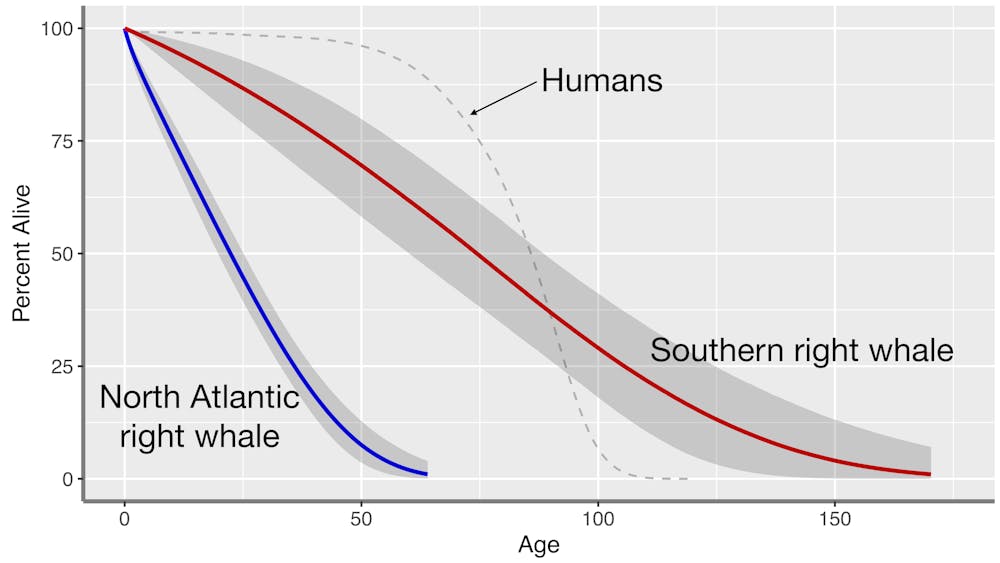
    Southern right whales have lifespans that reach well past 100 years, and 10% may live past 130 years, according to our new research published in the journal Science Advances. Some of these whales may live to 150. This lifespan is almost double the 70-80 years they are conventionally believed to live.

    North Atlantic right whales were also thought to have a maximum lifespan of about 70 years. We found, however, that this critically endangered species’ current average lifespan is only 22 years, and they rarely live past 50.

    These two species are very closely related – only 25 years ago they were considered to be one species – so we’d expect them to have similarly long lifespans. We attribute the stark difference in longevity in North Atlantic right whales to human-caused mortality, mostly from entanglements in fishing gear and ship strikes.

    Survivorship curves show female right whales can live to very old ages, but humans are causing North Atlantic right whales to die well short of their potential. Plotted for comparison is the U.S. survivorship curve for women as estimated by the Social Security Adminstration.
    Greg Breed

    We made these new age estimates using photo identification of individual female whales over several decades. Individual whales can be recognized year after year from photographs. When they die, they stop being photographically “resighted” and disappear. Using these photos, we developed what scientists call “survivorship curves” by estimating the probability whales would disappear from the photographic record as they aged. From these survivorship curves, we could estimate maximum potential lifespans.

    Twenty-five years ago, scientists working with Indigenous whale hunters in the Arctic showed that bowhead whales could live up to and even over 200 years. Their evidence included finding stone harpoon points that hadn’t been used since the mid-1800s embedded in the blubber of whales recently killed by traditional whalers. Analysis of proteins from the eyes of hunted whales provided further evidence of their long lifespan. Like right whales, before that analysis, researchers thought bowhead whales lived to about 80 years, and that humans were the mammals that lived the longest.

    In the years following that report, scientists tried to figure out what was unique about bowhead whales that allowed them to live so long. But our new analysis of the longevity of two close relatives of bowheads shows that other whale species also have potentially extremely long lives.

    Why it matters

    Understanding how long wild animals live has major implications for how to best protect them. Animals that have very long lifespans usually reproduce extremely slowly and can go many years between births. Baleen whales’ life history – particularly the age when females start breeding and the interval between calves – is strongly influenced by their potential lifespan. Conservation and management strategies that do not plan accordingly will have a higher chance of failure. This is especially important given the expected impacts of climate disruption.

    What still isn’t known

    There are many other large whales, including blue, fin, sei, humpback, gray and sperm whales. Like bowhead and right whales, these were also almost wiped out by whaling. Scientists currently assume they live about 80 or 90 years, but that’s what we believed about bowhead and right whales until data proved they can live much longer.

    How long can these other whale species live? Industrial whaling, which ended only in the 1960s, removed old whales from the world’s whale populations. Though many whale populations are recovering in number, there hasn’t been enough time for whales born after the end of industrial whaling to become old.

    It’s possible, even likely, that many other whale species will also prove to have long lifespans.

    Sixty years after the end of industrial whaling, today’s whale populations may still be missing their elders.
    Maxi Jonas/picture alliance via Getty Images

    What other research is being done

    Other research finds the loss of older individuals from populations is a phenomenon occurring across most large animal species. It diminishes the reproductive potential of many species. Researchers also argue this represents a real loss of culture and wisdom in animals that degrades their potential for survival in the face of changing conditions.

    What’s next

    We want to better understand how whaling affected the number of old individuals in current whale populations and predict when the number of old individuals will recover to prewhaling levels. Preliminary results suggest it may be another 100 years before whale populations truly recover, even for species whose populations now number as many as there were before whaling.

    For North Atlantic right whales, our research shows that even when the population was increasing, the management actions taken were insufficient to prevent these whales from dying far too young.

    The Research Brief is a short take on interesting academic work.

    Greg Breed received funding from The Royal Society

    Peter Corkeron headed the National Oceanic and Atmospheric Administration’s large whale research program for the northeastern US from 2011 to 2019, then led the New England Aquarium’s right whale research program through 2022.

    ref. Whales can live way longer than scientists had thought, with potential lifespans as much as double previous estimates – https://theconversation.com/whales-can-live-way-longer-than-scientists-had-thought-with-potential-lifespans-as-much-as-double-previous-estimates-245826

    MIL OSI – Global Reports

  • MIL-OSI United Kingdom: Flamingo Land appeal is “nightmare before Christmas” say Greens

    Source: Scottish Greens

    Scotland rejects daft Flamingo Land plans. Our Government must do the same.

    Scottish Green MSP Ross Greer has slammed the decision of the Scottish Government’s enterprise agency to extend Flamingo Land’s exclusive contract to land on the southern shore of Loch Lomond at Balloch, paving the way for the developer to appeal the rejection of their mega-resort application.

    At a public hearing in September the board of Loch Lomond and the Trossachs National Park unanimously rejected the Yorkshire theme park operator’s plans for two hotels, a waterpark, a hundred woodland lodges, over 370 parking spaces, a monorail, shops, restaurants and more at Balloch. 

    This came after a campaign led by Mr Greer collected a record 155,000 objections to the plans, alongside objections from a variety of environmental groups and organisations.

    Mr Greer received notice today from Scottish Enterprise that they will extend Flamingo Land’s exclusive contract to the land alongside the River Leven and southern shore of Loch Lomond, which makes up a majority of the proposed site. This extension allows Flamingo Land to lodge an appeal to the Scottish Government to overturn their application rejection. The contract gives Flamingo Land the exclusive right to buy the publicly owned land if they secure planning permission.

    Following the National Park’s rejection of the plans in September, Greer called on the First Minister to end Flamingo Land’s exclusive contract.

    Reacting to the news, Ross Greer MSP said: “This ridiculous company just doesn’t know when to give up, and it is bitterly disappointing that the Scottish Government are helping them in their attempts to ruin this special corner of Loch Lomond.

    “Extending Flamingo Land’s exclusive contract for the land means that an appeal is now all but certain, despite the overwhelming reasons for its rejection in the first place.

    “Our campaign to Save Loch Lomond lodged a record 155,000 objections to these daft and destructive mega-resort plans. We were joined by experts from the likes of the Woodland Trust, Ramblers and most importantly, the Scottish Environment Protection Agency. Not only that, the National Park’s own planning officers carefully considered the application and agreed that it must be rejected on the basis of both flood risk and damage to the natural environment.

    “Flamingo Land has spent a decade trying to force a mega-resort on Balloch. We beat them in 2019 and then again earlier this year. This greedy company just cannot take no for an answer. I am incredibly frustrated that the Scottish Government is enabling this saga through an exclusive contract which should have been terminated years ago. There are absolutely no grounds to approve the application on appeal. We have urged Flamingo Land to accept reality and get round the table to discuss alternatives, but they clearly have no interest in listening to the community.

    “The Scottish Greens will continue our campaign and work alongside Balloch residents to ensure that these destructive plans are rejected once again. Exhausted as we all are after a decade of this nonsense, we are ready to fight once again to save Loch Lomond.”

    MIL OSI United Kingdom

  • MIL-OSI Security: Bank General Counsel Pleads Guilty to Offenses Stemming from $7.4 Million Embezzlement Scheme

    Source: Office of United States Attorneys

    JAMES BLOSE, 56, of Fairfield, waived his right to be indicted and pleaded guilty today in New Haven federal court to offenses stemming from a decade-long embezzlement scheme at banks where he served as General Counsel and held other high-ranking positions.

    The announcement was made by Vanessa Roberts Avery, United States Attorney for the District of Connecticut; Robert Fuller, Special Agent in Charge of the New Haven Division of the Federal Bureau of Investigation; Harry T. Chavis, Jr., Special Agent in Charge of IRS Criminal Investigation in New England; and Brian Tucker, Special Agent in Charge of the Board of Governors of the Federal Reserve System and the Bureau of Consumer Financial Protection’s Office of the Inspector General, Eastern Region.

    According to court documents and statements made in court, from approximately 2013 to January 2022, Blose was an attorney and held high-ranking positions, including General Counsel, at Hudson Valley Bank and Sterling National Bank.  From approximately January 2022, when Webster Bank acquired Sterling National Bank, until February 2023, Blose served as Executive Vice President and General Counsel and Corporate Secretary at Webster Bank.

    From approximately 2013 until Webster Bank discovered his scheme and his employment was terminated in February 2023, Blose defrauded his employers (“The Bank”) in various ways.  In certain commercial loan transactions where The Bank was the lender, Blose fraudulently retained for himself portions of closing costs, including legal fees.  In certain real estate transactions in which The Bank was the seller, Blose retained portions of the sale proceeds for himself.  For some of the real estate transactions, Blose created false documents in order to hide his theft from The Bank.  Blose also stole from The Bank in other ways.

    As part of the scheme, used his attorney trust accounts to make personal expenditures, and to transfer funds to accounts in the names of business entities he created and controlled, and then used those funds for his personal benefit.  Through this scheme, Blose stole approximately $7.4 million from his employers.

    Blose pleaded guilty to one count of bank fraud, which carries a maximum term of imprisonment of 30 years, and one count of engaging in illegal monetary transactions, which carries a maximum term of imprisonment of 10 years.  He is released on a $250,000 bond pending sentencing, which is scheduled for March 13 in Hartford.

    This investigation has been conducted by the Federal Bureau of Investigation, the Internal Revenue Service – Criminal Investigation, and the Board of Governors of the Federal Reserve System and the Bureau of Consumer Financial Protection’s Office of the Inspector General.  Financial crimes investigators from Webster Bank assisted the investigation.

    This case is being prosecuted by Assistant U.S. Attorneys Michael S. McGarry and Ross Weingarten.

    MIL Security OSI

  • MIL-OSI United Kingdom: Complete ban on bee killing pesticides moves forward

    Source: United Kingdom – Executive Government & Departments 2

    • Government sets out plans to end the use of toxic neonicotinoid pesticides that threaten vital pollinators

    A bee on a purple flower

    • Important step forward in delivering on election commitment to safeguarding bees, butterflies and the wider environment  

    A complete ban on use of bee-killing neonicotinoid pesticides has moved a step closer today (Saturday 21 December), as the government sets out its plans to deliver a key election pledge.   

    Despite being banned from general use in the UK, the last government authorised the use of neonicotinoids every year for the last four years in England via a process known as emergency authorisation.     

    Neonicotinoids are extremely toxic to pollinators. Even at doses that are not directly fatal to bees they can cause cognitive problems impacting foraging abilities and the productivity of hives. The chemicals can also persist in the soil creating a further risk to bees.  

    Bees and other pollinators are crucial to the agricultural economy with the economic benefits of pollination to crop production in the UK estimated at £500 million annually.  

    The Government has set out its next steps, including identifying legislative options that would legally prevent the future use of three specific neonicotinoids – clothianidin, imidacloprid and thiamethoxam – entirely, taking full account of the importance of pollinators. 

    Environment Minister Emma Hardy said:    

    “We are delivering on our promise to ban toxic bee-killing pesticides and ending the long-term decline of our wildlife.  

    “A healthy environment is vital to our food and economic security. Protecting bees by stopping the use of damaging neonicotinoids is an important step in supporting the long-term health of our environment and waterways, and our farming sector.”     

    The move comes ahead of the publication of a new UK National Action Plan (NAP), which will set how pesticides can be used sustainably.  

    Ensuring that our food production is sustainable is key to the long-term health of the agricultural sector, as well as the nation’s food security. The Government’s Plan for Change is built on the strong foundation of a stable economy.  

    The Government commitment to farmers remains steadfast and we are fully committed to supporting farmers to protect their crops in more sustainable ways. There has already been progress in this space, including research into new virus-resistant varieties of sugar beet and new alternative pesticide sprays, and we will continue to support this work. 

    The announcement today builds on the swift action the Government has taken to recover nature more widely. This includes committing to a rapid review of the Environmental Improvement Plan and new delivery plans to meet targets on air quality, the circular economy and water. In the first few months of this government, legislation was introduced to put failing water companies under special measures to curb pollution in our waterways and a Flood Resilience Taskforce was introduced to speed up the creation of nature-based solutions, like planting trees to protect communities against the impact of extreme weather.    

    NOTES TO EDITORS:   

    • The legal requirements for emergency authorisations have not changed today and any applications for 2025 will be considered under the law as it stands.   

    • The Neonicotinoids Policy Statement applies to England only.

    • The UK Government will look to work with the devolved governments to seek a shared and consistent way forward.   

    • £5 billion was set aside in the Budget for farming over two years, including the single biggest amount of money ever allocated for sustainable food production and nature recovery.

    • The full Neonicotinoids Policy Statement can be found here

    Updates to this page

    Published 21 December 2024

    MIL OSI United Kingdom

  • MIL-OSI United Kingdom: Plans for new provisions to support pupils with complex Additional Support Needs

    Source: Scotland – City of Perth

    Perth and Kinross Council’s Learning and Families Committee will be asked to consider the plans when it meets on Wednesday, January 29.

    Almost 7000 children and young people in Perth and Kinross Council schools have been identified as having additional support needs, almost four out of every 10 pupils (39%). 

    This is an increase of over 750 children and young people since 2021.

     Currently, PKC has fifteen Intensive Support Provisions (ISPs) across nine primary and six secondary schools, serving 300 children aged 5 to 18.

    A feasibility study highlighted the need for more ISP placements and better geographical distribution to improve educational and social experiences for children and young people and reduce travel costs.

    A report to the committee recommends creating eight new ISPs through recently announced Scottish Government funding and redistribution of existing Perth and Kinross Council resources.

    This will mean all children and young people who need this type of education provision will be able to do so closer to their homes, enabling them to build better community connections for the future.

    Other options for consideration include maintaining existing provision or creating additional ISPs through the redistribution of existing resources. Both options would maintain ISP placements at current levels.

    If the proposed plan to create eight new ISPs is approved, it will be implemented in three phases over the next four years.

    The first will see the development of ISPs at Kinross High School, Perth High School and a primary school within the Perth Academy catchment area once statutory consultations are completed.

    Phases two and three will see the creation of a further five ISPs.

    Councillor John Rebbeck, convener of Perth and Kinross Council’s Learning and Families Committee said: “Many of our ISPs are over-capacity and we know the number of children with complex additional support needs who require intensive-level learning opportunities is rising.

    “We want to give every child the best start in life so they can fulfil their potential and creating new ISPs will help ensure all our children receive the education they need and deserve.

    “The development is part of our Additional Support Needs (ASN) Transformation Programme which aims to significantly improve the educational experience for children and young people with additional support needs in Perth and Kinross.

    “We know there are still many challenges ahead but I believe this is an important and necessary step in the right direction. The programme’s vision is to help these children thrive, gain independence, and lead fulfilling lives by ensuring they can access the best possible learning environment and support whilst in Perth and Kinross Council Early Learning and Childcare (ELC) settings or schools.

    “Access to education and learning close to their home communities will help our children and young people with complex needs to reach their potential”

    MIL OSI United Kingdom

  • MIL-OSI Australia: NSW Government releases Industrial Lands Action Plan

    Source: New South Wales Premiere

    Published: 24 January 2025

    Released by: Minister for Planning and Public Spaces


    The Minns Labor Government has released its Industrial Lands Action Plan which sets out a new approach to plan, secure, and manage the supply of industrial lands to deliver new jobs, drive investment and support the building of more homes.

    The action plan is focused on opening up more land zoned for industrial or similar purposes, such as depots, distribution centres, factories and warehouses.

    These services are crucial to the economic viability of our cities and towns because they not only create valuable ongoing jobs but are also critical for the production and delivery of construction materials required for building more homes.

    The action plan will identify lands as State, Regional, or Locally Significant, to make sure that each plays a specific role in supporting economic activity and long-term growth.

    This will also help guide infrastructure investments that unlock the potential of each area.

    But the NSW industrial sector is facing escalating land values, increased rents and in some locations almost zero vacancies in industrial lands.

    The Industrial Lands Action Plan outlines initiatives to boost the supply of industrial lands.

    This includes:

    • delivering a statewide categorisation policy and approach for the supply pipeline of industrial lands to replace the Retain, Review and Plan and Manage policies;
    • making planning policy amendments to increase flexibility on land zoned for industrial purposes, and
    • implementing an Employment Land Development Program to coordinate infrastructure investment for the supply of industrial land over the next two decades.

    The Industrial Lands Action Plan will also provide industry, council and developers the opportunity to see where there is underutilised or isolated industrial lands which could be transitioned into alternative uses to align with NSW Government key priorities, such as alternative employment uses or housing.

    For more information on industrial lands visit the NSW Planning website at https://www.planning.nsw.gov.au/research-and-demography/employment-lands

    Minister for Planning and Public Spaces Paul Scully said:

    “After years of neglect, our new Statewide approach will plot the steps to help us grow our industrial pipeline across the State.

    “In 2024 alone, industrial related industries and activities contributed approximately $174 billion in gross value to the NSW economy, the Industrial Lands Action Plan provides industry, developers and councils with a holistic and state-wide approach to actively plan, secure, manage and monitor industrial lands across NSW.

    “By unlocking the supply of well-located, serviced and competitive industrial land, we are helping to drive investment, create jobs and support the construction industry in the delivery of housing.

    “More serviced and development ready industrial lands are required to shore up the supply chain for the housing and construction materials we need to build affordable, well-located houses across NSW.”

    MIL OSI News

  • MIL-OSI Australia: NSW avian influenza emergency in Hawkesbury eradicated and controls lifted

    Source: New South Wales Premiere

    Published: 24 January 2025

    Statement by: Minister for Agriculture, Minister for Regional NSW, Minister for Western New South Wales


    Minister for Agriculture and Regional NSW Tara Moriarty has today confirmed the successful eradication of avian influenza in the Hawkesbury region, one of the most significant outbreaks in the state’s history.

    The NSW Government’s eradication of avian influenza in this zone is a terrific win for our poultry and egg producers, plus consumers, with businesses now able to get back to normal.

    From Friday 24 January 2024 the emergency zones will be removed and all emergency orders will be lifted, including movement restrictions for birds, objects and other equipment, officially bringing an end to the NSW Government’s Avian Influenza response.

    This follows the easing of the Hawkesbury emergency zone in December 2024 with no new detections of the disease occurring in the area after July 2024. The required surveillance time with no virus detections has now elapsed so the control order can now be revoked.

    The Minns Labor Government is serious about biosecurity and protecting our valuable primary industries, and will continue to work with farmers to safeguard agricultural industries.

    The NSW Government’s avian influenza response and eradication actions included:

    • Managing depopulation of virus impacted birds
    • 288 Department of Primary Industries and Regional Development (DPIRD) and inter-agency staff working on the response
    • 6,801 samples tested
    • 76,000 targeted SMS to property owners
    • 1,500 letters delivered in a letterbox drop to the Hawkesbury
    • 1,051 calls to the Emergency Animal Disease hotline

    In June 2024, Government Biosecurity teams detected and responded to an avian influenza outbreak at two commercial poultry farms and four non–commercial premises in the Hawkesbury region.

    All infected premises were subject to quarantine, depopulation, disposal and decontamination in accordance with the AUSVETPLAN Response Strategy for avian influenza ensuring all premises were free of traces of the diseases before regular operations could resume.

    The H7N8 avian influenza strain detected in NSW was not the same as the H5N1 strain that is causing concern globally. Australia remains free of the H5N1 strain of avian influenza. In addition it was not connected to the Victorian outbreak of avian influenza.

    This has taken an immense response by the NSW Government working with industry, farmers and the community to control this outbreak and eventually eradicate the virus. I want to thank all the staff and industry personnel who worked tirelessly to protect the industry and minimise impacts

    Find more information on the NSW Government’s response to the H7 Avian Influenza outbreak.

    MIL OSI News

  • MIL-OSI New Zealand: David Seymour: The State of the Nation in 2025 – Dire States

    Source: ACT Party

    Delivered by ACT Leader David Seymour the Akarana Event Centre, Ōrākei.

    Introduction

    Thank you, Brooke, for your kind introduction. I’m biased, but I think you’re the Government’s most quietly effective Minister. Your labour law reforms are making it easier to employ workers and to be employed. Your minimum wage increases are announced early to give business certainty, and relief. You are taking on two of the hardest chestnuts in the workplace – holiday pay and health and safety – by listening to the people affected. You’ve put together an honest Royal Commission on COVID-19, and got wait times down for new passports and Citizenships. All the while you attract growing respect as a hard-working local MP here in Tamaki.

    It’s easy to forget Brooke’s 32. She has the biggest future in New Zealand politics.

    The only problem with mentioning one ACT MP is they’re all kicking goals with both feet, so you have to mention the lot. Nicole McKee is speeding up the court system, rewriting the entire Arms Act to make New Zealand safer, and reforming anti-money laundering laws so people can business done.

    Andrew Hoggard handles the country’s biosecurity, managing would-be outbreaks with steady hands. He is also dealing to Significant Natural Areas that erode farmers’ property rights and correcting the naïve treatment of methane that punishes the whole country.

    He’s able to do that in large part because of the work Mark Cameron did, and continues to do. From 2020 onwards he scared the bejesus out of every other party in rural New Zealand. He shifted the whole political spectrum right on the split gas approach, SNAs, and freshwater laws. Now the Government is changing those policies. As Chair of the Primary Production Committee, Mark stays in the headlines championing rural New Zealand every week. He is the definition of an effective MP.

    Karen Chhour is the embodiment of ACT values. Her life gives her more excuses than anyone in Parliament, but she makes none, and she accepts none. She is reforming the government department that let her down when she was small. If every New Zealander had Karen’s attitude and values, we’d be a country with no problems.

    Perhaps the biggest single policy problem we face is the Resource Management Act. Somone once said you can fill a town hall to stop anything in this country, but you can’t fill a telephone box to get something started. In steps Simon Court who, with Chris Bishop, is designing new resource management laws based on property rights. That’s an ACT policy designed to unleash the latent wealth our country has by letting people develop and use the property they own.

    Our new MPs that you helped elect last year are also making their marks. Todd Stephenson has picked up the End of Life Choice baton, with a bill to extend compassion and choice to those who suffer the most: those with long-term, degenerative illnesses. Parmjeet Parmar is one of the hardest working MPs I have seen, and a great chair of the Economic Development, Science and Innovation Committee. Cam Luxton and Laura McClure speak to a new generation of young parents who want their children to grow up in a free society.

    If you gave your Party Vote to ACT last year, you can be proud of the New Zealanders you put in Parliament to represent you. I am proud to lead this team of free thinkers in our House of Representatives, and I think we can all be proud of their efforts.

    New Zealand’s origin story: a nation of immigrants

    The summer is a good time to think about the state of our nation, and I got to thinking about who we are and how we got here. Whatever troubles we may face today, I couldn’t help coming back to something that unites New Zealand.

    Our country at its best is a place that welcomes hopeful people from all over the earth. People with different languages, religions and cultures united by one thing. When you look at the map it jumps out at you. We are the most remote country on Earth. If you’ve never stood at Cape Reinga and looked out to see wide open spaces for 10,000 kilometres, you owe it to yourself just once.

    It shows that one thing makes us all different from the rest of the world. No matter when or where you came from, you or your ancestors once travelled farther than anyone to give your children and theirs a better tomorrow.

    That is the true Kiwi spirit. Taking a leap into the unknown for a chance at better. Compared with what divides us, our spirit as a nation of pioneers unites us ten times over. Migrating from oppression and poverty for freedom and prosperity is what it means to be Kiwi.

    If that bright and optimistic side of our psyche, got half as much time as the whinging, we would all be better off. We would see ourselves as people unafraid of challenges, freed from conformity, with the power to decide our best days are always ahead of us.

    New Zealand’s inherent tension: two tribes

    I got to wondering why that isn’t a more popular story. Why do we cut down tall poppies? Why do we value conformity over truth? Why do people who came here for a better life grow up disappointed and move away again?

    I believe our nation is dominated by two invisible tribes. One, I call ‘Change Makers’. People who act out the pioneering spirit that built our country every day. We don’t just believe it is possible to make a difference in our own lives; we believe it’s an obligation.

    Change makers load up their mortgage to start a business and give other people jobs. They work the land to feed the world. They save up and buy a home that they maintain for someone else to live in. They study hard to extend themselves. They volunteer and help out where they can. They take each person as they find them. They don’t need to know your ancestry before they know how to treat you.

    Too often, they get vilified for all of the above. I know there’s many people like that in this room today. ACT people are Change Makers; we carry the pioneering spirit in our hearts.

    Then there’s the other tribe – people building a Majority for Mediocrity. They would love nothing more than to go into lockdown again, make some more sourdough, and worry about the billions in debt another day.

    They blame one of the most successful societies in history for every problem they have. They believe that ancestry is destiny. They believe people are responsible for things that happened before they were born, but criminals aren’t responsible for what they did last week.

    Far from believing people can make a difference in their own lives, they believe that their troubles are caused by other people’s success. They look for politicians who’ll cut tall poppies down – politicians who say to young New Zealanders ‘if you study hard, get good grades, get a good job, save money, and invest wisely, we’ll tax you harder’.

    I wasn’t kidding about the lockdowns; they were a litmus test. In early 2022, after this city had been locked down for months, and the borders had been closed for two years, a pollster asked New Zealanders if they’d like to be locked down again for Omicron.

    Now, I know it’s painful to think back, but bear with me. Omicron spread more easily than any earlier variant. It was also less harmful if you caught it. That was especially so because we were then among the most vaccinated nations on earth. The damage to business, education, non-COVID healthcare, and the government’s books was already massive and painful.

    And yet, 48 per cent of New Zealanders wanted another lockdown for Omicron. 46 per cent didn’t. That for me put the tribes into sharp relief. If you were a business owner who needed to open, a parent worried about missed education, a migrant missing their family, or just someone who wanted their life back, you wanted to open.

    When the Government finally lifted restrictions, many of those people left. Real estate agents report people selling because they’re moving to Australia every day. This is where the balance between these two invisible tribes comes into focus.

    Remember the gap in that poll was two per cent. Since the borders opened a net 116,000 citizens have left New Zealand. That’s a touch over two per cent.

    A tipping point

    The more people with get up and go choose to get up and leave, the less attractive it is for motivated people to stay here.

    Muldoon once quipped, ‘New Zealanders who leave for Australia raise the IQ of both countries.’ Actually, New Zealanders who leave for Australia  are tipping us towards a Majority for Mediocrity. Motivated New Zealanders leaving is good news for the shoplifters, conspiracy theorists, and hollow men who make up the political opposition.

    A few more good people leaving is all they need for their Majority of Mediocrity. The more that aspirational, hardworking people get up and leave New Zealand, the more likely it is we’ll get left-wing governments in the future.

    That’s why I say we’re at a tipping point. 

    There’s another reason why the mediocrity majority is growing, young people feel betrayed and disillusioned.

    A new generation looks at the housing market and sees little hope. Imagine you’re someone who’s done it all right, you listened to your teacher and did your homework. You studied for a tertiary education like everyone told you. Now you have $34,000 in debt, you start on $60,000, and you see the average house is 900,000 or fifteen times your (before tax) income.

    Nobody can blame a young person for wondering if they aren’t better off overseas. Many decide they are. Those who stay are infected  by universities  with the woke mind viruses of identity politics, Marxism, and post-modernism.

    Feeling like you’ll never own your own capital asset at the same time as some professor left over from the Cold War tells you about Marx is a dangerous combination.

    This is the other political tipping point that risks manufacturing a majority for mediocrity. A bad housing market and a woke education system combined are a production line for left-wing voters.

    The hard left prey on young New Zealanders. They tell them that their problems are caused by others’ success. That they are held back by their identity, but if they embrace identity politics, they can take back what’s theirs. Their mechanism is a new tax on wealth.

    These are the opposite of the spirit brings New Zealanders to our shores in the first place. The state of our nation is that we’re at a tipping point , and what we do in the next few years will decide which way we go.

    The short-term outlook is sunny, but only because Labour was so bad.

    We can afford to hope that this year will be better than 2024. By that standard, 2025 will be a success. Interest rates will be lower. The Government will have stopped wasting borrowed money, banning things, punishing employers, landlords, farmers, and anyone else trying to make a difference, with another layer of red tape.

    In fact, we have a Government that’s saving money, cutting red tape, and paring back identity politics. With those changes we will see more hope than we’ve seen in years, and hopefully a slowdown in citizens leaving. That is good, it’s welcome, and ACT is proud to be part of the coalition Government that’s doing it.

    ACT is needed to be brave, articulate, and patriotic

    The truth is, though, it’s easy to do a better job of Labour over 12 months. It’s much harder to muster the courage to keep making difficult decisions over several years, even if they’re not immediately popular. Our nation is in a century of decline. Just stopping one Government’s stupid stuff and waiting for a cyclical recovery won’t change the long-term trend. We need to be honest about the challenges we face and the changes needed to overcome them.

    We need to act like a country at risk of reaching a tipping point and losing its first world status. We are facing some tough times, and tough times require tough choices to be made.

    ACT’s goal is to keep the Government, and make it better. We may have gone into Government, but we never went into groupthink. It’s the role of ACT to be the squeaky wheel, pointing out where the Government needs to do better.

    The Government cannot measure itself by just being better than Labour. Instead, we need to ask ourselves, is this policy good enough to make New Zealand a first world country that people want to stay in?

    It’s easy to have big plans, we are the world, but charity begins at home. We need to focus only on what the government does, and ensure it does it well.

    We need to think carefully about three areas of government activity: spending, owning, and regulating. There is nothing the government does that doesn’t come down to one of those three things.

    Why government spends a dollar it has taxed or borrowed, and whether the benefits of that outweigh the costs.

    Why government owns an asset, and whether the benefits to citizens outweigh the costs to taxpayers of owning it.

    Why a restriction is placed on the use and exchange of private property, and whether the benefits of that regulation outweigh the costs on the property owner.

    When it comes to spending, we have a burning platform.

    Last year the economy shrunk by one per cent, even as the population grew slightly thanks to births and inbound migration. This year the Government is planning to borrow $17 billion, about $10 billion is for interest on debt, and we’ll have to pay interest on that debt the following year. Next year, government debt will exceed $200 billion.

    There lots of reasons why this situation will get harder.

    We’ve claimed an exclusive economic zone of four million square kilometres by drawing a circle around every offshore island we could name. We spend less than one per cent of GDP defending it, while our only ally, across the ditch, spends twice that.

    Put another way, we’re a country whose government gives out $45 billion in payments each year but spends only $3.2 billion defending the place. Does that sound prudent to you? Doubling defense would cost another $3.2 billion per year, effectively paying more for what we already have. We may face pressure to do just that thanks to US foreign policy.

    There’s a tail wind on balancing the books, and it’s affecting every developed country, our population is ageing faster than it’s growing.

    Every year around 60,000 people turn sixty-five and become eligible for a pension. To the taxpayer, superannuation expenses increase by $1.4 billion each year.

    Healthcare spending has gone from $20 billion to $30 billion in five years, but people are so dissatisfied that healthcare is now the third biggest political issue. Put it another way, we are now spending nearly $6,000 per citizen on healthcare.

    How many people here would give up their right to the public healthcare system if they got $6,000 for their own private insurance? Should we allow people to opt out of the public healthcare system, and take their portion of funding with them so they can go private?

    Education is similar. We spend $20 billion of taxpayer money every year, and every year 60,000 children are born. By my count that’s $333,000 of lifetime education spending for each citizen.

    How many people would take their $333,000 and pay for their own education? How many young New Zealanders would be better off if they did it that way?

    Instead of spending next year because we did it this year, we need to ask ourselves, if we want to remain a first world country, then do New Zealanders get a return on this spending that justifies taking the money off taxpayers in the first place? If spending doesn’t stack up, it should stop so we can repay debt or spend the money on something that does.

    Then there’s the $570 billion, over half a trillion dollars of assets, the government owns. The one thing we know from state houses, hospital projects, and farms with high levels of animal death, is that the government is hopeless at owning things.

    But did you know you own Quotable Value, a property valuation company chaired by a former race relations conciliator that contracts to the government of New South Wales?

    What about 60,000 homes? The government doesn’t need to own a home to house someone. We know this because it also spends billions subsidising people to live in homes it doesn’t own. On the other hand, the taxpayer is paying $10 billion a year servicing debt, and the KiwiBuild and Kainga Ora debacles show the government should do as little in housing as possible.

    There are greater needs for government capital. We haven’t built a harbour crossing for nearly seven decades. Four hundred people die every year on a substandard road network. Beaches around here get closed thanks to sewerage overflow, but we need more core infrastructure. Sections of this city are being red zoned from having more homes built because the council cannot afford the pipes and pumping stations.

    We need to get past squeamishness about privatisation and ask a simple question: if we want to be a first world country, then are we making the best use of the government’s half a trillion dollars’ plus worth of assets? If something isn’t getting a return, the government should sell it so we can afford to buy something that does.

    Finally, there’s regulation. That is placing restrictions on the use and exchange of property that the government doesn’t own or hasn’t taxed off the people who earned it already. That is, your property. Bad regulation is killing our prosperity in three ways.

    It adds costs to the things we do. It’s the delays, the paperwork, and the fees that make too many activities cost more than they ought to. It’s the builder saying it takes longer to get the consent than it took to build the thing. It’s the anti-money laundering palaver that ties people in knots doing basic things but somehow doesn’t stop criminals bringing in half a billion dollars of P each year. It’s the daycare centre that took four years to open because different departments couldn’t agree about the road noise outside. I could go on all afternoon.

    Then there’s the things that just don’t happen because people decide the costs don’t add up once the red tape is factored in.

    Then there’s the big one that goes to the heart of our identity and culture. It’s all the kids who grow up in a country where people gave up or weren’t allowed to try. It’s the climbing wall at Sir Edmund Hillary’s old school with signs saying don’t climb. It’s the lack of nightlife because it’s too hard to get a license. It’s the fear that comes from worrying WorkSafe or some other regulator will come and shut you down. You can’t measure it, but we all know it’s there.

    The Kiwi spirit we are so proud of is being chipped away and killing our vibe. Nobody migrated here to be compliant, but compliance is infantilising our culture, and I haven’t even mentioned orange cones yet.

    If we want to remain first world, we need to change how we regulate. No law should be passed without showing what problem is being solved, whether the benefits outweigh the costs, and who pays the costs and gets the benefits. These are the basic principles of the Regulatory Standards Bill that the Government will pass this year.

    Conclusion

    Of course, the Government IS doing many things that will change how it operates. There is a drive to reduce waste. There is a drive to get more money from overseas investment. The Regulatory Standards Bill will change how we regulate. The Resource Management Act is being replaced. Anti-money laundering laws are being simplified. Charter schools are opening, more roads are being built. These are all good things.

    But make no mistake, our country has always been the site of a battle between two tribes. The effect of emigration, and the world faced by young New Zealanders risks creating a permanent majority for mediocrity. Our country is at a tipping point.

    We need honest conversations about why government spends, owns, and regulates, and whether those policies are good enough to secure our future as a first world nation.

    You may have seen the ACT Party has been involved in a battle to define the principles of the Treaty democratically. It’s caused quite a stir. If you missed it, please check out treaty.nz where we outline what it’s about. It may still succeed this time, or it may be one of those bills that simply breaks the ground so something like it can proceed in the future.

    Either way, the tribe of change makers has a voice. People who want equal rights for all New Zealanders to be treated with respect and dignity because they’re citizens have a position that others need to refute. Good luck to them arguing against equal rights.

    It also shows something else, that ACT is the party prepared to stand up when it’s not easy and it’s not popular. That’s exactly the type of party our country needs in our Government.

    To all the Change Makers who proudly put us there, thank you, and no matter how daunting this tipping point may feel, together we can ensure our best days are still ahead of us.

    MIL OSI New Zealand News

  • MIL-OSI Australia: Measles alert for Sydney Airport

    Source: New South Wales Health – State Government

    NSW Health is advising people to be alert for signs and symptoms of measles after being notified of a person who was infectious on an international flight into Sydney and a domestic flight to the Gold Coast.
    People who attended the following locations should watch for the development of symptoms:

    Jetstar flight JQ4 from Honolulu arriving at Sydney International Airport at 4:29pm Friday 17 January
    Qantas flight QF596 from Sydney to Gold Coast departed Sydney T3 at 9:03pm Friday 17 January
    Sydney International Airport from 4:30pm – 6:30pm Friday 17 January
    Bus from Sydney International to Sydney Domestic Airport T3 between 5:30pm – 6:30pm Friday 17 January
    Sydney Domestic Airport T3 from 6:30pm – 9:00pm Friday 17 January  

    NSW Health Director of the Communicable Diseases Branch, Dr Christine Selvey said while these locations pose no ongoing risks, people who were on the flights or transiting between the terminals at those times should be on the lookout for symptoms.
    “Symptoms to watch out for include fever, runny nose, sore eyes and a cough, usually followed three or four days later by a red, blotchy rash that spreads from the head and face to the rest of the body,” Dr Selvey said.
    “It can take up to 18 days for symptoms to appear after an exposure, so it’s important for people who visited these locations to look out for symptoms up until Tuesday 4 February. If you experience symptoms, please call ahead before visiting your doctor.
    “We want to remind the community to make sure they are up to date with their vaccinations. The measles vaccine can prevent the disease even after exposure, if given early enough.
    “This should be a reminder for everyone to check that they are protected against measles, which is highly infectious.
    “Anyone born after 1965 needs to ensure they have had two doses of measles vaccine. This is especially important before overseas travel, as measles outbreaks are occurring in several regions of the world at the moment.”
    The measles-mumps-rubella (MMR) vaccine is safe and effective, and is given free for children at 12 and 18 months of age. It is also free in NSW for anyone born after 1965 who hasn’t already had two doses.
    Children under the age of 12 months can have their first dose of MMR up to three months earlier if they are travelling to areas with a high risk for measles. Parents should consult their GP.
    People who are unsure of whether they have had two doses should get a vaccine, as additional doses are safe. This is particularly important prior to travel. MMR vaccine is available from GPs (all ages) and pharmacies (people over 5 years of age).
    For more information on measles, view the measles factsheet .

    MIL OSI News

  • MIL-OSI Australia: Victoria’s new Critical Minerals Roadmap: a positive step towards the development of local industry

    Source: Allens Insights

    A positive step towards the development of local industry 6 min read

    In early December, the Victorian Government announced a series of measures designed to reinvigorate Victoria’s economy and encourage business investment in the state. Among these announcements was the release of the new Victorian Critical Minerals Roadmap (the Roadmap), targeting further development of the industry in Victoria to take advantage of the state’s critical minerals deposits.

    The Roadmap is an encouraging sign of Government support for the development of critical minerals projects and a recognition of some of the challenges proponents face including, in particular, a slow and uncertain approvals process. It also highlights the Government’s vision of Victoria as a leading supplier of ‘ethically-sourced’ critical minerals through equitable sharing of benefits between local communities, Traditional Owners and proponents, and the maintenance of high environmental standards.

    This Insight provides an overview of the Roadmap and some of its key initiatives.

    Key takeaways

    • The Roadmap sets out an ambitious vision for developing the critical minerals industry in Victoria, centred around four guiding themes: mapping the opportunities; a modernised regulatory regime; production and processing; and sharing the benefits.
    • It includes several concrete initiatives that the Government proposes to implement over the next 12 months across these four themes as well as possible longer-term initiatives. The Roadmap is intended to be a live document that will be reviewed and adapted to changing circumstances.
    • Importantly, the Roadmap outlines several actions that the Government is already taking or will implement in the short term to streamline and reduce uncertainty in the approvals process for critical minerals projects.
    • It also contemplates developing a community benefit sharing model, and inviting Traditional Owners to co-design a benefit sharing model, in the short term.
    • There is some uncertainty about how the Government plans to balance sometimes competing objectives in the Roadmap – for example, encouraging investment while ensuring equitable sharing of benefits between proponents, local communities and Traditional Owners. However, overall, the indication of support from the Government is a positive step in the industry’s further development in Victoria.

    Background

    Victoria is the latest Australian jurisdiction to recognise the importance of facilitating the development of local critical minerals and strategic materials resources to support the transition to a carbon net-zero economy and, in the case of critical minerals, secure diversified supply.

    Although it garners little public awareness, Victoria holds significant deposits of critical minerals and strategic materials (in particular, in the northwestern and central regions). The Victorian Government estimates the value of Victoria’s critical minerals endowment to be approximately $200 billion and that a local critical minerals industry could support up to 7,000 jobs.1

    Overview of the Roadmap

    The Roadmap sets out the Government’s vision for a ‘strategically and economically important critical minerals industry’ in the state. In particular, the Government envisages a ‘world-leading ethical critical minerals sector’ that:

    • has timely approvals for development;
    • delivers significant economic benefits for regional communities;
    • is environmentally responsible;
    • creates opportunities for future downstream industries; and
    • forms strong and lasting partnerships with local communities and Traditional Owners.

    As the Roadmap is intended to be a live document that is reviewed and updated at regular intervals, it focuses on concrete actions to be undertaken in the short term while outlining possible future initiatives to be considered at a later date.

    Deep dive – four core themes

    The actions that the Government proposes to undertake over the next 12 months and possible future initiatives are centred across four themes, which are explored below.

    Mapping the opportunities

    The first theme promises to modernise geoscience data and to use geological mapping to assist in identifying new critical minerals opportunities, with land use assessments identifying future areas for development, referred to as ‘Critical Minerals Priority Development Zones’ (Priority Zones). The Victorian Government has established a whole-of-government critical minerals taskforce, led by Resources Victoria, to coordinate the Government’s actions in Priority Zones, including approvals facilitation and community consultation to drive faster development. A strategic land use assessment pilot program is currently underway in north-west Victoria to define mineral sands Priority Zones. The Roadmap flags that, based on this first pilot, in the short term, the Government will also commence a strategic land use assessment potential to identify a Priority Zone for antimony projects in central Victoria.

    In addition, within the next 12 months, the Government intends to develop a policy regarding when the Minister will exercise their powers under section 7 of the Mineral Resources (Sustainable Development) Act 1990 (Vic) (MRSD Act) to designate areas as exempt from minerals exploration and development. The powers granted under section 7 are broad and entitle the Minister to exempt land for any reasons they decide to be appropriate. However, in making such a decision, the Minister must take into account the known or potential value of the resources, the impact that the proposed exemption may have on that value, and the social and economic implications of the decision. We expect that this policy will be of interest to those assessing the viability of potential development opportunities, as it will provide greater certainty regarding when the Minister is likely to exercise these powers.

    Modernised regulatory regime

    The Roadmap outlines several key initiatives and reforms aimed at streamlining and improving the approvals process for mineral exploration and mining projects. This is a welcome development, as approval timeframes for exploration activities in Victoria lag those in other mining jurisdictions and a lack of transparency in the approval process has been cited as a key deterrent for investment.2

    This will primarily be delivered through the implementation of reforms in the Mineral Resources (Sustainable Development) Amendment Act 2023 (Vic) (MRSD Amendment Act), which will commence by 1 July 2027. These reforms introduce a duty-based model for regulation, which imposes a duty on a licence or work authority holder to eliminate or minimise, as far as reasonably practicable, the risk of harm to the environment, the public, land, property or infrastructure by its exploration, extractive industry, mining or rehabilitation of land or related activities (the breach of which will be an offence). The licence or work authority holder will not be able to commence work until the department head has determined whether the risk level for the licence or authority is lower, moderate or higher which, in turn, determines the obligations with which the holder must comply. The existing requirement to lodge work plans will no longer apply, however rehabilitation plans will continue to be required for moderate or higher-risk operations. Rehabilitation for lower-risk operations will need to be undertaken in accordance with a compliance code made under the Act. Although these reforms are intended to reduce the time and administrative burden of the existing approvals processes, largely by removing the work plan approval process, whether they are effective in doing so will depend on the details of their implementation.

    Importantly, the Roadmap also indicates that the Government has committed to reforming the Victorian Environment Effects Statement process to facilitate accelerated approvals, with a targeted timeframe of no longer than 18 months for assessment under that process as a result of sharper assessment scopes and the provision of extra support to proponents.

    Further, the Government has extended Resources Victoria Approvals Coordination (RVAC), a division of Resources Victoria, until 2027 so that it can continue, through its case management role, to assist with reducing the uncertainty associated with earth resources development approvals. It is not clear whether RVAC will continue to focus, in the mining workstream, on critical minerals and gold given the Roadmap also provides for the establishment of a new Critical Minerals Coordination Office (CMC) within Resources Victoria within the next 12 months with responsibility for all critical minerals project approvals. It may be that the CMC assumes responsibility for critical minerals projects while RVAC continues to be responsible for gold resources. The Roadmap does not include any further detail regarding the division of responsibility between the two offices.

    Overall, these initiatives are designed to provide clearer regulatory pathways, reduce administrative burdens, ensure timely project approvals and maintain high environmental standards while fostering responsible investment in Victoria’s critical minerals sector.

    Local production and processing

    Across Australia, industry participants and governments have sought to explore opportunities to develop downstream critical minerals processing and end-use manufacturing capabilities. If done right, there are clear economic, security and environmental benefits that can be achieved through this. The Roadmap promises to continue to investigate these opportunities. This is a promising show of support, and industry participants will keenly await the announcement of any initiatives to navigate the challenges that Australia faces in competing with other jurisdictions for future investment in production and processing, including relatively higher labour costs and more stringent environmental regulation.

    Sharing benefits

    The Victorian Government has also indicated its intention to design ‘benefit sharing models’ involving regional communities and Traditional Owners. These benefits are stated to be both financial and non-financial. The Roadmap sets out key principles underpinning these proposed models, including that the benefits of Victoria’s mineral wealth should be shared equitably, and that these benefits include tangible and non-tangible opportunities. These models may, for example, encompass environmental protection, the building of a local workforce to support the development of the industry, and other means of enriching local areas. Investment in projects located in regional areas will undoubtedly contribute to local communities through employment and training opportunities and increased economic activity. It remains to be seen how the Government intends to balance these potentially competing benefit sharing objectives with the desire to create an attractive investment environment for proponents.

    Continuing a trend of government support

    This latest announcement continues the trend we have observed in recent times of increasing government support across Australia and globally for the development of the critical minerals industry, including:

    This is a promising trend that we expect to see continue given the challenges the volatility inherent in the markets for critical minerals present in developing projects and obtaining funding sources.

    Next steps

    The Victorian Government’s Roadmap is a step in the right direction to encourage investment in critical minerals projects in the state. Stakeholders at all stages of the critical minerals value chain – be they explorers, producers, financiers or otherwise – are likely to benefit from these initiatives.

    However, given the significant regulatory changes to be implemented under the MRSD Amendment Act and the need to balance the potentially competing interests of proponents, local communities and Traditional Owners, time will tell how effective the Government’s proposed policy changes are at attracting investment in the exploration and development of the state’s critical minerals resources.

    MIL OSI News

  • MIL-OSI United Kingdom: Two new councillors elected in Edinburgh as by-election result announced

    Source: Scotland – City of Edinburgh

    Neil Cuthbert (left) and Conor Savage

    The Colinton/Fairmilehead by-election result has been announced at Waverley Court in Edinburgh.

    Neil Cuthbert of the Scottish Conservative and Unionist Party and Conor Savage of the Scottish Labour Party have been duly elected to serve in the City of Edinburgh Council as members for the Colinton/Fairmilehead Ward.

    The declaration was made in the early hours of Friday, 24 January by Returning Officer for Edinburgh, Paul Lawrence.

    Returning Officer for Edinburgh Paul Lawrence, said:

    Thanks to everyone who took part in the by-election to elect two new councillors to represent their communities on matters affecting their ward and the wider city. I would like to take this opportunity to welcome Neil and Conor as new councillors and look forward to working with them.

    I would also like to thank our elections team and council colleagues who have worked so hard on this by-election in recent months – not least given the extremely challenging circumstances of rescheduling the count at such short notice due to Storm Eowyn.

    The turnout for the by-election was 31.9%.

    For further details of the results, please visit the Elections section of the Council website.

    Published: January 24th 2025

    MIL OSI United Kingdom

  • MIL-OSI Australia: Support for $10,000 apprentice incentive payments

    Source: New South Wales Government 2

    Headline: Support for $10,000 apprentice incentive payments

    Published: 24 January 2025

    Statement by: Minister for Skills, TAFE and Tertiary Education


    We welcome the Albanese Labor Government’s $10,000 incentive payment for apprentices in the construction and clean energy sectors and its focus on apprentice retention.

    NSW leads the nation in apprenticeship and traineeship participation, accounting for nearly 30% of Australia’s total, with more than 103,000 apprentices and trainees in training.

    These figures highlight the Minns Labor Government’s commitment to building a skilled workforce for the future.

    Importantly, completion numbers in NSW are also on the rise, with a 10% increase in the 2024 June quarter compared with 2023.

    This includes a 13% jump in apprenticeship completions and 7% growth in traineeships, well above the national average of 3%.

    However, we know there is more work to do and finding innovative ways to address skills shortages in the construction sector will be key if we are to meet our NSW commitment to boost housing supply and reach net zero by 2050.

    Whenever I meet apprentices, they tell me how difficult it is to keep up with cost-of-living pressures. I know this $10,000 boost will be warmly welcomed by apprentices in NSW.

    This incentive payment complements the work under way as part of our newly released NSW Skills Plan, the first in over 15 years, the Apprenticeship & Traineeship Roadmap 2024-26, and the NSW VET Review, which all have a key focus on construction and renewable energy workforces and giving young people opportunities and pathways to fulfilling careers.

    MIL OSI News

  • MIL-OSI United Kingdom: Government to clean up communities with deposit return scheme for plastic bottles and cans

    Source: United Kingdom – Executive Government & Departments

    Introduction of deposit return scheme will be a step forward in ending the throwaway society and cleaning up Britain

    The Government has today (Monday 27 January) pledged to end the throwaway society and clean up Britain, as it implements legislation for the deposit return scheme for drinks containers in England and Northern Ireland. 

    Once the scheme launches in October 2027, consumers will have a financial incentive to return empty containers to a collection point, such as at their local supermarket, so that the bottle or can will be recycled. 

    Used in more than 50 countries worldwide as a common-sense means of encouraging people to recycle more single-use bottles and cans, a DRS sees people being paid back for returning the container.  

    Countries such as Germany, Sweden and the Republic of Ireland have successfully implemented schemes, ensuring valuable materials are collected, recycled and made back into new drinks containers – a truly circular approach easily grasped by the public. The average return rate for European countries with a DRS is 90%, according to global eNGO Reloop, with Germany showing the best results at 98%. 

    Introducing such a scheme in England, Northern Ireland and Scotland is a simple yet hugely effective way of addressing problems with rubbish building up on our streets and in our rivers and oceans, while also ensuring the public gets money back on their bottle.  

    Across England, Northern Ireland and Scotland, consumers buy an estimated 30 billion single-use drinks containers each year – including 12 billion plastic drinks bottles and 13 billion drinks cans. An estimated 6.5 billion single-use drinks bottles and cans per year go to waste rather than being recycled, with many ending up littered. Research from the Marine Conservation Society shows 97% of surveyed beaches were polluted with drinks-related items in 2023. 

    Encouraging everyone to get involved in recycling, the DRS will be introduced in October 2027, with 150ml to three-litre single-use drinks containers made from plastic and metal included in the scheme. 

    Delivering these reforms and driving investment in the recycling sector delivers on the Government’s Plan for Change through kickstarting growth, ensuring economic stability, greater efficiency, and jobs fit for the future. 

    Circular Economy Minister Mary Creagh said:

    This Government will clean up Britain and end the throwaway society.  

    This is a vital step as we stop the avalanche of rubbish that is filling up our streets, rivers and oceans and protect our treasured wildlife. Turning trash into cash also delivers on our Plan for Change by kickstarting clean growth, ensuring economic stability, more resilient supply chains, and new green jobs.

    Northern Ireland’s Agriculture, Environment and Rural Affairs Minister Andrew Muir said:

    I have ambitious goals to protect our climate, drive green growth and reduce unnecessary waste. The creation of a Deposit Return Scheme plays a key part in delivering those goals.   

    The introduction of the new parliamentary regulations is a significant step in that process and signals our commitment to move forward together to make those ambitions a reality.

    New legislation for England and Northern Ireland has now come into force, enabling the appointment of the scheme administrator – known as the Deposit Management Organisation – in April 2025. This will be a not-for-profit, industry-led body responsible for the administration and day-to-day running of the scheme.    

    With Scotland’s own regulations also progressing, this marks a major step forward for the introduction of the scheme across the three nations.   

    The three governments will ensure the scheme is implemented effectively, working closely with businesses to provide the infrastructure and investment to make it a success.   

    Allison Ogden-Newton OBE, Chief Executive of environmental charity Keep Britain Tidy, said:

    A Deposit Return Scheme really is a silver bullet that will get plastic drinks bottles and aluminium cans out of our parks, off our streets and away from our rivers and seas.  

    Depressingly we litter, burn or bury millions of drinks containers each and every day. This legislation will end all that, save the taxpayer millions in clean-up costs and give recycling a real shot in the arm.  

    Backed and paid for by producers, this method of retrieval and recycling is tried and tested the world over so at Keep Britain Tidy we are putting out the bunting that this government is committed to make it happen, for us all.

    Stephen Moorhouse, Vice President and General Manager of Coca-Cola Europacific Partners GB Business Unit, said:

    We’ve been supportive of launching a DRS across the UK for a number of years as they are a proven way of increasing recycling, reducing waste and tackling litter. Therefore, we welcome the clarity provided by the regulation for England and Northern Ireland and are encouraged by recent developments that will ensure an aligned scheme with Scotland, despite wider challenges around a UK-wide approach. 

    Delivering to the timelines will be challenging but achievable, and now is the time for industry to roll up its sleeves to create a well-designed system that works for businesses, shoppers and the environment.

    Association of Convenience Stores chief executive James Lowman said:  

    We are pleased to have certainty on the DRS regulations so local shops can start to prepare for October 2027 and our communities can realise the benefits of reduced litter and higher quality recycled materials.  

    Now the real work begins to make the deposit return scheme a success through cross-industry partnership and a planned network of return points that work for customers.

    Sandy Luk, Chief Executive at the Marine Conservation Society, said:

    Today marks a fantastic win for our seas, as MPs voted in favour of a deposit return scheme in England and Northern Ireland. With plans already in motion in Scotland and the Welsh Government exploring an ambitious scheme to include reuse, this is a great step towards schemes starting across the UK in October 2027.  

    Last year, 97% of surveyed UK beaches were polluted with bottles and cans, posing threat to marine life like seabirds and seals. Deposit return schemes will not only boost recycling and move us towards a circular economy where nothing is thrown away but also significantly reduce this kind of beach pollution.  

    We’re excited to support governments and industry in launching these schemes as soon as possible.

    Hitting this milestone is another big step forward for the Government’s collection and packaging reforms, which together will support 21,000 new jobs and stimulate more than £10 billion of investment in recycling over the next decade. 

    The action to clean up Britain doesn’t end there – there is more to come as the Government moves to ensure the throwaway society is ended for good.  

    Legislation has been laid to ban the sale of single-use vapes from 1 June 2025 and prevent the waste of precious resources – eNGO Material Focus estimates almost five million single-use vapes were either littered or thrown away in general waste every week in 2023.  

    In December 2024, the Government moved to stop recycling rates stagnating and the reliance on the burning of household waste by announcing that new waste incinerators will only receive planning approval if they meet strict new local and environmental conditions.  

    The Government has also announced that a £15 million government fund will help deliver thousands of tonnes of food from farms which would otherwise go to waste to those who need it most.

    Updates to this page

    Published 27 January 2025

    MIL OSI United Kingdom

  • MIL-OSI Australia: Mobile broadcasting assets to backup local radio during natural disasters and power outages

    Source: Australian Executive Government Ministers

    The Albanese Government is strengthening vital broadcasting infrastructure that can be deployed rapidly during natural disasters and emergencies to help keep communities safer, connected and informed.
     
    The Government’s $20 million Broadcasting Resilience Program (BRP) has already provided emergency power backup batteries and upgraded satellite inputs to 98 ABC AM and FM radio sites across Australia used for emergency broadcasting.
     
    The BRP is also funding five mobile broadcast assets (MBAs) that can be transported to affected sites at short notice in the event transmission fails, including during power outages caused by severe weather.
     
    The MBAs also serve as a power supply to charge essential devices such as mobile phones, enabling people to access vital services and keep in touch with loved ones during emergencies.
     
    The MBAs will be housed at five strategic locations around the country: 

    • Bald Hills (Brisbane), serving south eastern Queensland and north eastern New South Wales;
    • Gungahlin (Canberra), serving the Australian Capital Territory, southern NSW and eastern Victoria;
    • Hamersley (Perth), serving Western Australia;
    • Mt Bellenden-Ker (northern Queensland), serving northern Queensland and the Northern Territory; and
    • Pimpala (Adelaide), serving South Australia and western Victoria.

    The sites were chosen by BAI based on previous natural disasters, ease of access to the region and the ability to service and store units between events.
     
    The BRP is improving the resilience of broadcast transmission infrastructure used for emergency broadcasting, supporting ABC services and commercial broadcasters co-located on site.
     
    These upgrades have already kept ABC local radio services running for hundreds of hours during emergency events.
     
    The BRP is part of the Albanese Government’s Better Connectivity Plan for Regional and Rural Australia, which includes $400 million to improve mobile coverage and increase the resilience of communications services across Australia.
     
    For more information on the Plan, visit: https://www.infrastructure.gov.au/media-communications-arts/better-connectivity-plan-regional-and-rural-australia 
     
    For more information on the BRP, visit: https://www.infrastructure.gov.au/media-communications-arts/better-connectivity-plan-regional-and-rural-australia/broadcasting-resilience-program 
     
    Quotes attributable to the Minister for Communications, the Hon Michelle Rowland MP:
     
    “The safety of Australians is the Albanese Government’s number one priority. 
     
    “During natural disasters and emergencies, access to timely and accurate information can mean the difference between life and death. 
     
    “The Broadcasting Resilience Program has already upgraded 98 ABC broadcasting sites around Australia.
     
    “As part of the BRP, five new mobile broadcast assets will also be available for rapid deployment to disaster-struck areas when emergency broadcasting transmission fails.
     
    “This will help even more communities around Australia stay safe, connected and informed should disaster strike.”

    MIL OSI News

  • MIL-OSI United Kingdom: Storm recovery operation continues

    Source: Scottish Government

    Considerable progress made but impacts continue.

    Considerable progress has been made to restore services following Storm Éowyn but some impacts are set to continue, a meeting of the Scottish Government’s Resilience Room (SGORR) chaired by the First Minister has heard.

    Extensive work by utility companies, national agencies and local authorities has continued at pace over the weekend to respond to the significant damage caused by the storm.

    More than 265,000 customers have had their electricity restored since Friday, with the road, ferry and aviation networks resuming a near normal service.

    The scale, extent and severity of the storm has made the recovery operation a significant challenge, with issues remaining on the power and rail networks.

    There are around 16,000 properties without electricity, with utility companies continuing to provide support to affected customers.

    The rail network is recovering from multiple, major issues particularly in the Central Belt. Network Rail are working to repair the damage, with lines opening when safe to do so, enabling ScotRail to run services as soon as they are able.

    While most schools are expected to reopen following the weekend, damage to some buildings will mean at least 20 will remain closed until repairs are made.

    First Minister John Swinney said:  

    “I want to thank those working in the public, private and third sector who continue to work tirelessly in difficult conditions to get Scotland fully back on its feet following this extremely serious storm.

    “I also appreciate the continued patience of the public while this work continues, and encourage them to take extra care and look out for each other, particularly those who are supporting vulnerable neighbours and family members.

    “The severity of the damage caused by this major event has had a considerable impact across a wide area of the country. While every effort has been made over the weekend to fully restore services, unfortunately it is clear some disruption can continue to be expected.

    “Utility companies are doing all they can to return power to the remaining affected properties as soon as possible. They continue to provide support to customers, including ensuring provisions are in place for the most vulnerable.

    “Network Rail has been dealing with more than 500 incidents, including significant treefall, and some routes are still affected, particularly in the Central Belt. I understand that every possible resource is being used to ensure services are up and running as soon as possible.

    “I would therefore urge rail commuters to plan their journeys ahead. The latest information can be found on Network Rail and ScotRail social media accounts and websites.

    “While most schools will reopen, a small number are expected to be closed so buildings can be made safe. I expect Local Authorities to be giving advance warning to parents, pupils and staff, where this is necessary.”

    Background 

    SGoRR was attended by Transport Secretary Fiona Hyslop, Justice and Home Affairs Secretary Angela Contance, Cabinet Secretary for Health and Social Care Neil Gray, Education Secretary Jenny Gilruth, Rural Affairs and Islands Secretary Mairi Gougeon, Acting Net Zero and Energy Secretary Gillian Martin, Cabinet Secretary for Constitution, External Affairs Culture Angus Robertson and Minister for Agriculture and Connectivity Jim Fairlie. They were joined by representatives from the Met Office, Police Scotland, Transport Scotland, SEPA, transport and utilities companies and resilience partners.

    The latest Met Office weather warnings are available on the Met Office website. 

    Flood alerts are issued by the Scottish Environmental Protection Agency and can be viewed on their website. 

    Advice on preparing for severe weather can be found on the Ready Scotland website.

    Follow Traffic Scotland for the most up-to-date information on the trunk roads throughout the warning periods, via their website, social media channels and radio broadcasts. Updates on ScotRail services and road conditions are available online. 

    To report a power cut or damage to electricity power lines or substations call the SP Networks national Freephone number 105. More information on what to do during a storm can also be found on the SP Energy Website.

    During a power cut firefighters can be called to fires started by candles or portable heaters. For advice on how to stay safe during a power cut visit the Scottish Fire and Rescue Website.   

    MIL OSI United Kingdom

  • MIL-Evening Report: Too many Australians miss out on essential medical care every year. Here’s how to fix ‘GP deserts’

    Source: The Conversation (Au and NZ) – By Peter Breadon, Program Director, Health and Aged Care, Grattan Institute

    Zhuravlev Andrey/Shutterstock

    Some communities are “GP deserts”, where there are too few GPs to ensure everyone can get the care they need when they need it. These communities are typically sicker and poorer than the rest of Australia, but receive less care and face higher fees.

    At the 2025 federal election, all parties should commit to changing that. The next government – whether Labor or Coalition, majority or minority – should set a minimum level of access to GP care, and fund local schemes to fill the worst gaps.

    People in GP deserts miss out on care

    About half a million Australians live in GP deserts. These are communities in the bottom 5% for GP services per person. Most GP deserts are in remote Queensland, Western Australia and the Northern Territory, and some are in Canberra.

    People in GP deserts receive 40% fewer GP services than the national average. This means less of the essential check-ups, screening and medication management GPs provide.

    Nurses and Aboriginal health workers help plug some of the gap, but even then GP deserts aren’t close to catching up to other areas.

    And some people miss out altogether. Last year, 8% of people older than 65 in these areas didn’t see the GP at all, compared to less than 1% in the rest of the country.

    Poorer and sicker places miss out, year after year

    GP deserts are in the worst possible places. These communities are typically sicker and poorer, so they should be getting more care than the rest of Australia, not less.

    People in GP deserts are almost twice more likely to go to hospital for a condition that might have been avoided with good primary care, or to die from an avoidable cause.

    Most GP deserts are in the bottom 40% for wealth, yet pay more for care. Patients in GP deserts are bulk billed six percentage points less than the national average.


    These communities miss out year after year. While rises and falls in national bulk billing rates get headlines, the persistent gaps in GP care are ignored. The same communities have languished well below the national average for more than a decade.

    Policies to boost rural primary care don’t go far enough

    Most GP deserts are rural, so recent policies to boost rural primary care could help a bit.

    In response to rising out-of-pocket costs, the government has committed A$3.5 billion to triple bulk-billing payments for the most disadvantaged. Those payments are much higher for clinics in rural areas. An uptick in rural bulk billing last year is an early indication it may be working.

    Older people in GP deserts are much less likely to see a GP than their peers in other parts of the country.
    Theera Disayarat/Shutterstock

    New rural medical schools and programs should help boost rural GP supply, since students who come from, and train in, rural areas are more likely to work in them. A “rural generalist” pathway recognises GPs who have trained in an additional skill, such as obstetrics or mental health services.

    But broad-based rural policies are not enough. Not all rural areas are GP deserts, and not all GP deserts are rural. Australia also needs more tailored approaches.

    Local schemes can work

    Some communities have taken matters into their own hands.

    In Triabunna on Tasmania’s east coast, a retirement in 2020 saw residents left with only one GP, forcing people to travel to other areas for care, sometimes for well over an hour. This was a problem for other towns in the region too, such as Swansea and Bicheno, as well as much of rural Tasmania.

    In desperation, the local council has introduced a A$90 medical levy to help fund new clinics. It’s also trialling a new multidisciplinary care approach, bringing together many different health practitioners to provide care at a single contact point and reduce pressure on GPs. Residents get more care and spend less time and effort coordinating individual appointments.

    Murrumbidgee in New South Wales has taken a different approach. There, trainee doctors retain a single employer throughout their placements. That means they can work across the region, in clinics funded by the federal government and hospitals managed by the state government, without losing employment benefits. That helps trainees to stay closely connected to their communities and their patients. Murrumbidgee’s success has inspired similar trials in other parts of NSW, South Australia, Queensland and Tasmania.

    These are promising approaches, but they put the burden on communities to piece together funding to plug holes. Without secure funding, these fixes will remain piecemeal and precarious, and risk a bidding war to attract GPs, which would leave poorer communities behind.

    Australia should guarantee a minimum level of GP care

    The federal government should guarantee a minimum level of general practice for all communities. If services funded by Medicare and other sources stay below that level for years, funding should automatically become available to bridge the gap.

    The federal and state governments should be accountable for fixing GP deserts. These regions typically have small populations, few clinicians, and limited infrastructure. So governments must work together to make the best use of scarce resources.

    Some states have introduced schemes where doctors can work in a range of locations.
    Stephen Barnes/Shutterstock

    Funding must be flexible, because every GP desert is different. Sometimes the solution may be as simple as helping an existing clinic hire extra staff. Other communities may want to set up a new clinic, or introduce telehealth for routine check-ups. There is no lack of ideas about how to close gaps in care, the problem lies in funding them.

    Lifting all GP deserts to the top of the desert threshold – or guaranteeing at least 4.5 GP services per person per year, adjusted for age, would cost the federal government at least A$30 million a year in Medicare payments.

    Providing extra services in GP deserts will be more expensive than average. But even if the cost was doubled or tripled, it would still be only a fraction of the billions of dollars of extra incentives GPs are getting to bulk bill – and it would transform the communities that need help the most.

    GP deserts didn’t appear overnight. Successive governments have left some communities with too little primary care. The looming federal election gives every party the opportunity to make amends.

    If they do, the next term of government could see GP deserts eliminated for good.

    Peter Breadon and Wendy Hu do not work for, consult, own shares in or receive funding from any company or organisation that would benefit from this article, and has disclosed no relevant affiliations beyond their academic appointment. Grattan Institute has been supported in its work by government, corporates, and philanthropic gifts. A full list of supporting organisations is published at www.grattan.edu.au.

    .

    ref. Too many Australians miss out on essential medical care every year. Here’s how to fix ‘GP deserts’ – https://theconversation.com/too-many-australians-miss-out-on-essential-medical-care-every-year-heres-how-to-fix-gp-deserts-245253

    MIL OSI AnalysisEveningReport.nz

  • MIL-OSI United Kingdom: Community Assistance

    Source: Northern Ireland – City of Derry

    Community Assistance

    26 January 2025

    Community Assistance for those affected by Storm

    The public are advised that the following Derry City and Strabane District Council Leisure Centres at Templemore, Foyle Arena and Melvin Leisure Centres are open today, Sunday,  from 9am – 6pm for anyone who is affected by the storm and who require help with heat, showers, water, phone charging and hot drinks.

    The Riversdale and Derg Valley Leisure Centres will also open from 1pm – 6pm.

    NIE Networks will have representatives at Foyle Arena today from 10am to 4pm to offer support to anyone who is without power.

    NI Network have issued more info at the following link –

    https://www.nienetworks.co.uk/news/article/2025/storm-eowyn-assistance-centres

    MIL OSI United Kingdom

  • MIL-OSI Global: How Jan. 27 came to be International Day of Commemoration in Memory of the Victims of the Holocaust

    Source: The Conversation – Canada – By Robert Jan van Pelt, Professor, School of Architecture, University of Waterloo

    When, in the late 1980s, I began my research on the architectural history of the Auschwitz death camp, Jan. 27 wasn’t marked on any official calendar as a special day of commemoration.

    Since then, as a historian who has focused on the history of the Holocaust in general and the history of Auschwitz in particular, and who has with collaborators curated the Auschwitz exhibition now showing in Toronto, I have seen changes in terms of how the Holocaust generally, and Auschwitz in particular, is publicly remembered and commemorated.

    Jan. 27 is now identified as an annual International Day of Commemoration in Memory of the Victims of the Holocaust. On Jan. 27 1945, the Red Army liberated some 7,000 remaining prisoners in Auschwitz, located in south-central Poland. How was this date chosen, and what issues or reflection might it raise?

    Poland

    With 1.1 million murdered victims — of whom one million were Jews — Auschwitz was the most murderous of the German death camps. It had already become by the mid-1970s a powerful symbol of the Holocaust.

    Yet during the Cold War, European nations commemorated the dead of the Second World War on dates that were anniversaries of the end of the war. In Poland, a profoundly Roman Catholic country, the observances of the victims of the war were held on All Saints Day or, since 1955, the Sunday closest to the Ides of April, not Jan. 27.

    In the early 1990s, the Polish government led by President Lech Walesa decided to make the 50th anniversary of the arrival of the liberating Red Army at the gates of Auschwitz into a major international commemoration in 1995.

    Seventeen heads of state, including German Federal President Roman Herzog, attended the occasion on Jan. 27, 1995. It was, in a sense, a “coming-out” of the now firmly democratic Polish Republic. At that time, Warsaw was eyeing membership of NATO and the EU, which had been formally established by means of the Maastricht Treaty two years earlier.

    In the 1995 commemoration, Jews were largely invisible — in fact, Walesa forgot to mention the Jews in his speech.

    Dates in the Hebrew calendar

    Among Jews, primarily in North America and Israel, Holocaust commemorations are typically associated with three dates in the Hebrew (lunar) calendar:

    1. The ninth day of the Jewish month of Av: Since time immemorial, Jews commemorated on this day the destruction of the First Temple (in 586 BCE) and the destruction of the Second Temple (in 70 CE).

    2. The 10th day of the Jewish month of Tevet: This day, King Nebuchadnezzar II began the siege of Jerusalem that was to lead to the destruction of the First Temple. Traditionally on this day, Jews say the prayer of the dead for family members whose date of death is unknown. As the date of death of most of the Jews murdered in the Holocaust is indeed unknown, the 10th of Tevet became quite prominent in Israel as a date of Holocaust commemoration.

    3. The 27th day of the Jewish month of Nisan: This day, established in 1953 as Yom Hashoah (Shoah Day) by the Israeli government, coincides with the Warsaw Ghetto Uprising, which is a point of great pride to Jews. Thus, Yom Hashoah was meant to commemorate not only the depth of the catastrophe, but at the same time one of the few points of light within the Holocaust.

    In American society, a custom arose in the 1980s to hold a commemorative day of the Holocaust in the period that stretches from the Sunday preceding Yom Hashoah to the Sunday following Yom Hashoah, creating a clear link with the Jewish practice. In Canada, Jews mobilized to introduce provincial days of remembrance, insisting that they would follow Jewish practice and be held on Yom Hashoah.

    Germany

    Months after the 1995 Polish commemoration, the leaders of the allied nations and Germany gathered in Berlin on May 8, 1995 to observe the 50th anniversary of the end of the Second World War. German President Herzog noted that while many Germans still remembered May 8 as a day of defeat, in fact that day had opened a door to a future of peace and co-operation in Europe.

    However, some Germans believed that it was now time to move on and stop talking about the the Nazis, the war and the Holocaust.

    Herzog decided something had to be done to force continued engagement with the Nazi past, and to shut up revisionists who stressed German victimhood. He proclaimed Jan. 27 as Day of Commemoration of the Victims of National Socialism. It was a politically astute move. He knew that in any discussion about the meaning of the Third Reich, the name “Auschwitz” was the ultimate trump card that could not be beaten.

    Sweden, U.K., EU, UN

    In 1998, Swedish Prime Minister Göran Persson declared Jan. 27 to be an official day of Holocaust Remembrance. This move was to lay the groundwork for a larger Swedish-led inter-governmental educational initiative founded to combat rising antisemitism.

    In support of this project, which lead to the Stockholm Declaration and the establishment of the International Holocaust Remembrance Alliance (IHRA), the British and Italian governments adopted Jan. 27 as a day of commemoration in 1999 and 2000.

    A few years later, the Czech Republic, Estonia, Hungary, Latvia, Lithuania, Poland, Slovakia and Slovenia — plus Malta and Cyprus — joined the EU. Until then, it had consisted of countries that had been either stable liberal democracies since 1945, or had become such in the 1970s.

    Most of the new members had been communist-ruled. There was nervousness about the baggage they would bring — especially persistent antisemitism. On Jan. 27, 2005, the European Parliament called on the European Council, Commission and member states to make Jan. 27 European Holocaust Memorial Day, to be observed across the EU.

    The effects were profound: Aleida Assmann, a prominent historian of collective memory, observed that pan-European importance of the Jan. 27 day of commemoration since 2005 confirmed the Holocaust as a common “europäischer Gründungsmythos” or European foundation narrative

    Later in 2005, the General Assembly of the United Nations made Jan. 27 an annual International Day of Commemoration in Memory of the Victims of the Holocaust. The resolution establishing the date invoked the Universal Declaration of Human Rights and reaffirmed “that the Holocaust, which resulted in the murder of one third of the Jewish people, along with countless members of other minorities, will forever be a warning to all people of the dangers of hatred, bigotry, racism and prejudice.”

    What to think of Jan. 27?

    While deeply committed to the study of the history of Auschwitz and profoundly engaged with the commemoration of both the Holocaust in general and Auschwitz in particular, if forced to choose, I have a clear preference for Yom Hashoah over Jan. 27.

    Jan. 27 as a day of commemoration emerged from initiatives taken by non-Jews at the highest political level, without much consultation with Jews.

    A few of my now-deceased Auschwitz survivor friends told me that the entire Jan. 27 date should be cancelled as it has no or little meaning for Jews, and it certainly had no meaning for them as Auschwitz survivors, because they had been taken away from Auschwitz in a death march before the arrival of the Red Army.

    Yet now it exists, and better to work with it. All the good reasons why Auschwitz became a symbol of the Holocaust are still valid — especially the fact that it ties a very complex series of events to a real place that everyone can visit.

    But I would like to invite all who gather on Jan. 27 to remember the Holocaust to consider also its profoundly political origins. And I hope that they will decide to also attend a similar event a few months later, on Yom Hashoah.

    Robert Jan van Pelt is curator for the Auschwitz exhibit at the ROM.

    ref. How Jan. 27 came to be International Day of Commemoration in Memory of the Victims of the Holocaust – https://theconversation.com/how-jan-27-came-to-be-international-day-of-commemoration-in-memory-of-the-victims-of-the-holocaust-248104

    MIL OSI – Global Reports

  • MIL-OSI United Kingdom: £1.2 million to boost rural transport in the UK

    Source: United Kingdom – Executive Government & Departments 2

    Winning projects use the latest innovations to help meet the unique transport needs of people who live in rural areas.

    • eight projects awarded £150,000 each to better connect rural communities
    • winning projects include digital tools that support patients and staff to travel to NHS hospitals
    • funding will enhance travel for rural residents, while delivering greener transport technologies

    People living in rural areas could benefit from smoother and more frequent transport, thanks to government funding announced today (6 November 2025).

    Small businesses have won a share of £1.2 million as part of the Rural Transport Accelerator Fund, which supports the development of innovative concepts that will improve rural transport, in partnership with local authorities. The scheme aims to boost the wellbeing of communities, support rural jobs and kickstart local economies.

    Winners include a digital tool to predict rural transport demand and deliver on-demand services, as well as a journey mapping tool to support health providers in delivering hospital transport for patients.

    The 8 projects, which have won £150,000 each, are spread across the UK’s rural areas and will be trialled from Norfolk to Herefordshire and Suffolk to south east Scotland.

    Future of Roads Minister, Lilian Greenwood, said:

    People who live in rural areas have unique needs when it comes to transport and we’re always looking for ways to improve connections across the country.

    Through our funding, these projects will shake up the way rural transport is delivered, using the latest innovations to help residents see their friends and family, do their weekly food shop or attend hospital appointments.

    The winning projects include:

    • You.Smart.Thing – development of a digital tool to offer shared, demand responsive or community transport options for those without car access, trialled in Warwickshire
    • UrbanTide – mapping rural hospital patient journeys to identify barriers to accessing health services in rural areas and support health providers in enhancing rural transport services, trialled near Fife
    • Alchera Technologies – use of data insights to create a behavioural travel model to help local authorities with rural mobility decision making, trialled in Norfolk County Council
    • Civil Water Management – installation of new drainage systems using recycled car tyres to aid safer cycling along flood-prone sections of cycle routes, trialled in Milton Keynes County Council

    This year’s scheme called for solutions to a number of challenges that rural areas face:

    • the importance of rural roads for everyday journeys
    • driving towards a sustainable future
    • enabling innovation in rural mobility
    • advancements in agricultural transportation
    • open challenge – building communities and enabling adoption of technology in rural areas

    The grant is delivered in collaboration with the Connected Places Catapult, the UK’s innovation accelerator for cities, transport and place leadership

    Connected Places Catapult’s Chief Executive Officer, Erika Lewis, said:

    I am delighted to welcome 8 exciting companies onto the Rural Transport Accelerator.

    Their innovations and technologies promise to make a real impact for people living in rural areas, and I look forward to following their progress through the programme over the coming months.

    Roads media enquiries

    Media enquiries 0300 7777 878

    Switchboard 0300 330 3000

    Updates to this page

    Published 6 November 2024

    MIL OSI United Kingdom

  • MIL-OSI United Kingdom: Better Care for Mental Health Patients Under Major Reforms

    Source: United Kingdom – Executive Government & Departments 2

    Mental Health Act reformed to improve treatment of patients and address disparities

    • Outdated Mental Health Act modernised to better support patients, treat them more humanely, and address disparities

    • Reforms will introduce statutory care and treatment plans, end the use of police and prison cells to place people experiencing a mental health crisis, and end the inappropriate detention of autistic people and people with learning disabilities

    • Greater involvement of patients, families and carers will improve treatment whilst protecting patients, staff and the wider public

    New laws will give patients sectioned under the Mental Health Act more dignity and say over their care in long-awaited updates to be introduced in Parliament today (Wednesday, 6 November).

    Currently, outdated laws do not meet modern standards and fail to give patients an adequate voice. For example, individuals experiencing severe mental illness can be placed in police cells, and the law automatically gives a patient’s nearest relative – rather than the person of their choosing such as a partner – a say in decisions about their care.

    Black people are over three times more likely to be detained under the Act, whilst those with a learning disability and autistic people are also found to be inappropriately sectioned. Patients currently have little say over their care and treatment should they be detained, or over who should be involved in making decision related to their care, such as family members and carers. 

    The new Mental Health Bill addresses the significant changes in attitudes towards mental illness since the original Act was passed, recognising outdated laws around the treatment of people in a mental health crisis are no longer tolerable. Modernising the Bill was a manifesto commitment and will reform the existing Mental Health Act to make it fit for purpose, improving patients’ experiences of hospital and mental health outcomes, while also introducing stronger protections for patients, staff and the general public.

    This includes making it a legal requirement for each patient to have ‘care and treatment plans’ tailored and shaped by their individual needs that will make clear what is needed to progress them to discharge. The Bill will also give patients the right to elect a person to represent their interests and greater access to advocacy when they are detained. Together, these reforms will make it more likely for patients to stay in contact with health services and continue to engage with treatment.

    As well as ensuring patients have a voice in their care, the reforms also recognise the critical role that families and carers can play in keeping patients safe – providing insight and knowledge of a patient’s wishes and preferences and an understanding of what keeps them safe – including when a patient is too unwell to express this themselves. The Bill will strengthen the rights of families and carers through changes to the Nominated Person role, and require clinicians to consult with others close to the patient as they make decisions around their care where appropriate or where the patient wishes.  

    Police and prison cells will also no longer be used to place people experiencing a mental health crisis, as well as creating more space for police forces to hold criminal suspects. Instead, patients will be supported to access a suitable healthcare facility that will better support their needs.

    The Mental Health Act is vital to keeping people safe when necessary. It will continue to provide clinicians with the powers to admit and treat people if they become a risk to themselves or others.

    Secretary of State for Health and Social Care, Wes Streeting, said:

    Our outdated mental health system is letting down some of the most vulnerable people in our society, and is in urgent need of reform.

    The treatment of autistic people and people with learning disabilities, and the way in which black people are disproportionately targeted by the act should shame us all.

    By bringing the Mental Health Act in line with the 21st Century, we will make sure patients are treated with dignity and respect and the public are kept safe.

    Safety is paramount, which is why the Bill also includes measures to ensure patients, staff and the general public are better protected. The Bill will improve decision making around detention, discharge, care and treatment. As part of this, the Bill will introduce a new requirement for the Responsible Clinician to consult another person before they discharge a patient. Increased access to second opinion doctors will help ensure care is appropriate, compassionate and effective. Discharge processes will also be reviewed more broadly and will include a safety management plan for the patient, to keep themselves and other safe.  

    Claire Murdoch, NHS National Mental Health Director, said:

    This new Mental Health Act is a once in a generation opportunity to ensure that patients experiencing serious mental illness and crises receive safe, modern, evidence-based care, and that the needs and wishes of patients and their loved ones are central to care and better mental health outcomes.

    This comes alongside the NHS’s work to transform mental health services – either through intervening earlier with hundreds of NHS teams working in schools, or trialling new 24/7 crisis mental health hubs to prevent people needing hospital care in the first place, and if an admission to hospital is needed the health service is working with local services to ensure this is delivered in a safe and therapeutic environment close to people’s homes.

    Lord Timpson, Minister for Prisons and Probation, said: 

    This Bill will rightly end the use of prison cells for people who need care under the Mental Health Act and ensure they get the urgent specialist help they need.

    It will also mean prisoners requiring mental health hospital treatment are transferred quicker, and builds on our ongoing work to ensure prisons make better citizens and not better criminals.

    Whilst there have been decreases in the number of detentions from 2021/22 and 2022/23, latest data from NHS England shows an increase in 2023/24 with 22,000 people subject to the Act as of September.

    An independent review of the Mental Health Act, chaired by Professor Sir Simon Wessely, President of the Royal Society of Medicine, and commissioned by former Prime Minister Theresa May in 2017, found rising rates of detention under the Act, racial disparities, poor patient experience especially for autistic people and those with a learning disability.    

    For those with a learning disability or autistic people, the Act will be amended to place a limit of 28 days for which they can be detained unless they have a co-occuring mental health condition.

    Professor Sir Simon Wessely, Chair of the Independent Review of the Mental Health Act, said:

    I am delighted that at long last a new Mental Health Act bill is to go before Parliament. No one doubts that it is time to modernise our legislation, in order to achieve the goal of reducing coercion and increasing choice for those who suffer from the most severe mental illnesses.

    Our reforms will achieve that by ensuring better treatment and discharge planning with more family involvement, replacing outdated Victorian rules, and by reforming community treatment orders tackle unacceptable ethnic differences. Most of all ensuring that more attention is given to patient preferences will improve compliance with essential treatment, reduce coercion, whilst still protecting the public where necessary.

    Reforms in the Mental Health Bill aim to improve patient experiences, choice and autonomy as well as tackling racial discrimination and better supporting those with learning disabilities.

    This includes:

    • Increase the frequency of clinical reviews, to better ensure that the treatment patients receive is appropriate

    • Update the use of Community Treatment Orders, so that they are only used when appropriate and proportionate

    • Limit the length of time that people with a learning disability and/or autistic people can be detained under the Act, if they do not have a co-occurring mental disorder that needs hospital treatment and have not committed a criminal offence

    • End the use of police and prison cells for detaining someone experiencing a mental health crisis instead of getting them access to a facility where they can get the proper support, such as a hospital

    • Speed up transfers from prison to hospital by limiting the time it can take to transfer prisoners who need treatment in a mental health hospital to a maximum of 28 days

    The action follows the introduction of one of the world’s first all-hours mental health crisis support service in August through NHS 111. The government also announced £26 million will be invested to open new mental health crisis centres as part of last week’s Budget, with extra funding also secured to provide talking therapies to an extra 380,000 patients.

    For people who need support at A&E, every emergency department in England now also has a liaison psychiatric team available to offer specialist care. 

    A full list of mental health support options is available via the NHS.uk website. The service is also suitable for deaf people, with tailored services available via the NHS 111 website.

    Commenting on the announcement, Mark Rowland, Chief Executive at the Mental Health Foundation, said:

    These long overdue updates to the Mental Health Act cannot come soon enough. People need support that reflects our modern understanding of how to help and care for people during a mental health crisis – not our understanding four decades ago. The original version of the Act has driven racial disparities, stripped those who are sectioned of their humanity in a wholly unnecessary way, and all too often made crises worse.

    We particularly welcome reforms to give greater say to patients, such as granting people with severe mental health problems more control over who makes decisions for them during a crisis, banning the use of police cells as ‘places of safety’ for people experiencing a crisis, and addressing the inappropriate use of Community Treatment Orders, which Black people were 11 times more likely to receive. We will look to work with the Department of Health and Social Care over the next weeks and months to help shape the Mental Health Bill and put dignity at the heart of how our public services support people experiencing a mental health crisis.

    Mark Winstanley, Chief Executive, Rethink Mental Illness, said:

    People tell us that the Mental Health Act has saved their life, but that the experience was horrendous. It is hard to fathom that when people are at their most unwell they are still routinely placed in prison cells, have no say in who is appointed as their nearest relative and have so little involvement in their treatment.

    Reform of this vital legislation is long overdue, and today marks another important step towards the reality of a Mental Health Act fit for the 21st century. Reform should help ensure people are with dignity and respect, and help to protect us all.

    We hope the Bill is given careful passage through Parliament so it can be swiftly implemented, and bring improvements for the thousands of people who are detained under the act every year.

    Updates to this page

    Published 6 November 2024

    MIL OSI United Kingdom

  • MIL-OSI Australia: $5 million in latest round of recreational fishing grants now open 

    Source: New South Wales Department of Primary Industries

    6 Nov 2024

    The Minns Labor Government today opened the next round of Recreational Fishing Trust Grants, with $5 million available for fishing clubs, community groups and other organisations to run projects which improve and promote recreational fishing in their local area.

    For the first time, applicants in this round will be able to access the $2 million recreational fishing small infrastructure grants program announced by the NSW Government in August.

    This program will make it easier for local fishing clubs, community groups and other organisations to apply for funding for projects such as fishing platforms, fish cleaning tables, fishing access tracks, kayak launching platforms and other fishing facilities.

    Applicants are encouraged to contact dedicated Department staff to discuss their ideas and for assistance in applying your small infrastructure grants.

    As well as small infrastructure, funding is also available to promote participation in the sport and the mental health and well-being benefits of fishing, such as for free fishing events, fishing workshops, come and try fishing days, fishing for therapy initiatives, and the development of educational material to promote sustainable and responsible fishing practices.

    Grants are available for both large projects valued at more than $10,000 in funding and small projects involving less than $10,000.

    Applications will be open for the next six weeks, until 18 December 2024.

    Following the recent review of the Recreational Fishing Trust, the NSW Government will continue to provide greater support to the NSW recreational fishing community by:

    • Strengthening communications with all fishers and organisations to encourage them to apply for grants to improve fishing in their local areas.
    • Providing more support for applicants to discuss ideas for projects and assist with developing their applications through the dedicated Recreational Fishing Trust grants assistance phoneline.
    • Making the grant application process clearer and simpler, so groups have the best opportunity to receive funding, including streamlining the application form.

    This round of funding follows the recent announcements of some $20 million in grants and program funding from the Recreational Fishing Trust to enhance recreational fishing across the State.

    Funding guidelines and the new online application form are available here or you can email recreational.fishingtrust@dpird.nsw.gov.au or call the dedicated Recreational Fishing Trust phoneline on 02 4424 7428.

    Minister for Agriculture and Regional NSW, Tara Moriarty said:

    “We want to make fishing accessible, enjoyable and safe for everyone.

    “By streamlining the grant application process, we aim to provide every fishing group with a greater chance to secure funding for projects that improve the fishing experience in their local communities.

    “The $2 million infrastructure grants program will ensure more of the licence fees collected from recreational fishers are invested back into the infrastructure we know fishers want, such as fishing platforms, fish cleaning tables and other fishing facilities.

    “This is an excellent example of how funds generated by the NSW Recreational Fishing Licence Fee are reinvested into projects that directly support the recreational fishing community.

    “If you have an idea on how to improve your local fishing spot or make fishing even better for your local community, I encourage you to contact our dedicated DPIRD staff to discuss your ideas.”

    MEDIA: Michael Salmon | Minister Moriarty | 0417 495 018

    Images of completed infrastructure projects available here

    MIL OSI News

  • MIL-OSI Australia: Diwali celebrations light up Sydney

    Source: New South Wales Ministerial News

    Published: 6 November 2024

    Released by: Minister for Multiculturalism


    Whether it’s in Harris Park or Riverstone, Merrylands or the MCA, Diwali celebrations are taking over Sydney.

    Last night the NSW Government hosted the annual Diwali celebration at the Museum of Contemporary Art. The event provided multicultural leaders from across NSW a chance for to come together and celebrate the victory of light over darkness, good over evil, and knowledge over ignorance.

    Also known as Deepavali, the festival is of great significance to the Hindu, Sikh, Jain and Buddhist communities.

    The lights represent the lifting of spiritual darkness and the renewal of life. It is a time spent with family and friends, praying for health, knowledge and peace.

    In recognition of Diwali and its timeless message, the Sydney Opera House’s iconic sails were bathed in gold last night as part of the celebrations.

    Participants wear colourful clothes, decorate their homes and exchange gifts and sweets.

    NSW Minister for Multiculturalism Steve Kamper said:

    “Wherever you go in NSW you can find the positive impact in our lives made by the Indian diaspora.”

    “The ideals of knowledge over ignorance, good over evil and light over darkness are messages that everyone can embrace.”

    “By sharing in this celebration, we can all join together, foster greater understanding and keep our communities strong.”

    MIL OSI News