Category: Great Britain

  • MIL-OSI Analysis: Sixteenth-century tennis was a dangerous sport played with balls covered in wool

    Source: The Conversation – UK – By Penny Roberts, Professor of Early Modern European History, University of Warwick

    Portrait of a young boy with a paletta and a ball, late 16th century, artist unknown. Wiki Commons/Canva

    In 1570, a Frenchman was arrested for smuggling clandestine correspondence between France and England. A passing comment in his interrogation document reveals that he also happened to be carrying a leather bag “in which there were three or four dozen balls of wool for playing tennis”.

    The French term used was jeu de paume. This sport was played with the hand (palm), often gloved, rather than a racquet. This developed into the game that in English we usually refer to as “real tennis” (a different beast to the lawn tennis played at Wimbledon).

    The interrogator believed that this cheap merchandise was simply a ruse for the man’s true purpose of communicating with Huguenot exiles. I have written a book, Huguenot Networks, based on this interrogation document, which will be published by Cambridge University Press later this year. But, as a historian, I was intrigued by both the number and makeup of the goods he was transporting. The wool, if wrapped tightly, could certainly have made these balls bouncy.


    Looking for something good? Cut through the noise with a carefully curated selection of the latest releases, live events and exhibitions, straight to your inbox every fortnight, on Fridays. Sign up here.


    By chance, I encountered similar objects in a small display in the Palazzo Te in Mantua in Italy. These balls had apparently been retrieved from the palace roof and several others had come from a nearby church. They were variously made of leather, cloth and string rather than wool, probably stuffed with earth or animal hair. Just like the handmade “real tennis” balls of today, they were harder and more variable in size than regular tennis balls, and usually not so colourful, although sometimes having a simple painted design on the outside.

    Today, “real tennis” is known as the “sport of kings”, praised for testing agility and athletic prowess. The most famous court in England is at Hampton Court, but many others survive in the UK. For instance, there is one down the road from where I work at the University of Warwick, at Moreton Morrell in Warwickshire.

    Louis X of France popularised the sport.
    Gallica

    In the 16th century, real tennis attracted gamblers, meaning it became a later target for Puritans. Anne Boleyn is said to have placed a wager on a match she was watching on the day of her arrest. And Henry VIII, fittingly, supposedly played a match on the day Boleyn was executed.

    And if there is any doubt about how dangerous tennis could be, several royal deaths in France are attributed to it. King Louis X of France was a keen player of jeu de paume. He was the first ruler to order enclosed indoor courts to be constructed. This later became popular across Europe.

    In June 1316, after a particularly exhausting game, Louis X is said to have drunk a large quantity of chilled wine and soon afterwards died – probably of pleurisy, although there was some suspicion of poisoning.

    Likewise, in August 1536, the death of the 18-year-old dauphin, eldest son of Francis I, was blamed on his Italian secretary, the Count of Montecuccoli, who had brought him a glass of cold water after a match. The count was subsequently executed despite a post-mortem suggesting that the prince had died of natural causes.

    By the 16th century, there were two courts at the Louvre and many more around the city of Paris as well as at other royal residences. Ambassadors’ accounts describe frequent games between high-ranking courtiers and the king which could sometimes result in injury, especially if struck by one of the hard balls.

    Our man carrying many tennis balls in 1570 had probably spotted a lucrative opportunity in response to rising demand. The French game had become increasingly popular in England under the Tudors.

    By the Tudor period, no self-respecting European court was without its own purpose-built tennis courts where monarchs and their entourages tested their prowess and skill. They often did so before ambassadors, who could report back to their own rulers, making it a truly competitive international sport.

    Thankfully, today’s game has far fewer dangers – there’s no risk of being hit by a ball full of earth or the fear of mortal retribution after beating an exhausted high-ranking opponent.

    This article features references to books that have been included for editorial reasons, and may contain links to bookshop.org. If you click on one of the links and go on to buy something from bookshop.org The Conversation UK may earn a commission.

    Penny Roberts does not work for, consult, own shares in or receive funding from any company or organisation that would benefit from this article, and has disclosed no relevant affiliations beyond their academic appointment.

    ref. Sixteenth-century tennis was a dangerous sport played with balls covered in wool – https://theconversation.com/sixteenth-century-tennis-was-a-dangerous-sport-played-with-balls-covered-in-wool-255643

    MIL OSI Analysis

  • MIL-OSI Analysis: Checking in on New England’s fishing industry 25 Years after ‘The Perfect Storm’ hit movie theaters

    Source: The Conversation – USA – By Stephanie Otts, Director of National Sea Grant Law Center, University of Mississippi

    Filming ‘The Perfect Storm’ in Gloucester Harbor, Mass.
    The Salem News Historic Photograph Collection, Salem State University Archives and Special Collections, CC BY

    Twenty-five years ago, “The Perfect Storm” roared into movie theaters. The disaster flick, starring George Clooney and Mark Wahlberg, was a riveting, fictionalized account of commercial swordfishing in New England and a crew who went down in a violent storm.

    The anniversary of the film’s release, on June 30, 2000, provides an opportunity to reflect on the real-life changes to New England’s commercial fishing industry.

    Fishing was once more open to all

    In the true story behind the movie, six men lost their lives in late October 1991 when the commercial swordfishing vessel Andrea Gail disappeared in a fierce storm in the North Atlantic as it was headed home to Gloucester, Massachusetts.

    At the time, and until very recently, almost all commercial fisheries were open access, meaning there were no restrictions on who could fish.

    There were permit requirements and regulations about where, when and how you could fish, but anyone with the means to purchase a boat and associated permits, gear, bait and fuel could enter the fishery. Eight regional councils established under a 1976 federal law to manage fisheries around the U.S. determined how many fish could be harvested prior to the start of each fishing season.

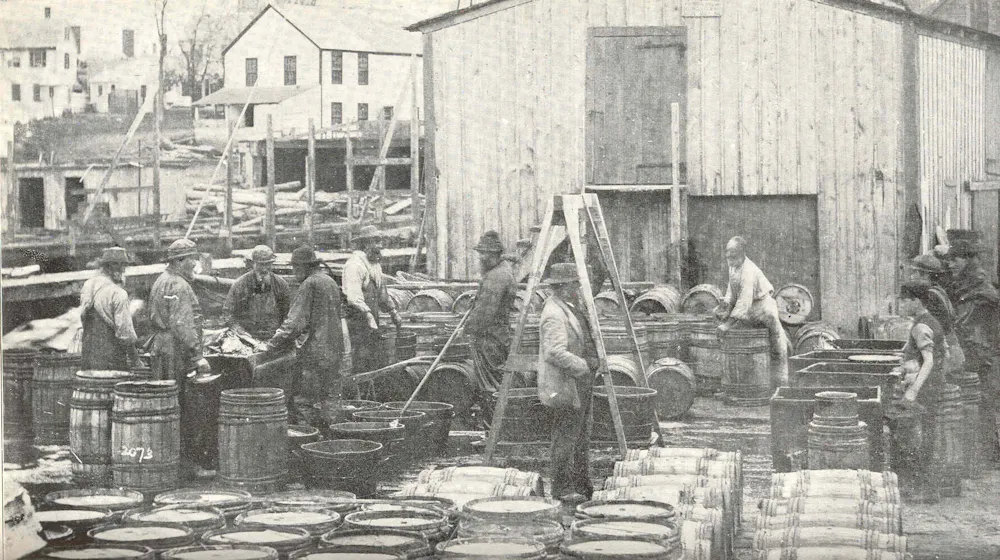
    Fishing has been an integral part of coastal New England culture since its towns were established. In this 1899 photo, a New England community weighs and packs mackerel.
    Charles Stevenson/Freshwater and Marine Image Bank

    Fishing started when the season opened and continued until the catch limit was reached. In some fisheries, this resulted in a “race to the fish” or a “derby,” where vessels competed aggressively to harvest the available catch in short amounts of time. The limit could be reached in a single day, as happened in the Pacific halibut fishery in the late 1980s.

    By the 1990s, however, open access systems were coming under increased criticism from economists as concerns about overfishing rose.

    The fish catch peaked in New England in 1987 and would remain far above what the fish population could sustain for two more decades. Years of overfishing led to the collapse of fish stocks, including North Atlantic cod in 1992 and Pacific sardine in 2015.

    As populations declined, managers responded by cutting catch limits to allow more fish to survive and reproduce. Fishing seasons were shortened, as it took less time for the fleets to harvest the allowed catch. It became increasingly hard for fishermen to catch enough fish to earn a living.

    Saving fisheries changed the industry

    In the early 2000s, as these economic and environmental challenges grew, fisheries managers started limiting access. Instead of allowing anyone to fish, only vessels or individuals meeting certain eligibility requirements would have the right to fish.

    The most common method of limiting access in the U.S. is through limited entry permits, initially awarded to individuals or vessels based on previous participation or success in the fishery. Another approach is to assign individual harvest quotas or “catch shares” to permit holders, limiting how much each boat can bring in.

    In 2007, Congress amended the 1976 Magnuson-Stevens Fishery Conservation and Management Act to promote the use of limited access programs in U.S. fisheries.

    Ships in the fleet out of New Bedford, Mass.
    Henry Zbyszynski/Flickr, CC BY

    Today, limited access is common, and there are positive signs that the management change is helping achieve the law’s environmental goal of preventing overfishing. Since 2000, the populations of 50 major fishing stocks have been rebuilt, meaning they have recovered to a level that can once again support fishing.

    I’ve been following the changes as a lawyer focused on ocean and coastal issues, and I see much work still to be done.

    Forty fish stocks are currently being managed under rebuilding plans that limit catch to allow the stock to grow, including Atlantic cod, which has struggled to recover due to a complex combination of factors, including climatic changes.

    The lingering effect on communities today

    While many fish stocks have recovered, the effort came at an economic cost to many individual fishermen. The limited-access Northeast groundfish fishery, which includes Atlantic cod, haddock and flounder, shed nearly 800 crew positions between 2007 and 2015.

    The loss of jobs and revenue from fishing impacts individual family income and relationships, strains other businesses in fishing communities, and affects those communities’ overall identity and resilience, as illustrated by a recent economic snapshot of the Alaska seafood industry.

    When original limited-access permit holders leave the business – for economic, personal or other reasons – their permits are either terminated or sold to other eligible permit holders, leading to fewer active vessels in the fleet. As a result, the number of vessels fishing for groundfish has declined from 719 in 2007 to 194 in 2023, meaning fewer jobs.

    A fisherman unloads a portion of his catch for the day of 300 pounds of groundfish, including flounder, in January 2006 in Gloucester, Mass.
    AP Photo/Lisa Poole

    Because of their scarcity, limited-access permits can cost upward of US$500,000, which is often beyond the financial means of a small businesses or a young person seeking to enter the industry. The high prices may also lead retiring fishermen to sell their permits, as opposed to passing them along with the vessels to the next generation.

    These economic forces have significantly altered the fishing industry, leading to more corporate and investor ownership, rather than the family-owned operations that were more common in the Andrea Gail’s time.

    Similar to the experience of small family farms, fishing captains and crews are being pushed into corporate arrangements that reduce their autonomy and revenues.

    Consolidation can threaten the future of entire fleets, as New Bedford, Massachusetts, saw when Blue Harvest Fisheries, backed by a private equity firm, bought up vessels and other assets and then declared bankruptcy a few years later, leaving a smaller fleet and some local business and fishermen unpaid for their work. A company with local connections bought eight vessels from Blue Harvest along with 48 state and federal permits the company held.

    New challenges and unchanging risks

    While there are signs of recovery for New England’s fisheries, challenges continue.

    Warming water temperatures have shifted the distribution of some species, affecting where and when fish are harvested. For example, lobsters have moved north toward Canada. When vessels need to travel farther to find fish, that increases fuel and supply costs and time away from home.

    Fisheries managers will need to continue to adapt to keep New England’s fisheries healthy and productive.

    One thing that, unfortunately, hasn’t changed is the dangerous nature of the occupation. Between 2000 and 2019, 414 fishermen died in 245 disasters.

    Stephanie Otts receives funding from the NOAA National Sea Grant College Program through the U.S. Department of Commerce. Previous support for fisheries management legal research provided by The Nature Conservancy.

    ref. Checking in on New England’s fishing industry 25 Years after ‘The Perfect Storm’ hit movie theaters – https://theconversation.com/checking-in-on-new-englands-fishing-industry-25-years-after-the-perfect-storm-hit-movie-theaters-255076

    MIL OSI Analysis

  • MIL-OSI United Kingdom: Broadband target exceeded

    Source: Scottish Government

    R100 delivers more than 27,000 faster, ultra-reliable connections in a year. 

    The Scottish Government has surpassed it’s commitment to deliver gigabit-capable broadband connections to 20,000 homes and businesses last year.

    A record 27,000 premises were equipped with faster broadband in 2024-25 through the Scottish Government’s Reaching 100% (R100) programme, exceeding a Programme for Government commitment by more than a third.  

     Connections have been made right across the country, from the Killantringan Lighthouse in Dumfries and Galloway to Stornoway in the Western Isles and Baltasound on Shetland.  

     The R100 contracts, being delivered by Openreach, have now enabled more than 80,000 faster broadband connections across the country, with 80% of all R100 contract build to take place in rural areas.  

    Business Minister Richard Lochhead visited Loch Katrine in the Trossachs to hear how access to faster broadband speeds is helping transform opportunities for local businesses.  

    He said:  

    “Fast, reliable broadband is a fundamental building block for economic growth. The Scottish Government’s R100 programme is one of the most ambitious and complex digital infrastructure programmes in Europe, rolling out connections in some of the most challenging locations in the country to help businesses and communities prosper.

    “Despite telecommunications being reserved to the UK Government, our commitment to the R100 programme illustrates this government’s commitment to delivering the digital connectivity people and businesses need to succeed.

     “Exceeding our 2024-25 delivery target was helped by record Scottish Government funding and an ongoing partnership with Openreach maximising the opportunities to deliver fast broadband to even more homes and businesses.”  

    CEO and Lead Trustee of the Steamship Sir Walter Scott Trust, James Fraser said:   

    ”The impact of the introduction of fibre cable connections at Loch Katrine has been transformative for many aspects of our core business and our tenants. With an increasing trend to digital bookings for cruises, eco lodges, cycle hire and meals out, having high speed digital connections is critical to the success of our business and other businesses on the lochside.  

    “Previously our digital speeds were very poor leading to customer dissatisfaction, loss of bookings and customer complaints, particularly from guests staying overnight in our eco lodges or in campervans in our car parks. With the higher speeds now available there has been a marked improvement in digital services with increased customer satisfaction levels.”  

    Openreach Partnership Director for Scotland, Robert Thorburn, said:   

    “It’s brilliant to see businesses like the Steamship Sir Walter Scott benefitting from full fibre. We’re committed to making sure that the hardest-to-reach homes and businesses in Scotland are connected to the latest generation of broadband technology, giving them access to the same fast, reliable services available in our cities.

    “While building new full fibre networks in rural areas throws up many challenges, our engineers have the skills and experience to overcome these and deserve an enormous amount of credit for their work. We’re proud of the role we’ve played, working alongside the Scottish Government, in hitting this significant milestone – but we know that our work isn’t done yet, and we’ll continue to connect communities across the country.”  

    Background  

    The commitment to connect over 20,000 premises to gigabit capable broadband in areas of market failure by March 2025, through delivery of three regional, multi-year contracts with Openreach is set out in the Programme for Government 2024-25: Serving Scotland  

    Originally conceived as a superfast broadband programme, R100 is now providing a gigabit-capable connection – a speed more than 30 times faster than superfast broadband – in around 99% of cases. Building to some of the hardest-to-reach parts of Scotland, a total of 78,000 connections have enabled access to faster broadband as a result of the R100 contracts.      

    MIL OSI United Kingdom

  • MIL-OSI United Kingdom: Council to work with partners to improve outdoor sports facilities across the city

    Source: City of Stoke-on-Trent

    Published: Friday, 27th June 2025

    Stoke-on-Trent City Council is set to strengthen its commitment to improving outdoor sports facilities as it approves the latest version of its Playing Pitch Strategy.

    The updated strategy will be discussed at a cabinet meeting on Tuesday 24 June and sets out where sports provision across the city currently meets demand, alongside where improvements are needed.

    The council will continue to work closely with national governing bodies, Sport England, local clubs and schools to deliver improvements.

    The strategy focuses on making the most of existing facilities, investing in those that need attention, and creating new ones where they are needed.

    This work supports the council’s wider aim to improve people’s physical and mental health and help communities connect through sport and physical activity.

    Key recommendations include:

    • Protecting existing sports facilities
    • Improving the quality of facilities, especially those that are overused or in poor condition
    • Working with schools and others to open up more spaces for community use
    • Helping clubs secure long-term access to the places they play
    • Exploring opportunities to transfer suitable sites to clubs to manage
    • Upgrading changing rooms and other support facilities, especially to support mixed-gender use
    • Adding more sports lighting to increase access and extend playing times
    • Using funding from new housing developments to improve sports provision
    • Maintaining strong partnerships to help secure funding and deliver the improvements

    Councillor Jane Ashworth, leader of Stoke-on-Trent City Council, said: “Playing sports has so many benefits for our physical and mental health and it also fosters a sense of community by connecting with residents through the power of sport.

    “That is why it is so important that the city’s outdoor facilities are fit for purpose and available to use, which is why we are looking at measures to ensure they are continually improved.”

    MIL OSI United Kingdom

  • MIL-OSI Africa: Minister of State for International Cooperation Meets Under-Secretary of State for Africa at UK Foreign Ministry

    Source: Government of Qatar

    London, June 26, 2025

    HE Minister of State for International Cooperation Maryam bint Ali bin Nasser Al Misnad met on Thursday with HE Under-Secretary of State for Africa at the UK Foreign, Commonwealth and Development Office, Lord Collins of Highbury, on the sidelines of the World Humanitarian Forum, held in London, UK.

    During the meeting, they discussed cooperation relations between the two countries and ways to support and enhance them, in addition to several topics of mutual interest.

    HE Ambassador of the State of Qatar to the United Kingdom and Northern Ireland Sheikh Abdullah bin Mohammed bin Saud Al-Thani attended the meeting.

    MIL OSI Africa

  • MIL-OSI Africa: Minister of State for International Cooperation Meets British Officials

    Source: Government of Qatar

    London, June 26, 2025

    HE Minister of State for International Cooperation Maryam bint Ali bin Nasser Al Misnad met on Thursday with HE CEO of the World Humanitarian Forum Feraye Ozfescioglu, HE Lord of Wimbledon, former Minister of State for the Middle East, South Asia and United Nations at the UK Foreign, Commonwealth and Development Office Lord Tariq Ahmad, and member of the Advisory Board of the World Humanitarian Forum Richard Hawkes, on the sidelines of the World Humanitarian Forum, held in London, UK.

    During the meeting, cooperation relations were discussed, as well as ways to support and enhance them, in addition to several topics of mutual interest.

    HE Ambassador of the State of Qatar to the United Kingdom and Northern Ireland Sheikh Abdullah bin Mohammed bin Saud Al-Thani attended the meeting.

    MIL OSI Africa

  • MIL-OSI United Kingdom: Plans submitted to transform city’s iconic Cables Wynd House and Linksview House

    Source: Scotland – City of Edinburgh

    The City of Edinburgh Council’s retrofit project has taken a major step forward this month with the submission of a planning application by Collective Architecture.

    Built in the 1960s and now designated as Category A listed buildings, Cables Wynd House and Linksview House collectively provide 310 homes, the majority of which are owned by the Council for social rent.

    These landmark buildings have served generations of residents, and this project represents a significant investment in securing their future as safe, high-quality homes.

    The proposed works are being driven by the need to meet the Scottish Government’s Energy Efficiency Standard for Social Housing – EESSH2.

    Achieving compliance will require substantial upgrades to both the building fabric and mechanical systems. Alongside this, the Council has identified the opportunity to deliver wider improvements that will bring the buildings in line with modern new-build standards.

    Key elements of the proposal include:

    • Energy Efficiency Upgrades: Improved insulation, window replacements, and energy-efficient heating systems to meet EESSH2 standards.
    • Fire Safety Enhancements: Installation of sprinkler systems, smoke ventilation, a new fire-fighting lift, and improved fire compartmentalisation in communal areas. The removal of legacy bin chutes and inclusion of internal waste management facilities will also contribute to enhanced fire safety.
    • Resident Safety and Security: Upgraded internal and external lighting, a comprehensive review of CCTV systems, and improved access control throughout the buildings.
    • Landscape and Placemaking Improvements: The refurbishment project presents a unique opportunity to reimagine the outdoor environment surrounding both towers. Proposals include new play areas, external seating, wildflower meadows, sustainable urban drainage systems (SUDS), and a full review of parking and waste facilities.

    Housing, Homelessness and Fair Work Convener Lezley Marion Cameron said:

    I am delighted that the proposals for the Council’s £69 million investment in Cables Wynd House and Linksview House have now been submitted to the CEC Planning Service, setting out our plans to make our residents’ homes safer, more comfortable and more energy efficient.  

    Cables Wynd and Linksview House residents have long campaigned for this much needed and substantive investment in their homes to happen.  Their influence and input into our consultation sessions have shaped these proposals and is hugely valued.  I look forward to continuing this positive engagement with Cables Wynd and Linksview House residents and Leith Ward Councillors as the project progresses.

    Carl Baker, Architect, Certified Passivhaus Designer – Collective Architecture said:

    Collective Architecture is proud to be working with The City of Edinburgh Council on the retrofit of Cables Wynd House and Linksview House. Our proposals place residents at the heart of the process, aiming to provide greener, warmer homes, while celebrating and sensitively enhancing the unique character of the Category A listed buildings.

    As part of a just transition, our carefully considered interventions will improve the thermal and environmental performance of the iconic structures – boosting energy efficiency and alleviating the risk of fuel poverty.

    As with many of our projects, meaningful resident engagement has been central to the design process and will remain a key focus through the final design stage and into construction.

    Subject to planning approval, the Council will continue to engage closely with residents throughout the design and construction process, ensuring their needs remain at the heart of the project.

    MIL OSI United Kingdom

  • MIL-OSI United Kingdom: New Director appointed to the Scotland Office

    Source: United Kingdom – Executive Government & Departments

    News story

    New Director appointed to the Scotland Office

    A new Director is to take the helm at the Scotland Office this summer

    Fiona Mettam, currently Director for Energy Development at the Department for Energy Security and Net Zero, will lead a team of around 80 civil servants across sites in London and Edinburgh. 

    She will work closely with Scottish Secretary Ian Murray to deliver on his key departmental priorities of growth, Brand Scotland, green energy and tackling poverty. 

    Secretary of State for Scotland Ian Murray said:

    “I am delighted that Fiona Mettam is joining the Scotland Office. Her very significant skills and experience will be a huge asset to the Office. I’m very much looking forward to having her on board, helping to deliver my four key priorities.”

    Fiona Mettam said:

    “It is a real privilege and honour to be taking up this important role to support the Scotland Office Ministerial team in delivering their priorities for the UK Government in Scotland. I’m really looking forward to getting started.”

    Fiona has previously worked in Defra, HMT, the European Commission and the South Downs National Park Authority in a range of policy, delivery and corporate roles.  Fiona is also joint Head of Place for Scotland for UKG, a role she fulfils jointly with Craig Ogilvie from HMRC. She will join the Scotland Office in August.

    Updates to this page

    Published 27 June 2025

    MIL OSI United Kingdom

  • MIL-OSI United Kingdom: New expertise joins NI Public Sector Transformation Board

    Source: United Kingdom – Executive Government & Departments

    News story

    New expertise joins NI Public Sector Transformation Board

    Secretary of State for Northern Ireland, Hilary Benn MP welcomes the news of the appointment of two new members to the Public Sector Transformation Board.

    • The expansion of the Board follows a productive agreement with the Finance Minister John O’Dowd MLA to update the Terms of Reference for the Transformation Board.
    • The two new expert board members are; Gareth Hetherington, Director of Ulster University Economic Policy; and, Professor Helen McCarthy, the NI Executive’s Chief Scientific Officer.
    • The Second Call has now launched to allocate the remaining £102 million of UK Government funding which will help improve public services, and address many of the challenges faced by people across Northern Ireland.

    Hilary Benn MP said:

    The significant progress made since the establishment of the Board has been really important. I was delighted to welcome the first tranche of funding in March this year when £129m was confirmed to help fund six transformation projects across the Departments of Health, Justice, Education and Infrastructure.

    The appointment of Gareth Hetherington and Professor Helen McCarthy will bolster the expertise of the Board as it assesses projects eligible for the remaining £102m allocation for transformation of public services in Northern Ireland. This funding will help build more resilient and responsive public services that better meet the needs of people across Northern Ireland.

    MIL OSI United Kingdom

  • MIL-OSI United Kingdom: New expertise joins NI Public Sector Transformation Board

    Source: United Kingdom – Executive Government & Departments

    News story

    New expertise joins NI Public Sector Transformation Board

    Secretary of State for Northern Ireland, Hilary Benn MP welcomes the news of the appointment of two new members to the Public Sector Transformation Board.

    • The expansion of the Board follows a productive agreement with the Finance Minister John O’Dowd MLA to update the Terms of Reference for the Transformation Board.
    • The two new expert board members are; Gareth Hetherington, Director of Ulster University Economic Policy; and, Professor Helen McCarthy, the NI Executive’s Chief Scientific Officer.
    • The Second Call has now launched to allocate the remaining £102 million of UK Government funding which will help improve public services, and address many of the challenges faced by people across Northern Ireland.

    Hilary Benn MP said:

    The significant progress made since the establishment of the Board has been really important. I was delighted to welcome the first tranche of funding in March this year when £129m was confirmed to help fund six transformation projects across the Departments of Health, Justice, Education and Infrastructure.

    The appointment of Gareth Hetherington and Professor Helen McCarthy will bolster the expertise of the Board as it assesses projects eligible for the remaining £102m allocation for transformation of public services in Northern Ireland. This funding will help build more resilient and responsive public services that better meet the needs of people across Northern Ireland.

    MIL OSI United Kingdom

  • MIL-OSI United Kingdom: Windsor Framework Used to Force Radical Gender Policies on Northern Ireland

    Source: Traditional Unionist Voice – Northern Ireland

    Statement by TUV leader Jim Allister MP:

    “I am deeply concerned by the direction the Equality Commission for Northern Ireland has taken. The document published today marks a clear departure from the Commission’s statutory role as an impartial guardian of equality law. Instead, it reveals an organisation now actively promoting a controversial ideological agenda — using Article 2 of the Windsor Framework as its legal cover.

    “Let me be clear: this paper is not neutral guidance. It is a political document dressed in legal language. It seeks to redefine key concepts like “sex” and “gender reassignment” in ways that go far beyond what our domestic law currently recognises — and flies in the face of the clarity brought by the Supreme Court.

    “The Commission claims that Article 2 of the Windsor Framework requires public authorities, employers, and service providers to align with retained EU equality directives, highlighting once again the pernicious influence of the EU in Northern Ireland. However, even this is highly debatable, given that across the EU many different positions are accommodated when it comes to so-called “trans rights”.

    “Frankly, they are simply wrong. In pushing this into the courts again, they are seeking to kick the can down the road — and they have been influenced by trans lobby groups.

    “In doing so, they have exposed themselves as being deeply influenced by a profoundly dangerous ideology.

    “No one in Northern Ireland voted for this. No one gave the Equality Commission the authority to act as a proxy legislator. And yet that is exactly what is happening.

    “The guidance now being issued to employers and public bodies reads less like a legal resource and more like a manifesto for gender ideology — with demands to rewrite policies, reinterpret longstanding legal terms, and submit to oversight from a Commission that is no longer even pretending to be neutral.

    “This is a fundamental breach of public trust. The Equality Commission was established to protect people from genuine discrimination.

    “We are witnessing the transformation of a public body into an activist organisation.

    “Recent polling has shown that people in Northern Ireland — across the political spectrum — back the common-sense ruling of the Supreme Court. This decision by the Commission is frankly outrageous. If their claims in relation to Article 2 of the Windsor Framework are correct, then it merely underscores the fact that the Protocol needs to go, and that, contrary to the claims of some, its pernicious influence goes well beyond trade.

    “However, this throws up a very particular challenge to HMG: they need to come out fighting against the creep of Article 2 of the Protocol. This will show where the government really stands on our ever expanding subjugation to EU diktat.”

    MIL OSI United Kingdom

  • MIL-OSI United Kingdom: Deputy PM pledges more support for terminally ill workers

    Source: United Kingdom – Executive Government & Departments

    Press release

    Deputy PM pledges more support for terminally ill workers

    Ministers have signed a charter on behalf of the Civil Service committing to best practice for supporting civil servants diagnosed with a terminal illness.

    The Deputy Prime Minister Angela Rayner has pledged more support for those diagnosed with a terminal illness, as the Civil Service joins hundreds of employers already leading the way in ensuring best practice for people facing the most difficult time of their lives – by signing the Dying to Work Charter.

    While many employers take great care already, a campaign called Dying to Work raises awareness of the important steps they can take to provide employees with dignity and peace of mind as they navigate a terminal diagnosis in work.

    These steps are listed in this charter created by the TUC and founder Jacci Woodcock MBE, who was diagnosed with terminal breast cancer in 2012. It encourages employers to sign up as a promise to ensuring additional support for terminally ill staff and making sure the employee is involved any decision-making around how they continue in work.

    The charter already has over 400 employers signed up all over the UK – from local businesses to public services big and small, covering over 1.5 million employees. Now with the Civil Service signed up, around 2 million employees are now protected by it.

    The move adds to the leading support the Civil Service already provides for civil servants living with a terminal illness and government work supporting thousands of employers through DWP’s Disability Confident campaign, which also supports the charter.

    Deputy Prime Minister Angela Rayner said:

    No one battling terminal illness should ever have to face extra stress and worry over their job security at what is already the most challenging time for them and their loved ones.

    It is vital at such a difficult time that employees with a terminal diagnosis are treated sensitively and with the best support – that’s why I’m so proud we are backing this charter.

    Minister for Employment Rights Justin Madders said:

    The bare minimum people facing terminal illness would expect is to have a sympathetic employer who treats them with dignity and respect, whilst dealing with the difficulties this brings.

    While many employers take great care already, we know this isn’t always the case. That’s why today, the Civil Service is setting the standard, protecting vulnerable workers and giving them the freedom to decide whether to stay in work with the support they need.

    TUC Director of Organising Sian Elliott said:  

    We all hope our employer would support us if we were diagnosed with a terminal illness – but sadly, that’s not always the case. 

    We welcome the government’s decision to sign the Dying to Work Charter, improving support for civil servants. No one should face the added burden of losing their job at the most difficult time of their life.  

    The charter is about dignity, security, and choice. Two million workers are now covered by it across both the public and private sectors. We hope many more employers will sign up too.

    The Deputy Prime Minister Angela Rayner, Minister for Employment Rights Justin Madders and Cabinet Office Minister Georgia Gould all signed the charter together on behalf of the Civil Service. The signing took place on Thursday (26 June) with trade unions present.

    The government’s help to raise awareness of better practices for terminally ill staff is part of its plan to make work pay, which is the biggest upgrade to workers’ rights in a generation.

    ENDS

    Notes to editors:

    • According to Cancer Research UK, 1 in 3 people are projected to be diagnosed with cancer and currently in 1 in 10 cases are in people under 50.
    • In 2023/24, over 345,000 people were on the palliative care register in England – a list held by GPs of people who are under their care and approaching end of life and are likely to have less than 12 months to live.

    Updates to this page

    Published 27 June 2025

    MIL OSI United Kingdom

  • MIL-OSI United Kingdom: Home of ‘Devil’s Punch Bowl’ to become new National Nature Reserve

    Source: United Kingdom – Government Statements

    Press release

    Home of ‘Devil’s Punch Bowl’ to become new National Nature Reserve

    • Sand lizards, nightjars and natterjack toads are among the litany of species that people can enjoy at new Wealden Heaths National Nature Reserve in Surrey

    Hampton Estate heather with stonechat

    • Nature reserve declared at the landscape that inspired the likes of Tennyson and Conan Doyle, as well as its folkloric origins as the home of Thor.

    • This marks the 9th National Nature Reserve to launch as part of the King’s Series of National Nature Reserves, which will see 25 reserves created or extended by 2027

    A landscape in Surrey beloved by lizards and literary greats and home to an area known as the Devil’s Punch Bowl, is to become the latest National Nature Reserve.

    The Wealden Heaths National Nature Reserve, in the heart of the Surrey countryside and on the doorstep of more than a quarter of a million people, has today (Friday 27th June) been declared by Natural England the 9th National Nature Reserve in the King’s Series.

    This new reserve is a collaboration between nine partners; Natural England, RSPB, National Trust, Surrey Wildlife Trust, Hampton Estate (private farming estate), Amphibian and Reptile Conservation Trust, Waverley Borough Council, Surrey County Council and Forestry England, with further support from the Surrey Hills National Landscape. 

    The reserve has secured its status as a haven for wildlife, ensuring that it can provide a home for rare species such as Nightjars, Sand Lizards, Adders and Natterjack Toads into the future and an area of 2,765ha of greenspace accessible by hundreds of thousands of people.

    Wealden Heaths National Nature Reserve stretches across an area around three times that of Richmond Park, boasting a rich mix of open dry and wet heath, acidic grassland, regenerating woodland, and scrubby heath.

    Heathland habitats are incredibly important for a range of species, and popular with walkers, cyclists and riders. However, heathlands in England have declined by around 80% in the last two centuries, making this declaration vitally important for the survival of these precious places.

    The exceptional nature on display in this area, alongside its easy connections with London mean it already sees thousands of visitors each year, and its declaration as a National Nature Reserve means that future generations will continue to be able to connect with nature in the idyllic surroundings of the reserve. The reserve also includes a nature friendly farmed estate, adding to its potential to boost the local economy along with visitor spend.

    Nature Minister Mary Creagh said: 

    “Britain is a nation of nature lovers – proud of our iconic landscapes and charismatic wildlife.

    “This new reserve offers wonderful opportunities for people to experience the outdoors and spot rare wildlife in a place which has been a source of cultural inspiration for centuries.

    “This Government is committed to turning the tide on nature’s decline after years of neglect. New National Nature Reserves deliver on our promise to improve access to nature and protect nature-rich habitats, as well as boosting the local economy in line with our Plan for Change.”

    Marian Spain, Chief Executive of Natural England said:  

    “The beautiful atmospheric landscape has had a huge influence in culture over the centuries, from folklore to poetry. Its new status as a National Nature Reserve will ensure future generations continue to be inspired.

    “There is a wealth of species here, many of which are very rare, and efforts to maintain the vital habitats in this area will help these plants and animals to thrive again. Its network of tracks – including “Britain’s Favourite Path” – means it is already incredibly popular with local people and visitors from nearby London, offering a much needed vast open space for everybody to enjoy the connection with nature we all need.”

    This landscape is also widely known as the home of The Devil’s Punchbowl, a dramatic natural amphitheatre in the heathlands near Hindhead which is steeped in legend. It is said to have been formed when the Devil scooped up earth to throw at Thor, which some say is how the nearby area of Thursley got its name.  

    The area has provided inspiration to a range of literary greats through the years, from Alfred Lord Tennyson to Arthur Conan Doyle. The reserve is home to Waggoners Well, where Tennyson wrote ‘Flower in the Crannied Wall’, which reflects on the connection between nature, humans, and the divine. 

    The area has retained its popularity and is still a destination for nature lovers, boasting the Thursley Common Boardwalk, which has been named ‘Britain’s Favourite Path’ by the Ramblers Association. This declaration will mean that this bustling area of nature just 45 minutes away from London will be managed and accessible for years to come.

    This area has already benefitted from the Heathland Connections Nature Recovery Project, which provided funding from Defra and Natural England. It is an ambitious project working with partners, including wildlife charities and private landowners to enhance, restore and connect the special habitats found in the westernmost section of the Surrey Hills National Landscape.

    The launch of the new National Nature Reserve directly supports the government’s commitment to restore and protect our natural world by expanding nature-rich habitats where people can explore and wildlife can thrive.  

    This is the 9th reserve to be launched as part of the King’s Series of National Nature Reserves, which will leave a lasting public legacy for people and nature by creating or extending 25 National Nature Reserves by 2027. 

    NOTES TO EDITORS

    ·       This new 2,766 hectare Wealden Heaths NNR combines the existing Thursley NNR (325ha) with 2,440ha of partner-managed land, of which 1,784ha is designated as Site of Special Scientific Interest.  

    ·       Wealden Heaths also includes over 900ha (921) of non-SSSI land, the largest area of any NNR with previously undesignated land being formally brought into conservation management 

    ·       The declaration of Wealden Heaths brings the total area of NNRs in England to over 115,000ha across 223 NNRs. 

    ·       Images of the NNR can be found here: Wealden Heaths NNR images – Google Drive 

    QUOTES PACK

     #### Molly Biddell of Hampton Estate, said

    “We are so proud and excited to be a part of Wealden Heaths National Nature Reserve, this recognition reflects how precious our Surrey heathlands are, and how important it is that as land managers we all work together to protect these unique habitats. At Hampton Estate, we feel privileged to be managing Puttenham Common as part of our farming business, using conservation grazing, woodland management and shared stewardship to increase biodiversity and create a nature-loving community. We look forward to working alongside our partners to ensure the Wealden Heaths continue to thrive as a living, working landscape that inspires.”

    Councillor Steve Williams, Waverley Borough Council Portfolio Holder for Environment and Sustainability, said:

    “The Wealden National Nature Reserve (NNR) is a great community asset, offering a unique space for residents to connect with nature, learn about biodiversity, and enjoy outdoor activities.  Waverley Borough Council is passionate about preserving our natural heritage and providing an opportunity for our residents to enjoy the natural resources in our borough.  The NNR enhances the quality of life for local residents and attracts visitors, contributing to the local economy and promoting knowledge of our natural world.  We are committed to maintaining and improving this invaluable resource for current and future generations.”

    Rob Fairbanks, Director of the Surrey Hills National Landscape said:

    “I am thrilled to see the launch of the Wealden Heaths National Nature Reserve.  This is a transformative designation to create a bigger, better, and more joined up approach to heathland restoration within the Surrey Hills National Landscape.

    “This milestone is a testament to the robust partnership driving it, and we extend our heartfelt gratitude to Natural England for empowering us to address the biodiversity crisis and a flourishing future for our rare and rich heathland habitats.”

    Amphibian and Reptile Conservation Trust (ARC) CEO, Dr Tony Gent said:

    “At ARC, we believe that collaboration is key to effective landscape-scale conservation. By working together rather than in isolated pockets, we can share resources, knowledge, and communicate more consistently – delivering greater impact for wildlife and habitats.”

    “The creation of the new Partnership National Nature Reserve in Surrey offers a powerful opportunity to strengthen partnerships with fellow land managers. Together, we can better support native amphibian and reptile populations across the region. By aligning conservation goals and underpinning them with robust monitoring, we can develop a shared agenda for conserving these species — while also identifying and addressing areas where biodiversity is in decline.”

    Surrey Wildlife Trust’s Director of Reserves Management, James Herd said:

    “With nature under unprecedented pressure, its essential that habitats are connected and protected not just on a local, but on a landscape level.  The creation of this reserve represents an encouraging step towards this goal, and also illustrates the power of partnership working between national and local policymakers, communities and conservationists.”

    Stephanie Fudge, National Trust General Manager for the Surrey Hills said:

    “The Wealden Heaths National Nature Reserve brings together a patchwork of heathlands owned by different landowners, and by joining up these habitats we aim to benefit species such as nightjar, woodlark and sand lizards by giving them space to move and to find food or shelter in times of extreme weather such as flooding or drought.

    “We can do much more for nature as a collective, rather than on our own. As part of this new NNR, 1660 hectares is National Trust land including heathland at Hindhead Commons and the Devil’s Punch Bowl. Working together we want to ensure that wildlife in these special habitats can flourish, and improve access so that people living in the South East can enjoy the vast array of wildlife on their doorstep for many generations to come.”

    Surrey County Councillor Marisa Heath, Cabinet Member for Environment:

    “The creation of the Wealden Heaths National Nature Reserve (NNR) is a beacon of hope for both nature and people. Not only is it an important step in securing the future for the rare species that call this landscape home, but it also provides a sanctuary for people, offering vital green spaces that contribute to our health and wellbeing. “

    I would like to thank Natural England and the eight other landowners and stakeholders that have worked in partnership to deliver this National Nature Reserve, and I look forward to a more resilient and thriving Surrey landscape that will benefit generations to come.”

    South Forest Management Director, Craig Harrison from Forestry England, said:

    “We are delighted to be part of this super NNR and for Crooksbury Common to be included. This is great recognition of the importance of heathlands and working at a landscape-scale this partnership will allow us to share our expertise to build a better, more joined-up landscape for nature.”

    Updates to this page

    Published 27 June 2025

    MIL OSI United Kingdom

  • MIL-OSI Europe: On the road to COP30: mobilising climate finance | London Climate Action Week (LCAW), Event at the German Embassy

    Source: Deutsche Bundesbank in English

    Check against delivery.

    1 Welcome
    Ladies and Gentlemen, 
    Good afternoon, and thank you for the kind introduction. It is a great honour to be here with you today to discuss the way forward on the road to Belém. 
    First of all, let me thank the German Embassy for organising this event and for bringing together such a distinguished and diverse group of leaders and experts. Events like this are so important, especially in the current context of numerous economic and geopolitical challenges that (threaten to) overshadow climate change. 
    It is essential to have spaces and forums where stakeholders from the public and private sectors, academia and civil society come together to exchange ideas on how to move ahead. The strong attendance here today is testament to our dedication and reflects our shared recognition that the serious risks arising from climate change have to be taken seriously. 
    2 The Role of the NGFS
    I am proud to represent not only the Deutsche Bundesbank but also the Network for Greening the Financial System (NGFS), which I have the honour to chair.
    The NGFS is a global coalition of central banks and supervisors committed to addressing climate and nature-related risks in the financial system. Since its foundation in 2017 the NGFS has grown significantly, today boasting 145 members and observers. Our global and growing membership underscores the increasing international recognition of climate and nature risks.
    Climate change is unfolding rapidly, right in front of our eyes, and poses profound risks to our economies and financial systems. It is more important than ever to continue our independent, data-driven and science-based work. 
    I am very glad to see colleagues from the Bank of England and my fellow Deputy Governor Paulo Picchetti from the Banco Central do Brasil in the audience today. Your institutions have contributed a lot to the work of the NGFS. 
    3 Climate inaction has high economic costs
    The urgency of ambitious climate action cannot be overstated. 
    Work by the NGFS shows economic and financial risks arising due to climate change and nature loss. 
    Last November we released the latest update of our long-term climate scenarios. The scenarios show very clearly that climate inaction has high economic costs. 
    If we stick to current policies, global GDP could be 15 % lower by 2050, compared to a world without climate change.[1] This does not include sea level rises, migration or nature loss.
    I know that 2050 is, in practice, beyond the planning horizon of many corporates and political decision makers. That is why the NGFS has developed short-term climate scenarios with a time horizon of three to five years to help bridge this gap. 
    These scenarios also show that a delayed transition is expensive. Our stress scenarios assume extreme weather events. Our scenarios show that delaying the transition by just three years could reduce global GDP by almost 1 % by 2030.[2]
    The NGFS scenarios are a public good, designed to help financial institutions and the real economy assess the potential impacts of climate change. I encourage you to make use of them to manage climate-related risks. 
    4 Scaling up global climate finance
    Ladies and Gentlemen, addressing climate risks requires a collective effort to align global financial flows with climate goals. 
    To meet the goals of the Paris Agreement, global climate finance needs to be significantly scaled up from current levels. 
    The Baku to Belém Roadmap to 1.3 Trillion is a key initiative in achieving that goal.[3] The roadmap provides a pathway for mobilising the capital needed for the transition to a low-carbon economy. I am particularly excited to hear more about this roadmap from André Corrêa do Lago in a moment.
    The public and the private sector must work hand in hand to scale up climate finance. But the biggest share has to come from the private sector, as public money has its limits and more and more challenges for public money are arising. 
    And I look forward to hearing from other participants here about how the financial sector can help to mobilise climate finance.
    5 The role of the corporate sector
    At the same time, climate finance is only one side of the coin. The other side is the low-carbon transition of industries and businesses. It is important to bring the corporate sector on board.
    They are the ones who will innovate, invest, and implement the changes needed to achieve climate goals. The renewable energy transition is key to addressing climate change. So, the energy sector plays a pivotal role in moving away from fossil fuels.
    I am very happy that Greg Jackson from Octopus Energy will join our discussions and share his insights with us. 
    6 Conclusion
    Ladies and gentlemen, let me conclude. As we move towards COP30, the stakes could not be higher. Last month was the second-warmest May on record globally, just slightly cooler than May 2024.[4]
    Climate change is not a distant threat; it is a present reality. The decisions today will shape the world for generations to come. And let us remember that while the challenges are great, so too are the opportunities.
    Footnotes:

    See: NGFS Climate Scenarios for central banks and supervisors – Phase V | Network for Greening the Financial System
    NGFS short-term climate scenarios, see: NGFS Short-term Climate Scenarios for central banks and supervisors | Network for Greening the Financial System
    For an overview, see: Baku to Belém Roadmap to 1.3T | UNFCCC
     Second-warmest May globally, dry/wet contrast across Europe in spring | Copernicus

    MIL OSI

    MIL OSI Europe News

  • MIL-OSI United Kingdom: Lord Mayor announces chosen charities

    Source: Northern Ireland City of Armagh

    Lord Mayor Alderman Stephen Moutray pictured with Carla Smyth from Epilepsy Action Northern Ireland and Deirdre Breen from Evora Hospice Care, formerly known as Southern Area Hospice Services.

    Lord Mayor Alderman Stephen Moutray has officially announced two organisations as the chosen charities for his term in office.

    Charities set to benefit from monies raised throughout the Lord Mayor’s term include Epilepsy Action Northern Ireland and Evora Hospice Care – previously known as Southern Area Hospice Services.

    Welcoming representatives from the local charities to Craigavon Civic and Conference Centre recently, Lord Mayor Alderman Stephen Moutray expressed his enthusiasm for the charities work, commenting:

    “As Lord Mayor, I am honoured to support two charities that hold deep personal significance for me. Having witnessed first-hand the compassion and vital support provided by Epilepsy Action Northern Ireland and Evora Hospice Care to my own family members, I am proud to champion their incredible work during my term.

    “Their dedicated specialist palliative care and support services make a profound difference in the lives of those facing challenging health battles, and I am committed to raising awareness and funds to ensure they can continue their vital work.”

    Carla Smyth, Epilepsy Action Northern Ireland Manager, said:

    “We are absolutely thrilled that the Lord Mayor has selected us as one of his chosen charities of the year. Epilepsy Action Northern Ireland is the only charity in the region dedicated to providing front-line services for those affected by epilepsy, and the funds raised will contribute towards the local support services we provide.

    “With one in 83 people in Northern Ireland living with epilepsy, this partnership will not only help us to raise much-needed funds but more importantly it allows us to raise awareness about such a widespread and challenging condition.”

    Deirdre Breen, Evora Hospice Care fundraiser, commented:

    “I am truly delighted that the Lord Mayor has selected Evora Hospice Care – formerly known as Southern Area Hospice Services – as one of his charities this year. Evora Hospice Care supports patients with life-limiting conditions, empowering them to live well from diagnosis through to end of life, and provides care that honours each individual’s unique needs, choices, and quality of life.

    “As someone who has been fundraising for 25 years, I understand how vital donations and fundraising events are to our work. I am confident the Lord Mayor will do an excellent job raising money for both of his chosen charities.”

    To find out more information or how to donate to the Lord Mayor’s charities, please contact the Lord Mayor’s Office on 0330 0561 030 or

    *protected email*

    .

    MIL OSI United Kingdom

  • Daren Sammy raises concerns over TV umpiring after controversial decisions in Barbados Test

    Source: Government of India

    Source: Government of India (4)

    West Indies head coach Daren Sammy has voiced concerns over the performance of TV umpire Adrian Holdstock during the first Test against Australia in Barbados, following a series of contentious review decisions on Day 2, according to ESPNcricinfo.

    Sammy reportedly met with match referee Javagal Srinath after the day’s play to seek clarification regarding multiple decisions that did not go in the West Indies’ favour. He also expressed his concerns about Holdstock’s officiating during the recent ODI series in England, where the South African umpire served as the TV umpire in two games and stood on the field in another.

    Two key moments on the second day left the West Indies camp frustrated. The first was the dismissal of captain Roston Chase, adjudged LBW to Pat Cummins, despite what West Indies believed was clear evidence of an inside edge. The second was the wicket of Shai Hope, who was caught behind by Alex Carey off Beau Webster. The catch was deemed clean after a review by the third umpire.

    “We are just trying to find some sort of understanding as to what the process is,” Sammy said, as quoted by ESPNcricinfo.

    “We only hope for consistency. That’s all we could ask for. When there is doubt in something, just be consistent across the board,” he added.

    “I have noticed, especially with this particular umpire, it’s something that for me started in England. It’s frustrating. I just ask for consistency in decision-making,” he noted.

    “Yeah, look, you don’t want to get yourself in a situation where you’re wondering about certain umpires. Is there something against this team? But when you see decision after decision, then it raises the question. I know he’s here for the series. You don’t want to go into a Test match having that doubt,” Sammy said.

    “So I want to have that conversation as to the process… so we could all be clear. Because, at the end of the day, you don’t want to be going into a Test match not trusting the umpires. And that’s not what our team is about. We’re just looking for some clarity regarding the decisions,” he explained.

    Asked whether the West Indies would lodge a formal complaint, Sammy replied, “You’ll have to wait and see for that.”

    Speaking on Chase’s dismissal, which came just after lunch and broke a 67-run partnership with Hope, Sammy said, “In our opinion, we saw the ball deviated onto the pad.”

    While Sammy didn’t explicitly dispute the decision on Hope’s dismissal, he referenced a similar incident from the previous day, when a catch taken by Hope to dismiss Travis Head was ruled not to have carried.

    “I’m just saying, judge what you see,” Sammy said.

    “If you see the same thing and one is not out, there is even more doubt on the other one than you give out. Again, I don’t know what he’s seen, but from the images we’ve seen, the decisions are not fair enough for both teams. We’re all human. Mistakes will be made. I just want fairness,” he added.

    Australia also had their share of discontent. In the first over of Day 2, they reviewed an LBW call against Chase, convinced the ball had struck the pad first. While initial replays seemed to support their claim, Holdstock judged there was insufficient evidence to overturn the on-field decision. Fast bowler Mitchell Starc later questioned whether the visuals and audio in the replays were correctly synced.

    “There’s been some interesting ones,” Starc said, as quoted by ESPNcricinfo.

    “Obviously, a couple more have gone against the West Indies than us. One for us (against Chase) looked like there was a gap between the bat and the ball—it cost us 40-odd runs, but then a contentious one to then get the wicket,” he added.

    “As players, you can only ask a question. We don’t use the technology to make that decision. It sort of felt like, or looked like, the Snicko and the images were out of sync to some capacity,” he noted.

    Starc also maintained that Head’s edge to Hope on the opening day looked out to them.

    Sammy, mindful of the protocols surrounding criticism of officials, revealed that he had instructed his players not to comment publicly on the decisions after the game.

    “We know the rules. We know fines go all across the board,” he said.

    “I don’t want them to focus on that. Yes, we’re kind of shooting ourselves in the foot by dropping so many catches, but look at the Test match—[it’s] us against ourselves, some of these decisions—and we’re still in a position to win,” he concluded.

    ANI

  • Daren Sammy raises concerns over TV umpiring after controversial decisions in Barbados Test

    Source: Government of India

    Source: Government of India (4)

    West Indies head coach Daren Sammy has voiced concerns over the performance of TV umpire Adrian Holdstock during the first Test against Australia in Barbados, following a series of contentious review decisions on Day 2, according to ESPNcricinfo.

    Sammy reportedly met with match referee Javagal Srinath after the day’s play to seek clarification regarding multiple decisions that did not go in the West Indies’ favour. He also expressed his concerns about Holdstock’s officiating during the recent ODI series in England, where the South African umpire served as the TV umpire in two games and stood on the field in another.

    Two key moments on the second day left the West Indies camp frustrated. The first was the dismissal of captain Roston Chase, adjudged LBW to Pat Cummins, despite what West Indies believed was clear evidence of an inside edge. The second was the wicket of Shai Hope, who was caught behind by Alex Carey off Beau Webster. The catch was deemed clean after a review by the third umpire.

    “We are just trying to find some sort of understanding as to what the process is,” Sammy said, as quoted by ESPNcricinfo.

    “We only hope for consistency. That’s all we could ask for. When there is doubt in something, just be consistent across the board,” he added.

    “I have noticed, especially with this particular umpire, it’s something that for me started in England. It’s frustrating. I just ask for consistency in decision-making,” he noted.

    “Yeah, look, you don’t want to get yourself in a situation where you’re wondering about certain umpires. Is there something against this team? But when you see decision after decision, then it raises the question. I know he’s here for the series. You don’t want to go into a Test match having that doubt,” Sammy said.

    “So I want to have that conversation as to the process… so we could all be clear. Because, at the end of the day, you don’t want to be going into a Test match not trusting the umpires. And that’s not what our team is about. We’re just looking for some clarity regarding the decisions,” he explained.

    Asked whether the West Indies would lodge a formal complaint, Sammy replied, “You’ll have to wait and see for that.”

    Speaking on Chase’s dismissal, which came just after lunch and broke a 67-run partnership with Hope, Sammy said, “In our opinion, we saw the ball deviated onto the pad.”

    While Sammy didn’t explicitly dispute the decision on Hope’s dismissal, he referenced a similar incident from the previous day, when a catch taken by Hope to dismiss Travis Head was ruled not to have carried.

    “I’m just saying, judge what you see,” Sammy said.

    “If you see the same thing and one is not out, there is even more doubt on the other one than you give out. Again, I don’t know what he’s seen, but from the images we’ve seen, the decisions are not fair enough for both teams. We’re all human. Mistakes will be made. I just want fairness,” he added.

    Australia also had their share of discontent. In the first over of Day 2, they reviewed an LBW call against Chase, convinced the ball had struck the pad first. While initial replays seemed to support their claim, Holdstock judged there was insufficient evidence to overturn the on-field decision. Fast bowler Mitchell Starc later questioned whether the visuals and audio in the replays were correctly synced.

    “There’s been some interesting ones,” Starc said, as quoted by ESPNcricinfo.

    “Obviously, a couple more have gone against the West Indies than us. One for us (against Chase) looked like there was a gap between the bat and the ball—it cost us 40-odd runs, but then a contentious one to then get the wicket,” he added.

    “As players, you can only ask a question. We don’t use the technology to make that decision. It sort of felt like, or looked like, the Snicko and the images were out of sync to some capacity,” he noted.

    Starc also maintained that Head’s edge to Hope on the opening day looked out to them.

    Sammy, mindful of the protocols surrounding criticism of officials, revealed that he had instructed his players not to comment publicly on the decisions after the game.

    “We know the rules. We know fines go all across the board,” he said.

    “I don’t want them to focus on that. Yes, we’re kind of shooting ourselves in the foot by dropping so many catches, but look at the Test match—[it’s] us against ourselves, some of these decisions—and we’re still in a position to win,” he concluded.

    ANI

  • MIL-OSI United Kingdom: Financial case study: commercial woodland over 100 hectares

    Source: United Kingdom – Government Statements

    Case study

    Financial case study: commercial woodland over 100 hectares

    Find out how creating a commercial woodland over 100 hectares stacks up with income through grants, timber, and carbon credits

    Understanding woodland financials 

    Woodland creation is a long-term commitment that can diversify your income. Planting the right tree in the right place, can provide new and reliable income streams and far-reaching benefits for your land, your local community and the environment. 

    Potential income from a new woodland is dependent on several factors. This includes species, how quickly trees grow, spacing, how long before harvesting occurs (rotation length), woodland size, and the location of your woodland – all of which can vary considerably resulting in several possible combinations and outcomes.  

    This case study shows how a real landowner created productive woodland. All figures are rounded to the nearest £100 and accurate as of September 2024. 

    Creating a commercial woodland that benefits nature recovery 

    A landowner in the north east of England had large area of semi-improved grass land. To meet their management and financial objectives, they created a large-scale productive woodland across approximately 100 hectares of this land. This woodland will also provide wider benefits to society.  

    The landowner applied for the Woodland Creation Planning Grant (WCPG) and the England Woodland Creation Offer (EWCO) to help fund the project. Over time, the new woodland will: 

    • increase biodiversity 
    • sequester carbon 
    • develop productive stands of broadleaf and conifer species  

    Additionally, the landowner could benefit from private finance through the Woodland Carbon Code (WCC) and timber markets.

    A treemap chart shows the income breakdown of EWCO and WCPG grants. Maintenance: £614,800. Standard costs: £426,800. Woodland infrastructure: £117,700. WCPG: £30,500. Additional contributions – nature recovery: £17,000.

    Woodland Creation Planning Grant (WCPG)  

    Designing new woodland requires bringing together your objectives with the site’s context, suitability; and environmental, economic, and social factors into a UK Forestry Standard (UKFS) compliant plan. This plan helps secure regulatory approval for converting land to woodland.  

    WCPG provides funding to help cover the cost of producing a UKFS compliant woodland creation design. This project received £30,500 in WCPG grant payments. 

    England Woodland Creation Offer (EWCO

    EWCO supports the establishment of new woodland by offering financial support for capital costs to plant and protect young trees, costs for maintaining those trees for up to 15 years after planting and installing infrastructure to manage your woodland.  

    The grant recognises the public and environmental benefits that woodlands bring through stackable payments called Additional Contributions. These encourage planting the right tree in the right place for the right reason. 

    This 100+ hectare woodland project will receive £1,206,300 (£11,800 per hectare) in EWCO grant payments over 15 years following initial capital work. This includes standard costs, maintenance payments, Additional Contributions and infrastructure payments. 

    Standard costs for capital work 

    This project received a payment of £426,800 for capital items needed to make the woodland happen – this covers the cost of buying trees and tree tubes, fencing, gates and other essentials, which offsets most of the establishment costs for this woodland. The highest expenses were deer fencing, purchasing and planting a total of 550,000 trees. 

    Maintenance payments 

    The landowner will receive maintenance payments of £400 per hectare for 15 years after planting, totalling £614,800. These payments help with the cost of tree replacement, weeding around the trees and the management of open space within the woodland.  

    Land managers should expect some tree losses in the early years of planting and plan for replacements. Appropriate maintenance and protection will help minimise these losses. For a project of this scale, up to 165,000 replacement trees might be needed in the first few years. 

    Additional contributions 

    EWCO provides extra stackable payments for woodland projects that provide wider benefits to people and the environment. Eligibility depends on the woodland’s design and location.  

    Woodland projects focused on timber production can deliver a range of public benefits. This new woodland qualified for an Additional Contribution for nature recovery benefits. 

    The landowner planted approximately 15 hectares of native woodland within the scheme. Converting semi-improved grassland to native woodland in these areas will improve biodiversity, which qualified for a one-off low nature recovery payment of £17,000.

    Income from timber 

    The demand for wood products in the UK hugely outweighs domestic production. We import over 73% of our timber, which was valued at £9.0 billion in 2022, making the UK the second largest net importer of forest products in the world1. This strong market demand for timber creates income opportunities for woodland owners. 

    This new woodland could generate income from timber in two ways:  

    1. the sale of standing trees, usually via an agent, that is harvested by the buyer 
    2. the sale of timber harvested by the woodland owner and sold as accessible from the roadside 

    This case study focuses on sale of standing timber over a 50-year period. The woodland is expected to produce 115,400m3 of timber through: 

    • regular thinning every 5-years (starting year 14) 
    • a clear fell of 27 hectares of conifer woodland (in year 34) 

    Using an average standing price of £35/m3 for conifer timber, the present value from timber income is estimated to be £1,426,704 (£13,900 per hectare).

    Price assumptions 

    We used £35/m³ based on the average timber price over the last 5 years. Timber prices have the possibility to be higher than assumed in this case study due to the following reasons: 

    • conifer timber prices have increased 200% over the past 20 years 
    • future UK timber demand is expected to remain strong 

    For simplicity, this case study doesn’t account for increasing maintenance costs over time. 

    Income from carbon 

    Carbon markets present an opportunity for landowners to generate more income from their land, by selling the additional carbon that new woodlands will sequester to help mitigate the impacts of climate change.  

    The Woodland Carbon Code (WCC) is the quality assurance standard for UK-based woodland creation projects hoping to generate carbon credits. Woodland creation projects can sell two types of carbon units under the Code:  

    Pending Issuance Units (PIUs)

    These represent estimated future carbon capture. They’re not guaranteed, so can’t be used to report against emissions, but instead allow companies to plan for future offsetting. PIUs convert into WCUs in vintages and at certain points in time, when this occurs the ‘promise’ of future carbon has been verified as converted into actual carbon storage in the woodland. 

    Woodland Carbon Units (WCUs)

    WCUs are verified units that represent one tonne of carbon dioxide that has been sequestered from the atmosphere. Companies purchasing WCUs make statements about their carbon neutrality as soon as they own them. This often results in a higher price per unit than PIUs. These units are independently verified in vintages after planting. 

    Projects under the code must meet a set of requirements, including a financial additionality test. This test must show carbon finance is necessary to make the project viable, and woodland income (without carbon credits) doesn’t exceed current land use income.  

    In this case study, the financial additionality test was passed, woodland creation would generate less income than the existing land use without carbon finance. So, the opportunity to join the voluntary carbon market could be taken up. To find out more about woodland and carbon, read our woodland creation fact sheet.  

    For this case study it has been assumed that all carbon units will be sold upfront as PIUs however, landowners can choose when to sell these units possibly speculating on future carbon price rises.  

    The project was registered and validated under the code and the landowner will verify its progress every 10 years from year 5 onwards, selling all its PIUs up front in Year 5. While landowners can hold credits to potentially benefit from future price increases, this case study assumes all units will be sold upfront as PIUs

    Over the first 35 years, the new woodland is likely to deliver over 30,000 WCUs. Using the average price of successful bids at the Woodland Carbon Guarantee auction in 2024 of £25 and assuming upfront sale in year 5 the estimated income from the carbon market is £768,100 (£7,500 per hectare).

    A bar chart shows estimated woodland carbon units (WCUs) for various years. Year 5 estimates 70 WCUs. Year 15: 16,610 WCUs. Year 25: 10,230 WCUs. Year 34: 3,020 WCUs. The total estimates 30,730 WCUs.

    How does this compare to agricultural income?  

    As with any change, there will be some costs associated with the establishment of woodland. For this landowner, who previously used the land for various crops, the main cost is foregone agricultural income. 

    While it’s impossible to predict agricultural income with certainty over a 50-year period, this case study uses the 5-year average Farm Business Income from the annual Farm Business Survey (FBS) for England and Wales to estimate the income foregone.

    An infographic showing the comparison of net income (including agricultural income foregone) and net income (excluding agricultural income foregone).

    Description of Income Income Description of Costs Costs
    WPCG £30,500    
    EWCO standard costs and maintenance payments £884,500 Planting, establishment, and maintenance costs £1,999,700
    EWCO additional contributions £16,500    
    Carbon income £646,700 Woodland Carbon Code costs £4,600
    Net timber income £1,426,700    
        Miscellaneous costs such as insurance £84,100
        Agricultural income forgone 523,000
    Total income £3,004,900 Total costs £2,088,400

    When will this income be seen? 

    While EWCO payments are made up front once planting is completed, followed by 15 years of maintenance, income from timber is realised at different time periods.  

    The table below displays the timeline of net income over a 50-year period. When looking at net income over time it can be determined that this productive forestry site is likely to break even between year 31 and 35 when the highest amount of timber income is received.

    Period Income Costs Net Income
    0-10 £1,560,700 £1,985,000 -£424,300
    10-20 £366,300 £35,600 £330,700
    20-30 £378,300 £25,100 £353,200
    30-40 £800,200 £372,100 £428,000
    40-50 £13,000 £12,300 £700

    Wider benefits of woodland creation  

    Well-managed woodlands can not only offer an additional income stream, but they can also help you cut costs, for example, you could choose to heat buildings with wood fuel harvested from your woodland. Trees offer much more than just commercial benefits and carbon capture: woodlands can support our health and well-being, improve air and water quality, boost biodiversity, protect crops and livestock, prevent nutrient loss and soil erosion, and alleviate flooding.  

    Discover the benefits of planting trees and learn about the positive impact trees can have on your business in our fact sheet: woods mean business.

    Updates to this page

    Published 27 June 2025

    MIL OSI United Kingdom

  • MIL-OSI United Kingdom: AI in education: how schools and further education colleges are making it work

    Source: United Kingdom – Government Statements

    Press release

    AI in education: how schools and further education colleges are making it work

    A new report published today by Ofsted shares insights into how ‘early adopter’ schools and further education (FE) colleges across England are integrating generative artificial intelligence (AI) into teaching, learning, and administration.

    The research was conducted through 21 interviews with schools, FE colleges and multi-academy trust leaders who have been embedding and using AI for at least 12 months. The findings add to existing knowledge about leadership, governance and practical applications of AI in schools and FE colleges.  

    The key findings are: 

    • AI champions are playing a crucial role in creating a buzz around AI and supporting staff.  

    • Leaders highlighted the benefits of using AI to reduce teacher workload, particularly for lesson planning, resource creation, and administrative tasks. 

    • Interviewed leaders were keen to emphasise they were prioritising safe, ethical and responsible use of AI for staff, pupils and learners. 

    The research found that nearly all the providers visited had an ‘AI champion’ – typically teachers with technology expertise who could demystify AI for colleagues and demonstrate its potential. Champions play crucial roles in building staff confidence and demonstrating practical applications of AI for specific teaching needs. 

    School and FE college leaders said their main reason for introducing AI was to reduce workload for both teaching and administrative staff, with common applications including lesson planning, resource creation, and drafting communications to parents. 

    Leaders were also keen to emphasise that they were prioritising safe, ethical and responsible use of AI. They had all taken time to research and understand the risks and challenges and had developed mechanisms to address risks related to bias, data protection, intellectual property and safeguarding. 

    However, the research has identified that more needs to be done to understand effective strategies for using AI in the classroom. Some leaders have not yet thought systematically about how, or where, AI could be integrated into teaching and learning, and the curriculum.  

    When talking about the challenges, schools discussed the pace of change in AI, as well as the fact that there are not many AI tools tailored to school and college contexts and the specific needs of their pupils and learners.  

    Ofsted’s report also found that robust and reliable evidence of AI’s impact on educational outcomes is limited. The report notes that most is “explorative, short-term and in limited domains”. 

    Sir Martyn Oliver, Ofsted’s Chief Inspector, said:  

    As the use of AI in education increases, we need to better understand how schools and colleges are using this technology to take advantage of its potential, as well as manage the risks it poses for pupils, learners and staff. 

    While we don’t directly evaluate the use of AI during inspections, we can consider the impact a provider’s use has on the outcomes and experiences of children and learners. 

    Notes to editors

    This research was commissioned by the Department for Education.

    Press office

    8.30am to 6pm Monday to Friday 0300 013 0415

    Updates to this page

    Published 27 June 2025

    MIL OSI United Kingdom

  • MIL-OSI Africa: Coffee exporters from Africa, the Pacific, Latin America, and Southeast Asia showcase at World of Coffee Geneva 2025


    Download logo

    The International Trade Centre (ITC) is showcasing its longstanding leadership in sustainable coffee development at the Specialty Coffee Association’s World of Coffee – Europe’s largest coffee trade show – hosted for the first time in Geneva from 26–28 June 2025.

    For over two decades, ITC has worked closely with the International Coffee Organization and regional institutions to support coffee value chains and SMEs across Latin America, Africa and Asia. From its flagship publication, The Coffee Guide – now in its fourth edition and widely regarded as the industry reference – to its deep partnerships promoting circular economy and inclusive business models, ITC supports building resilience, competitiveness and sustainable value chains for SME development..

    This year’s presence at the World of Coffee spotlights how ITC is investing in value addition, technical capacity building, regional trade, and youth and women-led entrepreneurship – with a focus on accompanying small and medium-sized enterprises (SMEs) in their efforts to benefit from trade while securing better market access and stronger returns. 

    ITC Executive Director Pamela Coke-Hamilton said: ‘Coffee is more than a commodity – for the many small businesses we support in countries across the world, the ability to improve the quality of their beans, process at origin and meet sustainability requirements in the face of rising climate concerns means they’re able to adapt to changes to tap into new markets and compete at the global level.’

    ICO Executive Director Vanusia Nogueira said: ‘No one can tackle the coffee sector’s challenges alone. We need expertise, funding, capable people and strong partnerships for collective action. The ICO and ITC have worked together for many years, and Pamela and I have deepened this collaboration – going beyond The Coffee Guide to drive calls to action across numerous coffee-producing countries. Together, we’ve supported efforts ranging from EUDR compliance and new field procedures to market access and boosting local consumption – each critical to increasing incomes where coffee is grown.’

    Hon. Bwino Fred Kyakulaga, Uganda’s Minister of State for Agriculture, Animal Industry and Fisheries, said: ‘Uganda reaffirms its ambitious commitment to transform its export trajectory—from $50 billion to $500 billion—through strategic value addition. Coffee will be one of the primary drivers for achieving this target, reinforcing not only our economic competitiveness but also our national transformation agenda. Additionally, the Government of Uganda has set aside $100 million to support investment in the gradual transition of the coffee sector from green bean export to both green bean and soluble coffee exports in a bid to generate more revenue and income for the farmers and the country as a whole.’

    In a separate meeting with ITC Deputy Executive Director Dorothy Tembo and her team, Hon. Bwino explored the possibility of a partnership with ITC focusing on value addition through science and technology transfer for sustainably increased coffee processing production.

    ITC at World of Coffee

    Booth 1359 | Palexpo Geneva | 26–28 June

    At Booth 1359, visitors can taste unique coffees from across the globe, connect directly with producers, and learn how ITC programmes are enabling sustainable and inclusive coffee growth from seed to sip.

    ITC will also co-host national booths with coffee sector stakeholders from:

    • Booth 1359: Democratic Republic of the Congo, Ethiopia, Ghana 

    • Booth 2469: Burundi

    • Booth 2365: Kenya

    • Booth 2531: Lao People’s Democratic Republic 

    • Booth 2467: Papua New Guinea

    • Booth 2271: Rwanda

    • Booth 2377: United Republic of Tanzania

    • Booth 2371: Uganda

    ITC Programmes represented

    • ITC Window I Trust Fund, related to the development of methodologies associated with accompanying SMEs in the green transition

    • European Union-East African Community Market Access Upgrade Programme (MARKUP) II, funded by the EU, will support over 40 coffee companies from East Africa to exhibit and engage with buyers.

    • African, Caribbean and Pacific Group of States (ACP) Business-Friendly, funded by the EU and Organisation of African, Caribbean and Pacific States, empowers small businesses through value addition, circular economy and trade development.

    • Netherlands Trust Fund V, funded by the Government of the Netherlands, supports coffee producers in Ethiopia, Ghana, and Senegal to grow exports and secure livelihoods.

    • United Kingdom Trade Partnerships Programme (UKTP), funded by the Foreign, Commonwealth and Development Office of the United Kingdom of Great Britain and Northern Ireland, aims to increase trade from developing countries to the United Kingdom and the European Union by maximizing the benefits of respective Economic Partnership Agreements and the United Kingdom’s Developing Countries Trading Scheme. 

    Distributed by APO Group on behalf of International Trade Centre.

    MIL OSI Africa

  • MIL-OSI United Kingdom: Labour welfare rebels should “stand firm in the face of this inadequate offer”

    Source: Green Party of England and Wales

    Responding to the government’s proposed changes to disability benefits, Green Party MP, Sian Berry said,

    “The responsibility is now with other Labour MPs to stand firm in the face of this inadequate offer. Political pressure means a reprieve for some who were set to be cruelly harmed, but this will leave Disabled people, young people and those who will become sick and injured in the future, high and dry. The Prime Minister should withdraw the Bill, take some considerable time to consult with Disabled people and come back with something humane and workable.”

    MIL OSI United Kingdom

  • MIL-OSI Australia: Press Conference – Adelaide

    Source: Murray Darling Basin Authority

    BLAIR BOYER, SOUTH AUSTRALIAN MINISTER FOR EDUCATION, TRAINING AND SKILLS: It is my great pleasure this morning to welcome Federal Education Minister Jason Clare and Early Years Federal Minister Jess Walsh here along with my education colleagues from around Australia for what will be our first Education Ministers Meeting since the Federal Election. And it’s a great thrill for me not only as South Australia’s Education Minister but as the local Member in this area to welcome these Ministers to The Heights School but, more specifically, where we’ll be holding our meeting just across the way at what will be South Australia’s brand new technical college at The Heights.

    We have a big agenda today, of course, being the first meeting post the Federal Election, a lot of things that, I think, are shared priorities for the Ministers here. We’re talking about issues around child safety in the early years, bullying, preschool reform, infrastructure, a whole range of things that have been issues of priority for the Ministers here for a number of years but, of course, we’re entering into what I think is now a more exciting phase given the fantastic work that was done by Jason and the Federal Government before the last Election to actually land that historic national school reform agreement, which means securing across 10 years here in South Australia an extra $1.3 billion dollars of funding for public schools and also locking in for us the 22 per cent contribution to our non-government schools.

    So South Australia is very excited to be the host today and show off some of the things that we are doing in vocational education and training. We were here just last week with the Premier to announce the Boeing partnership with us at that technical school. And I’ll be showing off some of the new equipment inside to the Ministers but also keen to sink our teeth into a really solid agenda today dealing with some of the issues that all state and territory education systems are grappling with at the moment. I’ll pass over now to Jason.

    JASON CLARE, FEDERAL MINISTER FOR EDUCATION: Thanks very much, Blair. And thank you so much, mate, for hosting us here today at the first Education Ministers meeting since the Federal Election. I think I can speak for all of my colleagues that we feel very, very fortunate that we have the best job in the world – a job where we get the opportunity and the responsibility to help children get the education that starts their life on a great track, helps them to build the life of their dreams.

    All of us understand the power of education. It’s the most powerful cause for good in this world to change lives, create opportunity for the youngest Australians. And we collectively have a big responsibility to make sure that we build a better and a fairer education system for children at school today but also for the young Australians that aren’t even born yet.

    A lot of the things that we talk about today, that we work on today are about planting seeds in a garden that will grow over time. Education is about big reform that sometimes takes time to manifest itself. But the work needs to start right now. And as I said, this is the first time we’ve met since the Election. It’s also the first time since we signed that historic agreement to fix the funding of public schools. And I know it’s something, Blair, that you’re really proud of, something they’re pretty proud of as well – you can hear them in the background.

    It means a billion dollars of extra funding over the next 10 years for South Australian public schools, just like The Heights. It means more than $16 billion in extra federal funding right across the nation over the next 10 years. And that funding isn’t a blank cheque; that funding is tied to real, practical reforms to make sure that more kids like this finish high school and go on to TAFE and to university and get the skills they need for the future.

    And so today we’re going to be talking about the next big step implementing the agreement. Tying that funding to things like phonics checks when kids are in Year 1, and that’s rolling out this year and next year, and numeracy checks in Year 1 as well. That’s happening in South Australia next year. There’ll be other states that will talk about their plans for numeracy checks as well.

    That’s not a test; that’s a 10-minute check to identify kids that might need additional help and then it’s our job as Ministers with the funding we’re providing to make sure kids get that additional help to help them to catch up and keep up and ultimately meaning more kids finish high school.

    We’re going to talk about the most important people who work in places like this today as well – our school teachers. The most important job in the world. The work we’ve done over the last few years means that there are now more teachers than ever, there’s fewer vacancies, there are more young people enrolling in teaching courses this year than there has been in a very, very long time, up something like 11 per cent. That’s a good sign, but there’s more work to do to support our teachers, and we’ll talk about that today.

    We’ll also talk about the scourge of bullying in our schools. It’s not just the push and shove in the playground or stealing someone else’s lunch money; it’s much more insidious than that. And sometimes it involves what happens online in the dark after school where in the most horrific of examples somebody might clip a photograph of someone else’s face and put it on a naked body and use that to bully and harass other kids in the school or even teachers in the school as well. We’ll talk about what we can do to help to tackle that.

    And perhaps most importantly of all, we’re going to talk about the safety of our youngest Australians in early education and care. As a team we’ve done a lot of work on that over the last three years but there is a lot more work that we need to do to make sure that our kids are safe in early education and care. And that will be one of the key things that we discuss today.

    To talk about that in a bit more detail, let me hand over to the new Minister for Early Childhood Education, Jess Walsh.

    JESS WALSH, MINISTER FOR EARLY CHILDHOOD EDUCATION: Thank you very much, Jason, and thank you, Blair, for having us not just in your home state but in your electorate and your fantastic school. I am the new Commonwealth Minister for Early Childhood Education and keeping children safe in our early learning settings is my number one priority. And it will be the top priority for the early education discussion at today’s meeting.

    The Commonwealth and State and Territory leaders have already taken strong action to keep children safe because children deserve to be safe in early learning and because parents need to know that their children are safe too. But as Minister Clare has said, there is more to do.

    The Commonwealth has announced that we will take tough measures and restrict funding, cut funding to providers that put profit ahead of child safety. And as a group of Ministers we have already put into place restrictions on the use of personal devices in early learning, which is a really important protection for children. And we’ve also strengthened mandatory reporting requirements.

    A lot of work has been done, as Minister Clare said, but there is more to do. And we look forward to doing that work today. Our work today will be informed by the work that has just been done in New South Wales. We welcome the Wheeler inquiry and we welcome the work that New South Wales has done in the area of child safety in early learning.

    And to tell us more about that, I welcome Minister Houssos.

    COURTNEY HOUSSOS, NSW ACTING MINISTER FOR EDUCATION AND EARLY LEARNING: Thank you. So my name’s Courtney Houssos. I’m the Acting Minister for Education and Early Learning in New South Wales. I’m here representing New South Wales and passing on the apologies of the Deputy Premier who is currently seeking treatment. And I’d just like to say thank you so for the well wishes that I’ve received from colleagues that I’ll be conveying to Prue. We know that she’s an extraordinarily strong individual. She’s confronting this challenge just like she does with any other.

    But it’s an immense privilege to be here with my colleagues from around the country to talk about the program of reform that Prue has started across New South Wales. We’re looking forward to speaking and sharing some of the things that we’ve been doing in New South Wales particularly in relation to the numbers check, the phonics check that was pioneered here in South Australia. We’ve rolled that out in our schools, but we think this is an opportunity from New South Wales to work collaboratively with colleagues.

    And I just thank particularly Minister Clare and Minister Walsh for the opportunities already to start those initial discussions. Specifically, I’d just speak about the Wheeler Review that Minister Walsh referenced, which is a report that the Deputy Premier commissioned, Prue commissioned, in February this year. We released the review yesterday, and our immediate response – and that’s really focused on improving transparency.

    We believe parents have the right to make sure when they drop off their kids each day that they are going to be safe in a quality environment. And that is at the forefront of our minds. So, giving parents information, giving the community information is really important for us. We are also going to be – and, again, I would say we’ve had some really productive early conversations, and we look forward to discussing that today and sharing the opportunity, sharing the review with our colleagues.

    It’s an important opportunity for us to come together, share experiences and find learnings. I’d like to really thank Minister Clare and Blair for hosting us here in this beautiful place in South Australia.

    And I’ll hand over to Yvette, yes.

    YVETTE BERRY, ACT MINISTER FOR EDUCATION AND EARLY CHILDHOOD: Thanks very much, everyone. My name’s Yvette Berry. I’m the Minister for Education and Early Childhood in the ACT. The conversation that we’re having today is broad and complex and there’s a lot of work to do, as Minister Jason Clare spoke about earlier. But one of the areas that I really wanted to focus on during our conversations today is around early childhood education and care. And if we value the education and health and wellbeing of our children, then we simply must value the expertise of early childhood educators.

    For years across the country, but especially in the ACT, we’ve been working hard to lift the profession and support early childhood educators through a range of different scholarship programs to encourage that increased qualification and expertise within our early childhood settings. We know as a community how important and vital education in those early years are to the brain development of young people. And in the early childhood space educators are the brain builders.

    So valuing children means that we must value educators. One of the ways that we saw educators doing incredibly vital work in educating young people was during the COVID pandemic. Our workforce had stopped all across the country and we depended on our early childhood education sector to provide education for those young people in a time when we were most in need. They were going to work educating young people while the rest of us were staying at home safe. Often, they were going to work looking after and educating young people when their own children were at home. So, at one point in time, they were vital to our cities’ education in those early years, but also the survival of a global health pandemic.

    Now, we’re seeing some really challenging issues in the early childhood space, particularly around the Affinity and the Genius early childhood providers. And some of the incidences that we saw scared us, and it should scare us. We’re worried about our children, and we need to make sure that they’re safe.

    So part of the work that I want to see us doing going forward is, yes, absolutely working with our parents about making sure that our children are safe in their early childhood settings but working with the sector about what that looks like and how we can value and lift the profession through a range of different initiatives like scholarship programs, like requiring early childhood educators to be licensed the same way as we would as our teachers in our school settings.

    We need to consider those early years the same way as we consider our education years from five up – everything below five just as important if not more so in developing our children’s brains ready for a formal education in their later years.

    So, today’s conversation is an important one and we need to understand what’s happening more in our sector. And I really have appreciated the work that New South Wales has done on their report, the Wheeler Report, and we’ve been looking at it very closely and we think a lot of those recommendations will work for the ACT as well. So, I want to work a bit more harder and deeply in that space and work with the New South Wales Acting Minister about what is it that we in the ACT can do that works alongside the work that they’ve been doing in New South Wales.

    Thanks again, Jason and Blair, for having us here today. And I look forward to talking more after our meeting.

    JO HERSEY, NT MINISTER FOR EDUCATION AND TRAINING AND MINISTER FOR EARLY EDUCATION: Jo Hersey, Minister for Early Education from the Northern Territory. It’s great to be down here in Adelaide – thankfully the weather is pleasant to us today. I really look forward to working collaboratively with my counterparts right across the nation and the work that’s going on in the early education space but also something that’s close to my heart – the bullying, talking about that today, and having a look at the new trade training centre here, which is something that we’re working towards in the Territory as well.

    So, I’m looking forward to really robust conversations that will happen today and continue the work with the Federal Government throughout my time as Education Minister. Thank you.

    JOURNALIST: You’ve obviously talked about bullying and AI and how that might have impacted that. The eSafety Commissioner has kind of recommended that schools report any incidences of AI deep fakes. How can the government kind of ensure that that crackdown is really happening in schools?

    CLARE: We welcome the advice and the support of the eSafety Commissioner. She’s written to all of us yesterday with a tool kit for schools, information and support for teachers and principals about what to do when this happens. Also some really practical advice about when the law is broken and when police should be involved as well.

    I said a moment ago how insidious this is. This is the sort of thing that can cause teachers to quit or young people to think about not wanting to go to school or worse. That’s why we’re taking this as seriously as we are. That’s why it’s on the agenda today. That’s why we’re asking the team that are putting together the bullying review for us – the rapid review of bullying in schools – we’re asking them to make sure that as part of that review they’re looking at this. They will present their final report to us when we meet again in October. And what we’ll be discussing today – I don’t want to pre-empt the conversation that we’re having, but I’m sure colleagues will agree – that we’ll ask the eSafety Commissioner, Julie Inman Grant, to brief us at that meeting as well. About the work that she’s doing, about the tool kit that she’s providing for schools to help schools grapple with this difficult issue, but also to provide us with a little bit of advice about the impending changes to social media access for young people under the age of 16.

    So at the end of this year the ban on access to social media for young people under the age of 16 will come into effect. That work is being led by the Communications Minister right now. And ahead of that I’m going to ask the eSafety Commissioner to brief us when we meet in October about implementation plans for that change, which I think is a crucial part of helping young people grapple with this issue.

    Over the course of the last year and a half or so as a nation, as Ministers, we’ve banned access to mobile phones in schools. And I might just ask Blair to talk about this a little bit in a South Australian context. It was a decision that all of us have made because we thought it would have a positive impact in our school environment. And it has. A bigger impact than we ever expected in the class and in the playground.

    But the fact is, when the bell rings and school finishes, the phones come back out, and if you look at the bus stop, you’ll see kids doing what some people are doing at this press conference – looking at their phones. And young people get thrown back into that toxic cesspit of social media. So, what we do next in terms of banning access to social media is important. It’s not the only thing that we need to do, though. And that’s why the work that the eSafety Commissioner is doing is so important.

    BOYER: Thanks, Jason. And, yes one of the first election commitments that we made before coming to Government in March of 2022 was to ban mobile phones in all public high schools. We knew that banning mobile phones would help with distraction in the classroom, and it has. We knew that banning mobile phones would help in terms of stopping the kind of bullying that Jason was just talking about that occurs through the use of a mobile phone. But there have been some other real benefits, too, that we didn’t anticipate, and that is in terms of increased physical and social activity from young people at recess and lunchtime.

    And I had one principal of a school not far from here who said a very powerful comment to me: he said that the school yard at lunchtime reminds him of a school yard in the 1990s, and that’s the school yard I remember when I went to school where you’re out kicking the footy and talking to friends. But I think such had been our gradual increasing reliance on mobile phones at schools that we had forgotten how much of that old-fashioned kind of social interaction and physical activity that had actually dissipated and gone away. So, the benefits of the mobile phone ban have been in some cases obvious but also some unexpected ones, too. And we’re really pleased that the policy we put in place was for the phone to be off from the start of the day to the end of the day.

    I might just add specifically in terms of deep fakes and what we’re trying to do here in South Australia, we have updated what is called our Keeping Safe: Child Protection Curriculum around how young people can keep themselves safe in all sorts of different ways, to explain at a very young age around the dangers and pitfalls of deep fakes. And I think that’s a conversation that needs to start early and it’s one that we are starting early here in South Australia.

    JOURNALIST: I mean, on that, I guess, a lot of children that are coming through school now won’t have really known a world without AI. Do you think – I mean, do you think they have enough appreciation of the fact that generative AI can be just as impactful as a real nude photograph of someone?

    BOYER: No, I think they don’t. I think that is the big problem. I think we are now seeing generations of young people starting at schools who have grown up with this technology. This is just normal practice for them, and a lot of risks come with that. But in terms of what we’ve done in South Australia with AI, we made what I think was a kind of bold decision back in 2022 to instead of banning AI work with Microsoft to codesign our own version of a chatbot, called EdChat, include a whole heap of extra safety protocols in it, but we did it with the simple philosophy – I’ve often likened it to teaching young people how to drive. Is driving dangerous? Absolutely it is. Do we ban driving? No, we don’t, we teach people how to do it safely.

    And the simple truth is that young people now are going to be expected to have an understanding of how to use AI, both in a productive sense in the workplace but also safely. And I think it is incumbent on us as the people who run education systems to do that. But along with that, we need to make sure that we have those conversations around how serious things like deep fakes are in terms of the affect it can have on a student or a teacher and also actually explain, as you said, to a generation which doesn’t realise it the very serious legal and often criminal implications that can come from using social media or generative AI to create a deep fake.

    JOURNALIST: Are there kind of concerns around generative AI, how that might be impacting people’s – young people’s kind of reading, comprehension, writing skills? Is that something that will be discussed today?

    CLARE: To build on what Blair said, a bit over a year ago we had this conversation as Ministers and we recognised, a little bit like the calculator and the internet after that, that AI is going to be with us forever. And this is a tool. It’s not something that we can just pretend isn’t there, but we’ve got to make sure is used properly and ethically.

    One of the things we were concerned about when we discussed this a bit over a year ago was making sure that this is not a tool that students used to cheat, sort of to get around the system, to make sure that young people are learning. And we built a framework or a protocol around that. One of the things we were also really concerned about when we built that framework was whether the information that young people put into generative AI, like an EdChat, for example, or any product you might buy off the shelf, isn’t then sold off to a third party. We were very, very worried, as we should be, that personal information or any information that a child puts into generative AI at school can then be sold off to a third party and then come back as an ad that they see on social media targeting them.

    This is the next step. We’re now seeing AI used for another purpose – to intimidate and to threaten and to hurt other people. And that’s why what Blair what said a moment ago is so important. It’s about making sure that young people know how to use it properly and when using it improperly is not just wrong, but breaking the law.

    JOURNALIST: And on the early education centres, there was a bit of discussion around potentially, people working there being treated the same as teachers in terms of registrations or things like that. How quickly can those kind of changes be put into place?

    BERRY: We’re already doing it in the ACT. So, we’ve started with a voluntary registration process, I guess, for early childhood teachers, the same way that we would with our teachers in primary and high school and college settings through our Teacher Quality Institute, which actually does the teaching and learning for teachers outside of their learning in university – 20 hours learning a year of professional development. And the same for our early childhood teachers.

    We’ve started as a voluntary process, and we’ve found it’s really popular because early childhood educators want to be recognised. They have the same qualifications, if not more, than a primary school or high school teacher under very highly regulated service. So, we know that it can be done. As I said, we’ve started voluntary, but it will be our plan to mandate it as we move through the voluntary process.

    We’re providing scholarships and the Federal Government are also doing work around recognising educators as well through the 15 per cent wage increase. And that is a really important part of recognising the expertise of these young – of these educators, particularly in a female-dominated workplace that has been underpaid and undervalued for decades. And we were just seeing a turn in that when, unfortunately, we’ve had these bad players in the for-profit early childhood sector which has really brought the sector down. So, we need to keep lifting them, otherwise we are going to lose the sector completely. We’ll lose the expertise, and people won’t want to work in early childhood education.

    CLARE: I’ll jump in just to support what Yvette said. This is not babysitting, this is early education. And what I’m at pains to do whenever I’m talking about this is not talk about child care. This is early education and care. Every minute, every moment that young people spend in early education and care helps to prepare them to get ready for school. It’s not just about helping parents return to work, this helps to prepare young people be ready to start school.

    We’re at a high school today, but if you were at a primary school and you asked principals can you tell the children in the first year of school that have been in early education, they can pick them all out. They know the children that are starting school ready to learn. That’s why this is so important. That’s why collectively we do everything that we can to promote the professionalism of this extraordinary workforce, and the 15 per cent pay rise is a big part of that. So many people who work in this sector have told me that they left to go and work at Bunnings or at Woolies because they could get paid more, not because they didn’t love the job. That 15 per cent pay rise is bringing people back to the sector.

    Goodstart, who are the biggest not-for-profit providers in the country, told me that their application numbers are through the roof, their vacancy numbers are down. That’s a good thing. That’s a good turnaround. That’s helping more young people get access to early education and care. But the truth is the most disadvantaged kids in the country are still missing out. The kids who need that support the most are still missing out. That’s what the 3 Day Guarantee reforms that come into place next year are about – making sure that every family, every child, can get access to three days a week of guaranteed access to the Commonwealth Subsidy to make sure that all children get the support they need to get ready to start school.

    There was some data that came out a couple of weeks ago that showed in large part because of the pandemic that we’ve seen a decline in the readiness, developmental readiness, of children to start school. And it also showed that the children that went to preschool, four-year-olds, that they were one and a half times more ready, more developed, to start school than children who haven’t. That’s why this is so important to get right. That’s why it’s so important that where we see terrible things happening with safety and quality, that we crack down. That’s what we’re determined to do.

    JOURNALIST: Just finally, there was a report, I think it was in The Guardian this morning, about attendance rates kind of going down. Is that another thing that you’ll be discussing? And, I guess, how do you think we can approach that and change that?

    CLARE: You bet. It’s going to be one of the things we talk about as well. I mentioned off the top the agreement that we struck over the last 12 months. One of the things in that agreement is the target that was set to get attendance rates at school back to pre-pandemic levels, back to where they were in 2019. And Tasmania is in caretaker mode at the moment, so unfortunately Jo, the Minister in Tasmania, won’t be with us. But in her absence we’ll lead a conversation about what are the things we want our departments to work on to help build attendance rates back in our schools.

    There’s great things happening in different jurisdictions across the country that we can learn from each other. I was in WA a couple of weeks ago and they’re using this additional funding with different programs. I was at one school where they’ve increased attendance rates by 10 per cent just in the last couple of months. But the thing is there’s nothing new here. We can all learn from each other. And as part of the conversation about implementing this agreement we’re going to be talking about how we boost attendance rates. 
     

    MIL OSI News

  • MIL-OSI Australia: Three arrested over car park assault

    Source: New South Wales – News

    Three people were arrested today following investigations into a violent assault in the city earlier this week.

    About 6.30pm on Tuesday 24 June, a 29-year-old man was assaulted in a car park at Topham Mall, Waymouth Street, Adelaide.

    It will be alleged he was set upon by three young males armed with a knife and a bottle and sustained significant lacerations.  The victim was taken to hospital by ambulance.  His injuries are not considered life-threatening.

    Following investigations, Youth and Street Gangs Task Force attended a northern suburbs home today (Friday 27 June) and arrested three suspects.

    A 15-year-old boy from Blakeview, a 16-year-old boy from Semaphore Park and a 20-year-old man from Brahma Lodge were all charged with aggravated assault cause harm.

    The youths were refused police bail and will appear in the Adelaide Youth Court on Monday 30 June.

    The 20-year-old man was bailed to appear in the Adelaide Magistrates Court on 10 August.

    Police wish to reassure the public that this was not a random incident.

    MIL OSI News

  • MIL-OSI Asia-Pac: Fatal traffic accident in Pat Heung

    Source: Hong Kong Government special administrative region

         Police are investigating a fatal traffic accident in Pat Heung in the small hours today (June 27) in which a man  died.

    At about 2.10am, a taxi driven by a 63-year-old man was travelling along Fan Kam Road towards Sheung Shui, while a private car driven by a 54-year-old man was travelling along Fan Kam Road towards Yuen Long. When reaching the vicinity of Wang Toi Shan Chuk Hang Chuen, the two vehicles reportedly collided head-on.

        The taxi driver and two male passengers, aged 41 and 43 respectively, were trapped inside the taxi and rescued by firemen. The 41-year-old male passenger sustained serious injuries and was rushed to North District Hospital in unconscious state, and was certified dead at 3.02am.

         The taxi driver sustained serious injuries to his chest and limbs and was sent to Prince of Wales Hospital in conscious state; the 43-year-old male taxi passenger sustained injuries to his head and hand and was sent to Tuen Mun Hospital in conscious state; while the private car driver sustained injuries to his waist and was sent to North District Hospital in conscious state.

         Investigation by the Special Investigation Team of Traffic, New Territories North is under way.

         Anyone who witnessed the accident or has any information to offer is urged to contact the investigating officers on 3661 3857.

    MIL OSI Asia Pacific News

  • MIL-OSI Australia: Update on Port Lincoln murder

    Source: New South Wales – News

    Investigations are continuing into the murder of a 39-year-old man in Port Lincoln earlier this month.

    Police wish to reassure the public that the accused a, 34-year-old local woman Tamika Chesser, remains in custody charged with murder, and that this was not a random incident.

    Just before 3.30pm on Thursday 19 June, police and emergency services were called to a unit on Flinders Highway, Port Lincoln after reports of a small fire.

    When police entered the property, they located a deceased man.  He is believed to be the occupant and Tamika’s partner, Julian Story, 39 years old.

    It was a confronting scene for police and emergency services personnel as Julian’s body had been dismembered.   Julian’s head had been removed during the dismemberment and, despite extensive searches, has not yet been located.

    Investigators believe Julian was killed around midnight on the Tuesday 17 June.

    Police are trying to track Tamika’s movements in the week of the murder, particularly between midnight on Tuesday night and the report of the fire at 3.30 pm on Thursday afternoon.

    Major Crime detectives have released images of the clothing she was wearing during this time in the hope that it will jog people’s memories.  Police are appealing to local residents to review any CCTV or dashcam footage they have which may assist the investigation. (Images below)

    Detective Superintendent Darren Fielke said, “All murders cause pain and grief for victims’ families and friends.  The circumstances of this murder are particularly harrowing, confronting and distressing.  Major Crime detectives have spoken with Julian’s family who are devastated by his loss and also by the circumstances surrounding his death.

    “We are releasing the details of this horrific crime because it is vital for Julian’s family to peacefully lay him to rest.

    “We know that Tamika did not drive a vehicle and regularly walked around the township of Port Lincoln.  We are appealing to anyone who can help us to identify Tamika’s movements to please contact police.”

    Anyone with information that may assist the investigation is urged to contact Crime Stoppers on 1800 333 000 or online at www.crimestopperssa.com.au – you can remain anonymous.

    CO2500025517

    Statement from Julian Story’s family:

    On behalf of our family, we want to sincerely thank the South Australian Police, emergency services, and first responders for their compassion and professionalism during this devastating time. We are navigating an unimaginable loss, and your care has brought comfort amid the chaos. We are also deeply grateful to our family and friends and this extraordinary community whose kindness and support have helped carry us through. Your prayers, presence, and quiet strength mean more than words can say.
    This will be our only statement. For any further information, please direct all enquiries to the South Australian Police.

    MIL OSI News

  • MIL-OSI Australia: Outage advice – Sunday June 29, 2025

    Source: New South Wales Ministerial News

    Starts: 5.30pm on Sunday June 29, 2025

    Ends: 9:00am on Tuesday July 1, 2025

    For any payments please refer to your invoice or statement for other payment options during this period.

    MIL OSI News

  • MIL-OSI Australia: Interview – ABC Adelaide with Jules Schiller and Sonya Feldhoff

    Source: Murray Darling Basin Authority

    JULES SCHILLER: There is a meeting of State and the Federal Education Ministers today to look at issues surrounding education. Always a very popular topic here on the ABC, as it should be, Jason Clare. Welcome to you.

    JASON CLARE, MINISTER FOR EDUCATION: G’day, mate. Great to be here.

    SCHILLER: Let’s get to the child care sector first, because this has been a bit of an ongoing rolling conversation. I know Four Corners tackled it. There’s an Auditor-General’s report into subsidy and fraud. But let’s first get to child care and safety. I know Four Corners had a report saying that many of the for-profit child care centres have not been properly regulated. We’ve heard issues around staff-to-child ratios and pay. Are you going to regulate this industry properly?

    CLARE: This is the number one issue on the agenda for Education Ministers today meeting here in South Australia, meeting for the first time since the election. There’s more than a million Australian families who have their kids in early education and care, including me, I’m one of them, so it’s personal for me.

    You mentioned the Four Corners story. Even before that there was the arrest of a paedophile in Queensland a couple of years ago and subsequent conviction. That led me as the Minister, working with the states and territories, to ban the use of personal mobile phones in child care centres. There was a reason that we had to do that. And also changes to mandatory reporting rules from seven days to 24 hours where there’s evidence or allegations of sexual or physical abuse in child care centres.

    That Four Corners story was really concerning. It produced evidence there of neglect and mistreatment and physical abuse of children in child care centres. Anyone watching that would say that you can’t sit by and do nothing. I’ve said that we will introduce legislation into the Federal Parliament which basically cuts off funding to dodgy operators. If you’re not meeting the quality standards, then you won’t get the subsidy that helps to fund the centre. And we won’t let you expand and open new centres, but not just that.

    That Four Corners story produced evidence that people that were once working in child care were moving into the NDIS. We need to take steps to stop people working and neglecting people in one part of the care sector from moving into another. So, they’re things that we’re already doing. Yesterday the New South Wales Government released an independent report following that Four Corners story into the actions that they think are necessary. And they’re going to report to Ministers on that today so that we can work on what are the next steps. This work is never done. But what are the things that we need to do next to make sure our kids are safe.

    SONYA FELDHOFF: Can we avoid anything other than an official regulator, though? I mean, are there other options?

    CLARE: There are already regulators. There’s a national regulator and there’s state regulators and they work together. That doesn’t mean that everything is hunky dory, though.

    FELDHOFF: I was going to say, these things have still happened, though, haven’t they?

    CLARE: Exactly right. And so, some of the things we’ll talk about today are beefing up the penalties for providers when it’s proved that they’ve let children down and they’ve let families down and how do we make sure that we get better information faster to families when things aren’t up to scratch.

    SCHILLER: This is an issue with quality ratings, isn’t it? Only 10 per cent of all centres, I think – well, 10 per cent don’t have quality ratings. And, look, I mean, to be kind of blunt here, we’re talking a lot about the for-profit centres as well. And, you know, I went to the – there’s a Reddit page on child care in Adelaide, so child care workers talking on Reddit about problems in their industry. Almost uniformly, people who work for not-for-profit centres seem to be happier than many people in the for-profit centres. And you hear stories about staff chipping in for books and toys themselves. They’re very concerned about, you know, children to staff ratios up to three. I think it’s one to five, it gets over three and it’s one to 10 and 11. They’re saying that parents expect them to, you know, parent their kids more than they do, and they’ve got kids with special needs and, you know, obviously they don’t think that they’re paid enough.

    CLARE: Firstly, when it comes to quality and safety, whether it’s in a private for-profit child care centre or a not-for-profit centre, my expectation is that everybody meets the quality standards. You’re right, there are different ratios for children depending on how old they are. For little children, zero to two, the ratio of educators to children is much smaller. And that’s all about safety and quality and protecting those children.

    In terms of salary, you’re right, early educators historically have not been paid enough, and that‘s why people have either chosen not to become an early educator or have left the job to go and work at Woolies or at Bunnings. We’re rolling out now a 15 per cent pay rise right across the board for the entire sector. Ten per cent rolled from December last year, another 5 per cent from this December. And we did something similar in aged care. It’s designed to help boost the workforce, recognise the important work that they do but hopefully encourage some people who’ve left the industry to come back and work.

    We’re seeing evidence of that already: Goodstart, one of the biggest not-for-profit early education provider in the country has seen a massive increase in job applications in the last couple of months, that’s a really good sign, as well as a drop in vacancy rates.

    FELDHOFF: It’s 17 minutes past 7. Sonya and Jules with you here. And in the studio with us is the Federal Education Minister Jason Clare. With the introduction of the three free days child care for most families, is it going to be easier or less easy to bring this regulation in? Because we need policing of these things that are going wrong, don’t we?

    CLARE: One doesn’t necessarily affect the other. Let me make sure I’m pretty clear about the three days. The 3 Day Guarantee. That’s three days guaranteed access to the subsidy. It doesn’t mean it’s free, but depending on your income, it means that your subsidy for child care could be up to 90 per cent of the real cost that’s charged by the child care centre. And why are we doing that? Because the evidence shows us that kids from really poor families are the children that are most likely to miss out on going to earlier education and care at all and are the ones who need it the most. This isn’t just about looking after children; it’s about the early education of children.

    If a child goes to early education and care, they’re more likely to be ready to start school, less likely to start behind, get that early literacy and numeracy and social skills that can help get them off to a good start when they start school. At the moment, we know it’s the really disadvantaged kids that are missing out. So, guaranteeing that subsidy for every child is important.

    FELDHOFF: Sure, but we’re not on top of things with fewer children in the system. This is going to see more presumably in the system.

    CLARE: Because of two things – number one, we’ve cut the cost of child care over the last two years. For the average family they’ve saved about seven grand on child care fees that they would otherwise have had to pay because of that change we made in the last couple of years. And because of this pay rise for educators we’ve now got about 100,000 more children in the system today than when we made those changes a couple of years ago. So, there’s more kids in early education and care, but still not all of the kids who need it. I’m talking about those kids from really poor and disadvantaged backgrounds, and also kids who might live in regional parts of Australia where there’s less likely to be a centre. That’s why another thing that we’re doing is rolling out a billion-dollar fund to build centres where they don’t exist.

    SCHILLER: Well, let’s get to some other issues. 891 ABC Radio Adelaide, Sonya and Jules at 20 past 7 with Jason Clare, the Federal Education Minister. Yeah, we’re hearing lots of reports of teachers who feel unsafe in the classroom. This is because of, you know, bullying or violent behaviour of their students and, let’s face it, parents as well who are emailing them. You know, I know from teachers that, you know, they’re constantly contacted by parents who are asking them to, you know, make sure their kids eat the right food. And because of these issues teacher retention has been kind of difficult in Australia. So how are you going to deal with these issues around teacher safety, around teacher workload that is affecting people wanting to become teachers? And if we don’t – everyone listening right now could think about that teacher that changed their lives, that put them on a course, that created a passion in them that might be the employment they’re currently in. How do we get the best and brightest to stay in teaching?

    CLARE: I’m glad you asked it and that you asked it in that way, because I think this is the most important job in the world. And it’s a harder job than it was 20 years ago. And you see that in some of the stories in the media today. This is really serious. It makes parents worry but also, it’s the reason why teachers leave the job they love. They’re attracted to this work because they want to educate children, they want to change lives. It’s that moment when that sort of invisible light bulb goes off and they know that they’ve helped someone learn something and understand something they never did. And then when there’s violence or bad behaviour in the classroom and it all becomes too much it can force people to leave the job.

    There are some good things happening. The ban of mobile phones in schools right across the country has had a massive impact. I was talking to Blair Boyer, the South Australian Education Minister, last night. He made the point that kids are more attentive in the classroom now because they’re not distracted by the phone, they’re focused on the teacher. Kids are talking to each other and playing more in the playground than ever before because they’re not doing what adults do – look at their phone. He again got a complaint from students the other day that they’re bored now and that they want more clubs and things to do at lunchtime because they’re not looking at their phones; they’re actually –

    SCHILLER: But the problem goes further than that, though, doesn’t it?

    CLARE: It’s deeper than that. I just use that as one example. Another one is vaping. You ask teachers and principals they’ll tell you vaping can often be the cause of a lot of problems in schools. We’ve seen a 50 per cent reduction in suspensions in South Australian schools in the last couple of months because of the crackdown on vaping. But none of that means that the job is done. This is a serious issue. It’s one of the things we’ll talk about today, about what more tools can we give teachers, both when they’re training at uni to manage bad behaviour, manage children with complex behavioural issues, but also what we can do in the classroom.

    FELDHOFF: Do we need more SSOs – I’m assuming that’s the term now still – SSOs in schools now to deal with some of these behavioural issues that are often medically based?

    CLARE: It’s part of it. Often it will be somebody who’s providing special support for people with complex issues. Autism is a classic example of that. Could I just add on to that, because it’s also something in the media today, around bullying generally. Bullying at schools is different today than it was when we were at school. It’s not just push and shove or stealing the lunch money, it can often be what happens online. And it’s not necessarily what happens on the laptop in the classroom, it’s what happens at home. And there’s stories in the paper today about deep fakes. I can’t think of anything more horrific or terrifying than this, but when one student cut and pastes the face of another student and then puts it on to a nude body and then puts it on to the internet to bully or harass other students, but not just other students, female teachers as well. And that’s another thing that’s causing teachers to leave the profession, and young people, it’s affecting their mental health and wellbeing.

    SCHILLER: I mean, is this a police matter, do you think?

    CLARE: It is.

    SCHILLER: Because, I mean, you’ve not only got that, you’ve got explicit pictures being taken of other students on mobile phones that are shared, which, let’s face it, is a criminal offence. So, do you have to get police involved in that?

    CLARE: Yes.

    SCHILLER: And charge students to make them realise how serious this is?

    CLARE: There’s a couple of things you need to do. The eSafety Commissioner today has released a tool kit for schools about how to manage this. We’re going to get her to brief Education Ministers in a couple of months about this as well. She’s made the point, number one, ring the police. Number two, here are some tools to help with this. But we also want to set national standards around how do we deal with this, and that’s another thing that we’ll be discussing at the meeting today.

    FELDHOFF: Now, we are fast running out of time. Can I throw a couple of questions at you for really quick answers?

    CLARE: Go for it.

    FELDHOFF: First of all, Adelaide University, we’re going to see that come into place in January next year. I know this week the domestic numbers are increased. What about the international student numbers in terms of how that might impact this new university which relies on that economic injection?

    CLARE: The good news this week was the number of Australian students starting a uni degree is at record levels, the highest it’s ever been, except for COVID. And this new university, when it comes together next year, will be the biggest educator of Aussie students in the country.

    FELDHOFF: In the country?

    CLARE: In the country. This is going to be a seriously big university when it comes to educating Australian students. But they’ll educate international students as well.

    FELDHOFF: And that’s important for the economic bottom line of that university, too, isn’t it?

    CLARE: Absolutely, as for all universities. All universities to some extent educate students from the other side of the world who come here for an education. Doesn’t just make the uni money, it means that young people who come here and fall in love with Australia take that love for Australia back home with them. We’re setting numbers for different universities about how to do that. That is rolling out well and we’ve set a special number for the merged university to take into account the fact that it’s merging together next year.

    FELDHOFF: And very quickly, should HECS debts cuts be visible on your bill by now?

    CLARE: They’ll be visible very soon or as soon as possible. I’ve got to introduce a bill into the Parliament when Federal Parliament sits on the 22nd of July, so just about a month’s time. That will cut everyone’s HECS debt by 20 per cent. It’s got to pass the Parliament and then we’ve got to get the Tax Office to cut that off. But I guess the important message for anyone with a HECS debt listening, you don’t have to do anything; it will all happen automatically.

    SCHILLER: And just looking at the text line before you go, Minister – where with Jason Clare, federal Education Minister, 26 minutes past 7, 891 – look, many people are worried about the for-profit childcare centres. You know, there’s texts coming through that, you know, that there’s a childcare centre in Adelaide that has not met standards for 10 years. Other people are talking about bullying in schools. Teachers are also being bullied. Students don’t understand the constant harassment, even low-level harassment, of bullying of teachers, and it’s exhausting teachers. And I think parents as well are getting involved at this level, too. So, yeah, lots of issues for you to discuss, you’d have to say?

    CLARE: And it tells me that the agenda today is on the money. It’s the issues that parents care about and teachers care about, quality and safety in child care –

    SCHILLER: Because no-one should be in child care to, you know, primarily to make a profit. I mean, primarily it’s kids’ safety –

    CLARE: They should be there to care for and educate our children, right? That is number one. We’re talking about that, but we’re also focused on behaviour and bullying in our schools and outside of our schools, but how do we build our teacher workforce. We still don’t have enough teachers. And also the implementation of the agreement that we signed last year, the extra billion dollars for schools in South Australia, an extra $16 billion dollars across the country. Today we start the work on the implementation of that agreement.

    SCHILLER: Jason Clare, thank you so much for your company. He’s meeting with the state education ministers today. At 28 minutes past 7.
     

    MIL OSI News

  • MIL-OSI China: Liverpool complete signing of Kerkez from Bournemouth

    Source: People’s Republic of China – State Council News

    Liverpool on Thursday completed the signing of Hungarian international left-back Milos Kerkez from Bournemouth.

    Kerkez has cost around 40 million pounds (about 54.9 million U.S. dollars) and has signed a five-year deal until June 2030 after impressing in his first two seasons in the Premier League.

    Milos Kerkez of Hungary controls the ball during the UEFA Euro 2024 Group G qualification match between Hungary and Bulgaria in Budapest, Hungary on March 27, 2023. (Photo by Attila Volgyi/Xinhua)

    The 21-year-old’s arrival takes Liverpool’s summer spending to over 200 million pounds after raiding Bayer Leverkusen to sign Florian Wirtz for around 116 million pounds and Jeremie Frimpong for 29 million pounds.

    Goalkeeper Giorgi Mamardashvili will also join Liverpool at the start of the year, although Liverpool bought him from Valencia a year ago and lent him back to the Spanish side for last season.

    “It’s a real honor for me, a privilege to come to play for one of the biggest clubs in the world, the biggest club in England. I’m just really, really happy and excited,” said Kerkez on the Liverpool website.

    “I can’t really wait to come back and put the training kit on and start to train and prepare for the season.”

    “I just want to thank everyone for really showing me big love, even before it will be announced now,” he continued, promising to “give absolutely everything to win trophies and hopefully score some goals,” he added.

    Elsewhere in the Premier League, Arsenal’s young left-back Myles Lewis-Skelly signed a new five-year contract to assure the 18-year-old England international’s future at the Emirates Stadium.

    “I’m so proud and happy. I know those words are simple, but I think they sum up how I feel signing for this club. I’m a fan and it’s like a dream come true,” said the player who has progressed from the club’s youth teams to the England national side.

    MIL OSI China News

  • MIL-OSI United Kingdom: Fountainbridge/Craiglockhart by-election result announced

    Source: Scotland – City of Edinburgh

    Kevin Joseph McKay of the Scottish Liberal Democrats (left) and Returning Officer for Edinburgh Paul Lawrence (right).

    The Fountainbridge/Craiglockhart by-election result has been announced at Waverley Court.

    Kevin Joseph McKay of the Scottish Liberal Democrats has been duly elected to serve in the City of Edinburgh Council as a member for the Fountainbridge/Craiglockhart ward.

    The declaration was made in the early hours of Friday 27 June by Returning Officer for Edinburgh, Paul Lawrence.

    Returning Officer for Edinburgh Paul Lawrence, said:

    Thanks to everyone who took part in this by-election. I would like to welcome Kevin as a new councillor, and I look forward to working with him. Kevin will now have a key role in representing his constituents on matters affecting the ward and the wider city.

    My thanks also go to our elections team and other council colleagues who have been working hard to deliver this by-election smoothly and securely.

    The current electorate is 18,945. The turnout for the by-election was 33.1% (6,264).

    For further details of the result and the Fountainbridge/Craiglockhart by-election, please see the Elections section of the Council website.

    Published: June 27th 2025

    MIL OSI United Kingdom

  • MIL-OSI United Kingdom: Starmer u-turn creates two-tier welfare system that will “hurt disabled people”

    Source: Scottish Greens

    Greens welcome concesions on Welfare Bill but demand further action

    The UK Labour Government’s u-turn on their assault of disabled people has been reportedly watered down following a rebellion of Labour MPs but will still “hurt disabled people” across the UK says Green MSP, Maggie Chapman.

    A number of Scottish Labour MPs including Michael Shanks have backed Keir Starmer’s plans to cut Personal Independence Payment (PIP) and health based Universal Credit for disabled claimants.

    The alleged deal between Keir Starmer and a number of MPs who rebelled will see people currently receiving PIP and UC, continue under the current rules, with all new claimants facing harsh eligibility assessments which will see people go without the crucial support they need.

    Reacting to the climbdown from Starmer, Scottish Greens MSP, Maggie Chapman said:

    “This decision is good news but only for some people. It is testament to the hard work and determination of disabled people and other activists who have been fighting to stop these brutal cuts.

    “Starmer might have done a partial u-turn but, he’s instead of creating a fair welfare system for all he’s created a two-tier benefits system. New claimants will still be subjected to the new, harsher assessment regime, and will not receive the benefits they need and deserve.

    “It’s astonishing that a Labour government would ever even contemplate such cruel and inhuman cuts at all. However we’ve seen over the past 11 months of Starmer in number 10 that he’s nothing more than a Tory in Labour clothing.

    “We must keep up the pressure to ensure that new claimants get what they need, because these reforms will still hurt thousands of disabled people around the country for generations to come.

    “These rebels might have saved Starmer’s skin this time, but Greens will keep fighting against these dangerous austerity measures from Labour and make the case for Scotland to build a fair social security system that treats everyone with dignity and respect.”

    MIL OSI United Kingdom