Category: Health

  • MIL-OSI Economics: [World Mental Health Day] Enabling a Better Understanding of the Mind-Body Connection Through Advanced Health Research

    Source: Samsung

    Mental health impacts nearly every aspect of our daily lives — from physical health to relationships with friends, family and communities, as well as productivity at work and beyond. Despite the critical role mental health plays in overall well-being, the majority of available technologies are centered around physical health. Samsung is committed to fostering innovative health solutions for both today and tomorrow which is why we frequently collaborate with leading medical institutions and universities to leverage advanced technologies and explore new possibilities in health and wellness.
     
    In support of World Mental Health Day, Samsung is highlighting ongoing research programs with Massachusetts General Hospital, MIT Media Lab, Brigham & Women’s Hospital and Tulane University School of Medicine, Heart and Vascular Institute. These studies dive deep into the mind-body connection by examining various health indicators including depression, mood, resilience and even cardiovascular diseases to deliver more comprehensive and preventative health solutions for all.
     
     
    Enabling Depression Prevention & Detection With Massachusetts General Hospital

     
    Massachusetts General Hospital (MGH) has been analyzing the correlation between depression and various biomarkers by evaluating the health metrics of 150 participants with different levels of depression using the Galaxy Watch. The study aims to validate the correlations between depression and biometrics — such as participants’ patterns of biometric data, activity level, sleep stage, duration and latency on both weekends and weekdays — to identify more detailed characteristics. The findings will be used to introduce a mental health index, allowing users to better understand their mental state and take proactive measures
     
     
    Supporting Well-Being Through Better Sleep With MIT Media Lab

     
    MIT Media Lab has expanded the understanding of sleep’s role in well-being by linking sleep patterns to overall health. Approximately 200 college students participated in the study, tracking their sleep over a month and self-evaluating across five well-being indicators every morning — including alertness, happiness, energy, health and calmness. The study found strong associations between sleep and well-being with both sleep duration and sleep regularity directly affecting them. By utilizing a mixed-effect random forest (MERF) model, MIT Media Lab was able to predict the participants’ self-reported well-being based on their sleep patterns with a mean absolute error of 11-15 points on a 100-point scale which closely matched their self-evaluation results. This outcome highlights the link between sleep and well-being as well as the possibility of personalized well-being assessment and management through the analysis of sleep patterns.
     
     
    Helping Rapid Recovery With Brigham & Women’s Hospital

     
    Brigham & Women’s Hospital (BWH) is studying the relationship between biomarkers and an individual’s resilience, or how quickly one recovers from major stressors. As a holistic measure, resilience captures the capacity of the body and mind to withstand major events such as disease and surgery. For a first use case, they are monitoring patients before, during and after undergoing transcatheter aortic valve replacement (TAVR) surgery. The Galaxy Watch tracks participants’ lifestyle patterns and health conditions in real time while the data is automatically collected and analyzed using the Samsung Health Research Stack, a system designed to increase the efficiency and accuracy of large-scale research. This study aims to uncover insights into recovery and the ability to withstand stressors — not only to help inform medical decisions but also to help individuals understand how they can be prepared in both mind and body for any challenges that may come.
     
     
    Identifying Cardiovascular Risks With Tulane University School of Medicine

     
    Mental health has a well-established relationship with reduced risk of future cardiovascular disease. Tulane University School of Medicine is utilizing data from the Galaxy Watch and Samsung Health SDK to create biomarkers for early detection of cardiovascular disease risk factors. The study will closely monitor thousands of participants from diverse demographics and areas of high prevalence of cardiovascular diseases and risk factors for up to three years. Each participant’s health records and biometric data will then be analyzed to examine complex and interconnected health factors. Samsung and Tulane’s Heart and Vascular Institute hope to identify factors that impact cardiovascular disease with a goal of developing algorithms for individual cardiovascular disease prediction and prevention.
     
    “At Samsung, we are committed to supporting the health community by unlocking new frontiers that were previously impossible to explore,” said Dr. Hon Pak, Senior Vice President and Head of Digital Health Team, MX Business at Samsung Electronics. “That’s why we collaborate with leading medical institutions and accelerate research focused on the mind-body connection, leveraging our sensor technology and combined expertise to deliver truly holistic and preventative health solutions.”
     
     
    About Massachusetts General HospitalMassachusetts General Hospital, founded in 1811, is the original and largest teaching hospital of Harvard Medical School. The Mass General Research Institute conducts the largest hospital-based research program in the nation, with annual research operations of more than $1 billion and comprises more than 9,500 researchers working across more than 30 institutes, centers and departments. MGH is a founding member of the Mass General Brigham healthcare system.
     
    About the MIT Media LabAt the intersection of engineering, design, science, and art, the MIT Media Lab is an interdisciplinary creative playground rooted in academic excellence, made up of dozens of research groups, initiatives, and centers working collaboratively on hundreds of projects. Our overarching research themes address global challenges from well-being and cryptocurrencies to robotics and sustainable futures. Committed to diversity, equity, and inclusion, the MIT Media Lab collaborates with corporations, governments, NGOs, donors, and others around the globe to drive impactful change across sectors. Learn more at media.mit.edu.
     
    About Brigham and Women’s HospitalBrigham and Women’s Hospital is a world-class academic medical center based in Boston, Massachusetts. The Brigham serves patients from New England, across the United States and from 120 countries around the world. A major teaching hospital of Harvard Medical School, Brigham and Women’s Hospital has a legacy of clinical excellence that continues to grow year after year.
     
    The Brigham network includes 1,200 doctors throughout New England working across 150 outpatient practices. An international leader in virtually every area of medicine, the Brigham has led numerous medical and scientific breakthroughs that have improved lives around the world.
     
    U.S. News & World Report recognizes Brigham and Women’s Hospital among the best hospitals in many specialty areas, including cancer, heart and vascular, diabetes and endocrine disorders, ear, nose and throat, gastroenterology and GI surgery, geriatric care, gynecology, neurology and neurosurgery, orthopedics, pulmonology, rheumatology, and urology.
     
    About Tulane University School of MedicineFounded in 1834 as the Medical College of Louisiana, Tulane University School of Medicine is one of the oldest medical schools in the United States. Established to combat yellow fever and smallpox in New Orleans, the school is a leading institution known for medical education, research, and patient care. Over the years, it has significantly contributed to medicine, including groundbreaking research and innovative treatments. Today, Tulane continues its legacy of excellence, training the next generation of healthcare leaders and advancing medical knowledge.
     
    Tulane Medicine recruits top faculty, researchers, and students from around the world so they can collaborate and develop groundbreaking medical research and surgical advances. From new drugs to innovative care techniques, or the invention of the binocular microscope to robotic surgeries, we remain a constant presence at the forefront of modern medical innovation. Tulane Medicine equips the next generation of medical professionals — whether scientific or clinical — with a broad set of tools to succeed in a rapidly changing world. When you see the Tulane Shield, you always know that the future of medicine… is here.
    MIL OSI Economics

  • MIL-OSI New Zealand: Employment Resolutions – Giant $2.1 billion Holiday Act ‘invoice’ for Te Whatu Ora

    Source: New Zealand Nurses Organisation

    Members of New Zealand Nurses Organisation (NZNO) Tōpūtanga Tapuhi Kaitiaki o Aotearoa employed at Health New Zealand Te Whatu Ora will tomorrow (Wednesday 9 October) deliver a giant overdue invoice for $2.1 billion for Holiday Act remediation.
    The overdue invoice has been signed by more than 6000 NZNO members and will be presented to Te Whatu Ora CEO Margie Apa at her office.
    Te Whatu Ora has been working to calculate entitlements for around 228,000 workers since 2016. It was revealed in August it had stopped hiring consultants needed to complete this work.
    NZNO chief executive Paul Goulter says nurses are increasingly frustrated by the years-long delays in getting paid what they are owed.
    “This fiasco has been dragging on for years. It is time for Te Whatu Ora to prioritise these payments for their hardworking nurses.
    “Paying staff correctly for the work they perform is a minimum expectation of any employer. This is effectively wage theft.
    “Nurses deserve better than ongoing delays and lack of certainty about when this work will be finalised,” Paul Goulter says.

    MIL OSI New Zealand News

  • MIL-OSI Security: DoD Announces Health Care Supplement Program Pilot for DOD Civilian Employees in Japan

    Source: United States INDO PACIFIC COMMAND

    The Department of Defense (DoD) today announced a one-year pilot program to provide no-cost supplemental health support services to DoD civilian employees serving in Japan after a yearlong effort to identify and address concerns regarding access to medical care.

    “The Department recognizes the significant contributions of our DoD civilian workforce around the world,” said Ashish Vazirani, who is performing the duties of the Undersecretary of Defense for Personnel and Readiness. “In keeping with Secretary of Defense Lloyd J. Austin III’s commitment to taking care of all our people, we owe it to our civilians to facilitate access to health care no matter where they are. The support from this pilot program will help enhance the patient experience for the approximately 11,000 civilians stationed in Japan through the new pilot.”

    This pilot is called the Pilot Health Insurance Enhancement for DoD Civilian Employees in Japan and will assist eligible civilian employees with health care navigation and upfront costs associated with accessing Japan’s healthcare system.

    To be eligible, the employee must be enrolled in a participating health plan through the Federal Employees Health Benefits (FEHB) program. The enrollment window for eligible employees will be the Federal Benefits Open Season, which runs this year Nov. 11 through Dec. 9. Federal Benefits Open Season allows federal civilians to enroll in or change health care options.

    The services provided under this pilot will begin Jan. 1, 2025, when participants can use the services and access support through a call center. The call center will be open 24/7 and staffed with bilingual service representatives who will assist callers with identifying their needs, make appointments with provider offices, and issue payment guarantees up front. Dependents are not eligible for services during the pilot, which runs through Sept. 29, 2025.

    Employees working in Japan with the following military departments, defense agencies and DoD field activities are eligible for this supplemental coverage:

    • Department of the Air Force
    • Department of the Army
    • Department of the Navy
    • Defense Information Systems Agency
    • Defense Logistics Agency
    • Department of Defense Education Activity
    • Defense Commissary Agency
    • Defense Contract Management Agency
    • Defense Finance and Accounting Service
    • Defense Health Agency
    • Defense Media Activity
    • Defense Threat Reduction Agency
    • National Security Agency
    • Defense Intelligence Agency
    • National Geospatial-Intelligence Agency

    “We are excited to offer this program,” said Seileen Mullen, who is the Principal Deputy Assistant Secretary of Defense for Health Affairs. “This is a no-cost supplemental service, and we encourage civilian employees in Japan to use it.”

    The Office of the Assistant Secretary of Defense for Health Affairs will oversee the pilot program and has awarded a $4.2 million contract to International SOS Government Services Inc., which is also the prime contractor for the TRICARE Overseas Program. The contract for this pilot is being funded by the military departments, defense agencies and DoD field activities that have civilian employees working in Japan.

    Active-duty service members and TRICARE Prime beneficiaries have prioritized access to health care in military hospitals and clinics based on current federal law and DoD policy. DoD civilians who are not TRICARE beneficiaries may use military health facilities on a space-available basis.

    Agreements with FEHB insurance carriers who currently provide coverage for DoD civilian employees in Japan will be established to provide direct billing agreements. Non-appropriated Fund (NAF) employees are eligible for this program if enrolled in an Aetna International plan.

    Additional details dedicated to this pilot program will be announced before Federal Benefits Open Season begins. This information will also be posted to web sites for military hospitals and clinics in Japan in their “Getting Care” section.

    MIL Security OSI

  • MIL-OSI Australia: Making it easier for regional patients who need to travel for healthcare

    Source: New South Wales Government 2

    Headline: Making it easier for regional patients who need to travel for healthcare

    Published: 8 October 2024

    Released by: Minister for Health


    The NSW Government is improving access to healthcare for people living in rural and regional communities, providing financial assistance to more than 41,400 patients in the past year through the Isolated Patients Travel and Accommodation Assistance Scheme (IPTAAS).

    IPTAAS provides financial assistance to patients who need to travel long distances for specialist healthcare, not available locally.

    NSW patients have also received more money back in their pockets thanks to increased subsidies, with the average reimbursement per patient higher than ever before at $482.

    In 2023-24, 99,600 applications were approved, an increase of 21,200 applications from the previous year.

    The number of IPTAAS applications from Aboriginal and Torres Strait Islander patients has also increased, up by 2,200 to 8,500 in 2023-24.

    IPTAAS is reducing the financial burden on rural NSW residents like Noeline Nicholls who lives in Pilliga, almost 100 kilometres west of Narrabri. Noeline regularly visits Aboriginal Health Worker Jacob Shanley at Tamworth Hospital’s Healthy Deadly Foot Clinic to receive essential medical care.

    In the 2023-24 financial year, $48,885,696 was provided in IPTAAS claims across NSW, helping  41,417 patients access specialist health treatment.

    IPTAAS payments for 2023-24 by local health district are:

    • Central Coast: $339,168
    • Far West: $3,613,345
    • Hunter New England: $12,757,239
    • Illawarra Shoalhaven: $1,297,680
    • Mid North Coast: $4,764,257
    • Murrumbidgee: $7,961,022
    • Nepean Blue Mountains: $345,373
    • Northern NSW: $3,243,997
    • Northern Sydney: $66,629
    • South Eastern Sydney: $50,996
    • South Western Sydney: $327,845
    • Southern NSW: $5,274,675
    • Sydney: $13,672
    • Western NSW: $8,517,565
    • Western Sydney: $53,516
    • Outside of NSW: $258,716*

    *Applications from locations outside of NSW are patients who reside in another state and are donating an organ or tissue to a NSW resident, or patients who reside on Lord Howe Island.

    Reducing the financial burden for country patients to travel for their healthcare is just part of a comprehensive range of measures the NSW Government is embracing to improve access to care in our regional, rural and remote communities, including:

    • Delivering more health worker accommodation in the bush;
    • Doubling rural health worker incentives for the most critical and hard to fill positions to improve recruitment and retention;
    • Boosting doctors in our regional GP surgeries as well as hospitals through the single employer model; and
    • Deploying an extra 500 regional paramedics.

    Quotes attributable to Minister for Health Ryan Park:

    “We’re making it easier for regional people to access healthcare through the Isolated Patients Travel and Accommodation Assistance Scheme (IPTAAS). More people are accessing IPTAAS than ever before and they’re getting more money back in their pocket thanks to increased subsidies.

    “We know that people living in rural, regional and remote NSW sometimes have to travel a long way for specialist care. The financial assistance they get through IPTAAS not only helps cover the costs of travel and accommodation, it can mean the difference between seeking care or not.

    “Pleasingly, we’re seeing big increases in the number of people accessing IPTAAS, including those using the scheme for the first time, which means the money we’re providing is getting straight to the people who need it the most.

    “Through important initiatives like IPTAAS, we will continue to support residents of NSW to access high-quality, timely and appropriate healthcare, particularly those living in rural, regional and remote communities.”

    Quotes attributable to Pilliga resident Noeline Nicholls:

    “If it wasn’t for IPTAAS, I wouldn’t be here.

    “Where we live, we travel to get food, petrol and medical. If I didn’t have IPTAAS, I wouldn’t have been able to receive the medical care I needed.”

    MIL OSI News

  • MIL-OSI China: 2024 Nobel Prize in Medicine honors 2 scientists for discovering mircoRNA

    Source: China State Council Information Office

    Portraits of the 2024 Nobel laureates in Physiology or Medicine, Victor Ambros and Gary Ruvkun, are seen at the Karolinska Institute in Stockholm, Sweden, on Oct. 7, 2024. [Photo/Xinhua]

    The 2024 Nobel Prize in Medicine was awarded Monday to two American scientists, Victor Ambros and Gary Ruvkun, for their discovery of microRNA and its role in post-transcriptional gene regulation.

    MicroRNAs are a new class of tiny RNA molecules that are essential in gene regulation. It is now known that the human genome codes for over 1,000 microRNAs.

    The Nobel Assembly said that the pair’s surprising discovery revealed an entirely new dimension to gene regulation. “MicroRNAs are proving to be fundamentally important for how organisms develop and function,” the assembly added.

    The announcement marked the start of this year’s Nobel Prize award season. The Nobel announcements will proceed with the physics prize on Tuesday, followed by chemistry on Wednesday, and literature on Thursday. The Nobel Peace Prize will be revealed on Friday, and the Nobel Memorial Prize in Economic Sciences will be announced on Oct. 14.

    MIL OSI China News

  • MIL-OSI China: Humanitarian situation in Lebanon continues to deteriorate

    Source: China State Council Information Office

    Smoke billows after Israeli airstrikes in the town of Adaisseh, Lebanon, Oct. 5, 2024. [Photo/Xinhua]

    Driven by increasingly intense exchange of hostilities across the Blue Line, the humanitarian situation in Lebanon continues to rapidly deteriorate, UN humanitarians said on Monday.

    The UN Office for the Coordination of Humanitarian Affairs (OCHA) said it continues to be concerned over attacks on the health system, with airstrikes expanding geographically affecting civilians and civilian infrastructure.

    The office said that according to Lebanese authorities, 36 incidents targeting health care facilities were reported between Oct. 8, 2023, and Oct. 4, 2024. At least 96 primary health care centers, and three hospitals have been forced to close due to the hostilities.

    “Attacks have not only impacted facilities but also health personnel with the World Health Organization putting the number of health workers on duty killed in the same period to 77,” OCHA said. Water infrastructure is also affected with at least 25 water facilities damaged affecting more than 300,000 people.

    The ongoing hostilities and displacement orders continue to displace people, particularly from the south of the country and the capital’s southern suburbs, the office said. The International Organization for Migration has recorded more than 540,000 displaced people since Oct. 8 last year.

    The United Nations and its partners in Lebanon, in close collaboration with the Lebanese government, continues to lead and coordinate relief efforts for displaced and affected populations. OCHA said that on the health front, health partners are supporting the Lebanese health authorities and delivering additional trauma and emergency surgery kits to hospitals. They are also providing medicines.

    “The 426 million U.S. dollars Flash Appeal for Lebanon is currently 12 percent funded with 53 million dollars received,” the office said.

    Meanwhile, the UN Special Coordinator for Lebanon, Jeannine Hennis-Plasschaert, continues her close engagements with all actors, urging an immediate ceasefire and that space be created for diplomatic initiatives, said Stephane Dujarric, spokesperson for UN Secretary-General Antonio Guterres, at a daily briefing on Monday.

    Heavy strikes in both directions across the Blue Line continued through the weekend and Monday, with casualties reported from Israeli strikes including in Beirut and southern Lebanon, he said.

    The spokesperson said the UN Interim Force in Lebanon (UNIFIL) noted in a statement their deep concern with respect to recent activities by the Israeli army immediately adjacent to one of the peacekeeping mission’s position, southeast of Marun ar Ras in Sector West, which is inside Lebanese territory.

    “It is unacceptable to compromise the safety of UN peacekeepers carrying out their mandate handed over to them by the Security Council, and UNIFIL reminds all actors of their obligations to protect United Nations personnel and United Nations property,” he said.

    MIL OSI China News

  • MIL-Evening Report: I have a stuffy nose, how can I tell if it’s hay fever, COVID or something else?

    Source: The Conversation (Au and NZ) – By Deryn Thompson, Eczema and Allergy Nurse; Lecturer, University of South Australia

    Lysenko Andrii/Shutterstock

    Hay fever (also called allergic rhinitis) affects 24% of Australians. Symptoms include sneezing, a runny nose (which may feel blocked or stuffy) and itchy eyes. People can also experience an itchy nose, throat or ears.

    But COVID is still spreading, and other viruses can cause cold-like symptoms. So how do you know which one you’ve got?

    Remind me, how does hay fever cause symptoms?

    Hay fever happens when a person has become “sensitised” to an allergen trigger. This means a person’s body is always primed to react to this trigger.

    Triggers can include allergens in the air (such as pollen from trees, grasses and flowers), mould spores, animals or house dust mites which mostly live in people’s mattresses and bedding, and feed on shed skin.

    When the body is exposed to the trigger, it produces IgE (immunoglobulin E) antibodies. These cause the release of many of the body’s own chemicals, including histamine, which result in hay fever symptoms.

    People who have asthma may find their asthma symptoms (cough, wheeze, tight chest or trouble breathing) worsen when exposed to airborne allergens. Spring and sometimes into summer can be the worst time for people with grass, tree or flower allergies.

    However, animal and house dust mite symptoms usually happen year-round.

    Ryegrass pollen is a common culprit.
    bangku ceria/Shutterstock

    What else might be causing my symptoms?

    Hay fever does not cause a fever, sore throat, muscle aches and pains, weakness, loss of taste or smell, nor does it cause you to cough up mucus.

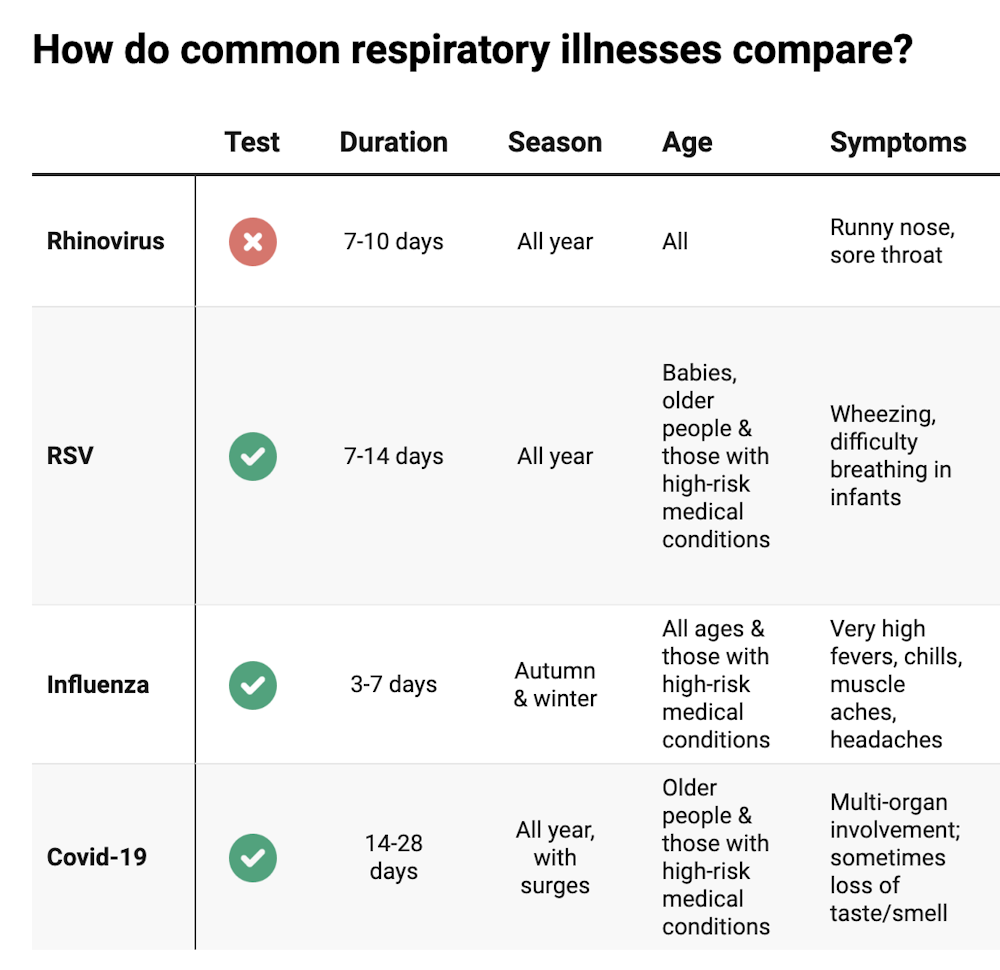
    These symptoms are likely to be caused by a virus, such as COVID, influenza, respiratory syncytial virus (RSV) or a “cold” (often caused by rhinoviruses). These conditions can occur all year round, with some overlap of symptoms:


    Natasha Yates/The Conversation

    COVID still surrounds us. RSV and influenza rates appear higher than before the COVID pandemic, but it may be due to more testing.

    So if you have a fever, sore throat, muscle aches/pains, weakness, fatigue, or are coughing up mucus, stay home and avoid mixing with others to limit transmission.

    People with COVID symptoms can take a rapid antigen test (RAT), ideally when symptoms start, then isolate until symptoms disappear. One negative RAT alone can’t rule out COVID if symptoms are still present, so test again 24–48 hours after your initial test if symptoms persist.

    You can now test yourself for COVID, RSV and influenza in a combined RAT. But again, a negative test doesn’t rule out the virus. If your symptoms continue, test again 24–48 hours after the previous test.

    If it’s hay fever, how do I treat it?

    Treatment involves blocking the body’s histamine release, by taking antihistamine medication which helps reduce the symptoms.

    Doctors, nurse practitioners and pharmacists can develop a hay fever care plan. This may include using a nasal spray containing a topical corticosteroid to help reduce the swelling inside the nose, which causes stuffiness or blockage.

    Nasal sprays need to delivered using correct technique and used over several weeks to work properly. Often these sprays can also help lessen the itchy eyes of hay fever.

    Drying bed linen and pyjamas inside during spring can lessen symptoms, as can putting a smear of Vaseline in the nostrils when going outside. Pollen sticks to the Vaseline, and gently blowing your nose later removes it.

    People with asthma should also have an asthma plan, created by their doctor or nurse practitioner, explaining how to adjust their asthma reliever and preventer medications in hay fever seasons or on allergen exposure.

    People with asthma also need to be alert for thunderstorms, where pollens can burst into tinier particles, be inhaled deeper in the lungs and cause a severe asthma attack, and even death.

    What if it’s COVID, RSV or the flu?

    Australians aged 70 and over and others with underlying health conditions who test positive for COVID are eligible for antivirals to reduce their chance of severe illness.

    Most other people with COVID, RSV and influenza will recover at home with rest, fluids and paracetamol to relieve symptoms. However some groups are at greater risk of serious illness and may require additional treatment or hospitalisation.

    For RSV, this includes premature infants, babies 12 months and younger, children under two who have other medical conditions, adults over 75, people with heart and lung conditions, or health conditions that lessens the immune system response.

    For influenza, people at higher risk of severe illness are pregnant women, Aboriginal people, people under five or over 65 years, or people with long-term medical conditions, such as kidney, heart, lung or liver disease, diabetes and decreased immunity.

    If you’re concerned about severe symptoms of COVID, RSV or influenza, consult your doctor or call 000 in an emergency.

    If your symptoms are mild but persist, and you’re not sure what’s causing them, book an appointment with your doctor or nurse practitioner. Although hay fever season is here, we need to avoid spreading other serious infectious.

    For more information, you can call the healthdirect helpline on 1800 022 222 (known as NURSE-ON-CALL in Victoria); use the online Symptom Checker; or visit healthdirect.gov.au or the Australian Society of Clinical Immunology and Allergy.

    Deryn Thompson is affiliated with Loreal, Ego Pharmaceuticals and Quality Use of Medicines Alliance having received honorariums for educational talks or advisory work.

    ref. I have a stuffy nose, how can I tell if it’s hay fever, COVID or something else? – https://theconversation.com/i-have-a-stuffy-nose-how-can-i-tell-if-its-hay-fever-covid-or-something-else-240453

    MIL OSI AnalysisEveningReport.nz

  • MIL-Evening Report: 700 million plastic bottles: we worked out how much microplastic is in Queensland’s Moreton Bay

    Source: The Conversation (Au and NZ) – By Elvis Okoffo, PhD candidate in Environmental Science, The University of Queensland

    M-Productions/Shutterstock

    When it rains heavily, plastic waste is washed off our streets into rivers, flowing out to the ocean. Most plastic is trapped in estuaries and coastal ecosystems, with a small fraction ending up offshore in the high seas.

    In the coastal ocean, waves and tides break down plastic waste into smaller and smaller bits. These micro and nanoplastics linger in the environment indefinitely, impacting the health of marine creatures from microorganisms all the way up to seabirds and whales, which mistake them for food.

    When we look at the scale of the problem of microplastics (smaller than 5mm) and nanoplastics (defined as 1 micrometer or less), we find something alarming. Our new research shows the shallow embayment of Moreton Bay, off Brisbane in Southeast Queensland now has roughly 7,000 tonnes of accumulated microplastics, the same as 700 million half-litre plastic bottles.

    This bay accumulates plastics fast, as the Brisbane River funnels the city’s waste into it, along with several other urban rivers. The research hasn’t yet been done, but we would expect similar rates of microplastics in Melbourne’s Port Phillip Bay and Sydney Harbour.

    Our research shows how much plastic waste from a big city makes it into its oceans.

    Brisbane’s Moreton Bay has mangroves and seagrass meadows as well as a port and many urban rivers.
    Ecopix/Shutterstock

    Plastic buildup in Moreton Bay

    What volume of microplastics does a large city accumulate offshore? It’s hard to measure this for cities built on open coastlines. That’s because sediments and microplastics are rapidly washed away from the original source by waves and currents.

    But Moreton Bay is different. The large sand islands, Moreton (Mugulpin) and North Stradbroke (Minjerribah) Islands largely protect the bay from the open ocean. This is why the bay is better described as an enclosed embayment. These restricted bays act as a trap for sediments and pollutants, as waves and currents have limited ability to wash them out. These bays make it possible to accurately measure a city’s microplastic build-up.

    The bay supports a range of marine habitats from mangroves, seagrass and coral reefs, as well as an internationally recognised wetland for migrating seabirds. Dugong and turtles have long grazed the seagrass in Moreton Bay’s shallow protected waters, while dolphins and whales are also present. But microplastic buildup may threaten their existence.

    Most types of plastic are denser than water, which means most microplastics in coastal seas will eventually sink to the seafloor and accumulate in sediment. Mangroves and seagrass ecosystems are particularly good at trapping sediment, which means they trap more microplastics.

    We wanted to determine whether Moreton Bay’s varying ecosystems had accumulated different amounts of plastics in the sediment.

    We measured the plastic stored in 50 samples of surface sediment (the top 10cm) from a range of different ecosystems across Moreton Bay, including mangroves, seagrass meadows and mud from the main tidal channels.

    The result? Microplastics were present in all our samples, but their concentrations varied hugely. We found no clear pattern in how plastics had built up. This suggests plastics were entering the bay from many sources.

    We tested for seven common plastics: polycarbonate (PC), polyethylene (PE), polyethylene terephthalate (PET), poly (methyl methacrylate) (PMMA), polypropylene (PP), polystyrene (PS), and polyvinyl chloride (PVC).

    Of these, the most abundant microplastic was polyethylene (PE). This plastic is widely used for single-use plastic items such as chip packets, plastic bags and plastic bottles. It’s the most commonly produced and used plastic in Australia and globally.

    In total, we estimate the bay now holds about 7,000 tonnes of microplastic in its surface sediments.

    In our follow-up paper we explored how rapidly these plastics had built up over time. We took two sediment cores from the central part of the bay, where sediment is accumulating. Cores like this act as an archive of sediment and environmental changes over time.

    The trend was clear. Before the 1970s, there were no microplastics in Moreton Bay. They began appearing over the next three decades. But from the early 2000s onwards, the rate rose exponentially. This is in line with the soaring rate of plastic production and use globally. Our analysis shows a direct link between microplastic concentration and population growth in Southeast Queensland.

    The challenge of measuring microplastics

    To date, we have had limited knowledge of how much plastic is piling up on shallow ocean floors. This is because measuring microplastics is challenging. Traditionally, we’ve used observation by microscope and a technique called absorption spectroscopy, in which we shine infrared light on samples to determine what it’s made up of. But these methods are time-consuming and can only spot plastic particles larger than 20 micrometres, meaning nanoplastics weren’t being measured.

    Our research team has been working to get better estimates of microplastic and nanoplastic using a different technique: pyrolysis-gas chromatography mass spectrometry. Here, a sample is dissolved in a solvent and then heated until it vaporises. Once in vapour form, we can determine the concentration of plastic and what types of plastics are present.

    This method can be used to estimate how much plastic pollution is present in everything from water to seafood to biosolids and wastewater.

    What’s next?

    It’s very likely microplastics are building up rapidly in other restricted bays and harbours near large cities, both in Australia and globally.

    While we might think microplastics are safe once buried in sediment, they can be consumed by organisms that live in the sediments. Currents, tides and storms can also wash them out again, where marine creatures can eat them.

    This is not a problem that will solve itself. We’ll need clear management strategies and policies to cut plastic consumption and improve waste disposal. Doing nothing means microplastics will keep building up, and up, and up.

    Elvis Okoffo receives funding from the Goodman Foundation, The Australian Academy of Science and The Australian Research Council (ARC) Training Centre for Hyphenated Analytical Separation Technologies (HyTECH).

    Alistair Grinham has received funding from state and federal government, industry and NGOs. He has an honorary role at the University and works for environmental monitoring company Fluvio.

    Ben Tscharke receives funding from the Australian Criminal Intelligence Commission and the Australian Research Council.

    Helen Bostock receives funding from the Australian Research Council.

    Kevin Thomas receives funding from the Australian Criminal Intelligence Commission, Australian Research Council, Goodman Foundation, Minderoo Foundation, National Health and Medical, Research Council, Queensland Corrective Services, Queensland Health and Research Council of Norway.

    ref. 700 million plastic bottles: we worked out how much microplastic is in Queensland’s Moreton Bay – https://theconversation.com/700-million-plastic-bottles-we-worked-out-how-much-microplastic-is-in-queenslands-moreton-bay-238892

    MIL OSI AnalysisEveningReport.nz

  • MIL-OSI USA: Warren, Markey, Massachusetts Delegation Secure Nearly $60 Million in Federal Funding to Fight the Opioid Crisis

    US Senate News:

    Source: United States Senator for Massachusetts – Elizabeth Warren
    October 07, 2024
    Funding will support efforts to mitigate the overdose crisis in Massachusetts, which has one of the highest overdose mortality rates in the country
    Boston, MA – U.S. Senators Elizabeth Warren (D-Mass.) and Ed Markey (D-Mass.), along with Representatives Katherine Clark (D-Mass.), Richard Neal (D-Mass.), Jim McGovern (D-Mass.), Stephen Lynch (D-Mass.), Bill Keating (D-Mass.), Seth Moulton (D-Mass.), Lori Trahan (D-Mass.), Ayanna Pressley (D-Mass.), and Jake Auchincloss (D-Mass.), announced the Massachusetts Department of Public Health and Mashpee Wampanoag Tribe will receive nearly $60 million in federal grants for state and tribal opioid response and prevention from the U.S. Department of Health and Human Services’ Substance Abuse and Mental Health Services Administration.
    The Substance Abuse and Mental Health Services Administration’s 2022 National Survey on Drug Use and Health revealed that over 48 million people experienced substance use disorder in the past year, but only a quarter of those in need of substance use disorder treatment services actually received them.
    “The opioid crisis is something we feel deeply across this country, especially in Massachusetts,” said Senator Warren. “Thanks to the Biden-Harris Administration’s leadership, we can provide vital resources to hard-hit communities in Massachusetts, and I’ll keep fighting for more resources that allow us to address this crisis like the public health crisis it is.”
    “The opioid crisis is indiscriminate in the impact it has on communities across Massachusetts, but the most effective solutions are driven by the communities on the frontline, living through the devastation that addiction and overdose can cause. The funding that the Massachusetts Department of Public Health and Mashpee Wampanoag Tribe will receive will fuel strategies for prevention, expanding access to treatment, and providing holistic care that puts people’s health and dignity first. In short, this funding can help save lives,” said Senator Markey.
    “The opioid epidemic has devastated families and entire communities in Massachusetts and across America,” said Democratic Whip Katherine Clark. “Under the steadfast leadership of the Biden-Harris administration, we are expanding access to treatment options for Americans struggling with substance use disorder and ensuring they receive the care they deserve. This award builds upon that progress, and I am proud to have partnered with local and state champions to bring these critical dollars back home.”
    “Every community here in Massachusetts and across our nation has been impacted by the immense grief and hardship caused by the opioid crisis. The disease of addiction is a battle that no family should have to bear alone,” said Congresswoman Lori Trahan. “Critical investments like these that support prevention and treatment programs are instrumental in expanding access to treatment, supporting recovery, and preventing tragic overdose deaths.”
    The funds will be used to address the overdose crisis in Massachusetts and in tribal communities through prevention, harm reduction, treatment, and recovery support. This includes opioid reversal drugs such as naloxone, as well as medications for opioid use disorder.
    In May 2024, Senator Warren led 86 lawmakers in reintroducing the Comprehensive Addiction Resources Emergency (CARE) Act, the most ambitious legislation in Congress to confront the substance use epidemic. Supported by tribal nations, 29 organizations, and 28 Massachusetts state elected officials, the CARE Act would provide state and local governments with $125 billion in federal funding over ten years, including nearly $1 billion per year directly to tribal governments and organizations. 

    MIL OSI USA News

  • MIL-OSI Africa: When medicines don’t work: eliminating neglected tropical diseases will reduce drug resistance – a win for all

    Source: The Conversation – Africa – By Francisca Mutapi, Professor in Global Health Infection and Immunity. and co-Director of the Global Health Academy, University of Edinburgh

    A major health challenge of our time is when drugs no longer work to treat infections. This happens when the agents that cause infections – they may be bacteria, viruses or fungi – become resistant to the drugs.

    Antimicrobials are a broad range of medications that act on microbes – like bacteria, fungi, viruses, or parasites. Antibiotics, for instance, are one type of antimicrobial working against bacteria.

    Resistance to antimicrobial drugs therefore makes it difficult to treat and prevent a wide range of infections.

    Antibiotic resistance compromises public health programmes, such as TB treatments. It can also compromise other medical interventions where treatment is needed to prevent infection, like surgery, caesarean sections or cancer treatment.

    The main causes of antimicrobial resistance are the misuse and overuse of antimicrobials in humans, animals and plants.

    Antimicrobial resistance leads to more deaths and illness in Africa compared to anywhere else. The continent recorded 21% of the global antimicrobial resistance related deaths in 2019. In that year, over 1.05 million deaths in Africa were associated with antimicrobial resistance. This poses an exceptional health threat.

    Worryingly, antimicrobial resistance related deaths are predicted to increase globally. The trend is already being observed in Africa. For example, the latest data shows that the share of E. coli infections resistant to cephalosporins (the antibiotic used to treat them) is rising.

    To change this, it’s necessary to reduce the burden of diseases that require antimicrobial treatment.

    One group of infectious diseases prevalent in Africa are the neglected tropical diseases (NTDs). There are already effective tools to prevent and even eliminate them. But every year, millions of people are infected and treated for them using antimicrobials. This increases the risk of spreading resistance.

    Having been involved in the design and implementation of large-scale neglected tropical diseases control programmes, I argue for a push to eliminate these diseases. This must be done through integrated approaches, including preventive medicine, water and sanitation, and controlling the agents that spread the diseases.

    Even countries where neglected tropical diseases are not common should make this push, as part of global health security.

    Controlling neglected tropical diseases

    Neglected tropical diseases are a group of 21 diverse conditions capable of causing long term health and economic challenges.

    They are caused by a variety of pathogens including worms, bacteria, fungi and viruses. Of these diseases, six are treated with antibiotics: buruli ulcer, leishmaniasis, leprosy, onchocerciasis, trachoma and yaws.

    Globally, millions of people with neglected tropical diseases are treated with antimicrobials every year.

    One of the most effective public health approaches for controlling neglected tropical diseases is preventative chemotherapy, which involves mass drug administration, where people are treated without diagnosis. Nonetheless, it is not sustainable, both in terms of cost and because it increases the risk of antimicrobial resistance.

    However, preventative chemotherapy is a necessary and effective tool for reducing infection and disease. Since 2012, over 600 million people have been cured of neglected tropical disease infection this way.

    An example of this is Zimbabwe’s control programme for schistosomiasis (an acute disease caused by parasitic worms), which I’ve been involved with. Preventative chemotherapy was administered to about 5 million children every year between 2012 and 2019. Infection levels were reduced from 32% to just under 2% in children aged 6-15.

    (Author provided)

    The latest World Health Organization report from 2022 indicated that just under 1.7 billion people globally required preventative chemotherapy. Of these just under 600 million are in Africa.

    Another risk for an increase in antimicrobial resistance is that the antibiotics used to treat neglected tropical diseases are also used to treat other infections. For example, azithromycin (for treating trachoma and yaws) is used also to treat other bacterial infections including bronchitis, pneumonia and sexually transmitted diseases.

    Already, of the six neglected tropical diseases that are treated with antibiotics, five have documented drug resistance. This trend will only increase.

    It’s therefore vital that neglected tropical diseases are eliminated so that fewer antibiotics and antimicrobials are used. This also protects people from other dangerous infections.

    Ready-made tools

    The good news is that the tools to eliminate neglected tropical diseases already exist.

    Within the past decade, 51 countries have eliminated at least one neglected tropical disease. Underlying these successes are the use of multiple tools, cross-sectoral strategies and sustained efforts to prevent and treat infections.

    ”>

    In the case of diseases which are transmitted by animals or insects (vectors), it’s about controlling the vector. For instance, killing the flies that transmit onchocerciasis parasites or snail hosts for schistosomiasis.

    Similarly, provision of safe water and sanitation facilities is critical for disease elimination. For example, the organisms that cause some diseases spend some stages of their life in faeces (poop). So, when faeces are poorly disposed of, they can contaminate the environment and the disease can be passed on.

    The World Health Organization has set a target of 100 countries eliminating at least one neglected tropical disease by 2030.

    This would be a massive health and economic win for countries where the diseases are prevalent.

    It will also lead to a reduction in antimicrobial use – which is a vital global health goal.

    – When medicines don’t work: eliminating neglected tropical diseases will reduce drug resistance – a win for all
    https://theconversation.com/when-medicines-dont-work-eliminating-neglected-tropical-diseases-will-reduce-drug-resistance-a-win-for-all-239658

    MIL OSI Africa

  • MIL-OSI Global: When medicines don’t work: eliminating neglected tropical diseases will reduce drug resistance – a win for all

    Source: The Conversation – Africa – By Francisca Mutapi, Professor in Global Health Infection and Immunity. and co-Director of the Global Health Academy, University of Edinburgh

    A major health challenge of our time is when drugs no longer work to treat infections. This happens when the agents that cause infections – they may be bacteria, viruses or fungi – become resistant to the drugs.

    Antimicrobials are a broad range of medications that act on microbes – like bacteria, fungi, viruses, or parasites. Antibiotics, for instance, are one type of antimicrobial working against bacteria.

    Resistance to antimicrobial drugs therefore makes it difficult to treat and prevent a wide range of infections.

    Antibiotic resistance compromises public health programmes, such as TB treatments. It can also compromise other medical interventions where treatment is needed to prevent infection, like surgery, caesarean sections or cancer treatment.

    The main causes of antimicrobial resistance are the misuse and overuse of antimicrobials in humans, animals and plants.

    Antimicrobial resistance leads to more deaths and illness in Africa compared to anywhere else. The continent recorded 21% of the global antimicrobial resistance related deaths in 2019. In that year, over 1.05 million deaths in Africa were associated with antimicrobial resistance. This poses an exceptional health threat.

    Worryingly, antimicrobial resistance related deaths are predicted to increase globally. The trend is already being observed in Africa. For example, the latest data shows that the share of E. coli infections resistant to cephalosporins (the antibiotic used to treat them) is rising.

    To change this, it’s necessary to reduce the burden of diseases that require antimicrobial treatment.

    One group of infectious diseases prevalent in Africa are the neglected tropical diseases (NTDs). There are already effective tools to prevent and even eliminate them. But every year, millions of people are infected and treated for them using antimicrobials. This increases the risk of spreading resistance.

    Having been involved in the design and implementation of large-scale neglected tropical diseases control programmes, I argue for a push to eliminate these diseases. This must be done through integrated approaches, including preventive medicine, water and sanitation, and controlling the agents that spread the diseases.

    Even countries where neglected tropical diseases are not common should make this push, as part of global health security.

    Controlling neglected tropical diseases

    Neglected tropical diseases are a group of 21 diverse conditions capable of causing long term health and economic challenges.

    They are caused by a variety of pathogens including worms, bacteria, fungi and viruses. Of these diseases, six are treated with antibiotics: buruli ulcer, leishmaniasis, leprosy, onchocerciasis, trachoma and yaws.

    Globally, millions of people with neglected tropical diseases are treated with antimicrobials every year.

    One of the most effective public health approaches for controlling neglected tropical diseases is preventative chemotherapy, which involves mass drug administration, where people are treated without diagnosis. Nonetheless, it is not sustainable, both in terms of cost and because it increases the risk of antimicrobial resistance.

    However, preventative chemotherapy is a necessary and effective tool for reducing infection and disease. Since 2012, over 600 million people have been cured of neglected tropical disease infection this way.

    An example of this is Zimbabwe’s control programme for schistosomiasis (an acute disease caused by parasitic worms), which I’ve been involved with. Preventative chemotherapy was administered to about 5 million children every year between 2012 and 2019. Infection levels were reduced from 32% to just under 2% in children aged 6-15.

    The latest World Health Organization report from 2022 indicated that just under 1.7 billion people globally required preventative chemotherapy. Of these just under 600 million are in Africa.

    Another risk for an increase in antimicrobial resistance is that the antibiotics used to treat neglected tropical diseases are also used to treat other infections. For example, azithromycin (for treating trachoma and yaws) is used also to treat other bacterial infections including bronchitis, pneumonia and sexually transmitted diseases.

    Already, of the six neglected tropical diseases that are treated with antibiotics, five have documented drug resistance. This trend will only increase.

    It’s therefore vital that neglected tropical diseases are eliminated so that fewer antibiotics and antimicrobials are used. This also protects people from other dangerous infections.

    Ready-made tools

    The good news is that the tools to eliminate neglected tropical diseases already exist.

    Within the past decade, 51 countries have eliminated at least one neglected tropical disease. Underlying these successes are the use of multiple tools, cross-sectoral strategies and sustained efforts to prevent and treat infections.

    ”>

    In the case of diseases which are transmitted by animals or insects (vectors), it’s about controlling the vector. For instance, killing the flies that transmit onchocerciasis parasites or snail hosts for schistosomiasis.

    Similarly, provision of safe water and sanitation facilities is critical for disease elimination. For example, the organisms that cause some diseases spend some stages of their life in faeces (poop). So, when faeces are poorly disposed of, they can contaminate the environment and the disease can be passed on.

    The World Health Organization has set a target of 100 countries eliminating at least one neglected tropical disease by 2030.

    This would be a massive health and economic win for countries where the diseases are prevalent.

    It will also lead to a reduction in antimicrobial use – which is a vital global health goal.

    Francisca Mutapi receives funding from the Aspen Global Innovation Programme, Scottish Funding Council funding to the University of Edinburgh, Academy of Medical Sciences, British Academy and the Royal Society.
    Francisca Mutapi is the Deputy Director of the Tackling Infections to Benefit Africa (TIBA) Partnership and Deputy Board Chair of Uniting to Combat NTDS

    ref. When medicines don’t work: eliminating neglected tropical diseases will reduce drug resistance – a win for all – https://theconversation.com/when-medicines-dont-work-eliminating-neglected-tropical-diseases-will-reduce-drug-resistance-a-win-for-all-239658

    MIL OSI – Global Reports

  • MIL-OSI Asia-Pac: Import of poultry meat and products from Trzebnica District of DolnoÅ›lÄ…skie Region in Poland suspended

    Source: Hong Kong Government special administrative region

         The Centre for Food Safety (CFS) of the Food and Environmental Hygiene Department announced today (October 8) that in view of a notification from the World Organisation for Animal Health (WOAH) about an outbreak of highly pathogenic H5N1 avian influenza in the Trzebnica District of DolnoÅ›lÄ…skie Region in Poland, the CFS has instructed the trade to suspend the import of poultry meat and products (including poultry eggs) from the area with immediate effect to protect public health in Hong Kong.

         A CFS spokesman said that according to the Census and Statistics Department, Hong Kong imported about 1 620 tonnes of frozen poultry meat from Poland in the first six months of this year.

         “The CFS has contacted the Polish authority over the issue and will closely monitor information issued by the WOAH and the relevant authorities on the avian influenza outbreak. Appropriate action will be taken in response to the development of the situation,” the spokesman said.

    MIL OSI Asia Pacific News

  • MIL-OSI Russia: “Challenges of digitalization and new university solutions”: the first forum of additional professional education will be held at the National Research University Higher School of Economics

    MILES AXLE Translation. Region: Russian Federation –

    Source: State University Higher School of Economics – State University Higher School of Economics –

    1st Moscow Forum of Continuing Education “Challenges of Digitalization and New University Solutions” will take place on November 14–16, 2024, at the HSE Cultural Center on Pokrovsky Boulevard. This event will be the largest in Russia in the field of continuing professional education (CPE). Representatives of universities, the government, and businesses will discuss current trends, advanced teaching methods, and technological solutions offered in this area.

    The program includes more than 50 events on 10 thematic tracks. The forum will also include an exhibition of digital solutions in EdTech. The participants will focus on current issues of additional education for adults. Various aspects of the digitalization of additional professional education will be discussed here: current developments and educational solutions, cases of universities and EdTech companies, research results, modern development directions and approaches to organizing additional professional education, features of business education and the development of continuous education in creative industries, IT, medicine, agriculture, etc.

    Events are organized in a variety of formats: panel discussions, TED, round tables, sections of reports, case sessions, master classes, world cafe, open mic.

    HSE experts will present the digital ecosystem of HSE’s continuing professional education and various innovative educational solutions for continuing education of adults.

    There will also be plenary sessions and thematic tracks relevant to the field of additional professional education:

    “State policy and new solutions in additional professional education”;

    “Digital transformation of DPO”;

    “Quality of DPO”;

    “Product approach and marketing in additional professional education”;

    “AI and data analysis in continuous education”;

    “Modern business education: market needs and the role of business schools”;

    “Continued Professional Education for Healthcare: Traditions and Innovations”;

    “Continued Professional Education as a Digital Educational and Industrial Environment for Design Projects and Creative Startups”;

    “DPO for agrotech”;

    “Design and organization of additional professional education programs.”

    Workshops will be organized under the advanced training program “DPO: digitalization and new educational solutions” with a choice of one of the profiles – artificial intelligence, digital transformation, marketing and pedagogical design of additional professional education programs.

    An important part of the forum will be an exhibition of digital solutions for DPO from EdTech companies, universities and corporate universities. The exhibitors are leading companies and experts in the EdTech industry, who will demonstrate digital products and services for the sphere of DPO and continuous education: modern systems for managing the educational process and developing educational content, interactive services, neural networks, CRM and BI systems, marketplaces, etc.

    Participants will have an excellent opportunity to get acquainted with in-demand EdTech projects and establish business contacts.

    In addition to the business part, the forum offers a cultural program with excursions around the HSE and networking.

    Andrey Lavrov, senior director of the National Research University Higher School of Economics:

    — Today, the development of university DPO is becoming a strategically important task given the current state of the labor market and the demographic structure of our society. The shortage of qualified personnel, the speed of technological change, the widespread use of artificial intelligence technologies — all this poses enormous challenges for universities. The Higher School of Economics, as one of the national leaders in DPO, began to look for answers to these challenges, and one of them was the digitalization of our adult education system. In a short time, we were able to create a digital ecosystem for managing all processes in DPO and we are not stopping there, we continue to develop this system. This experience, combined with serious expertise in the field of organizing the educational process, allows us to create a platform for exchanging experiences, searching for technological and optimal solutions for organizing and implementing additional education programs in universities. This is the first such large-scale event for Russian DPO, and we are confident in its relevance and practical benefits.

    Please note: This information is raw content directly from the source of the information. It is exactly what the source states and does not reflect the position of MIL-OSI or its clients.

    Please note; This information is raw content directly from the information source. It is accurate to what the source is stating and does not reflect the position of MIL-OSI or its clients.

    http://vvv.hse.ru/nevs/edu/970922927.html

    EDITOR’S NOTE: This article is a translation. Apologies should the grammar and or sentence structure not be perfect.

    MIL OSI Russia News

  • MIL-OSI New Zealand: Release: National’s deficit stories don’t hold up

    Source: New Zealand Labour Party

    Te Whatu Ora’s finances have deteriorated under the National Government, turning a surplus into a deficit, and breaking promises made to New Zealanders to pay for it.

    “Te Whatu Ora’s books reveal how much the Government has been gaslighting New Zealanders,” Labour health spokesperson Ayesha Verrall said.

    “They spun stories about growth in back office staff and layers of management to justify cuts but these documents released today don’t back those claims.

    “It is clear the cause of Health New Zealand’s deficit is underfunding, not over spending.

    “It’s what we’ve been saying all along – increased costs for nurses account for much of Te Whatu Ora’s costs.

    “National campaigned on there being a workforce crisis, and inherited a successful international recruitment campaign from Labour.

    “Both the health minister Shane Reti and the finance minister Nicola Willis became aware of nursing costs exceeding budget in March, but decisions taken in May did not address these costs. The Government’s own choices caused Health New Zealand’s structural deficit.

    “More than $500 million of Te Whatu Ora’s deficit was caused by Cabinet deciding not to transfer funds put aside for pay equity for nurses, midwives and allied health staff.

    “It’s hard to see how the Minister can say there’s no hiring freeze of frontline staff when it’s clear as day in these documents. As early as April this year, a “recruitment pause” has been in place.

    “They’ve broken multiple promises to New Zealanders about cuts not affecting frontline services, and made up a fairytale to explain why.

    “They are supposed to be providing the best health system they can, instead they’re backing out of their commitments and pretending they aren’t. New Zealanders just want to know the health system is there for them when they need it.

    “They are now cutting services and penny-pinching, blaming back office staff who keep the health system functioning.

    “Reckless tax cuts mean National can’t fund the health system we all need and rely on. It’s an absolute mess,” Ayesha Verrall said.


    Stay in the loop by signing up to our mailing list and following us on FacebookInstagram, and X.

    MIL OSI New Zealand News

  • MIL-OSI Russia: “Argonauts-2024”: more than four hundred students and schoolchildren applied to participate in the journalism competition

    MILES AXLE Translation. Region: Russian Federation –

    Source: Novosibirsk State University – Novosibirsk State University –

    All-Russian Student Journalism Competition named after Alexander Goryunov “The Argonauts” has finished accepting participants’ work. This year, 414 media projects from 34 Russian cities have applied to participate.

    The student section received 245 applications, the school section – 128. The third section, “Art Journalism,” received 40 applications. Works were accepted in several nominations at once.

    The following nominations were included in the school section: press; television journalism; radio journalism; photojournalism; multimedia project. In the student section: print; television journalism; radio journalism; photojournalism; multimedia project. In a separate nomination, “ART-journalism” named after Yulia Barmaeva, works were accepted that were made about culture and people of culture.

    — We have been holding this competition for the thirteenth year. And it is very pleasing that the number of people wishing to participate is not decreasing. For us, this means, first of all, that students and even schoolchildren are still interested in the profession of “Journalist”. We see that the children are not indifferent to the life of the country, the lives of individuals, bright personalities. I am sure that many winners of “Argonauts” will become the pride of this profession over time. We have already begun checking the submitted works. And I can say that among them there are almost no routine, template ones, — noted Olga Dmitrievna Zhuravel, Doctor of Philological Sciences, Head of direction “Journalism” at NSU.

    The winners and prize winners of the competition will receive an invitation to participate in the Argonaut School, which will be held on October 28-29, 2024, at the Boiling Point – Novosibirsk and NSU. This event will become a platform for exchanging experiences, gaining new knowledge and skills. The School will end with awarding the winners of the competition.

    — I participated in the Argonauts when I was still in school. I applied in the Press nomination, Interview sub-nomination and took third place with my work on the topic of animal protection. I was awarded a certificate of honor, which I was later able to attach to my creative portfolio when applying for the Journalism program at NSU. This year, I applied for the second time, only in the student section. It included my video stories about the Kronotsky State Nature Reserve, which I shot during my summer internship. In the Multimedia Project nomination, my team and I submitted our collective work with a longread about children’s camps. Based on the results of the competition, I want to see how modern trends in journalism have changed since my school days, what current schoolchildren are doing, how this can be compared with what was before, see how students are now performing and what they focus on in their work, – shared her thoughts about this year’s competition fourth-year student of the Journalism program at NSU Elizaveta Elster.

    Please note: This information is raw content directly from the source of the information. It is exactly what the source states and does not reflect the position of MIL-OSI or its clients.

    Please note; This information is raw content directly from the information source. It is accurate to what the source is stating and does not reflect the position of MIL-OSI or its clients.

    http://www.nsu.ru/n/media/nevs/education/argonauts-2024-more than-four-hundred-students-and-schoolchildren-applied-for-participation-in-journalism/

    EDITOR’S NOTE: This article is a translation. Apologies should the grammar and or sentence structure not be perfect.

    MIL OSI Russia News

  • MIL-OSI United Kingdom: Free flu vaccinations available to 2 and 3 year olds

    Source: City of Wolverhampton

    As in previous years, they are being delivered via GP surgeries. Parents or guardians who have not yet received a letter or text from their GP inviting them for a vaccination are encouraged to contact their surgery as soon as possible to arrange an appointment.

    For the majority of children, the vaccination will be given via a nasal spray, not a needle. For children who require a pork gelatine free alternative, or who are unable to have the nasal spray for medical reasons, an injectable vaccination is available on request.

    John Denley, Wolverhampton’s Director of Public Health, said: “Flu can be deadly and is easily spread by children and adults.

    “The free vaccine is the best way to protect your children and other family members, particularly more vulnerable relatives like grandparents or those with underlying health conditions, from becoming ill because of flu.”

    Meanwhile, free flu vaccinations are being offered to children in local schools again this autumn. This year, all children from Reception to Year 11 are eligible for the vaccination and, as is the case for 2 and 3 year olds, the majority of pupils will receive the nasal spray, with an injectable vaccination is available.

    Children who are home educated are also eligible and will be able to book an appointment at upcoming community catch up clinics from the end of October in various locations around Wolverhampton and the Black Country. For details, please call Vaccination UK on 01902 200077.

    To find out more about the flu vaccine for children, read the answers to frequently asked questions and enjoy the 4 exciting Flu Fighters stories for children, Flu Fighters Versus Chilly, Achy and Snotty, Flu Fighters in The Battle of Planet Bogey, Flu Fighters in Close Encounters of the Germed Kind and Flu Fighters on a Vacc-tastic Voyage, please visit Flu.

    MIL OSI United Kingdom

  • MIL-OSI USA: FACT SHEET: Biden-⁠ Harris Administration Announces Over 250 Organizations Made Voluntary Commitments to White  House Challenge to Save Lives from  Overdose

    US Senate News:

    Source: The White House
    Today, the Biden-Harris Administration is announcing that over 250 organizations, businesses, and stakeholders across the country have made voluntary commitments to the White House Challenge to Save Lives from Overdose.
    The Challenge, launched earlier this year, is a nationwide call-to-action to stakeholders across all sectors to increase training on, and access to, life-saving opioid overdose reversal medications like naloxone. The voluntary commitments highlighted today build on progress made under President Biden and Vice President Harris’s Unity Agenda, which calls on all Americans, in red states, blue states¸ and everywhere in between, to come together and help address the nation’s overdose epidemic.
    Under President Biden and Vice President Harris’s leadership, the Biden-Harris Administration has taken historic action and made unprecedented investments to reduce overdose deaths. The Administration removed decades-long barriers to treatment for substance use disorder and expanded access to life-saving overdose reversal medications like naloxone.  The Administration also acted to make naloxone available over-the-counter at groceries and pharmacies for the first time in history. Today, the nation is now seeing the largest decrease in overdose deaths on record.
    The White House received commitments to the Challenge from private and public entities, spanning entertainment and hospitality, professional sports leagues, health care providers, trade associations, schools and universities, technology companies, transportation partners, faith groups, private businesses, and more. A number of organizations and businesses made new voluntary commitments as part of the White House Challenge to Save Lives from Overdose, including:
    Amazon is equipping its North American operations facilities with naloxone and bolstering its emergency response procedures with comprehensive training for employees on how to recognize signs of an opioid overdose and properly administer naloxone. Amazon is rolling out its naloxone program in two phases, starting with its most densely populated fulfillment centers. By early 2025, the program will expand to all of Amazon’s operations sites in the U.S., covering over 500,000 employees at hundreds of sites nationwide.
    American Federation of State, County and Municipal Employees (AFSCME) commits to train its members and staff on proper use of opioid overdose reversal medications. They also commit to including opioid overdose medications in all first aid kits.
    The Association of Flight Attendants-CWA (AFA) is working with the Federal Aviation Administration (FAA) to implement naloxone on flights, including trainings. They previously worked with the FAA to require that Emergency Medical Kits (EMK) carried by passenger airlines include naloxone.
    Atlanta Public Schools (APS) is implementing a district-wide training available to all school staff to recognize and reverse overdose. Currently, 136 APS health and security personnel have completed naloxone training. APS stocks naloxone in every elementary, middle, and high school in the district, serving nearly 50,000 students and 8,000 employees, and has opioid educational posters and brochures to increase school community awareness.
    Butler University formed the Butler Overdose Action Team, comprised of faculty, staff, and student leaders, in response to the White House Challenge to Save Lives from Overdose. The team is leading campus-wide initiatives to increase awareness, training, and access to lifesaving opioid overdose reversal medication, and collaborating with local health organizations in Indianapolis to promote education on opioid use disorder on campus. Butler also recently placed naloxone in all 58 Emergency Kits across campus, and plans are underway for comprehensive naloxone training for students and employees.
    Charleston County School District (CCSD) commits to working with their community and local substance use agencies to provide educational programs on and promote the use of opioid overdose reversal medications (OORM). CCSD’s substance use program commits to educate students, staff, and parents/caregivers about the dangers of illicit fentanyl and how OORM can save lives. In addition, CCSD works closely with district nursing staff on the use and availability of OORM in CCSD’s 83 schools that serve approximately 49,000 students.
    The Dallas Area Rapid Transit Police Department commits to train and equip all of its Police Officers with naloxone. The Department supports a regional transit agency in the Dallas/Fort Worth metroplex, covering six counties and thirteen cities.
    Deloitte LLP will equip U.S.-based Deloitte Offices with naloxone by December 2024. Naloxone will be placed in Automated External Defibrillator (AED) cabinets at its offices across the U.S. Further, Deloitte will train select office personnel to recognize and help treat overdose.
    Keystone Contractors Association (KCA) is recommending to its members that every construction jobsite and contractor’s office have naloxone available on-site. This builds upon KCA’s work in prior years in launching the Pennsylvania Construction Opioid Awareness Week to get resources and training to construction employers to provide to their workers.
    Laborers International Union of North America (LIUNA) commits to reach its 500,000+ members, their families, and LIUNA affiliates with education on the importance of naloxone on jobsites, training on how to use the medication, and information on where and how to get it. This work is in addition to developing and promoting comprehensive safety and health information on opioid use.
    The National Hockey League (NHL) commits to working with its clubs and staff to make life-saving medication readily available across NHL offices and in arenas. NHL is helping clubs make naloxone available at home games with their first aid units, and ensuring on-site personnel are trained to administer it on game nights. NHL is also advising clubs to include naloxone in their travel medical kits, and encouraging its availability in the visiting team’s emergency bags.
    San Diego Metropolitan Transit System (SDMTS) now trains every newly hired Code Compliance Inspector (CCI) from the Transit Security and Passenger Safety Department in the recognition of opioid overdose and issues naloxone as required equipment for staff. In 2024, CCIs administered naloxone nearly 200 times, and the SDMTS Bus Division Road Supervisors also started carrying naloxone. SDMTS started training CCIs to carry and administer naloxone in July 2021 in response to the overdose crisis.
    Commitments from these entities build upon steps taken in recent years by other organizations that joined the White House Challenge to Save Lives from Overdose to address the overdose epidemic. Examples of these actions from organizations include:
    American Heart Association and Opioid Response Network are partnering on the EmPOWERED to End Opioid Misuse and Stimulant Use Disorder Initiative that aims to address opioid and stimulant usage within Black and Hispanic communities. They have partnered with Black and Hispanic churches to implement community trainings and disseminate educational tools to facilitate open and honest conversations with a wide range of people on the stigmatization of people experiencing opioid and substance use disorders.
    International Union of Painters & Allied Trades (IUPAT) District Council 35 prioritizes support for and awareness of mental health and substance use, and provides overdose education and training on naloxone to its members and apprentices. IUPAT also distributes naloxone to its members, apprentices, and jobsites. IUPAT is part of a broader effort by the Massachusetts Building Trades Recovery Council, which has distributed more than 11,000 doses of naloxone to 14 building trades unions across Massachusetts for distribution to their membership. The Recovery Council receives naloxone from Massachusetts’ Bureau of Substance Abuse Services’ Community Naloxone Program.
    The Jacksonville Transportation Authority (JTA) in Florida has developed overdose rescue training for operations, safety, and security staff, and implemented a ‘bus marshal’ program, where naloxone-equipped security officers ride strategically-targeted routes. This led to saving the life of a bus passenger who was experiencing overdose. JTA also launched ‘Safety on the Move’, delivering free overdose prevention and rescue training and naloxone kits to at-risk communities in partnership with Drug Free Duval, Community Coalition Alliance, Centers for Disease Control and Prevention (CDC) Foundation, and North Florida High Intensity Drug Trafficking Area (HIDTA) Overdose Response Strategy.
    The North Carolina Council of Churches (NCCC) hosts a Partners in Health and Wholeness initiative that works to bridge the issues of faith, health, and justice. This includes the Overdose Response program that offers opioid workshops to faith communities that seek to learn more about the opioid crisis and how they can help with response, and incorporates naloxone distribution upon request. They also received grant funding to provide local churches with resources for opioid-related initiatives for their members. 
    The Restaurant Association Metropolitan Washington (RAMW) has more than 1,400 businesses in its membership, including restaurants, food and hospitality vendors, and allied businesses that work within the food industry in DC, Northern Virginia, and Suburban Maryland. RAMW began partnering with the DC Department of Behavioral Health (DBH) to provide overdose education and naloxone distribution to restaurants in DC, including large trainings for business improvement districts. Restaurants can order a kit to receive by mail from RAMW’s website.
    The San Francisco Entertainment Commission is partnering with the San Francisco Department of Public Health to raise awareness about the presence of illicit fentanyl at and around nightlife spaces, and increase the entertainment industry’s access to life-saving naloxone. To date, they have led in-person trainings for staff at 18 nightlife businesses in San Francisco, distributed 300+ doses of naloxone at outreach events, and reached approximately 900 nightlife attendees through on-stage overdose prevention trainings before performances and other events.
    This Must Be the Place is a nonprofit providing free naloxone to attendees at music venues and festivals across the country. They committed to passing out over 60,000 free kits of naloxone at places like Lollapalooza, Bonnaroo, Austin City Limits, and Dreamville. Seventy percent of the population they reach are receiving naloxone for the first time.
    United Airlines equips each of its enhanced medical kits on every aircraft and station across the network with opioid overdose reversal medications. All of United’s 28,000+ flight attendants are annually trained in the proper use of these life-saving medications. Over the past five years, United has purchased nearly 1,200 units annually, ensuring greater safety for both passengers and crew, including flight attendants and pilots.
    The University of Rhode Island (URI), through its Cooperative Extension program, established the Community First Responder Program (CFRP). CFRP provides more than 50,000 kits annually. CFRP offers in-person and online educational trainings for the public at schools and town halls, and to healthcare providers, first responders, police, and more. They also distribute naloxone and safer-use kits at events in partnership with CVS Health and the U.S. Postal Service. CFRP has expanded services to rural regions of five other New England states through a grant from the Substance Abuse and Mental Health Services Administration (SAMHSA). CFRP is expanding its regional rural overdose education via collaborations with New Hampshire Cooperative Extension, Husson University School of Pharmacy (Maine), University of Maine Cooperative Extension, Western New England University College of Pharmacy (Massachusetts), and University of Vermont Cooperative Extension. As naloxone is often inaccessible to New England’s rural regions, CFRP offers to mail no-cost naloxone to participants completing its online interactive module, “Become a Community First Responder.”
    Additional voluntary commitments can be found here.
    In support of President Biden and Vice President Harris’ whole-of-government approach to address the overdose epidemic, federal agencies are working to help expand access to life-saving opioid overdose reversal medications like naloxone and save even more lives. These efforts also align with updated Guidelines for Safety Station Programs in Federal Facilitiesreleased in December 2023:
    The United States Department of Agriculture (USDA) has authorized first responders in its Office of Safety, Security and Personnel and throughout the U.S. Forest Service who are equipped and trained in the administration of opioid overdose reversal medications (OORM).  Additionally, USDA’s Center for Faith-Based and Neighborhood Partnerships has provided OORM trainings to over 40 community partners across 15 states as part of its Rural and Farming Communities Mental Health and Suicide Prevention work. USDA remains committed to continuing and expanding the reach of these trainings.
    The Department of Commerce‘s Office of Export Enforcement (OEE) is training Special Agents in the use of opioid overdose reversal medications (OORM) in October 2024, allowing OEE Special Agents to safely and effectively deploy them. OEE will have OORM accessible during all preplanned enforcement operations by January 2025. 
    The Department of Defense (DoD) is committed to opioid safety and prevention of overdose. To strengthen DoD’s emergency response protocols, naloxone is available across installations in the Continental United States and training programs have been expanded, ensuring first responders are equipped and trained. The DoD remains committed to the safety and prevention of overdose by continuing its efforts to provide naloxone access to DoD first responders and investigators and to provide associated trainings beyond DoD first responders.
    The U.S. Department of Health & Human Services (HHS) is increasing training on and access to naloxone. The Indian Health Service (IHS) now mandates annual overdose response training for all IHS employees, contractors, students, and volunteers. Further, before 2025, naloxone training and a guide on procuring naloxone (i.e., using state standing orders, city and county public health departments, etc.) will be available to all U.S. Public Health Service Commissioned Corps officers, and naloxone will be available in safety stations at all HHS regional offices. Substance Abuse and Mental Health Services Administration (SAMHSA), in partnership with the Program Support Center (PSC) and the Office of the Assistant Secretary of Health (OASH), will equip all AED stations in its headquarters with naloxone, and SAMHSA hosted an annual naloxone training for all staff as part of its International Overdose Awareness Day recognition. Additionally, naloxone training will be added to the HHS Learning Management System available to all HHS personnel, including volunteer Federal Civilian Responders.
    The Department of Homeland Security (DHS) issued, and recently updated, a policy regarding the Administration of Naloxone by Non-Healthcare Providers. This policy directs DHS agencies and offices to identify their workforce populations at higher risk of exposure and develop a program to equip them with both naloxone and the training to use it.  The DHS Office of Health Security (OHS) developed virtual and in-person training modules that DHS agencies and offices can use to train their non-healthcare providers or as the basis for developing their own workforce-specific training. DHS continues to work to operationalize formal programs that equip non-healthcare providers with Component-procured naloxone.
    The Department of the Interior (DOI) has issued guidance on the training, carrying, and use of naloxone by DOI employees who may come into contact with persons suspected of opioid overdose during their normal course of duties. The guidance allows critical first responders – including emergency medical responders and emergency medical technicians (EMR/EMT), firefighter EMTs, and law enforcement officers – to have access to opioid overdose reversal medications at various sites nationwide, including national parks and tribal lands. As DOI components continue to conduct risk assessments to identify high-risk areas and appropriate personnel to be trained, the Department is poised to implement vital resources efficiently to preserve life and protect the public.
    The Department of Justice (DOJ) has enacted policies so employees most likely to encounter overdose victims have access to opioid overdose reversal medications (OORM) and the training to safely and effectively deploy them. Pursuant to these policies, its law enforcement agencies – Bureau of Alcohol, Tobacco, Firearms, and Explosives (ATF), Drug Enforcement Administration (DEA), Federal Bureau of Investigation (FBI), and U.S. Marshals Service – will have OORM accessible during all preplanned enforcement operations; all Federal Bureau of Prisons staff at all sites will have access to OORM 24 hours a day; and all DOJ public-facing facilities and law enforcement facilities will have safety stations equipped with OORM.
    The United States Postal Service (USPS) has trained 59,000 employees in 1,318 facilities in U.S. counties facing high numbers of overdose deaths in response to the White House Challenge to Save Lives from Overdose. Also, USPS has procured and distributed naloxone to first aid kits in these facilities. As the USPS continues it communication activities on overdose prevention, it expects to reach over 500,000 employees, many of whom have public-facing roles as part of the Postal Service’s ubiquitous footprint across the United States. 
    The Department of Veterans Affairs (VA) is working to make training available to all employees by December 2024 and will develop and issue a policy statement to support naloxone implementation by March 2025. VA also pledges to ensure opioid overdose reversal medications are available in all high-risk Veterans Health Administration health care areas, including at VA Medical Centers and outpatient clinics, and in all Vet Centers by the end of 2025.
    Read more on the White House Challenge to Save Lives from Overdose HERE.
    Read more on the Biden-Harris Administration actions to address the overdose epidemic HERE.

    MIL OSI USA News

  • MIL-OSI USA: FACT SHEET: Biden-⁠ Harris Administration Holds Workforce Hub Convening in Milwaukee, Announces Commitments to Expand Pathways into Good-Paying  Jobs

    US Senate News:

    Source: The White House
    Today, President Biden announced new actions from his Investing in America agenda to connect Milwaukee, Wisconsin residents to good-paying jobs, including replacing lead pipes and upgrading infrastructure through the Milwaukee Workforce Hub. The city’s Hub is one of nine Investing in America Workforce Hubs launched by the Biden-Harris Administration to ensure all Americans —including women, people of color, veterans, and other that have been historically left behind–have access to job opportunities, and the training needed to fill them. This announcement comes during President Biden’s visit to Milwaukee, where he announced EPA’s final rule to replace lead pipes within a decade and announced $2.6 billion in new funding to deliver clean drinking water nationwide. Thanks to funding from President Biden’s Bipartisan Infrastructure Law, infrastructure projects totaling nearly $100 million are in the works across the City of Milwaukee. As part of these investments, the city has begun replacing 100 percent of its lead service lines, reducing the timeline for replacement from 60 years to 10 years in alignment with the President’s goal. The Biden-Harris Administration will create thousands of jobs for Milwaukee residents through these investments, and will continue to collaborate with local organizations, ensuring the city is training the skilled workers needed to accomplish these projects. The City of Milwaukee and the Milwaukee Metropolitan Sewerage District are leading the charge in creating workforce opportunities for the community. Today, collaborators in the Milwaukee Workforce Hub are announcing commitments that will expand pathways into these good-paying jobs to meet the President’s goal. Scaling Up and Expanding Apprenticeships Registered apprenticeships are the gold-standard model for training a new generation of workers in the skilled trades and provide pathways to high-quality jobs for women and other historically underrepresented groups. Since taking office, the Biden-Harris Administration has invested more than $730 million to expand Registered Apprenticeships and pre-apprenticeships nationwide, leading to the hiring of more than 1 million apprentices. In Milwaukee, local organizations are taking steps to use more apprentices on public projects and prioritize graduates of local pre-apprenticeship programs which serve underrepresented populations. These steps build on the city’s existing program, which puts residents on a path to a journey-level position in a skilled trade.    In total, these actions will create opportunities for hundreds of new apprentices and help to grow certified pre-apprenticeship programs serving underrepresented populations, including high school students from Milwaukee Public Schools. These opportunities include:
    The City of Milwaukee’s Department of Public Works and Milwaukee Water Works will run a pilot from 2025 to 2027 and require that 10 percent of all labor hours within each craft go to apprentices—half of whom must come from certified pre-apprenticeship programs that serve residents of Milwaukee who are currently underrepresented in apprenticeships. The new requirement would apply to multiple major road construction bids totaling $102 million, including a $36 million Reconnecting Communities project to reconnect communities divided by a road that prioritizes vehicle traffic over bikers and pedestrians, and a $24.3 million RAISE project to make complete streets improvements along one and a half miles of Villard Ave, including raised bike lanes, signal improvements, and curb extensions. The pilot will apply to all contracts replacing at least 300 lead service lines, creating 175 apprentice jobs and covering an estimated $82 million of lead service line replacement funding from President Biden’s Bipartisan Infrastructure Law.
    Milwaukee Metropolitan Sewerage District (MMSD) will also change their procurement policies to require apprenticeships for all crafts working on all their projects, helping to bring new workers into specialized crafts like pipefitting and operating engineers. For 2025, this policy would apply to construction bids totaling approximately $90 million for the reclamation facilities, the conveyance system, and flood management projects. This policy is estimated to create at least 80 apprentice jobs, 40 percent of whom will be required to come from certified pre-apprentice programs serving traditionally-underrepresented residents of Milwaukee.  
    The Wisconsin Department of Transportation (WisDOT) continues its efforts to develop a local workforce to build state highways. Currently, WisDOT has implemented a Federal Highway Administration pilot on a $65 million freeway project which sets incentives for local residency workforce and apprentice requirements as part of federally funded highway projects. The department will consider the use of the special provisions in future projects to grow this effort in the Milwaukee area.
    Milwaukee area unions and postsecondary providers have committed to increase their apprenticeship classes as demand for apprentices on public contracts increases—projecting to increase classes by at least 200 apprentices. Specific union level increases include 50 new apprentices from the Laborers’ International Union of North America, 70 from the International Association of Bridge, Structural, Ornamental and Reinforcing Iron Workers, 75 from the United Brotherhood of Carpenters and Joiners of America, and 20 from International Brotherhood of Electrical Workers.
    The City of Milwaukee’s Environmental Collaboration Office will also implement a Community Benefits Agreement as it builds a new public Electric Vehicle (EV) charging network in the city through a nearly $15 million federal grant from US Department of Transportation. This Community Benefits Agreement will require electrician apprentices on each EV charging installation and include local hire requirements consistent with the City of Milwaukee’s Resident Preference Program.  At least 40 percent of the chargers will be put in historically disadvantaged communities.
    Expanding Pipelines into Apprenticeship
    These expanded registered apprenticeship slots will create new opportunities for hundreds of workers in the Milwaukee area. The Milwaukee Workforce Hub will work to ensure every resident has access to these opportunities, by investing in pre-apprenticeship programs that offer disadvantaged communities a chance to develop the skills and work experience needed to succeed in these apprenticeships. As a result of the Milwaukee Workforce Hub, dedicated funding for pre-apprenticeships in the area will grow by at least $650,000.
    The Wisconsin Regional Training Partnership/Building Industry Group & Skilled Trades Employment Program (WRTP | BIG STEP) currently serves 1,000 individuals every year and has been a leader in the Milwaukee construction sector for decades. In the coming months and years, WRTP | BIG STEP will lead the workforce hub’s construction sector coordination and job training, convening industry partners to develop workforce programs that provide Milwaukee residents access to good-paying and union job in the skilled trades. New investments include:
    MMSD will invest $350,000 in WRTP | BIG STEP for certified pre-apprenticeship programs, including transportation assistance, stipends while participants are in training, and on-going placement and retention for first-year apprentices.
    Employ Milwaukee and philanthropic organizations will invest up to $400,000 in additional funding for WRTP | BIG STEP, including capacity building to increase participation in apprenticeship-readiness initiatives. Employ Milwaukee, the workforce board for Milwaukee, will use formula funds from the U.S. Department of Labor to support innovative customized training cohorts in to meet the needs of the local construction industry with a goal of training 60-80 workers.
    Unions in the Milwaukee region will expand their investment in WRTP | BIG STEP. Unions have been investing about $625,000 per year in this pre-apprenticeship program, which trained over 1,000 people in 2023. Over the next two years, regional trades are striving to increase their investments in WRTP | BIG STEP to at least 3 cents per hour of member work on regional mega projects, including a $3.3 billion data center being built by Microsoft in Southeast Wisconsin. Unions will also partner with Milwaukee Public Schools to prepare students for pre-apprenticeship programs.
    Providing Supportive Services
    The Milwaukee Workforce Hub will also support residents as they begin working in these growing fields, by helping residents with supportive services, including career navigation services and stipends. These investments will help ensure that workers have the resources and skills they need for continued success in the industry.
    The Wisconsin Department of Transportation will invest $507,000 in workforce development through the Highway Construction Skills Training (HCST) program. WRTP | BIG STEP receives $143,800 in funding from WisDOT to run HCST. This year, WisDOT used grant funding from US DOT to lead a pilot to expand stipends and supportive services for job training participants in HCST. Lessons learned from the pilot, will be used to look at where stipends and higher supportive services help increase graduates in the program. 
    MMSD is partnering with Employ Milwaukee and Milwaukee Community Services Corps to provide career navigation services and paid work experience for 64 participants in water sector careers with $1 million from the U.S. Department of Labor. The funding also supports the development of water industry career pathways and competency maps in partnership with the Council for Adult & Experiential Learning.
    Additional Federal Support for Workforce Development
    In addition to commitments from partners, the Biden-Harris Administration is making millions in direct investments in Milwaukee to support job training and upskilling to meet the need for these historic investments.
    EPA’s Great Lakes Restoration Initiative will incorporate key workforce development and labor best practices into the estimated $320 million in Bipartisan Infrastructure Law and other funding to clean up the Milwaukee Estuary Area of Concern. EPA will, for the first time, incorporate Project Labor Agreements into contract task orders with an estimated $275 million in Bipartisan Infrastructure Law funding. This initiative will support local and regional jobs cleaning up contaminated sediments in the Milwaukee Estuary Area of Concern. In addition, EPA is collaborating with local organizations to support local workforce development as part of the estimated $45 million in activities to restore important habitats across Milwaukee.
    The City of Milwaukee Water Works is partnering with Employ Milwaukee to upskill at least 60 city of Milwaukee workers in occupations to support the replacement of lead service lines. Employ Milwaukee is using $500,000 from the U.S. Department of Labor Community Project Funding to fund this partnership.
    Employ Milwaukee also received a $5 million Building Pathways to Infrastructure Grant from the U.S. Department of Labor that will prepare more than 480 unemployed and underemployed individuals for high-demand infrastructure jobs, including advanced manufacturing, information technology, and professional, scientific, and technical service occupations that support the growing sectors of renewable energy, transportation, and broadband infrastructure. Over $900,000 from this grant is going to the Milwaukee Area Technical College to assist underrepresented populations in accessing academic and non-academic support to enter civil engineering and drafting occupations that will support transportation and water investments from the Biden-Harris Administration. Other partners in the grant include Waukesha Area Technical College, Wisconsin Department of Workforce Development Bureau of Apprenticeship Standards, WOW Workforce Board, MKE Tech Hub, City of Milwaukee, and a variety of employers.
    The City of Milwaukee is investing more than $25 million in American Rescue Plan (ARP) funding to remediate lead paint. To help meet that demand, the City provided $3 million for Employ Milwaukee’s Healthy Homes Construction Careers Program, which is designed to connect trained workers with lead abatement certifications to contractors who are paid by the City of Milwaukee Health Department to remediate high lead risk homes. The training is free to the student, including the cost of training, certification, exam fees, stipends, incentives, and wages during work experience. To date, 344 workers had been enrolled in training so far.
    The Wisconsin Biohealth Tech Hub received nearly $50 million through President Biden’s CHIPS and Science Act to establish the region as a leader in personalized medicine. Biden-Harris Administration funding for the Wisconsin Tech Hub will create inclusive talent pipelines that can help develop and deploy cutting edge medical technologies; addressing workforce challenges that often face new industries.

    MIL OSI USA News

  • MIL-OSI United Kingdom: Don’t forget to check this Breast Cancer Awareness Month

    Source: City of Wolverhampton

    Statistics show that around 1 in 7 women in the UK will be diagnosed with breast cancer at some point in their lives, making it the most common cancer in the UK. It leads to around 11,500 deaths each year – but the NHS breast screening programme is helping to reduce breast cancer mortality by around 20% in women who are regularly screened.

    Anyone registered with a GP as female will be invited for NHS breast screening every 3 years between the ages of 50 and 71. Those over 71 can request screening. If you have not been invited for breast screening by the time you are 53 but think you should have been, please contact the Dudley, Wolverhampton and South West Staffordshire Breast Screening Service – for more details, visit NHS Breast Screening Programme.

    As well as screening, the NHS recommends that people check their breasts once a month. This will help with what is normal for your body therefore it will be easier to detect any changes that may need further examination from a health professional.

    Key symptoms that you should be looking or feeling for include a lump or swelling in your breast, chest or armpit, any changes to the skin of your breast, a change in size or shape, nipple discharge if you’re not pregnant or breastfeeding, a change in the shape or look of how your nipple usually looks, including a rash on it, or sores or ulcers on your chest.

    Some of these symptoms are very common and can be caused by other conditions, but if you do notice anything unusual, make an appointment with your GP as soon as possible.

    For help, visit Check your breasts. You can also sign up to a monthly text reminder to check with Breast Cancer UK.

    John Denley, Wolverhampton’s Director of Public Health, said: “Cancer screening and routinely checking your breasts for any changes is essential for early detection, which is critical in improving treatment outcomes and survival rates.

    “Early stage cancers are often more treatable and have a better prognosis than those detected at a later stage, and almost all women diagnosed with breast cancer at the earliest possible stage in England survive their disease for at least 5 years after diagnosis.

    “Screening can also identify precancerous conditions that can be treated before they develop into cancer, further reducing the risk of cancer development. By catching cancer early, screening programmes can reduce the overall burden of cancer, decrease healthcare costs, and improve the quality of life for patients.”

    For more information about breast cancer in women please visit Breast cancer in women.

    Though rare, men can also get breast cancer – for more information, please visit Breast cancer in men.  

    For more information, resources and support, visit Cancer Research UK

    MIL OSI United Kingdom

  • MIL-OSI United Kingdom: New restrictions to limit impact of Ips typographus tree pest

    Source: United Kingdom – Executive Government Non-Ministerial Departments

    Spruce tree planting prohibited in parts of East Anglia and South East England

    Planting of spruce trees in parts of East Anglia and South East England is to be restricted as part of additional new measures announced by the Forestry Commission today (Tuesday 8 October) following further findings this season of Ips typographus, also known as the eight-toothed spruce bark beetle.

    A new spruce tree planting restriction is coming into force in the restricted area, known as the Demarcated Area (DMA). Landowners, businesses and land managers are urged to comply with new requirements and stay vigilant to protect against Ips typographus. Planting spruce trees for ornamental and scientific purposes, growing on nursery sites for trade, or the planting of Christmas trees, will be permitted in specific circumstances detailed in the notice. Christmas tree growers in the affected area can continue to grow an unlimited number of spruce trees up to three metres in height above the root collar before authorisation is required.

    The new restrictions come after further findings this year, including the first UK finding of Ips typographus on Sitka spruce in July, and are part of the continued action being taken to limit the spread of the beetle and protect our nation’s trees, forestry and timber industries.

    Ips typographus is a serious pest of spruce trees in Europe and was first identified in the UK in 2018. These incursions are occurring in England as the beetle is blown over from the continent. The pest prefers stressed or dying trees but, under the right conditions, it can attack healthy trees.

    The new requirements come into force on 29 October across the existing DMA in the South East of England and East Anglia prohibiting the planting of spruce trees (Picea A.Dietr). Areas affected include parts of Lincolnshire, Bedfordshire, Cambridgeshire, Norfolk, Suffolk, Hampshire, Berkshire, Buckinghamshire, Hertfordshire, Surrey, Greater London, Sussex, Kent and Essex.

    Forestry Commission Head of Plant Health Forestry Andrea Deol said:

    Ips typographus can have a serious impact on spruce trees, and so restricting spruce planting in some areas of East and South East England ahead of the tree-planting season will help with our ongoing eradication efforts.

    All landowners, managers and timber processors are encouraged to remain vigilant and report any sightings of the pest via our Tree Alert Portal.

    Defra Chief Plant Health Officer Professor Nicola Spence said:

    Pest and pathogens present a great risk for our biosecurity and, in particular, Ips typographus has the potential to cause significant damage to Great Britain’s forestry and timber industries.

    These new restrictions are part of continued action to limit the spread of the beetle and protect our nation’s trees and forest industries. All landowners and land managers should check the health of spruce trees on their land and take swift action to deal with any susceptible material.

    Existing restrictions remain in place to limit the spread of the pest through timber movement, by requiring pre-notification and authorisation by the Forestry Commission of any felling and movement of susceptible material within the DMA.

    It is important for landowners to continue to check the health of spruce trees on their land, identifying stressed, fallen, and snapped trees, and taking action to remove them and any surrounding susceptible material. Replacement with non-susceptible tree species is also encouraged to limit the possibility of populations of Ips typographus establishing and to prevent spread to other areas.

    Under the notice, exemptions are available for lower risk scenarios, such as trees grown at nurseries, for ornamental or scientific purposes and for the purpose of trade in large Christmas trees.

    Any sightings should be reported to the Forestry Commission via the TreeAlert online portal. Read the full guidance on the new requirements.

    Additional information:

    A video is available explaining the threat of Ips typographus on spruce trees in the UK, with advice on how woodland owners can help reduce the risk from this pest:

    Watch the video.

    Updates to this page

    Published 8 October 2024

    MIL OSI United Kingdom

  • MIL-OSI Security: New Navy Medicine command to enhance expeditionary medical training, readiness

    Source: United States Navy (Medical)

    Navy Medicine celebrated a pivotal moment in its expeditionary mission with the official establishment of a new command and renamed Naval Expeditionary Medical Training Institute (NEMTI) to the Naval Expeditionary Medicine Warfighter Development Center (NEMWDC) during a ceremony at Camp Pendleton, Calif., Oct. 4.

    The command establishment signified a strategic shift in Navy Medicine’s approach to combat trauma readiness and operational medical support.

    “This transformation represents more than a change in name; it marks the continued evolution of Navy Medicine’s mission to support the warfighter, strengthen our operational capabilities, and provide unmatched medical expertise both in garrison and in forward-deployed locations,” said Rear Adm. Guido Valdes, Naval Medical Forces Pacific (NMFP) commander.

    The ceremony also marked NEMWDC’s organizational realignment from Navy Medicine Operational Training Command (NMOTC) to NMFP as an echelon 4 command, gaining more resources, capacity, and a broader and more dynamic role in bolstering Navy Medicine’s ability to support the warfighters.

    NEMWDC will serve as a center of excellence for unit level training for medical capabilities, enhancing combat trauma skills and certifying expeditionary medical platforms for future operations. This new command aligns with Navy Medicine’s “North Star,” ensuring that by 2027, the force will deliver trained and certified medical units capable of supporting the Fleet, Fleet Marine Force, and Joint Forces in any environment.

    “The impact of this change will resonate across Navy Medicine and serve to amplify our role in ensuring that medical forces are ready and fully equipped to support any mission, anytime, anywhere,” Valdes said.

    Capt. Kevin Bailey, the first commanding officer of NEMWDC, reflected on the journey that led to the establishment of the new command, noting that the foundation laid by NEMTI will guide NEMWDC’s efforts as it prepares expeditionary medical teams for future fight.

    “NEMWDC is truly a unique gem in Navy Medicine,” Bailey said. “This command is at the focal point for unit-level training leading to basic phase certification of Expeditionary Medicine (EXMED).”

    Capt. Bailey also shared his vision for integrating innovative technologies like health informatics and virtual reality into the training pipeline, ensuring that NEMWDC remains at the forefront of medical readiness.

    As NEMWDC evolves, it will focus on training medical personnel to deliver seamless care from Role 1 to Role 3 medical units, ensuring lifesaving support from the frontlines to more advanced medical facilities. This strategic realignment is expected to amplify Navy Medicine’s role in supporting warfighters in the most challenging environments.

    For Cmdr. Damian Storz, who transitioned from officer in charge of NEMTI to NEMWDC’s executive officer, the day marked the culmination of years of hard work and collaboration.

    “Our team’s dedication and our collaboration with leadership were key to overcoming challenges and setting the stage for this transition,” Storz said, noting that NEMWDC is well positioned to ensure medical units are ready for deployment.

    The ceremony also honored the long history of NEMTI, which has been at the forefront of expeditionary medical training since its establishment.

    “NEMTI’s impact has reached far and wide, ensuring operational success, whether it’s preparing medical teams for the frontlines or equipping them with the skills to operate in humanitarian or disaster scenarios,” Valdes said.

    The event concluded with a message of gratitude to the NEMWDC staff for their tireless dedication.

    “To the Sailors of the newly designated Naval Expeditionary Medicine Warfighter Development Center, I look forward to serving you as your commanding officer,” Bailey said.

    Naval Medical Forces Pacific (NMFP) provides oversight for 11 Navy Medicine Readiness and Training Commands (NMRTC), on the West Coast and Pacific Rim that train, man, and equip medical forces, primarily in military treatment facilities. Globally, NMFP oversees eight research laboratories that deliver research expertise in support of warfighter health and readiness. Additionally, NMFP manages the Naval Expeditionary Medicine Warfighter Development Center (NEMWDC), which plays a critical role in preparing medical teams for expeditionary and operational environments.

    MIL Security OSI

  • MIL-OSI United Kingdom: Smokers urged ‘it’s never too late to quit’ – as city records its lowest smoking rates

    Source: City of Sunderland

    Sunderland smokers are being told it’s never too late to quit after the city recorded its lowest ever adult smoking rates.

    Recent figures from the Office for National Statistics show that the proportion of adult smokers in Sunderland fell to 12.3 in 2023 and remains just slightly higher than the North East average of 11 per cent and national average of 11.6 percent.

    Councillor Kelly Chequer, Deputy Leader of Sunderland City Council and Cabinet Member for Health, Wellbeing and Safer Communities, said: “Historically Sunderland has had high rates of smoking and smoking continues to be one of the leading causes of premature death so it’s brilliant to see our smoking rates continuing to fall.

    “While there’s still some way to go, the latest figures show the steady progress being made in our work to improve the health and wellbeing of our residents.

    “Cutting the rate of smoking is a key priority of our Healthy City Plan and as a council we’re committed to getting smoking rates down to 5 per cent by 2030 as we continue to work in partnership with Fresh, the NHS and councils across the region.

    “Quitting smoking can be difficult but it’s also one of the best things you can do for your health, not to mention your wallet or your overall sense of wellbeing. There’s a lot of support for anyone who wants to quit and Stoptober is a great time to give up.

    “Research suggests that smokers who complete the 28 day Stoptober Challenge are five times more likely to stay quit for good.

    “So I’d urge anyone thinking of quitting to take advantage of all the support that’s out there and contact the Sunderland Stop Smoking Service, especially as smokers can now swap their cigarettes for a free vape to help them quit, with the help and support of an experienced stop smoking advisor.”

    While many people try to quit smoking with willpower alone, it’s much easier to go smokefree with the right help.

    Visit FreshQuit.co.uk for lots of useful advice and information on reasons to quit, how to make quitting less stressful and what help is available to support you to give quitting a go this October.

    Sunderland smokers can contact the city’s specialist stop smoking service for free advice and support, including one to one support from an experienced stop smoking advisor and stop smoking tools such as nicotine replacement products. The service is also part of the national Swap to Stop programme.

    This means that smokers aged 18 and over can swap their cigarettes for a free vape alongside the one to one support to help them to quit. Evidence shows that swapping to a vape and getting specialist help and advice increases a smokers chance of quitting for good.

    To contact Sunderland Stop Smoking Service, call them on 0800 169 9913 or visit http://www.sunderlandstopsmokingservice.co.uk

    MIL OSI United Kingdom

  • MIL-OSI United Kingdom: Join Ramblers Wellbeing Walks and get on route to better health

    Source: City of Wolverhampton

    The group, Ramblers Wellbeing Walks Wolverhampton, currently has weekly walks taking place across 12 locations, including Bantock Park, Bilston Urban Village, Warstones, East Park, Bushbury Triangle, Northwood Park, Pendeford, Smestow Valley, Springfield Park, Ettingshall Park, Springvale Park and West Park.

    The walks are especially suited for people who currently don’t do much walking but who want to get healthier, fitter and make new friends. For more information, please visit Ramblers Wellbeing Walks Wolverhampton.

    Nalin Patel, Volunteer Scheme Co-ordinator, said: “We are looking forward to welcoming more people to our walking group. We offer a range of walks each week, with something for everyone.

    “We are also keen to accept any volunteers wishing to train as walk leaders to support our walks. Since September 2023 we have trained around 20 new walk leaders, including 4 who will shortly be working in the All Saints area, and 2 more to increase walks at East Park.”

    John Denley, Wolverhampton’s Director of Public Health, said: “Walking is not just an excellent social activity, but also brings with it a huge number of health benefits.

    “It has a positive effect on the heart, including lowering blood pressure and reducing the risk of heart disease, it strengthens bones and muscles, it improves balance and coordination, and it can help maintain a healthy weight. Evidence also suggests that just a 20 minute walk per day helps prevent and manage chronic illnesses and can also help prevent dementia.

    “Ramblers Wellbeing Walks Wolverhampton offer a variety of free walks at locations across the city, so, as we enter a new season why not get out and about and enjoy some of the beautiful autumnal displays that nature is offering us at this time of year?”

    For more information, email nalinpatel1ccc@gmail.com or call her on 07881 742959 or 01902 755492.

    MIL OSI United Kingdom

  • MIL-OSI: Beam Global EV ARC™ Systems Continue to Provide Essential Power during Hurricane Helene

    Source: GlobeNewswire (MIL-OSI)

    SAN DIEGO, Oct. 08, 2024 (GLOBE NEWSWIRE) — Beam Global (Nasdaq: BEEM), a leading provider of innovative and sustainable infrastructure solutions for the electrification of transportation and energy security, today announced its EV ARC™ systems in the south eastern United States continued to operate during Hurricane Helene. For example, EV ARC™ systems at the Bay Pines Florida Veterans Affairs Health Care in Big Bend, an area located in the direct path of Hurricane Helene, remained operational, sending data and continuing to provide a vital source of emergency power throughout the storm even while submerged in eight feet of storm surge.

    Hurricane Helene made a historic landfall in Big Bend, Florida as one of the most powerful storms to hit the state. The Category 4 hurricane brought up to eight-foot storm surges and 140 mph winds, leaving nearly one million Florida residents without power.

    Designed to endure extreme weather conditions, Beam Global EV ARC™ charging infrastructure is independently rated to withstand winds of up to 165 mph and can operate effectively in up to 9.5 feet of flooding. These systems come equipped with an optional Emergency Power Panel, which offers 120v and 240v outlets for use by first responders and authorized personnel when utility power is not available. EV ARC™ systems are designated by the federal General Services Administration (GSA) as disaster preparedness response and recovery products due to energy security and resiliency capabilities during grid outages and natural or man-made disasters.

    “Hurricane Helene tested our EV ARC product like never before, and it did not disappoint,” said Beam Global CEO Desmond Wheatley. “Even when the systems were buffeted by hurricane winds and submerged in eight feet of water with waves crashing over them, these vital infrastructure products continued to operate. Our customers were able to log in remotely and verify that the systems remained online throughout the storm, providing essential power. Beam Global’s products are becoming more and more relevant as global electricity demand increases and the job of providing it the traditional way becomes more challenging because of natural disasters and capacity constraints.”

    Beam Global EV ARC™ products have faced extreme storm conditions before. During last year’s Hurricane Idalia, EV ARC™ systems in Florida, Georgia and the Carolinas continued to provide vital EV charging and emergency power in areas suffering from prolonged grid outages. Beam Global’s government and commercial customers were able to continue to charge their EVs and access the emergency power panels to provide services to the broader community. It can often take days or weeks for utility power to be restored to affected areas. Beam Global’s products provide vital electrical energy during those periods whether they were there and survived the disaster or are delivered and rapidly deployed as a recovery asset post-event.

    The frequency and severity of climate disasters in the U.S. continues to significantly increase, with the National Oceanic and Atmospheric Administration (NOAA) reporting a rise in billion-dollar weather and climate disasters from an average of 5.8 events per year in the 1980s to over 22 events annually in recent years. This trend underscores the urgent need for resilient, off-grid infrastructure solutions like EV ARC™ systems that can withstand extreme conditions and support communities during crises.

    To learn more about Beam Global products visit BeamForAll.com.

    About Beam Global
    Beam Global is a clean technology innovator which develops and manufactures sustainable infrastructure products and technologies. We operate at the nexus of clean energy and transportation with a focus on sustainable energy infrastructure, rapidly deployed and scalable EV charging solutions, safe energy storage and vital energy security. With operations in the U.S. and Europe, Beam Global develops, patents, designs, engineers and manufactures unique and advanced clean technology solutions that power transportation, provide secure sources of electricity, save time and money and protect the environment. Headquartered in San Diego with facilities in Chicago, Belgrade and Kraljevo, Beam Global has a deep patent portfolio and is listed on Nasdaq under the symbol BEEM. For more information visit BeamForAll.com, LinkedIn, YouTube and X (formerly Twitter).

    Forward-Looking Statements
    This Beam Global Press Release may contain forward-looking statements. All statements in this Press Release other than statements of historical facts are forward-looking statements. Forward-looking statements are generally accompanied by terms or phrases such as “estimate,” “project,” “predict,” “believe,” “expect,” “anticipate,” “target,” “plan,” “intend,” “seek,” “goal,” “will,” “should,” “may,” or other words and similar expressions that convey the uncertainty of future events or results. These statements relate to future events or future results of operations. These statements are only predictions and involve known and unknown risks, uncertainties and other factors, which may cause Beam Global’s actual results to be materially different from these forward-looking statements. Except to the extent required by law, Beam Global expressly disclaims any obligation to update any forward-looking statements.

    Investor Relations:
    Core IR
    +1 516-222-2560
    IR@BeamForAll.com

    Media Contact:
    Skyya PR
    +1 651-335-0585
    Press@BeamForAll.com

    A photo accompanying this announcement is available at https://www.globenewswire.com/NewsRoom/AttachmentNg/93e37add-1e8d-406e-b310-aef9878be529

    This press release was published by a CLEAR® Verified individual.

    The MIL Network

  • MIL-OSI United Kingdom: Elafibranor approved as first medicine to treat adults with a rare liver disease known as primary biliary cholangitis

    Source: United Kingdom – Executive Government & Departments

    The Medicines and Healthcare products Regulatory Agency (MHRA) has approved elafibranor (Iqirvo) to treat adult patients with a rare type of liver disease known as primary biliary cholangitis (PBC).

    PBC is a type of chronic liver disease in which the small bile ducts in the liver become injured and inflamed and are eventually destroyed. Where there are damaged bile ducts, bile builds up and causes liver damage. This disease can get gradually worse over time and without treatment may lead to liver failure.

    Elafibranor helps to improve how the liver works by reducing the amount of bile acids the liver produces and reducing the build-up of bile. It also acts by reducing inflammation of the liver.

    The recommended dose is one tablet, once a day, at about the same time each day for adult patients. Elafibranor may be given by itself or together with ursodeoxycholic acid (UDCA).

    Julian Beach, MHRA Interim Executive Director of Healthcare Quality and Access, said:

    Enabling safe access to high quality, safe and effective medicines is a key priority for us.

    We’re assured that the appropriate regulatory standards of safety, quality and effectiveness for the approval of this new formulation have been met.

    As with all products, we will keep its safety under close review. 

    The MHRA’s approval of the medicine is supported by evidence from a placebo-controlled main study involving 161 adults with PBC, the majority of whom had been taking UDCA for at least one year and continued taking it during the study (though some had stopped taking due to side effects).

    The measure of effectiveness was based on the number of patients whose blood levels of the substances Alkaline Phosphatase (ALP) and bilirubin (markers of liver damage) decreased to a level considered normal (for both ALP and bilirubin) and by at least 15% (for ALP) after 1 year of treatment.

    The study showed that elafibranor was more effective than placebo at reducing the blood levels of ALP and bilirubin. Overall, levels decreased by the required amount in around 51% (55 out of 108) of patients treated with elafibranor, compared with around 4% (2 out of 53) of patients on placebo.

    A full list of all side effects reported with this medicine is available in the patient information leaflet or from the product information published on the MHRA website

    If a patient experiences any side effects, they should talk to their doctor, pharmacist, or nurse. This includes any possible side effects not listed in the product information leaflets.

    Anyone who suspects they are having a side effect from this medicine is encouraged to talk to their doctor, pharmacist or nurse and report it directly to the MHRA’s Yellow Card scheme.

    ENDS

    Notes to editors  

    • The new marketing authorisation was granted for elafibranor (Iqirvo) on 04 October 2024 to Ipsen Ltd via National Procedure.
    • More information can be found in the Summary of Product Characteristics and Patient Information leaflets which will be published on the MHRA Products website within 7 days of approval.
    • The MHRA is an executive agency of the Department of Health and Social Care.
    • The Medicines and Healthcare products Regulatory Agency (MHRA) is responsible for regulating all medicines and medical devices in the UK by ensuring they work and are acceptably safe.  All our work is underpinned by robust and fact-based judgements to ensure that the benefits justify any risks.
    • For media enquiries, please contact the newscentre@mhra.gov.uk, or call on 020 3080 7651.

    Updates to this page

    Published 8 October 2024

    MIL OSI United Kingdom

  • MIL-OSI Security: Gone To the Dogs at Naval Hospital Bremerton

    Source: United States Navy (Medical)

    Naval Hospital Bremerton staff didn’t really go to the dogs during National Dog Week.

    Many were already there.

    For the third consecutive year, nearly 50 dog-owners responded to a request to share an image of their canine companion(s) for the last week in September. The pictures were compiled into a visual digital display of 32 pages, ranging from lovable rescues to litter runts and many breeds in between.

    There were working breeds represented, such as bloodhounds Ellie Mae, 8-year old and 2-year old MJ, of Amy Salzsieder, Occupational Health registered nurse, who are actively involved with the Kitsap County K9 Search and Rescue and National Search Dogs Alliance. German Shepherd Harley belonging to Terry Lerma, NHB emergency preparedness manager, has officially retired from her K9 Search and Rescue days and is content to catch up on napping, tasting treats and ensuring their home has a ready bark-alert warning system.

    There’s Honey, a 9-year old Saluki mix which Cmdr. Laura Moody has had since 2019. She’s a former sled pulling dog from Oregon, while Aspen, a 7-year old Siberian Husky who Cmdr. Dean Kang rescued in Portland also in 2019, dislikes all delivery truck drivers.

    Under the notable announcement, ‘fur missiles inbound,’ Chief Hospital Corpsman Justin Brown, sharing images of his family canine companions.

    “Theodore is a 12-year old brown husky/lab mix. I’ve had him since he was five weeks. My first true love before I met my wife and had my kid,” explained Brown. “He was my running, hiking, truck, and gym buddy attached to my hip. Now old and has hip problems he hangs with mom, the one who feeds him, snuggles him, and is always around. Sampson “Sammy” is my Red Speckled Heeler mutt who’s 11-year old and found us during July 4 fireworks in 2013 when he was only a few months old. We were playing ball with Theo. He ran right up and started playing together. No one was looking for him, no one had reported him missing, and he had no ID tags or microchip. The shelter told us we can hold onto him for a couple weeks and if they don’t reach out with someone looking for him, we could keep him if we wanted. He adopted us and been spoiled ever since.”

    Rebecca Drew, medical coder, shared her three fur babies, Rylee, 12-yr old black lab, adopted at 8-week old, Zola, black lab/Great Pyrenees mix, 8-year old, adopted at six months, along with resident feline Maia, American short/long hair, 2-yrs old, adopted at 8-weeks who is readily accepted as part of the pack.

    Staff were also introduced to Mochi, a 2-year old Havanese belonging to financial technician Jinky Angel.

    “We adopted him when he was 10 weeks old in Goldsboro, North Carolina. He is originally from Yorktown, Virginia,” Angel said. “Mochi is a playful, sweet, and loving dog. He brings so much joy to our family. We relocated to Port Orchard last year and he loves Washington weather.”

    The Kelly Gann household features hounds of plenty, all adopted from a coonhound rescue, with Jester, a five-year old Treeing Walker Coonhound, Elly Mae, 6-year old Treeing Walker Coonhound, Shira, 10-year old Bluetick Coonhound. and Samantha, 11-yr old Treeing Walker Coonhound.

    Hospital Corpsman 2nd Class Cade Crenshaw showcased Winston, a two-year old Pembroke Welsh Corgi. “I’ve had Winston, affectionately referred to as ‘Winnie’ by many, since he was six months old. He loves playing fetch and running outside in the grass at the park,” shared Crenshaw.

    There were other submissions shared who were slightly less active, such as Violet, from Motta Sant’Anastasia, Sicily. According to Cmdr. Kevin Johnson, Navy Medicine Readiness Training Command Bremerton Detachment Puget Sound Naval Shipyard interim officer-in-charge, she is quite possibly the laziest dog in the Pacific Northwest, clocking an average daily combined sleep duration of 20 hours. Johnson also notes Violet openly protests walks by laying on her back in the middle of sidewalks or streets.

    Along with the personal connection with canines for many, the U.S. Navy has long had an affinity for dogs.

    Not only do dogs provide specialized services in the Navy such as explosive and narcotic detachments, they also provide security patrols from the routine to crucial operational missions.

    Dogs have also been haze-gray underway and not just as official mascots. Most notable has been Capt. Demo, a golden retriever/lab mix on USS Dwight D. Eisenhower (CVN 69) during their extended nine month deployment to the volatile waters of the Middle East, providing comfort, companionship and curative as only a canine can.

    Dog gone it, indeed.

    MIL Security OSI

  • MIL-OSI United Nations: New Permanent Representative of Ecuador Presents Credentials to the Director-General of the United Nations Office at Geneva

    Source: United Nations – Geneva

    Marcelo Vàzquez Bermúdez, the new Permanent Representative of Ecuador to the United Nations Office at Geneva, today presented his credentials to Tatiana Valovaya, the Director-General of the United Nations Office at Geneva.

    Prior to his appointment to Geneva, Mr. Vàzquez Bermúdez had served as the Legal Adviser of the Ministry of Foreign Affairs of Ecuador since 2020. From 2014 to 2019, he was Ecuador’s Deputy Permanent Representative to the Organization of American States.  He was Legal Adviser of the Vice Minister of Foreign Affairs of Ecuador from 2011 to 2013, and the Permanent Delegate of Ecuador to the United Nations Educational, Scientific and Cultural Organization from 2006 to 2011.  He also served as Legal Adviser of the Ministry of Foreign Affairs from 2003 to 2006, and Legal Adviser of the Permanent Mission of Ecuador to the United Nations in New York from 1998 to 2003.

    Mr. Vàzquez Bermúdez has been First Vice-Chairman and then Chairman of the International Law Commission of the United Nations since 2023, and has served as its Special Rapporteur for General Principles of Law since 2018.  He has held other positions with the Commission over the years.  He has also lectured at several Universities and has published books and articles on international law.

    Mr. Vàzquez Bermúdez is a Doctor of Law and Attorney at Law, School of Law of the Pontificia Universidad Católica del Ecuador, Quito.  He also holds a Master of Laws in International Law from the School of Law of the Pontificia Universidad Católica del Perú, Lima; a graduate diploma from Andrés Bello Diplomatic Academy, Chile; and he studied international law at Columbia University, New York.


    Produced by the United Nations Information Service in Geneva for use of the media; 
    not an official record. English and French versions of our releases are different as they are the product of two separate coverage teams that work independently.


    CR24.038E

    MIL OSI United Nations News

  • MIL-OSI USA: Office of the Governor – News Release – Gov. Green Appoints Todd Apo to HTA Board

    Source: US State of Hawaii

    JOSH GREEN, M.D.

    GOVERNOR
    KE KIAʻĀINA

    GOVERNOR GREEN APPOINTS TODD APO TO HAWAIʻI TOURISM AUTHORITY BOARD OF DIRECTORS

    FOR IMMEDIATE RELEASE
    October 7, 2024

    HONOLULU — Governor Josh Green, M.D., today announced the appointment of Todd Apo to the Hawai‘i Tourism Authority (HTA) board of directors. Apo will serve in the position on an interim basis, pending confirmation by the state Senate. Apo’s term for the seat vacated by Sig Zane extends through June 30, 2028.

    “Todd is an accomplished leader with extensive experience in community development, public affairs and legal practice, making him ideal for the HTA board,” said Governor Green. “His diverse skill set and deep understanding of Hawai‘i’s unique cultural landscape will contribute significantly to advancing HTA’s goals.”

    Currently CEO of ‘Iole, a nonprofit focused on sustainability and resilience, Apo has previously served in senior roles at the Hawaiʻi Community Foundation and Howard Hughes Holdings Inc. (formerly the Howard Hughes Corp.), where he integrated cultural values into community initiatives. During his tenure as Honolulu City Council Chair, he oversaw significant legislative initiatives and budget management, strengthening community relationships and enhancing local governance.

    Apo earned a Juris Doctorate from the William S. Richardson School of Law and dual A.B. degrees in Computer Science and Economics from Brown University, and combines a strong academic background with a commitment to public service. He serves on numerous boards, including the Hawai‘i Special Olympics and Bishop Museum.

    A courtesy photo of Todd Apo can be found here.

    # # #

    Media Contacts:   
    Erika Engle
    Press Secretary
    Office of the Governor, State of Hawai‘i
    Phone: 808-586-0120
    Email: [email protected]

    Makana McClellan
    Director of Communications
    Office of the Governor, State of Hawaiʻi
    Cell: 808-265-0083
    Email: [email protected]

    MIL OSI USA News

  • MIL-OSI USA: Camaraderie, Enthusiasm Punctuate Wolff New Venture Competition

    Source: US State of Connecticut

    A novel treatment for long-term pain management that could revolutionize post-operative care and eliminate the need for opioids for many, won the first-place, $30,000 grand prize at the Wolff New Venture Competition last week.

    Professors and esteemed UConn Health researchers Lakshmi Nair, Ph.D. and Yusuf Khan, Ph.D. say they were both surprised and thrilled that their startup, Soleia Biosciences, received the award. With the financial and business support they’ve received, they hope to advance the treatment that has been in development for 10 years.

    “This prize will really set the stage for everything else we need to do; without it we would have been stuck,’’ Khan says. “Now we can move forward with determining exactly what we need to do to show our product is both safe and effective, and get it into the hands of doctors so they can start treating patients as soon as possible.’’

    “Our job has always been to figure out how to solve medical problems that don’t have a good solution,’’ Khan says. “With the Wolff Prize, we are even closer to that reality.’’

    Competition Awarded $115,000 in Cash and Prizes

    The Wolff New Venture Competition is the School of Business’ pinnacle entrepreneurship challenge. The event on Tuesday night drew dozens of UConn entrepreneurs and their supporters to the Dunkin Park YG Club for a night of competition, camaraderie, networking, and socializing.

    This year marks the ninth anniversary of the Wolff event, which invites five outstanding UConn-affiliated startups to compete annually. Since its inception, the amount of the awards has risen from $15,000 to more than $$115,000 in cash and in-kind services.

    The five 2024 Wolff finalists have developed a diverse set of companies, from toys to e-commerce to a business-travel planning app. Preparation for the event begins in March when 10 startups are selected to participate in the Connecticut Center for Entrepreneurship & Innovation’s (CCEI) Summer Fellowship Accelerator, where they develop their businesses to become market ready.

    “This was by far the best Wolff New Venture Competition to date,’’ says Jennifer Mathieu, executive director of CCEI. “The room was packed with members of our entrepreneurial ecosystem including investors, community partners, dozens of CCEI’s entrepreneurs showcasing their startups, and many of our alumni just there to support.

    “There was an energy in the space; it was one of collaboration, community, and this level of overall excitement that everyone seemed to have about being there. I feel proud of what my team has accomplished in their support of the hundreds of startups that have participated in CCEI programs,’’ she says. “The five teams that pitched have made tremendous progress since working with CCEI. I can’t wait to see what impact they are going to have on the world.’’

    Medical Company Wins Grand Prize

    In addition to the grand prize, Soleia Biosciences also received the Legal Services Award valued at $10,000 and presented by Wiggin and Dana’s emerging companies division.

    The startup is on the cusp of a breakthrough pain-reduction treatment that can extend the duration of local anesthetics, enabling patients to be nearly pain-free and mobile. Nair says the $15 billion post-surgical pain management industry is ready for change.

    “Since opioid use can have such a negative impact on a person, it’s really critical to find non-addictive solutions for both short- and long-term pain,’’ Nair says. “This applies to everyone, young and old; nobody is exempt from these needs.  In younger people it may be part of recovering from a painful sports injury, and in older people more about managing something like osteoarthritis. Regardless of the age or disease, there is a critical need for opioid alternatives.’’

    The company already has patents and compelling pre-clinical data. The founders are looking to hire a consultant to help them begin the FDA approval process.

    Started by Two Car Enthusiasts, WheelPrice Earned Three Honors

    The $10,000 Second-Place Prize, sponsored by Santander Bank, went to WheelPrice, an online marketplace that facilitates the sales of new, used and vintage wheels. The company also won a ​$5,000 Audience Choice Award.
    sponsored by Fiondella Milone & Lasaracina (FML) and a $35,000 pro bono Digital Product Development Award from Revyrie.

    Co-founder Kyle Mayers ’13 (BUS) says the company has something for everyone. “We have wheels for every car from a Honda Civic to a Ferrari,” he says.

    Mayers and co-founder Wally Namane ’13 (BUS), ’18 MBA, both car enthusiasts, met as students through mutual friends at UConn. “We’ve had a life-long obsession with cars,’’ Mayers says.

    Today they hope to become the number one marketplace for the 67 million car enthusiasts in the U.S. Globally, consumers spend $5 billion on wheels annually. They believe their easy-to-use platform and some high-tech features, now in development, will put them in the industry’s drivers’ seat.

    Business-Travel App Took Third Place

    Since the onset of the pandemic, the number of fully remote companies has grown 400%. And although their employees may be on different coasts, Vamos founder Niko Zurita ’10 (BUS) believes every growing business requires face-to-face meetings between colleagues. He is developing an app to tailor meetings and locations to company needs, while also saving them money.

    Vamos received the $7,500 Third Place Prize sponsored by Prime Materials Recovery Inc., and a Digital Surgeons brand consulting award, valued at $10,000.

    Toy Dinosaurs, Natural Food Preservative Captivated Audience

    Lyla Andrick ’24 (CAHNR), created Happy Dinosaur, a company that sells brightly colored dinosaur stuffed animals, from her dorm room at UConn. The plush animals have become so popular that the New England boutiques that stock them can’t keep them on the shelves. As part of her presentation, she passed around a half-dozen dinosaurs, and members of the audience were delighted.

    Happy Dinosaur won a ​$5,000 Community Impact Award, sponsored by Baystate Financial, that will help Andrick create books about the main characters and create a format for children to share imaginative stories about them.

    Meanwhile Atlas, formerly Atlantic Sea Solutions, a company using seaweed extracts as a tasteless, texture-less coating to preserve the shelf-life of peaches, berries and other produce, won a $5,000 Innovation Award, sponsored by Mark and Jamie Summers. The company plans to use the winning to purchase more equipment.

    “What I love about my work and what motivates me is using science and technology to do cool things with food,’’ says co-founder Anuj Purohit, a research associate in the Department of Nutritional Sciences in the College of Agriculture, Health and Natural Resources. “The world population is growing, and we all need good, nutritious food. That’s what drew me to agriculture and what keeps me going.’’

    Experienced Entrepreneurs Say Their Companies are Thriving

    The event also welcomed more than 25 previous Wolff participants who have made great strides with their startups. They were eager to cheer on the next wave of entrepreneurs.

    Jake Winter ’22 (ENG), co-founder and CTO of PatentPlusAI, a company using AI to generate comprehensive patent search reports in less than 24 hours, says the startup has grown exponentially in four years.

    “We’re hustling,’’ says Winter, noting that their client base includes corporate giant IBM. If he could offer advice to the newer entrepreneurs, it would be to “get ridiculously familiar with your market, and once you understand your customer, test as soon as you can,’’ he says.

    For graduate student Amelia Martin, the year since her participation in the Wolff competition has been one of extraordinary growth.

    “A year ago, I didn’t know what to expect. I had the mindset of a student,’’ she says. “Now I think like a CEO.’’

    Her company, Mud Rat, an eco-friendly alternative to the standard Styrofoam surfboard core, has participated in two business accelerators, won a small grant, and is completing its first protype this month. She’s also added to her team. Martin advises those who follow in her footsteps to just keep going when the going is tough. “If you stick with it, you’ll hit all your goals eventually,’’ she says.

    In the last year, alumna Hayley Segar, founder of onewith, a direct-to-consumer swimwear and accessory company, has been featured in People and InStyle magazines. She now employs four manufacturers to make her swimwear and this year sold 50,000 units. She hasn’t lost touch with her roots; her mom still packs her orders.

    She tells the new entrepreneurs to avoid distraction. “They need to be focused and heads-down in the early stages of their company,’’ she says. “It’s exciting, there is a lot of sacrifice, but in the end, owning your own business is extremely satisfying.’’

    She credits UConn for setting her up for success. As she speaks with entrepreneurs who attended other colleges, none of them had the expert entrepreneurial support that UConn offered, Segar says.

    Judges Were Impressed by What They Heard

    Competition judge Luke Steinberger, COO at Revyrie, a company that helps build and scale companies and a sponsor of the event, says he was very impressed with all the presentations.

    “They were well prepared, and I loved the diversity of ideas,’’ he says. “The program exceeded my expectations. I’m very happy to be involved and will be back next year.’’

    Judge Adam Silverman, partner at law firm Wiggin and Dana, says he didn’t know exactly what to expect before the competition. “It was great to be a part of the competition. I was impressed by the quality of the companies, the focus of the founders, and the exciting use of technology,’’ he says.

    School of Business Dean John A. Elliott spoke about how entrepreneurship has grown in the 13 years he has been here.

    “We used to think entrepreneurship was something for juniors and seniors to explore but now we welcome many students who begin their companies as freshmen,’’ he says. “The excitement around entrepreneurship has grown rapidly.’’

    Elliott also thanked the Wolff family, including Greg Wolff who was in attendance, for starting the competition and advocating for entrepreneurship at UConn. Elliott says their influence helped create additional competitions and great support for startups at UConn.

    Alycia Chrosniak, Assistant Director of Brand & Venture Development at CCEI, says working with the startups and watching them grow has been rewarding.

    “But my favorite part will be three months from now when I get the emails about what these new companies and their founders have accomplished,’’ she says. “What we do here is life changing.’’

    MIL OSI USA News

  • MIL-OSI USA: FDA Authorizes Marketing of First Home Flu and COVID-19 Combination Test Outside of Emergency Use Authorities

    Source: US Food and Drug Administration

    For Immediate Release:

    Today, the U.S. Food and Drug Administration granted marketing authorization for the Healgen Rapid Check COVID-19/Flu A&B Antigen Test. The test, authorized for use without a prescription, is for use by individuals experiencing respiratory symptoms and uses a nasal swab sample to deliver at-home results in approximately 15 minutes for COVID-19 and influenza (flu). The test detects proteins from both SARS-CoV-2 (the virus that causes COVID-19) and influenza A and B (the viruses that causes flu).  

    This is the first over-the-counter (OTC) test that can detect influenza to be granted marketing authorization using a traditional premarket review pathway, which enables the test to be marketed in the absence of an applicable emergency use declaration. Other OTC flu/COVID tests are currently available under emergency use authorization. 

    “As we enter this year’s annual flu season with respiratory illnesses such as COVID-19 on many of our minds, our ability to detect these pathogens effectively and efficiently can be impactful on our daily lives. Today’s authorization expands the options for individuals with respiratory symptoms to receive information about their health from the comfort of their home,” said Michelle Tarver, M.D., Ph.D., acting director of the FDA’s Center for Devices and Radiological Health. “The FDA continues to take actions that support the development and availability of at-home tests for a variety of medical conditions.”

    The test is for use by individuals 14 years or older taking and testing their own sample, or individuals 2 years and older with a sample taken and tested by an adult. The FDA reviewed data from a study of individuals with signs and symptoms of COVID-19 and influenza, which showed that this test correctly identified 99% of negative and 92% of positive SARS-CoV-2 samples, 99.9% of negative Flu A and B samples, and 92.5% and 90.5% of positive Flu A and Flu B samples, respectively. 

    Validation data for the test was gathered through the Independent Test Assessment Program (ITAP), a National Institutes of Health (NIH) Rapid Acceleration of Diagnostics (RADx®) Tech program, in collaboration with the FDA. ITAP was launched in 2021 to accelerate test evaluation to support the FDA’s regulatory review and the availability of high-quality, accurate and reliable diagnostic tests to the public. 

    As with all rapid antigen tests, which generally have lower sensitivity than molecular tests, there is a risk of false negative test results. Individuals who test negative and continue to experience symptoms of fever, cough and/or shortness of breath may still have SARS-CoV-2, flu or another respiratory infection and should seek follow up care with their health care provider. Individuals who test positive for SARS-CoV-2 or flu should take appropriate precautions to avoid spreading the virus and should seek follow-up care with their physician or health care provider.

    Along with this De Novo authorization, the FDA is establishing criteria called special controls that define the requirements related to labeling and performance testing. When met, the special controls, in combination with general controls, provide a reasonable assurance of safety and effectiveness for tests of this type. This action also creates a new regulatory classification, which means that subsequent devices of the same type with the same intended use may go through the FDA’s less burdensome 510(k) pathway, whereby additional devices can obtain marketing clearance by demonstrating substantial equivalence to a predicate device.

    ###

    Boilerplate

    The FDA, an agency within the U.S. Department of Health and Human Services, protects the public health by assuring the safety, effectiveness, and security of human and veterinary drugs, vaccines and other biological products for human use, and medical devices. The agency also is responsible for the safety and security of our nation’s food supply, cosmetics, dietary supplements, radiation-emitting electronic products, and for regulating tobacco products.


    Inquiries

    Consumer:
    888-INFO-FDA

    MIL OSI USA News