Category: housing

  • MIL-OSI Video: You ask, we answer: careers, inflation and cooperation

    Source: European Central Bank (video statements)

    Your questions answered: whether it’s about careers at the ECB, how our work affects people and businesses, or how we plan to tackle global challenges, we tackle listeners’ questions in this #AskECB episode of The ECB Podcast.

    Join our host Stefania Secola as she talks to colleagues Eglantine Devaux and Gabriel Glöckler.

    The views expressed are those of the speakers and not necessarily those of the European Central Bank.

    Published on 25 February 2025 and recorded on 20 February 2025.

    In this episode:
    00:36 Your questions answered
    You, our listeners, sent us your burning questions on social media. What did you want to know? And who do we have onboard to answer your questions?

    01:54 Working at the European Central Bank
    What does it take to join the team? How do we nurture and grow talent? And what are the advantages of working in such a diverse environment?

    08:34 Small businesses and consumers
    How do our monetary policy decisions affect small businesses and consumers? How does this relate to our mission? We tackle these questions by looking at the example of a garden centre.

    08:54 Stable, predictable changes in prices
    How do we keep prices stable? What tools do we have available? And how does our price stability objective help motivate us?

    14:47 Facing global economic challenges
    What challenges lie ahead? How can we respond to uncertainty, geopolitical tensions and a changing climate?

    16:19 The challenge posed by tariffs
    How will tariffs impact our economies, and what about inflation?

    18:27 Europe’s potential
    What opportunities can we harness as Europeans? And what could they mean for our economy?

    22:43 Communication among central banks worldwide
    How do we work together? Are there particular structures in place? And what topics do we discuss?

    27:49 Our guests’ hot tips
    Eglantine and Gabriel share their hot tips with our listeners.

    Further reading:
    ECB vacancies
    https://talent.ecb.europa.eu/careers

    Graduate programme
    https://www.ecb.europa.eu/careers/what-we-offer/graduate/html/index.en.html

    Traineeship
    https://www.ecb.europa.eu/careers/what-we-offer/traineeship/html/index.en.html

    What we offer
    https://www.ecb.europa.eu/careers/what-we-offer/benefits/html/index.en.html

    IMF – Ask an Economist https://m.youtube.com/playlist?list=PLmYAE4wV1YQzDbnDZlNJoqMhIDUQpEPTZ

    IMF – Back to Basics https://m.youtube.com/playlist?list=PLmYAE4wV1YQyRb6H1_XJWY73HJVdR6oBX

    IMF- Analyze This! https://m.youtube.com/playlist?list=PLmYAE4wV1YQz_LzOLaKTpDWyH93SNuF7x

    IMF – Charts in Motion https://m.youtube.com/playlist?list=PLmYAE4wV1YQz6xXWx5eB7uT9zE-4KcmAZ

    ECB – Espresso Economics
    https://www.youtube.com/@Espresso_Economics

    ECB Instagram
    https://www.instagram.com/europeancentralbank/

    European Central Bank
    www.ecb.europa.eu

    ECB Banking Supervision
    https://www.bankingsupervision.europa.eu/home/html/index.en.html

    https://www.youtube.com/watch?v=N9slWx4FR28

    MIL OSI Video

  • MIL-OSI Economics: New Development Bank and Bank of Communications Financial Leasing Co., Ltd. sign USD 150 mln Equivalent in RMB Loan Agreement for the LNG Transportation Project

    Source: New Development Bank

    The New Development Bank (NDB) and the Bank of Communications Financial Leasing Co., Ltd. (BCFL) are pleased to announce the signing of a USD 150 mln equivalent in RMB 1,069.23 mln loan agreement aimed to acquire at least three liquified natural gas (LNG) carriers, addressing the significant increase in demand for LNG in China and closing the gap between demand and supply of LNG carrier capacity. The signing took place in the headquarters of NDB on February 21, 2025. Mr. Vladimir Kazbekov, NDB Vice President and Chief Operating Officer, and Mr. Jiuyong Yin, Vice President of Bank of Communications and Mr. Bin Xu, Chairman of BCFL participated in the signing.

    This is the first non-sovereign loan granted by NDB to a non-banking financial institution in China. The relationship between the Bank of Communications (BoCom) and NDB, both headquartered in Shanghai, reflects a longstanding and strategic partnership formalised with a Memorandum of Understanding signed in 2016. The partnership reached another significant milestone with NDB granting its first non-sovereign loan to a non-banking financial institution in China – BCFL, BoCom’s wholly owned subsidiary. This achievement highlights NDB’s dedication to supporting a diverse range of financial institutions and strengthening local markets.

    Under the terms of the loan agreement, NDB will provide USD 150 mln equivalent in RMB 1,069.23 mln loan to BCFL to acquire at least three LNG carriers, resulting in the expansion of its green leasing portfolio. The imports of LNG will help reduce China’s coal consumption and related Greenhouse Gas (GHG) emissions, which is in alignment with the “2030 Agenda for Sustainable Development” issued by the Chinese Government. Meanwhile, this batch of LNG carriers will be equipped with advanced propulsion systems, representing a significant improvement in the shipping industry in terms of efficiency, economies of scale and environmental performance.

    Aligned with the NDB’s General Strategy for 2022–2026, this loan promotes private sector participation in addressing infrastructure gaps and scaling up infrastructure investments, with a focus on enhancing development impact in the local market. Additionally, the loan reflects NDB’s commitment to supporting cleaner energy solutions, as it is tied to LNG-related projects that contribute to a lower-carbon energy mix. By utilizing local currency for financing, NDB reaffirms its strategic focus on expanding local currency operations over the 2022–2026 strategy cycle.

    “The non-sovereign loan provided by the New Development Bank to BCFL will significantly enhance its liquefied natural gas transportation capacity. It demonstrates NDB’s dedication to supporting China in reaching a peak in its carbon dioxide (CO2) emissions before 2030 and achieving carbon neutrality by 2060. This transaction will further strengthen the strategic partnership between NDB and BoCom. The LNG Transportation Project is aligned with NDB’s focus on supporting clean energy and energy efficiency projects as well as the Bank’s commitment to scale up non-sovereign operations,” said Mr. Vladimir Kazbekov, NDB VP & COO.

    “Thanks to NDB for choosing BoCom Financial Leasing, a subsidiary of BoCom, to cooperate. This loan is closely related to the national strategy of green and sustainable development and further consolidates the long-term strategic relationship between NDB and BoCom. As financial institutions both in Shanghai, we hope that the two parties will continue to cooperate in more areas such as bond underwriting, financial markets, and international business in the future,” said Mr. Ying, Vice President of BoCom.

    “We would like to thank NDB for its recognition and trust in BoCom Financial Leasing. BCFL continues to work on green and sustainable financial development, and the proportion of green leasing keeps growing. The loan funds from this cooperation will be used for the company’s three LNG ships built by Hudong-Zhonghua Shipbuilding Co., LTD. We take this as an important cooperation for the strategic partnership between BoCom and NDB,” stated Mr. Xu, Chairman of BCFL.

    Background Information

    New Development Bank

    NDB was established by Brazil, Russia, India, China and South Africa to mobilize resources for infrastructure and sustainable development projects in BRICS and other emerging market economies and developing countries, complementing the existing efforts of multilateral and regional financial institutions for global growth and development.

    For more information on NDB, please visit www.ndb.int

    Bank of Communications Financial Leasing

    BCFL was founded as a wholly owned subsidiary of BoCom in 2007 with the headquarter in Shanghai, China. It is one of the leading financial leasing companies in China and was one of five pilot financial leasing entities approved by the State Council of China. With the support from BoCom, it has grown rapidly since its incorporation and has become one of largest financial leasing companies in China. It operates in various sectors including aviation, shipping, and traditional leasing business.

    For more information on BCFL, please visit www.bocommleasing.com

    MIL OSI Economics

  • MIL-Evening Report: Want a side of CO₂ with that? Better food labels help us choose more climate-friendly foods

    Source: The Conversation (Au and NZ) – By Yi Li, Senior Lecturer in Marketing, Macquarie University

    udra11, Shutterstock

    When you’re deciding what to eat for lunch or dinner, do you consider the meal’s greenhouse gas emissions? How do you compare the carbon footprint of a beef sandwich with that of a falafel wrap?

    Most people can’t tell what’s better for the climate. Even those who care deeply about making sustainable food choices can struggle.

    In Australia, meat products are responsible for almost half (49%) the greenhouse gas emissions of products consumed at home. Switching from these high-emission foods to lower-emission foods, such as plant-based meals, can significantly reduce household emissions. But a lack of knowledge may be stopping people doing the right thing.

    The good news is my colleagues and I have a simple solution. Highlighting the source of the food as animal- or plant-based on carbon labels makes a big difference to consumer choices. In our latest research, we show this new carbon label encourages switching from animal-based to plant-based foods.

    Closing the knowledge gap

    Previous research has shown consumers consistently underestimate the vast difference in greenhouse gas emissions between animal- and plant-based foods. For instance, producing one kilogram of beef emits 60kg of greenhouse gases, whereas producing the same quantity of peas emits just 1kg of greenhouse gases. However, most people think the gap between the two is much smaller.

    This matters because collectively, our food choices have a big impact on climate change. Agriculture generates almost a third of global greenhouse gas emissions, with animal products the biggest contributors.

    Making carbon labels more informative

    A “carbon footprint” refers to the greenhouse gas emissions associated with a product.

    Globally, there is increasing interest in carbon food labelling, given its potential to nudge consumers towards more sustainable food choices. In Australia, such labelling is voluntary and not yet widespread.

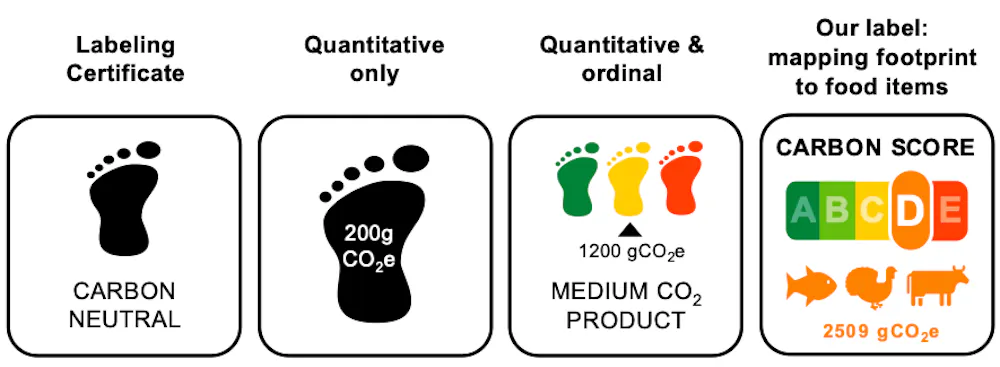
    Most carbon labels follow a similar approach. They typically display a number representing greenhouse gas emissions, and a traffic-light system indicating the level of environmental impact from green (low) to red (high). But such labels do not indicate whether the food is animal- or plant-based. So a high carbon score does not help people identify the source of the emissions.

    Our label maps the carbon footprint to the source of the food, whether plant or animal, along with information about the greenhouse gas emissions.
    Romain Cadario, Yi Li, Anne-Kathrin Klesse, (2025) Appetite., CC BY

    We designed a new type of label. It clearly displays whether the food is sourced mainly from animals or plants, along with the standard emissions score and traffic-light colour code. This approach is especially useful for the growing segment of pre-prepared and packaged foods such as soups and other ready-to-eat meals, which often contain a mix of meat and plant-based food.

    Our label creates a mental link between a food source and its carbon impact. When a consumer sees high carbon scores and red traffic lights appearing more frequently on meat and other animal products, they begin to make the connection between those products and higher emissions. This is key to addressing a lack of knowledge around food carbon emissions.

    We tested our label against the existing labels in a series of experiments with 1,817 everyday consumers from Australia, the United States and the Netherlands.

    One experiment involved soup. Compared with the group exposed to the standard carbon label, the group exposed to our label learned to associate animal-based soups with higher greenhouse gas emissions more effectively. They were more accurate at estimating the greenhouse gas emissions of a second batch of soups without labels.

    This improved knowledge also translates to more climate-friendly food choices. In another experiment with Australian consumers, we encouraged participants to choose five meals from ten options. Five were animal-based and five were plant-based.

    Half the participants saw the meal options with our carbon labels, and the other half did not see the carbon labels. The group exposed to our carbon labels chose fewer animal-based options in their weekly meal plan. In this case, we don’t know whether a third group exposed to the standard label would also make more climate-friendly choices, but our earlier experiments suggested our label was more effective.

    In the final experiment conducted in the Netherlands, displaying our carbon label made university students more likely to choose the plant-based snack option rather than the animal-based option.

    Providing information about the source of the food, whether plant or animal, influenced choices of meal plans.
    Romain Cadario, Yi Li, Anne-Kathrin Klesse, (2025) Appetite., CC BY

    When knowledge isn’t enough

    While people who care most about sustainable eating may think they know better than others, we found that is not the case. These people were not better able than other participants to tell the difference in greenhouse gas emissions between animal- and plant-based foods without seeing our carbon label.

    But they were better learners. When confronted with the facts about the differences between animal and plant-based foods on our labels, they were more likely to change their choices and switch to plant-based foods.

    What this means for consumers and businesses

    A simple change to food labels could help consumers make more informed environmental choices. For businesses and policymakers, it shows displaying only carbon numbers isn’t enough – the food source is crucial.

    Some forward-thinking restaurants and food companies are already experimenting with adding carbon labels to the menu to encourage diners to choose climate-friendly dishes. Our research suggests this approach could be more effective when combined with the new carbon labels we designed.

    Meat products make a significant contribution to climate change.
    Valmedia, Shutterstock

    Implications for climate action

    As Australia grapples with meeting its climate commitments, helping consumers understand the environmental impact of their food choices will become increasingly important.

    The challenge for businesses, policymakers and researchers isn’t convincing people to care about sustainability – they already do. Almost half of Australian shoppers (46%) say sustainability is important to them and influences their purchases, despite cost-of-living pressures.

    But most sustainable actions in retail involve recyclable packaging, products and materials, and local produce. The carbon emission implications of these actions, sadly, are far less than reducing animal-based food consumption.

    Instead, we need to focus on giving people the tools to make their environmental concerns count. Our carbon labels could be the key to helping consumers turn their sustainable intentions into meaningful climate action.

    Yi Li does not work for, consult, own shares in or receive funding from any company or organisation that would benefit from this article, and has disclosed no relevant affiliations beyond their academic appointment.

    ref. Want a side of CO₂ with that? Better food labels help us choose more climate-friendly foods – https://theconversation.com/want-a-side-of-co-with-that-better-food-labels-help-us-choose-more-climate-friendly-foods-250513

    MIL OSI AnalysisEveningReport.nz

  • MIL-Evening Report: Calculating the economic cost of climate change is tricky, even futile – it’s also a distraction

    Source: The Conversation (Au and NZ) – By Dennis Wesselbaum, Associate Professor, Department of Economics, University of Otago

    Piyaset/Shutterstock

    Climate change is no longer a distant threat. It’s here, it’s real and it increasingly affects us all.

    But predicting climate change and its associated costs, particularly over long periods of time, is inherently uncertain. And based on the best available evidence from organisations such as the United Nations’ Intergovernmental Panel on Climate Change, the economic costs of climate change appear to be small – making this a relatively weak argument for environmental action.

    At its most basic, climate is the long-term average of the weather we experience. Or, as former president of the American Meteorological Society, Marshall Shepherd, famously put it, “weather is your mood, and climate is your personality”.

    It’s widely accepted that climate change refers to a shift in long-term weather patterns, typically driven by human activities.

    But the impact of climate change, ranging from rising temperatures and extreme weather events to health impacts and disruptions to food and water supply, varies greatly. Some areas experience more extreme impacts than others, exacerbating social and economic disparities.

    There also appears to be a false sense about our state of knowledge. For example, many believe climate change already causes more frequent and intense storms, but the evidence for this is inconclusive.

    Trying to predict the unpredictable

    To understand the economic costs of climate change, we must first grasp how climate affects socioeconomic outcomes.

    The relationship between temperature and socioeconomic outcomes can be modelled using a “dose-response” function, which shows how much a given change in temperature (the “dose”) influences the outcome (for example, temperature-related mortality).

    A key challenge is to understand the shape of the dose-response function. Is the relationship between temperature and mortality linear or is it more complex? Does it have thresholds beyond which the effects substantially change? Is there only one function or are there different ones for different populations?

    As climate change shifts the distribution of weather variables, it alters the outcomes as well. Yet, predicting how these distributions will evolve is difficult.

    The further into the future we look, the harder it is to make reliable predictions about both weather and the associated economic costs.

    If you were asked in 1925 to predict the economy in 2000, for example, how accurate would you have been? In 1925 you drove a Ford Model T, used coal-fired steam trains and passenger ships for travel, and a trip from London to Auckland took up to eight weeks by sea. You used a telegraph for long-distance communication and a radio for entertainment.

    Compare that with the globalised, interconnected economy of the year 2000. Given the technological advancements, would your prediction have been even close?

    Rather than focusing on the uncertain future economic costs of climate change, we should be addressing how it is affecting human life now.
    James Andrews1/Shutterstock

    Cost estimates

    There are a wide range of estimates on the economic costs of climate change. But one of the most reliable has come from the UN’s Intergovernmental Panel on Climate Change.

    The panel’s latest assessment report avoids quantifying the economic costs of climate change. So, to understand the economic costs of climate change, we can use the best estimate based on the previous report and the insights from meta studies. These analyses posit a temperature rise of 3.7°C will reduce global gross domestic product (GDP) by about 2.6% (ranging from 0.5 to 8.2%) by 2100.

    For New Zealand, this is equivalent to about NZ$11 billion, or twice the cost of Auckland’s City Rail Link.

    However, this comparison is extremely misleading. The value of 2.6% today will differ substantially from 2.6% in 75 years.

    The New Zealand economy grew at a compound annual rate of 1.4% between 1960 and 2000. Using this same average growth rate, New Zealanders will have a 184% higher standard of living in 2100. If nothing is done to address climate change, and given the best cost estimate, our standard of living would still be 176% higher than it is now.

    Reporting costs

    There are also issues with how some people report costs. For instance, while the total damage caused by floods and hurricanes in the United States has gone up in dollar amounts, it has not actually increased as a percentage of peoples’ incomes.

    In this context, it is crucial to distinguish between the damage caused by climate change and that resulting from human activities – such as the construction of more houses, higher property prices and river management practices.

    The economic costs of climate change based on the best available evidence appear to be small and highly uncertain.

    Shifting the focus

    Even if we accept our best estimates, economic costs are not the issue, but saving the environment is.

    Instead of focusing the debate of climate change around economic costs, we need to refocus the debate on tangible impacts happening right now: retreating glaciers, species extinction, shifting seasons and coastal erosion, to name a few.

    Addressing these issues is costly, but action will be needed to save the environment and ensure a liveable world into the future.

    Dennis Wesselbaum does not work for, consult, own shares in or receive funding from any company or organisation that would benefit from this article, and has disclosed no relevant affiliations beyond their academic appointment.

    ref. Calculating the economic cost of climate change is tricky, even futile – it’s also a distraction – https://theconversation.com/calculating-the-economic-cost-of-climate-change-is-tricky-even-futile-its-also-a-distraction-248862

    MIL OSI AnalysisEveningReport.nz

  • MIL-OSI China: Young student develops a taste for Chinese culture

    Source: China State Council Information Office 3

    Nursena Burus, a 19-year-old from the historic city of Manisa on Türkiye’s Aegean coast, poses for a photo at the Forbidden City in Beijing, Nov. 24, 2024. [Photo/Xinhua]

    Nursena Burus, a 19-year-old from the historic city of Manisa on Türkiye’s Aegean coast, has developed a taste for Chinese culture thanks to its food and her travels around the country.

    For Burus, coming to China was not just a language-learning opportunity, but a chance to experience a culture that had captivated her from afar.

    Her sister, who had previously studied artificial intelligence at China’s Xiamen University, encouraged her to take the leap and explore China.

    “My family and friends thought learning Chinese was too difficult, but my sister showed me pictures of her life in China — her friends, festivals and foods,” Burus said. “I started to see it as more than just a place to study. It looks like an adventure.”

    In February 2024, she arrived in China just before the Chinese New Year, and immediately immersed in the vibrant atmosphere of celebration. Red lanterns swayed in the wind, intricate paper cuttings adorned windows, and vibrant couplets decorated doorways.

    “Everywhere I went, the streets were filled with red, a color of celebration and good luck. It was a completely new experience for me.”

    After settling into Tianjin University, Burus could not help but notice that the usually busy campus was almost empty as most Chinese students had headed home for the Spring Festival.

    “It reminded me of the Ramadan Feast in Türkiye, when we all go back to our hometowns to eat, pray and celebrate with family. I love how both cultures value family reunions during important holidays.”

    As classes began in March, Burus quickly adapted to learning and living at Tianjin University. “The teachers were so supportive. They encouraged me to practice speaking without worrying about mistakes, and their passion made me work even harder.”

    Burus quickly built friendships with her Chinese classmates through food and diverse cultural activities.

    Her best Chinese friend Meiqi became her food “mentor.” Meiqi taught her how to use chopsticks and introduced her to Tianjin’s popular street foods, including hot pot and red bean shaved ice.

    She regularly explored the university’s cafeterias and discovered her favorite dishes, including Peking Duck. Moreover, she often followed the recommended foods on the popular short video-sharing platform Douyin to explore new restaurants and shared photos of her culinary adventures on her WeChat Moments.

    “Chinese cuisines are rich and delicious, and the convenient digital payment system has truly amazed me,” Burus said.

    In October 2024, she spent a weekend in the countryside of Tianjin, picking hawthorn and chestnuts and eating farmhouse meals. “It was a very beautiful and peaceful place. People seem to quite enjoy their lives,” she said. The experience reminded her of her hometown village near Manisa, where life is slower, simpler and deeply connected to the land.

    One of her most cherished memories was celebrating the Dragon Boat Festival in 2024. The festival coincided with her birthday and she had the chance to learn how to make Zongzi (sticky rice dumplings) with her classmates.

    “It reminded me of Nevruz, a Turkish holiday that celebrates the arrival of spring. Both festivals honor seasonal changes,” Burus said.

    Now more fluent in Chinese, Burus feels that China has become a second home where she has made lifelong friends and experienced the beauty of Chinese culture.

    “We share so many similar things, like our love for family, traditions and hospitality. I want to build on that connection and show others that the world isn’t as different as it seems.”

    Before leaving China earlier this year after finishing two semesters of a language learning program, she left behind a wish bottle buried on the campus, containing her wish to become a bridge for cultural exchanges between Türkiye and China.

    MIL OSI China News

  • MIL-OSI China: Consumers warned over AI courses

    Source: China State Council Information Office 2

    While the rapid rise of China’s homegrown artificial intelligence reasoning model DeepSeek has sparked a host of enterprises seeking to cash in by offering training courses on how to use it, experts have warned consumers to be wary of wasting their money on courses that provide guidance that is already freely available.
    On Chinese lifestyle app Xiaohongshu, or RedNote, some users share guides on using DeepSeek, with prices ranging from a few yuan to several hundred yuan.
    “If you don’t learn how to use AI today, you’ll be left behind tomorrow,” several posts say. “How to use DeepSeek to earn money” is another trending topic on the platform. These posts are typically followed by links to purchase courses or join group chats.
    On WeChat, multiple accounts use DeepSeek user guides as clickbait, though full content often requires additional payment. Paid online communities focused on AI are also emerging, offering “exclusive” resources to subscribers.
    According to the course descriptions, these paid tutorials typically cover basic AI tool usage, including prompt writing, skill-building, applications in various fields and even strategies for making money with AI.
    “The rise of new technologies is always accompanied by a boom in paid training courses,” said Yan Huaizhi, an associate professor of the School of Computer Science &Technology at the Beijing Institute of Technology, in an interview with Workers’ Daily.
    “On one hand, this trend reflects people’s desire to learn new skills. On the other hand, it epitomizes how some agencies exploit the knowledge gap to make quick profits,” Yan said.
    “The popularity of these paid courses also highlights that selling tools to those eager to make money is a lucrative business model,” he added.
    Since the release of DeepSeek R1 on Jan 20, a tag for a DeepSeek training course on Xiaohongshu has been viewed almost 20 million times.
    While some courses and online communities offer value, the quality of many paid offerings is sometimes questionable. Some simply repackage materials from other AI models or provide low-quality content under the DeepSeek name.
    “By touting AI as a necessary survival tool, these people are selling anxiety,” one user wrote online.
    Bao Ran, vice-president of the Interactive Media Technical Standards Promotion Committee of the China Communications Standards Association, said there is no need to pay for these tutorials since the basics are freely available online.
    On video-sharing platform Bilibili, free DeepSeek and AI tutorials have attracted millions of views. One video explaining DeepSeek’s local deployment, published on Jan 27, has more than 2 million views.
    Chinese universities such as Tsinghua University and Zhejiang University have also offered free AI-related lectures and guides to students.
    While certain consumers such as the elderly may gain value from being walked through how to use AI models step by step, others may feel cheated when they realize they paid for something that they could have easily accessed for free.

    MIL OSI China News

  • MIL-OSI China: China outlines key tasks to deepen rural reforms, advance rural revitalization

    Source: China State Council Information Office 2

    Agricultural machines work in fields at a farm of Beidahuang Group in northeast China’s Heilongjiang Province, Oct. 12, 2024. [Photo/Xinhua]
    China unveiled its “No. 1 central document” for 2025 on Sunday, outlining priorities to deepen rural reforms further and solid steps to advance all-around rural revitalization.
    As the first policy statement released by China’s central authorities each year, the document is seen as an indicator of policy priorities.
    The document consists of six parts covering six areas: ensuring the supply of grain and other important agricultural products, consolidating the achievements of poverty elimination, developing local industries, advancing rural construction, improving the rural governance system, and optimizing the rural resource allocation system.
    The document calls for enhanced efforts in work related to agriculture, rural areas and farmers in 2025 and beyond, and sets the goals of advancing all-around rural revitalization and consolidating the country’s agricultural foundations further.
    With reform, opening-up, and scientific and technological innovation as driving forces, the country will safeguard its grain security and ensure that no large-scale lapse or relapse into poverty occurs, the document says.
    The country will make every effort to enhance agricultural efficiency, invigorate rural areas and increase farming incomes, thereby laying a solid foundation for the advancement of Chinese modernization, the document stresses.
    It emphasizes the importance of developing new quality productive forces in agriculture in light of local conditions. It also calls for the cultivation of leading high-tech agricultural enterprises, and the acceleration of breakthroughs in crop varieties.
    China will support the development of smart agriculture and expand the application scenarios of technologies such as artificial intelligence, big data, and low-altitude systems, according to the document.
    It outlines plans to expand cold-chain logistics and instant retail services to townships, and encourages regions with suitable conditions to establish public charging and battery-swap facilities for electric vehicles.
    To promote the effective management and utilization of rural resources and assets, the document calls for the exploration of feasible ways to make good use of legally owned rural housing through methods such as leasing, equity participation and cooperation.
    The document urges innovation efforts related to the financing mechanisms for rural revitalization. Steps will be taken to strengthen support from central budget investments, ultra-long special government bonds, and special local government bonds for major projects in agriculture and rural areas. Monetary policy tools will be utilized to encourage financial institutions to increase funding for rural revitalization.
    Reforms related to forestry, state farms, and supply and marketing cooperatives will be advanced in a coordinated manner. The document stresses the importance of deepening the reform of the collective forest tenure, of enhancing comprehensive reforms of water pricing and water rights in the agricultural sector, of strengthening water usage management, and of promoting water-saving irrigation technologies.
    Eligible cities are encouraged to include their agricultural migrant populations with stable employment into the scope of local urban housing security policies gradually, the document notes.

    MIL OSI China News

  • MIL-OSI New Zealand: The Most Important Fact Schools Don’t Teach

    Source: ACT Party

    The Haps

    The Chinese navy has made a big mistake. Sending what Defence Minister Judith Collins called a ‘formidable ship’ so close to Sydney, and interrupting Air New Zealand domestic flights, shows the New Zealand public we need to spend more on defence. ACT supporters have been alone in voting for two per cent of GDP on defence, we predict there will now be more.

    We remember the Ukrainians who’ve lost their lives and their homes in the three years since the Russian invasion. Free Press remains resolute. There are basic facts that cannot be changed. Russia is the aggressor. The war is not just or legal. The breach of borders by force is dangerous to free people everywhere. We must never accept might is right, but we must build our strength so the world doesn’t end up that way.

    The Most Important Fact Schools Don’t Teach

    Schools are teaching children all sorts of things, but so far as we are aware they are not teaching the most important fact of human life. The fact they’re not teaching this fact tells us how mindless education has become, and it limits children’s thinking.

    The fact we’re talking about is the astonishing growth of human life expectancy in the last two centuries. For 100,000 years, people lived to thirty on average. Now, the global average is 72 years.

    People have different ideas about what a good life is. But (except for a few terrorists and cults), everyone agrees being alive is better than being dead. Something in the last 200 years gave us a whole extra life.

    If the education system teaches children nothing else, it should teach that something happened in the last 200 years and it doubled life expectancy. Once they know that, they can learn what works.

    We think the answer might be the problem. The education bureaucracy, academics, and teacher unions don’t want to teach that capitalism is a raging success.

    They’d have to teach about the genesis of the free market in the swamps of the Netherlands. People driven to the lowlands by violence decided to make something of themselves. They drained swamps and built dykes, creating usable land that was theirs.

    The result was a society where ordinary people could make a difference in their own lives. They demanded property rights because they’d literally created their own property. If you couldn’t take then you had to trade, and tribalism gave way to the market. It was around this time Abel Tasman discovered New Zealand for Europe.

    William of Orange, a Dutchman who became King of England, helped take the revolution across the sea, where it germinated on an island buffered from invasion. The common law and the market, along with the enlightenment made the industrial revolution possible.

    In turn the British Navy opened up the world’s sea lanes to trade, and spread their system of democracy and capitalism to the new world, ensuring it would endure for centuries even when they themselves came under attack from fascism.

    All the while ordinary people could get enough calories to be healthy, live in cities with sanitation free of disease, and medical care would stop children and their mothers dying in childbirth or shortly after. Violence that was normal for most humans most of the time, and shortened many lives, is now an exceptional event for most people most of the time.

    The revolution spread further after the Cold War, lifting billions from poverty in the East the same way they had thrived in the west. That same prosperity has raised their life expectancy too. Now the whole world lives twice as long on average as it did before the industrial revolution, but your teacher won’t dwell on that basic fact in most of the world’s schools.

    Instead we have an epidemic of anxiety and depression amongst young people. The tremendous gains of the last two centuries are barely understood. Instead the gains are banked and forgotten while children worry about comparatively small problems.

    We spend a lot of time worrying about differences between people living today when, in reality, everyone is doing vastly better than everyone was even a few generations ago. So much division, so little reality, and not enough hope.

    Imagine if the most important thing children learned was that we’ve doubled our lives in 200 years after 100,000 years of misery. That could be springboard for asking what works and building a much more hopeful future. We just need the Left to make peace with capitalism.

    MIL OSI New Zealand News

  • MIL-OSI Australia: NSW records first death of person with Japanese encephalitis since 2022

    Source: New South Wales Health – State Government

    NSW Health continues to urge the public to be vigilant and take precautions against mosquitoes as NSW records its first death of a person with Japanese encephalitis (JE) since May 2022.
    A man aged in his 70s from northern Sydney died on 23 February in a Sydney hospital, where he had been receiving care for JE since early February.
    It is likely the man acquired JE while holidaying in the Murrumbidgee region in January. This is the state’s third confirmed death from JE since the virus was first detected in NSW in 2022.
    NSW Health expresses its sincere condolences to his loved ones.
    Further, an additional case of JE has been identified in a woman in her 60s in northern NSW. She likely acquired the infection on her rural property in Tenterfield Shire and is receiving care in hospital.
    NSW Health’s Executive Director of Health Protection Dr Jeremy McAnulty said these developments are a reminder of the importance for people to take precautions against mosquitoes, including vaccination.
    “These two cases of JE virus, one of which was infected while travelling for a holiday, shows it is very important all people take precautions against mosquitoes, not just those living in affected regions,” Dr McAnulty said.
    “If you plan on travelling west of the Great Dividing Range, whether for work or holiday, and you plan to spend time outdoors, JE is a risk you must consider.
    “Thankfully, there are simple steps you can take to avoid mosquitoes, and there is also a safe and effective vaccine available.”
    JE vaccine is available through local general practitioners, Aboriginal health services and pharmacists to anyone who lives or routinely works in various inland LGAs or high-risk occupations.
    People who meet the eligibility criteria should make an appointment and let the provider know it is for the JE vaccine, as they may require a few days’ notice to order the vaccine.
    JE virus is spread by mosquitoes and can infect animals and humans. The virus cannot be transmitted between humans and it cannot be caught by eating pork or other pig products.
    There is no specific treatment for JE which, in some cases, can cause severe neurological illness with headache, convulsions, reduced consciousness and death.
    The best thing people throughout the state can do to protect themselves and their families is to take steps to avoid mosquitoes.
    Simple actions you can take include:

    Applying repellent to exposed skin. Use repellents that contain DEET, picaridin, or oil of lemon eucalyptus. Check the label for reapplication times
    Re-applying repellent regularly, particularly after swimming. Be sure to apply sunscreen first and then apply repellent
    Wearing light, loose-fitting long-sleeve shirts, long pants and covered footwear. and socks
    Avoiding going outdoors during peak mosquito times, especially dawn and dusk
    Using insecticide sprays, vapour dispensing units and mosquito coils to repel mosquitoes (mosquito coils should only be used outdoors in well-ventilated areas)
    Covering windows and doors with insect screens and checking there are no gaps
    Removing items that may collect water such as old tyres and empty pots from around your home to reduce the places where mosquitoes can breed
    Using repellents that are safe for children. Most skin repellents are safe for use on children aged three months and older. Always check the label for instructions
    Protecting infants aged less than three months by using an infant carrier draped with mosquito netting, secured along the edges
    While camping, use a tent that has fly screens to prevent mosquitoes entering or sleep under a mosquito net.

    Information on eligibility for a free JE vaccine is available on Japanese encephalitis vaccination.
    For further information on JE virus and ways to protect yourself visit Mosquito borne diseases.

    MIL OSI News

  • MIL-OSI New Zealand: Future use of storm-affected land

    Source: Auckland Council

    More than 1200 high-risk Auckland properties are expected to be purchased by Auckland Council before the end of 2025 – making it one of the largest land acquisition programmes undertaken in New Zealand.

    We are carefully deciding what to do with this storm-affected land, with decisions expected to take years.

    Uses being considered for storm-affected land

    We want to ensure Auckland’s land is used effectively to provide homes and maintain strong communities, while managing risk and reducing the financial impact to ratepayers.

    If we keep the land, options for use could include:

    • flood resilience and stream management

    • adding it to neighbouring parkland or bush

    • managing it as high-hazard land.

    If we don’t keep the land, options could include:

    • sale for safe redevelopment

    • sale with conditions to manage the risk (such as converting ground floor units to storage)

    • sale to neighbours for extra backyard space.

    Auckland Council is considering a range of options for storm-affected land that manages the risks, ensures the land is used effectively and efficiently.

    How decisions will be made

    Auckland Council’s Governing Body is responsible for deciding whether to keep or sell the land, costs associated with keeping the land (if applicable), and considering any views and preferences expressed by a local board.

    The local board is responsible for communicating their views and preferences about storm-affected land in their rohe (boundaries); and is responsible for any storm-affected land that the Governing Body makes available for a local park and/or local service activity – including budget required to maintain it.

    With 1200 properties to assess, carefully deciding the future use for every section will take several years.

    Diagram showing the management of council land after purchase.

    Have a suggestion for a site?

    Where people have suggestions for specific Category 3 sites, we can capture that information in our expressions of interest register.

    Draft policy and implementation plan

    You can read the Draft storm-affected land use – policy and implementation plan on the Auckland Council website (item 12, attachment 1). This policy was endorsed by the council’s Transport, Resilience and Infrastructure Committee on Thursday 13 February, ahead of the final approval step with the council’s Policy and Planning Committee expected in March.

    Frequently asked questions:

    What will happen to the land when properties are bought out?

    Auckland Council will explore all possible uses for the land and this may mean keeping it or selling it. We need to manage community expectations about what activities are possible, with safety being our no.1 priority.

    Redevelopment potential will be assessed by looking at the whole property rather than the existing dwelling – there may be scope to locate activity on other parts of the site, or options to re-engineer the land to mitigate risk.

    Who will decide how the land is used?

    We don’t know yet what the total land holdings will be from the buy-out process, so deciding the future use for every parcel of land will take several years.

    It’s anticipated that the council’s Governing Body will make most of the decisions regarding storm-affected land, with consideration of local interests.

    The Storm-affected Land Use Policy has been endorsed by Auckland Council’s Transport, Resilience and Infrastructure Committee and will go to the Policy and Planning Committee in March for final approval. This policy guides the use of this land. 

    Will the community have a say in what happens to land bought out by Auckland Council?

    We want to ensure communities are part of the process to determine the future use of the land, where possible, and we’re also exploring opportunities for partnerships with mana whenua.

    Where community members have suggestions for specific Category 3 sites, we can capture that information in our expressions of interest register, to consider as part of the Future Land Use process. Please send ideas to our expressions of interest register.

    Can the public access Category 3 land purchased by Auckland Council?

    Many of these properties are active worksites, where buildings are being demolished, deconstructed or removed. The council considers these properties pose significant health and safety risks for the public, and strongly discourages anyone from entering and accessing them.

    What will happen to vacant land while the long-term use is decided?

    Council-owned vacant land will be maintained to ensure a ‘kept look’ with a focus on maintaining areas visible from roads and footpaths (i.e. berms and front yards on properties that have road frontages). A budget of $39.4 million has been allocated over 10 years for ongoing maintenance including things like mowing and tree trimming. If you would like to report any maintenance issues please email recoveryoffice@aucklandcouncil.govt.nz or if you see any suspicious behaviour please report it to the police.

    Why does it take so long to decide on the future use of these vacant sites?

    More than 1200 high-risk properties are expected to be purchased by the end of the year – making it one of the largest land acquisition programmes undertaken in New Zealand.

    We want to make the best decisions for the land and the community. The safe use of the site is our no.1 priority.

    We have to undertake thorough analysis to explore all possible uses for the land. Making the right long-term decisions takes time and we ask that communities are patient while this work is undertaken.

    Will you be selling sites to recoup some of the costs of the buy-outs?

    Aucklanders have told us we need to minimise the impact on rates of the buy-out programme, which along with other recovery costs tallies to around $1 billion.

    Limited opportunities to sell land for redevelopment or to adjacent landowners, in situations where hazards can be mitigated, will be explored.

    Although the existing dwellings were unsafe to live in, there may be options to redevelop the site in a different way and build new housing that doesn’t have the same levels of risk. This may include amalgamating sites into clusters. More homes are an important outcome for local communities.

    Where we do sell land, we’ll ensure that it is sold with conditions appropriate to manage the level of risk e.g. converting ground floor units to storage.

    Read all recovery FAQs on OurAuckland.

    MIL OSI New Zealand News

  • MIL-OSI Australia: Operation Eclipse raids in the south-east

    Source: South Australia Police

    Police have seized almost $800,000 worth of illegal tobacco and $66,000 in cash in raids on 10 premises in the South-East of the state.

    Serious and Organised Crime Branch, Limestone Coast police and members from Consumer and Business Affairs searched premises at Mount Gambier, Naracoorte and Millicent on 19 and 20 February as part of Operation Eclipse investigations.

    The locations searched included tobacconists, candy and gift shops, a commercial storage facility and residential premises.

    In one search at a Mount Gambier gift shop $245,000 of illicit tobacco was located. Further investigations resulted in the seizure of $540,000 worth of tobacco products at a commercial storage premises in Mount Gambier.

    The searches resulted in the arrest of a man, 23, of Salisbury North for failing to provide his name and address.

    Operation Eclipse commander Detective Chief Inspector Brett Featherby said the regional seizures had significantly disrupted the activities of the syndicates.

    “If organised crime syndicates think they can operate in regional areas and not come to the attention of police they are wrong,’’ he said.

    “The seizures in the South-East have enhanced our knowledge of the operating model of the syndicates and are the subject of further investigations.

    “SAPOL will continue to have a whole of organisation response that targets the syndicates to disrupt their financial operations and criminal activity.

    “We will pursue criminal charges when sufficient evidence exists and that includes those who are supporting and enabling that activity.’’

    Operation Eclipse detectives have also searched another four premises in the metropolitan area since 18 February. Illicit tobacco worth $140,000 was seized in those searches.

    Detective Chief Inspector Featherby also appealed for public information into an arson attack at a tobacconist on Glynburn Road at Hectorville on Friday 21 February.

    In the incident three suspects arrived in a late model white sedan and attempted to set fire to the front of the premises. A witness extinguished the fire.

    “We would like to hear from anyone who knows of any person who may have burn injuries or who may have presented at a medical facility with burns since last Friday,’’ Detective Chief Inspector Featherby said.

    “We are also appealing for dash cam footage from vehicles in the Hectorville area between 4.30am and 5.30am on 21 February or anyone who observed people in a white late model sedan filling a fuel container at a petrol station.”

    Operation Eclipse has so far resulted in 29 arrests for offences including blackmail, arson, money laundering and serious criminal trespass.

    There have been 122 premises searched – 36 residential and 86 businesses – almost $1.25 million in cash, three firearms and almost $10.1 million in tobacco seized. Nine vehicles have also been seized for confiscation.

    Significantly, there have been 230 calls to Crime Stoppers since October 2 that have resulted in information being provided to police.

    Anyone with any information on criminal activities surrounding the sale of illicit tobacco is urged to call Crime Stoppers on 1800 333 000 or visit www.crimestopperssa.com.au – You can remain anonymous.

    MIL OSI News

  • MIL-OSI China: China urges global participation in Int’l Humanitarian Law Initiative

    Source: China State Council Information Office

    Trucks loaded with Chinese aid get ready to set off from the warehouse of Jordan Hashemite Charity Organization in Zarqa, Jordan, on Feb. 18, 2025. [Photo/Xinhua]

    China has called on the international community to actively engage in the International Humanitarian Law (IHL) Initiative, co-launched by China, stressing the importance of joint efforts to uphold humanitarian principles and protect civilians in conflict zones.

    Chen Xu, China’s permanent representative to the UN Office in Geneva and other international organizations in Switzerland, attended a high-level event to galvanize political commitment to IHL. He introduced the IHL Initiative and outlined China’s position on humanitarian issues.

    Noting that the current global humanitarian crisis remains dire, Chen emphasized that promoting effective compliance with IHL is “a pressing challenge of our time” that must be addressed and it is also the concern that served as a driving force behind the initiative’s launch. He stated that the IHL Initiative aims to raise awareness of IHL among the international community, particularly among parties to armed conflicts.

    He stressed that the international community should foster the spirit of humanity, fraternity, and devotion while ensuring the universal and uniform application of IHL, resolutely rejecting double standards and selective application. He added that the fundamental principles of neutrality, impartiality, and independence must be upheld to avoid the politicization of humanitarian issues, and that support for international humanitarian organizations is essential to ensure the safety of humanitarian workers.

    Chen invited all parties to participate in the IHL Initiative and actively contribute to its various workstreams based on their expertise. He also emphasized that traditional Chinese values – such as “a benevolent man loves others” and “do not impose on others what you do not want others to do to you” – embody a deeply rooted humanitarian spirit.

    He said China will remain an active supporter, participant, and contributor to the international humanitarian cause, upholding its vision of building a community with a shared future for mankind and implementing the Global Development Initiative, the Global Security Initiative, and the Global Civilization Initiative.

    Chen stressed that China remains committed to peace talks, promoting peace and hope in conflict zones, continuing its assistance to Africa and other developing countries, supporting humanitarian organizations to the best of its ability, and alleviating the suffering of people in conflict zones.

    MIL OSI China News

  • MIL-OSI NGOs: ‘Drill Baby, Drill’: Report shows Woodside hell-bent on profit while people and nature pay the price

    Source: Greenpeace Statement –

    SYDNEY/PERTH, Tuesday 25 February 2025 — Greenpeace Australia Pacific has condemned gas corporation Woodside’s annual earnings announcement today, saying its billion dollar profits come at the expense of Australian communities and nature on the frontlines of extreme weather disasters.

    The fossil fuel multinational reported AUD$3.57 billion in net profits after tax for 2024, a 115% year-on-year increase, as output rose to a record high.

    Joe Rafalowicz, Head of Climate and Energy at Greenpeace Australia Pacific, said: “With so many Australians struggling to pay for groceries or rent as the cost of living crisis rages on, it’s not right that fossil fuel corporations are raking in billions from destroying our planet. 

    “Communities across Australia are reeling from the extreme weather disasters unfolding every summer, which the Insurance Council estimates will cost $35.2 billion a year by 2050. It is immoral for fossil fuel corporations like Woodside to toast their profits today, while people on the frontlines are left to pick up the tab when floods or bushfires destroy their homes. 

    “As Ningaloo Reef suffers another mass coral bleaching, Woodside is hell-bent to ‘Drill Baby, Drill’ for even more polluting gas at neighbouring Scott Reef. We must not allow the nature we love to become another victim of the fossil fuel industry’s endless pursuit of profit.

    “The era of rampant corporate greed must end — it’s time for fossil fuel polluters to pay for the climate destruction they are unleashing on communities in Australia, the Pacific and around the world. We must hold polluters like Woodside accountable for their propaganda and for knowingly holding back climate action in this country.

    “Let’s invest in the proven climate solutions we have right now — renewable wind and solar energy backed by storage. Greenpeace will continue to advocate for clean, safe, affordable renewable energy that will reduce global emissions and ensure a livable planet for all.”

    Policies to make polluters pay are gaining momentum around the world, with governments including New York and Vermont introducing legislation forcing fossil fuel companies to pay for the climate destruction caused by their emissions. 

    -ENDS-

    For more information or interviews contact Kate O’Callaghan on 0406 231 892 or [email protected]

    MIL OSI NGO

  • MIL-OSI USA: ICYMI: Baldwin Hosts Roundtable in Milwaukee on Looming Cuts to Medicaid

    US Senate News:

    Source: United States Senator for Wisconsin Tammy Baldwin

    MILWAUKEE – Today, U.S. Senator Tammy Baldwin (D-WI) hosted a roundtable discussion to highlight the dire consequences of Congressional Republicans’ moves to cut Medicaid to pay for tax breaks for billionaires. Senator Baldwin was joined by Milwaukee County Executive David Crowley and members of the Milwaukee County Commission on Aging to discuss how these cuts jeopardize critical services for seniors. 5.6 million Americans count on Medicaid for their long-term care bills, with Medicaid paying for over half of long-term care in the United States for primarily seniors.

    “Republicans are threatening to rip away health care from over one million Wisconsinites on Medicaid to pay for tax cuts for billionaires. These aren’t just statistics, these are real people who will have their lives upended if they lose their health care. Today, I was able to hear how devastating this would be for our seniors in Milwaukee,” said Senator Baldwin. “Medicaid is the lifeline that provides health care for 8 million seniors, ensures over 30 million kids can see a doctor and get health care, and helps our rural hospitals keep their doors open.”

    “We know that Medicaid is vital for working families across Wisconsin. Any cuts to federal Medicaid funding would have a detrimental impact on the health, safety, and prosperity of folks in Milwaukee County,” said Milwaukee County Executive David Crowley. “I’m grateful that Senator Tammy Baldwin is fighting for our residents, families, and children every single day. Let’s continue working together to protect the quality, affordable health care that Wisconsinites need.”

    Republicans are planning deep cuts to Medicaid that will jeopardize the coverage of 72 million Americans, or 1 in 5 people living in the United States who use Medicaid. This includes nearly half of all children, 31.5 million, over 8.3 million seniors, and around 15 million people with disabilities. Medicaid also pays for 6 out of 10 of residents in nursing homes, with 5.6 million Americans counting on Medicaid for their long-term care bills and Medicaid paying for over half of long-term care in the United States. Severe cuts to Medicaid will also jeopardize rural hospitals and clinics’ ability to keep their doors open. Over 12 million rural Americans rely on Medicaid for health care.

    In Wisconsin, over 1.2 million people are enrolled in Medicaid. About 1 in 3 children in Wisconsin’s rural and metro communities have Medicaid coverage. More than 300,000 kids under age 19 are members of BadgerCare Plus or another Wisconsin Medicaid program.

    Republicans released a budget blueprint that directed the committee with jurisdiction over Medicaid to find $880 billion in cuts for their upcoming budget to pay for tax breaks for the super-wealthy and large corporations. Last week, President Trump endorsed that blueprint. As Republicans move forward with their legislation, their plans to cut hundreds of billions of dollars from Medicaid will jeopardize care for individuals with autism, seniors seeking long-term care, low- and middle-class children, and Americans who rely on rural hospitals. Republicans also rejected Democrats’ repeated attempts last week to protect Medicaid from being cut to fund billionaire tax breaks.

    MIL OSI USA News

  • MIL-OSI New Zealand: Going for Growth: Public Works Act overhaul

    Source: New Zealand Government

    The Public Works Act will undergo its most significant reform in nearly 50-years to help unleash an infrastructure boom, Land Information Minister Chris Penk has announced.  
    “Removing barriers to make it faster and more affordable to build the homes Kiwis need, creating jobs through new projects and providing infrastructure to support better public services is a major part of the Government’s economic growth agenda,” Mr Penk says.  
    “Complex regulations and inefficient processes are slowing down development, resulting in blown out budgets and added costs for taxpayers. 
    “The Public Works Act is the mechanism which empowers us to acquire land for new infrastructure, while ensuring that fair compensation is provided to landowners – but it is no longer fit for purpose,” Mr Penk says.  
    “A targeted review last year has found unnecessary duplication in the system, issues with outdated negotiation processes and disjointed government agency practices. 
    “Right now, it takes up to a year on average to acquire land. If compulsory acquisition is required, the process generally takes up to two years, with at least another year tacked on if objections to the Environment Court are made.  
    “We cannot afford this in the face of a productivity crisis and critical infrastructure deficit. A modernised Public Works Act will set the foundation for building better.” 
    Extensive policy changes will be announced over coming weeks. The first tranche will:  

    Delegate land acquisition responsibility: Empower government agencies like the New Zealand Transport Agency, which regularly use the Public Works Act, to enter into acquisition agreements with landowners. The Minister for Land Information will remain responsible for compulsory acquisition by the Crown.  
    Enable collaboration between agencies: Allow government agencies to work together when acquiring land for connected public projects. Instead of each agency acquiring land separately, they will be able to coordinate acquisition of land as needed to make the process smoother. 
    Enable relocation of infrastructure: Allow both the government and local authorities to acquire land when they need to move existing infrastructure (like powerlines or pipes) that are in the way of new public works. 
    Refine the role of the Environment Court: Clarify the factors that the Environment Court can consider when reviewing objections to land acquisitions for public works, with a renewed focus on individual property rights, removing overlap with the Resource Management Act. 
    Require mediation for compensation disputes: Require that parties try to resolve disputes over compensation through mediation or alternative dispute resolution before going to the Land Valuation Tribunal, to avoid lengthy court proceedings where possible.  
    Allow Transpower to bypass standard processes: Enable Transpower, the State-Owned Enterprise managing New Zealand’s power grid, to use the Public Works Act to acquire land by agreement. This would streamline their process for building energy infrastructure.  

    “We have already announced the Government will fix a discrepancy in the Public Works Act which undervalues Māori freehold land compared to other land types,” Mr Penk says.  “Further improvements will be revealed as we prepare to introduce the Public Works Amendment Bill to Parliament around the middle of 2025.” The public will be able to provide feedback during the select committee process.  

    MIL OSI New Zealand News

  • MIL-OSI Security: Eureka Chiropractor Convicted of Defrauding Medicare, Insurance Companies Out of More Than $1.5 Million

    Source: Office of United States Attorneys

    PEORIA, Ill. – A federal jury returned a guilty verdict late Friday evening against Carrie Musselman, 48, of Eureka, Illinois, for defrauding Medicare and other insurance companies out of more than $1.5 million dollars and for five counts of wire fraud in furtherance of her scheme to defraud. Sentencing for Musselman has been scheduled for June 24, 2025, at the U.S. Courthouse in Peoria, Illinois.

    Over 13 days of testimony, the government presented evidence establishing that Musselman, a chiropractor in Eureka, engaged in a scheme to defraud Medicare and other insurance companies. As part of the scheme, Musselman disguised the identity of the people providing services and misrepresented the nature of the services that had actually been provided.

    For instance, Musselman falsely claimed services were being provided by physicians when they were actually being provided by nurse practitioners and physician’s assistants. This resulted in an automatic pay increase for Musselman and her practice. In addition, one of Musselman’s highest reimbursement services, the placement of an electroacupuncture (which she was falsely billing as a surgically implanted neurostimulator), would not have qualified for any payment but for her deception. Musselman also billed for services that were not actually rendered. This included not only billing for neurostimulators that were never provided, but also for purportedly providing patients with allergy injections when, in reality, no such injections were given. Instead, patients were sent home with oral drops that had not been approved by the Food and Drug Administration, were considered “experimental,” and had not been proven to be effective.

    Musselman remains released on bond. At sentencing, Musselman faces statutory penalties of up to 10 years’ imprisonment for the healthcare fraud charge and up to 20 years’ imprisonment for each of the wire fraud charges, to be followed by up to three years of supervised release on each of the counts. Each of the six convictions could also incur up to a $250,000 fine.

    The case investigation was conducted by the Federal Bureau of Investigation, Springfield Field Office, and the Department of Health and Human Services, Office of Inspector General, Office of Investigations. Assistant U.S. Attorneys Douglas F. McMeyer, Bryan D. Freres, and Grace J. Hitzeman represented the government at trial. 

    MIL Security OSI

  • MIL-OSI Security: Fresno Man Sentenced to 3 Years in Prison for a Series of Vehicle Pipe-Bombings

    Source: Office of United States Attorneys

    FRESNO, Calif. — Paul New, 57, of Fresno, was sentenced today to three years in prison for conspiracy to destroy property and malicious destruction by means of an explosive device, Acting U.S. Attorney Michele Beckwith announced.

    According to court documents, between November 2022 and February 2023, New committed a series of pipe-bombings on unoccupied vehicles and property in Fresno. The bombings damaged vehicles belonging to two auto-related businesses on Clinton Avenue. On Feb. 19, 2023, a bomb heavily damaged a vehicle used by a home health care business on Fallbrook Avenue.

    On October 9, 2024, co-defendant Scott Eric Anderson was sentenced to three years in prison.

    This case was the product of an investigation by the Fresno Police Department, the Federal Bureau of Investigation, and the Bureau of Alcohol, Tobacco, Firearms and Explosives. Assistant U.S. Attorney Michael G. Tierney prosecuted the case.

    MIL Security OSI

  • MIL-OSI USA: Agency Commissioner Nominees Announced

    Source: US State of New York

    Governor Kathy Hochul today announced the nomination of three New York State agency commissioners. The Governor nominates Denise Miranda as Commissioner of the State Division of Human Rights, Amanda Lefton as Commissioner of the Department of Environmental Conservation; and Willow Baer as Commissioner of the State Office for People With Developmental Disabilities.

    “As we work to make New York the best place to raise a family, it’s critical to have a team in place with the skills and experience to make that goal a reality,” Governor Hochul said. “These three nominees have proven themselves to be strong leaders with a record of achievement — and they will play a pivotal role leading these state agencies.”

    About Commissioner Denise Miranda

    Denise Miranda was appointed by Governor Kathy Hochul in March 2024 as the Acting Commissioner of the Division of Human Rights (DHR).

    During her first year at the Division, Ms. Miranda initiated a complete overhaul of the Division’s intake operations, increased staffing by 40 percent in the first six months, expanded education and outreach initiatives and engaged in wholesale organizational change to ensure and protect the Division’s legacy of being the first state agency in the country dedicated to protecting human and civil rights. In November of 2024, she launched the first statewide “Call Out Hate” campaign to support the work of the Division’s Hate and Bias Prevention Unit, which was created to combat prejudice and discrimination. At the close of the Acting Commissioner’s first year at DHR and with the Governor’s support, DHR saw a 30 percent increase in the agency’s budget and actively worked to increase the agency’s prevention efforts while hastening its processes for investigation and adjudication of claims.

    Prior to this, Acting Commissioner Miranda served as the Executive Director of the New York State Justice Center for the Protection of People with Special Needs for seven years. She oversaw the agency’s operations, which included investigations into abuse and neglect, criminal prosecutions, and administrative disciplinary proceedings. Under her leadership, the Justice Center managed the care of over one million individuals, with a workforce of more than 425 employees and a $41 million operating budget.

    About Commissioner Amanda Lefton

    Amanda Lefton’s diverse career spans the public and private sectors, including previously serving as the Director of the Bureau of Ocean Energy Management (BOEM) within the Department of the Interior. Under her leadership, BOEM developed and implemented an ambitious federal offshore wind program creating a new industry of family supporting jobs and generational opportunity. Her collaborative approach brought together various stakeholders to responsibly manage the nation’s critical offshore energy and mineral resources.

    Prior to her role as BOEM Director, Lefton served as the First Assistant Secretary for Energy and Environment for New York, where she led the State’s environmental and climate initiatives overseeing a portfolio of executive agencies including the DEC. She has also worked for The Nature Conservancy in New York as the Deputy Policy Director and climate mitigation lead, the Rochester Regional Joint Board of Workers United and the New York State Assembly and New York State Senate. Most recently, Lefton was the Vice President of Offshore Development, U.S. East at RWE — one of the world’s leading players in the offshore wind sector.

    Originally from Queens, she grew up on Long Island and holds a Bachelor of Arts from the University at Albany. She now resides in the capital region with her wife and stepchildren.

    About Commissioner Willow Baer

    Willow Baer is honored to be nominated as Commissioner of OPWDD. Prior to stepping up as Acting Commissioner, Willow served as OPWDD’s Executive Deputy Commissioner and oversaw the agency’s operational management, including planning, fiscal planning and oversight, and policy development. She was also responsible for oversight of agency staff in a broad range of capacities, including direct care support, clinical and medical staff in residential and non-residential settings, maintenance and operations.

    Willow has served twice as Assistant Counsel to Governor Kathy Hochul, overseeing legal priorities and legislation across the fields of Human Services and Mental Hygiene. Additionally, Willow previously served as General Counsel to OPWDD, General Counsel and Deputy Commissioner for the Office of Children & Family Services, and as Counsel to the NYS Justice Center. Willow was named a ‘2024 Power Players in Health Care by Politics NY and amNY Metro.

    Willow has spent her entire career working to protect and advocate for underrepresented populations. She will continue the agency’s work to ensure that New York is a state that is inclusive, supportive, and one that those with developmental disabilities live with meaningful choice and are proud to call home.

    Acting Commissioner of the Division of Human Rights Denise Miranda said, “It is the honor of my career to be nominated by Governor Hochul to lead the Division of Human Rights. For nearly 30 years, I’ve dedicated my professional life to advancing civil rights and protecting vulnerable communities throughout New York State, and I am grateful to the Governor for entrusting me with this responsibility. I am elated to accept this nomination and to partner with the Governor to pave the agency’s next chapter as we celebrate 80 years of our NYS Human Rights Law. I look forward to vigorously protecting the civil rights of all New Yorkers.”

    Incoming Commissioner of the Department of Environmental Conservation Amanda Lefton said, “I am honored Governor Hochul has entrusted me to carry out the Department of Environmental Conservation’s critical mission. I am committed to delivering meaningful results to enhance the health and safety of communities all across the State and to protecting our environment and natural resources for future generations.”

    Acting Commissioner of the Office for People With Developmental Disabilities Willow Baer said, “I am grateful that, under Governor Hochul’s leadership, New York State has restored its status as a national leader in providing services to people with developmental disabilities with policies that prioritize greater independence, innovative housing options, and community integration. I am honored and excited to be nominated by the Governor to lead the Office for People With Developmental Disabilities and I am humbled every day to be doing this work alongside the many self-advocates and families throughout New York State who are fighting for equity and inclusion.”

    MIL OSI USA News

  • MIL-OSI United Kingdom: Professor Sir Ian Chapman appointed next CEO of UK Research and Innovation with renewed focus on economic growth

    Source: United Kingdom – Executive Government & Departments

    Press release

    Professor Sir Ian Chapman appointed next CEO of UK Research and Innovation with renewed focus on economic growth

    Sir Ian will lead the team at UKRI in backing thousands of researchers and innovators in developing solutions which improve people’s lives and help grow the economy

    Professor Sir Ian Chapman appointed as new UKRI CEO

    Professor Sir Ian Chapman will become the next CEO of UK Research and Innovation (UKRI), leading a refreshed mission that puts economic growth at the heart of public investment in R&D, helping to fulfil the potential of science and technology in improving lives, Science Minister Lord Vallance has announced today (Tuesday 25 February).

    UKRI is the country’s largest public research funder, with a budget of £9 billion per year, giving it a central role in ensuring public funding is invested in ambitious, pioneering research that will benefit the whole of the UK and provide a clear return on investment for hardworking taxpayers.

    Its work in recent years includes backing the Oxford-AstraZeneca Covid-19 vaccine, which has saved countless lives and the construction of the world’s most advanced wind turbine test facility, helping the UK to become a clean energy superpower. It has also been a major contributor to the £1 billion of UK public investment in AI R&D so far so the UK captures the technology’s opportunities to enhance growth and productivity as the third largest AI market in the world.

    Sir Ian will lead its team in supporting thousands of bright researchers and innovators in developing solutions from life-saving medicines to protecting our environment – ultimately making a visible, positive difference to people’s lives and supporting the missions at the heart of the Government’s Plan for Change.

    His experience will be a major asset in drawing on the UK’s world-leading research talent, facilities, universities and businesses, as drivers of R&D which will kickstart economic growth, make Britain a clean energy superpower and build an NHS fit for the future.

    During his time as CEO of the UK Atomic Energy Authority, Sir Ian has led the transition from an organisation rooted in deep R&D excellence, to one that is now also delivering a major infrastructure project to design and build a prototype powerplant; driving inward investment and economic growth; and enabling development of a skilled workforce and supply chain.

    Science Minister, Lord Vallance, said:

    “Growing the economy is this government’s number one mission and taking full advantage of the innovative ideas, talent and facilities across our country is key to reaching that goal and improving lives across the UK.

    “Sir Ian’s leadership experience, scientific expertise and academic achievements make him an exceptionally strong candidate to lead UKRI in pursuing ambitious, curiosity-driven research, as well as innovations that will unlock new benefits for the UK’s people and drive our Plan for Change.

    “We also thank Dame Ottoline Leyser ahead of her stepping down this summer, recognising her pivotal work in guiding UKRI through challenging times, notably during the Covid pandemic and through the UK’s return to participation in Horizon Europe.”

    Incoming UKRI CEO, Professor Sir Ian Chapman, said:

    “I am excited to be joining an excellent team at UKRI focussed on improving the lives and livelihoods of UK citizens.

    “Research and innovation must be central to the prosperity of our society and our economy, so UKRI can shape the future of the country.

    “I was tremendously fortunate to represent UKAEA, an organisation at the forefront of global research and innovation of fusion energy, and I look forward to building on those experiences to enable the wider UK research and innovation sector.”

    Through our world-class universities and institutes, UKRI develops and nurtures future talent who can maintain the UK’s position as a global hub of research, development and deployment in the long term while collaborating with partners around the world so that scientific and technological advances driven in the UK can benefit lives at home and around the world.

    UKRI plays a key part in driving up UK participation in the world’s largest research programme, Horizon Europe, helping to build a more efficient and joined-up approach to research funding and unleashing the power of UK research and innovation.

    UKRI will also play an increasing role in steering our long-term industrial strategy, removing barriers to growth and building on the UK’s strategic advantage in its fundamental science capability.

    UKRI Chairman, Sir Andrew Mackenzie, said:

    “The board and I are delighted that Ian will become UKRI’s next CEO in the summer. 

    “Research and Innovation are fundamental to UK growth. Ian has the skills, experience, leadership and commitment to unlock this opportunity to improve the lives and livelihoods of everyone. We look forward to working with him on the next phase of UKRI’s development and our stewardship of the UK’s innovation culture and systems.  

    “We thank Ottoline for an outstanding five years as UKRI’s CEO. She has delivered a step-change in operational effectiveness and cross-discipline work through collective and inclusive leadership and secured more social and commercial impacts from our investments.” 

    Climate Minister Kerry McCarthy said: 

    “I’d like to thank Sir Ian for his many years of dedicated service at UK Atomic Energy Agency, the last nine as CEO. In that time, he has transformed the organisation into a world leading hub for fusion energy commercialisation and driven the UK and global strategy for fusion development forward.

    “I am delighted that the UK will continue to benefit from his drive and expertise in his new role. We will shortly begin recruiting a new UKAEA CEO to lead the UK’s world-class fusion programme into the next decade.”

    Notes to editors

    • Established in 2018, UKRI is a non-departmental public body that combines the strengths of nine distinct research and innovation funders:

    • Arts and Humanities Research Council (AHRC)
    • Biotechnology and Biological Sciences Research Council (BBSRC)
    • Engineering and Physical Sciences Research Council (EPSRC)
    • Economic and Social Research Council (ESRC)
    • Innovate UK (IUK)
    • Medical Research Council (MRC)
    • Natural Environment Research Council (NERC)
    • Research England (RE)
    • Science and Technology Facilities Council (STFC)

    • Sir Ian – who currently sits on UKRI’s Board – will take up the post in the summer, bringing strong leadership experience from his role as CEO of the UK Atomic Energy Authority since 2016 and links to academia. He is a Fellow of the Royal Society, the Royal Academy of Engineering, and the Institute of Physics, and a visiting Professor at Durham University.
    • With a background in fusion and firm grasp of the part that ambitious and targeted R&D can play in improving lives, he has published over 100 journal papers and received several awards for his research.
    • His appointment follows an open recruitment process launched in August 2024, after Professor Dame Ottoline Leyser announced her intention to stand down as UKRI’s CEO from June 2025.
    • Having held the post since 2020, Dame Ottoline leaves a strong foundation to build on, from navigating the continued delivery of research through the pandemic to supporting the UK’s return to participation in Horizon Europe – putting UKRI in a strong position to bolster its role as an engine for delivering pioneering research to improve lives and grow our economy.
    • The UKAEA Board has provisionally agreed that Tim Bestwick (UKAEA deputy CEO) will take over as interim CEO of UKAEA after Sir Ian leaves, whilst a permanent replacement is appointed.

    Updates to this page

    Published 25 February 2025

    MIL OSI United Kingdom

  • MIL-OSI United Kingdom: £120 million to roll-out more electric vans, taxis and motorbikes

    Source: United Kingdom – Executive Government & Departments

    Press release

    £120 million to roll-out more electric vans, taxis and motorbikes

    We are making it easier, faster and cheaper for people across the UK to switch to electric vehicles.

    • government extends support to help drivers, businesses, fleets and cabbies make the switch to cleaner vehicles
    • red tape blocking businesses from switching to zero emission vans to be cut
    • part of £2.3 billion to help make a supported transition to zero emissions vehicles, creating jobs and delivering the Plan for Change

    Drivers, cabbies and businesses are set to benefit from £120 million in government funding to make the switch to cleaner vans, wheelchair accessible vehicles and taxis easier, faster and cheaper.

    Today (25 February 2025) Future of Roads Minister Lilian Greenwood confirmed that the department is extending the Plug-in van grant for another year, to help van drivers and businesses transition to zero emission vehicles.

    The extension will mean businesses and van drivers can receive grants up to £2,500 when buying small vans up to 2.5 tonnes and up to £5,000 for larger vans up to 4.25 tonnes.

    The Plug-in van grant has helped sell over 80,000 electric and zero emission vans since its launch, as the government continues to back businesses all over the country.

    The department is also making it easier to switch to zero emission vans – which can be heavier than their petrol and diesel counterparts despite being of the same size – by removing the requirement for additional training that is currently in place only for zero emission vans but not their petrol and diesel equivalents.

    This will help businesses by taking away training costs, cutting red tape and making it easier to hire drivers when operating electric vans.

    Today’s funding is part of over £2.3 billion to help industry and consumers make a supported switch to electric vehicles (EVs). This is creating high paid jobs, supporting businesses up and down the country and tapping into a multi-billion pound industry to make the UK a clean energy superpower and deliver the government’s Plan for Change.

    Future of Roads Minister, Lilian Greenwood, said:

    From van drivers and businesses, to drivers with accessibility needs, bikers and cabbies, today we are making it easier, faster and cheaper for people to switch to electric vehicles.

    By making the transition to zero emissions a success, we’re helping to drive growth all over the UK, putting more money in people’s pockets and rebuilding Britain to deliver our Plan for Change.

    The department is also supporting taxi drivers make the switch to electric for another year, by making £4,000 available to buy an iconic zero emission black cab amongst other models, making journeys cleaner and more comfortable for passengers.

    The Plug-in wheelchair accessible vehicle grant cap is also being increased from £35,000 to £50,000, giving consumers a wider choice of vehicle models and removing barriers for disabled passengers, so that they can get around more easily and with greater peace of mind.

    Today is a positive day for bikers as well, who will continue to enjoy a £500 grant from government to buy an electric motorbike for another year.

    Alongside this financial support, the government strengthened incentives to purchase zero emission vehicles in the Autumn Budget 2024 by maintaining generous ZEV incentives in the Company Car Tax regime.

    The transition to electric continues at pace. With over 382,000 electric cars sold in 2024 – up a fifth on the previous year – there’s never been a better time to switch to EVs, with one in 3 used electric cars under £20,000 and 21 brand new electric cars RRP under £30,000.

    Owning an electric car is also becoming increasingly cheaper, with drivers able to save up to £750 a year if they mostly charge at home compared to petrol.

    There are now over 74,000 public chargers in the UK, with a record of nearly 20,000 added last year alone. With 24/7 helplines, contactless payments, and up-to-date chargepoint locations, charging has become easier than ever.

    With £200 million announced in the budget to continue powering the chargepoint rollout and £6 billion of private investment in the pipeline, the UK’s charging network will continue to see tens of thousands of chargers added in the coming years so that EV owners can drive with the confidence that they’re never too far from a socket.

    Last year saw record numbers of people making a supported switch to electric vehicles, with the UK leading Europe in sales, and growth of more than a fifth on the previous year. The government has been engaging closely with car manufacturers on how to support them to deliver the transition to electric vehicles with a consultation recently closing, which sought views from industry on how to deliver the manifesto commitment to restore the 2030 phase out date for new purely petrol and diesel cars.

    The average range of a new electric car is now 236 miles – that’s about 2 weeks of driving for most people – all the while emitting just one-third of the greenhouse emissions of a petrol car during its lifetime.

    Roads media enquiries

    Media enquiries 0300 7777 878

    Switchboard 0300 330 3000

    Updates to this page

    Published 25 February 2025

    MIL OSI United Kingdom

  • MIL-OSI United Kingdom: Emergency homelessness fund boosted to £60 million

    Source: United Kingdom – Government Statements

    News story

    Emergency homelessness fund boosted to £60 million

    An extra £30 million has been confirmed for the Winter Pressures Funding this year.

    • Urgent homelessness funding, previously tripled, has now been increased sixfold for this year to reach more people
    • Extra cash boost will see thousands of struggling people avoid homelessness, with councils stepping in early to help prevent evictions and secure accommodation
    • Builds on the government’s Plan for Change to deliver the biggest increase in tenant protections and affordable housing in decades, ensuring safe and secure housing for all

    Thousands on the brink of homelessness will receive lifechanging support to remain in their homes, thanks to new emergency funding of £30 million for homelessness services announced today. 

    Today’s funding is targeted at 295 areas that are facing the highest risks of homelessness through housing costs and rent arrears. The cash will be specifically given to councils to step in early and keep people in their homes before eviction notices are served, or support people off the streets into accommodation – a lifeline for thousands to regain financial stability, stay in their communities and maintain access to local GPs and support networks. 

    For councils, this emergency funding means fewer people reaching crisis point and ending up on the streets which will free up resources and ease demand on social services, healthcare, and emergency housing teams. 

    Last year alone, 146,360 households turned to their council for help, with many on the brink of eviction through no fault of their own, whether from a sudden job loss, a health emergency, an unexpected bill, or a relationship breakdown.  

    It brings the total Winter Pressures Funding for homelessness and rough sleeping to £60 million this year, with this extra £30 million to bolster resources at councils to act fast when negotiating with landlords, covering emergency rent shortfalls, and making sure people can get on with living their lives in safe and secure housing. This builds on the largest-ever investment in homelessness prevention services of almost £1 billion.

    Minister for Homelessness, Rushanara Ali said:

    “No one should be forced live in constant fear of losing their home and too many people are being pushed to the brink of homelessness as a direct consequence of the system we’ve inherited. 

    “That’s why I’m providing an extra £30 million in emergency support for councils– taking real, immediate action to stop people falling through the cracks, stay in their homes, and help them rebuild their lives. 

    “Our Plan for Change is tackling the worst housing crisis in a generation by delivering the biggest boost in social and affordable housing in a generation, fixing the broken rental market and getting us back on track to end homelessness once and for all.”

    The Deputy Prime Minister has personally directed the Ministry of Housing to prioritise remaining departmental funds towards homelessness support. This comes as her dedicated Inter-Ministerial Group is developing a long-term strategy – with ministers across government – to tackle the root causes of rough sleeping and get the country back on track to ending homelessness for good.

    This comes as the government’s landmark Renters’ Rights Bill remains on track to become law this year that will abolish one of the leading causes of homelessness, Section 21 ‘no fault’ evictions. This is alongside stopping rental bidding wars for tenancies and empowering tenants to challenge unreasonable rent increases, providing much-needed stability for millions of working people and families.

    Today’s emergency cash injection is just one branch of the government’s Plan for Change to raise living standards for working people and families, strengthen rights and protections for tenants, and drive forward the biggest overhaul of the private rented sector in over 30 years.

    The government recently announced a further £20 million to ensure rough sleepers have a safe, warm place to stay with hot meals and specialist care. This is on top of the £10 million announced before Christmas, providing additional resources for emergency accommodation and targeted interventions aimed at getting people off the streets and into stable housing.

    As part of long-overdue reforms to the Right to Buy scheme, councils can now keep all receipts from sales to invest in building and buying more homes. On top of this, councils received an additional £450 million last year to secure and create housing for families at risk of homelessness. 

    Government investment in housing has now increased to £5 billion for this year, including a top-up of £800 million for the existing Affordable Homes Programme, which is supporting efforts to build tens of thousands of affordable and social homes across the country.

    Further information

    Last year, the government launched an emergency £10 million package for rough sleepers, with a further £20 million in January.

    A full breakdown of funding allocations for each council is available here.

    Updates to this page

    Published 25 February 2025

    MIL OSI United Kingdom

  • MIL-OSI USA: Senators Call on Duffy to Provide Immediate Transparency on FAA Personnel Firings and Safety Concerns

    US Senate News:

    Source: United States Senator for Commonwealth of Virginia Mark R Warner
    WASHINGTON –  Today, U.S. Sens. Mark R. Warner (D-VA), Tim Kaine (D-VA), Richard Blumenthal (D-CT), Chris Van Hollen (D-MD) and Catherine Cortez Masto (D-NV) sent a letter to U.S. Secretary of Transportation Sean Duffy, expressing deep concerns about the recent firings of Federal Aviation Administration (FAA) personnel and the troubling involvement of unaccountable entities, including SpaceX, in critical aviation safety decisions. The letter urges Duffy to prioritize the safety of America’s air travel system and to reverse recent cuts to essential FAA safety roles.
    “We write to express our deep concerns with the recent firings of Federal Aviation Administration (FAA) personnel and the involvement of a cadre, unaccountable to the American people, in critical aviation safety decision making. The past week has seen mass firings of Federal workers, done without regard to personal performance, the impact on mission effectiveness, and the effect on the country’s ability to deliver services at home or compete abroad. We urge you to stand up for the safety of our national air space and reverse these devastating cuts in key safety roles,” wrote the senators.
    The letter raises alarms about a series of concerning aviation incidents over the past month, including multiple crashes and close calls that highlight the need for highly trained, impartial professionals at the FAA. The lawmakers stressed the need for a commitment to safety, calling out the dangers of prioritizing political agendas over the well-being of American air travelers.
    “We need experienced, qualified, and impartial professionals to investigate these unfortunate incidents, develop plans to prevent these types of accidents from occurring in the future, and implement those plans with the safety of the public as the sole and guiding objective,” wrote the senators.
    In the letter, the senators also raised significant concerns regarding the role of SpaceX in the future of air traffic control, following public statements by Duffy that employees of Elon Musk’s company are involved in “deliver[ing] a new, world-class air traffic control system” and that his so-called Department of Government Efficiency (DOGE) is “plug[ged] in” to the country’s aviation system.
    The lawmakers noted that the involvement of Musk’s employees in the FAA “is troubling given that SpaceX has been investigated and fined by the FAA for multiple incidences of safety violations, and is at this time actively under investigation by the FAA for additional safety violations.”
    The letter calls for a series of detailed answers from Duffy regarding the role of SpaceX, the processes used to evaluate and select external contractors, and the impact of recent personnel terminations on the safety and effectiveness of FAA operations. The letter also demands a full public accounting of the decision-making process that led to these significant changes, with a commitment to ongoing transparency.
    Text of the letter is available here.

    MIL OSI USA News

  • MIL-OSI USA: Durbin, Senate Judiciary, Approps Democratic Leaders Denounce President Trump’s Unlawful Transfer Of Immigrants To Guantánamo

    US Senate News:

    Source: United States Senator for Illinois Dick Durbin

    February 24, 2025

    WASHINGTON – Today, U.S. Senate Democratic Whip Dick Durbin (D-IL), Ranking Member of the Senate Judiciary Committee, led Democratic leaders of the Senate Judiciary and Appropriations Committees in a letter to President Trump denouncing his transfer of immigrants from the United States to Guantánamo as unlawful and asking for answers to basic questions yet to be provided to Congress.

    The Senators begin by denouncing the transfers, writing: “We write to object to your illegal and unjustified transfers of immigrants from the United States to the detention center at Naval Station Guantánamo Bay, which follows your directive to the Secretaries of Defense and Homeland Security to prepare the base to hold tens of thousands of noncitizens. These actions are unprecedented, unlawful, and harmful to American national security, values, and interests. The United States has never sent anyone from the United States to be detained at Guantánamo before now.”

    The Senators continue by outlining the unlawful and unjustified nature of the directive, writing: “There is no basis in U.S. immigration law for transferring noncitizens arrested inside the United States to a location outside of the United States for detention prior to or for the purposes of conducting removal proceedings. Noncitizens inside the United States are entitled to numerous protections under U.S. immigration law and the U.S. Constitution. For example, removal processes under our immigration laws afford noncitizens due process and an opportunity to seek protection from removal to a place where they could face persecution or torture. These rights cannot be extinguished by transfer to a location outside the United States. Simply put, if the processes for obtaining a lawful removal order have not been followed, the forcible removal of a noncitizen to Guantánamo violates U.S. immigration law.”

    The Senators continue by refuting a false DHS statement to the Committee that suggests immigrants with final orders of removal do not need access to counsel, writing: “In addition, individuals in civil immigration detention have a right to access counsel under ICE detention standards, and immigration laws governing removal proceedings. Impeding access to counsel for detained immigrants also may violate the Constitution in some circumstances. In addition, individuals in immigration detention may have appeal or other review rights  and cannot be held indefinitely,  and the only effective means by which a detained individual could assert these rights would be through access to counsel.”

    The Senators also refute the Trump Administration’s false claim that only high-risk immigrants are detained, writing: “While no noncitizen should be sent from the United States to Guantánamo, it also appears that your Administration’s claims that it was sending ‘worst of the worst’ there are misleading. Public reporting indicates that noncitizens who DHS deemed low risk were sent to Guantánamo. In response to inquiries from Judiciary Committee staff, your Administration has even left open the possibility that families, including children, will be detained at Guantánamo, stating that future decisions regarding detention would be made on a ‘case-by-case basis.’”

    The Senators conclude with a striking portrayal of the practical ramifications of this decision before issuing a series of information requests, writing: “Your efforts to house or detain noncitizens forcibly removed from the United States at the MOC and the Camp 6 law of war detention facilities at Guantánamo are cruel, unlawful, and unprecedented. Such hasty and unlawful actions will cause harms to the United States for years to come. As those familiar with the long history of operations at Guantánamo can tell you, detaining individuals there is not a quick fix. Congress has not appropriated funds for such purposes for good reason. Given the isolated location of the base, its controversial history, and the lack of legal authority to detain noncitizens there, continuing down this path will invite more litigation, drain resources, place undue strain on our servicemembers, diminish military readiness, undermine support from our allies, and harm our standing in the world.”

    In addition to Durbin, the letter is signed by: U.S. Senators Patty Murray (D-WA), Vice Chair of the Senate Appropriations Committee; Alex Padilla (D-CA), Ranking Member of the Senate Judiciary Subcommittee on Border Security and Immigration; Chris Murphy (D-CT), Ranking Member of the Senate Appropriations Subcommittee on Homeland Security; and Peter Welch (D-VT), Ranking Member of the Senate Judiciary Subcommittee on the Constitution.

    For a PDF of the full letter to President Trump, click here.

    Durbin has been a vocal advocate for shuttering the detention center at Guantánamo Bay. After holding the Committee’s first hearing on the need to close Guantánamo in 2013, Durbin held another hearing in 2021, where he reiterated his frequent calls to close the detention facilities. Durbin emphasized that keeping the detention center open undermines America’s moral standing and credibility around the world and wastes taxpayer dollars.

    In April 2021, Durbin led a group of 23 Senators in a letter to President Biden expressing support for finally closing the detention facility, which he again pressed the President to do in another letter with a group of Senators in February 2024.

    Alongside his efforts to close the Guantánamo detention facility, Durbin has called for justice for the victims of 9/11 and their loved ones. Durbin called on the government to secure guilty pleas from the defendants following years of delays in the military commission case against the accused September 11 plotters and applauded the plea deal that prosecutors ultimately secured in the case. After then-Defense Secretary Austin tried to revoke the guilty pleas just days after they were announced, Durbin urged the Secretary to reconsider on his decision in August and December 2024.

    -30-

    MIL OSI USA News

  • MIL-OSI USA: Armstrong releases statement on passing of U.S. Secret Service agent, Rough Rider Award recipient Clint Hill

    Source: US State of North Dakota

    Gov. Kelly Armstrong released the following statement today regarding the passing of retired U.S. Secret Service Agent Clint Hill, who received the North Dakota Theodore Roosevelt Rough Rider Award, the state’s highest commendation for its citizens, in November 2018. Hill died Friday at age 93.

    “Clint Hill embodied the qualities of courage, service and sacrifice. His loyalty to his country and his devotion to his solemn duty to protect the president continues to inspire us to this day,” Armstrong said. “North Dakota has lost a legendary native son.”

    Hill served in the U.S. Secret Service from 1958 to 1975, protecting the presidency through the administrations of presidents Dwight D. Eisenhower, John F. Kennedy, Lyndon B. Johnson, Richard M. Nixon and Gerald R. Ford. Hill was best known for his courageous actions on Nov. 22, 1963, in Dallas, Texas, when in the midst of the Kennedy assassination, he leapt onto the back of the presidential limousine to shield the President and First Lady Jacqueline Kennedy with his own body.

    In accepting the Rough Rider Award from then-Gov. Doug Burgum, Hill said it was a humbling experience to be placed on the list of achievers who have previously received the award.

    “You have made a fellow North Dakotan a very proud and happy man,” Hill said. “I may have left North Dakota because of employment opportunities, but my heart and soul will always be here in Washburn, along the banks of the Missouri River in McLean County.”

    MIL OSI USA News

  • MIL-OSI USA: Luján, Sullivan, Padilla, Sheehy Reintroduce Bipartisan Legislation to Boost Wildfire Mitigation and Research

    US Senate News:

    Source: US Senator for New Mexico Ben Ray Luján
    As Wildfires Have Devasted New Mexico and Western States in Recent Years, Luján’s Bipartisan Bill Would Create Career Pathways to Tackle Growing Wildfire Threats
    Washington, D.C. – U.S. Senators Ben Ray Luján (D-N.M.), Dan Sullivan (R-Alaska), Alex Padilla (D-Calif.), and Tim Sheehy (R-Mont.) reintroduced the bipartisan Regional Leadership in Wildland Fire Research Act, legislation that would establish regional research centers at institutions of higher education across the country to boost wildfire mitigation and research. Under this legislation, these regional centers would be tasked with developing next-generation fire and vegetation models and technologies to support wildland fire management and address the specific needs of the region they are situated in. Additionally, this bill would establish a National Center Coordination Board to coordinate the work of regional centers and establish Regional Advisory Boards from wildfire management agencies, state and Tribal governments, and other stakeholders to provide input and assistance.
    According to the U.S. Fire Administration, current wildfire models are failing to adequately predict fire behavior under extreme conditions and in more complex environments. These models also struggle to reproduce recent catastrophic wildfires, making them more likely to fail at predicting future wildfires or determining when and where it is safe to conduct prescribed burns. To support effective wildland fire management and prepare firefighters against evolving risks, next-generation fire and vegetation models are needed.
    “Far too many communities in New Mexico and in states across the country know that wildfire season can cost you everything. We must do everything possible to understand the root causes of these wildfires and how local communities can improve wildfire mitigation efforts and save lives and livelihoods,” said Senator Luján. “I’m proud to partner with Senator Sullivan to reintroduce this bipartisan legislation to establish regional research centers tasked with developing next-generation fire and vegetation models and technologies to boost wildfire mitigation. Each of these regional centers will help boost wildland fire management across the country while creating more opportunities for a good-paying job through career training for wildfire research. I look forward to working with my colleagues to get this bill signed into law.”
    “Wildfires burn millions of acres in Alaska every year—sometimes as much or more than the combined acreage burned in the rest of the country,” said Senator Sullivan. “To better protect lives, homes and critical infrastructure, we need to invest in research that will produce more accurate models and empower our wildland firefighters to better predict and extinguish fires before they become full-scale natural disasters. I’m glad to reintroduce legislation with Senator Luján to establish wildland fire research centers at our universities with specialized expertise in this space—like UAF in Interior Alaska—and develop more effective firefighting strategies that respond to the unique circumstances of each of our states.”
    “Californians are all too familiar with the devastating toll catastrophic wildfires can take on their communities, burning down homes and businesses, and uprooting families’ livelihoods,” said Senator Padilla. “As the climate crisis makes wildfires more dangerous and harder to predict, expanding our wildland fire research would help us better prepare for wildfires and safely conduct prescribed burns ahead of peak fire season. California universities are already the nation’s leading hub for wildfire research and technology, and this bipartisan effort is a critical step forward in expanding next-generation fire mitigation efforts.”
    “If we’ve learned anything from recent wildfire tragedies across the country, it’s that the threat of catastrophic wildfires isn’t seasonal, nor is it isolated to one region; it’s a year-round, nationwide threat. I’m proud to join this bipartisan effort with my colleagues to invest in better anticipating wildland fires, streamlining our response, and ensuring we are fighting these fires faster and more effectively to keep communities safe,” said Senator Sheehy.
    Each regional research center will:
    Conduct research to improve our understanding of wildland fire, including causes and associated risks for fires, rehabilitation of affected ecosystems, mitigation strategies that improve firefighter safety, and more;
    Develop, maintain, and operate next-generation fire and vegetation models and technologies to support wildland fire management; and,
    Develop a career pathway training program to help carry out wildland fire research.
    The bill is supported by the Federation of American Scientists, Megafire Action, National Association of State Foresters, National Federation of Federal Employees, the Nature Conservancy, the University of New Mexico, and the University of Alaska Fairbanks.
    “The University of New Mexico stands in strong support of this legislation sponsored by Senator Ben Ray Luján and Senator Dan Sullivan, seeking to improve existing models of wildland fire risk and build new, improved forecasts of wildfire susceptibility. UNM, along with our state and federal partners, acknowledges the critical function this legislation will serve as we aim to provide more accurate information to land managers and firefighters who share our interest in protecting our local communities and forested watersheds, preserving rural livelihoods and sustaining agricultural economies in New Mexico for future generations,” said Garnett S. Stokes, President, The University of New Mexico.
    “We spend billions on improving our understanding of disasters like hurricanes and tornadoes – that hasn’t happened yet with megafire. The Regional Leadership in Wildland Fire Research Act recognizes and invests in our research community to produce region specific scientific research and solutions to catastrophic wildfires, allowing innovators and wildland firefighters to use this information to directly leverage technology to predict, detect, and prevent megafire,” said Matt Weiner, CEO of Megafire Action.
    “Extreme weather has pushed wildfires to grow in size and severity, making our current wildfire models inadequate. The Regional Leadership in Wildland Fire Research Act is a significant investment in understanding how wildland fire risks continue to evolve, and establishes a strong foundation that first responders and forest managers can rely on,” said Daniel Correa, Chief Executive Officer of the Federation of American Scientists. “We commend Senator Luján and Senator Sullivan for their leadership to champion and invest in innovative next-generation fire and vegetation models to protect human health, ecosystems, and our communities.”
    “Approximately 80% of Alaska’s population is living in areas at risk of wildland fire. It is vital that we improve our understanding of and develop better ways to prevent and combat wildland fire on a regional basis. The best way to accomplish these goals is through regional research efforts. I’m grateful Senator Sullivan recognizes this and thankful for his leadership and introduction of the Regional Leadership in Wildland Fire Research Act. UAF stands ready to advance wildland fire regional research to help protect lives and property in Alaska. I also want to thank Senator Luján for partnering with Senator Sullivan on this important legislation,” said Dr. Dan White, Chancellor of the University of Alaska Fairbanks (UAF).
    “NFFE is pleased to endorse the Regional Leadership in Wildland Fire Research Act, which will provide critical resources for research and technology that will help protect American communities from the wildfire crisis,” said NFFE National President Randy Erwin. “If we are to properly address devastating megafires and improve wildland firefighter safety, we must also develop the next generation of experts to support wildland fire research. Thank you to Senator Luján for his leadership on this issue.”
    Full text of the bill is available here. A one-pager of the bill is available here.

    MIL OSI USA News

  • MIL-OSI USA: Barrasso, Lummis Join Colleagues in Urging ATF to Rescind Biden’s Anti-2A Rules

    US Senate News:

    Source: United States Senator for Wyoming John Barrasso

    WASHINGTON, D.C. – U.S. Senator John Barrasso, Senate Majority Whip, and U.S. Senator Cynthia Lummis, both R-Wyo., joined U.S. Senator John Cornyn (R-Texas) and their Republican colleagues in sending a letter to the Bureau of Alcohol, Tobacco, Firearms, and Explosives (ATF) urging the agency to align with President Trump’s Second Amendment priorities laid out in his recent Executive Order.

    The letter also urged ATF Deputy Director Marvin Richardson to identify and rescind former President Biden’s unlawful firearm regulations, including the “Engaged in the Business” rule, pistol brace rule, so-called “ghost gun” rule, and “zero tolerance” policy under which ATF has revoked the licenses of federal firearm licensees (FFLs) over minor bookkeeping violations.

    “On Friday, February 7, 2025, President Donald J. Trump took decisive action to reaffirm law-abiding Americans’ Second Amendment rights in issuing his Executive Order, Protecting Second Amendment Rights. We urge you to immediately align ATF’s rules and policies with the President’s strong support for the Second Amendment,” the senators wrote.

    “Under former President Joe Biden, ATF adopted numerous policies and rules that infringed upon Americans’ Second Amendment protections. President Trump’s Executive Order directs Attorney General Pam Bondi to review and develop a plan of action regarding President Biden’s unlawful firearms regulations. We ask that you work with the Attorney General to quickly identify and rescind these policies.”

    Co-signers of this letter include Senate Majority Leader John Thune (R-S.D.) and U.S. Senators Thom Tillis (R-N.C.), Cindy Hyde-Smith (R-Miss.), Shelley Moore Capito (R-W.Va.), Jim Justice (R-W.Va.), Jim Risch (R-Idaho), Steve Daines (R-Mont.), Ted Cruz (R-Texas), Kevin Cramer (R-N.D.), Mike Crapo (R-Idaho), James Lankford (R-Okla.), John Hoeven (R-N.D.), Roger Marshall (R-Kan.), Rick Scott (R-Fla.), Lindsey Graham (R-S.C.), Ted Budd (R-N.C.), Bill Hagerty (R-Tenn.), Tim Sheehy (R-Mont.), Pete Ricketts (R-Neb.), Bill Cassidy (R-La.), Joni Ernst (R-Iowa), Marsha Blackburn (R-Tenn.), Todd Young (R-Ind.), Markwayne Mullin (R-Okla.), Deb Fischer (R-Neb.), Jim Banks (R-Ind.), and Jerry Moran (R-Kan.).

    Full text of the letter can be found here.

    Dear Deputy Director Richardson:

    Thank you for your service in leading the Bureau of Alcohol, Tobacco, Firearms and Explosives (ATF) during the presidential transition. On Friday, February 7, 2025, President Donald J. Trump took decisive action to reaffirm law-abiding Americans’ Second Amendment rights in issuing his Executive Order, Protecting Second Amendment Rights. We urge you to immediately align ATF’s rules and policies with the President’s strong support for the Second Amendment.

    Under former President Joe Biden, ATF adopted numerous policies and rules that infringed upon Americans’ Second Amendment protections. President Trump’s Executive Order directs Attorney General Pam Bondi to review and develop a plan of action regarding President Biden’s unlawful firearms regulations. We ask that you work with the Attorney General to quickly identify and rescind these policies. In particular, we call your attention to the following anti-Second Amendment regulations and policies, which must be immediately rescinded:

    • The engaged in the business rule, which is an unconstitutional attempt to move ATF to do all it can to impose universal background checks on law-abiding Americans. ATF has been enjoined, at least temporarily, from enforcing the rule because it violated the text of the Gun Control Act.
    • The pistol brace rule, which improperly reclassifies pistols equipped with stabilizing braces as “short-barreled rifles” (SBRs), thereby subjecting them to stringent regulations and serious criminal penalties under the National Firearms Act and the Gun Control Act. We are troubled by the fact that ATF promulgated this rule after it previously determined that attaching a stabilizing brace to a pistol did not render the pistol an SBR. This rule threatens to put stabilizing braces out of reach of millions of gun owners, including disabled combat veterans who rely on them to be able to shoot heavy pistols. Furthermore, the rule made law-abiding Americans felons overnight for having lawfully purchased stabilizing brace equipped pistols. Multiple courts have already found the rule to be arbitrary and capricious under the Administrative Procedure Act, and it was ordered vacated by the U.S. District Court for the Northern District of Texas. We appreciate the Government’s recent motions to hold ATF’s 5th and 11th Circuit appeals defending the rule in abeyance and to postpone oral argument, and ATF should work quickly to accede to the vacatur given the ongoing litigation.
    • The so-called “ghost gun” rule, which cracks down on law-abiding hobbyists who are exercising their Second Amendment rights to privately build firearms—a longstanding tradition that traces back to the Colonial Era. The regulations are currently before the Supreme Court, but ATF should act immediately to rescind this rule.
    • The “zero tolerance” policy, under which ATF has revoked the licenses of federal firearm licensees (FFLs) over minor bookkeeping violations. This policy violates a decades-long precedent of ATF working with FFLs to address these minor, unintentional violations and revoking FFL licenses only in cases of major, willful violations that threaten public safety. ATF should develop a program to restore the federal firearms licenses of those FFLs whose licenses were unfairly revoked—or surrendered under duress—where they did not engage in willful conduct (as understood prior to June 23, 2021, when the policy was announced) and do not represent at threat to public safety.

    In addition to promptly rescinding these rules and policies, we urge you to immediately destroy the hundreds of millions of ATF Form 4473 firearm transaction records and other licensee records that are over 20 years old. These records have no particular law enforcement value but do contain the sensitive information of millions of law-abiding gun owners. ATF should likewise return to the policy of allowing FFLs to destroy Form 4473 in their possession that are over 20 years old, which the Biden Administration initiated in violation of the federal prohibition on gun registration. Ending the policy of retaining these very old records will save money for the American taxpayer and counteract ATF’s unconstitutional rule change.

    Furthermore, we urge you to “continue collaboration to improve the process for” National Firearms Act applications. Congress recently instructed ATF to make these improvements. While NFA wait times have improved significantly, ATF must continue to “address ongoing delays in application processing times” until the archaic process is at least as efficient as the National Instant Criminal Background Check System. There is no reason that the right to purchase a firearm should be so greatly delayed; a right delayed is a right denied.

    The foregoing should not be considered a full accounting of every action or policy for which ATF may be held responsible under President Trump’s Executive Order but represent obvious and high priority places for ATF to initiate compliance.

    We look forward to working with you through the transition as you implement President Trump’s agenda and reorient ATF toward protecting Americans’ Second Amendment rights.

    MIL OSI USA News

  • MIL-OSI United Kingdom: There needs to be a lasting and just peace with Ukraine’s voice at the heart of any talks: UK statement at the UN Security Council

    Source: United Kingdom – Executive Government & Departments

    Speech

    There needs to be a lasting and just peace with Ukraine’s voice at the heart of any talks: UK statement at the UN Security Council

    Statement by Ambassador Barbara Woodward, UK Permanent Representative to the UN, at the UN Security Council meeting on Ukraine.

    Today marks the third year of President Putin’s full-scale invasion, forced on the Ukrainian and Russian people, in clear breach of the UN Charter.

    So first of all today, of all days, we pause to remember and honour the victims of this war. Those who have lost their lives, their homes, their futures, their limbs, their childhoods, family members and friends. Millions who have been displaced, tens of thousands who have lost their lives.

    They’ve lost schools, playgrounds, farms, churches, hospitals.

    While Russian forces have used rape, torture and execution as weapons of war and put nuclear safety at risk.

    This is a war that Putin said would take three days.

    Three years on, Ukrainians have paid a terrible price.

    And the impact of this war is not limited to Ukraine.

    Hunger, poverty and energy insecurity have increased worldwide.

    So second, as we look forward to peace, let’s be clear, no country wants peace more than Ukraine. Ukraine is more than ready for this war to end.

    But there needs to be a lasting and a just peace, with Ukraine’s voice at the heart of any talks.

    A peace that is not just a pause in fighting but a peace that leaves Ukraine secure and free from Russian attack. A peace that shows that aggression does not pay. And a peace that ends forever Putin’s imperialist ambitions.

    And we have to remember that Putin by contrast, only wants capitulation.

    So if Russia is allowed to win, we will live in a world where might is right, where borders can be redrawn by force, where aggressors think they can act with impunity. The consequences for peace and security around the world are dire.

    So third then, a lasting peace must come from strength.

    Strength and courage that Ukraine has shown abundantly in the last three years.

    But that strength and courage needs to be underpinned by robust security agreements from the outset because Putin has repeatedly shown that he will break a weak deal.

    He has long denied Ukraine’s right to exist as a free state.

    So the UK, with our European partners and the United States, will work closely together for Ukraine and Europe will continue to take responsibility for our continent’s security.

    The UK is ready to play a leading role to support Ukraine in its right to self-defence. To support the negotiation and implementation of a peace agreement, a just and lasting peace agreement, which protects Ukraine’s sovereignty and territorial integrity, its internationally recognised borders, in line with the UN Charter.

    Updates to this page

    Published 24 February 2025

    MIL OSI United Kingdom

  • MIL-OSI New Zealand: Four to appear in court following burglaries, Waihi

    Source: New Zealand Police (National News)

    Four people are before the courts after separate burglaries in Waihi and Waihi Beach areas.

    The offending occurred between 23 January and 5 February.

    A 31-year-old woman and 40-year-old man, both of Karangahake, have been jointly charged with burglary from a holiday park; a 48-year-old Auckland man is also charged with burglary from a separate holiday park; while a 24-year-old Waihi man has been charged with burglary of a residential property.

    Across all three burglaries, clothing, food and a car were stolen.

    Waihi Sergeant Nigel Sanderson says Police want to thank the members of the public who promptly reported the incidents.

    “The information they provided us allowed us to act quickly – and two of the accused were arrested as they walked past the Waihi Police station.”

    All four have appeared in court and will reappear at later dates.

    “It’s horrible knowing that someone has invaded your home or rifled through your property, and it’s great being able to get this result for the victims.

    “If you’ve been the victim of a crime, please let us know – call 111 if it’s happening now, or make a report via 105 if it’s after the fact.”

    ENDS

    Issued by Police Media Centre

    MIL OSI New Zealand News

  • MIL-OSI Australia: Broken Hill’s energy future secured by hi-tech air energy storage system

    Source: New South Wales Premiere

    Published: 25 February 2025

    Released by: Minister for Energy and Climate Change, Minister for Planning and Public Spaces


    An old Broken Hill mine site will soon be transformed into a first-of-its-kind compressed air energy storage system, delivering energy security, jobs and investment to Broken Hill.

    The Minns Labor Government has provided planning approval for Hydrostor’s compressed air energy storage system with a capacity of 200 megawatts (MW) / 1,600 MW-hours (MWh). The Silver City Energy Storage Centre could power about 80,000 homes in peak demand and will maintain a reserve capacity of 250 MWh to provide back-up to Broken Hill during times of planned and unplanned outages.

    The project is the first-of-its-kind in Australia. It utilises advanced technology that uses compressed air to store energy and generate electricity, without producing greenhouse gases.

    The $638 million project will boost the local economy, creating up to 400 full-time construction jobs and around 26 ongoing operational jobs.

    During periods of low-energy demand, excess electricity is used to compress air and store it in large underground caverns or tanks.

    When energy demand is high, the compressed air is released, heated and expanded through turbines to generate electricity.

    The project will be supported by a 65-year government lease on a Crown land site near the Potosi mine at Broken Hill.

    The energy storage system will support different renewable energy sources in the region to reliably power homes and businesses in and around Broken Hill.

    Broken Hill City Council will receive $3.1 million under a Voluntary Planning Agreement, paid over five years, to benefit the local community.

    With work expected to start this year, it is estimated construction of the project will take three to four years.

    For more information visit Silver City Energy Storage System | Planning Portal – Department of Planning and Environment

    Minister for Climate Change and Energy Penny Sharpe said:

    “Hydrostor’s Silver City Energy Storage Centre boosts the reliability of the NSW electricity grid and provides back-up for homes and businesses in the state’s far west in times of planned and unplanned outages.

    “Energy storage solutions like this will go a long way to preventing blackouts like the ones the Far West experienced last year.

    “The project will provide construction and ongoing jobs, and will put Broken Hill on the map as a nation leader in renewable energy.”

    Minister for Planning and Public Spaces Paul Scully said:

    “The city needs a reliable supply of power and this project will provide certainty and reliability for local residents and businesses.

    “The Minns Government is working with proponents to see industrial sites rehabilitated and renewed for future use.

    “This technology not only supports our transition to cleaner energy sources but also promotes economic growth through job creation in the energy sector.”

    Minister for Lands and Property Steve Kamper said:

    “It’s fantastic to see planning approval confirmed for the Hydrostor project which will be further supported by a 65-year government lease on a Crown land site near Broken Hill.

    “The Silver City Energy Storage Facility will be the first of its kind for Australia, generating both vital backup energy for Broken Hill and significant ongoing jobs and investment spending for the Far West economy.”

    MIL OSI News

  • MIL-OSI Australia: NSW Government taking action on waste crisis

    Source: New South Wales Premiere

    Published: 25 February 2025

    Released by: Minister for Energy and Climate Change


    Minns Labor Government is taking strong action to prevent a waste crisis in NSW, with landfill due to reach capacity in Greater Sydney by 2030.

    NSW has just passed landmark legislation to become the first state to implement a statewide mandate for Food Organics and Garden Organics (FOGO) recycling, to divert food waste from landfill into compost.

    The legislation mandates FOGO collection services for households by July 2030, and for businesses and institutions in stages from July 2026.

    FOGO bins will be rolled out at premises such as supermarkets, pubs, cafes, universities, schools, hotels and hospitals. Large supermarkets will also be required to report on the amounts and types of surplus food donated to charities like OzHarvest, Second Bite and Foodbank.

    With FOGO taking up to a third of household red bin capacity, this legislation will help take some pressure off landfill. It also takes us one step closer to a circular economy in NSW, where resources are recycled, reused and repurposed.

    The new laws are backed by a $81 million FOGO Fund to go largely to Councils for infrastructure including bins, kitchen caddies and liners, contamination audits, community education programs and staffing, including a $9 million boost in funding allocated to:

    • $4 million to support implementation in apartments and multi-unit dwellings
    • $3 million for a statewide advertising campaign to raise awareness and encourage behaviour change
    • $1 million for councils with existing FOGO services to conduct annual ‘booster’ education campaigns
    • $1 million for a pilot to tackle contamination hotspots using artificial intelligence.

    The new laws are projected to divert up to one million tonnes of organic waste from landfill each year. Most will be transformed into high-quality compost for parks, sporting fields and agriculture, promoting healthier soils and sustainable food production.

    The NSW Environment Protection Authority is working closely with communities, councils and industry to ensure a smooth and effective transition.

    A step-by-step Best Practice Guide has also been launched to help councils introduce FOGO and manage contamination risks.

    To learn more about the rollout, visit the NSW EPA website.

    The next step to tackle the waste crisis is the refinement of the Energy from Waste framework in NSW.

    A discussion paper outlines some small, proposed changes to the existing Energy from Waste framework, including clarification around the definition of thermal treatment.

    Public consultation is open from Tuesday, 25 February until Tuesday, 8 April, and feedback can be provided through the NSW Government’s Have Your Say platform.

    Quote attributable to Minister for Energy, Penny Sharpe:

    “NSW has ignored the crisis for landfill capacity for too long. We cannot kick this can down the road any longer.

    “The new FOGO laws mean NSW is leading the nation in combating food waste, becoming the first to mandate this recycling revolution across the state.

    “These new laws are backed by $81 million to support councils to move to FOGO by 2030.”

    MIL OSI News