Category: housing

  • MIL-OSI USA: Funding for Farms to Address Impacts of Climate Change

    Source: US State of New York

    As world leaders gather in New York during Climate Week NYC 2024, Governor Kathy Hochul today highlighted the State’s nation-leading climate efforts, including awarding a record level of funding—more than $33 million—to farms through the Climate Resilient Farming Grant Program. Funded projects aim to help New York’s farmers reduce greenhouse gas emissions, protect water, ensure soil health, and increase on-farm resiliency to the effects of a changing climate. Altogether, the projects are estimated to reduce greenhouse gases by 120,000 metric tons of carbon dioxide equivalent per year – the equivalent of removing 28,560 gasoline powered vehicles from the road for one year. This is nearly double the impact of the previous round of the program. Funding for the program was included in the New York State FY 2025 Enacted Budget as part of the State’s aggressive climate agenda and is supported by additional federal funds through a USDA Climate Smart Commodities grant.

    “New York State is leading the nation in the fight against climate change, and our record investment in the Climate Resilient Farming Program is just one part of my administration’s ambitious efforts to protect our ecosystems and create the green future all New Yorkers deserve,” Governor Hochul said. “This program gives farmers the resources they need to mitigate their impact on the environment, prepare for and respond to whatever weather events the future holds, and continue their critical work contributing to our local economies.

    Led by county Soil and Water Conservation Districts (SWCD), a total of 70 projects will be implemented on 184 farms across New York State. They are supported through $16.14 million in State funding, plus an additional $17 million in federal funds. Of the 70 awarded projects, 39 involve a new farm participant, illustrating the growing reach and impact of the program.

    SWCDs were awarded the grants on behalf of farmers in one of six tracks:

    • Track 1A: Livestock Management: Alternative Waste Management and Precision Feed Management (New York State funds)
    • Track 1B: Manure Storage Cover and Methane Capture Projects (federal funds)
    • Track 2: Adaptation and Resiliency (New York State funds)
    • Track 3A: Healthy Soils NY (systems and Best Management Practices that support soil health and agroforestry (New York State funds)
    • Track 3B: Soil Health Systems (federal funds)
    • Track 4: Agricultural Forestry Management (for carbon sequestration) (New York State funds)

    The Climate Resilient Farming Grant Program follows the State’s Agricultural Environmental Management planning framework and is led and implemented by county SWCDs. County SWCDs work with farms and communities to conserve natural resources and address pressing environmental challenges and opportunities. SWCDs in the following regions were awarded grants through Round 8 of the program:

    • Capital Region: $3,152,885 awarded to work with 11 farms
    • Central New York: $8,241,829 awarded to work with 36 farms
    • Finger Lakes: $12,948,325 awarded to work with 67 farms
    • Long Island: $118,763 awarded to work with four farms
    • Mid-Hudson: $166,400 awarded to work with five farms
    • Mohawk Valley: $608,797 awarded to work with five farms
    • North Country: $3,439,282 awarded to work with 20 farms
    • Southern Tier: $2,827,378 awarded to work with 19 farms
    • Western New York: $1,655,677 awarded to work with 12 farms

    In total, the awarded farms are projected to implement 98,000 acres of cover crops, 23 acres of riparian buffers, and nine manure storage cover and flares systems – the most in a single round, which will provide the largest estimated greenhouse gas emission reduction for a single practice for the program to date. For a complete list and descriptions of projects awarded, please visit the Department of Agriculture and Markets’ website.

    State Agriculture Commissioner Richard A. Ball said, “Farmers care deeply for the health and vitality of New York’s working landscapes. Working in partnership with county Soil and Water Conservation Districts across the state, our farmers are committed to producing food in a way that reduces their environmental footprint and protects our natural resources at the same time. With this record-setting level of funding, we are expanding our reach to even more farms across the State, helping New York State to continue to lead the nation in combating climate change and ensuring a healthy, thriving environment for all.”

    New York State Department of Environmental Conservation Interim Commissioner Sean Mahar said, “With $33 million in new funding announced today, New York’s farmers will be able to better prepare for the impacts of extreme weather events resulting from climate change and reduce operational impacts to the environment, like choosing equipment that helps reduce greenhouse gas emissions and implementing projects to better support soil health and water quality after extreme weather. DEC applauds Governor Hochul and our partners at the Department of Agriculture and Markets for supporting New York farms and advancing sustainable practices to improve the health and resiliency of our agricultural ecosystems and communities with record investments and complementary initiatives like investments through the Clean Water, Clean Air and Green Jobs Environmental Bond Act.”

    New York Farm Bureau President David Fisher said, “Farmers are natural stewards of the environment. We welcome investments in sustainability, especially those investments that help farmers protect the land that is their livelihood. The Climate Resilient Funding Program creates a pathway for farmers to reduce greenhouse gases and take proactive measures in planning for extreme weather conditions.”

    Assemblywoman Donna Lupardo said, “For nearly a decade, the Climate Resilient Farming Program has helped farmers address the impacts of climate change through proven techniques and practices. I’m pleased that this record-level round of funding is reaching so many new participants across the state. Thank you to the Governor, our federal partners, and my colleagues for their continued support for this program and to the Soil and Water Conservation Districts for their dedicated service.”

    Assemblymember Deborah Glick said, “As fresh water sources become scarcer nationwide, sustainable farming has become even more important for New York and the entire US. Thank you to Governor Hochul for on-going support to farms and addressing climate change through the Climate Resilient Farming Grant Program. This program increases sustainability efforts and lowers greenhouse gas emissions while protecting water and soil health through projects led by county Soil and Water Conservation Districts,” said Assemblymember Deborah Glick, Chair of the Environmental Conservation Committee, “This year’s projects will nearly double the reduction in greenhouse gas emissions while abating nutrient pollution and harmful algal blooms, protecting drinking water, and supporting our farmers and New York farms.”

    State Senator Pete Harckham said, “Our farms are facing the consequences of the climate crisis every day. The Climate Resilient Farming Grant program is vital to their efforts to build soil health, protect our environment, and ensure a sustainable local food supply. I’m particularly proud of the Healthy Soil NY program, which promotes a cohesive, scientifically rigorous soil protection strategy. It was true then and true now. With continued support, we can empower New York farmers to lead the way in resilient, climate friendly agriculture.”

    Senator Michelle Hinchey said, “When we say farmers are on the frontlines of the Climate Crisis, we mean their ability to grow our food is directly tied to the environment around them—how healthy the soil is, the weather conditions, and the effects of a changing climate. Their work and our food supply depend on a stable and thriving ecosystem, and as a state, we have a major stake in this process. The Climate Resilient Farming Grant Program is one of the key initiatives where the state can deliver direct support to our farms, helping scale proven sustainability measures and put New York in the best position to protect our food supply for the future. I’m proud to help champion this vital program and congratulate all the awarded projects supporting farms across New York State, including in Columbia and Ulster counties!”

    New York State Soil and Water Conservation Committee Chair Dale Stein said, “Thanks to the partnership between the State and the County Soil and Water Conservation Districts, we have seen great progress in the use of Best Management Practices on our farms to mitigate the impacts of climate change and to help our farmers be better prepared for the increasing number of severe weather events we are all experiencing. Now, with the help of federal funds, our Districts are able to expand their reach even further and welcome even more farms into the program.”

    Launched in 2015, the Climate Resilient Farming Program supports the State’s agricultural sector in meeting its goals to reduce greenhouse gas emissions and increase carbon sequestration on working lands under the State’s Climate Leadership and Community Protection Act. So far, through the program, with expert technical support provided by county SWCDs, 580 farms have been able to implement changes that are contributing to a reduced environmental footprint and increased resiliency to the effects of a changing climate. Round 8 of the program provides $16.14 million in state funding for these projects, consistent with $16 million in Round 7 and a significant increase from $8 million in Round 6.

    Governor Hochul’s Commitment to Soil and Water Conservation Districts

    Under the Governor’s leadership, the Fiscal Year 2025 Budget provides $81.8 million through the Environmental Protection Fund, up $4 million from last year, for agricultural programs and initiatives, such as the Climate Resilient Farming grant program, that are helping farms to implement environmentally sustainable practices and combat climate change. This includes capital investments Soil and Water Conservation Districts oversee, such as supporting dairy farmers to implement projects that enhance manure management systems that sequester carbon and conserve manure nutrients applied to fields and soil to benefit water quality and reduce greenhouse gas emissions. It also includes recent funding in the Eastern Finger Lakes Watershed that galvanizes implementation of the plans and programs to address on-the-ground actions necessary to abate nutrient pollution and harmful algal blooms (HABs), prevent runoff, protect drinking water, and support local farmers.

    New York State’s Nation-Leading Climate Plan 

    New York State’s climate agenda calls for an orderly and just transition that creates family-sustaining jobs, continues to foster a green economy across all sectors and ensures that a minimum of 35 percent, with a goal of 40 percent, of the benefits of clean energy investments are directed to disadvantaged communities. Guided by some of the nation’s most aggressive climate and clean energy initiatives, New York is advancing a suite of efforts – including the New York Cap-and-Invest program (NYCI) and other complementary policies – to reduce greenhouse gas emissions 40 percent by 2030 and 85 percent by 2050 from 1990 levels. New York is also on a path toward a zero-emission electricity sector by 2040, including 70 percent renewable energy generation by 2030, and economy-wide carbon neutrality by mid-century. A cornerstone of this transition is New York’s unprecedented clean energy investments, including more than $28 billion in 61 large-scale renewable and transmission projects across the State, $6.8 billion to reduce building emissions, $3.3 billion to scale up solar, nearly $3 billion for clean transportation initiatives and over $2 billion in NY Green Bank commitments. These and other investments are supporting more than 170,000 jobs in New York’s clean energy sector as of 2022 and over 3,000 percent growth in the distributed solar sector since 2011. To reduce greenhouse gas emissions and improve air quality, New York also adopted zero-emission vehicle regulations, including requiring all new passenger cars and light-duty trucks sold in the State be zero emission by 2035. Partnerships are continuing to advance New York’s climate action with more than 400 registered and more than 150 certified Climate Smart Communities, over 500 Clean Energy Communities, and the State’s largest community air monitoring initiative in 10 disadvantaged communities across the State to help target air pollution and combat climate change.
    MIL OSI USA News

  • MIL-OSI USA: Governor Murphy Announces $15 Million FEMA Award to Increase Climate Change Resiliency

    Source: US State of New Jersey

    TRENTON – To conclude Climate Week, Governor Phil Murphy today announced that the Federal Emergency Management Agency (FEMA) selected New Jersey’s application, awarding $15 million in funding to increase climate change preparedness and provide immediate relief to homeowners in the aftermath of a storm. New Jersey will provide a 10% match, about $1.5 million, as part of the award.

    The selection, through FEMA’s Safeguarding Tomorrow Revolving Loan Fund (RLF) program, will allow New Jersey to make low-interest loans to local governments most in need of financial assistance, including low-income areas and underserved communities, for their hazard mitigation and resilience infrastructure needs.

    “This award is essential to ensuring that our local communities have the tools they need to get ahead of the next disaster,” said Governor Murphy. “As our state experiences the growing intensity of storms and sea-level rise due to climate change, this program will allow us to increase available resources so we can provide prompt assistance to New Jerseyans. I’m grateful to the Biden-Harris Administration and New Jersey’s congressional delegation for fully funding the STORM Act as part of the Bipartisan Infrastructure Law.”

    The Safeguarding Tomorrow through Ongoing Risk Mitigation (STORM) Act established the STORM Revolving Loan Fund (RLF) to provide revolving loan funds to states, eligible federally recognized tribes, territories, and Washington, D.C. to finance projects that reduce risks from natural hazards and disasters.

    Through the STORM RLF program, FEMA empowers these entities to make funding decisions and award loans directly. These revolving loan funds will help local governments carry out hazard mitigation projects that reduce disaster risks for communities, homeowners, businesses, and nonprofit organizations to build climate resilience.

    “As we highlight Climate Week, it is important for us to address the ever-expanding impacts that climate change has on the communities we serve. Increased severe weather activity not just threatens an increase in costs– it threatens lives,” said FEMA Region 2 Administrator David Warrington. “At FEMA, we take climate change seriously and understand that funding opportunities of this type are critical to building resilience against the damaging effects that can occur throughout the region. We remain committed to putting people first and value our partnership with New Jersey to help communities build capacity for years to come.”

    “The new STORM RLF financing program highlights the significance our federal and State officials have placed on climate mitigation infrastructure projects in our neediest communities,” said Robert Briant, Jr., Chairperson of the I-Bank. “Working with FEMA, New Jersey now has one more tool to help these communities protect their residents and assets before the next disaster strikes.”

    “This is a significant award for the state and provides an additional path to assist local governments and underserved communities,” said Colonel Patrick J. Callahan, Superintendent of the New Jersey State Police and State Director of Emergency Management. “As New Jersey continues to experience stronger storms, this resource allows us to offer yet another method to carry out mitigation projects and make our state even more resilient.” 

    This second year of STORM Act funding to New Jersey represents the second highest cumulative award in the nation to date.

    The funding was made possible by a partnership between the New Jersey Infrastructure Bank (I-Bank) and the New Jersey State Office of Emergency Management (NJOEM), within the Division of State Police, to apply for and administer funds to finance hazard mitigation projects in New Jersey through the New Jersey Community Hazard Assistance Mitigation Program (NJ CHAMP). Please contact the I-Bank at information@njib.gov for additional information.

    MIL OSI USA News

  • MIL-OSI Translation: MP Sheehan highlights funding for Sault Community Career Centre to support skills training for youth

    MIL OSI Translation. Canadian French to English –

    Source: Government of Canada – in French 1

    Press release

    September 27, 2024 Sault Ste. Marie, Ontario Employment and Social Development Canada

    Young Canadians are one of this country’s greatest strengths and sources of potential, which is why the Government of Canada supports them every step of the way on their path to a prosperous future. Every young person deserves a good job, but we know that many still face barriers to employment. Creating opportunities for young people to gain the skills and experience they need to have a fair chance at financial success is essential to strengthening our economy, building a more inclusive country, and ensuring that no one is left behind.

    Today, on behalf of Minister for Women and Gender Equality and Youth Marci Ien, Member of Parliament for Sault Ste. Marie Terry Sheehan announced more than $1.07 million in funding over four years to the Sault Community Career Centre for its Transition to Independence Program (TIP). This funding is provided through Employment and Social Development Canada’s (ESDC) Youth Employment and Skills Strategy (YESS) program.

    TIP is a flexible, personalized program that supports youth in Sault Ste. Marie. Over the next four years, TIP funding through the YESC will support 66 youth aged 15 to 30 who face barriers to employment. This includes youth who are not in education, training or employment, those experiencing poverty or homelessness, immigrants and refugees, and those experiencing discrimination. By providing a range of activities, training and work experiences, TIP will help participants overcome socio-economic challenges and transition into employment or education.

    In total, the YES program is expected to fund more than 200 new projects worth approximately $370 million by 2028 as part of the government’s plan to create 90,000 youth employment opportunities per year between 2024 and 2026. These projects will provide flexible employment services and holistic supports tailored to each participant to help young people develop transferable skills that will have a positive and lasting impact on their careers. This approach has already proven successful, with more than 80% of participants between June 2019 and December 2022 securing employment or returning to school after completing the YES program.

    The Government of Canada recognizes the critical role governments can play in ensuring young people succeed. That is why, as announced in Budget 2024, the government is helping to restore fairness for every generation by facilitating access to post-secondary education, investing in the skills of the future, and creating opportunities for young Canadians to get good jobs.

    Quotes

    “Young people want to succeed – for themselves, their families and their communities. The federal government is making sure that happens by helping them access the skills and experience they need to successfully transition to the workforce. The Sault Community Career Centre project is a great example of how, with federal support, community organizations can create opportunities for all young people, particularly youth facing barriers and youth with disabilities, to find good jobs and build rewarding careers.”

    – Minister of Women and Gender Equality and Youth, Marci Ien

    “I am proud that our government recognizes the tremendous work that the Sault Community Career Centre does. Providing enhanced career development opportunities and integrated services, including mental health, food security and personal resources, helps encourage and support future community leaders. Helping young people who face barriers find employment in our community and develop skills to enter the workforce is how we ensure we remain a thriving and prosperous city.”

    – Sault Ste. Marie MP Terry Sheehan

    “The Transition to Independence Program is a vital initiative that provides youth in Sault Ste. Marie with the skills and supports they need to overcome barriers and achieve long-term success. This generous funding from the Government of Canada allows us to provide a tailored approach to each participant, helping them reach their full potential. By providing employment training, wraparound services and resources for their personal development, we are investing not only in their future, but also in the future of our community.”

    – Adam Pinder, Executive Director, Sault Community Career Centre

    Quick Facts

    ESDC’s Youth Employment and Skills Strategy (YESS) program was designed to give youth equal opportunities to find meaningful employment. New to this funding cycle is the Youth with Disabilities Stream, which focuses on supporting projects targeting youth with disabilities. More than 30% of funded projects are expected to address the unique employment challenges faced by youth with disabilities, up from the initial target of 20%.

    Other priority groups include Indigenous youth, 2SLGBTQI youth, Black and racialized youth, and youth from official language minority communities.

    ESDC’s YES program is part of the Government of Canada’s broader Youth Employment and Skills Strategy, a horizontal initiative sponsored by 12 federal departments, agencies and Crown corporations. Together, these 12 partners deliver funding programs to help young Canadians (aged 15 to 30) gain the skills and experience they need to successfully transition to the job market.

    To help young Canadians pursue and achieve their dreams, the Government is investing to create more job opportunities and ensure that the work of the next generation pays off. To create 90,000 jobs and employment supports for youth per year, Budget 2024 proposes to provide $351.2 million for the Youth Employment and Skills Strategy in the 2025–26 fiscal year. These investments in youth employment opportunities include:

    $150.7 million from federal partners for the SEJC program to provide youth-friendly internships and employment supports; $200.5 million for ESDC’s Canada Summer Jobs program to provide well-paid summer jobs, including jobs in sectors with significant labour shortages, such as residential construction.

    Related links

    Contact persons

    For media inquiries, please contact:

    Carolyn SvonkinDirector of CommunicationsOffice of the Minister for Women and Gender Equality and Youth873-355-0996Carolyn.svonkin@fegc-wage.gc.caMedia Relations OfficeEmployment and Social Development Canada819-994-5559media@hrsdc-rhdcc.gc.caFollow us on X (Twitter)

    EDITOR’S NOTE: This article is a translation. Apologies should the grammar and/or sentence structure not be perfect.

    MIL Translation OSI

  • MIL-OSI Translation: Investing in unforgettable experiences on Prince Edward Island

    MIL OSI Translation. Canadian French to English –

    Source: Government of Canada – in French 1

    Press release

    To boost tourism, the federal government is offering financial assistance to businesses and organizations

    September 27, 2024 North Rustico, Prince Edward Island Atlantic Canada Opportunities Agency (ACOA)

    Tourism plays a vital role in Atlantic Canada, boosting local economies, creating jobs and energizing communities. Tourism also helps preserve, promote and celebrate the region’s diverse cultural heritage, fostering awareness and understanding of the many peoples who call it home. The Government of Canada is investing to help six tourism operators in central Prince Edward Island seize opportunities to boost tourism and ensure the industry is well-positioned for long-term sustainable growth.

    Discover the island all year round

    Today, Heath MacDonald, Member of Parliament for Malpeque, announced a total contribution of $1,725,333 for ten projects to support the advancement of Prince Edward Island’s tourism industry. The announcement was made on behalf of the Honourable Gudie Hutchings, Minister of Rural Economic Development and Minister responsible for ACOA.

    These investments will help the Municipality of North Rustico, Tourism Cavendish Beach, L’Tourism Industry Association of Prince Edward Island, The Island Path, Central Coastal Tourism Partnership, And Golf PEI to plan and create dynamic tourism experiences, and will support PEI Events Innovation Fund which helps non-profit organizations create and organize festivals and cultural events to expand the island’s tourist offering during all four seasons.

    The province of Prince Edward Island is also contributing $986,575 to nine of these projects.

    For further information on the projects, please see the attached backgrounder.

    Today’s announcement further demonstrates the Government of Canada’s commitment to growing Atlantic Canada’s tourism sector and increasing the region’s potential as a world-class destination of choice.

    Quotes

    “Breathtaking scenery, vibrant culture and welcoming people, Prince Edward Island is ready to be explored all year long. On this magical island, people return again and again to discover more. This World Tourism Day, make plans to experience all this incredible region has to offer.”

    – The Honourable Gudie Hutchings, Minister of Rural Economic Development and Minister responsible for ACOA

    “People come from all over the world to experience the beautiful scenery, world-class cuisine and vibrant cultural events that Prince Edward Island has to offer. Investing in our province’s tourism operators and associations will help them meet this demand and showcase this great destination.”

    – Heath MacDonald, Member of Parliament for Malpeque

    “The Government of Prince Edward Island strongly believes in our tourism industry and the exciting future that lies ahead. This funding announcement allows Island communities to plan and create exciting new tourism experiences. We are pleased to support this sector so that it continues to be one of our greatest assets. This Island is a place to visit and enjoy at any time of the year.”

    – The Honourable Cory Deagle, Minister, Fisheries, Tourism, Sport and Culture, PEI and MLA for Montague-Kilmuir

    “For 26 years, the North Rustico Seawalk has been a vital part of the community, used daily by residents and visitors of all ages. With a large gazebo, picnic areas, access to the National Park beach, restaurants and shops at the North Rustico Harbour, the boardwalk offers both wellness and economic benefits. The replacement of the boardwalk is a step towards ensuring the safety, accessibility and enjoyment of our residents and the many tourists who visit North Rustico each year. The Municipality of North Rustico thanks the Government of Canada for its financial commitment, through ACOA, towards our boardwalk project.”

    – Stephanie Moase, City Manager, Municipality of North Rustico

    Quick Facts

    World Tourism Day is celebrated on 27 September to raise awareness of the social, cultural, political and economic value of tourism and the contributions the sector can make to achieving the Sustainable Development Goals. The theme of World Tourism Day 2024 is “Tourism and Peace”.

    More than 7,500 businesses are part of the tourism sector in Atlantic Canada, operating in the areas of food service, accommodation, recreation, transportation and travel services. Together, these businesses employ more than 111,000 people in full- and part-time positions.

    Tourism is a major driver of employment for Atlantic Canada’s population living outside major cities, accounting for approximately 9.5% of all local employment in rural communities.

    The funding announced today is provided by the program Regional Economic Growth through Innovation (CERI), THE Business Development Program (BDP), and the Innovative Communities Fund (ICF) of ACOA.

    Related products

    Contact persons

    Connor BurtonPress SecretaryOffice of the Minister of Rural Economic Development and Minister responsible for the Atlantic Canada Opportunities AgencyConnor.Burton@acoa-apeca.gc.ca

    David FlemingCommunications ManagerAtlantic Canada Opportunities Agencydavid.fleming@acoa-apeca.gc.ca

    April GallantSenior Communications OfficerFisheries, Tourism, Sport and Culture, Province of Prince Edward Islandaldgallant@gov.pe.ca

    Stephanie MoaseCity ManagerMunicipality of North Rusticosmoase@northrustico.com

    EDITOR’S NOTE: This article is a translation. Apologies should the grammar and/or sentence structure not be perfect.

    MIL Translation OSI

  • MIL-OSI Translation: Deputy Prime Minister welcomes delivery of new all-electric TTC buses

    MIL OSI Translation. Canadian French to English –

    Source: Government of Canada – in French 1

    Press release

    $349 million federal investment delivers results: 340 all-electric buses for the TTC

    September 27, 2024 – Toronto, Ontario – Department of Finance Canada

    Public transit gets Canadians where they need to go, creates new jobs in Canada’s manufacturing and construction sectors, reduces pollution and traffic congestion, makes life more affordable, and keeps people and communities connected as they grow. That’s why the federal government is investing in a better public transit system.

    Today in Toronto, the Honourable Chrystia Freeland, Deputy Prime Minister and Minister of Finance, joined by Gary Anandasangaree, Minister of Crown-Indigenous Relations, and Olivia Chow, Mayor of Toronto, highlighted how the federal government is working with the City of Toronto to improve the speed of public transit for Torontonians.

    In April 2023, the federal government and the City of Toronto announced a joint investment of $700 million to secure the supply of 340 battery-electric buses for the Toronto Transit Commission (TTC). The first two of these 340 electric buses have now joined the TTC’s fleet. All 340 electric buses are expected to be in service by the end of 2026.

    This investment will help the TTC, Canada’s largest public transit system, achieve its goal of electrifying its entire bus fleet by 2040.

    Strengthening Toronto’s electric bus fleet is just one part of the federal government’s work to improve public transit in Toronto, and across the country. To connect people across the Greater Toronto Area, the federal government is investing $10.4 billion in four major transit projects: the Scarborough Subway Extension, the Eglington Crosstown LRT Extension, the Ontario Line and the Yonge North Subway Extension. And in July, the federal government launched the Canada Public Transit FundThrough this ongoing, permanent program, the government will invest an average of $3 billion per year to help cities and communities provide better public transit systems for Canadians.

    Quotes

    “Our government knows that improving public transit is essential to ensuring our economy reaches its full potential. That’s why we’re making historic investments in reliable and sustainable transit infrastructure. Today, delivering new all-electric TTC buses is just one way we’re helping the TTC grow. This investment will give Torontons a faster, cleaner way to get around.”

    – The Honourable Chrystia Freeland, Deputy Prime Minister and Minister of Finance

    Quick Facts

    Total funding for public transit in Toronto announced since 2015 is $10.4 billion. This includes the following projects:

    November 2023: New TTC streetcars. December 2022: Capacity improvements at Bloor-Yonge Station. 2021: New Scarborough Subway Extension, Eglinton Crosstown West Line, Ontario Line and Yonge North Subway Extension.

    Through the Zero-Emission Public Transit Fund, the federal government is supporting public transit and school bus operators who want to equip themselves with electric buses. In addition, the government is making possible the purchase of 5,000 zero-emission buses and the construction of related infrastructure, such as charging stations.

    In Budget 2024, the government announced that any community seeking long-term, predictable funding through the new Canada Public Transit Fund must take steps to directly increase its housing supply. These measures include:

    Eliminate all mandatory minimum parking requirements within 800 metres of a high-frequency transit line. Allow high-density housing to be built within 800 metres of a high-frequency transit line. Allow high-density housing to be built within 800 metres of post-secondary institutions. Conduct a housing needs assessment for all communities with a population greater than 30,000.

    The Canada Public Transit Fund will provide:

    $2 billion per year on average, or $20 billion over 10 years, for the metropolitan region agreements component. $500 million per year on average, or $5 billion over 10 years, for the base funding component. $500 million per year on average, or $5 billion over 10 years, for the targeted funding component.

    Through the Investing in Canada Infrastructure Program, the federal government is investing more than $180 billion over 12 years in public transit projects, green infrastructure, social infrastructure, trade and transportation routes, and Canada’s rural and northern communities.

    In Ontario, the public transit component of the Investing in Canada Infrastructure Program has already supported more than 400 projects to improve public transit. The federal government has committed $8.3 billion, and the provincial government has committed $7.3 billion.

    Related links

    Contact persons

    Media may contact:

    Katherine CuplinskasDeputy Director of CommunicationsOffice of the Deputy Prime Minister and Minister of FinanceKatherine.Cuplinskas@fin.gc.ca

    Media RelationsDepartment of Finance Canadamediare@fin.gc.ca613-369-4000

    General Inquiries

    Phone: 1-833-712-2292Teletypewriter: 613-369-3230Email: financepublic-financepublique@fin.gc.ca

    Stay connected

    EDITOR’S NOTE: This article is a translation. Apologies should the grammar and/or sentence structure not be perfect.

    MIL Translation OSI

  • MIL-OSI USA: Guthrie, Newhouse, and Fulcher Introduce Bill to Secure America’s Midstream Critical Materials Supply Chain

    Source: United States House of Representatives – Congressman Brett Guthrie (2nd District Kentucky)

    WASHINGTON, D.C. – Congressman Brett Guthrie (KY-02), a senior member of the House Energy & Commerce Committee, Congressman Dan Newhouse (WA-04), and Congressman Russ Fulcher (ID-01) released the following statements after introducing the Securing America’s Midstream Critical Materials Processing Act, which will establish a National Roadmap to provide a pathway to reshore domestic critical material processing facilities away from foreign adversaries like the Chinese Communist Party (CCP) and reduce unworkable permitting barriers to help secure our supply chains. Midstream critical material processors are essential to America’s manufacturing and energy future:

    “Today I was proud to introduce the Securing America’s Midstream Critical Materials Processing Act alongside Congressmen Newhouse and Fulcher to help ensure America has control over its manufacturing and energy future. For too long our nation has been reliant on the CCP and other foreign adversaries for the essential facilities to process critical materials into usable resources for our manufacturing industry. This bill will help provide a pathway to reshoring the processing of critical materials and uncovers the extent to which the CCP has exploited this supply chain. If our nation is to become energy independent once again, secure our supply chains, and reshore job creating industries then we must produce and process our critical materials here at home, I am proud to be leading this bill that will help accomplish this,” said Congressman Guthrie.

    “It is no secret the United States is in a dangerous position with our reliance on adversaries like the CCP for the critical minerals we use in everything from our energy sector to our defense industrial base. This bill is a big step towards bringing critical mineral processing back to our shores and keeping bad actors out of our supply chains. As a member of the House Select Committee on the CCP, I know we as lawmakers need to be doing all we can to prioritize national security before it is too late.” said Congressman Newhouse.

    “Critical minerals are not only vital to America’s energy supply, but to our national security as they are a key component for defense technologies and weaponry. I am proud to introduce this bill alongside Congressman Guthrie and Newhouse to establish a national roadmap to bring the development and processing of key minerals back to the USA. Securing America’s energy independence starts with securing our critical minerals supply chain,” said Congressman Fulcher.

    Background

    • The Securing America’s Midstream Critical Material Processing Act will establish a Dept. of Energy led National Roadmap to reshore domestic critical material processing industry, which will include a comprehensive review of:
      • Current landscape of domestic and global markets for midstream critical material processing
      • The extent to which China and other adversaries employ anti-competitive practices to manipulate critical material markets
      • Opportunities and barriers to reshoring domestic industries, including working alongside allied nations
      • Permitting challenges facing a domestic critical material processing industry
    • This bill requires a Government Accountability Office (GAO) study on how to improve federal permitting to incentivize more investment including:
      • How the Inflation Reduction Act may have fueled Chinese greenfield investment in Free Trade Agreement countries
      • How EPA regulations and litigation raise costs on facilities
      • Ways to improve federal collaboration and coordination to leverage expertise in critical material processing

    ###

    MIL OSI USA News

  • MIL-OSI USA: Rep. Weber’s Bill to Develop Next Generation Pipelines Passes House of Representatives

    Source: United States House of Representatives – Congressman Randy Weber (14th District of Texas)

    Today,  U.S. Rep. Randy Weber’s (TX-14) legislation to advance the next generation of pipelines passed the U.S. House of Representatives. H.R 7073, the Next Generation Pipelines Research and Development Act will strengthen public-private partnerships and improve Federal research, development, and demonstration related to the evolution of key pipeline systems across the country. As our Nation’s infrastructure is rapidly aging, this legislation ensures pipelines are modern, secure, and cost effective, ready to take on our growing energy needs. The success of these systems and new infrastructure technologies will be essential to our international competitiveness, national security, energy independence, and beyond.

    “Pipeline infrastructure is not only vital to Southeast Texas but also crucial to the prosperity of our entire nation,” said Rep. Weber. “It remains the safest, most reliable, and efficient method for transporting the fuel that heats our homes, powers our vehicles, and drives our economy. As we continue to expand our energy resources, it’s imperative that we invest in research and development to ensure our pipelines operate at peak efficiency, fostering both innovation and growth. I thank my colleagues on both sides of the aisle for the bipartisan support that takes us one step closer to ensuring our pipelines are modernized to meet the demands of the future.”

    Highlights of H.R 7073 include:

    • Authorizing the Secretary of Energy, in coordination with the Secretary of Transportation, the Director of the National Institute of Standards and Technology (NIST), the Secretary of Interior, and others, to establish a demonstration initiative and joint research and development program for low-to mid-technology readiness level research projects to achieve deployment.
    • Creating a National Pipeline Modernization Center at the Department of Energy, which will foster collaboration with industry and stakeholders to commercialize cost-effective products and procedures.
    • Conducting a program at NIST of measurement research, development, demonstration, and standardization to ensure the integrity of pipeline facilities and ensure their safety, security, efficiency, sustainability, and resilience.

    Rep. Weber spoke on the House Floor in support of his legislation. Watch here.

    MIL OSI USA News

  • MIL-OSI USA: Congressman Valadao Introduces Supplemental Appropriations Bill to Assist Ag Producers Impacted by Natural Disasters

    Source: United States House of Representatives – Congressman David G Valadao (CA-21)

    WASHINGTON – Today, Reps. David G. Valadao (CA-22) and Jimmy Panetta (CA-19) introduced the Agriculture Disaster Relief Supplemental Appropriations Act. The bill provides an additional $14 billion to the U.S. Department of Agriculture (USDA) to assist agriculture producers impacted by losses caused by natural disasters in 2023.

    “Natural disasters like drought and flooding have caused devastating losses for Central Valley producers over the last two years,” said Congressman Valadao. “These extreme weather events negatively affect the security of our nation’s food supply, prices for consumers, and jobs throughout our community. My legislation provides USDA with the funding necessary to assist farmers in California and across the country who have been impacted by natural disasters. Producers in the Central Valley have had a difficult and uncertain couple of years, and I’ll continue working to ensure they have the resources and support they need to grow the food that feeds the world.”

    “Our farmers and ranchers have been getting hammered with severe weather, significant flooding, smoke damage, and steep prices, which have all led to serious setbacks this season,” said Rep. Panetta.  “The bipartisan Agriculture Disaster Supplemental Appropriations Act would allow the federal government to provide reasonable assistance as necessary for those in our agricultural industry to recover and continue moving forward.  This bill is the least that Congress can do to ensure that the federal government plays its part to help those who help put food on our tables.”

    Reps. Valadao and Panetta were joined in introduction by Reps. John Duarte (R-CA), Jim Costa, (D-CA), Vince Fong (R-CA), Jake LaTurner (R-KS), Dan Newhouse (R-WA), Salud Carbajal (D-CA), Darren Soto (D-FL), Doug LaMalfa (R-CA), Marc Molinaro (R-NY), Mike Thompson, and Josh Harder (D-CA).

    The legislation is supported by American Farm Bureau, California Farm Bureau, Western Growers Association, National Milk Producers Federation, Milk Producers Council, California Dairies, Inc., Napa Valley Vinters, California Tomato Growers Association, Almond Alliance, and the Grower-Shipper Association of Central California.

    “Californians have faced a unique and broad range of disasters across the state in recent years—including floods, drought and wildfires. Unfortunately, only a quarter of the roughly 400 commodities grown in California are covered by a direct crop insurance program, meaning thousands of farmers are unable to access critical risk management tools to recover from disasters. This has led to our reliance on resources such as the Emergency Relief Program, which is currently oversubscribed and underfunded. We are appreciative of the attention and leadership Rep. Valadao, Rep. Panetta and others have shown in addressing this shortfall by introducing this supplemental appropriations bill,” said California Farm Bureau President Shannon Douglass.

    “California dairy farm families suffered last year from major storms and flooding that displaced families and their cows while also damaging feed supplies farmers had worked hard to store. We are grateful to Rep. Valadao for consistently championing the needs of California’s dairy farmers. His bipartisan agricultural disaster supplemental funding package, cosponsored by Reps. Panetta, Fong, and Costa, will ensure that Central Valley dairy families finally recover what they lost well over a year ago,” said Gregg Doud, president and CEO, National Milk Producers Federation

    “It has been nearly two years since California growers suffered major losses due to flooding and related natural disasters, which affected many rural communities,” said Dave Puglia, President and CEO of Western Growers. “This bipartisan bill ensures sufficient funding and a strong delivery program to finally address all those impacted in 2023. Western Growers supports the Agriculture Disaster Relief Supplemental Appropriations Act and we urge Congress to pass this bill to deliver relief to our farmers and their communities as soon as possible.”

    “On behalf of California’s almond industry, the Almond Alliance strongly supports the bipartisan Agriculture Disaster Relief Supplemental Appropriations Act introduced by Congressman David G. Valadao and Congressman Jimmy Panetta. Farmers across the nation, including our almond growers, faced significant losses in 2023 due to floods, droughts, wildfires, and other natural disasters that threaten the agricultural sector and the economic stability of rural communities, and our nation’s food security. This bill provides $14 billion in disaster relief, ensuring farmers can recover and continue feeding domestic and global markets. We urge swift passage of this legislation to protect American agriculture and the communities that depend on it,” said Blake Vann, Chairman, Almond Alliance.

    “The board of Directors at Milk Producers Council appreciates the bipartisan support of well needed assistance due to substantial losses encountered due to climate variability,” said Kevin Abernathy, General Manager, Milk Producers Council.

    Congressman Valadao has worked to ensure producers impacted by the 2023 atmospheric rivers and flooding in California have the resources they need to recoup losses. Last year, he introduced the Emergency Assistance for Dairy Producers Act to make Commodity Credit Corporation emergency assistance funds available for dairy producers. He also questioned Secretary of Agriculture Thomas Vilsack on disaster relief for Central Valley dairy producers during a House Appropriations Committee hearing this year to raise concerns over the distribution of disaster assistance for dairy producers.

    Background:

    In 2023, farmers and producers across the United States experienced significant agricultural losses due to natural disasters including floods, hurricanes, droughts, tornadoes, wildfires, and weather-related pest damages. These disasters have severely affected crop and livestock production and continue to jeopardize our nation’s food security and the economic stability of our rural communities.

    The Agriculture Disaster Relief Supplemental Appropriations Act:

    • Appropriates $14 billion to the Office of the Secretary for Agriculture for necessary expenses related to 2023 disasters.
    • Includes a $1.5 billion carveout for livestock losses and provides expanded assistance to livestock producers, including relocation of livestock, feed crop losses, and shelter-in-place procedures. 
    • Covers quality loss from smoke-tainted wine grapes due to wildfire.
    • Includes additional provisions modeled after the 2021 Emergency Relief Program and the Supplemental Appropriations Act of 2022 covering the definition of drought, direct payments to producers, payment limitations, crop insurance requirements, etc.
    • Includes a new provision to ensure payments are administered simultaneously for all producers, regardless of type of qualified loss.

    Read the full text of the bill here.

    Read a one page summary of the bill here.

    MIL OSI USA News

  • MIL-OSI Global: Hurricane Helene power outages leave over 3 million in the dark – history shows poorer areas often wait longest for electricity to be restored

    Source: The Conversation – USA – By Chuanyi Ji, Associate Professor of Engineering, Georgia Institute of Technology

    Strong winds from Hurricane Helene, one of the most powerful storms to hit the Southeast, flooded roads and cut power in multiple states. AP Photo/Mike Carlson

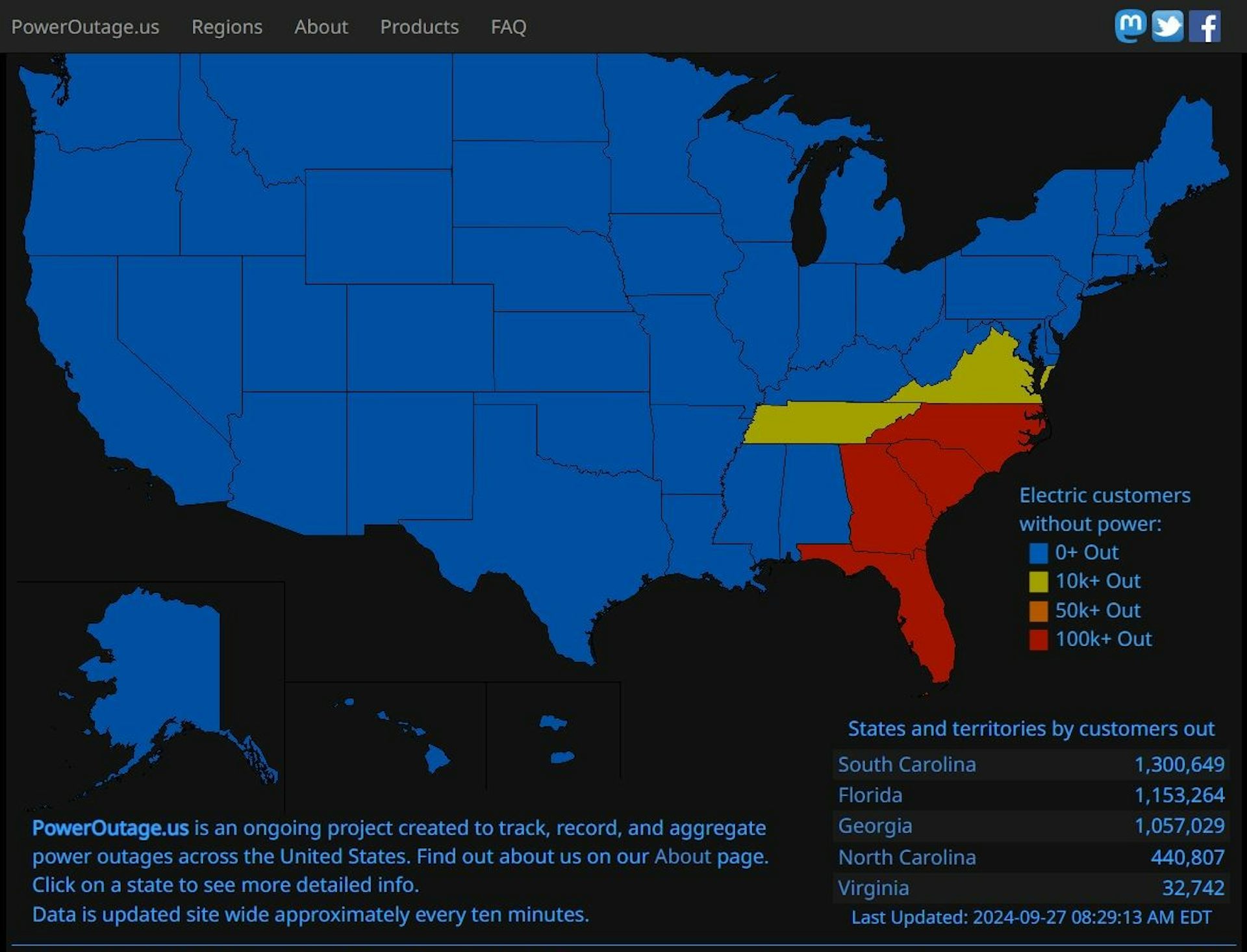
    Hurricane Helene left more than 3 million homes and businesses in the dark across Florida, Georgia and the Carolinas after hitting Florida’s Big Bend region as a powerful Category 4 storm late on Sept. 26, 2024. As Helene’s rains moved inland, officials warned that fixing downed utility lines and restoring power would take several days in some areas.

    Electricity is essential to just about everyone – rich and poor, old and young. Yet, when severe storms strike, socioeconomically disadvantaged communities often wait longest to recover.

    That isn’t just a perception.

    We analyzed data from over 15 million consumers in 588 U.S. counties who lost power when hurricanes made landfall between January 2017 and October 2020. The results show that poorer communities did indeed wait longer for the lights to go back on.

    A 10 percentile drop in socioeconomic status in the Centers for Disease Control and Prevention’s social vulnerability index was associated with a 6.1% longer outage on average. This corresponds to waiting an extra 170 minutes on average for power to be restored, and sometimes much longer.

    The top map shows the total duration of power outages over eight storms by county. The lower map is a comparison with socioeconomic status taken into account, showing that counties with lower average socioeconomic status have longer outages than expected.
    Ganz et al, 2023, PNAS Nexus

    Implications for policy and utilities

    One likely reason for this disparity is written into utilities’ standard storm recovery policies. Often, these polices prioritize critical infrastructure first when restoring power after an outage, then large commercial and industrial customers. They next seek to recover as many households as they can as quickly as possible.

    While this approach may seem procedurally fair, these recovery routines appear to have an unintended effect of often making vulnerable communities wait longer for electricity to be restored. One reason may be that these communities are farther from critical infrastructure, or they may be predominantly in older neighborhoods where power infrastructure requires more significant repairs.

    Commercial areas are often higher on the priority list for faster power recovery in an outage. This store was still closed for several days during Texas’ widespread outages in 2021.
    Montinique Monroe/Getty Images

    The upshot is that households that are already at greater risk from severe weather – whether due to being in flood-prone areas or in vulnerable buildings – and those who are least likely to have insurance or other resources to help them recover are also likely to face the longest storm-caused power outages. Long outages can mean refrigerated food goes bad, no running water and delays in repairing damage, including delays in running fans to dry out water damage and avoid mold.

    Our study spanned 108 service regions, including investor-owned utilities, cooperatives and public utilities. The differential impact on poorer communities did not line up with any particular storm, region or individual utility. We also found no correlation with race, ethnicity or housing type. Only average socioeconomic level stood out.

    How to make power recovery less biased

    There are ways to improve power recovery times for everyone, beyond the necessary work of improving the stability of power distribution.

    Policymakers and utilities can start by reexamining power restoration practices and power infrastructure maintenance, such as replacing aging utility poles and trimming trees, with disadvantaged communities in mind.

    Power providers already have granular data on power usage and grid performance in their service regions. They can begin experimenting with alternative recovery routines that consider the vulnerability of their customers in ways that do not substantially affect average recovery duration.

    People in some Fort Myers, Fla., neighborhoods still lacked water and electricity more than a week after Hurricane Ian in 2022.
    Montinique Monroe/Getty Images

    For socioeconomically vulnerable regions that are likely to experience long outages because of their locations and possibly the aging energy infrastructure, utilities and policymakers can proactively ensure that households are well prepared to evacuate or have access to backup sources of power.

    For example, the U.S. Department of Energy announced in October 2023 that it would invest in developing dozens of resilience hubs and microgrids to help supply local power to key buildings within communities when the wider grid goes down. Louisiana plans several of these hubs, using solar and large-scale batteries, in or near disadvantaged communities.

    Policymakers and utilities can also invest in broader energy infrastructure and renewable energy in these vulnerable communities. The U.S. Department of Energy’s Justice40 program directs that 40% of the benefit from certain federal energy, transportation and housing investments benefit disadvantaged communities. That may help residents who need public help the most.

    Severe weather events are becoming more common as global temperatures rise. That increases the need for better planning and approaches that don’t leave low-income residents in the dark.

    Chenghao Duan, a Ph.D. student at Georgia Tech, also contributed to this article. This is an update to an article originally published on Feb. 7, 2024.

    The authors do not work for, consult, own shares in or receive funding from any company or organization that would benefit from this article, and have disclosed no relevant affiliations beyond their academic appointment.

    ref. Hurricane Helene power outages leave over 3 million in the dark – history shows poorer areas often wait longest for electricity to be restored – https://theconversation.com/hurricane-helene-power-outages-leave-over-3-million-in-the-dark-history-shows-poorer-areas-often-wait-longest-for-electricity-to-be-restored-240001

    MIL OSI – Global Reports

  • MIL-OSI Global: US home insurance rates are rising fast – hurricanes and wildfires play a big role, but there’s more to it

    Source: The Conversation – USA – By Andrew J. Hoffman, Professor of Management & Organizations, Environment & Sustainability, and Sustainable Enterprise, University of Michigan

    The U.S. has seen a large number of billion-dollar disasters in recent years. AP Photo/Mark Zaleski

    Millions of Americans have been watching with growing alarm as their homeowners insurance premiums rise and their coverage shrinks. Nationwide, premiums rose 34% between 2017 and 2023, and they continued to rise in 2024 across much of the country.

    To add insult to injury, those rates go even higher if you make a claim – as much as 25% if you claim a total loss of your home.

    Why is this happening?

    There are a few reasons, but a common thread: Climate change is fueling more severe weather, and insurers are responding to rising damage claims. The losses are exacerbated by more frequent extreme weather disasters striking densely populated areas, rising construction costs and homeowners experiencing damage that was once more rare.

    Hurricane Ian, supercharged by warm water in the Gulf of Mexico, hit Florida as a Category 4 hurricane in October 2022 and caused an estimated $112.9 billion in damage.
    Ricardo Arduengo/AFP via Getty Images

    Parts of the U.S. have been seeing larger and more damaging hail, higher storm surges, massive and widespread wildfires, and heat waves that kink metal and buckle asphalt. In Houston, what used to be a 100-year disaster, such as Hurricane Harvey in 2017, is now a 1-in-23-years event, estimates by risk assessors at First Street Foundation suggest. In addition, more people are moving into coastal and wildland areas at risk from storms and wildfires.

    Just a decade ago, few insurance companies had a comprehensive strategy for addressing climate risk as a core business issue. Today, insurance companies have no choice but to factor climate change into their policy models.

    Rising damage costs, higher premiums

    There’s a saying that to get someone to pay attention to climate change, put a price on it. Rising insurance costs are doing just that.

    Increasing global temperatures lead to more extreme weather, and that means insurance companies have had to make higher payouts. In turn, they have been raising their prices and changing their coverage in order to remain solvent. That raises the costs for homeowners and for everyone else.

    The importance of insurance to the economy cannot be understated. You generally cannot get a mortgage or even drive a car, build an office building or enter into contracts without insurance to protect against the inherent risks. Because insurance is so tightly woven into economies, state agencies review insurance companies’ proposals to increase premiums or reduce coverage.

    The insurance companies are not making political statements with the increases. They are looking at the numbers, calculating risk and pricing it accordingly. And the numbers are concerning.

    The arithmetic of climate risk

    Insurance companies use data from past disasters and complex models to calculate expected future payouts. Then they price their policies to cover those expected costs. In doing so, they have to balance three concerns: keeping rates low enough to remain competitive, setting rates high enough to cover payouts and not running afoul of insurance regulators.

    But climate change is disrupting those risk models. As global temperatures rise, driven by greenhouse gases from fossil fuel use and other human activities, past is no longer prologue: What happened over the past 10 to 20 years is less predictive of what will happen in the next 10 to 20 years.

    The number of billion-dollar disasters in the U.S. each year offers a clear example. The average rose from 3.3 per year in the 1980s to 18.3 per year in the 10-year period ending in 2024, with all years adjusted for inflation.

    With that more than fivefold increase in billion-dollar disasters came rising insurance costs in the Southeast because of hurricanes and extreme rainfall, in the West because of wildfires, and in the Midwest because of wind, hail and flood damage.

    Hurricanes tend to be the most damaging single events. They caused more than US$692 billion in property damage in the U.S. between 2014 and 2023. But severe hail and windstorms, including tornadoes, are also costly; together, those on the billion-dollar disaster list did more than $246 billion in property damage over the same period.

    As insurance companies adjust to the uncertainty, they may run a loss in one segment, such as homeowners insurance, but recoup their losses in other segments, such as auto or commercial insurance. But that cannot be sustained over the long term, and companies can be caught by unexpected events. California’s unprecedented wildfires in 2017 and 2018 wiped out nearly 25 years’ worth of profits for insurance companies in that state.

    To balance their risk, insurance companies often turn to reinsurance companies; in effect, insurance companies that insure insurance companies. But reinsurers have also been raising their prices to cover their costs. Property reinsurance alone increased by 35% in 2023. Insurers are passing those costs to their policyholders.

    What this means for your homeowners policy

    Not only are homeowners insurance premiums going up, coverage is shrinking. In some cases, insurers are reducing or dropping coverage for items such as metal trim, doors and roof repair, increasing deductibles for risks such as hail and fire damage, or refusing to pay full replacement costs for things such as older roofs.

    Some insurances companies are simply withdrawing from markets altogether, canceling existing policies or refusing to write new ones when risks become too uncertain or regulators do not approve their rate increases to cover costs. In recent years, State Farm and Allstate pulled back from California’s homeowner market, and Farmers, Progressive and AAA pulled back from the Florida market, which is seeing some of the highest insurance rates in the country.

    In some cases, insurers are restricting coverage. Roof repairs, like these in Fort Myers Beach, Fla., after Hurricane Ian, can be expensive and widespread after windstorms.
    Joe Raedle/Getty Images

    State-run “insurers of last resort,” which can provide coverage for people who can’t get coverage from private companies, are struggling too. Taxpayers in states such as California and Florida have been forced to bail out their state insurers. And the National Flood Insurance Program has raised its premiums, leading 10 states to sue to stop them.

    About 7.4% of U.S. homeowners have given up on insurance altogether, leaving an estimated $1.6 trillion in property value at risk, including in high-risk states such as Florida.

    No, insurance costs aren’t done rising

    According to NOAA data, 2023 was the hottest year on record “by far.” And 2024 could be even hotter. This general warming trend and the rise in extreme weather is expected to continue until greenhouse gas concentrations in the atmosphere are abated.

    In the face of such worrying analyses, U.S. homeowners insurance will continue to get more expensive and cover less. And yet, Jacques de Vaucleroy, chairman of the board of reinsurance giant Swiss Re, believes U.S. insurance is still priced too low to fully cover the risk from climate change.


    Climate change is a major factor in the rising cost of insurance. Join us for a special free webinar with experts Andrew Hoffman of the University of Michigan and Melanie Gall of Arizona State University to discuss the arithmetic behind these rising rates, what climate change has to do with it, and what may be coming in your future insurance bills.

    Wednesday, October 9, 2024, 11:30 a.m. PT/2:30 p.m. ET.
    Register for the webinar here.


    Andrew J. Hoffman does not work for, consult, own shares in or receive funding from any company or organization that would benefit from this article, and has disclosed no relevant affiliations beyond their academic appointment.

    ref. US home insurance rates are rising fast – hurricanes and wildfires play a big role, but there’s more to it – https://theconversation.com/us-home-insurance-rates-are-rising-fast-hurricanes-and-wildfires-play-a-big-role-but-theres-more-to-it-238939

    MIL OSI – Global Reports

  • MIL-OSI USA: Underwood and Shaheen Introduce Legislation to Permanently Lower Health Care Costs

    Source: United States House of Representatives – Congresswoman Lauren Underwood (IL-14)

    WASHINGTON – This week, Representative Lauren Underwood (IL-14) and Senator Jeanne Shaheen (D-NH) introduced H.R.9774, the Health Care Affordability Act of 2024, critical legislation that would permanently lower the cost of health care premiums for families across the country.

    Underwood first introduced the Health Care Affordability Act in 2019. A short-term version of the bill was signed into law as a part of the American Rescue Plan and extended in the Inflation Reduction Act.

    As a result, families of four are saving an average of $2,400 on their annual premiums for Marketplace plans. The savings have led to a record breaking and historic expansion of health care coverage, with 50 million Americans now enrolled in marketplace plans. Four in five Americans can now find health coverage for $10 a month because of the Health Care Affordability Act.

    “The Health Care Affordability Act has led to an historic expansion in coverage, putting quality, affordable health care within reach for millions of people,” said Underwood. “This legislation works, and Congress must build on the historic progress we have made by making these savings permanent.”

    “For years, the ACA enhanced premium tax credits have significantly lowered costs and increased access to health insurance for families in New Hampshire and across the country. But let’s be very clear: if Congress fails to act before these tax credits expire, tens of millions of Americans will suffer a substantial increase in health care costs and millions of individuals could lose their health insurance entirely,” said Senator Shaheen. “It’s time to extend these highly effective tax credits to keep costs from skyrocketing and ensure health care is within reach for every American, and I’m proud that our Health Care Affordability Act does just that.”

    As a registered nurse, Underwood came to Congress to expand access to high-quality, affordable health care for every American. The Health Care Affordability Act lowers health care premiums by making tax credits for Marketplace plans more generous and available to more Americans.

    The Health Care Affordability Act of 2024 includes technical edits to ensure that no household pays above 8.5% of their incomes towards their health care premiums. 

    The Health Care Affordability Act is endorsed by the following organizations: Unidos US, National Partnership for Women and Families, National Association for the Advancement of Colored People (NAACP), Keep Americans Covered, Protect Our Care, Leukemia & Lymphoma Society, Center for American Progress, United States of Care, Young Invincibles, Families USA, American Heart Association, National Bleeding Disorders Foundation, National Health Council, Epilepsy Foundation, Hemophilia Federation of America, American Kidney Fund, The AIDS Institute, American Lung Association, American Cancer Society Cancer Action Network, Susan G. Komen, Cystic Fibrosis Foundation, Third Way, Community Catalyst, Alliance of Community Health Plans, National Organization for Rare Disorders, Asthma and Allergy Foundation of America, WomenHeart, CancerCare, Crohn’s & Colitis Foundation, National Alliance on Mental Illness (NAMI), Federation of American Hospitals.

    ###

    MIL OSI USA News

  • MIL-OSI Asia-Pac: Speech by FS at Hong Kong Association Luncheon in London (English only)

    Source: Hong Kong Government special administrative region

         Following is the speech by the Financial Secretary, Mr Paul Chan, at the Hong Kong Association Luncheon in London, the United Kingdom, today (September 27, London time):
     
    Adrian (Chairman of the Hong Kong Association, Mr Adrian Cartwright), members of the Hong Kong Association, ladies and gentlemen, friends of Hong Kong all,

         Good afternoon. I’m delighted to join you, once again, over a welcome lunch.

         The one consistent theme of my trip, first to Spain, now in London, has been the many speaking occasions.
     
         Last night’s Hong Kong Dinner was truly splendid and savory, and now I’m pleased to speak to the Hong Kong Association -thank you for the privilege – because you are very much invested in Hong Kong.
     
         I’m always pleased to speak at such times, especially when the topic is Hong Kong, and particularly to an audience as invested in Hong Kong as you are.

    The state of Hong Kong’s economy
     
         I have much to share, but let me start with a quick update on Hong Kong’s economy. 

         â€‹Last year, our GDP grew by 3.3 per cent as we recovered from the pandemic, and we achieved 3 per cent growth in the first half of this year. 

         The three main drivers fueling our economic growth are: exports, investments, and private consumption. Goods exports have seen significant growth, with Hong Kong serving as a major re-export hub for the Mainland, rising by over 7 per cent in the first half of the year. 

         â€‹For exports of services, tourism remains a key component. It is steadily recovering, with around 30 million visitors in the first eight months of this year, an increase of 44 per cent compared to last year. We expect 46 million visitors for the whole of 2024. 

         With improving economic and business prospects, but amid complex external environment, investment, from both the public and private sectors, expanded by more than 3 per cent in the first half of this year. 

         â€‹Private consumption has been bumpy. It is challenging given changes to the spending patterns of tourists and our residents. 

         Our stock market remains one of Asia’s leading exchanges, with a capitalisation in excess of 3 trillion pounds – 11 times our GDP. The measures announced, earlier this week by the Central Authorities to cut rates, reduce reserve requirement ratios and provide more support to the property sector – is boosting market confidence. The effects are already visible on Hong Kong’s stock market, with record high transactions! Before that, the China Securities Regulatory Commission announced measures in April 2024 that would encourage leading Mainland enterprises to list in Hong Kong. 

         Residential property market prices have fallen by over 6 per cent from the end of last year to August this year – and more than 25 per cent compared to its peak in September 2021. We know property market is an important pillar to any economy, so we remain vigilant, and has been monitoring the market closely. So far, our assessment is that it has been an orderly adjustment. 

         This February, we removed all the demand-side management measures for the residential property market. Overall, the property market is now stabilising. 

         The commencement of the monetary easing cycle by the Federal Reserve will provide support to both the economy and the property sector. 
         
         Currently, inflation is at around 1 per cent, and unemployment is lying low, at just 3 per cent. 

         â€‹Overall, we expect Hong Kong to grow between 2.5 per cent to 3.5 per cent this year. 

         Looking into the future, our economic development will be heading in eight discrete directions: internationally, as finance, trade, shipping, aviation and innovation and technology centres; and, regionally, as Asia Pacific’s legal and dispute resolution centre and intellectual property trading centre. We are committed, too, to becoming the East-meets-West centre for international cultural exchange. 

         Allow me now to highlight two of them: financial services and innovation and technology. 

         Let me start with financial services. Besides traditional areas that we are good at, we are working to become an international green finance and green technology hub. 

    Green and Sustainable Finance
     
         Green transition is a global agenda, bringing along responsibilities and opportunities. 
         â€‹
         Hong Kong has established a clear roadmap to achieve carbon neutrality by 2050, while reducing emissions by 50 per cent by 2035 from our 2005 levels. 

         â€‹We are taking a multi-pronged approach to realise this goal by addressing emission sources: first, achieving net-zero electricity generation by phases; second, enhancing energy efficiency in buildings through the promotion of green building practices; third, promoting green transport, particularly electric vehicles; and fourth, reducing waste. 

         Indeed, the Hong Kong SAR Government (Hong Kong Special Administrative Region Government) will invest more than 20 billion pounds in the next 15 to 20 years to implement climate change mitigation and adaptation measures. 

         However, the International Energy Agency has projected that the global energy transition finance gap will reach $3 trillion a year by 2030 and rise to $4.5 trillion a year by 2040. 

         â€‹Hong Kong is Asia’s No. 1 for green finance: for instance, we issue, over the past three years, 48 billion pounds of green bonds and debts per year on average, accounting for one-third of Asia’s market. But there is much more that we can achieve. 

         One is on green standards. Earlier this year, the Hong Kong Monetary Authority released the Hong Kong Green Taxonomy (Hong Kong Taxonomy for Sustainable Finance), which is compatible with the Common Ground Taxonomy developed by China and the EU (European Union), to assist the financial sector in assessing the “greenness” of projects. 

         Similarly, the Hong Kong Stock Exchange also impose ESG (environmental, social and governance) disclosure requirements for listed entities. 

         â€‹Just a few days ago, the Hong Kong Institute of Certified Public Accountants released the draft financial reporting standards which it plans to implement in August next year. The proposed Hong Kong standards follow those issued by the International Sustainability Standards Board, ISSB. 

         In the realm of green tech, start-ups are a powerhouse for many green innovative solutions, fully reflecting our younger generation’s passion for the environment and a sustainable future. 

         You might have met the delegation of start-ups from the Hong Kong Science Park and Cyberport who are with me on this trip to the United Kingdom. Some of them are engaged in green tech, and while others are engaged in different fields, but they share a common goal: to change people’s lives for the better. 

         We are working to attract more green start-ups in our innovation ecosystem. 

         By the way, our Science Park annually organises an elevator pitch competition where the start-ups have to sell their ideas in just 60 seconds in the lift of Hong Kong’s tallest skyscraper. The winner this year is from Munich seeking to establish a lithium battery recycle plant. 
     
    Innovation and Technology
     
         Let me now turn to innovation and technology. Our focus areas are: AI and big data analytics, biotech and health sciences, fintech and new energy and new materials. 

         The key success factor for the development of AI are algorithms, computing capabilities, data and use case scenarios. Under the “one country, two systems” arrangements, Hong Kong has unique advantages because we are the hub converging the Mainland and international data, and the Greater Bay Area provides us with ample use case scenarios. 

         In order to expedite the development of the eco-system of the aforementioned industries, we have set up the Hong Kong Investment Corporation, HKIC. 

         With six billion pounds at its disposal, the HKIC has a dual mandate. While it seeks financial returns, it also promotes the development of target industries that are crucial for the long-term competitiveness and economic vitality of Hong Kong. The HKIC serves as a tool for the Hong Kong SAR Government to invest and/or co-invest in enterprises, start-ups and important projects. 

         The ​HKIC is “patient capital”. It has already initiated several strategic partnerships in the areas of hard tech, biotech and new energy. 

         What distinguishes the HKIC from other sovereign funds is its investment approach to channel private capital into strategic industries through a collaborative approach, by bringing together like-minded private equity funds, venture capitalists, investors, and even entrepreneurs.

         This is particularly important for start-ups, especially those with original and disruptive technologies because their development cycles are often long, and patient capital is crucial for their success.

         Going forward, the HKIC will expand its collaboration with overseas partners to maximise impact. Next January, the HKIC will host a Roundtable for International Sovereign Wealth Funds, inviting sovereign wealth funds and financial leaders to explore investment opportunities and develop collaborative partnerships. In fact, this September, the HKIC also staged a Hong Kong Start-up Investment and Development Summit. 

         Ladies and gentlemen, I hope to leave ample time for questions, so I will conclude my remarks here. My sincere thanks, once again, to the Hong Kong Association for this welcome opportunity to speak to you. 

         I’m happy now to take your questions. 

         â€‹Thank you.

    MIL OSI Asia Pacific News

  • MIL-OSI USA: Launch Your Creativity with These Space Crafts!

    Source: NASA

    9 min read

    In honor of the completion of our Nancy Grace Roman Space Telescope’s spacecraft — the vehicle that will maneuver the observatory to its place in space and enable it to function once there — we’re bringing you some space crafts you can complete at home!

    Join us for a journey across the cosmos, starting right in your own pantry. 

    Stardust Slime

    Did you know that most of your household ingredients are made of stardust? And so are you! Nearly every naturally occurring element was forged by living or dying stars. Take the baking soda in this slime recipe, for example. It’s made up of sodium, hydrogen, carbon, and oxygen. The hydrogen was made during the big bang, right at the start of the universe. But the other three elements were created by dying stars. So when you show your friends your space-y slime, you can tell them it’s literally made of stardust!

    Instructions:

    1 5 oz. bottle clear glue
    ½ tablespoon baking soda
    food coloring
    1 tablespoon contact lens solution
    1 tablespoon glitter

    Directions:

    Pour the glue into a bowl

    Mix in the baking soda

    Add food coloring (we recommend blue, purple, black, or a combination).

    Add contact lens solution and use your hands to work it through the slime. It will initially be very sticky! You can add a little extra contact lens solution to make it firmer and less goopy.

    Add glitter a teaspoon at a time, using as much or as little as you like!

    Space Suckers

    Now let’s travel a little farther, past Earth’s atmosphere and into the realm of space. That’s where Roman is headed once the whole observatory is complete and passes all of its testing!

    Roman will scan the skies from space to make it extra sensitive to faint infrared light. It’s harder to see from the ground because our atmosphere scatters and absorbs infrared radiation, which obscures observations. Some astronauts have reported that space smells metallic or like gunpowder, but don’t worry — you can choose a more pleasant flavor for your space suckers!

    Ingredients

    2 cups sugar
    2/3 cup light corn syrup
    2/3 cup water
    gel food coloring
    flavor oil
    edible glitter dust
    sucker sticks
    sucker mold

    Directions

    Prep the molds by adding sucker sticks.

    Mix sugar, light corn syrup, and water together in a pot on the stove over medium heat.

    Turn it up to medium-high heat and let it boil without stirring for about 6 minutes.

    Quickly stir in the flavor oil of your choice, gel food coloring, plus as much edible glitter as you like (reserve some for dusting).

    Carefully but quickly spoon the mixture into the molds. Spin the sticks so they’re evenly coated. Add a sprinkle of reserved edible glitter and allow to harden.” An image on the left side of the card shows the result: a deep purple sucker with silver glitter embedded.

    Fizzy Planets

    As we move toward our outer solar system, we’ll pass the orbits of the gas giant planets Jupiter and Saturn. While they don’t actually fizz like the mini planets you can make at home, they do have some pretty exotic chemistry that stems from their extreme pressures, temperatures, and compositions. For example, the hydrogen in their cores behaves like liquid metal instead of a gas. It even conducts electricity!

    Roman will use multiple planet-spotting techniques –– microlensing, transits, and direct imaging –– to help us study a variety of worlds, including both gas giants and rocky worlds similar to our own.

    Ingredients

    3 cups baking soda
    ¾ cup water
    food coloring
    ¼ cup vinegar

    Directions

    Mix a few drops of food coloring into ¼ cup of water and pour into a bowl with 1 cup of baking soda.

    Repeat step one two more times using different colors.

    Scoop together bits from each mixture to form small balls. Add an extra splash of water to any mixture that’s too crumbly.

    Douse the balls with vinegar using an eye dropper or teaspoon and watch them fizz!

    Marshmallow Constellations

    As we venture farther out into space, we’ll reach some familiar stars! Constellations are groups of stars that appear close together in the sky as seen from Earth. But if you actually journeyed out to them, you might be surprised to discover that they’re often super far apart from each other!

    Though constellations aren’t made of stars that are actually bound together in any way, they can still be useful for referencing a cosmic object’s location in the sky. For example, you can use a pair of binoculars or a telescope to take a look at the nebula found beneath Orion’s Belt, marked by the glitter patch in the recipe card above! You can find the constellation printables here.

    Supplies

    toothpicks or mini pretzel sticks
    mini marshmallows
    constellation printables
    scissors

    Directions

    Attach marshmallows to toothpicks or pretzel sticks using the constellation cards as a guide. Carefully trim toothpicks or pretzel sticks as needed using scissors.

    Black Hole Bath Bombs

    Black holes –– objects with such strong gravity that not even light can escape their clutches –– lurk unseen throughout our galaxy. Stray too close to one and you’re in for a wild ride! But they aren’t cosmic vacuum cleaners, despite what you may have grown to believe. Just keep your distance and they’ll affect you the same way as any other object of the same mass.Astronomers have found dozens of black holes in our galaxy by seeing how their gravity affects nearby objects. But there may be 100 million more that lack a visible companion to signal their presence. Roman will find some of these solitary black holes by seeing how their gravity focuses the light from farther stars.

    Ingredients

    1 cup baking soda
    ½ cup citric acid
    ½ cup cornstarch
    2 tablespoons coconut oil
    black food coloring
    optional: 2 teaspoons essential oil for scent
    optional: ½ cup Epsom salt

    Directions

    Mix the baking soda, citric acid, cornstarch, and Epsom salt (optional) together in a bowl.

    In a separate bowl, mix the coconut oil, food coloring, and essential oil (optional).

    Pour the liquid mixture into the dry mixture slowly while whisking it all together. Add a couple tiny splashes of water and whisk it in quickly.

    Tightly press the mixture into round molds. Leave them for a few hours and then they’ll be ready to use!

    Galaxy in a Jar

    Now let’s go so far we can see our Milky Way galaxy from the outside — something many astronomers probably wish they could do at times! Sort of like how Earth’s atmosphere can affect our view of space, dust in our galaxy can get in the way, too. That makes it easier to study other galaxies than our own in some ways! Roman’s combination of a large field of view, crisp resolution, and the ability to peer through dust make it the ideal instrument to study the Milky Way. The mission will build on previous observations to generate the most detailed map of our galaxy to date.

    Ingredients

    hot water
    glitter glue
    glitter
    super glue (optional)

    Directions

    Mostly fill a 16 oz. glass jar with very hot water, leaving a couple inches of space at the top.

    Add at least ¼ cup of glitter glue in colors of your choosing.

    Add loose glitter a couple of teaspoons at a time, using as much or as little as you like! You can use a combination of fine and chunky glitter for an extended swirling effect.

    Optional: Super glue the lid to the jar.

    Once the water has sufficiently cooled, give the jar a gentle shake to see your galaxy swirl!

    NOTE: Closely monitor children to ensure the jar doesn’t break.

    Pinwheel Galaxy Pinwheels

    As we continue our cosmic excursion, you’ll see other galaxies sprinkled throughout space. Many are spiral galaxies, like our Milky Way and the Pinwheel Galaxy from the craft described above. (You can find more detailed instructions and the printout you’ll need here.)

    But galaxies come in other varieties, too. Through Roman’s wide, deep surveys, astronomers are sure to see every type. Scientists will study the shapes and distances of billions of galaxies to help us understand dark energy — a mysterious pressure that’s speeding up the universe’s expansion. 

    Supplies

    Pinwheel Galaxy printout
    pipe cleaner or chopsticks
    scissors
    popsicle stick
    single hole puncher

    Directions

    Cut out the hexagonal shape for your galaxy pinwheel.

    Make cuts down the white lines.

    Punch holes in the white dots: six around the edges and one in the center.

    Turn the paper so it’s face-down.

    Thread a pipe cleaner through the center hole.

    Going around the circle, fold each flap so the pipe cleaner goes through the hole.

    Tie a knot in the pipe cleaner to secure the front of the pinwheel. Wrap the other side of the pipe cleaner around a popsicle stick.

    Universe Dough

    We’re nearing the end of our voyage, having traveled so far through space and time that we can take in the whole universe! We’ve learned a lot about it, but there are still plenty of open questions. Some of its biggest components, dark energy and dark matter (invisible matter seen only via its gravitational influence), are huge mysteries Roman will explore. And since the observatory will reveal such large, deep swaths of space, who knows what new puzzles we’ll soon uncover!

    Ingredients
    1 cup flour
    ½ cup salt
    1 tablespoon vegetable oil
    ½ cup hot water
    food coloring
    glitter

    Directions

    Mix flour and salt in a bowl.

    Add several drops of food coloring to hot water, and stir into dry mixture along with the oil.

    Add as much glitter as you like and knead it into the dough for several minutes.

    Add water or flour as needed to adjust the consistency.

    Still feeling crafty? Try your hand at these 3D and paper spacecraft models. If you’re eager for a more advanced space craft, check out these embroidery creations for inspiration! Or if you’re ready for a break, take a virtual tour of an interactive version of the Roman Space Telescope here.

    MIL OSI USA News

  • MIL-OSI USA: FEMA offers free Repair and Rebuilding Advice in O’Brien County

    Source: US Federal Emergency Management Agency

    Headline: FEMA offers free Repair and Rebuilding Advice in O’Brien County

    FEMA offers free Repair and Rebuilding Advice in O’Brien County

    Des Moines, Iowa — FEMA is providing free information about how to make your home stronger and safer – whether it was damaged by this summer’s severe storms or not.

    FEMA will be in O’Brien County at the Downtown Hardware Hank store, 816 Third Ave., Sheldon Iowa 51201 on Oct. 1-4 from 9 a.m. – 4:30 p.m.

    You can speak directly with FEMA specialists at local home improvement stores. The public can get answers to questions and discuss:

    • Proven methods for preventing damage from future disasters.
    • Techniques for rebuilding homes.
    • Tips for reducing your disaster risk – whether you own or rent your home.
    • Help is available to all homeowners, not only those affected by the recent storms.

    If you have questions about how to make your home safer, call the FEMA Hazard Mitigation Helpline at 833-336-2487.

    If you had flood related damage or storm-caused expenses and live or own a business in Buena Vista, Cherokee, Clay, Dickinson, Emmet, Humboldt, Lyon, Monona, O’Brien, Osceola, Palo Alto, Plymouth, Pottawattamie, Scott, Sioux and Woodbury counties, FEMA assistance can provide grants to help cover temporary housing, home repairs and other disaster related needs. 

    Disaster recovery assistance is available without regard to race, color, religion, nationality, sex, age, disability, English proficiency, or economic status. If you or someone you know has been discriminated against, call FEMA toll-free at 833-285-7448. For Spanish, press 2. If you use a relay service, such as video relay service (VRS), captioned telephone service or others, give FEMA the number for that service. 

    martyce.allenjr

    MIL OSI USA News

  • MIL-OSI Canada: Junior A hockey’s best to battle in Calgary

    Source: Government of Canada regional news

    [embedded content]

    Alberta is reaffirming its status as a premier destination for major sporting events, bringing another major hockey championship to the province this May. For the first time in the event’s 54-year history, the National Junior A Championships will come to Calgary. The 2025 Centennial Cup will be held at the city’s Max Bell Centre. The event is expected to attract 50,000 spectators to the Blue Sky City, in addition to the hundreds of athletes, coaches and officials participating in the competition.

    Alberta’s government has committed $240,000 for the planning, staging and delivery of the competition. The championship is expected to inject up to $5 million into Calgary’s economy, supporting jobs and local businesses through increased dining, shopping, entertainment and accommodation bookings.

    “I’m pleased to welcome the Centennial Cup back to Alberta, and to Calgary for the first time. As someone who grew up playing every sport I could, I can tell you first-hand the impact of having elite competitions like the Centennial Cup in your community. These competitions not only benefit the local economy, they also inspire the next generation of athletes to pursue their dreams.”

    Joseph Schow, Minister of Tourism and Sport

    Considered the toughest trophy to win in Canadian hockey, the road to the Centennial Cup involves 122 teams from nine leagues across Canada. After claiming their league titles, the nine champion teams, along with a host team, will compete for the coveted Centennial Cup. The Calgary Canucks enter the 2025 season coming off their tenth Alberta Junior Hockey League championship victory and a semifinal appearance in the 2024 Centennial Cup.

    “The Centennial Cup is the pinnacle of Junior A hockey in Canada, and the Canucks are thrilled to be bringing the Cup to Calgary. We’re grateful to the Government of Alberta for their support in hosting this event and are looking forward to winning in front of a home crowd!”

    Sandy Edmonstone, chair and president, Calgary Canucks Junior A Hockey Club

    A key feature of the Centennial Cup is giving back to the community. With each Centennial Cup, legacy projects are put in place to increase access and participation in sport in the host communities. As the legacy project for the 2025 Centennial Cup, the Calgary Canucks are proud to be investing in advancing Indigenous and at-risk youth in sport, in addition to future enhancements to Max Bell Centre. 

    “Hockey Canada is thrilled to have the support of the Government of Alberta to bring the Centennial Cup to Calgary. We believe in what the Calgary Canucks are creating as the event host and know that community hockey, Indigenous youth, local volunteers and Alberta hockey fans will benefit from the impact of this event for years to come.” 

    Dean MacIntosh, senior vice president, Hockey Canada       

    Alberta will host the Centennial Cup for the eighth time since the tournament’s inception in 1971, with Calgary joining previous host cities Edmonton (1975), Olds (1994), Fort McMurray (2000), Grande Prairie (2004), Camrose (2011), Lloydminster (2016), and Brooks (2019).

    Related information

    • Hockey Canada
    • Calgary Canucks
    • Major Sport Event Grant Program

    Multimedia

    • Video: Minister Schow announces Centennial Cup funding at Evening with Legends event in Calgary

    Related news

    • Strengthening Alberta’s sport legacy (Aug. 8, 2024)
    • Athletes aiming for gold at Alberta sport events (March 19, 2024)
    • All eyes on Alberta for winter sports (Jan. 15, 2024)

    MIL OSI Canada News

  • MIL-OSI USA: Warren, Whitehouse, Casar, Lawmakers Slam 35 Companies for Paying Their Executives More Than They Pay in Federal Income Taxes

    US Senate News:

    Source: United States Senator for Massachusetts – Elizabeth Warren
    September 27, 2024
    Text of Letters (PDF)
    Washington, D.C. – U.S. Senators Elizabeth Warren (D-Mass.) and Sheldon Whitehouse (D-R.I.), and Representative Greg Casar (D-Texas) led their colleagues in slamming 35 major companies that have been paying their executives more than they pay in federal income taxes. The lawmakers point to this as an additional reason why Congress must reform the tax code in 2025 to ensure that big corporations are paying what they owe.
    “For decades, big businesses and the wealthy have skirted their responsibility to pay federal income taxes, leaving hardworking Americans to foot the bill,” wrote the lawmakers. “As Congress considers what to do when some provisions of the 2017 law expire next year, it is critical that we ensure that large, profitable businesses are paying their fair share.” 
    In the first five years following the $2 trillion Tax Cuts and Jobs Act (TCJA) passed by Republicans and signed by President Trump in 2017, 35 companies raked in $277 billion in domestic profits. These companies then paid an average effective income tax rate of just 14.1 percent, almost a third less than the 21 percent statutory rate. Instead of these gains “trickling down” to workers, the corporations paid their executives $9.5 billion – more than they paid in federal income taxes. While executives were making $989,000 per year or more, an average raise of $50,000 per executive, 90 percent of workers saw no earnings increase.
    The most egregious examples of these companies – and the ones the lawmakers wrote to – include: Tesla, TMobile, Netflix, AIG, Ford, NextEra, Darden, MetLife, Duke Energy, First Energy, DISH, Principal Financial, American Electrical Power, Kinder Morgan, Dominion, Oneok, Williams, Xcel Energy, NRG Energy, Salesforce, DTE Energy, Ameren, Sempra Energy, US Steel, Entergy, AmerisourceBergen, PPL, CMS Energy, Evergy, Voya Financial, Atmos Energy, Alliant Energy, Match Group, UGI, and Agilent Tech.
    “Next year, Congress has an opportunity to take bigger strides in reforming our tax code – to raise the corporate rate, close loopholes, and hold big businesses to the same standards as everyday working Americans who pay their fair share,” concluded the lawmakers.
    In addition to Senators Warren and Whitehouse, and Representative Casar, the letters were also signed by Senators Jeff Merkley (D-Ore.), Ed Markey (D-Mass.), Bernie Sanders (I-Vt.), and Peter Welch (D-Vermont), as well as Representatives Jan Schakowsky (D-Ill.), Eleanor Norton (D-D.C.), Mark Pocan (D-Wis.), Pramila Jayapal (D-Wash.), Hank Johnson (D-Ga.), Rashida Tlaib (D-Mich.), Bennie Thompson (D-Miss.), Delia Ramirez (D-Ill.), and Barbara Lee (D-Calif.). 
    Senator Warren has led the fight to close tax loopholes for the wealthy and giant corporations to ensure a more fair tax system: 
    In July 2024, Senator Warren called on Treasury Secretary Janet Yellen to fully implement the 15% Corporate Alternative Minimum Tax signed into law by President Biden in the Inflation Reduction Act two years ago to preemptively stop corporate attempts to avoid paying their fair share.
    In June 2024, Senator Warren delivered remarks at the Washington Center for Equitable Growth to set the agenda on taxes ahead of the 2025 tax fight and urge Democrats to back President Biden’s agenda to tax the rich. Senator Warren’s call came as Congress prepared for major tax policy changes as a large portion of the 2017 Republican tax cuts for the wealthy were set to expire. 
    In March 2024, Senator Warren, along with U.S. Representatives Pramila Jayapal (D-Wash.) and Brendan Boyle (D-Pa.), reintroduced the Ultra-Millionaire Tax Act, popular, comprehensive legislation that would bring in at least $3 trillion in revenue over 10 years by requiring that the top 0.05 percent of American households chip in 2 cents for every dollar of wealth over $50 million. The newly introduced version of the bill included stronger rules on trusts, a common method the ultra-wealthy utilize to avoid paying taxes that cost the federal government between $5 and $7 billion annually. 
    In November 2023, at a hearing of the Senate Finance Committee, Senator Warren called out efforts by lobbyists for giant corporations trying to extend three of the biggest corporate giveaways in the Trump tax cuts: bonus depreciation, R&D expensing, and looser limits on net interest deduction. 
    In October 2023, Senators Warren, Sheldon Whitehouse (D-R.I.), Chris Van Hollen (D-Md.), and Bernie Sanders (I-Vt.) sent a letter to Secretary Janet Yellen and Internal Revenue Service (IRS) Commissioner Daniel Werfel, urging them to proactively use the Treasury Department’s rulemaking authority to close tax loopholes that create inconsistency and unfairness in the tax system and threaten the government’s ability to raise important revenue.
    In August 2023, Senators Warren, Bob Casey (D-Pa.), Richard Blumenthal (D-Conn.), and Sanders sent a letter to the Treasury and IRS, urging them to quickly propose and implement strong rules that close loopholes exploited by crypto tax evaders.
    In April 2023, Senator Warren sent a letter to Secretary Yellen and Commissioner Werfel, urging them to follow through on the commitments of the Biden administration by examining and taking concrete steps to address racial inequities in tax benefits and enforcement.
    In March 2023, Senators Warren, Van Hollen, Sanders, and Whitehouse sent a letter to Treasury Secretary Janet Yellen, urging her to use the full extent of the Treasury Department’s regulatory authority to crack down on the ultra-wealthy’s use of trusts to dodge paying their fair share in taxes.

    MIL OSI USA News