NewzIntel.com

    • Checkout Page
    • Contact Us
    • Default Redirect Page
    • Frontpage
    • Home-2
    • Home-3
    • Lost Password
    • Member Login
    • Member LogOut
    • Member TOS Page
    • My Account
    • NewzIntel Alert Control-Panel
    • NewzIntel Latest Reports
    • Post Views Counter
    • Privacy Policy
    • Public Individual Page
    • Register
    • Subscription Plan
    • Thank You Page

Category: housing

  • MIL-OSI Global: These maps of support for Germany’s far-right AfD lay bare the depth of the urban-rural divide

    Source: The Conversation – UK – By Rolf Frankenberger, Managing Director Research, Institute for Research on Right-Wing Extremism (IRex), University of Tübingen

    The process of industrialisation, globalisation and urbanisation – spreading out from urban centres into the countryside – is one of the core developments of modern society. It has changed people’s lives in almost every part of the world. This is a process that has been going on for more than a century. New lifestyles have developed and traditional ones have been challenged.

    A new division has emerged as a result between the urban and the rural. The two are more than just forms of settlements – they reflect ideals, values and lifestyles. Those who live in towns and cities lead almost entirely different lives to those who live in the countryside.

    Where the two meet, there is potential for tension. And that tension can be politicised. In Germany, the Alternative für Deutschland (AfD), a far-right nationalist and völkisch party, is using the “urban-rural divide” to polarise and mobilise an electorate that is attracted by romanticised notions of purity, tradition, nation and rurality.

    Using spatial and data analysis, we can illustrate the patterns of this politicisation.

    Imagine you are living in a small village in the countryside. You strongly believe in traditions and family life. You regard the landscape around you as home – as heimat, as it would be called in German. But people from abroad are moving into your village, because they can afford land there. They are different in the way they think and live. They might, for example, be digital nomads in search of a picturesque location for their home office.

    These newcomers bring the city with them, changing the rural community they join. City, to you, is a cipher for urbanity, globalism and individualism.

    But this is just one side of the coin. The other is that people from the countryside also move to cities, be it for education, work or just because there is nothing left in their village. And they bring their lifestyles to the city, too, trying to keep up traditional ideals of how the world should look.

    Diversity, ambiguity and, sometimes, incompatibility become the norm under these conditions. Urban lifestyles and designs – such as shared flats, alternative family forms, non-binary identity or digital mobility at work – collide with rural norms such as the traditional family and “rootedness” across generations.

    This can happen both in cities and in rural areas. As a result, a pluralism of ideas, styles and values arises – ranging from progressive, liberal and leftist, inclusive, modernist values to traditional, conservative and rightist, exclusive and nationalist beliefs. They coexist but are unevenly distributed over urban and rural areas.

    The AfD and other far-right parties introduce a political meaning to the urban-rural divide. The AfD pushes a narrative of the city as a negative force that is fundamentally incompatible with the rural. It claims that an elite cartel has usurped power in Germany and is trying to destroy the “culturally determined German identity”. It instead advocates for the protection of a leitkultur – of customs and traditions (brauchtum) that it believes create identity. It asserts heteronormativity as a biological fact, emphasises a strong traditional family, traditional farming and rural identity.

    What might be called cultural landscapes (kulturlandschaften) have become a particular battleground of late, with opposition to the construction of wind turbines, especially in forests, now a policy position. The AfD’s candidate for chancellor, Alice Weidel, described these as “windmills of shame” (“Windmühlen der Schande”) and called for their dismantling at the recent party congress. Wind turbines can be understood here as expressions of urban leitmotifs in a rural cultural landscape – they disrupt the countryside to provide energy for unseen urban consumers.

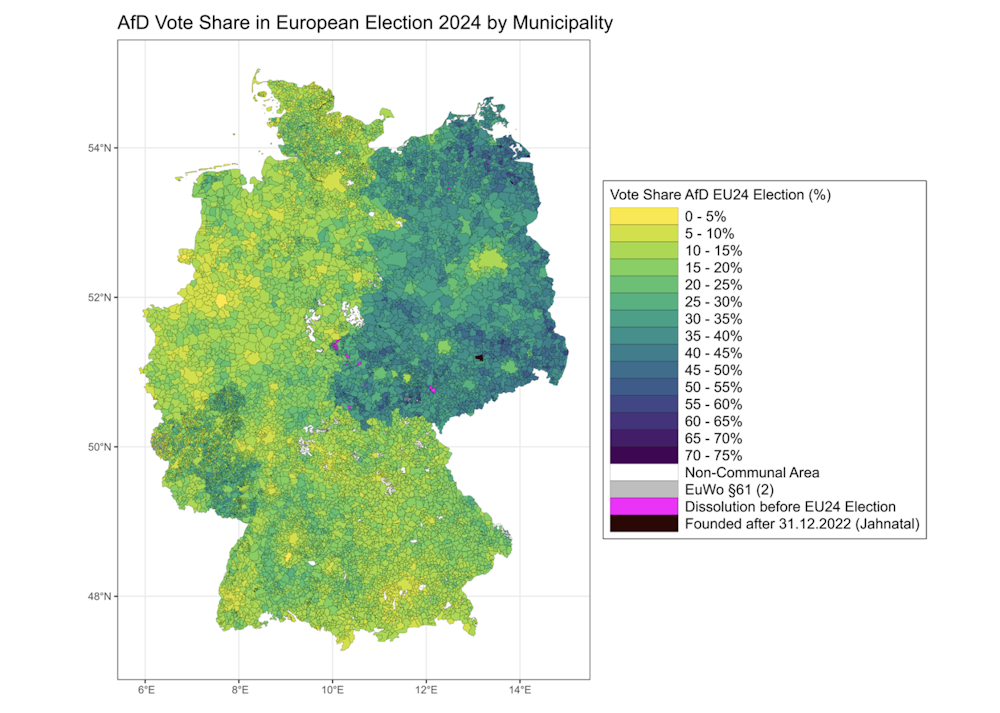
    And ultimately, this politicisation translates into electoral outcomes. In the European parliament elections of June 2024, the AfD took 15.9% of German votes. If we look at the spatial distribution of the AfD’s vote, a pattern showing the salience of the urban-rural divide emerges.

    East and west, town and country

    It’s clear by looking at the map that most (though not all) of the AfD’s strongholds are in eastern Germany – the region which used to be the German Democratic Republic (GDR). Fascism and Nazism were outlawed by decree when this anti-fascist state was established but, in reality, far-right ideologies don’t die off that easily. The result was that extremist views survived in an environment where there was also a lack of education on the National Socialism of the past – and a lack of education about democracy.

    When the socialist authoritarian GDR regime fell in 1989, Germany was reunified under western conditions. This had various effects, including a sense that the experiences of the east were not valued. The inequalities between the two sides of the reunified nation have left some in the east feeling distant from the state. The AfD’s version of nationalism finds fertile ground here.

    Another pattern is also clear across the whole country: the AfD is stronger in remote and rural areas and weaker in urban centres. There is less support in cities such as Berlin, Cologne, Dresden, Hamburg, Leipzig, Munich and Stuttgart. Places with more globalised cultures, international business and diverse populations remain comparably resilient to the spread of the far right.

    AfD support in different municipalities. The darker the colours, the higher the AfD vote share.
    R Frankenberger, CC BY-ND

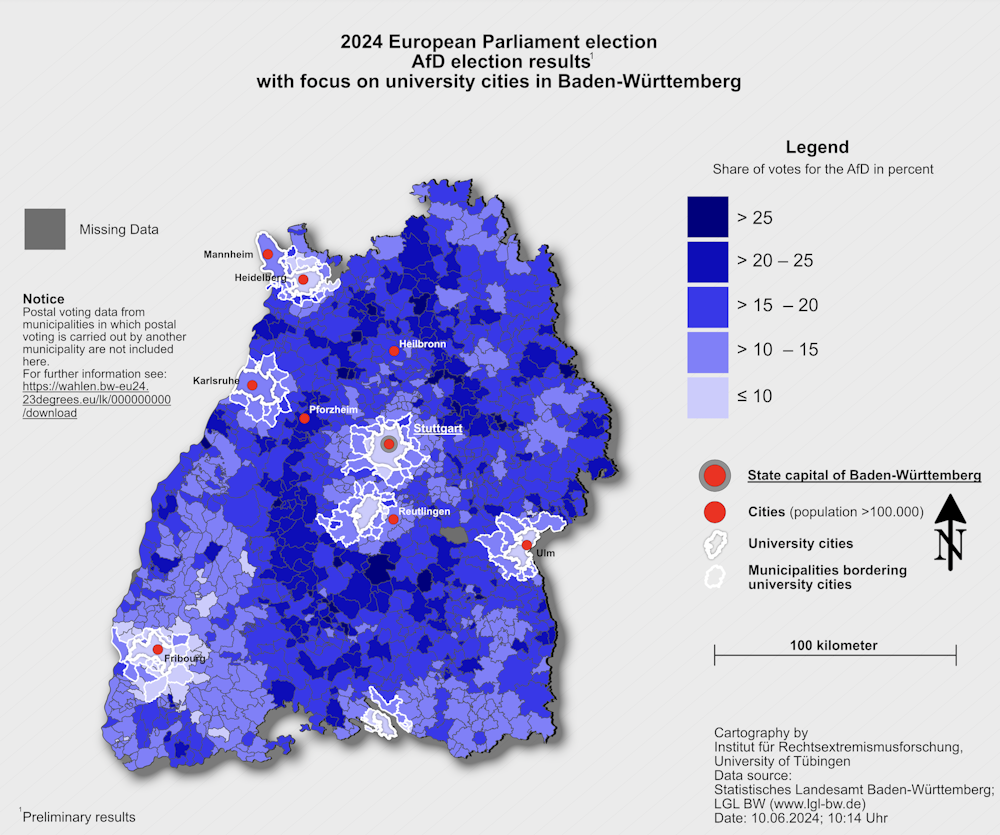
    These patterns become more visible if you take the European election results in the state of Baden-Württemberg as an example.

    The AfD performs significantly worse in the more globalised, cosmopolitan and university-oriented urban areas and their suburbs than in the more remote and rural areas of Baden-Württemberg. On the map, university cities are marked out with a white outline.

    AfD support mapped, with university cities highlighted.
    University of Tübingen, CC BY-ND

    The AfD is particularly strong in the northern and eastern Black Forest, on the Baar, in the Swabian Alb, in the Rems-Murr district, in the Swabian Forest and in Hohenlohe. Most of these areas are remote, with many small towns and villages. They have slightly lower income levels and lower levels of migration than average. They are much more traditional in terms of culture and religion than urban areas.

    The Black Forest, the Swabian Forest, and Hohenlohe also have quite strong protestant and evangelical communities, which are strongholds of traditional family life, customs and traditions.

    We should expect to see these trends continue. The AfD looks set to make further gains in the February 23 election being held in Germany, retaining its strongholds in the east but also spreading into the west in rural areas. The urban-rural divide will therefore become all the more apparent and entrenched when German voters head to the polls.

    Rolf Frankenberger does not work for, consult, own shares in or receive funding from any company or organisation that would benefit from this article, and has disclosed no relevant affiliations beyond their academic appointment.

    – ref. These maps of support for Germany’s far-right AfD lay bare the depth of the urban-rural divide – https://theconversation.com/these-maps-of-support-for-germanys-far-right-afd-lay-bare-the-depth-of-the-urban-rural-divide-248405

    MIL OSI – Global Reports –

    February 6, 2025
  • MIL-Evening Report: Grattan on Friday: we don’t need an inquiry into the caravan affair but we do need some answers

    Source: The Conversation (Au and NZ) – By Michelle Grattan, Professorial Fellow, University of Canberra

    The battle to contain antisemitism in Australia finds both sides of politics embracing measures they’d otherwise abhor.

    Spectacularly, the government capitulated this week to include mandatory minimum sentences of between one and six years in its hate speech legislation that passed the parliament on Thursday.

    That flip flop was done in a day. You need a longer memory to recall the Coalition’s insistence that free speech had to be preeminent over dealing with hate speech.

    Way back, when Tony Abbott was prime minister, there was a big (ultimately unsuccessful) push against Section 18C of the Racial Discrimination Act. This civil law prohibits acts “likely to offend, insult, humiliate or intimidate someone because of their race or ethnicity”. At the very least, libertarian Liberals wanted it reworded to remove “offend” and “insult”.

    Before entering parliament, James Paterson worked for the right wing Institute of Public Affairs, which spearheaded attacks on 18C. Even after becoming a senator in 2016, Paterson remained a strong critic of 18C (although he says he always supported laws against incitement to violence).

    Now as home affairs spokesman Paterson has been at the forefront of the opposition efforts to make the new hate speech law as strong as possible.

    Until mid week the government firmly ruled out giving in to opposition’s demands for mandatory sentences for hate crimes. The government’s resistance was unsurprising. The Labor party platform rules out mandatory sentences.

    But then late on Wednesday, leader of the house Tony Burke went into parliament with amendments including mandatory minimum sentences of between one and six years for various crimes under the anti-hate legislation.

    Teal MP Zoe Daniel, from the Victorian seat of Goldstein, was among several crossbenchers who voted against that amendment.

    She said later she supported the legislation but described the mandatory sentencing as “overreach”. “Community safety is paramount, and so is good policy-making. Mandatory minimum sentences do not reflect good parliamentary practice or good governance. Nor do they respect the sanctity of Australia’s constitution and separation of powers, and the importance of judicial independence.”

    The antisemitism crisis is, on a number of fronts, leading to the actual or advocated curtailment of civil liberties. The federal government has outlawed the Nazi salute and hate symbols. The NSW government is to bring in more anti-hate provisions.

    There is constant debate about the desirability of curbs of one sort or another on demonstrations. The antisemitism envoy, Jillian Segal, has said, “There should be places designated away from where the Jewish community might venture where people can demonstrate”.

    In our history we repeatedly see how government actions to confront perceived emergencies collide with civil liberties.

    For example, strong security laws introduced in the wake of September 11 2001 triggered arguments about the extent to which they struck down people’s rights. Going back to the Menzies era, the Communist threat prompted the government to try (and fail) to carry a referendum to ban the Communist Party.

    People of good intent will differ about the extent to which particular responses to a crisis are necessary and appropriate, or go too far, either being bad policy or an unjustified curb on civil liberties. Historical judgements may also differ from those made at the time.

    This is not to dispute that we should be taking the strongest action against antisemitism. It’s merely to point out that with each particular measure, it’s important to be confident the end justifies the means, taking into account possible unintended or adverse consequences as well as what is to be achieved.

    Having had a victory over mandatory minimum sentences, the opposition is pushing for an inquiry into when Prime Minister Anthony Albanese was told about the caravan found at Dural, NSW filled with explosives and containing indications Sydney’s Great Synagogue and a Jewish museum could be targets.

    The caravan was parked for several weeks on a street before it came to police attention. NSW police alerted Premier Chris Minns the following day. But it is unclear when the prime minister found out.

    Albanese has steadfastly refused to say, citing operational reasons. Opposition Leader Peter Dutton suggested (without producing any evidence) the NSW police might have made a deliberate decision not to advise the Commonwealth “so that the prime minister wasn’t advised because they were worried he would leak the information”.

    Dutton is calling for an “independent inquiry” into the circumstances by “an eminent Australian from the criminal intelligence and law enforcement intelligence community”.

    The inquiry call is politically driven. The government is right in arguing it would have the downside of diverting resources. But nevertheless there are questions that need answering.

    There seems no logical reason why the PM cannot reveal when he was first briefed on the caravan, other than to avoid disclosing some embarrassing timing gap. Any explanation around operational reasons would surely not explain why Minns was briefed but Albanese was not. Alternatively, if Albanese was briefed promptly, why doesn’t he say so?

    When pressed at a parliamentary committee on Thursday, Australian Federal Police Force Commissioner Reece Kershaw would not be drawn, saying it was not appropriate to provide information about an ongoing investigation at a public hearing.

    Later Greens member of the committee, senator David Shoebridge, said: “The AFP telling us when they informed the PM could in no way prejudice any ongoing police investigation. We had half a dozen senior AFP officials [before the committee] including the Commissioner and zero serious answers.

    “This whole circus would be shut down by any half competent government by telling us when the PM knew with a simple explanation for any delay. Instead we get these bizarre performances from both the PM and the AFP.”

    One question that should be answered by the authorities is why Jewish leaders, including those connected with the synagogue and the museum, were not informed. Though operational reasons might be relevant, surely safety considerations suggest the Jewish leaders should have been told.

    The authorities believe the antisemitic attacks are not simply unconnected incidents. They say people are being paid to make them, suggesting some master minding behind them.

    Of course that justifies secrecy while investigations proceed, but operational needs should not be a cover for refusing to provide enough information to give the public confidence the various authorities are working effectively together.

    Michelle Grattan does not work for, consult, own shares in or receive funding from any company or organisation that would benefit from this article, and has disclosed no relevant affiliations beyond their academic appointment.

    – ref. Grattan on Friday: we don’t need an inquiry into the caravan affair but we do need some answers – https://theconversation.com/grattan-on-friday-we-dont-need-an-inquiry-into-the-caravan-affair-but-we-do-need-some-answers-249275

    MIL OSI Analysis – EveningReport.nz –

    February 6, 2025
  • MIL-OSI United Kingdom: Match Day Parking Zone to be introduced around Everton FC’s new stadium

    Source: City of Liverpool

    Liverpool City Council is to introduce a ‘Football Match Parking Zone’ around Everton FC’s new stadium, at Bramley-Moore Dock.

    A raft of new parking measures are to be implemented surrounding the 52,888 seater stadium, similar to what is already in place around Goodison Park and Anfield.

    More than 4,000 residents and 3,000 businesses are now being invited to apply for the relevant parking permits ahead of the zone going live under an Experimental Traffic Road Order (ETRO) to coincide with the historic first test game at the £500m venue later this month.

    The ETRO will run for up to 18 months and during that period will then be reviewed by the Council’s Transport and Highways team.

    Residents will be able to apply for a permit for each vehicle registered at their address, plus one visitor permit, for which there will be no fee. Businesses will be charged an annual fee of £50 per vehicle, up to a maximum of 10.

    The focus of the proposed parking zone covers the area within a 30-minute walk of Everton Stadium, which is serviced by the city’s historic “Dock Road”, and will encompass the surrounding Ten Streets district, into the city centre and up to Great Homer Street in Everton.

    The new parking zone requirements, which were subject to a public consultation in late 2022, includes:

    • New resident parking areas
    • New taxi ranks
    • New match day bus stands
    • New parking restrictions
    • New hours of operation for existing parking zones for the Great Homer Street area
    • New hours of operation for existing parking zones for the Ten Streets and Love Lane areas
    • New industrial parking zone south of Boundary Street
    • New industrial parking zone north of Boundary Street

    The overall aim of the new Parking Zone is to reduce congestion, improve air quality and safety to and from the stadium. The proposals have also been designed to complement the planned modernisation of parking across the city centre.

    The Council’s Transport and Highways team has already begun the process of installing new signage ahead of Everton’s first “test match” at the waterfront stadium, situated within Liverpool Waters, which will be held on Monday, 17 February.

    Scheduled to open for the 2025/26 season, Everton’s new home has already been picked as a venue for the UEFA European Championships in 2028 and will also be capable of hosting major non-footballing events.

    Liverpool City Council has invested more than £20m in the highways infrastructure around Bramley-Moore Dock, including a permanent segregated cycle lane running from the city centre up to Liverpool’s northern border at Bootle in Sefton, which passes right in front of the new stadium.

    The Council is also working with Sefton Council and the Liverpool City Region Combined Authority on a new town bid which which would see for than 10,000 new homes, with community infrastructure, from the city centre, around the new stadium, and north into Bootle and Walton.

    • The Liverpool City Region Combined Authority is also working with Merseyrail, Network Rail and Everton FC on the development of a new crowd management zone and an additional entrance at Sandhills station. The aim is to primarily support fans and event goers accessing public transport on their way to and from the new stadium.

    Councillor Dan Barrington, Liverpool City Council’s Cabinet Member for Transport and Connectivity, said: “Everton Stadium is going to be transformational especially for the surrounding Ten Streets district and the wider Kirkdale community.

    “As well as the economic benefit, the vast volume of people the stadium will attract – and how they arrive and depart – needs to be carefully managed.

    “The North Docks area has never had to cope with such large numbers of people in such concentrated time periods, but fortunately the city has the experience and knowledge thanks to Goodison Park and Anfield. By creating this new match day parking zone, we’ll be looking to adopt and incorporate those controls which so effectively move tens of thousands on a weekly basis.

    “Bramley-Moore Dock is also a unique location given its very close proximity to the city centre and the fact the surrounding transport infrastructure is well developed. There’s more to be done but all the partners are talking to make those improvements.

    “We’ll also be looking to encourage as many active travel options as possible for those attending the games or other events there, which is a win-win for everyone in terms of managing congestion and air quality and promoting healthy habits.

    “There’s lots of residents and businesses, as well as Everton fans, who will be affected by this new zone and thanks to their feedback we’ve been able to formulate a plan which accommodates their needs.”

    MIL OSI United Kingdom –

    February 6, 2025
  • MIL-OSI USA: Ahead of “Fork in the Road” Offer Deadline, Senator Murray Warns of Likely Scam, Shares Stories of WA Federal Workers  

    US Senate News:

    Source: United States Senator for Washington State Patty Murray

    ICYMI: Senator Murray Stands Up For Federal Workers As Trump and Musk Try To Push Them Out – More HERE; VIDEO HERE

    Washington, D.C. – Today, U.S. Senator Patty Murray (D-WA), Vice Chair of the Senate Appropriations Committee, penned the following open letter to all federal workers in Washington state, outlining her serious concerns regarding the so-called “Fork in the Road offer” ahead of the final deadline of February 6, 2025. Murray sent an earlier letter to constituents over the weekend that can be read HERE.

    ________________________________________________________________________________________________________________

    Dear Friend,

    As I’ve expressed previously, I am seriously alarmed by the rhetoric and actions targeting federal workers coming from the Trump administration. At the time of this letter, my colleagues and I are holding the Senate floor in an effort to at least delay the confirmation of Russell Vought to serve as Director of the Office of Management and Budget, someone who has said he wanted to inflict “trauma” on federal workers. You should know that I am firmly committed to standing up for and protecting the workers who have taken an oath to serve the American people.

    So, with the deadline fast approaching for this so-called “Fork in the Road” offer, I want to once again reiterate my concerns and share just some of the correspondence I’ve received—because the public should hear these stories.

    Here’s why I am skeptical of this likely scam and so-called “buyout”: First, there is no guarantee workers who accept this offer will get paid through September 30th as promised. Not only is there no funding for that time frame right now, but I personally am deeply skeptical of any offer from a President like Donald Trump, who has so consistently shown he will try to stiff workers at every opportunity. Being given only nine days to decide something like this should already be setting off alarm bells. That is a short amount of time to consider all of the financial impacts of potentially accepting the offer—including if and where you’d be able to find a new job, how this would impact benefits like health insurance and retirement, and a lot more. And we all know scammers often pressure people to act immediately.

    Additionally, the information being provided continues to change, and includes a lot of caveats. It claims you can rescind your resignation if you change your mind—but that your job may no longer exist. It claims that you aren’t expected to work if you accept the offer—except in cases determined by each individual agency. It claims that you can stay in your current role—however, there is no guarantee your position will be needed. The lack of clear information and resources about exactly what will be allowed is rightfully creating confusion for the more than 56,000 federal civilian workers in Washington state alone.

    Here’s what I’m hearing from federal workers in Washington state:

    • One federal worker told me: “In two days time, I have a choice to make. I can choose to take the buyout offer and hopefully get paid for eight months or stay at my job with hopes that I don’t get fired (and not get paid). Each choice comes with big risk. Risk of losing my career, not finding a job in eight months or being let go when I hoped I wouldn’t… The biggest risk I face is being without a paycheck to provide for my daughters.”
    • A Hanford worker, who had been recognized repeatedly for their work, wrote to me: “I am a union-protected… hire, yet I am being forced out, along with countless others. I am being pressured to take a ‘buyout’ when I should not have to choose between my career and an arbitrary workforce reduction. I am exactly the kind of employee this agency needs—driven, innovative, and action-oriented… This is not just about me. It is about the gutting of a critical workforce that serves this nation. Federal employees at Hanford dedicate themselves to a mission of national importance. We do not deserve to be discarded.”
    • Another worker wrote to me: “As a proud military spouse… I am grateful for the opportunity to build a career in civil service while remaining in Washington. Being a remote federal employee has allowed me to stay in my home state, contribute to the local economy, buy a home, and even start a small business with my husband…. However, the last few weeks have tested my hope in our future. The attacks on the civilian federal workforce have left me—and many of my colleagues—deeply concerned about the stability of our jobs and the critical programs we support. I fear waking up one day to find my position eliminated, my role reassigned… These threats are not just personal; they jeopardize the essential services that keep Americans healthy, housed, fed, and safe.”
    • Another wrote in to say: “As a federal employee who has been through [X] performance appraisals and earned ‘significantly exceeds expectations’ [X] times, I am struggling with being on what feels like the chopping block. I love my job, I work hard and I don’t want to walk away…  I’m being forced to roll the dice on continued employment or take the buyout. How is this fair to do to civil servants? […] We need our voices to be heard. We are real people with families to feed and mortgages to pay.”
    • Here’s from another federal employee: “I purchased my house with the understanding I would be able to telework more often than not. I am [X] years into my public service student loan forgiveness, and it seems unlikely I will receive a discharge at ten years. My coworkers, who I respect and treasure, are being terrified and maligned for doing necessary jobs no one else wants to do.”
    • And my office has just been inundated with calls from federal workers, lifelong Washingtonians who are deeply concerned about the future of their jobs, deeply confused about what to do, and unsure what information they can trust—or where to go for help.     

    With that in mind, some resources for federal workers on the “Fork in the Road” letter that may be helpful include:

    Finally, here is my message to federal workers in Washington state and all over the country: You do so much for our communities. And you all deserve so much better than to have a billionaire with no real understanding of what you do come in, belittle your work, suggest he can do it better, and push you out the door. I want to express my sincere gratitude for all you do—I hope you all will keep up the good work for the American people, and I want you to know, I will keep fighting for you as well.

    In service,

    Senator Patty Murray

    MIL OSI USA News –

    February 6, 2025
  • MIL-OSI United Kingdom: Birmingham Crane Survey – another record-breaking year

    Source: City of Birmingham

    The latest Deloitte’s Crane Survey, which looks at construction activity in four UK cities, has found Birmingham has had another record-breaking year.

    Both residential and student residential sectors hit new highs despite a challenging economic backdrop.

    As with previous years, the residential sector led the way with 3,180 homes completed in 2024. 2,242 bedspaces are currently under construction in the student residential sector, both the highest amount recorded in the history of the Birmingham Crane Survey.

    The Birmingham Crane Survey is part of Deloitte’s Regional Crane Survey series, which monitors construction activity within four UK cities, across a range of sectors including office, residential, hotels, retail, education and student accommodation. Across all surveys – Belfast, Birmingham, Leeds and Manchester – 47 new construction starts were recorded in 2024 compared to 63 in 2023.

    For the first time in its 23-year history, the latest Birmingham Crane Survey has expanded its boundaries to to align with the definition of the city centre as set out in the council’s Our Future City Framework.

    Cllr Sharon Thompson, deputy leader of Birmingham City Council, said: “Birmingham continues to attract investors, and as the Crane Survey makes clear, we’re building new homes and creating jobs for our young and growing population. Our challenge is to lever the investment that is flowing into our city and ensure that success for Birmingham means success for the people of Birmingham.

    “Our Future City Framework 2045, which was approved last year, outlines how we will continue to deliver much-needed growth to boost the lives and life chances of our citizens.”

    Managing Director Joanne Roney added: “Birmingham is going from strength to strength, with both public and private sector investment. Our Future City Framework will shape the next 20 years of development, delivering unprecedented levels of new jobs, homes and green space.”

    The private sector is now investing in facilities, sporting excellence and growth. Notable developments include Knighthead Capital’s investment into Birmingham City Football Club and its acquisition of 48 acres of land in Bordesley Green to deliver a new sports quarter and stadium, and Edgbaston Cricket Club’s planning application for the latest development of its masterplan, which will include a new stand and 4* hotel.

    There are also a number of  major developments in Digbeth including Masterchef Studios, BBC Tea Factory and Digbeth Loc.

    MIL OSI United Kingdom –

    February 6, 2025
  • MIL-OSI United Kingdom: Government opens record industry conference to kickstart SME exports

    Source: United Kingdom – Executive Government & Departments

    UK Export Finance welcomes industry to its largest ever national conference, promoting SME growth.

    • Minister for Exports calls on SME audience to make use of government support at UK Export Finance’s annual conference.

    • Around 1,000 business leaders – including directors from CBI and British Chambers of Commerce – gather to help UK businesses access international opportunities.

    • With a £60 billion remit, UKEF enabled exports to 45 global territories in 2024, unlocking export opportunities for British suppliers.

    The UK government is hosting one of its largest ever export conferences, with around 1,000 business leaders attending today’s UK Trade and Export Finance Forum to discuss ways of reducing financial barriers to exporting.

    Hosted in London by UK Export Finance (UKEF), the event welcomes speakers from the CBI, British Chambers of Commerce and Invest in Women Taskforce. Workshops will discuss overseas opportunities and how government and private sector can collaborate to help a wider range of businesses to export.   

    UKEF is a government department which helps businesses to export by offering financing guarantees and insurance – support which helps companies to fill their order-books, invest in growth and create wealth. The event comes a week after the Chancellor pledged to kick-start economic growth across the country as part of this government’s Plan for Change.  

    In the 2023-24 financial year, UKEF backing for businesses contributed £3.3 billion to the UK economy and supported up to 41,000 jobs across the country.

    UKEF can also now reveal that in 2024, its work secured export deals to 45 territories, increasing the availability of overseas contract opportunities for British businesses.

    A majority of businesses seeking UKEF support and attending the conference are small and medium-sized enterprises (SMEs). Export finance support complements other actions which the government is taking to support SMEs, like measures tackling the scourge of late payments, the launch of a Business Growth Service, and trade agreements generating new opportunities.

    Gareth Thomas, Minister for Exports, said:

    UKEF plays a key part in this government’s central mission to go further and faster to deliver economic growth across the country. Their support has led to projects in dozens of countries around the world, supporting jobs, boosting wages and increased investment into the UK.

    Supporting small firms and supercharging exports are at the very core of that growth mission, because we know that when more SMEs trade around the world, it boosts the whole economy.

    The conference falls ahead of the government’s Industrial Strategy, a plan for supporting investment into high-growth sectors which is expected to launch in spring 2025. This will be supported by UKEF’s own vision for supporting more SMEs and facilitating £10 billion in financing for clean-growth exports by 2029 – a vision furthered by the Chancellor’s recent launch of export finance support for projects supplying critical minerals to UK industry.

    Shevaun Haviland, Director General of the British Chambers of Commerce, said:

    If the UK wants to grow its economy, then we need to export more. The maths on this is really very simple. If we export more than we import, then trade contributes to economic growth, productivity rises, and wages and investment are pushed up – creating a virtuous circle. 

    Our experience has also taught us that firms that export are more resilient, innovative and grow faster. Support for our SME exporters and encouragement to help them start selling overseas is vital to making this happen and UKEF has a key role to play.

    Jordan Cummins, Director (UK Competitiveness), CBI, said:

    To be a key player in the global race for growth, the UK needs a bold and ambitious Trade Strategy.

    As business continues to navigate changing global dynamics, persistent economic headwinds, and geopolitical uncertainty, intervention is needed from government to enable firms to capture the growth prizes on offer. Doing so will ensure the UK is positioned as one of the world’s best locations for investment and trade.

    Record interest in the government event follows growth in the range of businesses seeking UKEF support. Since launching the event in 2018, UKEF has seen a significant rise in the number of retail and wholesale exporters supported, particularly in food & drink, beauty & healthcare, furniture, homeware and interior design.

    Contact

    Media enquiries:

    Email newsdesk@ukexportfinance.gov.uk

    Share this page

    The following links open in a new tab

    • Share on Facebook (opens in new tab)
    • Share on Twitter (opens in new tab)

    Updates to this page

    Published 6 February 2025

    MIL OSI United Kingdom –

    February 6, 2025
  • MIL-OSI: OP Mortgage Bank: Financial Statements Bulletin for 1 January‒31 December 2024

    Source: GlobeNewswire (MIL-OSI)

    OP Mortgage Bank
    Financial Statements Bulletin
    Stock Exchange Release 6 February 2025 at 10.00 EET

    OP Mortgage Bank: Financial Statements Bulletin for 1 January‒31 December 2024


    OP Mortgage Bank (OP MB) is the covered bond issuing entity of OP Financial Group. Together with OP Corporate Bank plc, its role is to raise funding for OP Financial Group from money and capital markets.

    Financial standing

    The intermediary loans and loan portfolio of OP MB totalled EUR 14,800 million (16,988)* on 31 December 2024. Bonds issued by OP MB totalled EUR 14,800 million (14,915) at the end of December.

    OP MB’s covered bonds after 8 July 2022 are issued under the Euro Medium Term Covered Bond (Premium) programme (EMTCB), pursuant to the Finnish Act on Mortgage Credit Banks and Covered Bonds (151/2022). The collateral is added to the EMTCB cover pool from the member cooperative banks’ balance sheets via the intermediary loan process on the issue date of a new covered bond.

    In January, OP MB issued its first covered bond of the year in the international capital market. The fixed-rate covered bond worth EUR 1 billion has a maturity of seven years and six months. All proceeds of the bond were intermediated to 63 OP cooperative banks in the form of intermediary loans.

    In March, a fixed-rate covered bond worth EUR 1 billion issued by OP MB in March 2017 matured. At the same time, OP cooperative banks’ intermediary loans worth EUR 1 billion related to the bond in question matured.

    In October, OP MB issued its second covered bond of the year in the international capital market. The fixed-rate covered bond worth EUR 1 billion has a maturity of five years. All proceeds of the bond were intermediated to 48 OP cooperative banks in the form of intermediary loans.

    The terms of issue are available on the op.fi website, under Debt investors: https://www.op.fi/en/op-financial-group/debt-investors/issuers/op-mortgage-bank/emtcb-debt-programme-documentation

    In November, OP MB sold a loan portfolio with a nominal value of EUR 1,825 million back to 85 OP cooperative banks. A capital loss of EUR 7.9 million was recognised on the sale in other operating expenses, and at the same time, income of EUR 5.0 million was recognised in net interest income consisting of income of EUR 7.7 million from the unwinding of hedge accounting items and an expense of EUR 2.7 million from the unwinding of loan EIR amortisations. In addition, EUR 4.5 million was recognised as expected credit loss on the sold loans. Net effect on operating profit was EUR 1.7 million. Previously, OP MB has purchased loans from OP cooperative banks as collateral for the bonds. Currently, OP MB operates on an intermediary loan model in which loans are tagged as collateral for bonds directly in OP cooperative banks’ balance sheets.

    Also, a fixed-rate registered bond (Namensschuldverschreibung) worth EUR 115 million issued by OP MB in November 2012 matured in November. Additionally, a fixed-rate covered bond worth EUR 1 billion issued by OP MB in November 2014 matured in November together with OP cooperative banks’ intermediary loans related to the bond worth EUR 1 billion.

    At the end of December, 92 OP cooperative banks had a total of EUR 14,800 million (14,800) in intermediary loans from OP MB.

    Impairment loss on receivables related to loans in OP MB’s balance sheet totalled EUR 2.5 million (-0.3). Loss allowance was EUR 0.0 million (2.6) following the sale of the loan portfolio.

    Operating profit was EUR 4.4 million (9.3). The company’s financial standing remained stable throughout the reporting period.

    * The comparatives for 2023 are given in brackets. For income statement and other aggregated figures, January–December 2023 figures serve as comparatives. For balance-sheet and other cross-sectional figures, figures at the end of the previous financial year (31 December 2023) serve as comparatives.


     Collateralisation of bonds issued to the public

    The European covered bonds (premium) issued under the EMTCB programme worth EUR 25 billion established on 11 October 2022, in accordance with the Act on Mortgage Credit Banks and Covered Bonds (151/2022), totalled EUR 6,250 million. The cover pool included a total of EUR 6,882 million in loans serving as collateral on 31 December 2024. Overcollateralisation exceeded the minimum requirement under the Act (151/2022).

    The covered bonds issued under the Euro Medium Term Covered Note programme worth EUR 20 billion established on 12 November 2010, in accordance with the Act on Mortgage Credit Banks (Laki kiinnitysluottopankkitoiminnasta, 688/2010), totalled EUR 8,550 million. The cover pool included a total of EUR 9,451 million in loans serving as collateral on 31 December 2024. Overcollateralisation exceeded the minimum requirement under the Act (688/2010).

    Capital adequacy

    OP MB’s Common Equity Tier 1 (CET1) ratio stood at 797.0% (41.8) on 31 December 2024. The ratio was improved by the sale of the loan portfolio back to OP cooperative banks and the resulting reduction in capital requirement for credit risk. The minimum CET1 capital requirement is 4.5% and the requirement for the capital conservation buffer is 2.5%. The minimum total capital requirement is 8% (or 10.5% with the increased capital conservation buffer). OP MB fully covers its capital requirements with CET1 capital, which in practice means that it has a CET1 capital requirement of 10.5%. Estimated profit distribution has been subtracted from earnings for the reporting period.

    OP MB uses the Standardised Approach (SA) to measure its capital adequacy requirement for credit risk. The Standardised Approach is also used to measure the capital requirement for operational risks.

    OP MB belongs to OP Financial Group. As part of the Group, OP MB is supervised by the European Central Bank. OP Financial Group presents capital adequacy information in its financial statements bulletins and interim and half-year financial reports in accordance with the Act on the Amalgamation of Deposit Banks. OP Financial Group also publishes Pillar 3 disclosures.

    Own funds and capital adequacy

    TEUR 31.12.2024 31.12.2023
    Equity capital 368,122 372,160
    Common Equity Tier 1 (CET1) before deductions 368,122 372,160
    Excess funding of pension liability   -13
    Proposed profit distribution -3,466  
    Share of unaudited profits   -7,490
    Insufficient coverage for non-performing exposures   -2,856
    CET1 capital 364,656 361,800
         
    Tier 1 capital (T1) 364,656 361,800
         
    Tier 2 capital (T2)    
    Total own funds 364,656 361,800

    Total risk exposure amount

    TEUR 31.12.2024 31.12.2023
    Credit and counterparty risk 18,581 812,205
    Operational risk (Standardised Approach) 26,636 25,140
    Other risks* 538 27,336
    Total risk exposure amount 45,755 864,682

    * Risks not otherwise covered.

    Ratios

    Ratios, % 31.12.2024 31.12.2023
    CET1 capital ratio 797.0 41.8
    Tier 1 capital ratio 797.0 41.8
    Capital adequacy ratio 797.0 41.8

    Capital requirement

    Capital requirement, TEUR 31.12.2024 31.12.2023
    Own funds 364,656 361,800
    Capital requirement 4,804 90,829
    Buffer for capital requirements 359,852 270,971

    Liabilities under the Resolution Act

    Under regulation applied to the resolution of credit institutions and investment firms, the resolution authority is authorised to intervene in the terms and conditions of investment products issued by a bank in a way that affects an investor’s position. The EU’s Single Resolution Board (SRB) based in Brussels is OP Financial Group’s resolution authority. The SRB has confirmed a resolution strategy for OP Financial Group whereby the resolution measures would focus on the OP amalgamation and on the new OP Corporate Bank that would be formed in case of resolution. According to the resolution strategy, OP Mortgage Bank would continue its operations as the new OP Corporate Bank’s subsidiary.

    The SRB has set a Minimum Requirement for Own Funds and Eligible Liabilities (MREL) for OP MB. From May 2024, the MREL is 16% of the total risk exposure amount and 18.5% of the total risk exposure amount including a combined buffer requirement, and 6% of leverage ratio exposures. The requirement entered into force on 15 May 2024. The requirement includes a Combined Buffer Requirement (CBR) of 2.5%.

    OP MB’s buffer for the MREL requirement was EUR 356 million. The buffer consists of own funds only. OP MB clearly exceeds the MREL requirement. OP MB’s MREL ratio was 797% of the total risk exposure amount.


    Joint and several liability of amalgamation

    Under the Act on the Amalgamation of Deposit Banks (599/2010), the amalgamation of cooperative banks comprises the organisation’s central cooperative (OP Cooperative), the central cooperative’s member credit institutions and the companies belonging to their consolidation groups, as well as credit and financial institutions and service companies in which the above together hold more than half of the total votes. This amalgamation is supervised on a consolidated basis. On 31 December 2024, OP Cooperative’s member credit institutions comprised 93 OP cooperative banks, OP Corporate Bank plc, OP Mortgage Bank and OP Retail Customers plc.

    The central cooperative is responsible for issuing instructions to its member credit institutions concerning their internal control and risk management, their procedures for securing liquidity and capital adequacy, and for compliance with harmonised accounting policies in the preparation of the amalgamation’s consolidated financial statements.

    As a support measure referred to in the Act on the Amalgamation of Deposit Banks, the central cooperative is liable to pay any of its member credit institutions the amount necessary to preventing the credit institution from being placed in liquidation. The central cooperative is also liable for the debts of a member credit institution which cannot be paid using the member credit institution’s assets.

    Each member bank is liable to pay a proportion of the amount which the central cooperative has paid to either another member bank as a support measure or to a creditor of such a member bank in payment of an overdue amount which the creditor has not received from the member bank. Furthermore, if the central cooperative defaults, a member bank has unlimited refinancing liability for the central cooperative’s debts as referred to in the Co-operatives Act.

    Each member bank’s liability for the amount the central cooperative has paid to the creditor on behalf of a member bank is divided between the member banks in proportion to their last adopted balance sheets. OP Financial Group’s insurance companies do not fall within the scope of joint and several liability.

    According to section 25 of the Act on Mortgage Credit Banks (688/2010), which was valid at that time, the creditors of covered bonds issued prior to 8 July 2022 have the right to receive payment, before other claims, for the entire term of the bond, in accordance with the terms and conditions of the bond, out of the funds entered as collateral, without this being prevented by OP MB’s liquidation or bankruptcy. A similar and equal priority also applies to derivative contracts entered in the register of bonds, and to marginal lending facilities referred to in section 26, subsection 4 of said Act. For mortgage-backed loans issued prior to 8 July 2022 and included in the total amount of collateral of covered bonds, the priority of the covered bond holders’ payment right is limited to the amount of loan that, with respect to home loans, corresponds to 70% of the value of shares or property serving as security for the loan and entered in the bond register at the time of the issuer’s liquidation or bankruptcy declaration.

    Under section 20 of the Act on Mortgage Credit Banks and Covered Bonds (151/2022), which entered into force on 8 July 2022, the creditors of bonds issued after 8 July 2022, including the related management and clearing costs, have the right to receive payment from the collateral included in the cover pool, before other creditors of OP MB or the OP cooperative bank which is the debtor of an intermediary loan. A similar priority also applies to creditors of derivative contracts related to covered bonds, including the related management and clearing costs. Interest and yield accruing on the collateral, and any substitute assets, fall within the scope of said priority. Section 44, subsection 3 of the Act on Mortgage Credit Banks and Covered Bonds includes provisions on the creditor’s priority claim regarding cover pool liquidity support. According to said subsection, the creditor has the right to receive payment against the funds contained in the cover pool after claims based on the principal and interest of covered bonds secured by the cover assets included in the cover pool, obligations based on derivatives contracts associated with covered bonds, as well as administration and liquidation costs.


    Sustainability and corporate responsibility

    As of the reporting year 2024, OP Financial Group reports on its sustainability and corporate responsibility in accordance with the European Sustainability Reporting Standards (ESRS) under the EU’s Corporate Sustainability Reporting Directive (CSRD). OP Financial Group’s Report by the Board of Directors and Financial Statements 2024, including CSRD reporting, will be published in March 2025.

    Responsible business is one of OP Financial Group’s strategic priorities. OP Financial Group’s sustainability programme guides the Group’s actions and is built around three themes: Climate and the environment, People and communities, Corporate governance. Read more about the sustainability programme at www.op.fi/en/op-financial-group/corporate-social-responsibility/corporate-social-responsibility-programme

    At OP Financial Group, sustainability and corporate responsibility are guided by a number of principles and policies. OP Financial Group is committed to complying not only with all applicable laws and regulations, but also with a number of international initiatives. The Group is committed to complying with the ten principles of the UN Global Compact initiative in the areas of human rights, labour rights, the environment and anti-corruption. OP Financial Group is a Founding Signatory of the Principles for Responsible Banking under the United Nations Environment Programme Finance Initiative (UNEP FI). Furthermore, OP Financial Group is committed to complying with the UN Principles for Responsible Investment and the UN Principles for Sustainable Insurance.

    OP Financial Group’s biodiversity roadmap includes measures to promote biodiversity. OP Financial Group aims to grow its nature positive handprint by 2030. ‘Nature positive’ means that OP Financial Group’s operations will have a net positive impact (NPI) on nature.

    OP Financial Group has drawn up a Human Rights Statement and Human Rights Policy. The Group respects all recognised human rights. The Human Rights Statement includes the requirements and expectations that OP Financial Group has set for itself and actors in its value chains. OP Financial Group is committed to perform remediation actions if its operations have adverse human rights impacts.

    In March 2024, OP MB published a Green Covered Bond Report on the allocation and impacts of Finland’s first green covered bonds issued in March 2021 and April 2022. Under OP MB’s Green Covered Bond Framework, the proceeds from the bonds have been allocated to mortgages with energy-efficient residential buildings as collateral.

    The environmental impacts allocated to the green covered bonds in 2023 were 59,000 MWh of energy use avoided per year and 8,800 tonnes of CO2-equivalent emissions avoided per year.


    Personnel

    At the end of the reporting period, OP MB had six employees. OP MB has been digitising its operations and purchases all key support services from OP Cooperative and its subsidiaries, reducing the need for its own personnel.


     Governing body members

    The Board composition is as follows:

    Chair Mikko Timonen Chief Financial Officer, OP Cooperative
    Members Satu Nurmi Business Lead, SME Financing,
    OP Retail Customers plc
      Mari Heikkilä Head of Group Treasury & ALM,
    OP Corporate Bank plc

    OP MB’s Managing Director is Sanna Eriksson. The Deputy Managing Director is Tuomas Ruotsalainen, Senior Covered Bonds Manager at OP MB.


    Risk profile

    OP MB has a strong capital base, capital buffers and risk-bearing capacity.

    OP MB’s most significant risks are related to the quality of collateral and to structural liquidity and interest rate risks on the balance sheet, for which limits have been set in the Banking Risk Policy. The key credit risk indicators in use show that OP MB’s credit risk exposure is stable. OP MB has used interest rate swaps to hedge against its interest rate risk. Interest rate swaps have been used to swap home loan interest, intermediary loan interest and interest on issued bonds onto the same basis rate. OP MB has concluded all derivative contracts for hedging purposes, applying fair value hedges which have OP Corporate Bank plc as their counterparty. OP MB’s interest risk exposure is under control and has been within the set limit.

    The liquidity buffer for OP Financial Group is centrally managed by OP Corporate Bank and therefore exploitable by OP MB. At the end of the reporting period, OP Financial Group’s Liquidity Coverage Ratio (LCR) was 193% and the Net Stable Funding Ratio (NSFR) was 129%. OP MB monitors its cash flows on a daily basis to secure funding liquidity and its structural funding risk on a regular basis as part of the company’s internal capital adequacy assessment process (ICAAP).

    An analysis of OP MB’s risk exposure should always take account of OP Financial Group’s risk exposure, which is based on the joint and several liability of all its member credit institutions. The member credit institutions are jointly liable for each other’s debts. All member banks must participate in support measures, as referred to in the Act on the Amalgamation of Deposit Banks, to support each other’s capital adequacy.

    OP Financial Group analyses the business environment as part of its ongoing risk assessment activities and strategy process. Megatrends and worldviews behind OP Financial Group’s strategy reflect driving forces that affect the daily activities, conditions and future of the Group and its customers. Factors currently shaping the business environment include climate, biodiversity loss, scientific and technological innovations, polarisation, demography and geopolitics. External business environment factors are considered thoroughly, so that their effects on customers’ future success are understood. OP Financial Group provides advice and makes business decisions that promote the sustainable financial success, security and wellbeing of its owner-customers and operating region while managing the Group’s risk profile on a longer-term basis. Advice for customers, risk-based service sizing, contract lifecycle management, decision-making, management and reporting are based on correct and comprehensive information.


    Outlook

    Finland’s economy contracted in 2024. However, the economy began to recover as the year progressed and preliminary figures suggest that GDP grew in the second half compared to the same period in 2023. Slower inflation and lower interest rates provide a basis for the recovery to continue. Risks associated with the economic outlook are still higher than usual. The escalation of geopolitical crises or a rise in trade barriers may affect capital markets and the economic environment.

    OP MB’s capital adequacy is expected to remain strong and its risk exposure favourable. This enables the issuance of covered bonds in the future.

    Schedule for financial reports for 2024

    Report by the Board of Directors and Financial Statements 2024 Week 11, 2025
    Corporate Governance Statement 2024 Week 11, 2025

    Schedule for Interim Reports and Half-Year Financial Report in 2025

    Interim Report 1 January–31 March 2025 7.5.2025
    Half-year Financial Report 1 January–30 June 2025 30.7.2025
    Interim Report 1 January–30 September 2025 28.10.2025

    Helsinki, 6 February 2025

    OP Mortgage Bank

    Board of Directors

    Additional information:

    Sanna Eriksson, Managing Director, tel. +358 10 252 2517

    DISTRIBUTION
    LSE London Stock Exchange
    Euronext Dublin (Irish Stock Exchange)
    OAM (Officially Appointed Mechanism)
    Major media
    www.op.fi

    The MIL Network –

    February 6, 2025
  • MIL-OSI: Capgemini and Peugeot Sport renew their partnership to tackle technological and sustainable challenges in sports performance

    Source: GlobeNewswire (MIL-OSI)

    Capgemini and Peugeot Sport renew their partnership to tackle technological and sustainable challenges in sports performance

    Paris, February 6, 2025 – Capgemini has renewed its partnership with Peugeot Sport to continue developing the 9X8 Hypercar that is competing in the FIA World Endurance Championship (FIA WEC). While enhancing the Hypercar’s performance through data with artificial intelligence (AI) at the heart of the partnership, the two companies also aim to strengthen their collaboration on reducing Peugeot Sport’s carbon footprint.

    Over the past two years, Capgemini teams have built a powerful data engineering platform to analyze information from both real and simulated races, as well as the associated parameters (driver, circuit, race conditions, etc.). The AI model powering the virtual sensors is tailored, compiled, and embedded in the PEUGEOT 9X8’s onboard computer to enhance decision-making and adjust the Hypercar’s behavior in real-time. Racing engineers have also significantly reduced the time required for processing and analysis—tasks that previously took a full day can now be completed in just ten minutes.

    Enhancing Hypercar 9×8 performance with generative AI
    The next step involves leveraging generative AI to analyze temporal sensor data to identify anomalies during the extended durations of tests or races. Generative AI will also be used to capture and structure the exchanges and interactions between drivers and race engineers, which, in the endurance championship context, can last several hours. These new insights will then be correlated with race data to extract valuable information aimed at optimizing the Hypercar’s performance.

    Decarbonizing motorsport
    Since 2022, Capgemini has been supporting Peugeot Sport, and more broadly Stellantis Motorsport, in its comprehensive decarbonization initiative, offering a proven methodology at every step of this journey. The first stage involved calculating the carbon footprint of the entire motorsport ecosystem: from vehicles on the track to parts and team logistics, as well as the organization of sporting events. Subsequently, around 30 concrete actions were identified to reduce greenhouse gas emissions by 2030, with annual assessments and adjustments as needed. After several theoretical phases, practical implementation is now underway, with all action plans deployed. Key performance indicators are closely monitored to measure progress, and goals are on track to be achieved, with emissions calculations updated annually.

    Examples of initiatives implemented in addition to FIA WEC’s measures include:

    • R&D teams adopting an eco-design approach for vehicles, incorporating environmental considerations during parts development processes and using alternative materials without compromising performance.
    • Supplier engagement as a key element of the roadmap. Primary suppliers are supported in their decarbonization efforts through discussions, calculation tools, and idea exchanges with the design office to optimize the entire supply chain.
    • Climate awareness workshops (“Climate Fresco”) held for employees to highlight the impact of daily actions.
    • Optimized travel arrangements, with a preference for maritime freight.
    • Deployment of renewable biofuel tanks (HVO-100) for the entire fleet of trucks and diesel utility vehicles, reducing greenhouse gas emissions by more than 85% compared to fossil fuels.

    “The WEC Championship is an essential discipline for Team Peugeot TotalEnergies. The visibility and prestige of the 24 Hours of Le Mans make it a key event to showcase the advancements and improvements made by all actors in motorsport. Beyond the sporting event, we play a pioneering role in sustainability by developing tomorrow’s technologies. Today, AI has become a key element of our racing strategy, confirmed by improved results at the end of the 2024 season, particularly at Fuji and Bahrain,” said Jean-Marc Finot, Senior VP of Stellantis Motorsport. “Thanks to our partnership with Capgemini, we are able to closely monitor the key decarbonization indicators to ensure we stay on track with the ambitious goals we have set for 2030. Together, we are tackling a dual challenge: sports and sustainable performance.”

    “We are delighted to continue our collaboration to enhance Peugeot Sport’s performance, both in terms of sporting results and the environmental impact of motorsport, by providing the latest AI technologies and our expertise in decarbonization,” said Andrea Falleni, CEO of Capgemini in Southern Europe and Member of the Group Executive Board.

    The partnership between Peugeot Sport and Capgemini is part of Capgemini’s global sports sponsorship strategy, addressing two key objectives: firstly, partnering with major brands or sporting events worldwide (such as the Rugby World Cups for men and women or the Ryder Cup) to celebrate teamwork and boldness; and secondly, leveraging its expertise to provide cutting-edge technological tools to enhance performance and fan experiences, as seen during the 37th America’s Cup in 2024.

    About Capgemini
    Capgemini is a global business and technology transformation partner, helping organizations to accelerate their dual transition to a digital and sustainable world, while creating tangible impact for enterprises and society. It is a responsible and diverse group of 340,000 team members in more than 50 countries. With its strong over 55-year heritage, Capgemini is trusted by its clients to unlock the value of technology to address the entire breadth of their business needs. It delivers end-to-end services and solutions leveraging strengths from strategy and design to engineering, all fuelled by its market leading capabilities in AI, cloud and data, combined with its deep industry expertise and partner ecosystem. The Group reported 2023 global revenues of €22.5 billion.
    Get the Future You Want | www.capgemini.com

    About Peugeot Sport
    Since its inception, Peugeot Sport has pushed the limits of performance and innovation in motorsport. Combining technological expertise, boldness, and passion, Peugeot Sport takes on the most demanding challenges in international competitions while adopting a sustainable and responsible approach.
    Whether through its FIA World Endurance Championship (WEC) program with the PEUGEOT 9X8, its involvement in cutting-edge technology development, or its heritage marked by iconic victories, Peugeot Sport embodies French excellence in competition.

    With a constant spirit of innovation, Peugeot Sport is also a key player in the energy transition, developing mobility solutions that are more environmentally friendly.

    For more information, visit www.peugeot-sport.com
    Stay up to date with all Peugeot Sport news

    Attachment

    • 2025_02_06_Renewal of Peugeot Sport_Capgemini_partnership

    The MIL Network –

    February 6, 2025
  • MIL-OSI: Konsolidator’s Annual Report 2024 – From Growth to Resilient Growth

    Source: GlobeNewswire (MIL-OSI)

    Company announcement no 4-2025

    Søborg, February 6, 2025

    Konsolidator’s Annual Report 2024 – From Growth to Resilient Growth

    Konsolidator’s Q4 2024 result showed a quarterly net ARR increase of DKK 1.3m, the highest in 3 years. In the entire 2024, the ARR growth was 10% – totaling an ARR of DKK 21.3m on December 31, 2024, which was in line with expectations. For the entire year, ARR was negatively impacted by churn but positively impacted by solid sales performances in Q3 and Q4 of 2024. In 2025, Konsolidator expects to deliver an ARR of DKK 23-24m.

    Annual recurring revenue (ARR) in 2024 amounted to DKK 21.3m, just within the expectations of an ARR between DKK 21-23m. Revenue amounted to DKK 20.3m in 2024, an increase of 6% and below the expectations of DKK 21-23m.

    In April 2024, Konsolidator established a subsidiary in Madrid, Spain, which impacted the EBIT loss and cash flow as expected. The EBIT loss for 2024 was DKK 12.1m, compared to 10.7m in 2023.

    On December 31, 2024, the equity was negative by DKK 2.4m compared to a positive equity of DKK 1.3m on December 31, 2023. In 2024, Konsolidator received DKK 10.1m through a capital increase. At the beginning of 2025, Konsolidator received an additional DKK 2.2m in net proceeds and secured a binding commitment of DKK 1.8m to be paid during 2025.

    At the end of 2024, Konsolidator announced its focused strategy for 2025-2027, “Resilient Growth” (Company Announcement no 21, 2024). Besides stabilizing and improving the EBITDA margin, the strategy focuses on one key metric: ARR Growth, with a target ARR of DKK 27-30m by 2027.

    CEO Claus Finderup Grove comments: “2024 strengthened our foundation and unlocked new growth opportunities. Both the Board and management have strong confidence in our future, as we transition from being solely a consolidation system to a broader product offering. With data warehousing, budgeting & planning, and ESG capabilities, we are equipping finance teams with everything they need to deliver reliable data – making CFOs better.

    2024 Financial Highlights

    • ARR amounted to DKK 21.3m compared to DKK 19.4m in 2023, corresponding to an increase of 10%. The ARR was within expectations of DKK 21-23m.
    • Revenue amounted to DKK 20.3m in 2024, an increase of 6% and below the expectations of DKK 21-23m.
    • EBIT amounted to a loss of DKK 12.1m compared to an EBIT loss of DKK 10.7m in 2023. The EBIT loss was below expectations of a loss of DKK 10-12m.
    • EBIT before share-based payments was a loss of DKK 11.0m compared to a loss of DKK 8.9m in 2023.
    • Total cash and cash equivalents amounted to DKK 0.4m at the end of 2024 compared to DKK 1.8m at the end of 2023.
    • The total equity amounted to a negative equity of DKK 2.4m on December 31, 2024, compared to a positive equity of DKK 1.3m a year before.

    ARR expectations

    During 2024, Konsolidator announced its Resilient Growth strategy, which will focus and guide solely on ARR. In 2025, Konsolidator expects to deliver an ARR of DKK 23-24m.

    Annual Report 2024
    Konsolidator’s Annual Report 2024 is included in this announcement and can be found on Konsolidator’s investor website.

    Investor webinar
    On 6 February 2025 at 12.30 (CET), an investor webinar will be held. Sign up using this link.

    Contacts

    Certified Adviser

    About Konsolidator
    Konsolidator A/S is a financial consolidation software company whose primary objective is to make Group CFOs around the world better through automated financial consolidation and reporting in the cloud. Created by CFOs and auditors and powered by innovative technology, Konsolidator removes the complexity of financial consolidation and enables the CFO to save time and gain actionable insights based on key performance data to become a vital part of strategic decision-making. Konsolidator was listed at Nasdaq First North Growth Market Denmark in 2019. Ticker Code: KONSOL

    Attachment

    • Konsolidator Annual Report 2024

    The MIL Network –

    February 6, 2025
  • MIL-OSI: Coop Pank AS will hold an investor webinar to introduce the results for the fourth quarter and 12 month of 2024

    Source: GlobeNewswire (MIL-OSI)

    Coop Pank invites shareholders, investors, analysts and other stakeholders to join its investor webinar, scheduled on 13 February 2025 at 9 am (EET). 

    The webinar will be hosted by the Chairman of the Board Margus Rink and Chief Financial Officer Paavo Truu, who present the unaudited financial results of the IV quarter and the year of 2024.

    During the webinar all attendees can ask questions. All questions will be answered after the presentation. The webinar will be held in Estonian.

    To join the webinar, you need to register in advance via following link: https://bit.ly/CP-veebiseminar-registreerimine-13-02-2025

    Registrants will be sent a link to the webinar and a reminder email one hour before the start of the webinar. The webinar will be recorded and published on the company’s website www.cooppank.ee and on our YouTube account.

    Coop Pank, based on Estonian capital, is one of the five universal banks operating in Estonia. The number of clients using Coop Pank for their daily banking has reached 206,000. Coop Pank aims to put the synergy generated by the interaction of retail business and banking to good use and to bring everyday banking services closer to people’s homes. The strategic shareholder of the bank is the domestic retail chain Coop Eesti comprising 320 stores.

    Additional information:
    Katre Tatrik
    Communication Manager
    Tel: +372 5151 859
    E-mail: katre.tatrik@cooppank.ee

    The MIL Network –

    February 6, 2025
  • MIL-OSI Russia: NSU Lecturer Wins All-Russian Competition “Knowledge.Lecturer”

    Translartion. Region: Russians Fedetion –

    Source: Novosibirsk State University – Novosibirsk State University –

    The award ceremony for the winners of the fourth season of the All-Russian competition “Knowledge.Lecturer” from the Russian Society “Knowledge” took place at the National Center “Russia” in Moscow on February 5. They were 70 lecturers from 37 regions of the country. Each received 250 thousand rubles to promote their educational content. Among the winners of the fourth season of the competition was the deputy dean for development Faculty of Mechanics and Mathematics, Novosibirsk State University, Doctor of Physical and Mathematical Sciences Timur Nasybullov. In the final, he gave a lecture “Bayes’ Formula as a Philosophy of Life”, in which he explained how this formula can be applied in reality.

    Knowledge.Lecturer (formerly the “League of Lecturers”) is an all-Russian competition that allows each region to identify talented educators and create opportunities for their professional growth in this field. Within its framework, anyone can try their hand as a lecturer, improve their public speaking skills and find their audience. This is the flagship project of the Russian Knowledge Society, which has been implemented since 2021. Since the start of the project, more than 41,000 people have become its participants.

    The fourth season of the All-Russian competition Znanie.Lektor was held from April 23, 2024 to February 5, 2025. More than 19 thousand people from all regions of Russia took part in it, including more than 5 thousand schoolchildren in a special nomination. They prepared author’s lectures on 14 competition topics and passed a multi-stage selection, which included training in public speaking, organizing their own lectures in their home region, interviews with experts. The 140 strongest participants among adults and students from 52 regions of Russia reached the final of the competition. They overcame the selection of more than 100 people per place. Each finalist received the honorary title of lecturer of the Russian Society “Znanie”.

    The awards to the best lecturers were presented by the Minister of Education of the Russian Federation Sergey Kravtsov, Advisor to the President of the Russian Federation Elena Yampolskaya, General Director of the Russian Society “Knowledge” Maxim Dreval and others.

    Presenting the awards, the Minister of Education of the Russian Federation Sergey Kravtsov noted that the future of our country depends on teachers, mentors, and lecturers, because they not only teach their students, but also shape the worldview of the younger generation.

    “Today, together with you, we are developing our sovereign education system so that our schoolchildren are interested in our culture, language, and have a broad outlook,” said Sergei Kravtsov.

    Maxim Dreval, General Director of the Russian Society “Knowledge”, spoke about new measures to support lecturers, which the Society plans to implement this year. In his opinion, it is very important to provide lecturers with the opportunity to develop, improve their skills and share experiences. Therefore, a project will be launched in March of this year, within the framework of which they can become participants in inspiring meetings, master classes, film screenings, intellectual games. More than a thousand events are planned by the end of the year, which will take place in every region of Russia. Their culmination will be the annual forum at the Mashuk Knowledge Center, which will bring together lecturers from all over the country. Presumably, it will take place in the fall.

    — When I learned about the Znanie.Lektor competition, I immediately decided that I would participate in it to test myself. Yes, I am a teacher and I give a lot of lectures — both at NSU and outside the university. I often speak to schoolchildren — I tell them about mathematics. I think that this is very important for any teacher. In mathematics, as in any other science, not only scientific and research activities are important. They also need to be talked about. If this is not done, it will not reach either educational institutions, or technologies, or ordinary people. Therefore, every scientist should be a bit of a showman and in an understandable language in an accessible form tell a wide audience about their own results.

    As part of the competition, I gave 8 lectures to schoolchildren. I immediately announced that I was ready to speak at schools, and I received many applications to give lectures. I talked about various interesting and useful facts from the world of mathematics, about how mathematics is used in real technologies. And even more interesting – how this science is shown in a funny way in all sorts of toys and puzzles, like the Rubik’s cube.

    It is important for me that thanks to winning the competition, the geography of my performances will expand and I will be invited to give lectures not only to schools in Novosibirsk and the Novosibirsk region, but also to other cities and regions. I see special value in this and want young people to study mathematics more, because in the future they will be able to create technologies of the future with the help of this science, – said Timur Nasybullov.

    Please note: This information is raw content directly from the source of the information. It is exactly what the source states and does not reflect the position of MIL-OSI or its clients.

    MIL OSI Russia News –

    February 6, 2025
  • MIL-OSI New Zealand: Five people arrested following incident at Makara property

    Source: New Zealand Police (District News)

    Five people have been arrested following an incident at a property in Makara Road, Wellington today.

    Police were called to the residential address at 1.50pm, after a report of a person being threated with a firearm.

    The Armed Offenders Squad was deployed as a precaution and cordons were put in place on Makara Road.

    Three people were arrested as they left the property in a vehicle.

    Two other people who had fled the property on foot were subsequently located by Police nearby and arrested.

    Police are still working to establish exactly what took place at the property, but initial indications suggest those involved are known to each other.

    Nobody was injured during the incident and no charges have been laid at this time.

    Police would like to thank nearby residents on Makara Road for their patience and cooperation while cordons remained in place.

    Residents can expect to see a continued police presence this evening as we continue our enquiries at the Makara Road address.

    ENDS

    Issued by Police Media Centre. 

    MIL OSI New Zealand News –

    February 6, 2025
  • MIL-OSI: OP Financial Group’s Financial Statements Bulletin 1 January–31 December 2024: Excellent business performance continued – full-year operating profit EUR 2,486 million

    Source: GlobeNewswire (MIL-OSI)

    OP Financial Group
    Financial Statements Bulletin
    Stock Exchange Release 6 February 2025 9.00 am EET

    Financial Statements Bulletin 1 January–31 December 2024: Excellent business performance continued – full-year operating profit EUR 2,486 million 

    • Operating profit increased by 21% to EUR 2,486 million (2,050).

    • Income from customer business, or net interest income, insurance service result and net commissions and fees, increased to EUR 3,805 million (3,605). Net interest income grew by 5% to EUR 2,796 million (2,654). Insurance service result increased by 136% to EUR 192 million (81) and net commissions and fees decreased by 6% to EUR 818 million (870).

    • Impairment loss on receivables was EUR 96 million (269), or 0.09% (0.26) of the loan and guarantee portfolio.

    • Investment income increased by 20% to EUR 465 million (389).

    • Total expenses grew by 3% to EUR 2,262 million (2,201). The cost/income ratio improved to 47% (49).

    • The loan portfolio was at the previous year’s level at EUR 98.9 billion (98.9), while deposits grew by 4% year on year to EUR 77.7 billion (74.5).

    • The CET1 ratio was 21.5% (19.2), which exceeds the minimum regulatory requirement by 8.1 percentage points. The changes in the EU Capital Requirements Regulation (CRR3), which took effect on 1 January 2025, are expected to cause a slight reduction in the capital adequacy of OP Financial Group.

    • Retail Banking segment’s operating profit rose by 4% to EUR 1,275 million (1,223). Net interest income grew by 3% to EUR 2,112 million (2,041). Impairment loss on receivables decreased by EUR 78 million to EUR 95 million (173). Net commissions and fees decreased by 10% to EUR 619 million (686). The cost/income ratio was 51% (49). The loan portfolio decreased by 0.3% year on year, to EUR 70.7 billion (70.9). Deposits increased by 3% to EUR 62.9 billion (61.2).

    • Corporate Banking segment’s operating profit grew by 40% to EUR 572 million (408). Net interest income grew by 11% to EUR 657 million (591). Impairment loss on receivables decreased by EUR 96 million to EUR 0 million (96). Net commissions and fees increased by 4% to EUR 199 million (192). The cost/income ratio improved to 38% (41). In the year to December, the loan portfolio grew by 1% to EUR 28.3 billion (28.1). Deposits increased by 12% to EUR 15.4 billion (13.8).

    • Insurance segment’s operating profit grew by 39% to EUR 578 million (414). The insurance service result increased by EUR 110 million to EUR 192 million (81). Investment income increased by 10% to EUR 382 million (347). The combined ratio reported by non-life insurance improved to 92.3% (93.8).

    • Group Functions operating profit was EUR 19 million (-26). Net interest income increased by EUR 15 million to EUR 16 million (1).

    • OP Financial Group increased the OP bonuses to be earned by owner-customers for 2024 by 40% compared to the normal level of 2022. Additionally, owner-customers got daily banking services without monthly charges in 2024. Together, these benefits were estimated to add up to more than EUR 404 million in value for owner-customers in 2024. The benefits will be in force until the end of 2025.

    • Outlook: OP Financial Group’s operating profit for 2025 is expected to be at a good level but lower than that for 2023 and 2024. For more detailed information on the outlook, see “Outlook”.

    OP Financial Group’s key indicators

    € million Q1–4/2024 Q1–4/2023 Change, %
    Operating profit, € million         2,486         2,050         21.3
    Retail Banking         1,275         1,223         4.3
    Corporate Banking         572         408         40.4
    Insurance         578         414         39.4
    Group Functions         19         -26 –
    New OP bonuses accrued to owner-customers, € million         -314         -275         14.1
    Total income**         4,844         4,520         7.2
    Total expenses         -2,262         -2,201         2.8
    Cost/income ratio, %**         46.7         48.7 -2.0*
    Return on equity (ROE), %         11.6         10.6 0.9*
    Return on equity, excluding OP bonuses, %         13.0         12.0 1.0*
    Return on assets (ROA), %         1.24         0.98 0.26*
    Return on assets, excluding OP bonuses, %         1.39         1.11 0.28*
      31 Dec 2024 31 Dec 2023 Change, %
    CET1 ratio, %*         21.5         19.2 2.3*
    Loan portfolio, € billion         98.9         98.9         0.0
    Deposits, € billion         77.7         74.5         4.3
    Ratio of non-performing exposures to exposures, %         2.64         2.94 -0.30*
    Ratio of impairment loss on receivables to loan and guarantee portfolio, %         0.09         0.26 -0.17*
    Owner-customers (1,000) 2,115 2,094         1.0

    Comparatives for the income statement items are based on the corresponding figures in 2023. Unless otherwise specified, figures from 31 December 2023 are used as comparatives for balance-sheet and other cross-sectional items.
    * Change in ratio, percentage point(s).
    ** OP bonuses to owner-customers, which were previously shown on a separate line in the income statement, have been divided under the following items based on their accrual: interest income, interest expenses, and commission income from mutual funds. The line ‘OP bonuses to owner-customers’ is no longer shown in the income statement. Comparative information has been adjusted accordingly. For more detailed information on the change, see Note 1 to the Half-year Financial Report 1 January–30 June 2024, Accounting policies and changes in accounting policies and presentation.

    Comments by the President and Group Chief Executive Officer:

    Uncertainty overshadowed the business environment – Finland’s economy began to recover as the year ended

    In 2024, the exceptionally tense geopolitical situation of previous years continued to predominate in Finland’s neighbouring regions. Russia’s war of aggression against Ukraine approached its third year and the Middle East conflict spilled over into new areas. A tectonic shift is underway in international politics and the global economy, creating uncertainty in the economy and our broader business environment.

    Although the world economy grew by 3% last year, Europe’s grew by just over 1%. Finland’s economy contracted for the second year running. However, the economy began to recover gradually as the year ended and OP Financial Group expects Finland’s GDP to grow by a couple of per cent in 2025.

    Construction and the related sectors were particularly affected by the sluggish economy. Risks in the real estate sector remained high and the number of bankruptcies increased substantially on the previous year.

    Inflation in Finland fell markedly, from 3.6% to 0.7%, on the year before. On the other hand, unemployment rose, reaching 8.9% in December. Market interest rates fell almost continuously from early 2024 and the Euribor rates were clearly lower by the year’s end.

    Despite the pickup in late 2024, home sale volumes and demand for home loans fell considerably year on year. Home prices continued their downward trend.

    The fall in market rates boosted the stock markets, raising share prices on several stock exchanges. However, Nasdaq Helsinki’s stock indices ended 2024 in slightly negative territory for the year as a whole.

    OP Financial Group had an excellent year – strong earnings enable outstanding benefits for owner-customers

    OP Financial Group performed extremely well and operating profit increased by 21% year on year, to EUR 2,486 million in 2024.

    Our excellent earnings will enable us to continue providing our over 2.1 million owner-customers with considerable benefits in 2025. As in 2024, our owner-customers will get daily banking services without monthly charges and accrue 40% extra OP bonuses compared to the normal level of 2022. This is how we will help to ease the strain on households in these economically challenging times. The total value of higher benefits on OP bonuses and daily services will be around EUR 400 million in 2025, which is a significant overall financial benefit.

    Being customer-owned, OP Financial Group will continue to share its financial success through a range of financial and other benefits for its owner-customers.

    Income from OP Financial Group’s customer business grew to a record level of more than EUR 3.8 billion. The improvement in the insurance service result was particularly strong, being 136% higher than a year earlier. Growth in net interest income slowed to 5% and net commissions and fees decreased by 6% year on year, chiefly due to the benefit (provided for owner-customers) of zero monthly charges for daily banking services. Income from investment activities grew considerably from 2023’s level and OP Financial Group’s total income reached over EUR 4.8 billion – 7% higher than a year earlier.

    OP Financial Group’s costs grew by 3% year on year, due to rising personnel costs and higher investments in ICT development. Compared to the previous year, its cost/income ratio improved by two percentage points to 47%, an excellent level even in international terms.

    All three business segments performed extremely well

    All three business segments performed extremely well. The Retail Banking segment’s operating profit rose by 4% year on year, to EUR 1,275 million. Insurance recorded an operating profit of EUR 578 million, growing by 39% compared to a year ago. Corporate Banking’s operating profit was EUR 572 million, up by 40% over the previous year.

    Strong capital adequacy and excellent liquidity provide security and stability in an uncertain business environment

    OP Financial Group’s CET1 ratio improved again, to 21.5%, exceeding the minimum regulatory requirement by 8.1 percentage points. OP Financial Group is one of the most financially solid large banks in Europe. Excellent profitability, strong capital adequacy and liquidity are critical factors for banks and insurance companies, building trust among customers, partners and other stakeholders. In OP Financial Group, these factors are at an excellent level, providing the Group with an even stronger basis than before for meeting future challenges.

    Deposits grew substantially and the loan portfolio stopped shrinking – customers’ loan repayment capacity remained good

    OP Financial Group’s deposit portfolio grew by more than 4% from 2023. Household, corporate and institutional deposits were on an upward trend at the end of the year. OP Financial Group’s market share of deposits rose to over 40%.

    By late 2024, OP Financial Group’s loan portfolio had reached the same level as at the end of 2023. After a long decline, the loan portfolio began to grow again in the early autumn. OP Financial Group maintained its strong market position in the home loan and corporate loan markets. Our market share of home loans was 39%. For corporate loans, we had a market share of 38%.

    OP Financial Group’s home loan customers made home loan repayments punctually and meticulously in 2024. The situation was eased by the fall in market rates. The number of loan modification applications was lower than in recent years. The number of corporate loans under special monitoring declined in comparison to last year. Non-performing exposures decreased from 2.9% to 2.6%. Impairment loss on receivables decreased markedly year on year.

    Wealth management continued to grow rapidly throughout the year

    We aim to coach our customers in making better financial choices. Wealth management is one of our growth focus areas – we intend to make a clear growth leap in this business in the coming years.

    The number of OP Financial Group unitholders rose to over 1.4 million. Moreover, the number of new systematic investment agreements increased by a third. Mutual fund investors were particularly attracted by international and sustainability-themed investment opportunities. Sustainability is a priority for younger investors in particular. At EUR 111 billion in value at the year’s end, customers’ investment assets managed by OP Financial Group grew by 8%.

    OP-mobile was used more than 700 million times – use of artificial intelligence is growing fast

    OP Financial Group’s use of digital services grew substantially again. Personal and corporate customers increasingly use digital channels for banking and insurance. Last year, customers logged in to OP-mobile around 708 million times – an average of 59 million times per month. OP-mobile already has more than 1.7 million active users.

    We moved, with increasing speed, into using artificial intelligence to ease our customers’ daily lives and help our employees in their work.

    In June, we launched OP Aina, a personal assistant on OP-mobile. OP Aina helps our customers with a range of banking and insurance matters on a 24/7 basis. It is the first financial service in Finland to use artificial intelligence and alerts. Our customers have eagerly adopted the service, which already had around 6.25 million service interactions by the end of 2024. We use it to provide customers with even more personalised and readily available services than before.

    Cybersecurity and well-functioning digital services are at the core of our operations

    OP Financial Group’s digital services functioned extremely well all year, despite the rapidly growing number of denial of service attacks.

    We continued our significant investments in cybersecurity to ensure that our customers’ money and data remain secure under all circumstances. Our customers were subjected to a high number of phishing and scam attempts throughout the year, and we have taken active measures to protect them even more effectively from such threats.

    OP Financial Group fulfils its corporate responsibilities as one of Finland’s largest corporate taxpayers

    OP Financial Group is of major direct and indirect importance to Finland’s economic development. In accordance with our mission, we aim to create sustainable prosperity, security and wellbeing for our owner-customers and operating region.

    Being one of Finland’s largest payers of corporate tax, we contributed almost EUR 400 million for 2023 – over 5% of all corporate tax paid in the period.

    We want to point the way towards futures filled with hope for people living in Finland. The success of Finland and all those who live here is our number one priority now and in the future.

    In good shape going into 2025

    OP Financial Group is in great shape to support its customers as the Finnish economy slowly recovers. We provide competitive banking and insurance services for a range of needs.

    My warm thanks to all our customers for the trust you have shown in OP Financial Group in 2024. We want to continue being worthy of your trust in the year that has just begun. I would also like to thank our employees and governing bodies for the excellent work they did last year.

    Timo Ritakallio
    President and Group CEO

    January–December

    OP Financial Group’s operating profit was EUR 2,486 million (2,050), up by 21.3% or EUR 436 million year on year. Income from customer business (net interest income, net commissions and fees and the insurance service result) increased by a total of 5.6% to EUR 3,805 million (3,605). The cost/income ratio improved to 46.7% (48.7). New OP bonuses accrued to owner-customers, which are included in earnings, increased by 14.0% to EUR 307 million.

    Net interest income grew by 5.3% to EUR 2,796 million. Net interest income reported by the Retail Banking segment increased by 3.5% to EUR 2,112 million and that by the Corporate Banking segment increased by 11.3% to EUR 657 million. OP Financial Group’s loan portfolio was at the previous year’s level at EUR 98.9 billion, while deposits grew by 4.3% year on year, to EUR 77.7 billion. Household deposits increased by 2.8% year on year, to EUR 47.8 billion. New loans drawn down by customers during the reporting period totalled EUR 22.2 billion (22.0).

    Impairment loss on loans and receivables, which reduces earnings, totalled EUR 96 million (269). A year ago, expected credit losses concerning the real estate and construction sector increased the impairment loss on receivables. Final credit losses totalled EUR 200 million (77). In 2024, OP Financial Group enhanced the recognition process for final credit losses. After a loan has been transferred for legal collection, the loan principal is written down to the value of collateral. During the fourth quarter, a total of EUR 125 million of such credit losses were recognised. Correspondingly, stage 3 expected credit losses reversed totalled EUR 93 million. At the end of the reporting period, loss allowance was EUR 824 million (929), of which management overlay accounted for EUR 77 million (109). Non-performing exposures accounted for 2.6% (2.9) of total exposures. Impairment loss on loans and receivables accounted for 0.1% (0.3) of the loan and guarantee portfolio.

    Net commissions and fees decreased by 6.0% to EUR 818 million. Owner-customers have received daily banking services without monthly charges since October 2023. This contributed to the decrease in payment transfer net commissions and fees. Net commissions and fees for payment transfer services decreased by EUR 56 million to

    EUR 291 million, and those for residential brokerage by EUR 6 million to EUR 63 million.

    Insurance service result increased by EUR 110 million to EUR 192 million. Insurance service result includes EUR 529 million (485) in operating expenses. Non-life insurance net insurance revenue, including the reinsurer’s share, grew by 6.1% to EUR 1,760 million. Net claims incurred after the reinsurer’s share grew by 4.4% to EUR 1,116 million. The combined ratio reported by non-life insurance improved to 92.3% (93.8).

    Investment income (net investment income, net insurance finance expenses and income from financial assets held for trading) increased by a total of 19.5% to EUR 465 million. Investment income grew as a result of the increase in the value of equity investments in particular. Net investment income together with net finance income describe investment profitability in the insurance business. The combined return on investments at fair value of OP Financial Group’s insurance companies was 7.6% (3.4).

    Net income from financial assets recognised at fair value through profit or loss, or notes and bonds, shares and derivatives, totalled EUR 1,975 million (1,706). Net income from investment contract liabilities totalled EUR 851 million (642). Net insurance finance expenses totalled EUR 727 million (722).

    In banking, net income from financial assets held for trading decreased by 19.1% to EUR 44 million due to the decrease in interest income from notes and bonds.

    Other operating income increased to EUR 44 million (40).

    Total expenses grew by 2.3% to EUR 2,262 million. Personnel costs rose by 12.1% to EUR 1,081 million. The increase was affected by headcount growth and pay increases. OP Financial Group’s personnel increased by approximately 1,000 year on year. The number of employees increased in areas such as sales, customer service, service development, risk management and compliance. Depreciation/amortisation and impairment loss on PPE and intangible assets decreased by 35.5% to EUR 146 million.

    A year ago, impairment loss recognised mainly for information systems and property in own use totalled EUR 60 million. Other operating expenses increased by 2.4% to EUR 1,036 million. ICT costs totalled EUR 514 million (460). Development costs were EUR 349 million (294) and capitalised development expenditure EUR 58 million (62). Charges of financial authorities fell by EUR 61 million to EUR 16 million. The EU’s Single Resolution Board (SRB) did not collect stability contributions from banks for 2024. In 2023, OP Financial Group paid a total of EUR 62 million in stability contributions.

    At EUR 307 million (269), OP bonuses for owner-customers are included in earnings and are divided under the following items based on their accrual: EUR 160 million (150) under interest income, EUR 82 million (67) under interest expenses, EUR 48 million (38) under commission income from mutual funds, and EUR 17 million (15) under the insurance service result.

    Income tax amounted to EUR 499 million (408). OP Financial Group paid EUR 397 million in corporate tax for 2023. The effective tax rate for the reporting period was 20.1% (19.9). Comprehensive income after tax totalled EUR 2,067 million (1,719).

    OP Financial Group’s equity amounted to EUR 18.1 billion (16.3). Equity included EUR 3.3 billion (3.3) in Profit Shares, terminated Profit Shares accounting for EUR 0.4 billion (0.4).

    OP Financial Group’s funding position and liquidity are strong. The Group’s LCR was 193% (199), and its NSFR was 129% (130).

    Outlook

    Finland’s economy contracted in 2024. However, the economy began to recover as the year progressed and preliminary figures suggest that GDP grew in the second half compared to the same period in 2023. Slower inflation and lower interest rates provide a basis for the recovery to continue. Risks associated with the economic outlook are still higher than usual. The escalation of geopolitical crises or a rise in trade barriers may affect capital markets and the economic environment.

    OP Financial Group’s operating profit for 2025 is expected to be at a good level but lower than that for 2023 and 2024.

    The most significant uncertainties affecting OP Financial Group’s earnings performance are associated with developments in the business environment, changes in the interest rate and investment environment and developments in impairment loss on receivables. All forward-looking statements in this Financial Statements Bulletin expressing the management’s expectations, beliefs, estimates, forecasts, projections and assumptions are based on the current view on developments in the economy, and actual results may differ materially from those expressed in the forward-looking statements.

    Press conference

    OP Financial Group’s financial performance will be presented to the media by President and Group Chief Executive Officer Timo Ritakallio in a press conference on 6 February 2025 at 11am at Gebhardinaukio 1, Vallila, Helsinki.

    Media enquiries: OP Corporate Communications, tel. +358 10 252 8719, viestinta@op.fi

    OP Corporate Bank plc and OP Mortgage Bank will publish their own financial statements bulletins.

    Time of publication of 2024 reports:

    Report by the Board of Directors (incl. Sustainability Report) and Financial Statements 2024 Week 11
    OP Financial Group’s Corporate Governance Statement 2024 Week 11
    OP Financial Group’s Annual Report 2024 Week 11
    OP Amalgamation Pillar 3 Disclosures 2024 Week 11
    OP Financial Group’s Remuneration Report for Governing Bodies 2024 Week 11
    Remuneration Policy for Governing Bodies at OP Financial Group Week 11

    Schedule for Interim Reports and Half-year Financial Report in 2025:

    Interim Report 1 January–31 March 2025 7 May 2025
    Half-year Financial Report 1 January–30 June 2025 30 July 2025
    Interim Report 1 January–30 September 2025 28 October 2025
    OP Amalgamation Pillar 3 Disclosures 31 March 2025 Week 19
    OP Amalgamation Pillar 3 Disclosures 30 June 2025 Week 33
    OP Amalgamation Pillar 3 Disclosures 30 September 2025 Week 45

    Helsinki, 6 February 2025

    OP Cooperative
    Board of Directors

    For additional information, please contact:

    Timo Ritakallio, President and Group CEO, tel. +358 10 252 4500
    Mikko Timonen, Chief Financial Officer, tel. +358 10 252 1325
    Piia Kumpulainen, Chief Communications Officer, tel. +358 10 252 7317

    www.op.fi 

    DISTRIBUTION 
    Nasdaq Helsinki Oy 
    Euronext Dublin (Irish Stock Exchange) 
    LSE London Stock Exchange 
    Major media
    op.fi  

    OP Financial Group is Finland’s largest financial services group, with more than two million owner-customers and over 14,000 employees. We provide a comprehensive range of banking and insurance services for personal and corporate customers. OP Financial Group consists of OP cooperative banks, its central cooperative OP Cooperative, and the latter’s subsidiaries and affiliates. Our mission is to promote the sustainable prosperity, security and wellbeing of our owner-customers and operating region. Together with our owner-customers, we have been building Finnish society and a sustainable future for 120 years now. www.op.fi

    The MIL Network –

    February 6, 2025
  • MIL-OSI Africa: Afreximbank challenges Africa’s miners to take bold steps to own the continent’s resources

    Source: Africa Press Organisation – English (2) – Report:

    CAPE TOWN, South Africa, February 5, 2025/APO Group/ —

    Africa must take bold steps to own its resources, create jobs and build industries that sustain prosperity for generations, African Export-Import Bank (Afreximbank) (www.Afreximbank.com) has told African leaders, policymakers, mining industry leaders and global partners at the African Mining Indaba 2025 in Cape Town, South Africa, on Sunday.

    In a keynote address at the ministerial symposium of the Indaba, Mr. Denys Denya, Senior Executive Vice President of the Afreximbank Group, argued that the continent was standing at a crossroads and could either continue exporting its wealth and remain a marginal player in the global economy or take the bold steps to own its resources.

    He noted that “While the global mining industry generated approximately US$1.7 trillion in revenue in 2023, Africa’s share of this wealth remains disproportionately low. Our continent extracts the raw materials that power the world’s industries, yet it is estimated that we retain as little as between four per cent and 20 per cent of the total value of our minerals due to minimal local processing and limited downstream development. The result? Lost economic opportunities, exposure to volatile commodity cycles and a persistent reliance on external markets for refined products derived from our own resources.” “The choice is ours. The time to act is now. Let us work together: governments, financial institutions, investors, and industry players to build an Africa where mining is not just about extraction but about transformation, innovation and wealth creation,” said Mr. Denya. “Africa has the resources, the market potential, and the policy frameworks to transition from a resource-dependent continent to an industrial powerhouse. However, success will depend on bold, decisive action from all stakeholders. Policymakers must implement clear, enforceable regulations that mandate local value addition and create investment-friendly environments. Private sector investors must step up with capital and technology to develop processing, refining, and manufacturing facilities.”

    Reversing this trend demanded bold, coordinated action, he argued. “We must move beyond extraction and invest in refining, smelting and advanced manufacturing. African nations must increase local processing capacity for minerals such as bauxite, lithium, cobalt and iron ore.”

    He added that regional collaboration was essential as no single country could build a mining value chain in isolation.

    Mr. Denya highlighted the importance of the African Continental Free Trade Area (AfCFTA) in developing intra-African mineral value chains and strengthening cross-border collaboration and said that attracting capital for mining-related infrastructure, technology transfer and skills development were critical.

    “Our mining policies must also prioritise environmental, social and governance standards, ensuring that mining benefits communities rather than displacing them,” he said, adding that the approach would create millions of skilled jobs for the youth and reduce reliance on volatile global markets while strengthening intra-African trade.

    Reiterating Afreximbank’s commitment to supporting Africa’s mining sector and ensuring that mineral wealth drove economic growth rather than perpetuate resource dependency, Mr. Denya announced that, over the past three years, the Bank had approved more than US$1 billion in support of mining and mineral sector projects across the continent, including financing the development and construction of a bauxite processing plant in Guinea, supporting the expansion of a manganese processing plant in Gabon and providing working capital financing to a diamond company in Botswana.

    Other major projects being supported by the Bank include a petrochemical fertilizer plant in Angola, a titanium dioxide pigment plant in South Africa and the feasibility study for the development of a limestone mine processing plant in Malawi, he added.

    Mr. Denya said that the establishment of the US$10-billion AfCFTA Adjustment Fund, managed by FEDA, Afreximbank’s impact investment subsidiary, would provide critical financial support to countries and businesses transitioning to the new trade regime, including those in the mining sector, and that the Bank’s efforts to harmonise standards and implement the Africa Collaborative Transit Guarantee Scheme would also facilitate seamless movement of minerals and mining equipment across borders, reducing logistical bottlenecks.

    Afreximbank was also leveraging digital platforms, such as the Africa Trade Gateway and the Pan-African Payment and Settlement System, to enable efficient transactions and market access, which would ensure that Africa’s vast mineral wealth was utilised to drive industrialisation, value addition and economic resilience across the continent, he added.

    Mr. Denya also noted that Afreximbank, in collaboration with development partners, was driving the development and expansion of industrial parks and special economic zones (SEZs) to address infrastructure challenges that hinder industrial growth.

    One of the most transformative initiatives under that pillar was the DRC/Zambia Electric Vehicle Battery Manufacturing Special Economic Zones – a project that positions Africa at the centre of the global energy transition by the implementation of battery precursor SEZs aimed at making the two countries globally competitive investment destinations for the battery electric vehicle value chain.

    The African Mining Indaba 2025, taking place from 3 to 6 February, is the premier gathering where Africa policymakers, industry leaders and global partners work to shape the future of the African mining sector.

    MIL OSI Africa –

    February 6, 2025
  • MIL-OSI New Zealand: EIT Tutors teach invaluable skills to remote islands of Tokelau | EIT Hawke’s Bay and Tairāwhiti

    Source: Eastern Institute of Technology – Tairāwhiti

    2 minutes ago

    Two EIT tutors have spent six weeks in Tokelau, teaching essential plumbing and automotive maintenance skills to support the remote island community. 

    The program, delivered by Stu Hannam and Chris Olsen last year, focused on equipping locals with the practical knowledge needed to maintain vital infrastructure and improve their quality of life.

    Over the course of their stay, the tutors taught 45 students, repaired 60 outboard motors, 15 cars, 5 motorbikes, 5 chainsaws, generators, and a jackhammer. They also worked on plumbing repairs for community buildings, the local hospital, houses, schools, and a hotel. 

    EIT Automotive Tutor Stu Hannam with students in Tokelau.

    The journey to Tokelau was an adventure in itself. After flying from New Zealand to Samoa on August 31, the pair boarded Mataliki, Tokelau’s ferry, for a 46-hour voyage across rough seas.

    They arrived at the atoll of Atafu on September 6, where they spent 16 days teaching, before moving to Nukunonu, the largest atoll, for another 18 days. 

    For Hannam, an automotive tutor, the trip was about addressing a critical need. “The people didn’t really know how to fix things themselves,” he said.

    “They fixed things only when they broke. I showed them how to service their outboards to make them safe at sea. It’s crucial because they rely on fishing for food and survival.” 

    Olsen, a plumbing tutor, emphasised the importance of water management in the islands.

    “Water is their lifeline. They don’t have natural groundwater, so everything is collected in tanks,” he explained. “We taught them how to fix leaks and install proper spouting to catch rainwater. A lot of the work involved tweaking their existing knowledge and showing them how to do things properly.” 

    The impact of their training extended beyond individual skills. On Nukunonu, the Taupulea (Council of Elders) decided to establish a dedicated plumbing team from Olsen’s graduates.

    “It was awesome to see the community so happy about the knowledge their people gained.” 

    The tutors fully immersed themselves in Tokelauan culture, participating in activities such as church services, a dance competition, and cricket matches.

    “The singing in church was amazing,” Olsen recalled. “And, yes, we got roped into dancing, which was a lot of fun.” 

    For both tutors, the experience was profoundly rewarding.

    “It really reinforced how we, as educators, can make a huge difference in remote communities,” Olsen said.

    Hannam agreed, noting how appreciative the Tokelauan people were. “They’ve told me their motors are running better than ever, and they feel safer going out to fish.” 

    Their time on Nukunonu concluded with a ceremony attended by the Ulu-o-Tokelau (Head of Government), Alapati Tavite, who praised the success of the program. 

    While no official plans to return have been confirmed, both tutors hope this is just the beginning.

    “There’s still a third atoll we didn’t get to because of time constraints,” Olsen said. “If given the chance, we’d love to continue this work.” 

    Andrew McCrory, Assistant Head School of Trades and Technology, said teaching these valuable Plumbing and Automotive Skills was a huge success for EIT and the Tokelauan Communities. 

    “Student engagement and embracing the community is important in these situations, and full credit must go to Chris and Stu for taking time away from their families to make this happen. They have both laid the groundwork for more tertiary education in Tokelau.”

    MIL OSI New Zealand News –

    February 6, 2025
  • MIL-OSI: Sampo Group’s results for 2024 

    Source: GlobeNewswire (MIL-OSI)

    Sampo plc, finanacial statement release, 6 February 2025 at 8:30 am EET

    Sampo Group’s results for 2024 

    • Top-line growth amounted to 12 per cent in 2024 on a currency adjusted basis, with notably strong development in Private in the fourth quarter.

    • The Group underlying combined ratio improved by 1.5 percentage points, supported by positive trends in the Nordics and in the UK.

    • The Group underwriting result increased by 13 per cent to EUR 1,316 million (1,164), driven by strong growth and a slight improvement in the Group combined ratio to 84.3 per cent (84.6).

    • Operating EPS increased by 13 per cent to EUR 2.33 (2.07) on a higher underwriting result and stable investment returns.

    • Solvency II coverage stood at 177 per cent, net of the proposed dividend, and financial leverage amounted to 26.9 per cent.

    • The Board proposes a regular dividend of EUR 1.70 per share, or EUR 0.34 per share adjusted for the share split announced on 5 February 2025.

    • Sampo expects to deliver an underwriting result of EUR 1,350–1,450 million in 2025, representing growth of 3–10 per cent year-on-year, and insurance revenue of EUR 8.7–9.0 billion.

    Key figures

    EURm 1–12/
    2024
    1–12/
    2023
    Change, % 10–12/
    2024
    10–12/
    2023
    Change, %
    Profit before taxes 1,559 1,481 5 219 368 -40
      If 1,256 1,358 -8 187 369 -49
      Topdanmark 137 162 -15 -21 19 —
      Hastings 193 129 49 52 59 -11
      Holding -29 -160 — -1 -78 —
    Net profit for the equity holders 1,154 1,323 -13 180 382 -53
    Operating result 1,193 1,046 14 347 208 66
    Underwriting result 1,316 1,164 13 361 281 28
          Change, %     Change, %
    Earnings per share (EUR) 2.25 2.62 -14 0.31 0.76 -59
    Operating EPS (EUR) 2.33 2.07  13 0.65 0.42 55
    Return on equity own funds, % 29.5 24.7 — — — —

     Net profit for the equity holders and earnings per share for 2023 include result from life operations.
    The figures in this report have not been audited.

    Sampo Group key financial targets for 2024–2026

    Target 2024
    Operating EPS growth: over 7% (period average) 13%
    Group combined ratio: below 85% 84.3%
    Solvency ratio: 150-190% 177%
    Financial leverage: below 30% 26.9%

    Financial targets for 2024–2026 announced at the Capital Markets Day on 6 March 2024.

    GROUP CEO’S COMMENT

    2024 was a landmark year strategically for Sampo as well as an excellent year when it comes to operational progress. We delivered solid underwriting profit growth of 13 per cent, significantly supported by strong performance in the UK, and we acquired the minority interest in Topdanmark, completing our journey to an integrated P&C insurance group. We enter 2025 in excellent shape, following strong growth in the fourth quarter and with an attractive pipeline of opportunities to capitalise on our digital capabilities and the synergy potential in integrating Topdanmark.

    Top-line growth continued to be excellent in the fourth quarter, on the back of long-term investments made into our capabilities and rational market conditions. Private stands out with 8 per cent currency adjusted GWP growth in the quarter, or 10 per cent if we exclude the Swedish mobility business adversely affected by low new car sales. This growth comes partly from investments into personal insurance and property, which grew by 14 per cent and 7 per cent in the quarter, respectively. However, supportive conditions in Norway and Denmark also provide a tail wind with a notable acceleration in GWP growth in Topdanmark to 11 per cent in the quarter. Private retention remains high and stable at 89 per cent, reflecting both high customer satisfaction and rational Nordic markets. To complete the picture on Private, I am pleased to be able to report that we have recently renewed two of the largest motor insurance distribution agreements in the Nordic markets, thereby confirming our strong leadership position in the region.

    In the UK, we added 84,000 policies in the quarter with growth in new products, such as telematics, bike, van, and home insurance, partly offset by a disciplined approach to the broader motor product as market pricing ticked down. Overall, 2024 was an outstanding year for Hastings with underwriting profit growth of 49 per cent, accounting for almost half the 13 per cent increase at Group level.

    In corporate lines, I want to focus on the 1 January 2025 renewals, which account for around 40–45 per cent of the business. Commercial achieved high-single digit rate increases, backed by particularly strong development in Norway, while retention remained high. In Industrial, a largely supportive market enabled rate increases above plan, and we took the opportunity to continue to reduce our exposure to the largest property risks. Our main reinsurance programmes were renewed successfully on 1 January, with net retention unchanged at SEK 300 million (circa EUR 25 million) per event and individual property risk.

    The de-risking action taken in Industrial and our discipline in UK motor illustrates our underwriting culture and commitment to high and stable margins. The fourth quarter once again saw strong and consistent development in underlying margins, as well as yet another improvement in the Nordic cost ratio putting us ahead of the ambition for 2024. The integration of Topdanmark into If P&C provides an opportunity to accelerate Nordic productivity improvements over the coming years.

    Turning to capital management, the Board of Directors is proposing a dividend of EUR 1.70 per share for 2024, or EUR 0.34 per share adjusting for the upcoming share split, representing growth of 6 per cent, as we prioritise reliability and a steady trajectory. In addition, I expect that we will launch new buyback programme in 2025, with a new mandate from our Annual General Meeting, funded by capital generated in 2024 and potential disposals of legacy holding company investments. Our commitment to disciplined capital management is unwavering and we will regularly seek to complement dividends with share buybacks.

    To conclude, we look to 2025 with great confidence. We have completed our strategic simplification, further rapidly developed our digital abilities and seen strong momentum in the 1 January renewals. Based on this, we have set an outlook for underwriting profit of EUR 1,350–1,450 million for 2025, reflecting our expectation to be able to deliver on our operating EPS growth target of more than 7 per cent per annum on average in 2024–2026.

    Torbjörn Magnusson
    Group CEO

     
    OUTLOOK

    Operating environment and assumptions

    The acquisition of Topdanmark in 2024 completed Sampo’s transition into a fully integrated P&C insurance group. Sampo has an attractive operational footprint as the leader in the consolidated Nordic P&C insurance market and a leading operator in the growing digital UK P&C insurance market, positioning the Group to deliver both stability and growth.

    Competitive dynamics remain rational across the Group’s areas of operation going into 2025, while demand for P&C insurance is stable despite limited economic growth. Sampo expects claims cost to continue to grow above the long-term trend over the year, driven by factors including rising repair costs for new cars and continued wage and service inflation. At Group level, underlying claims cost is expected to see a mid-single digit per cent increase in 2025, and the Group remains firmly committed to conservatively reflecting this in its pricing.

    The strategic and operational investments made by Sampo over recent years have substantially strengthened its competitive position. The Group has unique digital capabilities across distribution, pricing, underwriting, and claims handling that enable it to deliver superior service and efficiency. Further, the integration of Topdanmark into the Group is expected to enable financial benefits through the delivery of scale benefits and synergies.

    Outlook for 2025

    The outlook for Sampo Group’s 2025 financial performance is:

    • Group insurance revenue: EUR 8.7–9.0 billion, representing growth of 4–7 per cent year-on-year.

    • Group underwriting result: EUR 1,350–1,450 million, representing growth of 3–10 per cent year-on-year.

    The outlook for 2025 is consistent with Sampo’s 2024–2026 financial targets of delivering a combined ratio below 85 per cent and operating EPS growth of more than 7 per cent annually on average.

    The outlook is subject to uncertainty related to occurrence and estimation of the cost of P&C claims, investment performance, foreign exchange rates, and competitive dynamics. Revenue forecasts, in particular, are subject to competitive conditions, which may change rapidly in some areas, such as the UK motor insurance market. The revenue and underwriting profit figures in the outlook are based on 31 December 2024 currency exchange rates.


    FOURTH QUARTER 2024 IN BRIEF

    Strong top-line growth, notably in Private, and positive margin development drove 28 per cent growth in underwriting profits.

    Gross written premiums and brokerage income increased by 18 per cent on a currency-adjusted basis and 19 per cent on a reported basis to EUR 2,212 million (1,864) in October-December 2024. The growth was positively affected by Topdanmark’s acquisition of Oona Health as well as a change of inception date for a small group of large industrial contracts from the third quarter to the fourth quarter. Excluding these, the currency adjusted top-line growth was 10 per cent.

    Fourth quarter winter weather was fairly normal with claims damage caused mainly by localised events, whereas the prior year was affected by an early start to the winter in the Nordics. In total, severe weather and large claims had 2.3 percentage points negative effect on the Group combined ratio, down from 4.5 percentage points in the comparison period. The Group underlying combined ratio improved by 1.4 percentage points, driven by solid performance across business areas with If reporting an undiscounted adjusted risk ratio improvement of 0.3 percentage points year-on-year. The Group combined ratio improved to 83.4 per cent (85.5). The underwriting result increased by 28 per cent on a currency adjusted basis and on a reported basis to EUR 361 million (281) on strong growth.  

    The net financial result decreased to EUR 62 million (175) driven by lower investment income. Fourth quarter net investment income of EUR 70 million (517) was affected by a rise in interest rates and soft Nordic equity market performance, while the comparison period benefited from exceptionally favourable conditions. IFIE amounted to EUR -7 million (-342), supported by a positive effect of EUR 43 million from changes in discount rates, whereas the comparison period saw a negative effect of EUR -271 million. Unwind of discounting stood at EUR -54 million (-81).

    Profit before taxes was EUR 219 million (368). This includes non-recurring costs of around EUR 150 million related to the Topdanmark integration reserved for the fourth quarter, without which quarterly profit before taxes would have been EUR 369 million. Of the restructuring charge, EUR 76 million was booked in the If segment and EUR 73 million in the Topdanmark segment. Operating EPS came in at EUR 0.65 (0.42) on the back of higher underwriting result and stable investment returns.

    SAMPO PLC
    Board of Directors

    The Financial Statement Release for 2024, Investor Presentation and a video review with Group CFO Knut Arne Alsaker are available at www.sampo.com/result.

    A conference call for investors and analysts will be arranged today 6 February at 11:00 am Finnish time (9:00 am UK time). Please join the teleconference by registering using the following link: 

    https://palvelu.flik.fi/teleconference/?id=5004591

    The conference call can also be followed live at www.sampo.com/result. A recorded version and a transcript will later be available at the same address.

    For more information, please contact

    Knut Arne Alsaker, Group CFO, tel. +358 10 516 0010
    Sami Taipalus
    , Head of Investor Relations, tel. +358 10 516 0030
    Maria Silander
    , Communications Manager, Media Relations, tel. +358 10 516 0031

    Distribution:
    Nasdaq Helsinki
    Nasdaq Stockholm
    Nasdaq Copenhagen
    London Stock Exchange
    FIN-FSA
    The principal media
    www.sampo.com

    Attachment

    • Sampo’s Financial Statements Release 2024

    The MIL Network –

    February 6, 2025
  • MIL-OSI New Zealand: Waitangi Day Address at Ōnuku Marae

    Source: New Zealand Governor General

    Kei aku rangatira o Ngāi Tahu, tēnā koutou. Nāu rā te karanga, kia haramai ahau, i tēnei rā o Waitangi. Nāu anō te tino mōhio, ki te manaaki tangata. Nā reira aku mihi nui. Tēnā koutou katoa.

    I wish to specifically acknowledge: the Right Honourable Christopher Luxon, Prime Minister; the Right Honourable Gerry Brownlee, Speaker of the House of Representatives; Rear Admiral Mathew Williams, Vice Chief of Defence Force; Tā Tipene O’Regan, Member of the Order of New Zealand; Mr Justin Tipa, Chair of Te Rūnanga o Ngāi Tahu, and your wider iwi leadership team; Mr Riki Tainui, representative for Ōnuku Rūnanga, and all representatives and whānau from Papatipu Rūnanga across Te Waipounamu.

    And, finally, to all distinguished guests, including representatives from central and local government, and all who have travelled to be here today – tēnā koutou katoa.

    Thank you for inviting me and my husband, Dr Davies, to Ōnuku, this beautiful place, to join with you in commemorating Waitangi Day this year. I know that the last Governor-General to attend commemorations at Ōnuku was my predecessor, Dame Patsy Reddy, six years ago, and I am honoured to be here today, in this very special part of Aotearoa New Zealand.

    Standing in this place, bearing, as it does, such deep history, and looking out at this harbour, of such astonishing beauty, I cannot help but be reminded of the whakataukī: ‘Whatungarongaro te tangata toitū te whenua. As people disappear from sight, the land remains.’

    I stand here and I think of those moments so significant in the history of Ngāi Tahu, Te Waipounamu, and Aotearoa, that have taken place here, on this whenua. I picture the HMS Herald entering Akaroa Harbour on the 28th of May 1840, and of Edward Williams and William Stewart coming ashore to explain the document they carried.

    In the following days, your tupuna surely gave deep consideration to what this Treaty might mean for Ngāi Tahu: for their tamariki and mokopuna, and for future generations – many of whom are gathered here today. I imagine Iwihau and Hone Tīkao returning to this place, on the 30th of May 1840, and signing that seventh sheet of Te Tiriti o Waitangi.

    Of course, it was also here, 158 years later, that the then Prime Minister, the Right Honourable Jenny Shipley, standing where I am now, delivered the Crown’s apology to Ngāi Tahu – expressing profound regret for the Government’s breaches of Te Tiriti in its dealings with your iwi, and initiating the process of redress and healing.

    I wholeheartedly commend Ngāi Tahu for all that you’ve achieved in these intervening years. You continue to be great leaders, collaborators, and champions, not only for this region, but for all of New Zealand – across the spheres of education and agriculture; business and the arts; innovation and sustainability – and working always with the vision, generosity, and enterprise for which your iwi is so rightly renowned.

    On that note, I wish to take this opportunity to again acknowledge Tā Tipene O’Regan. It has truly been one of the great honours of my term as Governor-General to present you, Tā Tipene, with your Order of New Zealand – our country’s highest civilian honour – for all you’ve done for Ngāi Tahu, and for Aotearoa.

    It was the author and former Governor-General of Canada, John Buchan, who said: ‘The task of leadership is not to put greatness into humanity, but to elicit it, for the greatness is already there.’ Thank you, on behalf of all New Zealanders, Tā Tipene, for the clarity, intelligence, and selflessness of your leadership, and the greatness you have elicited through your service over so many years.

    Across all its endeavours, Ngāi Tahu continues to seek the very best outcomes for your people, and for this precious land. I was deeply impressed by your Climate Change Strategy, emphasising, as it does, not only the urgency of the issues, but a model for principled, collective action in facing them.

    Perhaps most profoundly, it speaks to those often-neglected facts: that we are each a part of the natural world – and that, in the irreversible degradation and loss of the environment around us, we are, in turn, losing some deep and irreplaceable part of ourselves – inhabiting and sharing this beautiful, fragile earth which is our only home.

    I was moved to find that the pou in this whare behind me represent not only rangatira from the Banks Peninsula, but from across the country – including my own tupuna. In doing so, it stands beautifully for the way that, no matter where we may be from, we are bound together as people of Aotearoa: for the enduring nature of the relationship we share, enshrined in our Treaty.

    In such a way, I believe Te Tiriti o Waitangi to be this nation’s taonga: a gift given to us by our tupuna, and our guiding light towards a vision of nationhood conceived, debated, and pledged, at Waitangi, Ōnuku, and across Aotearoa.

    As our minds begin to turn towards 2040, the bicentenary of Te Tiriti, and to the long-term future of this country, it is our rangatahi who will lead us there, guided by our elders. I urge us to do all we can to empower them – to be examples in the way we conduct ourselves; to hold onto our own youthful sense of hope and purpose; and to be there for each other, in the spirit of understanding, goodness, and grace with which our Treaty was signed, here, 185 years ago.

    In this, our national project, I can think of no better guiding principle than the few, very simple lines of New Zealand poet, Jenny Bornholdt:

    Always refer back
    to the heart.
    It is where
    the world 
    began.

    My sincerest thanks once again to Ngāi Tahu for inviting and hosting us so graciously and generously here today. I wish you all the very best for the rest of your day of celebrations, and for your hopes and aspirations for these years ahead.

    He ao te rangi ka uhia, he huruhuru, te manu ka tau. Tēnā tatau katoa.

    MIL OSI New Zealand News –

    February 6, 2025
  • MIL-OSI: ING posts full-year 2024 net profit of €6,392 million and outstanding commercial growth

    Source: GlobeNewswire (MIL-OSI)

    ING posts full-year 2024 net profit of €6,392 million and outstanding commercial growth

    Full-year profit before tax of €9,300 million, supported by growing customer base and increase in lending and deposits
    • Mobile primary customer base rises by 1.1 million in 2024 to 14.4 million
    • Net core lending growth of €28 billion, or 4%, and net core deposits growth of €47 billion (7%)
    • Total income of €22.6 billion; double-digit growth in fee income, surpassing €4 billion for the first time
    • Full-year return on equity of 13.0%; proposed final cash dividend of €0.71 per share
     
    4Q2024 profit before tax of €1,771 million with a CET1 ratio of 13.6%
    • Increase of 434,000 mobile primary customers in the fourth quarter, with growth in all markets
    • Total income resilient year-on-year, supported by continuously strong fee income
    • Risk costs remain below our through-the-cycle average, reflecting strong asset quality
    • CET1 ratio decreases to 13.6% following the shareholder distribution announced in October
     

    CEO statement

    “In 2024, we have made very good progress in the implementation of our strategy. We have accelerated growth, diversified our income, provided superior value to customers and continued to play a leading role in supporting our clients’ sustainable transition,” said ING CEO Steven van Rijswijk. “We’re pleased with our strong results and are on track to make the targets as communicated on our Capital Markets Day in June. We have continued to invest in the growth of our business, resulting in a larger customer base and higher revenues, while continuously executing our plans to drive operational efficiencies.

    “We have increased the number of our mobile primary customers by 1.1 million, resulting in a total of 14.4 million mobile primary customers, with Germany, the Netherlands, Spain and Poland especially contributing to the growth. Core lending has also grown across all markets, by €28 billion, with particularly strong growth of €19 billion in our mortgage portfolio, especially in Germany and the Netherlands. Our deposit base has risen by €47 billion, again with contributions from all Retail countries and our Wholesale business. In Wholesale Banking, we have seen strong results from Financial Markets and we have continued investing in our front office and building our product foundations.

    “Total income has increased to a record €22.6 billion and we have posted a net result of €6.4 billion, maintaining a high level after a very strong 2023. Fee income has increased 11% year-on-year, following an increase in both assets under management and in customer trading activity in Retail. Fee income growth in Wholesale Banking was mainly driven by a higher number of capital markets issuance deals for our clients.

    “Sustainability is a priority for our clients and for ING. We have increased our sustainable volume mobilised to €130 billion, up from €115 billion in 2023, showing strong progress against our 2027 target of €150 billion per annum. During the year, we have engaged with more than 1,600 of our Wholesale Banking clients on their transition plans. In Retail Banking, including in Germany, the Netherlands and Australia, we have supported our customers with sustainable mortgages, renovation loans and digital tools, allowing them to identify possible energy upgrades to their homes and connecting them with accredited home renovators.

    “For the coming year, we remain vigilant as we foresee ongoing geopolitical volatility and a fragmented economic outlook. We are confident that we have the right strategy to deliver value to all of our stakeholders by growing our customer base, continuing to diversify our income and supporting clients in their sustainable transitions. I would like to take this opportunity to thank our shareholders for their continued support, our clients for their continued trust and our employees for their hard work and collaboration.”

     
    Further information
    All publications related to ING’s Full year and 4Q 2024 results can be found at the quarterly results page on ING.com. For more on investor information, go to www.ing.com/investors.

    A short ING ON AIR video with CEO Steven van Rijswijk discussing our FY/4Q2024 results is available on Youtube.

    For further information on ING, please visit www.ing.com. Frequent news updates can be found in the Newsroom or via the @ING_news feed on X. Photos of ING operations, buildings and its executives are available for download at Flickr.

     
    Investor conference call, Media meeting and webcasts
    Steven van Rijswijk, Tanate Phutrakul and Ljiljana Čortan will discuss the results in an Investor conference call on 6 February 2025 at 9:00 a.m. CET. Members of the investment community can join the conference call at +31 20 708 5074 (NL), or +44 330 551 0202 (UK) (registration required via invitation) and via live audio webcast at www.ing.com.

    Steven van Rijswijk, Tanate Phutrakul and Ljiljana Čortan will also discuss the results in a media meeting on 6 February 2024 at 11:00 a.m. CET. Journalists are welcome at ING’s Cedar office, Bijlmerdreef 106, Amsterdam. Alternatively, they can dial-in in listen-only mode via +31 20 708 5073 (NL), or +44 330 551 0200 (UK) – quote ING Media Call 4Q2024 when prompted by the operator. The meeting can also be followed via live audio webcast at www.ing.com.

     
    Investor enquiries
    E: investor.relations@ing.com

    Press enquiries

    T: +31 20 576 5000
    E: media.relations@ing.com

     
    ING Profile
    ING is a global financial institution with a strong European base, offering banking services through its operating company ING Bank. The purpose of ING Bank is: empowering people to stay a step ahead in life and in business. ING Bank’s more than 60,000 employees offer retail and wholesale banking services to customers in over 100 countries.

    ING Group shares are listed on the exchanges of Amsterdam (INGA NA, INGA.AS), Brussels and on the New York Stock Exchange (ADRs: ING US, ING.N).

    ING aims to put sustainability at the heart of what we do. Our policies and actions are assessed by independent research and ratings providers, which give updates on them annually. ING’s ESG rating by MSCI was reconfirmed by MSCI as ‘AA’ in August 2024 for the fifth year. As of December 2023, in Sustainalytics’ view, ING’s management of ESG material risk is ‘Strong’. Our current ESG Risk Rating, is 17.2 (Low Risk). ING Group shares are also included in major sustainability and ESG index products of leading providers. Here are some examples: Euronext, STOXX, Morningstar and FTSE Russell.

    Important legal information
    Elements of this press release contain or may contain information about ING Groep N.V. and/ or ING Bank N.V. within the meaning of Article 7(1) to (4) of EU Regulation No 596/2014 (‘Market Abuse Regulation’).

    ING Group’s annual accounts are prepared in accordance with International Financial Reporting Standards as adopted by the European Union (‘IFRS- EU’). In preparing the financial information in this document, except as described otherwise, the same accounting principles are applied as in the 2023 ING Group consolidated annual accounts. The Financial statements for 2024 are in progress and may be subject to adjustments from subsequent events. All figures in this document are unaudited. Small differences are possible in the tables due to rounding.

    Certain of the statements contained herein are not historical facts, including, without limitation, certain statements made of future expectations and other forward-looking statements that are based on management’s current views and assumptions and involve known and unknown risks and uncertainties that could cause actual results, performance or events to differ materially from those expressed or implied in such statements. Actual results, performance or events may differ materially from those in such statements due to a number of factors, including, without limitation: (1) changes in general economic conditions and customer behaviour, in particular economic conditions in ING’s core markets, including changes affecting currency exchange rates and the regional and global economic impact of the invasion of Russia into Ukraine and related international response measures (2) changes affecting interest rate levels (3) any default of a major market participant and related market disruption (4) changes in performance of financial markets, including in Europe and developing markets (5) fiscal uncertainty in Europe and the United States (6) discontinuation of or changes in ‘benchmark’ indices (7) inflation and deflation in our principal markets (8) changes in conditions in the credit and capital markets generally, including changes in borrower and counterparty creditworthiness (9) failures of banks falling under the scope of state compensation schemes (10) noncompliance with or changes in laws and regulations, including those concerning financial services, financial economic crimes and tax laws, and the interpretation and application thereof (11) geopolitical risks, political instabilities and policies and actions of governmental and regulatory authorities, including in connection with the invasion of Russia into Ukraine and the related international response measures (12) legal and regulatory risks in certain countries with less developed legal and regulatory frameworks (13) prudential supervision and regulations, including in relation to stress tests and regulatory restrictions on dividends and distributions (also among members of the group) (14) ING’s ability to meet minimum capital and other prudential regulatory requirements (15) changes in regulation of US commodities and derivatives businesses of ING and its customers (16) application of bank recovery and resolution regimes, including write down and conversion powers in relation to our securities (17) outcome of current and future litigation, enforcement proceedings, investigations or other regulatory actions, including claims by customers or stakeholders who feel misled or treated unfairly, and other conduct issues (18) changes in tax laws and regulations and risks of non-compliance or investigation in connection with tax laws, including FATCA (19) operational and IT risks, such as system disruptions or failures, breaches of security, cyber-attacks, human error, changes in operational practices or inadequate controls including in respect of third parties with which we do business and including any risks as a result of incomplete, inaccurate, or otherwise flawed outputs from the algorithms and data sets utilized in artificial intelligence (20) risks and challenges related to cybercrime including the effects of cyberattacks and changes in legislation and regulation related to cybersecurity and data privacy, including such risks and challenges as a consequence of the use of emerging technologies, such as advanced forms of artificial intelligence and quantum computing (21) changes in general competitive factors, including ability to increase or maintain market share (22) inability to protect our intellectual property and infringement claims by third parties (23) inability of counterparties to meet financial obligations or ability to enforce rights against such counterparties (24) changes in credit ratings (25) business, operational, regulatory, reputation, transition and other risks and challenges in connection with climate change and ESG-related matters, including data gathering and reporting (26) inability to attract and retain key personnel (27) future liabilities under defined benefit retirement plans (28) failure to manage business risks, including in connection with use of models, use of derivatives, or maintaining appropriate policies and guidelines (29) changes in capital and credit markets, including interbank funding, as well as customer deposits, which provide the liquidity and capital required to fund our operations, and (30) the other risks and uncertainties detailed in the most recent annual report of ING Groep N.V. (including the Risk Factors contained therein) and ING’s more recent disclosures, including press releases, which are available on www.ING.com.

    This document may contain ESG-related material that has been prepared by ING on the basis of publicly available information, internally developed data and other third-party sources believed to be reliable. ING has not sought to independently verify information obtained from public and third-party sources and makes no representations or warranties as to accuracy, completeness, reasonableness or reliability of such information.

    Materiality, as used in the context of ESG, is distinct from, and should not be confused with, such term as defined in the Market Abuse Regulation or as defined for Securities and Exchange Commission (‘SEC’) reporting purposes. Any issues identified as material for purposes of ESG in this document are therefore not necessarily material as defined in the Market Abuse Regulation or for SEC reporting purposes. In addition, there is currently no single, globally recognized set of accepted definitions in assessing whether activities are “green” or “sustainable.” Without limiting any of the statements contained herein, we make no representation or warranty as to whether any of our securities constitutes a green or sustainable security or conforms to present or future investor expectations or objectives for green or sustainable investing. For information on characteristics of a security, use of proceeds, a description of applicable project(s) and/or any other relevant information, please reference the offering documents for such security.

    This document may contain inactive textual addresses to internet websites operated by us and third parties. Reference to such websites is made for information purposes only, and information found at such websites is not incorporated by reference into this document. ING does not make any representation or warranty with respect to the accuracy or completeness of, or take any responsibility for, any information found at any websites operated by third parties. ING specifically disclaims any liability with respect to any information found at websites operated by third parties. ING cannot guarantee that websites operated by third parties remain available following the publication of this document, or that any information found at such websites will not change following the filing of this document. Many of those factors are beyond ING’s control.

    Any forward-looking statements made by or on behalf of ING speak only as of the date they are made, and ING assumes no obligation to publicly update or revise any forward-looking statements, whether as a result of new information or for any other reason.

    This document does not constitute an offer to sell, or a solicitation of an offer to purchase, any securities in the United States or any other jurisdiction.

    Attachment

    • Full ING Group FY/4Q 2024 Press Release (PDF)

    The MIL Network –

    February 6, 2025
  • MIL-OSI: Societe Generale: Fourth quarter & 2024 full year results

    Source: GlobeNewswire (MIL-OSI)

    RESULTS AT 31 DECEMBER 2024

    Press release                                                        
    Paris, 6 February 2025

    2024 RESULTS ABOVE ALL GROUP TARGETS
    GROUP NET INCOME OF EUR 4.2 BILLION, +69% vs. 2023

    Annual revenues of EUR 26.8 billion, up by +6.7% vs. 2023, above the ≥+5% target set for 2024, driven in particular by the strong rebound in net interest income in France and by an excellent performance in Global Banking and Investor Solutions with revenues above EUR 10 billion

    Cost-to-income ratio of 69.0%, below the target of <71% set for 2024, thanks to tight control of costs, which are stable vs. 2023

    Cost of risk at 26 basis points, at the lower end of the 2024 guidance range

    Profitability (ROTE) of 6.9%, above the target of >6% expected for 2024

    CET1 ratio of 13.3% at end-2024, around 310 basis points above regulatory requirement

    +75% INCREASE IN DISTRIBUTION TO SHAREHOLDERS VS. 2023

    Proposed distribution of EUR 1,740 million1, equivalent to EUR 2.18 per share1, composed of:

    • a cash dividend of EUR 1.09 per share to be proposed to the General Meeting
    • a share buyback programme of EUR 872 million, equivalent to EUR 1.09 per share1. ECB approval has been obtained to launch the programme, due to start on 10 February 2025
    • Increase of the payout ratio to 50% of net income2

    2025 FINANCIAL TARGETS, STRONG CAPITAL, EXECUTION DISCIPLINE

    Revenue growth of more than +3%3 vs. 2024

    Decrease in costs above -1%3 vs. 2024

    Improvement of the cost-to-income ratio, less than 66% in 2025

    Cost of risk between 25 and 30 basis points in 2025

    Increase of the ROTE, more than 8% in 2025

    CET1 ratio above 13% post Basel IV throughout the year 2025

    With a solid CET1 ratio ahead of the capital trajectory, we are proposing to improve the distribution policy with:

    • an overall distribution payout ratio of 50% of net income2
    • a balanced distribution between cash dividends and share buybacks

    Slawomir Krupa, the Group’s Chief Executive Officer, commented:
    “In 2024, our performance improves materially. All our targets are exceeded and ahead of plan. Strong capital build-up, strong and sustainable business growth, strong cost control and risk management, and a material progress in our integration projects led to the doubling of the earnings per share. Against this strong backdrop, we are improving both the 2024 distribution and our distribution policy. I would like to thank the entire Societe Generale team for their dedication and remarkable commitment, every single day, to serving our clients and our Bank.
    We will continue to focus in 2025 on the relentless execution of our strategy, improving our performance even further.”

    1. GROUP CONSOLIDATED RESULTS
    In EURm Q4 24 Q4 23 Change 2024 2023 Change
    Net banking income 6,621 5,957 +11.1% +12.5%* 26,788 25,104 +6.7% +5.7%*
    Operating expenses (4,595) (4,666) -1.5% -0.7%* (18,472) (18,524) -0.3% -1.6%*
    Gross operating income 2,026 1,291 +57.0% +61.3%* 8,316 6,580 +26.4% +26.6%*
    Net cost of risk (338) (361) -6.4% -4.9%* (1,530) (1,025) +49.3% +48.6%*
    Operating income 1,688 930 +81.6% +87.4%* 6,786 5,555 +22.2% +22.5%*
    Net income/expense from other assets (11) (21) +48.9% +45.2%* (77) (113) +31.4% +26.3%*
    Income tax (413) (302) +36.6% +40.5%* (1,601) (1,679) -4.7% -4.9%*
    Net income 1,273 612 x 2.1 x 2.1* 5,129 3,449 +48.7% +49.6%*
    O.w. non-controlling interests 233 183 +27.0% +33.6%* 929 957 -3.0% -9.3%*
    Group net income 1,041 429 x 2.4 x 2.5* 4,200 2,492 +68.6% +73.2%*
    ROE 5.8% 1.5%     6.1% 3.1% +0.0% +0.0%*
    ROTE 6.6% 1.7%     6.9% 4.2% +0.0% +0.0%*
    Cost to income 69.4% 78.3%     69.0% 73.8% +0.0% +0.0%*

    Asterisks* in the document refer to data at constant perimeter and exchange rates

    The Board of Directors of Societe Generale, which met on 5 February 2025 under the chairmanship of Lorenzo Bini Smaghi, examined the Societe Generale Group’s results for Q4 24 and endorsed the 2024 financial statements.

    Net banking income 

    Net banking income stood at EUR 6.6 billion, up by +11.1% vs. Q4 23.

    Revenues of French Retail, Private Banking and Insurance were up by +15.5% vs. Q4 23 and totalled EUR 2.3 billion in Q4 24. Net interest income increased in Q4 24 (+36% vs. Q4 23), in line with the latest estimates. Assets under management in Private Banking and Insurance increased by +7% each in Q4 24 vs. Q4 23. Lastly, BoursoBank showed strong growth momentum with more than 460,000 new clients in the quarter, allowing to reach a client base of 7.2 million clients at end-December 2024, above the target of 7 million clients set for end-2024. In addition, BoursoBank posted a positive contribution to Group net income in 2024 for the second year in a row.

    Global Banking and Investor Solutions registered a +12.4% increase in revenues relative to Q4 23. Revenues amounted to EUR 2.5 billion for the quarter, driven by strong momentum across all businesses. Global Markets grew by 9.8% in Q4 24 vs. Q4 23. Revenues from the Equities business were up by +10%, reaching a record level for a fourth quarter. They were driven by favourable market conditions, particularly after the result of the presidential elections in the United States. Fixed Income and Currencies were up by +9% owing to solid commercial activity in financing and intermediation across all asset classes. In Financing and Advisory, solid commercial momentum was recorded in structured finance and the performance of M&A and advisory continued to rebound. Likewise, Global Transaction & Payment Services posted a +26% increase in revenues vs. Q4 23, driven by a sustained commercial development across all businesses, particularly in correspondent banking.

    Mobility, International Retail Banking and Financial Services’ revenues were up by +2.0% vs. Q4 23, mainly due to an increase in margins at Ayvens. International Retail Banking recorded a -3.6% fall in revenues vs. Q4 23 at EUR 1.0 billion, due to a scope effect related to the asset disposals finalised in Africa (Morocco, Chad, Congo, Madagascar). Revenues were up +3.4% at constant perimeter and exchange rates. Revenues from Mobility and Financial Services were up by +8.3% vs. Q4 23 mainly due to non-recuring items in Q4 23 and improved margins at Ayvens.

    The Corporate Centre recorded revenues of EUR -159 million in Q4 24.

    Over 2024, net banking income increased by +6.7% vs. 2023.

    Operating expenses 

    Operating expenses came out to EUR 4,595 million in Q4 24, down by -1.5% vs. Q4 23.
    They include a scope effect of around EUR 46 million related to the integration of Bernstein’s cash equity operations and a decrease in transformation costs of EUR 26 million. Excluding these items, operating expenses were down by nearly -2% in Q4 24 vs. Q4-23 owing to the effect of the cost saving measures implemented across all business lines.

    The cost-to-income ratio stood at 69.4% in Q4 24, significantly lower than in Q4 23 (78.3%).

    Over 2024, operating expenses remained relatively stable (-0.3% vs. 2023), thanks from rigorous cost management. The cost-to-income ratio stood at 69.0% (vs. 73.8% in 2023), a level below the target of 71% for 2024.

    Cost of risk

    The cost of risk fell to 23 basis points over the quarter (or EUR 338 million). This includes a EUR 386 million provision for non-performing loans (around 26 basis points) and a reversal of a provision on performing loans for EUR -48 million.

    At end-December, the Group’s provisions on performing loans amounted to EUR 3,119 million, stable relative to 30 September 2024. The EUR -453 million contraction relative to 31 December 2023 is mainly owing to the application of IFRS 5.

    The gross non-performing loan ratio stood at 2.81%4,5 at 31 December 2024, significantly down vs. end of September 2024 (2.95%). The net coverage ratio on the Group’s non-performing loans stood at 81%6 at 31 December 2024 (after taking into account guarantees and collateral).

    Net profits from other assets

    The Group recorded a net loss of EUR -11 million in Q4 24, mainly related to the accounting impacts of finalised asset sales, such as the disposals of our activities in Morocco and Madagascar.

    Group net income

    Group net income stood at EUR 1,041 million for the quarter, equating to a Return on Tangible Equity (ROTE) of 6.6%.

    Over the year, Group net income stood at EUR 4,200 million, equating to a Return on Tangible Equity (ROTE) of 6.9%.

    Shareholder distribution

    The Board of Directors approved the distribution policy for the 2024 fiscal year, aiming to distribute EUR 2.18 per share, equivalent to EUR 1,740 million, of which EUR 872 million in share buyback7. A cash dividend of EUR 1.09 per share will be proposed at the General Meeting of Shareholders on 20 May 2025. The dividend will be detached on 26 May 2025 and paid out on 28 May 2025.

    1. AN ESTABLISHED ESG STRATEGY FROM WHICH TO STEP FORWARD

    In 2024, Societe Generale accelerated the execution of its ESG roadmap, particularly with respect to the contribution to the environmental transition:

    • The Group now covers ~70% of companies’8 financed emissions, with 10 alignment targets for the carbon-intensive sectors. It has already reduced its oil and gas upstream exposure by more than 50% since the end of 20199
    • In Q2 24 and ahead of schedule, the Group reached its target of EUR 300 billion for sustainable finance planned for the period 2022-2025. A new target of EUR 500 billion, complementing the work carried out as part of the portfolio alignment, was announced for the period 2024-2030. This will help increase the orientation of financial flows towards decarbonization activities.

    The Group has broadened the scope of actions to prepare for a sustainable future by supporting new players and new technologies:

    • The EUR 1 billion investment for the transition, announced during the Capital Markets Day, has entered its operationalization phase
    • A new partnership with the EIB to unlock up to EUR 8 billion in the wind industry supply chain in Europe was signed in Q4 24.

    At the same time, ESG risk management continues to be strengthened, enhancing forward-looking assessments of environmental risk materiality and further integrating environmental, social and governance risks into the risk framework.
    Lastly, the Group is moving forward with its ambitions as a responsible employer: at the end of 2024, the “Group Leaders Circle” (Top 250) had ~30% women executives10 and ~30% international members. As announced during the Capital Markets Day, the EUR 100 million envelope commitment to reduce the gender pay gap was launched in 2023.

    1. THE GROUP’S FINANCIAL STRUCTURE

    At 31 December 2024, the Group’s Common Equity Tier 1 ratio stood at 13.3%11, around 310 basis points above the regulatory requirement. Likewise, the Liquidity Coverage Ratio (LCR) was well ahead of regulatory requirements at 156% at end-December 2024 (145% on average for the quarter), and the Net Stable Funding Ratio (NSFR) stood at 117% at end-December 2024.

    All liquidity and solvency ratios are well above the regulatory requirements.

      31/12/2024 31/12/2023 Requirements
    CET1(1) 13.3% 13.1% 10.24%
    Fully-loaded CET1 13.3% 13.1% 10.24%
    Tier 1 ratio (1) 16.1% 15.6% 12.17%
    Total Capital(1) 18.9% 18.2% 14.73%
    Leverage ratio(1) 4.34% 4.25% 3.60%
    TLAC (% RWA)(1) 29.7% 31.9% 22.31%
    TLAC (% leverage)(1) 8.0% 8.7% 6.75%
    MREL (% RWA)(1) 34.2% 33.7% 27.58%
    MREL (% leverage)(1) 9.2% 9.2% 6.23%
    End of period LCR 156% 160% >100%
    Period average LCR 145% 155% >100%
    NSFR 117% 119% >100%
    In EURbn 31/12/2024 31/12/2023
    Total consolidated balance sheet 1,574 1,554
    Shareholders’ equity (IFRS), Group share 70 66
    Risk-weighted assets 390 389
    O.w. credit risk 327 326
    Total funded balance sheet 952 970
    Customer loans 463 497
    Customer deposits 614 618

    At 31 December 2024, the parent company had issued EUR 43.2 billion in medium/long-term debt under its 2024 funding program. The subsidiaries had issued EUR 4.7 billion. In all, the Group has issued a total of EUR 47.9 billion.

    At 10 January 2025, the parent company 2025 funding program was executed at 47% for vanilla notes.

    The Group is rated by four rating agencies: (i) FitchRatings – long-term rating “A-”, stable outlook, senior preferred debt rating “A”, short-term rating “F1”; (ii) Moody’s – long-term rating (senior preferred debt) “A1”, negative outlook, short-term rating “P-1”; (iii) R&I – long-term rating (senior preferred debt) “A”, stable outlook; and (iv) S&P Global Ratings – long-term rating (senior preferred debt) “A”, stable outlook, short-term rating “A-1”.

    1. FRENCH RETAIL, PRIVATE BANKING AND INSURANCE
    In EURm Q4 24 Q4 23 Change 2024 2023 Change
    Net banking income 2,267 1,963 +15.5% 8,657 8,053 +7.5%
    Of which net interest income 1,091 801 +36.2% 3,868 3,199 +20.9%
    Of which fees 1,028 948 +8.5% 4,108 3,975 +3.3%
    Operating expenses (1,672) (1,683) -0.7% (6,634) (6,756) -1.8%
    Gross operating income 596 280 x 2.1 2,024 1,297 +56.0%
    Net cost of risk (115) (163) -29.6% (712) (505) +41.0%
    Operating income 481 118 x 4.1 1,312 792 +65.6%
    Net profits or losses from other assets (2) 5 n/s 6 9 -35.1%
    Group net income 360 90 x 4.0 991 596 +66.2%
    RONE 9.1% 2.3%   6.3% 3.9%  
    Cost to income 73.7% 85.7%   76.6% 83.9%  

    Commercial activity

    SG Network, Private Banking and Insurance 

    The SG Network’s average outstanding deposits amounted to EUR 232 billion in Q4 24, down by -1% on Q4 23, with strong shift of inflows into investment products and savings life insurance.

    The SG Network’s average loan outstandings contracted by -4% vs. Q4 23 to EUR 194 billion, but -2.5% excluding PGE (state guaranteed loans). Outstanding loans to corporate and professional clients grew vs. Q3 24 excluding state guaranteed PGE loans, and individual clients lending experienced an increased commercial momentum.

    The average loan to deposit ratio came to 83.6% in Q4 24, down by 2.6 percentage points relative to Q4 23.

    Private Banking activities saw their assets under management12 maintain a record level of EUR 154 billion in Q4 24, up by +7% vs. Q4 23. Net gathering stood at EUR 6.3 billion in 2024, the annual net asset gathering pace (net new money divided by AuM) being at +4% in 2024. Net banking income came to EUR 348 million over the quarter, a decrease of -2% vs. Q4 23. It stands at EUR 1,469 million for 2024, unchanged from 2023.

    Insurance, which covers activities in and outside France, posted a very strong commercial performance. Life insurance outstandings increased sharply by +7% vs. Q4 23 to reach a record EUR 146 billion at                end-December 2024. The share of unit-linked products remained high at 40%. Savings Life insurance gross inflows amounted to EUR 3.4 billion in Q4 24, and EUR 18.3 billion for 2024, up by +42% vs. 2023.

    Personal protection and P&C premia were up by +3% vs. Q4 23 (+5% at constant perimeter).

    BoursoBank 

    BoursoBank’s growth momentum continued with more than 460K new clients in the fourth quarter of 2024. BoursoBank reached almost 7.2 million clients in December 2024, above 2024 target.

    Thanks notably to its comprehensive banking offer and recognized among the “Digital Leaders”13, the Bank has a low attrition rate (~3% in 2024), still down vs. 2023.

    BoursoBank continued its profitable growth trajectory in 2024 with a cost per client down by -17.0% vs. 2023 with an expanding client base, more than 1.3 million net clients over 12 months (+22.4% vs. 2023).

    Loans outstanding improved by +5.4% relative to Q4 23, at EUR 16 billion in Q4 24.

    Average outstanding in savings including deposits and financial savings were +15.5% higher vs. Q4 23 at EUR 64 billion. Deposits outstanding totalled EUR 39 billion in Q4 24, posting another strong increase of +15.4% vs. Q4 23, driven by interest-bearing savings. Average life insurance outstandings, at EUR 13 billion in Q4 24, rose by +10.2% vs. Q4 23 (o/w 48% in unit-lined products, +3.8 percentage points vs. Q4 23). The activity continued to register strong gross inflows over the quarter (+50.4% vs. Q4 23, 65% unit-linked products).

    For the second year in a row, BoursoBank recorded a positive contribution to Group net income in 2024.

    At end of 2025, BoursoBank aims to exceed 8 million clients.

    Net banking income

    Over the quarter, revenues amounted to EUR 2,267 million (including PEL/CEL provision), up by +15% compared with Q4 23 and up by +1% compared with Q3 24. Net interest income grew by +36% vs. Q4 23 and +3% vs. Q3 24. Fee income rose by +9% relative to Q4 23.

    Over the year, revenues reached EUR 8,657 million, up by +8% compared with 2023 (including PEL/CEL provision). Net interest income was up by +21% vs. 2023. Fees increased by +3% relative to 2023.

    Operating expenses

    Over the quarter, operating expenses came to EUR 1,672 million, down -1% compared to Q4 23. The cost-to-income ratio reached 73.7% in Q4 24 and improved by 12 percentage points vs. Q4 23.

    Over the year, operating expenses totalled EUR 6,634 million, decreasing by -2% vs. 2023.                                         The cost-to-income ratio stood at 76.6% and improved by 7.3 percentage points compared with 2023.

    Cost of risk

    Over the quarter, the cost of risk amounted to EUR 115 million, or 20 basis points, down compared with Q3 24 (30 basis points).

    Over the year, the cost of risk totalled EUR 712 million, or 30 basis points.

    Group net income

    Over the quarter, Group net income totalled EUR 360 million. RONE stood at 9.1% in Q4 24.

    Over the year, Group net income totalled EUR 991 million. RONE stood at 6.3% for the year.

    1. GLOBAL BANKING AND INVESTOR SOLUTIONS
    In EURm Q4 24 Q4 23 Change 2024 2023 Change
    Net banking income 2,457 2,185 +12.4% +11.6%* 10,122 9,642 +5.0% +4.8%*
    Operating expenses (1,644) (1,601) +2.7% +2.0%* (6,542) (6,788) -3.6% -3.7%*
    Gross operating income 812 584 +39.0% +37.9%* 3,580 2,854 +25.4% +25.0%*
    Net cost of risk (97) (38) x 2.5 x 2.5* (126) (30) x 4.2 x 4.3*
    Operating income 715 546 +31.0% +30.1%* 3,455 2,824 +22.3% +21.9%*
    Group net income 627 467 +34.4% +33.0%* 2,788 2,280 +22.2% +21.7%*
    RONE 16.6% 12.2% +0.0% +0.0%* 18.4% 14.8% +0.0% +0.0%*
    Cost to income 66.9% 73.3% +0.0% +0.0%* 64.6% 70.4% +0.0% +0.0%*

    Net banking income

    Global Banking & Investor Solutions delivered an excellent fourth quarter, with revenues up by +12.4% compared with Q4 23, at EUR 2,457 million.

    Over 2024, revenues reached a record14 level of EUR 10,122 million, up by +5.0% vs. FY23, owing to excellent momentum across all business lines.

    Global Markets and Investor Services recorded a sharp rise in revenues over the quarter vs Q4 23 of +9.8% to EUR 1,493 million. Over 2024, they totalled EUR 6,557 million, up by +4.5% vs. FY 2023. This growth is the result of solid performance across all activities.

    Global Markets posted both a record fourth quarter and a record1 year with revenues, respectively, of EUR 1,332 million, up +9.5% vs. Q4 23, and EUR 5,884 million, up +5.6% vs. 2023, in a market environment that remains conducive.

    The Equities business delivered an excellent performance, with both a record year and fourth quarter. In Q4 24, revenues amounted to EUR 831 million, a steady increase of +10.0% vs. Q4 23, benefiting from a strong commercial dynamic post US elections especially in flow, listed products and financing activities. Over 2024, revenues increased sharply by +12.2% versus 2023 to EUR 3,569 million.

    Fixed Income and Currencies grew by +8.8% to EUR 501 million in Q4 24, thanks to a solid performance across all products, with an increased client engagement across Corporates and Financial Institutions following the impact of the US elections on rates and currencies. In addition, European rates and currencies franchise outperformed, together with solid secured financing opportunities in the Americas. Over 2024, revenues decreased slightly by -3.2% to EUR 2,315 million.

    Securities Services’ revenues were sharply up by +12.4% versus Q4 23 at EUR 162 million but increased by +4.8% excluding the impact of equity participations. The business continued to reap the benefit of a positive fee generation trend and robust momentum in fund distribution, especially in France and Italy. Over 2024, revenues were down by -4.0%, but up by +2.8% excluding equity participations. Assets under Custody and Assets under Administration amounted to EUR 4,921 billion and EUR 623 billion, respectively.

    The Financing and Advisory business posted revenues of EUR 964 million, up by +16.7% vs. Q4 23. Over 2024, revenues totalled EUR 3,566 million, up by +5.8% vs. 2023.

    The Global Banking & Advisory business grew steadily by +13.7% compared with Q4 23 with a double digit increase in fees vs. Q4 23 driven by strong origination and distribution volumes in Fund Financing and Structured Finance. The rebound in M&A and Advisory continued in the fourth quarter with a strong increase in revenues. This is the second best quarter ever in terms of revenues, close to record Q4 22. Over 2024, revenues grew by +3.2% vs. 2023.

    The Global Transaction & Payment Services business once again delivered an excellent performance compared with Q4 23. The sharp increase in revenues of +26.1% was driven by solid commercial momentum in all activities, as well as a high level of fee generation, led by a strong performance in correspondent banking. Over 2024, revenues saw a steady increase of +13.9%. This represents a record year and fourth quarter.

    Operating expenses

    Operating expenses came out to EUR 1,644 million for the quarter, including around EUR 32 million in transformation costs. They are up by +2.7% relative to Q4 23. The cost-to-income ratio came to 66.9% in Q4 24.

    Over 2024, operating expenses decreased by -3.6% compared with 2023 and the cost-to-income ratio came to 64.6%.

    Cost of risk

    Over the quarter, the cost of risk was EUR 97 million, or 24 basis points vs. 9 basis points in Q4 23.

    Over 2024, the cost of risk was EUR 126 million, or 8 basis points.

    Group net income

    Group net income recorded strong growth, up by +34.4% vs. Q4 23 to EUR 627 million. Over 2024, Group net income rose sharply by +22.2% to EUR 2,788 million.

    Global Banking and Investor Solutions reported significant RONE of 16.6% over the quarter and 18.4% over 2024.

    1. MOBILITY, INTERNATIONAL RETAIL BANKING AND FINANCIAL SERVICES
    In EURm Q4 24 Q4 23 Change 2024 2023 Change
    Net banking income 2,056 2,016 +2.0% +6.7%* 8,458 8,507 -0.6% -3.8%*
    Operating expenses (1,240) (1,281) -3.2% +0.8%* (5,072) (4,760) +6.6% +1.7%*
    Gross operating income 816 734 +11.1% +17.0%* 3,386 3,747 -9.6% -10.9%*
    Net cost of risk (133) (137) -2.5% +2.2%* (705) (486) +45.1% +43.5%*
    Operating income 682 598 +14.2% +20.4%* 2,681 3,261 -17.8% -19.1%*
    Net income/expense from other assets (2) (12) +86.1% +84.3%* 96 (11) n/s n/s
    Non-controlling interests 203 152 +33.1% +39.6%* 826 826 -0.1% -7.1%*
    Group net income 314 284 +10.5% +16.1%* 1,270 1,609 -21.1% -20.0%*
    RONE 12.0% 11.0%     12.2% 16.6%    
    Cost to income 60.3% 63.6%     60.0% 56.0%    

    (2)()

    Commercial activity

    International Retail Banking

    International Retail Banking15 activity remained strong in Q4 24 with outstanding loans at EUR 59 billion, up by +3.4%* vs. Q4 23 and deposits at EUR 74 billion, up by +3.9%* vs. Q4 23.

    Europe continues to post good commercial performance for both entities in individual and corporate client segments. With EUR 43 billion in Q4 24, outstanding loans increased by 4.9%* vs. Q4 23, across segments in Romania and more particularly in home loans in the Czech Republic. Outstanding deposits totalled EUR 55 billion in Q4 24, up by +3.8%* vs. Q4 23, mostly driven by Romania.

    In the Africa, Mediterranean Basin and Overseas France network, outstanding loans were stable* vs. Q4 23, with EUR 16 billion in Q4 24, on the back of the good performance in retail. Outstanding deposits of EUR 20 billion in Q4 24 increased by 4.0%* vs. Q4 23, mainly driven by sight deposits in retail.

    Mobility and Financial Services

    Overall, Mobility and Financial Services maintained a good commercial performance.

    Ayvens’ earning assets totalled EUR 53.6 billion at end-December 2024, a +2.9% increase vs. end-December 2023.

    Consumer Finance posted outstandings of EUR 23 billion in Q4 24, still down by -4.0% vs. Q4 23.

    With EUR 15 billion in Q4 24, Equipment Finance outstandings slightly decreased by -1.4% vs. Q4 23.

    Net banking income

    Over the quarter, Mobility, International Retail Banking and Financial Services’ revenues rose by +2.0% vs. Q4 23 to EUR 2,056 million in Q4 24.

    Over the year, revenues were stable compared with 2023 at EUR 8,458 million.

    International Retail Banking revenues reached EUR 1,029 million, up by +3.4%* vs. Q4 23. Over 2024, revenues amounted to EUR 4,161 million, up by 3.8%* vs. 2023.

    Revenues in Europe, which amounted to EUR 539 million in Q4 24, rose by +6.4%* vs. Q4 23, driven by the +3.5%* increase in net interest income for both KB in Czech Republic and BRD in Romania. Fee income increased strongly over the quarter in the Czech Republic, up by +29.5%* vs. Q4 23. Over 2024, revenues improved by +2.8%* vs. 2023 at EUR 2,028 million.

    The Africa, Mediterranean Basin and French Overseas network maintained a sustained level of revenues in Q4 24 of EUR 490 million, stable* vs. Q4 23, mainly driven by fee growth. Over 2024, revenues improved by +4.8%* vs. 2023 at EUR 2,133 million.

    Overall, revenues from Mobility and Financial Services were up by 8.3% vs. Q4 23 at EUR 1,026 million. They remained stable vs. 2023, at EUR 4,298 million in 2024.

    At Ayvens, net banking income stood at EUR 707 million in Q4 24, a sharp increase of +16,3% vs. Q4 23 as reported, and of +2.0% adjusted for non-recurring items16. The amount of margins stood at 541 basis points, generating revenues up +12%1 vs. T4-23. The used car sales markets are gradually normalising, as expected, with an average Used Car Sale (UCS) result per unit of EUR 1,2671 per unit this quarter, vs. EUR 1,4201 in Q3 24 and EUR 1,7061 in Q4 23. In 2024, Ayvens posted an increase in revenues of +1.2% vs. 2023 (at EUR 3,015 million), with an increase in underlying margins.

    The Consumer Finance entities posted revenues of EUR 216 million in Q4 24, still down by -4.2% vs. Q4 23. These are stabilizing from Q3 24, with an improvement in the margin for new production. Revenues from the Equipment Finance business was down this quarter by -9.3% vs. Q4 23, with EUR 103 million in Q4 24. In 2024, overall revenues for both businesses decreased by -4.0% vs. 2023.

    Operating expenses

    Over the quarter, operating expenses remained contained at EUR 1,240 million (-3.2% vs. Q4 23, stable* at constant perimeter and exchange rates). The cost-to-income ratio stood at 60.3% in Q4 24 vs. 63.6% in Q4 23.

    Over the year, operating expenses came to EUR 5,072 million, up by +6.6% vs. 2023. They include transformation costs of around EUR 200 million.

    International Retail Banking recorded an increase in costs of +4.8%* vs. Q4 23 (down by -2.1% at current perimeter and exchange rates, to EUR 577 million in Q4 24), still including the new bank tax in Romania, implemented since January 2024.

    Mobility and Financial Services costs reached EUR 663 million in Q4 24, down by -4.2% vs. Q4 23.

    Cost of risk

    Over the quarter, the cost of risk amounted to EUR 133 million or 32 basis points, which was considerably lower than in Q3 24 (48 basis points).

    Over the year, the cost of risk normalised to a level of 42 basis points, compared with 32 basis points in 2023.

    Group net income

    Over the quarter, Group net income came out to EUR 314 million, up by +10.5% vs. Q4 23. RONE stood at 12.0% in Q4 24. RONE was 16.3% in International Retail Banking, and 9.1% in Mobility and Financial Services in Q4 24.

    Over 2024, Group net income came out to EUR 1,270 million, down by -21.1% vs. 2023. RONE stood at 12.2% in 2024. RONE was 16.4% in International Retail Banking, and 9.4% in Mobility and Financial Services in 2024.

    1. CORPORATE CENTRE
    In EURm Q4 24 Q4 23 Change 2024 2023 Change
    Net banking income (159) (207) +23.4% +24.4%* (450) (1,098) +59.0% +59.6%*
    Operating expenses (39) (101) -61.8% -61.8%* (224) (220) +1.6% +1.4%*
    Gross operating income (197) (308) +36.0% +36.5%* (674) (1,318) +48.9% +49.5%*
    Net cost of risk 7 (23) n/s n/s 12 (4) n/s n/s
    Net income/expense from other assets (7) (15) +51.3% +51.3%* (179) (111) -61.3% -61.4%*
    Income tax (37) (45) -17.9% -16.6%* 81 (130) n/s n/s
    Group net income (261) (412) +36.7% +37.0%* (848) (1,994) +57.5% +57.8%*

    The Corporate Centre includes:

    • the property management of the Group’s head office,
    • the Group’s equity portfolio,
    • the Treasury function for the Group,
    • certain costs related to cross-functional projects, as well as several costs incurred by the Group that are not re-invoiced to the businesses.

    Net banking income

    Over the quarter, the Corporate Centre’s net banking income totalled EUR -159 million, vs. EUR  – 207 million in Q4 23.

    Over the year, the Corporate Centre’s net banking income totalled EUR -450 million, vs. EUR – 1,098 million in 2023. It includes the booking in Q3 24 of exceptional proceeds received of approximately EUR 0.3 billion17.

    Operating expenses

    Over the quarter, operating expenses totalled EUR -39 million, vs. EUR -101 million in Q4 23.

    Over the year, operating expenses totalled EUR -224 million, vs. EUR -220 million in 2023.

    Net losses from other assets

    Pursuant notably to the application of IFRS 5, the Group booked in Q4 24 various impacts from ongoing disposals of assets.

    Group net income

    Over the quarter, the Corporate Centre’s Group net income totalled EUR -261 million, vs. EUR -412 million in Q4 23.

    Over the year, the Corporate Centre’s Group net income totalled EUR -848 million, vs. EUR -1,994 million in 2023.

    To be noted that starting from 2025, normative return to businesses will be based on a 13% capital allocation.

          8.   2024 AND 2025 FINANCIAL CALENDAR

    2025 Financial communication calendar
    April 30, 2025 First quarter 2025 results
    May 20, 2025 2024 Combined General Meeting
    May 26, 2025 Dividend detachment
    May 28, 2025 Dividend payment
    July 31, 2025 Second quarter and first half 2025 results
    October 30, 2025          Third quarter and nine months 2025 results
    The Alternative Performance Measures, notably the notions of net banking income for the pillars, operating expenses, cost of risk in basis points, ROE, ROTE, RONE, net assets and tangible net assets are presented in the methodology notes, as are the principles for the presentation of prudential ratios.

    This document contains forward-looking statements relating to the targets and strategies of the Societe Generale Group.

    These forward-looking statements are based on a series of assumptions, both general and specific, in particular the application of accounting principles and methods in accordance with IFRS (International Financial Reporting Standards) as adopted in the European Union, as well as the application of existing prudential regulations.

    These forward-looking statements have also been developed from scenarios based on a number of economic assumptions in the context of a given competitive and regulatory environment. The Group may be unable to:

    – anticipate all the risks, uncertainties or other factors likely to affect its business and to appraise their potential consequences;

    – evaluate the extent to which the occurrence of a risk or a combination of risks could cause actual results to differ materially from those provided in this document and the related presentation.

    Therefore, although Societe Generale believes that these statements are based on reasonable assumptions, these forward-looking statements are subject to numerous risks and uncertainties, including matters not yet known to it or its management or not currently considered material, and there can be no assurance that anticipated events will occur or that the objectives set out will actually be achieved. Important factors that could cause actual results to differ materially from the results anticipated in the forward-looking statements include, among others, overall trends in general economic activity and in Societe Generale’s markets in particular, regulatory and prudential changes, and the success of Societe Generale’s strategic, operating and financial initiatives.

    More detailed information on the potential risks that could affect Societe Generale’s financial results can be found in the section “Risk Factors” in our Universal Registration Document filed with the French Autorité des Marchés Financiers (which is available on https://investors.societegenerale.com/en).

    Investors are advised to take into account factors of uncertainty and risk likely to impact the operations of the Group when considering the information contained in such forward-looking statements. Other than as required by applicable law, Societe Generale does not undertake any obligation to update or revise any forward-looking information or statements. Unless otherwise specified, the sources for the business rankings and market positions are internal.

          9.   APPENDIX 1: FINANCIAL DATA

    GROUP NET INCOME BY CORE BUSINESS

    In EURm Q4 24 Q4 23 Variation 2024 2023 Variation
    French Retail, Private Banking and Insurance 360 90 x 4.0 991 596 +66.2%
    Global Banking and Investor Solutions 627 467 +34.4% 2,788 2,280 +22.2%
    Mobility, International Retail Banking & Financial Services 314 284 +10.5% 1,270 1,609 -21.1%
    Core Businesses 1,301 841 +54.7% 5,048 4,486 +12.5%
    Corporate Centre (261) (412) +36.7% (848) (1,994) +57.5%
    Group 1,041 429 x 2.4 4,200 2,492 +68.6%

    MAIN EXCEPTIONAL ITEMS

    In EURm Q4 24 Q4 23 12M24 12M23
    Net Banking Income – Total exceptional items 0 41 287 (199)
    One-off legacy items – Corporate Centre 0 41 0 (199)
    Exceptional proceeds received – Corporate Centre 0 0 287 0
             
    Operating expenses – Total one-off items and transformation charges (76) (102) (613) (765)
    Transformation charges (76) (102) (613) (730)
    Of which French Retail, Private Banking and Insurance 7 18 (132) (312)
    Of which Global Banking & Investor Solutions (32) (64) (236) (167)
    Of which Mobility, International Retail Banking & Financial Services (51) (56) (199) (251)
    Of which Corporate Centre 0 0 (47) 0
    One-off items 0 0 0 (35)
    Of which French Retail, Private Banking and Insurance 0 0 0 60
    Of which Global Banking & Investor Solutions 0 0 0 (95)
             
    Other one-off items – Total (7) (115) (74) (820)
    Net profits or losses from other assets (7) (15) (74) (112)
    Of which Mobility, International Retail Banking and Financial Services 0 0 86 0
    Of which Corporate Centre (7) (15) (160) (112)
    Goodwill impairment – Corporate Centre 0 0 0 (338)
    Provision of Deferred Tax Assets – Corporate Centre 0 (100) 0 (370)

    CONSOLIDATED BALANCE SHEET

    In EUR m   31/12/2024 31/12/2023
    Cash, due from central banks   201,680 223,048
    Financial assets at fair value through profit or loss   526,048 495,882
    Hedging derivatives   9,233 10,585
    Financial assets at fair value through other comprehensive income   96,024 90,894
    Securities at amortised cost   32,655 28,147
    Due from banks at amortised cost   84,051 77,879
    Customer loans at amortised cost   454,622 485,449
    Revaluation differences on portfolios hedged against interest rate risk   (292) (433)
    Insurance and reinsurance contracts assets   615 459
    Tax assets   4,687 4,717
    Other assets   70,903 69,765
    Non-current assets held for sale   26,426 1,763
    Investments accounted for using the equity method   398 227
    Tangible and intangible fixed assets   61,409 60,714
    Goodwill   5,086 4,949
    Total   1,573,545 1,554,045
    In EUR m   31/12/2024 31/12/2023
    Due to central banks   11,364 9,718
    Financial liabilities at fair value through profit or loss   396,614 375,584
    Hedging derivatives   15,750 18,708
    Debt securities issued   162,200 160,506
    Due to banks   99,744 117,847
    Customer deposits   531,675 541,677
    Revaluation differences on portfolios hedged

    against interest rate risk

      (5,277) (5,857)
    Tax liabilities   2,237 2,402
    Other liabilities   90,786 93,658
    Non-current liabilities held for sale   17,079 1,703
    Insurance and reinsurance contracts liabilities   150,691 141,723
    Provisions   4,085 4,235
    Subordinated debts   17,009 15,894
    Total liabilities   1,493,957 1,477,798
    Shareholder’s equity   – –
    Shareholders’ equity, Group share   – –
    Issued common stocks and capital reserves   21,281 21,186
    Other equity instruments   9,873 8,924
    Retained earnings   33,863 32,891
    Net income   4,200 2,493
    Sub-total   69,217 65,494
    Unrealised or deferred capital gains and losses   1,039 481
    Sub-total equity, Group share   70,256 65,975
    Non-controlling interests   9,332 10,272
    Total equity   79,588 76,247
    Total   1,573,545 1,554,045

          10.    APPENDIX 2: METHODOLOGY

    1 –The financial information presented for the fourth quarter and full year 2024 was examined by the Board of Directors on February 5th, 2025 and has been prepared in accordance with IFRS as adopted in the European Union and applicable at that date. The audit procedures carried out by the Statutory Auditors on the consolidated financial statements are in progress.

    2 – Net banking income

    The pillars’ net banking income is defined on page 42 of Societe Generale’s 2024 Universal Registration Document. The terms “Revenues” or “Net Banking Income” are used interchangeably. They provide a normalised measure of each pillar’s net banking income taking into account the normative capital mobilised for its activity.

    3 – Operating expenses

    Operating expenses correspond to the “Operating Expenses” as presented in note 5 to the Group’s consolidated financial statements as at December 31st, 2023. The term “costs” is also used to refer to Operating Expenses. The Cost/Income Ratio is defined on page 42 of Societe Generale’s 2024 Universal Registration Document.

    4 – Cost of risk in basis points, coverage ratio for non-performing loan outstandings

    The cost of risk is defined on pages 43 and 770 of Societe Generale’s 2024 Universal Registration Document. This indicator makes it possible to assess the level of risk of each of the pillars as a percentage of balance sheet loan commitments, including operating leases.

    In EURm   Q4 24 Q4 23 2024 2023
    French Retail, Private Banking and Insurance Net Cost Of Risk 115 163 712 505
    Gross loan Outstandings 233,298 240,533 235,539 246,701
    Cost of Risk in bp 20 27 30 20
    Global Banking and Investor Solutions Net Cost Of Risk 97 38 126 30
    Gross loan Outstandings 160,551 168,799 162,749 169,823
    Cost of Risk in bp 24 9 8 2
    Mobility, International Retail Banking & Financial Services Net Cost Of Risk 133 137 705 486
    Gross loan Outstandings 167,911 164,965 167,738 150,161
    Cost of Risk in bp 32 33 42 32
    Corporate Centre Net Cost Of Risk (7) 23 (12) 4
    Gross loan Outstandings 25,730 23,075 24,700 20,291
    Cost of Risk in bp (11) 40 (5) 2
    Societe Generale Group Net Cost Of Risk 338 361 1,530 1,025
    Gross loan Outstandings 587,490 597,371 590,725 586,977
    Cost of Risk in bp 23 24 26 17

    The gross coverage ratio for non-performing loan outstandings is calculated as the ratio of provisions recognised in respect of the credit risk to gross outstandings identified as in default within the meaning of the regulations, without taking account of any guarantees provided. This coverage ratio measures the maximum residual risk associated with outstandings in default (“non-performing loans”).

    5 – ROE, ROTE, RONE

    The notions of ROE (Return on Equity) and ROTE (Return on Tangible Equity), as well as their calculation methodology, are specified on pages 43 and 44 of Societe Generale’s 2024 Universal Registration Document. This measure makes it possible to assess Societe Generale’s return on equity and return on tangible equity.
    RONE (Return on Normative Equity) determines the return on average normative equity allocated to the Group’s businesses, according to the principles presented on page 44 of Societe Generale’s 2024 Universal Registration Document.
    Group net income used for the ratio numerator is the accounting Group net income adjusted for “Interest paid and payable to holders if deeply subordinated notes and undated subordinated notes, issue premium amortisation”. For ROTE, income is also restated for goodwill impairment.
    Details of the corrections made to the accounting equity in order to calculate ROE and ROTE for the period are given in the table below:

    ROTE calculation: calculation methodology

    End of period (in EURm) Q4 24 Q4 23 2024 2023
    Shareholders’ equity Group share 70,256 65,975 70,256 65,975
    Deeply subordinated and undated subordinated notes (10,526) (9,095) (10,526) (9,095)
    Interest payable to holders of deeply & undated subordinated notes, issue premium amortisation(1) (25) (21) (25) (21)
    OCI excluding conversion reserves 757 636 757 636
    Distribution provision(2) (1,740) (995) (1,740) (995)
    Distribution N-1 to be paid – – – –
    Equity end-of-period for ROE 58,722 56,500 58,722 56,500
    Average equity for ROE 58,204 56,607 57,223 56,396
    Average Goodwill(3) (4,192) (4,068) (4,108) (4,011)
    Average Intangible Assets (2,883) (3,188) (2,921) (3,143)
    Average equity for ROTE 51,129 49,351 50,194 49,242
             
    Group net Income 1,041 430 4,200 2,493
    Interest paid and payable to holders of deeply subordinated notes and undated subordinated notes, issue premium amortisation (199) (215) (720) (759)
    Cancellation of goodwill impairment – – – 338
    Adjusted Group net Income 842 215 3,480 2,073
    ROTE 6.6% 1.7% 6.9% 4.2%

    181920

    RONE calculation: Average capital allocated to Core Businesses (in EURm)

    In EURm Q4 24 Q4 23 Change 2024 2023 Change
    French Retail , Private Banking and Insurance 15,731 15,445 +1.9% 15,634 15,454 +1.2%
    Global Banking and Investor Solutions 15,129 15,247 -0.8% 15,147 15,426 -1.8%
    Mobility, International Retail Banking & Financial Services 10,460 10,313 +1.4% 10,433 9,707 +7.5%
    Core Businesses 41,320 41,006 +0.8% 41,214 40,587 +1.5%
    Corporate Center 16,884 15,601 +8.2% 16,009 15,809 +1.3%
    Group 58,204 56,607 +2.8% 57,223 56,396 +1.5%

    6 – Net assets and tangible net assets

    Net assets and tangible net assets are defined in the methodology, page 45 of the Group’s 2024 Universal Registration Document. The items used to calculate them are presented below:
    2122

    End of period (in EURm) 2024 2023 2022
    Shareholders’ equity Group share 70,256 65,975 66,970
    Deeply subordinated and undated subordinated notes (10,526) (9,095) (10,017)
    Interest of deeply & undated subordinated notes, issue premium amortisation(1) (25) (21) (24)
    Book value of own shares in trading portfolio 8 36 67
    Net Asset Value 59,713 56,895 56,996
    Goodwill(2) (4,207) (4,008) (3,652)
    Intangible Assets (2,871) (2,954) (2,875)
    Net Tangible Asset Value 52,635 49,933 50,469
           
    Number of shares used to calculate NAPS(3) 796,498 796,244 801,147
    Net Asset Value per Share 75.0 71.5 71.1
    Net Tangible Asset Value per Share 66.1 62.7 63.0

    7 – Calculation of Earnings Per Share (EPS)

    The EPS published by Societe Generale is calculated according to the rules defined by the IAS 33 standard (see page 44 of Societe Generale’s 2024 Universal Registration Document). The corrections made to Group net income in order to calculate EPS correspond to the restatements carried out for the calculation of ROE and ROTE.
    The calculation of Earnings Per Share is described in the following table:

    Average number of shares (thousands) 2024 2023 2022
    Existing shares 801,915 818,008 845,478
    Deductions      
    Shares allocated to cover stock option plans and free shares awarded to staff 4,402 6,802 6,252
    Other own shares and treasury shares 2,344 11,891 16,788
    Number of shares used to calculate EPS(4) 795,169 799,315 822,437
    Group net Income (in EUR m) 4,200 2,493 1,825
    Interest on deeply subordinated notes and undated subordinated notes (in EUR m) (720) (759) (596)
    Adjusted Group net income (in EUR m) 3,480 1,735 1,230
    EPS (in EUR) 4.38 2.17 1.50

    2324
    8 – The Societe Generale Group’s Common Equity Tier 1 capital is calculated in accordance with applicable CRR2/CRD5 rules. The fully loaded solvency ratios are presented pro forma for current earnings, net of dividends, for the current financial year, unless specified otherwise. When there is reference to phased-in ratios, these do not include the earnings for the current financial year, unless specified otherwise. The leverage ratio is also calculated according to applicable CRR2/CRD5 rules including the phased-in following the same rationale as solvency ratios.

    9 – Funded balance sheet, loan to deposit ratio

    The funded balance sheet is based on the Group financial statements. It is obtained in two steps:

    • A first step aiming at reclassifying the items of the financial statements into aggregates allowing for a more economic reading of the balance sheet. Main reclassifications:

    Insurance: grouping of the accounting items related to insurance within a single aggregate in both assets and liabilities.
    Customer loans: include outstanding loans with customers (net of provisions and write-downs, including net lease financing outstanding and transactions at fair value through profit and loss); excludes financial assets reclassified under loans and receivables in accordance with the conditions stipulated by IFRS 9 (these positions have been reclassified in their original lines).
    Wholesale funding: Includes interbank liabilities and debt securities issued. Financing transactions have been allocated to medium/long-term resources and short-term resources based on the maturity of outstanding, more or less than one year.
    Reclassification under customer deposits of the share of issues placed by French Retail Banking networks (recorded in medium/long-term financing), and certain transactions carried out with counterparties equivalent to customer deposits (previously included in short term financing).
    Deduction from customer deposits and reintegration into short-term financing of certain transactions equivalent to market resources.

    • A second step aiming at excluding the contribution of insurance subsidiaries, and netting derivatives, repurchase agreements, securities borrowing/lending, accruals and “due to central banks”.

    The Group loan/deposit ratio is determined as the division of the customer loans by customer deposits as presented in the funded balance sheet.

    NB (1) The sum of values contained in the tables and analyses may differ slightly from the total reported due to rounding rules.
    (2) All the information on the results for the period (notably: press release, downloadable data, presentation slides and supplement) is available on Societe Generale’s website:
    www.societegenerale.com in the “Investor” section.

    Societe Generale

    Societe Generale is a top tier European Bank with more than 126,000 employees serving about 25 million clients in 65 countries across the world. We have been supporting the development of our economies for 160 years, providing our corporate, institutional, and individual clients with a wide array of value-added advisory and financial solutions. Our long-lasting and trusted relationships with the clients, our cutting-edge expertise, our unique innovation, our ESG capabilities and leading franchises are part of our DNA and serve our most essential objective – to deliver sustainable value creation for all our stakeholders.

    The Group runs three complementary sets of businesses, embedding ESG offerings for all its clients:

    • French Retail, Private Banking and Insurance, with leading retail bank SG and insurance franchise, premium private banking services, and the leading digital bank BoursoBank.
    • Global Banking and Investor Solutions, a top tier wholesale bank offering tailored-made solutions with distinctive global leadership in equity derivatives, structured finance and ESG.
    • Mobility, International Retail Banking and Financial Services, comprising well-established universal banks (in Czech Republic, Romania and several African countries), Ayvens (the new ALD I LeasePlan brand), a global player in sustainable mobility, as well as specialized financing activities.

    Committed to building together with its clients a better and sustainable future, Societe Generale aims to be a leading partner in the environmental transition and sustainability overall. The Group is included in the principal socially responsible investment indices: DJSI (Europe), FTSE4Good (Global and Europe), Bloomberg Gender-Equality Index, Refinitiv Diversity and Inclusion Index, Euronext Vigeo (Europe and Eurozone), STOXX Global ESG Leaders indexes, and the MSCI Low Carbon Leaders Index (World and Europe).

    For more information, you can follow us on Twitter/X @societegenerale or visit our website societegenerale.com.


    1 Based on the number of shares in circulation at 31 December 2024 excluding own shares, subject to usual approvals from the General Meeting
    2 Reported Group net income, after deduction of interest on deeply subordinated notes and undated subordinated notes, restated from non-cash items that have no impact on CET1 ratio
    3 Excluding assets sold
    4 Ratio calculated according to EBA methodology published on 16 July 2019
    5 Ratio excluding loans outstanding of companies currently being disposed of in compliance with IFRS 5 (in particular Société Générale Equipment Finance, SG Marocaine de Banques and La Marocaine Vie)
    6 Ratio of S3 provisions, guarantees and collaterals over gross outstanding non-performing loans
    7 The share buyback programme and the subsequent capital reduction, aim also, and in priority, at fully offsetting the dilutive impact of the future capital increase as part of the next Group Employee Share Ownership Plan, the principle of which was adopted by the Board of Directors on February 5, 2025
    8 Scopes 1 & 2 of corporate clients’ financed emissions
    9Target: -80% upstream exposure reduction by 2030 vs. 2019, with an intermediary step in 2025 at -50% vs. 2019
    10 The target is to have at least 35% of women executives by 2026
    11Including IFRS 9 phasing
    12France and International (including Switzerland and the United Kingdom)
    13 Banking App #1 in France and #2 worldwide based on Sia Partners International Mobile Banking Benchmark in October 2024
    14 At comparable business model in the post Global Financial Crisis (GFC) regulatory regime

    15 Including entities reported under IFRS 5, excluding entities sold in Morocco and Madagascar in December 2024
    16 Excluding non-recurring items on either margins or UCS (mainly linked to fleet revaluation at EUR 107m in Q4 23 vs. EUR 0m in Q4 24, prospective depreciation at EUR -191m in Q4 23 vs. EUR -87m in Q4 24, hyperinflation in Turkey at EUR -27m in Q4 23 vs. EUR -40m in Q4 24 and MtM of derivatives at EUR -137m in Q4 23 vs. EUR -2m in Q4 24)

    17 As stated in Q2 24 results press release
    18 Interest net of tax
    19 Based on the 2024 proposed distribution, subject to usual approvals of the General Meeting
    20 Excluding goodwill arising from non-controlling interests
    21 Interest net of tax
    22 Excluding goodwill arising from non-controlling interests
    23 The number of shares considered is the number of ordinary shares outstanding at the end of the period, excluding treasury shares and buybacks, but including the trading shares held by the Group (expressed in thousand of shares)
    24 The number of shares considered is the average number of ordinary shares outstanding during the period, excluding treasury shares and buybacks, but including the trading shares held by the Group

    Attachment

    • Societe-Generale-Q4-2024-Financial-Results-Press-release-en

    The MIL Network –

    February 6, 2025
  • MIL-Evening Report: We know how hard it is for young people to buy a home – so how are some still doing it anyway?

    Source: The Conversation (Au and NZ) – By Rachel Ong ViforJ, John Curtin Distinguished Professor & ARC Future Fellow, Curtin University

    PrasitRodphan/Shutterstock

    For young Australians, breaking into the housing market feels tougher than ever. Many now fear they’ll never be able to own a home.

    Despite public debates on whether it’s truly harder to buy a house than it was decades ago, falling homeownership rates across generations suggest the market has indeed shifted significantly against those just starting out.

    But if it’s so difficult, how are some young people still managing to buy homes? Our newly published study set out to investigate the major barriers – and the factors – that might tip the scales in favour of ownership.

    Despite the challenges imposed by high home prices relative to incomes, some young Australians are still finding a way onto the property ladder.

    While being a good saver helps, a boost from the “bank of mum and dad” can be a game changer.

    A fading dream

    Using 14 years of data from the 2006-2020 government-funded Household, Income and Labour Dynamics in Australia (HILDA) survey, we tracked independent adults aged 25-44 who were not homeowners.

    Our calculations from the HILDA survey show for those aged 25-44 , average house prices across major cities in 2006 were 4.5 times the average household income.

    In Sydney, for example, the average price of properties faced by these young people was about A$600,000 in 2006 while the average household income was $102,000.

    Across major cities, this ratio rose steadily to 6 times income in 2018, before dropping slightly to 5.4 times income at the start of the pandemic.

    For young people in cities, house prices are spiralling upward at faster rates than their incomes.

    A generous ‘bank’ available to some

    As property markets have become more unaffordable, the share of non-homeowning young people receiving help from the “bank of mum and dad” has climbed.

    We estimated from the HILDA survey that in 2006, 3.1% of this group received more than $5,000 in transfers or inheritance from their parents, rising to 5.3% by 2020.

    Young people are good savers

    Contrary to popular some commentary that young people are unable to purchase a house because they are spending their money on “smashed avocados”, young people are actually saving more.

    In 2006, around two-thirds of non-homeowning adults aged 25-44 saved regularly by putting money aside each month, saved non-regular income, or saved money left over after they met their spending needs. This proportion increased to four in five of young non-homeowning adults in 2020.

    In general, young non-homeowners are also financially planning further ahead. In 2006, 47% were planning more than a year ahead. By 2020, this share had risen to 55%.

    How are some young people buying houses?

    We looked at how the personal saving habits of young people influence their homeownership chances, taking each person’s finances and living situation into account.

    Not surprisingly, saving regularly does improve the likelihood of eventually buying a house. However, being a regular saver is much less likely to offset the impact of rising prices than parental help.

    Our research found that once prices exceed three times an individual’s income, their odds of becoming a homeowner are halved.

    No, brunch is not to blame for the state of Australia’s housing market.
    Tatiana Volgutova/Shutterstock

    In much of Australia, prices are already well above that mark. In all state capitals, they’ve gone beyond six times annual household income – a line where the odds of homeownership fall to about a third.

    However, we found having access to the “bank of mum and dad” can shift these odds dramatically.

    We found receiving financial assistance of more than $5,000 quadruples the odds of becoming a homeowner.

    Parents also help in indirect ways. Young people living in rent-free dwellings provided by family or friends had more than double the odds of private renters.

    This puts those from well-off families at a distinct advantage. Those without parental assistance face steeper deposit hurdles and risk missing out on access to areas with better job prospects.

    How governments can help

    For those without parental assistance, governments have an important role to play. Property prices will continue to soar faster than incomes grow, unless policies are implemented to address both supply and demand challenges.

    Loosening restrictions on mortgage borrowing could help some first homebuyers overcome the hurdle to homeownership. But there’s a worrying trade-off between making it easier to borrow and exposing young people to more financial risk.

    Government grants that place more cash into the hands of first-time homebuyers will likely push house prices up further, unless supply of entry-level properties can keep up.

    Such grants should also be carefully targeted to those without access to personal or family resources to help buy a home.

    Finally, tax reforms could be used to increase the supply of dwellings in first homeowner entry markets, and hold back demand from multi-property owners who can crowd out first-time home buyers.


    Read more:
    Our housing system is broken and the poorest Australians are being hardest hit


    Rachel Ong ViforJ is the recipient of an Australian Research Council Future Fellowship (project FT200100422). She also receives funding from the Australian Housing and Urban Research Institute.

    Christopher Phelps and Jack Hewton do not work for, consult, own shares in or receive funding from any company or organisation that would benefit from this article, and have disclosed no relevant affiliations beyond their academic appointment.

    – ref. We know how hard it is for young people to buy a home – so how are some still doing it anyway? – https://theconversation.com/we-know-how-hard-it-is-for-young-people-to-buy-a-home-so-how-are-some-still-doing-it-anyway-248666

    MIL OSI Analysis – EveningReport.nz –

    February 6, 2025
  • MIL-OSI NGOs: Inflicting harm and denying care in the West Bank report

    Source: Médecins Sans Frontières –

    Israeli forces and settlers have increased the use of extreme physical violence against Palestinians in the occupied West Bank since the all-out war on Gaza began in October 2023, according to a new report by Medecins Sans Frontieres (MSF). In total, at least 870 Palestinians have been killed and over 7,100 injured between October 2023 and January 2025.

    According to our new report, “Inflicting harm and denying care”, the escalation of violence in the West Bank has severely hindered access to healthcare and is part of a pattern of systemic oppression by Israel which has been described by the International Court of Justice (ICJ) as amounting to racial segregation and apartheid.

    “Inflicting harm and denying care” in the West Bank pdf — 13.7 MB Download
    You could also be interested in


    Gaza-Israel war

    “Inflicting harm and denying care” in the West Bank: MSF report on escalation of attacks and obstructions of healthcare

    Press Release 6 Feb 2025


    Gaza-Israel war

    Destruction of life and homes leaves people unable to return safely to Rafah

    Project Update 27 Jan 2025


    Gaza-Israel war

    Remembering our colleagues killed in Gaza

    Project Update 24 Jan 2025

    MIL OSI NGO –

    February 6, 2025
  • MIL-OSI NGOs: “Inflicting harm and denying care” in the West Bank: MSF report on escalation of attacks and obstructions of healthcare

    Source: Médecins Sans Frontières –

    Jerusalem – Israeli forces and settlers have increased the use of extreme physical violence against Palestinians in the occupied West Bank since the all-out war on Gaza began in October 2023, according to a new report by Medecins Sans Frontieres (MSF). In total, at least 870 Palestinians have been killed and over 7,100 injured between October 2023 and January 2025. 

    According to the MSF report, “Inflicting harm and denying care”, the escalation of violence in the West Bank has severely hindered access to healthcare and is part of a pattern of systemic oppression by Israel which has been described by the International Court of Justice (ICJ) as amounting to racial segregation and apartheid.

    “Inflicting harm and denying care” in the West Bank pdf — 13.7 MB Download

    The report which covers a one-year period from October 2023 and 2024, provides in-depth interviews from 38 MSF patients and personnel, hospital staff paramedics and volunteers supported by MSF who report prolonged and violent Israeli military incursions and stricter movement restrictions, all of which have severely hindered access to essential services, particularly healthcare.  The situation has further deteriorated since the ceasefire in Gaza and has exacerbated dire living conditions for many Palestinians who are paying an immense physical and psychological toll.

    “Palestinian patients are dying because they simply cannot reach hospitals,” says Brice de le Vingne, MSF emergency coordinator. “We’re seeing ambulances blocked by Israeli forces at checkpoints while carrying critical patients, medical facilities surrounded and raided during active operations, and healthcare workers subjected to physical violence while trying to save lives.”

    Every volunteer paramedic risks their life to provide life-saving treatment to the people living in the camp. Palestine, September 2024.
    Alexandre Marcou/MSF

    An increased number of attacks on medical personnel and facilities have been reported to MSF teams, including attacks on hospitals, destruction of makeshift medical sites in refugee camps, as well as the harassment, detention, injury, and killing of first responders and medical workers by Israeli forces.

    Between October 2023 and December 2024, WHO has recorded 694 attacks on healthcare in the West Bank, with hospitals and healthcare structures often besieged by military force. Healthcare workers express a feeling of insecurity as they are frequently harassed, detained, injured and even killed.

    “Israeli forces surrounded the stabilisation point [in Tubas], closing both its entrances, even though it was very clear that this was a medical building,” says a medic from the Palestinian Red Crescent Society, supported by MSF. “They ordered all the paramedics to exit the stabilisation point. There were around 22 of us paramedics there. Israeli soldiers shot inside and outside the building, damaging our supplies and the stabilisation point.”

    In case of medical emergency, restrictions of movement can have deadly consequences. Access to healthcare in this context has been severely impeded by the obstruction and targeting of ambulance movements and the escalation of violent military raids resulting in injuries, fatalities and the destruction of vital civilian infrastructure, including roads, healthcare, water pipelines and electrical systems, particularly in Tulkarem and Jenin refugee camps. In remote areas and outskirts of cities like Jenin or Nablus, the situation is especially dire, as patients with chronic conditions, such as those who need regular dialysis treatment, are forced to stay home due to the untenable obstacles to reaching healthcare.

    On top of the frequent Israeli military incursions, settler violence and the ever-increasing expansion of settlements has left many Palestinians vulnerable to violence and afraid to move across the West Bank. In total, 1,500 attacks by Israeli settlers against Palestinians have been reported by OCHA between October 2023 and 2024.

    As the occupying power, Israel has legal obligations under international law to ensure access to healthcare and protect medical personnel. The healthcare system in the West Bank is under immense strain and forced into a state of perpetual emergency.

    MSF calls Israel to stop the violence against healthcare workers, patients and health facilities and to stop obstructing medical personnel from performing lifesaving duties.

    You could also be interested in


    Gaza-Israel war

    New MSF report: “Inflicting harm and denying care” in the West Bank

    Report 6 Feb 2025


    Gaza-Israel war

    Destruction of life and homes leaves people unable to return safely to Rafah

    Project Update 27 Jan 2025


    Gaza-Israel war

    Remembering our colleagues killed in Gaza

    Project Update 24 Jan 2025

    MIL OSI NGO –

    February 6, 2025
  • MIL-OSI Video: Tariffs, globalization, and democracy, with Harvard economist Dani Rodrik

    Source: World Economic Forum (video statements)

    Dani Rodrik has long argued against unfettered globalization and supports countries’ use of industrial policy to pursue economic development.

    The Harvard economist joins us to talk about the usefulness and limitations of trade tariffs, economic nationalism, and the impact of global economics on democracy.

    Catch up on all the action from the Annual Meeting 2025 at wef.ch/wef25 (http://wef.ch/wef25) and across social media using the hashtag #WEF25.

    Links:

    World Economic Forum Centre for Regions, Trade and Geopolitics (https://centres.weforum.org/centre-for-regions-trade-and-geopolitics/home) : https://centres.weforum.org/centre-for-regions-trade-and-geopolitics/home From Blind Spots to Insights: Enhancing Geopolitical Radar to Guide Global Business: https://www.weforum.org/publications/from-blind-spots-to-insights-enhancing-geopolitical-radar-to-guide-global-business/ Related podcasts:

    What just happened in Davos, and how is the world different now? (https://www.weforum.org/podcasts/radio-davos/episodes/davos-2025-what-just-happened/) The global economy ‘at a crossroads’ ahead of Davos: Chief Economists Outlook (https://www.weforum.org/podcasts/radio-davos/episodes/chief-economists-outlook-ralph-ossa-wto/)

    Global Risks Report: the big issues facing the world at Davos 2025 (https://www.weforum.org/podcasts/radio-davos/episodes/global-risks-report-2025/)

    IMF’s Gita Gopinath: What’s ahead for economic growth in 2025 (https://www.weforum.org/podcasts/meet-the-leader/episodes/gita-gopinath-imf-economic-outlook/)

    Check out all our podcasts on wef.ch/podcasts (http://wef.ch/podcasts) : 

    YouTube: (https://www.youtube.com/@wef/podcasts) – https://www.youtube.com/@wef/podcasts

    Radio Davos (https://www.weforum.org/podcasts/radio-davos) – subscribe (https://pod.link/1504682164) : https://pod.link/1504682164

    Meet the Leader (https://www.weforum.org/podcasts/meet-the-leader) – subscribe (https://pod.link/1534915560) : https://pod.link/1534915560

    Agenda Dialogues (https://www.weforum.org/podcasts/agenda-dialogues) – subscribe (https://pod.link/1574956552) : https://pod.link/1574956552

    Join the World Economic Forum Podcast Club (https://www.facebook.com/groups/wefpodcastclub) : https://www.facebook.com/groups/wefpodcastclub


    https://www.youtube.com/watch?v=w_Mj61EUEFg

    MIL OSI Video –

    February 6, 2025
  • MIL-OSI Economics: Regarding some media reports on the use of the Panasonic name and brand

    Source: Panasonic

    Headline: Regarding some media reports on the use of the Panasonic name and brand

    Panasonic Holdings Corporation held a briefing on February 4 for the mass media, institutional investors and analysts regarding Group Management’s Planned Reform of Panasonic Group.
    Unfortunately, this has generated some misleading press coverage regarding the use of the Panasonic name and brand. The information announced on February 4 concerned the reorganization of “Panasonic Corporation,” which provides home appliances, housing equipment, and products and services for stores and offices under the umbrella of Panasonic Holdings Corporation. Importantly, the Panasonic Group will not be dissolved.
    Furthermore, the Panasonic brand is a vital asset for the group, and the Panasonic Group will continue to transform itself into a corporate structure that contributes to customers and society in the future under this important brand.

    The content in this website is accurate at the time of publication but may be subject to change without notice.Please note therefore that these documents may not always contain the most up-to-date information.Please note that German, French and Chinese versions are machine translations, so the quality and accuracy may vary.

    MIL OSI Economics –

    February 6, 2025
  • MIL-OSI USA: Senators Coons, Lankford, Kaine, and Tillis reintroduce bipartisan resolution supporting international religious freedom

    US Senate News:

    Source: United States Senator for Delaware Christopher Coons

    WASHINGTON – U.S. Senators Chris Coons (D-Del.) and James Lankford (R-Okla.) introduced a bipartisan resolution to express support for international religious freedom as a fundamental right and a cornerstone of U.S. foreign policy amid concern over increased attacks on religious freedom worldwide. This effort is cosponsored by Senators Tim Kaine (D-Va.) and Thom Tillis (R-N.C.). This bill was previously introduced in the 118th Congress.

    In just the past two years, there have been thousands of incidents where religious freedom was violated around the world, including violence against Rohingya Muslims in Burma, attacks on Uyghurs in China, and persecution of clergy by Russians in Ukraine, according to the U.S. Commission on International Religious Freedom (USCIRF). In 2023, USCIRF identified more than 2,200 individuals—Christians, Jews, Muslims, Buddhists, Hindus, and Sikhs alike—targeted by 27 different countries and entities for their religious beliefs. As of 2024, there are 96 countries with legislation criminalizing blasphemy used to enforce arbitrary limitations on religious freedoms. 

    The resolution urges the State Department to expand its support for religious freedom around the world as threats and violence worsen. This effort would leverage all diplomatic and sanctions tools available to hold violators of religious freedom accountable and would encourage the State Department to promote religious freedom as a central tenet of U.S. foreign policy implementation.

    “As Co-Chair of the Senate Human Rights Caucus, I have fiercely defended the religious freedom of all Americans, but our work can’t stop at home,” said Senator Coons. “Whether you’re a member of a religious minority or a non-believer, far too many people around the world are unfairly targeted and even persecuted for their beliefs and practices. I’m proud to once again lead this bipartisan effort to highlight the importance of promoting religious freedom for our nation’s foreign policy and standing.”

    “The fundamental right of every person to have a faith, live your faith, change your faith, or have no faith at all must be recognized throughout the world. Countries like China, Russia, and Iran continue to target and persecute citizens for living this most basic freedom. The United States must continue its international leadership to defend religious freedom, which is why we are reaffirming our commitment to fight for religious freedom around the world,” said Senator Lankford.

    “In 1786, the Virginia General Assembly passed a statute instituting religious freedom in the Commonwealth, establishing the basis of religious freedom for the whole of the United States. Today, individuals throughout the world who live in countries where religious freedom is threatened or non-existent see the U.S. as a beacon of hope that people of all beliefs can live in the same neighborhoods, attend the same schools, and work side by side,” said Senator Kaine. “Amid the horrifying rise in attacks on faith-based communities, I’m joining my colleagues in sending a clear message that we must work together to protect religious freedom in every corner of the globe.”

    “The United States must maintain our steadfast commitment to standing up for religious liberty,” said Senator Tillis. “This resolution expresses our unwavering support for victims of religious persecution and reaffirms our support for safeguarding religious freedom worldwide.”

    The full text of this resolution is available here.

    Senator Coons and Senator Tillis are Co-Chairs of the Senate Human Rights Caucus.

    MIL OSI USA News –

    February 6, 2025
  • MIL-OSI Australia: Investing to promote higher quality supports for NDIS participants

    Source: Ministers for Social Services

    6 February 2025

    Joint with:

    The Hon Amanda Rishworth MP
    Minister for Social Services 
    Minister for National Disability Insurance Scheme

    The Hon Dr Anne Aly MP
    Minister for Early Childhood Education 
    Minister for Youth
    Minister Assisting the Minister for the National Disability Insurance Scheme

    Ensuring every NDIS participant has access to the highest quality supports will be the focus of two new pilots to commence this year.

    Grant rounds will this week open for the two 12-month pilots – the Support Coordination Pilot and Supported Independent Living Pilot – that will help set a benchmark for quality and pricing.

    Registered providers only will be invited to apply.

    Supported Independent Living is one type of Home and Living support and includes help or supervision in the home with daily tasks, such as personal care or cooking meals. SIL helps NDIS participants live as independently as possible, while building their capacity and skills.

    Support coordinators assist NDIS participants to understand and implement supports included in their plan. They link the participant to providers and other community and government services. A support coordinator will also support the participant to build skills and direction.

    The two pilots will be run by the National Disability Insurance Agency and providers will be financially incentivised for participating if they demonstrate high quality.

    An analysis will then be conducted and the pilots will inform future approaches to ensure taxpayers and participants get the best value for money for services provided.

    The pilots will evaluate the characteristics of quality service provision, and costs and outcomes associated with providing quality services, including to participants who have complex support needs and are at risk of not receiving supports.

    Learnings from the pilots will inform the NDIA’s role as market steward, as the Agency continues to review current NDIS pricing models as part of its commitment to a revised pricing approach.

    A further pilot will be released later this year which will focus on smaller SIL providers, such as those who deliver more bespoke services, those who support regional and remote communities, and those who specialise in service provision for First Nations and CALD participants.

    “We want to ensure we have the right supports that demonstrate high quality and the best use of taxpayer money,” Minister Rishworth said.

    “The highest quality supports for participants will in turn lead to better outcomes. We don’t want quality to be a lottery.

    “These pilots will help ensure the NDIA has the information and insights it needs to deeply understand how providers are working to offer quality supports, and the cost of delivering these supports.”

    Minister Assisting the Minister for the National Disability Insurance Scheme Anne Aly said, these initiatives will provide us with valuable insights, driving quality improvements across the NDIS.

    “Working with established, high-quality providers, we can ensure that participants, particularly those with high and complex needs, continue to have access to quality care and services that meet those needs.” Minister Aly said.

    The two pilots follow significant reforms to the NDIS to ensure the Scheme’s sustainability for generations to come.

    December data shows the Scheme remains in line with forecasts of 12 per cent growth in costs this financial year, before coming down to the National Cabinet target of 8 per cent growth next year.  

    “These savings are built on significant reform to support participants to spend in line with their funding period, rather than exhausting all of their funding too soon,” Minister Rishworth said.

    “This strengthening of the NDIS will ensure every dollar in the Scheme goes towards quality supports for participants.”

    MIL OSI News –

    February 6, 2025
  • MIL-OSI Australia: Remarks to the Business Council of Australia Dinner

    Source: Australian Treasurer

    Thanks to Bran for the invitation, Geoff for the introduction and to you all for being here.

    It’s a pleasure to be back for this annual gathering on Ngunnawal and Ngambri land. I acknowledge, as Geoff did, elders, customs and traditions.

    I know I speak for Mark, Katy, Don, Chris, Murray and Andrew when I say our attendance is a symbol of our appreciation for your engagement with us on economic policy.

    It’s also another chance to thank you for the jobs and opportunities you create around Australia.

    And from a personal point of view, to thank you for the opportunity we have to catch up every month or 2 with the board or other small groups, to compare notes.

    This bigger gathering is timely in political terms with an election due by May.

    It’s also timely from an economic perspective.

    We’ve seen really important data released in the last month, a new administration in the US making some big announcements, some volatility in markets as well.

    I want to focus almost exclusively on economics tonight.

    Because 2 inflation readings and the jobs figures have brought the soft landing we have been working towards into sharper focus.

    Last week’s CPI data saw underlying inflation fall to a 3‑year low and headline inflation fall to an almost 4‑year low.

    That represents the sharpest moderation in a parliamentary term since inflation targeting began.

    Even more extraordinary that we’ve made this substantial and sustained progress on inflation at the same time as we’ve seen the creation of more than 1.1 million new jobs.

    I put it this way because I think we’re on the cusp of achieving something remarkable, together.

    Inflation is down, unemployment is still low, and, unlike most of our peers, we’ve avoided even one negative quarter of growth.

    You’d know and appreciate how unusual this is in historical terms and in contemporary global experience as well.

    Every other time we’ve gone through an inflation spike, it’s been followed by higher unemployment.

    On other occasions and now in most other advanced economies progress on inflation has been paid for with much higher unemployment and negative quarters of growth.

    Since the start of 2022 every major advanced economy, and two-thirds of the OECD, has gone backwards at least once.

    We’ve made as much or more progress on inflation without paying that price.

    Before I get carried away here let me acknowledge 3 important truths.

    Australians are still under very substantial if not severe financial pressure – we get that.

    Our economy is not productive enough – more on that shortly.

    And our economy is barely growing – an inevitable consequence of higher interest rates and global pressures.

    In this soft economy there have still been some remarkable developments we shouldn’t dismiss or diminish:

    The lowest average unemployment rate for any government in 50 years.

    Stronger employment growth than any major advanced economy.

    Four in every 5 of the 1.1 million jobs created in the private sector.

    More jobs created in the market sector than any first‑term government on record.

    Record labour force participation.

    The strongest rate of real wage growth since 2020 – and now 4 consecutive quarters of annual real wage growth.

    The narrowest gender pay gap on record.

    Unemployment at 4 per cent and inflation below 3 per cent at the same time, for the first time in half a century.

    The highest level of business investment in over a decade, in the last financial year.

    25,000 new businesses created each month this term, the highest average on record.

    27 share market record highs since the election –

    25 per cent growth in household wealth via super and shares as a result.

    The biggest nominal improvement in the budget in a Parliamentary term.

    The first back‑to‑back surpluses in almost 2 decades.

    We know the job’s not done and the economy is not yet what we want it to be but there is progress to be proud of too.

    I run through this list not to take the credit, but to share it.

    Because our exceptionalism is the result of governments, employers and employees all doing their bit.

    This is the soft landing we’ve been planning and preparing for.

    We decided we’d rather deliver a soft landing than clean up after a hard one.

    It’s why our economic plan was always about fighting inflation without ignoring risks to growth.

    Public demand has played a role in keeping the economy from going backwards over the past 2 years.

    But we know that the best kind of strong and sustainable economic growth means growth led by the private sector.

    When I’ve said this on many occasions before, I’ve seen it written up as some kind of reluctant admission, but I think it’s just common sense.

    Our economy is at its best when it’s private companies powering growth and propelling us forward.

    This is what guides our productivity agenda.

    It has 5 pillars:

    Creating a more dynamic and resilient economy.

    Building a skilled and adaptable workforce.

    Harnessing data and digital technology.

    Delivering quality care more efficiently.

    Investing in cheaper, cleaner energy and the net zero transformation.

    We’ve asked the Productivity Commission for a big piece of work on each pillar, deliberately timed for the second half of this year to inform whoever wins the election.

    But we haven’t been waiting for those inquiries to land.

    We’ve already put in place some substantial and under‑recognised policy:

    Abolishing 500 nuisance tariffs.

    Introducing comprehensive competition reforms.

    The biggest overhaul to merger settings in 50 years.

    Better designing and informing our capital markets.

    Reforming our foreign investment framework.

    A $900 million National Productivity Fund.

    Record investment in skills.

    The Universities Accord.

    Finishing the NBN.

    Investing in quantum computing.

    Reforming the NDIS.

    Unlocking tens of billions in private investment via the Capacity Investment Scheme.

    Realising net zero industrial opportunities through a Future Made in Australia –

    Like our green hydrogen, critical minerals, and green aluminium production incentives.

    This list isn’t exhaustive but it’s indicative and I use it to make this point:

    There was a big focus on productivity in this first term and there will be an even bigger focus in a second, should we win one.

    Let me give you a couple of examples.

    Take regulation.

    Here I pay tribute to all the work Katy has been driving to harmonise standards, streamline accreditation and make it easier to export Australian goods.

    This year, we’ll also stand up our single front door for investors –

    And I can let you know tonight I’ve asked Danielle Wood to look into how we can further streamline regulation as part of the inquiries the PC are doing on our 5 pillars.

    This is all aimed at making it easier to invest, easier to hire, easier to trade and easier to do business in Australia.

    Historically, more than half of our productivity growth has come from working smarter – combining our skills and capital resources in more efficient and innovative ways.

    Here it’s AI and the digital economy where we see huge opportunities.

    You only need to look at the events of the last few weeks to get a sense of the scale and breadth of the sweeping change AI presents.

    From the Americans announcing the $800 billion Stargate AI project one day –

    To Chinese start‑up DeepSeek causing $1 trillion to be wiped from Nvidia’s market cap – the biggest one‑day rout in the history of the US share market.

    It’s clear AI will become a bigger part of our economy and lives.

    How we respond will shape the future.

    Australia is among the top 5 global destinations for the data centre infrastructure AI depends on.

    Our reputation and software development know‑how also means we’re a priority market for AI app development.

    Already 70 per cent of Australian businesses have implemented AI and another 20 odd per cent are planning to in the next year.

    It’s a big focus for us now and will be over the coming years.

    Ed has already done a lot of work on how we get the policy settings right – including how to make sure AI is deployed safely and sustainably.

    Our focus with AI is also on the huge gains on offer, not just the guardrails.

    We want to continue to build and foster innovation, so more workers and more businesses adapt and adopt AI to their advantage.

    And also give investors clarity and certainty to invest in AI infrastructure in Australia with confidence.

    That will be a big focus our National AI Capability Plan for Australia.

    We want you to bring forward your ideas, your innovation and your ambition to shape that plan.

    We’ll always listen when you do –

    We read with interest the BCA’s 2025 election platform this week, with technology, AI and deregulation all featuring.

    Because we know to make the momentous changes happening in the digital economy, energy transformation, services sector, geopolitics and demographics work for us, your ideas and insights will be key.

    The patterns of history tell us what happens when our relationship is at its best.

    Those of you who have heard me speak a lot will recognise my obsession with our fourth economy.

    Let me put this in some broader context.

    You all spend as much time in airport bookshops as me.

    And you’re all probably bigger readers than I am when it comes to investing and market cycles.

    So I know you’d all be familiar with people like Ray Dalio, George Friedman, or Neil Howe and William Strauss.

    They’re all grappling with a similar question:

    Where do we fit in the bigger sweep of economic history and how should that inform our strategy?

    In the US, 80‑year historical cycles lead from one kind of society and economy to the next.

    For Australia it’s more like 40‑years.

    Every 4 decades or so from the 1900s we have transformed our economy.

    From largely agrarian at the start of the 20th century.

    To one that was industrial and protected after the Second World War.

    And then unshackled and opened up to the world in the 1980s.

    Every time one of these 3 economies has taken shape the private sector has been at the forefront of the transformation.

    In the 1900s it was the wool and wheat industries.

    In the 1940s it was manufacturing, underpinned by trade agreements which supported our domestic and export industries.

    And 40 years later, it was the services and financial sector – new drivers of growth unlocked as Labor dismantled the tariff wall and floated the dollar.

    The BCA itself came to life during one of these seismic shifts – following Bob’s National Economic Summit in 1983.

    It’s 4 decades since we unleashed our third economy –

    And we’re now building a fourth, transformed by technology and powered by cleaner and cheaper energy.

    An economy that ensures Australians are primary beneficiaries of all the churn and change occurring around the world.

    Over the last 15 years, we’ve seen 3 major economic shocks, war, and tensions in our region.

    At the same time as the big 5 shifts identified in our Intergenerational Report transform the world.

    From globalisation to fragmentation;

    From hydrocarbons to renewables;

    From information technology to AI;

    From a younger population to an older one;

    And changes to our industrial base.

    All this is shaped by a pronounced slowdown in China, a new administration in the US with new priorities, and an uncertain outlook for Europe and the Middle East.

    The fourth economy is about how we make Australia an island of opportunity and prosperity in a sea of uncertainty.

    Modernising our economy, managing pressures, and maximising our advantages.

    We see a powerful and pre-eminent place for the private sector in the future we will build together.

    Propelling our growth and pushing us forward.

    Innovating and investing.

    Employing and upskilling.

    Our political opponents want to pick fights with you on cultural issues and take the country backwards, divided.

    We want to work with you on the economy to take the country forwards, together.

    We know we wouldn’t be approaching this soft landing without you.

    And we know that we can’t build Australia’s fourth economy without you either.

    For all these reasons I’m looking forward to the discussion tonight.

    MIL OSI News –

    February 6, 2025
  • MIL-OSI Australia: Address to OECD International Workshop on Rigorous Impact Evaluation Approaches including Randomised Controlled Trials

    Source: Australian Treasurer

    As is customary in Australia, I acknowledge the Ngunnawal people, on whose lands I am recording these remarks, and all First Nations people joining this international workshop.

    Thank you to our OECD Public Management and budgeting colleagues, Jon Blondal, Andrew Blazey and the team for helping to coordinate this event and offering me the opportunity to provide this opening address. This event is being run by the OECD in collaboration with the Australian Centre for Evaluation in the Department of the Treasury. The Australian Government is delighted to be contributing to global efforts to advocate for better evidence. And we are keen to connect with international endeavours that promote its generation, synthesis and sharing in public policy.

    Today, I want to discuss how countries can collaborate to better create and use evidence. This is a substantial reform. Indeed, I argue that randomised trials and better use of evidence isn’t just another worthy public policy tweak. It’s bigger than that. Much bigger. Effectively using evidence to make policy decisions is a public administration reform on par with the biggest changes in good government that humanity has put into place. It is the seventh phase of good government.

    Let’s take a quick moment to run through the major milestones in the history of public administration.

    Six big reforms in the history of public administration

    Throughout history, there have been 6 big reforms in public administration.

    The first was the rise of bureaucracy and professionalised governance. It was during the 18th and 19th centuries that public administration shifted from patronage and informal systems to emphasising impartiality, specialisation, and accountability. Democratic institutions and a robust civil society provided the conditions for an independent and accountable civil service.

    The second big reform occurred in the early 20th century. The efficiency revolution – scientific management of public administration that focused on efficiency and rational organisation – was inspired by industrial principles.

    In response to economic crises and post‑WWII recovery, we saw the rise of the third big reform – the welfare state and the expansion of government responsibilities in social welfare, healthcare and economic planning.

    The fourth big reform in public administration in the late 20th century was market‑oriented governance. We saw governments adopt private‑sector practices like outsourcing, performance metrics, and competition.

    Concerns about accountability also carried through to the fifth big historic reform – the era of digital transformation and e‑governance. The early 21st century saw technology revolutionise public administration. It enabled data‑driven decision‑making and citizen engagement.

    Building on the lessons learnt during the digital transformation, the past decade has seen the move towards adaptive governance – the sixth big reform in public administration. Top‑down processes were swapped out for more flexible, collaborative and cross‑sector approaches that embrace ‘long‑term systems thinking’ to address interconnected crises such as climate change (Brunner and Lynch 2017).

    Each of these 6 big reforms from the past 3 centuries has helped to reshape government and improve citizens’ lives.

    The seventh big reform in public administration: randomised trials

    Today I want to argue that we are on the cusp of a seventh big reform in public administration.

    It will involve the widespread adoption of randomised trials as a means of testing policies by providing a counterfactual.

    This reform should include the synthesis of quality evidence about what works, and what doesn’t, to provide public administrators with irrefutable knowledge that can improve people’s lives.

    Let’s consider a couple of examples to see how this might work in practice.

    Eye care is often a neglected field of public health in developing economies.

    In rural Bangladesh, a randomised trial of providing free reading glasses involved more than 800 adults with jobs requiring close attention to detail, such as tea pickers, weavers, and seamstresses (Jacobs 2024). The study found that when workers were given free reading glasses, they earned 33 per cent more than those who were not given glasses (Sehrin et al. 2024).

    Speaking to The New York Times, Dr Nathan Congdon, one of the authors of the study findings, said that ‘…what makes the results especially exciting is the potential to convince governments that vision care interventions are as inexpensive, cost‑effective and life‑changing as anything else that we can offer in healthcare’ (Jacobs 2024).

    As well as garnering evidence on what does work, the widespread adoption of randomised trials must also include quality evidence about what doesn’t work.

    In 2014, the US state of Massachusetts launched a 4‑year intervention program called the Juvenile Justice Pay for Success Initiative (Patrick DL 2014). The program aimed to reduce recidivism and improve employment outcomes in young men who were at high risk of re‑offending (Third Sector 2024).

    The initiative involved an experimental financial contract called ‘Pay For Success’ – also known as a social impact bond. Funders assumed the US$27 million up‑front financial risk. And the government would only refund the cost of the program if a third‑party evaluator and validator determined that the initiative achieved a reduction in the number of days the young men spent in jail, and improvements in their employment and job readiness (Patrick DL 2014).

    At the end of the 4‑year program, a randomised trial found no discernible effects on reincarceration or employment (Coalition for Evidence‑Based Policy 2025). Neither the recidivism nor employment outcomes were sizable enough to trigger the repayment under the pay‑for‑success contract (Roca et al. 2025).

    Why randomised trials should be prioritised over other forms of evaluation

    When the evaluation of a social program does not produce the hoped‑for results, it’s difficult to avoid feelings of disappointment.

    But this has been the reality for some time.

    We know from the history of large, well‑conducted randomised trial evaluations that only a small percentage find that the intervention being evaluated produces a meaningful improvement over the status quo.

    As Peter Rossi attested in his 1987 Iron Law of Evaluation, ‘The expected value of any net impact assessment of any large‑scale social program is zero’ (Arnold Ventures 2018a).

    But here’s the light on the hill.

    The ‘iron law’ applies to most fields of research. That includes medicine, where 50–80 per cent of positive results from initial clinical studies are overturned by a subsequent randomised trial (Arnold Ventures 2018a).

    In medicine, the move towards randomised trials continues to save lives and stop unnecessary interventions.

    For every new treatment such as AIDS drugs, the HPV vaccine and genetic testing – medicine has discarded old ones, like bloodletting, gastric freezing and tonsillectomy (Leigh 2018).

    The willingness to test cures against placebos, or the best available alternative, is how we make progress. In public policy, we can do the same. If it works, we use it; if not, it’s back to the lab.

    The central goal of evaluation: finding interventions that work

    The key is having a big, ambitious goal to strive towards.

    I propose the primary goal of government evaluation should be to find interventions that work.

    More specifically – to build a body of programs backed by strong, replicated randomised trial evidence of important, lasting improvements in people’s lives.

    In other words, evidence that provides policymakers with confidence that if another jurisdiction were to implement the program faithfully in a similar population, it would improve people’s lives in a meaningful way.

    Imagine being able to confidently draw from a codified body of social programs and interventions that your jurisdiction could test, deploy and regulate.

    In the United States, the Coalition for Evidence‑Based Policy points towards Saga Education, a high‑dosage mathematics tutoring program for year 9 and 10 students in low‑income US schools that underwent 3 rigorous randomised trials. This program produced sizable, statistically significant effects on students’ maths scores on the district tests at the end of the tutoring year (Arnold Ventures 2024a). I’ll come back to this program a bit later.

    Similarly, the Coalition for Evidence‑Based Policy points to 2 job‑training programs for low‑income adults that were both shown to increase long‑term earnings by 20 to 40 per cent. These programs focused on the fast‑growing IT and financial services sectors, where jobs are well paid, and employees are in high demand (Arnold Ventures 2022a and 2022b).

    Finding interventions that work should be evaluators’ central goal. It is the only plausible path by which rigorous evaluations will improve the human condition. If we don’t allocate spending based on rigorous evidence, it is hard to see how governments can make progress on critical social problems.

    Here in Australia, a think tank study examined a sample of 20 Australian Government programs conducted between 2015 and 2022 (Winzar et al. 2023).

    Their report concluded that 95 per cent of the programs, which had a total expenditure of over A$200 billion, were not properly evaluated. And its analysis of Australian state and territory government evaluations reported similar results.

    The researchers noted that the problems with evaluation started from the outset of program and policy design. They also estimated that fewer than 1.5 per cent of government evaluations use a randomised design (Winzar et al. 2023).

    This finding echoes the Australian Productivity Commission’s 2020 report into the evaluation of Indigenous programs (Productivity Commission 2020).

    This report concluded that ‘both the quality and usefulness of evaluations of policies and programs affecting Aboriginal and Torres Strait Islander people are lacking’, and that ‘Evaluation is often an afterthought rather than built into policy design’ (Productivity Commission 2020).

    Finding what works: using strong signals from prior research

    If we accept that the central goal of evaluation is to find interventions that work, there are important implications for researchers and research funders.

    It means that it makes sense to evaluate an intervention, using a large randomised trial, only if there is a strong signal in prior research.

    Examples of prior research could include a pilot randomised trial, a high‑quality quasi‑experiment, or a randomised trial of a related program.

    This is the approach that Arnold Ventures is taking in the US via the Coalition for Evidence‑Based Policy, the US nonprofit relaunched under the leadership of Jon Baron (Coalition for Evidence‑Based Policy n.d.).

    Rigorous testing enabled Arnold Ventures to create a growing body of proven interventions in education and training (Coalition for Evidence‑Based Policy n.d.). It’s an approach also being used by the US Department of Education in its Investing in Innovation Fund, which was recently renamed the Education Innovation and Research Program. It has yielded a much higher success rate in identifying interventions with true effectiveness. In 2019, robust evidence standards used by the Fund (as it was at the time) resulted in positive impacts for 40 to 50 per cent of its larger grants.

    Compare this to the US Department of Health and Human Services’ Teen Pregnancy Prevention Program, which had a much lower hit rate of success – just 17 per cent – for its larger grants (Arnold Ventures 2019).

    Arnold Ventures (2018b) proposes a strategy for policy and researchers that involves 3 tiers of evidence – top, middle and low.

    Expand the implementation of programs backed by strong (‘top tier’) evidence of sizable, sustained effects on important life outcomes.

    Fund and/or conduct rigorous evaluations of programs backed by highly promising (‘middle tier’) evidence, to hopefully move them into the top tier.

    Build the pipeline of promising programs through modest investments in the development and initial testing of many diverse approaches (as part of a ‘lower tier’).

    This is about systematising our use of evidence: a familiar approach in medicine, but one that has not been standard practice for all policymakers.

    It is about producing tangible proof that randomised policy trials improve lives, in that way that we already have tangible proof that randomised medical trials save lives.

    As a specific example of this kind of approach, in the US state of Maryland, a partnership between Arnold Ventures and the state government is already scaling‑up proven programs.

    In August last year, the high‑dosage maths tutoring program for 9th and 10th graders I mentioned earlier (Saga Education) and ASSISTments – an educational tool for mathematics – received scale‑up funding under the US$20 million Maryland Partnership for Proven Programs with Arnold Ventures (Arnold Ventures 2024b).

    In the UK, the development of the What Works Network is a world‑leading achievement which owes credit to the network of evidence‑based policymakers. That includes the extraordinary David Halpern, who will be speaking on the panel shortly (for an excellent snapshot of his recommendations for the coming decade, see Halpern 2023).

    Across health and housing, education and employment, hundreds of UK randomised trials have been conducted. For a practitioner, policymaker or curious member of the British public, it is now easier than ever to see what we know, and what we do not (Leigh 2024a).

    For example, the Education Endowment Foundation has run literally hundreds of randomised trials in the education sector. It uses these findings, alongside rigorous evaluations conducted outside the UK, to advocate for evidence‑based education policies (Education Endowment Foundation n.d.).

    The Education Endowment Foundation has commissioned 316 research projects (208 of which are randomised trials). Sixty per cent of schools in England have taken part in a randomised trial funded by the Foundation. Seventy per cent of school leaders use the Education Endowment Foundation’s teaching and learning toolkit when making their funding decisions on spending for pupils from disadvantaged backgrounds.

    Here in Australia, we are committed to taking a stronger approach towards evidence‑based policymaking.

    In July 2023 we established the Australian Centre for Evaluation in the Department of the Treasury.

    The main role of the centre is to collaborate with other Australian Government departments to conduct rigorous evaluations, including randomised trials. Such agreements have already been forged with federal agencies responsible for employment, health, education and social services.

    Led by Eleanor Williams, armed with a modest budget of A$2 million per year and just over a dozen staff, the Centre operates on smarts and gentle persuasion, not mandates or orders (Leigh 2024b).

    No agency is forced to use the services of the Australian Centre for Evaluation, but all are encouraged to do so. This reflects the reality that evaluation, unlike audit, isn’t something that can be done as an afterthought. A high‑quality impact evaluation needs to be built into the design of a program from the outset (Leigh 2024b).

    The centre takes an active role in considering aspects that are relevant to all evaluations, such as rigorous ethical review and access to administrative microdata. The Australian Bureau of Statistics is playing a pivotal role in brokering access to administrative data for policy experiments.

    Collaboration with evaluation researchers outside of government is critical, too. Thanks to a joint initiative by the Centre and the Australian Education Research Organisation, we now have the Impact Evaluation Practitioners Network, which is bringing together government and external impact evaluators.

    The centre has several randomised trials currently underway, and I await the results with interest.

    In the next month, the centre will release a Randomised Controlled Trial Showcase Report, featuring examples of public policy‑related trials in Australia.

    Another organisation doing extraordinarily thorough research across the whole of social policy and the social sciences is the nonprofit Campbell Collaboration.

    For example, the Campbell Countering Violent Extremism evidence synthesis program is a global research initiative that is attracting attention here in Australia. The program originated from a 5‑country partnership of Australia, Canada, New Zealand, the UK and the US (Campbell Collaboration n.d.). Professor Lorraine Mazerolle from the University of Queensland is one of the principal investigators on the program (Campbell Collaboration n.d.).

    Creating an experimenting society

    Bringing a ‘what works’ philosophy to social policy is vital to helping the most vulnerable.

    And it is by no means a new idea. It follows the path forged by the prominent social scientist Donald Campbell.

    He is of course, the ‘Campbell’ in the Campbell Collaboration, which was named after him to honour his substantial contributions to social science and methodology.

    Over 50 years ago, Dr Campbell wrote Methods for the Experimenting Society, outlining his vision for helping governments to produce better‑informed policies and social interventions via research and evaluation (Campbell 1991).[1]

    In this paper, Campbell forewarns policymakers of the ‘over‑advocacy trap’, where advocates of a new social program or policy make exaggerated claims about its effectiveness in order to get it adopted (Campbell 1991). He effectively highlights the tension between the need for strong advocacy to get social programs funded and adopted, and the need for rigorous evaluation to determine their true effectiveness (Campbell 1991).

    Thirty years after Dr Campbell wrote Methods for the Experimenting Society, the US Department of Education was allocating over a billion US dollars each year to an after‑school program called the 21st Century Community Learning Center initiative.

    The program, which was initiated in 1998, saw children attending the centres for up to 4 hours of after‑school programs, where they partook in everything from tutoring to drama to sports. It attracted high‑profile advocates, including the former Californian governor and Mr Universe, Arnold Schwarzenegger.

    It’s no wonder then, that a randomised trial by Mathematica in 2003 startled everyone with its findings (Haskins 2009). Attending the after‑school program raised a child’s likelihood of being suspended from school (Leigh 2018). And there was no evidence that the after‑school program improved academic outcomes.

    The program’s prominent advocates had fallen head‑first into the over‑advocacy trap.

    Overcoming denial with collaboration and momentum

    American political scientist Ron Haskins commented on how easy it was for Schwarzenegger to flex his celebrity muscle to overcome a negative evaluation. ‘The lesson here, yet again, is that good evidence does not speak for itself in the policy process and is only one – sometimes a rather puny – element in a policy debate’ (Haskins 2009).

    Overcoming denial in the face of irrefutable evidence requires continuous collaboration and sustained momentum. In 2025 and beyond, we will need both to reach the tipping point on the widespread use of rigorous impact evaluation across public policy. It will be harder to run roughshod over good evidence if OECD nations continue to collaborate – both internally with non‑profit researchers outside of government, and externally with other nations.

    Philanthropic foundations in the UK, US and other OECD nations have a strong track record in supporting randomised policy trials. Initiatives such as the Maryland Partnership for Proven Programs and Arnold Ventures, which I mentioned earlier, demonstrate that the ‘what works’ philosophy in social policy is gaining traction.

    Here in Australia, the Paul Ramsay Foundation launched a A$2.1 million open grant round in 2024. Its structure is similar to a successful model that the Laura and John Arnold Foundation has deployed in the United States over the past decade (Leigh 2024c).

    The grants, which last for 3 years and are valued at up to A$300,000 each, will support up to 7 experimental evaluations conducted by non‑profits with a social impact mission. For example, improving education outcomes for young people with disabilities, reducing domestic and family violence, or helping jobless people find work (Paul Ramsay Foundation 2024).

    The Australian Centre for Evaluation supported the open grant round, and is helping to connect grantees with administrative data relevant to the evaluation, and I am excited to see what we learn from these studies (Leigh 2024b).

    One of the most appealing advantages of well‑conducted randomised trials is that they resonate well with 3 democratic principles: non‑arbitrariness, revisability and public justification (Tanasoca and Leigh 2023).

    This gives us good democratic reasons to seek out such evidence for policymaking. Indeed, the more democratic a regime is, the more likely it is to conduct randomised trials (Tanasoca and Leigh 2023).

    Recall the first big public administration reform – the growth of a professionalised civil service – rested on the development of democratic institutions. Nobel laureates Daron Acemoglu and James Robinson call this the ‘red queen effect’, in which societies offering more public goods also need to offer more democratic social power (Acemoglu and Robinson 2019).

    The seventh reform – randomised trials and evidence‑based policymaking – takes us further along the corridor. Things are not true simply because politicians assert them. Policies must be backed by evidence, and citizens must be able to test and trust that evidence.

    Democracies are on this journey together, and international collaboration is vital to reaching the tipping point.

    This is not about the performative use of words like ‘evaluation’ and ‘evidence’. It is about raising the quality and quantity of evidence, which is one reason that I keep referring to randomised trials. I acknowledge the work of the OECD towards achieving the goal of institutionalising rigorous evaluation across public policy areas, as per the OECD Recommendation of the Council on Public Policy Evaluation (OECD 2022).

    The second annual update of the Global Commission on Evidence also confirms the many signs of momentum towards the Commission’s 3 implementation priorities to formalise and strengthen domestic evidence‑support systems, enhance and leverage the global evidence architecture, and put evidence at the centre of everyday life (Global Commission on Evidence 2024).

    Conclusion

    We’re here because we care about good government. And because we understand that evaluation and evidence science are not fields in their infancy.

    Just as we don’t put homeopathy on the same level as science‑based medicine, it is a mistake to think that evidence‑free policy is on a par with evidence‑based policy.

    OECD governments have decades of experience about how to identify evidence gaps, put policies to the test, and implement the most effective programs (Leigh 2024a).

    Policymaking by focus groups and gut‑feel alone is the modern‑day equivalent of bloodletting and lobotomies in medicine (Leigh 2024a). Which is why the seventh big reform to public administration must focus on finding interventions that work. And on building a body of programs backed by strong, replicated randomised trial evidence of important, lasting improvements in people’s lives.

    This goal requires OECD nations to get behind the momentum of the Global Commission on Evidence.

    This will have massive benefits. It will save lives. It will save dollars. And it will make government work better.

    So let’s make it happen.


    My thanks to officials in the Australian Centre for Evaluation for valuable drafting assistance, and to Jon Baron, President and CEO of the Coalition for Evidence‑Based Policy, and David Halpern CBE, President Emeritus at the Behavioural Insights Team, for valuable discussions that helped shape this speech.

    References

    Acemoglu D and Robinson JA (2019) The Narrow Corridor: States, Societies, and the Fate of Liberty, Penguin, New York.

    Arnold Ventures (21 March 2018a) ‘How to solve U.S. social problems when most rigorous program evaluations find disappointing effects (part one in a series)’, Straight Talk on Evidence, accessed 15 January 2025.

    Arnold Ventures (13 April 2018b) ‘How to solve U.S. social problems when most rigorous program evaluations find disappointing effects (part 2 – a proposed solution)’, Straight Talk on Evidence, accessed 15 January 2025.

    Arnold Ventures (18 June 2019) ‘Evidence‑Based Policy ‘Lite’ Won’t Solve U.S. Social Problems: The Case of HHS’s Teen Pregnancy Prevention Program’, Straight Talk on Evidence, accessed 15 January 2025.

    Arnold Ventures (26 October 2022a) ‘Year Up’, Social Programs That Work, accessed 15 January 2025.

    Arnold Ventures (21 March 2022b) ‘Per Scholas Employment/Training Program for Low-Income Workers’, Social Programs That Work, accessed 15 January 2025.

    Arnold Ventures (11 July 2024a) ‘Saga Math Tutoring’, Social Programs That Work, accessed 15 January 2025.

    Arnold Ventures (28 August 2024b) Governor Moore Announces $20 Million in Grants for Education Programs, First Awards Under Maryland Partnership for Proven Programs with Arnold Ventures [media release], Arnold Ventures, accessed 16 January 2025.

    Australian Education Research Organisation (n.d.), About us, Australian Education Research Organisation website, accessed 22 January 2025.

    Brunner R and Lynch A (2017) ‘Adaptive Governance’, Oxford Research Encyclopedia of Climate Science, doi:10.1093/acrefore/9780190228620.013.601.

    Campbell Collaboration (n.d.) Our work, Campbell Collaboration website, accessed 16 January 2025.

    Campbell Collaboration (n.d.) About the CVE programme, Campbell Collaboration website, accessed 21 January 2025.

    Campbell DT (1991) ‘Methods for the Experimenting Society’, Evaluation Practice, 12(3):223–260.

    Education Endowment Foundation (n.d.) How we work, Education Endowment Foundation website, accessed 22 January 2025.

    Global Commission on Evidence to Address Societal Challenges (2024), ‘Global Evidence Commission update 2024: Building momentum in strengthening domestic evidence‑support systems, enhancing the global evidence architecture, and putting evidence at the centre of everyday life’ [PDF 5MB], McMaster Health Forum, Hamilton, accessed 17 January 2025.

    Halpern D (2023) ‘Foreword’, in Sanders M and Breckon J (eds) The What Works Centres: Lessons and Insights from an Evidence Movement, Bristol University Press, Bristol.

    Haskins R (17–18  August 2009) ‘Chapter 3 With a scope so wide: using evidence to innovate, improve, manage, budget’ [roundtablee presentation] Strengthening Evidence‑based Policy in the Australian Federation, Session 1 Evidence‑based policy: Its principles and development Canberra, accessed 16 January 2025.

    Jacobs A (4 April 2024) ‘Glasses Improve Income, Not Just Eyesight’, The New York Times, accessed 15 January 2025.

    Leigh A (2018) Randomistas: How Radical Researchers Changed Our World, Black Inc, Melbourne.

    Leigh A (3 October 2024a) ‘Address to the UK Evaluation Task Force, 9 Downing Street, London’ [presentation], London, accessed 15 January 2025.

    Leigh A (17 June 2024) ‘Address to the Australian Evaluation Showcase, Canberra’ [presentation], Australian Evaluation Showcase, Canberra, accessed 15 January 2025.

    Leigh A (28 November 2024c) ‘Address to 10th Annual Social Impact Measurement Network Australia Awards’ [presentation], 10th Annual Social Impact Measurement Network Australia Awards, Virtual, accessed 17 January 2025.

    OECD (Organisation for Economic Co‑operation and Development) (2022) Recommendation of the Council on Public Policy Evaluation, Adopted on 06/07/2022, OECD Legal Instruments, OECD/LEGAL/0478, accessed 17 January 2025.

    Patrick DL (29 January 2014) Massachusetts Launches Landmark Initiative to Reduce Recidivism Among At‑Risk Youth [media release], Commonwealth of Massachusetts, accessed 14 January 2025.

    Paul Ramsay Foundation (17 June 2024) ‘Experimental evaluation open grant round’, Paul Ramsay Foundation, accessed 17 January 2025.

    Productivity Commission (2020) Indigenous Evaluation Strategy: Background Paper, Australian Government.

    Roca Inc., Commonwealth of Massachusetts, and Third Sector Capital Partners (30 August 2024) Final Report: the Massachusetts Juvenile Justice Pay for Success project, accessed 14 January 2025.

    Sehrin F, Jin L, Naher K, Chandra Das N, Chan VF, Li DF, Bergson S, Gudwin E, Clarke M, Stephan T and Congdon N (2024) ‘The effect on income of providing near vision correction to workers in Bangladesh: The THRIVE (Tradespeople and Hand‑workers Rural Initiative for a Vision‑enhanced Economy) randomized controlled trial’, PLOS ONE, 19(4):e0296115, doi:10.1371/journal.pone.0296115.

    Tanasoca A and Leigh A (2024) ‘The Democratic Virtues of Randomized Trials’, Moral Philosophy and Politics, 22(1):113–140, doi:10.1515/mopp‑2022–0039.

    Winzar C, Tofts‑Len S, Corpu E (2023) Disrupting disadvantage 3: Finding what works, Committee for Economic Development of Australia, Melbourne, accessed 16 January 2025.

    Footnotes

    [1] Campbell’s paper was written around 1971 and used in presentations to the Eastern Psychological Association and the American Psychological Association. It was revised and first published in 1988 (see Campbell 1991).

    MIL OSI News –

    February 6, 2025
  • MIL-Evening Report: It’s official: Australia’s ocean surface was the hottest on record in 2024

    Source: The Conversation (Au and NZ) – By Moninya Roughan, Professor in Oceanography, UNSW Sydney

    Australia’s sea surface temperatures were the warmest on record last year, according to a snapshot of the nation’s climate which underscores the perilous state of the world’s oceans.

    The Bureau of Meteorology on Thursday released its annual climate statement for 2024 – the official record of temperature, rainfall, water resources, oceans, atmosphere and notable weather.

    Among its many alarming findings were that sea surface temperatures were hotter than ever around the continent last year: a whopping 0.89°C above average.

    Oceans cover more than 70% of Earth’s surface, and their warming is gravely concerning. It causes sea levels to rise, coral to bleach and Earth’s ice sheets to melt faster. Hotter oceans also makes weather on land more extreme and damages the marine life which underpins vital ocean ecosystems.

    What the snapshot showed

    Australia’s climate varies from year to year. That’s due to natural phenomena such as the El Niño and La Niña climate drivers, as well as human-induced climate change.

    The bureau confirmed 2024 was Australia’s second-warmest year since national records began in 1910. The national annual average temperature was 1.46°C warmer than the long-term average (1961–90). Heatwaves struck large parts of Australia early in the year, and from September to December.

    Average rainfall in Australia was 596 millimetres, 28% above the 30-year average, making last year the eighth-wettest since records began.

    And annual sea surface temperatures for the Australian region were the warmest on record. Global sea surface temperatures in 2024 were also the warmest on record.

    According to the bureau, Antarctic sea-ice extent was far below average, or close to record-lows, for much of the year but returned to average in December.

    What caused the hot oceans?

    It’s too early to officially attribute the ocean warming to climate change. But we do know greenhouse gas emissions are heating the Earth’s atmosphere, and oceans absorb 90% of this heat.

    So we can expect human-induced climate change played a big role in warming the oceans last year. But shorter-term forces are at play, too.

    The rare triple-dip La Niña Australia experienced from 2020 to 2023 brought cooler water from deep in the ocean up to the surface. It was like turning on the ocean’s air-conditioner.

    But that pattern ended and Australia entered an El Niño in September 2023. It lasted about seven months, when the oscillation between El Niño and La Niña entered a neutral phase.

    The absence of a La Niña meant cool water was no longer being churned up from the deep. Once that masking effect disappeared, the long-term warming trend of the oceans became apparent once more.

    Water can store a lot more heat than air. In fact, just the top few metres of the ocean store as much heat as Earth’s entire atmosphere. Oceans take a long time to heat up and a long time to cool.

    Heat at the ocean’s surface eventually gets pushed deeper into the water column and spreads across Earth’s surface in currents. The below chart shows how the world’s oceans have heated over the past 70 years.

    Changes in the world’s ocean heat content since 1955.
    NOAA/NCEI World Ocean Database

    Why should we care about ocean warming?

    Rapid warming of Earth’s oceans is setting off a raft of worrying changes.

    It can lead to less nutrients in surface waters, which in turn leads to fewer fish. Warmer water can also cause species to move elsewhere. This threatens the food security and livelihoods of millions of people around the world.

    Just last week, it was reported that tens of thousands of fish died off northwestern Australia due to a large and prolonged marine heatwave.

    Warm water causes coral bleaching, as experienced on the Great Barrier Reef in recent decades. It also makes oceans more acidic, reducing the amount of calcium carbonate available for organisms to build shells and skeletons.

    Warming oceans trigger sea level rise – both due to melt water from glaciers and ice sheets, and the fact seawater expands as it warms.

    Hotter oceans are also linked to weather extremes, such as more intense cyclones and heavier rainfall. It’s likely the high annual rainfall Australia experienced in 2024 was in part due to warmer ocean temperatures.

    What now?

    As long as humans keep burning fossil fuels and pumping greenhouse gases into the atmosphere, the oceans will keep warming.

    Unfortunately, the world is not doing a good job of shifting its emissions trajectory. As the bureau pointed out in its statement, concentrations of all major long-lived greenhouse gases in the atmosphere increased last year, including carbon dioxide and methane.

    Prolonged ocean warming is driving changes in weather patterns and more frequent and intense marine heatwaves. This threatens ecosystems and human livelihoods. To protect our oceans and our way of life, we must transition to clean energy sources and cut carbon emissions.

    At the same time, we must urgently expand ocean observing below the ocean’s surface, especially in under-studied regions, to establish crucial baseline data for measuring climate change impacts.

    The time to act is now: to reduce emissions, support ocean research and help safeguard the future of our blue planet.

    Moninya Roughan receives funding from the Australian Research Council.

    – ref. It’s official: Australia’s ocean surface was the hottest on record in 2024 – https://theconversation.com/its-official-australias-ocean-surface-was-the-hottest-on-record-in-2024-249277

    MIL OSI Analysis – EveningReport.nz –

    February 6, 2025
  • MIL-Evening Report: Mandatory minimum sentencing is proven to be bad policy. It won’t stop hate crimes

    Source: The Conversation (Au and NZ) – By Lorana Bartels, Professor of Criminology, Australian National University

    Shutterstock

    Weeks after Opposition Leader Peter Dutton announced his support for mandatory minimum jail terms for antisemitic offences, the government has legislated such laws. Minister for Home Affairs Tony Burke stated the federal parliament would now be “putting in place the toughest laws against hate speech that Australia has ever had”.

    It follows a concerning recent spate of antisemitic attacks in Australia, including on Jewish places of worship, schools, businesses and homes.

    Last week, a caravan was found on the outskirts of Sydney, filled with explosives and a list of Jewish targets.

    Understandably, there is fear in the Jewish community.

    The government’s decision to pursue mandatory minimum sentencing is contrary the 2023 ALP National Policy Platform stating:

    Labor opposes mandatory sentencing. This practice does not reduce crime but does undermine the independence of the judiciary, leads to unjust outcomes, and is often discriminatory in practice.

    The evidence shows that Labor’s official policy platform is correct. Mandatory minimum sentencing is unlikely to help solve this issue – or any other issue for that matter. It has a poor track record of reducing crime.

    What is mandatory sentencing?

    Australian criminal laws usually set a maximum penalty for an offence. It is then the role of the courts (a judge or magistrate) to set the sentence, up to the maximum penalty.

    This allows the judiciary to exercise discretion in sentencing. It means the courts can take into account a range of relevant factors when determining an appropriate sentence, guided by the sentencing laws in each jurisdiction.

    However, laws that demand a mandatory sentence set a minimum penalty for an offence, thereby significantly reducing the role of judicial discretion.

    Sentencing decisions are made by judges in Australian courts.
    Shutterstock

    Let’s imagine two people are appearing in court, to be sentenced for exactly the same offence.

    Defendant A (Kate) is 18 years old and has pleaded guilty. It is her first offence. She is Aboriginal, a victim of childhood domestic violence and lives on the streets. She has recently started to get help for her mental health problems.

    Defendant B (Jim) is 35. He has a long criminal history, including breaches of bail and parole. He has never been out of prison for more than six months at a time. He has pleaded not guilty and doesn’t think he has done anything wrong.

    The maximum penalty for this offence is five years. Under standard sentencing laws, a judge would usually give different sentences to Kate and Jim, based on their personal circumstances and future prospects. Jim would generally get a more severe sentence than Kate.

    Now, let’s imagine parliament decides to set a mandatory minimum sentence of two years in prison. This means the judge has to send both Kate and Jim to prison for at least two years, despite the differences between them, even if a community-based sentence might be more appropriate for Kate.

    So do mandatory minimum sentences work?

    The main arguments for mandatory sentences are that they:

    • reflect community standards

    • provide consistency

    • avoid judicial leniency, and

    • reduce crime.

    The evidence for each of these is weak.

    A study with members of the Victorian public who had served on juries found strong support for sentencing discretion.

    This is confirmed by recent research from the Queensland Law Reform Commission. It found general support from the public for individualised responses, not an inflexible approach to sentencing.

    Mandatory sentencing yields more consistent outcomes, but denies flexibility in cases where defendants should be treated differently.

    The argument that mandatory sentencing reduces crime is also contested.

    Study after study has shown that harsher penalties do not reduce crime.

    It is uncontested, however, that certainty of detection (whether you’ll get caught) is the primary deterrent factor, not the severity of the sentence (assuming that the perpetrator is aware of it).

    Mandatory sentencing also brings risks

    Let’s review the arguments against mandatory sentencing.

    Firstly, it undermines judicial independence, the separation of powers (between the courts and executive government) and the rule of law: a concept based on fairness in the judicial system.

    Mandatory sentencing also shifts discretion to other, less transparent, parts of the criminal justice system (for example, police and prosecution services), as they frame the charges that will bring defendants to court in the first place.

    Secondly, a guilty plea is a mitigating factor the court considers when sentencing. Mandatory sentencing means there is little incentive for defendants to plead guilty. This increases workloads, delays, costs, and has consequent negative effects for victims.

    In addition, juries may be reluctant to convict if they know the minimum sentence will insist upon a prison term. This can lead to inappropriate not guilty verdicts.

    Undermining the right to a fair trial

    Australia has previously come under fire from the United Nations for its mandatory sentencing laws.

    These requirements are found in the International Covenant on Civil and Political Rights, which entered into force for Australia in 1980.

    Indeed, the Law Council of Australia has suggested mandatory sentencing is inconsistent with the international prohibition against arbitrary detention, and undermines the right to a fair trial, given that such sentences have been somewhat predetermined.

    These laws can also lead to injustice. As the example above shows, mandatory sentencing can impact disproportionately on vulnerable people, such as Indigenous people, and women with disabilities.

    These cohorts are already far more vulnerable than non-Indigenous men (who account for most people who offend).

    Adverse effects on imprisonment rates

    The High Court recently stated that the mandatory minimum sentence will have the effect of lifting sentencing levels generally.

    But the research shows longer prison sentences are much more expensive and less effective than community-based sentencing options in reducing crime.

    Let’s leave the final word on this subject with the Law Council of Australia:

    achieving a just outcome in the particular circumstances of a case, while maintaining consistency across similar cases and with Australia’s human rights obligations, is […] paramount.

    We need effective responses to all forms of racial and religious hatred, including antisemitic hate crimes, but populist, knee-jerk reactions are highly unlikely to make the community safer. Clear-headed thinking will best stand the test of time, not policy developed in anger or fear.

    Lorana Bartels is a Director of the Justice Reform Initiative. She is a supporter of the Jewish Council of Australia. She has received research funding from the ACT, Commonwealth, Queensland, Tasmanian and Victorian governments. She recently undertook a project for the Queensland government, which examined the use of mandatory minimum sentences for murder. She is a member of the Tasmanian Sentencing Advisory Council, which recently completed a project on hate crimes.

    Rick Sarre does not work for, consult, own shares in or receive funding from any company or organisation that would benefit from this article, and has disclosed no relevant affiliations beyond their academic appointment.

    – ref. Mandatory minimum sentencing is proven to be bad policy. It won’t stop hate crimes – https://theconversation.com/mandatory-minimum-sentencing-is-proven-to-be-bad-policy-it-wont-stop-hate-crimes-249266

    MIL OSI Analysis – EveningReport.nz –

    February 6, 2025
←Previous Page
1 … 1,119 1,120 1,121 1,122 1,123 … 1,471
Next Page→
NewzIntel.com

NewzIntel.com

MIL Open Source Intelligence

  • Blog
  • About
  • FAQs
  • Authors
  • Events
  • Shop
  • Patterns
  • Themes

Twenty Twenty-Five

Designed with WordPress