The Strategic Dialogue on the future of EU Agriculture presented its independent recommendations to the Commission[1]. The President of the Commission has asked the Commissioner for Agriculture and Food in his mission letter[2] to follow up on some of the Dialogue’s recommendations. This includes the EU-wide benchmarking system in the agri-food sector.
The Commission is currently analysing how such a benchmarking system could be designed and what its scope could be. No decision on the exact nature or timeline for a proposal of this initiative has been taken.
The Commission does not have the information requested as regards the expected costs and projected emission cuts deriving from the proposed Danish agricultural emissions tax.
Question for written answer E-000349/2025 to the Commission Rule 144 Marieke Ehlers (PfE)
On 26 January 2025, US President Trump announced sanctions against Colombia after the Colombian Government refused to allow to land two US planes carrying deported Colombian illegal immigrants. These sanctions included a 25 % import tax on goods from Colombia, with a possible increase to 50 % after seven days, visa sanctions for Colombian Government representatives, tougher border controls for Colombian residents and imports, and additional financial sanctions. Six minutes after the sanctions were announced, the Colombian Government proposed to pick up the Colombian illegal immigrants itself using the presidential plane.
1.Does the Commission agree that this type of sanction works to get countries of origin or departure to take back asylum seekers and criminal migrants who have been deported?
2.Is the Commission considering using such sanctions to facilitate the implementation of the Return Directive and the Pact on Migration and Asylum?
February 3, 2025Dallas, TX, United StatesEnforcement and Removal
U.S. Immigration and Customs Enforcement Dallas removes Romanian national wanted in his home country for Human Trafficking.
DALLAS — U.S. Immigration and Customs Enforcement removed Ionel Cirpaci, a 61-year-old Romanian national wanted in his home country for human trafficking Jan. 30, via a commercial flight.
Cirpaci was released to the custody of Romanian officials without incident.
An immigration judge in Sterling, Va., ordered Cirpaci’s final removal from the U.S. on June 7, 2024.
Aliens placed into removal proceedings receive their legal due process from federal immigration judges in the immigration courts, which are administered by the Executive Office for Immigration Review. EOIR is an agency within the U.S. Department of Justice and is separate from the Department of Homeland Security and U.S. Immigration and Customs Enforcement (ICE). Immigration judges in these courts make decisions based on the merits of each individual case. ICE officers carry out the removal decisions made by the federal immigration judges.
Members of the public can report crime and suspicious activity by calling 866-347-2423 or completing the online tip form.
Learn more about ERO Dallas’ mission to increase public safety in our Dallas communities on X, formerly known as Twitter, @ERODallas.
Mastercard has announced plans to remove the 16-digit number from their credit and debit cards by 2030 in a move designed to stamp out identity theft and fraudulent use of cards.
In 2022, Mastercard added biometric options enabling payments to be made with a smile or wave of the hand.
Tokenisation converts the 16-digit card number into a different number – or token – stored on your device, so card information is never shared when you tap your card or phone or make payments online.
The first rollout of these numberless cards will be through a partnership with AMP Bank, but it is expected other banks will follow in the coming 12 months.
Why card security is important
There is nothing quite like the sinking feeling after receiving a call or text from your bank asking about the legitimacy of a card transaction.
In 2023-2024 the total value of card fraud in Australia was A$868 million, up from $677.5 million the previous financial year.
Credit card numbers and payment details are often exposed in major data breaches affecting large and small businesses.
The cost of credit card fraud in Australia rose by almost $200 million last financial year. CC7/Shutterstock
Late last year, the US Federal Trade Commission took action against the Marriott and Starwood Hotels for lax data security. More than 300 million customers worldwide were affected.
Event ticketing company Ticketmaster was also hacked last year. The details of several hundred million customers, including names, addresses, credit card numbers, phone numbers and payment details were illegally accessed.
So-called “card-not-present fraud”, where an offender processes an unauthorised transaction without having the card in their physical possession, accounts for 92% of all card fraud in Australia. This rose 29% in the last financial year.
The Card Verification Value (CVV) (or three-digit number on the back of a credit card) aimed to ensure the person making the transaction had the physical card in their hands. But it is clearly ineffective.
Benefits of removing credit card numbers
Removing the credit card number is the latest attempt to curb fraud. Removing numbers stops fraudsters processing unauthorised card-not-present transactions.
It also reduces the potential for financial damage of victims exposed in data breaches, if organisations are no longer able to store these payment details.
Companies will no longer be able to store card data, reducing the risk of data breaches. ESBProfessional/Shutterstock
The storage of personal information is a contested issue. For example, the 2022 Optus data breach exposed information from customers who had previously held accounts with the telco back in 2018.
Removing the ability of organisations to store payment details in the first place, removes the risk of this information being exposed in any future attack.
While any efforts to reduce fraud are welcome, this new approach raises some new issues to consider.
Potential problems with the new system
Mastercard has said customers will use tokens generated by the customer’s banking app or biometric authentication instead of card numbers.
This is likely to be an easy transition for customers who use mobile banking.
However, the use of digital banking is not universal. Many senior consumers and those with a disability don’t use digital banking services. They would be excluded from the new protections.
While strengthening the security attached to credit cards, removing numbers shifts the vulnerability to mobile phones and telecommunication providers.
Offenders already access victims’ phones through mobile porting and impersonation scams. These attacks are likely to escalate as new ways to exploit potential vulnerabilities are found.
There are also concerns about biometrics. Unlike credit card details, which can be replaced when exposed in a data breach, biometrics are fixed. Shifting a focus to biometrics will increase the attractiveness of this data, and potentially opens victims up to ongoing, irreversible damage.
While not as common, breaches of biometric data do occur.
For example, web-based security platform BioStar 2 in the UK exposed the fingerprints and facial recognition details of over one million people. Closer to home, IT provider to entertainment companies Outabox is alleged to have exposed facial recognition data of more than one million Australians.
Will we really need cards in the future?
While removing the numbers may reduce credit card fraud, emerging smart retail technologies may remove the need for cards all together.
Smartphone payments are already becoming the norm, removing the need for physical cards. GlobalData revealed a 58% growth in mobile wallet payments in Australia in 2023, to $146.9 billion. In October 2024, 44% of payments were “device-present” transactions.
Amazon’s innovative “Just-Walk-Out” technology has also removed the need for consumers to bring a physical credit or debit card all together.
Amazon Go and the world’s most advanced shopping technology.
This technology is available at more than 70 Amazon-owned stores, and at more than 85 third-party locations across the US, UK, and Australia. These include sports stadiums, airports, grocery stores, convenience stores and college campuses.
The technology uses cameras, weight sensors and a combination of advanced AI technologies to enable shoppers in physical stores make purchases without having to swipe or tap their cards at the checkout line.
Such technology is now being offered by a variety of other vendors including Trigo, Cognizant and Grabango. It is also being trialled across other international retailers, including supermarket chains Tesco and ALDI.
While Just-Walk-Out removes the need to carry a physical card, at some point consumers still need to enter their cards details into an app. So, to avoid cards and numbers completely, smart retail tech providers are moving to biometric alternatives, like facial recognition payments.
Considering the speed at which smart retail and payment technology is entering the marketplace, it is likely physical credit cards, numberless or not, will soon become redundant, replaced by biometric payment options.
Gary Mortimer receives funding from the Building Employer Confidence and Inclusion in Disability Grant, AusIndustry Entrepreneurs’ Program, National Clothing Textiles Stewardship Scheme, National Retail Association, Australian Retailers Association. .
Cassandra Cross has previously received funding from the Australian Institute of Criminology and the Cybersecurity Cooperative Research Centre.
Source: United States Senator for New York Kirsten Gillibrand
Today, U.S. Senator Kirsten Gillibrand and New York State Attorney General Tish James sounded the alarm on the disastrous ramifications of President Trump’s ongoing attempts to freeze grants and loans disbursed by the federal government. A federal funding freeze would severely harm New Yorkers, from aid to seniors to funds to address food insecurity and homelessness to critical money for law enforcement.
“The chaos, uncertainty, and disorder fueled by the Trump administration is wreaking economic havoc on families and communities across New York,” said Senator Gillibrand. “A government funding freeze would put both the public safety and well-being of New Yorkers at risk. The Trump administration seems intent on harming New York families. While so much remains in question from this past week, it is imperative that everyone know what is at stake for our city, state, and nation.”
“The public servants who go to work every day to care for New Yorkers and keep them safe rely on federal funds to do their jobs,” said New York Attorney General Letitia James. “This administration is putting New Yorkers in danger by pushing massive cuts to resources that support our most vulnerable communities and public safety efforts statewide. I am leading a coalition of attorneys general to end this destructive policy, and I thank Senator Gillibrand for her partnership as we fight to protect these funds that keep our communities safe.”
“From our non-profits to our public schools, Trump’s reckless funding freeze would have devastating consequences for New Yorkers, particularly with regard to low-income students and the innumerable programs and services they rely upon,” said New York State Senator John Liu. “It’s politics at its worst that puts partisanship before the wellbeing of the most vulnerable among us who depend on federal aid to access essential support services.”
“The ill-conceived White House budget freeze continues to cause great fear, uncertainly, and worry for tens of thousands of community-based nonprofit organizations nationwide — as well as for the tens of millions of the most vulnerable Americans whom we collectively serve,” said Joel Berg, CEO of the nonpartisan nonprofit organization Hunger Free America. “Any threats to nutrition assistance programs are especially counterproductive, undermining the Administration’s claim that it wants to improve public health.”
“The chaos and confusion caused by the Trump Administration’s freeze on contacts is having an immediate and harmful effect on older New Yorkers and family caregivers” said Allison Nickerson Executive Director of LiveOn NY. “Federal programs, like Meals on Wheels and housing assistance, provide life-sustaining support and relief to older adults who are already struggling to make ends meet. Older New Yorkers and citizens across the country expect their government to support them, not pull the rug out from under them. LiveOn NY is grateful Senator Gillibrand continues to fight for the fundamental services that New York’s older adults rely on every day.
While some federal programs are still accessible for the moment, others have been suspended, such as select United States Department of Justice grants. A federal funding freeze has the potential to block billions of dollars in federal grants for New York State. For example:
Federal Counter-Terrorism Funding
$290M was allotted to New York for State Fiscal Year 2025.
Senior Nutrition/Meals on Wheels
$66M was awarded to New York State-based entities in FY2024 for senior nutrition programs like Meals on Wheels.
These grants include HHS’ Older Americans Act Title III Part C Nutrition Services and HHS’ Nutrition Services Incentives Program.
Homeless Shelters
$368M was awarded to New York State-based entities in FY2024 to fund homeless shelters, including $227 million for entities in New York City.
These grants include programs HUD’s Continuum of Care Program and HUD’s Emergency Solutions Grant Program.
Food Banks
$15M was awarded to New York State-based entities in FY2024 for programs that distribute food to people in need, such as food banks.
The funding was awarded through USDA’s The Emergency Food Assistance Program (TEFAP).
Disability Programs
$60B in Medicaid grant funding was awarded to New York State in FY2024.
On top of Medicaid, New York State-based entities were awarded $70 million in federal grants for programs, research, and services benefiting people with disabilities in FY2024.
This includes at least $9 million for entities in New York City.
FEMA Assistance to Firefighters
$13.6M in Staffing for Adequate Fire and Emergency Response (SAFER) grants was awarded to New York municipalities and fire departments in FY2024 to help recruit and train firefighters.
$17.8M in Assistance to Firefighters Grants (AFG) was awarded to New York municipalities and fire departments in FY2024 to help purchase firefighting vehicles and equipment.
Since FY2023, the FDNY has been awarded over $2M in AFG funding.
FEMA Port Security Grant Program
$14.1M was awarded to New York State in FY2024.
This included $3.8M for the FDNY,$6.6M for the NYPD, and $880K for the Port Authority.
The worsening security situation in the eastern Democratic Republic of the Congo (DRC) has forced many mpox patients to flee treatment centres, increasing the risk of transmission, the UN health agency (WHO) warned on Monday.
Fighting escalated sharply in late January, as Rwanda-backed M23 rebels seized control of parts of North Kivu, including areas near the regional capital Goma, and advanced towards South Kivu.
Before the latest violence, mpox cases had been stabilizing, said WHO Director-General Tedros Adhanom Ghebreyesus, in a speech to the agency’s executive board.
Health system overwhelmed
Healthcare facilities are struggling to cope with a surge in casualties, alongside patients suffering from multiple endemic diseases, including mpox, cholera, malaria and measles.
WHO reported that shells hit a hospital in Goma, resulting in civilian casualties, including infants and pregnant women. Stocks of essential medicines in Minova (South Kivu) are rapidly depleting, as M23 rebels advance towards the city.
The agency said health partners are doing “everything possible” to provide lifesaving services “despite the risks posed by heavy artillery and the proximity of frontline fighting.”
Concerns over attacks on civilians, sexual violence, and other human rights violations have also reached alarming levels.
IDPs at risk, again
Ongoing clashes also threatens hundreds of thousands of internally displaced people (IDPs) sheltering in Goma, along with the aid workers supporting them.
“Thousands of displaced people sheltering close to Goma have had to flee for safety as heavy bombing and shelling struck close to the camps due to the proximity of military installations,” the UN World Food Programme (WFP) reported.
Many displaced families are now staying with host communities, while others are setting up temporary shelters in schools and public buildings. Host communities themselves could face “significant humanitarian needs”.
WFP
An IDP camp in eastern DRC hosting tens of thousands of vulnerable families.
Infrastructure hit
The violence has severely damaged essential infrastructure, including water, electricity, and communication networks.
In Goma, water and electricity remain cut off and people are forced to rely on unsafe water, increasing risk of disease outbreaks. Telecommunications (phones) and Internet access is also disrupted.
Public and private property – including WFP and non-governmental organization-run warehouses – have been looted.
“Coupled with severed access to the city, food and other essential supplies are almost depleted,” WFP said, adding that scarcity has driven prices up, making it even harder for vulnerable communities to afford basic necessities.
Hard-won development gains at risk
In addition to threatening the safety and wellbeing of millions, the fighting has put years of hard-won development gains at risk.
Achim Steiner, Administrator of the UN Development Programme (UNDP) underscored that it is not just a humanitarian emergency but a development crisis jeopardizing progress toward the Sustainable Development Goals (SDGs).
“Every day the conflict continues, access to education and healthcare is disrupted, businesses collapse, and vital infrastructure is damaged – deepening hardship for communities and eroding the foundation for long-term recovery, resilience and sustainable development,” he said in a statement on Sunday.
“I call on all actors to prioritize dialogue, uphold international humanitarian law, and pursue a peaceful resolution to this crisis,” he added.
Orlando, Florida – U.S. District Judge Carlos E. Mendoza has sentenced Carl Vecchione (62, Oviedo) to five years and nine months in federal prison for receiving and possessing child sexual abuse material (CSAM). Vecchione pleaded guilty on August 12, 2024.
According to the plea agreement, on June 9, 2022, HSI executed a search warrant at Vecchione’s home after determining that the residence’s IP address was sharing CSAM online. Agents located more than 900 images and videos of CSAM on Vecchione’s laptop.
This case was investigated by Homeland Security Investigations. It was prosecuted by Assistant United States Attorney Stephanie A. McNeff.
This case was brought as part of Project Safe Childhood, a nationwide initiative launched in May 2006 by the Department of Justice to combat the growing epidemic of child sexual exploitation and abuse. Led by the United States Attorney’s Offices and the Criminal Division’s Child Exploitation and Obscenity Section, Project Safe Childhood marshals federal, state, and local resources to locate, apprehend, and prosecute individuals who sexually exploit children, and to identify and rescue victims. For more information about Project Safe Childhood, please visit www.justice.gov/psc.
Professors and students alike argue that unrestricted use of generative AI threatens the purpose of an education in disciplines like philosophy, history or literature. They say that, as a society, we should care about this loss of intellectual competencies.
But why is it important that traditional learning not become obsolete — as some predict?
Today, when corrupt leaders promote AI development, AI reflects repressive political biases. There are serious concerns about AI disinformation, so it’s critical to consider the original purpose of modern universities.
The German term Bildung captures this broad understanding of the educational process, denoting the activity of shaping yourself according to your inner purpose.
For the philosophers of Bildung, self-development couldn’t take place in isolation but required a community of equals where mutual recognition and critical engagement with each other unlocked everyone’s potential.
They envisioned the university as a community of learners where teachers facilitate the self-development of students by supporting their critical faculties instead of adapting them to fulfil predetermined roles for society. They believed education should prepare for lifelong learning about the self and world.
It was Humboldt who turned these lofty ideals into concrete reforms, laying the groundwork for the modern university and its research-led teaching model. For Humboldt, the realm of Bildung had political significance.
Living under Prussian absolutism, he feared the paternalism of the state that turned its citizens into loyal subjects under the pretence of furthering their spiritual and material welfare.
He was critical of the attempt of Frederick the Great, the Prussian king, to regulate economic life and to control private consumption. Humboldt saw such a concentration of power as a despotic tendency that all forms of government could succumb to, including oligarchy and democracy. He therefore insisted on spaces for individual expression and free association. Literary salons were the initial community space for Bildung, and were a model for the modern idea of universities.
A drawing by Georg Melchior Kraus depicts the salon of Duchess Anna Amalia, showing, among others, writer Johann Wolfgang von Goethe in discussion. The image suggests the important role of women and community in the Bildungs context. (Wikimedia)
The Declaration of the Rights of Man and of the Citizen from 1789 restricted active citizenship to male property owners and did not abolish slavery. Advocacy for applying equal rights to all was soon taken up by members of oppressed groups to justify their emancipatory pursuits.
Early feminists in late 19th-century Germany, such as the philosopher and writer Hedwig Dohm, demanded access to educational institutions so that women could also “become who they are.”
We find a similar battle cry in the United States, where writer and educator Anna Julia Cooper regarded the higher education of Black women as a key step to social change.
I believe that the idea of Bildung still captures the value of humanities education. In-depth engagement with the complex manifestation of human cultures seen in philosophical ideas, forms of knowledge or literary texts fosters important skills necessary for self-development.
Students learn critical thinking, enabling them to question authorities and discern their own convictions from received values. They experience thinking as a process which takes time and demands the exploration of different points of view — similar to democratic decision-making.
Methods to understand others are therefore an important subject of the humanities. The humanities nurture the ability to connect and to develop solidarity with each other.
The classroom itself is a space where students experience understanding as a collaborative process by discussing with their peers and the instructor.
Instructors must actualize high-level pedagogical goals by creating concrete exercises through which intellectual skills can be learned and practised.
Assessing claims, justifying evaluations
Writing an essay has been the pinnacle of traditional humanities education, since it demands employing the full set of interpretative tools such as identifying sources, analyzing arguments, assessing claims and justifying evaluations independently. It also demands expressing oneself intellectually.
Basic analytic skills such as formulating an argument or giving an objection can be taught in class. But in-class assignments cannot replace pondering an issue over some time and expressing one’s interpretation of it.
The important exercise of individual study is deprived of its value when students use technological shortcuts to complete writing tasks. AI-driven chatbots undermine a key part of the learning process through which students improve their critical thinking. This happens through sustained engagement with complex issues, through which students grow by overcoming challenges and practising habits of thinking.
Relying on AI can undermine processes through which students improve their critical thinking. (Pexels/Cottonbro)
In the U.S., as seen recently in Donald Trump’s second presidential inauguration, the economic elite dominates the political system. Tech oligarchs have found a president who is using his vast powers to further their interests and is prepared to do so without checks and balances.
More than ever, we need citizens who have learned to think for themselves and developed capacities for paying attention to and caring about complex challenges in our ever-changing world.
At their best, the humanities are a laboratory to cultivate essential skills for critically assessing the status quo and imagining better alternatives in both political and economic life.
Johannes Steizinger does not work for, consult, own shares in or receive funding from any company or organisation that would benefit from this article, and has disclosed no relevant affiliations beyond their academic appointment.
Governor Kathy Hochul today announced that 22 farms have been awarded over $15.8 million in funding through the first round of the Concentrated Animal Feeding Operation (CAFO) Enhanced Nutrient and Methane Management Program (CAFO ENMP). Funding from the program will go toward projects that help farmers protect water quality and mitigate the impacts of climate change by reducing greenhouse gas emissions. Funding for this program was announced as part of the Governor’s 2024 State of the State and builds on the commitment that Governor Hochul has made to support dairy farm modernization and sustainability.
“The dairy industry is a cornerstone of New York’s economy, thanks to the dedication of dairy farmers and manufacturers across the state whose work has made this commodity New York’s largest agricultural sector,” Governor Hochul said. “I am proud to help our farmers reduce their carbon footprint while continuing to put world-class products on the tables of New Yorkers for generations to come.”
Through the first round of funding, the program will help CAFO-permitted farmers implement projects that enhance manure management systems that sequester carbon and conserve manure nutrients applied to fields and soil to protect water quality. The program also supports advancements in precision feed management to balance nutrients and reduce methane emissions. The estimated Greenhouse Gas (GHG) reduction for all projects is 122,833 MTCO2e a year, the equivalent of taking 28,651 gas powered vehicles off the road for one year.
A total of 22 projects have been awarded through the State’s Soil and Water Conservation Districts via two funding tracks. Seventeen projects were awarded in Track A, which will go toward Nutrient and GHG Management Best Management Practices Systems. Five projects were awarded in Track B, which will go toward Manure Storage Cover and Flare Projects and associated practices. The awards are as follows:
Capital Region
$11,414.38 awarded to the Saratoga County Soil and Water Conservation District to work with one farm in the Hudson-Hoosic Watershed.
Central New York
$1,025,759.00 awarded to the Cortland County Soil and Water Conservation District to work with two farms in the Chenango Watershed.
$293,850.00 awarded to the Madison County Soil and Water Conservation District to work with one farm in the Oneida Lake Watershed.
Finger Lakes
$3,192,578.00 awarded to the Ontario County Soil and Water Conservation District to work with three farms in the Seneca Watershed.
$2,167,334.00 awarded to the Ontario County Soil and Water Conservation District to work with one farm in the Chemung Watershed.
$1,248,588.05 awarded to the Wyoming County Soil and Water Conservation District to work with three farms in the Upper Genesee Watershed.
$608,987.20 awarded to the Wyoming County Soil and Water Conservation District to work with one farm in the Lower Genesee Watershed.
$246,900.00 awarded to the Genesee County Soil and Water Conservation District to work with one farm in the Oak Orchard – Twelve Mile Creek Watershed.
Mohawk Valley
$942,162.50 awarded to the Montgomery County Soil and Water Conservation District to work with one farm in the Mohawk Watershed.
$741,861.35 awarded to Herkimer County Soil and Water Conservation District to work with one farm in the Mohawk Watershed.
$98,483.68 awarded to the Oneida County Soil and Water Conservation District to work with one farm in the Mohawk Watershed.
$54,611.89 awarded to Oneida County Soil and Water Conservation District to work with one farm in the Oneida Lake Watershed.
North Country
$810,571.00 awarded to the Clinton County Soil and Water Conservation District to work with one farm in the Lake Champlain Watershed.
$526,926.21 awarded to the Franklin County Soil and Water Conservation District to work with one farm in the St. Lawrence Watershed.
$457,056.00 awarded to the St. Lawrence County Soil and Water Conservation District to work with one farm in the St. Lawrence Watershed.
Western New York
$1,909,650.00 awarded to the Cattaraugus County Soil and Water Conservation District to work with one farm in the Cattaraugus Watershed.
$1,470,815.00 awarded to the Chautauqua County Soil and Water Conservation District to work with one farm in the Chautauqua-Conneaut Watershed.
Full project descriptions are available here.
New York State Department of Agriculture and Markets Commissioner Richard Ball said, “New York State is home to some of the most passionate dairy farmers who are not only producing and processing some of the very best dairy products in the world, but also working hard to leave the industry better for future generations. This funding is a true testament to the value of helping our farmers transition to climate-safe practices that preserve our natural resources while continuing to protect their businesses and nourish our communities. I want to thank our Soil and Water Districts and our farmers for the work they’re doing, and I look forward to seeing these projects come to fruition.”
New York State Department of Environmental Conservation Interim Commissioner Sean Mahar said, “DEC applauds Governor Hochul’s continued investments to bolster the sustainability of New York’s agricultural industry and provide resources to farmers who serve as crucial partners in the conservation of land and other natural resources. DEC’s requirements play an important role in protecting water quality and this funding will help ensure best management practices are in place and nutrient management plans implemented on livestock farms.”
New York State Soil and Water Conservation Committee Chair Matt Brower said, “The requirements for the CAFO General Permit can result in significant financial and management challenges for farm operations in New York. Having these funds available to farmers is important to help them meet those challenges, while also improving water quality and addressing climate change concerns. We are fortunate to have such a great partnership between the farmers and the local Soil and Water Conservation Districts, which makes the planning and implementation of the projects possible. The State Soil and Water Conservation Committee greatly appreciates the efforts of the Districts.”
Senator Michelle Hinchey said, “New York dairy is a pillar of our state’s economy, as our largest agricultural sector and a critical job creator in rural communities and beyond. Clean air, water, and healthy soil are fundamental to thriving farm businesses and, therefore, a reliable food supply. Our state has a major stake in providing direct financial support to dairy farmers who are pioneering climate-forward practices that protect our environment and reduce emissions. The CAFO Enhanced Nutrient and Methane Management Program we established last year is helping make that happen and we congratulate the farmers across New York State whose projects have received funding in this first round.”
Assemblymember Donna Lupardo said, “As a major producer of safe and nutritious food, the dairy industry is a critical part of New York’s agricultural economy. I’m glad to see 22 farms benefit from funding that will help them reduce their carbon footprint and assist with milk storage technologies. For both our climate and our food supply, it’s important that we continue to support our dairy producers through initiatives like these.”
New York Farm Bureau President David Fisher said, “As the fifth-largest dairy producer in the United States, New York is a powerhouse in the industry, ranking number one in cottage cheese, sour cream and yogurt production. And, as stewards of the land, dairy farmers have a vested interest in protecting soil and water quality, reducing their carbon footprint and implementing modern technology to preserve farming for future generations. By awarding CAFO ENMP funding to soil and water conservation districts across the state, Gov. Hochul is sending a strong message that dairy farmers are trusted partners in sustainability and environmental health.”
Under the Governor’s leadership, the Fiscal Year (FY) 2025 Budget included additional funding to help boost the dairy industry, including $34 million in capital funding over two years to expand on-farm milk storage capacity, improve efficiencies, invest in milk transfer systems, cooling technologies, and other projects to further opportunities for dairy farmers to transport or store their products.
The FY 2025 Budget also included a nearly $82 investment in agricultural stewardship programs and initiatives, such as the Climate Resilient Farming grant program, that are helping farms to implement environmentally sustainable practices and combat climate change. In her 2025 State of the State Address, Governor Hochul proposed additional funding to research and implement climate-resilient practices on dairy farms.
About the Dairy Industry in New York State
New York State is home to nearly 3,000 dairy producers that produce 16.1 billion pounds of milk annually, making New York the nation’s fifth largest dairy state. With dairy farming accounting for half of the state’s agricultural economy, New York’s unique and talented dairy producers and processors provide significant contributions to New York’s agriculture industry, the economy, and to the health of our communities.
Following a lengthy investigation conducted by the RCMP-RNC Integrated Internet Child Exploitation (IICE) Unit, 48-year-old Dennis Oliver was arrested on January 31, 2025, and is charged with online child exploitation offences.
In November of 2024, IICE executed a search warrant at a St. John’s home in relation to a report of online child exploitation activity. Electronics were seized and subsequently analyzed.
The results of the forensic analysis, as well as other evidence collected, led to Oliver’s arrest on Friday. He is charged with the following criminal offences:
Transmitting child pornography – one count
Possession of child pornography – one count
Accessing child pornography – one count
In accordance with arrest and release procedures, Oliver was released on conditions designed to protect the general public. He is scheduled to appear in Provincial Court in St. John’s on March 20, 2025.
Child pornography cases require complex forensic examination of seized electronics followed, by additional investigation actions. Consequently, criminal charges in these cases are often laid up to 9-12 months after the execution of a search warrant.
The RCMP-RNC IICE team encourages caregivers and youth to learn about current online threats and safety practices at cybertip.ca, protectchildren.ca, kidsintheknow.ca and dontgetsextorted.ca.
A woman who stole firearms during two burglaries she committed with a wanted fugitive was sentenced on January 31, 2025, to more than four years in federal prison.
Madison Diane Kidd, age 26, from Stratford, Iowa, received the prison term after an August 16, 2024 guilty plea to possession of firearms and ammunition by a prohibited person.
Information from a plea agreement showed that in late 2022 and early 2023, Kidd harbored Michael Ackerson, a federal fugitive who had a warrant for his arrest, at her residence in Stratford. On January 11, and January 13, 2023, Kidd and Ackerson burglarized two homes on Brushy Creek Road in Webster County, Iowa. During these burglaries, they stole five firearms, a safe containing coins and jewelry, and a compound bow, among other items. Kidd hid four of the stolen firearms and the stolen bow in a crawl space in her residence in Stratford. On January 25, 2023, law enforcement officers searched Kidd’s home. During the search, they located and arrested Ackerson. They also found the firearms, the bow, other property stolen during the burglaries, methamphetamine, and drug paraphernalia.
In January 2023, Kidd was a methamphetamine user who had at least three prior felony convictions. After Ackerson’s arrest, Kidd and Ackerson discussed who would take responsibility for the firearms on recorded jail calls. Ackerson gave Kidd login information for a Google account, and Kidd logged into the account, changed the password, and deleted information from the account to conceal evidence of their crimes. On December 6, 2023, Ackerson was sentenced to 100 months’ imprisonment after he pled guilty to escape from custody and possession of firearms by a felon.
Kidd was sentenced in Sioux City by United States District Court Judge Leonard T. Strand. Kidd was sentenced to 57 months’ imprisonment. She was ordered to make $865.34 in restitution to the victims. She must also serve a three-year term of supervised release after the prison term. There is no parole in the federal system.
This case is part of Project Safe Neighborhoods (PSN), a program bringing together all levels of law enforcement and the communities they serve to reduce violent crime and gun violence, and to make our neighborhoods safer for everyone. On May 26, 2021, the Department launched a violent crime reduction strategy strengthening PSN based on these core principles: fostering trust and legitimacy in our communities, supporting community-based organizations that help prevent violence from occurring in the first place, setting focused and strategic enforcement priorities, and measuring the results.
Kidd is being held in the United States Marshal’s custody until she can be transported to a federal prison.
The case was prosecuted by Assistant United States Attorney Kyndra Lundquist and investigated by the United States Marshals Service, the Webster County Sheriff’s Office, the Iowa Division of Criminal Investigation, the Iowa Division of Narcotics Enforcement, and the Hamilton County Sheriff’s Office.
For much of the 20th century, efforts to remake government were driven by a progressive desire to make the government work for regular Americans, including the New Deal and the Great Society reforms.
But they also met a conservative backlash seeking to rein back government as a source of security for working Americans and realign it with the interests of private business. That backlash is the central thread of the Heritage Foundation’s “Project 2025” blueprint for a second Trump Administration.
But Project 2025 does so with particular detail and urgency, hoping to galvanize dramatic change before the midterm elections in 2026. As its foreword warns: “Conservatives have just two years and one shot to get this right.”
The standard for a transformational “100 days” – a much-used reference point for evaluating an administration – belongs to the first administration of Franklin D. Roosevelt.
President Franklin D. Roosevelt signs the Social Security Bill in Washington on Aug. 14, 1935. AP Photo, file
Social reforms and FDR
In 1933, in the depths of the Great Depression, Roosevelt faced a nation in which business activity had stalled, nearly a third of the workforce was unemployed, and economic misery and unrest were widespread.
But Roosevelt’s so-called “New Deal” unfolded less as a grand plan to combat the Depression than as a scramble of policy experimentation.
Roosevelt did not campaign on what would become the New Deal’s singular achievements, which included expansive relief programs, subsidies for farmers, financial reforms, the Social Security system, the minimum wage and federal protection of workers’ rights.
A generation later, another wave of social reforms unfolded in similar fashion. This time it was not general economic misery that spurred actions, but the persistence of inequality – especially racial inequality – in an otherwise prosperous time.
LBJ’s Great Society
President Lyndon B. Johnson’s Great Society programs declared a war on poverty and, toward that end, introduced a raft of new federal initiatives in urban, education and civil rights.
As with the New Deal, the substance of these policies rested less with national policy designs than with the aspirations and mobilization of the era’s social movements.
Resistance to policy change
Since the 1930s, conservative policy agendas have largely taken the form of reactions to the New Deal and the Great Society.
The central message has routinely been that “big government” has overstepped its bounds and trampled individual rights, and that the architects of those reforms are not just misguided but treasonous. Project 2025, in this respect, promises not just a political right turn but to “defeat the anti-American left.”
After the 1946 midterm elections, congressional Republicans struck back at the New Deal. Drawing on business opposition to the New Deal, popular discontent with postwar inflation, and common cause with Southern Democrats, they stemmed efforts to expand the New Deal, gutting a full employment proposal and defeating national health insurance.
They struck back at organized labor with the 1947 Taft-Hartley Act, which undercut federal law by allowing states to pass anti-union “right to work” laws. And they launched an infamous anti-communist purge of the civil service, which forced nearly 15,000 people out of government jobs.
In 1971, the U.S. Chamber of Commerce commissioned Lewis Powell – who would be appointed by Republican President Richard Nixon to the Supreme Court the next year – to assess the political landscape. Powell’s memorandum characterized the political climate at the dawn of the 1970s – including both Great Society programs and the anti-war and Civil Rights movements of the 1960s – as nothing less than an “attack on the free enterprise system.”
In a preview of current U.S. politics, Powell’s memorandum devoted special attention to a disquieting “chorus of criticism” coming from “the perfectly respectable elements of society: from the college campus, the pulpit, the media, the intellectual and literary journals, the arts and sciences, and from politicians.”
Powell characterized the social policies of the New Deal and Great Society as “socialism or some sort of statism” and advocated the elevation of business interests and business priorities to the center of American political life.
A copy of Project 2025 is held during the Democratic National Convention on Aug. 21, 2024, in Chicago. AP Photo/J. Scott Applewhite
Building a conservative infrastructure
Powell captured the conservative zeitgeist at the onset of what would become a long and decisive right turn in American politics. More importantly, it helped galvanize the creation of a conservative infrastructure – in the courts, in the policy world, in universities and in the media – to push back against that “chorus of criticism.”
In national politics, the conservative resurgence achieved full expression in President Ronald Reagan’s 1980 campaign. The “Reagan Revolution” united economic and social conservatives around the central goal of dismantling what was left of the New Deal and Great Society.
Publicly, the Reagan administration argued that tax cuts would pay for themselves, with the lower rates offset by economic growth. Privately, it didn’t matter: Either growth would sustain revenues, or the resulting budgetary hole could be used to “starve the beast” and justify further program cuts.
Project 2025, the latest in this series of blueprints for dramatic change, draws most deeply on two of those plans.
As in the congressional purges of 1940s, it takes aim not just at policy but at the civil servants – Trump’s “deep state” – who administer it.
In the wake of World War II, the charge was that feckless bureaucrats served Soviet masters. Today, Project 2025 aims to “bring the Administrative State to heel, and in the process defang and defund the woke culture warriors who have infiltrated every last institution in America.”
Whatever their source – party platforms, congressional bomb-throwers, think tanks, private interests – the success or failure of these blueprints rested not on their vision or popular appeal but on the political power that accompanied them. The New Deal and Great Society gained momentum and meaning from the social movements that shaped their agendas and held them to account.
The lineage of conservative responses has been largely an assertion of business power. Whatever populist trappings the second Trump administration may possess, the bottom line of the conservative cultural and political agenda in 2025 is to dismantle what is left of the New Deal or the Great Society, and to defend unfettered “free enterprise” against critics and alternatives.
Colin Gordon receives funding from the National Endowment for the Humanities, the Mellon Foundation, and the Russell Sage Foundation.
Meteghan RCMP Detachment has charged three people after responding to a report of threats.
On January 30, at approximately 7:40 p.m., RCMP officers learned that two men approached a man at his Saulnierville home and threatened violence.
On February 2, in response to information gathered through the investigation, officers from the Meteghan RCMP, with assistance from the RCMP Emergency Response Team and Yarmouth Town RCMP, located and safely arrested 32-year old Zacharie David Jovitt Thibault of Digby; 65-year-old Eric David Thibault of Little Brook; and 32-year-old Kevin Eric Langford of Church Point.
All three men, who were remanded into custody, are charged with:
Uttering Threats (three counts)
Intimidation
Extortion without Firearm
In addition, Zacharie Thibault and Eric Thibault are both charged with Failure to Comply with a Court Order.
The men are due to appear in Digby Provincial Court today.
The investigation is ongoing.
Anyone with information on this incident or any other incident of violence in the Meteghan area is asked to contact Meteghan RCMP at 902-645-2326. Anonymous tips can be made by calling Nova Scotia Crime Stoppers, toll-free, at 1-800-222-TIPS (8477), submitting a secure web tip at www.crimestoppers.ns.ca, or using the P3 Tips app.
Source: United States Senator for Illinois Tammy Duckworth
January 31, 2025
[WASHINGTON, D.C.] – Yesterday, combat Veteran and U.S. Senator Tammy Duckworth (D-IL)—a member of the U.S. Senate Armed Services Committee who served 23 years in the Reserve Forces—successfully pressed President Trump’s Secretary of the Army nominee Daniel Driscoll to pledge that he would refuse to obey an illegal order from President Trump, such as following through on the President’s dangerous freeze and withholding hundreds of millions of dollars in grants awarded to the Department of Army. Mr. Driscoll stated that he “would only follow lawful orders.” Duckworth’s full remarks can be found on the Senator’s YouTube.
“I was distinctly unimpressed and disappointed with the lack of preparation Mr. Driscoll brought to our personal meeting earlier this month and I had hoped that he would take the time to do his homework before today’s confirmation hearing,” said Duckworth. “While I remain dissatisfied by Mr. Driscoll’s utter lack of qualifications to lead an organization as big and complex as the Army, I hope, for the sake of our Soldiers, that his improved preparation for this hearing is a sign that he takes seriously the incredible responsibility inherent in being Secretary of the Army. We ask our troops to operate at the highest possible level and it would be an insult to our brave Soldiers to confirm someone who does not meet that same standard to lead them.”
Duckworth underscored her concerns with Mr. Driscoll’s lack of preparedness for their meeting ahead of the hearing and offered him another chance to prove his qualifications to lead the largest and most complex branch of our Defense. Duckworth pressed Mr. Driscoll to answer basic questions, including naming the components and elements of force posture. This comes after Duckworth also pressed Secretary of Defense nominee Pete Hegseth on his lack of qualifications during his confirmation hearing, in which he could not correctly name a single nation that is a part of ASEAN. Duckworth’s full remarks can be found on the Senator’s YouTube.
Duckworth is a proven leader and fierce advocate for our servicemembers, Veterans and their families. In the Fiscal Year (FY) 2025National Defense Authorization Act(NDAA) that was signed into law, Duckworth secured several important provisions that support our servicemembers and their families, enhance strategic partnerships in the Indo-Pacific region, improve logistics to bolster readiness and energy resiliency as well as continue to restore American competitiveness.
During Secretary Hegseth’s confirmation hearing, Duckworth demonstrated some of the areas where he lacks the experience or knowledge that a serious Defense Secretary nominee should have, grilling him on basic questions that he failed to answer. She asked him if he ever led an audit. He would not confirm. She asked him to describe at least one of the main international security agreements a Secretary of Defense is responsible for leading. He could not name any. She asked him to name at least one nation that is a part of ASEAN, an organization with several member states who have mutual defense treaties, alliances or enhanced defense cooperation agreements with the U.S. None of the three countries he named were correct.
Duckworth then delivered an impassioned speech on the Senate floor slamming Hegseth for his lack of experience and qualifications to lead the Department of Defense. Speaking next to a framed copy of the Soldier’s Creed—a copy that hangs over her desk in the Senate and hung above her bed during her recovery at Walter Reed Medical Center after the helicopter she co-piloted was shot down—Duckworth underscored that it is insulting to ask our servicemembers to train and perform to the absolute highest standards when the Senate confirms a Secretary of Defense who is wholly unprepared and unqualified to lead them in any way.
Source: United States Senator for Illinois Tammy Duckworth
January 31, 2025
[WASHINGTON, D.C.] – U.S. Senator Tammy Duckworth (D-IL)—a member of the U.S. Senate Committee on Commerce, Science and Transportation (CST)—helped reintroduce bipartisan legislation alongside U.S. Senator Deb Fischer (R-NE) aimed at addressing freight fraud. The Household Goods Shipping Consumer Protection Act would help provide the Federal Motor Carrier Safety Administration (FMCSA) with the tools needed to protect consumers from fraud by scammers in the interstate transportation of household goods.
“Bad actors are constantly developing new ways to defraud hardworking Americans, so it’s critical we keep our legislation up to speed so we can protect our constituents from the latest scamming techniques,” said Senator Duckworth. “Moving is stressful enough without worrying about whether your movers are actually scammers trying to steal your money and belongings. I’m proud to help introduce this bipartisan legislation alongside Senator Fischer to help ensure FMCSA has the tools it needs to shield American consumers from these thieves.”
“We cannot allow bad actors in the shipping and moving industry to violate consumer trust and harm our nation’s supply chain,” said Senator Fischer. “Our bipartisan, bicameral legislation will give the Federal Motor Carrier Safety Administration the tools they need to hold these thieves accountable. I look forward to working with my colleagues in both the House and the Senate to get our bill signed into law.”
Freight fraud, particularly in the household goods sector, is a growing problem that continues to undermine the integrity of the shipping and logistics industry. The bipartisan Household Goods Shipping Consumer Protection Act seeks to help address the issue of household goods fraud by empowering FMCSA with the tools it needs to combat fraudulent actors in the shipping industry. Duckworth is an advocate for stronger consumer protections—in 2023, she and several Senate colleagues called on the Consumer Financial Protection Bureau (CFPB) to improve their oversight over financial firms offering “buy now, pay later” products to ensure they comply with consumer protection laws.
Source: United States Senator for Illinois Tammy Duckworth
February 01, 2025
[WASHINGTON, D.C.] – Today, U.S. Senator Tammy Duckworth (D-IL)—a member of the U.S. Senate Foreign Relations Committee (SFRC)—released the following statement after President Donald Trump took several actions to freeze funding and operations at the United States Agency for International Development (USAID) this week, an agency that is critical to advancing American interests and supporting millions across the globe:
“Donald Trump’s attack on USAID will have devastating, far-reaching consequences at home and abroad. Injecting this deliberate chaos into such a core agency will not only jeopardize the safety and well-being of innocent people around the world who rely on USAID for critical humanitarian assistance, but it will also undermine the United States’ global standing, our interests and national security.
“Make no mistake: this short-sighted agenda is yet another illegal power grab by Donald Trump—and Americans will undoubtedly feel the ramifications as bad actors in the PRC and Russia step in to fill the leadership vacuum that Trump so foolishly created this week. In addition to saving lives, American aid encourages contributions from other international partners, ultimately improving global stability.
“I strongly oppose any effort to dismantle USAID as an independent agency. As a member of the Senate Foreign Relations Committee, I’ll continue to do everything in my power to hold the Trump Administration accountable, help repair the damage already done and ensure those most in need across the globe know that not all Americans have abandoned them.”
The new Ta’talu Elementary has created more than 500 student seats in Surrey.
“Ta’talu Elementary is part of our government’s commitment to meeting the needs of growing communities like Surrey,” said Lisa Beare, Minister of Education and Child Care. “Providing hundreds of new seats, Ta’talu Elementary ensures more students and families in Surrey have modern spaces to learn, grow and play.”
Ta’talu Elementary is the seventh new school to open in Surrey since 2017. The three-storey school has space for 655 students, in addition to child care space. Building the new Ta’talu Elementary school was funded with more than $39 million provided by the Province and $5 million from the Surrey School District.
“More families are settling down in Surrey and we need to make sure there are safe and comfortable schools to support their kids as they grow and learn,” said Bowinn Ma, Minister of Infrastructure. “That’s why we’re making record investments in schools, housing and health-care facilities so that families can get the services they need in their communities.”
This school is part of the government’s ongoing work over the past seven years to deliver new and expanded schools in Surrey. In the past few months, an 800-seat addition was announced for Fleetwood Park Secondary, as well as prefabricated additions for Old Yale Road Elementary, Latimer Road Elementary, William Watson Elementary and Martha Currie Elementary.
Construction is also underway for the new Snokomish Elementary, and additions at Semiahmoo Trail Elementary and South Meridian Elementary. These projects will create 3,500 new student seats in Surrey.
“Ta’talu is the perfect example of the kind of learning environment every single Surrey student deserves – a beautiful building with a gym, library, music room and dedicated space for students with diverse learning needs,” said Gary Tymoschuk, chair of the Surrey Board of Education. “This is exactly the type of investment our growing communities need so that students in Surrey can thrive and succeed.”
The school’s name was gifted to Surrey school district by Chief Harley Chappell of the Semiahmoo First Nation. Derived from the SENĆOŦEN language, it translates to “little arms.” It pays homage to the school’s location near Campbell River and its tributaries, often referred to as the little arms of the river.
Ta’talu Elementary is part of an investment of nearly $1 billion in schools in the area. To further support the growing population in Surrey, the Province is also building a new hospital and cancer centre, and expanding Surrey Memorial Hospital to include a new renal hemodialysis facility and new interventional cardiology and radiology suites. In addition, the Simon Fraser University Surrey campus is set to open Western Canada’s first medical school in 55 years in 2026.
Quotes:
Garry Begg, MLA for Surrey-Guilford –
“Surrey is a wonderful place to call home. This new school will be an excellent addition to the community and provide Surrey children and families with the infrastructure they need to thrive for generations to come.”
Jessie Sunner, MLA for Surrey-Newton –
“I’m thrilled to see the completion of Ta’talu Elementary. This school will be a modern, vibrant space for Surrey’s students, ensuring they have the safe, innovative and spacious learning environments they need to succeed.”
Jagrup Brar, MLA for Surrey-Fleetwood –
“Surrey is growing quickly, and the completion of another new school is great news for students and families in our community. This school will provide lasting benefits to the community for years to come.”
Amna Shah, MLA for Surrey City Centre –
“The opening of Ta’talu Elementary is part of the Province’s continued commitment to meet the needs of growing communities like Surrey. With hundreds of new seats, we are ensuring Surrey students have the spaces they need to learn and play.”
Learn More:
For more information about Surrey School District, visit: https://www.surreyschools.ca/
For more information about K-12 school capital projects in B.C., visit: https://www2.gov.bc.ca/gov/content/education-training/k-12/administration/capital
For more information about health capital projects in B.C., visit: https://www2.gov.bc.ca/gov/content/health/accessing-health-care/capital-projects
A nationwide plan to digitise immigration documents recently came into force. Since January 1, millions of foreign nationals who live in the UK must now use digital-only status documents, as all biometric residence permits expired at the end of 2024.
The Home Office says an online system will mean faster processing times and lower risk of fraud. However, the rollout has created significant problems for some migrants, with reports of non-citizens being denied entry to the UK after border agents did not accept their proof of status.
My recent work with colleagues at the Oxford Migration Observatory suggests this was predictable. When migration rules and processes change, non-citizens are less likely to understand the rules. This can have serious consequences, as their access to housing, employment and healthcare hinges on their ability to show they have a valid immigration status.
Even when migrants do understand the rules, they may still experience problems proving their status if the people they interact with – such as employers and landlords – do not, or if the processes are unclear. This has been the case for some Ukrainians in the UK, who have been unable to renew their tenancies and face losing their jobs because of uncertainty surrounding visa extensions.
Want more politics coverage from academic experts? Every week, we bring you informed analysis of developments in government and fact check the claims being made.
The results of an online survey by the Migration Observatory reveal non-UK citizens’ knowledge of the rights and conditions attached to their immigration status. The survey asked respondents which immigration status they held, a question not usually included in British surveys or the census.
Using this data, we compared the experiences and understanding of people who received their status under the EU Settlement Scheme (EU citizens and their family members who came to the UK under EU free movement rules) and those with “non-EUSS” statuses (typically non-EU citizens arriving on family, work or study visas).
We found that migrants were less likely to understand their rights and responsibilities when immigration rules related to their situation had recently changed.
There was, for example, no consensus among EUSS pre-settled status holders (people who arrived in the UK under EU free movement but have lived in the UK for fewer than five years) as to whether their status had an expiry date. While 72% said their status would not expire, 17% said they would need to reapply, and 11% did not know. For comparison, 99% of respondents with temporary immigration statuses – such as a work or family visa – knew their status had an expiry date.
One likely reason for the confusion is that the situation is genuinely a bit complicated and keeps changing. When the EU settlement scheme was introduced, pre-settled status lasted for only five years. People who did not upgrade to the more secure “settled status” would see their leave expire.
However, since December 2022, people with pre-settled status can stay in the UK indefinitely if they still meet the original eligibility criteria. Rules on permitted absences (the amount of time somebody can spend outside the UK without it affecting their immigration status) have also changed several times.
Similarly, almost a third of in-work pre-settled status holders did not know they were eligible for most benefits, such as universal credit. This is another area where the rules have evolved following several court cases. A surprisingly high share also did not know they were entitled to free NHS hospital treatment.
By contrast, pre-settled status holders were more likely to know they could work for any employer, an area where the conditions for access have been consistent. This suggests that some people who are not aware of what they are entitled to access may refrain from seeking support they require.
Changing immigration processes
To access the labour and housing markets, receive secondary healthcare, or get married, migrants must show they hold valid leave (permission to live in the UK). At the time of the survey, most non-EUSS status holders could show a physical document, such as a biometric residence permit.
Most EUSS status holders, however, had a digital eVisa. This is a relatively new addition to the immigration system. People with an eVisa prove their status by presenting a “share code” linked to gov.uk.
Most respondents from both groups – 92% – had not experienced issues proving their right to live and work in the UK. However, problems were more common among people with a digital-only status than with physical documentation.
In addition, this group faced different challenges — 48% of digital-only respondents who encountered an issue said it was because the person checking their status would not accept the proof provided, compared to 29% of people with physical documentation.
While most people with a digital-only status were confident they could generate a share code to demonstrate their status to an employer or landlord, a substantial minority of older respondents lacked this confidence. People who had experienced a problem proving their status in the past also lacked confidence, and they considered having a physical card to prove their status to be more important to them.
The challenges migrants face in navigating the UK immigration system are unlikely to disappear — rules and processes will continue to evolve in the years ahead in response to changes in UK migration patterns more broadly. However, policymakers cannot assume that everyone understands the rules, particularly when they keep changing.
Ben Brindle does not work for, consult, own shares in or receive funding from any company or organisation that would benefit from this article, and has disclosed no relevant affiliations beyond their academic appointment.
It has taken decades for some to accept the devastating effects of climate change on our planet. Despite scientific evidence that was available years ago, many people were reluctant to make the connection between increasing use of fossil fuels, rising global temperatures and devastating weather events.
A key reason for this reluctance is the dislocation of cause and effect, both in time and geography. And here there are clear parallels with another deadly human activity that is causing increasing levels of suffering across the planet: the production, trafficking and consumption of illicit drugs. Here are some troubling “highlights” from the UN’s latest World Drugs Report:
Cocaine production is reaching record highs, with production climbing in Latin America coupled with drug use and markets expanding in Europe, Africa and Asia.
Synthetic drugs are also inflicting great harm on people and communities, caused by an increase in methamphetamine trafficking in south-west Asia, the near and Middle East and south-eastern Europe, and fentanyl overdoses in North America.
Meanwhile, the opium ban imposed by the de facto authorities in Afghanistan is having a significant impact on farmers’ livelihoods and incomes, necessitating a sustainable humanitarian response.
The report notes how organised criminal groups are “exploiting instability and gaps in the rule of law” to expand their trafficking operations, “while damaging fragile ecosystems and perpetuating other forms of organised crime such as human trafficking”.
Illicit drug use is damaging large parts of the world socially, politically and environmentally. Patterns of supply and demand are changing rapidly. In our new longform series Addicted, leading drug experts bring you the latest insights on drug use and production as we ask: is it time to declare a planetary emergency?
At every stage of the process of producing drugs such as cocaine, there are not only societal impacts but environmental ones too. An example of the interconnected relationship between climate change and drugs is demonstrated in the use of land.
Demand for cocaine has grown rapidly across many western countries, and meeting this can only be met by changing how land is used. Forests are cleared in South America to make way for growing coca plants. The refinement of coca into cocaine involves toxic chemicals that pollute the soil and nearby watercourses. This in turn compromises those living in these areas as access to clean water and fertile land is reduced.
Until this is reversed, these local communities will not be able to cultivate the land to earn an income or rely on water sources to live. And each year, some of their number will add to the hundreds of thousands of people around the world who die, directly or indirectly, as a result of illicit drug use.
People in the world with drug use disorders (1990-2021)
Having spent most of my career researching the human toll of drug use at almost every stage of the supply and consumption chain, I believe a complete shift in the way we think about the world’s drug problem is required.
We already have many years of evidence of the ways that drugs – both natural and (increasingly) synthetic – are destabilising countries’ legal and political institutions, devastating entire communities, and destroying millions of lives. My question is, as with climate change, why are we so slow to recognise the existential threat that drug use poses to humanity?
The disconnect between users and producers
For decades, problems with drugs have been viewed as a mainly western issue, affecting Europe, North America and Australasia in terms of drug taking. This perception was fostered in part by US president Richard Nixon’s “war on drugs” announcement in June 1971, when he declared drug abuse to be “public enemy number one”.
This western-centric focus has come at a cost – we still have little data and information about drug use and problems in Africa, for example. But we are beginning to see how far drugs and their associated devastation has reached beyond traditional western borders.
Illicit drug use has increased by 20% over the past decade, only partly due to population growth. Almost 300 million people are estimated to consume illicit drugs regularly, with the three most popular being cannabis (228 million users), opioids (60 million) and cocaine (23 million). According to the UN report:
The range of drugs available to consumers has expanded, making patterns of use increasingly complex and polydrug use a common feature in most drug markets. One in 81 people (64 million) worldwide were suffering from a drug use disorder in 2022, an increase of 3% compared with 2018.
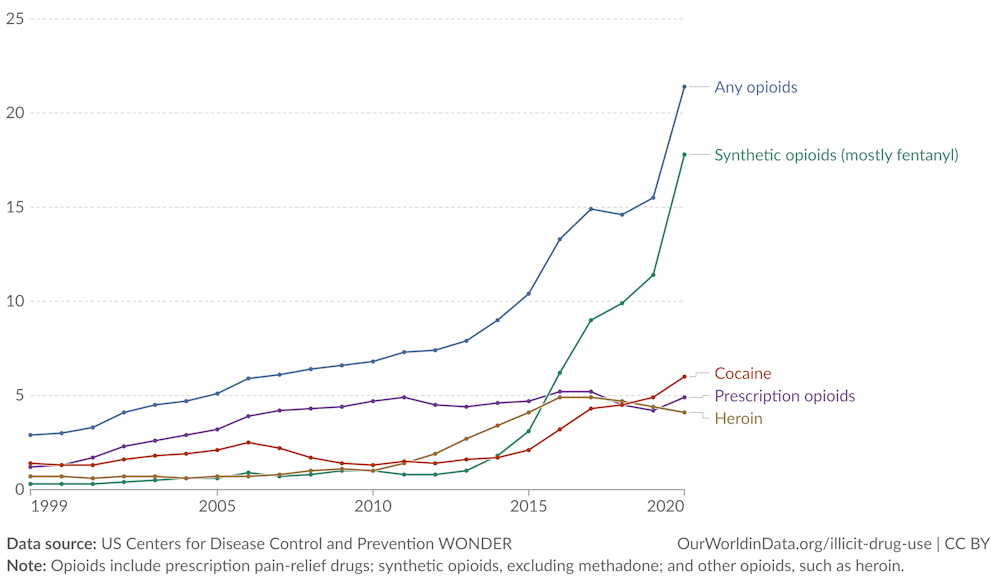
There are multiple harmful consequences of drug use. The largest global burden of disease continues to be attributed to opioids, use of which appears to have remained stable at the global level since 2019, in contrast to other drugs.
In the same way that climate change has threatened whole populations, so too have drugs. Yet many of us remain disconnected from how they are produced and distributed – and the misery they cause throughout the supply chain, all over the world.
The production of cocaine, for example, is associated with violence and exploitation at every stage of the manufacturing process. Death threats to farmers and unwilling traffickers have all increased in parallel with the growing demand for cocaine in the US and Europe.
Global drug use disorder deaths by substance (2000-21):
Organised crime groups not only supply and distribute drugs but also trade in people, whether for the commercial sex trade or other forms of modern slavery. This makes sense as the infrastructure and contacts to move drugs are similar to those used to move humans across borders and even continents. Yet many cocaine users are oblivious – wilfully or otherwise – of the violence associated with how this drug is supplied to them. As the UK National Crime Agency points out:
Reducing demand is another critical factor in reducing the supply of illegal drugs. Many people see recreational drug use as a victimless crime. The reality is that the production of illegal drugs for western markets has a devastating impact in source countries in terms of violence, exploitation of vulnerable and indigenous people and environmental destruction.
While some of the suffering associated with the production of drugs like cocaine makes the headlines, it’s often overshadowed by the glamorisation of criminal drug gangs in films and on TV. To the extent that people worry about the impact of drugs, it’s usually focused on those in our immediate communities, such as people dependent on heroin who are sleeping rough and vulnerable to exploitation. But there have already been other victims before the drug reaches our streets.
Shifts in the global supply chain
Tracking heroin routes demonstrates the way that drug supply is an international effort which affects every community on its journey, from the Afghan farmer to officials who are bribed so the drug can cross borders or be let through ports without being seized, to the person injecting or smoking the finished product.
Much of Europe’s heroin is produced in Afghanistan by small farming operations growing opium, which is then transformed into the drug. Most Afghan farmers are simply surviving growing the crop, and don’t reap significant wealth from their harvest. It is those supplying and distributing the opium as heroin who can make serious money from it.
Meanwhile, following the return of the Taliban to power in Afghanistan in August 2021, those farmers’ livelihoods have faced a new threat.
The Taliban is ideologically opposed to the production of opium. Soon after assuming control, its leaders issued a decree banning farmers from growing opium. They have enforced this by destroying crops when farmers have ignored the ban – although there is still believed to be a significant stockpile of heroin in the country, meaning that as yet, there has not been a big impact on supply to Europe and the UK. But this could change amid the emergence of more deadly synthetic alternatives, including nitazenes and other new synthetic opioids.
Heroin trafficking flows based on reported seizures (2019-22):
Either way, the drug gangs who traffic heroin won’t worry about the opium farmers’ wellbeing. As so often happens with changes in the availability of illicit drugs, when there is a shortage, these groups prove adaptable and nimble at providing alternatives quickly.
While gathering intelligence about organised crime gangs is difficult and potentially dangerous, the European Union Drugs Agency (EUDA) has provided some insights about who these groups are and how they operate. The Netherlands remains an important hub for the distribution of heroin, with several Dutch criminal groups involved in importing and distributing heroin from Afghanistan.
But others are involved too: the EUDA’s intelligence shows that criminal networks with members from Kurdish background are central to the wholesale supply and have control over many parts of the supply chain. These professional, well-organised groups have established legal businesses throughout the route of supply that facilitate their illicit activities – largely along the Balkan route with hubs in Europe.
Intermediate & final recipients of heroin shipments (2019-22):
Unlike these organised crime gangs, governments and law enforcement appear to respond to emerging threats slowly and lack the flexibility and ingenuity that the gangs repeatedly demonstrate.
As drug detection techniques have improved, organised crime has shown how inventive it can be. Taking advantage of the COVID-19 pandemic, dealers used consignments of surgical masks to conceal large quantities of cocaine being trafficked to China and Hong Kong from South America.
And as western markets for cocaine become saturated, organised crime gangs have exploited new markets in Asia, where cocaine seizures, a proxy for use of cocaine, have increased. But the shifting landscape is also reflected in changes in consumption, with use of the synthetic stimulant methamphetamine growing rapidly in Asia – reflected in record levels of seizures in the region in 2023.
For the organised crime gangs, production and supply of synthetic drugs is in many ways easier, as it is not reliant on an agricultural crop in the way that heroin and cocaine are and can be manufactured locally. This reduces the distribution logistics and distance needed for an effective supply chain. According to the UN Office on Drugs and Crime, organised crime gangs are exploiting gaps in law enforcement and state governance to both traffic large volumes of drugs and expand their production in the region.
Where there is destabilisation, there is opportunity for those who seek to profit from drug addiction. In Syria, Russia and Ukraine, war has made some people very rich.
Syria and Russia: the new drug hotspots
The wars in Syria and Ukraine bear testament to the way drugs provide solutions to people who are experiencing the worst of times – and to governments that are ready to exploit evolving situations.
As the war in Syria progressed, the Bashar Al-Assad regime actively developed a strategy to dominate the captagon market in the Middle East and North Africa. First produced in the 1960s in Germany to treat conditions such as attention deficit disorders and narcolepsy and other conditions, captagon is a stimulant that staves off hunger and sleep, making it ideal for military use – particularly in countries where food supplies are inconsistent. It has been referred to as the “drug of jihad” used by Islamic fighters in the region.
As the war progressed in Syria, the country and its leader became increasingly isolated, its economy crashed creating the perfect conditions to develop the trade in captagon. Rather than drug production leading to the collapse of law and order, it was the other way round.
Isolated by the west and with a historically strained relationship with its neighbours including Saudi Arabia, the Assad regime – under the guidance, reportedly, of Assad’s brother Maher al-Assad– ruthlessly positioned itself as the world’s main producer and distributor of this drug, then used this position to leverage its influence and try to reintegrate into the Arab world.
Video by TRT World.
Captagon also provided much-needed revenue for the Assad regime. The drug was estimated to be worth US$5.7 billion annually to the Syrian economy – at a time when western governments have placed severe sanctions on the country, restricting its ability to raise revenue. Saudi Arabia was one of the main countries being supplied captagon by Syria. Until the fall of Assad, it was the senior leadership in Syria that controlled the supply and distribution of the drug – giving rise to the label “the world’s largest narco state”.
The Assad government achieved this position by making captagon good value – a viable alternative to alcohol in terms of price and for those who don’t drink. Exploiting many of its own citizens, the regime encouraged individuals and businesses to participate in manufacturing and distributing the drug.
The fall of Assad and his hurried escape to Russia left the rebel fighters to pick up vast hauls of captagon and other drug ingredients. “We found a large number of devices that were stuffed with packages of captagon pills meant to be smuggled out of the country. It’s a huge quantity,” one fighter belonging to the Hayat Tahrir al-Sham (HTS) group told the Guardian. What this will do to drug production and supply in the region is unclear.
While the latest UN World Drug Report highlights “a rapid increase in both the scale and sophistication of drug trafficking operations in the region over the past decade”, it goes on to highlight that “one of the most striking changes worldwide in drug trafficking and drug use over the past decade has taken place in Central Asia, Transcaucasia [Armenia, Azerbaijan and Georgia] and eastern Europe”, where there has been a shift “away from opiates, mostly originating in Afghanistan – towards the use of synthetic stimulants, notably cathinones … There is hardly any other region where cathinones play such a significant role.”
This is part of “a groundbreaking shift in the global drug trade, pioneered in Russia and now spreading globally,” according to the Global Initiative Against Transnational Organized Crime. This shift is changing the nature of drug sales, using “darknet markets and cryptocurrency for anonymous transactions, allowing buyers to retrieve drugs from hidden physical locations or ‘dead drops’, rather than direct exchanges.”
The rise of Russia’s dead drop drug trade stems from several unique national factors: restrictive anti-drug policies, strained western trade relations, and a strong technological foundation. Enabled by these conditions, the dead drop model has reshaped how drugs are distributed in Russia.
Drug transactions now involve no face-to-face interactions; instead, orders are placed online, paid for with cryptocurrency, and retrieved from secret locations across cities within hours. This system, offering convenience and anonymity, has seen synthetic drugs – especially synthetic cathinones like mephedrone – overtake traditional imported substances like cocaine and heroin in Russia … These potent synthetic drugs are cheap, easy to manufacture, and readily distributed through Russia’s vast delivery networks.
The report notes that this shift in drug distribution has been accompanied by rising levels of violence including punishment beatings, and a public health crisis.
Podcast by the Global Initiative Against Transnational Organized Crime.
Yet officially, there is very little reliable data about drug use in Russia. Under the premiership of Vladimir Putin, Russia has no sympathy with those who are dependent, viewing them as weak and without value. And its invasion of Ukraine three years ago has had ramifications for Ukraine’s users too.
Prior to the war, Ukraine had demonstrated an increasingly progressive policy towards those who had problems with drugs, establishing treatment centers and encouraging access to treatment. Since Russia invaded Ukraine in February 2022, this strategy has been severely set back, with many people who need access to substitute treatments such as methadone unable to secure consistent supply of these drugs.
Another global blind spot is China, where, like Russia, little is known about the extent or type of problems that drugs are causing. Both regimes are ideologically opposed to recreational or problem drug use and, as far as we know, there is no state-funded rehabilitation provided in either country; the approach is to criminalise people rather than offer health-based interventions.
We shouldn’t be too critical as many western countries, including the UK, also need to pivot from a criminal approach to drug problems towards a health-focused one. Portugal made such a policy change several years ago, recognising that people who develop problems with drugs such as dependency need help rather than punishment.
This radical shift in thinking has made a significant change to the way those using drugs are treated, in the main offered help and specialist support rather than being arrested and sent to jail, only to be released and then repeat the same cycle of drug use, arrest and prison.
The evidence of this policy change is impressive: not only have drug-related deaths fallen, but population-level drug use is among the lowest in Europe. Nowhere is this policy shift more urgent than the US.
North America: epicentre of the opioid crisis
In the US, the synthetic opioids fentanyl and oxycodone have contributed to more than 100,000 fatal overdoses each year since 2021. While there are signs this deaths toll is at last beginning to fall, the harm and pain of addiction and overdose affects every strata of American society – as shown in moving portrayals of America’s opioid crisis such as Painkiller and Dopesick. Most fatalities are caused by respiratory depression where breathing is significantly slowed or stops altogether.
Official trailer for Painkiller (Netflix)
Fentanyl is an analgesic drug that is 50-100 times more potent than heroin or morphine. Where China used to be the principal manufacturer and supplier of fentanyl to the US, Mexico is now the primary source. In December 2024, Mexican authorities announced “the largest mass seizure of fentanyl pills ever made” – amounting to more than 20 million doses of fentanyl pills worth nearly US$400 million. The pills were found in Mexico’s Sinaloa state, home of the Sinaloa drug cartel and a hub of fentanyl production,
“This is what makes us rich,” one fentanyl cook recently told the New York Times. He was scathing about the idea that Donald Trump would be able to stamp out the supply of fentanyl from Mexico to the US by threatening Mexico’s government with tariffs. “Drug trafficking is the main economy here.”
However, the introduction of synthetic opioids to the US came not via organised crime but through a deliberate strategy of the pharmaceutical industry. Upon launching its prescription opioid painkiller OxyContin (a brand name for oxycodone) in 1996, Perdue Pharma, owned by the Sackler family, devised a plan to increase prescriptions of the drug by incentivizing and rewarding doctors to give these drugs to their patients. On a business level, this was a success; on a human level, it has been a disaster.
As patients quickly developed tolerance to drugs such as OxyContin, they had to take higher doses to avoid withdrawal symptoms or the positive feelings it gave them. Taking more of these opiates increases the risk of accidental overdose, many of which proved to be fatal. It has also driven those dependent on drugs to the black market, and into the hands of organised drug gangs, as they seek the drugs in greater quantities.
Dependency on fentanyl and other opioids is all-consuming. When not using these drugs, people are entirely focused on ensuring sufficient supply of the next dose. This includes funding supply which can take people to places they thought they would never be, for example breaking the law, shoplifting or getting involved in commercial sex to make enough money to buy drugs.
Synthetic opiates like OxyContin and fentanyl have proved to be classless, ageless and sex blind. The first-hand experience of addiction and fatalities have radically altered the way many Americans think about drugs and the problems they cause. Canada, too, is suffering a major crisis.
Compounding this tragedy is the failure of the state to provide interventions and treatment that could have reduced fatal and non-fatal overdoses. It is only now that evidence-based interventions are beginning to be made widely available, such as access to Naloxone – a drug that can reverse the effects of opiates and potentially save a life.
Of course, it isn’t just hospitals and health professionals that are challenged by the results of widespread use of opioids, but public services like the police and fire service. In some areas of the US, there have been so many daily overdoses that every service was called on to try and deal with it. Local mayors have made it a priority to train police and fire personnel to be trained as first responders, such is the scale of the problem.
But it is not just in North America that we see the failure of politicians and the state to act when faced with growing problems with drugs. In the UK, where record numbers are dying because of using drugs such as heroin, the government has not invested in overdose prevention strategies. At a time when fatal overdoses increase year on year, budgets for specialist treatment have been reduced. It remains to be seen what the recently elected Labour government will do, if anything, to tackle the tragic rise in drug related fatalities.
What connects both examples from the US and UK is the attitude and perception of drug use many of us have. Drug use and the heavy use of prescription painkillers is still heavily stigmatised. Many of us still view this as something individuals bring on themselves or have a choice about.
So, if we don’t care about what happens to people who develop problems with drugs, why should our elected representatives? In part, it is our bigotry that is enabling the lack of timely intervention, despite us possessing the knowledge and evidence of how drug harms can be minimised.
Latin America: breakdown of the rule of law
Under the last Conservative government, the UK Home Office asserted that people who used cocaine recreationally are supporting violence not only in the UK but in the countries that produce its raw ingredients. It’s not clear if this has made any difference to those using cocaine in the UK – personally, I doubt many people consider or are aware of how cocaine is produced or its provenance.
Perhaps if those using cocaine, mainly in western countries, realised the extent of violence and suffering that cocaine manufacture causes they might think again. Latin America has suffered enormously, with few countries there not touched in some way by the violence and breakdown of law associated with drug production and supply. According to the latest UN World Drugs Report:
Global cocaine supply reached a record high in 2022, with more than 2,700 tons of cocaine produced that year, 20% more than in the previous year … The impact of increased cocaine trafficking has been felt in Ecuador in particular, which has seen a wave of lethal violence in recent years linked to both local and transnational crime groups, most notably from Mexico and the Balkan countries.
Cocaine seizures and homicide rates increased five-fold between 2019 and 2022 in Ecuador, with the highest such rates reported in the coastal areas used for trafficking the drug to major destination markets in North America and Europe.
Cocaine trafficking flows based on reported seizures (2019-22):
As with opium production in Afghanistan, it is small-scale farmers in Colombia, Peru and Bolivia that grow the coca plant that will be turned into cocaine. Like their Afghan counterparts, they grow coca as it is more profitable than alternatives such as coffee. While it may be profitable in the short term, there are greater costs to them and their society.
Cocaine production brings with it violence as those further up the drug production chain try to control its trade. Few parts of these societies are unscathed, from bribing local politicians through to whole regions that are controlled by organised crime. Keeping control means that the use of firearms and violence increases. Against this backdrop, it is unsurprising that basic health and social services suffer.
So, while a coca grower may have more money, every other aspect of their life is negatively impacted. Whether it is regional or state institutions, both are compromised by the drug trade and those that control it. While this may not lead to the total collapse of law and order, it does create injustice and distorts the rule of law in many areas of Latin America and the Caribbean, where competition between gangs has also resulted in an increase in homicides.
The impact is on all sectors of society, now and into the future. For example, while historically the role of women has been largely underrepresented in research and drug policy, the UN report recognises that this is changing:
As women increasingly participate in economic activities, the role that women play in the drug phenomenon may become increasingly important. For example, a shift away from plant-based drug production may affect many women in rural households involved in opium poppy and coca bush cultivation.
The UN also identifies the specific risk to young people and the drugs trade, highlighting:
Long-term efforts to dismantle drug economies must provide socioeconomic opportunities and alternatives, which go beyond merely replacing illicit crops or incomes and instead address the root structural causes behind illicit crop cultivation, such as poverty, underdevelopment, and insecurity. They must also target the factors driving the recruitment of young people into the drug trade, who are at particular risk of synthetic drug use.
Meanwhile, demand for treatment in Europe due to problems with cocaine has risen significantly in recent years, since 2011 there has been an 80% increase in treatment presentations. This reflects the growing number of people using cocaine and the rise in purity of the drug.
Amid what may seem to be a story of unrelenting despair and hopelessness, there are local initiatives and even a few state-wide policies that provide optimism that change is possible.
In my roles both as clinician and scientist, I’ve often been amazed by how ingenious people can be when faced with the apparently impossible. For example, the way some people use heroin to dampen their psychotic symptoms, such as auditory and visual hallucinations – or the development of Naloxone, a drug that can temporarily reverse the effects of opioids, providing a short window for emergency services to treat people who have overdosed.
Early in my career, I witnessed the emergence of HIV in the UK in the 1980s. The speed at which this disease spread was not matched by our ability to treat it. Our response to HIV was undoubtedly hampered by prejudice and stigma towards marginalised groups in society, namely gay men and those using drugs (particularly injecting them).
However, unexpectedly and courageously, the Conservative government recognised those who were most at risk of contracting HIV, and organised a package of measures to contain the spread of infection. One part of this was a media campaign based on public health messaging designed to reduce the risk of contracting the disease. But the government also invested in treatment for those who had been infected and engaged with people at high risk, such as those intravenously injecting drugs.
I worked in specialist HIV clinics for those using drugs. At the time, methadone and diamorphine were provided as an alternative to heroin. Regulations and protocols that restricted the prescribing of these medical opioids were eased, so we could ensure patients attending these clinics were given sufficient oral and injectable opioids that they didn’t need to source street heroin.
This meant they had access to medical grade opioids and, crucially, were given regular supplies of sterile injecting equipment. It was this that reduced the risk of contracting HIV, as some people would share injecting equipment when using heroin.
This impressive policy ran counter to the Conservative party’s ideology at the time, which was to punish rather than help those using drugs like heroin. It showed me how, even with traditional mindsets, it is possible to shift policy thinking in the face of a health crisis. And make no mistake, the global drug problem is an ongoing health crisis. Today, the UN points to the risks that intravenous users of drugs still face:
An estimated 13.9 million people injected drugs in 2022, with the largest number living in North America and East and South-East Asia … The relative risk of acquiring HIV is 14 times higher for those who inject drugs than in the wider population globally.
There are, though, signs of positive change in the way some countries and regions are changing their drug policies. Scotland recently opened a drug consumption facility in Glasgow – a safe place for people to use their drugs, usually injecting drugs like heroin. Such spaces provide access to sterile injecting equipment, reducing the risk of blood-borne infections such as HIV or Hepatitis. At the same time, they offer the opportunity to engage with people who have not accessed traditional health services.
Portugal, as mentioned earlier, has made substantial changes to the way it approaches drug use and the problems associated with it. This policy shift since 2000 has saved lives and brought a more humane way of treating people who develop problems with drugs.
Contrast this with the wasted effort and resources ploughed into the war on drugs – initiated by Nixon and followed by so many western governments ever since. My plea to policymakers is simple: employ the same evidence-based science you use for health issues towards drugs and problem drug use.
Science and research can help in many ways, if given the chance. Some of it might seem radical, like providing safe drug consumption spaces. Some of it is more mundane, but vital – like tackling inequality, a clear driver of problem drug use across the world.
But while we often look to politicians to take the lead on change, it is people – us – that really hold the solution. By far the greatest threat to people and society from drugs is ignorance and bigotry. So many lives have been lost to drugs because of shame, either as a driver of drug use or a barrier to seeking help.
Beliefs are notoriously difficult to shift. As with climate change, the most powerful driver of change is personal experience. We know that when a family or community is affected by a drug overdose, their beliefs and perceptions change. But this is not the way any of us should want to see change happen.
To hear about new Insights articles, join the hundreds of thousands of people who value The Conversation’s evidence-based news. Subscribe to our newsletter.
Ian Hamilton does not work for, consult, own shares in or receive funding from any company or organisation that would benefit from this article, and has disclosed no relevant affiliations beyond their academic appointment.
The UK government’s new plan to foster innovation through artificial intelligence (AI) is ambitious. Its goals rely on the better use of public data, including renewed efforts to maximise the value of health data held by the NHS. Yet this could involve the use of real data from patients using the NHS. This has been highly controversial in the past and previous attempts to use this health data have been at times close to disastrous.
Patient data would be anonymised, but concerns remain about potential threats to this anonymity. For example, the use of health data has been accompanied by worries about access to data for commercial gain. The care.data programme, which collapsed in 2014, had an similar underlying idea: sharing health data across the country to both publicly funded research bodies and private companies.
Poor communication about the more controversial elements of this project and a failure to listen to concerns led to the programme being shelved. More recently, the involvement of the US tech company Palantir in the new NHS data platform raised questions about who can and should access data.
The new effort to use health data to train (or improve) AI models, similarly relies on public support for success. Yet perhaps unsurprisingly, within hours of this announcement, media outlets and social media users attacked the plan as a way of monetising health data. “Ministers mull allowing private firms to make profit from NHS data in AI push,” one published headline reads.
These responses, and those to care.data and Palantir, reflect just how important public trust is in the design of policy. This is true no matter how complicated technology becomes – and crucially, trust becomes more important as societies increase in scale and we’re less able to see or understand every part of the system. It can, though, be difficult, if not impossible, to make a judgement as to where we should place trust, and how to do that well. This holds true whether we are talking about governments, companies, or even just acquaintances – to trust (or not) is a decision each of us must make every day.
The challenge of trust motivates what we call the “trustworthiness recognition problem”, which highlights that determining who is worthy of our trust is something that stems from the origins of human social behaviour. The problem comes from a simple issue: anyone can claim to be trustworthy and we can lack sure ways to tell if they genuinely are.
If someone moves into a new home and sees ads for different internet providers online, there isn’t a sure way to tell which will be cheaper or more reliable. Presentation doesn’t need – and may not even often – reflect anything about a person or group’s underlying qualities. Carrying a designer handbag or wearing an expensive watch doesn’t guarantee the wearer is wealthy.
Luckily, work in anthropology, psychology and economics shows how people – and by
consequence, institutions like political bodies – can overcome this problem. This work is known as signalling theory, and explains how and why communication, or what we can call the passing of information from a signaller to a receiver, evolves even when the individuals communicating are in conflict.
For example, people moving between groups may have reasons to lie about their identities. They might want to hide something unpleasant about their own past. Or they might claim to be a relative of someone wealthy or powerful in a community. Zadie Smith’s recent book, The Fraud, is a fictionalised version of this popular theme that explores aristocratic life during Victorian England.
Yet it’s just not possible to fake some qualities. A fraud can claim to be an aristocrat, a doctor, or an AI expert. Signals that these frauds unintentionally give off will, however, give them away over time. A false aristocrat will probably not fake his demeanour or accent effectively enough (accents, among other signals, are difficult to fake to those familiar with them).
The structure of society is obviously different than that of two centuries ago, but the problem, at its core, is the same — as, we think, is the solution. Much as there are ways for a truly wealthy person to prove wealth, a trustworthy person or group must be able to show they are worth trusting. The way or ways this is possible will undoubtedly vary from context to context, but we believe that political bodies such as governments must demonstrate a willingness to listen and respond to the public about their concerns.
The care.data project, was criticised because it was publicised via leaflets dropped at people’s doors that did not contain an opt-out. This failed to signal to the public a real desire to alleviate people’s concerns that information about them would be misused or sold for profit.
The current plan around the use of data to develop AI algorithms needs to be different. Our political and scientific institutions have a duty to signal their commitment to the public by listening to them, and through doing so develop cohesive policies that minimise the risks to individuals while maximising the potential benefits for all.
The key is to place sufficient funding and effort to signal – to demonstrate – the honest motivation of engaging with the public about their concerns. The government and scientific bodies have a duty to listen to the public, and further to explain how they will protect it. Saying “trust me” is never enough: you have to show you are worth it.
Richard Milne receives funding from Wellcome under grant 220540/Z/20/A to the Wellcome Sanger Institute and the Kavli Foundation, grant G115418 to the University of Cambridge.
Jonathan R Goodman does not work for, consult, own shares in or receive funding from any company or organisation that would benefit from this article, and has disclosed no relevant affiliations beyond their academic appointment.
Visit a supermarket in 2025 and you’ll see that a tub of Lurpak butter can cost £5.70. It may strike you that this represents a staggering increase from £3.65 just three years ago, so instead of paying the premium, you reach for the supermarket’s own brand at £3.80.
This kind of switch, multiplied across millions of shopping baskets, represents a massive shift in consumer behaviour that has been largely invisible to official statistics. But that’s changing, as the UK embarks on its biggest revolution in measuring living costs since the second world war.
The Office for National Statistics (ONS) is transforming the way it tracks inflation, moving from painstakingly checking prices to analysing millions of real purchases through supermarket scanners. Consider olive oil, the price of which surged by 47% in a year, or milk, which jumped by more than 25%. While official statistics captured these price rises, they couldn’t track how households adapted – whether by switching to cheaper alternatives, buying less, or cutting back elsewhere. This was a blind spot in our understanding of consumer behaviour.
Currently, price collectors visit stores across the country each month, checking the prices of about 25,000 products. It’s like taking a snapshot of what’s on the shelves at a particular moment. But this system, designed decades ago, often misses the real impact of inflation on different household types in things like choosing different products or switching stores.
This is crucial for understanding the real impact of inflation on lower-income households. These families often have less flexibility in their budgets and must make more dramatic changes to their shopping habits when prices rise. During recent periods of high inflation, many on low incomes found that official figures didn’t match their experience, which was of even higher inflation than the headline rates. And there’s a good reason why.
Inflation statistics aren’t just academic exercises. They drive decisions that affect every aspect of our financial lives. The Bank of England uses them to set interest rates, which in turn influence mortgage payments and savings returns. Employers use them in wage negotiations. Government uses them to adjust benefits, state pensions and tax thresholds. Even commercial contracts, including mobile phone bills and rail fares, are often linked to inflation rates.
When these numbers don’t accurately reflect price pressures, it can have serious consequences. If official figures underestimate the inflation experienced by lower-income households, benefit increases might not keep pace with their actual cost increases. Similarly, if wages don’t rise in line with real living costs, workers effectively experience a pay cut.
The scanner data revolution
The ONS’s new approach, to be introduced next year, will analyse around 300 million price points from supermarket scanners, covering about half of all grocery transactions in the UK. Instead of just seeing what’s on the shelf, they’ll know exactly what prices people are paying at checkouts across the country.
This massive increase in data points – from 25,000 to 300 million – will allow for a more nuanced understanding of consumer behaviour.
The change will also enable quicker identification of emerging price trends. After the start of the COVID pandemic and the Ukraine war, prices of certain goods changed rapidly. Scanner data could help spot these changes faster, allowing for more timely policy responses. It might also reveal regional variations in price pressures.
Take the 2023 surge in food prices – while overall food inflation hit 19%, the impact varied dramatically across households. Current statistics would not capture lower-income families switching from fresh to frozen vegetables, or from branded to value ranges.
In times of cost pressures, shoppers may switch from fresh produce to frozen. sirtravelalot/Shutterstock
With scanner data, policymakers could spot these trends quickly and respond more precisely – perhaps by adjusting benefit payments or targeting support to specific households when essential food costs spike. Instead of waiting for quarterly surveys to reveal hardship, they will be able to see in real time how different groups are coping with price pressures.
The ONS recently said full implementation will come in 2026, a year later than planned. While it will have the technical capability ready by March 2025, it is opting for a year of parallel running to ensure accuracy. This approach reflects how crucial these statistics are for the economy.
It has already modernised other areas of price collection, including incorporating 40 million train fare data points and 300,000 used car prices. But grocery prices, being central to household budgets and varying significantly across different income groups, require extra attention.
The change is coming at a crucial time. Recent years have shown how rapidly economic conditions can change and how differently these changes can affect various segments of society. The pandemic, Brexit adjustments, and global supply chain disruptions have all contributed to price pressures.
For consumers, while the changes won’t directly lower prices, they could lead to more appropriate responses from the Bank of England, government and employers. Most importantly, it could ensure that official inflation figures better reflect the reality of the weekly shop, particularly during times of economic stress.
The transformation of inflation statistics might seem like a technical detail, but its implications reach far beyond government offices and economic reports. It’s about ensuring that the official measures of living costs better reflect the reality experienced by millions of households across the UK. In this challenging economic environment, that’s something worth getting right.
Marcel Lukas receives funding from the British Academy. He is the Director of Executive Education at the University of St Andrews and Fellow of the ONS. The presented views are his own and do not represent the ONS.
Source: United States Senator for Maine Angus King
WASHINGTON, D.C. — U.S. Senator Angus King (I-ME) is introducing bipartisan legislation with eight of his colleagues to fast-track and modernize prescription drug testing protocols which will in turn improve patient outcomes. The FDA Modernization Act 3.0 (FDAMA) is a bipartisan effort to reduce ineffective animal testing and expedite scientific innovation. In 2022, President Biden signed FDAMA 2.0 into law removing the longstanding requirement that investigational new drugs (INDs) undergo mandatory animal testing before human clinical trials. Instead, the law provided FDA and drug developers the option to use advanced, non-animal methods such as cell-based assays, organ chips, computer modeling, and bioprinting.
However, the FDA has yet to update its regulations leaving numerous FDA regulations that continue to require animal testing against the law. The FDA Modernization Act 3.0 seeks to resolve this by mandating the FDA to update its regulations within 12 months of the bill’s enactment. By fully implementing FDAMA 2.0, drug development can be both more humane and more efficient, ultimately leading to faster and more reliable treatments for patients. An astonishing 90-95% of drugs that pass animal tests go on to fail in human clinical trials, wasting precious time for patients.
“Maine people deserve a modern FDA that approves prescription drugs in an efficient and safe manner consistent with the law,” said Senator King. “The FDA Modernization Act 3.0 will ensure that the American people have access to more reliable treatments, with renewed confidence in their governmental agencies that have long been bogged down with red tape and bureaucratic inefficiencies. I thank my colleagues on both sides of the aisle for prioritizing people over politics in Maine, and across the country.”
In addition to King, the legislation is cosponsored by Senators Cory Booker (D-NJ), Eric Schmitt (R-MO), Rand Paul (R-KY), Sheldon Whitehouse (D-RI), John Kennedy (R-LA), Richard Blumenthal (D-CT), Ben Ray Luján (D-NM), and Roger Marshall (R-KS).
Senator King has consistently worked to increase transparency of prescriptions drugs. Last year, he introduced bicameral legislation to prohibit direct-to-consumer drug advertising of pharmaceutical drugs in the first three years after the drug receives Federal Drug Administration (FDA) approval. Additionally, Senator King has introduced legislation to prohibit pharmaceutical drug manufacturers from claiming tax deductions for consumer advertising expenses.
Portsmouth City Council’s administration has announced proposals that address immediate and unexpected financial pressures without impacting services to residents. Alongside this the plans also look to mitigate one of the largest financial pressures facing councils across the country.
Nationally councils are facing increasing demand and costs for social care services and temporary accommodation.
In Portsmouth the number of households in temporary accommodation has gone up by 54% in the last year to more than 500, while the costs have risen by 84%. This resulted in the current forecast of costs going £5.9m over budget in 2024/25, even higher than the 5.6m shortfall predicted in October 2024.
The budget proposals include investing £31m in acquiring properties to use as temporary accommodation for residents who might find themselves in situations where they have been made homeless. This would reduce the current need to rely on less suitable but costly privately-rented accommodation, with an expectation this will start to ease the existing budget pressure this year and significantly improve the position over the following two years.
Cllr Steve Pitt, Leader of Portsmouth City Council, said:
“It is good news for the city that we’re able to put forward a budget that addresses the immediate financial pressures without reducing services that people rely on.
However, there are funding problems nationally with social care and temporary accommodation that need to be solved. As insufficient government support is coming forward we want to take the proactive steps we can to address these issues and provide better solutions for our residents. The revenue budget savings need to come from £191m of council spending and will take the council’s total savings made in the last 14 years to £110m.
“Last year it was forecast we would need to save £1m in this budget, these spending pressures doubled that and we need to stop that happening in future years. By investing in our own temporary accommodation stock we can save the council tens of millions of pounds in the next decade.”
In addition to the longer-term view the council’s administration is proposing £2m of savings to its revenue budget, which will be met through efficiencies and generating extra income without seeing any significant reduction in services to the public.
The proposals also include raising council tax in line with government’s expectation of 4.99%, 2% of which will go specifically towards funding adult social care. In total the council tax increase would raise £5.1m for the council and see the average Portsmouth home’s (band B) council tax bill increase by the equivalent of £1.29 per week.
Cllr Pitt added:
“We are always mindful of the impact of the decision to increase council tax and don’t take the decision lightly, but the funding government gives us is based on the assumption we will increase council tax by 4.99%, and it still isn’t enough to pay for everything we need. Councils relying on significant use of reserves to balance budgets are increasingly finding themselves in severe financial distress and here in Portsmouth we will not allow that to happen. The only alternative to raising council tax, is to reduce services that people rely on and doing that would hurt our residents even more, especially those who rely on them the most.”
The council will be receiving additional income from renting out new business spaces while there will be increases of 10p or 20p an hour to parking charges in certain locations, in line with existing policy. This follows a freeze on parking charges last year, meaning it is a below inflation increase over the two-year period.
The proposals also include investment in regeneration and economic development, such as future development of the city centre. Funding has been allocated to develop options for regenerating Guildhall Square and finding a more efficient solution to the current Civic Offices building, alongside continued financial support for the City Centre North project, which will deliver new housing, leisure and retail space to the area.
The budget proposals will be considered at the council’s Cabinet meeting on 11 February and if accepted will then go to the Full Council meeting on 25 February for approval.
EVANSVILLE— James Henley, 35, of Greenwood, Indiana, has been sentenced to ten years in federal prison, followed by three years of supervised release after pleading guilty to aggravated identity theft, conspiracy to commit access device fraud, two counts of money laundering, and eight counts of wire fraud. Henley has also been ordered to pay $1,887,426.63 in restitution.
According to court documents, over the course of three years, Henley orchestrated multiple large and complex fraud schemes, resulting in a total loss of $2,927,758.95 to individual homeowners, an Indiana attorney, a bank, and ten state governments. As part of his fraud schemes, Henley registered five fake businesses (OnTrack Real Estate Solutions, LDI Investments Corp, Lucario Investments, 317 Traffic, and Henley Real Estate Solutions) with the states of Indiana and Kentucky, claiming to serve as the Chief Executive Officer for most of them. None of the businesses were legitimate. Instead, Henley used the businesses to mask his identity, make his schemes appear more credible, and launder the stolen money.
Henley’s schemes are broken down as follows:
COVID-19 Fraud:
Between May 2020 and March 2021, James Henley, his wife Jameka Henley, and his associate Jimmie Bickers used the stolen personally identifiable information of 76 real individuals to submit 120 unemployment insurance applications to ten states during the COVID-19 pandemic. Once the applications were approved, the trio used 65 unemployment insurance debit cards to make purchases at retailers and withdraw cash at ATMs in the Evansville and Indianapolis areas. The states paid a total of $1,119,426.63 in unemployment benefits in connection with the group’s fraudulent applications. In July 2020, Henley used funds withdrawn from ATMs to buy a Chevrolet Camaro for $22,801.
Bickers and Jameka Henley have been formally charged for their roles in this scheme but have not pleaded guilty.
Home Title Fraud:
Between December 2021 and May 2023, Henley stole five homes in Indianapolis by filing fraudulent deeds with the Marion County Recorder’s Office. Through the filings, Henley claimed that the homeowners had sold their homes to his fake businesses, but, in reality, he had never even spoken with the homeowners. Unbeknownst to the victims, Henley filed these fraudulent deeds and then sold the homes for significantly less than their market value, pocketing more than $260,000 in profits.
Henley also attempted to steal and sell an additional 14 homes in Indianapolis and Evansville. With one exception, the individuals who bought the homes from Henley took possession and ultimately kept the homes.
For one homeowner, the property Henley stole was her childhood home. She purchased the home while her mother was in the hospital with the hope that, when her mother’s condition improved, her mother would be able to live out her remaining years in the house.
Mortgage Fraud:
In November 2021, an associate of Henley’s purchased a home in Indianapolis, using a mortgage loan from a bank. In April 2022, Henley filed a fraudulent document with the Marion County Recorder’s Office to make it seem as if the mortgage loan had been paid off, when it had not been paid. Henley then filed a deed naming himself a joint owner of the home. Henley and his associate subsequently sold the property for $255,000, pocketing all the proceeds, even though the bank should have received the majority of the funds.
Auto Loan Fraud:
In March 2023, Henley purchased a Dodge Durango in Indianapolis for $71,479, using an auto loan from Everwise Credit Union. A few months later, in June 2023, Henley purchased a Chevrolet Silverado in Plainfield for $54,270, using a second loan from Everwise Credit Union.
In October 2023, Henley connected a JPMorgan Chase bank account to his auto loans, via Everwise’s online payment portal. Henley falsely represented that the Chase account belonged to Jimmie Bickers, and that he had authority to make payments on his loans using funds from the Chase account.
The Chase account was actually an Indiana attorney’s Interest on Lawyers’ Trust Account (IOLTA), which is a highly regulated bank account used by lawyers to hold client funds. The interest earned on IOLTA accounts is used to fund grants for nonprofit groups that promote pro bono and access to justice programs. Henley did not have the attorney’s permission to access or withdraw funds from the IOLTA account.
Between October and November 2023, Henley used the IOLTA account to make two payments, totaling $98,000, toward his auto loans.
Henley has prior felony convictions for financial crimes, including theft, forgery, and fraud.
“James Henley went to great lengths to coordinate exceptionally greedy, complex schemes that exploited hard-working families and state government programs,” said John E. Childress, Acting U.S. Attorney for the Southern District of Indiana. “Undeterred by prior felony convictions for the same conduct, this defendant stole over a million dollars, wreaking financial and logistical havoc on hundreds of victims. The Department of Justice will continue to work with our law enforcement partners to investigate allegations of fraud and seek prosecution as appropriate.”
“James Henley filed fraudulent unemployment insurance (UI) claims in the names of identity theft victims in order to receive UI benefits to which he was not entitled. He enriched himself by defrauding a program that was intended to assist struggling American workers during an unprecedented global pandemic,” said Megan Howell, Acting Special Agent-in-Charge, Great Lakes Region, U.S. Department of Labor, Office of Inspector General. “We and our law enforcement partners are committed to protecting the integrity of the UI system from those who seek to exploit this critical benefit program.”
“This lengthy prison sentence sends a clear message: individuals who attempt to exploit and commit financial crime and identity theft will be brought to justice,” said Ramsey E. Covington, Acting Special Agent in Charge, IRS Criminal Investigation, Chicago Field Office. “IRS Criminal Investigation and our fellow law enforcement partners are committed to protecting the integrity of our financial institutions and will continue to hold criminals like James Henley accountable to the fullest extent of the law.”
“This case should serve as a powerful reminder that individuals with a history of financial crimes will face significant consequences when they demonstrate a blatant disregard for the law and continue to exploit and deceive others for personal gain,” said FBI Indianapolis Special Agent in Charge Herbert J. Stapleton. “The FBI, working alongside our law enforcement partners, will continue to hold those who perpetuate such offenses accountable and protect the public from those who manipulate the system for their own benefit.”
The Federal Bureau of Investigation, Internal Revenue Service-Criminal Investigation, Department of Labor-Office of the Inspector General, and the Indiana Attorney General’s Office Homeowner Protection Unit investigated this case. The sentence was imposed by U.S. District Judge Matthew B. Brookman.
Acting U.S. Attorney Childress thanked Assistant U.S. Attorney Matthew Miller, who prosecuted this case.
On May 17, 2021, the Attorney General established the COVID‑19 Fraud Enforcement Task Force to marshal the resources of the Department of Justice in partnership with agencies across government to enhance efforts to combat and prevent pandemic-related fraud. The Task Force bolsters efforts to investigate and prosecute the most culpable domestic and international criminal actors and assists agencies tasked with administering relief programs to prevent fraud by augmenting and incorporating existing coordination mechanisms, identifying resources and techniques to uncover fraudulent actors and their schemes, and sharing and harnessing information and insights gained from prior enforcement efforts.
Anyone with information about allegations of attempted fraud involving COVID‑19 can report it by calling the Department of Justice’s National Center for Disaster Fraud (NCDF) Hotline at 866-720-5721 or via the NCDF Web Complaint Form at https://www.justice.gov/disaster-fraud/ncdf-disaster-complaint-form
An official website of the United States government
Here’s how you know
Official websites use .gov A .gov website belongs to an official government organization in the United States.
Secure .gov websites use HTTPS A lock ( ) or https:// means you’ve safely connected to the .gov website. Share sensitive information only on official, secure websites.
WASHINGTON — The Department of Veterans Affairs today announced its return to in-person work policy, which states eligible employees must work full-time at their respective duty stations (agency worksites) unless excused due to a disability, qualifying medical condition or other compelling reason.
The announcement follows President Trump’s Jan. 20, presidential memorandum on return to in-person work.
More than 20% of VA’s more than 479,000 employees currently have telework or remote work arrangements. As part of the new policy:
Political appointees, senior executive service members, SES equivalents, senior level and scientific and professional employees will no longer be eligible for remote work arrangements. By Feb. 24, 2025, their telework agreements will be terminated, except for ad hoc or situational telework.
Also, by Feb. 24, 2025, remote work and telework arrangements for supervisors with current official duty stations within 50 miles of an agency facility will be terminated, except for ad hoc or situational telework.
By April 28, 2025, remote work and telework arrangements for non-bargaining unit employees with current official duty stations within 50 miles of an agency facility will be terminated, except for ad hoc or situational telework.
Remote work and telework arrangements for supervisors and non-bargaining unit employees with current official duty stations outside 50 miles of an agency facility will not be terminated at this time. Further guidance will be forthcoming regarding these arrangements.
Return to in person work requirements for bargaining unit employees will be announced at a later date.
VA’s policy allows exceptions for arrangements approved for employees as a reasonable accommodation due to a disability or a qualifying medical condition. Exceptions may also be allowed for military spouses with permanent change of station orders.
“This is a commonsense step toward treating all VA employees equally,” said Acting VA Secretary Todd Hunter. “Most VA clinical staff don’t have the luxury of working remotely, and we believe the performance, collaboration and productivity of the department will improve if all VA employees are held to the same standard.”
Reporters and media outlets with questions or comments should contact the Office of Media Relations at vapublicaffairs@va.gov
Veterans with questions about their health care and benefits (including GI Bill). Questions, updates and documents can be submitted online.
Contact us online through Ask VA
Veterans can also use our chatbot to get information about VA benefits and services. The chatbot won’t connect you with a person, but it can show you where to go on VA.gov to find answers to some common questions.
Learn about our chatbot and ask a question
Subscribe today to receive these news releases in your inbox.
Flood-Risk Classifications Can Drive Risky Development
A new study by Southeast CASC researchers highlights the “safe development paradox,” where areas adjacent to regulatory “high risk” zones are less expensive to develop and viewed as safe for home buyers, driving up risky development in potentially vulnerable areas.
The “safe development paradox” highlights how classifying land areas as “high risk” for flooding can unintentionally encourage high levels of risky development just outside of these zones. Though the risk continues beyond the high-risk label, the implication is that if an area is not listed as “high risk,” then it must be “safe.” This misconception arises from how flood risk is communicated and used to guide regulations, such as mandatory flood insurance and structural requirements. Because developers are able to avoid these regulations, building just outside of these “high risk” zones is more affordable, leading to clustering of development in areas that are still vulnerable to flooding from rivers, lakes, and coastlines.
A new study, titled “The Safe Development Paradox of the United States Regulatory Floodplain,” analyzed national development trends and 100-year floodplain maps from more than 2,300 U.S. counties. Supported by the Southeast CASC, the researchers found that 24% of development occurs within 250 meters of high-risk flood zones. That distance is less than the length of three football fields, or, in a dense urban grid like Manhattan, about 1-3 city blocks. The researchers also looked at future projections, and assuming current policies remain the same, they predicted that 22% of new development by 2060 will also occur within the 250-meter zone next to the “high risk” area, likely increasing the number of people who live in risky areas just outside of the regulatory zone.
By linking historical and future development trends to 100-year floodplain (1% annual flood risk) classifications that guide safety regulations, this national assessment reveals some unintended consequences of these designations and emphasizes the need to align actual and perceived flood risks. This information can aid regulatory agencies making flood risk designations and communications to support effective planning.
This research was supported by the Southeast CASC Project:“Improving Scenarios of Future Patterns of Urbanization, Climate Adaptation, and Landscape Change in the Southeast.”
Related
link
Improving Scenarios of Future Patterns of Urbanization, Climate Adaptation, and Landscape Change in the Southeast
Arguably the most direct, intense, and long-lasting modification that humans can make to a landscape is converting rural lands to urbanized areas. As human populations grow, the demand for urbanized areas will increase, and scientists can help natural resource managers plan for these changes by creating models that predict potential patterns of future urbanization. The Southeast U.S. is experienci
Jefferson City — Today, Governor Mike Kehoe ordered U.S. and Missouri flags be flown at half-staff at government buildings in Pettis and Saline counties, the Fire Fighters Memorial of Missouri in Kingdom City, and firehouses statewide on Tuesday, February 4, 2025, from sunrise to sunset in honor of West Central Missouri Fire Protection District of Saline and Pettis Counties Captain Christopher Mykel Clevenger.
“Christopher Clevenger felt a calling to public service early in life, joining the West Central Missouri Fire Protection District of Saline and Pettis Counties as a volunteer firefighter when he was just 18 years old,” Governor Mike Kehoe said. “As he established a career, raised a family, and coached youth sports, volunteering in the fire service and protecting the public remained an essential part of his life. Claudia and I are deeply saddened by his passing at just 33 years of age. Captain Clevenger’s commitment to serving others will be a lasting part of his legacy.”
Captain Clevenger died of a medical emergency on January 26, 2025, after responding to an emergency call as a member of the West Central Missouri Fire Protection District of Saline and Pettis Counties the previous afternoon.
The flags will be held at half-staff on the day of Clevenger’s interment. To view the Governor’s proclamation, click here.
MINNEAPOLIS – A Shakopee woman pleaded guilty for her role in the $250 million fraud scheme that exploited a federally funded child nutrition program during the COVID-19 pandemic, announced Acting U.S. Attorney Lisa D. Kirkpatrick.
According to court documents, at times between October 2020 and January 2022, Mekfira Hussein knowingly and willfully conspired with others to participate in a fraudulent scheme to obtain and misappropriate millions in federal child nutrition funds. Specifically, Hussein and her husband, Abduljabar Hussein, fraudulently obtained millions of dollars in federal child nutrition program funds by falsely claiming to have served meals to thousands of children per day.
According to court documents, in October 2020, the defendant enrolled her non-profit, Shamsia Hopes, in the Federal Child Nutrition Program under the sponsorship of Feeding Our Future, at the direction of one of its employees, Abdikerm Eidleh. The defendant submitted her application to Aimee Bock, Feeding Our Future’s executive director. In December 2020, and also at the direction of Abdikerm Eidleh, the defendant’s husband registered his company, Oromia Feeds LLC, with the State of Minnesota as a food vendor. Abduljabar Hussein’s company, Oromia Feeds, had a contract to prepare meals to be served by Shamsia Hopes sites run by Mekfira Hussein.
According to the plea agreement entered today, Hussein submitted fraudulently inflated invoices for reimbursement—including inflated meal counts and false attendance rosters. As part of their scheme, the defendant and her husband paid at least $140,000 in kickbacks to Eidleh and least $12,000 in kickbacks to Aimee Bock. In some instances, these kickback payments were disguised as “consulting fees,” when, in fact, neither Eidleh nor Aimee Bock provided any service to justify these payments. In other instances, Feeding Our Future billed hundreds of thousands of dollars in Federal Child Nutrition Program claims under the name of the defendant’s organization, Shamsia Hopes, without the defendant’s knowledge or authorization, and Feeding Our Future siphoned those funds to others involved in the conspiracy.
Throughout the fraudulent conspiracy, the Husseins obtained up to $8.8 million in federal child nutrition program funds some of which they used to pay for personal expenditures unrelated to feeing children. For instance, the defendant and her husband used $173,438 of their proceeds to pay off the mortgage on their home in Shakopee, Minnesota, and also purchased a 2021 Porsche for $93,250, a 2022 GMC truck for $61,722.
Hussein pleaded guilty last Friday in U.S. District Court before Judge Nancy E. Brasel to one count of conspiracy to commit wire fraud. Her sentencing hearing will be scheduled at a later date.
The case is the result of an investigation by the FBI, IRS – Criminal Investigations, and the U.S. Postal Inspection Service.
Assistant U.S. Attorneys Matthew S. Ebert, Joseph H. Thompson, and Harry M. Jacobs are prosecuting the case. Assistant U.S. Attorney Craig Baune is handling the seizure and forfeiture of assets.
Tampa, FL – U.S. District Judge Virginia M. Hernandez Covington has sentenced Jermaine Jerome Campbell (35, Lakeland) to 12 years in federal prison for possessing with the intent to distribute fentanyl and methamphetamine. Campbell pleaded guilty on June 25, 2024.
According to court documents, on September 15, 2023, Campbell distributed fentanyl pills to another individual from his mother’s residence. Upon searching Campbell’s home on September 21, 2023, law enforcement recovered bulk quantities of methamphetamine hidden inside of a tool bag.
This case was investigated by the Federal Bureau of Investigation and the Lakeland Police Department. It was prosecuted by Assistant United States Attorney David Pardo.
This case was part of an Organized Crime Drug Enforcement Task Force (OCDETF) investigation. OCDETF identifies, disrupts, and dismantles the highest-level criminal organizations that threaten the United States using a prosecutor-led, intelligence-driven, multi-agency approach. Additional information about the OCDETF Program can be found at www.justice.gov/OCDETF.
GAITHERSBURG, Md., Feb. 03, 2025 (GLOBE NEWSWIRE) — GL Communications Inc., a global leader in telecom testing solutions, addressed the press regarding their latest release of the PacketExpert™ 10GX, used for testing Ethernet and IP networks and individual network infrastructure.
A single PacketExpert™ 10GX device features two 10/2.5/1 Gbps ports and two 10/100/1000 Mbps ports, all of which support both electrical and optical connections. The device is fully compatible with all SFP and SFP+ modules available on the market.
Controlled via a Windows® PC through a USB connection, the PacketExpert™ offers an intuitive Graphical User Interface (GUI) for configuring test parameters, starting and stopping tests, viewing real-time graphs and statistics, and exporting results.
For larger testing environments, rack-mount variants of the PacketExpert™ 10GX are available. These enclosures can house up to six devices, delivering a total of 24 GigE ports. Additionally, the solution includes optional licensing for Python and C# Scripting, enabling automation and repetitive testing workflows.
Smart loopback (auto layer detection) and layer-wise loopback testing
TCP Throughput Testing – according to the RFC 6349 standard
Multi stream traffic generation and analysis – send and receive multiple UDP streams and measure throughput, packet loss, delay, jitter, and packet reordering at full wirespeed
Generate frame sizes from 64 bytes to 16000 bytes
Emulate impairments such as congestion, latency, loss, jitter, and packet reordering
Playback previously recorded traffic with precise time stamping to emulate real world traffic
About GL Communications Inc.,
GL Communications is a global provider of telecom test and measurement solutions. GL’s solutions are used to verify the quality and reliability of Wireless, Fiber Optic, TDM and Analog networks.