Category: housing

  • MIL-OSI Global: House of the Dragon and families fighting for power – it can happen in business too

    Source: The Conversation – UK – By Bingbing Ge, Lecturer in the Department of Entrepreneurship and Strategy, Lancaster University

    While most agree that HBO’s hit fantasy show House of the Dragon (HotD) might be an interesting dive into the chaos of the Middle Ages, less has been said about its lessons for the contemporary business world.

    Though modern laws make sibling rivalries much more civilised (siblings don’t usually kill each other, nor do they have dragons), there are still many similarities between throne-claiming and today’s family battles over business leadership – especially when multiple siblings are involved.

    As a lecturer in entrepreneurship and strategy, I use the show – a prequel to Game of Thrones that sees siblings fighting to inherit their father’s throne – to illustrate the complications in family business succession.

    When succession of leadership in a business becomes an issue, it is important for the family to be clear about their direction. Important, and often difficult, conversations around which legacy, as well as the methods to achieve it, need to be agreed by all family members.

    The issue of succession is known to contribute to tension in famous family businesses, as seen with the Murdoch family. As one of the most prevalent forms of business worldwide, family businesses could certainly try to avoid conflict – and, in HotD’s case, a kingdom dispute – if successions were handled more carefully.

    In the show, King Viserys I Targaryen, played by Paddy Considine, is not a bad ruler, but when it came to succession planning there was so much more he could have done. By the time he had announced his daughter Rhaenyra (played by Emma D’Arcy) as heir, it was perceived that this decision was taken out of desperation, due to there being no male heir.

    Succession planning.

    Family business leaders typically have a stronger sense of ownership of the firm than non-family employees, which sometimes leads them to keep hold of leadership. While this is human nature, it is important for family business leaders, like kings are to their kingdoms, to remember their responsibility to the businesses’ prosperity and stability and to have a clear Plan B.

    The accession of an heir in a family business often sparks wide discussions, like in the case of Alexandre Arnault of luxury goods conglomerate LVMH. He was recently appointed at just 32 years old as deputy CEO of the group’s wines and spirits business Moët Hennessy. In the case of the heir Rhaenyra in HotD, her half-brother challenged her legitimacy to the throne, with strong support from stakeholders, (that is to say, the lords in the show) who believed that a son would make a more legitimate heir.

    In a family business, successors often need to legitimise their position and get the senior managers (like the lords in HotD), employees, and other stakeholders like customers (the “smallfolk” in the show), to accept the transition.

    While there are different stages of succession, research has shown that it extends far beyond the business arena to affect the lives of family members, with conflict spilling into other areas.

    In a family where everyone gets on, a succession can bind the next generations together – to the point where they might even quit jobs with other companies to carry on the family dream. But HotD portrays a dysfunctional family and intense sibling rivalry, as is also the case in another TV show, Succession.

    In HotD, the king’s first son Aegon (played by Tom Glynn-Carney) was groomed to be fearful and even hateful of his half-sister Rhaenyra and her children. The dysfunctional family life went on to haunt the children when succession discussions arose.

    The Targaryen family in HotD was divided by goals – with Viserys’ and Rheanyra’s side aiming to continue the Targaryen reign, and the king’s second wife Alicent (played by Olivia Cooke) and Aegon’s side trying to maintain primogeniture (where succession goes to the first-born child) and purity in the bloodline. Competing goals are often paradoxical and can be unsettling for stakeholders in family businesses.

    The role of women

    In the show, there are instances where the roles and desires of female characters are marginalised. The role of women in family businesses has also traditionally been overlooked.

    But female family business members are often more important than their titles in the business suggest, where their role in the family in maintaining traditions, values and harmony are sometimes more central.

    HotD demonstrates how the sometimes quieter female voices can influence the succession through the use of a variety of strong female characters. This is a helpful resource to illustrate how females might influence strategic decisions in family businesses.

    Women’s influence in the family and its business can sometimes go unrecognised. This could be particularly tricky in situations where multiple siblings (and even wives) are in competition, like the Majid Al Futtaim (MAF) retail and leisure empire, where ten family members had claims on the estate.

    Sibling rivalries and the challenge of female legitimacy in family business succession take centre-stage in HotD. The complex dynamics between heirs vying for power and the struggles faced by women in leadership roles echo the real-world tensions that often unfold in family-owned businesses.

    Viewers may be immersed in the sweeping political dramas of Westeros, but at the same time the series offers important contemporary lessons in managing family legacies, power struggles and succession planning.

    Bingbing Ge does not work for, consult, own shares in or receive funding from any company or organisation that would benefit from this article, and has disclosed no relevant affiliations beyond their academic appointment.

    ref. House of the Dragon and families fighting for power – it can happen in business too – https://theconversation.com/house-of-the-dragon-and-families-fighting-for-power-it-can-happen-in-business-too-237377
    MIL OSI – Global Reports

  • MIL-OSI Global: 4B: how South Korean women are leading a radical movement against misogyny

    Source: The Conversation – UK – By Youngmi Kim, Senior Lecturer in Korean Studies, University of Edinburgh

    Tanawat Chantradilokrat / Shutterstock

    Donald Trump’s return to the White House has sparked fears about the future for women’s rights in the US. Trump has a long history of misogyny and has boasted about his role in shaping the court that overturned women’s constitutional right to an abortion in 2022. His victory thus, unsurprisingly, sparked a reaction.

    Following November’s election, some American women encouraged each other to delete dating apps, sign up for self-defence classes, and get on birth control. Others drew attention to 4B, a radical feminist movement founded in South Korea that has seen some women refuse to marry, have children, engage in romance, or participate in sexual relationships with men.

    The movement, which first came about in the 2010s as a response to the misogyny that is pervasive across South Korean society, went viral on social media in the aftermath of Trump’s election, especially in the US. It takes its name from its four defining tenets: bihon (no marriage), bichulsan (no childbirth), biyeonae (no dating), and bisex (no sex).

    Feminist activism in South Korea is not new, but it only gained wide popularity and support over the past decade. In 2016, a woman was killed at a public toilet near the Gangnam subway station in the country’s capital, Seoul, by a stranger who told the police he committed the crime because he had been “belittled by women” many times in the past. The tragic event sparked mass public mourning and prompted backlash against misogyny across the nation.

    The #MeToo movement, which has highlighted sexual harassment and abuse around the world, took hold in South Korea the following year. This started with allegations of rape, assault and sexually predatory behaviour against renowned Korean filmmaker Kim Ki-duk and actor Cho Jae-hyeon.

    Kim responded to South Korea’s state broadcaster MBC, where the accusations were first made, by saying, “I never tried to satisfy my personal desires using my status as a film director,” and claimed that he only engaged in “consensual sexual relationships”. Cho pledged his innocence, saying: “The things I see in news are so different from truth.” And, in January 2021, the Seoul Central District Court ruled in his favour.

    But allegations quickly spread to the political arena. Ahn Hee-jung, the governor of the western province of South Chungcheong resigned in 2018 after his secretary publicly accused him of repeatedly raping her. Ahn was sentenced to three-and-a-half years in prison for sexual assault.

    The former mayor of Seoul, Park Won-soon, was then found dead in 2020 after an apparent suicide one day after his secretary filed a complaint against him with the police over sexual harassment. More than 500,000 people signed a petition calling on the government not to use public money for Park’s five-day state funeral.

    Sexual violence in South Korea is not exclusive to influential figures. Thousands of people in South Korea – the vast majority of whom are female – have fallen victim to illicit filming in public places over the past decade. Between 2011 and 2017, there was a fivefold increase in the number of people identified by the police for illicit filming, from 1,300 to 5,300. South Korea’s former president, Moon Jae-in, said in May 2024 that spy cams had become a “part of daily life”.

    Many of these clips are subsequently shared on adult websites. A report by international non-governmental organisation Human Rights Watch in 2021 found that the anguish caused by this crime was so severe that it led to depression and suicidal thoughts among the affected women and girls. It was out of this deep-seated misogyny that South Korea’s 4B movement was born.

    #MeToo protest march in Seoul, South Korea in August 2018.
    Socialtruant / Shutterstock

    From hopelessness to resentment

    The 4B movement took root at a time when South Korea was undergoing its own reckoning with gender violence and inequality. But, in my position as a researcher of online political participation and activism, I see it as also entwined in a broader societal movement in which a generation of South Koreans in their 20s and 30s have given up on numerous things. This includes not only dating, marriage and childbearing, but also employment, home ownership, and, in general, hope for their future.

    This sense of hopelessness can be traced to the aftermath of the Asian financial crisis in 1997, when economic reforms were implemented to increase the flexibility of the labour market. Since then, a growing number of South Korean citizens have found themselves unable to find secure employment, which has led a growing number of young people to give up entirely on searching for a job.

    These feelings of hopelessness have manifested in gender conflict online. Many young men see themselves as victims of the achievements of South Korea’s feminist movements over the past two decades, particularly the abolition of the country’s military service bonus point system in 1999. This system granted men who had completed their mandatory military service an additional 3% to 5% in public official recruitment exams.

    South Korean politicians have weaponised this growing resentment, and have used sexism and misogyny for electoral gain. South Korea’s now suspended current president, Yoon Suk Yeol, won the presidential election in 2022, in part thanks to his efforts to consolidate the support of aggrieved young male voters. During his campaign, Yoon promised to abolish the ministry of gender equality and family, accusing it of treating men like “potential sex criminals”.

    There are certainly aspects of this trend of giving up that are specific to South Korea. But it also resonates across many advanced industrialised societies that are becoming increasingly unequal. Societal conflicts are being compounded by growing economic divides in an increasingly polarised world.

    Youngmi Kim receives funding from the Royal Society of Edinburgh (‘Arts and culture-led mobilization in Leith and Gamcheon’) and the Academy of Korean Studies (‘Consolidating the Scottish Centre for Korean Studies at the University of Edinburgh’).

    ref. 4B: how South Korean women are leading a radical movement against misogyny – https://theconversation.com/4b-how-south-korean-women-are-leading-a-radical-movement-against-misogyny-243296

    MIL OSI – Global Reports

  • MIL-OSI Global: Repression of climate and environmental protest is intensifying across the world

    Source: The Conversation – UK – By Oscar Berglund, Senior Lecturer in International Public and Social Policy, University of Bristol

    Climate and environmental protest is being criminalised and repressed around the world. The criminalisation of such protest has received a lot of attention in certain countries, including the UK and Australia. But there have not been any attempts to capture the global trend – until now.

    We recently published a report, with three University of Bristol colleagues, which shows this repression is indeed a global trend – and that it is becoming more difficult around the world to stand up for climate justice.

    This criminalisation and repression spans the global north and south, and includes more and less democratic countries. It does, however, take different forms.

    Our report distinguishes between climate and environmental protest. The latter are campaigns against specific environmentally destructive projects – most commonly oil and gas extraction and pipelines, deforestation, dam building and mining. They take place all around the world.

    Climate protests are aimed at mitigating climate change by decreasing carbon emissions, and tend to make bigger policy or political demands (“cut global emissions now” rather than “don’t build this power plant”). They often take place in urban areas and are more common in the global north.

    Four ways to repress activism

    The intensifying criminalisation and repression is taking four main forms.

    1. Anti-protest laws are introduced

    Anti-protest laws may give the police more powers to stop protest, introduce new criminal offences, increase sentence lengths for existing offences, or give policy impunity when harming protesters. In the 14 countries we looked at, we found 22 such pieces of legislation introduced since 2019.

    2. Protest is criminalised through prosecution and courts

    This can mean using laws against climate and environmental activists that were designed to be used against terrorism or organised crime. In Germany, members of Letzte Generation (Last Generation), a direct action group in the mould of Just Stop Oil, were charged in May 2024 with “forming a criminal organisation”. This section of the law is typically used against mafia organisations and had never been applied to a non-violent group.

    In the Philippines, anti-terrorism laws have been used against environmentalists who have found themselves unable to return to their home islands.

    Criminalising protest can also mean lowering the threshold for prosecution, preventing climate activists from mentioning climate change in court, and changing other court processes to make guilty verdicts more likely. Another example is injunctions that can be taken out by corporations against activists who protest against them.

    3. Harsher policing

    This stretches from stopping and searching to surveillance, arrests, violence, infiltration and threatening activists. The policing of activists is carried out not just by state actors like police and armed forces, but also private actors including private security, organised crime and corporations.

    In Germany, regional police have been accused of collaborating with an energy giant (and its private fire brigade) to evict coal mine protesters, while private security was used extensively in policing anti-mining activists in Peru.

    4. Killings and disappearances

    Lastly, in the most extreme cases, environmental activists are murdered. This is an extension of the trend for harsher policing, as it typically follows threats by the same range of actors. We used data from the NGO Global Witness to show this is increasingly common in countries including Brazil, Philippines, Peru and India. In Brazil, most murders are carried out by organised crime groups while in Peru, it is the police force.

    Protests are increasing

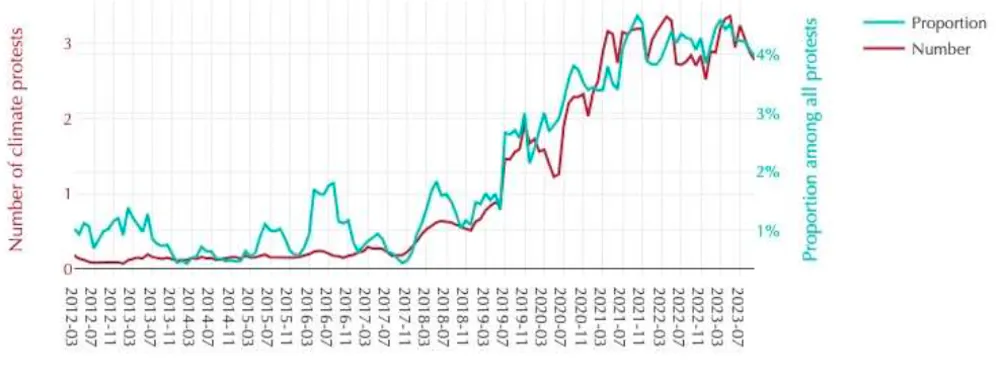
    To look more closely at the global picture of climate and environmental protest – and the repression of it – we used the Armed Conflicts Location Event database. This showed us that climate protests increased dramatically in 2018-2019 and have not declined since. They make up on average about 4% of all protest in the 81 countries that had more than 1,000 protests recorded in the 2012-2023 period:

    Climate protests increased sharply in the late 2010s in the 14 countries studied. (Data is smoothed over five months; number of protests is per country per month.)
    Berglund et al; Data: ACLED, CC BY-SA

    This second graph shows that environmental protest has increased more gradually:

    Environmental protests in the same 14 countries.
    Data: ACLED, CC BY-SA

    We used this data to see what kind of repression activists face. By looking for keywords in the reporting of protest events, we found that on average 3% of climate and environmental protests face police violence, and 6.3% involve arrests. But behind these averages are large differences in the nature of protest and its policing.

    A combination of the presence of protest groups like Extinction Rebellion, who often actively seek arrests, and police forces that are more likely to make arrests, mean countries such as Australia and the UK have very high levels of arrest. Some 20% of Australian climate and environmental protests involve arrests, against 17% in the UK – with the highest in the world being Canada on 27%.

    Meanwhile, police violence is high in countries such as Peru (6.5%) and Uganda (4.4%). France stands out as a European country with relatively high levels of police violence (3.2%) and low levels of arrests (also 3.2%).

    In summary, while criminalisation and repression does not look the same across the world, there are remarkable similarities. It is increasing in a lot of countries, it involves both state and corporate actors, and it takes many forms.

    This repression is taking place in a context where states are not taking adequate action on climate change. By criminalising activists, states depoliticise them. This conceals the fact these activists are ultimately right about the state of the climate and environment – and the lack of positive government action in these areas.

    Oscar Berglund is a member of the Green Party. The report this article is based on was written with Christina Pantazis, Chris Rossdale and Roxana Pessoa Cavalcanti.

    Tie Franco Brotto does not work for, consult, own shares in or receive funding from any company or organisation that would benefit from this article, and has disclosed no relevant affiliations beyond their academic appointment.

    ref. Repression of climate and environmental protest is intensifying across the world – https://theconversation.com/repression-of-climate-and-environmental-protest-is-intensifying-across-the-world-246379

    MIL OSI – Global Reports

  • MIL-OSI Global: Europe’s microstates: the medieval monarchies that survive in our midst

    Source: The Conversation – UK – By Elisa Bertolini, Associate Professor of Comparative Public Law, Bocconi University

    San Marino is one of four microstates with very distinct constitutional arrangements. Shutterstock/kavalenkava

    Continental Europe is home to four microstates with populations of between 30,000 and 80,000 people: Andorra, on the border between France and Spain; Liechtenstein, nestled between Switzerland and Austria; Monaco, which sits on the French Riviera; and San Marino, which is surrounded by northern Italy.

    These states have existed since the medieval period and their tiny size has enabled them to develop and maintain singular constitutional arrangements. They have all developed original solutions to the problems of state architecture, many of which survive today.

    All four of these microstates participate in the Council of Europe (Europe’s human rights organisation) and have therefore had to modernise to meet international standards of governance. This includes the independence of the judiciary.

    However, all four have also implemented these reforms without altering their institutional identity. Their commitment to preserving their distinctiveness from other countries prevents wider reform to their institutions. For them, the protection of national tradition and identity is a form of self-preservation rather than a mere expression of ideology.

    The distinctiveness of the four microstates lies in the survival of institutional arrangements that can no longer to be found practically anywhere else in the world. In the principalities of Liechtenstein and Monaco, for example, the monarchy still has a central role in the constitution.

    Unlike in most European states with a monarchy, in Liechtenstein and Monaco, the royal head of state continues to exercise meaningful power. Andorra and San Marino, meanwhile, operate under a dual head of state arrangement. They effectively have two monarchs.

    The populations of Europe’s medieval microstates.
    World Bank/ Data Commons, CC BY-ND

    Institutional arrangements in these principalities has been shaped by their diminutive size, both in terms of territory and population, and their geographical location. And these arrangements have survived since the middle ages because they have become their identity. While national tradition is an ideological debate in other nations, in these, preserving the past is a survival mechanism.

    Liechtenstein and Monaco

    Liechtenstein and Monaco are constitutional monarchies of the kind that offer substantial power to the royal family. Everything is organised around a prince, who exercises the executive power. Contemporary monarchies in the western legal tradition generally have a ceremonial king or queen but the executive power is held by an elected government. Liechtenstein and Monaco have maintained their historical organisation of government, centred on a very powerful monarch.

    Although his powers are not unlimited, in Monaco, the prince is not even accountable to the parliament for the powers he does hold. Liechtenstein’s prince enjoys even more powers, including the right to appoint half of the members of the constitutional court.

    However, the prince of Liechtenstein’s sovereign power is held in partnership with the people of Liechtenstein. The institutional architecture is built as to allow a system of checks and balances between the prince and the people.

    Since a 2003 constitutional amendment, for example, the people can table a motion of no-confidence in the prince if more than 1,500 citizens are in agreement to do so, which triggers a referendum on confidence in him. The same number of citizens can mount an initiative to abolish the monarchy entirely, should they choose to do so.

    Andorra and San Marino

    The principality of Andorra should more properly be called co-principality, because of its co-princes arrangement. One of the princes is the bishop of Urgell – from Catalonia – and the other is the president of the French Republic (and previously the French king or emperor). So another Andorran peculiarity is that neither of the princes are Andorran nationals.

    Following a 1993 reform that established a fully fledged constitution, neither prince holds sovereign power. Their present constitutional role is almost entirely ceremonial. However, concerns remain over the fact that they are not nationals of the state and that the heads of state are selected neither by the Andorran people nor by their representatives. The historical reason for a foreign head of state is the geographical location of Andorra – wedged between Catalonia and France. Allowing itself to be put under this double sovereignty was a guarantee of survival.

    San Marino also has a two-headed state but both leaders, called the Captains Regent, are Sammarinese nationals. They are elected by the Grand and General Council (the Sammarinese legislative body) and their distinctive trait is that they serve only a six-month term of office.

    The reason for such a short tenure is that San Marino has a population of just under 34,000 people. Everyone knows everyone else, which is a situation that can be detrimental to the independence of elective offices.

    Captains Regent can’t shore up enough power in their short time in office to be able to overthrow the republic. The Captains Regent were first established in 1243, shortly before a number of Italian republics were overthrown by wealthy families. One of the reasons why San Marino has been able to survive is because it has prevented one family from being more powerful than the others for centuries.

    Microstates are, therefore, not like Europe’s regular-sized states. They have distinctive institutional architectures – and often for understandable reasons.

    Elisa Bertolini does not work for, consult, own shares in or receive funding from any company or organisation that would benefit from this article, and has disclosed no relevant affiliations beyond their academic appointment.

    ref. Europe’s microstates: the medieval monarchies that survive in our midst – https://theconversation.com/europes-microstates-the-medieval-monarchies-that-survive-in-our-midst-245328

    MIL OSI – Global Reports

  • MIL-OSI USA: FACT SHEET: President  Biden Commutes the Sentences of 37 Individuals on Death  Row

    US Senate News:

    Source: The White House
    Today, President Biden announced that he is commuting the sentences of 37 individuals on federal death row. Those individuals will have their sentences reclassified from execution to life without the possibility of parole.
    President Biden has dedicated his career to reducing violent crime and ensuring a fair and effective justice system. He believes that America must stop the use of the death penalty at the federal level, except in cases of terrorism and hate-motivated mass murder – which is why today’s actions apply to all but those cases. When President Biden came into office, his Administration imposed a moratorium on federal executions, and his actions today will prevent the next Administration from carrying out the execution sentences that would not be handed down under current policy and practice.
    This historic clemency action builds on the President’s record of criminal justice reform. The President has issued more commutations at this point in his presidency than any of his recent predecessors at the same point in their first terms. Earlier this month, the President announced clemency for approximately 1,500 Americans – the most ever in a single day – who have shown successful rehabilitation and a commitment to making communities safer. This included sentence commutations for nearly 1,500 individuals who were placed on home confinement during the COVID-19 pandemic and who have successfully reintegrated into their families and communities, as well as 39 pardons for individuals who were convicted of non-violent crimes. President Biden is also the first President ever to issue categorical pardons to individuals convicted of simple use and possession of marijuana, and to former LGBTQI+ service members convicted of private conduct because of their sexual orientation.
    The President’s criminal justice record has transformed individual lives and positively impacted communities, especially historically marginalized communities. In the coming weeks, the President will take additional steps to provide meaningful second chances and continue to review additional pardons and commutations.

    MIL OSI USA News

  • MIL-OSI Russia: Slavic universities discussed the development of youth policy and educational activities

    Translation. Region: Russian Federation –

    Source: Peter the Great St Petersburg Polytechnic University – Peter the Great St Petersburg Polytechnic University –

    The international congress of Russian-national (Slavic) universities on youth policy and educational activities has concluded in Moscow.

    The event was organized by the Ministry of Science and Higher Education of the Russian Federation and MIREA – Russian Technological University (the basic organization of the CIS member states for work with youth).

    The congress was held for the first time. It brought together rectors and vice-rectors of universities, heads of educational work departments, and leaders of student public associations. The participants represented the Belarusian-Russian University, the Kyrgyz-Russian Slavic University, the Russian-Armenian (Slavic) University, the Russian-Tajik (Slavic) University, and Russian partner universities – Peter the Great St. Petersburg Polytechnic University and the Siberian Federal University. The SPbPU delegation included Vice-Rector for Youth Policy and Communication Technologies Maxim Pasholikov, Head of the Youth Policy Department Ivan Khlamov, Deputy Director of the SPbPU History Museum Tatyana Novitskaya, specialist of the Center for Youth Trajectories Sofia Romanova, and head of the public institute “Adapters” Elizaveta Zhak.

    At the strategic session, experts discussed existing experience, practices and projects, as well as modern challenges faced by Slavic universities in implementing youth policy and educational activities. The plenary discussion, which was held in the format of an open dialogue, was attended by Deputy Minister of Science and Higher Education of the Russian Federation Olga Petrova and Deputy Head of the Presidential Administration for Cross-Border Cooperation Sergei Malenko.

    The congress also included a presentation of the educational work system and youth policy areas of RTU MIREA, a training seminar, and the opening of the All-Russian Congress on Youth Policy and Educational Activities. Participants learned about the educational work system and youth policy areas of the Plekhanov Russian University of Economics, the possibilities of including Slavic universities in the activities of student scientific societies, and projects of the Rosmolodezh ecosystem, the Russian Society “Knowledge”, and the ANO “Russia – Country of Opportunities”.

    On the final day, the experts were presented with the system of educational work and youth policy areas of RUDN named after Patrice Lumumba, the activities of the psychological service of the university using the example of MIPT, and projects of the Association of Volunteer Centers, in which Slavic universities can participate.

    Head of the Department of Assessment and Methodology of the ANO “Russia – Country of Opportunities” Alexandra Vaza noted that the Kyrgyz-Russian Slavic University became the first foreign university to begin systematic work with the presidential platform of the RSV. KRSU students received the same opportunities for self-realization as millions of young people in Russia.

    The Competence Center opened at the university has become a provider of assessment and development of “soft skills” of students and teachers. The Polytechnic University in St. Petersburg, which has unique experience of working with ambassadors and in the field of graduate employment, has been very helpful in this activity. In addition, the center has become a single entry point to the projects of the presidential platform. KRSU students are active participants in the competitions “TopBLOG”, “Profrazvitie” and “Drugoe Delo”. In 2025, work in this direction will continue, because we strive for each student to be able to realize their potential and become a sought-after specialist in the labor market, – said Alexandra Vaza.

    The final meeting was chaired by Artem Fomin, Head of the Department of International Youth Cooperation and Tourism of the Department of State Youth Policy and Educational Activities of the Ministry of Education and Science of Russia. Representatives of Slavic universities presented draft roadmaps for the further development of youth policy and educational activities in their universities in 2025-2026. Russian partners — representatives of Peter the Great St. Petersburg Polytechnic University and the Siberian Federal University — presented proposals for joint projects. On behalf of MIREA — Russian Technological University, Vice-Rector Grigory Petushkov voiced proposals for cooperation.

    Please note: This information is raw content directly from the source of the information. It is exactly what the source states and does not reflect the position of MIL-OSI or its clients.

    MIL OSI Russia News

  • MIL-OSI Security: Renewed appeal in connection with murder of Fiona Holm

    Source: United Kingdom London Metropolitan Police

    The Met is renewing its reward of up to £20,000 for help finding the remains of a murdered woman, as her family face their second Christmas without her.

    The reward is on offer for information leading to the recovery of the remains of 48-year-old Fiona Holm.

    Fiona was last seen alive leaving a residential address in Verdant Lane, Catford, on 20 June, 2023. She was reported missing nine days later.

    Her partner, Carl Cooper, was jailed for life in July for her murder which took place in the living room of his flat in Broadfield Road, Catford. Cooper lied to Fiona’s family and police, and took extensive steps to cover up the killing. Fiona’s body has never been recovered.

    Cooper was also convicted of murdering another girlfriend, 41-year-old Naomi Hunte, who was found dead at her home in Woolwich in 2022.

    Detective Chief Inspector Kate Blackburn, who leads the investigation, said: “My team has carried out a huge amount of work to try to find Fiona, using specialist teams to search areas she was known to frequent, open spaces, bodies of water, houses, cars and lockups. Thousands of hours of CCTV has been seized and viewed, substantial mobile phone enquiries have been reviewed and hundreds of witness statements have been taken, including interviews with Fiona’s family and friends. Those efforts have continued since Cooper’s conviction.

    “This Christmas, our thoughts are with Fiona’s family, who are still waiting for answers almost two years after her tragic murder. Our thoughts are also with Naomi’s family at this difficult time.

    “I am appealing to anybody who may be able to assist the ongoing search for Fiona’s remains to come forward, no matter how insignificant you think your information could be. Perhaps now Cooper has been convicted, you feel able to come forward and tell us what you know or have heard.”

    Fiona’s family have described her as a kind and loving person, and say they are tormented by the lack of closure.

    Fiona’s daughter Savannah said: “This year is the second Christmas without my beloved mother. As the heartache still continues, the restless nights go on knowing that she has been out there this long, and no-one has come forward with any information, which I find disturbing.

    “The thought of us finding her remains is sickening to think about, but this would also bring my whole family peace.

    “My Nan has not been the same since. The only thing she worries about is where her daughter is, as she wants her to be found. Nan misses her daughter’s big heart and kind ways the most.”

    If you have any information, please contact the incident room on 020 8721 4005, or 999 if you need urgent police attendance. If you want to give your information anonymously, you can contact Crimestoppers on 0800 555 111.

    MIL Security OSI

  • MIL-OSI Global: In the age of AI, Wallace and Gromit’s claymation style remains a festive favourite

    Source: The Conversation – UK – By Christopher Holliday, Senior Lecturer in Liberal Arts and Visual Cultures Education, Department of Interdisciplinary Humanities, King’s College London

    A new Wallace and Gromit adventure, Vengeance Most Fowl (2024), premieres on BBC One and Netflix this Christmas Day. It’s been nearly 20 years since the last feature film about Yorkshire’s favourite eccentric inventor and his above-intelligent pet dog, The Curse of the Were-Rabbit (2005).

    Aardman’s latest Christmas instalment marks the reappearance of Feathers McGraw, the mysterious and silent penguin villain from The Wrong Trousers (1993). It also represents the latest outing for the Bristol-based company’s signature stop-motion “claymation” style – which is both a symbol of the studio’s enduring relationship to craft, and a vital element of Aardman’s international identity as an animation powerhouse.

    A new era of artificial intelligence is threatening to transform the boundaries of what we understand as art. So it is significant that one of this year’s most highly anticipated festive films celebrates the skill and spirit of handmade animation.


    Looking for something good? Cut through the noise with a carefully curated selection of the latest releases, live events and exhibitions, straight to your inbox every fortnight, on Fridays. Sign up here.


    Aardman was founded in 1972. Over the last 50 years, the studio has cultivated a durable and worldwide reputation as a pioneer of animation as a handmade, craft-based art form.

    Both before and after its feature-film debut, Chicken Run (2000), the studio’s stop-motion approach was refined across an extensive range of animated projects and commissions. These included short films like Creature Comforts (1990), the first Aardman production to win an Academy Award, as well as an array of television idents, music videos and advertising campaigns.

    Such has been Aardman’s longstanding connection to claymation that when the Newplast company shut down in March 2023, sparking rumours of a shortage of its famous modelling clay, the studio issued a statement denying it was running out of materials, while assuring fans it would find a new supplier for future projects.

    The trailer for Wallace and Gromit: Vengeance Most Fowl.

    Aardman’s animated productions have been a staple of Christmas film and television since Wallace and Gromit creator Nick Park’s 30-minute short The Wrong Trousers debuted on Boxing Day 1993.

    So much so, in fact, that Aardman proclaims that it is “proud to be synonymous with Christmas”. The many television specials featuring old and new Aardman characters include the 30-minute Netflix Christmas shorts Shaun The Sheep: A Flight Before Christmas (2021) and Robin Robin (2021), as well as multiple “cracking” Christmas advertising campaigns.

    This Christmas season, that’s included the decorating of London’s Battersea power station with Aardman characters, and a collection of specially commissioned Christmas idents exclusively for the BBC.

    Aardman goes digital

    Despite a defining investment in the creative potential of claymation, the studio has occasionally dipped a toe into the the world of digital technology. A brief foray into computer-animated filmmaking in the early 2000s with Flushed Away (2006) and Arthur Christmas (2011) marked an ultimately short-lived creative partnership with DreamWorks Animation and Sony Pictures.

    While Aardman’s involvement with these renowned Hollywood companies pushed the studio away from its house style and ushered in a new kind of big-screen humour, in design at least, these films retained their quintessential Aardman “look”. But though these characters appeared firmly from the Aardman stable (particularly in their recognisably exaggerated smiles), their animated perfection demonstrated the pristine visuals increasingly afforded by sophisticated computer graphics.

    Clearly, much like Wallace, Aardman animators aren’t immune to the thrill of technological innovation. But they have still largely maintained their claymation methods of production, to instil in audiences the many pleasures of doing things by hand.

    The glimpse of fingerprints accidentally pressed into the modelling clay, coupled with the jerky movements of their plasticine characters, emphasises that Aardman methods remain far removed from modern technology. Craft and the handmade are therefore as much business strategies as they are aesthetic choices, deployed to sell the Aardman brand around the world.

    After a hiatus of almost 20 years, the imminent return of Wallace and Gromit to British screens seems a pointed reflection on the virtues of the handmade, against the acceleration of AI within the film industry.

    With Vengeance Most Fowl telling the story of a rogue automatic garden gnome, Aardman is seemingly questioning a future built from computerised (and potentially dangerous) automation. By preserving the artisanal and anchoring its very British charm once again to the hand-crafted, slightly imperfect models that populate these stop-motion animated worlds, it seems that, for Aardman at least, computers are not always what they are cracked up to be.

    Christopher Holliday does not work for, consult, own shares in or receive funding from any company or organisation that would benefit from this article, and has disclosed no relevant affiliations beyond their academic appointment.

    ref. In the age of AI, Wallace and Gromit’s claymation style remains a festive favourite – https://theconversation.com/in-the-age-of-ai-wallace-and-gromits-claymation-style-remains-a-festive-favourite-246070

    MIL OSI – Global Reports

  • MIL-OSI: BTCC Exchange Celebrates OG Week 2 with Exclusive FLOKI AMA on X Spaces

    Source: GlobeNewswire (MIL-OSI)

    VILNIUS, Lithuania, Dec. 23, 2024 (GLOBE NEWSWIRE) — BTCC, one of the longest-standing cryptocurrency exchanges, recently hosted an engaging AMA (Ask Me Anything) session on X Spaces featuring FLOKI, one of the original meme coins in crypto.

    The AMA was part of BTCC’s “OG Week” campaign, where iconic long-term meme coins are spotlighted and celebrated. Pedro Vidal, Community Relations Officer for Floki and TokenFi Blockchain, joined the session to discuss FLOKI’s vision for 2024 and beyond.

    The AMA was a resounding success, with over 1,500 crypto enthusiasts tuning in to explore FLOKI’s journey, and check out some big developments landing this coming year. Anyone interested in listening back can check out the AMA here

    Highlights of the Discussion

    The AMA covered many points, and gave a deep insight into FLOKI’s history, position in the crypto market, and some exciting points for 2025:

    Topic 1 – FLOKI’s Inception

    Topic 1 covered FLOKI’s inception, and discussed how FLOKI was born from a tweet from Elon Musk in 2021. Though the coin initially suffered rug pulls from the team who initially launched the project, it has now become a community-led project.

    FLOKI is now governed by a DAO, leaving the ownership and direction of the token in the hands of the community. The DAO is important as it aligns closely with the current team’s focus on community feedback, utility and transparency, and dedication to the success of the project – and also to avoid the pitfalls from the initial launch of the coin.

    Topic 2 – FLOKIs Blockchain Gaming Platform

    Topic 2 focused on the big ticket success on FLOKI – Valhalla. The crypto household name game took the market by storm and features all the hallmarks of a global superstar – from an easy-to access, browser-based design, and global accessibility, everyone inside the FLOKI community is excited about the future of Valhalla.

    “The idea is to continue to improve and leave blockchain forever changed.”

    – Pedro Vidal, on Floki’s Valhalla Metaverse game

    Topic 3 – FLOKI Debit Card and Trading Bot

    Another hot topic on the agenda was the FLOKI debit card, which now offers crypto enthusiasts a way to spend their crypto across 8 different chains, with 0% transaction fees. The cards are available in both physical and virtual forms, which is another step toward FLOKI’s vision of a more financially enabled world, powered by memecoins.

    FLOKI have also released their Telegram trading bot, aiming to streamline the trading experience, all from inside users’ telegram accounts. The bot supports multiple chains and is live now!

    Topic 4 – 2025 and Beyond

    For 2025, Pedro emphasized the importance of staying true to the project’s values of transparency and utility, and managing and promoting growth were emphasized – however 2025 shapes up for FLOKI, the ecosystem looks set for a rapid expansion.

    FLOKI is available on BTCC for spot and futures trading. Up to 50x leverage is supported, and as one of the hottest meme coins on the platform, interest looks set to build for the coming season.

    BTCC OG Week

    To celebrate the OG meme coins that laid the foundations for the current cycle’s top gainers like DOGE, FLOKI, and PEPE, BTCC Exchange has announced the BTCC OG Week campaign, where meme fanatics can undertake social and trading tasks to win USDT rewards, with a prize pool of 300 USDT and 300 USDT in withdrawable rewards each week.

    Week 1, which saw BTC in the limelight has already concluded, and winners of the trading competition have already been announced on BTCC’s X page.

    BTCC continues its OG Week campaign with the featuring DOGE, and there’s plenty more amazing content to come.

    Going forward, BTCC have scheduled more AMAs and special features on other long-term meme coins. To stay updated on future campaigns and win exclusive rewards, follow BTCC’s X account.

    For additional information, visit BTCC’s website or follow BTCC and Floki on X.

    Media Contact Details
    Contact Name: Aaryn Ling
    Contact Email: press@btcc.com

    About BTCC

    BTCC is a long-standing crypto exchange with over 13 years experience in the crypto space, and 0 security breaches. BTCC makes crypto trading easier with user-centric features that are sure to suit the needs of novice and advanced traders alike, wherever they are in the world.

    Disclaimer: This content is provided by BTCC. The statements, views and opinions expressed in this column are solely those of the content provider. The information provided in this press release is not a solicitation for investment, nor is it intended as investment advice, financial advice, or trading advice. It is strongly recommended you practice due diligence, including consultation with a professional financial advisor, before investing in or trading cryptocurrency and securities. Please conduct your own research and invest at your own risk.

    A photo accompanying this announcement is available at https://www.globenewswire.com/NewsRoom/AttachmentNg/634ab0fe-7ecb-48c0-bc9d-f8c188a3fb50

    The MIL Network

  • MIL-OSI United Kingdom: Christmas booze ban for record number of offenders

    Source: United Kingdom – Executive Government & Departments 3

    Around 3,800 offenders either released from prison or serving a community sentence will wear an alcohol tag over Christmas and New Year.

    • Around 3,800 offenders forced to wear alcohol tags to keep streets safe over Christmas and New Year
    • Technology monitors alcohol in their sweat so offenders can’t enjoy a festive tipple
    • Tags help tackle drink-fuelled crime such as domestic abuse and drunken disorder

    A record number of offenders will be forced to stay sober this Christmas as part of the government’s Plan for Change, keeping streets safe and cutting alcohol-fuelled crime.

    Statistics published today (23 December) show around 3,800 offenders either released from prison or serving a community sentence will wear an alcohol tag over Christmas and New Year.

    The tags work around the clock and quickly detect if an offender has been drinking by analysing their sweat, meaning festive favourites such as mulled wine and prosecco will be strictly off the menu.

    If an offender dares to have a drink, an alert is sent to their probation officer who can take action to punish them, such as an order to return to court or even prison.

    Minister for Prisons, Probation and Reducing Reoffending, James Timpson, said:

    The sad reality is alcohol-fuelled crime such as domestic abuse and public disorder spikes at Christmas and has a devastating impact in our homes and town centres.

    Technology like this is playing a key role in the government’s mission to take back our streets by monitoring offenders and cutting crime.

    The tags are accurate enough to distinguish between foods that contain low-levels of alcohol – such as mince pies or Christmas pudding – and boozier drinks that could lead to offenders getting drunk.

    The technology is playing a significant role in the government’s mission to take back our streets from alcohol-fuelled harm, which costs the taxpayer billions of pounds each year. 

    Offenders who are banned from consuming alcohol by the courts have remained sober for 97% of the days they have been tagged since the technology was first rolled out in 2020.

    They monitor alcohol bans for offenders on community sentences handed down by judges or magistrates and can also be used as a licence condition for prison leavers. Roughly 20% of those supervised by probation are classified as having a drinking problem.

    These statistics come as the government is conducting a landmark review of sentencing, which will further explore the range of tougher punishments that can be served outside of prison. This will explore the technology we can use to limit the liberties of offenders in the community and support the administration of sentences outside of prison.

    Further information

    Updates to this page

    Published 23 December 2024

    MIL OSI United Kingdom

  • MIL-OSI USA: What did Yellowstone look like before it became Wonderland?

    Source: US Geological Survey

    Yellowstone Caldera Chronicles is a weekly column written by scientists and collaborators of the Yellowstone Volcano Observatory. This week’s contribution is from Michael Poland, geophysicist with the U.S. Geological Survey and Scientist-in-Charge of the Yellowstone Volcano Observatory.

    The Yellowstone region today is Wonderland.  It is full of spectacular geysers and colorful hot springs, home to lakes and meadows and mountains and valleys, and covered by both forests and grasslands.  What we see today is a result of volcanic activity that has shaped the landscape over the past 2 million years.

    But what did Yellowstone look like before volcanic activity blew several large holes in the region and covered huge swaths of land with thick lava and ash flows?  What was Yellowstone like before it became Wonderland?

    To understand the answer to this question, geologists have looked at the characteristics of the areas bordering the Yellowstone region—at the mountain ranges, rock types, and faults that make up areas like the Tetons and Jackson Hole, and like the Gallatins and Paradise Valley.

    Interpretive reconstruction of the Yellowstone Plateau region before initial plateau volcanism (a little before 2 million years ago). The region was entirely an elevated and faulted mountainous terrain with no basin in the present plateau area. Gray areas are underlain by ash flow deposits from calderas of the eastern Snake River Plain area that predate the Yellowstone volcanic system.  Figure 6 from Christiansen (2001) (https://pubs.usgs.gov/pp/pp729g/).

    During about 4–7  million years ago, the Yellowstone hotspot was located under southeastern Idaho, feeding eruptions occurring from the Heise volcanic field.  That sequence included multiple large calderas that formed via major explosions, spreading ash across the landscape—including Jackson Hole and the area that is now Yellowstone.

    Map of Yellowstone earthquakes that were located during 1973-2023. Red circles are earthquakes located in the Yellowstone region, and blue circles indicate swarm seismicity.  The size of the circle scales with the magnitude of the earthquake.  In the south part of Yellowstone National Park are a series of earthquake bands that trend north-northwest to south-southeast.  These alignments may reflect faults associated with mountain ranges that were destroyed when Yellowstone Caldera formed 631,000 years ago.

    The pre-volcanic Yellowstone landscape was mostly made of high-elevation areas—there was no basin present like there is today.  Instead, mountain ranges that ran mostly north-northwest to south-southeast extended across the region.  Today’s Gallatin and Madison ranges in the north were probably connected to the Tetons and other mountains to the south, forming sets of continuous ranges that were all bounded by large faults.  Fault-bounded ranges like these are common throughout the western USA today—part of the Basin and Range province, which extends from eastern California to western Wyoming and Montana.

    We can see the evidence for these formerly continuous mountain ranges in patterns of earthquakes and eruptive vents.  Seismicity maps show several north-northwest to south-southeast bands of earthquakes beneath Yellowstone Caldera, possibly delineating the still-existing faults that controlled the mountain ranges that were blown apart when large explosive eruptions began in the Yellowstone region.  There are also several roughly north-northwest to south-southeast alignments of vents for rhyolite lava flows that erupted after Yellowstone Caldera formed, especially during about 160,000 to 70,000 years ago.  Just like patterns of earthquakes, the vent alignments might also have been controlled by the preexisting faults associated with the destroyed mountain ranges.

    And because there were mountains throughout the Yellowstone region before the big explosions, erosion was an important process.  The high mountain ranges were gradually being ground down, and sediments eroded from these peaks accumulated in valleys at the bases of the ranges.  Some of these sediments still exist today, capped by thick blankets of ash from caldera-forming eruptions of the Yellowstone system.

    The first volcanic eruptions from the Yellowstone region began at least 2.2 million years ago, and the first of three great caldera-forming eruptions—that which deposited the Huckleberry Ridge Tuff—occurred 2.08 million years ago, spreading thick ash over an area larger than the state of Connecticut and dramatically altering the landscape.

    Today, many visitors to Yellowstone National Park approach the area from the north, south, or west. In driving through the mountains and valleys that lead to Wonderland, take a moment to appreciate the landscape you are traversing.  Those areas today exemplify what Yellowstone used to look like a few million years ago.

    Map of Yellowstone caldera showing the locations and ages of the most recent rhyolite eruptions at Yellowstone, the Central Plateau Member rhyolites. Unit boundaries are from Christiansen (2001). Two sets of vent alignments run north-northwest to south-southeast and might reflect underlying fault orientations associated with mountain ranges that were obliterated during the formation of Yellowstone Caldera about 631,000 years ago.

    MIL OSI USA News

  • MIL-OSI United Kingdom: Plans approved for almost 100 new energy-efficient council homes as part of major overhaul

    Source: City of Wolverhampton

    It is part of City of Wolverhampton Council’s citywide strategy to identify solutions for 4,100 out-dated homes built by old, non-traditional construction methods.

    Keon Homes has, through the council’s housing framework, been appointed as the construction partner for the new homes on the Lincoln Green Estate and are expected to start on site in late spring.

    The first wave of demolition of the ageing bungalows continues across the estate on Alleston Road, Grosvenor Road, Lincoln Green and School Lane – and in the Wood End and Portobello areas of the city. Work on planning applications for new homes in the other two locations are ongoing.

    All of the old bungalows have been declared defective under the 1985 Housing Act – and suffer from a number of issues including failing structural elements, leaking and poorly insulated roofs, very poor thermal efficiency, and wet rot in the floor.

    The council has therefore taken the decision to replace the properties before they have an adverse effect on tenants’ health and wellbeing.

    The new, modern housing will also provide a greater ability to adapt properties to meet tenants’ needs, something which has been difficult to achieve in the out-dated properties due to their structural limitations.

    The overall non-traditional housing stock replacement programme is being managed on behalf of the council by Wolverhampton Homes and follows extensive and ongoing consultation with residents.

    City of Wolverhampton Council Deputy Leader and Cabinet Member for City Housing, Councillor Steve Evans, said: “The non-traditional built properties are in such poor structural condition that they can no longer be economically and satisfactorily maintained.

    “For the safety and comfort of our residents, we are delivering better homes in the long term that they can make their own in the same location.

    “We will continue talking with all those affected and have engaged with all tenants, who are relishing the prospect of moving into brand new homes. They understand the absolute necessity to remove these out-dated bungalows and replace them with new modern homes.

    “It is a key priority of our council plan to ensure we provide good homes in well-connected neighbourhoods for all our residents.”

    MIL OSI United Kingdom

  • MIL-OSI Russia: Alexander Novak took part in the launch of the third line of the Kysyl-Syr – 84 km gas pipeline

    Translation. Region: Russian Federation –

    Source: Government of the Russian Federation – An important disclaimer is at the bottom of this article.

    Previous news Next news

    Alexander Novak performed the ceremonial launch of the 3rd line of the main gas pipeline “Kysyl-Syr – 84 km” via video link. With Head of the Republic of Sakha (Yakutia) Aisen Nikolaev

    Deputy Prime Minister Alexander Novak held a ceremonial launch of the third line of the Kysyl-Syr – 84 km main gas pipeline via video link. The head of the Sakha Republic (Yakutia) Aisen Nikolaev and the general director of JSC Sakhatransneftegaz Alexey Kolodeznikov also took part in the gas launch ceremony.

    “The launch of the Kysyl-Syr main gas pipeline with its subsequent inclusion in the unified gas transportation system is of the utmost socio-economic importance for the residents of the republic and will ensure reliable gas supply to the Central Energy Region of Yakutia. These are 102 settlements, including Yakutsk, Pokrovsk and Vilyuysk. These settlements are home to 456 thousand people, 626 social infrastructure facilities are located – 220 schools, 235 kindergartens, 171 medical institutions,” noted Alexander Novak.

    From 2021 to 2025, the construction of 11 inter-settlement gas pipelines, 6 gas pipeline branches and gas distribution stations is planned in Yakutia. Another 28 settlements will be gasified. In 2025, it is planned to gasify at least 1.5 thousand households as part of the social additional gasification program.

    Please note: This information is raw content directly from the source of the information. It is exactly what the source states and does not reflect the position of MIL-OSI or its clients.

    MIL OSI Russia News

  • MIL-OSI United Kingdom: Goods Yard hits targets to boost local economy weeks ahead of opening

    Source: City of Stoke-on-Trent

    A flagship regeneration project in Stoke-on-Trent is already having a major impact on the local economy with job opportunities secured for almost 200 people.

    Social impact developers Capital&Centric are working in partnership with Stoke-on-Trent City Council to develop Goods Yard.

    The former train station site, which was neglected for many years, is being transformed into a vibrant canalside neighbourhood boasting 174 brand new homes for rent and 30,000 sq ft of commercial space which will be used for leisure, retail and workspace.

    Already, the development – which is on track for completion in spring 2025 – has added £63 million to the local economy and created job opportunities for 190 workers from the area – 107 of which are local to Stoke-on-Trent.

    Down the line there will be even more opportunities created at Goods Yard with approximately 237 local jobs set to be created in leisure and hospitality and an estimated annual employment impact of £5.4 million.

    It is all part of a joint mission by Capital&Centric and the council to deliver positive social value from the regeneration project.

    Since starting on site contractors Bowmer + Kirkland have engaged with nearly 3,000 students from schools and colleges across Stoke-on-Trent, highlighting a range of careers in the construction industry.

    Ajmal Muhammed from Stoke-on-Trent College successfully completed a placement with B+K and has since been accepted onto a degree apprenticeship programme as a trainee quantity surveyor.

    Ajmal was given the opportunity to work at Goods Yard after attending Capital&Centric’s Regeneration Brainery event, a pioneering initiative which aims to get more diverse young people into property careers.

    Ajmal, who lives in Tunstall, said: “I was offered an apprenticeship with B+K after smashing my interview and getting the results I needed from college, I got a distinction star and two distinctions.

    “I’ve been here a few months now and my favourite part of the site is The Vaults, I’ve just never seen anything like it before it’s really interesting.

    “I will be helping to finish the Goods Yard which is really exciting, then once it’s complete I’ll be moving onto another B+K project. I have just started at Salford University too where I am working towards becoming a Chartered Surveyor.”

    Councillor Finlay Gordon-McCusker, cabinet member for transport, infrastructure and regeneration at Stoke-on-Trent City Council, said: “Ajmal is really enthusiastic about being able to work on this landmark development, and it is great that he has been given the opportunity to hone his skills on a major regeneration project in his home city.

    “Goods Yard is a first-of-its-kind scheme for Stoke-on-Trent but it’s far greater than bricks and mortar. It’s great to see the social benefits coming to fruition with a number of successful apprenticeships and local people employed during construction.

    “We’re very pleased to be working with Capital&Centric and B+K who both prioritise local impact. We’ll also see many more jobs and opportunities once Goods Yard is complete next year, making a real difference to people and the local economy.”

    Tom Wilmot, joint managing director at Capital&Centric, said: “Regeneration is not just about creating new spaces for people to live, work and hang out. Making sure the benefits are felt locally is just as important and takes time and effort.

    “From the apprentices on site to the work we’ve done with young people through Regeneration Brainery we’ve made sure social value sits at the heart of the development.”

    Mona Baig, social value co-ordinator at Bowmer + Kirkland said: “We are pleased to have achieved our social value targets on the Goods Yard project. Engaging positively within the community is of utmost importance to us.

    “Stoke-on-Trent offers a wide range of diverse talents for which we have been happy to provide and facilitate opportunities for on this major local project.

    “We hope our continued engagement with job seekers, young people and local charities within the Stoke-on-Trent and Staffordshire area will create a long-term positive impact to the local community. With thanks to our supply chain partners, we look forward to continuing our support within the local area.”

    MIL OSI United Kingdom

  • MIL-OSI United Kingdom: Everything you need to know about bin collections and recycling this Christmas season

    Source: City of Manchester

    With the festive season upon us, noticeable changes to our neighbourhoods are in full sleigh and are not just about the twinkle of lights or wuthering wreaths.

    There will be important changes to bin and recycling collection schedules over the Christmas and New Year period. Every year, Manchester City Council have aim to make this time as easy as possible for residents with limited disruption. 

    Christmas and New Year Bin Collection Schedule: 

    • Monday 23 December & Monday 30 December – No change. 
    • Tuesday 24 December & Tuesday 31 December – No change. 
    • Wednesday collections – Move to Friday 27 December & Thursday 2 January. 
    • Thursday collections – Move to Saturday 28 December & Friday 3 January. 
    • Friday collections – Move to Sunday 29 December & Saturday 4 January. 

    Regular collection days will resume from Monday 6 January 2025 onwards. 

    Residents can find these changes on their printed bin calendars (delivered in summer 2024) and online, where they can sign up for reminders through our email service, BINFO. This service will send tailored reminders on collection days, ensuring you don’t miss a pick-up. 

    The Council has also informed apartment building managers and social landlords, who often coordinate bin collections for residents in flats and apartment blocks. 

    To help spread the message, a banner has been at the top of the council’s waste and recycling homepage since 1 December, linking to a dedicated page that provides full details on the changes and additional guidance on waste disposal and recycling. 

    An e-bulletin sent to over 28,000 people, social media posts, and a community toolkit emailed to partners has also been used to ensure neighbourhoods across Manchester are aware of the changes. 

    Councillor Lee-Ann Igbon, Executive Member for Vibrant Neighbourhoods, said: “With the festive season bringing joyful celebrations, we understand that many residents may be adjusting their routines. The changes to our bin and recycling collections are designed to minimise disruption during this busy time and ensure services run smoothly.

    “By providing clear information, tailored reminders through our BINFO service, and accessible details online, we’re making it easier for Manchester residents to stay on top of their waste and recycling, while helping to a maintain clean, festive neighbourhoods so everyone can enjoy Christmas and New Year.” 

    MIL OSI United Kingdom

  • MIL-OSI United Kingdom: Winners announced at this year’s Open exhibition

    Source: City of Leicester

    MORE than 20 artists from across the East Midlands are celebrating their success at Leicester’s Open exhibition.

    The annual exhibition recognises the talent of local artists of all ages, with prizes awarded to the paintings, sculptures, textiles, prints and photographs that have been selected by a panel of judges, with the awards generously supported by local sponsors.

    Amongst the winners was Susan Isaac (pictured), who wins this year’s Attenborough Prize.

    Landscape artist Susan won the prestigious prize for her work Balance and Counterbalance (mixed media on canvas).

    It’s the second time that Newark-based Susan has won The Attenborough Prize, having previously won it in 2022.

    “I was astonished and absolutely delighted to be presented with the Attenborough Prize,” she said.

    “I am so grateful to the selectors and judges and everyone involved in putting on this wonderful annual exhibition – one that I’ve been pleased to be involved with since first applying in 2015.

    Balance and Counterbalance emerged from a recent visit to Blaenavon Ironworks, now part of a World Heritage Site and close to my late father’s coal-mining family home in nearby Llanbradach.

    “The painting depicts a tower for a water balanced lift, used to convey raw materials and pig iron between the different levels of the site. I am always mindful, when visiting such sites, of a strong sense of the wounds inflicted on the land as well as on the iron workers and the miners who inhabited the communities here, both above and below ground, and of the power of the natural world to restore some kind of equilibrium.”

    Jewellery designer Christine Pearson – who’s based in Leicester – won the Leicester Museums & Galleries’ Development Trust Prize (adult category) for Shell Collection – a wooden box containing10 kiln-fired enamel on copper brooches.

    Describing the work, Christine said it depicted “fantasmagorical (sic) creatures from the little-known oceans surrounding the ancient seaport of Leicester.”

    Writing on Facebook, she added: “I’m so thrilled to have won the Leicester Museums and Galleries Trust Prize at the Leicester Open exhibition!

    “My box of enamelled shells was inspired from years of looking at Victorian collections in museums and old houses, and childhood memories of my Grandad’s shell collection, which he kept in a home-made cardboard box.”

    The other winners in the adult category were as follows:

    Art House award: Carol Pairaudeau for Type/Write

    CVAN East Midlands award: Sarah Mason for A Labradoodle’s Lazy Afternoon

    LCB Depot awards: Moya Acton for Nocturn, Katie Richards for Bernadette, Emma Peers for What’s Your Thread Length?

    Leicester Gallery (De Montfort University) award: Emma Peers for What’s Your Thread Length?

    Leicester Print Workshop award: Katerina Luchkova for Reflections of the City

    Phoenix award: Klara Simandi for Textile Flowers


    In the young people’s category, the Attenborough awards were presented to Hattie Weller (aged 18) for The Brutality of Life – a collection of clay pieces; Mahi Ghait (aged 15) for Meadow (acrylic painted paper on canvas); Lewis Holmes (aged 9), for Look Closer (acrylic paint on canvas, which comes with its own magnifying glass).

    Other winners in the young people’s category were:

    Arch Creative award: Tom Hudson for Waiting

    Art House award: Toby Cross for Phonebox

    Curve award: Elina Roman for Plastic Island

    De Montfort Hall award: Nada Rhimin for Dance Dance Dance

    Leicester Lo-Fi Photography award: Anfisa Denysenko for Architectural Composition

    Leicester Print Workshop award: Henry Dampney for Black and White

    Phoenix awards: Oriel Birks for A Little Owl Looks; Ayah Riyaazi for Self Portrait

    Soft Touch Arts award: Lina Rehab for Afternoon Repose

    Leicester Museums & Galleries Development Trust awards: Tom Hudson for Waiting (16-18 category); Oriel Birks for A Little Owl Looks (11-15 category); Vincent Parker for Arc de Triomphe (5-10 category).

    Open: The People’s Exhibition features works by more than 200 local artists and makers – from complete beginners to seasoned professionals.

    All the paintings, sculptures, textiles, prints and photographs on display have been created by artists aged 19 and over who live or study in Leicester, Leicestershire, Rutland, Derbyshire, Lincolnshire, Nottinghamshire or Northamptonshire.

    Work by young artists aged five to 18 is also on display, with a number of schools in the region also participating.

    The Open exhibition at Leicester Museum & Art Gallery runs until Friday 31 January 2025.

    Admission is free of charge.

    All the artworks on display are available to buy, with prices starting at £50, and purchased pieces can be collected from the museum from Saturday 1 February.

    MIL OSI United Kingdom

  • MIL-OSI Economics: Quality remains top priority for parents in purchasing baby care products in APAC, says GlobalData

    Source: GlobalData

    Quality remains top priority for parents in purchasing baby care products in APAC, says GlobalData

    Posted in Consumer

    Growth in the Asia-Pacific (APAC) region is projected to slow over the next few years, impacted by an ageing population, trade tensions, and greater policy uncertainty. However, parents’ focus on the quality of ingredients used in baby care and childcare products remains high despite concerns over their financial situation.  Aligning with this,  37% of respondents stated that high quality products/ingredients mean good value for money to them when purchasing baby care and child care products*, says GlobalData, a leading data and analytics company.

    Mohammed Masiuddin Shajie, Lead Consumer Analyst at GlobalData, comments: “Consumers in the APAC region remain concerned about their financial situation. In a GlobalData consumer survey*, 55% of respondents in APAC stated that they are either extremely or quite concerned about their personal financial situation. Moreover, in the same survey, 44% of the respondents said that they are switching to cheaper brand alternatives, and 35% stated that they are switching to cheaper stores/cheaper outlets to cope with rising prices in general.”

    Deepak Nautiyal, Consumer and Retail Commercial Director, APAC and ME, notes: “Although APAC has remained a key driver of the global economy, growth in the region is forecast to dip marginally in the medium term, according to the World Economic Forum’s latest Executive Opinion Survey. A slowing economy and the impact of inflationary pressures will influence the growth across major economies in the region. Although consumers are cutting down on their household expenses, parents remain concerned about the quality of ingredients used in their baby care products.”

    Shajie concludes: “Quality of product tops the priority list for parents while purchasing baby care products. However, products that are competitively priced will attract more consumers. This is substantiated by a GlobalData survey*, in which 19% of the respondents stated that they are switching to cheaper brands to save money, while purchasing baby care and childcare products. In the same survey, 14% said that they are switching to cheaper alternatives within the same brand. This is creating opportunities for affordable baby care products with high-quality ingredients. Brands meeting these expectations will earn the trust and loyalty of parents.”

    *GlobalData 2024 Q3 Consumer Survey – Asia & Australasia, with 6,471 respondents

    MIL OSI Economics

  • MIL-OSI Video: The Future of Growth: Rethinking Prosperity for All

    Source: World Economic Forum (video statements)

    Explore how the World Economic Forum’s Future of Growth initiative is shaping sustainable and inclusive economic models for the 21st century. https://initiatives.weforum.org/future-of-growth-initiative/home

    The World Economic Forum is the International Organization for Public-Private Cooperation. The Forum engages the foremost political, business, cultural and other leaders of society to shape global, regional and industry agendas. We believe that progress happens by bringing together people from all walks of life who have the drive and the influence to make positive change.

    World Economic Forum Website ► http://www.weforum.org/
    Facebook ► https://www.facebook.com/worldeconomicforum/
    YouTube ► https://www.youtube.com/wef
    Instagram ► https://www.instagram.com/worldeconomicforum/ 
    Twitter ► https://twitter.com/wef
    LinkedIn ► https://www.linkedin.com/company/world-economic-forum
    TikTok ► https://www.tiktok.com/@worldeconomicforum
    Flipboard ► https://flipboard.com/@WEF

    #WorldEconomicForum #InclusiveGrowth #Sustainability #InvestingInPeople #wef25

    https://www.youtube.com/watch?v=uquQHM8z0Yw

    MIL OSI Video

  • MIL-OSI USA: 2024 in Review: EROS Celebrates Annual NLCD, Landsat 7’s 25-Year Mission

    Source: US Geological Survey

    This was a landmark year for the definitive land cover resource for the United States that’s produced at EROS: the National Land Cover Database (NLCD). The renamed Annual NLCD data release on October 24, 2024, debuted a new ability to look at land cover and land change year by year further back in time, from 1985 to 2023. 

    Landsat satellites continue to provide the foundational data for Annual NLCD, which includes six products. Work is underway to add 2024 data to Annual NLCD in 2025. Data access has expanded to the commercial cloud and the USGS website EarthExplorer.   

    More about Annual NLCD

    An example of LANDFIRE’s Existing Vegetation Type in Utah.

    The LANDFIRE (Landscape Fire and Resource Management Planning Tools) program celebrated a big milestone in 2024—its 20th anniversary of working to provide valuable national landscape data on vegetation, wildland fuel and fire regimes. 

    But the biggest news for the interagency program hosted at EROS was releasing its first truly annual update, LANDFIRE 2023 Update, and debuting a remarkably early preview of land disturbances, for most of 2023 at the end of January 2024. 

    EROS is always communicating about its latest innovations and improvements in science. Here are some key ways that happened in 2024:

    • Scientists traveled to multiple workshops, including Geo Week, JACIE and the annual meeting of the American Geophysical Union (AGU). In addition to presenting posters and talks, several of them earned awards for their work. See slideshow at left.
    • More than 100 EROS authors published 28 journal articles, 15 technical reports, 25 conference abstracts or posters and 55 data releases. Click below to learn more about a few highlighted topics.
    • Scientists from around the world use EROS data and science in their own research. Read stories spotlighting those studies below

    Publications and Data Releases

    Researchers Use EROS Data

    Animation of Landsat 7 images of Las Vegas, 1999-2024.

    Landsat’s claim to fame is its 50-plus-year history of Earth observation—and Landsat 7 was active for half of that time. In 2024 as Landsat 7 reached the end of its mission, EROS remembered the milestones during its lifespan. 

    We also celebrated the outstanding annual value Landsat provides for the United States ($25.6 billion!) and leaned into the satellite mission’s future with Landsat Next.  

    To scroll through our Landsat highlights for 2024, use the < and > arrows below. 

    EROS welcomed visitors from abroad as well as student researchers, interns and schoolkids this year—and even classic Dodge automobiles!

    New for 2024 is a six-screen interactive display in front of Computer Room 2, where our high-performance computers are located. Visitors can take a deep dive into the sophisticated world of data at EROS (but in a user-friendly way).

    Also new: The EROS Media Gallery now can be searched by spinning the globe and picking a location. Readers can find our updated State Mosaics, Image of the Week gallery, Earthshots, Earth as Art and other favorites via keyword, too.

    Read on for a review of what’s new in our imagery and videos, educational Earthshots and insightful podcasts.

    We don’t mind bragging—our Image of the Week videos are beautiful to watch! 

    But our 2024 additions also reveal real benefits of Landsat imagery and data, from new dams being filled to old dams being destroyed, from drought in Mexico to ice routes in Finland. 

    Don’t start clicking on the links below at bedtime—they’re endlessly fascinating! On the other hand, for a beautiful, restful sleep, try our new hourlong video featuring Landsat imagery and peaceful music.

    What happens during a Landsat pass? Listen to Episode 129 to learn more.

    Eyes on Earth is a podcast on remote sensing, Earth observation, land change and science. Our episodes in 2024 looked at Landsat’s past, its future, and how scientists apply the vast archive.

    Scroll across the images above or below to listen to some of our favorites. Here are some highlights:

    127: The Historic Landsat 7 Mission. We talked with some of the people who helped keep Landsat 7 flying during its nearly 25 years of land imaging.

    126: Annual NLCD. This new release includes land cover data of the United States for every year back to 1985.

    117: Preparing for Landsat Next, Part 1. Several people involved with the next Landsat mission talk about the details.

    114: The Color of Water with Landsat. An old data technique in freshwater science—physically sampling lake water—becomes reinvented using satellite technology.

    MIL OSI USA News

  • MIL-OSI USA: NCDHHS Invests $20 Million in Transportation Program for People Experiencing a Mental Health Crisis

    Source: US State of North Carolina

    Headline: NCDHHS Invests $20 Million in Transportation Program for People Experiencing a Mental Health Crisis

    NCDHHS Invests $20 Million in Transportation Program for People Experiencing a Mental Health Crisis
    hejones1

    The North Carolina Department of Health and Human Services today announced a $20 million investment made possible by the NC General Assembly in Non-Law Enforcement Transportation, a promising practice of providing trauma-informed transportation for people in mental health crisis who need to be transported from emergency rooms to residential treatment. In the past, much of this transportation was provided by law enforcement; but non-law enforcement transportation provides a safe, therapeutic alternative for people already in mental health distress. 

    “People in crisis need health care, not handcuffs,” said NC Health and Human Services Secretary Kody H. Kinsley. “This program helps people experiencing a mental health crisis receive safe transportation to the inpatient care that they need.”

    Currently, many counties across North Carolina rely on law enforcement to transport individuals experiencing a mental health crisis.  This often involves the use of police vehicles, lights, sirens and, in some cases, handcuffs — all of which can unintentionally turn a routine transfer into a traumatic experience. The new transportation program aims to decriminalize and destigmatize the process of seeking mental health care.

    “We want people and families feeling comfortable reaching out for mental health crisis support when they need it,” said Kelly Crosbie, MSW, LCSW, Director of the NCDHHS Division of Mental Health, Developmental Disabilities, and Substance Use Services. “Knowing a person may be transported in police custody can be a deterrent for people reaching out for the care that they need. This new program is part of our work to strengthen the North Carolina mental health crisis system, ensuring people in crisis can access support without fear or stigma.”

    NCDHHS is working closely with many community partners to ensure the mental health crisis transportation program is designed to effectively reduce the burden on law enforcement to conduct mental health-related transportation services and ensure officers can focus on their core responsibilities.

    The new transportation program will initially operate in two regions of the state, which will be identified through a competitive request for proposal process. The RFP is now open, allowing qualified transportation vendors to apply for funding. Eligible transportation vendors can access and apply for the RFP on the NCDHHS website. 

    The initiative is part of NCDHHS’s broader $835 million investment to transform North Carolina’s behavioral health system, including efforts to build a crisis response system, decrease emergency department boarding times and provide faster access to care for all North Carolinians in need of mental health treatment.

    El Departamento de Salud y Servicios Humanos de Carolina del Norte anunció hoy una inversión de $ 20 millones hecha posible por la Asamblea General de Carolina del Norte en Transporte No Policial, una práctica prometedora de proporcionar transporte informado sobre el trauma para las personas en crisis de salud mental que necesitan ser transportadas de las salas de emergencia al tratamiento residencial. En el pasado, gran parte de este transporte era proporcionado por la policía; pero el transporte no policial proporciona una alternativa segura y terapéutica para las personas que ya tienen problemas de salud mental.   

    “Las personas en crisis necesitan atención médica, no esposas”, dijo el secretario de Salud y Servicios Humanos de Carolina del Norte, Kody H. Kinsley. “Este programa ayuda a las personas que experimentan una crisis de salud mental a recibir transporte seguro a la atención hospitalaria que necesitan”.

    Actualmente, muchos condados de Carolina del Norte dependen de la aplicación de la ley para transportar a las personas que experimentan una crisis de salud mental. Esto a menudo implica el uso de vehículos policiales, luces, sirenas y, en algunos casos, esposas, todo lo cual puede convertir involuntariamente una transferencia de rutina en una experiencia traumática. El nuevo programa de transporte pretende eliminar la penalización y el estigma del proceso de búsqueda de atención de salud mental.

    “Queremos que las personas y las familias se sientan cómodas buscando apoyo para crisis de salud mental cuando lo necesiten”, dijo Kelly Crosbie, MSW, LCSW, directora de la División de Salud Mental, Discapacidades del Desarrollo y Servicios de Uso de Sustancias del NCDHHS. “Saber que una persona puede ser transportada bajo custodia policial puede ser un elemento que desanime a las personas que buscan la atención que necesitan. Este nuevo programa es parte de nuestro trabajo para fortalecer el sistema de crisis de salud mental de Carolina del Norte, asegurando que las personas en crisis puedan acceder al apoyo sin miedo ni estigma”.

    El NCDHHS está trabajando en estrecha colaboración con muchos socios comunitarios para garantizar que el programa de transporte de crisis de salud mental esté diseñado para reducir efectivamente la carga de las fuerzas del orden público para llevar a cabo servicios de transporte relacionados con la salud mental y garantizar que los oficiales puedan concentrarse en sus responsabilidades principales.

    El nuevo programa de transporte operará inicialmente en dos regiones del estado, que se identificarán a través de un proceso competitivo de solicitud de propuestas. El proceso de solicitud de propuestas (RFP, por sus siglas en inglés) ya está abierto, lo que permite a los proveedores de transporte calificados solicitar fondos. Los proveedores de transporte elegibles pueden acceder y aplicar para el RFP en el sitio web del NCDHHS. Haga clic aquí para ver la aplicación.

    La iniciativa es parte de la inversión más amplia de $ 835 millones del NCDHHS para transformar el sistema de salud conductual de Carolina del Norte, incluidos los esfuerzos para construir un sistema de respuesta a crisis, reducir los tiempos de espera en el departamento de emergencias y proporcionar un acceso más rápido a la atención para todos los habitantes de Carolina del Norte que necesitan tratamiento de salud mental.

    Dec 20, 2024

    MIL OSI USA News

  • MIL-OSI Security: Defense News: USS Spruance returns home after five-month deployment to 5th and 7th Fleet

    Source: United States Navy

    Spruance departed San Diego with the ABECSG and deployed to the 7th and 5th fleet area of operations, July 17, 2024.

    “The Spruance crew continues to impress – there is no other team that I would rather be a part of. I am immensely proud of all that the team has accomplished and will continue to accomplish. This deployment was a test of our readiness, and our Sailors exceeded every expectation,” said Cmdr. Thomas “Matt” Adams, commanding officer, Spruance. “Facing advanced missile threats and attack drones in a high-stakes environment, they demonstrated exceptional tactical precision and a war fighter mindset. From identifying incoming threats to controlling aircraft to executing flawless missile engagements, our crew neutralized every danger with unwavering focus and discipline.”

    ABECSG initially deployed to the Indo-Pacific region to support regional security and stability, and to reassure our allies and partners of the U.S. Navy’s unwavering commitment, highlighted by the first-ever U.S.-Italy multi-large deck event (MLDE) with the Italian Navy’s ITS Cavour Carrier Strike Group held in the Indo-Pacific on Aug. 9, 2024.

    The strike group was ordered to the U.S. Central Command area of responsibility to bolster U.S. military force posture in the Middle East, deter regional escalation, degrade Houthi capabilities, defend U.S. forces, and again sailed alongside our Italian allies and other partners to promote security, stability and prosperity. Assigned destroyers of the ABECSG, to include Spruance, were essential to providing a layer of defense to U.S. forces and ensuring the safe passage of commercial vessels and partner nations transiting in international waterways like the Red Sea, Bab el-Mandeb Strait and the Gulf of Aden.

    The destroyers worked alongside U.S. Central Command forces in successfully repelling multiple Iranian-backed Houthi attacks during transits of the Bab el-Mandeb strait. During the transits, the destroyers were attacked by one-way attack uncrewed Aerial systems, anti-ship ballistic missiles and anti-ship cruise missiles which were successfully engaged and defeated. The vessels were not damaged and no personnel were hurt. The ships were well prepared, supported, and the well-trained Sailors successfully defended the ship.

    “I am so proud of our team. Our Sailors met every challenge on this deployment with professional excellence. Sailors displayed the highest levels of teamwork, adaptability, and courage—qualities that make our Navy the finest in the world,” said Cmdr. Leigh R. Tate, executive officer, Spruance. “There is no other group of Sailors who have more grit and tenacity for mission success, and they proved it.”

    Throughout deployment, Spruance traveled 37,200 nautical miles, conducted 12 replenishments-at-sea, 28 sea and anchor details, Anti-Submarine Tactical Air Controller (ASTAC) controlled over 800 hours of rotary air wing control and the Air Intercept Controllers (AIC) controlled 50 live runs with Carrier Air Wing (CVW) 9 and U.S. Air Force assets. Spruance also achieved 36 re-enlistments, 37 advancements and seven officer promotions. Spruance Sailors were awarded the Global War on Terrorism (GWOT) Expeditionary Medal and Combat Action Ribbon (CAR) for their actions in the Bab el-Mandeb.

    Spruance was led by their commanding officer, Cmdr. Thomas “Matt” Adams, executive officer, Cmdr. Leigh R. Tate, and Command Master Chief Kurtiss Vervynckt.

    The ABECSG is the most capable CSG comprised of the air wing of the future, the most advance Arleigh Burke-class guided-missile destroyer USS Frank E. Peterson Jr. (DDG 121) as Integrated Air and Missile Defense Commander, and the Arleigh Burke destroyers assigned to Destroyer Squadron (DESRON) 21, representing more than 6,000 Sailors, deployed from their homeports of San Diego and Pearl Harbor since July 2024.

    Deploying units of the strike group include the flagship USS Abraham Lincoln (CVN 72), DESRON 21, Carrier Air Wing (CVW) 9, and Frank E. Petersen Jr. While the Arleigh Burke-class guided-missile destroyer, assigned to DESRON 21, USS Michael Murphy (DDG 112) returned to its homeport, Arleigh Burke-class guided-missile destroyers USS O’Kane (DDG 77) and USS Stockdale (DDG 106) remain deployed in the 5th Fleet area of operations supporting global maritime security operations.

    As an integral part of U.S. Pacific Fleet, Commander, U.S. 3rd Fleet operates naval forces in the Indo-Pacific and provides the realistic and relevant training necessary to execute the U.S. Navy’s timeless role across the full spectrum of military operations—from combat missions to humanitarian assistance and disaster relief. U.S. 3rd Fleet works together with our allies and partners to advance freedom of navigation, the rule of law, and other principles that underpin security for the Indo-Pacific region.

    MIL Security OSI

  • MIL-OSI Security: Defense News: USS Beloit (LCS 29) makes it home to Mayport

    Source: United States Navy

    After 15 locks, four Great Lakes, three port visits, and over 2,500 nautical miles traveled, USS Beloit (LCS 29) and her mighty crew at last arrived in the Atlantic Ocean, continuing her transit to its future homeport, Naval Station Mayport, Florida. 

    The road to make it to the Atlantic Ocean included months of preparation from the crew. In less than two months after moving onboard in August, the crew certified in several mission areas required to safely operate and get underway including: Search and Rescue, Navigation, Damage Control, Communications and Engineering.

    “The Beloit Badger crew are some of the best Sailors I have served with. They are resilient, strong, flexible and dedicated, and I am blessed to be their Commanding Officer. Almost everything we have done in the past five months has been ‘high risk’ and ‘first time’, but that’s what makes us so unique,” said Cmdr. LeAndra Kissinger, Beloit’s commanding officer. We work hard, pray hard, and lean on each other as a team. We truly are a family, and when a family wants to accomplish a mission, it’s hard to stop them.”

    Each evolution, although involving different departments on the ship, required careful coordination and support from each division and Sailor onboard and was necessary for the crew to be able to set sail from Marinette, Wisconsin, towards the site of its commissioning ceremony in Milwaukee, Wisconsin. 

    On November 23, the crew took the order to “man the ship and bring her to life.” Amongst thousands of onlookers, the ship made its much anticipated transition from pre-commissioned unit to United States Ship and began her sail around home. 

    Her commissioning festivities included a crew visit to their namesake town of Beloit, a Chairman’s dinner hosted by the Commandant, and a commissioning ceremony who’s audience was filled with veterans from many significant battles. Along the way, she stopped in Cleveland, Ohio, Quebec City, Quebec and Halifax, Nova Scotia, and Norfolk for refueling, stores replenishment and liberty for the crew.  

    “This crew has shown tremendous resilience in overcoming the last 4 months. Completing difficult consecutive certifications while learning a new ship and being away from family. This team made it look easy and brought a whole new meaning to the term “Beloit Proud,” said Senior Chief David Chisholm, Beloit’s Senior Enlisted Leader. “Watching them perform under pressure and overcoming every obstacle with grace shows just how awesome our team is and their readiness to face the challenges ahead after some much needed and well-deserved family time. It is an honor to be sailing with them and representing the city of Beloit.”

    Capt. James Lawrence said it best, “Don’t give up the ship.” And that’s exactly what this crew did to get us home on time!” said Operation Specialist first class petty officer Ernesto Sanchez, USS Beloit’s Sailor of the Year!

    With the last port fading in the rear only a few hundred nautical miles remain before Jacksonville is within view, the crew is eagerly awaiting returning to their families and friends, and ready to take on the next mission that will come their way as the Navy’s newest warship join the fleet!  

    LCS is a fast, agile, mission-focused platform designed for operation in near-shore environments yet capable of open-ocean operation. It is designed to defeat asymmetric “anti-access” threats and is capable of supporting forward presence, maritime security, sea control, and deterrence. 

    For more news from Commander, Littoral Combat Ship Squadron Two, visit https://www.surflant.usff.navy.mil/lcsron2/ or follow on Facebook at https://www.facebook.com/comlcsron2/

    MIL Security OSI

  • MIL-OSI United Kingdom: Joint statement on Afghanistan

    Source: United Kingdom – Executive Government & Departments

    Joint statement on the situation in Afghanistan following a G7+ meeting in Geneva

    Special Envoys and Representatives for Afghanistan of Canada, the European Union, France, Germany, Italy, Japan, Norway, the Republic of Korea, Switzerland, Türkiye, the United Kingdom, and the United States met in Geneva on December 16, 2024 to discuss the situation in Afghanistan. Deputy Special Representative for Afghanistan in the United Nations Assistance Mission in Afghanistan (UNAMA), Special Rapporteur on the situation of human rights, Representatives of the World Bank (WB) and of the Organisation of Islamic Cooperation (OIC) also participated in the meeting as observers.

    The Special Envoys and Representatives for Afghanistan:

    1. Expressed grave concern over the Taliban’s decisions in December 2024 to ban women and girls from attending public and private medical training institutions; and expressed concern that this new ban will have devastating consequences for all Afghans, especially mothers and infants – both born and unborn, both boys and girls – and will further destabilize an already fragile healthcare system. These decisions, which come on the back of the Taliban’s “Law on the Promotion of Virtue and the Prevention of Vice” announced in August 2024, expand upon the already over 80 repressive, discriminatory edicts aimed at excluding Afghan women and girls from education, public and economic life. We call for the immediate reversal of these unacceptable practices and policies.

    2. Noted with grave concern recent terrorist attacks in Kabul and the region, as well as the continuing threat terrorism poses to security and stability in Afghanistan; and acknowledged the Taliban actions to tackle terrorist threats from ISIS-K, while recalling the need for the Taliban to pursue actions to tackle terrorist threats, in accordance with Resolution 2593 of the United Nations Security Council and underscoring that some terrorist groups still reside safely inside Afghanistan and are able to plan and carry-out internal and cross-border terrorist strikes.

    3. Underscored that achieving long-term stability in Afghanistan requires a credible and inclusive national dialogue leading to a constitutional order with a representative and inclusive political system, as well as accountable political leaders and the State of Afghanistan meeting its international obligations.

    4. Emphasized the need for implementation of UN Security Council Resolution 2721 (2023), which took positive note of the UN’s independent assessment prepared pursuant to UNSCR 2679 (2023), encouraged member states and all other relevant stakeholders to consider implementation of its recommendations and requested the UN Secretary General to appoint a Special Envoy for Afghanistan to take forward a process between Afghan stakeholders and the international community for long term peace and stability in Afghanistan.

    5. Commended the work of the United Nations, including the UN-led Doha Process, and recognized the important and specific work of UNAMA, UN agencies present in the country, the World Bank, the Asian Development Bank and the many international and local NGOs and other humanitarian actors that continue to support the people of Afghanistan through ongoing social and humanitarian crisis.

    6. Reaffirmed that international NGOs are indispensable to humanitarian work in Afghanistan; and reinforced the importance of a united humanitarian response that includes representation from UN agencies, international and national NGOs, and other humanitarian actors.

    7. Highlighted the necessity to continue helping Afghans who are suffering in the ongoing humanitarian crisis with appropriate consideration for vulnerable populations, including women and women-led households, children and members of ethnic and religious minority communities.

    8. Looked forward to deepening engagement with neighbouring countries and other countries of the region on a joint response to the developing situation in Afghanistan, including countering potential threats such as terrorism and illegal migration to regional security and stability emanating from Afghanistan; commended the efforts of Muslim-majority countries and the OIC in engaging with the Taliban on women’s and girls’ rights and welcomed the leadership they have demonstrated on issues such as access to education and encouraged them to continue their active engagement on these and related issues.

    9. Expressed their appreciation to Switzerland for organizing these consultations and hosting the meeting; and looked forward to this Group of Special Envoys and Representatives meeting again in the near future.

    Media enquiries

    Email newsdesk@fcdo.gov.uk

    Telephone 020 7008 3100

    Contact the FCDO Communication Team via email (monitored 24 hours a day) in the first instance, and we will respond as soon as possible.

    Updates to this page

    Published 20 December 2024

    MIL OSI United Kingdom

  • MIL-OSI USA: DoD Releases 2025 Continental U.S. Cost-of-Living Allowance Rates

    Source: United States Department of Defense

    The Defense Department released the 2025 Continental United States Cost-of-Living Allowance (CONUS COLA) rates today, and will take effect Jan. 1, 2025. In 2025, $51 million will be paid to approximately 61,000 service members stationed within CONUS.

    CONUS COLA is a supplemental allowance designed to help offset higher prices in the highest-cost locations in CONUS that exceed the average costs within the CONUS. Rates can increase, decrease, or remain the same, depending upon the non-housing prices in a duty location as compared to non-housing prices in average CONUS.

    By law, a contractor provides the Department civilian cost data from each military housing area (MHA) and non-MHA for the following categories: transportation, goods and services, federal income taxes, sales taxes, and miscellaneous expenses.  Data is adjusted to account for Basic Allowance for Subsistence, an allowance meant to offset the costs for a member’s meals, day care subsidies, and for cost savings gained from shopping at commissaries and exchanges. This information is compared to the same cost data for average CONUS, which serves as a benchmark; the resulting ratio is called an index.

    By law, a CONUS COLA rate is only prescribed when the index meets a certain threshold above the CONUS average. For 2025, the costs for non-housing types of goods and services in a particular location must be at least 7 percent more expensive than average CONUS costs to qualify for a CONUS COLA payment. An index above 107 percent would qualify for CONUS COLA (e.g., a location that is 10 percent more expensive would qualify for a 3 percent COLA index).

    This year, 10 MHAs will begin receiving CONUS COLA; 6 MHAs will receive an increase in CONUS COLA; 3 MHAs will receive a decrease in CONUS COLA and 4 MHAs will no longer receive CONUS COLA.  

    For non-MHA areas (non-metropolitan counties), 25 counties will gain CONUS COLA, 1 county will receive a decrease in CONUS COLA and 51 counties will lose CONUS COLA.

    Military housing areas with the highest CONUS COLA rates:
              New York City, NY                  8%
              Humboldt County, CA             5%
              San Francisco, CA                 5%

    Military housing area with the largest decrease:
              New York City, NY                  13% to 8%

    Military housing area with the largest increase:
               Humboldt County, CA             0% to 5%

    The total amount of CONUS COLA a Service member receives varies based on geographic duty location, pay grade, years of service, and dependency status.  Payments per CONUS COLA percentage point range from $35 to $60 per month for members with dependents, and from $27 to $46 per month for members without dependents. Service members can calculate their CONUS COLA rate at https://www.travel.dod.mil/Allowances/CONUS-Cost-of-Living-Allowance/CONUS-COLA-Rate-Lookup/. 

    Additional information about CONUS COLA can be found on the Defense Travel Management Office website at https://www.travel.dod.mil/Allowances/CONUS-Cost-of-Living-Allowance/.

    MIL OSI USA News

  • MIL-OSI Security: Berwick — Valley Integrated Street Crime Enforcement Unit charges four people with firearm and drug offences

    Source: Royal Canadian Mounted Police

    The Valley Integrated Street Crime Enforcement Unit (VISCEU) has charged four people with drug offences after a search warrant was executed at a home in South Berwick.

    On December 6, VISCEU with the assistance of Kings District RCMP, Kentville Police and the Criminal Intelligence Service Nova Scotia (CISNS) executed a search warrant at a home on Buchanan Rd., as part of an ongoing drug trafficking investigation.

    At the home, police safely arrested four people then located and seized a quantity of cocaine, methamphetamine, scales, cellphones, firearms, cash and stolen property.

    Scott Graham, 51, of Berwick; Jessie Jones, 35, of Waterville; and Theresa Atwell, 59, and Josh Jackson, 33, both from Cambridge, have been charged with:

    • Unauthorized Possession of Firearm (2 counts)
    • Possession of Firearm Knowing its Possession is Unauthorized (2 counts)
    • Careless Use of Firearm (2 counts)
    • Possession of Property Obtained by Crime (over $5,000)
    • Possession for Purpose of Trafficking (3 counts)

    Atwell was also charged with Possession Contrary to Order, and Jackson was also charged with Failure to Comply with Probation Order.

    All four were released by the Court on conditions and are scheduled to appear in Kentville Provincial Court on February 11 at 9:30 a.m.

    Nova Scotians are encouraged to contact their nearest RCMP detachment or local police to report crime, including the illegal sale of drugs, in their communities. Anonymous tips can be made by calling Nova Scotia Crime Stoppers, toll-free, at 1-800-222-TIPS (8477), submitting a secure web tip at www.crimestoppers.ns.ca, or using the P3 Tips app.

    Note: The Valley Integrated Street Crime Enforcement Unit is comprised of members of the Kings District RCMP and the Kentville Police Service.

    File # 2024-1779565

    MIL Security OSI

  • MIL-OSI Canada: Government of Yukon launches eighth intake of Housing Initiatives Fund

    Source: Government of Canada regional news

    Government of Yukon launches eighth intake of Housing Initiatives Fund
    jlutz

    The Government of Yukon has opened applications for the eighth intake of the Housing Initiatives Fund. With a commitment of up to $4 million for two different funding streams, this initiative aims to support the development of new affordable housing units across the territory.

    The Housing Initiatives Fund supports shovel-ready, partner-led projects with funding to accelerate the delivery of quality, affordable housing for Yukoners. Projects must exceed the National Building Code energy efficiency standards by 25 per cent, ensure that 20 per cent of units in multi-unit buildings are built to accessibility standards and remain affordable (below median market rental rates) for at least 20 years. Additionally, projects must create a minimum of four affordable units in Whitehorse or one unit in rural communities.

    Through the program’s year-round project concepts stream, proponents can access up to $20,000 to support the development of affordable housing project proposals and other pre-development activities.

    The deadline for the eighth intake of shovel-ready project proposals is March 15, 2025. Applications for project concept funding are accepted year-round.

    Since 2018, the Government of Yukon has committed more than $35 million to support projects that will create 931 new units across the territory, including 827 that will remain affordable for 20 years. By supporting private developers alongside partners like the Northern Community Land Trust Society, Da Daghay Development Corporation, Normandy Living, Boreal Commons, Opportunities Yukon and the Safe at Home Society, it has created economic opportunities, strengthened communities and addressed the Yukon’s diverse housing needs.

    The Housing Initiatives Fund helps Yukoners play a key role in creating affordable housing solutions within their own communities. By supporting the development of more affordable rental properties and new homes, this program directly improves the lives of individuals and families across the territory. As the eighth annual intake opens, the Housing Initiatives Fund continues to be a vital resource in easing the housing pressures that impact so many Yukoners.

    Premier and Minister responsible for Yukon Housing Corporation Ranj Pillai

    Quick facts
    • Proponents must be Yukon residents (with proof of residency) or registered Yukon businesses. 

    • Eligible applicants include community housing providers, First Nations governments and development corporations, municipalities and private sector organizations or individuals, committed to completing shovel-ready projects within two years.

    • Shovel-ready construction projects may be eligible for up to $100,000 per unit, with a maximum of $1 million per project. 

    • Additional consideration will be given to projects that address diverse housing needs in the Yukon, including housing for seniors, tenants earning below Yukon Housing Corporation’s household income limits, individuals experiencing homelessness, youth aged 18 to 25 and First Nations-led initiatives.

    • Funding can be combined with other Yukon Housing Corporation programs, such as the Municipal Matching Rental Construction Program and the Developer Build Loan Program, as well as federal funding initiatives.

    Media contact

    Laura Seeley
    Cabinet Communications
    867-332-7627
    laura.seeley@yukon.ca 

    Kim Sheridan
    Communications, Yukon Housing Corporation
    867-667-8818
    kim.sheridan@yukon.ca 

    News release #:
    Related information:
    Apply for funding for housing initiatives
    Yukon Housing Corporation

    MIL OSI Canada News

  • MIL-OSI Canada: Joint statement from Premier Ranj Pillai and Minister Sandy Silver on Canada’s 2024 Fall Economic Statement

    Source: Government of Canada regional news

    Joint statement from Premier Ranj Pillai and Minister Sandy Silver on Canada’s 2024 Fall Economic Statement
    zaburke

    Premier Ranj Pillai and Minister of Finance Sandy Silver have issued the following joint statement:

    “This week, federal House Leader Karina Gould delivered an update on how Canada’s finances and economy are doing along with measures to address critical issues for Canadians in the 2024 Fall Economic Statement. Many of these issues are keenly felt in the Yukon and our government is pleased to see the statement recognizes the importance of reducing everyday costs, fostering innovation, adjusting to the current realities of global trade and promoting investment.

    “We are happy to see that the Government of Canada has responded to repeated requests from our government by including a proposal to amend the Yukon Environmental and Socio-Economic Assessment Act in the Fall Economic Statement. The proposed amendment would allow certain projects, identified with consent from affected Yukon First Nations, to be exempt from re-assessments. Such a change will help combine a strong regulatory framework that protects the Yukon environment with one that eases the way for investment. We look forward to this legislative change creating a more efficient assessment process and are happy to see them move forward after several years of advocacy from our government and support from First Nations governments.

    “Canada’s Premiers have been continually asking for bail reform, so it is heartening to see that the statement commits to amending the Criminal Code to specifically address the bail system. The federal government has also put forward $1.3 billion in new funding towards a comprehensive border security package and we await more details on what this package will look like. This announcement promises to strengthen Canada-U.S. relations and could help curb the flow of fentanyl into the Yukon. 

    “Meeting housing needs is another major area that our government is working with the Government of Canada to address and is crucial to making life in the Yukon more affordable. The statement includes programs that lay the groundwork for putting housing within reach of more Canadians through the Affordable Housing Fund and Canada is also extending the Federal Community Housing Initiative to include residents of non-profit and co-op housing. Our government will examine how these programs will work within the Yukon to increase our housing supply or improve access to existing housing stock. Our government will also make sure that Yukoners can take advantage of the Canada Greener Homes Affordability Program mentioned in this statement, which will fund retrofits to make homes more energy efficient.

    “We are ready to discuss the programs and initiatives mentioned in the Fall Economic Statement with the Government of Canada and find ways to ensure these measures bring the most benefits to Yukoners, as well as laying out our priorities for the territory for the future.”
     

    Media contact

    Laura Seeley
    Cabinet Communications
    867-332-7627
    laura.seeley@yukon.ca 
     

    News release #:
    Related information:
    Investing in Jobs and Growth (Government of Canada news release)
    2024 Fall Economic Statement

    MIL OSI Canada News

  • MIL-OSI Canada: Government of Yukon and Government of Canada announce new investments to make heat pumps more affordable for Yukoners

    Source: Government of Canada regional news

    Government of Yukon and Government of Canada announce new investments to make heat pumps more affordable for Yukoners
    zaburke

    This is a joint news release between the Government of Yukon and the Government of Canada.

    The Government of Canada and the Government of Yukon are partnering to help Yukoners switch to smart electric heating systems, making life more affordable while reducing greenhouse gas emissions.

    Today, Member of Parliament for the Yukon, Brendan Hanley on behalf of Minister of Energy and Natural Resources Jonathan Wilkinson and Minister of Environment and Climate Change Steven Guilbeault, announced a federal investment of $1.4 million from the Federal Oil to Heat Pump Affordability program (OHPA) and $287,000 from Canada’s Low Carbon Economy Fund (LCEF). Yukon Minister of Energy, Mines and Resources John Streicker announced that the Government of Yukon will provide an additional $700,000 in territorial funding towards further helping low-to-middle-income households cover the cost of purchasing and installing a heat pump. 

    Heat pumps are one of the best ways for homeowners to save money on energy bills and combat climate change. They are two to three times more efficient than other electric home heating sources, providing greater savings for homeowners while reducing energy consumption for utilities and power grids.

    As part of the Government of Yukon’s Affordable Heap Pump Program, eligible Yukon homeowners can receive 100 percent of the cost to purchase and install a heat pump to a maximum of $24,000. Additionally, homeowners can receive an upfront payment of $250 to add high-efficiency heat pumps in homes currently heated with oil. Homeowners using other energy sources, such as propane or electric baseboards, could also be eligible for cold climate heat pump rebates funded by LCEF and the Government of Yukon.

    Through these investments, the governments of Canada and Yukon are helping Yukoners access energy-efficient heat pumps, save on their energy bills and reduce their carbon emissions to protect the environment. 
     

    Our government believes that we can save money and our planet at the same time. Through Our Clean Future, our government committed to helping Yukoners transition from fossil fuels to smart electric heating systems like heat pumps. I’m pleased that these new investments will help make life more affordable for Yukoners while reducing our territory’s greenhouse gas emissions. 

    Minister of Energy, Mines and Resources John Streicker

    Making the switch to more energy-efficient heating systems can help Canadians save thousands on their energy bills, reduce their energy use and decrease their carbon footprint. That’s why we are strengthening the Oil to Heat Pump Affordability program and ensuring that families are in the Yukon supported in making the switch from heating oil to an efficient heat pump. 

    Minister of Energy and Natural Resources Jonathan Wilkinson

    Yukoners face some of the coldest temperatures in Canada and need reliable, affordable heating systems to stay warm. This is now truer than ever as climate change is making weather increasingly unpredictable.  Heat pumps have shown to be an efficient way to heat homes reducing emissions, protecting the environment and helping Canadians save on their utility bills. That’s why we are investing in programs like this that support the transition and get us closer to our emission reduction goals.

    Minister of Environment and Climate Change Steven Guilbeault

    Transitioning to energy-efficient heating systems offers Canadians and Yukoners the opportunity to save money on more-efficient home energy systems. The Oil to Heat Pump Affordability program will ensure that families in the Yukon receive the necessary support to switch from heating oil to efficient heat pumps, which will benefit local installers and businesses while also helping ease northern Canada’s pathway to home heating that is less expensive and more environmentally friendly.

    Member of Parliament for Yukon, Brendan Hanley

    Quick facts
    • The federal government’s Oil to Heat Pump Affordability program was first introduced in November 2022 as a $250 million investment in a new stream within the Canada Greener Homes Initiative. On February 22, 2023, the program was opened to pre-registration and was fully launched in late March 2023, with the first grants being issued shortly thereafter.

    • Introduced in October 2023, the federal government announced working with provinces and territories on co-delivery agreements including an upfront payment of $250 for eligible applicants through the Canada Heat Pump Bonus.

    • Every year, on average, a household participating in the Oil to Heat Pump Affordability program saves $1,337 on energy costs and 2.78 tonnes in greenhouse gas reductions.

    • The federal government currently has OHPA program co-delivery arrangements in place with British Columbia, Newfoundland and Labrador, Nova Scotia and Prince Edward Island. Active discussions are underway with other provinces and territories to deliver new, strengthened OHPA co-delivery agreements to make heat pumps even more affordable for Canadians across the country. In jurisdictions without co-delivery arrangements, oil-heated households can continue to apply to the national program to receive up to $10,000 in federal OHPA funding for switching to electric heat pumps.

    • The federal government’s Oil to Heat Pump Affordability program has received over 29,000 applications to date nationally.

    • Under Budget 2024, the Government of Canada is taking numerous steps to make life more affordable for Canadians while addressing climate change. This includes the Canada Greener Homes Affordability Program, which will support the direct installation of energy efficiency retrofits for Canadian households with low to median incomes.

    • Yukoners who participate in the Affordable Heat Pump Program (the Yukon’s version of the federal government’s Oil to Heat Pump Affordability program) may retain their pre-existing heating sources as backup systems for periods of extreme cold.

    Media contact

    Media Relations 
    Natural Resources Canada 
    343-292-6096 
    media@nrcan-rncan.gc.ca 

    Joanna Sivasankaran
    Director of Communications
    Office of the Minister of Energy
    and Natural Resources
    joanna.sivasankaran@nrcan-rncan.gc.ca 

    Laura Seeley
    Cabinet Communications
    867-332-7627
    laura.seeley@yukon.ca 

    Kate Erwin 
    Energy, Mines and Resources 
    867-667-7627
    kate.erwin@yukon.ca 
     

    News release #:
    Related information:
    Yukon affordable heat pump program
    Oil to heat pump affordability program
    Low carbon economy fund
    Canada greener homes initiative
    Canada green building strategy

    MIL OSI Canada News

  • MIL-OSI Asia-Pac: “Immersive Hong Kong” roving exhibition opens in Dubai (with photos)

    Source: Hong Kong Government special administrative region

    “Immersive Hong Kong” roving exhibition opens in Dubai (with photos)
    “Immersive Hong Kong” roving exhibition opens in Dubai (with photos)
    ******************************************************************************

         The “Immersive Hong Kong” roving exhibition opened in Dubai, the United Arab Emirates, today (December 20). This is the fifth stop of the exhibition, following its successful staging by the Information Services Department (ISD) of the Hong Kong Special Administrative Region Government in Jakarta, Indonesia; Bangkok, Thailand; Kuala Lumpur, Malaysia; and Guangzhou, China between July 2023 and August 2024.      Organised in collaboration with the Hong Kong Economic and Trade Office in Dubai (Dubai ETO), the exhibition is part of the ISD’s promotional campaign to showcase the city’s new attractions, advantages and opportunities. Themed “Hong Kong – Where the World Looks Ahead”, it invites visitors from the Middle East to explore the unique potential for tourism, business and investment in Hong Kong.      The Director of Information Services, Mrs Apollonia Liu, said Hong Kong has been actively expanding and deepening its overseas networks, including closer co-operation and engagement with the Middle East.      “The Chief Executive, Mr John Lee, and a number of Principal Officials have led delegations to visit the Middle East since last year to strengthen Hong Kong’s connections with the region, to tell good stories of Hong Kong, and to explore greater business opportunities.      “Building on the success of the previous runs of the exhibition, we are bringing it to the Middle East for the first time. We hope that the exhibition in Dubai will provide an opportunity for our friends in the region to understand more about our city and its unique potential,” she said.     Through interactive art technology, the “Immersive Hong Kong” exhibition enables visitors to delve into different virtual scenes representing the city with a creative twist. The five thematic zones, namely “Financial Bridgehead”, “I&T Brain Bank”, “Blossoming Creativity”, “Diversity and Greenery” and “Buzzing Sports Action”, feature multiple interactive art projections, light box installations and naked-eye 3D displays, presenting the multifaceted appeal of Hong Kong. There is a special introduction to the Kai Tai Sports Park, Hong Kong’s new state-of-the-art multi-purpose sports venue, which is set to officially open in the first quarter of 2025.      Visitors may also enjoy the city’s vibrant and colourful skyline, illustrated by Hong Kong artist Messy Desk (Jane Lee), at a photo corner in the venue. Promotional videos on Hong Kong and digital panels with information and insights shared by companies and prominent individuals from the Middle East about their experiences in Hong Kong are also on display, explaining why the city is one of the most desirable places to visit, live, work and invest.     To encourage more people to visit Hong Kong, an interactive game, “Snap a cool shot @Immersive Hong Kong”, is also part of the exhibition. Two winners will receive attractive prizes sponsored by Cathay Pacific. The winner of the Grand Prize will receive two round-trip business class air tickets from Dubai to Hong Kong, while the runner-up will receive two round-trip economy class air tickets on the same itinerary.     To give Middle East audiences a taste of Hong Kong’s cultural offerings, a pop music concert by SENZA A Cappella and a street dance performance by Move Beyond will be staged at the exhibition venue from today to December 22.     The exhibition is being held at The Beach, Jumeirah Beach Residence, a buzzing residential, shopping and dining complex in Dubai, until January 5, 2025. Admission is free, and visitors will be offered souvenirs during the event. In addition to Dubai ETO, other supporting organisations of this event include the Belt and Road Office of the Commerce and Economic Development Bureau, Hong Kong Talent Engage, Cathay Pacific, the Hong Kong Trade Development Council, the Hong Kong Tourism Board, and the Kai Tak Sports Park.      More information on the exhibition is available on the dedicated page on the Brand Hong Kong website (www.brandhk.gov.hk/en/campaign/hkpromotion-middle-east) as well as the website of Dubai ETO (www.hketodubai.gov.hk/en/index.html).

     
    Ends/Friday, December 20, 2024Issued at HKT 23:44

    NNNN

    MIL OSI Asia Pacific News

  • MIL-OSI United Kingdom: Green Peers respond to House of Lords appointments

    Source: Green Party of England and Wales

    Green Peers Jenny Jones and Natalie Bennett respond to news that new Peers have been appointed to the House of Lords:

    “We are the two Green Party peers who have campaigned for the Lords to be replaced with an elected second chamber. We hope these new peers will join us in doing the same. 

    “If the second chamber matched the votes at the general election, there would be more than fifty greens under a fair votes system. Instead, we have the establishment parties constantly appointing people and increasing the size of the house for their own purposes.”

    MIL OSI United Kingdom