Russian forces launched an attack overnight focused on Kyiv, deploying 397 Shahed unmanned attack and decoy drones, along with 18 high-powered missiles, killing two and injuring at least 16, according to the UN Human Rights Monitoring Mission in Ukraine (HRMMU).
UN Spokesperson Stéphane Dujarric noted during his daily briefing in New York that four Kyiv districts were hit, damaging residential buildings, a clinic and a TV station, while an outpatient clinic was destroyed during the bombardment.
Mr. Dujarric also relayed reports from local authorities of recent attacks in other regions which left more than nine dead and at least ten civilians injured.
Grim June record
These attacks come after June saw the highest monthly civilian casualty count in Ukraine since the Russian invastion began in February 2022, with 232 people killed and 1,343 injured.
This data reflects a worsening trend: 6,754 civilians were killed or injured in the first half of 2025 – a sharp 54 per cent rise compared to the same period in 2024, when 4,381 civilian casualties were documented.
This breaks down to a 17 per cent increase in civilian deaths and a 64 per cent increase in injuries.
Russia’s increased use of long-range missiles and drones in urban areas – and their enhanced destructive power – were key drivers behind the spike in casualties.
The growing number of attacks also played a crucial role, as Russia launched ten times more missile and unmanned drone strikes in June 2025 than in June 2024.
“Civilians across Ukraine are facing levels of suffering we have not seen in over three years,” said Danielle Bell, Head of HRMMU. “The surge in long-range missile and drone strikes across the country has brought even more death and destruction to civilians far from the frontline.”
Child suffering intensifies
Also on Thursday, the UN Children’s Fund (UNICEF) reported that an estimated 70 per cent of children in Ukraine (3.5 million) are experiencing “material deprivation” – up from 18 per cent in 2021.
Material deprivation refers to a lack of essential goods and services, including nutritious food, appropriate clothing, heating at home and access to education.
According to UNICEF’s report, one in three children in Ukraine lives in a home without a functioning water supply or sewage system, and nearly half lack access to a space to play.
This deprivation is driven by continued attacks on infrastructure – including water, sanitation, and energy systems – as well as on homes, schools, and healthcare facilities, along with rising poverty across the country.
Looking towards recovery
These warnings come as the fourth Ukraine Recovery Conference opened in Rome on Thursday. It aims to build global awareness and maintain momentum for international support and investment in Ukraine’s recovery, rebuilding, reform, and modernisation.
The Director General of the UN migration agency (IOM), Amy Pope, is among those attending. The agency plays a major role in Ukraine, where nearly four million people remain internally displaced, and another five million refugees reside across Europe.
“Displacement on this scale imposes numerous challenges for Ukraine and its people,” she said.
“Recovery must begin with a focus on the people in need – connecting them to services and restoring their livelihoods, so it becomes more than just returning home, but about regaining their place in society.”
SAN ANTONIO – A Honduran national unlawfully residing in the U.S. was sentenced July 9 for his leadership role in a massive alien smuggling conspiracy that spanned three years and involved thousands of aliens from over 11 different countries. The investigation conducted by U.S. Immigration and Customs Enforcement’s Homeland Security Investigations Del Rio, with the assistance of various federal and state law enforcement agencies in South Texas.
Enil Edil Mejia-Zuniga, also known as Chino, 34, of Olancho, Honduras, was sentenced July 9 by a federal judge to 10 years in prison and three years of supervised release for his role in smuggling thousands of aliens into the United States for financial gain. He was also ordered to pay a $4,500 fine. Mejia-Zuniga pleaded guilty to three counts of bringing an alien to the U.S. for financial gain and aiding and abetting.
Co-defendants Monica Hernandez-Palma, 33, of Mexico, and Allyson Elsires Alvarez-Zuniga, 26, of Honduras, entered guilty pleas on April 7, and Aug. 21, 2023, respectively, and are awaiting sentencing. Co-defendant Genyi Arguenta-Flores, 32, of Comayagua, Honduras was sentenced to five years in prison on May 12. A final co-defendant is in custody in Mexico pending an extradition request from the U.S.
“Mejia-Zuniga and his co-conspirators made millions of dollars off the backs of thousands of people whom they smuggled into the U.S,” said Head of the Justice Department’s Criminal Division Matthew R. Galeotti “This case represents the epitome of the ruthless and sophisticated criminal organizations that exploit our borders for personal financial gain. The Criminal Division will not stop investigating these cases until all human smuggling organizations are eradicated and the criminals who operate them are prosecuted.”
“In an effort to satisfy his greed, Mejia-Zuniga facilitated the illegal movement of thousands of Middle Easterners into the U.S,” said U.S. Attorney Justin R. Simmons for the Western District of Texas. “His actions put our national security at risk. However, thanks to our many federal law enforcement partners, Mejia-Zuniga will no longer be allowed to enrich himself to the detriment of this country.”
“This sentence sends a clear message to those who exploit our immigration system for personal profit,” said ICE Homeland Security Investigations San Antonio Special Agent in Charge Craig Larrabee. “For more than three years, these individuals operated a transnational smuggling ring driven by greed, moving illegal aliens from 11 countries in blatant disregard of the law. The sentencing in this case is a testament to HSI’s commitment to upholding national security. Human smuggling undermines the security of our borders and disrupts lawful immigration processes. HSI will continue to work tirelessly to protect our national security.”
“U.S Border Patrol’s Intelligence and Information Task Force played a critical role in supporting Operation Red Tide through extensive research and analysis,” said Chief of USBP Law Enforcement Operations Directorate Scott Good. “Our team’s exploitation of subpoena returns, and identification of key financial patterns helped bring these smugglers to justice. The USBP will continue working with law enforcement agencies at home and abroad to dismantle criminal networks and secure our nation’s borders.”
According to court documents, from November 2020 through March 2023, the Mejia-Zuniga alien smuggling organization smuggled aliens from Afghanistan, Yemen, Egypt, India, Pakistan, and Colombia, through Eagle Pass, Texas. Aliens primarily contracted with a Pakistani smuggler based in Brazil to be transported to the U.S. In turn, the Brazilian-based smuggler worked with Mejia-Zuniga, who was based in San Antonio, Texas, to facilitate travel of the aliens from South America to the U.S. Mejia-Zuniga directed operations of the ASO and paid drivers, armed “coyotes,” and stash house operators.
Mejia-Zuniga admitted to smuggling between 2,500 to 3,000 aliens into the U.S in just two years. The organization charged between $6,500 to $12,000 per alien. Mejia-Zuniga admitted that he made $30,000 for every 10 illegal aliens who made it to the Rio Grande River and another $30,000 if those 10 illegal aliens made it to San Antonio.
One of the smuggled aliens reported paying the organization $20,000 to be brought illegally into the U.S along with his brother. The Mejia-Zuniga ASO directed that alien to a stash house in Monterrey, Mexico, where it housed him with 10 other aliens. The ASO later moved the same alien to a stash house in Piedras Negras, Mexico, with another 20 to 25 aliens. Ultimately, an armed coyote guided the group of aliens across the Rio Grande River. Once across the Rio Grande, the Mejia-Zuniga ASO transported the aliens to a hotel in San Antonio.
In addition to witness statements, other evidence gathered during the investigation included wire transfers, customer ledgers, foreign identification documents, and photographs of members of the Mejia-Zuniga ASO with firearms.
HSI Del Rio engaged in an extensive, years-long investigation in Operation Red Tide, which led to the development of this case, with assistance from the U.S. Border Patrol Del Rio Sector, HSI Monterrey, HSI Human Smuggling Unit in Washington, D.C., and U.S. Customs and Border Protection’s National Targeting Center International Interdiction Task Force.
Trial Attorney Jenna E. Reed of the Criminal Division’s Human Rights and Special Prosecutions Section and Assistant U.S. Attorney Matt Kass for the Western District of Texas are prosecuting the case.
The investigation and arrests of the defendants in Operation Red Tide were coordinated under Joint Task Force Alpha. JTFA, a partnership with the Department of Homeland Security, has been elevated and expanded by the Attorney General with a mandate to target cartels and other transnational criminal organizations to eliminate human smuggling and trafficking networks operating in Mexico, Guatemala, El Salvador, Honduras, Panama, and Colombia that impact public safety and the security of our borders. JTFA currently comprises detailees from U.S. Attorneys’ Offices along the border. Dedicated support is provided by numerous components of the Justice Department’s Criminal Division, led by HRSP and supported by the Money Laundering and Asset Recovery Section, the Office of Enforcement Operations, and the Office of International Affairs, among others. JTFA also relies on substantial law enforcement investment from DHS, the FBI, the Drug Enforcement Administration, and other partners. To date, JTFA’s work has resulted in more than 390 domestic and international arrests of leaders, organizers, and significant facilitators of alien smuggling; more than 350 U.S. convictions; more than 300 significant jail sentences imposed; and forfeitures of substantial assets.
Members of the public can report crimes or suspicious activity by calling the ICE Tip Line at 866-DHS-2-ICE (866-347-2423) or by completing the online tip form.
For more information about HSI San Antonio and its public safety efforts in Central and South Texas, follow HSI San Antonio on X at @HSI_SanAntonio.
Jefferson City — During a bill signing ceremony at the Missouri State Capitol, today Governor Mike Kehoe signed two major pieces of legislation—House Bills (HB) 567 and 594—delivering on his commitment to lower taxes and defend small businesses.
“Conservative leadership is about keeping more money in the hands of Missouri families, and less in government coffers,” said Governor Kehoe. “Today, we are protecting the people who make Missouri work—families, job creators, and small business owners—by cutting taxes, rolling back overreach, and eliminating costly mandates.”
HB 567, sponsored by Representative Sherri Gallick and Senator Mike Bernskoetter, modifies provisions relating to employee compensation.
Maintains the state’s minimum wage law at $15 per hour, repealing the annual Consumer Price Index adjustment, and extends the wage requirement to public employers as well as private.
Repeals onerous paid sick leave mandates on Missouri small businesses, including:
Requirements dictating when and how paid leave must be provided.
Burdensome record keeping and compliance obligations.
HB 594, sponsored by Representative Chad Perkins and Senator Curtis Trent, introduces or modifies provisions relating to taxation.
Authorizes an income tax deduction for all capital gains reported for federal tax purposes by individuals in tax years beginning on or after Jan. 1, 2025.
This tax cut will be extended to corporations once Missouri’s income tax rate falls to 4.5 percent or lower.
Makes several modifications to the Senior Citizens Property Tax (PTC) “Circuit Breaker” Program.
Increases the PTC for eligible taxpayers from $1,000 to $1,550 for homeowners and from $750 to $1,055 for renters, effective Jan. 1, 2026, with annual CPI adjustments moving forward.
Exempts diapers, incontinence products, and feminine hygiene products from state and local sales and use taxes.
Governor Kehoe also signed six additional pro-growth bills aimed at securing a brighter future for Missouri, including:
HB 516, sponsored by Representative Mark Matthiesen and Senator Nick Schroer, modifies criteria of radioactive waste investigations and allows for increased appropriations to the the radioactive waste investigations fund.
HB 754, sponsored by Representative Philip Oehlerking and Senator Sandy Crawford, modifies standards for certain financial organizations.
SB 2, sponsored by Senator Sandy Crawford and Representative Peggy McGaugh, modifies provisions relating to financial statements of certain local governments.
SB 3, sponsored by Senator Sandy Crawford and Representative Dave Hinman, modifies or enacts provisions relating to Department of Revenue fee offices.
SB 98, sponsored by Senator Sandy Crawford and Representative Bill Owen, modifies various provisions relating to financial institutions.
SB 221, sponsored by Senator Nick Schroer and Representative Ben Keathley, modifies the standard of review for agency interpretation of statutes, rules, regulations, and subregulatory document.
For more information on the legislation and additional provisions signed into law, visit house.mo.gov and senate.mo.gov. Photos from the bill signing will be uploaded to Governor Kehoe’s Flickr page. Additional bill signings will continue to take place over the next several days. For more information on the bill signings, view Governor Kehoe’s schedule.
A civilian employee of the U.S. Air Force assigned to the U.S. Strategic Command (USSTRATCOM) at Offutt Air Force Base pleaded guilty today to conspiring to transmit classified information relating to the national defense (National Defense Information) on a foreign online dating platform beginning in or around February 2022 until in or around April 2022.
“The defendant, an employee of the United States Air Force with access to some of our Nation’s most closely held secrets, shared classified information with someone claiming to be a foreigner on an online dating platform,” said Assistant Attorney General for National Security John A. Eisenberg. “The Department of Justice stands ready to hold accountable those who violate their obligation to protect sensitive national security information entrusted to them.”
“Access to classified information comes with great responsibility. David Slater failed in his duty to protect this information by willingly sharing National Defense Information with an unknown online personality despite having years of military experience that should have caused him to be suspicious of that person’s motives,” said U.S. Attorney Lesley A. Woods for the District of Nebraska.
“Mr. Slater betrayed an oath he made to safeguard our nation’s intelligence,” said Special Agent in Charge Eugene Kowel of the FBI Omaha Field Office. “Leveraging his access to sensitive information, Mr. Slater chose to transmit material that put our country at risk. The FBI is extremely thankful for the work of our partners in this case. We will continue to partner together to defend the homeland by aggressively investigating and apprehending criminals and adversaries who pose a threat to our nation’s security.”
According to court documents, David Franklin Slater, 64, of Nebraska, after retiring as a Lieutenant Colonel from the U.S. Army, worked in a classified space at USSTRATCOM and held a Top Secret security clearance from in or around August 2021 until in or around April 2022. Slater pleaded guilty to willfully, improperly, and unlawfully conspiring to transmit National Defense Information classified as “SECRET,” which he had reason to believe could be used to the injury of the United States or to the advantage of a foreign nation, on a foreign online dating platform to a person not authorized to receive such information.
According to court documents, Slater attended USSTRATCOM briefings regarding Russia’s war against Ukraine that were classified up to TOP SECRET//SENSITIVE COMPARTMENTED INFORMATION (TS//SCI). Slater then conspired to transmit classified National Defense Information that he learned from those briefings via the foreign online dating website’s messaging platform to his co-conspirator, who claimed to be a female living in Ukraine on the foreign dating website. The co-conspirator regularly asked Slater to provide her with sensitive, non-public, closely held, and classified National Defense Information and called Slater in their messages her “secret informant love” and her “secret agent.” In furtherance of that conspiracy, Slater did, in fact, transmit classified National Defense Information to her, including regarding military targets and Russian military capabilities relating to Russia’s invasion of Ukraine.
The charge of conspiracy to transmit national defense information provides for a sentence of up to 10 years in prison, up to three years of supervised release, and a fine of up to $250,000. Slater is scheduled to be sentenced on Oct. 8. A federal judge will determine any sentence after considering the U.S. Sentencing Guidelines and other statutory factors.
The FBI Omaha Field Office and the Air Force Office of Special Investigations are investigating this case.
Assistant U.S. Attorney Donald Kleine for the District of Nebraska and Trial Attorney Emma Dinan Ellenrieder of the National Security Division’s Counterintelligence and Export Control Section are prosecuting the case.
SAN FRANCISCO, July 10, 2025 (GLOBE NEWSWIRE) — The Federal Home Loan Bank of San Francisco (FHLBank San Francisco) today announced $6.7 million in Affordable Housing Program (AHP) General Fund grants to support the development of affordable housing in Arizona. This year’s awarded grants represent a 118% increase in funding for Arizona over last year, demonstrating the Bank’s commitment to deliver on its mission to address the critical shortage of affordable housing in the state. The 2025 AHP grants are being awarded to four important Arizona developments that will collectively create 204 units of affordable housing in Flagstaff, Pisinemo and Topawa, Prescott, and Tucson.
“We continue to make meaningful investments to address the affordable housing crisis across Arizona, California, and Nevada,” said Joseph E. Amato, interim president and CEO of FHLBank San Francisco. “This funding, delivered in partnership with our local member financial institutions, supports housing affordability solutions in urban centers, rural areas, and tribal lands. We are helping to expand the supply of housing and for the individuals and families who need it most.”
According to the National Low Income Housing Coalition, Arizona sits fourth on a national list that determines which states have the most extremely low-income households in the nation, those earning 0% to 30% of area median income, who are severely cost burdened, meaning the household spends more than 50% of its income on housing costs, including utilities.
AHP grants help finance the development, preservation, or purchase of multifamily and single-family housing for lower-income people in need, including the chronically unhoused, families, seniors, veterans, at-risk youth, people living with disabilities and mental health challenges or overcoming substance abuse. Grants are delivered through FHLBank San Francisco member institutions partnering with nonprofits and affordable housing developers to submit applications for grants for specific projects in an annual funding competition. AHP-funded projects represent a wide range of strategies and solutions, from historic preservation and adaptive reuse to new construction and rehabilitation.
Flagstaff: Foundation for Senior Living’s Aspen Loft Apartments was awarded a $2 million grant, in partnership with FHLBank San Francisco member Raza Development Fund, Inc., to create a 65-unit, energy efficient workforce housing development
Topawa and Pisinemo: the Tohono O’odham Ki:Ki Association’s TOKA Homes VI project was awarded a $1.5 million grant, in partnership with member Western Alliance Bank, to create 30 single-family homes across two sites on the Tohono O’odham Nation Reservation serving formerly unhoused people and families earning at or below 60% of the area median income.
Tucson: Compass Affordable Housing, Inc.’s Drexel Commons was awarded a $2 million grant, in partnership with member Raza Development Fund, Inc., to create a 67-unit affordable rental community serving low-income families, with 10 units reserved for households with tenant-based rental assistance.
Prescott: USA Housing, Inc.’s Bradshaw III Senior Community was awarded a $1.26 million grant, in partnership with member Raza Development Fund, Inc., to create 42 units of fully-accessible affordable housing for seniors to age in place.
In 2025, FHLBank San Francisco awarded nearly $50 million in AHP grants, including funding from its 2025 AHP General Fund for projects in California and Arizona, and from its 2025 Nevada Targeted Fund for projects in Nevada. Since 1990, FHLBank San Francisco has awarded over $1.4 billion in grants for the construction, preservation, or purchase of nearly 155,000 affordable housing units. Collectively, the FHLBanks are one of the largest sources of private sector grants for affordable housing in the country, providing approximately $8.3 billion in grant funding to help more than one million households have an affordable place to call home since 1990. Providing resources for affordable housing is central to FHLBank San Francisco’s mission, with at least 10% of the Bank’s net income from the prior year committed to fund affordable housing and related community investment programs.
Where AHP projects are developed, local economies also get a boost, as these projects create jobs, increase construction and consumer spending, and generate new tax revenues. Learn more about the communities, families, and individuals that have benefited from access to AHP-funded housing on the Bank’s website.
About the Federal Home Loan Bank of San Francisco The Federal Home Loan Bank of San Francisco is a member-driven cooperative helping local lenders in Arizona, California, and Nevada build strong communities, create opportunity, and change lives for the better. The tools and resources we provide to our member financial institutions — commercial banks, credit unions, industrial loan companies, savings institutions, insurance companies, and community development financial institutions —propel homeownership, finance quality affordable housing, drive economic vitality, and revitalize whole neighborhoods. Together with our members and other partners, we are making the communities we serve more vibrant and resilient.
EUGENE, OR – Today, Representative Val Hoyle (OR-04) released the recording of yesterday’s Wildfire Preparedness Webinar which she hosted with special guest Oregon State Fire Marshal Mariana Ruiz-Temple. The event provided critical information for Oregonians on how to protect their homes and families as wildfire season intensifies across the state.
The virtual event covered:
This webinar is a part of Representative Hoyle’s ongoing work to prioritize wildfire mitigation, community safety, and climate resilience at the federal level. It comes after she introduced the Wildfire Resilient Communities Act with Oregon Senator Jeff Merkley earlier this week, which would provide dedicated federal support to reduce the risk of catastrophic wildfires in Oregon and across the West, while also empowering communities to prepare for wildfires.
CALGARY, Alberta, July 10, 2025 (GLOBE NEWSWIRE) — News Release – TC Energy Corporation (TSX, NYSE: TRP) (TC Energy or the Company) will hold a teleconference and webcast on Thursday, July 31, 2025, to discuss its second quarter financial results.
François Poirier, TC Energy President and Chief Executive Officer, Sean O’Donnell, Executive Vice-President and Chief Financial Officer and other members of the executive leadership team will discuss the financial results and Company developments at 6:30 a.m. MT / 8:30 a.m. ET.
Members of the investment community and other interested parties are invited to participate by calling 1-833-752-3826 (Canada/U.S. toll free) or 1-647-846-8864 (International toll). No passcode is required. Please dial in 15 minutes prior to the start of the call. Alternatively, participants may pre-register for the call here. Upon registering, you will receive a calendar booking by email with dial in details and a unique PIN. This process will bypass the operator and avoid the queue. Registration will remain open until the end of the conference call.
A replay of the teleconference will be available two hours after the conclusion of the call until midnight ET on Thursday, Aug. 7, 2025. Please call 1-855-669-9658 (Canada/U.S. toll free) or 1-412-317-0088 (International toll) and enter passcode 6101975.
About TC Energy We’re a team of 6,500+ energy problem solvers connecting the world to the energy it needs. Our extensive network of natural gas infrastructure assets is one-of-a-kind. We seamlessly move, generate and store energy and deliver it to where it is needed most, to homes and businesses in North America and across the globe through LNG exports. Our natural gas assets are complemented by our strategic ownership and low-risk investments in power generation.
TC Energy’s common shares trade on the Toronto (TSX) and New York (NYSE) stock exchanges under the symbol TRP. To learn more, visit us at TCEnergy.com.
FORWARD-LOOKING INFORMATION This release contains certain information that is forward-looking and is subject to important risks and uncertainties (such statements are usually accompanied by words such as “anticipate”, “expect”, “believe”, “may”, “will”, “should”, “estimate”, “intend” or other similar words). Forward-looking statements in this document are intended to provide TC Energy security holders and potential investors with information regarding TC Energy and its subsidiaries, including management’s assessment of TC Energy’s and its subsidiaries’ future plans and financial outlook. All forward-looking statements reflect TC Energy’s beliefs and assumptions based on information available at the time the statements were made and as such are not guarantees of future performance. As actual results could vary significantly from the forward-looking information, you should not put undue reliance on forward-looking information and should not use future-oriented information or financial outlooks for anything other than their intended purpose. We do not update our forward-looking information due to new information or future events, unless we are required to by law. For additional information on the assumptions made, and the risks and uncertainties which could cause actual results to differ from the anticipated results, refer to the most recent Quarterly Report to Shareholders and Annual Report filed under TC Energy’s profile on SEDAR+ at www.sedarplus.ca and with the U.S. Securities and Exchange Commission at www.sec.gov.
-30-
Media Inquiries: Media Relations media@tcenergy.com 403-920-7859 or 800-608-7859
CALGARY, Alberta, July 10, 2025 (GLOBE NEWSWIRE) — News Release – TC Energy Corporation (TSX, NYSE: TRP) (TC Energy or the Company) will hold a teleconference and webcast on Thursday, July 31, 2025, to discuss its second quarter financial results.
François Poirier, TC Energy President and Chief Executive Officer, Sean O’Donnell, Executive Vice-President and Chief Financial Officer and other members of the executive leadership team will discuss the financial results and Company developments at 6:30 a.m. MT / 8:30 a.m. ET.
Members of the investment community and other interested parties are invited to participate by calling 1-833-752-3826 (Canada/U.S. toll free) or 1-647-846-8864 (International toll). No passcode is required. Please dial in 15 minutes prior to the start of the call. Alternatively, participants may pre-register for the call here. Upon registering, you will receive a calendar booking by email with dial in details and a unique PIN. This process will bypass the operator and avoid the queue. Registration will remain open until the end of the conference call.
A replay of the teleconference will be available two hours after the conclusion of the call until midnight ET on Thursday, Aug. 7, 2025. Please call 1-855-669-9658 (Canada/U.S. toll free) or 1-412-317-0088 (International toll) and enter passcode 6101975.
About TC Energy We’re a team of 6,500+ energy problem solvers connecting the world to the energy it needs. Our extensive network of natural gas infrastructure assets is one-of-a-kind. We seamlessly move, generate and store energy and deliver it to where it is needed most, to homes and businesses in North America and across the globe through LNG exports. Our natural gas assets are complemented by our strategic ownership and low-risk investments in power generation.
TC Energy’s common shares trade on the Toronto (TSX) and New York (NYSE) stock exchanges under the symbol TRP. To learn more, visit us at TCEnergy.com.
FORWARD-LOOKING INFORMATION This release contains certain information that is forward-looking and is subject to important risks and uncertainties (such statements are usually accompanied by words such as “anticipate”, “expect”, “believe”, “may”, “will”, “should”, “estimate”, “intend” or other similar words). Forward-looking statements in this document are intended to provide TC Energy security holders and potential investors with information regarding TC Energy and its subsidiaries, including management’s assessment of TC Energy’s and its subsidiaries’ future plans and financial outlook. All forward-looking statements reflect TC Energy’s beliefs and assumptions based on information available at the time the statements were made and as such are not guarantees of future performance. As actual results could vary significantly from the forward-looking information, you should not put undue reliance on forward-looking information and should not use future-oriented information or financial outlooks for anything other than their intended purpose. We do not update our forward-looking information due to new information or future events, unless we are required to by law. For additional information on the assumptions made, and the risks and uncertainties which could cause actual results to differ from the anticipated results, refer to the most recent Quarterly Report to Shareholders and Annual Report filed under TC Energy’s profile on SEDAR+ at www.sedarplus.ca and with the U.S. Securities and Exchange Commission at www.sec.gov.
-30-
Media Inquiries: Media Relations media@tcenergy.com 403-920-7859 or 800-608-7859
Source: United States Senator for Colorado John Hickenlooper
Hickenlooper: “John was a good man, a great man by any measure. Certainly, he was defined by his unwavering commitment to his family, his neighbors, his friends, and his home state of Colorado. He was the essence of a public servant.”
WASHINGTON – Today, U.S. Senator John Hickenlooper spoke on the Senate floor in memory of John Stulp, a former advisor to Hickenlooper when he was Governor of Colorado and a leader in the Colorado agricultural and water community.
“John’s reputation for patient consensus-building is well known throughout our state and trusted throughout our state,” said Hickenlooper on the Senate floor. “We finalized the state’s first-ever Water Plan in November 2015. It certainly would have never happened without his prodigious efforts. He created a framework that will evolve as our state’s climate and demographics continue to evolve. More importantly, in the process, he created an ecosystem, a network of relationships that crossed geographic and political boundaries. And that is one of his many great legacies – his many legacies – that he leaves to Colorado.”
As Governor of Colorado, Hickenlooper appointed Stulp to serve as his top water policy advisor. Stulp led the creation of the Colorado Water Plan, which was finalized in November 2015. Stulp also served as Colorado’s Commissioner of Agriculture under Governor Bill Ritter and was a former Prowers County Commissioner, a State Board of Land Commissioner, a State Wildlife Commissioner, and a member of the State Board of Agriculture.
Hickenlooper continued: “If I did believe in gradations of ‘goodness,’ John and Jane Stulp would be at the top. Even with all the great contributions he made to our state, John’s goodness – I think – is what I will miss the most.”
To download a full video of Hickenlooper’s remarks, click HERE. A full transcript of his remarks is available below:
“I rise today to honor my great friend John Stulp.
“John passed away this past Monday, July 7th. He was with his family in Lamar, out on the Eastern Plains – a place that he loved more than anything.
“John was a good man, a great man by any measure. Certainly, he was defined by his unwavering commitment to his family, neighbors, his friends, and his home state of Colorado.
“He was the essence of a public servant.
“His list of contributions to our state is impressively long.
“He served as Colorado’s Commissioner of Agriculture during my predecessor Bill Ritter’s governorship. I appreciate Governor Ritter introducing me to him, discovering him for me.
“John Stulp was a former Prowers County Commissioner – a Democrat commissioner in a county that’s not well known for Democratic commissioners. He was also a former State Board of Land Commissioner, a State Wildlife Commissioner, and a member of the State Board of Agriculture.
“And, in John’s mind, above all of that, he was a dryland wheat farmer and a cow-calf rancher from Southeast Colorado.
“John’s reputation for patient consensus-building is well known throughout our state and trusted throughout our state.
“In 2011, I was the newly-elected governor and Colorado had already experienced a couple years of drought.
“2011 and 2012 were bad years for drought, and I was convinced that we needed a blueprint – a plan of some sort – to address the gap between the state’s projected growth and its future water supply. To make sure that we had the supply that could match our needs.
“I recruited John to serve as my top water policy advisor. We made it a cabinet-level position, he came to all our cabinet meetings. He was our ‘Water Czar.’
“And it was clear to me that we’d be hard pressed to find anyone that could do the work he did.
“John understood the agricultural community in Colorado better than almost anyone.
“Maybe that’s why when I first approached him with the idea of a state-wide water plan, he wasn’t immediately convinced – actually he was far from it. He was, I would say, more than skeptical.
“He knew how hard it would be to map Colorado’s water supply, to chart a plan to conserve water that we might need in the next 50 years, and to get everybody at the table. And in Colorado we talk about how ‘whiskey is for drinking but water is for fighting.’
“He didn’t think it was a smart idea for me politically as a new governor, to take on an issue that had the potential to be so divisive.
“But, he understood that we couldn’t let our rivers and farms at risk of running dry – and that we needed him, Colorado needed him.
“And he set aside his reservations. Then he rolled up his sleeves and he went to work. He and James Eklund and a lot of other people. It was remarkable to watch them.
“He criss-crossed the state, hosting roundtables, talking with farmers, listening to stakeholders, really hearing them. Trying to resolve the issues and trying to align their self-interest.
“John poured his heart and soul into that plan.
“And, in the end, John accomplished what, well I think even he previously believed would not be possible.
“We finalized the state’s first-ever Water Plan in November 2015. It certainly would have never happened without his prodigious efforts.
“He created a framework that will evolve as our state’s climate and demographics continue to evolve.
“More importantly, in the process, he created an ecosystem, a network of relationships that crossed geographic and political boundaries. And that is one of his many great legacies – his many legacies – that he leaves to Colorado.
“Certainly his family is his greatest legacy, but he did a lot for the ability of Colorado’s future and water.
“You know, when you travel a lot with someone, you spend a lot of miles with them, and you stay at their home, you share their food, you meet their neighbors, you get a real sense of their ‘goodness.’
“I’m not sure there are gradations of ‘goodness,’ but I have traveled long distances with John Stulp, and I’ve stayed at his home in Prowers County where he and his remarkable wife Jane would cook up a barbecue and get me together with some of their neighbors.
“He even loaned my son Teddy a .410 shotgun so he could learn how to shoot.
“If I did believe in gradations of ‘goodness,’ John and Jane Stulp would be at the very top.
“Even with all the great contributions he made to our state, I think John’s goodness – the pureness and the deepness of his heart – is what I’ll miss the most.”
Source: The Conversation (Au and NZ) – By James Laurenceson, Director and Professor, Australia-China Relations Institute (UTS:ACRI), University of Technology Sydney
Prime Minister Anthony Albanese leaves for China on Saturday, confident most Australians back the government’s handling of relations with our most important economic partner and the leading strategic power in Asia.
Albanese’s domestic critics have lambasted him for meeting Chinese leader Xi Jinping before United States President Donald Trump. They are also aggrieved at his refusal to label China a security threat.
But neither criticism really stacks up.
An Albanese-Trump meeting would have happened last month on the sidelines of a G7 gathering in Canada. It was Trump who left early, standing up more leaders than just Albanese.
Nor is Albanese the first Australian prime minister to meet a Chinese president before an American one. His predecessor Tony Abbott caught up with Xi a few weeks after coming to office in 2013, before he had a chance to meet President Barack Obama.
‘Friends, not foes’
Meanwhile, polling indicates just one in five Australians see the relationship with China first and foremost as “a threat to be confronted”. Rather, a clear two-thirds majority see it as “a complex relationship to be managed”.
Albanese is also regarded as more competent than his opposition counterpart in handling Australia’s foreign policy generally – and better at managing the China relationship specifically.
The prime minister’s Chinese hosts also have an incentive to ensure his visit is a successful one.
In the past fortnight, China’s ambassador in Canberra, Xiao Qian, has penned opinion pieces in two of Australia’s biggest media outlets, insisting Australia and China are “friends, not foes” and touting the “comprehensive turnaround” in bilateral ties since Labor won government in May 2022.
Beijing and Washington view each other as their geopolitical priority. Beijing can make it harder for Washington to enlist security allies such as Canberra in this rivalry by maintaining its own strong and constructive bilateral ties with Australia.
And quite apart from the competition with the US, China relied on Australia last year as its fifth largest import source.
Plenty of complaints
None of this is to say Albanese’s visit will be easy, because Australia-China relations are rarely smooth.
Canberra continues to have many complaints about China’s international behaviour.
For example, Foreign Minister Penny Wong recently signed a joint statement with her counterparts in Washington, Tokyo and New Delhi expressing “serious concerns regarding dangerous and provocative actions” by China in the East and South China Seas, and the “abrupt constriction […] of key supply chains”.
Wong has also said the government remains “appalled” by the treatment of Australians imprisoned in China, including Dr Yang Jun, who is facing espionage charges he strongly denies.
Defence Minister Richard Marles has voiced Canberra’s alarm at Beijing’s “no limits agreement” with Moscow, and claimed China has
engaged in the biggest conventional military build-up since the end of the second world war.
However, this assessment is contested by independent Australian analysts.
Beijing also has plenty of complaints. They include Canberra’s ongoing pursuit of closer military cooperation with the US and UK through the AUKUS pact.
There is also the commitment to forcing the sale of the lease to operate the Port of Darwin that is currently held by a Chinese company.
Reliable trading partner
Albanese has already made clear his visit to China will have a strong economic focus.
While grappling with security challenges, any Australian government, Labor or Coalition, must face the reality that last year, local companies sold more to China – worth A$196 billion – than our next four largest markets combined.
China is also, by far, Australia’s biggest supplier, putting downward pressure on the cost of living.
Research produced by Curtin University, commissioned by the Australia-China Business Council, finds trade with China increases disposable income of the average Australian household by $2,600, or 4.6% per person.
In an ideal world, Australia would have a more diversified trading mix.
But again, any Australian government or business must grapple with the reality that obvious major alternative markets, like the US, are not only less interested in local goods and services, but are walking away from their past trade commitments.
This also explains Alabese’s response when he was asked in April if he would support Trump’s trade war against China:
It would be extraordinary if the Australian response was “thank you” and we will help to further hurt our economy
Likewise, Trade Minister Don Farrell is adamant Australia’s interests will determine the Albanese government’s choices, not “what the Americans may or may not want”.
We don’t want to do less business with China, we want to do more business with China.
Deeper trade ties with Asia, including China, are not just about making a buck. Wong has stressed the national security implications of a strong economic relationship:
[It is] an investment in our security. Stability and prosperity are mutually reinforcing.
All of this means Albanese’s six-day visit to China is shaping up to be time well spent.
James Laurenceson does not work for, consult, own shares in or receive funding from any company or organisation that would benefit from this article, and has disclosed no relevant affiliations beyond their academic appointment.
Source: The Conversation – USA (2) – By Hatim Sharif, Professor of Civil and Environmental Engineering, The University of Texas at San Antonio
A Kerrville, Texas, resident watches the flooded Guadalupe River on July 4, 2025.Eric Vryn/Getty Images
Texas Hill Country is known for its landscapes, where shallow rivers wind among hills and through rugged valleys. That geography also makes it one of the deadliest places in the U.S. for flash flooding.
In the early hours of July 4, 2025, a flash flood swept through an area of Hill Country dotted with summer camps and small towns about 70 miles northwest of San Antonio. More than 120 people died in the flooding. The majority of them were in Kerr County, including more than two dozen girls and counselors at one summer camp, Camp Mystic. Dozens of people were still unaccounted for a week later.
The flooding began with a heavy downpour, with more than 10 inches of rain in some areas, that sent water sheeting off the hillsides and into creeks. The creeks poured into the Guadalupe River.
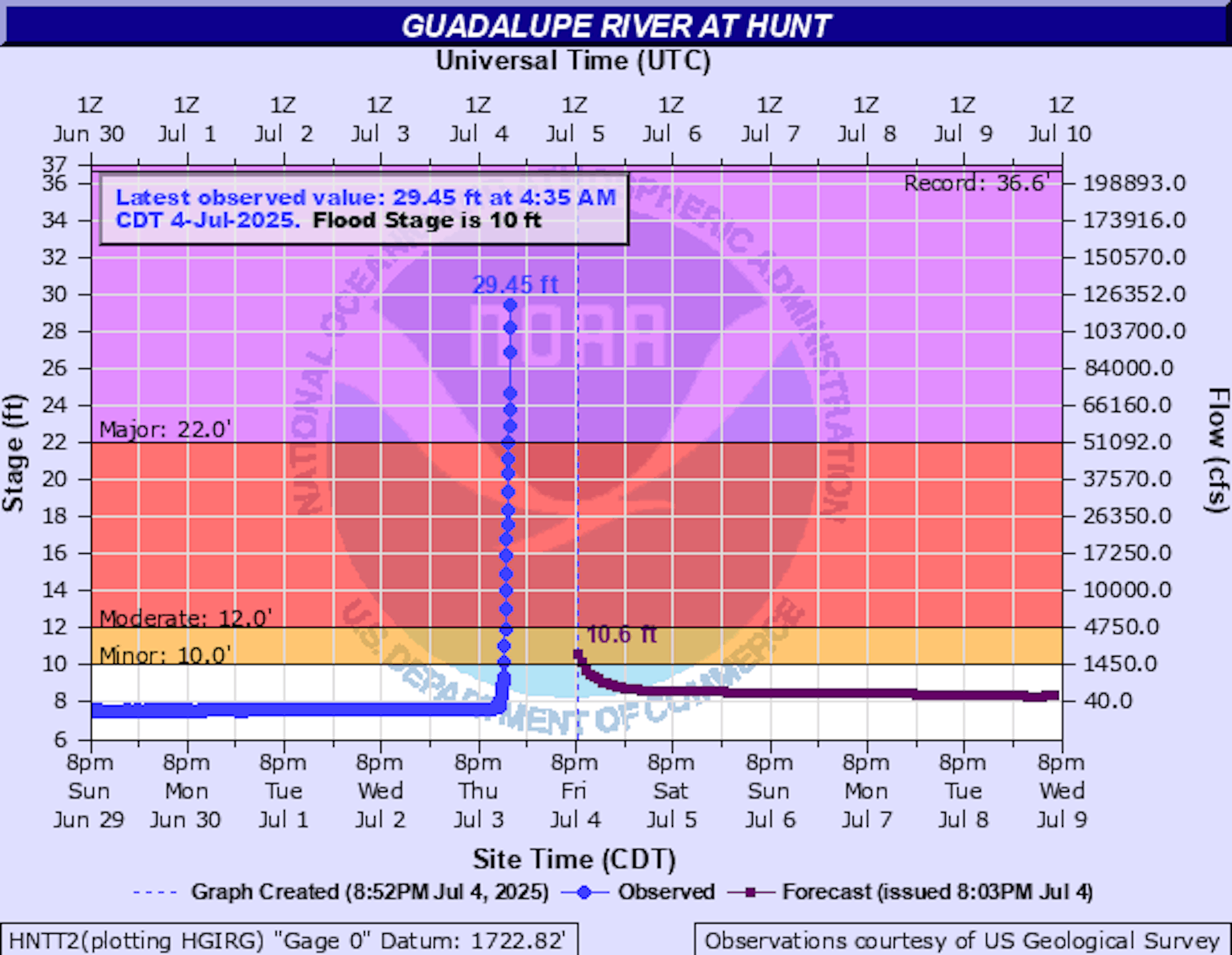
A river gauge at Hunt, Texas, near Camp Mystic, showed how quickly the river flooded: Around 3 a.m. on July 4, the Guadalupe River was rising about 1 foot every 5 minutes at the gauge, National Weather Service data shows. By 4:30 a.m., it had risen more than 20 feet. As the water moved downstream, it reached Kerrville, where the river rose even faster.
Flood expert Hatim Sharif, a hydrologist and civil engineer at the University of Texas at San Antonio, explains what makes this part of the country, known as Flash Flood Alley, so dangerous.
What makes Hill Country so prone to flooding?
Texas as a whole leads the nation in flood deaths, and by a wide margin. A colleague and I analyzed data from 1959 to 2019 and found 1,069 people had died in flooding in Texas over those six decades. The next highest total was in Louisiana, with 693.
Many of those flood deaths have been in Hill County. It’s part of an area known as Flash Flood Alley, a crescent of land that curves from near Dallas down to San Antonio and then westward.
The hills are steep, and the water moves quickly when it floods. This is a semi-arid area with soils that don’t soak up much water, so the water sheets off quickly and the shallow creeks can rise fast.
When those creeks converge on a river, they can create a surge of water that wipes out homes and washes away cars and, unfortunately, anyone in its path.
Hill Country has seen some devastating flash floods. In 1987, heavy rain in western Kerr County quickly flooded the Guadalupe River, triggering a flash flood similar to the one in 2025. Ten teenagers being evacuated from a camp died in the rushing water.
San Antonio, at the eastern edge of Hill Country, was hit with a flash flood on June 12, 2025, that killed 13 people whose cars were swept away by high water from a fast-flooding creek near an interstate ramp in the early morning.
The escarpment is a line of cliffs and steep hills created by a geologic fault. When warm air from the Gulf rushes up the escarpment, it condenses and can dump a lot of moisture. That water flows down the hills quickly, from many different directions, filling streams and rivers below.
The same effect can contribute to flash flooding in San Antonio, where the large amount of paved land and lack of updated drainage to control runoff adds to the risk.
What can be done to improve flash flood safety?
First, it’s important for people to understand why flash flooding happens and just how fast the water can rise and flow. In many arid areas, dry or shallow creeks can quickly fill up with fast-moving water and become deadly. So people should be aware of the risks and pay attention to the weather.
Improving flood forecasting, with more detailed models of the physics and water velocity at different locations, can also help.
Probabilistic forecasting, for example, can provide a range of rainfall scenarios, enabling authorities to prepare for worst-case scenarios. A scientific framework linking rainfall forecasts to the local impacts, such as streamflow, flood depth and water velocity, could also help decision-makers implement timely evacuations or road closures.
Education is particularly essential for drivers. One to two feet of moving water can wash away a car. People may think their trucks and SUVs can go through anything, but fast-moving water can flip a truck and carry it away.
This article, originally published July 5, 2025, has been updated with the death toll rising.
Hatim Sharif does not work for, consult, own shares in or receive funding from any company or organization that would benefit from this article, and has disclosed no relevant affiliations beyond their academic appointment.
Catherine Russell said she was appalled by the reported killing of 15 Palestinians, including nine children and four women, who were waiting in line for nutritional supplements provided by Project Hope, a UNICEF partner organization.
The incident occurred in Deir Al-Balah. An additional 30 people were injured, including 19 children. News reports indicate that it resulted from an Israel strike.
‘Mothers seeking a lifeline’
“The killing of families trying to access life-saving aid is unconscionable,” she said in a statement.
“These were mothers seeking a lifeline for their children after months of hunger and desperation.”
They included Donia, whose one-year-old son, Mohammed, was killed. She reported that the boy had spoken his first words to her just hours earlier.
“Donia now lies in a hospital bed, critically injured by the blast, clutching Mohammed’s tiny shoe,” said Ms. Russell. “No parent should have to face such tragedy.”
A ‘cruel reality’
For the UNICEF chief, “this is the cruel reality confronting many in Gaza today after months of insufficient aid being allowed into the territory, and parties to the conflict failing to uphold basic responsibilities to protect civilians.”
She explained that “the lack of aid means children are facing starvation while the risk of famine grows,” warning that “the number of malnourished children will continue to rise until life-saving aid and services are resumed at full scale.”
“International law is clear: all parties to the conflict have an obligation to protect civilians and ensure the safe and unimpeded delivery of humanitarian assistance,” she said.
“We call on Israel to urgently review its rules of engagement to ensure full compliance with international humanitarian law, notably the protection of civilians including children, and to conduct a thorough and independent investigation of this incident and all allegations of violations.”
UN condemns killings
The UN yet again condemned the killing of civilians in Gaza, Spokesperson Stéphane Dujarric told journalists in New York.
Furthermore, the UN humanitarian affairs office OCHA “stresses that parties are bound by international humanitarian law to prevent such excessive death and injury of civilians in the midst of war,” he added.
OCHA reported that another strike on Thursday reportedly hit the office of a humanitarian partner in Gaza City. Three staff there were killed.
Fuel running out
Mr. Dujarric also updated journalists on the dire fuel situation in Gaza, which impacts both the population and humanitarians.
A UN team managed to bring roughly 75,000 litres of fuel from Israel into the beleaguered enclave on Wednesday, marking the first such provision in 130 days.
He warned, however, that fuel is still running out and services will shut down if greater volumes do not enter immediately.
Water services at risk
“We and our humanitarian partners need hundreds of thousands of litres of fuel each day to keep essential lifesaving and life-sustaining operations going, meaning the amount entered yesterday isn’t sufficient to cover even one day of energy requirements,” he said.
One aid partner reported that fuel shortages could soon cut off supplies of clean drinking water to about 44,000 children, he added, which would further increase the risk of cholera, diarrhoea, dysentery and other waterborne illnesses.
Meanwhile, UN partners providing education services said that between October 2023 and this June, 626 temporary learning spaces have been established in Gaza, with 240,000 students enrolled, roughly half of them girls.
However, only 299 spaces are currently operational due to the ongoing displacement orders, funding shortfalls and other challenges.
Aid workers also going hungry
Humanitarian partners in Gaza – who include first responders, health workers, and aid workers – “continue to deliver food and other assistance under intolerable conditions, and they themselves are facing hunger,” said Mr. Dujarric.
“A number of our own colleagues are also facing hunger. They also face water scarcity and threats to their personal safety, just like everyone else in Gaza,” he added.
The Spokesperson reiterated the UN’s long-standing message that “this catastrophic situation must end.” He stressed that “a ceasefire is not only urgent, it is long overdue,” while also calling for the unconditional and immediate release of all hostages.
Some Palestinians have been forced to flee their homes in the West Bank.
West Bank operations
Mr. Dujarric also addressed the situation in the West Bank, where humanitarians report and continue to warn of the intensification of Israeli operations in the northern areas.
“These operations are causing massive destruction, driving further humanitarian needs and dampening hopes of thousands of displaced families that they will eventually be able to go back home,” he said.
“Meanwhile, attacks, harassment and intimidation by Israeli settlers against Palestinians have become a daily reality.”
He cited a settler attack on 3 July that led to the displacement of the Mu’arrajat East Bedouin community in the central West Bank.
“This is the ninth community to be fully displaced in the Ramallah and Jericho areas since January 2023 following the recurrent attacks by Israeli settlers.”
Source: United States Senator for Nevada Cortez Masto
Passage of this bipartisan legislation comes as Texas and states across the U.S. experience devastating flooding. In Nevada, wildfires have already burned over 60,000 acres this year.
Washington D.C. – Today, U.S. Senators Catherine Cortez Masto (D-Nev), John Kennedy (R-La.), Chris Van Hollen (D-Md), and Marsha Blackburn (R-Tenn.) passed their bipartisan bill to provide relief for impacted taxpayers in states that have issued state-level disaster declarations. The Filing Relief for Natural Disasters Act allows the IRS to postpone filing deadlines for taxpayers affected by state declared natural disasters, instead of only presidentially declared federal disasters. The legislation passed the House earlier this year and now heads to President Trump’s desk to be signed into law.
Each year, states across the country declare emergencies for events like floods and wildfires. Currently, 21 counties in Texas are under a state-level disaster declaration, but only one county has received a federal disaster declaration. Since January of 2024, the state of Nevada has also issued numerous county disaster declarations following wildfires. But, under current law, families impacted by floods and fires in areas with a state-level disaster declaration are not eligible for any tax relief because the disaster was not also declared by the President of the United States. Cortez Masto’s legislation will change that, ensuring that everyone impacted by fires, floods, and storms gets the tax relief they need.
“A natural disaster is devastating for anyone. Impacted taxpayers should not have to worry about whether their state’s natural disaster has been recognized by the President for them to receive the support they deserve,” said Senator Cortez Masto. “This bipartisan legislation will ensure that anyone impacted by state-level emergencies can have some peace of mind when filling their taxes.”
The Filing Relief for Natural Disasters Act would now allow a governor of a state or territory to request the IRS extend federal tax filing deadlines in the event of a state declared emergency or disaster. The legislation would also expand the mandatory federal filing extensions from 60 to 120 days.
This bill is just a piece of Senator Cortez Masto’s efforts to ensuring Nevadans have access to resources in the face of natural disasters. Cortez Masto has worked to deliver funding to help improve the resiliency of state infrastructure and has led legislation protect electric grids at military bases and rural water utilities from the effects of extreme weather. She also secured key provisions in the Bipartisan Infrastructure Law which provided billions to fund wildfire prevention efforts in Nevada.
RALEIGH, N.C., July 10, 2025 (GLOBE NEWSWIRE) — Enact Holdings, Inc. (Nasdaq: ACT) (Enact) announced it will issue its second quarter earnings release after the market closes on July 30, 2025. Enact will host a conference call to review second quarter 2025 financial results on July 31, 2025 at 8:00 a.m. (ET).
Enact’s earnings release, summary presentation and financial supplement will be available through the company’s website, https://ir.enactmi.com/, at the time of their release to the public.
Participants interested in joining the call’s live question and answer session are required to pre-register by clicking here to obtain a dial-in number and unique PIN. It is recommended to join at least 15 minutes in advance, although you may register ahead of the call and dial in at any time during the call. If you wish to join the call but do not plan to ask questions, a live webcast of the event will be available on our website, https://ir.enactmi.com/news-and-events/events.
The webcast also will be archived on the company’s website for one year.
About Enact Holdings, Inc. Enact (Nasdaq: ACT), operating principally through its wholly-owned subsidiary Enact Mortgage Insurance Corporation since 1981, is a leading U.S. private mortgage insurance provider committed to helping more people achieve the dream of homeownership. Building on a deep understanding of lenders’ businesses and a legacy of financial strength, we partner with lenders to bring best-in class service, leading underwriting expertise, and extensive risk and capital management to the mortgage process, helping to put more people in homes and keep them there. By empowering customers and their borrowers, Enact seeks to positively impact the lives of those in the communities in which it serves in a sustainable way. Enact is headquartered in Raleigh, North Carolina.
This press release was published by a CLEAR® Verified individual.
Source: United States Senator for Wisconsin Tammy Baldwin
WASHINGTON, D.C. – Today, U.S. Senators Tammy Baldwin (D-WI) and Lisa Murkowski (R-AK) introduced bipartisan legislation, the Digital Coast Act, to help coastal communities better prepare for storms, cope with varying water levels, and plan for future development. The bill reauthorizes the National Oceanic and Atmospheric Administration’s (NOAA) Digital Coast Program, which Baldwin and Murkowski previously spearheaded to reestablish the program in 2020.
“The Great Lakes are essential to the Wisconsin way of life and our economy, but make no mistake – they face some serious and unique challenges, and our local communities need tools and information to address them, keep families safe, and support our local businesses,” said Senator Baldwin. “I am proud to once again work with my Democratic and Republican colleagues to support our local coastal communities and ensure they have the resources and data they need to prepare for disasters, keep our water clean and safe, and make smart planning decisions for the future.”
“As we confront the escalating impacts of climate change, it is crucial our coastal communities remain equipped with the tools and data they need to adapt and thrive,” said Senator Murkowski. “The Digital Coast Program has proven to be a vital resource in this effort, providing essential information and support for our local leaders to make informed decisions.”
NOAA currently assembles and hosts the Digital Coast Project, a collaborative online database of the most up-to-date coastal information and makes it available to both the public and private sectors. Digital Coast also provides tools for coastal communities to decipher and use the high-tech mapping data to make accurate decisions and smart investments in coastal communities.
The Digital Coast Act reauthorizes the program and ensures that communities will continue to have the data to make smart choices for economic development, shoreline management, and coastal restoration. The bill supports further development of the current project, including increasing access to uniform, up-to-date data, to help communities get the coastal data they need to respond to emergencies, plan for long-term coastal resilience, and manage their water resources.
Companion legislation was introduced yesterday in the U.S. House by Representatives Dave Min (D-CA-47) and Rob Wittman (R-VA-01).
“From extreme weather to competing demands for coastal property, our coastal communities need the best available resources to respond to the mounting threat of climate change,” said Congressman Min. “NOAA’s Digital Coast Program provides essential research and data to address the adverse effects of the climate crisis, all while creating thousands of high tech jobs around America. I’m proud to be leading the charge to protect Orange County’s beautiful coastline.”
“Virginia’s First District is home to vibrant coastal communities that rely on cutting-edge data and resources to thrive, especially in the face of challenges such as extreme weather and aging infrastructure,” said Congressman Wittman. “I’m proud to help introduce the Digital Coastal Reauthorization Act alongside Rep. Dave Min, legislation that will reauthorize NOAA’s Digital Coast program. This vital program collects and distributes data that will help mitigate future weather-related issues and provide communities with the tools they need to expand and plan for the future.”
“Digital Coast represents the best of government at work,” said Sue Schwartz, FAICP, President of the American Planning Association. “It’s innovative, collaborative, efficient, bipartisan, and cost-effective; all while helping local communities make better decisions about how to tackle tough coastal challenges. Planners benefit from access to critical data that shapes the insights they bring to residents and local leaders. The American Planning Association strongly supports the reauthorization of this vital resource for protecting and planning our communities.”
“NOAA’s Digital Coast provides a one-stop shop for the data, tools and training that coastal managers and researchers use to learn and do their jobs. As a collaboration between the federal government and partner organizations and used extensively by the public and private sectors, Digital Coast is government at its most effective,” said Derek Brockbank, Executive Director of Coastal States Organization.?“The Digital Coast Act will ensure this important resource for all communities is authorized and funded for the next 5 years.”?
“The Digital Coast Program empowers coastal states with the tools and data they need to address real-world challenges—from flooding and hurricanes to smart growth and resource management,” said Ken Nelson, National States Geographic Information Council (NSGIC) President. “Continued federal support is vital to strengthening the geospatial foundation that drives both our economy and our national preparedness. Reauthorizing the Digital Coast Act ensures coastal communities have the high-quality data they need to plan, protect, and prosper.”
“To make sure that people can enjoy everything our coasts have to offer, coastal managers need to have the right tools, data and training. The Digital Coast partnership provides those products and services,” said Stephanie Bailenson, US Federal Water Policy Team Lead at The Nature Conservancy. “We’ve seen in our work across the country how Digital Coast helps coastal communities address storms and flooding while strengthening local economies. We’re happy to see the sponsors of the partnership’s reauthorization bill demonstrate the continued bi-partisan support for the partnership.”
“The provisions of the Digital Coast Reauthorization will modernize the Digital Coast program and provide for the continuation of a sustainable program to utilize geospatial technologies to map and monitor the coastal waterways of the United States, providing an invaluable benefit to the public, and to the professionals whose charge is to protect their health, safety, and welfare,” said Timothy W. Burch, PLS, Executive Director of National Society of Professional Surveyors.
“The Digital Coast Program is a balanced approach to environmental protection and economic development in our valuable coastal areas.? This bill reauthorizes and modernizes a successful program that utilizes the talent of the private sector and intergovernmental agencies by providing data and services that are essential to the economic engine that is coastal America, while conserving it’s precious natural resources through geospatial data and related activities,” said John Palatiello, Founder of US Geospatial Executives Organization (U.S. GEO).
“The Digital Coast Partnership Advocacy Coalition commends Senators Tammy Baldwin (D-WI) and Lisa Murkowski (R-AK) for introducing the Digital Coast Reauthorization Act. The Coalition also wishes to thank Representatives Dave Min (D-CA) and Rob Wittman (R-VA) for their leadership in introducing the companion bill in the House. The strong bipartisan support for this measure is a demonstration of its broad appeal and value to the nation’s communities. By consolidating coastal data from a variety of sources in one place and making it publicly accessible, the National Oceanic and Atmospheric Administration’s (NOAA) Digital Coast program is helping the coastal management community better plan for storms, flooding, natural disasters, and other challenges that impact vulnerable coastal and Great Lakes communities. Data included in the Digital Coast ranges from surveying, mapping, geospatial, economic, demographic and ecosystem data to satellite imagery. In addition to making this data publicly available online, the Digital Coast provides a wide array of visualization and prediction tools that dramatically improve the effectiveness and efficiency of coastal management projects around the country. Over the next 15 years, NOAA predicts a 411 percent return on investment from the Digital Coast program. In addition to the return on investment, the Digital Coast has played a significant role in protecting communities and natural resources from damaging natural disasters. Furthermore, 75 percent of Digital Coast users surveyed by NOAA indicated that their projects would not have been possible without the Digital Coast. By having bipartisan and bicameral introduction of the Digital Coast Reauthorization Act, we deeply appreciate your recognition of the numerous benefits the Digital Coast can provide to coastal communities and those working to make them more resilient,” said John “JB” Byrd, Coordinator, Digital Coast Partnership Advocacy Coalition.
“As our coastlines and beaches bear the brunt of extreme weather events, flooding, chronic erosion, sea level rise, and other hazards, coastal communities need every tool at their disposal to make informed decisions and plan for a safer, more resilient future,” said Emma Haydocy, Senior Manager of Coasts and Climate Initiative at the Surfrider Foundation. “NOAA’s Digital Coast program makes invaluable data accessible to the American public in light of these challenges, and reauthorizing and expanding this program will help safeguard vital coastal resources throughout the U.S. for years to come.”
The legislation is endorsed by Coastal States Organization, American Planning Association, Association of State Floodplain Managers, National Association of Counties, National Society of Professional Surveyors, U.S Geospatial Executives Organization (U.S. GEO), Surfrider Foundation, The Nature Conservancy, National States Geographic Information Council, National Estuarine Research Reserve Association, Quantum Spatial Inc., Wisconsin Society of Land Surveyors, and Digital Coast Partnership Advocacy Coalition.
Full text of the bill is available here.
Source: United States House of Representatives – Representative Dale Strong (Alabama)
WASHINGTON – U.S. Representative Dale Strong, a member of the House Appropriations Committee, voted today in support of H.R. 3944, the Military Construction, Veterans Affairs, and Related Agencies Appropriations Act, 2026. The vital legislation championing veterans, supporting military families, and prioritizing infrastructure upgrades, passed the House of Representatives on a 218-206 vote.
Once enacted, this bill will provide essential funding for the Department of Veterans Affairs (VA) and Department of Defense (DoD) to support critical investments in military infrastructure, readiness, and the well-being of service members, veterans, and their families.
“I’m proud to support this bill, which delivers on our promises to America’s veterans by fully funding their health care and benefits,” said Rep. Strong. “It will help improve the lives of our troops and their families with better access to childcare, safer housing, and stronger base infrastructure. This funding bill also makes an effort to fund key construction projects to support readiness and our national security, expands mental health services, combats veteran homelessness, and makes smart investments in the Indo-Pacific to push back against China’s growing threat.”
NORTH ALABAMA WINS
Representative Strong successfully secured pivotal provisions directly benefiting North Alabama:
Advancing U.S. Space Command Headquarters Plans
One provision advances the U.S. Space Command (USSPACECOM) Headquarters process and requires a detailed funding plan and report for the necessary facilities investments.
“During the entire USSPACECOM basing process, Redstone Arsenal ranked as the #1 location for the headquarters. Four subsequent DoD Inspector General and GAO reports confirmed that the Air Force made the right choice — Redstone is what is best for national security, the taxpayer, the personnel, and their families,” said Strong.
Ensuring Fair Veteran Cemetery Placement
Strong was also successful advancing a provision directing the National Cemetery Administration (NCA) to conduct a report evaluating its veteran population data collection methodology. A 2019 U.S. Government Accountability Office report indicated that if U.S. Census Bureau data were used rather than NCA’s current methodology, North Alabama would rank 2nd in need for a VA cemetery.
“Nearly 60,000 veterans call Alabama’s Fifth Congressional District home. Those veterans and their families deserve the opportunity to choose a final resting place closer to home. Currently, the closest VA cemeteries are in Corinth, MS, Montevallo, AL, and Chattanooga, TN. I firmly believe that a more accurate data evaluation would make North Alabama a top candidate for a National or VA-grant funded state cemetery,” said Strong.
Other wins that will benefit North Alabama include a provision that expresses Congressional support for DoD range operations and supporting facilities, such as Redstone Test Center at Redstone Arsenal, and language directing the Veterans Health Administration to submit a report and recommended legislative changes to improve reimbursement rates, locality adjustments, prescription drug prices for veterans living in VA State Veteran Homes, like the Floyd E “Tut” Fann Home in Huntsville, AL.
KEY TAKEAWAYS
Champions our veterans by:
Fully funding veterans’ health care programs.
Fully funding veterans’ benefits and VA programs.
Supporting President Trump’s efforts to combat veteran homelessness by investing in the new Bridging Rental Assistance for Veteran Empowerment program.
Maintaining funding levels for research, mental health programs, and other programs relied upon by veterans.
Supports the Trump Administration and the mandate of the American people by:
Protecting the 2nd Amendment rights of veterans by preventing the VA from sending information to the FBI about veterans without a judge’s consent.
Syncing up with President Trump’s Executive Orders on no funds for DEI, gender affirming care, and protecting Hyde-like language at the VA.
Prohibiting the VA from processing medical care claims for illegal aliens.
Bolsters U.S. national security and border protections by:
Providing robust funding for military construction, enabling continued investment in the Indo-Pacific region, and infrastructure necessary to support advanced weapons systems.
Maintaining the prohibitions on the closure of Naval Station Guantanamo Bay, Cuba and the use of military construction funds to build facilities for detainees on U.S. soil.
Prohibiting the VA from purchasing resources directly or indirectly from the People’s Republic of China.
DETAILED FUNDING SUMMARY
Department of Defense (Military Construction and Family Housing)
Provides $18 billion for the Department of Defense (DoD) military construction and family housing for the following:
Planning and design of future barracks to address barrack deficiencies identified by the Government Accountability Office.
Demolition of excess and obsolete infrastructure, saving taxpayers money and lowering long-term facility maintenance costs at DoD.
Guard and Reserve facility construction.
Military Family Housing.
Child development centers to improve the quality of life of military families.
Department of Veterans Affairs
Provides $452.64 billion for the Department of Veterans Affairs for the following:
Fully funds veterans’ medical care
Fully funds veterans’ benefits and toxic exposures-related needs for the Toxic Exposures Fund (TEF).
Bridging Rental Assistance for Veteran Empowerment program, an innovative effort to end veteran homelessness.
The Military Construction, Veterans Affairs, and Related Agencies Appropriations Act, 2026 is the first of 12 annual Appropriations bills to pass the House of Representatives.
“I want to thank Appropriations Committee Chairman Tom Cole and Ranking Member Rosa DeLauro, as well as the MilCon-VA subcommittee Chairman Judge John Carter and Ranking Member Debbie Wasserman-Schultz for their hard work on this critical funding bill,” said Strong.
Source: United States Department of Justice (Human Trafficking)
Defendant is the Last Member of a Family-Run Sex Trafficking Ring to be Sentenced
Earlier today, at the federal courthouse in Brooklyn, Hugo Hernandez-Velazquez was sentenced by United States District Judge William F. Kuntz to 188 months’ imprisonment for sex trafficking multiple victims by force, fraud, and coercion. The defendant was extradited from Mexico to the United States in February 2021. He pleaded guilty to one count of sex trafficking in April 2023. Hernandez-Velazquez will be deported to Mexico after completing his sentence.
Joseph Nocella, Jr., United States Attorney for the Eastern District of New York and Ricky J. Patel, Special Agent in Charge, Homeland Security Investigations, New York (HSI New York), announced the sentence.
“For years, the defendant and his siblings operated an illegal, abusive, and exploitative sex trafficking operation that stripped victims of their dignity and subjected them to inhumane violence,” stated United States Attorney Nocella. “It is my hope that the prosecution of their tormentors and the punishment meted out will provide a measure of closure for the brave survivors who assisted the investigation and will help them on their path to healing.”
“For nearly a decade, the defendant and his family oversaw a vicious sex trafficking campaign wrought with violence, manipulation, coercion, and outright force against women whom they lured into romantic relationships through false promises of love and support,” stated HSI Special Agent in Charge Patel. “Every day, victims are targeted for human trafficking and other vile forms of exploitation and abuse, often at the hands of their own spouses or purported caretakers. Today’s sentencing is no doubt a direct result of the bravery of each survivor who courageously spoke up. Together with our partners, HSI is unflinchingly committed to investigating and vigorously pursuing anyone, anywhere, who sexually exploits the very individuals they claim to care for.”
Mr. Nocella commended HSI New York’s Trafficking in Persons Unit for leading the investigation of the Hernandez-Velazquez Sex Trafficking Organization; thanked the HSI Mexico City Attaché Office, the Department of Justice’s Office of International Affairs, the U.S. Department of State, Interpol, International Affairs Department of the Attorney General’s Office in Mexico, the Law Enforcement Unit of the State of Tlaxcala Attorney General’s Office, Interpol Mexico, and the New York City Police Department for their assistance; and praised the government of Mexico for its role in advancing bilateral anti-trafficking enforcement efforts. Mr. Nocella also acknowledged the non-governmental victim service providers and advocates for their dedicated efforts to restore and improve the lives of survivors of trafficking and their families.
Between approximately 2001 and 2009, the defendant and his siblings, Ernesto, Giovanni and Arcelia Hernandez-Velazquez, ran the Hernandez-Velazquez Sex Trafficking organization (the family organization) based in Mexico. The family organization used force, fraud, and coercion to cause young women in Mexico to engage in prostitution in the United States. Members of the family organization lured victims into romantic relationships through false promises of love and support. The victims were pressured to travel to the United States with promises of a better life with their trafficker. Once smuggled into the United States, the victims were forced to engage in prostitution. The family organization maintained a base in Queens, New York, where victims would reside while they were forced to work in New York and other states, including Alabama, Connecticut, Florida, Georgia, Louisiana, Maryland, Massachusetts, Mississippi, New Jersey, New York, North Carolina, Pennsylvania, Rhode Island, South Carolina, Tennessee, and Virginia. The defendant subjected his victims to physical beatings, forced abortions, and threats. The defendant also threatened violence to the victims’ families to force the victims to continue prostituting on his behalf.
Judge Kuntz previously sentenced Hernandez-Velazquez’s siblings who also pleaded guilty to sex trafficking: Ernesto Hernandez-Velazquez and Giovanni Hernandez-Velazquez were each sentenced to 210 months’ imprisonment; and Arcelia Hernandez-Velazquez, who pleaded guilty to a Mann Act Violation, was sentenced to time served after approximately 60 months in U.S. custody.
The investigation, prosecution, bilateral enforcement action, and extradition of the defendant from Mexico was coordinated through the U.S.-Mexico Bilateral Human Trafficking Enforcement Initiative. Since 2009, the Departments of Justice and Homeland Security have collaborated with Mexican law enforcement counterparts in a Bilateral Human Trafficking Enforcement Initiative to dismantle human trafficking networks operating across the U.S.-Mexico border, bring human traffickers to justice, restore the rights and dignity of human trafficking victims, and reunite victims with their children. These efforts have resulted in successful prosecutions in both Mexico and the United States, including U.S. federal prosecutions of over 175 defendants in multiple cases in Georgia, New York, Florida, and Texas, in addition to numerous Mexican federal and state prosecutions of associated sex traffickers.
The government’s case is being handled by the Office’s Human Trafficking and Civil Rights Section. Assistant United States Attorney Erin Reid is in charge of the prosecution.
The Defendant:
HUGO HERNANDEZ-VELAZQUEZ (also known as “Norberto Hernandez Velasquez” and “La Gallina”) Age: 48 Mexico
Defendants Previously Sentenced:
ERNESTO HERNANDEZ-VELAZQUEZ (also known as “Chapas”) Age: 45 Queens, New York
GIOVANNI HERNANDEZ-VELAZQUEZ Age: 37 Mexico
ARCELIA HERNANDEZ-VELAZQUEZ (also known as “La Gordis”) Age: 46 Queens, New York
ENGLEWOOD, Colo., July 10, 2025 (GLOBE NEWSWIRE) — Gevo, Inc. (NASDAQ: GEVO) is pleased to announce that Barclays Capital Inc. has purchased $40 million of newly issued non-recourse tax-exempt private activity bonds (the “2025 Bonds”) issued by the Iowa Finance Authority for the benefit of Gevo’s wholly owned subsidiary, Gevo NW Iowa RNG, LLC (“Gevo RNG”). The bond proceeds were used to refinance $40 million of the previously issued Iowa Finance Authority Solid Waste Facility Revenue Bonds (Gevo NW Iowa RNG, LLC Renewable Natural Gas Project), Series 2021 (Green Bonds) (the “Previous Bonds”), which were issued in the aggregate principal amount of $68.2 million and secured by an irrevocable direct pay letter of credit. This partial refinancing of the Previous Bonds enabled Gevo to release $40 million of restricted cash that was securing the letter of credit and increase its balance sheet liquidity by approximately $30 million after paying transaction costs and funding reserves associated with the 2025 Bonds.
Gevo expects to release additional restricted cash later this year by refinancing the remaining balance of the Previous Bonds through the issuance of an additional series of 2025 Bonds.
Gevo RNG generates renewable natural gas (“RNG”) by collecting manure on dairy farms and placing it in anaerobic digesters installed on those farms, where biogas is captured, then refined to serve as a more sustainable alternative to fossil natural gas as a transportation fuel. Gevo RNG sells the RNG into California via a marketing agent. In March 2025, Gevo RNG received California Air Resources Board (“CARB”) certification of a carbon intensity score of negative 339 gCO2e/MJ to be used in calculating California’s Low Carbon Fuel Standard (“LCFS”) credits. Under current LCFS modeling, RNG produced by Gevo RNG is expected to yield upwards of 175,000 metric tons of carbon dioxide equivalent greenhouse gas emissions reductions annually. Gevo continues to explore increased scaling and margin expansion opportunities for its RNG business, and how to leverage it synergistically with its other lines of business.
About Gevo
Gevo is a next-generation diversified energy company committed to fueling America’s future with cost-effective, drop-in fuels that contribute to energy security, abate carbon, and strengthen rural communities to drive economic growth. Gevo’s innovative technology can be used to make a variety of renewable products, including synthetic aviation fuel (“SAF”), motor fuels, chemicals, and other materials that provide U.S.-made solutions. By investing in the backbone of rural America, Gevo’s business model includes developing, financing, and operating production facilities that create jobs and revitalize communities. Gevo owns and operates one of the largest dairy-based RNG facilities in the United States, turning by-products into clean, reliable energy. Gevo also operates an ethanol plant with an adjacent carbon capture and sequestration (“CCS”) facility, further solidifying America’s leadership in energy innovation. Additionally, Gevo owns the world’s first production facility for specialty alcohol-to-jet (“ATJ”) fuels and chemicals. Gevo’s market-driven “pay for performance” approach regarding carbon and other sustainability attributes, helps ensure value is delivered to our local economy. Through its Verity subsidiary, Gevo provides transparency, accountability, and efficiency in tracking, measuring and verifying various attributes throughout the supply chain. By strengthening rural economies, Gevo is working to secure a self-sufficient future and to make sure value is brought to the market.
Barclays Capital Inc. (BCI) is a US registered broker-dealer and futures commission merchant (FCM) that serves clients worldwide. It’s an affiliate of Barclays Bank PLC and is regulated by the SEC and FINRA. BCI offers a wide range of brokerage and investment services, including securities trading, investment advice, and financial planning.
Forward Looking Statements
Certain statements in this press release may constitute “forward-looking statements” within the meaning of the Private Securities Litigation Reform Act of 1995. These forward-looking statements relate to a variety of matters including, without limitation, the liquidity effects of the 2025 Bonds, the ability to refinance the Previous Bonds, expected greenhouse gas emission yields, expected expansion projects, and other statements that are not purely statements of historical fact. These forward-looking statements are made on the basis of the current beliefs, expectations, and assumptions of the management of Gevo and are subject to significant risks and uncertainty. Investors are cautioned not to place undue reliance on any such forward-looking statements. All such forward-looking statements speak only as of the date they are made, and Gevo undertakes no obligation to update or revise these statements, whether as a result of new information, future events, or otherwise. Although Gevo believes that the expectations reflected in these forward-looking statements are reasonable, these statements involve many risks and uncertainties that may cause actual results to differ materially from what may be expressed or implied in these forward-looking statements. For a further discussion of risks and uncertainties that could cause actual results to differ from those expressed in these forward-looking statements, as well as risks relating to the business of Gevo in general, see the risk disclosures in the Annual Report on Form 10-K of Gevo for the year ended December 31, 2024, and in subsequent reports on Forms 10-Q and 8-K and other filings made with the U.S. Securities and Exchange Commission by Gevo.
Media Contact
Heather L. Manuel VP, Stakeholder Engagement & Partnerships PR@gevo.com
PEMBROKE, Bermuda, July 10, 2025 (GLOBE NEWSWIRE) — James River Group Holdings, Ltd. (“James River” or the “Company”) (NASDAQ: JRVR) today announced two leadership appointments to its executive team.
Valdean Langenburg has been appointed Group Chief Information Officer (“CIO”) succeeding Thomas Peach, who retired on July 4 after a more than four decade career in information technology, including six years as James River’s CIO.
Justin Zaharris has been promoted to Group Chief Claims Officer, expanding upon his current responsibilities as Vice President, overseeing claims for the Company’s Excess & Surplus Lines segment where he has served since 2021.
“Both Val and Justin are proven leaders whose expertise complements the already strong bench at James River,” said Frank D’Orazio, Chief Executive Officer. “Their commensurate experience built both at notable industry peers and developed in-house respectively, position us to continue to advance our strategic initiatives across technology, data, and claims. I also want to extend my sincere gratitude to Tom Peach for his exemplary service and wish him every success in retirement.
Executive Backgrounds:
Mr. Langenburg joins the Company from WR Berkley, where he led information technology strategy for the firm’s Excess and Surplus Lines segment. He will be based in Richmond, Virginia and report directly to Frank D’Orazio.
Mr. Langenburg commented, “I am thrilled to join James River and look forward to working closely with my new colleagues to help drive the Group’s technology, data and innovation initiatives for the future.”
Mr. Zaharris brings more than 20 years of legal, technical and operational claims expertise in the property and casualty industry. He will continue to work from the Company’s Richmond office and report to Mr. D’Orazio.
Mr. Zaharris commented, “I’m honored to take on this broader leadership role and build on the Company’s defining excellence and reputation for claims handling while delivering outstanding service to policyholders.”
Earnings Date Announcement:
James River will release second quarter 2025 earnings after the market closes on Monday August 4, 2025 and will host an earnings conference call on Tuesday, August 5, 2025 at 8:30 a.m. (Eastern Time).
The conference call may be accessed by dialing (800) 715-9871, conference ID 2949592, or via the investor website at https://investors.jrvrgroup.com. A replay will also be available in the same location.
Forward Looking Statements
This press release contains forward-looking statements as that term is defined in the Private Securities Litigation Reform Act of 1995. In some cases, such forward-looking statements may be identified by terms such as believe, expect, seek, may, will, should, intend, project, anticipate, plan, estimate, guidance or similar words. Forward-looking statements involve risks and uncertainties that could cause actual results to differ materially from those in the forward-looking statements. Information about these risks and uncertainties is contained in our filings with the U.S. Securities and Exchange Commission (“SEC”), including our most recently filed Annual Report on Form 10-K. These forward-looking statements speak only as of the date of this release and the Company does not undertake any obligation to update or revise any forward-looking information to reflect changes in assumptions, the occurrence of unanticipated events, or otherwise.
About James River Group Holdings, Ltd.
James River Group Holdings, Ltd. is a Bermuda-based insurance holding company that owns and operates a group of specialty insurance companies. The Company operates in two specialty property-casualty insurance segments: Excess and Surplus Lines and Specialty Admitted Insurance. Each of the Company’s regulated insurance subsidiaries are rated “A-” (Excellent) by A.M. Best Company. Visit James River Group Holdings, Ltd. on the web at www.jrvrgroup.com.
Bob Zimardo SVP, Investments & Investor Relations InvestorRelations@james-river-group.com
Source: United States House of Representatives – Congressman Robert Garcia California (42nd District)
Washington, D.C. – Today, Congressman Robert Garcia (CA-42) and Senator Alex Padilla (D-CA) reintroduced the Clean Shipping Act. This bill establishes a path to eliminate greenhouse gas emissions from large ships that come to U.S. ports, protecting the health of port communities and addressing the environmental and climate impacts of shipping pollution. Specifically, the bill would mandate that by 2050, ships must cut all greenhouse gas pollution, and by 2035, they must emit zero emissions while parked at ports. The bill is co-led by Congresswoman Nanette Barragán (CA-44). The bill text can be found here.
“Our nation’s ports, particularly the Port of Long Beach, are crucial parts of the economy that drive our supply chain at home. However, they’re also among the largest sources of pollution in our coastal communities,”said Congressman Robert Garcia.“Ship pollution is harmful for the health of people living near ports, and disproportionately affects low-income, working-class neighborhoods and communities of color. That’s why I’m proud to introduce a bill that addresses greenhouse gas pollution and creates a path to fully eliminate emissions. We must protect people’s health and stop our climate crisis, while ensuring good-paying jobs for the future.”
“California’s ports are the powerhouse of our country’s economy, moving critical freight and providing good-paying jobs, all while leading the nation’s decarbonizing efforts. But neighboring communities have been forced to shoulder the brunt of global shipping pollution for too long,” said Senator Alex Padilla. “Our legislation would strengthen the sustainability of our shipping industry by reducing emissions in maritime transportation while simultaneously protecting coastal communities. The health of our communities and our planet requires us to be forward-looking and ambitious — we owe future generations nothing less than bold, transformative action.”
“I’m proud to reintroduce the Clean Shipping Act because people deserve to breathe clean air, and this bill will help make that a reality. Communities near the Ports of Los Angeles and Long Beach—many of them communities of color—continue to suffer from toxic air pollution caused by ships. This bill sets a clear path to zero-emission shipping. It’s a critical step to clean up our air, protect public health, and take on the climate crisis. Port communities have waited long enough, we must act now,” said Congresswoman Nanette Barragán.
“In order to protect our ocean and stay competitive with the rest of the world, we need federal leadership to help modernize and clean up U.S. shipping. By driving the shipping sector to develop, scale and deploy zero-emission technologies, we can spur job creation, help tackle the climate crisis and help create cleaner air for the millions of Americans living near ports. We commend Representative Garcia and Senator Padilla for their leadership on this issue and look forward to working with members of Congress to make this bill a reality,” saidCaroline Bonfield, Ocean Conservancy’s Shipping Emissions U.S. Policy Manager
“The Clean Shipping Act of 2025 will send a clear signal to the shipping industry that they must reduce their emissions by phasing out the use of fossil fuels and transition to a cleaner future. Technology-forcing policies like this legislation will enable large-scale investment in sustainable maritime fuels and technologies and establish a level playing field, minimizing the risk for manufacturers and suppliers. For far too long, dirty ships have brought significant levels of air pollution into U.S. port communities. We commend Representative Garcia and Senator Padilla for reintroducing this important bill and leading the effort to help protect communities disproportionately impacted by these harmful emissions,” said Antonio Santos, Federal Climate Policy Director, Pacific Environment.
“The shipping industry has been polluting communities for decades, but we have the power to make shipping cleaner. Port expansions across the country have been especially devastating for communities living closest to the harbors where large ships spew toxic diesel exhaust that worsens air quality and contributes to the climate crisis. People living near ports deserve to breathe clean air, and the Clean Shipping Act will help make that a reality,” said Katherine García, Director of the Clean Transportation for All Campaign, Sierra Club.
“GreenLatinos endorses the urgently needed Clean Shipping Act, which protects Latino/e and other vulnerable communities from further exposure to port pollution and takes important steps to reduce harm from toxic ship fuels. 1 in 3 Latines live in the top 20% of most pollution-impacted communities. Pollution burdened communities are facing even more exposure as idling ships wait days to enter port and offload their cargo. We urge Congress to act swiftly in passing this vital legislation and protect our coastal communities from the harms of port emissions,” said Andrea Marpillero-Colomina, Policy Advisor, GreenLatinos.
“The Clean Shipping Act of 2025 will help us work toward a future where healthy port communities thrive and everyone benefits from leveraging the tremendous potential of the ocean and ocean industries as powerful sources of climate solutions. We are grateful for the leadership of Congressman Garcia and Senator Padilla for advancing this legislation for our ocean, climate, and communities,” said Sarah Guy, Executive Director, Ocean Defense Initiative.
The global shipping industry accounts for nearly 3% of all global greenhouse gas emissions, and that number is expected to rise if no action is taken. Additionally, almost 40% of Americans live near ports, where people’s health is harmed by air pollution. This especially impacts working-class neighborhoods and communities of color.
The Clean Shipping Act is endorsed by Breathe Southern California, CleanEarth4Kids.org, Don’t Waste Arizona, Environmental Investigation Agency, Friends of the Earth, GreenLatinos, Intheshadowofthewolf, Long Beach Alliance for Clean Energy, Milwaukee Riverkeeper, Ocean Conservancy, Ocean Defense Initiative, Pacific Environment, Restoring Earth Connection, San Pedro & Peninsula Homeowners Coalition, Seattle Cruise Control, Sierra Club, Sunflower Alliance, 350 Bay Area Action, 350 Sacramento, Turtle Island Restoration Network, Washington Physicians for Social Responsibility, ABB, Evolve Hydrogen Inc., Maritime Battery Forum, and Zero Emissions Ship Technology Association
Congressman Garcia, a co-chair of the Congressional PORTS Caucus, is committed to advocating for bold climate action and environmental justice, which includes improving port infrastructure. Congressman Garcia first introduced the Clean Shipping Act alongside Senator Padilla in 2023. During his time in Congress, Congressman Garcia has helped secure over $283 million in federal grant money for the completion of the Port of Long Beach Pier B Port Project, which will significantly reduce truck traffic and harmful emissions while improving safety, local congestion, and yielding nationwide economic benefits. Congressman Garcia also helped secure two federal grants through the Bipartisan Infrastructure Law totaling nearly $44 million to reduce truck emissions at port facilities located in the Port of Long Beach. As Mayor of Long Beach, Congressman Garcia worked with the Port of Long Beach to navigate the historic surge in volume in freight in the aftermath of the COVID-19 pandemic.
Source: US Whitehouse
Today, at the direction of President Donald J. Trump, the Administration is taking the biggest step in more than 30 years to protect taxpayer-funded benefits for American citizens — NOT illegal aliens. The move, which preserves roughly $40 billion in benefits for American citizens, overturns decades of bureaucratic defiance and builds on President Trump’s executive order directing an END to the subsidization of open borders.
Under President Trump, hardworking Americans will no longer be forced to front the cost of benefits for illegals:
The Department of Health and Human Services is restricting illegal aliens from 13 additional public programs, including Head Start, health workforce scholarships and loans, mental health and substance abuse support, family planning, and more.
The Department of Education is ending free tuition for illegal aliens at post-secondary career and technical education programs.
The Department of Agriculture is restricting illegal aliens from federally funded food assistance programs.
The Department of Labor is barring illegal aliens from accessing federal workforce development resources and grants.
The Department of Justice is closing longstanding loopholes that have allowed illegal aliens to access taxpayer-funded benefits.
Ukraine’s Zaporizhzhya Nuclear Power Plant (ZNPP) remains connected to its last remaining main power line following the recent loss of all off-site power on 4 July, an ongoing situation that highlights the heightened nuclear safety and security risks during the conflict, Director General Rafael Mariano Grossi of the International Atomic Energy Agency (IAEA) said today.
The loss of power– the ninth since the start of the conflict in February 2022 – forced the ZNPP to rely on its backup diesel generators for almost four hours as the plant’s one remaining back-up line remains disconnected after being reportedly damaged by military activity on 7 May. The IAEA team based at the ZNPP site— Europe’s largest nuclear facility — was informed this week that the emergency diesel generator fuel tanks used during the loss of power have since been replenished and the site has enough fuel to enable operation of emergency diesel generators for approximately 20 days, in case of a loss of off-site power event.
The IAEA team at South Ukraine nuclear power plant (SUNPP) reported that the plant also lost its connection to one 750 kilovolt (kV) off-site power line on 4 July, for approximately the same time as the ZNPP lost off-site power. During that time, the SUNPP continued to receive off-site power from its other 750 kV line and all of its 330 kV power lines. There was no impact on the one unit currently operating, while the other two units continue planned maintenance and refueling activities.
The IAEA team continued to assess the availability of spare parts necessary for the continued safe operation of the plant by visiting the storage areas for the parts in the thermomechanical and electrical warehouses located within the ZNPP’s site perimeter and will be requesting the findings of recent audits by the ZNPP of spare parts. The team is also expecting to be updated on the delayed procurement of spare parts needed so that the ZNPP can commence annual maintenance of all 20 emergency diesel generators which are essential to safety in case of a loss of off-site power event.
Also this week, the IAEA team reported that maintenance activities continue at the site, including on one safety train of unit 2 and on the main transformer of unit 4, while maintenance on one safety train of unit 5 is expected to be completed on Friday. Recently, the team also visited all main control rooms where it confirmed the number of operating staff present and recorded safety parameters for all units.
The IAEA team reported hearing military activity on most days over the past week, including gunfire near the plant on 4 July and three explosions close to the plant on 5 July.
The IAEA team at the Rivne nuclear power plant (NPP) reported that one reactor continues its planned maintenance and refueling activities, and one other unit was required to temporarily reduce reactor power to enable for the inspection and repair of one of the turbines. The repairs were successfully completed, and the reactor has returned to nominal full power.
IAEA teams present at all sites — the Khmelnytskyy, Rivne and South Ukraine NPPs and the Chornobyl NPP site — reported hearing air raid alarms on most days over the past week. At the Khmelnytskyy NPP the team was informed that drones were observed as close as five kilometres from the site, while the team at the Rivne NPP had to shelter at its hotel on two separate days and the teams at the Khmelnytskyy and Rivne NPPs sheltered at site today. The team at the Chornobyl NPP site reported hearing the sounds of a drone and anti-aircraft fire at the Chornobyl NPP site on the evening of 9 July, and were informed by the site management that a drone had reportedly flown over the open switchyard and was intercepted by the military.
As part of the IAEA’s comprehensive assistance programme to support nuclear safety and security in Ukraine, the Chornobyl NPP site received equipment aimed at enhancing the nuclear security measures at the site and the Khmelnytskyy and South Ukraine NPPs received equipment aimed at enhancing radiation monitoring capabilities. Additionally, the Ukrainian Hydrometeorological Center and the hydrometeorological organizations of the State Emergency Service of Ukraine received multipurpose radiation monitoring devices.
These deliveries were funded by the European Union, Switzerland and the United Kingdom, and brought the total number of IAEA-coordinated deliveries since the start of the armed conflict to 146.
Source: United States Senator Peter Welch (D-Vermont)
Welch’s Disaster AID Act filed on the anniversaries of Vermont’s July 2023 and July 2024 floods
WASHINGTON, D.C. – U.S. Senator Peter Welch (D-Vt.) commemorated the anniversaries of the July 2023 and July 2024 floods today from the Senate Floor. Senator Welch also urged Congress to take up his Disaster Assistance Improvement and Decentralization (AID) Act, new legislation filed this morning that would cut red tape at FEMA and empower state and local governments to access recovery assistance when it is needed. The Disaster AID Act will support hazard mitigation efforts, make the delivery of disaster aid more efficient and effective, provide technical assistance to small towns, and expedite funding for disaster response.
“We had back-to-back floods in 2023 and 2024, doing about a billion dollars-worth of damage. By the end of last year, every county in Vermont—all 14 counties—were hit by flooding. That billion dollars in damages affected homes, it affected businesses, it affected farms,” said Senator Welch. “We’re far from alone in Vermont in having suffered enormous damage from wild weather events… This type of wild weather event can hit any one of our states at any time of its own choosing, and all of our states have been affected at one time or another.”
“So, my hope is that we can come together as a Congress to fix FEMA so that its capacity to help our communities—when they have been hurt so hard through no fault of their own—that they’ll be able to get the capacity to make decisions, act, and get their community back on its feet.”
Watch Senator Welch’s speech below:
Over the course of consecutive summers in July 2023 and July 2024, Vermont experienced severe storms which caused catastrophic flooding, washouts, and mudslides. Homes, farms, businesses, and public infrastructure were destroyed, and communities were left reeling. In the immediate aftermath of the destruction, FEMA provided lifesaving on-the-ground assistance, working with local organizations and the state. In the long-term, however, FEMA’s response has not met the needs of communities.
Many of Vermont’s towns operate with limited resources and lack the administrative capacity needed to navigate the complex web of federal disaster assistance—especially in the aftermath of a brutal flood. FEMA has failed to provide necessary support and burdensome FEMA policies have slowed or blocked communities from accessing federal funds. Towns were not empowered to capitalize on their understanding of conditions on the ground. To make matters worse, under the Trump Administration, communities must now contend with uncertain federal funding streams, including for reimbursement of projects already approved and under way.
Last week, Senator Welch visited with Vermonters in communities across the state that were impacted by the July 2023 and July 2024 floods—including in Killington, Ludlow, Weston, Barre and Montpelier. He will travel across northern Vermont in the coming weeks.
Senator Welch has been outspoken in opposing any attempt by the Trump Administration to dismantle FEMA. Earlier this year, Senator Welch published a guest essay in The New York Times entitled: “Don’t Kill FEMA. Fix It.” In his piece, Senator Welch outlined why President Trump’s actions to undermine and potentially dissolve FEMA are misguided—but also committed to working to reform the agency’s long-term recovery process.
In December 2024, Senator Welch helped shape and pass a comprehensive disaster aid package, which delivered more than $100.4 billion of relief for states like Vermont recovering from climate disasters. The disaster aid package contained many of Senator Welch’s top priorities for the State: dedicated help for Vermont’s flood-impacted farmers, flexible spending through the Community Development Block Grant-Disaster Relief fund, money for FEMA’s Disaster Relief Fund, and support for businesses, among many other important provisions.
Learn more about Senator Welch’s work by visiting his website or by following him on social media.
NASA and the U.S. Geological Survey have been mapping the planets since Apollo. One team is searching closer to home for minerals critical to national security and the economy. If not for the Joshua trees, the tan hills of Cuprite, Nevada, would resemble Mars. Scalded and chemically altered by water from deep underground, the rocks here are earthly analogs for understanding ancient Martian geology. The hills are also rich with minerals. They’ve lured prospectors for more than 100 years and made Cuprite an ideal place to test NASA technology designed to map the minerals, craters, crusts, and ices of our solar system. Sensors that discovered lunar water, charted Saturn’s moons, even investigated ground zero in New York City were all tested and calibrated at Cuprite, said Robert Green, a senior research scientist at NASA’s Jet Propulsion Laboratory in Southern California. He’s honed instruments in Nevada for decades. One of Green’s latest projects is to find and map rocky surfaces in the American West that could contain minerals crucial to the nation’s economy and security. Currently, the U.S. is dependent on imports of 50 critical minerals, which include lithium and rare earth elements used in everything from rechargeable batteries to medicine. Scientists from the U.S. Geological Survey (USGS) are searching nationwide for domestic sources. NASA is contributing to this effort with high-altitude aircraft and sensors capable of detecting the molecular fingerprints of minerals across vast, treeless expanses in wavelengths of light not visible to human eyes.
The collaboration is called GEMx, the Geological Earth Mapping Experiment, and it’s likely the largest airborne spectroscopic survey in U.S. history. Since 2023, scientists working on GEMx have charted more than 190,000 square miles (500,000 square kilometers) of North American soil. Mapping Partnership Started During Apollo As NASA instruments fly in aircraft 60,000 feet (18,000 meters) overhead, Todd Hoefen, a geophysicist, and his colleagues from USGS work below. The samples of rock they test and collect in the field are crucial to ensuring that the airborne observations match reality on the ground and are not skewed by the intervening atmosphere. The GEMx mission marks the latest in a long history of partnerships between NASA and USGS. The two agencies have worked together to map rocky worlds — and keep astronauts and rovers safe — since the early days of the space race. For example, geologic maps of the Moon made in the early 1960s at the USGS Astrogeology Science Center in Flagstaff, Arizona, helped Apollo mission planners select safe and scientifically promising sites for the six crewed landings that occurred from 1969 to 1972. Before stepping onto the lunar surface, NASA’s Moon-bound astronauts traveled to Flagstaff to practice fieldwork with USGS geologists. A version of those Apollo boot camps continues today with astronauts and scientists involved in NASA’s Artemis mission.
Rainbows and Rocks To detect minerals and other compounds on the surfaces of rocky bodies across the solar system, including Earth, scientists use a technology pioneered by JPL in the 1980s called imaging spectroscopy. One of the original imaging spectrometers built by Robert Green and his team is central to the GEMx campaign in the Western U.S. About the size and weight of a minifridge and built to fly on planes, the instrument is called AVIRIS-Classic, short for Airborne Visible/Infrared Imaging Spectrometer. Like all imaging spectrometers, it takes advantage of the fact that every molecule reflects and absorbs light in a unique pattern, like a fingerprint. Spectrometers detect these molecular fingerprints in the light bouncing off or emitted from a sample or a surface. In the case of GEMx, that’s sunlight shimmering off different kinds of rocks. Compared to a standard digital camera, which “sees” three color channels (red, green, and blue), imaging spectrometers can see more than 200 channels, including infrared wavelengths of light that are invisible to the human eye. NASA spectrometers have orbited or flown by every major rocky body in our solar system. They’ve helped scientists investigate methane lakes on Titan, Saturn’s largest moon, and study Pluto’s thin atmosphere. One JPL-built spectrometer is currently en route to Europa, an icy moon of Jupiter, to help search for chemical ingredients necessary to support life. “One of the cool things about NASA is that we develop technology to look out at the solar system and beyond, but we also turn around and look back down,” said Ben Phillips, a longtime NASA program manager who led GEMx until he retired in 2025. The Newest Instrument More than 200 hours of GEMx flights are scheduled through fall 2025. Scientists will process and validate the data, with the first USGS mineral maps to follow. During these flights, an ER-2 research aircraft from NASA’s Armstrong Flight Research Center in Edwards, California, will cruise over the Western U.S. at altitudes twice as high as a passenger jet flies. At such high altitudes, pilot Dean Neeley must wear a spacesuit similar to those used by astronauts. He flies solo in the cramped cockpit but will be accompanied by state-of-the-art NASA instruments. In the belly of the plane rides AVIRIS-Classic, which will be retiring soon after more than three decades in service. Carefully packed in the plane’s nose is its successor: AVIRIS-5, taking flight for the first time in 2025. Together, the two instruments provide 10 times the performance of the older spectrometer alone, but even by itself AVIRIS-5 marks a leap forward. It can sample areas ranging from about 30 feet (10 meters) to less than a foot (30 centimeters). “The newest generation of AVIRIS will more than live up to the original,” Green said. More About GEMx The GEMx research project will last four years and is funded by the USGS Earth Mapping Resources Initiative. The initiative will capitalize on both the technology developed by NASA for spectroscopic imaging, as well as the agency’s expertise in analyzing the datasets and extracting critical mineral information from them. Data collected by GEMx is available here. News Media Contacts Andrew Wang / Jane J. LeeJet Propulsion Laboratory, Pasadena, Calif.626-379-6874 / 818-354-0307andrew.wang@jpl.nasa.gov / jane.j.lee@jpl.nasa.gov Karen Fox / Elizabeth VlockNASA Headquarters, Washington202-358-1600karen.c.fox@nasa.gov / elizabeth.a.vlock@nasa.gov Written by Sally Younger 2025-086
It’s the cat’s meow! To celebrate its third year of revealing stunning scenes of the cosmos in infrared light, NASA’s James Webb Space Telescope has “clawed” back the thick, dusty layers of a section within the Cat’s Paw Nebula (NGC 6334). Focusing Webb’s NIRCam (Near-Infrared Camera) on a single “toe bean” within this active star-forming region revealed a subset of mini toe beans, which appear to contain young stars shaping the surrounding gas and dust. Webb’s look at this particular area of the Cat’s Paw Nebula just scratches the surface of the telescope’s three years of groundbreaking science. “Three years into its mission, Webb continues to deliver on its design – revealing previously hidden aspects of the universe, from the star formation process to some of the earliest galaxies,” said Shawn Domagal-Goldman, acting director of the Astrophysics Division at NASA Headquarters in Washington. “As it repeatedly breaks its own records, Webb is also uncovering unknowns for new generations of flagship missions to tackle. Whether it’s following up on the mysteries of dark matter with NASA’s nearly complete Nancy Grace Roman Space Telescope, or narrowing our search for life to Earth-like planets with the Habitable Worlds Observatory, the questions Webb has raised are just as exciting as the answers it’s giving us.”
The progression from a large molecular cloud to massive stars entails multiple steps, some of which are still not well understood by astronomers. Located approximately 4,000 light-years away in the constellation Scorpius, the Cat’s Paw Nebula offers scientists the opportunity to study the turbulent cloud-to-star process in great detail. Webb’s observation of the nebula in near-infrared light builds upon previous studies by NASA’s Hubble and retired Spitzer Space Telescope in visible- and infrared-light, respectively. With its sharp resolution, Webb shows never-before-seen structural details and features: Massive young stars are carving away at nearby gas and dust, while their bright starlight is producing a bright nebulous glow represented in blue. It’s a temporary scene where the disruptive young stars, with their relatively short lives and luminosity, have a brief but important role in the region’s larger story. As a consequence of these massive stars’ lively behavior, the local star formation process will eventually come to a stop.
Start with the toe bean at top center, which is nicknamed the “Opera House” for its circular, tiered-like structure. The primary drivers for the area’s cloudy blue glow are most likely toward its bottom: either the light from the bright yellowish stars or from a nearby source still hidden behind the dense, dark brown dust. Just below the orange-brown tiers of dust is a bright yellow star with diffraction spikes. While this massive star has carved away at its immediate surroundings, it has been unable to push the gas and dust away to greater distances, creating a compact shell of surrounding material. Look closely to notice small patches, like the tuning fork-shaped area to the Opera House’s immediate left, that contain fewer stars. These seemingly vacant zones indicate the presence of dense foreground filaments of dust that are home to still-forming stars and block the light of stars in the background.
Toward the image’s center are small, fiery red clumps scattered amongst the brown dust. These glowing red sources mark regions where massive star formation is underway, albeit in an obscured manner. Some massive blue-white stars, like the one in the lower left toe bean, seem to be more sharply resolved than others. This is because any intervening material between the star and the telescope has been dissipated by stellar radiation. Near the bottom of that toe bean are small, dense filaments of dust. These tiny clumps of dust have managed to remain despite the intense radiation, suggesting that they are dense enough to form protostars. A small section of yellow at the right notes the location of a still-enshrouded massive star that has managed to shine through intervening material. Across this entire scene are many small yellow stars with diffraction spikes. Bright blue-white stars are in the foreground of this Webb image, but some may be a part of the more expansive Cat’s Paw Nebula area. One eye-catching aspect of this Webb image is the bright, red-orange oval at top right. Its low count of background stars implies it is a dense area just beginning its star-formation process. A couple of visible and still-veiled stars are scattered throughout this region, which are contributing to the illumination of the material in the middle. Some still-enveloped stars leave hints of their presence, like a bow shock at the bottom left, which indicates an energetic ejection of gas and dust from a bright source. Further explore this subset of toe beans by embarking on a narrated tour or getting closer to the image. We also invite you to reminisce about Webb’s three years of science observations.
[embedded content] This visualization explores a subset of toe bean-reminiscent structures within a section of the Cat’s Paw Nebula, a massive, local star-forming region located approximately 4,000 light-years away in the constellation Scorpius.This image by NASA’s James Webb Space Telescope in near-infrared light was released in honor of the telescope’s third science operations anniversary. Since it began science operations in July 2022, Webb’s observations of our universe have wowed scientists and the public alike.Glide into the lower left toe bean, moving past many small yellow stars along the way, where filaments of gas and dust frame the cavernous area. The region’s nebulous glow, represented in blue, is from the bright light of massive young stars.Float toward the top toe bean, which is nicknamed the “Opera House” for its circular, tiered-like structure. As you move, you’ll pass plumes of orange-brown dust that vary in density and small, fiery red clumps where star formation is occurring, albeit in an obscured manner.Credits: Producers: Greg Bacon (STScI), Frank Summers (STScI); Image Processing: Joe DePasquale (STScI); Music: Joe DePasquale (STScI); Designers: Ralf Crawford (STScI), Leah Hustak (STScI), Christian Nieves (STScI), Alyssa Pagan (STScI); Images: NASA, ESA, CSA, STScI; ESO/VISTA.
[embedded content] This zoom-in video shows the location of the Cat’s Paw Nebula on the sky. It begins with a ground-based photo by the late astrophotographer Akira Fujii, then shows views from the Digitized Sky Survey. The video then hones in on a select portion of the sky to reveal a European Southern Observatory image of the Cat’s Paw Nebula in visible light. The video continues to zoom in on a section of the Cat’s Paw, which gradually transitions to the stunning image captured by NASA’s James Webb Space Telescope in near-infrared light. Credits: Video: NASA, ESA, CSA, Danielle Kirshenblat (STScI); Acknowledgement: Akira Fujii, DSS, VISTA.
The James Webb Space Telescope is the world’s premier space science observatory. Webb is solving mysteries in our solar system, looking beyond to distant worlds around other stars, and probing the mysterious structures and origins of our universe and our place in it. Webb is an international program led by NASA with its partners, ESA (European Space Agency) and CSA (Canadian Space Agency). To learn more about Webb, visit: https://science.nasa.gov/webb Downloads Click any image to open a larger version. View/Download all image products at all resolutions for this article from the Space Telescope Science Institute.
Laura Betz – laura.e.betz@nasa.govNASA’s Goddard Space Flight Center, Greenbelt, Md. Abigail Major – amajor@stsci.eduSpace Telescope Science Institute, Baltimore, Md. Hannah Braun – hbraun@stsci.eduSpace Telescope Science Institute, Baltimore, Md.
View other images of the Cat’s Paw Nebula Animation Video: “How Dense Pillars Form in Molecular Clouds” Explore a larger view of the Cat’s Paw Nebula: ViewSpace Video Read more: Webb Star Formation Discoveries More Webb News More Webb Images Webb Science Themes Webb Mission Page
What is the Webb Telescope? SpacePlace for Kids En Español Este artículo en español Ciencia de la NASA NASA en español Space Place para niños
Headline: FEMA Offers Equal Access to Assistance for all Tennessee Disaster Survivors
FEMA Offers Equal Access to Assistance for all Tennessee Disaster Survivors
FEMA is committed to providing equal access to federal assistance for Tennesseans who were affected by the April 2-24 severe storms, straight-line winds, tornadoes and flooding
Anyone with an accessibility need who is applying for FEMA assistance should let FEMA know
If you or anyone in your household has a disability or language need—as well as a need to interact with FEMA or have disability-related losses due to the storms, it is important to answer “yes” to the appropriate questions when completing the application for FEMA disaster assistance
You will be asked to identify what you need to help you throughout your recovery process
Questions will also help identify other services for which you may be eligible to receive reimbursement
Examples of the type of questions you can expect include: Do you have a disability or language need that requires an accommodation to interact with FEMA staff and/or access FEMA programs? Do you or anyone in your household have a disability that affects your ability to perform activities of daily living or requires an assistive device? Did you have any disability-related assistive devices or medically required equipment/supplies/support services damaged, destroyed, lost, or disrupted because of the disaster? A disaster can take away the key components that enable people with disabilities and people with other access and functional needs to live independently or to communicate with others
These may include a wheelchair, scooter, walker, CPAP machine, hearing aids, eyeglasses, or screen reader
You may be eligible to receive FEMA funds to replace these items
The First Step is to Apply Go online to DisasterAssistance
gov, visit a Disaster Recovery Center, use the FEMA App or call the FEMA Helpline at 800-621-3362 to apply
The telephone line is open every day and help is available in most languages
If you use a relay service such as Video Relay Service, captioned telephone or other service, give FEMA your number for that service
The deadline to apply for assistance is Aug
19To view an accessible video on how to apply, visit Three Ways to Apply for FEMA Disaster Assistance – YouTube
When you apply for assistance, have the following information readily available: Address of your disaster damaged home with zip code A description of your disaster caused losses, which may include the condition of your damaged home Insurance information, if available Social Security number Phone number where you can be contacted Address where you can receive mail or email address to receive electronic notifications If you need an accommodation or assistance due to a disability or language need, ask FEMA at the time of applying or anytime throughout the assistance process
Headline: FEMA Offers Equal Access to Assistance for all Tennessee Disaster Survivors
FEMA Offers Equal Access to Assistance for all Tennessee Disaster Survivors
FEMA is committed to providing equal access to federal assistance for Tennesseans who were affected by the April 2-24 severe storms, straight-line winds, tornadoes and flooding
Anyone with an accessibility need who is applying for FEMA assistance should let FEMA know
If you or anyone in your household has a disability or language need—as well as a need to interact with FEMA or have disability-related losses due to the storms, it is important to answer “yes” to the appropriate questions when completing the application for FEMA disaster assistance
You will be asked to identify what you need to help you throughout your recovery process
Questions will also help identify other services for which you may be eligible to receive reimbursement
Examples of the type of questions you can expect include: Do you have a disability or language need that requires an accommodation to interact with FEMA staff and/or access FEMA programs? Do you or anyone in your household have a disability that affects your ability to perform activities of daily living or requires an assistive device? Did you have any disability-related assistive devices or medically required equipment/supplies/support services damaged, destroyed, lost, or disrupted because of the disaster? A disaster can take away the key components that enable people with disabilities and people with other access and functional needs to live independently or to communicate with others
These may include a wheelchair, scooter, walker, CPAP machine, hearing aids, eyeglasses, or screen reader
You may be eligible to receive FEMA funds to replace these items
The First Step is to Apply Go online to DisasterAssistance
gov, visit a Disaster Recovery Center, use the FEMA App or call the FEMA Helpline at 800-621-3362 to apply
The telephone line is open every day and help is available in most languages
If you use a relay service such as Video Relay Service, captioned telephone or other service, give FEMA your number for that service
The deadline to apply for assistance is Aug
19To view an accessible video on how to apply, visit Three Ways to Apply for FEMA Disaster Assistance – YouTube
When you apply for assistance, have the following information readily available: Address of your disaster damaged home with zip code A description of your disaster caused losses, which may include the condition of your damaged home Insurance information, if available Social Security number Phone number where you can be contacted Address where you can receive mail or email address to receive electronic notifications If you need an accommodation or assistance due to a disability or language need, ask FEMA at the time of applying or anytime throughout the assistance process
Ukraine’s Zaporizhzhya Nuclear Power Plant (ZNPP) remains connected to its last remaining main power line following the recent loss of all off-site power on 4 July, an ongoing situation that highlights the heightened nuclear safety and security risks during the conflict, Director General Rafael Mariano Grossi of the International Atomic Energy Agency (IAEA) said today.
The loss of power– the ninth since the start of the conflict in February 2022 – forced the ZNPP to rely on its backup diesel generators for almost four hours as the plant’s one remaining back-up line remains disconnected after being reportedly damaged by military activity on 7 May. The IAEA team based at the ZNPP site— Europe’s largest nuclear facility — was informed this week that the emergency diesel generator fuel tanks used during the loss of power have since been replenished and the site has enough fuel to enable operation of emergency diesel generators for approximately 20 days, in case of a loss of off-site power event.
The IAEA team at South Ukraine nuclear power plant (SUNPP) reported that the plant also lost its connection to one 750 kilovolt (kV) off-site power line on 4 July, for approximately the same time as the ZNPP lost off-site power. During that time, the SUNPP continued to receive off-site power from its other 750 kV line and all of its 330 kV power lines. There was no impact on the one unit currently operating, while the other two units continue planned maintenance and refueling activities.
The IAEA team continued to assess the availability of spare parts necessary for the continued safe operation of the plant by visiting the storage areas for the parts in the thermomechanical and electrical warehouses located within the ZNPP’s site perimeter and will be requesting the findings of recent audits by the ZNPP of spare parts. The team is also expecting to be updated on the delayed procurement of spare parts needed so that the ZNPP can commence annual maintenance of all 20 emergency diesel generators which are essential to safety in case of a loss of off-site power event.
Also this week, the IAEA team reported that maintenance activities continue at the site, including on one safety train of unit 2 and on the main transformer of unit 4, while maintenance on one safety train of unit 5 is expected to be completed on Friday. Recently, the team also visited all main control rooms where it confirmed the number of operating staff present and recorded safety parameters for all units.
The IAEA team reported hearing military activity on most days over the past week, including gunfire near the plant on 4 July and three explosions close to the plant on 5 July.
The IAEA team at the Rivne nuclear power plant (NPP) reported that one reactor continues its planned maintenance and refueling activities, and one other unit was required to temporarily reduce reactor power to enable for the inspection and repair of one of the turbines. The repairs were successfully completed, and the reactor has returned to nominal full power.
IAEA teams present at all sites — the Khmelnytskyy, Rivne and South Ukraine NPPs and the Chornobyl NPP site — reported hearing air raid alarms on most days over the past week. At the Khmelnytskyy NPP the team was informed that drones were observed as close as five kilometres from the site, while the team at the Rivne NPP had to shelter at its hotel on two separate days and the teams at the Khmelnytskyy and Rivne NPPs sheltered at site today. The team at the Chornobyl NPP site reported hearing the sounds of a drone and anti-aircraft fire at the Chornobyl NPP site on the evening of 9 July, and were informed by the site management that a drone had reportedly flown over the open switchyard and was intercepted by the military.
As part of the IAEA’s comprehensive assistance programme to support nuclear safety and security in Ukraine, the Chornobyl NPP site received equipment aimed at enhancing the nuclear security measures at the site and the Khmelnytskyy and South Ukraine NPPs received equipment aimed at enhancing radiation monitoring capabilities. Additionally, the Ukrainian Hydrometeorological Center and the hydrometeorological organizations of the State Emergency Service of Ukraine received multipurpose radiation monitoring devices.
These deliveries were funded by the European Union, Switzerland and the United Kingdom, and brought the total number of IAEA-coordinated deliveries since the start of the armed conflict to 146.
People pray before Republican vice presidential nominee J.D. Vance at a town hall hosted by Lance Wallnau on Sept. 28, 2024, in Monroeville, Pa.AP Photo/Rebecca Droke
The NAR is a loosely organized but influential charismatic Christian movement that shares similarities with Pentecostalism, especially in its belief that God actively communicates with believers through the Holy Spirit. Unlike traditional Pentecostalism, however, the organization emphasizes modern-day apostles and prophets as authoritative leaders tasked with transforming society and ushering in God’s kingdom on Earth. Prayer, prophecy and worship are defined not only as acts of devotion but as strategic tools for advancing believers’ vision of government and society.
After the shooting, the Christ for the Nations Institute issued a statement “unequivocally” denouncing “any and all forms of violence and extremism.” It stated: “Our organization’s mission is to educate and equip students to spread the Gospel of Jesus Christ through compassion, love, prayer, service, worship, and value for human life.”
But the shooting has drawn attention to the school and the larger Christian movement it belongs to. One of the most important aspects of NAR teachings today is what is called “the Seven Mountain Mandate.”
The Seven Mountain Mandate calls on Christians to gain influence, or “take dominion,” over seven key areas of culture: religion, family, education, government, media, business and the arts.
The Seven Mountain concept was originally proposed in 1975 by evangelical leader Bill Bright, the founder of Campus Crusade for Christ. Now known as “Cru,” the Campus Crusade for Christ was founded as a global ministry in 1951 to promote Christian evangelism, especially on college campuses.
Since 1996, Bill Johnson, a senior leader of Bethel Church, and Johnny Enlow, a self-described prophet and Seven Mountain advocate, among others, have taken the original idea of the Seven Mountain Mandate and reshaped it into a more aggressive, political and spiritually militant approach. Spiritual militancy reflects an aggressive, us-vs.-them mindset that blurs the line between faith and authoritarianism, promoting dominion over society in the name of spiritual warfare.
Their version doesn’t just aim to influence culture; it frames the effort as a spiritual battle to reclaim and reshape the nation according to their vision of God’s will.
Lance Wallnau, another Christian evangelical preacher, televangelist, speaker and author, has promoted dominion theology since the early 2000s. During the 2020 U.S. presidential election, Wallnau, along with several prominent NAR figures, described Donald Trump as anointed by God to reclaim the “mountain” of government from demonic control.
In their book “Invading Babylon: The 7 Mountain Mandate,” Wallnau and Johnson explicitly call for Christian leadership as the only antidote to perceived moral decay and spiritual darkness.
NAR-aligned leaders have framed electoral contests as struggles between “godly” candidates and those under the sway of “satanic” influence.
Similarly, NAR prophet Cindy Jacobs has repeatedly emphasized the need for “spiritual warfare” in schools to combat what she characterizes as “demonic ideologies” such as sex education, LGBTQ+ inclusion or discussions of systemic racism.
In the NAR worldview, cultural change is not merely political or social but considered a supernatural mission; opponents are not simply wrong but possibly under the sway of demonic influence. Elections become spiritual battles.
This belief system views pluralism as weakness, compromise as betrayal, and coexistence as capitulation. Frederick Clarkson, a senior research analyst at Political Research Associates, a progressive think tank based in Somerville, Massachusetts, defines the Seven Mountain Mandate as “the theocratic idea that Christians are called by God to exercise dominion over every aspect of society by taking control of political and cultural institutions.”
The call to “take back” the culture is not metaphorical but literal, and believers are encouraged to see themselves as soldiers in a holy war to dominate society. Some critics argue that NAR’s call to “take back” culture is about literal domination, but this interpretation is contested.
Many within the movement see the language of warfare as spiritually focused on prayer, evangelism and influencing hearts and minds. Still, the line between metaphor and mandate can blur, especially when rhetoric about “dominion” intersects with political and cultural action. That tension is part of an ongoing debate both within and outside the movement.
At the same time, the Seven Mountain Mandate doesn’t depend on centralized leadership or formal institutions. It spreads organically through social networks, social media – notably podcasts and livestreams – and revivalist meetings and workshops.
André Gagné, a theologian and author of “American Evangelicals for Trump: Dominion, Spiritual Warfare, and the End Times,” writes about the ways in which the mandate spreads by empowering local leaders and believers. Individuals are authorized – often through teachings on spiritual warfare, prophetic gifting, and apostolic leadership – to see themselves as agents of divine transformation in society, called to reclaim the “mountains,” such as government, media and education, for God’s kingdom.
This approach, Gagné explains, allows different communities to adapt the action mandate to their unique cultural, political and social contexts. It encourages individuals to see themselves as spiritual warriors and leaders in their domains – whether in business, education, government, media or the arts.
The framing of the Seven Mountain Mandate as a divinely inspired mission, combined with the movement’s emphasis on direct spiritual experiences and a specific interpretation of scripture, can create an environment where questioning the mandate is perceived as challenging God’s authority.
Slippery slope
These beliefs have increasingly fused with nationalist rhetoric and conspiracy theories.
The ‘Appeal to Heaven’ flags symbolize the belief that people have the right to appeal directly to God’s authority when they think the government has failed. Paul Becker/Becker1999 via Flickr, CC BY
A powerful example of NAR political rhetoric in action is the rise and influence of the “Appeal to Heaven” flags. For those in the New Apostolic Reformation, these flags symbolize the belief that when all earthly authority fails, people have the right to appeal directly to God’s authority to justify resistance.
To be clear, its leaders are not calling for violence but rather for direct political engagement and protest. For some believers, however, the calls for “spiritual warfare” may become a slippery slope into justification for violence, as in the case of the alleged Minnesota shooter.
Understanding the Seven Mountain Mandate is essential for grasping the dynamics of contemporary efforts to align government and culture with a particular vision of Christian authority and influence.
Art Jipson does not work for, consult, own shares in or receive funding from any company or organization that would benefit from this article, and has disclosed no relevant affiliations beyond their academic appointment.
At least 510,182 internally displaced people (IDPs) across Benue state
Dire conditions in IDP camps
Children and pregnant women amongst most vulnerable
The Nigerian authorities must take urgent steps to avert a humanitarian catastrophe in the central state of Benue where attacks by gunmen have displaced at least 500,000 people, many of whom are languishing in squalid camps without access to sufficient water, poor sanitation, food and healthcare, Amnesty International said today.
In the most recent attack on 14 June, gunmen raided the town of Yelewata, killing more than 100 people and forcing over 3,941 more to flee their homes. The smell of decomposing bodies hung in the air during a visit to the affected community by Amnesty International in the aftermath of the attacks. Signs of the recent violence were unmistakable with bullet shells littering the ground, and mass graves that had been newly dug to bury the dead.
Survivors were seen carrying bags of grain, bundles of firewood and other household items as they sought safety and shelter in camps for internally displaced persons (IDP). According to interviews with IDPs in Gwer West, Agatu, Ukum, Kwande, Logo, Guma and Makurdi IDP camps, as well as a makeshift IDP camp at Makurdi Modern Market, communities who come under attack are often left to fend for themselves with security forces only arriving long after the gunmen had left.
“The Nigerian authorities have failed the people of Benue state again and again. Rampant attacks by gunmen have deprived thousands of people of their rights to life, physical integrity, liberty, freedom of movement and access to livelihoods. Survivors of these harrowing attacks face the fresh torment of being displaced in overcrowded, unhygienic camps where disease runs rampant and essentials such as food and clean water are scarce,” said Isa Sanusi, Director of Amnesty International Nigeria.
“The situation risks creating a humanitarian disaster, which the authorities must urgently address by ensuring that people’s essential needs are met by providing desperately needed aid.”
Besides interviews with IDPs, Amnesty International also spoke to camps officials, medical workers and non-governmental organizations in the affected areas. It found that communities across Benue state, including Gwer West, Gwer-East, Agatu, Apa, Ukum, Kwande, Logo,and Guma, continue to face a brutal pattern of violence.
This is typically unleashed at night, although daytime attacks also occur, with gunmen systematically overrunning villages, using firearms to carry out indiscriminate or targeted killings from a distance. This is accompanied by brutal close-range violence with machetes and knives used to inflict grievous injuries, including hand amputations.
The Nigerian authorities have failed the people of Benue state again and again.
Isa Sanusi, Director of Amnesty International Nigeria
Misery of the IDP camps
As of 31 December 2024, an estimated 500,182 people had fled to IDPs camps in Benue state to escape years of attacks by gunmen. More than 10,000 additional people have been displaced since the start of 2025 following attacks on communities in Gwer West, Agatu, Ukum (Gbagir), Kwande (Anwase), Logo, and Guma (Yelewata, Agan, and Gbajimba), among others.
Amnesty International’s visits to IDP camps reveal wholly inadequate shelter, exposing IDPs to harsh weather, overcrowding, and heightened risks of disease, as well as gender-based violence, including rape and domestic violence.
Access to healthcare is also a major challenge in the IDP camps with a lack of treatment for the most common diseases and ailments, such as malaria, typhoid, and stomach ulcers. According to a camp official, births occur almost daily in the IDP camps, with many pregnant women requiring medical attention but also contracting infections because of inadequate hygiene facilities.
An IDP told Amnesty International: “If we don’t get drugs, we just sit and watch the sick person helplessly.”
Many children are unable to exercise their right to an education in the camps.
“Our children no longer go to school and there are no arrangements by the authorities to teach children in the IDP camp. The government should bring an end to insecurity in our local government area and Benue state. Before that, provide us with food and proper shelter at the IDP camps,” an IDP told Amnesty International.
A camp official told Amnesty International that a makeshift school built in one of the camps had been shut down for over three years because camp authorities could not continue paying ad-hoc teachers their stipends.
There are hundreds of minors who fled their homes due to attacks and now live without parental care. The children were separated from their families while fleeing attacks on their villages and communities. The authorities have been unable to provide these vulnerable children with a safe place to live and essential services. Two female IDPs told Amnesty International:
The authorities’ persistent failure to hold suspected perpetrators to account is fueling a cycle of impunity that is making everyone feel unsafe. Authorities must now end the growing culture of impunity for these attacks.
Isa Sanusi
“When we arrived, they [my children] left. I do not know where they have gone. I can’t speak with them; I don’t have a phone….I have 8 children and because we do not have enough space here in the IDP camp, many of them have left me and I do not know where they are.”
Amnesty International is calling on the Nigerian authorities to take immediate steps to provide sufficient and accessible humanitarian support to the survivors of these attacks. Authorities must take steps to domesticate and effectively implement the African Union Convention for the Protection and Assistance of Internally Displaced Persons within the country’s legal system.
“The authorities’ persistent failure to hold suspected perpetrators to account is fueling a cycle of impunity that is making everyone feel unsafe. Authorities must now end the growing culture of impunity for these attacks.”
“We call on the authorities to ensure that all people displaced because of the attacks in Benue state are provided with adequate relief, including protection, shelter, food, clean water, sanitation and healthcare. Authorities must ensure that all people who have suffered losses from the crisis are also provided with adequate compensation,” said Isa Sanusi.
Nigeria is state party to a number of treaties that guarantee the human rights of everybody in the country regardless of the circumstances. This includes the UN International Covenant on Economic, Social and Cultural Rights and the African Charter on Human and Peoples’ Rights which requires Nigerian authorities to ensure equal access to amongst others the rights to housing, health, food, water, sanitation and education.