Category: housing

  • MIL-OSI United Kingdom: Eight-year ban for director of home improvements firm which failed to complete more than £300,000 of building work

    Source: United Kingdom – Government Statements

    The company accepted payments for projects when it was insolvent

    • Samantha Fairweather was the sole director of Fairweather Construction Ltd when it took payments from customers for home improvements it did not complete 

    • The company had already failed to finish building work such as new conservatories and windows when it accepted the additional payments  

    • Fairweather Construction had substantial debts at the time it took the payments, including owing more than £100,000 in tax 

    The boss of an Essex construction firm which took more than £300,000 in deposits for home improvements work it never completed has been disqualified as a director for eight years. 

    Samantha Fairweather, 53, was the sole director of Fairweather Construction Ltd when it sought advice from an insolvency practitioner in April 2022, owing more than £100,000 in unpaid tax. 

    The company had taken deposits from homeowners worth more than £150,000 by this time for building work such as the installation of new windows or conservatories which it had not finished. 

    However, Fairweather Construction then proceeded to take a further £177,900 in payments for further building projects it did not complete, including £37,370 in deposits for new work, before it was liquidated in the autumn of 2022.  

    Neil North, Chief Investigator at the Insolvency Service, said: 

    Samantha Fairweather knew, or ought to have known, that the company she was a director of had unpaid debts to HMRC and had been unable to fulfil its obligations to existing customers. 

    The company then took significant amounts of money from homeowners for house extensions and projects which were never done. 

    Members of the public need protection from this kind of activity which is why Fairweather will no longer be able to act as a company director until October 2032. 

    Fairweather, of Maitland Road, Stansted Mountfitchet, was the only director of Fairweather Construction since it was established in December 2014. 

    The company marketed itself as a home improvement specialist, with its work mainly focused on properties around the Essex and Hertfordshire border. Its registered office address was more than 150 miles away on Wood Lane, Heskin, Lancashire. 

    However, homeowners from further afield also lost out as a result of the company’s actions. 

    One couple from south London paid Fairweather Construction £12,500 for new windows in July 2022, but the order was never placed with the manufacturer. 

    Similarly, a woman from Saffron Walden paid the company £4,500 for new windows in August 2022, which were never fitted. 

    In the same month, Fairweather Construction took £18,000 from customers in the Bishop’s Stortford area for a new conservatory and extensions to an existing one which were not built. 

    Numerous excuses were made by the company for why the orders were not fulfilled. 

    Fairweather also caused her company to breach the Covid Bounce Back Loan Scheme in May 2020 by using £11,000 of the £50,000 she obtained to repay a director’s loan. 

    These payments were not for the economic benefit of the business as they had to be under the rules of the scheme. 

    Fairweather Construction entered liquidation in September 2022 with liabilities of more than £700,000. 

    The Secretary of State for Business and Trade accepted a disqualification undertaking from Fairweather, and her eight-year ban began on Monday 21 October. 

    The disqualification prevents her from becoming involved in the promotion, formation or management of a company, without the permission of the court. 

    Further information 

    Updates to this page

    Published 21 October 2024

    MIL OSI United Kingdom

  • MIL-OSI USA: FACT SHEET: Biden-⁠ Harris Administration Proposes Rule to Expand Coverage of Affordable Contraception Under the Affordable Care  Act

    US Senate News:

    Source: The White House
    Biden-Harris Administration Announces Proposal for Most Significant Expansion of Contraception Coverage Under the Affordable Care Act in More Than a Decade
    President Biden and Vice President Harris have protected and built on the Affordable Care Act. Nearly 50 million people over the past decade have had coverage through the Affordable Care Act’s Marketplaces, and the law has protected more than 100 million people with preexisting medical conditions. Thanks to the Biden-Harris Administration, Affordable Care Act coverage is more affordable than ever with millions of families saving an average of $800 per year on Marketplace coverage.
    The Affordable Care Act has also helped millions of women save billions of dollars on contraception—an essential component of reproductive health care that has only become more important since the Supreme Court overturned Roe v. Wade. As part of President Biden and Vice President Harris’ steadfast commitment to reproductive rights, the Biden-Harris Administration has further strengthened contraception access and affordability under the Affordable Care Act, through Medicare and Medicaid, through the Title X Family Planning Program, through federally qualified health centers, and for federal employees, Service members, veterans, and college students.
    Today, the Biden-Harris Administration is proposing a rule that would significantly increase coverage of contraception without cost sharing for 52 million women of reproductive age with private health insurance. Building on the Affordable Care Act’s requirement that most private health plans must cover contraception without cost sharing, today’s proposed rule from the Departments of Health and Human Services (HHS), Labor, and the Treasury would:
    Expand coverage of over-the-counter contraception without cost sharing. Under the proposed rule, for the first time, women would be able to obtain over-the-counter (OTC) contraception without a prescription at no additional cost. As a result, more women would be able to access and afford critical OTC medications such as emergency contraception and the first-ever daily oral contraceptive approved by the Food and Drug Administration (FDA) for use without a prescription that is now widely available across the country.
    Make it easier to learn about coverage for OTC contraception. To help ensure that women understand this new benefit, most private health plans would be required to disclose that OTC contraception is covered without cost sharing and without a prescription—and take steps to help women learn more about their contraception coverage.
    Strengthen coverage of prescribed contraception without cost sharing. The proposed rule would make it easier for most women with private health insurance to obtain contraception without cost sharing that is prescribed by their health care provider. Health plans would be required to cover every FDA-approved contraceptive drug or drug-led combination product without cost sharing unless the plan also covers a therapeutic equivalent without cost sharing, eliminating barriers that some women continue to face in accessing contraception prescribed by their provider.
    This proposed rule, if finalized, would be the most significant expansion of contraception coverage under the Affordable Care Act since 2012, when contraception was first required to be covered. Also today, the Biden-Harris Administration is issuing new guidance to help ensure that patients can access other preventive services, such as cancer screenings, that must be covered without cost sharing under the Affordable Care Act.
    The Biden-Harris Administration is issuing this proposed rule at a time when reproductive rights are under attack, and Republican elected officials remain committed to repealing the Affordable Care Act. Following the Supreme Court’s decision to overturn Roe v. Wade, dangerous and extreme abortion bans are putting women’s health and lives at risk and disrupting access to critical health care services, including contraception, as health care providers are forced to close in states across the country. At the same time, Republican elected officials in some states have made clear they want to ban or restrict birth control in addition to abortion, and Republicans in Congress have attacked contraception access nationwide by proposing to defund the Title X Family Planning Program. In contrast, President Biden and Vice President Harris believe that women in every state must have the freedom to make deeply personal health care decisions, including the right to decide if and when to start or grow their family.
    Today’s announcements build on actions that the Biden-Harris Administration has already taken to expand access to affordable contraception, including to implement the President’s Executive Order on Strengthening Access to Affordable, High-Quality Contraception and Family Planning Services from June 2023. The Administration has taken action to:
    Expand contraception coverage and affordability under the Affordable Care Act. The Departments of HHS, Labor, and the Treasury proposed a rule to provide a new pathway under the Affordable Care Act for women to access coverage of contraceptives when their private health coverage is exempt from covering this benefit due to a religious objection. These agencies also issued new guidance to support expanded coverage of a broader range of FDA-approved, cleared, or granted contraceptives at no additional cost under the Affordable Care Act, building on guidance issued after Roe v. Wade was overturned to clarify protections for contraceptive coverage under the Affordable Care Act. Further, HHS strengthened the standard for inclusion of family planning providers in Marketplace plan provider networks and provided nearly $9 million in grant funding to support state efforts to enhance and expand coverage of, and access to, reproductive and maternal health services, including contraception. And the Internal Revenue Service issued new guidance affirming that high-deductible health plans can cover OTC contraception as preventive care.
    Bolster family planning services through Title X clinics. HHS continues to rebuild and grow the Title X Family Planning Program, which has played a critical role in ensuring access to a broad range of high-quality family planning and preventive health services for more than 50 years. During the prior administration, more than 1,000 service sites left the Title X Family Planning Program, leading to a significant decline in people served. The Biden-Harris Administration reversed the policy changes that led to those departures, strengthening the Title X Family Planning Program and helping ensure that the Program remains a critical part of the nation’s health safety net. In 2023, HHS provided about $287 million to nearly 4,000 Title X clinics across the country to provide free or low-cost voluntary, client-centered family planning and related preventive services for 2.8 million women and families—an 80 percent increase since 2020.
    Support family planning coverage through the Medicaid and Medicare programs. The Centers for Medicare & Medicaid Services (CMS) issued new guidance to state Medicaid programs and Children’s Health Insurance Programs (CHIP) to help ensure that enrollees can access family planning services. The new guidance outlined existing state obligations under federal law, highlighted strategies to enhance access to contraception, affirmed confidentiality requirements for those seeking family planning services, and shared recommendations on ways to measure quality in delivering family planning services. To help ensure that women with Medicare coverage have access to more covered types of contraception without unnecessary barriers, CMS updated its Medicare Part D formulary clinical review process for plan year 2024 and 2025 to include additional contraceptive types, such as long-acting contraceptives, and is increasing public awareness of contraceptive coverage options under Medicare Part B. The Secretary of HHS also issued a letter to state Medicaid and CHIP programs as well as private health insurers and Medicare plans about their existing obligations to cover contraception for those they serve.
    Increase contraception access through federal health centers. Federal health centers continue to be an important source of family planning services: in 2023, health centers provided nearly 3 million contraceptive services visits to patients, a 14 percent increase since 2020. To support health centers in providing high-quality family planning services, the Health Resources and Services Administration (HRSA) provided updated guidance on existing federal requirements for family planning and related services, which is a required primary health care service under federal law, as well as evidence-based recommendations and resources. HRSA also adopted new data measures for health centers that will help assess whether patients have been screened for contraception needs. Screening and data measures will help enhance the overall delivery of voluntary family planning and related services.
    Support contraception access for federal employees and their families. The Office of Personnel Management strengthened access to contraception for federal workers, retirees, and family members by issuing guidance to insurers participating in the Federal Employee Health Benefits Program to clarify standards and support expanded coverage of a broader range of FDA-approved, cleared, or granted contraceptives at no additional cost. The Office of Personnel Management also required insurers that participate in the Federal Employee Health Benefits Program to take additional steps to educate enrollees about their contraception benefits and launched a public education campaign to highlight contraception benefits available to federal employees and their families.
    Promote contraception access and affordability for Service members and their families and certain dependents of veterans. To improve access to contraception at military hospitals and clinics, the Department of Defense expanded walk-in contraceptive care services for active-duty Service members and other Military Health System beneficiaries and eliminated TRICARE copays for certain contraceptive services. And the Department of Veterans Affairs eliminated out-of-pocket costs for certain types of contraception through the Civilian Health and Medical Program of the Department of Veterans Affairs.
    Support access to affordable contraception for college students. To help increase access to contraception for college students, President Biden directed the Secretary of Education to convene institutions of higher education to share best practices and ways to help students understand their options for accessing contraception. In 2023, Vice President Harris joined a Department of Education convening of representatives from 68 colleges and universities across 32 states to discuss promising strategies for protecting and expanding access to contraception for their students. This convening followed Vice President Harris’s multiple conversations about reproductive health access with students on college campuses across the country.
    Enhance contraception access through technical assistance and public-private partnership. In June 2023, HHS announced a new five-year public-private partnership to expand access to contraception with Upstream, a national nonprofit organization that provides health centers with free patient-centered, evidence-based training and technical assistance to eliminate provider-level barriers to offering the full range of contraceptive options. To date, HHS has connected Upstream to more than 130 health care clinics, resulting in partnerships that will help Upstream accelerate their national expansion to reach 5 million women of reproductive age every year.
    Promote research and data analysis on contraception access. To document the gaps and disparities in contraception access as well as the benefits of comprehensive coverage, HHS convened leading experts to discuss the state of research, data collection, and data analysis on contraception access and family planning services. These convenings helped identify research gaps, opportunities for collaboration, and ways to bolster research efforts for both Federal agencies and external partners.
    In addition to strengthening access to affordable contraception, the Biden-Harris Administration continues to implement President Biden’s threeExecutiveOrders and a Presidential Memorandum directing federal agencies to protect access to reproductive health care issued since the Court overturned Roe v. Wade. To date, the Biden-Harris Administration has taken action to protect access to abortion, including FDA-approved medication abortion; defend access to emergency medical care; support the ability to travel for reproductive health care; safeguard the privacy of patients and health care providers; and ensure access to accurate information and legal resources.
    The Vice President has led the White House’s efforts to partner with leaders on the frontlines of protecting access to abortion, highlighting the harm of abortion bans to women’s health at more than 100 events in more than 20 states since Roe v. Wade was overturned, and meeting with hundreds of  state legislators, health care providers, and advocates. On what would have been the 51st anniversary of Roe v. Wade, the Vice President launched a nationwide Fight for Reproductive Freedoms tour to continue fighting back against extreme attacks throughout America.
    President Biden and Vice President Harris will continue to call on Congress to restore the protections of Roe v. Wade in federal law to ensure that women in every state are able to make their own decisions about reproductive health care.

    MIL OSI USA News

  • MIL-OSI: Pineapple Energy Announces Two Additional Commercial Solar Installations, with Work Scheduled to Begin November 2024

    Source: GlobeNewswire (MIL-OSI)

    RONKONKOMA, N.Y., Oct. 21, 2024 (GLOBE NEWSWIRE) — Pineapple Energy Inc. (Nasdaq: PEGY) (“Pineapple” or the “Company”), a leading provider of sustainable solar energy and backup power to households, businesses, municipalities, and for servicing existing systems, today announced that work will soon be commencing on two new commercial contracts for solar projects on Long Island.

    The work will be performed under contract for facilities within the arts & entertainment and consumer retail sectors and is expected to begin in the fourth quarter of 2024. In terms of renewable energy production, generation across the two distinct sites is expected to yield a total of 87 kW of clean energy across a total of 176 rooftop modules.

    “Once again, the market demonstrates that there is ample demand for commercial and industrial work in the renewable energy space,” Scott Maskin, Pineapple’s Interim CEO, said. “As energy prices continue to increase, commercial, industrial, and institutional property owners see the value, savings, and energy security that solar delivers.”

    In providing this update, the Company reiterated that it remains confident that the second half of the year, notably on the commercial side of the business, will show marked improvement when compared to the first six months of 2024.

    “We’ve been saying for months that there has been an uptick on the commercial and industrial side of the business, and believe that these latest agreements validate this position,” John Mucci, SUNation’s General Manager of New York Operations, added. “These additional awards reflect the robust nature of our project pipeline and the diverse opportunities we are pursuing.”

    About Pineapple Energy
    Pineapple is focused on growing leading local and regional solar, storage, and energy services companies nationwide. Our vision is to power the energy transition through grass-roots growth of solar electricity paired with battery storage. Our portfolio of brands (SUNation, Hawaii Energy Connection, E-Gear) provide homeowners and businesses of all sizes with an end-to-end product offering spanning solar, battery storage, and grid services.

    Forward Looking Statements 
    This press release includes certain forward-looking statements within the meaning of the Private Securities Litigation Reform Act of 1995. These statements are based on the Company’s current expectations or beliefs and are subject to uncertainty and changes in circumstances, including the Company’s expectations regarding its ability to effect the reverse stock split and regain compliance with Nasdaq’s continued listing standards. While the Company believes its plans, intentions, and expectations reflected in those forward-looking statements are reasonable, these plans, intentions, or expectations may not be achieved. For information about the factors that could cause such differences, please refer to the Company’s filings with the Securities and Exchange Commission, including, without limitation, the statements made under the heading “Risk Factors” in the Company’s Annual Report on Form 10-K for the year ended December 31, 2023 and in subsequent filings. The Company does not undertake any obligation to update or revise these forward-looking statements for any reason, except as required by law.

    Safe Harbor Statement
    Our prospects here at Pineapple Energy Inc. are subject to uncertainties and risks. This news release (video statement) contains forward-looking statements within the meaning of Section 27A of the Securities Act of 1933 and Section 21E of the Securities Act of 1934. The Company intends that such forward-looking statements be subject to the safe harbor provided by the foregoing Sections. These forward-looking statements are based largely on the expectations or forecasts of future events, can be affected by inaccurate assumptions, and are subject to various business risks and known and unknown uncertainties, a number of which are beyond the control of management. Therefore, actual results could differ materially from the forward-looking statements contained in this presentation. The Company cannot predict or determine after the fact what factors would cause actual results to differ materially from those indicated by the forward-looking statements or other statements. The reader should consider statements that include the words “believes”, “expects”, “anticipates”, “intends”, “estimates”, “plans”, “projects”, “should”, or other expressions that are predictions of or indicate future events or trends, to be uncertain and forward-looking. We caution readers not to place undue reliance upon any such forward-looking statements. The Company does not undertake to publicly update or revise forward-looking statements, whether because of new information, future events or otherwise. Additional information respecting factors that could materially affect the Company and its operations are contained in the Company’s filings with the SEC which can be found on the SEC’s website at http://www.sec.gov.

    Contacts:
    Scott Maskin
    Interim Chief Executive Officer
    +1 (631) 823-7131
    scott.maskin@pineappleenergy.com

    Pineapple Investor Relations
    +1 (952) 996-1674
    IR@pineappleenergy.com

    The MIL Network

  • MIL-OSI Russia: Success of SPbGASU in the competition of the International Public Organization for the Promotion of Construction Education (ASV)

    Translation. Region: Russian Federation –

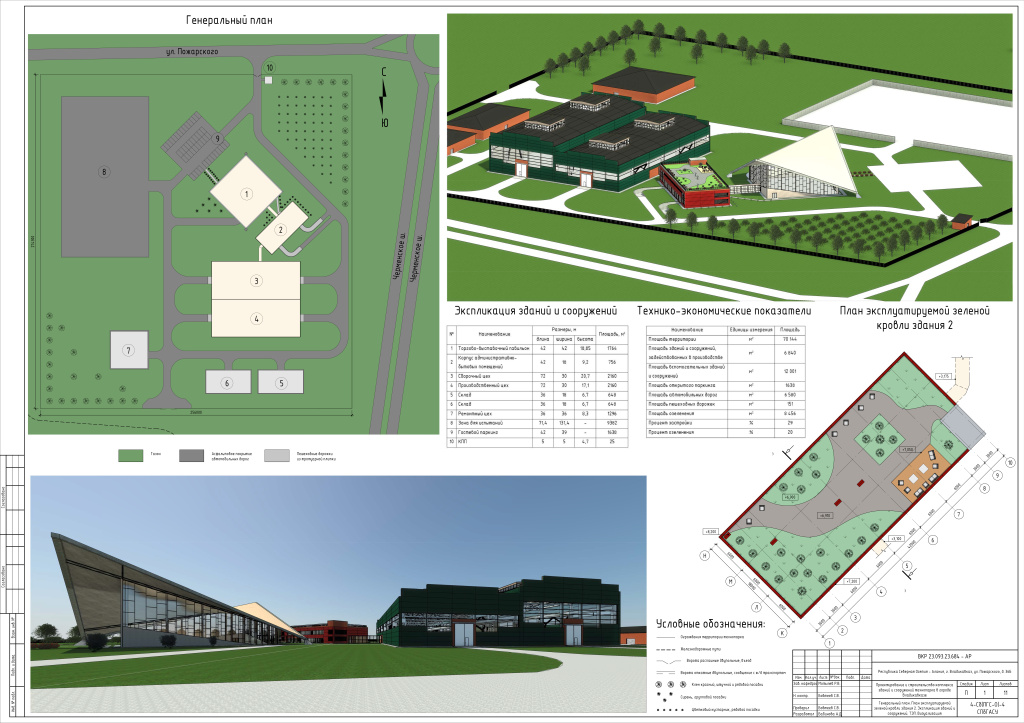
    Source: Saint Petersburg State University of Architecture and Civil Engineering – Fragment of the work by Anastasia Babinova. Open full size image

    The results of the competition of final qualification works, held by the International Public Organization for the Promotion of Construction Education (ASV), have been summed up. Students and graduates of SPbGASU became its laureates.

    Anastasia Babinova won first place in the nomination “Bachelor’s Project in the Field of Construction Technology and Organization” with her work “Design and Construction of a Complex of Buildings and Structures of a Technopark in the City of Vladikavkaz”. Anastasia continues her studies in the Master’s program. Her supervisor Sergey Bovteyev, Associate Professor of the Department of Construction Organization, tells about the student’s work:

    – Anastasia Babinova’s final qualification work examines a complex of objects, the architectural solutions for which were fully developed by the graduate herself during her third year of study. Margarita Aleksandrovna Gurieva, senior lecturer at the Department of Architectural and Construction Structures, provided great assistance in this. In addition, the project adopted a number of non-standard organizational and technological solutions, and also used modern calendar-network planning software. The knowledge gained from studying the course “Construction Organization” helped here, taught by Roman Vladimirovich Motylev, head of the Department of Construction Organization, and Vera Mikhailovna Chelnokova, associate professor at the Department of Construction Organization.

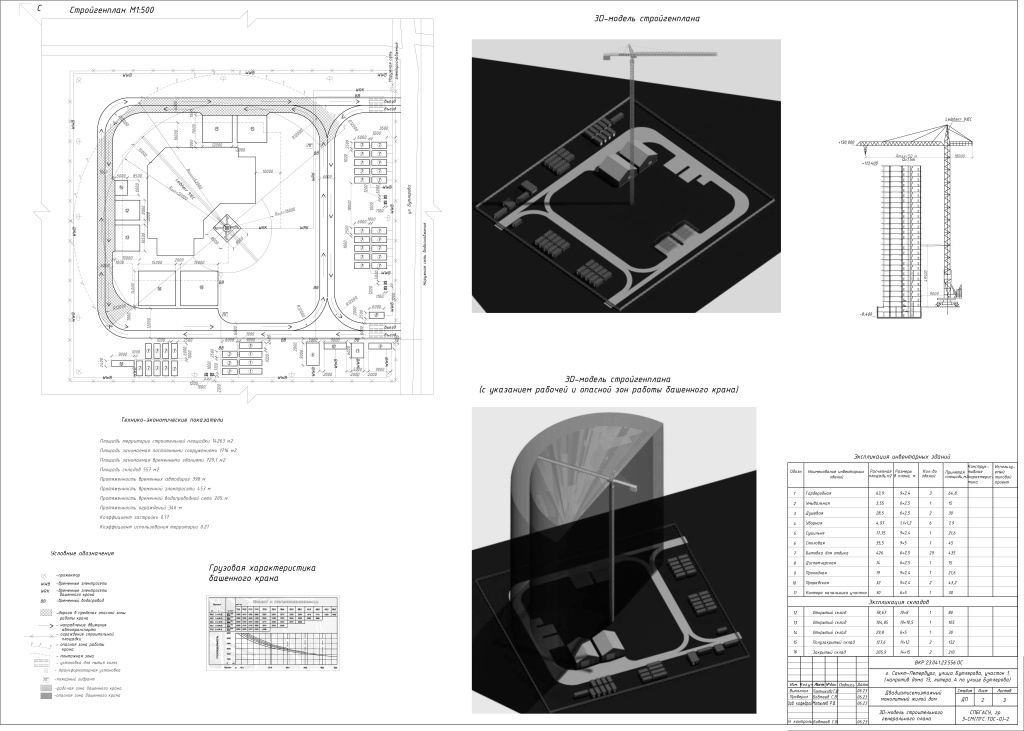
    Fragment of the work by Tatyana Pletnikova. Open full size image

    Tatyana Pletnikova was awarded a diploma for effective participation in the competition in the nomination “Technology and organization of construction”. The topic of her research is “Application of 4D modeling in the organization of construction of a 27-story monolithic residential building”. Tatyana Pletnikova’s work was also supervised by Sergey Bovteev.

    Anna Rerikh’s project “High-tech building solutions using nanocellulose” became the second among the research works of masters in the direction of “Production and application of building materials, products and structures”. The leader was Georgy Khrenov, associate professor of the Department of Building Materials Technology and Metrology.

    – Anna Vladimirovna demonstrated incredible diligence and perseverance. This allowed her to complete the work at a high level in a short time, publish several articles, including in a journal from the list of the Higher Attestation Commission. But most importantly, she managed to obtain interesting scientific results, determining the rational area of application of nanocellulose in building solutions. Anna Vladimirovna summarized the obtained results and developed a draft of practical recommendations that can be implemented in production, – said Georgy Khrenov.

    Timur Aibedulov with his work “Ventilation of the educational building of SPbGASU, Serpukhovskaya St., Bldg. 10 (TIM-project)” won second place in the nomination “Heat and Gas Supply and Ventilation (project)”. The work was supervised by Kirill Sukhanov, associate professor of the Department of Heat and Gas Supply and Ventilation.

    As Kirill Sukhanov explained, Timur carried out the work as part of a comprehensive TIM project. The team consisted of several people: an architect, a designer, a coordinator, an estimator and specialists in engineering sections. As part of the project, a 3D scan of the building was performed, and a full inspection of the facility was conducted.

    – Timur conducted a survey of the existing ventilation systems of the building. Based on the data obtained, he created an information model. Performed verification calculations of the ventilation system. After creating an information model of the existing facility, a model of the building reconstruction was created. Timur performed the necessary calculations and selected ventilation equipment. Particular attention was paid to the design of the atrium and parking ventilation systems. A ventilation system for the assembly hall was also developed while preserving the historical ventilation grille. Research was carried out on the parameters of the microclimate of the assembly hall with various ventilation equipment. The research was carried out using numerical modeling methods. The results obtained allowed us to select the optimal equipment that provides acceptable microclimate parameters, – said Kirill Sukhanov.

    Kristina Astashkevich with her work “Design of foundations of a multi-storey building with a single-level underground parking in the Kalininsky district of St. Petersburg” took third place in the nomination “Bachelor’s project in the field of geotechnics”. Now Kristina continues her studies in the master’s program. Her supervisor is Andrey Boyarintsev, senior lecturer of the Department of Geotechnics.

    – No construction project can be completed without geotechnical calculations, because each building requires a foundation. Moreover, in dense urban development, there is a need for additional parking spaces. According to current urban planning concepts, underground parking is the best solution for apartment complexes, as it saves above-ground space that can be occupied by public areas or green spaces. However, in the conditions of St. Petersburg, underground construction is complicated by weak water-saturated soils, which requires complex engineering solutions for the construction of the facility. It was this case of underground parking construction in a multi-story residential building, erected on weak soils, that was considered in the final qualification work. Now I continue to do geotechnical calculations, including in poor engineering and geological conditions. I am also involved in projects to strengthen the foundations of historical buildings in St. Petersburg, – said Kristina. The student is grateful for the help, consultations and important engineering solutions of Andrey Boyarintsev and Anatoly Osokin, Director of the Soil Testing Center of St. Petersburg State University of Architecture and Civil Engineering, Head of the Department of Geotechnics.

    Linda Fortas came in third in the nomination “Master’s Research in the Profile of Heat and Gas Supply and Ventilation” with her work “Air-thermal curtains for large-sized gates”. Her supervisor is Viktor Puhkal, associate professor of the Department of Heat and Gas Supply and Ventilation.

    – At automobile transport enterprises intended for repair of heavy-duty vehicles, large gates are used for entry and exit. Recommendations and methods for selecting air-thermal curtains for such gates are absent. That is why Linda chose the topic of her master’s thesis “Air-thermal curtains for large-sized gates”. The work includes studies of temperature and speed fields for various designs, positions and sizes of curtains. The influence of coolant parameters on the efficiency of curtains is also studied. The strengths of the work are the novelty of the research and consideration of issues of energy efficiency of air-thermal curtains, – said Viktor Puhkal.

    In the nomination “Master’s Research in Geotechnics”, Daria Paskacheva distinguished herself with her work “Stress-strain state of flexible enclosing structures in conditions of weak clay soils”, taking third place. Supervisor – Ivan Dyakonov, associate professor of the Department of Geotechnics.

    According to Daria, the high level of development of geotechnics in St. Petersburg is connected with the prevalence of “weak” clay soils in the city, which requires a highly scientific calculation approach to ensure safety during construction.

    The Department of Geotechnics of SPbGASU occupies a leading position in the field of calculations and design in such conditions.

    – I chose this topic because I became interested in what needs to be done to ensure the accuracy of geotechnical calculations in St. Petersburg’s natural conditions. Geotechnical calculations themselves, it seems to me, always include a large share of creative scientific work due to the complexity and relative youth of such a discipline as soil mechanics, – noted Daria Paskacheva.

    Currently, Daria continues to develop this topic in graduate school. The main component of her dissertation is the development of her own mathematical model of weak clay soil. In addition, in a team of graduate students and young teachers of the department, she is working on the creation of a software package based on the finite element method, which will allow the implementation of this model.

    – I would like to express my deep gratitude to my supervisor in the Master’s program, Associate Professor of the Department of Geotechnics Ivan Pavlovich Dyakonov for his support and guidance, which played an important role in my admission to graduate school and continuation of research in this area. I would also like to thank postgraduate student of the Department of Geotechnics Ivan Borisovich Bashmakov for his inspiration and help in choosing geotechnics as the main direction of my scientific and design activities.

    Please note: This information is raw content directly from the source of the information. It is exactly what the source states and does not reflect the position of MIL-OSI or its clients.

    Please note; This information is raw content directly from the information source. It is accurate to what the source is stating and does not reflect the position of MIL-OSI or its clients.

    http://www.spbgasu.ru/nevs-and-events/nevs/success-spbgasu-at-the-competition-of-an-international-public-organization-promoting-construction-industry/

    MIL OSI Russia News

  • MIL-OSI Global: Toothbrushes and showerheads covered in viruses ‘unlike anything we’ve seen before’ – new study

    Source: The Conversation – UK – By Primrose Freestone, Senior Lecturer in Clinical Microbiology, University of Leicester

    Toothbrushes and showerheads in American homes are teeming with viruses known as bacteriophages (bacteria eaters), a new study has found. Many of these “phages” – as they’re known for short – have never been identified before.

    The researchers, from Northwestern University in Illinois, swabbed 92 showerheads and 36 toothbrushes. They described what they found as “unlike anything we’ve seen before” and “absolutely wild”. But how alarming is this finding? And what should you do to remain safe?

    It is increasingly recognised that wherever you look for microbial species (viruses and bacteria) you will probably find them, particularly in damp places where they thrive, such as showerheads and toothbrushes. The fact that bacteria-infecting viruses were found in great numbers on showerheads and toothbrushes should not come as a surprise. Where there are bacteria, there will inevitably be viruses that infect them.

    People’s homes are host to a variety of microbial communities, which include bacteria, viruses, fungi and protozoa. And it has been known for over a decade that showerheads and their hoses can harbour various bacterial species. These include ones that can cause ill health, such as mycobacteria, which can cause respiratory infections, Legionella which causes legionnaire’s disease and Pontiac fever, and Pseudomonas aeruginosa, which can cause ear and eye infections.

    Showerheads

    These bacteria have been found on showerheads at levels over 100 times those found in tap water.

    In showerheads, there will inevitably be viruses that infect the bacteria found on them. And the more species of bacteria there are, the greater the diversity of phages likely to be present.

    The presence of a microscopic ecosystem in your showerhead also means every time you shower, you are coating yourself in the showerhead bacteria and their related phage viruses. And this is an infection risk.

    To disinfect your showerhead, soak it in vinegar. It has the added benefit of removing any limescale.

    Unscrew the showerhead, brush off any soap residue, and place the showerhead in a plastic bag or other container with enough undiluted white vinegar to cover the item. Leave it for up to two hours.

    Rinse the showerhead well after taking it out of the vinegar solution, and repeat every month or so, depending on usage.

    Toothbrushes

    The researchers at Northwestern University also looked at phages inhabiting regularly used toothbrushes. Unsurprisingly, they also found a diversity of phages on the brush heads.

    During brushing, toothbrushes come into contact with structures in the mouth (gum, teeth, tongue, cheeks, uvula and palates). And each of these is home to hundreds of species of bacteria and other microbes.

    Oral microbes play an important role in keeping the mouth healthy by excluding harmful germs (pathogens), helping digest food, and regulating the working of the heart and immune system.

    The bacterial diversity of the mouth and tooth microbiomes will, as the US study found, influence the diversity of phages deposited onto toothbrushes.

    The study provides an interesting snapshot of the diversity of the oral micro-ecosystems (bacteria and viruses) that are deposited on toothbrushes but may cause some people to worry that the microbes on their toothbrushes are a potential source of infection.

    The toothbrush viruses identified were bacterial, not human viruses so they are not a health concern. However, while toothbrush microbes are not a risk to the toothbrush owner, as the microbes on it are their own, they can cause infections in others if a toothbrush is shared. One person’s harmless oral microbes can be another’s pathogens, leading to illnesses ranging from colds to endocarditis (a life-threatening inflammation of the heart’s inner lining).

    Phages explained.

    It is a good idea to clean your toothbrush regularly. The NHS advises running it under the hot tap for about 30 seconds, followed by air drying.

    Other websites advise soaking toothbrush heads in antibacterial mouthwash or denture cleaners. For electric toothbrushes, you should follow the manufacturer’s cleaning guidance.

    The take-home message from the Northwestern study is that we live in a richly microbial world and that interactions with bacteria and other microbes in our homes are an integral part of our human biology. Also, despite many new phage species being discovered, there is no cause for alarm – as long as you follow the advice above and keep your showerhead and toothbrush clean.

    Primrose Freestone does not work for, consult, own shares in or receive funding from any company or organisation that would benefit from this article, and has disclosed no relevant affiliations beyond their academic appointment.

    ref. Toothbrushes and showerheads covered in viruses ‘unlike anything we’ve seen before’ – new study – https://theconversation.com/toothbrushes-and-showerheads-covered-in-viruses-unlike-anything-weve-seen-before-new-study-241072

    MIL OSI – Global Reports

  • MIL-OSI Global: Education and gender equality: focus on girls isn’t fair and isn’t enough – global study

    Source: The Conversation – Africa – By Kathryn Watt, Research Manager, The Asenze Project, University of KwaZulu-Natal

    For the past two decades, investing in girls’ schooling has been hailed as a cornerstone of promoting gender equality in sub-Saharan Africa. Between 2016 and 2018 the World Bank Group invested US$3.2 billion in education projects benefiting adolescent girls.

    The logic is straightforward. Girls face significant barriers to education, among them poverty, insufficient academic support, adolescent pregnancy, child marriage, and school related gender-based violence. Reducing these barriers can substantially improve their educational outcomes.

    But is this approach – investing in girls’ education – fair to boys, and enough to make a meaningful impact on girls’ lives in the long term? Having studied the relationship between interventions and the way people’s lives develop in adverse contexts, we argue that the answer is no on both counts.

    We explain this view in a recent paper. In it we compare the different effects of directing development assistance: improving girls’ school enrolment, prioritising schooling for both girls and boys, and addressing barriers to gender equality throughout life.

    We used publicly available data for 136 low- and middle-income countries, including those in sub-Saharan Africa. We calculated the female-to-male ratio for important education indicators in each country to show where girls are ahead, on par or behind boys.

    Our findings suggest that the current focus on girls’ schooling may both unintentionally disadvantage boys and be a relatively inefficient means of advancing gender equality.

    Girls’ and boys’ education in sub-Saharan Africa

    We focused on two indicators to assess the current state of girls’ and boys’ education in the region:

    Harmonised learning outcomes measure learning and progress based on the results from seven different types of tests combined and made comparable among children attending school. They reflect the environmental inputs into learning and achievement, such as school quality. Completing secondary school, meanwhile, has been shown to increase a person’s potential for future development, opportunities for employment and higher education.

    In most countries in sub-Saharan Africa, girls are behind boys on secondary school completion. The average completion rate for boys is 30%. For girls it is just 24%. In southern Africa specifically, girls have higher completion rates than boys. Figure 1 shows where girls are ahead or behind on this indicator.

    In sub-Saharan Africa, the average harmonised learning outcomes score for boys is 301; it is 303 for girls. Our results show that, for most countries in the region, girls are achieving roughly equal scores to their male peers.

    This suggests that gender gaps in education are not as pronounced as is often portrayed.

    Firstly, although school completion rates are higher for boys, this gap is small, and overall completion rates remain low for both genders.

    Secondly, where boys are averaging higher levels of completed schooling, it is not due to better academic performance. Once enrolled, girls in the region tend to keep up with boys in school completion and academic performance.

    Rather than asking who is ahead, it’s more important to note that neither boys nor girls are doing well. Our results show that educational outcomes in sub-Saharan Africa – including school performance and completion – are alarmingly poor for both girls and boys.

    So, if all children in the region are clearly in need of support, why target education interventions at girls alone?

    Large disparities in later life

    The key to gender equality lies in ensuring girls and boys, and men and women, have the same opportunities to reach their potential from early life, through late childhood and adolescence, into adulthood.

    Research emphasises that human development does not hinge on any single factor such as schooling. Rather, it depends on capabilities built throughout life.

    In early childhood, proper nutrition, among other things, is crucial for developing a child’s basic physical and cognitive capabilities. These early investments protect the potential for human development.

    During childhood and adolescence, factors like quality schooling and social support allow young people to realise that potential.

    Finally, in adulthood, social norms and job opportunities determine how fully a person can use their realised potential.

    Our findings suggest that, on average, in low- and middle-income countries the development potential of girls and young women is protected and realised better than it is for boys and young men. But later in life, women don’t have as many opportunities as men to use that potential.

    This implies that initiatives focused on girls’ schooling are likely not the most effective means of promoting girls’ development or reducing gender gaps.

    Large disparities emerge later in girls’ lives. For example, our findings show that women earn less than men in almost every country in sub-Saharan Africa. These results reflect how patriarchal norms, particularly the unequal burden of housework and childcare, tend to push women into lower-paid informal or part-time work. Even when similarly qualified and in comparable positions, women typically earn less than men.

    These findings, when considered in the context of the current state of education in the region, challenge the idea that focusing solely on girls’ education is enough to promote their lifelong development or meaningfully reduce gender inequalities.

    The argument that boys should not receive the same support as girls is weak.

    How to promote greater gender equality in sub-Saharan Africa

    Targeted interventions are likely to have the greatest impact where girls and women face the greatest barriers: in using their potential. That means, for example:

    Social protection policies, including childcare and reproductive health services, can ease women’s caregiving burden and give them the time and agency to fully participate in politics, the economy and society.

    There are also opportunities beyond government, where support for trade unions, for instance, has been shown to help narrow gender wage gaps.

    Addressing gender inequality requires a life-course approach. It should involve quality education for both genders, and tackling the policies, practices and social norms that marginalise women and girls, especially in the later stages of their lives.

    Sara Naicker, Jere Behrman and Linda Richter contributed to the research this article is based on. Dhyan Saravanja contributed to this article.

    Chris Desmond receives funding from UK Research and Innovation Global Challenges Research Fund Accelerating Achievement for Africa’s Adolescents Hub,Grant/Award Number: ES/S008101/1

    Kathryn Watt does not work for, consult, own shares in or receive funding from any company or organisation that would benefit from this article, and has disclosed no relevant affiliations beyond their academic appointment.

    ref. Education and gender equality: focus on girls isn’t fair and isn’t enough – global study – https://theconversation.com/education-and-gender-equality-focus-on-girls-isnt-fair-and-isnt-enough-global-study-240239

    MIL OSI – Global Reports

  • MIL-OSI Global: Zimbabwe’s ZiG: devaluations won’t fix a currency that’s in trouble because of government overspending

    Source: The Conversation – Africa – By Jonathan Munemo, Professor of Economics, Salisbury University

    The Reserve Bank of Zimbabwe devalued the ZiG by 43% on 27 September 2024. This weakened the official exchange rate from 13.9 ZiG per US dollar to 24.4 ZiG per US dollar.

    The ZiG (Zimbabwe Gold) is the nation’s newest currency and was launched in April 2024.

    The unexpected devaluation was prompted by the need to contain resurgent exchange rate pressure which started back in August due to higher food import costs and a slide in mineral export sales. The central bank decided to ease this pressure by lowering the value of the currency instead of burning reserves to keep its value steady at 13.9 ZiG per dollar.

    The strain on the ZiG has intensified in the aftermath of the devaluation. It has weakened even further to more than 26 ZiG per dollar as of 18 October. This has raised speculation that it will continue to weaken.

    This would have a number of negative consequences. It would keep upward pressure on import prices, hurting households and businesses. If this happened, Zimbabwean households already hit by falling paycheques and savings might cut back further on spending.

    The strain on the currency also risks reigniting inflation. The risk comes after monthly inflation ticked up to 1.4% in August and then climbed to 5.8% in September. Resurgent inflation would also increase costs for businesses and threaten to stifle investment. That was on display in 2000-08 and 2019-20 when price instability dampened economic activity and created a costly business environment which discouraged investment.

    A further risk factor from currency instability is that it would deter foreign investors worried about the ZiG as a reliable store of value. The prospect of declining business investment, loss of confidence in the ZiG, and anaemic consumption would in turn be a major drag on economic activity. Economic growth in 2024 is expected to slow down to 2% from 5% last year. El Niño-induced drought, lower mining prices, and macroeconomic instability are among the key reasons.

    This is the sixth time Zimbabwe’s authorities have attempted to establish a stable national currency in the past 15 years. The history of failed attempts has cast a long shadow on the ZiG. The recent devaluation has not eased concerns about Zimbabwe’s struggles to develop and maintain a domestic currency that can be widely used for transactions and as a store of value on a voluntary basis.

    I have long thought the devaluation was inevitable. Authorities must confront the fundamental causes, which are rooted in a loss of faith in the ability of government to manage spending. In particular, its habit of printing money, overspending on its budgets and failing to expand the economy.

    Interventions

    The ZiG is part of a multicurrency system which allows individuals to use other major currencies including the US dollar, euro, South African rand and pound sterling.

    To increase the ZiG’s uptake, authorities imposed a number of measures. The new unit has to be used for paying a portion of company taxes and most government services. Fines are issued to traders unwilling to accept ZiG payments.

    Measures like these are not sufficient because they do not consider the real problems hindering success of the Zimbabwe dollar.

    The central bank also announced that it aims to slow the ZiG’s decline by imposing currency controls and raising the benchmark policy rate (the rate used to implement its monetary policy) from 20% to 35%. The jump in the cost of borrowing triggered by these measures will further weigh on business investment and consumer spending.

    Gains to Zimbabwean exporters from a cheaper ZiG are unlikely to be substantial because of an El Niño-induced drought which has devastated crops in southern Africa. And dollar earnings for Zimbabwe’s mineral exports have been hurt by lower commodity prices. The agriculture and food sector contributes about 17% to GDP and 40% of total export earnings on average, while mining accounts for about 12% of GDP and 80% of total exports.

    My worry is that a cheaper ZiG may not juice exports and reduce the trade shortfall of US$1,453 million recorded last year, given the hit to commodity prices and adverse impact of drought on agricultural production. A bigger trade deficit will keep downward pressure on the currency. The weaker ZiG could however boost inbound tourism.

    To retain a stable domestic currency, authorities will have to address deeper structural causes rooted in the country’s long history of printing money to pay for government overspending amid slow economic expansion. That means:

    • slashing the budget while giving greater spending priority to health, education, public infrastructure and other critical investments.

    • government weaning itself off dependence on printing money to finance fiscal deficits

    • supporting credible policies for more sustainable and private-sector led growth and policies for capturing more revenue from growth.

    Precedents

    This is not the first time that the Zimbabwe dollar has been unstable and weak. In the 2000s, printing money to finance government deficit spending produced periods of high inflation amid slow growth, making the currency weak and unstable.

    The currency eventually collapsed in 2009 due to hyperinflation and the US dollar became the official currency.

    Another local currency (the RTGS dollar) was later introduced in 2019. With the power to print more money restored, inflation rapidly accelerated and surpassed 500% in 2020. This made the new Zimbabwe dollar highly unstable and its value quickly deteriorated.

    As a result, the US dollar continued to be the dominant currency used in transactions and as a store of value. Inflation remained elevated until April 2024, when the ZiG was launched as the new national currency. Its value is backed by gold and foreign currency reserves.

    At first the move seemed to have tamed inflation. But widespread voluntary use of the ZiG failed to materialise. That’s because people are still wary of the government’s power to print money, which had been the key driver of inflation and currency instability.

    What policy makers can do

    Authorities must tackle the root causes of the nation’s currency struggles once and for all. Steps that can be taken to resolve longstanding structural factors include:

    • Re-prioritising public spending by undertaking deep fiscal reforms that will divert more resources towards spending on health, education, public infrastructure and other critical investments needed to boost growth. These reforms should also aim to capture more revenue from growth, for example, through tax reforms.

    • Implementing reforms to address corruption and improve governance is essential for imposing the discipline necessary to push back against covering fiscal deficits by printing money and for restoring faith in government institutions.

    • Pursuing credible policies for more sustainable and private-sector led growth. Strong growth expands tax revenues and gives the government more policy space to spend on essential services and critical investment needs.

    Devaluation and other measures that have been imposed to support the ZiG are not the solution.

    Jonathan Munemo does not work for, consult, own shares in or receive funding from any company or organisation that would benefit from this article, and has disclosed no relevant affiliations beyond their academic appointment.

    ref. Zimbabwe’s ZiG: devaluations won’t fix a currency that’s in trouble because of government overspending – https://theconversation.com/zimbabwes-zig-devaluations-wont-fix-a-currency-thats-in-trouble-because-of-government-overspending-241686

    MIL OSI – Global Reports

  • MIL-OSI Global: Poverty in Lagos isn’t just about money – here’s why

    Source: The Conversation – Africa – By Oluwaseyi Omowunmi Popogbe, Lecturer II, Crawford University

    Lagos is Nigeria’s economic powerhouse, but it has some of the worst slums in the country.

    Lagos slums are characterised by high levels of poverty – the state of not having enough resources to meet basic needs for living, such as food, water, shelter, healthcare and education.

    Poverty is multidimensional. It is not only about money. Yet poverty in Lagos slums has often been studied using traditional methods that focus mostly on income thresholds. A person is considered poor if their income falls below a certain level. This approach captures financial hardship. But it misses other aspects of poverty, such as lack of access to education, healthcare, clean water and decent living conditions.

    Measuring poverty requires a multidimensional approach, not simply an income approach. Multidimensional poverty means looking at all the aspects of deprivation to get a fuller picture of what it means to live in poverty. It helps policymakers and researchers understand that even with some income, a person may still be struggling because they don’t have other essential services.

    In a study of poverty in the Lagos State slums, two other development economists and I used a mathematical framework to model multidimensional poverty. We used what is known as the fuzzy set approach. This was developed in the 1990s as an alternative to purely monetary measures of poverty.

    The traditional monetary approach often classifies people as either “poor” or “not poor” based on specific cut-off points. In reality, poverty exists on a spectrum, and people can experience different levels of deprivation across various aspects of their lives. The fuzzy set approach accounts for this by assigning degrees of membership to different poverty indicators.

    We found considerable disparities in poverty, based on a multidimensional index, across slums in Lagos State. Our insights will enable economists and policymakers to see the different ways people in slums are deprived. In turn this should help them understand how to make their lives better in a more targeted and effective way.

    Background and methodological approach

    Our study focused on five big slums that lie close to the coastal line in Lagos state. These are among the slums the World Bank has identified for upgrading as part of a US$200 million loan project to improve drainage and solid waste management.

    We chose 400 respondents from the five slums: Makoko, Iwaya, Ilaje, Ijora Badia and Amukoko.

    According to Avijit Hazra and Nithya J Gogtay, researchers in bio-statistics and research methodology, a minimum of 384 samples is appropriate for a large population size. Nevertheless, the selected sample for this study limits the ability to generalise the findings to other slums, especially those with different characteristics.

    Findings

    The multidimensional poverty index was highest in Makoko and Iwaya. These scores indicate severe poverty, as they are above the threshold of 0.50.

    In contrast, Amukoko had the lowest multidimensional poverty index, showing relatively less severe deprivation across indicators.

    Makoko and Iwaya are particularly deprived in areas like schooling, sanitation and nutrition. This explains their higher poverty levels compared to other communities.

    Makoko’s location along the coast, with its makeshift housing and poor infrastructure, adds to its vulnerability. Iwaya shares similar challenges in education and health services. These factors make both areas more deprived than other slums.

    Of the three broad poverty dimensions measured, education emerged with the highest deprivation across all communities. This highlighted the limited formal education among residents.

    Specifically, Makoko and Iwaya showed the highest deprivation in schooling. Despite some improvements, particularly in child enrolment, these communities are still marked by severe deprivation.

    The second dimension exhibiting severe deprivation was living standards. There were variations across different slums. Makoko and Iwaya had higher sanitation challenges.

    The third dimension in the severe deprivation category was health. Indicators included mortality and nutrition. They were high across many slums, contributing significantly to their multidimensional poverty indexes.

    Other communities, such as Amukoko (0.0312), showed better sanitation outcomes. On the other hand, electricity, flooring and cooking fuel indicators generally showed lower levels of deprivation, with most slums scoring around or below 0.03 in these categories.

    The prevalence of both serious and minor illnesses, coupled with insufficient medical care, contributed to high mortality rates.

    Poor sanitation could also be a factor in health issues. In Makoko and Iwaya, toilet facilities and waste management were poor, with waste often disposed of in waterways.

    Despite this, personal hygiene practices such as using clean water, soap and regular brushing were prevalent. This helped keep the sanitation index relatively low compared with other factors affecting health.

    Other slums had relatively better-organised waste collection systems and generally improved sanitation practices.

    What needs to be done

    Policymakers should prioritise education-focused initiatives. This should include improving access to quality schools, providing scholarships and setting up adult literacy programmes.

    The study also highlights challenges related to sanitation, especially in Makoko and Iwaya. There is a need for improved infrastructure in these areas, such as better sanitation facilities, waste management systems and access to clean water.

    Policies should focus on upgrading sanitation services to reduce health risks and improve living conditions.

    But the differences in poverty index across slums indicate varying levels of deprivation, suggesting that a one-size-fits-all approach will not be effective.

    Coastal slums like Makoko and Iwaya require more intensive interventions compared to slums not directly on coastal lines such as Amukoko.

    Policymakers should focus resources where they are most needed to have the greatest impact.

    Slums like Ilaje and Ijora Badia are close to the threshold of severe poverty. Policymakers need to take proactive measures to prevent these communities from falling into severe deprivation.

    Lastly, it is important to use data to identify priority areas and develop targeted interventions aimed at improving the quality of life for slum dwellers.

    Instead of relying on generalised approaches, the insights from this study can facilitate the design of specific policies that address the distinct needs of each community.

    Oluwaseyi Omowunmi Popogbe does not work for, consult, own shares in or receive funding from any company or organisation that would benefit from this article, and has disclosed no relevant affiliations beyond their academic appointment.

    ref. Poverty in Lagos isn’t just about money – here’s why – https://theconversation.com/poverty-in-lagos-isnt-just-about-money-heres-why-240847

    MIL OSI – Global Reports

  • MIL-OSI United Nations: Video message for the COP16 Opening Ceremony on Biodiversity

    Source: United Nations secretary general

    Download the video: 

    https://s3.amazonaws.com/downloads2.unmultimedia.org/public/video/evergreen/MSG+SG+/SG+8+Oct+24/3271890_MSG+SG+BIODIVERSITY+OPENING+CEREMONY+08+OCT+24.mp4

    Excellencies, friends,

    I thank the Government of Colombia for hosting this important COP:

    The COP to make peace with nature;

    And the first since countries adopted the historic Kunming-Montreal Global Biodiversity Framework.
     
    That Framework is grounded in a clear truth: for humanity to thrive, nature must flourish.

    Destroying nature inflames conflict, hunger and disease;

    Fuels poverty, inequality, and the climate crisis;

    And damages sustainable development, green jobs, cultural heritage, and GDP.

    A collapse in nature’s services – such as pollination, and clean water – would see the global economy lose trillions of dollars a year – with the poorest hardest hit.

    The Global Biodiversity Framework promises to reset relations with Earth and its ecosystems.

    But we are not on track.

    Your task at this COP is to convert words into action.

    That means countries presenting clear plans that align national actions with all the Framework’s targets.

    It means agreeing a strengthened monitoring and transparency framework.

    And it means honouring promises on finance – and accelerating support to developing countries.

    We must leave Cali with significant investment in the Global Biodiversity Framework Fund, and commitments to mobilise other sources of public and private finance to deliver the Framework in full.

    And those profiting from nature must contribute to its protection and restoration.

    Developing countries are being plundered:

    Digitised DNA from biodiversity underpins scientific discoveries and economic growth. But developing countries don’t gain fairly from these advances – despite being home to extraordinary richness. 

    This COP must operationalise the mechanism that has been agreed – to ensure that when countries share genetic information, they share benefits – equitably. 

    It must engage all of society – as “La COP de la gente”

    And it must strengthen the role of Indigenous Peoples and local communities.

    Indigenous Peoples are the world’s great guardians of biodiversity; luminaries of sustainable use.

    Their knowledge and stewardship must be at the heart of biodiversity action at every level. 

    Excellencies,

    We have a plan to rescue humanity from a degraded Earth.

    I look forward to seeing you in person at the end of the COP to hear how you have delivered.

    Thank you.

    MIL OSI United Nations News

  • MIL-OSI Africa: Education and gender equality: focus on girls isn’t fair and isn’t enough – global study

    Source: The Conversation – Africa – By Kathryn Watt, Research Manager, The Asenze Project, University of KwaZulu-Natal

    For the past two decades, investing in girls’ schooling has been hailed as a cornerstone of promoting gender equality in sub-Saharan Africa. Between 2016 and 2018 the World Bank Group invested US$3.2 billion in education projects benefiting adolescent girls.

    The logic is straightforward. Girls face significant barriers to education, among them poverty, insufficient academic support, adolescent pregnancy, child marriage, and school related gender-based violence. Reducing these barriers can substantially improve their educational outcomes.

    But is this approach – investing in girls’ education – fair to boys, and enough to make a meaningful impact on girls’ lives in the long term? Having studied the relationship between interventions and the way people’s lives develop in adverse contexts, we argue that the answer is no on both counts.

    We explain this view in a recent paper. In it we compare the different effects of directing development assistance: improving girls’ school enrolment, prioritising schooling for both girls and boys, and addressing barriers to gender equality throughout life.

    We used publicly available data for 136 low- and middle-income countries, including those in sub-Saharan Africa. We calculated the female-to-male ratio for important education indicators in each country to show where girls are ahead, on par or behind boys.

    Our findings suggest that the current focus on girls’ schooling may both unintentionally disadvantage boys and be a relatively inefficient means of advancing gender equality.

    Girls’ and boys’ education in sub-Saharan Africa

    We focused on two indicators to assess the current state of girls’ and boys’ education in the region:

    Harmonised learning outcomes measure learning and progress based on the results from seven different types of tests combined and made comparable among children attending school. They reflect the environmental inputs into learning and achievement, such as school quality. Completing secondary school, meanwhile, has been shown to increase a person’s potential for future development, opportunities for employment and higher education.

    In most countries in sub-Saharan Africa, girls are behind boys on secondary school completion. The average completion rate for boys is 30%. For girls it is just 24%. In southern Africa specifically, girls have higher completion rates than boys. Figure 1 shows where girls are ahead or behind on this indicator.

    Figure 1: Secondary school completion. Author provided (no reuse)

    In sub-Saharan Africa, the average harmonised learning outcomes score for boys is 301; it is 303 for girls. Our results show that, for most countries in the region, girls are achieving roughly equal scores to their male peers.

    Figure 2: Harmonised learning outcomes. Author provided (no reuse)

    This suggests that gender gaps in education are not as pronounced as is often portrayed.

    Firstly, although school completion rates are higher for boys, this gap is small, and overall completion rates remain low for both genders.

    Secondly, where boys are averaging higher levels of completed schooling, it is not due to better academic performance. Once enrolled, girls in the region tend to keep up with boys in school completion and academic performance.

    Rather than asking who is ahead, it’s more important to note that neither boys nor girls are doing well. Our results show that educational outcomes in sub-Saharan Africa – including school performance and completion – are alarmingly poor for both girls and boys.

    So, if all children in the region are clearly in need of support, why target education interventions at girls alone?

    Large disparities in later life

    The key to gender equality lies in ensuring girls and boys, and men and women, have the same opportunities to reach their potential from early life, through late childhood and adolescence, into adulthood.

    Research emphasises that human development does not hinge on any single factor such as schooling. Rather, it depends on capabilities built throughout life.

    In early childhood, proper nutrition, among other things, is crucial for developing a child’s basic physical and cognitive capabilities. These early investments protect the potential for human development.

    During childhood and adolescence, factors like quality schooling and social support allow young people to realise that potential.

    Finally, in adulthood, social norms and job opportunities determine how fully a person can use their realised potential.

    Our findings suggest that, on average, in low- and middle-income countries the development potential of girls and young women is protected and realised better than it is for boys and young men. But later in life, women don’t have as many opportunities as men to use that potential.

    This implies that initiatives focused on girls’ schooling are likely not the most effective means of promoting girls’ development or reducing gender gaps.

    Large disparities emerge later in girls’ lives. For example, our findings show that women earn less than men in almost every country in sub-Saharan Africa. These results reflect how patriarchal norms, particularly the unequal burden of housework and childcare, tend to push women into lower-paid informal or part-time work. Even when similarly qualified and in comparable positions, women typically earn less than men.

    Figure 3: Adult earnings. Author provided (no reuse)

    These findings, when considered in the context of the current state of education in the region, challenge the idea that focusing solely on girls’ education is enough to promote their lifelong development or meaningfully reduce gender inequalities.

    The argument that boys should not receive the same support as girls is weak.

    How to promote greater gender equality in sub-Saharan Africa

    Targeted interventions are likely to have the greatest impact where girls and women face the greatest barriers: in using their potential. That means, for example:

    Social protection policies, including childcare and reproductive health services, can ease women’s caregiving burden and give them the time and agency to fully participate in politics, the economy and society.

    There are also opportunities beyond government, where support for trade unions, for instance, has been shown to help narrow gender wage gaps.

    Addressing gender inequality requires a life-course approach. It should involve quality education for both genders, and tackling the policies, practices and social norms that marginalise women and girls, especially in the later stages of their lives.

    Sara Naicker, Jere Behrman and Linda Richter contributed to the research this article is based on. Dhyan Saravanja contributed to this article.

    – Education and gender equality: focus on girls isn’t fair and isn’t enough – global study
    https://theconversation.com/education-and-gender-equality-focus-on-girls-isnt-fair-and-isnt-enough-global-study-240239

    MIL OSI Africa

  • MIL-OSI Africa: Zimbabwe’s ZiG: devaluations won’t fix a currency that’s in trouble because of government overspending

    Source: The Conversation – Africa – By Jonathan Munemo, Professor of Economics, Salisbury University

    The Reserve Bank of Zimbabwe devalued the ZiG by 43% on 27 September 2024. This weakened the official exchange rate from 13.9 ZiG per US dollar to 24.4 ZiG per US dollar.

    The ZiG (Zimbabwe Gold) is the nation’s newest currency and was launched in April 2024.

    The unexpected devaluation was prompted by the need to contain resurgent exchange rate pressure which started back in August due to higher food import costs and a slide in mineral export sales. The central bank decided to ease this pressure by lowering the value of the currency instead of burning reserves to keep its value steady at 13.9 ZiG per dollar.

    The strain on the ZiG has intensified in the aftermath of the devaluation. It has weakened even further to more than 26 ZiG per dollar as of 18 October. This has raised speculation that it will continue to weaken.

    This would have a number of negative consequences. It would keep upward pressure on import prices, hurting households and businesses. If this happened, Zimbabwean households already hit by falling paycheques and savings might cut back further on spending.

    The strain on the currency also risks reigniting inflation. The risk comes after monthly inflation ticked up to 1.4% in August and then climbed to 5.8% in September. Resurgent inflation would also increase costs for businesses and threaten to stifle investment. That was on display in 2000-08 and 2019-20 when price instability dampened economic activity and created a costly business environment which discouraged investment.

    A further risk factor from currency instability is that it would deter foreign investors worried about the ZiG as a reliable store of value. The prospect of declining business investment, loss of confidence in the ZiG, and anaemic consumption would in turn be a major drag on economic activity. Economic growth in 2024 is expected to slow down to 2% from 5% last year. El Niño-induced drought, lower mining prices, and macroeconomic instability are among the key reasons.

    This is the sixth time Zimbabwe’s authorities have attempted to establish a stable national currency in the past 15 years. The history of failed attempts has cast a long shadow on the ZiG. The recent devaluation has not eased concerns about Zimbabwe’s struggles to develop and maintain a domestic currency that can be widely used for transactions and as a store of value on a voluntary basis.

    I have long thought the devaluation was inevitable. Authorities must confront the fundamental causes, which are rooted in a loss of faith in the ability of government to manage spending. In particular, its habit of printing money, overspending on its budgets and failing to expand the economy.

    Interventions

    The ZiG is part of a multicurrency system which allows individuals to use other major currencies including the US dollar, euro, South African rand and pound sterling.

    To increase the ZiG’s uptake, authorities imposed a number of measures. The new unit has to be used for paying a portion of company taxes and most government services. Fines are issued to traders unwilling to accept ZiG payments.

    Measures like these are not sufficient because they do not consider the real problems hindering success of the Zimbabwe dollar.

    The central bank also announced that it aims to slow the ZiG’s decline by imposing currency controls and raising the benchmark policy rate (the rate used to implement its monetary policy) from 20% to 35%. The jump in the cost of borrowing triggered by these measures will further weigh on business investment and consumer spending.

    Gains to Zimbabwean exporters from a cheaper ZiG are unlikely to be substantial because of an El Niño-induced drought which has devastated crops in southern Africa. And dollar earnings for Zimbabwe’s mineral exports have been hurt by lower commodity prices. The agriculture and food sector contributes about 17% to GDP and 40% of total export earnings on average, while mining accounts for about 12% of GDP and 80% of total exports.

    My worry is that a cheaper ZiG may not juice exports and reduce the trade shortfall of US$1,453 million recorded last year, given the hit to commodity prices and adverse impact of drought on agricultural production. A bigger trade deficit will keep downward pressure on the currency. The weaker ZiG could however boost inbound tourism.

    To retain a stable domestic currency, authorities will have to address deeper structural causes rooted in the country’s long history of printing money to pay for government overspending amid slow economic expansion. That means:

    • slashing the budget while giving greater spending priority to health, education, public infrastructure and other critical investments.

    • government weaning itself off dependence on printing money to finance fiscal deficits

    • supporting credible policies for more sustainable and private-sector led growth and policies for capturing more revenue from growth.

    Precedents

    This is not the first time that the Zimbabwe dollar has been unstable and weak. In the 2000s, printing money to finance government deficit spending produced periods of high inflation amid slow growth, making the currency weak and unstable.

    The currency eventually collapsed in 2009 due to hyperinflation and the US dollar became the official currency.

    Another local currency (the RTGS dollar) was later introduced in 2019. With the power to print more money restored, inflation rapidly accelerated and surpassed 500% in 2020. This made the new Zimbabwe dollar highly unstable and its value quickly deteriorated.

    As a result, the US dollar continued to be the dominant currency used in transactions and as a store of value. Inflation remained elevated until April 2024, when the ZiG was launched as the new national currency. Its value is backed by gold and foreign currency reserves.

    At first the move seemed to have tamed inflation. But widespread voluntary use of the ZiG failed to materialise. That’s because people are still wary of the government’s power to print money, which had been the key driver of inflation and currency instability.

    What policy makers can do

    Authorities must tackle the root causes of the nation’s currency struggles once and for all. Steps that can be taken to resolve longstanding structural factors include:

    • Re-prioritising public spending by undertaking deep fiscal reforms that will divert more resources towards spending on health, education, public infrastructure and other critical investments needed to boost growth. These reforms should also aim to capture more revenue from growth, for example, through tax reforms.

    • Implementing reforms to address corruption and improve governance is essential for imposing the discipline necessary to push back against covering fiscal deficits by printing money and for restoring faith in government institutions.

    • Pursuing credible policies for more sustainable and private-sector led growth. Strong growth expands tax revenues and gives the government more policy space to spend on essential services and critical investment needs.

    Devaluation and other measures that have been imposed to support the ZiG are not the solution.

    – Zimbabwe’s ZiG: devaluations won’t fix a currency that’s in trouble because of government overspending
    https://theconversation.com/zimbabwes-zig-devaluations-wont-fix-a-currency-thats-in-trouble-because-of-government-overspending-241686

    MIL OSI Africa

  • MIL-OSI: Real Matters to Announce Fourth Quarter and Fiscal 2024 Financial Results on November 21, 2024

    Source: GlobeNewswire (MIL-OSI)

    TORONTO, Oct. 21, 2024 (GLOBE NEWSWIRE) — Real Matters Inc. (“Real Matters”), a leading network management services provider for the mortgage lending and insurance industries, will announce its fourth quarter and fiscal 2024 financial results via news release on Thursday, November 21, 2024, before market open.

    Conference Call and Webcast         
    A conference call to review the results will take place at 10:00 a.m. (ET) on Thursday, November 21, 2024, hosted by Chief Executive Officer Brian Lang and Chief Financial Officer Rodrigo Pinto. An accompanying slide presentation will be posted to the Investor Relations section of our website shortly before the call.

    To access the call:

    • Participant Local (Toronto): (416) 764-8624
    • Participant Toll Free Dial-In Number: (888) 259-6580
    • Conference ID: 77493257

    To listen to the live webcast of the call:

    The webcast will be archived and a transcript of the call will be available in the Investor Relations section of our website following the call.

    About Real Matters
    Real Matters is a leading network management services provider for the mortgage lending and insurance industries. Real Matters’ platform combines its proprietary technology and network management capabilities with tens of thousands of independent qualified field professionals to create an efficient marketplace for the provision of mortgage lending and insurance industry services. Our clients include top 100 mortgage lenders in the U.S. and some of the largest banks and insurance companies in Canada. We are a leading independent provider of residential real estate appraisals to the mortgage market and a leading independent provider of title and mortgage closing services in the U.S. Headquartered in Markham (ON), Real Matters has principal offices in Buffalo (NY) and Middletown (RI). Real Matters is listed on the Toronto Stock Exchange under the symbol REAL. For more information, visit http://www.realmatters.com.

    For more information:
    Lyne Beauregard
    Vice President, Investor Relations and Corporate Communications
    Real Matters
    lbeauregard@realmatters.com
    416.994.5930

    The MIL Network

  • MIL-OSI Africa: Poverty in Lagos isn’t just about money – here’s why

    Source: The Conversation – Africa – By Oluwaseyi Omowunmi Popogbe, Lecturer II, Crawford University

    Lagos is Nigeria’s economic powerhouse, but it has some of the worst slums in the country.

    Lagos slums are characterised by high levels of poverty – the state of not having enough resources to meet basic needs for living, such as food, water, shelter, healthcare and education.

    Poverty is multidimensional. It is not only about money. Yet poverty in Lagos slums has often been studied using traditional methods that focus mostly on income thresholds. A person is considered poor if their income falls below a certain level. This approach captures financial hardship. But it misses other aspects of poverty, such as lack of access to education, healthcare, clean water and decent living conditions.

    Measuring poverty requires a multidimensional approach, not simply an income approach. Multidimensional poverty means looking at all the aspects of deprivation to get a fuller picture of what it means to live in poverty. It helps policymakers and researchers understand that even with some income, a person may still be struggling because they don’t have other essential services.

    In a study of poverty in the Lagos State slums, two other development economists and I used a mathematical framework to model multidimensional poverty. We used what is known as the fuzzy set approach. This was developed in the 1990s as an alternative to purely monetary measures of poverty.

    The traditional monetary approach often classifies people as either “poor” or “not poor” based on specific cut-off points. In reality, poverty exists on a spectrum, and people can experience different levels of deprivation across various aspects of their lives. The fuzzy set approach accounts for this by assigning degrees of membership to different poverty indicators.

    We found considerable disparities in poverty, based on a multidimensional index, across slums in Lagos State. Our insights will enable economists and policymakers to see the different ways people in slums are deprived. In turn this should help them understand how to make their lives better in a more targeted and effective way.

    Background and methodological approach

    Our study focused on five big slums that lie close to the coastal line in Lagos state. These are among the slums the World Bank has identified for upgrading as part of a US$200 million loan project to improve drainage and solid waste management.

    We chose 400 respondents from the five slums: Makoko, Iwaya, Ilaje, Ijora Badia and Amukoko.

    According to Avijit Hazra and Nithya J Gogtay, researchers in bio-statistics and research methodology, a minimum of 384 samples is appropriate for a large population size. Nevertheless, the selected sample for this study limits the ability to generalise the findings to other slums, especially those with different characteristics.

    Findings

    The multidimensional poverty index was highest in Makoko and Iwaya. These scores indicate severe poverty, as they are above the threshold of 0.50.

    In contrast, Amukoko had the lowest multidimensional poverty index, showing relatively less severe deprivation across indicators.

    Makoko and Iwaya are particularly deprived in areas like schooling, sanitation and nutrition. This explains their higher poverty levels compared to other communities.

    Makoko’s location along the coast, with its makeshift housing and poor infrastructure, adds to its vulnerability. Iwaya shares similar challenges in education and health services. These factors make both areas more deprived than other slums.

    Of the three broad poverty dimensions measured, education emerged with the highest deprivation across all communities. This highlighted the limited formal education among residents.

    Specifically, Makoko and Iwaya showed the highest deprivation in schooling. Despite some improvements, particularly in child enrolment, these communities are still marked by severe deprivation.

    The second dimension exhibiting severe deprivation was living standards. There were variations across different slums. Makoko and Iwaya had higher sanitation challenges.

    The third dimension in the severe deprivation category was health. Indicators included mortality and nutrition. They were high across many slums, contributing significantly to their multidimensional poverty indexes.

    Other communities, such as Amukoko (0.0312), showed better sanitation outcomes. On the other hand, electricity, flooring and cooking fuel indicators generally showed lower levels of deprivation, with most slums scoring around or below 0.03 in these categories.

    The prevalence of both serious and minor illnesses, coupled with insufficient medical care, contributed to high mortality rates.

    Poor sanitation could also be a factor in health issues. In Makoko and Iwaya, toilet facilities and waste management were poor, with waste often disposed of in waterways.

    Despite this, personal hygiene practices such as using clean water, soap and regular brushing were prevalent. This helped keep the sanitation index relatively low compared with other factors affecting health.

    Other slums had relatively better-organised waste collection systems and generally improved sanitation practices.

    What needs to be done

    Policymakers should prioritise education-focused initiatives. This should include improving access to quality schools, providing scholarships and setting up adult literacy programmes.

    The study also highlights challenges related to sanitation, especially in Makoko and Iwaya. There is a need for improved infrastructure in these areas, such as better sanitation facilities, waste management systems and access to clean water.

    Policies should focus on upgrading sanitation services to reduce health risks and improve living conditions.

    But the differences in poverty index across slums indicate varying levels of deprivation, suggesting that a one-size-fits-all approach will not be effective.

    Coastal slums like Makoko and Iwaya require more intensive interventions compared to slums not directly on coastal lines such as Amukoko.

    Policymakers should focus resources where they are most needed to have the greatest impact.

    Slums like Ilaje and Ijora Badia are close to the threshold of severe poverty. Policymakers need to take proactive measures to prevent these communities from falling into severe deprivation.

    Lastly, it is important to use data to identify priority areas and develop targeted interventions aimed at improving the quality of life for slum dwellers.

    Instead of relying on generalised approaches, the insights from this study can facilitate the design of specific policies that address the distinct needs of each community.

    – Poverty in Lagos isn’t just about money – here’s why
    https://theconversation.com/poverty-in-lagos-isnt-just-about-money-heres-why-240847

    MIL OSI Africa

  • MIL-OSI United Kingdom: Local Plan approved for submission to the Secretary of State, by St Albans City and District Councillors

    Source: St Albans City and District

    Publication date:

    A Local Plan for St Albans District’s future growth has been agreed by Councillors. St Albans City and District Councillors approved the draft Local Plan (LP) for the purpose of submission to the Secretary of State, at a meeting of Full Council.

    The LP identifies land for housing, employment developments and green spaces for the years to 2041.

    Residents, community groups, businesses, neighbouring local authorities, statutory bodies and other organisations have helped shape the document by giving their views in consultations.

    Councillor Paul de Kort, the Council’s Leader, said after the meeting on Wednesday 16 October: “I am delighted that Councillors have voted overwhelmingly to approve our Local Plan for submission to the Secretary of State.

    “Producing a Local Plan is one of the most challenging, complex and important tasks that a Council faces and it has taken more than three years of demanding work to reach this stage.

    “It is in the interests of our residents that we move forward with the Local Plan without delay otherwise we will be vulnerable to more speculative planning applications for inappropriate developments.

    “It is these opportunistic developments that most concern residents as they don’t take a strategic account of the impact on the local community and, as they are not included in a Local Plan, they contribute less to improving the local infrastructure. 

    “This Local Plan can protect the District from such random, piecemeal developments by providing for new housing, schools, parks, cycleways and employment centres in a strategic way.”

    The LP allows for the building of 15,000 new homes in the District over the next 17 years in accordance with current national planning policy guidelines. This will include 1,200 social rent properties, mainly three-bedroom homes, increasing the area’s social housing stock by around 25%.

    The LP also allows for a potential £750 million of infrastructure to support the proposed new residential areas. This includes nine new primary schools, four new secondary schools, improvements to public transport, locations for 15,000 jobs, and new green spaces and health facilities.

    Cllr de Kort added: “The Local Plan helps to address the housing crisis we see in the District and that the country is faced with. In our District, this is more challenging as house prices are among the least affordable in the country.

    “The Local Plan provides for the first significant increase in social housing in a generation. It also caters for the need for more starter homes for young families.

    “It has the potential to give the younger generation a much greater chance of living in the area they grew up in, whether as homeowners or tenants.”

    The LP is currently undergoing what is called the Regulation 19 Consultation. This allows for public comment on the draft LP’s compliance and ‘soundness’ with national planning policies. 

    A report on the feedback will be considered at a meeting of the Planning Policy and Climate Committee on Thursday 28 November. 

    Previously, it was intended to submit a draft LP in March next year. The timetable was brought forward to avoid potential changes to national planning policy that could mean starting the whole LP process again from scratch.

    The Regulation 19 consultation continues until Friday 8 November. More information, including the draft LP and other documents, is available at http://www.stalbans.gov.uk/new-local-plan.
     

    Media contact: John McJannet, Principal Communications Officer: 01727 819533, john.mcjannet@stalbans.gov.uk.

    MIL OSI United Kingdom

  • MIL-OSI USA: 52 Bipartisan Congressmembers Urge Biden Administration to Tighten Russian Oil Sanctions and Question Exception Approval

    Source: United States House of Representatives – Congressman Lloyd Doggett (D-TX)

    Contact: Alexis Torres, Alexis.Torres@mail.house.gov

    Washington, D.C.—U.S. Representatives Lloyd Doggett (D-TX-37) and Jake Auchincloss (D-MA-4) led a bipartisan effort to demand a tightening of Russian oil sanctions and to question an exception granted to a U.S.-based company, Schlumberger (SLB). Specifically, the lawmakers are questioning Treasury Secretary Janet Yellen and Secretary Antony Blinken as to why the Biden administration has permitted SLB to serve as an accomplice to Vladimir Putin.

    We write regarding alarming findings that the U.S.-based company and world’s largest oilfield services firm SLB, widely known as Schlumberger, is expanding in Russia,” wrote the members. “Since Russia’s unjustified and illegal full-scale invasion of Ukraine in February 2022, SLB has signed new contracts, recruited hundreds of staff, and imported nearly $18 million in equipment into Russia. This U.S.-based company is keeping Vladimir Putin’s war machine well-oiled with financing for the barbaric invasion of Ukraine. We urge you to continue supporting our Ukrainian allies by pursuing more rigorous oil sanctions to effectively restrict Putin’s profits.

    “My name is on the first sanctions legislation to become law shortly after the Russian invasion,” said Rep. Doggett. “Implementation of that and similar legislation by our allies has not prevented Putin from earning billions from oil exports. And unfortunately, North Korea and Iran are not the only places providing him help. By permitting his exports and permitting continued American company investments in Russia, Americans, and our European allies, are essentially funding both sides of this war. While well aware of concerns about the price of gasoline at the pump, we must stop oiling the Putin war machine to win this war, secure a just peace, and reparations.”

    “While Ukrainians fight and die on the front lines of freedom, a U.S. oil company is supporting the enemy,” said Rep. Auchincloss. “Oil is the lifeblood of the Russian war economy, which is why the West must stand united in tightening and enforcing oil sanctions. That begins by holding SLB and its collaborators accountable for evading allied sanctions, profiteering from pain, and fueling Putin’s ability to wage war.”

    Additional signers include Representatives Sheila Cherfilus-McCormick (FL-20), Josh Gottheimer (NJ-05), Marcy Kaptur (OH-09), Barbara Lee (CA-12), Wiley Nickel (NC-13), Jared Huffman (CA-02), Dan Goldman (NY-10), Danny Davis (IL-07), Jim Costa (CA-21), Sean Casten (IL-06), Steve Cohen (TN-09), Adam Schiff (CA-30), Susan Wild (PA-07), Joe Wilson (R-SC-02), Hank Johnson (GA-04), Tom Suozzi (NY-03), Brad Sherman (CA-32), Zoe Lofgren (CA-18), Nikema Williams (GA-05), Gerry Connolly (VA-11), Mark Pocan (WI-02), Madeleine Dean (PA-04), Jamie Raskin (MD-08), Earl Blumenaur (OR-03), Seth Magaziner (RI-02), Chris Deluzio (PA-17), Patrick Ryan (NY-18), Chris Smith (R-NJ-04), Bonnie Watson Coleman (NJ-12), Salud Carbajal (CA-24), Raúl Grijalva (AZ-07),  Don Bacon (R-NE-02), Juan Vargas (CA-52), Jerry Nadler (NY-12), Annie Kuster (NH-02), Emanuel Cleaver (MO-05), Frank Pallone (NJ-06), Paul Tonko (NY-20), Adriano Espaillat (NY-13), Ted Lieu (CA-36), John Larson (CT-01), Mike Quigley (IL-05), Jill Tokuda (HI-02), Kweisi Mfume (MD-07), David Trone (MD-06), Seth Moulton (MA-06), Brian Fitzpatrick (PA-01), Stephen Lynch (MA-08), Bennie Thompson (MS-02) and Ro Khanna (CA-17).

    The full letter can be found here.

    Rep. Doggett is a strong champion for a prosperous Ukraine, consistently urging Congress and the Biden administration to take further actions in holding Putin accountable and ensuring full support for a Ukrainian victory. In 2022, the morning after Putin launched his unprovoked and illegal invasion, Rep. Doggett filed the first sanctions legislation, which later became law, to prohibit the direct import of energy products from Russia into the United States. The following year, he introduced the bipartisan Ending Importation of Laundered Russian Oil Act to close a “refining loophole” that allows Russian oil to be laundered through third-party countries and sold in the U.S. as gasoline and other petroleum products—therefore linking American consumers to financing parts of Putin’s war machine. In recent months, Rep. Doggett expanded his efforts to prevent Russia from continuing to profit off Western countries by publishing an opinion piece in Foreign Policy, calling for U.S. sanctions against a network of companies associated with Rosatom, Russia’s state-owned nuclear corporation.

    MIL OSI USA News

  • MIL-OSI Economics: ICC Antitrust Compliance Toolkit

    Source: International Chamber of Commerce

    Headline: ICC Antitrust Compliance Toolkit

    Competitive markets

    Download Toolkit now

    More concise and user-friendly, the ICC Antitrust Compliance Toolkit has been updated to reflect the evolving landscape of antitrust risks and compliance practices over the last decade. The toolkit offers practical tools and guidance to build a credible corporate antitrust compliance programme.

    The second edition of the ICC Antitrust Compliance Toolkit includes comprehensive guidance for antitrust experts and non-experts alike on how to:  

    • build a compliance culture,  
    • conduct risk assessments, and  
    • implement effective monitoring and improvement measures.  

    Key facts: 

    • Integrating antitrust compliance into everyday business practices is vital. The ICC Antitrust Compliance Toolkit provides actionable guidance to establish a compliance culture and is a vital resource for companies looking to navigate the complexities of antitrust compliance. 
    • Processes alone are not enough. Fostering a culture of compliance starts with individual commitment. 
    • Understanding specific antitrust risks helps tailor internal trainings and response strategies effectively.  
    • Antitrust compliance requires continuous evaluation of compliance effectiveness, which is key to adapting to dynamic regulatory landscapes.  

    Why is the ICC Antitrust Compliance Toolkit relevant? 

    Complying with competition law makes good business sense. Regardless of a company’s size, competition law compliance places businesses ahead of the game.  

    At a time when antitrust violations are making headlines and penalty sizes are breaking records, it is vital that global businesses have the right tools to improve compliance with antitrust law. This is especially true given the last decade of rapid digital transformation, in which a number of new challenges have emerged.  

    Companies have adapted their business practices, while competition authorities have had to rethink how competition law is enforced. The updated ICC Antitrust Compliance Toolkit addresses these new challenges, including the risks associated with using artificial intelligence (AI). 

    What makes the ICC Antitrust Compliance Toolkit unique? 

    The ICC Antitrust Compliance Toolkit offers core principles for building a robust compliance programme – or reinforcing an existing one – with a local or global reach. Developed to complement existing materials, the toolkit seeks to enhance the understanding between business and antitrust agencies in relation to antitrust compliance programmes. It has received recognition and support from key competition agencies, most notably the European Commission. 

    Who is the ICC Antitrust Compliance Toolkit for?  

    The toolkit is intended for companies of all sizes, from SMEs to larger corporations, across various sectors. 

    It is particularly useful for in-house legal teams, compliance officers, and business leaders responsible for establishing or enhancing their company’s antitrust compliance programme. 

    It is also a valuable resource for professionals involved in risk management, such as audit and finance teams

    MIL OSI Economics

  • MIL-OSI China: Seawater intrusion incurs waterlogging on China’s northern coasts

    Source: China State Council Information Office 2

    High tides have poured seawater onto the land in coastal cities in northeast and north China’s Liaoning and Hebei provinces and Tianjin Municipality from Monday, submerging streets and triggering waterlogging.
    In Liaoning, the cities of Dalian, Yingkou, Panjin, Jinzhou and Huludao have suffered urban waterlogging, after the high tide.
    “I’ve lived in the neighborhood for more than 40 years, and I’ve never seen such a severe tidal upsurge,” said Zhang Xinghua, a fisherman at the Erjiegou neighborhood of Panjin.
    Zhang said the neighborhood is located in a low-lying area prone to attacks by tidal waves, especially when nearing winter, but this time the tides were “surprisingly large.”
    The city’s fire department on Monday dispatched 25 fire trucks and 150 firefighters, who took rubber boats for the search and rescue of people trapped in the waterlogging. By Monday night, 72 people were rescued and more than 120 were evacuated.
    As the tides ebbed Monday evening, seawater gradually retreated. Xinhua reporters saw water pumps still working round the clock on the streets in Panjin to drain water.
    “We are still checking risks in low-lying areas. No casualties have been reported,” said Liu Songlin of the sub-district office in Erjiegou.
    Meanwhile, seawater poured into residential houses on Monday in Luannan County, Tangshan City, Hebei Province. Local residents said they have not seen such a large tide in around 30 years.
    In the Binhai New Area of Tianjin Municipality, buses had to temporarily adjust regular routes to avoid the waterlogging area.
    The Liaoning provincial marine monitoring and forecasting center issued a Level-IV sea tide warning at 4 p.m. Monday, saying affected by a cold spell and cyclone, large waves up to 2.5 to 3.5 meters high would appear in the northern part of the Bohai Sea and the Yellow Sea from Monday night to Tuesday.
    Zhou Guanbo, a senior engineer at the China’s National Meteorological Center, attributed the seawater intrusion in Panjin and other places to storm surge superimposed with astronomical tide. This natural phenomenon leads to abnormal rise in tide water.
    He warned that seawater may affect drinking water safety, agricultural production and industrial production. 

    MIL OSI China News

  • MIL-OSI Russia: The IV Novosibirsk Scientific Readings in Memory of Academician Tatyana Ivanovna Zaslavskaya were held at NSU

    Translation. Region: Russian Federation –

    Source: Novosibirsk State University – Novosibirsk State University –

    The All-Russian Conference IV Novosibirsk Scientific Readings in Memory of Academician T.I. Zaslavskaya “Time of Change: Individual and Group Choice in Response to New Challenges” was held on October 17-19. The event was organized by Novosibirsk State University and the Institute of Economics and Industrial Engineering of the Siberian Branch of the Russian Academy of Sciences.

    The readings were held in the form of a series of six thematic round tables, the program of which was formed on the basis of participants’ applications: “Socio-economic relations and inequalities in modern Russia”, “Subjects of territorial relations: interests, behavior, interaction”, “Urban spaces and communities: transformation , development, conflicts”, “Dynamics of the labor market and employment in the context of digitalization and economic transformation”, “Spatial mobility and connectivity: what flows make space unified?” and “Development and preservation of human capital: trends, practices, factors.” Scientists from universities and institutes in several regions of Siberia and the Urals, as well as leading universities in Moscow, took part in them. Researchers from the Novosibirsk State University, Novosibirsk State Technical University, Siberian State University of Telecommunications and Informatics (Novosibirsk), Institute of Economic Forecasting of the Russian Academy of Sciences, Russian Academy of National Economy and Public Administration under the President of the Russian Federation, Higher School of Economics, Moscow State University presented their reports. . M.V. Lomonosov, Institute of Economics of the Ural Branch of the Russian Academy of Sciences (Ekaterinburg), Ural Federal University named after. the first President of Russia B.N. Yeltsin (Ekaterinburg), Institute of Mongolian Studies, Buddhology and Tibetology SB RAS (Ulan-Ude), Khakass State University named after. N.F. Katanova (Abakan). The majority of nonresident conference participants were researchers from Moscow universities. Representatives of several scientific organizations traditionally participate in the conference.

    At the opening of the conference, the dean Faculty of Economics, NSU, candidate of sociological sciences Tatyana Bogomolova spoke about the history of the Novosibirsk economic and sociological school. Associate Professor of the Department of General Sociology of the Faculty of Economics of NSU, Head of the Department of Social Problems of the Institute of Economics and Industrial Production of the Siberian Branch of the Russian Academy of Sciences Olga Fadeeva spoke about rural (agrarian) research, which is the “calling card” of the Novosibirsk economic and sociological school.

    The conference was held in a mixed format, but most of the presentations were in person. About 60 participants presented their reports, including not only experienced researchers, but also students, postgraduates and interns of university laboratories. The organizers of the scientific readings deliberately did not single out their presentations in a separate section, recognizing the relevance of the research of young sociologists and economists. Thus, the reports were made by NSU master’s students – Daria Ivanova (“Public conflicts in the Novosibirsk Akademgorodok: participants’ ideas about justice and prospects for their rapprochement”) and Rinat Galiullin (“Modern urban segregation: conceptual foundations of analysis”).

    — Currently, research on urban problems is becoming one of the prominent areas, and at our conference a large block of speeches was devoted to the subjects of urban relations and urban conflicts. Reports were also presented on economic inequality, territorial relations, social aspects of the use of space and infrastructure, population migration, and the accumulation of human potential in a certain territory. Many messages were devoted to problems associated with digitalization, including relations in the labor market. It was discussed how moving many of the processes associated with registering unemployed status or finding a job into the digital space cuts off some job seekers and makes it easier for others to access them. Concluding our conference, we discussed how, due to digitalization, the data with which sociologists work is paradigmatically changing, and what new requirements arise for assessing their relevance, validity and other data quality criteria. On the one hand, we made sure that we were working on the current agenda and presented our research at the conference, on the other hand, we made new contacts, since researchers with whom we were not previously familiar responded to our invitation to take part in the Readings this year – said the head of the department of general sociology of the Faculty of Economics of NSU, leading researcher at the Institute of Economics and Organization of Industrial Production SB RAS Tatyana Cherkashina.

    The participants’ attention was drawn to the report on the study by young researchers from the Higher School of Economics Kirill Chertenkov, Olga Rodina and Mikhail Balaban “What determines the desire to move? Results of questionnaire surveys in 10 regions of Russia”. No less interesting was the report by another postgraduate student of the Higher School of Economics, Georgy Stalinov “Practices of self-organization of couriers, taxi drivers and truck drivers”.

    For the fourth time, representatives of the Center “Institute for Social Analysis and Forecasting” of the Russian Presidential Academy of National Economy and Public Administration took part in the scientific readings. This year, senior researcher Sofia Korzhuk spoke about the study “The Well-being of Foster Families: Obstacles and Ways to Achieve”, conducted jointly with leading researcher Alla Makarintseva. Alla Makarintseva herself gave a report “Factors of Intentions Regarding the Third Child: What Does the Analysis Show Using Machine Learning Methods”. She conducted the study of this problem jointly with senior researcher Alexandra Burdyak. Ekaterina Seredkina presented a report “Child Benefits as a Tool for Reducing Child Poverty in Russia: Microsimulation Analysis” about the study that she conducted together with Marina Kartseva and Polina Kuznetsova.

    A highlight of the IV Novosibirsk Scientific Readings was the presentation by Doctor of Economics, Professor, Head of the Department of Economic Sociology at the Higher School of Economics Vadim Radaev on the topics: “Crisis in Modern Education” and “Non-Standard Consumption: Characteristic Features, Causes and Consequences”.

    — The conference program was designed in such a way that the participants not only listened to the reports, but also discussed them with each other. And according to the feedback from those present, the organizers succeeded in this. Our Moscow colleagues who took part in the online readings showed interest in this format of communication and actively participated in the discussion of their colleagues’ presentations. This is very important for us, because the same processes look and manifest themselves differently from Moscow and Siberia. It seems to me that at the past conference we laid the foundations, if not for joint research, then certainly for fruitful scientific communication, — said Tatyana Cherkashina.

    Please note: This information is raw content directly from the source of the information. It is exactly what the source states and does not reflect the position of MIL-OSI or its clients.

    MIL OSI Russia News

  • MIL-OSI Asia-Pac: 7 care homes added to GD scheme

    Source: Hong Kong Information Services

    The Social Welfare Department announced today that seven additional residential care homes for the elderly in Guangdong will become Recognised Service Providers under the Residential Care Services Scheme in Guangdong from November 1 to provide subsidised care and attention places for seniors joining the scheme.

    These care homes are located in Guangzhou, Foshan and Zhongshan. Five of them are operated by Mainland organisations and the other two are operated under a partnership formed by Hong Kong organisations and Mainland elderly service operators.

    Together with the two care homes in Shenzhen, and one each in Foshan and Zhaoqing, the number of care homes registered under the scheme will increase to 11 in five Mainland cities in the Guangdong-Hong Kong-Macao Greater Bay Area to provide more choice for seniors with an interest in retiring in Mainland cities in the bay area.

    Click here for details of the Residential Care Services Scheme in Guangdong.

    MIL OSI Asia Pacific News

  • MIL-OSI Economics: Hurricane Helene and Milton damages will significantly impact profitability of US insurers, says GlobalData

    Source: GlobalData

    Hurricane Helene and Milton damages will significantly impact profitability of US insurers, says GlobalData

    Posted in Insurance

    Recent hurricanes Helene and Milton that have struck the US resulted in widespread devastation, claiming hundreds of lives and causing huge property damages. Hurricane Helene, which struck Florida’s Big Bend region as a Category 4 storm on September 26, 2024, resulted in catastrophic flooding throughout Florida, North Carolina, South Carolina, Georgia, and Ohio. The parts of the US were battered again by Hurricane Milton on October 9, 2024.  As a result, US insurers are expected to witness higher claims in 2024 across general insurance lines, which could significantly impact their profitability, according to GlobalData, a leading data and analytics company.

    As per the Office of Insurance Regulation, a total of 112,926 insurance claims for hurricane Helene have been filed as of October 9, 2024, with estimated insured losses amounting to $1.1 billion. Among these claims, 52,070 pertain to private passenger automobiles, followed closely by 50,672 residential property claims. Additional reported damages encompass commercial vehicles and commercial property losses.

    Manogna Vangari, Insurance Analyst at GlobalData, comments: “Hurricane Milton was a formidable storm that resulted in a landfall to the south of Tampa Bay, near Siesta Key, leading to multiple tornadoes, particularly across South Florida. The hurricane Milton presents a considerable risk to the densely populated region of Florida that might result in even higher costs than those associated with Hurricane Helene. According to the White House briefing, the damage from Hurricane Milton is estimated to be more than $50 billion.”

    Property insurance claims are expected to account for a 12.9% share of the total general insurance claims in 2024, amounting to $227.5 billion. However, with these events, the actual claims in 2024 might increase once the complete impact of both hurricanes is realized. As a result, the overall profitability of the general insurance industry in the US is expected to be significantly impacted, with the average combined ratio exceeding 100% in 2024.

    According to GlobalData’s Global Insurance Database, the US general insurance industry is expected to grow at a CAGR of 7.1% over 2024–28, from $2.4 trillion in 2024 to $3.1 trillion in 2028, in terms of gross written premiums (GWP).

    In the US, standard homeowners’ policies do not encompass flood coverage and must be acquired separately, often directly from the federal government. Flood insurance is mandated for homes situated in high-risk areas as determined by the Federal Emergency Management Agency (FEMA), particularly if the mortgage is government-backed.

    As per the Insurance Information Institute, nearly 6% of US homeowners possess flood insurance. In several counties across Georgia, North Carolina, and South Carolina that were recently inundated by the effects of Helene, less than 1% of households have flood insurance. Nearly two-thirds of these policies are provided through the National Flood Insurance Program (NFIP) administered by FEMA, while the remaining are secured through private insurers.

    The aftermath of hurricanes Helene and Milton has cast a spotlight on the significant deficiencies within the US flood insurance framework and the ensuing repercussions. As climate change intensifies the frequency and severity of flooding, the need for comprehensive flood risk management has become increasingly critical.

    Vangari concludes: “The recent spate of natural disasters may result in higher-than-anticipated claims for US insurers and reinsurers in 2024 and 2025. The escalating incidence of such significant events is projected to drive the need for a comprehensive flood risk cover, which will support general insurance growth over the next five years.”

    MIL OSI Economics

  • MIL-OSI Video: UK Watch live: Lords debates apprenticeships and technical education

    Source: United Kingdom UK House of Lords (video statements)

    Members are set to debate the key purpose of the Apprenticeships and Technical Education (Transfer of Functions etc) Bill on Tuesday 22 October. The aim of the bill is to abolish the Institute for Apprenticeships and Technical Education (IfATE) and transfer its statutory functions to the Secretary of State for Education, who in practice will defer these duties to the newly established Skills England.

    Find out more https://www.parliament.uk/business/news/2024/october/lords-debates-institute-for-apprenticeships-and-technical-education-bill/

    Catch-up on House of Lords business:

    Watch live events: https://parliamentlive.tv/Lords
    Read the latest news: https://www.parliament.uk/lords/

    Stay up to date with the House of Lords on social media:

    • Twitter: https://twitter.com/UKHouseofLords
    • Instagram: https://www.instagram.com/UKHouseofLords/
    • Facebook: https://www.facebook.com/UKHouseofLords
    • Flickr: https://flickr.com/photos/ukhouseoflords/albums
    • LinkedIn: https://www.linkedin.com/company/the-house-of-lords
    • Threads: https://www.threads.net/@UKHouseOfLords

    #HouseOfLords #UKParliament #StateOpening

    https://www.youtube.com/watch?v=Aj40OUNjWi0

    MIL OSI Video

  • MIL-OSI United Kingdom: Ambitious Mobile Strategy to be considered by councillors

    Source: Scotland – City of Perth

    This strategy, developed with feedback from the public, will be discussed when Climate Change and Sustainability Committee meets on 23 October 2024.

    The Mobility Strategy is one of three critical place-based strategies designed to shape the long-term development of Perth and Kinross, alongside the Local Housing Strategy and the Local Development Plan.

    Together, these strategies are instrumental in realising the Council’s vision of “a Perth and Kinross where everyone can live life well, free from poverty and inequality.”

    The Mobility Strategy outlines Perth and Kinross Council’s vision for managing and developing the transport and active travel network over the next 15 years.

    It considers all modes of transport for the movement of people and goods across both rural and urban areas, addressing the impacts of emerging technologies, digital services, housing, inclusion, poverty, health, climate adaptation, economic growth, air quality, and place making.

    Aligned with the priorities set out in the Scottish Government’s National Transport Strategy 2 (February 2020), the Mobility Strategy adopts four key priorities: Reducing Inequalities, Taking Climate Action, Delivering Inclusive Economic Growth, and Improving Health and Wellbeing.

    These priorities are fundamental to the development and delivery of the strategy, ensuring it meets both national targets and local goals.

    Councillors will also be asked to approve the next priorities for the Local Heat and Energy Efficiency Strategy (LHEES) and Local Area Energy Plan (LAEP) for the upcoming 12-18 months.

    The Perth and Kinross LAEP envisions the area as a leading example of affordable and equitable access to sustainable energy for all residents, businesses, and organisations.

    By 2045, the area aims to achieve an integrated, net-zero local energy system. Similarly, the Perth and Kinross LHEES aims to make homes and buildings more energy efficient and equipped with decarbonised heat sources, providing more affordable warmth and reduce climate impact, all contributing to achieving our goal of Net Zero by 2045.

    In line with these initiatives, committee members will be asked to approve the Council’s Public Body Climate Change Duty report. The report outlines the Council’s actions and progress in addressing climate change within its own operations, with a 31% reduction in its overall emissions. The decrease is primarily attributed to improvements in waste processing and the transition from waste to energy. Additionally, there were modest reductions in emissions from on-site energy production, business travel and employee commuting.

    Councillor Richard Watters, Convenor of Climate Change and Sustainability Committee said: “We are deeply grateful to the public for their active involvement and valuable feedback throughout the development of the Mobility Strategy. Their participation has been crucial in shaping a strategy that is robust, relevant, and adaptable to the diverse needs of our community.

    “We also want to recognise the outstanding work made through the Local Heat and Energy Efficiency Strategy (LHEES), the Local Area Energy Plan (LAEP) and the Council’s own initiatives in tackling climate change.  It is truly encouraging to see the Council’s substantial reduction in overall emissions, equivalent to 12.5 kilotonnes of C02, between 2022/23 and 2023/24.

    “Despite facing financial challenges, we are striving forward with new priorities for the next 12 to 18 months. Together, we are paving the way for a sustainable and prosperous future for Perth and Kinross.”

    MIL OSI United Kingdom

  • MIL-OSI Video: UK Do the government plan to regulate artificial intelligence? | House of Lords

    Source: United Kingdom UK House of Lords (video statements)

    In this highlight from the chamber, members pressed the government on its plans to tackle issues such as AI manipulated images in journalism, copyright, and facial recognition. Watch for more.

    Read a transcript of this question https://hansard.parliament.uk/lords/2024-10-17/debates/D8B7A670-2E3B-4E0B-9923-A538C12CB7EA/ArtificialIntelligenceRegulation

    Catch-up on House of Lords business:

    Watch live events: https://parliamentlive.tv/Lords
    Read the latest news: https://www.parliament.uk/lords/

    Stay up to date with the House of Lords on social media:

    • Twitter: https://twitter.com/UKHouseofLords
    • Instagram: https://www.instagram.com/UKHouseofLords/
    • Facebook: https://www.facebook.com/UKHouseofLords
    • Flickr: https://flickr.com/photos/ukhouseoflords/albums
    • LinkedIn: https://www.linkedin.com/company/the-house-of-lords
    • Threads: https://www.threads.net/@UKHouseOfLords

    #HouseOfLords #UKParliament

    https://www.youtube.com/watch?v=WgUSXNFl6vI

    MIL OSI Video

  • MIL-OSI Security: Cordova Man Sentenced in Connection with $5.9 Million Insurance Fraud Scheme

    Source: Office of United States Attorneys

    Memphis, TN – Christopher C. Brown, 47, of Cordova, Tennessee, was sentenced to 27 months in federal prison and ordered to pay $5,214,302.00 in restitution after his conviction related to a multi-year scheme to defraud four insurance companies.  Reagan Fondren, Acting United States Attorney for the Western District of Tennessee, announced the sentence today.

    While operating a music recording business on Monroe Avenue in Memphis, Brown made claims to Main Street Assurance Company for alleged losses of over $340,000 due to water damage and a purported burglary at the business location.  Main Street paid Brown’s claims.  Brown then obtained insurance coverage for the same business location from Markel Corporation.  Brown made a claim to Markel for $2,840,000 for alleged fire damage to the location, and the claim was honored.

    Brown then formed a limited liability corporation named Tattooed Millionaire Entertainment (TME).  This action allowed Brown to apply for insurance coverage without disclosing his previous insurance claims.  Through TME, Brown purchased a second Memphis property at Rayner Street which had previously housed a well-known recording studio known as the House of Blues.  Brown obtained insurance coverage for the Rayner property and music recording business from Hanover American Insurance Company.  Brown later filed a claim with Hanover for purported damages from an arson fire that damaged the Rayner property, and Hanover paid him $2,200,000 on that claim.

    During this time, Brown also obtained vehicle insurance from Progressive Insurance on a 1985 diesel bus.  He later filed a claim with Progressive alleging that the bus had been stolen.  Progressive paid Brown $109,580 in settlement of that claim.

    In Brown’s claims with the four victim insurance companies, Brown made false statements and representations.  This included the submission of fake or altered documents to the companies.

    In September 2023, Brown pled guilty to mail fraud.  On October 17, 2024, United States District Court Judge Samuel H. Mays sentenced Brown to 27 months of incarceration followed by 2 years of supervised release and ordered him to pay $5,214,302.00 in restitution.  There is no parole in the federal system.

    Acting U.S. Attorney Fondren said, “Insurance fraud schemes like this cheat honest companies and their policyholders.  These schemes also raise the cost of insurance for everyone and make it harder for people to obtain needed insurance in the first place.  Whenever fraud like this occurs in the Western District of Tennessee, this office will be prepared to hold offenders accountable for such crimes of dishonesty.”

    Inspector in Charge Tommy D. Coke, U.S. Postal Inspection Service, Atlanta Division, said, “This defendant misused the U.S. Mail to defraud four insurance companies of millions of dollars.  I believe this sentence will send a message that this type of crime is serious and let criminals know that our agency will continue to hold them accountable for their actions.”  

    This case was investigated by the United States Postal Inspection Service, the Bureau of Alcohol, Tobacco, Firearms and Explosives (ATF), and the Shelby County Sheriff’s Office.

    Acting U.S. Attorney Fondren thanked Assistant United States Attorneys David Pritchard and Tony Arvin who prosecuted this case on the government’s behalf, as well as the law enforcement partners who investigated this case.

    ###

    For more information, please contact the media relations team at USATNW.Media@usdoj.gov. Follow the U.S. Attorney’s Office on Facebook or on X at @WDTNNews for office news and updates.

    MIL Security OSI

  • MIL-OSI Security: Leader of multistate drug trafficking ring sentenced to 15 years

    Source: Office of United States Attorneys

    ANCHORAGE, Alaska – An Anchorage man was sentenced Oct. 18 to 15 years in prison and five years’ supervised release for leading a multistate drug trafficking ring that trafficked kilos of heroin into Alaska and used firearms to further the conspiracy.

    According to court documents, in 2020, Samuel Frederick Davis, 32, purchased heroin and counterfeit Percocet pills in Las Vegas, Nevada. Davis then packaged the drugs and shipped them to his distributors in Anchorage. The drugs were then distributed in Alaska, and the proceeds were deposited into co-conspirators’ bank accounts or returned to Nevada.

    When law enforcement contacted Davis on Dec. 11, 2020, he attempted to flee in a vehicle but continued on foot before his arrest. After his arrest, law enforcement searched the defendant’s mother’s home in Anchorage and discovered approximately $65,000 in drug proceeds, a pistol, a drum magazine and multiple types of ammunition.

    During the investigation, law enforcement seized roughly 3.8 kilos of heroin and over $140,900 in drug proceeds. In total, the drug trafficking organization was responsible for trafficking at least 8.2 kilos of heroin into the state.

    “The defendant and his enterprise trafficked kilos of dangerous drugs into our state and used firearms to safeguard their illegal operations,” said U.S. Attorney S. Lane Tucker for the District of Alaska. “Mr. Davis’ sentence is the final piece of justice in this case. My office, in partnership with our law enforcement partners, will continue to uncover and dismantle drug trafficking organizations that pose a threat to our communities.”

    “Drug traffickers have no regard for the safety of our communities,” said Bureau of Alcohol, Tabacco, Firearms and Explosives (ATF) Seattle Special Agent in Charge Jonathan Blais. “They exacerbate this with firearms to ‘protect’ their illegal actions, further endangering citizens. ATF will continue to work with our local, state and federal partners to investigate and dismantle these drug trafficking rings.”

    “Heroin is a dangerous drug that shatters lives for the profit of traffickers like Mr. Davis,” said David F. Reames, Special Agent in Charge, Drug Enforcement Administration (DEA) Seattle Field Division. “This sentence shows the seriousness of Mr. Davis’ drug trafficking crime as well as the determination of the DEA and our partners in stopping this evil.”

    “The trafficking of drugs into Alaska is a crime with many victims,” said Anchorage Police Department Lieutenant Jack Carson.  “The drugs Mr. Davis, his co-conspirators and other drug dealers import into the state are directly linked to hundreds of deaths each year. Mr. Davis’ arrest makes the streets of Anchorage a safer place.” 

    Co-conspirators in this case include:

    • LC Shelton Johnson-Witlow IV, 25, pleaded guilty to conspiracy to distribute a controlled substance and was sentenced to two years’ imprisonment.
    • Delmar Spencer, 46, pleaded guilty to two counts of possession with intent to distribute and being a felon in possession of a firearm and was sentenced to 10 years’ imprisonment.
    • Dwayne Smith Jr, 25, pleaded guilty to conspiracy to distribute a controlled substance and interference with commerce by robbery and was sentenced to 10 years’ imprisonment.
    • Jorge Luis Rodas, 45, pleaded guilty to conspiracy to distribute a controlled substance and was sentenced to six and a half years’ imprisonment.
    • Jaheim Randolph, 23, pleaded guilty to conspiracy to distribute a controlled substance and was sentenced to nine years’ imprisonment.
    • Frank Mota-Rijo, 41, pleaded guilty to conspiracy to distribute a controlled substance and was sentenced to five years’ imprisonment.
    • Kyin Sumpter-Boyd, 27, pleaded guilty to possession of a controlled substance with intent to distribute, being a felon in possession and possessing a firearm in furtherance of a drug trafficking crime and was sentenced to six years’ imprisonment.

    The ATF Seattle Field Division and Anchorage Field Office, the DEA Seattle Field Division and Anchorage Field Office, the Alaska State Troopers and the Anchorage Police Department investigated the case.

    Assistant U.S. Attorney Seth Brickey, and former Assistant U.S. Attorneys Kayla Doyle and Michael Ebell prosecuted the case.

    ###

    MIL Security OSI

  • MIL-OSI Asia-Pac: Consumer Price Indices for September 2024

    Source: Hong Kong Government special administrative region

         The Census and Statistics Department (C&SD) released today (October 22) the Consumer Price Index (CPI) figures for September 2024. According to the Composite CPI, overall consumer prices rose by 2.2% in September 2024 over the same month a year earlier, smaller than the corresponding increase (2.5%) in August 2024. Netting out the effects of all Government’s one-off relief measures, the year-on-year rate of increase in the Composite CPI (i.e. the underlying inflation rate) in September 2024 was 0.9%, also smaller than that in August 2024 (1.2%). The smaller increases were mainly due to the higher base of comparison resulting from the significant increases in food prices in September 2023.

         On a seasonally adjusted basis, the average monthly rate of increase in the Composite CPI for the 3-month period ending September 2024 was 0.4%, and that for the 3-month period ending August 2024 was 0.6%. Netting out the effects of all Government’s one-off relief measures, the corresponding rates of increase were 0.1% and 0.2%.   

         Analysed by sub-index, the year-on-year rates of increase in the CPI(A), CPI(B) and CPI(C) were 2.9%, 2.0% and 1.6% respectively in September 2024, as compared to 3.2%, 2.2% and 1.9% respectively in August 2024. Netting out the effects of all Government’s one-off relief measures, the year-on-year rates of increase in the CPI(A), CPI(B) and CPI(C) were 0.9%, 0.9% and 1.0% respectively in September 2024, as compared to 1.1%, 1.2% and 1.3% respectively in August 2024.   

         On a seasonally adjusted basis, for the 3-month period ending September 2024, the average monthly rates of increase in the CPI(A), CPI(B) and CPI(C) were 0.5%, 0.4% and 0.3% respectively. The corresponding rates of increase for the 3-month period ending August 2024 were 0.8%, 0.5% and 0.4% respectively. Netting out the effects of all Government’s one-off relief measures, the average monthly rates of increase in the seasonally adjusted CPI(A), CPI(B) and CPI(C) for the 3-month period ending September 2024 were all 0.1%, and the corresponding rates of increase for the 3-month period ending August 2024 were 0.2%, 0.1% and 0.2% respectively.   

         Amongst the various components of the Composite CPI, year-on-year increases in prices were recorded in September 2024 for alcoholic drinks and tobacco (21.4%), electricity, gas and water (6.5%), housing (3.3%), miscellaneous services (2.0%), meals out and takeaway food (1.8%), miscellaneous goods (1.2%), and transport (1.0%).   

         On the other hand, year-on-year decreases in the components of the Composite CPI were recorded in September 2024 for clothing and footwear (-1.6%), basic food (-0.4%), and durable goods (-0.4%).   

         Taking the first 9 months of 2024 together, the Composite CPI rose by 1.9% over a year earlier. The respective increases in the CPI(A), CPI(B) and CPI(C) were 2.2%, 1.7% and 1.6% respectively. The corresponding increases after netting out the effects of all Government’s one-off relief measures were 1.0%, 0.9%, 1.1% and 1.2% respectively.   

         In the third quarter of 2024, the Composite CPI rose by 2.4% over a year earlier, while the CPI(A), CPI(B) and CPI(C) rose by 3.1%, 2.1% and 1.9% respectively. The corresponding increases after netting out the effects of all Government’s one-off relief measures were 1.1%, 1.0%, 1.1% and 1.2% respectively.   

         For the 12 months ending September 2024, the Composite CPI was on average 2.0% higher than that in the preceding 12-month period. The respective increases in the CPI(A), CPI(B) and CPI(C) were 2.4%, 1.9% and 1.8% respectively. The corresponding increases after netting out the effects of all Government’s one-off relief measures were 1.2%, 1.0%, 1.2% and 1.4% respectively. 

    Commentary

         A Government spokesman said that underlying consumer price inflation remained modest in September. The year-on-year increase in food price eased, while prices of energy-related items declined at a narrowed rate. Price pressures on other major components remained broadly in check.

         Looking ahead, overall inflation should stay mild in the near term. The continued growth of the Hong Kong economy could pose some moderate upward pressures on domestic cost. Meanwhile, external price pressures should ease further, though uncertainties in the external environment remain. The Government will continue to monitor the situation.

    Further information

         The CPIs and year-on-year rates of change at section level for September 2024 are shown in Table 1. The time series on the year-on-year rates of change in the CPIs before and after netting out the effects of all Government’s one-off relief measures are shown in Table 2. For discerning the latest trend in consumer prices, it is also useful to look at the changes in the seasonally adjusted CPIs. The time series on the average monthly rates of change during the latest 3 months for the seasonally adjusted CPIs are shown in Table 3. The rates of change in the original and the seasonally adjusted Composite CPI and the underlying inflation rate are presented graphically in Chart 1.

         More detailed statistics are given in the “Monthly Report on the Consumer Price Index”. Users can browse and download this publication at the website of the C&SD (www.censtatd.gov.hk/en/EIndexbySubject.html?pcode=B1060001&scode=270).

         For enquiries about the CPIs, please contact the Consumer Price Index Section of the C&SD (Tel: 3903 7374 or email: cpi@censtatd.gov.hk).
     

    MIL OSI Asia Pacific News

  • MIL-Evening Report: View from The Hill: We have bigger issues around freedom of speech than Lidia Thorpe’s noisy protest

    Source: The Conversation (Au and NZ) – By Michelle Grattan, Professorial Fellow, University of Canberra

    King Charles – as the old-fashioned saying goes – didn’t come down in the last shower. He’s unlikely to have been fazed by the outburst from independent senator Lidia Thorpe, who disrupted Monday’s Parliament House reception for the royals.

    And neither, frankly, should anyone else.

    Thorpe, clad in a possum-skin cloak, shouted: “You are not our king.”

    “You destroyed our land. Give us a treaty. We want a treaty in this country. You are a genocidalist.”

    “You committed genocide against our people. Give us our land back. Give us what you stole from us – our bones, our skulls, our babies, our people.”

    The conduct of Thorpe, who used to be with the Greens and is an outspoken advocate of ‘Blak sovereignty’, was rude, albeit absolutely in character. She acts up in the parliament regularly.

    As a senator, Thorpe, who was escorted out of the Great Hall, still yelling, had the right to be at the reception. And it is not the only time a parliamentarian has created a fuss when a dignitary was visiting. In 2003, Greens senator Bob Brown shouted out during the address to the joint houses by US President George W. Bush.

    While not at all condoning Thorpe’s exhibitionism, she wasn’t inciting violence. Was she bringing our parliament into disrepute? Sadly, many parliamentarians do that all the time in less dramatic ways, as visitors to question time will tell you.

    Those muttering that perhaps there should be some parliamentary censure of Thorpe are misguided. As Senate Opposition leader Simon Birmingham pointed out on Tuesday, Thorpe “would probably revel in being censured by the Senate”. The one thing she wants is publicity.

    Thorpe pushes her right to air her views to the limit, but her antics are not at the sharp end of the current “free speech” debate in this country. There are two, very different and much more important, fronts in that debate.

    One relates to the pro-Palestine demonstrations. The other is the government’s attempt to crack down on misinformation and disinformation on digital platforms.

    Those on the political right tend to play down worries about limiting free expression when it comes to the pro-Palestinian demonstrations. On the other hand, they are worried about putting more restrictions on the internet. Those on the left tend to support the battle against misinformation and disinformation on digital platforms, and are less worried about its free speech impact.

    Increasing antisemitism has fuelled calls for the ubiquitous pro-Palestinian protests to be curbed in some way.

    Critics highlight the hate preached on occasion; they say the demonstrations make Jewish Australians feel unsafe, disrupt citizens’ weekends, and are a drag on police resources.

    What are the relevant rights here, and their comparative weights? The right to free expression and protest. The right to feel safe. The right for people to go about their business without undue inconvenience. The tradeoffs are much more complicated than any questions thrown up by Thorpe’s behaviour.

    The number and regularity of the pro-Palestine demonstrations have driven some critics to argue enough is enough. That is not convincing, and nor is the argument that these protests soak up police resources. Unfortunately, these are the costs of preserving the right to protest.

    Much more troubling is that these protests can foster hate and make people feel threatened in their own country. Here balances must be carefully struck, and that’s hard.

    Incitement laws must be enforced. Beyond that, demonstrations have to be managed, so that the protesters’ right to have their say and the safety of others, especially a vulnerable section of the population, are both preserved.

    So for example, it’s important university campuses can have protests (as they always have). But “encampments” on campuses have been properly condemned and should not be allowed.

    Even more complex in the free speech debate is how to deal with disinformation (the deliberate spread of false information) and misinformation (where the misleading is not deliberate).

    The government presently has a bill in parliament seeking to combat misinformation and disinformation on digital platforms. It is a reworked version of a much-attacked earlier draft.

    In her second reading speech on the bill last month, Communications Minister Michelle Rowland said:

    To protect freedom of speech, the bill [which does not apply to “professional news content”] sets a high threshold for the type of misinformation and disinformation that digital platforms must combat on their services – that is, it must be reasonably verifiable as false, misleading or deceptive and reasonably likely to cause or contribute to serious harm.

    The harm must have significant and far-reaching consequences for Australian society, or severe consequences for an individual in Australia.

    Among the “serious harms” in the bill is “harm to the operation or integrity of an electoral or referendum process in Australia”.

    The struggle against misinformation and disinformation on digital platforms will always be a losing one. The reach is just too vast.

    But more particularly, there is also the problem that what is “misinformation” and “disinformation” can be less clear than one might think. On occasion, what seems wrong at the time turns out to be correct later.

    Beyond those obvious points, some material so-labelled is not one or the other but disputed information.

    For example, proponents of the Voice have blamed its loss at least partly on misinformation and disinformation. However, much of this involved highly contested claims, especially about an unpredictable future.

    What this legislation does is push as much responsibility as it can, backed by a regulatory framework, onto the platforms to do the censoring of misinformation and disinformation, thus trying to avoid constitutional issues of implied freedom of political communication.

    Human rights lawyer Frank Brennan has written, “The real challenge for Minister Rowland is that debating such a detailed bill without the backstop of a constitutional or statutory bill of rights recognising the right to freedom of expression, there are no clear guard rails for getting the balance right for ‘the freedom of expression that is so fundamental to our democracy’.”

    All things considered, It is hard to see the bill clearing its obstacle course before the election.

    Michelle Grattan does not work for, consult, own shares in or receive funding from any company or organisation that would benefit from this article, and has disclosed no relevant affiliations beyond their academic appointment.

    ref. View from The Hill: We have bigger issues around freedom of speech than Lidia Thorpe’s noisy protest – https://theconversation.com/view-from-the-hill-we-have-bigger-issues-around-freedom-of-speech-than-lidia-thorpes-noisy-protest-241906

    MIL OSI AnalysisEveningReport.nz

  • MIL-OSI United Kingdom: Strategic plan for long-term energy infrastructure

    Source: United Kingdom – Executive Government & Departments

    Strategic spatial plan to provide a blueprint for Great Britain’s energy infrastructure

    Strategic spatial plan commissioned for energy infrastructure

    • new plan to provide a blueprint for Great Britain’s energy infrastructure out to 2050, providing stability for investors
    • more strategic approach will help cut grid connection waiting times, reducing overall system costs and accelerating the government’s clean energy superpower mission
    • UK, Scottish and Welsh energy ministers commission National Energy System Operator (NESO) to produce first ever spatial plan for energy in 2026

    The location for new energy infrastructure will be set out in a strategic plan to speed up the transition away from fossil fuels and accelerate the government’s clean energy superpower mission.

    Taking this more strategic approach will provide much-needed long-term certainty and stability for investors and accelerate the growth of the UK’s clean energy industries, creating more jobs and improving lives in communities across the UK.

    Building on work to deliver clean power by 2030, energy ministers in the Scottish, Welsh, and UK governments have asked the newly formed National Energy System Operator (NESO) to produce the first ever strategic spatial plan for energy out to 2050, across land and sea in Great Britain. Planning of energy infrastructure in this way will help cut grid connection waiting times, giving investors confidence on where to build and when.

    The publicly owned body will look at how to best spread new energy projects across the country in a way that takes into account other sectors, such as transport and water supply, as well as the environment. This wide-angle lens will speed up project delivery and reduce overall system costs, which could in turn bring down bills for consumers.

    The first iteration of the plan will be published in 2026 and will focus on electricity generation and storage, including hydrogen assets, from offshore wind farms to pumped storage hydro.

    Minister for Energy Michael Shanks said:

    To help drive growth and investment in our clean energy future, we need to provide investors with the long-term certainty and stability that they have been crying out for.

    That’s why we need a more strategic approach to our energy system, ensuring we can quickly scale up investment in the right infrastructure where we need it, to keep costs down and speed up our transition to clean power.

    Delivering the country’s first ever spatial plan will be a major milestone for our new public energy body.

    Welsh Government Cabinet Secretary for Economy, Energy and Planning, Rebecca Evans, said:

    We welcome this strategic approach to the energy system, which should reduce overall costs and bring certainty to communities.

    In Wales we have been developing plans to meet our energy needs at the local, regional and national level for some years and look forward to working collaboratively with the NESO and others to feed into these UK-wide plans. Getting this right will help ensure we deliver the best possible outcomes for our communities and our industries through the considered development of the clean energy they will need to power them.

    Acting Cabinet Secretary for Net Zero and Energy, Gillian Martin MSP, said:

    I am committed to working collaboratively with other governments where it can accelerate progress towards Scotland’s economic and net zero targets.  

    Key to the plan’s success will be ensuring that investor confidence is maintained throughout.

    It is also vital that it takes into account the nature of devolved policies and ambitions, delivers real benefits for the people and communities of Scotland and supports our ongoing efforts for a just transition.

    I look forward to working with the UK and Welsh governments on the plan as it develops.

    Kayte O’Neill, Chief Operating Officer, NESO said:

    We are delighted to receive this formal commission as NESO to develop this plan and bring together our expertise and that of our partners to develop this critical blueprint for Great Britain’s energy system of the future. 

    By setting out pathway options, engaging across government, the regulator, wider industry, interested parties and with communities as well as exploring the needs at a more zonal and regional level we can then identify where and what type of electricity and storage technologies we need to meet our future demand and decarbonisation ambitions.

    Alistair Phillips-Davies, Chief Executive, SSE: 

    As one of the largest investors in clean power in the UK we are very supportive of the strategic spatial energy plan. Having long-term stability through spatial plans and policy mechanisms will be critical to unlocking billions of pounds of investment across the country, supporting good jobs and building a homegrown energy system that is cleaner, more affordable and secure.

    CEO of Ofgem, Jonathan Brearley, said: 

    I warmly welcome and strongly support this commission to create the first national energy blueprint for Britain’s future energy system.

    It will be a real gamechanger in unlocking growth and investment, accelerating new infrastructure build, and speeding up innovation and technology. It will be a big stepping stone in delivering government’s mission to provide clean power by 2030 and accelerate the transition to net zero.  

    Ofgem will work closely alongside the UK, Scottish and Welsh governments, as well as NESO, to protect consumers and to deliver clean power at the lowest possible cost.

    NESO will develop several options for how the energy system could look in the future which will be presented to ministers. The chosen option will be taken forward to public consultation alongside detailed environmental assessments.

    Notes to editors

    Minister Shanks is today launching the SSEP at an event in parliament.

    NESO will publish its consultation on methodology later this year, and deliver the plan in 2026.

    See the SSEP letter and commission

    Updates to this page

    Published 22 October 2024

    MIL OSI United Kingdom

  • MIL-OSI Submissions: Business – Gebrüder Weiss celebrates 20th anniversary in Serbia

    Source: Gebrüder Weiss

    Since its start two decades ago, the logistics company has invested more than 20 million euros in the development of its network and services in Serbia / New logistics warehouse at the headquarters near Belgrade / Pioneer in the dual training of logistics

    Belgrade / Lauterach, October 22, 2024. Twenty years after entering the Serbian market, the international transport and logistics company Gebrüder Weiss take positive stock. “Serbia has undergone a remarkable economic development in recent years. Our decision to establish a central logistics hub for the Western Balkans here has proven to be the right one,” explained Wolfram Senger-Weiss, CEO of Gebrüder Weiss, to media representatives in Belgrade on October 18.

    Serbia has developed into an attractive procurement market for automotive parts, food, textiles, and furniture, with around 70 percent of exports going to the EU. In addition, the Balkan country is the main supplier of agricultural products to many of its neighboring countries, including Albania, Bosnia and Herzegovina, Montenegro and North Macedonia.

    Today, Gebrüder Weiss offers its customers in Serbia land, air and sea freight transport, customs clearance and logistics solutions. Groupage freight shipments go to neighboring countries and the EU single market several times a week. The logistics provider has a total of 20,000 square meters of logistics space in the country. In 2023, the company generated net revenue of 53 million euros.

    In addition to its headquarters in Dobanovci near Belgrade, Gebrüder Weiss has three other locations in Serbia: in Novi Sad in the north and in Niš and Strojkovce near Leskovac in the south. A new logistics warehouse in Dobanovci recently commenced operations. The company has already invested over 20 million euros in its logistics facilities. “By the end of the year, we will have invested an additional million euros in our home delivery services and additional warehouse space,” says Thomas Schauer, Regional Manager for Central and Southeastern Europe at Gebrüder Weiss.

    Another area of focus is sustainability. For example, the Dobanovci location obtains all of its electricity from a solar power plant, reducing CO2 emissions by 90 tons per year. Eight natural gas trucks (CNG) operate on four routes for the consumer goods industry. In addition, detergents and cleaning agents are transported sustainably by rail to Germany. “Every year, 1,500 containers roll by rail from Budapest to the Ruhr area. This saves us more than a thousand tons of CO2 compared to conventional truck transport,” explains Roland Raith, Country Manager Serbia at Gebrüder Weiss. Next year, zero-emission e-transporters will also be used for deliveries to end customers in Serbia.

    Starting with a small office in Belgrade in 2004, Gebrüder Weiss now employs 300 people in Serbia. Gebrüder Weiss was one of the first logistics companies to implement the principle of dual training for young professionals there. Since 2018, young professionals have been receiving both on-the-job and academic training in cooperation with the Transport and Technical School in Belgrade. “We offer young professionals long-term career prospects in a range of logistics occupations,” says Roland Raith.

    Gebrüder Weiss Serbia at a glance:

    Founded: 2004
    2023 annual revenue: 53 million euros
    Employees: 300
    Logistics area: 20,000 square meters
    Investment volume since market entry: over 20 million euros
    Latest expansion: 3,600 square meters of new warehouse space at the Dobanovci headquarters
    Overland shipments handled in 2023: 290,000
    Home deliveries in 2023: 62,000
    20 Years GW Serbia

    About Gebrüder Weiss

    Gebrüder Weiss Holding AG, based in Lauterach, Austria, is a globally operative full-service logistics provider with about 8,600 employees at 180 company-owned locations. The company generated revenues of 2.46 billion euros in 2023. Its portfolio encompasses transport and logistics solutions, digital services, and supply chain management. The twin strengths of digital and physical competence enable Gebrüder Weiss to respond swiftly and flexibly to customers’ needs. The family-run organization – with a history going back more than half a millennium – has implemented a wide variety of environmental, economic, and social initiatives. Today, it is also considered a pioneer in sustainable business practices. http://www.gw-world.com

    MIL OSI – Submitted News

  • MIL-OSI NGOs: Beyond survival: Helping children and adults cope with the traumas of war in Lebanon

    Source: Médecins Sans Frontières –

    “My daughter is only 14, but with all the difficulties we’ve faced, she’s reacting like an adult to the bombings,” says Ezdihar, a displaced mother in Lebanon. “She’s had to grow up quickly.”

    On the night of 28 September, Ezdihar and her family were having dinner at home in the southern suburbs of Beirut when they received an alert about an imminent strike by Israeli forces. While her husband went to care for his mother, Ezdihar took her children and, with neighbours, sought refuge in central Beirut.

    After spending a night on the streets, they moved into the Azarieh shelter, a repurposed commercial building now housing around 3,500 displaced people. Today, they are among 1.2 million people displaced by the war between Hezbollah and Israel, according to Lebanese authorities.

    Médecins Sans Frontières (MSF) is attending to the medical and mental health needs of people living in collective shelters like Azarieh, including children like Ezdihar’s daughter. She is one of a generation navigating a landscape of fear and uncertainty, in which children are hit the hardest. 

    The mental health impacts of war and displacement

    In less than a month since the escalation of war, more than 2,300 people have been killed in Lebanon, with the majority of deaths occurring in the last 3 weeks. More than 11,100 have been injured, according to health authorities.

    The violence and destruction people are witnessing can have lasting impacts on psychological and emotional well-being, especially for children. Like Ezdihar’s daughter, countless children across Lebanon have had to grow up quickly under the harsh realities of war, including being uprooted from their homes, having their schooling disrupted, being separated from their friends, and losing access to basic necessities like food and shelter.

    Ezdihar, a displaced mother in Lebanon “My daughter is only 14, but with all the difficulties we’ve faced, she’s reacting like an adult to the bombings.”

    “Many parents are observing behavioural issues in their children—anger, aggression, and other troubling behaviors—which heightens concern for their well-being,” said Amani Al Mashaqba, MSF’s mental health activity manager in the Bekaa governorate.

    Children are not the only ones in need of mental health support, however. Many of MSF’s patients report feeling overwhelmed and traumatised by the constant threat of violence, expressing deep concerns about their future in an unstable environment.

    Grief over lost family members and the pain of separation due to displacement further compound their distress. Others worry about managing chronic health conditions or the possibility of missing a year of school. These experiences have had a significant impact on people’s mental health.

    “People are expressing a strong need for mental health services, particularly for trauma,” Al Mashaqba added. “It’s affecting their daily lives, from sleep disturbances to appetite loss.”

    MSF teams are responding by providing general and mental healthcare to displaced people, including psychological first aid and psychoeducation through our mobile medical units across the country. However, getting people to acknowledge their struggles and express vulnerability isn’t always easy.

    Many feel they should remain resilient in the face of hardship, as our mental health teams have observed. Convincing them that it is okay to experience emotions has been a challenge at times, particularly for young boys who are commonly taught to suppress their feelings.

    An MSF staff member organises activities for children in Azareh shelter. Beirut, Lebanon, 11 October 2024.
    Antoni Lallican/Hans Lucas

    To further extend this support, MSF has also launched a helpline through which people can receive remote assistance from clinical psychologists who help manage trauma-related symptoms such as anxiety and grief.

    A helpline for healing

    The MSF helpline allows us to reach people who are unable to access our services in person, particularly in the south of Lebanon, where heavy bombardments and mobility restrictions make travel difficult. This accessibility is crucial during such a volatile period, as many individuals are on the move and face barriers to accessing care including the high cost of transportation and cultural stigma surrounding mental health.

    Many of the helpline callers are parents facing difficulty trying to help their children cope during the war, often while noticing changes in their children’s behavior.

    Parents are struggling to explain the frightening sounds of bombs and gunfire to their kids, at times resorting to misleading explanations in an effort to reassure them. Gunfire, for example, may be described as “happy shooting,” such as shots fired in celebration during weddings. Our helpline psychologists equip parents with strategies to communicate honestly and create safe spaces for their children to express their feelings.

    “While we must be realistic about the situation, we also need to normalise their feelings,” explained Al Mashaqba. “It’s important for parents to listen to their children and understand how the sounds affect them. They can encourage kids to share their feelings through drawing or talking.”

    Facing increasing demand, the helpline has seen a dramatic rise in calls, from five calls a day in the beginning to as many as 80 in a single afternoon. Overall, the helpline has received nearly 300 mental health calls, the majority coming in the last two weeks alone.

    In addition, our mobile teams have facilitated psychological first aid group sessions for nearly 5,000 individuals as of 21 October, and more than 450 people have benefitted from individual mental health sessions.

    Our teams also provide psychological first aid, which includes active listening and techniques for stress relief, allowing patients to express their feelings and concerns. Along with critical medical and mental healthcare, our teams are also distributing essential items such as mattresses and hygiene kits to displaced people.

    A country in crisis

    This current war comes on the heels of a prolonged economic crisis that left over 80 per cent of the Lebanese population living below the poverty line and in urgent need of assistance. The healthcare sector has faced severe challenges, with public services deteriorating and private healthcare becoming increasingly unaffordable.

    “One of my psychologists shared that when a woman learned our services are free, she began to cry,” Al Mashaqba noted. “People are often unaccustomed to having access to these kinds of resources without the financial burden.”

    Moreover, Lebanon is home to a significant number of refugees, including 1.5 million Syrians and over 200,000 Palestinians, many of whom have faced repeated displacements. For these individuals, the fear of deportation and the struggle to find safety can be overwhelming.
     
    “Some have told me they would rather die than experience the trauma of being a refugee again,” Al Mashaqba said.

    MSF is conducting ongoing needs assessments for internally displaced people, and as the situation evolves, our teams are working closely with partners and hospital networks to provide comprehensive support wherever possible.

    MIL OSI NGO