Category: housing

  • MIL-OSI China: Chinese vice premier stresses delivery of homes, expanding white list mechanism to stabilize property sector

    Source: China State Council Information Office

    Chinese Vice Premier He Lifeng has called for efforts to ensure the delivery of homes, and increase loans for real estate projects under the “white list” mechanism in order to facilitate the bottoming out of the housing market.

    He, also a member of the Political Bureau of the Communist Party of China Central Committee, made the remarks during an investigation and research trip to Taiyuan, Shanxi and Xi’an, Shaanxi from Thursday to Saturday.

    The property market is a barometer of the macroeconomy, and doing a good job in the sector is crucial for promoting sustained economic recovery and safeguarding the vital interests of the people, he said.

    China in January announced a plan to establish a financing coordination mechanism for the real estate sector with the aim of satisfying the legitimate financing needs of property projects on the “white list” and supporting the stable and sound growth of the market.

    He urged giving full play to the role of the real estate financing coordination mechanisms, and accelerating fixing problematic projects to meet the “white list” standards as soon as possible. Financial institutions should increase their efficiency in credit approval and loan disbursement, he said.

    To ensure the quality and on-time delivery of homes, the vice premier called for further expanding the scopes of property projects under the mechanisms, by including all eligible commercial housing projects under construction and sold into the scope of support, and safeguarding the demand for project construction funds.

    The acquisition of existing commercial housing for use as affordable housing should also be advanced, he said. The affordable housing re-lending policy should be implemented well in order to accelerate the reduction of inventory in the commercial housing market, he added.

    He also visited large supermarkets in Taiyuan and key foreign trade enterprises in Xi’an to learn about trade-in programs for consumer goods and the export situation of enterprises.

    MIL OSI China News

  • MIL-OSI Translation: 12/10/2024 Varsovia Regain control, ensure safety

    MIL ASI Translation. Region: Polish/Europe –

    Fuente: Gobierno de Polonia en poleco.

    At the heart of our country’s migration policy is caring for the security of Poland – millions of Poles. El primer ministro Donald Tusk announced the adoption of the government strategy “Regain control, ensure security”, the aim of which will be to regain full control over migration and to limit as much as possible the illegal crossing of Polish borders. The Prime Minister also referred to other government obligations implemented in recent months. One of the most important challenges in Poland, Europe and the world is to develop a strong response to the challenges and fears caused by mass migration and migratory pressure driven by hostile states. “Poland is supposed to be safe. Poles should feel free. Safe and free in their country. That’s why our migration policy is so important,” admitted the Prime Minister. The foundations of freedom are the state of law, the rule of law and true democratic rules, which have been consistently destroyed over the last eight years. MIGRATION WAS A TOOL OF FIGHT. Lack of real control and chaos in the previous migration policy. government caused hundreds of thousands of people from Asia and Africa to come to Poland, towards whom an atmosphere of hatred and contempt was created. “They built a partly corrupt system, and now no one has any doubts about it, which allowed for an absolutely uncontrolled influx, partly privatized, hundreds of thousands of formally legal migrants or hundreds of thousands of illegal ones. Was it the Belarusian border, was it the visa system, was it pseudo-studies, was it a completely privatized policy when it comes to the labor market versus migrants,” explained Donald Tusk. Thanks to the actions of the current government, in the first half of 2024 a total of 31 percent fewer visas of all categories compared to the same period in 2023. Their predecessors created the most pro-migration government in Europe, in the context of illegal migration, which had no regard for the security of its nation and EU borders. “One of the elements of the migration strategy will be the temporary territorial suspension of the law for asylum and I will demand that it be recognized in Europe. We know well how it is used by Lukashenko, Putin, by smugglers, smugglers and human traffickers, how this right to asylum is used exactly contrary to its essence,” the prime minister admitted. The current government is making a kind of turn in this matter, distancing itself from the disastrous practices of its predecessors and proposes coherent actions in this area. Migration will not threaten the security of either borders or citizens. MIGRATION AND INTEGRATION Over the last eight years, the Polish state has lost control over the wave of illegal migration, and the influx of immigrants has become a weapon in the political struggle. In the years 2018-2023, Poland issued over 6 million euros of visas, most of which were 3.8 million euros for work visas.  “The state is responsible for ensuring that people who want to work honestly in Poland, pay taxes, integrate with Polish society and study at a real university come to Poland. And these are people who deserve respect, respect. This also means integration activities. If someone wants to come to Poland permanently, work longer, study longer, they must want to respect Polish standards and Polish customs, they must want to integrate. After adopting this strategy, which has also happened in recent months, we will reduce illegal migration in Poland to a minimum. We will eliminate these practices in order to fully regain control over who comes, why they come, and how useful they can be,” said the head of government. A negative example of omitting integration processes is the Germans, who put private interests ahead of the good of society. The government’s tough attitude in line with the national interest will protect Polish women and men from fear and provide them with a sense of security. ACTIONS OF THE MFA In the fight against the huge influx of people from Asia and Africa, the Ministry of Foreign Affairs not only increased the prices of Polish visas, but also introduced new guidelines for Polish consulates, which previous governments used for their own purposes. “What I am saying can be achieved, but on one condition: that Donald Tusk’s government will not have someone constantly putting a stick in its spokes, vetoing it maliciously, sending it to the so-called Tribunal, that it will not block even appointment of Polish ambassadors.” – Radosław Sikorski added to the Minister of Foreign Affairs. In its report, the Supreme Audit Office found a number of irregularities in the Ministry of Foreign Affairs regarding, among others: consular activities, visa process or favoring companies, people and agencies. The previous Ministry of Foreign Affairs was indifferent to the threat posed by Russia and from the beginning of aggression against Ukraine until December 2023, it issued over 1.8 thousand to Russian citizens. fenómeno.GREAT RETURN TO THE HOMELANDPolonia, like many European countries, is struggling with the challenge of demographic decline. One of the ways to fight it will be the return of Poles and people with Polish roots to their homeland. “We are planning a policy of accelerated returns of Poles and people of Polish origin from the Polish diaspora and abroad. By building the image of a safe country, Poland is also becoming an attractive place for Poles who can come back here. Why wouldn’t an 18-year-old Polish woman, a 20-year-old Pole living in England, France or the United States want to come back here, study here. Soon he will be earning as much as in England, and the place is nicer. And perhaps also thanks to our migration strategy, it will really be not only the coolest, but also objectively the safest place in Europe,” announced Donald Tusk. Citizenship, repatriation and contact with the diaspora are one of the important elements of the migration strategy developed since December 2023. Poland did not have such a document in 2016. THE BORDER IS MORE AND MORE CLEAR Over recent months, our country has rebuilt its credibility in the international arena and has become the country on which the security of the eastern wall of the entire European Union rests, both in terms of defense against foreign countries and illegal immigrants. This year, Poland will allocate 4.3% of GDP to defense, and next year 4.7%. This is the most in the entire North Atlantic Alliance. “The fact that today we invest so much in our defense, in our security, and we do it in a well-thought-out way, also builds the image of Poland as a country that really knows what it is about and that really cares about security. ”- Prime Minister said. The construction of one of the strongest armies in the EU, the ruthless attitude of the Polish government and the services operating on the border with Belarus do not go unnoticed among those involved in the process of illegal border crossing. UNCROSSABLE BORDER Since December 2023, the Polish government has been consistently sealing the border with Belarus , which is attacked every day as part of the so-called hybrid war. The inviolability of Polish borders is guarded by thousands of policemen, soldiers and the Border Guard. If it turns out to be impassable for illegal migrants, no one will die on this border. Anyone who has such a need and is persecuted will be able to come to Poland. On one condition that it complies with all procedures, laws and rules in force in Poland. There is no way that someone would illegally enter Poland and we would turn a blind eye to it,” declared Donald Tusk. In less than a year of government, only two people lost their lives at the border. As many as 18 people died in 2023. TIME FOR ACTION Years of neglect are visible not only in the aspect of defense or migration policy. The actions of the previous government blocked the transfer of billions of zlotys that could have been spent on important investments. “Europe, both institutions and heads of state, all accepted that Poland regained access to European funds and became the center of Europe and the heart of Europe again. In a sense, it was these millions of Polish women and men who decided, and not only our actions, that Poland regained Europe and Europe regained Poland, including these billions,” said Primer Ministro. From the first days of this term, the government also cares about the safety of citizens in other dimensions, which can be seen in social benefits for families and the most needy, facilities for those running agricultural activities and health care. Poles can use, among others: from the “grandmother’s program”, the 800+ program or leave for entrepreneurs. The Prime Minister emphasized that no change could take place without the will of voters. He thanked all those who trusted the current government. “We are aware of how much we owe to those millions who, sometimes despite the circumstances, went and took power from the hands of these people who had been spoiling the Polish state for 8 years, destroying our hopes and dreams. The bromear pair is a real guarantee. Para bromear, the real foundation of these good, positive changes. For us, we are just workers. It is our job to transform these hopes, dreams, our obligations, the expectations of our voters into facts every day, every month. The most important thing is that we maintain and greatly accelerate the course of changes that we started at the end of last year,” explained Donald Tusk. The Prime Minister emphasized that Poles want a completely different Poland than it was under the previous government – they expect the highest standards. Voters’ demands towards the government motivate it to act. It is to them that the government pledged to continue working for the country and its inhabitants.

    MILES AXIS

    EDITOR’S NOTE: This article is a translation. Apologies should the grammar and/or sentence structure not be perfect.

    MIL Translation OSI

  • MIL-OSI China: Cambodians invited to explore unique winter landscapes in China’s Heilongjiang

    Source: China State Council Information Office

    People visit the Harbin Sun Island International Snow Sculpture Art Exposition in Harbin, northeast China’s Heilongjiang province, Jan. 2, 2022. [Photo/Xinhua]

    An overseas promotional event for ice and snow tourism in northeast China’s Heilongjiang province was held in the capital of Cambodia on Saturday, inviting local visitors to experience the province’s picturesque wintry wonderland.

    Heilongjiang province has abundant ice-and-snow resources, making it a popular destination for winter tourism in China, attracting numerous tourists from home and abroad during Chinese New Year holidays.

    Speaking at the event, Ny Phaly, secretary of state of Cambodia’s Ministry of Tourism, said the event was vital to further enhance cultural ties, tourism, and people-to-people exchanges between Cambodia and China.

    He added that tourism resources of Heilongjiang province and Cambodia are quite different but complementary, and the event was a good opportunity for both sides to boost cooperation.

    “I would like to encourage Cambodian people to spend their holidays in Heilongjiang province, and also wish to invite tourists from Heilongjiang province to explore Cambodia,” Phaly said.

    The official also urged tour operators of the two sides to work together closely to arrange tour packages for both tourism destinations.

    Hosted by the Heilongjiang Provincial Department of Culture and Tourism and co-organized by the Cambodia-China Journalists Association and Tour Around (Global) Co., Ltd., the event drew more than 200 participants.

    He Jing, director of the Heilongjiang Provincial Department of Culture and Tourism, said the event was aimed at promoting cultural exchanges and Heilongjiang’s enchanting ice and snow tourism resources to Cambodian tourists.

    At the event, promotional videos and presentations were introduced, vividly showcasing the province’s breathtaking natural landscapes, inspiring ice and snow wonders and rich cultural heritage.

    The immersive experience took attendees on a virtual journey through Heilongjiang’s winter magic.

    Highlights included the dazzling Harbin Ice and Snow World, the vast Greater Khingan Mountains, the towering ice waterfalls of Jingpo Lake, the mystical auroras of Mohe, and the first rays of sunlight at Fuyuan, all of which impressed the audience most.

    Chhay Sivlin, president of the Cambodia Association of Travel Agents, said that as 2024 marked the Cambodia-China people-to-people exchange year, the event was crucial to boost mutual exchanges in areas like tourism and culture.

    She added that the event unfolded the beauty of Heilongjiang’s ice and snow culture and tourism to Cambodian people, inspiring them to travel to the province to experience the unique winter landscapes in person.

    “This event is vital to introduce Cambodian tourists to a new tourism destination, where they can play with ice and snow,” she told Xinhua.

    “Cambodian tourists should spend their holidays in Heilongjiang for ice and snow play because in Cambodia, the weather is hot most of the time, and we don’t have snow,” she added.

    Sivlin said as Heilongjiang is not very far away from Cambodia, visiting the province will save tourists both time and money.

    “They don’t need to spend much money for expensive places. In China, the expense is still cheaper than that of European countries, and we can enjoy authentic ice and snow as those in Europe,” she said.

    On Friday, Heilongjiang province launched its first overseas tourism cooperation and promotion center in Phnom Penh, aiming to showcase Heilongjiang’s tourism profile in Cambodia and Southeast Asia.

    MIL OSI China News

  • MIL-OSI USA: DLNR News Release – WAIMĀNALO HOMELESS SHELTER GETS NEW LEASE ON LIFE, Oct. 11, 2024

    Source: US State of Hawaii

    DLNR News Release – WAIMĀNALO HOMELESS SHELTER GETS NEW LEASE ON LIFE, Oct. 11, 2024

    Posted on Oct 11, 2024 in Latest Department News, Newsroom


    DEPARTMENT OF LAND AND NATURAL RESOURCES 


    JOSH GREEN, M.D. 
    GOVERNOR 


    DAWN CHANG 
    CHAIRPERSON 


    NEWS RELEASE 


    WAIMĀNALO HOMELESS SHELTER GETS NEW LEASE ON LIFE

    FOR IMMEDIATE RELEASE 

    Oct. 11, 2024


    (HONOLULU) – Today, the state Board of Land and Natural Resources (BLNR) agreed to set aside nearly 11 acres of DLNR land in Waimānalo for a kauhale housing project.


    A community homeless shelter known as Hui Mahi‘ai ‘Āina has been operating at the site since 2020 without BLNR approval. However, the DLNR expressed a willingness to have nonprofit entities engage in helping occupants obtain proper authorization to be on the land.


    The department’s primary concern was that the current collection of small single-, double- and family shelters lie in a flood zone. After a topographical study, discussions with Aunty Blanche McMillan who currently provides housing for 80 people, the aio Foundation which will build out the new location, as well as state and county authorities, it was determined that another portion of the same property is elevated enough to allow for the residential development and the remainder of the property would be used for agricultural uses to support the community village.


    “The department is in full support of this project. Under the collaboration with aio Foundation, DLNR was reassured that our concerns were addressed. More importantly, when I visited Aunty Blanche’s Hui Mahi‘ai ‘Āina in Waimānalo, I was moved by the sense of community the residents felt for each other, for the place and for themselves,” stated DLNR Chair Dawn Chang.


    With the set-aside, the Statewide Office on Homelessness and Housing Solutions (SOHHS), along with the nonprofit aio Foundation is planning to build a community village for homeless individuals off ʻOluʻolu and Hilu Streets.


    The proposed project will have 32 single units, 18 double rooms, six family units, and two units for cancer patients. The 58 units will have shared kitchen and bathroom facilities, a laundry room, and classrooms.


    In its BLNR submittal, the DLNR Land Division noted, “aio Foundation has experience in this type of development involving public and private partnership with its development and operation of Kahauiki Village near the Daniel K. Inouye International Airport. It is a 144-unit community, housing nearly 700 adults and children.


    That property is under a set-aside to the City and County of Honolulu, which in turn issues a lease to the aio Foundation. The same approach is planned for the Waimānalo parcel in which the aio Foundation plans to obtain a lease from SOHSS. The BLNR will have to consent to the lease at a future meeting when more specific terms and conditions are available.


    Chapter 343 Environmental Assessment of the project was suspended by a Governor’s Proclamation, dated Jan. 23, 2023, to the extent necessary to expedite the provision of housing for homeless persons.


    Aunty Blanche, as she is affectionately known as by the dozens of people she’s helped over the past five years, is excited about the future. The land which currently has structures will be fully converted to food production for the community. She expects construction of new tiny homes on the parcel approved by the BLNR will take about a year.


    “Sharing and how to give back and how to love our people,” she said, is the most important thing. “Taking care of the houseless, our kūpuna, and even sick folks with stage 4 cancer is my style. I love it and I love teaching other people how to care. I believe that everything is going to fall in place,” McMillen added.


    # # #


    RESOURCES 

    (All images/video courtesy: DLNR) 


    HD video – Waimānalo homeless shelter site and SOTs (Oct. 10, 2024):

    [embedded content]

    (Shot sheet/transcription attached)


    Photographs – Waimānalo homeless shelter site (Oct. 10, 2024):

    https://www.dropbox.com/scl/fo/inmw75uniqmfnfni7wofl/AM6sz9PKFe3I0H8PXvQIPeQ?rlkey=9enouz1hw9b07t3f3htvkiw0b&st=aeeik7fk&dl=0


    Media Contact: 

    Dan Dennison 

    Communications Director 

    808-587-0396 

    [email protected] 

    MIL OSI USA News

  • MIL-OSI USA: News Release – DOH Reports Additional Mpox Cases

    Source: US State of Hawaii

    News Release – DOH Reports Additional Mpox Cases

    Posted on Oct 11, 2024 in Latest Department News, Newsroom

    DEPARTMENT OF HEALTH

    KA ʻOIHANA OLAKINO

    JOSH GREEN, M.D.
    GOVERNOR

    KE KIA‘ĀINA

    KENNETH S. FINK, MD, MGA, MPH
    DIRECTOR

    KA LUNA HO‘OKELE

    DOH REPORTS ADDITIONAL MPOX CASES

    Mpox vaccination encouraged for anyone at risk

    FOR IMMEDIATE RELEASE

    October 11, 2024                                                                                                    24-135

    HONOLULU — The Hawaiʻi Department of Health (DOH) is reporting two additional cases of mpox diagnosed in Hawaiʻi. One case was associated with out-of-state exposure. In the other case, no out-of-state exposure or link to other prior cases was identified, suggesting the mpox infection was locally acquired.

    There have been seven mpox cases diagnosed in Hawai‘i in 2024. These additional cases bring the total number of cases reported to the Hawaiʻi DOH since June 3, 2022 to 53. Those at higher risk of mpox infection should consider being vaccinated with two doses of the JYNNEOS vaccine. JYNNEOS vaccination will be offered at this year’s Honolulu Pride Festival, Saturday Oct. 19 at the Waikīkī Shell.

    Health care providers in each county continue to vaccinate high-risk individuals. Additionally, retail pharmacy chains CVS and Walgreens now offer JYNNEOS vaccinations. Find a provider offering the vaccine here: https://health.hawaii.gov/mpox.

    Transmission

    The risk of mpox infection remains low for most Hawai‘i residents. Mpox is mainly spread through close, intimate contact with body fluids, lesion material or items used by someone with mpox. The infection may be spread through large respiratory droplets, which generally cannot travel more than a few feet, so prolonged contact is required.

    The current cases of clade II mpox, both nationally and in Hawai‘i, are primarily spreading among social networks of gay, bisexual and other men who have sex with men. However, anyone who has close contact with someone with mpox is at risk of infection, regardless of sexual orientation or gender identity.

    Ask new partners about their health, including recent rashes or sores. If you or your partner feel sick or have new or unexplained rashes or sores, avoid close contact with others until getting checked out by a health care provider. Don’t share bedding, clothing, or toothbrushes with people outside your household. If attending events with lots of direct, skin-to-skin contact, minimizing physical contact and partners can reduce risk.

    Symptoms, Testing and Treatment

    Individuals with mpox symptoms, including flu-like symptoms, swollen lymph nodes, or new or unexplained rashes or sores, should immediately contact their health care provider. Testing and treatment are available. Persons without a health care provider can seek care at the STI/HIV Clinic at the Diamond Head Health Center.

    Public Health Monitoring for Clade I Mpox Virus

    On Aug. 14, the World Health Organization (WHO) declared an ongoing clade I mpox outbreak in the Democratic Republic of the Congo (DRC) and neighboring countries a public health emergency of international concern (PHEIC). The clade I mpox has not been detected in the U.S. or Hawaiʻi and only few travel-associated cases have been identified to date outside the currently affected countries in central Africa.

    The Hawaiʻi Department of Health will continue to monitor for clade I mpox through investigation of all suspected mpox cases. Hawaiʻi residents traveling internationally are encouraged to review updated Centers for Disease Control and Prevention (CDC) mpox vaccination recommendations and travel health notices.

    The JYNNEOS vaccine, which protects against clade II mpox, is also expected to protect against clade I mpox.

    Vaccination Recommendations

    The JYNNEOS vaccine is available statewide. For full protection, you should get two doses of JYNNEOS four weeks apart. Those at higher risk for mpox and who should consider being vaccinated include:

    • Individuals who meet both the following criteria:
      • Gay, bisexual, and other men who have sex with men, as well as transgender people who have sex with men; and
      • Have multiple or casual sex partners (such as through dating apps) or expect to have this mpox risk in the future.
    • People who have a sex partner in any of the categories described above;
    • Anyone with close contact in the last 14 days to a person with known or suspected mpox infection;
    • Travelers to a country with a clade I mpox outbreak who anticipate any of the following activities during travel, regardless of gender identity or sexual orientation:
      • Sex with a new partner
      • Sex at a commercial sex venue (e.g., a sex club or bathhouse)
      • Sex in exchange for money, goods, drugs or other trade
      • Sex in association with a large public event (e.g., a rave, party, or festival)
    • Anyone in any of these categories who has received only one mpox vaccine dose.

    Vaccine Sites 

    Pharmacies 

    Vaccine Clinics 

    Oʻahu residents can contact:

    • Hawaiʻi Health & Harm Reduction Center (in Honolulu) at 808-521-2437
    • Kaiser Permanente, Māpunapuna Medical Office (in Honolulu) at 808-432-2000
    • Waikīkī Health at 808-922-4787

    Kauaʻi residents can contact:

    • Malama Pono Health Services (in Līhuʻe) at 808-246-9577

    Maui residents can contact:

    • Malama I Ke Ola Health Center (in Wailuku) at 808-871-7772

    Hawaiʻi Island residents can contact:

    • Hāmākua-Kohala Health Centers (in Honokaʻa) at 808-930-2751
    • Kumukahi Health + Wellness (in Hilo and Kona) at 808-982-8800

    On April 1, 2024, Bavarian Nordic commercially launched its JYNNEOS vaccine and opened ordering of the vaccine through commercial wholesalers. As a result, the JYNNEOS vaccine may potentially be accessed at other clinics and pharmacies. Those interested in getting mpox vaccination at other locations can call ahead to determine availability.

    Further information and updates can be found at health.hawaii.gov/mpox.

    # # #

    Media Contact:

    Kristen Wong

    Information Specialist

    Hawaiʻi State Department of Health

    808-586-4407

    [email protected]

    MIL OSI USA News

  • MIL-OSI USA: The California Weekly

    Source: US State of California 2

    Oct 12, 2024

    Welcome to The California Weekly, your Saturday morning recap of top stories and announcements you might have missed.

    News you may have missed

    1. BOOSTING PUBLIC TRANSPORTATION

    The state is awarding $206 million in NEW funding to expand clean bus and rail transportation in disadvantaged communities, which face disproportionate impacts from pollution – bringing the total funding of these projects to more than $1 billion!

    2. SALMON SWIM FREELY

    For the first time in more than a century, salmon are swimming freely along the Klamath River and its tributaries. The final dam was successfully deconstructed earlier this month ahead of schedule and on budget. This project, years in the making, represents a major victory for the Klamath Basin tribes, the States of California and Oregon, and numerous environmental and fishing groups.

    3. READY! SET! COACH!

    Governor Newsom’s Advisory Council and Million Coaches Challenge are joining forces to train 25,000 youth coaches in California by 2025. Coaches will learn a range of youth-centered strategies, including fostering a sense of belonging and coaching with empathy to keep youth engaged in sports and help them develop the skills needed to thrive.

    4. MORE ACCOUNTABILITY TO PROTECT KIDS

    With California’s new hemp regulations now in effect, the California Department of Alcoholic Beverage Control began enforcement efforts this week. The Department began visiting licensed locations across the state to confirm establishments comply with new state regulations and illegal hemp products are off shelves. And on Friday, a court denied the hemp industry’s attempts to temporarily block these regulations.

    Video of the week

    Megan Thee Stallion lends her voice to support California youth, bringing attention to suicide prevention resources available to them.

    Photo of the week

    A meaty haul by California Highway Patrol.

    Here’s what we’re reading

    A Harvard Kennedy School study on California’s $20 minimum wage law found that workers experienced substantial wage increases, no evidence that wage increases had unintended consequences on staffing, scheduling, or wage theft; and no evidence that wage increases were accompanied by a reduction in fringe benefits.

    • CSUs welcomed 65,000 new students as they began their higher education journey (the second consecutive year of record-breaking enrollment).
    • California has the lowest maternal mortality per capita by state at 4.0 per 100,000 – far lower than other large population states like Texas (34.5) and Florida (22.3) – though work continues to improve outcomes for all mothers.
    • The Department of Housing and Community Development announced the opening of 310 new affordable homes: 138 on Treasure Island as part of the Treasure Island Master Plan project; 72 in Fairfield as part of the No Place Like Home program; and 100 in Ventura al Sur for low-income seniors.

    Press Releases, Recent News

    Recent news

    News What you need to know: A court has rejected a legal maneuver to stop enforcement of California’s emergency regulations banning THC-containing hemp products that harm the public, especially children. The ban remains in effect after the court affirmed that the…

    News Includes arrest of a suspect with an arsenal of illegal firearms What you need to know: The ongoing enforcement collaboration between the California Highway Patrol and local law enforcement in Bakersfield continues to produce results. The collaborative effort has…

    News What you need to know: The Senate passed Governor Newsom’s proposal to prevent gasoline price spikes in the special session called by the Governor, following the Assembly’s passage last week. SACRAMENTO – Today, the California Senate advanced Governor Gavin…

    MIL OSI USA News

  • MIL-OSI Asia-Pac: Union Government Releases XV Finance Commission Grants for Rural Local Bodies in Andhra Pradesh and Rajasthan

    Source: Government of India (2)

    Union Government Releases XV Finance Commission Grants for Rural Local Bodies in Andhra Pradesh and Rajasthan

    Major Boost for Rural Development: Over Rs.1267 crores for Rajasthan and over Rs.988 crores for Andhra Pradesh released as the first instalment.

    Posted On: 12 OCT 2024 11:16AM by PIB Delhi

    The Union Government has released the first instalment of the Fifteenth Finance Commission (XV FC) grants for the financial year 2024–25 to the Rural Local Bodies (RLBs) in Andhra Pradesh and Rajasthan. Andhra Pradesh has received untied grants amounting to ₹395.5091 crores and tied grants totalling ₹593.2639 crores. These funds are for duly elected 9 eligible District Panchayats, 615 eligible Block Panchayats, and 12,853 eligible Gram Panchayats in Andhra Pradesh. While in Rajasthan, untied grants of ₹507.1177 crores and tied grants of ₹760.6769 crores have been released for the duly elected 22 eligible District Panchayats, 287 eligible Block Panchayats and 9,068 eligible Gram Panchayats in the state.

    Utilizing Untied and Tied Grants for Empowering Local Governance

    The untied grants will enable Panchayats to address specific local needs across 29 subjects under the Eleventh Schedule of the Constitution of India, ranging from agriculture and rural housing to education and sanitation. These funds, however, cannot be used for salaries or establishment costs. The tied grants will focus on core services such as sanitation, maintenance of open-defecation free (ODF) status and water management, including rainwater harvesting, water recycling, and treatment of household waste.

    Strengthening Grassroots Democracy for Inclusive Growth

    In line with Article 243G of the Indian Constitution, these funds empower Panchayats to manage essential services and infrastructure. The provision of tied grants has presented a significant opportunity for Gram Panchayats to redefine local self-governance in alignment with Mahatma Gandhi’s vision of ‘Gram Swaraj’, fostering the development of responsible and responsive leadership at the grassroots level. This empowerment process resonates with the Government’s guiding principle of ‘Sabka Saath, Sabka Vikas, Sabka Viswas, Sabka Prayas’ as articulated by  Prime Minister Narendra Modi, emphasizing a firm commitment towards achieving the goal of “Viksit Bharat”. By enhancing local governance, these funds contribute to the inclusive growth and sustainable rural development, reinforcing India’s commitment to participatory democracy and village-level progress.

    Government of India through Ministry of Panchayati Raj and Ministry of Jal Shakti (Department of Drinking Water and Sanitation) recommends release of XV-FC Grants to States for Rural Local Bodies which are then released by Ministry of Finance. The allocated Grants are recommended and released in 2 instalments in a financial year.

    ****

    AA

    (Release ID: 2064317) Visitor Counter : 37

    MIL OSI Asia Pacific News

  • MIL-OSI USA: Disaster Recovery Center Opens in Jackson County

    Source: US Federal Emergency Management Agency 2

    strong>RALEIGH, N.C. –  A Disaster Recovery Center is opening Sunday, Oct. 13 in Sylva (Jackson County) to assist North Carolina survivors who experienced loss from Helene. 

    The Jackson County DRC is located at:  
    Jackson County Annex Building  
    198 WBI Drive 
    Sylva, N.C. 28779 
    Open: 8 a.m. – 7 p.m., Monday through Sunday. 

    A Disaster Recovery Center (DRC) is a one-stop shop where survivors can meet face-to-face with FEMA representatives, apply for FEMA assistance, receive referrals to local assistance in their area, apply with the U.S. Small Business Administration (SBA) for low-interest disaster loans and much more.  

    FEMA financial assistance may include money for basic home repairs, personal property losses or other uninsured, disaster-related needs, such as childcare, transportation, medical needs, funeral or dental expenses. 

    Centers are already open in Asheville, Lenoir and Marion. To find those center locations go to fema.gov/drc or text “DRC” and a zip code to 43362. Additional recovery centers will be opening soon. All centers are accessible to people with disabilities or access and functional needs and are equipped with assistive technology.   

    Homeowners and renters in 27 North Carolina counties and tribal members of the Eastern Band of Cherokee Indians can visit any open center, including locations in other states. No appointment is needed.  

    It is not necessary to go to a center to apply for FEMA assistance. The fastest way to apply is online at DisasterAssistance.gov or via the FEMA app. You may also call 800-621-3362. If you use a relay service, such as video relay, captioned telephone or other service, give FEMA your number for that service. 

    For the latest information about North Carolina recovery, visit fema.gov/disaster/4827. Follow FEMA on X at x.com/femaregion4 or on Facebook at facebook.com/fema. 

    MIL OSI USA News

  • MIL-OSI Asia-Pac: Minister Dr Jitendra Singh presents Indo-US Endowment Awards:

    Source: Government of India

    Minister Dr Jitendra Singh presents Indo-US Endowment Awards:

    17 Indo-US teams given opportunity to work together primarily to develop AI-enabled tech and Quantum Technologies;

    USISTEF award function focuses on Critical and Emerging Technology;

    Government of India creating enabling innovation ecosystem with recent reforms like design linked incentives for semi-conductors

    US-India iCET to expand international collaboration in a range of areas to build a robust innovation ecosystem: Dr. Jitendra Singh

    17 Indo-US teams given opportunity to work together primarily to develop AI-enabled tech and Quantum Technologies

    Posted On: 12 OCT 2024 3:50PM by PIB Delhi

    While presenting the Indo-US Endowment awards to 17 winning teams, Union Minister of State (Independent Charge) for Science and Technology, MoS (I/C) for Earth Sciences, MoS PMO, Department of Atomic Energy, Department of Space, Personnel, Public Grievances and Pensions, Dr Jitendra Singh emphasized AI enabled collaboration between the two countries.

    The Department of Science & Technology and the USA are working together to elevate and expand the Indo-US strategic technology partnership and to connect scientists from both the countries to collaborate on emerging technologies such as AI and smart connected cities, said Dr Jitendra Singh.

    The Minister was speaking at the United States – India Science & Technology Endowment Fund (USISTEF) award function here, in which United States Ambassador Eric Garcetti also participated. These awards are given in the field of Critical and Emerging Technology.


    Dr Jitendra Singh congratulated all the 17 winning teams who have been given the opportunity to work together to develop AI-enabled technologies, decision support system, GPT-powered AI, development of technologies for quantum communication, robust quantum sensors under themes of Artificial Intelligence and Quantum Technologies.

    Dr Jitendra Singh said, “I am happy to say that as a part of the U.S.-India initiative on Critical and Emerging Technology (iCET), new implementing agreements have been executed between the science agencies to expand international collaboration in a range of areas to build a robust innovation ecosystem. The DST – National Science Foundation joint call in the areas of (i) Computer and Information Science and Engineering, (ii) Cyber-Physical Systems and (iii) Secure and Trustworthy Cyberspace has resulted in the award of 11 high pitch proposals.”


    India and the US are at the pivotal point with the technologies shaping up for the future like Artificial Intelligence, Advanced manufacturing, block chain, green energy, quantum computing, getting ready to make one of the biggest technology transformations of the century.

    Appreciating the leadership of Prime Minister Shri Narendra Modi, he said, Government of India is creating an enabling innovation ecosystem with recent reforms like design linked incentives for semiconductors, PLI schemes for automobiles, drone policy and removing barriers through initiatives like faceless assessment.

    Advancing the Research and Innovation Value chain and fostering the culture of innovation and entrepreneurship in young minds has witnessed a phenomenal growth in India, said Dr Jitendra Singh, as evident from the Start-Up ecosystem gathering speed, scale and momentum. From 350 odd start-ups in 2014, the number swelled to over 1,40,000 Start-Ups. India is also home to over 110 Unicorns where 23 of them emerged only last year, which is a sign of India’s rapid upward ride on STI (Science, Technology & Innovation) ladder.

    Governments of both the countries established the USISTEF in 2009 for supporting promising joint US India entrepreneurial initiatives on co-developing products or technologies that are beyond the ideation stage. Over the years, the program has had a significant impact, both in terms of the development of new products and technologies and in seeding new sustainable collaborations between US and India inventors.

    ****

     NKR/DK

    (Release ID: 2064376) Visitor Counter : 8

    MIL OSI Asia Pacific News

  • MIL-OSI Asia-Pac: Union Minister Shri G Kishan Reddy Inaugurates Rooftop Solar Power Plant in GSITI Hyderabad

    Source: Government of India (2)

    Posted On: 12 OCT 2024 7:12PM by PIB Delhi

    Further Strengthening Prime Minister Shri Narendra Modi’s vision of a cleaner and greener India, Union Minister for Coal and Mines, Shri G. Kishan Reddy, inaugurated the Rooftop Solar Power Plant at the Geological Survey of India Training Institute (GSITI) in Hyderabad today. This event, held at the M. S. Krishnan Auditorium, represents a significant step forward in the institute’s commitment to promoting sustainable energy.

    The new solar power plant is a significant step towards reducing GSITI’s carbon footprint while promoting renewable energy use within government institutions. It is expected to generate a substantial portion of the institute’s energy needs, contributing to India’s larger goal of increasing renewable energy’s share in the overall energy mix.

    Inaugurating the Rooftop Solar Power Plant at GSITI, Hyderabad, Union Minister Shri G. Kishan Reddy lauded the institute for its commitment to sustainable energy, stating, ‘This is a significant step towards environmental responsibility, energy efficiency, and sustainable development. Under the leadership of Prime Minister Shri Narendra Modi ji, India has emerged as a global leader in climate action, with initiatives like the Pradhan Mantri Surya Ghar Muft Bijli Yojana empowering households to harness solar energy. The 150-kilowatt rooftop solar plant at GSITI will meet 75% of the institute’s energy needs, saving Rs 30 lakh annually, and set a new standard for renewable energy use in public institutions.’

    Shri S. D. Patbhaje, Additional Director General of the Geological Survey of India (Southern Region), addressed the gathering, emphasizing the importance of this project for sustainable development. Shri Eatala Rajender, Member of Parliament for Malkajgiri, also highlighted the critical role of renewable energy in national progress.

    The event also featured a sapling plantation and the unveiling of an inaugural plaque for the solar plant, symbolizing GSITI’s commitment to environmental stewardship. Following the ceremony, the dignitaries toured the solar facility to learn about its technical features and benefits.

    This solar power plant stands as a model for future government initiatives in renewable energy, showcasing GSITI’s role in supporting India’s sustainable energy future and advancing Prime Minister Modi’s vision of making India a global leader in clean energy.

    ****

    ST

    (Release ID: 2064418) Visitor Counter : 55

    MIL OSI Asia Pacific News

  • MIL-OSI Asia-Pac: Sustainable Habits, No Matter Big Or Small, Can Be Evergreen

    Source: Asia Pacific Region 2 – Singapore

    Data security in e-waste recycling, public hygiene, and hawker culture highlighted this year.


    Singapore, 13 October 2024 – More than 1000 Clean & Green activities in the form of events or talks, involving partners such as schools, grassroots organisations, NGOs and the corporate sector, plus visits to sites of environmental interest and volunteer deployments, have been held so far across Singapore throughout 2024. In total, the activities saw more than 400,000 participants. The CGS movement encourages everyone to do our part as stewards of a Clean & Green Singapore. To continue our journey of sustainable development, we invite all in Singapore to champion a sustainable way of life, conserve our greenery and biodiversity, adopt green practices, and contribute to a more gracious society. 

    2          The National Environment Agency (NEA)’s annual Clean & Green Singapore (CGS) flagship event, CGS Day, will be held on 3 November 2024. Leading up to CGS Day, four satellite events will be held for members of the public, featuring fun family activities.

    International E-waste Day 2024 Celebration

    13 Oct 2024 (Sun), 10 am 6 pm @ Westgate Mall

    3          This year’s International E-waste Day (IEWD) 2024 “Secure E-Waste Recycling: Let’s Make a Difference Together”, focuses on data security. Launched by Senior Minister of State for Sustainability and the Environment, Dr Amy Khor, IEWD 2024 aims to raise wider awareness of the secure recycling of data-bearing devices such as mobile phones and laptops. Visitors can learn about e-waste management, especially the data sanitisation and dismantling processes that the e-waste recyclers undertake, by going through educational booths and activities by ALBA E-Waste Smart Recycling and other industry and community stakeholders. IEWD 2024 underscores the overall importance of recycling in Singapore as we move towards becoming a zero-waste nation. More information on the recycling of data-bearing devices can be found in Annex A and B.

    4          As part of IEWD 2024, contests such as the E-Waste Song Challenge, Photo Contest and Community E-waste Recycling Drive were organised to encourage members of public to play an active role in e-waste recycling. The song challenge and photo contest received 66 entries in total, while five community groups, comprising NGOs, Institutes of Higher Learning, and grassroots organisations, participated in the Community E-waste Recycling Drive.

    Eco Paddle with Ola

    13 October 2024 (Sun), 8.30am – 11.30am @ Siloso Beach, Sentosa

    5             Senior Parliamentary Secretary for Sustainability and the Environment, Mr Baey Yam Keng, joined a kayak litter-picking and beach clean-up activity at Siloso Beach, Sentosa this morning. Organised by Ola Beach Club, the event saw over 100 volunteers from Coca-Cola Singapore, Singapore Paddle Club, Friends of ACE (a migrant worker volunteer network under the Ministry of Manpower), the NEA Volunteer Corps, and the Public Hygiene Council (PHC). The event highlights the important role volunteers play in contributing to a clean environment, as well as supporting marine conservation efforts. The event was also supported by partners, such as Mount Faber Leisure Group, Sentosa Development Corporation and Soffell Singapore. Members of the public who missed this event can sign up for similar activities under CGS Experiences at https://www.cgs.gov.sg/events/eco-paddles-with-ola/, available till end November 2024.

    Community Clean Up @ Upper Boon Keng

    19 October 2024 (Sat), 9am 11am, Upper Boon Keng Market & Food Centre

    6         SMS Dr Koh Poh Koon, along with Minister Josephine Teo, Adviser to Jalan Besar GRC GROs, is set to join 50 volunteers for a community clean up at Upper Boon Keng. The event brings together a diverse group comprising SG Clean Ambassadors, Friends of ACE, Kolam Ayer GRO members, and representatives and volunteers from the Federation of Merchants’ Associations Singapore (FMAS), and Kao Singapore. The event will feature litter-picking activities to promote public cleanliness within the estate, as well as the distribution of Magiclean disinfectants and kitchen cleaners, sponsored by Kao Singapore, to hawkers at the Upper Boon Keng Market & Food Centre. The Community Clean Up @ Upper Boon Keng aims to shine a spotlight on good hygiene practices in the F&B industry. The event also demonstrates how stakeholders from different groups, such as residents, merchant associations, corporate partners, migrant workers, and volunteers, can come together for the common cause of keeping shared public spaces clean. This community spirit of taking greater ownership of the environment is the core driver of the Clean & Green Singapore movement.

    Flag-off of Race to Sustainability! 2024

    23 October 2024 (Wed), 9.30am – 10.30am, Gardens by the Bay

    7             Gardens by the Bay’s flagship educational programme, Race to Sustainability!, will return this October. For the first time, it will be open to both lower primary and tertiary students, in addition to upper primary and secondary school students, to engage a wider range of youths. The expanded participation signifies the importance of engaging students and youth of all ages on sustainability issues, to help ensure a Clean & Green future for Singapore. This year’s theme centres on exploring sustainability through imagination and creative play, and offers tailored activities based on students’ levels. These include guided tours, talks, and hands-on challenges in an ‘Amazing Race’ format throughout the Gardens, where participants will learn about Singapore’s sustainability journey, the Gardens’ sustainability strategies, climate change and plant diversity. Minister for Sustainability and the Environment, Ms Grace Fu, will be flagging off the race on 23rd October 2024.

    8          Additionally, the public can also look forward to a series of exhibitions focused on sustainability, open until 1 December 2024. More details are available at https://www.gardensbythebay.com.sg/racetosustainability.

    CGS Day 2024

    3 Nov 2024 (Sun), 9am 11am @ West Coast Park and National University of Singapore (NUS)

    9          The four satellite events will be capped off by CGS Day 2024, with Deputy Prime Minister Heng Swee Keat as Guest-of-Honour. The event will feature the opening of a new PHC CleanPod[1] at West Coast Park, followed by a community clean-up activity, a tree-planting at NUS UTown, and the presentation of the Environmental Services Star Awards and Community-In-Bloom Ambassador Awards. CGS Day celebrates the environmental efforts of schools, grassroots, corporate partners and outstanding individuals this past year, as well as reaffirm the community’s commitment to keeping Singapore clean and green. More details on CGS Day will be available closer to date.

    10        CGS aims to inspire Singaporeans to care for our environment by adopting a clean, green, and sustainable lifestyle. Each of us can shape our neighbourhoods and common spaces through our green practices, championing a sustainable way of life, and by being a more gracious society. More information on CGS is available at https://www.cgs.gov.sg/.

    ————

    [1] CleanPods are fully equipped storage sheds that the public can apply to the Public Hygiene Council (PHC) for access to. The public can then borrow tools such as metal tongs and buckets from the sheds, to conduct their own clean-up activities. PHC has set up CleanPods in various housing estates, beaches and parks. To find out more about CleanPods, please visit: https://www.publichygienecouncil.sg/resources/cleanpod/


    ~~ End ~~

    For more information, please submit your enquiries electronically via the Online Feedback Form or myENV mobile application.


    ANNEX A

    Factsheet on Singapore’s Regulated E-waste Management System


    Extended Producer Responsibility (EPR) Scheme for E-waste

    1          In July 2021, Singapore implemented a nationwide e-waste management system for regulated products, also known as the Extended Producer Responsibility (EPR) scheme for E-waste. Producers of electrical and electronic equipment (EEE) are physically and/or financially responsible for the collection and proper treatment of discarded EEE. NEA has appointed ALBA E-waste Smart Recycling Pte Ltd (ALBA) to operate the Producer Responsibility Scheme (PRS) in Singapore. As the PRS Operator, ALBA coordinates the collection and proper treatment of consumer e-waste on behalf of the producers.

    2          Since the implementation of e-waste EPR, ALBA has set up over 800 e-waste collection points that includes e-waste bins and manned collections. They have also partnered organisations such as corporates and public agencies to improve e-waste collections.  As of June 2024, more than 20,000 tonnes of e-waste (equivalent to weight of 73 Airbus A380 airplanes) was collected and recycled under the EPR Scheme for E-waste, up from the total of over 16,000 tonnes as of December 2023.          

    Data security in e-waste recycling

    3             International E-waste Day (IEWD) is a global initiative to raise wider awareness about the growing problem of electronic waste and its impact on the environment and human health. This year’s IEWD, themed “data security” aims to create awareness on data security measures and provide assurance on secure e-waste recycling. Members of the public are encouraged to perform the following steps to protect their information prior to e-waste recycling.

    4          Before recycling any data-bearing devices such as laptops, tablets, and mobile phones, the public is advised to protect their personal information by first backing up their data. They should also log out from their personal accounts and remove any storage media before performing a factory reset on their data-bearing devices. A factory reset is an irreversible process; this ensures that any outstanding data is wiped, providing users with a piece of mind before they recycle their data-bearing devices. Detailed steps to recycling data bearing devices can be found in Annex B.

    5          Devices placed in e-waste bins are collected by ALBA E-waste Smart Recycling Pte Ltd and sent to e-waste recyclers for treatment and recycling.

    6            E-waste recyclers take further steps to ensure that data is destroyed before recycling the devices. A data-bearing device is first dismantled to obtain the storage hard drive. The hard drive may then be fed into a degausser machine, which disables the data storage ability of the hard drive using a high magnetic field. Devices may also be crushed or shredded by use of a crusher or shredder machine. This ensures that the data bearing device is physically destroyed and data cannot be recovered by any means.

    Call-for-action to recycle our e-waste

    7          Through proper e-waste treatment and recycling, precious materials such as lithium, cobalt, copper, gold, silver and aluminium can be recovered, which reduces the need to mine for more raw materials. Reducing the need for mining also lowers pollution, as the process of mining has an impact on our environment. In addition, recycled material from e-waste, such as metal and plastic, can be reused to make new products.

    8          Proper recycling of e-waste also safeguards human and environmental health. Improper disposal of e-waste leads to environmental pollution, and this may in turn harm human health. E-waste comprises many different components and requires specialised equipment to dismantle, shred, process and extract the constituent materials. This has to be performed within a controlled environment to prevent pollution while ensuring workplace safety and health. Choosing to recycle instead of discarding e-waste, ensures that they can undergo the proper treatment processes.

    9          To do your part, the public can conveniently drop off e-waste at more than 870 collection points in accessible locations such as electronics retail outlets, shopping malls, community centres, supermarkets, government and commercial buildings.

    – End –


    ANNEX B

    Steps to Recycle your Data-Bearing Devices

    MIL OSI Asia Pacific News

  • MIL-OSI Video: FEMA Administrator Deanne Criswell Daily Press Briefing – October 11th, 2024

    Source: United States of America – Federal Government Departments (video statements)

    FEMA Administrator Deanne Criswell hosts a virtual briefing on Friday to discuss FEMA’s actions responding to Hurricane Milton and the ongoing recovery efforts for Hurricane Helene.
    *Disclaimer: Audio is choppy for the first 9 minutes, and this is an audio only recording.*
    Administrator’s Opening Remarks:
    Good afternoon, everyone. I’m coming to you from Martin County and Port St. Lucie, Florida to provide updates on early recovery efforts to Hurricane Milton and the incredible work being done to help people recover from Hurricane Helene.
    My heart goes out to all those impacted by these two storms, and I want to assure you that the Biden-Harris Administration is committed to being with those impacted every step of the way as they jumpstart their recovery.
    I spent yesterday and today visiting communities across Florida, assessing damage and meeting with survivors.
    I saw neighbors helping neighbors and communities coming together during this difficult time.
    In fact, I just came back from a community event where organizations have banded together to serve barbeque and other hot meals to people who have been impacted by devastating tornados caused by Hurricane Milton.
    When people picture hurricanes, wind and floods most often come to mind. But Milton was a stark reminder of the threat tornados pose and the importance of heeding the warnings provided by emergency alerts.
    Over 30 (38) tornados touched down as Milton swept across the state. As we surveyed the damage, we saw dozens of homes completely destroyed.
    Our strong partnership with Florida enabled us to take swift action to pre-position people, resources and supplies so we could be prepared to meet the needs of survivors as soon as it was safe to do so. I want to recognize the heroic work of first responders and rescue teams, many of which FEMA brought in from across the country before the storm. Together, we were ready for a catastrophic storm.
    While the wind and storm surge impacts from Milton were less than originally forecast on Florida’s west coast, the tornado damage in the eastern parts of the state showed that this was a statewide disaster that will require the whole federal family to support Florida’s recovery.
    Today, I want to break down for you exactly what we are doing to help the state and Floridians recover from both storms.
    I am committed to ensuring people get the help they need and deserve to make a full recovery. In fact, I’m pleased to share that we have already flowed over $150 million dollars to Floridians from Helene alone. Just this morning, Governor DeSantis submitted an expedited Major Disaster Declaration for Hurricane Milton, and I have directed my team to process the request as quickly as possible to open up FEMA’s programs immediately.
    I will be heading back to North Carolina tonight, and I look forward to seeing our progress there. My Deputy Administrator, Erik Hooks, a North Carolina native, has been on the ground the last few days.
    The President and Vice President have called on me to do everything I can to help people recover and my leadership team on the ground across the southeast continues to work every day to do just that.
    As I look back on nearly two weeks in the field since the onset of Helene, I have seen people rise above unimaginable tragedy and communities come together to mend each other’s hearts. Helping people is a simple human reaction, and that’s what we’ll continue to do.

    https://www.youtube.com/watch?v=4L3agzcs5JA

    MIL OSI Video

  • MIL-OSI China: Vice premier stresses delivery of homes to stabilize property sector

    Source: China State Council Information Office 3

    Chinese Vice Premier He Lifeng has called for efforts to ensure the delivery of homes, and increase loans for real estate projects under the “white list” mechanism in order to facilitate the bottoming out of the housing market.

    He, also a member of the Political Bureau of the Communist Party of China Central Committee, made the remarks during an investigation and research trip to Taiyuan, Shanxi and Xi’an, Shaanxi from Thursday to Saturday.

    The property market is a barometer of the macroeconomy, and doing a good job in the sector is crucial for promoting sustained economic recovery and safeguarding the vital interests of the people, he said.

    China in January announced a plan to establish a financing coordination mechanism for the real estate sector with the aim of satisfying the legitimate financing needs of property projects on the “white list” and supporting the stable and sound growth of the market.

    He urged giving full play to the role of the real estate financing coordination mechanisms, and accelerating fixing problematic projects to meet the “white list” standards as soon as possible. Financial institutions should increase their efficiency in credit approval and loan disbursement, he said.

    To ensure the quality and on-time delivery of homes, the vice premier called for further expanding the scopes of property projects under the mechanisms, by including all eligible commercial housing projects under construction and sold into the scope of support, and safeguarding the demand for project construction funds.

    The acquisition of existing commercial housing for use as affordable housing should also be advanced, he said. The affordable housing re-lending policy should be implemented well in order to accelerate the reduction of inventory in the commercial housing market, he added.

    He also visited large supermarkets in Taiyuan and key foreign trade enterprises in Xi’an to learn about trade-in programs for consumer goods and the export situation of enterprises.

    MIL OSI China News

  • MIL-OSI China: Hamas claims killing, wounding of Israeli soldiers in N. Gaza

    Source: China State Council Information Office

    The al-Qassam Brigades, the armed wing of Hamas, announced on Saturday that they had killed and injured members of a 15-person Israeli patrol by detonating a powerful explosive device in northern Gaza City.

    In a press statement, the Brigades said that their forces targeted the Israeli patrol as it attempted to raid a house west of the Jabalia camp in northern Gaza.

    Members of the patrol were either killed or injured, the statement said, without providing further details. The Israeli army has not yet commented on the incident.

    In separate statements, the Brigades claimed that their forces had shelled a gathering of Israeli troops east of the Jabalia camp with mortar fire, and targeted an Israeli Merkava tank with a missile in the Tawam area north of Gaza City.

    The Brigades did not mention the casualties of the two attacks.

    These developments came amid a large-scale operation by the Israeli army in Jabalia and surrounding areas for about a week, along with a blockade imposed on the residents there.

    On Oct. 6, the Israeli army’s spokesman Avichai Adraee announced that the Jabalia area had been “encircled.” He explained that the operation was based on prior intelligence indicating the presence of armed elements and infrastructure, along with efforts by Hamas to rebuild its militant capabilities.

    For its part, the Civil Defense Authority in Gaza warned on Saturday that 200,000 Palestinians in Jabalia face the risk of death either from Israeli shelling or from hunger and thirst, amid a land blockade that has been ongoing for the seventh consecutive day.

    Spokesman Mouhammed Bassil said that the Israeli army “has not allowed medical teams and civil defense personnel to obtain fuel and medical supplies, which negatively impacts the situation of the besieged citizens.”

    Bassil called on international organizations to fulfill their humanitarian duty to protect the residents of Jabalia in northern Gaza.

    Meanwhile, the World Food Program (WFP) warned that the escalating violence in northern Gaza is “having a disastrous impact on food security for thousands of Palestinian families,” noting that the main crossings into the north have been closed and no food aid has entered since Oct. 1.

    In a statement, the WFP said food distribution points, as well as kitchens and bakeries in northern Gaza, have been forced to shut down due to airstrikes, military ground operations and evacuation orders. The only functioning bakery in the area, supported by the WFP, caught fire after being hit by an explosive munition.

    MIL OSI China News

  • MIL-OSI China: Rural charms harvest online appeal

    Source: China State Council Information Office 3

    Mo (right) and his team livestream the benefits of pomelos. [Photo/Xinhua]

    As the morning light streams through the window and roosters crow, Mo Zhou yawns, steps out, calls his dog, grabs his tools, and embarks on a day’s work.

    The 26-year-old differs from other farmers in that he always carries a smartphone to record his day-today life. He’s a vlogger, filming snippets of rural life and traditional homemade food for his 12 million followers on short-video platform Douyin.

    From traditional dishes to heartfelt narratives, his videos capture the essence of rural life, showcasing the beauty of his hometown and its culinary delights.

    His recording of the tranquil village of Chenjiazhai in Tongren, Southwest China’s Guizhou province, has garnered a total of 320 million likes on Douyin. Named Zhouzhou on the platform, he has posted 577 videos.

    I cherish the earthy scent I carry and hope to encourage more young people to stay in rural areas and contribute to their hometowns through my experiences,” Mo says.

    Mo cuts preserved pork for a video shooting. [Photo/Xinhua]

    Born to a rural family in 1998, Mo has two older sisters. His life changed when his mother was diagnosed with breast cancer in 2015. To ease the financial burden, Mo decided to quit school and take care of his mother at home in 2019 as his mother’s health deteriorated.

    Hearing about the man’s story, fellow villager Mo Zhilin found that Mo Zhou had the potential to become a vlogger by sharing his daily life. Later in 2020, Mo Zhilin, Mo Zhou, Mo Jun and Yang Xudong set up their e-commerce company.

    Facing challenges with shyness and camera presence, Mo Zhou overcame his inhibitions by studying other accounts, taking online courses in video production and seeking advice from others on how to authentically showcase rural life and cuisine in his videos.

    As their fan base grew, they raised the bar for video quality, embracing the natural rhythm of rural life. They sourced local ingredients based on the seasons, fostering a sense of nostalgia and connection with their audience.

    “I will continue to anchor myself in the countryside, utilizing my online influence to capture and share more of Guizhou’s beauty, culture and culinary heritage,” the man says.

    Since Li Ziqi, a rural Chinese woman, became an online sensation in the late 2010s, an increasing number of rural life vloggers have put their countryside in the frame.

    Mo (right) and Yang Xudong promote kiwifruit online. [Photo/Xinhua]

    Thanks to the popularity of short-video platforms, they share their lives online and use the internet as sales channels.

    These channels not only bring higher incomes but also inject new life into the country’s rural vitalization.

    Data from Douyin shows that last year, the platform had about 176 million rural content creators, posting more than 1 billion videos and selling about 4.73 billion orders of agricultural products.

    According to data from the Ministry of Agriculture and Rural Affairs, from 2012 to the end of 2022, over 12.2 million people had returned or moved to rural areas with the aspiration of starting businesses. The number is expected to reach 15 million by 2025.

    MIL OSI China News

  • MIL-OSI Asia-Pac: Hong Kong Customs seizes suspected scheduled dried shark fins, dried sea cucumbers and proprietary Chinese medicine with ingredients of suspected scheduled Gastrodia Elata (with photos)

    Source: Hong Kong Government special administrative region

    Hong Kong Customs seizes suspected scheduled dried shark fins, dried sea cucumbers and proprietary Chinese medicine with ingredients of suspected scheduled Gastrodia Elata (with photos)
    Hong Kong Customs seizes suspected scheduled dried shark fins, dried sea cucumbers and proprietary Chinese medicine with ingredients of suspected scheduled Gastrodia Elata (with photos)
    ******************************************************************************************

         Hong Kong Customs on October 10 seized about 460 kilograms of suspected scheduled dried shark fins, 200kg of suspected scheduled dried sea cucumbers and 3 300 boxes of proprietary Chinese medicine with ingredients of suspected scheduled Gastrodia Elata, with a total estimated market value of about $2.3 million, at Hong Kong International Airport.     Through risk assessment, Customs officers inspected an air consignment, declared as carrying household goods and arriving in Hong Kong from Indonesia, on that day. Upon inspection, the batch of dried shark fins, sea cucumbers and proprietary Chinese medicine suspected to be scheduled under the Protection of Endangered Species of Animals and Plants Ordinance (Ordinance) (Cap. 586), was found inside 33 carton boxes.     The case was handed over to the Agriculture, Fisheries and Conservation Department (AFCD) for follow-up action.     Under the Ordinance, any person importing, exporting or possessing specimens of endangered species not in accordance with the Ordinance commits an offence and will be liable to a maximum fine of $10 million and imprisonment for 10 years upon conviction with the specimens forfeited. For licensing requirements for the species listed on different appendices, members of the public may visit the website: http://www.cites.hk. For enquiries, please contact the AFCD through email (hk_cites@afcd.gov.hk) or call 1823.     Members of the public may report any suspected smuggling activities to Customs’ 24-hour hotline 182 8080 or its dedicated crime-reporting email account (crimereport@customs.gov.hk) or online form (eform.cefs.gov.hk/form/ced002/).

     
    Ends/Sunday, October 13, 2024Issued at HKT 15:15

    NNNN

    MIL OSI Asia Pacific News

  • MIL-OSI USA: A Serendipitous NASA Family Reunion

    Source: NASA

    Growing up in Puerto Rico, Yomayra Cruz-Diaz didn’t imagine that one day she would work at NASA. Today, she serves as technical project coordinator at NASA’s Langley Research Center in Virginia, supporting its Aeronautics Research Directorate. 
    Cruz-Diaz’s position requires her to travel in support of public engagement events and recently she supported NASA’s presence at the Miramar Airshow in San Diego, California where the agency’s booth featured Spanish-language STEM materials.
    Something, or rather, someone, made this event especially unique for Cruz-Diaz: Her son, Israel Martinez-Cruz, is currently serving in the United States Marine Corps and is stationed at Marine Corps Air Station Miramar. 
    In a stroke of serendipity, they were both working the same event for their respective employers. Living on opposite sides of the country, they hadn’t seen each other in person for nearly a year. With surprise and joy, they hugged.
    Growing up in a Puerto Rican household, conversations about core values revolved around family, Martinez-Cruz said. He recalled seeing his mom work at NASA and feeling inspired by her work ethic. That level of commitment ran in the family.
    “Israel and I would carpool,” she said. “He would drop me off at Langley and then he would go on his way to his aircraft mechanic school.”
    Martinez-Cruz serves as an air traffic controller, work that Cruz-Diaz knew about but had never seen in person.
    “He’s explained to me what his job entails but taking a tour of his job site gives me a whole new understanding,” she said after a tour of the air traffic control tower.  
    NASA is proud to celebrate National Hispanic Heritage Month, the annual observance honoring the wide and rich histories, cultures, and contributions of the Hispanic and Latino community. In the words of NASA Administrator Bill Nelson, “Adelante y hacia arriba,” or “Onward and upward!” 

    MIL OSI USA News

  • MIL-OSI Global: 2024 US presidential election: can we believe the polls?

    Source: The Conversation – France – By Jérôme Viala-Gaudefroy, Spécialiste de la politique américaine, Auteurs historiques The Conversation France

    Nationwide polls are often of limited relevance, considering the unique structure of the US electoral system. To gain a better understanding of the upcoming presidential election, we need to focus on surveys conducted in the pivotal battlegrounds – the so-called swing states. After the missteps in previous elections, it’s hard to place too much confidence in these polls, as many rely on unrepresentative samples.


    As we head toward the 2024 US presidential election, media large and small frequently fall into the trap of “horse race” journalism. Policy questions are rarely treated in depth, and the emphasis is often on the latest polls. One week they announce Kamala Harris as moving ahead, and the next, Donald Trump still has an edge. But how reliable are these polls?

    In the United States, rather than being elected by direct popular vote, the president is chosen indirectly through the Electoral College, an institution inscribed in the country’s constitution. Each state is assigned a number of electors based in part on its population, but also on its number of senators. As a result, smaller states get a larger voice than their population would indicate.

    One of the implications is that national election polls can be deceiving. In most states with established partisan majorities, the outcomes are predictable due to the winner-takes-all approach. This system awards all of a state’s electoral votes to the candidate who wins the popular vote in that state (with the exception of Maine and Nebraska, which use a proportional system). As a result, the most relevant polls are those conducted in “swing states”, where neither party holds a consistent advantage.

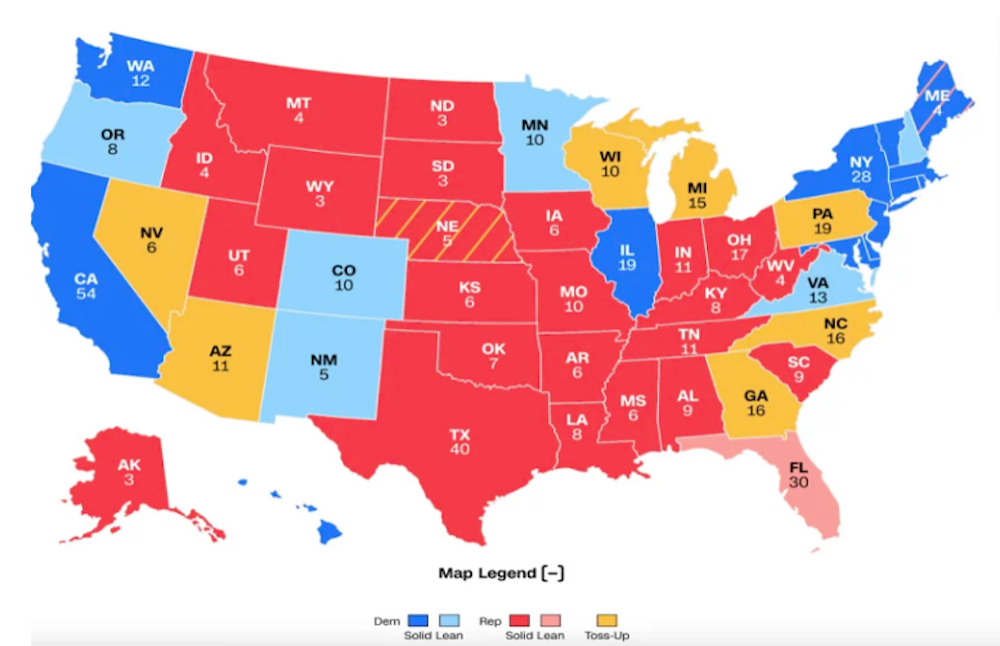
    According to recent analyses, around ten states are expected to be in play for 2024. Based on recent trends, there are seven swing states to watch: Nevada, Arizona, Wisconsin, Michigan, Pennsylvania, North Carolina, and Georgia. In the 2016 and 2020 elections, victory margins in these states were razor-thin, often less than 1%.

    With both Harris and Trump within striking distance of the 270 Electoral College votes needed to win the presidency, these swing states, with a combined 91 votes, will determine the outcome.

    Map published on 18 August 2024 by CNN. The number of electors for each state are show. The colors indicate the states that appear to be strongly (dark blue) or probably (light blue) leaning toward Kamala Harris, and strongly (red) or probably (pink) leaning toward Donald Trump. In yellow are the seven pivotal states where victory is likely to come down to a small number of votes. Click to zoom.

    The 2016 and 2020 polling failures: flukes or systemic issues?

    When the margins are so tight in these key states, accurately measuring voter intentions is an enormous challenge. In 2016, national polls correctly predicted Hillary Clinton’s popular-vote win – she had nearly 3 million more than Trump. However, they failed to foresee Trump’s Electorial College victories in critical states, which ultimately put him over the top.

    The American Association for Public Opinion Research (AAPOR) pointed out several reasons for these errors, including underrepresentation of Republican voters, over-representation of college-educated voters (who tend to lean Democratic), and an underestimation of undecided voters who eventually voted for Trump or third-party candidates.

    Despite efforts to fix these problems, other biases showed up in 2020. While graduate voters were not over-represented and undecideds were evenly split between Biden and Trump, the Covid-19 pandemic had made the pollsters’ task more complicated. AAPOR points out that the states with a higher proportion of Covid-19 cases were the ones with the highest polling errors. As a result, pollsters underestimated Trump’s vote share in key swing states and also overestimated Biden’s national lead, making the 2020 polls the least accurate in 40 years.

    Proportion of polling errors in presidential elections since 1936. Click to zoom.
    Pew Reseach Center

    Despite these errors, Biden still triumphed, winning 4 percent more of the popular vote and taking home 306 electoral votes to Trump’s 232. Biden’s victories in the swing states of Arizona, Georgia, Michigan, Nevada, Pennsylvania, and Wisconsin make all the difference.

    Polling errors and public distrust

    Errors of this magnitude naturally increase the public’s scepticism of polling, especially among Republicans, who are already wary of establishment institutions. Contrary to initial assumptions, Trump voters didn’t hesitate to express their preferences in 2016 and 2020. However, they were less likely to participate in polls due in part to their distrust of mainstream institutions. As a result, working-class white voters – and their opinions – were underrepresented in many polls.

    Pollsters also face technical challenges. Getting a respondent on the phone now requires calling hundreds of people, thanks to caller ID and call screening. Polls with smaller samples (fewer than 1,000 respondents) are less reliable. To deal with these hurdles, many pollsters are now using a mix of methods, including e-mail, online surveys, and robocalls.

    Though cheaper, online surveys often draw voluntary participants who are compensated, which leads to issues of accuracy and representation. This growing reliance on online polling has contributed to a doubling of polling companies from 2000 to 2022, according to Pew Research Center.

    Margin of error and identifying “likely” voters

    The margin of error is a critical component of polling that is often misunderstood by the public and media. It typically falls between 3 and 4 percentage points, but for smaller demographic groups (for example, young people, white men, or Hispanics), it can be even higher. Media headlines, however, frequently imply a candidate is leading, even when the difference is within the margin of error. University of California, Berkeley researchers suggest that to ensure 95% accuracy, the margin of error should be closer to 6%.

    However, the media sometimes amplify results, particularly in headlines, by implying that a candidate is ahead, even when the difference is within the margin of error. Moreover, researchers at the University of Berkeley have shown that to guarantee 95% accuracy, this margin should be increased to at least 6%. This means a candidate projected to receive 54% of the vote is likely, in reality, to secure anywhere between 48% and 60%, reflecting an actual margin of error of 12 percentage points.

    Another significant challenge for pollsters is identifying likely voters. Only around two-thirds of citizens eligible to vote actually go to the polls. In 2016, turnout on the Democratic side was overestimated, giving the false impression that Clinton was a lock for victory. This likely caused some of her supporters to stay home, while Trump’s base showed up in force when polls suggested he was behind. Accurately predicting who will turn out to vote is crucial to polling accuracy.

    Lessons from the 2022 midterms: A glimmer of hope for 2024?

    Polling showed notable improvements during the 2022 midterm elections, with the results being the most accurate since 1998. Importantly, there was no significant bias toward either party. However, midterm elections operate differently than presidential elections, and the dynamics for 2024 may be very different. That said, many polling institutions have adapted since 2016: as of 2022, 61% of polling firms had changed their methods, such as refining sampling techniques and improving question wording. More than a third have changed their methods after 2020.

    While these changes are positive, challenges remain, especially in predicting turnout and combating low response rates.

    What good are polls, then?

    At the end of the day, election polls offer snapshots – often imprecise – and can only provide general trends. Polling methods vary across firms, introducing biases that make it difficult to compare results.

    Survey aggregators offer averages that might be more reliable than individual polls, but they still come with a degree of uncertainty. This is true for FiveThirtyEight, the well-known website founded by statistics guru Nate Silver. After ABC took over in 2023, Silver left, taking his forecasting model with him to his new platform, Silver Bulletin, which continues to attract significant media attention.

    With the unpredictability of polls, political betting markets have become popular as polling alternatives. Platforms like Polymarket, which recently hired Silver, have multiplied rapidly. Some people, like Elon Musk, argue that markets provide better forecasts than traditional polls, though this claim is unproven. There are also concerns that these markets could be manipulated to sway public opinion.

    While opinion polls aren’t the best tools for predicting elections – as this could be one of the closest in recent history – their value lies in gauging public opinion on key issues. However, even in this role, polls can still be biased, often influenced by how questions are phrased.

    For example, in 2019 USA Today ran the headline “Poll: Half of Americans say Trump is victim of a ‘witch hunt’ as trust in Mueller erodes”. This was in reference to Special Counsel Robert Mueller’s investigation into Russian interference in the 2016 election. The question asked by the poll was:

    “President Trump has called the special counsel’s investigation a ‘witch hunt’ and said he has been investigated more than previous presidents for political reasons. Do you agree?”

    The problem with this wording is that it combined two different ideas: whether the investigation was a “witch hunt” and whether Trump had been unfairly targeted for political reasons. On top of that, the question lacked neutrality, presenting only his perspective.

    Naturally, Trump used the result to his advantage, even though other polls from sources such as The Washington Post, CBS News, and NPR-PBS told a different story.

    To use polling data wisely during this election, it’s crucial to recognize these limitations and pay attention to the fine print – details like the sample size, polling date, margin of error, and methodology. Additionally, consider the poll’s sponsors, who may only release results that align with their particular agenda.

    Ultimately, the best way to interpret polling data is with caution, focusing on general trends rather than any single poll. And always remember, election outcomes can be full of surprises.

    Jérôme Viala-Gaudefroy ne travaille pas, ne conseille pas, ne possède pas de parts, ne reçoit pas de fonds d’une organisation qui pourrait tirer profit de cet article, et n’a déclaré aucune autre affiliation que son organisme de recherche.

    ref. 2024 US presidential election: can we believe the polls? – https://theconversation.com/2024-us-presidential-election-can-we-believe-the-polls-240834

    MIL OSI – Global Reports

  • MIL-OSI USA: Journey to a Water World: NASA’s Europa Clipper Is Ready to Launch

    Source: NASA

    Find details about the launch sequences for the orbiter, which is targeting an Oct. 14 liftoff on its mission to search for ingredients of life at Jupiter’s moon Europa.
    In less than 24 hours, NASA’s Europa Clipper spacecraft is slated to launch from the agency’s Kennedy Space Center in Florida aboard a Falcon Heavy rocket. Its sights are set on Jupiter’s ice-encased moon Europa, which the spacecraft will fly by 49 times, coming as close as 16 miles (25 kilometers) from the surface as it searches for ingredients of life. 
    Launch is set for 12:06 p.m. EDT on Monday, Oct. 14, with additional opportunities through Nov 6. Each opportunity is instantaneous, meaning there is only one exact time per day when launch can occur. Plans to launch Europa Clipper on Oct. 10 were delayed due to impacts of Hurricane Milton.

    [embedded content]
    NASA’s Europa Clipper is the first mission dedicated to studying Jupiter’s icy moon Europa, one of the most promising places in our solar system to find an environment suitable for life outside of Earth.

    With its massive solar arrays extended, Europa Clipper could span a basketball court (100 feet, or 30.5 meters, tip to tip). In fact, it’s the largest spacecraft NASA has ever built for a planetary mission. The journey to Jupiter is a long one — 1.8 billion miles (2.9 billion kilometers) — and rather than taking a straight path there, Europa Clipper will loop around Mars and then Earth, gaining speed as it swings past.
    The spacecraft will begin orbiting Jupiter in April 2030, and in 2031 it will start making those 49 science-focused flybys of Europa while looping around the gas giant. The orbit is designed to maximize the science Europa Clipper can conduct and minimize exposure to Jupiter’s notoriously intense radiation.
    But, of course, before any of that can happen, the spacecraft has to leave Earth behind. The orbiter’s solar arrays are folded and stowed for launch. Testing is complete on the spacecraft’s various systems and its payload of nine science instruments and a gravity science investigation. Loaded with over 6,060 pounds (2,750 kilograms) of the propellant that will get Europa Clipper to Jupiter, the spacecraft has been encapsulated in the protective nose cone, or payload fairing, atop a SpaceX Falcon Heavy rocket, which is poised for takeoff from historic Launch Complex 39A.
    Launch Sequences
    The Falcon Heavy has two stages and two side boosters. After the side boosters separate, the core stage will be expended into the Atlantic Ocean. Then the second stage of the rocket, which will help Europa Clipper escape Earth’s gravity, will fire its engine.

    Once the rocket is out of Earth’s atmosphere, about 50 minutes after launch, the payload fairing will separate from its ride, split into two halves, and fall safely back to Earth, where it will be recovered and reused. The spacecraft will then separate from the upper stage about an hour after launch. Stable communication with the spacecraft is expected by about 19 minutes after separation from the rocket, but it could take somewhat longer.
    About three hours after launch, Europa Clipper will deploy its pair of massive solar arrays, one at a time, and direct them at the Sun.
    Mission controllers will then begin to reconfigure the spacecraft into its planned operating mode. The ensuing three months of initial checkout include a commissioning phase to confirm that all hardware and software is operating as expected.
    While Europa Clipper is not a life-detection mission, it will tell us whether Europa is a promising place to pursue an answer to the fundamental question about our solar system and beyond: Are we alone?
    Scientists suspect that the ingredients for life — water, chemistry, and energy — could exist at the moon Europa right now. Previous missions have found strong evidence of an ocean beneath the moon’s thick icy crust, potentially with twice as much liquid water as all of Earth’s oceans combined. Europa may be home to organic compounds, which are essential chemical building blocks for life. Europa Clipper will help scientists confirm whether organics are there, and also help them look for evidence of energy sources under the moon’s surface.

    More About Europa Clipper
    Europa Clipper’s three main science objectives are to determine the thickness of the moon’s icy shell and its interactions with the ocean below, to investigate its composition, and to characterize its geology. The mission’s detailed exploration of Europa will help scientists better understand the astrobiological potential for habitable worlds beyond our planet.
    Managed by Caltech in Pasadena, California, NASA’s Jet Propulsion Laboratory leads the development of the Europa Clipper mission in partnership with the Johns Hopkins Applied Physics Laboratory (APL) for NASA’s Science Mission Directorate in Washington. APL designed the main spacecraft body in collaboration with JPL and NASA’s Goddard Space Flight Center in Greenbelt, Maryland; NASA’s Marshall Space Flight Center in Huntsville, Alabama; and NASA’s Langley Research Center in Hampton, Virginia. The Planetary Missions Program Office at Marshall executes program management of the Europa Clipper mission.
    NASA’s Launch Services Program, based at Kennedy, manages the launch service for the Europa Clipper spacecraft, which will launch on a SpaceX Falcon Heavy rocket from Launch Complex 39A at Kennedy.
    Find more information about Europa here:
    europa.nasa.gov

    News Media Contacts
    Meira Bernstein / Karen FoxNASA Headquarters, Washington202-358-1600meira.b.bernstein@nasa.gov / karen.c.fox@nasa.gov
    Gretchen McCartneyJet Propulsion Laboratory, Pasadena, Calif.818-287-4115gretchen.p.mccartney@jpl.nasa.gov 
    2024-139

    MIL OSI USA News

  • MIL-OSI USA: FEMA Assistance Tops $50 Million for Illinoisans Affected by Mid-July Severe Storms

    Source: US Federal Emergency Management Agency

    Headline: FEMA Assistance Tops $50 Million for Illinoisans Affected by Mid-July Severe Storms

    FEMA Assistance Tops $50 Million for Illinoisans Affected by Mid-July Severe Storms

    SPRINGFIELD – Just under a month since President Joe Biden declared a major disaster for the state of Illinois, FEMA assistance for households affected by the July 13 -16 severe storms, tornadoes, straight-line winds and flooding tops $50.6 million. These grants help pay for uninsured and underinsured losses and storm-related damage, including:

    • More than $24 million in housing grants to help pay for home repair, home replacement and rental assistance for temporary housing.
    • More than $26.5 million in Other Needs Assistance grants to help pay for personal property replacement and other serious storm-related needs—such as moving and storage fees, transportation, childcare, and medical and dental expenses.

    More than $1.6 million in long-term, low-interest disaster loans has been approved by the U.S. Small Business Administration for homeowners and renters to help repair, rebuild or replace disaster-damaged physical property and to cover economic injury for businesses of all sizes and non-profit organizations.

    Homeowners and renters with July 13 – 16 storm damage to their home or personal property in the seven designated counties including, Cook, Fulton, Henry, St. Clair, Washington, Will and Winnebago, have until the November 19 deadline to apply for disaster assistance from FEMA and U.S. Small Business Administration.

    Apply for FEMA assistance several ways:

    • Go online to DisasterAssistance.gov. 
    • Use the FEMA mobile app. 
    • In-person at a Disaster Recovery Center. Find a center nearest you, http://www.FEMA.gov/DRC.
    • Call the FEMA helpline at 800-621-3362. Multilingual operators are available. If you use video relay service, captioned telephone service or others, give FEMA your number for that service.

    Learn more about SBA disaster assistance at http://www.sba.gov/funding-programs/disaster-assistance. Visit http://www.fema.gov/disaster/4819 for more information about the disaster recovery in Illinois.  

    kimberly.keblish

    MIL OSI USA News

  • MIL-Evening Report: Election anniversary: a year into 3-party coalition government, can the centre hold?

    Source: The Conversation (Au and NZ) – By Richard Shaw, Professor of Politics, Te Kunenga ki Pūrehuroa – Massey University

    Getty Images

    Nearly a year on from its formation, it’s clear a three-party coalition is not quite the same as the two-party versions New Zealand is accustomed to.

    Normally, the primary dynamic has been clear: the major party sets the pace while the smaller governing partner receives a bauble or two for supporting the lead act. There may be occasional concerns about tails wagging dogs, but the dog is clearly in charge.

    With the present National-ACT-NZ First coalition, however, things are more complex and less predictable. The dog has two tails, both of which are more than capable of vigorous wagging.

    On the anniversary of the 2023 election, which produced the first three-party coalition government since the MMP system was adopted in 1996, we are perhaps beginning to get a picture of where dog ends and tails begin.

    Speed wobbles

    If that picture has been a little blurry until now it’s partly because of the speed with which the government has moved – not always to its own advantage.

    In the process of ticking off the 49 items on its plan for the first 100 days, Prime Minister Christopher Luxon’s administration has kept some election promises but broken or fudged others, having to backtrack as a result.

    It has delivered tax cuts, but been forced to trim and cap spending in areas (like health and infrastructure) crying out for extra investment.

    It has given the impression of urgency and action with its Fast-track Approvals Bill. But it had to scrap the policy’s core element of granting three ministers unprecedented constitutional authority over which projects to fast-track.

    Concerns about executive overreach and potential conflicts of interest have dogged other policy areas, too. These range from the repeal of ground-breaking smoke-free legislation to firearms control – both the responsibility of junior coalition party ministers.

    This sense of a government somewhat at odds with itself extends to the swingeing cuts made to the public service workforce. Marketed as freeing up resources for front-line staff, the cuts are increasingly likely to be affecting actual service delivery in health, police, defence and elsewhere.

    Executive overreach? A protest march in Auckland against the government’s fast-track consenting legislation.
    Getty Images

    An ‘executive paradise’

    Some of this can be put down to a new government’s distrust of a public service inherited from its predecessor, and a desire to make the most of its first year before the shadow election campaign kicks off mid-term.

    But the coalition’s vigorous embrace of the executive authority baked into New Zealand’s constitutional arrangements has still been something to behold. As constitutional lawyer and former prime minister Geoffrey Palmer put it, the fast-track legislation risked turning New Zealand into “an executive paradise, not a democratic paradise”.

    The government has used parliamentary urgency more frequently than any other contemporary administration. It has been rattling legislation through the House faster than the wheels of parliamentary democracy are meant to turn.

    Submitters on the Māori wards legislation, for example, were given just three working days to prepare their arguments. Those wanting to comment on the Crown Minerals Amendment Bill had four days.

    And the government has been making less use of parliament’s expert select committees than is standard practice. This has limited public participation and constrained scrutiny of proposed legislation.

    Ministers have also been prepared to ignore public service advice while paying plenty of attention to operational matters in the departments that furnish that advice.

    New Zealand’s system of public management distinguishes between ministers’ responsibility for policy outcomes and senior officials’ responsibility for the operational decisions required to deliver those outcomes.

    Nonetheless, Cabinet has commandeered oversight of operational matters in Whaikaha/Ministry of Disabled People, following botched communications over changes in disability funding. And civil servants have recently been told to stop working from home and return to the office.

    The government will be betting this tactical disposition bolsters its “getting stuff done” narrative. But no one wants a concern with short-term operational details to come at the expense of long-term policy thinking.

    Treaty principles pantomime

    Nowhere is the coalition’s internal tension more evident, however, than in its confrontational approach to Māori and te Tiriti o Waitangi/Treaty of Waitangi issues.

    Having courted voters already sceptical or disgruntled about Māori cultural assertiveness, the coalition moved fast to disestablish Te Aka Whai Ora/Māori Health Authority, repeal legislation supporting Māori wards in local government, row back on official use of te reo Māori, and cut funding for Māori language revitalisation.

    But its proposed Treaty Principles Bill – an ACT Party initiative – looks set to be especially constitutionally fraught and politically divisive.

    National and NZ First have indicated they will not support the bill beyond its first reading, but have agreed it will receive a full six months in front of a select committee.

    This only raises the question of why any parliamentary time and money should be spent on the proposal at all – especially given the government’s supposed “laser focus” on cost and efficiency elsewhere.

    Can the centre hold?

    The politics around the Treaty Principles Bill also reveal just how much the prime minister has had to cede to ACT, for whom the proposed legislation was a bottom line during the government formation process.

    And it inevitably casts doubt on the extent and exercise of prime ministerial authority under three-way governing arrangements. ACT leader and soon-to-be deputy prime minister David Seymour has questioned Christopher Luxon’s authority more than once.

    And Luxon’s apparent unwillingness to at least censure an under-performing minister from another party (NZ First’s Casey Costello, for example) contrasts starkly with his firmer treatment of those in his own National Party (Melissa Lee and Penny Simmons, both demoted).

    One year into a three-year term, these issues can perhaps be dismissed as part of the process of bedding down a new government. But politics never rests. Winston Peters hands the deputy prime minister role to David Seymour at the end of next May. Both NZ First and ACT will want to distinguish themselves from National.

    As the next election nears and the jockeying for attention begins, the prime minister’s authority over his administration, and the coalition’s coherence, will be tested further.

    Richard Shaw does not work for, consult, own shares in or receive funding from any company or organisation that would benefit from this article, and has disclosed no relevant affiliations beyond their academic appointment.

    ref. Election anniversary: a year into 3-party coalition government, can the centre hold? – https://theconversation.com/election-anniversary-a-year-into-3-party-coalition-government-can-the-centre-hold-240189

    MIL OSI AnalysisEveningReport.nz

  • MIL-Evening Report: The science of happier dogs: 5 tips to help your canine friends live their best life

    Source: The Conversation (Au and NZ) – By Mia Cobb, Research Fellow, Animal Welfare Science Centre, The University of Melbourne

    Bigzumi/Shutterstock

    When you hear about “science focused on how dogs can live their best lives with us” it sounds like an imaginary job made up by a child. However, the field of animal welfare science is real and influential.

    As our most popular animal companion and coworker, dogs are very deserving of scientific attention. In recent years we’ve learned more about how dogs are similar to people, but also how they are distinctly themselves.

    We often think about how dogs help us – as companions, working as detectors, and keeping us safe and healthy. Dog-centric science helps us think about the world from a four-paw perspective and apply this new knowledge so dogs can enjoy a good life.

    Here are five tips to keep the tails in your life wagging happily.

    1. Let dogs sniff

    Sniffing makes dogs happier. We tend to forget they live in a smell-based world because we’re so visual. Often taking the dog for a walk is our daily physical activity but we should remember it could be our dogs’ only time out of the home environment.

    Letting them have a really good sniff of that tree or post is full of satisfying information for them. It’s their nose’s equivalent of us standing at the top of a mountain and enjoying a rich, colour-soaked, sunset view.

    Dogs live in a world of smells, so it’s important to let them sniff until their heart’s content.
    Pawtraits/Shutterstock

    2. Give dogs agency

    Agency is a hot topic in animal welfare science right now. For people who lived through the frustration of strict lockdowns in the early years of COVID, it’s easy to remember how not being able to go where we wanted, or see who we wanted, when we wanted, impacted our mental health.

    We’ve now learned that giving animals choice and control in their lives is important for their mental wellbeing too. We can help our dogs enjoy better welfare by creating more choices and offering them control to exercise their agency.

    This might be installing a doggy door so they can go outside or inside when they like. It could be letting them decide which sniffy path to take through your local park. Perhaps it’s choosing which three toys to play with that day from a larger collection that gets rotated around. Maybe it’s putting an old blanket down in a new location where you’ve noticed the sun hits the floor for them to relax on.

    Providing choices doesn’t have to be complicated or expensive.

    3. Recognise all dogs are individuals

    People commonly ascribe certain personality traits to certain dog breeds. But just like us, dogs have their own personalities and preferences. Not all dogs are going to like the same things and a new dog we live with may be completely different to the last one.

    One dog might like to go to the dog park and run around with other dogs at high speed for an hour, while another dog would much rather hang out with you chewing on something in the garden.

    We can see as much behavioural variation within breeds as we do between them. Being prepared to meet dogs where they are, as individuals, is important to their welfare.

    As well as noticing what dogs like to do as individuals, it’s important not to force dogs into situations they don’t enjoy. Pay attention to behaviour that indicates dogs aren’t comfortable, such as looking away, licking their lips or yawning.

    Just like humans, different dogs have different personalities.
    Daria Shvetcova/Shutterstock

    4. Respect dogs’ choice to opt out

    Even in our homes, we can provide options if our dogs don’t want to share in every activity with us. Having a quiet place that dogs can retreat to is really important in enabling them to opt out if they want to.

    If you’re watching television loudly, it may be too much for their sensitive ears. Ensure a door is open to another room so they can retreat. Some dogs might feel overwhelmed when visitors come over; giving them somewhere safe and quiet to go rather than forcing an interaction will help them cope.

    Dogs can be terrific role models for children when teaching empathy. We can demonstrate consent by letting dogs approach us for pats and depart when they want. Like seeing exotic animals perform in circuses, dressing up dogs for our own entertainment seems to have had its day. If you asked most dogs, they don’t want to wear costumes or be part of your Halloween adventures.

    5. Opportunities for off-lead activity – safely.

    When dogs are allowed to run off-lead, they use space differently. They tend to explore more widely and go faster than they do when walking with us on-lead. This offers them important and fun physical activity to keep them fit and healthy.

    Demonstrating how dogs walk differently when on- and off-lead.

    A recent exploration of how liveable cities are for dogs mapped all the designated areas for dogs to run off-leash. Doggy density ranged from one dog for every six people to one dog for every 30 people, depending on where you live.

    It also considered how access to these areas related to the annual registration fees for dogs in each government area compared, with surprising differences noted across greater Melbourne. We noted fees varied between A$37 and $84, and these didn’t relate to how many off-lead areas you could access.

    For dog-loving nations, such as Australia, helping our canine friends live their best life feels good. Science that comes from a four-paw perspective can help us reconsider our everyday interactions with dogs and influence positive changes so we can live well, together.

    Mia Cobb does not work for, consult, own shares in or receive funding from any company or organisation that would benefit from this article, and has disclosed no relevant affiliations beyond their academic appointment.

    ref. The science of happier dogs: 5 tips to help your canine friends live their best life – https://theconversation.com/the-science-of-happier-dogs-5-tips-to-help-your-canine-friends-live-their-best-life-236952

    MIL OSI AnalysisEveningReport.nz

  • MIL-Evening Report: How to look after your mental health right now if you have family in the Middle East or another conflict zone

    Source: The Conversation (Au and NZ) – By Nicholas Procter, Professor and Chair: Mental Health Nursing, University of South Australia

    Escalating violence in the Middle East, particularly in Lebanon in recent weeks, has brought news of death, casualties and displacement.

    In response, the Australian government has organised evacuation flights for Australian citizens and is urging all Australians in Lebanon to take the earliest available flights due to the unpredictable nature of the conflict.

    For the more than 248,000 Australians with Lebanese ancestry, and others, this has been a deeply distressing time.

    Escalating violence in Lebanon has also resonated deeply with other diasporas in Australia, such as those from Palestine and Ukraine. These scattered communities share similar experiences of conflict and displacement.

    So how do Australians with links to Lebanon, Gaza or other conflict zones look after their mental health at this time? And how can you support others who may be struggling?

    Identifying with pain and suffering

    People with emotional ties to conflict zones overseas identify with the pain and suffering they see and hear. Australians with shared cultural heritage may be living in the shadow of homeland events and experiencing what research has calledpush-pull” dynamics.

    This may be experiencing periods of calm and ease mixed with intermittent periods of intense fear, uncertainty and emotional pain as upsetting events unfold.

    For some, sleeplessness, irritability, fear, frustration, uncertainty and emotional exhaustion combine. People are no longer isolated from their country of origin. Rather, global events influence their personal and social life, and mental health.

    The way people manage the interplay between homeland events, sense of powerlessness, and mental health in Australia are complex. It is easy to be rapidly consumed by what is happening. Events are graphic, compelling and fast moving.

    How to look after yourself

    So what can you do if you notice yourself or someone close to you is becoming impacted?

    Know your distress triggers. For some, this might be witnessing violence on television news or social media. For others, this might be stories about children and young people who have been killed. Seeing and hearing images and stories can be distressing if they are repeated across multiple platforms. Some people may need to minimise their media exposure.

    Talk to people you trust about how you are feeling. Describe what is happening and what you notice about yourself. If you are feeling fragile or concerned about your mental health, or the mental health of a loved one, seek support from your health-care provider.

    Reconnect with and strengthen personal support networks. Supportive cultural connections and family members, and other supports including friends and colleagues, can protect against the onset or worsening of mental distress.

    Getting help early can create more options for support. It can also make it easier to accept help in the future.

    Refer to trusted sources of information and calibrate media exposure. While many people need to know about events, news stories and imagery are distressing.

    Incorporate activities that comfort and distract you, and make your situation feel safer. This can include:

    • spending time with family members or friends

    • spiritual, faith or religious reconnecting

    • distraction through music or food.

    Avoid taking devices to bed to protect your sleep and your mental health.

    How to support others

    If you work with or support someone who is impacted, recognise this is a time for sensitivity and compassion. Show you are concerned and, at the same time, check they’re OK. Ask:

    What would be most helpful in our support for you?

    What is the best way for me/the team at work to be supportive and alongside you?

    It is also important to ask about someone’s mental health. You can ask:

    With events unfolding, how are things at home for you right now?

    When validating a person’s experience, remember it is not always important to know personal detail or circumstances in fine detail. What is important is to demonstrate genuine interest, create trust and psychological safety. Aim to really listen, rather than listening so you can respond.

    As a friend, colleague or manager, offering support and listening without judgement may help a person impacted by global catastrophic events.

    In times like these, validation, human connection and support are some of the best things you can do to protect your own and other people’s mental health.

    Sometimes it can be hard to find the words. Here’s what we know helps.

    If this article has raised issues for you, or if you’re concerned about someone you know, call Lifeline on 13 11 14.

    Nicholas Procter currently receives funding from Overseas Services to Survivors of Torture and Trauma, Foundation House and SA Health. He has previously received sitting fees from the Department of Home Affairs.

    Mary Anne Kenny has previous received funding from the Australian Research Council and sitting fees from the Department of Home Affairs.

    ref. How to look after your mental health right now if you have family in the Middle East or another conflict zone – https://theconversation.com/how-to-look-after-your-mental-health-right-now-if-you-have-family-in-the-middle-east-or-another-conflict-zone-240995

    MIL OSI AnalysisEveningReport.nz

  • MIL-OSI New Zealand: Health – Waikanae closure another symptom of funding debacle, urgent cure needed

    Source: GenPro

    The closure of a satellite medical practice at Waikanae Beach is the latest symptom of a growing crisis in primary healthcare caused by years of inadequate funding.

    “Waikanae Beach patients, many of whom are elderly and high needs, will now have to travel much further to access medical help at Waikanae Health. This puts more even pressure on this health provider,” said Angus Chambers, Chair of the General Practice Owners Association of New Zealand Aotearoa (GenPro).

    “In addition to closing its satellite practice, Waikanae Health also says it has stopped taking on new patients, withdrawn from delivering care at four rest homes, and quit almost all out-of-hours and home consultations. All would have been difficult decisions for the owners of the practice.

    “The biggest concern is the impact on patients. But it’s also sad that this, and other closures and reductions in services, elicit no response from the government or Te Whatu Ora, which seem resigned to the gradual erosion of primary healthcare”.

    “The state is disinterested in these closures and appears to expect general practice care to be replaced by pharmacies and telehealth, as they are cheaper options. Government is either unconcerned or ignorant to the fact that outcomes will suffer and cost more in the long term,” Dr Chambers said.

    General practices are in crisis due to years of under-funding by government and are constrained by out-of-date rules which limit patient charges. They’re also struggling with higher costs, greater patient need, and shortages of medical professionals.

    The pressures facing general practices are well documented. Barely a month goes by without a general practice closing, ceasing patient enrolments, or reducing services such as after-hours care.
     
    “Waikanae’s issues are also reflective of the national trend for hospitals to push more and more patients back to GPs, and the impact of changes in eligibility for Community Services Cards that disadvantaged some practices with a high proportion of card holders with high health needs, such as Waikanae.
     
    “The result of this cocktail of problems is that practices are struggling to stay afloat and retain and recruit GPs, meaning long days and staff burn out. Early retirement, reduction in services and, as we regrettably see again today, practice closures are logical consequences. “
     
    “The government must as a matter of urgency increase its support of primary healthcare, overhaul the current out-of-date funding model, and help increase the supply of medical professionals into primary healthcare,” said Dr Chambers.

    GenPro, which represents about half of all general practices in Aotearoa, is ready to work with the Minister of Health and the Health NZ Commissioner to develop the solutions needed.

    MIL OSI New Zealand News

  • MIL-OSI New Zealand: Work to strengthen Auckland’s planning rules amps up

    Source: Auckland Council

    Over the next few months, Auckland Council will take the first steps to engage and consult Aucklanders on work to strengthen how the Auckland Unitary Plan addresses natural hazards, including flooding, erosion and landslides.  

    Councillor Richard Hills, Chair of the Policy and Planning Committee, explains how a process known as deliberative democracy will be used to consult with a representative sample of Aucklanders.  

    “The deliberative democracy process allows us to gain insights from Aucklanders on what can be quite a complicated subject. We’re early in the engagement and consultation process for the plan change, but doing this work means we’re able to capture the views of Aucklanders as it shapes up. As a result, our communities’ views are considered at different stages, rather than just through the Resource Management Act submissions process.  

    “It’s also one of the steps we can take to get feedback from Aucklanders while we wait for changes that the government is making to legislation, so we can change the Auckland Unitary Plan to better deal with natural hazards. Even though we’ve heard loud and clear our communities want urgent action since our devastating floods and storms in 2023, we cannot move forward on this until the government changes the law to allow us to do so.” 

    What is deliberative democracy? 

    Deliberative democracy allows a diverse group of people to learn about a topic in detail, before coming to a collective decision to answer a question. Aucklanders will take part in this process, and will represent the demographics, needs and interests of those living in the region. 

    Participants are randomly selected beforehand, so they represent the wide-ranging views of Aucklanders. The process is often used to gain views on complex topics. It allows participants to have fair and reasonable discussions, share their views, hear the views of others and deliberate before coming to a collective view at the end of the process. 

    These views are then collated with others gained from across Auckland’s communities to give direction on the next stages of the plan change.  

    What is being asked?  

    Phill Reid, Manager Aucklandwide Planning, explains that participants will get an overview of why the work to strengthen the Unitary Plan is needed and what it could entail, saying that they will also discuss changing the Auckland Unitary Plan to better address the risks that natural hazards pose. 

    “While the Unitary Plan can’t stop natural hazards from happening, there are rules and regulations we can add or change to strengthen it against the risks from those hazards. Before we can do this work, we need to understand the level of risk that Aucklanders feel is tolerable or intolerable – this will influence any new rules or restrictions that are brought in and this is what participants will be asked to come to a consensus on.

    “For example, should new homes be able to be built in areas subject to flooding at all? If the group decides they should, then we need to look at what changes we can make to planning rules that don’t negatively impact those living there, their neighbours and their properties.

    “We know Aucklanders would like the Unitary Plan to address natural hazards – and we were given this direction by the council’s Planning, Environment and Parks Committee in mid-2023. The insight we get from this type of engagement will help shape up the next steps.”  

    Would you like take part in future deliberative democracy processes?  

    Deliberative democracy is a form of engagement Auckland Council uses on different topics ahead of a full consultation or submissions process. If you’d be interested in taking part in this kind of process, you can let us know here.   

    MIL OSI New Zealand News

  • MIL-OSI Australia: Electronic monitoring to increase protection for victim-survivors of domestic and family violence

    Source: New South Wales Premiere

    Published: 11 October 2024

    Released by: Deputy Premier, Attorney General, Minister for Corrections, Minister for the Prevention of Domestic Violence and Sexual Assault


    The Minns Labor Government is continuing work to create a safer New South Wales and increase protections for victim-survivors of domestic and family violence, with the commencement of electronic monitoring for alleged serious domestic violence offenders released on bail.

    Earlier this year, the Government significantly tightened bail laws for people charged with serious domestic violence offences, forcing them to ‘show cause’ why they shouldn’t be detained. This change has made it harder than ever for alleged serious domestic violence offenders to get bail.

    From today, any alleged serious domestic violence offender who is granted bail will be electronically monitored around the clock using GPS technology.

    The new program allows Corrective Services NSW (CSNSW) to track alleged offenders against geographic bail conditions.

    These exclusion zones may include residential addresses, school and work locations, or suburbs or areas within a city for people in need of protection.

    If an alleged offender enters a restricted zone, CSNSW’s electronic monitoring officers are immediately notified.

    Corrections officers will contact NSW Police to advise that a potential breach of bail conditions has occurred and NSW Police can then respond.

    This builds on the around-the-clock monitoring of certain offenders already conducted by Corrective Services NSW, including the monitoring of high-risk domestic violence perpetrators on parole orders or Intensive Correction Orders.

    These tough new laws are one part of the NSW Government’s work to strengthen protections for victim-survivors of domestic, family and sexual violence.

    The Government has also introduced legislation to create Serious Domestic Abuse Prevention Orders. These new orders will allow the court to impose any conditions considered appropriate to prevent a person’s involvement in domestic abuse.

    In addition, this legislation would create new offences covering repeated and intentional breaches of Apprehended Domestic Violence Orders.

    Under earlier Minns Labor Government justice system reforms:

    • The categories of offences for which bail decisions can be ‘stayed’ were expanded, with the accused remaining in custody while prosecutors challenge the decision to grant bail.
    • For all domestic violence bail decisions, judges and magistrates must now consider, where relevant, domestic abuse risk factors and the views of victims and their family members.
    • All bail decisions will be made by judges and magistrates.

    The NSW Government delivered a $246 million package in the NSW Budget to address domestic, family and sexual violence through crisis response measures, early intervention, primary prevention, and justice system responses.

    If you or someone you know is affected by domestic, family or sexual violence, please call the toll-free number 24 hours a day, 7 days a week for support on 1800RESPECT (1800 737 732) or visit 1800respect.org.au

    Deputy Premier Prue Car said:

    “The NSW Government is committed to curbing the unacceptable rate of domestic, family and sexual violence within our community, and monitoring alleged offenders is key to that.

    “It’s harder now for alleged domestic violence offenders to get bail, but if they do, these new monitoring devices ensure Corrective Services will be able to keep an eye on their movements.”

    Attorney General Michael Daley said:

    “Earlier this year the NSW Government toughened bail laws that raised the threshold and added additional factors to be considered before bail could be granted for alleged serious domestic violence offenders, placing the onus on them to show the court why their detention isn’t justified.

    “We’ve seen an increasing number of alleged serious domestic violence offenders on remand, signalling these bail reforms are indeed working.

    “Domestic violence is an abhorrent crime and one that the NSW Government will not tolerate.”

    Minister for Corrections Anoulack Chanthivong said:

    “Women, children, and others in danger deserve to live their lives in safety, free from the threat of domestic violence.

    “Corrective Services NSW has the specialist knowledge and robust systems in place to help successfully expand existing electronic monitoring of offenders on parole or subject to community corrections orders to those on bail.

    “This intense monitoring shows alleged domestic violence offenders how serious the government is about preventing domestic violence on all fronts.”

    Minister for the Prevention of Domestic Violence and Sexual Assault Jodie Harrison said:

    “Electronic monitoring of people accused of serious domestic violence while they are out on bail prioritises victim-survivors’ safety and ensures alleged perpetrators abide by their bail conditions.

    “This is one part of a coordinated, multi-pronged response to addressing domestic and family violence in our state that includes earlier intervention and primary prevention.

    “The NSW Government is also working with the sector and victim-survivors as we continue to provide holistic, trauma-informed, wraparound support for victim-survivors who are escaping violence.”

    Acting Commissioner Corrective Services NSW Leon Taylor said:

    “The expansion of our existing electronic monitoring system allows us to track serious alleged domestic violence offenders.

    “In the case of a suspected breach our Corrective Services officers will immediately notify police so they can take action. 

    “If we hold concerns for a person in need of protection, the Corrections team will be able to pick up the phone and alert them to a potential bail breach in real time, allowing them to enact their safety plan.”

    Women’s Safety Commissioner Dr Hannah Tonkin said:

    “Domestic and family violence disproportionately affects women, so it’s vital for the NSW Government to continue implementing reforms like this to better protect at-risk women across the community.

    “These changes will give victim-survivors of domestic and family violence greater peace of mind and support their safety planning while the matter is dealt with in the courts.”

    MIL OSI News

  • MIL-OSI Australia: New leading cyber & digital forensics training facility for NSW jobs precinct

    Source: New South Wales Premiere

    Published: 11 October 2024

    Released by: Minister for Regional NSW


    A major state-of-the art cyber and digital forensics training facility will soon call South Jerrabomberra home following the Minns Labor Government’s $23 million investment in enabling infrastructure within the South Jerrabomberra Regional Jobs Precinct in southern NSW.

    CBIT Digital Forensics Services (CDFS), an Australian supplier of digital forensic tools, industry training and certification, has chosen the precinct to establish its first tactical training facility.

    Digital forensics focuses on identifying, acquiring, processing, analysing, and reporting on data stored electronically.

    CDFS anticipates it will almost double its workforce from nine to 18 over the next few years and plans to invest $11.7 million in a new building on the site, creating additional jobs for local construction and building workers.

    The construction of the NANGU Cyber Forensics Facility is expected to be completed by March 2025 and aiming to have the facility ready for training and operations for the second semester.

    The company has provided hi-tech services to organisations including law enforcement and government department to help deal with digital forensic and investigative issues including electronic evidence handling.

    CDFS joins a growing number of investors setting up in the South Jerrabomberra Regional Jobs Precinct. Further blocks within the precinct will become available for investors in early 2025.

    The precinct is supported by a $23 million contribution by the NSW Government for essential infrastructure including roads, footpaths, upgraded electricity, natural gas, water, and access to NBN Enterprise Ethernet services.

    Strategically located on Canberra’s doorstep, the precinct’s infrastructure and proximity to universities, world-class research and development facilities and a skilled workforce makes it a highly attractive opportunity for investors.

    With the wider region already home to more than 90 companies specialising in technology, cybersecurity and defence, the precinct development will help nurture high-tech careers in engineering, programming and science, specialising in cyber, space, AI, and defence.

    The site’s proximity to government agencies and the nation’s decision-makers, an international airport and major road networks puts new and emerging businesses in a prime position to thrive.

    To activate this investment-ready precinct in regional NSW, the NSW Government is working closely with the Queanbeyan-Palerang Regional Council, the ACT Government and federal agencies.

    CDFS was supported by $3 million in Australian Government funding to establish the NANGU Cyber Forensics Facility.

    Minister for Regional NSW Tara Moriarty said:

    “It is important that we empower regional people and communities to prosper through a boost in skills, wages and opportunities. Through Regional Job Precincts like South Jerrabomberra, the NSW Government is providing this opportunity.

    “This precinct gives investors access to a highly skilled and educated local workforce. It aims to build a sustainable business hub offering fast-tracked planning approvals.

    “This investor-ready precinct has the advantage of proximity to key decision-makers in Canberra, and I am really proud that the NSW Government is giving businesses this opportunity to establish and grow in regional NSW.”

    Member for Monaro, Steve Whan said

    With the rapid growth of areas like Jerrabomberra, Tralee, and Googong, precincts like this are ensuring we can keep highly qualified and skilled workers in their local area, and not lose their talents to the ACT or other major cities.

    “The investment in modern and specialised industries like cyber security, space, AI, and research is creating a sustainable and competitive workforce for regional NSW which will attract new people to our area.

    “I look forward to touring the precinct and learning about the work being done there.”

    CDFS CEO Zoran Iliev said:

    “The Ngunnawal people, the Traditional Owners of the lands where the NANGU Cyber Forensics Facility will stand, have recognised that these lands have always been places of teaching and learning. We deeply respect their traditions and are grateful to have NANGU in this beautiful area with a unique position near Queanbeyan, the Canberra airport, and our nation’s capital.

    Our facility, the NANGU Cyber Forensics Facility, will not only be a hub for technology and science but also a preserver of traditions. The forensic scientists trained here will not only be guardians of the truth but also guardians of the rich traditions of the Ngunnawal people.

    “As an independent RTO, we are proud to bring this training facility to South Jerrabomberra and offer young Australians a unique chance to get the qualifications to help them get not just a job but a career to be proud of.

    “The CDFS team and I are very proud and grateful for the opportunity to help this region by providing top-notch Cyber Forensics training and creating the much-needed new workforce in Cyber.”

    MIL OSI News

  • MIL-OSI Australia: Wheely easy access coming to Illawarra Train Stations as E-Scooter trial extension is confirmed

    Source: New South Wales Premiere

    Published: 11 October 2024

    Released by: Minister for the Illawarra and the South Coast, Minister for Planning and Public Spaces, Minister for Transport


    The NSW Government is investing $10 million to make it safer and easier to walk and ride to 11 Illawarra stations.

    The planned initiatives will include things like footpath upgrades, better lighting, new bicycle storage around stations for people who choose to walk or cycle to and from their homes and to other modes of transport.

    More than $3 million of the investment will be used to build a two-way shared cycleway at Corrimal, which would stretch nearly one kilometre along Murray Road between Corrimal Station and Cawley Street. Corrimal will also see a new pedestrian refuge installed and additional bicycle racks outside the station.

    Other stations to benefit from proposed upgrades include:

    • Helensburgh will see existing bicycle storage upgraded and bicycle racks replaced, a footpath upgrade and new lighting. Footpaths will also be improved between the station and nearby bus stop, with a new refuge crossing installed across Lawrence Hargrave Drive between school and railway station.
    • Stanwell Park will see new lighting and CCTV installed and footpaths upgraded.
    • Scarborough will see including a new pedestrian refuge across Lawrence Hargrave Drive between the station and nearby school, improved footpath access between the station and bus stop and improvements to station stairs.
    • Coledale will see stairs replaced with a ramp.
    • Austinmer will see two pedestrian refuge crossings installed across nearby streets and a new sheltered bicycle storage space at both station entrances.
    • Thirroul will see existing bicycle storage upgraded and bicycle racks replaced, a footpath upgrade and new lighting. The nearby bus stop will be improved so vehicles can overtake waiting buses.
    • Bulli will see new sheltered bicycle storage installed, existing bicycle racks upgraded and more lighting.
    • North Wollongong will see a new secure bicycle shed with CCTV installed.
    • Coniston will see sheltered bicycle storage installed, new lighting and upgraded footpaths. Design work is also underway to make Coniston fully accessible.
    • Dapto will see new sheltered bicycle stalling installed.

    Twenty-eight projects have been identified and prioritised following extensive consultation with the community and other stakeholders.

    Further consultation will take place with the community as the projects progress, with all of them expected to be completed between early next year and the first half of 2026.

    The Transport Integration and Placemaking projects are being delivered through Transport for NSW’s Rail Service Improvement Program, in partnership with Wollongong City Council and Sydney Trains.

    This announcement comes as Transport for NSW has approved an extension of Wollongong City Council’s shared e-scooter trial until 30 June 2025.

    In the first 12 months of the trial with operator Neuron Mobility, 165,000 e-scooter trips were taken in the Wollongong local government area – with riders collectively clocking up over 316,000 kilometres, enough to ride around Australia over 20 times.

    In addition to extending its trial, the council is also exploring options to expand the trial footprint, to support more people riding shared e-scooters to reach their destinations.

    Quotes attributable to Transport Minister Jo Haylen MP:

    “This is an exciting and incredibly important investment for the people of Wollongong.

    “Given there are 25 train stations in the Wollongong Local Government area, there is a growing need to ensure pedestrians and cyclists can connect to these public transport hubs as safely and easily as possible.

    “Sheltered bicycle storage, new refuge crossings and street lighting with CCTV are just some of the many projects we will be rolling out to support the community.

    “We know people in the Illawarra love active transport, so making it easier for people to make the most of these last mile connections is essential.

    “Extending the Wollongong e-scooter trial until June next year is a big added bonus too.

    “All of these small but meaningful investments dotted along the coast will make neighborhoods across the Illawarra better connected.”

    Quotes attributable to the Minister for the Illawarra and the South Coast Ryan Park MP:

    “It’s not every day that 11 trains stations receive much needed upgrades, but that’s exactly what is happening here in the Illawarra.

    “These small and important investments will make it so much easier for families to access their station, and safely lock their bike up there for the day.

    “Upgrades to lighting, footpaths and crossings will also go a long way to improving the overall safety and access for commuters and tourists alike.”

    Quotes attributable to the Member for Wollongong, Paul Scully MP:

    “I’ve said before Wollongong is the best city in the world to ride a bike, now it’s the best place to ride an e-scooter.

    I am pleased that council is also exploring expanding the eScooter trial zone to potentially include Port Kembla and that’s really exciting.

    “The upgrades to stations and improved connections to Corrimal Station will make for a better public transport experience for current and future residents.”

    Quotes attributable to the Member for Shellharbour, Anna Watson MP:

    “After its recent accessibility upgrade, it’s exciting to see Dapto Station is once again receiving welcome investment from the Minns Labor Government. The new sheltered bike racks are a big win for our community and will make it easier to ride to the station, for those who want to.”

    Quotes attributable to the Member for Heathcote, Maryanne Stuart MP:

    “Lawrence Hargrave Drive is the main artery connecting the villages along the coast. As a result, it’s incredibly busy and a challenge for pedestrians to cross. I really welcome the new pedestrian refuges that will make it safer for people to cross the road, as well as the other investments being made for our local stations.

    “Works being undertaken at our train stations and roadways are crucial after they were neglected by the former Liberal National State government. The upgrades at Austinmer in particular, are changes I have campaigned on, I am thrilled the Minns Labor Government will be delivering these upgrades!”

    Quotes attributable to the Lord Mayor of Wollongong, Tania Brown:

    “Projects like these upgrades to Murray Road, and other locations around Wollongong, will assist people to comfortably and safely walk, roll, cycle or scoot to and from train stations that link our city.

    “We welcome the grant funding from the NSW Government and will continue to look for ways to collaborate with Transport for NSW to improve the public and active transport system across Wollongong.

    “We’re pleased to see an extension of the trial to 30 June 2025 to allow Council to work with Transport for NSW to continue to learn about e-scooter use and the further opportunities the shared scheme offers to support e-micromobility across Wollongong.”

    MIL OSI News

  • MIL-OSI New Zealand: Police catch up with “cereal” shoplifter

    Source: New Zealand Police (District News)

    A man with a swag of shoplifting charges totalling nearly $40,000 and who has been evading Police since April, will now face court.

    Police caught up with the 24-year-old on the weekend, following months of enquiries into his whereabouts.

    “The alleged offender had multiple warrants for his arrest,” Inspector Rakana Cook, of Counties Manukau East Police, says.

    “Our teams had been working hard to locate this person, who is now facing 29 shoplifting charges for various offences across supermarkets in Tāmaki Makaurau.”

    Inspector Cook says enquiries led officers to a home in Manurewa, where the suspect was located and taken into custody without issue.

    “It’s pleasing we have been able to hold this offender to account and prevent any further victimisation.

    “We take these matters seriously and our staff will continue to target recidivist retail offenders.”

    Police continue to encourage the public to report offending as it happens by calling 111.

    Other matters can be reported after the fact by going online to https://www.police.govt.nz/use-105 or calling 105.

    The man will appear in Manukau District Court today and Police have opposed bail.

    ENDS.

    Holly McKay/NZ Police

    MIL OSI New Zealand News

  • MIL-OSI USA: Biden-Harris Administration Approves $825 Million to Helene Survivors and Communities, President Biden and Administrator Criswell Travel to Florida

    Source: US Federal Emergency Management Agency

    Headline: Biden-Harris Administration Approves $825 Million to Helene Survivors and Communities, President Biden and Administrator Criswell Travel to Florida

    Biden-Harris Administration Approves $825 Million to Helene Survivors and Communities, President Biden and Administrator Criswell Travel to Florida

    FEMA received over 250,000 applications for assistance in one day, making it the busiest day in the agency’s history for registrations

    WASHINGTON – FEMA remains fully committed to assisting survivors affected by Helene and Milton as response teams work tirelessly to address immediate needs. 

    Today, President Biden and FEMA Administrator Criswell traveled to St. Petersburg, Florida to visit areas impacted by Hurricane Milton and Hurricane Helene. On Friday, in response to Milton, President Biden approved a Major Disaster Declaration for Florida, unlocking federal funds for survivors in 34 counties for temporary housing and home repairs, low-cost loans to cover uninsured property losses and other programs to help individuals and business owners recover from the effects of the disaster. Survivors also have access to Serious Needs Assistance, for essential items like food, water, baby formula, breastfeeding supplies, medication and other emergency supplies. 

    Yesterday, FEMA experienced a record-breaking day with over 250,000 applications, making it the busiest day in FEMA history for registrations inclusive of all storms. Applying online at disasterassistance.gov is the best way to apply for assistance.

    Throughout the Southeast, over 9,600 total federal personnel are deployed, including 4,100 FEMA personnel on the ground, working closely with state officials to ensure survivors receive the support they need. As of today, FEMA has approved $474 million in assistance for individuals and communities affected and over $351 million for debris removal and activities to save lives, protect public health and safety and prevent damage to public and private property.

    Hurricane Milton Recovery Update

    While Hurricane Milton has passed, people in Milton-affected areas should continue following safety guidance from local officials – stay clear of downed power lines and continue to practice power outage and generator safety. 

    Power Restoration: Power restoration efforts have significantly improved across the region following Hurricane Milton. Crews have continued to work around the clock and have restored over 71% of the power outages.  

    Debris: FEMA is currently working with state and local officials on debris removal plans for areas affected by the storms. Residents should pay attention to local guidance related to debris removal in their area.  

    Staffing: More than 800 FEMA staff are on the ground providing support to affected communities. FEMA mobilized search and rescue teams, disaster response units and vital resources across Florida. Urban Search and Rescue continues to support state search and rescue teams, the National Guard, and local authorities. Federal teams supplemented the state’s critical operations such as water rescues, Emergency Operations Center support, volunteer and donations management and fire/HAZMAT response.

    Sheltering: Over 40 shelters are currently housing over 2,700 people impacted by Milton, a significant decrease from nearly 13,000 earlier in the week.  

    Commodities: FEMA has delivered more than 1.2 million meals and 392,000 liters of water to augment the state’s supplies. FEMA has an additional 7.2 million meals and 4 million liters of water available to support survivors of Hurricane Milton, ensuring critical supplies are ready for immediate distribution. 

    Hurricane Helene Recovery Updates

    FEMA has approved $474 million in federal disaster assistance for Hurricane Helene survivors and over $351 million in public assistance funding to help communities rebuild.  
     
    Hurricane Helene recovery efforts continue, with federal responders working throughout the region to provide immediate and long-term support. FEMA Disaster Recovery Centers are open across the region to provide support.

    The agency is actively working alongside state, local and tribal partners to assess damage and support those affected by Helene. Over 9,600 personnel from across the federal workforce, including FEMA staff, are deployed to affected communities. To date, FEMA has delivered over 12.6 million meals and more than 12.8 million liters of water to the region. 

    Disaster survivors in certain areas of Georgia, Florida, North Carolina, South Carolina, Tennessee and Virginia can begin their recovery process by applying for federal assistance through FEMA. People with damage to their homes or personal property who live in the designated areas should apply for assistance, which may include upfront funds to help with essential items like food, water, baby formula, breastfeeding supplies and other emergency supplies. Funds may also be available to repair storm-related damage to homes and personal property, as well as assistance to find a temporary place to stay. Homeowners and renters with damage to their home or personal property from previous disasters, whether they received FEMA funds or not, are still eligible to apply for and receive assistance for Helene.   

    There are three ways to apply for FEMA assistance:  

    Support for North Carolina

    Financial Support: FEMA has approved more than $86 million in housing and other types of assistance for over 66,800 households.

    Power and Cellular Restoration: More than 96% of originally reported power outages have been restored. Cellular restoration continues to improve, with more than 93% of cellular sites in service as of today.  

    Staffing: As response efforts continue in North Carolina, more than 1,250 FEMA staff are on the ground providing support to affected communities. Over 350 Urban Search and Rescue personnel remain in the field helping people. These teamshave rescued or supported over 3,100 survivors to date.

    Sheltering: More than 2,225 families who cannot return home are staying in safe and clean lodging through FEMA’s Transitional Sheltering Assistance program. Under FEMA’s Transitional Sheltering Assistance program, residents in declared counties who have applied for disaster assistance may be eligible to stay temporarily in a hotel or motel paid for by FEMA while they work on their long-term housing plan. FEMA will notify applicants of their eligibility for this assistance through an automated phone call, text message, and/or email, depending upon the method of communication they selected at the time of application for disaster assistance. Shelter numbers continue to decline, with 14 shelters housing just over 500 occupants

    Commodities: Commodity distribution, mass feeding, and hydration operations remain in areas of western North Carolina. Voluntary organizations are supporting feeding operations with bulk food and water deliveries coming via truck and aircraft. Mobile feeding operations are helping survivors in heavily affected areas, including mass feeding sites in Buncombe and Watauga counties serving locations across the impacted areas. 

    Resources

    • There are more than 300 Disaster Survivor Assistance members supporting neighborhoods in four counties to connect survivors with the assistance they need.
    • There are four Disaster Recovery Centers now open, where survivors can speak directly with FEMA and state personnel for assistance with their recovery.  To find the nearest center, visit FEMA.gov/DRC.
    • Residents can visit: ncdps.gov/helene to get information and additional assistance.  
    • Residents can get in touch with loved ones by calling 2-1-1 or visiting unitedwaync.org to add them to search and rescue efforts.  

    Support for Florida

    As Helene recovery efforts continue in Florida, FEMA has approved more than $164 million for over 53,700 households. FEMA specialists are canvassing Florida communities affected by Helene to help survivors apply for assistance. Additionally, FEMA inspectors are visiting applicants’ homes to verify disaster-caused damage.

    There are 82 FEMA Disaster Survivor Assistance members going into neighborhoods, and three Disaster Recovery Centers are open where survivors can speak to state and federal personnel to help with their recovery. Additional centers will reopen following assessments to the facilities impacted by Milton. Survivors may find their closest center by visiting FEMA.gov/DRC.

    Residents in need of information or resources should call the State Assistance Information Line (SAIL) at 1-800-342-3557. English, Spanish and Creole speakers are available to answer questions.  

    Support for South Carolina

    As recovery efforts continue in South Carolina, FEMA has approved over $114 million for more than 129,500 households. FEMA Disaster Survivor Assistance Teams are on the ground in neighborhoods across the affected counties, continuing to help survivors apply for FEMA assistance and connect them with additional state, local, federal and voluntary agency resources. 

    There are 76 Disaster Survivor Assistance members going into neighborhoods, and one Disaster Recovery Center is open where survivors can speak to state and federal personnel to help with their recovery. Survivors may find their closest center by visiting FEMA.gov/DRC.

    Residents with questions on Helene can call the state’s toll-free hotline, open 24 hours a day, at 1-866-246-0133. 

    Residents who are dependent on medical equipment at home and who are without power due to Helene may be eligible for a medical needs shelter. Call the state’s Department of Public Health Care Line at 1-855-472-3432 for more information. 

    Support for Georgia

    FEMA has approved over $94 million for more than 99,800 households. FEMA Disaster Survivor Assistance Teams are on the ground in neighborhoods across the affected counties helping survivors apply for FEMA assistance and connecting them with additional state, local, federal and voluntary agency resources. 

    There are 129 Disaster Survivor Assistance members going into neighborhoods, and two Disaster Recovery Centers are open with another opening today where survivors can speak to state and federal personnel to help with their recovery. Survivors may find their closest center by visiting FEMA.gov/DRC.

    Resources: Residents can find resources like shelters and feeding sites at gema.georgia.gov/hurricane-helene. 

    Support for Virginia  

    To date, FEMA has approved over $3.9 million for over 1,220 households. FEMA Disaster Survivor Assistance Teams are on the ground in neighborhoods across the affected counties, helping survivors apply for FEMA assistance and connecting them with additional state, local, federal and voluntary agency resources.

    There are about 40 Disaster Survivor Assistance members going into neighborhoods, and three Disaster Recovery Centers open where survivors can speak to state and federal personnel to help with their recovery. Survivors may find their closest center by visiting FEMA.gov/DRC.

    Residents can find resources like shelters and feeding sites at: Recover – Hurricane Helene | VDEM (vaemergency.gov)

    Support for Tennessee

    FEMA has approved more than $10 million for disaster assistance for over 2,036 households. FEMA Disaster Survivor Assistance Teams are on the ground in neighborhoods across the affected counties, helping survivors apply for FEMA assistance and connecting them with additional state, local, federal and voluntary agency resources.

    There are more than 40 Disaster Survivor Assistance members going into neighborhoods to connect with survivors without cell coverage or power.

    Counties continue to establish donation centers. For the evolving list, visit TEMA’s website.

    Voluntary Organizations

    Voluntary organizations are also providing personnel and resources to the hardest hit areas. The American Red Cross has hundreds of trained disaster workers providing comfort and operating shelters. Additionally, they are helping find loved ones through their helpline 1-800-RED-CROSS (1-800-733-2767) or by the Red Cross Hurricane Helene Reunification page where people can enter pertinent information about the person they’re looking for. If someone is missing a child related to this disaster or any other incident, they need to call 9-1-1 and then 1-800-THE-LOST to receive assistance from the National Center for Missing and Exploited Children. 

    FEMA remains steadfast in its mission to support survivors as they begin their recovery from these historic storms. The agency will continue to work with federal, state, and local partners to ensure the safety and well-being of those impacted by Milton and Helene.

    amy.ashbridge

    MIL OSI USA News